EP0227160A2 - Process for the carbonylation of ethylenically unsaturated compounds - Google Patents
Process for the carbonylation of ethylenically unsaturated compounds Download PDFInfo
- Publication number
- EP0227160A2 EP0227160A2 EP86202157A EP86202157A EP0227160A2 EP 0227160 A2 EP0227160 A2 EP 0227160A2 EP 86202157 A EP86202157 A EP 86202157A EP 86202157 A EP86202157 A EP 86202157A EP 0227160 A2 EP0227160 A2 EP 0227160A2
- Authority
- EP
- European Patent Office
- Prior art keywords
- acid
- group
- carbon atoms
- bidentate ligand
- palladium
- Prior art date
- Legal status (The legal status is an assumption and is not a legal conclusion. Google has not performed a legal analysis and makes no representation as to the accuracy of the status listed.)
- Granted
Links
Classifications
-
- C—CHEMISTRY; METALLURGY
- C07—ORGANIC CHEMISTRY
- C07C—ACYCLIC OR CARBOCYCLIC COMPOUNDS
- C07C51/00—Preparation of carboxylic acids or their salts, halides or anhydrides
- C07C51/10—Preparation of carboxylic acids or their salts, halides or anhydrides by reaction with carbon monoxide
- C07C51/14—Preparation of carboxylic acids or their salts, halides or anhydrides by reaction with carbon monoxide on a carbon-to-carbon unsaturated bond in organic compounds
Definitions
- the invention relates to a process for the carbonylation of an ethylenically unsaturated compound in which each of the carbon atoms of the carbon-carbon double bond is secondary or tertiary.
- European patent application 0,106,379 describes a process in which ethylenically unsaturated compounds are carbonylated with carbon monoxide in the presence of water, an alcohol and/or a carboxylic acid, a palladium catalyst, at least 5 mol of a triarylphosphine per gram atom of palladium and an acid with a pK a below 2, except hydrohalogenic acids and carboxylic acids.
- reaction rate can be very much enhanced by the presence of a bidentate ligand defined more closely hereinafter.
- the invention provides a process for the carbonylation of an ethylenically unsaturated compound in which each of the carbon atoms of the carbon-carbon double bond is secondary or tertiary, with carbon monoxide in the presence of water and/or an alkanol, which process is carried out in the presence of a catalytic system prepared by combining:-
- the acid having a pK a below 2.0 preferably has a non-coordinating anion, by which is meant that little or no covalent interaction takes place between the palladium and the anion (cf. GB-A 2,058,074).
- Typical examples of such anions are PF6 ⁇ , SbF6 ⁇ , BF4 ⁇ and C104 ⁇ .
- Preferred acids are for example, sulphonic acids and acids that can be formed, possibly in situ, by interacting a Lewis acid such as, for example BF3, AsF5, SbF5, PF5, TaF5 or NbF5 with a Broensted acid such as, for example, a hydrohalogenic acid, in particular HF, fluorosulphonic acid, phosphoric acid or sulphuric acid.
- a Lewis acid such as, for example BF3, AsF5, SbF5, PF5, TaF5 or NbF5
- a Broensted acid such as, for example, a hydrohalogenic acid, in particular HF, fluorosulphonic acid, phosphoric acid or sulphuric acid.
- acids of the latter type are fluorosilicic acid, HBF4, HPF6 and HSbF6.
- Examples of usable sulphonic acids are fluorosulphonic acid and chlorosulphonic acid and the hereinafter specified sulphonic acids.
- a preferred group of acids having a pK a below 2.0 has the general formula II wherein X represents a sulphur or a chlorine atom and, if X represents a chlorine atom, R5 represents an oxygen atom and, if X represents a sulphur atom, R5 represents an OH group or an optionally substituted hydrocarbon group.
- the anions of the acids can be considered to be non-coordinating.
- the optionally substituted hydrocarbon group represented by R5 is preferably an alkyl, aryl, aralkyl or alkaryl group having 1-30, in particular 1-14, carbon atoms.
- the hydrocarbon group may, for example, be substituted with the halogen atoms, in particular fluorine atoms.
- acids of the general formula II are perchloric acid, sulphuric acid, 2-hydroxypropane-2-sulphonic acid, p-toluenesulphonic acid and trifluoromethanesulphonic acid, the last two acids being the most preferred.
- the acid of the general formula II can also be an ion exchanger containing sulphonic acid groups, such as, for example, Amberlite 252 H ("Amberlite" is a trade name).
- the hydrocarbon group R5 represents a polymeric hydrocarbon group substituted with sulphonic acid groups, for example a polystyrene group.
- Y represents a non-coordinating anion
- Pd2+ can also be written as in which the ligands L1 and L2 are weakly coordinated solvent ligands, e.g. acetonitrile, methanol, acetone, or acetylacetone, or correspond with those employed in the palladium compounds described hereinafter.
- M is preferably phosphorous.
- Hydrocarbon groups R1, R2, R3 and R4 will as a rule contain in the range of from 2 to 18 carbon atoms, preferably 6 to 14 carbon atoms.
- Aryl groups are the most suitable, in particular the phenyl group.
- the phenyl groups may be substituted, for example with halogen atoms and alkyl, aryl, alkoxy, carbalkoxy, trihalogen-methyl, cyano or dialkylamino groups.
- the bridging groups R may also make part of a cyclic structure, e.g. an aromatic or cycloaliphatic group, the carbon to carbon bond or bonds in the bridge may be saturated or unsaturated and in the bridge or in the cyclic or non-cyclic groups attached to the bridge one or more hetero atoms, e.g. sulphur, oxygen, iron or nitrogen, may have been substituted for carbon atoms, other than the two carbon atoms which must be present in the bridge linking both atoms M.
- hetero atoms e.g. sulphur, oxygen, iron or nitrogen
- bidentate ligands are 1,3-di(diphenylphosphino)propane, 1,4-di(diphenylphosphino)butane, 2,3-dimethyl-1,4-di(diphenylphosphino)butane, 1,5-di(methyl-phenyl-phosphino)pentane, 1,4-di(dicyclohexylphospino)butane, 1,5-di(dinaphthylphosphino)pentane, 1,3-di(di-p-tolylphosphino)propane, 1,4-di(di-p-methoxyphenylphosphino)butane, 2,3-di(diphenylphosphino)-2-butene, 1,3-di(diphenylphosphino)-2-oxapropane, 2-methyl,2-(methyldiphenylphosphino)-1,3-di
- the bidentate ligand can be used in quantities, relative to palladium and/or palladium compound, that can range within wide limits, suitably below 25, e.g. from 0.1 to 20 mol per mol palladium compound. Preferred quantities range from 0.3 to 10 mol per mol.
- one or more monodentate ligands can also be used in the preparation of the catalytic system.
- Suitable monodentate ligands are in particular optionally substituted triarylphosphines, such as triphenylphosphine, the phenyl groups optionally being substituted with alkyl, alkoxy, halogen and trihalomethyl groups.
- triarylphosphines such as triphenylphosphine
- the use of an excess of monodentate ligand in relation to palladium and/or the palladium compound is recommended.
- Preferred quantities range from 2:1 to 50:1 in relation to palladium and/or palladium compound.
- the carbon monoxide can be used in pure form or diluted with an inert gas such as hydrogen, nitrogen, noble gases or carbon dioxide in the process according to the invention.
- the process of this invention is preferably carried out at a temperature between 20 and 225 °C, in particular between 50 and 200 °C, the total pressure ranges between preferably 1 and 100, in particular 20 and 75, bar gauge. It can be carried out batchwise, continuously or semi-continuously.
- Both homogeneous and heterogeneous palladium compounds can be used. Homogeneous systems are preferred. Suitable palladium compounds are salts of palladium with, for example, nitric acid, sulphuric acid or alkanoic acids having not more than 12 carbon atoms per molecule. Salts of hydrohalogenic acids are theoretically also usable, but have the drawback that the halogen ion may have a corrosive action.
- Palladium carboxylates are the catalyst compounds preferably used, in particular palladium acetate. In addition, palladium acetylacetonate can also be used.
- Palladium on carbon and palladium bonded to an ion exchanger, for example one containing sulphonic acid groups are examples of suitable heterogeneous palladium compounds.
- the quantity of palladium and/or palladium compound is not critical. Preferably, quantities between 10 ⁇ 8 and 10 ⁇ 1 mol palladium and/or palladium compound per mol ethylenically unsaturated starting compound are used.
- the molar ratio of ethylenically unsaturated starting compound to carbon monoxide will as a rule range from 5:95 to 95:5, preferably from 1:5 to 5:1.
- the process according to the present invention is carried out using a molar ratio of acid having a pK a below 2.0 to bidentate ligand of the general formula I of greater than 0.5, the rate of reaction being very low if this molar ratio is not greater than 0.5.
- a molar ratio of acid to bidentate ligand in the range of from 1 to 10 is used; if desired, this molar ratio may be higher than 10, up to, for example, 25.
- aprotic solvent such as ethers, for example diethyl ether, dimethyl ether of diethylene glycol (also referred to as "diglyme"), anisole and diphenyl ether; aromatic compounds, such as benzene, toluene, ethylbenzene and the three xylenes; halogenated aromatic compounds, such as chlorobenzene and the three dichlorobenzenes; halogenated alkanes, such as methylene chloride and carbontetrachloride; alkanes, such as hexane, heptane and 2,2,3-trimethylpentane; cycloalkanes, such as cyclohexane and methylcychlohexane; nitriles, such as benzonitrile and acetonitrile; esters, such as methyl benzoate, methyl
- the ethylenically unsaturated compound in which each of the carbon atoms of the carbon-carbon double bond is secondary, which is a carbon atom bound to two other carbon atoms, or tertiary, which is a carbon atom bound to three other carbon atoms, may be an alkene having up to 30 carbon atoms per molecule, such as 2-butene, 2-pentene, 2-hexene, 3-hexene, 2-heptene, 3-heptene, 2-octene, 3-octene, 4-octene, 2-nonene, 3-nonene, 4-nonene; a cycloalkene having up to 30 carbon atoms per molecule, such as cyclohexene, cycloheptene, cyclo-octene, cyclododecene and methylcyclo-octene; an alkyl or a phenyl ester of an alkenoic acid having up to 30 carbon atom
- the alkanol suitably has up to 30 carbon atoms per molecule and may be substituted with one or more substituents, for instance, with one or more halogen atoms or cyano, ester, alkoxy or aryl groups.
- suitable alkanols are methanol, ethanol, propanol, 2-propanol, 2-butanol, tert-butyl alcohol and chlorocapryl alcohol. Very good results have been obtained with methanol and ethanol.
- the molar ratio of the ethylenically unsaturated compound to water and/or alkanol is not critical and may vary within wide limits, suitably between 0.1:1 and 10:1.
- preference is usually given to the use of an excess of the alkanol.
- the carboxylic acid or ester obtained by means of the present process may be isolated from the reaction mixture in any suitable manner, for example by means of distillation.
- the acid or ester are obtained in a distillate fraction and an aprotic solvent is chosen which remains, together with the catalytic system, in the bottom fraction of the distillation.
- the bottom fraction may be re-used as catalytic system in the process of the present invention.
- Hastelloy C autoclave (“Hastelloy” is a trade mark) was charged with a mixture of n-octenes (20 ml), a solvent (30 ml), methanol (10 ml), palladium (II) acetate (0.4 mmol), ligand and acid.
- the table hereinafter states which solvent and which amounts of ligand and acid were used.
- the mixture of n-octenes consisted of 2.5% 1-octene, 39% 2-octene, 39% 3-octene and 19.5% 4-octene.
- the autoclave was flushed with carbon monoxide, filled with carbon monoxide at a pressure of 40 bar, sealed and heated to a temperature of 155 °C. After the reaction the contents of the autoclave were analysed by gas-liquid chromatography.
- the table states the conversion of n-octenes, the reaction rate in mol of n-octenes per mol of Pd per h and the content of unbranched ester.
- the symbol ⁇ represents a phenyl group and pTsA refers to p-toluenesulphonic acid.
- Comparative Experiment B shows that despite the use of an excess of acid with respect to the bidentate ligand ⁇ 2P(CH2)6P ⁇ 2 (not according to invention) the rate at which the product is formed is relatively low.
- Example 1 shows that when an excess of acid with respect to the bidentate ligand ⁇ 2P(CH2)3P ⁇ 2 is used, a large increase of the reaction rate is observed.
- Example 2 shows that when an excess of acid with respect to the bidentate ligand ⁇ 2P(CH2)4P ⁇ 2 is used, a high reaction rate is obtained.
- Comparative Experiments C and D show that when a carboxylic acid (not according to invention) having a pK a below 2.0 is used, the rate at which the product is formed is relatively low.
- Comparative Experiment E shows that when triphenylphosphine (not according to invention) is used, the rate at which the product is formed is relatively low.
- Example 2 In the way of Example 2 an experiment was carried out in which, instead of toluene (30 ml), diglyme (30 ml) and instead of methanol (10 ml), water (5 ml), was used. The conversion of n-octenes was 55%, the reaction rate was 110 mol of n-octenes per mol of Pd per h and the content of unbranched ester was 62%.
- Example 2 In the way of Example 2 an experiment was carried out in which, instead of n-octenes (20 ml), ethyl crotonate (10 ml) was used.
- the conversion of ethyl crotonate was 100%, the reaction rate was 180 mol of ethyl crotonate per mol of Pd per h and the content of unbranched diester was 31%, the diesters being a mixture of dimethyl glutarate, methyl ethyl glutarate and diethyl glutarate.
- Example 2 In the way of Example 2 an experiment was carried out in which, instead of methanol (10 ml), ethanol (15 ml) and instead of n-octenes (20 ml), ethyl crotonate (10 ml) was used.
- the conversion of ethyl crotonate was 100%, the reaction rate was 180 mol of ethyl crotonate per mol of Pd per h and the content of unbranched diester was 81.5%, the unbranched diester being diethyl glutarate.
- Example 5 In the way of Example 5 an experiment was carried out in which 10 instead of 1.6 mmol of ⁇ 2P(CH2)4P ⁇ 2 was used, the molar ratio of acid to ligand being 0.4.
- the conversion of ethyl crotonate was less than 5% and the reaction rate was less than 5 mol of ethyl crotonate per mol of Pd per h.
- Example 5 In the way of Example 5 an experiment was carried out in which 3.2 instead of 1.6 mmol of ⁇ 2P(CH2)4P ⁇ 2 was used, the molar ratio of acid to ligand being 1.25. The conversion of ethyl crotonate was 95%, the reaction rate was 100 mol of ethyl crotonate per mol of Pd per h and the content of unbranched diester was 69%, the unbranched diester being diethyl glutarate.
- Example 5 In the way of Example 5 an experiment was carried out in which 40 instead of 15 ml of ethanol was used and no toluene was present.
- the conversion of ethyl crotonate was 100%, the reaction rate was 150 mol of ethyl crotonate per mol of Pd per h and the content of unbranched diester was 83%, the unbranched diester being diethyl glutarate.
- Example 5 In the way of Example 5 an experiment was carried out in which, instead of toluene (30 ml), anisole (30 ml) was used.
- the conversion of ethyl crotonate was 100%, the reaction rate was 160 mol of ethyl crotonate per mol of Pd per h and the content of unbranched diester was 83%, the unbranched diester being diethyl glutarate.
- Example 8 In the way of Example 8 an experiment was carried out in which ethyl crotonate (10 ml) was replaced with a mixture of cis and trans ethyl 3-pentenoate.
- the conversion of ethyl 3-pentenoate was 100%, the reaction rate was 150 mol of ethyl 3-pentenoate per mol of Pd per h and the content of unbranched diester was 70%, the unbranched diester being diethyl adipate.
- Example 9 In the way of Example 9 an experiment was carried out in which ⁇ 2P(CH2)4P ⁇ 2 (1.6 mmol) was replaced with triphenylphosphine (3.2 mmol) and anisole (30 ml) with toluene (30 ml).
- Example 8 In the way of Example 8 an experiment was carried out in which p-toluenesulphonic acid (4 mmol) was replaced with hydrogen chloride (4 mmol). No conversion of ethyl crotonate had been observed.
- Example 6 In the way of Example 6 an experiment was carried out in which 0.8 instead of 3.2 mmol of ⁇ 2P(CH2)4P ⁇ 2 was used and also triphenylphosphine (2 mmol) was added.
- the conversion of ethyl crotonate was 100%, the reaction rate was 120 mol of ethyl crotonate per mol of Pd per h and the content of unbranched diester was 82%, the unbranched diester being diethyl glutarate.
Landscapes
- Chemical & Material Sciences (AREA)
- Organic Chemistry (AREA)
- Chemical Kinetics & Catalysis (AREA)
- Engineering & Computer Science (AREA)
- Oil, Petroleum & Natural Gas (AREA)
- Organic Low-Molecular-Weight Compounds And Preparation Thereof (AREA)
- Catalysts (AREA)
- Low-Molecular Organic Synthesis Reactions Using Catalysts (AREA)
Abstract
a) Pd and/or a Pd compound, b) a strong acid, except hydrohalogenic and carboxylic acids, and c) a bidentate ligand, using a molar ratio of acid to ligand of greater than 0.5.
Description
- The invention relates to a process for the carbonylation of an ethylenically unsaturated compound in which each of the carbon atoms of the carbon-carbon double bond is secondary or tertiary.
- European patent application 0,106,379 describes a process in which ethylenically unsaturated compounds are carbonylated with carbon monoxide in the presence of water, an alcohol and/or a carboxylic acid, a palladium catalyst, at least 5 mol of a triarylphosphine per gram atom of palladium and an acid with a pKa below 2, except hydrohalogenic acids and carboxylic acids.
- This known process proceeds relatively slowly when ethylenically unsaturated compounds in which each of the carbon atoms of the carbon-carbon double bond is secondary or tertiary are used as starting compounds.
- It has now been found that the reaction rate can be very much enhanced by the presence of a bidentate ligand defined more closely hereinafter.
- Accordingly, the invention provides a process for the carbonylation of an ethylenically unsaturated compound in which each of the carbon atoms of the carbon-carbon double bond is secondary or tertiary, with carbon monoxide in the presence of water and/or an alkanol, which process is carried out in the presence of a catalytic system prepared by combining:-
- a) palladium and/or a palladium compound,
- b) an acid having a pKa below 2.0, measured at 18 °C in aqueous solution, except hydrohalogenic and carboxylic acids, and
- c) a bidentate ligand having the general formula I
R¹R²-M-R-M-R³R⁴ (I)
wherein M represents a phoshorus, arsenic or antimony atom, R represents a divalent organic bridging group having in the range of from three to five carbon atoms in the bridge, none of these carbon atoms carrying substituents that may cause steric hindrance, and each of R¹, R², R³ and R⁴ represents an optionally substituted hydrocarbon group, and using a molar ratio of acid having a pKa below 2.0 to said bidentate ligand of greater than 0.5. - The acid having a pKa below 2.0 preferably has a non-coordinating anion, by which is meant that little or no covalent interaction takes place between the palladium and the anion (cf. GB-A 2,058,074). Typical examples of such anions are PF₆⁻, SbF₆⁻, BF₄⁻ and C10₄⁻.
- Preferred acids are for example, sulphonic acids and acids that can be formed, possibly in situ, by interacting a Lewis acid such as, for example BF₃, AsF₅, SbF₅, PF₅, TaF₅ or NbF₅ with a Broensted acid such as, for example, a hydrohalogenic acid, in particular HF, fluorosulphonic acid, phosphoric acid or sulphuric acid. Specific examples of acids of the latter type are fluorosilicic acid, HBF₄, HPF₆ and HSbF₆. Examples of usable sulphonic acids are fluorosulphonic acid and chlorosulphonic acid and the hereinafter specified sulphonic acids.
- A preferred group of acids having a pKa below 2.0 has the general formula II

- When the hereinbefore stated acids are used in the process according to the invention, the anions of the acids can be considered to be non-coordinating.
- In the acids having the general formula I, the optionally substituted hydrocarbon group represented by R⁵, is preferably an alkyl, aryl, aralkyl or alkaryl group having 1-30, in particular 1-14, carbon atoms. The hydrocarbon group may, for example, be substituted with the halogen atoms, in particular fluorine atoms.
- Examples of suitable acids of the general formula II are perchloric acid, sulphuric acid, 2-hydroxypropane-2-sulphonic acid, p-toluenesulphonic acid and trifluoromethanesulphonic acid, the last two acids being the most preferred. The acid of the general formula II can also be an ion exchanger containing sulphonic acid groups, such as, for example, Amberlite 252 H ("Amberlite" is a trade name). In that case, the hydrocarbon group R⁵ represents a polymeric hydrocarbon group substituted with sulphonic acid groups, for example a polystyrene group.
- Where, in the bidentate ligand, it is said that substituents offering steric hindrance should be absent, this means that no substituents may be present that are able to hinder the formation of complex compounds having the general formula III
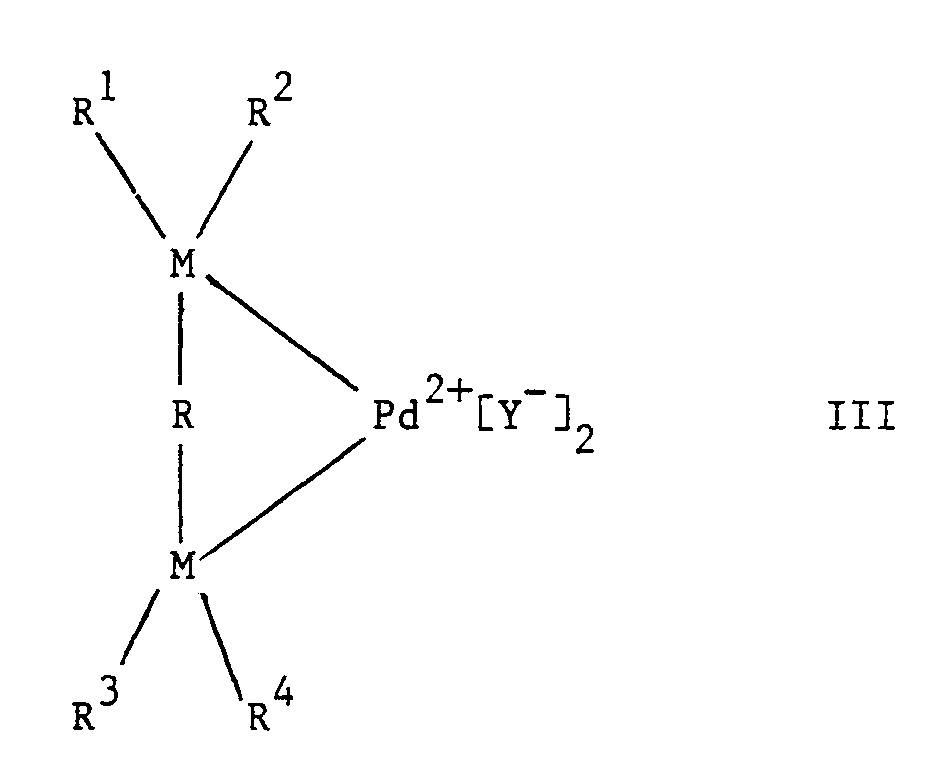
- In formula III, Y represents a non-coordinating anion, whilst Pd²⁺ can also be written as

- In the bidentate ligand, M is preferably phosphorous. Hydrocarbon groups R¹, R², R³ and R⁴ will as a rule contain in the range of from 2 to 18 carbon atoms, preferably 6 to 14 carbon atoms. Aryl groups are the most suitable, in particular the phenyl group. The phenyl groups may be substituted, for example with halogen atoms and alkyl, aryl, alkoxy, carbalkoxy, trihalogen-methyl, cyano or dialkylamino groups. Preferred bridging groups -R- are those having the formula -CR⁶R⁷
 in which R⁶ and R⁷ each represent a hydrogen atom or an optionally substituted hydrocarbon group offering no steric hindrance and n is an integer in the range of from, 3 to 5. Substituents R⁶ and R⁷ preferably represent hydrogen atoms. The bridging groups R may also make part of a cyclic structure, e.g. an aromatic or cycloaliphatic group, the carbon to carbon bond or bonds in the bridge may be saturated or unsaturated and in the bridge or in the cyclic or non-cyclic groups attached to the bridge one or more hetero atoms, e.g. sulphur, oxygen, iron or nitrogen, may have been substituted for carbon atoms, other than the two carbon atoms which must be present in the bridge linking both atoms M.
- Examples of suitable bidentate ligands are
1,3-di(diphenylphosphino)propane,
1,4-di(diphenylphosphino)butane,
2,3-dimethyl-1,4-di(diphenylphosphino)butane,
1,5-di(methyl-phenyl-phosphino)pentane,
1,4-di(dicyclohexylphospino)butane,
1,5-di(dinaphthylphosphino)pentane,
1,3-di(di-p-tolylphosphino)propane,
1,4-di(di-p-methoxyphenylphosphino)butane,
2,3-di(diphenylphosphino)-2-butene,
1,3-di(diphenylphosphino)-2-oxapropane,
2-methyl,2-(methyldiphenylphosphino)-1,3-di(diphenylphoshino)propane,
0,0′-di(diphenylphosphino)biphenyl,
1,8-di(diphenylphosphino)naphthalene and
bis(α,α′-diphenylphosphino)o-xylene. - The bidentate ligand can be used in quantities, relative to palladium and/or palladium compound, that can range within wide limits, suitably below 25, e.g. from 0.1 to 20 mol per mol palladium compound. Preferred quantities range from 0.3 to 10 mol per mol.
- In addition to the bidentate ligand, one or more monodentate ligands can also be used in the preparation of the catalytic system. Suitable monodentate ligands are in particular optionally substituted triarylphosphines, such as triphenylphosphine, the phenyl groups optionally being substituted with alkyl, alkoxy, halogen and trihalomethyl groups. The use of an excess of monodentate ligand in relation to palladium and/or the palladium compound is recommended. Preferred quantities range from 2:1 to 50:1 in relation to palladium and/or palladium compound.
- The carbon monoxide can be used in pure form or diluted with an inert gas such as hydrogen, nitrogen, noble gases or carbon dioxide in the process according to the invention.
- The process of this invention is preferably carried out at a temperature between 20 and 225 °C, in particular between 50 and 200 °C, the total pressure ranges between preferably 1 and 100, in particular 20 and 75, bar gauge. It can be carried out batchwise, continuously or semi-continuously.
- Both homogeneous and heterogeneous palladium compounds can be used. Homogeneous systems are preferred. Suitable palladium compounds are salts of palladium with, for example, nitric acid, sulphuric acid or alkanoic acids having not more than 12 carbon atoms per molecule. Salts of hydrohalogenic acids are theoretically also usable, but have the drawback that the halogen ion may have a corrosive action. Palladium carboxylates are the catalyst compounds preferably used, in particular palladium acetate. In addition, palladium acetylacetonate can also be used. Palladium on carbon and palladium bonded to an ion exchanger, for example one containing sulphonic acid groups, are examples of suitable heterogeneous palladium compounds.
- The quantity of palladium and/or palladium compound is not critical. Preferably, quantities between 10⁻⁸ and 10⁻¹ mol palladium and/or palladium compound per mol ethylenically unsaturated starting compound are used. The molar ratio of ethylenically unsaturated starting compound to carbon monoxide will as a rule range from 5:95 to 95:5, preferably from 1:5 to 5:1.
- The process according to the present invention is carried out using a molar ratio of acid having a pKa below 2.0 to bidentate ligand of the general formula I of greater than 0.5, the rate of reaction being very low if this molar ratio is not greater than 0.5. Preferably, a molar ratio of acid to bidentate ligand in the range of from 1 to 10 is used; if desired, this molar ratio may be higher than 10, up to, for example, 25.
- The process according to the present invention can be carried out conveniently in the presence of an aprotic solvent. A variety of solvents can be applied, such as ethers, for example diethyl ether, dimethyl ether of diethylene glycol (also referred to as "diglyme"), anisole and diphenyl ether; aromatic compounds, such as benzene, toluene, ethylbenzene and the three xylenes; halogenated aromatic compounds, such as chlorobenzene and the three dichlorobenzenes; halogenated alkanes, such as methylene chloride and carbontetrachloride; alkanes, such as hexane, heptane and 2,2,3-trimethylpentane; cycloalkanes, such as cyclohexane and methylcychlohexane; nitriles, such as benzonitrile and acetonitrile; esters, such as methyl benzoate, methyl acetate and dimethyl phthalate; sulphones, such as diethyl sulphone and tetrahydrothiophene 1,1-dioxide (also referred to as "sulpholane"). Also mixtures of solvents can be suitably applied. It is also possible to use an excess of the starting alkanol as solvent. Very good results have been obtained with aromatic hydrocarbons and with ethers.
- The ethylenically unsaturated compound in which each of the carbon atoms of the carbon-carbon double bond is secondary, which is a carbon atom bound to two other carbon atoms, or tertiary, which is a carbon atom bound to three other carbon atoms, may be an alkene having up to 30 carbon atoms per molecule, such as 2-butene, 2-pentene, 2-hexene, 3-hexene, 2-heptene, 3-heptene, 2-octene, 3-octene, 4-octene, 2-nonene, 3-nonene, 4-nonene; a cycloalkene having up to 30 carbon atoms per molecule, such as cyclohexene, cycloheptene, cyclo-octene, cyclododecene and methylcyclo-octene; an alkyl or a phenyl ester of an alkenoic acid having up to 30 carbon atoms per molecule, such as crotonic acid, 2-pentenoic acid, 3-pentenoic acid, 2-hexenoic acid, 3-hexenoic acid, the alkyl group suitably having up to 30 carbon atoms.
- Carbonylation in the presence of water leads to formation of carboxylic acids and carbonylation in the presence of alkanols to formation of carboxylic esters. The alkanol suitably has up to 30 carbon atoms per molecule and may be substituted with one or more substituents, for instance, with one or more halogen atoms or cyano, ester, alkoxy or aryl groups. Examples of suitable alkanols are methanol, ethanol, propanol, 2-propanol, 2-butanol, tert-butyl alcohol and chlorocapryl alcohol. Very good results have been obtained with methanol and ethanol.
- The molar ratio of the ethylenically unsaturated compound to water and/or alkanol is not critical and may vary within wide limits, suitably between 0.1:1 and 10:1. When using a monoethylenically unsaturated compound, preference is usually given to the use of an excess of the alkanol.
- The carboxylic acid or ester obtained by means of the present process may be isolated from the reaction mixture in any suitable manner, for example by means of distillation. Suitably, the acid or ester are obtained in a distillate fraction and an aprotic solvent is chosen which remains, together with the catalytic system, in the bottom fraction of the distillation. The bottom fraction may be re-used as catalytic system in the process of the present invention.
- The following Examples further illustrate the invention.
- A 250-ml magnetically stirred Hastelloy C autoclave ("Hastelloy" is a trade mark) was charged with a mixture of n-octenes (20 ml), a solvent (30 ml), methanol (10 ml), palladium (II) acetate (0.4 mmol), ligand and acid. The table hereinafter states which solvent and which amounts of ligand and acid were used. The mixture of n-octenes consisted of 2.5% 1-octene, 39% 2-octene, 39% 3-octene and 19.5% 4-octene. The autoclave was flushed with carbon monoxide, filled with carbon monoxide at a pressure of 40 bar, sealed and heated to a temperature of 155 °C. After the reaction the contents of the autoclave were analysed by gas-liquid chromatography. The table states the conversion of n-octenes, the reaction rate in mol of n-octenes per mol of Pd per h and the content of unbranched ester. The symbol φ represents a phenyl group and pTsA refers to p-toluenesulphonic acid.

- Comparative Experiment A shows that despite the use of an excess of acid with respect to the bidentate ligand φ₂P(CH₂)₂Pφ₂ (not according to invention) no octene conversion had been observed.
- Comparative Experiment B shows that despite the use of an excess of acid with respect to the bidentate ligand φ₂P(CH₂)₆Pφ₂ (not according to invention) the rate at which the product is formed is relatively low.
- Example 1 shows that when an excess of acid with respect to the bidentate ligand φ₂P(CH₂)₃Pφ₂ is used, a large increase of the reaction rate is observed.
- Example 2 shows that when an excess of acid with respect to the bidentate ligand φ₂P(CH₂)₄Pφ₂ is used, a high reaction rate is obtained.
- Comparative Experiments C and D show that when a carboxylic acid (not according to invention) having a pKa below 2.0 is used, the rate at which the product is formed is relatively low.
- Comparative Experiment E shows that when triphenylphosphine (not according to invention) is used, the rate at which the product is formed is relatively low.
- In the way of Example 2 an experiment was carried out in which, instead of toluene (30 ml), diglyme (30 ml) and instead of methanol (10 ml), water (5 ml), was used. The conversion of n-octenes was 55%, the reaction rate was 110 mol of n-octenes per mol of Pd per h and the content of unbranched ester was 62%.
- In the way of Example 2 an experiment was carried out in which, instead of n-octenes (20 ml), ethyl crotonate (10 ml) was used.
- The conversion of ethyl crotonate was 100%, the reaction rate was 180 mol of ethyl crotonate per mol of Pd per h and the content of unbranched diester was 31%, the diesters being a mixture of dimethyl glutarate, methyl ethyl glutarate and diethyl glutarate.
- In the way of Example 2 an experiment was carried out in which, instead of methanol (10 ml), ethanol (15 ml) and instead of n-octenes (20 ml), ethyl crotonate (10 ml) was used.
- The conversion of ethyl crotonate was 100%, the reaction rate was 180 mol of ethyl crotonate per mol of Pd per h and the content of unbranched diester was 81.5%, the unbranched diester being diethyl glutarate.
- In the way of Example 5 an experiment was carried out in which 10 instead of 1.6 mmol of φ₂P(CH₂)₄Pφ₂ was used, the molar ratio of acid to ligand being 0.4.
- The conversion of ethyl crotonate was less than 5% and the reaction rate was less than 5 mol of ethyl crotonate per mol of Pd per h.
- In the way of Example 5 an experiment was carried out in which 3.2 instead of 1.6 mmol of φ₂P(CH₂)₄Pφ₂ was used, the molar ratio of acid to ligand being 1.25. The conversion of ethyl crotonate was 95%, the reaction rate was 100 mol of ethyl crotonate per mol of Pd per h and the content of unbranched diester was 69%, the unbranched diester being diethyl glutarate.
- In the way of Example 5 an experiment was carried out in which 40 instead of 15 ml of ethanol was used and no toluene was present.
- The conversion of ethyl crotonate was 100%, the reaction rate was 150 mol of ethyl crotonate per mol of Pd per h and the content of unbranched diester was 83%, the unbranched diester being diethyl glutarate.
- In the way of Example 5 an experiment was carried out in which, instead of toluene (30 ml), anisole (30 ml) was used.
- The conversion of ethyl crotonate was 100%, the reaction rate was 160 mol of ethyl crotonate per mol of Pd per h and the content of unbranched diester was 83%, the unbranched diester being diethyl glutarate.
- In the way of Example 8 an experiment was carried out in which ethyl crotonate (10 ml) was replaced with a mixture of cis and trans ethyl 3-pentenoate.
- The conversion of ethyl 3-pentenoate was 100%, the reaction rate was 150 mol of ethyl 3-pentenoate per mol of Pd per h and the content of unbranched diester was 70%, the unbranched diester being diethyl adipate.
- In the way of Example 9 an experiment was carried out in which φ₂P(CH₂)₄Pφ₂ (1.6 mmol) was replaced with triphenylphosphine (3.2 mmol) and anisole (30 ml) with toluene (30 ml).
- No conversion of ethyl crotonate had been observed.
- In the way of Example 8 an experiment was carried out in which p-toluenesulphonic acid (4 mmol) was replaced with hydrogen chloride (4 mmol). No conversion of ethyl crotonate had been observed.
- In the way of Example 6 an experiment was carried out in which 0.8 instead of 3.2 mmol of φ₂P(CH₂)₄Pφ₂ was used and also triphenylphosphine (2 mmol) was added.
- The conversion of ethyl crotonate was 100%, the reaction rate was 120 mol of ethyl crotonate per mol of Pd per h and the content of unbranched diester was 82%, the unbranched diester being diethyl glutarate.
Claims (16)
R¹R²-M-R-M-R³R⁴ (I)
wherein M represents a phoshorous, arsenic or antimony atom, R represents a divalent organic bridging group having in the range of from three to five carbon atoms in the bridge, none of these carbon atoms carrying substituents that may cause steric hindrance, and each of R¹, R², R³ and R⁴ represents an optionally substituted hydrocarbon group,


Applications Claiming Priority (2)
| Application Number | Priority Date | Filing Date | Title |
|---|---|---|---|
| GB858531624A GB8531624D0 (en) | 1985-12-23 | 1985-12-23 | Carbonylation of ethylenically unsaturated compounds |
| GB8531624 | 1985-12-23 |
Publications (3)
| Publication Number | Publication Date |
|---|---|
| EP0227160A2 true EP0227160A2 (en) | 1987-07-01 |
| EP0227160A3 EP0227160A3 (en) | 1987-09-30 |
| EP0227160B1 EP0227160B1 (en) | 1990-04-11 |
Family
ID=10590182
Family Applications (1)
| Application Number | Title | Priority Date | Filing Date |
|---|---|---|---|
| EP19860202157 Expired EP0227160B1 (en) | 1985-12-23 | 1986-12-03 | Process for the carbonylation of ethylenically unsaturated compounds |
Country Status (6)
| Country | Link |
|---|---|
| EP (1) | EP0227160B1 (en) |
| JP (1) | JP2564123B2 (en) |
| CA (1) | CA1284658C (en) |
| DE (1) | DE3670284D1 (en) |
| ES (1) | ES2013995B3 (en) |
| GB (1) | GB8531624D0 (en) |
Cited By (27)
| Publication number | Priority date | Publication date | Assignee | Title |
|---|---|---|---|---|
| EP0313150A1 (en) * | 1987-10-14 | 1989-04-26 | Shell Internationale Researchmaatschappij B.V. | Process for the preparation of functionalized polymers |
| US4980422A (en) * | 1987-10-14 | 1990-12-25 | Shell Oil Company | Hydroesterification of polymerized conjugated dienes |
| US4981916A (en) * | 1987-10-14 | 1991-01-01 | Shell Oil Company | Hydroesterification of polymerized conjugated dienes |
| EP0441447A1 (en) * | 1990-02-05 | 1991-08-14 | Shell Internationale Researchmaatschappij B.V. | Carbonylation catalyst process |
| US5166116A (en) * | 1990-02-05 | 1992-11-24 | Shell Oil Company | Carbonylation catalyst system |
| US5179225A (en) * | 1990-02-05 | 1993-01-12 | Shell Oil Company | Carbonylation catalyst system |
| EP0495548A3 (en) * | 1991-01-15 | 1993-02-03 | Shell Internationale Research Maatschappij B.V. | Process for the carbonylation of olefin |
| EP0495547A3 (en) * | 1991-01-15 | 1993-02-03 | Shell Internationale Research Maatschappij B.V. | Carbonylation of olefins |
| US5773567A (en) * | 1996-06-17 | 1998-06-30 | Exxon Chemical Patents Inc | Carboxylic amide-containing polymers for use as fuel or lubricating oil additives and processes for their preparation |
| CN1049671C (en) * | 1993-06-29 | 2000-02-23 | 国际壳牌研究有限公司 | Copolymers of carbon monoxide and an olefinically unsaturated compound and process for the preparation thereof |
| US6346640B1 (en) | 1998-09-03 | 2002-02-12 | Basf Aktiengesellschaft | Method for producing cyanovaleric acid or esters thereof |
| WO2001068583A3 (en) * | 2000-03-14 | 2002-04-25 | Shell Int Research | Process for the carbonylation of ethylenically unsaturated compounds |
| WO2005079981A1 (en) | 2004-02-18 | 2005-09-01 | Lucite International Uk Limited | A catalyst system |
| WO2007020379A1 (en) | 2005-08-12 | 2007-02-22 | Lucite International Uk Limited | Improved catalyst system |
| US7371705B2 (en) | 2002-08-10 | 2008-05-13 | Lucite International Uk Limited | Phospha-adamantane(s) catalytic system |
| CN101448773A (en) * | 2006-04-13 | 2009-06-03 | 卢西特国际英国有限公司 | Metal complexes for use in the carbonylation of ethylenically unsaturated compounds |
| US7767864B2 (en) | 2003-07-03 | 2010-08-03 | Lucite International Uk Limited | Process for the hydroformylation of ethylenically unsaturated compounds |
| US7772419B2 (en) | 2004-05-28 | 2010-08-10 | Lucite International Uk Ltd. | Carbonylation of ester |
| WO2011073655A1 (en) | 2009-12-15 | 2011-06-23 | Lucite International Uk Limited | A continuous process for the carbonylation of ethylene |
| WO2011073653A1 (en) | 2009-12-15 | 2011-06-23 | Lucite International Uk Limited | Improved carbonylation process |
| WO2011083305A1 (en) | 2010-01-05 | 2011-07-14 | Lucite International Uk Limited | Process for the carbonylation of ethylenically unsaturated compounds, novel carbonylation ligands and catalyst systems incorporating such ligands |
| WO2013093472A1 (en) | 2011-12-21 | 2013-06-27 | Lucite International Uk Limited | A continuous process for the carbonylation of ethylene |
| US8816113B2 (en) | 2008-07-04 | 2014-08-26 | Lucite International Uk Limited | Process for the carbonylation of ethylenically unsaturated compounds, novel carbonylation ligands and catalyst systems incorporating such ligands |
| US9138694B2 (en) | 2006-05-10 | 2015-09-22 | Lucite International Uk Limited | Mixing apparatus |
| US9334227B2 (en) | 2005-11-17 | 2016-05-10 | Lucite International Uk Limited | Carbonylation of ethylenically unsaturated compounds |
| US9809611B2 (en) | 2006-12-02 | 2017-11-07 | Lucite International Uk Limited | Carbonylation ligands and their use in the carbonylation of ethylenically unsaturated compounds |
| CN116459873A (en) * | 2022-01-12 | 2023-07-21 | 万华化学集团股份有限公司 | Catalyst for carbonylation of ethylenically unsaturated compound and its preparation method and application |
Family Cites Families (4)
| Publication number | Priority date | Publication date | Assignee | Title |
|---|---|---|---|---|
| US4414409A (en) * | 1981-12-21 | 1983-11-08 | E. I. Du Pont De Nemours & Company | Palladium sulfonate catalyst systems for carbonylation of olefins |
| CA1231346A (en) * | 1982-09-30 | 1988-01-12 | Eit Drent | Process for the carbonylation of olefinically unsaturated compounds with a palladium catalyst |
| GB8432376D0 (en) * | 1984-12-21 | 1985-02-06 | Shell Int Research | Carbonylation of acetylenically unsaturated compounds |
| GB8509641D0 (en) * | 1985-04-15 | 1985-05-22 | Shell Int Research | Carboxylic di-esters/acids |
-
1985
- 1985-12-23 GB GB858531624A patent/GB8531624D0/en active Pending
-
1986
- 1986-12-03 EP EP19860202157 patent/EP0227160B1/en not_active Expired
- 1986-12-03 ES ES86202157T patent/ES2013995B3/en not_active Expired - Lifetime
- 1986-12-03 DE DE8686202157T patent/DE3670284D1/en not_active Expired - Lifetime
- 1986-12-08 CA CA000524742A patent/CA1284658C/en not_active Expired - Fee Related
- 1986-12-19 JP JP61301927A patent/JP2564123B2/en not_active Expired - Fee Related
Cited By (44)
| Publication number | Priority date | Publication date | Assignee | Title |
|---|---|---|---|---|
| AU616210B2 (en) * | 1987-10-14 | 1991-10-24 | Shell Internationale Research Maatschappij B.V. | Process for the preparation of functionalized polymers |
| EP0313150A1 (en) * | 1987-10-14 | 1989-04-26 | Shell Internationale Researchmaatschappij B.V. | Process for the preparation of functionalized polymers |
| US4970266A (en) * | 1987-10-14 | 1990-11-13 | Shell Oil Company | Process for the preparation of functionalized polymers |
| US4980422A (en) * | 1987-10-14 | 1990-12-25 | Shell Oil Company | Hydroesterification of polymerized conjugated dienes |
| US4981916A (en) * | 1987-10-14 | 1991-01-01 | Shell Oil Company | Hydroesterification of polymerized conjugated dienes |
| US4927892A (en) * | 1987-10-14 | 1990-05-22 | Shell Oil Company | Process for the preparation of functionalized polymers |
| EP0441447A1 (en) * | 1990-02-05 | 1991-08-14 | Shell Internationale Researchmaatschappij B.V. | Carbonylation catalyst process |
| US5179225A (en) * | 1990-02-05 | 1993-01-12 | Shell Oil Company | Carbonylation catalyst system |
| US5166116A (en) * | 1990-02-05 | 1992-11-24 | Shell Oil Company | Carbonylation catalyst system |
| EP0495547A3 (en) * | 1991-01-15 | 1993-02-03 | Shell Internationale Research Maatschappij B.V. | Carbonylation of olefins |
| EP0495548A3 (en) * | 1991-01-15 | 1993-02-03 | Shell Internationale Research Maatschappij B.V. | Process for the carbonylation of olefin |
| CN1049671C (en) * | 1993-06-29 | 2000-02-23 | 国际壳牌研究有限公司 | Copolymers of carbon monoxide and an olefinically unsaturated compound and process for the preparation thereof |
| US5773567A (en) * | 1996-06-17 | 1998-06-30 | Exxon Chemical Patents Inc | Carboxylic amide-containing polymers for use as fuel or lubricating oil additives and processes for their preparation |
| US6066605A (en) * | 1996-06-17 | 2000-05-23 | Infineum Usa L.P. | Carboxylic amide-containing polymers for use as fuel or lubricating oil additives and processes for their preparation |
| US6346640B1 (en) | 1998-09-03 | 2002-02-12 | Basf Aktiengesellschaft | Method for producing cyanovaleric acid or esters thereof |
| WO2000014055A3 (en) * | 1998-09-03 | 2002-10-03 | Basf Ag | Method for producing cyanovaleric acid or esters thereof |
| US6706912B2 (en) | 2000-03-14 | 2004-03-16 | Shell Oil Company | Process for the carbonylation of ethylenically unsaturated compounds |
| WO2001068583A3 (en) * | 2000-03-14 | 2002-04-25 | Shell Int Research | Process for the carbonylation of ethylenically unsaturated compounds |
| KR100753691B1 (en) * | 2000-03-14 | 2007-08-30 | 셀 인터나쵸나아레 레사아치 마아츠샤피 비이부이 | Carbonylation Method of Ethylenically Unsaturated Compound |
| US7371705B2 (en) | 2002-08-10 | 2008-05-13 | Lucite International Uk Limited | Phospha-adamantane(s) catalytic system |
| US7767864B2 (en) | 2003-07-03 | 2010-08-03 | Lucite International Uk Limited | Process for the hydroformylation of ethylenically unsaturated compounds |
| WO2005079981A1 (en) | 2004-02-18 | 2005-09-01 | Lucite International Uk Limited | A catalyst system |
| EP2243548A1 (en) | 2004-02-18 | 2010-10-27 | Lucite International UK Limited | A catalyst system |
| EP2243549A1 (en) | 2004-02-18 | 2010-10-27 | Lucite International UK Limited | A catalyst system |
| US9802185B2 (en) | 2004-02-18 | 2017-10-31 | Lucite International Uk Limited | Catalyst system |
| US9040445B2 (en) | 2004-02-18 | 2015-05-26 | Lucite International Uk Limited | Catalyst system |
| US7772419B2 (en) | 2004-05-28 | 2010-08-10 | Lucite International Uk Ltd. | Carbonylation of ester |
| US8604236B2 (en) | 2005-08-12 | 2013-12-10 | Lucite International Uk Limited | Catalyst system |
| WO2007020379A1 (en) | 2005-08-12 | 2007-02-22 | Lucite International Uk Limited | Improved catalyst system |
| US9334227B2 (en) | 2005-11-17 | 2016-05-10 | Lucite International Uk Limited | Carbonylation of ethylenically unsaturated compounds |
| CN101448773A (en) * | 2006-04-13 | 2009-06-03 | 卢西特国际英国有限公司 | Metal complexes for use in the carbonylation of ethylenically unsaturated compounds |
| US8445711B2 (en) | 2006-04-13 | 2013-05-21 | Lucite International Uk Limited | Metal complexes |
| US9138694B2 (en) | 2006-05-10 | 2015-09-22 | Lucite International Uk Limited | Mixing apparatus |
| US9809611B2 (en) | 2006-12-02 | 2017-11-07 | Lucite International Uk Limited | Carbonylation ligands and their use in the carbonylation of ethylenically unsaturated compounds |
| US8816113B2 (en) | 2008-07-04 | 2014-08-26 | Lucite International Uk Limited | Process for the carbonylation of ethylenically unsaturated compounds, novel carbonylation ligands and catalyst systems incorporating such ligands |
| WO2011073653A1 (en) | 2009-12-15 | 2011-06-23 | Lucite International Uk Limited | Improved carbonylation process |
| WO2011073655A1 (en) | 2009-12-15 | 2011-06-23 | Lucite International Uk Limited | A continuous process for the carbonylation of ethylene |
| US8785678B2 (en) | 2009-12-15 | 2014-07-22 | Lucite International Uk Limited | Continuous process for the carbonylation of ethylene |
| US8969560B2 (en) | 2010-01-05 | 2015-03-03 | Lucite International Uk Limited | Process for the carbonylation of ethylenically unsaturated compounds, novel carbonylation ligands and catalyst systems incorporating such ligands |
| WO2011083305A1 (en) | 2010-01-05 | 2011-07-14 | Lucite International Uk Limited | Process for the carbonylation of ethylenically unsaturated compounds, novel carbonylation ligands and catalyst systems incorporating such ligands |
| US9381503B2 (en) | 2010-01-05 | 2016-07-05 | Lucite International Uk Limited | Process for the carbonylation of ethylenically unsaturated compounds, novel carbonylation ligands and catalyst systems incorporating such ligands |
| WO2013093472A1 (en) | 2011-12-21 | 2013-06-27 | Lucite International Uk Limited | A continuous process for the carbonylation of ethylene |
| CN116459873A (en) * | 2022-01-12 | 2023-07-21 | 万华化学集团股份有限公司 | Catalyst for carbonylation of ethylenically unsaturated compound and its preparation method and application |
| CN116459873B (en) * | 2022-01-12 | 2025-02-18 | 万华化学集团股份有限公司 | A catalyst for carbonylation of olefinic unsaturated compounds and its preparation method and application |
Also Published As
| Publication number | Publication date |
|---|---|
| JP2564123B2 (en) | 1996-12-18 |
| EP0227160B1 (en) | 1990-04-11 |
| ES2013995B3 (en) | 1990-06-16 |
| CA1284658C (en) | 1991-06-04 |
| DE3670284D1 (en) | 1990-05-17 |
| JPS62158241A (en) | 1987-07-14 |
| GB8531624D0 (en) | 1986-02-05 |
| EP0227160A3 (en) | 1987-09-30 |
Similar Documents
| Publication | Publication Date | Title |
|---|---|---|
| EP0227160B1 (en) | Process for the carbonylation of ethylenically unsaturated compounds | |
| JP3949716B2 (en) | Ethylene carbonylation process and catalyst system for use therein | |
| JP3270098B2 (en) | Olefin carbonylation | |
| CA1263121A (en) | Process for the carbonylation of acetylenically unsaturated compounds | |
| KR100220824B1 (en) | Carbonylation of olefins | |
| US4861912A (en) | Process for the preparation of a diester of adipic acid | |
| EP0190473B1 (en) | Process for the carbonylation of allenically unsaturated compounds | |
| EP0235864A1 (en) | Process for the carbonylation of olefinically unsaturated compounds with a palladium catalyst | |
| EP0662468A1 (en) | Process for the preparation of 5-formylvalerate | |
| CA2055628A1 (en) | Carbonylation process and catalyst composition | |
| EP0220767B1 (en) | Process for the preparation of aldehydes | |
| US4849542A (en) | Process for the preparation of oxo-alkanedioic acids or diesters thereof | |
| EP0198521B1 (en) | Preparation of carboxylic di-esters or acids | |
| EP0279477B1 (en) | Carbonylation process | |
| EP0293999B1 (en) | Process for the coproduction of anilines and oxamides | |
| EP0710224B1 (en) | Process for the carbonylation of acetylenically unsaturated compounds | |
| KR20060013546A (en) | Hydrocarboxylation of ethylenically unsaturated carboxylic acids | |
| GB2185740A (en) | Process for the preparation of ketones | |
| CA1287838C (en) | Process for the preparation of unsaturated carboxylate esters | |
| US3652608A (en) | Preparation of unsaturated esters | |
| US4960906A (en) | Process for the preparation of lactones from higher alkenols | |
| GB2261662A (en) | Carbonylation of aryl halides | |
| EP0293053B1 (en) | Process for the preparation of cyclic carboxylic anhydrides | |
| EP0341773B1 (en) | Process for the preparation of lactones | |
| EP0218283A1 (en) | Process for the preparation of esters of alpha-ethylenically unsaturated alcohols and alpha-ethylenically unsaturated carboxylic acids |
Legal Events
| Date | Code | Title | Description |
|---|---|---|---|
| PUAI | Public reference made under article 153(3) epc to a published international application that has entered the european phase |
Free format text: ORIGINAL CODE: 0009012 |
|
| AK | Designated contracting states |
Kind code of ref document: A2 Designated state(s): BE CH DE ES FR GB IT LI NL |
|
| PUAL | Search report despatched |
Free format text: ORIGINAL CODE: 0009013 |
|
| AK | Designated contracting states |
Kind code of ref document: A3 Designated state(s): BE CH DE ES FR GB IT LI NL |
|
| 17P | Request for examination filed |
Effective date: 19880115 |
|
| 17Q | First examination report despatched |
Effective date: 19890123 |
|
| GRAA | (expected) grant |
Free format text: ORIGINAL CODE: 0009210 |
|
| AK | Designated contracting states |
Kind code of ref document: B1 Designated state(s): BE CH DE ES FR GB IT LI NL |
|
| ITF | It: translation for a ep patent filed | ||
| REF | Corresponds to: |
Ref document number: 3670284 Country of ref document: DE Date of ref document: 19900517 |
|
| ET | Fr: translation filed | ||
| PLBE | No opposition filed within time limit |
Free format text: ORIGINAL CODE: 0009261 |
|
| STAA | Information on the status of an ep patent application or granted ep patent |
Free format text: STATUS: NO OPPOSITION FILED WITHIN TIME LIMIT |
|
| 26N | No opposition filed | ||
| ITTA | It: last paid annual fee | ||
| REG | Reference to a national code |
Ref country code: GB Ref legal event code: IF02 |
|
| PGFP | Annual fee paid to national office [announced via postgrant information from national office to epo] |
Ref country code: FR Payment date: 20021015 Year of fee payment: 17 |
|
| PGFP | Annual fee paid to national office [announced via postgrant information from national office to epo] |
Ref country code: GB Payment date: 20021127 Year of fee payment: 17 |
|
| PGFP | Annual fee paid to national office [announced via postgrant information from national office to epo] |
Ref country code: ES Payment date: 20021212 Year of fee payment: 17 |
|
| PGFP | Annual fee paid to national office [announced via postgrant information from national office to epo] |
Ref country code: NL Payment date: 20021216 Year of fee payment: 17 |
|
| PGFP | Annual fee paid to national office [announced via postgrant information from national office to epo] |
Ref country code: DE Payment date: 20021227 Year of fee payment: 17 |
|
| PGFP | Annual fee paid to national office [announced via postgrant information from national office to epo] |
Ref country code: BE Payment date: 20030128 Year of fee payment: 17 |
|
| PGFP | Annual fee paid to national office [announced via postgrant information from national office to epo] |
Ref country code: CH Payment date: 20030227 Year of fee payment: 17 |
|
| PG25 | Lapsed in a contracting state [announced via postgrant information from national office to epo] |
Ref country code: GB Free format text: LAPSE BECAUSE OF NON-PAYMENT OF DUE FEES Effective date: 20031203 |
|
| PG25 | Lapsed in a contracting state [announced via postgrant information from national office to epo] |
Ref country code: ES Free format text: LAPSE BECAUSE OF NON-PAYMENT OF DUE FEES Effective date: 20031204 |
|
| PG25 | Lapsed in a contracting state [announced via postgrant information from national office to epo] |
Ref country code: LI Free format text: LAPSE BECAUSE OF NON-PAYMENT OF DUE FEES Effective date: 20031231 Ref country code: CH Free format text: LAPSE BECAUSE OF NON-PAYMENT OF DUE FEES Effective date: 20031231 Ref country code: BE Free format text: LAPSE BECAUSE OF NON-PAYMENT OF DUE FEES Effective date: 20031231 |
|
| BERE | Be: lapsed |
Owner name: *SHELL INTERNATIONALE RESEARCH MAATSCHAPPIJ B.V. Effective date: 20031231 |
|
| PG25 | Lapsed in a contracting state [announced via postgrant information from national office to epo] |
Ref country code: NL Free format text: LAPSE BECAUSE OF NON-PAYMENT OF DUE FEES Effective date: 20040701 Ref country code: DE Free format text: LAPSE BECAUSE OF NON-PAYMENT OF DUE FEES Effective date: 20040701 |
|
| GBPC | Gb: european patent ceased through non-payment of renewal fee |
Effective date: 20031203 |
|
| REG | Reference to a national code |
Ref country code: CH Ref legal event code: PL |
|
| PG25 | Lapsed in a contracting state [announced via postgrant information from national office to epo] |
Ref country code: FR Free format text: LAPSE BECAUSE OF NON-PAYMENT OF DUE FEES Effective date: 20040831 |
|
| NLV4 | Nl: lapsed or anulled due to non-payment of the annual fee |
Effective date: 20040701 |
|
| REG | Reference to a national code |
Ref country code: FR Ref legal event code: ST |
|
| REG | Reference to a national code |
Ref country code: ES Ref legal event code: FD2A Effective date: 20031204 |
|
| PG25 | Lapsed in a contracting state [announced via postgrant information from national office to epo] |
Ref country code: IT Free format text: LAPSE BECAUSE OF NON-PAYMENT OF DUE FEES;WARNING: LAPSES OF ITALIAN PATENTS WITH EFFECTIVE DATE BEFORE 2007 MAY HAVE OCCURRED AT ANY TIME BEFORE 2007. THE CORRECT EFFECTIVE DATE MAY BE DIFFERENT FROM THE ONE RECORDED. Effective date: 20051203 |