EP0164905A1 - Purfication of liquid paraffins - Google Patents
Purfication of liquid paraffins Download PDFInfo
- Publication number
- EP0164905A1 EP0164905A1 EP85303344A EP85303344A EP0164905A1 EP 0164905 A1 EP0164905 A1 EP 0164905A1 EP 85303344 A EP85303344 A EP 85303344A EP 85303344 A EP85303344 A EP 85303344A EP 0164905 A1 EP0164905 A1 EP 0164905A1
- Authority
- EP
- European Patent Office
- Prior art keywords
- liquid paraffin
- liquid
- temperature
- aromatic
- aromatic hydrocarbons
- Prior art date
- Legal status (The legal status is an assumption and is not a legal conclusion. Google has not performed a legal analysis and makes no representation as to the accuracy of the status listed.)
- Granted
Links
- 239000007788 liquid Substances 0.000 title claims description 22
- 239000010457 zeolite Substances 0.000 claims abstract description 64
- HNPSIPDUKPIQMN-UHFFFAOYSA-N dioxosilane;oxo(oxoalumanyloxy)alumane Chemical compound O=[Si]=O.O=[Al]O[Al]=O HNPSIPDUKPIQMN-UHFFFAOYSA-N 0.000 claims abstract description 55
- 229910021536 Zeolite Inorganic materials 0.000 claims abstract description 54
- 229940057995 liquid paraffin Drugs 0.000 claims abstract description 45
- 150000004945 aromatic hydrocarbons Chemical class 0.000 claims abstract description 42
- URGAHOPLAPQHLN-UHFFFAOYSA-N sodium aluminosilicate Chemical compound [Na+].[Al+3].[O-][Si]([O-])=O.[O-][Si]([O-])=O URGAHOPLAPQHLN-UHFFFAOYSA-N 0.000 claims abstract description 31
- 239000002808 molecular sieve Substances 0.000 claims abstract description 30
- 239000012535 impurity Substances 0.000 claims abstract description 10
- 238000000034 method Methods 0.000 claims description 49
- 239000000463 material Substances 0.000 claims description 24
- 239000002904 solvent Substances 0.000 claims description 19
- 239000007791 liquid phase Substances 0.000 claims description 18
- 239000000203 mixture Substances 0.000 claims description 18
- 238000005406 washing Methods 0.000 claims description 17
- 239000011148 porous material Substances 0.000 claims description 12
- 239000003463 adsorbent Substances 0.000 claims description 11
- 125000003118 aryl group Chemical group 0.000 claims description 7
- -1 aromatic aromatic hydrocarbons Chemical class 0.000 claims description 5
- 238000007599 discharging Methods 0.000 claims description 4
- 150000001298 alcohols Chemical class 0.000 claims description 3
- 238000004519 manufacturing process Methods 0.000 claims description 3
- 108010027322 single cell proteins Proteins 0.000 claims description 3
- NHTMVDHEPJAVLT-UHFFFAOYSA-N Isooctane Chemical compound CC(C)CC(C)(C)C NHTMVDHEPJAVLT-UHFFFAOYSA-N 0.000 claims description 2
- JVSWJIKNEAIKJW-UHFFFAOYSA-N dimethyl-hexane Natural products CCCCCC(C)C JVSWJIKNEAIKJW-UHFFFAOYSA-N 0.000 claims description 2
- 230000014616 translation Effects 0.000 claims description 2
- 238000009472 formulation Methods 0.000 claims 1
- 238000004064 recycling Methods 0.000 abstract description 3
- 238000001179 sorption measurement Methods 0.000 description 24
- UHOVQNZJYSORNB-UHFFFAOYSA-N Benzene Chemical compound C1=CC=CC=C1 UHOVQNZJYSORNB-UHFFFAOYSA-N 0.000 description 18
- YXFVVABEGXRONW-UHFFFAOYSA-N Toluene Chemical compound CC1=CC=CC=C1 YXFVVABEGXRONW-UHFFFAOYSA-N 0.000 description 15
- 239000012188 paraffin wax Substances 0.000 description 13
- IMNFDUFMRHMDMM-UHFFFAOYSA-N N-Heptane Chemical compound CCCCCCC IMNFDUFMRHMDMM-UHFFFAOYSA-N 0.000 description 12
- 239000012071 phase Substances 0.000 description 12
- 238000000926 separation method Methods 0.000 description 11
- 150000001768 cations Chemical class 0.000 description 9
- 238000003795 desorption Methods 0.000 description 8
- DGAQECJNVWCQMB-PUAWFVPOSA-M Ilexoside XXIX Chemical group C[C@@H]1CC[C@@]2(CC[C@@]3(C(=CC[C@H]4[C@]3(CC[C@@H]5[C@@]4(CC[C@@H](C5(C)C)OS(=O)(=O)[O-])C)C)[C@@H]2[C@]1(C)O)C)C(=O)O[C@H]6[C@@H]([C@H]([C@@H]([C@H](O6)CO)O)O)O.[Na+] DGAQECJNVWCQMB-PUAWFVPOSA-M 0.000 description 7
- 238000005342 ion exchange Methods 0.000 description 7
- 150000002500 ions Chemical group 0.000 description 7
- LFQSCWFLJHTTHZ-UHFFFAOYSA-N Ethanol Chemical compound CCO LFQSCWFLJHTTHZ-UHFFFAOYSA-N 0.000 description 6
- 239000013078 crystal Substances 0.000 description 6
- VLKZOEOYAKHREP-UHFFFAOYSA-N n-Hexane Chemical compound CCCCCC VLKZOEOYAKHREP-UHFFFAOYSA-N 0.000 description 6
- 238000000746 purification Methods 0.000 description 6
- 239000011734 sodium Substances 0.000 description 5
- 229910052708 sodium Inorganic materials 0.000 description 5
- 239000012808 vapor phase Substances 0.000 description 5
- XLYOFNOQVPJJNP-UHFFFAOYSA-N water Substances O XLYOFNOQVPJJNP-UHFFFAOYSA-N 0.000 description 5
- NINIDFKCEFEMDL-UHFFFAOYSA-N Sulfur Chemical compound [S] NINIDFKCEFEMDL-UHFFFAOYSA-N 0.000 description 4
- 229910052717 sulfur Inorganic materials 0.000 description 4
- 239000011593 sulfur Substances 0.000 description 4
- OKKJLVBELUTLKV-UHFFFAOYSA-N Methanol Chemical compound OC OKKJLVBELUTLKV-UHFFFAOYSA-N 0.000 description 3
- DNIAPMSPPWPWGF-UHFFFAOYSA-N Propylene glycol Chemical compound CC(O)CO DNIAPMSPPWPWGF-UHFFFAOYSA-N 0.000 description 3
- XUIMIQQOPSSXEZ-UHFFFAOYSA-N Silicon Chemical group [Si] XUIMIQQOPSSXEZ-UHFFFAOYSA-N 0.000 description 3
- 230000000274 adsorptive effect Effects 0.000 description 3
- 150000001336 alkenes Chemical class 0.000 description 3
- 229910052782 aluminium Inorganic materials 0.000 description 3
- XAGFODPZIPBFFR-UHFFFAOYSA-N aluminium Chemical compound [Al] XAGFODPZIPBFFR-UHFFFAOYSA-N 0.000 description 3
- GWXLDORMOJMVQZ-UHFFFAOYSA-N cerium Chemical compound [Ce] GWXLDORMOJMVQZ-UHFFFAOYSA-N 0.000 description 3
- 239000003795 chemical substances by application Substances 0.000 description 3
- 239000002178 crystalline material Substances 0.000 description 3
- 125000004430 oxygen atom Chemical group O* 0.000 description 3
- QGZKDVFQNNGYKY-UHFFFAOYSA-O Ammonium Chemical compound [NH4+] QGZKDVFQNNGYKY-UHFFFAOYSA-O 0.000 description 2
- OYPRJOBELJOOCE-UHFFFAOYSA-N Calcium Chemical compound [Ca] OYPRJOBELJOOCE-UHFFFAOYSA-N 0.000 description 2
- OKTJSMMVPCPJKN-UHFFFAOYSA-N Carbon Chemical compound [C] OKTJSMMVPCPJKN-UHFFFAOYSA-N 0.000 description 2
- 229910052684 Cerium Inorganic materials 0.000 description 2
- WHXSMMKQMYFTQS-UHFFFAOYSA-N Lithium Chemical compound [Li] WHXSMMKQMYFTQS-UHFFFAOYSA-N 0.000 description 2
- FYYHWMGAXLPEAU-UHFFFAOYSA-N Magnesium Chemical compound [Mg] FYYHWMGAXLPEAU-UHFFFAOYSA-N 0.000 description 2
- ZLMJMSJWJFRBEC-UHFFFAOYSA-N Potassium Chemical compound [K] ZLMJMSJWJFRBEC-UHFFFAOYSA-N 0.000 description 2
- FKNQFGJONOIPTF-UHFFFAOYSA-N Sodium cation Chemical compound [Na+] FKNQFGJONOIPTF-UHFFFAOYSA-N 0.000 description 2
- 229910052788 barium Inorganic materials 0.000 description 2
- DSAJWYNOEDNPEQ-UHFFFAOYSA-N barium atom Chemical compound [Ba] DSAJWYNOEDNPEQ-UHFFFAOYSA-N 0.000 description 2
- 229910002056 binary alloy Inorganic materials 0.000 description 2
- 229910052791 calcium Inorganic materials 0.000 description 2
- 239000011575 calcium Substances 0.000 description 2
- 230000018044 dehydration Effects 0.000 description 2
- 238000006297 dehydration reaction Methods 0.000 description 2
- 239000007789 gas Substances 0.000 description 2
- 238000010438 heat treatment Methods 0.000 description 2
- 229930195733 hydrocarbon Natural products 0.000 description 2
- 229910052739 hydrogen Inorganic materials 0.000 description 2
- 239000001257 hydrogen Substances 0.000 description 2
- 238000006317 isomerization reaction Methods 0.000 description 2
- 239000003350 kerosene Substances 0.000 description 2
- 229910052744 lithium Inorganic materials 0.000 description 2
- 229910052749 magnesium Inorganic materials 0.000 description 2
- 239000011777 magnesium Substances 0.000 description 2
- VNWKTOKETHGBQD-UHFFFAOYSA-N methane Chemical compound C VNWKTOKETHGBQD-UHFFFAOYSA-N 0.000 description 2
- 230000004048 modification Effects 0.000 description 2
- 238000012986 modification Methods 0.000 description 2
- 239000003921 oil Substances 0.000 description 2
- 239000011591 potassium Substances 0.000 description 2
- 229910052700 potassium Inorganic materials 0.000 description 2
- 229910001415 sodium ion Inorganic materials 0.000 description 2
- 238000003860 storage Methods 0.000 description 2
- 229910052712 strontium Inorganic materials 0.000 description 2
- UFHFLCQGNIYNRP-UHFFFAOYSA-N Hydrogen Chemical compound [H][H] UFHFLCQGNIYNRP-UHFFFAOYSA-N 0.000 description 1
- PWHULOQIROXLJO-UHFFFAOYSA-N Manganese Chemical compound [Mn] PWHULOQIROXLJO-UHFFFAOYSA-N 0.000 description 1
- LSDPWZHWYPCBBB-UHFFFAOYSA-N Methanethiol Chemical compound SC LSDPWZHWYPCBBB-UHFFFAOYSA-N 0.000 description 1
- 229910000503 Na-aluminosilicate Inorganic materials 0.000 description 1
- VYPSYNLAJGMNEJ-UHFFFAOYSA-N Silicium dioxide Chemical compound O=[Si]=O VYPSYNLAJGMNEJ-UHFFFAOYSA-N 0.000 description 1
- BQCADISMDOOEFD-UHFFFAOYSA-N Silver Chemical compound [Ag] BQCADISMDOOEFD-UHFFFAOYSA-N 0.000 description 1
- 238000002441 X-ray diffraction Methods 0.000 description 1
- HCHKCACWOHOZIP-UHFFFAOYSA-N Zinc Chemical compound [Zn] HCHKCACWOHOZIP-UHFFFAOYSA-N 0.000 description 1
- 239000002250 absorbent Substances 0.000 description 1
- 230000002745 absorbent Effects 0.000 description 1
- 239000003513 alkali Substances 0.000 description 1
- 229910001413 alkali metal ion Inorganic materials 0.000 description 1
- 229910001420 alkaline earth metal ion Inorganic materials 0.000 description 1
- 230000029936 alkylation Effects 0.000 description 1
- 238000005804 alkylation reaction Methods 0.000 description 1
- AZDRQVAHHNSJOQ-UHFFFAOYSA-N alumane Chemical group [AlH3] AZDRQVAHHNSJOQ-UHFFFAOYSA-N 0.000 description 1
- OKSRBEMKUSZPOX-UHFFFAOYSA-N aluminum;sodium;silicate Chemical compound [Na+].[Al+3].[O-][Si]([O-])([O-])[O-] OKSRBEMKUSZPOX-UHFFFAOYSA-N 0.000 description 1
- 150000001412 amines Chemical class 0.000 description 1
- 238000004458 analytical method Methods 0.000 description 1
- 230000003466 anti-cipated effect Effects 0.000 description 1
- 125000004429 atom Chemical group 0.000 description 1
- 230000015572 biosynthetic process Effects 0.000 description 1
- 125000004432 carbon atom Chemical group C* 0.000 description 1
- NEHMKBQYUWJMIP-NJFSPNSNSA-N chloro(114C)methane Chemical compound [14CH3]Cl NEHMKBQYUWJMIP-NJFSPNSNSA-N 0.000 description 1
- 238000004140 cleaning Methods 0.000 description 1
- 239000012141 concentrate Substances 0.000 description 1
- 239000000356 contaminant Substances 0.000 description 1
- 238000011437 continuous method Methods 0.000 description 1
- 238000001816 cooling Methods 0.000 description 1
- 238000010586 diagram Methods 0.000 description 1
- 230000003292 diminished effect Effects 0.000 description 1
- 239000003814 drug Substances 0.000 description 1
- 230000000694 effects Effects 0.000 description 1
- 239000011521 glass Substances 0.000 description 1
- 230000005484 gravity Effects 0.000 description 1
- 230000036571 hydration Effects 0.000 description 1
- 238000006703 hydration reaction Methods 0.000 description 1
- 150000002430 hydrocarbons Chemical class 0.000 description 1
- 125000004435 hydrogen atom Chemical class [H]* 0.000 description 1
- 229910001387 inorganic aluminate Inorganic materials 0.000 description 1
- 229910052909 inorganic silicate Inorganic materials 0.000 description 1
- 238000002955 isolation Methods 0.000 description 1
- 229910052748 manganese Inorganic materials 0.000 description 1
- 239000011572 manganese Substances 0.000 description 1
- 229910052751 metal Inorganic materials 0.000 description 1
- 239000002184 metal Substances 0.000 description 1
- 239000003345 natural gas Substances 0.000 description 1
- 239000003208 petroleum Substances 0.000 description 1
- 239000000825 pharmaceutical preparation Substances 0.000 description 1
- 230000000704 physical effect Effects 0.000 description 1
- 238000000634 powder X-ray diffraction Methods 0.000 description 1
- 238000012545 processing Methods 0.000 description 1
- BDERNNFJNOPAEC-UHFFFAOYSA-N propan-1-ol Chemical compound CCCO BDERNNFJNOPAEC-UHFFFAOYSA-N 0.000 description 1
- 238000010926 purge Methods 0.000 description 1
- 238000011160 research Methods 0.000 description 1
- 150000003839 salts Chemical class 0.000 description 1
- 229930195734 saturated hydrocarbon Natural products 0.000 description 1
- 239000000741 silica gel Substances 0.000 description 1
- 229910002027 silica gel Inorganic materials 0.000 description 1
- 150000004760 silicates Chemical class 0.000 description 1
- 229910052710 silicon Inorganic materials 0.000 description 1
- 239000010703 silicon Substances 0.000 description 1
- 229910052709 silver Inorganic materials 0.000 description 1
- 239000004332 silver Substances 0.000 description 1
- 239000000429 sodium aluminium silicate Substances 0.000 description 1
- 235000012217 sodium aluminium silicate Nutrition 0.000 description 1
- 238000012306 spectroscopic technique Methods 0.000 description 1
- CIOAGBVUUVVLOB-UHFFFAOYSA-N strontium atom Chemical compound [Sr] CIOAGBVUUVVLOB-UHFFFAOYSA-N 0.000 description 1
- 239000000126 substance Substances 0.000 description 1
- 238000006467 substitution reaction Methods 0.000 description 1
- 150000003464 sulfur compounds Chemical class 0.000 description 1
- 238000003786 synthesis reaction Methods 0.000 description 1
- 238000012546 transfer Methods 0.000 description 1
- 239000002699 waste material Substances 0.000 description 1
- 229910052725 zinc Inorganic materials 0.000 description 1
- 239000011701 zinc Substances 0.000 description 1
Images

Classifications
-
- C—CHEMISTRY; METALLURGY
- C10—PETROLEUM, GAS OR COKE INDUSTRIES; TECHNICAL GASES CONTAINING CARBON MONOXIDE; FUELS; LUBRICANTS; PEAT
- C10G—CRACKING HYDROCARBON OILS; PRODUCTION OF LIQUID HYDROCARBON MIXTURES, e.g. BY DESTRUCTIVE HYDROGENATION, OLIGOMERISATION, POLYMERISATION; RECOVERY OF HYDROCARBON OILS FROM OIL-SHALE, OIL-SAND, OR GASES; REFINING MIXTURES MAINLY CONSISTING OF HYDROCARBONS; REFORMING OF NAPHTHA; MINERAL WAXES
- C10G25/00—Refining of hydrocarbon oils in the absence of hydrogen, with solid sorbents
- C10G25/02—Refining of hydrocarbon oils in the absence of hydrogen, with solid sorbents with ion-exchange material
- C10G25/03—Refining of hydrocarbon oils in the absence of hydrogen, with solid sorbents with ion-exchange material with crystalline alumino-silicates, e.g. molecular sieves
-
- C—CHEMISTRY; METALLURGY
- C10—PETROLEUM, GAS OR COKE INDUSTRIES; TECHNICAL GASES CONTAINING CARBON MONOXIDE; FUELS; LUBRICANTS; PEAT
- C10G—CRACKING HYDROCARBON OILS; PRODUCTION OF LIQUID HYDROCARBON MIXTURES, e.g. BY DESTRUCTIVE HYDROGENATION, OLIGOMERISATION, POLYMERISATION; RECOVERY OF HYDROCARBON OILS FROM OIL-SHALE, OIL-SAND, OR GASES; REFINING MIXTURES MAINLY CONSISTING OF HYDROCARBONS; REFORMING OF NAPHTHA; MINERAL WAXES
- C10G2400/00—Products obtained by processes covered by groups C10G9/00 - C10G69/14
- C10G2400/14—White oil, eating oil
Definitions
- the invention relates to the purification of liquid paraffins and, more particularly, to the removal of aromatic hydrocarbons from liquid paraffins. Even more particularly, this invention relates to the use of X-type zeolite molecular sieves to remove selectively aromatic hydrocarbons from liquid paraffins, particularly food-grade and pharamaceutical-grade liquid paraffins having from about 8 to about 24 carbon atoms, such that the purified liquid paraffins contain levels of aromatic hydrocarbons at least as low as about 0.01% by weight.
- the purification process of the present invention is carried out in the liquid phase and at a relatively low temperature, for example, from about 70° to about 9 0 ° C .
- toluene can be separated from a vapor mixture of, for example, toluene and n-hexane by contacting the vapor mixture with a bed of zeolite X-type adsorbent material, the pores of which are sufficiently large to adsorb toluene and n-hexane, and thereafter discharging a toluene-depleted vapor stream from the zeolite bed.
- the level of toluene in the vapor mixture can be reduced to a level of about 3% by weight.
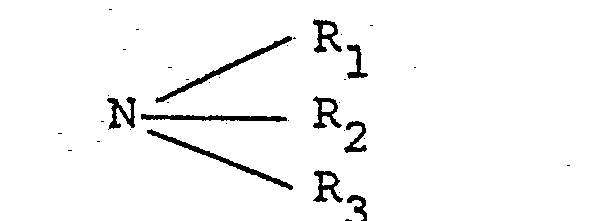
- the adsorbed impurities be desorbed with a gaseous displacing agent, such as gaseous S 0 2 , NH 3 , CO 2 , C 1 -C 5 alcohols, methyl chloride, or the like or, preferably, a gaseous amine having the formula wherein R 1 , R2 and R 3 are hydrogen or a C 1 -C 5 alkyl radical; that the desorbed portion be recycled over the zeolite bed; that the remaining portion of the adsorbed components be desorbed with a gaseous displacing agent; and that the desorbing and recycling be continued for as many as 450 cycles or more until the desired degree of impurity removal has been attained.
- a gaseous displacing agent such as gaseous S 0 2 , NH 3 , CO 2 , C 1 -C 5 alcohols, methyl chloride, or the like or, preferably, a gaseous amine having the formula wherein R 1 , R2 and R 3 are hydrogen
- Another Epperly, et al. patent i.e., U.S. Patent 3,063,934, relates to the removal of aromatics, olefins and sulfur from a naphtha feed which is to be used for isomerization and paraffin alkylation.
- a C 5 /C 6 naphtha feed is contacted with a type X molecular sieve at a temperature of from about 70° to 500° F, and preferably from about 200° to 350° F, to adsorb aromatics, olefins and sulfur therefrom.
- the aromatics are desorbed from the molecular sieve material during a heat-purge phase wherein the sieve material is contacted with isomerate vapors from an isomerization reactor, which vapors have been heated to about 650° F.
- Still other disclosures which relate to the use of molecular sieve materials in separation processes and which are of background interest with respect to the present invention include Milton, U.S. Patent 2,882,244; Tuttle, et al., U.S. Patent 2,978,407; Fleck, et al., U.S. Patent 3,182,017; Ludlow, et al., U.S. Patent 3,205,166; Peck, et al., U.S. Patent 3,265,750; Epperly, et al., U.S. Patent 3,468,791; Shively, et al., U.S. Patent 3,658,696; Epperly, et al., U.S.
- the present invention aims to provide an improved process for purifying liquid paraffins which are contaminated with aromatic impurities.
- the present invention provides a liquid phase process for separating aromatic hydrocarbons from a liquid mixture thereof with a C 8 -C 24 liquid paraffin, which comprises:
- the present adsorption process is capable, in preferred embodiments, of reducing the aromatic hydrocarbons in the liquid paraffin feed to a concentration of less than about 0.01% by weight in a single pass, i.e., without any recycle of partially- purified paraffin through the molecular sieve bed; and when the bed material becomes excessively loaded with aromatics, it may be cleaned or desorbed by using a liquid phase solvent, for example ethanol, as a desorption agent.
- a liquid phase solvent for example ethanol
- the liquid paraffin to be purfied may be isolated from kerosene-diesel cuts and may contain about 3-4% by weight aromatic hydrocarbons.
- the purified liquid paraffins of the present invention generally comprise C 8 -C 24 paraffins, and preferably C 9 -C 22 paraffins, and are suitable for use in pharmaceutical preparations or in the production of single cell proteins.
- adsorption column 10 in which is disposed a bed 11 of pelletized type X zeolite molecular sieve material as the only adsorbent contained therein.
- molecular sieves are synthetic crystalline materials based generally on sodium aluminosilicate. These crystalline materials have a sorption area available on the inside of a large number of uniformly-sized pores of molecular dimensions. With such an arrangement, molecules of a certain size and shape enter the pores and are adsorbed while layer or differently-shaped molecules are excluded.
- Type X zeolites consist basically of a three-dimensional framework of Si0 4 and AlO 4 tetrahedra.
- the electrovalence of each tetrahedra containing aluminum is balanced by the inclusion in the crystal of a cation, for example, an alkali or alkaline earth metal ion. This balance may be expressed by the formula:
- One cation may be exchanged for another by ion exchange techniques which are described below.
- the spaces between the tetrahedra are occupied by water molecules prior to dehydration.
- Type X zeolites may be activated by heating to effect the loss of water of hydration.
- the dehydration results in crystals interlaced with channels of molecular dimensions that offer very high surface areas for the adsorption of foreign molecules.
- type X zeolites are quite as important as the adsorptive or positive adsorption characteristics. For instance, if benzene or other aromatic hydrocarbon and C a -C 24 liquid paraffins are to be separated, as in the present invention, it is as essential that the crystals refuse the liquid paraffins as it is that they adsorb the benzene and other aromatics.
- a type X zeolite may be distinguished from other zeolites and silicates on the basis of its X-ray powder diffraction pattern and certain physical characteristics. The composition and density are among the characteristics which have been found to be important in identifying type X zeolites.
- a particular crystalline zeolite will have values for X and Y that fall in a definite range.
- the value X for a particular zeolite will vary somewhat since the aluminum atoms and the silicon atoms occupy essentially equivalent positions in the lattice. Minor variations in the relative numbers of these atoms does not significantly alter the crystal structure or physical properties of the zeolite.
- For a type X zeolite numerous analyses have shown that an average value for X is almost 2.5. The X value at least generally falls within the range 2.5-0.5.
- Y is not necessarily an invariant for all samples of type X zeolites particularly among the various ion exchanged forms. This is true because various exchangeable ions are of different size, and since there is no major change in the crystal lattice dimensions upon ion exchange, more or less space should be available in the pores of the type X zeolite to accommodate water molecules.
- the adsorbents contemplated for use herein include not only the sodium form of type X zeolite as synthesized from a sodium-aluminum-silicate water system with sodium as the exchangeable cation, but also crystalline materials obtained from such a zeolite by partial or complete replacement of the sodium ion with other cations.
- the sodium cations can be replaced, in part or entirely, by ion exchange with other monovalent, divalent, or trivalent cations.
- Monovalent ions both smaller than sodium, such as lithium, and larger, such as potassium and ammonium, freely enter the type X zeolite structure and exchange with other cations that might be present.
- Cerium is an example of a trivalent ion that enters the zeolite X structure.
- the spatial arrangement of the aluminum, silicon and oxygen atoms which make up the basic crystal lattice of the zeolite remains essentially unchanged by partial or complete substitution of other cations for the sodium ion.
- the X-ray patterns of the ion exchanged forms of type X zeolite show the same principal lines at essentially the same position, but there are some differences in the relative intensities of the X-ray lines due to the ion exchange.
- the forms of the type X zeolite that have been obtained by direct synthesis and ion exchange are sodium, lithium, potassium, hydrogen, silver, ammonium, magnesium, calcium, zinc, barium, cerium, and manganese.
- these materials will be referred to by the appropriate chemical symbol for the cation and the letter X.
- the sodium form becomes NaX
- the calcium form becomes CaX
- the cerium form becomes CeX.
- Ion exchange of the sodium form of zeolite X (NaX) or other forms of zeolite X may be accomplished by conventional ion exchange methods.
- a preferred-continuous method is to pack type X zeolite into a series of vertical columns each with suitable supports at the bottom; successively pass through the beds a water solution of a soluble salt of the cation to be introduced into the zeolite; and change the flow from the first bed to the second bed as the zeolite in the first bed becomes ion exchanged to the desired extent.
- the preferred zeolites contemplated for use in the invention include NaX (type 13X) which exhibits a pore size of about 9 angstrom units, and CaX (type 10X), which exhibits a pore size of about 8 angstrom units.
- the invention may be practiced using a single type X zeolite in the column 10, such as NaX(type 13X), or a mixture of type X zeolite in one or more beds.
- the type X zeolite be used in combination with another adsorbent that is not a type X zeolite, whether in physical admixture in a single bed or in separate beds within the column 10.
- the liquid paraffin to be purified is fed from a holding vessel 12 or other suitable source through the type X molecular sieve bed 11 in the adsorption column 10.
- the liquid paraffin may be fed directly to the top of the adsorption column for downward passage therethrough under the influence of gravity.
- the liquid paraffin may be forced upwardly through the column 10 by means of a suitable pump 13.
- the liquid paraffin may be passed through the molecular sieve bed at relatively low temperatures on the order of from about 60° C to about 120° C with temperatures in the range of about 70° C to about 90° C being preferred.
- the paraffin is in the liquid phase as it passes through the type X zeolite bed.
- the paraffin may be passed through the zeolite bed 11 without prior heating or cooling.
- the liquid paraffin is passed through a heat exchanger 14 immediately prior to being introduced into the molecular sieve bed 11 to adjust the temperature of the liquid paraffin to the desired range, generally about 60° - 120° C, and preferably about 70° - 90° C.
- the liquid paraffins contemplated for purification in accordance with this invention generally are those having from about 8 to about 24 carbons and having an undesirably high level of aromatic hydrocarbons contained therein.
- the paraffins may be straight chain or branched chain materials and may be isolated from petroleum sources, such as diesel cuts.
- the concentration of aromatic hydrocarbons in the liquid paraffins to be purified may vary over relatively wide limits depending upon the source of the liquid paraffin, and may be as high as about 20 - 25% by weight. Normally, however, the concentration of aromatic hydrocarbons in the liquid paraffins to be purified is not more than about 10 to about 15%, and may be as low as about 3 - 5% by weight or lower.
- a partially dearomatized liquid paraffin having an aromatic hydrocarbon content of from about 2% to about 4% by weight may be purified in accordance with this invention.
- An essential feature of the present invention is that the paraffins to be purified can be done so in a single pass through the type X zeolite bed 11 without having to resort to any recycling. This is an important feature from the standpoint of ease of operation, re- duc L d apparatus requirements and overall process efficiency.
- Suitable desorbents which are polar or polarizable materials having an appreciable affinity for the zeolite adsorbent compared with the aromatic hydrocarbon materials desired to be desorbed, include, for example, alcohols, such as methanol, ethanol, propanol or propylene glycol.
- the desorbent may be stored in a suitable holding vessel 16 from which it can be pumped through the column 10 to desorb the aromatic hydrocarbons from the pores of the type X zeolite molecular sieve material contained in the bed 11.
- the desorbed aromatic hydrocarbons can be washed from the bed by passing a washing solvent for example n-hexane, n-heptane or iso-octane therethrough.
- the washing solvent may be stored in a suitable container or vessel 17 and pumped through the sieve bed using the same pump 13 which is used to pump the desorbent and liquid paraffin therethrough.
- separate pumps may be used for the washing solvent, desorbent and liquid paraffin.
- the molecular sieve bed would have sufficient adsorption capacity (23.4 g of aromatics/100 g of molecular sieves per one adsorption cycle) to reduce the level of aromatics in the product stream to below about 0.01% by weight.
- a typical embodiment for'practicing the liquid phase purification of the present invention comprises passing a liquid paraffin from vessel 12 through the type X molecular sieve bed 11 contained in adsorber 10 via line 18, pump 13, line 19, heat exchanger 14, and line 21.
- the aromatic hydrocarbons contained in the paraffin feed would be adsorbed in the pores of the type X molecular sieve bed 11 and the purified paraffin product would be recovered via line 26.
- the adsorption phase of the process thus would be carried out in the liquid phase and, with the aid of heat exchanger 14, at a temperature in the range of about 70° - 90° C.
- valve 22 is closed to terminate the adsorption phase of the process.
- valve 24 is opened and a washing solvent such as n-heptane is pumped through the bed 11 via line 27, pump 13, line 19, heat exchanger 14 and line 21 until all of the liquid paraffin product contained in the column 10 has been passed through line 26 to storage.
- the washing phase desirably is accomplished at a temperature on the order of about 70° - 90° C.
- valve 24 then is closed and the desorption phase is initiated by opening valve 23 and passing a desorbent, such as ethanol, through line 28, pump 13, line 19, heat exchanger 14 and line 21 into the molecular sieve bed.
- a desorbent such as ethanol
- the washing solvent contained in the column 10 is displaced and removed through line 26. This washing solvent may be discarded, but from an economic stand-point, it is more desirable to recover the washing solvent for future use.
- the desorption phase continues, again in the liquid phase at a preferred temperature on the order of about 70° - 90° C, the aromatic hydrocarbon contaminants are forced from the pores of the molecular sieve material.
- valve 23 is closed and the valve 24 is opened to initiate another washing phase.
- this latter washing phase the desorbed aromatic hydrocarbons impurities are flushed from the column 10 and are passed together with the washing solvent via line 26 to waste, to storage or, if desired, to further processing.
- the adsorptive capacity of the zeolite bed 11 having been restored, the process of purifying additional paraffins may be commenced once again by closing valve 24, opening valve 22 and proceeding as outlined above.
- the temperature of the bed 11 of molecular sieve material may be maintained at the desired level by well-known methods.
- the bed 11 or column 10 containing the bed 11 may be heated or cooled as necessary by direct or indirect heat transfer.
- the operating parameters e.g., feed rate, temperature, pressure etc.
- the operating parameters may be varied to optimize or otherwise enhance the desired purification process.
- the zeolite material had been preactivated at 450° - 500° C for 4 - 5 hours and was used as an adsorbent for removing aromatic hydrocarbons from a crude liquid C 8 -C 24 paraffin feedstock having an initial aromatic content of 3.22% by weight.
- a series of adsorption runs were carried out in the liquid phase and under dynamic conditions with the crude paraffin feedstock being preheated to the operating temperature indicated below. The feedstock was pumped upwardly through the zeolite absorbent bed. In each run the feedstock was pumped through the zeolite bed only once with no recycle.
- the series of adsorption runs were made at temperatures ranging from 70° - 120° C and crude paraffin flow rates ranging from 0.5 - 10 c.c./min. Breakthrough was observed when the aromatic content in the purified paraffin had reached equilibrium.
- the zeolite bed was washed with n-heptane, which was preheated to the stated temperature to remove any residual paraffin.
- the zeolite bed was then desorbed using a solvent to remove the aromatic hydrocarbons adsorbed from the crude liquid paraffin. The solvent was preheated to the stated operating temperature.
- the dynamic properties of the adsorption runs were calculated to determine the efficiency of the zeolite properties, including the length of utilized bed height in mm, the dynamic capacity of g/100 g of zeolite, and the adsorption efficiency. Samples of the dearomatized liquid paraffin were collected and tested by UV spectroscopic techniques and each run was considered to be completed when the equilibrium point was reached. The results of the runs are set forth in Tables II and III:
- the results of the adsorption runs indicate that the X- type molecular sieves have a high affinity for adsorbing aromatic hydrocarbons with a dynamic capacity as high as 23.4 g/100 g of molecular sieves.
- the results also indicate that as much as 441 ml of purified liquid paraffin having an aromatic content of 0.01% can be obtained using only one adsorption cycle, whereas in the corresponding desorption cycle, concentrates containing up to 93.69% by weight of aromatic hydrocarbons and sulfur compounds were produced.
- Example 2 The procedure of Example 1 was repeated except that a crude feedstock of partially dearomatized 220-310° C liquid paraffin obtained from a kerosene - diesel cut was used.
- the crude feedstock had the following characteristics:
- the purified liquid paraffin materials obtained in accordance with the present invention contain less than about 0.01% by weight aromatic hydrocarbons (mono, di-, and tri-aromatic hydrocarbonsl and are suitable for use in pharmaceutical (including veterinary medicament) and single cell protein production.
Landscapes
- Chemical & Material Sciences (AREA)
- Oil, Petroleum & Natural Gas (AREA)
- Crystallography & Structural Chemistry (AREA)
- Engineering & Computer Science (AREA)
- Chemical Kinetics & Catalysis (AREA)
- General Chemical & Material Sciences (AREA)
- Organic Chemistry (AREA)
- Solid-Sorbent Or Filter-Aiding Compositions (AREA)
- Organic Low-Molecular-Weight Compounds And Preparation Thereof (AREA)
- Production Of Liquid Hydrocarbon Mixture For Refining Petroleum (AREA)
- Lubricants (AREA)
Abstract
Description
- The invention relates to the purification of liquid paraffins and, more particularly, to the removal of aromatic hydrocarbons from liquid paraffins. Even more particularly, this invention relates to the use of X-type zeolite molecular sieves to remove selectively aromatic hydrocarbons from liquid paraffins, particularly food-grade and pharamaceutical-grade liquid paraffins having from about 8 to about 24 carbon atoms, such that the purified liquid paraffins contain levels of aromatic hydrocarbons at least as low as about 0.01% by weight. The purification process of the present invention is carried out in the liquid phase and at a relatively low temperature, for example, from about 70° to about 90° C.
- The concept of using various adsorbents, including various natural and synthetic zeolite molecular sieve materials, in processes for effecting physical separations of various mixtures has been known and used both experimentally and commercially.for quite some time. For example, S.A. Coviser, (The Oil and Gas Journal, Dec. 6, 1965, pp. 130-32) discussed the adsorption capabilities of silica gel, copper- impregnated activated carbon, type 5A molecular sieves and type 13X molecular sieves with respect to the removal of mercaptan sulfur from natural gas in the vapor phase.
- In 1967, L.F. Fominykh, et al., (Khimiya i Tekhnologiya Topliv i Masel, No. 4, pp. 8-10, April 1967) discussed the use of X-type zeolites for the adsorptive separation of benzene from an artificially prepared binary mixture of benzene and n-heptane containing about 12.2% by weight benzene. The separation, which was performed either in vapor phase or liquid phase under dynamic conditions, was said to have reduced the level of benzene in the binary mixture down to about 0.24% by weight.
- Another disclosure which relates to the separation of a single aromatic material from a single paraffinic material is contained in Milton, U.S. Patent No. 3,078,643. In accordance with this Milton patent, toluene can be separated from a vapor mixture of, for example, toluene and n-hexane by contacting the vapor mixture with a bed of zeolite X-type adsorbent material, the pores of which are sufficiently large to adsorb toluene and n-hexane, and thereafter discharging a toluene-depleted vapor stream from the zeolite bed. As indicated in this patent, the level of toluene in the vapor mixture can be reduced to a level of about 3% by weight.
- In connection with processes of the type disclosed in the above Fominykh, et al., article and Milton patent, it is noted that the separation of binary systems of n-paraffin- aromatic'mixtures has been investigated by researchers for many years. The primary objective of such research generally is either to provide a process of separation for a specific industrial application (as in the case of Milton) or to provide binary data for various systems in an attempt to arrive at a model for the possible prediction of anticipated results for multicomponent adsorption processes. As will be seen from the discussion hereinbelow, the multicomponent separations which are accomplished by the present invention are much more complicated and general in nature than the simple and specific binary mixture separations disclosed, for example, in Milton and Fominykh, et al.
- In addition to dealing with simple binary systems, there are a number of prior disclosures relevant to multi- component separations of aromatics or nonaromatics from saturated hydrocarbons and/or olefins. In many cases, these prior disclosures relate to separation processes which are similar in some respects to the present process, but which, in other important respects, are greatly different therefrom. For example, Epperly, et al., U.S. Patent 3,228,995 relates to a process for purifying C10 to C25 hydrocarbons containing at least one impurity selected from aromatics, sulfur, and color bodies, wherein the impure hydrocarbons are contacted with a type X zeolite. However, unlike the present process, the process described in this Epperly, et al. patent requires that at least a portion of the adsorbed impurities be desorbed with a gaseous displacing agent, such as gaseous S0 2, NH 3, CO2, C1-C5 alcohols, methyl chloride, or the like or, preferably, a gaseous amine having the formula
- Another Epperly, et al. patent, i.e., U.S. Patent 3,063,934, relates to the removal of aromatics, olefins and sulfur from a naphtha feed which is to be used for isomerization and paraffin alkylation. In accordance with this patent, a C5/C6 naphtha feed is contacted with a type X molecular sieve at a temperature of from about 70° to 500° F, and preferably from about 200° to 350° F, to adsorb aromatics, olefins and sulfur therefrom. The aromatics are desorbed from the molecular sieve material during a heat-purge phase wherein the sieve material is contacted with isomerate vapors from an isomerization reactor, which vapors have been heated to about 650° F.
- Still other disclosures which relate to the use of molecular sieve materials in separation processes and which are of background interest with respect to the present invention include Milton, U.S. Patent 2,882,244; Tuttle, et al., U.S. Patent 2,978,407; Fleck, et al., U.S. Patent 3,182,017; Ludlow, et al., U.S. Patent 3,205,166; Peck, et al., U.S. Patent 3,265,750; Epperly, et al., U.S. Patent 3,468,791; Shively, et al., U.S. Patent 3,658,696; Epperly, et al., U.S. Patent 3,558,732; Neuzil, U.S. Patent 3,558,730; Eberly, Jr., et al., U.S. Patent 3,485,748; Francis, U.S. Patent 3,726,792; French Patent 1,382,149 (isolation of aromatic hydrocarbons from naphtha and kerosene cuts by using type X molecular sieves); E.L. Clark, (Oil and Gas Journal, No. 46, pp. 178-84, Nov. 12, 1962); A.Z. Dorogochinskii, (Khimya i Tekhnologiya Topliv i Masel, No. 8, pp. 4-6, August 1973); L.C. Waterman, (Chem. Eng. Progr., Vol. 61, No. 10 pp. 51-57, Oct. 1965): and A.G Martvnenko, Khimya i Tekhnologiya Topliv i Masel, No. 8, pp. 11-12, Aug. 1969).
- The present invention aims to provide an improved process for purifying liquid paraffins which are contaminated with aromatic impurities.
- The present invention provides a liquid phase process for separating aromatic hydrocarbons from a liquid mixture thereof with a C8-C24 liquid paraffin, which comprises:
- contacting the liquid mixture in a single pass at a temperature of up to about 120°C with a bed of at least partially dehydrated crystalline X-type zeolite adsorbent material whose pores are sufficiently large to adsorb the aromatic hydrocarbons;
- thereafter discharging an aromatic hydrocarbon-depleted liquid paraffin from the bed.
- The present adsorption process is capable, in preferred embodiments, of reducing the aromatic hydrocarbons in the liquid paraffin feed to a concentration of less than about 0.01% by weight in a single pass, i.e., without any recycle of partially- purified paraffin through the molecular sieve bed; and when the bed material becomes excessively loaded with aromatics, it may be cleaned or desorbed by using a liquid phase solvent, for example ethanol, as a desorption agent.
- In one embodiment of the invention, the liquid paraffin to be purfied may be isolated from kerosene-diesel cuts and may contain about 3-4% by weight aromatic hydrocarbons.
- The purified liquid paraffins of the present invention generally comprise C8-C24 paraffins, and preferably C9-C22 paraffins, and are suitable for use in pharmaceutical preparations or in the production of single cell proteins.
- The invention will be more clearly and fully understood from the following detailed description taken in conjunction with the accompanying drawing which is a schematic diagram of an apparatus suitable for affecting the process of the invention.
- Referring now to the drawing, there is shown an
adsorption column 10 in which is disposed abed 11 of pelletized type X zeolite molecular sieve material as the only adsorbent contained therein. As discussed in considerable detail in U.S. Patent 2. 882,244 to Milton. which Patent is incorporated herein by reference, molecular sieves are synthetic crystalline materials based generally on sodium aluminosilicate. These crystalline materials have a sorption area available on the inside of a large number of uniformly-sized pores of molecular dimensions. With such an arrangement, molecules of a certain size and shape enter the pores and are adsorbed while layer or differently-shaped molecules are excluded. - Type X zeolites consist basically of a three-dimensional framework of Si04 and AlO4 tetrahedra. The tetrahedra are cross-linked by the sharing of oxygen atoms so that the ratio of oxygen atoms to the total of the aluminum and silicon atoms is equal to two or 0/(Al+Si)=2. The electrovalence of each tetrahedra containing aluminum is balanced by the inclusion in the crystal of a cation, for example, an alkali or alkaline earth metal ion. This balance may be expressed by the formula:
- Al2/(Ca, Sr, Ba, Na2, K2) = 1
- One cation may be exchanged for another by ion exchange techniques which are described below. The spaces between the tetrahedra are occupied by water molecules prior to dehydration.
- Type X zeolites may be activated by heating to effect the loss of water of hydration. The dehydration results in crystals interlaced with channels of molecular dimensions that offer very high surface areas for the adsorption of foreign molecules.
- It will be understood that the refusal characteristics of type X zeolites are quite as important as the adsorptive or positive adsorption characteristics. For instance, if benzene or other aromatic hydrocarbon and Ca-C24 liquid paraffins are to be separated, as in the present invention, it is as essential that the crystals refuse the liquid paraffins as it is that they adsorb the benzene and other aromatics.
- A type X zeolite may be distinguished from other zeolites and silicates on the basis of its X-ray powder diffraction pattern and certain physical characteristics. The composition and density are among the characteristics which have been found to be important in identifying type X zeolites.
- The basic formula for all crystalline zeolites where "M" represents a metal and "n" its valence may be represented as follows:
- M2/
n O:AL2O3XSiO2 : YH2O - In general, a particular crystalline zeolite will have values for X and Y that fall in a definite range. The value X for a particular zeolite will vary somewhat since the aluminum atoms and the silicon atoms occupy essentially equivalent positions in the lattice. Minor variations in the relative numbers of these atoms does not significantly alter the crystal structure or physical properties of the zeolite. For a type X zeolite, numerous analyses have shown that an average value for X is almost 2.5. The X value at least generally falls within the range 2.5-0.5.
- The value of Y is not necessarily an invariant for all samples of type X zeolites particularly among the various ion exchanged forms. This is true because various exchangeable ions are of different size, and since there is no major change in the crystal lattice dimensions upon ion exchange, more or less space should be available in the pores of the type X zeolite to accommodate water molecules.
- The adsorbents contemplated for use herein include not only the sodium form of type X zeolite as synthesized from a sodium-aluminum-silicate water system with sodium as the exchangeable cation, but also crystalline materials obtained from such a zeolite by partial or complete replacement of the sodium ion with other cations. The sodium cations can be replaced, in part or entirely, by ion exchange with other monovalent, divalent, or trivalent cations. Monovalent ions both smaller than sodium, such as lithium, and larger, such as potassium and ammonium, freely enter the type X zeolite structure and exchange with other cations that might be present. The same is true for divalent ions smaller than sodium, such as magnesium, and larger, such as strontium and barium. Cerium is an example of a trivalent ion that enters the zeolite X structure.
- The spatial arrangement of the aluminum, silicon and oxygen atoms which make up the basic crystal lattice of the zeolite remains essentially unchanged by partial or complete substitution of other cations for the sodium ion. The X-ray patterns of the ion exchanged forms of type X zeolite show the same principal lines at essentially the same position, but there are some differences in the relative intensities of the X-ray lines due to the ion exchange.
- Among the forms of the type X zeolite that have been obtained by direct synthesis and ion exchange are sodium, lithium, potassium, hydrogen, silver, ammonium, magnesium, calcium, zinc, barium, cerium, and manganese. For convenience, these materials will be referred to by the appropriate chemical symbol for the cation and the letter X. Thus, for example, the sodium form becomes NaX, the calcium form becomes CaX, and the cerium form becomes CeX.
- Ion exchange of the sodium form of zeolite X (NaX) or other forms of zeolite X may be accomplished by conventional ion exchange methods. A preferred-continuous method is to pack type X zeolite into a series of vertical columns each with suitable supports at the bottom; successively pass through the beds a water solution of a soluble salt of the cation to be introduced into the zeolite; and change the flow from the first bed to the second bed as the zeolite in the first bed becomes ion exchanged to the desired extent.
- Although the advantages of the invention can be accomplished by contacting the liquid paraffin with any type of X zeolite, the preferred zeolites contemplated for use in the invention include NaX (type 13X) which exhibits a pore size of about 9 angstrom units, and CaX (type 10X), which exhibits a pore size of about 8 angstrom units. The invention may be practiced using a single type X zeolite in the
column 10, such as NaX(type 13X), or a mixture of type X zeolite in one or more beds. However, in no case can the type X zeolite be used in combination with another adsorbent that is not a type X zeolite, whether in physical admixture in a single bed or in separate beds within thecolumn 10. - Referring again to the drawing, the liquid paraffin to be purified is fed from a holding
vessel 12 or other suitable source through the type Xmolecular sieve bed 11 in theadsorption column 10. The liquid paraffin may be fed directly to the top of the adsorption column for downward passage therethrough under the influence of gravity. In the alternative, as illustrated in the drawing, the liquid paraffin may be forced upwardly through thecolumn 10 by means of asuitable pump 13. The liquid paraffin may be passed through the molecular sieve bed at relatively low temperatures on the order of from about 60° C to about 120° C with temperatures in the range of about 70° C to about 90° C being preferred. However, in all cases within the scope of this invention, the paraffin is in the liquid phase as it passes through the type X zeolite bed. - Depending upon the source of the liquid paraffin, the paraffin may be passed through the
zeolite bed 11 without prior heating or cooling. However, in most cases, the liquid paraffin is passed through aheat exchanger 14 immediately prior to being introduced into themolecular sieve bed 11 to adjust the temperature of the liquid paraffin to the desired range, generally about 60° - 120° C, and preferably about 70° - 90° C. - The ability of operating the present purification process in the liquid phase and at relatively low temperatures provides an important economic advantage over those processes which operate in the vapor phase at temperatures on the order of 300° - 800° F or more. Normally, these vapor phase processes are-resorted to only when the liquid phase processes, which have much lower energy requirements, are unable to achieve the desired levels of product purity. Such is not the case with the present liquid phase process which may produce products having impurity levels as low as 0.01% by weight and lower while operating at temperatures below about 120° C.
- As indicated above, the liquid paraffins contemplated for purification in accordance with this invention generally are those having from about 8 to about 24 carbons and having an undesirably high level of aromatic hydrocarbons contained therein. The paraffins may be straight chain or branched chain materials and may be isolated from petroleum sources, such as diesel cuts. The concentration of aromatic hydrocarbons in the liquid paraffins to be purified may vary over relatively wide limits depending upon the source of the liquid paraffin, and may be as high as about 20 - 25% by weight. Normally, however, the concentration of aromatic hydrocarbons in the liquid paraffins to be purified is not more than about 10 to about 15%, and may be as low as about 3 - 5% by weight or lower. For example, a partially dearomatized liquid paraffin having an aromatic hydrocarbon content of from about 2% to about 4% by weight may be purified in accordance with this invention.
- An essential feature of the present invention is that the paraffins to be purified can be done so in a single pass through the type
X zeolite bed 11 without having to resort to any recycling. This is an important feature from the standpoint of ease of operation, re- ducLd apparatus requirements and overall process efficiency. - Another typical feature of the present invention resides in the use of a liquid phase desorbent for cleaning the
zeolite bed 11 once it has become loaded with aromatic hydrocarbons. Suitable desorbents, which are polar or polarizable materials having an appreciable affinity for the zeolite adsorbent compared with the aromatic hydrocarbon materials desired to be desorbed, include, for example, alcohols, such as methanol, ethanol, propanol or propylene glycol. - The desorbent may be stored in a suitable holding
vessel 16 from which it can be pumped through thecolumn 10 to desorb the aromatic hydrocarbons from the pores of the type X zeolite molecular sieve material contained in thebed 11. - Once the aromatic hydrocarbons have been desorbed from the pores of the molecular sieve material, the desorbed aromatic hydrocarbons can be washed from the bed by passing a washing solvent for example n-hexane, n-heptane or iso-octane therethrough. The washing solvent may be stored in a suitable container or
vessel 17 and pumped through the sieve bed using thesame pump 13 which is used to pump the desorbent and liquid paraffin therethrough. In the alternative, separate pumps (not shown) may be used for the washing solvent, desorbent and liquid paraffin. - The amount of liquid paraffin that can be purified before the adsorbent capacity of the molecular sieve material has been diminished to the point that desorption of the aromatics therefrom is necessary and/or desirable varies greatly depending on the initial level of aromatics in the paraffin feed. However, under normal usage with paraffin feed rates on the order of from about 0.5 to about 20 c.c./min., the molecular sieve bed would have sufficient adsorption capacity (23.4 g of aromatics/100 g of molecular sieves per one adsorption cycle) to reduce the level of aromatics in the product stream to below about 0.01% by weight.
- Referring once again to the schematic drawing, a typical embodiment for'practicing the liquid phase purification of the present invention comprises passing a liquid paraffin from
vessel 12 through the type Xmolecular sieve bed 11 contained inadsorber 10 vialine 18, pump 13,line 19,heat exchanger 14, andline 21. During the adsorption phase of the process, withvalve 22 open andvalves molecular sieve bed 11 and the purified paraffin product would be recovered vialine 26. The adsorption phase of the process thus would be carried out in the liquid phase and, with the aid ofheat exchanger 14, at a temperature in the range of about 70° - 90° C. - As the adsorption capacity of the molecular sieve bed diminishes because of the increased levels of adsorbed aromatic hydrocarbons, the
valve 22 is closed to terminate the adsorption phase of the process. At this point,valve 24 is opened and a washing solvent such as n-heptane is pumped through thebed 11 vialine 27, pump 13,line 19,heat exchanger 14 andline 21 until all of the liquid paraffin product contained in thecolumn 10 has been passed throughline 26 to storage. As is the case with the adsorption phase, the washing phase desirably is accomplished at a temperature on the order of about 70° - 90° C. - The
valve 24 then is closed and the desorption phase is initiated by openingvalve 23 and passing a desorbent, such as ethanol, throughline 28, pump 13,line 19,heat exchanger 14 andline 21 into the molecular sieve bed. As the desorbent is being pumped into thebed 11, at least during the relatively early stages of the desorption phase, the washing solvent contained in thecolumn 10 is displaced and removed throughline 26. This washing solvent may be discarded, but from an economic stand-point, it is more desirable to recover the washing solvent for future use. As the desorption phase continues, again in the liquid phase at a preferred temperature on the order of about 70° - 90° C, the aromatic hydrocarbon contaminants are forced from the pores of the molecular sieve material. Once the desorption has been accomplished to the desired degree, thevalve 23 is closed and thevalve 24 is opened to initiate another washing phase. During this latter washing phase the desorbed aromatic hydrocarbons impurities are flushed from thecolumn 10 and are passed together with the washing solvent vialine 26 to waste, to storage or, if desired, to further processing. - The adsorptive capacity of the
zeolite bed 11 having been restored, the process of purifying additional paraffins may be commenced once again by closingvalve 24, openingvalve 22 and proceeding as outlined above. - The following table summarizes operating parameters for the process of the invention.

- It will be appreciated by those skilled in the art that the temperature of the
bed 11 of molecular sieve material may be maintained at the desired level by well-known methods. Thus, in addition to passing the liquid paraffin, washing solvent and/or desorbent through theheat exchanger 14, thebed 11 orcolumn 10 containing thebed 11 may be heated or cooled as necessary by direct or indirect heat transfer. Similarly, during any of the adsorption, desorption or washing phases, the operating parameters, (e.g., feed rate, temperature, pressure etc.) may be varied to optimize or otherwise enhance the desired purification process. - The process is illustrated in the following examples.
- A glass tube, 16 mm in diameter and 550 mm in height, was charged with a bed of 56 g. of NaX(13X) type zeolite which had been crushed into particules of 0.5-1 mm size. The zeolite material had been preactivated at 450° - 500° C for 4 - 5 hours and was used as an adsorbent for removing aromatic hydrocarbons from a crude liquid C8-C24 paraffin feedstock having an initial aromatic content of 3.22% by weight. A series of adsorption runs were carried out in the liquid phase and under dynamic conditions with the crude paraffin feedstock being preheated to the operating temperature indicated below. The feedstock was pumped upwardly through the zeolite absorbent bed. In each run the feedstock was pumped through the zeolite bed only once with no recycle.
- The series of adsorption runs were made at temperatures ranging from 70° - 120° C and crude paraffin flow rates ranging from 0.5 - 10 c.c./min. Breakthrough was observed when the aromatic content in the purified paraffin had reached equilibrium. After each adsorption run the zeolite bed was washed with n-heptane, which was preheated to the stated temperature to remove any residual paraffin. The zeolite bed was then desorbed using a solvent to remove the aromatic hydrocarbons adsorbed from the crude liquid paraffin. The solvent was preheated to the stated operating temperature.
- The dynamic properties of the adsorption runs were calculated to determine the efficiency of the zeolite properties, including the length of utilized bed height in mm, the dynamic capacity of g/100 g of zeolite, and the adsorption efficiency. Samples of the dearomatized liquid paraffin were collected and tested by UV spectroscopic techniques and each run was considered to be completed when the equilibrium point was reached. The results of the runs are set forth in Tables II and III:
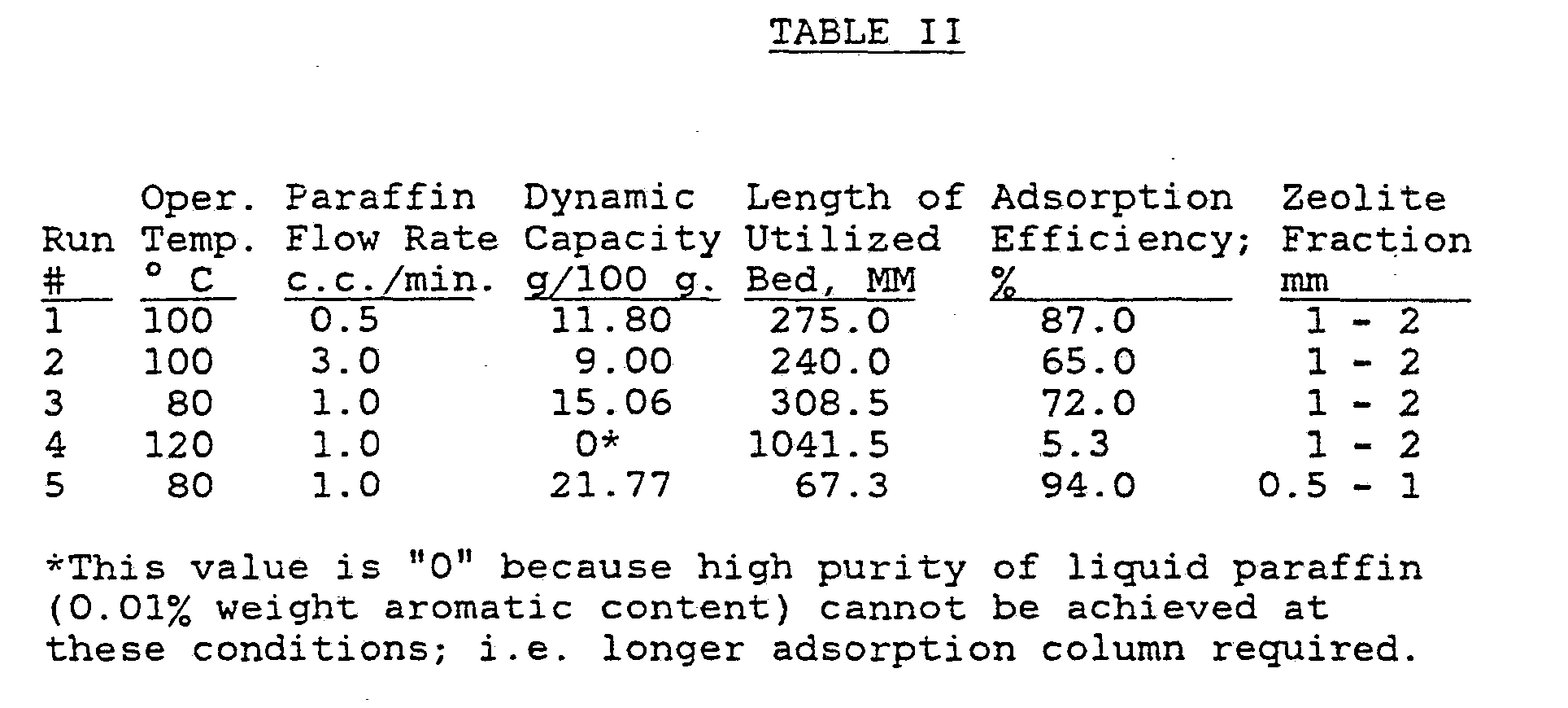

- The results of the adsorption runs indicate that the X- type molecular sieves have a high affinity for adsorbing aromatic hydrocarbons with a dynamic capacity as high as 23.4 g/100 g of molecular sieves. The results also indicate that as much as 441 ml of purified liquid paraffin having an aromatic content of 0.01% can be obtained using only one adsorption cycle, whereas in the corresponding desorption cycle, concentrates containing up to 93.69% by weight of aromatic hydrocarbons and sulfur compounds were produced.
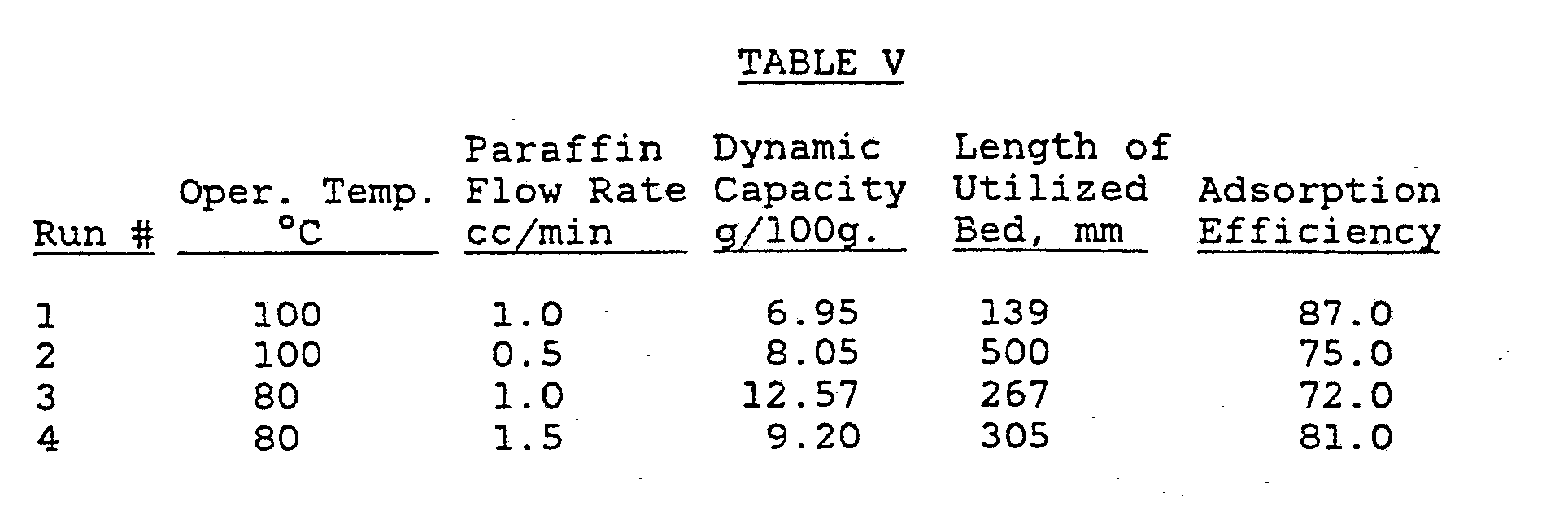
- The procedure of Example 1 was repeated except that a crude feedstock of partially dearomatized 220-310° C liquid paraffin obtained from a kerosene - diesel cut was used. The crude feedstock had the following characteristics:

- The results of this example are set forth in Tables V and VI.

- The purified liquid paraffin materials obtained in accordance with the present invention contain less than about 0.01% by weight aromatic hydrocarbons (mono, di-, and tri-aromatic hydrocarbonsl and are suitable for use in pharmaceutical (including veterinary medicament) and single cell protein production.
- Although the foregoing describes certain preferred embodiments of the invention, it is contemplated that modifications thereof will be appreciated by those skilled in the art and that such modifications are within the scope of the invention as set forth herein.
Claims (21)
Priority Applications (1)
| Application Number | Priority Date | Filing Date | Title |
|---|---|---|---|
| AT85303344T ATE39944T1 (en) | 1984-05-11 | 1985-05-10 | PURIFICATION OF LIQUID PARAFFINS. |
Applications Claiming Priority (2)
| Application Number | Priority Date | Filing Date | Title |
|---|---|---|---|
| US609121 | 1984-05-11 | ||
| US06/609,121 US4567315A (en) | 1984-05-11 | 1984-05-11 | Process for purification of liquid paraffins |
Publications (2)
| Publication Number | Publication Date |
|---|---|
| EP0164905A1 true EP0164905A1 (en) | 1985-12-18 |
| EP0164905B1 EP0164905B1 (en) | 1989-01-11 |
Family
ID=24439429
Family Applications (1)
| Application Number | Title | Priority Date | Filing Date |
|---|---|---|---|
| EP85303344A Expired EP0164905B1 (en) | 1984-05-11 | 1985-05-10 | Purfication of liquid paraffins |
Country Status (5)
| Country | Link |
|---|---|
| US (1) | US4567315A (en) |
| EP (1) | EP0164905B1 (en) |
| AT (1) | ATE39944T1 (en) |
| CA (1) | CA1256385A (en) |
| DE (1) | DE3567477D1 (en) |
Cited By (6)
| Publication number | Priority date | Publication date | Assignee | Title |
|---|---|---|---|---|
| EP0308962A3 (en) * | 1987-09-24 | 1989-10-25 | Nippon Mining Company Limited | Process for production of dimethylnaphthalenes |
| EP0361681A1 (en) * | 1988-08-31 | 1990-04-04 | Exxon Chemical Patents Inc. | Process for the purification of linear paraffins |
| US5109139A (en) * | 1988-08-31 | 1992-04-28 | Exxon Chemical Patents Inc. | Process control of process for purification of linear paraffins |
| US5171923A (en) * | 1988-08-31 | 1992-12-15 | Exxon Chemical Patents Inc. | Recycle for process for purification of linear paraffins |
| US5186816A (en) * | 1990-03-12 | 1993-02-16 | Nippon Mining Co., Ltd. | Method of producing high aromatic-content solvents |
| FR2745006A1 (en) * | 1996-02-21 | 1997-08-22 | Ceca Sa | PROCESS FOR PURIFYING A PARAFFINIC CUT |
Families Citing this family (15)
| Publication number | Priority date | Publication date | Assignee | Title |
|---|---|---|---|---|
| WO1994017017A1 (en) * | 1991-07-15 | 1994-08-04 | Exxon Research And Engineering Company | Benzene removal from gasoline boiling range streams |
| US5922923A (en) * | 1996-09-27 | 1999-07-13 | Uop Llc | Zeolitic reforming with selective feed-species adjustment |
| KR100645660B1 (en) * | 2001-11-09 | 2006-11-13 | 에스케이 주식회사 | Process for separating normal paraffin from hydrocarbon fraction and utilizing separated fraction |
| US7473349B2 (en) * | 2004-12-30 | 2009-01-06 | Bp Corporation North America Inc. | Process for removal of sulfur from components for blending of transportation fuels |
| CA2593533C (en) * | 2005-01-14 | 2012-07-10 | Exxonmobil Chemical Patents Inc. | Ultra pure fluids |
| US20110024686A1 (en) * | 2009-07-30 | 2011-02-03 | Taiwan Textile Research Institute | Composition and Process for Preparing Phosphorescent Masterbatch and Phosphorescent Article Containing the Same |
| US9611196B2 (en) | 2012-03-16 | 2017-04-04 | Bharat Petroleum Corporation Ltd | Process for obtaining food grade hexane |
| US8927800B2 (en) * | 2012-12-14 | 2015-01-06 | Chevron U.S.A. Inc. | Method for reducing organic halide contamination in hydrocarbon products |
| US10702795B2 (en) | 2016-01-18 | 2020-07-07 | Indian Oil Corporation Limited | Process for high purity hexane and production thereof |
| ES2926016T3 (en) | 2016-03-01 | 2022-10-21 | Starfire Energy | Electrically enhanced Haber-Bosch (EEHB) synthesis of anhydrous ammonia |
| CN107011111A (en) * | 2017-05-06 | 2017-08-04 | 洛阳和梦科技有限公司 | The method for removing micro aromatic hydrocarbons in heptane |
| EP3634624A4 (en) | 2017-05-15 | 2021-01-20 | Starfire Energy | METAL DECORATED BARIUM CALCIUM ALUMINUM OXIDE AND ASSOCIATED MATERIALS FOR NH3 CATALYSIS |
| EP3630682A4 (en) * | 2017-05-26 | 2021-08-11 | Starfire Energy | REMOVAL OF GASEOUS NH3 FROM AN NH3 REACTOR PRODUCT STREAM |
| CN115282881A (en) | 2017-11-25 | 2022-11-04 | 星火能源公司 | Chemical reactor with integrated heat exchanger |
| WO2020160500A1 (en) | 2019-01-31 | 2020-08-06 | Starfire Energy | Metal-decorated barium calcium aluminum oxide catalyst for nh3 synthesis and cracking and methods of forming the same |
Citations (3)
| Publication number | Priority date | Publication date | Assignee | Title |
|---|---|---|---|---|
| US3278422A (en) * | 1965-08-23 | 1966-10-11 | Exxon Research Engineering Co | Process for improving stability |
| US3372108A (en) * | 1966-07-25 | 1968-03-05 | Exxon Research Engineering Co | Converting naphthenes to aromatics and separating the aromatics |
| GB1452167A (en) * | 1974-04-10 | 1976-10-13 | British Petroleum Co | Purification of paraffin mixtures |
Family Cites Families (9)
| Publication number | Priority date | Publication date | Assignee | Title |
|---|---|---|---|---|
| CA711367A (en) * | 1965-06-08 | Waine Peter | Nuclear reactor fuel elements | |
| US2950336A (en) * | 1956-12-07 | 1960-08-23 | Exxon Research Engineering Co | Separation of aromatics and olefins using zeolitic molecular sieves |
| US2978407A (en) * | 1958-05-28 | 1961-04-04 | Exxon Research Engineering Co | Molecular sieve separation process |
| US3078643A (en) * | 1960-01-06 | 1963-02-26 | Union Carbide Corp | Separation of aromatic from saturated hydrocarbons |
| US3133126A (en) * | 1960-09-12 | 1964-05-12 | Union Oil Co | Aromatic hydrocarbon separation |
| NL293774A (en) * | 1962-06-08 | |||
| NL297661A (en) * | 1962-09-12 | |||
| US3306847A (en) * | 1964-05-13 | 1967-02-28 | Exxon Research Engineering Co | Molecular sieve process |
| US3686342A (en) * | 1970-09-18 | 1972-08-22 | Universal Oil Prod Co | Aromatic hydrocarbon separation by adsorption |
-
1984
- 1984-05-11 US US06/609,121 patent/US4567315A/en not_active Expired - Fee Related
-
1985
- 1985-05-09 CA CA000481194A patent/CA1256385A/en not_active Expired
- 1985-05-10 AT AT85303344T patent/ATE39944T1/en not_active IP Right Cessation
- 1985-05-10 DE DE8585303344T patent/DE3567477D1/en not_active Expired
- 1985-05-10 EP EP85303344A patent/EP0164905B1/en not_active Expired
Patent Citations (3)
| Publication number | Priority date | Publication date | Assignee | Title |
|---|---|---|---|---|
| US3278422A (en) * | 1965-08-23 | 1966-10-11 | Exxon Research Engineering Co | Process for improving stability |
| US3372108A (en) * | 1966-07-25 | 1968-03-05 | Exxon Research Engineering Co | Converting naphthenes to aromatics and separating the aromatics |
| GB1452167A (en) * | 1974-04-10 | 1976-10-13 | British Petroleum Co | Purification of paraffin mixtures |
Cited By (11)
| Publication number | Priority date | Publication date | Assignee | Title |
|---|---|---|---|---|
| EP0308962A3 (en) * | 1987-09-24 | 1989-10-25 | Nippon Mining Company Limited | Process for production of dimethylnaphthalenes |
| US4963248A (en) * | 1987-09-24 | 1990-10-16 | Nippon Mining Co., Ltd. | Process for production of dimethylnaphthalenes |
| EP0361681A1 (en) * | 1988-08-31 | 1990-04-04 | Exxon Chemical Patents Inc. | Process for the purification of linear paraffins |
| US5109139A (en) * | 1988-08-31 | 1992-04-28 | Exxon Chemical Patents Inc. | Process control of process for purification of linear paraffins |
| US5171923A (en) * | 1988-08-31 | 1992-12-15 | Exxon Chemical Patents Inc. | Recycle for process for purification of linear paraffins |
| US5220099A (en) * | 1988-08-31 | 1993-06-15 | Exxon Chemical Patents Inc. | Purification of a hydrocarbon feedstock using a zeolite adsorbent |
| US5186816A (en) * | 1990-03-12 | 1993-02-16 | Nippon Mining Co., Ltd. | Method of producing high aromatic-content solvents |
| FR2745006A1 (en) * | 1996-02-21 | 1997-08-22 | Ceca Sa | PROCESS FOR PURIFYING A PARAFFINIC CUT |
| EP0791642A1 (en) * | 1996-02-21 | 1997-08-27 | Ceca S.A. | Process for the purification of a paraffinic fraction |
| US5731488A (en) * | 1996-02-21 | 1998-03-24 | Ceca S.A | Method for the purifiction of a paraffin cut |
| CN1102637C (en) * | 1996-02-21 | 2003-03-05 | 策卡有限公司 | Method for purification of paraffin cut |
Also Published As
| Publication number | Publication date |
|---|---|
| DE3567477D1 (en) | 1989-02-16 |
| US4567315A (en) | 1986-01-28 |
| EP0164905B1 (en) | 1989-01-11 |
| CA1256385A (en) | 1989-06-27 |
| ATE39944T1 (en) | 1989-01-15 |
Similar Documents
| Publication | Publication Date | Title |
|---|---|---|
| EP0164905B1 (en) | Purfication of liquid paraffins | |
| EP0374320B1 (en) | Process for pretreatment of an isomerization process feedstock containing light hydrocarbons | |
| US4098684A (en) | Purification of liquid n-paraffins containing carbonyl sulfide and other sulfur compounds | |
| DK169067B1 (en) | Process for isomerizing a hydrocarbon feed stream | |
| US4048111A (en) | Method for manufacturing an adsorbent useful for olefin separation | |
| CA1057210A (en) | Separation of ethylbenzene with an adsorbent comprising sr and k exchanged x or y zeolite | |
| US3864416A (en) | Separation of tetra-alkyl substituted aromatic hydrocarbon isomers | |
| US5177299A (en) | Recovery of high octane components from isomerates | |
| JP2589620B2 (en) | Improved recirculation for linear paraffin purification processes. | |
| US3422005A (en) | Isobaric process for molecular sieve separation of normal paraffins from hydrocarbon mixtures | |
| EP0171451B1 (en) | Improved n-paraffin-isoparaffin separation process using wash of recycle purge gas | |
| US2881862A (en) | Adsorptive fractionation process | |
| AU650023B2 (en) | Improved process control of process for purification of linear paraffins | |
| US2971993A (en) | Separation of olefinic hydrocarbons with co, ba, k. or ag substituted 10 to 13 angstrom molecular sieves | |
| US2966531A (en) | Increasing efficiency of hydrocarbon separation with adsorbents | |
| US3617504A (en) | Production and recovery of olefinic hydrocarbons | |
| US2920038A (en) | Gasoline hydrocarbon separation recovery process utilizing molecular sieves | |
| US3182017A (en) | Separation of naphthenes from hydrocarbon mixtures using 7 a. to 12 a. molecular sieves | |
| US2944092A (en) | Gasoline hydrocarbon separation recovery process using zeolitic molecular sieves | |
| US3069349A (en) | Hydrocarbon isomerization process | |
| US5198102A (en) | Benzene removal from a heartcut fraction of gasoline boiling range streams | |
| US3227647A (en) | Separation process | |
| US2958714A (en) | Adsorption process | |
| US5186819A (en) | Benzene removal from gasoline boiling range streams | |
| JPS61261392A (en) | Purification of liquid paraffin |
Legal Events
| Date | Code | Title | Description |
|---|---|---|---|
| PUAI | Public reference made under article 153(3) epc to a published international application that has entered the european phase |
Free format text: ORIGINAL CODE: 0009012 |
|
| AK | Designated contracting states |
Designated state(s): AT BE CH DE FR GB LI LU NL SE |
|
| 17P | Request for examination filed |
Effective date: 19860529 |
|
| 17Q | First examination report despatched |
Effective date: 19870714 |
|
| GRAA | (expected) grant |
Free format text: ORIGINAL CODE: 0009210 |
|
| AK | Designated contracting states |
Kind code of ref document: B1 Designated state(s): AT BE CH DE FR GB LI LU NL SE |
|
| REF | Corresponds to: |
Ref document number: 39944 Country of ref document: AT Date of ref document: 19890115 Kind code of ref document: T |
|
| REF | Corresponds to: |
Ref document number: 3567477 Country of ref document: DE Date of ref document: 19890216 |
|
| ET | Fr: translation filed | ||
| PG25 | Lapsed in a contracting state [announced via postgrant information from national office to epo] |
Ref country code: LU Free format text: LAPSE BECAUSE OF NON-PAYMENT OF DUE FEES Effective date: 19890531 |
|
| PLBE | No opposition filed within time limit |
Free format text: ORIGINAL CODE: 0009261 |
|
| STAA | Information on the status of an ep patent application or granted ep patent |
Free format text: STATUS: NO OPPOSITION FILED WITHIN TIME LIMIT |
|
| 26N | No opposition filed | ||
| PGFP | Annual fee paid to national office [announced via postgrant information from national office to epo] |
Ref country code: GB Payment date: 19900418 Year of fee payment: 6 |
|
| PGFP | Annual fee paid to national office [announced via postgrant information from national office to epo] |
Ref country code: AT Payment date: 19900427 Year of fee payment: 6 |
|
| PGFP | Annual fee paid to national office [announced via postgrant information from national office to epo] |
Ref country code: SE Payment date: 19900430 Year of fee payment: 6 |
|
| PGFP | Annual fee paid to national office [announced via postgrant information from national office to epo] |
Ref country code: FR Payment date: 19900521 Year of fee payment: 6 |
|
| PGFP | Annual fee paid to national office [announced via postgrant information from national office to epo] |
Ref country code: DE Payment date: 19900525 Year of fee payment: 6 |
|
| PGFP | Annual fee paid to national office [announced via postgrant information from national office to epo] |
Ref country code: NL Payment date: 19900531 Year of fee payment: 6 |
|
| PGFP | Annual fee paid to national office [announced via postgrant information from national office to epo] |
Ref country code: BE Payment date: 19900718 Year of fee payment: 6 |
|
| PGFP | Annual fee paid to national office [announced via postgrant information from national office to epo] |
Ref country code: CH Payment date: 19900817 Year of fee payment: 6 |
|
| PGFP | Annual fee paid to national office [announced via postgrant information from national office to epo] |
Ref country code: LU Payment date: 19900828 Year of fee payment: 6 |
|
| PG25 | Lapsed in a contracting state [announced via postgrant information from national office to epo] |
Ref country code: GB Effective date: 19910510 Ref country code: AT Effective date: 19910510 |
|
| PG25 | Lapsed in a contracting state [announced via postgrant information from national office to epo] |
Ref country code: SE Effective date: 19910511 |
|
| PG25 | Lapsed in a contracting state [announced via postgrant information from national office to epo] |
Ref country code: LI Effective date: 19910531 Ref country code: CH Effective date: 19910531 Ref country code: BE Effective date: 19910531 |
|
| BERE | Be: lapsed |
Owner name: KUWAIT INSTITUTE FOR SCIENTIFIC RESEARCH Effective date: 19910531 |
|
| PG25 | Lapsed in a contracting state [announced via postgrant information from national office to epo] |
Ref country code: NL Effective date: 19911201 |
|
| GBPC | Gb: european patent ceased through non-payment of renewal fee | ||
| NLV4 | Nl: lapsed or anulled due to non-payment of the annual fee | ||
| PG25 | Lapsed in a contracting state [announced via postgrant information from national office to epo] |
Ref country code: FR Effective date: 19920131 |
|
| REG | Reference to a national code |
Ref country code: CH Ref legal event code: PL |
|
| PG25 | Lapsed in a contracting state [announced via postgrant information from national office to epo] |
Ref country code: DE Effective date: 19920303 |
|
| REG | Reference to a national code |
Ref country code: FR Ref legal event code: ST |
|
| EUG | Se: european patent has lapsed |
Ref document number: 85303344.7 Effective date: 19911209 |