EP0164874B1 - Process for producing a heat-resistant copolymer of alpha-methylstyrene and acrylonitrile, and thermoplastic resin composition containing the same - Google Patents
Process for producing a heat-resistant copolymer of alpha-methylstyrene and acrylonitrile, and thermoplastic resin composition containing the same Download PDFInfo
- Publication number
- EP0164874B1 EP0164874B1 EP85303146A EP85303146A EP0164874B1 EP 0164874 B1 EP0164874 B1 EP 0164874B1 EP 85303146 A EP85303146 A EP 85303146A EP 85303146 A EP85303146 A EP 85303146A EP 0164874 B1 EP0164874 B1 EP 0164874B1
- Authority
- EP
- European Patent Office
- Prior art keywords
- weight
- copolymer
- monomer
- methylstyrene
- acrylonitrile
- Prior art date
- Legal status (The legal status is an assumption and is not a legal conclusion. Google has not performed a legal analysis and makes no representation as to the accuracy of the status listed.)
- Expired
Links
- 229920001577 copolymer Polymers 0.000 title claims description 124
- XYLMUPLGERFSHI-UHFFFAOYSA-N alpha-Methylstyrene Chemical compound CC(=C)C1=CC=CC=C1 XYLMUPLGERFSHI-UHFFFAOYSA-N 0.000 title claims description 64
- NLHHRLWOUZZQLW-UHFFFAOYSA-N Acrylonitrile Chemical compound C=CC#N NLHHRLWOUZZQLW-UHFFFAOYSA-N 0.000 title claims description 47
- 229920005992 thermoplastic resin Polymers 0.000 title claims description 31
- 238000000034 method Methods 0.000 title claims description 28
- 239000011342 resin composition Substances 0.000 title claims description 21
- 230000008569 process Effects 0.000 title claims description 19
- 239000000178 monomer Substances 0.000 claims description 100
- 239000000203 mixture Substances 0.000 claims description 47
- 238000006116 polymerization reaction Methods 0.000 claims description 38
- ZWEHNKRNPOVVGH-UHFFFAOYSA-N 2-Butanone Chemical compound CCC(C)=O ZWEHNKRNPOVVGH-UHFFFAOYSA-N 0.000 claims description 24
- 229920005989 resin Polymers 0.000 claims description 23
- 239000011347 resin Substances 0.000 claims description 23
- -1 alkenyl cyanide Chemical compound 0.000 claims description 18
- 229920001971 elastomer Polymers 0.000 claims description 16
- 239000005060 rubber Substances 0.000 claims description 16
- 229920000642 polymer Polymers 0.000 claims description 13
- 239000003054 catalyst Substances 0.000 claims description 8
- 238000007720 emulsion polymerization reaction Methods 0.000 claims description 7
- 230000001804 emulsifying effect Effects 0.000 claims description 3
- 230000000977 initiatory effect Effects 0.000 claims description 3
- 239000002685 polymerization catalyst Substances 0.000 claims description 3
- 239000000470 constituent Substances 0.000 claims description 2
- CADNYOZXMIKYPR-UHFFFAOYSA-B ferric pyrophosphate Chemical compound [Fe+3].[Fe+3].[Fe+3].[Fe+3].[O-]P([O-])(=O)OP([O-])([O-])=O.[O-]P([O-])(=O)OP([O-])([O-])=O.[O-]P([O-])(=O)OP([O-])([O-])=O CADNYOZXMIKYPR-UHFFFAOYSA-B 0.000 claims 1
- 238000009472 formulation Methods 0.000 claims 1
- 238000000465 moulding Methods 0.000 description 18
- PPBRXRYQALVLMV-UHFFFAOYSA-N Styrene Chemical compound C=CC1=CC=CC=C1 PPBRXRYQALVLMV-UHFFFAOYSA-N 0.000 description 14
- 238000002156 mixing Methods 0.000 description 14
- 238000012360 testing method Methods 0.000 description 11
- XLYOFNOQVPJJNP-UHFFFAOYSA-N water Substances O XLYOFNOQVPJJNP-UHFFFAOYSA-N 0.000 description 11
- 239000000843 powder Substances 0.000 description 10
- 230000000052 comparative effect Effects 0.000 description 9
- 229920000126 latex Polymers 0.000 description 9
- 239000004816 latex Substances 0.000 description 9
- 239000008188 pellet Substances 0.000 description 9
- 235000003891 ferrous sulphate Nutrition 0.000 description 8
- 239000011790 ferrous sulphate Substances 0.000 description 8
- FRIBMENBGGCKPD-UHFFFAOYSA-N 3-(2,3-dimethoxyphenyl)prop-2-enal Chemical compound COC1=CC=CC(C=CC=O)=C1OC FRIBMENBGGCKPD-UHFFFAOYSA-N 0.000 description 7
- WQZGKKKJIJFFOK-GASJEMHNSA-N Glucose Natural products OC[C@H]1OC(O)[C@H](O)[C@@H](O)[C@@H]1O WQZGKKKJIJFFOK-GASJEMHNSA-N 0.000 description 7
- 239000008121 dextrose Substances 0.000 description 7
- 238000002360 preparation method Methods 0.000 description 7
- 238000007334 copolymerization reaction Methods 0.000 description 6
- 230000000694 effects Effects 0.000 description 6
- 238000006243 chemical reaction Methods 0.000 description 5
- 238000007872 degassing Methods 0.000 description 5
- 239000003995 emulsifying agent Substances 0.000 description 5
- 229920000578 graft copolymer Polymers 0.000 description 5
- FQENQNTWSFEDLI-UHFFFAOYSA-J sodium diphosphate Chemical compound [Na+].[Na+].[Na+].[Na+].[O-]P([O-])(=O)OP([O-])([O-])=O FQENQNTWSFEDLI-UHFFFAOYSA-J 0.000 description 5
- 229940048086 sodium pyrophosphate Drugs 0.000 description 5
- 239000000243 solution Substances 0.000 description 5
- 235000019818 tetrasodium diphosphate Nutrition 0.000 description 5
- 239000001577 tetrasodium phosphonato phosphate Substances 0.000 description 5
- BAPJBEWLBFYGME-UHFFFAOYSA-N Methyl acrylate Chemical compound COC(=O)C=C BAPJBEWLBFYGME-UHFFFAOYSA-N 0.000 description 4
- VVQNEPGJFQJSBK-UHFFFAOYSA-N Methyl methacrylate Chemical compound COC(=O)C(C)=C VVQNEPGJFQJSBK-UHFFFAOYSA-N 0.000 description 4
- HEDRZPFGACZZDS-MICDWDOJSA-N Trichloro(2H)methane Chemical compound [2H]C(Cl)(Cl)Cl HEDRZPFGACZZDS-MICDWDOJSA-N 0.000 description 4
- NIXOWILDQLNWCW-UHFFFAOYSA-N acrylic acid group Chemical group C(C=C)(=O)O NIXOWILDQLNWCW-UHFFFAOYSA-N 0.000 description 4
- 229920000122 acrylonitrile butadiene styrene Polymers 0.000 description 4
- 229920003244 diene elastomer Polymers 0.000 description 4
- XPPKVPWEQAFLFU-UHFFFAOYSA-N diphosphoric acid Chemical compound OP(O)(=O)OP(O)(O)=O XPPKVPWEQAFLFU-UHFFFAOYSA-N 0.000 description 4
- POULHZVOKOAJMA-UHFFFAOYSA-N dodecanoic acid Chemical compound CCCCCCCCCCCC(O)=O POULHZVOKOAJMA-UHFFFAOYSA-N 0.000 description 4
- 229920006015 heat resistant resin Polymers 0.000 description 4
- 238000002347 injection Methods 0.000 description 4
- 239000007924 injection Substances 0.000 description 4
- 238000001746 injection moulding Methods 0.000 description 4
- 238000001644 13C nuclear magnetic resonance spectroscopy Methods 0.000 description 3
- YAJYJWXEWKRTPO-UHFFFAOYSA-N 2,3,3,4,4,5-hexamethylhexane-2-thiol Chemical compound CC(C)C(C)(C)C(C)(C)C(C)(C)S YAJYJWXEWKRTPO-UHFFFAOYSA-N 0.000 description 3
- DGAQECJNVWCQMB-PUAWFVPOSA-M Ilexoside XXIX Chemical compound C[C@@H]1CC[C@@]2(CC[C@@]3(C(=CC[C@H]4[C@]3(CC[C@@H]5[C@@]4(CC[C@@H](C5(C)C)OS(=O)(=O)[O-])C)C)[C@@H]2[C@]1(C)O)C)C(=O)O[C@H]6[C@@H]([C@H]([C@@H]([C@H](O6)CO)O)O)O.[Na+] DGAQECJNVWCQMB-PUAWFVPOSA-M 0.000 description 3
- ZMXDDKWLCZADIW-UHFFFAOYSA-N N,N-Dimethylformamide Chemical compound CN(C)C=O ZMXDDKWLCZADIW-UHFFFAOYSA-N 0.000 description 3
- 239000003638 chemical reducing agent Substances 0.000 description 3
- 229920006026 co-polymeric resin Polymers 0.000 description 3
- 230000007423 decrease Effects 0.000 description 3
- 235000011180 diphosphates Nutrition 0.000 description 3
- 239000000839 emulsion Substances 0.000 description 3
- 230000006872 improvement Effects 0.000 description 3
- 239000000463 material Substances 0.000 description 3
- 239000007800 oxidant agent Substances 0.000 description 3
- 229920002857 polybutadiene Polymers 0.000 description 3
- 229940096992 potassium oleate Drugs 0.000 description 3
- 159000000001 potassium salts Chemical class 0.000 description 3
- MLICVSDCCDDWMD-KVVVOXFISA-M potassium;(z)-octadec-9-enoate Chemical compound [K+].CCCCCCCC\C=C/CCCCCCCC([O-])=O MLICVSDCCDDWMD-KVVVOXFISA-M 0.000 description 3
- 229940048084 pyrophosphate Drugs 0.000 description 3
- 230000009467 reduction Effects 0.000 description 3
- 229910052708 sodium Inorganic materials 0.000 description 3
- 239000011734 sodium Substances 0.000 description 3
- 238000003756 stirring Methods 0.000 description 3
- 229920001169 thermoplastic Polymers 0.000 description 3
- 239000004416 thermosoftening plastic Substances 0.000 description 3
- WRIDQFICGBMAFQ-UHFFFAOYSA-N (E)-8-Octadecenoic acid Natural products CCCCCCCCCC=CCCCCCCC(O)=O WRIDQFICGBMAFQ-UHFFFAOYSA-N 0.000 description 2
- LQJBNNIYVWPHFW-UHFFFAOYSA-N 20:1omega9c fatty acid Natural products CCCCCCCCCCC=CCCCCCCCC(O)=O LQJBNNIYVWPHFW-UHFFFAOYSA-N 0.000 description 2
- JLBJTVDPSNHSKJ-UHFFFAOYSA-N 4-Methylstyrene Chemical compound CC1=CC=C(C=C)C=C1 JLBJTVDPSNHSKJ-UHFFFAOYSA-N 0.000 description 2
- QSBYPNXLFMSGKH-UHFFFAOYSA-N 9-Heptadecensaeure Natural products CCCCCCCC=CCCCCCCCC(O)=O QSBYPNXLFMSGKH-UHFFFAOYSA-N 0.000 description 2
- IJGRMHOSHXDMSA-UHFFFAOYSA-N Atomic nitrogen Chemical compound N#N IJGRMHOSHXDMSA-UHFFFAOYSA-N 0.000 description 2
- UXVMQQNJUSDDNG-UHFFFAOYSA-L Calcium chloride Chemical compound [Cl-].[Cl-].[Ca+2] UXVMQQNJUSDDNG-UHFFFAOYSA-L 0.000 description 2
- JIGUQPWFLRLWPJ-UHFFFAOYSA-N Ethyl acrylate Chemical compound CCOC(=O)C=C JIGUQPWFLRLWPJ-UHFFFAOYSA-N 0.000 description 2
- KFZMGEQAYNKOFK-UHFFFAOYSA-N Isopropanol Chemical compound CC(C)O KFZMGEQAYNKOFK-UHFFFAOYSA-N 0.000 description 2
- 239000005639 Lauric acid Substances 0.000 description 2
- 239000005642 Oleic acid Substances 0.000 description 2
- ZQPPMHVWECSIRJ-UHFFFAOYSA-N Oleic acid Natural products CCCCCCCCC=CCCCCCCCC(O)=O ZQPPMHVWECSIRJ-UHFFFAOYSA-N 0.000 description 2
- 229920003171 Poly (ethylene oxide) Polymers 0.000 description 2
- 239000005062 Polybutadiene Substances 0.000 description 2
- WYURNTSHIVDZCO-UHFFFAOYSA-N Tetrahydrofuran Chemical compound C1CCOC1 WYURNTSHIVDZCO-UHFFFAOYSA-N 0.000 description 2
- RSWGJHLUYNHPMX-ONCXSQPRSA-N abietic acid Chemical class C([C@@H]12)CC(C(C)C)=CC1=CC[C@@H]1[C@]2(C)CCC[C@@]1(C)C(O)=O RSWGJHLUYNHPMX-ONCXSQPRSA-N 0.000 description 2
- 239000000654 additive Substances 0.000 description 2
- 239000003945 anionic surfactant Substances 0.000 description 2
- WQZGKKKJIJFFOK-VFUOTHLCSA-N beta-D-glucose Chemical compound OC[C@H]1O[C@@H](O)[C@H](O)[C@@H](O)[C@@H]1O WQZGKKKJIJFFOK-VFUOTHLCSA-N 0.000 description 2
- 230000015572 biosynthetic process Effects 0.000 description 2
- 239000001110 calcium chloride Substances 0.000 description 2
- 229910001628 calcium chloride Inorganic materials 0.000 description 2
- 238000007796 conventional method Methods 0.000 description 2
- SPTHWAJJMLCAQF-UHFFFAOYSA-M ctk4f8481 Chemical compound [O-]O.CC(C)C1=CC=CC=C1C(C)C SPTHWAJJMLCAQF-UHFFFAOYSA-M 0.000 description 2
- 238000000354 decomposition reaction Methods 0.000 description 2
- 230000006866 deterioration Effects 0.000 description 2
- 238000009826 distribution Methods 0.000 description 2
- SUPCQIBBMFXVTL-UHFFFAOYSA-N ethyl 2-methylprop-2-enoate Chemical compound CCOC(=O)C(C)=C SUPCQIBBMFXVTL-UHFFFAOYSA-N 0.000 description 2
- 238000004817 gas chromatography Methods 0.000 description 2
- 230000009477 glass transition Effects 0.000 description 2
- QXJSBBXBKPUZAA-UHFFFAOYSA-N isooleic acid Natural products CCCCCCCC=CCCCCCCCCC(O)=O QXJSBBXBKPUZAA-UHFFFAOYSA-N 0.000 description 2
- 238000004519 manufacturing process Methods 0.000 description 2
- 238000005259 measurement Methods 0.000 description 2
- 125000005395 methacrylic acid group Chemical group 0.000 description 2
- 239000012299 nitrogen atmosphere Substances 0.000 description 2
- ZQPPMHVWECSIRJ-KTKRTIGZSA-N oleic acid Chemical compound CCCCCCCC\C=C/CCCCCCCC(O)=O ZQPPMHVWECSIRJ-KTKRTIGZSA-N 0.000 description 2
- PNJWIWWMYCMZRO-UHFFFAOYSA-N pent‐4‐en‐2‐one Natural products CC(=O)CC=C PNJWIWWMYCMZRO-UHFFFAOYSA-N 0.000 description 2
- 230000000704 physical effect Effects 0.000 description 2
- 238000013112 stability test Methods 0.000 description 2
- 229920003048 styrene butadiene rubber Polymers 0.000 description 2
- CZDYPVPMEAXLPK-UHFFFAOYSA-N tetramethylsilane Chemical compound C[Si](C)(C)C CZDYPVPMEAXLPK-UHFFFAOYSA-N 0.000 description 2
- JHPBZFOKBAGZBL-UHFFFAOYSA-N (3-hydroxy-2,2,4-trimethylpentyl) 2-methylprop-2-enoate Chemical compound CC(C)C(O)C(C)(C)COC(=O)C(C)=C JHPBZFOKBAGZBL-UHFFFAOYSA-N 0.000 description 1
- XSZYESUNPWGWFQ-UHFFFAOYSA-N 1-(2-hydroperoxypropan-2-yl)-4-methylcyclohexane Chemical compound CC1CCC(C(C)(C)OO)CC1 XSZYESUNPWGWFQ-UHFFFAOYSA-N 0.000 description 1
- NVZWEEGUWXZOKI-UHFFFAOYSA-N 1-ethenyl-2-methylbenzene Chemical compound CC1=CC=CC=C1C=C NVZWEEGUWXZOKI-UHFFFAOYSA-N 0.000 description 1
- JZHGRUMIRATHIU-UHFFFAOYSA-N 1-ethenyl-3-methylbenzene Chemical compound CC1=CC=CC(C=C)=C1 JZHGRUMIRATHIU-UHFFFAOYSA-N 0.000 description 1
- IGGDKDTUCAWDAN-UHFFFAOYSA-N 1-vinylnaphthalene Chemical compound C1=CC=C2C(C=C)=CC=CC2=C1 IGGDKDTUCAWDAN-UHFFFAOYSA-N 0.000 description 1
- CYLVUSZHVURAOY-UHFFFAOYSA-N 2,2-dibromoethenylbenzene Chemical compound BrC(Br)=CC1=CC=CC=C1 CYLVUSZHVURAOY-UHFFFAOYSA-N 0.000 description 1
- CISIJYCKDJSTMX-UHFFFAOYSA-N 2,2-dichloroethenylbenzene Chemical compound ClC(Cl)=CC1=CC=CC=C1 CISIJYCKDJSTMX-UHFFFAOYSA-N 0.000 description 1
- SBYMUDUGTIKLCR-UHFFFAOYSA-N 2-chloroethenylbenzene Chemical compound ClC=CC1=CC=CC=C1 SBYMUDUGTIKLCR-UHFFFAOYSA-N 0.000 description 1
- WBIQQQGBSDOWNP-UHFFFAOYSA-N 2-dodecylbenzenesulfonic acid Chemical compound CCCCCCCCCCCCC1=CC=CC=C1S(O)(=O)=O WBIQQQGBSDOWNP-UHFFFAOYSA-N 0.000 description 1
- OMIGHNLMNHATMP-UHFFFAOYSA-N 2-hydroxyethyl prop-2-enoate Chemical compound OCCOC(=O)C=C OMIGHNLMNHATMP-UHFFFAOYSA-N 0.000 description 1
- BTOVVHWKPVSLBI-UHFFFAOYSA-N 2-methylprop-1-enylbenzene Chemical compound CC(C)=CC1=CC=CC=C1 BTOVVHWKPVSLBI-UHFFFAOYSA-N 0.000 description 1
- PYSRRFNXTXNWCD-UHFFFAOYSA-N 3-(2-phenylethenyl)furan-2,5-dione Chemical compound O=C1OC(=O)C(C=CC=2C=CC=CC=2)=C1 PYSRRFNXTXNWCD-UHFFFAOYSA-N 0.000 description 1
- BYXHQQCXAJARLQ-ZLUOBGJFSA-N Ala-Ala-Ala Chemical compound C[C@H](N)C(=O)N[C@@H](C)C(=O)N[C@@H](C)C(O)=O BYXHQQCXAJARLQ-ZLUOBGJFSA-N 0.000 description 1
- 244000043261 Hevea brasiliensis Species 0.000 description 1
- WOBHKFSMXKNTIM-UHFFFAOYSA-N Hydroxyethyl methacrylate Chemical compound CC(=C)C(=O)OCCO WOBHKFSMXKNTIM-UHFFFAOYSA-N 0.000 description 1
- WHXSMMKQMYFTQS-UHFFFAOYSA-N Lithium Chemical compound [Li] WHXSMMKQMYFTQS-UHFFFAOYSA-N 0.000 description 1
- GYCMBHHDWRMZGG-UHFFFAOYSA-N Methylacrylonitrile Chemical compound CC(=C)C#N GYCMBHHDWRMZGG-UHFFFAOYSA-N 0.000 description 1
- 238000005481 NMR spectroscopy Methods 0.000 description 1
- 229930182556 Polyacetal Natural products 0.000 description 1
- 239000004952 Polyamide Substances 0.000 description 1
- 239000004721 Polyphenylene oxide Substances 0.000 description 1
- ZLMJMSJWJFRBEC-UHFFFAOYSA-N Potassium Chemical compound [K] ZLMJMSJWJFRBEC-UHFFFAOYSA-N 0.000 description 1
- 229920000147 Styrene maleic anhydride Polymers 0.000 description 1
- ATJFFYVFTNAWJD-UHFFFAOYSA-N Tin Chemical compound [Sn] ATJFFYVFTNAWJD-UHFFFAOYSA-N 0.000 description 1
- YMOONIIMQBGTDU-VOTSOKGWSA-N [(e)-2-bromoethenyl]benzene Chemical compound Br\C=C\C1=CC=CC=C1 YMOONIIMQBGTDU-VOTSOKGWSA-N 0.000 description 1
- 239000006096 absorbing agent Substances 0.000 description 1
- 239000002253 acid Substances 0.000 description 1
- 150000007513 acids Chemical class 0.000 description 1
- 229920000800 acrylic rubber Polymers 0.000 description 1
- XECAHXYUAAWDEL-UHFFFAOYSA-N acrylonitrile butadiene styrene Chemical compound C=CC=C.C=CC#N.C=CC1=CC=CC=C1 XECAHXYUAAWDEL-UHFFFAOYSA-N 0.000 description 1
- 239000004676 acrylonitrile butadiene styrene Substances 0.000 description 1
- 230000002411 adverse Effects 0.000 description 1
- 150000001298 alcohols Chemical class 0.000 description 1
- 125000003342 alkenyl group Chemical group 0.000 description 1
- 230000003712 anti-aging effect Effects 0.000 description 1
- 239000003963 antioxidant agent Substances 0.000 description 1
- 230000003078 antioxidant effect Effects 0.000 description 1
- CQEYYJKEWSMYFG-UHFFFAOYSA-N butyl acrylate Chemical compound CCCCOC(=O)C=C CQEYYJKEWSMYFG-UHFFFAOYSA-N 0.000 description 1
- 229910052799 carbon Inorganic materials 0.000 description 1
- 230000008859 change Effects 0.000 description 1
- 239000003795 chemical substances by application Substances 0.000 description 1
- 230000015271 coagulation Effects 0.000 description 1
- 238000005345 coagulation Methods 0.000 description 1
- 150000001875 compounds Chemical class 0.000 description 1
- 230000008878 coupling Effects 0.000 description 1
- 238000010168 coupling process Methods 0.000 description 1
- 238000005859 coupling reaction Methods 0.000 description 1
- 150000001993 dienes Chemical class 0.000 description 1
- 235000014113 dietary fatty acids Nutrition 0.000 description 1
- HRKQOINLCJTGBK-UHFFFAOYSA-N dihydroxidosulfur Chemical compound OSO HRKQOINLCJTGBK-UHFFFAOYSA-N 0.000 description 1
- 150000002148 esters Chemical class 0.000 description 1
- RTZKZFJDLAIYFH-UHFFFAOYSA-N ether Substances CCOCC RTZKZFJDLAIYFH-UHFFFAOYSA-N 0.000 description 1
- 238000011156 evaluation Methods 0.000 description 1
- 239000000194 fatty acid Substances 0.000 description 1
- 229930195729 fatty acid Natural products 0.000 description 1
- 150000004665 fatty acids Chemical class 0.000 description 1
- 239000003063 flame retardant Substances 0.000 description 1
- 238000010528 free radical solution polymerization reaction Methods 0.000 description 1
- 239000007789 gas Substances 0.000 description 1
- 238000010559 graft polymerization reaction Methods 0.000 description 1
- 238000004898 kneading Methods 0.000 description 1
- 229910052744 lithium Inorganic materials 0.000 description 1
- 238000011068 loading method Methods 0.000 description 1
- 239000000314 lubricant Substances 0.000 description 1
- 229920003052 natural elastomer Polymers 0.000 description 1
- 229920001194 natural rubber Polymers 0.000 description 1
- 229910052757 nitrogen Inorganic materials 0.000 description 1
- 239000002736 nonionic surfactant Substances 0.000 description 1
- 150000001451 organic peroxides Chemical class 0.000 description 1
- QUPCNWFFTANZPX-UHFFFAOYSA-M paramenthane hydroperoxide Chemical compound [O-]O.CC(C)C1CCC(C)CC1 QUPCNWFFTANZPX-UHFFFAOYSA-M 0.000 description 1
- 239000002245 particle Substances 0.000 description 1
- 238000005453 pelletization Methods 0.000 description 1
- JRKICGRDRMAZLK-UHFFFAOYSA-L persulfate group Chemical group S(=O)(=O)([O-])OOS(=O)(=O)[O-] JRKICGRDRMAZLK-UHFFFAOYSA-L 0.000 description 1
- 229920001084 poly(chloroprene) Polymers 0.000 description 1
- 229920000058 polyacrylate Polymers 0.000 description 1
- 229920002647 polyamide Polymers 0.000 description 1
- 229920001707 polybutylene terephthalate Polymers 0.000 description 1
- 229920000515 polycarbonate Polymers 0.000 description 1
- 239000004417 polycarbonate Substances 0.000 description 1
- 229920000139 polyethylene terephthalate Polymers 0.000 description 1
- 239000005020 polyethylene terephthalate Substances 0.000 description 1
- 229920001195 polyisoprene Polymers 0.000 description 1
- 239000003505 polymerization initiator Substances 0.000 description 1
- 230000000379 polymerizing effect Effects 0.000 description 1
- 229920006324 polyoxymethylene Polymers 0.000 description 1
- 229920006380 polyphenylene oxide Polymers 0.000 description 1
- 229910052700 potassium Inorganic materials 0.000 description 1
- 239000011591 potassium Substances 0.000 description 1
- 229940005657 pyrophosphoric acid Drugs 0.000 description 1
- 239000011541 reaction mixture Substances 0.000 description 1
- 230000009257 reactivity Effects 0.000 description 1
- 238000011084 recovery Methods 0.000 description 1
- VYGBQXDNOUHIBZ-UHFFFAOYSA-L sodium formaldehyde sulphoxylate Chemical compound [Na+].[Na+].O=C.[O-]S[O-] VYGBQXDNOUHIBZ-UHFFFAOYSA-L 0.000 description 1
- 159000000000 sodium salts Chemical class 0.000 description 1
- 239000007787 solid Substances 0.000 description 1
- 239000003381 stabilizer Substances 0.000 description 1
- 150000003440 styrenes Chemical class 0.000 description 1
- 238000010557 suspension polymerization reaction Methods 0.000 description 1
- CIHOLLKRGTVIJN-UHFFFAOYSA-N tert‐butyl hydroperoxide Chemical compound CC(C)(C)OO CIHOLLKRGTVIJN-UHFFFAOYSA-N 0.000 description 1
- YLQBMQCUIZJEEH-UHFFFAOYSA-N tetrahydrofuran Natural products C=1C=COC=1 YLQBMQCUIZJEEH-UHFFFAOYSA-N 0.000 description 1
- UEUXEKPTXMALOB-UHFFFAOYSA-J tetrasodium;2-[2-[bis(carboxylatomethyl)amino]ethyl-(carboxylatomethyl)amino]acetate Chemical compound [Na+].[Na+].[Na+].[Na+].[O-]C(=O)CN(CC([O-])=O)CCN(CC([O-])=O)CC([O-])=O UEUXEKPTXMALOB-UHFFFAOYSA-J 0.000 description 1
- 238000005979 thermal decomposition reaction Methods 0.000 description 1
Classifications
-
- C—CHEMISTRY; METALLURGY
- C08—ORGANIC MACROMOLECULAR COMPOUNDS; THEIR PREPARATION OR CHEMICAL WORKING-UP; COMPOSITIONS BASED THEREON
- C08F—MACROMOLECULAR COMPOUNDS OBTAINED BY REACTIONS ONLY INVOLVING CARBON-TO-CARBON UNSATURATED BONDS
- C08F212/00—Copolymers of compounds having one or more unsaturated aliphatic radicals, each having only one carbon-to-carbon double bond, and at least one being terminated by an aromatic carbocyclic ring
- C08F212/02—Monomers containing only one unsaturated aliphatic radical
- C08F212/04—Monomers containing only one unsaturated aliphatic radical containing one ring
- C08F212/06—Hydrocarbons
- C08F212/12—Monomers containing a branched unsaturated aliphatic radical or a ring substituted by an alkyl radical
-
- C—CHEMISTRY; METALLURGY
- C08—ORGANIC MACROMOLECULAR COMPOUNDS; THEIR PREPARATION OR CHEMICAL WORKING-UP; COMPOSITIONS BASED THEREON
- C08L—COMPOSITIONS OF MACROMOLECULAR COMPOUNDS
- C08L25/00—Compositions of, homopolymers or copolymers of compounds having one or more unsaturated aliphatic radicals, each having only one carbon-to-carbon double bond, and at least one being terminated by an aromatic carbocyclic ring; Compositions of derivatives of such polymers
- C08L25/02—Homopolymers or copolymers of hydrocarbons
- C08L25/16—Homopolymers or copolymers of alkyl-substituted styrenes
Definitions
- This invention relates to a process for producing an a-methylstyrene-acrylonitrile copolymer resin having excellent heat stability and mouldability and whose heat resistance does not deteriorate when moulded at high temperatures, and to a thermoplastic composition comprising such a copolymer resin produced by the said process.
- Thermoplastic resin produced by graft-copolymerizing styrene and acrylonitrile on a polybutadiene rubber are widely used as resins (ABS resin) having excellent impact and heat resistance.
- ABS resin resins
- improving their performance for use in light electrical appliances and automobiles leads to a strong desire to enhance the heat resistance of structural materials.
- thermoplastic resins including ABS resins.
- ABS resins are now commonly used as interior materials in automobiles and light electrical appliances, but they still suffer from the problem of deformation in use at high temperatures.
- a high moulding temperature is required in order to obtain a large-sized article by injection moulding, and, in this case, heat stability of the resin is especially required.
- EP-A-41703 describes a process in which the aMS/AN weight ratio at the start of polymerization is 15:1, much higher than in the present invention. In the latter half of the polymerization, the aMS/AN ratio is controlled to 2.2 or less by weight (1.0 or less by mole). Accordingly, in EP-A-41703, the polymer composition has a high -[(A1-(A)-(A)]- content in the former half of the polymerization and has a high AN chain -[(B)-(B)]- content in the latter half of the polymerization. This is contrary to the teachings of the present invention, and the polymer composition obtained is inferior in processability in high temperature molding and the molded product is coloured.
- EP-A-42572 also describes a process in which the aMS/AN ratio in the feed is very high.
- the polymerization temperature is 60°C.
- the prior art composition loses thermal stability and exhibits light-coloured streaks.
- US-A-4 427 832 describes a process where the aMS/AN ratio is 1.3-3.0 (by mole). This corresponds to 2.9-6.7 by weight, which is outside the scope of the present invention. Moreover, the -[(A)-(A)-(B)]-content is low and hence, enhancement of heat resistance is not achieved.
- the present invention is concerned with production of a heat-resistant copolymer [hereinafter referred to as heat-resistant copolymer (I)] containing (A) from 74 to 82 parts by weight of a-methylstyrene and (B) from 26 to 18 parts by weight of acrylonitrile, and (a) the monomer chain -[(A)-(A)-(A)]- in a proportion of from 0 to 15% by weight, (b) the monomer chain -[(A)-(A)-(B)]- in a proportion of 50% by weight or more and (c) the monomer chain -[(B)-(A)-(B)]- in a proportion of from 50 to 0% by weight, the total of (a), (b) and (c) being 100% by weight.
- heat-resistant copolymer (I) containing (A) from 74 to 82 parts by weight of a-methylstyrene and (B) from 26 to 18 parts by weight of acrylon
- the present invention in one aspect provides a process for producing the heat-resistant copolymer (I) which comprises initially charging and mixing a-methylstyrene and acrylonitrile at a weight ratio of a-methylstyrene to acrylonitrile of less than 9:1, emulsifying the mixture, initiating the polymerization of these monomers at a temperature of from 67 to 90°C, and continuing the polymerization in said temperature range while continuously or intermittently supplying acrylonitrile or a mixture of a-methylstyrene and acrylonitrile so that the a-methylstyrene to acrylonitrile ratio by weight in the unreacted monomers in the system is kept at 7:1 or more, preferably in the range of 7:1 to 9.5:1.
- the invention also provides a thermoplastic resin composition
- a thermoplastic resin composition comprising a heat-resistant copolymer (I) produced by the above process and having an intrinsic viscosity of 0.2 to 0.7 dl/g, a copolymer (II) having an intrinsic viscosity of 0.3 to 0.8 dl/g and (a) consisting of, as its constituents, from 50 to 74% by weight of a-methylstyrene, from 26 to 33% by weight of an alkenyl cyanide and from 0 to 24% by weight of other monomer(s) copolymerisable with these monomers: and (b) the weight ratio of the heat-resistant copolymer (I) to the total of the heat-resistant copolymer (I) and the copolymer (II) being from 0.4:1 to 0.8:1; and from 20 to 50% by weight, based on the total weight of copolymers (I), (II) and (111) of a rubber-modified thermoplastic
- Blending of said copolymer (II) and copolymer (III) with the heat-resistant copolymer (I) gives a composition with excellent mouldability, and especially, the blending of the copolymer (III) produces a composition with excellent impact resistance.
- the type of aMS chain formed depends on the reaction conditions in the copolymerization of a-methylstyrene as component (A) and acrylonitrile as component (B), the amouint of the monomer copolymerized and the monomer reactivity.
- Monomer chains include the following three different monomer chains:
- the content of the monomer chains (a) is adjusted to 15% by weight or less, preferably 13% by weight or less, more preferably 10% by weight or less, of the total amount (100% by weight) of (a), (b) and (c). If the content of the monomer chain (a) exceeds 15%, violent decomposition takes place during moulding at high temperatures, which causes moulding thermal instability and greatly reduces the workability. Also, the monomers resulting from the decomposition remain in the moulded article, which reduces the heat resistance of the article.
- the heat-resistant copolymer (I) of this invention can be obtained by copolymerizing from 74 to 82 parts, preferably from 76 to 80 parts, by weight of aMS and from 18 to 26 parts, preferably from 24 to 20 parts, by weight of AN. If the amount of aMS is less than 74 parts by weight. The proportion of monomer chains (c) becomes too high to maintain the heat resistance, whereas, if it exceeds 82 parts by weight, it follows that the monomer chains (a) are formed in excess and the heat stability deteriorates.
- aMS and AN there may be used other copolymerizable monomers, for example, aromatic alkenyl compounds other than aMS, such as styrene, and acrylic or methacrylic esters, such as methyl methacrylate (MMA), in an amount of not more than 10% by weight, provided that it does not impnir the object of this invention.
- aromatic alkenyl compounds other than aMS such as styrene
- acrylic or methacrylic esters such as methyl methacrylate (MMA)
- the process for producing the heat-resistant copolymer (I) of this invention comprises copolymerizing aMS and AN by charging aMS and AN so that the aMS:AN ratio by weight is 9:1 or less, preferably from 6.5:1 to 8.5:1 at the start of the polymerization, adding a polymerization initiator to initiate the polymerization at a temperature of from 67 to 90°C, preferably from 70 to 85°C, and supplying AN or both aMS and AN continuously or intermittently in the above temperature range over a long period of time while controlling the unreacted monomer concentration in the system so that the aMS:AN ratio by weight can be kept at 7:1 or more, preferably from 7:1 to 12:1, more preferably from 7:1 to 9.5:1 to complete the polymerization.
- the polymerization conversion is not critical, but it is preferably not less than 85% by weight.
- the ratio of the monomer chains (c) -[(B)-(A)-(B)]- increases while the ratio of the monomer chains (b) -[(A)-(A)-(B)]- decreases, and, hence, the desired effect on heat resistance cannot be obtained.
- the use of too high an aMS:AN ratio results in too high a proportion of the monomer chains (a) -[(A)-(A)-(A)]-, and makes it impossible to obtain the desired effect on thermal stability.
- the ratio of the monomer chains (a) -[(A)-(A)-(A)]- becomes too large to achieve the desired effect on heat stability, while the use of a polymerization temperature exceeding 90°C results in an increase in the ratio of the monomer chains (c) -[(B)-(A)-(B)]- and a decrease in the stability of the latex produced.
- This emulsion polymerization can be accomplished by a conventional method under the usual conditions.
- anionic surfactants such as sodium or potassium salts of rosin acid or of higher fatty acids, for example, lauric acid or oleic acid; sodium or potassium salts of alkylbenzenesulfonic acids; sodium or potassium salts of sulphuric esters of higher alcohols; polyethylene oxide alkyl ether sulphates; and polyethylene oxide alkylphenyl ether sulphates; these may be used alone or in admixture of two or more. It is also possible to use a nonionic surfactant alone or in admixture with the anionic surfactant.
- the polymerization catalyst is not critical, but, in this invention, there may be used a persulphate or a redox catalyst comprising a combination of an organic peroxide (such as cumene hydroperoxide, diisopropylbenzene hydroperoxide or paramenthane hydroperoxide) with a reducing agent (such as a sugar-containing pyrophosphoric acid recipe or a sulphoxylate recipe).
- a redox catalyst based on the sugar-containing pyrophosphate recipe is preferred as its use enables the polymerization more easily to be conducted in the required temperature range.
- the ratios of the aMS-containing monomer chains -[(A)-(A)-(A)]-, -[(A)-(A)-(B)]- and -[(B)-(A)-(B)]- are decided based on the NMR peak of the aromatic carbon atom at the 1-position of aMS and its area ratio as described below.
- each of the monomer chains (a), (b) and (c) is determined by dissolving a copolymer in deuterated chloroform, measuring the 13C-NMR using tetramethylsilane as an internal standard, and taking, among the peaks appearing at 140-150 ppm, the peak in the range of from 141 to 144 ppm as that of monomer chain (c) -[(B)-(A)-(B)]-, the peak in the range of from 144.5 to 147 ppm as that of monomer chain (b) -[(A)-(A)-(B)]-, and the peak in the range of from 147.5 to 150 ppm as that of monomer chain (a) -[(A)-(A)-(A)]-, and measuring the areas of these peaks.
- the intrinsic viscosity [ 11] as measured in methyl ethyl ketone at 30°C, is from 0.2 to 0.7 dl/g, preferably from 0.25 to 0.5 dl/g.
- Copolymer (II) is a copolymer consisting of from 50 to 74% by weight, preferably from 60 to 72% by weight of a-methylstyrene (aMS), from 26 to 33% by weight, preferably from 28 to 31 % by weight, of alkenyl cyanide and from 0 to 24% by weight of a monomer copolymerizable with these monomers, in which preferably the proportion of the total of the monomer chains ⁇ [A ⁇ A ⁇ A] ⁇ ] ⁇ and ⁇ [A ⁇ A ⁇ B] ⁇ is 50% or less based on the total of said two monomer chains and another monomer chain -[B-A-B]-.
- aMS a-methylstyrene
- the intrinsic viscosity [ ⁇ ], as measured in methyl ethyl ketone at 30°C of the copolymer (II) [which is a measure of the size of the molecule of the copolymer (11)] is in the range of from 0.3 to 0.8, preferably from 0.35 to 0.7 dl/g.
- the heat-resistant copolymer (I) is mixed with the copolymer (II) in a weight ratio of the heat-resistant copolymer (I) to the sum of the heat resistant copolymer (I) plus the copolymer (II) of from 0.4:1 to 0.8:1, preferably from 0.55:1 to 0.75:1. If the ratio is above this range, that is if the content of heat-resistant copolymer (I) becomes larger, the composition becomes inferior in impact resistance, and, if the content of the heat-resistant copolymer (I) becomes smaller, sufficient heat resistance is not obtained.
- a-methylstyrene and acrylonitrile may be copolymerized with other copolymerizable monomers which include styrene or styrene derivatives, such as nuclear bromine-substituted styrene, nuclear chlorine-substituted styrene and nuclear methyl-substituted styrene, and acrylic and methacrylic esters, such as methyl acrylate, ethyl acrylate, methyl methacrylate and ethyl methacrylate.
- styrene or styrene derivatives such as nuclear bromine-substituted styrene, nuclear chlorine-substituted styrene and nuclear methyl-substituted styrene
- acrylic and methacrylic esters such as methyl acrylate, ethyl acrylate, methyl methacrylate and ethyl methacrylate.
- thermoplastic resin composition having good impact resistance is obtained by mixing the heat-resistant resin consisting of the heat-resistant copolymer (I) or a mixture of the heat-resistant copolymer (I) and the copolymer (II) with a rubber-modified thermoplastic resin [copolymer (111)] obtained by graft-copolymerizing an aromatic alkenyl compound, an alkenyl cyanide compound and, if necessary, other copolymerizable alkenyl monomer(s) such as an acrylic or methacrylic ester on a rubber component.
- a rubber-modified thermoplastic resin [copolymer (111)] obtained by graft-copolymerizing an aromatic alkenyl compound, an alkenyl cyanide compound and, if necessary, other copolymerizable alkenyl monomer(s) such as an acrylic or methacrylic ester on a rubber component.
- Examples of the rubber component used in the preparation of the rubber-modified resin [copolymer (111)] include polybutadiene, acrylonitrile-butadiene copolymer, styrene-butadiene copolymer, ethylene-propylene copolymer rubber, ethylene-propylene ethylidenenorbornene copolymer rubber, acrylic rubber, natural rubber, polyisoprene, polychloroprene, and rubbers formed by coupling them with tin or lithium, and styrene-butadiene block copolymer. These rubbers may be used alone or in admixture of two or more.
- aromatic alkenyl compounds usable for said purpose are styrene, o-methylstyrene, m-methylstyrene, p-methylstyrene, chlorostyrene, dichlorostyrene, bromostyrene, dibromostyrene, a-methylstyrene, a-ethylstyrene, methyl-a-methylstyrene, dimethylstyrene and vinylnaphthalene. These compounds may be used alone or in admixture of two or more. Styrene, a-methylstyrene and p-methylstyrene are preferred.
- alkenyl cyanide compounds usable for the preparation of the copolymer (111) are acrylonitrile and methacrylonitrile.
- Examples of the (meth)acrylic esters include methyl acrylate, ethyl acrylate, butyl acrylate, methyl methacrylate, ethyl methacrylate, ⁇ -hydroxyethyl acrylate and ⁇ -hydroxyethyl methacrylate, of which methyl methacrylate is preferred.
- the content of the rubber component is from 20 to 70% by weight
- the grafting degree (the ratio of the grafted monomers to the rubber component) is 25% or more in view of heat resistance
- the intrinsic viscosity [ 11] is from 0.2 to 1.0 dl/g in view of impact resistance and processability.
- the content of the rubber component is more preferably from 30 to 70% by weight, most preferably from 40 to 70% by weight; the grafting degree is more preferably 30% or more, most preferably 40% or more; and the intrinsic viscosity [ ⁇ ] of the ungrafted component is more preferably from 0.25 to 0.8 dl/g.
- the rubber-modified thermoplastic resin [copolymer (III)] can be produced most advantageously by emulsion polymerization.
- the polymerization catalyst used is not critical, but the use of a redox catalyst is preferred.
- Dextrose, pyrophosphate and ferrous sulphate are preferably used as the reducing agent of the redox catalyst, and the amounts of these reducing agents are preferably: from 0.3 to 0.9 part by weight in the case of dextrose; from 0.2 to 0.6 part by weight in the case of pyrophosphate; and from 0.004 to 0.012 part by weight in the case of ferrous sulphate; per 100 parts by weight of the total of the diene rubber and the monomers.
- the oxidizing agent in the redox catalyst is not critical, but, for instance, cumene hydroperoxide, diisopropylbenzene hydroperoxide, p-menthane hydroperoxide or t-butyl hydroperoxide may preferably be used as the oxidizing agent.
- the amount of oxidizing agent used is preferably from 0.1 to 0.5 part by weight per 100 parts by weight of the total of the rubber charged and the monomers charged.
- the emulsifying agent used for the graft-copolymerization is also not critical, but potassium and sodium salts of oleic acid, lauric acid, disproportionated rosin acid, dodecylbenzenesulphonic acid and the like are preferably used as the emulsifying agent.
- the amount of emulsifying agent used for said graft-copolymerization is preferably from 0.1 to 1.0 part by weight per 100 parts by weight of the total of the rubber charged and the monomers charged.
- the use of such an emulsifying agent in such an amount in the graft-copolymerization can inhibit the formation of agglomerates and also helps to increase the impact strength of the resin produced.
- These catalysts may be added at one time or portionwise. Also, they may be added continuously.
- the graft polymerization is effected by first adding a part of the monomer mixture to the whole of the diene rubber charged, initiating the polymerization with a redox catalyst, and then continuously adding the rest of the monomer mixture over a long period of time while using a specified amount of a molecular weight regulator.
- the monomeric components used for the graft-copolymerization may be added at one time to the diene rubber latex, but it is preferred to add a part or the whole of the monomer mixture continuously or portionwise over more than one hour.
- the diene rubber latex preferably has an average particle size in the range of from 50 to 600 nm (from 500 to 6,000 A) because the impact strength is improved.
- the mixing ratio of the heat-resistant resin composition consisting of the heat-resistant copolymer (I) and the copolymer (II) to the rubber-modified thermoplastic resin [copolymer (III)] is from 50:50 to 80:20, more preferably from 55:45 to 75:25, by weight.
- the proportion of the copolymer (111) is preferably not less than 20% by weight in respect of impact resistance; however, if it exceeds 50% by weight, the heat resistance and processability deteriorate.
- the excellent heat resistance and heat stability of the heat-resistant resin composition of this invention can be more effectively imparted to the impact-resistant resin.
- the content of the rubber-like polymer in the copolymer (III) is less than 20%, the proportions of the heat-resistant copolymer (I) and the copolymer (II) become too small since the content of the rubber-like polymer in the thermoplastic resin composition obtained by mixing heat-resistant copolymer (I), the copolymer (II) and the copolymer (III) should be from 10 to 30% by weight and too high a proportion (III) is required to achieve this; it is thus difficult to obtain a resin composition having satisfactory heat and impact resistance.
- the rubber-like polymer content exceeds 70%, the amount of the resin component grafted on the rubber-like polymer becomes too small to impart the satisfactory impact resistance to the composition.
- the content of the rubber-like polymer component in the composition comprising the heat-resistant copolymer (I) and the copolymers (II) and (III) is from 10 to 30% by weight, preferably from 10 to 25% by weight. If this content is less than 10% by weight, the impact resistance is undesirably low, whereas, if it exceeds 30% by weight, the rigidity of the product is lowered, which invites deterioration of heat resistance.
- the heat-resistant copolymer (I) and the copolymer (II) used for obtaining the thermoplastic resin composition according to this invention can be produced by an appropriate polymerization technique, such as emulsion polymerization, solution polymerization, suspension polymerization, but emulsion polymerization is preferred. Also, the mixing of the heat-resistant copolymer (I) with the copolymers (II) and (III) can be suitably accomplished in the form of emulsified latex, powder, pellets or a combination thereof.
- the content of volatile matter including the monomers remaining in each of the copolymers (I) ⁇ (III) and in the mixture thereof, is adjusted to less than 2,000 ppm, more preferably less than 1,500 ppm.
- the remaining monomers are removed from the polymerization system by stripping or other procedures to reduce the unreacted monomer content to 2-5% by weight.
- the copolymer latex obtained is subjected to coagulation at a temperature of from 110 to 130°C and water is evaporated to dry the copolymer to obtain powdery aMS ⁇ AN copolymer; the remaining monomers are further removed from the powdery copolymer.
- this method by, for instance, forming the composition into pellets while effecting degasification by means of a vented extruder, it is possible to reduce the amount of the remaining unreacted monomers to less than 2,000 ppm.
- the mixing of the heat-resistant copolymer (I) [and the copolymer (II)] and the copolymer (III) may be effected by mixing said aMS-AN copolymer pellets with the copolymer (III) and again subjecting them to an extruder, or said powdery aMS-AN copolymer which has not yet been treated by an extruder, may be mixed with the copolymer (III) and the resulting mixture may be pelletized while conducting degasification by means of a vented extruder, whereby the remaining unreacted monomer content can be reduced to less than 2,000 ppm.
- a vented extruder When using a vented extruder for removing the remaining volatile matter, it is preferred to use an extruder having 2 to 3 vent holes, especially a twin-screw extruder (both screws rotating in the same direction) as this extruder has a sufficient kneading effect and also high degasification performance. In some cases, water may be poured into the barrel of the vented extruder to increase the remaining monomer-removal efficiency (degasification efficiency).
- thermoplastic resin contains more than 2,000 ppm of unreacted monomer, this resin has inferior heat resistance and also poor mouldability because much gas scatters in the moulding.
- thermoplastic resin composition of this invention may be added conventional additives, such as lubricants, flame-retardants, anti-aging agents and ultraviolet absorbing agents.
- the heat-resistant copolymer (I), the mixture of the heat-resistant copolymer (I) and the copolymer (II) or the thermoplastic resin obtained by mixing the mixture of the heat-resistant copolymer (I) and the copolymer (II) with the graft copolymer [copolymer (111)] may be further mixed with a heat-resistant thermoplastic resin such as, for example, polyphenylene oxide, polyethylene terephthalate, polybutylene terephthalate, polyacetal, polyamide, styrene-maleic anhydride copolymer or polycarbonate.
- a heat-resistant thermoplastic resin such as, for example, polyphenylene oxide, polyethylene terephthalate, polybutylene terephthalate, polyacetal, polyamide, styrene-maleic anhydride copolymer or polycarbonate.
- the thus obtained heat-resistant resin composition is useful in fields where heat resistance is required, such as the interior parts of automobiles and parts of electrical appliances.
- the resulting copolymer latex was coagulated with calcium chloride, and the copolymer was recovered, washed with water and dried. The powder thus obtained was further dried in vacuo at 120°C for 5 hours and then pelletized.
- Test pieces were prepared from the pellets by an injection moulding machine set at a cylinder temperture of 230°C, and the Vicat softening point of each test piece was measured. In the next test, the cylinder temperature of the injection machine was set at 280°C and the pellets were left in the cylinder for 15 minutes and then subjected to injection moulding. Test pieces were prepared in the same way as described above and their Vicat softening point was determined. Also, these test pieces and the pellets before moulding were separately dissolved in N,N-dimethylformamide and the change in the amount of the remaining monomer before and after moulding was examined by gas chromatography.
- the powder before pelletization was dissolved in tetrahydrofuran and reprecipitated from isopropanol, and the thus purified powder was subjected to 13C-NMR measurement. That is, the purified powder was dissolved in deuterated chloroform and tetramethylsilane was added as an internal standard, after which the solution was measured by 13 C ⁇ NMR at 25 MHz.
- the peak appearing in the range of from 141 to 144 ppm was assigned to the monomer chains (c) -[(B)-(A)-(B)]-, the peak appearing in the range of from 144.5 to 147 ppm to the monomer chains (b) -[(A)-(A)-(B)]-, and the peak appearing in the range from 147.5 to 150 ppm to the monomer chains (a) -[(A)-(A)-(A)]-, and the distribution of each of the monomer chains was determined from the area ratio of each peak. The results are shown in Table 1.
- Table 2 shows examples of copolymers which are outside the scope of the present invention.
- Example 1 0.2 part of sodium formaldehydesulphoxylate, 0.1 part of sodium ethylenediaminetetraacetate and 0.005 part of ferrous sulphate were used in place of the sodium pyrophosphate, dextrose and ferrous sulphate in Example 1, and, after the addition of monomer B, the polymerization was continued for 16 hours. In this case, because the polymerization was conducted at a low temperature, the monomer chain ⁇ [(A) ⁇ (A) ⁇ (A)] ⁇ was formed in a large amount which exceeds the range specified in the present invention.
- ion-exchanged water 60 parts of polybutadiene latex (as solids) and one third of an emulsion (a) formed by emulsifying 60 parts of ion-exchanged water, 28 parts of styrene, 12 parts of acrylonitrile, 1 part of potassium oleate and 0.2 part of t-dodecyl mercaptan, and they were emulsified.
- the temperature was raised to 40°C with stirring under a nitrogen atmosphere, and then a solution of 0.2 part of sodium pyrophosphate, 0.4 part of dextrose and 0.01 part of ferrous sulphate in 20 parts of ion-exchanged water and 0.1 part of cumene hydroperoxide were added to the emulsion, and the resulting mixture was reacted for one hour while maintaining the jacket at 70°C.
- the rubber-modified thermoplastic resin thus obtained and the copolymer obtained in Example 1 were mixed in the latex state so that their solids-weight ratio became 67:33 (the diene rubber-like polymer in the mixture composition being about 20%), and an antioxidant was added to the mixture and coagulated with calcium chloride.
- the coagulate was filtered, washed, dried, further dried in vacuo at 120°C for 5 hours and then pelletized. From the pellets thus obtained were prepared test pieces by an injection moulding machine set at a cylinder temperature of 230°C, and their physical properties were determined. The results are shown in Table 3.
- the grafting degree (the amount of resin component grafted on the rubber.component, divided by the amount of rubber component and multiplied by 100) was 48%, and the intrinsic viscosity [ ⁇ ] of the ungrafted component was 0.35 dl/g.
- a moulding thermal stability test was conducted by the method described below and the result showed excellent moulding thermal stability of the resin.
- the pelletized material was injection moulded by setting the cylinder temperature at 260°C while changing the injection speed, and the state of moulding thermal stability was examined.
- Heat-resistant copolymers A-1 to A-4 produced in the same manner as in Example 2 are shown in Table 6.
- the polymerization was continued for 3 hours while maintaining the polymerizer jacket temperature at 60°C.
- a copolymer B-1 was recovered in the form of powder.
- the acrylonitrile content of this copolymer was (I)
- a copolymer B-1 was recovered in the form of powder.
- the acrylonitrile content of this copolymer was 29%.
- the content of monomer chains -[aMS-aMS-aMS]-, -[aMS-a3MS-AN]-and -[AN-aMS-AN]- were 1%, 15% and 84%, respectively.
- the intrinsic viscosity [ ⁇ ] as measured in methyl ethyl ketone at 30°C was 0.48 dl/g.
- the graft copolymer of Example 7 was used as copolymer C-1.
- thermoplastic copolymer powder A-1, the thermoplastic copolymer powder B-1 and the rubber-modified thermoplastic resin powder C-1 were mixed in the proportions shown in Table 5 and the mixture was melt-extruded while effecting degasification by means of a vented 50 mm. diameter extruder (cylinder temperature set at 260°C) to obtain pellets. These pellets were dried at 80°C for more than 2 hours and formed into test pieces using an injection machine (Toshiba Machinery IS 70A) at a cylinder temperature of 240°C. and their properties were determined. The results are shown in Table 5.
- the testing method and conditions were as follows: Heat resistance 1) Heat deformation temperature: ASTM D-648 Test piece: 0.5" x 0.5" x 5" (1.27 x 1.27 x 12.7 cm) Condition: loading in 264 psi (1.82 MPa (18.56 kg/cm 2 )) 2) Heat shrinkage Test piece: 0.125" x 0.5" x 5" (0.32 x 1.27 x 12.7 cm) Condition: Allowed to stand in a 120°C Geer oven for 2 hours. Measurement: Shrinkage in the 5 inch (12.7 cm) direction.
- compositions prepared using the copolymers (I) and (II) shown in Table 6 and Table 7 are shown in Table 8.
Landscapes
- Chemical & Material Sciences (AREA)
- Health & Medical Sciences (AREA)
- Chemical Kinetics & Catalysis (AREA)
- Medicinal Chemistry (AREA)
- Polymers & Plastics (AREA)
- Organic Chemistry (AREA)
- Compositions Of Macromolecular Compounds (AREA)
- Addition Polymer Or Copolymer, Post-Treatments, Or Chemical Modifications (AREA)
Description
- This invention relates to a process for producing an a-methylstyrene-acrylonitrile copolymer resin having excellent heat stability and mouldability and whose heat resistance does not deteriorate when moulded at high temperatures, and to a thermoplastic composition comprising such a copolymer resin produced by the said process.
- Thermoplastic resin produced by graft-copolymerizing styrene and acrylonitrile on a polybutadiene rubber are widely used as resins (ABS resin) having excellent impact and heat resistance. However, improving their performance for use in light electrical appliances and automobiles leads to a strong desire to enhance the heat resistance of structural materials. In order to meet such a desire, attempts have been made to improve the properties of the graft copolymer by replacing the styrene by a-methylstyrene. Generally, an increase in the a-methylstyrene content results in an improvement in the heat resistance of the resin, but, on the other hand, the impact strength and mouldability of the resin are badly deteriorated, and, thus, the commercially desired resin having well-balanced qualities cannot be obtained.
- This is because the heat resistance, impact resistance and mouldability of a-methylstyrene-containing ABS resins depend on the proportions of a-methylstyrene and acrylonitrile which are polymerizing components (which proportions affect the glass transition temperature of the polymer) and on the molecular weight of each of these components. In other words, an increase in the glass transition temperature leads to an improvement in heat resistance and a reduction in impact resistance and mouldability; on the other hand, an increase in molecular weight results in an improvement in imnpact strength and a reduction in mouldability. Therefore, it is impossible to obtain a resin satisfying simultaneously all of the requirements of heat resistance, impact resistance and processability by conventional methods in which merely the proportions of the components are varied or the molecular weight of the polymer is varied.
- A method in which an a-methylstyrene-acrylonitrild copolymer is mixed with an acrylonitrile-butadiene-styrene copolymer has also been used to improve the heat resistance of rubber-modified thermoplastic resins, including ABS resins. These thermoplastic resins are now commonly used as interior materials in automobiles and light electrical appliances, but they still suffer from the problem of deformation in use at high temperatures. A high moulding temperature is required in order to obtain a large-sized article by injection moulding, and, in this case, heat stability of the resin is especially required.
- In order to solve this problem, it has been proposed to increase the a-methylstyrene content in the resin as much as possible (see Japanese Patent Publication No. 12,300/83). This can improve the heat resistance but causes a reduction in heat stability of the resin during moulding at high temperatures.
- In the copolymerization of a-methylstyrene (aMS) and acrylonitrile (AN), as disclosed in Japanese Patent Publication No. 33,661/70, the polymerization conversion decreases as the amount of aMS increases from the ratio of aMS:AN=70:30 (azeotropic composition). Therefore, even if polymerization is carried out using a monomer composition having a grater aMS content than that in the azeotropic composition, in the hope of obtaining a copolymer having a higher aMS content and in order to produce a copolymer with a high heat resistance, it is found that when the monomer composition has a high aMS content the polymerization conversion is low and unreacted monomer remains in a large quantity in the resin obtained by conventional recovery methods, so that it is still impossible to obtain a resin composition with a high heat resistance by this method.
- EP-A-41703 describes a process in which the aMS/AN weight ratio at the start of polymerization is 15:1, much higher than in the present invention. In the latter half of the polymerization, the aMS/AN ratio is controlled to 2.2 or less by weight (1.0 or less by mole). Accordingly, in EP-A-41703, the polymer composition has a high -[(A1-(A)-(A)]- content in the former half of the polymerization and has a high AN chain -[(B)-(B)]- content in the latter half of the polymerization. This is contrary to the teachings of the present invention, and the polymer composition obtained is inferior in processability in high temperature molding and the molded product is coloured.
- EP-A-42572 also describes a process in which the aMS/AN ratio in the feed is very high. The polymerization temperature is 60°C. These values are outside the teachings of the present invention. Consequently, the composition of the polymer obtained has an -[(A)-(A)-(A)]- content exceeding that of the present invention and this again results in deterioration of processability in high temperature molding.
- More specifically, the prior art composition loses thermal stability and exhibits light-coloured streaks.
- US-A-4 427 832 describes a process where the aMS/AN ratio is 1.3-3.0 (by mole). This corresponds to 2.9-6.7 by weight, which is outside the scope of the present invention. Moreover, the -[(A)-(A)-(B)]-content is low and hence, enhancement of heat resistance is not achieved.
- We have now discovered how to produce an a-methylstyrene-acrylonitrile copolymer resin having a low deformation at high temperatures and a high heat stability during moulding at high temperatures without impairing the heat resistance of the resin.
- The present invention, is concerned with production of a heat-resistant copolymer [hereinafter referred to as heat-resistant copolymer (I)] containing (A) from 74 to 82 parts by weight of a-methylstyrene and (B) from 26 to 18 parts by weight of acrylonitrile, and (a) the monomer chain -[(A)-(A)-(A)]- in a proportion of from 0 to 15% by weight, (b) the monomer chain -[(A)-(A)-(B)]- in a proportion of 50% by weight or more and (c) the monomer chain -[(B)-(A)-(B)]- in a proportion of from 50 to 0% by weight, the total of (a), (b) and (c) being 100% by weight.
- The present invention in one aspect provides a process for producing the heat-resistant copolymer (I) which comprises initially charging and mixing a-methylstyrene and acrylonitrile at a weight ratio of a-methylstyrene to acrylonitrile of less than 9:1, emulsifying the mixture, initiating the polymerization of these monomers at a temperature of from 67 to 90°C, and continuing the polymerization in said temperature range while continuously or intermittently supplying acrylonitrile or a mixture of a-methylstyrene and acrylonitrile so that the a-methylstyrene to acrylonitrile ratio by weight in the unreacted monomers in the system is kept at 7:1 or more, preferably in the range of 7:1 to 9.5:1.
- The invention also provides a thermoplastic resin composition comprising a heat-resistant copolymer (I) produced by the above process and having an intrinsic viscosity of 0.2 to 0.7 dl/g, a copolymer (II) having an intrinsic viscosity of 0.3 to 0.8 dl/g and (a) consisting of, as its constituents, from 50 to 74% by weight of a-methylstyrene, from 26 to 33% by weight of an alkenyl cyanide and from 0 to 24% by weight of other monomer(s) copolymerisable with these monomers: and (b) the weight ratio of the heat-resistant copolymer (I) to the total of the heat-resistant copolymer (I) and the copolymer (II) being from 0.4:1 to 0.8:1; and from 20 to 50% by weight, based on the total weight of copolymers (I), (II) and (111) of a rubber-modified thermoplastic resin (III) obtained by graft-copolymerizing from 30 to 80% by weight of an aromatic alkenyl monomer, an alkenyl cyanide monomer on from 20% to 70% by weight of a rubber-like polymer; the total residual monomer content in the composition being 2000 ppm or less and the total rubber content in the composition being from 10 to 30% by weight; wherein when copolymer (II) consists of (A) a-methylstyrene and (B) acrylonitrile copolymer (I) contains from 0 to 15% by weight of monomer chains -[(A)-(A)-(A)]-, from 55 to 100% by weight of monomer chains -[(A)-(A)-(B)]- and from 45 to 0% by weight of monomer chains -[(B)-(A)-(B)]-, totalling 100%, and copolymer (II) has a ratio of the total of monomer chains -[(A)-(A)-(A)]- and -[(A)-(A)-(B)]- being 50% by weight or less of the total of said two monomer chains plus another monomer chain -[(B)-(A)-(B)]-; the intrinsic viscosities being measured in methyl ethyl ketone at 30°C.
- Blending of said copolymer (II) and copolymer (III) with the heat-resistant copolymer (I) gives a composition with excellent mouldability, and especially, the blending of the copolymer (III) produces a composition with excellent impact resistance.
- In the production of the heat-resistant copolymer (I), the type of aMS chain formed depends on the reaction conditions in the copolymerization of a-methylstyrene as component (A) and acrylonitrile as component (B), the amouint of the monomer copolymerized and the monomer reactivity. Monomer chains include the following three different monomer chains:
- (a) ―[(A)―(A)―(A)]― (chain of three aMS units)
- (b) -[(A)-(A)-(B)]- (chain of two aMS units)
- (c) -[(B)-(A)-(B)]- (chain of one aMS unit)
- One of the important features of the present invention is that the content of the monomer chains (a) is adjusted to 15% by weight or less, preferably 13% by weight or less, more preferably 10% by weight or less, of the total amount (100% by weight) of (a), (b) and (c). If the content of the monomer chain (a) exceeds 15%, violent decomposition takes place during moulding at high temperatures, which causes moulding thermal instability and greatly reduces the workability. Also, the monomers resulting from the decomposition remain in the moulded article, which reduces the heat resistance of the article.
- On the other hand, in order to maintain the heat resistance of the resin, it is necessary to control the ratio of the monomer chains (b) (-[(A)-(A)-(B)]-) to 50% by weight or more, preferably from 55 to 100% by weight, of the total weight of (a), (b) and (c), and to control the ratio of the monomer chain (c) (-[(B)-(A)-(B)]-) to 50% by weight or less, preferably in the range of from 45 to 0% by weight, of the total weight of (a), (b) and (c).
- The heat-resistant copolymer (I) of this invention can be obtained by copolymerizing from 74 to 82 parts, preferably from 76 to 80 parts, by weight of aMS and from 18 to 26 parts, preferably from 24 to 20 parts, by weight of AN. If the amount of aMS is less than 74 parts by weight. The proportion of monomer chains (c) becomes too high to maintain the heat resistance, whereas, if it exceeds 82 parts by weight, it follows that the monomer chains (a) are formed in excess and the heat stability deteriorates.
- In the present invention, in addition to aMS and AN, there may be used other copolymerizable monomers, for example, aromatic alkenyl compounds other than aMS, such as styrene, and acrylic or methacrylic esters, such as methyl methacrylate (MMA), in an amount of not more than 10% by weight, provided that it does not impnir the object of this invention.
- The process for producing the heat-resistant copolymer (I) of this invention comprises copolymerizing aMS and AN by charging aMS and AN so that the aMS:AN ratio by weight is 9:1 or less, preferably from 6.5:1 to 8.5:1 at the start of the polymerization, adding a polymerization initiator to initiate the polymerization at a temperature of from 67 to 90°C, preferably from 70 to 85°C, and supplying AN or both aMS and AN continuously or intermittently in the above temperature range over a long period of time while controlling the unreacted monomer concentration in the system so that the aMS:AN ratio by weight can be kept at 7:1 or more, preferably from 7:1 to 12:1, more preferably from 7:1 to 9.5:1 to complete the polymerization. The polymerization conversion is not critical, but it is preferably not less than 85% by weight.
- If the aMS:AN ratio in the system is less than 7:1, the ratio of the monomer chains (c) -[(B)-(A)-(B)]- increases while the ratio of the monomer chains (b) -[(A)-(A)-(B)]- decreases, and, hence, the desired effect on heat resistance cannot be obtained. On the other hand, the use of too high an aMS:AN ratio results in too high a proportion of the monomer chains (a) -[(A)-(A)-(A)]-, and makes it impossible to obtain the desired effect on thermal stability.
- Also, if the polymerization temperature is less than 67°C, the ratio of the monomer chains (a) -[(A)-(A)-(A)]- becomes too large to achieve the desired effect on heat stability, while the use of a polymerization temperature exceeding 90°C results in an increase in the ratio of the monomer chains (c) -[(B)-(A)-(B)]- and a decrease in the stability of the latex produced.
- This emulsion polymerization can be accomplished by a conventional method under the usual conditions.
- As the emulsifying agent used in the emulsion polymerization, there may be used anionic surfactants such as sodium or potassium salts of rosin acid or of higher fatty acids, for example, lauric acid or oleic acid; sodium or potassium salts of alkylbenzenesulfonic acids; sodium or potassium salts of sulphuric esters of higher alcohols; polyethylene oxide alkyl ether sulphates; and polyethylene oxide alkylphenyl ether sulphates; these may be used alone or in admixture of two or more. It is also possible to use a nonionic surfactant alone or in admixture with the anionic surfactant.
- The polymerization catalyst is not critical, but, in this invention, there may be used a persulphate or a redox catalyst comprising a combination of an organic peroxide (such as cumene hydroperoxide, diisopropylbenzene hydroperoxide or paramenthane hydroperoxide) with a reducing agent (such as a sugar-containing pyrophosphoric acid recipe or a sulphoxylate recipe). Of these, a redox catalyst based on the sugar-containing pyrophosphate recipe is preferred as its use enables the polymerization more easily to be conducted in the required temperature range.
- It is also possible to use a molecular weight regulator, a polymerization stabilizer and other additives which are generally used in emulsion polymerization.
- The ratios of the aMS-containing monomer chains -[(A)-(A)-(A)]-, -[(A)-(A)-(B)]- and -[(B)-(A)-(B)]- are decided based on the NMR peak of the aromatic carbon atom at the 1-position of aMS and its area ratio as described below.

- The intrinsic viscosity [11], as measured in methyl ethyl ketone at 30°C, of the heat-resistant copolymer (I) of the present invention is from 0.2 to 0.7 dl/g, preferably from 0.25 to 0.5 dl/g.
- Copolymer (II) is a copolymer consisting of from 50 to 74% by weight, preferably from 60 to 72% by weight of a-methylstyrene (aMS), from 26 to 33% by weight, preferably from 28 to 31 % by weight, of alkenyl cyanide and from 0 to 24% by weight of a monomer copolymerizable with these monomers, in which preferably the proportion of the total of the monomer chains ―[A―A―A]―]― and ―[A―A―B]― is 50% or less based on the total of said two monomer chains and another monomer chain -[B-A-B]-. If the amount of aMS in the copolymer is less than 50% by weight, the heat resistance is not satisfactory and if it exceeds 74% by weight the processability and impact resistance are not satisfactory. The intrinsic viscosity [η], as measured in methyl ethyl ketone at 30°C of the copolymer (II) [which is a measure of the size of the molecule of the copolymer (11)] is in the range of from 0.3 to 0.8, preferably from 0.35 to 0.7 dl/g. If the intrinsic viscosities of the heat-resistant copolymer (I) and the copolymer (II) are below their respective ranges defined above, the impact resistance of the resin produced becomes low, and, if they exceed said ranges, the processability becomes inferior.
- In order to obtain a thermoplastic resin composition in which the heat resistance, impact resistance and mouldability are all excellent, the heat-resistant copolymer (I) is mixed with the copolymer (II) in a weight ratio of the heat-resistant copolymer (I) to the sum of the heat resistant copolymer (I) plus the copolymer (II) of from 0.4:1 to 0.8:1, preferably from 0.55:1 to 0.75:1. If the ratio is above this range, that is if the content of heat-resistant copolymer (I) becomes larger, the composition becomes inferior in impact resistance, and, if the content of the heat-resistant copolymer (I) becomes smaller, sufficient heat resistance is not obtained. In both the heat-resistant copolymer (I) and the copolymer (11), a-methylstyrene and acrylonitrile may be copolymerized with other copolymerizable monomers which include styrene or styrene derivatives, such as nuclear bromine-substituted styrene, nuclear chlorine-substituted styrene and nuclear methyl-substituted styrene, and acrylic and methacrylic esters, such as methyl acrylate, ethyl acrylate, methyl methacrylate and ethyl methacrylate.
- In accordance with this invention, a thermoplastic resin composition having good impact resistance is obtained by mixing the heat-resistant resin consisting of the heat-resistant copolymer (I) or a mixture of the heat-resistant copolymer (I) and the copolymer (II) with a rubber-modified thermoplastic resin [copolymer (111)] obtained by graft-copolymerizing an aromatic alkenyl compound, an alkenyl cyanide compound and, if necessary, other copolymerizable alkenyl monomer(s) such as an acrylic or methacrylic ester on a rubber component.
- Examples of the rubber component used in the preparation of the rubber-modified resin [copolymer (111)] include polybutadiene, acrylonitrile-butadiene copolymer, styrene-butadiene copolymer, ethylene-propylene copolymer rubber, ethylene-propylene ethylidenenorbornene copolymer rubber, acrylic rubber, natural rubber, polyisoprene, polychloroprene, and rubbers formed by coupling them with tin or lithium, and styrene-butadiene block copolymer. These rubbers may be used alone or in admixture of two or more.
- Examples of the aromatic alkenyl compounds usable for said purpose are styrene, o-methylstyrene, m-methylstyrene, p-methylstyrene, chlorostyrene, dichlorostyrene, bromostyrene, dibromostyrene, a-methylstyrene, a-ethylstyrene, methyl-a-methylstyrene, dimethylstyrene and vinylnaphthalene. These compounds may be used alone or in admixture of two or more. Styrene, a-methylstyrene and p-methylstyrene are preferred.
- Examples of the alkenyl cyanide compounds usable for the preparation of the copolymer (111) are acrylonitrile and methacrylonitrile.
- Examples of the (meth)acrylic esters include methyl acrylate, ethyl acrylate, butyl acrylate, methyl methacrylate, ethyl methacrylate, β-hydroxyethyl acrylate and β-hydroxyethyl methacrylate, of which methyl methacrylate is preferred.
- In a preferred graft copolymer, the content of the rubber component is from 20 to 70% by weight, the grafting degree (the ratio of the grafted monomers to the rubber component) is 25% or more in view of heat resistance, and the intrinsic viscosity [11], as measured in methyl ethyl ketone at 30°C, of the ungrafted component (methyl ethyl ketone solubles) is from 0.2 to 1.0 dl/g in view of impact resistance and processability. The content of the rubber component is more preferably from 30 to 70% by weight, most preferably from 40 to 70% by weight; the grafting degree is more preferably 30% or more, most preferably 40% or more; and the intrinsic viscosity [η] of the ungrafted component is more preferably from 0.25 to 0.8 dl/g.
- The rubber-modified thermoplastic resin [copolymer (III)] can be produced most advantageously by emulsion polymerization. The polymerization catalyst used is not critical, but the use of a redox catalyst is preferred. Dextrose, pyrophosphate and ferrous sulphate are preferably used as the reducing agent of the redox catalyst, and the amounts of these reducing agents are preferably: from 0.3 to 0.9 part by weight in the case of dextrose; from 0.2 to 0.6 part by weight in the case of pyrophosphate; and from 0.004 to 0.012 part by weight in the case of ferrous sulphate; per 100 parts by weight of the total of the diene rubber and the monomers.
- The oxidizing agent in the redox catalyst is not critical, but, for instance, cumene hydroperoxide, diisopropylbenzene hydroperoxide, p-menthane hydroperoxide or t-butyl hydroperoxide may preferably be used as the oxidizing agent. The amount of oxidizing agent used is preferably from 0.1 to 0.5 part by weight per 100 parts by weight of the total of the rubber charged and the monomers charged.
- The emulsifying agent used for the graft-copolymerization is also not critical, but potassium and sodium salts of oleic acid, lauric acid, disproportionated rosin acid, dodecylbenzenesulphonic acid and the like are preferably used as the emulsifying agent. The amount of emulsifying agent used for said graft-copolymerization is preferably from 0.1 to 1.0 part by weight per 100 parts by weight of the total of the rubber charged and the monomers charged. The use of such an emulsifying agent in such an amount in the graft-copolymerization can inhibit the formation of agglomerates and also helps to increase the impact strength of the resin produced.
- These catalysts may be added at one time or portionwise. Also, they may be added continuously.
- The graft polymerization is effected by first adding a part of the monomer mixture to the whole of the diene rubber charged, initiating the polymerization with a redox catalyst, and then continuously adding the rest of the monomer mixture over a long period of time while using a specified amount of a molecular weight regulator.
- The monomeric components used for the graft-copolymerization may be added at one time to the diene rubber latex, but it is preferred to add a part or the whole of the monomer mixture continuously or portionwise over more than one hour. The diene rubber latex preferably has an average particle size in the range of from 50 to 600 nm (from 500 to 6,000 A) because the impact strength is improved.
- The mixing ratio of the heat-resistant resin composition consisting of the heat-resistant copolymer (I) and the copolymer (II) to the rubber-modified thermoplastic resin [copolymer (III)] is from 50:50 to 80:20, more preferably from 55:45 to 75:25, by weight. The proportion of the copolymer (111) is preferably not less than 20% by weight in respect of impact resistance; however, if it exceeds 50% by weight, the heat resistance and processability deteriorate.
- By blending the graft copolymer in the above-mentioned amount, the excellent heat resistance and heat stability of the heat-resistant resin composition of this invention can be more effectively imparted to the impact-resistant resin.
- If the content of the rubber-like polymer in the copolymer (III) is less than 20%, the proportions of the heat-resistant copolymer (I) and the copolymer (II) become too small since the content of the rubber-like polymer in the thermoplastic resin composition obtained by mixing heat-resistant copolymer (I), the copolymer (II) and the copolymer (III) should be from 10 to 30% by weight and too high a proportion (III) is required to achieve this; it is thus difficult to obtain a resin composition having satisfactory heat and impact resistance. On the other hand, if the rubber-like polymer content exceeds 70%, the amount of the resin component grafted on the rubber-like polymer becomes too small to impart the satisfactory impact resistance to the composition.
- The content of the rubber-like polymer component in the composition comprising the heat-resistant copolymer (I) and the copolymers (II) and (III) is from 10 to 30% by weight, preferably from 10 to 25% by weight. If this content is less than 10% by weight, the impact resistance is undesirably low, whereas, if it exceeds 30% by weight, the rigidity of the product is lowered, which invites deterioration of heat resistance.
- The heat-resistant copolymer (I) and the copolymer (II) used for obtaining the thermoplastic resin composition according to this invention can be produced by an appropriate polymerization technique, such as emulsion polymerization, solution polymerization, suspension polymerization, but emulsion polymerization is preferred. Also, the mixing of the heat-resistant copolymer (I) with the copolymers (II) and (III) can be suitably accomplished in the form of emulsified latex, powder, pellets or a combination thereof.
- In the step of finally mixing the copolymers (I)―(III) or in the preceding step, it is desirable to remove volatile matter, such as the remaining monomers, from the composition. If such volatile matter remains in the composition, the intended effect of the present invention regarding heat resistance, etc., may not be obtained.
- In order to obtain a copolymer or a thermoplastic resin composition with excellent heat resistance, the content of volatile matter, including the monomers remaining in each of the copolymers (I)―(III) and in the mixture thereof, is adjusted to less than 2,000 ppm, more preferably less than 1,500 ppm.
- The following methods, for example, may be used to reduce the amount of volatile matter remaining in the composition:
- In one method, after completion of polymerization, the remaining monomers are removed from the polymerization system by stripping or other procedures to reduce the unreacted monomer content to 2-5% by weight. The copolymer latex obtained is subjected to coagulation at a temperature of from 110 to 130°C and water is evaporated to dry the copolymer to obtain powdery aMS―AN copolymer; the remaining monomers are further removed from the powdery copolymer. According to this method, by, for instance, forming the composition into pellets while effecting degasification by means of a vented extruder, it is possible to reduce the amount of the remaining unreacted monomers to less than 2,000 ppm.
- The mixing of the heat-resistant copolymer (I) [and the copolymer (II)] and the copolymer (III) may be effected by mixing said aMS-AN copolymer pellets with the copolymer (III) and again subjecting them to an extruder, or said powdery aMS-AN copolymer which has not yet been treated by an extruder, may be mixed with the copolymer (III) and the resulting mixture may be pelletized while conducting degasification by means of a vented extruder, whereby the remaining unreacted monomer content can be reduced to less than 2,000 ppm.
- When using a vented extruder for removing the remaining volatile matter, it is preferred to use an extruder having 2 to 3 vent holes, especially a twin-screw extruder (both screws rotating in the same direction) as this extruder has a sufficient kneading effect and also high degasification performance. In some cases, water may be poured into the barrel of the vented extruder to increase the remaining monomer-removal efficiency (degasification efficiency).
- By reducing the remaining monomer content in each of the copolymers (I)-(III) and that in the mixture thereof top 2,000 ppm or less it is possible to obtain a resin having excellent heat resistance.
- On the contrary, if the resulting thermoplastic resin contains more than 2,000 ppm of unreacted monomer, this resin has inferior heat resistance and also poor mouldability because much gas scatters in the moulding.
- To the thermoplastic resin composition of this invention may be added conventional additives, such as lubricants, flame-retardants, anti-aging agents and ultraviolet absorbing agents.
- Also, the heat-resistant copolymer (I), the mixture of the heat-resistant copolymer (I) and the copolymer (II) or the thermoplastic resin obtained by mixing the mixture of the heat-resistant copolymer (I) and the copolymer (II) with the graft copolymer [copolymer (111)] may be further mixed with a heat-resistant thermoplastic resin such as, for example, polyphenylene oxide, polyethylene terephthalate, polybutylene terephthalate, polyacetal, polyamide, styrene-maleic anhydride copolymer or polycarbonate.
- The thus obtained heat-resistant resin composition is useful in fields where heat resistance is required, such as the interior parts of automobiles and parts of electrical appliances.
- The invention is explained in further detail referring to the following Examples. In the Examples and Comparative Examples, parts and percentages are by weight unless otherwise specified.
- Into a nitrogen-purged reactor were charged 200 parts of ion-exchanged water, 2.5 parts of potassium oleate, a mixture of a-methylstyrene and acrylonitrile indicated as monomer A in Table 1, and 0.4 part of t-dodecyl mercaptan, and they were emulsified, with stirring, under a nitrogen atmosphere. The temperature of the contents of the reactor was adjusted to the temperature shown in Table 1, and then a solution of 0.25 part of sodium pyrophosphate, 0.35 part of dextrose and 0.005 part of ferrous sulphate in 20 parts of ion-exchanged water was added, followed by 0.1 part of cumene hydroperoxide to initiate the polymerization. Polymerization was continued for one hour, and then acrylontrile or a mixture of acrylonitrile and a-methylstyrene indicated as monomer B in Table 1 was added continuously over a period of 4 hours. The reaction temperature in the polymerization was maintained at the value shown in Table 1. After completion of the addition, the polymerization was continued for a further 2 hours. During the polymerization reaction, the reaction mixture was sampled at given time intervals and the amounts of unreacted monomers were measured by gas chromatography to determine the aMS:AN ratio in the system.
- The resulting copolymer latex was coagulated with calcium chloride, and the copolymer was recovered, washed with water and dried. The powder thus obtained was further dried in vacuo at 120°C for 5 hours and then pelletized. Test pieces were prepared from the pellets by an injection moulding machine set at a cylinder temperture of 230°C, and the Vicat softening point of each test piece was measured. In the next test, the cylinder temperature of the injection machine was set at 280°C and the pellets were left in the cylinder for 15 minutes and then subjected to injection moulding. Test pieces were prepared in the same way as described above and their Vicat softening point was determined. Also, these test pieces and the pellets before moulding were separately dissolved in N,N-dimethylformamide and the change in the amount of the remaining monomer before and after moulding was examined by gas chromatography.
- The powder before pelletization was dissolved in tetrahydrofuran and reprecipitated from isopropanol, and the thus purified powder was subjected to 13C-NMR measurement. That is, the purified powder was dissolved in deuterated chloroform and tetramethylsilane was added as an internal standard, after which the solution was measured by 13C―NMR at 25 MHz. Of the peaks appearing at 140-150 ppm, the peak appearing in the range of from 141 to 144 ppm was assigned to the monomer chains (c) -[(B)-(A)-(B)]-, the peak appearing in the range of from 144.5 to 147 ppm to the monomer chains (b) -[(A)-(A)-(B)]-, and the peak appearing in the range from 147.5 to 150 ppm to the monomer chains (a) -[(A)-(A)-(A)]-, and the distribution of each of the monomer chains was determined from the area ratio of each peak. The results are shown in Table 1.
- Table 2 shows examples of copolymers which are outside the scope of the present invention.
- In comparative Example 1, 0.2 part of sodium formaldehydesulphoxylate, 0.1 part of sodium ethylenediaminetetraacetate and 0.005 part of ferrous sulphate were used in place of the sodium pyrophosphate, dextrose and ferrous sulphate in Example 1, and, after the addition of monomer B, the polymerization was continued for 16 hours. In this case, because the polymerization was conducted at a low temperature, the monomer chain ―[(A)―(A)―(A)]― was formed in a large amount which exceeds the range specified in the present invention. Although the copolymer shows a high Vicat softening point, the test piece moulded after a 15 minute residence in the extruder barrel at 280°C had a greatly reduced Vicat softening point and the amount of remaining monomer before moulding was large. This shows that the formation of a large amount of the monomer chain -[(A)-(A)-(A)]- results in a drop in the heat stability of the copolymer. In Comparative Example 2, a-methylstyrene in the monomers employed in Example 1 was used in a greater amount than specified in the present invention. In this case, too, many monomer chains -[(A)-(A)-(A)]-were formed and the effect of the present invention could not be achieved.
- Into a nitrogen-purged reactor equipped with a stirrer were charged 80 parts of ion-exchanged water, 60 parts of polybutadiene latex (as solids) and one third of an emulsion (a) formed by emulsifying 60 parts of ion-exchanged water, 28 parts of styrene, 12 parts of acrylonitrile, 1 part of potassium oleate and 0.2 part of t-dodecyl mercaptan, and they were emulsified. The temperature was raised to 40°C with stirring under a nitrogen atmosphere, and then a solution of 0.2 part of sodium pyrophosphate, 0.4 part of dextrose and 0.01 part of ferrous sulphate in 20 parts of ion-exchanged water and 0.1 part of cumene hydroperoxide were added to the emulsion, and the resulting mixture was reacted for one hour while maintaining the jacket at 70°C. Then the remainder of the emulsion (a) and 0.1 part of cumene hydroperoxide were added continuously to the polymerization system over a period of 3 hours, followed by a solution of 0.05 part of sodium pyrophosphate, 0.1 part of dextrose and 0.0025 part of ferrous sulphate in 5 parts of ion-exchanged water and 0.025 part of cumene hydroperoxide, and the resulting mixture was stirred for a further one hour to complete the polymerization.
- The rubber-modified thermoplastic resin thus obtained and the copolymer obtained in Example 1 were mixed in the latex state so that their solids-weight ratio became 67:33 (the diene rubber-like polymer in the mixture composition being about 20%), and an antioxidant was added to the mixture and coagulated with calcium chloride. The coagulate was filtered, washed, dried, further dried in vacuo at 120°C for 5 hours and then pelletized. From the pellets thus obtained were prepared test pieces by an injection moulding machine set at a cylinder temperature of 230°C, and their physical properties were determined. The results are shown in Table 3. The grafting degree (the amount of resin component grafted on the rubber.component, divided by the amount of rubber component and multiplied by 100) was 48%, and the intrinsic viscosity [η] of the ungrafted component was 0.35 dl/g.
- A moulding thermal stability test was conducted by the method described below and the result showed excellent moulding thermal stability of the resin.
- For comparison, the physical properties of a resin obtained by mixing said rubber-modified thermoplastic resin and the copolymer latex obtained in Comparative Example 1 in a mixing ratio of 67:33 are also shown in Table 3. This comparative resin showed higher heat resistance than that of Example 7 but was inferior in moulding thermal stability. This is considered attributable to the occurrence of thermal decomposition during moulding because of a greater amount of the monomer chain -[(A)-(A)-(A)]-than the range specified in the present invention. This adversely affects the processability.
- Using a mould for evaluation of moulding thermal stability, the pelletized material was injection moulded by setting the cylinder temperature at 260°C while changing the injection speed, and the state of moulding thermal stability was examined.


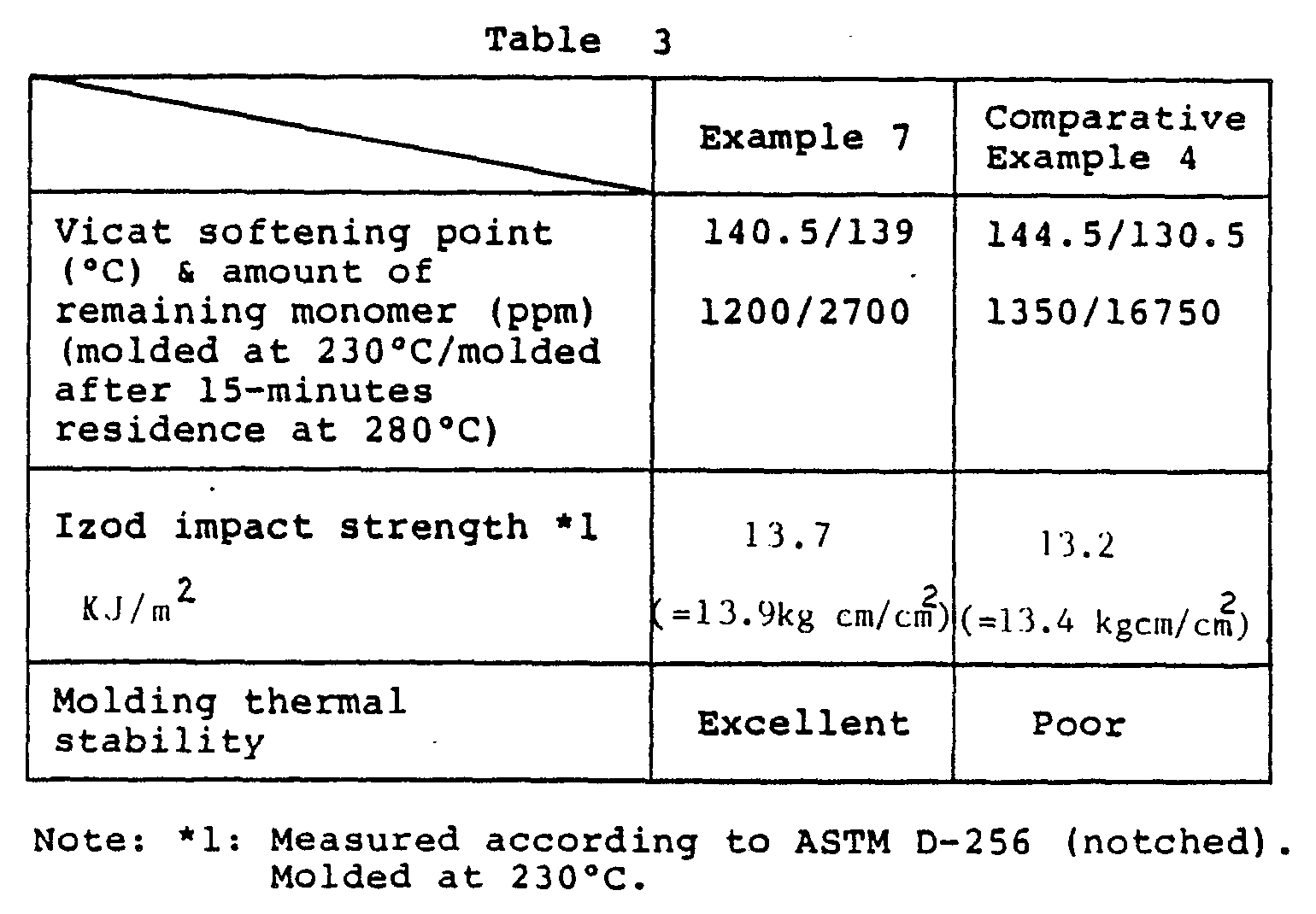
- Heat-resistant copolymers A-1 to A-4 produced in the same manner as in Example 2 are shown in Table 6.
- Into a nitrogen-purged reactor were charged 200 parts of ion-exchanged water, 2.5 parts of potassium oleate, 70 parts of a-methylstyrene, 30 parts of acrylonitrile and 0.4 part of t-dodecyl mercaptan, and the mixture was emulsified with stirring in a nitrogen stream. The internal temperature of the reactor was raised to 40°C, and then a solution of 0.35 part of sodium pyrophosphate, 0.35 part of dextrose and 0.005 part of ferrous sulphate in 20 parts of ion-exchanged water was added thereto, followed by 0.2 part of cumene hydroperoxide to initiate the polymerization. The polymerization was continued for 3 hours while maintaining the polymerizer jacket temperature at 60°C. In the same manner as in the case of A-1 of the above copolymer (I), a copolymer B-1 was recovered in the form of powder. The acrylonitrile content of this copolymer was (I), a copolymer B-1 was recovered in the form of powder. The acrylonitrile content of this copolymer was 29%. Also, the content of monomer chains -[aMS-aMS-aMS]-, -[aMS-a3MS-AN]-and -[AN-aMS-AN]- were 1%, 15% and 84%, respectively. The intrinsic viscosity [η] as measured in methyl ethyl ketone at 30°C was 0.48 dl/g.
- There were likewise produced copolymers B-2 and B-3 as shown in Table 7. The results are shown in Table 7.
- The graft copolymer of Example 7 was used as copolymer C-1.
- The thermoplastic copolymer powder A-1, the thermoplastic copolymer powder B-1 and the rubber-modified thermoplastic resin powder C-1 were mixed in the proportions shown in Table 5 and the mixture was melt-extruded while effecting degasification by means of a vented 50 mm. diameter extruder (cylinder temperature set at 260°C) to obtain pellets. These pellets were dried at 80°C for more than 2 hours and formed into test pieces using an injection machine (Toshiba Machinery IS 70A) at a cylinder temperature of 240°C. and their properties were determined. The results are shown in Table 5. The testing method and conditions were as follows:


- The compositions prepared using the copolymers (I) and (II) shown in Table 6 and Table 7 are shown in Table 8.


Claims (14)
Applications Claiming Priority (4)
| Application Number | Priority Date | Filing Date | Title |
|---|---|---|---|
| JP113853/84 | 1984-06-05 | ||
| JP59113853A JPH0699492B2 (en) | 1984-06-05 | 1984-06-05 | Method for manufacturing heat resistant resin |
| JP133056/84 | 1984-06-29 | ||
| JP59133056A JPS6114245A (en) | 1984-06-29 | 1984-06-29 | thermoplastic resin composition |
Publications (2)
| Publication Number | Publication Date |
|---|---|
| EP0164874A1 EP0164874A1 (en) | 1985-12-18 |
| EP0164874B1 true EP0164874B1 (en) | 1989-04-26 |
Family
ID=26452757
Family Applications (1)
| Application Number | Title | Priority Date | Filing Date |
|---|---|---|---|
| EP85303146A Expired EP0164874B1 (en) | 1984-06-05 | 1985-05-02 | Process for producing a heat-resistant copolymer of alpha-methylstyrene and acrylonitrile, and thermoplastic resin composition containing the same |
Country Status (4)
| Country | Link |
|---|---|
| US (2) | US4659790A (en) |
| EP (1) | EP0164874B1 (en) |
| KR (1) | KR880001609B1 (en) |
| DE (1) | DE3569742D1 (en) |
Families Citing this family (63)
| Publication number | Priority date | Publication date | Assignee | Title |
|---|---|---|---|---|
| CA1273147A (en) * | 1984-12-28 | 1990-08-21 | Makoto Uchida | PROCESS FOR PRODUCING AN .alpha.-ALKYL-SUBSTITUTED AROMATIC VINYL COPOLYMER AND A THERMOPLASTIC RESIN COMPOSITION COMPRISING THE COPOLYMER |
| DE3642645A1 (en) * | 1986-12-13 | 1988-06-23 | Bayer Ag | THERMOPLASTIC MOLDS |
| DE3806075A1 (en) * | 1988-02-26 | 1989-09-07 | Bayer Ag | TERPOLYMERISATLATICES |
| DE3806074A1 (en) * | 1988-02-26 | 1989-09-07 | Bayer Ag | HEAT-RESISTANT THERMOPLASTIC MOLDING |
| US5216062A (en) * | 1989-02-18 | 1993-06-01 | Basf Aktiengesellschaft | Thermoplastic polyurethane molding composition |
| DE3926851A1 (en) * | 1989-08-15 | 1991-02-21 | Bayer Ag | IMPACT TOOL POLYSULPHONE ABS MOLDS |
| JP3028561B2 (en) * | 1990-07-10 | 2000-04-04 | 宇部サイコン株式会社 | Polyphenylene ether composition |
| KR940003782B1 (en) * | 1991-09-03 | 1994-05-03 | 주식회사 럭키 | Method for manufacturing styrene flame retardant resin |
| US5459215A (en) * | 1995-01-03 | 1995-10-17 | Lucky Ltd. | Process for producing a heat-resistant copolymer |
| KR100266053B1 (en) * | 1996-06-03 | 2000-09-15 | 겐지 아이다 | Thermoplastic copolymer and process for the production thereof |
| KR100409071B1 (en) | 2000-07-03 | 2003-12-11 | 주식회사 엘지화학 | Process for preparing thermoplastic resin having superior heat-stability |
| US6956084B2 (en) * | 2001-10-04 | 2005-10-18 | Bridgestone Corporation | Nano-particle preparation and applications |
| AU2003301053A1 (en) * | 2002-12-18 | 2004-07-22 | Bridgestone Corporation | Method for clay exfoliation, compositions therefore, and modified rubber contaiing same |
| US6875818B2 (en) | 2003-01-16 | 2005-04-05 | Bridgestone Corporation | Polymer nano-strings |
| DE112004000633B4 (en) * | 2003-05-02 | 2007-10-25 | Lg Chem, Ltd. | Thermoplastic resin composition |
| US7781552B2 (en) * | 2003-11-06 | 2010-08-24 | Asahi Kasei Chemicals Corporation | Styrene copolymer and process for producing the same |
| US7205370B2 (en) * | 2004-01-12 | 2007-04-17 | Bridgestone Corporation | Polymeric nano-particles of flower-like structure and applications |
| US7718737B2 (en) * | 2004-03-02 | 2010-05-18 | Bridgestone Corporation | Rubber composition containing functionalized polymer nanoparticles |
| US8063142B2 (en) | 2004-03-02 | 2011-11-22 | Bridgestone Corporation | Method of making nano-particles of selected size distribution |
| US7112369B2 (en) * | 2004-03-02 | 2006-09-26 | Bridgestone Corporation | Nano-sized polymer-metal composites |
| US20050215693A1 (en) * | 2004-03-29 | 2005-09-29 | Xiaorong Wang | Clay modified rubber composition and a method for manufacturing same |
| US20050228074A1 (en) * | 2004-04-05 | 2005-10-13 | Bridgestone Corporation | Amphiphilic polymer micelles and use thereof |
| US20050282956A1 (en) * | 2004-06-21 | 2005-12-22 | Xiaorong Wang | Reversible polymer/metal nano-composites and method for manufacturing same |
| US7998554B2 (en) * | 2004-07-06 | 2011-08-16 | Bridgestone Corporation | Hydrophobic surfaces with nanoparticles |
| US7572855B2 (en) | 2005-01-28 | 2009-08-11 | Bridgestone Corporation | Nano-composite and compositions manufactured thereof |
| US7579398B2 (en) * | 2005-02-02 | 2009-08-25 | Bridgestone Corporation | Nano-composite and compositions therefrom |
| US7659342B2 (en) * | 2005-02-03 | 2010-02-09 | Bridgestone Corporation | Polymer nano-particle with polar core and method for manufacturing same |
| KR100838453B1 (en) * | 2005-10-28 | 2008-06-16 | 주식회사 엘지화학 | Manufacturing method of heat-resistant alphamethylstyrene / acrylonitrile copolymer having excellent color |
| US7538159B2 (en) | 2005-12-16 | 2009-05-26 | Bridgestone Corporation | Nanoparticles with controlled architecture and method thereof |
| US9061900B2 (en) * | 2005-12-16 | 2015-06-23 | Bridgestone Corporation | Combined use of liquid polymer and polymeric nanoparticles for rubber applications |
| US7884160B2 (en) | 2005-12-19 | 2011-02-08 | Bridgestone Corporation | Non-spherical nanoparticles made from living triblock polymer chains |
| US8288473B2 (en) | 2005-12-19 | 2012-10-16 | Bridgestone Corporation | Disk-like nanoparticles |
| US7560510B2 (en) | 2005-12-20 | 2009-07-14 | Bridgestone Corporation | Nano-sized inorganic metal particles, preparation thereof, and application thereof in improving rubber properties |
| US8697775B2 (en) * | 2005-12-20 | 2014-04-15 | Bridgestone Corporation | Vulcanizable nanoparticles having a core with a high glass transition temperature |
| US8877250B2 (en) * | 2005-12-20 | 2014-11-04 | Bridgestone Corporation | Hollow nano-particles and method thereof |
| US7601772B2 (en) * | 2005-12-20 | 2009-10-13 | Bridgestone Corporation | Nano-composite and method thereof |
| US7935184B2 (en) | 2006-06-19 | 2011-05-03 | Bridgestone Corporation | Method of preparing imidazolium surfactants |
| EP3495322A1 (en) | 2006-07-28 | 2019-06-12 | Bridgestone Corporation | Polymeric core-shell nanoparticles with interphase region |
| US7597959B2 (en) * | 2006-12-19 | 2009-10-06 | Bridgestone Corporation | Core-shell fluorescent nanoparticles |
| US7649049B2 (en) * | 2006-12-20 | 2010-01-19 | Bridgestone Corporation | Rubber composition containing a polymer nanoparticle |
| US7829624B2 (en) * | 2007-06-29 | 2010-11-09 | Bridgestone Corporation | One-pot synthesis of nanoparticles and liquid polymer for rubber applications |
| KR101205204B1 (en) * | 2008-12-29 | 2012-11-27 | 제일모직주식회사 | Low Gloss Thermoplastic Resin Having Excellent Heat Resistance and Impact Strength and Method of Preparing the Same |
| JP5620405B2 (en) | 2008-12-31 | 2014-11-05 | 株式会社ブリヂストン | Nanoparticle formation process, nanoparticles, and compositions that initially form a core |
| US9062144B2 (en) * | 2009-04-03 | 2015-06-23 | Bridgestone Corporation | Hairy polymeric nanoparticles with first and second shell block polymer arms |
| US20110172364A1 (en) * | 2009-12-29 | 2011-07-14 | Chen Yaohong | Charged Nanoparticles And Method Of Controlling Charge |
| US9115222B2 (en) * | 2009-12-29 | 2015-08-25 | Bridgestone Corporation | Well defined, highly crosslinked nanoparticles and method for making same |
| KR101457403B1 (en) * | 2011-12-28 | 2014-11-12 | 제일모직주식회사 | Acrylate-Styrene-Acrylonitrile Resin Composition Having Excellent Thermochromic Resistant Property Under High Temperature |
| US9428604B1 (en) | 2011-12-30 | 2016-08-30 | Bridgestone Corporation | Nanoparticle fillers and methods of mixing into elastomers |
| US9732211B2 (en) | 2013-10-30 | 2017-08-15 | Lotte Advanced Materials Co., Ltd. | Thermoplastic resin composition having improved weather resistance |
| EP2881408B1 (en) | 2013-12-04 | 2017-09-20 | Lotte Advanced Materials Co., Ltd. | Styrene-based copolymer and thermoplastic resin composition including the same |
| US9902850B2 (en) | 2014-06-26 | 2018-02-27 | Lotte Advanced Materials Co., Ltd. | Thermoplastic resin composition |
| US9856371B2 (en) | 2014-06-27 | 2018-01-02 | Lotte Advanced Materials Co., Ltd. | Thermoplastic resin composition and low-gloss molded article made therefrom |
| US10435495B2 (en) | 2014-06-27 | 2019-10-08 | Lotte Advanced Materials Co., Ltd. | Copolymers and thermoplastic resin composition comprising the same |
| US9850333B2 (en) | 2014-06-27 | 2017-12-26 | Lotte Advanced Materials Co., Ltd. | Copolymers and thermoplastic resin composition including the same |
| US9790362B2 (en) | 2014-06-27 | 2017-10-17 | Lotte Advanced Materials Co., Ltd. | Thermoplastic resin composition and molded article made using the same |
| US9522994B2 (en) | 2014-06-27 | 2016-12-20 | Samsung Sdi Co., Ltd. | Vinyl copolymer having high heat resistance and low-gloss, and thermoplastic resin comprising the same |
| KR101822697B1 (en) | 2014-11-18 | 2018-01-30 | 롯데첨단소재(주) | Thermoplastic resin composition with excellent appearance and molded article using thereof |
| KR101811485B1 (en) | 2014-11-28 | 2017-12-21 | 주식회사 엘지화학 | Thermoplastic Resin Composition and Molded Article Thereof |
| KR20160067675A (en) | 2014-12-04 | 2016-06-14 | 주식회사 엘지화학 | Thermoplastic Resin Composition and Molded Article Thereof |
| KR102009313B1 (en) * | 2015-11-12 | 2019-08-09 | 주식회사 엘지화학 | Graft copolymer, method for preparing the copolymer and thermoplastic resin composition comprising the copolymer |
| KR101895112B1 (en) * | 2015-12-31 | 2018-09-04 | 롯데첨단소재(주) | Rubber-modified vinyl-based graft copolymer and thermoplastic resin composition comprising the same |
| KR102684625B1 (en) * | 2019-11-21 | 2024-07-15 | 주식회사 엘지화학 | Method for preparing copolymer, copolymer prepared by the method and thermoplastic resin composition comprising the coplymer |
| KR102642820B1 (en) * | 2020-07-23 | 2024-03-05 | 주식회사 엘지화학 | Thermoplastic resin composition and exterior building materials comprising the resin composition |
Family Cites Families (8)
| Publication number | Priority date | Publication date | Assignee | Title |
|---|---|---|---|---|
| US3010936A (en) * | 1958-08-07 | 1961-11-28 | Borg Warner | Blend of graft copolymer of polybutadiene, styrene and acrylonitrile with interpolymer of alpha methyl styrene and acrylonitrile |
| NL244913A (en) * | 1958-12-19 | |||
| JPS5578007A (en) * | 1978-12-06 | 1980-06-12 | Sumitomo Naugatuck Co Ltd | Preparation of thermoplastic resin |
| JPS56103211A (en) * | 1980-01-18 | 1981-08-18 | Denki Kagaku Kogyo Kk | Preparation of copolymer |
| DE3170382D1 (en) * | 1980-06-05 | 1985-06-13 | Sumitomo Naugatuck | Process for preparing copolymers |
| JPS578208A (en) * | 1980-06-16 | 1982-01-16 | Kanegafuchi Chem Ind Co Ltd | High-alpha-methylstyrene content copolyymer, its production and composition containing the same |
| NL8003799A (en) * | 1980-07-01 | 1982-02-01 | Stamicarbon | POLYMER COMPOSITION. |
| GB2101143B (en) * | 1981-07-01 | 1985-01-23 | Denki Kagaku Kogyo Kk | Thermoplastic resin compositions and their preparation |
-
1985
- 1985-04-18 US US06/724,543 patent/US4659790A/en not_active Expired - Lifetime
- 1985-04-30 KR KR1019850002907A patent/KR880001609B1/en not_active Expired
- 1985-05-02 DE DE8585303146T patent/DE3569742D1/en not_active Expired
- 1985-05-02 EP EP85303146A patent/EP0164874B1/en not_active Expired
-
1986
- 1986-12-29 US US06/947,284 patent/US4774287A/en not_active Expired - Lifetime
Also Published As
| Publication number | Publication date |
|---|---|
| US4774287A (en) | 1988-09-27 |
| KR860000322A (en) | 1986-01-28 |
| DE3569742D1 (en) | 1989-06-01 |
| EP0164874A1 (en) | 1985-12-18 |
| KR880001609B1 (en) | 1988-08-25 |
| US4659790A (en) | 1987-04-21 |
Similar Documents
| Publication | Publication Date | Title |
|---|---|---|
| EP0164874B1 (en) | Process for producing a heat-resistant copolymer of alpha-methylstyrene and acrylonitrile, and thermoplastic resin composition containing the same | |
| EP0222924B1 (en) | Process for producing maleimide copolymer and thermoplastic resin composition comprising the copolymer | |
| US5008331A (en) | Thermoplastic resin composition | |
| EP0216524B1 (en) | Rubber dispersed copolymer resin | |
| JP2004502818A (en) | Method for producing thermoplastic resin with excellent thermal stability | |
| EP0114598A1 (en) | Thermoplastic moulding masses | |
| KR950006261B1 (en) | Rubber-reinforced styrewic polymer resins having improved flow and gloss characteristics | |
| KR100585942B1 (en) | Thermoplastic resin composition with good heat resistance and elongation property | |
| EP0076162B1 (en) | A process for producing a thermoplastic resin and a resin composition containing the same | |
| KR19980033977A (en) | Method for producing a thermoplastic resin excellent in impact resistance | |
| JP3109378B2 (en) | Method for producing impact-resistant resin composition | |
| CA1249090A (en) | Continuous production process of styrene-base resin | |
| JPH0699492B2 (en) | Method for manufacturing heat resistant resin | |
| KR100394735B1 (en) | Preparation method of thermoplastic resin composition with excellent weather resistance, gloss and impact resistance | |
| KR20180050064A (en) | A method for preparing thermoplastic resin | |
| WO2002051894A1 (en) | Method of preparing the new grafted copolymer having high rubber contents and high performance | |
| KR100348751B1 (en) | Thermalplastic Flameproof ABS Resin Compositions having Improved Impact Strength and Thermal-Stability and Method for Preparing thereof | |
| US5459215A (en) | Process for producing a heat-resistant copolymer | |
| KR920004212B1 (en) | Thermoplastic resin composition and therof a manufacturing process | |
| JPH0762099B2 (en) | Manufacturing method of resin composition | |
| KR100369378B1 (en) | Process for preparing thermoplastic resin composition having excellent impact resistance and tensile property | |
| KR950010550B1 (en) | Process for producing thermoplastic resin having a good heat resistance | |
| KR100236772B1 (en) | Process for preparing thermoplastic resins | |
| KR960000569B1 (en) | Process for producing nitrile resin having excellent impact resistance | |
| JP3536793B2 (en) | Impact resistant resin composition |
Legal Events
| Date | Code | Title | Description |
|---|---|---|---|
| PUAI | Public reference made under article 153(3) epc to a published international application that has entered the european phase |
Free format text: ORIGINAL CODE: 0009012 |
|
| AK | Designated contracting states |
Designated state(s): DE GB IT NL |
|
| 17P | Request for examination filed |
Effective date: 19860214 |
|
| 17Q | First examination report despatched |
Effective date: 19870330 |
|
| GRAA | (expected) grant |
Free format text: ORIGINAL CODE: 0009210 |
|
| AK | Designated contracting states |
Kind code of ref document: B1 Designated state(s): DE GB IT NL |
|
| REF | Corresponds to: |
Ref document number: 3569742 Country of ref document: DE Date of ref document: 19890601 |
|
| ITF | It: translation for a ep patent filed | ||
| PLBI | Opposition filed |
Free format text: ORIGINAL CODE: 0009260 |
|
| 26 | Opposition filed |
Opponent name: BAYER AG, LEVERKUSEN KONZERNVERWALTUNG RP PATENTAB Effective date: 19890922 |
|
| NLR1 | Nl: opposition has been filed with the epo |
Opponent name: BAYER AG. |
|
| ITTA | It: last paid annual fee | ||
| PLBN | Opposition rejected |
Free format text: ORIGINAL CODE: 0009273 |
|
| STAA | Information on the status of an ep patent application or granted ep patent |
Free format text: STATUS: OPPOSITION REJECTED |
|
| 27O | Opposition rejected |
Effective date: 19950713 |
|
| NLR2 | Nl: decision of opposition | ||
| REG | Reference to a national code |
Ref country code: GB Ref legal event code: IF02 |
|
| PGFP | Annual fee paid to national office [announced via postgrant information from national office to epo] |
Ref country code: GB Payment date: 20040428 Year of fee payment: 20 |
|
| PGFP | Annual fee paid to national office [announced via postgrant information from national office to epo] |
Ref country code: NL Payment date: 20040505 Year of fee payment: 20 |
|
| PGFP | Annual fee paid to national office [announced via postgrant information from national office to epo] |
Ref country code: DE Payment date: 20040513 Year of fee payment: 20 |
|
| PG25 | Lapsed in a contracting state [announced via postgrant information from national office to epo] |
Ref country code: GB Free format text: LAPSE BECAUSE OF EXPIRATION OF PROTECTION Effective date: 20050501 |
|
| PG25 | Lapsed in a contracting state [announced via postgrant information from national office to epo] |
Ref country code: NL Free format text: LAPSE BECAUSE OF EXPIRATION OF PROTECTION Effective date: 20050502 |
|
| REG | Reference to a national code |
Ref country code: GB Ref legal event code: PE20 |
|
| NLV7 | Nl: ceased due to reaching the maximum lifetime of a patent |
Effective date: 20050502 |
|
| APAH | Appeal reference modified |
Free format text: ORIGINAL CODE: EPIDOSCREFNO |