EP0133800B1 - Electroless copper plating solution - Google Patents
Electroless copper plating solution Download PDFInfo
- Publication number
- EP0133800B1 EP0133800B1 EP84305269A EP84305269A EP0133800B1 EP 0133800 B1 EP0133800 B1 EP 0133800B1 EP 84305269 A EP84305269 A EP 84305269A EP 84305269 A EP84305269 A EP 84305269A EP 0133800 B1 EP0133800 B1 EP 0133800B1
- Authority
- EP
- European Patent Office
- Prior art keywords
- plating solution
- electroless copper
- copper plating
- concentration
- cyanide
- Prior art date
- Legal status (The legal status is an assumption and is not a legal conclusion. Google has not performed a legal analysis and makes no representation as to the accuracy of the status listed.)
- Expired
Links
- 238000007747 plating Methods 0.000 title claims description 29
- RYGMFSIKBFXOCR-UHFFFAOYSA-N Copper Chemical compound [Cu] RYGMFSIKBFXOCR-UHFFFAOYSA-N 0.000 title claims description 24
- 229910052802 copper Inorganic materials 0.000 title claims description 24
- 239000010949 copper Substances 0.000 title claims description 24
- XFXPMWWXUTWYJX-UHFFFAOYSA-N Cyanide Chemical compound N#[C-] XFXPMWWXUTWYJX-UHFFFAOYSA-N 0.000 claims description 11
- 150000002500 ions Chemical class 0.000 claims description 9
- DGEZNRSVGBDHLK-UHFFFAOYSA-N [1,10]phenanthroline Chemical compound C1=CN=C2C3=NC=CC=C3C=CC2=C1 DGEZNRSVGBDHLK-UHFFFAOYSA-N 0.000 claims description 8
- 239000008139 complexing agent Substances 0.000 claims description 7
- 150000001875 compounds Chemical class 0.000 claims description 7
- 239000003638 chemical reducing agent Substances 0.000 claims description 5
- 239000003002 pH adjusting agent Substances 0.000 claims description 5
- 125000001153 fluoro group Chemical group F* 0.000 claims description 4
- 229910052739 hydrogen Inorganic materials 0.000 claims description 4
- 239000001257 hydrogen Substances 0.000 claims description 4
- 125000004435 hydrogen atom Chemical group [H]* 0.000 claims description 4
- ZAMOUSCENKQFHK-UHFFFAOYSA-N Chlorine atom Chemical group [Cl] ZAMOUSCENKQFHK-UHFFFAOYSA-N 0.000 claims description 3
- 239000000460 chlorine Chemical group 0.000 claims description 3
- 229910052801 chlorine Chemical group 0.000 claims description 3
- 229910052731 fluorine Inorganic materials 0.000 claims description 3
- 239000011737 fluorine Substances 0.000 claims description 3
- ROFVEXUMMXZLPA-UHFFFAOYSA-N Bipyridyl Chemical group N1=CC=CC=C1C1=CC=CC=N1 ROFVEXUMMXZLPA-UHFFFAOYSA-N 0.000 claims description 2
- 239000000758 substrate Substances 0.000 description 12
- WSFSSNUMVMOOMR-UHFFFAOYSA-N Formaldehyde Chemical compound O=C WSFSSNUMVMOOMR-UHFFFAOYSA-N 0.000 description 7
- 238000000034 method Methods 0.000 description 6
- 239000004020 conductor Substances 0.000 description 5
- 239000000654 additive Substances 0.000 description 4
- KCXVZYZYPLLWCC-UHFFFAOYSA-N EDTA Chemical compound OC(=O)CN(CC(O)=O)CCN(CC(O)=O)CC(O)=O KCXVZYZYPLLWCC-UHFFFAOYSA-N 0.000 description 3
- KWYUFKZDYYNOTN-UHFFFAOYSA-M Potassium hydroxide Chemical compound [OH-].[K+] KWYUFKZDYYNOTN-UHFFFAOYSA-M 0.000 description 3
- HEMHJVSKTPXQMS-UHFFFAOYSA-M Sodium hydroxide Chemical compound [OH-].[Na+] HEMHJVSKTPXQMS-UHFFFAOYSA-M 0.000 description 3
- XTVVROIMIGLXTD-UHFFFAOYSA-N copper(II) nitrate Chemical compound [Cu+2].[O-][N+]([O-])=O.[O-][N+]([O-])=O XTVVROIMIGLXTD-UHFFFAOYSA-N 0.000 description 3
- ARUVKPQLZAKDPS-UHFFFAOYSA-L copper(II) sulfate Chemical compound [Cu+2].[O-][S+2]([O-])([O-])[O-] ARUVKPQLZAKDPS-UHFFFAOYSA-L 0.000 description 3
- 229910000366 copper(II) sulfate Inorganic materials 0.000 description 3
- 229960001484 edetic acid Drugs 0.000 description 3
- 239000002202 Polyethylene glycol Substances 0.000 description 2
- 230000000996 additive effect Effects 0.000 description 2
- 229910001854 alkali hydroxide Inorganic materials 0.000 description 2
- 150000008044 alkali metal hydroxides Chemical class 0.000 description 2
- 239000011248 coating agent Substances 0.000 description 2
- 238000000576 coating method Methods 0.000 description 2
- ORTQZVOHEJQUHG-UHFFFAOYSA-L copper(II) chloride Chemical compound Cl[Cu]Cl ORTQZVOHEJQUHG-UHFFFAOYSA-L 0.000 description 2
- OPQARKPSCNTWTJ-UHFFFAOYSA-L copper(ii) acetate Chemical compound [Cu+2].CC([O-])=O.CC([O-])=O OPQARKPSCNTWTJ-UHFFFAOYSA-L 0.000 description 2
- QTMDXZNDVAMKGV-UHFFFAOYSA-L copper(ii) bromide Chemical compound [Cu+2].[Br-].[Br-] QTMDXZNDVAMKGV-UHFFFAOYSA-L 0.000 description 2
- -1 cupric sulfate Chemical class 0.000 description 2
- 238000000151 deposition Methods 0.000 description 2
- LTYRAPJYLUPLCI-UHFFFAOYSA-N glycolonitrile Chemical compound OCC#N LTYRAPJYLUPLCI-UHFFFAOYSA-N 0.000 description 2
- 238000004519 manufacturing process Methods 0.000 description 2
- 239000000203 mixture Substances 0.000 description 2
- IYRGXJIJGHOCFS-UHFFFAOYSA-N neocuproine Chemical compound C1=C(C)N=C2C3=NC(C)=CC=C3C=CC2=C1 IYRGXJIJGHOCFS-UHFFFAOYSA-N 0.000 description 2
- NLEUXPOVZGDKJI-UHFFFAOYSA-N nickel(2+);dicyanide Chemical compound [Ni+2].N#[C-].N#[C-] NLEUXPOVZGDKJI-UHFFFAOYSA-N 0.000 description 2
- 150000002825 nitriles Chemical class 0.000 description 2
- 239000000615 nonconductor Substances 0.000 description 2
- 229920000233 poly(alkylene oxides) Polymers 0.000 description 2
- 229920001223 polyethylene glycol Polymers 0.000 description 2
- NNFCIKHAZHQZJG-UHFFFAOYSA-N potassium cyanide Chemical compound [K+].N#[C-] NNFCIKHAZHQZJG-UHFFFAOYSA-N 0.000 description 2
- 150000003839 salts Chemical class 0.000 description 2
- 229910001220 stainless steel Inorganic materials 0.000 description 2
- 239000010935 stainless steel Substances 0.000 description 2
- 239000000126 substance Substances 0.000 description 2
- 150000005045 1,10-phenanthrolines Chemical class 0.000 description 1
- DHDHJYNTEFLIHY-UHFFFAOYSA-N 4,7-diphenyl-1,10-phenanthroline Chemical compound C1=CC=CC=C1C1=CC=NC2=C1C=CC1=C(C=3C=CC=CC=3)C=CN=C21 DHDHJYNTEFLIHY-UHFFFAOYSA-N 0.000 description 1
- 229910021590 Copper(II) bromide Inorganic materials 0.000 description 1
- 229930040373 Paraformaldehyde Natural products 0.000 description 1
- NSOXQYCFHDMMGV-UHFFFAOYSA-N Tetrakis(2-hydroxypropyl)ethylenediamine Chemical compound CC(O)CN(CC(C)O)CCN(CC(C)O)CC(C)O NSOXQYCFHDMMGV-UHFFFAOYSA-N 0.000 description 1
- GSEJCLTVZPLZKY-UHFFFAOYSA-N Triethanolamine Chemical compound OCCN(CCO)CCO GSEJCLTVZPLZKY-UHFFFAOYSA-N 0.000 description 1
- 239000003513 alkali Substances 0.000 description 1
- DFNYGALUNNFWKJ-UHFFFAOYSA-N aminoacetonitrile Chemical compound NCC#N DFNYGALUNNFWKJ-UHFFFAOYSA-N 0.000 description 1
- 239000003054 catalyst Substances 0.000 description 1
- KXZJHVJKXJLBKO-UHFFFAOYSA-N chembl1408157 Chemical compound N=1C2=CC=CC=C2C(C(=O)O)=CC=1C1=CC=C(O)C=C1 KXZJHVJKXJLBKO-UHFFFAOYSA-N 0.000 description 1
- 125000001309 chloro group Chemical group Cl* 0.000 description 1
- CWZOMTYLSNXUEL-UHFFFAOYSA-N cobalt(ii) cyanide Chemical compound [Co+2].N#[C-].N#[C-] CWZOMTYLSNXUEL-UHFFFAOYSA-N 0.000 description 1
- 230000000052 comparative effect Effects 0.000 description 1
- 229940076286 cupric acetate Drugs 0.000 description 1
- 229960003280 cupric chloride Drugs 0.000 description 1
- 238000007598 dipping method Methods 0.000 description 1
- XEYBHCRIKKKOSS-UHFFFAOYSA-N disodium;azanylidyneoxidanium;iron(2+);pentacyanide Chemical compound [Na+].[Na+].[Fe+2].N#[C-].N#[C-].N#[C-].N#[C-].N#[C-].[O+]#N XEYBHCRIKKKOSS-UHFFFAOYSA-N 0.000 description 1
- BXKDSDJJOVIHMX-UHFFFAOYSA-N edrophonium chloride Chemical compound [Cl-].CC[N+](C)(C)C1=CC=CC(O)=C1 BXKDSDJJOVIHMX-UHFFFAOYSA-N 0.000 description 1
- 238000007772 electroless plating Methods 0.000 description 1
- 238000009713 electroplating Methods 0.000 description 1
- 238000005530 etching Methods 0.000 description 1
- 239000008098 formaldehyde solution Substances 0.000 description 1
- JMANVNJQNLATNU-UHFFFAOYSA-N glycolonitrile Natural products N#CC#N JMANVNJQNLATNU-UHFFFAOYSA-N 0.000 description 1
- 239000003999 initiator Substances 0.000 description 1
- 229910052751 metal Inorganic materials 0.000 description 1
- 239000002184 metal Substances 0.000 description 1
- 231100000989 no adverse effect Toxicity 0.000 description 1
- 229920002866 paraformaldehyde Polymers 0.000 description 1
- 238000005191 phase separation Methods 0.000 description 1
- 239000000276 potassium ferrocyanide Substances 0.000 description 1
- LJCNRYVRMXRIQR-OLXYHTOASA-L potassium sodium L-tartrate Chemical class [Na+].[K+].[O-]C(=O)[C@H](O)[C@@H](O)C([O-])=O LJCNRYVRMXRIQR-OLXYHTOASA-L 0.000 description 1
- 239000011734 sodium Substances 0.000 description 1
- MNWBNISUBARLIT-UHFFFAOYSA-N sodium cyanide Chemical compound [Na+].N#[C-] MNWBNISUBARLIT-UHFFFAOYSA-N 0.000 description 1
- 239000000264 sodium ferrocyanide Substances 0.000 description 1
- GTSHREYGKSITGK-UHFFFAOYSA-N sodium ferrocyanide Chemical compound [Na+].[Na+].[Na+].[Na+].[Fe+2].N#[C-].N#[C-].N#[C-].N#[C-].N#[C-].N#[C-] GTSHREYGKSITGK-UHFFFAOYSA-N 0.000 description 1
- 235000012247 sodium ferrocyanide Nutrition 0.000 description 1
- 229940083618 sodium nitroprusside Drugs 0.000 description 1
- 235000011006 sodium potassium tartrate Nutrition 0.000 description 1
- 159000000000 sodium salts Chemical class 0.000 description 1
- XOGGUFAVLNCTRS-UHFFFAOYSA-N tetrapotassium;iron(2+);hexacyanide Chemical compound [K+].[K+].[K+].[K+].[Fe+2].N#[C-].N#[C-].N#[C-].N#[C-].N#[C-].N#[C-] XOGGUFAVLNCTRS-UHFFFAOYSA-N 0.000 description 1
- DCXPBOFGQPCWJY-UHFFFAOYSA-N trisodium;iron(3+);hexacyanide Chemical compound [Na+].[Na+].[Na+].[Fe+3].N#[C-].N#[C-].N#[C-].N#[C-].N#[C-].N#[C-] DCXPBOFGQPCWJY-UHFFFAOYSA-N 0.000 description 1
Classifications
-
- C—CHEMISTRY; METALLURGY
- C23—COATING METALLIC MATERIAL; COATING MATERIAL WITH METALLIC MATERIAL; CHEMICAL SURFACE TREATMENT; DIFFUSION TREATMENT OF METALLIC MATERIAL; COATING BY VACUUM EVAPORATION, BY SPUTTERING, BY ION IMPLANTATION OR BY CHEMICAL VAPOUR DEPOSITION, IN GENERAL; INHIBITING CORROSION OF METALLIC MATERIAL OR INCRUSTATION IN GENERAL
- C23C—COATING METALLIC MATERIAL; COATING MATERIAL WITH METALLIC MATERIAL; SURFACE TREATMENT OF METALLIC MATERIAL BY DIFFUSION INTO THE SURFACE, BY CHEMICAL CONVERSION OR SUBSTITUTION; COATING BY VACUUM EVAPORATION, BY SPUTTERING, BY ION IMPLANTATION OR BY CHEMICAL VAPOUR DEPOSITION, IN GENERAL
- C23C18/00—Chemical coating by decomposition of either liquid compounds or solutions of the coating forming compounds, without leaving reaction products of surface material in the coating; Contact plating
- C23C18/16—Chemical coating by decomposition of either liquid compounds or solutions of the coating forming compounds, without leaving reaction products of surface material in the coating; Contact plating by reduction or substitution, e.g. electroless plating
- C23C18/31—Coating with metals
- C23C18/38—Coating with copper
- C23C18/40—Coating with copper using reducing agents
-
- C—CHEMISTRY; METALLURGY
- C23—COATING METALLIC MATERIAL; COATING MATERIAL WITH METALLIC MATERIAL; CHEMICAL SURFACE TREATMENT; DIFFUSION TREATMENT OF METALLIC MATERIAL; COATING BY VACUUM EVAPORATION, BY SPUTTERING, BY ION IMPLANTATION OR BY CHEMICAL VAPOUR DEPOSITION, IN GENERAL; INHIBITING CORROSION OF METALLIC MATERIAL OR INCRUSTATION IN GENERAL
- C23C—COATING METALLIC MATERIAL; COATING MATERIAL WITH METALLIC MATERIAL; SURFACE TREATMENT OF METALLIC MATERIAL BY DIFFUSION INTO THE SURFACE, BY CHEMICAL CONVERSION OR SUBSTITUTION; COATING BY VACUUM EVAPORATION, BY SPUTTERING, BY ION IMPLANTATION OR BY CHEMICAL VAPOUR DEPOSITION, IN GENERAL
- C23C18/00—Chemical coating by decomposition of either liquid compounds or solutions of the coating forming compounds, without leaving reaction products of surface material in the coating; Contact plating
- C23C18/16—Chemical coating by decomposition of either liquid compounds or solutions of the coating forming compounds, without leaving reaction products of surface material in the coating; Contact plating by reduction or substitution, e.g. electroless plating
- C23C18/31—Coating with metals
- C23C18/38—Coating with copper
- C23C18/40—Coating with copper using reducing agents
- C23C18/405—Formaldehyde
Definitions
- the present invention relates to an electroless copper plating solution capable of forming a deposited film with high elongation.
- an electroless copper plating solution is used for forming conductors on insulating substrates.
- the following two processes are mainly employed for forming conductors on insulating substrates by using an electroless copper plating solution.
- One process comprises coating a plating resist on non-conductor areas of an insulating substrate and then dipping the insulating substrate in an electroless copper plating solution to form conductors of an electroless plated copper film on the areas of the insulating substrate not coated with the plating resist.
- Another process comprises immersing an insulating substrate in an electroless copper plating solution to form a thin electroless copper deposited film on the entire surface of the insulating substrate, then coating a plating resist on non-conductor areas of the substrate, conducting electroplating of copper to form an electroplated copper film on the resistless areas, and then removing the plating resist, removing the thin electroless plated copper film at the area having no electroplated copper film by means of quick etching to thereby form the desired conductors on the insulating substrate.
- Electroless copper plating solutions generally comprise a cupric salt such as cupric sulfate, an alkali-soluble complexing agent for cupric ions such as ethylenediaminetetracetic acid, a reducing agent such as formaldehyde and a pH adjuster which is an alkali hydroxide.
- a cupric salt such as cupric sulfate
- an alkali-soluble complexing agent for cupric ions such as ethylenediaminetetracetic acid
- a reducing agent such as formaldehyde
- a pH adjuster which is an alkali hydroxide.
- DE-A-2632920 describes electroless copper plating solutions containing fluoropolyethers.
- An object of this invention is to provide an electroless copper plating solution capable of forming a deposited film with high elongation.
- the present invention provides an electroless copper plating solution comprising:
- the fluoropolyether used in the present invention has a backbone represented by the general formula: or wherein each R is fluorine, a part of which may be substituted with hydrogen and/or chlorine; k and m are each zero or a positive number (but k and m cannot be zero at the same time); and n, p and q are each a positive number.
- the fluoropolyether used in this invention preferably has a molecular weight (a number average molecular weight) in the range of 500 to 50,000.
- fluoropolyethers are commercially available, such as Fomblin Y@ and Fomblin Z@ manufactured by Montefluos S.p.A. (Italy).
- Fomblin Y has the following chemical structure:
- Fomblin Z has the following chemical structure:
- the solubility of fluoropolyethers in the plating solution is very low.
- a fluoropolyether in a small effective amount, for example 0.01 mg/I or greater, preferably not exceeding 50 mg/I. Excess addition gives no adverse effect to the elongation of the copper deposit.
- this compound When this compound is added in an excess amount, it merely undergoes a phase separation from the plating solution and is dispersed in the manner of oil. Thus, when the compound is added in an excess amount, the concentration in the plating solution is self controlled by the solubility of the compound.
- Two or more different types of fluoropolyether can be used in admixture. A part of the fluorine atoms in the fluoropolyether may be substituted with one or more hydrogen and/or chlorine atoms.
- cyanide there can be used metal cyanides such as sodium cyanide (NaCN), potassium cyanide (KCN), nickel cyanide (NiCN), cobalt cyanide (Co(CN) 2 ), etc.; cyano-complex compounds such as sodium ferrocyanide (Na 4 (Fe(CN) 6 )), potassium ferrocyanide (K 4 (Fe(CN) 6 )), sodium ferricyanide (Na 3 (Fe(CN) 6 )), potassium ferricyanide (K 3 (Fe(CN) e )), sodium nitroprusside (Na 2 Fe(CN) s (NO)), etc.; and organic cyanides such as glycolonitrile (HOCH 2 CN), aminoacetonitrile (NH 2 CH 2 CN), etc.
- HOCH 2 CN glycolonitrile
- NH 2 CH 2 CN aminoacetonitrile
- the concentration of the cyanide is in the range of 2 to 200 mg/l. When the cyanide concentration is less than 2 mg/l or exceeds 200 mg/l, no deposited film with a satisfactorily high elongation can be obtained.
- the more preferred range of cyanide concentration is 5 to 80 mg/I and the most preferred range is 10 to 50 mg/l.
- the concentration of a,a'-dipyridyl is at least 5 mg/I and preferably not more than 300 mg/l. When it is below 5 mg/I, there can be obtained no deposited film with a satisfactorily high elongation, and when said concentration exceeds 300 mg/l, the depositing rate is reduced.
- the a,a'-dipyridyl concentration is more preferably 10 to 150 mg/I and most preferably 15 to 60 mg/l.
- 1,10-phenanthroline or derivatives thereof there can be used, for example, 1,10-phenanthroline, 4,7-diphenyl-1,10-phenanthroline and 2,9-dimethyl-1,10-phenanthroline.
- concentration of such 1,10-phenanthrolines is at least 5 mg/l and preferably not more than 300 mg/I. If the concentration is less than 5 mg/l, it is impossible to obtain a deposited film with a sufficiently high elongation, and if said concentration exceeds 300 mg/I, the depositing rate is reduced.
- the more preferred range of 1,10 phenanthroline concentration is 10 to 150 mg/I and the most preferred range is 15 to 60 mg/l.
- cupric ions are supplied by an organic or inorganic cupric salt such as cupric sulfate, cupric nitrate, cupric chloride, cupric bromide, cupric acetate and the like.
- an organic or inorganic cupric salt such as cupric sulfate, cupric nitrate, cupric chloride, cupric bromide, cupric acetate and the like.
- Such cupric ions preferably exist in a concentration of 0.004 to 0.2 mol/I.
- the complexing agent for these cupric ions is a compound which forms with cupric ions a complex soluble in aqueous alkali solutions.
- Typical examples of such a complexing agent are ethylenediaminetetraacetic acid and its sodium salt, Rochelle salts, N,N,N',N'-tetrakis-(2-hydroxypropyl)-ethylenediamine, triethanolamine, ethylenenitrilotetraethanol and the like.
- the preferred concentration of the complexing agent in the plating solution is 0.004 to 1 mol/I.
- formaldehyde or paraformaldehyde can be used in an amount of preferably 0.01 to 0.25 mol/I.
- alkali hydroxides such as sodium hydroxide, potassium hydroxide and the like can be used.
- Such pH adjuster is preferably used in an amount necessary for adjusting the pH of the solution to 11.0 to 13.5.
- the fundamental composition of the electroless copper plating solution of this invention preferably comprises 5 to 15 g/l of cupric sulfate, 15 to 60 g/I of ethylenediaminetetraacetic acid as a complexing agent and 2 to 20 mill of a 37% aqueous formaldehyde solution as a reducing agent, and it is preferred that the solution be adjusted to a pH of 11.6 to 13.0 and used at a temperature of 60 to 80°C.
- the electroless plating solution of this invention is capable of providing a deposited film with a high elongation and can be advantageously used for forming circuits on a substrate in the manufacture of printed wiring boards according principally to the full additive or semi-additive process.
- Stainless steel plates having smooth polished surfaces had their surfaces degreased and applied with Pd serving as a reaction initiator (catalyst) and then were subjected to electroless copper plating at 70°C by using the plating solutions having the compositions shown in Table 1 to obtain the deposited copper films.
- the deposited films formed on said stainless steel plates were peeled off from the substrate surfaces and cut to pieces measuring 10 mm width and 80 mm long, and their film properties were measured by using a tensile tester (Tensilon/UTM-1-5000 BW, manufactured by Toyo Baldwing Co., Ltd. (Japan)) at a crosshead speed of 1 mm/min and a gauge length of 15 mm. The results are shown in Table 2.
Landscapes
- Chemical & Material Sciences (AREA)
- General Chemical & Material Sciences (AREA)
- Chemical Kinetics & Catalysis (AREA)
- Engineering & Computer Science (AREA)
- Materials Engineering (AREA)
- Mechanical Engineering (AREA)
- Metallurgy (AREA)
- Organic Chemistry (AREA)
- Chemically Coating (AREA)
- Manufacturing Of Printed Wiring (AREA)
Description
- The present invention relates to an electroless copper plating solution capable of forming a deposited film with high elongation.
- In the manufacture of printed wiring boards, an electroless copper plating solution is used for forming conductors on insulating substrates. Currently, the following two processes are mainly employed for forming conductors on insulating substrates by using an electroless copper plating solution.
- One process (called "full additive process") comprises coating a plating resist on non-conductor areas of an insulating substrate and then dipping the insulating substrate in an electroless copper plating solution to form conductors of an electroless plated copper film on the areas of the insulating substrate not coated with the plating resist. Another process (called "semi-additive process") comprises immersing an insulating substrate in an electroless copper plating solution to form a thin electroless copper deposited film on the entire surface of the insulating substrate, then coating a plating resist on non-conductor areas of the substrate, conducting electroplating of copper to form an electroplated copper film on the resistless areas, and then removing the plating resist, removing the thin electroless plated copper film at the area having no electroplated copper film by means of quick etching to thereby form the desired conductors on the insulating substrate.
- Electroless copper plating solutions generally comprise a cupric salt such as cupric sulfate, an alkali-soluble complexing agent for cupric ions such as ethylenediaminetetracetic acid, a reducing agent such as formaldehyde and a pH adjuster which is an alkali hydroxide. The deposited films obtained by using known plating solutions are usually brittle. If the deposited film is brittle and low in elongation in the case of a printed wiring board, conductors easily break at corner portions of through-holes (the circumferential angular portions of the through-holes) due to expansion and shrinkage of the substrate depending on temperature changes.
- In order to overcome this problem, it has been proposed to add certain specific compounds such as a cyanide, a,a'-dipyridyl, a 1,10-phenanthroline, polyalkylene oxide, polyethylene glycol and the like to a plating solution. For instance, U.S. Patent No. 3,095,309 proposes the addition of a cyanide and U.S. Patent No. 3,607,317 proposes the combined use of a cyanide and a polyalkylene oxide. Also, in U.S. Patent No. 4,099,974 is proposed the addition of 2,2'-dipyridyl or 2,9-dimethyl-1,10-phenanthroline, and a polyethylene glycol. However, any of these proposals are insufficient for the improvement in elongation of the deposited film although gloss is provided on the film.
- DE-A-2632920 describes electroless copper plating solutions containing fluoropolyethers.
- An object of this invention is to provide an electroless copper plating solution capable of forming a deposited film with high elongation.
- The present invention provides an electroless copper plating solution comprising:
- (a) cupric ions, a complexing agent for cupric ions, a reducing agent and a pH adjuster;
- (b) a fluoropolyether comprising linear chains of the formula:
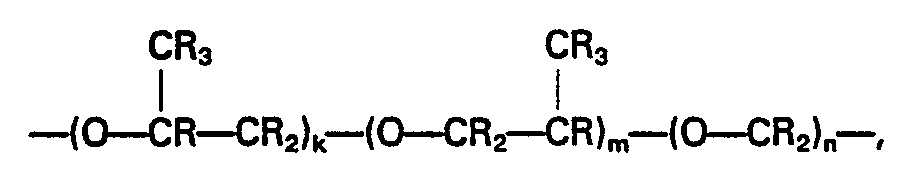

- (c) at least one member selected from a cyanide, a,a'-dipyridyl, or 1,10-phenanthroline or a derivative thereof, the plating solution haying an alkaline pH, the concentration of cyanide being from 2 to 200 mg/l or the concentration of a,a'-dipyridyl, 1,10-phenanthroline or a derivative thereof being at least 5 mg/l.
- The fluoropolyether used in the present invention has a backbone represented by the general formula:


- The fluoropolyether used in this invention preferably has a molecular weight (a number average molecular weight) in the range of 500 to 50,000.
- It is desirable in this invention to use at least one of those fluoropolyethers which are represented by the general formula:


- Such fluoropolyethers are commercially available, such as Fomblin Y@ and Fomblin Z@ manufactured by Montefluos S.p.A. (Italy).
- Fomblin Y has the following chemical structure:

- Fomblin Z has the following chemical structure:

- These commercial fluoropolyethers range in number average molecular weight from about 1,000 to 20,000, and any of these commercial products can be used in this invention.
- The solubility of fluoropolyethers in the plating solution is very low. In this invention, it suffices to add a fluoropolyether in a small effective amount, for example 0.01 mg/I or greater, preferably not exceeding 50 mg/I. Excess addition gives no adverse effect to the elongation of the copper deposit. When this compound is added in an excess amount, it merely undergoes a phase separation from the plating solution and is dispersed in the manner of oil. Thus, when the compound is added in an excess amount, the concentration in the plating solution is self controlled by the solubility of the compound. Two or more different types of fluoropolyether can be used in admixture. A part of the fluorine atoms in the fluoropolyether may be substituted with one or more hydrogen and/or chlorine atoms.
- As the cyanide, there can be used metal cyanides such as sodium cyanide (NaCN), potassium cyanide (KCN), nickel cyanide (NiCN), cobalt cyanide (Co(CN)2), etc.; cyano-complex compounds such as sodium ferrocyanide (Na4(Fe(CN)6)), potassium ferrocyanide (K4(Fe(CN)6)), sodium ferricyanide (Na3(Fe(CN)6)), potassium ferricyanide (K3(Fe(CN)e)), sodium nitroprusside (Na2Fe(CN)s(NO)), etc.; and organic cyanides such as glycolonitrile (HOCH2CN), aminoacetonitrile (NH2CH2CN), etc. The concentration of the cyanide is in the range of 2 to 200 mg/l. When the cyanide concentration is less than 2 mg/l or exceeds 200 mg/l, no deposited film with a satisfactorily high elongation can be obtained. The more preferred range of cyanide concentration is 5 to 80 mg/I and the most preferred range is 10 to 50 mg/l.
- The concentration of a,a'-dipyridyl is at least 5 mg/I and preferably not more than 300 mg/l. When it is below 5 mg/I, there can be obtained no deposited film with a satisfactorily high elongation, and when said concentration exceeds 300 mg/l, the depositing rate is reduced. The a,a'-dipyridyl concentration is more preferably 10 to 150 mg/I and most preferably 15 to 60 mg/l.
- As 1,10-phenanthroline or derivatives thereof, there can be used, for example, 1,10-phenanthroline, 4,7-diphenyl-1,10-phenanthroline and 2,9-dimethyl-1,10-phenanthroline. The concentration of such 1,10-phenanthrolines is at least 5 mg/l and preferably not more than 300 mg/I. If the concentration is less than 5 mg/l, it is impossible to obtain a deposited film with a sufficiently high elongation, and if said concentration exceeds 300 mg/I, the depositing rate is reduced. The more preferred range of 1,10 phenanthroline concentration is 10 to 150 mg/I and the most preferred range is 15 to 60 mg/l.
- The cupric ions are supplied by an organic or inorganic cupric salt such as cupric sulfate, cupric nitrate, cupric chloride, cupric bromide, cupric acetate and the like. Such cupric ions preferably exist in a concentration of 0.004 to 0.2 mol/I.
- The complexing agent for these cupric ions is a compound which forms with cupric ions a complex soluble in aqueous alkali solutions. Typical examples of such a complexing agent are ethylenediaminetetraacetic acid and its sodium salt, Rochelle salts, N,N,N',N'-tetrakis-(2-hydroxypropyl)-ethylenediamine, triethanolamine, ethylenenitrilotetraethanol and the like. The preferred concentration of the complexing agent in the plating solution is 0.004 to 1 mol/I.
- As the reducing agent, formaldehyde or paraformaldehyde can be used in an amount of preferably 0.01 to 0.25 mol/I.
- As the pH adjuster, alkali hydroxides such as sodium hydroxide, potassium hydroxide and the like can be used. Such pH adjuster is preferably used in an amount necessary for adjusting the pH of the solution to 11.0 to 13.5.
- The fundamental composition of the electroless copper plating solution of this invention preferably comprises 5 to 15 g/l of cupric sulfate, 15 to 60 g/I of ethylenediaminetetraacetic acid as a complexing agent and 2 to 20 mill of a 37% aqueous formaldehyde solution as a reducing agent, and it is preferred that the solution be adjusted to a pH of 11.6 to 13.0 and used at a temperature of 60 to 80°C.
- As described above, the electroless plating solution of this invention is capable of providing a deposited film with a high elongation and can be advantageously used for forming circuits on a substrate in the manufacture of printed wiring boards according principally to the full additive or semi-additive process.
- Stainless steel plates having smooth polished surfaces had their surfaces degreased and applied with Pd serving as a reaction initiator (catalyst) and then were subjected to electroless copper plating at 70°C by using the plating solutions having the compositions shown in Table 1 to obtain the deposited copper films.
- The deposited films formed on said stainless steel plates were peeled off from the substrate surfaces and cut to pieces measuring 10 mm width and 80 mm long, and their film properties were measured by using a tensile tester (Tensilon/UTM-1-5000 BW, manufactured by Toyo Baldwing Co., Ltd. (Japan)) at a crosshead speed of 1 mm/min and a gauge length of 15 mm. The results are shown in Table 2.


Claims (4)


Applications Claiming Priority (2)
| Application Number | Priority Date | Filing Date | Title |
|---|---|---|---|
| JP142686/83 | 1983-08-04 | ||
| JP58142686A JPS6033358A (en) | 1983-08-04 | 1983-08-04 | Electroless copper plating liquid |
Publications (2)
| Publication Number | Publication Date |
|---|---|
| EP0133800A1 EP0133800A1 (en) | 1985-03-06 |
| EP0133800B1 true EP0133800B1 (en) | 1987-11-04 |
Family
ID=15321163
Family Applications (1)
| Application Number | Title | Priority Date | Filing Date |
|---|---|---|---|
| EP84305269A Expired EP0133800B1 (en) | 1983-08-04 | 1984-08-02 | Electroless copper plating solution |
Country Status (6)
| Country | Link |
|---|---|
| US (1) | US4557762A (en) |
| EP (1) | EP0133800B1 (en) |
| JP (1) | JPS6033358A (en) |
| KR (1) | KR890004582B1 (en) |
| DE (1) | DE3467187D1 (en) |
| SG (1) | SG20788G (en) |
Cited By (1)
| Publication number | Priority date | Publication date | Assignee | Title |
|---|---|---|---|---|
| WO2003098681A1 (en) * | 2002-05-16 | 2003-11-27 | National University Of Singapore | Wafer level electroless copper metallization and bumping process, and plating solutions for semiconductor wafer and microchip |
Families Citing this family (15)
| Publication number | Priority date | Publication date | Assignee | Title |
|---|---|---|---|---|
| JPS6070183A (en) * | 1983-09-28 | 1985-04-20 | C Uyemura & Co Ltd | Chemical copper plating method |
| JPS60215005A (en) * | 1984-04-10 | 1985-10-28 | Nippon Sanmou Senshoku Kk | Electroconductive material |
| JPS6237152A (en) * | 1985-08-12 | 1987-02-18 | 松下電工株式会社 | Metallic-foil lined laminated board |
| US4695505A (en) * | 1985-10-25 | 1987-09-22 | Shipley Company Inc. | Ductile electroless copper |
| JPH0639714B2 (en) * | 1985-12-23 | 1994-05-25 | 太陽誘電株式会社 | Chemical copper plating solution |
| US4908242A (en) * | 1986-10-31 | 1990-03-13 | Kollmorgen Corporation | Method of consistently producing a copper deposit on a substrate by electroless deposition which deposit is essentially free of fissures |
| JP2794741B2 (en) * | 1989-01-13 | 1998-09-10 | 日立化成工業株式会社 | Electroless copper plating solution |
| JP2775997B2 (en) * | 1990-06-05 | 1998-07-16 | 松下電器産業株式会社 | Video signal gradation correction device and television receiver |
| SE0403042D0 (en) * | 2004-12-14 | 2004-12-14 | Polymer Kompositer I Goeteborg | Improved stabilization and performance of autocatalytic electroless process |
| TW200813255A (en) * | 2006-07-07 | 2008-03-16 | Rohm & Haas Elect Mat | Environmentally friendly electroless copper compositions |
| TWI347373B (en) * | 2006-07-07 | 2011-08-21 | Rohm & Haas Elect Mat | Formaldehyde free electroless copper compositions |
| TWI348499B (en) * | 2006-07-07 | 2011-09-11 | Rohm & Haas Elect Mat | Electroless copper and redox couples |
| EP1876260B1 (en) * | 2006-07-07 | 2018-11-28 | Rohm and Haas Electronic Materials LLC | Improved electroless copper compositions |
| KR20080083790A (en) * | 2007-03-13 | 2008-09-19 | 삼성전자주식회사 | Electroless Copper Plating Solution, Manufacturing Method And Electroless Copper Plating Method |
| CN104914103A (en) * | 2015-06-19 | 2015-09-16 | 金川集团股份有限公司 | Method for detecting sulfate radical content of desulfurization ion liquid |
Family Cites Families (7)
| Publication number | Priority date | Publication date | Assignee | Title |
|---|---|---|---|---|
| US3095309A (en) * | 1960-05-03 | 1963-06-25 | Day Company | Electroless copper plating |
| US3607317A (en) * | 1969-02-04 | 1971-09-21 | Photocircuits Corp | Ductility promoter and stabilizer for electroless copper plating baths |
| JPS5178744A (en) * | 1974-12-30 | 1976-07-08 | Hitachi Ltd | MUDENKAIDOMETSUKIEKI |
| JPS5627594B2 (en) * | 1975-03-14 | 1981-06-25 | ||
| US4059451A (en) * | 1976-07-12 | 1977-11-22 | Matsushita Electric Industrial Co., Ltd. | Electroless copper plating solution |
| DE2632920C3 (en) * | 1976-07-19 | 1979-04-19 | Matsushita Electric Industrial Co., Ltd., Kadoma, Osaka (Japan) | Electroless copper plating solution |
| US4548644A (en) * | 1982-09-28 | 1985-10-22 | Hitachi Chemical Company, Ltd. | Electroless copper deposition solution |
-
1983
- 1983-08-04 JP JP58142686A patent/JPS6033358A/en active Granted
-
1984
- 1984-07-30 US US06/635,403 patent/US4557762A/en not_active Expired - Lifetime
- 1984-08-02 EP EP84305269A patent/EP0133800B1/en not_active Expired
- 1984-08-02 KR KR1019840004619A patent/KR890004582B1/en not_active Expired
- 1984-08-02 DE DE8484305269T patent/DE3467187D1/en not_active Expired
-
1988
- 1988-03-28 SG SG207/88A patent/SG20788G/en unknown
Cited By (1)
| Publication number | Priority date | Publication date | Assignee | Title |
|---|---|---|---|---|
| WO2003098681A1 (en) * | 2002-05-16 | 2003-11-27 | National University Of Singapore | Wafer level electroless copper metallization and bumping process, and plating solutions for semiconductor wafer and microchip |
Also Published As
| Publication number | Publication date |
|---|---|
| JPS6033358A (en) | 1985-02-20 |
| US4557762A (en) | 1985-12-10 |
| JPH0429740B2 (en) | 1992-05-19 |
| KR850001933A (en) | 1985-04-10 |
| KR890004582B1 (en) | 1989-11-16 |
| DE3467187D1 (en) | 1987-12-10 |
| EP0133800A1 (en) | 1985-03-06 |
| SG20788G (en) | 1988-07-08 |
Similar Documents
| Publication | Publication Date | Title |
|---|---|---|
| EP0133800B1 (en) | Electroless copper plating solution | |
| US4265943A (en) | Method and composition for continuous electroless copper deposition using a hypophosphite reducing agent in the presence of cobalt or nickel ions | |
| US4099974A (en) | Electroless copper solution | |
| US4209331A (en) | Electroless copper composition solution using a hypophosphite reducing agent | |
| EP0526334B1 (en) | Electroless palladium plating composition | |
| US4279948A (en) | Electroless copper deposition solution using a hypophosphite reducing agent | |
| US4684550A (en) | Electroless copper plating and bath therefor | |
| EP0107087B1 (en) | Electroless copper deposition solution | |
| KR910001588B1 (en) | Chemical Copper Plating Solution and Chemical Copper Plating Method | |
| US5039338A (en) | Electroless copper plating solution and process for formation of copper film | |
| US4143186A (en) | Process for electroless copper deposition from an acidic bath | |
| EP0039757B1 (en) | Chemical copper-plating bath | |
| US5965211A (en) | Electroless copper plating solution and process for formation of copper film | |
| EP0378407A1 (en) | Electroless copper plating solution | |
| US4818286A (en) | Electroless copper plating bath | |
| US3468676A (en) | Electroless gold plating | |
| US3754940A (en) | Electroless plating solutions containing sulfamic acid and salts thereof | |
| JPH02294487A (en) | Tetraaza-ligand system as complex formation agent for nonelectrolytic deposition of cop- per | |
| US3748166A (en) | Electroless plating process employing solutions stabilized with sulfamic acid and salts thereof | |
| JP3937373B2 (en) | Self-catalyzed electroless silver plating solution | |
| JPS61227176A (en) | Electroless copper plating solution | |
| JPS6259180B2 (en) | ||
| US20070175358A1 (en) | Electroless gold plating solution | |
| JPH0684544B2 (en) | Electroless copper plating solution | |
| JPS5856031B2 (en) | Chemical copper plating liquid |
Legal Events
| Date | Code | Title | Description |
|---|---|---|---|
| PUAI | Public reference made under article 153(3) epc to a published international application that has entered the european phase |
Free format text: ORIGINAL CODE: 0009012 |
|
| AK | Designated contracting states |
Designated state(s): DE FR GB IT |
|
| 17P | Request for examination filed |
Effective date: 19850410 |
|
| 17Q | First examination report despatched |
Effective date: 19860324 |
|
| GRAA | (expected) grant |
Free format text: ORIGINAL CODE: 0009210 |
|
| AK | Designated contracting states |
Kind code of ref document: B1 Designated state(s): DE FR GB IT |
|
| ITF | It: translation for a ep patent filed | ||
| REF | Corresponds to: |
Ref document number: 3467187 Country of ref document: DE Date of ref document: 19871210 |
|
| ET | Fr: translation filed | ||
| PLBE | No opposition filed within time limit |
Free format text: ORIGINAL CODE: 0009261 |
|
| STAA | Information on the status of an ep patent application or granted ep patent |
Free format text: STATUS: NO OPPOSITION FILED WITHIN TIME LIMIT |
|
| 26N | No opposition filed | ||
| ITTA | It: last paid annual fee | ||
| PGFP | Annual fee paid to national office [announced via postgrant information from national office to epo] |
Ref country code: GB Payment date: 20000802 Year of fee payment: 17 |
|
| PGFP | Annual fee paid to national office [announced via postgrant information from national office to epo] |
Ref country code: FR Payment date: 20000811 Year of fee payment: 17 |
|
| PGFP | Annual fee paid to national office [announced via postgrant information from national office to epo] |
Ref country code: DE Payment date: 20010723 Year of fee payment: 18 |
|
| PG25 | Lapsed in a contracting state [announced via postgrant information from national office to epo] |
Ref country code: GB Free format text: LAPSE BECAUSE OF NON-PAYMENT OF DUE FEES Effective date: 20010802 |
|
| GBPC | Gb: european patent ceased through non-payment of renewal fee |
Effective date: 20010802 |
|
| PG25 | Lapsed in a contracting state [announced via postgrant information from national office to epo] |
Ref country code: FR Free format text: LAPSE BECAUSE OF NON-PAYMENT OF DUE FEES Effective date: 20020430 |
|
| REG | Reference to a national code |
Ref country code: FR Ref legal event code: ST |
|
| PG25 | Lapsed in a contracting state [announced via postgrant information from national office to epo] |
Ref country code: DE Free format text: LAPSE BECAUSE OF NON-PAYMENT OF DUE FEES Effective date: 20030301 |