EP0086230B1 - Merocyanine-cyanine-merocyanine (mcm) electrically photosensitive colorants - Google Patents
Merocyanine-cyanine-merocyanine (mcm) electrically photosensitive colorants Download PDFInfo
- Publication number
- EP0086230B1 EP0086230B1 EP19820902935 EP82902935A EP0086230B1 EP 0086230 B1 EP0086230 B1 EP 0086230B1 EP 19820902935 EP19820902935 EP 19820902935 EP 82902935 A EP82902935 A EP 82902935A EP 0086230 B1 EP0086230 B1 EP 0086230B1
- Authority
- EP
- European Patent Office
- Prior art keywords
- represent
- different
- same
- alkyl
- taken together
- Prior art date
- Legal status (The legal status is an assumption and is not a legal conclusion. Google has not performed a legal analysis and makes no representation as to the accuracy of the status listed.)
- Expired
Links
- 239000003086 colorant Substances 0.000 title claims abstract description 24
- 239000000463 material Substances 0.000 claims abstract description 88
- 238000003384 imaging method Methods 0.000 claims abstract description 61
- 238000000034 method Methods 0.000 claims abstract description 40
- 125000000217 alkyl group Chemical group 0.000 claims abstract description 36
- 125000000623 heterocyclic group Chemical group 0.000 claims abstract description 24
- 229910052739 hydrogen Inorganic materials 0.000 claims abstract description 18
- 239000001257 hydrogen Substances 0.000 claims abstract description 18
- 125000003118 aryl group Chemical group 0.000 claims abstract description 17
- UFHFLCQGNIYNRP-UHFFFAOYSA-N Hydrogen Chemical compound [H][H] UFHFLCQGNIYNRP-UHFFFAOYSA-N 0.000 claims abstract description 15
- 125000002877 alkyl aryl group Chemical group 0.000 claims abstract description 15
- 125000003710 aryl alkyl group Chemical group 0.000 claims abstract description 15
- 125000002837 carbocyclic group Chemical group 0.000 claims abstract description 15
- 229910052727 yttrium Inorganic materials 0.000 claims abstract description 14
- 125000002947 alkylene group Chemical group 0.000 claims abstract description 11
- NINIDFKCEFEMDL-UHFFFAOYSA-N Sulfur Chemical compound [S] NINIDFKCEFEMDL-UHFFFAOYSA-N 0.000 claims abstract description 7
- QVGXLLKOCUKJST-UHFFFAOYSA-N atomic oxygen Chemical compound [O] QVGXLLKOCUKJST-UHFFFAOYSA-N 0.000 claims abstract description 7
- 229910052799 carbon Inorganic materials 0.000 claims abstract description 7
- 229910052760 oxygen Inorganic materials 0.000 claims abstract description 7
- 239000001301 oxygen Substances 0.000 claims abstract description 7
- 229910052717 sulfur Inorganic materials 0.000 claims abstract description 7
- 239000011593 sulfur Substances 0.000 claims abstract description 7
- BUGBHKTXTAQXES-UHFFFAOYSA-N Selenium Chemical compound [Se] BUGBHKTXTAQXES-UHFFFAOYSA-N 0.000 claims abstract description 5
- 229910052711 selenium Inorganic materials 0.000 claims abstract description 5
- 239000011669 selenium Substances 0.000 claims abstract description 5
- ANRHNWWPFJCPAZ-UHFFFAOYSA-M thionine Chemical compound [Cl-].C1=CC(N)=CC2=[S+]C3=CC(N)=CC=C3N=C21 ANRHNWWPFJCPAZ-UHFFFAOYSA-M 0.000 claims abstract 8
- 150000001875 compounds Chemical class 0.000 claims description 66
- 239000002245 particle Substances 0.000 claims description 34
- 239000007788 liquid Substances 0.000 claims description 31
- 230000005684 electric field Effects 0.000 claims description 20
- JUJWROOIHBZHMG-UHFFFAOYSA-N Pyridine Chemical compound C1=CC=NC=C1 JUJWROOIHBZHMG-UHFFFAOYSA-N 0.000 claims description 14
- 125000004429 atom Chemical group 0.000 claims description 14
- 230000005670 electromagnetic radiation Effects 0.000 claims description 11
- SMWDFEZZVXVKRB-UHFFFAOYSA-N Quinoline Chemical compound N1=CC=CC2=CC=CC=C21 SMWDFEZZVXVKRB-UHFFFAOYSA-N 0.000 claims description 10
- 239000003795 chemical substances by application Substances 0.000 claims description 10
- RAXXELZNTBOGNW-UHFFFAOYSA-N imidazole Natural products C1=CNC=N1 RAXXELZNTBOGNW-UHFFFAOYSA-N 0.000 claims description 9
- FZWLAAWBMGSTSO-UHFFFAOYSA-N Thiazole Chemical compound C1=CSC=N1 FZWLAAWBMGSTSO-UHFFFAOYSA-N 0.000 claims description 7
- SIKJAQJRHWYJAI-UHFFFAOYSA-N Indole Chemical compound C1=CC=C2NC=CC2=C1 SIKJAQJRHWYJAI-UHFFFAOYSA-N 0.000 claims description 6
- WTKZEGDFNFYCGP-UHFFFAOYSA-N Pyrazole Chemical compound C=1C=NNC=1 WTKZEGDFNFYCGP-UHFFFAOYSA-N 0.000 claims description 6
- KAESVJOAVNADME-UHFFFAOYSA-N Pyrrole Chemical compound C=1C=CNC=1 KAESVJOAVNADME-UHFFFAOYSA-N 0.000 claims description 6
- UMJSCPRVCHMLSP-UHFFFAOYSA-N pyridine Natural products COC1=CC=CN=C1 UMJSCPRVCHMLSP-UHFFFAOYSA-N 0.000 claims description 6
- 125000004435 hydrogen atom Chemical group [H]* 0.000 claims description 4
- RKJUIXBNRJVNHR-UHFFFAOYSA-N indolenine Natural products C1=CC=C2CC=NC2=C1 RKJUIXBNRJVNHR-UHFFFAOYSA-N 0.000 claims description 4
- CBDKQYKMCICBOF-UHFFFAOYSA-N thiazoline Chemical compound C1CN=CS1 CBDKQYKMCICBOF-UHFFFAOYSA-N 0.000 claims description 4
- ODIRBFFBCSTPTO-UHFFFAOYSA-N 1,3-selenazole Chemical compound C1=C[se]C=N1 ODIRBFFBCSTPTO-UHFFFAOYSA-N 0.000 claims description 3
- MGADZUXDNSDTHW-UHFFFAOYSA-N 2H-pyran Chemical compound C1OC=CC=C1 MGADZUXDNSDTHW-UHFFFAOYSA-N 0.000 claims description 3
- ZCQWOFVYLHDMMC-UHFFFAOYSA-N Oxazole Chemical compound C1=COC=N1 ZCQWOFVYLHDMMC-UHFFFAOYSA-N 0.000 claims description 3
- PZOUSPYUWWUPPK-UHFFFAOYSA-N indole Natural products CC1=CC=CC2=C1C=CN2 PZOUSPYUWWUPPK-UHFFFAOYSA-N 0.000 claims description 3
- 238000010438 heat treatment Methods 0.000 claims 1
- 150000002475 indoles Chemical class 0.000 claims 1
- 230000008569 process Effects 0.000 abstract description 27
- 230000007935 neutral effect Effects 0.000 abstract description 11
- 206010034972 Photosensitivity reaction Diseases 0.000 abstract description 5
- 230000036211 photosensitivity Effects 0.000 abstract description 5
- -1 hydroxy, sulfo, carboxy Chemical group 0.000 description 17
- 230000003213 activating effect Effects 0.000 description 14
- 230000005855 radiation Effects 0.000 description 14
- 239000006185 dispersion Substances 0.000 description 10
- LFQSCWFLJHTTHZ-UHFFFAOYSA-N Ethanol Chemical compound CCO LFQSCWFLJHTTHZ-UHFFFAOYSA-N 0.000 description 9
- 239000000203 mixture Substances 0.000 description 9
- 229920000642 polymer Polymers 0.000 description 9
- 0 C*(C)NN(C)*N(C)C Chemical compound C*(C)NN(C)*N(C)C 0.000 description 8
- 230000015572 biosynthetic process Effects 0.000 description 8
- QGKMIGUHVLGJBR-UHFFFAOYSA-M (4z)-1-(3-methylbutyl)-4-[[1-(3-methylbutyl)quinolin-1-ium-4-yl]methylidene]quinoline;iodide Chemical group [I-].C12=CC=CC=C2N(CCC(C)C)C=CC1=CC1=CC=[N+](CCC(C)C)C2=CC=CC=C12 QGKMIGUHVLGJBR-UHFFFAOYSA-M 0.000 description 6
- ZMANZCXQSJIPKH-UHFFFAOYSA-N Triethylamine Chemical compound CCN(CC)CC ZMANZCXQSJIPKH-UHFFFAOYSA-N 0.000 description 6
- 239000011248 coating agent Substances 0.000 description 6
- 238000000576 coating method Methods 0.000 description 6
- 238000003786 synthesis reaction Methods 0.000 description 6
- 239000011230 binding agent Substances 0.000 description 5
- 229920001577 copolymer Polymers 0.000 description 5
- 239000000975 dye Substances 0.000 description 5
- 239000003921 oil Substances 0.000 description 5
- 239000002904 solvent Substances 0.000 description 5
- 238000003756 stirring Methods 0.000 description 5
- KDYVCOSVYOSHOL-UHFFFAOYSA-N 7-methylquinoline Chemical compound C1=CC=NC2=CC(C)=CC=C21 KDYVCOSVYOSHOL-UHFFFAOYSA-N 0.000 description 4
- JRLTTZUODKEYDH-UHFFFAOYSA-N 8-methylquinoline Chemical compound C1=CN=C2C(C)=CC=CC2=C1 JRLTTZUODKEYDH-UHFFFAOYSA-N 0.000 description 4
- CSCPPACGZOOCGX-UHFFFAOYSA-N Acetone Chemical compound CC(C)=O CSCPPACGZOOCGX-UHFFFAOYSA-N 0.000 description 4
- OFOBLEOULBTSOW-UHFFFAOYSA-N Malonic acid Chemical compound OC(=O)CC(O)=O OFOBLEOULBTSOW-UHFFFAOYSA-N 0.000 description 4
- 150000004945 aromatic hydrocarbons Chemical class 0.000 description 4
- 239000012876 carrier material Substances 0.000 description 4
- 229910052744 lithium Inorganic materials 0.000 description 4
- DZVCFNFOPIZQKX-LTHRDKTGSA-M merocyanine Chemical group [Na+].O=C1N(CCCC)C(=O)N(CCCC)C(=O)C1=C\C=C\C=C/1N(CCCS([O-])(=O)=O)C2=CC=CC=C2O\1 DZVCFNFOPIZQKX-LTHRDKTGSA-M 0.000 description 4
- 230000005012 migration Effects 0.000 description 4
- 238000013508 migration Methods 0.000 description 4
- 125000001424 substituent group Chemical group 0.000 description 4
- 239000000725 suspension Substances 0.000 description 4
- WFDIJRYMOXRFFG-UHFFFAOYSA-N Acetic anhydride Chemical compound CC(=O)OC(C)=O WFDIJRYMOXRFFG-UHFFFAOYSA-N 0.000 description 3
- 229940126062 Compound A Drugs 0.000 description 3
- NLDMNSXOCDLTTB-UHFFFAOYSA-N Heterophylliin A Natural products O1C2COC(=O)C3=CC(O)=C(O)C(O)=C3C3=C(O)C(O)=C(O)C=C3C(=O)OC2C(OC(=O)C=2C=C(O)C(O)=C(O)C=2)C(O)C1OC(=O)C1=CC(O)=C(O)C(O)=C1 NLDMNSXOCDLTTB-UHFFFAOYSA-N 0.000 description 3
- OKKJLVBELUTLKV-UHFFFAOYSA-N Methanol Chemical compound OC OKKJLVBELUTLKV-UHFFFAOYSA-N 0.000 description 3
- 230000009471 action Effects 0.000 description 3
- IOJUPLGTWVMSFF-UHFFFAOYSA-N benzothiazole Chemical class C1=CC=C2SC=NC2=C1 IOJUPLGTWVMSFF-UHFFFAOYSA-N 0.000 description 3
- 230000008878 coupling Effects 0.000 description 3
- 238000010168 coupling process Methods 0.000 description 3
- 238000005859 coupling reaction Methods 0.000 description 3
- 229920001971 elastomer Polymers 0.000 description 3
- 235000019441 ethanol Nutrition 0.000 description 3
- 125000000219 ethylidene group Chemical group [H]C(=[*])C([H])([H])[H] 0.000 description 3
- 229920001296 polysiloxane Polymers 0.000 description 3
- 239000007787 solid Substances 0.000 description 3
- 239000011550 stock solution Substances 0.000 description 3
- AIGNCQCMONAWOL-UHFFFAOYSA-N 1,3-benzoselenazole Chemical class C1=CC=C2[se]C=NC2=C1 AIGNCQCMONAWOL-UHFFFAOYSA-N 0.000 description 2
- ITQTTZVARXURQS-UHFFFAOYSA-N 3-methylpyridine Chemical compound CC1=CC=CN=C1 ITQTTZVARXURQS-UHFFFAOYSA-N 0.000 description 2
- DTBDAFLSBDGPEA-UHFFFAOYSA-N 3-methylquinoline Chemical compound C1=CC=CC2=CC(C)=CN=C21 DTBDAFLSBDGPEA-UHFFFAOYSA-N 0.000 description 2
- QMHIMXFNBOYPND-UHFFFAOYSA-N 4-methylthiazole Chemical compound CC1=CSC=N1 QMHIMXFNBOYPND-UHFFFAOYSA-N 0.000 description 2
- LMYVCXSKCQSIEQ-UHFFFAOYSA-N 5-methylquinoline Chemical compound C1=CC=C2C(C)=CC=CC2=N1 LMYVCXSKCQSIEQ-UHFFFAOYSA-N 0.000 description 2
- ZLLOWHFKKIOINR-UHFFFAOYSA-N 5-phenyl-1,3-thiazole Chemical compound S1C=NC=C1C1=CC=CC=C1 ZLLOWHFKKIOINR-UHFFFAOYSA-N 0.000 description 2
- HFDLDPJYCIEXJP-UHFFFAOYSA-N 6-methoxyquinoline Chemical compound N1=CC=CC2=CC(OC)=CC=C21 HFDLDPJYCIEXJP-UHFFFAOYSA-N 0.000 description 2
- PLXMOAALOJOTIY-FPTXNFDTSA-N Aesculin Natural products OC[C@@H]1[C@@H](O)[C@H](O)[C@@H](O)[C@H](O)[C@H]1Oc2cc3C=CC(=O)Oc3cc2O PLXMOAALOJOTIY-FPTXNFDTSA-N 0.000 description 2
- IJGRMHOSHXDMSA-UHFFFAOYSA-N Atomic nitrogen Chemical compound N#N IJGRMHOSHXDMSA-UHFFFAOYSA-N 0.000 description 2
- CURLTUGMZLYLDI-UHFFFAOYSA-N Carbon dioxide Chemical compound O=C=O CURLTUGMZLYLDI-UHFFFAOYSA-N 0.000 description 2
- PXHVJJICTQNCMI-UHFFFAOYSA-N Nickel Chemical compound [Ni] PXHVJJICTQNCMI-UHFFFAOYSA-N 0.000 description 2
- 238000010521 absorption reaction Methods 0.000 description 2
- 229940111121 antirheumatic drug quinolines Drugs 0.000 description 2
- AMTXUWGBSGZXCJ-UHFFFAOYSA-N benzo[e][1,3]benzoselenazole Chemical class C1=CC=C2C(N=C[se]3)=C3C=CC2=C1 AMTXUWGBSGZXCJ-UHFFFAOYSA-N 0.000 description 2
- KXNQKOAQSGJCQU-UHFFFAOYSA-N benzo[e][1,3]benzothiazole Chemical class C1=CC=C2C(N=CS3)=C3C=CC2=C1 KXNQKOAQSGJCQU-UHFFFAOYSA-N 0.000 description 2
- WMUIZUWOEIQJEH-UHFFFAOYSA-N benzo[e][1,3]benzoxazole Chemical class C1=CC=C2C(N=CO3)=C3C=CC2=C1 WMUIZUWOEIQJEH-UHFFFAOYSA-N 0.000 description 2
- 238000009835 boiling Methods 0.000 description 2
- 238000001816 cooling Methods 0.000 description 2
- DIOQZVSQGTUSAI-UHFFFAOYSA-N decane Chemical compound CCCCCCCCCC DIOQZVSQGTUSAI-UHFFFAOYSA-N 0.000 description 2
- 238000011161 development Methods 0.000 description 2
- 239000000706 filtrate Substances 0.000 description 2
- 229930195733 hydrocarbon Natural products 0.000 description 2
- 150000002430 hydrocarbons Chemical class 0.000 description 2
- XMBWDFGMSWQBCA-UHFFFAOYSA-N hydrogen iodide Chemical compound I XMBWDFGMSWQBCA-UHFFFAOYSA-N 0.000 description 2
- 239000011810 insulating material Substances 0.000 description 2
- 230000003993 interaction Effects 0.000 description 2
- 229910052751 metal Inorganic materials 0.000 description 2
- 239000002184 metal Substances 0.000 description 2
- 125000002496 methyl group Chemical group [H]C([H])([H])* 0.000 description 2
- 239000000178 monomer Substances 0.000 description 2
- 125000001997 phenyl group Chemical group [H]C1=C([H])C([H])=C(*)C([H])=C1[H] 0.000 description 2
- 239000000047 product Substances 0.000 description 2
- 150000003839 salts Chemical class 0.000 description 2
- 239000000243 solution Substances 0.000 description 2
- 230000003595 spectral effect Effects 0.000 description 2
- 238000001228 spectrum Methods 0.000 description 2
- 239000000758 substrate Substances 0.000 description 2
- VZGDMQKNWNREIO-UHFFFAOYSA-N tetrachloromethane Chemical compound ClC(Cl)(Cl)Cl VZGDMQKNWNREIO-UHFFFAOYSA-N 0.000 description 2
- JOXIMZWYDAKGHI-UHFFFAOYSA-N toluene-4-sulfonic acid Chemical compound CC1=CC=C(S(O)(=O)=O)C=C1 JOXIMZWYDAKGHI-UHFFFAOYSA-N 0.000 description 2
- 230000000007 visual effect Effects 0.000 description 2
- XLYOFNOQVPJJNP-UHFFFAOYSA-N water Substances O XLYOFNOQVPJJNP-UHFFFAOYSA-N 0.000 description 2
- ATAQLIDYIFWHFW-BQYQJAHWSA-N (e)-1,3,3-triethoxyprop-1-ene Chemical compound CCO\C=C\C(OCC)OCC ATAQLIDYIFWHFW-BQYQJAHWSA-N 0.000 description 1
- NDQXKKFRNOPRDW-UHFFFAOYSA-N 1,1,1-triethoxyethane Chemical compound CCOC(C)(OCC)OCC NDQXKKFRNOPRDW-UHFFFAOYSA-N 0.000 description 1
- FGWYWKIOMUZSQF-UHFFFAOYSA-N 1,1,1-triethoxypropane Chemical compound CCOC(CC)(OCC)OCC FGWYWKIOMUZSQF-UHFFFAOYSA-N 0.000 description 1
- MAQRAAGESVARSP-UHFFFAOYSA-N 1,3,4-triphenyl-2h-imidazole Chemical compound C1N(C=2C=CC=CC=2)C=C(C=2C=CC=CC=2)N1C1=CC=CC=C1 MAQRAAGESVARSP-UHFFFAOYSA-N 0.000 description 1
- UUJOCRCAIOAPFK-UHFFFAOYSA-N 1,3-benzoselenazol-5-ol Chemical compound OC1=CC=C2[se]C=NC2=C1 UUJOCRCAIOAPFK-UHFFFAOYSA-N 0.000 description 1
- UJZYHMZRXGNDFB-UHFFFAOYSA-N 1,3-benzothiazol-5-amine Chemical compound NC1=CC=C2SC=NC2=C1 UJZYHMZRXGNDFB-UHFFFAOYSA-N 0.000 description 1
- BREUOIWLJRZAFF-UHFFFAOYSA-N 1,3-benzothiazol-5-ol Chemical compound OC1=CC=C2SC=NC2=C1 BREUOIWLJRZAFF-UHFFFAOYSA-N 0.000 description 1
- ORIIXCOYEOIFSN-UHFFFAOYSA-N 1,3-benzothiazol-6-ol Chemical compound OC1=CC=C2N=CSC2=C1 ORIIXCOYEOIFSN-UHFFFAOYSA-N 0.000 description 1
- UPPYOQWUJKAFSG-UHFFFAOYSA-N 1,3-benzoxazol-5-ol Chemical compound OC1=CC=C2OC=NC2=C1 UPPYOQWUJKAFSG-UHFFFAOYSA-N 0.000 description 1
- SAHAKBXWZLDNAA-UHFFFAOYSA-N 1,3-benzoxazol-6-ol Chemical compound OC1=CC=C2N=COC2=C1 SAHAKBXWZLDNAA-UHFFFAOYSA-N 0.000 description 1
- BCMCBBGGLRIHSE-UHFFFAOYSA-N 1,3-benzoxazole Chemical compound C1=CC=C2OC=NC2=C1 BCMCBBGGLRIHSE-UHFFFAOYSA-N 0.000 description 1
- 150000000183 1,3-benzoxazoles Chemical class 0.000 description 1
- CYHVDCMBRUBZSS-UHFFFAOYSA-N 1,3-diethyl-2h-benzimidazole Chemical compound C1=CC=C2N(CC)CN(CC)C2=C1 CYHVDCMBRUBZSS-UHFFFAOYSA-N 0.000 description 1
- RXSNPLLPBHYDJG-UHFFFAOYSA-N 1,3-diethyl-2h-benzo[f]benzimidazole Chemical compound C1=CC=C2C=C3N(CC)CN(CC)C3=CC2=C1 RXSNPLLPBHYDJG-UHFFFAOYSA-N 0.000 description 1
- WAJHVHBKSGDHIL-UHFFFAOYSA-N 1,3-diethyl-2h-imidazo[4,5-b]quinoline Chemical compound C1=CC=C2C=C3N(CC)CN(CC)C3=NC2=C1 WAJHVHBKSGDHIL-UHFFFAOYSA-N 0.000 description 1
- ZUKQNBWPNVUBLJ-UHFFFAOYSA-N 1,3-diethyl-5,6-dimethyl-2h-imidazo[4,5-b]pyridine Chemical compound CC1=C(C)C=C2N(CC)CN(CC)C2=N1 ZUKQNBWPNVUBLJ-UHFFFAOYSA-N 0.000 description 1
- MNVJWSJDEPFMJF-UHFFFAOYSA-N 1,4-diphenylimidazole Chemical compound C1=NC(C=2C=CC=CC=2)=CN1C1=CC=CC=C1 MNVJWSJDEPFMJF-UHFFFAOYSA-N 0.000 description 1
- WHXDRZOCHPMFIX-UHFFFAOYSA-M 1-ethyl-2,3,3-trimethylindol-1-ium;iodide Chemical compound [I-].C1=CC=C2[N+](CC)=C(C)C(C)(C)C2=C1 WHXDRZOCHPMFIX-UHFFFAOYSA-M 0.000 description 1
- HOUFOJVBRDZQAX-UHFFFAOYSA-N 1-ethyl-3-phenyl-2h-benzimidazole Chemical compound C12=CC=CC=C2N(CC)CN1C1=CC=CC=C1 HOUFOJVBRDZQAX-UHFFFAOYSA-N 0.000 description 1
- BIKJCXCEQSBFMT-UHFFFAOYSA-N 1-ethyl-3-phenyl-2h-imidazo[4,5-b]quinoline Chemical compound C12=NC3=CC=CC=C3C=C2N(CC)CN1C1=CC=CC=C1 BIKJCXCEQSBFMT-UHFFFAOYSA-N 0.000 description 1
- HIYWOHBEPVGIQN-UHFFFAOYSA-N 1h-benzo[g]indole Chemical class C1=CC=CC2=C(NC=C3)C3=CC=C21 HIYWOHBEPVGIQN-UHFFFAOYSA-N 0.000 description 1
- GIMXBORKCIXLDB-UHFFFAOYSA-N 1h-imidazo[4,5-b]quinoline Chemical class C1=CC=C2NC3=NC=NC3=CC2=C1 GIMXBORKCIXLDB-UHFFFAOYSA-N 0.000 description 1
- QRINVLDPXAXANH-UHFFFAOYSA-N 2,3,3a,4-tetrahydro-1,3-benzoselenazole Chemical compound C1C=CC=C2[Se]CNC21 QRINVLDPXAXANH-UHFFFAOYSA-N 0.000 description 1
- ALUQMCBDQKDRAK-UHFFFAOYSA-N 2,3,3a,4-tetrahydro-1,3-benzothiazole Chemical compound C1C=CC=C2SCNC21 ALUQMCBDQKDRAK-UHFFFAOYSA-N 0.000 description 1
- VHQGURIJMFPBKS-UHFFFAOYSA-N 2,4,7-trinitrofluoren-9-one Chemical compound [O-][N+](=O)C1=CC([N+]([O-])=O)=C2C3=CC=C([N+](=O)[O-])C=C3C(=O)C2=C1 VHQGURIJMFPBKS-UHFFFAOYSA-N 0.000 description 1
- PRAMZQXXPOLCIY-UHFFFAOYSA-N 2-(2-methylprop-2-enoyloxy)ethanesulfonic acid Chemical compound CC(=C)C(=O)OCCS(O)(=O)=O PRAMZQXXPOLCIY-UHFFFAOYSA-N 0.000 description 1
- HIXDQWDOVZUNNA-UHFFFAOYSA-N 2-(3,4-dimethoxyphenyl)-5-hydroxy-7-methoxychromen-4-one Chemical compound C=1C(OC)=CC(O)=C(C(C=2)=O)C=1OC=2C1=CC=C(OC)C(OC)=C1 HIXDQWDOVZUNNA-UHFFFAOYSA-N 0.000 description 1
- ZGFUHKORWBWVHF-UHFFFAOYSA-N 3,3,5-trimethylindole Chemical compound CC1=CC=C2N=CC(C)(C)C2=C1 ZGFUHKORWBWVHF-UHFFFAOYSA-N 0.000 description 1
- NKMWTEMWPMFMII-UHFFFAOYSA-N 3,3,7-trimethylindole Chemical compound CC1=CC=CC2=C1N=CC2(C)C NKMWTEMWPMFMII-UHFFFAOYSA-N 0.000 description 1
- PEQACLUXOXCYBB-UHFFFAOYSA-N 3,3-diethylindole Chemical compound C1=CC=C2C(CC)(CC)C=NC2=C1 PEQACLUXOXCYBB-UHFFFAOYSA-N 0.000 description 1
- GTZVMEHLIMDKTK-UHFFFAOYSA-N 3,3-dimethylindole Chemical compound C1=CC=C2C(C)(C)C=NC2=C1 GTZVMEHLIMDKTK-UHFFFAOYSA-N 0.000 description 1
- NKSZCPBUWGZONP-UHFFFAOYSA-N 3,4-dihydroisoquinoline Chemical compound C1=CC=C2C=NCCC2=C1 NKSZCPBUWGZONP-UHFFFAOYSA-N 0.000 description 1
- ZXILFUKFZCQARJ-UHFFFAOYSA-M 3-ethyl-5-[2-(1-ethyl-3,3-dimethylindol-2-ylidene)ethylidene]-2-methylsulfanyl-1,3-thiazol-3-ium-4-one;4-methylbenzenesulfonate Chemical compound CC1=CC=C(S([O-])(=O)=O)C=C1.CC1(C)C2=CC=CC=C2N(CC)C1=CC=C1SC(SC)=[N+](CC)C1=O ZXILFUKFZCQARJ-UHFFFAOYSA-M 0.000 description 1
- CJEMVWCKSXVKSP-UHFFFAOYSA-N 3-ethyl-5-[2-(1-ethyl-3,3-dimethylindol-2-ylidene)ethylidene]-2-sulfanylidene-1,3-thiazolidin-4-one Chemical compound O=C1N(CC)C(=S)SC1=CC=C1C(C)(C)C2=CC=CC=C2N1CC CJEMVWCKSXVKSP-UHFFFAOYSA-N 0.000 description 1
- YVORRVFKHZLJGZ-UHFFFAOYSA-N 4,5-Dimethyloxazole Chemical compound CC=1N=COC=1C YVORRVFKHZLJGZ-UHFFFAOYSA-N 0.000 description 1
- UWSONZCNXUSTKW-UHFFFAOYSA-N 4,5-Dimethylthiazole Chemical compound CC=1N=CSC=1C UWSONZCNXUSTKW-UHFFFAOYSA-N 0.000 description 1
- ODKHOKLXMBWVOQ-UHFFFAOYSA-N 4,5-diphenyl-1,3-oxazole Chemical compound O1C=NC(C=2C=CC=CC=2)=C1C1=CC=CC=C1 ODKHOKLXMBWVOQ-UHFFFAOYSA-N 0.000 description 1
- BGTVICKPWACXLR-UHFFFAOYSA-N 4,5-diphenyl-1,3-thiazole Chemical compound S1C=NC(C=2C=CC=CC=2)=C1C1=CC=CC=C1 BGTVICKPWACXLR-UHFFFAOYSA-N 0.000 description 1
- NDUHYERSZLRFNL-UHFFFAOYSA-N 4,6-dimethyl-1,3-benzoxazole Chemical compound CC1=CC(C)=C2N=COC2=C1 NDUHYERSZLRFNL-UHFFFAOYSA-N 0.000 description 1
- GAMYYCRTACQSBR-UHFFFAOYSA-N 4-azabenzimidazole Chemical class C1=CC=C2NC=NC2=N1 GAMYYCRTACQSBR-UHFFFAOYSA-N 0.000 description 1
- IFEPGHPDQJOYGG-UHFFFAOYSA-N 4-chloro-1,3-benzothiazole Chemical compound ClC1=CC=CC2=C1N=CS2 IFEPGHPDQJOYGG-UHFFFAOYSA-N 0.000 description 1
- WQJKBLBBLUDZEW-UHFFFAOYSA-N 4-ethoxy-1,3-benzothiazole Chemical compound CCOC1=CC=CC2=C1N=CS2 WQJKBLBBLUDZEW-UHFFFAOYSA-N 0.000 description 1
- GQPBBURQQRLAKF-UHFFFAOYSA-N 4-ethyl-1,3-oxazole Chemical compound CCC1=COC=N1 GQPBBURQQRLAKF-UHFFFAOYSA-N 0.000 description 1
- XQPAPBLJJLIQGV-UHFFFAOYSA-N 4-methoxy-1,3-benzothiazole Chemical compound COC1=CC=CC2=C1N=CS2 XQPAPBLJJLIQGV-UHFFFAOYSA-N 0.000 description 1
- PIUXNZAIHQAHBY-UHFFFAOYSA-N 4-methyl-1,3-benzothiazole Chemical compound CC1=CC=CC2=C1N=CS2 PIUXNZAIHQAHBY-UHFFFAOYSA-N 0.000 description 1
- PUMREIFKTMLCAF-UHFFFAOYSA-N 4-methyl-1,3-oxazole Chemical compound CC1=COC=N1 PUMREIFKTMLCAF-UHFFFAOYSA-N 0.000 description 1
- BJATXNRFAXUVCU-UHFFFAOYSA-N 4-methyl-1,3-selenazole Chemical compound CC1=C[se]C=N1 BJATXNRFAXUVCU-UHFFFAOYSA-N 0.000 description 1
- SRGCYOMCADXFJA-UHFFFAOYSA-N 4-methyl-4,5-dihydro-1,3-thiazole Chemical compound CC1CSC=N1 SRGCYOMCADXFJA-UHFFFAOYSA-N 0.000 description 1
- RILRYAJSOCTFBV-UHFFFAOYSA-N 4-phenyl-1,3-benzothiazole Chemical compound C1=CC=C2SC=NC2=C1C1=CC=CC=C1 RILRYAJSOCTFBV-UHFFFAOYSA-N 0.000 description 1
- NTFMLYSGIKHECT-UHFFFAOYSA-N 4-phenyl-1,3-oxazole Chemical compound O1C=NC(C=2C=CC=CC=2)=C1 NTFMLYSGIKHECT-UHFFFAOYSA-N 0.000 description 1
- MLBGDGWUZBTFHT-UHFFFAOYSA-N 4-phenyl-1,3-selenazole Chemical compound [se]1C=NC(C=2C=CC=CC=2)=C1 MLBGDGWUZBTFHT-UHFFFAOYSA-N 0.000 description 1
- KXCQDIWJQBSUJF-UHFFFAOYSA-N 4-phenyl-1,3-thiazole Chemical compound S1C=NC(C=2C=CC=CC=2)=C1 KXCQDIWJQBSUJF-UHFFFAOYSA-N 0.000 description 1
- YXGBCQGWEUFUID-UHFFFAOYSA-N 4-thiophen-2-yl-1,3-thiazole Chemical compound C1=CSC(C=2N=CSC=2)=C1 YXGBCQGWEUFUID-UHFFFAOYSA-N 0.000 description 1
- UIGOJEZCIMANAK-UHFFFAOYSA-N 5,6-dichloro-1,3-diethyl-2h-benzimidazole Chemical compound ClC1=C(Cl)C=C2N(CC)CN(CC)C2=C1 UIGOJEZCIMANAK-UHFFFAOYSA-N 0.000 description 1
- RWNMLYACWNIEIG-UHFFFAOYSA-N 5,6-dimethyl-1,3-benzoxazole Chemical compound C1=C(C)C(C)=CC2=C1OC=N2 RWNMLYACWNIEIG-UHFFFAOYSA-N 0.000 description 1
- KFDDRUWQFQJGNL-UHFFFAOYSA-N 5-bromo-1,3-benzothiazole Chemical compound BrC1=CC=C2SC=NC2=C1 KFDDRUWQFQJGNL-UHFFFAOYSA-N 0.000 description 1
- DUMYZVKQCMCQHJ-UHFFFAOYSA-N 5-chloro-1,3-benzoselenazole Chemical compound ClC1=CC=C2[se]C=NC2=C1 DUMYZVKQCMCQHJ-UHFFFAOYSA-N 0.000 description 1
- YTSFYTDPSSFCLU-UHFFFAOYSA-N 5-chloro-1,3-benzothiazole Chemical compound ClC1=CC=C2SC=NC2=C1 YTSFYTDPSSFCLU-UHFFFAOYSA-N 0.000 description 1
- VWMQXAYLHOSRKA-UHFFFAOYSA-N 5-chloro-1,3-benzoxazole Chemical compound ClC1=CC=C2OC=NC2=C1 VWMQXAYLHOSRKA-UHFFFAOYSA-N 0.000 description 1
- AGUHDYYTGHVBML-UHFFFAOYSA-N 5-chloro-1,3-diethyl-2h-benzimidazole Chemical compound ClC1=CC=C2N(CC)CN(CC)C2=C1 AGUHDYYTGHVBML-UHFFFAOYSA-N 0.000 description 1
- GWKNDCJHRNOQAR-UHFFFAOYSA-N 5-ethoxy-1,3-benzothiazole Chemical compound CCOC1=CC=C2SC=NC2=C1 GWKNDCJHRNOQAR-UHFFFAOYSA-N 0.000 description 1
- MHWNEQOZIDVGJS-UHFFFAOYSA-N 5-ethoxy-1,3-benzoxazole Chemical compound CCOC1=CC=C2OC=NC2=C1 MHWNEQOZIDVGJS-UHFFFAOYSA-N 0.000 description 1
- CEPRZYJDQRSAOJ-UHFFFAOYSA-N 5-ethoxybenzo[g][1,3]benzothiazole Chemical compound C12=CC=CC=C2C(OCC)=CC2=C1SC=N2 CEPRZYJDQRSAOJ-UHFFFAOYSA-N 0.000 description 1
- GLKZKYSZPVHLDK-UHFFFAOYSA-N 5-iodo-1,3-benzothiazole Chemical compound IC1=CC=C2SC=NC2=C1 GLKZKYSZPVHLDK-UHFFFAOYSA-N 0.000 description 1
- AHIHYPVDBXEDMN-UHFFFAOYSA-N 5-methoxy-1,3-benzoselenazole Chemical compound COC1=CC=C2[se]C=NC2=C1 AHIHYPVDBXEDMN-UHFFFAOYSA-N 0.000 description 1
- PNJKZDLZKILFNF-UHFFFAOYSA-N 5-methoxy-1,3-benzothiazole Chemical compound COC1=CC=C2SC=NC2=C1 PNJKZDLZKILFNF-UHFFFAOYSA-N 0.000 description 1
- IQQKXTVYGHYXFX-UHFFFAOYSA-N 5-methoxy-1,3-benzoxazole Chemical compound COC1=CC=C2OC=NC2=C1 IQQKXTVYGHYXFX-UHFFFAOYSA-N 0.000 description 1
- VGUKLAIGOXRABB-UHFFFAOYSA-N 5-methoxybenzo[g][1,3]benzothiazole Chemical compound C12=CC=CC=C2C(OC)=CC2=C1SC=N2 VGUKLAIGOXRABB-UHFFFAOYSA-N 0.000 description 1
- SEBIXVUYSFOUEL-UHFFFAOYSA-N 5-methyl-1,3-benzothiazole Chemical compound CC1=CC=C2SC=NC2=C1 SEBIXVUYSFOUEL-UHFFFAOYSA-N 0.000 description 1
- UBIAVBGIRDRQLD-UHFFFAOYSA-N 5-methyl-1,3-benzoxazole Chemical compound CC1=CC=C2OC=NC2=C1 UBIAVBGIRDRQLD-UHFFFAOYSA-N 0.000 description 1
- ZYMHCFYHVYGFMS-UHFFFAOYSA-N 5-methyl-1,3-oxazole Chemical compound CC1=CN=CO1 ZYMHCFYHVYGFMS-UHFFFAOYSA-N 0.000 description 1
- RLYUNPNLXMSXAX-UHFFFAOYSA-N 5-methylthiazole Chemical compound CC1=CN=CS1 RLYUNPNLXMSXAX-UHFFFAOYSA-N 0.000 description 1
- AAKPXIJKSNGOCO-UHFFFAOYSA-N 5-phenyl-1,3-benzothiazole Chemical compound C=1C=C2SC=NC2=CC=1C1=CC=CC=C1 AAKPXIJKSNGOCO-UHFFFAOYSA-N 0.000 description 1
- NIFNXGHHDAXUGO-UHFFFAOYSA-N 5-phenyl-1,3-benzoxazole Chemical compound C=1C=C2OC=NC2=CC=1C1=CC=CC=C1 NIFNXGHHDAXUGO-UHFFFAOYSA-N 0.000 description 1
- YPYPBEGIASEWKA-UHFFFAOYSA-N 5-phenyl-1,3-oxazole Chemical compound O1C=NC=C1C1=CC=CC=C1 YPYPBEGIASEWKA-UHFFFAOYSA-N 0.000 description 1
- XHLKOHSAWQPOFO-UHFFFAOYSA-N 5-phenyl-1h-imidazole Chemical compound N1C=NC=C1C1=CC=CC=C1 XHLKOHSAWQPOFO-UHFFFAOYSA-N 0.000 description 1
- YJOUISWKEOXIMC-UHFFFAOYSA-N 6-bromo-1,3-benzothiazole Chemical compound BrC1=CC=C2N=CSC2=C1 YJOUISWKEOXIMC-UHFFFAOYSA-N 0.000 description 1
- JJOOKXUUVWIARB-UHFFFAOYSA-N 6-chloro-1,3-benzoxazole Chemical compound ClC1=CC=C2N=COC2=C1 JJOOKXUUVWIARB-UHFFFAOYSA-N 0.000 description 1
- HZYWIOBVFXOACO-UHFFFAOYSA-N 6-chloro-1,3-diethyl-2h-benzo[f]benzimidazole Chemical compound ClC1=CC=C2C=C3N(CC)CN(CC)C3=CC2=C1 HZYWIOBVFXOACO-UHFFFAOYSA-N 0.000 description 1
- GKJSZXGYFJBYRQ-UHFFFAOYSA-N 6-chloroquinoline Chemical compound N1=CC=CC2=CC(Cl)=CC=C21 GKJSZXGYFJBYRQ-UHFFFAOYSA-N 0.000 description 1
- AJAKVPMSAABZRX-UHFFFAOYSA-N 6-ethoxyquinoline Chemical compound N1=CC=CC2=CC(OCC)=CC=C21 AJAKVPMSAABZRX-UHFFFAOYSA-N 0.000 description 1
- NICZKYFUJVAZLV-UHFFFAOYSA-N 6-iodo-1,3-benzothiazole Chemical compound IC1=CC=C2N=CSC2=C1 NICZKYFUJVAZLV-UHFFFAOYSA-N 0.000 description 1
- AHOIGFLSEXUWNV-UHFFFAOYSA-N 6-methoxy-1,3-benzothiazole Chemical compound COC1=CC=C2N=CSC2=C1 AHOIGFLSEXUWNV-UHFFFAOYSA-N 0.000 description 1
- FKYKJYSYSGEDCG-UHFFFAOYSA-N 6-methoxy-1,3-benzoxazole Chemical compound COC1=CC=C2N=COC2=C1 FKYKJYSYSGEDCG-UHFFFAOYSA-N 0.000 description 1
- IVKILQAPNDCUNJ-UHFFFAOYSA-N 6-methyl-1,3-benzothiazole Chemical compound CC1=CC=C2N=CSC2=C1 IVKILQAPNDCUNJ-UHFFFAOYSA-N 0.000 description 1
- SZWNDAUMBWLYOQ-UHFFFAOYSA-N 6-methylbenzoxazole Chemical compound CC1=CC=C2N=COC2=C1 SZWNDAUMBWLYOQ-UHFFFAOYSA-N 0.000 description 1
- RXEDQOMFMWCKFW-UHFFFAOYSA-N 7-chloro-1,3-benzothiazole Chemical compound ClC1=CC=CC2=C1SC=N2 RXEDQOMFMWCKFW-UHFFFAOYSA-N 0.000 description 1
- WUODVEXEVQKQQP-UHFFFAOYSA-N 7-methoxybenzo[g][1,3]benzothiazole Chemical compound C1=CC2=CC(OC)=CC=C2C2=C1N=CS2 WUODVEXEVQKQQP-UHFFFAOYSA-N 0.000 description 1
- 239000005725 8-Hydroxyquinoline Substances 0.000 description 1
- RUSMDMDNFUYZTM-UHFFFAOYSA-N 8-chloroquinoline Chemical compound C1=CN=C2C(Cl)=CC=CC2=C1 RUSMDMDNFUYZTM-UHFFFAOYSA-N 0.000 description 1
- YVKTXAJDKKMNFM-UHFFFAOYSA-N 8-methoxybenzo[g][1,3]benzothiazole Chemical compound C12=CC(OC)=CC=C2C=CC2=C1SC=N2 YVKTXAJDKKMNFM-UHFFFAOYSA-N 0.000 description 1
- 229910000906 Bronze Inorganic materials 0.000 description 1
- WSNMPAVSZJSIMT-UHFFFAOYSA-N COc1c(C)c2COC(=O)c2c(O)c1CC(O)C1(C)CCC(=O)O1 Chemical compound COc1c(C)c2COC(=O)c2c(O)c1CC(O)C1(C)CCC(=O)O1 WSNMPAVSZJSIMT-UHFFFAOYSA-N 0.000 description 1
- OKTJSMMVPCPJKN-UHFFFAOYSA-N Carbon Chemical compound [C] OKTJSMMVPCPJKN-UHFFFAOYSA-N 0.000 description 1
- 239000004215 Carbon black (E152) Substances 0.000 description 1
- 229910021407 M-carbon Inorganic materials 0.000 description 1
- XUIMIQQOPSSXEZ-UHFFFAOYSA-N Silicon Chemical compound [Si] XUIMIQQOPSSXEZ-UHFFFAOYSA-N 0.000 description 1
- ULEOPYHOORBWOY-UHFFFAOYSA-N [1,3]dioxolo[4,5-f][1,3]benzothiazole Chemical compound C1=C2OCOC2=CC2=C1SC=N2 ULEOPYHOORBWOY-UHFFFAOYSA-N 0.000 description 1
- 125000000218 acetic acid group Chemical group C(C)(=O)* 0.000 description 1
- 239000002253 acid Substances 0.000 description 1
- NIXOWILDQLNWCW-UHFFFAOYSA-N acrylic acid group Chemical class C(C=C)(=O)O NIXOWILDQLNWCW-UHFFFAOYSA-N 0.000 description 1
- 150000001338 aliphatic hydrocarbons Chemical class 0.000 description 1
- 125000003545 alkoxy group Chemical group 0.000 description 1
- 230000004075 alteration Effects 0.000 description 1
- 229910052782 aluminium Inorganic materials 0.000 description 1
- XAGFODPZIPBFFR-UHFFFAOYSA-N aluminium Chemical compound [Al] XAGFODPZIPBFFR-UHFFFAOYSA-N 0.000 description 1
- QVQLCTNNEUAWMS-UHFFFAOYSA-N barium oxide Chemical compound [Ba]=O QVQLCTNNEUAWMS-UHFFFAOYSA-N 0.000 description 1
- 229910001864 baryta Inorganic materials 0.000 description 1
- 150000001555 benzenes Chemical class 0.000 description 1
- 125000003785 benzimidazolyl group Chemical class N1=C(NC2=C1C=CC=C2)* 0.000 description 1
- IEICFDLIJMHYQB-UHFFFAOYSA-N benzo[g][1,3]benzoselenazole Chemical compound C1=CC=CC2=C([se]C=N3)C3=CC=C21 IEICFDLIJMHYQB-UHFFFAOYSA-N 0.000 description 1
- IIUUNAJWKSTFPF-UHFFFAOYSA-N benzo[g][1,3]benzothiazole Chemical compound C1=CC=CC2=C(SC=N3)C3=CC=C21 IIUUNAJWKSTFPF-UHFFFAOYSA-N 0.000 description 1
- BVVBQOJNXLFIIG-UHFFFAOYSA-N benzo[g][1,3]benzoxazole Chemical compound C1=CC=CC2=C(OC=N3)C3=CC=C21 BVVBQOJNXLFIIG-UHFFFAOYSA-N 0.000 description 1
- 230000000903 blocking effect Effects 0.000 description 1
- 239000010974 bronze Substances 0.000 description 1
- 150000001721 carbon Chemical group 0.000 description 1
- 239000001569 carbon dioxide Substances 0.000 description 1
- 229910002092 carbon dioxide Inorganic materials 0.000 description 1
- 125000004181 carboxyalkyl group Chemical group 0.000 description 1
- 239000000969 carrier Substances 0.000 description 1
- 230000015556 catabolic process Effects 0.000 description 1
- 239000004568 cement Substances 0.000 description 1
- 238000006243 chemical reaction Methods 0.000 description 1
- 125000001309 chloro group Chemical group Cl* 0.000 description 1
- 230000000295 complement effect Effects 0.000 description 1
- 239000002131 composite material Substances 0.000 description 1
- 239000011246 composite particle Substances 0.000 description 1
- 229940125904 compound 1 Drugs 0.000 description 1
- 239000004020 conductor Substances 0.000 description 1
- KUNSUQLRTQLHQQ-UHFFFAOYSA-N copper tin Chemical compound [Cu].[Sn] KUNSUQLRTQLHQQ-UHFFFAOYSA-N 0.000 description 1
- 239000013078 crystal Substances 0.000 description 1
- 125000004093 cyano group Chemical group *C#N 0.000 description 1
- 125000004122 cyclic group Chemical group 0.000 description 1
- 230000003111 delayed effect Effects 0.000 description 1
- IRUNKQSGDBYUDC-UHFFFAOYSA-N diethoxymethyl acetate Chemical compound CCOC(OCC)OC(C)=O IRUNKQSGDBYUDC-UHFFFAOYSA-N 0.000 description 1
- 235000013870 dimethyl polysiloxane Nutrition 0.000 description 1
- 239000002270 dispersing agent Substances 0.000 description 1
- 239000000806 elastomer Substances 0.000 description 1
- 239000012777 electrically insulating material Substances 0.000 description 1
- RTZKZFJDLAIYFH-UHFFFAOYSA-N ether Substances CCOCC RTZKZFJDLAIYFH-UHFFFAOYSA-N 0.000 description 1
- 238000001704 evaporation Methods 0.000 description 1
- 230000008020 evaporation Effects 0.000 description 1
- 239000012530 fluid Substances 0.000 description 1
- WBJINCZRORDGAQ-UHFFFAOYSA-N formic acid ethyl ester Natural products CCOC=O WBJINCZRORDGAQ-UHFFFAOYSA-N 0.000 description 1
- 239000011521 glass Substances 0.000 description 1
- 150000008282 halocarbons Chemical class 0.000 description 1
- 229910052736 halogen Inorganic materials 0.000 description 1
- 150000002367 halogens Chemical group 0.000 description 1
- 150000002460 imidazoles Chemical class 0.000 description 1
- 238000010348 incorporation Methods 0.000 description 1
- 229910003437 indium oxide Inorganic materials 0.000 description 1
- PJXISJQVUVHSOJ-UHFFFAOYSA-N indium(iii) oxide Chemical compound [O-2].[O-2].[O-2].[In+3].[In+3] PJXISJQVUVHSOJ-UHFFFAOYSA-N 0.000 description 1
- 239000003317 industrial substance Substances 0.000 description 1
- 125000002346 iodo group Chemical group I* 0.000 description 1
- 150000002537 isoquinolines Chemical class 0.000 description 1
- 239000003350 kerosene Substances 0.000 description 1
- 150000002734 metacrylic acid derivatives Chemical class 0.000 description 1
- 125000005395 methacrylic acid group Chemical class 0.000 description 1
- VUQUOGPMUUJORT-UHFFFAOYSA-N methyl 4-methylbenzenesulfonate Chemical compound COS(=O)(=O)C1=CC=C(C)C=C1 VUQUOGPMUUJORT-UHFFFAOYSA-N 0.000 description 1
- 229910052759 nickel Inorganic materials 0.000 description 1
- 229910052757 nitrogen Inorganic materials 0.000 description 1
- 238000010899 nucleation Methods 0.000 description 1
- 230000009965 odorless effect Effects 0.000 description 1
- 230000003287 optical effect Effects 0.000 description 1
- 150000002916 oxazoles Chemical class 0.000 description 1
- 229960003540 oxyquinoline Drugs 0.000 description 1
- 239000003973 paint Substances 0.000 description 1
- 239000012188 paraffin wax Substances 0.000 description 1
- UEZVMMHDMIWARA-UHFFFAOYSA-M phosphonate Chemical compound [O-]P(=O)=O UEZVMMHDMIWARA-UHFFFAOYSA-M 0.000 description 1
- 239000000049 pigment Substances 0.000 description 1
- 229920000435 poly(dimethylsiloxane) Polymers 0.000 description 1
- 229920002037 poly(vinyl butyral) polymer Polymers 0.000 description 1
- 229920000139 polyethylene terephthalate Polymers 0.000 description 1
- 239000005020 polyethylene terephthalate Substances 0.000 description 1
- 238000002360 preparation method Methods 0.000 description 1
- FKRCODPIKNYEAC-UHFFFAOYSA-N propionic acid ethyl ester Natural products CCOC(=O)CC FKRCODPIKNYEAC-UHFFFAOYSA-N 0.000 description 1
- ZDYVRSLAEXCVBX-UHFFFAOYSA-N pyridinium p-toluenesulfonate Chemical compound C1=CC=[NH+]C=C1.CC1=CC=C(S([O-])(=O)=O)C=C1 ZDYVRSLAEXCVBX-UHFFFAOYSA-N 0.000 description 1
- 125000001453 quaternary ammonium group Chemical group 0.000 description 1
- OVYWMEWYEJLIER-UHFFFAOYSA-N quinolin-6-ol Chemical compound N1=CC=CC2=CC(O)=CC=C21 OVYWMEWYEJLIER-UHFFFAOYSA-N 0.000 description 1
- MCJGNVYPOGVAJF-UHFFFAOYSA-N quinolin-8-ol Chemical compound C1=CN=C2C(O)=CC=CC2=C1 MCJGNVYPOGVAJF-UHFFFAOYSA-N 0.000 description 1
- 239000011541 reaction mixture Substances 0.000 description 1
- 238000001953 recrystallisation Methods 0.000 description 1
- 238000010992 reflux Methods 0.000 description 1
- 238000011160 research Methods 0.000 description 1
- 229920005989 resin Polymers 0.000 description 1
- 239000011347 resin Substances 0.000 description 1
- 230000035945 sensitivity Effects 0.000 description 1
- 238000000926 separation method Methods 0.000 description 1
- 229910052710 silicon Inorganic materials 0.000 description 1
- 239000010703 silicon Substances 0.000 description 1
- 229910052709 silver Inorganic materials 0.000 description 1
- 239000004332 silver Substances 0.000 description 1
- 239000006104 solid solution Substances 0.000 description 1
- 229910001220 stainless steel Inorganic materials 0.000 description 1
- 239000010935 stainless steel Substances 0.000 description 1
- 239000000126 substance Substances 0.000 description 1
- 229920003002 synthetic resin Polymers 0.000 description 1
- 239000000057 synthetic resin Substances 0.000 description 1
- 239000006188 syrup Substances 0.000 description 1
- 235000020357 syrup Nutrition 0.000 description 1
- 238000012360 testing method Methods 0.000 description 1
- 150000003557 thiazoles Chemical class 0.000 description 1
- 230000009974 thixotropic effect Effects 0.000 description 1
- XOLBLPGZBRYERU-UHFFFAOYSA-N tin dioxide Chemical compound O=[Sn]=O XOLBLPGZBRYERU-UHFFFAOYSA-N 0.000 description 1
- 229910001887 tin oxide Inorganic materials 0.000 description 1
- 239000012780 transparent material Substances 0.000 description 1
- CYRMSUTZVYGINF-UHFFFAOYSA-N trichlorofluoromethane Chemical compound FC(Cl)(Cl)Cl CYRMSUTZVYGINF-UHFFFAOYSA-N 0.000 description 1
- 229940029284 trichlorofluoromethane Drugs 0.000 description 1
- GKASDNZWUGIAMG-UHFFFAOYSA-N triethyl orthoformate Chemical compound CCOC(OCC)OCC GKASDNZWUGIAMG-UHFFFAOYSA-N 0.000 description 1
- 229910052724 xenon Inorganic materials 0.000 description 1
- FHNFHKCVQCLJFQ-UHFFFAOYSA-N xenon atom Chemical compound [Xe] FHNFHKCVQCLJFQ-UHFFFAOYSA-N 0.000 description 1
- 239000008096 xylene Substances 0.000 description 1
- 150000003738 xylenes Chemical class 0.000 description 1
Images

Classifications
-
- G—PHYSICS
- G03—PHOTOGRAPHY; CINEMATOGRAPHY; ANALOGOUS TECHNIQUES USING WAVES OTHER THAN OPTICAL WAVES; ELECTROGRAPHY; HOLOGRAPHY
- G03G—ELECTROGRAPHY; ELECTROPHOTOGRAPHY; MAGNETOGRAPHY
- G03G17/00—Electrographic processes using patterns other than charge patterns, e.g. an electric conductivity pattern; Processes involving a migration, e.g. photoelectrophoresis, photoelectrosolography; Processes involving a selective transfer, e.g. electrophoto-adhesive processes; Apparatus essentially involving a single such process
- G03G17/04—Electrographic processes using patterns other than charge patterns, e.g. an electric conductivity pattern; Processes involving a migration, e.g. photoelectrophoresis, photoelectrosolography; Processes involving a selective transfer, e.g. electrophoto-adhesive processes; Apparatus essentially involving a single such process using photoelectrophoresis
-
- C—CHEMISTRY; METALLURGY
- C09—DYES; PAINTS; POLISHES; NATURAL RESINS; ADHESIVES; COMPOSITIONS NOT OTHERWISE PROVIDED FOR; APPLICATIONS OF MATERIALS NOT OTHERWISE PROVIDED FOR
- C09B—ORGANIC DYES OR CLOSELY-RELATED COMPOUNDS FOR PRODUCING DYES, e.g. PIGMENTS; MORDANTS; LAKES
- C09B23/00—Methine or polymethine dyes, e.g. cyanine dyes
Definitions
- This invention relates to the use of certain electrically photosensitive merocyanine-cyanine-merocyanine (MCM) colorants in photoelectrophoretic (PEP) imaging processes, and to electrically photosensitive materials containing such colorants.
- MCM electrically photosensitive merocyanine-cyanine-merocyanine
- an imaging layer comprising an electrically photosensitive material is placed between two electrodes, subjected to the influence of an electric field and exposed to an image pattern of electromagnetic radiation to which the electrically photosensitive material is sensitive. This causes electrically photosensitive components in the material to migrate imagewise in the layer to form a record of the imaging electromagnetic radiation.
- an essential component of any such process is the electrically photosensitive material.
- Such materials are composed of an electrically insulating carrier containing electrically photosensitive particles which serve as the migrating components in a PEP imaging process.
- the particles in turn, comprise pigments or dyes (herein referred to as colorants) which themselves are electrically photosensitive, or form electrically photosensitive colored particles in association with other photoactive materials.
- Certain PEP applications require the use of a colorant which is neutral in hue.
- a neutral colorant must exhibit several properties to give optimum results. In particular, it must exhibit significant absorption across the entire visible region of the spectrum to give it a good neutral hue. It must also exhibit high electricl photosensitivity and possess good light stability.
- the present invention provides electrically photosensitive materials as claimed in claim 1 which are useful in PEP processes.
- the materials comprise particles containing an electrically photosensitive merocyanine-cyanine-merocyanine (MCM) compound comprising two merocyanine moieties joined by a cyanine moiety.
- MCM electrically photosensitive merocyanine-cyanine-merocyanine
- any alkyl or aryl group is either unsubstituted or substituted by cyano, halogen, hydroxy, sulfo, carboxy, alkoxy, or carboxyalkyl groups as desired.
- the present MCM compounds can contain dissociatable counterions such as p-toluenesulfonate, chloro or iodo negatively charged counterions.
- the compounds can be zwitterionic, in which case the positively charged nitrogen is electrically balanced with a negatively charged substituent such as a ⁇ SO 3 - , ⁇ P0 3 - or ⁇ COO - substituent on one of the R groups of the MCM compound.
- the negatively charged substituent is part of the R 2 or R 22 substituent.
- each of Y and Y' represents the atoms necessary to complete a basic heterocyclic cyanine colorant nucleus.
- Preferred nuclei contain from 5 to 6 atoms in the heterocyclic ring, which may be further condensed to another ring system such as an aromatic or heterocyclic ring system.
- Representative preferred nuclei include:
- thiazoline nuclei such as thiazoline, 4-methylthiazoline, etc.
- pyridine nuclei such as 2-pyridine, 4-pyridine, 5-methylpyridine, etc.
- diazole nuclei such as 1,3,4-oxa- or -thiadiazole, or 5-methyl-1,3,4-thia- or -oxathiazole.
- Additional nuclei include pyrrole and pyran nuclei and others known by those skilled in the art for use as cyanine dye nuclei.
- most preferred basic heterocyclic cyanine colorane nuclei comprise 3,3-dialkyl-3H-indole, for example, 3,3-dimethyl- and 3,3-diethyl-3H-indole.
- a preferred MCM compound has the following formula II: wherein R 1 , R 11 , R 2 , R 22 , R 3 , R 33 , A, A', Y and Y' are as defined with respect to Structure I, and R 5 represents hydrogen or alkyl.
- the MCM compounds are structurally similar to compounds reported in British Patent 487,051 accepted June 14,1938.
- the MCM compounds disclosed in British Patent'051 are employed as spectral sensitizers for silver halide photographic compositions within which the phenomenon of photoelectrophoresis plays no role.
- the present invention is made possible by the discovery that particles composed of the MCM compounds defined herein are photoelectrophoretic; i.e., charged particles composed of these compounds are capable of undergoing charge polarity reversal and migrating within an electrically insulating carrier to one of two electrodes when the particles are illuminated in the presence of an electric field.
- the MCM compounds have useful photosensitivity and in many cases exhibit exceptionally good light stability. Furthermore, many of these compounds, particularly compounds containing the Structure II color-conferring group, absorb radiation relatively uniformly in the range of from about 400 nm to about 700 nm and therefore exhibit a neutral or nearly neutral density coloration.
- the electrically photosensitive material of this invention comprises an electrically insulating carrier, and particles comprising at least one electrically photosensitive MCM compound, as described above, dispersed in the carrier.
- the carrier is either liquid or liquefiable under use so as to facilitate migration of the particles during use.
- Other components are optionally present such as any one or more of the following: charge control agent, dispersing polymer, binder polymer, chemical sensitizer, spectral sensitizer and additional colorants which are optionally electrically photosensitive.
- the present invention also provides a PEP image-recording method comprising the steps of:
- the layer is solid, it is at least partially liquefied before, during or after steps (a) and (b) to facilitate migration of the MCM compound in the layer. Means for achieving such liquefication will be described hereinafter.
- MCM compounds are included in Table I.
- the symbol ".” in the Table represents a carbon atom having sufficient hydrogen atoms to satisfy carbon valence requirements.
- the described MCM compounds are useful in all electrically photosensitive materials, imaging layers and photoelectrophoretic imaging processes which require the combined action of an electric field and exposure to an image pattern of electromagnetic radiation to obtain an image. These compounds are also useful in imaging processes such as those described in U.S. Patents 3,520,681, 3,770,430, 3,975,195, 4,013,462, 3,707,368, 3,692,516 and 3,756,812, all relating to manifold imaging or photoelectrosolography.
- an element comprising a conductive support, or a support having a conductive layer, in electrical contact with a liquefied or partially liquefied imaging layer of electrically photosensitive material is employed.
- the layer is uniformly electrostatically charged and then exposed to an image pattern of activating electromagnetic radiation.
- the electrically photosensitive particles in the imaging layer which have been exposed to radiation migrate through the imaging layer, leaving an undeveloped image record of the charge pattern on the conductive substrate. This image is developed by submerging the element in a solvent which removes or dissolves the exposed or the unexposed portions of the imaging layer.
- a liquid, or at least a partially liquid, electrically photosensitive imaging layer is positioned between two spaced electrodes. While so positioned between the spaced electrodes, the imaging layer is subjected to an electric field and exposed to an image pattern of activating radiation. As a consequence, the charge-bearing, electrically photosensitive particles in the imaging layer migrate to one or the other of the electrode surfaces to form on at least one of the electrodes an image record representing a positive-sense or negative-sense image of the original image pattern. The image record is developed by separation of the electrodes.
- the layer of electrically photosensitive material may be sandwiched between two support sheets to form an imaging element.
- the support sheets may be electrodes, or electrodes may be directly attached to the back surfaces of the support sheets.
- one or both of the support sheets may be made of a conductive material.
- at least one of the sheets is transparent or translucent so as to permit exposure of the imaging layer.
- the imaging layer of electrically photosensitive material is, or can be rendered, at least partially liquid.
- partially liquid is used herein to mean that the cohesive forces of the materials forming the layer are sufficiently weak, or weakened, to permit some imagewise migration of the defined MCM compounds, under the combined influence of exposure to activating electromagnetic radiation and an electric field, in the layer of electrically photosensitive material.
- imaging layers which are not at least partially liquid may be rendered at least partially liquid by treatment with, for example, heat, a solvent and/or solvent vapors before, during or after the exposure to an image pattern of electromagnetic radiation and application of an electric field.
- heat a solvent and/or solvent vapors
- at least partial liquefaction of the imaging layer before or during the application of the field and exposure will achieve results substantially identical with those obtained with an imaging layer which is at least partially liquid to begin with.
- Good results are obtained if the layer is liquefied subsequent to the exposure and field-application steps. In the latter situation, the imaging layer is liquefied in the presence of a second electric field and the image is developed according to one of the techniques previously mentioned herein.
- the extent to which the MCM compounds migrate in those imaging layers which must be liquefied can be controlled by varying the strength and duration of the electric field, the intensity and duration of the exposure, and the time which the imaging layer is exposed to a particular liquefying medium such as heat and/or solvent. For example, if the imaging layer is only slightly liquefied, the compounds will migrate only slightly, thus forming an underdeveloped image record. This image layer, containing the underdeveloped image record, can be stored and developed more fully at a later date. This delayed development can be carried out simply by placing the underdeveloped image layer in an electric field and then liquefying the layer sufficiently to allow the exposed electrically photosensitive material to resume migration. Development of the visual record of the image pattern is then carried out according to one of the above- mentioned techniques.
- the electrically photosensitive material of this invention comprises the MCM compounds dispersed in an electrically insulating carrier material such as an electrically insulating liquid, or an electrically insulating, liquefiable carrier, such as a heat- and/or solvent-liquefiable polymer or a thixotropic polymer.
- an electrically insulating carrier material such as an electrically insulating liquid, or an electrically insulating, liquefiable carrier, such as a heat- and/or solvent-liquefiable polymer or a thixotropic polymer.
- the electrically photosensitive material of this invention will comprise from about 0.05 part to about 2.0 parts of electrophoretic compound for each 10 parts by weight of electrically insulating material.
- the carrier can comprise an electrically insulating liquid such as decane, paraffin, Sohio Odorless Solvent 34400 TM (a kerosene fraction marketed by the Standard Oil Company, Ohio), various isoparaffinic hydrocarbon liquids, such as those sold under the trademark Isopar G TM by Exxon Corporation and having a boiling point in the range of 145°C to 186°C, various halogenated hydrocarbons such as carbon tetrachloride or trichloromonofluoromethane, various alkylated aromatic hydrocarbon liquids such as the alkylated benzenes, for example, xylenes, and other alkylated aromatic hydrocarbons such as are described in US Patent 2,899,335.
- an electrically insulating liquid such as decane, paraffin, Sohio Odorless Solvent 34400 TM (a kerosene fraction marketed by the Standard Oil Company, Ohio), various isoparaffinic hydrocarbon liquids, such as those sold under the
- Solvesso 100 TM sold by Exxon Corporation. Solvesso 100TM has a boiling point in the range of about 157°C to about 177°C. Typically, whether solid or liquid at normal room temperatures, i.e., about 22°C, the electrically insulating carrier used in the present invention has a resistivity greater than about 10 9 ohm-cm, preferably greater than about 10" ohm-cm.
- the electrically photosensitive material according to this invention comprises PEP particles having an average particle size within the range of from about .01 micron to about 20 microns, preferably from about .01 to about 5 microns. Generally, these particles are composed of one or more colorants and/or PEP compounds, including the compounds of the invention.
- the MCM compounds can also be combined with polymers containing organic photoconductive repeating units to form electrically photosensitive composite particles.
- Useful polymers are disclosed in Research Disclosure, Vol. 190, February, 1980, Item 1914 (published by Industrial Opportunities Ltd., Homewell, Havant, Hampshire, P09 1 EF, United Kingdom), entitled “Composite Electrically Photosensitive Particles”.
- Charge control agents may be incorporated to improve the uniformity of charge polarity of the electrically photosensitive materials of the present invention.
- Charge control agents preferably are polymers and are incorporated in the electrically photosensitive materials by admixture with the carrier.
- the charge control agents often provide more stable suspensions, i.e., suspensions which exhibit substantially less settling out of the dispersed photosensitive particles.
- Illustrative charge control agents include those disclosed in US Patents 4,219,614 and 4,273,849.
- the polymeric charge control agents disclosed in US '614 comprise a copolymer having at least two different repeating units,
- copolymers examples include poly(vinyltoluene-co-lauryl methacrylate-co-lithium methacrylate-co-methacrylic acid), poly(styrene-co-lauryl methacrylate-co-lithium sulfoethyl methacrylate), poly(vinyltoluene-co-lauryl methacrylate-co-lithium methacrylate), poly(t-butylstyrene-co-lauryl methacrylate-co-lithium methacrylate-co-methacrylic acid) or poly(t-butylstyrene-co-lithium methacrylate).
- charge control agents include phosphonate materials described in US Patent 4,170,563 and quaternary ammonium polymers described in US Patent No. 4,229,513.
- Various polymeric binder materials such as various natural, semisynthetic or synthetic resins may be dispersed or dissolved in the electrically insulating carrier portion of the electrically photosensitive material to serve as a fixing material for the final PEP image.
- the use of such fixing addenda is well-known in the art of liquid electrographic developer compositions.
- Further addenda include polysiloxane fluids, oils or elastomers to prevent clumping of the particles in the electrically photosensitive material.
- Preferred oils comprise dimethyl polysiloxanes or siloxanes in which a small portion of the methyl substituents are replaced by phenyl.
- Such polysiloxanes are available commercially from the Dow-Corning Company under their DC TM silicon dispersant series, for example, DC TM 510, DC TM 233A and DC TM 200.
- Useful results are obtained with polysiloxane oil concentrations of from about to about 10 weight percent based on the amount of electrically photosensitive particles.
- Imaging elements comprising layers of the electrically photosensitive material of this invention are made according to well-known techniques.
- the elements may be formed simply by dispersing the electrically photosensitive material in an electrically insulating liquid or liquefied carrier and coating the resulting suspension or dispersion on a support according to well-known coating techniques.
- the support can be insulating or conductive depending on the desired use. Useful supports and coating techniques are described throughout the literature of electrophotography and photoelectrophoretic imaging.
- FIG. 1 illustrates a typical apparatus for carrying out PEP imaging processes.
- FIG. 1 shows a transparent electrode 1 supported by two rubber drive rollers 10 capable of imparting a translating motion via original image 11 to electrode 1 in the direction of the arrow.
- Electrode 1 may be composed of a layer of optically transparent material, such as glass or an electrically insulating, transparent polymeric support such as polyethylene terephthalate, covered with a thin, optically transparent, conductive layer such as tin oxide, indium oxide, nickel and the like.
- the surface of electrode 1 may bear a "dark charge exchange" material, such as a solid solution of an electrically insulating polymer and 2,4,7-trinitro-9-fluorenone as described by Groner in US Patent 3,976,485 issued August 24, 1976.
- Electrode 5 is connected to one side of a power source 15 by switch 7. The opposite side of the power source 15 is connected to electrode 1 so that when an exposure takes place, switch 7 can be closed and an electric field applied to the electrically photosensitive material 4 which is positioned between electrodes 1 and 5.
- Electrically photosensitive material 4 comprises an electrically insulating carrier material such as described hereinabove.
- the electrically photosensitive material 4 is formed into a layer between electrodes 1 and 5 by applying the material 4 containing a Table I compound to either or both of the surfaces of electrodes 1 and 5 prior to the imaging process or by placing the dispersion between electrodes 1 and 5 during the PEP imaging process.
- exposure of layer 4 takes place by use of an exposure system consisting of light source 8, an original image 11 to be reproduced, such as a photographic transparency, a lens system 12, and any necessary or desirable radiation filters 13, such as color filters, whereby electrically photosensitive . material 4 is irradiated with a pattern of activating radiation corresponding to original image 11.
- the PEP imaging system represented in FIG. 1 shows electrode 1 to be transparent to activating radiation from light source 8, it is possible to irradiate electrically photosensitive material 4 in the nip 21 between electrodes 1 and 5 without either of electrodes 1 or 5 being transparent.
- the exposure source 8 and lens system 12 is arranged so that electrically photosensitive material 4 is exposed in the nip or gap 21 between electrodes 1 and 5.
- electrode 5 is a roller electrode having a conductive core 14 connected to power source 15.
- the core is in turn covered with a layer of insulating material 6, for example, baryta-coated paper.
- Insulating material 6 serves to prevent or at least substantially reduce the capability of electrically photosensitive material 4 to undergo a charge alteration upon interaction with electrode 5.
- blocking electrode may be used, as is conventional in the art of PEP imaging, to refer to electrode 5.
- electrode 5 is shown as a roller electrode and electrode 1 is shown as essentially a translatable, flat transparent plate electrode in FIG. 1, either or both of these electrodes may assume a variety of alternative shapes such as a web electrode, rotating-drum electrode or opaque-plate electrode, as is well-known in the field of PEP imaging.
- the electrically insulating carrier of the electrically photosensitive material 4 is a liquid
- electrodes 1 and 5 are spaced such that they are in pressure contact or very close to one another during the PEP imaging process, e.g., less than 50 microns apart.
- the electrically photosensitive material is simply disposed in the gap between electrodes 1 and 5 as a separate layer on electrodes 1 and/or 5, the electrodes can be spaced more than 50 microns apart during the imaging process.
- the strength of the electric field imposed between electrodes 1 and 5 during the PEP imaging process varies considerably; however, it has generally been found that optimum image density and resolution are obtained by increasing the field strength to as high a level as possible without causing electrical breakdown of the carrier medium in the electrode gap.
- electrically insulating liquids such as isoparaffinic hydrocarbons are used as the carrier in the imaging apparatus of FIG. 1
- the applied voltage across electrodes 1 and 5 typically is within the range of from about 100 volts to about 4 kilovolts or higher.
- image formation occurs in PEP imaging processes as the result of the combined action of activating radiation and electric field on the electrically photosensitive material disposed between the electrodes.
- field application and exposure to activating radiation occur concurrently.
- parameters such as field strength, activating radiation intensity, and incorporation of suitable light-sensitive addenda with the electrically photosensitive particles, it is possible to use sequential rather than concurrent field-application and exposure.
- electrically photosensitive material 4 When disposed between imaging electrodes 1 and 5 of FIG. 1, electrically photosensitive material 4 exhibits an electrostatic charge polarity. Such charge results from either the triboelectric interaction of the particles or as a result of the particles interacting with the carrier material in which they are dispersed, for example, an electrically insulating liquid. Such charging is similar to that occurring in conventional liquid electrographic developing compositions composed of toner particles which acquire a charge upon being dispersed in an electrically insulating carrier liquid.
- the images which are formed on the surface of electrodes 1 and/or 5 of the apparatus shown in FIG. 1 may be temporarily or permanently fixed to these electrodes or may be transferred to a final image-receiving element.
- Fixing of the final image can be effected by various techniques, for example, by applying a resinous coating over the surface of the image-bearing substrate.
- electrically photosensitive material 4 includes a liquid carrier between electrodes 1 and 5, one may fix the image or images formed on the surface of electrodes 1 and/or 5 by incorporating a particulate polymeric binder material in the carrier liquid.
- Many such binders are well-known for use in electrophotographic liquid developers.
- a coating of resinous binder (which has been dissolved in the carrier liquid) may be formed on the surfaces of electrodes 1 and/or 5 upon evaporation of the liquid carrier.
- the electrically photosensitive materials of this invention are preferably used to form monochrome images.
- the electrically photosensitive materials are used to form polychrome images.
- the material comprises, in addition to the MCM compounds, specific electrically photosensitive cyan, magenta or yellow particles necessary to form the desired polychrome image.
- symmetric monomethine MCM compounds are conveniently carried out by forming a merocyanine, followed by coupling two molecules of the merocyanine with malonic acid to form the monomethine bridge of a central cyanine.
- Compound A (5,5'-bis[(3,3-dimethyl-1-ethyl-indolinylidene)ethylidene]-3,3'-diethyl-4,4'-dioxothiazolinocyaninep-toluenesulfonate) of Table I is set forth below.
- the reaction scheme is as follows: where Me is methyl, Et is ethyI, ⁇ is phenyl and Ac is acetyl.
- a 1-liter, round-bottom flask containing a magnetic stir bar was charged with 63 g (0.2 mole) of 1-ethyl-2,3,3-trimethyl-3H-indolium iodide, 61.5 g (0.2 mole) of 5-acetanilidomethylene-3-ethylrhodanine, 30.8 ml (0.22 mole) of triethylamine and 500 ml of anhydrous ethanol.
- the mixture was refluxed with stirring for hr in a 110°C oil bath. After cooling to 0°C for several hours, the red crystalline dye A * was filtered, washed with ethanol and air-dried.
- the mixture was refrigerated at 0°C overnight, then filtered.
- the solid was washed generously with water to remove pyridinium p-toluenesulfonate, then air-dried.
- the Compound A dye (4.53 g) was recrystallized from 350 ml (75 ml per gram) of ethanol.
- Asymmetric MCM compounds were prepared by coupling two dissimilar merocyanine-containing compounds.
- the synthesis of compound H, Table I, is shown for illustration:
- the MCM compound was recrystallized twice from methanol. Each time, additional amounts were recovered from the filtrates. Yield: 0.53 g (22%) m.p. 247-248°C.
- FIG. 1 An imaging apparatus was used in each of the following examples to carry out the PEP imaging process described herein.
- This apparatus was a device of the type illustrated in FIG. 1.
- a translating film base having a conductive coating of 0.1 optical density cement (Cr.SiO) served as electrode 1 and was in pressure contact with a 10-cm-diameter aluminum roller 14 covered with dielectric paper coated with poly(vinyl butyral) resin which served as electrode 5.
- Electrode 1 was supported by rubber drive rollers 10 positioned beneath and spaced sufficiently apart from electrode 1 to allow exposure of electrically photosensitive material 4 to activating radiation.
- the light source consisted of an Ektagraphic AV 434 ATM Projector with a 1000-watt xenon lamp.
- the light was modulated with a KodakTM No. 5 flexible M-carbon, 0.3 neutral density, 11 step tablet taped to the backside of electrode 1.
- the residence time in the action or exposure zone was 10 milliseconds.
- the voltage between the electrode 5 and electrode 1 was about 2 kv and the current was about 10 microamps.
- Electrode 1 was of negative polarity in the case where electrically photosensitive material 4 carried a positive electrostatic charge, and electrode 1 was positive in the case where electrically photosensitive electrostatically charged particles were negatively charged.
- the translational speed of electrode 1 was about 25 cm/second.
- image formation occurs on the surfaces of electrode 1 and electrode 5 after simultaneous application of light exposure and electric field to electrically photosensitive material 4 formed from the dispersion of electrically photosensitive material containing an MCM compound in a liquid carrier.
- the liquid imaging dispersion was placed in nip 21 between the electrodes 1 and 5. If the material being evaluated for use possessed a useful level of electrical photosensitivity, one obtained a negative-appearing image reproduction of original 11 on electrode 5 and a positive image on electrode 1.
- Imaging dispersions were prepared to evaluate each of the compounds in Table I.
- the dispersions were prepared by first making a stock solution of the following components. The stock solution was prepared simply by combining the components.
- Table I compounds A-F were tested according to the above procedures and found to be electrophoretic as evidenced by obtaining a negative-appearing image of the original on one electrode and a positive image on the other electrode. Compounds A and D provided the best image quality. Image quality was determined visually on the basis of minimum and maximum densities.
- Relative sensitivity was determined by normalizing to 100 the reciprocal of the clear exposure in ergs/ cm 2 needed by the dispersion containing Compound 1 to produce a density 0.10 above D min on the negative image. The exposure necessary to produce the same density for the other dispersions was determined relative to the 100 value of the dispersion of Compound A as a control. The results are reported in Table II below.
- the light stability of Compounds A and D-F was determined by the following fade test: Images composed of the compounds were exposed to high-intensity daylight (HID) (50,000 lux) for 24 hr. The loss of density at D max was measured spectroscopically and determined as a percentage loss from the unexposed image. The results are reported in Table II.
- HID high-intensity daylight
Landscapes
- Chemical & Material Sciences (AREA)
- Health & Medical Sciences (AREA)
- Life Sciences & Earth Sciences (AREA)
- Chemical Kinetics & Catalysis (AREA)
- Electrochemistry (AREA)
- Molecular Biology (AREA)
- Physics & Mathematics (AREA)
- General Physics & Mathematics (AREA)
- Organic Chemistry (AREA)
- Photoreceptors In Electrophotography (AREA)
- Thiazole And Isothizaole Compounds (AREA)
- Plural Heterocyclic Compounds (AREA)
Abstract
Description
- This invention relates to the use of certain electrically photosensitive merocyanine-cyanine-merocyanine (MCM) colorants in photoelectrophoretic (PEP) imaging processes, and to electrically photosensitive materials containing such colorants.
- In the past, there has been extensive description in the patent and other technical literature of PEP imaging processes. Descriptions of PEP imaging processes are contained in US Patents 2,758,939 by Sugarman issued August 14, 1956; 2,940,847, 3,100,426, 3,140,175 and 3,143,508, all by Kaprelian; 3,384,564,3,384,488 and 3,615,558, all by Tulagin et al; 3,384,566 by Clark; 3,383,993 by Yen; and 3,976,485 by Groner.
- In PEP imaging processes, an imaging layer comprising an electrically photosensitive material is placed between two electrodes, subjected to the influence of an electric field and exposed to an image pattern of electromagnetic radiation to which the electrically photosensitive material is sensitive. This causes electrically photosensitive components in the material to migrate imagewise in the layer to form a record of the imaging electromagnetic radiation.
- Regardless of the particular PEP imaging process employed, an essential component of any such process is the electrically photosensitive material. Such materials are composed of an electrically insulating carrier containing electrically photosensitive particles which serve as the migrating components in a PEP imaging process. The particles, in turn, comprise pigments or dyes (herein referred to as colorants) which themselves are electrically photosensitive, or form electrically photosensitive colored particles in association with other photoactive materials.
- Certain PEP applications require the use of a colorant which is neutral in hue. Such a neutral colorant must exhibit several properties to give optimum results. In particular, it must exhibit significant absorption across the entire visible region of the spectrum to give it a good neutral hue. It must also exhibit high electricl photosensitivity and possess good light stability.
- There exists a continuing effort to find materials which possess useful levels of electrical photosensitivity and exhibit good colorant properties including neutral or near neutral coloration, as well as other desired hues.
- The present invention provides electrically photosensitive materials as claimed in claim 1 which are useful in PEP processes. The materials comprise particles containing an electrically photosensitive merocyanine-cyanine-merocyanine (MCM) compound comprising two merocyanine moieties joined by a cyanine moiety. These compounds are colorants of the following formula I:

- m and n, which are the same or different, are 0, 1 or 2;
- t and u, which are the same or different, are 0 or 1;
- p is 0, 1 or 2;
- R1 and R", which are the same or different, represent an alkyl, aryl, aralkyl, alkaryl, carbocyclic or heterocyclic group or, when taken together and p is zero, are a one- or two-carbon alkylene bridge;
- R2 and R22, which are the same or different, represent an alkyl, aryl, aralkyl, alkaryl, carbocyclic or heterocyclic group;
- R3 and R33, which are the same or different, represent hydrogen or an alkyl group;
- R4 and R44, which are the same or different, represent hydrogen or an alkyl group;
- R4, when taken together with R2 and t is 0, and R44, when taken together with R22 and u is 0, represent the atoms necessary to complete an alkylene or heteroalkylene bridge,
- R3 and R4, and R33 and R44, when taken together, represent the atoms necessary to complete an alkylene or heteroalkylene bridge,
- R5, R6 and R', which are the same or different, represent hydrogen or an alkyl group or, when individually taken together with R1 or R11, represent the atoms necessary to complete an alkylene or heteroalkylene bridge; and
- Y and Y', which are the same or different, represent the atoms necessary to complete a basic heterocyclic cyanine dye nucleus; and
- A and A1, which are the same or different, represent oxygen, sulfur, selenium or ―NR8 wherein R8 represents an alkyl, aryl, aralkyl, alkaryl, carbocyclic or heterocyclic group.
- Each of the foregoing substituents on Structure I, moreover, is optionally further substituted to provide other properties as desired. For example, any alkyl or aryl group is either unsubstituted or substituted by cyano, halogen, hydroxy, sulfo, carboxy, alkoxy, or carboxyalkyl groups as desired.
- The present MCM compounds can contain dissociatable counterions such as p-toluenesulfonate, chloro or iodo negatively charged counterions. Alternatively, the compounds can be zwitterionic, in which case the positively charged nitrogen is electrically balanced with a negatively charged substituent such as a ―SO3 -, ―P03 - or ―COO- substituent on one of the R groups of the MCM compound. Preferably, the negatively charged substituent is part of the R2 or R22 substituent.
- As noted above, each of Y and Y' represents the atoms necessary to complete a basic heterocyclic cyanine colorant nucleus. Preferred nuclei contain from 5 to 6 atoms in the heterocyclic ring, which may be further condensed to another ring system such as an aromatic or heterocyclic ring system. Representative preferred nuclei include:
-
- (i) thiazoles (e.g., thiazole, 4-methylthiazole, 4-phenylthiazole, 5-methylthiazole, 5-phenylthiazole, 4,5-dimethylthiazole, 4,5-diphenylthiazole, 4-(2-thienyl)thiazole, etc.);
- (ii) benzothiazoles (e.g., benzothiazole, 5-aminobenzothiazole, 4-chlorobenzothiazole, 5-chlorobenzothiazole,- 6-chlorobenzothiazole, 7-chlorobenzothiazole, 4-methylbenzothiazole, 5-methylbenzothiazole, 6-methylbenzothiazole, 5-bromobenzothiazole, 6-bromobenzothiazole, 4-phenylbenzothiazole, 5-phenylbenzothiazole, 4-methoxybenzothiazole, 5-methoxybenzothiazole, 6-methoxybenzothiazole, 5-iodobenzothiazole, 6-iodobenzothiazole, 4-ethoxybenzothiazole, 5-ethoxybenzothiazole, tetrahydrobenzothiazole, 5,6-dimethoxybenzothiazoie, 5,6-methylenedioxybenzothiazole, 5-hydroxybenzothiazole, 6-hydroxybenzothiazole, etc.);
- (iii) naphthothiazoles, (e.g., naphtho[1,2-d]thiazole, naphtho[2,1-d]thiazole, naphtho[2,3-b]thiazole, 5-methoxynaphtho[2,1-d]thiazole, 5-ethoxynaphtho[2,1-d]thiazole, 8-methoxynaphtho[2,1-d]thiazole, 7-methoxynaphtho[2,1-d]thiazole, etc.);
- (iv) thianaphtheno[7,6-d]thiazole (e.g., 4'-methoxythianaphtheno[7,6d]thiazole, etc.);
-
- (i) oxazoles (e.g., 4-methyloxazole, 5-methyloxazole, 4-phenyloxazole, 4,5-diphenyloxazole, 4-ethyloxazole, 4,5-dimethyloxazole, 5-phenyloxazole, etc.);
- (ii) benzoxazoles (e.g., benzoxazole, 5-chlorobenzoxazole, 5-methylbenzoxazole, 5-phenylbenzoxazole, 6-methylbenzoxazole, 5,6-dimethylbenzoxazole, 4,6-dimethylbenzoxazole, 5-methoxybenzoxazole, 5- ethoxybenzoxazole, 6-chlorobenzoxazole, 6-methoxybenzoxazole, 5-hydroxybenzoxazole, 6-hydroxybenzoxazole, etc.);
- (iii) naphthoxazoles (e.g., naphtho[1,2-d]oxazole, naphtho[2,1-d]oxazole, etc.);
-
- (i) selenazoles (e.g., 4-methylselenazole, 4-phenylselenazole, etc.);
- (ii) benzoselenazoles (e.g., benzoselenazole, 5-chlorobenzoselenazole, 5-methoxybenzoselenazole, 5-hydroxybenzoselenazole, tetrahydrobenzoselenazole, etc.);
- (iii) naphthoselenazoles (e.g., naphtho[1,2-d]-selenazole, naphtho[2,1-d]selenazole, etc.);
-
- (i) 2-quinolines (e.g., quinoline, 3-methylquinoline, 5-methylquinoline, 7-methylquinoline, 8-methylquinoline, 6-chloroquinoline, 8-chloroquinoline, 6-methoxyquinoline, 6-ethoxyquinoline, 6-hydroxyquinoline, 8-hydroxyquinoline, etc.);
- (ii) 4-quinolines (e.g., quinoline, 6-methoxyquinoline, 7-methylquinoline, 8-methylquinoline, etc.);
- (iii) isoquinolines (e.g., 1-isoquinoline, 3-isoquinoline, 3,4-dihydroisoquinoline, etc.);
-
- (i) imidazoles (e.g., 4-phenylimidazole, 1,3,4-triphenylimidazole, 1,4-diphenylimidazole, etc.);
- (ii) benzimidazoles (e.g., 1,3-diethylbenzimidazole, 5-chloro-1,3-diethylbenzimidazole, 5,6-dichloro-1,3-diethylbenzimidazole, 1-ethyl-3-phenylbenzimidazole, etc.);
- (iii) naphthimidazoles (e.g., 1,3-diethylnaphth[2,3-d]imidazole, 6-chloro-1,3-diethylnaphth[2,3-d]-imidazole, etc.);
- (iv) imidazo[4,5-b]pyridines (e.g., 1,3-diethyiimidazo[4,5-b]pyridine, 1,3-diethyl-5,6-dimethylimidazo-[4,5-b]pyridine, etc.
- (v) imidazo[4,5-b]quinolines, (e.g., 1,3-diethylimidazo[4,5-b]quinoline, 1-ethyl-3-phenylimidazo[4,5-b]quinoline, etc.);
-
- (i) 3H-indoles (e.g., 3,3-dimethyl-3H-indole, 3,3,5-trimethyl-3H-indole, 3,3,7-trimethyl-3H-indole, etc.);
- (ii) benzindoles;
- Additional nuclei include pyrrole and pyran nuclei and others known by those skilled in the art for use as cyanine dye nuclei.
- As noted above, the described MCM compounds are symmetric or asymmetric with respect to the core portion;

- Of the groups set forth above, most preferred basic heterocyclic cyanine colorane nuclei comprise 3,3-dialkyl-3H-indole, for example, 3,3-dimethyl- and 3,3-diethyl-3H-indole.
- A preferred MCM compound has the following formula II:

- The MCM compounds are structurally similar to compounds reported in British Patent 487,051 accepted June 14,1938. The MCM compounds disclosed in British Patent'051, however, are employed as spectral sensitizers for silver halide photographic compositions within which the phenomenon of photoelectrophoresis plays no role. The present invention is made possible by the discovery that particles composed of the MCM compounds defined herein are photoelectrophoretic; i.e., charged particles composed of these compounds are capable of undergoing charge polarity reversal and migrating within an electrically insulating carrier to one of two electrodes when the particles are illuminated in the presence of an electric field.
- The MCM compounds have useful photosensitivity and in many cases exhibit exceptionally good light stability. Furthermore, many of these compounds, particularly compounds containing the Structure II color-conferring group, absorb radiation relatively uniformly in the range of from about 400 nm to about 700 nm and therefore exhibit a neutral or nearly neutral density coloration.
- The electrically photosensitive material of this invention comprises an electrically insulating carrier, and particles comprising at least one electrically photosensitive MCM compound, as described above, dispersed in the carrier. The carrier is either liquid or liquefiable under use so as to facilitate migration of the particles during use. Other components are optionally present such as any one or more of the following: charge control agent, dispersing polymer, binder polymer, chemical sensitizer, spectral sensitizer and additional colorants which are optionally electrically photosensitive.
- The present invention also provides a PEP image-recording method comprising the steps of:
- (a) subjecting a layer of an electrically photosensitive imaging material comprising an electrically insulating carrier and an MCM compound as described above to an electric field; and simultaneously, or thereafter,
- (b) exposing said layer to an image patern of electromagnetic radiation to which said material is sensitive, to form a record of the image pattern of electromagnetic radiation in said layer.
- If the layer is solid, it is at least partially liquefied before, during or after steps (a) and (b) to facilitate migration of the MCM compound in the layer. Means for achieving such liquefication will be described hereinafter.
- Representative MCM compounds are included in Table I. The symbol "." in the Table represents a carbon atom having sufficient hydrogen atoms to satisfy carbon valence requirements.


- The described MCM compounds are useful in all electrically photosensitive materials, imaging layers and photoelectrophoretic imaging processes which require the combined action of an electric field and exposure to an image pattern of electromagnetic radiation to obtain an image. These compounds are also useful in imaging processes such as those described in U.S. Patents 3,520,681, 3,770,430, 3,975,195, 4,013,462, 3,707,368, 3,692,516 and 3,756,812, all relating to manifold imaging or photoelectrosolography.
- In one PEP imaging process, an element comprising a conductive support, or a support having a conductive layer, in electrical contact with a liquefied or partially liquefied imaging layer of electrically photosensitive material is employed. The layer is uniformly electrostatically charged and then exposed to an image pattern of activating electromagnetic radiation. The electrically photosensitive particles in the imaging layer which have been exposed to radiation migrate through the imaging layer, leaving an undeveloped image record of the charge pattern on the conductive substrate. This image is developed by submerging the element in a solvent which removes or dissolves the exposed or the unexposed portions of the imaging layer.
- In another such process, a liquid, or at least a partially liquid, electrically photosensitive imaging layer is positioned between two spaced electrodes. While so positioned between the spaced electrodes, the imaging layer is subjected to an electric field and exposed to an image pattern of activating radiation. As a consequence, the charge-bearing, electrically photosensitive particles in the imaging layer migrate to one or the other of the electrode surfaces to form on at least one of the electrodes an image record representing a positive-sense or negative-sense image of the original image pattern. The image record is developed by separation of the electrodes. In this process the layer of electrically photosensitive material may be sandwiched between two support sheets to form an imaging element. After application of the field and exposure, a visual record of the image pattern is developed on at least one of the two sheets by separation of the sheets. The support sheets may be electrodes, or electrodes may be directly attached to the back surfaces of the support sheets. Alternatively, one or both of the support sheets may be made of a conductive material. In some embodiments, at least one of the sheets is transparent or translucent so as to permit exposure of the imaging layer.
- In each of the foregoing processes, the imaging layer of electrically photosensitive material is, or can be rendered, at least partially liquid. The phrase "partially liquid" is used herein to mean that the cohesive forces of the materials forming the layer are sufficiently weak, or weakened, to permit some imagewise migration of the defined MCM compounds, under the combined influence of exposure to activating electromagnetic radiation and an electric field, in the layer of electrically photosensitive material.
- In general, imaging layers which are not at least partially liquid may be rendered at least partially liquid by treatment with, for example, heat, a solvent and/or solvent vapors before, during or after the exposure to an image pattern of electromagnetic radiation and application of an electric field. It will be clear to those skilled in the PEP imaging art, that at least partial liquefaction of the imaging layer before or during the application of the field and exposure will achieve results substantially identical with those obtained with an imaging layer which is at least partially liquid to begin with. Good results are obtained if the layer is liquefied subsequent to the exposure and field-application steps. In the latter situation, the imaging layer is liquefied in the presence of a second electric field and the image is developed according to one of the techniques previously mentioned herein.
- The extent to which the MCM compounds migrate in those imaging layers which must be liquefied can be controlled by varying the strength and duration of the electric field, the intensity and duration of the exposure, and the time which the imaging layer is exposed to a particular liquefying medium such as heat and/or solvent. For example, if the imaging layer is only slightly liquefied, the compounds will migrate only slightly, thus forming an underdeveloped image record. This image layer, containing the underdeveloped image record, can be stored and developed more fully at a later date. This delayed development can be carried out simply by placing the underdeveloped image layer in an electric field and then liquefying the layer sufficiently to allow the exposed electrically photosensitive material to resume migration. Development of the visual record of the image pattern is then carried out according to one of the above- mentioned techniques.
- The electrically photosensitive material of this invention comprises the MCM compounds dispersed in an electrically insulating carrier material such as an electrically insulating liquid, or an electrically insulating, liquefiable carrier, such as a heat- and/or solvent-liquefiable polymer or a thixotropic polymer.
- The electrically photosensitive material of this invention will comprise from about 0.05 part to about 2.0 parts of electrophoretic compound for each 10 parts by weight of electrically insulating material.
- Useful liquefiable electrically insulating carriers are disclosed in aforementioned US Patents 3,520,681, 3,975,195, 4,013,462, 3,707,368, 3,692,516 and 3,756,812. The carrier can comprise an electrically insulating liquid such as decane, paraffin, Sohio Odorless Solvent 34400TM (a kerosene fraction marketed by the Standard Oil Company, Ohio), various isoparaffinic hydrocarbon liquids, such as those sold under the trademark Isopar GTM by Exxon Corporation and having a boiling point in the range of 145°C to 186°C, various halogenated hydrocarbons such as carbon tetrachloride or trichloromonofluoromethane, various alkylated aromatic hydrocarbon liquids such as the alkylated benzenes, for example, xylenes, and other alkylated aromatic hydrocarbons such as are described in US Patent 2,899,335. An example of one such useful alkylated aromatic hydrocarbon liquid is Solvesso 100TM sold by Exxon Corporation. Solvesso 100TM has a boiling point in the range of about 157°C to about 177°C. Typically, whether solid or liquid at normal room temperatures, i.e., about 22°C, the electrically insulating carrier used in the present invention has a resistivity greater than about 109 ohm-cm, preferably greater than about 10" ohm-cm.
- The electrically photosensitive material according to this invention comprises PEP particles having an average particle size within the range of from about .01 micron to about 20 microns, preferably from about .01 to about 5 microns. Generally, these particles are composed of one or more colorants and/or PEP compounds, including the compounds of the invention.
- The MCM compounds can also be combined with polymers containing organic photoconductive repeating units to form electrically photosensitive composite particles. Useful polymers are disclosed in Research Disclosure, Vol. 190, February, 1980, Item 1914 (published by Industrial Opportunities Ltd., Homewell, Havant, Hampshire, P09 1 EF, United Kingdom), entitled "Composite Electrically Photosensitive Particles".
- Charge control agents may be incorporated to improve the uniformity of charge polarity of the electrically photosensitive materials of the present invention. Charge control agents preferably are polymers and are incorporated in the electrically photosensitive materials by admixture with the carrier. In addition to enhancement of uniform charge polarity, the charge control agents often provide more stable suspensions, i.e., suspensions which exhibit substantially less settling out of the dispersed photosensitive particles.
- Illustrative charge control agents include those disclosed in US Patents 4,219,614 and 4,273,849. The polymeric charge control agents disclosed in US '614 comprise a copolymer having at least two different repeating units,
- (a) one of said units being present in an amount of at least about 0.5 x 10⁻⁴ mole/gram of said copolymer and being derived from monomers selected from the group consisting of metal salts of sulfoalkyl acrylates and methacrylates and metal salts of acrylic and methacrylic acids, and
- (b) one of said repeating units being derived from monomers soluble in the carrier and present in an amount sufficient to render said copolymer soluble in the carrier material.
- Examples of such copolymers are poly(vinyltoluene-co-lauryl methacrylate-co-lithium methacrylate-co-methacrylic acid), poly(styrene-co-lauryl methacrylate-co-lithium sulfoethyl methacrylate), poly(vinyltoluene-co-lauryl methacrylate-co-lithium methacrylate), poly(t-butylstyrene-co-lauryl methacrylate-co-lithium methacrylate-co-methacrylic acid) or poly(t-butylstyrene-co-lithium methacrylate).
- Other useful charge control agents include phosphonate materials described in US Patent 4,170,563 and quaternary ammonium polymers described in US Patent No. 4,229,513.
- Various polymeric binder materials such as various natural, semisynthetic or synthetic resins may be dispersed or dissolved in the electrically insulating carrier portion of the electrically photosensitive material to serve as a fixing material for the final PEP image. The use of such fixing addenda is well-known in the art of liquid electrographic developer compositions.
- Further addenda include polysiloxane fluids, oils or elastomers to prevent clumping of the particles in the electrically photosensitive material. Preferred oils comprise dimethyl polysiloxanes or siloxanes in which a small portion of the methyl substituents are replaced by phenyl. Such polysiloxanes are available commercially from the Dow-Corning Company under their DCTM silicon dispersant series, for example, DCTM 510, DCTM 233A and DCTM 200. Useful results are obtained with polysiloxane oil concentrations of from about to about 10 weight percent based on the amount of electrically photosensitive particles.
- Imaging elements comprising layers of the electrically photosensitive material of this invention are made according to well-known techniques. The elements may be formed simply by dispersing the electrically photosensitive material in an electrically insulating liquid or liquefied carrier and coating the resulting suspension or dispersion on a support according to well-known coating techniques. The support can be insulating or conductive depending on the desired use. Useful supports and coating techniques are described throughout the literature of electrophotography and photoelectrophoretic imaging.
- The utility of the electrically photosensitive materials of the invention in a PEP imaging process will be described in more detail with reference to the accompanying drawing, FIG. 1, which illustrates a typical apparatus for carrying out PEP imaging processes.
- FIG. 1 shows a transparent electrode 1 supported by two
rubber drive rollers 10 capable of imparting a translating motion via original image 11 to electrode 1 in the direction of the arrow. Electrode 1 may be composed of a layer of optically transparent material, such as glass or an electrically insulating, transparent polymeric support such as polyethylene terephthalate, covered with a thin, optically transparent, conductive layer such as tin oxide, indium oxide, nickel and the like. Optionally, depending upon the particular type of PEP imaging process desired, the surface of electrode 1 may bear a "dark charge exchange" material, such as a solid solution of an electrically insulating polymer and 2,4,7-trinitro-9-fluorenone as described by Groner in US Patent 3,976,485 issued August 24, 1976. - Spaced opposite electrode 1 and in pressure contact therewith is a
second electrode 5, an idler roller which serves as a counter electrode to electrode 1 for producing the electric field used in the exemplified PEP imaging process. Typically,electrode 5 has on the surface thereof a thin, electrically insulatinglayer 6.Electrode 5 is connected to one side of apower source 15 by switch 7. The opposite side of thepower source 15 is connected to electrode 1 so that when an exposure takes place, switch 7 can be closed and an electric field applied to the electrically photosensitive material 4 which is positioned betweenelectrodes 1 and 5. Electrically photosensitive material 4 comprises an electrically insulating carrier material such as described hereinabove. - The electrically photosensitive material 4 is formed into a layer between
electrodes 1 and 5 by applying the material 4 containing a Table I compound to either or both of the surfaces ofelectrodes 1 and 5 prior to the imaging process or by placing the dispersion betweenelectrodes 1 and 5 during the PEP imaging process. - As shown in FIG. 1, exposure of layer 4 takes place by use of an exposure system consisting of
light source 8, an original image 11 to be reproduced, such as a photographic transparency, alens system 12, and any necessary or desirable radiation filters 13, such as color filters, whereby electrically photosensitive . material 4 is irradiated with a pattern of activating radiation corresponding to original image 11. Although the PEP imaging system represented in FIG. 1 shows electrode 1 to be transparent to activating radiation fromlight source 8, it is possible to irradiate electrically photosensitive material 4 in thenip 21 betweenelectrodes 1 and 5 without either ofelectrodes 1 or 5 being transparent. In such a system, although not shown in FIG. 1, theexposure source 8 andlens system 12 is arranged so that electrically photosensitive material 4 is exposed in the nip orgap 21 betweenelectrodes 1 and 5. - As shown in FIG. 1,
electrode 5 is a roller electrode having aconductive core 14 connected topower source 15. The core is in turn covered with a layer of insulatingmaterial 6, for example, baryta-coated paper. Insulatingmaterial 6 serves to prevent or at least substantially reduce the capability of electrically photosensitive material 4 to undergo a charge alteration upon interaction withelectrode 5. Hence, the term "blocking electrode" may be used, as is conventional in the art of PEP imaging, to refer toelectrode 5. - Although
electrode 5 is shown as a roller electrode and electrode 1 is shown as essentially a translatable, flat transparent plate electrode in FIG. 1, either or both of these electrodes may assume a variety of alternative shapes such as a web electrode, rotating-drum electrode or opaque-plate electrode, as is well-known in the field of PEP imaging. When the electrically insulating carrier of the electrically photosensitive material 4 is a liquid,electrodes 1 and 5 are spaced such that they are in pressure contact or very close to one another during the PEP imaging process, e.g., less than 50 microns apart. However, when the electrically photosensitive material is simply disposed in the gap betweenelectrodes 1 and 5 as a separate layer on electrodes 1 and/or 5, the electrodes can be spaced more than 50 microns apart during the imaging process. - The strength of the electric field imposed between
electrodes 1 and 5 during the PEP imaging process varies considerably; however, it has generally been found that optimum image density and resolution are obtained by increasing the field strength to as high a level as possible without causing electrical breakdown of the carrier medium in the electrode gap. For example, when electrically insulating liquids such as isoparaffinic hydrocarbons are used as the carrier in the imaging apparatus of FIG. 1, the applied voltage acrosselectrodes 1 and 5 typically is within the range of from about 100 volts to about 4 kilovolts or higher. - As explained above, image formation occurs in PEP imaging processes as the result of the combined action of activating radiation and electric field on the electrically photosensitive material disposed between the electrodes. For best results, field application and exposure to activating radiation occur concurrently. However, by appropriate selection of parameters such as field strength, activating radiation intensity, and incorporation of suitable light-sensitive addenda with the electrically photosensitive particles, it is possible to use sequential rather than concurrent field-application and exposure.
- When disposed between
imaging electrodes 1 and 5 of FIG. 1, electrically photosensitive material 4 exhibits an electrostatic charge polarity. Such charge results from either the triboelectric interaction of the particles or as a result of the particles interacting with the carrier material in which they are dispersed, for example, an electrically insulating liquid. Such charging is similar to that occurring in conventional liquid electrographic developing compositions composed of toner particles which acquire a charge upon being dispersed in an electrically insulating carrier liquid. - In a typical imaging operation, upon application of an electric field between
electrodes 1 and 5, the charge-bearing particles within electrically photosensitive material 4 are attracted in the dark to eitherelectrode 1 or 5, depending upon which of these electrodes has a polarity opposite to that of the original charge polarity acquired by the electrically photosensitive particles. It is theorized that, upon exposing electrically photosensitive material 4 to activating electromagnetic radiation, the charge polarity associated of either the exposed or unexposed particles reverses. In PEP imaging systems wherein electrode 1 bears a conductive surface, the exposed charged particles within electrically photosensitive material 4, upon coming into electrical contact with such conductive surface, undergo a reversal of their original charge polarity as a result of the combined application of electric field and activating radiation. Alternatively, in the case of photoimmobilized PEP recording (PIER), wherein the surface of electrode 1 bears a dark charge exchange material as described by Groner in aforementioned US Patent 3,976,485, one obtains reversal of the charge polarity of the unexposed particles, while maintaining the original charge polarity of the exposed electrically photosensitive particles, as these particles come into electrical contact with the dark charge exchange surface of electrode 1. In any case, upon the application of electric field and activating radiation to electrically photosensitive material 4 disposed betweenelectrodes 1 and 5 of the apparatus shown in FIG. 1, one effectively obtains image discrimination so that an image pattern is formed by the electrically photosensitive particle layer which corresponds to the original pattern of activating radiation. Using the apparatus shown in FIG. 1, one obtains a visible image on the surface of electrode 1 and the complementary image pattern on the surface ofelectrode 5. - Subsequent to the application of the electric field and exposure to activating radiation, the images which are formed on the surface of electrodes 1 and/or 5 of the apparatus shown in FIG. 1 may be temporarily or permanently fixed to these electrodes or may be transferred to a final image-receiving element. Fixing of the final image can be effected by various techniques, for example, by applying a resinous coating over the surface of the image-bearing substrate. For example, if electrically photosensitive material 4 includes a liquid carrier between
electrodes 1 and 5, one may fix the image or images formed on the surface of electrodes 1 and/or 5 by incorporating a particulate polymeric binder material in the carrier liquid. Many such binders are well-known for use in electrophotographic liquid developers. They are known to acquire a charge polarity upon being admixed in a carrier liquid. Therefore, they will, themselves, electrophoretically migrate to the surface of one or the other of the electrodes. Alternatively, a coating of resinous binder (which has been dissolved in the carrier liquid) may be formed on the surfaces of electrodes 1 and/or 5 upon evaporation of the liquid carrier. - The electrically photosensitive materials of this invention are preferably used to form monochrome images. Alternatively, the electrically photosensitive materials are used to form polychrome images. In such instance, the material comprises, in addition to the MCM compounds, specific electrically photosensitive cyan, magenta or yellow particles necessary to form the desired polychrome image.
- The following examples illustrate the utility of the MCM compounds in PEP imaging processes.
- The synthesis of symmetric monomethine MCM compounds is conveniently carried out by forming a merocyanine, followed by coupling two molecules of the merocyanine with malonic acid to form the monomethine bridge of a central cyanine. For illustration, the synthesis of Compound A (5,5'-bis[(3,3-dimethyl-1-ethyl-indolinylidene)ethylidene]-3,3'-diethyl-4,4'-dioxothiazolinocyaninep-toluenesulfonate) of Table I is set forth below. The reaction scheme is as follows:


- A* is 5-[(3,3-dimethyl-1-ethyl-2-indolinyfidene)-ethylidene]-3-ethylrhodanine
- 8* is 5[(3,3-dimethyl-1-ethyl-2-indolinylidene)-ethylidene]-3-ethyl-2-methylthio-4-oxo-2-thiazolinium p-toluenesulfonate
- A 1-liter, round-bottom flask containing a magnetic stir bar was charged with 63 g (0.2 mole) of 1-ethyl-2,3,3-trimethyl-3H-indolium iodide, 61.5 g (0.2 mole) of 5-acetanilidomethylene-3-ethylrhodanine, 30.8 ml (0.22 mole) of triethylamine and 500 ml of anhydrous ethanol. The mixture was refluxed with stirring for hr in a 110°C oil bath. After cooling to 0°C for several hours, the red crystalline dye A* was filtered, washed with ethanol and air-dried.
- Yield: 68.0 g (94.8%).
- In a 300-ml, round-bottom flask, 5-[(3,3-dimethyl-1-ethyl-2-indolinylidene)ethylidene]-3-ethylrhodanine (10.7 g, 0.03 mole) and methyl p-toluenesulfonate (18.6 ml, 0.120 mole) were combined and heated over a steam bath for 5 hr. The dark red syrup was diluted to 200 ml with acetone, then refrigerated (0°C) overnight. The black prisms of B* were filtered, washed with acetone and air-dried.
- Yield: 12.07 g (74%).
- In a 1-liter, round-bottom flask were placed a magnetic stir bar, 11.97 g (0.022 mole) of 5-[(3,3-dimethyl- l-ethyl-2-indolinylidene)-ethylidene]-3-ethyl-2-methylthio-4-oxo-2-thiazolinium p-toluenesulfonate, 22.8 g (0.22 mole) of malonic acid and 200 ml of anhydrous pyridine. The mixture was heated strongly until carbon dioxide evolution began, then maintained at a temperature of 100-1050C for 1 hr. After cooling to room temperature, the black solution was poured into 2 liters of ether with stirring. The mixture was refrigerated at 0°C overnight, then filtered. The solid was washed generously with water to remove pyridinium p-toluenesulfonate, then air-dried. The Compound A dye (4.53 g) was recrystallized from 350 ml (75 ml per gram) of ethanol.
- Final Yield: 3.64 g (39.6%).
- The synthesis of symmetric trimethine or pentamethine MCM-containing compounds involves the coupling of two molecules of a compound having the structure:

- Asymmetric MCM compounds were prepared by coupling two dissimilar merocyanine-containing compounds. The synthesis of compound H, Table I, is shown for illustration:
- In 7 ml of pyridine, 1.65 g (0.0027 mole) of 2-(2-anilinovinyl)-3-ethyl-4-oxo-1-phenyl-5-[(1,3,3-tri-methyl-2-indolinylidene)ethylidene]-2-imidazolinium iodide were suspended with 1.34 (0.0026 mole) of 3-ethyl-5-[(3-ethyl-2-benzoxazolinylidene)ethylidene]-2-methyl-4-oxo-1-phenyl-2-imidazolinium iodide. (These two compounds were prepared by the procedure described in US Patent 3,576,639). To the suspension were added 0.75 ml of triethylamine and 0.38 ml of acetic anhydride, and the resulting mixture was heated with stirring at refluxing temperature for 10 min. A tarry but filterable product separated when the reaction mixture was chilled and diluted to about 50-ml volume with ice and water. Recrystallization of the gummy product from ethyl alcohol yielded bronze crystals. Additional amounts were obtained from the filtrates by seeding and chilling the solutions. Total crude yield was 0.87 g (36%).
- The MCM compound was recrystallized twice from methanol. Each time, additional amounts were recovered from the filtrates. Yield: 0.53 g (22%) m.p. 247-248°C.
- An imaging apparatus was used in each of the following examples to carry out the PEP imaging process described herein. This apparatus was a device of the type illustrated in FIG. 1. In this apparatus, a translating film base having a conductive coating of 0.1 optical density cement (Cr.SiO) served as electrode 1 and was in pressure contact with a 10-cm-
diameter aluminum roller 14 covered with dielectric paper coated with poly(vinyl butyral) resin which served aselectrode 5. Electrode 1 was supported byrubber drive rollers 10 positioned beneath and spaced sufficiently apart from electrode 1 to allow exposure of electrically photosensitive material 4 to activating radiation. The light source consisted of an Ektagraphic AV 434 A™ Projector with a 1000-watt xenon lamp. The light was modulated with a KodakTM No. 5 flexible M-carbon, 0.3 neutral density, 11 step tablet taped to the backside of electrode 1. The residence time in the action or exposure zone was 10 milliseconds. The voltage between theelectrode 5 and electrode 1 was about 2 kv and the current was about 10 microamps. Electrode 1 was of negative polarity in the case where electrically photosensitive material 4 carried a positive electrostatic charge, and electrode 1 was positive in the case where electrically photosensitive electrostatically charged particles were negatively charged. The translational speed of electrode 1 was about 25 cm/second. In the following examples, image formation occurs on the surfaces of electrode 1 andelectrode 5 after simultaneous application of light exposure and electric field to electrically photosensitive material 4 formed from the dispersion of electrically photosensitive material containing an MCM compound in a liquid carrier. The liquid imaging dispersion was placed innip 21 between theelectrodes 1 and 5. If the material being evaluated for use possessed a useful level of electrical photosensitivity, one obtained a negative-appearing image reproduction of original 11 onelectrode 5 and a positive image on electrode 1. - Imaging dispersions were prepared to evaluate each of the compounds in Table I. The dispersions were prepared by first making a stock solution of the following components. The stock solution was prepared simply by combining the components.

- PVT is poly(vinyltoluene-co-lauryl methacrylate-co-lithium methacrylate-comethacrylic acid (56/40/ 3.6/0.4.
- Piccotex 100TM is a mixture of styrene-vinyl toluene copolymers available from Pennsylvania Industrial Chemical Corp.
- Isopar G™ is an isoparaffinic aliphatic hydrocarbon available from Exxon Corporation.
- Solvesso 100TM is an alkylated aromatic hydrocarbon liquid available from Exxon Corporation.
- A 5-g aliquot of the stock solution was combined in a closed container with 0.045 g of the Table I compound to be tested and 12 g of Pioneer 440TM stainless-steel balls. The mixture was then milled for 3 hr on a paint shaker.
- Table I compounds A-F were tested according to the above procedures and found to be electrophoretic as evidenced by obtaining a negative-appearing image of the original on one electrode and a positive image on the other electrode. Compounds A and D provided the best image quality. Image quality was determined visually on the basis of minimum and maximum densities.
- Relative sensitivity was determined by normalizing to 100 the reciprocal of the clear exposure in ergs/ cm2 needed by the dispersion containing Compound 1 to produce a density 0.10 above Dmin on the negative image. The exposure necessary to produce the same density for the other dispersions was determined relative to the 100 value of the dispersion of Compound A as a control. The results are reported in Table II below.
- The light stability of Compounds A and D-F was determined by the following fade test: Images composed of the compounds were exposed to high-intensity daylight (HID) (50,000 lux) for 24 hr. The loss of density at Dmax was measured spectroscopically and determined as a percentage loss from the unexposed image. The results are reported in Table II.

Claims (21)


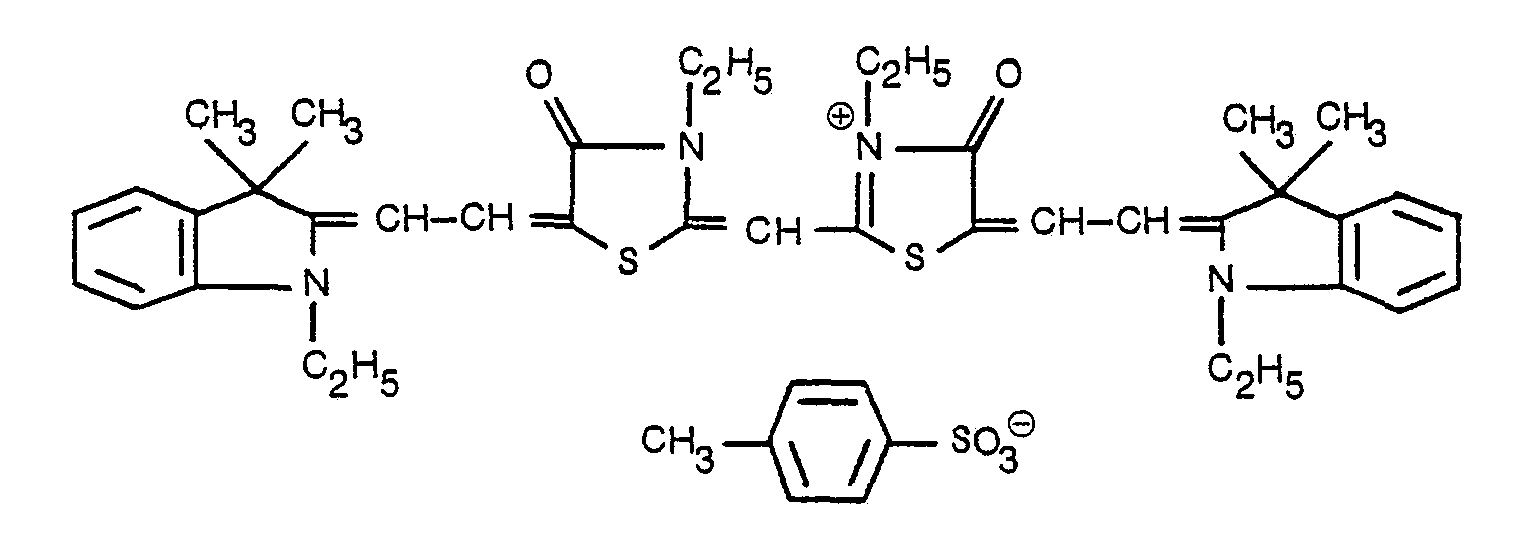


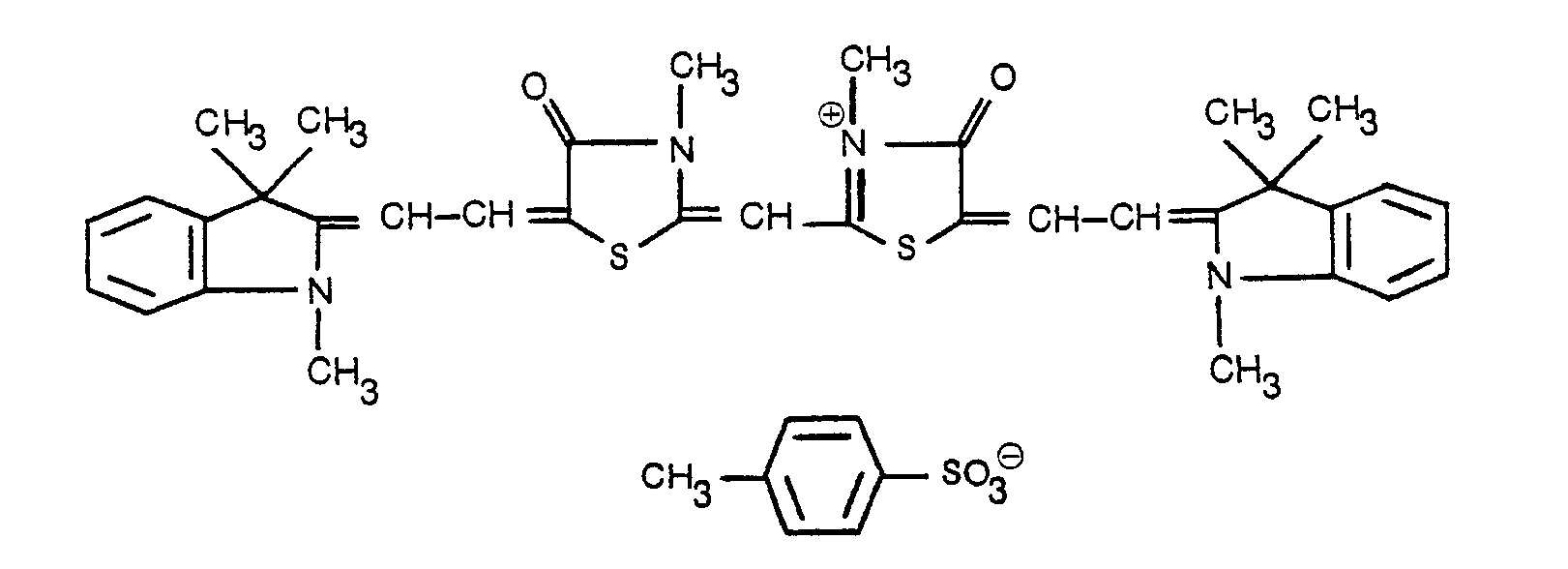


Applications Claiming Priority (2)
| Application Number | Priority Date | Filing Date | Title |
|---|---|---|---|
| US29545481A | 1981-08-24 | 1981-08-24 | |
| US295454 | 1989-01-10 |
Publications (3)
| Publication Number | Publication Date |
|---|---|
| EP0086230A1 EP0086230A1 (en) | 1983-08-24 |
| EP0086230A4 EP0086230A4 (en) | 1984-05-17 |
| EP0086230B1 true EP0086230B1 (en) | 1987-01-07 |
Family
ID=23137803
Family Applications (1)
| Application Number | Title | Priority Date | Filing Date |
|---|---|---|---|
| EP19820902935 Expired EP0086230B1 (en) | 1981-08-24 | 1982-08-23 | Merocyanine-cyanine-merocyanine (mcm) electrically photosensitive colorants |
Country Status (5)
| Country | Link |
|---|---|
| EP (1) | EP0086230B1 (en) |
| JP (1) | JPS58501340A (en) |
| CA (1) | CA1185476A (en) |
| DE (1) | DE3275028D1 (en) |
| WO (1) | WO1983000752A1 (en) |
Families Citing this family (1)
| Publication number | Priority date | Publication date | Assignee | Title |
|---|---|---|---|---|
| DE3541534A1 (en) * | 1985-11-25 | 1987-05-27 | Hoechst Ag | POSITIVELY WORKING RADIATION-SENSITIVE MIXTURE |
Family Cites Families (7)
| Publication number | Priority date | Publication date | Assignee | Title |
|---|---|---|---|---|
| GB487051A (en) * | 1936-11-14 | 1938-06-14 | John David Kendall | Improvements in or relating to dyestuffs |
| US2518731A (en) * | 1948-12-21 | 1950-08-15 | Gen Aniline & Film Corp | Symmetrical and unsymmetrical tetranuclear cyanine dyes and process of preparing thesame |
| US2592515A (en) * | 1950-10-31 | 1952-04-08 | Gen Aniline & Film Corp | Photographic emulsions containing symmetrical tetranuclear dye salts |
| US2652396A (en) * | 1951-03-06 | 1953-09-15 | Eastman Kodak Co | Bis-cyanine dyes and method of preparation |
| US3558614A (en) * | 1967-09-05 | 1971-01-26 | Eastman Kodak Co | Synthesis of tetranuclear dyes |
| JPS4925501B1 (en) * | 1969-07-21 | 1974-07-01 | ||
| US3912507A (en) * | 1973-06-04 | 1975-10-14 | Itek Corp | Polyrhodanine photoconductive materials |
-
1982
- 1982-08-23 EP EP19820902935 patent/EP0086230B1/en not_active Expired
- 1982-08-23 WO PCT/US1982/001133 patent/WO1983000752A1/en not_active Ceased
- 1982-08-23 DE DE8282902935T patent/DE3275028D1/en not_active Expired
- 1982-08-23 JP JP57502835A patent/JPS58501340A/en active Pending
- 1982-08-23 CA CA000409897A patent/CA1185476A/en not_active Expired
Also Published As
| Publication number | Publication date |
|---|---|
| EP0086230A1 (en) | 1983-08-24 |
| JPS58501340A (en) | 1983-08-11 |
| CA1185476A (en) | 1985-04-16 |
| DE3275028D1 (en) | 1987-02-12 |
| WO1983000752A1 (en) | 1983-03-03 |
| EP0086230A4 (en) | 1984-05-17 |
Similar Documents
| Publication | Publication Date | Title |
|---|---|---|
| US4145215A (en) | Migration imaging process and compositions | |
| US4322487A (en) | Composite electrically photosensitive particles for electrophoretic migration imaging process | |
| US4256819A (en) | Organic electrophotosensitive materials for migration imaging processes | |
| US3128179A (en) | Cyanine dye-sensitized photoconductive compositions comprising zinc oxide | |
| US4362800A (en) | Sensitized photoconductive compositions and electrophotographic photosensitive layers using such | |
| US3567439A (en) | Borinium dyes as sensitizers for organic photoconductors | |
| US4197120A (en) | Electrophoretic migration imaging process | |
| US4241157A (en) | Organic heterocyclic electrophotosensitive materials for migration imaging processes | |
| US3597196A (en) | Sensitization of organic photoconductors with cyanine merocyanine,and azocyanine dyes | |
| EP0086230B1 (en) | Merocyanine-cyanine-merocyanine (mcm) electrically photosensitive colorants | |
| US4463076A (en) | Merocyanine-cyanine-merocyanine (MCM) electrically photosensitive colorants for photoelectrophoretic imaging | |
| US4450219A (en) | Electrophotographic photoreceptor with thiobarbituric acid derivative | |
| US4293626A (en) | Electrophotosensitive materials for migration imaging processes | |
| US4299894A (en) | Electrically photosensitive materials and elements for photoelectrophoretic imaging processes | |
| EP0000599B1 (en) | Electrically photosensitive particles for photoelectrophoretic migration imaging processes | |
| EP0000596A1 (en) | Electrically photosensitive particles for electrophoretic migration imaging processes | |
| US4251609A (en) | Isoquinolinedione photoelectrophoretic materials for imaging processes | |
| US4331751A (en) | Electrically photosensitive materials and elements for photoelectrophoretic imaging processes | |
| US3125447A (en) | Sensitized photoconductive compositions comprising zinc oxide | |
| US4304908A (en) | Methine colorant materials and the use thereof in electrophoretic migration imaging layers and processes | |
| US4166740A (en) | Electrophotosensitive materials for migration imaging processes | |
| US4356244A (en) | Quinoxaline cyanine dye sensitized organic electron donor compounds | |
| US4272595A (en) | Electrophotosensitive materials for migration imaging processes | |
| US4165985A (en) | Electrophotosensitive materials for migration imaging processes | |
| US3560208A (en) | Cyanine dye containing a pyrrole nucleus used as a sensitizer for organic photoconductors |
Legal Events
| Date | Code | Title | Description |
|---|---|---|---|
| PUAI | Public reference made under article 153(3) epc to a published international application that has entered the european phase |
Free format text: ORIGINAL CODE: 0009012 |
|
| PUAI | Public reference made under article 153(3) epc to a published international application that has entered the european phase |
Free format text: ORIGINAL CODE: 0009012 |
|
| AK | Designated contracting states |
Designated state(s): DE FR GB |
|
| 17P | Request for examination filed |
Effective date: 19830822 |
|
| GRAA | (expected) grant |
Free format text: ORIGINAL CODE: 0009210 |
|
| AK | Designated contracting states |
Kind code of ref document: B1 Designated state(s): DE FR GB |
|
| REF | Corresponds to: |
Ref document number: 3275028 Country of ref document: DE Date of ref document: 19870212 |
|
| ET | Fr: translation filed | ||
| PLBE | No opposition filed within time limit |
Free format text: ORIGINAL CODE: 0009261 |
|
| STAA | Information on the status of an ep patent application or granted ep patent |
Free format text: STATUS: NO OPPOSITION FILED WITHIN TIME LIMIT |
|
| 26N | No opposition filed | ||
| PG25 | Lapsed in a contracting state [announced via postgrant information from national office to epo] |
Ref country code: GB Free format text: LAPSE BECAUSE OF NON-PAYMENT OF DUE FEES Effective date: 19880823 |
|
| PG25 | Lapsed in a contracting state [announced via postgrant information from national office to epo] |
Ref country code: FR Free format text: LAPSE BECAUSE OF NON-PAYMENT OF DUE FEES Effective date: 19890428 |
|
| PG25 | Lapsed in a contracting state [announced via postgrant information from national office to epo] |
Ref country code: DE Effective date: 19890503 |
|
| GBPC | Gb: european patent ceased through non-payment of renewal fee | ||
| REG | Reference to a national code |
Ref country code: FR Ref legal event code: ST |