EP0068159A1 - Water-swellable cross-linked copolymers, their preparation and use - Google Patents
Water-swellable cross-linked copolymers, their preparation and use Download PDFInfo
- Publication number
- EP0068159A1 EP0068159A1 EP82104746A EP82104746A EP0068159A1 EP 0068159 A1 EP0068159 A1 EP 0068159A1 EP 82104746 A EP82104746 A EP 82104746A EP 82104746 A EP82104746 A EP 82104746A EP 0068159 A1 EP0068159 A1 EP 0068159A1
- Authority
- EP
- European Patent Office
- Prior art keywords
- weight
- formula
- formulas
- water
- parts
- Prior art date
- Legal status (The legal status is an assumption and is not a legal conclusion. Google has not performed a legal analysis and makes no representation as to the accuracy of the status listed.)
- Withdrawn
Links
- 229920001577 copolymer Polymers 0.000 title claims abstract description 60
- 238000002360 preparation method Methods 0.000 title claims description 12
- 239000002250 absorbent Substances 0.000 claims abstract description 8
- 230000002745 absorbent Effects 0.000 claims abstract description 8
- 238000004132 cross linking Methods 0.000 claims abstract description 6
- 238000009826 distribution Methods 0.000 claims abstract description 4
- -1 borate anions Chemical class 0.000 claims description 21
- HRPVXLWXLXDGHG-UHFFFAOYSA-N Acrylamide Chemical compound NC(=O)C=C HRPVXLWXLXDGHG-UHFFFAOYSA-N 0.000 claims description 18
- 239000000203 mixture Substances 0.000 claims description 13
- 125000000391 vinyl group Chemical group [H]C([*])=C([H])[H] 0.000 claims description 11
- 238000000034 method Methods 0.000 claims description 10
- 239000007788 liquid Substances 0.000 claims description 9
- 239000001257 hydrogen Substances 0.000 claims description 6
- 229910052739 hydrogen Inorganic materials 0.000 claims description 6
- FQPSGWSUVKBHSU-UHFFFAOYSA-N methacrylamide Chemical compound CC(=C)C(N)=O FQPSGWSUVKBHSU-UHFFFAOYSA-N 0.000 claims description 6
- 125000002496 methyl group Chemical group [H]C([H])([H])* 0.000 claims description 6
- 229920002554 vinyl polymer Polymers 0.000 claims description 6
- UFHFLCQGNIYNRP-UHFFFAOYSA-N Hydrogen Chemical compound [H][H] UFHFLCQGNIYNRP-UHFFFAOYSA-N 0.000 claims description 5
- 150000001768 cations Chemical class 0.000 claims description 5
- 125000000217 alkyl group Chemical group 0.000 claims description 4
- 238000007334 copolymerization reaction Methods 0.000 claims description 4
- ABLZXFCXXLZCGV-UHFFFAOYSA-N phosphonic acid group Chemical group P(O)(O)=O ABLZXFCXXLZCGV-UHFFFAOYSA-N 0.000 claims description 4
- 125000004432 carbon atom Chemical group C* 0.000 claims description 3
- 125000001495 ethyl group Chemical group [H]C([H])([H])C([H])([H])* 0.000 claims description 3
- 150000002431 hydrogen Chemical class 0.000 claims description 3
- 230000008569 process Effects 0.000 claims description 3
- 125000000020 sulfo group Chemical group O=S(=O)([*])O[H] 0.000 claims description 3
- 125000003258 trimethylene group Chemical group [H]C([H])([*:2])C([H])([H])C([H])([H])[*:1] 0.000 claims description 2
- 238000010521 absorption reaction Methods 0.000 abstract description 4
- 239000012530 fluid Substances 0.000 abstract description 4
- 239000000470 constituent Substances 0.000 abstract description 2
- 229920000642 polymer Polymers 0.000 description 25
- 238000006116 polymerization reaction Methods 0.000 description 20
- IJGRMHOSHXDMSA-UHFFFAOYSA-N Atomic nitrogen Chemical compound N#N IJGRMHOSHXDMSA-UHFFFAOYSA-N 0.000 description 16
- XLYOFNOQVPJJNP-UHFFFAOYSA-N water Substances O XLYOFNOQVPJJNP-UHFFFAOYSA-N 0.000 description 16
- HEMHJVSKTPXQMS-UHFFFAOYSA-M sodium hydroxide Inorganic materials [OH-].[Na+] HEMHJVSKTPXQMS-UHFFFAOYSA-M 0.000 description 14
- KWYUFKZDYYNOTN-UHFFFAOYSA-M Potassium hydroxide Chemical compound [OH-].[K+] KWYUFKZDYYNOTN-UHFFFAOYSA-M 0.000 description 10
- 238000007127 saponification reaction Methods 0.000 description 10
- WHNWPMSKXPGLAX-UHFFFAOYSA-N N-Vinyl-2-pyrrolidone Chemical compound C=CN1CCCC1=O WHNWPMSKXPGLAX-UHFFFAOYSA-N 0.000 description 9
- 239000000047 product Substances 0.000 description 9
- WSLDOOZREJYCGB-UHFFFAOYSA-N 1,2-Dichloroethane Chemical compound ClCCCl WSLDOOZREJYCGB-UHFFFAOYSA-N 0.000 description 8
- 229910052757 nitrogen Inorganic materials 0.000 description 8
- 150000003254 radicals Chemical class 0.000 description 8
- XHZPRMZZQOIPDS-UHFFFAOYSA-N 2-Methyl-2-[(1-oxo-2-propenyl)amino]-1-propanesulfonic acid Chemical compound OS(=O)(=O)CC(C)(C)NC(=O)C=C XHZPRMZZQOIPDS-UHFFFAOYSA-N 0.000 description 7
- 239000007789 gas Substances 0.000 description 7
- 230000007062 hydrolysis Effects 0.000 description 7
- 238000006460 hydrolysis reaction Methods 0.000 description 7
- 239000011734 sodium Substances 0.000 description 7
- OKKJLVBELUTLKV-UHFFFAOYSA-N Methanol Chemical compound OC OKKJLVBELUTLKV-UHFFFAOYSA-N 0.000 description 6
- 239000003054 catalyst Substances 0.000 description 6
- 239000003795 chemical substances by application Substances 0.000 description 6
- 239000000178 monomer Substances 0.000 description 6
- LFQSCWFLJHTTHZ-UHFFFAOYSA-N Ethanol Chemical compound CCO LFQSCWFLJHTTHZ-UHFFFAOYSA-N 0.000 description 5
- 238000003776 cleavage reaction Methods 0.000 description 5
- 150000001875 compounds Chemical class 0.000 description 5
- LYCAIKOWRPUZTN-UHFFFAOYSA-N ethylene glycol Natural products OCCO LYCAIKOWRPUZTN-UHFFFAOYSA-N 0.000 description 5
- 239000000499 gel Substances 0.000 description 5
- WGCNASOHLSPBMP-UHFFFAOYSA-N hydroxyacetaldehyde Natural products OCC=O WGCNASOHLSPBMP-UHFFFAOYSA-N 0.000 description 5
- PNLUGRYDUHRLOF-UHFFFAOYSA-N n-ethenyl-n-methylacetamide Chemical compound C=CN(C)C(C)=O PNLUGRYDUHRLOF-UHFFFAOYSA-N 0.000 description 5
- 239000003960 organic solvent Substances 0.000 description 5
- 230000007017 scission Effects 0.000 description 5
- 239000000243 solution Substances 0.000 description 5
- 239000002904 solvent Substances 0.000 description 5
- 238000003756 stirring Methods 0.000 description 5
- 210000002700 urine Anatomy 0.000 description 5
- ZTWTYVWXUKTLCP-UHFFFAOYSA-N vinylphosphonic acid Chemical compound OP(O)(=O)C=C ZTWTYVWXUKTLCP-UHFFFAOYSA-N 0.000 description 5
- NLVXSWCKKBEXTG-UHFFFAOYSA-N vinylsulfonic acid Chemical compound OS(=O)(=O)C=C NLVXSWCKKBEXTG-UHFFFAOYSA-N 0.000 description 5
- NIXOWILDQLNWCW-UHFFFAOYSA-N 2-Propenoic acid Natural products OC(=O)C=C NIXOWILDQLNWCW-UHFFFAOYSA-N 0.000 description 4
- IRLPACMLTUPBCL-KQYNXXCUSA-N 5'-adenylyl sulfate Chemical group C1=NC=2C(N)=NC=NC=2N1[C@@H]1O[C@H](COP(O)(=O)OS(O)(=O)=O)[C@@H](O)[C@H]1O IRLPACMLTUPBCL-KQYNXXCUSA-N 0.000 description 4
- QGZKDVFQNNGYKY-UHFFFAOYSA-N Ammonia Chemical compound N QGZKDVFQNNGYKY-UHFFFAOYSA-N 0.000 description 4
- RTZKZFJDLAIYFH-UHFFFAOYSA-N Diethyl ether Chemical compound CCOCC RTZKZFJDLAIYFH-UHFFFAOYSA-N 0.000 description 4
- DGAQECJNVWCQMB-PUAWFVPOSA-M Ilexoside XXIX Chemical compound C[C@@H]1CC[C@@]2(CC[C@@]3(C(=CC[C@H]4[C@]3(CC[C@@H]5[C@@]4(CC[C@@H](C5(C)C)OS(=O)(=O)[O-])C)C)[C@@H]2[C@]1(C)O)C)C(=O)O[C@H]6[C@@H]([C@H]([C@@H]([C@H](O6)CO)O)O)O.[Na+] DGAQECJNVWCQMB-PUAWFVPOSA-M 0.000 description 4
- LRHPLDYGYMQRHN-UHFFFAOYSA-N N-Butanol Chemical compound CCCCO LRHPLDYGYMQRHN-UHFFFAOYSA-N 0.000 description 4
- DKGAVHZHDRPRBM-UHFFFAOYSA-N Tert-Butanol Chemical compound CC(C)(C)O DKGAVHZHDRPRBM-UHFFFAOYSA-N 0.000 description 4
- ROOXNKNUYICQNP-UHFFFAOYSA-N ammonium peroxydisulfate Substances [NH4+].[NH4+].[O-]S(=O)(=O)OOS([O-])(=O)=O ROOXNKNUYICQNP-UHFFFAOYSA-N 0.000 description 4
- 229910001870 ammonium persulfate Inorganic materials 0.000 description 4
- 238000006243 chemical reaction Methods 0.000 description 4
- 239000012043 crude product Substances 0.000 description 4
- 239000000839 emulsion Substances 0.000 description 4
- 230000014759 maintenance of location Effects 0.000 description 4
- FOGSDLLFGSNQCW-UHFFFAOYSA-N n-[(prop-2-enoylamino)methoxymethyl]prop-2-enamide Chemical compound C=CC(=O)NCOCNC(=O)C=C FOGSDLLFGSNQCW-UHFFFAOYSA-N 0.000 description 4
- CDBYLPFSWZWCQE-UHFFFAOYSA-L sodium carbonate Substances [Na+].[Na+].[O-]C([O-])=O CDBYLPFSWZWCQE-UHFFFAOYSA-L 0.000 description 4
- 235000011121 sodium hydroxide Nutrition 0.000 description 4
- UDPGUMQDCGORJQ-UHFFFAOYSA-N (2-chloroethyl)phosphonic acid Chemical class OP(O)(=O)CCCl UDPGUMQDCGORJQ-UHFFFAOYSA-N 0.000 description 3
- LVKKFNORSNCNPP-UHFFFAOYSA-N 2,2-bis(prop-2-enoylamino)acetic acid Chemical compound C=CC(=O)NC(C(=O)O)NC(=O)C=C LVKKFNORSNCNPP-UHFFFAOYSA-N 0.000 description 3
- OZAIFHULBGXAKX-UHFFFAOYSA-N 2-(2-cyanopropan-2-yldiazenyl)-2-methylpropanenitrile Chemical compound N#CC(C)(C)N=NC(C)(C)C#N OZAIFHULBGXAKX-UHFFFAOYSA-N 0.000 description 3
- 239000004971 Cross linker Substances 0.000 description 3
- PEDCQBHIVMGVHV-UHFFFAOYSA-N Glycerine Chemical compound OCC(O)CO PEDCQBHIVMGVHV-UHFFFAOYSA-N 0.000 description 3
- 239000002253 acid Substances 0.000 description 3
- 239000003633 blood substitute Substances 0.000 description 3
- KGBXLFKZBHKPEV-UHFFFAOYSA-N boric acid Chemical compound OB(O)O KGBXLFKZBHKPEV-UHFFFAOYSA-N 0.000 description 3
- 239000004327 boric acid Substances 0.000 description 3
- KRKNYBCHXYNGOX-UHFFFAOYSA-N citric acid Chemical compound OC(=O)CC(O)(C(O)=O)CC(O)=O KRKNYBCHXYNGOX-UHFFFAOYSA-N 0.000 description 3
- 239000008367 deionised water Substances 0.000 description 3
- 229910021641 deionized water Inorganic materials 0.000 description 3
- 238000001035 drying Methods 0.000 description 3
- ZIUHHBKFKCYYJD-UHFFFAOYSA-N n,n'-methylenebisacrylamide Chemical compound C=CC(=O)NCNC(=O)C=C ZIUHHBKFKCYYJD-UHFFFAOYSA-N 0.000 description 3
- BWHMMNNQKKPAPP-UHFFFAOYSA-L potassium carbonate Chemical compound [K+].[K+].[O-]C([O-])=O BWHMMNNQKKPAPP-UHFFFAOYSA-L 0.000 description 3
- 150000003839 salts Chemical class 0.000 description 3
- 229910052708 sodium Inorganic materials 0.000 description 3
- 239000000126 substance Substances 0.000 description 3
- SMZOUWXMTYCWNB-UHFFFAOYSA-N 2-(2-methoxy-5-methylphenyl)ethanamine Chemical compound COC1=CC=C(C)C=C1CCN SMZOUWXMTYCWNB-UHFFFAOYSA-N 0.000 description 2
- 229920000536 2-Acrylamido-2-methylpropane sulfonic acid Polymers 0.000 description 2
- 125000001340 2-chloroethyl group Chemical group [H]C([H])(Cl)C([H])([H])* 0.000 description 2
- CSCPPACGZOOCGX-UHFFFAOYSA-N Acetone Chemical compound CC(C)=O CSCPPACGZOOCGX-UHFFFAOYSA-N 0.000 description 2
- NLHHRLWOUZZQLW-UHFFFAOYSA-N Acrylonitrile Chemical compound C=CC#N NLHHRLWOUZZQLW-UHFFFAOYSA-N 0.000 description 2
- KFZMGEQAYNKOFK-UHFFFAOYSA-N Isopropanol Chemical compound CC(C)O KFZMGEQAYNKOFK-UHFFFAOYSA-N 0.000 description 2
- UIIMBOGNXHQVGW-UHFFFAOYSA-M Sodium bicarbonate Chemical compound [Na+].OC([O-])=O UIIMBOGNXHQVGW-UHFFFAOYSA-M 0.000 description 2
- FAPWRFPIFSIZLT-UHFFFAOYSA-M Sodium chloride Chemical compound [Na+].[Cl-] FAPWRFPIFSIZLT-UHFFFAOYSA-M 0.000 description 2
- 229920002125 Sokalan® Polymers 0.000 description 2
- 150000007513 acids Chemical class 0.000 description 2
- 230000009471 action Effects 0.000 description 2
- 239000003513 alkali Substances 0.000 description 2
- 150000001340 alkali metals Chemical class 0.000 description 2
- 125000003368 amide group Chemical group 0.000 description 2
- 229910021529 ammonia Inorganic materials 0.000 description 2
- 150000003863 ammonium salts Chemical class 0.000 description 2
- 125000000129 anionic group Chemical group 0.000 description 2
- 239000012298 atmosphere Substances 0.000 description 2
- 239000002585 base Substances 0.000 description 2
- JEHKKBHWRAXMCH-UHFFFAOYSA-N benzenesulfinic acid Chemical compound O[S@@](=O)C1=CC=CC=C1 JEHKKBHWRAXMCH-UHFFFAOYSA-N 0.000 description 2
- 230000015572 biosynthetic process Effects 0.000 description 2
- BTANRVKWQNVYAZ-UHFFFAOYSA-N butan-2-ol Chemical compound CCC(C)O BTANRVKWQNVYAZ-UHFFFAOYSA-N 0.000 description 2
- 125000003178 carboxy group Chemical group [H]OC(*)=O 0.000 description 2
- 230000000694 effects Effects 0.000 description 2
- 239000003792 electrolyte Substances 0.000 description 2
- 230000001804 emulsifying effect Effects 0.000 description 2
- 238000000227 grinding Methods 0.000 description 2
- 230000006698 induction Effects 0.000 description 2
- 239000011261 inert gas Substances 0.000 description 2
- ZXEKIIBDNHEJCQ-UHFFFAOYSA-N isobutanol Chemical compound CC(C)CO ZXEKIIBDNHEJCQ-UHFFFAOYSA-N 0.000 description 2
- 238000002955 isolation Methods 0.000 description 2
- AYGYHGXUJBFUJU-UHFFFAOYSA-N n-[2-(prop-2-enoylamino)ethyl]prop-2-enamide Chemical compound C=CC(=O)NCCNC(=O)C=C AYGYHGXUJBFUJU-UHFFFAOYSA-N 0.000 description 2
- ZQXSMRAEXCEDJD-UHFFFAOYSA-N n-ethenylformamide Chemical compound C=CNC=O ZQXSMRAEXCEDJD-UHFFFAOYSA-N 0.000 description 2
- 229920000847 nonoxynol Polymers 0.000 description 2
- ACVYVLVWPXVTIT-UHFFFAOYSA-N phosphinic acid Chemical class O[PH2]=O ACVYVLVWPXVTIT-UHFFFAOYSA-N 0.000 description 2
- 239000003505 polymerization initiator Substances 0.000 description 2
- 239000000843 powder Substances 0.000 description 2
- 238000001556 precipitation Methods 0.000 description 2
- 238000012673 precipitation polymerization Methods 0.000 description 2
- 230000001681 protective effect Effects 0.000 description 2
- 239000011541 reaction mixture Substances 0.000 description 2
- 230000008707 rearrangement Effects 0.000 description 2
- 238000010992 reflux Methods 0.000 description 2
- 239000007787 solid Substances 0.000 description 2
- BUUPQKDIAURBJP-UHFFFAOYSA-N sulfinic acid Chemical compound OS=O BUUPQKDIAURBJP-UHFFFAOYSA-N 0.000 description 2
- 239000000725 suspension Substances 0.000 description 2
- 229920001059 synthetic polymer Polymers 0.000 description 2
- DREPONDJUKIQLX-UHFFFAOYSA-N 1-[ethenyl(ethoxy)phosphoryl]oxyethane Chemical compound CCOP(=O)(C=C)OCC DREPONDJUKIQLX-UHFFFAOYSA-N 0.000 description 1
- AKUNSTOMHUXJOZ-UHFFFAOYSA-N 1-hydroperoxybutane Chemical compound CCCCOO AKUNSTOMHUXJOZ-UHFFFAOYSA-N 0.000 description 1
- WFUGQJXVXHBTEM-UHFFFAOYSA-N 2-hydroperoxy-2-(2-hydroperoxybutan-2-ylperoxy)butane Chemical compound CCC(C)(OO)OOC(C)(CC)OO WFUGQJXVXHBTEM-UHFFFAOYSA-N 0.000 description 1
- VLUWLNIMIAFOSY-UHFFFAOYSA-N 2-methylbenzenesulfinic acid Chemical compound CC1=CC=CC=C1S(O)=O VLUWLNIMIAFOSY-UHFFFAOYSA-N 0.000 description 1
- NDAJNMAAXXIADY-UHFFFAOYSA-N 2-methylpropanimidamide Chemical compound CC(C)C(N)=N NDAJNMAAXXIADY-UHFFFAOYSA-N 0.000 description 1
- FRIBMENBGGCKPD-UHFFFAOYSA-N 3-(2,3-dimethoxyphenyl)prop-2-enal Chemical compound COC1=CC=CC(C=CC=O)=C1OC FRIBMENBGGCKPD-UHFFFAOYSA-N 0.000 description 1
- QTBSBXVTEAMEQO-UHFFFAOYSA-M Acetate Chemical compound CC([O-])=O QTBSBXVTEAMEQO-UHFFFAOYSA-M 0.000 description 1
- NIXOWILDQLNWCW-UHFFFAOYSA-M Acrylate Chemical compound [O-]C(=O)C=C NIXOWILDQLNWCW-UHFFFAOYSA-M 0.000 description 1
- 239000004254 Ammonium phosphate Substances 0.000 description 1
- 239000004342 Benzoyl peroxide Substances 0.000 description 1
- OMPJBNCRMGITSC-UHFFFAOYSA-N Benzoylperoxide Chemical compound C=1C=CC=CC=1C(=O)OOC(=O)C1=CC=CC=C1 OMPJBNCRMGITSC-UHFFFAOYSA-N 0.000 description 1
- BVKZGUZCCUSVTD-UHFFFAOYSA-M Bicarbonate Chemical compound OC([O-])=O BVKZGUZCCUSVTD-UHFFFAOYSA-M 0.000 description 1
- LSNNMFCWUKXFEE-UHFFFAOYSA-M Bisulfite Chemical compound OS([O-])=O LSNNMFCWUKXFEE-UHFFFAOYSA-M 0.000 description 1
- BTBUEUYNUDRHOZ-UHFFFAOYSA-N Borate Chemical compound [O-]B([O-])[O-] BTBUEUYNUDRHOZ-UHFFFAOYSA-N 0.000 description 1
- GAWIXWVDTYZWAW-UHFFFAOYSA-N C[CH]O Chemical group C[CH]O GAWIXWVDTYZWAW-UHFFFAOYSA-N 0.000 description 1
- VEXZGXHMUGYJMC-UHFFFAOYSA-N Hydrochloric acid Chemical compound Cl VEXZGXHMUGYJMC-UHFFFAOYSA-N 0.000 description 1
- 239000004354 Hydroxyethyl cellulose Substances 0.000 description 1
- 229920000663 Hydroxyethyl cellulose Polymers 0.000 description 1
- CERQOIWHTDAKMF-UHFFFAOYSA-N Methacrylic acid Chemical compound CC(=C)C(O)=O CERQOIWHTDAKMF-UHFFFAOYSA-N 0.000 description 1
- GYCMBHHDWRMZGG-UHFFFAOYSA-N Methylacrylonitrile Chemical compound CC(=C)C#N GYCMBHHDWRMZGG-UHFFFAOYSA-N 0.000 description 1
- IGFHQQFPSIBGKE-UHFFFAOYSA-N Nonylphenol Natural products CCCCCCCCCC1=CC=C(O)C=C1 IGFHQQFPSIBGKE-UHFFFAOYSA-N 0.000 description 1
- 229910019142 PO4 Inorganic materials 0.000 description 1
- NPYPAHLBTDXSSS-UHFFFAOYSA-N Potassium ion Chemical compound [K+] NPYPAHLBTDXSSS-UHFFFAOYSA-N 0.000 description 1
- DWAQJAXMDSEUJJ-UHFFFAOYSA-M Sodium bisulfite Chemical compound [Na+].OS([O-])=O DWAQJAXMDSEUJJ-UHFFFAOYSA-M 0.000 description 1
- 229920002472 Starch Polymers 0.000 description 1
- XSQUKJJJFZCRTK-UHFFFAOYSA-N Urea Chemical compound NC(N)=O XSQUKJJJFZCRTK-UHFFFAOYSA-N 0.000 description 1
- LXEKPEMOWBOYRF-UHFFFAOYSA-N [2-[(1-azaniumyl-1-imino-2-methylpropan-2-yl)diazenyl]-2-methylpropanimidoyl]azanium;dichloride Chemical compound Cl.Cl.NC(=N)C(C)(C)N=NC(C)(C)C(N)=N LXEKPEMOWBOYRF-UHFFFAOYSA-N 0.000 description 1
- 230000001133 acceleration Effects 0.000 description 1
- 230000002378 acidificating effect Effects 0.000 description 1
- 239000013543 active substance Substances 0.000 description 1
- 150000001299 aldehydes Chemical class 0.000 description 1
- 125000001931 aliphatic group Chemical group 0.000 description 1
- 229910052783 alkali metal Inorganic materials 0.000 description 1
- 229910000272 alkali metal oxide Inorganic materials 0.000 description 1
- 229910001860 alkaline earth metal hydroxide Inorganic materials 0.000 description 1
- VAZSKTXWXKYQJF-UHFFFAOYSA-N ammonium persulfate Chemical compound [NH4+].[NH4+].[O-]S(=O)OOS([O-])=O VAZSKTXWXKYQJF-UHFFFAOYSA-N 0.000 description 1
- 229910000148 ammonium phosphate Inorganic materials 0.000 description 1
- 235000019289 ammonium phosphates Nutrition 0.000 description 1
- 239000007864 aqueous solution Substances 0.000 description 1
- 125000003118 aryl group Chemical group 0.000 description 1
- 125000000751 azo group Chemical group [*]N=N[*] 0.000 description 1
- 230000008901 benefit Effects 0.000 description 1
- 235000019400 benzoyl peroxide Nutrition 0.000 description 1
- 239000008280 blood Substances 0.000 description 1
- 210000004369 blood Anatomy 0.000 description 1
- 238000009835 boiling Methods 0.000 description 1
- 239000007853 buffer solution Substances 0.000 description 1
- ABBZJHFBQXYTLU-UHFFFAOYSA-N but-3-enamide Chemical compound NC(=O)CC=C ABBZJHFBQXYTLU-UHFFFAOYSA-N 0.000 description 1
- 239000004202 carbamide Substances 0.000 description 1
- 150000004649 carbonic acid derivatives Chemical class 0.000 description 1
- 150000007942 carboxylates Chemical group 0.000 description 1
- 239000007795 chemical reaction product Substances 0.000 description 1
- 239000003638 chemical reducing agent Substances 0.000 description 1
- 238000010276 construction Methods 0.000 description 1
- 229920006037 cross link polymer Polymers 0.000 description 1
- 239000003431 cross linking reagent Substances 0.000 description 1
- UKPBEPCQTDRZSE-UHFFFAOYSA-N cyclizine hydrochloride Chemical compound Cl.C1CN(C)CCN1C(C=1C=CC=CC=1)C1=CC=CC=C1 UKPBEPCQTDRZSE-UHFFFAOYSA-N 0.000 description 1
- MNNHAPBLZZVQHP-UHFFFAOYSA-N diammonium hydrogen phosphate Chemical compound [NH4+].[NH4+].OP([O-])([O-])=O MNNHAPBLZZVQHP-UHFFFAOYSA-N 0.000 description 1
- 125000004177 diethyl group Chemical group [H]C([H])([H])C([H])([H])* 0.000 description 1
- 125000000118 dimethyl group Chemical group [H]C([H])([H])* 0.000 description 1
- 239000006185 dispersion Substances 0.000 description 1
- 239000008151 electrolyte solution Substances 0.000 description 1
- 229940021013 electrolyte solution Drugs 0.000 description 1
- 230000005670 electromagnetic radiation Effects 0.000 description 1
- 239000003995 emulsifying agent Substances 0.000 description 1
- 125000004185 ester group Chemical group 0.000 description 1
- 150000002148 esters Chemical class 0.000 description 1
- UYMKPFRHYYNDTL-UHFFFAOYSA-N ethenamine Chemical class NC=C UYMKPFRHYYNDTL-UHFFFAOYSA-N 0.000 description 1
- 230000002349 favourable effect Effects 0.000 description 1
- 238000010528 free radical solution polymerization reaction Methods 0.000 description 1
- 125000000524 functional group Chemical group 0.000 description 1
- 210000003736 gastrointestinal content Anatomy 0.000 description 1
- 230000005484 gravity Effects 0.000 description 1
- FIKFOOMAUXPBJM-UHFFFAOYSA-N hepta-2,5-dienediamide Chemical compound NC(=O)C=CCC=CC(N)=O FIKFOOMAUXPBJM-UHFFFAOYSA-N 0.000 description 1
- 229920001519 homopolymer Polymers 0.000 description 1
- 239000000416 hydrocolloid Substances 0.000 description 1
- IXCSERBJSXMMFS-UHFFFAOYSA-N hydrogen chloride Substances Cl.Cl IXCSERBJSXMMFS-UHFFFAOYSA-N 0.000 description 1
- 229910000041 hydrogen chloride Inorganic materials 0.000 description 1
- 235000019447 hydroxyethyl cellulose Nutrition 0.000 description 1
- 238000007654 immersion Methods 0.000 description 1
- 230000003993 interaction Effects 0.000 description 1
- 150000002500 ions Chemical class 0.000 description 1
- 235000015110 jellies Nutrition 0.000 description 1
- 229920002521 macromolecule Polymers 0.000 description 1
- 238000004519 manufacturing process Methods 0.000 description 1
- 239000000463 material Substances 0.000 description 1
- 238000002156 mixing Methods 0.000 description 1
- VLKZOEOYAKHREP-UHFFFAOYSA-N n-Hexane Chemical group CCCCCC VLKZOEOYAKHREP-UHFFFAOYSA-N 0.000 description 1
- GORGQKRVQGXVEB-UHFFFAOYSA-N n-ethenyl-n-ethylacetamide Chemical compound CCN(C=C)C(C)=O GORGQKRVQGXVEB-UHFFFAOYSA-N 0.000 description 1
- DFMIMUDDPBAKFS-UHFFFAOYSA-N n-ethenyl-n-ethylformamide Chemical compound CCN(C=C)C=O DFMIMUDDPBAKFS-UHFFFAOYSA-N 0.000 description 1
- IRLKOTSDYPNEHI-UHFFFAOYSA-N n-ethenyl-n-ethylpropanamide Chemical compound CCN(C=C)C(=O)CC IRLKOTSDYPNEHI-UHFFFAOYSA-N 0.000 description 1
- OFESGEKAXKKFQT-UHFFFAOYSA-N n-ethenyl-n-methylformamide Chemical compound C=CN(C)C=O OFESGEKAXKKFQT-UHFFFAOYSA-N 0.000 description 1
- DSENQNLOVPYEKP-UHFFFAOYSA-N n-ethenyl-n-methylpropanamide Chemical compound CCC(=O)N(C)C=C DSENQNLOVPYEKP-UHFFFAOYSA-N 0.000 description 1
- RQAKESSLMFZVMC-UHFFFAOYSA-N n-ethenylacetamide Chemical compound CC(=O)NC=C RQAKESSLMFZVMC-UHFFFAOYSA-N 0.000 description 1
- IUWVWLRMZQHYHL-UHFFFAOYSA-N n-ethenylpropanamide Chemical compound CCC(=O)NC=C IUWVWLRMZQHYHL-UHFFFAOYSA-N 0.000 description 1
- 239000012299 nitrogen atmosphere Substances 0.000 description 1
- SNQQPOLDUKLAAF-UHFFFAOYSA-N nonylphenol Chemical compound CCCCCCCCCC1=CC=CC=C1O SNQQPOLDUKLAAF-UHFFFAOYSA-N 0.000 description 1
- 150000001451 organic peroxides Chemical class 0.000 description 1
- 239000002245 particle Substances 0.000 description 1
- 125000000864 peroxy group Chemical group O(O*)* 0.000 description 1
- 239000003208 petroleum Substances 0.000 description 1
- NBIIXXVUZAFLBC-UHFFFAOYSA-K phosphate Chemical compound [O-]P([O-])([O-])=O NBIIXXVUZAFLBC-UHFFFAOYSA-K 0.000 description 1
- 239000010452 phosphate Substances 0.000 description 1
- 229920002401 polyacrylamide Polymers 0.000 description 1
- 229920000058 polyacrylate Polymers 0.000 description 1
- 239000004584 polyacrylic acid Substances 0.000 description 1
- 229920000151 polyglycol Polymers 0.000 description 1
- 239000010695 polyglycol Substances 0.000 description 1
- 229940072033 potash Drugs 0.000 description 1
- 229910052700 potassium Inorganic materials 0.000 description 1
- 235000015320 potassium carbonate Nutrition 0.000 description 1
- 229910000027 potassium carbonate Inorganic materials 0.000 description 1
- 235000011181 potassium carbonates Nutrition 0.000 description 1
- USHAGKDGDHPEEY-UHFFFAOYSA-L potassium persulfate Chemical compound [K+].[K+].[O-]S(=O)(=O)OOS([O-])(=O)=O USHAGKDGDHPEEY-UHFFFAOYSA-L 0.000 description 1
- 159000000001 potassium salts Chemical class 0.000 description 1
- OTYBMLCTZGSZBG-UHFFFAOYSA-L potassium sulfate Chemical compound [K+].[K+].[O-]S([O-])(=O)=O OTYBMLCTZGSZBG-UHFFFAOYSA-L 0.000 description 1
- 229910052939 potassium sulfate Inorganic materials 0.000 description 1
- 235000011151 potassium sulphates Nutrition 0.000 description 1
- 239000002244 precipitate Substances 0.000 description 1
- 125000002924 primary amino group Chemical group [H]N([H])* 0.000 description 1
- 239000012429 reaction media Substances 0.000 description 1
- 238000003303 reheating Methods 0.000 description 1
- 230000000630 rising effect Effects 0.000 description 1
- 239000012266 salt solution Substances 0.000 description 1
- 238000004904 shortening Methods 0.000 description 1
- 235000017557 sodium bicarbonate Nutrition 0.000 description 1
- 229910000030 sodium bicarbonate Inorganic materials 0.000 description 1
- 229910000029 sodium carbonate Inorganic materials 0.000 description 1
- 235000010267 sodium hydrogen sulphite Nutrition 0.000 description 1
- BWYYYTVSBPRQCN-UHFFFAOYSA-M sodium;ethenesulfonate Chemical compound [Na+].[O-]S(=O)(=O)C=C BWYYYTVSBPRQCN-UHFFFAOYSA-M 0.000 description 1
- 238000009987 spinning Methods 0.000 description 1
- 239000008107 starch Substances 0.000 description 1
- 235000019698 starch Nutrition 0.000 description 1
- 125000000542 sulfonic acid group Chemical group 0.000 description 1
- 210000004243 sweat Anatomy 0.000 description 1
- 238000003786 synthesis reaction Methods 0.000 description 1
- 239000012085 test solution Substances 0.000 description 1
- 239000002562 thickening agent Substances 0.000 description 1
- LUVCTYHBTXSAMX-UHFFFAOYSA-N tris(2-chloroethyl) phosphite Chemical compound ClCCOP(OCCCl)OCCCl LUVCTYHBTXSAMX-UHFFFAOYSA-N 0.000 description 1
- 239000007966 viscous suspension Substances 0.000 description 1
Classifications
-
- C—CHEMISTRY; METALLURGY
- C08—ORGANIC MACROMOLECULAR COMPOUNDS; THEIR PREPARATION OR CHEMICAL WORKING-UP; COMPOSITIONS BASED THEREON
- C08F—MACROMOLECULAR COMPOUNDS OBTAINED BY REACTIONS ONLY INVOLVING CARBON-TO-CARBON UNSATURATED BONDS
- C08F220/00—Copolymers of compounds having one or more unsaturated aliphatic radicals, each having only one carbon-to-carbon double bond, and only one being terminated by only one carboxyl radical or a salt, anhydride ester, amide, imide or nitrile thereof
- C08F220/02—Monocarboxylic acids having less than ten carbon atoms; Derivatives thereof
- C08F220/52—Amides or imides
- C08F220/54—Amides, e.g. N,N-dimethylacrylamide or N-isopropylacrylamide
- C08F220/56—Acrylamide; Methacrylamide
-
- A—HUMAN NECESSITIES
- A61—MEDICAL OR VETERINARY SCIENCE; HYGIENE
- A61L—METHODS OR APPARATUS FOR STERILISING MATERIALS OR OBJECTS IN GENERAL; DISINFECTION, STERILISATION OR DEODORISATION OF AIR; CHEMICAL ASPECTS OF BANDAGES, DRESSINGS, ABSORBENT PADS OR SURGICAL ARTICLES; MATERIALS FOR BANDAGES, DRESSINGS, ABSORBENT PADS OR SURGICAL ARTICLES
- A61L15/00—Chemical aspects of, or use of materials for, bandages, dressings or absorbent pads
- A61L15/16—Bandages, dressings or absorbent pads for physiological fluids such as urine or blood, e.g. sanitary towels, tampons
- A61L15/42—Use of materials characterised by their function or physical properties
- A61L15/60—Liquid-swellable gel-forming materials, e.g. super-absorbents
Definitions
- the present invention relates to new crosslinked copolymers which are swellable in aqueous systems and which in the basic chains have a statistical distribution of 0 to 60% by weight of residues of the formula I. 0 to 40% by weight of residues of the formula II and 10 to 95% by weight of residues of the formula III exist, wherein the sum of the contents to 90 wt.%, the radicals of the formulas I and II 5, and in addition from 0.001 to 2% wt., based on the total weight of the G rundkettenbe- constituents crosslinking bridge members of the formulas IV and / or V contain, wherein R 1 , R 2 , R 3 , R 4 , X ⁇ , and Z have the meanings given in claim 1, their preparation and their use as an absorbent with a particularly high absorption capacity for aqueous liquids, in particular for physiological liquids.
- Non-crosslinked copolymers of vinyl or alkenyl sulfonates with acrylamide and vinylamides have been described, for example, in DAS 2 444 108.
- Non-crosslinked water-soluble copolymers which contain 2-acrylamido-2-methyl-propanesulfonic acid, hereinafter abbreviated to AIBS as comonomers are described in USP 3,953,342, 3,768,565, DOS 2,502,012, 2,547,773 , USP 3,907 927, 3 926 718, 3 948 783.
- copolymers of vinylpyrrolidone and AIBS can be produced in accordance with USP 3 929 741, Example 10.
- Water-soluble, uncrosslinked copolymers of AIBS or vinylsulfonic acid, vinyl acylamines of the formula II and acrylamide are also the subject of the earlier patent applications P 29 31 897.6 and P 30 27 422.7.
- DE AS 1 642 072 (applicant Johnson + Johnson).
- DE OS 161 79 98 (applicant Dow Chemical Co.) also contains crosslinked gel polymers, based inter alia on the basis of N-vinylpyrrolidone or acrylamide.
- Liquid-absorbing substances in particular those used in hygiene articles, are all the more advantageous in use, the more liquid they can bind per unit weight.
- Partial hydrolyzates in which a proportion of up to 60% of the groups of formula III originally present to groups of formula VI were hydrolyzed, the products containing a total of 10 to 90% by weight of groups of the formulas 1 and VI containing anionic residues, can also be used successfully for the hygiene sector and that they surprisingly have a higher absorption and retention capacity compared to known hydrophilic synthetic polymers based on acrylate Have electrolyte solutions.
- the main chains of the copolymers according to the invention are to be understood as the main polymer strands which essentially consist of the components of the formulas I, II and III.
- the structure of the water-swellable, crosslinked copolymers according to the invention can thus be represented by the following structural formula; wherein the zigzag lines the main polymer strands, ie the basic chains and B bridge links of the formulas -CO-NH-Z-NH-CO- or mean.
- the cation X can be a proton or can be derived from any water-soluble known base whose strength is sufficient to neutralize the sulfo and carboxyl groups of the copolymers according to the invention and which does not impair the water swellability of the copolymers. The selection can thus be made in a simple known manner.
- X means a proton or an alkali application, in particular a sodium or potassium cation, or a cation of the formula , wherein the three radicals R 6 are the same or different and represent hydrogen, alkyl having 1 to 4 carbon atoms, hydroxyethyl or hydroxypropyl.
- preferred copolymers according to the invention consist of 0 to 50% by weight of residues of the formula I, 0 to 30% by weight of residues of the formula II, and 20 to 95% by weight of residues of the formula III or their hydrolysis products. Those copolymers according to the invention in which R 4 is hydrogen are also preferred.
- the crosslinked copolymers according to the invention preferably contain, based on the total weight of the basic chain components, 0.02 to 0.5% by weight of residues of the formulas IV and V.
- the derivatives obtainable by partial hydrolysis of the copolymers according to the invention contain up to 60%, preferably 10-40%, of the originally present radicals of the formula III by means of the radicals of the formula VI replaced, where X ⁇ has the meanings given above.
- the degree of hydrolysis is expediently chosen to be higher, the lower the sulfonic or phosphonic acid content in the copolymer and vice versa.
- Preferred partial hydrolyzates of the copolymers according to the invention contain a total of 20 to 80% by weight of groups of the formulas I and VI.
- radicals R 1 to R 6 , Z and X ⁇ can also have different meanings in the same copolymer in the context of their definitions.
- copolymers according to the invention have both AMPS units and vinylsulfonic acid units or, for example, both vinylpyrrolidone and a non-ring-closed N-vinyl-N-alkyl-acylamide such as N-vinyl-N-methyl -acetamide or in addition to acrylamide also contain copolymerized methacrylamide.
- These advantageous copolymers according to the invention containing borate anions and their partial hydrolyzates, calculated as H 3 BO 3 , have 2.5 to 35% by weight, preferably 5 to 25% by weight, borate anions, based on the weight of the unsaponified polymer.
- the water-swellable crosslinked copolymers according to the invention are obtained if one 0 to 60 parts by weight of a vinyl compound of the formula Ia CH 2 -CH-R 1 (Ia) dissolves in water, if they contain sulfo or phosphonic acid groups, neutralizes, then 0 to 40 parts by weight of a vinyl compound of the formula IIa (IIa) and 10 to 95 parts by weight of acrylamide and / or metbacrylamide are added, the total amount of the vinyl compounds of the formulas Ia and IIa being 5 to 95 parts by weight and the total amount of acrylamide and the vinyl compounds of the formulas Ia and IIa being 100 parts by weight, additionally m parts by weight of Bis-vinyl compounds of the formulas IVa and Va adds where m is a number from 0.001 to 2 and R 1 , R 2 , R 3 , X ⁇ , and Z have the meanings given above, and that the copolymerization is initiated in a manner known per se and at 0 to
- any water-soluble base whose starch is sufficient for a reaction with the hydrolyzable groups such as, for example, alkali metal and alkaline earth metal hydroxides, alkali metal or ammonium salts of weak acids which generate OH ⁇ ions by hydrolysis, ammonia or strongly basic aliphatic amines, can be used as the saponification agent .
- alkali metal and alkaline earth metal hydroxides, alkali metal or ammonium salts of weak acids which generate OH ⁇ ions by hydrolysis, ammonia or strongly basic aliphatic amines can be used as the saponification agent .
- sodium or potassium hydroxide, ammonia, sodium or potassium carbonate, hydrogen carbonate, phosphate, borate or acetate are used as saponification agents.
- the saponification agent is mixed with the polymer. Depending on the procedure, the saponification therefore takes place already during the normally exothermic polymerization or by further supply of heat after the polymerization. A combination of both procedures is also possible.
- the products which are advantageous in many cases and contain borate anions, can be obtained in a simple manner by using sodium or potassium salts of boric acid (ortho-, meta- or polyborates or boric acid together with NaOH or KOH) as saponification agents.
- boric acid ortho-, meta- or polyborates or boric acid together with NaOH or KOH
- Preferred copolymers according to the invention are obtained if, under the conditions specified above, 0 to 50 parts by weight of vinyl compounds of the formula Ia, 0 to 30 parts by weight of vinyl compounds of the formula IIa and 10 to 95 parts by weight Acrylamide is used.
- Preferred products according to the invention are also obtained if 0.02 to 0.5 part by weight of bis-vinyl compounds of the formulas IVa and / or Va are used as crosslinking agents.
- Particularly advantageous partially hydrolyzed copolymers according to the invention are obtained if vinyl compounds of the formula Ia containing so many anionic groups are used and the hydrolysis is carried out to such an extent that the products contain a total of 20 to 80% by weight of groups of the formulas I and VI containing anionic radicals.
- Suitable compounds of the formula Ia are vinylsulfonic acid, vinylphosphonic acid, vinylphosphonic acid, dimethyl, diethyl, dipropyl and dibutyl ester, 2-acrylamido-2-methyl-propanesulfonic acid (1) and 2-acrylamido-2-methyl propanephosphonic acid- (l), and as compounds of the formula IIa N-vinylformamide, N-vinylacetamide, N-vinyl-propionamide, N-vinyl-N-methylformamide, N-vinyl-N-methylacetamide, N-vinyl-N- methylpropionamide, N-vinyl-N-ethyl-formamide, N-vinyl-N-ethyl-acetamide, N-vinyl-N-ethyl-propionamide, N-vinylpyrrolidone.
- Bis-acrylamidomethane, bis-acrylamidoacetic acid, 1,1'-bis-acrylamidodimethyl ether and bis-vinyl-phosphonic acid glycol ester, the latter preferably in the form of the crude product obtained during its production, can be used as crosslinking monomer units in the preparation of the copolymers according to the invention.
- 2-acrylamido-2-methylpropanesulfonic acid, vinylphosphonic acid, vinylphosphonic acid diethyl ester, vinylformamide, vinylacetamide, vinylmethylacetamide and vinylpyrrolidone are preferably used as crosslinker components for the construction of the basic chains, preferably methylene-bis-acrylamide or bis-vinylphosphonic acid glycol ester / glycol ester used its raw product.
- copolymers according to the invention can be prepared by all polymerization processes known in principle, such as precipitation, emulsion, suspension, solution or gel polymerization take place.
- a possible embodiment of the process for the preparation of the water-swellable, crosslinked copolymers consists in that, according to the precipitation polymerization method, in an organic solvent, in particular in a water-soluble alkanol, that is to say in a C 1 -C 4 -alcohol such as methanol, ethanol, isopropanol, n-, sec- and iso-butanol, but preferably in tert-butanol.
- the water content of the lower alkanols used as solvents should not exceed 6% by weight, since otherwise a lump formation can occur during the polymerization.
- the water content is preferably from 0 to 3%.
- the amount of solvent to be used depends to a certain extent on the type of comonomers used.
- the polymerization can be carried out in a protective gas atmosphere, preferably under nitrogen.
- the polymerization temperature is between 20 and 120 ° C, preferably 40 to 80 ° C.
- the copolymerization is carried out in the organic solvents mentioned, preferably in tert-butanol, under the conditions of the precipitation polymerization, the polymer is obtained directly in solid form and can be isolated by distilling off the solvent or by suction and drying.
- the crosslinked copolymer prepared in this way can also be partially hydrolyzed before isolation by adding the above-mentioned saponification agents, preferably NaOH or KOH in suspension, at room temperature or elevated temperature.
- Particularly effective copolymers according to the invention are obtained if the polymerization is carried out in water by the so-called gel polymerization method. 15-50% aqueous solutions of the comonomers are mixed with known suitable catalyst systems and, if appropriate, with one of the saponifiers mentioned without mechanical mixing using the so-called Trommsdorff-Norrish effect (Bios Final Rep. 363 22; Makromol. Chem. 1, 169 (1947)) polymerized.
- the polymerization reaction can be carried out in the temperature range between 0 ° C. and 130 ° C., preferably between 10 ° C. and 100 ° C., both under normal pressure and under elevated pressure.
- the polymerization can also be carried out in a protective gas atmosphere, preferably under nitrogen.
- the quality properties of the polymers can be improved further by reheating the polymer gels for several hours in the temperature range from 50-130 ° C., preferably 70-100 ° C.
- the copolymers according to the invention prepared in this way and in the form of aqueous jellies can be obtained in solid form after removal of the water by known drying processes and can be converted into powder form using generally known grinding units.
- high-energy electromagnetic radiation or the usual chemical polymerization initiators can be used, e.g. B. organic peroxides, such as benzoyl peroxide, tert. Butyl hydroperoxide, methyl ethyl ketone peroxide, cumene hydroperoxide, azo compounds such as azo-di-isobutyronitrile and inorganic peroxy compounds such as (NH 4 ) 2 S 2 O 8 or K 2 S 2 O 8 or H 2 0 g 2 g e e-reducing appropriate, in combination with reducing agents such as sodium bisulfite, or redox systems containing as Component contain an aliphatic and aromatic sulfinic acid, such as benzenesulfinic acid and toluenesulfinic acid or derivatives of these acids, such as Mannich adducts of sulfinic acid, aldehydes and amino compounds, as described in German Patent 1 301 566. 0.
- organic peroxides such as benzo
- the bis-vinylphosphonic acid glycol ester used according to the invention or its crude product can be produced in a simple and economical manner by using 2-chloroethanephosphonic acid derivatives containing 2-chloroethyl ester groups, in particular bis-2-chloroethyl ester of 2-chloroethanephosphonate, which is known to be carried out by Arbusow rearrangement obtained from tris-chloroethylphosphite, heated to 150 to 230 ° C, preferably 170 to 215 ° C, wherein 1,2-dichloroethane is split off.
- the cleavage can optionally be carried out in the presence of acidic or basic catalysts. Salts of hypophosphorous acid can also be used as catalysts.
- Catalysts which are particularly suitable for the cleavage of 1,2-dichloroethane are, for example, salts of hypophosphorous acid and alkali carbonates, such as soda or potash.
- the preparation is generally carried out in such a way that the starting products are heated to the reaction temperature in the presence of 0.1 to 5% by weight of the catalysts mentioned. Then the cleavage of 1,2-dichloroethane begins, usually accompanied by the simultaneous cleavage of smaller amounts of hydrogen chloride.
- the 1,2-dichloroethane which splits off is generally distilled off under normal pressure, if appropriate with the aid of an inert gas stream. Nitrogen is particularly suitable as an inert gas.
- the reaction temperatures are 150 to 230 ° C, preferably 170 to 215 ° C. Higher temperatures are possible, but have no advantage.
- the reaction products consist of mixtures of vinylphosphonic acid derivatives, where the type and the amount of the individual components are not known. In the idealized case, a mixture of the compounds of the formulas is obtained, starting from bis-2-chloroethyl 2-chloroethanephosphonate and
- the polymerization begins, the internal temperature rising to approx. 800C and the solution changing into a dimensionally stable gel.
- the polymer is then heated to 90 ° C. for a further 8 hours, then cut into pieces, dried and brought to the desired particle size by grinding.
- An emulsion of the following composition is prepared under nitrogen in an emulsifying flask with a content of 2 1 and a well-functioning stirrer, gas inlet tube and bottom valve, which is located above the polymerization flask: 400 ml® Exol D, 350 ml deionized water, 20 g ®Arkopal N 230, 135 g AM, 50 g VSS-Na, 15 g AIBS , 4 g NaOH and 0.2 g BAE. Approx. 20% of the emulsion is placed in the polymerization flask equipped with a stirrer, reflux condenser, dropping funnel, gas inlet tube, electrically heated water bath and inlet tube from the emulsifying flask.
- the organic solvent ®Exol used in the above example is a petroleum fraction with a boiling range from 200 ° C to 240 ° C.
- ®Arkopal is an emulsifier based on nonylphenol polyglycol ether.
- copolymers of Table 1 can also be prepared according to these preparation examples.
- the crosslinked copolymers according to the invention are outstandingly suitable as absorbent substances (so-called super absorbents) in hygiene articles, for example in diapers, sanitary napkins, tampons, paper handkerchiefs, etc. They are particularly notable for their high absorbency for physiological and electrolyte-containing liquids like blood, urine, sweat, etc.
- copolymers according to the invention are tested for their liquid-absorbing action in hygiene articles using a centrifugal method with the aid of absorbent bodies in the form of sanitary napkins.
- test specimens are produced by first removing the covering from commercially available bandages and shortening the flake pad so that it has a weight of 5.0 g. Then the flake cushion with a width of approx. 6 cm and a length of approx. 14 cm in thickness is carefully cut in half, and both halves are unfolded. Then 0.5 g of active substance (WS) of the copolymer to be investigated are applied in granular form to one half. A template is used so that the polymer comes to rest on an area of 4 x 8 cm. Then you fold back the other half of the pillow and rewrap the bandage body with a sealable fleece measuring 20 x 20 cm, weld the open ends by the action of thermal energy and cut off the protruding fleece.
- active substance (WS) of the copolymer to be investigated are applied in granular form to one half.
- a template is used so that the polymer comes to rest on an area of 4 x 8 cm. Then you fold back the other half of the pillow and
- test specimens are obtained which correspond to a shortened bandage both in terms of their shape and their composition.
- Test specimens without the addition of copolymer are produced in the same way. The test specimens are then weighed and then immersed in a dish filled with test liquid for 30 minutes or 3 hours so that they can soak themselves without hindrance.
- a blood substitute fluid consisting of 1% saline solution to which glycerol, sodium bicarbonate and some hydroxyethyl cellulose with an average viscosity of 20 mPa.s have been added is used as the test solution, or a urine replacement fluid (HE); this is also a 1% saline solution, which contains urea, ammonium phosphate (sec.), potassium sulfate and citric acid as further components.
- test specimens are freed from the unbound liquid by brief spinning off. This is done using a commercial spin dryer with a drum diameter of 23 cm and a speed of 1400 rpm. The test specimens are placed on the inner wall of the drum and spun for 20 seconds with a maximum of 250 times the acceleration due to gravity. (The time is calculated from switching on the spinner to switching it off and includes the start-up time until the full number of tours is reached). The test specimens are then weighed again.
- Table 2 below shows the results of the tests with regard to the retention of blood substitute and urine replacement solution.
Landscapes
- Health & Medical Sciences (AREA)
- Chemical & Material Sciences (AREA)
- Chemical Kinetics & Catalysis (AREA)
- Medicinal Chemistry (AREA)
- Polymers & Plastics (AREA)
- Organic Chemistry (AREA)
- Dispersion Chemistry (AREA)
- Hematology (AREA)
- Engineering & Computer Science (AREA)
- Materials Engineering (AREA)
- Epidemiology (AREA)
- Life Sciences & Earth Sciences (AREA)
- Animal Behavior & Ethology (AREA)
- General Health & Medical Sciences (AREA)
- Public Health (AREA)
- Veterinary Medicine (AREA)
- Addition Polymer Or Copolymer, Post-Treatments, Or Chemical Modifications (AREA)
- Absorbent Articles And Supports Therefor (AREA)
Abstract
Description
Die vorliegende Erfindung betrifft neue, in wäßrigen Systemen quellbare,vernetzte Copolymerisate, die in den Grundketten in statistischer Verteilung zu 0 bis 60 Gew.% aus Resten der Formel I


Die Herstellung wasserlöslicher unvernetzter Polymerisate, welche Sulfonsäuregruppen im Makromolekül eingebaut enthalten, ist bereits in zahlreichen Patenten sowie in der Fachliteratur ausführlich beschrieben worden. So ist z.B. die Synthese von Copolymeren der Vinylsulfonsäure mit Acrylamid und Vinylpyrrolidon im J. Polymer Sci., 38, 147 (1959) veröffentlicht worden. Im DBP 1 101 760 ist ein Verfahren zur Herstellung wasserlöslicher, unvernetzter Copolymerisate aus Vinylsulfonsäure und Acrylnitril bzw. Methacrylnitril gegebenenfalls im Gemisch mit weiteren ethylenisch ungesättigten Verbindungen beschrieben worden. Unvernetzte Copolymerisate aus Vinyl- bzw. Alkenylsulfonaten mit Acrylamid und Vinylamiden sind z.B. in der DAS 2 444 108 beschrieben worden. Unvernetzte wasserlösliche Copolymerisate, welche 2-Acrylamido-2-methyl-propan- sulfonsäure, im folgenden mit AIBS abgekürzt, als Comonomeres enthalten, sind in USP 3 953 342, 3 768 565, DOS 2 502 012, 2 547 773, USP 3 907 927, 3 926 718, 3 948 783 beschrieben. So lassen sich z.B. gemäß den Angaben des USP 3 929 741, Beispiel 10, Copolymere aus Vinylpyrrolidon und AIBS herstellen. Wasserlösliche, unvernetzte Copolymere aus AIBS bzw. Vinylsulfonsäure, Vinylacylaminen der Formel II sowie Acrylamid sind auch Gegenstand der älteren Patentanmeldungen P 29 31 897.6 und P 30 27 422.7.The preparation of water-soluble, uncrosslinked polymers which contain sulfonic acid groups incorporated in the macromolecule has already been described in detail in numerous patents and in the specialist literature. For example, the synthesis of copolymers of vinylsulfonic acid with acrylamide and vinylpyrrolidone has been published in J. Polymer Sci., 38, 147 (1959). DBP 1 101 760 describes a process for the preparation of water-soluble, uncrosslinked copolymers of vinylsulfonic acid and acrylonitrile or methacrylonitrile, optionally in a mixture with other ethylenically unsaturated compounds. Non-crosslinked copolymers of vinyl or alkenyl sulfonates with acrylamide and vinylamides have been described, for example, in DAS 2 444 108. Non-crosslinked water-soluble copolymers which contain 2-acrylamido-2-methyl-propanesulfonic acid, hereinafter abbreviated to AIBS , as comonomers are described in USP 3,953,342, 3,768,565, DOS 2,502,012, 2,547,773 , USP 3,907 927, 3 926 718, 3 948 783. For example, copolymers of vinylpyrrolidone and AIBS can be produced in accordance with USP 3 929 741, Example 10. Water-soluble, uncrosslinked copolymers of AIBS or vinylsulfonic acid, vinyl acylamines of the formula II and acrylamide are also the subject of the earlier patent applications P 29 31 897.6 and P 30 27 422.7.
Es ist auch bekannt, vernetzte Polymere auf der Basis von Polyacrylsäure und/oder deren K, Na bzw. Ammoniumsalze als flüssigkeitsabsorbierendes Material in Hygieneartikeln wie z.B. Windeln, Binden und Tampons zu verwenden.It is also known to use cross-linked polymers based on polyacrylic acid and / or its K, Na or ammonium salts as f lüssigkeitsabsorbierendes material in hygiene articles such as diapers, sanitary napkins and tampons.
So werden in der DE AS 1 642 072 (Anmelder Johnson + Johnson) entsprechende Hydrokolloide und deren Anwendung beschrieben. Ebenfalls beinhaltet die DE OS 161 79 98 (Anmelder Dow Chemical Co.) vernetzte Gelpolymerisate, unter anderem auf der Basis von N-Vinylpyrrolidon bzw. Acrylamid.Corresponding hydrocolloids and their use are described in DE AS 1 642 072 (applicant Johnson + Johnson). DE OS 161 79 98 (applicant Dow Chemical Co.) also contains crosslinked gel polymers, based inter alia on the basis of N-vinylpyrrolidone or acrylamide.
Aus der DE OS 2 706 135 (Anmelder Chemische Fabrik Stockhausen) sind Verdickungsmittel für durch künstliche Ausgänge ausgeschiedenen Darminhalt und/oder Harn bekannt, gekennzeichnet durch einen Gehalt an wenigstens einm vernetzten, in Wasser nur noch quellbaren Homopolymeren auf der Basis u.a.von Acrylsäure, Acrylamid oder Copolymeren aus wenigstens zwei der Acrylmonomeren, Acrylsäure, Methacrylsäure, Acrylamid, Methacrylamid und Acrylnitril untereinander, ferner aus wenigstens einem dieser Acrylmonomeren und Vinylpyrrolidon.From DE OS 2 706 135 (applicant Chemische Fabrik Stockhausen) thickeners for intestinal contents and / or urine excreted by artificial exits are known, characterized by a content of at least one m cross-linked, in Water only swellable homopolymers based on acrylic acid, acrylamide or copolymers of at least two of the acrylic monomers, acrylic acid, methacrylic acid, acrylamide, methacrylamide and acrylonitrile with one another, and also from at least one of these acrylic monomers and vinylpyrrolidone.
Flüssigkeitsabsorbierende Substanzen, insbesondere solche, die in Hygieneartikeln eingesetzt werden, sind umso vorteilhafter in der Anwendung, je mehr Flüssigkeit sie pro Gewichtseinheit zu binden vermögen.Liquid-absorbing substances, in particular those used in hygiene articles, are all the more advantageous in use, the more liquid they can bind per unit weight.
Es wurde nun gefunden, daß neue wasserquellbare vernetzte Copolymerisate,die in den Grundketten in statistischer Verteilung zu
- O bis 60 Gew.% aus Resten der Formel I

- O bis 40 Gew.% aus Resten der Formel II

- und 10 bis 95 Gew.% aus Resten der Formel III


-CONH-C(CH3)2-CH2-SO3⊖X⊕,
-CO-NH-C(CH3)2-CH2-PO3⊖⊖X2⊕ -SO3⊖X⊕, -PO3⊖⊖X2⊕ oder

- 0 to 60% by weight of residues of the formula I.
- 0 to 40% by weight of residues of the formula II
- and 10 to 95% by weight of residues of the formula III
-CONH-C (CH 3 ) 2 -CH 2 -SO 3 ⊖X⊕,
-CO-NH-C (CH 3 ) 2 -CH 2 -PO 3 ⊖⊖X 2 ⊕ -SO 3 ⊖X⊕, -PO 3 ⊖⊖X 2 ⊕ or
Partialhydrolysate, in denen ein Anteil von bis zu 60 % der ursprünglich vorhandenen Gruppen der Formel III zu Gruppen der Formel VI

Unter den Grundketten der erfindungsgemäßen Copolymerisate sind die Haupt-Polymerenstränge zu verstehen, die sich im wesentlichen aus den Bauelementen der Formeln I, II und III zusammensetzen.The main chains of the copolymers according to the invention are to be understood as the main polymer strands which essentially consist of the components of the formulas I, II and III.
Die Struktur der erfindungsgemäßen wasserquellbaren, vernetzten Copolymerisate ist somit durch die folgende Strukturformel darstellbar ;


Das Kation X kann ein Proton sein oder sich von jeder wasserlöslichen bekannten Base ableiten, deren Stärke ausreicht, die Sulfo- und Carboxylgruppen der erfindungsgemäßen Copolymere zu neutralisieren und die die Wasserquellbarkeit der Copolymeren nicht beeinträchtigt. Die Auswahl kann somit in einfacher bekannter Weise erfolgen.The cation X can be a proton or can be derived from any water-soluble known base whose strength is sufficient to neutralize the sulfo and carboxyl groups of the copolymers according to the invention and which does not impair the water swellability of the copolymers. The selection can thus be made in a simple known manner.
Zweckmäßigerweise bedeutet jedoch X⊕ ein Proton oder ein Alkalikation, insbesondere ein Natrium- oder Kaliumkation, oder ein Kation der Formel

Bevorzugte erfindungsgemäße Copolymerisate bestehen in den Grundketten in statistischer Verteilung zu O bis 50 Gew.% aus Resten der Formel I, O bis 30 Gew.% aus Resten der Formel II, und zu 20 bis 95 Gew.% aus Resten der Formel III bzw. deren Hydrolyseprodukte. Bevorzugt sind auch solche erfindungsgemäßen Copolymerisate, in denen R4 Wasserstoff ist. Vorzugsweise enthalten die erfindungsgemäßen vernetzten 'Copolymerisate, bezogen auf das Gesamtgewicht der Grundkettenbestandteile, 0,02 bis 0,5 Gew.% Reste der Formeln IV und V.In the basic chains, preferred copolymers according to the invention consist of 0 to 50% by weight of residues of the formula I, 0 to 30% by weight of residues of the formula II, and 20 to 95% by weight of residues of the formula III or their hydrolysis products. Those copolymers according to the invention in which R 4 is hydrogen are also preferred. The crosslinked copolymers according to the invention preferably contain, based on the total weight of the basic chain components, 0.02 to 0.5% by weight of residues of the formulas IV and V.
Besonders bevorzugte erfindungsgemäße Copolymerisate enthalten Reste der Formel I, in denen R1 den Rest
-CO-NH-C(CH3)2-CH2-SO3⊖Na⊕ und/oder

-CO-NH-C (CH 3 ) 2 -CH 2 -SO 3 ⊖Na⊕ and / or
In den durch Partialhydrolyse der erfindungsgemäßen Copolymerisate erhältlichen Derivaten ist ein Anteil von bis zu 60%,vorzugsweise 10 - 40%,der ursprünglich vorhandenen Reste der Formel III durch Reste der Formel VI

Bevorzugte Partialhydrolysate der erfindungsgemäßen Copolymerisate enthalten insgesamt 20 bis 80 Gew.% von Gruppen der Formeln I und VI.Preferred partial hydrolyzates of the copolymers according to the invention contain a total of 20 to 80% by weight of groups of the formulas I and VI.
Selbstverständlich können in ein und demselben Copolymerisat auch die Reste R1 bis R6, Z und X⊕ im Rahmen ihrer Definitionen verschiedene Bedeutungen haben. So ist es beispielsweise möglich, daß darin verschiedene der angegebenen Brückenglieder vorkommen und daß erfindungsgemäße Copolymerisate sowohl AMPS_Bausteine als auch Vinylsulfonsäurebausteine aufweisen oder z.B. sowohl Vinylpyrrolidon als auch ein nicht ringgeschlossenes N-Vinyl-N-alkyl-acylamid wie z.B. N-Vinyl-N-methyl-acetamid oder neben Acrylamid auch Methacrylamid einpolymerisiert enthalten.Of course, the radicals R 1 to R 6 , Z and X⊕ can also have different meanings in the same copolymer in the context of their definitions. For example, it is possible that various of the specified bridging members occur and that copolymers according to the invention have both AMPS units and vinylsulfonic acid units or, for example, both vinylpyrrolidone and a non-ring-closed N-vinyl-N-alkyl-acylamide such as N-vinyl-N-methyl -acetamide or in addition to acrylamide also contain copolymerized methacrylamide.
Das sehr gute Absorptionsvermögen für physiologische und elektrolythaltige Flüssigkeiten der erfindungsgemäßen Copolymerisate und ihrer Partialhydrolysate wird in vielen Fällen durch Anwesenheit von Borat-Anionen noch weiter erhöht.The very good absorption capacity for physiological and electrolyte-containing liquids of the copolymers according to the invention and their partial hydrolyzates is in many cases further increased by the presence of borate anions.
Diese vorteilhaften, Borat-Anionen enthaltenden erfindungsgemäßen Copolymerisate und deren Partialhydrolysate weisen, berechnet als H3BO3, 2,5 bis 35 Gew.%, vorzugsweise 5 bis 25 Gew.% Borat-Anionen auf, bezogen auf das Gewicht des unverseiften Polymeren.These advantageous copolymers according to the invention containing borate anions and their partial hydrolyzates, calculated as H 3 BO 3 , have 2.5 to 35% by weight, preferably 5 to 25% by weight, borate anions, based on the weight of the unsaponified polymer.
Außer auf den günstigen Eigenschaften der im Copolymer enthaltenen funktionellen Gruppen beruht die gegenüber den bisher bekannten Copolymeren höhere Quellfähigkeit in Salzlösungen und physiologischen Flüssigkeiten vermutlich auf einer zusätzlichen Interaktion der Borat-Anionen mit dem polymeren Netzwerk.In addition to the favorable properties of the functional groups contained in the copolymer, the higher swellability in salt solutions and physiological liquids compared to the previously known copolymers is presumably due to an additional interaction of the borate anions with the polymer network.
Die erfindungsgemäßen wasserquellbaren vernetzten Copolymerisate werden erhalten, wenn man
O bis 60 Gewichtsteile einer Vinylverbindung der Formel Ia
CH2-CH-R1 (Ia)
in Wasser löst, sofern sie Sulfo- oder Phosphonsäuregruppen enthalten, neutralisiert, danach O bis 40 Gewichtsteile einer Vinylverbindung der Formel IIa


0 to 60 parts by weight of a vinyl compound of the formula Ia
CH 2 -CH-R 1 (Ia)
dissolves in water, if they contain sulfo or phosphonic acid groups, neutralizes, then 0 to 40 parts by weight of a vinyl compound of the formula IIa
Die in vielen Fällen vorteilhaften, Borat-Anionen enthalten- den Produkte können auf einfache Weise erhalten werden, indem Natrium- oder Kaliumsalze der Borsäure (Ortho-, Meta- oder Polyborate bzw. Borsäure zusammen mit NaOH oder KOH) als Verseifungsmittel eingesetzt werden.The products, which are advantageous in many cases and contain borate anions, can be obtained in a simple manner by using sodium or potassium salts of boric acid (ortho-, meta- or polyborates or boric acid together with NaOH or KOH) as saponification agents.
Es ist nicht unbedingt erforderlich, wenn auch in der Regel üblich, eine zur Menge der zu verseifenden Gruppen äquivalente Menge des Verseifungsmittels einzusetzen. Einerseits wird bei der Verseifung NH3 frei, welches seinerseits die Verseifung weiterer Amidgruppen katalysieren kann, andererseits reicht der pH-Wert des aus Carboxylgruppen und Carboxylatgruppen des Copolymeren gebildeten Puffersystems ebenfalls zur weiteren Verseifung von Amidgruppierungen aus.It is not absolutely necessary, although usually customary, to use an amount of the saponification agent which is equivalent to the amount of the groups to be saponified. On the one hand, NH 3 is released during the saponification, which in turn can catalyze the saponification of further amide groups, and on the other hand the pH of the buffer system formed from carboxyl groups and carboxylate groups of the copolymer is also sufficient for further saponification of amide groups.
Bevorzugte erfindungsgemäße Copolymerisate werden erhalten, wenn man unter den oben angegebenen Voraussetzungen O bis 50 Gew.Teile Vinylverbindungen der Formel Ia, O bis 30 Gew. Teile Vinylverbindungen der Formel IIa und 10 bis 95 Gewichts-Acrylamid einsetzt.Preferred copolymers according to the invention are obtained if, under the conditions specified above, 0 to 50 parts by weight of vinyl compounds of the formula Ia, 0 to 30 parts by weight of vinyl compounds of the formula IIa and 10 to 95 parts by weight Acrylamide is used.
Bevorzugte erfindungsgemäße Produkte werden auch erhalten, wenn man 0,02 bis 0,5 Gew.Teile von Bis-vinylverbindungen der Formeln IVa und/oder Va als Vernetzer einsetzt.Preferred products according to the invention are also obtained if 0.02 to 0.5 part by weight of bis-vinyl compounds of the formulas IVa and / or Va are used as crosslinking agents.
Besonders vorteilhafte teilhydrolisierte erfindungsgemäße Copolymerisate werden erhalten wenn soviel anionische Gruppen enthaltende Vinylverbindungen der Formel Ia eingesetzt und die Hydrolyse so weit geführt wird, daß die Produkte insgesamt 20 bis 80 Gew.% anionische Reste aufweisende Gruppen der Formeln I und VI enthalten.Particularly advantageous partially hydrolyzed copolymers according to the invention are obtained if vinyl compounds of the formula Ia containing so many anionic groups are used and the hydrolysis is carried out to such an extent that the products contain a total of 20 to 80% by weight of groups of the formulas I and VI containing anionic radicals.
Als Verbindungen der Formel Ia kommen in Betracht Vinylsulfonsäure, Vinylphosphonsäure, Vinylphosphonsäure-dimethyl-, -diethyl-, -dipropyl- und -dibutylester, 2-Acrylamido-2-methyl-propansulfonsäure-(l) und 2-Acrylamido-2-methyl-pro- panphosphonsäure-(l), und als Verbindungen der Formel IIa N-Vinylformamid, N-Vinylacetamid, N-Vinyl-propionamid, N-Vinyl-N-methylformamid, N-Vinyl-N-methylacetamid, N-Vinyl-N-methylpropionamid, N-Vinyl-N-ethyl-formamid, N-Vinyl-N-ethylacetamid, N-Vinyl-N-ethyl-propionamid, N-Vinylpyrrolidon.Suitable compounds of the formula Ia are vinylsulfonic acid, vinylphosphonic acid, vinylphosphonic acid, dimethyl, diethyl, dipropyl and dibutyl ester, 2-acrylamido-2-methyl-propanesulfonic acid (1) and 2-acrylamido-2-methyl propanephosphonic acid- (l), and as compounds of the formula IIa N-vinylformamide, N-vinylacetamide, N-vinyl-propionamide, N-vinyl-N-methylformamide, N-vinyl-N-methylacetamide, N-vinyl-N- methylpropionamide, N-vinyl-N-ethyl-formamide, N-vinyl-N-ethyl-acetamide, N-vinyl-N-ethyl-propionamide, N-vinylpyrrolidone.
Als vernetzend wirkende Monomerenbausteine können bei der Herstellung der erfindungsgemäßenCopolymeren Bis-acrylamidomethan, Bis-acrylamidoessigsäure, 1,1'-Bis-acrylamidodimethylether und Bis-vinyl-phosphonsäureglycolester, letzterer vorzugsweise in Form des bei seiner Herstellung anfallenden Rohprodukts, eingesetzt werden. Für den Aufbau der Grundketten werden neben Acrylamid und ggf. Methacrylamid vorzugsweise 2-Acrylamido-2-methylpropansulfonsäure, Vinylphosphonsäure, Vinylphosphonsäurediethylester, Vinylformamid, Vinylacetamid, Vinylmethylacetamid und Vinylpyrrolidon, als Vernetzer-Komponenten vorzugsweise Methylen-bis-acrylamid oder Bis-vinylphosphonsäure-glykolester bzw. dessen Rohprodukt eingesetzt.Bis-acrylamidomethane, bis-acrylamidoacetic acid, 1,1'-bis-acrylamidodimethyl ether and bis-vinyl-phosphonic acid glycol ester, the latter preferably in the form of the crude product obtained during its production, can be used as crosslinking monomer units in the preparation of the copolymers according to the invention. In addition to acrylamide and optionally methacrylamide, 2-acrylamido-2-methylpropanesulfonic acid, vinylphosphonic acid, vinylphosphonic acid diethyl ester, vinylformamide, vinylacetamide, vinylmethylacetamide and vinylpyrrolidone are preferably used as crosslinker components for the construction of the basic chains, preferably methylene-bis-acrylamide or bis-vinylphosphonic acid glycol ester / glycol ester used its raw product.
Die Herstellung der erfindungsgemäßen Copolymerisate kann nach allen im Prinzip bekannten Polymerisationsverfahren wie Fällüngs-, Emulsions-, Suspensions-, Lösungs- oder Gelpolymerisation erfolgen.The copolymers according to the invention can be prepared by all polymerization processes known in principle, such as precipitation, emulsion, suspension, solution or gel polymerization take place.
Eine mögliche Ausführungsform des Verfahrens zur Herstellung der erfindungsgemäßen wasserquellbaren, vernetzten Copolymerisate besteht darin, daß nach der Methode der Fällungspolymerisation in einem organischen Lösungsmittel, insbesondere in einem wasserlöslichen Alkanol, also in einem Cl-bis C4-Alkohol wie Methanol, Ethanol, Isopropanol, n-, sec- und isoButanol, vorzugsweise aber in tert.--Butanol, gearbeitet wird.A possible embodiment of the process for the preparation of the water-swellable, crosslinked copolymers consists in that, according to the precipitation polymerization method, in an organic solvent, in particular in a water-soluble alkanol, that is to say in a C 1 -C 4 -alcohol such as methanol, ethanol, isopropanol, n-, sec- and iso-butanol, but preferably in tert-butanol.
Der Wassergehalt der als Lösungsmittel eingesetzten niederen Alkanole sollte 6 Gewichts% nicht überschreiten, da sonst eine Klumpenbildung bei der Polymerisation auftreten kann. Vorzugsweise wird bei einem Wassergehalt von O - 3% gearbeitet.The water content of the lower alkanols used as solvents should not exceed 6% by weight, since otherwise a lump formation can occur during the polymerization. The water content is preferably from 0 to 3%.
Die Menge des einzusetzenden Lösungsmittels richtet sich bis zu einem gewissen Grad nach der Art der eingesetzten Comonomeren.The amount of solvent to be used depends to a certain extent on the type of comonomers used.
In der Regel werden pro 100 g Gesamtmonomere 200 bis 1000 g des Lösungsmittels eingesetzt.As a rule, 200 to 1000 g of the solvent are used per 100 g of total monomers.
Wie üblich kann die Polymerisation in einer Schutzgasatmosphäre, vorzugsweise unter Stickstoff, ausgeführt werden. Die Polymerisationstemperatur liegt zwischen 20 und 120°C, vorzugsweise 40 bis 80°C.As usual, the polymerization can be carried out in a protective gas atmosphere, preferably under nitrogen. The polymerization temperature is between 20 and 120 ° C, preferably 40 to 80 ° C.
Bei der Durchführung der Copolymerisation in den genannten organischen Lösungsmitteln, vorzugsweise in tert.-Butanol, unter den Bedingungen der Fällungspolymerisation, fällt das Polymerisat direkt in fester Form an und kann durch Abdestillieren des Lösungsmittels oder Absaugen und Trocknen isoliert werden. Das so hergestellte vernetzte Copolymerisat kann auch vor der Isolierung durch Zusatz von oben angegebenen Verseifungsmitteln, vorzugsweise von NaOH oder KOH in Suspension bei Raumtemperatur oder erhöhter Temperatur teilhydrolisiert werden.When the copolymerization is carried out in the organic solvents mentioned, preferably in tert-butanol, under the conditions of the precipitation polymerization, the polymer is obtained directly in solid form and can be isolated by distilling off the solvent or by suction and drying. The crosslinked copolymer prepared in this way can also be partially hydrolyzed before isolation by adding the above-mentioned saponification agents, preferably NaOH or KOH in suspension, at room temperature or elevated temperature.
Bei der Verwendung von Wasser als Reaktionsmedium für die Durchführung der erfindungsgemäßen Herstellung verläuft die Polymerisation zwar unter den Bedingungen der Lösungspolymerisation, jedoch wird ein wasserunlösliches, aber stark gequollenes erfindungsgemäßes Copolymerisat erhalten, das durch Abdestillieren des Wassers oder Ausfällung durch Zusatz eines wassermischbaren organischen Lösungsmittels wie Methanol, Etha nol, Aceton oder dgl. isoliert werden kann.When using water as a reaction medium for the Carrying out the preparation according to the invention takes place under the conditions of solution polymerization, but a water-insoluble but strongly swollen copolymer according to the invention is obtained which is isolated by distilling off the water or precipitation by adding a water-miscible organic solvent such as methanol, ethanol, acetone or the like can be.
Besonders wirksame erfindungsgemäße Copolymerisate werden erhalten, wenn man die Polymerisation in Wasser nach dem Verfahren der sogenannten Gelpolymerisation durchführt. Dabei werden 15-50%ige wäßrige Lösungen der Comonomeren mit bekannten geeigneten Katalysatorsystemen und ggf. mit einem der genannten Verseifungsmittel ohne mechanische Durchmischung unter Ausnutzung des sog. Trommsdorff-Norrish-Effektes (Bios Final Rep. 363 22; Makromol. Chem. 1 , 169 (1947)) polymerisiert. Die Polymerisationsreaktion kann im Temperaturbereich zwischen O°C und 130°C, vorzugsweise zwischen 10°C und 100°C, sowohl bei Normaldruck als auch unter erhöhtem Druck durchgeführt werden. Wie üblich kann die Polymerisation auch in einer Schutzgasatmosphäre, vorzugsweise unter Stickstoff ,ausgeführt werden. Durch mehrstündiges Nachheizen der Polymerisatgele im Temperaturbereich von 50-130 C, vorzugsweise 70-100°C, können die Qualitätseigenschaften der Polymerisate noch verbessert werden. Die auf diesem Wege hergestellten, in Form wäßriger Gallerten vorliegenden erfindungsgemäßen Copolymerisate können nach Entfernung des Wassers durch bekannte Trocknungsprozesse in fester Form erhalten und mit allgemein bekannten Mahlaggregaten in Pulverform überführt werden.Particularly effective copolymers according to the invention are obtained if the polymerization is carried out in water by the so-called gel polymerization method. 15-50% aqueous solutions of the comonomers are mixed with known suitable catalyst systems and, if appropriate, with one of the saponifiers mentioned without mechanical mixing using the so-called Trommsdorff-Norrish effect (Bios Final Rep. 363 22; Makromol. Chem. 1, 169 (1947)) polymerized. The polymerization reaction can be carried out in the temperature range between 0 ° C. and 130 ° C., preferably between 10 ° C. and 100 ° C., both under normal pressure and under elevated pressure. As usual, the polymerization can also be carried out in a protective gas atmosphere, preferably under nitrogen. The quality properties of the polymers can be improved further by reheating the polymer gels for several hours in the temperature range from 50-130 ° C., preferably 70-100 ° C. The copolymers according to the invention prepared in this way and in the form of aqueous jellies can be obtained in solid form after removal of the water by known drying processes and can be converted into powder form using generally known grinding units.
Zur Auslösung der erfindungsgemäßen Polymerisationen können energiereiche elektromagnetische Strahlen oder die üblichen chemischen Polymerisationsinitiatoren herangezogen werden, z. B. organische Peroxide, wie Benzoylperoxid, tert. Butyl-hydroperoxid, Methyl-ethyl-keton-peroxid, Cumol-hydroperoxid, Azoverbindungen wie Azo-di-iso-butyro-nitril sowie anorganische Peroxiverbindungen wie (NH4)2S2O8 oder K2S2O8 oder H 202 gege-benenfalls in Kombination mit Reduktionsmitteln wie Natriumhydrogensulfit, oder Redoxsysteme, welche als reduzierende Komponente eine aliphatische und aromatische Sulfinsäure, wie Benzolsulfinsäure und Toluolsulfinsäure oder Derivate dieser Säuren enthalten, wie z.B. Mannichaddukte aus Sulfinsäure, Aldehyden und Aminoverbindungen, wie sie in der deutschen Patentschrift 1 301 566 beschrieben sind. Pro 100 g Gesamtmonomeren werden in der Regel 0,03 bis 2 g des Polymerisationsinitiators eingesetzt.To initiate the polymerizations according to the invention, high-energy electromagnetic radiation or the usual chemical polymerization initiators can be used, e.g. B. organic peroxides, such as benzoyl peroxide, tert. Butyl hydroperoxide, methyl ethyl ketone peroxide, cumene hydroperoxide, azo compounds such as azo-di-isobutyronitrile and inorganic peroxy compounds such as (NH 4 ) 2 S 2 O 8 or K 2 S 2 O 8 or H 2 0 g 2 g e e-reducing appropriate, in combination with reducing agents such as sodium bisulfite, or redox systems containing as Component contain an aliphatic and aromatic sulfinic acid, such as benzenesulfinic acid and toluenesulfinic acid or derivatives of these acids, such as Mannich adducts of sulfinic acid, aldehydes and amino compounds, as described in German Patent 1 301 566. 0.03 to 2 g of the polymerization initiator are generally used per 100 g of total monomers.
Den als Vernetzer erfindungsgemäß eingesetzten Bis-vinylphosphonsäure-glycolester bzw. dessen Rohprodukt kann man auf einfache und wirtschaftliche Weise herstellen, indem man 2-Chlorethylestergruppen enthaltende 2-Chlorethanphosphonsäurederivate, insbesondere 2-Chlorethanphosphonsäure-bis-2-chlorethylester, die man bekanntlich durch Arbusow Umlagerung von Tris-chlorethylphosphit erhält, auf 150 bis 230°C, vorzugsweise 170 bis 215°C, erhitzt, wobei 1,2-Dichlorethan abgespalten wird. Die Abspaltung kann gegebenenfalls in Gegenwart saurer oder basischer Katalysatoren durchgeführt werden. Weiterhin kommen Salze der unterphosphorigen Säure als Katalysatoren in Frage.The bis-vinylphosphonic acid glycol ester used according to the invention or its crude product can be produced in a simple and economical manner by using 2-chloroethanephosphonic acid derivatives containing 2-chloroethyl ester groups, in particular bis-2-chloroethyl ester of 2-chloroethanephosphonate, which is known to be carried out by Arbusow rearrangement obtained from tris-chloroethylphosphite, heated to 150 to 230 ° C, preferably 170 to 215 ° C, wherein 1,2-dichloroethane is split off. The cleavage can optionally be carried out in the presence of acidic or basic catalysts. Salts of hypophosphorous acid can also be used as catalysts.
Katalysatoren, die für die Abspaltung des 1,2-Dichlorethans besonders geeignet sind, sind beispielsweise Salze der unterphosphorigen Säure und Alkalikarbonate, wie Soda oder Pottasche.Catalysts which are particularly suitable for the cleavage of 1,2-dichloroethane are, for example, salts of hypophosphorous acid and alkali carbonates, such as soda or potash.
Die Herstellung wird im allgemeinen so durchgeführt, daß die Ausgangsprodukte in Gegenwart von 0,1 bis 5 Gew.x der genannten Katalysatoren auf die Reaktionstemperatur erhitzt werden. Dann beginnt die Abspaltung des 1,2-Dichlorethans, in der Regel begleitet durch gleichzeitige Abspaltung geringerer Mengen Chlorwasserstoff. Das sich abspaltende 1,2-Dichlorethan destilliert in der Regel unter Normaldruck ab, gegebenenfalls unter Zuhilfenahme eines Inertgasstroms. Als Inertgas kommt insbesondere Stickstoff in Frage. Die Reaktionstemperaturen liegen bei 150 bis 230°C, vorzugsweise 170 bis 215°C. Höhere Temperaturen sind möglich, bringen aber keinen Vorteil. Die Reaktionsprodukte bestehen aus Gemischen von Vinylphosphonsäurederivaten, wobei die Art und die Menge der einzelnen Bestandteile nicht bekannt sind. Im idealisierten Fall erhält man, ausgehend von 2-Chlorethanphosphonsäure-bis-2-chlorethylester, ein Gemisch der Verbindungen der Formeln


Diese Gemische von verschiedenen Vinylphosphonsäurederivaten können direkt ohne Isolierung einzelner Verbindungen, gegebenenfalls in Form der Salze. mit dem Kation X⊕, als Vernetzer bei der Herstellung der erfindungsgemäßen Copolymerisate eingesetzt werden.These mixtures of various vinylphosphonic acid derivatives can be used directly without isolation of individual compounds, optionally in the form of the salts. with the cation X⊕, used as a crosslinker in the preparation of the copolymers according to the invention.
In den folgenden Ausführungsbeispielen und den Beispielen der Tabelle 1, die die Herstellung der erfindungsgemäß einzusetzenden wasserquellbaren, neuartigen Copolymeren zeigen sind die folgenden Abkürzungen verwendet worden:
- AM : Acrylamid
- MAM : Methacrylamid
- ViMA : N-Vinyl-N-methylacetamid
- Vipy : N-Vinylpyrrolidon
- AIBS 2-Acrylamido-2-methylpropansulfonsäure
- VSS-Na : Natriumvinylsulfonat
- GBVP : Bis-vinylphosphonsäureglycolester
- MBA : Methylenbisacrylamid
- EBA : 1,2-Bis-acrylamido-ethan
- BAME : Bis(acrylamidomethyl)ether
- BAE : Bis-acrylamidoessigsäure
- APS : Ammonpersulfat
- KPS : Kaliumpersulfat
- ABN : Azo-bis-isobutyronitril
- ABAH : 2,2-Azo-bis(2-amidinopropan)dihydrochlorid
- AM: acrylamide
- MAM: methacrylamide
- ViMA: N-vinyl-N-methylacetamide
- Vipy: N-vinyl pyrrolidone
- AIBS 2-acrylamido-2-methylpropanesulfonic acid
- VSS-Na: sodium vinyl sulfonate
- GBVP: bis-vinylphosphonic acid glycol ester
- MBA: methylene bisacrylamide
- EBA: 1,2-bis-acrylamido-ethane
- BAME: Bis (acrylamidomethyl) ether
- BAE: bis-acrylamidoacetic acid
- APS: ammonium persulfate
- KPS: potassium persulfate
- ABN: azo-bis-isobutyronitrile
- ABAH: 2,2-azo-bis (2-amidinopropane) dihydrochloride
In einem Polymerisationskolben von 2 1 Inhalt, ausgestattet mit Planschliffdeckel, Rührer, Thermometer und Gaseinleitungsrohr werden in 560 ml entionisiertem Wasser 25,6 g Ätznatron und dann 38,4 g Borsäure gelöst. Anschließend werden 150 g AM, 40 g Vipy, 10 g AIBS und 0,1 g GBVP Rohprodukt zugesetzt und unter Rühren und Einleiten von Stickstoff bei 20°C innerhalb von 30 Minuten gelöst. Nun gibt man 120 mg APS- gelöst in 8 ml Wasser - zu und läßt unter Stickstoff-Einleitung noch 3 Minuten bei erhöhter Drehzahl rühren. Die N2-Einleitung wird beendet, Einleitungsrohr und Rührer werden hochgezogen. Nach einer Induktionszeit von ca. 20 Minuten setzt die Polymerisation ein, wobei die Innentemperatur auf ca. 800C ansteigt und die Lösung in ein formstabiles Gel übergeht. Das Polymerisat wird anschließend noch 8 Stunden auf 90°C geheizt, dann in Stücke geschnitten, getrocknet und durch Mahlung auf die gewünschte Korngröße gebracht.25.6 g of caustic soda and then 38.4 g of boric acid are dissolved in 560 ml of deionized water in a polymerization flask with a capacity of 2 l, equipped with a flat ground cover, stirrer, thermometer and gas inlet tube. 150 g of AM, 40 g of Vipy, 10 g of AIBS and 0.1 g of GBVP crude product are then added and dissolved within 30 minutes while stirring and introducing nitrogen at 20 ° C. Now add 120 mg of APS - dissolved in 8 ml of water - and let it stir for 3 minutes at a higher speed while introducing nitrogen. The N 2 introduction is ended, the inlet tube and the stirrer are pulled up. After an induction time of approx. 20 minutes, the polymerization begins, the internal temperature rising to approx. 800C and the solution changing into a dimensionally stable gel. The polymer is then heated to 90 ° C. for a further 8 hours, then cut into pieces, dried and brought to the desired particle size by grinding.
Das als Vernetzer im obigen Beispiel eingesetzte GBVP-Rohprodukt wurde wie folgt hergestellt:
- 950 g Arbusow - Umlagerungsgemisch von Trischlorethylphosphit das 50 % 2-Chlorethanphosphonsäure-bis-2-chlorethylester und 16 % 2-Chlorethanphophonsäure-2-chlorethylester-2-(bis-[2-chlorethoxy]-phosphono)-ethylester enthält, werden mit 2 g Soda vermengt. 300 g dieses Gemenges werden unter Stickstoffatmosphäre und unter Rühren auf 170 bis 150°C erhitzt. Es beginnt Abspaltung von 1,2-Dichlorethan, das abdestilliert. Nun wird der Rest des Gemenges innerhalb von 4,5 Stunden unter steter Abdestillation von 1,2-Dichlorethan eingetropft. 4 Stunden wird nachgerührt, dabei wird zum Schluß die Temperatur auf etwa 200°C gesteigert. Es verbleiben 484 g GBVP-Rohprodukt, von dem 0,1 g,wie oben beschrieben, eingesetzt werden.
- 950 g Arbusow - rearrangement mixture of trischloroethyl phosphite containing 50% 2-chloroethanephosphonic acid bis-2-chloroethyl ester and 16% 2-chloroethanephophonic acid 2-chloroethyl ester-2- (bis- [2-chloroethoxy] phosphono) ethyl ester, are with 2 g of soda mixed. 300 g of this mixture are heated to 170 to 150 ° C. under a nitrogen atmosphere and with stirring. The cleavage of 1,2-dichloroethane begins, which distills off. The rest of the mixture is then added dropwise over the course of 4.5 hours, with 1,2-dichloroethane being continuously distilled off. The mixture is stirred for 4 hours, at the end the temperature is raised to about 200.degree. 484 g of GBVP crude product remain, of which 0.1 g is used as described above.
In einem Polymerisationskolben von 2 1 Inhalt, ausgestattet mit Rührer, Rückflußkühler, Tropftrichter, Gaseinleitungsrohr und elektrisch beheiztem Wasserbad werden 1200 ml tert. Butanol vorgelegt und darin 60 gAIBS unter Rühren suspendiert, dann werden 6,6 1 NH3-Gas eingeleitet und anschließend 130 g Acrylamid, 10 g ViMA und 0,4 g MBA zugegeben. Unter Einleiten von Stickstoff wird mit dem elektrischen Wasserbad das Reaktionsgemisch auf 50°C geheizt und 500 mg ABN zugesetzt. Nach einer Induktionszeit von ca. 2 Stunden setzt die Polymerisation ein, die Reaktionstemperatur steigt bis auf ca. 70°C an und das Polymerisat fällt aus. Es wird noch 2 Stunden bei 80°C nachgeheizt, wobei eine dickflüssige Suspension entsteht. Das Polymere kann durch Absaugen und Trocknen unter Vakuum bei 50°C isoliert werden. Es kann jedoch auch das Lösungsmittel direkt unter vermindertem Druck aus dem Reaktionsgemisch abdestilliert werden, wodurch das Polymere in Form eines weißen Pulvers erhalten wird.In a polymerization flask of 2 1 content, equipped with stirrer, reflux condenser, dropping funnel, gas inlet tube and electrically heated water bath, 1200 ml are tert. Submitted butanol and suspended therein 60 gAIBS with stirring, then 6.6 1 NH 3 gas are introduced and then 130 g of acrylamide, 10 g ViMA and 0.4 g MBA added. While introducing nitrogen, the reaction mixture is heated to 50 ° C. with an electric water bath and 500 mg of ABN are added. After an induction time of about 2 hours, the polymerization begins, the reaction temperature rises to about 70 ° C. and the polymer precipitates. The mixture is heated for a further 2 hours at 80 ° C., forming a viscous suspension. The polymer can be isolated by suction and drying under vacuum at 50 ° C. However, the solvent can also be distilled off directly from the reaction mixture under reduced pressure, whereby the polymer is obtained in the form of a white powder.
In einem Emulgierkolben von 2 1 Inhalt mit gut wirkendem Rührer, Gaseinleitungsrohr und Bodenventil, der über dem Polymerisationkolben angeordnet ist, wird unter Stickstoff eine Emulsion folgender Zusammensetzung hergestellt: 400 ml® Exol D, 350 ml entionisiertes Wasser, 20 g ®Arkopal N 230, 135 g AM, 50 g VSS-Na, 15 g AIBS, 4 g NaOH und 0,2 g BAE. Im Polymerisationskolben, ausgestattet mit Rührer, Rückflußkühler, Tropftrichter, Gaseinleitungsrohr, elektrisch beheiztem Wasserbad und Einleitungsrohr vom Emulgierkolben werden ca. 20 % der Emulsion vorgelegt. Unter Einleitung von Stickstoff und Rühren wird auf 60°C geheizt. Dann werden über den Tropftrichter 20 % einer Lösung von 500 mg ABAH (Fa. Otsuka Chemical Co. Ltd., Japan) in 50 ml entionisiertem Wasser zugesetzt. Die Polymerisation beginnt nach etwa 30 Minuten unter deutlichem Temperaturanstieg auf ca. 80°C. Die restliche Emulsion wird gleichmäßig zusammen mit der ver- bliebenen Katalysatorlösung in 2 Stunden zugetropft. Danach wird noch 1 Stunde bei 70°C nachgeheizt. Es resultiert eine Dispersion des Polymers im organischen Lösungsmittel , aus der das Produkt ähnlich wie im Beispiel 2 isoliert werden kann.An emulsion of the following composition is prepared under nitrogen in an emulsifying flask with a content of 2 1 and a well-functioning stirrer, gas inlet tube and bottom valve, which is located above the polymerization flask: 400 ml® Exol D, 350 ml deionized water, 20 g ®Arkopal N 230, 135 g AM, 50 g VSS-Na, 15 g AIBS , 4 g NaOH and 0.2 g BAE. Approx. 20% of the emulsion is placed in the polymerization flask equipped with a stirrer, reflux condenser, dropping funnel, gas inlet tube, electrically heated water bath and inlet tube from the emulsifying flask. Taking the introduction of Nitrogen and stirring are heated to 60 ° C. Then 20% of a solution of 500 mg ABAH (from Otsuka Chemical Co. Ltd., Japan) in 50 ml of deionized water are added via the dropping funnel. The polymerization begins after about 30 minutes with a significant rise in temperature to about 80 ° C. The remaining emulsion is added dropwise evenly together with the remaining catalyst solution in 2 hours. Then it is reheated at 70 ° C for 1 hour. The result is a dispersion of the polymer in the organic solvent, from which the product can be isolated in a manner similar to that in Example 2.
Das in obigem Beispiel eingesetzte organische Lösungsmittel ®Exol ist eine Erdölfraktion mit einem Siedebereich von 200°C bis 240°C.The organic solvent ®Exol used in the above example is a petroleum fraction with a boiling range from 200 ° C to 240 ° C.
®Arkopal ist ein Emulgator auf Basis von Nonylphenol-polyglycoläther.®Arkopal is an emulsifier based on nonylphenol polyglycol ether.
Gemäß diesen Herstellungsbeispielen können auch die Copolymerisate der Tabelle 1 hergestellt werden.
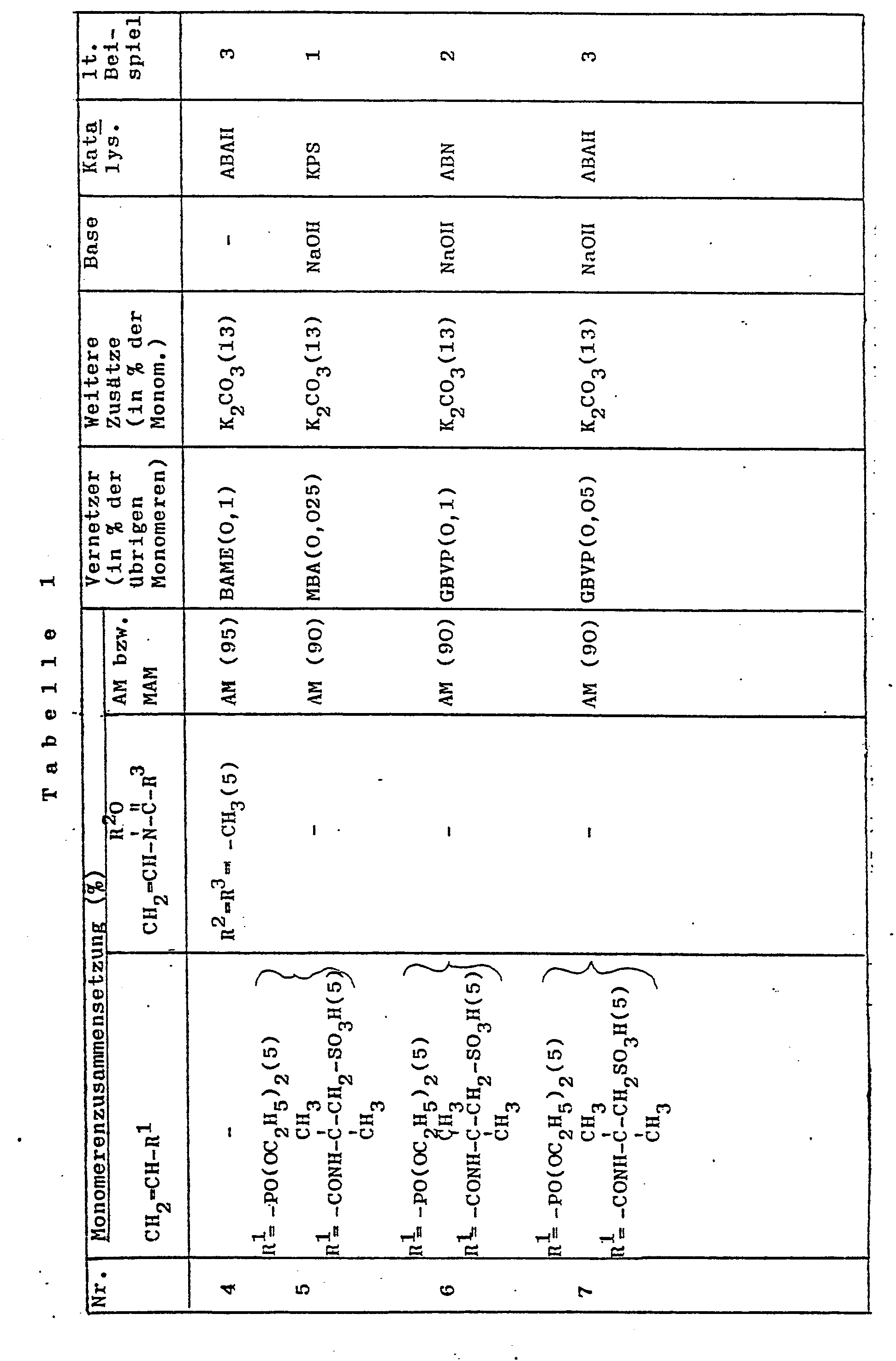

Die Ausprüfung der erfindungsgemäßen Copolymeren im Hinblick auf ihre flüssigkeitsabsorbierende Wirkung in Hygienartikeln erfolgt unter anderem nach einer Schleudermethode mit Hilfe von Saugkörpern in Form von Monatsbinden.The copolymers according to the invention are tested for their liquid-absorbing action in hygiene articles using a centrifugal method with the aid of absorbent bodies in the form of sanitary napkins.
Die Herstellung der Prüfkörper erfolgt, indem zunächst von käuflichen Binden die Umhüllung entfernt und das Flockenkissen gekürzt wird, daß es ein Gewicht von 5,0 g aufweist. Sodann wird das Flockenkissen mit einer Breite von ca. 6 cm und einer Länge von ca. 14 cm in der Dicke vorsichtig halbiert, und beide Hälften werden auseinandergeklappt. Anschließend werden O,5 g Wirksubstanz(WS)des zu untersuchenden Copolymers in Granulatform auf eine Hälfte aufgebracht. Dazu verwendet man eine Schablone, so daß das Polymer auf einer Fläche von 4 x 8 cm zu liegen kommt. Sodann klappt man die andere Hälfte des Kissens zurück und wickelt den Bindenkörper neu ein mit einem siegelfähigen-Vlies der Abmessungen 20 x 20 cm, verschweißt die offenen Enden durch Einwirkung von Wärmeenergie und schneidet das überstehende Vlies ab. Auf diese Weise erhält man Prüfkörper, die sowohl hinsichtlich ihrer Form als auch ihrer Zusammensetzung einer verkürzten Binde entsprechen. Auf die gleiche Weise werden Prüfkörper ohne Copolymer-Zusatz hergestellt. Die Prüfkörper werden anschließend gewogen und sodann 30 Minuten bzw. 3 Stunden in einer mit Prüfflüssigkeit gefüllten Schale so eingetaucht, daß sie sich ohne Behinderung vollsaugen können.The test specimens are produced by first removing the covering from commercially available bandages and shortening the flake pad so that it has a weight of 5.0 g. Then the flake cushion with a width of approx. 6 cm and a length of approx. 14 cm in thickness is carefully cut in half, and both halves are unfolded. Then 0.5 g of active substance (WS) of the copolymer to be investigated are applied in granular form to one half. A template is used so that the polymer comes to rest on an area of 4 x 8 cm. Then you fold back the other half of the pillow and rewrap the bandage body with a sealable fleece measuring 20 x 20 cm, weld the open ends by the action of thermal energy and cut off the protruding fleece. In this way, test specimens are obtained which correspond to a shortened bandage both in terms of their shape and their composition. Test specimens without the addition of copolymer are produced in the same way. The test specimens are then weighed and then immersed in a dish filled with test liquid for 30 minutes or 3 hours so that they can soak themselves without hindrance.
Als Prüflösung werden eine Blutersatzflüssigkeit (BE), bestehend aus l%iger Kochsalzlösung, der noch Glyzerin, Natriumbicarbonat und etwas Hydroxyethylcellulose einer mittleren Viskosität von 20 mPa.s zugegeben wurden, verwendet, oder eine Harnersatzflüssigkeit (HE); bei dieser handelt es sich ebenfalls um eine l%ige Kochsalzlösung, die als weitere Bestandteile Harnstoff, Ammoniumphosphat (sek.), Kaliumsulfat und Zitronensäure enthält.A blood substitute fluid (BE) consisting of 1% saline solution to which glycerol, sodium bicarbonate and some hydroxyethyl cellulose with an average viscosity of 20 mPa.s have been added is used as the test solution, or a urine replacement fluid (HE); this is also a 1% saline solution, which contains urea, ammonium phosphate (sec.), potassium sulfate and citric acid as further components.
Nach der vorgegebenen Eintauchzeit werden die Prüfkörper durch kurzzeitiges Abschleudern von der nicht gebundenen Flüssigkeit befreit. Hierzu benutzt man eine marktgängige Wäscheschleuder mit einem Trommeldurchmesser von 23 cm und einer Umdrehungszahl von 1400 U/Min. Die Prüfkörper legt man an die Innenwand der Trommel und schleudert sie 20 Sekunden lang mit maximal 250-facher Erdbeschleunigung. (Die Zeit ist gerechnet vom-Einschalten der Schleuder bis zum Abschalten und beinhaltet die Anlaufzeit bis zur Erreichung der vollen Tourenzahl). Anschließend werden die Prüfkörper wieder gewogen.After the specified immersion time, the test specimens are freed from the unbound liquid by brief spinning off. This is done using a commercial spin dryer with a drum diameter of 23 cm and a speed of 1400 rpm. The test specimens are placed on the inner wall of the drum and spun for 20 seconds with a maximum of 250 times the acceleration due to gravity. (The time is calculated from switching on the spinner to switching it off and includes the start-up time until the full number of tours is reached). The test specimens are then weighed again.
Zur besseren Vergleichbarkeit errechnet man das Rückhaltevermögen von einem Gramm Polymerisat wie folgt:
- Rückhaltevermögen BE (HE) = (Gewicht des abgeschleuderten Saugkörpers mit Polymer - Gewicht des abgeschleuderten Saugkörpers ohne Polymer) x 2.
- Retention capacity BE (HE) = (weight of the centrifuged absorbent with polymer - weight of the centrifuged absorbent without polymer) x 2.
Das Ergebnis wird somit angegeben in (g Blutersatz/g WS-Polymer) oder ( g Harnersatz/g WS-Polymer).The result is thus given in (g blood substitute / g WS polymer) or (g urine substitute / g WS polymer).
In der folgenden Tabelle 2 sind die Ergebnisse der Ausprüfungen im Hinblick auf Rückhaltevermögen von Blutersatz und Harnersatzlösung aufgeführt.Table 2 below shows the results of the tests with regard to the retention of blood substitute and urine replacement solution.
Zum Vergleich zu den 10 erfindungsgemäßen Copolymerisaten 1 bis 10 ist ein handelsübliches hydrophiles synthetisches Polymeres auf der Basis von Polyacrylat eingesetzt worden.


Claims (4)


-CONH-C(CH3)2-CH2-SO3⊖X⊕,
-CO-NH-C(CH3)2-CH2-PO3⊖⊖X2⊕
-SO3⊖X⊕, -PO3⊖⊖X2⊕ oder


R 1 eine Gruppe der Formel -CO-NH-C (CH3)2-CH2-SO3⊖X⊕,





-CONH-C (CH 3 ) 2 -CH 2 -SO 3 ⊖X⊕,
-CO-NH-C (CH 3 ) 2 -CH 2 -PO 3 ⊖⊖X 2 ⊕
-SO 3 ⊖X⊕, -PO 3 ⊖⊖X 2 ⊕ or
R 1 is a group of the formula -CO-NH-C (CH 3 ) 2 -CH 2 -SO 3 ⊖X⊕,
Applications Claiming Priority (2)
| Application Number | Priority Date | Filing Date | Title |
|---|---|---|---|
| DE19813124454 DE3124454A1 (en) | 1981-06-22 | 1981-06-22 | WATER-SWELLABLE NETWORKED COPOLYMERS, THEIR PRODUCTION AND USE |
| DE3124454 | 1981-06-22 |
Publications (1)
| Publication Number | Publication Date |
|---|---|
| EP0068159A1 true EP0068159A1 (en) | 1983-01-05 |
Family
ID=6135099
Family Applications (1)
| Application Number | Title | Priority Date | Filing Date |
|---|---|---|---|
| EP82104746A Withdrawn EP0068159A1 (en) | 1981-06-22 | 1982-05-29 | Water-swellable cross-linked copolymers, their preparation and use |
Country Status (3)
| Country | Link |
|---|---|
| EP (1) | EP0068159A1 (en) |
| JP (1) | JPS585305A (en) |
| DE (1) | DE3124454A1 (en) |
Cited By (5)
| Publication number | Priority date | Publication date | Assignee | Title |
|---|---|---|---|---|
| EP0132630A3 (en) * | 1983-07-22 | 1986-10-01 | CASSELLA Aktiengesellschaft | Polymers containing phosphonic acid groups, their preparation and their use |
| EP0473881A1 (en) * | 1990-09-03 | 1992-03-11 | Showa Denko Kabushiki Kaisha | Liquid absorption agent |
| EP0510246A1 (en) * | 1991-04-23 | 1992-10-28 | Showa Denko Kabushiki Kaisha | Use of fine particulate crosslinked type n-vinylamide resin microgel |
| CN105470569A (en) * | 2014-09-26 | 2016-04-06 | 三星电子株式会社 | Electrolyte, method of preparing electrolyte, and secondary battery including electrolyte |
| EP1926754B2 (en) † | 2005-09-07 | 2021-12-22 | Basf Se | Polymerization method |
Citations (4)
| Publication number | Priority date | Publication date | Assignee | Title |
|---|---|---|---|---|
| FR2149714A5 (en) * | 1971-08-05 | 1973-03-30 | Tampax Inc | Catamenial tampon - contg polyacrylamide as principal absorbente layer |
| DE2444108B1 (en) * | 1974-09-14 | 1976-01-15 | Hoechst Ag | WATER-BASED CLAY FLUSHING FOR DEEP HOLES AND THE USE OF A MIXED POLYMERIZED FOR SUCH FLUSHING |
| EP0023712A1 (en) * | 1979-08-06 | 1981-02-11 | CASSELLA Aktiengesellschaft | Water-soluble copolymer, process for its production and its use |
| EP0044508A2 (en) * | 1980-07-19 | 1982-01-27 | CASSELLA Aktiengesellschaft | High-molecular weight water-soluble polymers, their preparation and their use |
-
1981
- 1981-06-22 DE DE19813124454 patent/DE3124454A1/en not_active Withdrawn
-
1982
- 1982-05-29 EP EP82104746A patent/EP0068159A1/en not_active Withdrawn
- 1982-06-21 JP JP57105563A patent/JPS585305A/en active Pending
Patent Citations (4)
| Publication number | Priority date | Publication date | Assignee | Title |
|---|---|---|---|---|
| FR2149714A5 (en) * | 1971-08-05 | 1973-03-30 | Tampax Inc | Catamenial tampon - contg polyacrylamide as principal absorbente layer |
| DE2444108B1 (en) * | 1974-09-14 | 1976-01-15 | Hoechst Ag | WATER-BASED CLAY FLUSHING FOR DEEP HOLES AND THE USE OF A MIXED POLYMERIZED FOR SUCH FLUSHING |
| EP0023712A1 (en) * | 1979-08-06 | 1981-02-11 | CASSELLA Aktiengesellschaft | Water-soluble copolymer, process for its production and its use |
| EP0044508A2 (en) * | 1980-07-19 | 1982-01-27 | CASSELLA Aktiengesellschaft | High-molecular weight water-soluble polymers, their preparation and their use |
Cited By (10)
| Publication number | Priority date | Publication date | Assignee | Title |
|---|---|---|---|---|
| EP0132630A3 (en) * | 1983-07-22 | 1986-10-01 | CASSELLA Aktiengesellschaft | Polymers containing phosphonic acid groups, their preparation and their use |
| EP0473881A1 (en) * | 1990-09-03 | 1992-03-11 | Showa Denko Kabushiki Kaisha | Liquid absorption agent |
| US5300606A (en) * | 1990-09-03 | 1994-04-05 | Showa Denko K.K. | Liquid absorption agent |
| US5407996A (en) * | 1990-09-03 | 1995-04-18 | Showa Denko K.K. | Method for producing ceramics using crosslinked N-vinylcarboxylic and amide resin |
| EP0510246A1 (en) * | 1991-04-23 | 1992-10-28 | Showa Denko Kabushiki Kaisha | Use of fine particulate crosslinked type n-vinylamide resin microgel |
| US5280095A (en) * | 1991-04-23 | 1994-01-18 | Showa Denko K.K. | Fine particulate crosslinked type N-vinylamide resin and microgel, process for preparing same, and use thereof |
| US5338815A (en) * | 1991-04-23 | 1994-08-16 | Showa Denko K.K. | Fine particulate crosslinked type n-vinylamide resin and microgel, process for preparing same, and use thereof |
| EP1926754B2 (en) † | 2005-09-07 | 2021-12-22 | Basf Se | Polymerization method |
| CN105470569A (en) * | 2014-09-26 | 2016-04-06 | 三星电子株式会社 | Electrolyte, method of preparing electrolyte, and secondary battery including electrolyte |
| US10361456B2 (en) | 2014-09-26 | 2019-07-23 | Samsung Electronics Co., Ltd. | Electrolyte, method of preparing the electrolyte, and secondary battery including the electrolyte |
Also Published As
| Publication number | Publication date |
|---|---|
| DE3124454A1 (en) | 1983-07-14 |
| JPS585305A (en) | 1983-01-12 |
Similar Documents
| Publication | Publication Date | Title |
|---|---|---|
| DE3887258T2 (en) | Process for making absorbent polymers. | |
| DE2653135C2 (en) | ||
| DE19529348C2 (en) | Absorbent for water and aqueous liquids based on polyacrylate and process for their production and use | |
| DE3031304C2 (en) | ||
| DE69415651T2 (en) | SUPER ABSORBING POLYMERS AND PRODUCTS CONTAINING THEM | |
| EP1058695B1 (en) | Method for cross-linking hydrogels with bis- and poly-2-oxazolidinones | |
| DE69302686T3 (en) | CROSSLINKED HYDROPHILE RESINS AND METHOD FOR THE PRODUCTION THEREOF | |
| DE3228121C2 (en) | ||
| DE4244548C2 (en) | Powdery liquids under load as well as blood-absorbing polymers, processes for their production and their use in textile constructions for personal hygiene | |
| DE69124749T2 (en) | Process for the production of salt-resistant resin | |
| DE2753214A1 (en) | VERY ABSORBABLE POLYMERS COMPOSITIONS OF POLYHYDROXYPOLYMER-GROPFCOPOLYMERS | |
| DE69209142T2 (en) | Process for producing a superabsorbent polymer | |
| EP0316792B1 (en) | Hydrophilic swellable graft polymers, their preparation and their use | |
| DE2647420A1 (en) | PROCESS FOR THE PREPARATION OF A MODIFIED POLYSACCHARIDE | |
| DE3786537T2 (en) | Water absorbent polymer composition, process for its preparation and article containing it. | |
| DE2746018C2 (en) | ||
| EP0068189A1 (en) | Cross-linked copolymers swellable in water and their use as absorbant material for aqueous body fluids, such as urine and other aqueous fluids containing electrolyte | |
| WO2000031152A1 (en) | Method for the secondary cross-linking of hydrogels with n-acyl-2-oxazolidinones | |
| DE2633249C2 (en) | ||
| WO1999055767A1 (en) | Mechanically stable hydrogels | |
| DE3628482A1 (en) | METHOD FOR PRODUCING A RESIN WITH HIGH ABSORPTION | |
| EP0697416B1 (en) | Superabsorbent polymers from crosslinked poly(acrylonitrile) emulsions | |
| DE3617311A1 (en) | Process for the preparation of a water-absorbent resin | |
| DE3225555A1 (en) | CROSSLINKER FOR WATER SWELLABLE POLYMERS | |
| EP0527867B1 (en) | Cross-linked, water-absorbent polymer and its use in the production of hygiene items |
Legal Events
| Date | Code | Title | Description |
|---|---|---|---|
| PUAI | Public reference made under article 153(3) epc to a published international application that has entered the european phase |
Free format text: ORIGINAL CODE: 0009012 |
|
| AK | Designated contracting states |
Designated state(s): DE FR GB IT |
|
| STAA | Information on the status of an ep patent application or granted ep patent |
Free format text: STATUS: THE APPLICATION IS DEEMED TO BE WITHDRAWN |
|
| 18D | Application deemed to be withdrawn |
Effective date: 19831212 |
|
| RIN1 | Information on inventor provided before grant (corrected) |
Inventor name: SCHMITZ, HERMANN, DR. Inventor name: HOLST, ARNO, DR. Inventor name: LASK, HELMUT Inventor name: ENGELHARDT, FRIEDRICH, DR. Inventor name: KLEINER, HANS-JERG, DR. |