EP0036947B1 - Method for preparing a membrane of a film-forming non-sulfonated sulfone polymer - Google Patents
Method for preparing a membrane of a film-forming non-sulfonated sulfone polymer Download PDFInfo
- Publication number
- EP0036947B1 EP0036947B1 EP81101354A EP81101354A EP0036947B1 EP 0036947 B1 EP0036947 B1 EP 0036947B1 EP 81101354 A EP81101354 A EP 81101354A EP 81101354 A EP81101354 A EP 81101354A EP 0036947 B1 EP0036947 B1 EP 0036947B1
- Authority
- EP
- European Patent Office
- Prior art keywords
- membrane
- film
- solution
- polymer
- sulfone polymer
- Prior art date
- Legal status (The legal status is an assumption and is not a legal conclusion. Google has not performed a legal analysis and makes no representation as to the accuracy of the status listed.)
- Expired
Links
- 239000012528 membrane Substances 0.000 title claims description 75
- 229920000642 polymer Polymers 0.000 title claims description 22
- 238000000034 method Methods 0.000 title claims description 15
- 150000003457 sulfones Chemical class 0.000 title claims description 12
- 239000002904 solvent Substances 0.000 claims description 19
- 238000001879 gelation Methods 0.000 claims description 17
- 238000001704 evaporation Methods 0.000 claims description 15
- 238000005266 casting Methods 0.000 claims description 14
- GNOIPBMMFNIUFM-UHFFFAOYSA-N hexamethylphosphoric triamide Chemical compound CN(C)P(=O)(N(C)C)N(C)C GNOIPBMMFNIUFM-UHFFFAOYSA-N 0.000 claims description 7
- 239000007787 solid Substances 0.000 claims description 5
- 239000000243 solution Substances 0.000 description 23
- XLYOFNOQVPJJNP-UHFFFAOYSA-N water Substances O XLYOFNOQVPJJNP-UHFFFAOYSA-N 0.000 description 22
- 230000014759 maintenance of location Effects 0.000 description 18
- 230000004907 flux Effects 0.000 description 14
- 229920002492 poly(sulfone) Polymers 0.000 description 13
- 230000008020 evaporation Effects 0.000 description 12
- 239000000463 material Substances 0.000 description 9
- 229920001223 polyethylene glycol Polymers 0.000 description 9
- 239000002202 Polyethylene glycol Substances 0.000 description 7
- ZMXDDKWLCZADIW-UHFFFAOYSA-N N,N-Dimethylformamide Chemical compound CN(C)C=O ZMXDDKWLCZADIW-UHFFFAOYSA-N 0.000 description 6
- 230000000717 retained effect Effects 0.000 description 6
- 239000011148 porous material Substances 0.000 description 5
- 238000000108 ultra-filtration Methods 0.000 description 5
- 239000000203 mixture Substances 0.000 description 4
- 239000000126 substance Substances 0.000 description 4
- PEDCQBHIVMGVHV-UHFFFAOYSA-N Glycerine Chemical compound OCC(O)CO PEDCQBHIVMGVHV-UHFFFAOYSA-N 0.000 description 3
- 239000012153 distilled water Substances 0.000 description 3
- 229920002521 macromolecule Polymers 0.000 description 3
- 230000035699 permeability Effects 0.000 description 3
- 239000011347 resin Substances 0.000 description 3
- 229920005989 resin Polymers 0.000 description 3
- 239000012085 test solution Substances 0.000 description 3
- 238000012360 testing method Methods 0.000 description 3
- 229920002307 Dextran Polymers 0.000 description 2
- IAZDPXIOMUYVGZ-UHFFFAOYSA-N Dimethylsulphoxide Chemical compound CS(C)=O IAZDPXIOMUYVGZ-UHFFFAOYSA-N 0.000 description 2
- FXHOOIRPVKKKFG-UHFFFAOYSA-N N,N-Dimethylacetamide Chemical compound CN(C)C(C)=O FXHOOIRPVKKKFG-UHFFFAOYSA-N 0.000 description 2
- 229940113088 dimethylacetamide Drugs 0.000 description 2
- 238000001914 filtration Methods 0.000 description 2
- 239000011521 glass Substances 0.000 description 2
- 239000007788 liquid Substances 0.000 description 2
- 239000002245 particle Substances 0.000 description 2
- XNWFRZJHXBZDAG-UHFFFAOYSA-N 2-METHOXYETHANOL Chemical compound COCCO XNWFRZJHXBZDAG-UHFFFAOYSA-N 0.000 description 1
- SECXISVLQFMRJM-UHFFFAOYSA-N N-Methylpyrrolidone Chemical compound CN1CCCC1=O SECXISVLQFMRJM-UHFFFAOYSA-N 0.000 description 1
- 239000004721 Polyphenylene oxide Substances 0.000 description 1
- 230000002378 acidificating effect Effects 0.000 description 1
- 239000000654 additive Substances 0.000 description 1
- 238000009835 boiling Methods 0.000 description 1
- 239000003795 chemical substances by application Substances 0.000 description 1
- 238000004737 colorimetric analysis Methods 0.000 description 1
- 150000001875 compounds Chemical class 0.000 description 1
- 239000000356 contaminant Substances 0.000 description 1
- 230000007423 decrease Effects 0.000 description 1
- 230000003247 decreasing effect Effects 0.000 description 1
- 239000012530 fluid Substances 0.000 description 1
- 238000004442 gravimetric analysis Methods 0.000 description 1
- 238000010438 heat treatment Methods 0.000 description 1
- 238000007654 immersion Methods 0.000 description 1
- 230000007774 longterm Effects 0.000 description 1
- 239000008188 pellet Substances 0.000 description 1
- 239000012466 permeate Substances 0.000 description 1
- 230000010287 polarization Effects 0.000 description 1
- 229920000090 poly(aryl ether) Polymers 0.000 description 1
- 229920000570 polyether Polymers 0.000 description 1
- 238000002360 preparation method Methods 0.000 description 1
- 239000003755 preservative agent Substances 0.000 description 1
- 239000013557 residual solvent Substances 0.000 description 1
- 238000001223 reverse osmosis Methods 0.000 description 1
- 238000000926 separation method Methods 0.000 description 1
- 238000003756 stirring Methods 0.000 description 1
- 239000000758 substrate Substances 0.000 description 1
- 239000000080 wetting agent Substances 0.000 description 1
Classifications
-
- B—PERFORMING OPERATIONS; TRANSPORTING
- B01—PHYSICAL OR CHEMICAL PROCESSES OR APPARATUS IN GENERAL
- B01D—SEPARATION
- B01D71/00—Semi-permeable membranes for separation processes or apparatus characterised by the material; Manufacturing processes specially adapted therefor
- B01D71/06—Organic material
- B01D71/66—Polymers having sulfur in the main chain, with or without nitrogen, oxygen or carbon only
- B01D71/68—Polysulfones; Polyethersulfones
-
- B—PERFORMING OPERATIONS; TRANSPORTING
- B01—PHYSICAL OR CHEMICAL PROCESSES OR APPARATUS IN GENERAL
- B01D—SEPARATION
- B01D61/00—Processes of separation using semi-permeable membranes, e.g. dialysis, osmosis or ultrafiltration; Apparatus, accessories or auxiliary operations specially adapted therefor
- B01D61/14—Ultrafiltration; Microfiltration
- B01D61/145—Ultrafiltration
-
- B—PERFORMING OPERATIONS; TRANSPORTING
- B01—PHYSICAL OR CHEMICAL PROCESSES OR APPARATUS IN GENERAL
- B01D—SEPARATION
- B01D67/00—Processes specially adapted for manufacturing semi-permeable membranes for separation processes or apparatus
- B01D67/0002—Organic membrane manufacture
- B01D67/0009—Organic membrane manufacture by phase separation, sol-gel transition, evaporation or solvent quenching
- B01D67/0011—Casting solutions therefor
-
- C—CHEMISTRY; METALLURGY
- C08—ORGANIC MACROMOLECULAR COMPOUNDS; THEIR PREPARATION OR CHEMICAL WORKING-UP; COMPOSITIONS BASED THEREON
- C08J—WORKING-UP; GENERAL PROCESSES OF COMPOUNDING; AFTER-TREATMENT NOT COVERED BY SUBCLASSES C08B, C08C, C08F, C08G or C08H
- C08J3/00—Processes of treating or compounding macromolecular substances
- C08J3/02—Making solutions, dispersions, lattices or gels by other methods than by solution, emulsion or suspension polymerisation techniques
- C08J3/09—Making solutions, dispersions, lattices or gels by other methods than by solution, emulsion or suspension polymerisation techniques in organic liquids
- C08J3/091—Making solutions, dispersions, lattices or gels by other methods than by solution, emulsion or suspension polymerisation techniques in organic liquids characterised by the chemical constitution of the organic liquid
- C08J3/098—Other compounds
-
- C—CHEMISTRY; METALLURGY
- C08—ORGANIC MACROMOLECULAR COMPOUNDS; THEIR PREPARATION OR CHEMICAL WORKING-UP; COMPOSITIONS BASED THEREON
- C08J—WORKING-UP; GENERAL PROCESSES OF COMPOUNDING; AFTER-TREATMENT NOT COVERED BY SUBCLASSES C08B, C08C, C08F, C08G or C08H
- C08J2381/00—Characterised by the use of macromolecular compounds obtained by reactions forming in the main chain of the macromolecule a linkage containing sulfur with or without nitrogen, oxygen, or carbon only; Polysulfones; Derivatives of such polymers
- C08J2381/06—Polysulfones; Polyethersulfones
Definitions
- Membranes to be used for pressure-activated separation processes such as ultrafiltration and reverse osmosis should have high flux, high retention of materials with large molecular or particle size, and sharp molecular size cut-off.
- molecules of solvent and of materials of smaller molecular size than the size desired to be retained should pass rapidly and completely through the membrane at relatively low applied pressure, whereas molecules or particles of size equal to or larger than the size desired to be retained should not be able to enter the pores of the membrane.
- the sizes of molecules of similar types are proportional to the molecular weight of the molecules.
- a membrane is characterized by the molecular weight of the molecule it will retain.
- the molecular weight cut-off of the membrane is a measure of the molecular size cut-off, and hence, the pore size of the membrane.
- a membrane In addition to the above mentioned properties a membrane must have good long term resistance to the thermal and chemical environment that it will encounter in service. Because many commercial ultrafiltration processes are best operated at temperatures up to about 100°C and involve processing of acidic or basic materials, the membrane should withstand such temperatures and be stable over a wide pH range. The thermal and chemical stability of a membrane is principally determined by the chemical nature of the polymer used to form the membrane.
- polysulfones and/or polyether/sulfones have been shown to be advantageous for forming chemically and thermally resistant ultrafiltration membranes.
- polysulfone polymer is a material sold under the trade name Udel P 1700 by Union Carbide corporation.
- Udel P 1700 by Union Carbide corporation.
- the chemical structure of this polymer is
- the general procedure consists of forming a solution of the polymer in a suitable solvent or mixture of solvents, sometimes with the addition of non-solvents or flux-promoting agents, casting a film of the solution, evaporating a portion of the solvent, and gelation of the membrane by immersion of the film in a liquid that is a non-solvent for the polymer.
- the properties of the resulting membrane depend primarily on the choice of solvent and other additives in the casting solution and on the conditions employed during the evaporation and gelation procedures.
- Baker discloses that the properties of the membrane are improved when the film is exposed to hot gas or air for 5 to 60 seconds during the evaporation step prior to gelation.
- a number of solvents such as dimethyl formamide, dimethyl acetamide, dimethyl sulfoxide, N-methyl pyrrolidone, methyl cellosolve, and mixtures thereof are disclosed.
- US-A-3,855,122 hexamethyl phosphoramide is mentioned as a solvent for sulfonated polyarylether/sulfone, but no example of its use is given.
- FR-A-2277847 hexamethyl phosphoramide is also mentioned as a solvent for sulfonated polysulfones, as well as a solvent suitable for preparing and dissolving non sulfonated modified polysulfones.
- preparing a membrane the solution of a modified polysulfone is casted on a solid surface, a portion of the solvent is evaporated and the so produced film is immersed in a gelation medium.
- polysulfone membranes disclosed in the above-mentioned patents have high water permeability, none of them have good retention of lower molecular weight macromolecules such as macromolecules with molecular weights of 20,000 or less and none demonstrate sharp molecular weight cut-offs.
- This invention relates to a method of preparing a membrane of a film-forming, non-sulfonated sulfone polymer, which membrane has the following characteristics when used as a filtration means:
- the method of preparing a membrane of a film-forming non-sulfonated sulfone polymer comprises dissolving said sulfone polymer in hexamethyl phosphoramide to form a solution containing from 10 to 25, preferably 14 to 18, weight percent polymer, casting said solution on a solid surface to form a film, evaporating a portion of the solvent from the film, and then immersing said film in a gelation medium such as water at a temperature ranging from -10°C to +50°C for a period of from 1 minute to 30 min. to form the membrane.
- a gelation medium such as water
- the gelled membrane may subsequently be dimensionally stabilized by heat treatment thereof.
- a solution containing 15% polysulfone resin in hexamethyl phosphoramide was prepared by stirring a mixture of polysulfone resin pellets (Udel P-1700, Union Carbide Corp.) at about 35°C for about 4 hours until all of the polymer had dissolved. The solution was allowed to stand undisturbed for about 20 min. to allow air bubbles to rise to the surface and escape. The resulting solution was clear and bubble free.
- a 254 pm film of this solution was cast onto a smooth, clean glass plate. Tape had been placed along the edges of the plate prior to casting to assure adherence of the film to the plate during subsequent processing steps. Immediately after the film had been cast, the plate and cast film were placed under an electric heater at a temperature of 88°C for 1 min. The plate and film were then removed and immersed in a water bath at ambient temperature for gelation. After 30 min. the resulting membrane was cut free of the tape, removed from the glass plate, and stored in water at ambient temperature.
- the above produced membrane was evaluated for flux and retention at 2.07 bars gauge using distilled water, a blue dextrane (M.W. 2,000,000) solution (Blue Dextran 2000, registered Trade Mark), and polyethylene glycol ("Carbowax", registered Trade Mark) solutions.
- Membrane prepared as in Example 1 except that evaporation was for 3 min. under heater at 65°C.
- Membrane prepared as in Example 3 except that evaporation was for 1 min.
- Membrane prepared as in Example 1 except that gelation was in iced water at about 2°C.
- Membrane prepared as in Example 1 except that the membrane was not restrained on the plate by tape or any other means and evaporation was at room temperature for 3 min.
- a membrane was prepared following the same general procedure as in Example 1 except that the casting dope was a 15% solution of Udel P-1700 polysulfone in dimethyl formamide. The evaporation of the cast film was carried out for 1 min. under a heater at 68°C. Gelation was in water at ambient temperature.
- a membrane was prepared following the same general procedure as in Example 1 except that the casting dope was a 15% solution of Udel P-1700 polysulfone in dimethyl acetamide. The evaporation of the cast film was carried out for 1 min. under a heater at 38°C. Gelation was in water at ambient temperature.
- a membrane was prepared as in Example 8 except that the polysulfone concentration in the casting dope was 20% by weight.
- a membrane was prepared as in Example 8 except that the temperature during evaporation was 65°C.
- a membrane was prepared as in Example 10 except that the casting dope contained 5% by weight glycerol as a non-solvent or flux promoter in addition to the 15% polysulfone resin.
- a membrane was prepared as in Example 11 except that evaporation was carried out at ambient temperature for 3 min.
- the membranes prepared according to the examples in this invention were kept wet with water at all times prior to testing.
- the filtration is carried out in a cell that provides flow of the test fluid across the surface of the membrane to minimize concentration polarization, that is, build up of a layer of concentrated solution at the surface of the membrane.
- An Amicon TCF 10 ultrafiltration cell is an example of such a test cell.
- a solution of a single compound with a relatively narrow molecular weight range in water must be used.
- the water flux was determined at 2.07 bars gauge with distilled water on a well flushed membrane before the membrane was exposed to any test solution. If the water flux is determined after exposure of the membrane to a test solution, it may be lower than the initial water flux. Following determination of the water flux, the flux and retention of the other solutions at 2.07 bars gauge was determined in the order listed. The membrane was thoroughly rinsed and distilled water between each determination. For determination of retention, four samples of permeate, each containing at least 10 ml, were collected and analyzed separately. Colorimetric analysis was used for Blue Dextran (registered Trade Mark) solutions and gravimetric analysis for the Carbowax (registered Trade Mark) solutons. Retention was calculated as There was no significant difference or trend in the four results for a given test solution and a given membrane.
- the concentration of the film forming non-sulfonated sulfone polymer dissolved in hexamethyl phosphoramide solvent to form the solution for casting the membrane should be in the range of 10 to 25 weight percent, preferably 14 to 18 weight percent.
- the temperature of the solution should be high enough to dissolve the polymer to form a clear solution but below the boiling point of the solvent. Preferably, the temperature should be in the range of 85 to 100°C.
- the properties of the membrane are not significantly affected by their formed thickness probably due to the fact that the membranes are asymmetric and ultrafiltraton takes place at a very thin "skin" or layer of critical porosity at the top surface, the rest of the membrane being more porous and offering little resistance to flow.
- the preferred thickness of the film cast to form the membrane is from 127 mm to 381 mm.
- the solution of the sulfone polymer in hexamethyl phosphoramide is cast on a smooth solid surface or substrate.
- the solvent is then allowed to evaporate from the formed sheet but only to an extent necessary to provide a material which will have the desired porosity after treatment with the gelation medium.
- Evaporaton may be brought about by exposure of the formed (cast) sheet to air at room temperature for from 1 to 10 min. or it may be hastened by increasing the temperature near the surface of the film, for example by placing the film under an electric heater.
- the gelation treatment after the evaporation step, is required to convert the liquid film into a solid membrane.
- the gelation medium is kept at a temperature ranging from -10 to +50°C, preferably 0 to 25°C, and the dwell time for exposure of the sheet to the gelation medium must be sufficient to solidify the membrane, i.e. at least 1 min.
- the membrane may be left in the gelation medium for a longer time if desired.
- the cast film may be secured to the casting surface, for example by placing tape along the outer edge of the casting plate, during the evaporation and gelation steps, but this procedure is not necessary as demonstrated by Example 6.
Landscapes
- Chemical & Material Sciences (AREA)
- Chemical Kinetics & Catalysis (AREA)
- Engineering & Computer Science (AREA)
- Dispersion Chemistry (AREA)
- Manufacturing & Machinery (AREA)
- Water Supply & Treatment (AREA)
- General Chemical & Material Sciences (AREA)
- Health & Medical Sciences (AREA)
- Medicinal Chemistry (AREA)
- Polymers & Plastics (AREA)
- Organic Chemistry (AREA)
- Separation Using Semi-Permeable Membranes (AREA)
- Manufacture Of Porous Articles, And Recovery And Treatment Of Waste Products (AREA)
- Polymers With Sulfur, Phosphorus Or Metals In The Main Chain (AREA)
Description
- Membranes to be used for pressure-activated separation processes such as ultrafiltration and reverse osmosis should have high flux, high retention of materials with large molecular or particle size, and sharp molecular size cut-off. In other words, molecules of solvent and of materials of smaller molecular size than the size desired to be retained should pass rapidly and completely through the membrane at relatively low applied pressure, whereas molecules or particles of size equal to or larger than the size desired to be retained should not be able to enter the pores of the membrane.
- In practice, no membrane has all pores of exactly the same size, and therefore there is always a range of molecular sizes that are partially but not totally retained by the membrane. The smaller this range of sizes partially retained by the membrane is, the sharper the molecular size cut-off of the membrane is said to be.
- Because the size of molecules are difficult to measure, it is generally assumed that the sizes of molecules of similar types are proportional to the molecular weight of the molecules. Hence, instead of being characterized by the size of the molecules it will retain, a membrane is characterized by the molecular weight of the molecule it will retain. In like manner, the molecular weight cut-off of the membrane is a measure of the molecular size cut-off, and hence, the pore size of the membrane.
- In addition to the above mentioned properties a membrane must have good long term resistance to the thermal and chemical environment that it will encounter in service. Because many commercial ultrafiltration processes are best operated at temperatures up to about 100°C and involve processing of acidic or basic materials, the membrane should withstand such temperatures and be stable over a wide pH range. The thermal and chemical stability of a membrane is principally determined by the chemical nature of the polymer used to form the membrane.
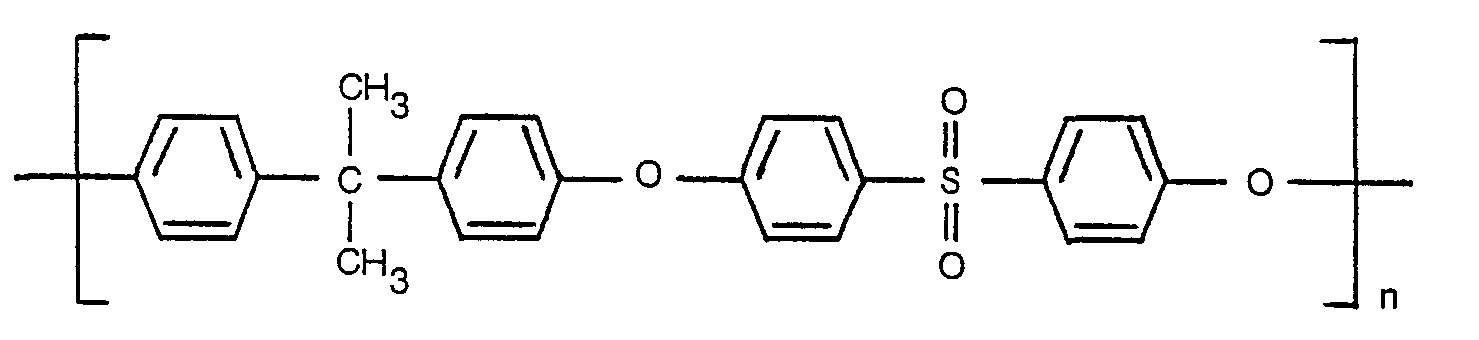
- The class of polymers known as polysulfones and/or polyether/sulfones have been shown to be advantageous for forming chemically and thermally resistant ultrafiltration membranes. One example of such polysulfone polymer is a material sold under the trade name Udel P 1700 by Union Carbide corporation. The chemical structure of this polymer is
- Methods for casting asymmetric membranes from this class of polymers have been disclosed for example in US-A-3,567,810, 3,615,024, 3,632,404, 3,651,030, 3,691,068, 3,709,841, 3,855,122, 3,912,834, 4,005,012, 4,026,977 and 4,038,351, as well as in FR-A-2424750.
- The general procedure consists of forming a solution of the polymer in a suitable solvent or mixture of solvents, sometimes with the addition of non-solvents or flux-promoting agents, casting a film of the solution, evaporating a portion of the solvent, and gelation of the membrane by immersion of the film in a liquid that is a non-solvent for the polymer.
- The properties of the resulting membrane, such as flux and retention characteristics, depend primarily on the choice of solvent and other additives in the casting solution and on the conditions employed during the evaporation and gelation procedures. For example in US-A-3,567,810, Baker discloses that the properties of the membrane are improved when the film is exposed to hot gas or air for 5 to 60 seconds during the evaporation step prior to gelation.
- In the above mentioned patents, a number of solvents such as dimethyl formamide, dimethyl acetamide, dimethyl sulfoxide, N-methyl pyrrolidone, methyl cellosolve, and mixtures thereof are disclosed. In US-A-3,855,122 hexamethyl phosphoramide is mentioned as a solvent for sulfonated polyarylether/sulfone, but no example of its use is given. In FR-A-2277847 hexamethyl phosphoramide is also mentioned as a solvent for sulfonated polysulfones, as well as a solvent suitable for preparing and dissolving non sulfonated modified polysulfones. In preparing a membrane the solution of a modified polysulfone is casted on a solid surface, a portion of the solvent is evaporated and the so produced film is immersed in a gelation medium.
- Although some of the polysulfone membranes disclosed in the above-mentioned patents have high water permeability, none of them have good retention of lower molecular weight macromolecules such as macromolecules with molecular weights of 20,000 or less and none demonstrate sharp molecular weight cut-offs.
- In general when the pore size of a membrane is decreased so that it retains lower molecular weight species, the water permeability also decreases. Thus the better the retention of the membrane becomes for lower molecular weight molecules, the lower the water permeability becomes.
- This invention relates to a method of preparing a membrane of a film-forming, non-sulfonated sulfone polymer, which membrane has the following characteristics when used as a filtration means:
- a) a water flux of at least 0.2 ml/cm2/min. at 2.07 bars gauge,
- b) a retention of at least 95% of polyethylene glycol (PEG) having an average molecular weight in the range of 15000 and 20000,
- c) a retention of at least 80% of polyethylene glycol having an average molecular weight of about 6000, and
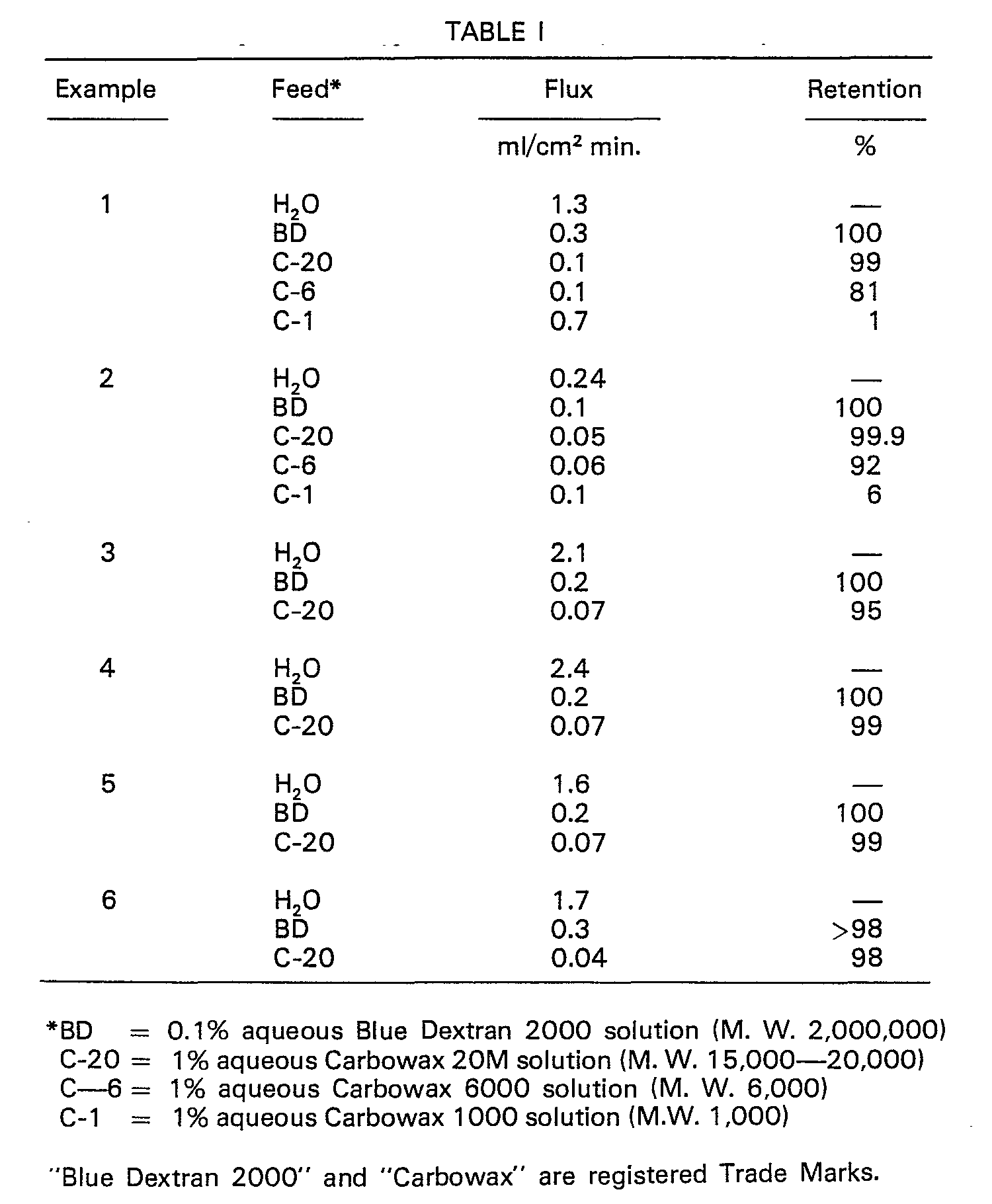
- d) a retention of less than 10% of polyethylene glycol having an average molecular weight of about 1000. The water flux of the membrane is preferably at least 1.0 ml./cm2/min., the retention of PEG (MW 15000-20000) is preferably at least 99% and the retention of PEG (MW 6000) is preferably at least 90%.
- According to the invention the method of preparing a membrane of a film-forming non-sulfonated sulfone polymer comprises dissolving said sulfone polymer in hexamethyl phosphoramide to form a solution containing from 10 to 25, preferably 14 to 18, weight percent polymer, casting said solution on a solid surface to form a film, evaporating a portion of the solvent from the film, and then immersing said film in a gelation medium such as water at a temperature ranging from -10°C to +50°C for a period of from 1 minute to 30 min. to form the membrane.
- Optionally, the gelled membrane may subsequently be dimensionally stabilized by heat treatment thereof.
- The preparation of the porous membranes by the process of this invention and the ultrafiltration properties of the resultant membranes are demonstrated by the following examples.
- A solution containing 15% polysulfone resin in hexamethyl phosphoramide was prepared by stirring a mixture of polysulfone resin pellets (Udel P-1700, Union Carbide Corp.) at about 35°C for about 4 hours until all of the polymer had dissolved. The solution was allowed to stand undisturbed for about 20 min. to allow air bubbles to rise to the surface and escape. The resulting solution was clear and bubble free.
- A 254 pm film of this solution was cast onto a smooth, clean glass plate. Tape had been placed along the edges of the plate prior to casting to assure adherence of the film to the plate during subsequent processing steps. Immediately after the film had been cast, the plate and cast film were placed under an electric heater at a temperature of 88°C for 1 min. The plate and film were then removed and immersed in a water bath at ambient temperature for gelation. After 30 min. the resulting membrane was cut free of the tape, removed from the glass plate, and stored in water at ambient temperature.
- The above produced membrane was evaluated for flux and retention at 2.07 bars gauge using distilled water, a blue dextrane (M.W. 2,000,000) solution (Blue Dextran 2000, registered Trade Mark), and polyethylene glycol ("Carbowax", registered Trade Mark) solutions.
- Data are shown in Table 1.
- Membrane prepared as in Example 1 except that the polysulfone concentration in the casting solution was 20% by weight, temperature under heater during evaporation step was 52°C, and gelation was in iced water at about 2°C.
- Membrane prepared as in Example 1 except that evaporation was for 3 min. under heater at 65°C.
- Membrane prepared as in Example 3 except that evaporation was for 1 min.
- Membrane prepared as in Example 1 except that gelation was in iced water at about 2°C.
- Membrane prepared as in Example 1 except that the membrane was not restrained on the plate by tape or any other means and evaporation was at room temperature for 3 min.
- To demonstrate that the membranes prepared according to the process of this invention have superior properties of flux and retention of lower molecular weight macromolecules, the following membranes were prepared using solvents disclosed in the prior art. The resulting membranes were evaluated as in Example 1. Results are shown in Table 2.
- A membrane was prepared following the same general procedure as in Example 1 except that the casting dope was a 15% solution of Udel P-1700 polysulfone in dimethyl formamide. The evaporation of the cast film was carried out for 1 min. under a heater at 68°C. Gelation was in water at ambient temperature.
- A membrane was prepared following the same general procedure as in Example 1 except that the casting dope was a 15% solution of Udel P-1700 polysulfone in dimethyl acetamide. The evaporation of the cast film was carried out for 1 min. under a heater at 38°C. Gelation was in water at ambient temperature.
- A membrane was prepared as in Example 8 except that the polysulfone concentration in the casting dope was 20% by weight.
- A membrane was prepared as in Example 8 except that the temperature during evaporation was 65°C.
- A membrane was prepared as in Example 10 except that the casting dope contained 5% by weight glycerol as a non-solvent or flux promoter in addition to the 15% polysulfone resin.
- A membrane was prepared as in Example 11 except that evaporation was carried out at ambient temperature for 3 min.
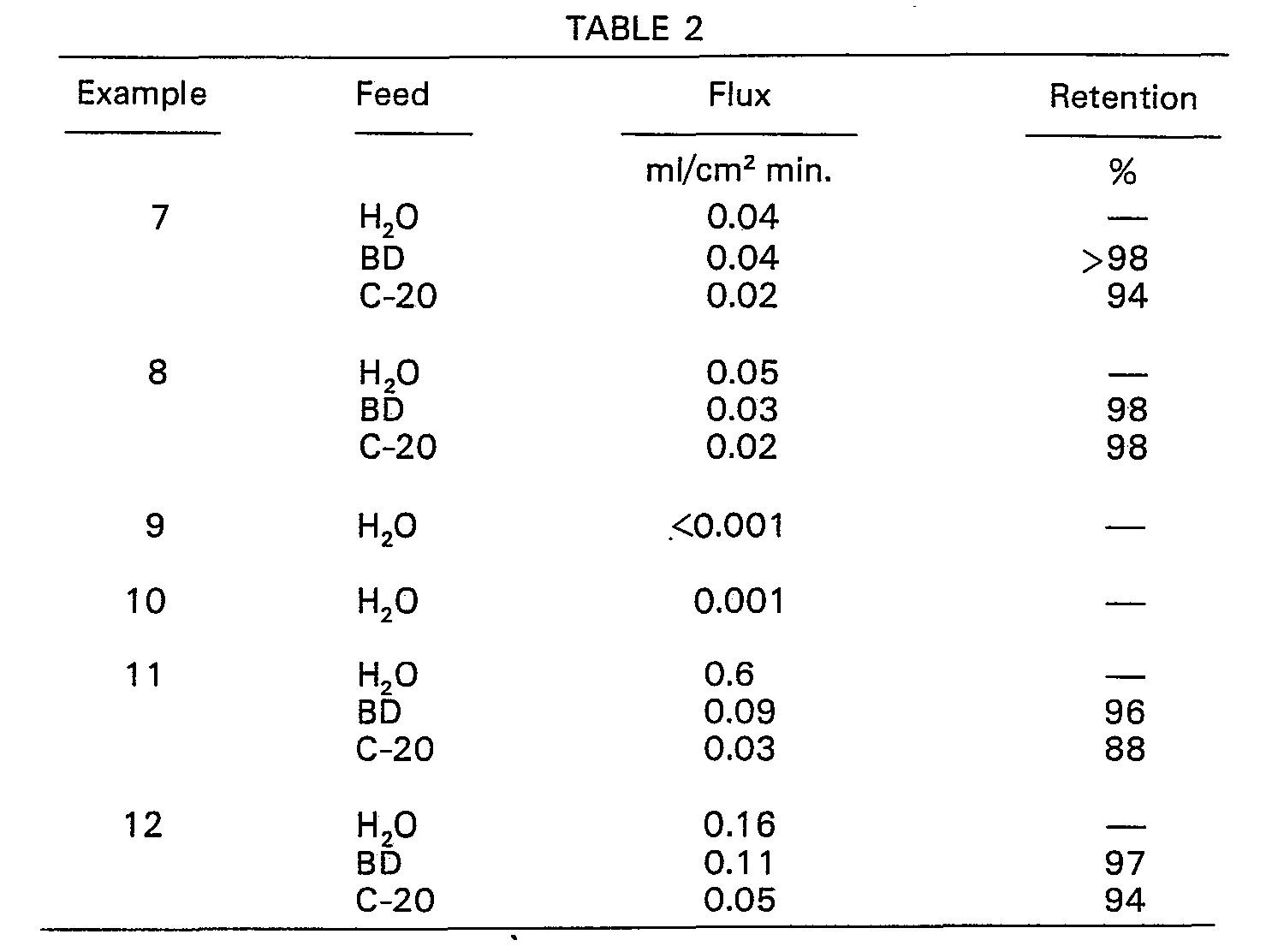
- In evaluating the properties of membranes it is important that the membranes be thoroughly leached or rinsed with water to remove all residual solvents, preservatives, wetting agents, or other contaminants before determination of flux and retention. The membranes prepared according to the examples in this invention were kept wet with water at all times prior to testing. For determination of flux and retention the filtration is carried out in a cell that provides flow of the test fluid across the surface of the membrane to minimize concentration polarization, that is, build up of a layer of concentrated solution at the surface of the membrane. An Amicon TCF 10 ultrafiltration cell is an example of such a test cell. For each determination of retention, a solution of a single compound with a relatively narrow molecular weight range in water must be used. If a mixture of materials, one having a molecular weight high enough that it would ordinarily be retained by the membrane and the other having a molecular weight low enough that it would not ordinarily be retained to any significant extent by the membrane, were used, a higher than normal retention of the lower molecular weight material would likely be found because the molecules of the higher molecular weight material that could not pass through the pores of the membrane would build up at the surface of the membrane and impede the transport of the lower molecular weight material to the membrane surface.
- In evaluating the membranes prepared as described in the examples, the water flux was determined at 2.07 bars gauge with distilled water on a well flushed membrane before the membrane was exposed to any test solution. If the water flux is determined after exposure of the membrane to a test solution, it may be lower than the initial water flux. Following determination of the water flux, the flux and retention of the other solutions at 2.07 bars gauge was determined in the order listed. The membrane was thoroughly rinsed and distilled water between each determination. For determination of retention, four samples of permeate, each containing at least 10 ml, were collected and analyzed separately. Colorimetric analysis was used for Blue Dextran (registered Trade Mark) solutions and gravimetric analysis for the Carbowax (registered Trade Mark) solutons. Retention was calculated as

- The concentration of the film forming non-sulfonated sulfone polymer dissolved in hexamethyl phosphoramide solvent to form the solution for casting the membrane should be in the range of 10 to 25 weight percent, preferably 14 to 18 weight percent. The temperature of the solution should be high enough to dissolve the polymer to form a clear solution but below the boiling point of the solvent. Preferably, the temperature should be in the range of 85 to 100°C.
- The properties of the membrane are not significantly affected by their formed thickness probably due to the fact that the membranes are asymmetric and ultrafiltraton takes place at a very thin "skin" or layer of critical porosity at the top surface, the rest of the membrane being more porous and offering little resistance to flow. The preferred thickness of the film cast to form the membrane is from 127 mm to 381 mm.
- The solution of the sulfone polymer in hexamethyl phosphoramide is cast on a smooth solid surface or substrate. The solvent is then allowed to evaporate from the formed sheet but only to an extent necessary to provide a material which will have the desired porosity after treatment with the gelation medium. Evaporaton may be brought about by exposure of the formed (cast) sheet to air at room temperature for from 1 to 10 min. or it may be hastened by increasing the temperature near the surface of the film, for example by placing the film under an electric heater.
- The gelation treatment, after the evaporation step, is required to convert the liquid film into a solid membrane. The gelation medium is kept at a temperature ranging from -10 to +50°C, preferably 0 to 25°C, and the dwell time for exposure of the sheet to the gelation medium must be sufficient to solidify the membrane, i.e. at least 1 min. The membrane may be left in the gelation medium for a longer time if desired.
- The cast film may be secured to the casting surface, for example by placing tape along the outer edge of the casting plate, during the evaporation and gelation steps, but this procedure is not necessary as demonstrated by Example 6.
Claims (3)

Applications Claiming Priority (2)
| Application Number | Priority Date | Filing Date | Title |
|---|---|---|---|
| US13503580A | 1980-03-28 | 1980-03-28 | |
| US135035 | 1980-03-28 |
Publications (2)
| Publication Number | Publication Date |
|---|---|
| EP0036947A1 EP0036947A1 (en) | 1981-10-07 |
| EP0036947B1 true EP0036947B1 (en) | 1983-11-09 |
Family
ID=22466198
Family Applications (1)
| Application Number | Title | Priority Date | Filing Date |
|---|---|---|---|
| EP81101354A Expired EP0036947B1 (en) | 1980-03-28 | 1981-02-25 | Method for preparing a membrane of a film-forming non-sulfonated sulfone polymer |
Country Status (4)
| Country | Link |
|---|---|
| EP (1) | EP0036947B1 (en) |
| JP (1) | JPS56152706A (en) |
| CA (1) | CA1184715A (en) |
| DE (1) | DE3161345D1 (en) |
Families Citing this family (5)
| Publication number | Priority date | Publication date | Assignee | Title |
|---|---|---|---|---|
| JPS5836617A (en) * | 1981-08-26 | 1983-03-03 | Nitto Electric Ind Co Ltd | Manufacture of film for separating gas |
| AU580271B2 (en) * | 1983-11-23 | 1989-01-12 | North West Water Group Plc | Membranes |
| DE3342824A1 (en) * | 1983-11-26 | 1985-06-05 | Seitz-Filter-Werke Theo & Geo Seitz GmbH und Co, 6550 Bad Kreuznach | METHOD FOR PRODUCING FILTER ELEMENTS BASED ON POLYSULPHONE |
| DE3829752A1 (en) * | 1988-09-01 | 1990-03-22 | Akzo Gmbh | INTEGRAL ASYMMETRICAL POLYAETHERSULPHONE MEMBRANE, METHOD FOR THE PRODUCTION AND USE FOR ULTRAFILTRATION AND MICROFILTRATION |
| AU5175798A (en) * | 1996-11-14 | 1998-06-03 | Pall Corporation | Membrane and methods of preparing and using same |
Citations (6)
| Publication number | Priority date | Publication date | Assignee | Title |
|---|---|---|---|---|
| FR2005334A6 (en) * | 1968-04-01 | 1969-12-12 | Amicon Corp | |
| FR2138334A1 (en) * | 1971-05-24 | 1973-01-05 | Rhone Poulenc Sa | |
| US3855122A (en) * | 1971-05-24 | 1974-12-17 | Rhone Poulenc Sa | Process for the preparation of anisotropic semi-permeable membranes of polyaryl ether/sulphones |
| FR2277847A1 (en) * | 1974-07-11 | 1976-02-06 | Daicel Ltd | SEMI-PERMEABLE POLYMER MEMBRANE AND ITS PREPARATION PROCESS |
| GB2000720A (en) * | 1977-07-08 | 1979-01-17 | Asahi Chemical Ind | Semipermeable membranes of polyaryl ether sulphones |
| FR2424750A1 (en) * | 1978-05-02 | 1979-11-30 | Asahi Chemical Ind | SEMI-PERMEABLE MEMBRANE IN POLYARYL ETHER SULFONE AND PRODUCTION PROCESS |
-
1981
- 1981-02-25 EP EP81101354A patent/EP0036947B1/en not_active Expired
- 1981-02-25 DE DE8181101354T patent/DE3161345D1/en not_active Expired
- 1981-02-26 CA CA000371795A patent/CA1184715A/en not_active Expired
- 1981-03-24 JP JP4181581A patent/JPS56152706A/en active Pending
Patent Citations (7)
| Publication number | Priority date | Publication date | Assignee | Title |
|---|---|---|---|---|
| FR2005334A6 (en) * | 1968-04-01 | 1969-12-12 | Amicon Corp | |
| US3567810A (en) * | 1968-04-01 | 1971-03-02 | Amicon Corp | Process for making high-flow anisotropic membranes |
| FR2138334A1 (en) * | 1971-05-24 | 1973-01-05 | Rhone Poulenc Sa | |
| US3855122A (en) * | 1971-05-24 | 1974-12-17 | Rhone Poulenc Sa | Process for the preparation of anisotropic semi-permeable membranes of polyaryl ether/sulphones |
| FR2277847A1 (en) * | 1974-07-11 | 1976-02-06 | Daicel Ltd | SEMI-PERMEABLE POLYMER MEMBRANE AND ITS PREPARATION PROCESS |
| GB2000720A (en) * | 1977-07-08 | 1979-01-17 | Asahi Chemical Ind | Semipermeable membranes of polyaryl ether sulphones |
| FR2424750A1 (en) * | 1978-05-02 | 1979-11-30 | Asahi Chemical Ind | SEMI-PERMEABLE MEMBRANE IN POLYARYL ETHER SULFONE AND PRODUCTION PROCESS |
Also Published As
| Publication number | Publication date |
|---|---|
| EP0036947A1 (en) | 1981-10-07 |
| JPS56152706A (en) | 1981-11-26 |
| CA1184715A (en) | 1985-04-02 |
| DE3161345D1 (en) | 1983-12-15 |
Similar Documents
| Publication | Publication Date | Title |
|---|---|---|
| JP2747194B2 (en) | Wet-dry reversible ultrafiltration membrane capable of integrity test and test method thereof | |
| EP1007195B1 (en) | Highly asymmetric polyethersulfone filtration membrane | |
| EP0578210B1 (en) | Porous polymeric structures and a method of making such structures by means of heat-induced phase separation | |
| Chaturvedi et al. | Preparation, characterization and performance of polyethersulfone ultrafiltration membranes | |
| US3762136A (en) | Preparation of asymmetric polymer membranes | |
| US4720343A (en) | Macroporous asymmetrical hydrophilic membrane made of a synthetic polymer | |
| Li et al. | Hydrophilic microporous PES membranes prepared by PES/PEG/DMAc casting solutions | |
| US4384047A (en) | Porous vinylidene fluoride polymer membrane and process for its preparation | |
| US5028337A (en) | Coated membranes | |
| EP0489693B1 (en) | Charged asymmetric mosaic membranes | |
| US20030038081A1 (en) | High strength asymmetric cellulosic membrane | |
| JPH05508344A (en) | Polytetramethylene adipamide or nylon 46 membrane with narrow pore size distribution and method for producing the same | |
| EP0036947B1 (en) | Method for preparing a membrane of a film-forming non-sulfonated sulfone polymer | |
| GB1592201A (en) | Heteroaromatic polymer ultrafiltration membranes | |
| EP0040670A2 (en) | Porous vinylidene fluoride polymer membrane and process for its preparation | |
| Bodzek et al. | Porous polycarbonate phase-inversion membranes | |
| US4775703A (en) | Process for preparing microporous polyvinylidene fluoride membranes | |
| EP1925357A2 (en) | Method for fabrication of elastomeric asymmetric membranes from hydrophobic polymers | |
| EP3702020B1 (en) | Water treatment separation membrane, water treatment module comprising same, and manufacturing method therefor | |
| US3703570A (en) | Process for the preparation of a semipermeable membrane from polymerized beta-lactam unsubstituted at the nitrogen atom | |
| EP0264229A2 (en) | Process for preparing a polyimide membrane | |
| JPH05293345A (en) | Semipermeable composite membrane | |
| Murugan et al. | Preparation and performance of poly (vinyl chloride)/aminated poly (vinyl chloride) blend ultrafiltration membranes | |
| KR20250151387A (en) | PEEK membranes and related methods and devices | |
| CN121177988A (en) | Pollution-resistant separation membrane and preparation method thereof |
Legal Events
| Date | Code | Title | Description |
|---|---|---|---|
| PUAI | Public reference made under article 153(3) epc to a published international application that has entered the european phase |
Free format text: ORIGINAL CODE: 0009012 |
|
| AK | Designated contracting states |
Designated state(s): DE GB IT NL |
|
| 17P | Request for examination filed |
Effective date: 19810923 |
|
| ITF | It: translation for a ep patent filed | ||
| GRAA | (expected) grant |
Free format text: ORIGINAL CODE: 0009210 |
|
| AK | Designated contracting states |
Designated state(s): DE GB IT NL |
|
| REF | Corresponds to: |
Ref document number: 3161345 Country of ref document: DE Date of ref document: 19831215 |
|
| PGFP | Annual fee paid to national office [announced via postgrant information from national office to epo] |
Ref country code: DE Payment date: 19840228 Year of fee payment: 4 |
|
| PLBI | Opposition filed |
Free format text: ORIGINAL CODE: 0009260 |
|
| 26 | Opposition filed |
Opponent name: HOECHST AKTIENGESELLSCHAFT,FRANKFURT(MAIN) Effective date: 19840807 |
|
| PGFP | Annual fee paid to national office [announced via postgrant information from national office to epo] |
Ref country code: NL Payment date: 19850228 Year of fee payment: 5 |
|
| RDAG | Patent revoked |
Free format text: ORIGINAL CODE: 0009271 |
|
| STAA | Information on the status of an ep patent application or granted ep patent |
Free format text: STATUS: PATENT REVOKED |
|
| 27W | Patent revoked |
Effective date: 19850603 |
|
| GBPR | Gb: patent revoked under art. 102 of the ep convention designating the uk as contracting state | ||
| NLR2 | Nl: decision of opposition | ||
| ITPR | It: changes in ownership of a european patent |
Owner name: TRASFORMAZIONE SOCIETARIA;ATOCHEM NORTH AMERICA IN |