EP0014502A1 - Soap bars - Google Patents
Soap bars Download PDFInfo
- Publication number
- EP0014502A1 EP0014502A1 EP80200070A EP80200070A EP0014502A1 EP 0014502 A1 EP0014502 A1 EP 0014502A1 EP 80200070 A EP80200070 A EP 80200070A EP 80200070 A EP80200070 A EP 80200070A EP 0014502 A1 EP0014502 A1 EP 0014502A1
- Authority
- EP
- European Patent Office
- Prior art keywords
- potassium
- soap
- sodium
- ammonium
- bars
- Prior art date
- Legal status (The legal status is an assumption and is not a legal conclusion. Google has not performed a legal analysis and makes no representation as to the accuracy of the status listed.)
- Granted
Links
- 239000000344 soap Substances 0.000 title claims abstract description 141
- 239000011591 potassium Substances 0.000 claims abstract description 35
- 229910052700 potassium Inorganic materials 0.000 claims abstract description 35
- ZLMJMSJWJFRBEC-UHFFFAOYSA-N Potassium Chemical compound [K] ZLMJMSJWJFRBEC-UHFFFAOYSA-N 0.000 claims abstract description 34
- 239000003792 electrolyte Substances 0.000 claims abstract description 32
- BWHMMNNQKKPAPP-UHFFFAOYSA-L potassium carbonate Chemical compound [K+].[K+].[O-]C([O-])=O BWHMMNNQKKPAPP-UHFFFAOYSA-L 0.000 claims abstract description 25
- -1 chloride anions Chemical class 0.000 claims abstract description 13
- 229910000027 potassium carbonate Inorganic materials 0.000 claims abstract description 13
- LWIHDJKSTIGBAC-UHFFFAOYSA-K tripotassium phosphate Chemical compound [K+].[K+].[K+].[O-]P([O-])([O-])=O LWIHDJKSTIGBAC-UHFFFAOYSA-K 0.000 claims abstract description 9
- WFIZEGIEIOHZCP-UHFFFAOYSA-M potassium formate Chemical class [K+].[O-]C=O WFIZEGIEIOHZCP-UHFFFAOYSA-M 0.000 claims abstract description 8
- 235000019832 sodium triphosphate Nutrition 0.000 claims abstract description 8
- RYCLIXPGLDDLTM-UHFFFAOYSA-J tetrapotassium;phosphonato phosphate Chemical compound [K+].[K+].[K+].[K+].[O-]P([O-])(=O)OP([O-])([O-])=O RYCLIXPGLDDLTM-UHFFFAOYSA-J 0.000 claims abstract description 8
- UNXRWKVEANCORM-UHFFFAOYSA-I triphosphate(5-) Chemical compound [O-]P([O-])(=O)OP([O-])(=O)OP([O-])([O-])=O UNXRWKVEANCORM-UHFFFAOYSA-I 0.000 claims abstract description 8
- 239000000203 mixture Substances 0.000 claims description 48
- 229960003975 potassium Drugs 0.000 claims description 33
- 239000000463 material Substances 0.000 claims description 12
- SCVFZCLFOSHCOH-UHFFFAOYSA-M potassium acetate Chemical compound [K+].CC([O-])=O SCVFZCLFOSHCOH-UHFFFAOYSA-M 0.000 claims description 12
- PEDCQBHIVMGVHV-UHFFFAOYSA-N Glycerine Chemical compound OCC(O)CO PEDCQBHIVMGVHV-UHFFFAOYSA-N 0.000 claims description 11
- ZPWVASYFFYYZEW-UHFFFAOYSA-L dipotassium hydrogen phosphate Chemical compound [K+].[K+].OP([O-])([O-])=O ZPWVASYFFYYZEW-UHFFFAOYSA-L 0.000 claims description 9
- 239000001508 potassium citrate Substances 0.000 claims description 9
- 229960002635 potassium citrate Drugs 0.000 claims description 9
- 235000011082 potassium citrates Nutrition 0.000 claims description 9
- QEEAPRPFLLJWCF-UHFFFAOYSA-K potassium citrate (anhydrous) Chemical compound [K+].[K+].[K+].[O-]C(=O)CC(O)(CC([O-])=O)C([O-])=O QEEAPRPFLLJWCF-UHFFFAOYSA-K 0.000 claims description 8
- VMHLLURERBWHNL-UHFFFAOYSA-M Sodium acetate Chemical compound [Na+].CC([O-])=O VMHLLURERBWHNL-UHFFFAOYSA-M 0.000 claims description 6
- 239000004280 Sodium formate Substances 0.000 claims description 6
- 235000011187 glycerol Nutrition 0.000 claims description 6
- AVTYONGGKAJVTE-OLXYHTOASA-L potassium L-tartrate Chemical compound [K+].[K+].[O-]C(=O)[C@H](O)[C@@H](O)C([O-])=O AVTYONGGKAJVTE-OLXYHTOASA-L 0.000 claims description 6
- 235000011056 potassium acetate Nutrition 0.000 claims description 6
- 229960004109 potassium acetate Drugs 0.000 claims description 6
- 239000001472 potassium tartrate Substances 0.000 claims description 6
- 229940111695 potassium tartrate Drugs 0.000 claims description 6
- 235000011005 potassium tartrates Nutrition 0.000 claims description 6
- HELHAJAZNSDZJO-OLXYHTOASA-L sodium L-tartrate Chemical compound [Na+].[Na+].[O-]C(=O)[C@H](O)[C@@H](O)C([O-])=O HELHAJAZNSDZJO-OLXYHTOASA-L 0.000 claims description 6
- 239000001632 sodium acetate Substances 0.000 claims description 6
- 235000017281 sodium acetate Nutrition 0.000 claims description 6
- 239000001509 sodium citrate Substances 0.000 claims description 6
- NLJMYIDDQXHKNR-UHFFFAOYSA-K sodium citrate Chemical compound O.O.[Na+].[Na+].[Na+].[O-]C(=O)CC(O)(CC([O-])=O)C([O-])=O NLJMYIDDQXHKNR-UHFFFAOYSA-K 0.000 claims description 6
- 235000011083 sodium citrates Nutrition 0.000 claims description 6
- HLBBKKJFGFRGMU-UHFFFAOYSA-M sodium formate Chemical compound [Na+].[O-]C=O HLBBKKJFGFRGMU-UHFFFAOYSA-M 0.000 claims description 6
- 235000019254 sodium formate Nutrition 0.000 claims description 6
- 239000001433 sodium tartrate Substances 0.000 claims description 6
- 229960002167 sodium tartrate Drugs 0.000 claims description 6
- 235000011004 sodium tartrates Nutrition 0.000 claims description 6
- USFZMSVCRYTOJT-UHFFFAOYSA-N Ammonium acetate Chemical compound N.CC(O)=O USFZMSVCRYTOJT-UHFFFAOYSA-N 0.000 claims description 5
- 239000005695 Ammonium acetate Substances 0.000 claims description 5
- ATRRKUHOCOJYRX-UHFFFAOYSA-N Ammonium bicarbonate Chemical compound [NH4+].OC([O-])=O ATRRKUHOCOJYRX-UHFFFAOYSA-N 0.000 claims description 5
- 239000004251 Ammonium lactate Substances 0.000 claims description 5
- 235000019257 ammonium acetate Nutrition 0.000 claims description 5
- 229940043376 ammonium acetate Drugs 0.000 claims description 5
- BIGPRXCJEDHCLP-UHFFFAOYSA-N ammonium bisulfate Chemical compound [NH4+].OS([O-])(=O)=O BIGPRXCJEDHCLP-UHFFFAOYSA-N 0.000 claims description 5
- 239000001099 ammonium carbonate Substances 0.000 claims description 5
- 235000012501 ammonium carbonate Nutrition 0.000 claims description 5
- 229940059913 ammonium carbonate Drugs 0.000 claims description 5
- VZTDIZULWFCMLS-UHFFFAOYSA-N ammonium formate Chemical compound [NH4+].[O-]C=O VZTDIZULWFCMLS-UHFFFAOYSA-N 0.000 claims description 5
- 229940059265 ammonium lactate Drugs 0.000 claims description 5
- 235000019286 ammonium lactate Nutrition 0.000 claims description 5
- RZOBLYBZQXQGFY-HSHFZTNMSA-N azanium;(2r)-2-hydroxypropanoate Chemical compound [NH4+].C[C@@H](O)C([O-])=O RZOBLYBZQXQGFY-HSHFZTNMSA-N 0.000 claims description 5
- SOJZPUFVOCGQIP-UHFFFAOYSA-M azanium;potassium;2,3-dihydroxybutanedioate Chemical compound [NH4+].[K+].[O-]C(=O)C(O)C(O)C([O-])=O SOJZPUFVOCGQIP-UHFFFAOYSA-M 0.000 claims description 5
- 229960004249 sodium acetate Drugs 0.000 claims description 5
- 229960001790 sodium citrate Drugs 0.000 claims description 5
- YWYZEGXAUVWDED-UHFFFAOYSA-N triammonium citrate Chemical compound [NH4+].[NH4+].[NH4+].[O-]C(=O)CC(O)(CC([O-])=O)C([O-])=O YWYZEGXAUVWDED-UHFFFAOYSA-N 0.000 claims description 5
- 239000013078 crystal Substances 0.000 abstract description 18
- DGAQECJNVWCQMB-PUAWFVPOSA-M Ilexoside XXIX Chemical compound C[C@@H]1CC[C@@]2(CC[C@@]3(C(=CC[C@H]4[C@]3(CC[C@@H]5[C@@]4(CC[C@@H](C5(C)C)OS(=O)(=O)[O-])C)C)[C@@H]2[C@]1(C)O)C)C(=O)O[C@H]6[C@@H]([C@H]([C@@H]([C@H](O6)CO)O)O)O.[Na+] DGAQECJNVWCQMB-PUAWFVPOSA-M 0.000 abstract description 11
- 229910052708 sodium Inorganic materials 0.000 abstract description 11
- 239000011734 sodium Substances 0.000 abstract description 11
- 230000015572 biosynthetic process Effects 0.000 abstract description 8
- 238000003860 storage Methods 0.000 abstract description 8
- XLYOFNOQVPJJNP-UHFFFAOYSA-N water Substances O XLYOFNOQVPJJNP-UHFFFAOYSA-N 0.000 abstract description 6
- 150000001242 acetic acid derivatives Chemical class 0.000 abstract description 3
- 150000001860 citric acid derivatives Chemical class 0.000 abstract description 3
- 150000003892 tartrate salts Chemical class 0.000 abstract description 3
- 230000003247 decreasing effect Effects 0.000 abstract description 2
- 150000003863 ammonium salts Chemical class 0.000 abstract 1
- BITYAPCSNKJESK-UHFFFAOYSA-N potassiosodium Chemical compound [Na].[K] BITYAPCSNKJESK-UHFFFAOYSA-N 0.000 abstract 1
- 235000014113 dietary fatty acids Nutrition 0.000 description 21
- 239000000194 fatty acid Substances 0.000 description 21
- 229930195729 fatty acid Natural products 0.000 description 21
- 150000004665 fatty acids Chemical class 0.000 description 21
- FAPWRFPIFSIZLT-UHFFFAOYSA-M Sodium chloride Chemical compound [Na+].[Cl-] FAPWRFPIFSIZLT-UHFFFAOYSA-M 0.000 description 17
- 235000013162 Cocos nucifera Nutrition 0.000 description 15
- 244000060011 Cocos nucifera Species 0.000 description 15
- WCUXLLCKKVVCTQ-UHFFFAOYSA-M Potassium chloride Chemical compound [Cl-].[K+] WCUXLLCKKVVCTQ-UHFFFAOYSA-M 0.000 description 14
- 238000000034 method Methods 0.000 description 13
- 239000003760 tallow Substances 0.000 description 12
- 235000021588 free fatty acids Nutrition 0.000 description 11
- 239000011780 sodium chloride Substances 0.000 description 9
- 239000001103 potassium chloride Substances 0.000 description 7
- 235000011164 potassium chloride Nutrition 0.000 description 7
- 238000004519 manufacturing process Methods 0.000 description 6
- 239000002304 perfume Substances 0.000 description 6
- 230000008901 benefit Effects 0.000 description 5
- 238000009826 distribution Methods 0.000 description 5
- GSEJCLTVZPLZKY-UHFFFAOYSA-N Triethanolamine Chemical compound OCCN(CCO)CCO GSEJCLTVZPLZKY-UHFFFAOYSA-N 0.000 description 4
- 229910052799 carbon Inorganic materials 0.000 description 4
- 125000004432 carbon atom Chemical group C* 0.000 description 4
- 239000003240 coconut oil Substances 0.000 description 4
- 235000019864 coconut oil Nutrition 0.000 description 4
- 239000003086 colorant Substances 0.000 description 4
- 230000003750 conditioning effect Effects 0.000 description 4
- 238000002425 crystallisation Methods 0.000 description 4
- 230000008025 crystallization Effects 0.000 description 4
- OKTJSMMVPCPJKN-UHFFFAOYSA-N Carbon Chemical group [C] OKTJSMMVPCPJKN-UHFFFAOYSA-N 0.000 description 3
- KWYUFKZDYYNOTN-UHFFFAOYSA-M Potassium hydroxide Chemical compound [OH-].[K+] KWYUFKZDYYNOTN-UHFFFAOYSA-M 0.000 description 3
- HEMHJVSKTPXQMS-UHFFFAOYSA-M Sodium hydroxide Chemical compound [OH-].[Na+] HEMHJVSKTPXQMS-UHFFFAOYSA-M 0.000 description 3
- 239000003242 anti bacterial agent Substances 0.000 description 3
- 239000003795 chemical substances by application Substances 0.000 description 3
- 239000000975 dye Substances 0.000 description 3
- 150000003839 salts Chemical class 0.000 description 3
- JNYAEWCLZODPBN-JGWLITMVSA-N (2r,3r,4s)-2-[(1r)-1,2-dihydroxyethyl]oxolane-3,4-diol Chemical class OC[C@@H](O)[C@H]1OC[C@H](O)[C@H]1O JNYAEWCLZODPBN-JGWLITMVSA-N 0.000 description 2
- 241001465754 Metazoa Species 0.000 description 2
- 239000006057 Non-nutritive feed additive Substances 0.000 description 2
- 239000002585 base Substances 0.000 description 2
- POULHZVOKOAJMA-UHFFFAOYSA-N dodecanoic acid Chemical class CCCCCCCCCCCC(O)=O POULHZVOKOAJMA-UHFFFAOYSA-N 0.000 description 2
- 238000001035 drying Methods 0.000 description 2
- 239000003974 emollient agent Substances 0.000 description 2
- 150000002148 esters Chemical class 0.000 description 2
- 239000004615 ingredient Substances 0.000 description 2
- 235000020778 linoleic acid Nutrition 0.000 description 2
- OYHQOLUKZRVURQ-HZJYTTRNSA-N linoleic acid group Chemical group C(CCCCCCC\C=C/C\C=C/CCCCC)(=O)O OYHQOLUKZRVURQ-HZJYTTRNSA-N 0.000 description 2
- 238000002156 mixing Methods 0.000 description 2
- 239000003921 oil Substances 0.000 description 2
- 235000019198 oils Nutrition 0.000 description 2
- ZQPPMHVWECSIRJ-KTKRTIGZSA-N oleic acid group Chemical group C(CCCCCCC\C=C/CCCCCCCC)(=O)O ZQPPMHVWECSIRJ-KTKRTIGZSA-N 0.000 description 2
- 230000003647 oxidation Effects 0.000 description 2
- 238000007254 oxidation reaction Methods 0.000 description 2
- 229920000223 polyglycerol Polymers 0.000 description 2
- 238000007127 saponification reaction Methods 0.000 description 2
- 229920006395 saturated elastomer Polymers 0.000 description 2
- HIQIXEFWDLTDED-UHFFFAOYSA-N 4-hydroxy-1-piperidin-4-ylpyrrolidin-2-one Chemical compound O=C1CC(O)CN1C1CCNCC1 HIQIXEFWDLTDED-UHFFFAOYSA-N 0.000 description 1
- QGZKDVFQNNGYKY-UHFFFAOYSA-O Ammonium Chemical compound [NH4+] QGZKDVFQNNGYKY-UHFFFAOYSA-O 0.000 description 1
- OYPRJOBELJOOCE-UHFFFAOYSA-N Calcium Chemical compound [Ca] OYPRJOBELJOOCE-UHFFFAOYSA-N 0.000 description 1
- UGFAIRIUMAVXCW-UHFFFAOYSA-N Carbon monoxide Chemical compound [O+]#[C-] UGFAIRIUMAVXCW-UHFFFAOYSA-N 0.000 description 1
- BVKZGUZCCUSVTD-UHFFFAOYSA-L Carbonate Chemical compound [O-]C([O-])=O BVKZGUZCCUSVTD-UHFFFAOYSA-L 0.000 description 1
- 241000283153 Cetacea Species 0.000 description 1
- VEXZGXHMUGYJMC-UHFFFAOYSA-M Chloride anion Chemical compound [Cl-] VEXZGXHMUGYJMC-UHFFFAOYSA-M 0.000 description 1
- 241000196324 Embryophyta Species 0.000 description 1
- 239000004166 Lanolin Substances 0.000 description 1
- FYYHWMGAXLPEAU-UHFFFAOYSA-N Magnesium Chemical compound [Mg] FYYHWMGAXLPEAU-UHFFFAOYSA-N 0.000 description 1
- 235000014643 Orbignya martiana Nutrition 0.000 description 1
- 244000021150 Orbignya martiana Species 0.000 description 1
- 229910019142 PO4 Inorganic materials 0.000 description 1
- 235000019482 Palm oil Nutrition 0.000 description 1
- DNIAPMSPPWPWGF-UHFFFAOYSA-N Propylene glycol Chemical class CC(O)CO DNIAPMSPPWPWGF-UHFFFAOYSA-N 0.000 description 1
- 239000002253 acid Substances 0.000 description 1
- 150000007513 acids Chemical class 0.000 description 1
- 230000002411 adverse Effects 0.000 description 1
- 230000032683 aging Effects 0.000 description 1
- 229910052783 alkali metal Inorganic materials 0.000 description 1
- 150000001340 alkali metals Chemical class 0.000 description 1
- 150000001450 anions Chemical class 0.000 description 1
- 230000000844 anti-bacterial effect Effects 0.000 description 1
- 239000010480 babassu oil Substances 0.000 description 1
- 230000005540 biological transmission Effects 0.000 description 1
- 239000011575 calcium Substances 0.000 description 1
- 229910052791 calcium Inorganic materials 0.000 description 1
- 229910002091 carbon monoxide Inorganic materials 0.000 description 1
- 239000004359 castor oil Substances 0.000 description 1
- 235000019438 castor oil Nutrition 0.000 description 1
- 239000008294 cold cream Substances 0.000 description 1
- 238000004040 coloring Methods 0.000 description 1
- 150000001875 compounds Chemical class 0.000 description 1
- 229910000396 dipotassium phosphate Inorganic materials 0.000 description 1
- 239000012153 distilled water Substances 0.000 description 1
- 239000002001 electrolyte material Substances 0.000 description 1
- 230000008030 elimination Effects 0.000 description 1
- 238000003379 elimination reaction Methods 0.000 description 1
- 239000003995 emulsifying agent Substances 0.000 description 1
- 239000003925 fat Substances 0.000 description 1
- 235000019197 fats Nutrition 0.000 description 1
- 229940013317 fish oils Drugs 0.000 description 1
- 150000004675 formic acid derivatives Chemical class 0.000 description 1
- 239000011521 glass Substances 0.000 description 1
- ZEMPKEQAKRGZGQ-XOQCFJPHSA-N glycerol triricinoleate Natural products CCCCCC[C@@H](O)CC=CCCCCCCCC(=O)OC[C@@H](COC(=O)CCCCCCCC=CC[C@@H](O)CCCCCC)OC(=O)CCCCCCCC=CC[C@H](O)CCCCCC ZEMPKEQAKRGZGQ-XOQCFJPHSA-N 0.000 description 1
- 239000004519 grease Substances 0.000 description 1
- 230000009036 growth inhibition Effects 0.000 description 1
- 230000003760 hair shine Effects 0.000 description 1
- ZFSXZJXLKAJIGS-UHFFFAOYSA-N halocarban Chemical compound C1=C(Cl)C(C(F)(F)F)=CC(NC(=O)NC=2C=CC(Cl)=CC=2)=C1 ZFSXZJXLKAJIGS-UHFFFAOYSA-N 0.000 description 1
- 239000008233 hard water Substances 0.000 description 1
- 229910001385 heavy metal Inorganic materials 0.000 description 1
- 238000005984 hydrogenation reaction Methods 0.000 description 1
- 238000011065 in-situ storage Methods 0.000 description 1
- 238000010348 incorporation Methods 0.000 description 1
- 230000002401 inhibitory effect Effects 0.000 description 1
- 230000005764 inhibitory process Effects 0.000 description 1
- 150000002500 ions Chemical class 0.000 description 1
- 229940039717 lanolin Drugs 0.000 description 1
- 235000019388 lanolin Nutrition 0.000 description 1
- 230000000670 limiting effect Effects 0.000 description 1
- 239000011777 magnesium Substances 0.000 description 1
- 229910052749 magnesium Inorganic materials 0.000 description 1
- 238000003801 milling Methods 0.000 description 1
- 239000002480 mineral oil Substances 0.000 description 1
- 235000010446 mineral oil Nutrition 0.000 description 1
- 125000005608 naphthenic acid group Chemical group 0.000 description 1
- 238000006386 neutralization reaction Methods 0.000 description 1
- 239000003346 palm kernel oil Substances 0.000 description 1
- 235000019865 palm kernel oil Nutrition 0.000 description 1
- 239000002540 palm oil Substances 0.000 description 1
- 239000003208 petroleum Substances 0.000 description 1
- NBIIXXVUZAFLBC-UHFFFAOYSA-K phosphate Chemical compound [O-]P([O-])([O-])=O NBIIXXVUZAFLBC-UHFFFAOYSA-K 0.000 description 1
- 239000010452 phosphate Substances 0.000 description 1
- 239000004014 plasticizer Substances 0.000 description 1
- 229920002401 polyacrylamide Polymers 0.000 description 1
- 229940099404 potassium cocoate Drugs 0.000 description 1
- 159000000001 potassium salts Chemical class 0.000 description 1
- 238000002360 preparation method Methods 0.000 description 1
- 230000002829 reductive effect Effects 0.000 description 1
- 239000011347 resin Substances 0.000 description 1
- 229920005989 resin Polymers 0.000 description 1
- 238000000926 separation method Methods 0.000 description 1
- 229940080279 sodium cocoate Drugs 0.000 description 1
- 229940045905 sodium tallowate Drugs 0.000 description 1
- 239000003549 soybean oil Substances 0.000 description 1
- 235000012424 soybean oil Nutrition 0.000 description 1
- 239000003784 tall oil Substances 0.000 description 1
- 239000008399 tap water Substances 0.000 description 1
- 235000020679 tap water Nutrition 0.000 description 1
- KVSKGMLNBAPGKH-UHFFFAOYSA-N tribromosalicylanilide Chemical class OC1=C(Br)C=C(Br)C=C1C(=O)NC1=CC=C(Br)C=C1 KVSKGMLNBAPGKH-UHFFFAOYSA-N 0.000 description 1
- ICUTUKXCWQYESQ-UHFFFAOYSA-N triclocarban Chemical compound C1=CC(Cl)=CC=C1NC(=O)NC1=CC=C(Cl)C(Cl)=C1 ICUTUKXCWQYESQ-UHFFFAOYSA-N 0.000 description 1
- 229910000404 tripotassium phosphate Inorganic materials 0.000 description 1
- 235000021122 unsaturated fatty acids Nutrition 0.000 description 1
- 150000004670 unsaturated fatty acids Chemical class 0.000 description 1
- 230000000007 visual effect Effects 0.000 description 1
- 238000005406 washing Methods 0.000 description 1
Classifications
-
- C—CHEMISTRY; METALLURGY
- C11—ANIMAL OR VEGETABLE OILS, FATS, FATTY SUBSTANCES OR WAXES; FATTY ACIDS THEREFROM; DETERGENTS; CANDLES
- C11D—DETERGENT COMPOSITIONS; USE OF SINGLE SUBSTANCES AS DETERGENTS; SOAP OR SOAP-MAKING; RESIN SOAPS; RECOVERY OF GLYCEROL
- C11D9/00—Compositions of detergents based essentially on soap
- C11D9/04—Compositions of detergents based essentially on soap containing compounding ingredients other than soaps
- C11D9/22—Organic compounds, e.g. vitamins
- C11D9/26—Organic compounds, e.g. vitamins containing oxygen
-
- C—CHEMISTRY; METALLURGY
- C11—ANIMAL OR VEGETABLE OILS, FATS, FATTY SUBSTANCES OR WAXES; FATTY ACIDS THEREFROM; DETERGENTS; CANDLES
- C11D—DETERGENT COMPOSITIONS; USE OF SINGLE SUBSTANCES AS DETERGENTS; SOAP OR SOAP-MAKING; RESIN SOAPS; RECOVERY OF GLYCEROL
- C11D17/00—Detergent materials or soaps characterised by their shape or physical properties
- C11D17/0047—Detergents in the form of bars or tablets
- C11D17/006—Detergents in the form of bars or tablets containing mainly surfactants, but no builders, e.g. syndet bar
-
- C—CHEMISTRY; METALLURGY
- C11—ANIMAL OR VEGETABLE OILS, FATS, FATTY SUBSTANCES OR WAXES; FATTY ACIDS THEREFROM; DETERGENTS; CANDLES
- C11D—DETERGENT COMPOSITIONS; USE OF SINGLE SUBSTANCES AS DETERGENTS; SOAP OR SOAP-MAKING; RESIN SOAPS; RECOVERY OF GLYCEROL
- C11D17/00—Detergent materials or soaps characterised by their shape or physical properties
- C11D17/0095—Solid transparent soaps or detergents
-
- C—CHEMISTRY; METALLURGY
- C11—ANIMAL OR VEGETABLE OILS, FATS, FATTY SUBSTANCES OR WAXES; FATTY ACIDS THEREFROM; DETERGENTS; CANDLES
- C11D—DETERGENT COMPOSITIONS; USE OF SINGLE SUBSTANCES AS DETERGENTS; SOAP OR SOAP-MAKING; RESIN SOAPS; RECOVERY OF GLYCEROL
- C11D9/00—Compositions of detergents based essentially on soap
- C11D9/02—Compositions of detergents based essentially on soap on alkali or ammonium soaps
-
- C—CHEMISTRY; METALLURGY
- C11—ANIMAL OR VEGETABLE OILS, FATS, FATTY SUBSTANCES OR WAXES; FATTY ACIDS THEREFROM; DETERGENTS; CANDLES
- C11D—DETERGENT COMPOSITIONS; USE OF SINGLE SUBSTANCES AS DETERGENTS; SOAP OR SOAP-MAKING; RESIN SOAPS; RECOVERY OF GLYCEROL
- C11D9/00—Compositions of detergents based essentially on soap
- C11D9/04—Compositions of detergents based essentially on soap containing compounding ingredients other than soaps
- C11D9/06—Inorganic compounds
- C11D9/08—Water-soluble compounds
- C11D9/10—Salts
Definitions
- the lathering performance of the soap bars was tested in the manner described in Belgian Patent 823,776, incorporated herein by reference..In the test used herein, the panelists did not wear gloves when lathering the soap bars and the lather achieved was graded comparatively in arbitrary units. At least 4 panelists are required to duplicate the test, and the results are averaged over the number of panelists involved. Higher lather grader indicate better lathering performance.
- compositions 15, 16, 17, and 19 had good transparency characteristics and did not grow crystals, while the soap compositions which utilized only the conventional sodium chloride and potassium chloride electrolytes manifested undesirable crystal growth.
- potassium carbonate electrolyte in compositions 15, 16, 17, or 19 is replaced in whole or in part by dipotassium monohydrogen orthophosphate, tetrapotassium pyrophosphate, potassium tripolyphosphate, tripotassium orthophosphate, sodium formate, potassium formate, sodium tartrate, potassium tartrate, sodium citrate, potassium citrate, sodium acetate, potassium acetate, potassium ammonium tartrate, ammonium acetate, ammonium carbonate, ammonium formate, ammonium citrate, ammonium lactate, ammonium bisulfate, and mixtures of these components.
Landscapes
- Chemical & Material Sciences (AREA)
- Life Sciences & Earth Sciences (AREA)
- Engineering & Computer Science (AREA)
- Chemical Kinetics & Catalysis (AREA)
- Oil, Petroleum & Natural Gas (AREA)
- Wood Science & Technology (AREA)
- Organic Chemistry (AREA)
- Inorganic Chemistry (AREA)
- Health & Medical Sciences (AREA)
- Emergency Medicine (AREA)
- Detergent Compositions (AREA)
Abstract
Description
- A wide variety of soap bars and methods of making such soaps are known in the art. Many soap-making processes, such as those described in U.S. Patent 2,686,761, Ferguson et al., issued August 17, 1954, and U.S. Patent 2,970,116, Kelly et al., issued January 31, 1961, both of which are incorporated herein by reference, utilize electrolytes, such as sodium chloride and potassium chloride, as processing aids. Thus, such soaps frequently contain significant amounts of chloride anions. In addition, it has been found to be advantageous to utilize potassium soaps as, at least, a portion of soap compositions; this is especially true where the soap to be manufactured is transparent, since the presence of the potassium soap enhances transparency.
- It has been found, however, that the presence of significant levels of both potassium soap and chloride anions in a soap bar leads to the formation of crystals on the surface or the interior of the bar, after use or storage, particularly under hot and humid conditions. Such crystals detract from the appearance and consumer desirability of these soaps. It has now been discovered that by utilizing specific electrolytes in such soap bars this crystallization problem can be eliminated, while endowing the soaps with additional performance advantages.
- It is, therefore, an object of the present invention to provide a soap bar, especially a transparent soap bar, containing significant levels of potassium soap and chloride anions, which does not form crystals upon use or storage.
- It is a further object of this invention to provide a soap bar which exhibits better lather and decreased scum formation properties than similar bars made with conventional electrolytes.
- It is a still further object of this invention to provide a transparent soap bar which has better transparency characteristics than similar soaps made with conventional electrolytes.
- The present invention is a soap bar which does not form undesirable crystals upon use or storage, and which contains at least about 1% potassium soap and at least about 0.15% chloride anions, comprising fran about 4% to about 25% moisture and from about 0.2% to about 5%, preferably from about 0.5% to about 3%, of an electrolyte selected from the group consisting of potassium carbonate, dipotassium monohydrogen orthophosphate, tetrapotassium pyrophosphate, potassium tripolyphosphate, tripotassium orthophosphate, sodium formate, potassium formate, potassium tartrate, sodium tartrate, potassium citrate, sodium citrate, potassium acetate, sodium acetate, potassium ammonium tartrate, ammonium acetate, ammonium carbonate, ammonium formate, ammonium citrate, ammonium lactate, ammonium bisulfate, and mixtures thereof. Preferred compositions contain electrolytes selected from potassium carbonate, dipotassium monohydrogen orthophosphate, tetrapotassium pyrophosphate, potassium tripolyphosphate, tripotassium orthophosphate, and mixtures thereof. Another preferred group of electrolytes includes sodium and/or potassium formates, citrates, acetates, and tartrates. In a particularly preferred embodiment of the present invention, the soap bar is made from a transparent soap.
- As used herein, percentages, ratios and parts are "by weight" and are based on the composition of the finished soap, unless otherwise stated.
- The soap bars of the present invention are comprised mainly of a soap component. This component is generally present in an amount of from about 60% to about 95%, preferably from about 65% to about 85%, of the finished soap. Soaps useful in the present invention include the alkali metal, ammonium and alkanolamine salts of fatty acids containing from about 8 to 24, preferably 10 to 20, carbon atoms. The compositions of the present invention must contain at least about 1%, preferably at least about 2.5%, most preferably at least about 4%, of a potassium soap. In one embodiment, the soap bars of the present invention contain at least about 7%, more preferably from about 7% to about 20%, particularly from about 10% to about 17%, of a potassium soap. The potassium soap may be added per se to the compositions or else it may be formed in situ during processing (e.g. by including both a sodium soap and a potassium electrolyte in the soap bar). The presence of such a component is an important factor contributing to the crystallization problem which this invention seeks to solve. Since the utilization of potassium soap is highly desirable, especially in the manufacture of transparent soaps, the present invention provides a solution to this problem which is preferable to the elimination of these potassium soaps.
- Fatty acids, suitable for use herein, can be obtained from natural sources such as, for instance, plant or animal esters (e.g., palm oil, coconut oil, babassu oil, soybean oil, castor oil, tallow, whale or fish oils, grease, lard, and mixtures thereof). The fatty acids can also be synthetically prepared (e.g., by the oxidation of petroleum, or by the hydrogenation of carbon monoxide by the Fischer-Tropsch process). Resin acids, such as those present in tall oil, may be used. Naphthenic acids are also suitable.
- Sodium and potassium soaps can be made by direct saponification of the fats and oils or by the neutralization of the free fatty acids which are prepared in a separate manufacturing process. Particularly useful in the present invention are the sodium and potassium salts of mixtures of fatty acids derived from coconut oil and tallow, i.e., sodium and potassium tallow and coconut soaps.
- The term "tallow" is used herein in defining fatty acid mixtures having an approximate carbon chain length distribution of 2.5% C 14, 29% C16, 23% C18, 2% palmitoleic, 41.5% oleic and 3% linoleic acids (the first three fatty acids listed being saturated). Other mixtures with similar distributions, such as fatty acids derived from various animal tallows and lard, are also included within the term tallow.
- The term "coconut oil", as used herein, refers to fatty acid mixtures having an approximate carbon chain length distribution of: 8% C8, 7% C10, 48% C 12' 17% C 14' 8% C I6, 2% C18, 7% oleic and 2% linoleic acids (the first six fatty acids listed being saturated). Other sources having similar carbon chain length distributions, such as palm kernel oil and babassu kernel oil, are included within the term coconut oil. Coconut oil fatty acids ordinarily have a sufficiently low content of unsaturated fatty acids to have satisfactory keeping qualities without further treatment. Generally, however, the fatty acids are hydrogenated to decrease the amount of unsaturation (especially polyunsaturation) of the fatty acid mixture.
- In preferred soap bars, the soap component comprises from about 20% to 80% of a mixture containing soaps having from 8 to 14 carbon atoms, and from about 20% to 80% of soaps having from about 16 to 20 carbon atoms. Soaps having such preferred chain length distribution characteristics can be obtained by using mixtures of tallow and coconut fatty acids in tallow/coconut weight ratios varying between 90:10 and 50:50, more preferably between about 80:20 and 60:40. The compositions of the present invention are particularly effective in inhibiting crystal growth when the mixture of tallow and coconut fatty acids contains at least about 15%, and preferably at least about 20%, of the coconut fatty acid component.
- Preferred soap bars containing the above-described soap mixtures, as well as their manufacture, are described in detail in Megson et al., U.S. Patent 3,576,749, issued April 27, 1971, White, U.S. Patent 3,835,058, issued September 10, 1974, and Seiden, U.S. Patent 3,988,255, issued October 26, 1976, all of which are incorporated herein by reference.
- Another factor in creating the crystallization problem which the present invention seeks to solve is the presence of a significant amount of chloride anions in the soap composition; thus, the soap bars of the present invention must contain at least about 0.15%, particularly at least about 0.2%, and most particularly from about 0.2% to about 0.7%, of chloride anions. Chloride anions are generally introduced into soap compositions in the form of sodium chloride or potassium chloride electrolytes which are used to improve the processing (i.e. the separation of the soap from the alkaline materials) or the transparency of a soap composition.
- The heart of the present invention lies in the addition of from about 0.2% to about 5%, preferably from about 0.5% to about 3%, and most preferably from about 1% to about 3%, of specific electrolyte materials to the soap compositions defined herein. It is by the selection and the inclusion of these specific electrolytes that the crystallization negative, previously discussed, can be eliminated from soap bar compositions. Generally, the electrolytes are selected so that they have a relatively bulky anion and a water solubility which is significantly greater than that of sodium chloride (i.e., at least about 100 g/100 ml in 25°C water). The electrolytes useful in the present invention include potassium carbonate, dipotassium monohydrogen orthophosphate (K2HPO4), tetrapotassium pyrophosphate (K4Q207), potassium tripolyphosphate(K5P3010), tripotassium orthophosphate (K3PO4), potassium formate, sodium formate, sodium tartrate, potassium tartrate, sodium citrate, potassium citrate, sodium acetate, potassium acetate, potassium ammonium tartrate, ammonium acetate, ammonium carbonate, ammonium formate, ammonium citrate, ammonium lactate, ammonium bisulfate, and mixtures of these components. Preferred compositions are those utilizing potassium carbonate, dipotassium monohydrogen orthophosphate, tetrapotassium pyrophosphate, potassium tripolyphosphate, tripotassium orthophosphate, or mixtures of these components, as the electrolyte, with particularly preferred compositions utilizing potassium carbonate or dipotassium monohydrogen orthophosphate, especially potassium carbonate. In addition, the electrolytes utilized, particularly the carbonate and phosphate electrolytes, provide the soap bars of the present invention with superior lathering characteristics and reduced scum (i.e., calcium and magnesium soap) formation when compared with soap bars utilizing conventional electrolytes.
- Another preferred group of compositions are those which include sodium and/or potassium (particularly potassium) formates, citrates, acetates and tartrates (especially those which include potassium citrate). These compositions offer advantages over those containing potassium carbonate in that they: (a) eliminate crystal formation in the interior of the soap bar (particularly important in transparent soap bars); (b) exhibit improved lather formation in hard water; (c) exhibit improved translucency; (d) require less mechanical work to obtain translucency; and (e) exhibit improved component (especially perfume and coloring) stability, since these preferred electrolytes complex heavy metal ions thereby reducing component oxidation.
- The present invention is particularly effective when used in milled, transparent soap bars, such as those describe in U.S. Patent 2,686,761, Ferguson et al., issued August 17, 1954, incorporated herein by reference. Such soap bars preferably have a high level, such as at least about 70%, of beta-phase material, as described in the above-incorporate patent.
- The soap bars of the present invention inevitably contain some moisture (water). Moisture aids in the` process of the soap bars herein and is required for optimum processi conditions. Generally, the finished soap bars of this invention include from about 4% to about 25% by weight, preferably from about 10% to about 23%'by weight, moisture.
- In addition to the components described above, the soap bars of the present invention can contain a wide variety of optional materials. These optional materials include, for example, skin conditioning components, free fatty acids, processing aids, anti-bacterial agents and sanitizers, dyes, perfumes and coloring agents.
- The soap bars of the present invention can optionally contain free fatty acids, in addition to the neutralized fatty acids which form the actual soap component. Free fatty acids improve the volume and especially the quality of the lather from the bar. Free fatty acids tend to cause the lather to be more stable, containing smaller air bubbles, which give the user a lather which is characterized as "richer" and creamier. In addition, in soap bars which contain large amounts of salt, the free fatty acids act as plasticizers. Without the free fatty acids, some bars have a greater tendency to form wet cracks.
- Free fatty acids useful in the present invention include the same types of fatty acids used to form the soap component. Such fatty acids generally contain from 8 to 20, preferably from 8 to 14, carbon atoms. In preferred soap bars, at least about 25% of the free fatty acid component is the C12 fatty acid. If present, free fatty acid generally comprises from about 1% to about 15% by weight of the bar. Use of free fatty acid in soap bars is described in more detail in Megson et al., U.S. Patent 3,576,749, issued April 27, 1971, and White, U.S. Patent 3,835,058, issued September 10, 1974, both of which are incorporated herein by reference.
- Materials to facilitate the preparation of the instant soap bars can also be present. Thus, salt (sodium chloride) and preferably, glycerine, for example, can be added to the crutcher or amalgamator in order to facilitate processing of the soap bars. Such materials, if present, generally comprise from about 0.2% to about 10% by weight of the finished soap bar. Additionally, emulsifiers such as polyglycerol esters (e.g. polyglycerol monostearate), propylene glycol esters and other chemically stable nonionic materials may be added to the bars to help solubilize various components, particularly skin conditioning agents, such as sorbitan esters.
- Conventional anti-bacterial agents and sanitizers can be added to the soap bars of the present invention without adversely affecting their crystal inhibition properties. Typical anti-bacterial sanitizers include 3,4-di- and 3,4', 5-tri-bromosalicyl-anilides; 4,4'-dichloro-3-(trifluoromethyl) carbanilide; 3,4, 4'-tri-chlorocarbanilide and mixtures of these materials. Use of these materials in soap bars is described in more detail in Reller et al., U.S. Patent 3,256,200, issued June 14, 1966, incorporated herein by reference. If present, anti-bacterial agents and sanitizers generally comprise from about 0.5% to about 4% by weight of the finished soap bar.
- The soap bars of the present invention can optionally contain various emollients and skin conditioning agents. Materials of this type include, for example, sorbitan esters, such as those described in Seiden, U.S. Patent 3,988,255, issued October 26, 1976, incorporated herein by reference, lanolin, cold cream, mineral oil, isopropyl myristate, and similar materials. If present, such emollients and skin conditioning agents generally comprise from about 0.5% to about 5% by weight of the soap bar.
- The soap bars can also contain any of the conventional perfumes, dyes and coloring agents generally utilized in commercially-marketed soap bars to improve the characteristics of such products. If present, such perfumes, dyes and coloring agents comprise from about 0.2% to about 5% by weight of the soap bar.
- The soap.bars of the present invention are prepared in a conventional -manner. Moisture-containing base soap of the type described above, having the requisite potassium soap and chloride anion content, is admixed with the electrolyte component defined herein, and other optional components, such as perfumes, in a crutcher or amalgamator, milled in conventional manner under conventional conditions and extruded into logs for stamping into soap bars. Conventional processes for preparing transparent soap bars can also be utilized. Manufacturing processes for preparing soap bars of the type claimed herein are described in more detail in White, U.S. Patent 3,835,058, issued September 10, 1974, Megson et al., U.S. Patent 3,576,749, issued April 27, 1971, and Bradley et al., U.S. Patent 3,523,909, issued August 11, 1970, all of which are incorporated herein by reference.
- The soap bars of the present invention, their benefits in terms of crystal growth inhibition, and their utility in conventional hand and body washing operations are illustrated by the following, non-limiting examples.
- A. Soap bars, having the compositions given below, were prepared in the following manner. Dried sodium tallow/ coconut(80/20) soap was mixed in an amalgamator with one, some, or all of the ingredients indicated in following table: triethanolamine (TEA), glycerine, potassium coconut soap, and potassium chloride. The mix was then milled to maximum transparency, which was usually obtained after 4 passes over a 3 roll mill. When potassium coconut soap was added to the soap bars, drying over hot mills prior to cold milling, was necessary. The soaps of the present invention may also be produced by mixing the sodium and potassium soaps in a crutcher, drying the mixture in a vacuum flash- dryer to the desired moisture level, and mixing in the remaining components in an amalgamator.

- These soap bars were then tested for transparency, lather, and crystal growth, using the methods described below.
- The transparency of these soap bars was determined by measuring the transmission of light through each bar, as described in U.S. Patent 2,970,116, Kelly et al., issued January 31, 1961, incorporated herein by reference. In this method, the bar soap is placed in a completely dark room, on top of a cone section surrounding a light source of variable voltage. The cone section has a diameter of approximately 1/2 inch at the top and 2 1/2 inches at the base, which surrounds the face of the light; the top of the cone section is about 9 1/2 inches above the face of the lamp; and the lamp is a microscope lamp with a 220 V, 15 watt clear glass bulb. The voltage across the bulb is adjusted until the light from the top of the cone section shines through a bar having a thickness of 2.75 cm and forms a barely perceptible circular image. The voltage across the bulb is used as a measure of transparency, which is independent of color; thus, a lower voltage indicates a more transparent bar.
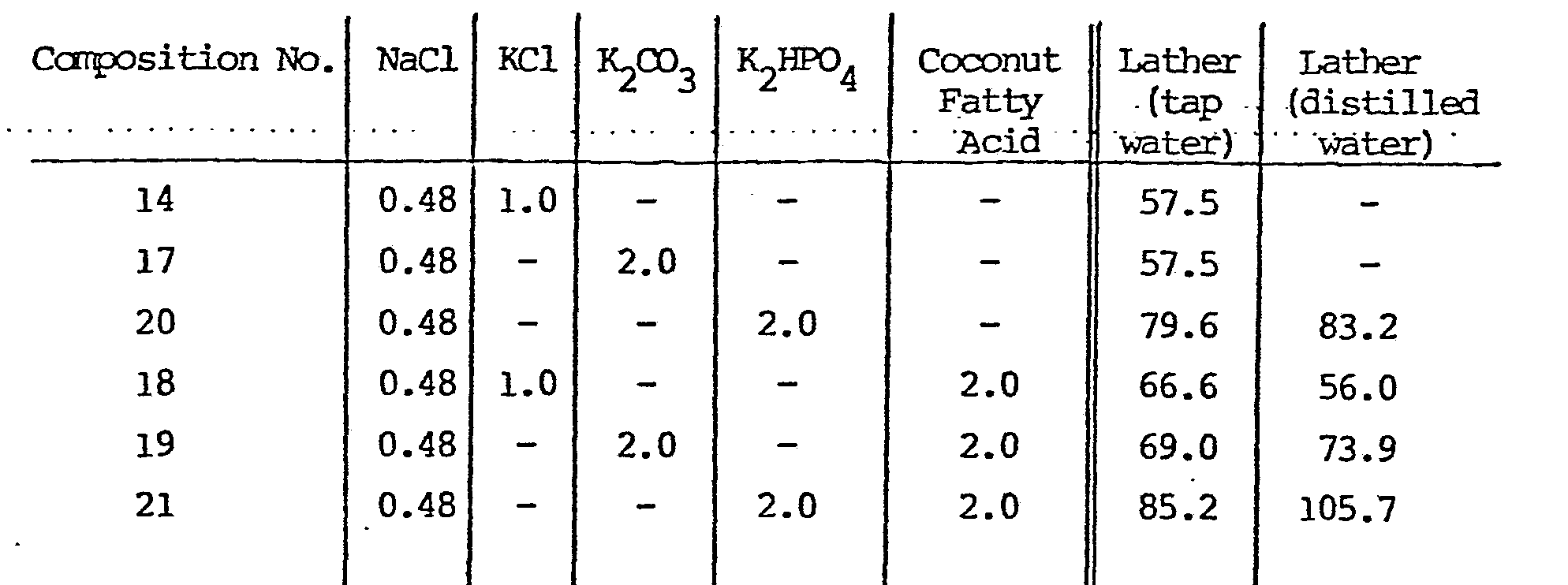
- The lathering performance of the soap bars was tested in the manner described in Belgian Patent 823,776, incorporated herein by reference..In the test used herein, the panelists did not wear gloves when lathering the soap bars and the lather achieved was graded comparatively in arbitrary units. At least 4 panelists are required to duplicate the test, and the results are averaged over the number of panelists involved. Higher lather grader indicate better lathering performance.
- Crystal growth properties were tested by means of the visual examination of the surfaces and interior of the bars after they were subjected to various storage and usage conditions; specifically, the bars were observed:
- (a) after storage under ambient conditions;
- (b) after storage under conditions of accelerated aging (50°C, 50% relative humidity);
- (c) after repeated usage (4 times a day for one week) and subsequent storage under ambient conditions.
- The performance of the soap bars, under each of these tests, is summarized in the following table.

- This table indicates that the inclusion of potassium soap in the soap bars yields a high degree of transparency and a significant lather benefit, but that the presence of such potassium soaps leads to undesirable crystal formation in the soap bars. It should also be noted that while triethanolamine may be included to avoid the crystal growth problem, while still maintaining the lathering benefit, the inclusion of TEA leads to a precipitous drop in the transparency of the soap.
- B. Using the method of manufacture described above, soap bars were made by the direct saponification of tallow/ coconut(65/35) fatty acid with a 50/50 mixture of sodium hydroxide and potassium hydroxide, using sodium chloride or potassium chloride as an electrolyte, as indicated in the table below. The soap bars contained from about 15% to about 18% moisture. The transparency and the crystal growth properties of the soap bars formed were tested as described above.

- These tests demonstrate a definite increase in transparency which is achieved by the incorporation of an electrolyte into the soap compositions. However, the presence of the conventional electrolytes tested leads to the formation of undesirable crystal in the soap bar.
- C. Utilizing the method of manufacture described above, soap bars were made having a final composition of 62.4% of sodium tallow/coconut (80/20) soap, 10.4% of potassium coconut soap, 6.0% of glycerine, and the indicated percentages of the additional components specified in the table below. The soap bars contained from about 15% to about J8% moisture. These soap bars were then tested for transparency and crystal growth characteristics, using the procedures described above.

- It is seen that the compositions of the present invention (compositions 15, 16, 17, and 19) had good transparency characteristics and did not grow crystals, while the soap compositions which utilized only the conventional sodium chloride and potassium chloride electrolytes manifested undesirable crystal growth.
- Substantially similar results are obtained where the potassium carbonate electrolyte in compositions 15, 16, 17, or 19, is replaced in whole or in part by dipotassium monohydrogen orthophosphate, tetrapotassium pyrophosphate, potassium tripolyphosphate, tripotassium orthophosphate, sodium formate, potassium formate, sodium tartrate, potassium tartrate, sodium citrate, potassium citrate, sodium acetate, potassium acetate, potassium ammonium tartrate, ammonium acetate, ammonium carbonate, ammonium formate, ammonium citrate, ammonium lactate, ammonium bisulfate, and mixtures of these components.
- The lathering characteristics of soap bar compositions of the present invention were compared to those of soap bars utilizing the sodium chloride and potassium chloride electrolytes well-known in the art, using the procedure described in Example I, above.
- Using the method described in Example I, soap bars containing 62.4% sodium (80/20) tallow/coconut soap, 10.4% potassium coconut soap, 6.0% glycerine, and the additional components in the amount specified below, were made. The soap bars were tested for lathering performance in both in tap water (hardness = 17 grains/gallon) and distilled water. The soap bars contained from about 15% to about 18% moisture.
- The compositions, described in the table below, exemplify various embodiments of the soap bars of the present invention. These soap bar compositions may be manufactured in any of the conventional ways described in the present application and, specifically, may be manufactured using the method described in Example I, above. It is to be appreciated that similar compositions may be made by substituting other conventional electrolytes, such as potassium chloride, for sodium chloride, specified below; by substituting other fatty acids for the coconut fatty acid, specified below; or by substituting dipotassium monohydrogen orthophosphate, tetrapotassium pyrophosphate, potassium tripolyphosphate, tripotassium orthophosphate, sodium formate, potassium formate, sodium tartrate, potassium tartrate, sodium citrate, sodium acetate, potassium acetate, potassium ammonium tartrate, ammonium acetate, ammonium carbonate, ammonium formate, ammonium citrate, ammonium lactate, ammonium bisulfate, or mixtures of these compounds, in whole or in part, for the potassium carbonate or potassium citrate electrolytes, specified below.
- In the table below, the ingredients referred to as A, B, C, D, E, etc. have the following meaning:
- A - Sodium tallowate
- B - Sodium cocoate
- C - Potassium tallowate
- D - Potassium cocoate
- E - Sodium chloride
- F - Potassium carbonate
- G - Potassium citrate
- H - Coconut fatty acid
- I - Glycerine
- J - Polyacrylamide
- K - Water
- L - Minor components, such as perfume, colorants, etc.

Claims (10)
Priority Applications (1)
| Application Number | Priority Date | Filing Date | Title |
|---|---|---|---|
| AT80200070T ATE4325T1 (en) | 1979-02-06 | 1980-01-25 | BAR SOAP. |
Applications Claiming Priority (6)
| Application Number | Priority Date | Filing Date | Title |
|---|---|---|---|
| GB7904197 | 1979-02-06 | ||
| GB7904197 | 1979-02-06 | ||
| GB7937809 | 1979-11-01 | ||
| GB7937809 | 1979-11-01 | ||
| GB8001001 | 1980-01-11 | ||
| GB8001001 | 1980-01-11 |
Publications (2)
| Publication Number | Publication Date |
|---|---|
| EP0014502A1 true EP0014502A1 (en) | 1980-08-20 |
| EP0014502B1 EP0014502B1 (en) | 1983-07-27 |
Family
ID=27260661
Family Applications (1)
| Application Number | Title | Priority Date | Filing Date |
|---|---|---|---|
| EP80200070A Expired EP0014502B1 (en) | 1979-02-06 | 1980-01-25 | Soap bars |
Country Status (5)
| Country | Link |
|---|---|
| EP (1) | EP0014502B1 (en) |
| CA (1) | CA1141255A (en) |
| DE (1) | DE3064347D1 (en) |
| MX (1) | MX151219A (en) |
| PH (1) | PH15723A (en) |
Cited By (16)
| Publication number | Priority date | Publication date | Assignee | Title |
|---|---|---|---|---|
| GB2231882A (en) * | 1989-05-12 | 1990-11-28 | Unilever Plc | Laundry soap bar |
| GB2247463A (en) * | 1990-07-27 | 1992-03-04 | Unilever Plc | Soap compositions |
| WO1996035772A1 (en) * | 1995-05-12 | 1996-11-14 | The Procter & Gamble Company | Soap-based laundry bars with improved firmness |
| US5908619A (en) * | 1997-01-09 | 1999-06-01 | Minnesota Mining And Manufacturing Company | Hydroalcoholic compositions thickened using surfactant/polymer complexes |
| WO1999035226A1 (en) * | 1998-01-08 | 1999-07-15 | Unilever Plc | Soap bars with a bactericidal capacity and methods of enhancing such capacity |
| US5951993A (en) * | 1995-06-22 | 1999-09-14 | Minnesota Mining And Manufacturing Company | Stable hydroalcoholic compositions |
| US6019997A (en) * | 1997-01-09 | 2000-02-01 | Minnesota Mining And Manufacturing | Hydroalcoholic compositions for transdermal penetration of pharmaceutical agents |
| WO2000022082A1 (en) * | 1998-10-13 | 2000-04-20 | Unilever Plc | Soap bars with little or no synthetic surfactant |
| US6090395A (en) * | 1995-06-22 | 2000-07-18 | Minnesota Mining And Manufacturing Company | Stable hydroalcoholic compositions |
| US6582711B1 (en) | 1997-01-09 | 2003-06-24 | 3M Innovative Properties Company | Hydroalcoholic compositions thickened using polymers |
| US6623744B2 (en) * | 1995-06-22 | 2003-09-23 | 3M Innovative Properties Company | Stable hydroalcoholic compositions |
| US7566460B2 (en) | 1995-06-22 | 2009-07-28 | 3M Innovative Properties Company | Stable hydroalcoholic compositions |
| WO2020169392A1 (en) * | 2019-02-19 | 2020-08-27 | Unilever N.V. | High water hard bars comprising combination of type and amount of electrolytes |
| US11352594B2 (en) | 2019-02-19 | 2022-06-07 | Conopco, Inc. | Extruded soap bar with high water content |
| WO2025056296A1 (en) * | 2023-09-15 | 2025-03-20 | Unilever Ip Holdings B.V. | Soap bars comprising potassium soap |
| WO2025056484A1 (en) * | 2023-09-15 | 2025-03-20 | Unilever Ip Holdings B.V. | Soap bars comprising high soluble soap content |
Families Citing this family (4)
| Publication number | Priority date | Publication date | Assignee | Title |
|---|---|---|---|---|
| ES2564821T3 (en) * | 2001-04-04 | 2016-03-29 | Dsm Ip Assets B.V. | Purified lactase |
| MY142222A (en) * | 2002-06-24 | 2010-11-15 | Derichem M Sdn Bhd | Improved saturated soap that may or may not contain preservatives or additives |
| MY142902A (en) * | 2002-06-24 | 2011-01-31 | Derichem M Sdn Bhd | Improved saturated soap |
| MY133326A (en) * | 2002-12-02 | 2007-11-30 | Derichem M Sdn Bhd | Foam plus soap noodle |
Citations (3)
| Publication number | Priority date | Publication date | Assignee | Title |
|---|---|---|---|---|
| US3557006A (en) * | 1967-11-24 | 1971-01-19 | Peter J Ferrara | Composite toilet soap bar having an acid ph in use |
| US3576749A (en) * | 1969-02-06 | 1971-04-27 | Procter & Gamble | Soap toilet bars having improved smear characteristics |
| US3988255A (en) * | 1975-03-05 | 1976-10-26 | The Procter & Gamble Company | Toilet bars |
Family Cites Families (1)
| Publication number | Priority date | Publication date | Assignee | Title |
|---|---|---|---|---|
| US2686761A (en) * | 1950-06-02 | 1954-08-17 | Procter & Gamble | Detergent product having milled soap properties |
-
1980
- 1980-01-25 DE DE8080200070T patent/DE3064347D1/en not_active Expired
- 1980-01-25 EP EP80200070A patent/EP0014502B1/en not_active Expired
- 1980-02-04 CA CA000345019A patent/CA1141255A/en not_active Expired
- 1980-02-04 PH PH23588A patent/PH15723A/en unknown
- 1980-02-06 MX MX18109680A patent/MX151219A/en unknown
Patent Citations (3)
| Publication number | Priority date | Publication date | Assignee | Title |
|---|---|---|---|---|
| US3557006A (en) * | 1967-11-24 | 1971-01-19 | Peter J Ferrara | Composite toilet soap bar having an acid ph in use |
| US3576749A (en) * | 1969-02-06 | 1971-04-27 | Procter & Gamble | Soap toilet bars having improved smear characteristics |
| US3988255A (en) * | 1975-03-05 | 1976-10-26 | The Procter & Gamble Company | Toilet bars |
Cited By (32)
| Publication number | Priority date | Publication date | Assignee | Title |
|---|---|---|---|---|
| GB2231882A (en) * | 1989-05-12 | 1990-11-28 | Unilever Plc | Laundry soap bar |
| GB2247463A (en) * | 1990-07-27 | 1992-03-04 | Unilever Plc | Soap compositions |
| GB2247464A (en) * | 1990-07-27 | 1992-03-04 | Unilever Plc | Soap compositions |
| GB2247463B (en) * | 1990-07-27 | 1993-07-28 | Unilever Plc | Soap compositions |
| GB2247464B (en) * | 1990-07-27 | 1993-08-18 | Unilever Plc | Soap compositions |
| WO1996035772A1 (en) * | 1995-05-12 | 1996-11-14 | The Procter & Gamble Company | Soap-based laundry bars with improved firmness |
| US6562360B2 (en) | 1995-06-22 | 2003-05-13 | 3M Innovative Properties Company | Stable hydroalcoholic compositions |
| US6623744B2 (en) * | 1995-06-22 | 2003-09-23 | 3M Innovative Properties Company | Stable hydroalcoholic compositions |
| US5951993A (en) * | 1995-06-22 | 1999-09-14 | Minnesota Mining And Manufacturing Company | Stable hydroalcoholic compositions |
| US7566460B2 (en) | 1995-06-22 | 2009-07-28 | 3M Innovative Properties Company | Stable hydroalcoholic compositions |
| US7081246B2 (en) * | 1995-06-22 | 2006-07-25 | 3M Innovative Properties Company | Stable hydroalcoholic compositions |
| US7803390B2 (en) | 1995-06-22 | 2010-09-28 | 3M Innovative Properties Company | Stable hydroalcoholic compositions |
| US6090395A (en) * | 1995-06-22 | 2000-07-18 | Minnesota Mining And Manufacturing Company | Stable hydroalcoholic compositions |
| US6610315B2 (en) | 1995-06-22 | 2003-08-26 | 3M Innovative Properties Company | Topical application of stable hydroalcoholic compositions for maintaining or improving skin conditions, and delivering fragrance to skin |
| US6352701B1 (en) | 1995-06-22 | 2002-03-05 | 3M Innovative Properties Company | Stable hydroalcoholic compositions |
| US6534069B1 (en) | 1995-06-22 | 2003-03-18 | 3M Innovative Properties Company | Stable hydroalcoholic compositions |
| US5908619A (en) * | 1997-01-09 | 1999-06-01 | Minnesota Mining And Manufacturing Company | Hydroalcoholic compositions thickened using surfactant/polymer complexes |
| US6582711B1 (en) | 1997-01-09 | 2003-06-24 | 3M Innovative Properties Company | Hydroalcoholic compositions thickened using polymers |
| US8062649B2 (en) | 1997-01-09 | 2011-11-22 | 3M Innovative Properties Company | Hydroalcoholic compositions thickened using polymers |
| US6019997A (en) * | 1997-01-09 | 2000-02-01 | Minnesota Mining And Manufacturing | Hydroalcoholic compositions for transdermal penetration of pharmaceutical agents |
| WO1999035226A1 (en) * | 1998-01-08 | 1999-07-15 | Unilever Plc | Soap bars with a bactericidal capacity and methods of enhancing such capacity |
| US6007831A (en) * | 1998-01-08 | 1999-12-28 | Lever Brothers Company | Soap bars having quick kill capacity and methods of enhancing such capacity |
| CZ301661B6 (en) * | 1998-01-08 | 2010-05-19 | Unilever N. V. | Process for preparing bactericidally active soap |
| AU743894B2 (en) * | 1998-10-13 | 2002-02-07 | Unilever Plc | Soap bars with little or no synthetic surfactant |
| WO2000022082A1 (en) * | 1998-10-13 | 2000-04-20 | Unilever Plc | Soap bars with little or no synthetic surfactant |
| WO2020169392A1 (en) * | 2019-02-19 | 2020-08-27 | Unilever N.V. | High water hard bars comprising combination of type and amount of electrolytes |
| CN113383064A (en) * | 2019-02-19 | 2021-09-10 | 联合利华知识产权控股有限公司 | High water hard soap bars comprising a combination of electrolyte type and amount |
| US11352594B2 (en) | 2019-02-19 | 2022-06-07 | Conopco, Inc. | Extruded soap bar with high water content |
| US11473038B2 (en) | 2019-02-19 | 2022-10-18 | Conopco, Inc. | High water hard bars comprising combination of type and amount of electrolytes |
| CN113383064B (en) * | 2019-02-19 | 2023-05-12 | 联合利华知识产权控股有限公司 | High water hardness bar comprising a combination of electrolyte types and amounts |
| WO2025056296A1 (en) * | 2023-09-15 | 2025-03-20 | Unilever Ip Holdings B.V. | Soap bars comprising potassium soap |
| WO2025056484A1 (en) * | 2023-09-15 | 2025-03-20 | Unilever Ip Holdings B.V. | Soap bars comprising high soluble soap content |
Also Published As
| Publication number | Publication date |
|---|---|
| DE3064347D1 (en) | 1983-09-01 |
| EP0014502B1 (en) | 1983-07-27 |
| MX151219A (en) | 1984-10-11 |
| CA1141255A (en) | 1983-02-15 |
| PH15723A (en) | 1983-03-18 |
Similar Documents
| Publication | Publication Date | Title |
|---|---|---|
| US4297230A (en) | Non-crystallizing transparent soap bars | |
| EP0014502B1 (en) | Soap bars | |
| EP0311343B1 (en) | Toilet composition | |
| US4100097A (en) | Low pH detergent bar | |
| US5952289A (en) | Soap-based laundry bars with improved firmness | |
| KR930006087B1 (en) | Detergent composition | |
| US3376229A (en) | Synthetic detergent bar | |
| US4663070A (en) | Process for preparing soap-acyl isethionate toilet bars | |
| US4874538A (en) | Toilet soap bar compositions containing water soluble polymers | |
| US2894912A (en) | Isethionate detergent bar | |
| US4493786A (en) | Translucent soaps and processes for manufacture thereof | |
| US3576749A (en) | Soap toilet bars having improved smear characteristics | |
| EP0210842B1 (en) | Toilet compositions | |
| US3607761A (en) | Soap bars containing salts of fatty acids derived from the guerbet reaction | |
| US4169067A (en) | Bar product | |
| US4584126A (en) | Translucent soaps and processes for manufacture thereof | |
| US5284598A (en) | Process for making mild, detergent-soap, toilet bars and the bar resulting therefrom | |
| US2749315A (en) | Toilet detergent bar and process of preparing same | |
| US2175285A (en) | Detergent for toilet use containing incompletely esterified polyhydric alcohol | |
| US4704223A (en) | Superfatted soaps | |
| GB2142040A (en) | Menthol soap | |
| US3030310A (en) | Combination soap-synthetic detergent bar | |
| US2792347A (en) | Fatty acid mixtures and soaps derived therefrom | |
| US5403506A (en) | Deodorant detergent composition | |
| CA1102204A (en) | Bar soap and process of manufacture |
Legal Events
| Date | Code | Title | Description |
|---|---|---|---|
| PUAI | Public reference made under article 153(3) epc to a published international application that has entered the european phase |
Free format text: ORIGINAL CODE: 0009012 |
|
| AK | Designated contracting states |
Designated state(s): AT BE CH DE FR GB IT NL |
|
| 17P | Request for examination filed |
Effective date: 19810209 |
|
| ITF | It: translation for a ep patent filed | ||
| GRAA | (expected) grant |
Free format text: ORIGINAL CODE: 0009210 |
|
| AK | Designated contracting states |
Designated state(s): AT BE CH DE FR GB IT NL |
|
| REF | Corresponds to: |
Ref document number: 4325 Country of ref document: AT Date of ref document: 19830815 Kind code of ref document: T |
|
| REF | Corresponds to: |
Ref document number: 3064347 Country of ref document: DE Date of ref document: 19830901 |
|
| ET | Fr: translation filed | ||
| PLBE | No opposition filed within time limit |
Free format text: ORIGINAL CODE: 0009261 |
|
| STAA | Information on the status of an ep patent application or granted ep patent |
Free format text: STATUS: NO OPPOSITION FILED WITHIN TIME LIMIT |
|
| 26N | No opposition filed | ||
| PGFP | Annual fee paid to national office [announced via postgrant information from national office to epo] |
Ref country code: FR Payment date: 19910110 Year of fee payment: 12 |
|
| PGFP | Annual fee paid to national office [announced via postgrant information from national office to epo] |
Ref country code: AT Payment date: 19910111 Year of fee payment: 12 |
|
| PGFP | Annual fee paid to national office [announced via postgrant information from national office to epo] |
Ref country code: GB Payment date: 19910114 Year of fee payment: 12 |
|
| PGFP | Annual fee paid to national office [announced via postgrant information from national office to epo] |
Ref country code: CH Payment date: 19910128 Year of fee payment: 12 |
|
| ITTA | It: last paid annual fee | ||
| PGFP | Annual fee paid to national office [announced via postgrant information from national office to epo] |
Ref country code: NL Payment date: 19910131 Year of fee payment: 12 |
|
| PGFP | Annual fee paid to national office [announced via postgrant information from national office to epo] |
Ref country code: BE Payment date: 19910207 Year of fee payment: 12 |
|
| PGFP | Annual fee paid to national office [announced via postgrant information from national office to epo] |
Ref country code: DE Payment date: 19910228 Year of fee payment: 12 |
|
| PG25 | Lapsed in a contracting state [announced via postgrant information from national office to epo] |
Ref country code: GB Effective date: 19920125 Ref country code: AT Effective date: 19920125 |
|
| PG25 | Lapsed in a contracting state [announced via postgrant information from national office to epo] |
Ref country code: CH Effective date: 19920131 Ref country code: BE Effective date: 19920131 |
|
| BERE | Be: lapsed |
Owner name: PROCTER & GAMBLE EUROPEAN TECHNICAL CENTER Effective date: 19920131 |
|
| PG25 | Lapsed in a contracting state [announced via postgrant information from national office to epo] |
Ref country code: NL Effective date: 19920801 |
|
| NLV4 | Nl: lapsed or anulled due to non-payment of the annual fee | ||
| GBPC | Gb: european patent ceased through non-payment of renewal fee | ||
| PG25 | Lapsed in a contracting state [announced via postgrant information from national office to epo] |
Ref country code: FR Effective date: 19920930 |
|
| REG | Reference to a national code |
Ref country code: CH Ref legal event code: PL |
|
| PG25 | Lapsed in a contracting state [announced via postgrant information from national office to epo] |
Ref country code: DE Effective date: 19921001 |
|
| REG | Reference to a national code |
Ref country code: FR Ref legal event code: ST |