EP0005658A1 - Peptide derivatives analogue to encephalines, process for their preparation and their therapeutical application - Google Patents
Peptide derivatives analogue to encephalines, process for their preparation and their therapeutical application Download PDFInfo
- Publication number
- EP0005658A1 EP0005658A1 EP79400268A EP79400268A EP0005658A1 EP 0005658 A1 EP0005658 A1 EP 0005658A1 EP 79400268 A EP79400268 A EP 79400268A EP 79400268 A EP79400268 A EP 79400268A EP 0005658 A1 EP0005658 A1 EP 0005658A1
- Authority
- EP
- European Patent Office
- Prior art keywords
- halogen atom
- radical
- peptide
- mono
- formula
- Prior art date
- Legal status (The legal status is an assumption and is not a legal conclusion. Google has not performed a legal analysis and makes no representation as to the accuracy of the status listed.)
- Withdrawn
Links
- 108090000765 processed proteins & peptides Proteins 0.000 title claims abstract description 67
- 238000000034 method Methods 0.000 title claims description 31
- 238000002360 preparation method Methods 0.000 title claims description 27
- 230000008569 process Effects 0.000 title claims description 9
- 230000001225 therapeutic effect Effects 0.000 title claims description 4
- 125000005843 halogen group Chemical group 0.000 claims abstract description 24
- -1 beta -naphthyl Chemical group 0.000 claims abstract description 14
- JUJWROOIHBZHMG-UHFFFAOYSA-N Pyridine Chemical compound C1=CC=NC=C1 JUJWROOIHBZHMG-UHFFFAOYSA-N 0.000 claims abstract description 10
- 230000000202 analgesic effect Effects 0.000 claims abstract description 10
- 230000000506 psychotropic effect Effects 0.000 claims abstract description 10
- DZBUGLKDJFMEHC-UHFFFAOYSA-N acridine Chemical compound C1=CC=CC2=CC3=CC=CC=C3N=C21 DZBUGLKDJFMEHC-UHFFFAOYSA-N 0.000 claims abstract description 8
- 150000003839 salts Chemical class 0.000 claims abstract description 8
- YTPLMLYBLZKORZ-UHFFFAOYSA-N Thiophene Chemical compound C=1C=CSC=1 YTPLMLYBLZKORZ-UHFFFAOYSA-N 0.000 claims abstract description 7
- SMWDFEZZVXVKRB-UHFFFAOYSA-N Quinoline Chemical compound N1=CC=CC2=CC=CC=C21 SMWDFEZZVXVKRB-UHFFFAOYSA-N 0.000 claims abstract description 6
- 239000002253 acid Substances 0.000 claims abstract description 6
- AWJUIBRHMBBTKR-UHFFFAOYSA-N isoquinoline Chemical compound C1=NC=CC2=CC=CC=C21 AWJUIBRHMBBTKR-UHFFFAOYSA-N 0.000 claims abstract description 6
- 125000001997 phenyl group Chemical group [H]C1=C([H])C([H])=C(*)C([H])=C1[H] 0.000 claims abstract description 6
- 150000007513 acids Chemical class 0.000 claims abstract description 5
- UMJSCPRVCHMLSP-UHFFFAOYSA-N pyridine Natural products COC1=CC=CN=C1 UMJSCPRVCHMLSP-UHFFFAOYSA-N 0.000 claims abstract description 5
- CXISPYVYMQWFLE-VKHMYHEASA-N Ala-Gly Chemical compound C[C@H]([NH3+])C(=O)NCC([O-])=O CXISPYVYMQWFLE-VKHMYHEASA-N 0.000 claims abstract description 4
- 108010047495 alanylglycine Proteins 0.000 claims abstract description 4
- 125000002950 monocyclic group Chemical group 0.000 claims abstract description 3
- 229930192474 thiophene Natural products 0.000 claims abstract description 3
- MDFFNEOEWAXZRQ-UHFFFAOYSA-N aminyl Chemical compound [NH2] MDFFNEOEWAXZRQ-UHFFFAOYSA-N 0.000 claims abstract 2
- 125000006682 monohaloalkyl group Chemical group 0.000 claims abstract 2
- 125000006684 polyhaloalkyl group Polymers 0.000 claims abstract 2
- 239000000203 mixture Substances 0.000 claims description 31
- 150000001412 amines Chemical class 0.000 claims description 24
- 238000009833 condensation Methods 0.000 claims description 18
- 230000005494 condensation Effects 0.000 claims description 18
- 150000001875 compounds Chemical class 0.000 claims description 16
- 102000004196 processed proteins & peptides Human genes 0.000 claims description 15
- 125000000524 functional group Chemical group 0.000 claims description 6
- 125000006239 protecting group Chemical group 0.000 claims description 6
- 102000007079 Peptide Fragments Human genes 0.000 claims description 5
- 108010033276 Peptide Fragments Proteins 0.000 claims description 5
- 239000004480 active ingredient Substances 0.000 claims description 5
- 125000002924 primary amino group Chemical group [H]N([H])* 0.000 claims description 4
- 230000000750 progressive effect Effects 0.000 claims description 4
- ZZVUWRFHKOJYTH-UHFFFAOYSA-N diphenhydramine Chemical group C=1C=CC=CC=1C(OCCN(C)C)C1=CC=CC=C1 ZZVUWRFHKOJYTH-UHFFFAOYSA-N 0.000 claims description 2
- 238000005984 hydrogenation reaction Methods 0.000 claims description 2
- 230000007062 hydrolysis Effects 0.000 claims description 2
- 238000006460 hydrolysis reaction Methods 0.000 claims description 2
- 238000007911 parenteral administration Methods 0.000 claims description 2
- 239000000546 pharmaceutical excipient Substances 0.000 claims 1
- 230000001142 anti-diarrhea Effects 0.000 abstract description 9
- 125000000229 (C1-C4)alkoxy group Chemical group 0.000 abstract 2
- 125000004178 (C1-C4) alkyl group Chemical group 0.000 abstract 1
- 125000003282 alkyl amino group Chemical group 0.000 abstract 1
- 239000000243 solution Substances 0.000 description 39
- WYURNTSHIVDZCO-UHFFFAOYSA-N Tetrahydrofuran Chemical compound C1CCOC1 WYURNTSHIVDZCO-UHFFFAOYSA-N 0.000 description 30
- 238000006243 chemical reaction Methods 0.000 description 18
- BQJCRHHNABKAKU-KBQPJGBKSA-N morphine Chemical compound O([C@H]1[C@H](C=C[C@H]23)O)C4=C5[C@@]12CCN(C)[C@@H]3CC5=CC=C4O BQJCRHHNABKAKU-KBQPJGBKSA-N 0.000 description 18
- 238000003756 stirring Methods 0.000 description 17
- MHLMRBVCMNDOCW-UHFFFAOYSA-N acetic acid;butan-1-ol;hydrate Chemical compound O.CC(O)=O.CCCCO MHLMRBVCMNDOCW-UHFFFAOYSA-N 0.000 description 15
- YLQBMQCUIZJEEH-UHFFFAOYSA-N tetrahydrofuran Natural products C=1C=COC=1 YLQBMQCUIZJEEH-UHFFFAOYSA-N 0.000 description 15
- VEXZGXHMUGYJMC-UHFFFAOYSA-N Hydrochloric acid Chemical compound Cl VEXZGXHMUGYJMC-UHFFFAOYSA-N 0.000 description 14
- QOSSAOTZNIDXMA-UHFFFAOYSA-N Dicylcohexylcarbodiimide Chemical compound C1CCCCC1N=C=NC1CCCCC1 QOSSAOTZNIDXMA-UHFFFAOYSA-N 0.000 description 13
- FAPWRFPIFSIZLT-UHFFFAOYSA-M Sodium chloride Chemical class [Na+].[Cl-] FAPWRFPIFSIZLT-UHFFFAOYSA-M 0.000 description 12
- 239000012634 fragment Substances 0.000 description 12
- XEKOWRVHYACXOJ-UHFFFAOYSA-N Ethyl acetate Chemical compound CCOC(C)=O XEKOWRVHYACXOJ-UHFFFAOYSA-N 0.000 description 11
- RYHBNJHYFVUHQT-UHFFFAOYSA-N 1,4-Dioxane Chemical compound C1COCCO1 RYHBNJHYFVUHQT-UHFFFAOYSA-N 0.000 description 10
- 208000009132 Catalepsy Diseases 0.000 description 10
- DTQVDTLACAAQTR-UHFFFAOYSA-M Trifluoroacetate Chemical compound [O-]C(=O)C(F)(F)F DTQVDTLACAAQTR-UHFFFAOYSA-M 0.000 description 10
- 239000012074 organic phase Substances 0.000 description 10
- HEMHJVSKTPXQMS-UHFFFAOYSA-M Sodium hydroxide Chemical compound [OH-].[Na+] HEMHJVSKTPXQMS-UHFFFAOYSA-M 0.000 description 9
- 238000006482 condensation reaction Methods 0.000 description 9
- 229960005181 morphine Drugs 0.000 description 9
- 239000002244 precipitate Substances 0.000 description 9
- 239000011734 sodium Substances 0.000 description 9
- 241001465754 Metazoa Species 0.000 description 8
- 238000010511 deprotection reaction Methods 0.000 description 8
- 239000000843 powder Substances 0.000 description 8
- 230000000638 stimulation Effects 0.000 description 7
- 238000011282 treatment Methods 0.000 description 7
- 241000700159 Rattus Species 0.000 description 6
- 206010047853 Waxy flexibility Diseases 0.000 description 6
- 238000004458 analytical method Methods 0.000 description 6
- 230000015572 biosynthetic process Effects 0.000 description 5
- 210000003405 ileum Anatomy 0.000 description 5
- 241000700199 Cavia porcellus Species 0.000 description 4
- URLZCHNOLZSCCA-VABKMULXSA-N Leu-enkephalin Chemical class C([C@@H](C(=O)N[C@@H](CC(C)C)C(O)=O)NC(=O)CNC(=O)CNC(=O)[C@@H](N)CC=1C=CC(O)=CC=1)C1=CC=CC=C1 URLZCHNOLZSCCA-VABKMULXSA-N 0.000 description 4
- 241000699670 Mus sp. Species 0.000 description 4
- DTQVDTLACAAQTR-UHFFFAOYSA-N Trifluoroacetic acid Chemical compound OC(=O)C(F)(F)F DTQVDTLACAAQTR-UHFFFAOYSA-N 0.000 description 4
- 150000001413 amino acids Chemical class 0.000 description 4
- 239000004359 castor oil Substances 0.000 description 4
- 235000019438 castor oil Nutrition 0.000 description 4
- 239000003814 drug Substances 0.000 description 4
- 230000000694 effects Effects 0.000 description 4
- 150000002148 esters Chemical class 0.000 description 4
- 238000001704 evaporation Methods 0.000 description 4
- 230000008020 evaporation Effects 0.000 description 4
- 239000000706 filtrate Substances 0.000 description 4
- ZEMPKEQAKRGZGQ-XOQCFJPHSA-N glycerol triricinoleate Natural products CCCCCC[C@@H](O)CC=CCCCCCCCC(=O)OC[C@@H](COC(=O)CCCCCCCC=CC[C@@H](O)CCCCCC)OC(=O)CCCCCCCC=CC[C@H](O)CCCCCC ZEMPKEQAKRGZGQ-XOQCFJPHSA-N 0.000 description 4
- 230000005764 inhibitory process Effects 0.000 description 4
- 239000002198 insoluble material Substances 0.000 description 4
- 230000008018 melting Effects 0.000 description 4
- 238000002844 melting Methods 0.000 description 4
- 239000000047 product Substances 0.000 description 4
- 238000001953 recrystallisation Methods 0.000 description 4
- 239000007787 solid Substances 0.000 description 4
- QTBSBXVTEAMEQO-UHFFFAOYSA-N Acetic acid Chemical compound CC(O)=O QTBSBXVTEAMEQO-UHFFFAOYSA-N 0.000 description 3
- YMWUJEATGCHHMB-UHFFFAOYSA-N Dichloromethane Chemical compound ClCCl YMWUJEATGCHHMB-UHFFFAOYSA-N 0.000 description 3
- 108010092674 Enkephalins Proteins 0.000 description 3
- ZMXDDKWLCZADIW-UHFFFAOYSA-N N,N-Dimethylformamide Chemical compound CN(C)C=O ZMXDDKWLCZADIW-UHFFFAOYSA-N 0.000 description 3
- KDLHZDBZIXYQEI-UHFFFAOYSA-N Palladium Chemical compound [Pd] KDLHZDBZIXYQEI-UHFFFAOYSA-N 0.000 description 3
- 238000006664 bond formation reaction Methods 0.000 description 3
- 210000004899 c-terminal region Anatomy 0.000 description 3
- 239000013078 crystal Substances 0.000 description 3
- 238000010586 diagram Methods 0.000 description 3
- UREBWPXBXRYXRJ-UHFFFAOYSA-N ethyl acetate;methanol Chemical compound OC.CCOC(C)=O UREBWPXBXRYXRJ-UHFFFAOYSA-N 0.000 description 3
- 238000005755 formation reaction Methods 0.000 description 3
- 231100000053 low toxicity Toxicity 0.000 description 3
- 239000011780 sodium chloride Substances 0.000 description 3
- 239000002904 solvent Substances 0.000 description 3
- 239000010902 straw Substances 0.000 description 3
- 239000003826 tablet Substances 0.000 description 3
- WORJRXHJTUTINR-UHFFFAOYSA-N 1,4-dioxane;hydron;chloride Chemical compound Cl.C1COCCO1 WORJRXHJTUTINR-UHFFFAOYSA-N 0.000 description 2
- ASOKPJOREAFHNY-UHFFFAOYSA-N 1-Hydroxybenzotriazole Chemical compound C1=CC=C2N(O)N=NC2=C1 ASOKPJOREAFHNY-UHFFFAOYSA-N 0.000 description 2
- HEDRZPFGACZZDS-UHFFFAOYSA-N Chloroform Chemical compound ClC(Cl)Cl HEDRZPFGACZZDS-UHFFFAOYSA-N 0.000 description 2
- 206010012735 Diarrhoea Diseases 0.000 description 2
- IAZDPXIOMUYVGZ-UHFFFAOYSA-N Dimethylsulphoxide Chemical compound CS(C)=O IAZDPXIOMUYVGZ-UHFFFAOYSA-N 0.000 description 2
- KRHYYFGTRYWZRS-UHFFFAOYSA-N Fluorane Chemical compound F KRHYYFGTRYWZRS-UHFFFAOYSA-N 0.000 description 2
- 108010022337 Leucine Enkephalin Proteins 0.000 description 2
- 241000699666 Mus <mouse, genus> Species 0.000 description 2
- PYOHODCEOHCZBM-RYUDHWBXSA-N Phe-Met Chemical compound CSCC[C@@H](C(O)=O)NC(=O)[C@@H](N)CC1=CC=CC=C1 PYOHODCEOHCZBM-RYUDHWBXSA-N 0.000 description 2
- UIIMBOGNXHQVGW-UHFFFAOYSA-M Sodium bicarbonate Chemical compound [Na+].OC([O-])=O UIIMBOGNXHQVGW-UHFFFAOYSA-M 0.000 description 2
- 125000000217 alkyl group Chemical group 0.000 description 2
- 229910052799 carbon Inorganic materials 0.000 description 2
- 230000002903 catalepsic effect Effects 0.000 description 2
- OROGSEYTTFOCAN-DNJOTXNNSA-N codeine Chemical compound C([C@H]1[C@H](N(CC[C@@]112)C)C3)=C[C@H](O)[C@@H]1OC1=C2C3=CC=C1OC OROGSEYTTFOCAN-DNJOTXNNSA-N 0.000 description 2
- 238000007796 conventional method Methods 0.000 description 2
- 239000012024 dehydrating agents Substances 0.000 description 2
- 150000004985 diamines Chemical class 0.000 description 2
- LNEPOXFFQSENCJ-UHFFFAOYSA-N haloperidol Chemical compound C1CC(O)(C=2C=CC(Cl)=CC=2)CCN1CCCC(=O)C1=CC=C(F)C=C1 LNEPOXFFQSENCJ-UHFFFAOYSA-N 0.000 description 2
- URLZCHNOLZSCCA-UHFFFAOYSA-N leu-enkephalin Chemical compound C=1C=C(O)C=CC=1CC(N)C(=O)NCC(=O)NCC(=O)NC(C(=O)NC(CC(C)C)C(O)=O)CC1=CC=CC=C1 URLZCHNOLZSCCA-UHFFFAOYSA-N 0.000 description 2
- 239000012528 membrane Substances 0.000 description 2
- 244000052769 pathogen Species 0.000 description 2
- UYWQUFXKFGHYNT-UHFFFAOYSA-N phenylmethyl ester of formic acid Natural products O=COCC1=CC=CC=C1 UYWQUFXKFGHYNT-UHFFFAOYSA-N 0.000 description 2
- BASFCYQUMIYNBI-UHFFFAOYSA-N platinum Chemical compound [Pt] BASFCYQUMIYNBI-UHFFFAOYSA-N 0.000 description 2
- 230000001012 protector Effects 0.000 description 2
- XTHPWXDJESJLNJ-UHFFFAOYSA-N sulfurochloridic acid Chemical compound OS(Cl)(=O)=O XTHPWXDJESJLNJ-UHFFFAOYSA-N 0.000 description 2
- 239000000829 suppository Substances 0.000 description 2
- 238000003786 synthesis reaction Methods 0.000 description 2
- WROMPOXWARCANT-UHFFFAOYSA-N tfa trifluoroacetic acid Chemical compound OC(=O)C(F)(F)F.OC(=O)C(F)(F)F WROMPOXWARCANT-UHFFFAOYSA-N 0.000 description 2
- 238000005303 weighing Methods 0.000 description 2
- VYRYMCNWIVZAGH-QMMMGPOBSA-N (2s)-2-(fluoroamino)-3-phenylpropanoic acid Chemical compound OC(=O)[C@@H](NF)CC1=CC=CC=C1 VYRYMCNWIVZAGH-QMMMGPOBSA-N 0.000 description 1
- KPYXMALABCDPGN-HYOZMBHHSA-N (4s)-5-[[(2s)-6-amino-1-[[(2s,3s)-1-[[(2s)-1-[[(2s)-1-[[(2s)-1-[[(2s)-1-[[(2r)-1-[[2-[[2-[[(1s)-3-amino-1-carboxy-3-oxopropyl]amino]-2-oxoethyl]amino]-2-oxoethyl]amino]-1-oxo-3-sulfanylpropan-2-yl]amino]-4-methyl-1-oxopentan-2-yl]amino]-1-oxopropan-2-yl]a Chemical compound NC(=O)C[C@@H](C(O)=O)NC(=O)CNC(=O)CNC(=O)[C@H](CS)NC(=O)[C@H](CC(C)C)NC(=O)[C@H](C)NC(=O)[C@H](C(C)C)NC(=O)[C@H](CC(C)C)NC(=O)[C@H]([C@@H](C)CC)NC(=O)[C@H](CCCCN)NC(=O)[C@H](CCC(O)=O)NC(=O)[C@@H](NC(=O)[C@H](CC(O)=O)NC(=O)CNC(=O)[C@@H](N)CCCCN)CC1=CC=C(O)C=C1 KPYXMALABCDPGN-HYOZMBHHSA-N 0.000 description 1
- ADFXKUOMJKEIND-UHFFFAOYSA-N 1,3-dicyclohexylurea Chemical compound C1CCCCC1NC(=O)NC1CCCCC1 ADFXKUOMJKEIND-UHFFFAOYSA-N 0.000 description 1
- NZAXXTBNGXSLLJ-UHFFFAOYSA-N 1,4-dihydro-1,2,3-benzotriazine Chemical compound C1=CC=C2CN=NNC2=C1 NZAXXTBNGXSLLJ-UHFFFAOYSA-N 0.000 description 1
- NGNBDVOYPDDBFK-UHFFFAOYSA-N 2-[2,4-di(pentan-2-yl)phenoxy]acetyl chloride Chemical compound CCCC(C)C1=CC=C(OCC(Cl)=O)C(C(C)CCC)=C1 NGNBDVOYPDDBFK-UHFFFAOYSA-N 0.000 description 1
- 125000004176 4-fluorobenzyl group Chemical group [H]C1=C([H])C(=C([H])C([H])=C1F)C([H])([H])* 0.000 description 1
- QGZKDVFQNNGYKY-UHFFFAOYSA-N Ammonia Chemical compound N QGZKDVFQNNGYKY-UHFFFAOYSA-N 0.000 description 1
- OKTJSMMVPCPJKN-UHFFFAOYSA-N Carbon Chemical compound [C] OKTJSMMVPCPJKN-UHFFFAOYSA-N 0.000 description 1
- XJHSPROPUSPTNQ-UHFFFAOYSA-N Cc(c1ccc2)cccc1c2N(C)C Chemical compound Cc(c1ccc2)cccc1c2N(C)C XJHSPROPUSPTNQ-UHFFFAOYSA-N 0.000 description 1
- FKLJPTJMIBLJAV-UHFFFAOYSA-N Compound IV Chemical compound O1N=C(C)C=C1CCCCCCCOC1=CC=C(C=2OCCN=2)C=C1 FKLJPTJMIBLJAV-UHFFFAOYSA-N 0.000 description 1
- RTZKZFJDLAIYFH-UHFFFAOYSA-N Diethyl ether Chemical compound CCOCC RTZKZFJDLAIYFH-UHFFFAOYSA-N 0.000 description 1
- 229920000084 Gum arabic Polymers 0.000 description 1
- DGAQECJNVWCQMB-PUAWFVPOSA-M Ilexoside XXIX Chemical compound C[C@@H]1CC[C@@]2(CC[C@@]3(C(=CC[C@H]4[C@]3(CC[C@@H]5[C@@]4(CC[C@@H](C5(C)C)OS(=O)(=O)[O-])C)C)[C@@H]2[C@]1(C)O)C)C(=O)O[C@H]6[C@@H]([C@H]([C@@H]([C@H](O6)CO)O)O)O.[Na+] DGAQECJNVWCQMB-PUAWFVPOSA-M 0.000 description 1
- 206010022998 Irritability Diseases 0.000 description 1
- 101100108551 Mus musculus Akr1b7 gene Proteins 0.000 description 1
- NQTADLQHYWFPDB-UHFFFAOYSA-N N-Hydroxysuccinimide Chemical compound ON1C(=O)CCC1=O NQTADLQHYWFPDB-UHFFFAOYSA-N 0.000 description 1
- 208000028017 Psychotic disease Diseases 0.000 description 1
- 241000978776 Senegalia senegal Species 0.000 description 1
- PMZURENOXWZQFD-UHFFFAOYSA-L Sodium Sulfate Chemical compound [Na+].[Na+].[O-]S([O-])(=O)=O PMZURENOXWZQFD-UHFFFAOYSA-L 0.000 description 1
- 241001080024 Telles Species 0.000 description 1
- 241000906446 Theraps Species 0.000 description 1
- 239000000205 acacia gum Substances 0.000 description 1
- 235000010489 acacia gum Nutrition 0.000 description 1
- 230000003213 activating effect Effects 0.000 description 1
- 230000004913 activation Effects 0.000 description 1
- 231100000215 acute (single dose) toxicity testing Toxicity 0.000 description 1
- 238000011047 acute toxicity test Methods 0.000 description 1
- 230000001800 adrenalinergic effect Effects 0.000 description 1
- 238000013019 agitation Methods 0.000 description 1
- 239000000556 agonist Substances 0.000 description 1
- 125000003545 alkoxy group Chemical group 0.000 description 1
- 125000003277 amino group Chemical group 0.000 description 1
- 238000007098 aminolysis reaction Methods 0.000 description 1
- 229940035676 analgesics Drugs 0.000 description 1
- 239000005557 antagonist Substances 0.000 description 1
- 239000000730 antalgic agent Substances 0.000 description 1
- 239000003125 aqueous solvent Substances 0.000 description 1
- 150000001540 azides Chemical class 0.000 description 1
- PUJDIJCNWFYVJX-UHFFFAOYSA-N benzyl carbamate Chemical class NC(=O)OCC1=CC=CC=C1 PUJDIJCNWFYVJX-UHFFFAOYSA-N 0.000 description 1
- 125000001797 benzyl group Chemical group [H]C1=C([H])C([H])=C(C([H])=C1[H])C([H])([H])* 0.000 description 1
- 125000001584 benzyloxycarbonyl group Chemical group C(=O)(OCC1=CC=CC=C1)* 0.000 description 1
- 230000005540 biological transmission Effects 0.000 description 1
- 210000004556 brain Anatomy 0.000 description 1
- 125000004744 butyloxycarbonyl group Chemical group 0.000 description 1
- 239000002775 capsule Substances 0.000 description 1
- 239000003054 catalyst Substances 0.000 description 1
- 238000010531 catalytic reduction reaction Methods 0.000 description 1
- 239000007795 chemical reaction product Substances 0.000 description 1
- 229960004126 codeine Drugs 0.000 description 1
- 238000004440 column chromatography Methods 0.000 description 1
- 230000002860 competitive effect Effects 0.000 description 1
- 230000003750 conditioning effect Effects 0.000 description 1
- 230000008878 coupling Effects 0.000 description 1
- 238000010168 coupling process Methods 0.000 description 1
- 238000005859 coupling reaction Methods 0.000 description 1
- 238000006073 displacement reaction Methods 0.000 description 1
- 238000009826 distribution Methods 0.000 description 1
- 239000006196 drop Substances 0.000 description 1
- 125000004185 ester group Chemical group 0.000 description 1
- 230000032050 esterification Effects 0.000 description 1
- 238000005886 esterification reaction Methods 0.000 description 1
- MHYCRLGKOZWVEF-UHFFFAOYSA-N ethyl acetate;hydrate Chemical compound O.CCOC(C)=O MHYCRLGKOZWVEF-UHFFFAOYSA-N 0.000 description 1
- 125000001495 ethyl group Chemical group [H]C([H])([H])C([H])([H])* 0.000 description 1
- 238000002474 experimental method Methods 0.000 description 1
- 238000000605 extraction Methods 0.000 description 1
- 238000001914 filtration Methods 0.000 description 1
- 229910052736 halogen Inorganic materials 0.000 description 1
- 229960003878 haloperidol Drugs 0.000 description 1
- OROGSEYTTFOCAN-UHFFFAOYSA-N hydrocodone Natural products C1C(N(CCC234)C)C2C=CC(O)C3OC2=C4C1=CC=C2OC OROGSEYTTFOCAN-UHFFFAOYSA-N 0.000 description 1
- NPZTUJOABDZTLV-UHFFFAOYSA-N hydroxybenzotriazole Substances O=C1C=CC=C2NNN=C12 NPZTUJOABDZTLV-UHFFFAOYSA-N 0.000 description 1
- 238000001727 in vivo Methods 0.000 description 1
- 238000011534 incubation Methods 0.000 description 1
- 229940102223 injectable solution Drugs 0.000 description 1
- 230000009191 jumping Effects 0.000 description 1
- 239000007791 liquid phase Substances 0.000 description 1
- 239000000463 material Substances 0.000 description 1
- 125000002496 methyl group Chemical group [H]C([H])([H])* 0.000 description 1
- 230000003533 narcotic effect Effects 0.000 description 1
- 229930014626 natural product Natural products 0.000 description 1
- 210000000056 organ Anatomy 0.000 description 1
- AICOOMRHRUFYCM-ZRRPKQBOSA-N oxazine, 1 Chemical compound C([C@@H]1[C@H](C(C[C@]2(C)[C@@H]([C@H](C)N(C)C)[C@H](O)C[C@]21C)=O)CC1=CC2)C[C@H]1[C@@]1(C)[C@H]2N=C(C(C)C)OC1 AICOOMRHRUFYCM-ZRRPKQBOSA-N 0.000 description 1
- 229910052763 palladium Inorganic materials 0.000 description 1
- 230000000144 pharmacologic effect Effects 0.000 description 1
- 229910052697 platinum Inorganic materials 0.000 description 1
- 229920001184 polypeptide Polymers 0.000 description 1
- 230000036515 potency Effects 0.000 description 1
- 230000003389 potentiating effect Effects 0.000 description 1
- 239000002243 precursor Substances 0.000 description 1
- SSOLNOMRVKKSON-UHFFFAOYSA-N proguanil Chemical compound CC(C)\N=C(/N)N=C(N)NC1=CC=C(Cl)C=C1 SSOLNOMRVKKSON-UHFFFAOYSA-N 0.000 description 1
- 230000001681 protective effect Effects 0.000 description 1
- 230000006340 racemization Effects 0.000 description 1
- 238000011084 recovery Methods 0.000 description 1
- 230000009467 reduction Effects 0.000 description 1
- 238000006722 reduction reaction Methods 0.000 description 1
- 239000013558 reference substance Substances 0.000 description 1
- 230000004044 response Effects 0.000 description 1
- 238000007127 saponification reaction Methods 0.000 description 1
- 229920006395 saturated elastomer Polymers 0.000 description 1
- 210000002966 serum Anatomy 0.000 description 1
- 229910052708 sodium Inorganic materials 0.000 description 1
- 235000017557 sodium bicarbonate Nutrition 0.000 description 1
- 229910000030 sodium bicarbonate Inorganic materials 0.000 description 1
- 229910052938 sodium sulfate Inorganic materials 0.000 description 1
- 235000011152 sodium sulphate Nutrition 0.000 description 1
- 238000010532 solid phase synthesis reaction Methods 0.000 description 1
- 238000003797 solvolysis reaction Methods 0.000 description 1
- 125000005420 sulfonamido group Chemical group S(=O)(=O)(N*)* 0.000 description 1
- 235000020357 syrup Nutrition 0.000 description 1
- 239000006188 syrup Substances 0.000 description 1
- 230000002110 toxicologic effect Effects 0.000 description 1
- 231100000027 toxicology Toxicity 0.000 description 1
- 231100000041 toxicology testing Toxicity 0.000 description 1
- 210000001364 upper extremity Anatomy 0.000 description 1
- 210000001177 vas deferen Anatomy 0.000 description 1
- XLYOFNOQVPJJNP-UHFFFAOYSA-N water Substances O XLYOFNOQVPJJNP-UHFFFAOYSA-N 0.000 description 1
Classifications
-
- C—CHEMISTRY; METALLURGY
- C07—ORGANIC CHEMISTRY
- C07K—PEPTIDES
- C07K14/00—Peptides having more than 20 amino acids; Gastrins; Somatostatins; Melanotropins; Derivatives thereof
- C07K14/435—Peptides having more than 20 amino acids; Gastrins; Somatostatins; Melanotropins; Derivatives thereof from animals; from humans
- C07K14/665—Peptides having more than 20 amino acids; Gastrins; Somatostatins; Melanotropins; Derivatives thereof from animals; from humans derived from pro-opiomelanocortin, pro-enkephalin or pro-dynorphin
- C07K14/70—Enkephalins
- C07K14/702—Enkephalins with at least 1 amino acid in D-form
-
- A—HUMAN NECESSITIES
- A61—MEDICAL OR VETERINARY SCIENCE; HYGIENE
- A61K—PREPARATIONS FOR MEDICAL, DENTAL OR TOILETRY PURPOSES
- A61K38/00—Medicinal preparations containing peptides
Definitions
- the present invention relates to derivatives of polypeptides having strong analgesic and psychotropic activities, which are analogues of enkephalin.
- Natural enkephalin has the following general formula: in which W is Leu-OH or Met-OH This natural compound is an analgesic by the intraencephalic route, but it is inactive in vivo by a normal route of administration, which complicates and therefore reduces its possible therapeutic applications.
- the functional group (s) i.e. the amino, carboxy, hydroxy groups
- the peptide bond formation reaction i.e. -CONH
- each peptide fragment or partial peptide can also be protected with regard to the functional group or groups which must not take part in the condensation reaction according to known methods.
- the carboxylic group on the C terminal which is involved in the peptide bond formation reaction is activated to allow it to promote the formation of the peptide bond and if it is not activated, the reaction for forming the peptide bond is carried out in the presence of a dehydrating agent.
- Methods for activating the carboxylic group on the C terminal are well established.
- the method according to the present invention can use a method well known from the prior art. This amounts to saying that the condensation according to the present invention can be carried out in a first stage by the activation of the carboxylic group on the C terminal of a peptide fragment and, in the second stage, by the reaction for formation of the bond.
- the coupling of the azides without racemization or the dicyclohexyl carbodiimide / 1-hydroxy-benzotriazole method known as DCC / HOBt or DCC / 3-hydroxy-4-oxo is preferably used.
- DCC / HOBt or DCC / 3-hydroxy-4-oxo is preferably used.
- the activated esters of benzyloxycarbonylamine acids such as, for example, the ester of N-hydroxysuccinimide or the 2,4,5-trichlorophenyl ester and the 4-nitrophenyl ester.
- the aminolysis of the last two activated esters is very well catalyzed by N-hydroxylated compounds which have approximately the acidity of acetic acid, for example, 1-hydroxybenzotriazole.
- intermediate protecting groups for amino groups usual groups such as t.buto-xycarbonyl (Boc), benzyloxycarbonyl (Z), isobornyloxycarbonyl (IBOC), etc. are used.
- the carboxylic groups can also be protected, if necessary, by esterification (for example methyl, ethyl, benzyl esters, etc.).
- the condensation reaction can be carried out in the presence of a solvent.
- the solvent can be chosen from those which are known to be usable in peptide condensation reactions.
- anhydrous or aqueous solvents can be mentioned as examples: dimethylformamide, dimethylsulfoxide, pyridine, chloroform, dioxane, dichloromethane, tetrahydrofuran, as well as suitable mixtures of such solvents.
- the reaction temperature is chosen from the range known for reactions leading to the formation of peptide bonds, for example normally in the range from about -20 ° C to about 30 ° C.
- the precursor materials (protected peptides) of the compounds sought according to the present invention can also be easily prepared by solid phase synthesis methods.
- the product After the end of the desired condensation reaction, if the product carries protective groups, they can be removed by usual methods. Among such usual processes, there may be mentioned: catalytic reduction in the presence of a catalyst such as palladium black, carbon on palladium, platinum, etc., solvolysis by means of hydrofluoric acid, trifluoroacetic acid, etc ... and reduction with metallic sodium in liquid ammonia.
- a catalyst such as palladium black, carbon on palladium, platinum, etc.
- solvolysis by means of hydrofluoric acid, trifluoroacetic acid, etc ... and reduction with metallic sodium in liquid ammonia.
- Trifluoroacetic acid is used in particular to remove the Boc groups (amino protectors) and saponification to remove the protective ester groups from the carboxylic groups.
- the peptide thus produced at the end of step a) or b) can be recovered from the mixture of reaction products. by known processes for the. recovery of peptides, for example by extraction, distribution, column chromatography, etc.
- the peptide can also be recovered in the form of a salt or a metallic complex compound.
- the peptide prepared above is then condensed according to conventional techniques of peptide chemistry with an amine of formula H 2 N - C n H 2n Y (II), on the terminal carboxylic part of the latter according to the sequence. my reaction.
- the amine of formula (II) is prepared by conventional techniques.
- a sulfochloride of formula XSO 2 Cl is reacted with a diamine of formula H 2 N - ( CH 2 ) n - CH 2 , in excess with respect to the sulfochloride in order to obtain a monosubstitution according to the reaction scheme.
- Tyr - D Ala - Gly - A - B is produced according to the usual methods set out above, the final condensation with the amine of formula (II) being the only one illustrated.
- a solution of 60 mg (0.52 mole) of amine II in 5 ml of THF is added to a solution of 350 mg (0.52 mole) of peptide III in 5 ml of THF, with stirring, then at 0 ° -5 ° C a solution of 107 mg (0.52 mmol) of DCC in 3 ml of anhydrous CHCl 3 .
- the mixture is left stirring for 12 h at room temperature. After standing for 40 minutes, a precipitate of DCU appears. At the end of the reaction, the DCU formed is drained; the filtrate brought to dryness under vacuum. The residue is taken up in a mixture of ethyl acetate-water (AcOET / H 2 O, 50/50).
- the mixture is left stirring for 24 h.
- the DCU formed is drained , washed with CH 2 Cl 2 , evaporated to dryness, taken up in AcOEt, washed the organic phase with a solution of HNaCO 3 then NaCl and dried over Na 2 SOCl to obtain 475 mg (Yield: 54 %) of a straw yellow powder.
- X is a 5-dimethylamino- ⁇ -naphthyl group 12.
- Step b Deprotection of the peptide - Preparation of the hydrochloride.
- a further subject of the invention is therefore a medicament having in particular analgesic, psychotropic and antidiarrheal activities, characterized in that it contains, as active principle, an effective amount of a compound of formula I or of an addition salt with a therapeutically acceptable acid of this compound.
- Hot plate (JACOB and BLOZOVSKI, Arch. Int. Pharmacodyn. 122, 287-300, 1959: 133, 296-300, 1961).
- mice free from specific pathogenic organisms weighing from 21 to 26 g.
- the animals are placed on a plate heated to 65 ° three times in succession at 5 minute intervals.
- the "cut off time” is 45 seconds.
- the licking and jumping times are noted at each pass.
- the parameters used are: the licking time at the first exposure L 1 (poor reaction) and the jump time at the third exposure B 3 (sophisticated reaction related to conditioning).
- Derivative No. 12 and morphine were administered I.V.
- Morphine 0.3 1 to 3 mg / kg in the same volume.
- Derivative No. 12 1, 3 and 10 mg / kg in the same volume.
- the activity of derivative No. 12 at 10 mg / kg is comparable to that of morphine at 1 mg / kg in intensity and duration, which, taking into account the molarties, gives an activity coefficient of approximately 35% .
- the cataleptic effect is measured by suspending the rat by its front legs at the edge of the experimental cage: a cataleptic rat remains in this position while a normal animal abandons it immediately, or even does not take it at all.
- the animals are treated subcutaneously.
- the stools of each animal are examined, ignoring the treatment 1 - 3 - 5 hours after the administration of castor oil, i.e. 2 - 4 and 6 hours after the antidiarrheal product and there are animals with diarrhea (or mixed stools).
- the competitive power of the derivatives of the invention was determined vis-à-vis the high and medium affinity binding sites of leucine-enkephalin 3-R of mouse striatal membranes.
- Ki obtained with compounds 12 and 13 are given as an example in Table X below.
- the derivatives of general formula I have excellent tolerance and low toxicity, which has been more particularly studied on derivatives No. 12 and 13, which have been the subject of an acute toxicity test in mice.
- the medicament of the invention can be administered to humans by the oral route in the form of tablets, coated tablets, capsules, drops or syrups. It may also be presented for rectal administration in the form of suppositories and for parenteral administration in the form of an injectable solution.
- Daily doses can range from laugh from 60 mg to 200 mg of active ingredient approximately.
- the medicament of the invention can be administered to humans for the treatment of pain or diarrhea.
Landscapes
- Chemical & Material Sciences (AREA)
- Health & Medical Sciences (AREA)
- Life Sciences & Earth Sciences (AREA)
- Organic Chemistry (AREA)
- General Health & Medical Sciences (AREA)
- Gastroenterology & Hepatology (AREA)
- Biochemistry (AREA)
- Biophysics (AREA)
- Zoology (AREA)
- Genetics & Genomics (AREA)
- Medicinal Chemistry (AREA)
- Molecular Biology (AREA)
- Proteomics, Peptides & Aminoacids (AREA)
- Toxicology (AREA)
- Medicines That Contain Protein Lipid Enzymes And Other Medicines (AREA)
- Peptides Or Proteins (AREA)
Abstract
Description
La présente invention est relative à des dérivés de polypeptides ayant de fortes activités analgésique et psychotrope, qui sont des analogues de l'enképhaline.The present invention relates to derivatives of polypeptides having strong analgesic and psychotropic activities, which are analogues of enkephalin.
L'enképhaline naturelle répond à la formule générale suivante :

L'enképhaline naturelle a déjà été modifiée en différentes positions, notamment en positions 2 et 3 dans le brevet US 4 028 319 et en positions 1,4 et 5 dans le brevet DT 2 655 149.The natural enkephalin has already been modified in different positions, in particular in positions 2 and 3 in US patent 4,028,319 and in positions 1,4 and 5 in patent DT 2,655,149.
La présente invention a pour objet des dérivés depoly- peptides de formule générale :

- A est Phe ou pF - Phe,
- B est Met, Leu, monofluoro-Leu, Pro, monofluoro-Pro ou une simple liaison,
- Y est un atome d'halogène un radical alkyle en C1 à C4 mono-ou polysubstitué par au moins un groupe choisi parmi un atome d'halogène et un groupe phényle éventuellementsubstitué par au moins un atome d'halogène ; un radical amino-NHX; un radical sulfamido-NHSO2X; un radical carbonyle-COX ; un radical acylamino-NHCO (CH2)mX, dans lesquels X est un atome d'halogène ; un radical alkyle en C1 à C4 mono- ou polysubstitué par un atome d'halogène ; phényle éventuellement mono-, di- ou trisubstitué par des radicaux choisis parmi un atome d'halogène, un groupe mono- ou polyhaloalkylen en C1 à C4, alcoxy en C1 à C4 ; benzhydryle éventuellement substitué par au moins un atome d'halogène; α ou β naphtyle éventuellement substitué par un atome d'halogène, un groupe alkyle en C1 à C4, alcoxy en C1 à C4 ou dialdyl (C1-C4) amino ; ou un reste d'un radical mono- ou polycyclique choisi parmi le thiophène, la quinoléine, l'isoquinoléine, l'acridine et la pyridine ; m est 0 ou un nombre de 1 à 4, et n est 0 ou un nombre de 1 à 6, et leurs sels d'addition avec des acides pharmaceutiquement acceptables.
- Les composés selon la présente invention répondant à la fornule I ci-dessus, et leurs sels pharmaceutiquement acceptables ont des activités analgésiques, psychotrope et antidiarrhéique, lorsqu'ils sont administrés par une voie normale, telle que la voie parentérale, orale ou rectale.
- A is Phe or pF - Phe,
- B is Met, Leu, monofluoro-Leu, Pro, monofluoro-Pro or a single bond,
- Y is a halogen atom, a C 1 to C 4 alkyl radical mono- or polysubstituted by at least one group chosen from a halogen atom and a phenyl group optionally substituted by at least one halogen atom; an amino-NHX radical; a sulfamido-NHSO 2 X radical; a carbonyl-COX radical; an acylamino-NHCO (CH 2 ) m X radical, in which X is a halogen atom; a C 1 -C 4 alkyl radical mono- or polysubstituted by a halogen atom; phenyl optionally mono-, di- or trisubstituted by radicals chosen from a halogen atom, a mono- or polyhaloalkylene group C 1 to C 4 , alkoxy C 1 to C 4 ; benzhydryl optionally substituted with at least one halogen atom; α or β naphthyl optionally substituted by halogen, alkyl C 1 -C 4 alkoxy, C 1 -C 4 dialdyl or (C 1 -C 4 alkyl) amino; or a residue of a mono- or polycyclic radical chosen from thiophene, quinoline, isoquinoline, acridine and pyridine; m is 0 or a number from 1 to 4, and n is 0 or a number from 1 to 6, and their addition salts with pharmaceutically acceptable acids.
- The compounds according to the present invention corresponding to formula I above, and their pharmaceutically acceptable salts have analgesic, psychotropic and antidiarrheal activities, when they are administered by a normal route, such as the parenteral, oral or rectal route.
La présente invention a également pour objet un procédé de préparation des dérivés de peptides de formule I, caractérisé en ce qu'on prépare ces peptides :
- a) par une condensation fragmentaire, usuelle dans la chimie des peptides, de fragments de peptides selon le schéma de condensation 1-2 + 3-5, ou
- b)par un mode de constitution progressive, dans lequel d'autres groupes fonctionnels sont bloqués intermédiairement par des groupes . protecteurs éliminables par hydrolyse ou hydrogénation ou en milieu alcalin, pour obtenir un peptide de formule III.
- a) by fragmentary condensation, customary in peptide chemistry, of peptide fragments according to the 1-2 + 3-5 condensation scheme, or
- b) by a mode of progressive constitution, in which other functional groups are blocked intermediately by groups. protectors removable by hydrolysis or hydrogenation or in an alkaline medium, to obtain a peptide of formula III.
Tyr - D Ala - Gly - A - B - OH, dans laquelle A et B ont les définitions données ci-dessus, et
c) on condense sur le groupe carboxylique terminal du peptide obtenu de fornule III, une amine de formule

c) condensing on the terminal carboxylic group of the peptide obtained from formula III, an amine of formula
Il est bien connu des spécialistes que divers peptides peuvent être produits en condensant un amino-acide ou un peptide partiel (c'est-à-dire un peptide ayant un nombre d'unités plus faible) avec un amino-acide ou un peptide partiel. Il existe un certain nombre de procédés cu de techniques pour la mise en oeuvre de la réaction de condensation qui sont bien établis.It is well known to specialists that various peptides can be produced by condensing an amino acid or a partial peptide (i.e. a peptide having a lower number of units) with an amino acid or a partial peptide . There are a number of methods or techniques for carrying out the condensation reaction which are well established.
Par exemple, le ou les groupes fonctionnels (c'est-à-dire les groupes amino, carboxy, hydroxy) qui ne sont pas impliqués dans la réaction de formation de la liaison peptide (c'est-à-dire -CONH) lors de la réaction de condensation peuvent être protégés par un ou des groupes protecteurs avant la réaction de condensation. Dans le procédé selon la présente invention, chaque fragment de peptide ou peptide partiel peut également être protégé en ce qui concerne le ou les groupes fonctionnels qui ne doivent pas prendre part- à la réaction de condensation selon des procédés connus.For example, the functional group (s) (i.e. the amino, carboxy, hydroxy groups) which are not involved in the peptide bond formation reaction (i.e. -CONH) during of the condensation reaction can be protected by one or more protective groups before the condensation reaction. In the process according to the present invention, each peptide fragment or partial peptide can also be protected with regard to the functional group or groups which must not take part in the condensation reaction according to known methods.
Il est bien connu qu'avant la réaction de formation de la liaison peptide, le groupe carboxylique sur le C terminal qui est impliqué dans la réaction de formation de la liaison peptide, est activé pour lui permettre de favoriser la formation de la liaison peptide et s'il n'est pas activé, la réaction de formation de la liaison peptide est effectuée en présence d'un agent déshydratant. Des procédés pour l'activation du groupe carboxylique sur le C terminal sont bien établis. Le procédé selon la présente invention peut utiliser un procédé bien connu de l'art antérieur. Ceci revient à dire que la condensation selon la présente invention peut être effectuée dans un premier stade par l'activation du groupe carboxylique sur le C terminal d'un fragment de peptide et, dans le deuxième stade, par la réaction de formation de la liaison entre un fragment activé et l'autre fragment non activé, ou bien encore effectuée par une réaction de formation de la liaison peptide entre les deux fragments non activés en présence d'un agent déshydratant, les fragments de peptides étant éventuellement protégés.It is well known that before the peptide bond formation reaction, the carboxylic group on the C terminal which is involved in the peptide bond formation reaction, is activated to allow it to promote the formation of the peptide bond and if it is not activated, the reaction for forming the peptide bond is carried out in the presence of a dehydrating agent. Methods for activating the carboxylic group on the C terminal are well established. The method according to the present invention can use a method well known from the prior art. This amounts to saying that the condensation according to the present invention can be carried out in a first stage by the activation of the carboxylic group on the C terminal of a peptide fragment and, in the second stage, by the reaction for formation of the bond. between a frag ment activated and the other fragment not activated, or else carried out by a reaction for forming the peptide bond between the two non-activated fragments in the presence of a dehydrating agent, the peptide fragments being optionally protected.
De plus, il est connu d'éliminer après la réaction de condensation le ou les groupes de protection lorsque le groupe ou. les groupes fonctionnels mentionnés ci-dessus sont protégés par le ou les groupes protecteurs avant la réaction de condensation. Dans le procédé selon la présente invention, l'élimination de la protection peut également être effectuée selon des techniques connues.In addition, it is known to eliminate after the condensation reaction the protection group or groups when the group or. the functional groups mentioned above are protected by the protective group or groups before the condensation reaction. In the process according to the present invention, the removal of the protection can also be carried out according to known techniques.
Dans la condensation fragmentaire selon a), on utilise de préférence le couplage des azotures sans racé- misation ou le procédé au dicyclohexyl carbodiimide/1-hydroxy-benzotriazole dit ci-après DCC/HOBt ou DCC/3-hydroxy-4-oxo-3,4-dihydro-1,2,3-benzotriazine (OOBt). On peut également utiliser les esters activés des fragments.In the fragmentary condensation according to a), the coupling of the azides without racemization or the dicyclohexyl carbodiimide / 1-hydroxy-benzotriazole method known as DCC / HOBt or DCC / 3-hydroxy-4-oxo is preferably used. 3,4-dihydro-1,2,3-benzotriazine (OOBt). It is also possible to use the activated esters of the fragments.
Pour la condensation progressive des acides aminés selon b), on utilise de préférence les esters activés des acides benzyloxycarbonylaminés tels que, par exemple, l'ester du N-hydroxysuccinimide ou l'ester 2,4,5-trichlorophé- nylique et l'ester 4-nitrophénylique. L'aminolyse des deux derniers esters activés est très bien catalysée par des composés N-hydroxylés qui ont à peu près l'acidité de l'acide acétique, par exemple, le 1-hydroxybenzotriazole.For the progressive condensation of the amino acids according to b), the activated esters of benzyloxycarbonylamine acids such as, for example, the ester of N-hydroxysuccinimide or the 2,4,5-trichlorophenyl ester and the 4-nitrophenyl ester. The aminolysis of the last two activated esters is very well catalyzed by N-hydroxylated compounds which have approximately the acidity of acetic acid, for example, 1-hydroxybenzotriazole.
Comme groupes protecteurs intermédiaires des groupes amino, on emploie des groupes usuels tels que t.buto- xycarbonyle (Boc), benzyloxycarbonyle (Z), isobornyloxycar- bonyle (IBOC) etc...As intermediate protecting groups for amino groups, usual groups such as t.buto-xycarbonyl (Boc), benzyloxycarbonyl (Z), isobornyloxycarbonyl (IBOC), etc. are used.
Les groupes carboxyliques peuvent également être protégés, si nécessaire, par estérification (par exemple esters méthylique, éthylique, benzylique, etc...).The carboxylic groups can also be protected, if necessary, by esterification (for example methyl, ethyl, benzyl esters, etc.).
La réaction de condensation peut être effectuée en présence d'un solvant. Le solvant peut être choisi parmi ceux qui sont connus pour être utilisables dans les réactions de condensation de peptides. Ainsi, on peut mentionner à titre d'exemples les solvants anhydres ou aqueux ci-après : diméthylformamide, diméthylsulfoxyde, pyridine, chloroforme, dioxane, dichlorométhane, tétrahydrofurane, ainsi que des mélanges appropriés de tels solvants.The condensation reaction can be carried out in the presence of a solvent. The solvent can be chosen from those which are known to be usable in peptide condensation reactions. Thus, the following anhydrous or aqueous solvents can be mentioned as examples: dimethylformamide, dimethylsulfoxide, pyridine, chloroform, dioxane, dichloromethane, tetrahydrofuran, as well as suitable mixtures of such solvents.
La température réactionnelle est choisie dans la gamme connue pour les réactions conduisant à la formation des liaisons peptides, par exemple normalement dans la gamme d'environ -20 °C à environ 30°C. De plus, les matières précurseurs (peptides protégés) des composés recherchés selon la présente invention peuvent également être facilement préparés par des procédés de synthèse en phase solide.The reaction temperature is chosen from the range known for reactions leading to the formation of peptide bonds, for example normally in the range from about -20 ° C to about 30 ° C. In addition, the precursor materials (protected peptides) of the compounds sought according to the present invention can also be easily prepared by solid phase synthesis methods.
Après la fin de la réaction de condensation recherchée, si le produit porte des groupes protecteurs,ils peuvent être éliminés par des procédés habituels. Parmi de tels procédés habituels, on peut citer : la réduction catalytique en présence d'un catalyseur tel que le noir de palladium, le carbone sur palladium, le platine, etc..., la solvolyse au moyen d'acide fluorhydrique, d'acide trifluoroacétique, etc...et la réduction avec le sodium métallique dans l'ammoniac liquide.After the end of the desired condensation reaction, if the product carries protective groups, they can be removed by usual methods. Among such usual processes, there may be mentioned: catalytic reduction in the presence of a catalyst such as palladium black, carbon on palladium, platinum, etc., solvolysis by means of hydrofluoric acid, trifluoroacetic acid, etc ... and reduction with metallic sodium in liquid ammonia.
On utilise notamment l'acide trifluoroacétique (TFA) pour éliminer les groupes Boc (amino protecteurs) et une saponification pour éliminer les groupes esters protecteurs des groupes carboxyliques.Trifluoroacetic acid (TFA) is used in particular to remove the Boc groups (amino protectors) and saponification to remove the protective ester groups from the carboxylic groups.
Le peptide ainsi produit à l'issue de l'étape a) ou b) peut être récupéré du mélange de produits réaction. nels par des processus connus pour la. récupération des peptides, par exemple par extraction, distribution, chromatop graphie sur colonne, etc... Le peptide peut également être récupéré sous forme d'un sel ou d'un composé complexe métallique.The peptide thus produced at the end of step a) or b) can be recovered from the mixture of reaction products. by known processes for the. recovery of peptides, for example by extraction, distribution, column chromatography, etc. The peptide can also be recovered in the form of a salt or a metallic complex compound.
Le peptide préparé ci-dessus est alors condensé selon des techniques classiques de la chimie des peptides avec une amine de formule H2 N - CnH2n Y (II), sur la partie carboxylique terminale de ce dernier suivant le sché-. ma réactionnel.

L'amine de formule (II) est préparée par des techniques classiques.The amine of formula (II) is prepared by conventional techniques.
Par exemple, pour préparer l'amine de formule II, dans laquelle le radical Y qui est un groupe sulfonamido, -NHSO2X, on fait réagir un sulfochlorure de formule XSO2Cl sur une diamine de formule H 2 N -(CH 2)n - CH2, en excès par rapport au sulfochlorure pour obtenir une monosubstitution selon le schéma réactionnel.

La préparation de l'amine ci-dessus est notamment illustrée par P. STENBERG et al. (1971) Acta Pharmaceutica Suecica, 8, 497.The preparation of the above amine is in particular illustrated by P. STENBERG et al. (1971) Acta Pharmaceutica Suecica, 8, 497.
Pour préparer l'amine de formule II, dans laquelle le radical Y est un groupe -NH COX, on fait réagir un chlorure d'acide de formule YCOC1 sur une diamine protégée sur l'une de ses fonctions amine par un radical benzyloxycarbonyle (Z) suivant le schéma réactionnel.

La préparation décrite ci-dessus est notamment illustrée par D.D. CLARKE et al. (1959) Arch. of Bioch. and Biophys., 79, 338.The preparation described above is in particular illustrated by DD CLARKE et al. (1959) Arch. of Bioch. and Biophys., 79, 338.
Selon un mode ce réalisation particulier du procédé de l'invention, les peptides de formule I sont préparés en phase liquide de la façon suivante :
- 1 - Préparation du fragment Tyr - D.Ala
- 2 - Préparation du fragment Gly - L Phe - Met
- 3 - Condensation des fragments 1 et 2
- 4 - Condensation du fragment 3 avec l'amine de formule II

- 1 - Preparation of the Tyr - D. Ala fragment
- 2 - Preparation of the Gly - L Phe - Met fragment
- 3 - Condensation of fragments 1 and 2
- 4 - Condensation of fragment 3 with the amine of formula II
Cette préparation est illustrée sur le schéma di- après.This preparation is illustrated in the diagram below.
Les articles de la littérature indiqués ci-dessous sont donnés à titre d'illustration des procédés usuels de préparation des peptides.The articles in the literature indicated below are given by way of illustration of the usual methods for preparing peptides.
1. C. GARBAY-JAUREGUIBERRY, B.P. ROQUES, R. OBERLIN, M. ANTEUNIS, et A.K. LALA B.B.R.C., 71, 558-565, 1976.1. C. GARBAY-JAUREGUIBERRY, B.P. ROQUES, R. OBERLIN, M. ANTEUNIS, and A.K. LALA B.B.R.C., 71, 558-565, 1976.
2. C. GARBAY-JAUREGUIBERRY, B.P. ROQUES, R. OBERLIN, M. AUTEUNIS , S. COMBRISSON et J.Y. LALLEMAND FEBS Let- ters, 76, 93-98, 1977.2. C. GARBAY-JAUREGUIBERRY, B.P. ROQUES, R. OBERLIN, M. AUTEUNIS, S. COMBRISSON and J.Y. LALLEMAND FEBS Leters, 76, 93-98, 1977.
3. J.D. BOWER et al, J. Chem. Soc. Perkin Trans I, 2488-92.3. J.D. BOWER et al, J. Chem. Soc. Perkin Trans I, 2488-92.
4. W. WOELTER et al, Augen. Chem., Int. Ed. Engl. 15, 297 (1976).4. W. WOELTER et al, Augen. Chem., Int. Ed. Engl. 15, 297 (1976).
5. E. PIETRZIK et al., Liebigs. Ann. Chem. p. 609, (1977).

Pour la préparation des peptides possédant les restes Pro ou Leu en position 5, à la place du résidu Met, on introduit ces amino acides lors de l'étape 2 de condensation Boc - Gly - L.Phe + Pro - OCH3 ou Leu - OCH3.For the preparation of the peptides having the Pro or Leu residues in position 5, in place of the Met residue, these amino acids are introduced during stage 2 of Boc - Gly - L. Phe + Pro - OCH 3 or Leu - OCH 3 .
La synthèse des peptides possédant en position 4 le reste p. fluoro-phénylalanine à la place du résidu L. Phe est réalisée en préparant le fragment Boc - Gly - (D.L.) p.F - Phe-OH utilisé initialement dans l'étape 2 de la façon suivante :

Les exemples suivants sont donnés à titre d'illustration du procédé de l'invention.The following examples are given by way of illustration of the process of the invention.
Dans ces exemples, la synthèse du peptide de formuleIn these examples, the synthesis of the peptide of formula
Tyr - D Ala - Gly - A - B est réalisée selon les méthodes usuelles exposées ci-dessus, la condensation finale avec l'amine de formule (II) étant seule illustrée.Tyr - D Ala - Gly - A - B is produced according to the usual methods set out above, the final condensation with the amine of formula (II) being the only one illustrated.

On réalise la condensation avec l'amine II suivant le schéma :

On ajoute une solution de 47 mg de (II) (0,52 mM) à une solution de 350 mg de (I) (0,52 mM) dans 5 ml de tétrahydrofurane (T H F), sous agitation, puis à 0° - 5°C une solution de 107 mg de DCC (0,52 mM) dans 3 ml de CHCl3 anhydre.A solution of 47 mg of (II) (0.52 mM) is added to a solution of 350 mg of (I) (0.52 mM) in 5 ml of tetrahydrofuran (THF), with stirring, then at 0 ° - 5 ° C a solution of 107 mg of DCC (0.52 mM) in 3 ml of anhydrous CHCl 3 .
On laisse sous agitation pendant 12 heures à température ambiante. Après 40 minutes de repos, un précipité de dicyclohexyl-urée DCU apparaît. A la fin de la réaction, la DCU formée est essorée, le filtrat amené à siccité sous vide. Le résidu est repris par un mélange AcOEt/H2O, 50/50. La phase organique est décantée, lavée avec une solution saturée de NaCl et séchée sur Na2SO4. L'évaporation sous vide donne 232 mg (Rdt = 69 %) d'un solide amorphe blanc crème.The mixture is left stirring for 12 hours at room temperature. After 40 minutes of rest, a precipitate of dicyclohexylurea DCU appears. At the end of the reaction, the DCU formed is drained, the filtrate brought to dryness under vacuum. The residue is taken up in an AcOEt / H 2 O, 50/50 mixture. The organic phase is decanted, washed with saturated NaCl solution and dried over Na 2 SO 4 . Evaporation under vacuum gives 232 mg (yield = 69%) of a creamy white amorphous solid.
Formule brute : C38 H 55 O8N6F
Structure confirmée par RMN, UV.
Etape b - déprotectionGross formula: C 38 H 55 O 8 N 6 F
Structure confirmed by NMR, UV.
Step b - deprotection
Préparation du trifluoroacétate (TFA) du peptide IV obtenu ci-dessus

On dissout 200 mg du composé IV dans 1 ml de TFA, on laisse réagir pendant 10 mn et on évapore sous vide anhydre. Le résidu sirupeux est dissous dans le minimum de CH2Cl2 anhydre. La solution est versée dans 20 ml d'éther (Et20) anhydre. Le précipité de peptide I formé est filtré, lavé à pH≃4, séché sous vide anhydre (Poids 181 mg - Rdt = 90 %) Rf (BuOH-AcOH-H2O ; 4-1-1) = 0,8 Formule brute : C33 H47 O6 N6 F, TFA = 755 Point de fusion : 203°.200 mg of compound IV are dissolved in 1 ml of TFA, the mixture is left to react for 10 min and evaporated under anhydrous vacuum. The syrupy residue is dissolved in the minimum of CH 2 Cl 2 anhydrous. The solution is poured into 20 ml of anhydrous ether (Et 2 0). The precipitate of peptide I formed is filtered, washed at pH≃4, dried under anhydrous vacuum (Weight 181 mg - Yield = 90%) Rf (BuOH-AcOH-H 2 O; 4-1-1) = 0.8 Formula crude: C 33 H 47 O 6 N 6 F, TF A = 755 Melting point: 203 °.
Préparation de Tyr-D Ala-Gly-Phe-Leu-NH-CH2 CH3, dérivé 2.Preparation of Tyr-D Ala-Gly-Phe-Leu-NH-CH 2 CH 3 , derivative 2.
On réalise la condensation du peptide III avec l'amine II suivant le schéma

On ajoute une solution de 60 mg (0,52 mole) de l'amine II dans 5 ml de THF, à une solution de 350 mg (0,52 m mole) du peptide III dans 5 ml de THF, sous agitation, puis à O° -5 °C une solution de 107 mg (0,52 mmole) de DCC dans 3 ml de CHCl3 anhydre. On laisse sous agitation pendant 12 h à température ambiante. Après un repos de 40 mn, un précipité de DCU apparaît. A la fin de la réaction, la DCU formée est essorée; le filtrat amené à siccité sous vide. Le résidu est repris par un mélange d'acétate d'éthyle-eau (AcOET/H2O,50/50). La phase organique est décantée, lavée par une solution de NaHCO3 puis de NaCl saturée et séchée sur Na2SO4. L'évaporation sous vide donne 238 mg (Rdt = 60 %) d'un solide amorphe jaune ocre. Point de fusion : F = 168 °; Rf = 0,50 (BuOH-AcOH-H2O, 4-1-1).A solution of 60 mg (0.52 mole) of amine II in 5 ml of THF is added to a solution of 350 mg (0.52 mole) of peptide III in 5 ml of THF, with stirring, then at 0 ° -5 ° C a solution of 107 mg (0.52 mmol) of DCC in 3 ml of anhydrous CHCl 3 . The mixture is left stirring for 12 h at room temperature. After standing for 40 minutes, a precipitate of DCU appears. At the end of the reaction, the DCU formed is drained; the filtrate brought to dryness under vacuum. The residue is taken up in a mixture of ethyl acetate-water (AcOET / H 2 O, 50/50). The organic phase is decanted, washed with a solution of NaHCO 3 then of saturated NaCl and dried over Na 2 SO 4 . Evaporation under vacuum gives 238 mg (yield = 60%) of an ocher yellow amorphous solid. Melting point: F = 168 °; Rf = 0.50 (BuOH-AcOH-H 2 O, 4-1-1).
Formule brute : C37 H49-O7N6 F3
Structure confirmée par RMN, UV.
Etape b -Gross formula: C 37 H 49 -O 7 N 6 F 3
Structure confirmed by NMR, UV.
Step b -
Préparation de trifluoroacétate du peptide IV obtenu ci-dessus

On dissout 200 mg (0,26 m mole) de peptide IV dans 1 ml de TFA et on laisse en contact pendant 10 mn, puis on évapore sous vide anhydre. Le résidu sirupeux est dissous dans le minimum de CH2Cl2 anhydre. La solution est versée dans 20 ml de Et20 anhydre. Le précipité de composé I formé est filtré., lavé (à pH≃4), séché sous vide anhydre pour obtenir 182 mg de composé I (Rdt = 90%) Rf (BuOH-AcOH-H2O ; 4-1-1) = 0,40. Formule brute : C32H41 O5N6F3. TFA = 777 Point de fusion : 185 °C.200 mg (0.26 mole) of peptide IV are dissolved in 1 ml of TFA and left in contact for 10 min, then evaporated under anhydrous vacuum. The syrupy residue is dissolved in the minimum of anhydrous CH 2 Cl 2 . The solution is poured into 20 ml of anhydrous Et 2 0. The precipitate of compound I formed is filtered., Washed (at pH≃4), dried under anhydrous vacuum to obtain 182 mg of compound I (Yield = 90%) Rf (BuOH-AcOH-H 2 O; 4-1-1 ) = 0.40. Gross formula: C 32 H 41 O 5 N 6 F 3 . T F A = 777 Melting point: 185 ° C.
Préparation de

On réalise la condensation du peptide III sur l'amine II d'après le schéma ci-dessous

On ajoute lentement sous agitation, à 0° - 5°C, une solution de 200 mg de DCC dans 10 ml de CH2Cl2 anhydre, à un mélange de 652 mg du peptide III (1 mM) dans 10 ml de THF anhydre et 247 mg de l'amine II dans 5 ml d'Et2O.A solution of 200 mg of DCC in 10 ml of anhydrous CH 2 Cl 2 is slowly added with stirring at 0 ° -5 ° C. to a mixture of 652 mg of peptide III (1 mM) in 10 ml of anhydrous THF and 247 mg of amine II in 5 ml of Et 2 O.
(Cette solution est obtenue par addition de 1 équivalent de NaOH à 284 mg de chlorhydrate d'amine II dans un mélange de 5 ml d'Et2O et 5 ml d'H2O).(This solution is obtained by adding 1 equivalent of NaOH to 284 mg of amine hydrochloride II in a mixture of 5 ml of Et 2 O and 5 ml of H 2 O).
On laisse sous agitation pendant 24 h. On essore la DCU formée, on lave avec CH2Cl2, évapore à siccité, reprend par AcOEt, lave la phase organique par une solution de HNaCO3 puis de NaCl et on sèche sur Na2SOCl pour obtenir 475 mg (Rdt : 54 %) d'une poudre jaune paille.The mixture is left stirring for 24 h. The DCU formed is drained , washed with CH 2 Cl 2 , evaporated to dryness, taken up in AcOEt, washed the organic phase with a solution of HNaCO 3 then NaCl and dried over Na 2 SOCl to obtain 475 mg (Yield: 54 %) of a straw yellow powder.
Après recristallisation dans Et2O,F = 130 °C, Rf = 0,28 (BuOH-AcOH-H20 ; 4-1-1).After recrystallization from Et 2 O, F = 130 ° C, Rf = 0.28 (BuOH-AcOH-H 2 0; 4-1-1).
Préparation du chlorhydrate du peptide IV obtenu ci-dessus :

On dissout 400 mg du peptide IV (0,454 m mole) dans 3 ml de dioxanne anhydre et déperoxydé, on filtre un léger insoluble et on ajoute 4 ml de HCl dans du dioxanne (24 % en poids). On laisse en contact pendant 1 h, puis on évapore sous vide anhydre et on recouvre d'Et2O anhydre. On délite la poudre obtenue, la filtre, la lave avec Et20 jusqu'à pH ≃ 4. On sèche sous vide anhydre pour obtenir 340 mg (Rdt ~ 90 %) du composé 1. Rf (BuOH-AcOH-H2O ; 4-1-1) = 0,25400 mg of the peptide IV (0.454 mol) are dissolved in 3 ml of anhydrous and deperoxidized dioxane, a slight insoluble material is filtered and 4 ml of HCl in dioxane (24% by weight) are added. It is left in contact for 1 h, then evaporated under anhydrous vacuum and covered with anhydrous Et 2 O. The powder obtained is disintegrated, filtered, washed with Et 2 0 until pH ≃ 4. Dried under anhydrous vacuum to obtain 340 mg (Yield ~ 90%) of compound 1. Rf (BuOH-AcOH-H 2 O ; 4-1-1) = 0.25
Formule brute : C41 H3 07 N F2, HCl = 817,5.Crude formula: C 41 H 3 0 7 NF 2 , HCl = 817.5.
Préparation de

On réalise la condensation du peptide III sur l'amine II d'après le schéma réactionnel ci-après

On ajoute lentement sous agitation , à O° -5°C, une solution de 200 mg de DCC dans 10 ml de CH2Cl2 anhydre, à un mélange de 600 mg de peptide III dans 10 ml de THF anhydre et 130 mg de l'amine II dans 5 ml dtEt20. (Cette solution est obtenue par addition de l'équivalent de NaOH à 145 mg de chlorhydrate d'amine II dans un mélange de 5 ml d'H2O et de 5 ml d'Et20).A solution of 200 mg of DCC in 10 ml of anhydrous CH 2 Cl 2 is added slowly with stirring at 0 ° -5 ° C. to a mixture of 600 mg of peptide III in 10 ml of anhydrous THF and 130 mg of amine II in 5 ml of t Et 2 0. (This solution is obtained by adding the equivalent of NaOH to 145 mg of amine hydrochloride II in a mixture of 5 ml of H 2 O and 5 ml of Et20).
On laisse sous agitation pendant 24 h. On essore la DCU formée, la lave avec CH2Cl2, évapore à siccité, reprend par AcOEt, lave la phase organique par une solution de HNaCO3 puis de NaCl. On sèche sur Na2SOCl pour obtenir 660 mg (Rdt = 92 %). Poudre jaune pâle.The mixture is left stirring for 24 h. The DCU formed is drained, washed with CH 2 Cl 2 , evaporated to dryness, taken up in AcOEt, the organic phase is washed with a solution of HNaCO 3 and then of NaCl. Dried over Na 2 SOCl to obtain 660 mg (Yield = 92%). Pale yellow powder.
Après recristallisation dans Et20, F = 108 °C. Rf = 0,18 (BuOH-AcOH-H20 ; 4-1-1).After recrystallization from Et 2 0, F = 108 ° C. Rf = 0.18 (BuOH-AcOH-H 2 0; 4-1-1).
Analyse du peptide IV pour C41H53 N 6 O8SF Calculée : C % = 60,9 H % = 6,6 N % = 10,4 F % = 2,3 Trouvée : C % = 61,2 H % = 6,5 N % = 10,3 F % = 2,5 Etape b - Déprotection par HCl-dioxanne - Peptide IV analysis for C 41 H 53 N 6 O 8 SF Calculated: C% = 60.9 H% = 6.6 N% = 10.4 F% = 2.3 Found: C% = 61.2 H% = 6.5 N% = 10.3 F% = 2.5 Step b - Deprotection with HCl-dioxane -
Elle est réalisée comme à l'exemple 3. Rdt = 95 % ; F = 186-190 °C; Rf = 0,31 (BuOH-AcOH-H2O ; 4-1-1) Analyse pour :

Préparation de Tyr-D Ala- Gly-Phe-Met-NH-(CH2)2-NH-CH2-CF3, Dérivé 5.Preparation of Tyr-D Ala- Gly-Phe-Met-NH- (CH 2 ) 2 -NH-CH 2 -CF 3 , Derivative 5.

On ajoute lentement sous agitation à 5° environ, une solution de 120 mg de DCC dans 10 ml de CH2Cl2 anhydre, à un mélange de 482 mg de peptide III (0,7 mM) et 100 mg d'amine II dans 15 ml de THF anhydre. On agite 24 h et on essore la DCU formée, on lave avec CH2Cl2, on évapore et on reprend par AcOEt ; on lave la phase organique par NaHCO3, puis NaCl saturé. On sèche et on évapore sous vide. On obtient un résidu blanc de peptide IV ; poids 408 mg, Rf = 0,38 (BuOH-ACOH-H20, 4-1-1). On recristallise dans AcOEt-MeOH (50/50).A solution of 120 mg of DCC in 10 ml of anhydrous CH 2 Cl 2 is added slowly with stirring at approximately 5 ° to a mixture of 482 mg of peptide III (0.7 mM) and 100 mg of amine II in 15 ml of anhydrous THF. The mixture is stirred for 24 h and the DCU formed is drained, washed with CH 2 Cl 2 , evaporated and taken up in AcOEt; the organic phase is washed with NaHCO 3 , then saturated NaCl. It is dried and evaporated under vacuum. A white residue of peptide IV is obtained; weight 408 mg, Rf = 0.38 (BuOH-ACOH-H 2 0, 4-1-1). Recrystallized from AcOEt-MeOH (50/50).
Poids : 360 mg. Cristaux blancs. F = 127 °C -Rdt. ≃ 72 %. Formule brute : C 37 H47 O8 N5 SF3 = 811.Weight: 360 mg. White crystals. M = 127 ° C -Rdt. ≃ 72%. Gross formula: C 37 H 47 O 8 N 5 SF 3 = 811.
Préparation du trifluoroacétate du peptide IV obtenu ci-dessus :

On dissout 400 mg du peptide IV dans 2 ml de TFA, on maintient en contact pendant 10 mn, et on évapore sous vide anhydre. Le résidu sirupeux est dissous dans le minimum de CH2Cl2 anhydre. La solution est versée dans 20 ml de Bt2O anhydre. Le précipité formé est filtré, lavé (PH ≃ 4), séché sous vide anhydre. P = 316 mg, Rdt = 91 %, Rf (BuOH-AcOH-H2O ; 4-1-1) = 0,42.400 mg of peptide IV is dissolved in 2 ml of TFA, kept in contact for 10 min, and evaporated under anhydrous vacuum. The syrupy residue is dissolved in the mini mum of anhydrous CH 2 Cl 2 . The solution is poured into 20 ml of anhydrous Bt 2 O. The precipitate formed is filtered, washed (PH ≃ 4), dried under anhydrous vacuum. P = 316 mg, Yield = 91%, Rf (BuOH-AcOH-H 2 O; 4-1-1) = 0.42.
Formule brute : C32 H39 O6 N5 SF3 , TFA = 824Gross formula: C 32 H 39 O 6 N 5 SF 3 , TFA = 82 4
Préparation de


On ajoute lentement sous agitation à 0° - 5°, une solution de 135 mg de DCC dans 10 ml de CH2C12 anhydre, à un mélange de 400 mg de peptide III (0,56 mM) dans 10 ml de THF anhydre et 86 mg d'amine II (0,56 mM) dans 5 ml d'Et20. (Cette solution est obtenue par additionde l'équivalent de NaOH à 190,5 mg de chlorhydrate de II dans un mélange de 5 ml d'Et20 et 5 ml d'H20).A solution of 135 mg of DCC in 10 ml of anhydrous CH 2 C1 2 is slowly added with stirring at 0 ° -5 ° to a mixture of 400 mg of peptide III (0.56 mM) in 10 ml of anhydrous THF and 86 mg of amine II (0.56 mM) in 5 ml of Et 2 O. (This solution is obtained by adding the equivalent of NaOH to 190.5 mg of hydrochloride of II in a mixture of 5 ml of 'And 2 0 and 5 ml of H 2 0).
On laisse sous agitation pendant 24 h. On essore la DCU formée, lave avec (CH2Cl2), évapore à sec, reprend par AcOEt, lave la phase organique par une solution de HNaCO3 puis de NaCl, et on sèche sur Na2SOCl pour obtenir 306 mg (Rdt : 65 %) d'une poudre jaune pâle.The mixture is left stirring for 24 h. The DCU formed is drained, washed with (CH 2 Cl 2 ), evaporated to dryness, taken up in AcOEt, washed the organic phase with a solution of HNaCO 3 then of NaCl, and dried over Na 2 SOCl to obtain 306 mg (yield : 65%) of a pale yellow powder.
Après recristallisation dans Et2O. F = 128 °C Rf = 0,28 (BuOH-AcOH-H2O ; 4-1-1). Formule brute : C41H53 O8 N7 SF2 After recrystallization from Et 2 O. F = 128 ° C Rf = 0.28 (BuOH-AcOH-H 2 O; 4-1-1). Gross formula: C 41 H 53 O 8 N 7 SF 2
Préparation du chlorhydrate du peptide IV obtenu ci-dessus


Chlorhydrate : On dissout 300 mg de peptide (IV) dans 3 ml de dioxanne anhydre et déperoxydé, on filtre un léger insoluble, et on ajoute 3 ml de HCl dans du dioxanne à 24% en poids. On laisse en contact pendant 1 h, puis on évapore sous vide anhydre. On recouvre d'Et20 anhydre, On délite la poudre obtenue, filtre, lave par Et20 jusqu'à pH ≃ 4. On sèche sous vide anhydre (P = 302 mg, Rdt 98 %). Rf (BuOH-AcOH-H2O ; 4-1-1) = 0,41Hydrochloride: 300 mg of peptide (IV) are dissolved in 3 ml of anhydrous and deperoxidized dioxane, a slight insoluble material is filtered, and 3 ml of HCl in 24% by weight dioxane are added. It is left in contact for 1 h, then evaporated under anhydrous vacuum. Anhydrous Et 2 0 is covered, the powder obtained is disintegrated, filtered, washed with Et 2 0 until pH ≃ 4. It is dried under anhydrous vacuum (P = 302 mg, Yield 98%). Rf (BuOH-AcOH-H 2 O; 4-1-1) = 0.41
Formule : C36 H45N7S F2 ; HCl = 777,5 Point de fusion : 185Formula: C 36 H 45 N 7 SF 2 ; HCl = 777.5 Melting point: 185
On a préparé de la même façon les composés qui figurent dans le tableau I :

Préparation de Tyr-D Ala- Gly-Phe-Met-NH-(CH2)2-NH-SO2 -X,Preparation of Tyr-D Ala- Gly-Phe-Met-NH- (CH 2 ) 2 -NH-SO 2 -X,
dans lequel X est un groupe 5 diméthylamino-α-naphtyle dérivé 12.

On opère suivant le schéma réactionnelWe operate according to the reaction scheme

On ajoute une solution de 153 mg (0,52 m mole) d'amine II (F = 151 °) dans 5 ml de THF, à une solution de 355 mg (0,52 mole) de peptide IV (F = 142,°) dans 5 ml de THF, sous agitation; puis à O-5° une solution de 107 mg (0,52 m mole) de DCC dans 3 ml de CHC13 anhydre. On laisse sous agitation pendant 12 h à la température ambiante. Après 40 mn, un précipité de DCU apparaît. A la fin de la . réaction, la DCU formée est essorée ; le filtrat amené à sec sous vide. Le résidu est repris par un mélange AcOEt/ H20, 50/50. La phase organique est décantée, lavée par une solution de NaHCO3, puis de NACl saturée , et séchée sur Na2SO4. L'évaporation sous vide donne 386 mg (Rdt = 77 %, F = 160 - 170 °C) d'un solide amorphe jaune paille. Rf = 0,30 (BuOH-AcOH-H20, 4-1-1).A solution of 153 mg (0.52 mole) of amine II (F = 151 °) in 5 ml of THF is added to a solution of 355 mg (0.52 mole) of peptide IV (M = 142, °) in 5 ml of THF, with stirring; then at O-5 ° a solution of 107 mg (0.52 mole) of DCC in 3 ml of anhydrous CHC1 3 . The mixture is left stirring for 12 h at room temperature. After 40 min, a DCU precipitate appears. At the end of the. reaction, the DCU formed is drained; the filtrate brought to dryness under vacuum. The residue is taken up in an AcOEt / H 2 0, 50/50 mixture. The organic phase is decanted, washed with a solution of NaHCO 3 , then of saturated NACl, and dried over Na 2 SO 4 . Evaporation in vacuo gives 386 mg (yield = 77%, M = 16 0 - 170 ° C) of a straw yellow amorphous solid. Rf = 0.30 (BuOH-AcOH-H 2 0, 4-1-1).
Analyse pour C 47 H 62 N8O10 S2:
- Calculée : C % 59 H % 6,4 N % 11,6 S % 6,6
- Trouvée : C % 58,91 H % 7,02 N % 6,8 S % 6,15.
- Structure cônfirmée par RMN, UV.
- Calculated: C% 59 H% 6.4 N% 11.6 S% 6.6
- Found: C% 58.91 H% 7.02 N% 6.8 S% 6.15.
- Structure confirmed by NMR, UV.
a) Chlorhydrate - On dissout 100 mg de peptide IV (0,104 m mole) dans 1 ml de dioxanne anhydre et déperoxydé, filtre d'un léger insoluble, ajoute 1 ml de HCl dans du dioxanne (24 % en poids). On laisse en contact pendant 1 h, puis on évapore sous vide anhydre. On recouvre d'Et2O anhydre, délite la poudre obtenue, filtre, lave par Et20 jusqu'à pH ≃ 4. On sèche sous vide anhydre (P = 92 mg, Rdt ~ 100%)a) Hydrochloride - 100 mg of peptide IV (0.104 mole) is dissolved in 1 ml of anhydrous and deperoxidized dioxane, filtering a slightly insoluble material, adding 1 ml of HCl in dioxane (24% by weight). It is left in contact for 1 h, then evaporated under anhydrous vacuum. Anhydrous Et 2 O is covered, the powder obtained is disintegrated, filtered, washed with Et 2 0 until pH ≃ 4. Dried under anhydrous vacuum (P = 92 mg, Yield ~ 100%)
- Rf (BuOH-AcOH-H2O ; 4-1-1) = 0,38.- Rf (BuOH-AcOH-H 2 O; 4-1-1) = 0.38.
Analyse pour C42 H54N8 O8 S2 · HCl :Analysis for C 42 H 54 N 8 O 8 S 2 · HCl:
Calculée : C % = 56,2 H % = 6,0 N % = 12,5 Cl % =3,95 Calculated: C% = 56.2 H% = 6.0 N% = 12.5 Cl% = 3.95
Trouvée : C % = 56,4 H % = 5,2 N % = 11,7 Cl % =4,10Found: C% = 56.4 H% = 5.2 N% = 11.7 Cl% = 4 , 10
On dissout 100 mg (0,104 m mole) de peptide IV dans 0,5 ml de TFA et on laisse en contact 10 mn, puis on évapore sous vide anhydre. Le résidu sirupeux est dissous dans le minimum de CH2Cl2 anhydre. La solution est versée dans 10 ml de Et2O anhydre. Le précipité formé est filtré, lavé (pH ≃ 4), séché sous vide anhydre (P = 85 mg, Rdt = 85 %).100 mg (0.104 mole) of peptide IV are dissolved in 0.5 ml of TFA and left in contact for 10 minutes, then the mixture is evaporated under anhydrous vacuum. The syrupy residue is dissolved in the minimum of anhydrous CH 2 Cl 2 . The solution is poured into 10 ml of anhydrous Et 2 O. The precipitate formed is filtered, washed (pH ≃ 4), dried under anhydrous vacuum (P = 85 mg, Yield = 85%).
Rf (BuOH-AcOH-H2O ; 4-1-1) = 0,36 Rf (BuOH-AcOH-H 2 O; 4-1-1) = 0.3 6
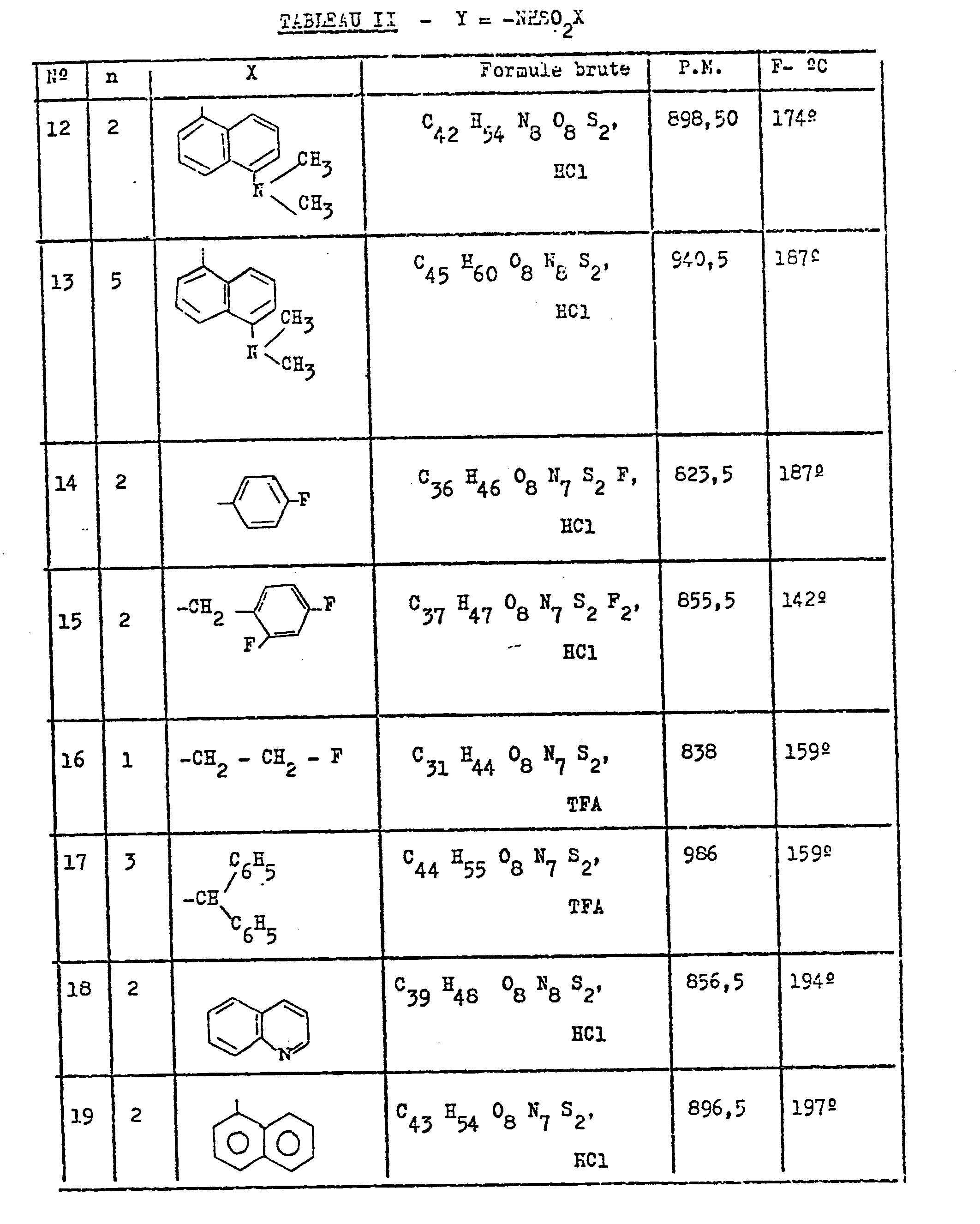
On a préparé de la même façon les composés de formule I du Tableau II ci-dessous.
Préparation dePreparation of

On opère suivant le schéma réactionnel

On ajoute une solution de 113 mg (0,52 m mole) d'amine II (F = 151°) dans 5 ml de THF, à une solution de 357 mg (0,52 m mole) de peptide (III) (F = 142°) dans 5 ml de THF, sous agitation ; puis à O-5° une solution de 107 mg (0,52 m mole) de DCC dans 3 ml de CHCl3 anhydre. On laisse sous agitation pendant 12 h à température ambiante. Après 40 mn, un précipité de DCU apparaît. A la fin de la réaction, la DCU formée est essorée, le filtrat amené à sec sous vide. Le résidu est repris par un mélange AcOEt/H20, 50/50. La phase organique est décantée, lavée par une solution de NaHCO3 puis de NaCl saturées et séchée sur Na2SO4. L'évaporation sous vide conduit à un solide amorphe jaune paille ( P = 314 mg; Rdt = 77 %, F = 168 °C.A solution of 113 mg (0.52 mole) of amine II (F = 151 °) in 5 ml of THF is added to a solution of 357 mg (0.52 mole) of peptide (III) (F = 142 °) in 5 ml of THF, with stirring; then at O-5 ° a solution of 107 mg (0.52 mole) of DCC in 3 ml of anhydrous CHCl 3 . The mixture is left stirring for 12 h at room temperature. After 40 min, a DCU precipitate appears. At the end of the reaction, the DCU formed is drained, the filtrate brought to dryness under vacuum. The residue is taken up in an AcOEt / H 2 0, 50/50 mixture. The organic phase is decanted, washed with a solution of NaHCO 3 then of saturated NaCl and dried over Na 2 SO 4 . Evaporation under vacuum results in a straw yellow amorphous solid (P = 314 mg; Yield = 77%, M = 168 ° C.
Rf = 0,32 (BuOH-AcOH-H2O, 4-1-1)Rf = 0.32 (BuOH-AcOH-H 2 O, 4-1-1)
Formule brute : C 43 H51 0 8 N 6 5 F 3 Gross formula: C 43 H 51 0 8 N 6 5 F 3
Structure confirmée par RMN, UV.Structure confirmed by NMR, UV.
Préparation de trifluoroacétate de peptide IV -
On dissout 300 mg (0,382 m mole) de peptide IV dans 1,5 ml de TFA, et on maintient en contact pendant 10 mn, évapore sous vide anhydre. Le résidu sirupeux est dissous dans le minimum de CH2Cl2 anhydre. La solution est versée dans 30 ml de Et20 anhydre. Le précipité formé est filtré, lavé (pH ≃ 4), séché sous vide anhydre (P = 258 mg, Rdt = 85 %).300 mg (0.382 mole) of peptide IV are dissolved in 1.5 ml of TFA, and the mixture is kept in contact for 10 min, evaporated under anhydrous vacuum. The syrupy residue is dissolved in the minimum of anhydrous CH 2 Cl 2 . The solution is poured into 30 ml of anhydrous Et 2 0. The precipitate formed is filtered, washed (pH ≃ 4), dried under anhydrous vacuum (P = 258 mg, Yield = 85%).
Rf (BuOH-AcOH-H2O ; 4-1-1) = 0,31.R f (BuOH-AcOH-H 2 O; 4-1-1) = 0.31.
Formule brute : C38 H45 O6 N6 S F3, TFA = 799.Gross formula: C 38 H 45 O 6 N 6 SF 3 , TFA = 799.
On a préparé de la façon suivante les composés de formule générale I.The compounds of general formula I were prepared in the following manner.
L Tyr-D Ala-L Gly-Phe-Met-NH- (CH2)n - CO - X donnés au Tableau III ci-dessous :


On opère suivant le schéma réactionnel suivant :


On ajoute lentement sous agitation à O° -5°, une solution de 220 mg de DCC dans 10 ml de CH2C12 anhydre, à un mélange de 720 mg de peptide III (F = 142 °C) et 210 mg d'amine II dans 15 ml de THF anhydre. On agite 24 h, essore la DCU formée, lave avec CH2Cl2, évapore, reprend par AcOEt, lave la phase organique par NaHCO3 puis NaCl saturé. On sèche sur Na2SO4 et évapore sous vide pour obtenir 852 mg de résidu blanc.Is added slowly with stirring at 0 ° -5 °, a solution of 220 mg of DCC in 10 ml of anhydrous CH 2 C1 2 , to a mixture of 720 mg of peptide III (M = 142 ° C) and 210 mg of amine II in 15 ml of anhydrous THF. The mixture is stirred for 24 h, the DCU formed is drained, washed with CH 2 Cl 2 , evaporated, taken up in AcOEt, the organic phase is washed with NaHCO 3 and then saturated NaCl. It is dried over Na 2 SO 4 and evaporated under vacuum to obtain 852 mg of white residue.
Rf = 0,34 (BuOH-AcOH-H2O, 4-1-1).. Après recristallisation dans AcOEt-MeOH (50/50), P = 650 mg. Cristaux blancs. F = 124-126 °C. Rdt≃68 %. Analyse pour C 43 H 56 0 9 N 7 S F Calculée : C % = 60 H % = 6,5 N % = 11,5 F % = 2,2 Trouvée : C % = 60,7 H % = 6,9 N % = 10,6 F % = 1,8 Etape b - Déprotection du peptide IV pour obtenir le composé de formule I ci-dessous

On dissout 400 mg de peptides IV dans 5 ml de dioxanne anhydre déperoxydé, on ajoute à O °C, 2 ml d'une solution de dioxanne-HCl à 24 % en poids. Après une mise en contact de 1 h à O °C, on évapore sous vide anhydre et on recouvre de Et20, pour obtenir une poudre blanche. On filtre, lave (pH ≃ 4), sèche sous vide anhydre (P= 365 mg Rdt 90 %).400 mg of peptides IV are dissolved in 5 ml of anhydrous deperoxidized dioxane, 2 ml of a 24% by weight dioxane-HCl solution are added at 0 ° C. After being brought into contact for 1 hour at 0 ° C., the mixture is evaporated under anhydrous vacuum and covered with Et 2 0, to obtain a white powder. It is filtered, washed (pH ≃ 4), dried under anhydrous vacuum (P = 365 mg Yield 90%).
Rf = 0,22 (BuOH-AcOH-H2O ; 4-1-1).Rf = 0.22 (BuOH-AcOH-H 2 O; 4-1-1).
Analyse pour C38 H49 O7 N 7 S F ClAnalysis for C 38 H 49 O 7 N 7 S F C l
Calculée : C % = 56,9 H % = 6,1 N % = 12,2 Cl %=4,4Calculated: C% = 56.9 H% = 6.1 N% = 12.2 Cl% = 4.4
Trouvée : C % = 56,1 H % = 6,5 N % = 12,6 Cl % =4,9Found: C% = 56.1 H% = 6.5 N% = 12.6 Cl% = 4.9
On a préparé de façon analogue des composés de formule générale I Tyr-D Ala-Gly-Phe-Met-NH-(CH2)n-NH-CO-(CH2)m-X, qui sont donnés au Tableau IV.


Préparation du tétrapeptide Tyr-D Ala- Gly-Phe-NH-(CH2)2-NH-CO-CH2-C6H4 - F Preparation of the tetrapeptide Tyr-D Ala- Gly-Phe-NH- (CH 2 ) 2 -NH-CO-CH 2 -C 6 H 4 - F

On ajoute lentement sous agitation à 0-5 °C, 220 mg de DCC dans 10 ml de CH2Cl2 anhydre, à un mélange de 584 mg de peptide III ( 1 mM) et 210 mg d'aminé II dans 15 ml de THF anhydre. On agite 24 h, on essore la DCU formée. On lave avec CH2Cl2. On évapore et on reprend dans de l'acétate d'éthyle. On lave la phase organique par une solution de bicarbonate de Na et de CINa saturée. On sèche sur sulfate de sodium et on évapore sous vide. On obtient un résidu jaune (P = 458 mg)220 mg of DCC in 10 ml of anhydrous CH 2 Cl 2 are added slowly with stirring at 0-5 ° C. to a mixture of 584 mg of peptide III (1 mM) and 210 mg of amine II in 15 ml of THF anhydrous. Agitation is carried out for 24 hours, the DCU formed is drained. Wash with CH 2 Cl 2 . It is evaporated and taken up in ethyl acetate. The organic phase is washed with a solution of sodium bicarbonate and saturated CINa. It is dried over sodium sulfate and evaporated in vacuo. A yellow residue is obtained (P = 458 mg)
Rf = 0,28 (BuOH-AcOa-H2O, 4-1-1). On recristallise dans un mélange acétate d'éthyle-méthanol (50/50). P = 412 mg. Cristaux jaunes pâles. F = 162' - Rdt 60 %.Rf = 0.28 (BuOH-AcOa-H 2 O, 4-1-1). Recrystallized from an ethyl acetate-methanol mixture (50/50). P = 412 mg. Pale yellow crystals. F = 162 '- Yield 60%.
Etape b - Déprotection du peptide - Préparation du chlorhydrate.Step b - Deprotection of the peptide - Preparation of the hydrochloride.
On dissout 400 mg de peptide IV dans 4 ml de dioxanne anhydre et déperoxydé, on filtre d'un léger insoluble, ajoute 4 ml de HCl dans un dioxanne à 24 % en poids. On laisse en contact pendant 1 h, puis on évapore sous vide anhydre. On recouvre d'Et20 anhydre, délite la pou- dreobtenue, filtre, lave par Et20 jusqu'à pH -4. On sèche sous vide anhydre (P = 420 mg, Rdt ~ 100 %) Rf (BuOH-AcOH-H2O ; 4-1-1) = 0,20.400 mg of peptide IV are dissolved in 4 ml of anhydrous and deperoxidized dioxane, filtered with a slight insoluble material, 4 ml of HCl are added in 24% by weight dioxane. It is left in contact for 1 h, then evaporated under anhydrous vacuum. Anhydrous Et 2 0 is covered, the powder obtained is disintegrated, filtered, washed with Et 2 0 until pH -4. Dried under anhydrous vacuum (P = 420 mg, Yield ~ 100%) Rf (BuOH-AcOH-H 2 O; 4-1-1) = 0.20.
Les résultats des essais pharmacologiques et toxicologiques qui sont rapportés ci-après mettent en évidence les propriétés des dérivés de l'invention, notamment une faible toxicité ainsi que des activités analgésique, psychotrope et antidiarrhéique.The results of the pharmacological and toxicological tests which are reported below demonstrate the properties of the derivatives of the invention, in particular a low toxicity as well as analgesic, psychotropic and antidiarrheal activities.
L'invention a donc encore pour objet un médicament présentant en particulier des activités analgésiques, psychotrope et antidiarrhéique, caractérisé en ce qu'il contient à titre de principe actif une quantité efficace d'uncomposé de formule I ou d'un sel d'addition avec un acide thérapeutiquement acceptable de ce composé.A further subject of the invention is therefore a medicament having in particular analgesic, psychotropic and antidiarrheal activities, characterized in that it contains, as active principle, an effective amount of a compound of formula I or of an addition salt with a therapeutically acceptable acid of this compound.
I. Action analgésique par rapport à la morphine comme substance de référence qui a été contrôlée
- a) Sur organe isolé. - iléon de cobaye
- a) On an isolated organ. - guinea pig ileum
On a utilisé la technique de stimulation transmu- rale de l'iléon de cobaye de PATON (W.D.M. PATON, "The rés- ponse of the guinea-pig ileum to electrical stimulation by coaxial electrodes" - J. Physiol. (London), 127, 40P-41P (1955) et PATON (W.D.M.) - Brit.J. Pharmacol. 11).The technique of transmural stimulation of the guinea pig ileum of PATON was used (WDM PATON, "The response of the guinea-pig ileum to electrical stimulation by coaxial electrodes" - J. Physiol. (London), 127 , 40P-41P (1955) and PATON (WDM) - Brit.J. Pharmacol. 11).
- - Les essais ont été réalisés dans une cuve de 35 ml irriguée par une solution de KREBS.- The tests were carried out in a 35 ml tank irrigated with a KREBS solution.
- - Les stimulations électriques, supramaximales (6 par minute - 0,15 Hertz) étaient ajustées à chaque essai. Courant rectangulaire - durée-0,5 milliseconde.- The electrical, supramaximal stimulations (6 per minute - 0.15 Hertz) were adjusted with each test. Rectangular current - duration-0.5 millisecond.
- - Les concentrations des différents produits étudiés, ainsi que celles de la morphine qui a servi de corps de référence, sont exprimées en nanomoles (nM) par litre.- The concentrations of the various products studied, as well as those of the morphine which served as the reference body, are expressed in nanomoles (nM) per liter.
- - Pour chaque concentration, le temps de contact a été de 3 minutes. Chaque essai était séparé du suivant par une période de 10 à 20 minutes.- For each concentration, the contact time was 3 minutes. Each test was separated from the next by a period of 10 to 20 minutes.
- - Les résultats sont exprimés en pourcentage d'inhibition de la concentration consécutive à la stimulation électri--que de l'iléon. On a ensuite calculé les doses actives 50 par la méthode de Parker et Waud (J. of pharmacology, 1971, 177, n°4) qui ont été comparées à celle de la morphine dans des essais concomitants.- The results are expressed as a percentage inhibition of the concentration following electrical stimulation of the ileum. The active doses 50 were then calculated by the method of Parker and Waud (J. of pharmacology, 1971, 177, n ° 4) which were compared with that of morphine in concomitant tests.
Les résultats sont présentés dans le tableau V suivant.
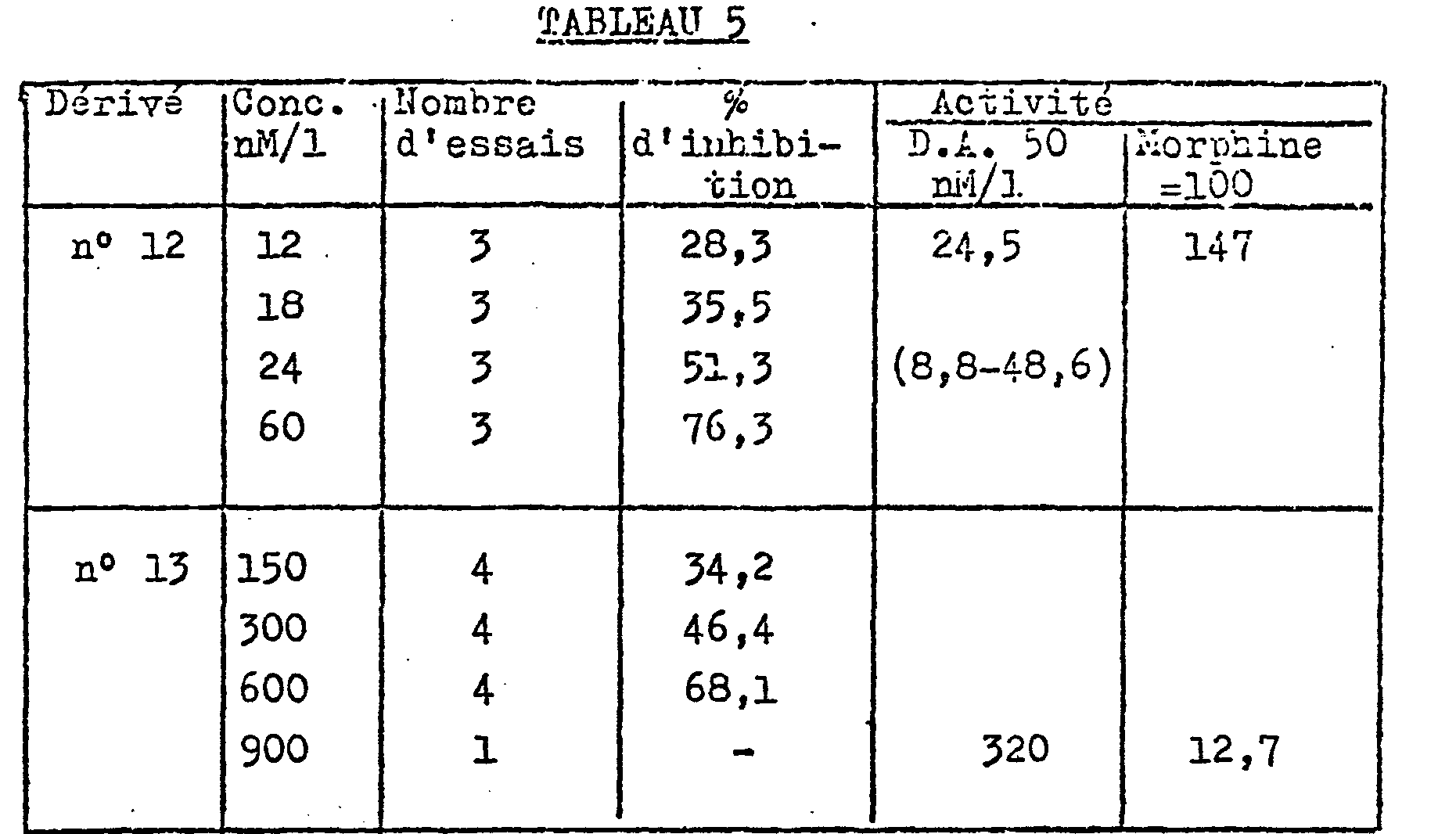
On a utilisé une technique de stimulation transmu- rale du canal différent de la souris, adaptée à celle décrite par HUCHES et KOSTERLITZ (J.HUGUES, H.W.KOSTERLITZ and Frances M.LESLIE, "Effect of morphine ou adrenergic transmission in the mouse vas deferens. Assessment of ago- nist and antagonist potencies of narcotic analgesics".-Br J. Pharmac. 53 371-381 (1975).We used a transmural stimulation technique of the different channel of the mouse, adapted to that described by HUCHES and KOSTERLITZ (J. HUGUES, HWKOSTERLITZ and Frances M.LESLIE, "Effect of morphine or adrenergic transmission in the mouse vas deferens . Assessment of ago- nist and antagonist potencies of narcotic analgesics ".- Br J. Pharmac. 53 371-381 (1975).
- - Les essais ont été réalisés dans une cuve de 7 ml irriguée par une solution de KREBS.- The tests were carried out in a 7 ml tank irrigated with a KREBS solution.
- - Les stimulations électriques, supramaximales (6 par minute) étaient ajustées à chaque essai.- The electrical and supramaximal stimulations (6 per minute) were adjusted for each test.
- - Les concentrations des différents produits étudiés sont exprimées en nM par litre.- The concentrations of the various products studied are expressed in nM per liter.
- - Pour chaque concentration le temps de contact a été de 3 minutes. Dans les cas où le maximum d'inhibition a été atteint en un temps plus court, le fait a été signalé. Chaque essai était séparé du suivant par une période de 10 à 20 minutes.- For each concentration the contact time was 3 minutes. In cases where the maximum inhibition has been reached in a shorter time, the fact has been reported. Each test was separated from the next by a period of 10 to 20 minutes.
- - Les résultats sont exprimés en pourcentage d'inhibition de la concentration consécutive à la stimulation électrique du canal déférent. On a ensuite calculé les doses actives 50 par la méthode de Parker & Wand (J.Pharm. Exper. Therap.96-99 (1949).- The results are expressed as a percentage of inhibition concentration following electrical stimulation of the vas deferens. The active doses 50 were then calculated by the method of Parker & Wand (J. Pharmac. Exper. Therap. 96-99 (1949).
Ils sont présentés dans le tableau VI suivant.

Plaque chauffante (JACOB et BLOZOVSKI, Arch. Int.Pharma- codyn. 122, 287-300, 1959 : 133, 296-300, 1961).Hot plate (JACOB and BLOZOVSKI, Arch. Int. Pharmacodyn. 122, 287-300, 1959: 133, 296-300, 1961).
Ces essais ont été réalisés avec des souris mâles, indemmes d'organismes pathogènes spécifiques pesant de 21 à 26 g.These tests were carried out with male mice, free from specific pathogenic organisms weighing from 21 to 26 g.
Les animaux sont placés sur une plaque chauffée à 65° trois fois de suite à 5 minutes d'intervalle. Le "cut off time" est de 45 secondes. On note à chaque passage les temps de lèchement et de bond.The animals are placed on a plate heated to 65 ° three times in succession at 5 minute intervals. The "cut off time" is 45 seconds. The licking and jumping times are noted at each pass.
Les paramètres utilisés sont : le temps de lèchement à la première exposition L1 (réaction peu élaborée) et le temps de bond à la troisième exposition B3 (réaction élaborée apparentée à un conditionnement).The parameters used are: the licking time at the first exposure L 1 (poor reaction) and the jump time at the third exposure B 3 (sophisticated reaction related to conditioning).
Le dérivé n°12 et la morphine ont été administrés par voie I.V.Derivative No. 12 and morphine were administered I.V.
Témoins : sérum physiologique 0,1 ml/10 gWitnesses: physiological serum 0.1 ml / 10 g
Morphine : 0,3 1 à 3 mg/kg sous le même volume.Morphine: 0.3 1 to 3 mg / kg in the same volume.
Dérivé n° 12 : 1, 3 et 10 mg/kg sous le même volume.Derivative No. 12: 1, 3 and 10 mg / kg in the same volume.
Lectures : 5 minutes après traitement : lèchement 15 minutes après traitement : Ier bond 30 à 45 minutes après traitement : saut ajusté.Readings: 5 minutes after treatment: licking 15 minutes after treatment: 1st jump 30 to 45 minutes after treatment: adjusted jump.
Ils sont exposés dans le tableau VII suivant :

L'activité du dérivé N° 12 à 10 mg/kg est comparable à celle de la morphine à 1 mg/kg en intensité et en durée, ce qui, en tenant compte des molartiés, dorme un coefficient d'activité de 35 % environ.The activity of derivative No. 12 at 10 mg / kg is comparable to that of morphine at 1 mg / kg in intensity and duration, which, taking into account the molarties, gives an activity coefficient of approximately 35% .
Elle a été évaluée par la recherche d'une catalepsie chez le rat.It was evaluated by looking for catalepsy in rats.
Ces essais ont été réalisés avec des rats femelles indexes d'organisées pathogènes spécifiques pesant de 200 à 220 g.These tests were carried out with female index rats of specific pathogenic organisms weighing from 200 to 220 g.
L'effet cataleptique est mesuré en suspendant le rat par ses pattes antérieures au rebord de la cage d'expérience : un rat cataleptique reste dans cette position alors qu'un animal normal l'abandonne aussitôt, voire ne la prend pas du tout.The cataleptic effect is measured by suspending the rat by its front legs at the edge of the experimental cage: a cataleptic rat remains in this position while a normal animal abandons it immediately, or even does not take it at all.
La catalepsie est appréciée de la façon suivante:
- 0 : pas de catalepsie
- 1 : catalepsie liminaire
- 2 : catalepsie d'intensité moyenne
- 2 : catalepsie très prononcée
- 0: no catalepsy
- 1: introductory catalepsy
- 2: medium intensity catalepsy
- 2: very pronounced catalepsy
Les animaux sont traités par voie sous cutanée.The animals are treated subcutaneously.
Les expériences ont été effectuées à l'aveugle, l'observateur ignorant les traitements.The experiments were carried out blind, the observer ignoring the treatments.
Ils sont exprimés par rapport à la morphine et à l'Halopéridol et sont exposés dans le tableau VIII ci-dessous.

Elle a été recherchée (outre l'effet sur l'iléon de cobaye isolé) par l'épreuve à l'huile de ricin chez le rat.It was researched (in addition to the effect on the isolated guinea pig ileum) by the castor oil test in rats.
METHODE. (NIDMEGEERS et Coll. Arzn. - Forsch. 22, 516-518, 1972)METHOD. (NIDMEGEERS and Coll. Arzn. - Forsch. 22, 516-518, 1972)
Ces essais ont été réalisés avec des rats mâles de 160 à 220 g. Après un jeûne de 18 heures, chaque animal a reçu par voie orale un millilitre d'huile de ricin.These tests were carried out with male rats of 160 to 220 g. After an 18 hour fast, each animal was orally given one milliliter of castor oil.
Le dérivé N° 12, la codéine (base) en suspension dans l'eau et la gomme arabique et la Morphine (chlorhydrate) en solution ont été administrés par voie orale sous un volume de 0,5 ml pour 100 grammes, une heure avant l'huilede ricin.Derivative No. 12, codeine (base) suspended in water and gum arabic and morphine (hydrochloride) in solution were administered orally in a volume of 0.5 ml per 100 grams, one hour before Castor oil.
Les selles de chaque animal, sont examinées, dans l'ignorance du traitement 1 - 3 - 5 heures après l'administration d'huile de ricin soit 2 - 4 et 6 heures après le produit antidiarrhéique et l'on dénombre les animaux présentant de la diarrhée (ou des selles mixtes).The stools of each animal are examined, ignoring the treatment 1 - 3 - 5 hours after the administration of castor oil, i.e. 2 - 4 and 6 hours after the antidiarrheal product and there are animals with diarrhea (or mixed stools).
Dans le tableau IX ci-dessous on constate que le dérivé n° 12 est un antidiarrhéique puissant ; en effet, il protège tous les animaux pendant quatre heures à la dose de 30 mg/kg.

On a déterminé le pouvoir compétiteur des dérivés de l'invention vis-à-vis des sites de liaison à haute et moyenne affinité de la leucine-enképhaline 3-R de membranes striatales de souris.The competitive power of the derivatives of the invention was determined vis-à-vis the high and medium affinity binding sites of leucine-enkephalin 3-R of mouse striatal membranes.
Les conditions de préparation des membranes et d'incubation ont été les mêmes que celles qui sont décrites dans Audigier et Coll. (C. Acad. Sciences plus Euro- pean J. of Pharmacol.).The conditions for preparing the membranes and for incubation were the same as those described in Audigier et al. (C. Acad. Sciences plus European J. of Pharmacol.).
Des concentrations croissantes des divers composés synthétisés ont été opposées à une concentration fixe de Leucine-Enképhaline 3-H et les déplacements observés ont permis dans chaque cas de déterminer une constante d'inhi- bition (Ki).Increasing concentrations of the various synthesized compounds were opposed to a fixed concentration of Leucine-Enkephalin 3-H and the displacements observed made it possible in each case to determine an inhibition constant (Ki).
On donne comme exemple, au tableau X ci-dessous les valeurs de Ki obtenues avec les composés 12 et 13.

Les dérivés de formule générale I bénéficient d'une excellente tolérance et d'une faible toxicité qui a été plus particulièrement étudiée sur lés dérivés N° 12 et 13, qui ont fait l'objet d'une épreuve de toxicité aiguë chez la souris.The derivatives of general formula I have excellent tolerance and low toxicity, which has been more particularly studied on derivatives No. 12 and 13, which have been the subject of an acute toxicity test in mice.
Les D.L. 5a obtenues sont respectivement de :
- 725 ± 25 mg/kg par voie IV pour le dérivé.n° 12.
- et 892 ± 31 mg/kg "" " pour le dérivé n° 13.
- 725 ± 25 mg / kg IV for the derivative. No. 12.
- and 892 ± 31 mg / kg """for derivative 13.
Les résultats de ces études mettent en évidence la faible toxicité et les intéressantes propriétés analgésique, psychotrope et antidiarrhéique des dérivés de l'invention qui les rendent utiles en médecine humaine et vétérinaire.The results of these studies demonstrate the low toxicity and the interesting analgesic, psychotropic and antidiarrheal properties of the derivatives of the invention which make them useful in human and veterinary medicine.
Le médicament de l'invention est administrable à l'homme par la voie orale sous forme de comprimés, comprimés dragéifiés, capsules, gouttes ou sirops. Il peut aussi être présenté, pour l'administration rectale, sous forme de suppositoires et pour l'administration parentérale sous forme de soluté injectable.The medicament of the invention can be administered to humans by the oral route in the form of tablets, coated tablets, capsules, drops or syrups. It may also be presented for rectal administration in the form of suppositories and for parenteral administration in the form of an injectable solution.
Chaque dose unitaire contient avantageusement de 5 à 100 mg de principe actif, ainsi :
- - pour les comprimés de 5 à 30 mg de principe actif
- - pour les suppositoires de 10 à 30 mg de principe actif
- - pour les ampoules injectables de 1 ml, une solution de 0,5 à 2 % de principe actif.
- - for tablets of 5 to 30 mg of active ingredient
- - for suppositories from 10 to 30 mg of active ingredient
- - for injectable ampoules of 1 ml, a solution of 0.5 to 2% of active ingredient.
Les doses administrables journellement peuvent varier de 60 mg à 200 mg de principe actif environ.Daily doses can range from laugh from 60 mg to 200 mg of active ingredient approximately.
Le médicament de l'invention peut être administré à l'homme pour le traitement de la douleur ou des diarrhées.The medicament of the invention can be administered to humans for the treatment of pain or diarrhea.
En raison de son activité psychotrope, il est également applicable au traitement des psychoses et névroses.Due to its psychotropic activity, it is also applicable to the treatment of psychoses and neuroses.
Claims (7)

et leurs sels d'addition avec des acides pharmaceutiquement acceptables.1. Peptide derivatives corresponding to the general formula
and their addition salts with pharmaceutically acceptable acids.


pour obtenir un peptide de formule III
Tyr - D Ala - Gly - A - B - OH,
dans laquelle A et B ont les définitions données a la revendication 1, et

to obtain a peptide of formula III
Tyr - D Ala - Gly - A - B - OH,
in which A and B have the definitions given in claim 1, and
Applications Claiming Priority (2)
| Application Number | Priority Date | Filing Date | Title |
|---|---|---|---|
| FR7812543 | 1978-04-27 | ||
| FR7812543A FR2424253A1 (en) | 1978-04-27 | 1978-04-27 | NEW DERIVATIVES OF PEPTIDES ANALOGUES OF ENKEPHALINS, THEIR METHOD OF PREPARATION AND THEIR THERAPEUTIC APPLICATION |
Publications (1)
| Publication Number | Publication Date |
|---|---|
| EP0005658A1 true EP0005658A1 (en) | 1979-11-28 |
Family
ID=9207674
Family Applications (1)
| Application Number | Title | Priority Date | Filing Date |
|---|---|---|---|
| EP79400268A Withdrawn EP0005658A1 (en) | 1978-04-27 | 1979-04-25 | Peptide derivatives analogue to encephalines, process for their preparation and their therapeutical application |
Country Status (2)
| Country | Link |
|---|---|
| EP (1) | EP0005658A1 (en) |
| FR (1) | FR2424253A1 (en) |
Cited By (13)
| Publication number | Priority date | Publication date | Assignee | Title |
|---|---|---|---|---|
| FR2471970A1 (en) * | 1979-12-17 | 1981-06-26 | Lilly Co Eli | PENTAPEPTIDES APPROVED FOR ENKEPHALINES, THEIR PREPARATION AND THEIR THERAPEUTIC USE |
| EP0030845A3 (en) * | 1979-12-17 | 1981-11-04 | Eli Lilly And Company | Pharmacologically active peptides, their preparation and pharmaceutical compositions containing them |
| GB2171103A (en) * | 1985-02-19 | 1986-08-20 | Sandoz Ltd | Fluorinated/chlorinated peptides |
| EP0215297A3 (en) * | 1985-08-14 | 1989-07-19 | G.D. Searle & Co. | Substituted dipeptide amides |
| FR2642972A1 (en) * | 1989-02-14 | 1990-08-17 | Inst Nat Sante Rech Med | AGENTS FOR THE DIAGNOSIS AND TREATMENT OF MELANOMAS, AROMATIC HALOGENATED DERIVATIVES SUCH AS SUCH AGENTS AND THEIR PREPARATION |
| US5496927A (en) * | 1985-02-04 | 1996-03-05 | Merrell Pharmaceuticals Inc. | Peptidase inhibitors |
| US6017965A (en) * | 1993-02-08 | 2000-01-25 | Nps Pharmaceuticals, Inc. | Compounds active at a novel site on receptor-operated calcium channels useful for treatment of neurological disorders and diseases |
| US6051610A (en) * | 1993-02-08 | 2000-04-18 | Nps Pharmaceuticals, Inc. | Compounds active at a novel site on receptor-operated calcium channels useful for treatment of neurological disorders and diseases |
| US6211245B1 (en) | 1993-02-08 | 2001-04-03 | Nps Pharmaceuticals, Inc. | Compounds active at a novel site on receptor-operated calcium channels useful for treatment of neurological disorders and diseases |
| WO2001032649A1 (en) * | 1999-10-29 | 2001-05-10 | Boehringer Ingelheim Pharma Kg | Arylalkane, arylalkene and aryl azaalkane, medicaments containing said compounds and method for the production thereof |
| US6306912B1 (en) | 1993-02-08 | 2001-10-23 | Nps Pharmaceuticals, Inc. | Compounds active at a novel site on receptor-operated calcium channels useful for treatment of neurological disorders and diseases |
| US6750244B2 (en) | 1993-02-08 | 2004-06-15 | Nps Pharmaceuticals, Inc. | Compounds active at a novel site on receptor-operated calcium channels useful for treatment of neurological disorders and diseases |
| US7087765B2 (en) | 1995-06-07 | 2006-08-08 | Nps Pharmaceuticals, Inc. | Compounds active at a novel site on receptor-operated calcium channels useful for treatment of neurological disorders and diseases |
Citations (5)
| Publication number | Priority date | Publication date | Assignee | Title |
|---|---|---|---|---|
| FR2347336A1 (en) * | 1976-04-08 | 1977-11-04 | Ici Ltd | PEPTIDIC DERIVATIVES |
| FR2359817A1 (en) * | 1976-07-27 | 1978-02-24 | Reckitt & Colmann Prod Ltd | Peptide cpds. contg. tyrosine, glycine, phenylalanine and d-amino acid - local anaesthetics, smooth muscle relaxants, adrenergic neutron blockers, beta-stimulants etc. |
| FR2364890A1 (en) * | 1976-09-16 | 1978-04-14 | Richter Gedeon Vegyeszet | NEW PENTAPEPTIDES AND PROCESS FOR THEIR PREPARATION |
| FR2365553A1 (en) * | 1976-09-27 | 1978-04-21 | Lilly Co Eli | AMID DERIVATIVES OF PENTAPEPTIDES AND TETRAPEPTIDES AND THEIR USE AS MEDICINAL PRODUCTS |
| EP0000559A1 (en) * | 1977-07-22 | 1979-02-07 | The Wellcome Foundation Limited | Pentapeptide-N-alkylamides and their acid addition salts, methods for preparation of these compounds and pharmaceutical formulations containing them |
-
1978
- 1978-04-27 FR FR7812543A patent/FR2424253A1/en active Granted
-
1979
- 1979-04-25 EP EP79400268A patent/EP0005658A1/en not_active Withdrawn
Patent Citations (5)
| Publication number | Priority date | Publication date | Assignee | Title |
|---|---|---|---|---|
| FR2347336A1 (en) * | 1976-04-08 | 1977-11-04 | Ici Ltd | PEPTIDIC DERIVATIVES |
| FR2359817A1 (en) * | 1976-07-27 | 1978-02-24 | Reckitt & Colmann Prod Ltd | Peptide cpds. contg. tyrosine, glycine, phenylalanine and d-amino acid - local anaesthetics, smooth muscle relaxants, adrenergic neutron blockers, beta-stimulants etc. |
| FR2364890A1 (en) * | 1976-09-16 | 1978-04-14 | Richter Gedeon Vegyeszet | NEW PENTAPEPTIDES AND PROCESS FOR THEIR PREPARATION |
| FR2365553A1 (en) * | 1976-09-27 | 1978-04-21 | Lilly Co Eli | AMID DERIVATIVES OF PENTAPEPTIDES AND TETRAPEPTIDES AND THEIR USE AS MEDICINAL PRODUCTS |
| EP0000559A1 (en) * | 1977-07-22 | 1979-02-07 | The Wellcome Foundation Limited | Pentapeptide-N-alkylamides and their acid addition salts, methods for preparation of these compounds and pharmaceutical formulations containing them |
Non-Patent Citations (1)
| Title |
|---|
| UNLISTED DRUGS, Vol. 29, No. 1, Janvier 1977, SPECIAL LIBRARY ASSOCIATION, page 7n & SCIENCE 194:330, 15 Octobre 76 DALA * |
Cited By (20)
| Publication number | Priority date | Publication date | Assignee | Title |
|---|---|---|---|---|
| FR2471970A1 (en) * | 1979-12-17 | 1981-06-26 | Lilly Co Eli | PENTAPEPTIDES APPROVED FOR ENKEPHALINES, THEIR PREPARATION AND THEIR THERAPEUTIC USE |
| EP0030845A3 (en) * | 1979-12-17 | 1981-11-04 | Eli Lilly And Company | Pharmacologically active peptides, their preparation and pharmaceutical compositions containing them |
| EP0030848A3 (en) * | 1979-12-17 | 1981-12-16 | Eli Lilly And Company | Pharmacologically active peptides, their preparation and pharmaceutical compositions containing them |
| US5496927A (en) * | 1985-02-04 | 1996-03-05 | Merrell Pharmaceuticals Inc. | Peptidase inhibitors |
| US5849866A (en) * | 1985-02-04 | 1998-12-15 | Merrell Pharmaceuticals Inc. | Peptidase inhibitors |
| US6130315A (en) * | 1985-02-04 | 2000-10-10 | Merrell Pharmaceuticals Inc. | Peptidase inhibitors |
| GB2171103A (en) * | 1985-02-19 | 1986-08-20 | Sandoz Ltd | Fluorinated/chlorinated peptides |
| FR2577557A1 (en) * | 1985-02-19 | 1986-08-22 | Sandoz Sa | PEPTIDES AND PEPTIDE DERIVATIVES, THEIR PREPARATION, THEIR USE IN THERAPEUTICS AND PHARMACEUTICAL COMPOSITIONS CONTAINING SAME |
| EP0215297A3 (en) * | 1985-08-14 | 1989-07-19 | G.D. Searle & Co. | Substituted dipeptide amides |
| FR2642972A1 (en) * | 1989-02-14 | 1990-08-17 | Inst Nat Sante Rech Med | AGENTS FOR THE DIAGNOSIS AND TREATMENT OF MELANOMAS, AROMATIC HALOGENATED DERIVATIVES SUCH AS SUCH AGENTS AND THEIR PREPARATION |
| US6051610A (en) * | 1993-02-08 | 2000-04-18 | Nps Pharmaceuticals, Inc. | Compounds active at a novel site on receptor-operated calcium channels useful for treatment of neurological disorders and diseases |
| US6071970A (en) * | 1993-02-08 | 2000-06-06 | Nps Pharmaceuticals, Inc. | Compounds active at a novel site on receptor-operated calcium channels useful for treatment of neurological disorders and diseases |
| US6017965A (en) * | 1993-02-08 | 2000-01-25 | Nps Pharmaceuticals, Inc. | Compounds active at a novel site on receptor-operated calcium channels useful for treatment of neurological disorders and diseases |
| US6211245B1 (en) | 1993-02-08 | 2001-04-03 | Nps Pharmaceuticals, Inc. | Compounds active at a novel site on receptor-operated calcium channels useful for treatment of neurological disorders and diseases |
| US6306912B1 (en) | 1993-02-08 | 2001-10-23 | Nps Pharmaceuticals, Inc. | Compounds active at a novel site on receptor-operated calcium channels useful for treatment of neurological disorders and diseases |
| US6750244B2 (en) | 1993-02-08 | 2004-06-15 | Nps Pharmaceuticals, Inc. | Compounds active at a novel site on receptor-operated calcium channels useful for treatment of neurological disorders and diseases |
| US7268166B2 (en) | 1993-02-08 | 2007-09-11 | Nps Pharmaceuticals, Inc. | Compounds active at a novel site on receptor-operated calcium channels useful for treatment of neurological disorders and diseases |
| US7087765B2 (en) | 1995-06-07 | 2006-08-08 | Nps Pharmaceuticals, Inc. | Compounds active at a novel site on receptor-operated calcium channels useful for treatment of neurological disorders and diseases |
| WO2001032649A1 (en) * | 1999-10-29 | 2001-05-10 | Boehringer Ingelheim Pharma Kg | Arylalkane, arylalkene and aryl azaalkane, medicaments containing said compounds and method for the production thereof |
| US7230001B1 (en) | 1999-10-29 | 2007-06-12 | Boehringer Ingelheim Pharma Gmbh & Co. Kg | Arylalkane, arylalkene and aryl azaalkane, medicaments containing said compounds and method for the production thereof |
Also Published As
| Publication number | Publication date |
|---|---|
| FR2424253B1 (en) | 1981-01-02 |
| FR2424253A1 (en) | 1979-11-23 |
Similar Documents
| Publication | Publication Date | Title |
|---|---|---|
| EP0082088B1 (en) | Derivatives of amino acids and their therapeutic use | |
| EP0318377B1 (en) | Enantiomeric derivatives of amino acids, process for their preparation and their pharmaceutical applications | |
| EP0462884B1 (en) | Trh derivatives, their preparations and pharmaceutical compositions containing them | |
| MC1881A1 (en) | PHOSPHINIC ACID DERIVATIVES | |
| EP0038758A1 (en) | Amino-acids derivatives and their therapeutic use | |
| EP0051020B1 (en) | Substituted azobicyclooctanecarboxylic acids, process for their preparation und pharmaceutical compositions containing them | |
| EP0676411A2 (en) | Peptides and pseudopeptides derived from tachykinine, their preparation and their pharmaceutical compositions | |
| EP0274453A2 (en) | Collagenase inhibitor derivatives, their preparation and pharmaceutical compositions containing them | |
| EP0005658A1 (en) | Peptide derivatives analogue to encephalines, process for their preparation and their therapeutical application | |
| CA1340227C (en) | L-proline derivatives; process for preparing them and biological uses | |
| FR2515188A1 (en) | NOVEL 3-AMINO-PREGN-5-ENE DERIVATIVES, THEIR SALTS, PREPARATION METHOD, MEDICAMENT APPLICATION AND COMPOSITIONS COMPRISING THE SAME | |
| EP0046113B1 (en) | Peptides and their therapeutic use | |
| EP0632026B1 (en) | Alpha amino acid derivatives, a method for their preparation and pharmaceutical preparations containing them | |
| EP0262053A2 (en) | Amino-acid derivatives, their preparation and pharmaceutical compositions containing them | |
| FR2493311A1 (en) | 2,6-C-DIMETHYLTYROSIN1- (D-AMINOACIDIC) 2- (E-AMINO-CAPROIC ACID AND G-AMINOBUTYRIC ACID) 5 OF METHIONINE-ENCEPHALINE, USEFUL AS ANALGESICS | |
| CH621111A5 (en) | ||
| FR2532308A1 (en) | NOVEL POLYPEPTIDES, THEIR PREPARATION AND THEIR APPLICATION AS MEDICINES | |
| FR2548187A1 (en) | ORGANO-GERMANIUM COMPOUNDS AND THEIR THERAPEUTIC USES AS INHIBITORS OF ENZYMES THAT DEGRADE OPIOID PEPTIDES | |
| FR2597865A1 (en) | New derivatives of a benzylalkylcarboxylic acid substituted with a 4-pyridylaminocarbonyl radical, process for their preparation, the new intermediates obtained, their application as medicaments and the pharmaceutical compositions which contain them | |
| EP0684257B1 (en) | Pseudopeptide derivatives of neurokinines, process for their preparation and pharmaceutical compositions comprising them | |
| JPH0341459B2 (en) | ||
| EP0165151A1 (en) | Peptide derivatives as renin inhibitors, process for their preparation and their therapeutical application | |
| CA2015626A1 (en) | Benzothiazolinonic derivatives, process for their preparation and pharmaceutical compositions containing the same | |
| FR2604434A1 (en) | AMINO-2 ETHANETHIOL DERIVATIVES, THEIR PREPARATION AND THEIR THERAPEUTIC APPLICATION | |
| FR2537131A1 (en) | New amino acid derivatives and their therapeutic use |
Legal Events
| Date | Code | Title | Description |
|---|---|---|---|
| PUAI | Public reference made under article 153(3) epc to a published international application that has entered the european phase |
Free format text: ORIGINAL CODE: 0009012 |
|
| AK | Designated contracting states |
Designated state(s): BE CH DE GB IT LU NL SE |
|
| 17P | Request for examination filed | ||
| STAA | Information on the status of an ep patent application or granted ep patent |
Free format text: STATUS: THE APPLICATION HAS BEEN WITHDRAWN |
|
| 18W | Application withdrawn |
Withdrawal date: 19810713 |
|
| RIN1 | Information on inventor provided before grant (corrected) |
Inventor name: ROQUES, BERNARD Inventor name: SCHWARTZ, JEAN-CHARLES Inventor name: LECOMTE, JEANNE-MARIE |