DE69932846T2 - NEW 4-DEDIMETHYLAMINOTETRACYCLIN DERIVATIVES - Google Patents
NEW 4-DEDIMETHYLAMINOTETRACYCLIN DERIVATIVES Download PDFInfo
- Publication number
- DE69932846T2 DE69932846T2 DE69932846T DE69932846T DE69932846T2 DE 69932846 T2 DE69932846 T2 DE 69932846T2 DE 69932846 T DE69932846 T DE 69932846T DE 69932846 T DE69932846 T DE 69932846T DE 69932846 T2 DE69932846 T2 DE 69932846T2
- Authority
- DE
- Germany
- Prior art keywords
- hydrogen
- excessive
- dedimethylaminotetracycline
- deoxy
- disease
- Prior art date
- Legal status (The legal status is an assumption and is not a legal conclusion. Google has not performed a legal analysis and makes no representation as to the accuracy of the status listed.)
- Expired - Lifetime
Links
- 150000001875 compounds Chemical class 0.000 claims abstract description 25
- 238000011282 treatment Methods 0.000 claims abstract description 18
- 241000124008 Mammalia Species 0.000 claims abstract description 14
- 230000000845 anti-microbial effect Effects 0.000 claims abstract description 13
- 238000004519 manufacturing process Methods 0.000 claims abstract description 5
- 239000003814 drug Substances 0.000 claims abstract description 4
- -1 4-Dedimethylaminotetracycline compound Chemical class 0.000 claims description 39
- 230000000694 effects Effects 0.000 claims description 28
- 229910052739 hydrogen Inorganic materials 0.000 claims description 27
- 239000001257 hydrogen Substances 0.000 claims description 27
- UFHFLCQGNIYNRP-UHFFFAOYSA-N Hydrogen Chemical compound [H][H] UFHFLCQGNIYNRP-UHFFFAOYSA-N 0.000 claims description 20
- 208000037265 diseases, disorders, signs and symptoms Diseases 0.000 claims description 10
- 201000010099 disease Diseases 0.000 claims description 9
- 102000008186 Collagen Human genes 0.000 claims description 8
- 108010035532 Collagen Proteins 0.000 claims description 8
- MWUXSHHQAYIFBG-UHFFFAOYSA-N Nitric oxide Chemical compound O=[N] MWUXSHHQAYIFBG-UHFFFAOYSA-N 0.000 claims description 8
- 229920001436 collagen Polymers 0.000 claims description 8
- 102000002274 Matrix Metalloproteinases Human genes 0.000 claims description 6
- 108010000684 Matrix Metalloproteinases Proteins 0.000 claims description 6
- 206010003246 arthritis Diseases 0.000 claims description 6
- 125000000449 nitro group Chemical group [O-][N+](*)=O 0.000 claims description 6
- 230000001154 acute effect Effects 0.000 claims description 5
- 210000000988 bone and bone Anatomy 0.000 claims description 5
- 206010012601 diabetes mellitus Diseases 0.000 claims description 5
- 230000004968 inflammatory condition Effects 0.000 claims description 5
- 208000017169 kidney disease Diseases 0.000 claims description 5
- 125000002924 primary amino group Chemical group [H]N([H])* 0.000 claims description 5
- 102000000589 Interleukin-1 Human genes 0.000 claims description 4
- 108010002352 Interleukin-1 Proteins 0.000 claims description 4
- 208000019693 Lung disease Diseases 0.000 claims description 4
- 206010040070 Septic Shock Diseases 0.000 claims description 4
- 230000001684 chronic effect Effects 0.000 claims description 4
- 230000006378 damage Effects 0.000 claims description 4
- 230000031261 interleukin-10 production Effects 0.000 claims description 4
- 201000008383 nephritis Diseases 0.000 claims description 4
- 238000001243 protein synthesis Methods 0.000 claims description 4
- 206010039073 rheumatoid arthritis Diseases 0.000 claims description 4
- 230000014616 translation Effects 0.000 claims description 4
- 206010001052 Acute respiratory distress syndrome Diseases 0.000 claims description 3
- 206010028289 Muscle atrophy Diseases 0.000 claims description 3
- 206010028980 Neoplasm Diseases 0.000 claims description 3
- 102000016387 Pancreatic elastase Human genes 0.000 claims description 3
- 108010067372 Pancreatic elastase Proteins 0.000 claims description 3
- 201000004681 Psoriasis Diseases 0.000 claims description 3
- 125000000738 acetamido group Chemical group [H]C([H])([H])C(=O)N([H])[*] 0.000 claims description 3
- 201000000028 adult respiratory distress syndrome Diseases 0.000 claims description 3
- 230000037182 bone density Effects 0.000 claims description 3
- 201000000585 muscular atrophy Diseases 0.000 claims description 3
- 201000008482 osteoarthritis Diseases 0.000 claims description 3
- 230000017854 proteolysis Effects 0.000 claims description 3
- 239000003053 toxin Substances 0.000 claims description 3
- 231100000765 toxin Toxicity 0.000 claims description 3
- 108700012359 toxins Proteins 0.000 claims description 3
- 208000009304 Acute Kidney Injury Diseases 0.000 claims description 2
- 208000023275 Autoimmune disease Diseases 0.000 claims description 2
- 201000003883 Cystic fibrosis Diseases 0.000 claims description 2
- 208000036829 Device dislocation Diseases 0.000 claims description 2
- 206010014561 Emphysema Diseases 0.000 claims description 2
- 206010018364 Glomerulonephritis Diseases 0.000 claims description 2
- 206010018366 Glomerulonephritis acute Diseases 0.000 claims description 2
- 208000009329 Graft vs Host Disease Diseases 0.000 claims description 2
- 102100037611 Lysophospholipase Human genes 0.000 claims description 2
- 206010053159 Organ failure Diseases 0.000 claims description 2
- 208000010191 Osteitis Deformans Diseases 0.000 claims description 2
- 208000001132 Osteoporosis Diseases 0.000 claims description 2
- 208000027868 Paget disease Diseases 0.000 claims description 2
- 206010033645 Pancreatitis Diseases 0.000 claims description 2
- 108010058864 Phospholipases A2 Proteins 0.000 claims description 2
- 208000007932 Progeria Diseases 0.000 claims description 2
- 208000033626 Renal failure acute Diseases 0.000 claims description 2
- 206010039710 Scleroderma Diseases 0.000 claims description 2
- 206010040047 Sepsis Diseases 0.000 claims description 2
- 208000006045 Spondylarthropathies Diseases 0.000 claims description 2
- 206010064996 Ulcerative keratitis Diseases 0.000 claims description 2
- 208000007474 aortic aneurysm Diseases 0.000 claims description 2
- 210000001185 bone marrow Anatomy 0.000 claims description 2
- 201000011510 cancer Diseases 0.000 claims description 2
- 208000020832 chronic kidney disease Diseases 0.000 claims description 2
- 208000018631 connective tissue disease Diseases 0.000 claims description 2
- 201000007717 corneal ulcer Diseases 0.000 claims description 2
- 230000007423 decrease Effects 0.000 claims description 2
- 239000002158 endotoxin Substances 0.000 claims description 2
- 230000002349 favourable effect Effects 0.000 claims description 2
- 208000024908 graft versus host disease Diseases 0.000 claims description 2
- 230000002757 inflammatory effect Effects 0.000 claims description 2
- 208000028774 intestinal disease Diseases 0.000 claims description 2
- 229920006008 lipopolysaccharide Polymers 0.000 claims description 2
- 208000027202 mammary Paget disease Diseases 0.000 claims description 2
- 208000028169 periodontal disease Diseases 0.000 claims description 2
- 230000036303 septic shock Effects 0.000 claims description 2
- 201000005671 spondyloarthropathy Diseases 0.000 claims description 2
- 201000000596 systemic lupus erythematosus Diseases 0.000 claims description 2
- 206010043554 thrombocytopenia Diseases 0.000 claims description 2
- 150000002431 hydrogen Chemical class 0.000 claims 7
- HSEMFIZWXHQJAE-UHFFFAOYSA-N hexadecanamide Chemical compound CCCCCCCCCCCCCCCC(N)=O HSEMFIZWXHQJAE-UHFFFAOYSA-N 0.000 claims 2
- 102100038280 Prostaglandin G/H synthase 2 Human genes 0.000 claims 1
- 108050003267 Prostaglandin G/H synthase 2 Proteins 0.000 claims 1
- 125000002147 dimethylamino group Chemical group [H]C([H])([H])N(*)C([H])([H])[H] 0.000 claims 1
- 238000005858 glycosidation reaction Methods 0.000 claims 1
- 231100000516 lung damage Toxicity 0.000 claims 1
- XCCHQGIGHCRZOS-KBKZQPOHSA-N (4as,5as,6s,12ar)-1,6,10,11,12a-pentahydroxy-6-methyl-3,12-dioxo-4,4a,5,5a-tetrahydrotetracene-2-carboxamide Chemical class C1=CC=C2[C@@](C)(O)[C@@H](C[C@@H]3[C@](C(O)=C(C(N)=O)C(=O)C3)(O)C3=O)C3=C(O)C2=C1O XCCHQGIGHCRZOS-KBKZQPOHSA-N 0.000 abstract description 12
- 239000004098 Tetracycline Substances 0.000 description 80
- 235000019364 tetracycline Nutrition 0.000 description 77
- RTZKZFJDLAIYFH-UHFFFAOYSA-N Diethyl ether Chemical compound CCOCC RTZKZFJDLAIYFH-UHFFFAOYSA-N 0.000 description 70
- 229960002180 tetracycline Drugs 0.000 description 61
- 229930101283 tetracycline Natural products 0.000 description 58
- 150000003522 tetracyclines Chemical class 0.000 description 55
- 239000000243 solution Substances 0.000 description 49
- 239000000203 mixture Substances 0.000 description 39
- OKKJLVBELUTLKV-UHFFFAOYSA-N Methanol Chemical compound OC OKKJLVBELUTLKV-UHFFFAOYSA-N 0.000 description 30
- 239000007787 solid Substances 0.000 description 25
- VEXZGXHMUGYJMC-UHFFFAOYSA-N Hydrochloric acid Chemical compound Cl VEXZGXHMUGYJMC-UHFFFAOYSA-N 0.000 description 21
- 229940040944 tetracyclines Drugs 0.000 description 19
- 239000000047 product Substances 0.000 description 18
- QAOWNCQODCNURD-UHFFFAOYSA-N Sulfuric acid Chemical compound OS(O)(=O)=O QAOWNCQODCNURD-UHFFFAOYSA-N 0.000 description 17
- 239000003054 catalyst Substances 0.000 description 17
- 238000000034 method Methods 0.000 description 16
- 150000003839 salts Chemical class 0.000 description 16
- KDLHZDBZIXYQEI-UHFFFAOYSA-N Palladium Chemical compound [Pd] KDLHZDBZIXYQEI-UHFFFAOYSA-N 0.000 description 15
- 210000004027 cell Anatomy 0.000 description 15
- QAOWNCQODCNURD-UHFFFAOYSA-L Sulfate Chemical compound [O-]S([O-])(=O)=O QAOWNCQODCNURD-UHFFFAOYSA-L 0.000 description 14
- 239000000706 filtrate Substances 0.000 description 14
- 238000012360 testing method Methods 0.000 description 14
- 206010034972 Photosensitivity reaction Diseases 0.000 description 13
- 208000007578 phototoxic dermatitis Diseases 0.000 description 13
- 231100000018 phototoxicity Toxicity 0.000 description 13
- 239000002253 acid Substances 0.000 description 12
- XLYOFNOQVPJJNP-UHFFFAOYSA-N water Substances O XLYOFNOQVPJJNP-UHFFFAOYSA-N 0.000 description 12
- 125000001424 substituent group Chemical group 0.000 description 11
- PXIPVTKHYLBLMZ-UHFFFAOYSA-N Sodium azide Chemical compound [Na+].[N-]=[N+]=[N-] PXIPVTKHYLBLMZ-UHFFFAOYSA-N 0.000 description 10
- 125000000217 alkyl group Chemical group 0.000 description 10
- IXCSERBJSXMMFS-UHFFFAOYSA-N hydrogen chloride Substances Cl.Cl IXCSERBJSXMMFS-UHFFFAOYSA-N 0.000 description 10
- 229910000041 hydrogen chloride Inorganic materials 0.000 description 10
- IAZDPXIOMUYVGZ-UHFFFAOYSA-N Dimethylsulphoxide Chemical compound CS(C)=O IAZDPXIOMUYVGZ-UHFFFAOYSA-N 0.000 description 9
- LFQSCWFLJHTTHZ-UHFFFAOYSA-N Ethanol Chemical compound CCO LFQSCWFLJHTTHZ-UHFFFAOYSA-N 0.000 description 9
- WSFSSNUMVMOOMR-UHFFFAOYSA-N Formaldehyde Chemical compound O=C WSFSSNUMVMOOMR-UHFFFAOYSA-N 0.000 description 9
- 239000012954 diazonium Substances 0.000 description 9
- 239000002904 solvent Substances 0.000 description 9
- IJGRMHOSHXDMSA-UHFFFAOYSA-N Atomic nitrogen Chemical compound N#N IJGRMHOSHXDMSA-UHFFFAOYSA-N 0.000 description 8
- UIIMBOGNXHQVGW-UHFFFAOYSA-M Sodium bicarbonate Chemical compound [Na+].OC([O-])=O UIIMBOGNXHQVGW-UHFFFAOYSA-M 0.000 description 8
- 239000002609 medium Substances 0.000 description 8
- 229910052751 metal Inorganic materials 0.000 description 8
- 239000002184 metal Substances 0.000 description 8
- XNWFRZJHXBZDAG-UHFFFAOYSA-N 2-METHOXYETHANOL Chemical compound COCCO XNWFRZJHXBZDAG-UHFFFAOYSA-N 0.000 description 7
- 229920006395 saturated elastomer Polymers 0.000 description 7
- FFTVPQUHLQBXQZ-KVUCHLLUSA-N (4s,4as,5ar,12ar)-4,7-bis(dimethylamino)-1,10,11,12a-tetrahydroxy-3,12-dioxo-4a,5,5a,6-tetrahydro-4h-tetracene-2-carboxamide Chemical compound C1C2=C(N(C)C)C=CC(O)=C2C(O)=C2[C@@H]1C[C@H]1[C@H](N(C)C)C(=O)C(C(N)=O)=C(O)[C@@]1(O)C2=O FFTVPQUHLQBXQZ-KVUCHLLUSA-N 0.000 description 6
- XTHFKEDIFFGKHM-UHFFFAOYSA-N Dimethoxyethane Chemical compound COCCOC XTHFKEDIFFGKHM-UHFFFAOYSA-N 0.000 description 6
- 239000012981 Hank's balanced salt solution Substances 0.000 description 6
- AFVFQIVMOAPDHO-UHFFFAOYSA-N Methanesulfonic acid Chemical compound CS(O)(=O)=O AFVFQIVMOAPDHO-UHFFFAOYSA-N 0.000 description 6
- ZMANZCXQSJIPKH-UHFFFAOYSA-N Triethylamine Chemical compound CCN(CC)CC ZMANZCXQSJIPKH-UHFFFAOYSA-N 0.000 description 6
- 150000007513 acids Chemical class 0.000 description 6
- 239000000463 material Substances 0.000 description 6
- 229960004023 minocycline Drugs 0.000 description 6
- PGSADBUBUOPOJS-UHFFFAOYSA-N neutral red Chemical compound Cl.C1=C(C)C(N)=CC2=NC3=CC(N(C)C)=CC=C3N=C21 PGSADBUBUOPOJS-UHFFFAOYSA-N 0.000 description 6
- 231100000760 phototoxic Toxicity 0.000 description 6
- JCBJVAJGLKENNC-UHFFFAOYSA-M potassium ethyl xanthate Chemical compound [K+].CCOC([S-])=S JCBJVAJGLKENNC-UHFFFAOYSA-M 0.000 description 6
- 239000012265 solid product Substances 0.000 description 6
- 230000000699 topical effect Effects 0.000 description 6
- CYSGHNMQYZDMIA-UHFFFAOYSA-N 1,3-Dimethyl-2-imidazolidinon Chemical compound CN1CCN(C)C1=O CYSGHNMQYZDMIA-UHFFFAOYSA-N 0.000 description 5
- XMEVHPAGJVLHIG-FMZCEJRJSA-N chembl454950 Chemical compound [Cl-].C1=CC=C2[C@](O)(C)[C@H]3C[C@H]4[C@H]([NH+](C)C)C(O)=C(C(N)=O)C(=O)[C@@]4(O)C(O)=C3C(=O)C2=C1O XMEVHPAGJVLHIG-FMZCEJRJSA-N 0.000 description 5
- VLTRZXGMWDSKGL-UHFFFAOYSA-N perchloric acid Chemical compound OCl(=O)(=O)=O VLTRZXGMWDSKGL-UHFFFAOYSA-N 0.000 description 5
- FGIUAXJPYTZDNR-UHFFFAOYSA-N potassium nitrate Inorganic materials [K+].[O-][N+]([O-])=O FGIUAXJPYTZDNR-UHFFFAOYSA-N 0.000 description 5
- 238000002360 preparation method Methods 0.000 description 5
- 239000011541 reaction mixture Substances 0.000 description 5
- 239000000126 substance Substances 0.000 description 5
- 229960004989 tetracycline hydrochloride Drugs 0.000 description 5
- IKHGUXGNUITLKF-UHFFFAOYSA-N Acetaldehyde Chemical compound CC=O IKHGUXGNUITLKF-UHFFFAOYSA-N 0.000 description 4
- JQJPBYFTQAANLE-UHFFFAOYSA-N Butyl nitrite Chemical compound CCCCON=O JQJPBYFTQAANLE-UHFFFAOYSA-N 0.000 description 4
- LRHPLDYGYMQRHN-UHFFFAOYSA-N N-Butanol Chemical compound CCCCO LRHPLDYGYMQRHN-UHFFFAOYSA-N 0.000 description 4
- 108060008682 Tumor Necrosis Factor Proteins 0.000 description 4
- WETWJCDKMRHUPV-UHFFFAOYSA-N acetyl chloride Chemical compound CC(Cl)=O WETWJCDKMRHUPV-UHFFFAOYSA-N 0.000 description 4
- 239000012346 acetyl chloride Substances 0.000 description 4
- 125000002252 acyl group Chemical group 0.000 description 4
- 239000007864 aqueous solution Substances 0.000 description 4
- 230000013595 glycosylation Effects 0.000 description 4
- 238000006206 glycosylation reaction Methods 0.000 description 4
- 238000001727 in vivo Methods 0.000 description 4
- 238000011534 incubation Methods 0.000 description 4
- 210000004962 mammalian cell Anatomy 0.000 description 4
- 238000006396 nitration reaction Methods 0.000 description 4
- 229910052757 nitrogen Inorganic materials 0.000 description 4
- 229910000030 sodium bicarbonate Inorganic materials 0.000 description 4
- 235000017557 sodium bicarbonate Nutrition 0.000 description 4
- 238000006467 substitution reaction Methods 0.000 description 4
- 102000003390 tumor necrosis factor Human genes 0.000 description 4
- QTBSBXVTEAMEQO-UHFFFAOYSA-N Acetic acid Chemical compound CC(O)=O QTBSBXVTEAMEQO-UHFFFAOYSA-N 0.000 description 3
- XEKOWRVHYACXOJ-UHFFFAOYSA-N Ethyl acetate Chemical compound CCOC(C)=O XEKOWRVHYACXOJ-UHFFFAOYSA-N 0.000 description 3
- KRHYYFGTRYWZRS-UHFFFAOYSA-N Fluorane Chemical compound F KRHYYFGTRYWZRS-UHFFFAOYSA-N 0.000 description 3
- 125000004432 carbon atom Chemical group C* 0.000 description 3
- 238000004140 cleaning Methods 0.000 description 3
- 238000010790 dilution Methods 0.000 description 3
- 239000012895 dilution Substances 0.000 description 3
- 238000009826 distribution Methods 0.000 description 3
- 238000001914 filtration Methods 0.000 description 3
- 239000008098 formaldehyde solution Substances 0.000 description 3
- 238000000338 in vitro Methods 0.000 description 3
- 150000002739 metals Chemical class 0.000 description 3
- 229940098779 methanesulfonic acid Drugs 0.000 description 3
- 244000005700 microbiome Species 0.000 description 3
- 230000004048 modification Effects 0.000 description 3
- 238000012986 modification Methods 0.000 description 3
- VLKZOEOYAKHREP-UHFFFAOYSA-N n-Hexane Chemical compound CCCCCC VLKZOEOYAKHREP-UHFFFAOYSA-N 0.000 description 3
- 239000013641 positive control Substances 0.000 description 3
- 239000004323 potassium nitrate Substances 0.000 description 3
- 235000010333 potassium nitrate Nutrition 0.000 description 3
- 230000008569 process Effects 0.000 description 3
- 239000000376 reactant Substances 0.000 description 3
- 238000013207 serial dilution Methods 0.000 description 3
- WYURNTSHIVDZCO-UHFFFAOYSA-N tetrahydrofuran Substances C1CCOC1 WYURNTSHIVDZCO-UHFFFAOYSA-N 0.000 description 3
- 230000001225 therapeutic effect Effects 0.000 description 3
- 231100000419 toxicity Toxicity 0.000 description 3
- 230000001988 toxicity Effects 0.000 description 3
- 238000003828 vacuum filtration Methods 0.000 description 3
- NBRQRXRBIHVLGI-BKMMKEHRSA-N (4as,12ar)-1,10,11,12a-tetrahydroxy-3,12-dioxo-4a,5,5a,6-tetrahydro-4h-tetracene-2-carboxamide Chemical compound C1C2=CC=CC(O)=C2C(O)=C(C2=O)C1C[C@@H]1[C@@]2(O)C(O)=C(C(=O)N)C(=O)C1 NBRQRXRBIHVLGI-BKMMKEHRSA-N 0.000 description 2
- SGKRLCUYIXIAHR-AKNGSSGZSA-N (4s,4ar,5s,5ar,6r,12ar)-4-(dimethylamino)-1,5,10,11,12a-pentahydroxy-6-methyl-3,12-dioxo-4a,5,5a,6-tetrahydro-4h-tetracene-2-carboxamide Chemical compound C1=CC=C2[C@H](C)[C@@H]([C@H](O)[C@@H]3[C@](C(O)=C(C(N)=O)C(=O)[C@H]3N(C)C)(O)C3=O)C3=C(O)C2=C1O SGKRLCUYIXIAHR-AKNGSSGZSA-N 0.000 description 2
- PVOAHINGSUIXLS-UHFFFAOYSA-N 1-Methylpiperazine Chemical compound CN1CCNCC1 PVOAHINGSUIXLS-UHFFFAOYSA-N 0.000 description 2
- ZIIUUSVHCHPIQD-UHFFFAOYSA-N 2,4,6-trimethyl-N-[3-(trifluoromethyl)phenyl]benzenesulfonamide Chemical compound CC1=CC(C)=CC(C)=C1S(=O)(=O)NC1=CC=CC(C(F)(F)F)=C1 ZIIUUSVHCHPIQD-UHFFFAOYSA-N 0.000 description 2
- 125000004195 4-methylpiperazin-1-yl group Chemical group [H]C([H])([H])N1C([H])([H])C([H])([H])N(*)C([H])([H])C1([H])[H] 0.000 description 2
- 208000006386 Bone Resorption Diseases 0.000 description 2
- 0 C*C(C([C@]([C@@](C[C@@]1CC(C23)=C(*)C(*)=C(*)C2=O)C2)(C(O)=C1C3=O)O)=O)=C2O Chemical compound C*C(C([C@]([C@@](C[C@@]1CC(C23)=C(*)C(*)=C(*)C2=O)C2)(C(O)=C1C3=O)O)=O)=C2O 0.000 description 2
- OYPRJOBELJOOCE-UHFFFAOYSA-N Calcium Chemical compound [Ca] OYPRJOBELJOOCE-UHFFFAOYSA-N 0.000 description 2
- HEDRZPFGACZZDS-UHFFFAOYSA-N Chloroform Chemical compound ClC(Cl)Cl HEDRZPFGACZZDS-UHFFFAOYSA-N 0.000 description 2
- 108060005980 Collagenase Proteins 0.000 description 2
- 102000029816 Collagenase Human genes 0.000 description 2
- RGHNJXZEOKUKBD-SQOUGZDYSA-N D-gluconic acid Chemical compound OC[C@@H](O)[C@@H](O)[C@H](O)[C@@H](O)C(O)=O RGHNJXZEOKUKBD-SQOUGZDYSA-N 0.000 description 2
- AEMRFAOFKBGASW-UHFFFAOYSA-N Glycolic acid Chemical compound OCC(O)=O AEMRFAOFKBGASW-UHFFFAOYSA-N 0.000 description 2
- XEEYBQQBJWHFJM-UHFFFAOYSA-N Iron Chemical compound [Fe] XEEYBQQBJWHFJM-UHFFFAOYSA-N 0.000 description 2
- 102000005741 Metalloproteases Human genes 0.000 description 2
- 108010006035 Metalloproteases Proteins 0.000 description 2
- 241001465754 Metazoa Species 0.000 description 2
- 102000015439 Phospholipases Human genes 0.000 description 2
- 108010064785 Phospholipases Proteins 0.000 description 2
- NBIIXXVUZAFLBC-UHFFFAOYSA-N Phosphoric acid Chemical compound OP(O)(O)=O NBIIXXVUZAFLBC-UHFFFAOYSA-N 0.000 description 2
- ZLMJMSJWJFRBEC-UHFFFAOYSA-N Potassium Chemical compound [K] ZLMJMSJWJFRBEC-UHFFFAOYSA-N 0.000 description 2
- JUJWROOIHBZHMG-UHFFFAOYSA-N Pyridine Chemical compound C1=CC=NC=C1 JUJWROOIHBZHMG-UHFFFAOYSA-N 0.000 description 2
- 208000013616 Respiratory Distress Syndrome Diseases 0.000 description 2
- 241000219061 Rheum Species 0.000 description 2
- CDBYLPFSWZWCQE-UHFFFAOYSA-L Sodium Carbonate Chemical compound [Na+].[Na+].[O-]C([O-])=O CDBYLPFSWZWCQE-UHFFFAOYSA-L 0.000 description 2
- FAPWRFPIFSIZLT-UHFFFAOYSA-M Sodium chloride Chemical compound [Na+].[Cl-] FAPWRFPIFSIZLT-UHFFFAOYSA-M 0.000 description 2
- DTQVDTLACAAQTR-UHFFFAOYSA-N Trifluoroacetic acid Chemical compound OC(=O)C(F)(F)F DTQVDTLACAAQTR-UHFFFAOYSA-N 0.000 description 2
- 238000010521 absorption reaction Methods 0.000 description 2
- 208000011341 adult acute respiratory distress syndrome Diseases 0.000 description 2
- 125000003277 amino group Chemical group 0.000 description 2
- 230000009286 beneficial effect Effects 0.000 description 2
- WPYMKLBDIGXBTP-UHFFFAOYSA-N benzoic acid Chemical compound OC(=O)C1=CC=CC=C1 WPYMKLBDIGXBTP-UHFFFAOYSA-N 0.000 description 2
- IRJKSAIGIYODAN-ISLYRVAYSA-N benzyl (ne)-n-phenylmethoxycarbonyliminocarbamate Chemical compound C=1C=CC=CC=1COC(=O)/N=N/C(=O)OCC1=CC=CC=C1 IRJKSAIGIYODAN-ISLYRVAYSA-N 0.000 description 2
- 125000001584 benzyloxycarbonyl group Chemical group C(=O)(OCC1=CC=CC=C1)* 0.000 description 2
- 230000003115 biocidal effect Effects 0.000 description 2
- 230000024279 bone resorption Effects 0.000 description 2
- 239000011575 calcium Substances 0.000 description 2
- 238000006243 chemical reaction Methods 0.000 description 2
- 239000003795 chemical substances by application Substances 0.000 description 2
- 229960002424 collagenase Drugs 0.000 description 2
- 238000002425 crystallisation Methods 0.000 description 2
- 230000008025 crystallization Effects 0.000 description 2
- 231100000433 cytotoxic Toxicity 0.000 description 2
- 230000001472 cytotoxic effect Effects 0.000 description 2
- 229960003722 doxycycline Drugs 0.000 description 2
- 238000013100 final test Methods 0.000 description 2
- 229910052736 halogen Inorganic materials 0.000 description 2
- 150000002367 halogens Chemical class 0.000 description 2
- 238000010438 heat treatment Methods 0.000 description 2
- 125000000717 hydrazino group Chemical group [H]N([*])N([H])[H] 0.000 description 2
- 230000002401 inhibitory effect Effects 0.000 description 2
- 229910001960 metal nitrate Inorganic materials 0.000 description 2
- 150000002823 nitrates Chemical class 0.000 description 2
- 210000000056 organ Anatomy 0.000 description 2
- 230000019935 photoinhibition Effects 0.000 description 2
- 102000004169 proteins and genes Human genes 0.000 description 2
- 108090000623 proteins and genes Proteins 0.000 description 2
- 239000002516 radical scavenger Substances 0.000 description 2
- 238000010992 reflux Methods 0.000 description 2
- 210000002027 skeletal muscle Anatomy 0.000 description 2
- 239000011780 sodium chloride Substances 0.000 description 2
- VWDWKYIASSYTQR-UHFFFAOYSA-N sodium nitrate Chemical compound [Na+].[O-][N+]([O-])=O VWDWKYIASSYTQR-UHFFFAOYSA-N 0.000 description 2
- 238000003756 stirring Methods 0.000 description 2
- 150000003467 sulfuric acid derivatives Chemical class 0.000 description 2
- 210000001519 tissue Anatomy 0.000 description 2
- JOXIMZWYDAKGHI-UHFFFAOYSA-N toluene-4-sulfonic acid Chemical compound CC1=CC=C(S(O)(=O)=O)C=C1 JOXIMZWYDAKGHI-UHFFFAOYSA-N 0.000 description 2
- 239000003981 vehicle Substances 0.000 description 2
- MTCQOMXDZUULRV-ADOAZJKMSA-N (4s,4as,5ar,12ar)-4-(dimethylamino)-1,10,11,12a-tetrahydroxy-3,12-dioxo-4a,5,5a,6-tetrahydro-4h-tetracene-2-carboxamide Chemical class C1C2=CC=CC(O)=C2C(O)=C2[C@@H]1C[C@H]1[C@H](N(C)C)C(=O)C(C(N)=O)=C(O)[C@@]1(O)C2=O MTCQOMXDZUULRV-ADOAZJKMSA-N 0.000 description 1
- BJEPYKJPYRNKOW-REOHCLBHSA-N (S)-malic acid Chemical compound OC(=O)[C@@H](O)CC(O)=O BJEPYKJPYRNKOW-REOHCLBHSA-N 0.000 description 1
- RYHBNJHYFVUHQT-UHFFFAOYSA-N 1,4-Dioxane Chemical compound C1COCCO1 RYHBNJHYFVUHQT-UHFFFAOYSA-N 0.000 description 1
- NHBKXEKEPDILRR-UHFFFAOYSA-N 2,3-bis(butanoylsulfanyl)propyl butanoate Chemical compound CCCC(=O)OCC(SC(=O)CCC)CSC(=O)CCC NHBKXEKEPDILRR-UHFFFAOYSA-N 0.000 description 1
- WEEMDRWIKYCTQM-UHFFFAOYSA-N 2,6-dimethoxybenzenecarbothioamide Chemical compound COC1=CC=CC(OC)=C1C(N)=S WEEMDRWIKYCTQM-UHFFFAOYSA-N 0.000 description 1
- VKUYLANQOAKALN-UHFFFAOYSA-N 2-[benzyl-(4-methoxyphenyl)sulfonylamino]-n-hydroxy-4-methylpentanamide Chemical compound C1=CC(OC)=CC=C1S(=O)(=O)N(C(CC(C)C)C(=O)NO)CC1=CC=CC=C1 VKUYLANQOAKALN-UHFFFAOYSA-N 0.000 description 1
- QCQCHGYLTSGIGX-GHXANHINSA-N 4-[[(3ar,5ar,5br,7ar,9s,11ar,11br,13as)-5a,5b,8,8,11a-pentamethyl-3a-[(5-methylpyridine-3-carbonyl)amino]-2-oxo-1-propan-2-yl-4,5,6,7,7a,9,10,11,11b,12,13,13a-dodecahydro-3h-cyclopenta[a]chrysen-9-yl]oxy]-2,2-dimethyl-4-oxobutanoic acid Chemical compound N([C@@]12CC[C@@]3(C)[C@]4(C)CC[C@H]5C(C)(C)[C@@H](OC(=O)CC(C)(C)C(O)=O)CC[C@]5(C)[C@H]4CC[C@@H]3C1=C(C(C2)=O)C(C)C)C(=O)C1=CN=CC(C)=C1 QCQCHGYLTSGIGX-GHXANHINSA-N 0.000 description 1
- VFTOHJFKIJLYKN-UHFFFAOYSA-N 7-nitro-9h-fluoren-2-ol Chemical group [O-][N+](=O)C1=CC=C2C3=CC=C(O)C=C3CC2=C1 VFTOHJFKIJLYKN-UHFFFAOYSA-N 0.000 description 1
- 239000005711 Benzoic acid Substances 0.000 description 1
- 206010005003 Bladder cancer Diseases 0.000 description 1
- 241000283690 Bos taurus Species 0.000 description 1
- 108091003079 Bovine Serum Albumin Proteins 0.000 description 1
- 206010006187 Breast cancer Diseases 0.000 description 1
- 208000026310 Breast neoplasm Diseases 0.000 description 1
- 241000282472 Canis lupus familiaris Species 0.000 description 1
- OKTJSMMVPCPJKN-UHFFFAOYSA-N Carbon Chemical group [C] OKTJSMMVPCPJKN-UHFFFAOYSA-N 0.000 description 1
- 201000009030 Carcinoma Diseases 0.000 description 1
- 206010009944 Colon cancer Diseases 0.000 description 1
- 208000001333 Colorectal Neoplasms Diseases 0.000 description 1
- RGHNJXZEOKUKBD-UHFFFAOYSA-N D-gluconic acid Natural products OCC(O)C(O)C(O)C(O)C(O)=O RGHNJXZEOKUKBD-UHFFFAOYSA-N 0.000 description 1
- FEWJPZIEWOKRBE-JCYAYHJZSA-N Dextrotartaric acid Chemical compound OC(=O)[C@H](O)[C@@H](O)C(O)=O FEWJPZIEWOKRBE-JCYAYHJZSA-N 0.000 description 1
- 239000012983 Dulbecco’s minimal essential medium Substances 0.000 description 1
- 239000006144 Dulbecco’s modified Eagle's medium Substances 0.000 description 1
- 208000010975 Dystrophic epidermolysis bullosa Diseases 0.000 description 1
- 102000004190 Enzymes Human genes 0.000 description 1
- 108090000790 Enzymes Proteins 0.000 description 1
- 208000009386 Experimental Arthritis Diseases 0.000 description 1
- 241000282326 Felis catus Species 0.000 description 1
- 108010026132 Gelatinases Proteins 0.000 description 1
- 102000013382 Gelatinases Human genes 0.000 description 1
- 206010018338 Glioma Diseases 0.000 description 1
- WQZGKKKJIJFFOK-GASJEMHNSA-N Glucose Natural products OC[C@H]1OC(O)[C@H](O)[C@@H](O)[C@@H]1O WQZGKKKJIJFFOK-GASJEMHNSA-N 0.000 description 1
- 208000025500 Hutchinson-Gilford progeria syndrome Diseases 0.000 description 1
- DGAQECJNVWCQMB-PUAWFVPOSA-M Ilexoside XXIX Chemical compound C[C@@H]1CC[C@@]2(CC[C@@]3(C(=CC[C@H]4[C@]3(CC[C@@H]5[C@@]4(CC[C@@H](C5(C)C)OS(=O)(=O)[O-])C)C)[C@@H]2[C@]1(C)O)C)C(=O)O[C@H]6[C@@H]([C@H]([C@@H]([C@H](O6)CO)O)O)O.[Na+] DGAQECJNVWCQMB-PUAWFVPOSA-M 0.000 description 1
- 208000007766 Kaposi sarcoma Diseases 0.000 description 1
- 208000008839 Kidney Neoplasms Diseases 0.000 description 1
- ZDXPYRJPNDTMRX-VKHMYHEASA-N L-glutamine Chemical compound OC(=O)[C@@H](N)CCC(N)=O ZDXPYRJPNDTMRX-VKHMYHEASA-N 0.000 description 1
- 229930182816 L-glutamine Natural products 0.000 description 1
- RGHNJXZEOKUKBD-QTBDOELSSA-N L-gulonic acid Chemical compound OC[C@H](O)[C@@H](O)[C@H](O)[C@H](O)C(O)=O RGHNJXZEOKUKBD-QTBDOELSSA-N 0.000 description 1
- 206010058467 Lung neoplasm malignant Diseases 0.000 description 1
- 229940124761 MMP inhibitor Drugs 0.000 description 1
- FYYHWMGAXLPEAU-UHFFFAOYSA-N Magnesium Chemical compound [Mg] FYYHWMGAXLPEAU-UHFFFAOYSA-N 0.000 description 1
- PWHULOQIROXLJO-UHFFFAOYSA-N Manganese Chemical compound [Mn] PWHULOQIROXLJO-UHFFFAOYSA-N 0.000 description 1
- 102000000422 Matrix Metalloproteinase 3 Human genes 0.000 description 1
- 241000699670 Mus sp. Species 0.000 description 1
- 241000204031 Mycoplasma Species 0.000 description 1
- XCOBLONWWXQEBS-KPKJPENVSA-N N,O-bis(trimethylsilyl)trifluoroacetamide Chemical compound C[Si](C)(C)O\C(C(F)(F)F)=N\[Si](C)(C)C XCOBLONWWXQEBS-KPKJPENVSA-N 0.000 description 1
- SECXISVLQFMRJM-UHFFFAOYSA-N N-Methylpyrrolidone Chemical compound CN1CCCC1=O SECXISVLQFMRJM-UHFFFAOYSA-N 0.000 description 1
- 206010061309 Neoplasm progression Diseases 0.000 description 1
- GRYLNZFGIOXLOG-UHFFFAOYSA-N Nitric acid Chemical compound O[N+]([O-])=O GRYLNZFGIOXLOG-UHFFFAOYSA-N 0.000 description 1
- 208000015914 Non-Hodgkin lymphomas Diseases 0.000 description 1
- 208000025157 Oral disease Diseases 0.000 description 1
- 206010033128 Ovarian cancer Diseases 0.000 description 1
- 206010061535 Ovarian neoplasm Diseases 0.000 description 1
- 206010061902 Pancreatic neoplasm Diseases 0.000 description 1
- 229930182555 Penicillin Natural products 0.000 description 1
- JGSARLDLIJGVTE-MBNYWOFBSA-N Penicillin G Chemical compound N([C@H]1[C@H]2SC([C@@H](N2C1=O)C(O)=O)(C)C)C(=O)CC1=CC=CC=C1 JGSARLDLIJGVTE-MBNYWOFBSA-N 0.000 description 1
- BELBBZDIHDAJOR-UHFFFAOYSA-N Phenolsulfonephthalein Chemical compound C1=CC(O)=CC=C1C1(C=2C=CC(O)=CC=2)C2=CC=CC=C2S(=O)(=O)O1 BELBBZDIHDAJOR-UHFFFAOYSA-N 0.000 description 1
- 206010060862 Prostate cancer Diseases 0.000 description 1
- 208000000236 Prostatic Neoplasms Diseases 0.000 description 1
- 239000007868 Raney catalyst Substances 0.000 description 1
- NPXOKRUENSOPAO-UHFFFAOYSA-N Raney nickel Chemical compound [Al].[Ni] NPXOKRUENSOPAO-UHFFFAOYSA-N 0.000 description 1
- 229910000564 Raney nickel Inorganic materials 0.000 description 1
- 241000700159 Rattus Species 0.000 description 1
- 206010038389 Renal cancer Diseases 0.000 description 1
- 206010039491 Sarcoma Diseases 0.000 description 1
- VMHLLURERBWHNL-UHFFFAOYSA-M Sodium acetate Chemical compound [Na+].CC([O-])=O VMHLLURERBWHNL-UHFFFAOYSA-M 0.000 description 1
- UIIMBOGNXHQVGW-DEQYMQKBSA-M Sodium bicarbonate-14C Chemical compound [Na+].O[14C]([O-])=O UIIMBOGNXHQVGW-DEQYMQKBSA-M 0.000 description 1
- 102100030416 Stromelysin-1 Human genes 0.000 description 1
- 101710108790 Stromelysin-1 Proteins 0.000 description 1
- KDYFGRWQOYBRFD-UHFFFAOYSA-N Succinic acid Natural products OC(=O)CCC(O)=O KDYFGRWQOYBRFD-UHFFFAOYSA-N 0.000 description 1
- FEWJPZIEWOKRBE-UHFFFAOYSA-N Tartaric acid Natural products [H+].[H+].[O-]C(=O)C(O)C(O)C([O-])=O FEWJPZIEWOKRBE-UHFFFAOYSA-N 0.000 description 1
- 208000007097 Urinary Bladder Neoplasms Diseases 0.000 description 1
- 208000002495 Uterine Neoplasms Diseases 0.000 description 1
- HCHKCACWOHOZIP-UHFFFAOYSA-N Zinc Chemical compound [Zn] HCHKCACWOHOZIP-UHFFFAOYSA-N 0.000 description 1
- KIPLYOUQVMMOHB-MXWBXKMOSA-L [Ca++].CN(C)[C@H]1[C@@H]2[C@@H](O)[C@H]3C(=C([O-])[C@]2(O)C(=O)C(C(N)=O)=C1O)C(=O)c1c(O)cccc1[C@@]3(C)O.CN(C)[C@H]1[C@@H]2[C@@H](O)[C@H]3C(=C([O-])[C@]2(O)C(=O)C(C(N)=O)=C1O)C(=O)c1c(O)cccc1[C@@]3(C)O Chemical compound [Ca++].CN(C)[C@H]1[C@@H]2[C@@H](O)[C@H]3C(=C([O-])[C@]2(O)C(=O)C(C(N)=O)=C1O)C(=O)c1c(O)cccc1[C@@]3(C)O.CN(C)[C@H]1[C@@H]2[C@@H](O)[C@H]3C(=C([O-])[C@]2(O)C(=O)C(C(N)=O)=C1O)C(=O)c1c(O)cccc1[C@@]3(C)O KIPLYOUQVMMOHB-MXWBXKMOSA-L 0.000 description 1
- 208000002223 abdominal aortic aneurysm Diseases 0.000 description 1
- 238000002835 absorbance Methods 0.000 description 1
- 235000011054 acetic acid Nutrition 0.000 description 1
- 125000002777 acetyl group Chemical group [H]C([H])([H])C(*)=O 0.000 description 1
- 206010069351 acute lung injury Diseases 0.000 description 1
- 150000001263 acyl chlorides Chemical class 0.000 description 1
- 238000005917 acylation reaction Methods 0.000 description 1
- 238000004220 aggregation Methods 0.000 description 1
- 230000002776 aggregation Effects 0.000 description 1
- 229910052784 alkaline earth metal Inorganic materials 0.000 description 1
- 150000001342 alkaline earth metals Chemical class 0.000 description 1
- 125000003545 alkoxy group Chemical group 0.000 description 1
- 125000003282 alkyl amino group Chemical group 0.000 description 1
- BJEPYKJPYRNKOW-UHFFFAOYSA-N alpha-hydroxysuccinic acid Natural products OC(=O)C(O)CC(O)=O BJEPYKJPYRNKOW-UHFFFAOYSA-N 0.000 description 1
- 229910052782 aluminium Inorganic materials 0.000 description 1
- XAGFODPZIPBFFR-UHFFFAOYSA-N aluminium Chemical compound [Al] XAGFODPZIPBFFR-UHFFFAOYSA-N 0.000 description 1
- 229910000147 aluminium phosphate Inorganic materials 0.000 description 1
- 238000005576 amination reaction Methods 0.000 description 1
- 230000033115 angiogenesis Effects 0.000 description 1
- 238000010171 animal model Methods 0.000 description 1
- 239000003957 anion exchange resin Substances 0.000 description 1
- 239000003242 anti bacterial agent Substances 0.000 description 1
- 230000000844 anti-bacterial effect Effects 0.000 description 1
- 230000003110 anti-inflammatory effect Effects 0.000 description 1
- 229940088710 antibiotic agent Drugs 0.000 description 1
- 239000004599 antimicrobial Substances 0.000 description 1
- 238000003556 assay Methods 0.000 description 1
- 239000002585 base Substances 0.000 description 1
- 235000010233 benzoic acid Nutrition 0.000 description 1
- 125000001797 benzyl group Chemical group [H]C1=C([H])C([H])=C(C([H])=C1[H])C([H])([H])* 0.000 description 1
- 201000000053 blastoma Diseases 0.000 description 1
- KDYFGRWQOYBRFD-NUQCWPJISA-N butanedioic acid Chemical compound O[14C](=O)CC[14C](O)=O KDYFGRWQOYBRFD-NUQCWPJISA-N 0.000 description 1
- 239000002021 butanolic extract Substances 0.000 description 1
- 125000000484 butyl group Chemical group [H]C([*])([H])C([H])([H])C([H])([H])C([H])([H])[H] 0.000 description 1
- QQHZPQUHCAKSOL-UHFFFAOYSA-N butyl nitrate Chemical compound CCCCO[N+]([O-])=O QQHZPQUHCAKSOL-UHFFFAOYSA-N 0.000 description 1
- 125000004063 butyryl group Chemical group O=C([*])C([H])([H])C([H])([H])C([H])([H])[H] 0.000 description 1
- 229910052791 calcium Inorganic materials 0.000 description 1
- 235000001465 calcium Nutrition 0.000 description 1
- ZCCIPPOKBCJFDN-UHFFFAOYSA-N calcium nitrate Inorganic materials [Ca+2].[O-][N+]([O-])=O.[O-][N+]([O-])=O ZCCIPPOKBCJFDN-UHFFFAOYSA-N 0.000 description 1
- 239000002775 capsule Substances 0.000 description 1
- 230000003846 cartilage breakdown Effects 0.000 description 1
- 230000015556 catabolic process Effects 0.000 description 1
- 230000001413 cellular effect Effects 0.000 description 1
- 229940112822 chewing gum Drugs 0.000 description 1
- 235000015218 chewing gum Nutrition 0.000 description 1
- ZPEIMTDSQAKGNT-UHFFFAOYSA-N chlorpromazine Chemical compound C1=C(Cl)C=C2N(CCCN(C)C)C3=CC=CC=C3SC2=C1 ZPEIMTDSQAKGNT-UHFFFAOYSA-N 0.000 description 1
- 229960001076 chlorpromazine Drugs 0.000 description 1
- CYDMQBQPVICBEU-XRNKAMNCSA-N chlortetracycline Chemical class C1=CC(Cl)=C2[C@](O)(C)[C@H]3C[C@H]4[C@H](N(C)C)C(O)=C(C(N)=O)C(=O)[C@@]4(O)C(O)=C3C(=O)C2=C1O CYDMQBQPVICBEU-XRNKAMNCSA-N 0.000 description 1
- 238000004440 column chromatography Methods 0.000 description 1
- 238000002485 combustion reaction Methods 0.000 description 1
- 238000013270 controlled release Methods 0.000 description 1
- 239000006071 cream Substances 0.000 description 1
- 238000004132 cross linking Methods 0.000 description 1
- 239000013078 crystal Substances 0.000 description 1
- 125000004122 cyclic group Chemical group 0.000 description 1
- 231100000263 cytotoxicity test Toxicity 0.000 description 1
- 238000006731 degradation reaction Methods 0.000 description 1
- 238000013461 design Methods 0.000 description 1
- 230000001066 destructive effect Effects 0.000 description 1
- IJGRMHOSHXDMSA-UHFFFAOYSA-O diazynium Chemical group [NH+]#N IJGRMHOSHXDMSA-UHFFFAOYSA-O 0.000 description 1
- 235000014113 dietary fatty acids Nutrition 0.000 description 1
- 208000035475 disorder Diseases 0.000 description 1
- GUVUOGQBMYCBQP-UHFFFAOYSA-N dmpu Chemical compound CN1CCCN(C)C1=O GUVUOGQBMYCBQP-UHFFFAOYSA-N 0.000 description 1
- 125000003438 dodecyl group Chemical group [H]C([H])([H])C([H])([H])C([H])([H])C([H])([H])C([H])([H])C([H])([H])C([H])([H])C([H])([H])C([H])([H])C([H])([H])C([H])([H])C([H])([H])* 0.000 description 1
- 239000003937 drug carrier Substances 0.000 description 1
- 201000008184 embryoma Diseases 0.000 description 1
- 210000002889 endothelial cell Anatomy 0.000 description 1
- 230000002255 enzymatic effect Effects 0.000 description 1
- 229940088598 enzyme Drugs 0.000 description 1
- 208000004298 epidermolysis bullosa dystrophica Diseases 0.000 description 1
- 210000002919 epithelial cell Anatomy 0.000 description 1
- 210000003743 erythrocyte Anatomy 0.000 description 1
- 125000001495 ethyl group Chemical group [H]C([H])([H])C([H])([H])* 0.000 description 1
- 230000007717 exclusion Effects 0.000 description 1
- 229930195729 fatty acid Natural products 0.000 description 1
- 239000000194 fatty acid Substances 0.000 description 1
- 150000004665 fatty acids Chemical class 0.000 description 1
- 239000012894 fetal calf serum Substances 0.000 description 1
- SYTBZMRGLBWNTM-UHFFFAOYSA-N flurbiprofen Chemical compound FC1=CC(C(C(O)=O)C)=CC=C1C1=CC=CC=C1 SYTBZMRGLBWNTM-UHFFFAOYSA-N 0.000 description 1
- 229960002390 flurbiprofen Drugs 0.000 description 1
- 239000012458 free base Substances 0.000 description 1
- 239000000499 gel Substances 0.000 description 1
- 239000011521 glass Substances 0.000 description 1
- 239000000174 gluconic acid Substances 0.000 description 1
- 235000012208 gluconic acid Nutrition 0.000 description 1
- 239000008103 glucose Substances 0.000 description 1
- 239000001963 growth medium Substances 0.000 description 1
- GNOIPBMMFNIUFM-UHFFFAOYSA-N hexamethylphosphoric triamide Chemical compound CN(C)P(=O)(N(C)C)N(C)C GNOIPBMMFNIUFM-UHFFFAOYSA-N 0.000 description 1
- PKHMTIRCAFTBDS-UHFFFAOYSA-N hexanoyl hexanoate Chemical compound CCCCCC(=O)OC(=O)CCCCC PKHMTIRCAFTBDS-UHFFFAOYSA-N 0.000 description 1
- 150000003840 hydrochlorides Chemical class 0.000 description 1
- 239000003112 inhibitor Substances 0.000 description 1
- 230000005764 inhibitory process Effects 0.000 description 1
- 229910052500 inorganic mineral Inorganic materials 0.000 description 1
- 238000009413 insulation Methods 0.000 description 1
- 238000001990 intravenous administration Methods 0.000 description 1
- 238000010253 intravenous injection Methods 0.000 description 1
- 238000011835 investigation Methods 0.000 description 1
- 229910052742 iron Inorganic materials 0.000 description 1
- 125000000959 isobutyl group Chemical group [H]C([H])([H])C([H])(C([H])([H])[H])C([H])([H])* 0.000 description 1
- 201000010982 kidney cancer Diseases 0.000 description 1
- 208000032839 leukemia Diseases 0.000 description 1
- 210000000265 leukocyte Anatomy 0.000 description 1
- 125000005644 linolenyl group Chemical group 0.000 description 1
- 125000005645 linoleyl group Chemical group 0.000 description 1
- 239000007788 liquid Substances 0.000 description 1
- 239000006210 lotion Substances 0.000 description 1
- 239000007937 lozenge Substances 0.000 description 1
- 201000005202 lung cancer Diseases 0.000 description 1
- 208000020816 lung neoplasm Diseases 0.000 description 1
- 229910052749 magnesium Inorganic materials 0.000 description 1
- 239000011777 magnesium Substances 0.000 description 1
- 239000001630 malic acid Substances 0.000 description 1
- 235000011090 malic acid Nutrition 0.000 description 1
- 208000015486 malignant pancreatic neoplasm Diseases 0.000 description 1
- 229910052748 manganese Inorganic materials 0.000 description 1
- 239000011572 manganese Substances 0.000 description 1
- 239000011159 matrix material Substances 0.000 description 1
- 238000005259 measurement Methods 0.000 description 1
- 201000001441 melanoma Diseases 0.000 description 1
- 125000002496 methyl group Chemical group [H]C([H])([H])* 0.000 description 1
- 235000010755 mineral Nutrition 0.000 description 1
- 239000011707 mineral Substances 0.000 description 1
- 238000002156 mixing Methods 0.000 description 1
- 210000001616 monocyte Anatomy 0.000 description 1
- 125000001421 myristyl group Chemical group [H]C([*])([H])C([H])([H])C([H])([H])C([H])([H])C([H])([H])C([H])([H])C([H])([H])C([H])([H])C([H])([H])C([H])([H])C([H])([H])C([H])([H])C([H])([H])C([H])([H])[H] 0.000 description 1
- 125000004108 n-butyl group Chemical group [H]C([H])([H])C([H])([H])C([H])([H])C([H])([H])* 0.000 description 1
- 125000000740 n-pentyl group Chemical group [H]C([H])([H])C([H])([H])C([H])([H])C([H])([H])C([H])([H])* 0.000 description 1
- 239000013642 negative control Substances 0.000 description 1
- 229910017604 nitric acid Inorganic materials 0.000 description 1
- 231100001083 no cytotoxicity Toxicity 0.000 description 1
- 231100001183 nonphototoxic Toxicity 0.000 description 1
- 239000002674 ointment Substances 0.000 description 1
- 125000001117 oleyl group Chemical group [H]C([*])([H])C([H])([H])C([H])([H])C([H])([H])C([H])([H])C([H])([H])C([H])([H])C([H])([H])/C([H])=C([H])\C([H])([H])C([H])([H])C([H])([H])C([H])([H])C([H])([H])C([H])([H])C([H])([H])C([H])([H])[H] 0.000 description 1
- 150000007524 organic acids Chemical class 0.000 description 1
- 235000005985 organic acids Nutrition 0.000 description 1
- 239000003960 organic solvent Substances 0.000 description 1
- 125000003544 oxime group Chemical group 0.000 description 1
- 150000002923 oximes Chemical class 0.000 description 1
- BSCHIACBONPEOB-UHFFFAOYSA-N oxolane;hydrate Chemical compound O.C1CCOC1 BSCHIACBONPEOB-UHFFFAOYSA-N 0.000 description 1
- MUMZUERVLWJKNR-UHFFFAOYSA-N oxoplatinum Chemical compound [Pt]=O MUMZUERVLWJKNR-UHFFFAOYSA-N 0.000 description 1
- 229910052763 palladium Inorganic materials 0.000 description 1
- 125000000913 palmityl group Chemical group [H]C([*])([H])C([H])([H])C([H])([H])C([H])([H])C([H])([H])C([H])([H])C([H])([H])C([H])([H])C([H])([H])C([H])([H])C([H])([H])C([H])([H])C([H])([H])C([H])([H])C([H])([H])C([H])([H])[H] 0.000 description 1
- 201000002528 pancreatic cancer Diseases 0.000 description 1
- 208000008443 pancreatic carcinoma Diseases 0.000 description 1
- 238000004810 partition chromatography Methods 0.000 description 1
- 230000001575 pathological effect Effects 0.000 description 1
- 229940049954 penicillin Drugs 0.000 description 1
- 210000005259 peripheral blood Anatomy 0.000 description 1
- 239000011886 peripheral blood Substances 0.000 description 1
- 239000000546 pharmaceutical excipient Substances 0.000 description 1
- 229960003531 phenolsulfonphthalein Drugs 0.000 description 1
- 239000008363 phosphate buffer Substances 0.000 description 1
- 231100000242 photoirritation Toxicity 0.000 description 1
- 239000006187 pill Substances 0.000 description 1
- 229940068196 placebo Drugs 0.000 description 1
- 239000000902 placebo Substances 0.000 description 1
- 229910003446 platinum oxide Inorganic materials 0.000 description 1
- 231100000614 poison Toxicity 0.000 description 1
- 239000002574 poison Substances 0.000 description 1
- 239000011591 potassium Substances 0.000 description 1
- 229910052700 potassium Inorganic materials 0.000 description 1
- 125000001501 propionyl group Chemical group O=C([*])C([H])([H])C([H])([H])[H] 0.000 description 1
- 125000001436 propyl group Chemical group [H]C([*])([H])C([H])([H])C([H])([H])[H] 0.000 description 1
- 238000010926 purge Methods 0.000 description 1
- UMJSCPRVCHMLSP-UHFFFAOYSA-N pyridine Natural products COC1=CC=CN=C1 UMJSCPRVCHMLSP-UHFFFAOYSA-N 0.000 description 1
- 230000009467 reduction Effects 0.000 description 1
- 231100000916 relative toxicity Toxicity 0.000 description 1
- 238000012552 review Methods 0.000 description 1
- 125000002914 sec-butyl group Chemical group [H]C([H])([H])C([H])([H])C([H])(*)C([H])([H])[H] 0.000 description 1
- 208000017520 skin disease Diseases 0.000 description 1
- 239000000779 smoke Substances 0.000 description 1
- 229910052708 sodium Inorganic materials 0.000 description 1
- 239000011734 sodium Substances 0.000 description 1
- 239000001632 sodium acetate Substances 0.000 description 1
- 235000017281 sodium acetate Nutrition 0.000 description 1
- 229910000029 sodium carbonate Inorganic materials 0.000 description 1
- 239000004317 sodium nitrate Substances 0.000 description 1
- 235000010344 sodium nitrate Nutrition 0.000 description 1
- 239000008279 sol Substances 0.000 description 1
- 125000004079 stearyl group Chemical group [H]C([*])([H])C([H])([H])C([H])([H])C([H])([H])C([H])([H])C([H])([H])C([H])([H])C([H])([H])C([H])([H])C([H])([H])C([H])([H])C([H])([H])C([H])([H])C([H])([H])C([H])([H])C([H])([H])C([H])([H])C([H])([H])[H] 0.000 description 1
- 229960002385 streptomycin sulfate Drugs 0.000 description 1
- 108091007196 stromelysin Proteins 0.000 description 1
- YBBRCQOCSYXUOC-UHFFFAOYSA-N sulfuryl dichloride Chemical compound ClS(Cl)(=O)=O YBBRCQOCSYXUOC-UHFFFAOYSA-N 0.000 description 1
- 230000004083 survival effect Effects 0.000 description 1
- 239000000725 suspension Substances 0.000 description 1
- 208000011580 syndromic disease Diseases 0.000 description 1
- 235000020357 syrup Nutrition 0.000 description 1
- 239000006188 syrup Substances 0.000 description 1
- 238000007910 systemic administration Methods 0.000 description 1
- 230000009885 systemic effect Effects 0.000 description 1
- 239000003826 tablet Substances 0.000 description 1
- 239000011975 tartaric acid Substances 0.000 description 1
- 235000002906 tartaric acid Nutrition 0.000 description 1
- 229940063650 terramycin Drugs 0.000 description 1
- 125000000999 tert-butyl group Chemical group [H]C([H])([H])C(*)(C([H])([H])[H])C([H])([H])[H] 0.000 description 1
- 229940072172 tetracycline antibiotic Drugs 0.000 description 1
- 125000000383 tetramethylene group Chemical group [H]C([H])([*:1])C([H])([H])C([H])([H])C([H])([H])[*:2] 0.000 description 1
- 238000011200 topical administration Methods 0.000 description 1
- 231100000331 toxic Toxicity 0.000 description 1
- 230000002588 toxic effect Effects 0.000 description 1
- 231100000027 toxicology Toxicity 0.000 description 1
- SIOVKLKJSOKLIF-HJWRWDBZSA-N trimethylsilyl (1z)-n-trimethylsilylethanimidate Chemical compound C[Si](C)(C)OC(/C)=N\[Si](C)(C)C SIOVKLKJSOKLIF-HJWRWDBZSA-N 0.000 description 1
- 230000005751 tumor progression Effects 0.000 description 1
- 201000005112 urinary bladder cancer Diseases 0.000 description 1
- 206010046766 uterine cancer Diseases 0.000 description 1
- 230000035899 viability Effects 0.000 description 1
- 235000012431 wafers Nutrition 0.000 description 1
- 229910052725 zinc Inorganic materials 0.000 description 1
- 239000011701 zinc Substances 0.000 description 1
Classifications
-
- C—CHEMISTRY; METALLURGY
- C07—ORGANIC CHEMISTRY
- C07C—ACYCLIC OR CARBOCYCLIC COMPOUNDS
- C07C235/00—Carboxylic acid amides, the carbon skeleton of the acid part being further substituted by oxygen atoms
- C07C235/70—Carboxylic acid amides, the carbon skeleton of the acid part being further substituted by oxygen atoms having carbon atoms of carboxamide groups and doubly-bound oxygen atoms bound to the same carbon skeleton
- C07C235/82—Carboxylic acid amides, the carbon skeleton of the acid part being further substituted by oxygen atoms having carbon atoms of carboxamide groups and doubly-bound oxygen atoms bound to the same carbon skeleton with the carbon atom of at least one of the carboxamide groups bound to a carbon atom of a ring other than a six-membered aromatic ring
-
- A—HUMAN NECESSITIES
- A61—MEDICAL OR VETERINARY SCIENCE; HYGIENE
- A61P—SPECIFIC THERAPEUTIC ACTIVITY OF CHEMICAL COMPOUNDS OR MEDICINAL PREPARATIONS
- A61P1/00—Drugs for disorders of the alimentary tract or the digestive system
- A61P1/02—Stomatological preparations, e.g. drugs for caries, aphtae, periodontitis
-
- A—HUMAN NECESSITIES
- A61—MEDICAL OR VETERINARY SCIENCE; HYGIENE
- A61P—SPECIFIC THERAPEUTIC ACTIVITY OF CHEMICAL COMPOUNDS OR MEDICINAL PREPARATIONS
- A61P1/00—Drugs for disorders of the alimentary tract or the digestive system
- A61P1/18—Drugs for disorders of the alimentary tract or the digestive system for pancreatic disorders, e.g. pancreatic enzymes
-
- A—HUMAN NECESSITIES
- A61—MEDICAL OR VETERINARY SCIENCE; HYGIENE
- A61P—SPECIFIC THERAPEUTIC ACTIVITY OF CHEMICAL COMPOUNDS OR MEDICINAL PREPARATIONS
- A61P11/00—Drugs for disorders of the respiratory system
-
- A—HUMAN NECESSITIES
- A61—MEDICAL OR VETERINARY SCIENCE; HYGIENE
- A61P—SPECIFIC THERAPEUTIC ACTIVITY OF CHEMICAL COMPOUNDS OR MEDICINAL PREPARATIONS
- A61P13/00—Drugs for disorders of the urinary system
- A61P13/12—Drugs for disorders of the urinary system of the kidneys
-
- A—HUMAN NECESSITIES
- A61—MEDICAL OR VETERINARY SCIENCE; HYGIENE
- A61P—SPECIFIC THERAPEUTIC ACTIVITY OF CHEMICAL COMPOUNDS OR MEDICINAL PREPARATIONS
- A61P17/00—Drugs for dermatological disorders
-
- A—HUMAN NECESSITIES
- A61—MEDICAL OR VETERINARY SCIENCE; HYGIENE
- A61P—SPECIFIC THERAPEUTIC ACTIVITY OF CHEMICAL COMPOUNDS OR MEDICINAL PREPARATIONS
- A61P19/00—Drugs for skeletal disorders
- A61P19/02—Drugs for skeletal disorders for joint disorders, e.g. arthritis, arthrosis
-
- A—HUMAN NECESSITIES
- A61—MEDICAL OR VETERINARY SCIENCE; HYGIENE
- A61P—SPECIFIC THERAPEUTIC ACTIVITY OF CHEMICAL COMPOUNDS OR MEDICINAL PREPARATIONS
- A61P19/00—Drugs for skeletal disorders
- A61P19/08—Drugs for skeletal disorders for bone diseases, e.g. rachitism, Paget's disease
- A61P19/10—Drugs for skeletal disorders for bone diseases, e.g. rachitism, Paget's disease for osteoporosis
-
- A—HUMAN NECESSITIES
- A61—MEDICAL OR VETERINARY SCIENCE; HYGIENE
- A61P—SPECIFIC THERAPEUTIC ACTIVITY OF CHEMICAL COMPOUNDS OR MEDICINAL PREPARATIONS
- A61P27/00—Drugs for disorders of the senses
- A61P27/02—Ophthalmic agents
-
- A—HUMAN NECESSITIES
- A61—MEDICAL OR VETERINARY SCIENCE; HYGIENE
- A61P—SPECIFIC THERAPEUTIC ACTIVITY OF CHEMICAL COMPOUNDS OR MEDICINAL PREPARATIONS
- A61P29/00—Non-central analgesic, antipyretic or antiinflammatory agents, e.g. antirheumatic agents; Non-steroidal antiinflammatory drugs [NSAID]
-
- A—HUMAN NECESSITIES
- A61—MEDICAL OR VETERINARY SCIENCE; HYGIENE
- A61P—SPECIFIC THERAPEUTIC ACTIVITY OF CHEMICAL COMPOUNDS OR MEDICINAL PREPARATIONS
- A61P3/00—Drugs for disorders of the metabolism
- A61P3/08—Drugs for disorders of the metabolism for glucose homeostasis
- A61P3/10—Drugs for disorders of the metabolism for glucose homeostasis for hyperglycaemia, e.g. antidiabetics
-
- A—HUMAN NECESSITIES
- A61—MEDICAL OR VETERINARY SCIENCE; HYGIENE
- A61P—SPECIFIC THERAPEUTIC ACTIVITY OF CHEMICAL COMPOUNDS OR MEDICINAL PREPARATIONS
- A61P31/00—Antiinfectives, i.e. antibiotics, antiseptics, chemotherapeutics
- A61P31/04—Antibacterial agents
-
- A—HUMAN NECESSITIES
- A61—MEDICAL OR VETERINARY SCIENCE; HYGIENE
- A61P—SPECIFIC THERAPEUTIC ACTIVITY OF CHEMICAL COMPOUNDS OR MEDICINAL PREPARATIONS
- A61P35/00—Antineoplastic agents
-
- A—HUMAN NECESSITIES
- A61—MEDICAL OR VETERINARY SCIENCE; HYGIENE
- A61P—SPECIFIC THERAPEUTIC ACTIVITY OF CHEMICAL COMPOUNDS OR MEDICINAL PREPARATIONS
- A61P37/00—Drugs for immunological or allergic disorders
- A61P37/02—Immunomodulators
-
- A—HUMAN NECESSITIES
- A61—MEDICAL OR VETERINARY SCIENCE; HYGIENE
- A61P—SPECIFIC THERAPEUTIC ACTIVITY OF CHEMICAL COMPOUNDS OR MEDICINAL PREPARATIONS
- A61P37/00—Drugs for immunological or allergic disorders
- A61P37/02—Immunomodulators
- A61P37/06—Immunosuppressants, e.g. drugs for graft rejection
-
- A—HUMAN NECESSITIES
- A61—MEDICAL OR VETERINARY SCIENCE; HYGIENE
- A61P—SPECIFIC THERAPEUTIC ACTIVITY OF CHEMICAL COMPOUNDS OR MEDICINAL PREPARATIONS
- A61P39/00—General protective or antinoxious agents
- A61P39/02—Antidotes
-
- A—HUMAN NECESSITIES
- A61—MEDICAL OR VETERINARY SCIENCE; HYGIENE
- A61P—SPECIFIC THERAPEUTIC ACTIVITY OF CHEMICAL COMPOUNDS OR MEDICINAL PREPARATIONS
- A61P43/00—Drugs for specific purposes, not provided for in groups A61P1/00-A61P41/00
-
- A—HUMAN NECESSITIES
- A61—MEDICAL OR VETERINARY SCIENCE; HYGIENE
- A61P—SPECIFIC THERAPEUTIC ACTIVITY OF CHEMICAL COMPOUNDS OR MEDICINAL PREPARATIONS
- A61P7/00—Drugs for disorders of the blood or the extracellular fluid
-
- A—HUMAN NECESSITIES
- A61—MEDICAL OR VETERINARY SCIENCE; HYGIENE
- A61P—SPECIFIC THERAPEUTIC ACTIVITY OF CHEMICAL COMPOUNDS OR MEDICINAL PREPARATIONS
- A61P7/00—Drugs for disorders of the blood or the extracellular fluid
- A61P7/04—Antihaemorrhagics; Procoagulants; Haemostatic agents; Antifibrinolytic agents
-
- A—HUMAN NECESSITIES
- A61—MEDICAL OR VETERINARY SCIENCE; HYGIENE
- A61P—SPECIFIC THERAPEUTIC ACTIVITY OF CHEMICAL COMPOUNDS OR MEDICINAL PREPARATIONS
- A61P9/00—Drugs for disorders of the cardiovascular system
- A61P9/14—Vasoprotectives; Antihaemorrhoidals; Drugs for varicose therapy; Capillary stabilisers
-
- C—CHEMISTRY; METALLURGY
- C07—ORGANIC CHEMISTRY
- C07C—ACYCLIC OR CARBOCYCLIC COMPOUNDS
- C07C237/00—Carboxylic acid amides, the carbon skeleton of the acid part being further substituted by amino groups
- C07C237/24—Carboxylic acid amides, the carbon skeleton of the acid part being further substituted by amino groups having the carbon atom of at least one of the carboxamide groups bound to a carbon atom of a ring other than a six-membered aromatic ring of the carbon skeleton
- C07C237/26—Carboxylic acid amides, the carbon skeleton of the acid part being further substituted by amino groups having the carbon atom of at least one of the carboxamide groups bound to a carbon atom of a ring other than a six-membered aromatic ring of the carbon skeleton of a ring being part of a condensed ring system formed by at least four rings, e.g. tetracycline
-
- C—CHEMISTRY; METALLURGY
- C07—ORGANIC CHEMISTRY
- C07C—ACYCLIC OR CARBOCYCLIC COMPOUNDS
- C07C245/00—Compounds containing chains of at least two nitrogen atoms with at least one nitrogen-to-nitrogen multiple bond
- C07C245/20—Diazonium compounds
-
- C—CHEMISTRY; METALLURGY
- C07—ORGANIC CHEMISTRY
- C07C—ACYCLIC OR CARBOCYCLIC COMPOUNDS
- C07C247/00—Compounds containing azido groups
- C07C247/16—Compounds containing azido groups with azido groups bound to carbon atoms of six-membered aromatic rings of a carbon skeleton
- C07C247/18—Compounds containing azido groups with azido groups bound to carbon atoms of six-membered aromatic rings of a carbon skeleton being further substituted by carboxyl groups
-
- C—CHEMISTRY; METALLURGY
- C07—ORGANIC CHEMISTRY
- C07C—ACYCLIC OR CARBOCYCLIC COMPOUNDS
- C07C329/00—Thiocarbonic acids; Halides, esters or anhydrides thereof
- C07C329/12—Dithiocarbonic acids; Derivatives thereof
- C07C329/14—Esters of dithiocarbonic acids
- C07C329/20—Esters of dithiocarbonic acids having sulfur atoms of dithiocarbonic groups bound to carbon atoms of six-membered aromatic rings
-
- C—CHEMISTRY; METALLURGY
- C07—ORGANIC CHEMISTRY
- C07D—HETEROCYCLIC COMPOUNDS
- C07D295/00—Heterocyclic compounds containing polymethylene-imine rings with at least five ring members, 3-azabicyclo [3.2.2] nonane, piperazine, morpholine or thiomorpholine rings, having only hydrogen atoms directly attached to the ring carbon atoms
- C07D295/04—Heterocyclic compounds containing polymethylene-imine rings with at least five ring members, 3-azabicyclo [3.2.2] nonane, piperazine, morpholine or thiomorpholine rings, having only hydrogen atoms directly attached to the ring carbon atoms with substituted hydrocarbon radicals attached to ring nitrogen atoms
- C07D295/12—Heterocyclic compounds containing polymethylene-imine rings with at least five ring members, 3-azabicyclo [3.2.2] nonane, piperazine, morpholine or thiomorpholine rings, having only hydrogen atoms directly attached to the ring carbon atoms with substituted hydrocarbon radicals attached to ring nitrogen atoms substituted by singly or doubly bound nitrogen atoms
- C07D295/125—Heterocyclic compounds containing polymethylene-imine rings with at least five ring members, 3-azabicyclo [3.2.2] nonane, piperazine, morpholine or thiomorpholine rings, having only hydrogen atoms directly attached to the ring carbon atoms with substituted hydrocarbon radicals attached to ring nitrogen atoms substituted by singly or doubly bound nitrogen atoms with the ring nitrogen atoms and the substituent nitrogen atoms attached to the same carbon chain, which is not interrupted by carbocyclic rings
- C07D295/13—Heterocyclic compounds containing polymethylene-imine rings with at least five ring members, 3-azabicyclo [3.2.2] nonane, piperazine, morpholine or thiomorpholine rings, having only hydrogen atoms directly attached to the ring carbon atoms with substituted hydrocarbon radicals attached to ring nitrogen atoms substituted by singly or doubly bound nitrogen atoms with the ring nitrogen atoms and the substituent nitrogen atoms attached to the same carbon chain, which is not interrupted by carbocyclic rings to an acyclic saturated chain
-
- C—CHEMISTRY; METALLURGY
- C07—ORGANIC CHEMISTRY
- C07C—ACYCLIC OR CARBOCYCLIC COMPOUNDS
- C07C2603/00—Systems containing at least three condensed rings
- C07C2603/02—Ortho- or ortho- and peri-condensed systems
- C07C2603/40—Ortho- or ortho- and peri-condensed systems containing four condensed rings
- C07C2603/42—Ortho- or ortho- and peri-condensed systems containing four condensed rings containing only six-membered rings
- C07C2603/44—Naphthacenes; Hydrogenated naphthacenes
- C07C2603/46—1,4,4a,5,5a,6,11,12a- Octahydronaphthacenes, e.g. tetracyclines
Landscapes
- Health & Medical Sciences (AREA)
- Organic Chemistry (AREA)
- Chemical & Material Sciences (AREA)
- General Chemical & Material Sciences (AREA)
- Veterinary Medicine (AREA)
- Chemical Kinetics & Catalysis (AREA)
- Public Health (AREA)
- Medicinal Chemistry (AREA)
- Nuclear Medicine, Radiotherapy & Molecular Imaging (AREA)
- Pharmacology & Pharmacy (AREA)
- Life Sciences & Earth Sciences (AREA)
- Animal Behavior & Ethology (AREA)
- General Health & Medical Sciences (AREA)
- Bioinformatics & Cheminformatics (AREA)
- Engineering & Computer Science (AREA)
- Immunology (AREA)
- Diabetes (AREA)
- Rheumatology (AREA)
- Physical Education & Sports Medicine (AREA)
- Hematology (AREA)
- Orthopedic Medicine & Surgery (AREA)
- Endocrinology (AREA)
- Oncology (AREA)
- Pain & Pain Management (AREA)
- Transplantation (AREA)
- Ophthalmology & Optometry (AREA)
- Emergency Medicine (AREA)
- Heart & Thoracic Surgery (AREA)
- Obesity (AREA)
- Communicable Diseases (AREA)
- Toxicology (AREA)
- Pulmonology (AREA)
- Urology & Nephrology (AREA)
- Vascular Medicine (AREA)
- Cardiology (AREA)
- Dermatology (AREA)
- Organic Low-Molecular-Weight Compounds And Preparation Thereof (AREA)
- Pharmaceuticals Containing Other Organic And Inorganic Compounds (AREA)
- Acyclic And Carbocyclic Compounds In Medicinal Compositions (AREA)
Abstract
Description
Die vorliegende Anmeldung ist eine Continuation-in-part-Anmeldung der Provisional US-Patentanmeldung SN 60/108,948 (Anmeldetag 18. November 1998).The present application is a continuation-in-part application of Provisional US Patent Application SN 60 / 108,948 (filing date 18th November 1998).
Gebiet der ErfindungField of the invention
Die vorliegende Erfindung betrifft neue 4-Dedimethylaminotetracyclin-Derivate, Verfahren zur Herstellung der neuen Derivate und Verfahren zur Verwendung dieser Derivate.The present invention relates to novel 4-dedimethylaminotetracycline derivatives, Process for the preparation of the novel derivatives and methods of use these derivatives.
Hintergrund der ErfindungBackground of the invention
Die
Verbindung Tetracyclin weist die folgende allgemeine Struktur auf: 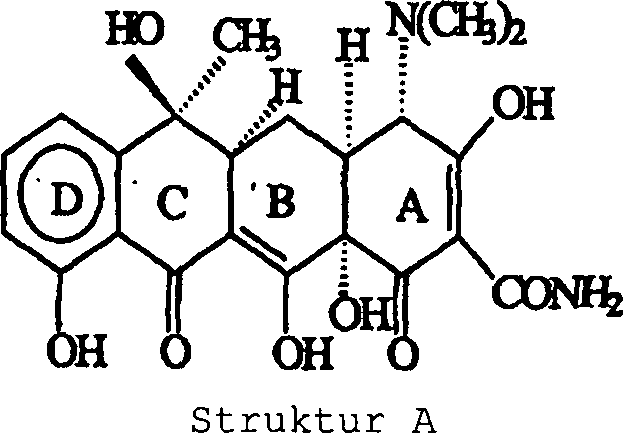
Nachstehend
wird das Nummerierungssystem für
den Ringkern angegeben: 
Tetracyclin sowie die 5-OH- (Terramycin)- und 7-Cl- (Aureomycin)-Derivate kommen in der Natur vor und stellen bekannte Antibiotika dar. Natürliche Tetracycline lassen sich ohne Verlust ihrer antibiotischen Eigenschaften modifizieren, obgleich bestimmte Elemente der Struktur erhalten bleiben müssen. Die Modifikationen, die an der Tetracyclin-Grundstruktur gegebenenfalls vorgenommen werden können, sind in einem Übersichtsartikel von Mitscher in The Chemistry of Tetracyclines, Kapitel 6, Marcel Dekker, Publishers, New York (1978), zusammengefasst. Gemäß Mitscher können die Substituenten in den Positionen 5–9 des Tetracyclin-Ringsystems modifiziert werden, ohne dass es zu einem vollständigen Verlust von antibiotischen Eigenschaften kommt. Veränderungen am grundlegenden Ringsystem oder ein Ersatz der Substituenten in den Positionen 1–4 und 10–12 führen im allgemeinen jedoch zu synthetischen Tetracyclinen mit einer wesentlich geringeren oder praktisch gar keinen antimikrobiellen Aktivität. Ein Beispiel für chemisch modifizierte, nicht-antimikrobielle Tetracycline (nachstehend als CMT bezeichnet) ist 4-Dedimethylaminotetracylin.tetracycline as well as the 5-OH (Terramycin) and 7-Cl (Aureomycin) derivatives come in of nature and are known antibiotics. Natural tetracyclines can be modified without loss of their antibiotic properties, although certain elements of the structure must be preserved. The Modifications made to the tetracycline framework if necessary can be are in a review article by Mitscher in The Chemistry of Tetracyclines, chapter 6, Marcel Dekker, Publishers, New York (1978). According to Mitscher can modified the substituents in positions 5-9 of the tetracycline ring system without causing a complete loss of antibiotic Properties is coming. changes at the basic ring system or a substitution of the substituents in the positions 1-4 and 10-12 to lead in general, however, to synthetic tetracyclines with a substantial less or virtually no antimicrobial activity. An example for chemical modified, non-antimicrobial tetracyclines (hereinafter referred to as CMT) is 4-dedimethylaminotetracycline.
Einige 4-Dedimethylaminotetracylin-Derivate sind in den US-Patenten 3 029 284 und 5 122 519 beschrieben. Sie umfassen 6-Demethyl-6-desoxy-4-dedimethylaminotetracyclin und 5-Hydroxy-6-desoxy-4-dedimethylaminotetracyclin mit Wasserstoff und anderen Substituenten in den C7- und C9-Positionen am D-Ring. Diese Substituenten umfassen Amino, Nitro, Di-(niederalkyl)-amino und Mono-(niederalkyl)-amino oder Halogen. Die 6-Demethyl-6-desoxy-4-dedimethylaminotetracyclin-Derivate und 5-Hydroxy-6-desoxy-4-dedimethylaminotetracyclin-Derivate gelten als wertvolle antimikrobielle Mittel.Some 4-Dedimethylaminotetracylin derivatives are disclosed in U.S. Patents 3,029 284 and 5,122,519. They include 6-demethyl-6-deoxy-4-dedimethylaminotetracycline and 5-hydroxy-6-deoxy-4-dedimethylaminotetracycline with hydrogen and other substituents in the C7 and C9 positions at the D-ring. These substituents include amino, nitro, di (lower alkyl) amino and mono (lower alkyl) amino or halogen. The 6-demethyl-6-deoxy-4-dedimethylaminotetracycline derivatives and 5-hydroxy-6-deoxy-4-dedimethylaminotetracycline derivatives are considered valuable antimicrobial agents.
Weitere 4-Dedimethylaminotetracyclin-Derivate mit einer Oximgruppe in der C4-Position am Ring A werden in den US-Patenten 3 622 627 und 3 824 285 beschrieben. Diese Oximderivate weisen Wasserstoff und Halogen als Substituenten in der C7-Position auf und umfassen 7-Halogen-6-demethyl-6-desoxy-4-dedimethylamino-4-oximino-tetracyclin und 7-Halogen-5-hydroxy-6-desoxy-4-dedimethylamino-4-oximino-tetracyclin.Further 4-Dedimethylaminotetracycline derivatives having an oxime group in the C4 position on ring A are disclosed in U.S. Patents 3,622,627 and 3 824,285. These oxime derivatives have hydrogen and halogen as substituents at the C7 position and include 7-halo-6-demethyl-6-deoxy-4-dedimethylamino-4-oximino-tetracycline and 7-halo-5-hydroxy-6-deoxy-4-dedimethylamino-4-oximino-tetracycline.
Alkylamino- (NH-Alkyl) und Alkylhydrazon- (N-NH-Alkyl)-Gruppen wurden als Substituenten am A-Ring in der C4-Position von 4-Dedimethylaminotetracyclin angebracht. Diese Verbindungen sind für ihre antimikrobiellen Eigenschaften bekannt; vergl. US-Patente 3 345 370, 3 609 188, 3 622 627, 3 824 285, 3 622 627, 3 502 660, 3 509 184, 3 502 696, 3 515 731, 3 265 732, 5 122 519, 3 849 493, 3 772 363 und 3 829 453.alkylamino (NH-alkyl) and alkylhydrazone (N-NH-alkyl) groups have been used as substituents attached to the A-ring in the C4 position of 4-dedimethylaminotetracycline. These connections are for their antimicrobial properties known; See U.S. Patents 3 345 370, 3 609 188, 3 622 627, 3 824 285, 3 622 627, 3 502 660, 3 509 184, 3 502 696, 3 515 731, 3 265 732, 5 122 519, 3 849 493, 3,772,363 and 3,829,453.
Zusätzlich zu den antimikrobiellen Eigenschaften werden für Tetracycline eine Reihe von anderen Anwendungsmöglichkeiten beschrieben. Beispielsweise ist bekannt, dass Tetracycline die Aktivität von kollagenzerstörenden Enzymen, wie Matrix-Metalloproteinasen (MMP), einschließlich Kollagenase (MMP-1), Gelatinase (MMP-2) und Stromelysin (MMP-3), hemmen; Golub et al., J. Periodont. Res., Bd. 20 (1985), S. 12–23; Golub et al., Crit. Revs. Oral Biol. Med., Bd. 2 (1991), S. 297–322; US-Patente 4 666 897, 4 704 383, 4 935 411 und 4 935 412. Ferner sind Tetracycline bekannt, die den Verbrauch und den Abbau von Proteinen im Säugetier-Skelettmuskel hemmen (US-Patent 5 045 538) und in Säugetierzellen die IL-10-Bildung verstärken.In addition to The antimicrobial properties for Tetracycline are a number of other applications described. For example, it is known that tetracyclines reduce the activity of collagen-destroying enzymes, such as matrix metalloproteinases (MMP), including collagenase (MMP-1), Gelatinase (MMP-2) and stromelysin (MMP-3), inhibit; Golub et al. J. Periodont. Res., 20 (1985), 12-23; Golub et al., Crit. Revs. Oral Biol. Med., Vol. 2 (1991), pp. 297-322; U.S. Patents 4,666,897, 4,704,483, 4,935,411 and 4,935,412. Tetracyclines are also known. the consumption and degradation of proteins in mammalian skeletal muscle (U.S. Patent No. 5,045,538) and IL-10 production in mammalian cells strengthen.
Ferner wurde gezeigt, dass Tetracycline die Proteinsynthese in Knochen verstärken (US-Patent Re. 34 656) und die Knochenresorption in Organkultur verringern (US-Patent 4 704 383).Further Tetracycline has been shown to increase protein synthesis in bone strengthen (U.S. Patent Re. 34,656) and bone resorption in organ culture reduce (U.S. Patent 4,704,383).
Gleichermaßen führen das US-Patent 5 532 227 und Golub et al. aus, dass Tetracycline die übermäßige Glycosylierung von Proteinen bessern können. Insbesondere hemmen Tetracycline die übermäßige Kollagen-Vernetzung, die sich aus einer übermäßigen Glycosylierung von Kollagen bei Diabetes ergibt.Likewise, that leads U.S. Patent 5,532,227 and Golub et al. from that tetracycline the excessive glycosylation of proteins. In particular, tetracyclines inhibit excessive collagen crosslinking from excessive glycosylation of collagen in diabetes.
Es sind Tetracycline bekannt, die die übermäßige Phospholipase A2-Aktivität, die bei entzündlichen Zuständen, wie Psoriasis auftritt, hemmen; vergl. US-Patent 5 532 227. Ferner sind Tetracycline bekannt, die Cycloxygenase (COX-2), den Tumor-Nekrosefaktor (TNF), Stickoxid und EL-1 (Interleukin-1) hemmen.Tetracyclines are known which inhibit the excessive phospholipase A 2 activity that occurs in inflammatory conditions such as psoriasis; See U.S. Patent 5,532,227. Also known are tetracyclines that inhibit cycloxygenase (COX-2), tumor necrosis factor (TNF), nitric oxide, and EL-1 (interleukin-1).
Diese Eigenschaften bewirken, dass sich Tetracycline zur Behandlung einer Anzahl von Krankheiten eignen. Beispielsweise gibt es zahlreiche Hinweise, dass Tetracycline, einschließlich nicht-antimikrobielle Tetracycline, bei der Behandlung von Arthritis wirksam sind; vergl. beispielsweise Greenwald et al., "Tetracyclines Suppress Metalloproteinase Activity in Adjuvant Arthritis and, in Combination with Flurbiprofen, Ameliorate Bone Damage", Journal Rheumatology, Bd. 19 (1992), S. 927–938; Greenwald et al., "Treatment of Destructive Arthritic Disorders with MMP Inhibitors: Potential Role of Tetracyclines in Inhibition of Matrix Metalloproteinases: Therapeutic Potential", Annals of the New York Academy of Sciences, Bd. 732 (1999), S. 181–198; Kloppenburg et al., "Minocycline in Active Rheumatoid Arthritis", Arthritis Rheum, Bd. 37 (1994), S. 629–636; Ryan et al., "Potential of Tetracycline to Modify Cartilage Breakdown in Osteoarthritis", Current Opinion in Rheumatology, Bd. 8 (1996), S. 238–247; O'Dell et al., "Treatment of Early Rheumatoid Arthritis with Minocycline or Placebo", Arthritis Rheum, Bd. 40 (1997), S. 842–848.These Properties cause Tetracycline to treat a Number of diseases. For example, there are many Evidence that tetracyclines, including non-antimicrobial Tetracyclines, are effective in the treatment of arthritis; comp. For example, Greenwald et al., Tetracyclines Suppress Metalloproteinase Activity in adjuvant arthritis and, in combination with flurbiprofen, Ameliorate Bone Damage ", Journal Rheumatology, Vol. 19 (1992), pp. 927-938; Greenwald et al., "Treatment of Destructive Arthritis Disorders with MMP Inhibitors: Potential Role of Tetracyclines in Inhibition of Matrix Metalloproteinases: Therapeutic Potential, Annals of the New York Academy of Sciences, Vol. 732 (1999), pp. 181-198; Kloppenburg et al., "Minocycline in Active Rheumatoid Arthritis ", Arthritis Rheum, Vol. 37 (1994), pp. 629-636; Ryan et al., "Potential of Tetracycline to Modify Cartilage Breakdown in Osteoarthritis ", Current Opinion in Rheumatology, Vol. 8 (1996), pp. 238-247; O'Dell et al., "Treatment of Early Rheumatoid Arthritis with Minocycline or Placebo ", Arthritis Rheum, Vol. 40 (1997), p. 842-848.
Tetracycline wurden ferner zur Behandlung von Hautkrankheiten vorgeschlagen. Beispielsweise berichten White et al., Lancet, 29. April 1989, S. 966, dass das Tetracyclin Minocyclin bei der Behandlung von dystrophischer Epidermolysis bullosa wirksam ist, einem lebensbedrohenden Hautzustand, von dem man annimmt, dass er mit überschüssiger Kollagenase verbunden ist.Tetracycline have also been proposed for the treatment of skin diseases. For example, White et al., Lancet, 29 April 1989, p. 966 that tetracycline minocycline in the treatment of dystrophic Epidermolysis bullosa, a life-threatening skin condition, which is believed to be associated with excess collagenase is.
Weitere Untersuchungen lassen ferner darauf schließen, dass Tetracycline und Inhibitoren von Metalloproteinasen die Tumorprogression (DeClerck et al., Annals N. Y. Acad. Sci., Bd. 732 (1994), S. 222–232), die Knochenresorption (Rifkin et al., Annals N. Y. Acad. Sci., Bd. 732 (1994), S. 165–180) und die Angiogenese (Maragoudakis et al., Br. J. Pharmacol., Bd. 111 (1994), S. 894–902) hemmen und entzündungshemmende Eigenschaften aufweisen (Ramamurthy et al., Annals N. Y. Acad. Sci., Bd. 732 (1994), S. 427–430). Die vorstehenden Ausführungen zeigen, dass Tetracycline sich bei verschiedenen Behandlungen als wirksam erwiesen haben. Jedoch besteht ein Bedürfnis nach neuen 4-Dedimethylaminotetracyclin-Derivaten, Verfahren zur Herstellung der neuen Derivate und Verfahren zur Verwendung dieser Derivate bei der Behandlung verschiedener Typen von Krankheiten oder Zuständen.Further Investigations also suggest that tetracyclines and Inhibitors of metalloproteinases tumor progression (DeClerck et al., Annals N.Y. Acad. Sci., Vol. 732 (1994), pp. 222-232), bone resorption (Rifkin et al., Annals N.Y. Acad Sci., Vol. 732 (1994), pp. 165-180) and angiogenesis (Maragoudakis et al., Br. J. Pharmacol., Vol. 111 (1994), pp. 894-902) inhibit and anti-inflammatory properties Ramamurthy et al., Annals N.Y. Acad Sci., Vol. 732 (1994), Pp. 427-430). The above statements show that tetracyclines are used in various treatments have proven effective. However, there is a need for new 4-dedimethylaminotetracycline derivatives, Process for the preparation of the novel derivatives and methods of use these derivatives in the treatment of various types of diseases or states.
Zusammenfassende Darstellung der ErfindungSummary presentation the invention
Es
wurde nunmehr festgestellt, dass diese und weitere Ziele durch 4-Dedimethylaminotetracyclin-Verbindungen
der allgemeinen Formeln (I) bis (III) erreicht werden können: Allgemeine
Formel (I) 


Die vorliegende Erfindung umfasst ein Verfahren zur Behandlung eines Säugers, der an einem Zustand leidet, bei dem eine nicht antimikrobielle Dosis einer Tetracyclin-Verbindung eine günstige Wirkung besitzt. Zu einigen Beispielen für derartige Zustände gehören eine übermäßige Kollagenzerstörung, eine übermäßige enzymatische MMP-Aktivität, eine übermäßige TNF-Aktivität, eine übermäßige Stickoxid-Aktivität, eine übermäßige IL-1-Aktivität, eine übermäßige Elastase-Aktivität, ein übermäßiger Verlust an Knochendichte, ein übermäßiger Proteinabbau, ein übermäßiger Muskelschwund, eine übermäßige Glycosylierung von Kollagen, eine übermäßige COX-2-Aktivität, eine unzureichende Knochenproteinsynthese, eine unzureichende Bildung von Interleukin-10 oder eine übermäßige Phospholipase A2-Aktivität. Das Behandlungsverfahren umfasst die Verabreichung einer wirksamen Menge einer erfindungsgemäßen Tetracyclin-Verbindung an den Säuger.The present invention includes a method of treating a mammal suffering from a condition in which a non-antimicrobial dose of a tetracycline compound has a beneficial effect. Some examples of such conditions include excessive collagen destruction, excessive MMP enzymatic activity, excessive TNF activity, excessive nitric oxide activity, excessive IL-1 activity, excessive elastase activity, excessive loss of bone density, excessive protein degradation, excessive muscle wasting, excessive collagen glycosylation, excessive COX-2 activity, inadequate bone protein synthesis, inadequate interleukin-10 production, or excessive phospholipase A 2 activity. The method of treatment comprises administering to the mammal an effective amount of a tetracycline compound of the invention.
Diese und weitere Vorteile der vorliegenden Erfindung ergeben sich aus der ausführlichen Beschreibung und den Beispielen. Die ausführliche Beschreibung und die Beispiele dienen dem besseren Verständnis der Erfindung.These and other advantages of the present invention will be apparent the detailed Description and examples. The detailed description and the Examples serve for a better understanding of the invention.
Kurze Beschreibung der ZeichnungenShort description of drawings

Für die Strukturen
L, M, N oder O handelt es sich bei den angegeben Verbindungen um
folgende Produkte: 
Für die Struktur P bedeutet R8 Wasserstoff und R9 Nitro.For the structure P, R 8 is hydrogen and R 9 is nitro.
Ausführliche Beschreibung der ErfindungDetailed description of the invention
Besonders bevorzugte Verbindungen der vorliegenden Erfindung weisen D-Ringsubstituenten in den 7- und/oder 9-Positionen des 4-Dedimethylaminotetracyclin-Moleküls auf. Diese Verbindungen umfassen: 9-Amino-6-demethyl-6-desoxy-4-dedimethylaminotetracyclin, 9-Nitro-6-demethyl-6-desoxy-4-dedimethylaminotetracyclin, 9-Amino-5-hydroxy-6-desoxy-4-dedimethylaminotetracyclin, 9-Nitro-5-hydroxy-6-desoxy-4-dedimethylaminotetracyclin und 9-Acetamido-5-hydroxy-6-desoxy-4-dedimethylaminotetracyclin.Particularly preferred compounds of the present invention have D-ring substituents in the 7- and / or 9-positions of the 4-dedimethylaminotetracycline molecule. These compounds include: 9-amino-6-demethyl-6-deoxy-4-dedimethylaminotetracycline, 9-nitro-6-demethyl-6-deoxy-4-dedimethylaminotetracycline, 9-amino-5-hydroxy-6-deoxy-4-dedimethylaminotetracycline, 9- Nitro-5-hydroxy-6-deoxy-4-dedimethylaminotetracycline and 9-acetamido-5-hydroxy-6-deoxy-4-dedimethylaminotetracycline.
Es ist darauf hinzuweisen, dass dann, wenn die Stereochemie eines Substituenten an den Ringen A-D des neuen 4-Dedimethylaminotetracyclin-Derivats nicht angegeben ist, beide Epimere umfasst werden sollen.It It should be noted that if the stereochemistry of a substituent on the rings A-D of the new 4-Dedimethylaminotetracyclin derivative is to include both epimers.
Bei den hier verwendeten Ausdrücken NH-Alkyl-, N-NH-Alkyl-, Alkoxy- und Alkylgruppen handelt es sich um Gruppen, die geradkettige oder verzweigte, gesättigte oder ungesättigte Alkylkohlenstoffketten mit 1 bis 26 Kohlenstoffatomen enthalten. Beispielsweise umfassen Alkylgruppen Fettalkylgruppen mit 10 bis 26 Kohlenstoffatomen. Zu einigen Beispielen für gesättigte Fettalkylgruppen gehören Lauryl, Myristyl, Palmityl, Stearyl und dergl. Zu einigen Beispielen für ungesättigte Fettalkylgruppen gehören Palmitoleyl, Oleyl, Linoleyl, Linolenyl und dergl.at the terms used here NH-alkyl, N-NH-alkyl, alkoxy and Alkyl groups are groups which are straight-chain or branched, saturated or unsaturated Alkyl carbon chains containing 1 to 26 carbon atoms. For example, alkyl groups include fatty alkyl groups of 10 to 26 carbon atoms. Some examples of saturated fatty alkyl groups include lauryl, Myristyl, palmityl, stearyl and the like. For some examples of unsaturated fatty alkyl groups belong Palmitoleyl, oleyl, linoleyl, linolenyl and the like.
Alkylgruppen können auch niedere Alkylgruppen umfassen, die geradkettige oder verzweigte, gesättigte oder ungesättigte Kohlenstoffketten umfassen können und 1 bis 6 Kohlenstoffatome aufweisen. Zu einigen Beispielen hierfür gehören niedere Alkylgruppen, wie Methyl, Ethyl, Propyl, Butyl, Isobutyl, n-Butyl, sec.-Butyl, tert.-Butyl, n-Pentyl und Benzyl. Der Acylrest von Acylgruppen entspricht der vorstehenden Definition. Zu einigen Beispielen für Acylgruppen gehören Acetyl, Propionyl, Butyryl und Acylgruppen, die den vorstehend beschriebenen Fettsäuren entsprechen.alkyl groups can also include lower alkyl groups which are straight-chain or branched, saturated or unsaturated May include carbon chains and 1 to 6 carbon atoms. Some examples include lower ones Alkyl groups, such as methyl, ethyl, propyl, butyl, isobutyl, n-butyl, sec-butyl, tert-butyl, n-pentyl and benzyl. The acyl group of acyl groups corresponds to the above Definition. Some examples of acyl groups include acetyl, Propionyl, butyryl and acyl groups, those described above fatty acids correspond.
Die neuen erfindungsgemäßen 4-Dedimethylaminotetracyclin-Verbindungen oder Salze davon lassen sich durch D-Ringsubstitution an den C7-, C8- und/oder C9-Positionen unter Verwendung von Ausgangsreaktanten, die leicht herzustellen oder zu erwerben sind, nach aus dem Stand der Technik bekannten Verfahren herstellen; vergl. L. A. Mitscher, The Chemistry of the Tetracycline Antibiotics, Marcel Dekker, New York (1978), Kapitel 6, J. Hlavka und J. H. Boothe, The Tetracyclines, Springer-Verlag, Berlin-Heidelberg, S. 18 (1985); und die US-Patente 4 704 383, 3 226 436, 3 047 626, 3 518 306 und 5 532 227.The new 4-Dedimethylaminotetracyclin compounds according to the invention or Salts can be prepared by D-ring substitution on the C7, C8- and / or C9 positions using starting reactants, which are easy to make or to acquire, out of the box produce the method known in the art; see L. A. Mitscher, The Chemistry of the Tetracycline Antibiotics, Marcel Dekker, New York (1978), Chapter 6, J. Hlavka and J.H. Boothe, The Tetracyclines, Springer-Verlag, Berlin-Heidelberg, p. 18 (1985); and the US patents 4,704,383, 3,226,436, 3,047,626, 3,518,306 and 5,532,227.
Beispielsweise lassen sich die Nitrierung der C9-Position am D-Ring und die Herstellung neuer 9-Nitroverbindungen unter Verwendung von bekannten Ausgangsreaktanten, wie 7-Dimethylamino-6-demethyl-6-desoxy-4-dedimethylaminotetracyclin oder 6-Desoxy-4-dedimethylaminotetracyclin, und durch Behandlung dieser Verbindungen mit einer starken Säure und Metallnitratsalzen erreichen. Zu Beispielen für starke Säuren, die zur erfindungsgemäßen Verwendung geeignet sind, gehören Schwefelsäure, Trifluoressigsäure, Methansulfonsäure oder Perchlorsäure. Zu Beispielen für geeignete Metallnitratsalze gehören Calcium-, Kalium- oder Natriumnitrat. Die C9-Position am D-Ring unterliegt einer Nitrierung unter Bildung der entsprechenden 9-Nitro-7-dimethylamino-6-demethyl-6-desoxy-4-dedimethylaminotetracyclin- oder 9-Nitro-6-desoxy-4-dedimethylaminotetracyclin-Verbindungen.For example can be the nitration of the C9 position on the D-ring and the production new 9-nitro compounds using known starting reactants, such as 7-dimethylamino-6-demethyl-6-deoxy-4-dedimethylaminotetracycline or 6-deoxy-4-dedimethylaminotetracycline, and by treating these compounds with a strong acid and Reaching metal nitrate salts. Examples of strong acids for use in the invention are suitable belong Sulfuric acid, Trifluoroacetic acid, methanesulfonic acid or Perchloric acid. Examples of suitable metal nitrate salts include Calcium, potassium or sodium nitrate. The C9 position on the D-ring undergoes nitration to give the corresponding 9-nitro-7-dimethylamino-6-demethyl-6-deoxy-4-dedimethylaminotetracycline or 9-nitro-6-deoxy-4-dedimethylaminotetracycline compounds.
Die Aminierung der C9-Position am D-Ring kann durch Behandeln eines 9-Nitro-4-dedimethylaminotetracyclins, wie 9-Nitro-7-dimethylamino-6-demethyl-6-desoxy-4-dedimethylaminotetracyclin oder 9-Nitro-6-desoxy-4-dedimethylaminotetracyclin, mit Stickstoff in Gegenwart eines geeigneten Trägerkatalysators, wie Raney-Nickel, Platinoxid oder Palladium-auf-Kohlenstoff, erfolgen. Der Katalysator wird sodann abfiltriert und mit einem organischen Lösungsmittel, wie Ether gewaschen. Der C9-Substituent wird unter Bildung der entsprechenden 9-Amino-7-dimethylamino-6-demethyl-6-desoxy-4-dedimethylaminotetracyclin oder 9-Amino-6-desoxy-4-dedimethylaminotetracyclin-Verbindung reduziert.The Amination of the C9 position on the D-ring can be achieved by treating a 9-nitro-4-dedimethylaminotetracycline such as 9-nitro-7-dimethylamino-6-demethyl-6-deoxy-4-dedimethylaminotetracycline or 9-nitro-6-deoxy-4-dedimethylaminotetracycline, with nitrogen in the presence of a suitable supported catalyst, such as Raney nickel, Platinum oxide or palladium-on-carbon, respectively. The catalyst is then filtered off and washed with a organic solvents, washed like ether. The C9 substituent is added to form the corresponding 9-amino-7-dimethylamino-6-demethyl-6-deoxy-4-dedimethylaminotetracycline or 9-amino-6-deoxy-4-dedimethylaminotetracycline compound reduced.
Die Aminogruppe am D-Ring in der C9-Position kann in eine Acylamidogruppe und vorzugsweise eine Acetamidogruppe umgewandelt werden. Beispielsweise werden 9-Amino-7-dimethylamino-6-demethyl-6-desoxy-4-dedimethylaminotetracyclin- oder 9-Amino-6-desoxy-4-dedimethylaminotetracyclin-Verbindungen mit Acylchlorid, Acylanhydrid, einem gemischten Acylanhydrid, Sulfonylchlorid oder Sulfonylanhydrid in Gegenwart eines geeigneten Säureabfangmittels, das in einem Lösungsmittel dispergiert ist, behandelt. Das Säureabfangmittel wird in geeigneter Weise aus Natriumbicarbonat, Natriumacetat, Pyridin, Triethylamin, N,O-Bis-(trimethylsilyl)-acetamid, N,0-Bis-(trimethylsilyl)-trifluoracetamid oder einem basischen Anionenaustauscherharz ausgewählt. Zu geeigneten Lösungsmitteln für die Acylierungsreaktion gehören Wasser, Wasser-Tetrahydrofuran, N-Methylpyrolidon, 1,3-Dimethyl-2-imidazolidinon, Hexamethylphosphoramid, 1,3-Dimethyl-3,4,5,6-tetrahydro-2(1H)-pyrimidinon oder 1,2-Dimethoxyethan. Die C9-Aminogruppe kann in eine Acetamidogruppe umgewandelt werden, um beispielsweise das entsprechende 9-Acetamido-7-dimethylamino-6-demethyl-6-desoxy-4-dedimethylaminotetracyclin oder 9-Acetamido-6-desoxy-4-dedimethylaminotetracyclin zu bilden.The Amino group on the D-ring in the C9 position can be converted into an acylamido group and preferably converting an acetamido group. For example are 9-amino-7-dimethylamino-6-demethyl-6-deoxy-4-dedimethylaminotetracycline or 9-amino-6-deoxy-4-dedimethylaminotetracycline compounds with acyl chloride, acyl anhydride, a mixed acyl anhydride, sulfonyl chloride or sulfonyl anhydride in the presence of a suitable acid scavenger, that in a solvent is dispersed, treated. The acid scavenger is suitable in Sodium bicarbonate, sodium acetate, pyridine, triethylamine, N, O-bis- (trimethylsilyl) -acetamide, N, 0-bis (trimethylsilyl) trifluoroacetamide or a basic anion exchange resin selected. To suitable solvents for the Include acylation reaction Water, water tetrahydrofuran, N-methylpyrolidone, 1,3-dimethyl-2-imidazolidinone, hexamethylphosphoramide, 1,3-dimethyl-3,4,5,6-tetrahydro-2 (1H) -pyrimidinone or 1,2-dimethoxyethane. The C9 amino group can be converted to an acetamido group, for example, the corresponding 9-acetamido-7-dimethylamino-6-demethyl-6-deoxy-4-dedimethylaminotetracycline or 9-acetamido-6-deoxy-4-dedimethylaminotetracycline to build.
Ferner kann eine Diazoniumgruppe als Substituent in der C9-Position am D-Ring vorliegen. Typischerweise wird ein 9-Amino-4-dedimethylaminotetracyclin-Derivat, wie 9-Amino-7-dimethylamino-6-demethyl-6-desoxy-4-dedimethylaminotetracyclin oder 9-Amino-6-desoxy-4-dedimethylaminotetracyclin, in 0,1 N HCl in Methanol mit Butylnitrat unter Bildung der entsprechenden 9-Diazonium-Derivate, wie 9-Diazonium-7-dimethylamino-6-demethyl-6-desoxy-4-dedimethylaminotetracyclin oder 9-diazonium-6-desoxy-4-dedimethylaminotetracyclin, behandelt.Further may be a diazonium group as a substituent in the C9 position on D-ring present. Typically, a 9-amino-4-dedimethylaminotetracycline derivative, such as 9-amino-7-dimethylamino-6-demethyl-6-deoxy-4-dedimethylaminotetracycline or 9-amino-6-deoxy-4-dedimethylaminotetracycline, in 0.1 N HCl in methanol with butyl nitrate to give the corresponding 9-diazonium derivatives such as 9-diazonium-7-dimethylamino-6-demethyl-6-deoxy-4-dedimethylaminotetracycline or 9-diazonium-6-deoxy-4-dedimethylaminotetracycline, treated.
Die 9-Diazonium-4-dedimethylaminotetracyclin-Derivate, wie 9-Diazonium-7-dimethylamino-6-demethyl-6-desoxy-4-dedimethylaminotetracyclin oder 9-Diazonium-6-desoxy-4-dedimethylaminotetracyclin, lassen sich mit methanolischer Salzsäure und einer Triazoverbindung, wie Natriumazid, unter Bildung von 9-Azidoderivaten, wie 9-Azido-7-dimethylamino-6-demethyl-6-desoxy-4- dedimethylaminotetracyclin oder 9-Azido-6-desoxy-4-dedimethylaminotetracyclin, behandeln.The 9-diazonium-4-dedimethylaminotetracycline derivatives such as 9-diazonium-7-dimethylamino-6-demethyl-6-deoxy-4-dedimethylaminotetracycline or 9-diazonium-6-deoxy-4-dedimethylaminotetracycline, can be treated with methanolic hydrochloric acid and a triazo compound, such as sodium azide to form 9-azido derivatives such as 9-azido-7-dimethylamino-6-demethyl-6-deoxy-4-dedimethylaminotetracycline or 9-azido-6-deoxy-4-dedimethylaminotetracycline, to treat.
Alternativ kann eine Ethoxythiocarbonylthiogruppe als Substituent an der C9-Position am D-Ring vorgesehen sein. Beispielsweise wird ein 9-Diazonium-4-dedimethylaminotetracyclin-Derivat, wie 9-Diazonium-7-dimethylamino-6-demethyl-6-desoxy-4-dedimethylaminotetracyclin oder 9-Diazonium-6-desoxy-4-dedimethylaminotetracyclin mit einem Säuremetallsalz, wie Kaliumethylxanthat, unter Bildung des entsprechenden 9-Ethoxythiocarbonylthio-Derivats, wie 9-Ethoxythiocarbonylthio-7-dimethylamino-6-demethyl-6-desoxy-4-dedimethylamino- oder 9-Ethoxythiocarbonylthio-6-desoxy-4-dedimethylaminotetracyclin, behandelt.alternative may be an ethoxythiocarbonylthio group as a substituent at the C9 position be provided on the D-ring. For example, a 9-diazonium-4-dedimethylaminotetracycline derivative, such as 9-diazonium-7-dimethylamino-6-demethyl-6-deoxy-4-dedimethylaminotetracycline or 9-diazonium-6-deoxy-4-dedimethylaminotetracycline with an acid metal salt, such as potassium ethylxanthate to give the corresponding 9-ethoxythiocarbonylthio derivative, such as 9-ethoxythiocarbonylthio-7-dimethylamino-6-demethyl-6-deoxy-4-dedimethylamino or 9-ethoxythiocarbonylthio-6-deoxy-4-dedimethylaminotetracycline, treated.
Die vorstehenden Umsetzungen beschreiben die Substitution in der C9-Position am 4-Dedimethylaminotetracyclin-Molekül. Eine gewisse Substitution kann je nach den Ausgangsreaktanten und den angewandten Bedingungen auch an der C7-Position erfolgen und ferner zu 7-substituierten 4-Dedimethylaminotetracyclin-Derivaten, wie 7-Diazonium-6-demethyl-6-desoxy-4-dedimethylaminotetracyclin oder 7-Azido-6-demethyl-6-desoxy-4-dedimethylaminotetracyclin, führen. Die 7-substituierten Derivate können von den 9-substituierten Derivaten abgetrennt und gereinigt werden, wie nachstehend erörtert wird.The The above reactions describe substitution in the C9 position on the 4-dedimethylaminotetracycline molecule. A some substitution may vary depending on the starting reactants and the conditions applied also at the C7 position and further to 7-substituted 4-Dedimethylaminotetracycline derivatives such as 7-diazonium-6-demethyl-6-deoxy-4-dedimethylaminotetracycline or 7-azido-6-demethyl-6-deoxy-4-dedimethylaminotetracycline, to lead. The 7-substituted derivatives can separated from the 9-substituted derivatives and purified, as discussed below becomes.
Vorstehend wurden Beispiele für spezielle Ausführungformen als Derivate von Tetracyclin beschrieben. Die erfindungsgemäßen Verbindungen sind jedoch nicht auf Tetracyclin-Derivate beschränkt. Die Erfindung umfasst ferner (ohne Beschränkung hierauf) die gleichen 4-Dedimethylamino-Derivate und 4-substituierten 4-Dedimethylamino-Derivate von Sancyclin, Minocyclin und Doxycyclin, ebenso wie die vorerwähnten Tetracyclin-Derivate.above were examples of special design forms described as derivatives of tetracycline. The compounds of the invention however, are not limited to tetracycline derivatives. The The invention further includes (but is not limited to) the same 4-dedimethylamino derivatives and 4-substituted 4-dedimethylamino derivatives of sancycline, minocycline and doxycycline, as well as the aforementioned tetracycline derivatives.
Die vorliegende Erfindung umfasst Salze, einschließlich Säureadditions- und Metallsalze, der 4-Dedimethylaminotetracyclin-Verbindungen. Derartige Salze werden durch bekannte Verfahren sowohl mit pharmazeutisch verträglichen als auch mit pharmazeutisch nicht verträglichen Säuren und Metallen gebildet. Unter "pharmazeutisch verträglich" sind solche salzbildenden Säuren und Metalle zu verstehen, die die Toxizität der Verbindung nicht wesentlich erhöhen.The present invention encompasses salts, including acid addition and metal salts, of 4-dedimethylaminotetracycline compounds. Such salts are prepared by known methods both with pharmaceutical acceptable as well as with pharmaceutically incompatible acids and metals. Under "Pharmaceutical compatible "are such salt-forming acids and metals that are not essential to the toxicity of the compound increase.
Zu einigen Beispielen für geeignete Salze gehören Salze von Mineralsäuren, wie Salzsäure, Iodwasserstoffsäure, Bromwasserstoffsäure, Phosphorsäure, Metaphosphorsäure, Salpetersäure und Schwefelsäure, sowie Salze von organischen Säuren, wie Weinsäure, Essigsäure, Äpfelsäure, Benzoesäure, Glykolsäure, Gluconsäure, Gulonsäure, Bernsteinsäure, Arylsulfonsäuren, z. B. p-Toluolsulfonsäure, und dergl. Die pharmazeutisch nicht verträglichen Säureadditionssalze sind zwar für therapeutische Zwecke nicht geeignet, sind aber für die Isolierung und Reinigung der neuen Substanzen wertvoll. Ferner eignen sie sich zur Herstellung von pharmazeutisch verträglichen Salzen. Aus dieser Gruppe gehören zu den gebräuchlicheren Salzen solche mit Fluorwasserstoffsäure und Perchlorsäure. Hydrofluoridsalze sind besonders für die Herstellung der pharmazeutisch verträglichen Salze, z. B. der Hydrochloride, geeignet, indem man sie in Salzsäure löst und das Hydrochloridsalz durch Kristallisation bildet. Die Perchlorsäuresalze eignen sich zur Reinigung und Kristallisation der neuen Produkte.To some examples of suitable salts include Salts of mineral acids, like hydrochloric acid, hydroiodic, hydrobromic, Phosphoric acid, metaphosphoric, nitric acid and sulfuric acid, and salts of organic acids, like tartaric acid, Acetic acid, malic acid, benzoic acid, glycolic acid, gluconic acid, gulonic acid, succinic acid, arylsulfonic acids, e.g. For example, p-toluenesulfonic acid, and the like. The pharmaceutically incompatible acid addition salts are indeed for therapeutic Purpose not suitable, but are for insulation and cleaning the new substances valuable. Furthermore, they are suitable for the production of pharmaceutically acceptable Salt. Belonging to this group to the more common ones Salts with hydrofluoric acid and perchloric acid. Hydrofluoride salts are especially for the preparation of the pharmaceutically acceptable salts, for. The hydrochlorides, suitable by putting them in hydrochloric acid triggers and forms the hydrochloride salt by crystallization. The perchloric acid salts are suitable for cleaning and crystallization of new products.
Während Metallsalze im allgemeinen für verschiedene Zwecke hergestellt und verwendet werden können, sind die pharmazeutisch verträglichen Metallsalze aufgrund ihrer Eignung für therapeutische Zwecke von besonderem Wert. Die pharmazeutisch verträglichen Metalle umfassen üblicherweise Natrium, Kalium und Erdalkalimetalle mit einer Atomzahl bis einschließlich 20, d. h. Magnesium und Calcium, und ferner unter anderem Aluminium, Zink, Eisen und Mangan. Selbstverständlich umfassen die Metallsalze Komplexsalze, d. h. Metallchelate, die auf dem Gebiet der Tetracycline bekannt sind.While metal salts in general for Different purposes can be produced and used the pharmaceutically acceptable Metal salts due to their suitability for therapeutic purposes of particular Value. The pharmaceutically acceptable Metals usually include Sodium, potassium and alkaline earth metals having an atomic number up to and including 20, d. H. Magnesium and calcium, and, inter alia, aluminum, Zinc, iron and manganese. Of course, the metal salts include Complex salts, d. H. Metal chelates in the field of tetracyclines are known.
Nach der Herstellung lassen sich die erfindungsgemäßen neuen Verbindungen in zweckmäßiger Weise nach üblichen bekannten Verfahren reinigen. Zu einigen geeigneten Beispielen hierfür gehören die Kristallisation aus einem geeigneten Lösungsmittel oder die Verteilungssäulenchromatographie.After preparation, the novel compounds according to the invention can be suitably purified by customary known processes. Some suitable examples include the crystal from a suitable solvent or the distribution column chromatography.
Die erfindungsgemäßen neuen 4-Dedimethylaminotetracyclin-Verbindungen können beispielsweise in vivo, in vitro und ex vivo an lebenden Säugern sowie in gezüchteten Gewebe-, Organ- oder Zellsystemen eingesetzt werden. Säuger umfassen beispielsweise Menschen, sowie Haustiere, wie Hunde und Katzen, Labortiere, wie Ratten und Mäuse, und landwirtschaftlich genutzte Tiere, wie Pferde und Kühe. Der hier verwendete Ausdruck "Gewebe" umfasst eine Aggregation von in ähnlicher Weise spezialisierten Zellen, die zusammen bestimmte spezielle Funktionen ausüben. Gezüchtete Zellsysteme umfassen beliebige Säugetierzellen, wie epitheliale Zellen, endotheliale Zellen, rote Blutkörperchen und weiße Blutkörperchen. Insbesondere gehören dazu humane periphere Blutmonozyten, synoviale Fibroblastoidzellen und dergl.The new invention A 4-dedimethylaminotetracycline compounds can for example, in vivo, in vitro and ex vivo in live mammals as well in bred Tissue, organ or cell systems are used. Mammals include for example, humans, as well as pets, such as dogs and cats, Laboratory animals, such as rats and mice, and farm animals such as horses and cows. Of the As used herein, "tissue" includes aggregation from in similar Way specialized cells that together have certain special functions exercise. bred Cell systems include any mammalian cells, such as epithelial cells, endothelial cells, red blood cells and white Blood cells. In particular, these include human peripheral blood monocytes, synovial fibroblastoid cells and like.
Die vorliegende Erfindung ist auf die Verwendung einer 4-Dedimethylaminotetracyclin-Verbindung nach einem der Ansprüche 1 bis 10 zur Herstellung eines Arzneimittels zur Behandlung eines Säugers gerichtet, der an einem Zustand leidet, bei dem eine nicht-antimikrobielle Dosis dieser Verbindung sich günstig auswirkt, wobei der Zustand durch übermäßige Kollagenzerstörung, übermäßige MMP-Enzymaktivität, übermäßige TNF-Aktivität, übermäßige Stickoxidaktivität, übermäßige IL-1-Aktivität, übermäßige Elastase-Aktivität, übermäßigen Knochendichteverlust, übermäßigen Proteinabbau, übermäßigen Muskelschwund, übermäßige Glycosylierung von Kollagen, übermäßige COX-2-Aktivität, unzureichende Knochenproteinsynthese, unzureichende Interleukin-10-Erzeugung oder übermäßige Phospholipase-A2-Aktivität gekennzeichnet ist. Die Verwendung umfasst die Verabreichung einer wirksamen Menge einer erfindungsgemäßen Tetracyclin-Verbindung an den Säuger.The The present invention is directed to the use of a 4-dedimethylaminotetracycline compound one of the claims 1 to 10 for the manufacture of a medicament for the treatment of a mammal who is suffering from a condition in which a non-antimicrobial dose this connection is favorable the condition being due to excessive collagen destruction, excessive MMP enzyme activity, excessive TNF activity, excessive nitric oxide activity, excessive IL-1 activity, excessive elastase activity, excessive bone density loss, excessive protein degradation, excessive muscle wasting, excessive glycosylation of collagen, excessive COX-2 activity, inadequate Bone protein synthesis, insufficient interleukin-10 production or excessive phospholipase A2 activity is. The use includes the administration of an effective amount a tetracycline compound according to the invention to the mammal.
Der hier verwendete Ausdruck "übermäßig" bezieht sich auf eine erhöhte Aktivität, die über der üblichen Aktivität liegt und die zu gewissen pathologischen Problemen bei einem Säuger oder bei Säugetierzellen führen.Of the As used herein, "excessive" refers to an increased Activity, the above the usual activity and which leads to certain pathological problems in a mammal or in mammalian cells.
Die in vivo-Anwendung der Erfindung eignet sich zur Erleichterung oder Linderung von medizinischen und tiermedizinischen Krankheiten, Zuständen und Syndromen. Insbesondere umfasst die vorliegende Erfindung ein Verfahren zur Behandlung eines Säugers, der an Zuständen oder Krankheiten leidet, einschließlich abdominales Aortenaneurysma, Hornhautgeschwür, periodontale Erkrankung, Diabetes, Diabetes mellitus, Skleroderma, Progerie, Lungenerkrankung, Krebs, Graft-versus-Host-Krankheit, Erkrankung unter Abfall der Knochenmarkfunktion, Thrombozytopenie, Gelenkprothesenlockerung, Spondyloarthropathien, Osteoporose, Paget-Krankheit, Autoimmunerkrankung, systemischer Lupus erythematosus, akuter oder chronischer entzündlicher Zustand, Nierenerkrankung oder Bindegewebeerkrankung, indem man eine wirksame Menge einer Tetracyclin-Verbindung an den Säuger verabreicht.The in vivo application of the invention is suitable for ease or Relief of medical and veterinary diseases, conditions and Syndromes. In particular, the present invention comprises a method for the treatment of a mammal, the at states or diseases, including abdominal aortic aneurysm, Corneal ulcer, periodontal disease, diabetes, diabetes mellitus, scleroderma, Progeria, lung disease, cancer, graft-versus-host disease, disease with decline in bone marrow function, thrombocytopenia, joint prosthesis loosening, Spondyloarthropathies, osteoporosis, Paget's disease, autoimmune disease, Systemic lupus erythematosus, acute or chronic inflammatory Condition, kidney disease or connective tissue disease by an effective amount of a tetracycline compound is administered to the mammal.
Zu krebsartigen Zuständen, die mit den erfindungsgemäßen Tetracyclin-Verbindungen behandelbar sind, gehören (ohne Beschränkung hierauf) Karzinome, Blastome, Sarkome, wie Kaposi-Sarkom, Gliome und die zwölf Hauptkrebsarten: Prostatakrebs, Brustkrebs, Lungenkrebs, kolorektaler Krebs, Blasenkrebs, Nicht-Hodgkin-Lymphom, Uteruskrebs, Melanom, Nierenkrebs, Leukämie, Ovarialkrebs und Pankreaskrebs.To cancerous conditions, those with the tetracycline compounds according to the invention are treatable belong (without restriction carcinomas, blastomas, sarcomas, such as Kaposi's sarcoma, gliomas and the twelve Major cancers: prostate cancer, breast cancer, lung cancer, colorectal Cancer, bladder cancer, non-Hodgkin's lymphoma, uterine cancer, melanoma, Kidney cancer, leukemia, Ovarian cancer and pancreatic cancer.
Akute oder chronische entzündliche Zustände, die mit den erfindungsgemäßen Tetracyclin-Verbindungen behandelbar sind, umfassen beispielsweise eine entzündliche Darmerkrankung, Arthritis, Osteoarthritis, rheumatoide Arthritis, Pankreatitis, Nephritis, Glomerulonephritis, Sepsis, septischen Schock, Lipopolysaccharid-Endotoxin-Schock, Multisystem-Organversagen oder Psoriasis.acute or chronic inflammatory Conditions, those with the tetracycline compounds according to the invention treatable include, for example, an inflammatory Intestinal disease, arthritis, osteoarthritis, rheumatoid arthritis, Pancreatitis, nephritis, glomerulonephritis, sepsis, septic Shock, lipopolysaccharide endotoxin shock, Multisystem organ failure or psoriasis.
Lungenkrankheiten, die erfindungsgemäß behandelbar sind, umfassen beispielweise ARDS (Atemnotsyndrom bei Erwachsenen), zystische Fibrose, Emphysem oder eine akute Lungenschädigung aufgrund einer Inhalation von Giftstoffen. Einige Beispiele für Giftstoffe sind Säuren, Chemikalien, industrielle und militärische Gifte, Rauch und andere toxische Verbrennungsprodukte.Lung diseases, the invention treatable include, for example, ARDS (adult respiratory distress syndrome), cystic fibrosis, emphysema or acute lung injury due to an inhalation of toxins. Some examples of toxins are acids, Chemicals, industrial and military poisons, smoke and others toxic combustion products.
Die erfindungsgemäßen neuen Tetracyclin-Verbindungen können auch zur Behandlung von Nierenkrankheiten verwendet werden. Einige Beispiele für Nierenkrankheiten sind chronische Niereninsuffizienz, akute Niereninsuffizienz, Nephritis oder Glomerulonephritis.The new invention Tetracycline compounds can also be used to treat kidney disease. Some examples for Kidney diseases include chronic renal insufficiency, acute renal insufficiency, Nephritis or glomerulonephritis.
Der hier verwendete Ausdruck "eine wirksame Menge" einer Tetracyclin-Verbindung ist die Menge, die zur Erzielung des angegebenen Ergebnisses zur Behandlung der Krankheit oder des Zustands wirksam ist. Vorzugsweise wird die Tetracyclin-Verbindung oder das Tetracyclin-Derivat in einer Menge bereitgestellt, die eine geringe oder gar keine antimikrobielle Aktivität besitzt. Eine Tetracyclin-Verbindung oder ein Tetracyclin-Derivat ist antimikrobiell unwirksam, wenn es nicht in signifikanter Weise das Wachstum von Mikroorganismen verhindert. Demgemäß kann das Verfahren sich in günstiger Weise eines Tetracyclin-Derivats bedienen, das chemisch so modifiziert worden ist, dass seine antimikrobiellen Eigenschaften verringert oder beseitigt worden sind. Die Verwendung von derartigen, chemisch modifizierten Tetracyclinen wird erfindungsgemäß bevorzugt, da sie in höheren Konzentrationen als antimikrobielle Tetracycline verwendet werden können, während bestimmte Nachteile, wie ein unterschiedloses Abtöten von nützlichen Mikroorganismen und das Auftreten von resistenten Mikroorganismen, die häufig mit der Verwendung von antimikrobiellen oder antibakteriellen Mengen derartiger Verbindungen einhergehen, vermieden werden.The term "an effective amount" of a tetracycline compound as used herein is the amount effective to achieve the stated result for the treatment of the disease or condition. Preferably, the tetracycline compound or tetracycline derivative is provided in an amount that has little or no antimicrobial activity. A tetracycline compound or a tetracycline derivative is antimicrobially ineffective unless it significantly affects the growth of microorganisms prevented. Accordingly, the method can beneficially utilize a tetracycline derivative that has been chemically modified to reduce or eliminate its antimicrobial properties. The use of such chemically modified tetracyclines is preferred according to the invention, as they can be used in higher concentrations as antimicrobial tetracyclines, while certain disadvantages, such as indiscriminate killing of beneficial microorganisms and the emergence of resistant microorganisms, often with the use of antimicrobial or antibacterial amounts of such compounds can be avoided.
Die maximale Dosierung für einen Säuger ist die höchste Dosierung, die keine unerwünschten oder unerträglichen Nebenwirkungen hervorruft. Eine minimale Dosierung ist die geringste Dosierung, bei der erstmals die Wirksamkeit beobachtet wird. Beispielsweise kann die Tetracyclin- Verbindung in einer Menge von etwa 0,1 mg/kg/Tag bis etwa 30 mg/kg/Tag und vorzugsweise von etwa 1 mg/kg/Tag bis etwa 18 mg/kg/Tag verabreicht werden. In jedem Fall lässt sich der Arzt von seinem Können und seinem Fachwissen leiten. Die vorliegende Erfindung umfasst ohne Beschränkungen Dosierungen, die zur Erzielung der beschriebenen Wirkung wirksam sind.The maximum dosage for a mammal is the highest Dosage that is not unwanted or unbearable Causes side effects. A minimum dosage is the lowest Dosage at which efficacy is first observed. For example can the tetracycline compound in an amount of about 0.1 mg / kg / day to about 30 mg / kg / day and preferably from about 1 mg / kg / day to about 18 mg / kg / day become. In any case leaves the doctor of his ability and his expertise. The present invention includes without restrictions Dosages effective to achieve the effect described are.
Das Verfahren beinhaltet die Verabreichung oder Bereitstellung eines Tetracyclin-Derivats in einer Menge, die zur Behandlung von Krankheiten oder Zuständen in Säugerzellen oder einem Säuger wirksam sind. Die Verabreichung der Tetracyclin-Derivate kann auf verschiedenen Wegen erfolgen. In gezüchteten zellulären Systemen (in vitro) können die Tetracyclin-Derivate verabreicht werden, indem man die Zellen direkt in Kontakt mit einer wirksamen Menge des Tetracyclin-Derivats bringt.The Method involves administering or providing a Tetracycline derivative in an amount necessary for the treatment of diseases or states in mammalian cells or a mammal are effective. The administration of the tetracycline derivatives may occur done different ways. In cultured cellular systems (in vitro) The tetracycline derivatives are administered by taking the cells directly in contact with an effective amount of the tetracycline derivative brings.
Bei lebenden Säugern (in vivo) können die erfindungsgemäßen Tetracyclin-Derivate systemisch auf parenteralen und enteralen Wegen verabreicht werden, die auch Abgabesysteme mit kontrollierter Freisetzung umfassen. Beispielsweise können die erfindungsgemäßen Tetracyclin-Derivate leicht intravenös (z. B. durch intravenöse Injektion) verabreicht werden, was einen bevorzugten Verabreichungsweg darstellt. Eine intravenöse Verabreichung kann durch Vermischen der Tetracyclin-Derivate mit einem geeigneten pharmazeutischen Träger (Vehikel) oder Exzipiens, wie er dem Fachmann geläufig ist, vorgenommen werden.at living mammals (in vivo) the tetracycline derivatives of the invention systemically administered by parenteral and enteral routes, which also include controlled release delivery systems. For example, you can the tetracycline derivatives of the invention are readily administered intravenously (eg. by intravenous Injection), which is a preferred route of administration represents. An intravenous Administration can be achieved by mixing the tetracycline derivatives with a suitable pharmaceutical carrier (Vehicle) or excipient, as is known to those skilled in the art, be made.
Es kommen auch eine orale oder enterale Verwendung in Frage, und Zubereitungen, wie Tabletten, Kapseln, Pillen, Pastillen, Elixiere, Suspensionen, Sirups, Wafers, Kaugummis und dergl., können zur Bereitstellung des Tetracyclin-Derivats verwendet werden.It Oral or enteral use may also be considered, and preparations, such as tablets, capsules, pills, lozenges, elixirs, suspensions, Syrups, wafers, chewing gum and the like, can be used to provide the Tetracycline derivative can be used.
Alternativ kann eine Abgabe des Tetracyclin-Derivats eine topische Anwendung umfassen. Dabei ist der Träger vorzugsweise für eine topische Verwendung geeignet. Zu Zusammensetzungen, die als geeignet für eine derartige topische Verwendung gelten, gehören Gele, Salben, Lotionen, Cremes und dergl. Das Tetracyclin-Derivat kann auch einer Trägergrundlage oder Matrix oder dergl. einverleibt werden, um einen vorgepackten chirurgischen oder Brandverband oder -bandage bereitzustellen, die direkt auf die Haut aufgebracht werden können. Eine topische Anwendung der Tetracyclin-Derivate in Mengen bis zu etwa 25 % (Gew./Gew.) in einem Vehikel ist daher je nach Indikation geeignet. Insbesondere gilt eine Anwendung der Tetracyclin-Derivate in Mengen von etwa 0,1 % bis etwa 10 % als wirksam bei der Behandlung von Krankheiten oder Zuständen. Es wird angenommen, dass diese Mengen keine signifikante Toxizität bei dem zu behandelnden Subjekt hervorrufen.alternative For example, a release of the tetracycline derivative may be topical include. Here is the carrier preferably for suitable for topical use. To compositions known as suitable for such topical uses include gels, ointments, lotions, Creams and the like. The tetracycline derivative may also have a carrier base or matrix or the like incorporated to a pre-packed provide surgical or burn dressing or bandage, the can be applied directly to the skin. A topical application the tetracycline derivatives in amounts up to about 25% (w / w) in A vehicle is therefore suitable depending on the indication. Especially applies an application of tetracycline derivatives in amounts of about 0.1% to about 10% as effective in the treatment of diseases or states. It is believed that these levels do not cause significant toxicity in the cause the subject to be treated.
Beispielsweise können in bestimmten Fällen Tetracyclin-Verbindungen mit nur begrenzter biologischer Verteilung für eine lokalisierte Aktivität bevorzugt werden. Eine topische Anwendung dieser nicht-absorbierbaren CMTs wäre bei oralen Läsionen wünschenswert, da die CMTs selbst bei Einnahme nicht in signifikantem Ausmaß resorbiert werden. Eine kombinierte oder koordinierte topische und systemische Verabreichung von Tetracyclin-Derivaten kommt erfindungsgemäß ebenfalls in Betracht. Beispielsweise lässt sich eine nicht-resorbierbare Tetracyclin-Verbindung topisch verabreichen, während eine Tetracyclin-Verbindung, die zu einer erheblichen Resorption und wirksamen systemischen Verteilung bei einem Subjekt befähigt ist, systemisch verabreicht werden kann.For example can in certain cases Tetracycline compounds with only limited biological distribution for one localized activity to be favoured. A topical application of these non-absorbable CMTs would be at oral lesions desirable, since CMTs do not absorb to any significant extent even when ingested become. A combined or coordinated topical and systemic Administration of tetracycline derivatives also comes according to the invention into consideration. For example, let Topically administer a non-absorbable tetracycline compound, while a tetracycline compound, resulting in a significant absorption and effective systemic distribution competent in a subject is, can be administered systemically.
Phototoxizitätphototoxicity
Gemäß einer Ausführungsform betrifft die Erfindung eine Klasse von Verbindungen, die eine geringe Phototoxizität aufweisen. Um potentiell phototoxische Tetracyclin-Derivate zu identifizieren, wurde der 3T3-Neutralrot-Phototoxizitätstest herangezogen. Dieser Test ist in Toxicology In Vitro, Bd. 12 (1998), S. 305–327, beschrieben.According to one embodiment The invention relates to a class of compounds which have low phototoxicity. To identify potentially phototoxic tetracycline derivatives, the 3T3 neutral red phototoxicity test was used. This test is described in Toxicology In Vitro, Vol. 12 (1998), pp. 305-327.
Kurz zusammengefasst, 3T3-Zellen werden auf Platten mit 96 Vertiefungen überimpft und über Nacht inkubiert. Das Wachstumsmedium wird entfernt und durch ausgewogene Hank-Salzlösung, die frei von Phenolrot ist und serielle Verdünnungen der CMTs (zwei Platten pro Verbindung) enthält, ersetzt. Nach einer anfänglichen 1-stündigen Inkubation bei 37 °C wird eine Platte mit einem Solarsimulator mit 5 Joules/cm2 UVA/Weißlicht belichtet, während die andere Platte an einem dunklen Ort gehalten wird. Sodann werden die Platten gespült, erneut mit Medium versorgt und 24 Stunden inkubiert. Die Zellvisibilität wird durch die Aufnahme von Neutralrot gemessen. Die Phototoxizität wird aufgrund der relativen Toxizität zwischen den Dosen mit und ohne Belichtung gemäß veröffentlichten Richtlinien gemessen (Referenzverbindungen umfassen handelsübliches Tetracyclin, Doxycyclin und Minocyclin). Die relative Phototoxizität wird als Photoinhibitionsfaktor (PIF) bezeichnet. Die phototoxische Reaktion der Verbindungen beim vorliegenden Test stimmt mit ihrem in vivo-Verhalten überein.Briefly, 3T3 cells are seeded into 96-well plates and incubated overnight. The growth medium is removed and replaced with balanced Hank saline free of phenol red containing serial dilutions of the CMTs (two plates per compound). After an initial 1 hour incubation at 37 ° C, a plate is exposed to a 5 joules / cm 2 UVA / white light solar simulator while the other plate is kept in a dark place. The plates are then rinsed, resupplied with medium and incubated for 24 hours. The cell visibility is measured by the acquisition of neutral red. Phototoxicity is measured based on relative toxicity between doses with and without exposure according to published guidelines (reference compounds include commercial tetracycline, doxycycline and minocycline). Relative phototoxicity is referred to as photoinhibition factor (PIF). The phototoxic reaction of the compounds in the present assay is consistent with their in vivo behavior.
Die
Klasse von Tetracyclin-Derivaten mit geringer Phototoxizität weist
weniger als 75 % der Phototoxizität von Minocyclin, vorzugsweise
weniger als 70 %, insbesondere weniger als 60 % und ganz besonders 50
% oder weniger auf. Optimalerweise weist die Klasse von Tetracyclin-Derivaten von geringer
Phototoxizität PIF-Werte
von 1 auf. Bei einem PIF-Wert
von 1 gilt, dass die Verbindung keine messbare Phototoxizität aufweist.
Zu Mitgliedern dieser Klasse gehören
(ohne Beschränkung
hierauf) Tetracyclin-Verbindungen der folgenden allgemeinen Formel 


BeispieleExamples
Die folgenden Beispiele dienen der weiteren Erläuterung der Erfindung.The The following examples serve to further explain the invention.
Beispiel 1example 1
4-Dedimethylamino-7-dimethylamino-6-demethyl-6-desoxy-9-nitrotetracyclinsulfat4-Dedimethylamino-7-dimethylamino-6-demethyl-6-deoxy-9-nitrotetracyclinsulfat
Eine Lösung von 1 mmol 4-Dedimethylamino-7-dimethylamino-6-demethyl-6-desoxytetracyclin in 25 ml konzentrierter Schwefelsäure wurde bei 0 °C mit 1,05 mmol Kaliumnitrat versetzt. Die erhaltene Lösung wurde 15 Minuten auf einem Eisbad gerührt und sodann unter Rühren in 1 Liter kalten Ether gegossen. Man ließ den ausgefallenen Feststoff absetzen und dekantierte den Großteil des Lösungsmittels. Das restliche Material wurde durch eine Glasfritte filtriert. Der gewonnene Feststoff wurde mit kaltem Ether gewaschen. Das Produkt wurde über Nacht in einem Vakuumexsikkator getrocknet.A solution of 1 mmol of 4-dedimethylamino-7-dimethylamino-6-demethyl-6-deoxytetracycline in 25 ml of concentrated sulfuric acid was at 0 ° C with 1.05 mmol of potassium nitrate. The resulting solution was left on for 15 minutes Ice bath stirred and then with stirring poured into 1 liter of cold ether. The precipitated solid was left settle and decanted most of the solvent. The rest Material was filtered through a glass frit. The recovered solid was washed with cold ether. The product was over night dried in a vacuum desiccator.
Beispiel 2Example 2
9-Amino-4-dedimethylamino-7-dimethylamino-6-demethyl-6-desoxytetracyclinsulfat9-amino-4-dedimethylamino-7-dimethylamino-6-demethyl-6-deoxytetracycline
Eine Lösung von 300 mg der 9-Nitroverbindung von Beispiel 1 in 30 ml Ethanol wurde mit 50 mg PtO2 versetzt. Das Gemisch wurde bei atmosphärischem Druck bis zur Absorption der theoretischen Wasserstoffmenge hydriert. Das System wurde mit Stickstoff gespült. Nach Abfiltrieren des PtO2-Katalysators wurde das Filtrat tropfenweise zu 300 ml Ether gegeben. Das abgetrennte Produkt wurde filtriert und in einem Vakuumexsikkator getrocknet.To a solution of 300 mg of the 9-nitro compound of Example 1 in 30 ml of ethanol was added 50 mg of PtO 2 . The mixture was hydrogenated at atmospheric pressure until the theoretical hydrogen amount was absorbed. The system was purged with nitrogen. After filtering off the PtO 2 catalyst, the filtrate was added dropwise to 300 ml of ether. The separated product was filtered and dried in a vacuum desiccator.
Beispiel 3Example 3
9-Acetamido-4-dedimethylamino-7-dimethylamino-6-demethyl-6-desoxytetracyclinsulfat9-Acetamido-4-dedimethylamino-7-dimethylamino-6-demethyl-6-deoxytetracycline
Eine gründlich gerührte kalte Lösung von 500 mg 9-Amino-4-dedimethylamino-7-dimethylamino-6-demethyl-6-desoxytetracyclinsulfat von Beispiel 2 in 2,0 ml 1,3-Dimethyl-2-imidazolidinon wurde mit 500 mg Natriumbicarbonat und anschließend mit 0,21 ml Acetylchlorid versetzt. Das Gemisch wurde 30 Minuten bei Raumtemperatur gerührt und filtriert und das Filtrat wurde tropfenweise zu 500 ml Ether gegeben. Das abgeschiedene Produkt wurde abfiltriert und in einem Vakuumexsikkator getrocknet.A thoroughly stirred cold solution of 500 mg of 9-amino-4-dedimethylamino-7-dimethylamino-6-demethyl-6-deoxytetracycline sulfate of Example 2 in 2.0 ml of 1,3-dimethyl-2-imidazolidinone was washed with 500 mg of sodium bicarbonate and then with 0.21 ml of acetyl chloride added. The mixture was stirred at room temperature for 30 minutes and filtered and the filtrate was added dropwise to 500 ml of ether. The deposited product was filtered off and placed in a vacuum desiccator dried.
Beispiel 4Example 4
4-Dedimethylamino-7-dimethylamino-6-demethyl-6-desoxy-9-diazoniumtetracyclinsulfat4-Dedimethylamino-7-dimethylamino-6-demethyl-6-deoxy-9-diazoniumtetracyclinsulfat
Eine Lösung von 0,5 g 9-Amino-4-dedimethylamino-7-dimethylamino-6-demethyl-6-desoxytetracyclinsulfat von Beispiel 2 in 10 ml 0,1 N Chlorwasserstoffsäure in Methanol, die in einem Eisbad gekühlt wurde, wurde mit 0,5 ml n-Butylnitrit versetzt. Die Lösung wurde 30 Minuten bei der Eisbadtemperatur gerührt und sodann in 250 ml Ether gegossen. Das abgeschiedene Produkt wurde abfiltriert, mit Ether gewaschen und in einem Vakuumexsikkator getrocknet.A solution of 0.5 g of 9-amino-4-dedimethylamino-7-dimethylamino-6-demethyl-6-deoxytetracycline sulfate Example 2 in 10 ml of 0.1 N hydrochloric acid in methanol, which in a Ice bath cooled was added, was added with 0.5 ml of n-butyl nitrite. The solution was Stirred for 30 minutes at the ice bath temperature and then in 250 ml of ether cast. The deposited product was filtered off, with ether washed and dried in a vacuum desiccator.
Beispiel 5Example 5
9-Azido-4-dedimethylamino-7-dimethylamino-6-demethyl-6-desoxytetracyclinsulfat9-Azido-4-dedimethylamino-7-dimethylamino-6-demethyl-6-deoxytetracycline
Eine Lösung von 0,3 mmol 4-Dedimethylamino-7-dimethylamino-6-demethyl-6-desoxy-9-diazoniumtetracyclinsulfat von Beispiel 4 in 10 ml 0,1 N methanolischem Chlorwasserstoff wurde mit 0,33 mmol Natriumazid versetzt. Das Gemisch wurde 1,5 Stunden bei Raumtemperatur gerührt. Sodann wurde das Reaktionsgemisch in 200 ml Ether gegossen. Das abgeschiedene Produkt wurde abfiltriert und in einem Vakuumexsikkator getrocknet.A solution of 0.3 mmol of 4-dedimethylamino-7-dimethylamino-6-demethyl-6-deoxy-9-diazonium tetracycline sulfate of Example 4 in 10 ml of 0.1N methanolic hydrogen chloride added with 0.33 mmol of sodium azide. The mixture was 1.5 hours stirred at room temperature. The reaction mixture was poured into 200 ml of ether. The separated product was filtered off and dried in a vacuum desiccator.
Beispiel 6Example 6
9-Amino-8-chlor-4-dedimethylamino-7-dimethylamino-6-demethyl-6-desoxytetracyclinsulfat9-amino-8-chloro-4-dedimethylamino-7-dimethylamino-6-demethyl-6-deoxytetracycline
1 g 9-Azido-4-dedimethylamino-7-dimethylamino-6-demethyl-6-desoxytetracyclinhydrochlorid von Beispiel 4 wurde bei 0 °C in 10 ml konzentrierter Schwefelsäure, die mit HCl gesättigt war, gelöst. Das Gemisch wurde 1,5 Stunden bei der Eisbadtemperatur gerührt und sodann langsam tropfenweise zu 500 ml kaltem Ether gegeben. Das abgeschiedene Produkt wurde abfiltriert, mit Ether gewaschen und in einem Vakuumexsikkator getrocknet.1 g 9-azido-4-dedimethylamino-7-dimethylamino-6-demethyl-6-deoxytetracycline hydrochloride of Example 4 was at 0 ° C in 10 ml of concentrated sulfuric acid saturated with HCl, solved. The mixture was stirred for 1.5 hours at the ice bath temperature and then slowly added dropwise to 500 ml of cold ether. The separated product was filtered off, washed with ether and dried in a vacuum desiccator.
Beispiel 7Example 7
4-Dedimethylamino-7-dimethylamino-6-demethyl-6-desoxy-9-ethoxythiocarbonylthiotetracyclinsulfat4-Dedimethylamino-7-dimethylamino-6-demethyl-6-deoxy-9-ethoxythiocarbonylthiotetracyclinsulfat
Eine Lösung von 1,0 mmol 4-Dedimethylamino-7-dimethylamino-6-demethyl-6-desoxy-9-diazoniumtetracyclinsulfat von Beispiel 4 in 15 ml Wasser wurde zu einer Lösung von 1,15 mmol Kaliumethylxanthat in 15 ml Wasser gegeben. Das Gemisch wurde 1 Stunde bei Raumtemperatur gerührt. Das abgeschiedene Produkt wurde abfiltriert und in einem Vakuumexsikkator getrocknet.A solution of 1.0 mmol of 4-dedimethylamino-7-dimethylamino-6-demethyl-6-deoxy-9-diazonium tetracycline sulfate of Example 4 in 15 ml of water was added to a solution of 1.15 mmol of potassium ethylxanthate in 15 ml of water. The mixture was left at room temperature for 1 hour touched. The deposited product was filtered off and placed in a vacuum desiccator dried.
Beispiel 8Example 8
Allgemeines Verfahren zur NitrierungGeneral procedure for nitration
1 mmol 4-Dedimethylamino-6-desoxytetracyclin in 25 ml konzentrierter Schwefelsäure wurde bei 0 °C unter Rühren mit 1 mmol Kaliumnitrat versetzt. Das Reaktionsgemisch wurde 15 Minuten gerührt und sodann auf 100 g zerkleinertes Eis gegossen. Die wässrige Lösung wurde 5-mal mit jeweils 20 ml Butanol extrahiert. Die Butanolextrakte wurden 3-mal mit jeweils 10 ml Wasser gewaschen und sodann unter Vakuum auf ein Volumen von 25 ml eingeengt. Der ausgefallene hellgelbe kristalline Feststoff wurde abfiltriert, mit 2 ml Butanol gewaschen und 2 Stunden bei 60 °C unter Vakuum getrocknet. Bei diesem Feststoff handelte es sich um ein Gemisch aus den zwei Mononitro-Isomeren.1 mmol 4-dedimethylamino-6-deoxytetracycline in 25 ml concentrated sulfuric acid was at 0 ° C below stir added with 1 mmol of potassium nitrate. The reaction mixture became 15 Stirred for minutes and then poured into 100 g crushed ice. The aqueous solution became Extracted 5 times with 20 ml of butanol each time. The butanol extracts were washed 3 times with 10 ml of water and then under Vacuum to a volume of 25 ml. The fancy bright yellow crystalline solid was filtered off, washed with 2 ml of butanol and 2 hours at 60 ° C dried under vacuum. This solid was a mixture of the two mononitro isomers.
Beispiel 8BExample 8B
4-Dedimethylamino-6-desoxy-9-nitrotetracyclin4-Dedimethylamino-6-deoxy-9-nitrotetracyclin
980 mg des Nitrationsprodukts von 4-Dedimethylamino-6-desoxytetracyclin (ein Gemisch der 2 Isomeren) in 25 ml Methanol wurde mit einer ausreichenden Menge an Triethylamin versetzt, um den Feststoff in Lösung zu bringen. Die filtrierte Lösung (pH-Wert 9,0) wurde mit konzentrierter Schwefelsäure auf den pH-Wert 5,2 eingestellt. Es wurde ein kristalliner gelber Feststoff (236 mg) (Ausbeute 29 %) erhalten. Das Material war zu diesem Zeitpunkt sehr rein und enthielt nur geringe Mengen des 7-Isomeren. Eine endgültige Reinigung wurde durch Flüssigverteilungschromatographie unter Verwendung einer mit Diatomeenerde gepackten Säule und des Lösungsmittelsystems Chloroform:Butano1:0,5 M Phosphatpuffer (pH-Wert 2) (16:1:10) erreicht.980 mg of the nitration product of 4-dedimethylamino-6-deoxytetracycline (a mixture of 2 isomers) in 25 ml of methanol was added with a sufficient amount of triethylamine to dissolve the solid. The filtered solution (pH 9.0) was adjusted to pH 5.2 with concentrated sulfuric acid. A crystalline yellow solid (236 mg) (yield 29%) was obtained. The material was very pure at this time and contained only minor amounts of the 7-isomer. A final cleaning was achieved by liquid partition chromatography using a diatomaceous earth-packed column and the solvent system chloroform: butano 1: 0.5 M phosphate buffer (pH 2) (16: 1: 10).
Beispiel 9Example 9
4-Dedimmethylamino-6-desoxy-7-nitrotetracyclin4-Dedimmethylamino-6-deoxy-7-nitrotetracyclin
Das Methanolfiltrat von Beispiel 8 wurde sofort mit konzentrierter Schwefelsäure auf den pH-Wert 1,0 eingestellt. Man erhielt das Sulfatsalz in Form eines hellgelben kristallinen Feststoffes. Die gereinigte freie Base wurde durch Einstellen einer wässrigen Lösung des Sulfatsalzes (25 mg/ml) mit 2 N Natriumcarbonat auf den pH-Wert 5,2 erhalten.The Methanol filtrate of Example 8 was immediately concentrated with concentrated sulfuric acid set the pH 1.0. The sulfate salt was obtained in the form a pale yellow crystalline solid. The purified free base was adjusted by adjusting an aqueous solution of the sulfate salt (25 mg / ml) with 2N sodium carbonate to pH 5.2 received.
Beispiel 10Example 10
9-Amino-4-dedimethylamino-6-desoxytetracyclin9-amino-4-dedimethylamino-6-deoxytetracycline
Eine Lösung von 300 mg der 9-Nitroverbindung, die gemäß Beispiel 8 hergestellt worden war, in 30 ml Ethanol wurde mit 50 mg PtO2 versetzt. Das Gemisch wurde bei atmosphärischem Druck bis zu Absorption der theoretischen Wasserstoffmenge hydriert. Nach Spülen des Systems mit Stickstoff wurde der PtO2-Katalysator abfiltriert und das Filtrat wurde tropfenweise zu 300 ml Ether gegeben. Der abgeschiedene Feststoff wurde abfiltriert und in einem Vakuumexsikkator getrocknet.A solution of 300 mg of the 9-nitro compound prepared according to Example 8 in 30 ml of ethanol was added with 50 mg of PtO 2 . The mixture was hydrogenated at atmospheric pressure until the theoretical amount of hydrogen was absorbed. After purging the system with nitrogen, the PtO 2 catalyst was filtered off and the filtrate was added dropwise to 300 ml of ether. The deposited solid was filtered off and dried in a vacuum desiccator.
Beispiel 11Example 11
9-Acetamido-4-dedimethylamino-6-desoxytetracyclinsulfat9-Acetamido-4-dedimethylamino-6-deoxytetracycline
Eine gründlich gerührte, kalte Lösung von 500 mg 9-Amino-4-dedimethylamino-6-desoxytetracyclinsulfat von Beispiel 10 in 2,0 ml 1,3-Dimethyl-2-imidazolidinon wurde mit 500 mg Natriumbicarbonat und anschließend mit 0,21 ml Acetylchlorid versetzt. Das Gemisch wurde 30 Minuten bei Raumtemperatur gerührt und filtriert. Das Filtrat wurde tropfenweise zu 500 ml Ether gegeben. Der abgeschiedene Feststoff wurde abfiltriert und in einem Vakuumexsikkator getrocknet.A thoroughly stirred, cold solution of 500 mg of 9-amino-4-dedimethylamino-6-deoxytetracycline sulfate of Example 10 in 2.0 ml of 1,3-dimethyl-2-imidazolidinone was treated with 500 mg of sodium bicarbonate and then with 0.21 ml of acetyl chloride added. The mixture was stirred at room temperature for 30 minutes and filtered. The filtrate was added dropwise to 500 ml of ether. The precipitated solid was filtered off and placed in a vacuum desiccator dried.
Beispiel 12Example 12
4-Dedimethylamino-6-desoxy-9-diazoniumtetracyclinsulfat4-Dedimethylamino-6-deoxy-9-diazoniumtetracyclinsulfat
Eine Lösung von 0,5 g 9-Amino-4-dedimethylamino-6-desoxytetracyclinsulfat von Beispiel 10 in 10 ml 0,1 N Chlorwasserstoff in Methanol, das in einem Eisbad gekühlt wurde, wurde mit 0,5 ml n-Butylnitrit versetzt. Die Lösung wurde 30 Minuten auf dem Eisbad gerührt und sodann in 250 ml Ether gegossen. Der abgeschiedene Feststoff wurde abfiltriert, mit Ether gewaschen und in einem Vakuumexsikkator getrocknet.A solution of 0.5 g of 9-amino-4-dedimethylamino-6-deoxytetracycline sulfate of Example 10 in 10 ml of 0.1 N hydrogen chloride in methanol in an ice bath chilled was treated with 0.5 ml of n-butyl nitrite added. The solution was stirred on the ice bath for 30 minutes and then in 250 ml of ether cast. The precipitated solid was filtered off, with ether washed and dried in a vacuum desiccator.
Beispiel 13Example 13
9-Azido-4-dedimethylamino-6-desoxy-tetracyclinsulfat9-Azido-4-dedimethylamino-6-deoxy-tetracyclinsulfat
Eine Lösung von 0,3 mmol 4-Dedimethylamino-6-desoxy-9-diazoniumtetracyclinsulfat von Beispiel 12 in 10 ml 0,1 N methanolischem Chlorwasserstoff wurde mit 0,33 mmol Natriumazid versetzt. Das Gemisch wurde 1,5 Stunden bei Raumtemperatur gerührt. Sodann wurde das Reaktionsgemisch in 200 ml Ether gegossen. Der abgeschiedene Feststoff wurde abfiltriert und in einem Vakuumexsikkator getrocknet.A solution of 0.3 mmol of 4-dedimethylamino-6-deoxy-9-diazonium tetracycline sulfate of Example 12 in 10 ml of 0.1N methanolic hydrogen chloride was added with 0.33 mmol of sodium azide. The mixture was left at room temperature for 1.5 hours touched. The reaction mixture was poured into 200 ml of ether. Of the separated solid was filtered off and in a vacuum desiccator dried.
Beispiel 14Example 14
9-Amino-8-chlor-4-dedimethylamino-6-desoxytetracyclinsulfat9-amino-8-chloro-4-dedimethylamino-6-deoxytetracycline
1 g 9-Azido-4-dedimethylamino-7-dimethylamino-6-desoxytetracyclinhydrochlorid von Beispiel 13 wurde in 10 ml konzentrierter Schwefelsäure, die mit HCl gesättigt war, bei 0 °C gelöst. Das Gemisch wurde 1,5 Stunden bei der Eisbadtemperatur gerührt und sodann langsam tropfenweise zu 500 ml kaltem Ether gegeben. Der abgeschiedene Feststoff wurde abfiltriert, mit Ether gewaschen und in einem Vakuumexsikkator getrocknet.1 g 9-azido-4-dedimethylamino-7-dimethylamino-6-deoxytetracycline hydrochloride of Example 13 was dissolved in 10 ml of concentrated sulfuric acid saturated with HCl was at 0 ° C solved. The mixture was stirred for 1.5 hours at the ice bath temperature and then slowly added dropwise to 500 ml of cold ether. Of the separated solid was filtered off, washed with ether and dried in a vacuum desiccator.
Beispiel 15Example 15
4-Dedimethylamino-6-desoxy-9-ethoxythiocarbonylthiotetracyclinsulfat4-Dedimethylamino-6-deoxy-9-ethoxythiocarbonylthiotetracyclinsulfat
Eine Lösung von 1,0 mmol 4-Dedimethylamino-6-desoxy-9-diazoniumtetracyclinsulfat von Beispiel 12 in 15 ml Wasser wurde zu einer Lösung von 1,15 mmol Kaliumethylxanthat in 15 ml Wasser gegeben. Das Gemisch wurde 1 Stunde bei Raumtemperatur gerührt. Der abgeschiedene Feststoff wurde abfiltriert und in einem Vakuumexsikkator getrocknet.A solution of 1.0 mmol of 4-dedimethylamino-6-deoxy-9-diazonium tetracycline sulfate of Example 12 in 15 ml of water became a solution of 1.15 mmol of potassium ethylxanthate in 15 ml of water. The mixture was left at room temperature for 1 hour touched. The precipitated solid was filtered off and placed in a vacuum desiccator dried.
Beispiel 16Example 16
9-Dimethylamino-4-dedimethylamino-6-desoxytetracyclinsulfat9-Dimethylamino-4-dedimethylamino-6-deoxytetracycline
Eine Lösung von 100 mg der 9-Aminoverbindung von Beispiel 10 in 10 ml Ethylenglykolmonomethylether wurde mit 0,05 ml konzentrierter Schwefelsäure, 0,4 ml einer 40%igen wässrigen Formaldehydlösung und 100 mg 10 % Palladium-auf-Kohlenstoff-Katalysator versetzt. Das Gemisch wurde 20 Minuten unter atmosphärischem Druck bei Raumtemperatur hydriert. Der Katalysator wurde abfiltriert und das Filtrat wurde unter vermindertem Druck zur Trockne eingedampft. Der Rückstand wurde in 5 ml Methanol gelöst. Die Lösung wurde zu 100 ml Ether gegeben. Das abgeschiedene Produkt wurde abfiltriert und getrocknet; Ausbeute 98 mg.A solution of 100 mg of the 9-amino compound of Example 10 in 10 ml of ethylene glycol monomethyl ether was washed with 0.05 ml of concentrated sulfuric acid, 0.4 ml of 40% aqueous Formaldehyde solution and 100 mg 10% palladium on carbon catalyst added. The Mixture was allowed to stand at room temperature for 20 minutes under atmospheric pressure hydrogenated. The catalyst was filtered off and the filtrate became evaporated to dryness under reduced pressure. The residue was dissolved in 5 ml of methanol. The solution was added to 100 ml of ether. The deposited product was filtered off and dried; Yield 98 mg.
Beispiel 17Example 17
7-Amino-4-dedimethylamino-6-desoxytetracyclin7-amino-4-dedimethylamino-6-deoxytetracycline
Diese Verbindung lässt sich unter Anwendung des Verfahrens A oder B herstellen. Verfahren A: Eine Lösung von 300 mg der 7-Nitroverbindung von Beispiel 1 in 30 ml Ethanol wurde mit 50 mg PtO2 versetzt. Das Gemisch wurde bei atmosphärischem Druck bis zur Absorption der theoretischen Wasserstoffmenge hydriert. Das System wurde mit Stickstoff gespült. Der Katalysator PtO2 wurde abfiltriert und das Filtrat wurde tropfenweise zu 300 ml Ether gegeben. Der abgeschiedene Feststoff wurde abfiltriert und in einem Vakuumexsikkator getrocknet.This compound can be prepared using Method A or B. Method A: To a solution of 300 mg of the 7-nitro compound of Example 1 in 30 ml of ethanol was added 50 mg of PtO 2 . The mixture was hydrogenated at atmospheric pressure until the theoretical hydrogen amount was absorbed. The system was purged with nitrogen. The catalyst PtO 2 was filtered off and the filtrate was added dropwise to 300 ml of ether. The deposited solid was filtered off and dried in a vacuum desiccator.
Verfahren B: 1 g 6-Desoxy-4-dedimethylaminotetracyclin wurde bei –10 °C in 7,6 ml THF und 10,4 ml Methansulfonsäure gelöst. Nach Erwärmen des Gemisches auf 0 °C wurde eine Lösung von 0,86 g Dibenzylazodicarboxylat zugegeben und das Gemisch wurde 2 Stunden bei 0 °C gerührt. Man erhielt 7-[1,2-Bis-(carbobenzyloxy)-hydrazino]-4-dedimethylamino-6-desoxytetracyclin. Eine Lösung von 1 mmol dieses Materials in 70 ml 2-Methoxyethanol und 300 mg 10 % Pd-C wurde bei Raumtemperatur hydriert. Man erhielt 7-Amino-6-desoxy-4-dedimethylaminotetracyclin.method B: 1 g of 6-deoxy-4-dedimethylaminotetracycline was incubated at -10 ° C in 7.6 ml of THF and 10.4 ml of methanesulfonic acid solved. After heating of the mixture at 0 ° C became a solution of 0.86 g of dibenzyl azodicarboxylate was added and the mixture became 2 hours at 0 ° C touched. There was obtained 7- [1,2-bis (carbobenzyloxy) hydrazino] -4-dedimethylamino-6-deoxytetracycline. A solution of 1 mmol of this material in 70 ml of 2-methoxyethanol and 300 mg 10% Pd-C was hydrogenated at room temperature. 7-Amino-6-deoxy-4-dedimethylaminotetracycline was obtained.
Beispiel 18Example 18
7-Amino-6-desoxy-5-hydroxy-4-dedimethylaminotetracyclin7-amino-6-deoxy-5-hydroxy-4-dedimethylaminotetracycline
1 g 6-Desoxy-5-hydroxy-4-dedimethylaminotetracyclin 3 wurde bei –10 °C in 7,6 ml THF und 10,4 ml Methansulfonsäure gelöst. Nach Erwärmen des Gemisches auf 0 °C wurde eine Lösung von 0,86 g Dibenzylazodicarboxylat in 0,5 ml THF zugegeben. Das Gemisch wurde 2 Stunden bei 0 °C gerührt. Man erhielt 7-[1,2-Bis-(carbobenzyloxy)-hydrazino]-4-dedimethylamino-6-desoxy-5-hydroxytetracyclin. Eine Lösung von 1 mmol dieses Materials in 70 ml 2-Methoxyethanol und 300 mg 10 % Pd-C wurde bei Raumtemperatur hydriert. Man erhielt 7-Amino-6-desoxy-5-hydroxytetracyclin.1 g 6-deoxy-5-hydroxy-4-dedimethylaminotetracycline 3 was converted at -10 ° C into 7.6 ml of THF and 10.4 ml of methanesulfonic acid solved. After heating of the mixture at 0 ° C became a solution of 0.86 g of dibenzyl azodicarboxylate in 0.5 ml of THF. The Mixture was 2 hours at 0 ° C touched. There was obtained 7- [1,2-bis (carbobenzyloxy) hydrazino] -4-dedimethylamino-6-deoxy-5-hydroxytetracycline. A solution of 1 mmol of this material in 70 ml of 2-methoxyethanol and 300 mg 10% Pd-C was hydrogenated at room temperature. 7-amino-6-deoxy-5-hydroxytetracycline was obtained.
Beispiel 19Example 19
7-Acetamido-4-dedimethylamino-6-desoxy-5-hydroxytetracyclinsulfat7-Acetamido-4-dedimethylamino-6-deoxy-5-hydroxytetracycline sulfate
Eine gründlich gerührte, kalte Lösung von 500 mg 7-Amino-4-dedimethylamino-6-desoxy-5-hydroxytetracyclinsulfat von Beispiel 18 in 2,0 ml 1,3-Dimethyl-2-imidazolidinon wurde mit 500 mg Natriumbicarbonat und anschließend mit 0,21 ml Acetylchlorid versetzt. Das Gemisch wurde 30 Minuten bei Raumtemperatur gerührt und filtriert. Das Filtrat wurde tropfenweise zu 500 ml Ether gegeben. Der abgeschiedene Feststoff wurde abfiltriert und in einem Vakuumexsikkator getrocknet.A thoroughly stirred, cold solution of 500 mg of 7-amino-4-dedimethylamino-6-deoxy-5-hydroxytetracycline sulfate of Example 18 in 2.0 ml of 1,3-dimethyl-2-imidazolidinone was washed with 500 mg of sodium bicarbonate and then with 0.21 ml of acetyl chloride added. The mixture was stirred at room temperature for 30 minutes and filtered. The filtrate was added dropwise to 500 ml of ether. The precipitated solid was filtered off and placed in a vacuum desiccator dried.
Beispiel 20Example 20
4-Dedimethylamino-6-desoxy-5-hydroxy-7-diazoniumtetracyclin-hydrochlorid4-Dedimethylamino-6-deoxy-5-hydroxy-7-diazoniumtetracyclin hydrochloride
Eine Lösung von 0,5 g 7-Amino-4-dedimethylamino-6-desoxy-5-hydroxytetracyclinsulfat von Beispiel 20 in 10 ml 0,1 N Chlorwasserstoffsäure in Methanol wurde in einem Eisbad gekühlt und mit 0,5 ml n-Butylnitrit versetzt. Die Lösung wurde 30 Minuten bei der Eisbadtemperatur gerührt und sodann in 250 ml Ether gegossen. Der abgeschiedene Feststoff wurde abfiltriert, mit Ether gewaschen und in einem Vakuumexsikkator getrocknet.A solution of 0.5 g of 7-amino-4-dedimethylamino-6-deoxy-5-hydroxytetracycline sulfate of Example 20 in 10 ml of 0.1 N hydrochloric acid in methanol was cooled in an ice bath and treated with 0.5 ml of n-butyl nitrite. The solution was stirred for 30 minutes at the ice bath temperature and then in 250 ml of ether cast. The precipitated solid was filtered off, with ether washed and dried in a vacuum desiccator.
Beispiel 21Example 21
7-Azido-4-dedimethylamino-6-desoxy-5-hydroxytetracyclin7-Azido-4-dedimethylamino-6-deoxy-5-hydroxytetracycline
Eine Lösung von 0,3 mmol 4-Dedimethylamino-6-desoxy-5-hydroxy-7-diazoniumtetracyclin-hydrochlorid von Beispiel 20 in 10 ml 0,1 N methanolischem Chlorwasserstoff wurde mit 0,33 mmol Natriumazid versetzt. Das Gemisch wurde 1,5 Stunden bei Raumtemperatur gerührt. Sodann wurde das Reaktionsgemisch in 200 ml Ether gegossen. Der abgeschiedene Feststoff wurde abfiltriert und in einem Vakuumexsikkator getrocknet.A solution of 0.3 mmol of 4-dedimethylamino-6-deoxy-5-hydroxy-7-diazonium tetracycline hydrochloride of Example 20 in 10 ml of 0.1N methanolic hydrogen chloride added with 0.33 mmol of sodium azide. The mixture was 1.5 hours stirred at room temperature. The reaction mixture was poured into 200 ml of ether. Of the separated solid was filtered off and in a vacuum desiccator dried.
Beispiel 22Example 22
7-Amino-8-chlor-4-dedimethylamino-6-desoxy-5-hydroxytetracyclinsulfat7-Amino-8-chloro-4-dedimethylamino-6-deoxy-5-hydroxytetracycline sulfate
1 g 7-Azido-4-dedimethylamino-7-dimethylamino-6-desoxy-5-hydroxytetracyclinsulfat von Beispiel 21 wurde in 10 ml konzentrierter Schwefelsäure (vorher mit Chlorwasserstoff gesättigt) bei 0 °C gelöst. Das Gemisch wurde 1,5 Stunden bei der Eisbadtemperatur gerührt und sodann langsam tropfenweise zu 500 ml kaltem Ether gegeben. Der abgeschiedene Feststoff wurde abfiltriert, mit Ether gewaschen und in einem Vakuumexsikkator getrocknet.1 g 7-azido-4-dedimethylamino-7-dimethylamino-6-deoxy-5-hydroxytetracycline sulfate from Example 21 was dissolved in 10 ml of concentrated sulfuric acid (previously saturated with hydrogen chloride) at 0 ° C solved. The mixture was stirred for 1.5 hours at the ice bath temperature and then slowly added dropwise to 500 ml of cold ether. Of the separated solid was filtered off, washed with ether and dried in a vacuum desiccator.
Beispiel 23Example 23
4-Dedimethylamino-6-desoxy-5-hydroxy-7-ethoxythiocarbonylthiotetracyclin4-Dedimethylamino-6-deoxy-5-hydroxy-7-ethoxythiocarbonylthiotetracyclin
Eine Lösung von 1,0 mmol 4-Dedimethylamino-6-desoxy-5-hydroxy-7-diazoniumtetracyclin-hydrochlorid von Beispiel 20 in 15 ml Wasser wurde zu einer Lösung von 1,15 mmol Kaliumethylxanthat in 15 ml Wasser gegeben. Das Gemisch wurde 1 Stunde bei Raumtemperatur gerührt. Der abgeschiedene Feststoff wurde abfiltriert und in einem Vakuumexsikkator getrocknet.A solution of 1.0 mmol of 4-dedimethylamino-6-deoxy-5-hydroxy-7-diazonium tetracycline hydrochloride of Example 20 in 15 ml of water became a solution of 1.15 mmol of potassium ethylxanthate in 15 ml of water. The mixture was left at room temperature for 1 hour touched. The precipitated solid was filtered off and placed in a vacuum desiccator dried.
Beispiel 24Example 24
7-Dimethylamino-4-dedimethylamino-6-desoxy-5-hydroxytetracyclinsulfat7-Dimethylamino-4-dedimethylamino-6-deoxy-5-hydroxytetracycline sulfate
Eine Lösung von 100 mg der 7-Aminoverbindung in 10 ml Ethylenglykolmonomethylether wurde mit 0,05 ml konzentrierter Schwefelsäure, 0,4 ml einer 40%igen wässrigen Formaldehydlösung und 100 mg eines 10 % Palladium-auf-Kohlenstoff-Katalysators versetzt. Das Gemisch wurde bei atmosphärischem Druck und Raumtemperatur 20 Minuten mit Wasserstoff reduziert. Der Katalysator wurde abfiltriert und das Filtrat wurde unter vermindertem Druck zur Trockne eingedampft. Der Rückstand wurde in 5 ml Methanol gelöst. Diese Lösung wurde zu 100 ml Ether gegeben. Das abgeschiedene Produkt wurde abfiltriert und getrocknet; Ausbeute 78 mg.A solution of 100 mg of the 7-amino compound in 10 ml of ethylene glycol monomethyl ether was washed with 0.05 ml of concentrated sulfuric acid, 0.4 ml of 40% aqueous formaldehyde solution and 100 mg of a 10% palladium on carbon catalyst. The mixture was at atmospheric Pressure and room temperature reduced with hydrogen for 20 minutes. Of the Catalyst was filtered off and the filtrate was concentrated under reduced pressure Pressure evaporated to dryness. The residue was dissolved in 5 ml of methanol solved. This solution was added to 100 ml of ether. The deposited product was filtered off and dried; Yield 78 mg.
Beispiel 25Example 25
7-Diethylamino-4-dedimethylamino-5-hydroxytetracyclinsulfat7-Diethylamino-4-dedimethylamino-5-hydroxytetracycline sulfate
Eine Lösung von 100 mg der 7-Aminoverbindung in 10 ml Ethylenglykolmonomethylether wurde mit 0,05 ml konzentrierter Schwefelsäure, 0,4 ml Acetaldehyd und 100 mg eines 10 % Palladium-auf-Kohlenstoff-Katalysators versetzt. Das Gemisch wurde 20 Minuten bei atmosphärischem Druck und Raumtemperatur mit Wasserstoff reduziert. Der Katalysator wurde abfiltriert und das Filtrat wurde unter vermindertem Druck zur Trockne eingedampft. Der Rückstand wurde in 5 ml Methanol gelöst. Diese Lösung wurde zu 100 ml Ether gegeben. Das abgeschiedene Produkt wurde abfiltriert und getrocknet.To a solution of 100 mg of the 7-amino compound in 10 ml of ethylene glycol monomethyl ether was added 0.05 ml of concentrated sulfuric acid, 0.4 ml of acetaldehyde and 100 mg of a 10% palladium on carbon catalyst. The mixture was reduced with hydrogen for 20 minutes at atmospheric pressure and room temperature. The catalyst was filtered off and the filtrate was evaporated to dryness under reduced pressure. The residue was dissolved in 5 ml of methanol. This solution was added to 100 ml of ether give. The deposited product was filtered off and dried.
Beispiel 26Example 26
4-Dedimethylamino-6-desoxy-7-diazoniumtetracyclinhydrochlorid4-Dedimethylamino-6-deoxy-7-diazoniumtetracycline
Eine Lösung von 0,5 g 7-Amino-4-dedimethylamino-6-desoxytetracyclinsulfat von Beispiel 17 in 10 ml 0,1 N Chlorwasserstoffsäure in Methanol wurde in einem Eisbad gekühlt und mit 0,5 ml n-Butylnitrit versetzt. Die Lösung wurde 30 Minuten bei der Eisbadtemperatur gerührt und sodann in 250 ml Ether gegossen. Der abgeschiedene Feststoff wurde abfiltriert, mit Ether gewaschen und in einem Vakuumexsikkator getrocknet.A solution of 0.5 g of 7-amino-4-dedimethylamino-6-deoxytetracycline sulfate of Example 17 in 10 ml of 0.1 N hydrochloric acid in methanol was in a Ice bath cooled and treated with 0.5 ml of n-butyl nitrite. The solution was 30 minutes at the Ice bath temperature stirred and then poured into 250 ml of ether. The separated solid was filtered off, washed with ether and in a vacuum desiccator dried.
Beispiel 27Example 27
7-Azido-4-dedimethylamino-6-desoxy-tetracyclin7-Azido-4-dedimethylamino-6-deoxy-tetracycline
Eine Lösung von 0,3 mmol 4-Dedimethylamino-6-desoxy-7-diazoniumtetracyclin-hydrochlorid von Beispiel 26 in 10 ml 0,1 N methanolischem Chlorwasserstoff wurde mit 0,33 mmol Natriumazid versetzt. Das Gemisch wurde 1,5 Stunden bei Raumtemperatur gerührt. Sodann wurde das Reaktionsgemisch in 200 ml Ether gegossen. Der abgeschiedene Feststoff wurde abfiltriert und in einem Vakuumexsikkator getrocknet.A solution of 0.3 mmol of 4-dedimethylamino-6-deoxy-7-diazonium tetracycline hydrochloride of Example 26 in 10 ml of 0.1N methanolic hydrogen chloride was treated with 0.33 mmol of sodium azide. The mixture was left at room temperature for 1.5 hours touched. The reaction mixture was poured into 200 ml of ether. Of the separated solid was filtered off and in a vacuum desiccator dried.
Beispiel 28Example 28
7-Amino-8-chlor-4-dedimethylamino-6-desoxytetracyclinsulfat7-Amino-8-chloro-4-dedimethylamino-6-deoxytetracycline
1 g 7-Azido-4-dedimethylamino-7-dimethylamino-6-desoxytetracyclinsulfat wurde in 10 ml konzentrierter Schwefelsäure (vorher mit Chlorwasserstoff gesättigt) bei 0 °C gelöst. Das Gemisch wurde 1,5 Stunden bei der Eisbadtemperatur gerührt und sodann langsam tropfenweise zu 500 ml kaltem Ether gegeben. Der abgeschiedene Feststoff wurde abfiltriert, mit Ether gewaschen und in einem Vakuumexsikkator getrocknet.1 g 7-azido-4-dedimethylamino-7-dimethylamino-6-deoxytetracycline sulfate was prepared in 10 ml of concentrated sulfuric acid (previously saturated with hydrogen chloride) at 0 ° C solved. The mixture was stirred for 1.5 hours at the ice bath temperature and then slowly added dropwise to 500 ml of cold ether. Of the separated solid was filtered off, washed with ether and dried in a vacuum desiccator.
Beispiel 29Example 29
4-Dedimethylamino-6-desoxy-7-ethoxythiocarbonylthiotetracyclin4-Dedimethylamino-6-deoxy-7-ethoxythiocarbonylthiotetracyclin
Eine Lösung von 1,0 mmol 4-Dedimethylamino-6-desoxy-7-diazoniumtetracyclin-hydrochlorid von Beispiel 26 in 15 ml Wasser wurde zu einer Lösung von 1,15 mmol Kaliumethylxanthat in 15 ml Wasser gegeben. Das Gemisch wurde 1 Stunde bei Raumtemperatur gerührt. Der abgeschiedene Feststoff wurde abfiltriert und in einem Vakuumexsikkator getrocknet.A solution of 1.0 mmol of 4-dedimethylamino-6-deoxy-7-diazonium tetracycline hydrochloride of Example 26 in 15 ml of water became a solution of 1.15 mmol of potassium ethylxanthate in 15 ml of water. The mixture was left at room temperature for 1 hour touched. The precipitated solid was filtered off and placed in a vacuum desiccator dried.
Beispiel 30Example 30
7-Dimethylamino-4-dedimethylamino-6-desoxytetracyclinsulfat7-Dimethylamino-4-dedimethylamino-6-deoxytetracycline
Eine Lösung von 100 mg der 7-Aminoverbindung von Beispiel 26 in 10 ml Ethylenglykolmonomethylether wurde mit 0,05 ml konzentrierter Schwefelsäure, 0,4 ml einer 40%igen wässrigen Formaldehydlösung und 100 mg eines 10 % Palladium-auf-Kohlenstoff-Katalysators versetzt. Das Gemisch wurde 20 Minuten bei atmosphärischem Druck und Raumtemperatur mit Wasserstoff reduziert. Der Katalysator wurde abfiltriert und das Filtrat wurde unter vermindertem Druck zur Trockne eingedampft. Der Rückstand wurde in 5 ml Methanol gelöst. Diese Lösung wurde zu 100 ml Ether gegeben. Das abgeschiedene Produkt wurde abfiltriert und getrocknet.A solution of 100 mg of the 7-amino compound of Example 26 in 10 ml of ethylene glycol monomethyl ether was washed with 0.05 ml of concentrated sulfuric acid, 0.4 ml of 40% aqueous Formaldehyde solution and Added 100 mg of a 10% palladium on carbon catalyst. The mixture was stirred for 20 minutes at atmospheric pressure and room temperature reduced with hydrogen. The catalyst was filtered off and the Filtrate was evaporated to dryness under reduced pressure. The residue was dissolved in 5 ml of methanol. This solution was added to 100 ml of ether. The deposited product was filtered off and dried.
Beispiel 31Example 31
9-Acetamido-8-chlor-4-dedimethylamino-7-dimethylamino-6-desoxy-6-demethyltetracyclin9-Acetamido-8-chloro-4-dedimethylamino-7-dimethylamino-6-deoxy-6-demethyltetracycline
Eine gründlich gerührte kalte Lösung von 500 mg 9-Amino-8-chlor-4-dedimethylamino-6-desoxy-6-demethyl-7-dimethylaminotetracyclinsulfat von Beispiel 6 in 2,0 ml 1,3-Dimethyl-2-imidazolidinon wurde mit 500 mg Natriumbicarbonat und anschließend mit 0,21 ml Acetylchlorid versetzt. Das Gemisch wurde 30 Minuten bei Raumtemperatur gerührt und filtriert. Das Filtrat wurde tropfenweise zu 500 ml Ether gegeben. Der abgeschiedene Feststoff wurde abfiltriert und in einem Vakuumexsikkator getrocknet.A thoroughly stirred cold solution of 500 mg of 9-amino-8-chloro-4-dedimethylamino-6-deoxy-6-demethyl-7-dimethylaminotetracycline sulfate of Example 6 in 2.0 ml of 1,3-dimethyl-2-imidazolidinone was washed with 500 mg of sodium bicarbonate and then with 0.21 ml of acetyl chloride added. The mixture was stirred at room temperature for 30 minutes and filtered. The filtrate was added dropwise to 500 ml of ether. The precipitated solid was filtered off and placed in a vacuum desiccator dried.
Beispiel 32Example 32
8-Chlor-4-dedimethylamino-7-dimethylamino-6-desoxy-6-demethyl-9-ethoxythiocarbonylthiotetracyclin8-chloro-4-dedimethylamino-7-dimethylamino-6-deoxy-6-demethyl-9-ethoxythiocarbonylthiotetracyclin
Eine Lösung von 1,0 mmol 8-Chlor-4-dedimethylamino-6-desoxy-6-demethyl-7-dimethylamino-9-diazoniumtetracyclin-hydrochlorid in 15 ml Wasser wurde zu einer Lösung von 1,15 mmol Kaliumethylxanthat in 15 ml Wasser gegeben. Das Gemisch wurde 1 Stunde bei Raumtemperatur gerührt. Der abgeschiedene Feststoff wurde abfiltriert und in einem Vakuumexsikkator getrocknet.A solution of 1.0 mmol of 8-chloro-4-dedimethylamino-6-deoxy-6-demethyl-7-dimethylamino-9-diazonium tetracycline hydrochloride in 15 ml of water became a solution of 1.15 mmol of potassium ethylxanthate in 15 ml of water. The mixture was stirred for 1 hour at room temperature. The separated solid was filtered off and dried in a vacuum desiccator.
Beispiel 33Example 33
8-Chlor-9-dimethylamino-4-dedimethylamino-7-dimethylamino-6-desoxy-6-demethyltetracyclinsulfat8-chloro-9-dimethylamino-4-dedimethylamino-7-dimethylamino-6-deoxy-6-demethyltetracyclinsulfat
Eine Lösung von 100 mg der 9-Aminoverbindung von Beispiel 6 in 10 ml Ethylenglykolmonomethylether wurde mit 0,05 ml konzentrierter Schwefelsäure, 0,4 ml Acetaldehyd und 100 mg eines 10 % Palladium-auf-Kohlenstoff-Katalysators versetzt. Das Gemisch wurde 20 Minuten unter atmosphärischem Druck bei Raumtemperatur mit Wasserstoff reduziert. Der Katalysator wurde abfiltriert und das Filtrat wurde unter vermindertem Druck zur Trockne eingedampft. Der Rückstand wurde in 5 ml Methanol gelöst. Diese Lösung wurde zu 100 ml Ether gegeben. Das abgeschiedene Produkt wurde abfiltriert und getrocknet.A solution of 100 mg of the 9-amino compound of Example 6 in 10 ml of ethylene glycol monomethyl ether was treated with 0.05 ml of concentrated sulfuric acid, 0.4 ml of acetaldehyde and 100 mg of a 10% palladium on carbon catalyst added. The mixture was stirred for 20 minutes under atmospheric Reduced pressure at room temperature with hydrogen. The catalyst was filtered off and the filtrate was under reduced pressure evaporated to dryness. The residue was dissolved in 5 ml of methanol. This solution was added to 100 ml of ether. The deposited product was filtered off and dried.
Beispiel 34Example 34
N-(4-Methylpiperazin-1-yl)-methyl-4-dedimethylamino-6-demethyl-6-desoxytetracyclinN- (4-methylpiperazin-1-yl) methyl-4-dedimethylamino-6-demethyl-6-deoxytetracycline
Eine wässrige Lösung von 58 mg (37 %) Formaldehyd (0,72 mmol) wurde zu einer Lösung von 203 mg (0,49 mmol) 4-Dedimethylamino-6-demethyl-6-desoxytetracyclin in 50 ml Ethylenglykoldimethylether gegeben. Das Gemisch wurde 0,5 Stunden bei Raumtemperatur gerührt. Sodann wurden 56 mg (0,56 mmol) 1-Methylpiperazin zugegeben. Das Gemisch wurde über Nacht gerührt und sodann 20 Minuten unter Rückfluss erwärmt. Anschließend wurde das Gemisch abgekühlt. Ein festes Produkt wurde durch Filtration gewonnen. Das feste Produkt wurde sodann mit dem Lösungsmittel gewaschen und durch Vakuumfiltration getrocknet.A aqueous solution of 58 mg (37%) formaldehyde (0.72 mmol) became a solution of 203 mg (0.49 mmol) of 4-dedimethylamino-6-demethyl-6-deoxytetracycline in 50 ml of ethylene glycol dimethyl ether. The mixture became 0.5 Stirred hours at room temperature. Then, 56 mg (0.56 mmol) of 1-methylpiperazine was added. The Mixture was over Night stirred and then for 20 minutes under reflux heated. Subsequently the mixture was cooled. A solid product was recovered by filtration. The solid product was then with the solvent washed and dried by vacuum filtration.
Beispiel 35Example 35
N-(4-Methylpiperazin-1-yl)-methyl-4-dedimethylamino-6-demethyl-6-desoxy-9-hexanoylaminotetracyclinN- (4-methylpiperazin-1-yl) methyl-4-dedimethylamino-6-demethyl-6-deoxy-9-hexanoylaminotetracyclin
Eine wässrige Lösung von 49 mg 37 % Formaldehyd (0,60 mmol) wurde zu einer Lösung von 146 mg (0,30 mmol) 4-Dedimethylamino-6-demethyl-6-desoxy-9-hexanoylaminotetracyclin in 5,0 ml Ethylenglykoldimethylether gegeben. Das Gemisch wurde 0,5 Stunden bei Raumtemperatur gerührt. Sodann wurden 60 mg (0,60 mmol) 1-Methylpiperazin zugegeben und das erhaltene Gemisch wurde über Nacht gerührt und sodann 20 Minuten unter Rückfluss erwärmt. Anschließend wurde das Gemisch abgekühlt. Das feste Produkt wurde durch Filtration gewonnen. Dieses feste Produkt wurde mit dem Lösungsmittel gewaschen und durch Vakuumfiltration getrocknet.A aqueous solution of 49 mg of 37% formaldehyde (0.60 mmol) became a solution of 146 mg (0.30 mmol) of 4-dedimethylamino-6-demethyl-6-deoxy-9-hexanoylaminotetracycline in 5.0 ml of ethylene glycol dimethyl ether. The mixture was Stirred for 0.5 hours at room temperature. Then, 60 mg (0.60 mmol) of 1-methylpiperazine and the resulting mixture became overnight touched and then for 20 minutes under reflux heated. Subsequently the mixture was cooled. The solid product was recovered by filtration. This solid Product was mixed with the solvent washed and dried by vacuum filtration.
Beispiel 36Example 36
4-Dedimethylamino-6-demethyl-6-desoxy-9-hexanoylaminotetracyclin4-dedimethylamino-6-demethyl-6-deoxy-9-hexanoylaminotetracyclin
1,54 g (7,2 mmol) Hexansäureanhydrid und 150 mg 10 % Pd/C-Katalysator wurden zu 300 mg (0,72 mmol) 4-Dedimethylamino-6-demethyl-6-desoxytetracyclin in 6,0 ml 1,4-Dioxan und 6,0 ml Methanol gegeben. Das Gemisch wurde über Nacht bei Raumtemperatur hydriert. Der Katalysator wurde durch Filtration entfernt und das Filtrat wurde unter vermindertem Druck eingeengt. Der Rückstand wurde in 7 ml Ethylacetat gelöst und mit 50 ml Hexan verrieben. Man erhielt ein festes Produkt. Dieses feste Produkt wurde abfiltriert und durch Vakuumfiltration getrocknet.1.54 g (7.2 mmol) hexanoic anhydride and 150 mg of 10% Pd / C catalyst were added to 300 mg (0.72 mmol) of 4-dedimethylamino-6-demethyl-6-deoxytetracycline in 6.0 ml of 1,4-dioxane and 6.0 ml of methanol. The mixture became overnight hydrogenated at room temperature. The catalyst was filtered removed and the filtrate was concentrated under reduced pressure. The residue was dissolved in 7 ml of ethyl acetate and triturated with 50 ml of hexane. A solid product was obtained. This solid product was filtered off and dried by vacuum filtration.
Vorstehend wurden bevorzugte Ausführungsformen der vorliegenden Erfindung beschrieben, für den Fachmann ist es jedoch ersichtlich, dass weitere Ausführungsformen möglich sind, ohne den Geist der Erfindung zu verlassen. Alle derartigen weiteren Modifikationen und Abänderungen sollen unter den Schutzumfang der beigefügten Ansprüche fallen.above have been preferred embodiments of the present invention, however, it will be apparent to those skilled in the art it can be seen that further embodiments possible are without departing from the spirit of the invention. All such further modifications and modifications are intended to be within the scope of the appended claims.
Beispiel 37Example 37
Bestimmung der PhototoxizitätDetermination of phototoxicity
BALB/c 3T3 (CCL-163)-Zellen wurden von ATCC erhalten und in antibiotikumfreiem Dulbecco-Minimal-Essentialmedium (4,5 g/Liter Glucose) (DMEM), das mit L-Glutamin (4 mM) und 10 % fötalem Kälberserum ergänzt war, versetzt. Eine Arbeitszellbank wurde hergestellt. Es wurde festgestellt, dass sie frei von Mycoplasma war. Streptomycinsulfat (100 μg/ml) und Penicillin (100 IU/ml) wurden zu dem Medium gegeben, nachdem die Zellen in Platten mit 96 Vertiefungen mit dem Testprodukt behandelt worden waren.BALB / c 3T3 (CCL-163) cells were obtained from ATCC and in antibiotic-free Dulbecco's minimal essential medium (4.5 g / liter glucose) (DMEM), the with L-glutamine (4 mM) and 10% fetal calf serum added was, offset. A working cell bank was manufactured. It was found that she was free of mycoplasma. streptomycin sulfate (100 μg / ml) and penicillin (100 IU / ml) were added to the medium after the cells are treated in 96-well plates with the test product had been.
Serielle Verdünnungen der Tetracyclin-Derivate wurden in DMSO in Konzentrationen von 100x bis zur endgültigen Testkonzentration zubereitet. Die CMT-Verdünnungen in DMSO wurden sodann zur Anwendung auf die Zellen in ausgewogener Hank-Salzlösung (HBSS) verdünnt. Die endgültige DMSO-Konzentration betrug 1 % in den behandelten Kulturen und in den Kontrollkulturen. Für den Test zum Auffinden des Dosisbereiches deckten 8 serielle Verdünnungen einen Bereich von 100 bis 0,03 mg/ml in halblogarithmischen Stufen ab, während bei den endgültigen Tests 6 bis 8 Dosen in viertellogarithmischen Stufen zubereitet wurden, die um den erwarteten 50 %-Toxizitätswert zentriert waren. In zahlreichen Fällen unterschied sich der Dosisbereich für die Behandlung ohne UV-Licht vom gewählten Dosisbereich mit UV-Licht. 100 μg/ml ist die höchste empfohlene Dosis, um falsche negative Ergebnisse aufgrund von UV-Absorption durch die Dosierungslösungen zu verhindern.serial dilutions The tetracycline derivatives were dissolved in DMSO at concentrations of 100x until the final Test concentration prepared. The CMT dilutions in DMSO were then for application to cells in balanced Hank's saline (HBSS) diluted. The final DMSO concentration was 1% in the treated cultures and in the control cultures. For the range-finding test revealed 8 serial dilutions a range of 100 to 0.03 mg / ml in semilogarithmic stages while off at the final Test 6 to 8 cans prepared in quarterlogarithmic stages were centered around the expected 50% toxicity value. In numerous cases The dose range for treatment without UV light was different of the chosen Dose range with UV light. 100 μg / ml is the highest recommended dose to false negative results due to UV absorption through the dosing solutions to prevent.
Kontrollen: Jeder Test umfasste sowohl negative (Lösungsmittel) als auch positive Kontrollen. 12 Vertiefungen mit negativen Kontrollkulturen wurden auf jeder Platte mit 96 Vertiefungen verwendet. Chlorpromazin (Sigma) wurde als positive Kontrolle verwendet und in entsprechender Weise wie die getesteten Tetracyclin-Derivate zubereitet und dosiert.controls: Each test included both negative (solvent) and positive Controls. 12 wells with negative control cultures were used on each 96-well plate. Chlorpromazine (Sigma) was used as a positive control and in a similar way as the tested tetracycline derivatives prepared and dosed.
Solarsimulator: Ein Dermalight SOL 3-Solarsimulator, der mit einem UVA-H1-Filter (320–400 nm) ausgerüstet war, wurde auf die entsprechende Höhe justiert. Die Messung der Energie durch den Deckel einer Mikrotiterplatte mit 96 Vertiefungen wurde unter Verwendung eines geeichten UV-Radiometer-UVA-Sensors durchgeführt. Die Simulatorhöhe wurde so eingestellt, dass 1,7 ± 0,1 m/Wcm2 UVA-Energie abgegeben wurden (die erzielte Dosis betrug 1 J/cm2 pro 10 min).Solar Simulator: A Dermalight SOL 3 solar simulator equipped with a UVA H1 filter (320-400 nm) has been adjusted to the appropriate height. The measurement of energy through the lid of a 96-well microtiter plate was performed using a UV-radiometer UVA calibrated sensor. The simulator height was adjusted to deliver 1.7 ± 0.1 m / Wcm 2 UVA energy (the dose achieved was 1 J / cm 2 per 10 min).
Phototoxizitätstest: Jeweils 2 Platten wurden für jedes Testmaterial durch Überimpfen von 104 3T3-Zellen pro Vertiefung in 1 μl komplettem Medium 24 Stunden vor der Behandlung vorbereitet. Vor der Behandlung wurde das Medium entfernt und die Zellen wurden 1-mal mit 125 μl vorgewärmtem HBSS gewaschen. 50 μl vorgewärmtes HBSS wurde in jede Vertiefung gegeben. 50 μl Verdünnungen des Testgegenstands wurden in die entsprechenden Vertiefungen gegeben und die Platten wurden für etwa 1 Stunde in den Inkubator zurückgebracht. Nach der 1-stündigen Inkubation wurden die Platten, die für den Photoirritationstest bestimmt waren (mit aufgesetztem Deckel) 50 ± 2 Minuten bei Raumtemperatur mit UVA-Licht von 1,7 ± 0,1 mW/cm2 belichtet, was eine Bestrahlungsdosis von 5 J/cm2 ergab. Die zwei für den Zytotoxizitätstest bestimmten Platten wurden 50 ± 2 Minuten bei Raumtemperatur im Dunkeln gehalten. Nach der 50-minütigen Belichtungsdauer wurden die Verdünnungen der Testgegenstände von den Platten dekantiert und die Zellen wurden 1-mal mit 125 μl HBSS gewaschen. 100 μl Medium wurde zu sämtlichen Vertiefungen gegeben und die Zellen wurden auf die vorstehend angegebene Weise 24 ± 1 Stunden inkubiert.Phototoxicity Test: Each 2 plates were prepared for each test material by inoculating 104 3T3 cells per well in 1 μl of complete medium 24 hours prior to treatment. Prior to treatment, the medium was removed and the cells were washed once with 125 μl of prewarmed HBSS. 50 μl of prewarmed HBSS was added to each well. 50 μl dilutions of the test article were added to the respective wells and the plates returned to the incubator for approximately 1 hour. After the 1 hour incubation, the plates designed for the photoirritation test were exposed to UVA light at 1.7 ± 0.1 mW / cm 2 for 50 ± 2 minutes at room temperature for 50 ± 2 minutes, giving an irradiation dose of 5 J / cm 2 yielded. The two plates determined for the cytotoxicity test were kept in the dark for 50 ± 2 minutes at room temperature. After the 50 minute exposure period, the dilutions of the test articles were decanted from the plates and the cells were washed once with 125 μl HBSS. 100 μl of medium was added to all wells and the cells were incubated for 24 ± 1 hours as above.
Nach der 24-stündigen Inkubation wurde das Medium dekantiert und 100 μl Medium mit einem Gehalt an Neutralrot wurde jeder Vertiefung zugesetzt. Die Platten wurden wieder in den Inkubator gebracht und etwa 3 Stunden inkubiert. Nach diesen 3 Stunden wurde das Medium dekantiert und die Vertiefungen wurden jeweils 1-mal mit 250 μl HBSS gespült. Sodann wurden die Platten zur Entfernung des HBSS abgetupft und jede Vertiefung wurde mit 100 μl Neutralrot-Lösungsmittel versetzt. Nach mindestens 20- minütiger Inkubation bei Raumtemperatur (unter Schütteln) wurde die Absorption bei 550 nm mit einem Plattenlesegerät gemessen, wobei der Mittelwert des Leerwerts der äußeren Vertiefungen als Referenz diente. Die relative Überlebensrate wurde erhalten, indem man die Menge an Neutralrot, die von den mit dem Testgegenstand und der positiven Kontrolle behandelten Gruppen aufgenommen worden war, mit der Menge an Neutralrot verglich, die von der negativen Gruppe auf der gleichen Platte aufgenommen worden war. Die IC50-Werte sowohl für die mit UVA belichteten Gruppen als auch für die unbelichteten Gruppen wurden bestimmt, soweit dies möglich war. Ein Versuch zum Auffinden des Dosisbereiches und mindestens zwei endgültige Versuche wurden jeweils mit dem Tetracyclin-Derivat und der Kontrollverbindung durchgeführt.After the 24 hour incubation, the medium was decanted and 100 μl of neutral red containing medium was added to each well. The plates were returned to the incubator and incubated for about 3 hours. After these 3 hours, the medium was decanted and the wells were rinsed once each with 250 μl of HBSS. The plates were then blotted to remove the HBSS and each well was treated with 100 μl of neutral red solvent. After incubation at room temperature (with shaking) for at least 20 minutes, absorbance at 550 nm was measured with a plate reader using the mean of the blank of the outer wells as a reference. The relative survival was obtained by comparing the amount of neutral red taken up by the groups treated with the test article and the positive control with the amount of neutral red taken up by the negative group on the same plate. The IC 50 values for both the UVA exposed and unexposed groups were determined as far as possible. An attempt to find the dose range and at least two final trials were each performed with the tetracycline derivative and the control compound.
Bestimmung
der Phototoxizität:
Die Phototoxizität
der Tetracyclin-Derivate
kann durch deren Photohemmfaktor (PIF) gemessen werden. Der PIF-Wert wurde durch
Vergleich des IC50-Werts ohne UVA [IC50(-UVA)] mit dem IC50-Wert
mit UVA [IC50(+UVA)] bestimmt: 
Wenn beide IC50-Werte bestimmt werden können, handelt es sich beim Ausschlusswert des Faktors zur Unterscheidung zwischen phototoxischen Mitteln und nicht-phototoxischen Mitteln um den Faktor 5. Ein Faktor von mehr als 5 stellt ein Anzeichen für ein phototoxisches Potential des Testmaterials dar.If both IC 50 values can be determined, the factor of exclusion of the factor for distinguishing between phototoxic agents and non-phototoxic agents is a factor of 5. A factor greater than 5 indicates the phototoxic potential of the test material.
Wenn eine Chemikalie nur +UVA-zytotoxisch ist und ein –UVA-Test nicht zytotoxisch ist, kann der Faktor nicht berechnet werden, obgleich ein klares Ergebnis vorliegen kann, das für einen gewissen Grad an phototoxischem Potential spricht. In diesem Fall kann ein ">PIF"-Wert berechnet werden und die höchste, dem Test zugängliche Dosis (–UVA) wird für die Berechnung des ">PIF"-Werts herangezogen.If a chemical is only + UVA cytotoxic and a -UVA test is not cytotoxic, the factor can not be calculated, though a clear result may be present for some degree of phototoxic Potential speaks. In this case, a "> PIF" value can be calculated and the highest, accessible to the test Dose (-UVA) is for the calculation of the "> PIF" value.

Wenn sowohl der IC50 (–UVA)-Wert als auch der IC50 (+UVA)-Wert nicht berechnet werden können, da die Chemikalie bis zur höchsten getesteten Dosis keine Zytotoxizität zeigt (50 % Verringerung der Lebensfähigkeit), stellt dies ein Anzeichen für ein fehlendes phototoxisches Potential dar.If both the IC 50 (-UVA) and IC 50 (+ UVA) values can not be calculated, as the chemical shows no cytotoxicity up to the highest dose tested (50% reduction in viability), this is an indication for a lack of phototoxic potential.
Verzeichnis
der Strukturformeln 
Claims (16)


Applications Claiming Priority (5)
| Application Number | Priority Date | Filing Date | Title |
|---|---|---|---|
| US10894898P | 1998-11-18 | 1998-11-18 | |
| US19501398A | 1998-11-18 | 1998-11-18 | |
| US108948P | 1998-11-18 | ||
| US195013 | 1998-11-18 | ||
| PCT/US1999/027304 WO2000028983A1 (en) | 1998-11-18 | 1999-11-18 | Novel 4-dedimethy laminotetra cycline derivatives |
Publications (2)
| Publication Number | Publication Date |
|---|---|
| DE69932846D1 DE69932846D1 (en) | 2006-09-28 |
| DE69932846T2 true DE69932846T2 (en) | 2007-03-15 |
Family
ID=26806459
Family Applications (1)
| Application Number | Title | Priority Date | Filing Date |
|---|---|---|---|
| DE69932846T Expired - Lifetime DE69932846T2 (en) | 1998-11-18 | 1999-11-18 | NEW 4-DEDIMETHYLAMINOTETRACYCLIN DERIVATIVES |
Country Status (13)
| Country | Link |
|---|---|
| EP (2) | EP1137410B1 (en) |
| JP (3) | JP5060685B2 (en) |
| KR (1) | KR100701635B1 (en) |
| AT (1) | ATE336238T1 (en) |
| AU (1) | AU766200B2 (en) |
| CA (1) | CA2351703C (en) |
| CY (1) | CY1106224T1 (en) |
| DE (1) | DE69932846T2 (en) |
| DK (1) | DK1137410T3 (en) |
| ES (1) | ES2272097T3 (en) |
| NZ (1) | NZ511194A (en) |
| PT (1) | PT1137410E (en) |
| WO (1) | WO2000028983A1 (en) |
Families Citing this family (29)
| Publication number | Priority date | Publication date | Assignee | Title |
|---|---|---|---|---|
| US6506740B1 (en) * | 1998-11-18 | 2003-01-14 | Robert A. Ashley | 4-dedimethylaminotetracycline derivatives |
| US6946453B2 (en) | 1998-11-18 | 2005-09-20 | Collagenex Pharmaceuticals, Inc. | 4-dedimethylaminotracycline derivatives |
| DE69932846T2 (en) * | 1998-11-18 | 2007-03-15 | Collagenex Pharmaceuticals, Inc. | NEW 4-DEDIMETHYLAMINOTETRACYCLIN DERIVATIVES |
| JP4963771B2 (en) * | 2000-07-07 | 2012-06-27 | トラスティーズ・オブ・タフツ・カレッジ | 7,8 and 9-substituted tetracycline compounds |
| US7094806B2 (en) | 2000-07-07 | 2006-08-22 | Trustees Of Tufts College | 7, 8 and 9-substituted tetracycline compounds |
| BRPI0112269B8 (en) * | 2000-07-07 | 2021-05-25 | Paratek Pharm Innc | 9-aminomethyl substituted minocycline compound, and pharmaceutical composition |
| EP2289871A1 (en) * | 2000-07-07 | 2011-03-02 | Paratek Pharmaceuticals, Inc. | 7-substituted tetracycline compounds |
| EP2301914A1 (en) * | 2001-03-13 | 2011-03-30 | Paratek Pharmaceuticals, Inc. | 7,9-Substituted tetracycline compounds |
| WO2002072506A2 (en) | 2001-03-13 | 2002-09-19 | Paratek Pharmaceuticals, Inc. | 7-pyrollyl tetracycline compounds and methods of use thereof |
| US7553828B2 (en) | 2001-03-13 | 2009-06-30 | Paratek Pharmaceuticals, Inc. | 9-aminomethyl substituted minocycline compounds |
| US7211267B2 (en) | 2001-04-05 | 2007-05-01 | Collagenex Pharmaceuticals, Inc. | Methods of treating acne |
| KR100926326B1 (en) * | 2001-04-05 | 2009-11-12 | 콜라제넥스 파마슈티칼스, 인크 | Acne Treatment Methods |
| CA2447008A1 (en) * | 2001-04-05 | 2002-10-24 | Collagenex Pharmaceuticals, Inc. | Controlled delivery of tetracycline compounds and tetracycline derivatives |
| US8088820B2 (en) | 2001-04-24 | 2012-01-03 | Paratek Pharmaceuticals, Inc. | Substituted tetracycline compounds for the treatment of malaria |
| WO2002085303A2 (en) * | 2001-04-24 | 2002-10-31 | Paratek Pharmaceuticals, Inc. | Substituted tetracycline compounds for the treatment of malaria |
| EP2332546A1 (en) * | 2001-07-13 | 2011-06-15 | Paratek Pharmaceuticals, Inc. | Tetracyclines for the treatment of stroke |
| WO2003055441A2 (en) | 2001-08-02 | 2003-07-10 | Paratek Pharmaceuticals, Inc. | Medicaments |
| RU2300380C2 (en) * | 2001-10-05 | 2007-06-10 | Тетрадженекс Фармасьютикалс, Инк. | Tetracycline derivatives and methods for their using |
| EP1474380A4 (en) | 2002-01-08 | 2007-04-18 | Paratek Pharm Innc | 4-dedimethylamino tetracycline compounds |
| JP2005521701A (en) * | 2002-03-29 | 2005-07-21 | ザ リサーチ ファウンデーション オブ ステイト ユニヴァーシティ オブ ニューヨーク | Use of non-antibacterial tetracycline analogs and their formulations for the treatment of bacterial exotoxins |
| JP2006503898A (en) * | 2002-10-24 | 2006-02-02 | パラテック ファーマシューティカルズ, インク. | Substituted tetracycline compounds for the treatment of malaria |
| EP1562608A4 (en) | 2002-10-24 | 2010-09-01 | Paratek Pharm Innc | Methods of using substituted tetracycline compounds to modulate rna |
| AU2004259659B2 (en) | 2003-07-09 | 2011-11-03 | Paratek Pharmaceuticals, Inc. | Substituted tetracycline compounds |
| EP2026776A2 (en) | 2006-05-15 | 2009-02-25 | Paratek Pharmaceuticals, Inc. | Methods of regulating expression of genes or of gene products using substituted tetracycline compounds |
| KR101178319B1 (en) | 2007-11-29 | 2012-09-07 | 액테리온 파마슈티칼 리미티드 | Phosphonic acid derivates and their use as p2y12 receptor antagonists |
| PT2271348T (en) | 2008-03-28 | 2018-04-16 | Paratek Pharm Innc | FORMULATION OF ORAL TETRACYCIN COMPOUND TABLET |
| TW202332671A (en) | 2008-05-19 | 2023-08-16 | 美商Prtk Spv2公司 | Tosylate salts and polymorphs of a tetracycline compound |
| CN110156624B (en) * | 2019-05-29 | 2022-03-08 | 河北冀衡药业股份有限公司 | Method for synthesizing minocycline and derivatives thereof |
| AU2022215936A1 (en) * | 2021-02-03 | 2023-08-24 | Consejo Nacional De Investigaciones Científicas Y Técnicas (Conicet) | Chemically coupled transporter for low-hydrophobicity bioactive drugs into the central nervous system |
Family Cites Families (13)
| Publication number | Priority date | Publication date | Assignee | Title |
|---|---|---|---|---|
| US2786077A (en) * | 1954-10-22 | 1957-03-19 | Pfizer & Co C | Desdimethylaminotetracyclines and process |
| DE1088481B (en) * | 1958-01-29 | 1960-09-08 | American Cyanamid Co | Process for the preparation of new compounds of the tetracycline series |
| US3375276A (en) * | 1963-06-24 | 1968-03-26 | Squibb & Sons Inc | Method for preparing tetracycline products |
| US3159675A (en) * | 1963-12-10 | 1964-12-01 | American Cyanamid Co | Novel 4-dedimethylamino-4-oxo-6-demethyltetracycline-4-oximes and 4-hydrazones |
| US3247226A (en) * | 1964-07-06 | 1966-04-19 | American Cyanamid Co | 4-dimethylamino and 4-hydroxytetracycloxides |
| US3345370A (en) * | 1965-03-16 | 1967-10-03 | American Cyanamid Co | 4-(n-mono-substituted) hydrazones of 4-dedimethylamino-4-oxo-tetracycline |
| US3849493A (en) * | 1966-08-01 | 1974-11-19 | Pfizer | D-ring substituted 6-deoxytetracyclines |
| US3824285A (en) * | 1967-09-13 | 1974-07-16 | Pfizer | 4-oxo-4-dedimethylaminotetracycline-4,6-hemiketals |
| US5122519A (en) * | 1989-06-27 | 1992-06-16 | American Cyanamid Company | Stable, cosmetically acceptable topical gel formulation and method of treatment for acne |
| US5045538A (en) * | 1990-06-28 | 1991-09-03 | The Research Foundation Of State University Of New York | Inhibition of wasting and protein degradation of mammalian muscle by tetracyclines |
| US5442059A (en) * | 1992-08-13 | 1995-08-15 | American Cyanamid Company | 9-[(substituted glycyl)amido)]-6-demethyl-6-deoxytetracyclines |
| WO2000018353A2 (en) * | 1998-09-28 | 2000-04-06 | The Research Foundation Of State University Of New York | A novel inhibitor of cataract formation |
| DE69932846T2 (en) * | 1998-11-18 | 2007-03-15 | Collagenex Pharmaceuticals, Inc. | NEW 4-DEDIMETHYLAMINOTETRACYCLIN DERIVATIVES |
-
1999
- 1999-11-18 DE DE69932846T patent/DE69932846T2/en not_active Expired - Lifetime
- 1999-11-18 EP EP99967109A patent/EP1137410B1/en not_active Expired - Lifetime
- 1999-11-18 PT PT99967109T patent/PT1137410E/en unknown
- 1999-11-18 WO PCT/US1999/027304 patent/WO2000028983A1/en not_active Ceased
- 1999-11-18 DK DK99967109T patent/DK1137410T3/en active
- 1999-11-18 AT AT99967109T patent/ATE336238T1/en active
- 1999-11-18 ES ES99967109T patent/ES2272097T3/en not_active Expired - Lifetime
- 1999-11-18 JP JP2000582031A patent/JP5060685B2/en not_active Expired - Fee Related
- 1999-11-18 AU AU23456/00A patent/AU766200B2/en not_active Ceased
- 1999-11-18 NZ NZ511194A patent/NZ511194A/en not_active IP Right Cessation
- 1999-11-18 CA CA002351703A patent/CA2351703C/en not_active Expired - Fee Related
- 1999-11-18 EP EP06076306A patent/EP1743632A1/en not_active Withdrawn
- 1999-11-18 KR KR1020017006216A patent/KR100701635B1/en not_active Expired - Fee Related
-
2006
- 2006-10-30 CY CY20061101555T patent/CY1106224T1/en unknown
-
2009
- 2009-09-30 JP JP2009228453A patent/JP2010043102A/en active Pending
-
2010
- 2010-10-25 JP JP2010238591A patent/JP5130417B2/en not_active Expired - Fee Related
Also Published As
| Publication number | Publication date |
|---|---|
| EP1743632A1 (en) | 2007-01-17 |
| KR20010082303A (en) | 2001-08-29 |
| CY1106224T1 (en) | 2011-06-08 |
| JP2002529501A (en) | 2002-09-10 |
| PT1137410E (en) | 2007-01-31 |
| NZ511194A (en) | 2003-08-29 |
| AU766200B2 (en) | 2003-10-09 |
| EP1137410A1 (en) | 2001-10-04 |
| AU2345600A (en) | 2000-06-05 |
| JP2011021032A (en) | 2011-02-03 |
| EP1137410A4 (en) | 2002-06-26 |
| WO2000028983A1 (en) | 2000-05-25 |
| CA2351703C (en) | 2008-12-30 |
| JP5060685B2 (en) | 2012-10-31 |
| DK1137410T3 (en) | 2006-12-27 |
| DE69932846D1 (en) | 2006-09-28 |
| JP5130417B2 (en) | 2013-01-30 |
| ATE336238T1 (en) | 2006-09-15 |
| JP2010043102A (en) | 2010-02-25 |
| EP1137410B1 (en) | 2006-08-16 |
| KR100701635B1 (en) | 2007-03-30 |
| ES2272097T3 (en) | 2007-04-16 |
| CA2351703A1 (en) | 2000-05-25 |
Similar Documents
| Publication | Publication Date | Title |
|---|---|---|
| DE69932846T2 (en) | NEW 4-DEDIMETHYLAMINOTETRACYCLIN DERIVATIVES | |
| DE60129116T2 (en) | 7- AND 9-CARBAMATE, UREA, THIN, FA, THIOCARBAMATE AND HETEROARYL-AMINO SUBSTITUTED TETRACYCLIN COMPOUNDS | |
| DE60122341T2 (en) | 9-SUBSTITUTED MINOCYCLINE COMPOUNDS | |
| DE60027465T2 (en) | PROCESS FOR PREPARING SUBSTITUTED TETRACYCLINES BY MEANS OF TRANSITION-BASED CHEMISTRY | |
| US6638922B2 (en) | 4-dedimethylaminotetracycline derivatives | |
| DE69520880T2 (en) | 9-DEOXOTAXAN CONNECTIONS | |
| DE69205792T2 (en) | 9-amino-7-substituted-6-desmethyl-6-deoxytetracycline. | |
| DE69006482T2 (en) | ANTI-CANCER LINKS. | |
| US6946453B2 (en) | 4-dedimethylaminotracycline derivatives | |
| CH397657A (en) | Process for the preparation of tetracycline compounds | |
| DE3821317A1 (en) | THIOHURINE DERIVATIVES | |
| DD153689A5 (en) | METHOD FOR PRODUCING A STERRICOUS-DISINFECTED AMINO SALT OF A 6,7-DIHALOGEN-3,4-DIHYDRO-3-OXO-2-CHINOXALINE CARBOXYLIC ACID | |
| DE2843811A1 (en) | RETINIC ACID AND 7,8-DEHYDRO RETINIC ACID-N- (CARBOXY) -PHENYLAMIDE | |
| DE2408666A1 (en) | ANTIBIOTIC DERIVATIVES AND PROCESS FOR THEIR PRODUCTION | |
| CH516593A (en) | Alpha amino-benzyl penicillins - useful as oral antibiotics | |
| AT286495B (en) | Process for the preparation of new esters of α-amino-benzylpenicillin | |
| DE1593015C3 (en) | N.N'-Dimethyl-NJ'i'-di-detracyclinomethyl) -äthylenediamine and its salts with pharmacologically acceptable mineral and organic acids and processes for their production | |
| DE1795736C3 (en) | Rifamycin SV derivatives and processes for their preparation | |
| DE1795735C3 (en) | Rifamycin SV derivatives and processes for their preparation | |
| EP0360130A2 (en) | Elaiophyline derivatives, method for their preparation, their use as medicines and medicines containing them | |
| WO1992019588A1 (en) | New amidrazone derivates, process for producing the same and their use as lipoxygenase inhibitors | |
| DE1470043A1 (en) | alpha-guanidinobenzylpenicillin and process for its preparation | |
| DE2113529B2 (en) | 2- (5-Nitro-2-furyl) -5- (2-alkylaminoethoxy) pyrimidine compounds |
Legal Events
| Date | Code | Title | Description |
|---|---|---|---|
| 8364 | No opposition during term of opposition |