DE69931343T2 - MIXTURE OF SILKY ACID AND ACIDOIL TO A MICROPARTICLE SYSTEM FOR PAPER MANUFACTURE - Google Patents
MIXTURE OF SILKY ACID AND ACIDOIL TO A MICROPARTICLE SYSTEM FOR PAPER MANUFACTURE Download PDFInfo
- Publication number
- DE69931343T2 DE69931343T2 DE69931343T DE69931343T DE69931343T2 DE 69931343 T2 DE69931343 T2 DE 69931343T2 DE 69931343 T DE69931343 T DE 69931343T DE 69931343 T DE69931343 T DE 69931343T DE 69931343 T2 DE69931343 T2 DE 69931343T2
- Authority
- DE
- Germany
- Prior art keywords
- silica
- weight
- solids
- paper
- melamine
- Prior art date
- Legal status (The legal status is an assumption and is not a legal conclusion. Google has not performed a legal analysis and makes no representation as to the accuracy of the status listed.)
- Expired - Fee Related
Links
Classifications
-
- D—TEXTILES; PAPER
- D21—PAPER-MAKING; PRODUCTION OF CELLULOSE
- D21H—PULP COMPOSITIONS; PREPARATION THEREOF NOT COVERED BY SUBCLASSES D21C OR D21D; IMPREGNATING OR COATING OF PAPER; TREATMENT OF FINISHED PAPER NOT COVERED BY CLASS B31 OR SUBCLASS D21G; PAPER NOT OTHERWISE PROVIDED FOR
- D21H23/00—Processes or apparatus for adding material to the pulp or to the paper
- D21H23/02—Processes or apparatus for adding material to the pulp or to the paper characterised by the manner in which substances are added
- D21H23/04—Addition to the pulp; After-treatment of added substances in the pulp
- D21H23/06—Controlling the addition
- D21H23/14—Controlling the addition by selecting point of addition or time of contact between components
-
- D—TEXTILES; PAPER
- D21—PAPER-MAKING; PRODUCTION OF CELLULOSE
- D21H—PULP COMPOSITIONS; PREPARATION THEREOF NOT COVERED BY SUBCLASSES D21C OR D21D; IMPREGNATING OR COATING OF PAPER; TREATMENT OF FINISHED PAPER NOT COVERED BY CLASS B31 OR SUBCLASS D21G; PAPER NOT OTHERWISE PROVIDED FOR
- D21H21/00—Non-fibrous material added to the pulp, characterised by its function, form or properties; Paper-impregnating or coating material, characterised by its function, form or properties
- D21H21/06—Paper forming aids
- D21H21/10—Retention agents or drainage improvers
-
- D—TEXTILES; PAPER
- D21—PAPER-MAKING; PRODUCTION OF CELLULOSE
- D21H—PULP COMPOSITIONS; PREPARATION THEREOF NOT COVERED BY SUBCLASSES D21C OR D21D; IMPREGNATING OR COATING OF PAPER; TREATMENT OF FINISHED PAPER NOT COVERED BY CLASS B31 OR SUBCLASS D21G; PAPER NOT OTHERWISE PROVIDED FOR
- D21H17/00—Non-fibrous material added to the pulp, characterised by its constitution; Paper-impregnating material characterised by its constitution
- D21H17/20—Macromolecular organic compounds
- D21H17/33—Synthetic macromolecular compounds
- D21H17/46—Synthetic macromolecular compounds obtained otherwise than by reactions only involving carbon-to-carbon unsaturated bonds
- D21H17/47—Condensation polymers of aldehydes or ketones
- D21H17/49—Condensation polymers of aldehydes or ketones with compounds containing hydrogen bound to nitrogen
-
- D—TEXTILES; PAPER
- D21—PAPER-MAKING; PRODUCTION OF CELLULOSE
- D21H—PULP COMPOSITIONS; PREPARATION THEREOF NOT COVERED BY SUBCLASSES D21C OR D21D; IMPREGNATING OR COATING OF PAPER; TREATMENT OF FINISHED PAPER NOT COVERED BY CLASS B31 OR SUBCLASS D21G; PAPER NOT OTHERWISE PROVIDED FOR
- D21H17/00—Non-fibrous material added to the pulp, characterised by its constitution; Paper-impregnating material characterised by its constitution
- D21H17/20—Macromolecular organic compounds
- D21H17/33—Synthetic macromolecular compounds
- D21H17/46—Synthetic macromolecular compounds obtained otherwise than by reactions only involving carbon-to-carbon unsaturated bonds
- D21H17/47—Condensation polymers of aldehydes or ketones
- D21H17/49—Condensation polymers of aldehydes or ketones with compounds containing hydrogen bound to nitrogen
- D21H17/51—Triazines, e.g. melamine
-
- D—TEXTILES; PAPER
- D21—PAPER-MAKING; PRODUCTION OF CELLULOSE
- D21H—PULP COMPOSITIONS; PREPARATION THEREOF NOT COVERED BY SUBCLASSES D21C OR D21D; IMPREGNATING OR COATING OF PAPER; TREATMENT OF FINISHED PAPER NOT COVERED BY CLASS B31 OR SUBCLASS D21G; PAPER NOT OTHERWISE PROVIDED FOR
- D21H17/00—Non-fibrous material added to the pulp, characterised by its constitution; Paper-impregnating material characterised by its constitution
- D21H17/63—Inorganic compounds
- D21H17/67—Water-insoluble compounds, e.g. fillers, pigments
- D21H17/68—Water-insoluble compounds, e.g. fillers, pigments siliceous, e.g. clays
Landscapes
- Paper (AREA)
- Separation Of Suspended Particles By Flocculating Agents (AREA)
- Silicon Compounds (AREA)
Abstract
Description
HINTERGRUND DER ERFINDUNGBACKGROUND OF THE INVENTION
1. Bereich der Erfindung1. Field of the invention
Die vorliegende Erfindung betrifft ein verbessertes Mikropartikelsystem, welches als Hilfe bei der Herstellung eines Papierproduktes, beispielsweise eines Papiers oder einer Pappe, mit verbesserten Eigenschaften in den Retentions- und Entwässerungs- sowie den Bogenformungsbereichen verwendet wird. Insbesondere betrifft sie ein Mikropartikelsystem mit einer Siliciumdioxid-Säure-Kolloidmischung als anorganisches disperses Material in einem Mikropartikelsystem.The The present invention relates to an improved microparticle system, which as an aid in the production of a paper product, for example a paper or a cardboard, with improved properties in the retention and drainage as well as the bow forming areas is used. In particular, it concerns a microparticle system with a silica-acid colloid mixture as inorganic disperse material in a microparticle system.
2. Beschreibung des Standes der Technik2. Description of the state of the technique
Bei der Herstellung von Papier oder Pappe wird eine verdünnte wässrige Zusammensetzung, die als "Eintragsmasse" oder "Papierbrei" bekannt ist, auf ein sich bewegendes Maschensieb gesprüht, welches als "Maschinensieb" bekannt ist. Die festen Bestandteile dieser Zusammensetzung, beispielsweise Cellulosefasern und anorganisches disperses Füllmaterial, werden durch das Maschinensieb hindurch entwässert oder abgetrennt, um einen Papierbogen zu bilden. Der prozentuale Anteil des auf dem Maschinensieb festgehaltenen festen Materials ist als "Erstdurchlaufsretention" (FPR) des Papierherstellungsverfahrens bekannt. Bei dem Papierherstellungsverfahren werdenden Retentions-, Entwässerungs- und Bogenformungshilfen (D/R/F) verwendet.at the production of paper or paperboard becomes a dilute aqueous composition, which is known as "entry mass" or "pulp" on spraying a moving mesh screen known as a "machine screen". The solid components of this composition, for example cellulose fibers and inorganic particulate filler, are dewatered through the machine screen or separated to one To make paper sheets. The percentage of the on the machine screen retained solid material is referred to as "first pass retention" (FPR) of the papermaking process known. In the papermaking process, retention, drainage and sheet forming aids (D / R / F).
Der Rententionsgrad gilt als eine Funktion verschiedener Mechanismen, beispielsweise der Abtrennung durch mechanische Mitführung, elektrostatische Anziehung und Brückenbildung zwischen den Fasern und den Füllstoffen in der Eintragsmasse. Da sowohl die Cellulosefasern als auch viele übliche Füllmaterialien negativ geladen sind, wirken sie einander abstoßend. Im wesentlichen ist der einzige Faktor, der zur Verstärkung des Haltegrades neigt, die mechanische Mitführung. Deshalb wird im allgemeinen eine Retentionshilfe verwendet, um den Retentionsgrad der Fasern und der Füllstoffe auf dem Maschinensieb zu verbessern. Der Retentionsgrad von Feinstoffen und Füllstoffen ist für den Papierhersteller wichtig, um die Retention der kolloidal bemessenen Partikel in der Bogen sicherzustellen. Diese Fähigkeit des Retentionsprogramms wird mit der Erstdurchlaufsretention (FPR) gemessen. In der Vergangenheit wurde kolloidales Siliciumdioxid als Mikropartikel in einer Retentionshilfe bei alkalischem Feinpapier verwendet. Wenn Siliciumdioxid richtig angewendet wird, kann es den Retentionsgrad von Feinstoffen und Füllstoffen durch Ausbildung von Mikroflocken verstärken, welche kolloidales Material festhalten und die Faserstoffsuspension schnell entwässern lassen.Of the Level of retention is considered to be a function of various mechanisms, For example, the separation by mechanical entrainment, electrostatic Attraction and bridging between the fibers and the fillers in the entry mass. Since both the cellulose fibers and many conventional fillers negative charged, they are repulsive of each other. In essence, the only factor contributing to reinforcement the degree of retention tends, the mechanical entrainment. That is why in general a retention aid is used to determine the degree of retention of the fibers and the fillers to improve on the machine screen. The retention of fines and fillers is for the paper maker important to the retention of the colloid-sized Ensure particles in the bow. This ability of the retention program is measured with first pass retention (FPR). In the past For example, colloidal silica as a microparticle became a retention aid used in alkaline fine paper. If silica is right is applied, it can reduce the retention of fines and fillers reinforce microflakes, which colloidal material hold fast and allow the pulp suspension to drain quickly.
Entwässerung bezeichnet die Geschwindigkeit, mit welcher Wasser während der Formung des Papierbogens aus der Eintragsmasse beseitigt wird. Entwässerung bezeichnet gewöhnlich die Beseitigung von Wasser, welche vor dem Auspressen der Papierbogen im Anschluss an die Formung des Bogens stattfindet. Mithin werden Entwässserungshilfen verwendet, um den Gesamtwirkungsgrad des Entwässerns bei der Herstellung von Papier oder Pappe zu verbessern.drainage indicates the speed with which water during the Forming the paper sheet is removed from the entry mass. drainage usually designates the removal of water, which takes place before the sheet of paper is pressed out following the formation of the bow takes place. Consequently, be Entwässserungshilfen used to reduce the overall efficiency of dewatering in the production of Paper or cardboard to improve.
Formung bezeichnet die Ausbildung des in dem Papierherstellungsverfahren hergestellten Papier- oder Pappebogens. Die Formung wird im allgemeinen durch die Varianz der Lichtdurchlässigkeit in einem Papierbogen bewertet. Eine hohe Varianz zeigt eine "schlechte" Formung an, und eine niedrige Varianz zeigt im allgemeinen eine "gute" Formung an. Wenn der Retentionsgrad ansteigt, nimmt im allgemeinen der Grad der Formung von guter Formung zu schlechter Formung ab.forming denotes the formation of the in the papermaking process produced paper or cardboard sheets. The shaping becomes general by the variance of light transmission in a paper sheet rated. High variance indicates "bad" shaping and low variance generally indicates a "good" shaping. If As the degree of retention increases, the degree of molding generally decreases from good shaping to bad shaping.
Es ist zu erkennen, dass Verbesserungen bei Retention und Entwässerung und bei den Formungseigenschaften für den Papier- oder Pappebogen aus mehreren Gründen besonders erwünscht sind, von denen der wichtigste die Produktivität ist. Bei guter Retention und guter Entwässerung kann eine Papiermaschine schneller laufen, und die Maschinenstillstände vermindern sich. Durch gute Formung der Bogen wird die Papierabgangsmenge verringert. Diese Verbesserungen kommen durch die Verwendung von Retentions- und Entwässerungshilfen zustande. Retentions- und Entwässerungshilfen sind im allgemeinen Zusatzstoffe, die zum Ausflocken des feinen, festen Materials verwendet werden, welches in der Eintragsmasse vorhanden ist, um diese Parameter in dem Papierherstellungsverfahren zu verbessern. Die Verwendung solcher Zusatzstoffe wird durch die Auswirkung des Ausflockens auf die Formung des Papierbogens beschränkt. Wenn mehr Retentionshilfe zugesetzt wird und damit die Größe der Zusammenballungen des feinen, festen Materials zunimmt, dann führt das im allgemeinen zu Schwankungen in der Dichte des Papierbogens, was in der weiter oben dargelegten Weise dazu führen kann, dass etwas erfolgt, was man als "schlechte" Bogenformung bezeichnet. Zu starkes Ausflocken kann sich auch auf die Entwässerung auswirken, da das schließlich zu Löchern in dem Bogen und zu einem nachfolgenden Einbuße an Vakuumdruck in den späteren Stadien der Entwässerung während des Papierherstellungsverfahrens führen kann. Retentions- und Entwässerungshilfen werden im allgemeinen in der Nasspartie der Papiermaschine in die Eintragsmasse eingebracht und weisen im allgemeinen drei Arten auf, und zwar:
- a) einzelne Polymere;
- b) doppelte Polymere; oder
- c) Mikropartikelsysteme, welche mit einem Ausflockungsmittel und/oder Koagulierungsmittel verwendet werden können.
- a) individual polymers;
- b) double polymers; or
- c) Microparticle systems which can be used with a flocculant and / or coagulant.
Ein Mikropartikelsystem kann im allgemeinen das beste Ergebnis als Retentions- und Entwässerungshilfe erbringen und ist in dem Stand der Technik umfassend beschrieben. Beispiele für Veröffentlichungen zu Mikropartikelsystemen sind: EP-B-235,893, in welchem als anorganisches Material Bentonit in Verbindung mit einem kationischen Polymer hohen Molekulargewichts in einer festgelegten Eingabeabfolge verwendet wird; WO-A-94/26972, in welchem ein Vinylamidpolymer zur Verwendung in Verbindung mit einem von verschiedenen anorganischen Materialien wie Siliciumdioxid, Bentonit, Porzellanerde und organischen Materialien offenbart ist; WO-A-97/16598, in welchem Kaolin zur Verwendung in Verbindung mit einem von verschiedenen kationischen Polymeren offenbart ist; und EPO 805234, in welchem Bentonit, Siliciumdioxid oder Acrylatpolymer in Verbindung mit einem kationischen Polymer verwendet wird.One Microparticle system can generally provide the best result as a retention and drainage aid and is comprehensively described in the prior art. examples for Publications microparticle systems are: EP-B-235,893, in which as inorganic Material bentonite in conjunction with a cationic polymer high Molecular weight used in a specified input sequence becomes; WO-A-94/26972, in which a vinylamide polymer for use in conjunction with one of various inorganic materials such as silica, bentonite, china clay and organic materials is disclosed; WO-A-97/16598, in which kaolin is for use in Compound disclosed with one of various cationic polymers is; and EPO 805234, in which bentonite, silica or acrylate polymer in Compound with a cationic polymer is used.
In den USA-Patenten Nr. 4,305,781 und Nr. 4,753,710 ist die Verwendung nichtionischer und ionischer Polymere hohen Molekulargewichts in Verbindung mit Bentoniterde als Hilfe bei der Entwässerung und der Retention in der Papierherstellung offenbart. In den USA-Patenten Nr. 4,388,150 und Nr. 4,385,961 ist die Verwendung kationischer Stärke und eines kolloidalen Siliciumdioxids gelehrt. In den USA-Patenten Nr. 4,643,801 und Nr. 4,750,974 ist die Verwendung kationischer Stärke, eines anionischen Polymers und kolloidalen Siliciumdioxids hohen Molekulargewichts bei der Papierherstellung beschrieben. In dem USA-Patent Nr. 5,185,062 ist ein anionisches Polymer beschrieben, welches als Mikropartikel mit einem kationischen Ausflockungsmittel hohen Molekulargewichts wirkt. In dem USA-Patent Nr. 5,167,766 ist die Verwendung geladener organischer polymerer Mikrokügelchen als Mikropartikel bei der Papierherstellung gelehrt.In US Pat. Nos. 4,305,781 and 4,753,710 is the use nonionic and ionic polymers of high molecular weight in Compound with bentonite as an aid in drainage and retention in papermaking. In the USA patents No. 4,388,150 and No. 4,385,961 is the use of cationic Strength and a colloidal silica. In the USA patents No. 4,643,801 and No. 4,750,974, the use is cationic Strength, of an anionic polymer and colloidal silica high Molecular weight described in papermaking. By doing United States Patent No. 5,185,062 an anionic polymer described as having microparticles with a cationic flocculant of high molecular weight. U.S. Patent No. 5,167,766 discloses the use of charged organic polymers microspheres taught as microparticles in papermaking.
Die Verwendung von sauren Kolloiden von Melaminformaldehyd (MF) für die Nassfestigkeit von Papier ist wohlbekannt. Es wird auf die TAPPI-Monographie Nr. 29 "Wet Strength in Paper and Paperboard" von C. S. Maxwell, J. P. Weidner ed. verwiesen. In dem USA-Patent Nr. 2,345,543 ist die Herstellung stabiler saurer Kolloide von Melaminformaldehyd beschrieben, und in dem USA-Patent Nr. 2,485,080 ist die Aufnahme von Harnstoff in die Kondensationsprodukte enthalten. In den USA-Patenten Nr. 2,559,220 und Nr. 2,986,489 ist die Verwendung dieser Kolloide zur Erhöhung der Nassfestigkeit von Papier gelehrt. In dem USA-Patent Nr. 4,845,148 ist die Verwendung eines sauren Kolloids von Aminoaldehyd mit Acrylamid zur Erhöhung der Trockenfestigkeit von Papier beschrieben. In dem USA-Patent Nr. 5,286,347 ist die Verwendung eines Kolloids von Melaminformaldehyd zur Steuerung von schädlichem Harz bei der Papierherstellung beschrieben. In dem USA-Patent Nr. 4,461,858 ist die Verwendung von Kolloidmischungen von Polyvinylalkohol und Melaminformaldehyd für die Nassfestigkeit bei Papier beschrieben. In dem USA-Patent Nr. 4,009,706 ist die Verwendung von MF-Kolloid und anionischem Polymer hohen Molekulargewichts zum Ausflocken von Rohzucker gelehrt. In dem USA-Patent Nr. 5,382,378 ist eine Zusammensetzung aus kolloidalem Siliciumdioxid und Melaminaldehyd, Harnstoffaldehyd oder saurem Kolloid von Melaminharnstoff-Aldehyd beschrieben, die zum Zweck des Sammelns von Anstrichen, Ölen und Fetten oder Farben aus Prozesswässern miteinander gemischt sind.The Use of Acid Colloids of Melamine Formaldehyde (MF) for Wet Strength of paper is well known. It is referred to the TAPPI monograph no. 29 "Wet Strength in Paper and Paperboard "by C. S. Maxwell, J. P. Weidner ed. In US Pat. 2,345,543 is the preparation of stable acidic colloids of melamine formaldehyde and U.S. Patent No. 2,485,080 is the recording of urea in the condensation products. In the USA patents No. 2,559,220 and No. 2,986,489 is the use of these colloids to increase the wet strength of paper taught. In U.S. Patent No. 4,845,148 is the use of an acidic colloid of aminoaldehyde with acrylamide to increase the dry strength of paper described. In the United States patent No. 5,286,347 is the use of a colloid of melamine-formaldehyde to control harmful Resin described in papermaking. In US Pat. 4,461,858 is the use of colloid blends of polyvinyl alcohol and melamine formaldehyde for the wet strength of paper is described. In US Pat. 4,009,706 is the use of MF colloid and anionic polymer high molecular weight taught to flocculate raw sugar. In U.S. Patent No. 5,382,378 is a colloidal composition Silica and melamine aldehyde, urea aldehyde or acid Colloid of melamine urea aldehyde described for the purpose collecting paints, oils and fats or colors from process water mixed together are.
Ein Mikropartikelsystem kann im allgemeinen ein ausflockendes Polymer mit oder ohne ein kationisches Koagulierungsmittel und ein feines, disperses Material umfassen. Das feine, disperse Material kann ein anorganisches disperses Material sein und verbessert den Wirkungsgrad des Ausflockungsmittels und/oder ermöglicht die Herstellung kleinerer, gleichmäßigerer Flocken.One Microparticle system can generally be a flocculating polymer with or without a cationic coagulant and a fine, comprising particulate material. The fine, disperse material can be an inorganic be disperse material and improves the efficiency of the flocculant and / or enabled the production of smaller, more uniform flakes.
Trotz der mehreren Mikropartikelsysteme, die zur Zeit zur Verwendung in den Papierfabriken zur Verfügung stehen, um ein besseres Laufverhalten der Papiermaschine zu erreichen und/oder eine spezielle Endverwendungseigenschaft des Papiers wie eine verbesserte Formung des Bogens zur besseren Bedruckbarkeit oder eine verbesserte Oberflächenfestigkeit zu erzielen, bleibt der sehr relle und wesentliche Bedarf an einem verbesserten Mikropartikelsystem zur Verbesserung des Papiers oder der Pappe durch Verbesserung von Entwässerung und Retention während des Papierherstellungsverfahrens und der Formungseigenschaften in dem ausgebildeten Bogen bestehen.In spite of of the several microparticle systems currently in use for the paper mills stand in order to achieve a better running behavior of the paper machine and / or a special end use characteristic of the paper such as an improved shaping of the sheet for better printability or an improved surface strength To achieve, the very important and essential need for an improved remains Microparticle system to improve the paper or cardboard by improving drainage and retention during the papermaking process and the molding properties in consist of the trained bow.
ZUSAMMENFASSUNG DER ERFINDUNGSUMMARY OF THE INVENTION
Mit der vorliegenden Erfindung wird dieser oben beschriebene Bedarf gedeckt. Die vorliegende Erfindung betrifft ein Mikropartikelsystem, das als Retentions- und Entwässerungshilfe in einem Papierherstellungsverfahren verwendet wird.With The present invention addresses this need described above covered. The present invention relates to a microparticle system, as a retention and drainage aid used in a papermaking process.
Gemäß einer ersten Ausgestaltung der vorliegenden Erfindung wird ein Verfahren zur Herstellung von Papier geschaffen, welches das Einbringen eines Mikropartikelsystems, beispielsweise einer Retentions- und/oder Entwässerungshilfe, in einen Papierbrei oder eine Eintragsmasse umfasst, welches ein ausflockendes Polymer hohen Molekulargewichts und ein anorganisches disperses Material umfasst, wobei das anorganische disperse Material eine Siliciumdioxid-Säure-Kolloidmischung umfasst, und wobei diese Mischung kolloidales Siliciumdioxid und ein saures Kolloid umfasst.According to one First embodiment of the present invention is a method for the production of paper, which involves the introduction of a Microparticle system, for example, a retention and / or Drainage aid, in a pulp or a collection mass, which includes a flocculating high molecular weight polymer and an inorganic disperse material, wherein the inorganic disperse material a silica-acid colloid mixture and wherein said mixture is colloidal silica and includes an acidic colloid.
Gemäß einer zweiten Ausgestaltung der vorliegenden Erfindung wird ein verbessertes Mikropartikelsystem geschaffen, welches als Retentions- und/oder Entwässerungshilfe in einen Papierbrei oder eine Eintragsmasse eingebracht wird, und wobei das Mikropartikelsystem ein ausflockendes Polymer hohen Molekulargewichts und ein anorganisches disperses Material umfasst, wobei das anorganische disperse Material eine Siliciumdioxid-Säure-Kolloidmischung umfasst, und wobei diese Mischung kolloidales Siliciumdioxid und ein saures Kolloid umfasst.According to one Second aspect of the present invention will be an improved Microparticle created, which as retention and / or drainage aid is introduced into a pulp or an entry mass, and wherein the microparticle system is a high molecular weight flocculating polymer and an inorganic particulate material, wherein the inorganic disperse material comprises a silica-acid colloid mixture, and wherein said mixture is colloidal silica and an acid Colloid includes.
Gemäß einer dritten Ausgestaltung der vorliegenden Erfindung wird ein Papier- oder Pappeprodukt mit verbesserten Eigenschaften im Bereich der Retention, Entwässerung und Formung geschaffen, wobei das Papier- oder Pappeprodukt durch Einbringen eines verbesserten Mikropartikelsystems in einen wässrigen, cellulosehaltigen Papierbrei oder eine Eintragsmasse hergestellt wird, wobei das Mikropartikelsystem ein ausflockendes Polymer hohen Molekulargewichts und ein anorganisches disperses Material umfasst, welches eine Siliciumdioxid-Säure-Kolloidmischung umfasst, und wobei diese Mischung kolloidales Siliciumdioxid und ein saures Kolloid umfasst.According to one third embodiment of the present invention, a paper or paperboard product with improved properties in the field of Retention, drainage and forming, wherein the paper or paperboard product by Introducing an improved microparticle system into an aqueous, cellulose-containing pulp or an entry mass produced wherein the microparticle system is a flocculating polymer high Comprising molecular weight and an inorganic particulate material, which is a silica-acid colloid mixture and wherein said mixture is colloidal silica and includes an acidic colloid.
Gemäß einer vierten Ausgestaltung der Erfindung wird ein Verfahren geschaffen, bei welchen Papier oder Pappe durch Formung einer wässrigen, zellulosehaltigen Eintragsmasse mit den folgenden Schritten hergestellt wird:
- a) nach einer ersten Scherstufe das Einbringen eines ausflockenden Polymers hohen Molekulargewichts in den dünnen Massestrom einer Papiereintragsmasse,
- b) nach einer zweiten Scherstufe das Einbringen eines anorganischen, dispersen Materials aus einer Siliciumdioxid-Säure-Kolloidmischung mit kolloidalem Siliciumdioxid und einem sauren Kolloid in die Papiereintragsmasse;
- c) das Entwässern der Papiereintragsmasse zur Formung eines Papierbogens, und
- d) das Trocknen des Bogens.
- a) after a first shear stage, introducing a high molecular weight flocculating polymer into the thin mass flow of a papermaking furnish;
- b) after a second shear stage, introducing into the papermaking furnish an inorganic disperse silica-colloid-colloidal mixture comprising colloidal silica and an acidic colloid;
- c) dewatering the papermaking furnish to form a paper sheet, and
- d) drying the sheet.
Das
saure Kolloid kann eine wässrige
Lösung
eines wasserlöslichen
Polymers umfassen, welches Melaminaldehyd, Harnstoffaldehyd oder
Melamin-Harnstoff-Aldehyd
sein kann, und das Aldehyd ist 
In der Siliciumdioxid-Säure-Kolloidmischung sind das saure Kolloid und das kolloidale Siliciumdioxid im Verhältnisbereich von jeweils etwa 99,5 : 0,5 bis etwa 0,5 bis 99,5, bezogen auf die gesamten Feststoffe, in einer sauren Umgebung mit einem pH-Wert von 3.0 oder darunter gemischt. Die Siliciumdioxid-Säure-Kolloidmischung ist in einer Menge von etwa 0,0005 Gew.-% bis 0,5 Gew.-% vorhanden, bezogen auf das Trockengewicht der Feststoffe in der Eintragsmasse.In the silica-acid colloid mixture For example, the acidic colloid and the colloidal silica are in the ratio range each from about 99.5: 0.5 to about 0.5 to 99.5, based on the total solids, in an acid environment with a pH mixed by 3.0 or below. The silica-acid colloid mixture is present in an amount of from about 0.0005% to 0.5% by weight, based on the dry weight of the solids in the furnish.
Das ausflockende Polymer hohen Molekulargewichts ist in einer Menge von etwa 0,0025 Gew.-% bis etwa 1,0 Gew.-% vorhanden, bezogen auf das Trockengewicht der Feststoffe in der Eintragsmasse, und die Siliciumdioxid-Säure-Kolloidmischung ist in einer Menge im Bereich von 0,0005 Gew.-% bis 0,5 Gew.-% vorhanden, bezogen auf das Trockengewicht der Feststoffe in der Eintragsmasse. In die Eintragsmasse kann vor einer ersten Scherstufe ein kationisches Koagulationsmittel hoher Ladungsdichte oder ein Ausflockungsmittel mittleren Molekulargewichts eingebracht werden und kann in manchen Fällen vor oder nach dem Einbringen der Siliciumdioxid-Säure-Kolloidmischung zugesetzt werden. In manchen Fällen kann es vorteilhafter sein, die Reihenfolge der Eingabestellen der chemischen Zusatzstoffe in der Papiermaschine zu verändern. Das heißt, dass die Siliciumdioxid-Säure-Kolloidmischung vor der ersten Scherstufe und das Koagulationsmittel oder das Ausflockungsmittel mittleren Molekulargewichts nach oder vor der zweiten Scherstufe und das Ausflockungsmittel hohen Molekulargewichts nach oder vor der zweiten Scherstufe in den Papierbrei oder die Eintragsmasse eingebracht werden können.The high molecular weight flocculant polymer is present in an amount of from about 0.0025 wt% to about 1.0 wt%, based on the dry weight of solids in the furnish, and the silica-acid colloid blend is in an amount in the range of from 0.0005 wt.% to 0.5 wt.%, based on the dry weight of the solids in the furnish. In the entry mass can ago a high shear rate cationic coagulant or medium molecular weight flocculant may be introduced into a first shear stage and in some cases may be added before or after incorporation of the silica-acid colloid blend. In some cases, it may be more advantageous to change the order of the input sites of the chemical additives in the paper machine. That is, the silica-acid colloid mixture prior to the first shear stage and the coagulant or medium molecular weight flocculant after or before the second shear stage and the high molecular weight flocculant may be introduced into the pulp or furnish after or before the second shear stage.
KURZE BESCHREIBUNG DER FIGURENSHORT DESCRIPTION THE FIGURES
Die einzige Figur ist eine Skizze, in welcher ein Teil einer typischen Papiermaschine und die Eingabestellen für die Bestandteile des Mikropartikelsystems gemäß der vorliegenden Erfindung in einer bevorzugten Form dargestellt sind.The only figure is a sketch in which a part of a typical Paper machine and the entry points for the components of the microparticle system according to the present Invention are shown in a preferred form.
AUSFÜHRLICHE BESCHREIBUNG DER ERFINDUNGDETAILED DESCRIPTION OF THE INVENTION
Die Erfindung betrifft ein Mikropartikelsystem, welches als Retentions- und/oder Entwässerungshilfe zur speziellen Verwendung an dem nassen Ende einer Papiermaschine in dem Papierherstellungsverfahren für saures wie auch für alkalisches Feinpapier verwendet wird.The The invention relates to a microparticle system which serves as a retention and / or drainage aid for special use at the wet end of a paper machine in the papermaking process for both acidic and alkaline Fine paper is used.
In dem hier verwendeten Begriff "Papier" sind Produkte enthalten, welche ein cellulosehaltiges Bogenmaterial umfassen, zu welchem eine Papierbogen, Pappe und dergleichen gehören.In the term "paper" as used herein includes products which comprise a cellulose-containing sheet material, to which a paper sheet, cardboard and the like belong.
Mit dem " Mikropartikelsystem" gemäß der Erfindung ist die Kombination von mindestens einem hydrophilen Polymer, welches aus Ausflockungsmittel verwendet wird, und einem anorganischen, dispersen Material, welches das Mikropartikel in dem System darstellt, und wahlweise einem kationischen Koagulierungsmittel oder einem Ausflockungsmittel mittleren Molekulargewichts bezeichnet. Bei der Erfindung ist das anorganische, disperse Material eine Siliciumdioxid-Säure-Kolloidmischung. Die Bestandteile dieser Kombination können dem Papierbrei oder der Eintragsmasse, die zu behandeln sind, gemeinsam zugesetzt werden, werden jedoch in der im Folgenden beschriebenen Weise und Reihenfolge vorzugsweise getrennt zugesetzt.With the "microparticle system" according to the invention is the combination of at least one hydrophilic polymer which from flocculant, and an inorganic, disperse material which represents the microparticle in the system, and optionally a cationic coagulant or a Called flocculant medium molecular weight. In the Invention, the inorganic particulate material is a silica-acid colloid mixture. The components of this combination may be the pulp or the Entry mass to be treated, added together, however, are in the manner and order described below preferably added separately.
Die Erfindung kann unter Verwendung einer herkömmlichen Papiermaschine ausgeführt werden. Gemäß herkömmlicher Praxis wird die Eintragsmasse oder der "dünne Papierbrei", welcher zur Formung der Papierbogen entwässert wird, oft durch Verdünnen eines dicken Papierbreis hergestellt, welcher typischerweise in einem Mischbehälter oder Kübel durch Mischen von Pigment- oder Füllmaterial, der geeigneten Faser, einem gewünschten Verfestigungsmittel und/oder anderen Zusatzstoffen sowie Wasser hergestellt, welches wiederverwertetes Wasser sein kann. Der dünne Papierbrei kann in herkömmlicher Weise, beispielsweise mit Hilfe eines Wirbelstromreinigers, gereinigt werden. Gewöhnlich wird der dünne Papierbrei durch Hindurchführen durch ein Zentrifugalsieb gereinigt. Der dünne Papierbrei wird gewöhnlich mit einer oder mehreren Radialkreiselpumpen, die als Flügelpumpen bekannt sind, entlang der Papiermaschine gepumpt. Beispielsweise kann der dünne Papierbrei mit einer ersten Flügelpumpe zu dem Zentrifugalsieb gepumpt werden. Der dünne Papierbrei kann mit Wasser verdünnt werden, um den dünnen Papierbrei an der Eintrittsstelle in diese erste Flügelpumpe oder vor dieser ersten Flügelpumpe, d.h. durch Hindurchführen des dicken Papierbreis und des Verdünnungswassers durch eine Mischpumpe, auszubilden. Dann kann der dünne Papierbrei durch Hindurchlauf durch ein zweites Zentrifugalsieb oder Drucksieb weiter gereinigt und vor dem Bogenformungsvorgang auf der Papiermaschine durch einen Auflaufkasten hindurch geführt werden.The The invention may be practiced using a conventional paper machine. According to conventional Practice is the entry mass or the "thin Papierbrei ", which drained to form the paper sheets is, often by thinning made of a thick pulp, which is typically in a mixing container or bucket by mixing pigment or filler, the appropriate Fiber, a desired one Solidifying agents and / or other additives and water manufactured, which can be recycled water. The thin pulp can in conventional Way, for example, using an eddy current cleaner, cleaned become. Usually becomes the thin one Paper pulp by passing through cleaned a centrifugal screen. The thin pulp is usually with one or more radial centrifugal pumps acting as vane pumps are known, pumped along the paper machine. For example can the thin one Paper pulp with a first vane pump be pumped to the centrifugal screen. The thin pulp can with water dilute be to the thin one Paper pulp at the point of entry into this first vane pump or before this first vane pump, i.e. by passing the thick pulp and the dilution water through a mixing pump, train. Then the thin one Pulp by passing through a second centrifugal sieve or printing screen further cleaned and before the Bogenformungsvorgang be passed through a casserole on the paper machine.
Der
Bogenformungsvorgang kann durch Verwendung jeder herkömmlichen
Papier- oder Pappeformmaschine, beispielsweise einer Plansieb-Langpapiermaschine,
eines Zweisiebformers oder eines Pappeformers oder einer Kombination
dieser Formungsmaschinen, ausgeführt
werden. Eine Methode bei einer Papiermaschine kann die in der einzigen
Figur gezeigten Teilen umfassen. Zu diesen Teilen gehören eine
Flügelpumpe
In
der einzelnen Figur sind auch die bevorzugten Eingabestellen für die Bestandteile
des Mikropartikelsystems gemäß der vorliegenden
Erfindung dargestellt. Wenn ein kationisches Koagulierungsmittel
oder ein Ausflockungsmittel mittleren Molekulargewichts (MMW) verwendet
wird, so wird dieses in den dünnen
Papierbrei eingegeben, bevor der dünne Papierbrei durch die Flügelpumpe
Bei
der Erfindung wird das ausflockende HMW-Polymer des Mikropartikelsystems
vorzugsweise zugesetzt, bevor der dünne Papierbrei zu der letzten
Stelle hoher Scherkraft gelangt, und der entstandene dünne Papierbrei
wird vorzugsweise zum Beispiel an der letzten Stelle hoher Scherkraft
und vorzugsweise vor dem Zusetzen der Siliciumdioxid-Säure-Kolloidmischung
des Mikropartikelsystems gemäß der Erfindung
geschert. Die einzige Figur zeigt, dass das HMW-Ausflockungsmittel
zugesetzt wird, bevor der dünne
Papierbrei durch das Drucksieb
Vorzugsweise wird das ausflockende HMW-Polymer des Mikropartikelsystems gemäß der Erfindung in den dünnen Papierbrei (d.h. mit einem Feststoffgehalt von erwünschtermaßen nicht mehr als 2 Gew.-% oder höchstens 3 Gew.-%) und nicht in den dicken Papierbrei eingebracht. Mithin kann das ausflockende HMW-Polymer direkt in den dicken Papierbrei eingebracht werden oder kann in das Verdünnungswasser eingebracht werden, das zum Umwandeln des dicken Papierbreis in dünnen Papierbrei verwendet wird.Preferably is the flocculating HMW polymer of the microparticle system according to the invention in the thin one Pulp (i.e., having a solids content of desirably not more than 2% by weight or at most 3 wt .-%) and not introduced into the thick pulp. therefore The flocculent HMW polymer can be added directly to the thick pulp or can be introduced into the dilution water, used to convert the thick pulp into thin pulp.
Das ausflockende HMW-Polymer umfasst ein Mittel zum Zusammenballen der Feststoffe, insbesondere der Feinstoffe, in der Eintragsmasse zur Papierherstellung. Der hier verwendete Begriff "Feinstoffe" bezeichnet feine Feststoffteilchen und -fasern, die in dem TAPPI-Testverfahren T261 bzw. T269 definiert sind.The flocculating HMW polymer comprises a means of aggregating the Solids, in particular fines, in the entry mass for Papermaking. The term "fines" as used herein refers to fine particulates and fibers defined in the TAPPI test method T261 and T269, respectively are.
Die Ausflockung der Feinstoffe der Eintragsmasse kann durch das HMW-Polymer selbst oder in Kombination mit einem kationischen Koagulierungsmittel hoher Ladungsdichte oder dem MMW-Ausflockungsmittel zustande gebracht werden. Durch die Ausflockung der Feinstoffe ergibt sich eine bessere Retention der Feinstoffe in der Faserkonstruktion des entstehenden Papierbogens, und mithin ergibt sich eine verbesserte Entwässerung oder Wasserabführung.The Flocculation of the fines of the furnish may be by the HMW polymer itself or in combination with a cationic coagulant high Charge density or the MMW flocculant become. The flocculation of the fines results in a better Retention of fines in the fiber structure of the resulting Paper sheet, and thus results in an improved drainage or water drainage.
Das HMW-Ausflockungsmittel ist ein Polymer, welches vorzugsweise durch sich selbst für eine Ausflockungswirkung sorgt.The HMW flocculant is a polymer which is preferably characterized by himself for provides a flocculation effect.
Beispiele für ausflockende HMW-Polymere, die sich zur Verwendung bei der Erfindung eignen, sind solche mit einem massegemittelten Molekulargewicht von etwa 100 000, insbesondere von 500 000 oder darüber. Vorzugsweise liegt das massegemittelte Molekulargewicht über etwa 1 Million und oft über etwa 1 Million und am meisten typischerweise im Bereich von 10 bis 30 Millionen oder darüber. Diese Polymere können lineare, verzweigte, kationische, anionische, nichtionische, amphotere oder hydrophobisch modifizierte Polymere von Acrylamid oder anderen nichtionischen Monomeren sein.Examples for flocculent HMW polymers suitable for use in the invention, are those having a weight average molecular weight of about 100,000, in particular 500,000 or more. This is preferably weight average molecular weight above about 1 million and often above about 1 million, and most typically in the range of 10 to 30 Millions or more. These polymers can linear, branched, cationic, anionic, nonionic, amphoteric or hydrophobically modified polymers of acrylamide or others nonionic monomers.
Die Menge des HMW-Ausflockungsmittels des in den Papierbrei oder die Eintragsmasse bei der vorliegenden Erfindung eingebrachten Mikropartikelsystems kann jede ausreichende Menge sein, um eine wesentliche Wirkung beim Ausflocken der Feststoffe, insbesondere der in der Eintragsmasse vorhandenen Feinstoffe, zu erbringen. Die Gesamtmenge des zugesetzten wasserlöslichen Polymers kann im Bereich von etwa 0,0025 Gew.-% bis etwa 1 Gew.-%, mehr vorzugsweise im Bereich von 0,01% bis 0,2 Gew.-% und am meisten vorzugsweise im Bereich von etwa 0,0125 Gew.-% bis etwa 0,1 Gew.-% (Trockengewicht des Polymers, bezogen auf das Trockengewicht der in der Eintragsmasse vorhandenen Feststoffe) liegen. Das Einbringen kann in einer oder mehreren Dosen an einer oder mehreren Dosierstellen erfolgen und erfolgt vorzugsweise in einer Dosis in den Strom des dünnen Papierbreis nach der Flügelpumpe, wodurch eine hohe Scherkraft bewirkt wird.The Amount of HMW flocculant in the pulp or the An entry mass in the present invention introduced microparticle system can be any sufficient amount to have a significant effect when Flocculation of the solids, especially in the entry mass existing fines, to provide. The total amount of added water-soluble Polymer may range from about 0.0025% to about 1% by weight, more preferably in the range of 0.01% to 0.2% by weight, and most preferably ranging from about 0.0125% to about 0.1% by weight (dry weight of the polymer, based on the dry weight of the in the entry mass existing solids) are. The introduction can in one or take several doses at one or more dosing and preferably takes place in a single dose in the stream of thin pulp after the wing pump, whereby a high shear force is effected.
Erwünschterweise werden die durch das ausflockende Polymer gebildeten Flocken einer Scherwirkung unterworfen, bevor die Siliciumdioxid-Säure-Kolloidmischung des Mikropartikelsystems gemäß der Erfindung eingebracht wird. Vorzugsweise wird diese Scherwirkung durch ein Drucksieb ausgelöst, welches eine hohe Scherwirkung hervorruft.desirably For example, the flocs formed by the flocculating polymer become a Sheared before the silica-acid colloid mixture of the Microparticle system according to the invention is introduced. Preferably, this shear effect is by a Pressure screen triggered, which causes a high shear.
Das disperse Mikropartikel-Material gemäß der Erfindung umfasst bei einer bevorzugten Ausführungsform eine Siliciumdioxid-Säure-Kolloidmischung, beispielsweise solche Zusammensetzungen, wie sie in dem vorbesagten USA-Patent 5,382,378 offenbart sind, dessen Lehren durch Verweis darauf hier einbegriffen sind. Beispielsweise ist die Siliciumdioxid-Säure-Kolloidmischung gemäß der Erfindung aus einer Mischung von Melaminaldehyd, Harnstoffaldehyd oder Melamin-Harnstoff-Aldehyd und kolloidalem Siliciumdioxid umfasst. Wie in dem USA-Patent 5,382,378 beschrieben ist, ist eine kolloidale Siliciumdioxid-Lösung eine stabile Dispersion diskreter, kolloidal bemessener Teilchen von amorphem Siliciumdioxid in wässrigen Lösungen. Kolloidale Siliciumdioxid-Lösungen enthalten 5 bis 50% SiO2 und weisen Teilchengrößen von weniger als 1 Mikrometer auf. Die Stabilität der kolloidalen Siliciumdioxid-Lösung hängt davon ab, dass eine hohe elektrostatische Abstoßung zwischen den Siliciumdioxid-Teilchen aufrechterhalten wird. Der pH-Wert muss alkalisch sein, um die negative Ladung an den Siliciumdioxid-Teilchen aufrechtzuerhalten, um eine Zusammenballung zu vermeiden. Die kolliodalen Lösungen sind bei niedrigem pH-Wert viel weniger stabil und neigen zur Gelbildung.The particulate microparticle material according to the invention comprises in a preferred embodiment form a silica-acid colloid mixture, for example, such compositions as disclosed in the aforementioned US Pat. No. 5,382,378, the teachings of which are incorporated herein by reference. For example, the silica-acid colloid mixture according to the invention is comprised of a mixture of melamine aldehyde, urea aldehyde or melamine-urea aldehyde and colloidal silica. As described in U.S. Patent 5,382,378, a colloidal silica solution is a stable dispersion of discrete colloidally sized particles of amorphous silica in aqueous solutions. Colloidal silica solutions contain 5 to 50% SiO 2 and have particle sizes of less than 1 micron. The stability of the colloidal silica solution depends on maintaining high electrostatic repulsion between the silica particles. The pH must be alkaline to maintain the negative charge on the silica particles to avoid agglomeration. The colloidal solutions are much less stable at low pH and prone to gelation.
Geeignete kolloidale Siliciumdioxid-Lösungen zur Verwendung bei der Erfindung besitzen eine Teilchengröße von weniger als 1 Mikrometer, vorzugsweise von 3 bis 20 nm, und weisen 0,5 Gew.-% bis 50 Gew.-% Feststoffe auf.suitable colloidal silica solutions for use in the invention have a particle size of less than 1 micron, preferably from 3 to 20 nm, and have 0.5 wt% to 50 wt .-% solids.
Bei
einer bevorzugten Ausführungsform
kann für
die saure Kolloidkomponente des Mikroteilchens jedes melaminaldehydartige
Polymer verwendet werden. Dieses Polymer wird durch Verwendung von
a) Melamin oder eines substituierten Melamins; und b) eines Aldehyds
mit der Formel: 
Das Molverhältnis von Komponente a) zu Komponente b) oben sollte im Bereich von etwa 1 : 1 bis etwa 1 : 10 liegen, wobei das bevorzugte Verhältnis etwa 1 : 3 bis 1 : 6 beträgt. Das am meisten bevorzugte Molverhältnis beträgt etwa 1 Mol Melamin oder ein Derivat desselben bis etwa 3 Mol eines Aldehyds. Mithin wird das am meisten bevorzugte Polymer aus Melamin und Formaldehyd hergestellt, und das Molverhältnis von Melamin zu Formaldehyd beträgt etwa 1 : 3.The molar ratio from component a) to component b) above should be in the range of about 1: 1 to about 1:10, wherein the preferred ratio is about 1: 3 to 1: 6. The most preferred molar ratio is about 1 mole of melamine or a derivative thereof to about 3 moles of an aldehyde. So it will the most preferred polymer made from melamine and formaldehyde, and the molar ratio of Melamine to formaldehyde is about 1: 3.
Das melaminaldehydartige Polymer gemäß der Erfindung ist in Wasser unlöslich, kann jedoch in wässrigen Lösungen in kolloidaler Suspension gehalten werden. Zur Herstellung der melaminaldehydartigen sauren Kolloide des dispersen Mikropartikel-Materials gemäß der Erfindung kann jede Säure oder kompatible Kombination von Säuren verwendet werden, obwohl Salzsäure bevorzugt wird. Der aktive Inhalt des melaminaldehydartigen Polymers in azidischer Suspension oder Lösung sollte im Bereich von etwa 0,1% bis etwa 20%, vorzugsweise von 1% bis etwa 15% und am meisten bevorzugt von etwa 4% bis etwa 12% liegen. Der pH-Wert sollte bei einer wässrigen anorganischen oder organischen Säure ausreichend niedrig sein und zwischen 1.0 und 2.5 liegen, um das melaminaldehydartige Polymer in feiner kolloidaler Lösung zu halten.The melamine aldehyde-type polymer according to the invention is insoluble in water, but can be in aqueous solutions be kept in colloidal suspension. For the preparation of the melamine aldehydic acidic colloids of the particulate microparticle material according to the invention can any acid or compatible combination of acids, though used hydrochloric acid is preferred. The active content of the melamine aldehyde-type polymer in acidic suspension or solution should range from about 0.1% to about 20%, preferably 1% to about 15%, and most preferably from about 4% to about 12%. The pH should be in an aqueous inorganic or organic acid be sufficiently low and between 1.0 and 2.5 lie around the melamine aldehyde-like polymer in fine colloidal solution too hold.
Harnstoffaldehydartige Polymerlösungen, die sich zur Verwendung bei der vorliegenden Erfindung eignen, sind solche, bei denen das Aldehyd in der obigen Weise definiert ist, am meisten bevorzugt Harnstoff-Formaldehy-lösungen. Das Molverhältnis des Harnstoffs zum Aldehyd sollte im Bereich von 1 : 1 bis 1 : 10 liegen, wobei das am meisten bevorzugte Verhältnis 1 3 bis 1 : 6 beträgt.Harnstoffaldehydartige Polymer solutions, which are suitable for use in the present invention are those in which the aldehyde is defined in the above manner, most preferably urea-formaldehyde solutions. The molar ratio of Urea to the aldehyde should be in the range of 1: 1 to 1:10, the most preferred ratio being from 1 3 to 1: 6.
Lösungen eines Copolymers von Melamin und Harnstoffaldehyd können bei der vorliegenden Erfindung ebenfalls verwendet werden. Diese Lösungen werden aus der oben beschriebenen Aldehyd-Komponente, Harnstoff und Melamin oder einem substituierten Melamin hergestellt. Bevorzugt werden Lösungen eines Copolymers von Melamin-Harnstoff-Formaldehyd. Die zur Verwendung bei der vorliegenden Erfindung geeigneten Lösungen des Copolymers von Melamin-Harnstoff-Formaldehyd enthalten 1 bis 70 Mol-% Harnstoff, 30 bis 99 Mol-% Melamin und etwa 1 bis 4 Mol Aldehyd für jedes Mol von kombiniertem Melamin und Harnstoff in dem azidischen wässrigen Medium. Die Copolymerlösung zur Verwendung bei der vorliegenden Erfindung liegt im Bereich von 0,1 bis 20 Prozent Feststoffen und vorzugsweise 1 bis 12 Prozent Feststoffen.Solutions of a Copolymers of melamine and urea aldehyde can be used in the present invention also be used. These solutions are made from the above described aldehyde component, urea and melamine or a substituted melamine produced. Preference is given to solutions of a copolymer of melamine-urea-formaldehyde. The for use in the present Invention suitable solutions the copolymer of melamine-urea-formaldehyde contain 1 to 70 mol% of urea, 30 to 99 mol% of melamine and about 1 to 4 moles of aldehyde for every mole of combined melamine and urea in the acidic aqueous Medium. The copolymer solution for use in the present invention is in the range of 0.1 to 20 percent solids, and preferably 1 to 12 percent Solids.
Das saure Kolloid kann ein Copolymer mit Melaminaldehyd und Kondensaten sein, zu denen Ammelinaldehyd, Dicyandiamidaldehyd, Biguanidinaldehyd, Harnstoff-Formaldehydpolyalkylenpolyamin und Polyureido gehören.The acidic colloid may be a copolymer with melamine aldehyde and condensates, including amine aldehyde, dicyandiamide aldehyde, biguanidine aldehyde, urea-formaldehyde polyalkylene polyamine and polyu belong to reido.
Das saure Kolloid wird durch Reaktion der genannten Aldehyde mit dem Amin und Alterung der Lösung unter sauren Bedingungen und typischerweise unter Verwendung von Salzsäure hergestellt. Wenn die Alterung vonstatten geht, wachsen die kolloidalen Partikel zu einer Größe von 20 bis 200 Ångström an. Der durchschnittliche Polymersierungsgrad beträgt 10 bis 20 methylolierte Melamin-Einheiten. Das Partikel trägt eine kationische Ladung, d.h. manche von den sekundären Amin-Einheiten sind protoniert. Die kolloidalen Lösungen weisen in charakteristischer Weise eine blaue Trübung auf. Die Lösungen werden mit einer Konzentration von 8–12% Aktivstoff aufbewahrt. Die Lösungen können sich ausschließlich aus Amin und Aldehyd zusammensetzen oder können Derivate derselben sein. Die Lösungen können zum Teil mit einem Alkohol, Glykol oder einer anderen hydroxylhaltigen Art verethert werden. Die Lösungen können ein Cokondensat von Melaminformaldehyd und eines anderen Aminoplasts sein, das dann verethert werden kann. Die Lösungen können eine Mischung solcher Aminoplaste sein, die dann zur Bildung des sauren Kollids verwendet werden. Die das Kolloid bildenden Aminoplaste können auch Copolymere von ethylenisch ungesättigten Monomeren wie Acrylamid, Dimethylaminoethylacrylat, Diallyldimethylammoniumchlorid (DADMAC) oder Methacrylamidopropyltrimethylammoniumchlorid und dergleichen sein.The Acid colloid is formed by reaction of said aldehydes with the Amine and aging of the solution under acidic conditions and typically using hydrochloric acid produced. As aging proceeds, the colloidal ones grow Particles of a size of 20 to 200 angstroms. The average Degree of polymerization is 10 to 20 methylolated melamine units. The particle carries one cationic charge, i. some of the secondary amine units are protonated. The colloidal solutions have a characteristic blue turbidity. The solutions will be with a concentration of 8-12% Active substance kept. The solutions can exclusively composed of amine and aldehyde or may be derivatives thereof. The solutions can partly with an alcohol, glycol or another hydroxyl-containing Art be etherified. The solutions can a cocondensate of melamine-formaldehyde and another aminoplast which can then be etherified. The solutions can be a mixture of such Aminoplasts, which then used to form the acidic Kollids become. The colloid-forming aminoplasts may also be copolymers of ethylenic unsaturated Monomers such as acrylamide, dimethylaminoethyl acrylate, diallyldimethylammonium chloride (DADMAC) or methacrylamidopropyltrimethylammonium chloride and the like be.
Bei einer bevorzugten Ausführungsform ähneln die Zusammensetzungen des Mikropartikels gemäß der vorliegenden Erfindung denjenigen Partikeln, die in dem USA-Patent 5,382,378 offenbart sind, welches durch Verweis darauf hier einbegriffen ist, oder werden ähnlich diesen hergestellt. Der pH-Wert der kolloidalen Siliciumdioxid-Lösung wird zuerst mit Hilfe von 10%-iger Salzsäure auf 1.3 bis 2.0 abgesenkt. Dann wird die saure kolloidale Lösung, beispielsweise das Melaminharnstoff-Aldehyd-Copolymer, unter Umrühren zugesetzt. Die entstandene Mischung sollte einen pH-Wert von etwa 1.0 bis 3.0 und vorzugsweise einen pH-Wert von 1.5 aufweisen. Die Mischungen können insgesamt Feststoffe von 1,0 bis 50% aufweisen. Bei der Erfindung werden diese Siliciumdioxid-Säure-Kolloidmischungen als Teil eines Mikropartikelsystems für ein Entwässerungs-, Retentions- und Bogenformungsprogramm in Bezug auf die Herstellung von Papier oder Pappe angewandt.at a preferred embodiment are similar Compositions of the microparticle according to the present invention those particles disclosed in U.S. Patent 5,382,378 which are incorporated by reference herein or become similar to them produced. The pH of the colloidal silica solution becomes first lowered to 1.3 to 2.0 using 10% hydrochloric acid. Then the acidic colloidal solution, For example, the melamine urea-aldehyde copolymer, added with stirring. The resulting mixture should have a pH of about 1.0 to 3.0 and preferably a pH of 1.5 have. The mixtures can total solids of 1.0 to 50%. In the invention become these silica-acid colloid mixtures as part of a microparticle system for a drainage, retention and Sheet forming program in relation to the production of paper or Cardboard applied.
Die
Menge an Siliciumdioxid-Säure-Kolloid
in dem dispersen Mikropartikelmaterial des Mikropartikelsystems
gemäß der Erfindung,
welche dem Papier oder der Eintragsmasse zugesetzt wird, kann im
Bereich zwischen etwa 0,0005% und etwa 0,5% und vorzugsweise etwa
0,005% bis etwa 0,25% Trockengewicht liegen, bezogen auf das Trockengewicht
der Feststoffe in der Eintragsmasse. Das Einbringen kann in einer
oder mehreren Dosen an einer oder mehreren Zuführstellen, vorzugsweise jedoch
in einer Dosis, und vorzugsweise nach dem Drucksieb
Die Siliciumdioxid-Säure-Kolloidmischungen des Mikropartikelsystems gemäß der Erfindung umfasst kolloidales Siliciumdioxid und ein saures Kolloid, vorzugsweise Melaminformaldehydsäurekolloide und Derivate derselben, in der weiter oben beschriebenen Weise.The Silica-acid colloid blends of the microparticle system according to the invention includes colloidal silica and an acidic colloid, preferably Melamine formaldehyde acid colloids and derivatives thereof, in the manner described above.
Durch
das Zusetzen des ausflockenden HMW-Polymers kommt es grundsätzlich zur
Formung großer Flocken
aus den suspendierten Feststoffen in dem Papier oder der Eintragsmasse,
dem/der das Polymer zugesetzt wird. Diese goßen Flocken werden sofort oder
anschließend
infolge hoher Scherkraft zu kleinen Flocken aufgelöst, die
in der Technik als "Mikroflocken" bekannt sind. Diese "hohe Scherkraft" kann durch Hindurchführen der
geflockten Eintragsmasse durch das Drucksieb
Das
wasserlösliche
Koagulierungsmittel weist im allgemeinen ein niedrigeres Molekulargewicht
als das vor dem Drucksieb
Geeignete kationische Koagulierungsmittel sind: Polydiallyldimethylammoniumchlorid (p-DADMAC); Polyalkylamine; kationische Polymere von Epichlorhydrin mit Dimethylamin und/oder Ammoniak oder anderen primären und sekundären Aminen; Polyamidoamine; Copolymere eines nichtionischen Monomers, beispielsweise Acrylamid, mit einem kationischen Monomer, beispielsweise DADMAC oder Acryloyloxyethyltrimethylammoniumchlorid; mit Cyanoguanidin modifizierte Polymere von Harnstoff-/Formaldehyd-Harzen; Melamin-/Formaldehyd-Polymere; Harnstoff-/Formaldehyd-Polymere, Polyethylenimine; kationische Stärken; Monomere und Polymere kationischer Aluminiumsalze; amphotere Polymere mit einer kationischen Nettoladung; und Mischungen der vorgenannten Koagulierungsmittel.Suitable cationic coagulants are: polydiallyldimethylammonium chloride (p-DADMAC); polyalkylamines; cationic polymers of epichlorohydrin with dimethylamine and / or ammonia or other primary and secondary amines; polyamidoamines; Copolymers of a nonionic monomer, for example acrylamide, with a cationic monomer, for example DADMAC or acryloyloxyethyltrimethylammonium chloride; cyanoguanidine modified polymers of urea / formaldehyde resins; Melamine / formaldehyde polymers; Urea / formaldehyde polymers, polyethyleneimines; cationic starches; Monomers and polymers of cationic aluminum salts; amphoteric polymers with a net cationic charge; and mixtures of the aforementioned coagulants.
Die Menge des in den Papierbrei oder die Eintragsmasse eingebrachten kationischen koagulierenden Polymers in dem Mikropartikelsystem gemäß der Erfindung kann jede ausreichende Menge sein, um eine wesentliche Wirkung beim Koagulieren der in dem Papier oder der Eintragsmasse vorhandenen Feststoffe zu erbringen. Die Gesamtmenge des wasserlöslichen koagulierenden Polymers kann im Bereich von etwa 0,0025 bis 1 Gew.-%, mehr vorzugsweise im Bereich von etwa 0,005 Gew.-% bis etwa 0,50 Gew.-% Trockengewicht liegen, bezogen auf das Trockengewicht der in der Eintragsmasse vorhandenen Feststoffe.The Amount of the introduced into the pulp or the entry mass cationic coagulating polymer in the microparticle system according to the invention can be any sufficient amount to have a significant effect when Coagulate the existing in the paper or the entry mass To provide solids. The total amount of water-soluble coagulating polymer may range from about 0.0025 to 1% by weight, more preferably in the range of about 0.005 wt% to about 0.50 Wt .-% dry weight, based on the dry weight of solids present in the furnish.
Wenn
an Stelle des kationischen Koagulierungsmittels ein MMW-Ausflockungsmittel
verwendet werden soll, kann dieses Ausflockungsmittel eingebracht
werden, bevor der Papierbrei durch die Flügelpumpe
Die Menge des MMW-Ausflockungsmittels kann jede ausreichende Menge sein, um eine wesentliche Wirkung beim Koagulieren der in dem Papier oder der Eintragsmasse vorhandenen Feststoffe zu erbringen. Die Gesamtmenge des MMW-Ausflockungsmittels kann im Bereich von etwa 0,0025 bis 1 Gew.-% liegen, bezogen auf das Trockengewicht der in der Eintragsmasse vorhandenen Feststoffe. Die Dosierungen würden im Bereich von 0,01 bis 5,0 lb./t Polymer liegen.The Amount of MMW flocculant may be any sufficient amount to have a significant effect when coagulating in the paper or the input mass to provide existing solids. The total amount of the MMW flocculant may be in the range of about 0.0025 to 1 wt .-%, based on the dry weight of solids present in the furnish. The dosages would in the range of 0.01 to 5.0 lb./t polymer.
Wie
hier oben erwähnt,
kann das kationische Koagulierungsmittel oder das MMW-Ausflockungsmittel vor
der Flügelpumpe
in den dicken Papierbrei eingebracht werden, das ausflockende HMW-Polymer
kann nach dem Hindurchlaufen des dicken Papierbreis durch die Flügelpumpe
Der anfängliche dicke Papierbrei kann aus jedem herkömmlichen Papierherstellungszellstoff hergestellt werden, beispielsweise traditionellen chemischen Zellstoffen wie gebleichtem oder ungebleichtem Sulfat- oder Sulfitzellstoff, mechanischen Zellstoffen wie Holzschliff; thermomechanischem Zellstoff; oder chemisch-thermochemischem Zellstoff; oder wiederverwertetem Zellstoff wie entfärbtem Abfall, faserigen Füllverbundstoffen aus Aggregations- oder Recyclingvorgängen; und allen Mischungen derselben.Of the initial Thick pulp can be made from any conventional papermaking pulp produced, for example, traditional chemical pulps such as bleached or unbleached sulphate or sulphite pulp, mechanical pulps such as groundwood; thermomechanical pulp; or chemical-thermochemical pulp; or recycled Pulp like discolored Waste, fibrous fillers from aggregation or Recycling operations; and all mixtures thereof.
Die Eintragsmasse oder der Papierbrei, die/der bei der Erfindung verwendet wird, und das fertige Papier können im wesentlichen ungefüllt sein (d.h. weniger als 10 Gew.-% und im allgemeinen weniger als 5 Gew.-% Füllstoff enthalten), oder mit einem Füllstoff gefüllt sein, der in einer Menge bis zu 50%, bezogen auf das Trockengewicht der Feststoffe in der Eintragsmasse, oder bis zu 40 Gew.-%, bezogen auf das Trockengewicht des Papiers, vorgesehen sein kann. Wenn Füllstoff verwendet wird, kann jeder herkömmliche weiße Pigmentfüllstoff wie Calciumcarbonat, Kaolinton, kalziniertes Kaolin, Titandioxid oder Talkum oder eine Kombination derselben vertreten sein. Der Füllstoff (falls vorhanden) wird vorzugsweise in herkömmlicher Weise und vor dem Zusetzen der Komponenten des Mikropartikelsystems gemäß der vorliegenden Erfindung in die Eintragsmasse eingebracht.The Furnish or pulp used in the invention can, and the finished paper can essentially unfilled (i.e., less than 10% by weight, and generally less than 5% by weight of filler contain), or with a filler filled be in an amount up to 50%, based on the dry weight the solids in the furnish, or up to 40 wt .-%, based on the dry weight of the paper, can be provided. If filler Any conventional can be used white pigment filler such as calcium carbonate, kaolin clay, calcined kaolin, titanium dioxide or talc or a combination thereof. Of the filler (if any) is preferably in a conventional manner and before Adding the components of the microparticle system according to the present invention Invention introduced into the entry mass.
Die Eintragsmasse oder der Papierbrei, die/der bei der Erfindung verwendet wird, kann auch andere bekannte, wahlweise verwendete Zusatzstoffe wie Terpentinharz, Alaun, neutrale Leime oder optische Aufhellungsmittel enthalten. Sie/er kann ein Verstärkungs- oder Bindemittel enthalten, und dieses kann beispielsweise eine Stärke wie kationische Stärke sein. Der pH-Wert der Eintragsmasse liegt im allgemeinen im Bereich von etwa 4 bis etwa 9.The furnish or pulp used in the invention may also contain other known optional additives such as rosin, alum, neutral glues or optical brightening agents. She / he may contain a reinforcing or binder, and this can beispielswei It can be a starch like cationic starch. The pH of the furnish is generally in the range of about 4 to about 9.
Die Mengen an Faser, Füllstoff und anderen Zusatzstoffen, beispielsweise Verstärkungsmitteln oder Alaun, können alle herkömmlich sein. Typischerweise weist der dünne Papierbrei einen Feststoffgehalt von 0,1 bis 3 Gew.-% oder einen Fasergehalt von 0,1 bis 2 Gew.-% auf. Der dünne Papierbrei weist gewöhnlich einen Feststoffgehalt von 0,1 bis 2 Gew.-% auf. Diese Prozente sind auf das Trockengewicht der Feststoffe in der Eintragsmasse bezogen.The Quantities of fiber, filler and other additives, such as reinforcing agents or alum, all conventional be. Typically, the thin one Papierbrei a solids content of 0.1 to 3 wt .-% or a Fiber content of 0.1 to 2 wt .-% to. The thin pulp usually has a solids content from 0.1 to 2% by weight. These percentages are based on dry weight the solids in the entry mass.
Wie hier weiter oben erläutert, umfasst die als das disperse Mikropartikelmaterial in dem Mikropartikelsystem gemäß der Erfindung verwendete Silicium-Säure-Kolloidmischung kolloidales Siliciumdioxid und ein saures Kolloid oder Derivate derselben. Vorzugsweise umfasst das saure Kolloid eine wässrige Lösung eines wasserlöslichen Polymers, welches vorzugsweise ein Melaminaldehyd und vorzugsweise Melaminformaldehyd ist. Dieses disperse Material löst sich leicht in einer wässrigen Zellstoffsuspension in einem Papierherstellungsverfahren, um die Oberflächeneigenschaften des fertigen Papierproduktes zu verbessern.As explained further above, includes those as the disperse microparticle material in the microparticle system according to the invention used silicon acid colloid mixture colloidal silica and an acidic colloid or derivatives the same. Preferably, the acidic colloid comprises an aqueous solution of a water-soluble one Polymer, which is preferably a melamine aldehyde and preferably Melamine formaldehyde is. This disperse material dissolves easily in an aqueous Pulp suspension in a papermaking process to the surface properties improve the finished paper product.
Die Erfinder stellten fest, dass die Silicium-Säure-Kolloidmischungen in Verbindung mit einem HMW-Ausflockungsmittel durch dieses selbst oder mit einem Koagulierungsmittel oder einem MMW-Ausflockungsmittel Entwässerung und Retention verstärken und die Bogenformung in einem Papierherstellungsverfahren verbessern können.The Inventors found that the silicon acid-colloid mixtures were in combination with a HMW flocculant by itself or with a Coagulant or an MMW flocculant drainage and increase retention and improve sheet-forming in a papermaking process can.
Experimenteexperiments
Die folgenden Beispiele demonstrieren die Erfindung ausführlicher und sollen den Umfang der Erfindung in keiner Weise einschränken. Bei diesen Beispielen wurden folgende Produkte verwendet:
- Polymer A: 25 Gew.-% betragendes aktives Copolymer von Acrylamid und Acryloyloxyethyltrimethylammoniumchlorid, erhältlich von der Calgon Corporation (Pittsburg, PA), mit etwa 90 Mol-% Acrylamid und etwa 10 Mol-% Acryloyloxyethyltrimethylammoniumchlorid.
- Polymer B: anionisches Ausflockungsmittel – 28 Gew.-% betragendes aktives anionisches Copolymer von Acrylamid und Acrylsäure, erhältlich von der Calgon Corporation (Pittsburg, PA), mit etwa 70 Mol-% Acrylamid und etwa 30 Mol-% Acrylsäure.
- Polymer C: kationisches Copolymer mittleren Molekulargewichts von Acrylamid und Diallyldimethylammoniumchlorid, erhältlich von der Calgon Corporation (Pittsburg, PA).
- Polymer D: Terpolymer mittleren Molekulargewichts von Acrylamid, Diallyldimethylammoniumchlorid und Acrylsäure, erhältlich von der Calgon Corporation (Pittsburg, PA).
- Saures Melaminformaldehydkolloid (MF): 8%-ige aktive Lösung, erhältlich von der Calgon Corporation (Pittsburg, PA).
- Kolloidales Siliciumdioxid: 15%-ige aktive Lösung, erhältlich von DuPont (Wilmington, DE).
- Carbital 60: trockenes, gemahlenes Calciumcarbonat, erhältlich von ECC International Inc. (Atlanta, GA).
- Stalok® 400: (Nationales Warenzeichen von A.E. Staley) und Interbond C: kationische Stärken, erhältlich von A.E. Staley.
- Hercon 70: AKD-Leim (Alkylketendimer-Leim), erhältlich von Hercules, Inc.
- Polymer A: 25% by weight active copolymer of acrylamide and acryloyloxyethyltrimethylammonium chloride, available from Calgon Corporation (Pittsburg, PA), with about 90 mole% acrylamide and about 10 mole% acryloyloxyethyltrimethylammonium chloride.
- Polymer B: anionic flocculant - 28 wt% active anionic copolymer of acrylamide and acrylic acid, available from Calgon Corporation (Pittsburg, PA), with about 70 mole percent acrylamide and about 30 mole percent acrylic acid.
- Polymer C: medium molecular weight cationic copolymer of acrylamide and diallyldimethylammonium chloride, available from Calgon Corporation (Pittsburg, PA).
- Polymer D: Medium molecular weight terpolymer of acrylamide, diallyldimethylammonium chloride and acrylic acid, available from Calgon Corporation (Pittsburg, PA).
- Acid melamine-formaldehyde colloid (MF): 8% active solution, available from Calgon Corporation (Pittsburg, PA).
- Colloidal Silica: 15% Active Solution, available from DuPont (Wilmington, DE).
- Carbital 60: dry, ground calcium carbonate available from ECC International Inc. (Atlanta, GA).
- Stalok ® 400: (National trademark of AE Staley) and Inter Bond C: cationic starches available from AE Staley.
- Hercon 70: AKD size (alkyl ketene dimer glue) available from Hercules, Inc.
Beispiele 1–16 - Alkalische FeinpapiereintragsmasseExamples 1-16 - Alkaline Fine paper furnish
Herstellung der EintragsmasseProduction of the entry mass
Es
wurde eine alkalische Feinpapiereintragsmasse hergestellt und zu
Entwässerungs-
und Retentionstests und zur Herstellung von Prüfbögen verwendet. Diese Eintragsmasse
wurde mit den folgenden Komponenten hergestellt:
Es wurde ein trockener Zellstoff in Bogenform 10 Minuten lang in lauwarmem Wasser eingeweicht, mit Wasser auf eine Konsistenz von 2 Gew.-% Feststoffe verdünnt und mit einer labormäßigen Voith-Allis-Valley-Mahlmaschine auf einen Kanadischen Standardmahlgrad (CSF) von 590 ml verfeinert oder gemahlen. Es wurden Stärke, Leim und Füllstoff in dieser Reihenfolge in die verfeinerte Faserstoffsuspension eingebracht. Der pH-Wert der Faserstoffsuspension betrug typischerweise 7.5 ± 0.3. Die Faserstoffsuspension wurde mit Leitungswasser bis zu einer Konsistenz von annähernd 1,0 Gew.-% weiter verdünnt, um einen dünnen Papierbrei für Entwässerungs- und Retentionstests und zur Herstellung von Prüfbögen verdünnt. Die Eintragsmasse ist für eine typische alkalische Feinpapiereintragsmasse repräsentativ, wie sie zur Herstellung von Druckpapier- und Schreibpapierarten verwendet wird.A dry pulp in sheet form was soaked in lukewarm water for 10 minutes, with Water to a consistency of 2% solids by weight and refined or ground to a standard Canadian grind (CSF) of 590 ml with a laboratory Voith Allis Valley Grinder. Starch, size and filler were added in this order to the refined pulp suspension. The pH of the pulp suspension was typically 7.5 ± 0.3. The pulp suspension was further diluted with tap water to a consistency of approximately 1.0% by weight to make a thin pulp for drainage and retention tests and to prepare test sheets. The furnish is representative of a typical alkaline fine paper load as used to make printing paper and writing paper.
EntwässerungstestverfahrenDrainage test method
- 1. Es wurden 200 ml (2g Feststoffe) der Eintragsmasse mit 1 Gew.-% Beständigkeit im Auflaufkasten in einen quadratischen Mischbecher eingegossen und mit Leitungswasser auf 500 ml verdünnt.1. There were 200 ml (2 g solids) of the entry mass with 1% by weight of resistance poured into a square mixing bowl in the casserole and diluted to 500 ml with tap water.
-
2. Diese Inhaltsstoffe wurden mit Hilfe eines standardmäßigen Britt-Propellermischers
(1 Zoll Durchmesser) mit den folgenden Mischzeitbedingungen (in
Sekunden) und Drehzahlbedingungen (in U/min) gemischt, um eine chemische
Einbringung in den sekundären
Einlass der Flügelpumpe,
den Auslass der Flügelpumpe und
den Auslass des Drucksiebes zu simulieren: 2. These ingredients were mixed using a standard Britt propeller mixer (1 inch diameter) with the following mixing time conditions (in seconds) and speed conditions (in rpm) to allow chemical introduction into the secondary inlet of the vane pump, the outlet of the vane pump and to simulate the outlet of the printing screen:

- 3. Die Inhaltsstoffe in dem Mischbecher wurden in ein graduiertes 500 ml-Entwässerungsröhrchen übergeführt, welches am Boden mit einem Sieb mit der Maschenweite 100 ausgestattet war. Das Röhrchen wurde 5 Mal umgewendet, um sicherzustellen, dass die Masse homogen ist. Der untere Stopfen des Röhrchens wurde entfernt, und es wurden die Elutionszeiten für Elutionsvolumina von 100, 200 und 300 ml gemessen. Die Elutionszeit bei einem Volumen von 300 ml bei einer unbehandelten Rohmasse sollte vorzugsweise länger als 60 Sekunden sein.3. The ingredients in the mixing cup were graduated into a 500 ml dehydration tube transferred, which on the ground with a sieve with the mesh 100 was equipped. The tube was inverted 5 times to make sure the mass was homogeneous is. The bottom plug of the tube was removed and elution times for elution volumes of 100, 200 and 300 ml measured. The elution time at a volume of 300 ml with an untreated raw material should preferably be longer than Be 60 seconds.
-
4. Es wurde in folgender Weise die Verbesserung bei der Entwässerung
berechnet, bezogen auf die Entwässerungszeit
bei einer unbehandelten rohen Probe: 4. The improvement in dewatering was calculated in the following manner with respect to the dewatering time of an untreated crude sample:

Retentionstestverfahren (FPR, FPAR)-TAPPI-Testverfahren T269Retention test method (FPR, FPAR) -TAPPI test method T269
- 1. Es wurden 500 ml der Eintragsmasse mit (1 Gew.-%) Beständigkeit im Auflaufkasten in einen Britt-Pecher mit einem Sieb mit der Maschenweite 70 eingegossen, wobei die Masse um 1200 U/min umgerührt wurde.1. There were 500 ml of the entry mass with (1 % By weight) resistance in the casserole in a Britt-Pecher with a sieve with the mesh size 70 poured in, wherein the mass was stirred at 1200 rev / min.
- 2. Die Reihenfolge von Mischzeit (in Sekunden) / Drehzahl (in U/min) war ähnlich derjenigen bei dem obigen Entwässerungstestvorgang, um chemische Zuführungsstellen mit der folg enden Änderung zu simulieren: Bei t30 wurde der untere Absperrhahn geöffnet, und des wurden die ersten 10 ml des Eluats entnommen.2. The order of mixing time (in seconds) / speed (in rpm) was similar to that in the above dewatering test procedure to simulate chemical feed points with the following change: At t 30 , the lower stopcock was opened and the first 10 ml of the eluate.
- 3. Dieses Eluat wurde durch ein Whatman-Filterpapier Nr. 4 hindurch gefiltert und bei 105°C getrocknet.3. This eluate was passed through Whatman # 4 filter paper filtered and at 105 ° C dried.
- 4. Der Massekuchen wurde 2, Stunden lang bei 600°C verbrannt, um die Ascheretention zu ermitteln.4. The mass cake was burned for 2 hours at 600 ° C, to determine the ash retention.
Herstellung und Test des PrüfbogensProduction and test of the test sheet
Mit Hilfe einer Prüfbogenform von Noble & Wood wurden Prüfbögen mit einem Flächengewicht von 7) Gramm pro Quadratmeter hergestellt. Diese Vorrichtung stellt einen quadratischen Prüfbogen von 20 cm × 20 cm her. Die bei der Herstellung der Prüfbogen verwendete Abfolge von Mischzeit/Drehzahl war die gleiche wie die bei dem Entwässerungstestvorgang verwendete Abfolge. Die behandelte Eintragsmasseprobe wurde in den Schöpfrandkasten der Prüfbogenmaschine von Noble & Wood eingegossen, und der Bogen wurde unter Anwendung von dem Fachmann wohlbekannten Standardverfahren hergestellt.With Help of a test sheet form from Noble & Wood were test sheets with a basis weight made of 7) grams per square meter. This device presents a square test sheet of 20 cm × 20 cm ago. The sequence used in the preparation of the test sheets Mixing time / speed was the same as that in the dehydration test procedure used sequence. The treated entry mass sample was added to the Adding bounding box the test sheet machine from Noble & Wood poured in, and the bow was made by the skilled person well-known standard methods.
Eigenschaften des Bogensproperties of the bow
Mit Hilfe eines MK-System-Formungstestgeräts des Modells MK 95OR wurde die Formung an den Prüfbögen getestet. Mit Hilfe eines Geräts Technidyne Color Touch des Modells ISO wurden Weißgrad- und Opazitätsmessungen vorgenommen.With Help of a MK system forming tester model MK 95OR was the molding tested on the test sheets. With the help of a device Technidyne Color Touch's ISO model has been used for whiteness and opacity measurements performed.
Herstellung der Mischungenmanufacturing of the mixtures
Die kolloidalen Siliciumdioxid-Säure-Kolloidmischungen wurden gemäß dem folgenden Verfahren hergestellt:
- 1) Es wurden die Mengen der kolloidalen Siliciumdioxidfeststoffe und der sauren kolloiden Feststoffe in den Verhältnissen von Tabelle 1 berechnet, und es wurden die festgelegten Mengen für jede Lösung in gesonderte Becher eingewogen.
- 2) Es wurde eine pH-Sonde, die an einem pH-Messgerät angebracht war, in die kolloidalen Siliciumdioxidlösung eingeführt. Der pH-Wert dieser Lösung wurde durch Zusetzen von 10%-iger Salzsäure auf etwa 1.5 abgesenkt.
- 3) Die saure Kolloidlösung wurde in die kolloidale Siliciumdioxidlösung eingebracht, und dabei wurde die kolloidale Siliciumdioxidlösung umgerührt. 4) Der pH-Wert der fertigen Mischung gemäß 3) oben wurde durch Zusetzen von 10%-iger Salzsäure auf 1.5 abgesenkt.
- 1) The amounts of colloidal silica solids and acidic colloidal solids in the ratios of Table 1 were calculated and the set amounts for each solution were weighed into separate beakers.
- 2) A pH probe attached to a pH meter was introduced into the colloidal silica solution. The pH of this solution was lowered to about 1.5 by adding 10% hydrochloric acid.
- 3) The acidic colloid solution was introduced into the colloidal silica solution, thereby agitating the colloidal silica solution. 4) The pH of the final mixture according to 3) above was lowered to 1.5 by adding 10% hydrochloric acid.
In Tabelle 1 ist das Verhältnis der Zusammensetzungen für die Mischungen von Siliciumdioxid und Melaminformaldehyd (MF) zusammengestellt, die bei den Beispielen 1–16 verwendet wurden.In Table 1 is the ratio the compositions for Composed the mixtures of silica and melamine formaldehyde (MF). those in Examples 1-16 were used.
Tabelle
1 Zusammenstellung
der Mischungen 
Beispiele 1–7Examples 1-7
Tabelle 2 zeigt die Ergebnisse der Entwässerung für die Beispiele 1–7, und Tabelle 3 zeigt die Ergebnisse der Retention für diese gleichen Beispiele 1–7. Die Beispiele 2 und 4 zeigen insbesondere die Wirksamkeit der Verwendung eines Siliciumdioxid-MF-Mischungsverhältnisses von 4 : 1.table 2 shows the results of drainage for the Examples 1-7, and Table 3 shows the results of retention for these same examples 1-7. Examples 2 and 4 particularly show the effectiveness of the use a silica MF mixing ratio of 4: 1.
Entwässerung:Drainage:
Die Dosierungen bei den Beispielen 1–7 sind als aktiv in Bezug auf 1 lb/t trockenen Zellstoffs ausgedrückt. Die Angaben in Tabelle 2 zeigen die Effektivität des Siliciumdioxid-MF-Mischungsverhältnisses von 4 : 1 bei der Erhöhung der Entwässerungsrate der Eintragsmasse. Wie in Beispiel 2 angegeben ist, verstärkt sich durch die Verwendung von 1,0 lb/t des Mischungsverhältnisses von 4 : 1 die Entwässerung, d.h. die Entwässerungsrate gemäß Beispiel 2, bei welchem das Siliciumdioxid-MF-Mischungsverhältnis von 4 : 1 verwendet wurde, zeigt eine Zunahme im Vergleich zu Beispiel 1, d.h. eine Entwässerungsrate von 57% bei Beispiel 2 im Vergleich zu einer eine Entwässerungsrate von 39% bei Beispiel 1. Wie an den Beispielen 3 und 4 in Tabelle 2 ersichtlich ist, wurde die Entwässerung durch weitere Erhöhungen der Dosierungen des Siliciumdioxid-MF-Mischungsverhältnisses von 4 : 1 noch weiter erhöht, d.h auf 65% bei Beispiel 3 und auf 68% bei Beispiel 4.The Dosages in Examples 1-7 are considered active with respect to to 1 lb / t dry pulp. The information in table 2 show the effectiveness of the Silica-MF blend ratio from 4: 1 at the raise the drainage rate the entry mass. As indicated in Example 2, reinforced by the use of 1.0 lb / t of the mixing ratio of 4: 1 dewatering, i.e. the drainage rate according to example 2, in which the silica-MF mixing ratio of 4: 1 shows an increase compared to Example 1, i. a drainage rate of 57% in Example 2 compared to a drainage rate of 39% in Example 1. As in Examples 3 and 4 in Table 2 apparent, was the drainage through further increases of the 4: 1 silica MF mixing ratios elevated, i.e. 65% in Example 3 and 68% in Example 4.
Das Siliciumdioxid-MF-Mischungsverhältnis von 4 : 1 (Beispiel 4) funktionierte auch besser, als das Siliciumdioxid bei ähnlichen Dosierungen von 2,0 lb/t und mit weniger Stärke durch sich selbst (Beispiel 7) funktionierte, d.h. bei 5 lbs./t bei Beispiel 4 im Vergleich zu 15 lbs./t bei Beispiel 7, wenn die Eintragsmasse am Einlass zu der Flügelpumpe eingebracht wurde. Das ist dadurch wichtig, dass der Papierhersteller Geld sparen kann, indem er die in dem Papierherstellungssystem benötigte Stärkemenge vermindert.The Silica-MF blend ratio 4: 1 (Example 4) also worked better than the silica at similar Doses of 2.0 lb / t and with less strength by itself (example 7), i. at 5 lbs./t in example 4 in comparison at 15 lbs./t in example 7, if the entry mass at the inlet too the wing pump was introduced. This is important for the paper manufacturer Save money by using the amount of starch needed in the papermaking system reduced.
Tabelle
2 Verbesserung
der Entwässerung
bei Mischung von 4 : 1 
Retention:retention:
In Tabelle 3 ist die Fähigkeit des Siliciumdioxid-MF-Mischungsverhältnis von 4 : 1 gemäß der Erfindung zur Erhöhung der Retention beim ersten Durchlauf (FPR) und der Ascheretention beim ersten Durchlauf (FPAR) in einem Entwässerungs-/Retentions-/Formungsprogramm angegeben. Die Retention wurde mit Hilfe des Britt-Verfahrens (TAPP-Testverfahren T269) mit den hier weiter oben hier genannten Mischreihenfolgen gemessen. Beispiel 1, in welchem kein disperses Mikropartikelmaterial enthalten ist, weist eine FPR von 85,2% auf. Als in der in Beispiel 4 gezeigten Weise 2 lbs./t des Siliciumdioxid-MF-Mischungsverhältnisses von 4 : 1 zugesetzt wurden, stieg die FPR auf 92,9% an, und die FPAR stieg von 61% (Beispiel 1) auf 80,1% (Beispiel 4) an. Diese Zunahme der FPR und diejenige der FPAR können dadurch wichtige Faktoren für den Papierhersteller sein, dass das Papierherstellungsverfahren effektiver wird, der Gebrauch von Füllstoffen vermindert werden kann und die Eigenschaften der Bögen verbessert werden können. Auf Grund des Siliciumdioxid-MF-Mischungsverhältnisses von 4 : 1 kann wiederum weniger Stärke verwendet werden, und dadurch können Ergebnisse ähnlich den Beispielen mit Verwendung von nur Siliciumdioxid, d.h. Beispiel 3 (Mischung 4 : 1) im Vergleich zu Beispiel 6 (Siliciumdioxid), erzielt werden.In Table 3 is the ability of the silica MF mixing ratio of 4: 1 according to the invention for increase retention at first pass (FPR) and ash retention on the first pass (FPAR) in a drainage / retention / shaping program specified. The retention was determined by the Britt method (TAPP test method T269) with the mixing sequences mentioned here above. Example 1, in which no dispersed microparticle material included has an FPR of 85.2%. As shown in Example 4 2 lbs./t of the silica MF blend ratio 4: 1 added, the FPR increased to 92.9%, and the FPAR increased from 61% (Example 1) to 80.1% (Example 4). These Increases in FPR and FPAR can therefore be important factors for the Paper manufacturers say that the paper making process is more effective becomes, the use of fillers can be reduced and improves the properties of the bows can be. In turn, due to the silica: MF mixing ratio of 4: 1 less strength can be used and thereby Results similar the examples using only silica, i. example 3 (mixture 4: 1) compared to Example 6 (silica), be achieved.
Tabelle
3 Retention
der Mischung 4 : 1 
Beispiele 8–12: Mischung 1 : 1Examples 8-12: Mixture 1: 1
Tabelle 4 zeigt die Entwässerungsergebnisse für die Beispiele 8–12, und Tabelle 5 zeigt die Retentionsergebnisse für die Beispiele 8–12. Diese Ergebnisse zeigen die Effektivität bei der Verstärkung von Entwässerung und Retention, wenn die Dosierung des Siliciumdioxid-MF-Mischungsverhältnisses von 1 : 1 in Tabelle 1 von 1,0 lbs./t auf 2,0 lbs./t erhöht wird. Dieses Mischungsverhältnis von 1 : 1 sowie das Siliciumdioxid-MF-Mischungsverhältnis von 4 : 1 wirken in ähnlicher Weise wie Siliciumdioxid, jedoch bei einem niedrigeren Stärkegrad, d.h. 5 lbs./t im Vergleich zu 15 lbs./t bei Siliciumdioxid.table 4 shows the drainage results for the Examples 8-12, and Table 5 shows the retention results for Examples 8-12. These Results show the effectiveness at the reinforcement of drainage and retention when the dosage of the silica MF mixing ratio from 1: 1 in Table 1 from 1.0 lbs./t to 2.0 lbs./t. This mixing ratio 1: 1 and the silica-MF mixing ratio of 4: 1 are more similar Such as silica, but at a lower level of starch, i.e. 5 lbs./t compared to 15 lbs./t for silica.
Tabelle
4 Entwässerung
bei Mischung von 1 : 1 
Tabelle
5 Retention
der Mischung 1 : 1 
Beispiele 13–16: Mischung 1 : 4Examples 13-16: Mixture 1: 4
Tabelle 6 zeigt die Entwässerungsergebnisse und Tabelle 7 zeigt die Retentionsergebnisse für die Beispiele 13–16. Diese Ergebnisse zeigen eine Verbesserung von Entwässerung und Retention, wenn das Siliciumdioxid-MF-Mischungsverhältnis von 1 : 4 in Tabelle 1 in das DRF-Programm eingebracht wird. Wiederum verbessern sich, wie in den Tabellen 6 und 7 zu sehen ist, Entwässerung und Retention, wenn das Siliciumdioxid-MF-Mischungsverhältnis von 1 : 4 verwendet wird, d.h. die Beispiele 14–16 im Vergleich zu Beispiel 13 verwendet werden, bei dem keine Mischung verwendet wurde.table 6 shows the drainage results and Table 7 shows the retention results for Examples 13-16. These Results show an improvement of drainage and retention when the silica-MF mixing ratio of 1: 4 in Table 1 in the DRF program. Improve again As can be seen in Tables 6 and 7, drainage and retention when the silica-MF mixing ratio of 1: 4 is used, i. Examples 14-16 compared to Example 13 were used in which no mixture was used.
Tabelle
6 Entwässerung
bei Mischung von 1 : 4 
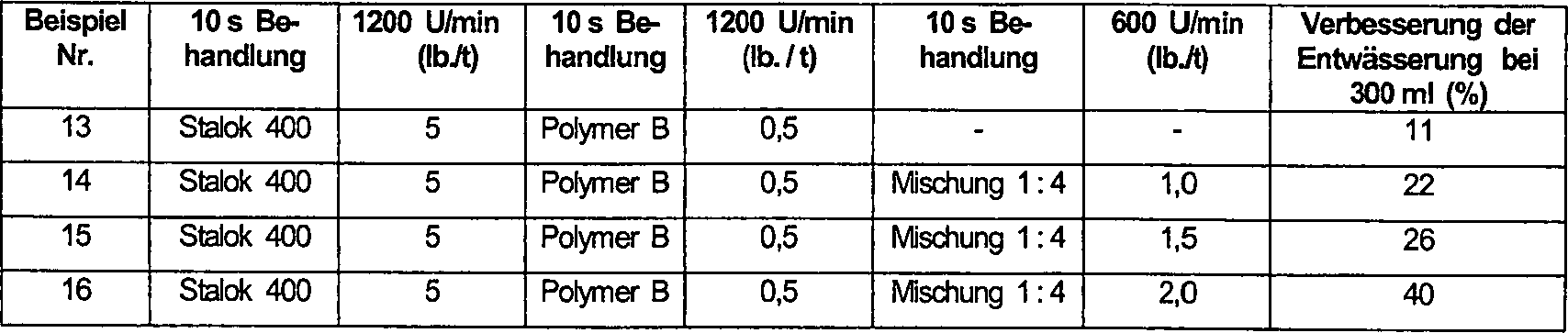
Tabelle
7 Retention
der Mischung 1 : 4 
Stabilität der Mischungen:Stability of the mixtures:
Wie Tabelle 8 zeigt, weisen die verschiedenen Siliciumdioxid-MF-Mischungsverhältnisse abhängig von der Zusammensetzung verschiedene Stabilitäten bei einem pH-Wert von 2.0 auf. Es wurden folgende Feststellungen getroffen.As Table 8 shows the different silica-MF mixing ratios depending on the composition different stabilities at a pH of 2.0 on. The following findings were made.
Tabelle
8 Stabilität der Mischungen 
Wie das Siliciumdioxid-MF-Mischungsverhältnis von 1 : 4 zeigt, ist das saure Kolloid um so länger bei azidischem pH-Wert, d.h. länger als 180 Tage, verwendbar, je mehr davon sich in der Mischung befindet. Die 12% MF wurden durch Konzentrieren einer Lösung von insgesamt 8% Feststoffen zustande gebracht. Die Mischungen gemäß der Erfindung weisen viel bessere Stabilität als jede der Komponenten in getrenntem Zustand auf, d.h. 15 und 90 Tage gegenüber 150 Tagen oder mehr bei den Siliciumdioxid-Säure-Kolloidmischungen gemäß der Erfindung.As the silica-MF mixing ratio of 1: 4 is shown the acidic colloid the longer at acidic pH, i. longer than 180 days, the more of them are in the mix. The 12% MF were made by concentrating a total solution of 8% solids brought about. The mixtures according to the invention have a lot better stability as each of the components in a disconnected state, i. 15 and 90 days opposite 150 days or more in the silica-acid colloid mixtures according to the invention.
Beispiele 17–21: Leicht beschichtete (LWC) EintragsmasseExamples 17-21: Easy coated (LWC) entry mass
Bei dem Rest der Beispiele wurde ein Siliciumdioxid-MF-Mischungsverhältnis von 9 : 1 (Gew./Gew. Feststoffe) bei 15% Feststoffen insgesamt verwendet. Das verwendete Siliciumdioxid war ein Siliciumdioxid mit 30% Feststoffen, erhältlich von DuPont (Wilmington, DE). Die Mischungen wurden in der hier weiter oben beschriebenen Weise hergestellt.at the remainder of the examples was a silica-MF mixing ratio of 9: 1 (w / w solids) at 15% solids in total. The silica used was a 30% solids silica, available from DuPont (Wilmington, DE). The mixtures were continued in here prepared as described above.
Die Beispiele 17–21 in den Tabellen 9-A und 9-B stellen die Effektivität der vorliegenden Erfindung bei der Verbesserung von Entwässerung, Retention. und Bogeneigenschaften einer synthetischen, wässrigen Eintragsmasse dar. Diese Eintragsmasse stellt eine typische Eintragsmasse dar, wie sie zur Herstellung eines Grundbogens für leicht beschichtete Qualitäten verwendet wird. Die Eintragsmasse wurde 15 Minuten lang mit 15 lb./t Stärke Stalok 400 behandelt, bevor Retentionshilfen zugesetzt wurden.The Examples 17-21 in Tables 9-A and 9-B illustrate the effectiveness of the present invention Invention in improving drainage, retention. and bow features a synthetic, aqueous Entry mass. This entry mass represents a typical entry mass as used to make a base sheet for lightly coated grades becomes. The entry mass was 15 minutes long with 15 lb./t of starch Stalok 400 treated before retention aids were added.
Herstellung der Eintragsmasse:Preparation of the entry mass:
Die
zur Entwässerung
und Retention und zur Herstellung von Prüfbögen verwendete synthetische
Eintragsmasse wurde mit den folgenden Komponenten hergestellt:
Bei der Herstellung der Eintragsmasse wurde der CTMP 15 bis 20 Minuten lang in heißem Wasser eingeweicht, in Wasser auf 1,5 Gew.-% Feststoffe verdünnt und mit einer labormäßigen Voith-Allis-Valley-Mahlmaschine auf einen Kanadischen Standardmahlgrad (CSF) von 200 ml verfeinert oder gemahlen. Das SWK wurde gesondert in Wasser eingeweicht, auf 1,5 Gew.-% Feststoffe verdünnt und auf einen CSF von 550 ml verfeinert oder gemahlen. Dann wurden die obigen Fasern auf die oben aufgeführten Proportionen gemischt, und der kalzinierte Ton wurde zugesetzt. Der pH-Wert der Eintragsmasse wurde mit verdünnter Schwefelsäure auf 5.0 eingestellt, und die Leitfähigkeit wurde mit Natriumsulfat auf 2000 μS/cm eingestellt.at For the preparation of the entry mass, the CTMP was 15 to 20 minutes long in hot Water soaked, diluted in water to 1.5 wt .-% solids and with a laboratory-based Voith Allis Valley grinding machine Refined to a standard Canadian degree of granulation (CSF) of 200 ml or ground. The SWK was separately soaked in water, on Diluted 1.5 wt .-% solids and refined or ground to a CSF of 550 ml. Then were the above fibers are mixed to the proportions listed above, and the calcined clay was added. The pH of the entry mass was diluted with sulfuric acid set to 5.0, and the conductivity was with sodium sulfate to 2000 μS / cm set.
Tabelle
9-A LWC-Eintragsmasse 
Tabelle
9-N LWC-Eintragsmasse 
Die Beispiele 18–21 in den Tabellen 9-A und 9-B zeigen die Auswirkung des Einbringens der Mikropartikelmischung in die LWC-Eintragsmasse in einer Position nach dem Sieb. Wenn die Dosierung der Mikropartikelmischung erhöht wird, nehmen Entwässerung, FPR und FPAR sehr stark zu. Diese Vorteile können dadurch wichtig sein, dass der Papierhersteller die Geschwindigkeit der Papiermaschine erhöhen kann, dass der Bogen schneller trocknen kann und dabei mehr von den Füllstoffen und den Feinstoffen der Eintragsmasse im Vergleich zu einem nicht mit dem Mikropartikelsystem gemäß der Erfindung behandelten Bogen in dem Bogen gehalten wird. Die Ergebnisse in den Tabellen 9-A und 9-B zeigen auch, dass die Bogenformung bei Verwendung der Erfindung abnimmt, während Weißgad und Opazität des Bogens im Vergleich zu einem nicht mit dem Mikropartikelsystem gemäß der Erfindung behandelten Bogen relativ unverändert bleiben.The Examples 18-21 in Tables 9-A and 9-B show the effect of introduction of the microparticle mixture in the LWC entry mass in one position after the sieve. If the dosage of the microparticle mixture is increased, take drainage, FPR and FPAR very strong too. These benefits can be important that the paper maker the speed of the paper machine increase can make the bow dry faster and more of the fillers and the fines of the entry mass compared to one not with the microparticle system according to the invention treated bow is held in the bow. The results in Tables 9-A and 9-B also show that sheet formation at Use of the invention decreases while whiteness and opacity of the bow compared to one not with the microparticle system according to the invention treated bow relatively unchanged stay.
Beispiele 22–26: PappeeintragsmasseExamples 22-26: Cardboard Inlet
Die Beispiele 22–26 in den Tabellen 10-A und 10-B stellen die Effektivität der Erfindung bei der Verbesserung von Entwässerung, Retention und Bogeneigenschaften einer synthetischen, wässrigen Pappeeintragsmasse dar. Diese Eintragsmasse stellt eine typische Eintragsmasse dar, wie sie zur Herstellung eines Grundbogens für Pappe verwendet wird.The Examples 22-26 in Tables 10-A and 10-B illustrate the effectiveness of the invention in the improvement of drainage, Retention and bow properties of a synthetic, aqueous Card paste mass. This entry mass represents a typical Mass such as that used to make a base sheet for cardboard is used.
Herstellung der Eintragsmasse:Preparation of the entry mass:
Es wurde ein Eintragsmasse durch Auflösen von 360 g ungebleichter alter Wellpappe (OCC) in lauwarmem Wasser und Verdünnen mit Leitungswasser auf 23 Liter hergestellt. Dann wurde der Zellstoff mit einer labormäßigen Mahlmaschine ähnlich den vorhergehenden Beispielen auf einen CSF von 300 ml verfeinert. 18 Liter dieser Breimasse wurden auf eine Konsistenz von 0,5 Gew.-% verdünnt, und zum Einstellen der Wasserchemie auf Papierfabrikbedingungen wurden die folgenden Salze zugesetzt: 5,61 g Calciumchlorid; 0,96 g Kaliumchlorid; 8,17 g Alaun (50 Gew.-%); 15,96 g Natriumsulfat; 0,59 g Natriumbicarbonat; und 0,97 g Natriumsilicat. Die gemessene Leitfähigkeit betrug annähernd 2000 μS/cm. Der pH-Wert wurde mit verdünnter Schwefelsäure auf 5.0 eingestellt.It was an entry mass by dissolving 360 g unbleached old corrugated board (OCC) in lukewarm water and diluted with Tap water made to 23 liters. Then the pulp became with a laboratory milling machine similar to the previous examples to a CSF of 300 ml. 18 liters this slurry was diluted to a consistency of 0.5% by weight, and to adjust the water chemistry to paper mill conditions the following salts were added: 5.61 g calcium chloride; 0.96 g of potassium chloride; 8.17 g of alum (50% by weight); 15.96 g of sodium sulfate; 0.59 g of sodium bicarbonate; and 0.97 g of sodium silicate. The measured conductivity was approximately 2000 μS / cm. Of the pH was diluted with dilute sulfuric acid set to 5.0.
Tabelle
10-A Pappeeintragsmasse 
Tabelle
10-B Pappeeintragsmasse 
In den Tabellen 10-A und 10-B stellen die Beispiele 22, 25 und 26 die Auswirkung der Verwendung von 20 Pounds Stärke in Verbindung mit der Mikropartikelmischung gemäß der Erfindung in einer Pappeeintragsmasse dar. Die Tabellen 10-A und 10-B zeigen auch, dass durch eine Erhöhung bei der Dosierung der Mikropartikelmischung gemäß der Erfindung und der Stärke Entwässerung, FPR und FPAR zunehmen. Diese Ergebnisse zeigen auch, dass die Mikropartikelmischung auch gut wirkt, wenn 10 Pounds Stärke in der Eintragsmasse verwendet werden. Das scheint anzuzeigen, dass bei der Erfindung keine hohen Stärkegrade erforderlich zu sein brauchen, um bei manchen Eintragsmasse wirksam zu sein. Es wurde gezeigt, dass bei traditionellen Siliciumdioxid-Programmen typischerweise hohe Stärkedosierungen vonnöten sind, um effektiv zu sein, wohingegen das bei Verwendung das Mikropartikelsystems gemäß der Erfindung nicht der Fall zu sein scheint.In In Tables 10-A and 10-B, Examples 22, 25 and 26 illustrate Effect of using 20 pounds of starch in conjunction with the microparticle blend according to the invention in a paperboard furnish. Tables 10-A and 10-B show also that by an increase in the dosage of the microparticle mixture according to the invention and the starch drainage, FPR and FPAR increase. These results also show that the microparticle mixture also works well when using 10 pounds of starch in the pickup mass become. This seems to indicate that in the invention no high strength grade Need to be effective to take effect on some entry mass to be. It has been shown that in traditional silica programs typically high starch dosages necessary are to be effective, whereas when using the microparticle system according to the invention does not seem to be the case.
Beispiele 27–30: ZeitungspapiereintragsmasseExamples 27-30: Newsprint paper
Die Beispiele 27–30 in den Tabellen 11-A, 11-B und 11-C stellen die Effektivität der Erfindung bei der Verbesserung von Entwässerung, Retention und Bogeneigenschaften einer synthetischen, wässrigen Eintragsmasse dar. Diese Eintragsmasse stellt eine typische Holzschliff-Eintragsmasse dar, wie sie zur Herstellung eines Grundbogens für Zeitungspapier verwendet wird.Examples 27-30 in Tables 11-A, 11-B, and 11-C illustrate the effectiveness of the invention in improving drainage, retention, and sheet properties of a synthetic, aqueous one This furnish is a typical wood pulp furnish used to make a base sheet for newsprint.
Herstellung der Eintragsmasse:Preparation of the entry mass:
Die
für Entwässerungs-
und Retentionsstests und zur Herstellung von Prüfbögen verwendete synthetische
Eintragsmasse wurde folgendermaßen
hergestellt:
Bei der Herstellung dieser Eintragsmasse wurde der CTMP in heißem Wasser (140°C) eingeweicht und in einem Mischer 15 bis 20 Minuten lang entfasert. Das wiederverwertete Zeitungspapier wurde gesondert auf die gleiche Weise behandelt. Das SWK wurde zwei Stunden lang in lauwarmem Wasser eingeweicht und in einem Mischer 15 bis 20 Minuten lang entfasert.at The preparation of this entry mass was the CTMP in hot water (140 ° C) soaked and degreased in a blender for 15 to 20 minutes. The recycled newsprint was separately on the same Treated way. The SWK was in lukewarm water for two hours soaked and degreased in a blender for 15 to 20 minutes.
Der CTMP, das wiederverwertete Zeitungspapier und das SWK wurden miteinander gemischt und mit einer labormäßigen Mahlmaschine ähnlich den vorhergehenden Beispielen auf einen CSF von 50 bis 75 ml verfeinert. Der kalzinierte Ton und das Alaun wurden zugesetzt, um den endgültigen pH-Wert von 4.8 bis 5.2 zu erzielen. Die Leitfähigkeit der Breimasse wurde mit Hilfe von Natriumchlorid auf 2000 μS/cm eingestellt.Of the CTMP, the recycled newsprint and the SWK were together mixed and similar to a laboratory milling machine previous examples to a CSF of 50 to 75 ml. The calcined clay and alum were added to the final pH from 4.8 to 5.2. The conductivity of the slurry was adjusted to 2000 μS / cm using sodium chloride.
Tabelle
11-A Zeitungspapiereintragsmasse 
Tabelle
11-B Zeitungspapiereintragsmasse 
Tabelle
11-C Zeitungspapiereintragsmasse 
In den Tabellen 11-A und 11-C stellen die Beispiele 27 und 28 dar, dass eine Zunahme bei Entwässerung, FPR und FPAR erfolgt, wenn die Mikropartikelmischung gemäß der Erfindung in der Position nach dem Sieb in die Zeitungspapiereintragsmasse eingebracht wird. Diese Zunahme bei Entwässerung, FPR und FPAR kann eine wichtiger Gesichtspunkt bei einer sehr schnell laufenden Zeitungspapiermaschine sein. Diese Ergebnisse für die Beispiele 27 und 28 zeigen auch, dass das Mikropartikelsystem selbst ohne Stärke effektiv ist. Durch diese Faktoren kann der Papierghersteller die Kosten senken und dadurch die Gesamtkosten pro Tonne des herzustellenden Papiers absenken.In Tables 11-A and 11-C illustrate Examples 27 and 28, that an increase in drainage, FPR and FPAR occur when the microparticle mixture according to the invention in the position after the screen in the newsprint paper mass is introduced. This increase in drainage, FPR and FPAR can an important consideration in a very fast moving newsprint machine be. These results for Examples 27 and 28 also show that the microparticle system even without strength is effective. These factors allow the paper maker to use the Reduce costs and thereby the total cost per tonne of the produced Lower paper.
Industrielle Anwendung der Maschine für alkalisches FeinpapierIndustrial application the machine for alkaline fine paper
Die Leistung der Maschine wurde an einer industriellen Maschine für alkalisches Feinpapier bewertet. Das Mikropartikelmischungsprogamm gemäß der Erfindung wurde mit einem Referenzprogamm verglichen. Das Referenzprogramm wurde an einer Maschine ausgeführt, bei welcher das Polymer B (0,15 lb./t Aktivstoff) vor dem Sieb zugesetzt wurde und das Polymer C (1,0 lb./t Aktivstoff) der Eintragsmasse nach dem Sieb zugesetzt wurde. Bei dem Mikropartikelprogramm gemäß der Erfindung wurde das Polymer C der Eintragsmasse in der Stufe vor dem Sieb zugesetzt, und die Mikropartikelmischung (1,0 lb. Aktivstoff) wurde in der Stufe nach dem Sieb zugesetzt. Es sei angemerkt, dass die Dosierungen annähernd sind und mit unterschiedlichem Flächengewicht und unterschiedlicher Papierart geändert wrden. Das Programm gemäß der Erfindung wurde auch mit einem typischen Siliciumdioxid-Programm verglichen, wobei Polyamin (1,5 lb./t Aktivstoff) in das Gefäß eingegeben wurde, anionisches HMW-Polyacrylamid (1,5 lb./t Aktivstoff) in der Stufe vor dem Sieb zugesetzt wurde und kolloidales Siliciumdioxid (1,5 lb./t Aktivstoff) in der Stufe nach dem Sieb zugesetzt wurde. Die Ergebnisse dieses Vergleichs sind den Tabellen 12 und 13 gezeigt.The Performance of the machine became on an industrial machine for alkaline Fine paper rated. The microparticle blending program according to the invention was compared with a reference program. The reference program was running on a machine, in which the polymer B (0.15 lb./t active) was added before the sieve and polymer C (1.0 lb./t active) of the furnish was added after the sieve. In the microparticle program according to the invention polymer C of the furnish was in the step before the sieve and the microparticle mixture (1.0 lb. active) was added added in the step after the sieve. It should be noted that the Dosages approximate are and with different basis weight and different Paper type changed wrden. The program according to the invention was also compared to a typical silica program, wherein polyamine (1.5 lb./t active) was added to the vessel, anionic HMW polyacrylamide (1.5 lb./t active) in the step before the sieve was added and colloidal silica (1.5 lb./t active) was added in the stage after the sieve. The results of this Comparisons are shown in Tables 12 and 13.
Tabelle
12 Vergleich
von Papiermaschinen bei 80 lb. Flächengewicht 
Tabelle
13 Vergleich
von Papiermaschinen bei 100 lb. Flächengewicht 

Aus Tabelle 12 (Flächengewicht 80 lb.) ist zu ersehen, dass die Mikropartikelmischung gemäß der Erfindung zu verbesserter Bogenformung (die niedrigere Zahl ist besser), zu geringerem Dampfverbrauch und zu mehr gepressten Feststoffen im Vergleich zu den anderen Programmen führt. Bei gleichwertigem Dampfverbrauch wurde die Geschwindigkeit der Maschine mit der Erfindung um 13,6% gegenüber dem Referenzprogramm und um 3,1% gegenüber dem traditionellen Siliciumdioxid-Programm erhöht. Durch diesen Faktor kann der Papiermaschinenhersteller die Geschwindigkeit der Maschine erhöhen, was zu höherer Produktion von Papier und/oder zu weniger Energie zur Dampferzeugung führt. Diese Ergebnisse zeigen auch eine bessere Papierformung an, wenn die Mikropartikelmischung gemäß der Erfindung verwendet wird. Dieser Faktor kann dadurch wichtig sein, dass sich ein Papierbogen mit einer einheitlicheren, höheren Qualität herstellen lasst.Out Table 12 (basis weight 80 lb.) it can be seen that the microparticle mixture according to the invention to improved bowing (the lower number is better), too lower steam consumption and more pressed solids in the Comparison with the other programs leads. With equivalent steam consumption the speed of the machine with the invention was increased by 13.6% across from the Reference Program and 3.1% compared to the traditional silica program elevated. By this factor, the paper machine manufacturer can speed up increase the machine, which is higher Production of paper and / or less energy for steam production leads. These results also indicate better paper forming when the microparticle mixture according to the invention is used. This factor can be important for that make a paper sheet with a more consistent, higher quality.
In Tabelle 13 (Flächengewicht 100 lb.) ist ein Vergleich zwischen der Verwendung der Mikropartikelmischung gemäß der Erfindung und der Verwendung der anderen Programme bei einem Papier mit 100 lb. Flächengewicht dargestellt. Bei einem Papier mit schwererem Gewicht ist die Entwässerung in dem dickeren Bogen problematischer, und zum Trocknen ist mehr Energie vonnöten. Es ist gezeigt, dass mit der Erfindung für bessere Bogenformung, mehr gepresste Feststoffen und niedrigeren Dampfverbrauch im Vergleich zu dem Referenzprogramm oder dem Siliciumdioxid-Programm gesorgt wird. Durch diese Faktoren der Erfindung kann es dem Papierhersteller ermöglicht werden, einen Bogen von höherer Qualität mit einer höheren Papiermaschinengeschwindigkeit herzustellen.In Table 13 (basis weight 100 lb.) is a comparison between the use of the microparticle mixture according to the invention and the use of other programs on a paper of 100 lb. grammage shown. For a heavier weight paper, drainage more problematic in the thicker bow, and drying is more Energy needed. It has been shown that with the invention for better arching, more pressed solids and lower steam consumption compared to the reference program or the silica program becomes. These factors of the invention may make it difficult for the papermaker allows be, a bow of higher quality with a higher one Paper machine speed produce.
Zwar wurden für die Darstellungszwecke spezielle Ausführungsformen der vorliegenden Erfindung beschrieben, jedoch ist für den Fachmann erkennbar, dass zahlreiche Variationen und Einzelheiten der Erfindung ohne Abweichung von der Erfindung, wie sie in den beigefügten Ansprüchen definiert ist, hergestellt werden können.Though were for the illustrative purposes are specific embodiments of the present invention However, it will be apparent to those skilled in the art that: numerous variations and details of the invention without deviation of the invention as defined in the appended claims can be.
Claims (20)

Applications Claiming Priority (3)
| Application Number | Priority Date | Filing Date | Title |
|---|---|---|---|
| US10137998P | 1998-09-22 | 1998-09-22 | |
| US101379P | 1998-09-22 | ||
| PCT/US1999/020608 WO2000017450A1 (en) | 1998-09-22 | 1999-09-08 | Silica-acid colloid blend in a microparticle system used in papermaking |
Publications (2)
| Publication Number | Publication Date |
|---|---|
| DE69931343D1 DE69931343D1 (en) | 2006-06-22 |
| DE69931343T2 true DE69931343T2 (en) | 2006-09-28 |
Family
ID=22284358
Family Applications (1)
| Application Number | Title | Priority Date | Filing Date |
|---|---|---|---|
| DE69931343T Expired - Fee Related DE69931343T2 (en) | 1998-09-22 | 1999-09-08 | MIXTURE OF SILKY ACID AND ACIDOIL TO A MICROPARTICLE SYSTEM FOR PAPER MANUFACTURE |
Country Status (10)
| Country | Link |
|---|---|
| EP (1) | EP1047834B1 (en) |
| JP (1) | JP2002526680A (en) |
| CN (1) | CN1231639C (en) |
| AT (1) | ATE326579T1 (en) |
| AU (1) | AU761790B2 (en) |
| BR (1) | BR9907290A (en) |
| DE (1) | DE69931343T2 (en) |
| ID (1) | ID25782A (en) |
| NZ (1) | NZ504660A (en) |
| WO (1) | WO2000017450A1 (en) |
Families Citing this family (8)
| Publication number | Priority date | Publication date | Assignee | Title |
|---|---|---|---|---|
| CA2557855A1 (en) * | 2004-03-02 | 2005-09-09 | Tokuyama Corporation | Method for treating papermaking waste water,and methods of using silica sol in papermaking |
| BRPI0519728B1 (en) * | 2004-12-21 | 2016-12-13 | Hercules Inc | reactive cationic resins and papermaking process |
| DE102004063005A1 (en) | 2004-12-22 | 2006-07-13 | Basf Ag | Process for the production of paper, cardboard and cardboard |
| WO2008143580A1 (en) | 2007-05-23 | 2008-11-27 | Akzo Nobel N.V. | Process for the production of a cellulosic product |
| AU2011319981B2 (en) | 2010-10-29 | 2015-04-02 | Buckman Laboratories International, Inc. | Papermaking and products made thereby with ionic crosslinked polymeric microparticle |
| CN104093902B (en) * | 2012-02-01 | 2017-09-08 | 巴斯夫欧洲公司 | The manufacture method of paper and cardboard |
| WO2013113823A2 (en) * | 2012-02-01 | 2013-08-08 | Basf Se | Process for the manufacture of paper and paperboard |
| CN114735713B (en) * | 2022-03-02 | 2024-03-29 | 福建同晟新材料科技股份公司 | Preparation process of synthetic silicon dioxide for papermaking additive |
Family Cites Families (9)
| Publication number | Priority date | Publication date | Assignee | Title |
|---|---|---|---|---|
| US2485080A (en) * | 1944-01-04 | 1949-10-18 | American Cyanamid Co | Colloidal melamine-urea-formaldehyde copolymer solutions |
| US4461858A (en) * | 1980-05-16 | 1984-07-24 | E. I. Du Pont De Nemours And Company | Polyvinylalcohol/melamine-formaldehyde interaction products |
| US4385961A (en) * | 1981-02-26 | 1983-05-31 | Eka Aktiebolag | Papermaking |
| US4643801A (en) * | 1986-02-24 | 1987-02-17 | Nalco Chemical Company | Papermaking aid |
| US4750974A (en) * | 1986-02-24 | 1988-06-14 | Nalco Chemical Company | Papermaking aid |
| US4795531A (en) * | 1987-09-22 | 1989-01-03 | Nalco Chemical Company | Method for dewatering paper |
| EP0335575B2 (en) * | 1988-03-28 | 2000-08-23 | Ciba Specialty Chemicals Water Treatments Limited | Production of paper and paper board |
| US5382378A (en) * | 1993-02-10 | 1995-01-17 | Calgon Corporation | Composition useful for treating suspended solids and color bodies in water systems |
| GB9410920D0 (en) * | 1994-06-01 | 1994-07-20 | Allied Colloids Ltd | Manufacture of paper |
-
1999
- 1999-09-08 DE DE69931343T patent/DE69931343T2/en not_active Expired - Fee Related
- 1999-09-08 CN CN99801858.9A patent/CN1231639C/en not_active Expired - Fee Related
- 1999-09-08 NZ NZ504660A patent/NZ504660A/en unknown
- 1999-09-08 WO PCT/US1999/020608 patent/WO2000017450A1/en not_active Ceased
- 1999-09-08 AU AU59133/99A patent/AU761790B2/en not_active Ceased
- 1999-09-08 BR BR9907290-4A patent/BR9907290A/en not_active Application Discontinuation
- 1999-09-08 JP JP2000574345A patent/JP2002526680A/en active Pending
- 1999-09-08 EP EP99946808A patent/EP1047834B1/en not_active Expired - Lifetime
- 1999-09-08 ID IDW20000962A patent/ID25782A/en unknown
- 1999-09-08 AT AT99946808T patent/ATE326579T1/en not_active IP Right Cessation
Also Published As
| Publication number | Publication date |
|---|---|
| JP2002526680A (en) | 2002-08-20 |
| WO2000017450A1 (en) | 2000-03-30 |
| EP1047834B1 (en) | 2006-05-17 |
| ATE326579T1 (en) | 2006-06-15 |
| DE69931343D1 (en) | 2006-06-22 |
| NZ504660A (en) | 2002-12-20 |
| CN1231639C (en) | 2005-12-14 |
| BR9907290A (en) | 2000-10-03 |
| EP1047834A4 (en) | 2000-12-13 |
| AU761790B2 (en) | 2003-06-12 |
| CN1287585A (en) | 2001-03-14 |
| EP1047834A1 (en) | 2000-11-02 |
| AU5913399A (en) | 2000-04-10 |
| ID25782A (en) | 2000-11-02 |
Similar Documents
| Publication | Publication Date | Title |
|---|---|---|
| DE69206735T2 (en) | Papermaking process | |
| DE69224063T2 (en) | METHOD FOR PRODUCING PAPER | |
| DE69406957T2 (en) | Manufacture of filled paper | |
| EP0223223B1 (en) | Process for the production of paper and cardboard | |
| DE69522410T3 (en) | Papermaking | |
| DE69128563T2 (en) | Charged microspheres made from organic polymers for the production of paper | |
| DE69908938T2 (en) | METHOD FOR PRODUCING PAPER | |
| DE69709062T2 (en) | PRODUCTION OF FILLED PAPER, COMPOSITIONS AND THEIR USE | |
| DE3644072A1 (en) | WEIGHED PAPER | |
| EP0249891B1 (en) | Process for producing paper and cardboard | |
| DE69713677T2 (en) | Paper-making process | |
| DE20220979U1 (en) | Preparation of paper, pasteboard, or cardboard involving cutting of the paper pulp, addition of microparticles of cationic polymer, e.g. cationic polyamide, and a finely divided inorganic component after the last cutting step | |
| DE2263089C3 (en) | Paper with a content of a copolymer with acrylamide and N- (dialkylaminomethyOacrylamide units and processes for its production | |
| DE19632079A1 (en) | Improved process for the production of paper | |
| JP2723240B2 (en) | Method for producing mineral solid suspension | |
| EP2334871B1 (en) | Method for manufacturing paper, cardboard and paperboard using endo-beta-1,4 glucanases as dewatering means | |
| DE60130451T2 (en) | PAPER FIBROUS AND FLOCK AGENTS CONTAINING ACOURIC AQUEOUS ALUMINUM OXIDOL | |
| EP0000922B1 (en) | A process for preparing a non-woven fibrous web from fibers and a latex, and the non-woven fibrous material so prepared | |
| DE69931343T2 (en) | MIXTURE OF SILKY ACID AND ACIDOIL TO A MICROPARTICLE SYSTEM FOR PAPER MANUFACTURE | |
| DE69737945T2 (en) | Hydrophilic dispersion polymers for paper applications | |
| DE4436317C2 (en) | Process for improving the retention of mineral fillers and cellulose fibers on a cellulose fiber sheet | |
| AU761303B2 (en) | An acid colloid in a microparticle system used in papermaking | |
| US6719881B1 (en) | Acid colloid in a microparticle system used in papermaking | |
| EP1831459B1 (en) | Method for the production of paper, cardboard and card | |
| DE10236252B4 (en) | Process for the production of paper, cardboard and cardboard |
Legal Events
| Date | Code | Title | Description |
|---|---|---|---|
| 8364 | No opposition during term of opposition | ||
| 8339 | Ceased/non-payment of the annual fee |