DE69930141T2 - DETERGENT CONTAINING MODIFIED ALKYL BENZENESULFONATE - Google Patents
DETERGENT CONTAINING MODIFIED ALKYL BENZENESULFONATE Download PDFInfo
- Publication number
- DE69930141T2 DE69930141T2 DE69930141T DE69930141T DE69930141T2 DE 69930141 T2 DE69930141 T2 DE 69930141T2 DE 69930141 T DE69930141 T DE 69930141T DE 69930141 T DE69930141 T DE 69930141T DE 69930141 T2 DE69930141 T2 DE 69930141T2
- Authority
- DE
- Germany
- Prior art keywords
- mixture
- detergent composition
- weight
- alkyl
- surfactant
- Prior art date
- Legal status (The legal status is an assumption and is not a legal conclusion. Google has not performed a legal analysis and makes no representation as to the accuracy of the status listed.)
- Expired - Fee Related
Links
- 239000003599 detergent Substances 0.000 title claims description 236
- 229940077388 benzenesulfonate Drugs 0.000 title claims description 43
- SRSXLGNVWSONIS-UHFFFAOYSA-M benzenesulfonate Chemical compound [O-]S(=O)(=O)C1=CC=CC=C1 SRSXLGNVWSONIS-UHFFFAOYSA-M 0.000 title 1
- 239000000203 mixture Substances 0.000 claims description 612
- 239000004094 surface-active agent Substances 0.000 claims description 270
- 150000004996 alkyl benzenes Chemical class 0.000 claims description 118
- 238000000034 method Methods 0.000 claims description 111
- 239000007844 bleaching agent Substances 0.000 claims description 108
- -1 aliphatic olefins Chemical class 0.000 claims description 101
- 239000010457 zeolite Substances 0.000 claims description 96
- 239000003054 catalyst Substances 0.000 claims description 92
- HNPSIPDUKPIQMN-UHFFFAOYSA-N dioxosilane;oxo(oxoalumanyloxy)alumane Chemical compound O=[Si]=O.O=[Al]O[Al]=O HNPSIPDUKPIQMN-UHFFFAOYSA-N 0.000 claims description 82
- 230000009021 linear effect Effects 0.000 claims description 81
- 125000000217 alkyl group Chemical group 0.000 claims description 80
- UHOVQNZJYSORNB-UHFFFAOYSA-N Benzene Chemical compound C1=CC=CC=C1 UHOVQNZJYSORNB-UHFFFAOYSA-N 0.000 claims description 78
- 229910052799 carbon Inorganic materials 0.000 claims description 74
- 229910021536 Zeolite Inorganic materials 0.000 claims description 73
- 238000004140 cleaning Methods 0.000 claims description 72
- 239000000047 product Substances 0.000 claims description 70
- OKTJSMMVPCPJKN-UHFFFAOYSA-N Carbon Chemical compound [C] OKTJSMMVPCPJKN-UHFFFAOYSA-N 0.000 claims description 63
- 239000012190 activator Substances 0.000 claims description 63
- 125000002496 methyl group Chemical group [H]C([H])([H])* 0.000 claims description 59
- 239000002253 acid Substances 0.000 claims description 57
- 239000000463 material Substances 0.000 claims description 54
- 230000008569 process Effects 0.000 claims description 49
- 239000000654 additive Substances 0.000 claims description 44
- 229910052760 oxygen Inorganic materials 0.000 claims description 43
- 239000011734 sodium Substances 0.000 claims description 43
- 102000004190 Enzymes Human genes 0.000 claims description 42
- 108090000790 Enzymes Proteins 0.000 claims description 42
- 229910052739 hydrogen Inorganic materials 0.000 claims description 42
- 239000001301 oxygen Substances 0.000 claims description 41
- 150000001336 alkenes Chemical group 0.000 claims description 40
- QVGXLLKOCUKJST-UHFFFAOYSA-N atomic oxygen Chemical compound [O] QVGXLLKOCUKJST-UHFFFAOYSA-N 0.000 claims description 39
- 239000007788 liquid Substances 0.000 claims description 39
- 125000004432 carbon atom Chemical group C* 0.000 claims description 37
- 239000004615 ingredient Substances 0.000 claims description 37
- XLYOFNOQVPJJNP-UHFFFAOYSA-N water Substances O XLYOFNOQVPJJNP-UHFFFAOYSA-N 0.000 claims description 37
- 125000001997 phenyl group Chemical group [H]C1=C([H])C([H])=C(*)C([H])=C1[H] 0.000 claims description 36
- 229910052708 sodium Inorganic materials 0.000 claims description 33
- 229910001868 water Inorganic materials 0.000 claims description 32
- UFHFLCQGNIYNRP-UHFFFAOYSA-N Hydrogen Chemical compound [H][H] UFHFLCQGNIYNRP-UHFFFAOYSA-N 0.000 claims description 31
- 239000003795 chemical substances by application Substances 0.000 claims description 31
- 238000005804 alkylation reaction Methods 0.000 claims description 28
- 229920000642 polymer Polymers 0.000 claims description 28
- 230000002378 acidificating effect Effects 0.000 claims description 27
- 239000001257 hydrogen Substances 0.000 claims description 27
- 230000029936 alkylation Effects 0.000 claims description 26
- 230000002209 hydrophobic effect Effects 0.000 claims description 26
- 230000002152 alkylating effect Effects 0.000 claims description 24
- 239000002243 precursor Substances 0.000 claims description 23
- 239000008187 granular material Substances 0.000 claims description 22
- 125000001931 aliphatic group Chemical group 0.000 claims description 21
- 150000001768 cations Chemical class 0.000 claims description 21
- 239000003752 hydrotrope Substances 0.000 claims description 21
- LFQSCWFLJHTTHZ-UHFFFAOYSA-N Ethanol Chemical compound CCO LFQSCWFLJHTTHZ-UHFFFAOYSA-N 0.000 claims description 20
- 229910052700 potassium Inorganic materials 0.000 claims description 20
- 239000003093 cationic surfactant Substances 0.000 claims description 19
- 238000002156 mixing Methods 0.000 claims description 18
- QGZKDVFQNNGYKY-UHFFFAOYSA-O Ammonium Chemical compound [NH4+] QGZKDVFQNNGYKY-UHFFFAOYSA-O 0.000 claims description 17
- 230000000996 additive effect Effects 0.000 claims description 16
- 239000002736 nonionic surfactant Substances 0.000 claims description 16
- 239000002904 solvent Substances 0.000 claims description 16
- 238000004519 manufacturing process Methods 0.000 claims description 15
- 150000005673 monoalkenes Chemical class 0.000 claims description 15
- HEMHJVSKTPXQMS-UHFFFAOYSA-M Sodium hydroxide Chemical compound [OH-].[Na+] HEMHJVSKTPXQMS-UHFFFAOYSA-M 0.000 claims description 14
- QAOWNCQODCNURD-UHFFFAOYSA-L Sulfate Chemical compound [O-]S([O-])(=O)=O QAOWNCQODCNURD-UHFFFAOYSA-L 0.000 claims description 14
- 150000001412 amines Chemical class 0.000 claims description 14
- 239000000975 dye Substances 0.000 claims description 14
- 150000001298 alcohols Chemical class 0.000 claims description 13
- 229910019142 PO4 Inorganic materials 0.000 claims description 12
- QAOWNCQODCNURD-UHFFFAOYSA-N Sulfuric acid Chemical compound OS(O)(=O)=O QAOWNCQODCNURD-UHFFFAOYSA-N 0.000 claims description 12
- 239000003945 anionic surfactant Substances 0.000 claims description 12
- 239000004744 fabric Substances 0.000 claims description 12
- 239000006260 foam Substances 0.000 claims description 12
- AKEJUJNQAAGONA-UHFFFAOYSA-N sulfur trioxide Chemical compound O=S(=O)=O AKEJUJNQAAGONA-UHFFFAOYSA-N 0.000 claims description 12
- 229910052723 transition metal Inorganic materials 0.000 claims description 12
- 150000003624 transition metals Chemical class 0.000 claims description 12
- 150000008051 alkyl sulfates Chemical class 0.000 claims description 11
- 239000002168 alkylating agent Substances 0.000 claims description 11
- 229940100198 alkylating agent Drugs 0.000 claims description 11
- QUCDWLYKDRVKMI-UHFFFAOYSA-M sodium;3,4-dimethylbenzenesulfonate Chemical compound [Na+].CC1=CC=C(S([O-])(=O)=O)C=C1C QUCDWLYKDRVKMI-UHFFFAOYSA-M 0.000 claims description 11
- 150000001340 alkali metals Chemical class 0.000 claims description 10
- 150000003863 ammonium salts Chemical class 0.000 claims description 10
- 150000003467 sulfuric acid derivatives Chemical class 0.000 claims description 10
- 125000001165 hydrophobic group Chemical group 0.000 claims description 9
- 238000005259 measurement Methods 0.000 claims description 9
- BPQQTUXANYXVAA-UHFFFAOYSA-N Orthosilicate Chemical compound [O-][Si]([O-])([O-])[O-] BPQQTUXANYXVAA-UHFFFAOYSA-N 0.000 claims description 8
- 125000002015 acyclic group Chemical group 0.000 claims description 8
- 229910052783 alkali metal Inorganic materials 0.000 claims description 8
- 239000003963 antioxidant agent Substances 0.000 claims description 8
- 239000010452 phosphate Substances 0.000 claims description 8
- 239000004711 α-olefin Substances 0.000 claims description 8
- 150000001450 anions Chemical class 0.000 claims description 7
- 239000003205 fragrance Substances 0.000 claims description 7
- NBIIXXVUZAFLBC-UHFFFAOYSA-K phosphate Chemical compound [O-]P([O-])([O-])=O NBIIXXVUZAFLBC-UHFFFAOYSA-K 0.000 claims description 7
- 238000000746 purification Methods 0.000 claims description 7
- 235000019832 sodium triphosphate Nutrition 0.000 claims description 7
- KWYUFKZDYYNOTN-UHFFFAOYSA-M Potassium hydroxide Chemical compound [OH-].[K+] KWYUFKZDYYNOTN-UHFFFAOYSA-M 0.000 claims description 6
- 239000000470 constituent Substances 0.000 claims description 6
- 230000002538 fungal effect Effects 0.000 claims description 6
- 230000003472 neutralizing effect Effects 0.000 claims description 6
- 230000003287 optical effect Effects 0.000 claims description 6
- 239000006057 Non-nutritive feed additive Substances 0.000 claims description 5
- 150000001447 alkali salts Chemical class 0.000 claims description 5
- 125000003158 alcohol group Chemical group 0.000 claims description 4
- 125000005210 alkyl ammonium group Chemical group 0.000 claims description 4
- 239000000872 buffer Substances 0.000 claims description 4
- 125000004106 butoxy group Chemical group [*]OC([H])([H])C([H])([H])C(C([H])([H])[H])([H])[H] 0.000 claims description 4
- 239000000969 carrier Substances 0.000 claims description 4
- 239000003112 inhibitor Substances 0.000 claims description 4
- 125000000325 methylidene group Chemical group [H]C([H])=* 0.000 claims description 4
- 239000000843 powder Substances 0.000 claims description 4
- 125000002572 propoxy group Chemical group [*]OC([H])([H])C(C([H])([H])[H])([H])[H] 0.000 claims description 4
- NTHWMYGWWRZVTN-UHFFFAOYSA-N sodium silicate Chemical compound [Na+].[Na+].[O-][Si]([O-])=O NTHWMYGWWRZVTN-UHFFFAOYSA-N 0.000 claims description 4
- 125000001424 substituent group Chemical group 0.000 claims description 4
- BVKZGUZCCUSVTD-UHFFFAOYSA-L Carbonate Chemical compound [O-]C([O-])=O BVKZGUZCCUSVTD-UHFFFAOYSA-L 0.000 claims description 3
- 229910052784 alkaline earth metal Inorganic materials 0.000 claims description 3
- 150000001342 alkaline earth metals Chemical class 0.000 claims description 3
- 230000000844 anti-bacterial effect Effects 0.000 claims description 3
- 125000001301 ethoxy group Chemical group [H]C([H])([H])C([H])([H])O* 0.000 claims description 3
- XLYOFNOQVPJJNP-UHFFFAOYSA-M hydroxide Chemical compound [OH-] XLYOFNOQVPJJNP-UHFFFAOYSA-M 0.000 claims description 3
- VHUUQVKOLVNVRT-UHFFFAOYSA-N Ammonium hydroxide Chemical compound [NH4+].[OH-] VHUUQVKOLVNVRT-UHFFFAOYSA-N 0.000 claims description 2
- 239000004115 Sodium Silicate Substances 0.000 claims description 2
- 239000003082 abrasive agent Substances 0.000 claims description 2
- 239000000908 ammonium hydroxide Substances 0.000 claims description 2
- 239000003899 bactericide agent Substances 0.000 claims description 2
- 239000012459 cleaning agent Substances 0.000 claims description 2
- 238000006356 dehydrogenation reaction Methods 0.000 claims description 2
- 150000004676 glycans Chemical class 0.000 claims description 2
- 230000003165 hydrotropic effect Effects 0.000 claims description 2
- 239000000077 insect repellent Substances 0.000 claims description 2
- VTHJTEIRLNZDEV-UHFFFAOYSA-L magnesium dihydroxide Chemical compound [OH-].[OH-].[Mg+2] VTHJTEIRLNZDEV-UHFFFAOYSA-L 0.000 claims description 2
- 239000000347 magnesium hydroxide Substances 0.000 claims description 2
- 229910001862 magnesium hydroxide Inorganic materials 0.000 claims description 2
- 229920001282 polysaccharide Polymers 0.000 claims description 2
- 239000005017 polysaccharide Substances 0.000 claims description 2
- 229910052911 sodium silicate Inorganic materials 0.000 claims description 2
- 239000002562 thickening agent Substances 0.000 claims description 2
- KRHYYFGTRYWZRS-UHFFFAOYSA-N Fluorane Chemical compound F KRHYYFGTRYWZRS-UHFFFAOYSA-N 0.000 claims 1
- 239000004111 Potassium silicate Substances 0.000 claims 1
- 239000002316 fumigant Substances 0.000 claims 1
- 150000002431 hydrogen Chemical class 0.000 claims 1
- 229910000040 hydrogen fluoride Inorganic materials 0.000 claims 1
- NNHHDJVEYQHLHG-UHFFFAOYSA-N potassium silicate Chemical compound [K+].[K+].[O-][Si]([O-])=O NNHHDJVEYQHLHG-UHFFFAOYSA-N 0.000 claims 1
- 229910052913 potassium silicate Inorganic materials 0.000 claims 1
- 235000019353 potassium silicate Nutrition 0.000 claims 1
- 150000003839 salts Chemical class 0.000 description 48
- OKKJLVBELUTLKV-UHFFFAOYSA-N Methanol Chemical compound OC OKKJLVBELUTLKV-UHFFFAOYSA-N 0.000 description 45
- VLKZOEOYAKHREP-UHFFFAOYSA-N n-Hexane Chemical compound CCCCCC VLKZOEOYAKHREP-UHFFFAOYSA-N 0.000 description 43
- 229940088598 enzyme Drugs 0.000 description 41
- YMWUJEATGCHHMB-UHFFFAOYSA-N Dichloromethane Chemical compound ClCCl YMWUJEATGCHHMB-UHFFFAOYSA-N 0.000 description 37
- 239000000126 substance Substances 0.000 description 36
- RTZKZFJDLAIYFH-UHFFFAOYSA-N Diethyl ether Chemical compound CCOCC RTZKZFJDLAIYFH-UHFFFAOYSA-N 0.000 description 34
- 108010065511 Amylases Proteins 0.000 description 32
- 102000013142 Amylases Human genes 0.000 description 32
- 235000019418 amylase Nutrition 0.000 description 30
- 239000000243 solution Substances 0.000 description 30
- 239000000523 sample Substances 0.000 description 29
- 238000005406 washing Methods 0.000 description 29
- 235000014113 dietary fatty acids Nutrition 0.000 description 26
- 239000000194 fatty acid Substances 0.000 description 26
- 229930195729 fatty acid Natural products 0.000 description 26
- 108091005804 Peptidases Proteins 0.000 description 24
- 102000035195 Peptidases Human genes 0.000 description 24
- MHAJPDPJQMAIIY-UHFFFAOYSA-N Hydrogen peroxide Chemical compound OO MHAJPDPJQMAIIY-UHFFFAOYSA-N 0.000 description 23
- 239000004365 Protease Substances 0.000 description 22
- 150000004665 fatty acids Chemical class 0.000 description 21
- 238000004128 high performance liquid chromatography Methods 0.000 description 21
- 229940025131 amylases Drugs 0.000 description 19
- 239000011541 reaction mixture Substances 0.000 description 19
- 108090001060 Lipase Proteins 0.000 description 18
- 102000004882 Lipase Human genes 0.000 description 18
- 125000002091 cationic group Chemical group 0.000 description 18
- 150000001875 compounds Chemical class 0.000 description 18
- 239000004367 Lipase Substances 0.000 description 17
- 235000019421 lipase Nutrition 0.000 description 17
- 238000012546 transfer Methods 0.000 description 17
- 238000005481 NMR spectroscopy Methods 0.000 description 16
- 238000006243 chemical reaction Methods 0.000 description 16
- JRZJOMJEPLMPRA-UHFFFAOYSA-N olefin Natural products CCCCCCCC=C JRZJOMJEPLMPRA-UHFFFAOYSA-N 0.000 description 16
- 239000007787 solid Substances 0.000 description 16
- 230000000694 effects Effects 0.000 description 15
- 238000009472 formulation Methods 0.000 description 15
- 239000002245 particle Substances 0.000 description 15
- 241000894007 species Species 0.000 description 15
- 238000011282 treatment Methods 0.000 description 15
- BGRWYDHXPHLNKA-UHFFFAOYSA-N Tetraacetylethylenediamine Chemical compound CC(=O)N(C(C)=O)CCN(C(C)=O)C(C)=O BGRWYDHXPHLNKA-UHFFFAOYSA-N 0.000 description 14
- 150000007513 acids Chemical class 0.000 description 14
- 150000002148 esters Chemical class 0.000 description 14
- 229920005646 polycarboxylate Polymers 0.000 description 14
- 239000002689 soil Substances 0.000 description 14
- 239000011572 manganese Substances 0.000 description 13
- 238000002360 preparation method Methods 0.000 description 13
- 159000000000 sodium salts Chemical class 0.000 description 13
- 238000006277 sulfonation reaction Methods 0.000 description 13
- WEVYAHXRMPXWCK-UHFFFAOYSA-N Acetonitrile Chemical compound CC#N WEVYAHXRMPXWCK-UHFFFAOYSA-N 0.000 description 12
- 101000605014 Homo sapiens Putative L-type amino acid transporter 1-like protein MLAS Proteins 0.000 description 12
- 102100038206 Putative L-type amino acid transporter 1-like protein MLAS Human genes 0.000 description 12
- CDBYLPFSWZWCQE-UHFFFAOYSA-L Sodium Carbonate Chemical compound [Na+].[Na+].[O-]C([O-])=O CDBYLPFSWZWCQE-UHFFFAOYSA-L 0.000 description 12
- 125000000118 dimethyl group Chemical group [H]C([H])([H])* 0.000 description 12
- 125000004435 hydrogen atom Chemical class [H]* 0.000 description 12
- 239000004382 Amylase Substances 0.000 description 11
- PEDCQBHIVMGVHV-UHFFFAOYSA-N Glycerine Chemical compound OCC(O)CO PEDCQBHIVMGVHV-UHFFFAOYSA-N 0.000 description 11
- VYPSYNLAJGMNEJ-UHFFFAOYSA-N Silicium dioxide Chemical compound O=[Si]=O VYPSYNLAJGMNEJ-UHFFFAOYSA-N 0.000 description 11
- PNEYBMLMFCGWSK-UHFFFAOYSA-N aluminium oxide Inorganic materials [O-2].[O-2].[O-2].[Al+3].[Al+3] PNEYBMLMFCGWSK-UHFFFAOYSA-N 0.000 description 11
- 229920001577 copolymer Polymers 0.000 description 11
- 239000002270 dispersing agent Substances 0.000 description 11
- 239000011521 glass Substances 0.000 description 11
- 239000011777 magnesium Substances 0.000 description 11
- 239000002609 medium Substances 0.000 description 11
- 235000021317 phosphate Nutrition 0.000 description 11
- 238000012360 testing method Methods 0.000 description 11
- SMZOUWXMTYCWNB-UHFFFAOYSA-N 2-(2-methoxy-5-methylphenyl)ethanamine Chemical compound COC1=CC=C(C)C=C1CCN SMZOUWXMTYCWNB-UHFFFAOYSA-N 0.000 description 10
- NIXOWILDQLNWCW-UHFFFAOYSA-N 2-Propenoic acid Natural products OC(=O)C=C NIXOWILDQLNWCW-UHFFFAOYSA-N 0.000 description 10
- DGAQECJNVWCQMB-PUAWFVPOSA-M Ilexoside XXIX Chemical compound C[C@@H]1CC[C@@]2(CC[C@@]3(C(=CC[C@H]4[C@]3(CC[C@@H]5[C@@]4(CC[C@@H](C5(C)C)OS(=O)(=O)[O-])C)C)[C@@H]2[C@]1(C)O)C)C(=O)O[C@H]6[C@@H]([C@H]([C@@H]([C@H](O6)CO)O)O)O.[Na+] DGAQECJNVWCQMB-PUAWFVPOSA-M 0.000 description 10
- WQDUMFSSJAZKTM-UHFFFAOYSA-N Sodium methoxide Chemical compound [Na+].[O-]C WQDUMFSSJAZKTM-UHFFFAOYSA-N 0.000 description 10
- 239000011148 porous material Substances 0.000 description 10
- VZCYOOQTPOCHFL-UHFFFAOYSA-N trans-butenedioic acid Natural products OC(=O)C=CC(O)=O VZCYOOQTPOCHFL-UHFFFAOYSA-N 0.000 description 10
- 239000003643 water by type Substances 0.000 description 10
- LSNNMFCWUKXFEE-UHFFFAOYSA-M Bisulfite Chemical compound OS([O-])=O LSNNMFCWUKXFEE-UHFFFAOYSA-M 0.000 description 9
- FAPWRFPIFSIZLT-UHFFFAOYSA-M Sodium chloride Chemical compound [Na+].[Cl-] FAPWRFPIFSIZLT-UHFFFAOYSA-M 0.000 description 9
- YXFVVABEGXRONW-UHFFFAOYSA-N Toluene Chemical compound CC1=CC=CC=C1 YXFVVABEGXRONW-UHFFFAOYSA-N 0.000 description 9
- 238000004458 analytical method Methods 0.000 description 9
- 238000004061 bleaching Methods 0.000 description 9
- 150000007942 carboxylates Chemical class 0.000 description 9
- 150000004965 peroxy acids Chemical class 0.000 description 9
- 239000000344 soap Substances 0.000 description 9
- 238000003756 stirring Methods 0.000 description 9
- 239000000758 substrate Substances 0.000 description 9
- 150000003871 sulfonates Chemical class 0.000 description 9
- 108010084185 Cellulases Proteins 0.000 description 8
- 102000005575 Cellulases Human genes 0.000 description 8
- HEDRZPFGACZZDS-UHFFFAOYSA-N Chloroform Chemical compound ClC(Cl)Cl HEDRZPFGACZZDS-UHFFFAOYSA-N 0.000 description 8
- LYCAIKOWRPUZTN-UHFFFAOYSA-N Ethylene glycol Chemical compound OCCO LYCAIKOWRPUZTN-UHFFFAOYSA-N 0.000 description 8
- 102000003992 Peroxidases Human genes 0.000 description 8
- 108090000637 alpha-Amylases Proteins 0.000 description 8
- 102000004139 alpha-Amylases Human genes 0.000 description 8
- 125000000129 anionic group Chemical group 0.000 description 8
- 239000011575 calcium Substances 0.000 description 8
- 210000004027 cell Anatomy 0.000 description 8
- 239000013078 crystal Substances 0.000 description 8
- RWGFKTVRMDUZSP-UHFFFAOYSA-N cumene Chemical compound CC(C)C1=CC=CC=C1 RWGFKTVRMDUZSP-UHFFFAOYSA-N 0.000 description 8
- 239000000499 gel Substances 0.000 description 8
- 239000010410 layer Substances 0.000 description 8
- 229910052749 magnesium Inorganic materials 0.000 description 8
- RPACBEVZENYWOL-XFULWGLBSA-M sodium;(2r)-2-[6-(4-chlorophenoxy)hexyl]oxirane-2-carboxylate Chemical compound [Na+].C=1C=C(Cl)C=CC=1OCCCCCC[C@]1(C(=O)[O-])CO1 RPACBEVZENYWOL-XFULWGLBSA-M 0.000 description 8
- 239000007921 spray Substances 0.000 description 8
- KEQGZUUPPQEDPF-UHFFFAOYSA-N 1,3-dichloro-5,5-dimethylimidazolidine-2,4-dione Chemical compound CC1(C)N(Cl)C(=O)N(Cl)C1=O KEQGZUUPPQEDPF-UHFFFAOYSA-N 0.000 description 7
- OFOBLEOULBTSOW-UHFFFAOYSA-N Propanedioic acid Natural products OC(=O)CC(O)=O OFOBLEOULBTSOW-UHFFFAOYSA-N 0.000 description 7
- DNIAPMSPPWPWGF-UHFFFAOYSA-N Propylene glycol Chemical compound CC(O)CO DNIAPMSPPWPWGF-UHFFFAOYSA-N 0.000 description 7
- 229910052782 aluminium Inorganic materials 0.000 description 7
- 150000001408 amides Chemical class 0.000 description 7
- XTHPWXDJESJLNJ-UHFFFAOYSA-N chlorosulfonic acid Substances OS(Cl)(=O)=O XTHPWXDJESJLNJ-UHFFFAOYSA-N 0.000 description 7
- 238000001704 evaporation Methods 0.000 description 7
- 230000008020 evaporation Effects 0.000 description 7
- 239000002979 fabric softener Substances 0.000 description 7
- 238000005187 foaming Methods 0.000 description 7
- 230000014759 maintenance of location Effects 0.000 description 7
- VZCYOOQTPOCHFL-UPHRSURJSA-N maleic acid Chemical compound OC(=O)\C=C/C(O)=O VZCYOOQTPOCHFL-UPHRSURJSA-N 0.000 description 7
- 239000012071 phase Substances 0.000 description 7
- 229920001223 polyethylene glycol Polymers 0.000 description 7
- 229910001220 stainless steel Inorganic materials 0.000 description 7
- 239000010935 stainless steel Substances 0.000 description 7
- GNJORAZPXCKMSY-UHFFFAOYSA-N 6,10-dimethylundecan-2-ol Chemical compound CC(C)CCCC(C)CCCC(C)O GNJORAZPXCKMSY-UHFFFAOYSA-N 0.000 description 6
- VTYYLEPIZMXCLO-UHFFFAOYSA-L Calcium carbonate Chemical class [Ca+2].[O-]C([O-])=O VTYYLEPIZMXCLO-UHFFFAOYSA-L 0.000 description 6
- 108010059892 Cellulase Proteins 0.000 description 6
- PWHULOQIROXLJO-UHFFFAOYSA-N Manganese Chemical compound [Mn] PWHULOQIROXLJO-UHFFFAOYSA-N 0.000 description 6
- 239000002202 Polyethylene glycol Substances 0.000 description 6
- XAGFODPZIPBFFR-UHFFFAOYSA-N aluminium Chemical compound [Al] XAGFODPZIPBFFR-UHFFFAOYSA-N 0.000 description 6
- 229910000323 aluminium silicate Inorganic materials 0.000 description 6
- 125000003118 aryl group Chemical group 0.000 description 6
- 230000015572 biosynthetic process Effects 0.000 description 6
- 239000000460 chlorine Substances 0.000 description 6
- 239000004927 clay Substances 0.000 description 6
- 229910017052 cobalt Inorganic materials 0.000 description 6
- 239000010941 cobalt Substances 0.000 description 6
- GUTLYIVDDKVIGB-UHFFFAOYSA-N cobalt atom Chemical compound [Co] GUTLYIVDDKVIGB-UHFFFAOYSA-N 0.000 description 6
- 239000008139 complexing agent Substances 0.000 description 6
- 238000004821 distillation Methods 0.000 description 6
- 238000005516 engineering process Methods 0.000 description 6
- 239000000706 filtrate Substances 0.000 description 6
- 239000012535 impurity Substances 0.000 description 6
- 238000002347 injection Methods 0.000 description 6
- 239000007924 injection Substances 0.000 description 6
- 239000011976 maleic acid Substances 0.000 description 6
- 229910052748 manganese Inorganic materials 0.000 description 6
- 239000011159 matrix material Substances 0.000 description 6
- 229910052757 nitrogen Inorganic materials 0.000 description 6
- 239000002304 perfume Substances 0.000 description 6
- 150000004760 silicates Chemical class 0.000 description 6
- AVWQQPYHYQKEIZ-UHFFFAOYSA-K trisodium;2-dodecylbenzenesulfonate;3-dodecylbenzenesulfonate;4-dodecylbenzenesulfonate Chemical compound [Na+].[Na+].[Na+].CCCCCCCCCCCCC1=CC=C(S([O-])(=O)=O)C=C1.CCCCCCCCCCCCC1=CC=CC(S([O-])(=O)=O)=C1.CCCCCCCCCCCCC1=CC=CC=C1S([O-])(=O)=O AVWQQPYHYQKEIZ-UHFFFAOYSA-K 0.000 description 6
- 238000001644 13C nuclear magnetic resonance spectroscopy Methods 0.000 description 5
- IJGRMHOSHXDMSA-UHFFFAOYSA-N Atomic nitrogen Chemical compound N#N IJGRMHOSHXDMSA-UHFFFAOYSA-N 0.000 description 5
- FYYHWMGAXLPEAU-UHFFFAOYSA-N Magnesium Chemical compound [Mg] FYYHWMGAXLPEAU-UHFFFAOYSA-N 0.000 description 5
- 108700020962 Peroxidase Proteins 0.000 description 5
- ZLMJMSJWJFRBEC-UHFFFAOYSA-N Potassium Chemical compound [K] ZLMJMSJWJFRBEC-UHFFFAOYSA-N 0.000 description 5
- 229910004298 SiO 2 Inorganic materials 0.000 description 5
- 108010056079 Subtilisins Proteins 0.000 description 5
- 102000005158 Subtilisins Human genes 0.000 description 5
- 239000002585 base Substances 0.000 description 5
- 239000007795 chemical reaction product Substances 0.000 description 5
- 239000004064 cosurfactant Substances 0.000 description 5
- 239000004205 dimethyl polysiloxane Substances 0.000 description 5
- 235000013870 dimethyl polysiloxane Nutrition 0.000 description 5
- 238000004851 dishwashing Methods 0.000 description 5
- 238000005342 ion exchange Methods 0.000 description 5
- 229910052751 metal Inorganic materials 0.000 description 5
- 239000002184 metal Substances 0.000 description 5
- 229910052680 mordenite Inorganic materials 0.000 description 5
- 230000007935 neutral effect Effects 0.000 description 5
- 238000006386 neutralization reaction Methods 0.000 description 5
- 229920000435 poly(dimethylsiloxane) Polymers 0.000 description 5
- 239000011591 potassium Substances 0.000 description 5
- 239000011833 salt mixture Substances 0.000 description 5
- 238000000926 separation method Methods 0.000 description 5
- 239000000377 silicon dioxide Substances 0.000 description 5
- 229910000029 sodium carbonate Inorganic materials 0.000 description 5
- 235000017550 sodium carbonate Nutrition 0.000 description 5
- MWNQXXOSWHCCOZ-UHFFFAOYSA-L sodium;oxido carbonate Chemical class [Na+].[O-]OC([O-])=O MWNQXXOSWHCCOZ-UHFFFAOYSA-L 0.000 description 5
- 238000001694 spray drying Methods 0.000 description 5
- 239000007858 starting material Substances 0.000 description 5
- 108010075550 termamyl Proteins 0.000 description 5
- BCAUVGPOEXLTJD-UHFFFAOYSA-N (2-cyclohexyl-4,6-dinitrophenyl) acetate Chemical compound C1=C([N+]([O-])=O)C=C([N+]([O-])=O)C(OC(=O)C)=C1C1CCCCC1 BCAUVGPOEXLTJD-UHFFFAOYSA-N 0.000 description 4
- WLDGDTPNAKWAIR-UHFFFAOYSA-N 1,4,7-trimethyl-1,4,7-triazonane Chemical compound CN1CCN(C)CCN(C)CC1 WLDGDTPNAKWAIR-UHFFFAOYSA-N 0.000 description 4
- QJRVOJKLQNSNDB-UHFFFAOYSA-N 4-dodecan-3-ylbenzenesulfonic acid Chemical compound CCCCCCCCCC(CC)C1=CC=C(S(O)(=O)=O)C=C1 QJRVOJKLQNSNDB-UHFFFAOYSA-N 0.000 description 4
- QGZKDVFQNNGYKY-UHFFFAOYSA-N Ammonia Chemical compound N QGZKDVFQNNGYKY-UHFFFAOYSA-N 0.000 description 4
- 241000193830 Bacillus <bacterium> Species 0.000 description 4
- KRKNYBCHXYNGOX-UHFFFAOYSA-K Citrate Chemical compound [O-]C(=O)CC(O)(CC([O-])=O)C([O-])=O KRKNYBCHXYNGOX-UHFFFAOYSA-K 0.000 description 4
- YZCKVEUIGOORGS-OUBTZVSYSA-N Deuterium Chemical compound [2H] YZCKVEUIGOORGS-OUBTZVSYSA-N 0.000 description 4
- 102000004157 Hydrolases Human genes 0.000 description 4
- 108090000604 Hydrolases Proteins 0.000 description 4
- UFWIBTONFRDIAS-UHFFFAOYSA-N Naphthalene Chemical compound C1=CC=CC2=CC=CC=C21 UFWIBTONFRDIAS-UHFFFAOYSA-N 0.000 description 4
- KFSLWBXXFJQRDL-UHFFFAOYSA-N Peracetic acid Chemical compound CC(=O)OO KFSLWBXXFJQRDL-UHFFFAOYSA-N 0.000 description 4
- 125000002252 acyl group Chemical group 0.000 description 4
- 239000003513 alkali Substances 0.000 description 4
- 150000001413 amino acids Chemical class 0.000 description 4
- 101150117004 atg18 gene Proteins 0.000 description 4
- 230000001580 bacterial effect Effects 0.000 description 4
- 229940092714 benzenesulfonic acid Drugs 0.000 description 4
- 239000011230 binding agent Substances 0.000 description 4
- 238000001354 calcination Methods 0.000 description 4
- 229910052791 calcium Inorganic materials 0.000 description 4
- 229940106157 cellulase Drugs 0.000 description 4
- 150000008280 chlorinated hydrocarbons Chemical class 0.000 description 4
- 238000004587 chromatography analysis Methods 0.000 description 4
- 229910052805 deuterium Inorganic materials 0.000 description 4
- 239000003480 eluent Substances 0.000 description 4
- 230000002255 enzymatic effect Effects 0.000 description 4
- 150000002170 ethers Chemical class 0.000 description 4
- 239000000945 filler Substances 0.000 description 4
- 238000011049 filling Methods 0.000 description 4
- 239000012530 fluid Substances 0.000 description 4
- 230000006872 improvement Effects 0.000 description 4
- 238000010348 incorporation Methods 0.000 description 4
- 229910052500 inorganic mineral Inorganic materials 0.000 description 4
- 150000002500 ions Chemical class 0.000 description 4
- 150000002576 ketones Chemical class 0.000 description 4
- 238000004900 laundering Methods 0.000 description 4
- 230000000873 masking effect Effects 0.000 description 4
- 239000012528 membrane Substances 0.000 description 4
- 235000010755 mineral Nutrition 0.000 description 4
- 239000011707 mineral Substances 0.000 description 4
- 230000004048 modification Effects 0.000 description 4
- 238000012986 modification Methods 0.000 description 4
- 230000003647 oxidation Effects 0.000 description 4
- 238000007254 oxidation reaction Methods 0.000 description 4
- 230000001590 oxidative effect Effects 0.000 description 4
- 239000006072 paste Substances 0.000 description 4
- 239000004014 plasticizer Substances 0.000 description 4
- 229920000058 polyacrylate Polymers 0.000 description 4
- 238000005086 pumping Methods 0.000 description 4
- 238000010992 reflux Methods 0.000 description 4
- 239000005871 repellent Substances 0.000 description 4
- 239000002453 shampoo Substances 0.000 description 4
- 239000011780 sodium chloride Substances 0.000 description 4
- 239000008096 xylene Substances 0.000 description 4
- VQOXUMQBYILCKR-UHFFFAOYSA-N 1-Tridecene Chemical compound CCCCCCCCCCCC=C VQOXUMQBYILCKR-UHFFFAOYSA-N 0.000 description 3
- MZQKADNPDLDGJD-UHFFFAOYSA-N 2,3,4,5-tetrapropylbenzenesulfonic acid Chemical compound CCCC1=CC(S(O)(=O)=O)=C(CCC)C(CCC)=C1CCC MZQKADNPDLDGJD-UHFFFAOYSA-N 0.000 description 3
- GRKHQNHRJNEMFO-UHFFFAOYSA-N 4,8-dimethylnonan-2-ol Chemical compound CC(C)CCCC(C)CC(C)O GRKHQNHRJNEMFO-UHFFFAOYSA-N 0.000 description 3
- KJNAOXFRHFATDI-UHFFFAOYSA-N 5,7-dimethyldecan-2-ol Chemical compound CCCC(C)CC(C)CCC(C)O KJNAOXFRHFATDI-UHFFFAOYSA-N 0.000 description 3
- NIXOWILDQLNWCW-UHFFFAOYSA-M Acrylate Chemical compound [O-]C(=O)C=C NIXOWILDQLNWCW-UHFFFAOYSA-M 0.000 description 3
- 229910017090 AlO 2 Inorganic materials 0.000 description 3
- 241000194108 Bacillus licheniformis Species 0.000 description 3
- VEXZGXHMUGYJMC-UHFFFAOYSA-M Chloride anion Chemical compound [Cl-] VEXZGXHMUGYJMC-UHFFFAOYSA-M 0.000 description 3
- ZAMOUSCENKQFHK-UHFFFAOYSA-N Chlorine atom Chemical compound [Cl] ZAMOUSCENKQFHK-UHFFFAOYSA-N 0.000 description 3
- 229910020366 ClO 4 Inorganic materials 0.000 description 3
- 101710121765 Endo-1,4-beta-xylanase Proteins 0.000 description 3
- IAYPIBMASNFSPL-UHFFFAOYSA-N Ethylene oxide Chemical compound C1CO1 IAYPIBMASNFSPL-UHFFFAOYSA-N 0.000 description 3
- VEXZGXHMUGYJMC-UHFFFAOYSA-N Hydrochloric acid Chemical compound Cl VEXZGXHMUGYJMC-UHFFFAOYSA-N 0.000 description 3
- 150000001204 N-oxides Chemical class 0.000 description 3
- CTQNGGLPUBDAKN-UHFFFAOYSA-N O-Xylene Chemical compound CC1=CC=CC=C1C CTQNGGLPUBDAKN-UHFFFAOYSA-N 0.000 description 3
- 102000004316 Oxidoreductases Human genes 0.000 description 3
- 108090000854 Oxidoreductases Proteins 0.000 description 3
- 229920002125 Sokalan® Polymers 0.000 description 3
- 241000223258 Thermomyces lanuginosus Species 0.000 description 3
- MCMNRKCIXSYSNV-UHFFFAOYSA-N ZrO2 Inorganic materials O=[Zr]=O MCMNRKCIXSYSNV-UHFFFAOYSA-N 0.000 description 3
- 229940024171 alpha-amylase Drugs 0.000 description 3
- 230000003078 antioxidant effect Effects 0.000 description 3
- 230000008901 benefit Effects 0.000 description 3
- 125000002915 carbonyl group Chemical group [*:2]C([*:1])=O 0.000 description 3
- 229910052801 chlorine Inorganic materials 0.000 description 3
- KRKNYBCHXYNGOX-UHFFFAOYSA-N citric acid Chemical compound OC(=O)CC(O)(C(O)=O)CC(O)=O KRKNYBCHXYNGOX-UHFFFAOYSA-N 0.000 description 3
- 238000000576 coating method Methods 0.000 description 3
- 238000010276 construction Methods 0.000 description 3
- 239000000356 contaminant Substances 0.000 description 3
- 230000006326 desulfonation Effects 0.000 description 3
- 238000005869 desulfonation reaction Methods 0.000 description 3
- 150000004985 diamines Chemical class 0.000 description 3
- 229940008099 dimethicone Drugs 0.000 description 3
- 150000004844 dioxiranes Chemical class 0.000 description 3
- 229930195733 hydrocarbon Natural products 0.000 description 3
- 150000002430 hydrocarbons Chemical class 0.000 description 3
- 230000002401 inhibitory effect Effects 0.000 description 3
- 150000003951 lactams Chemical class 0.000 description 3
- 239000003446 ligand Substances 0.000 description 3
- 239000012669 liquid formulation Substances 0.000 description 3
- 230000007246 mechanism Effects 0.000 description 3
- 238000000655 nuclear magnetic resonance spectrum Methods 0.000 description 3
- 150000002892 organic cations Chemical class 0.000 description 3
- 239000008188 pellet Substances 0.000 description 3
- 239000003208 petroleum Substances 0.000 description 3
- 150000003013 phosphoric acid derivatives Chemical class 0.000 description 3
- 239000000049 pigment Substances 0.000 description 3
- 229920001296 polysiloxane Polymers 0.000 description 3
- 235000013772 propylene glycol Nutrition 0.000 description 3
- 230000001105 regulatory effect Effects 0.000 description 3
- 230000002940 repellent Effects 0.000 description 3
- 150000003333 secondary alcohols Chemical class 0.000 description 3
- 229960001922 sodium perborate Drugs 0.000 description 3
- 239000012086 standard solution Substances 0.000 description 3
- 229920001897 terpolymer Polymers 0.000 description 3
- 230000002087 whitening effect Effects 0.000 description 3
- NYPOJSCNHYUZRG-CSKARUKUSA-N (3e)-4,8-dimethylnona-3,7-dien-2-ol Chemical compound CC(O)\C=C(/C)CCC=C(C)C NYPOJSCNHYUZRG-CSKARUKUSA-N 0.000 description 2
- 125000006273 (C1-C3) alkyl group Chemical group 0.000 description 2
- DCTOHCCUXLBQMS-UHFFFAOYSA-N 1-undecene Chemical compound CCCCCCCCCC=C DCTOHCCUXLBQMS-UHFFFAOYSA-N 0.000 description 2
- CFPOJWPDQWJEMO-UHFFFAOYSA-N 2-(1,2-dicarboxyethoxy)butanedioic acid Chemical class OC(=O)CC(C(O)=O)OC(C(O)=O)CC(O)=O CFPOJWPDQWJEMO-UHFFFAOYSA-N 0.000 description 2
- QQZOPKMRPOGIEB-UHFFFAOYSA-N 2-Oxohexane Chemical compound CCCCC(C)=O QQZOPKMRPOGIEB-UHFFFAOYSA-N 0.000 description 2
- JAONWSWNLZLNFS-UHFFFAOYSA-N 2-[4-(2-phenylethenyl)phenyl]benzo[e]benzotriazole Chemical class C=1C=C(N2N=C3C4=CC=CC=C4C=CC3=N2)C=CC=1C=CC1=CC=CC=C1 JAONWSWNLZLNFS-UHFFFAOYSA-N 0.000 description 2
- DUAWRLXHCUAWMK-UHFFFAOYSA-N 2-iminiopropionate Chemical class CC(=[NH2+])C([O-])=O DUAWRLXHCUAWMK-UHFFFAOYSA-N 0.000 description 2
- JZUHIOJYCPIVLQ-UHFFFAOYSA-N 2-methylpentane-1,5-diamine Chemical compound NCC(C)CCCN JZUHIOJYCPIVLQ-UHFFFAOYSA-N 0.000 description 2
- ZPVFWPFBNIEHGJ-UHFFFAOYSA-N 2-octanone Chemical compound CCCCCCC(C)=O ZPVFWPFBNIEHGJ-UHFFFAOYSA-N 0.000 description 2
- RUDWFJHKDHQWHO-UHFFFAOYSA-N 2-phenylpentadecane-1-sulfonic acid Chemical compound CCCCCCCCCCCCCC(CS(O)(=O)=O)C1=CC=CC=C1 RUDWFJHKDHQWHO-UHFFFAOYSA-N 0.000 description 2
- NJMWXCOSLAUOGE-UHFFFAOYSA-N 4,11-dimethyl-1,4,8,11-tetrazabicyclo[6.6.2]hexadecane Chemical compound C1CN(C)CCCN2CCN(C)CCCN1CC2 NJMWXCOSLAUOGE-UHFFFAOYSA-N 0.000 description 2
- ZXVONLUNISGICL-UHFFFAOYSA-N 4,6-dinitro-o-cresol Chemical compound CC1=CC([N+]([O-])=O)=CC([N+]([O-])=O)=C1O ZXVONLUNISGICL-UHFFFAOYSA-N 0.000 description 2
- GDCOAKPWVJCNGI-UHFFFAOYSA-N 4-methylnonan-4-ol Chemical compound CCCCCC(C)(O)CCC GDCOAKPWVJCNGI-UHFFFAOYSA-N 0.000 description 2
- CVFXZJHGEDHWSQ-UHFFFAOYSA-N 5-methyldecan-5-ol Chemical compound CCCCCC(C)(O)CCCC CVFXZJHGEDHWSQ-UHFFFAOYSA-N 0.000 description 2
- WZSBYAZGSDMUAR-UHFFFAOYSA-N 6-methyldodecan-6-ol Chemical compound CCCCCCC(C)(O)CCCCC WZSBYAZGSDMUAR-UHFFFAOYSA-N 0.000 description 2
- RMTFYBCGUKERHL-UHFFFAOYSA-N 6-methylundecan-6-ol Chemical compound CCCCCC(C)(O)CCCCC RMTFYBCGUKERHL-UHFFFAOYSA-N 0.000 description 2
- QTBSBXVTEAMEQO-UHFFFAOYSA-N Acetic acid Chemical group CC(O)=O QTBSBXVTEAMEQO-UHFFFAOYSA-N 0.000 description 2
- 108010025188 Alcohol oxidase Proteins 0.000 description 2
- NLXLAEXVIDQMFP-UHFFFAOYSA-N Ammonia chloride Chemical compound [NH4+].[Cl-] NLXLAEXVIDQMFP-UHFFFAOYSA-N 0.000 description 2
- 241000193744 Bacillus amyloliquefaciens Species 0.000 description 2
- 235000014469 Bacillus subtilis Nutrition 0.000 description 2
- BVKZGUZCCUSVTD-UHFFFAOYSA-M Bicarbonate Chemical class OC([O-])=O BVKZGUZCCUSVTD-UHFFFAOYSA-M 0.000 description 2
- HDJZYWPKDUTUSK-UHFFFAOYSA-N C1(=CC=CC=C1)C(COS(=O)(=O)C1=CC=CC=C1)CCCCCC Chemical compound C1(=CC=CC=C1)C(COS(=O)(=O)C1=CC=CC=C1)CCCCCC HDJZYWPKDUTUSK-UHFFFAOYSA-N 0.000 description 2
- 229910021532 Calcite Inorganic materials 0.000 description 2
- OYPRJOBELJOOCE-UHFFFAOYSA-N Calcium Chemical compound [Ca] OYPRJOBELJOOCE-UHFFFAOYSA-N 0.000 description 2
- KXDHJXZQYSOELW-UHFFFAOYSA-N Carbamic acid Chemical compound NC(O)=O KXDHJXZQYSOELW-UHFFFAOYSA-N 0.000 description 2
- 239000004215 Carbon black (E152) Substances 0.000 description 2
- CURLTUGMZLYLDI-UHFFFAOYSA-N Carbon dioxide Chemical compound O=C=O CURLTUGMZLYLDI-UHFFFAOYSA-N 0.000 description 2
- 229920002134 Carboxymethyl cellulose Polymers 0.000 description 2
- WTEVQBCEXWBHNA-UHFFFAOYSA-N Citral Natural products CC(C)=CCCC(C)=CC=O WTEVQBCEXWBHNA-UHFFFAOYSA-N 0.000 description 2
- 241000640882 Condea Species 0.000 description 2
- AEMOLEFTQBMNLQ-YMDCURPLSA-N D-galactopyranuronic acid Chemical class OC1O[C@H](C(O)=O)[C@H](O)[C@H](O)[C@H]1O AEMOLEFTQBMNLQ-YMDCURPLSA-N 0.000 description 2
- MYMOFIZGZYHOMD-UHFFFAOYSA-N Dioxygen Chemical compound O=O MYMOFIZGZYHOMD-UHFFFAOYSA-N 0.000 description 2
- VGGSQFUCUMXWEO-UHFFFAOYSA-N Ethene Chemical compound C=C VGGSQFUCUMXWEO-UHFFFAOYSA-N 0.000 description 2
- IMROMDMJAWUWLK-UHFFFAOYSA-N Ethenol Chemical compound OC=C IMROMDMJAWUWLK-UHFFFAOYSA-N 0.000 description 2
- 239000005977 Ethylene Substances 0.000 description 2
- DBVJJBKOTRCVKF-UHFFFAOYSA-N Etidronic acid Chemical compound OP(=O)(O)C(O)(C)P(O)(O)=O DBVJJBKOTRCVKF-UHFFFAOYSA-N 0.000 description 2
- VZCYOOQTPOCHFL-OWOJBTEDSA-N Fumaric acid Chemical compound OC(=O)\C=C\C(O)=O VZCYOOQTPOCHFL-OWOJBTEDSA-N 0.000 description 2
- XEEYBQQBJWHFJM-UHFFFAOYSA-N Iron Chemical compound [Fe] XEEYBQQBJWHFJM-UHFFFAOYSA-N 0.000 description 2
- KFZMGEQAYNKOFK-UHFFFAOYSA-N Isopropanol Chemical compound CC(C)O KFZMGEQAYNKOFK-UHFFFAOYSA-N 0.000 description 2
- AYFVYJQAPQTCCC-GBXIJSLDSA-N L-threonine Chemical compound C[C@@H](O)[C@H](N)C(O)=O AYFVYJQAPQTCCC-GBXIJSLDSA-N 0.000 description 2
- TWRXJAOTZQYOKJ-UHFFFAOYSA-L Magnesium chloride Chemical compound [Mg+2].[Cl-].[Cl-] TWRXJAOTZQYOKJ-UHFFFAOYSA-L 0.000 description 2
- ABLZXFCXXLZCGV-UHFFFAOYSA-N Phosphorous acid Chemical class OP(O)=O ABLZXFCXXLZCGV-UHFFFAOYSA-N 0.000 description 2
- 229920000388 Polyphosphate Polymers 0.000 description 2
- 101710180012 Protease 7 Proteins 0.000 description 2
- KJTLSVCANCCWHF-UHFFFAOYSA-N Ruthenium Chemical compound [Ru] KJTLSVCANCCWHF-UHFFFAOYSA-N 0.000 description 2
- 101001069700 Saccharomyces cerevisiae (strain ATCC 204508 / S288c) Saccharolysin Proteins 0.000 description 2
- UIIMBOGNXHQVGW-UHFFFAOYSA-M Sodium bicarbonate Chemical compound [Na+].OC([O-])=O UIIMBOGNXHQVGW-UHFFFAOYSA-M 0.000 description 2
- PPBRXRYQALVLMV-UHFFFAOYSA-N Styrene Chemical compound C=CC1=CC=CC=C1 PPBRXRYQALVLMV-UHFFFAOYSA-N 0.000 description 2
- 108090000787 Subtilisin Proteins 0.000 description 2
- ULUAUXLGCMPNKK-UHFFFAOYSA-N Sulfobutanedioic acid Chemical class OC(=O)CC(C(O)=O)S(O)(=O)=O ULUAUXLGCMPNKK-UHFFFAOYSA-N 0.000 description 2
- 239000004809 Teflon Substances 0.000 description 2
- 229920006362 Teflon® Polymers 0.000 description 2
- KKEYFWRCBNTPAC-UHFFFAOYSA-N Terephthalic acid Chemical class OC(=O)C1=CC=C(C(O)=O)C=C1 KKEYFWRCBNTPAC-UHFFFAOYSA-N 0.000 description 2
- AYFVYJQAPQTCCC-UHFFFAOYSA-N Threonine Natural products CC(O)C(N)C(O)=O AYFVYJQAPQTCCC-UHFFFAOYSA-N 0.000 description 2
- 239000004473 Threonine Substances 0.000 description 2
- XSQUKJJJFZCRTK-UHFFFAOYSA-N Urea Chemical compound NC(N)=O XSQUKJJJFZCRTK-UHFFFAOYSA-N 0.000 description 2
- 239000002250 absorbent Substances 0.000 description 2
- 230000002745 absorbent Effects 0.000 description 2
- 239000004480 active ingredient Substances 0.000 description 2
- 238000005054 agglomeration Methods 0.000 description 2
- 230000002776 aggregation Effects 0.000 description 2
- 125000003545 alkoxy group Chemical group 0.000 description 2
- 150000003973 alkyl amines Chemical class 0.000 description 2
- 150000008055 alkyl aryl sulfonates Chemical class 0.000 description 2
- 235000012211 aluminium silicate Nutrition 0.000 description 2
- VSCWAEJMTAWNJL-UHFFFAOYSA-K aluminium trichloride Chemical compound Cl[Al](Cl)Cl VSCWAEJMTAWNJL-UHFFFAOYSA-K 0.000 description 2
- 235000001014 amino acid Nutrition 0.000 description 2
- 125000000539 amino acid group Chemical group 0.000 description 2
- 229910021529 ammonia Inorganic materials 0.000 description 2
- 150000008064 anhydrides Chemical group 0.000 description 2
- 239000002518 antifoaming agent Substances 0.000 description 2
- 238000003556 assay Methods 0.000 description 2
- 239000012298 atmosphere Substances 0.000 description 2
- JXLHNMVSKXFWAO-UHFFFAOYSA-N azane;7-fluoro-2,1,3-benzoxadiazole-4-sulfonic acid Chemical compound N.OS(=O)(=O)C1=CC=C(F)C2=NON=C12 JXLHNMVSKXFWAO-UHFFFAOYSA-N 0.000 description 2
- QMKYBPDZANOJGF-UHFFFAOYSA-N benzene-1,3,5-tricarboxylic acid Chemical compound OC(=O)C1=CC(C(O)=O)=CC(C(O)=O)=C1 QMKYBPDZANOJGF-UHFFFAOYSA-N 0.000 description 2
- 229960003237 betaine Drugs 0.000 description 2
- 230000033228 biological regulation Effects 0.000 description 2
- 230000001851 biosynthetic effect Effects 0.000 description 2
- 238000009835 boiling Methods 0.000 description 2
- 230000003139 buffering effect Effects 0.000 description 2
- 239000006227 byproduct Substances 0.000 description 2
- 235000010216 calcium carbonate Nutrition 0.000 description 2
- 159000000007 calcium salts Chemical class 0.000 description 2
- 150000001720 carbohydrates Chemical class 0.000 description 2
- 235000014633 carbohydrates Nutrition 0.000 description 2
- 229910001748 carbonate mineral Inorganic materials 0.000 description 2
- 239000002738 chelating agent Substances 0.000 description 2
- 239000003153 chemical reaction reagent Substances 0.000 description 2
- 229940043350 citral Drugs 0.000 description 2
- 239000011248 coating agent Substances 0.000 description 2
- 235000019864 coconut oil Nutrition 0.000 description 2
- 239000003240 coconut oil Substances 0.000 description 2
- 239000002131 composite material Substances 0.000 description 2
- 108010005400 cutinase Proteins 0.000 description 2
- 230000001419 dependent effect Effects 0.000 description 2
- 150000005690 diesters Chemical class 0.000 description 2
- USIUVYZYUHIAEV-UHFFFAOYSA-N diphenyl ether Chemical compound C=1C=CC=CC=1OC1=CC=CC=C1 USIUVYZYUHIAEV-UHFFFAOYSA-N 0.000 description 2
- 238000009826 distribution Methods 0.000 description 2
- 238000010828 elution Methods 0.000 description 2
- 239000003623 enhancer Substances 0.000 description 2
- 230000007613 environmental effect Effects 0.000 description 2
- JBKVHLHDHHXQEQ-UHFFFAOYSA-N epsilon-caprolactam Chemical compound O=C1CCCCCN1 JBKVHLHDHHXQEQ-UHFFFAOYSA-N 0.000 description 2
- 238000011067 equilibration Methods 0.000 description 2
- 239000000686 essence Substances 0.000 description 2
- 238000007046 ethoxylation reaction Methods 0.000 description 2
- 239000000284 extract Substances 0.000 description 2
- 238000000605 extraction Methods 0.000 description 2
- 150000002191 fatty alcohols Chemical class 0.000 description 2
- 239000000835 fiber Substances 0.000 description 2
- 210000002196 fr. b Anatomy 0.000 description 2
- 210000003918 fraction a Anatomy 0.000 description 2
- 238000004108 freeze drying Methods 0.000 description 2
- WTEVQBCEXWBHNA-JXMROGBWSA-N geranial Chemical compound CC(C)=CCC\C(C)=C\C=O WTEVQBCEXWBHNA-JXMROGBWSA-N 0.000 description 2
- KWIUHFFTVRNATP-UHFFFAOYSA-N glycine betaine Chemical compound C[N+](C)(C)CC([O-])=O KWIUHFFTVRNATP-UHFFFAOYSA-N 0.000 description 2
- 238000010438 heat treatment Methods 0.000 description 2
- CATSNJVOTSVZJV-UHFFFAOYSA-N heptan-2-one Chemical compound CCCCCC(C)=O CATSNJVOTSVZJV-UHFFFAOYSA-N 0.000 description 2
- 125000005842 heteroatom Chemical group 0.000 description 2
- 150000002402 hexoses Chemical class 0.000 description 2
- 230000007062 hydrolysis Effects 0.000 description 2
- 238000006460 hydrolysis reaction Methods 0.000 description 2
- WQYVRQLZKVEZGA-UHFFFAOYSA-N hypochlorite Chemical compound Cl[O-] WQYVRQLZKVEZGA-UHFFFAOYSA-N 0.000 description 2
- 239000005457 ice water Substances 0.000 description 2
- 150000003949 imides Chemical class 0.000 description 2
- 150000002466 imines Chemical class 0.000 description 2
- 238000011065 in-situ storage Methods 0.000 description 2
- 229910010272 inorganic material Inorganic materials 0.000 description 2
- 239000011147 inorganic material Substances 0.000 description 2
- JEIPFZHSYJVQDO-UHFFFAOYSA-N iron(III) oxide Inorganic materials O=[Fe]O[Fe]=O JEIPFZHSYJVQDO-UHFFFAOYSA-N 0.000 description 2
- 238000002955 isolation Methods 0.000 description 2
- NLYAJNPCOHFWQQ-UHFFFAOYSA-N kaolin Chemical compound O.O.O=[Al]O[Si](=O)O[Si](=O)O[Al]=O NLYAJNPCOHFWQQ-UHFFFAOYSA-N 0.000 description 2
- 108010059345 keratinase Proteins 0.000 description 2
- 230000000670 limiting effect Effects 0.000 description 2
- 230000002366 lipolytic effect Effects 0.000 description 2
- 239000000391 magnesium silicate Substances 0.000 description 2
- FPYJFEHAWHCUMM-UHFFFAOYSA-N maleic anhydride Chemical compound O=C1OC(=O)C=C1 FPYJFEHAWHCUMM-UHFFFAOYSA-N 0.000 description 2
- 238000004949 mass spectrometry Methods 0.000 description 2
- YDSWCNNOKPMOTP-UHFFFAOYSA-N mellitic acid Chemical compound OC(=O)C1=C(C(O)=O)C(C(O)=O)=C(C(O)=O)C(C(O)=O)=C1C(O)=O YDSWCNNOKPMOTP-UHFFFAOYSA-N 0.000 description 2
- 229910044991 metal oxide Inorganic materials 0.000 description 2
- 150000004706 metal oxides Chemical class 0.000 description 2
- 150000002739 metals Chemical class 0.000 description 2
- 125000001360 methionine group Chemical group N[C@@H](CCSC)C(=O)* 0.000 description 2
- XJRBAMWJDBPFIM-UHFFFAOYSA-N methyl vinyl ether Chemical compound COC=C XJRBAMWJDBPFIM-UHFFFAOYSA-N 0.000 description 2
- 108010020132 microbial serine proteinases Proteins 0.000 description 2
- 239000003607 modifier Substances 0.000 description 2
- 150000004967 organic peroxy acids Chemical class 0.000 description 2
- 239000007800 oxidant agent Substances 0.000 description 2
- 230000020477 pH reduction Effects 0.000 description 2
- 239000012188 paraffin wax Substances 0.000 description 2
- XNLICIUVMPYHGG-UHFFFAOYSA-N pentan-2-one Chemical compound CCCC(C)=O XNLICIUVMPYHGG-UHFFFAOYSA-N 0.000 description 2
- 108040007629 peroxidase activity proteins Proteins 0.000 description 2
- 229910052698 phosphorus Inorganic materials 0.000 description 2
- IEQIEDJGQAUEQZ-UHFFFAOYSA-N phthalocyanine Chemical compound N1C(N=C2C3=CC=CC=C3C(N=C3C4=CC=CC=C4C(=N4)N3)=N2)=C(C=CC=C2)C2=C1N=C1C2=CC=CC=C2C4=N1 IEQIEDJGQAUEQZ-UHFFFAOYSA-N 0.000 description 2
- 229910052615 phyllosilicate Inorganic materials 0.000 description 2
- 108010064470 polyaspartate Proteins 0.000 description 2
- 239000001205 polyphosphate Substances 0.000 description 2
- 235000011176 polyphosphates Nutrition 0.000 description 2
- 238000002953 preparative HPLC Methods 0.000 description 2
- 125000001453 quaternary ammonium group Chemical group 0.000 description 2
- 229910052761 rare earth metal Inorganic materials 0.000 description 2
- 150000002910 rare earth metals Chemical class 0.000 description 2
- 230000002441 reversible effect Effects 0.000 description 2
- 239000012488 sample solution Substances 0.000 description 2
- 229920006395 saturated elastomer Polymers 0.000 description 2
- 238000002741 site-directed mutagenesis Methods 0.000 description 2
- 239000002002 slurry Substances 0.000 description 2
- URGAHOPLAPQHLN-UHFFFAOYSA-N sodium aluminosilicate Chemical compound [Na+].[Al+3].[O-][Si]([O-])=O.[O-][Si]([O-])=O URGAHOPLAPQHLN-UHFFFAOYSA-N 0.000 description 2
- MSFGZHUJTJBYFA-UHFFFAOYSA-M sodium dichloroisocyanurate Chemical compound [Na+].ClN1C(=O)[N-]C(=O)N(Cl)C1=O MSFGZHUJTJBYFA-UHFFFAOYSA-M 0.000 description 2
- FQENQNTWSFEDLI-UHFFFAOYSA-J sodium diphosphate Chemical compound [Na+].[Na+].[Na+].[Na+].[O-]P([O-])(=O)OP([O-])([O-])=O FQENQNTWSFEDLI-UHFFFAOYSA-J 0.000 description 2
- 229940048086 sodium pyrophosphate Drugs 0.000 description 2
- 229910000031 sodium sesquicarbonate Inorganic materials 0.000 description 2
- 235000018341 sodium sesquicarbonate Nutrition 0.000 description 2
- XVESOXRSUKAXRD-UHFFFAOYSA-M sodium;3-benzoyloxy-4-methylbenzoate Chemical compound [Na+].CC1=CC=C(C([O-])=O)C=C1OC(=O)C1=CC=CC=C1 XVESOXRSUKAXRD-UHFFFAOYSA-M 0.000 description 2
- QPILZZVXGUNELN-UHFFFAOYSA-M sodium;4-amino-5-hydroxynaphthalene-2,7-disulfonate;hydron Chemical compound [Na+].OS(=O)(=O)C1=CC(O)=C2C(N)=CC(S([O-])(=O)=O)=CC2=C1 QPILZZVXGUNELN-UHFFFAOYSA-M 0.000 description 2
- YKLJGMBLPUQQOI-UHFFFAOYSA-M sodium;oxidooxy(oxo)borane Chemical compound [Na+].[O-]OB=O YKLJGMBLPUQQOI-UHFFFAOYSA-M 0.000 description 2
- 230000006641 stabilisation Effects 0.000 description 2
- 238000011105 stabilization Methods 0.000 description 2
- 239000003381 stabilizer Substances 0.000 description 2
- 239000010421 standard material Substances 0.000 description 2
- 238000010561 standard procedure Methods 0.000 description 2
- 238000003860 storage Methods 0.000 description 2
- 238000006467 substitution reaction Methods 0.000 description 2
- KDYFGRWQOYBRFD-UHFFFAOYSA-L succinate(2-) Chemical compound [O-]C(=O)CCC([O-])=O KDYFGRWQOYBRFD-UHFFFAOYSA-L 0.000 description 2
- BDHFUVZGWQCTTF-UHFFFAOYSA-M sulfonate Chemical compound [O-]S(=O)=O BDHFUVZGWQCTTF-UHFFFAOYSA-M 0.000 description 2
- 150000003460 sulfonic acids Chemical class 0.000 description 2
- 238000003786 synthesis reaction Methods 0.000 description 2
- 239000000271 synthetic detergent Substances 0.000 description 2
- 239000003826 tablet Substances 0.000 description 2
- 239000003760 tallow Substances 0.000 description 2
- FAGUFWYHJQFNRV-UHFFFAOYSA-N tetraethylenepentamine Chemical group NCCNCCNCCNCCN FAGUFWYHJQFNRV-UHFFFAOYSA-N 0.000 description 2
- DAFQZPUISLXFBF-UHFFFAOYSA-N tetraoxathiolane 5,5-dioxide Chemical compound O=S1(=O)OOOO1 DAFQZPUISLXFBF-UHFFFAOYSA-N 0.000 description 2
- 235000019818 tetrasodium diphosphate Nutrition 0.000 description 2
- 239000001577 tetrasodium phosphonato phosphate Substances 0.000 description 2
- 239000004753 textile Substances 0.000 description 2
- 238000002411 thermogravimetry Methods 0.000 description 2
- XFNJVJPLKCPIBV-UHFFFAOYSA-N trimethylenediamine Chemical compound NCCCN XFNJVJPLKCPIBV-UHFFFAOYSA-N 0.000 description 2
- WCTAGTRAWPDFQO-UHFFFAOYSA-K trisodium;hydrogen carbonate;carbonate Chemical compound [Na+].[Na+].[Na+].OC([O-])=O.[O-]C([O-])=O WCTAGTRAWPDFQO-UHFFFAOYSA-K 0.000 description 2
- 238000010626 work up procedure Methods 0.000 description 2
- DNIAPMSPPWPWGF-VKHMYHEASA-N (+)-propylene glycol Chemical compound C[C@H](O)CO DNIAPMSPPWPWGF-VKHMYHEASA-N 0.000 description 1
- JNYAEWCLZODPBN-JGWLITMVSA-N (2r,3r,4s)-2-[(1r)-1,2-dihydroxyethyl]oxolane-3,4-diol Chemical compound OC[C@@H](O)[C@H]1OC[C@H](O)[C@H]1O JNYAEWCLZODPBN-JGWLITMVSA-N 0.000 description 1
- JIRHAGAOHOYLNO-UHFFFAOYSA-N (3-cyclopentyloxy-4-methoxyphenyl)methanol Chemical compound COC1=CC=C(CO)C=C1OC1CCCC1 JIRHAGAOHOYLNO-UHFFFAOYSA-N 0.000 description 1
- DNIAPMSPPWPWGF-GSVOUGTGSA-N (R)-(-)-Propylene glycol Chemical compound C[C@@H](O)CO DNIAPMSPPWPWGF-GSVOUGTGSA-N 0.000 description 1
- CIOXZGOUEYHNBF-UHFFFAOYSA-N (carboxymethoxy)succinic acid Chemical compound OC(=O)COC(C(O)=O)CC(O)=O CIOXZGOUEYHNBF-UHFFFAOYSA-N 0.000 description 1
- CRSBERNSMYQZNG-UHFFFAOYSA-N 1 -dodecene Natural products CCCCCCCCCCC=C CRSBERNSMYQZNG-UHFFFAOYSA-N 0.000 description 1
- BZJTUOGZUKFLQT-UHFFFAOYSA-N 1,3,5,7-tetramethylcyclooctane Chemical group CC1CC(C)CC(C)CC(C)C1 BZJTUOGZUKFLQT-UHFFFAOYSA-N 0.000 description 1
- YPFDHNVEDLHUCE-UHFFFAOYSA-N 1,3-propanediol Substances OCCCO YPFDHNVEDLHUCE-UHFFFAOYSA-N 0.000 description 1
- ITWBWJFEJCHKSN-UHFFFAOYSA-N 1,4,7-triazonane Chemical compound C1CNCCNCCN1 ITWBWJFEJCHKSN-UHFFFAOYSA-N 0.000 description 1
- LNFLHXZJCVGTSO-UHFFFAOYSA-N 1-(3-butoxypropoxy)propan-1-ol Chemical compound CCCCOCCCOC(O)CC LNFLHXZJCVGTSO-UHFFFAOYSA-N 0.000 description 1
- ILAPVZVYHKSGFM-UHFFFAOYSA-N 1-(carboxymethoxy)ethane-1,1,2-tricarboxylic acid Chemical compound OC(=O)COC(C(O)=O)(C(O)=O)CC(O)=O ILAPVZVYHKSGFM-UHFFFAOYSA-N 0.000 description 1
- YZUPZGFPHUVJKC-UHFFFAOYSA-N 1-bromo-2-methoxyethane Chemical compound COCCBr YZUPZGFPHUVJKC-UHFFFAOYSA-N 0.000 description 1
- OSSNTDFYBPYIEC-UHFFFAOYSA-N 1-ethenylimidazole Chemical compound C=CN1C=CN=C1 OSSNTDFYBPYIEC-UHFFFAOYSA-N 0.000 description 1
- LIKMAJRDDDTEIG-UHFFFAOYSA-N 1-hexene Chemical compound CCCCC=C LIKMAJRDDDTEIG-UHFFFAOYSA-N 0.000 description 1
- VJSWLXWONORKLD-UHFFFAOYSA-N 2,4,6-trihydroxybenzene-1,3,5-trisulfonic acid Chemical compound OC1=C(S(O)(=O)=O)C(O)=C(S(O)(=O)=O)C(O)=C1S(O)(=O)=O VJSWLXWONORKLD-UHFFFAOYSA-N 0.000 description 1
- GFJSEPREQTXWHA-UHFFFAOYSA-N 2,5-diphenyl-1,3-dihydropyrazole Chemical compound C1C=C(C=2C=CC=CC=2)NN1C1=CC=CC=C1 GFJSEPREQTXWHA-UHFFFAOYSA-N 0.000 description 1
- HZAXFHJVJLSVMW-UHFFFAOYSA-N 2-Aminoethan-1-ol Chemical compound NCCO HZAXFHJVJLSVMW-UHFFFAOYSA-N 0.000 description 1
- LBLYYCQCTBFVLH-UHFFFAOYSA-N 2-Methylbenzenesulfonic acid Chemical class CC1=CC=CC=C1S(O)(=O)=O LBLYYCQCTBFVLH-UHFFFAOYSA-N 0.000 description 1
- OLUOIVJKRJJSKM-UHFFFAOYSA-N 2-[2-(1h-benzimidazol-2-yl)ethenyl]-1h-benzimidazole Chemical group C1=CC=C2NC(C=CC=3NC4=CC=CC=C4N=3)=NC2=C1 OLUOIVJKRJJSKM-UHFFFAOYSA-N 0.000 description 1
- UGFSLKRMHPGLFU-UHFFFAOYSA-N 2-[5-(1,3-benzoxazol-2-yl)thiophen-2-yl]-1,3-benzoxazole Chemical compound C1=CC=C2OC(C3=CC=C(S3)C=3OC4=CC=CC=C4N=3)=NC2=C1 UGFSLKRMHPGLFU-UHFFFAOYSA-N 0.000 description 1
- WREFNFTVBQKRGZ-UHFFFAOYSA-N 2-decylbutanediperoxoic acid Chemical compound CCCCCCCCCCC(C(=O)OO)CC(=O)OO WREFNFTVBQKRGZ-UHFFFAOYSA-N 0.000 description 1
- QDCPNGVVOWVKJG-UHFFFAOYSA-N 2-dodec-1-enylbutanedioic acid Chemical compound CCCCCCCCCCC=CC(C(O)=O)CC(O)=O QDCPNGVVOWVKJG-UHFFFAOYSA-N 0.000 description 1
- YLAXZGYLWOGCBF-UHFFFAOYSA-N 2-dodecylbutanedioic acid Chemical compound CCCCCCCCCCCCC(C(O)=O)CC(O)=O YLAXZGYLWOGCBF-UHFFFAOYSA-N 0.000 description 1
- GCVQVCAAUXFNGJ-UHFFFAOYSA-N 2-hexadecylbutanedioic acid Chemical compound CCCCCCCCCCCCCCCCC(C(O)=O)CC(O)=O GCVQVCAAUXFNGJ-UHFFFAOYSA-N 0.000 description 1
- XULHFMYCBKQGEE-UHFFFAOYSA-N 2-hexyl-1-Decanol Chemical compound CCCCCCCCC(CO)CCCCCC XULHFMYCBKQGEE-UHFFFAOYSA-N 0.000 description 1
- PSZAEHPBBUYICS-UHFFFAOYSA-N 2-methylidenepropanedioic acid Chemical compound OC(=O)C(=C)C(O)=O PSZAEHPBBUYICS-UHFFFAOYSA-N 0.000 description 1
- FZIPCQLKPTZZIM-UHFFFAOYSA-N 2-oxidanylpropane-1,2,3-tricarboxylic acid Chemical compound OC(=O)CC(O)(C(O)=O)CC(O)=O.OC(=O)CC(O)(C(O)=O)CC(O)=O FZIPCQLKPTZZIM-UHFFFAOYSA-N 0.000 description 1
- DXPLEDYRQHTBDJ-UHFFFAOYSA-N 2-pentadec-1-enylbutanedioic acid Chemical compound CCCCCCCCCCCCCC=CC(C(O)=O)CC(O)=O DXPLEDYRQHTBDJ-UHFFFAOYSA-N 0.000 description 1
- MWTDCUHMQIAYDT-UHFFFAOYSA-N 2-tetradecylbutanedioic acid Chemical compound CCCCCCCCCCCCCCC(C(O)=O)CC(O)=O MWTDCUHMQIAYDT-UHFFFAOYSA-N 0.000 description 1
- CMLFRMDBDNHMRA-UHFFFAOYSA-N 2h-1,2-benzoxazine Chemical compound C1=CC=C2C=CNOC2=C1 CMLFRMDBDNHMRA-UHFFFAOYSA-N 0.000 description 1
- NECRQCBKTGZNMH-UHFFFAOYSA-N 3,5-dimethylhex-1-yn-3-ol Chemical compound CC(C)CC(C)(O)C#C NECRQCBKTGZNMH-UHFFFAOYSA-N 0.000 description 1
- FRIBMENBGGCKPD-UHFFFAOYSA-N 3-(2,3-dimethoxyphenyl)prop-2-enal Chemical compound COC1=CC=CC(C=CC=O)=C1OC FRIBMENBGGCKPD-UHFFFAOYSA-N 0.000 description 1
- QWZHDKGQKYEBKK-UHFFFAOYSA-N 3-aminochromen-2-one Chemical class C1=CC=C2OC(=O)C(N)=CC2=C1 QWZHDKGQKYEBKK-UHFFFAOYSA-N 0.000 description 1
- FAGGUIDTQQXDSJ-UHFFFAOYSA-N 3-benzoylazepan-2-one Chemical compound C=1C=CC=CC=1C(=O)C1CCCCNC1=O FAGGUIDTQQXDSJ-UHFFFAOYSA-N 0.000 description 1
- NHQDETIJWKXCTC-UHFFFAOYSA-N 3-chloroperbenzoic acid Chemical compound OOC(=O)C1=CC=CC(Cl)=C1 NHQDETIJWKXCTC-UHFFFAOYSA-N 0.000 description 1
- WQPMYSHJKXVTME-UHFFFAOYSA-N 3-hydroxypropane-1-sulfonic acid Chemical compound OCCCS(O)(=O)=O WQPMYSHJKXVTME-UHFFFAOYSA-N 0.000 description 1
- QZPSOSOOLFHYRR-UHFFFAOYSA-N 3-hydroxypropyl prop-2-enoate Chemical compound OCCCOC(=O)C=C QZPSOSOOLFHYRR-UHFFFAOYSA-N 0.000 description 1
- BTLSKPZHRKKBDD-UHFFFAOYSA-N 3-sulfonyloxaziridine Chemical class O=S(=O)=C1NO1 BTLSKPZHRKKBDD-UHFFFAOYSA-N 0.000 description 1
- CVLHGLWXLDOELD-UHFFFAOYSA-N 4-(Propan-2-yl)benzenesulfonic acid Chemical compound CC(C)C1=CC=C(S(O)(=O)=O)C=C1 CVLHGLWXLDOELD-UHFFFAOYSA-N 0.000 description 1
- KOEDSBONUVRKAF-UHFFFAOYSA-N 4-(nonylamino)-4-oxobutaneperoxoic acid Chemical compound CCCCCCCCCNC(=O)CCC(=O)OO KOEDSBONUVRKAF-UHFFFAOYSA-N 0.000 description 1
- LMYSNFBROWBKMB-UHFFFAOYSA-N 4-[2-(dipropylamino)ethyl]benzene-1,2-diol Chemical compound CCCN(CCC)CCC1=CC=C(O)C(O)=C1 LMYSNFBROWBKMB-UHFFFAOYSA-N 0.000 description 1
- BCFOOQRXUXKJCL-UHFFFAOYSA-N 4-amino-4-oxo-2-sulfobutanoic acid Chemical class NC(=O)CC(C(O)=O)S(O)(=O)=O BCFOOQRXUXKJCL-UHFFFAOYSA-N 0.000 description 1
- LWYAUHJRUCQFCX-UHFFFAOYSA-N 4-dodecoxy-4-oxobutanoic acid Chemical class CCCCCCCCCCCCOC(=O)CCC(O)=O LWYAUHJRUCQFCX-UHFFFAOYSA-N 0.000 description 1
- IXZWQDWXMZBAEO-UHFFFAOYSA-N 5,7-dimethyldeca-3,5,9-trien-2-one Chemical compound C=CCC(C)C=C(C)C=CC(C)=O IXZWQDWXMZBAEO-UHFFFAOYSA-N 0.000 description 1
- YGUMVDWOQQJBGA-VAWYXSNFSA-N 5-[(4-anilino-6-morpholin-4-yl-1,3,5-triazin-2-yl)amino]-2-[(e)-2-[4-[(4-anilino-6-morpholin-4-yl-1,3,5-triazin-2-yl)amino]-2-sulfophenyl]ethenyl]benzenesulfonic acid Chemical compound C=1C=C(\C=C\C=2C(=CC(NC=3N=C(N=C(NC=4C=CC=CC=4)N=3)N3CCOCC3)=CC=2)S(O)(=O)=O)C(S(=O)(=O)O)=CC=1NC(N=C(N=1)N2CCOCC2)=NC=1NC1=CC=CC=C1 YGUMVDWOQQJBGA-VAWYXSNFSA-N 0.000 description 1
- AVLQNPBLHZMWFC-UHFFFAOYSA-N 6-(nonylamino)-6-oxohexaneperoxoic acid Chemical compound CCCCCCCCCNC(=O)CCCCC(=O)OO AVLQNPBLHZMWFC-UHFFFAOYSA-N 0.000 description 1
- QTBSBXVTEAMEQO-UHFFFAOYSA-M Acetate Chemical compound CC([O-])=O QTBSBXVTEAMEQO-UHFFFAOYSA-M 0.000 description 1
- 241000607534 Aeromonas Species 0.000 description 1
- QNAYBMKLOCPYGJ-UHFFFAOYSA-N Alanine Chemical class CC([NH3+])C([O-])=O QNAYBMKLOCPYGJ-UHFFFAOYSA-N 0.000 description 1
- 239000005995 Aluminium silicate Substances 0.000 description 1
- 241000750142 Auricula Species 0.000 description 1
- 241000194110 Bacillus sp. (in: Bacteria) Species 0.000 description 1
- OMPJBNCRMGITSC-UHFFFAOYSA-N Benzoylperoxide Chemical compound C=1C=CC=CC=1C(=O)OOC(=O)C1=CC=CC=C1 OMPJBNCRMGITSC-UHFFFAOYSA-N 0.000 description 1
- BTBUEUYNUDRHOZ-UHFFFAOYSA-N Borate Chemical compound [O-]B([O-])[O-] BTBUEUYNUDRHOZ-UHFFFAOYSA-N 0.000 description 1
- 240000002791 Brassica napus Species 0.000 description 1
- 235000004977 Brassica sinapistrum Nutrition 0.000 description 1
- CPELXLSAUQHCOX-UHFFFAOYSA-M Bromide Chemical compound [Br-] CPELXLSAUQHCOX-UHFFFAOYSA-M 0.000 description 1
- 108010073997 Bromide peroxidase Proteins 0.000 description 1
- NLZUEZXRPGMBCV-UHFFFAOYSA-N Butylhydroxytoluene Chemical compound CC1=CC(C(C)(C)C)=C(O)C(C(C)(C)C)=C1 NLZUEZXRPGMBCV-UHFFFAOYSA-N 0.000 description 1
- 125000002853 C1-C4 hydroxyalkyl group Chemical group 0.000 description 1
- 101100322245 Caenorhabditis elegans des-2 gene Proteins 0.000 description 1
- 101100232929 Caenorhabditis elegans pat-4 gene Proteins 0.000 description 1
- 101100148128 Caenorhabditis elegans rsp-4 gene Proteins 0.000 description 1
- 101100201832 Caenorhabditis elegans rsp-5 gene Proteins 0.000 description 1
- 101100201838 Caenorhabditis elegans rsp-6 gene Proteins 0.000 description 1
- KXDHJXZQYSOELW-UHFFFAOYSA-M Carbamate Chemical group NC([O-])=O KXDHJXZQYSOELW-UHFFFAOYSA-M 0.000 description 1
- 102000016938 Catalase Human genes 0.000 description 1
- 108010053835 Catalase Proteins 0.000 description 1
- 241000218645 Cedrus Species 0.000 description 1
- RZXLPPRPEOUENN-UHFFFAOYSA-N Chlorfenson Chemical compound C1=CC(Cl)=CC=C1OS(=O)(=O)C1=CC=C(Cl)C=C1 RZXLPPRPEOUENN-UHFFFAOYSA-N 0.000 description 1
- 108010035722 Chloride peroxidase Proteins 0.000 description 1
- RKWGIWYCVPQPMF-UHFFFAOYSA-N Chloropropamide Chemical compound CCCNC(=O)NS(=O)(=O)C1=CC=C(Cl)C=C1 RKWGIWYCVPQPMF-UHFFFAOYSA-N 0.000 description 1
- RYGMFSIKBFXOCR-UHFFFAOYSA-N Copper Chemical compound [Cu] RYGMFSIKBFXOCR-UHFFFAOYSA-N 0.000 description 1
- 102000016559 DNA Primase Human genes 0.000 description 1
- 108010092681 DNA Primase Proteins 0.000 description 1
- 239000004375 Dextrin Substances 0.000 description 1
- 229920001353 Dextrin Polymers 0.000 description 1
- RPNUMPOLZDHAAY-UHFFFAOYSA-N Diethylenetriamine Chemical compound NCCNCCN RPNUMPOLZDHAAY-UHFFFAOYSA-N 0.000 description 1
- QXNVGIXVLWOKEQ-UHFFFAOYSA-N Disodium Chemical compound [Na][Na] QXNVGIXVLWOKEQ-UHFFFAOYSA-N 0.000 description 1
- SNRUBQQJIBEYMU-UHFFFAOYSA-N Dodecane Natural products CCCCCCCCCCCC SNRUBQQJIBEYMU-UHFFFAOYSA-N 0.000 description 1
- 241000237379 Dolabella Species 0.000 description 1
- 108010083608 Durazym Proteins 0.000 description 1
- KCXVZYZYPLLWCC-UHFFFAOYSA-N EDTA Chemical compound OC(=O)CN(CC(O)=O)CCN(CC(O)=O)CC(O)=O KCXVZYZYPLLWCC-UHFFFAOYSA-N 0.000 description 1
- 241000196324 Embryophyta Species 0.000 description 1
- 241000402754 Erythranthe moschata Species 0.000 description 1
- 241000233866 Fungi Species 0.000 description 1
- 102220644676 Galectin-related protein_D96L_mutation Human genes 0.000 description 1
- 241000193385 Geobacillus stearothermophilus Species 0.000 description 1
- WQZGKKKJIJFFOK-GASJEMHNSA-N Glucose Natural products OC[C@H]1OC(O)[C@H](O)[C@@H](O)[C@@H]1O WQZGKKKJIJFFOK-GASJEMHNSA-N 0.000 description 1
- AEMRFAOFKBGASW-UHFFFAOYSA-M Glycolate Chemical compound OCC([O-])=O AEMRFAOFKBGASW-UHFFFAOYSA-M 0.000 description 1
- 108010001336 Horseradish Peroxidase Proteins 0.000 description 1
- 241000223198 Humicola Species 0.000 description 1
- 241001480714 Humicola insolens Species 0.000 description 1
- IMQLKJBTEOYOSI-GPIVLXJGSA-N Inositol-hexakisphosphate Chemical compound OP(O)(=O)O[C@H]1[C@H](OP(O)(O)=O)[C@@H](OP(O)(O)=O)[C@H](OP(O)(O)=O)[C@H](OP(O)(O)=O)[C@@H]1OP(O)(O)=O IMQLKJBTEOYOSI-GPIVLXJGSA-N 0.000 description 1
- 102100027612 Kallikrein-11 Human genes 0.000 description 1
- QNAYBMKLOCPYGJ-REOHCLBHSA-N L-alanine Chemical compound C[C@H](N)C(O)=O QNAYBMKLOCPYGJ-REOHCLBHSA-N 0.000 description 1
- FFEARJCKVFRZRR-BYPYZUCNSA-N L-methionine Chemical compound CSCC[C@H](N)C(O)=O FFEARJCKVFRZRR-BYPYZUCNSA-N 0.000 description 1
- JVTAAEKCZFNVCJ-UHFFFAOYSA-M Lactate Chemical compound CC(O)C([O-])=O JVTAAEKCZFNVCJ-UHFFFAOYSA-M 0.000 description 1
- 244000178870 Lavandula angustifolia Species 0.000 description 1
- 235000010663 Lavandula angustifolia Nutrition 0.000 description 1
- 235000019501 Lemon oil Nutrition 0.000 description 1
- 229920001732 Lignosulfonate Polymers 0.000 description 1
- WHXSMMKQMYFTQS-UHFFFAOYSA-N Lithium Chemical compound [Li] WHXSMMKQMYFTQS-UHFFFAOYSA-N 0.000 description 1
- 244000261422 Lysimachia clethroides Species 0.000 description 1
- JLVVSXFLKOJNIY-UHFFFAOYSA-N Magnesium ion Chemical compound [Mg+2] JLVVSXFLKOJNIY-UHFFFAOYSA-N 0.000 description 1
- 241001465754 Metazoa Species 0.000 description 1
- QPCDCPDFJACHGM-UHFFFAOYSA-N N,N-bis{2-[bis(carboxymethyl)amino]ethyl}glycine Chemical compound OC(=O)CN(CC(O)=O)CCN(CC(=O)O)CCN(CC(O)=O)CC(O)=O QPCDCPDFJACHGM-UHFFFAOYSA-N 0.000 description 1
- WHNWPMSKXPGLAX-UHFFFAOYSA-N N-Vinyl-2-pyrrolidone Chemical compound C=CN1CCCC1=O WHNWPMSKXPGLAX-UHFFFAOYSA-N 0.000 description 1
- 229910000503 Na-aluminosilicate Inorganic materials 0.000 description 1
- 239000004677 Nylon Substances 0.000 description 1
- TTZMPOZCBFTTPR-UHFFFAOYSA-N O=P1OCO1 Chemical compound O=P1OCO1 TTZMPOZCBFTTPR-UHFFFAOYSA-N 0.000 description 1
- 235000019502 Orange oil Nutrition 0.000 description 1
- ZCQWOFVYLHDMMC-UHFFFAOYSA-N Oxazole Chemical compound C1=COC=N1 ZCQWOFVYLHDMMC-UHFFFAOYSA-N 0.000 description 1
- KDLHZDBZIXYQEI-UHFFFAOYSA-N Palladium Chemical compound [Pd] KDLHZDBZIXYQEI-UHFFFAOYSA-N 0.000 description 1
- 240000002834 Paulownia tomentosa Species 0.000 description 1
- 235000010678 Paulownia tomentosa Nutrition 0.000 description 1
- SCKXCAADGDQQCS-UHFFFAOYSA-N Performic acid Chemical compound OOC=O SCKXCAADGDQQCS-UHFFFAOYSA-N 0.000 description 1
- OAICVXFJPJFONN-UHFFFAOYSA-N Phosphorus Chemical compound [P] OAICVXFJPJFONN-UHFFFAOYSA-N 0.000 description 1
- IMQLKJBTEOYOSI-UHFFFAOYSA-N Phytic acid Natural products OP(O)(=O)OC1C(OP(O)(O)=O)C(OP(O)(O)=O)C(OP(O)(O)=O)C(OP(O)(O)=O)C1OP(O)(O)=O IMQLKJBTEOYOSI-UHFFFAOYSA-N 0.000 description 1
- 240000002505 Pogostemon cablin Species 0.000 description 1
- 235000011751 Pogostemon cablin Nutrition 0.000 description 1
- 239000004698 Polyethylene Substances 0.000 description 1
- 229920002873 Polyethylenimine Polymers 0.000 description 1
- 108010020346 Polyglutamic Acid Proteins 0.000 description 1
- 239000004743 Polypropylene Substances 0.000 description 1
- 235000006894 Primula auricula Nutrition 0.000 description 1
- 229940124158 Protease/peptidase inhibitor Drugs 0.000 description 1
- 101710194948 Protein phosphatase PhpP Proteins 0.000 description 1
- 241000589516 Pseudomonas Species 0.000 description 1
- 241000145542 Pseudomonas marginata Species 0.000 description 1
- 101000968491 Pseudomonas sp. (strain 109) Triacylglycerol lipase Proteins 0.000 description 1
- 241000589614 Pseudomonas stutzeri Species 0.000 description 1
- 241000220317 Rosa Species 0.000 description 1
- 240000004808 Saccharomyces cerevisiae Species 0.000 description 1
- 229910004283 SiO 4 Inorganic materials 0.000 description 1
- XUIMIQQOPSSXEZ-UHFFFAOYSA-N Silicon Chemical group [Si] XUIMIQQOPSSXEZ-UHFFFAOYSA-N 0.000 description 1
- BQCADISMDOOEFD-UHFFFAOYSA-N Silver Chemical compound [Ag] BQCADISMDOOEFD-UHFFFAOYSA-N 0.000 description 1
- PMZURENOXWZQFD-UHFFFAOYSA-L Sodium Sulfate Chemical compound [Na+].[Na+].[O-]S([O-])(=O)=O PMZURENOXWZQFD-UHFFFAOYSA-L 0.000 description 1
- UIIMBOGNXHQVGW-DEQYMQKBSA-M Sodium bicarbonate-14C Chemical compound [Na+].O[14C]([O-])=O UIIMBOGNXHQVGW-DEQYMQKBSA-M 0.000 description 1
- DWAQJAXMDSEUJJ-UHFFFAOYSA-M Sodium bisulfite Chemical class [Na+].OS([O-])=O DWAQJAXMDSEUJJ-UHFFFAOYSA-M 0.000 description 1
- KDYFGRWQOYBRFD-UHFFFAOYSA-N Succinic acid Natural products OC(=O)CCC(O)=O KDYFGRWQOYBRFD-UHFFFAOYSA-N 0.000 description 1
- 229930006000 Sucrose Natural products 0.000 description 1
- OUUQCZGPVNCOIJ-UHFFFAOYSA-M Superoxide Chemical class [O-][O] OUUQCZGPVNCOIJ-UHFFFAOYSA-M 0.000 description 1
- 102000019197 Superoxide Dismutase Human genes 0.000 description 1
- 108010012715 Superoxide dismutase Proteins 0.000 description 1
- 241001625808 Trona Species 0.000 description 1
- 101710152431 Trypsin-like protease Proteins 0.000 description 1
- HCHKCACWOHOZIP-UHFFFAOYSA-N Zinc Chemical compound [Zn] HCHKCACWOHOZIP-UHFFFAOYSA-N 0.000 description 1
- 239000001083 [(2R,3R,4S,5R)-1,2,4,5-tetraacetyloxy-6-oxohexan-3-yl] acetate Substances 0.000 description 1
- UAOKXEHOENRFMP-ZJIFWQFVSA-N [(2r,3r,4s,5r)-2,3,4,5-tetraacetyloxy-6-oxohexyl] acetate Chemical compound CC(=O)OC[C@@H](OC(C)=O)[C@@H](OC(C)=O)[C@H](OC(C)=O)[C@@H](OC(C)=O)C=O UAOKXEHOENRFMP-ZJIFWQFVSA-N 0.000 description 1
- CHBBKFAHPLPHBY-KHPPLWFESA-N [(z)-octadec-9-enyl] 2-(methylamino)acetate Chemical compound CCCCCCCC\C=C/CCCCCCCCOC(=O)CNC CHBBKFAHPLPHBY-KHPPLWFESA-N 0.000 description 1
- ZUBJEHHGZYTRPH-KTKRTIGZSA-N [(z)-octadec-9-enyl] hydrogen sulfate Chemical compound CCCCCCCC\C=C/CCCCCCCCOS(O)(=O)=O ZUBJEHHGZYTRPH-KTKRTIGZSA-N 0.000 description 1
- 238000010521 absorption reaction Methods 0.000 description 1
- 159000000021 acetate salts Chemical class 0.000 description 1
- WJGAPUXHSQQWQF-UHFFFAOYSA-N acetic acid;hydrochloride Chemical compound Cl.CC(O)=O WJGAPUXHSQQWQF-UHFFFAOYSA-N 0.000 description 1
- 238000010306 acid treatment Methods 0.000 description 1
- 230000004913 activation Effects 0.000 description 1
- 239000011149 active material Substances 0.000 description 1
- 239000000853 adhesive Substances 0.000 description 1
- 230000001070 adhesive effect Effects 0.000 description 1
- 239000012615 aggregate Substances 0.000 description 1
- 235000004279 alanine Nutrition 0.000 description 1
- 150000001299 aldehydes Chemical class 0.000 description 1
- 150000001334 alicyclic compounds Chemical class 0.000 description 1
- 150000001335 aliphatic alkanes Chemical class 0.000 description 1
- 229910000288 alkali metal carbonate Inorganic materials 0.000 description 1
- 150000008041 alkali metal carbonates Chemical class 0.000 description 1
- 229910001413 alkali metal ion Inorganic materials 0.000 description 1
- 229910000318 alkali metal phosphate Inorganic materials 0.000 description 1
- 229910052910 alkali metal silicate Inorganic materials 0.000 description 1
- 229910001420 alkaline earth metal ion Inorganic materials 0.000 description 1
- 125000005236 alkanoylamino group Chemical group 0.000 description 1
- 125000003342 alkenyl group Chemical group 0.000 description 1
- 125000002877 alkyl aryl group Chemical group 0.000 description 1
- 125000006177 alkyl benzyl group Chemical group 0.000 description 1
- 125000005211 alkyl trimethyl ammonium group Chemical group 0.000 description 1
- AZDRQVAHHNSJOQ-UHFFFAOYSA-N alumane Chemical group [AlH3] AZDRQVAHHNSJOQ-UHFFFAOYSA-N 0.000 description 1
- JYIBXUUINYLWLR-UHFFFAOYSA-N aluminum;calcium;potassium;silicon;sodium;trihydrate Chemical compound O.O.O.[Na].[Al].[Si].[K].[Ca] JYIBXUUINYLWLR-UHFFFAOYSA-N 0.000 description 1
- HPTYUNKZVDYXLP-UHFFFAOYSA-N aluminum;trihydroxy(trihydroxysilyloxy)silane;hydrate Chemical compound O.[Al].[Al].O[Si](O)(O)O[Si](O)(O)O HPTYUNKZVDYXLP-UHFFFAOYSA-N 0.000 description 1
- 125000003368 amide group Chemical group 0.000 description 1
- 125000003277 amino group Chemical group 0.000 description 1
- 235000019270 ammonium chloride Nutrition 0.000 description 1
- 230000003625 amylolytic effect Effects 0.000 description 1
- 229960004543 anhydrous citric acid Drugs 0.000 description 1
- 230000000845 anti-microbial effect Effects 0.000 description 1
- 239000003429 antifungal agent Substances 0.000 description 1
- 229940121375 antifungal agent Drugs 0.000 description 1
- 239000004599 antimicrobial Substances 0.000 description 1
- 238000013459 approach Methods 0.000 description 1
- 239000011260 aqueous acid Substances 0.000 description 1
- 239000012736 aqueous medium Substances 0.000 description 1
- 239000008346 aqueous phase Substances 0.000 description 1
- 239000007864 aqueous solution Substances 0.000 description 1
- 239000003125 aqueous solvent Substances 0.000 description 1
- 238000010936 aqueous wash Methods 0.000 description 1
- 125000004429 atom Chemical group 0.000 description 1
- 230000004888 barrier function Effects 0.000 description 1
- 230000009286 beneficial effect Effects 0.000 description 1
- 235000019400 benzoyl peroxide Nutrition 0.000 description 1
- 125000001797 benzyl group Chemical group [H]C1=C([H])C([H])=C(C([H])=C1[H])C([H])([H])* 0.000 description 1
- LTPBRCUWZOMYOC-UHFFFAOYSA-N beryllium oxide Inorganic materials O=[Be] LTPBRCUWZOMYOC-UHFFFAOYSA-N 0.000 description 1
- 239000003876 biosurfactant Substances 0.000 description 1
- 229910021538 borax Inorganic materials 0.000 description 1
- 150000001642 boronic acid derivatives Chemical class 0.000 description 1
- 238000005282 brightening Methods 0.000 description 1
- 239000008366 buffered solution Substances 0.000 description 1
- GHWVXCQZPNWFRO-UHFFFAOYSA-N butane-2,3-diamine Chemical compound CC(N)C(C)N GHWVXCQZPNWFRO-UHFFFAOYSA-N 0.000 description 1
- KDYFGRWQOYBRFD-NUQCWPJISA-N butanedioic acid Chemical compound O[14C](=O)CC[14C](O)=O KDYFGRWQOYBRFD-NUQCWPJISA-N 0.000 description 1
- 235000010354 butylated hydroxytoluene Nutrition 0.000 description 1
- 229910000019 calcium carbonate Chemical class 0.000 description 1
- AXCZMVOFGPJBDE-UHFFFAOYSA-L calcium dihydroxide Chemical compound [OH-].[OH-].[Ca+2] AXCZMVOFGPJBDE-UHFFFAOYSA-L 0.000 description 1
- 239000000920 calcium hydroxide Substances 0.000 description 1
- 229910001861 calcium hydroxide Inorganic materials 0.000 description 1
- GGCSIYPORILHKL-UHFFFAOYSA-L calcium;hydrogen carbonate;chloride Chemical compound Cl.[Ca+2].[O-]C([O-])=O GGCSIYPORILHKL-UHFFFAOYSA-L 0.000 description 1
- 239000004202 carbamide Substances 0.000 description 1
- 239000001569 carbon dioxide Substances 0.000 description 1
- 229910002092 carbon dioxide Inorganic materials 0.000 description 1
- 238000001460 carbon-13 nuclear magnetic resonance spectrum Methods 0.000 description 1
- 125000005587 carbonate group Chemical group 0.000 description 1
- MMCOUVMKNAHQOY-UHFFFAOYSA-N carbonoperoxoic acid Chemical compound OOC(O)=O MMCOUVMKNAHQOY-UHFFFAOYSA-N 0.000 description 1
- 239000001768 carboxy methyl cellulose Substances 0.000 description 1
- 235000010948 carboxy methyl cellulose Nutrition 0.000 description 1
- 239000008112 carboxymethyl-cellulose Substances 0.000 description 1
- 235000021466 carotenoid Nutrition 0.000 description 1
- 150000001747 carotenoids Chemical class 0.000 description 1
- 239000012159 carrier gas Substances 0.000 description 1
- 238000005266 casting Methods 0.000 description 1
- 230000003197 catalytic effect Effects 0.000 description 1
- 238000006555 catalytic reaction Methods 0.000 description 1
- 150000001767 cationic compounds Chemical class 0.000 description 1
- 239000003518 caustics Substances 0.000 description 1
- 230000008859 change Effects 0.000 description 1
- 238000007385 chemical modification Methods 0.000 description 1
- 125000001309 chloro group Chemical group Cl* 0.000 description 1
- 229960004106 citric acid Drugs 0.000 description 1
- 229910001603 clinoptilolite Inorganic materials 0.000 description 1
- 239000000084 colloidal system Substances 0.000 description 1
- 230000000052 comparative effect Effects 0.000 description 1
- 230000000536 complexating effect Effects 0.000 description 1
- 238000007906 compression Methods 0.000 description 1
- 230000006835 compression Effects 0.000 description 1
- 238000007796 conventional method Methods 0.000 description 1
- 238000007334 copolymerization reaction Methods 0.000 description 1
- 239000010949 copper Substances 0.000 description 1
- 229910052802 copper Inorganic materials 0.000 description 1
- AFYCEAFSNDLKSX-UHFFFAOYSA-N coumarin 460 Chemical compound CC1=CC(=O)OC2=CC(N(CC)CC)=CC=C21 AFYCEAFSNDLKSX-UHFFFAOYSA-N 0.000 description 1
- 239000006071 cream Substances 0.000 description 1
- 238000002788 crimping Methods 0.000 description 1
- 238000005520 cutting process Methods 0.000 description 1
- 150000001923 cyclic compounds Chemical class 0.000 description 1
- 125000004122 cyclic group Chemical group 0.000 description 1
- SSJXIUAHEKJCMH-UHFFFAOYSA-N cyclohexane-1,2-diamine Chemical compound NC1CCCCC1N SSJXIUAHEKJCMH-UHFFFAOYSA-N 0.000 description 1
- 230000001461 cytolytic effect Effects 0.000 description 1
- GVJHHUAWPYXKBD-UHFFFAOYSA-N d-alpha-tocopherol Natural products OC1=C(C)C(C)=C2OC(CCCC(C)CCCC(C)CCCC(C)C)(C)CCC2=C1C GVJHHUAWPYXKBD-UHFFFAOYSA-N 0.000 description 1
- 230000009849 deactivation Effects 0.000 description 1
- UNWDCFHEVIWFCW-UHFFFAOYSA-N decanediperoxoic acid Chemical compound OOC(=O)CCCCCCCCC(=O)OO UNWDCFHEVIWFCW-UHFFFAOYSA-N 0.000 description 1
- 238000000354 decomposition reaction Methods 0.000 description 1
- 230000007547 defect Effects 0.000 description 1
- 239000008367 deionised water Substances 0.000 description 1
- 229910021641 deionized water Inorganic materials 0.000 description 1
- 238000000280 densification Methods 0.000 description 1
- 230000001877 deodorizing effect Effects 0.000 description 1
- 230000008021 deposition Effects 0.000 description 1
- 239000000645 desinfectant Substances 0.000 description 1
- 238000003795 desorption Methods 0.000 description 1
- 238000012520 detergent analysis Methods 0.000 description 1
- 235000019425 dextrin Nutrition 0.000 description 1
- GUJOJGAPFQRJSV-UHFFFAOYSA-N dialuminum;dioxosilane;oxygen(2-);hydrate Chemical compound O.[O-2].[O-2].[O-2].[Al+3].[Al+3].O=[Si]=O.O=[Si]=O.O=[Si]=O.O=[Si]=O GUJOJGAPFQRJSV-UHFFFAOYSA-N 0.000 description 1
- 229910001649 dickite Inorganic materials 0.000 description 1
- 150000004683 dihydrates Chemical class 0.000 description 1
- KZNICNPSHKQLFF-UHFFFAOYSA-N dihydromaleimide Natural products O=C1CCC(=O)N1 KZNICNPSHKQLFF-UHFFFAOYSA-N 0.000 description 1
- 239000003085 diluting agent Substances 0.000 description 1
- FSBVERYRVPGNGG-UHFFFAOYSA-N dimagnesium dioxido-bis[[oxido(oxo)silyl]oxy]silane hydrate Chemical compound O.[Mg+2].[Mg+2].[O-][Si](=O)O[Si]([O-])([O-])O[Si]([O-])=O FSBVERYRVPGNGG-UHFFFAOYSA-N 0.000 description 1
- IUNMPGNGSSIWFP-UHFFFAOYSA-N dimethylaminopropylamine Chemical compound CN(C)CCCN IUNMPGNGSSIWFP-UHFFFAOYSA-N 0.000 description 1
- ATUOYWHBWRKTHZ-UHFFFAOYSA-N dimethylmethane Natural products CCC ATUOYWHBWRKTHZ-UHFFFAOYSA-N 0.000 description 1
- ASQQEOXYFGEFKQ-UHFFFAOYSA-N dioxirane Chemical compound C1OO1 ASQQEOXYFGEFKQ-UHFFFAOYSA-N 0.000 description 1
- 235000011180 diphosphates Nutrition 0.000 description 1
- 238000002845 discoloration Methods 0.000 description 1
- PMPJQLCPEQFEJW-GNTLFSRWSA-L disodium;2-[(z)-2-[4-[4-[(z)-2-(2-sulfonatophenyl)ethenyl]phenyl]phenyl]ethenyl]benzenesulfonate Chemical compound [Na+].[Na+].[O-]S(=O)(=O)C1=CC=CC=C1\C=C/C1=CC=C(C=2C=CC(\C=C/C=3C(=CC=CC=3)S([O-])(=O)=O)=CC=2)C=C1 PMPJQLCPEQFEJW-GNTLFSRWSA-L 0.000 description 1
- YJHDFAAFYNRKQE-YHPRVSEPSA-L disodium;5-[[4-anilino-6-[bis(2-hydroxyethyl)amino]-1,3,5-triazin-2-yl]amino]-2-[(e)-2-[4-[[4-anilino-6-[bis(2-hydroxyethyl)amino]-1,3,5-triazin-2-yl]amino]-2-sulfonatophenyl]ethenyl]benzenesulfonate Chemical compound [Na+].[Na+].N=1C(NC=2C=C(C(\C=C\C=3C(=CC(NC=4N=C(N=C(NC=5C=CC=CC=5)N=4)N(CCO)CCO)=CC=3)S([O-])(=O)=O)=CC=2)S([O-])(=O)=O)=NC(N(CCO)CCO)=NC=1NC1=CC=CC=C1 YJHDFAAFYNRKQE-YHPRVSEPSA-L 0.000 description 1
- VTIIJXUACCWYHX-UHFFFAOYSA-L disodium;carboxylatooxy carbonate Chemical compound [Na+].[Na+].[O-]C(=O)OOC([O-])=O VTIIJXUACCWYHX-UHFFFAOYSA-L 0.000 description 1
- 238000004090 dissolution Methods 0.000 description 1
- JHUXOSATQXGREM-UHFFFAOYSA-N dodecanediperoxoic acid Chemical compound OOC(=O)CCCCCCCCCCC(=O)OO JHUXOSATQXGREM-UHFFFAOYSA-N 0.000 description 1
- 229940069096 dodecene Drugs 0.000 description 1
- 229940079593 drug Drugs 0.000 description 1
- 239000003814 drug Substances 0.000 description 1
- 238000005108 dry cleaning Methods 0.000 description 1
- DUYCTCQXNHFCSJ-UHFFFAOYSA-N dtpmp Chemical compound OP(=O)(O)CN(CP(O)(O)=O)CCN(CP(O)(=O)O)CCN(CP(O)(O)=O)CP(O)(O)=O DUYCTCQXNHFCSJ-UHFFFAOYSA-N 0.000 description 1
- 238000005485 electric heating Methods 0.000 description 1
- 125000006575 electron-withdrawing group Chemical group 0.000 description 1
- 239000003995 emulsifying agent Substances 0.000 description 1
- 230000009144 enzymatic modification Effects 0.000 description 1
- OCLXJTCGWSSVOE-UHFFFAOYSA-N ethanol etoh Chemical compound CCO.CCO OCLXJTCGWSSVOE-UHFFFAOYSA-N 0.000 description 1
- 125000002573 ethenylidene group Chemical group [*]=C=C([H])[H] 0.000 description 1
- UZABCLFSICXBCM-UHFFFAOYSA-N ethoxy hydrogen sulfate Chemical class CCOOS(O)(=O)=O UZABCLFSICXBCM-UHFFFAOYSA-N 0.000 description 1
- 238000011156 evaluation Methods 0.000 description 1
- 238000002474 experimental method Methods 0.000 description 1
- 238000001125 extrusion Methods 0.000 description 1
- 238000005562 fading Methods 0.000 description 1
- 235000019197 fats Nutrition 0.000 description 1
- NBVXSUQYWXRMNV-UHFFFAOYSA-N fluoromethane Chemical compound FC NBVXSUQYWXRMNV-UHFFFAOYSA-N 0.000 description 1
- 239000004872 foam stabilizing agent Substances 0.000 description 1
- 239000011888 foil Substances 0.000 description 1
- 239000001530 fumaric acid Substances 0.000 description 1
- 229910021485 fumed silica Inorganic materials 0.000 description 1
- 230000006870 function Effects 0.000 description 1
- 229920000370 gamma-poly(glutamate) polymer Polymers 0.000 description 1
- 239000007789 gas Substances 0.000 description 1
- 238000004817 gas chromatography Methods 0.000 description 1
- HNZUNIKWNYHEJJ-FMIVXFBMSA-N geranyl acetone Chemical compound CC(C)=CCC\C(C)=C\CCC(C)=O HNZUNIKWNYHEJJ-FMIVXFBMSA-N 0.000 description 1
- HNZUNIKWNYHEJJ-UHFFFAOYSA-N geranyl acetone Natural products CC(C)=CCCC(C)=CCCC(C)=O HNZUNIKWNYHEJJ-UHFFFAOYSA-N 0.000 description 1
- 230000002070 germicidal effect Effects 0.000 description 1
- 239000008103 glucose Substances 0.000 description 1
- 239000008202 granule composition Substances 0.000 description 1
- 235000019674 grape juice Nutrition 0.000 description 1
- 239000004519 grease Substances 0.000 description 1
- 150000004820 halides Chemical class 0.000 description 1
- 229910052621 halloysite Inorganic materials 0.000 description 1
- 125000005843 halogen group Chemical group 0.000 description 1
- 239000008233 hard water Substances 0.000 description 1
- 239000011874 heated mixture Substances 0.000 description 1
- 239000001307 helium Substances 0.000 description 1
- 229910052734 helium Inorganic materials 0.000 description 1
- SWQJXJOGLNCZEY-UHFFFAOYSA-N helium atom Chemical compound [He] SWQJXJOGLNCZEY-UHFFFAOYSA-N 0.000 description 1
- 210000000514 hepatopancreas Anatomy 0.000 description 1
- NAQMVNRVTILPCV-UHFFFAOYSA-N hexane-1,6-diamine Chemical compound NCCCCCCN NAQMVNRVTILPCV-UHFFFAOYSA-N 0.000 description 1
- 239000003864 humus Substances 0.000 description 1
- 150000004677 hydrates Chemical class 0.000 description 1
- 125000001183 hydrocarbyl group Chemical group 0.000 description 1
- 150000004680 hydrogen peroxides Chemical class 0.000 description 1
- 230000003301 hydrolyzing effect Effects 0.000 description 1
- GPRLSGONYQIRFK-UHFFFAOYSA-N hydron Chemical compound [H+] GPRLSGONYQIRFK-UHFFFAOYSA-N 0.000 description 1
- 125000002887 hydroxy group Chemical group [H]O* 0.000 description 1
- WGCNASOHLSPBMP-UHFFFAOYSA-N hydroxyacetaldehyde Natural products OCC=O WGCNASOHLSPBMP-UHFFFAOYSA-N 0.000 description 1
- 125000002768 hydroxyalkyl group Chemical group 0.000 description 1
- 235000015243 ice cream Nutrition 0.000 description 1
- 239000011261 inert gas Substances 0.000 description 1
- 208000015181 infectious disease Diseases 0.000 description 1
- 229910052809 inorganic oxide Inorganic materials 0.000 description 1
- 150000004966 inorganic peroxy acids Chemical class 0.000 description 1
- 238000009413 insulation Methods 0.000 description 1
- 230000002452 interceptive effect Effects 0.000 description 1
- 229910052742 iron Inorganic materials 0.000 description 1
- SUMDYPCJJOFFON-UHFFFAOYSA-N isethionic acid Chemical class OCCS(O)(=O)=O SUMDYPCJJOFFON-UHFFFAOYSA-N 0.000 description 1
- 238000005304 joining Methods 0.000 description 1
- 229910052622 kaolinite Inorganic materials 0.000 description 1
- 238000011031 large-scale manufacturing process Methods 0.000 description 1
- 239000001102 lavandula vera Substances 0.000 description 1
- 235000018219 lavender Nutrition 0.000 description 1
- 239000000787 lecithin Substances 0.000 description 1
- 235000010445 lecithin Nutrition 0.000 description 1
- 239000010501 lemon oil Substances 0.000 description 1
- 239000011968 lewis acid catalyst Substances 0.000 description 1
- 108010062085 ligninase Proteins 0.000 description 1
- 235000014666 liquid concentrate Nutrition 0.000 description 1
- 229910052744 lithium Inorganic materials 0.000 description 1
- 238000011068 loading method Methods 0.000 description 1
- 229910001629 magnesium chloride Inorganic materials 0.000 description 1
- 229910001425 magnesium ion Inorganic materials 0.000 description 1
- 239000000395 magnesium oxide Substances 0.000 description 1
- CPLXHLVBOLITMK-UHFFFAOYSA-N magnesium oxide Inorganic materials [Mg]=O CPLXHLVBOLITMK-UHFFFAOYSA-N 0.000 description 1
- 159000000003 magnesium salts Chemical class 0.000 description 1
- 235000019792 magnesium silicate Nutrition 0.000 description 1
- 229910052919 magnesium silicate Inorganic materials 0.000 description 1
- 235000012243 magnesium silicates Nutrition 0.000 description 1
- FODOUIXGKGNSMR-UHFFFAOYSA-L magnesium;2-oxidooxycarbonylbenzoate;hexahydrate Chemical compound O.O.O.O.O.O.[Mg+2].[O-]OC(=O)C1=CC=CC=C1C([O-])=O FODOUIXGKGNSMR-UHFFFAOYSA-L 0.000 description 1
- NXPHGHWWQRMDIA-UHFFFAOYSA-M magnesium;carbanide;bromide Chemical compound [CH3-].[Mg+2].[Br-] NXPHGHWWQRMDIA-UHFFFAOYSA-M 0.000 description 1
- XWCQLLDGXBLGMD-UHFFFAOYSA-M magnesium;pentane;bromide Chemical compound [Mg+2].[Br-].CCCC[CH2-] XWCQLLDGXBLGMD-UHFFFAOYSA-M 0.000 description 1
- 230000005291 magnetic effect Effects 0.000 description 1
- 150000002697 manganese compounds Chemical class 0.000 description 1
- 108010003855 mesentericopeptidase Proteins 0.000 description 1
- 125000005341 metaphosphate group Chemical group 0.000 description 1
- 229930182817 methionine Natural products 0.000 description 1
- 125000001570 methylene group Chemical group [H]C([H])([*:1])[*:2] 0.000 description 1
- 239000000693 micelle Substances 0.000 description 1
- 244000005700 microbiome Species 0.000 description 1
- 239000002808 molecular sieve Substances 0.000 description 1
- 238000012544 monitoring process Methods 0.000 description 1
- 150000002763 monocarboxylic acids Chemical class 0.000 description 1
- CQDGTJPVBWZJAZ-UHFFFAOYSA-N monoethyl carbonate Chemical class CCOC(O)=O CQDGTJPVBWZJAZ-UHFFFAOYSA-N 0.000 description 1
- 150000004682 monohydrates Chemical class 0.000 description 1
- 239000000178 monomer Substances 0.000 description 1
- 150000002772 monosaccharides Chemical class 0.000 description 1
- 229910052901 montmorillonite Inorganic materials 0.000 description 1
- 239000002324 mouth wash Substances 0.000 description 1
- AFFLGGQVNFXPEV-UHFFFAOYSA-N n-decene Natural products CCCCCCCCC=C AFFLGGQVNFXPEV-UHFFFAOYSA-N 0.000 description 1
- BMFAHGFVLAYRNM-UHFFFAOYSA-N n-ethoxy-n-methylmethanamine Chemical class CCON(C)C BMFAHGFVLAYRNM-UHFFFAOYSA-N 0.000 description 1
- PSZYNBSKGUBXEH-UHFFFAOYSA-N naphthalene-1-sulfonic acid Chemical class C1=CC=C2C(S(=O)(=O)O)=CC=CC2=C1 PSZYNBSKGUBXEH-UHFFFAOYSA-N 0.000 description 1
- 150000002790 naphthalenes Chemical class 0.000 description 1
- VXAPDXVBDZRZKP-UHFFFAOYSA-N nitric acid phosphoric acid Chemical compound O[N+]([O-])=O.OP(O)(O)=O VXAPDXVBDZRZKP-UHFFFAOYSA-N 0.000 description 1
- 150000002825 nitriles Chemical class 0.000 description 1
- MGFYIUFZLHCRTH-UHFFFAOYSA-N nitrilotriacetic acid Chemical compound OC(=O)CN(CC(O)=O)CC(O)=O MGFYIUFZLHCRTH-UHFFFAOYSA-N 0.000 description 1
- QJGQUHMNIGDVPM-UHFFFAOYSA-N nitrogen group Chemical group [N] QJGQUHMNIGDVPM-UHFFFAOYSA-N 0.000 description 1
- 229920001778 nylon Polymers 0.000 description 1
- UHGIMQLJWRAPLT-UHFFFAOYSA-N octadecyl dihydrogen phosphate Chemical compound CCCCCCCCCCCCCCCCCCOP(O)(O)=O UHGIMQLJWRAPLT-UHFFFAOYSA-N 0.000 description 1
- GTYIGAUPHJCMLF-UHFFFAOYSA-N octan-2-ylbenzene Chemical compound CCCCCCC(C)C1=CC=CC=C1 GTYIGAUPHJCMLF-UHFFFAOYSA-N 0.000 description 1
- 239000003921 oil Substances 0.000 description 1
- 235000019198 oils Nutrition 0.000 description 1
- 239000010502 orange oil Substances 0.000 description 1
- 150000001451 organic peroxides Chemical class 0.000 description 1
- TWNQGVIAIRXVLR-UHFFFAOYSA-N oxo(oxoalumanyloxy)alumane Chemical compound O=[Al]O[Al]=O TWNQGVIAIRXVLR-UHFFFAOYSA-N 0.000 description 1
- 239000006174 pH buffer Substances 0.000 description 1
- 239000002907 paramagnetic material Substances 0.000 description 1
- 239000013618 particulate matter Substances 0.000 description 1
- GNTXATNEGVVGQJ-UHFFFAOYSA-N pentadecan-2-ylbenzene Chemical compound CCCCCCCCCCCCCC(C)C1=CC=CC=C1 GNTXATNEGVVGQJ-UHFFFAOYSA-N 0.000 description 1
- WTSXICLFTPPDTL-UHFFFAOYSA-N pentane-1,3-diamine Chemical compound CCC(N)CCN WTSXICLFTPPDTL-UHFFFAOYSA-N 0.000 description 1
- HWGNBUXHKFFFIH-UHFFFAOYSA-I pentasodium;[oxido(phosphonatooxy)phosphoryl] phosphate Chemical compound [Na+].[Na+].[Na+].[Na+].[Na+].[O-]P([O-])(=O)OP([O-])(=O)OP([O-])([O-])=O HWGNBUXHKFFFIH-UHFFFAOYSA-I 0.000 description 1
- 239000000137 peptide hydrolase inhibitor Substances 0.000 description 1
- 238000001935 peptisation Methods 0.000 description 1
- 230000008447 perception Effects 0.000 description 1
- 150000002978 peroxides Chemical class 0.000 description 1
- 125000000864 peroxy group Chemical group O(O*)* 0.000 description 1
- JRKICGRDRMAZLK-UHFFFAOYSA-N peroxydisulfuric acid Chemical class OS(=O)(=O)OOS(O)(=O)=O JRKICGRDRMAZLK-UHFFFAOYSA-N 0.000 description 1
- FHHJDRFHHWUPDG-UHFFFAOYSA-N peroxysulfuric acid Chemical compound OOS(O)(=O)=O FHHJDRFHHWUPDG-UHFFFAOYSA-N 0.000 description 1
- 125000005342 perphosphate group Chemical group 0.000 description 1
- 230000002688 persistence Effects 0.000 description 1
- 239000000546 pharmaceutical excipient Substances 0.000 description 1
- 229940044652 phenolsulfonate Drugs 0.000 description 1
- FCJSHPDYVMKCHI-UHFFFAOYSA-N phenyl benzoate Chemical compound C=1C=CC=CC=1C(=O)OC1=CC=CC=C1 FCJSHPDYVMKCHI-UHFFFAOYSA-N 0.000 description 1
- 150000008103 phosphatidic acids Chemical class 0.000 description 1
- UEZVMMHDMIWARA-UHFFFAOYSA-M phosphonate Chemical compound [O-]P(=O)=O UEZVMMHDMIWARA-UHFFFAOYSA-M 0.000 description 1
- PTMHPRAIXMAOOB-UHFFFAOYSA-N phosphoramidic acid Chemical class NP(O)(O)=O PTMHPRAIXMAOOB-UHFFFAOYSA-N 0.000 description 1
- 239000011574 phosphorus Substances 0.000 description 1
- 125000000612 phthaloyl group Chemical group C(C=1C(C(=O)*)=CC=CC1)(=O)* 0.000 description 1
- 239000000467 phytic acid Substances 0.000 description 1
- 229940068041 phytic acid Drugs 0.000 description 1
- 235000002949 phytic acid Nutrition 0.000 description 1
- 239000010665 pine oil Substances 0.000 description 1
- 229920001983 poloxamer Polymers 0.000 description 1
- 239000004584 polyacrylic acid Substances 0.000 description 1
- 229920000768 polyamine Polymers 0.000 description 1
- 229920000728 polyester Polymers 0.000 description 1
- 229920000573 polyethylene Polymers 0.000 description 1
- 229920000151 polyglycol Polymers 0.000 description 1
- 239000010695 polyglycol Substances 0.000 description 1
- 229920001522 polyglycol ester Polymers 0.000 description 1
- 229920001444 polymaleic acid Polymers 0.000 description 1
- 229920006254 polymer film Polymers 0.000 description 1
- 238000006116 polymerization reaction Methods 0.000 description 1
- 229920005862 polyol Polymers 0.000 description 1
- 150000003077 polyols Chemical class 0.000 description 1
- 229920001155 polypropylene Polymers 0.000 description 1
- 229920000166 polytrimethylene carbonate Polymers 0.000 description 1
- 239000001267 polyvinylpyrrolidone Substances 0.000 description 1
- 229920000036 polyvinylpyrrolidone Polymers 0.000 description 1
- 235000013855 polyvinylpyrrolidone Nutrition 0.000 description 1
- XAEFZNCEHLXOMS-UHFFFAOYSA-M potassium benzoate Chemical group [K+].[O-]C(=O)C1=CC=CC=C1 XAEFZNCEHLXOMS-UHFFFAOYSA-M 0.000 description 1
- 159000000001 potassium salts Chemical class 0.000 description 1
- 239000002244 precipitate Substances 0.000 description 1
- 238000001556 precipitation Methods 0.000 description 1
- 238000002203 pretreatment Methods 0.000 description 1
- 230000002265 prevention Effects 0.000 description 1
- 150000003138 primary alcohols Chemical class 0.000 description 1
- BDERNNFJNOPAEC-UHFFFAOYSA-N propan-1-ol Chemical compound CCCO BDERNNFJNOPAEC-UHFFFAOYSA-N 0.000 description 1
- 239000001294 propane Substances 0.000 description 1
- ULWHHBHJGPPBCO-UHFFFAOYSA-N propane-1,1-diol Chemical compound CCC(O)O ULWHHBHJGPPBCO-UHFFFAOYSA-N 0.000 description 1
- 230000001681 protective effect Effects 0.000 description 1
- 239000011241 protective layer Substances 0.000 description 1
- 238000010926 purge Methods 0.000 description 1
- 230000035484 reaction time Effects 0.000 description 1
- 230000009257 reactivity Effects 0.000 description 1
- 238000006479 redox reaction Methods 0.000 description 1
- 230000002829 reductive effect Effects 0.000 description 1
- 229920005989 resin Polymers 0.000 description 1
- 239000011347 resin Substances 0.000 description 1
- 239000012266 salt solution Substances 0.000 description 1
- 239000010671 sandalwood oil Substances 0.000 description 1
- 230000035945 sensitivity Effects 0.000 description 1
- 239000003352 sequestering agent Substances 0.000 description 1
- 229940071207 sesquicarbonate Drugs 0.000 description 1
- 238000007873 sieving Methods 0.000 description 1
- 229910052709 silver Inorganic materials 0.000 description 1
- 239000004332 silver Substances 0.000 description 1
- 239000002356 single layer Substances 0.000 description 1
- 229910021647 smectite Inorganic materials 0.000 description 1
- KXGMKEGVOWZAAY-UHFFFAOYSA-M sodium 3-carboxy-3,5-dihydroxy-5-oxopentanoate 2-hydroxypropane-1,2,3-tricarboxylic acid dihydrate Chemical compound O.O.C(CC(O)(C(=O)O)CC(=O)O)(=O)[O-].[Na+].C(CC(O)(C(=O)O)CC(=O)O)(=O)O KXGMKEGVOWZAAY-UHFFFAOYSA-M 0.000 description 1
- 239000000429 sodium aluminium silicate Substances 0.000 description 1
- 235000012217 sodium aluminium silicate Nutrition 0.000 description 1
- 229910000030 sodium bicarbonate Inorganic materials 0.000 description 1
- 235000017557 sodium bicarbonate Nutrition 0.000 description 1
- LNDCCSBWZAQAAW-UHFFFAOYSA-M sodium hydrogen sulfate sulfuric acid Chemical compound [Na+].OS(O)(=O)=O.OS([O-])(=O)=O LNDCCSBWZAQAAW-UHFFFAOYSA-M 0.000 description 1
- 235000010267 sodium hydrogen sulphite Nutrition 0.000 description 1
- QSKQNALVHFTOQX-UHFFFAOYSA-M sodium nonanoyloxybenzenesulfonate Chemical compound [Na+].CCCCCCCCC(=O)OC1=CC=CC=C1S([O-])(=O)=O QSKQNALVHFTOQX-UHFFFAOYSA-M 0.000 description 1
- 229940045872 sodium percarbonate Drugs 0.000 description 1
- 229910052938 sodium sulfate Inorganic materials 0.000 description 1
- 235000011152 sodium sulphate Nutrition 0.000 description 1
- 239000004328 sodium tetraborate Substances 0.000 description 1
- 235000010339 sodium tetraborate Nutrition 0.000 description 1
- YDLQSTFHBCVEJV-UHFFFAOYSA-M sodium;2-(3,5,5-trimethylhexanoyloxy)benzenesulfonate Chemical compound [Na+].CC(C)(C)CC(C)CC(=O)OC1=CC=CC=C1S([O-])(=O)=O YDLQSTFHBCVEJV-UHFFFAOYSA-M 0.000 description 1
- DAPMZWDGZVFZMK-UHFFFAOYSA-N sodium;2-[2-[4-[4-[2-(2-sulfophenyl)ethenyl]phenyl]phenyl]ethenyl]benzenesulfonic acid Chemical group [Na].[Na].OS(=O)(=O)C1=CC=CC=C1C=CC1=CC=C(C=2C=CC(C=CC=3C(=CC=CC=3)S(O)(=O)=O)=CC=2)C=C1 DAPMZWDGZVFZMK-UHFFFAOYSA-N 0.000 description 1
- OVONNAXAHAIEDF-UHFFFAOYSA-M sodium;4-benzoyloxybenzenesulfonate Chemical compound [Na+].C1=CC(S(=O)(=O)[O-])=CC=C1OC(=O)C1=CC=CC=C1 OVONNAXAHAIEDF-UHFFFAOYSA-M 0.000 description 1
- ZQFRPHOURVVKAG-UHFFFAOYSA-M sodium;4-octan-2-ylbenzenesulfonate Chemical compound [Na+].CCCCCCC(C)C1=CC=C(S([O-])(=O)=O)C=C1 ZQFRPHOURVVKAG-UHFFFAOYSA-M 0.000 description 1
- XTPQLUOVQGKKAD-UHFFFAOYSA-M sodium;4-pentadecan-2-ylbenzenesulfonate Chemical compound [Na+].CCCCCCCCCCCCCC(C)C1=CC=C(S([O-])(=O)=O)C=C1 XTPQLUOVQGKKAD-UHFFFAOYSA-M 0.000 description 1
- BCEOEOBICHVYDJ-UHFFFAOYSA-M sodium;formic acid;formate Chemical compound [Na+].OC=O.[O-]C=O BCEOEOBICHVYDJ-UHFFFAOYSA-M 0.000 description 1
- WGRULTCAYDOGQK-UHFFFAOYSA-M sodium;sodium;hydroxide Chemical compound [OH-].[Na].[Na+] WGRULTCAYDOGQK-UHFFFAOYSA-M 0.000 description 1
- SIXNTGDWLSRMIC-UHFFFAOYSA-N sodium;toluene Chemical compound [Na].CC1=CC=CC=C1 SIXNTGDWLSRMIC-UHFFFAOYSA-N 0.000 description 1
- 239000008234 soft water Substances 0.000 description 1
- 239000008247 solid mixture Substances 0.000 description 1
- 230000003381 solubilizing effect Effects 0.000 description 1
- 238000000527 sonication Methods 0.000 description 1
- 238000001179 sorption measurement Methods 0.000 description 1
- 230000003068 static effect Effects 0.000 description 1
- 238000010025 steaming Methods 0.000 description 1
- 125000005504 styryl group Chemical group 0.000 description 1
- 235000011044 succinic acid Nutrition 0.000 description 1
- 229960002317 succinimide Drugs 0.000 description 1
- 239000005720 sucrose Substances 0.000 description 1
- 230000001180 sulfating effect Effects 0.000 description 1
- 150000003462 sulfoxides Chemical class 0.000 description 1
- 230000001629 suppression Effects 0.000 description 1
- 239000007916 tablet composition Substances 0.000 description 1
- 239000004250 tert-Butylhydroquinone Substances 0.000 description 1
- CIHOLLKRGTVIJN-UHFFFAOYSA-N tert‐butyl hydroperoxide Chemical compound CC(C)(C)OO CIHOLLKRGTVIJN-UHFFFAOYSA-N 0.000 description 1
- 238000010998 test method Methods 0.000 description 1
- 150000004685 tetrahydrates Chemical class 0.000 description 1
- MSLRPWGRFCKNIZ-UHFFFAOYSA-J tetrasodium;hydrogen peroxide;dicarbonate Chemical compound [Na+].[Na+].[Na+].[Na+].OO.OO.OO.[O-]C([O-])=O.[O-]C([O-])=O MSLRPWGRFCKNIZ-UHFFFAOYSA-J 0.000 description 1
- 108010031354 thermitase Proteins 0.000 description 1
- 238000004448 titration Methods 0.000 description 1
- 150000003613 toluenes Chemical class 0.000 description 1
- 230000001052 transient effect Effects 0.000 description 1
- WEAPVABOECTMGR-UHFFFAOYSA-N triethyl 2-acetyloxypropane-1,2,3-tricarboxylate Chemical compound CCOC(=O)CC(C(=O)OCC)(OC(C)=O)CC(=O)OCC WEAPVABOECTMGR-UHFFFAOYSA-N 0.000 description 1
- UFTFJSFQGQCHQW-UHFFFAOYSA-N triformin Chemical compound O=COCC(OC=O)COC=O UFTFJSFQGQCHQW-UHFFFAOYSA-N 0.000 description 1
- RYFMWSXOAZQYPI-UHFFFAOYSA-K trisodium phosphate Chemical compound [Na+].[Na+].[Na+].[O-]P([O-])([O-])=O RYFMWSXOAZQYPI-UHFFFAOYSA-K 0.000 description 1
- 238000000825 ultraviolet detection Methods 0.000 description 1
- 238000009834 vaporization Methods 0.000 description 1
- 230000008016 vaporization Effects 0.000 description 1
- 238000004078 waterproofing Methods 0.000 description 1
- 239000001993 wax Substances 0.000 description 1
- 239000000080 wetting agent Substances 0.000 description 1
- 150000003738 xylenes Chemical class 0.000 description 1
- 150000003751 zinc Chemical class 0.000 description 1
- 229910052725 zinc Inorganic materials 0.000 description 1
- 239000011701 zinc Substances 0.000 description 1
Classifications
-
- C—CHEMISTRY; METALLURGY
- C11—ANIMAL OR VEGETABLE OILS, FATS, FATTY SUBSTANCES OR WAXES; FATTY ACIDS THEREFROM; DETERGENTS; CANDLES
- C11D—DETERGENT COMPOSITIONS; USE OF SINGLE SUBSTANCES AS DETERGENTS; SOAP OR SOAP-MAKING; RESIN SOAPS; RECOVERY OF GLYCEROL
- C11D1/00—Detergent compositions based essentially on surface-active compounds; Use of these compounds as a detergent
- C11D1/02—Anionic compounds
- C11D1/12—Sulfonic acids or sulfuric acid esters; Salts thereof
- C11D1/22—Sulfonic acids or sulfuric acid esters; Salts thereof derived from aromatic compounds
Landscapes
- Chemical & Material Sciences (AREA)
- Life Sciences & Earth Sciences (AREA)
- Engineering & Computer Science (AREA)
- Chemical Kinetics & Catalysis (AREA)
- Oil, Petroleum & Natural Gas (AREA)
- Wood Science & Technology (AREA)
- Organic Chemistry (AREA)
- Detergent Compositions (AREA)
- Organic Low-Molecular-Weight Compounds And Preparation Thereof (AREA)
- Low-Molecular Organic Synthesis Reactions Using Catalysts (AREA)
Description
GEBIET DER ERFINDUNGAREA OF INVENTION
Die vorliegende Erfindung bezieht sich auf bestimmte Arten von Alkylbenzolsulfonat-Tensidmischungen, die Verzweigungen enthalten und für die Verwendung in Wasch- und Reinigungsprodukten durch Regulierung von Zusammensetzungsparametern, besonders eines 2/3-Phenylindexes und eines 2-Methyl-2-phenylindexes, ausgelegt sind, sowie auf verbesserte Waschmittel- und Reinigungsprodukte, die diese Tensidmischungen enthalten, auf Alkylbenzol-Vorläufer für die Tensidmischungen und auf Verfahren zur Herstellung der Vorläufer sowie der Tensidmischungen. Die vorliegenden Zusammensetzungen sind besonders nützlich zum Wäschewaschen.The present invention relates to certain types of alkylbenzenesulfonate surfactant mixtures, containing the branching and for use in washing and cleaning products by regulation of compositional parameters, especially a 2/3-phenyl-index and a 2-methyl-2-phenyl-index, as well as improved detergent and cleaning products, containing these surfactant mixtures, on alkylbenzene precursors for the surfactant mixtures and to methods for preparing the precursors and the surfactant mixtures. The present compositions are particularly useful for laundering.
HINTERGRUND DER ERFINDUNGBACKGROUND THE INVENTION
In der Vergangenheit wurden stark verzweigte Alkylbenzolsulfonattenside, wie diejenigen, die auf Tetrapropylen basieren, bekannt als „ABS" oder „TPBS", in Waschmitteln bzw. Reinigungsmitteln verwendet. Jedoch stellte sich heraus, dass diese sehr schlecht biologisch abbaubar sind. Anschließend wurden über einen längeren Zeitraum hinweg die Herstellungsverfahren für Alkylbenzolsulfonate verbessert, in denen sie so linear wie nur praktisch möglich gemacht wurden, daher das Akronym „LAS". Der überwiegende Teil eines großen Fachgebiets der Herstellung linearer Alkylbenzolsulfonattenside ist auf dieses Ziel ausgerichtet. Sämtliche diesbezüglichen kommerziellen Großproduktionsverfahren von Alkylbenzolsulfonaten, die derzeit Einsatz finden, sind auf lineare Alkylbenzolsulfonate ausgerichtet. Jedoch sind lineare Alkylbenzolsulfonate nicht ganz ohne Einschränkungen zu betrachten; zum Beispiel wäre es wünschenswerter, wenn sie bezüglich ihrer Reinigungseigenschaften bei hartem und/oder kaltem Wasser verbessert würden. Oftmals erzielen sie keine guten Reinigungsergebnisse, zum Bei spiel, wenn sie mit nichtphosphatischen Buildern formuliert und/oder in Gebieten mit hartem Wasser eingesetzt werden.In In the past, highly branched alkylbenzenesulfonate surfactants, such as those based on tetrapropylene known as "ABS" or "TPBS" in detergents or cleaning agents used. However, it turned out that these are very poorly biodegradable. Subsequently, over a longer period of time improve the production processes for alkylbenzenesulfonates, in which they were made as linear as practically possible, hence the acronym "LAS." The predominant Part of a large specialist area The preparation of linear alkylbenzenesulfonate surfactants is based on this Target aligned. All related commercial large-scale production process of alkylbenzenesulfonates currently in use are on aligned linear alkylbenzenesulfonates. However, they are linear alkyl benzene sulfonates not without restrictions consider; for example it is more desirable if they are relative their cleaning properties in hard and / or cold water would be improved. Often they do not achieve good cleaning results, for example, when formulated with nonphosphate builders and / or in Areas are used with hard water.
Aufgrund der Einschränkungen der Alkylbenzolsulfonate mussten Reinigungsformulierungen für Verbraucher oft eine höhere Konzentration an Cotensiden, Buildern und anderen Zusatzstoffen, als mit einem verbesserten Alkylbenzolsulfonat erforderlich gewesen wäre, enthalten.by virtue of the restrictions The alkylbenzenesulfonates required cleaning formulations for consumers often a higher one Concentration of cosurfactants, builders and other additives, as required with an improved alkylbenzenesulfonate would be included.
Das Fachgebiet der Alkylbenzolsulfonat-Waschmittel ist übersättigt mit Verweisen, die sowohl für als auch gegen nahezu jeden Gesichtspunkt dieser Zusammensetzungen sprechen. Darüber hinaus besteht die Auffassung, dass inkorrekte Erkenntnisse und technische Fehlannahmen bezüglich des LAS-Funktionsmechanismus unter Gebrauchsbedingungen bestehen, insbesondere im Bereich der Härtetoleranz. Der Umfang dieser Verweise beeinträchtigt das Fachgebiet insgesamt und erschwert die Unterscheidung nützlicher Lehren von den nutzlosen ohne wiederholtes Experimentieren. Zum weiteren Verständnis des Stands der Technik sollte anerkannt werden, dass nicht nur ein Mangel an Klarheit dahingehend vorhanden ist, welche Richtung zur Beseitigung der ungelösten Probleme linearer LAS einzuschlagen ist, sondern auch eine Reihe von inkorrekten Auffassungen bestehen, nicht nur bezüglich des Verständnisses der biologischen Abbaubarkeit, sondern auch bezüglich der grundlegenden LAS-Funktionsmechanismen bei Vorhandensein von Härte.The Specialty of alkylbenzenesulfonate detergents is oversaturated with References, both for as well as against almost every aspect of these compositions speak. About that There is also a perception that incorrect findings and technical misconceptions regarding of the LAS functional mechanism under conditions of use, especially in the field of hardness tolerance. The scope of these references affects the field as a whole and makes it difficult to distinguish useful lessons from useless ones without repeated experimentation. For further understanding of the State of the art should be recognized that not just a defect There is clarity as to which direction to eliminate the unresolved one It is also a series to tackle problems of linear LAS of incorrect conceptions, not only regarding the understanding biodegradability, but also regarding the basic LAS functional mechanisms in the presence of hardness.
Außerdem sind, während die derzeitig im Handel erhältlichen, im Wesentlichen linearen Alkylbenzolsulfonattenside verhältnismäßig einfach zu definierende und zu analysierende Zusammensetzungen sind, jene Zusammensetzungen, die sowohl verzweigte als auch lineare Alkylbenzolsulfonattenside enthalten, komplex. Im Allgemeinen können solche Zusammensetzungen stark variiert werden, indem sie eine oder mehr unterschiedliche Arten an Verzweigungen in jeder beliebigen Anzahl an Positionen in der aliphatischen Kette enthalten. Bei solchen Mischungen ist eine sehr große Anzahl, z. B. Hunderte, unterschiedlicher chemischer Arten möglich. Demgemäß besteht die beschwerliche Bürde des Durchführens von Experimenten, wenn angestrebt wird, solche Zusammensetzungen so zu verbessern, dass sie in Waschmittelzusammensetzungen Stoffe besser reinigen können, während sie gleichzeitig biologisch abbaubar bleiben. Bei der Lenkung dieser Bemühungen ist das Wissen des Herstellers ausschlaggebend.In addition, while currently available on the market, essentially linear alkylbenzenesulfonate surfactants are relatively simple those to be defined and analyzed are those Compositions containing both branched and linear alkyl benzene sulphonate surfactants included, complex. In general, such compositions be greatly varied by one or more different Types of branches in any number of positions contained in the aliphatic chain. In such mixtures a very big one Number, z. B. hundreds, different chemical types possible. Accordingly, there is the arduous burden of performing of experiments, if desired, such compositions so as to improve their properties in detergent compositions can clean better, while they remain biodegradable at the same time. In steering this efforts is the knowledge of the manufacturer crucial.
Noch ein weiteres derzeit ungelöstes Problem bei der Herstellung von Alkylbenzolsulfonaten liegt in einer besseren Ausnutzung derzeitiger LAB-Ausgangsmaterialien. Es wäre sowohl in Anbetracht der Leistung als auch der Wirtschaftlichkeit äußerst erwünschenswert, bestimmte wünschenswerte Arten verzweigter Kohlenwasserstoffe besser auszunutzen.Yet another currently unresolved Problem in the production of alkylbenzenesulfonates lies in one better utilization of current LAB starting materials. It would be both highly desirable in view of both performance and economy, certain desirable ones Better exploitation of branched hydrocarbon species.
Demgemäß besteht ein wesentlicher unerfüllter Bedarf an weiteren Verbesserungen bei Alkylbenzolsulfonat-Tensidmischungen, besonders hinsichtlich jener, die einen oder mehr Vorteile besserer Reinigung, Härtetoleranz, zufrieden stellender biologischer Abbaubarkeit und Kosten bieten.Accordingly, there is a substantial unfulfilled need for further improvements in alkylbenzenesulfonate surfactant blends, particularly those having one or more advantages of better purification, Hardness tolerance, satisfactory biodegradability and cost.
STAND DER TECHNIKSTATE OF TECHNOLOGY
ZUSAMMENFASSUNG DER ERFINDUNGSUMMARY THE INVENTION
Es hat sich nun überraschend herausgestellt, dass bestimmte Alkylbenzolsulfonat-Tensidmischungen bestehen, die nachfolgend als „modifizierte Alkylbenzolsulfonat-Tensidmischungen" bezeichnet werden, die einen oder mehrere und sogar viele der oben erörterten Vorteile bieten. Durch die Entdeckung dieser Mischungen werden wichtige Probleme der im Gebiet der Erfindung beschriebenen Art gelöst.It has now become surprising that certain alkylbenzenesulfonate surfactant mixtures exist, hereinafter referred to as "modified Alkyl benzene sulfonate surfactant mixtures ", which discussed one or more and even many of the above Offer benefits. By discovering these mixtures become important Solved problems of the type described in the field of the invention.
Daher wird gemäß einer ersten Ausführungsform der vorliegenden Erfindung eine neuartige modifizierte Alkylbenzolsulfonat-Tensidmischung geliefert. Diese neuartige Tensidmischung umfasst, besteht vorzugsweise im Wesentlichen aus:
- (a) von etwa 15 Gew.-%
bis etwa 99 Gew.-%, vorzugsweise von etwa 15 Gew.-% bis etwa 60
Gew.-%, mehr bevorzugt von etwa 20 Gew.-% bis etwa 40 Gew.-% einer
Mischung verzweigter Alkylbenzolsulfonate mit der Formel (I): worin L eine acyclische aliphatische Einheit, bestehend aus Kohlenstoff und Wasserstoff, ist, wobei L zwei Methylendgruppen aufweist und das L keine Substituenten außer A, R1 und R2 aufweist; und worin die Mischung der verzweigten Alkylbenzolsulfonate zwei oder mehr, vorzugsweise mindestens drei, wahlweise mehr verzweigte Alkylbenzolsulfonate aufweist, die sich im Molekulargewicht des Anions der Formel (I) unterscheiden, und worin die Mischung der verzweigten Alkylbenzolsulfonate eine Summe an Kohlenstoffatomen in R1, L und R2 von 9 bis 15, vorzugsweise von 10 bis 14 aufweist; einen durchschnittlichen aliphatischen Kohlenstoffgehalt, d. h. auf Basis von R1, L und R2 und unter Ausschluss von A, von etwa 10,0 bis etwa 14,0, vorzugsweise von etwa 11,0 bis etwa 13,0, mehr bevorzugt von etwa 11,5 bis etwa 12,5 Kohlenstoffatomen; M ein Kation oder eine Kationenmischung ist, vorzugsweise ausgewählt aus H, Na, K, Ca, Mg und Mischungen davon, mehr bevorzugt ausgewählt aus H, Na, K und Mischungen davon, noch mehr bevorzugt ausgewählt aus H, Na und Mischungen davon, mit einer Valenz q, normalerweise von 1 bis 2, vorzugsweise 1; a und b ganze Zahlen sind, die derart ausgewählt sind, dass die verzweigten Alkylbenzolsulfonate elektroneutral sind, a normalerweise von 1 bis 2, vorzugsweise 1 ist, b 1 ist; R1 C1-C3-Alkyl, vorzugsweise C1-C2-Alkyl, mehr bevorzugt Methyl ist; R2 ausgewählt ist aus H und C1-C3-Alkyl, vorzugsweise H und C1-C2-Alkyl, mehr bevorzugt H und Methyl, mehr bevorzugt H und Methyl mit der Maßgabe, dass in mindestens etwa 0,5, mehr bevorzugt 0,7, mehr bevorzugt 0,9 bis 1,0 Molfraktion der verzweigten Alkylbenzolsulfonate R1 H ist; A eine Benzoleinheit ist, wobei A normalerweise die Einheit -C6H4- ist, wobei die SO3-Einheit aus Formel (I) in para-Position zur L-Einheit vorliegt, obgleich in einigen Anteilen, üblicherweise in höchstens etwa 5 Gew.-%, vorzugsweise von 0 bis 5 Gew.-%, die SO3-Einheit in ortho-Position zu L steht; und

- (b) von etwa 1 Gew.-% bis etwa 85 Gew.-%, vorzugsweise von etwa
40 Gew.-% bis etwa 85 Gew.-%, mehr bevorzugt von etwa 60 Gew.-%
bis etwa 80 Gew.-% einer Mischung unverzweigter Alkylbenzolsulfonate
mit der Formel (II): worin a, b, M, A und q wie vorstehend definiert sind und Y eine nichtsubstituierte lineare aliphatische Einheit, bestehend aus Kohlenstoff und Wasserstoff mit zwei Methylendgruppen ist und worin das Y eine Summe von Kohlenstoffatomen von 9 bis 15, vorzugsweise von 10 bis 14, aufweist und das Y einen durchschnittlichen Gehalt an aliphatischem Kohlenstoff von etwa 10,0 bis etwa 14,0, vorzugsweise von etwa 11,0 bis etwa 13,0, mehr bevorzugt 11,5 bis 12,5 Kohlenstoffatomen aufweist; und

- (a) from about 15 wt% to about 99 wt%, preferably from about 15 wt% to about 60 wt%, more preferably from about 20 wt% to about 40 wt% a mixture of branched alkylbenzenesulfonates of the formula (I): wherein L is an acyclic aliphatic moiety consisting of carbon and hydrogen, wherein L has two methyl end groups and L has no substituents other than A, R 1 and R 2 ; and wherein the mixture of branched alkylbenzenesulfonates has two or more, preferably at least three, optionally more branched alkylbenzenesulfonates differing in molecular weight of the anion of formula (I), and wherein the mixture of branched alkylbenzenesulfonates is a total of carbon atoms in R 1 , L and R 2 is from 9 to 15, preferably from 10 to 14; an average aliphatic carbon content, ie, based on R 1 , L and R 2 and excluding A, from about 10.0 to about 14.0, preferably from about 11.0 to about 13.0, more preferably about 11 From 5 to about 12.5 carbon atoms; M is a cation or cation mixture, preferably selected from H, Na, K, Ca, Mg and mixtures thereof, more preferably selected from H, Na, K and mixtures thereof, more preferably selected from H, Na and mixtures thereof a valence q, normally from 1 to 2, preferably 1; a and b are integers selected such that the branched alkylbenzenesulfonates are electroneutral, a is normally from 1 to 2, preferably 1, b is 1; R 1 is C 1 -C 3 alkyl, preferably C 1 -C 2 alkyl, more preferably methyl; R 2 is selected from H and C 1 -C 3 alkyl, preferably H and C 1 -C 2 alkyl, more preferably H and methyl, more preferably H and methyl, with the proviso that in at least about 0.5, more preferably 0.7, more preferably 0.9 to 1.0 mole fraction of the branched alkylbenzenesulfonates R 1 is H; A is a benzene unit, wherein A is normally the unit -C 6 H 4 -, wherein the SO 3 unit of formula (I) is in the para-position to the L unit, although in some proportions, usually at most about 5 wt %, preferably from 0 to 5% by weight, the SO 3 unit is ortho to L; and
- (b) from about 1 wt% to about 85 wt%, preferably from about 40 wt% to about 85 wt%, more preferably from about 60 wt% to about 80 wt% a mixture of unbranched alkylbenzenesulfonates of the formula (II): wherein a, b, M, A and q are as defined above and Y is an unsubstituted linear aliphatic moiety consisting of carbon and hydrogen having two methyl end groups and wherein Y is a sum of carbon atoms of 9 to 15, preferably 10 to 14, and the Y has an average aliphatic carbon content of from about 10.0 to about 14.0, preferably from about 11.0 to about 13.0, more preferably 11.5 to 12.5 carbon atoms; and
Gemäß einer zweiten Ausführungsform der vorliegenden Erfindung wird eine neuartige Tensidmischung bereitgestellt. Diese neuartige Tensidmischung umfasst, besteht vorzugsweise im Wesentlichen aus dem Produkt eines Verfahrens, das folgende Schritte umfasst:
- (I) Alkylieren von Benzol mit einer alkylierenden Mischung unter Vorhandensein eines Zeolith-Beta-Katalysators;
- (II) Sulfonieren des Produkts aus (I); und wahlweise, jedoch sehr bevorzugt
- (III) Neutralisieren des Produkts aus (II);
- (a) von etwa 1 Gew.-% bis etwa 99,9 Gew.-% verzweigter C9-C20-, vorzugsweise C9-C15-, mehr bevorzugt C10-C14-Monoolefine, wobei die verzweigten Monoolefine Strukturen aufweisen, die mit denen der verzweigten Monoolefine, die durch Dehydrieren verzweigter Paraffine der Formel R1LR2 gebildet werden, identisch sind, worin L eine acyclische aliphatische Einheit ist, die aus Kohlenstoff und Wasserstoff besteht und zwei endständige Methyle enthält; R1 C1- bis C3-Alkyl ist; und R2 aus H und C1- bis C3-Alkyl ausgewählt ist; und
- (b) von etwa 0,1 Gew.-% bis etwa 85 Gew.-% linearer aliphatischer C9-C20, -vorzugsweise C9-C15-, mehr bevorzugt C10-C14-Olefine;
- (I) alkylating benzene with an alkylating mixture in the presence of a zeolite beta catalyst;
- (II) sulfonating the product of (I); and optionally, but much preferred
- (III) neutralizing the product of (II);
- (A) from about 1 wt .-% to about 99.9 wt .-% branched C 9 -C 20 , preferably C 9 -C 15 , more preferably C 10 -C 14 monoolefins, wherein the branched monoolefins structures which are identical to those of the branched monoolefins formed by dehydrogenating branched paraffins of the formula R 1 LR 2 , wherein L is an acyclic aliphatic moiety consisting of carbon and hydrogen and containing two terminal methyls; R 1 is C 1 to C 3 alkyl; and R 2 is selected from H and C 1 to C 3 alkyl; and
- (b) from about 0.1% to about 85% by weight of linear aliphatic C 9 -C 20 , preferably C 9 -C 15 , more preferably C 10 -C 14 olefins;
Gemäß einer dritten Ausführungsform der vorliegenden Erfindung wird eine neuartige Tensidmischung bereitgestellt. Diese neuartige Tensidmischung besteht im Wesentlichen aus dem Produkt eines Verfahrens, das nacheinander folgende Schritte umfasst:
- (I) Alkylieren von Benzol mit einer alkylierenden Mischung unter Vorhandensein eines Zeolith-Beta-Katalysators;
- (II) Sulfonieren des Produkts aus (I); und
- (III) Neutralisieren des Produkts aus (II);
- (a) von etwa 1 Gew.-% bis etwa 99,9 Gew.-% eines verzweigten alkylierenden Mittels, ausgewählt aus: (i) internen C9-C20- (vorzugsweise C9-C15,- mehr bevorzugt C10-C14-) Monoolefinen R1LR2, worin L eine acyclische Olefineinheit ist, die aus Kohlenstoff und Wasserstoff besteht und zwei endständige Methyle enthält; (ii) C9-C20- (vorzugsweise C9-C15-, mehr bevorzugt C10-C14-) alpha-Monoolefinen R1AR2, worin A eine acyclische alpha-Olefineinheit ist, die aus Kohlenstoff und Wasserstoff besteht und ein endständiges Methyl und ein endständiges Olefinmethylen enthält; (iii) C9-C20- (bevorzugt C9-C15-, mehr bevorzugt C10-C14-) Vinylidenmonolefinen R1BR2, worin B eine acyclische Vinylidenolefineinheit ist, die aus Kohlenstoff und Wasserstoff besteht und zwei endständige Methyle und ein internes Olefinmethylen enthält; (iv) primären C9-C20- (bevorzugt C9-C15-, mehr bevorzugt C10-C14-) Alkoholen R1QR2, worin Q eine acyclische aliphatische primäre endständige Alkoholeinheit ist, die aus Kohlenstoff, Wasserstoff und Sauerstoff besteht und ein endständiges Methyl enthält; (v) primären C9-C20- (bevorzugt C9-C15-, mehr bevorzugt C10-C14-) Alkoholen R1ZR2, worin Z eine acyclische aliphatische primäre nicht-endständige Alkoholeinheit ist, die aus Kohlenstoff, Wasserstoff und Sauerstoff besteht und zwei endständige Methyle enthält; und (vi) Mischungen davon; worin in jedem der Punkte (i)–(vi) das R1C1- bis C3-Alkyl ist und das R2 aus H und C1- bis C3-Alkyl ausgewählt ist; und
- (b) von etwa 0,1 Gew.-% bis etwa 85 Gew.-% linearen C9-C20- (bevorzugt C9-C15-, mehr bevorzugt C10-C14-) Alkyliermittels, ausgewählt aus linearen aliphatischen C9-C20 – (bevorzugt C9-C15-, mehr bevorzugt C10-C14-) Olefinen, linearen aliphatischen C9-C20 – (bevorzugt C9-C15-, mehr bevorzugt C10-C14-) Alkoholen und Mischungen davon;
- (I) alkylating benzene with an alkylating mixture in the presence of a zeolite beta catalyst;
- (II) sulfonating the product of (I); and
- (III) neutralizing the product of (II);
- (a) from about 1% to about 99.9% by weight of a branched alkylating agent selected from: (i) internal C 9 -C 20 (preferably C 9 -C 15 , more preferably C 10) -C 14 -) monoolefins R 1 LR 2 , wherein L is an acyclic olefin unit consisting of carbon and hydrogen and containing two terminal methyls; (ii) C 9 -C 20 (preferably C 9 -C 15 , more preferably C 10 -C 14 ) alpha monoolefins R 1 AR 2 , wherein A is an acyclic alpha olefin moiety consisting of carbon and hydrogen and a terminal methyl and a terminal olefin methylene; (iii) C 9 -C 20 - (preferably C 9 -C 15 , more preferably C 10 -C 14 ) vinylidene monolefins R 1 BR 2 , wherein B is an acyclic vinylidene olefin unit consisting of carbon and hydrogen and two terminal methyls and an internal olefin methylene; (iv) primary C 9 -C 20 (preferably C 9 -C 15 , more preferably C 10 -C 14 ) alcohols R 1 QR 2 wherein Q is an acyclic aliphatic primary terminal alcohol moiety selected from carbon, hydrogen and Oxygen and containing a terminal methyl; (v) primary C 9 -C 20 (preferably C 9 -C 15 , more preferably C 10 -C 14 ) alcohols R 1 ZR 2 , wherein Z is an acyclic aliphatic primary non-terminal alcohol moiety selected from carbon, Hydrogen and oxygen and contains two terminal methyls; and (vi) mixtures thereof; wherein in each of the items (i) - (vi) the R 1 is C 1 to C 3 alkyl and the R 2 is selected from H and C 1 to C 3 alkyl; and
- (b) from about 0.1% to about 85% by weight of linear C 9 -C 20 (preferably C 9 -C 15 , more preferably C 10 -C 14 ) alkylating agent selected from linear aliphatic C 9 -C 20 (preferably C 9 -C 15 , more preferably C 10 -C 14 ) olefins, linear C 9 -C 20 aliphatic (preferably C 9 -C 15 , more preferably C 10 -C 14) -) alcohols and mixtures thereof;
Gemäß einer vierten Ausführungsform der vorliegenden Erfindung wird eine neuartige Waschmittelzusammensetzung bereitgestellt. Diese neuartige Waschmittelzusammensetzung umfasst, besteht vorzugsweise im Wesentlichen aus:
- (a) von etwa 0,1 Gew.-% bis etwa 50 Gew.-%, bevorzugt von etwa 0,5 Gew.-% bis etwa 40 Gew.-%, mehr bevorzugt von etwa 1 Gew.-% bis etwa 35 Gew.-%, einer linearen Alkylbenzolsulfonat-Tensidmischung mit einem 2/3-Phenylindex von etwa 160 bis etwa 275, bevorzugt von etwa 170 bis etwa 265, mehr bevorzugt von etwa 180 bis etwa 255;
- (b) von etwa 0,1 Gew.-% bis etwa 99,9 Gew.-%, bevorzugt von etwa 5 Gew.-% bis etwa 98 Gew.-%, mehr bevorzugt von etwa 50 Gew.-% bis etwa 95 Gew.-%, herkömmlichen Reinigungszusätzen außer Tensiden; und
- (c) von 0 Gew.-% bis etwa 50 Gew.-%, in einigen bevorzugten Ausführungsformen 0 Gew.-% und in anderen bevorzugt von etwa 0,1 Gew.-% bis etwa 30 Gew.-%, typischer von etwa 0,2 Gew.-% bis etwa 10 Gew.- % Tensid außer der linearen Alkylbenzolsulfonat-Tensidmischung;
- (a) from about 0.1% to about 50%, preferably from about 0.5% to about 40%, more preferably from about 1% to about 35% by weight % By weight, of a linear alkyl benzene sulfonate surfactant mixture having a 2/3 phenyl index of from about 160 to about 275, preferably from about 170 to about 265, more preferably from about 180 to about 255;
- (b) from about 0.1% to about 99.9%, preferably from about 5% to about 98%, more preferably from about 50% to about 95% by weight Wt .-%, conventional cleaning additives except surfactants; and
- (c) from 0 wt% to about 50 wt%, in some preferred embodiments 0 wt%, and in others, preferably from about 0.1 wt% to about 30 wt%, more typically about From 0.2% to about 10% by weight of surfactant other than the linear alkyl benzene sulfonate surfactant mixture;
Die vorliegende Erfindung bezieht sich ebenfalls auf Waschmittelzusammensetzungen, die die Tensidmischungen der Ausführungsformen eins, zwei und drei sowie herkömmliche Waschmittelszusätze umfassen. Die vorliegende Erfindung bezieht sich ebenfalls auf Reinigungsverfahren, die diese Zusammensetzungen verwenden.The The present invention also relates to detergent compositions, the surfactant mixtures of the embodiments one, two and three as well as conventional detergent additives include. The present invention also relates to cleaning processes, who use these compositions.
Die bevorzugten Ausführungsformen der Reinigungszusammensetzungen enthalten ebenfalls spezifische Reinigungszusatzstoffe, die nachfolgend definiert werden.The preferred embodiments The cleaning compositions also contain specific ones Cleaning additives, which are defined below.
Alle hier verwendeten Prozentsätze, Verhältnisse und Anteile sind auf Gewichtsbasis zu betrachten, sofern nicht anders angegeben. Alle Temperaturangaben erfolgen in Grad Celsius (°C), sofern nicht anders angegeben. Alle angeführten Dokumente sind, in relevanten Teilen, hierin durch Bezugnahme eingegliedert.All percentages used here, conditions and shares are to be considered on a weight basis unless otherwise stated specified. All temperatures are in degrees Celsius (° C), provided not stated otherwise. All cited documents are, in relevant Parts incorporated herein by reference.
AUSFÜHRLICHE BESCHREIBUNG DER ERFINDUNGDETAILED DESCRIPTION OF THE INVENTION
Die vorliegende Erfindung bezieht sich auf neuartige Tensidzusammensetzungen. Sie bezieht sich ebenfalls auf neuartige Reinigungszusammensetzungen, die das neuartige Tensidsystem enthalten, und auf Reinigungsverfahren, die die Reinigungszusammensetzungen verwenden.The The present invention relates to novel surfactant compositions. It also relates to novel cleaning compositions, containing the novel surfactant system, and to cleaning processes, which use the cleaning compositions.
Gemäß der ersten Ausführungsform umfasst eine bevorzugte Tensidmischung: eine Mischung der verzweigten Alkylbenzolsulfonate und unverzweigten Alkylbenzolsulfonate, worin der 2-Methyl-2-phenylindex der modifizierten Alkylbenzolsulfonat-Tensidmischung unter etwa 0,05 beträgt und worin in der Mischung verzweigter und unverzweigter Alkylbenzolsulfonate der durchschnittliche Gehalt an aliphatischem Kohlenstoff von etwa 11,5 bis etwa 12,5 Kohlenstoffatome beträgt; das R1 Methyl ist; das R2 ausgewählt aus H und Methyl ist, mit der Maßgabe, dass in mindestens etwa 0,7 Molfraktion der verzweigten Alkylbenzolsulfonate R2 H ist; und worin die Summe der Kohlenstoffatome in R1, L und R2 von 10 bis 14 beträgt; und ferner worin in der Mischung unverzweigter Alkylbenzolsulfonate das Y eine Summe von Kohlenstoffatomen von 10 bis 14 Kohlenstoffatomen aufweist, der durchschnittliche Gehalt an aliphatischem Kohlenstoff der unverzweigten Alkylbenzolsulfonate von etwa 11,5 bis etwa 12,5 Kohlenstoffatome beträgt und das M ein einwertiges Kation oder eine einwertige Kationenmischung, ausgewählt aus H, Na und Mischungen davon, ist.According to the first embodiment, a preferred surfactant mixture comprises: a mixture of the branched alkylbenzenesulfonates and unbranched alkylbenzenesulfonates wherein the 2-methyl-2-phenyl-index of the modified alkylbenzenesulfonate surfactant mixture is below about 0.05 and wherein in the mixture of branched and unbranched alkylbenzenesulfonates the average content at aliphatic carbon is from about 11.5 to about 12.5 carbon atoms; R 1 is methyl; R 2 is selected from H and methyl, provided that in at least about 0.7 molar fraction of the branched alkylbenzenesulfonates R 2 is H; and wherein the sum of the carbon atoms in R 1 , L and R 2 is from 10 to 14; and further wherein in the mixture of unbranched alkylbenzenesulfonates, wherein Y has a total of carbon atoms of 10 to 14 carbon atoms, the average aliphatic carbon content of the unbranched alkylbenzenesulfonates is from about 11.5 to about 12.5 carbon atoms, and M is a monovalent cation monovalent cation mixture selected from H, Na and mixtures thereof.
Gemäß der zweiten Ausführungsform umfasst eine bevorzugte alkylierende Mischung:
- (a) von etwa 0,5 Gew.-% bis etwa 47,5 Gew.-% das verzweigte alkylierende Mittel, ausgewählt aus: (i) internen C9-C14-Monoolefinen R1LR2, worin L eine acyclische olefinische Einheit ist, die aus Kohlenstoff und Wasserstoff besteht und zwei endständige Methyle enthält; (ii) C9-C14-alpha-Monoolefinen R1AR2, worin A eine acyclische alpha-Olefineinheit ist, die aus Kohlenstoff und Wasserstoff besteht und ein endständiges Methyl und ein endständiges olefinisches Methylen enthält; und (iii) Mischungen davon; worin in jedem beliebigen der Punkte (i)–(iii) das R1 Methyl ist und das R2 H oder Methyl ist, mit der Maßgabe, dass in mindestens etwa 0,7 Molfraktion der Gesamtheit der Monoolefine R2 H ist; und
- (b) von etwa 0,1 Gew.-% bis etwa 25 Gew.-% lineare aliphatische C9-C14-Olefine; und
- (c) von etwa 50 Gew.-% bis etwa 98,9 Gew.-% Trägerstoffe, ausgewählt aus Paraffinen und inerten, nicht paraffinischen Lösungsmitteln;
- (a) from about 0.5% to about 47.5% by weight of the branched alkylating agent selected from: (i) internal C 9 -C 14 monoolefins R 1 LR 2 wherein L is an acyclic olefinic Unit is composed of carbon and hydrogen and contains two terminal methyls; (ii) C 9 -C 14 alpha-monoolefins R 1 AR 2 , wherein A is an acyclic alpha olefin moiety consisting of carbon and hydrogen and containing a terminal methyl and a terminal olefinic methylene; and (iii) mixtures thereof; wherein in any of (i) - (iii) the R 1 is methyl and the R 2 is H or methyl, with the proviso that in at least about 0.7 molar fraction of the total of the monoolefins R 2 is H; and
- (b) from about 0.1% to about 25% by weight of linear C 9 -C 14 aliphatic olefins; and
- (c) from about 50% to about 98.9% by weight of excipients selected from paraffins and inert, non-paraffinic solvents;
Vorzugsweise weisen die erfindungsgemäßen Tensidmischungen ebenfalls einen 2-Methyl-2-phenylindex von unter etwa 0,3, mehr bevorzugt unter etwa 0,2, mehr bevorzugt unter etwa 0,1, noch mehr bevorzugt von 0 bis 0,05 auf.Preferably have the surfactant mixtures according to the invention also a 2-methyl-2-phenyl index of less than about 0.3, more preferably less than about 0.2, more preferably less than about 0.1, even more preferably from 0 to 0.05.
Definitionen:definitions:
Methylendgruppen Die Ausdrücke „Methylendgruppen" und/oder „endständiges Methyl" bezeichnen die Kohlenstoffatome, die die endständigen Kohlenstoffatome in Alkyleinheiten sind, das heißt, L und/oder Y der Formel (I) bzw. Formel (II) sind immer an drei Wasserstoffatome gebunden. Das heißt, sie bilden eine CH3-Gruppe. Um dies besser zu erläutern, zeigt die nachfolgende Struktur die beiden endständigen Methylgruppen in einem Alkylbenzolsulfonat.Methyl End Groups The terms "methyl end groups" and / or "terminal methyl" denote the carbon atoms which are the terminal carbon atoms in alkyl moieties, that is, L and / or Y of formula (I) or formula (II) are always attached to three hydrogen atoms , That is, they form a CH 3 group. To better explain this, the structure below shows the two terminal methyl groups in an alkyl benzene sulfonate.

Der Ausdruck „AB" ist hier bei Verwendung ohne weitere Erläuterung eine Abkürzung für „Alkylbenzol" der so genannten „harten" oder nicht biologisch abbaubaren Art, die bei Sulfonierung „ABS" bildet. Der Ausdruck „LAB" ist hier eine Abkürzung für „lineares Alkylbenzol" der derzeitigen im Handel erhältlichen, biologisch besser abbaubaren Art, die bei Sulfonierung lineares Alkylbenzolsulfonat, oder „LAS", bildet. Der Ausdruck „MLAS" ist hier eine Abkürzung für die modifizierten Alkylbenzolsulfonatmischungen der Erfindung.Of the Expression "AB" is here when in use without further explanation a shortcut for "alkylbenzene" the so-called "hard" or not biological biodegradable species that form "ABS" upon sulfonation, the term "LAB" being an abbreviation for "linear" Alkylbenzene "the currently available commercially, more biodegradable species that are linear in sulfonation Alkylbenzenesulfonate, or "LAS." The term "MLAS" here is an abbreviation for the modified Alkylbenzenesulfonate mixtures of the invention.
Fremdbestandteile: Die Tensidmischungen hierin sind bevorzugt im Wesentlichen frei von Fremdbestandteilen, ausgewählt aus Fremdbestandteilen mit drei Verzweigungen, Dialkyltetralin-Fremdbestandteilen und Mischungen davon. Mit „im Wesentlichen frei" ist gemeint, dass die Mengen solcher Fremdbestandteile nicht ausreichen, zur Reinigungswirksamkeit der Zusammensetzung positiv oder negativ beizutragen. Normalerweise sind unter etwa 5%, bevorzugt unter etwa 1%, mehr bevorzugt etwa 0,1% oder weniger Fremdbestandteile vorhanden, das heißt, normalerweise ist praktisch keiner der Fremdbestandteile feststellbar.Impurities: The surfactant mixtures herein are preferably substantially free of foreign components from foreign components with three branches, dialkyltetralin impurities and Mixtures thereof. With "im Essentially free " meaning that the amounts of such impurities are insufficient for cleaning effectiveness of the composition positive or negative contribute. Usually below about 5%, preferably below about 1%, more preferably about 0.1% or less impurities present, this means, Normally, virtually none of the foreign components is detectable.
Veranschaulichende StrukturenIllustrative structures
Um die mögliche Komplexität der modifizierten Alkylbenzolsulfonat-Tensidmischungen der Erfindung und der daraus entstehenden Waschmittelzusammensetzungen besser zu veranschaulichen, sind die nachfolgenden Strukturen (a) bis (v) Veranschaulichungen einiger der vielen bevorzugten Verbindungen von Formel (I). Diese sind nur ein paar von Hunderten möglicher bevorzugter Strukturen, die den Großteil der Zusammensetzung ausmachen, und sollten nicht als einschränkend bezüglich der Erfindung aufgefasst werden.Around the possible complexity the modified alkylbenzenesulfonate surfactant mixtures of the invention and better illustrate the resulting detergent compositions, For example, the following structures (a) to (v) are illustrations some of the many preferred compounds of formula (I). These are just a few of hundreds of possible preferred structures, the most make up the composition, and should not be construed as limiting the Be conceived invention.


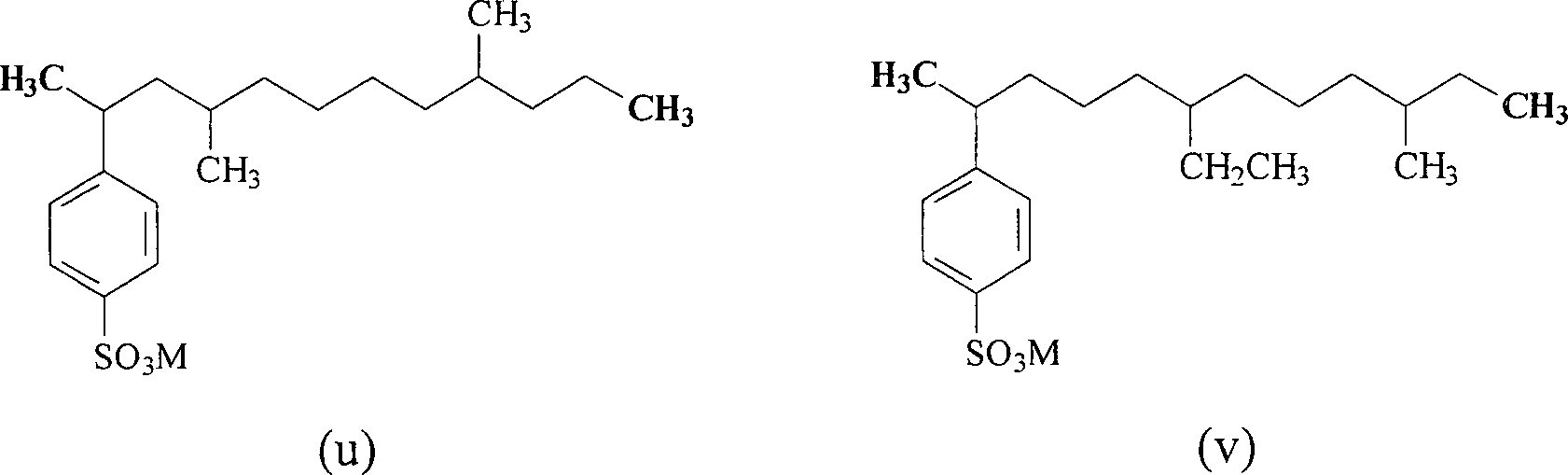
Die Strukturen (w) und (x) veranschaulichen auf nicht einschränkende Weise weniger bevorzugte Verbindungen von Formel (I), die in den modifizierten Alkylbenzolsulfonat-Tensidmischungen der Erfindung und der sich daraus ergebenden Waschmittelzusammensetzungen in geringeren Mengen als die oben veranschaulichten bevorzugten Arten vorhanden sein können.The Structures (w) and (x) are illustrative in a nonlimiting manner less preferred compounds of formula (I) which are modified in the Alkylbenzenesulfonate surfactant mixtures of the invention and resulting detergent compositions in smaller quantities as the preferred types illustrated above can.

Die Strukturen (y), (z) und (aa) veranschaulichen auf nicht einschränkende Weise weitgehend innerhalb der Formel (I) vertretene Zusammensetzungen, die nicht bevorzugt werden, die jedoch in den modifizierten Alkylbenzolsulfonat-Tensidmischungen der Erfindung und den sich daraus ergebenden Waschmittelzusammensetzungen vorhanden sein können.The Structures (y), (z) and (aa) illustrate in a nonlimiting manner largely represented within the formula (I) compositions, which are not preferred, but which are in the modified alkyl benzene sulfonate surfactant mixtures of the invention and the resulting detergent compositions can be present.

Die Struktur (bb) veranschaulicht eine Struktur mit drei Verzweigungen, die nicht innerhalb der Formel (I) enthalten ist, die jedoch als ein Fremdbestandteil vorhanden sein kann.The Structure (bb) illustrates a tree with three branches, which is not included within the formula (I), but which is a foreign component may be present.
Vorzugsweise ist das verzweigte Alkylbenzolsulfonat das Produkt des Sulfonierens eines verzweigten Alkylbenzols, worin das verzweigte Alkylbenzol durch Alkylieren von Benzol mit einem verzweigten Olefin mittels eines Zeolith-Beta-Katalysators produziert wird, der fluoridiert oder nicht fluoridiert sein kann, mehr bevorzugt ist der Zeolith-Beta-Katalysator ein saurer Zeolith-Beta-Katalysator. Die bevorzugten sauren Zeolith-Beta-Katalysatoren sind HF-behandelte kalzinierte Zeolith-Beta-Katalysatoren.Preferably the branched alkylbenzenesulfonate is the product of sulfonation a branched alkylbenzene wherein the branched alkylbenzene by alkylating benzene with a branched olefin by means of a zeolite beta catalyst produced, which may be fluoridated or non-fluoridated, more preferably, the zeolite beta catalyst is an acid zeolite beta catalyst. The preferred acid zeolite beta catalysts are HF-treated calcined zeolite beta catalysts.
Kurz zusammengefasst können modifizierte Alkylbenzolsulfonat-Tensidmischungen hierin durch folgende Schritte hergestellt werden:
- (I) Alkylieren von Benzol mit einer alkylierenden Mischung;
- (II) Sulfonieren des Produkts aus (I); und (wahlweise. jedoch sehr bevorzugt)
- (III) Neutralisieren des Produkts aus (II).
- (I) alkylating benzene with an alkylating mixture;
- (II) sulfonating the product of (I); and (optionally, but very much preferred)
- (III) neutralizing the product of (II).
Mit der Maßgabe, dass geeignete Alkylierungskatalysatoren und Verfahrensbedingungen, wie hier aufgezeigt, verwendet werden, ist das Produkt aus Schritt (I) eine erfindungsgemäße modifizierte Alkylbenzolmischung. Mit der Maßgabe, dass die Sulfonierung unter allgemein bekannten und von der LAS-Herstellung wiederum anwendbaren Bedingungen durchgeführt wird, siehe zum Beispiel die hier zitierten Literaturverweise, ist das Produkt aus Schritt (II) eine erfindungsgemäße modifizierte Alkylbenzolsulfonsäuremischung. Mit der Maßgabe, dass der Neutralisationsschritt (III) wie im Allgemeinen hierin aufgezeigt durchgeführt wird, ist das Produkt aus Schritt (III) eine erfindungsgemäße modifizierte Alkylbenzolsulfonat-Tensidmischung. Da die Neutralisation unvollständig sein kann, sind Mischungen der sauren und neutralisierten Formen der vorliegenden modifizierten Alkylbenzolsulfonatsysteme in allen Verhältnissen, z. B. von etwa 1000:1 bis 1:1000, bezogen auf das Gewicht, ebenfalls Teil der vorliegenden Erfindung. Insgesamt liegen die größten Kritikalitäten in Schritt (I).With the proviso that suitable alkylation catalysts and process conditions, As shown here, the product is from step (I) a modified invention Alkylbenzene. With the proviso that sulfonation is well-known and in turn from LAS production applicable conditions see, for example, the cited references the product of step (II) is a modified alkylbenzenesulphonic acid mixture according to the invention. With the proviso that the neutralization step (III) as generally herein shown performed is the product of step (III) is a modified according to the invention Alkylbenzene sulfonate surfactant. Because the neutralization will be incomplete can be mixtures of acidic and neutralized forms of present modified alkylbenzenesulfonate systems in all proportions, z. From about 1000: 1 to 1: 1000 by weight, also Part of the present invention. Overall, the biggest criticalities are in step (I).
Daher wird ferner bevorzugt, dass in Schritt (I) die Alkylierung bei einer Temperatur von etwa 125°C bis etwa 230°C, bevorzugt von etwa 175°C bis etwa 215°C und bei einem Druck von 3,4 × 10⁵ Pa (50 psig) bis 7,0 × 10⁶ Pa (1000 psig), bevorzugt von 7,0 × 10⁵ Pa (100 psig) bis 1,8 × 10⁶ Pa (250 psig) durchgeführt wird. Die Zeit für diese Alkylierungsreaktion kann variieren, jedoch wird ferner bevorzugt, dass die Zeit für diese Alkylierung von etwa 0,01 Stunden bis etwa 18 Stunden beträgt, mehr bevorzugt so schnell wie möglich, typischer von etwa 0,1 Stunde bis etwa 5 Stunden oder von etwa 0,1 Stunde bis etwa 3 Stunden.Therefore, it is further preferred that in step (I), the alkylation be carried out at a temperature from about 125 ° C to about 230 ° C, preferably from about 175 ° C to about 215 ° C and at a pressure of 3.4 x 10 5 Pa (50 psig) to 7.0 x 10 6 Pa (1000 psig), preferably from 7.0 x 10 5 Pa (100 psig) to 1.8 x 10 6 Pa (250 psig). The time for this alkylation reaction may vary, but it is further preferred that the time for this alkylation be from about 0.01 hours to about 18 hours, more preferably as fast as possible, more typically from about 0.1 hour to about 5 hours, or from about 0.1 hour to about 3 hours.
Im Allgemeinen wird es als bevorzugt befunden, dass in Schritt (I) die Verwendung verhältnismäßig geringer Temperaturen (z. B. 175°C bis etwa 215°C) mit Reaktionszeiten mittlerer Dauer (1 Stunde bis etwa 8 Stunden) in den oben dargelegten Bereichen miteinander verbunden werden.in the In general, it is found preferable that in step (I) the use of relatively less Temperatures (eg 175 ° C up to about 215 ° C) with reaction times of medium duration (1 hour to about 8 hours) in the areas outlined above.
Darüber hinaus wird erwogen, dass der Alkylierungs „schritt" (I) hier „gestaffelt" werden kann, so dass zwei oder mehr Reaktoren, die unter verschiedenen Bedingungen in den definierten Bereichen arbeiten, verwendet werden können. Durch den Betrieb mehrerer solcher Reaktoren ist es möglich, dass anfänglich Material mit einem weniger bevorzugten 2-Methyl-2-phenylindex gebildet und überraschenderweise ein solches Material zu Material mit einem mehr bevorzugten 2-Methyl-2-phenylindex umgewandelt werden kann.Furthermore it is considered that the alkylation "step" (I) can be "staggered" here so that two or more reactors under different conditions work in the defined areas can be used. By the operation of several such reactors, it is possible that initially material formed with a less preferred 2-methyl-2-phenyl index and surprisingly such a material to material having a more preferred 2-methyl-2-phenyl index can be converted.
Daher besteht eine überraschende Entdeckung als Teil der vorliegenden Erfindung darin, dass geringe Anteile an quartären Alkylbenzolen in Zeolith-Beta-katalysierten Reaktionen von Benzol mit verzweigten Olefmen, gekennzeichnet durch einen 2-Methyl-2-phenylindex von unter 0,1, erzielt werden können.Therefore there is a surprising Discovery as part of the present invention in that low levels on quaternary Alkylbenzenes in zeolite-beta-catalyzed reactions of benzene with branched olefins characterized by a 2-methyl-2-phenyl index of less than 0.1 can be achieved.
AlkylierungskatalysAlkylierungskatalys
Die vorliegende Erfindung verwendet einen besonders definierten Alkylierungskatalysator. Solch ein Katalysator umfasst einen mäßig sauren, mittelporigen Zeolith, wie nachfolgend ausführlich definiert. Ein besonders bevorzugter Alkylierungskatalysator umfasst mindestens teilweise dealuminisierten, sauren, nicht-fluoridierten oder mindestens teilweise dealuminisierten, sauren, fluoridierten Zeolith Beta.The The present invention uses a particularly defined alkylation catalyst. Such a catalyst comprises a moderately acidic, medium-pore zeolite, as detailed below Are defined. A particularly preferred alkylation catalyst comprises at least partially dealuminized, acidic, non-fluoridated or at least partially dealuminated, acidic, fluoridated zeolite Beta.
Zahlreiche Alkylierungskatalysatoren werden rasch als nicht geeignet befunden. Ungeeignete Alkylierungskatalysatoren schließen die DETAL®-Prozesslcatalysatoren, Aluminiumchlorid, HF und viele andere ein. Tatsächlich ist kein Alkylierungskatalysator, der derzeit in der kommerziellen Produktion von linearen Waschmittel-Alkylbenzolsulfonaten zum Alkylieren verwendet wird, geeignet.Numerous alkylation catalysts are rapidly found to be unsuitable. Unsuitable alkylation catalysts include the DETAL ® -Prozesslcatalysatoren, aluminum chloride, HF, and many others. In fact, no alkylation catalyst currently used in the commercial production of linear detergent alkylbenzenesulfonates for alkylation is suitable.
Dagegen ist ein geeigneter Alkylierungskatalysator aus formselektiven, mäßig sauren Alkylierungskatalysatoren, bevorzugt zeolithischen ausgewählt. Genauer ist der Zeolith in solchen Katalysatoren für den Alkylierungsschritt, Schritt I, bevorzugt ausgewählt aus der Gruppe, bestehend aus ZSM-4, ZSM-20 und Zeolith Beta, mehr bevorzugt Zeolith Beta, in zumindest teilweise saurer Form. Mehr be vorzugt liegt der Zeolith in Schritt I (dem Alkylierungsschritt) im Wesentlichen in saurer Form vor und ist in einem Katalysatorpellet, der ein herkömmliches Bindemittel umfasst, enthalten, wobei das Katalysatorpellet ferner zu mindestens etwa 1%, mehr bevorzugt mindestens 5%, typischer von 50% bis etwa 90% den Zeolith umfasst, worin der Zeolith bevorzugt ein Zeolith Beta ist. Allgemeiner ist ein geeigneter Alkylierungskatalysator normalerweise zumindest teilweise kristallin, mehr bevorzugt im Wesentlichen kristallin, und schließt keine Bindemittel oder anderen Materialien, die zum Bilden von Katalysatorpellets, -aggregaten oder -verbundstoffen verwendet werden, ein. Darüber hinaus ist der Katalysator normalerweise zumindest teilweise saurer Zeolith Beta. Dieser Katalysator ist nützlich für den Alkylierungsschritt, der nachfolgend in den Ansprüchen als Schritt I ausgewiesen ist.In contrast, a suitable alkylation catalyst is selected from shape-selective, moderately acidic alkylation catalysts, preferably zeolitic ones. More particularly, the zeolite in such catalysts for the alkylation step, step I, is preferably selected from the group consisting of ZSM-4, ZSM-20 and zeolite Beta, more preferably zeolite beta, in at least partially acidic form. More preferably, the zeolite in step I (the alkylation step) is in substantially acidic form and is contained in a catalyst pellet comprising a conventional binder, the catalyst pellet being more typically at least about 1%, more preferably at least 5%, more typical from 50% to about 90% of the zeolite, wherein the zeolite is preferably a zeolite beta. More generally, a suitable alkylation catalyst will normally be at least partially crystalline, more preferably substantially crystalline, and will not include binders or other materials used to form catalyst pellets, aggregates or composites. In addition, the catalyst is normally at least partially acidic zeolite beta. This catalyst is useful for the alkylation step identified as Step I below in the claims.
Der größte Porendurchmesser, der die im vorliegenden Alkylierungsverfahren nützlichen Zeolithe charakterisiert, kann im Bereich von 6 Angström bis 8 Angström liegen, wie bei Zeolith Beta. Es sei klargestellt, dass in jedem Fall die als Katalysatoren im Alkylierungsschritt des vorliegenden Verfahrens verwendeten Zeolithe eine Hauptporenabmessung aufweisen, die zwischen der von großporigen Zeolithen, wie den X- und Y-Zeolithen, und den Zeolithen mit verhältnismäßig kleiner Porengröße, wie Mordenit, Offretit, HZSM-12 und HZSM-5, liegt. Tatsächlich wurde ZSM-5 erprobt und in der vorliegenden Erfindung als nicht praktizierbar befunden. Die Porengrößenabmessungen und Kristallstrukturen bestimmter Zeolithe werden in ATLAS OF ZEOLITE STRUCTURE TYPES von W. M. Meier und D. H. Olson, veröffentlicht von der Structure Commission of the International Zeolite Association (1978 und neuere Ausgaben) und vertrieben von Polycrystal Book Service, Pittsburgh, Pa., USA, spezifiziert.Of the largest pore diameter, which characterizes the zeolites useful in the present alkylation process, can be in the range of 6 angstroms up to 8 angstroms lie, as with zeolite beta. It should be made clear that in each Case as catalysts in the alkylation of the present Zeolites used have a major pore size, the between the large pores Zeolites, such as the X and Y zeolites, and the relatively smaller zeolites Pore size, like Mordenite, Offretit, HZSM-12 and HZSM-5. Actually became ZSM-5 and tested in the present invention as not practicable found. The pore size dimensions and crystal structures of certain zeolites are described in ATLAS OF ZEOLITE STRUCTURE TYPES by W.M. Meier and D.H. Olson, published from the Structure Commission of the International Zeolite Association (1978 and later editions) and distributed by Polycrystal Book Service, Pittsburgh, Pa., USA.
Bei den im Alkylierungsschritt des vorliegenden Verfahrens nützlichen Zeolithen sind im Allgemeinen mindestens 10 Prozent der kationischen Stellen von anderen Ionen als Alkali- oder Erdalkalimetallionen belegt. Typische, jedoch nicht einschränkende Austauschionen schließen Ammoniuin-, Wasserstoff-, Seltenerdme tall-, Zink-, Kupfer- und Aluminiumionen ein. Von dieser Gruppe sind Ammonium, Wasserstoff, Seltenerdmetalle oder Kombinationen davon besonders bevorzugt. In einer bevorzugten Ausführungsform werden die Zeolithe überwiegend in die Wasserstoffform umgewandelt, im Allgemeinen durch Austausch des ursprünglich vorliegenden Alkalimetallions oder eines anderen vorhandenen Ions durch Wasserstoffionen-Vorläufer, z. B. Ammoniumionen, die bei Kalzinierung die Wasserstoffform ergeben. Dieser Austausch wird praktischerweise durch Kontakt des Zeoliths mit einer Ammoniumsalzlösung, z. B. Ammoniumchlorid, unter Anwendung bekannter Ionenaustauschverfahren durchgeführt. In bestimmten bevorzugten Ausführungsformen liegt ein solcher Austauschgrad vor, dass ein Zeolithmaterial erzeugt wird, in dem mindestens 50 Prozent der kationischen Stellen durch Wasserstoffionen besetzt sind.at useful in the alkylation step of the present process Zeolites are generally at least 10 percent of the cationic Make ions other than alkali or alkaline earth metal ions busy. Typical but non-limiting substitutions include ammonium, Hydrogen, rare earth metal, zinc, copper and aluminum ions one. Of this group are ammonium, hydrogen, rare earth metals or combinations thereof are particularly preferred. In a preferred embodiment the zeolites become predominant converted to the hydrogen form, generally by exchange of the original present Alkalimetallions or other existing ion by hydrogen ion precursors, for. B. ammonium ions which give the hydrogen form when calcined. This exchange is conveniently done by contact of the zeolite with an ammonium salt solution, z. For example, ammonium chloride, using known ion exchange method carried out. In certain preferred embodiments There is such a degree of exchange that produces a zeolite material in which at least 50 percent of the cationic sites go through Hydrogen ions are occupied.
Die Zeolithe können verschiedenen chemischen Behandlungen unterzogen werden, einschließlich Aluminiumoxidextraktion (Dealuminierung) und Kombination mit einem oder mehreren Metallbestandteilen, insbesondere den Metallen der Gruppen IIB, III, IV, VI, VII und VIII. Außerdem wird erwogen, dass es erwünscht ist, dass die Zeolithe in einigen Fällen einer Wärmebehandlung, einschließlich Dampfbehandlung oder Kalzinierung in Luft, Wasserstoff oder einem Inertgas, z. B. Stikstoff oder Helium, unterzogen werden können.The Zeolites can various chemical treatments, including aluminum oxide extraction (Dealumination) and combination with one or more metal components, in particular In addition, the metals of groups IIB, III, IV, VI, VII and VIII considered that desirable is that in some cases the zeolites undergo a heat treatment, including Steam treatment or calcination in air, hydrogen or a Inert gas, e.g. B. Stikstoff or helium can be subjected.
Eine geeignete Modifikationsbehandlung umfasst das Bedampfen des Zeoliths mit einer Atmosphäre, die etwa 5 bis etwa 100% Dampf bei einer Temperatur von etwa 250°C bis 1000°C enthält. Die Dampfbehandlung kann über einen Zeitraum zwischen etwa 0,25 und etwa 100 Stunden andauern und kann bei Drücken im Bereich von subatmosphärisch bis zu mehreren hundert Atmosphären durchgeführt werden.A Suitable modification treatment involves the vaporization of the zeolite with an atmosphere that from about 5 to about 100% steam at a temperature of about 250 ° C to 1000 ° C. The Steam treatment can over a period of between about 0.25 and about 100 hours and can be pressed in the range of subatmospheric up to several hundred atmospheres carried out become.
Bei der Durchführung des erwünschten Alkylierungsschritts des vorliegenden Verfahrens kann es nützlich sein, die oben beschriebenen kristallmen Zeolithe mittlerer Porengröße in ein anderes Material einzugliedern, z. B. in ein Bindemittel oder eine Matrix, die gegenüber der in dem Verfahren eingesetzten Temperatur und anderen Bedingungen beständig sind. Solche Matrixmaterialien schließen synthetische oder natürlich vorkommende Substanzen sowie anorganische Materialien wie Tonerde, Silica und/oder Metalloxide ein. Matrixmaterialien können in Form von Gelen, die Mischungen aus Silica und Metalloxiden einschließen, vorliegen. Letztere können entweder natürlich vorkommen oder in Form von Gelen oder gelatinösen Ausfällungen sein. Natürlich vorkommende Tonerden, die mit dem Zeolith verbunden werden können, schließen diejenigen der Montmorillonit- und der Kaolin-Familie ein, welche die Subbentonite und die Kaoline umfassen, die gemeinhin als Dixie-, McNamee-Georgia- und Florida-Tonerden bekannt sind, oder andere, bei denen der Hauptmineralbestandteil Halloysit, Kaolinit, Dickit, Nakrit oder Anauxit ist. Solche Tonerden können im Rohzustand, wie ursprünglich abgebaut, verwendet werden oder anfänglich einer Kalzinierung, Säurebehandlung oder chemischen Modifizierung unterzogen werden.at the implementation of the desired Alkylation step of the present process, it may be useful the above-described medium pore size crystal zeolites incorporate other material, e.g. B. in a binder or a Matrix, opposite the temperature used in the process and other conditions resistant are. Such matrix materials include synthetic or naturally occurring ones Substances and inorganic materials such as alumina, silica and / or Metal oxides. Matrix materials can be in the form of gels, the Include mixtures of silica and metal oxides. The latter can either Naturally occur or in the form of gels or gelatinous precipitates. Naturally occurring Clays that can be attached to the zeolite include those the montmorillonite and the kaolin family containing the subbentonites and the kaolins commonly referred to as Dixie, McNamee-Georgia and Florida clays are known, or others where the main mineral constituent Halloysite, kaolinite, dickite, nacrite or anauxite is. Such clays can in the raw state, as originally degraded, used or initially calcined, acid treatment or undergo chemical modification.
Zusätzlich zu den vorstehenden Materialien können die hier eingesetzten Zeolithe mittlerer Porengröße mit einem porösen Matrixmaterial verbunden werden, wie Aluminiumoxid, Silica-Aluminiumoxid, Silica-Magnesiumoxid, Silica-Zirkoniumoxid, Silica-Thoriumoxid, Silica-Berylliumoxid, Silica-Titan(IV)-oxid sowie ternären Kombinationen, wie Silica-Aluminiumoxid-Thoriumoxid, Silica-Aluminiumoxid-Zirkoniumoxid, Silica-Aluminiumoxid-Magnesiumoxid und Silica-Magnesiumoxid-Zirkoniumoxid. Die Matrix kann in Form eines Cogels vorliegen. Die relativen Anteile des fein verteilten Zeoliths und der anorganischen Oxidgelmatrix können stark schwanken, wobei der Zeolithgehalt von etwa 1 bis etwa 99 Gew.-% und typischer im Bereich von etwa 5 bis etwa 80 Gew.-% des Verbundstoffs reichen kann.In addition to the above materials can the medium pore size zeolites used herein with a porous matrix material such as alumina, silica-alumina, silica-magnesia, Silica-zirconia, silica-thoria, silica-beryllia, Silica-titanium (IV) oxide as well as ternary Combinations such as silica-alumina-thoria, silica-alumina-zirconia, Silica-alumina-magnesia and silica-magnesia-zirconia. The matrix can be in shape of a cogel. The relative proportions of the finely divided Zeolite and the inorganic oxide gel matrix can vary widely, with the zeolite content is from about 1 to about 99% by weight and more typically in the Range from about 5 to about 80 wt .-% of the composite range can.
Eine Gruppe an Zeolithen, die einige für den Alkylierungsschritt nützliche Zeolithe enthält, weist ein Silica-Aluminiumoxid-Verhältnis von mindestens 10:1, bevorzugt von mindestens 20:1 auf. Die Silica-Aluminiumoxid-Verhältnisse, auf die in dieser Spezifikation Bezug genommen wird, sind die Struktur- oder Rahmenverhältnisse, das heißt, das Verhältnis für das SiO4- zum AlO4-Tetraeder.A group of zeolites containing some zeolites useful for the alkylation step has a silica to alumina ratio of at least 10: 1, preferably at least 20: 1. The silica-to-alumina ratios referred to in this specification are the structural or framework ratios, that is, the ratio for the SiO 4 to the AlO 4 tetrahedron.
Dieses Verhältnis kann von dem durch verschiedene physikalische und chemische Methoden festgelegten Silica-Aluminiumoxid-Verhältnis abweichen. Zum Beispiel kann eine chemische Bruttoanalyse Aluminium einschließen, das in Form von Kationen vorhanden ist, die mit den sauren Stellen auf dem Zeolith verbunden sind, wodurch sich ein geringes Silica-Aluminiumoxid-Verhältnis ergibt. In ähnlicher Weise kann, wenn das Verhältnis mittels thermogravimetrischer Analyse (TGA) der Ammoniakdesorption ermittelt wird, eine niedrige Ammoniaktitration erzielt werden, wenn das kationische Aluminium den Wechsel der Ammoniumionen zu den sauren Stellen verhindert. Diese Disparitäten sind besonders schwierig, wenn bestimmte Behandlungen, wie die nachfolgend beschriebenen Dealuminisierungsmethoden, angewendet werden, die zum Vorhandensein von ionischem Aluminium führen, das von der Zeolithstruktur losgelöst ist. Daher sollte entsprechende Sorge getragen werden, um sicherzustellen, dass das Silica-Aluminiumoxid-Rahmenverhältnis korrekt ermittelt wird.This relationship can by different physical and chemical methods specified silica-alumina ratio differ. For example can include a gross chemical analysis of aluminum, the is present in the form of cations that interact with the acidic sites the zeolite, resulting in a low silica-alumina ratio results. In similar Way, if the ratio by means of thermogravimetric analysis (TGA) of ammonia desorption is determined, a low ammonia titration can be achieved when cationic aluminum causes the change of ammonium ions the acidic sites prevented. These disparities are particularly difficult if certain treatments, such as the dealumination methods described below, be applied to the presence of ionic aluminum to lead, which is detached from the zeolite structure. Therefore should be appropriate Care must be taken to ensure that the silica-alumina framework is correct is determined.
Wenn die Zeolithe unter Vorhandensein von organischen Kationen hergestellt werden, sind sie katalytisch inaktiv, möglicherweise da der intrakristalline freie Raum von organischen Kationen aus der Herstellungslösung belegt ist. Sie können zum Beispiel durch einstündiges Erhitzen in einer inerten Atmosphäre bei 540°C gefolgt von Basenaustausch mit Ammoniumsalzen und anschließender Kalzinierung bei 540°C in Luft aktiviert werden. Das Vorhandensein organischer Kationen in der Herstellungslösung ist möglicherweise für die Bildung des Zeoliths nicht unbedingt erforderlich; es scheint jedoch die Bildung dieser bestimmten Art von Zeolith zu begünstigen. Einige natürliche Zeolithe können mitunter durch verschiedene Aktivierungsverfahren und andere Behandlungen, wie Basenaustausch, Dampfbehandlung, Aluminiumoxidextraktion und Kalzinierung, in Zeolithe des gewünschten Typs umgewandelt werden. Die Zeolithe weisen bevorzugt eine Kristallrahmendichte auf. die in trockener Wasserstoffform nicht wesentlich unter etwa 1,6 g/cm3 liegt.When prepared in the presence of organic cations, the zeolites are catalytically inactive, possibly because the intracrystalline free space is occupied by organic cations from the preparation solution. For example, they can be activated by heating in an inert atmosphere at 540 ° C for one hour followed by base exchange with ammonium salts followed by calcination at 540 ° C in air. The presence of organic cations in the preparation solution may not be necessary for the formation of the zeolite; however, it seems to favor the formation of this particular type of zeolite. Some natural zeolites can sometimes be converted to zeolites of the desired type by various activation methods and other treatments such as base exchange, steaming, alumina extraction and calcination. The zeolites preferably have a crystal frame density. which in dry hydrogen form is not substantially below about 1.6 g / cm 3 .
Die Trockendichte kann für bekannte Strukturen über die Anzahl der Siliciumatome plus Aluminiumatome pro 1000 Kubik-Angström berechnet werden, wie z. B. auf Seite 19 des Artikels über Zeolithstruktur von W. M. Meier, enthalten in „Proceedings of the Conference on Molecular Sieves, London, April 1967", veröffentlicht von der Society of Chemical Industry, London 1968, aufgeführt ist. Auf diese Arbeit wird zwecks einer Erörterung der Kristallrahmendichte Bezug genommen. Eine weitere Erörterung der Kristallrahmendichte, zusammen mit Werten für einige typische Zeolithe, wird im US-Patent Nr. 4 016 218 geliefert, auf das Bezug genommen wird. Wenn der Zeolith in der Alkalimetallform synthetisiert wird, wird er praktischerweise in die Wasserstoffform umgewandelt, im Allgemeinen durch die zwischenzeitliche Bildung der Ammoniumform infolge eines Ammoniumionenaustausches und Kalzinierung der Ammoniumform, um die Wasserstoffform zu ergeben. Es wurde herausgefunden, dass, obgleich die Wasserstoffform des Zeoliths die Reaktion erfolgreich katalysiert, der Zeolith ebenfalls teilweise in Alkalimetallform vorliegen kann.The Dry density can for known structures over calculated the number of silicon atoms plus aluminum atoms per 1000 cubic angstroms be such. On page 19 of the article on zeolite structure of W. M. Meier, contained in "Proceedings of the Conference on Molecular Sieves, London, April 1967 " by the Society of Chemical Industry, London 1968. This work will be discussed for a discussion of the crystal frame density Referenced. Another discussion the crystal frame density, along with values for some typical zeolites, is provided in U.S. Patent No. 4,016,218, incorporated herein by reference becomes. When the zeolite is synthesized in the alkali metal form, it is conveniently converted to the hydrogen form, in the Generally by the interim formation of the ammonium form due to ammonium ion exchange and calcination of the ammonium form, to give the hydrogen form. It was found out that although the hydrogen form of the zeolite makes the reaction successful catalyzes, the zeolite also partially in alkali metal form may be present.
Bevorzugte
Zeolith-Katalysatoren schließen
Zeolith Beta, HZSM-4, HZSM-20 und HZSM-38 ein. Der am meisten bevorzugte
Katalysator ist saurer Zeolith Beta. Ein zum diesbezüglichen
Gebrauch geeigneter Zeolith Beta wird in
Zeolith-Beta-Katalysatoren in Säureform sind ebenfalls im Handel erhältlich als Zeocat PB/H von Zeochem. Weitere zum Gebrauch geeignete Zeolith-Beta-Katalysatoren können von UOP Chemical Catalysts und Zeolyst International geliefert werden.Zeolite beta catalysts in acid form are also commercially available as Zeocat PB / H from Zeochem. Other suitable zeolite beta catalysts for use can supplied by UOP Chemical Catalysts and Zeolyst International.
Ganz allgemein können Alkylierungskatalysatoren hierin verwendet werden, mit der Maßgabe, dass der Alkylierungskatalysator 1) die hierin beschriebenen verzweigten Olefine in den kleinsten Porendurchmesser des Katalysators aufnehmen kann und 2) Benzol mit den verzweigten Olefmen und/oder eine Mischung mit unverzweigten Olefinen selektiv alkylieren kann, mit ausreichender Selektivität, um die hier definierten 2/3-Ph-Indexwerte zu ergeben.In general, alkylation catalysts can be used herein, provided that the alkylation catalyst 1) can accommodate the branched olefins described herein in the smallest pore diameter of the catalyst and 2) benzene with the branched olefins and / or a mixture can selectively alkylate with unbranched olefins, with sufficient selectivity to give the 2/3-Ph index values defined herein.
In einer bevorzugten Methode wird ein hydrotroper Stoff oder ein Vorläufer eines hydrotropen Stoffs entweder nach Schritt (I), während oder nach Schritt (II) und vor Schritt (III) oder während oder nach Schritt (III) hinzugefügt. Die hydrotropen Stoffe sind aus jedem beliebigen geeigneten hydrotropen Stoff, normalerweise einem Sulfonsäure- oder Natriumsulfonatsalz von Toluol, Cumol, Xylol, Naphthalin oder Mischungen davon ausgewählt. Die Vorläufer hydrotroper Stoffe sind aus jedem beliebigen geeigneten Vorläufer hydrotroper Stoffe, normalerweise Toluol, Cumol, Xylol, Naphthalin oder Mischungen davon ausgewählt.In A preferred method is a hydrotrope or a precursor of a hydrotrope either after step (I), during or after step (II) and before step (III) or during or added after step (III). The hydrotropes are any suitable hydrotropes Substance, usually a sulfonic acid or sodium sulfonate salt of toluene, cumene, xylene, naphthalene or mixtures thereof. The precursor Hydrotropes are hydrotrope from any suitable precursor Substances, usually toluene, cumene, xylene, naphthalene or mixtures selected from it.
Sulfonierung und Aufarbeitung oder Neutralisation (Schritte II/III)Sulfonation and workup or neutralization (steps II / III)
Vorzugsweise wird der Sulfonierungsschritt (II) unter Verwendung eines Sulfonierungsmittels durchgeführt, das bevorzugt ausgewählt ist aus der Gruppe, bestehend aus Schwefelsäure, Schwefeltrioxid mit oder ohne Luft, Chlorsulfonsäure, Oleum und Mischungen davon. Ferner wird bevorzugt, dass in Schritt (II) die Bestandteile außer Monoalkylbenzol entfernt werden, ehe das Produkt aus Schritt (I) mit Sulfonierungsmittel in Kontakt kommt.Preferably the sulfonation step (II) is carried out using a sulfonating agent carried out, that is preferably selected is from the group consisting of sulfuric acid, sulfur trioxide with or without Air, chlorosulfonic acid, Oleum and mixtures thereof. It is further preferred that in step (II) the ingredients except Monoalkylbenzene be removed before the product of step (I) comes into contact with sulfonating agent.
In
Allgemeinen kann die Sulfonierung der modifizierten Alkylbenzole
in dem vorliegenden Verfahren unter Verwendung eines beliebigen
der bekannten Sulfonierungssysteme erzielt werden, einschließlich jenen, die
in „Detergent
Manufacture Including Zeolith Builders and other New Materials", Hrsg. Sittig.,
Noyes Data Corp., 1979, und in Bd. 56 der Reihe „Surfactant Science", Marcel Dekker,
New York 1996, einschließlich
insbesondere Kapitel 2 mit dem Titel „Alkylarylsulfonates: History,
Manufacture, Analysis and Environmental Properties", Seiten 39–108, die
297 Literaturverweise umfassen, beschrieben werden. Diese Arbeit
bietet Zugang zu umfangreicher Literatur, in der verschiedene Verfahren
und Verfahrensschritte beschrieben werden, nicht nur Sulfonierung,
sondern auch Dehydrierung, Alkylierung, Alkylbenzoldestillation
und dergleichen. Gewöhnli che
hierin nützliche
Sulfonierungssysteme schließen
Schwefelsäure,
Chlorsulfonsäure,
Oleum, Schwefeltrioxid und dergleichen ein. Schwefeltrioxid/Luft
ist besonders bevorzugt. Einzelheiten der Sulfonierung unter Verwendung
eines geeigneten Luft/Schwefeltrioxid-Gemisches bietet
In dem vorliegenden Verfahren können beliebige geeignete Aufarbeitungsschritte angewendet werden. Übliche Praxis ist es, nach der Sulfonierung mit beliebigem geeigneten Alkali zu neutralisieren. Somit kann der Neutralisationsschritt unter Verwendung von Alkali, ausgewählt aus den Alkalien von Natrium, Kalium, Ammonium, Magnesium und substituiertem Ammonium und Mischungen davon, durchgeführt werden. Kalium kann die Löslichkeit unterstützen, Magnesium kann die Weichwasserleistung fördern, und substituiertes Ammonium kann für die Formulierung von Spezialvariationen der vorliegenden Tenside hilfreich sein. Die Erfindung umfasst beliebige dieser Derivatformen der modifizierten Alkylbenzolsulfonattenside, wie durch das vorliegende Verfahren hergestellt, und ihre Verwendung in Endproduktzusammensetzungen.In in the present method Any suitable work-up steps are applied. Usual practice it is after sulfonation with any suitable alkali to neutralize. Thus, the neutralization step using of alkali, selected from the alkalis of sodium, potassium, ammonium, magnesium and substituted Ammonium and mixtures thereof. Potassium can be the solubility support, Magnesium can promote the soft water performance, and substituted ammonium can for the formulation of special variations of the present surfactants to be helpful. The invention includes any of these forms of derivatives the modified alkylbenzenesulfonate surfactants as defined by the present invention Processes, and their use in end product compositions.
Als Alternative kann die Säureform der vorliegenden Tenside direkt zu sauren Reinigungsprodukten gegeben werden oder mit Reinigungsbestandteilen vermischt und anschließend neutralisiert werden.When Alternative may be the acid form the present surfactants added directly to acidic cleaning products or mixed with cleaning ingredients and then neutralized become.
Vorzugsweise wird der Neutralisationschritt (III) unter Verwendung eines basischen Salzes ausgeführt. Vorzugsweise besitzt das basische Salz ein Kation, ausgewählt aus der Gruppe, bestehend aus Alkalimetall, Erdalkalimetall, Ammonium, substituiertem Ammonium und Mischungen davon, und ein Anion, ausgewählt aus Hydroxid, Oxid, Carbonat, Silicat, Phosphat und Mischungen davon. Mehr bevorzugt ist das basische Salz ausgewählt aus der Gruppe, bestehend aus Natriumhydroxid, Kaliumhydroxid, Magnesiumhydroxid, Calciumhydroxid, Ammoniumhydroxid und Mischungen davon.Preferably the neutralization step (III) is carried out using a basic Salt carried out. Preferably the basic salt has a cation selected from the group consisting of alkali metal, alkaline earth metal, ammonium, substituted ammonium and mixtures thereof, and an anion selected from hydroxide, oxide, carbonate, Silicate, phosphate and mixtures thereof. More preferred is the basic one Salt selected from the group consisting of sodium hydroxide, potassium hydroxide, magnesium hydroxide, Calcium hydroxide, ammonium hydroxide and mixtures thereof.
Die Verfahren können variiert werden, zum Beispiel können die herkömmlichen Schritte vor, gleichzeitig mit oder nach den ausgeführten Schritten (I), (II) und (III) hinzugefügt werden. Dies gilt insbesondere für das Unterbringen der Verwendung hydrotroper Stoffe oder ihrer Vorläufer.The Procedures can can be varied, for example the conventional ones Steps ahead, simultaneously with or after the steps performed (I), (II) and (III) added become. This is especially true for housing the use of hydrotropes or their precursors.
Präparative Beispielepreparative Examples
BEISPIEL 1EXAMPLE 1
Mischung aus 4-Methyl-4-nonanol, 5-Methyl-5-decanol, 6-Methyl-6-undecanol und 6-Methyl-6-dodecanolMixture of 4-methyl-4-nonanol, 5-methyl-5-decanol, 6-methyl-6-undecanol and 6-methyl-6-dodecanol
(Ein Ausgangsmaterial für verzweigte Olefine)(A starting material for branched olefins)
Eine Mischung aus 4,65 g 2-Pentanon, 20,7 g 2-Hexanon, 51,0 g 2-Heptanon, 36,7 g 2-Octanon und 72,6 g Diethylether wird in einen Zugabetrichter gegeben. Die Ketonmischung wird anschließend tröpfchenweise über einen Zeitraum von 2,25 Stunden unter Rühren in einen 2-l-Dreihalsrundkolben mit Stickstoffpolster gegeben, der mit einem Rückflusskühler ausgestattet ist und 600 ml von 2,0 M n-Pentylmagnesiumbromid in Diethylether und zusätzlich 400 ml Diethylether enthält. Nachdem die Zugabe abgeschlossen ist, wird das Reaktionsgemisch weitere 2,5 Stunden bei 20°C gerührt. Das Reaktionsgemisch wird anschließend unter Rühren zu 1 kg zerstoßenem Eis gegeben. Zu dieser Mischung werden 393,3 g 30%ige Schwefelsäurelösung gegeben. Die wässrige Säureschicht wird abgelassen, und die verbleibende Etherschicht wird zwei Mal mit 750 ml Wasser gewaschen. Die Etherschicht wird anschließend unter Vakuum verdampft, um 176,1 g einer Mischung aus 4-Methyl-4-nonanol, 5-Methyl-5-decanol, 6-Methyl-6-undecanol und 6-Methyl-6-dodecanol zu ergeben.A Mixture of 4.65 g of 2-pentanone, 20.7 g of 2-hexanone, 51.0 g of 2-heptanone, 36.7 g of 2-octanone and 72.6 g of diethyl ether are placed in an addition funnel given. The ketone mixture is then added dropwise over a 2.25 hours with stirring in a 2-liter 3-neck round bottom flask with nitrogen padding equipped with a reflux condenser and 600 ml of 2.0 M n-pentylmagnesium bromide in diethyl ether and in addition Contains 400 ml of diethyl ether. After the addition is complete, the reaction mixture becomes another 2.5 hours at 20 ° C touched. The reaction mixture is then added with stirring 1 kg crushed Given ice cream. To this mixture is added 393.3 g of 30% sulfuric acid solution. The watery acid layer is drained, and the remaining ether layer is washed twice washed with 750 ml of water. The ether layer is then submerged Vapor evaporated to give 176.1 g of a mixture of 4-methyl-4-nonanol, 5-methyl-5-decanol, 6-methyl-6-undecanol and 6-methyl-6-dodecanol to surrender.
BEISPIEL 2EXAMPLE 2
Mischung aus im Wesentlichen monomethylverzweigten Olefinen mit randomisierter Verzweigung (Ein alkylierendes Mittel zum Herstellen von erfindungsgemäßen modifizierten Alkylbenzolen)Mixture of essentially monomethyl branched olefins with randomized branching (A Alkylating agent for producing modified according to the invention alkylbenzenes)
- a) Eine Probe von 174,9 g der Mischung aus monomethylverzweigten Alkoholen von Beispiel 1 wird unter Rühren in einen 500-ml-Dreihalsrundkolben mit Stickstoffpolster, ausgestattet mit einem Wasserabscheider und einem Rückflusskühler, zusammen mit 35,8 g eines formselektiven Zeolith-Katalysators (saurer Mordenit-Katalysator ZeocatTM FM-8/25H) gegeben. Unter Mischen wird die Mischung anschließend auf etwa 110–155°C erhitzt und Wasser und etwas Olefin werden über einen Zeitraum von 4–5 Stunden im Wasserabscheider aufgefangen. Die Umwandlung der Alkoholmischung aus Beispiel 1 in eine aus im Wesentlichen nicht randomisierten methylverzweigten Olefinen bestehende Mischung ist nunmehr abgeschlossen, und das Reaktionsgemisch wird auf 20°C abgekühlt. Die aus im Wesentlichen nicht randomisierten methylverzweigten Olefinen bestehende Mischung, die im Kolben verbleibt, wird gefiltert, um den Katalysator zu entfernen. Der feste Filterrückstand wird zwei Mal mit je 100 ml Hexan gewaschen. Das Hexanfiltrat wird unter Vakuum verdampft, und das sich daraus ergebende Produkt wird mit dem ersten Filtrat kombiniert, um 148,2 g einer aus im Wesentlichen nicht randomisierten methylverzweigten Olefinen bestehenden Mischung zu ergeben.a) A sample of 174.9 g of the monomethyl branched alcohol mixture of Example 1 is added with stirring to a 500 ml three-neck nitrogen-padded round bottom flask equipped with a water separator and a reflux condenser, together with 35.8 g of a shape-selective zeolite catalyst ( acidic mordenite catalyst Zeocat ™ FM-8 / 25H). With mixing, the mixture is then heated to about 110-155 ° C and water and some olefin are collected over a period of 4-5 hours in a water separator. Conversion of the alcohol mixture of Example 1 to a mixture consisting of substantially non-randomized methyl branched olefins is now completed and the reaction mixture is cooled to 20 ° C. The mixture of substantially non-randomized methyl-branched olefins remaining in the flask is filtered to remove the catalyst. The solid filter residue is washed twice with 100 ml of hexane. The hexane filtrate is evaporated under vacuum and the resulting product is combined with the first filtrate to give 148.2 g of a mixture consisting of substantially non-randomized methyl branched olefins.
- b) Die Olefinmischung aus Beispiel 2a wird mit 36 g eines formselektiven Zeolith-Katalysators (saurer Mordenit-Katalysator ZeocatTM FM-8/25H) kombiniert und gemäß Beispiel 2a mit den folgenden Änderungen umgesetzt. Die Reaktionstemperatur wird für einen Zeitraum von etwa 1–2 Stunden auf 190–200°C erhöht, um die spezifischen Verzweigungspositionen in der Olefinmischung zu randomisieren. Das Reaktionsge misch wird auf 20°C abgekühlt. Die im Wesentlichen aus monomethylverzweigten Olefinen bestehende Mischung mit randomisierter Verzweigung, die im Kolben verbleibt, wird gefiltert, um den Katalysator zu entfernen. Der feste Filterrückstand wird zwei Mal mit je 100 ml Hexan gewaschen. Das Hexanfiltrat wird unter Vakuum verdampft, und das sich daraus ergebende Produkt wird mit dem ersten Filtrat kombiniert, um 147,5 g einer im Wesentlichen aus monomethylverzweigten Olefinen bestehenden Mischung mit randomisierter Verzweigung zu ergeben.b) The olefin mixture from Example 2a is combined with 36 g of a shape-selective zeolite catalyst (acidic mordenite catalyst Zeocat ™ FM-8 / 25H) and reacted according to Example 2a with the following changes. The reaction temperature is raised to 190-200 ° C for a period of about 1-2 hours to randomize the specific branching positions in the olefin mixture. The reaction mixture is cooled to 20 ° C. The mixture of random branching, consisting essentially of monomethyl branched olefins, which remains in the flask is filtered to remove the catalyst. The solid filter residue is washed twice with 100 ml of hexane. The hexane filtrate is evaporated under vacuum and the resulting product is combined with the first filtrate to give 147.5 g of a randomly branched mixture consisting essentially of monomethyl branched olefins.
BEISPIEL 3EXAMPLE 3
Mischung aus im Wesentlichen monomethylverzweigten Alkylbenzolen mit einem 2/3-Phenylindex von etwa 200 und einem 2-Methyl-2-phenylindex von etwa 0,005Mixture of essentially monomethyl branched alkylbenzenes having a 2/3 phenyl index of about 200 and a 2-methyl-2-phenyl index of about 0.005
(Eine erfindungsgemäße modifizierte Alkylbenzolmischung)(A modified invention alkylbenzene)
147 g der im Wesentlichen aus monomethylverzweigten Olefinen bestehenden Mischung mit randomisierter Verzweigung von Beispiel 2 und 36 g eines formselektiven Zeolith-Katalysators (saurer Beta-Zeolith-Katalysator ZeocatTM PB/H) werden unter Rühren in einen Edelstahl-Autoklav von 7,6 Litern (2 Gallonen) gegeben. Reste vom Olefin und vom Katalysator im Behälter werden mit 300 ml n-Hexan in den Autoklav gewaschen, und der Autoklav wird verschlossen. Von außerhalb der Autoklavzelle werden 2000 g Benzol (in einem isolierten Gefäß enthalten und über ein isoliertes Pumpsystem in die isolierte Autoklavzelle gegeben) in den Autoklav gegeben. Der Autoklav wird zwei Mal mit 1,8 × 10⁶ Pa (250 psig) N2 gespült und anschließend auf 4,13 × 10⁵ Pa (60 psig) N2 befällt. Die Mischung wird gerührt und etwa 4–6 Stunden lang auf etwa 200°C erhitzt. Der Autoklav wird über Nacht auf etwa 20°C abgekühlt. Das Ventil, das vom Autoklav zum Benzolkondensator und Auffangbehälter führt, wird geöffnet. Der Autoklav wird unter ständigem Auffangen des Benzols auf etwa 120°C erhitzt. Wenn der Reaktor 120°C erreicht hat, wird kein Benzol mehr aufgefangen. Der Reaktor wird anschließend auf 40°C abgekühlt, und 750 g n-Hexan werden unter Mischen in den Autoklav gepumpt. Der Autoklav wird anschließend abgelassen, um die Reaktionsmischung zu entnehmen. Das Reaktionsgemisch wird gefiltert, um den Katalysator zu entfernen, und das n-Hexan wird unter geringem Vakuum verdampft. Das Produkt wird anschließend unter hohem Vakuum (0,13–0,67 Pa (1–5 mm Hg)) destilliert. Die im Wesentlichen aus monomethylverzweigtem Alkylbenzol bestehende Mischung mit einem 2/3-Phenylindex von etwa 200 und einem 2-Methyl-2-phenylindex von etwa 0,005 wird bei 76°C–130°C (167 g) aufgefangen.147 g of the substantially monomethyl branched olefin mixture with randomized branching of Example 2 and 36 g of a shape-selective zeolite catalyst (Zeocat ™ acidic zeolite catalyst PB / H) are added with stirring to a stainless steel autoclave of 7.6 liters (2 gallons). Residues of olefin and catalyst in the vessel are washed with 300 ml of n-hexane in the autoclave and the autoclave is capped. From outside the autoclave cell 2000 g of benzene (in egg contained in an isolated vessel and added via an isolated pumping system in the isolated autoclave cell) in the autoclave. The autoclave is purged twice with 1.8 x 10 6 Pa (250 psig) N 2 and then charged to 4.13 x 10 5 Pa (60 psig) N 2 . The mixture is stirred and heated to about 200 ° C for about 4-6 hours. The autoclave is cooled overnight to about 20 ° C. The valve leading from the autoclave to the benzene condenser and receiver is opened. The autoclave is heated to about 120 ° C with constant collection of the benzene. When the reactor reaches 120 ° C, benzene will no longer be collected. The reactor is then cooled to 40 ° C and 750 g of n-hexane are pumped into the autoclave with mixing. The autoclave is then drained to remove the reaction mixture. The reaction mixture is filtered to remove the catalyst and the n-hexane is evaporated under low vacuum. The product is then distilled under high vacuum (0.13-0.67 Pa (1-5 mm Hg)). The substantially monomethyl branched alkylbenzene mixture having a 2/3-phenyl index of about 200 and a 2-methyl-2-phenyl index of about 0.005 is collected at 76 ° C-130 ° C (167 g).
BEISPIEL 4EXAMPLE 4
Mischung aus im Wesentlichen monomethylverzweigter Alkylbenzolsulfonsäure mit einem 2/3-Phenylindex von etwa 200 und einem 2-Methyl-2-phenylindex von etwa 0,005Mixture of essentially monomethyl branched alkylbenzene sulfonic acid having a 2/3-phenyl index of about 200 and a 2-methyl-2-phenyl index of about 0.005
(Eine erfindungsgemäße modifizierte Alkylbenzolsulfonsäuremischung)(A modified invention alkylbenzenesulfonic acid mixture)
Das Produkt aus Beispiel 3 wird mit einem molaren Äquivalent von Chlorsulfonsäure unter Verwendung von Methylenchlorid als Lösungsmittel sulfoniert. Das Methylenchlorid wird entfernt, um 210 g einer im Wesentlichen aus monomethylverzweigter Alkylbenzolsulfonsäure bestehenden Mischung mit einem 2/3-Phenylindex von etwa 200 und einem 2-Methyl-2-phenylindex von etwa 0,005 zu ergeben.The Product of Example 3 is with a molar equivalent of chlorosulfonic acid Use of methylene chloride as a solvent sulfonated. The Methylene chloride is removed to substantially 210 g of a substantially monomethyl branched Alkylbenzolsulfonsäure existing mixture with a 2/3-phenyl index of about 200 and a 2-methyl-2-phenyl index of about 0.005.
BEISPIEL 5EXAMPLE 5
Mischung aus im Wesentlichen monomethylverzweigtem Alkylbenzolsulfonat, Natriumsalz, mit einem 2/3-Phenylindex von etwa 200 und einem 2-Methyl-2-phenylindex von etwa 0,005Mixture of essentially monomethyl branched alkyl benzene sulfonate, sodium salt, with a 2/3 phenyl index of about 200 and a 2-methyl-2-phenyl index of about 0.005
(Eine erfindungsgemäße modifizierte Alkylbenzolsulfonat-Tensidmischung)(A modified invention Alkylbenzene sulfonate surfactant)
Das Produkt aus Beispiel 4 wird mit einem molaren Äquivalent von Natriummethoxid in Methanol neutralisiert, und das Methanol wird verdampft, um 225 g einer im Wesentlichen aus monomethylverzweigtem Alkylbenzolsulfonat, Natriumsalz bestehenden Mischung mit einem 2/3-Phenylindex von etwa 200 und einem 2-Methyl-2-phenylindex von etwa 0,005 zu ergeben.The Product of Example 4 is reacted with one molar equivalent of sodium methoxide neutralized in methanol, and the methanol is evaporated to 225 g of a substantially monomethyl branched alkylbenzenesulfonate, Sodium salt mixture with a 2/3 phenyl index of about 200 and a 2-methyl-2-phenyl index of about 0.005.
BEISPIEL 6EXAMPLE 6
Mischung aus im Wesentlichen linearem Alkylbenzol mit einem 2/3-Phenylindex von etwa 200 und einem 2-Methl-2-phenylindex von etwa 0,02Mixture of essentially linear alkylbenzene having a 2/3-phenyl index of about 200 and a 2-methyl-2-phenyl index of about 0.02
Eine Alkylbenzolmischung, die als ein Bestandteil modifizierter Alkylbenzole verwendet wird)An alkylbenzene mixture, used as an ingredient of modified alkylbenzenes)
Eine Mischung an Kettenlängen von im Wesentlichen linearen Alkylbenzolen mit einem 2/3-Phenylindex von etwa 200 und einem 2-Methyl-2-phenylindex von etwa 0,02 wird unter Verwendung eines Zeolith-Formkatalysators (saurer Beta Zeolith-Katalysator ZeocatTM PB/H) hergestellt. Eine Mischung aus 15,1 g Neodene (R)10, 136,6 g Neodene (R)1112, 89,5 g Neodene (R)12 und 109,1 g 1-Tridecen wird unter Rühren zusammen mit 70 g eines formselektiven Katalysators (saurer Beta-Zeolith-Katalysator ZeocatTM PB/H) in einen 7,6 Liter (2 Gallonen) fassenden Edelstahl-Autoklav gegeben. Neodene ist eine Handelsbezeichnung für Olefine von der Shell Chemical Company. Reste vom Olefin und vom Katalysator im Behälter werden mit 200 ml n-Hexan in den Autoklav gewaschen, und der Autoklav wird verschlossen. Von außerhalb der Autoklavzelle werden 2500 g Benzol (in einem isolierten Gefäß enthalten und über ein isoliertes Pumpsystem in die isolierte Autoklavzelle gegeben) in den Autoklav gegeben. Der Autoklav wird zwei Mal mit 1,8 × 10⁶ Pa (250 psig) N2 gespült und anschließend auf 4,13 × 10⁵ Pa (60 psig) N2 befüllt. Die Mischung wird gerührt und etwa 18 Stunden lang auf 170°C bis 175°C erhitzt und anschließend auf 70–80°C abgekühlt. Das Ventil, das vom Autoklav zum Benzollkondensator und Auffangbehälter führt, wird geöffnet. Der Autoklav wird unter ständigem Auffangen des Benzols im Auffangbehälter auf etwa 120°C erhitzt. Wenn der Reaktor 120°C erreicht hat, wird kein Benzol mehr aufgefangen. Der Reaktor wird anschließend auf 40°C abgekühlt, und 1 kg n- Hexan wird unter Mischen in den Autoklav gepumpt. Der Autoklav wird anschließend abgelassen, um das Reaktionsgemisch zu entnehmen. Das Reaktionsgemisch wird gefiltert, um den Katalysator zu entfernen, und das n-Hexan wird unter geringem Unterdruck verdampft. Das Produkt wird anschließend unter hohem Unterdruck (0,13–0,67 Pa (1–5 mm Hg)) destilliert. Die aus im Wesentlichen linearem Alkylbenzol bestehende Mischung mit einem 2/3-Phenylindex von etwa 200 und einem 2-Methyl-2-phenylindex von etwa 0,02 wird bei 85°C–150°C (426,2 g) aufgefangen.A mixture of chain lengths of substantially linear alkylbenzenes having a 2/3-phenyl index of about 200 and a 2-methyl-2-phenyl index of about 0.02 is prepared using a zeolite shaped catalyst (zeolite acid zeolite catalyst Zeocat ™ PB / H). A mixture of 15.1 g of Neodene (R) 10, 136.6 g of Neodene (R) 1112, 89.5 g of Neodene (R) 12 and 109.1 g of 1-tridecene is added with stirring to 70 g of a shape-selective catalyst (Zeocat ™ PB / H acid zeolite zeolite catalyst) is placed in a 7.6 liter (2 gallon) stainless steel autoclave. Neodene is a trade name for olefins from the Shell Chemical Company. Residues of olefin and catalyst in the vessel are washed with 200 ml of n-hexane in the autoclave, and the autoclave is capped. From outside the autoclave cell, 2500 g of benzene (contained in an insulated vessel and fed into the isolated autoclave cell via an isolated pumping system) are added to the autoclave. The autoclave is purged twice with 1.8 x 10 6 Pa (250 psig) N 2 and then charged to 4.13 x 10 5 Pa (60 psig) N 2 . The mixture is stirred and heated at 170 ° C to 175 ° C for about 18 hours and then cooled to 70-80 ° C. The valve leading from the autoclave to the Benzoll condenser and receiver is opened. The autoclave is heated to about 120 ° C while collecting the benzene in the collecting container. When the reactor reaches 120 ° C, benzene will no longer be collected. The reactor is then cooled to 40 ° C and 1 kg of n-hexane is pumped into the autoclave with mixing. The autoclave is then drained to the reaction mixture remove. The reaction mixture is filtered to remove the catalyst and the n-hexane is evaporated under a slight vacuum. The product is then distilled under high vacuum (0.13-0.67 Pa (1-5 mm Hg)). The substantially linear alkylbenzene mixture having a 2/3-phenyl index of about 200 and a 2-methyl-2-phenyl index of about 0.02 is collected at 85 ° C-150 ° C (426.2 g).
BEISPIEL 7EXAMPLE 7
Mischung aus im Wesentlichen linearer Alkylbenzolsulfonsäure mit einem 2/3-Phenylindex von etwa 200 und einem 2-Methyl-2-phenylindex von etwa 0,02Mixture of essentially linear alkylbenzenesulfonic acid with a 2/3-phenyl index of about 200 and a 2-methyl-2-phenyl index of about 0.02
(Eine Alkylbenzolsulfonsäuremischung zum Gebrauch als ein Bestandteil erfindungsgemäßer modifizierter Alkylbenzolsulfonsäure)(An alkylbenzenesulfonic acid mixture for use as an ingredient of modified alkylbenzenesulfonic acid according to the invention)
422,45 g des Produkts aus Beispiel 6 werden mit einem molaren Äquivalent von Chlorsulfonsäure unter Verwendung von Methylenchlorid als Lösungsmittel sulfoniert. Das Methylenchlorid wird entfernt, um 574 g einer Mischung aus im Wesentlichen linearer Alkylbenzolsulfonsäure mit einem 2/3-Phenylindex von etwa 200 und einem 2-Methyl-2-phenylindex von etwa 0,02 zu ergeben.422.45 g of the product of Example 6 are reacted with one molar equivalent of chlorosulfonic acid sulfonated using methylene chloride as a solvent. The Methylene chloride is removed to give 574 g of a mixture of essentially linear alkylbenzenesulfonic acid with a 2/3-phenyl index of about 200 and a 2-methyl-2-phenyl index of about 0.02.
BEISPIEL 8EXAMPLE 8
Mischung aus im Wesentlichen linearer Alkylbenzolsulfonsäure mit einem 2/3-Phenylindex von etwa 200 und einem 2-Methyl-2-phenylindex von etwa 0,02Mixture of essentially linear alkylbenzenesulfonic acid with a 2/3-phenyl index of about 200 and a 2-methyl-2-phenyl index of about 0.02
(Eine Alkylbenzolsulfonat-Tensidmischung zum Gebrauch als ein Bestandteil erfindungsgemäßer modifizierter Alkylbenzolsulfonat-Tensidmischungen)(An alkyl benzene sulfonate surfactant mixture for use as an ingredient of modified alkylbenzene sulfonate surfactant mixtures of the invention)
Die Mischung aus im Wesentlichen linearer Alkylbenzolsulfonsäure von Beispiel 7 wird mit einem molaren Äquivalent von Natriummethoxid in Methanol neutralisiert, und das Methanol wird verdampft, um 613 g der aus im Wesentlichen linearem Al kylbenzolsulfonat, Natriumsalz bestehenden Mischung mit einem 2/3-Phenylindex von etwa 200 und einem 2-Methyl-2-phenylindex von etwa 0,02 zu ergeben.The Mixture of substantially linear alkylbenzenesulfonic acid of Example 7 is with one molar equivalent of sodium methoxide neutralized in methanol, and the methanol is evaporated to 613 g of substantially linear Al kylbenzolsulfonat, sodium salt existing mixture with a 2/3 phenyl index of about 200 and to give a 2-methyl-2-phenyl index of about 0.02.
BEISPIEL 9EXAMPLE 9
6,10-Dimethyl-2-undecanol6,10-dimethyl-2-undecanol
(Ein Ausgangsmaterial für verzweigte Olefine)(A starting material for branched olefins)
In einen Autoklav-Glaseinsatz werden 299 g Geranylaceton, 3,8 g oder 5% Ruthenium auf Kohlenstoff und 150 ml Methanol gegeben. Der Glaseinsatz wird in einen 3-l-Schüttelautoklav aus Edelstahl eingeschlossen, und der Autoklav wird ein Mal mit 1,8 × 10⁶ Pa (250 psig) N2, ein Mal mit 1,8 × 10⁶ Pa (250 psig) H2 gespült und anschließend mit 7,0 × 10⁶ Pa (1000 psig) H2 befüllt. Unter Mischen wird das Reaktionsgemisch erhitzt. Bei etwa 75°C setzt die Reaktion ein und beginnt mit dem Verbrauch von H2 und dem Ablauf einer exothermen Reaktion bis auf 170–180°C. In 10–15 Minuten fällt die Temperatur auf 100–110°C und der Druck auf 3,5 × 10⁶ Pa (500 psig) ab. Der Autoklav wird mit H2 auf 7,0 × 10⁶ Pa (1000 psig) hochgefahren und bei 100–110°C 1 Stunde und 40 Minuten weiter gemischt, wobei die Reaktion zusätzliche 1,2 × 10⁶ Pa (160 psig) H2 verbraucht, wobei zu jenem Zeitpunkt jedoch kein weiterer H2-Verbrauch beobachtet wird. Bei Abkühlung des Autoklavs auf 40°C wird das Reaktionsgemisch entnommen, gefiltert, um den Katalysator zu entfernen, und durch Verdampfung von Methanol unter Vakuum konzentriert, um 297,75 g 6,10-Dimethyl-2-undecanol zu ergeben.Into an autoclave glass insert are added 299 g of geranylacetone, 3.8 g or 5% ruthenium on carbon and 150 ml of methanol. The glass liner is sealed inside a 3-liter stainless steel rocking autoclave and the autoclave is washed once with 1.8 × 10 6 Pa (250 psig) N2, once with 1.8 x 10 6 Pa (250 psig) H 2 and then filled with 7.0 x 10 6 Pa (1000 psig) H 2 . With mixing, the reaction mixture is heated. At about 75 ° C, the reaction begins and begins with the consumption of H 2 and the expiration of an exothermic reaction up to 170-180 ° C. In 10-15 minutes, the temperature drops to 100-110 ° C and the pressure to 3.5x10 6 Pa (500 psig). The autoclave is ramped up to 7.0 x 10 6 Pa (1000 psig) with H 2 and further mixed at 100-110 ° C for 1 hour and 40 minutes, the reaction adding an additional 1.2 x 10 6 Pa (160 psig) H 2 consumed, but at this time no further H 2 consumption is observed. When the autoclave is cooled to 40 ° C, the reaction mixture is removed, filtered to remove the catalyst, and concentrated by evaporation of methanol under vacuum to give 297.75 g of 6,10-dimethyl-2-undecanol.
BEISPIEL 10EXAMPLE 10
5,7-Dimethyl-2-decanol5,7-dimethyl-2-decanol
(Ein Ausgangsmaterial für verzweigte Olefine)(A starting material for branched olefins)
In einen Autoklav-Glaseinsatz werden 249 g 5,7-Dimethyl-3,5,9-decatrien-2-on, 2,2 g oder 5% Ruthenium auf Kohlenstoff und 200 ml Methanol gegeben. Der Glaseinsatz wird in einen 3-l-Schüttelautoklav aus Edelstahl eingeschlossen und der Autoklav ein Mal mit 1,8 × 10⁶ Pa (250 psig) N2, ein Mal mit 1,8 × 10⁶ Pa (250 psig) H2 gespült und anschließend mit 3,5 × 10⁶ Pa (500 psig) H2 befällt. Unter Mischen wird das Realctionsgemisch erhitzt. Bei etwa 75°C setzt die Reaktion ein und beginnt mit dem Verbrauch von H2 und dem Ablauf einer exothermen Reaktion bis auf 170°C. In 10 Minuten fällt die Temperatur auf 115–120°C und der Druck auf 1,9 × 10⁶ Pa (270 psig) ab. Der Autoklav wird mit H2 auf 7,0 × 10⁶ Pa (1000 psig) hochgefahren, bei 110–115°C weitere 7 Stunden und 15 Minuten gemischt und anschließend auf 30°C abgekühlt. Das Reaktionsgemisch wird von Autoklav entnommen, gefiltert, um den Katalysator zu entfernen, und durch Verdampfung von Methanol unter Vakuum konzentriert, um 225,8 g 5,7-Dimethyl-2-decanol zu ergeben.To an autoclave glass insert is added 249 g of 5,7-dimethyl-3,5,9-decatrien-2-one, 2.2 g or 5% ruthenium on carbon and 200 ml of methanol. The glass liner is sealed inside a 3-liter rocking autoclave made of stainless steel and the autoclave purged once with 1.8 x 10 6 Pa (250 psig) N2, once with 1.8 x 10 6 Pa (250 psig) H 2 and then charged with 3.5 x 10 6 Pa (500 psig) H 2 . Under mixing, the realc heated mixture. At about 75 ° C, the reaction begins and begins with the consumption of H 2 and the expiration of an exothermic reaction up to 170 ° C. In 10 minutes, the temperature drops to 115-120 ° C and the pressure to 1.9 × 10 6 Pa (270 psig). The autoclave is ramped up to 7.0 x 10 6 Pa (1000 psig) with H 2, mixed at 110-115 ° C for a further 7 hours and 15 minutes, and then cooled to 30 ° C. The reaction mixture is removed from autoclave, filtered to remove the catalyst, and concentrated by evaporation of methanol under vacuum to give 225.8 g of 5,7-dimethyl-2-decanol.
BEISPIEL 11EXAMPLE 11
4,8-Dimethyl-2-nonanol4,8-dimethyl-2-nonanol
(Ein Ausgangsmaterial für verzweigte Olefine)(A starting material for branched olefins)
Eine Mischung aus 671,2 g Citral und 185,6 g Diethylether werden in einen Zugabetrichter gegeben. Die Citralmischung wird anschließend tröpfchenweise über einen Zeitraum von fünf Stunden unter Rühren in einen 5-l-Dreihalsrundkolben mit Stickstoffpolster gegeben, der mit einem Rückflusskühler ausgestattet ist und der 1,6 l einer 3,0 M Methylmagnesiumbromidlösung und weitere 740 ml Diethylether enthält. Der Reaktionskolben befindet sich in einem Eiswasserbad, um die exotherme Reaktion und den anschließenden Etherrüclfluss zu regulieren. Nachdem die Zugabe abgeschlossen wurde, wird das Eiswasserbad entfernt, und das Reaktionsgemisch kann sich bei 20–25°C weitere 2 Stunden vermischen, wonach das Reaktionsgemisch zu 3,5 kg zerstoßenem Eis gegeben und gut vermischt wird. Zu dieser Mischung werden 1570 g 30%ige Schwefelsäurelösung gegeben. Die wässrige Säureschicht wird abgelassen und die verbleibende Etherschicht zwei Mal mit 2 l Wasser gewaschen. Die Etherschicht wird durch Verdampfung des Ethers unter Vakuum konzentriert, um 720,6 g 4,8-Dimthyl-3,7-nonadien-2-ol zu ergeben. In einen Autoklav-Glaseinsatz werden 249,8 g des 4,8-Dimethyl-3,7-nonadien-2-ol, 5,8 g oder 5% Palladium auf Aktivkohle und 200 ml n-Hexan gegeben. Der Glaseinsatz wird in einen 3-l-Schüttelautoklav aus Edelstahl eingeschlossen, und der Autoklav wird zwei Mal mit 1,8 × 10⁶ Pa (250 psig) N2, ein Mal mit 1,8 × 10⁶ Pa (250 psig) H2 gespült und anschließend mit 7,8 × 10⁵ Pa (100 psig) H2 befüllt. Beim Mischen setzt die Reaktion ein und beginnt mit dem Verbrauch von H2 und dem Ablauf einer exothermen Reaktion bis auf 75°C. Der Autoklav wird auf 80°C erhitzt, mit H2 auf 3,5 × 10⁶ Pa (500 psig) hochgefahren, 3 Stunden lang gemischt und anschließend auf 30°C abgekühlt. Das Reaktionsgemisch wird aus dem Autoklav entnommen, gefiltert, um den Katalysator zu entfernen, und durch Verdampfung von n-Hexan unter Vakuum konzentriert, um 242 g 4,8-Dimethyl-2-nonanol zu ergeben.A mixture of 671.2 g of citral and 185.6 g of diethyl ether are added to an addition funnel. The citral mixture is then added dropwise, over a period of five hours with stirring, to a nitrogen-padded 3-necked 3-necked round-bottomed flask containing 1.6 L of a 3.0 M methylmagnesium bromide solution and another 740 mL of diethyl ether. The reaction flask is in an ice water bath to control the exothermic reaction and subsequent ether reflux. After the addition is complete, the ice-water bath is removed and the reaction mixture is allowed to mix at 20-25 ° C for a further 2 hours, after which the reaction mixture is added to 3.5 kg crushed ice and mixed well. To this mixture are added 1570 g of 30% sulfuric acid solution. The aqueous acid layer is drained off and the remaining ether layer is washed twice with 2 liters of water. The ether layer is concentrated by evaporation of the ether under vacuum to give 720.6 g of 4,8-dimethyl-3,7-nonadien-2-ol. To an autoclave glass insert is added 249.8 g of 4,8-dimethyl-3,7-nonadien-2-ol, 5.8 g or 5% palladium on charcoal and 200 ml of n-hexane. The glass insert is sealed in a 3-L stainless steel shaker autoclave and the autoclave is blown twice with 1.8 x 10 6 Pa (250 psig) N 2 , once with 1.8 x 10 6 Pa (250 psig) H 2 and then filled with 7.8 x 10 5 Pa (100 psig) H 2 . During mixing, the reaction begins and begins with the consumption of H 2 and the expiration of an exothermic reaction up to 75 ° C. The autoclave is heated to 80 ° C, ramped up to 3.5x10 6 Pa (500 psig) with H 2 , mixed for 3 hours and then cooled to 30 ° C. The reaction mixture is removed from the autoclave, filtered to remove the catalyst and concentrated by evaporation of n-hexane under vacuum to give 242 g of 4,8-dimethyl-2-nonanol.
BEISPIEL 12EXAMPLE 12
Mischung aus im Wesentlichen dimethylverzweigten Olefinen mit randomisierter VerzweigungMixture of essentially Dimethyl branched olefins with randomized branching
(Eine verzweigte Olefinmischung, die ein alkylierendes Mittel zum Herstellen erfindungsgemäßer modifizierter Alkylbenzole ist)(A branched olefin blend, the an alkylating agent for producing modified alkylbenzenes according to the invention is)
In einen 2-l-Dreihalsrundkolben mit Stickstoffpolster, der mit einem Thermometer, einem mechanischen Rührwerk und einem Wasserabscheider mit Rückflusskühler ausgestattet ist, werden 225 g 4,8-Dimethyl-2-nonanol (Beispiel 11), 450 g 5,7-Dimethyl-2-decanol (Beispiel 10), 225 g 6,10-Dimethyl-2-undecanol (Beispiel 9) und 180 g eines formselektiven Zeolith-Katalysators (saurer Mordenit-Katalysator ZeocatTM FM-8/25H) gegeben. Unter Mischen wird die Mischung erhitzt (135–160°C), bis Wasser und etwas Olefin ausgetrieben und unter mäßiger Geschwindigkeit in einem Wasserabscheider aufgefangen werden. Nach ein paar Stunden verlangsamt sich die Geschwindigkeit des Wasserauffangens, und die Temperatur steigt auf 180–195°C, wobei sich das Reaktionsgemisch weitere 2–4 Stunden vermischen kann. Die Mischung aus dimethylverzweigten Olefinen, die im Kolben verbleibt, wird gefiltert, um den Katalysator zu entfernen. Der Katalysatorenfilterrückstand wird mit 500 ml Hexan aufgeschlämmt und vakuumgefiltert. Der Katalysatorenfilterrückstand wird zwei Mal mit 100 ml Hexan gewaschen und das Filtrat durch Verdampfung des Hexans unter Vakuum konzentriert. Das entstehende Produkt wird mit dem ersten Filtrat kombiniert, um 820 g einer Mischung aus dimethylverzweigten Olefinen mit randomisierter Verzweigung zu ergeben.Into a 2-liter, 3-necked, round bottom flask equipped with a thermometer, a mechanical stirrer, and a reflux condenser are 225 g of 4,8-dimethyl-2-nonanol (Example 11), 450 g of 5,7-dimethyl 2-decanol (Example 10), 225 g of 6,10-dimethyl-2-undecanol (Example 9) and 180 g of a shape-selective zeolite catalyst (Zeocat ™ FM-8 / 25H acidic mordenite catalyst). With mixing, the mixture is heated (135-160 ° C) until water and some olefin are expelled and collected at a moderate speed in a water separator. After a few hours, the rate of water capture slows and the temperature rises to 180-195 ° C, allowing the reaction mixture to mix for another 2-4 hours. The mixture of dimethyl branched olefins remaining in the flask is filtered to remove the catalyst. The catalyst filter residue is slurried with 500 ml of hexane and vacuum filtered. The catalyst filter residue is washed twice with 100 ml of hexane and the filtrate concentrated by evaporation of the hexane under vacuum. The resulting product is combined with the first filtrate to give 820 g of a mixture of dimethyl branched olefins with randomized branching.
BEISPIEL 13EXAMPLE 13
Mischung aus im Wesentlichen dimethylverzweigtem Alkylbenzol mit randomisierter Verzweigung und einem 2/3-Phenylindex von etwa 200 und einem 2-Methyl-2-phenylindex von etwa 0,04Mixture of essentially dimethyl branched alkylbenzene with randomized branching and a 2/3-phenyl index of about 200 and a 2-methyl-2-phenyl index of about 0.04
(Eine erfindungsgemäße modifizierte Alkylbenzolmischung)(A modified invention alkylbenzene)
820 g der Mischung aus dimethylverzweigten Olefinen von Beispiel 12 und 160 g eines formselektiven Zeolith-Katalysators (saurer Beta-Zeolith-Katalysator ZeocatTM PB/H) werden unter Rühren in einen Edelstahl-Autoklav von 7,6 Litern (2 Gallonen) gegeben, und der Autoklav wird verschlossen. Der Autoklav wird zwei Mal mit 5,5 × 10⁵ Pa (80 psig) N2 gespült und anschließend auf 5,0 × 10⁵ Pa (60 psig) N2 befüllt. Von außerhalb der Autoklavzelle werden 3000 g Benzol (in einem isolierten Gefäß enthalten und über ein isoliertes Pumpsystem in die isolierte Autoklavzelle gegeben) in den Autoklav gegeben. Die Mischung wird gerührt und etwa 8 Stunden lang auf etwa 205°C erhitzt. Der Autoklav wird über Nacht auf etwa 30°C abgekühlt. Das Ventil, das vom Autoklav zum Benzolkondensator und Auffangbehälter führt, wird geöffnet. Der Autoklav wird auf etwa 120°C unter ständigem Auffangen des Benzols erhitzt. Wenn der Reaktor 120°C erreicht hat, wird kein Benzol mehr aufgefangen, und der Reaktor wird anschließend auf 40°C abgekühlt. Der Autoklav wird anschließend abgelassen, um das Reaktionsgemisch zu entnehmen. Das Reaktionsgemisch wird gefiltert, um den Katalysator zu entfernen, und vakuumgezogen, um sämtliche Restmengen an Benzol zu entfernen. Das Produkt wird unter Vakuum (0,13–0,67 Pa (1–5 mm Hg)) destilliert. Die aus dimethylverzweigtem Alkylbenzol bestehende Mischung mit randomisierter Verzweigung und einem 2/3-Phenylindex von etwa 200 und einem 2-Methyl-2-phenylindex von etwa 0,04 wird bei 88°C–160°C aufgefangen.Add 820 g of the dimethyl branched olefin mixture of Example 12 and 160 g of a shape-selective zeolite catalyst (Zeocat ™ PB / H acid zeolite zeolite catalyst) into a 7.6 liter (2 gallon) stainless steel autoclave with stirring, and the autoclave is closed. The autoclave is purged twice with 5.5 x 10 5 Pa (80 psig) N 2 and then charged to 5.0 x 10 5 Pa (60 psig) N 2 . From outside the autoclave cell, 3000 g of benzene (contained in an isolated vessel and fed into the isolated autoclave cell via an isolated pumping system) are added to the autoclave. The mixture is stirred and heated to about 205 ° C for about 8 hours. The autoclave is cooled to about 30 ° C overnight. The valve leading from the autoclave to the benzene condenser and receiver is opened. The autoclave is heated to about 120 ° C with constant collection of benzene. When the reactor reaches 120 ° C, benzene is no longer collected and the reactor is then cooled to 40 ° C. The autoclave is then drained to remove the reaction mixture. The reaction mixture is filtered to remove the catalyst and vacuum drawn to remove any residual benzene. The product is distilled under vacuum (0.13-0.67 Pa (1-5 mm Hg)). The dimethyl branched alkylbenzene mixture with randomized branching and a 2/3-phenyl index of about 200 and a 2-methyl-2-phenyl index of about 0.04 is collected at 88 ° C-160 ° C.
BEISPIEL 14EXAMPLE 14
Mischung aus im Wesentlichen dimethylverzweigter Alkylbenzolsulfonsäure mit randomisierter Verzweigung und einem 2/3-Phenylindex von etwa 200 und einem 2-Methyl-2-phenylindex von etwa 0,04Mixture of essentially Dimethyl branched alkylbenzenesulfonic acid with randomized branching and a 2/3-phenyl index of about 200 and a 2-methyl-2-phenyl index of about 0.04
(Eine erfindungsgemäße modifizierte Alkylbenzolsulfonsäuremischung)(A modified invention alkylbenzenesulfonic acid mixture)
Das dimethylverzweigte Alkylbenzolprodukt aus Beispiel 13 wird mit einem molaren Äquivalent von Chlorsulfonsäure unter Verwendung von Methylenchlorid als Lösungsmittel sulfoniert, wobei HCl als Nebenprodukt entsteht. Das entstehende Sulfonsäureprodukt wird durch Verdampfung von Methylenchlorid unter Vakuum konzentriert. Das entstehende Sulfonsäureprodukt weist einen 2/3-Phenylindex von etwa 200 und einen 2-Methyl-2-phenylindex von etwa 0,04 auf.The dimethyl branched alkylbenzene product from Example 13 is with a molar equivalent of chlorosulfonic acid sulfonated using methylene chloride as a solvent, wherein HCl is formed as a by-product. The resulting sulfonic acid product is concentrated by evaporation of methylene chloride under vacuum. The resulting sulfonic acid product has a 2/3-phenyl index of about 200 and a 2-methyl-2-phenyl index from about 0.04 to.
BEISPIEL 15EXAMPLE 15
Mischung aus im Wesentlichen dimethylverzweigter Alkylbenzolsulfonsäure, Natriumsalz, mit randomisierter Verzweigung und einem 2/3-Phenylindex von etwa 200 und einem 2-Methyl-2-phenylindex von etwa 0,04Mixture of essentially dimethyl branched alkyl benzene sulfonic acid, sodium salt, with randomized branching and a 2/3-phenyl index of about 200 and a 2-methyl-2-phenyl index of about 0.04
(Eine erfindungsgemäße modifizierte Alkylbenzolsulfonat-Tensidmischung)(A modified invention Alkylbenzene sulfonate surfactant)
Die Mischung aus dimethylverzweigter Alkylbenzolsulfonsäure von Beispiel 14 wird mit einem molaren Äquivalent von Natriummethoxid in Methanol neutralisiert, und das Methanol wird verdampft, um eine Mischung aus festem dimethylverzweigten Alkylbenzolsulfonat, Natriumsalz, mit randomisierter Verzweigung und einem 2/3-Phenylindex von etwa 200 und einem 2-Methyl-2-phenylindex von etwa 0,04 zu ergeben.The Mixture of dimethyl branched alkylbenzenesulfonic acid of Example 14 is with one molar equivalent of sodium methoxide neutralized in methanol, and the methanol is evaporated to a Mixture of solid dimethyl branched alkylbenzenesulfonate, sodium salt, with randomized branching and a 2/3-phenyl-index of about 200 and a 2-methyl-2-phenyl index of about 0.04.
BEISPIEL 16EXAMPLE 16
Mischung aus linearen und verzweigten Alkylbenzolen mit einem 2/3-Phenylindex von etwa 200 und einem 2-Methyl-2-phenylindex von etwa 0,01Mixture of linear and branched alkylbenzenes having a 2/3-phenyl index of about 200 and a 2-methyl-2-phenyl index of about 0.01
(Eine erfindungsgemäße modifizierte Alkylbenzolmischung)(A modified invention alkylbenzene)
Eine modifizierte Alkylbenzolmischung wird durch Vermischen von 147,5 g des Produkts aus Beispiel 3 und 63,2 g des Produkts aus Beispiel 6 hergestellt. Die entstehende modifizierte Alkylbenzolmischung weist einen 2/3-Phenylindex von etwa 200 und einen 2-Methyl-2-phenylindex von etwa 0,01 auf.A modified alkylbenzene mixture is prepared by mixing 147.5 g of the product of Example 3 and 63.2 g of the product of Example 6 produced. The resulting modified alkylbenzene mixture has a 2/3-phenyl index of about 200 and a 2-methyl-2-phenyl index from about 0.01 to.
BEISPIEL 17EXAMPLE 17
Mischung aus linearer und verzweigter Alkylbenzolsulfonsäure und Salzen mit einem 2/3-Phenylindex von etwa 200 und einem 2-Methyl-2-phenylindex von etwa 0,01Mixture of linear and branched alkyl benzene sulfonic acid and salts having a 2/3 phenyl index of about 200 and a 2-methyl-2-phenyl index of about 0.01
(modifizierte Alkylbenzolsulfonsäuremischungen und Salzmischungen der Erfindung)(modified alkylbenzenesulfonic acid mixtures and salt mixtures of the invention)
- (a) Modifizierte Alkylbenzolsulfonsäuremischung der Erfindung Die entstehende modifizierte Alkylbenzolmischung aus Beispiel wird mit einem molaren Äquivalent von Chlorsulfonsäure unter Verwendung von Methylenchlorid als Lösungsmittel sulfoniert, wobei HCl als Nebenprodukt entsteht. Das entstehende Sulfonsäureprodukt wird durch Verdampfung von Methylenchlorid unter Vakuum konzentriert. Das entstehende modifizierte Alkylbenzolsulfonsäureprodukt weist einen 2/3-Phenylindex von etwa 200 und einen 2-Methyl-2-phenylindex von etwa 0,01 auf.(a) Modified alkylbenzenesulfonic acid mixture of the invention The resulting modified alkylbenzene mixture Example is with a molar equivalent of chlorosulfonic acid sulfonated using methylene chloride as a solvent, wherein HCl is formed as a by-product. The resulting sulfonic acid product is concentrated by evaporation of methylene chloride under vacuum. The resulting modified alkylbenzene sulfonic acid product has a 2/3 phenyl index of about 200 and a 2-methyl-2-phenyl index of about 0.01.
- b) Mischung aus modifiziertem Alkylbenzolsulfonat-Natriumsalz der Erfindung Das Produkt aus Beispiel 17a) wird mit einem molaren Äquivalent von Natriummethoxid in Methanol neutralisiert, und das Methanol wird verdampft, um eine feste Mischung aus modifiziertem Alkylbenzolsulfonat-Natriumsalz der Erfindung mit einem 2/3-Phenylindex von etwa 200 und einem 2-Methyl-2-phenylindex von etwa 0,01 zu ergeben.b) Mixture of modified alkylbenzenesulfonate sodium salt Invention The product of Example 17a) is reacted with one molar equivalent of sodium methoxide in methanol, and the methanol becomes evaporated to form a solid mixture of modified alkylbenzenesulfonate sodium salt of the invention a 2/3-phenyl index of about 200 and a 2-methyl-2-phenyl index of about 0.01.
Verfahren zum Ermitteln von Zusammensetzungsparametern (2/3-Phenylindex, 2-Methyl-2-phenylindex) gemischter Alkylbenzol-/Alkylbenzolsulfonat-/Alkylbenzolsulfonsäure-SystemeMethod for determining composition parameters (2/3-phenyl-index, 2-methyl-2-phenyl-index) mixed alkylbenzene / alkylbenzenesulfonate / alkylbenzenesulfonic acid systems
Das Ermitteln der Zusammensetzungsparameter herkömmlicher linearer Alkylbenzole und/oder stark verzweigter Alkylbenzolsulfonate (TPBS, ABS) entspricht dem Stand der Technik. Siehe zum Beispiel Surfactant Science Series, Band 40, Kapitel 7 und Surfactant Science Series, Band 73, Kapitel 7. Normalerweise erfolgt dies über GC und/oder GC-Massenspektroskopie für die Alkylbenzole und über HPLC für die Alkylbenzolsulfonate oder Sulfonsäuren; 13C-NMR wird ebenfalls häufig verwendet. Ein weiteres häufiges Verfahren ist die Desulfonierung. Dies ermöglicht die Verwendung von GC und/oder GC-Massenspektroskopie, da durch die Desulfonierung die Sulfonate oder Sulfonsäuren in die Alkylbenzole umgewandelt werden, die durch solche Verfahren behandelbar sind.Determining the compositional parameters of conventional linear alkylbenzenes and / or highly branched alkylbenzenesulfonates (TPBS, ABS) is well known in the art. See, for example, Surfactant Science Series, Volume 40, Chapter 7 and Surfactant Science Series, Volume 73, Chapter 7. Typically, this is done by GC and / or GC mass spectroscopy for the alkylbenzenes and by HPLC for the alkylbenzenesulfonates or sulfonic acids; 13 C NMR is also commonly used. Another common method is desulfonation. This allows the use of GC and / or GC mass spectroscopy because desulfonation converts the sulfonates or sulfonic acids to the alkyl benzenes which are treatable by such methods.
Im Allgemeinen bietet die vorliegende Erfindung einzigartige und verhältnismäßig komplexe Mischungen aus Alkylbenzolen und ebenso komplexe Tensidmischungen aus Alkylbenzolsulfonaten und/oder Alkylbenzolsulfonsäuren. Zusammensetzungsparameter solcher Zusammensetzungen können unter Verwendung von Abwandlungen und Kombinationen von Verfahren nach dem Stand der Technik ermittelt werden.in the Generally, the present invention offers unique and relatively complex Mixtures of alkylbenzenes and equally complex surfactant mixtures from alkylbenzenesulfonates and / or alkylbenzenesulfonic acids. composition parameters such compositions using modifications and combinations of methods be determined according to the prior art.
Die
Abfolge der zu verwendenden Verfahren hängt von der Zusammensetzung
ab, die wie folgt zu charakterisieren ist: 

- * Normalerweise bevorzugt, wenn das Material mehr als etwa 10% Fremdbestandteile, wie Dialkylbenzole, Olefine, Paraffine, hydrotrope Stoffe, Dialkylbenzolsulfonate usw., enthält
- * Usually preferred when the material contains more than about 10% impurities such as dialkylbenzenes, olefins, paraffins, hydrotropes, dialkylbenzenesulfonates and so on
Alle nachstehenden NMR-Verfahren verwenden CHCl3 als externe Bezugsquelle.All of the NMR methods below use CHCl 3 as an external reference.
GCGC
Gerät:Device:
- • Gaschromatograph von Hewlett Packard HP5890 Series II, der mit einem Split/Splitlos-Injektor und FID ausgestattet istGas chromatograph by Hewlett Packard HP5890 Series II, which comes with a split / splitless injector and FID is equipped
- • J&W Scientific-Kapillarsäule DB-1HT, 30 Meter, 0,25 mm Innendurchmesser, 0,1 um Filmdicke, Katalognr. 1221131• J & W Scientific Capillary Column DB-1HT, 30 meters, 0.25 mm inside diameter, 0.1 μm film thickness, catalog no. 1221131
- • Restek Red lite Septa, 11 mm, Katalognr. 22306• Restek Red lite Septa, 11 mm, catalog no. 22306
- • Restek-Schwanenhals-Zulaufmuffe, 4 mm, mit CarboFrit, Katalognr. 20799-209.5• Restek Gooseneck Inlet Socket, 4 mm, with CarboFrit, cat. No. 20799-209.5
- • O-Ring für Zulauf-Einsatz, Hewlett Packard, Katalognr. 5180-4182• O-ring for feed use, Hewlett Packard, catalog no. 5180-4182
- • J.T.Baker-Methylenchlorid, HPLC-Qualität, Katalognr. 9315-33, oder Äquivalent.J.T.Baker methylene chloride, HPLC grade Cat. 9315-33, or equivalent.
- • 2-ml-Phiolen mit Bördelkappen für automatischen GC-Probengeber oder Äquivalent• 2 ml vials with crimp caps for automatic GC sampler or equivalent
Probenherstellung:Sample preparation:
- • Man wiegt 4–5 mg der Probe in eine 2-ml-GC-Phiole für einen automatischen Probengeber ab.• Man weighs 4-5 mg of the sample into a 2 ml GC vial for an autosampler from.
- • Man gibt 1 ml Methylenchlorid von J.T. Baker, HPLC-Qualität, Katalognr. 9315-33, in die GC-Phiole, schließt diese mit teflonbeschichteten 11-mm-Bördelverschlüssen (Kappen), Teilenr. HP5181-1210 unter Verwendung einer Bördelzange, Teilenr. HP8710-0979 und mischt gut• Man gives 1 ml of methylene chloride from J.T. Baker, HPLC grade, catalog no. 9315-33, in the GC vial, this closes with Teflon-coated 11 mm crimp caps (caps), Mfr. HP5181-1210 using a crimping nipper, part no. HP8710-0979 and mixes well
- • Die Probe ist nun bereit zur Injektion in den GC• The Sample is now ready for injection in the GC
GC-Parameter:GC parameters:
- Trägergas: WasserstoffCarrier gas: hydrogen
- Säulenkopfdruck: 6,2 × 10⁴ Pa (9 psi)Column Head Pressure: 6.2 x 10 4 Pa (9 psi)
- Ströme: Säulenstrom bei 1 ml/minstreams: columns current at 1 ml / min
- Splitstrom bei ~3 ml/minSplit current at ~ 3 ml / min
- Septumspülung bei 1 ml/minseptum purge at 1 ml / min
- Injektion: automatischer Probengeber HP 7673, 10-μl-pritze, 1 μl InjektionInjection: autosampler HP 7673, 10 μl syringe, 1 μl injection
- Injektortemperatur: 350°CInjector temperature: 350 ° C
- Detektortemperatur: 400°CDetector temperature: 400 ° C
- Ofentemperaturprogramm: anfänglich 70°C, 1 min haltenOven temperature program: initial 70 ° C, 1 keep min
- Geschwindigkeit 1°C/min Speed 1 ° C / min
- am Ende 180°C, 10 min haltenat the end 180 ° C, Hold for 10 minutes
Für dieses Verfahren erforderliche Standardsubstanzen sind 2-Phenyloctan und 2-Phenylpentadecan, jeweils frisch destilliert auf eine Reinheit von über 98%. Man führt beide Standardsubstanzen unter Verwendung der oben ausgeführten Bedingungen durch, um die Retentionszeit für jede Standardsubstanz zu bestimmen. Dadurch wird ein Retentionszeitbereich ermittelt, der als der zum Charakterisieren jeder beliebigen Alkylbenzole oder Alkylbenzolmischungen im Kontext dieser Erfindung (z. B. Testproben) zu verwendende Retentionszeitbereich gilt. Man führt nun die Testproben durch, für die die Zusammensetzungsparameter ermittelt werden sollen. Testproben bestehen den GC-Test mit der Maßgabe, dass über 90% des gesamten Prozentsatzes des GC-Bereichs innerhalb des durch die beiden Standardsubstanzen bestimmten Retentionszeitbereichs liegen. Testproben, die den GC-Test bestehen, können direkt in den NMR1- und NMR2-Testverfahren verwendet werden. Testproben, die den GC-Test nicht bestehen, müssen durch Destillation weiter gereinigt werden, bis die Testprobe den GC-Test besteht.For this Process required standards are 2-phenyloctane and 2-phenylpentadecane, respectively freshly distilled to a purity of over 98%. You lead both Standard substances using the conditions outlined above through to the retention time for to determine each standard substance. This will become a retention time range as that for characterizing any alkylbenzenes or alkylbenzene mixtures in the context of this invention (e.g., test samples) the retention time range to be used applies. Now you carry out the test samples, for the the composition parameters are to be determined. test samples pass the GC test with the proviso that over 90% of the total percentage of GC area within the the two standard substances have a defined retention time range lie. Test samples that pass the GC test can be read directly into the NMR1 and NMR2 test methods are used. Test samples that pass the GC test do not have to exist be further purified by distillation until the test sample GC test exists.
DESULFONIERUNG (DE)DESULPTIONING
Das Desulfonierungsverfahren ist ein Standardverfahren, das in „The Analysis of Detergents and Detergent Products" von G. F. Longman auf den Seiten 197–199 beschrieben wird. Zwei weitere nützliche Beschreibungen dieses Standardverfahrens werden auf den Seiten 230–231 von Band 40 der Surfactant Sience Series, herausgegeben von T. M. Schmitt: „Analysis of Surfactants", und auf Seite 272 von Band 73 in Surfactant Science Series: „Anionic Surfactants", herausgegeben von John Cross, bereitgestellt. Dies ist ein alternatives Verfahren zum hier beschriebenen HPLC-Verfahren zum Einstufen der Mischungen aus verzweigter und unverzweigter Alkylbenzolsulfonsäure und/oder -salz (Mischungen aus modifizierter Alkylbenzolsulfonsäure und/oder -salz). Das Verfahren liefert ein Mittel zum Umwandeln der Sulfonsäure- und/oder -salzmischung in verzweigte und unverzweigte Alkylbenzolmischungen, die anschlie ßend mittels der hier beschriebenen GC- und NMR-Verfahren NMR1 und NMR2 analysiert werden können.The Desulfonation is a standard procedure described in "The Analysis of Detergents and Detergent Products "by G. F. Longman on pages 197-199 becomes. Two more useful ones Descriptions of this standard procedure will be found on pages 230-231 of Volume 40 of the Surfactant Sience Series, edited by T. M. Schmitt: "Analysis of Surfactants ", and on page 272 of volume 73 in Surfactant Science Series: "Anionic Surfactants ", published provided by John Cross. This is an alternative procedure for the HPLC method described here for classifying the mixtures branched and unbranched alkylbenzenesulfonic acid and / or salt (mixtures of modified alkylbenzenesulfonic acid and / or -salt). The process provides a means for converting the sulfonic acid and / or salt mixture into branched and unbranched alkylbenzene mixtures, the following ßend by means of the GC and NMR methods described here NMR1 and NMR2 can be analyzed.
HPLCHPLC
S.
R. Ward, Anal. Chem., 1989, 61, 2534; D. J. Pietrzyk und S. Chen,
Univ. Iowa, Dept. of Chemistry. Gerät
Verfahrenmethod
A. Herstellung einer mobilen HPLC-PhaseA. Making a mobile HPLC-phase
- 1. Mobile Phase A a) Man wiegt 11,690 g Natriumchlorid ab und überträgt dies in einen 2000-ml-Messkolben. Man löst dies in 200 ml Wasser, HPLC-Qualität, auf. b) Man gibt 800 ml Acetonitril hinzu und mischt. Man verdünnt auf Volumen, nachdem die Lösung Zimmertemperatur erreicht hat. Dadurch wird eine Lösung von 100 mM NaCl/40% ACN hergestellt. c) Man filtert durch einen LC-Eluentmembranfilter und entgast vor Gebrauch.1. Mobile phase A a) We weigh 11.690 g sodium chloride and transfers it into a 2000 ml volumetric flask. This is dissolved in 200 ml of water, HPLC grade. b) Add 800 ml of acetonitrile and mix. You dilute Volume after the solution Room temperature has reached. This will be a solution of 100 mM NaCl / 40% ACN. c) Filter by one LC eluent membrane filter and degassed before use.
- 2. Mobile Phase B – Man stellt 2000 ml 160% Acetonitril in Wasser, HPLC-Qualität, her. Man filtert dies durch einen LC-Eluentmembranfilter und entgast vor Gebrauch.2. Mobile Phase B - Man Prepares 2000 ml of 160% acetonitrile in water, HPLC grade. You filter this through an LC eluent membrane filter and degas before use.
B. Interne C8- und C15-StandardlösungB. Internal C8 and C15 standard solution
- 1. Man wiegt 0,050 g einer 2-Phenyloctylbenzolsulfonat- und 0,050 g einer 2-Phenylpentadecansulfonat-Standardsubstanz ab und überträgt diese Menge in einen 100-ml-Messkolben.1. Weigh out 0.050 g of a 2-phenyloctylbenzenesulfonate and 0.050 g of a 2-phenylpentadecanesulfonate standard substance and transmits them Amount into a 100 ml volumetric flask.
- 2. Man löst dies mit 30 ml ACN auf und verdünnt mit Wasser, HPLC-Qualität, auf Volumen. Dadurch wird eine Lösung von etwa 1500 ppm der gemischten Standardsubstanz hergestellt.2. One dissolves this with 30 ml of ACN and diluted with water, HPLC grade, on volume. This will be a solution of about 1500 ppm of the blended standard substance.
C. ProbenlösungenC. Sample solutions
- 1. Waschlösungen – Man überträgt 250 μl der Standardlösung in eine 1-ml-Phiole für den automatischen Probengeber und gibt 750 μl der Waschlösung hinzu. Man verschließt die Phiole und gibt sie in das Tray für einen automatischen Probengeber.1. Wash solutions - Transfer 250 μl of the standard solution into a 1 ml vial for the autosampler and add 750 μl of wash solution. You close the vial and give it to the tray for an autosampler.
- 2. Alkylbenzolsulfonsäure oder Alkylbenzolsulfonat – Man wiegt 0,10 g Alkylbenzolsulfonsäure oder -salz ab und überträgt diese Menge in einen 100-ml-Messkolben. Man löst dies mit 30 ml ACN auf und verdünnt mit Wasser, HPLC-Qualität, auf Volumen. Man überträgt 250 μl der Standardlösung in eine 1-ml-Phiole für den automatischen Probengeber und gibt 750 μl der Probenlösung hinzu. Man verschließt die Phiole und gibt sie in das Probengeber-Tray. Falls die Lösung übermäßig trüb ist, filtert man sie durch eine Membran von 0,45 um, ehe man sie in die Phiole für den automatischen Probengeber überträgt. Man verschließt die Phiole und gibt sie in das Probengeber-Tray.2. Alkylbenzenesulfonic acid or alkyl benzene sulphonate - Man weighs 0.10 g of alkylbenzenesulfonic acid or salt and transfers it Amount into a 100 ml volumetric flask. Dissolve this with 30 ml ACN and diluted with Water, HPLC grade, on volume. Transfer 250 μl of the standard solution into a 1 ml vial for the autosampler and adds 750 μl of the sample solution. One closes the vial and put it in the autosampler tray. If the solution is excessively cloudy, filters pass it through a 0.45 μm membrane before adding it to the vial for the autosampler transfers. you closes the vial and put it in the autosampler tray.
D. HPLC-SystemD. HPLC system
- 1. Man lässt die HPLC-Pumpe mit moniler Phase ansaugen. Man installiert die Säule und den Säuleneinlassfilter und äquilibriert mit Eluent (0,3 ml/min mindestens 1 Std. lang).1. Leave prime the HPLC pump with monolayer. You install the column and the column inlet filter and equilibrated with eluent (0.3 ml / min at least 1 h long).
-
2. Man führt
die Proben unter Verwendung der nachfolgenden HPLC-Bedingungen durch: Anmerkung: Eine Gradientenverzögerung von 5–10 Minuten kann je nach Totvolumen des HPLC-Systems erforderlich sein. Fließgeschwindigkeit: 1,2 ml/min Temperatur: 25°C He-Zerstäubegeschwindigkeit: 50 ml/Std. UV-Detektor: 225 nm Fluoreszenzdetektor: λ = 225 nm, λ = 295 nm mit Empfindlichkeit bei 10×. Durchführungszeit: 120 min Injektionsvolumen: 10 μl Wiederholungsinjektionen: 2 Datengeschwindigkeit: 0,45 MB/Std. Auflösung: 4,8 nm2. Run the samples using the following HPLC conditions:
 Note: A 5-10 minute gradient delay may be required depending on the dead volume of the HPLC system. Flow rate: 1.2 ml / min. Temperature: 25 ° C. He atomizing rate: 50 ml / hr. UV detector: 225 nm fluorescence detector: λ = 225 nm, λ = 295 nm with sensitivity at 10 ×. Execution time: 120 min Injection volume: 10 μl Repeat injections: 2 Data speed: 0.45 MB / hr. Resolution: 4.8 nm
 - 3. Die Säule sollte mit 100% Wasser und anschließend mit 100% Acetonitril gewaschen und in 80/20 ACN/Wasser gelagert werden.3. The column should be washed with 100% water and then with 100% acetonitrile and stored in 80/20 ACN / water.
Die HPLC-Elutionszeit der 2-Phenyloctylbenzolsulfonat-Standardsubstanz bestimmt die untere Grenze, und die Elutionszeit der 2-Phenylpentadecansulfonat-Standardsubstanz bestimmt die obere Grenze der HPLC-Analyse bezüglich der Mischung aus Alkylbenzolsulfonsäure/Salz der Erfindung. Wenn 90% der Bestandteile der Mischung aus Alkylbenzolsulfonsäure/Salz Retentionszeiten aufweisen, die innerhalb des Bereichs der oben aufgeführten Standardsubstanzen liegen, kann die Probe durch die Verfahren NMR3 und NMR4 weiter bestimmt werden.The HPLC elution time of 2-Phenyloctylbenzolsulfonat standard substance determines the lower limit and the elution time of the 2-phenylpentadecanesulfonate standard substance determines the upper limit of HPLC analysis for alkylbenzenesulfonic acid / salt mixture the invention. When 90% of the components of the alkylbenzenesulfonic acid / salt mixture Have retention times that are within the range of the above listed Standard substances, the sample can be determined by the method NMR3 and NMR4 are further determined.
Wenn die Alkylbenzol-Bestandteile 10% oder mehr an Bestandteilen enthalten, die außerhalb der Retentionsgrenzen liegen, die durch die Standardsubstanzen bestimmt werden, sollte die Mischung durch das Verfahren HPLC-P oder durch DE-, DIS-Verfahren weiter gereinigt werden.If the alkylbenzene components contain 10% or more of ingredients, the outside the retention limits determined by the standard substances be, the mixture should by the method HPLC-P or by DE, DIS methods are further cleaned.
HPLC-Präparativ (HPLC-P)Preparative HPLC (HPLC-P)
Die Alkylbenzolsulfonsäuren und/oder die Salze, die beträchtliche Fremdbestandteile (10% oder mehr) enthalten, werden durch Präparativ-HPLC gereinigt. Siehe zum Beispiel Surfactant Science Series, Band 40, Kapitel 7 und Surfactant Science Series, Band 73, Kapitel 7. Dies ist ein Routinevorgang für einen Fachmann. Es sollte eine ausreichende Menge gereinigt werden, um den Anforderungen von NMR3 und NMR4 zu entsprechen.The alkylbenzenesulfonic and / or the salts that are considerable Foreign components (10% or more) are obtained by preparative HPLC cleaned. See, for example, Surfactant Science Series, Volume 40, Chapter 7 and Surfactant Science Series, Volume 73, Chapter 7. This is a routine procedure for a specialist. It should be cleaned a sufficient amount, to meet the requirements of NMR3 and NMR4.
Präparatives LC-Verfahren unter Verwendung von Mega-Bond-Elut Sep-Pak® HPLC-PPreparative LC method using Mega Bond Elut Sep-Pak ® HPLC-P
Die Alkylbenzolsulfonsäuren und/oder die Salze, die beträchtliche Fremdbestandteile (10% oder mehr) enthalten, können auch durch ein LC-Verfahren (hier ebenfalls als HPLC-P definiert) gereinigt werden.The alkylbenzenesulfonic and / or the salts that are considerable Foreign components (10% or more) can also be obtained by an LC procedure (here as well as defined HPLC-P).
Dieses Verfahren wird der HPLC-Säulenpräparationsreinigung sogar vorgezogen.This Method is the HPLC column preparation cleaning even preferred.
Es können bis zu 500 mg ungereinigter MLAS-Salze auf eine Mega-Bond-Elut Sep-Pak® von 10 g (60 ml) gegeben werden, und mit optimierter Chromatographie kann das gereinigte MLAS-Salz isoliert werden und für das Gefriertrocknen innerhalb von 2 Stunden bereit sein. Eine Probe von 100 mg modifiziertem Alkylbenzolsulfonatsalz kann auf eine Bond-Elut Sep-Pak 5 g (20 ml) gegeben werden und innerhalb der gleichen Zeit gebrauchsfertig sein.Up to 500 mg of unpurified MLAS salts on a Mega Bond Elut Sep-Pak ® are added 10 g (60 ml) and with optimized chromatography the purified MLAS salt can be isolated and for freeze drying within 2 Be ready for hours. A sample of 100 mg of modified alkylbenzenesulfonate salt may be added to a Bond-Elut Sep-Pak 5 g (20 mL) and ready for use within the same time.
A. InstrumenteA. Instruments
- HPLC: Waters-Modell 600E-Gradientenpumpe, automatischer Probengeber Modell 717, Waters Millennium PDA, Millenium Data Manager (V. 2.15)HPLC: Waters model 600E gradient pump, automatic Sampler Model 717, Waters Millennium PDA, Millenium Data Manager (V. 2.15)
- Mega-Bond-Elut: gebundene C18-Phase, Varian 5 g oder 10 g, PN:1225-6023, 1225-6031 mit AdapternMega Bond Elut: bound C18 phase, Varian 5 g or 10 g, PN: 1225-6023, 1225-6031 with adapters
- HPLC-Säulen: Supelcosil LC-18 (X2), 250 × 4,6 min, 5 mm; Nr. 58298HPLC columns: Supelcosil LC-18 (X2), 250 x 4.6 min, 5 mm; No. 58298
- Analysenwaage: Mettler-Modell AE240, kann Proben bis auf ± 0,01 mg wiegenAnalytical balance: Mettler model AE240, can sample up to ± 0.01 weigh mg
B. ZubehörB. Accessories
- Volumetrik: Glas, 10 mlVolumetrics: glass, 10 ml
- Messzylinder: 1 lMeasuring cylinder: 1 l
HPLC-Phiolen für automatischen Probengeber: 4-ml-Glasphiolen mit Teflon-Kappen und Niedrigvolumen-Glaseinsätzen und Pipette für genaue Abgabe von 1, 2 und 5 mlHPLC vials for automatic Sampler: 4 ml glass vials with Teflon caps and low volume glass inserts and Pipette for exact delivery of 1, 2 and 5 ml
C. Reagenzien und ChemikalienC. Reagents and chemicals
- Wasser (DI-H2O): Destilliertes, entionisiertes Wasser aus einem Millipore, Milli-Q-System oder ÄquivalentWater (DI-H 2 O): Distilled, deionized water from a Millipore, Milli-Q system or equivalent
- Acetonitril (CH3CN): HPLC-Qualität von Baker oder Äquivalent; Natriumchloridkristall, Baker Analyzed oder ÄquivalentAcetonitrile (CH 3 CN): Baker HPLC grade or equivalent; Sodium chloride crystal, Baker Analyzed or Equivalent
D. HPLC-BedingungenD. HPLC conditions
Herstellung der wässrigen Phase:
- A: Man gibt zu 600 ml DI-H2O, die in einem 1-l-Messzylinder enthalten sind, 5,845 Natriumchlorid hinzu. Gut mischen und 400 ml ACN hinzugeben. Gut mischen.
- B: Man gibt zu 400 ml DI-H2O, die in einem 1-l-Messzylinder enthalten sind, 600 ml ACN und mischt gut. Behälter A: 60/40, H2O/CAN mit Salz, und Behälter B: 40/60, H2O/ACN
Säulentemperatur: Keine Temperaturüberwachung (d. h. Zimmertemp.)
HPLC-Fließgeschwindigkeit: 1,2 ml/min
Injektionsvolumen: 10 ml
Durchführungszeit: 125 Minuten
UV-Detektion: 225 nm
Konz.: >4 mg/mlPreparation of the aqueous phase:
- A: Add 5.845 sodium chloride to 600 ml of DI-H 2 O contained in a 1 liter graduated cylinder. Mix well and add 400 ml ACN. Mix well.
- B: Add 600 ml of ACN to 400 ml of DI-H 2 O contained in a 1 liter graduated cylinder and mix well. Tank A: 60/40, H 2 O / CAN with salt, and Tank B: 40/60, H 2 O / ACN
Column temperature: No temperature monitoring (ie room temperature)
HPLC flow rate: 1.2 ml / min
Injection volume: 10 ml
Execution time: 125 minutes
UV detection: 225 nm
Conc .:> 4 mg / ml
Sep-PAK-Äquilibrierung (Bond-Elut, 5 g)Sep-PAK-equilibration (Bond Elut, 5g)
- 1. Man überträgt 10 ml einer Lösung, die 25/75 H2O/ACN enthält, mittels Überdruck mit einer 10-cm3-Spritze unter einer Geschwindigkeit von ~40 Tropfen/min in die Sep-Pak. Die Sep-Pak nicht austrocknen lassen.1. Pass 10 ml of a solution containing 25/75 H2O / ACN with positive pressure using a 10 cm 3 syringe at a rate of ~ 40 drops / min in the Sep-Pak. Do not let the Sep-Pak dry out.
- 2. Man überträgt sofort 10 ml (×3) einer Lösung, die 70/30 H2O/ACN enthält, auf gleiche Weise wie Nr. 1. Die Sep-Pak nicht austrocknen lassen. Einen gewissen Lösungsstand (~1 min) am Kartuschenkopf der Sep-Pak beibehalten.2. Immediately transfer 10 ml (× 3) of a solution containing 70/30 H 2 O / ACN in the same manner as No. 1. Do not allow the Sep-Pak to dry out. Maintain a certain level of solution (~ 1 min) on the cartridge head of the Sep-Pak.
- 3. Die Sep-Pak ist nun zur Probenbefüllung bereit. BEFÜLLUNG/TRENNUNG UND ISOLIERUNG DER MLAS-PROBEN 4. Man wiegt <200 mg der Probe in eine 1-Dram-Phiole ab und gibt 2 ml 70/30 H2O/ACN hinzu. Beschallen und gut mischen.3. The Sep-Pak is now ready for sample filling. FILLING / SEPARATION AND ISOLATION MLAS SAMPLE 4. Weigh <200 mg of sample into a 1-dram vial, and 2 ml of 70/30 H2O / ACN added. Sonicate and mix well.
- 5. Man gibt die Probe auf die Bond-Elut und beginnt mit Überdruck aus einer 10-cm3-Spritze die Abtrennung. Man spült die Phiole mit 1-ml-Teilen (×2) der 70/30-Lösung aus und gibt sie auf die Sep-Pak. Man behält einen Lösungsstand von ~1 mm am Kopf der Sep-Pak bei.5. Place the sample on the Bond Elut and begin the separation with overpressure from a 10 cm 3 syringe. Rinse the vial with 1 ml portions (x 2) of the 70/30 solution and place on the Sep-Pak. It maintains a solution level of ~ 1 mm at the top of the Sep-Pak.
- 6. Man überträgt 10 ml 70/30 mit Überdruck aus einer 10-cm3-Spritze mit einer Geschwindigkeit von ~40 Tropfen/min auf die Bond-Elut.6. It transmits 10 ml 70/30 with positive pressure from a 10 cc syringe at a rate of 3 ~ 40 drops / min onto the Bond Elut.
- 7. Man wiederholt diesen Vorgang mit 3 ml und 4 ml und fängt bei Interesse an den Fremdbestandteilen den Ablauf auf.7. Repeat this procedure with 3 ml and 4 ml and start Interest in the foreign components of the expiration.
ISOLIEREN UND AUFFANGEN VON MLASISOLATING AND TRACKING FROM MLAS
- 1. Man überträgt 10 ml einer Lösung, die 25/75 H2O/ACN enthält, mit Überdruck aus einer 10-cm3-Spritze und fängt den Ablauf auf. Man wiederholt diesen Vorgang mit weiteren 10 ml und erneut mit 5 ml. Die isolierten MLAS können nun gefriergetrocknet und anschließend charakterisiert werden.1. Pass 10 ml of a solution containing 25/75 H2O / ACN with positive pressure from a 10 cm 3 syringe intercepts the flow on. Repeat this process with another 10 ml and again with 5 ml. The isolated MLAS can now be freeze-dried and then characterized.
- 2. Rotationsverdampfen, bis ACN entfernt ist, und das restliche H2O gefriertrocknen. Die Probe ist nun bereit für die Chromatographie. Anmerkung: Beim Einbeziehen der Mega-Bond-Elut Sep-Pak (10 g- Variante) können bis zu 500 mg der Probe auf die Sep-Pak gefüllt werden, und durch Anpassungen der Lösungsvolumen kann der Ablauf innerhalb von 2 Stunden zum Gefriertrocknen bereit sein.2. Rotate evaporate until ACN is removed and freeze the remaining H 2 O. The sample is now ready for chromatography. Note: When incorporating the Mega-Bond-Elut Sep-Pak (10g variant), up to 500mg of the sample may be filled onto the Sep-Pak, and by adjusting the solution volumes, the effluent may be ready for freeze-drying within 2 hours ,
SEP-PAK-ÄQUILIBRIERUNG (BOND-ELUT, 10G)SEP-PAK equilibration (BOND-ELUT, 10G)
- 1. Man überträgt 20 ml einer Lösung, die 25/75 H2O/ACN enthält, auf die Sep-Pak unter Verwendung von Laborluft oder regulierter Zylinderluft bei einer Geschwindigkeit, die ~40 Tropfen/min ermöglicht. Man kann keinen Überdruck aus einer Spritze verwenden, da dies nicht ausreicht, um die Lösung durch die Sep-Pak zu transportieren. Die Sep-Pak nicht austrocknen lassen.1. Transfer 20 ml of a solution containing 25/75 H 2 O / ACN to the Sep-Pak using laboratory air or regulated cylinder air at a rate that allows ~ 40 drops / min. You can not use a positive pressure from a syringe, as this is not sufficient to transport the solution through the Sep-Pak. Do not let the Sep-Pak dry out.
- 2. Man überträgt sofort 20 ml (×2) und weitere 10 ml einer Lösung, die 70/30 H2O/ACN enthält, auf gleiche Weise wie Nr. 1. Die Sep-Pak nicht austrocknen lassen. Man behält einen gewissen Lösungsstand (~1 mm) am Kopf der Sep-Pak bei.2. Immediately transfer 20 ml (× 2) and another 10 ml of a solution containing 70/30 H 2 O / ACN in the same way as No. 1. Do not allow the Sep-Pak to dry out. It maintains a certain level of solution (~ 1 mm) at the top of the Sep-Pak.
- 3. Die Sep-Pak ist nun zur Probenbefüllung bereit.3. The Sep-Pak is now ready for sample filling.
BEFÜLLUNG/TRENNUNG UND ISOLIERUNG DER MLAS-PROBENFILLING / SEPARATION AND INSULATION THE MLAS SAMPLES
- 1. Man wiegt <500 mg der Probe in eine 2-Dram-Phiole ab und gibt 5 ml 70/30 H2O/ACN hinzu. Beschallen und gut mischen.1. Weigh <500 mg of the sample into a 2-dram vial and add 5 ml 70/30 H 2 O / ACN. sonication and mix well.
- 2. Man gibt die Probe auf die Bond-Elut und beginnt die Abtrennung mit Überdruck aus einer Luftquelle. Man spült die Phiole mit 2-ml-Teilen (×2) der 70/30-Lösung aus und gibt sie auf die Sep-Pak. Man behält einen Lösungsstand von ~1 mm am Kopf der Sep-Pak bei.2. Place the sample on the Bond Elut and begin the separation with overpressure from an air source. You rinse the vial with 2 ml parts (× 2) the 70/30 solution and give it to the Sep-Pak. It keeps a solution level of ~ 1 mm on the head the Sep-Pak.
- 3. Man überträgt 20 ml 70/30 mit Überdruck aus einer Luftquelle mit einer Geschwindigkeit von ~40 Tropfen/min auf die Bond-Elut. Man wiederholt diesen Vorgang mit 6 ml und 8 ml und fängt bei Interesse an den Fremdbestandteilen den Ablauf auf.3. Transfer 20 ml 70/30 with overpressure from an air source at a rate of ~ 40 drops / min on the Bond Elut. Repeat this procedure with 6 ml and 8 ml and catches in case of interest in the foreign components of the process.
ISOLIEREN UND AUFFANGEN DER MLASISOLATE AND COLLAPSE OF THE MLAS
- 1. Man überträgt 20 ml einer Lösung, die 25/75 H2O/ACN enthält, mit Überdruck aus einer Luftquelle und fängt den Ablauf auf.1. Transfer 20 ml of a solution containing 25/75 H 2 O / ACN with positive pressure from an air source and catch the drain.
- 2. Man wiederholt diesen Vorgang mit weiteren 20 ml und erneut mit 10 ml. Diese isolierte Fraktion enthält reine MLAS.2. Repeat this process with another 20 ml and again with 10 ml. This isolated fraction contains pure MLAS.
- 3. Die isolierten MLAS können nun gefriergetrocknet und anschließend charakterisiert werden.3. The isolated MLAS can now freeze-dried and subsequently characterized.
- 4. Rotationsverdampfen, bis ACN entfernt ist, und das restliche H2O gefriertrocknen. Die Probe ist nun bereit für die Chromatographie. Anmerkung: Anpassungen der organischen Modifikationsmittelkonzentration können zwecks optimaler Abtrennung und Isolierung erforderlich sein.4. Rotate evaporate until ACN is removed and freeze the remaining H 2 O. The sample is now ready for chromatography. Note: Adjustments of the organic modifier concentration may be required for optimal separation and isolation.
DESTILLATION (DIS)DISTILLATION (DIS)
Ein 5-Liter-Dreihalsrundkolben mit 24/40-Verbindungsstücken wird mit einem magnetischen Rührstab ausgerüstet. Einige Siedesteinchen (Hengar Granules, Katalognr. 136-C) werden zum Kolben hinzugegeben. Ein 0,24 in (9 1/2 Zoll) langer Vigreux-Kühler mit einem 24/40-Verbindungsstück wird in den mittleren Hals des Kolbens eingesetzt. Ein wassergekühlter Kühler wird auf dem oberen Ende des Vigreux-Kühlers befestigt, der mit einem kalibrierten Thermometer versehen ist. Eine Vakuumvorlage wird am Ende des Kühlers befestigt. Ein Glasstopfen wird in einen Seitenarm des 5-Liter-Kolbens eingesetzt und ein kalibriertes Thermometer in den anderen. Der Kolben und der Vigreux-Kühler werden mit Aluminiumfolie umwickelt. In den 5-Liter-Kolben werden 2270 g einer Alkylbenzolmischung, die 10% oder mehr Fremdbestandteile, wie durch das GC-Verfahren ermittelt, enthält, gegeben. Eine Vakuumleitung, die von einer Vakumpumpe ausgeht, wird an der Vorlage befestigt. Die Alkylbenzolmischung in dem 5-Liter-Kolben wird gerührt, und das System wird unter Vakuum gesetzt. Sobald das maximale Vakuum erreicht ist (mindestens 3,39 Pa (1 Zoll Hg) laut Messgerät oder weniger), wird die Alkylbenzolmischung mittels eines elektrischen Heizmantels erhitzt. Das Destillat wird in zwei Fraktionen aufgefangen. Fraktion A wird bei etwa 25°C bis etwa 90°C gemäß Messung durch das kalibrierte Thermometer oben auf der Vigreux-Säule aufgefangen. Fraktion B wird bei etwa 90°C bis etwa 150°C gemäß Messung durch das kalibrierte Thermometer oben auf der Vigreux-Säule aufgefangen. Fraktion A und Blasenrückstände (hochsiedend) werden verworfen. Fraktion B (1881 g) enthält die jeweilige Alkylbenzolmischung. Das Verfahren kann nach Bedarf des Fachmanns skaliert werden, mit der Maßgabe, dass eine ausreichende Menge der Alkylbenzolmischung nach Destillation zur Evaluierung durch die NMR-Verfahren NMR1 und NMR2 übrig bleibt.One 5 liter 3-necked round bottomed flask with 24/40 fittings equipped with a magnetic stir bar. Some Boiling stones (Hengar Granules, catalog number 136-C) become the piston added. A 0.24 in (9 1/2 inch) long Vigreux cooler with a 24/40 connector is inserted into the middle neck of the piston. A water-cooled radiator will attached to the top of the Vigreux cooler, which is equipped with a calibrated thermometer is provided. A vacuum artwork will be on End of the radiator attached. A glass stopper is placed in a side arm of the 5 liter piston used and a calibrated thermometer in the other. Of the Piston and the Vigreux cooler are wrapped in aluminum foil. In the 5-liter pistons are 2270 g of an alkylbenzene mixture containing 10% or more impurities, as determined by the GC method contains. A vacuum line, which emanates from a vacuum pump, is attached to the template. The alkylbenzene mixture in the 5 liter flask is stirred, and the system is put under vacuum. Once the maximum vacuum is reached (at least 3,39 Pa (1 inch Hg) according to gauge or less) heated the alkylbenzene mixture by means of an electric heating mantle. The distillate is collected in two fractions. Fraction A becomes at about 25 ° C up to about 90 ° C according to measurement collected by the calibrated thermometer on top of the Vigreux column. Fraction B is at about 90 ° C up to about 150 ° C according to measurement collected by the calibrated thermometer on top of the Vigreux column. Fraction A and blister residues (high boiling) are discarded. Fraction B (1881 g) contains the respective alkylbenzene mixture. The method can be scaled as required by those skilled in the art, with the proviso that a sufficient amount of the alkylbenzene mixture after distillation for evaluation by the NMR method NMR1 and NMR2 left remains.
ANSÄUERUNG (AC)INFECTION (AC)
Salze der Alkylbenzolsulfonsäuren werden durch übliche Mittel, wie durch Reaktion in einem Lösungsmittel mit HCl oder Schwefelsäure oder durch Verwendung eines sauren Harzes wie Amberlyst 15, angesäuert. Die Ansäuerung ist ein Routinevorgang für einen Fachmann. Nach dem Ansäuern werden alle Lö sungsmittel entfernt, insbesondere sämtliche Feuchtigkeit, so dass die Proben wasserfrei und lösungsmittelfrei sind.salts the alkylbenzenesulfonic acids are by usual Agent, such as by reaction in a solvent with HCl or sulfuric acid or acidified by using an acidic resin such as Amberlyst 15. The acidification is a routine procedure for a specialist. After acidification all solvents are removed, especially all Moisture, making the samples anhydrous and solvent-free are.
NMR1NMR1
13C-NMR 2/3-Phenylindex für Alkylbenzolmischungen 13 C NMR 2/3-phenyl index for alkylbenzene mixtures
Eine
400-mg-Probe einer Alkylbenzolmischung wird in 1 ml wasserfreiem
deuteriummarkierten Chloroform aufgelöst, das 1% v/v TMS als Referenz
enthält,
und in ein standardmäßiges NMR-Röhrchen gegeben. Die 13C-NMR wird bei der Probe auf einem NMR-Spektrometer
von 300 MHz mit einer Rückführungszeit
von 20 Sekunden, einer 40° 13C-Impulslänge und Gated Heteronuclear
Decoupling durchgeführt.
Mindestens 2000 Abtastungen werden aufgezeichnet. Der Bereich des 13C-NMR-Spektrums zwischen etwa 145,00 ppm
bis etwa 150,00 ppm wird integriert. Der 2/3-Phenylindex einer Alkylbenzolmischung
wird durch folgende Gleichung definiert:
NMR2NMR2
13C-NMR 2-Methyl-2-phenylindex 13 C NMR 2-methyl-2-phenyl index
Eine
400-mg-Probe einer wasserfreien Alkylbenzolmischung wird in 1 ml
wasserfreiem deuteriummarkierten Chloroform aufgelöst, das
1% v/v TMS als Referenz enthält,
und in ein standardmäßiges NMR-Röhrchen gegeben.
Die 13C-NMR wird bei der Probe auf einem
NMR-Spektrometer von 300 MHz mit einer Rückführungszeit von 20 Sekunden,
einer 40° 13C-Impulslänge und Gated Heteronuclear
Decoupling durchgeführt. Mindestens
2000 Abtastungen werden aufgezeichnet. Der 13C-Bereich
des NMR-Spektrums zwischen etwa 145,00 ppm bis etwa 150,00 ppm wird
integriert. Der 2-Methyl-2-phenylindex einer Alkylbenzolmischung
wird durch folgende Gleichung definiert:
NMR3NMR 3
13C-NMR 2/3-Phenylindex für Alkylbenzolsulfonsäuremischungen 13 C NMR 2/3-phenyl index for Alkylbenzolsulfonsäuremischungen
Eine
400-mg-Probe einer wasserfreien Alkylbenzolsulfonsäuremischung
wird in 1 ml wasserfreiem deuteriummarkierten Chloroform aufgelöst, das
1% v/v TMS als Referenz enthält,
und in ein standardmäßiges NMR-Röhrchen gegeben.
Die 13C-NMR wird bei der Probe auf einem
NMR-Spektrometer von 300 MHz mit einer Rückführungszeit von 20 Sekunden,
einer 40° 13C-Impulslänge und Gated Heteronuclear
Decoupling durchgeführt.
Mindestens 2000 Abtastungen werden aufgezeichnet. Der 13C-Bereich
des NMR-Spektrums zwischen etwa 152,50 ppm bis etwa 156,90 ppm wird
integriert. Der 2/3-Phenylindex einer Alkylbenzolsulfonsäuremischung
wird durch folgende Gleichung definiert:
NMR4NMR4
13C-NMR 2-Methyl-2-phenylindex für Alkylbenzolsulfonsäuremischungen 13 C-NMR 2-Methyl-2-Phenyl Index for Alkylbenzolsulfonsäuremischungen
Eine
400-mg-Probe einer wasserfreien Alkylbenzolsulfonsäuremischung
wird in 1 ml wasserfreiem deuteriummarkierten Chloroform aufgelöst, das
1% v/v TMS als Referenz enthält,
und in ein standardmäßiges NMR-Röhrchen gegeben.
Die 13C-NMR wird bei der Probe auf einem
NMR-Spektrometer von 300 MHz mit einer Rückführungszeit von 20 Sekunden,
einer 40° 13C-Impulslänge und Gated Heteronuclear
Decoupling durchgeführt.
Mindestens 2000 Abtastungen werden aufgezeichnet. Der 13C-Bereich
des NMR-Spektrums zwischen etwa 152,50 ppm bis etwa 156,90 ppm wird
integriert. Der 2-Methyl-2-phenylindex für eine Alkylbenzolsulfonsäuremischung
wird durch folgende Gleichung definiert:
Reinigungszusammensetzungencleaning structures
Die Tensidmischungen der vorliegenden Erfindung können in Reinigungszusammensetzungen aufgenommen werden. Diese Zusammensetzungen können in jeder beliebigen herkömmlichen Form vorliegen, nämlich in Form einer Flüssigkeit, eines Pulvers, Agglomerats, einer Paste, Tablette, in Stückform, als Gel oder Granalie. Die Tensidmischung der vorliegenden Erfindung kann in eine große Vielzahl an Reinigungszusammensetzungen aufgenommen werden. Die einfachste besteht in der Kombination mit einem herkömmlichen Reinigungszusatz. Solch eine Zusammensetzung würde Folgendes umfassen:
- (a) von etwa 0,1% bis etwa 95%, bevorzugt 0,5% bis etwa 50%, mehr bevorzugt von etwa 1% bis etwa 30% die Tensidmischung; und
- (b) von etwa 0,00001% bis etwa 99,9%, bevorzugt 1,0% bis etwa 98%, mehr bevorzugt von etwa 5% bis etwa 95% einen herkömmlichen Reinigungszusatz.
- (a) from about 0.1% to about 95%, preferably 0.5% to about 50%, more preferably from about 1% to about 30% of the surfactant mixture; and
- (b) from about 0.00001% to about 99.9%, preferably 1.0% to about 98%, more preferably from about 5% to about 95% of a conventional cleaning additive.
In einer bevorzugten Ausführungsform kann die Zusammensetzung zusätzliche Tenside enthalten. Solch eine Zusammensetzung könnte Folgendes umfassen:
- (a) von etwa 0,1 Gew.-% bis etwa 95 Gew.-%, bevorzugt von etwa 0,5 Gew.-% bis etwa 50 Gew.-%, mehr bevorzugt von etwa 1 Gew.-% bis etwa 35 Gew.-% die modifizierte Alkylbenzolsulfonat-Tensidmischung;
- (b) von etwa 0,00001 Gew.-% bis etwa 99,9 Gew.-%, bevorzugt von etwa 5 Gew.-% bis etwa 98 Gew.-%, mehr bevorzugt von etwa 50 Gew.-% bis etwa 95 Gew.-% herkömmliche Reinigungszusätze außer Tensiden; und
- (c) von 0 Gew.-% bis etwa 50 Gew.-%, bevorzugt von etwa 0,1 Gew.-% bis etwa 50 Gew.-%, mehr bevorzugt von etwa 0,1 Gew.-% bis etwa 35 Gew.-%, bevorzugt von etwa 1 Gew.-% bis etwa 15 Gew.-%, bevorzugt von etwa 0,2 Gew.-% bis etwa 10 Gew.-% ein anderes Tensid außer der modifizierten Alkylbenzolsulfonat-Tensidmischung, vorzugsweise ein oder mehr Tenside, ausgewählt aus der Gruppe, bestehend aus kationischen Tensiden, anionischen Tensiden und anionischen Tensiden außer Alkylbenzolsulfonaten, mehr bevorzugt ist ein kationisches Tensid vorhanden, und das kationische Tensid ist bei Vorhandensein in einer Konzentration von etwa 0,2% bis etwa 5% vorhanden; mit der Maßgabe, dass, wenn die Waschmittelzusammensetzung ein beliebiges anderes Alkylbenzolsulfonat als das Alkylbenzolsulfonat der modifizierten Alkylbenzolsulfonat-Tensidmischung umfasst, die modifizierte Alkylbenzolsulfonat-Tensidmischung und das andere Alkylbenzolsulfonat, als eine Mischung, insgesamt einen 2/3-Phenylindex von etwa 160 bis etwa 275, bevorzugt von etwa 170 bis etwa 265, mehr bevorzugt von etwa 180 bis etwa 255 aufweisen.
- (a) from about 0.1 wt.% to about 95 wt.%, preferably from about 0.5 wt.% to about 50 wt.%, more preferably from about 1 wt.% to about 35 % By weight of the modified alkylbenzenesulfonate surfactant mixture;
- (b) from about 0.00001 wt.% to about 99.9 wt.%, preferably from about 5 wt.% to about 98 wt.%, more preferably from about 50 wt.% to about 95 % By weight of conventional cleaning additives except surfactants; and
- (c) from 0% to about 50%, preferably from about 0.1% to about 50%, more preferably from about 0.1% to about 35% by weight %, preferably from about 1% to about 15%, preferably from about 0.2% to about 10%, by weight of a surfactant other than the modified alkyl benzene sulfonate surfactant mixture, preferably one or more more surfactants selected from the group consisting of cationic surfactants, anionic surfactants and anionic surfactants other than alkylbenzenesulfonates, more preferably a cationic surfactant is present, and the cationic surfactant is present when present at a level of from about 0.2% to about 5% ; with the proviso that when the detergent composition comprises any alkylbenzenesulfonate other than the alkylbenzenesulfonate of the modified alkylbenzenesulfonate surfactant mixture, the modified alkylbenzenesulfonate surfactant mixture and the other alkylbenzenesulfonate, as a mixture, have a 2/3 phenyl index of about 160 to about 275 , preferably from about 170 to about 265, more preferably from about 180 to about 255.
Der gesamte 2/3-Phenylindex wird durch Messen des 2/3-Phenylindexes, wie hierin definiert, bei einer Mischung der modifizierten Alkylbenzolsulfonat-Tensidmischung und dem beliebigen anderen Alkylbenzolsulfonat, das zur Waschmittelzusammensetzung hinzugefügt wird, bestimmt, wobei die Mischung aus Messgründen aus Aliquoten der modifizierten Alkylbenzolsulfonat-Tensidmischung und dem anderen Alkylbenzolsulfonat, das noch keinem anderen der Be standteile der Waschmittelzusammensetzung ausgesetzt war, hergestellt wird; und ferner mit der Maßgabe, dass, wenn die Waschmittelzusammensetzung ein beliebiges anderes Alkylbenzolsulfonattensid außer der modifizierten Alkylbenzolsulfonat-Tensidmischung umfasst (zum Beispiel durch Beimischen von einem oder mehreren im Handel erhältlichen, insbesondere linearen Alkylbenzolsulfonattensiden, normalerweise linearen C10-C14-Alkylbenzolsulfonattensiden in die Waschmittelzusammensetzung), die Waschmittelzusammensetzung ferner gekennzeichnet wird durch einen gesamten 2-Methyl-2-phenylindex von unter etwa 0,3, bevorzugt von 0 bis 0,2, mehr bevorzugt höchstens etwa 0,1, noch mehr bevorzugt höchstens etwa 0,05, wobei der gesamte 2-Methyl-2-phenylindex durch Messen des 2-Methyl-2-phenylindexes, wie hierin definiert, bei einer Mischung der modifizierten Alkylbenzolsulfonat-Tensidmischung und einem beliebigen anderen Alkylbenzolsulfonat, das zur Waschmittelzusammensetzung hinzuzufügen ist, ermittelt wird, wobei die Mischung aus Messgründen aus Aliquoten der modifizierten Alkylbenzolsulfonat-Tensidmischung und dem anderen Alkylbenzolsulfonat, das noch keinem anderen der Bestandteile der Waschmittelzusammensetzung ausgesetzt war, hergestellt wird.The total 2/3 phenyl index is determined by measuring the 2/3 phenyl index as defined herein for a mixture of the modified alkyl benzene sulfonate surfactant mixture and any other alkyl benzene sulfonate added to the detergent composition, the mixture being made up of aliquots for measurement purposes the modified alkylbenzenesulfonate surfactant mixture and the other alkylbenzenesulfonate which has not been exposed to any other of the constituents of the detergent composition; and further provided that when the detergent composition comprises any alkylbenzenesulfonate surfactant other than the modified alkylbenzenesulfonate surfactant mixture (for example, by admixing one or more commercially available, especially linear alkylbenzenesulfonate surfactants, normally linear C 10 -C 14 alkylbenzenesulfonate surfactants in U.S. Pat Detergent composition), the detergent composition is further characterized by a total 2-methyl-2-phenyl index of less than about 0.3, preferably from 0 to 0.2, more preferably at most about 0.1, even more preferably at most about 0.05, wherein the total 2-methyl-2-phenyl index is determined by measuring the 2-methyl-2-phenyl index as defined herein in a mixture of the modified alkyl benzene sulfonate surfactant mixture and any other alkyl benzene sulfonate to be added to the detergent composition, wherein the Mixture of measurement reasons from aliquots of the modif alkylbenzenesulfonate surfactant mixture and the other alkylbenzenesulfonate which has not yet been exposed to any of the components of the detergent composition.
Diese Maßnahmen erscheinen möglicherweise etwas ungewöhnlich, jedoch entsprechen sie dem Sinn und Umfang der vorliegenden Erfindung, die eine Reihe von ökonomischen, jedoch hinsichtlich der gesamten Reinigungsleistung weniger bevorzugten Herangehensweisen umfasst, wie das Beimischen der modifizierten Alkylbenzolsulfonattenside mit herkömmlichen linearen Alkylbenzolsulfonattensiden entweder während der Synthese oder während der Formulierung in die Waschmittelzusammensetzung. Darüber hinaus können, wie Fachleuten von Waschmittelanalysen wohlbekannt ist, eine Reihe von Waschmittelzusätzen (paramagnetische Materialien, wie zum Beispiel bestimmte Übergangsmetallbleichkatalysatoren und gelegentlich sogar Wasser) die Verfahren zum Ermitteln der Parameter von Alkylbenzolsulfonat-Tensidmischungen, wie nachstehend beschrieben, beeinträchtigen. Daher sollte nach Möglichkeit vor dem Beimischen in die Waschmittelzusammensetzungen eine Analyse auf trockenen Materialien durchgeführt werden.These activities may appear something unusual, however, they are within the spirit and scope of the present invention, the a number of economic, however, less preferred in terms of overall cleaning performance Approaches, such as admixing the modified ones Alkylbenzenesulfonate surfactants with conventional linear alkylbenzenesulfonate surfactants either during the synthesis or during the formulation into the detergent composition. Furthermore can, As is well known to those skilled in detergent analysis, a number of detergent additives (paramagnetic materials, such as certain transition metal bleach catalysts and sometimes even water) the methods for determining the parameters of alkylbenzenesulfonate surfactant mixtures as described below, affect. Therefore, if possible prior to admixing with the detergent compositions an analysis be carried out on dry materials.
Alternativ können die Waschmittelzusammensetzungen der vorliegenden Erfindung frei von Alkylbenzolsulfonattensiden außer den Tensidmischungen der vorliegenden Erfindung sein. Solch eine Zusammensetzung kann Folgendes umfassen, bevorzugt im Wesentlichen aus Folgendem bestehen:
- (a) von etwa 1 Gew.-% bis etwa 50 Gew.-%, bevorzugt von etwa 1 Gew.-% bis etwa 35 Gew.-% der modifizierten Alkylbenzolsulfonat-Tensidmischung;
- (b) von etwa 0,00001 Gew.-% bis etwa 99,9 Gew.-%, bevorzugt von etwa 5 Gew.-% bis etwa 98 Gew.-%, mehr bevorzugt von etwa 50 Gew.-% bis etwa 95 Gew.-% herkömmlichen Reinigungszusätzen außer Tensiden; und
- (c) von 0,1 Gew.-% bis etwa 50 Gew.-%, bevorzugt von etwa 0,1 Gew.-% bis etwa 35 Gew.-%, typischer von etwa 1 Gew.-% bis etwa 15 Gew.-% Tensiden außer Alkylbenzolsulfonaten, vorzugsweise einem oder mehreren Tensiden, ausgewählt aus der Gruppe, bestehend aus kationischen Tensiden, anionischen Tensiden und anionischen Tensiden außer Alkylbenzolsulfonaten, worin mehr bevorzugt ein kationisches Tensid in einer Konzentration von etwa 0,2% bis etwa 5% vorhanden ist; und
- (d) von 0,1% bis etwa 95% Wasser.
- (a) from about 1% to about 50%, preferably from about 1% to about 35%, by weight of the modified alkyl benzene sulfonate surfactant mixture;
- (b) from about 0.00001 wt.% to about 99.9 wt.%, preferably from about 5 wt.% to about 98 wt.%, more preferably from about 50 wt.% to about 95 % By weight of conventional cleaning additives except surfactants; and
- (c) from 0.1% to about 50%, preferably from about 0.1% to about 35%, more typically from about 1% to about 15% by weight. % Surfactants other than alkylbenzenesulfonates, preferably one or more surfactants selected from the group consisting of cationic surfactants, anionic surfactants and anionic surfactants other than alkylbenzenesulfonates, more preferably a cationic surfactant is present in a concentration of about 0.2% to about 5%; and
- (d) from 0.1% to about 95% water.
Es sind Waschmittelzusammensetzungen hierin enthalten, die von etwa 1 Gew.-% bis etwa 50 Gew.-%, bevorzugt von etwa 2 Gew.-% bis etwa 30 Gew.-% die modifizierte Alkylbenzolsulfonat-Tensidmischung enthalten und:
- (b) etwa 0,000001 Gew.-% bis etwa 10 Gew.-%, bevorzugt von etwa 0,01 Gew.-% bis etwa 2 Gew.-% ausgewählt aus der Gruppe, bestehend aus optischen Aufhellern, Farbstoffen, Photobleichmitteln, hydrophoben Bleichaktivatoren, Übergangsmetallbleichkatalysatoren und Mischungen davon, bevorzugt mindestens zwei dieser Gruppe, mehr be vorzugt mindestens zwei dieser Gruppe, wobei einer davon ein optischer Aufheller ist;
- (c) etwa 0,1 Gew.-% bis etwa 40 Gew.-%, bevorzugt höchstens etwa 30 Gew.-% Tenside, ausgewählt aus der Gruppe, bestehend aus kationischen Tensiden, nichtionischen Tensiden, anionischen Tensiden und Aminoxidtensiden, mehr bevorzugt ist mindestens ein kationisches Tensid in einer Konzentration von etwa 0,1 Gew.-% bis etwa 5 Gew.-% vorhanden und bevorzugt ausgewählt aus linearen und verzweigten, substituierten und nichtsubstituierten C8-C16-Alkylammoniumsalzen, oder mindestens ein nichtionisches Tensid ist in einer Konzentration von etwa 0,5 Gew.-% bis etwa 25 Gew.-% vorhanden, oder mindestens ein Alkylsulfattensid oder Alkyl(polyalkoxy)sulfattensid ist in einer Konzentration von etwa 0,5 Gew.-% bis etwa 25 Gew.-% vorhanden; und
- (d) von etwa 10% bis etwa 99% herkömmliche Reinigungszusätze außer denen von (a)–(c);
- (b) about 0.000001 wt% to about 10 wt%, preferably from about 0.01 wt% to about 2 wt%, selected from the group consisting of optical brighteners, dyes, photobleaches, hydrophobic bleach activators, transition metal bleach catalysts and mixtures thereof, preferably at least two of this group, more preferably at least two of this group, one of which is an optical brightener;
- (c) from about 0.1% to about 40%, preferably at most about 30%, by weight of surfactants selected from the group consisting of cationic surfactants, nonionic surfactants, anionic surfactants, and amine oxide surfactants, more preferred at least one cationic surfactant is present at a level of from about 0.1% to about 5% by weight and is preferably selected from linear and branched, substituted and unsubstituted C 8 -C 16 alkylammonium salts, or at least one nonionic surfactant is disclosed in U.S. Pat at a concentration of from about 0.5% to about 25% by weight, or at least one alkyl sulfate surfactant or alkyl (polyalkoxy) sulfate surfactant is present at a level of from about 0.5% to about 25% by weight. available; and
- (d) from about 10% to about 99% of conventional cleaning additives other than those of (a) - (c);
In einer Ausführungsform der vorliegenden Erfindung sind die Waschmittelzusammensetzungen im Wesentlichen frei von Alkylbenzolsulfonattensiden außer der modifizierten Alkylbenzolsulfonat-Tensidmischung. Das heißt, keine Alkylbenzolsulfonattenside außer der modifizierten Alkylbenzolsulfonat-Tensidmischung werden zu den Waschmittelzusammensetzungen hinzugefügt.In an embodiment The present invention relates to the detergent compositions essentially free of alkylbenzenesulfonate surfactants except modified alkylbenzenesulfonate surfactant mixture. That is, none Alkylbenzenesulfonate surfactants except of the modified alkylbenzenesulfonate surfactant mixture become the Added detergent compositions.
In einer weiteren Ausführungsform der vorliegenden Erfindung können die Waschmittelzusammensetzungen als ein weiteres Tensid zu mindestens etwa 0,1%, bevorzugt höchstens etwa 10%, mehr bevorzugt höchstens etwa 5%, noch mehr bevorzugt höchstens etwa 1% ein im Handel erhältliches lineares C10-C14-Alkylbenzolsulfonattensid enthalten. Es wird ferner bevorzugt, dass das im Handel erhältliche lineare C10-C14-Alkylbenzolsulfonattensid einen 2/3-Phenylindex von 75 bis 160 aufweist.In a further embodiment of the present invention, the detergent compositions may contain as further surfactant at least about 0.1%, preferably at most about 10%, more preferably at most about 5%, even more preferably at most about 1% of a commercially available linear C 10 - C 14 -Alkylbenzolsulfonattensid included. It is further preferred that the commercially available C 10 -C 14 linear alkylbenzenesulfonate surfactant has a 2/3 phenyl index of 75 to 160.
In einer weiteren Ausführungsform der vorliegenden Erfindungen können die Waschmittelzusammensetzungen als ein weiteres Tensid zu mindestens etwa 0,1%, bevorzugt höchstens etwa 10%, mehr bevorzugt höchstens etwa 5%, noch mehr bevorzugt höchstens etwa 1% ein im Handel erhältliches stark verzweigtes Alkylbenzolsulfonattensid enthalten. Zum Beispiel TPBS oder Tetrapropylbenzolsulfonat.In a further embodiment of the present invention the detergent compositions as a further surfactant to at least about 0.1%, preferably at most about 10%, more preferably at most about 5%, more preferably at most about 1% of a commercially available contain highly branched alkylbenzenesulfonate surfactant. For example TPBS or tetrapropylbenzenesulfonate.
Die vorliegende Erfindung umfasst weniger bevorzugte, jedoch zu ihren normalen Zwecken gelegentlich nützliche Ausführungsformen, wie das Hinzufügen nützlicher Hydrotropikumvorläufer und/oder hydrotroper Stoffe, wie C1-C8-Alkylbenzole, typischer auch Toluole, Cumole, Xylole, Naphthaline, oder der sulfonierten Derivate sämtlicher solcher Materialien, geringfügiger Mengen beliebiger anderer Materialien wie Alkylbenzolsulfonattenside mit drei Verzweigungen, Dialkylbenzole und ihre Derivate, Dialkyltetraline, Benetzungsmittel, Verarbeitungshilfsmittel und dergleichen. Es sei klargestellt, dass, mit Ausnahme hydrotroper Stoffe, es nicht üblich ist, dass in der vorliegenden Erfindung solche Materialien eingeschlossen sind. Ebenfalls sei klargestellt, dass solche Materialien, falls und wenn sie analytische Verfahren beeinträchtigen, in Proben der zu Analysezwecken verwendeten Zusammensetzungen nicht einschlossen sind.The present invention encompasses less preferred but occasionally useful embodiments for its normal purposes, such as the addition of useful hydrotrope precursors and / or hydrotropes such as C 1 -C 8 alkyl benzenes, more typically toluenes, cumene, xylenes, naphthalenes, or the sulfonated derivatives all such materials, minor amounts of any other materials such as three branch alkylbenzenesulfonate surfactants, dialkylbenzenes and their derivatives, dialkyltetralines, wetting agents, processing aids, and the like. It should be understood that, with the exception of hydrotrope, it is not common for such materials to be included in the present invention. It should also be understood that such materials, if and when interfering with analytical procedures, are not included in samples of compositions used for analysis.
Zahlreiche Variationen der vorliegenden Waschmittelzusammensetzungen sind nützlich. Solche Variationen umfassen:
- • die Waschmittelzusammensetzung, die im Wesentlichen frei von Alkylbenzolsulfonattensiden außer der modifizierten Alkylbenzolsulfonat-Tensidmischung ist;
- • die Waschmittelzusammensetzung, die im Bestandteil (c) zu mindestens etwa 0,1%, bevorzugt höchstens etwa 10%, mehr bevorzugt höchstens etwa 5%, noch mehr bevorzugt höchstens etwa 1% ein im Handel erhältliches lineares C10-C14-Alkylbenzolsulfonattensid umfasst;
- • die Waschmittelzusammensetzung, die im Bestandteil (c) zu mindestens etwa 0,1%, bevorzugt höchstens etwa 10%, mehr bevorzugt höchstens etwa 5%, noch mehr bevorzugt höchstens etwa 1% ein im Handel erhältliches, stark verzweigtes Alkylbenzolsulfonattensid umfasst (z. B. TPBS oder Tetrapropylbenzolsulfonat);
- • die Waschmittelzusammensetzung, die im Bestandteil (c) ein nichtionisches Tensid in einer Konzentration von etwa 0,5 Gew.-% bis etwa 25 Gew.-% der Waschmittelzusammensetzung umfasst und worin das nichtionische Tensid ein polyalkoxylierter Alkohol in verkappter oder unverkappter Form ist, mit: – einer hydrophoben Gruppe, ausgewählt aus linearem C10-C16-Alkyl, mittelkettig C1-C3-verzweigtem C10-C16-Alkyl, verzweigtem C10-C16-Guerbet-Alkyl und Mischungen davon, und – einer hydrophilen Gruppe, ausgewählt aus 1-15-Ethoxylaten, 1-15-Propoxylaten, 1-15-Butoxylaten und Mischungen davon, in verkappter oder unverkappter Form. (Bei der unverkappten Form ist ebenfalls eine primäre -OH-Endgruppe vorhanden, und bei der verkappten Form ist ebenfalls eine Endgruppe der Form -OR vorhanden, worin R eine C1-C6-Hydrocarbyleinheit ist, die wahlweise einen primären oder, bevorzugt, sofern vorhanden, einen sekundären Alkohol umfasst);
- • die Waschmittelzusammensetzung, die im Bestandteil (c) ein Alkylsulfattensid in einer Konzentration von etwa 0,5 Gew.-% bis etwa 25 Gew.-% der Waschmittelzusammensetzung umfasst, worin das Alkylsulfattensid eine hydrophobe Gruppe, ausgewählt aus linearem C10-C18-Alkyl, mittelkettig C1-C3-verzweigtem C10-C18-Alkyl, verzweigtem C10-C18-Guerbet-Alkyl und Mischungen davon, aufweist; und ein Kation, ausgewählt aus Na, K und Mischungen davon;
- • die Waschmittelzusammensetzung, die im Bestandteil (c) ein Alkyl(polyalkoxy)sulfattensid in einer Konzentration von etwa 0,5 Gew.-% bis etwa 25 Gew.-% der Waschmittelzusammensetzung umfasst, worin das Alkyl(polyalkoxy)sulfattensid Folgendes aufweist – eine hydrophobe Gruppe, ausgewählt aus linearem C10-C16-Alkyl, mittelkettig C1-C3-verzweigtem C10-C16-Alkyl, verzweigtem C10-C16-Guerbet-Alkyl und Mischungen davon, und – eine hydrophile (Polyalkoxy)sulfatgruppe, ausgewählt aus 1-15-Polyethoxysulfat, 1-15-Polypropoxysulfat, 1-15-Polybutoxysulfat, gemischten 1-15-Poly(ethoxy/propoxy/butoxy)sulfaten und Mischungen davon, in verkappter oder unverkappter Form; und – ein Kation, ausgewählt aus Na, K und Mischungen davon;
- • die Waschmittelzusammensetzung in Form eines flüssigen Vollwaschmittels;
- • die Waschmittelzusammensetzung in Form eines Syndet-Waschmittelstücks;
- • die Waschmittelzusammensetzung in Form einer Vollwaschgranalie;
- • die Waschmittelzusammensetzung in Form einer Vollwaschgranalie, worin der herkömmliche Reinigungszusatz (d) von etwa 10 Gew.-% bis etwa 50 Gew.-% der Waschmittelzusammensetzung einen nicht phosphatischen Builder umfasst.
- • die Waschmittelzusammensetzung in Form einer Vollwaschgranalie, worin der herkömmliche Reinigungszusatz (d) von etwa 10 Gew.-% bis etwa 50 Gew.-% der Waschmittelzusammensetzung einen phosphatischen Builder umfasst; und
- • die Waschmittelzusammensetzung in Form einer Vollwaschgranalie, worin der herkömmliche Reinigungszusatz (d) als Phosphatbuilder ein Element, ausgewählt aus der Gruppe, bestehend aus Natriumtripolyphosphat, umfasst.
- The detergent composition which is substantially free of alkylbenzenesulfonate surfactants other than the modified alkylbenzenesulfonate surfactant mixture;
- The detergent composition containing in component (c) at least about 0.1%, preferably at most about 10%, more preferably at most about 5%, even more preferably at most about 1% of a commercially available linear C 10 -C 14 alkylbenzenesulfonate surfactant includes;
- The detergent composition comprising in the component (c) at least about 0.1%, preferably at most about 10%, more preferably at most about 5%, even more preferably at most about 1% of a commercially available, highly branched alkylbenzenesulfonate surfactant (e.g. TPBS or tetrapropylbenzenesulfonate);
- The detergent composition comprising in component (c) a nonionic surfactant in a concentration of from about 0.5% to about 25% by weight of the detergent composition and wherein the nonionic surfactant is a polyalkoxylated alcohol in capped or uncapped form, with: a hydrophobic group selected from C 10 -C 16 linear alkyl, C 1 -C 3 branched C 10 -C 16 alkyl, branched C 10 -C 16 guerbet alkyl branched and mixtures thereof, and a hydrophilic group selected from 1-15 ethoxylates, 1-15-propoxylates, 1-15-butoxylates and mixtures thereof, in capped or uncapped form. (In the uncapped form also a primary -OH end group is present and in the capped form there is also an end group of the form -OR wherein R is a C 1 -C 6 hydrocarbyl moiety optionally containing a primary or, preferably, if present, includes a secondary alcohol);
- The detergent composition comprising in ingredient (c) an alkyl sulfate surfactant in a concentration of about 0.5% to about 25% by weight of the detergent composition, wherein the alkyl sulfate surfactant is a hydrophobic group selected from linear C 10 -C 18 Alkyl, C 1 -C 3 branched C 10 -C 18 alkyl, branched C 10 -C 18 guerbet alkyl, and mixtures thereof, mid-chain; and a cation selected from Na, K and mixtures thereof;
- The detergent composition comprising in component (c) an alkyl (polyalkoxy) sulfate surfactant in a concentration of from about 0.5% to about 25% by weight of the detergent composition, wherein the alkyl (polyalkoxy) sulfate surfactant comprises hydrophobic group selected from linear C 10 -C 16 alkyl, C 1 -C 3 branched C 10 -C 16 alkyl, branched C 10 -C 16 guerbet alkyl and mixtures thereof, and - a hydrophilic (polyalkoxy ) sulfate group selected from 1-15-polyethoxysulfate, 1-15-polypropoxysulfate, 1-15-polybutoxysulfate, mixed 1-15-poly (ethoxy / propoxy / butoxy) sulfates and mixtures thereof, in capped or uncapped form; and a cation selected from Na, K and mixtures thereof;
- The detergent composition in the form of a liquid heavy duty detergent;
- The detergent composition in the form of a Syndet detergent bar;
- The detergent composition in the form of a Vollwaschgranalie;
- The detergent composition in the form of a full wash granule, wherein the conventional cleaning additive (d) from about 10% to about 50% by weight of the detergent composition comprises a non-phosphatic builder.
- The detergent composition in the form of a full wash granule, wherein the conventional cleaning additive (d) from about 10% to about 50% by weight of the detergent composition comprises a phosphatic builder; and
- The laundry detergent composition in the form of a full wash granule, wherein the conventional cleaning additive (d) as phosphate builder comprises an element selected from the group consisting of sodium tripolyphosphate.
Es wird bevorzugt, dass, wenn die Waschmittelzusammensetzung ein Alkyl(polyalkoxy)sulfattensid umfasst, das eine hydrophobe Gruppe, ausgewählt aus linearem C10-C16-Alkyl, mittelkettig C1-C3-verzweigtem C10-C16-Alkyl, verzweigtem C10-C16-Guerbet-Alkyl und Mischungen davon, aufweist; und eine hydrophile (Polyalkoxy)sulfatgruppe, ausgewählt aus 1-15-Polyethoxysulfat, 1-15-Polypropoxysulfat, 1-15-Polybutoxysulfat, gemischten 1-15-Poly(ethoxy/propoxy/butoxy)sulfaten und Mischungen davon, in verkappter oder unverkappter Form; und ein Kation, ausgewählt aus Na, K und Mischungen davon.It is preferred that when the detergent composition comprises an alkyl (polyalkoxy) sulfate surfactant which is a hydrophobic group selected from linear C 10 -C 16 alkyl, C 1 -C 3 branched C 10 -C 16 alkyl, branched chain C 10 -C 16 guerbet alkyl and mixtures thereof; and a hydrophilic (Pol alkoxy) sulfate group selected from 1-15-polyethoxysulfate, 1-15-polypropoxysulfate, 1-15-polybutoxysulfate, mixed 1-15-poly (ethoxy / propoxy / butoxy) sulfates and mixtures thereof, in capped or uncapped form; and a cation selected from Na, K and mixtures thereof.
Es wird bevorzugt, dass, wenn die Waschmittelzusammensetzung ein nichtionisches Tensid umfasst, dies ein polyalkoxylierter Alkohol in verkappter oder unverkappter Form ist und eine hydrophobe Gruppe, ausgewählt aus linearem C10-C16-Alkyl, mittelkettig C1-C3-verzweigtem C10-C16-Alkyl, verzweigtem C10-C16-Guerbet-Alkyl und Mischungen davon, aufweist; und eine hydrophile Gruppe, ausgewählt aus 1-15-Ethoxylaten, 1-15-Propoxylaten, 1-15-Butoxylaten und Mischungen davon, in verkappter oder unverkappter Form. Bei unverkappter Form ist ebenfalls eine primäre -OH-Endgruppe vorhanden, und bei verkappter Form ist ebenfalls eine Endgruppe der Form -OR vorhanden, worin R eine C1-C6-Hydrocarbyleinheit ist, die wahlweise einen primären oder, bevorzugt, sofern vorhanden, einen sekundären Alkohol umfasst.It is preferred that when the detergent composition comprises a nonionic surfactant, this is a polyalkoxylated alcohol in capped or uncapped form and a hydrophobic group selected from C 10 -C 16 linear alkyl, C 1 -C 3 branched C 10 mid chain C 16 alkyl, branched C 10 -C 16 guerbet alkyl and mixtures thereof; and a hydrophilic group selected from 1-15 ethoxylates, 1-15-propoxylates, 1-15-butoxylates, and mixtures thereof, in capped or uncapped form. In the uncapped form there is also a primary -OH end group and in the capped form there is also an end group of the form -OR wherein R is a C 1 -C 6 hydrocarbyl moiety optionally containing a primary or, if present, includes a secondary alcohol.
Es wird bevorzugt, dass, wenn die Waschmittelzusammensetzung ein Alkylsulfattensid umfasst, das eine hydrophobe Gruppe, ausgewählt aus linearem C10-C16-Alkyl, mittelkettig C1-C3-verzweigtem C10-C18-Alkyl, verzweigtem C10-C16-Guerbet-Alkyl und Mischungen davon, aufweist und ein Kation, ausgewählt aus Na, K und Mischungen davon.It is preferred that when the detergent composition comprises an alkyl sulfate surfactant which is a hydrophobic group selected from C 10 -C 16 linear alkyl, C 1 -C 3 branched C 10 -C 18 alkyl branched C 10 -C 16 -betuerbet alkyl and mixtures thereof, and a cation selected from Na, K and mixtures thereof.
In einer Ausführungsform der vorliegenden Erfindung werden die Waschmittelzusammensetzungen durch ein Verfahren hergestellt, das einen Schritt, ausgewählt aus folgenden, umfasst:
- (i) Vermengen einer Mischung verzweigter und linearer Alkylbenzolsulfonattenside mit einem 2/3-Phenylindex von 500 bis 700 mit einer Alkylbenzolsulfonat-Tensidmischung mit einem 2/3-Phenylindex von 75 bis 160 und
- (ii) Vermengen einer Mischung verzweigter und linearer Alkylbenzole mit einem 2/3-Phenylindex von 500 bis 700 mit einer Alkylbenzolmischung mit einem 2/3-Phenylindex von 75 bis 160 und Sulfonieren des Gemisches.
- (i) blending a mixture of branched and linear alkylbenzenesulfonate surfactants having a 2/3 phenyl index of 500 to 700 with an alkylbenzenesulfonate surfactant mixture having a 2/3 phenyl index of 75 to 160 and
- (ii) blending a mixture of branched and linear alkylbenzenes having a 2/3 phenyl index of 500 to 700 with an alkylbenzene mixture having a 2/3 phenyl index of 75 to 160 and sulfonating the mixture.
Vorzugsweise ist der herkömmliche Reinigungsmittelzusatz ausgewählt aus der Gruppe, bestehend aus Buildern, Reinigungsenzymen, Bleichsystemen, Tensiden außer der Tensidmischung, normalerweise ausgewählt aus anionischen, kationischen und nichtionischen Tensiden, und, wenn vorhanden bevorzugt einschließlich eines kationischen Tensids, Aufhellern, zumindest teilweise wasserlöslichen oder wasserdispergierbaren Polymeren, Schleifmitteln, Bacteriziden, Anlaufhemmern, Farbstoffen, Lösungsmitteln, hydrotropen Stoffen, Duftstoffen, Verdickungsmitteln, Antioxidationsmitteln, Verarbeitungshilfsmitteln, Schaumverstärkern, Schaumunterdrückern, Puffern, pilzbefallhemmenden Mitteln oder Schimmelbekämpfungsmitteln, Insektenabwehermitteln, Korrosionsschutzhilfsmitteln, Komplexbildnern und Mischungen davon. Mehr bevorzugt umfasst der herkömmliche Reinigungsmittelzusatz einen oder mehrere der folgenden:
- i) von etwa 0,1% bis etwa 10% ein kationisches Tensid, bevorzugt ausgewählt aus substituierten, z. B. monoalkoxylierten oder polyalkoxylierten, und nichtsubstituierten C8-C16-Alkylammoniumsalzen, mehr bevorzugt C10-C14-Alkyltrimethyl- oder C10-C14-Alkyldimethylammoniumsalzen, sehr bevorzugt C10-C14-Dimethylethoxyammoniumsalzen, bei denen die Ethoxyeinheit mit Stickstoff verbunden ist; jedes beliebige wasserlösliche Salz, z. B. ist das Chlorid geeignet;
- ii) von etwa 0,0001% bis etwa 25% ein Bleichsystem, z. B. eine Mischung aus einem Perborat- oder Percarbonatsalz und einem Bleichaktivator, Bleichkatalysator, organischem Bleichverstärker oder Mischungen davon, bevorzugt einschließlich eines hydrophoben Bleichaktivators wie NOBS und/oder eines hydrophilen Bleichaktivators wie TAED;
- iii) von etwa 0,001% bis etwa 20% ein Reinigungsenzym, bevorzugt ausgewählt aus Proteasen, Amylasen, Lipasen, Cellulasen, Endoglucanasen, Oxidasen und Mischungen davon;
- iv) von etwa 0,001% bis etwa 10% ein Schmutzabweisepolymer; und
- v) von etwa 5% bis etwa 45% einen anorganischen Builder, z. B. Natriumtripolyphosphat, Natriumcarbonat, Zeolith A, Zeolith P, maximaler Aluminium-Zeolith P oder dergleichen, wobei die nichtphosphatischen Builder bevorzugt durch organische Polycarboxylatpolymere komplementiert werden.
- i) from about 0.1% to about 10% of a cationic surfactant, preferably selected from substituted, e.g. Monoalkoxylated or polyalkoxylated, and unsubstituted C 8 -C 16 alkylammonium salts, more preferably C 10 -C 14 alkyltrimethyl or C 10 -C 14 alkyldimethylammonium salts, most preferably C 10 -C 14 dimethylethoxyammonium salts in which the ethoxy moiety is Nitrogen is connected; any water-soluble salt, e.g. B. the chloride is suitable;
- ii) from about 0.0001% to about 25% of a bleach system, e.g. A mixture of a perborate or percarbonate salt and a bleach activator, bleach catalyst, organic bleach enhancer or mixtures thereof, preferably including a hydrophobic bleach activator such as NOBS and / or a hydrophilic bleach activator such as TAED;
- iii) from about 0.001% to about 20% of a purification enzyme, preferably selected from proteases, amylases, lipases, cellulases, endoglucanases, oxidases and mixtures thereof;
- iv) from about 0.001% to about 10% of a soil release polymer; and
- v) from about 5% to about 45% of an inorganic builder, e.g. Sodium tripolyphosphate, sodium carbonate, zeolite A, zeolite P, maximum aluminum zeolite P or the like, the non-phosphate builders preferably being complemented by organic polycarboxylate polymers.
Die Tensidzusammensetzungen der vorliegenden Erfindung können in einer großen Vielzahl von Zusammensetzungen für Reinigungsendprodukte verwendet werden, einschließlich Pulvern, Flüssigkeiten, Granalien, Gelen, Pasten, Tabletten, Beuteln, Stückformen, in Zweikammerbehältern gelieferter Typen, Sprüh- oder Schaumwaschmitteln und anderen homogenen oder mehrphasigen Formen von Reinigungsendprodukten. Sie können per Hand verwendet oder aufgetragen werden und/oder in einheitlicher oder frei änderbarer Dosierung oder durch automatische Abgabemittel angewendet werden oder sind in Geräten wie Waschmaschinen oder Spülmaschinen nützlich oder können in institutionellen Reinigungszusammenhängen verwendet werden, einschließlich beispielsweise zur Körperreinigung in öffentlichen Einrichtungen, zum Spülen von Flaschen, zur Reinigung von chirurgischen Instrumenten oder zur Reinigung von elektronischen Be standteilen. Sie können einen großen pH-Bereich aufweisen, beispielsweise von etwa 2 bis etwa 12 oder höher, und sie können einen großen Bereich an Alkalinitätsreserve aufweisen, der sehr hohe Alkalinitätsreserven einschließen kann, wie bei Anwendungen wie der Beseitigung von Abflussverstopfungen, bei denen einige zehn Gramm NaOH-Äquivalent pro 100 Gramm Formulierung vorhanden sein können, und über die 1–10 Gramm NaOH-Äquivalent und den milden Bereich oder den Bereich geringer Alkalinität von flüssigen Handreinigern bis zur sauren Seite reicht, wie in sauren Reinigungsmitteln für harte Oberflächen. Sowohl stark schäumende als auch schwach schäumende Waschmitteltypen sind eingeschlossen.The surfactant compositions of the present invention can be used in a wide variety of detergent end-of-line compositions, including powders, liquids, granules, gels, pastes, tablets, sachets, bars, types dispensed in dual-chambered containers, spray or foam detergents, and other homogeneous or multi-phase forms cleaning end products. They may be used by hand or applied and / or applied in unitary or freely alterable dosage or by automatic dispensing means, or are useful in appliances such as washing machines or dishwashers, or may be used in institutional cleaning contexts including, for example, body cleansing in public facilities, rinsing from Fla for cleaning surgical instruments or cleaning electronic components. They can have a wide pH range, for example from about 2 to about 12 or higher, and they can have a large range of alkalinity reserve, which can include very high alkalinity reserves, such as in applications such as drainage plug removal, some tens of grams NaOH equivalent can be present per 100 grams of formulation, and ranges from the 1-10 grams of NaOH equivalent and the mild range or low alkalinity range of liquid hand cleansers to the acidic side, such as in acidic hard surface cleaners. Both high-foaming and low-foaming detergent types are included.
Endprodukt-Reinigungszusammensetzungen sind in der „Surfactant Science Series", Marcel Dekker, New York, Bände 1–67 und höher, beschrieben. Flüssige Zusammensetzungen werden insbesondere ausführlich in Band 67, „Liquid Detergents", Hrsg. Kuo-Yann Lai, 1997, ISBN 0-8247-9391-9, hierin durch Bezugnahme eingegliedert, beschrieben. Klassischere Formulierungen, besonders granulöse Typen, werden in „Detergent Manufacture including Zeolite Builders and Other New Materials", Hrsg. M. Sittig, Noyes Data Corporation, 1979, durch Bezugnahme eingegliedert, beschrieben. Siehe auch Kirk Othmers Encyclopedia of Chemical Technology.Final cleaning compositions are in the "surfactant Science Series ", Marcel Dekker, New York, volumes 1-67 and higher, described. liquid In particular, compositions are described in detail in Volume 67, "Liquid Detergents ", ed. Kuo-Yann Lai, 1997, ISBN 0-8247-9391-9, herein incorporated by reference incorporated, described. More classic formulations, especially granular Guys, will be in "Detergent Manufacture including Zeolite Builders and Other New Materials ", ed. M. Sittig, Noyes Data Corporation, 1979, incorporated by reference. See also Kirk Othmer's Encyclopedia of Chemical Technology.
Endprodukt-Reinigungszusammensetzungen
hierin umfassen, nicht einschränkend:
Flüssige Feinwaschmittel
(LDL): Zu diesen Zusammensetzungen gehören LDL-Zusammensetzungen mit Magnesiumionen,
die die Oberflächenaktivität verbessern
(siehe zum Beispiel WO 97/00930 A,
Liquid mild detergents (LDL): These compositions include LDL compositions with magnesium ions which improve surface activity (see, for example, WO 97/00930 A,
Flüssige Vollwaschmittel
(HDL): Diese Zusammensetzungen schließen sowohl die sogenannten „strukturierten" oder mehrphasigen
(siehe zum Beispiel
Granulöse Vollwaschmittel
(HDG): Diese Zusammensetzungen schließen sowohl die sogenannten „kompakten" oder agglomerierten
oder anderweitig nicht sprühgetrockneten
als auch die sogenannten „lockeren" oder „verdichteten" sprühgetrockneten
Granalien oder sprühgetrockneten
Typen ein. Eingeschlossen sind sowohl phosphatierte als auch nicht
phosphatierte Typen. Solche Waschmittel können die verbreiteteren auf anionischen
Tensiden basierenden Typen einschließen oder der sogenannten „stark
nichtionischen Tensidtypen" sein,
bei denen gewöhnlich
das nichtionische Tensid in oder auf einem Absorptionsmittel, wie
Zeolithen oder anderen porösen
anorganischen Salzen, gehalten wird. Die Herstellung von HDG ist
beispielsweise in
„Weichwaschmittel" (STW): Zu diesen
Zusammensetzungen gehören
die verschiedenen granulösen oder
flüssigen
(siehe zum Beispiel
Reiniger
für harte
Oberflächen
(HSC): Zu diesen Zusammensetzungen gehören Allzweckreiniger, wie Cremereiniger
und flüssige
Allzweckreiniger, Sprühallzweckreiniger,
einschließlich
Glas- und Fliesenreinigern und Bleichmittel-Sprühreinigern, und Badezimmerreiniger,
einschließlich
schimmelentfernender, bleichmittelhaltiger, antimikrobieller, saurer,
neutraler und basischer Typen. Siehe zum Beispiel
Stückseifen
(BS&HW): Zu diesen
Zusammensetzungen gehören
Stückformen
zur Körperreinigung
sowie sogenannte Waschmittelstückformen
(siehe zum Beispiel WO 96/35772 A), einschließlich sowohl der Typen auf
Syndet- und Seifenbasis als auch Typen mit Weichmacher (siehe
Shampoos und Conditioner (S&C): (siehe zum Beispiel WO 96/37594 A; WO 96/17917 A; WO 96/17590 A; WO 96/17591 A). Solche Zusammensetzungen schließen im Allgemeinen sowohl einfache Shampoos als auch die sogenannten „Zwei-in-eins"-Typen oder Typen „mit Konditioniermittel" ein.shampoos and Conditioner (S & C): (See, for example, WO 96/37594 A, WO 96/17917 A, WO 96/17590 A; WO 96/17591 A). Such compositions generally include both simple ones Shampoos as well as the so-called "two-in-one" types or "conditioner" types.
Flüssigseifen (LS): Diese Zusammensetzungen schließen sowohl die sogenannten „antibakteriellen" und herkömmlichen Typen als auch diejenigen mit oder ohne Hautkonditioniermittel ein und schließen Typen ein, die zur Verwendung in Pumpspendern und durch andere Mittel, wie institutionell verwendete wandbefestigte Vorrichtungen, geeignet sind.liquid soaps (LS): These compositions include both the so-called "antibacterial" and conventional ones Types as well as those with or without skin conditioner and close Types for use in pump dispensers and by other means, as institutionally used wall-mounted devices are.
Gewebeweichmacher
(FS): Diese Zusammensetzungen schließen sowohl die herkömmlichen
flüssigen
und Flüssigkeitskonzentrattypen
(siehe zum Beispiel
Spezialreiniger
(SPC) einschließlich
Haushaltstrockenreinigungssystemen (siehe zum Beispiel WO 96/30583
A, WO 96/30472 A, WO 96/30471 A,
Waschmittel
mit Dauerduftstoff (siehe zum Beispiel
Wäschewasch- oder Reinigungszusatzmaterialien und -verfahren:Laundry or cleaning additives and method:
Im Allgemeinen ist ein Wäschewasch- oder Reinigungszusatz jedes Material, das erforderlich ist, um eine Zusammensetzung, die nur die wesentlichen Minimalbestandteile enthält (hier die wesentliche modifizierte Alkylbenzolsulfonat-Tensidmischung) in eine Zusammensetzung umzuwandeln, die zu Zwecken von Wäschewasch- oder anderen Reinigungsendprodukten nützlich ist. In bevorzugten Ausführungsformen sind Wasch- oder Reinigungszusätze für Fachmänner leicht als absolut charakteristisch für Wasch- oder Reinigungsprodukte zu erkennen, besonders bei Wasch- oder Reinigungsprodukten, die für den direkten Gebrauch durch einen Verbraucher in einer Haushaltsumgebung vorgesehen sind.in the In general, a laundry or cleaning additive any material that is required to a Composition containing only the essential minimum components (here the essential modified alkyl benzene sulfonate surfactant mixture) into a composition suitable for the purpose of laundering or other cleaning end-products. In preferred embodiments are washing or cleaning additives for professionals easily as absolutely characteristic of Detecting washing or cleaning products, especially in laundry or cleaning products for the direct use by a consumer in a household environment are provided.
Die genaue Art dieser zusätzlichen Bestandteile und der Grad ihrer Einbeziehung hängen von der physikalischen Form der Zusammensetzung und der Art des Reinigungsvorgangs, für den sie verwendet werden sollen, ab.The exact nature of this additional Constituents and the degree of their involvement depend on the physical Form of the composition and the type of cleaning process for which they are should be used from.
Vorzugsweise weisen die Zusatzbestandteile, sofern sie mit Bleichmittel verwendet werden, eine gute Stabilität damit auf. Bestimmte bevorzugte Waschmittelzusammensetzungen hierin sollten borfrei und/oder phosphatfrei, wie durch die Gesetzgebung vorgeschrieben, sein. Konzentrationen von Zusätzen liegen bei etwa 0,00001 Gew.-% bis etwa 99,9 Gew.-% der Zusammensetzungen. Gebrauchskonzentrationen der Gesamtzusammensetzungen können je nach der beabsichtigten Anwendung stark schwanken, zum Beispiel von wenigen ppm in einer Lösung bis hin zur sogenannten „direkten Anwendung" der unverdünnten Reinigungszusammensetzung auf der zu reinigenden Oberfläche reichen.Preferably indicate the additional ingredients, if used with bleach be, a good stability with it. Certain preferred detergent compositions herein should be boron-free and / or phosphate-free, as required by law be prescribed. Concentrations of additives are about 0.00001 Wt% to about 99.9 wt% of the compositions. concentration in use of the total compositions vary greatly depending on the intended application, for example of a few ppm in a solution to the so-called "direct Application of the undiluted cleaning composition on the surface to be cleaned pass.
Übliche Zusätze schließen Builder, Tenside, Enzyme, Polymere, Bleichmittel, Bleichaktivatoren, katalytische Materialien und dergleichen ein, ausschließlich jeglicher Materialien, die vorstehend bereits als Teil der wesentlichen Bestandteile der erfindungsgemäßen Zusammensetzungen definiert sind. Weitere Zusätze hierin können Schaumverstärker, Schaumunterdrücker (Antischaummittel) und dergleichen, diverse Aktivwirkstoffe oder Spezialmaterialien, wie Dispergierpolymere (z. B. von BASF Corp. oder Rohm & Haas), Farbtupfer, Silberpflege-, Anlauf- und/oder Rostschutzmittel, Farbstoffe, Füllstoffe, keimtötende Mittel, Alkalinitätsquellen, hydrotrope Stoffe, Antioxidationsmittel, Enzymstabilisatoren, Duftstoffvorläufer, Duftstoffe, Lösungsvermittler, Trägerstoffe, Verarbeitungshilfsmittel, Pigmente und, bei flüssigen Formulierungen, Lösungsmittel wie nachstehend ausführlich beschrieben, einschließen.Common additives include builders, Surfactants, enzymes, polymers, bleaches, bleach activators, catalytic Materials and the like, excluding any materials, already mentioned above as part of the essential components of Compositions of the invention are defined. Other additives herein can Foam boosters, Suds suppressors (Antifoaming agent) and the like, various active ingredients or Special materials, such as dispersing polymers (eg from BASF Corp.) or Rohm & Haas), Color swabs, silver care, tarnish and / or rust inhibitors, dyes, fillers, germicidal Means, alkalinity sources, hydrotropes Substances, antioxidants, enzyme stabilizers, perfume precursors, fragrances, Solubilizers, carriers, Processing aids, pigments and, in liquid formulations, solvents as detailed below described.
Typischerweise erfordern Wasch- oder Reinigungszusammensetzungen, wie Wäschewaschmittel, Wäschewaschmittelzusätze, Reiniger für harte Oberflächen, synthetische und seifenbasierte Waschmittelstückformen, Gewebeweichmacher und Textilbehandlungsflüssigkeiten, Feststoffe und Behandlungsartikel aller Art, unterschiedliche Zusätze, obgleich bestimmte einfach formulierte Produkte, wie Bleichmittelzusätze, nur zum Beispiel ein Sauerstoffbleichmittel und ein Tensid, wie hierin beschrieben, erfordern können. Eine umfassende Liste von geeigneten Wasch- oder Reinigungszusatzmaterialien und -verfahren ist in der vorläufigen US-Patentanmeldung Nr. 60/053 318, eingereicht am 21. Juli 1997 und auf Procter & Gamble übertragen, zu finden.typically, require washing or cleaning compositions such as laundry detergents, laundry detergent additives, cleaners for hard Surfaces, synthetic and soap based detergent bars, fabric softeners and textile treatment fluids, Solids and treatment articles of all kinds, different additives, albeit certain simply formulated products, such as bleach additives, only for example, an oxygen bleach and a surfactant as herein described, may require. A comprehensive list of suitable washing or cleaning additives and method is in the provisional US patent application No. 60 / 053,318, filed July 21, 1997 and assigned to Procter & Gamble, to find.
Reinigungstenside – Es ist
erwünscht,
dass die vorliegenden Zusammensetzungen ein Reinigungstensid umfassen,
das als ein Cotensid mit den wesentlichen Tensidmischungen verwendet
wird. Da sich die vorliegende Erfindung auf Tenside bezieht, werden
in den Beschreibungen der bevorzugten Ausführungsformen der Waschmittelzusammensetzungen
der Erfindung Tensidmaterialien separat von nicht tensidischen Zusätzen beschrieben
und berücksichtigt.
Reinigungstenside werden in
Das Reinigungstensid hierin schließt anionische, nichtionische, zwitterionische oder amphotere Typen von Tensiden ein, die zur Verwendung als Reinigungsmittel bei der Textilwäsche bekannt sind, es schließt jedoch keine vollständig schaumfreien oder vollständig unlöslichen Tenside ein (obgleich diese als optionale Zusätze verwendet werden können). Beispiele der Art von Tensiden, die für die vorliegenden Zwecke als optional erachtet werden, sind verhältnismäßig ungewöhnlich im Vergleich zu Reinigungstensiden, schließen jedoch zum Beispiel die üblichen Gewebeweichmachermaterialien wie Dioctadecyldimethylammoniumchlorid ein.The Cleansing surfactant herein anionic, nonionic, zwitterionic or amphoteric types of Surfactants known for use as detergents in textile washing are, it closes but not complete foam-free or completely insoluble Surfactants (although these can be used as optional additives). Examples the kind of surfactants for the present purposes are considered optional, are relatively uncommon in the Compared to cleaning surfactants, however, include, for example, the usual Fabric softening materials such as dioctadecyldimethylammonium chloride one.
Ausführlicher schließen hierin geeignete Reinigungstenside, normalerweise in Konzentrationen von etwa 1 Gew.-% bis etwa 55 Gew.-%, zweckmäßig Folgendes ein: (1) herkömmliche Alkylbenzolsulfonate, einschließlich der harten (ABS, TPBS) oder linearen Typen, die durch bekannte Verfahren wie verschiedene HF oder feste HF hergestellt werden, z. B. DETAL® (UOP)-Verfahren, oder unter Verwendung anderer Lewis-Säure-Katalysatoren hergestellt werden, z. B. AlCl3, oder unter Verwendung von saurem Silica/Aluminiumoxid hergestellt werden oder aus chlorierten Kohlenwasserstoffen hergestellt werden; (2) Olefinsulfonate, einschließlich von Fettsäuren und Fettsäureestern abgeleiteten α-Olefinsulfonaten und -sulfonaten; (3) Alkyl- oder Alkenylsulfosuccinaten, einschließlich der Diester- und Halbestertypen und Sulfosuccinamaten und anderen Sulfonat-/Carboxylattensidtypen wie den von ethoxylierten Alkoholen und Alkanolamiden abgeleiteten Sulfosuccinaten; (4) Paraffin- oder Alkansulfonat- und Alkyl- oder Alkenylcarboxysulfonattypen einschließlich des Additionsprodukts von Bisulfit und alpha-Olefinen; (5) Alkylnaphthalinsulfonate; (6) Alkylisethionate und Alkoxypropansulfonate und Isethionatfettsäureester, Fettsäureester aus ethoxyliertem Isethionat und anderen Estersulfonaten wie den Estern aus 3-Hydroxypropansulfonat oder AVANEL-S-Typen; (7) Benzol-, Cumol-, Toluol-, Xylol- und Naphthalinsulfonate, besonders nützlich aufgrund ihrer hydrotropen Eigenschaften; (8) Alkylethersulfonate; (9) Alkylamidsulfonate; (10) α-Sulfofettsäuresalze oder -ester und interne Sulfofettsäureester; (11) Alkylglycerylsulfonate; (12) Ligninsulfonate; (13) Petroleumsulfonate, gelegentlich auch als schwere Alkylatsulfonate bekannt; (14) Diphenyloxiddisulfonate; (15) lineare oder verzweigte Alkylsulfate oder Alkenylsulfate; (16) Alkyl- oder Alkylphenolalkoxylatsulfate und die entsprechenden Polyalkoxylate, gelegentlich auch als Alkylethersulfate bekannt, sowie die Alkenylalkoxysulfate oder Alkenylpolyalkoxysulfate; (17) Alkylamidsulfate oder Alkenylamidsulfate, einschließlich sulfatierter Alkanolamide und ihrer Alkoxylate und Polyalkoxylate; (18) sulfatierte Öle, sulfatierte Alkylglyceride, sulfatierte Alkylpolyglycoside oder sulfatierte, von Zuckern abgeleitete Tenside; (19) Alkylalkoxycarboxylate und Alkylpolyalkoxycarboxylate, einschließlich Galacturonsäuresalzen; (20) Alkylestercarboxylate und Alkenylestercarboxylate; (21) Alkyl- oder Alkenylcarboxylate, insbesondere herkömmliche Seifen und α,ϖ-Dicarboxylate, einschließlich auch der Alkyl- und Alkenylsuccinate; (22) Alkyl- oder Alkenylamidalkoxy- und Polyalkoxy-carboxylate; (23) Alkyl- und Alkenylamidocarboxylattensidtypen, einschließlich der Sarcosinate, Tauride, Glycinate, Aminopropionate und Iminopropionate; (24) Amidseifen, gelegentlich als Fettsäurecyanamide bezeichnet; (25) Alkylpolyaminocarboxylate; (26) phosphorbasierte Tenside, einschließlich Alkyl- oder Alkenylphosphatestern, Alkyletherphosphate einschließlich ihrer alkoxylierten Derivate, phosphatidische Säuresalze, Alkylphosphonsäuresalze, Alkyldi(polyoxyalkylenallcanol)phosphate, amphotere Phosphate wie Lecithine; und Phosphat/Carboxylat-, Phosphat/Sulfat- und Phosphat/Sulfonat-Typen; (27) Pluronic- und Tetronic-artige nichtionische Tenside; (28) die sogenannten EO/PO-Blockpolymere, einschließlich den EPE- und PEP-Diblock- und Triblocktypen; (29) Fettsäurepolyglycolester; (30) verkappte und unverkappte Alkyl- oder Alkylphenolethoxylate, Propoxylate und Butoxylate einschließlich Fettalkoholpolyethylenglycolethern; (31) Fettalkohole, insbesondere wenn diese als viskositätsmodifizierende Tenside nützlich oder wenn diese als nicht umgesetzte Bestandteile anderer Tenside vorhanden sind; (32) N-Alkylpolyhydroxyfettsäureamide, insbesondere die Alkyl-N-alkylglucamide; (33) nichtionische Tenside abgeleitet von Mono- oder Polysacchariden oder Sorbitan, insbesondere die Alkylpolyglycoside, sowie Saccharosefettsäureester; (34) Ethylenglycol-, Propylenglycol-, Glycerol- und Polyglycerylester und ihre Alkoxylate, insbesondere Glycerolether und die Fettsäure-/Glycerolmonoester und -diester; (35) Aldobionamidtenside; (36) nichtionische Alkylsuccinimidtensidtypen; (37) acetylenische Alkoholtenside, wie die SURFYNOL-Tenside; (38) Alkanolamidtenside und ihre alkoxylierten Derivate einschließlich Fettsäurealkanolamiden und Fettsäurealkanolamidpolyglycolethern; (39) Alkylpyrrolidone; (40) Alkylaminoxide, einschließlich alkoxylierten oder polyalkoxylierten Aminoxiden und von Zuckern abgeleiteten Aminoxiden; (41) Alkylphosphinoxide; (42) Sulfoxidtenside; (43) amphotere Sulfonate, insbesondere Sulfobetaine; (44) betainartige amphotere Stoffe, einschließlich von Aminocarboxylat abgeleiteten Typen; (45) amphotere Sulfate wie die Alkylammoniumumpolyethoxysulfate; (46) von Fett und Erdöl abgeleitete Alkylamine und Aminsalze; (47) Alkylimidazoline; (48) Alkylamidoamine und ihre Alkoxylat- und Polyalkoxylatderivate; und (49) herkömmliche kationische Tenside, einschließlich wasserlöslichen Alkyltrimethylammoniumsalzen. Darüber hinaus sind weniger übliche Tensidtypen eingeschlossen, wie: (50) Alkylamidoaminoxide, Carboxylate und quartäre Salze; (51) von Zuckern abgeleitete Tenside, die nach jedem beliebigen der vorstehend aufgeführten herkömmlicheren Nichtzuckertypen gestaltet sind; (52) Fluortenside; (53) Biotenside; (54) Organosilicium- oder Fluorkohlenstofftenside; (55) Zwillingstenside außer den oben aufgeführten Diphenyloxiddisulfonaten, einschließlich den von Glucose abgeleiteten; (56) polymere Tenside einschließlich Amphopolycarboxyglycinaten; und (57) Bolaformtenside; kurz, jedes beliebige Tensid, das für die wässrige oder nichtwässrige Reinigung bekannt ist.More particularly, suitable cleansing surfactants herein, normally at levels of from about 1% to about 55% by weight, suitably include (1) conventional alkylbenzenesulfonates, including the hard (ABS, TPBS) or linear types prepared by known methods how different HF or solid HF are made, e.g. B. DETAL ® (UOP) method, or be prepared using other Lewis acid catalysts, for. AlCl 3 , or using acidic silica / alumina, or made from chlorinated hydrocarbons; (2) olefin sulfonates, including α-olefin sulfonates and sulfonates derived from fatty acids and fatty acid esters; (3) alkyl or alkenyl sulfosuccinates, including the diester and half ester types and sulfosuccinamates and other sulfonate / carboxylate surfactant types, such as the sulfosuccinates derived from ethoxylated alcohols and alkanolamides; (4) paraffin or alkanesulfonate and alkyl or alkenyl carboxy sulfonate types including the addition product of bisulfite and alpha olefins; (5) alkylnaphthalenesulfonates; (6) alkyl isethionates and alkoxypropanesulfonates and isethionate fatty acid esters, fatty acid esters of ethoxylated isethionate and other ester sulfonates such as the esters of 3-hydroxypropanesulfonate or AVANEL-S types; (7) benzene, cumene, toluene, xylene and naphthalene sulfonates, particularly useful because of their hydrotropic properties; (8) alkyl ether sulfonates; (9) alkylamide sulfonates; (10) α-sulfofatty acid salts or esters and sulfofatty acid internal esters; (11) Al kylglycerylsulfonate; (12) lignosulfonates; (13) Petroleum sulfonates, sometimes also known as heavy alkylate sulfonates; (14) diphenyloxide disulfonates; (15) linear or branched alkyl sulfates or alkenyl sulfates; (16) alkyl or alkylphenol alkoxylate sulfates and the corresponding polyalkoxylates, sometimes also known as alkyl ether sulfates, as well as the alkenyl alkoxy sulfates or alkenyl polyalkoxy sulfates; (17) alkylamide sulfates or alkenylamide sulfates, including sulfated alkanolamides and their alkoxylates and polyalkoxylates; (18) sulfated oils, sulfated alkyl glycerides, sulfated alkyl polyglycosides, or sulfated, sugar-derived surfactants; (19) alkylalkoxycarboxylates and alkylpolyalkoxycarboxylates, including galacturonic acid salts; (20) alkyl ester carboxylates and alkenyl ester carboxylates; (21) alkyl or alkenyl carboxylates, especially conventional soaps and α, π-dicarboxylates, including alkyl and alkenyl succinates; (22) alkyl or alkenylamidoalkoxy and polyalkoxycarboxylates; (23) alkyl and alkenylamidocarboxylate surfactant types, including sarcosinates, taurides, glycinates, aminopropionates and iminopropionates; (24) amide soaps, sometimes referred to as fatty acid cyanamides; (25) alkyl polyaminocarboxylates; (26) Phosphorus-based surfactants, including alkyl or alkenyl phosphate esters, alkyl ether phosphates including their alkoxylated derivatives, phosphatidic acid salts, alkylphosphonic acid salts, alkyl di (polyoxyalkylene allcanol) phosphates, amphoteric phosphates such as lecithins; and phosphate / carboxylate, phosphate / sulfate and phosphate / sulfonate types; (27) Pluronic and Tetronic-type nonionic surfactants; (28) the so-called EO / PO block polymers, including the EPE and PEP diblock and triblock types; (29) fatty acid polyglycol ester; (30) capped and uncapped alkyl or alkylphenol ethoxylates, propoxylates and butoxylates, including fatty alcohol polyethylene glycol ethers; (31) fatty alcohols, especially when useful as viscosity modifying surfactants or when present as unreacted components of other surfactants; (32) N-alkyl polyhydroxy fatty acid amides, especially the alkyl N-alkylglucamides; (33) nonionic surfactants derived from mono- or polysaccharides or sorbitan, especially the alkylpolyglycosides, as well as sucrose fatty acid esters; (34) ethylene glycol, propylene glycol, glycerol and polyglyceryl esters and their alkoxylates, in particular glycerol ethers and the fatty acid / glycerol monoesters and diesters; (35) aldobionamide surfactants; (36) nonionic alkyl succinimide surfactant types; (37) acetylenic alcohol surfactants such as the SURFYNOL surfactants; (38) alkanolamide surfactants and their alkoxylated derivatives including fatty acid alkanolamides and fatty acid alkanolamide polyglycol ethers; (39) alkylpyrrolidones; (40) alkylamine oxides, including alkoxylated or polyalkoxylated amine oxides and sugar derived amine oxides; (41) alkylphosphine oxides; (42) sulfoxide surfactants; (43) amphoteric sulfonates, especially sulfobetaines; (44) betaine-type amphoterics, including aminocarboxylate-derived types; (45) amphoteric sulfates such as the alkyl ammonium polyethoxysulfates; (46) fatty and petroleum-derived alkylamines and amine salts; (47) alkylimidazolines; (48) alkylamidoamines and their alkoxylate and polyalkoxylate derivatives; and (49) conventional cationic surfactants, including water-soluble alkyltrimethylammonium salts. In addition, less common types of surfactants are included, such as: (50) alkylamidoamine oxides, carboxylates and quaternary salts; (51) sugar-derived surfactants designed according to any of the more conventional non-sugar types listed above; (52) fluorosurfactants; (53) biosurfactants; (54) organosilicon or fluorocarbon surfactants; (55) gemini surfactants other than the diphenyloxide disulfonates listed above, including those derived from glucose; (56) polymeric surfactants including amphopolycarboxyglycinates; and (57) bolus surfactants; in short, any surfactant known for aqueous or non-aqueous purification.
Bei jedem der oben genannten Reinigungstenside liegt die hydrophobe Kettenlänge normalerweise im allgemeinen Bereich von C8-C20, wobei Kettenlängen im Bereich von C8-C18 oftmals bevorzugt werden, insbesondere, wenn der Waschvorgang in kühlem Wasser erfolgt. Die Auswahl der Kettenlängen und des Alkoxylierungsgrads zu herkömmlichen Zwecken wird in den Standardtexten aufgezeigt. Wenn das Reinigungstensid ein Salz ist, kann jedes beliebige kompatible Kation anwesend sein, einschließlich H (das heißt, die saure oder teilweise saure Form eines potenziell sauren Tensids kann verwendet werden), Na, K, Mg, Ammonium oder Alkanolammoniuin, oder Kombinationen von Kationen. Mischungen von Reinigungstensiden mit unterschiedlichen Ladungen werden gemeinhin bevorzugt, insbesondere anionische/kationische, anionische/nichtionische, anionische/nichtionische/kationische, anionische/nichtionische/amphotere, nichtionische/kationische und nichtionische/amphotere Mischungen. Darüber hinaus kann jedes einzelne Reinigungstensid, oftmals mit wünschenswerten Ergebnissen für die Wäsche in kühlem Wasser, durch Mischungen von anderweitig ähnlichen Reinigungstensiden mit abweichenden Kettenlängen, abweichendem Sättigungs- oder Verzweigungsgrad, Alkoxylierungsgrad (insbesondere bei Ethoxylierung), abweichender Einfügung von Substituenten wie Ethersauerstoffatomen in den hydrophoben Stoffen oder jeglichen Kombinationen davon substituiert werden.In any of the above cleansing surfactants, the hydrophobic chain length is usually within the general range of C 8 -C 20 , with chain lengths in the range of C 8 -C 18 being often preferred, especially when the wash is done in cool water. The selection of chain lengths and degree of alkoxylation for conventional purposes is shown in the standard texts. When the detersive surfactant is a salt, any compatible cation may be present, including H (that is, the acidic or partially acidic form of a potentially acidic surfactant may be used), Na, K, Mg, ammonium or alkanolammonium, or combinations of cations , Mixtures of detergent surfactants having different charges are commonly preferred, especially anionic / cationic, anionic / nonionic, anionic / nonionic / cationic, anionic / nonionic / amphoteric, nonionic / cationic and nonionic / amphoteric mixtures. In addition, each individual detersive surfactant, often with desirable results for the wash in cool water, may be blended with mixtures of otherwise similar detersive surfactants having differing chain lengths, varying degrees of saturation or branching, degrees of alkoxylation (especially upon ethoxylation), and divergent incorporation of substituents such as ether oxygen atoms into the hydrophobic Substances or any combination thereof are substituted.
Bevorzugt unter den oben aufgeführten Reinigungstensiden sind: lineare Säure-, Natrium- und Ammonium-C9-C20-alkylbenzolsulfonate, insbesondere lineare sekundäre C10-C15-Natriumalkylbenzolsulfonate, obgleich in einigen Gebieten ABS verwendet werden können (1); Olefinsulfonatsalze, (2), das heißt, Material, das durch Reaktion von Olefinen, insbesondere C10-C20-α-Olefinen, mit Schwefeltrioxid hergestellt wird und wobei anschließend das Reaktionsprodukt neutralisiert und hydrolysiert wird; C7-C12-Natrium- und Ammoniumdialkylsulfosuccinate, (3); Alkanmonosulfonate, (4), wie diejenigen, die durch Reaktion von C8-C20-α-Olefinen mit Natriumbisulfiten abgeleitet werden, und diejenigen, die durch Reaktion von Paraffinen mit SO2 und Cl2 abgeleitet werden und anschließend mit einer Base hydrolysiert werden, um ein statistisches Sulfonat zu bilden; α-Sulfofettsäuresalze oder -ester, (10); Natriumalkylglycerylsulfonate, (11), insbesondere diejenigen Ether der höheren Alkohole, die von Talg oder Kokosnussöl abgeleitet sind, und synthetische Alkohole, die von Erdöl abgeleitet sind; Alkyl- oder Alkenylsulfate, (15), die primär oder sekundär, gesättigt oder ungesättigt, verzweigt oder unverzweigt sein können. Solche Verbindungen können, wenn sie verzweigt sind, statistisch oder regelmäßig sein. Wenn sie sekundär sind, weisen sie bevorzugt die Formel CH3(CH2)x(CHOSO3 –M+)CH3 oder CH3(CH2)y(CHOSO3 –M+)CH2CH3 auf, worin x und (y + 1) ganze Zahlen von mindestens 7, bevorzugt mindestens 9 sind und M ein wasserlösliches Kation ist, bevorzugt Natrium. Wenn sie ungesättigt sind, werden Sulfat wie Oleylsulfat bevorzugt, während die Natrium- und Ammoniumalkylsulfate ebenfalls nützlich sind, insbesondere diejenigen, die durch Sulfatieren von C8-C18-Alkoholen hergestellt werden, zum Beispiel von Talg oder Kokosnussöl; ebenfalls bevorzugt werden die Alkyl- oder Alkenylethersulfate, (16), insbesondere die Ethoxysulfate, die eine Ethoxylierung von 0,5 Mol oder höher aufweisen, bevorzugt von 0,5–8; die Alkylethercarboxylate, (19), insbesondere die EO1-5-Ethoxycarboxylate; Seifen oder Fettsäuren (21), bevorzugt die wasserlöslicheren Arten; aminosäureartige Tenside, (23), wie Sarcosinate, insbesondere Oleylsarcosinat; Phosphatester, (26); Alkyl- oder Alkylphenolethoxylate, -propoxylate und -butoxylate, (30), insbesondere die "AE"-Ethoxylate, einschließlich den sogenannten eng verteilten Alkylethoxylaten und C6-C12-Alkylphenolalkoxylaten und den Produkten aliphatischer primärer oder sekundärer linearer oder verzweigter C8-C18-Alkohole mit Ethylenoxid, im Allgemeinen 2–30 EO; N-Alkylpolyhydroxyfettsäureamide, insbesondere die C12-C18-N-Methylglucamide, (32), siehe WO 9206154, und N-Alkoxypolyhydroxyfettsäureamide, wie C10-C18-N-(3-Methoxypropyl)glucamid, während N-Propyl- bis -N-Hexyl-C12-C18-glucamide für geringe Schaumbildung verwendet werden können; Alkylpolyglycoside, (33); Aminoxide, (40), bevorzugt Alkyldimethylamin-N-oxide und ihre Dihydrate; Sulfobetaine oder „Sultaine", (43); Betaine (44); und Zwillingstenside.Preferred among the above-mentioned detersive surfactants are: linear acid, sodium and ammonium C 9 -C 20 alkyl benzene sulfonates, especially C 10 -C 15 linear secondary sodium alkyl benzene sulfonates, although ABS may be used in some areas (1); Olefin sulfonate salts, (2), that is, material prepared by reaction of olefins, especially C 10 -C 20 α-olefins, with sulfur trioxide, and then neutralizing and hydrolyzing the reaction product; C 7 -C 12 sodium and ammonium dialkyl sulfosuccinates, (3); Alkane monosulfonates, (4) such as those derived by reaction of C 8 -C 20 α-olefins with sodium bisulfites, and those derived by reaction of paraffins with SO 2 and Cl 2 and then hydrolyzed with a base to form a random sulphonate; α-sulfofatty acid salts or esters, (10); Sodium alkyl glyceryl sulfonates, (11), especially those ethers of higher alcohols derived from tallow or coconut oil, and synthetic alcohols derived from petroleum; Alkyl or alkenyl sulfates, (15) which may be primary or secondary, saturated or unsaturated, branched or unbranched. Such compounds, when branched, can be statistical or regular. When they are secondary, they preferably have the formula CH 3 (CH 2 ) x (CHOSO 3 - M + ) CH 3 or CH 3 (CH 2 ) y (CHOSO 3 - M + ) CH 2 CH 3 where x and (y + 1) are integers of at least 7, preferably at least 9 and M is a water-soluble cation, preferably sodium. When unsaturated, sulfate such as oleyl sulfate are preferred, while the sodium and ammonium alkyl sulfates are also useful, especially those made by sulfating C 8 -C 18 alcohols, for example, tallow or coconut oil; also preferred are the alkyl or alkenyl ether sulfates, (16), especially the ethoxy sulfates having an ethoxylation of 0.5 mole or higher, preferably from 0.5-8; the alkyl ether carboxylates, (19), especially the EO1-5 ethoxycarboxylates; Soaps or fatty acids (21), preferably the more water-soluble species; amino acid type surfactants, (23), such as sarcosinates, especially oleyl sarcosinate; Phosphate ester, (26); Alkyl or alkylphenol ethoxylates, propoxylates and butoxylates, (30), in particular the "AE" ethoxylates, including the so-called narrowly distributed alkyl ethoxylates and C 6 -C 12 alkyl phenol alkoxylates and the products of aliphatic primary or secondary linear or branched C 8 - C 18 alcohols with ethylene oxide, generally 2-30 EO; N-alkyl polyhydroxy fatty acid amides, in particular the C 12 -C 18 N-methylglucamides, (32), see WO 9206154, and N-alkoxy polyhydroxy fatty acid amides, such as C 10 -C 18 N- (3-methoxypropyl) glucamide, while N-propyl until -N-hexyl-C 12 -C 18 -glucamides can be used for low foaming; Alkyl polyglycosides, (33); Amine oxides, (40), preferably alkyldimethylamine N-oxides and their dihydrates; Sulfobetaines or "sultaines", (43); betaines (44); and gemini tsenides.
Kationische
Tenside, die für
die Verwendung in der vorliegenden Erfindung geeignet sind, schließen solche
mit einer langkettigen Hydrocarbylgruppe ein. Zu Beispielen solcher
kationischer Cotenside gehören die
Ammoniumcotenside, wie die Alkyldimethylammoniumhalogenide, und
solche Cotenside mit der Formel:
Beispiele weiterer geeigneter kationischer Tenside werden in den nachfolgenden Dokumenten beschrieben, die alle in ihrer Gesamtheit durch Bezugnahme eingegliedert sind: M.C. Publishing Co., McCutcheon's, Detergents & Emulsifiers, (Nordamerikanische Ausgabe 1997); Schwartz et al., Surface Active Agents, Their Chemistry and Technology, New York: Interscience Publishers, 1949; US-Patent 3 155 591; US-Patent 3 929 678; US-Patent 3 959 461; US-Patent 4 387 090 und US-Patent 4 228 044.Examples Other suitable cationic surfactants are described in the following Documents described, all in their entirety by reference are incorporated: M.C. Publishing Co., McCutcheon's, Detergents & Emulsifiers, (North American edition 1997); Schwartz et al., Surface Active Agents, Their Chemistry and Technology, New York: Interscience Publishers, 1949; US Patent 3,155,591; U.S. Patent 3,929,678; U.S. Patent 3,959,461; U.S. Patent 4 387,090 and U.S. Patent 4,228,044.
Beispiele
für geeignete
kationische Tenside sind solche, die der folgenden allgemeinen Formel
entsprechen: 
Geeignete Konzentrationen von kationischem Reinigungstensid hierin liegen bei etwa 0,1% bis etwa 20%, bevorzugt von etwa 1% bis etwa 15%, obgleich viel höhere Konzentrationen, z. B. bis etwa 30% oder mehr, nützlich sein können, insbesondere in nichtionischen:kationischen (d. h. begrenzten oder anionenfreien) Formulierungen. Bei stark bevorzugten Zusammensetzungen wird jedoch das kationische Tensid in einer geringen Konzentration, z. B. von etwa 0,1% bis etwa 5%, bevorzugt höchstens etwa 2%, mit den erfindungsgemäßen modifizierten Alkylbenzolsulfonat-Tensidmischungen kombiniert.suitable Concentrations of cationic detergent surfactant are herein from about 0.1% to about 20%, preferably from about 1% to about 15%, although much higher Concentrations, e.g. Up to about 30% or more, may be useful, in particular in nonionic: cationic (i.e., limited or anion-free) formulations. In highly preferred compositions, however, the cationic Surfactant in a low concentration, e.g. B. from about 0.1% to about 5%, preferably at most about 2%, with the modified invention Alkylbenzenesulfonate-surfactant mixtures combined.
Ein weiterer Typ nützlicher Tenside sind die sogenannten dianionischen Verbindungen. Diese sind Tenside, bei denen mindestens zwei anionische Gruppen auf dem Tensidmolekül vorhanden sind. Einige geeignete dianionische Tenside werden ferner in der gleichzeitig anhängigen Anmeldung EP-A-907702, EP-A-912694, WO 98/05742 und WO 98/05749, eingereicht am 8. August 1996, beschrieben.One another type more useful Surfactants are the so-called dianionic compounds. These are surfactants, where at least two anionic groups are present on the surfactant molecule are. Some suitable dianionic surfactants are further disclosed in U.S. Pat simultaneously pending Application EP-A-907702, EP-A-912694, WO 98/05742 and WO 98/05749, filed August 8, 1996.
Weiterhin und vorzugsweise kann das Tensid ein verzweigtes Alkylsulfat, verzweigtes Alkylalkoxylat oder verzweigtes Alkylalkoxylatsulfat sein. Diese Tenside sind ferner in Nr. 60/061 971, Anwalts-Fallnr. 6881P, 14. Oktober 1997, Nr. 60/061 975, Anwalts-Fallnr. 6882P, 14. Oktober 1997, Nr. 60/062 086, Anwalts-Fallnr. 6883P, 14. Oktober 1997, Nr. 60/061,916, Anwalts-Fallnr. 6884P, 14. Oktober 1997, Nr. 60/061 970, Anwalts-Fallnr. 6885P, 14. Oktober 1997, Nr. 60/062 407, Anwalts-Fallnr. 6886P, 14. Oktober 1997, beschrieben. Weitere geeignete mittelkettig verzweigte Tenside sind in den US-Patentanmeldungen Seriennr. 60/032 035 (Fallnr. 6401P), 60/031 845 (Fallnr. 6402P), 60/031 916 (Fallnr. 6403P), 60/031 917 (Fallnr. 6404P), 60/031 761 (Fallnr. 6405P), 60/031 762 (Fallnr. 6406P) und 60/031 844 (Fallnr. 6409P) zu finden. Mischungen dieser verzweigten Tenside mit herkömmlichen linearen Tensiden sind ebenfalls zum Gebrauch in den vorliegenden Zusammensetzungen geeignet.Farther and preferably, the surfactant may be branched alkyl sulfate, branched Alkyl alkoxylate or branched Alkylalkoxylatsulfat be. These Surfactants are further described in No. 60 / 061,971, Attorney Case Nos. 6881P, 14. October 1997, no. 60/061 975, attorney case no. 6882P, 14th October 1997, no. 60/062 086, attorney case no. 6883P, October 14, 1997, no. 60 / 061,916, attorney case no. 6884P, October 14, 1997, No. 60/061 970, attorney case no. 6885P, October 14, 1997, No. 60 / 062,407, attorney case no. 6886P, October 14, 1997. Other suitable medium-chain branched surfactants are disclosed in US patent applications Ser. 60/032 035 (case no 6401P), 60/031 845 (case no 6402P), 60/031 916 (case no. 6403P), 60/031 917 (Case No. 6404P), 60/031 761 (Case No. 6405P), 60/031 762 (case no 6406P) and 60/031 844 (case no 6409P). Mixtures of these branched surfactants with conventional linear surfactants are also for use in the present compositions suitable.
Geeignete Konzentrationen anionischer Reinigungstenside hierin liegen im Bereich von etwa 1 Gew.-% bis etwa 50 Gew.-% oder höher, bevorzugt von etwa 2 Gew.-% bis etwa 30 Gew.-%, noch mehr bevorzugt von etwa 5 Gew.-% bis etwa 20 Gew.-% der Waschmittelzusammensetzung.suitable Concentrations of anionic detergent surfactants herein are within the range from about 1 wt% to about 50 wt% or higher, preferably from about 2 wt% to about 30% by weight, more preferably from about 5% by weight to about 20% by weight of the detergent composition.
Geeignete Konzentrationen nichtionischer Reinigungstenside hierin betragen von etwa 1% bis etwa 40%, bevorzugt von etwa 2% bis etwa 30%, mehr bevorzugt von etwa 5% bis etwa 20%.suitable Levels of nonionic detergent surfactants herein from about 1% to about 40%, preferably from about 2% to about 30%, more preferably from about 5% to about 20%.
Erwünschte Gewichtsverhältnisse von anionischen: nichtionischen Tensiden in Kombination umfassen von 1,0:9,0 bis 1,0:0,25, bevorzugt 1,0:1,5 bis 1,0:0,4.Desirable weight ratios of anionic: nonionic surfactants in combination include 1.0: 9.0 to 1.0: 0.25, preferably 1.0: 1.5 to 1.0: 0.4.
Erwünschte Gewichtsverhältnisse von anionischen: kationischen Tensiden in Kombination umfassen von 50:1 bis 5:1, mehr bevorzugt 35:1 bis 15:1.Desirable weight ratios of anionic: cationic surfactants in combination include 50: 1 to 5: 1, more preferably 35: 1 to 15: 1.
Geeignete Konzentrationen des kationischen Reinigungstensids liegen bei etwa 0,1% bis etwa 20%, bevorzugt von etwa 1% bis etwa 15%, obgleich viel höhere Konzentrationen, z. B. bis etwa 30% oder mehr, nützlich sein können, insbesondere in nichtionischen: kationischen (d. h. begrenzten oder anionenfreien) Formulierungen.suitable Concentrations of the cationic cleaning surfactant are about 0.1% to about 20%, preferably from about 1% to about 15%, although much higher Concentrations, e.g. Up to about 30% or more, may be useful, in particular in nonionic: cationic (that is, limited or anion-free) Formulations.
Amphotere oder zwitterionische Reinigungstenside sind bei Vorhandensein normalerweise in Konzentrationen im Bereich von etwa 0,1 Gew.-% bis etwa 20 Gew.-% der Waschmittelzusammensetzung nützlich. Oftmals sind die Konzentrationen auf etwa 5% oder weniger beschränkt, insbesondere, wenn die amphotere Verbindung teuer ist.amphoteric or zwitterionic detergent surfactants are normally present in concentrations ranging from about 0.1% to about 20% by weight the detergent composition useful. often concentrations are limited to about 5% or less, in particular, when the amphoteric compound is expensive.
Reinigungsenzyme – Enzyme
sind vorzugsweise in den vorliegenden Waschmittelzusammensetzungen
zu vielfältigen
Zwecken, einschließlich
der Entfernung von proteinhaltigen, kohlenhydrathaltigen oder triglyceridhaltigen
Flecken von Substraten, der Verhinderung der Übertragung flüchtiger
Farbstoffe beim Wäschewaschen
und der Stoffauffrischung, eingeschlossen. Neuere Enzymoffenbarungen
hierin nützlicher Waschmittel
schließen
Bleichmittel/Amylase-/Proteaselcombinationen (
„Reinigungsenzyme", wie hier verwendet, bezeichnen jegliches Enzym mit einer reinigenden, Fleck entfernenden oder auf andere Weise vorteilhaften Wirkung in einer Waschmittelzusammensetzung für die Wäsche, Reinigung von harten Oberflächen oder Körperpflege. Bevorzugte Reinigungsenzyme sind Hydrolasen wie Proteasen, Amylasen und Lipasen. Bevorzugte Enzyme für Wäschewaschzwecke schließen Proteasen, Cellulasen, Lipasen und Peroxidasen ein, sind aber nicht auf diese beschränkt. Stark bevorzugt werden Amylasen und/oder Proteasen, einschließlich sowohl derzeit im Handel erhältlichen Arten als auch verbesserten Arten, die, obgleich sie durch schrittweise Verbesserungen immer stärker bleichmittelkompatibel sind, einen verbleibenden Grad an Bleichmitteldeaktivierungsneigung aufweisen."Purification enzymes" as used herein designate any enzyme with a cleansing, stain removing or otherwise beneficial effect in a detergent composition for the Laundry, Cleaning hard surfaces or body care. Preferred purification enzymes are hydrolases such as proteases, amylases and lipases. Preferred enzymes for Laundry purposes shut down Proteases, cellulases, lipases and peroxidases, but are not limited to these. Highly preferred are amylases and / or proteases, including both currently available commercially Species as well as improved species, although through gradual Improvements more and more bleach compatible, a residual level of bleach deactivation tendency exhibit.
Enzyme werden normalerweise in Waschmittel- oder Waschmittelzusatzzusammensetzungen in ausreichenden Anteilen eingeschlossen, um eine „reinigungswirksame Menge" zu liefern. Der Ausdruck „reinigungswirksame Menge" bezieht sich auf jede Menge, die in der Lage ist, eine reinigende, Flecken entfernende, Schmutz entfernende, aufhellende, desodorierende oder die Frische verbessernde Wirkung auf Substraten, wie textilen Stoffen, Geschirr und dergleichen, hervorzurufen. In praktischer Hinsicht betragen typische Mengen für gegenwärtige, im Handel erhältliche Zubereitungen bis zu etwa 5 mg, bezogen auf das Gewicht, typischer 0,01 mg bis 3 mg aktives Enzym pro Gramm der Reinigungsmittelzusammensetzung. Anders ausgedrückt umfassen die Zusammensetzungen typischerweise von 0,001 Gew.-% bis 5 Gew.-%, vorzugsweise 0,01 Gew.-% bis 1 Gew.-% eine im Handel erhältliche Enzymzubereitung. Proteasenenzyme liegen in solchen im Handel erhältlichen Zubereitungen gewöhnlich in ausreichenden Konzentrationen vor, um 0,005 bis 0,1 Anson-Einheiten (AU) an Aktivität pro Gramm der Zusammensetzung bereitzustellen. Für bestimmte Waschmittel ist es möglicherweise wünschenswert, den aktiven Enzymgehalt des kommerziellen Präparats zu erhöhen, um die Gesamtmenge der nicht katalytisch aktiven Materialien zu minimieren und dadurch die Flecken-/Filmbildung oder andere Endergebnisse zu verbessern. In hoch konzentrierten Reinigungsmittelformulierungen können auch höhere Wirkstoffkonzentrationen wünschenswert sein.enzymes are normally used in detergent or detergent additive compositions included in sufficient proportions to provide a "cleaning effective Quantity "to deliver. The term "cleaning effective Quantity "refers on any amount that is capable of a cleansing, stain removing, dirt removing, whitening, deodorizing or freshening Effect on substrates such as fabrics, dishes and the like, cause. In practical terms, typical amounts for present, im Commercially available Preparations up to about 5 mg, by weight, more typically 0.01 mg to 3 mg of active enzyme per gram of detergent composition. In other words For example, the compositions typically comprise from 0.001% to about 5 wt .-%, preferably 0.01 wt .-% to 1 wt .-% of a commercially available Enzyme preparation. Protease enzymes are in those commercially available Preparations usually in sufficient concentrations to 0.005 to 0.1 Anson units (AU) of activity to provide per gram of the composition. For certain detergents is it maybe desirable, To increase the active enzyme content of the commercial preparation to the Total amount of non-catalytically active materials to minimize and thereby stain / film formation or other end results improve. In highly concentrated detergent formulations can also higher Drug concentrations desirable be.
Geeignete
Beispiele für
Proteasen sind die Subtilisine, die aus bestimmten Stämmen des
B. subtilis und B. licheniformis erhalten werden. Eine geeignete
Protease mit einer maximalen Aktivität im pH-Bereich von 8 bis 12
wird aus einem Bacillus-Stamm erhalten, entwickelt und als ESPERASE® von
Novo Industries A/S, Dänemark,
nachfolgend „Novo" genannt, vertrieben.
Die Herstellung dieses Enzyms und analoger Enzyme ist in
Genauer ist eine besonders bevorzugte Protease, bezeichnet als „Protease D", eine Carbonylhydrolasen-Variante mit einer nicht natürlich vorkommenden Aminosäuresequenz, welche aus einer Vorläufer-Carbonylhydrolase durch Substitution mehrerer Aminosäurereste durch eine andere Aminosäure in einer Position der Carbonylhydrolase, die der Position +76 entspricht, abgeleitet ist, vorzugsweise auch in Kombination mit einer oder mehreren Aminosäurerestpositionen, die denjenigen entsprechen, welche ausgewählt sind aus der Gruppe, bestehend aus +99, +101, +103, +104, +107, +123, +27, +105, +109, +126, +128, +135, +156, +166, +195, +197, +204, +206, +210, +216, +217, +218, +222, +260, +265 und/oder +274 gemäß der Nummerierung von Subtilisin aus Bacillus amyloliquefaciens, wie in WO 95/10615, veröffentlicht am 20. April 1995 von Genencor International, beschrieben.More particularly, a particularly preferred protease, termed "Protease D", is a carbonyl hydrolase variant having a non-naturally occurring amino acid sequence which is prepared from a precursor carbonyl hydrolase by substituting several amino acid residues with another amino acid in a position of the carbonyl hydrolase at position +76 is also preferably in combination with one or more amino acid residue positions corresponding to those selected from the group consisting of +99, +101, +103, +104, +107, +123, +27, + 105, +109, +126, +128, +135, +156, +166, +195, +197, +204, +206, +210, +216, +217, +218, +222, +260, +265 and / or +274 according to the numbering of subtilisin from Bacillus amyloliquefaciens, as in WO 95 / 10615, published April 20, 1995 by Genencor International.
Nützliche Proteasen werden ebenfalls in folgenden PCT-Veröffentlichungen beschrieben: WO 95/30010, veröffentlicht am 9. November 1995 von The Procter & Gamble Company; WO 95/30011, veröffentlicht am 9. November 1995 von The Procter & Gamble Company; WO 95/29979, veröffentlicht am 9. November 1995 von The Procter & Gamble Company.helpful Proteases are also described in the following PCT publications: WO 95/30010, published on November 9, 1995, by The Procter & Gamble Company; WO 95/30011, published on November 9, 1995, by The Procter & Gamble Company; WO 95/29979, published on November 9, 1995 by The Procter & Gamble Company.
Amylasen,
die hier geeignet sind, schließen
zum Beispiel α-Amylasen,
die in
Weitere Amylaseenzyme schließen die in WO 95/26397 und in der gleichzeitig anhängigen Anmeldung von Novo Nordisk EP-A-815208 beschriebenen ein. Spezifische Amylaseenzyme zum Gebrauch in den erfindungsgemäßen Zusammensetzungen schließen α-Amylasen ein, die dadurch gekennzeichnet sind, dass sie eine spezifische Aktivität aufweisen, die um mindestens 25% über der spezifischen Aktivität von Termamyl® im Temperaturbereich von 25°C bis 55°C und bei einem pH-Wert im Bereich von 8 bis 10, gemessen mit dem Phadebas©-α-Amylase-Aktivitätsassay, liegt. (Ein solcher Phadebas®-α-Amylase-Aktivitätsassay ist auf den Seiten 9–10, WO 95/26397, beschrieben.) Ebenfalls hierin eingeschlossen sind α-Amylasen, die mindestens zu 80% mit den Aminosäuresequenzen, die in den SEQ-ID-Listen in den Verweisen aufgeführt sind, homolog sind. Diese Enzyme sind vorzugsweise in Wäschewaschmittelzusammensetzungen zu einem Anteil von reinem Enzym von 0,00018 Gew.-% bis 0,060 Gew.-% der Gesamtzusammensetzung, mehr bevorzugt von 0,00024 Gew.-% bis 0,048 Gew.-% der Gesamtzusammensetzung integriert.Other amylase enzymes include those described in WO 95/26397 and in the co-pending application of Novo Nordisk EP-A-815208. , Specific amylase enzymes for use in the compositions α-amylases are characterized in that they have a specific activity at least 25% higher than the specific activity of Termamyl ® at a temperature range of 25 ° C to 55 ° C and at a pH in the range of 8 to 10, measured by the Phadebas © -α-amylase activity assay is located. (Such Phadebas ® -α-amylase activity assay is described at pages 9-10, WO 95/26397.) Also included herein α-amylases which are at least 80% with the amino acid sequences shown in the SEQ ID Lists listed in the references are homologous. These enzymes are preferably present in laundry detergent compositions at a level of enzyme from 0.00018% to 0.060% by weight of the total composition, more preferably from 0.00024% to 0.048% by weight of the total composition.
Hierin verwendbare Cellulasen schließen sowohl bakterielle als auch pilzliche Typen ein, die vorzugsweise ein pH-Optimum zwischen 5 und 9,5 aufweisen. US-Patent 4 435 307, Barbesgoard et al., 6. März 1984, offenbart geeignete pilzliche Cellulasen aus Humicola insolens oder dem Humicola-Stamm DSM1800 oder einem Cellulase 212 erzeugenden Pilz, der zur Gattung Aeromonas gehört, und eine Cellulase, die aus der Mitteldarmdrüse des Meeresweichtiers Dolabella Auricula Solander extrahiert wird. Geeignete Cellulasen sind ebenfalls in GB-A-2 075 028; GB-A-2 095 275 und DE-OS-2 247 832 offenbart. CAREZYME® und CELLUZYME® (Novo) sind besonders nützlich. Siehe auch WO 91/17243 an Novo.Cellulases useful herein include both bacterial and fungal types, which preferably have a pH optimum between 5 and 9.5. U.S. Patent 4,435,307, Barbesgoard et al., March 6, 1984, discloses suitable fungal cellulases from Humicola insolens or Humicola strain DSM1800 or a cellulase 212-producing fungus belonging to the genus Aeromonas, and a cellulase derived from the Midgut gland of the marine mollusk Dolabella Auricula Solander is extracted. Suitable cellulases are also disclosed in GB-A-2,075,028; GB-A-2 095 275 and DE-OS-2 247 832. CAREZYME ® and CELLUZYME® ® (Novo) are especially useful. See also WO 91/17243 to Novo.
Geeignete
Lipaseenzyme zum Gebrauch in Waschmittel umfassen jene, die von
Milkroorganismen der Pseudomonas-Gruppe, wie Pseudomonas stutzeri
ATCC 19 154, gebildet werden, wie in
Zur vorliegenden Verwendung geeignete Cutinaseenzyme sind in WO 88/09367 A an Genencor beschrieben.to suitable cutinase enzymes herein are described in WO 88/09367 A to Genencor.
Peroxidaseenzyme können in Kombination mit Sauerstoffquellen, z. B. Percarbonat, Perborat, Wasserstoffperoxid usw., zum „Bleichen der Lösung" oder zum Verhindern, dass Farbstoffe oder Pigmente, die während des Waschens aus Substraten entfernt werden, auf andere in der Waschlösung vorliegende Substrate übertragen werden, benutzt werden. Bekannte Peroxidasen schließen Meerrettichperoxidase, Ligninase und Halogenperoxidasen, wie Chlor- oder Bromperoxidase, ein. Peroxidasehaltige Waschmittelzusammensetzungen sind in WO 89/099813 A, 19. Oktober 1989 an Novo, und in WO 89/09813 A, an Novo, offenbart.peroxidase can in combination with oxygen sources, eg. For example, percarbonate, perborate, Hydrogen peroxide, etc., to "bleach the solution "or to prevent that dyes or pigments that are made while washing from substrates transferred to other substrates present in the wash solution will be used. Known peroxidases include horseradish peroxidase, Ligninase and haloperoxidases, such as chloro or bromo peroxidase, one. Peroxidase-containing detergent compositions are disclosed in WO 89/099813 A, October 19, 1989 to Novo, and WO 89/09813 A to Novo.
Eine
Reihe von Enzymmaterialien und Mitteln für deren Beimischung in synthetische
Waschmittelzusammensetzungen ist auch in WO 93/07263 A und WO 93/07260
A, an Genencor International, in WO 89/08694 A, an Novo und in US-Patent
Nr. 3 553 139, 5. Januar 1971 an McCarty et al., offenbart. Enzyme sind
weiterhin im US-Patent 4 101 457, Place et al, 18. Juli 1978, und
im US-Patent 4 507 219, Hughes, 26. März 1985, offenbart. Für flüssige Waschmittelformulierungen
nützliche
Enzymmaterialien und ihre Eingliederung in solche Formulierungen
sind im US-Patent 4 261 868, Hora et al., 14. April 1981, offenbart.
Enzyme zum Gebrauch in Reinigungsmitteln können durch verschiedene Verfahren
stabilisiert werden. Enzymstabilisierungsmethoden sind in den US-Patenten
Nr. 3 600 319, 17. August 1971, Gedge et al.,
Builder – Waschmittelbuilder sind bevorzugt in den Zusammensetzungen hierin enthalten, zum Beispiel, um das Regulieren der Mineralhärte, insbesondere Ca und/oder Mg, in der Waschflotte zu unterstützen oder das Entfernen und/oder Suspendieren von Feststoffteilchen von Oberflächen zu unterstützen und gelegentlich um eine Alkalinität und/oder Pufferwirkung zu liefern. In festen Formulierungen dienen Builder gelegentlich als Absorptionsmittel für Tenside. Alternativ können bestimmte Zusammensetzungen mit vollständig wasserlöslichen Buildern formuliert werden, entweder organischer oder anorganischer Art, je nach beabsichtigter Verwendung.Builder - detergent builder are preferably included in the compositions herein, for example, to regulate the mineral hardness, in particular Ca and / or Mg, to assist in the wash liquor or removing and / or suspending particulates from surfaces support and occasionally for alkalinity and / or buffering deliver. In solid formulations, builders are sometimes referred to as Absorbent for Surfactants. Alternatively you can certain compositions with completely water-soluble Builders are formulated, either organic or inorganic Kind, depending on the intended use.
Zu geeigneten Silicatbuildern gehören wasserlösliche und wasserhaltige feste Arten, einschließlich denen mit Ketten-, Schicht- oder dreidimensionaler Struktur sowie amorph-festen Silicaten, oder andere Arten, die zum Beispiel insbesondere für die Verwendung in nichtstrukturierten flüssigen Waschmitteln ausgelegt sind. Bevorzugt sind Alkalimetallsilicate, insbesondere die flüssigen und festen mit einem SiO2:Na2O-Verhältnis im Bereich von 1,6:1 bis 3,2:1, einschließlich festen wasserhaltigen Silicaten mit einem Verhältnis von 2, vertrieben von PQ Corp. unter der Handelsbezeichnung BRITESIL®, z. B. BRITESIL H2O; und Schicht silicate, z. B. die in US-Patent 4 664 839, 12. Mai 1987, H. P. Rieck, beschriebenen. NaSKS-6, gelegentlich als „SKS-6" abgekürzt, ist ein kristallines aluminiumfreies Schichtsilicat mit ä-Na2SiO5-Morphologie, vertrieben von Hoechst, und wird insbesondere in granulösen Wäschewaschzusammensetzungen bevorzugt. Siehe präparative Verfahren im deutschen Patent DE-A-3 417 649 und DE-A-3 742 043. Weitere Schichtsilicate, wie die mit der allgemeinen Formel NaMSixO2x+1yH2O, worin M Natrium oder Wasserstoff ist, x eine Zahl von 1,9 bis 4, vorzugsweise 2 ist und y eine Zahl von 0 bis 20, vorzugsweise 0 ist, können ebenfalls oder alternativ verwendet werden. Schichtsilicate von Hoechst schließen ebenfalls NaSKS-5, NaSKS-7 und NaSKS-11 als die α-, β- und γ-Schichtsilicatformen ein. Andere Silicate können ebenfalls nützlich sein, wie Magnesiumsilicat, das in Granalien als Verfestigungsmittel, als Stabilisierungsmittel für Bleichmittel und als ein Bestandteil in Schaumregulierungssystemen dienen kann.Suitable silicate builders include water-soluble and hydrous solid species, including those having chain, layer or three-dimensional structure, as well as amorphous-silicates, or other types, for example, designed especially for use in non-structured liquid detergents. Preferred are alkali metal silicates, especially the liquid and solid having a SiO 2 : Na 2 O ratio in the range of 1.6: 1 to 3.2: 1, including solid hydrous silicates having a ratio of 2, marketed by PQ Corp. under the tradename BRITESIL ®, z. B. BRITESIL H2O; and layer silicates, z. Those described in U.S. Patent 4,664,839, May 12, 1987 to HP Rieck. NaSKS-6, occasionally as "SKS-6" abbreviated, is a crystalline aluminum-free phyllosilicate with α-Na 2 SiO 5 morphology, marketed by Hoechst, and is particularly preferred in granular laundry compositions. See preparative methods in German Patent DE-A-3 417 649 and DE-A-3 742 043. Further phyllosilicates, such as those having the general formula NaMSi x O 2x + 1 yH 2 O, wherein M is sodium or hydrogen, x a Number from 1.9 to 4, preferably 2 and y is a number from 0 to 20, preferably 0, may also or alternatively be used. Hoechst layered silicates also include NaSKS-5, NaSKS-7 and NaSKS-11 as the α-, β- and γ-layered silicate forms. Other silicates may also be useful, such as magnesium silicate, which may act as a solidifying agent in granules, as a bleach stabilizing agent, and as an ingredient in foam control systems.
Ebenfalls geeignet zum diesbezüglichen Gebrauch sind synthetisierte kristalline Ionenaustauschermaterialien oder Hydrate davon mit einer Kettenstruktur und einer Zusammensetzung, die durch folgende allgemeine Formel in einer Anhydridform dargestellt wird: xM2O·ySiO2·zM'O, worin M Na und/oder K ist, M' Ca und/oder Mg ist; y/x 0,5 bis 2,0 ist und z/x 0,005 bis 1,0 ist wie im US-Patent 5 427 711, Sakaguchi et al., 27. Juni 1995, aufgezeigt.Also suitable for use herein are synthesized crystalline ion exchange materials or hydrates thereof having a chain structure and a composition represented by the following general formula in an anhydride form: xM 2 O.ySiO 2 .zM'O, wherein M is Na and / or K, M 'is Ca and / or Mg; y / x is 0.5 to 2.0 and z / x is 0.005 to 1.0, as shown in U.S. Patent 5,427,711, Sakaguchi et al., June 27, 1995.
Alumosilicatbuilder, wie Zeolithe, sind in granulösen Waschmitteln besonders nützlich, können jedoch auch in Flüssigkeiten, Pasten oder Gele eingegliedert werden. Geeignet für die vorliegenden Zwecke sind jene der empirischen Formel: [Mz(AlO2)z(SiO2)v]·xH2O, worin z und v ganze Zahlen von mindestens 6 sind, M ein Alkalimetall ist, bevorzugt Na und/oder K, das Molverhältnis von z zu v im Bereich von 1,0 bis 0,5 liegt und x eine ganze Zahl von 15 bis 264 ist. Alumosilicate können kristallin oder amorph sein, natürlich vorkommend oder synthetisch abgeleitet. Ein Alumosilicatproduktionsverfahren ist im US-Patent 3 985 669, Krummel, et al., 12. Oktober 1976, enthalten. Bevorzugte synthetische kristalline Alumosilicat-Ionenaustauschematerialien sind als Zeolith A, Zeolith P (B), Zeolith X und, in dem Umfang, in dem dies von Zeolith P abweicht, als sogenannter Zeolith MAP erhältlich. Natürliche Typen einschließlich Clinoptilolit können verwendet werden. Zeolith A weist folgende Formel auf Na12[(AlO2)12(SiO2)12]xH2O, worin x von 20 bis 30 beträgt, insbesondere 27. Dehydrierte Zeolithe (x = 0–10) können ebenfalls benutzt werden. Vorzugsweise hat das Alumosilicat eine Teilchengröße von 0,1–10 Milcrometer im Durchmesser.Aluminosilicate builders, such as zeolites, are particularly useful in granular detergents, but may also be incorporated into liquids, pastes or gels. Suitable for the present purposes are those having the empirical formula: [M z (AlO 2) z (SiO 2) v] · xH 2 O wherein z and v are integers of at least 6, M is an alkali metal, preferably Na and / or K, the molar ratio of z to v is in the range of 1.0 to 0.5, and x is an integer of 15 to 264. Aluminosilicates can be crystalline or amorphous, naturally occurring or synthetically derived. An aluminosilicate production process is included in U.S. Patent 3,985,669, Krummel, et al., October 12, 1976. Preferred synthetic crystalline aluminosilicate ion exchange materials are available as zeolite A, zeolite P (B), zeolite X and, to the extent that this differs from zeolite P, as so-called zeolite MAP. Natural types including clinoptilolite can be used. Zeolite A has the formula Na 12 [(AlO 2 ) 12 (SiO 2 ) 12 ] x H 2 O, where x is from 20 to 30, especially 27. Dehydrated zeolites (x = 0-10) can also be used. Preferably, the aluminosilicate has a particle size of 0.1-10 mils in diameter.
Waschmittelbuilder anstelle von oder zusätzlich zu den vorstehend beschriebenen Silicaten und Alumosilicaten können wahlweise in den Zusammensetzungen hierin enthalten sein, zum Beispiel, um das Regulieren der Mineralhärte, insbesondere Ca und/oder Mg, in der Waschflotte zu unterstützen oder um das Entfernen von Feststoffteilchen von Oberflächen zu unterstützen. Builder können über zahlreiche Mechanismen wirken, einschließlich dem Bilden löslicher oder unlöslicher Komplexe mit Härteionen, durch Ionenaustausch, und indem sie eine Oberfläche bieten, die für die Fällung von Härteionen vorteilhafter ist als die Oberflächen von zu reinigenden Gegenständen. Die Builder-Konzentration kann in Abhängigkeit vom Verwendungszweck und von der physikalischen Form der Zusammensetzung sehr schwanken. Waschmittel mit Builderverbindungen umfassen normalerweise mindestens etwa 1% Builder. Flüssige Formulierungen umfassen typischerweise etwa 5% bis etwa 50%, typischer 5-% bis 35% Builder. Granulöse Formulierungen umfassen typischerweise etwa 10 Gew.-% bis etwa 80 Gew.-%, typischer 15 Gew.-% bis 50 Gew.-% Waschmittelzusammensetzung. Geringere oder höhere Anteile an Builder werden nicht ausgeschlossen. Zum Beispiel können bei Formulierungen mit bestimnten Waschmittelzusätzen oder viel Tensid die Builderverbindungen aufgelöst werden.detergent builder instead of or in addition to the above-described silicates and aluminosilicates may optionally in the compositions herein, for example regulating the mineral hardness, in particular Ca and / or Mg, to assist in the wash liquor or to remove particulate matter from surfaces support. Builders can be over numerous Mechanisms work, including making it more soluble or insoluble Complexes with hardness ions, by ion exchange, and by providing a surface suitable for the precipitation of hardness ions is more advantageous than the surfaces of objects to be cleaned. The builder concentration may vary depending on the purpose and vary greatly from the physical form of the composition. Detergents containing builder compounds usually comprise at least about 1% builder. liquid Formulations typically comprise from about 5% to about 50%, more typically 5% to 35% builder. granular Formulations typically comprise from about 10% to about 80% % By weight, more typically 15% to 50% by weight detergent composition. Lower or higher Shares of builders are not excluded. For example, at Formulations with certain detergent additives or high surfactant, the builder compounds disbanded become.
Geeignete Builder hierin können ausgewählt werden aus der Gruppe, bestehend aus Phosphaten und Polyphosphaten, insbesondere den Natriumsalzen; Carbona ten, Hydrogencarbonaten, Sesquicarbonaten und Carbonatmineralien außer Natriumcarbonat oder Sesquicarbonat; organischen Mono-, Di-, Tri- und Tetracarboxylaten, insbesondere wasserlöslichen, nicht tensidischen Carboxylaten in Säure-, Natrium-, Kalium- oder Alkanolammoniumsalzform, sowie oligomeren oder wasserlöslichen niedermolekularen Polymercarboxylaten, einschließlich aliphatischen und aromatischen Arten; und Phytinsäure. Diese können durch Borate komplementiert werden, z. B. zu pH-Pufferzwecken, oder durch Sulfate, insbesondere Natriumsulfat und sämtliche anderen Füllstoffe oder Träger, die für den Aufbau stabiler tnsid- und/oder builderhaltigen Waschmittelzusammensetzungen wichtig sein könnten.suitable Builders herein selected are selected from the group consisting of phosphates and polyphosphates, in particular the sodium salts; Carbones, bicarbonates, Sesquicarbonates and carbonate minerals except sodium carbonate or sesquicarbonate; organic mono-, di-, tri- and tetracarboxylates, in particular water-soluble, non-surfactant carboxylates in acid, sodium, potassium or Alkanolammoniumsalzform, as well as oligomeric or water-soluble low molecular weight polymer carboxylates, including aliphatic and aromatic Species; and phytic acid. these can be complemented by borates, for. For pH buffering purposes, or by sulfates, in particular sodium sulfate and all other fillers or carrier, the for the construction of stable surfactant and / or builder-containing detergent compositions could be important.
Buildermischungen, die gelegentlich als „Buildersysteme" bezeichnet werden, können verwendet werden und umfassen üblicherweise zwei oder mehr herkömmliche Builder, die wahlweise durch Komplexbildner, pH-Puffer oder Füllstoffe komplementiert werden, obgleich die letzteren Materialien beim Beschreiben von Materialmengen hierin im Allgemeinen getrennt betrachtet werden. Hinsichtlich der relativen Mengen von Tensid und Builder in den vorliegenden Waschmitteln sind bevorzugte Buildersysteme normalerweise in einem Gewichtsverhältnis von Tensid zu Builder von etwa 60:1 bis etwa 1:80 formuliert. Bestimmte bevorzugte Wäschewaschmittel weisen das Verhältnis im Bereich von 0,90:1,0 bis 4,0:1,0 auf, mehr bevorzugt von 0,95:1,0 bis 3,0:1,0.Builder blends, sometimes referred to as "builder systems", can be used and usually include two or more conventional builders, optionally complemented by chelating agents, pH buffers or fillers, although the latter materials are generally considered separately when describing amounts of material herein With respect to the relative amounts of surfactant and builder in the present detergents, preferred builder systems are normally formulated in a weight ratio of surfactant to builder of from about 60: 1 to about 1:80 Certain preferred laundry detergents have the ratio in the range of 0.90: 1 , 0 to 4.0: 1.0, more preferably 0.95: 1.0 to 3.0: 1.0.
P-haltige Reinigungsmittelbuilder, die oftmals bevorzugt werden, sofern durch die Gesetzgebung zugelassen, umfassen, sind jedoch nicht beschränkt auf die Alkalimetall-, Ammonium und Alkanolammoniumsalze von Polyphosphaten, beispielhaft veranschaulicht durch Tripolyphosphate, Pyrophosphate, glasige polymere Metaphosphate und Phosphonate.P-containing Detergent builders, which are often preferred, provided by The legislation, include, but not limited to the alkali metal, ammonium and alkanolammonium salts of polyphosphates, exemplified by tripolyphosphates, pyrophosphates, glassy polymeric metaphosphates and phosphonates.
Geeignete Carbonatbuilder schließen Erdalkali- und Alkalimetallcarbonate ein, wie in der deutschen Patentanmeldung Nr. 2 321 001, veröffentlicht am 15. November 1973, offenbart, obgleich Natriumhydrogencarbonat, Natriumcarbonat, Natriumsesquicarbonat und andere Carbonatmineralien, wie Trona, oder jegliche geeigneten Mehrfachsalze von Natriumcarbonat und Calciumcarbonat, wie die der Zusammensetzung 2Na2CO3·CaCO3 bei Vorliegen in wasserfreier Form, und selbst Calciumcarbonate, einschließlich Calcit, Aragonit und Vaterit, insbesondere Formen mit hohen Oberflächenbereichen im Verhältnis zu kompaktem Calcit, nützlich sein können, zum Beispiel als Impfkristalle oder zum Gebrauch in synthetischen Waschmittelstückformen.Suitable carbonate builders include alkaline earth and alkali metal carbonates as disclosed in German Patent Application No. 2,321,001, published November 15, 1973, although sodium bicarbonate, sodium carbonate, sodium sesquicarbonate and other carbonate minerals such as Trona or any suitable multiple salts of sodium carbonate and calcium carbonate , such as those of the composition 2Na 2 CO 3 .CaCO 3 when in anhydrous form, and even calcium carbonates, including calcite, aragonite and vaterite, especially forms having high surface areas relative to compact calcite, may be useful, for example as seed crystals or Use in synthetic detergent bars.
Geeignete „organische Waschmittelbuilder", wie hierin zum Gebrauch in den Reinigungszusammensetzungen beschrieben, schließen Polycarboxylatverbindungen, einschließlich wasserlöslichen, nicht tensidischen Dicarboxylaten und Tricarboxylaten, ein. Typischer weisen Builderpolycarboxylate mehrere Carboxylatgruppen auf, bevorzugt mindestens 3 Carboxylate. Carboxylatbuilder können in saurer, teilneutraler, neutraler oder überalkalisierter Form formuliert sein. Bei der Verwendung in Salzform werden Alkalimetalle, wie Natrium, Kalium und Lithium, oder Alkanolammoniumsalze bevorzugt. Zu Polycarboxylatbuildern gehören die Etherpolycarboxylate, wie Oxydisuccinate, siehe Berg, US-Patent 3 128 287, 7. April 1964, und Lamberti et al., US-Patent 3 635 830, 18. Januar 1972; „TMS/TDS"-Builder von US-Patent 4 663 071, Bush et al., 5. Mai 1987; und andere Ethercarboxylate, einschließlich cyclischen und alicyclischen Verbindungen, wie den in den US-Patenten 3 923 679; 3 835 163; 4 158 635; 4 120 874 und 4 102 903 beschriebenen.Suitable "organic Detergent builder " as described herein for use in the cleaning compositions, shut down Polycarboxylate compounds, including water-soluble, non-surfactant dicarboxylates and tricarboxylates. typical Builderpolycarboxylate on several carboxylate groups, preferably at least 3 carboxylates. Carboxylate builders may be in acidic, partially neutral, neutral or overbased Form be formulated. When used in salt form, alkali metals, such as sodium, potassium and lithium, or alkanolammonium salts. To include polycarboxylate builders the ether polycarboxylates, such as oxydisuccinates, see Berg, US Patent 3,128,287, April 7, 1964, and Lamberti et al., U.S. Patent 3,635,830, January 18, 1972; "TMS / TDS" builder from US patent 4,663,071, Bush et al., May 5, 1987; and other ether carboxylates, including cyclic and alicyclic compounds, such as those described in the U.S. patents 3,923,679; 3,835,163; 4,158,635; 4,120,874 and 4,102,903.
Weitere geeignete organische Waschmittelbuilder sind die Etherhydroxypolycarboxylate, die Copolymere von Maleinsäureanhydrid mit Ethylen oder Vinylmethylether; 1,3,5-Trihydroxybenzol-2,4,6-trisulfonsäure; Carboxymethyloxybernstemsäure; die verschiedenen Alkalimetall-, Ammonium- und substituierten Ammoniumsalze von Polyessigsäuren, wie Ethylendiamintetraessigsäure und Nitrilotriessigsäure; und Mellithsäure, Bernsteinsäure, Polymaleinsäure, Benzol-1,3,5-tricarbonsäure, Carboxymethyloxybernsteinsäure und lösliche Salze davon.Further suitable organic detergency builders are the ether hydroxypolycarboxylates, the copolymers of maleic anhydride with ethylene or vinyl methyl ether; 1,3,5-trihydroxybenzene-2,4,6-trisulphonic acid; Carboxymethyloxybernstemsäure; the various alkali metal, ammonium and substituted ammonium salts of polyacetic acids, such as ethylenediaminetetraacetic acid and nitrilotriacetic acid; and mellitic acid, succinic acid, polymaleic acid, benzene-1,3,5-tricarboxylic acid, carboxymethyloxysuccinic acid and soluble salts from that.
Citrate, z. B. Citronensäure und lösliche Salze davon, sind aufgrund ihrer Verfügbarkeit aus erneuerbaren Ressourcen und ihrer biologischen Abbaubarkeit wichtige Carboxylatbuilder z. B. für flüssige Vollwaschmittel. Citrate können auch in granulösen Zusammensetzungen, besonders in Kombination mit Zeolith und/oder Schichtsilicaten, benutzt werden. Oxydisuccinate sind in solchen Zusammensetzungen und Kombinationen ebenfalls besonders nützlich.Citrate, z. Citric acid and soluble Salts of which are, due to their availability from renewable resources and their biodegradability important carboxylate builder z. For example liquid Duty detergent. Citrate can also in granular Compositions, especially in combination with zeolite and / or Layered silicates, to be used. Oxydisuccinates are in such Compositions and combinations are also particularly useful.
Sofern möglich und insbesondere bei der Formulierung von Stückformen, die für Handwaschvorgänge verwendet werden, können Alkalimetallphosphate, wie Natriumtripolyphosphate, Natriumpyrophosphat und Natriumorthophosphat, verwendet werden. Phosphonatbuilder, wie Ethan-1-hydroxy-1,1-diphosphonat und andere bekannte Phosphonate, z. B. die von den US-Patenten 3 159 581; 3 213 030; 3 422 021; 3 400 148 und 3 422 137, können ebenfalls verwendet werden und können erwünschte kesselsteinverhütende Eigenschaften aufweisen.Provided possible and especially in the formulation of piece molds used for hand washing operations can, can Alkali metal phosphates such as sodium tripolyphosphate, sodium pyrophosphate and sodium orthophosphate. Phosphonate builders, like Ethane 1-hydroxy-1,1-diphosphonate and other known phosphonates, z. Those disclosed in U.S. Patents 3,159,581; 3,213,030; 3,422,021; 3 400 148 and 3 422 137, can can also be used and can desirable scale-inhibiting Have properties.
Bestimmte Reinigungstenside oder ihre kurzkettigen Entsprechungen weisen ebenfalls eine Builderwirkung auf. Zwecks eindeutiger Formeldarlegung werden diese Materialien, wenn sie als Tenside eingesetzt werden können, als Reinigungstenside zusammengefasst. Bevorzugte Typen zur Builderfunktionalität werden veranschaulicht durch: 3,3-Dicarboxy-4-oxa-1,6-hexanedioate und die damit verwandten Verbindungen, die im US-Patent 4 566 984, Bush, 28. Januar 1986, offenbart sind. Bernsteinsäurebuilder schließen die C5-C20-Alkyl- und -Alkenylbernsteinsäure und Salze davon ein. Succinatbuilder schließen ebenfalls Laurylsuccinat, Myristylsuccinat, Palmitylsuccinat, 2-Dodecenylsuccinat (bevorzugt), 2-Pentadecenylsuccinat und dergleichen ein. Laurylsuccinate werden in der europäischen Patentanmeldung 86200690.5/0 200 263, veröffentlicht am 5. November 1986, beschrieben. Fettsäuren, zum Beispiel C12-C18-Monocarbonsäuren, können ebenfalls entweder allein oder in Kombination mit den oben erwähnten Buildern, insbesondere Citrat- und/oder den Succinatbuildern, in den Zusammensetzungen als Tensid-/Buildematerialien eingeschlossen sein, um zusätzliche Builderaktivität zu schaffen. Weitere geeignete Polycarboxylate werden im US-Patent 4 144 226, Crutchfield et al., 13. März 1979, und im US-Patent 3 308 067, Diehl, 7. März 1967, offenbart. Siehe auch Diehl, US-Patent 3 723 322.Certain cleansing surfactants or their short chain counterparts also exhibit a builder effect. For clarity, these materials, when useful as surfactants, are summarized as detergent surfactants. Preferred types of builder functionality are exemplified by: 3,3-dicarboxy-4-oxa-1,6-hexanedioate and the related compounds disclosed in U.S. Patent 4,566,984, Bush, January 28, 1986. Succinic builders include the C 5 -C 20 alkyl and alkenyl succinic acids and salts thereof. Succinate builders also include laurylsuccinate, myristylsuccinate, palmitylsuccinate, 2-dodecenylsuccinate (preferred), 2-pentadecenylsuccinate and the like. Lauryl succinates are described in European Patent Application 86200690.5 / 0 200 263, published November 5, 1986. Fatty acids, for example C 12 -C 18 monocarboxylic acids, may also be included in the compositions as surfactant / build materials, either alone or in combination with the above-mentioned builders, especially citrate and / or succinate builders, to provide additional builder activity , Other suitable polycarboxylates are disclosed in U.S. Patent 4,144,226, Crutchfield et al., March 13, 1979, and U.S. Patent 3,308,067, Diehl, Mar. 7, 1967. See also Diehl, U.S. Patent 3,723 322nd
Weitere Arten von anorganischen Buildematerialien, die verwendet werden können, weisen die Formel (Mx)iCay(CO3)z auf, worin x und i ganze Zahlen von 1 bis 15 sind, y eine ganze Zahl von 1 bis 10 ist, z eine ganze Zahl von 2 bis 25 ist, Mi Kationen sind, wobei mindestens eines davon wasserlöslich ist, und die Gleichung Ói=1–15(xi multipliziert mit der Valenz von Mi) + 2y = 2z dadurch erfüllt wird, dass die Formel eine neutrale oder „ausgeglichene" Ladung aufweist. Diese Builder werden hierin als „Mineralbuilder" bezeichnet, wobei Beispiele dieser Builder, ihrer Verwendung und Herstellung im US-Patent 5 707 959 zu finden sind. Eine weitere geeignete Klasse anorganischer Builder sind die Magnesiumsilicate, siehe WO 97/0179.Other types of inorganic build materials that can be used have the formula (M x ) i Ca y (CO 3 ) z , where x and i are integers from 1 to 15, y is an integer from 1 to 10, z is an integer of 2 to 25, M i are cations, at least one of which is water-soluble, and the equation Ó i = 1-15 (x i multiplied by the valence of M i ) + 2y = 2z is thereby satisfied; that the formula has a neutral or "balanced" charge These builders are referred to herein as "mineral builders", examples of these builders, their use and manufacture being found in U.S. Patent 5,707,959. Another suitable class of inorganic builders are the magnesium silicates, see WO 97/0179.
Sauerstoffbleichmittel:Oxygen bleach:
Reinigungszusammensetzungen der vorliegenden Erfindung können bevorzugt als Teil oder Gesamtheit der herkömmlichen Zusatzmaterialien ein „Sauerstoffbleichmittel" umfassen. In der vorliegenden Erfindung nützliche Sauerstoffbleichmittel können jegliche der Oxidationsmittel sein, die zum Wäschewaschen, zur Reinigung harter Oberflächen, zum automatischen Geschirrspülen oder zur Zahnprothesenreinigung bekannt sind. Sauerstoffbleichmittel oder Mischungen davon werden bevorzugt, obgleich andere Oxidationsbleichmittel, wie ein enzymatisches wasserstoffperoxidproduzierendes System, oder Hypohalogenite wie Chlorbleichmittel, wie Hypochlorit, ebenfalls verwendet werden können. Sauerstoffbleich „systeme" enthalten im Allgemeinen zwei oder mehr Materialien, die zum Sauerstoffbleichen beitragen, üblicherweise eine Sauerstoffbleichmittelquelle, wie Perborat oder sogar Sauerstoff aus der Luft, und einen Katalysator und/oder einen Bleichaktivator.cleaning structures of the present invention preferably as part or all of the conventional additive materials an "oxygen bleach" useful in the present invention Oxygen bleach can any of the oxidizing agents used for laundry, for cleaning hard surfaces, for automatic dishwashing or for denture cleaning are known. Oxygen bleaches or mixtures thereof are preferred, although other oxidation bleaching agents, such as an enzymatic hydrogen peroxide producing system, or Hypohalites such as chlorine bleach, such as hypochlorite, also can be used. Oxygen bleaching "systems" generally contain two or more materials that contribute to oxygen bleaching, usually an oxygen bleach source such as perborate or even oxygen from the air, and a catalyst and / or a bleach activator.
Übliche Sauerstoffbleichmittel der Peroxidart schließen Wasserstoffperoxid, anorganische Peroxohydrate, organische Peroxohydrate und die organischen Peroxysäuren, einschließlich hydrophilen und hydrophoben Mono- oder Diperoxysäuren, ein. Diese können Peroxycarbonsäuren, Peroxyimidsäuren, Amidoperoxycarbonsäuren oder ihre Salze einschließlich den Calcium-, Magnesium- oder gemischten Kationensalzen sein. Persäuren unterschiedlicher Arten können sowohl in freier Form verwendet werden als auch als Vorläufer, bekannt als „Bleichaktivatoren" oder „Bleichmittelpromotoren", die bei Kombination mit einer Wasserstoffperoxidquelle perhydrolysieren, um die entsprechende Persäure freizusetzen.Common oxygen bleach close the Peroxidart Hydrogen peroxide, inorganic peroxohydrates, organic peroxohydrates and the organic peroxyacids, including hydrophilic and hydrophobic mono- or diperoxyacids. These can be peroxycarboxylic acids, peroxyimidic acids, amidoperoxycarboxylic acids or including their salts calcium, magnesium or mixed cation salts. Peracids of different Species can both used in free form and as precursors as "bleach activators" or "bleach promoters" when combined Perhydrolysieren with a hydrogen peroxide source to the corresponding peracid release.
Ebenfalls hierin als Sauerstoffbleichmittel geeignet sind die anorganischen Peroxide, wie Na2O2, Superoxide wie KO2, organische Wasserstoffperoxide wie Cumolhydroperoxid und t-Butylhydroperoxid, und die anorganischen Peroxosäuren und ihre Salze, wie die Peroxoschwefelsäuresalze, insbesondere die Kaliumsalze von Peroxodischwefelsäure und, mehr bevorzugt, von Peroxomonoschwefelsäure, einschließlich der im Handel erhältlichen Tripelsalzform, die als OXONE von DuPont verkauft wird, und ebenfalls sämtliche äquivalente, im Handel erhältliche Formen wie CUROX von Akzo oder CAROAT von Degussa. Bestimmte organische Peroxide, wie Dibenzoylperoxid, können nützlich sein, insbesondere als Zusatzstoffe statt als primäres Sauerstoffbleichmittel.Also useful herein as an oxygen bleaching agent are the inorganic peroxides such as Na 2 O 2 , superoxides such as KO 2 , organic hydrogen peroxides such as cumene hydroperoxide and t-butyl hydroperoxide, and the inorganic peroxyacids and their salts such as the peroxodisulfuric salts, especially the potassium salts of peroxodisulfuric acid and more preferably, peroxomonosulfuric acid, including the commercially available triple salt form sold as OXONE by DuPont, and also all equivalent commercially available forms such as CUROX from Akzo or CAROAT from Degussa. Certain organic peroxides, such as dibenzoyl peroxide, may be useful, especially as additives rather than primary oxygen bleach.
Gemischte Sauerstoffbleichmittelsysteme sind im Allgemeinen nützlich, wie auch Mischungen jeglicher Sauerstoffbleichmittel mit den bekannten Bleichaktivatoren, organischen Katalysatoren, enzymatischen Katalysatoren und Mischungen davon; darüber hinaus können solche Mischungen ferner Aufheller, Photobleichmittel und Farbübertragungshemmeer von dem Stand der Technik entsprechenden Arten umfassen.mixed Oxygen bleach systems are generally useful as well as mixtures of any oxygen bleach with the known ones Bleach activators, organic catalysts, enzymatic catalysts and mixtures thereof; about that can out such mixtures further brightener, photobleach and Farbübertragungshemmeer include species of the prior art.
Bevorzugte Sauerstoffbleichmittel schließen, wie angemerkt, die Peroxohydrate, gelegentlich auch als Peroxyhydrate oder Peroxohydrate bekannt, ein. Diese sind organische oder, üblicher, anorganische Salze, die leicht Wasserstoffperoxid freisetzen können. Peroxohydrate sind die üblichsten Beispiele für „Wasserstoffperoxidquellen" materialien und schließen die Perborate, Percarbonate, Perphosphate und Persilicate ein. Zu geeigneten Peroxohydraten gehören Natriumcarbonatperoxyhydrat und äquivalente, im Handel erhältliche "Percarbonat" bleichmittel und sämtliche der sogenannten Natriumperborathydrate, wobei das „Tetrahydrat" und das „Monohydrat" bevorzugt werden; obgleich auch Natriumpyrophosphatperoxyhydrat verwendet werden kann. Viele solche Peroxohydrate sind in verarbeiteter Form mit Beschichtungen erhältlich, wie mit Silicat- und/oder Borat- und/oder Wachsmaterialien und/oder Tensiden, oder weisen bestimmte Geometrien auf, wie kompakte Kugeln, die die Lagerfestigkeit verbessern. Mittels organischer Peroxohydrate kann auch Harnstoffperoxyhydrat hierin geeignet sein.preferred Close oxygen bleach, as noted, the peroxohydrates, sometimes called peroxyhydrate or peroxohydrates, a. These are organic or, more commonly, inorganic salts that can easily release hydrogen peroxide. peroxohydrates are the most common Examples of "hydrogen peroxide sources" materials and shut down perborates, percarbonates, perphosphates and persilicates. To suitable Include peroxohydrates Sodium carbonate peroxyhydrate and equivalent, commercially available "percarbonate" bleaches and all the so-called sodium perborate hydrates, with the "tetrahydrate" and the "monohydrate" being preferred; although sodium pyrophosphate peroxyhydrate may also be used. Many such peroxohydrates are in processed form with coatings available, as with silicate and / or borate and / or Wax materials and / or surfactants, or have certain geometries on how compact balls that improve the bearing strength. through Organic peroxyhydrate may also include urea peroxyhydrate herein be suitable.
Zu Percarbonatbleichmitteln gehören zum Beispiel trockene Teilchen mit einer durchschnittlichen Teilchengröße im Bereich von etwa 500 Mikrometer bis etwa 1 000 Mikrometer, wobei nicht mehr als etwa 10 Gew.-% der Teilchen kleiner sind als etwa 200 Mikrometer und nicht mehr als etwa 10 Gew.-% der Teilchen größer sind als etwa 1 250 Mikrometer. Percarbonate und Perborate sind im Handel weithin erhältlich, zum Beispiel von FMC, Solvay und Tokai Denka.Percarbonate bleaches include, for example, dry particles having an average particle size in the range of about 500 micrometers to about 1000 micrometers, with no more than about 10 weight percent of the particles being less than about 200 micrometers and not more than about 10 weight percent. % of the particles greater than about 1 250 microns. Percarbonates and perborates are widely available commercially, for example from FMC, Solvay and Tokai Denka.
Organische Percarbonsäuren, die hierin als das Sauerstoffbleichmittel geeignet sind, schließen Magnesiummonoperoxyphthalathexahydrat, erhältlich von Interox, m-Chlorperbenzoesäure und ihre Salze, 4-Nonylamino-4-oxoperoxybuttersäure und Diperoxydodecandisäure und ihre Salze ein. Solche Bleichmittel werden im US-Patent 4 483 781, US-Patentanm. 740 446, Burns et al., eingereicht am 3. Juni 1985, EP-A 133 354, veröffentlicht am 20. Februar 1985, und US-Patent 4 412 934 offenbart. Hierin verwendbare organische Percarbonsäuren schließen diejenigen ein, die eine, zwei oder mehr Peroxygruppen enthalten, und können aliphatisch oder aromatisch sein. Stark bevorzugte Sauerstoffbleichmittel schließen ebenfalls 6-Nonylamino-6-oxoperoxycapronsäure (NAPAA), wie im US-Patent 4 634 551 beschriebe, ein.organic percarboxylic which are suitable herein as the oxygen bleach include magnesium monoperoxyphthalate hexahydrate, available from Interox, m-chloroperbenzoic acid and their salts, 4-nonylamino-4-oxoperoxybutyric acid and diperoxydodecanedioic acid and their salts. Such bleaching agents are disclosed in U.S. Patent 4,483,781, US Patentanm. 740,446, Burns et al., Filed June 3, 1985, EP-A 133 354, published on February 20, 1985, and U.S. Patent 4,412,934. Usable here organic percarboxylic acids shut down those containing one, two or more peroxy groups, and can be aliphatic or aromatic. Highly preferred oxygen bleaching agents shut down also 6-nonylamino-6-oxoperoxycaproic acid (NAPAA), as described in U.S. Patent 4,634,551.
Eine umfangreiche und vollständige Auflistung nützlicher Sauerstoffbleichmittel, einschließlich anorganischer Peroxohydrate, organischer Peroxohydrate und der organischen Peroxysäuren, einschließlich hydrophilen und hydrophoben Mono- oder Diperoxysäuren, Peroxycarbonsäuren, Peroxyimidsäuren, Amidoperoxycarbonsäuren, oder ihre Salze, einschließlich den Calciumsalzen, Magnesiumsalzen oder gemischten Kationensalzen, sind in den US-Patenten 5 622 646 und 5 686 014 zu finden.A extensive and complete Listing more useful Oxygen bleach, including inorganic peroxohydrates, organic peroxohydrates and organic peroxyacids, including hydrophilic ones and hydrophobic mono- or diperoxyacids peroxycarboxylic peroxyimidic, amidoperoxycarboxylic, or their salts, including the calcium salts, magnesium salts or mixed cation salts, are found in U.S. Patents 5,622,646 and 5,686,014.
Weitere
nützliche
Persäuren
und Bleichaktivatoren hierin sind die Familie der Imidopersäuren und
Imido-Bleichaktivatoren. Diese schließen Phthaloylimidoperoxycapronsäure und
damit verbundene arylimidosubstituierte Derivate und Acyloxystickstoffderivate
ein. Bezüglich
Auflistungen solcher Verbindungen, Herstellungen und ihrer Eingliederung
in Wäschewaschzusammensetzungen,
einschließlich
sowohl Granalien als auch Flüssigkeiten,
siehe
Nützliche Diperoxysäuren schließen zum Beispiel 1,12-Diperoxydodecandisäure (DPDA); 1,9-Diperoxyazelainsäure; Diperoxybrassylsäure; Diperoxysebacinsäure und Diperoxyisophthalsäure; 2-Decyldiperoxybutan-1,4-disäure; und 4,4'-Sulfonylbisperoxybenzoesäure ein.helpful diperoxyacids shut down for example, 1,12-diperoxydodecanedioic acid (DPDA); 1,9-diperoxyazelaic acid; diperoxybrassylic; Diperoxysebacic acid and diperoxyisophthalic; 2-decyldiperoxybutane-1,4-dioic acid; and 4,4'-sulfonylbisperoxybenzoic acid.
Allgemeiner ausgedrückt basieren die Bezeichnungen „hydrophil" und „hydrophob" wie hier in Verbindung mit beliebigen der Sauerstoffbleichmittel, insbesondere den Persäuren, und in Verbindung mit Bleichaktivatoren verwendet, in erster Linie darauf, ob ein bestimmtes Sauerstoffbleichmittel das Bleichen flüchtiger Farbstoffe in Lösung wirksam ausführt, wodurch eine Grauverfärbung und Ausfärbung der Stoffe vermieden wird, und/oder eher hydrophile Flecken wie Tee, Wein und Traubensaft entfernt werden – in diesem Fall wird es als „hydrophil" bezeichnet. Wenn das Sauerstoffbleichmittel oder der Bleichaktivator eine erhebliche Fleckenentfernungs-, Weißheitverbesserungs- oder Reinigungswirkung auf schmuddelige, fettige, carotinoide oder andere hydrophobe Schmutzstoffe hat, wird es als „hydrophob" bezeichnet. Die Bezeichnungen gelten auch dann, wenn sie sich auf Persäuren oder Bleichaktivatoren beziehen, die in Kombination mit einer Wasserstoffperoxidquelle verwendet werden. Die derzeitigen, im Handel erhältlichen Vergleichswerte für die hydrophile Leistungskraft von Sauerstoffbleichmittelsystemen sind: TAED oder Peressigsäure für das Durchführen von Vergleichen von hydrophilem Bleichmittel. NOBS oder NAPAA sind die entsprechenden Vergleichswerte für hydrophobes Bleichen. Die Bezeichnungen „hydrophil", „hydrophob" und „hydrotrop" in Bezug auf Sauerstoffbleichmittel, einschließlich Persäuren und hierin ausgedehnt auf Bleichaktivatoren, werden in der Literatur auch etwas eingeschränkter verwendet. Siehe insbesondere Kirk Othmers Encyclopedia of Chemical Technology, Bd. 4., Seiten 284–285. Dieser Verweis liefert eine Chromatographie-Retentionszeit und Kriterien auf Grundlage kritischer Mizellenkonzentrationen und ist nützlich zum Bestimmen und/oder Charakterisieren von bevorzugten Unterklassen hydrophober, hydrophiler und hydrotroper Sauerstoffbleichmittel und Bleichaktivatoren, die in der vorliegenden Erfindung verwendet werden können.general expressed As used herein, the terms "hydrophilic" and "hydrophobic" are used with any of the oxygen bleaches, especially the peracids, and used in conjunction with bleach activators, primarily whether a particular oxygen bleach is the bleaching of volatile dyes in solution effective, causing a gray discoloration and coloration avoiding the substances, and / or rather hydrophilic stains such as Tea, wine and grape juice are removed - in this case it is called "hydrophilic" the oxygen bleach or bleach activator a significant Stain Removal, Whiteness Enhancement or cleaning effect on dingy, greasy, carotenoid or other hydrophobic contaminants, it is called "hydrophobic" Designations are valid even if they refer to peracids or Refer to bleach activators, in combination with a hydrogen peroxide source be used. The current, commercially available reference values for the hydrophilic Performance of oxygen bleach systems are: TAED or peracetic acid for the Performing Compare hydrophilic bleach. NOBS or NAPAA are the corresponding comparative values for hydrophobic bleaching. The terms "hydrophilic", "hydrophobic" and "hydrotrope" with respect to oxygen bleaching agents, including peracids and herein extended to bleach activators, are also referred to in the literature a bit more limited used. See in particular Kirk Othmer's Encyclopedia of Chemical Technology, Vol. 4, pp. 284-285. This reference provides a chromatography retention time and criteria based on critical micelle concentrations and is useful for Determining and / or characterizing preferred subclasses hydrophobic, hydrophilic and hydrotroic oxygen bleach and bleach activators used in the present invention can be.
Bleichaktivatoren:Bleach activators:
Hierin geeignete Bleichaktivatoren schließen Amide, Imide, Ester und Anhydride ein. Üblicherweise ist mindestens eine substituierte oder nichtsubstituierte Acyleinheit anwesend, die kovalent mit einer Abgangsgruppe wie in der Struktur R-C(O)-L verbunden ist. In einer bevorzugten Gebrauchsmethode werden Bleichaktivatoren mit einer Wasserstoffperoxidquelle, wie den Perboraten oder Percarbonaten, in einem einzelnen Produkt kombiniert. Praktischerweise führt das einzelne Produkt zu einer In-Situ-Produktion der Percarbonsäure, die dem Bleichaktivator entspricht, in wässriger Lösung (d. h. während des Waschvorgangs). Das Produkt an sich kann wasserhaltig sein, zum Beispiel ein Pulver, mit der Maßgabe, dass Menge und Mobilität des Wassers gesteuert werden, so dass die Lagerfestigkeit akzeptabel ist. Alternativ kann das Produkt ein wasserfreier Feststoff oder eine wasserfreie Flüssigkeit sein. In einer weiteren Methode werden der Bleichaktivator oder das Sauerstoffbleichmittel in ein Vorbehandlungsprodukt eingegliedert, wie in einen Fleckenstift; verschmutzte, vorbehandelte Substrate können anschließend weiteren Behandlungen unterzogen werden, zum Beispiel einer Wasserstoffperoxidquelle. Bezüglich der vorgenannten Bleichaktiva torstruktur RC(O)L ist das Atom in der Abgangsgruppe, das mit der persäurebildenden Acyleinheit R(C)O- verbunden ist, am typischsten O oder N. Bleichaktivatoren können ungeladene, positiv oder negativ geladene persäurebildende Einheiten und/oder ungeladene, positiv oder negativ geladene Abgangsgruppen sein. Eine oder mehrere persäurebildende Einheiten oder Abgangsgruppen können vorhanden sein. Siehe zum Beispiel US-Patent 5 595 967, US-Patent 5 561 235, US-Patent 5 560 862 oder das Bis(peroxykohlensäure)system von US-Patent 5 534 179. Mischungen geeigneter Bleichaktivatoren können ebenfalls verwendet werden. Bleichaktivatoren können durch elektronenabgebende oder elektronenfreisetzende Einheiten entweder in der Abgangsgruppe oder in der persäurebildenden Einheit oder Einheiten substituiert werden, wodurch ihre Reaktivität geändert wird und sie für einen bestimmten pH oder bestimmte Waschbedingungen mehr oder weniger geeignet werden. Zum Beispiel verbessern elektronenabziehende Gruppen wie NO2 die Wirksamkeit von Bleichaktivatoren, die für den Gebrauch in Waschbedingungen mit mildem pH (z. B. von etwa 7,5- bis etwa 9,5) beabsichtigt sind.Suitable bleach activators herein include amides, imides, esters and anhydrides. Usually, at least one substituted or unsubstituted acyl moiety is present which is covalently linked to a leaving group as in the structure RC (O) -L. In a preferred method of use, bleach activators are combined with a source of hydrogen peroxide, such as the perborates or percarbonates, in a single product. Conveniently, the single product results in in-situ production of the percarboxylic acid corresponding to the bleach activator in aqueous solution (ie, during the wash). The product itself may be hydrous, for example a powder, provided that the amount and mobility of the water are controlled so that storage stability is acceptable. Alternatively, the product can be a water free solid or an anhydrous liquid. In another method, the bleach activator or oxygen bleach is incorporated into a pretreatment product, such as a stain stick; Dirty, pretreated substrates may then be subjected to further treatments, for example, a hydrogen peroxide source. With respect to the aforementioned bleach activator RC (O) L, the atom in the leaving group associated with the peracid-forming acyl moiety R (C) O- is most typically O or N. Bleach activators can be uncharged, positively or negatively charged, peracid moieties and / or be uncharged, positively or negatively charged leaving groups. One or more of the peracid-forming units or leaving groups may be present. See, for example, U.S. Patent 5,595,967, U.S. Patent 5,561,235, U.S. Patent 5,560,862 or the bis (peroxycarbonic acid) system of U.S. Patent 5,534,179. Mixtures of suitable bleach activators may also be used. Bleach activators may be substituted by electron-donating or electron-donating moieties either in the leaving group or in the peracid-forming moiety or moieties, thereby changing their reactivity and becoming more or less suitable for a particular pH or wash conditions. For example, electron-withdrawing groups such as NO 2 enhance the effectiveness of bleach activators intended for use in mild pH (e.g., from about 7.5 to about 9.5) wash conditions.
Eine umfangreiche und vollständige Offenbarung geeigneter Bleichaktivatoren und geeigneter Abgangsgruppen sowie für das Ermitteln geeigneter Aktivatoren ist in den US-Patenten 5 686 014 und 5 622 646 zu finden.A extensive and complete Disclosure of suitable bleach activators and suitable leaving groups also for the determination of suitable activators is disclosed in U.S. Patents 5,686 014 and 5 622 646.
Kationische Bleichaktivatoren schließen quartäre Carbamat-, quartäre Carbonat-, quartäre Ester- und quartäre Amidtypen ein, die eine Reihe kationischer Peroxyimid-, Peroxykohlen- oder Peroxycarbonsäuren in die Waschflotte abgeben. Eine analoge, jedoch nichtkationische Palette von Bleichaktivatoren ist verfügbar, wenn quartäre Derivate nicht erwünscht sind. Ausführlicher ausgedrückt schließen kationische Aktivatoren quartäre ammoniumsubstitutierte Aktivatoren von WO 96/06915, US-Patent 4 751 015 und 4 397 757, EP-A-284292, EP-A-331 229 und EP-A-03520 ein. Ebenfalls nützlich sind kationische Nitrile, wie in EP-A-303 520 und in der europäischen Patentbeschreibung 458 396 und 464 880 offenbart. Andere Nitriltypen weisen elektronenabziehende Substituenten wie in US-Patent 5 591 378 beschrieben auf.cationic Close bleach activators quaternary Carbamate, quaternary Carbonate, quaternary Ester and quaternary Amide types containing a range of cationic peroxyimide, peroxycarbonyl or peroxycarboxylic acids into the wash liquor. An analog but non-cationic one Range of bleach activators is available when quaternary derivatives not wanted are. In more detail expressed shut down cationic activators quaternary ammonium substituted activators of WO 96/06915, U.S. Patent 4 751,015 and 4,397,757, EP-A-284292, EP-A-331 229 and EP-A-03520. Also useful are cationic nitriles as described in EP-A-303 520 and in the European patent specification 458,396 and 464,880. Other nitrile types have electron withdrawing Substituents as described in U.S. Patent 5,591,378.
Andere Offenbarungen zu Bleichaktivatoren schließen GB 836 988; 864 798; 907 356; 1 003 310 und 1 519 351; deutsches Patent 3 337 921; EP-A-0185522; EP-A-0174132; EP-A-0120591; US-Patente Nr. 1 246 339; 3 332 882; 4 128 494; 4 412 934 und 4 675 393 und die Phenolsulfonatester von Alkanoylaminosäuren, offenbart in US-Patent 5 523 434, ein. Geeignete Bleichaktivatoren schließen sämtliche acetylierte Diamintypen, gleich, ob hydrophiler oder hydrophober Art, ein.Other Disclosures on bleach activators include GB 836,988; 864 798; 907 356; 1 003 310 and 1 519 351; German Patent 3,337,921; EP-A-0185522; EP-A-0174132; EP-A-0120591; U.S. Patent Nos. 1,246,339; 3,332,882; 4,128,494; 4,412,934 and 4,675,393 and the phenolsulfonate esters of Alkanoylamino acids disclosed in U.S. Patent 5,523,434. Suitable bleach activators include all acetylated diamines, whether hydrophilic or hydrophobic Kind, one.
Aus den vorgenannten Klassen von Vorstufen von Bleichmitteln schließen bevorzugte Klassen die Ester, einschließlich Acylphenolsulfonaten, Acylalkylphenolsulfonaten oder Acyloxybenzolsulfonaten (OBS-Abgangsgruppe); die Acylamide; und die quartären ammoniumsubstituierten Peroxysäurevorläufer, einschließlich den kationischen Nitrilen, ein.Out The above classes of precursors of bleaching agents are preferred Classes the esters, including Acylphenolsulfonaten, acylalkylphenolsulfonates or acyloxybenzenesulfonates (OBS leaving-group); the acylamides; and the quaternary ammonium substituted peroxyacid precursor, including the cationic nitriles, a.
Bevorzugte Bleichaktivatoren schließen N,N,N'N'-Tetraacetylethylendiamin (TAED) oder jegliche seiner nahen Verwandten, einschließlich den Triacetyl- oder anderen asymmetrischen Derivaten, ein. TAED und die acetylierten Kohlenhydrate, wie Glucosepentaacetat und Tetraacetylxylose, sind bevorzugte hydrophile Bleichaktivatoren. Je nach Anwendung weist Acetyltriethylcitrat, eine Flüssigkeit, ebenfalls eine gewisse Nützlichkeit auf, ebenso wie Phenylbenzoat.preferred Close bleach activators N, N ', N'-tetraacetylethylenediamine (TAED) or any of its close relatives, including the Triacetyl or other asymmetric derivatives. TAED and the acetylated Carbohydrates, such as glucose pentaacetate and tetraacetylxylose preferred hydrophilic bleach activators. Depending on the application points Acetyl triethyl citrate, a liquid, also a certain usefulness on, as well as phenylbenzoate.
Zu bevorzugten hydrophoben Bleichaktivatoren gehören Natriumnonanoyloxybenzolsulfonat (NOBS oder NNOBS), N-(Alkanoyl)aminoalkanoyloxybenzolsulfonate, wie 4-[N-(Nonanoyl)aminohexanoyloxy]benzolsulfonat oder (NACA-OBS), wie in US-Patent 5 534 642 und in EPA 0 355 384 A1 beschrieben, substituierte Amidtypen, die nachstehend ausführlich beschrieben werden, wie mit NAPAA assoziierte Aktivatoren, und mit bestimmten Imidopersäurebleichmitteln assoziierte Aktivatoren, zum Beispiel wie im US-Patent 5 061 807, erteilt am 29. Oktober 1991 und übertragen an die Hoechst Aktiengesellschaft aus Frankfurt, Deutschland, und in der japanischen Patent-Offenlegungsschrift (Kokai) Nr. 4-28799 beschrieben.To preferred hydrophobic bleach activators include sodium nonanoyloxybenzenesulfonate (NOBS or NNOBS), N- (alkanoyl) aminoalkanoyloxybenzenesulfonates, such as 4- [N- (nonanoyl) aminohexanoyloxy] benzenesulfonate or (NACA-OBS), as described in U.S. Patent 5,534,642 and in EPA 0 355 384 A1, substituted amide types, which are described in detail below, such as NAPAA-associated activators, and certain imidoperacid bleaches associated activators, for example as described in US Pat. No. 5,061,807, issued on October 29, 1991 and transferred to Hoechst Aktiengesellschaft of Frankfurt, Germany, and in Japanese Patent Laid-Open (Kokai) No. 4-28799.
Eine weitere Gruppe von Persäuren und Bleichaktivatoren hierin sind die von acyclischen Imidoperoxycarbonsäuren und Salzen davon ableitbaren, siehe US-Patent 5 415 796, und cyclische Imidoperoxycarbonsäuren und Salze davon, siehe US-Patente 5 061 807, 5 132 431, 5 6542 69, 5 246 620, 5 419 864 und 5 438 147.A another group of peracids and bleach activators herein are those of acyclic imidoperoxycarboxylic acids and Salts thereof, see U.S. Patent 5,415,796, and cyclic imidoperoxycarboxylic acids and Salts thereof, see US Pat. Nos. 5,061,807, 5,132,431, 5,642,969, 5 246 620, 5 419 864 and 5 438 147.
Weitere geeignete Bleichaktivatoren schließen Natrium-4-benzoyloxybenzolsulfonat (NBOBS); Natrium-1-methyl-2-benzoyloxybenzol-4-sulfonat; Natrium-4-methyl-3-benzoyloxybenzoat (SPCC); Trimethylammoniumtoluyloxybenzolsulfonat; oder Natrium-3,5,5-trimethylhexanoyloxybenzolsulfonat (NTHOBS) ein.Other suitable bleach activators include sodium 4-benzoyloxybenzenesulfonate (NBOBS); Natri um-1-methyl-2-benzoyloxy benzene-4-sulfonate; Sodium 4-methyl-3-benzoyloxybenzoate (SPCC); trimethyl; or sodium 3,5,5-trimethylhexanoyloxybenzenesulfonate (NTHOBS).
Bleichaktivatoren können in einer Menge von bis zu 20 Gew.-%, bevorzugt von 0,1–10 Gew.-% der Zusammensetzung verwendet werden, obgleich höhere Konzentrationen, von 40 Gew.-% oder mehr, akzeptabel sind, zum Beispiel in stark konzentrierten Formen von Bleichmittelzusatzprodukten oder in Formen, die für die Abgabe durch automatisierte Dosiergeräte vorgesehen sind.Bleach activators can in an amount of up to 20% by weight, preferably of 0.1-10% by weight of the composition, although higher concentrations, of 40 Wt .-% or more, are acceptable, for example, in highly concentrated Forms of bleach additive products or in forms suitable for dispensing through automated dosing devices are provided.
Hierin nützliche, stark bevorzugte Bleichaktivatoren sind amidsubstituiert, und eine umfangreiche und vollständige Offenbarung dieser Aktivatoren ist in den US-Patenten 5 686 014 und 5 622 646 zu finden.Here in useful, highly preferred bleach activators are amide substituted, and one extensive and complete Disclosure of these activators is in U.S. Patents 5,686,014 and 5 622 646.
Weitere
nützliche
Aktivatoren, offenbart im US-Patent 4 966 723, sind die des Benzoxazintyps,
wie ein C6H4-Ring,
an den in den 1,2-Positionen eine Einheit -C(O)OC(R1)=N-
kondensiert wird. Ein stark bevorzugter Aktivator vom Benzoxazin-Typ
ist: 
Je nach dem Aktivator und der genauen Anwendung können gute Bleichergebnisse mit Bleichsystemen erzielt werden, die bei Verwendung einen pH von etwa 6 bis etwa 13, bevorzugt von etwa 9,0 bis etwa 10,5 aufweisen. Typischerweise werden zum Beispiel Aktivatoren mit elektronenabziehenden Einheiten für pH-Bereiche, die nahe oder unterhalb des neutralen Bereichs liegen, verwendet. Alkalien und Puffersubstanzen können verwendet werden, um einen solchen pH zu gewährleisten.ever After the activator and the exact application, good bleaching results be achieved with bleaching systems that use a pH of from about 6 to about 13, preferably from about 9.0 to about 10.5. Typically, for example, activators with electron-withdrawing Units for pH ranges, which are near or below the neutral range. Alkalis and buffer substances can used to ensure such a pH.
Acyllactamaktivatoren sind hierin sehr nützlich, insbesondere die Acylcaprolactame (siehe zum Beispiel WO 94/28102 A) und Acylvalerolactame (siehe US-Patent 5 503 639). Siehe auch US-Patent Nr. 4 545 784, das Acylcaprolactame, einschließlich Benzoylcaprolactam, das auf Natriumperborat adsorbiert ist, offenbart. Es ist erwünscht, dass in bestimmten bevorzugten Ausführungsformen der Erfindung NOBS, Lactamaktivatoren, Imidaktivatoren oder amidfunktionelle Aktivatoren, insbesondere hydrophobere Derivate, mit hydrophilen Aktivatoren wie TAED kombiniert werden, normalerweise in Gewichtsverhältnissen von hydrophobem Aktivator: TAED im Bereich von 1:5 bis 5:1, bevorzugt etwa 1:1. Weitere geeignete Lactamaktivatoren sind alphamodifiziert, siehe WO 96/22350 A1, 25. Juli 1996. Es ist erwünscht, dass Lactamaktivatoren, insbesondere die hydrophoberen Typen, in Kombination mit TAED verwendet werden, normalerweise in Gewichtsverhältnissen von amidoabgeleiteten oder Caprolactamaktivatoren: TAED im Bereich von 1:5 bis 5:1, bevorzugt etwa 1:1. Siehe ebenfalls die Bleichaktivatoren mit cyclischer Amidinabgangsgruppe, die im US-Patent 5 552 556 offenbart sind.acyl lactam are very useful in this in particular the acylcaprolactams (see, for example, WO 94/28102 A) and acyl valerolactams (see U.S. Patent 5,503,639). See also U.S. Patent No. 4,545,784 which discloses acylcaprolactams, including benzoyl caprolactam, which is adsorbed on sodium perborate disclosed. It is desirable that in certain preferred embodiments NOBS, lactam activators, imide activators or amide functional Activators, in particular hydrophobic derivatives, with hydrophilic Activators such as TAED are combined, usually in weight ratios hydrophobic activator: TAED in the range of 1: 5 to 5: 1, preferably about 1: 1. Other suitable lactam activators are alpha-modified, see WO 96/22350 A1, July 25, 1996. It is desirable that lactam activators, especially the more hydrophobic types, used in combination with TAED usually in weight ratios of amido-derived or caprolactam activators: TAED in the range of 1: 5 to 5: 1, preferred about 1: 1. See also bleach activators with cyclic amidine leaving group, which are disclosed in U.S. Patent 5,552,556.
Nicht einschränkende Beispiele zusätzlicher, hierin nützlicher Aktivatoren sind in US-Patent 4 915 854, US-Patent 4 412 934 und 4 634 551 zu finden. Der hydrophobe Aktivator Nonanoyloxybenzolsulfonat (NOBS) und der hydrophile Aktivator Tetraacetylethylendiamin (TAED) sind typisch und Mischungen davon können ebenfalls verwendet werden.Not restrictive Examples of additional, more useful herein Activators are described in U.S. Patent 4,915,854, U.S. Patent 4,412,934 and U.S. Pat 4 634 551 to find. The hydrophobic activator nonanoyloxybenzenesulfonate (NOBS) and the hydrophilic activator tetraacetylethylenediamine (TAED) are typical and mixtures thereof can also be used.
Zusätzliche hierin nützliche Aktivatoren schließen die von US-Patent 5 545 349, das hierin durch Bezugnahme eingegliedert ist, ein.additional useful herein Close activators U.S. Patent 5,545,349, incorporated herein by reference is a.
Übergangsmetallbleichkatalysatoren:Transition metal bleach catalysts:
Wenn gewünscht, können die Bleichmittelverbindungen mittels einer Manganverbindung katalysiert werden. Solche Verbindungen entsprechen dem Stand der Technik und schließen zum Beispiel die Katalysatoren auf Manganbasis, die in US-Patent 5 246 621, US-Patent 5 244 594; US-Patent 5 194 416; US-Patent 5 114 606; den europäischen Patentanm. Veröff.-Nr. 549 271A1, 549 272A1, 544 440A2, 544 490A1; und Anmeldungen EP-A-973855, EP-A-971927, EP-A-977828 und EP-A-966322 offenbart sind, ein. Bevorzugte Beispiele dieser Katalysatoren schließen MnIV 2(u-O)3(1,4,7-Trimethyl-1,4,7-triazacyclononan)2(PF6)2, MnIII 2(u-O)1(u-OAc)2(1,4,7-Trimethyl-1,4,7-triazacyclononan)2(ClO4)2, MnIV 4(u-O)6(1,4,7-Triazacyclononan)4(ClO4)4, MnIIIMnIV 4(u-O)1(u-OAc)2-(1,4,7-Trimethyl-1,4,7-triazacyclononan)2(ClO4)3, MnIV(1,4,7-Trimethyl-1,4,7-triazacyclononan)-(OCH3)3(PF6) und Mischungen davon ein. Weitere Bleichkatalysatoren auf Metallbasis schließen die in den US-Patenten 4 430 243, 5 114 611, 5 622 646 und 5 686 014 offenbarten ein. Über die Verwendung von Mangan mit verschiedenen Komplexliganden zur Verbesserung der Bleichwirkung wird ebenfalls in den folgenden US-Patenten berichtet: 4 728 455; 5 284 944; 5 246 612; 5 256 779; 5 280 117; 5 274 147; 5 153 161; und 5 227 084.If desired, the bleaching compounds can be catalyzed by means of a manganese compound. Such compounds are well known in the art and include, for example, the manganese-based catalysts disclosed in U.S. Patent 5,246,621, U.S. Patent 5,244,594; U.S. Patent 5,194,416; U.S. Patent 5,114,606; the European Patentanm. Veröff. no. 549 271A1, 549 272A1, 544 440A2, 544 490A1; and applications EP-A-973855, EP-A-971927, EP-A-977828 and EP-A-966322. Preferred examples of these catalysts include Mn IV 2 (uO) 3 (1,4,7-trimethyl-1,4,7-triazacyclononane) 2 (PF 6 ) 2 , Mn III 2 (uO) 1 (u-OAc) 2 ( 1,4,7-trimethyl-1,4,7-triazacyclononane) 2 (ClO 4 ) 2 , Mn IV 4 (uO) 6 (1,4,7-triazacyclononane) 4 (ClO 4 ) 4 , Mn III Mn IV 4 (uO) 1 (u-OAc) 2- (1,4,7-trimethyl-1,4,7-triazacyclononane) 2 (ClO 4 ) 3 , Mn IV (1,4,7-trimethyl-1,4 , 7-triazacyclononane) - (OCH 3 ) 3 (PF 6 ) and mixtures thereof. Further bleach catalysts on metal base include those disclosed in US Pat. Nos. 4,430,243, 5,114,611, 5,622,646 and 5,686,014. The use of manganese with various complexing ligands to improve bleaching performance is also reported in the following U.S. Patents: 4,728,455; 5,284,944; 5,246,612; 5,256,779; 5,280,117; 5,274,147; 5,153,161; and 5,227,084.
Hierin nützliche Cobaltbleichkatalysatoren sind bekannt und werden zum Beispiel in M. L. Tobe, "Base Hydrolysis of Transition-Metal Complexes", Adv. Inorg. Bioinorg. Mech., (1983), 2, Seiten 1–94, beschrieben. Der am meisten bevorzugte, hierin geeignete Cobaltkatalysator sind Cobaltpentaaminacetatsalze mit der Formel [Co(NH3)5OAc]Ty, worin „OAc" für eine Acetateinheit steht und „Ty" ein Anion ist, und besonders Cobaltpentaaminacetatchlorid, [Co(NH3)5OAc]Cl2; sowie [Co(NH3)5OAc](OAc)2; [Co(NH3)5OAc](PF6)2; [Co(NH3)5OAc](SO4); [Co(NH3)5OAc](BF4)2; und [Co(NH3)5OAc](NO3)2 (hierin „PAC"). Diese Cobaltkatalysatoren können durch bekannte Verfahren einfach hergestellt werden, wie sie beispielsweise in dem vorstehenden Artikel von Tobe und den dort zitierten Verweisen und in US-Patent 4 810 410, an Diakun et al., erteilt am 7. März 1989, aufgezeigt werden.Cobalt bleach catalysts useful herein are known and are described, for example, in ML Tobe, "Base Hydrolysis of Transition-Metal Complexes", Adv. Inorg. Bioinorg. Mech., (1983), 2, pages 1-94. The most preferred cobalt catalyst useful herein are cobalt pentaamine acetate salts having the formula [Co (NH 3 ) 5 OAc] T y wherein "OAc" is an acetate moiety and "T y " is an anion, and especially cobalt pentaamine acetate chloride, [Co (NH 3 ) 5 OAc] Cl 2 ; and [Co (NH 3 ) 5 OAc] (OAc) 2 ; [Co (NH 3 ) 5 OAc] (PF 6 ) 2 ; [Co (NH 3 ) 5 OAc] (SO 4 ); [Co (NH 3 ) 5 OAc] (BF 4 ) 2 ; and [Co (NH 3 ) 5 OAc] (NO 3 ) 2 (herein "PAC"). These cobalt catalysts can be readily prepared by known methods, as described, for example, in the above Tobe article and references cited therein, and in US Pat. Patent 4,810,410, to Diakun et al., Issued March 7, 1989.
Zusammensetzungen hierin können als Bleichmittelkatalysator zweckmäßig auch die Klasse von Übergangsmetallkomplexen eines makropolycyclischen festen Liganden einschließen. Der Ausdruck „makropolycyclischer fester Ligand" wird gelegentlich als „MRL" abgekürzt. Ein nützlicher MRL ist [MnByclamC12], worin „Bcyclam" (5,12-Dimethyl-1,5,8,12-tetraaza-bicyclo[6.6.2]hexadecan) ist. Siehe PCT-Anmeldungen PCT/IB98/00298 (Anwalts-Fallnr. 6527X), PCT/IB98/00299 (Anwalts-Fallnr. 6537), PCT/IB98/00300 (Anwalts-Fallnr. 6525XL&) und PCT/IB98/00302 (Anwalts-Fallnr. 6524L#). Die verwendete Menge ist eine katalytisch wirksame Menge, zweckmäßig ungefähr 1 ppb oder mehr, zum Beispiel bis zu ungefähr 99,9%, typischer ungefähr 0,001 ppm oder mehr, vorzugsweise von ungefähr 0,05 ppm bis ungefähr 500 ppm (worin „ppb" für Teile pro Milliarde, bezogen auf das Gewicht, steht und „ppm" für Teile pro Million, bezogen auf das Gewicht, steht).compositions herein can as a bleach catalyst also useful the class of transition metal complexes a macropolycyclic solid ligand. Of the Term "macropolycyclic solid ligand " sometimes abbreviated as "MRL" more useful MRL is [MnByclamC12], wherein "Bcyclam" (5,12-dimethyl-1,5,8,12-tetraaza-bicyclo [6.6.2] hexadecane) is. See PCT applications PCT / IB98 / 00298 (Attorney Case No. 6527X), PCT / IB98 / 00299 (Attorney Case No. 6537), PCT / IB98 / 00300 (attorney case no. 6525XL &) and PCT / IB98 / 00302 (Attorney Case No. 6524L #). The amount used is a catalytically effective amount, suitably about 1 ppb or more, for example up to about 99.9%, more typically about 0.001 ppm or more, preferably from about 0.05 ppm to about 500 ppm (where "ppb" is for parts per billion by weight, and "ppm" stands for parts per million by weight).
Aus praktischen Gründen und nicht zur Einschränkung können die Zusammensetzungen und Reinigungsverfahren hierin angepasst werden, um eine Größenordnung von mindestens einem Teil pro hundert Millionen aktiver Bleichmittelkatalysatorspezies in dem wässrigen Waschmedium bereitzustellen, und stellen vorzugsweise von ungefähr 0,01 ppm bis ungefähr 25 ppm, mehr bevorzugt von ungefähr 0,05 ppm bis ungefähr 10 ppm und am meisten bevorzugt von ungefähr 0,1 ppm bis ungefähr 5 ppm Bleichmittelkatalysatorspezies in der Waschflotte bereit. Um solche Konzentrationen in der Waschflotte eines automatischen Waschvorgangs zu erhalten, umfassen typische Zusammensetzungen hierin von ungefähr 0,0005 Gew.-% bis ungefähr 0,2 Gew.-%, mehr bevorzugt von ungefähr 0,004 Gew.-% bis ungefähr 0,08 Gew.-% der Reinigungszusammensetzungen Bleichmittelkatalysator, besonders Mangan- oder Cobaltkatalysatoren.Out practical reasons and not for limitation can the compositions and purification methods are adapted herein by an order of magnitude at least one part per hundred million active bleach catalyst species in the aqueous To provide washing medium, and preferably about 0.01 ppm to about 25 ppm, more preferably about 0.05 ppm to about 10 ppm, and most preferably from about 0.1 ppm to about 5 ppm Bleach catalyst species in the wash liquor ready. To such Concentrations in the wash liquor of an automatic wash too Typical compositions herein include about 0.0005 Wt% to about 0.2 wt%, more preferably from about 0.004 wt% to about 0.08 % By weight of the cleaning compositions bleach catalyst, especially manganese or cobalt catalysts.
Enzymatische Wasserstoffperoxidguellenenzymatic Wasserstoffperoxidguellen
Abweichend von den vorstehend veranschaulichten Bleichaktivatoren ist ein weiteres geeignetes wasserstoffperoxiderzeugendes System eine Kombination aus einer C1-C4-Alkanoloxidase und einem C1-C4-Alkanol, insbesondere eine Kombination aus Methanoloxidase (MOX) und Ethanol. Solche Kombinationen werden in WO 94/03003 offenbart. Weitere bleichbezogene Enzymmaterialien, wie Peroxidasen, Haloperoxidasen, Oxidasen, Superoxiddismutasen, Katalases und ihre Verstärker oder, üblicher, Inhibitoren, können als fakultative Bestandteile in den vorliegenden Zusammensetzungen verwendet werden.Unlike the bleach activators illustrated above, another suitable hydrogen peroxide generating system is a combination of a C 1 -C 4 alkanol oxidase and a C 1 -C 4 alkanol, especially a combination of methanol oxidase (MOX) and ethanol. Such combinations are disclosed in WO 94/03003. Other bleach-related enzyme materials such as peroxidases, haloperoxidases, oxidases, superoxide dismutases, catalases and their enhancers or, more commonly, inhibitors may be used as optional ingredients in the present compositions.
Sauerstoffübertragungsmittel und deren VorläuferOxygen transfer agent and their precursors
Ebenfalls
hierin nützlich
sind jegliche der bekannten organischen Bleichkatalysatoren, Sauerstoffübertragungsmittel
oder Vorläufer
davon. Diese schließen
die Verbindungen an sich und/oder ihre Vorläufer ein, zum Beispiel jedes
geeignete Keton zur Produktion von Dioxiranen und/oder jede der
heteroatomhaltigen Entsprechungen von Dioxiranvorläufern oder
Dioxiranen, wie Sulfonimine R1R2C=NSO2R3, siehe
Obgleich Sauerstoffbleichmittelsysteme und/oder ihre Vorläufer während der Lagerung in Gegenwart von Feuchtigkeit, Luft (Sauerstoff und/oder Kohlendioxid) und Spurenmetallen (insbesondere Rost oder einfachen Salzen oder kolloiden Oxiden der Übergangsmetalle) und bei Lichteinwirkung gegenüber einer Zersetzung anfällig sein können, kann die Stabilität durch das Hinzufügen üblicher Maskierungsmittel (Komplexbildner) und/oder polymerer Dispergiermittel und/oder einer kleinen Menge Antioxidationsmittel zum Bleichsystem oder – produkt verbessert werden. Siehe zum Beispiel US-Patent 5 545 349. Antioxidationsmittel werden oftmals zu Waschmittelbestandteilen hinzugefügt, die von Enzymen bis zu Tensiden reichen. Ihre Anwesenheit widerspricht nicht unbedingt der Verwendung eines Oxidationsmittels; zum Beispiel kann eine Phasenschutzschicht eingeführt werden, um ein anscheinend inkompatible Kombination aus einem Enzym und Antioxidationsmittel auf der einen Seite und einem Sauerstoffbleichmittel auf der anderen zu stabilisieren. Obgleich allgemein bekannte Substanzen als Antioxidationsmittel verwendet werden können, siehe zum Beispiel US-Patente 5 686 014, 5 622 646, 5 055 218, 4 853 143, 4 539 130 und 4 483 778. Bevorzugte Antioxidationsmittel sind 3,5-Di-tert-butyl-4-hydroxytoluol, 2,5-D-tert-butylhydrochinon und D,L-alpha-Tocopherol.Although oxygen bleach systems and / or their precursors are present during storage of moisture, air (oxygen and / or carbon dioxide) and trace metals (especially rust or simple salts or colloidal oxides of the transition metals) and prone to decomposition upon exposure to light, stability may be enhanced by the addition of conventional sequestering agents (complexing agents) and / or more polymeric Dispersant and / or a small amount of antioxidant to the bleaching system or - be improved product. See, for example, U.S. Patent 5,545,349. Antioxidants are often added to detergent ingredients ranging from enzymes to surfactants. Their presence does not necessarily contradict the use of an oxidizing agent; For example, a phase protective layer may be introduced to stabilize an apparently incompatible combination of an enzyme and antioxidant on one side and an oxygen bleach on the other. Although well-known substances may be used as the antioxidant, see, for example, U.S. Patents 5,686,014, 5,622,646, 5,055,218, 4,853,143, 4,539,130, and 4,483,778. Preferred antioxidants are 3,5-di-tert Butyl-4-hydroxytoluene, 2,5-D-tert-butylhydroquinone and D, L-alpha-tocopherol.
Polymeres Schmutzabweisemittel – Die erfindungsgemäßen Zusammensetzungen können fakultativ ein oder mehrere Schmutzabweisemittel umfassen. Polymere Schmutzabweisemittel sind dadurch gekennzeichnet, dass sie sowohl hydrophile Segmente aufweisen, um die Oberfläche von hydrophoben Fasern, wie Polyester und Nylon, zu hydrophilieren, als auch hydrophobe Segmente, welche sich auf hydrophoben Fasern anlagern und bis zum Abschluss des Waschzyklus dort haften bleiben und somit als Anker für die hydrophilen Segmente dienen.polymer Soil Repellent - The Compositions of the invention can optionally comprise one or more soil release agents. polymers Dirt-repellent agents are characterized in that they both hydrophilic segments to the surface of hydrophobic fibers, such as polyester and nylon, hydrophilic as well as hydrophobic Segments that attach to hydrophobic fibers and up to the Completion of the wash cycle stick there and thus as an anchor for the serve hydrophilic segments.
Dies kann ermöglichen, dass Flecken, die im Anschluss an die Behandlung mit dem Schmutzabweisemittel auftreten, in späteren Waschprozessen leichter entfernt werden können.This can allow that stains following the treatment with the soil repellent occur in later Washing processes can be removed more easily.
Falls verwendet, umfassen Schmutzabweisemittel im Allgemeinen von etwa 0,01 Gew.-% bis etwa 10 Gew.-%, vorzugsweise von etwa 0,1 Gew.-% bis etwa 5 Gew.-%, mehr bevorzugt von etwa 0,2 Gew.-% bis etwa 3 Gew.-% der Zusammensetzung.If Generally, soil release agents generally include about 0.01% to about 10% by weight, preferably about 0.1% by weight to about 5 wt.%, more preferably from about 0.2 wt.% to about 3 Wt .-% of the composition.
Die nachfolgenden Quellen, die alle durch Bezugnahme hierin eingegliedert sind, beschreiben schmutzabweisende Polymere, die für die Verwendung in der vorliegenden Erfindung geeignet sind. US-Patent 5 691 298, Gosselink et al., erteilt am 25. November 1997; US-Patent 5 599 782, Pan et al., erteilt am 4. Februar 1997; US-Patent 5 415 807, Gosselink et al., erteilt a 16. Mai 1995; US-Patent 5 182 043, Morrall et al., erteilt am 26. Januar 1993; US-Patent 4 956 447, Gosselink et al., erteilt am 11. September 1990; US-Patent 4 976 879, Maldonado et al., erteilt am 11. Dezember 1990; US-Patent 4 968 451, Scheibel et al., erteilt am 6. November 1990; US-Patent 4 925 577, Borcher, Sr. et al., erteilt am 15. Mai 1990; US-Patent 4 861 512, Gosselink, erteilt am 29. August 1989; US-Patent 4 877 896, Maldonado et al., erteilt am 31. Oktober 1989; US-Patent 4 702 857, Gosselink et al., erteilt am 27. Oktober 1987; US-Patent 4 711 730, Gosselink et al., erteilt am 8. Dezember 1987; US-Patent 4 721 580, Gosselink erteilt am 26. Januar 1988; US-Patent 4 000 093, Nicol et al., erteilt am 28. Dezember 1976; US-Patent 3 959 230, Hayes, erteilt am 25. Mai 1976; US-Patent 3 893 929, Basadur, erteilt am 8. Juli 1975; und europäische Patentanmeldung 0 219 048, veröffentlicht am 22. April 1987, von Kud et al.The following sources, all of which are incorporated herein by reference are dirt repellent polymers that are for use in the present invention are suitable. U.S. Patent 5,691,298, Gosselink et al., Issued November 25, 1997; U.S. Patent 5,599 782, Pan et al., Issued February 4, 1997; U.S. Patent 5,415,807, Gosselink et al., Issued May 16, 1995; U.S. Patent 5,182,043, Morrall et al., issued January 26, 1993; U.S. Patent 4,956,447 to Gosselink et al., issued Sep. 11, 1990; U.S. Patent 4,976,879, Maldonado et al., issued December 11, 1990; U.S. Patent 4,968,451, Scheibel et al., issued November 6, 1990; U.S. Patent 4,925,577, Borcher, Sr. et al., Issued May 15, 1990; U.S. Patent 4,861,512, Gosselink, granted on August 29, 1989; US Patent 4,877,896, Maldonado et al., Issued October 31, 1989; US Patent 4,702,857, Gosselink et al., Issued October 27, 1987; US Patent 4,711,730, Gosselink et al., Issued December 8, 1987; US Patent 4,721,580 issued to Gosselink on January 26, 1988; U.S. Patent 4,000 093, Nicol et al., Issued December 28, 1976; U.S. Patent 3,959 230, Hayes, issued May 25, 1976; U.S. Patent 3,893,929, Basadur, issued to July 8, 1975; and European Patent Application 0 219 048 published on April 22, 1987, by Kud et al.
Weitere
geeignete Schmutzabweisemittel sind im US-Patent 4 201 824, Voilland
et al.; US-Patent 4 240 918, Lagasse et al.; US-Patent 4 525 524,
Tung et al.; US-Patent
4 579 681, Ruppert et al.; US-Patent 4 220 918; US-Patent 4 787
989;
Lehmschmutzentfernungs-/Antiwiederablagerunsgmittel – Die erfindungsgemäßen Zusammensetzungen können wahlweise auch wasserlösliche ethoxylierte Amine enthalten, die Lehmschmutzentfernungs- und Antiwiederablagerungseigenschaften aufweisen. Granulöse Waschmittelzusammensetzungen, die diese Verbindungen enthalten, enthalten typischerweise von etwa 0,01 Gew.-% bis etwa 10,0 Gew.-% die wasserlöslichen ethoxylierten Amine; flüssige Waschmittelzusammensetzungen enthalten typischerweise etwa 0,01 Gew.-% bis etwa 5 Gew.-%.Loam soil removal / anti-redeposition agents - The compositions of the invention can optionally also water-soluble containing ethoxylated amines, clay soil removal and anti-redeposition properties exhibit. granular Detergent compositions containing these compounds typically contain from about 0.01% to about 10.0% by weight the water-soluble ethoxylated amines; liquid Detergent compositions typically contain about 0.01% by weight. to about 5% by weight.
Das am meisten bevorzugte Schmutzabweise- und Antiwiederablagerungsmittel ist ethoxyliertes Tetraethylenpentamin. Beispielhafte ethoxylierte Amine sind in US-Patent 4 597 898, erteilt an VanderMeer am 1. Juli 1986, näher beschrieben. Eine weitere Gruppe bevorzugter Lehmschmutzentfernungs-/-antiwiederablagerungsmittel sind die kationischen Verbindungen, die in der europäischen Patentanmeldung 111 965, Oh und Gosselink, veröffentlicht am 27. Juni 1984, offenbart sind. Zu weiteren Lehmschmutzentfernungs-/-antiwiederablagerungsmitteln, die verwendet werden können, gehören die in der europäischen Patentanmeldung 111 984, Gosselink, veröffentlicht am 27. Juni 1984, offenbarten ethoxylierten Aminpolymere; die in der europäischen Patentanmeldung 112 592, Gosselink, veröffentlicht am 4. Juli 1984, offenbarten zwitterionischen Polymere; und die im US-Patent 4 548 744, Connor, erteilt am 22. Oktober 1985, offenbarten Aminoxide. Weitere im Fachgebiet bekannte Lehmschmutzentfernungs- und/oder -antiwiederablagerungsmittel können ebenfalls in den Zusammensetzungen hierin verwendet werden. Siehe US-Patent 4 891 160, VanderMeer, erteilt am 2. Januar 1990, und WO 95/32272, veröffentlicht am 30. November 1995. Ein weiterer Typ eines bevorzugten Antiwiederablagerungsmittels schließt die Carboxymethylcellulose- (CMC-) Materialien ein. Diese Materialien sind im Fachgebiet allgemein bekannt.The most preferred soil release and anti-redeposition agent is ethoxylated tetraethylene pentamine. Exemplary ethoxylated amines are further described in U.S. Patent 4,597,898 issued to Vander Meyer on July 1, 1986. Another group of preferred clay soil removal / anti-redeposition agents are the cationic compounds disclosed in European Patent Application 111,965, Oh and Gosselink, published June 27, 1984. Other clay soil removal / anti-redeposition agents which may be used include the ethoxylated amine polymers disclosed in European Patent Application 111,984, Gosselink, published June 27, 1984; the in the euro European Patent Application 112,592, Gosselink, published July 4, 1984, disclosed zwitterionic polymers; and the amine oxides disclosed in U.S. Patent 4,548,744, Connor, issued October 22, 1985. Other clay soil removal and / or redeposition agents known in the art can also be used in the compositions herein. See U.S. Patent 4,891,160, VanderMeer, issued January 2, 1990, and WO 95/32272, published November 30, 1995. Another type of preferred anti-redeposition agent includes the carboxymethyl cellulose (CMC) materials. These materials are well known in the art.
Polymere Dispergiermittel – Polymere Dispergiermittel können in den vorliegenden Zusammensetzungen vorteilhaft in Anteilen von etwa 0,1 Gew.-% bis etwa 7 Gew.-% verwendet werden, insbesondere in Gegenwart von Zeolith und/oder Schichtsilicatbuildern. Geeignete polymere Dispergiermittel schließen polymere Polycarboxylate und Polyethylenglycole ein, obwohl andere, die im Fachgebiet bekannt sind, ebenfalls verwendet werden können. Ohne an eine Theorie gebunden zu sein, wird angenommen, dass polymere Dispergiermittel die Gesamtleistung des Waschmittelgerüststoffs durch Hemmung des Kristallwachstums, Freisetzung von Teilchenschmutz, Peptisierung und Antiwiederablagerung verbessern, wenn sie in Kombination mit anderen Buildern (einschließlich Polycarboxylaten mit niedrigerem Molekulargewicht) verwendet werden.polymers Dispersants - Polymers Dispersants can in the present compositions advantageously in proportions of about 0.1 wt .-% to about 7 wt .-% are used, in particular in the presence of zeolite and / or layered silicate builders. suitable polymeric dispersants include polymeric polycarboxylates and polyethylene glycols, although others known in the art are, can also be used. Without a theory It is believed that polymeric dispersants the overall performance of the detergent builder by inhibiting the Crystal growth, release of particulate soil, peptization and improve anti-recharge when combined with others Builders (including Lower molecular weight polycarboxylates).
Polymere Polycarboxylatmaterialien können durch Polymerisierung oder Copolymerisierung geeigneter ungesättigter Monomere, vorzugsweise in ihrer Säureform, hergestellt werden. Ungesättigte monomere Säuren, die polymerisiert werden können, um geeignete polymere Polycarboxylate zu bilden, schließen Acrylsäure, Maleinsäure (oder Maleinsäureanhydrid), Fumarsäure, Itaconsäure, Aconitsäure, Mesaconsäure, Citraconsäure und Methylenmalonsäure ein. Die Anwesenheit von Monomerabschnitten in den polymeren Polycarboxylaten ohne enthaltene Carboxylatreste, wie Vinylmethylether, Styrol, Ethylen usw., ist zweckmäßig, vorausgesetzt, dass derartige Abschnitte nicht mehr als etwa 40 Gew.-% ausmachen.polymers Polycarboxylate materials can by polymerization or copolymerization of suitable unsaturated Monomers, preferably in their acid form, are produced. unsaturated monomeric acids, which can be polymerized, To form suitable polymeric polycarboxylates include acrylic acid, maleic acid (or Maleic anhydride), fumaric acid, itaconic, aconitic, mesaconic, citraconic and methylenemalonic acid one. The presence of monomeric portions in the polymeric polycarboxylates without contained carboxylate radicals, such as vinyl methyl ether, styrene, ethylene etc., is appropriate, provided that such sections do not constitute more than about 40% by weight.
Besonders geeignete polymere Polycarboxylate können von Acrylsäure abgeleitet werden. Solche Polymere auf Acrylsäurebasis, die hier nützlich sind, sind die wasserlöslichen Salze polymerisierter Acrylsäure. Das durchschnittliche Molekulargewicht solcher Polymere in Säureform liegt vorzugsweise im Bereich von etwa 2 000 bis 10 000, mehr bevorzugt von etwa 4 000 bis 7 000, am meisten bevorzugt von etwa 4 000 bis 5 000. Wasserlösliche Salze solcher Acrylsäurepolymere können zum Beispiel die Alkalimetall-, Ammonium- und substituierten Ammoniumsalze einschließen. Lösliche Polymere dieses Typs sind bekannte Materialien. Die Verwendung von Polyacrylaten dieses Typs in Waschmittelzusammensetzungen ist zum Beispiel bei Diehl, US-Patent 3 308 067, erteilt am 7. März 1967, offenbart.Especially suitable polymeric polycarboxylates can be derived from acrylic acid become. Such acrylic acid-based polymers useful herein are the water-soluble Salts of polymerized acrylic acid. The average molecular weight of such polymers in acid form is preferably in the range of about 2,000 to 10,000, more preferably from about 4,000 to 7,000, most preferably from about 4,000 to 5 000. Water-soluble Salts of such acrylic acid polymers can for example, the alkali metal, ammonium and substituted ammonium salts lock in. soluble Polymers of this type are known materials. The usage of Polyacrylates of this type in detergent compositions is for Example in Diehl, U.S. Patent 3,308,067, issued March 7, 1967, disclosed.
Copolymere
auf Acrylsäure/Maleinsäure-Basis
können
ebenfalls als ein bevorzugter Bestandteil des Dispergier-/Antiwiederablagerungsmittels
verwendet werden. Solche Materialien schließen die wasserlöslichen
Salze von Copolymeren der Acrylsäure
und Maleinsäure
ein. Das durchschnittliche Molekulargewicht solcher Copolymere in
Säureform
liegt vorzugsweise im Bereich von etwa 2 000 bis 100 000, mehr bevorzugt
von etwa 5 000 bis 75 000, am meisten bevorzugt von etwa 7 000 bis
65 000. Das Verhältnis
von Acrylatsegmenten zu Maleatsegmenten reicht in solchen Copolymeren
im Allgemeinen von etwa 30:1 bis etwa 1:1, mehr bevorzugt von etwa
10:1 bis 2:1. Wasserlösliche
Salze solcher Acrylsäure-/Maleinsäurecopolymere
können
zum Beispiel die Alkalimetall-, Ammonium- und substituierten Ammoniumsalze
einschließen.
Lösliche
Acrylat/Maleat-Copolymere
dieses Typs sind bekannte Materialien, die in der europäischen Patentanmeldung
Nr. 66915, veröffentlicht
am 15. Dezember 1982, sowie in
Ein weiteres polymeres Material, das eingeschlossen werden kann, ist Polyethylenglycol (PEG). PEG kann die Leistung eines Dispergiermittels zeigen sowie als Lehmschmutzentfernungs-/-antiwiederablagerungsmittel wirken. Die typischen Molekulargewichtsbereiche für diese Zwecke liegen im Bereich von etwa 500 bis etwa 100 000, vorzugsweise von etwa 1 000 bis etwa 50 000, mehr bevorzugt von etwa 1 500 bis etwa 10 000.One another polymeric material that can be included is Polyethylene glycol (PEG). PEG can be the performance of a dispersant as well as a clay soil removal / anti-redeposition agent Act. The typical molecular weight ranges for these Purposes range from about 500 to about 100,000, preferably from about 1,000 to about 50,000, more preferably from about 1,500 to about about 10 000.
Polyaspartat- und Polyglutamat-Dispergiermittel können ebenfalls verwendet werden, besonders in Verbindung mit Zeolithbuildern. Dispergiermittel, wie Polyaspartat, weisen vorzugsweise ein (durchschn.) Molekulargewicht von etwa 10 000 auf.Polyaspartate and polyglutamate dispersants can also be used especially in connection with zeolite builders. Dispersants, such as Polyaspartate, preferably have a (average) molecular weight from about 10 000 up.
Weitere Polymertypen, die bezüglich biologischer Abbaubarkeit, verbesserter Bleichmittelstabilität oder zu Reinigungszwecken erwünschter sein können, schließen verschiedene Terpolymere und hydrophob modifizierte Copolymere ein, einschließlich den von Rohm & Haas, BASF Corp., Nippon Shokubai und anderen für jegliche Art von Wasserbehandlungs-, Textilbehandlungs- oder Waschmittelanwendungen vertriebenen.Other types of polymers that are biodegradable, have improved bleach stability or more desirably for cleaning purposes, include various terpolymers and hydrophobically modified copolymers, including those sold by Rohm & Haas, BASF Corp., Nippon Shokubai and others for any type of water treatment, fabric treatment or detergent applications.
Aufheller – Sämtliche optischen Aufheller oder andere aufhellende Mittel oder Weißmacher entsprechend dem Stand der Technik können in Konzentrationen, die normalerweise von etwa 0,01 Gew.-% bis etwa 1,2 Gew.-% reichen, in die Waschmittelzusammensetzungen hierin eingegliedert werden, wenn sie zum Waschen oder zur Behandlung von textilem Stoff konzipiert wurden.Brightener - All optical brightener or other whitening agent or whitening agent According to the prior art, in concentrations, the normally from about 0.01% to about 1.2% by weight, incorporated into the detergent compositions herein, when designed for washing or treating textile fabric were.
Spezielle Beispiele für optische Aufheller, die in den vorliegenden Zusammensetzungen nützlich sind, sind solche, die in US-Patent 4 790 856, erteilt an Wixon am 13. Dezember 1988, ausgewiesen sind. Diese Aufheller schließen die PHORWHITE-Reihe an Aufhellern von Verona ein. Weitere in dieser Referenz offenbarte Aufheller schließen die folgenden ein: Tinopal UNPA, Tinopal CBS und Tinopal 5BM, erhältlich von Ciba-Geigy, Arctic White CC und Arctic White CWD, die 2-(4-Styrylphenyl)-2H-naptho[1,2-d]triazole, 4,4'-Bis-(1,2,3-triazol-2-yl)-stilbene, 4,4'-Bis-(styryl)bisphenyle und die Aminocumarine. Spezifische Beispiele für diese Aufheller schließen 4-Methyl-7-diethylaminocumarin, 1,2-Bis(benzimidazol-2-yl)ethylen, 1,3-Diphenylpyrazoline, 2,5-Bis-(benzoxazol-2-yl)thiophen, 2-Styrylnaptho[1,2-d]oxazol und 2-(Stilben-4-yl)-2H-naphtho[1,2-d]triazol ein. Siehe auch US-Patent 3 646 015, erteilt am 29. Februar 1972 an Hamilton.Specific examples for optical brighteners useful in the present compositions those described in U.S. Patent 4,790,856 issued to Wixon on December 13 1988, are indicated. These brighteners connect the PHORWHITE series Brightening Verona. Further disclosed in this reference Close Brightener the following: Tinopal UNPA, Tinopal CBS and Tinopal 5BM, available from Ciba-Geigy, Arctic White CC and Arctic White CWD containing 2- (4-styrylphenyl) -2H-naphtho [1,2-d] triazoles, 4,4'-bis (1,2,3-triazole-2 yl) -stilbenes, 4,4'-bis (styryl) bisphenyls; and the aminocoumarins. Specific examples of these brighteners include 4-methyl-7-diethylaminocoumarin, 1,2-bis (benzimidazol-2-yl) ethylene, 1,3-diphenylpyrazoline, 2,5-bis (benzoxazol-2-yl) thiophene, 2-stryl-napth- [1,2-d] oxazole and 2- (stilben-4-yl) -2H-naphtho [1,2-d] triazole. See also U.S. Patent 3,646,015, granted on February 29, 1972 to Hamilton.
Farbstoffübertragungshemmeer – Die Zusammensetzungen der vorliegenden Erfindung können auch ein oder mehrere Materialien einschließen, die die Übertragung von Farbstoffen von einem Textilerzeugnis auf ein anderes während des Reinigungsverfahrens wirksam hemmen. Solche Farbstoffübertragungshemmeer schließen im Allgemeinen Polyvinylpyrrolidonpolymere, Polyamin-N-oxidpolymere, Copolymere aus N-Vinylpyrrolidon und N-Vinylimidazol, Manganphthalocyanin, Peroxidasen und Mischungen davon ein. Wenn diese Mittel verwendet werden, umfassen sie typischerweise von etwa 0,01 Gew.-% bis etwa 10 Gew.-% der Zusammensetzung, vorzugsweise von etwa 0,01 Gew.-% bis etwa 5 Gew.-% und mehr bevorzugt von etwa 0,05 Gew.-% bis etwa 2 Gew.-%. Siehe US-Patent 5 633 255 an Fredj.Dye Transfer Inhibiting Agent - The Compositions of the present invention also include one or more materials that facilitate the transfer from dyes from one fabric to another during the Effectively inhibit cleaning process. Such dye transfer barriers generally include Polyvinylpyrrolidone polymers, polyamine N-oxide polymers, copolymers from N-vinylpyrrolidone and N-vinylimidazole, manganese phthalocyanine, peroxidases and mixtures one of them. When used, these agents typically include from about 0.01% to about 10% by weight of the composition, preferably from about 0.01% to about 5% by weight, and more preferably about From 0.05% to about 2% by weight. See U.S. Patent 5,633,255 to Fredj.
Maskierungsmittel – Die Waschmittelzusammensetzungen können ebenfalls wahlweise ein oder mehrere Maskierungsmittel, insbesondere Maskierungsmittel für adventive Übergangsmetalle enthalten. Diejenigen, die üblicherweise in der Waschflotte enthalten sind, schließen Eisen und/oder Mangan in wasserlöslicher, kolloider oder teilchenförmiger Form ein und können als Oxide oder Hydroxid miteinander verbunden sein oder in Verbindung mit Schmutzstoffen wie Humussubstanzen vorkommen. Bevorzugte Komplexbildner sind diejenigen, die solche Übergangsmetalle wirksam regulieren, was insbesondere die Regulierung der Ablagerung solcher Übergangsmetalle oder ihrer Verbindungen auf Stoffen und/oder die Bekämpfung unerwünschter Redoxreaktionen im Waschmedium und/oder bei Stoffen oder harten Oberflächen einschließt. Solche Maskierungsmittel schließen diejenigen mit niedrigem Molekulargewicht sowie Polymertypen, die normalerweise mindestens ein, bevorzugt zwei oder mehr Donorheteroatomen wie O oder N, die bei einem Übergangsmetall koordinativ angelagert werden können, aufweisen, ein. Übliche Komplexbildner können aus der Gruppe, bestehend aus Aminocarboxylaten, Aminophosphonaten, polyfunktionell substituierten aromatischen Komplexbildnern, und Mischungen davon ausgewählt werden.Masking Agents - The detergent compositions can also optionally one or more masking agents, in particular Masking agent for adventitious transition metals contain. Those who usually in the wash liquor include iron and / or manganese in water-soluble, colloid or particulate Form and can be linked together as oxides or hydroxide or in combination occur with contaminants such as humus substances. Preferred complexing agents are those who are such transition metals regulate, in particular, the regulation of the deposition of such transition metals or their compounds on substances and / or the control of undesirable substances Redox reactions in the washing medium and / or substances or hard surfaces includes. Close such masking agents those of low molecular weight and types of polymers which usually at least one, preferably two or more donor heteroatoms like O or N, which is a transition metal can be coordinated, have, a. usual Complexing agents can from the group consisting of aminocarboxylates, aminophosphonates, polyfunctionally substituted aromatic complexing agents, and Mixtures thereof selected become.
Falls verwendet, umfassen Komplexbildner im Allgemeinen etwa 0,001 Gew.-% bis etwa 15 Gew.-% der Waschmittelzusammensetzungen hierin. Mehr bevorzugt umfassen die Komplexbildner, falls verwendet, von etwa 0,01 Gew.-% bis etwa 3,0 Gew.-% solcher Zusammensetzungen.If complexing agents generally comprise about 0.001% by weight. to about 15% by weight of the detergent compositions herein. More Preferably, the complexing agents, if used, comprise about From 0.01% to about 3.0% by weight of such compositions.
Schaumunterdrücker – Verbindungen zum Reduzieren oder Unterdrücken der Schaumbildung können in die Zusammensetzungen der vorliegenden Erfindung eingegliedert werden, falls dies durch den beabsichtigten Gebrauch erforderlich ist, insbesondere beim Wäschewaschen in Waschmaschinen. Bei anderen Zusammensetzungen, wie bei den für die Handwäsche konzipierten, kann hohe Schaumbildung erwünscht sei, und solche Bestandteile können möglicherweise ausgelassen werden. Die Schaumunterdrückung kann beim sogenannten „hochkonzentrierten Reinigungsverfahren", wie im US-Patent 4 489 455 und 4 489 574 beschrieben, und in Frontlader-Waschmaschinen europäischer Art von besonderer Wichtigkeit sein.Suds suppressor compounds for reducing or suppressing Foaming may occur in the compositions of the present invention are incorporated, if required by the intended use, in particular washing clothes in washing machines. For other compositions, such as those designed for hand washing, high foaming may be desired and such ingredients can possibly be left out. The foam suppression can in the so-called "highly concentrated Cleaning process " as described in US Pat. Nos. 4,489,455 and 4,489,574, and in front-loading washing machines European Be of special importance.
Eine große Vielzahl von Stoffen kann als Schaumunterdrücker verwendet werden und entspricht dem Stand der Technik. Siehe zum Beispiel Kirk Othmer, „Encyclopedia of Chemical Technology", dritte Ausgabe, Band 7, Seiten 430 bis 447 (Wiley, 1979).A size Variety of substances can be used as foam suppressants and corresponds the state of the art. See, for example, Kirk Othmer, "Encyclopedia of Chemical Technology ", Third Edition, Volume 7, pages 430-447 (Wiley, 1979).
Die Zusammensetzungen hierin umfassen im Allgemeinen von 0% bis etwa 10% Schaumunterdrücker. Wenn Monocarbonfettsäuren und Salze davon als Schaumunterdrücker verwendet werden, sind diese typischerweise in Mengen von bis zu etwa 5 Gew.-%, vorzugsweise 0,5 Gew.-%–3 Gew.-% der Waschimttelzusammensetzung vorhanden, obgleich höhere Mengen verwendet werden können. Vorzugsweise wird von etwa 0,01% bis etwa 1% Silikonschaumunterdrücker verwendet, mehr bevorzugt von etwa 0,25% bis etwa 0,5%. Diese Gewichtsprozentsangaben umfassen sämtliches Silica, das in Kombination mit Polyorganosiloxan verwendet werden kann, sowie sämtliche Schaumunterdrückerzusatzmaterialien, die verwendet werden können. Monostearylphosphat-Schaumunterdrücker werden im Allgemeinen in Mengen im Bereich von etwa 0,1 Gew.-% bis etwa 2 Gew.-% der Zusammensetzung verwendet. Kohlenwasserstoff-Schaumunterdrücker werden typischerweise in Mengen im Bereich von etwa 0,01% bis etwa 5,0% verwendet, obwohl höhere Anteile verwendet werden können. Die Alkohol-Schaumunterdrücker werden typischerweise zu 0,2 Gew.-% bis 3 Gew.-% der fertigen Zusammensetzungen verwendet.The compositions herein generally comprise from 0% to about 10% foam suppressant cker. When monocarboxylic fatty acids and salts thereof are used as suds suppressors, they are typically present in amounts of up to about 5%, preferably 0.5% to 3%, by weight of the detergent composition, although higher amounts can be used. Preferably, from about 0.01% to about 1% silicone suds suppressor is used, more preferably from about 0.25% to about 0.5%. These weight percentages include all silica that can be used in combination with polyorganosiloxane and any suds suppressor additives that can be used. Monostearyl phosphate suds suppressors are generally used in amounts ranging from about 0.1% to about 2% by weight of the composition. Hydrocarbon suds suppressors are typically used in amounts ranging from about 0.01% to about 5.0%, although higher levels may be used. The alcohol suds suppressors are typically used at 0.2% to 3% by weight of the finished compositions.
Alkoxylierte Polycarboxylate – Alkoxylierte Polycarboxylate, wie solche, die aus Polyacrylaten hergestellt werden, sind hierin nützlich, um eine zusätzliche Fettentfernungsleistung bereitzustellen. Solche Materialien sind in WO 91/08281 beschrieben. Chemisch betrachtet umfassen diese Materialien Polyacrylate mit einer Ethoxy-Seitenkette pro 7–8 Acrylateinheiten. Die Seitenketten haben die Formel -(CH2CH2O)m(CH2)nCH3, worin m 2–3 ist und n 6–12 ist. Die Seitenketten sind über Esterbindung an das Polyacrylat-„Grundgerüst" gebunden, um eine „kammförmige" polymerartige Struktur zu liefern. Das Molekulargewicht kann variieren, liegt jedoch normalerweise im Bereich von etwa 2 000 bis etwa 50 000. Solche alkoxylierten Polycarboxylate können von etwa 0,05 Gew.-% bis etwa 10 Gew.-% der Zusammensetzungen hierin umfassen.Alkoxylated polycarboxylates - Alkoxylated polycarboxylates, such as those made from polyacrylates, are useful herein to provide additional grease removal performance. Such materials are described in WO 91/08281. Chemically, these materials include polyacrylates having one ethoxy side chain per 7-8 acrylate units. The side chains have the formula - (CH 2 CH 2 O) m (CH 2 ) n CH 3 wherein m is 2-3 and n is 6-12. The side chains are linked via ester linkage to the polyacrylate "backbone" to provide a "comb-like" polymer-like structure. The molecular weight may vary but is normally in the range of from about 2,000 to about 50,000. Such alkoxylated polycarboxylates may comprise from about 0.05% to about 10% by weight of the compositions herein.
Textilweichmacher – Verschiedene beim Waschen wirksame Textilweichmacher, besonders die Feinstlcorn-Smectittonerden von US-Patent 4 062 647, Storm und Nirschl, erteilt am 13. Dezember 1977, und andere Weichmachertonerden, die im Fachgebiet bekannt sind, können wahlweise benutzt werden, typischerweise in Anteilen von etwa 0,5 Gew.-% bis etwa 10 Gew.-% in den vorliegenden Zusammensetzungen, um gleichzeitig mit der Gewebereinigung weichmachende Vorteile zu schaffen. Weichmachertonerden können in Kombination mit Amin- und kationischen Weichmachern, wie in US-Patent 4 375 416, Crisp et al., 1. März 1983, und US-Patent 4 291 071, Harris et al., erteilt am 22. September 1981, of fenbart, benutzt werden. Darüber hinaus können in Wäschereinigungsverfahren bekannte Gewebeweichmacher, einschließlich biologisch abbaubaren Arten, bei der Vorbehandlung, Hauptwäsche, Nachbehandlung verwendet oder dem Trockner zugegeben werden.Fabric softener - Various Fabric softeners effective in laundering, especially fine smectite clay U.S. Patent 4,062,647, Storm and Nirschl, issued December 13 1977, and other softener toners known in the art are, can optionally used, typically in proportions of about 0.5 From about 10% by weight to about 10% by weight in the present compositions, to simultaneously soften the fabric softening benefits create. Softener toners can in combination with amine and cationic plasticizers, as in U.S. Patent 4,375,416, Crisp et al., March 1, 1983, and U.S. Patent 4,291,071, Harris et al., issued September 22 1981, of be disclosed. In addition, in Laundry process known fabric softeners, including biodegradable Species used in pre-treatment, main wash, after-treatment or added to the dryer.
Duftstoffe – Duftstoffe und Duftstoffbestandteile, die in den vorliegenden Zusammensetzungen und Verfahren nützlich sind, umfassen eine große Vielzahl von natürlichen und synthetischen chemischen Bestandteilen, einschließlich, ohne darauf beschränkt zu sein, Aldehyden, Ketonen, Estern und dergleichen. Ebenfalls eingeschlossen sind verschiedene natürliche Extrakte und Essenzen, die komplexe Mischungen von Bestandteilen umfassen können, wie Orangenöl, Zitronenöl, Rosenextrakt, Lavendel, Moschus, Patschuli, balsamische Essenzen, Sandelholzöl, Kiefernöl, Zeder und dergleichen. Typischerweise umfassen fertige Duftstoffe von etwa 0,01 Gew.-% bis etwa 2 Gew.-% der vorliegenden Waschmittelzusammensetzungen hierin, und einzelne Duftstoffbestandteile können von etwa 0,0001% bis etwa 90% einer fertigen Duftstoffzusammensetzung umfassen.Fragrances - fragrances and perfume ingredients used in the present compositions and methods useful are a big one Variety of natural and synthetic chemical constituents, including, without limited to this to be aldehydes, ketones, esters and the like. Also included are different natural Extracts and essences, the complex mixtures of ingredients can include like orange oil, Lemon oil, Rose extract, lavender, musk, patchouli, balsamic essences, sandalwood oil, Pine oil, Cedar and the like. Typically, finished fragrances include from about 0.01% to about 2% by weight of the detergent compositions herein herein, and individual perfume ingredients may range from about 0.0001% to about 90% of a finished perfume composition.
Andere Inhaltsstoffe – Eine große Vielzahl von anderen Inhaltsstoffen, die in Waschmittelzusammensetzungen nützlich sind, können in die Zusammensetzungen eingeschlossen werden, einschließlich anderer aktiver Inhaltsstoffe, Träger, Hydrotropika, Verarbeitungshilfsmittel, Farbstoffe oder Pigmente, Lösungsmittel für flüssige Formulierungen, fester Füllstoffe für Zusammensetzungen in Stückform usw. Wenn starke Schaumbildung erwünscht ist, können Schaumverstärker wie die C10-C16-Alkanolamide in die Zusammensetzungen eingeschlossen werden, typischerweise in Konzentrationen von 1% bis 10%. Die C10-C16-Monoethanol- und -Diethanolamide veranschaulichen eine typische Klasse solcher Schaumverstärker. Die Benutzung solcher Schaumverstärker mit stark schäumenden Zusatztensiden, wie den oben genannten Aminoxiden, Betainen und Sultainen, ist ebenfalls vorteilhaft. Falls erwünscht, können wasserlösliche Magnesium- und/oder Calciumsalze wie MgCl2, MgSO4, CaCl2, CaSO4 und dergleichen in Konzentrationen von typischerweise 0,1%–2% hinzugefügt werden, um zusätzlichen Schaum zu liefern und um die Fettlöseleistung zu verbessern, insbesondere bei flüssigen Geschirrspülmitteln.Other Ingredients - A wide variety of other ingredients useful in detergent compositions may be included in the compositions, including other active ingredients, carriers, hydrotropes, processing aids, dyes or pigments, solvents for liquid formulations, solid fillers for bar compositions, etc If high sudsing is desired, suds boosters such as the C 10 -C 16 alkanolamides can be included in the compositions, typically in concentrations of 1% to 10%. The C 10 -C 16 monoethanol and diethanol amides illustrate a typical class of such suds boosters. The use of such foam boosters with high foaming additive surfactants, such as the amine oxides, betaines and sultaines mentioned above, is also advantageous. If desired, water-soluble magnesium and / or calcium salts such as MgCl 2 , MgSO 4 , CaCl 2 , CaSO 4 and the like can be added in concentrations typically 0.1% -2% to provide additional foam and to improve fat dissolution performance , especially in liquid dishwashing detergents.
Verschiedene reinigende Inhaltsstoffe, die in den vorliegenden Zusammensetzungen wahlweise eingesetzt werden, können durch Absorbieren der Inhaltsstoffe an ein poröses hydrophobes Substrat und anschließendes Beschichten des Substrats mit einer hydrophoben Beschichtung weiter stabilisiert werden. Der reinigende Inhaltsstoff wird vorzugsweise mit einem Tensid vermischt, bevor er an das poröse Substrat absorbiert wird. Bei der Benutzung wird der reinigende Inhaltsstoff aus dem Substrat in die wässrige Waschflotte freigesetzt, wo er seine vorgesehene reinigende Funktion erfüllt.Various detersive ingredients optionally employed in the present compositions can be further stabilized by absorbing the ingredients to a porous hydrophobic substrate and then coating the substrate with a hydrophobic coating. The detergent ingredient is preferably mixed with a surfactant before it is absorbed to the porous substrate. In use, the cleaning ingredient is removed from the substrate into the aqueous wash liquor released, where it fulfills its intended purifying function.
Flüssige Waschmittelzusammensetzungen können Wasser und andere Lösungsmittel als Träger enthalten. Niedermolekulare, primäre oder sekundäre Alkohole, die durch Methanol, Ethanol, Propanol und Isopropanol veranschaulicht werden, sind geeignet. Einwertige Alkohole werden für lösungsvermittelndes Tensid bevorzugt, jedoch können Polyole, wie solche, die 2 bis etwa 6 Kohlenstoffatome und 2 bis etwa 6 Hydroxygruppen (zum Beispiel 1,3-Propandiol, Ethylenglycol, Glycerin und 1,2-Propandiol) aufweisen, ebenfalls benutzt werden. Die Zusammensetzungen können von 5% bis 90%, typischerweise von 10% bis 50% solche Träger enthalten.Liquid detergent compositions can Water and other solvents as a carrier contain. Low molecular weight, primary or secondary alcohols, which is exemplified by methanol, ethanol, propanol and isopropanol are suitable. Monohydric alcohols are known for solubilizing Surfactant preferred, but can Polyols such as those having 2 to about 6 carbon atoms and 2 to about 6 hydroxy groups (for example, 1,3-propanediol, ethylene glycol, Glycerol and 1,2-propanediol) can also be used. The compositions can from 5% to 90%, typically from 10% to 50% of such carriers.
Die Waschmittelzusammensetzungen werden bevorzugt derart formuliert, dass bei Verwendung in wässrigen Reinigungsvorgängen die Waschflotte einen pH von zwischen etwa 6,5 und etwa 11, bevorzugt zwischen etwa 7,0 und 10,5, mehr bevorzugt zwischen etwa 7,0 bis etwa 9,5 aufweist. Flüssige Geschirrspülproduktformulierungen weisen bevorzugt einen pH zwischen etwa 6,8 und etwa 9,0 auf. Wäschewaschprodukte weisen normalerweise emen pH von 9–11 auf. Verfahren zum Regulieren des pH bei empfohlenen Gebrauchskonzentrationen schließen die Verwendung von Puffern, Alkalien, Säuren usw. ein und sind Fachleuten wohlbekannt.The Detergent compositions are preferably formulated in such a way that when used in aqueous cleaning operations the wash liquor has a pH of between about 6.5 and about 11, preferably between about 7.0 and 10.5, more preferably between about 7.0 to about 9.5. liquid dishwashing product preferably have a pH between about 6.8 and about 9.0. Show laundry products usually at a pH of 9-11 on. Method for regulating the pH at recommended use concentrations shut down the use of buffers, alkalis, acids, etc. and are professionals well known.
Form der ZusammensetzungenForm of the compositions
Die erfindungsgemäßen Zusammensetzungen können eine Vielzahl physikalischer Formen annehmen, einschließlich granulöser, gelförmiger, tablettenförmiger, stückförmiger und flüssiger Formen. Die Zusammensetzungen schließen die sogenannten konzentrierten granulösen Waschmittelzusammensetzungen ein, die für das Hinzugeben in eine Waschmaschine mittels einer Abgabevorrichtung, die in die Maschinentrommel zusammen mit der verschmutzten Stoffladung gegeben wird, ausgelegt sind.The Compositions of the invention can take on a variety of physical forms, including granular, gel, tablet-shaped, piece-shaped and liquid To shape. The compositions include the so-called concentrated ones granular Detergent compositions suitable for being added to a washing machine by means of a dispenser, which together in the machine drum is given with the polluted fabric charge, are designed.
Die mittlere Teilchengröße der Bestandteile der erfindungsgemäßen Granulatzusammensetzungen sollte bevorzugt so sein, dass maximal 5 Gew.-% der Teilchen größer als 1,7 mm im Durchmesser und maximal 5 Gew.-% der Teilchen kleiner als 0,15 mm im Durchmesser sind.The mean particle size of the ingredients of the granule compositions according to the invention should preferably be such that a maximum of 5 wt .-% of the particles greater than 1.7 mm in diameter and at most 5 wt .-% of the particles smaller than 0.15 mm in diameter.
Der Begriff mittlere Teilchengröße, wie hierin definiert, wird durch das Sieben einer Probe der Zusammensetzung in eine Anzahl von Fraktionen (normalerweise 5 Fraktionen) auf einer Reihe von Tyler-Sieben berechnet. Die auf diese Weise erhaltenen Gewichtsfraktionen werden in Abhängigkeit der Maschenweite des Siebs dargestellt. Die mittlere Teilchengröße wird als die Maschenweite angenommen, durch welche 50 Gew.-% der Probe durchtreten würden.Of the Term mean particle size, like is defined herein by sieving a sample of the composition into a number of fractions (usually 5 fractions) on one Series of Tyler sieves calculated. The ones obtained in this way Weight fractions are dependent the mesh size of the screen. The mean particle size is as the mesh size, through which 50% by weight of the sample would pass through.
Bestimmte bevorzugte granulöse Waschmittelzusammensetzungen gemäß der vorliegenden Erfindung sind die Arten mit hoher Dichte, die derzeit auf dem Markt üblich sind; diese weisen normalerweise eine Schüttdichte von mindestens 600 g/Liter auf, mehr bevorzugt von 650 g/Liter bis 1200 g/Liter.Certain preferred granular Detergent compositions according to the present invention Invention are the high density species that are currently common in the market; these normally have a bulk density of at least 600 g / liter, more preferably from 650 g / liter to 1200 g / liter.
Verfahren für Waschmittelzusammensetzung mit hoher DichteProcess for detergent composition high density
Verschiedene Mittel und Geräte stehen zur Verfügung, um erfindungsgemäße stark lösliche, freifließende granulöse Waschmittelzusammensetzungen hoher Dichte (d. h. über etwa 550, bevorzugt über etwa 650 Gramm/Liter oder „g/l") herzustellen. In der gegenwärtigen industriellen Praxis auf dem Gebiet werden Sprühtrockentürme eingesetzt, um granulöse Wäschewaschmittel herzustellen, die oftmals eine Dichte von weniger als 500 g/l aufweisen. In diesem Verfahren wird ein wässriger Brei aus verschiedenen wärmebeständigen Bestandteilen in der fertigen Waschmittelzusammensetzung durch Hindurchleiten durch einen Sprühtrockenturm unter Verwendung herkömmlicher Techniken bei Temperaturen von etwa 175°C bis etwa 225°C zu homogenen Granalien geformt. Wird jedoch das Sprühtrocknen als Teil des Gesamtverfahrens verwendet, müssen zusätzliche oder alternative Verfahrensschritte wie nachstehend beschrieben verwendet werden, um den Grad an Dichte (d. h. > 650 g/l) zu erreichen, der von modernen kompakten, niedrigdosierten Waschmittelprodukten erfordert wird.Various Means and devices are available strong according to the invention soluble free flowing granular High density detergent compositions (i.e., above about 550, preferably over about 650 grams / liter or "g / l") the current one Industrial practice in the field spray drying towers are used to granular laundry detergent often having a density of less than 500 g / l. In this process, an aqueous Mash of various heat-resistant ingredients in the finished detergent composition by passage through a spray drying tower using conventional Techniques at temperatures of about 175 ° C to about 225 ° C to homogeneous Shaped granules. However, spray drying becomes part of the overall process used, must additional or alternative process steps as described below can be used to achieve the degree of density (i.e.,> 650 g / l) of modern compact, low-dose detergent products is required.
Zum Beispiel können sprühgetrocknete Granalien von einem Turm weiter verdichtet werden, indem eine Flüssigkeit wie Wasser oder ein nichtionisches Tensid in die Poren der Granalien eingebracht wird und/oder diese mit einem oder mehreren Schnellmischern/Hochleistungsverdichtern behandelt werden. Ein geeigneter Schnellmischer/Hochleistungsverdichter für dieses Verfahren ist eine unter der Handelsbezeichnung „Lödige CB 30" oder „Lödige CB 30 Recycler" vertriebene Vorrichtung, die eine statische zylindrische Mischtrommel mit einer zentralen Drehwelle mit daran montierten Misch-/Schneidmessern umfasst. Bei Gebrauch werden die Bestandteile für die Waschmittelzusammensetzung in die Trommel gegeben und die Wellen-/Messeranordnung wird bei Geschwindigkeiten im Bereich von 10,5–261,8 rad/s (100–2500 U/min) rotiert, um eine gründliche Durchmischung/Verdichtung zu ergeben. Siehe Jacobs et al., US-Patent 5 149 455, erteilt am 22. September 1992, und US-Patent 5 565 422, erteilt am 15. Oktober 1996 an Del Greco et al. Andere derartige Vorrichtungen schließen die Geräte ein, die unter der Marlce „Shugi Granulator" und unter der Marke „Drais KTTP 80" vertrieben werden.For example, spray dried granules may be further densified by a tower by introducing a liquid such as water or a nonionic surfactant into the pores of the granules and / or treating them with one or more high speed compressors / compressors. A suitable high speed mixer / mixer for this process is a device sold under the trade designation "Lödige CB 30" or "Lödige CB 30 Recycler" comprising a static cylindrical mixing drum having a central rotating shaft with mixing / cutting blades mounted thereon. Beige The ingredients for the detergent composition are added to the drum and the shaft / knife assembly is rotated at speeds in the range of 10.5-261.8 rad / s (100-2500 rpm) to allow thorough mixing / densification result. See Jacobs et al., U.S. Patent 5,149,455, issued September 22, 1992, and U.S. Patent 5,565,422, issued October 15, 1996 to Del Greco et al. Other such devices include those sold under the Marlce "Shugi Granulator" and under the trademark "Drais KTTP 80".
Ein weiterer Verfahrensschritt, der zum weiteren Verdichten von sprühgetrockneten Granalien verwendet werden kann, schließt das Behandeln der sprühgetrockneten Granalien in einem mittelschnell laufenden Mischer/Verdichter ein. Geräte wie die unter der Handelsbezeichnung „Lödige KM" (Reihe 300 oder 600) oder „Lödige Pflugschar" vertriebenen Mischer/Verdichter sind für diesen Verfahrensschritt geeignet. Solche Geräte werden normalerweise bei 4,2–16,8 rad/s (40–160 U/min) betrieben. Die Verweilzeit der Waschmittelbestandteile in dem mittelschnell laufenden Mischer/Verdichter beträgt von etwa 0,1 bis 12 Minuten, die praktischerweise gemessen werden, indem das Gewicht im Mischer/Verdichter in stationärem Zustand durch den Durchsatz (z. B. kg/h) geteilt wird. Andere nützliche Geräte schließen die Vorrichtung, die unter der Handelsbezeichnung „Drais K-T 160" erhältlich ist, ein. Dieser Verfahrensschritt, der einen mittelschnell laufenden Mischer/Verdichter (z. B. Lödige KM) einsetzt, kann allein oder in Abfolge mit dem oben erwähnten Schnellmischer/Hochleistungsverdichter (z. B. Lödige CB) verwendet werden, um die erwünschte Dichte zu erreichen. Andere Arten von hier nützlichen Apparaten zur Granalienherstellung schließen den in US-Patent 2 306 898, an G. L. Heller, 29. Dezember 1942, offenbarten Apparat ein.One Another process step, the further compression of spray-dried Granules includes treating spray-dried Granules in a medium speed mixer / compressor. equipment such as those sold under the trade designation "Lödige KM" (series 300 or 600) or "Lödige Pflugschar" mixer / compressor are for suitable for this process step. Such devices are usually included 4.2 to 16.8 rad / s (40-160 Rpm). The residence time of the detergent components in the medium speed mixer / compressor is about 0.1 to 12 minutes, which are conveniently measured by the weight in the mixer / compressor in steady state through the throughput (eg kg / h). Other useful devices include the device under the trade name "Drais K-T 160 "is available one. This procedural step, which involves a medium-speed Mixer / compressor (eg Lödige KM) alone or in succession with the above-mentioned high speed mixer / mixer (eg Lödige CB) can be used to the desired To reach density. Other types of granule making apparatus useful herein shut down U.S. Patent 2,306,898, to G. L. Heller, December 29, 1942, disclosed apparatus.
Während es geeigneter sein kann, zuerst den Schnellmischer/Hochleistungsverdichter und anschließend den Mischer/Verdichter niedriger Geschwindigkeit zu verwenden, kann die umgekehrte Abfolge der Mischer/Verdichterkonfiguration ebenfalls verwendet werden. Ein Parameter oder eine Kombination mehrerer Parameter einschließlich Verweilzeiten in den Mischern/Verdichtern, Betriebstemperaturen der Geräte, Temperatur und/oder Zusammensetzung der Granalien, Verwendung von Zusatzbestandteilen, wie flüssigen Bindemitteln und Fließmitteln, können verwendet werden, um die Verdichtung der sprühgetrockneten Granalien im Verfahren der Erfindung zu optimieren. Siehe zum Beispiel die Verfahren in Appel et al., US-Patent 5 133 924 erteilt am 28. Juli 1992; Delwel et al., US-Patent 4 637 891, erteilt am 20. Januar 1987; Kruse et al., US-Patent 4 726 908, erteilt am 23. Februar 1988; und Bortolotti et al., US-Patent 5 160 657, erteilt am 3. November 1992.While it may be more suitable, first the high-speed mixer / high-performance compressor and subsequently can use the mixer / compressor low speed the reverse sequence of the mixer / compressor configuration also be used. One parameter or a combination of several parameters including Dwell times in the mixers / compressors, operating temperatures the devices, Temperature and / or composition of the granules, use of Additional ingredients, such as liquid Binders and flow agents, can used to compress the spray-dried granules in the Process of the invention to optimize. See, for example, the procedures in Appel et al., U.S. Patent 5,133,924 issued July 28, 1992; Delwel et al., U.S. Patent 4,637,891, issued January 20, 1987; Kruse et al., U.S. Patent 4,726,908, issued February 23, 1988; and Bortolotti et al., U.S. Patent 5,160,657, issued November 3, 1992.
In den Situationen, in denen besonders wärmeempfindliche oder stark flüchtige Waschmittelbestandteile in die fertige Waschmittelzusammensetzung einzugliedern sind, werden Verfahren, die keine Sprühtrockentürme umfassen, bevorzugt. Der Hersteller kann den Sprühtrocknungsschritt auslassen, indem entweder fortlaufend oder chargenmäßig Waschmittelausgangsbestandteile direkt in das im Handel erhältliche Mischgerät gegeben werden. Eine besonders bevorzugte Ausführungsform umfasst das Einspeisen einer Tensidpaste und eines wasserfreien Materials in einen Schnellmischer/Hochleistungsverdichter (z. B. Lödige CB), gefolgt von einem Mischer/Verdichter mittlerer Geschwindigkeit (z. B. Lödige KM) zum Bilden von Waschmittelagglomeraten hoher Dichte. Siehe Capeci et al., US-Patent 5 366 652, erteilt am 22. November 1994, und Capeci et al., US-Patent 5 486 303, erteilt am 23. Januar 1996. Wahlweise kann das Flüssigkeits-Feststoff-Verhältnis der Ausgangswaschmittelbestandteile in solch einem Verfahren so ausgewählt werden, dass Agglomerate hoher Dichte erzielt werden, die freifließender und fester sind. Siehe Capeci et al., US-Patent 5 565 137, erteilt am 15. Oktober 1996.In the situations in which are particularly heat-sensitive or strong volatile Detergent ingredients in the finished detergent composition procedures that do not include spray dry towers, prefers. The manufacturer may omit the spray-drying step by either continuous or batch detergent starting ingredients directly into the commercially available mixer are given. A particularly preferred embodiment comprises the feeding a surfactant paste and an anhydrous material in a high speed mixer / high pressure compressor (eg Lödige CB), followed by a medium speed mixer / densifier (eg Lödige KM) for forming high density detergent agglomerates. See Capeci et al., U.S. Patent 5,366,652, issued November 22, 1994, and Capeci et al., US Patent 5 486,303, issued January 23, 1996. Optionally, the liquid to solid ratio of the Starting detergent ingredients are selected in such a process so that high density agglomerates are obtained, the more free flowing and are firmer. See Capeci et al., U.S. Patent 5,565,137, issued to October 15, 1996.
Wahlweise kann das Verfahren einen oder mehrere Rücklaufströme von durch das Verfahren produzierten Untermaßteilchen enthalten, die zur weiteren Agglomeration oder zum weiteren Aufbau in den Mischer/Verdichter zurückgeführt werden. Die durch dieses Verfahren produzierten Übermaßteilchen können in den Zerkleinerungsapparat zurückgeführt werden und anschließend erneut in das Mischer-/Verdichtergerät eingespeist werden. Diese zusätzlichen Rückführungsverfahrensschritte erleichtern die Aufbauagglomeration der Waschmittelausgangsbestandteile, die zu einer fertigen Zusammensetzung führen, die eine gleichmäßige Verteilung der erwünschten Teilchengröße (400–700 Mikrometer) und Dichte (> 550 g/l) aufweist. Siehe Capeci et al., US-Patent 5 516 448, erteilt am 14. Mai 1996, und Capeci et al., US-Patent 5 489 392, erteilt am 6. Februar 1996. Weitere geeignete Verfahren, die die Verwendung von Sprühtrockentürmen nicht erfordern, werden von Bollier et al., US-Patent 4 828 721, erteilt am 9. Mai 1989; Beerse et al., US-Patent 5 108 646, erteilt am 28. April 1992; und Jolicoeur, US-Patent 5 178 798, erteilt am 12. Januar 1993, beschrieben.Optional The process may include one or more recycle streams by the process produced undersize particles included, for further agglomeration or further construction be returned to the mixer / compressor. The oversize particles produced by this process may enter the comminution apparatus to be led back and subsequently be re-fed to the mixer / compressor unit. These additional Repatriation process steps facilitate the buildup agglomeration of the detergent starting components, which lead to a finished composition that gives an even distribution the desired Particle size (400-700 microns) and density (> 550 g / l). See Capeci et al., U.S. Patent 5,516,448 on May 14, 1996, and Capeci et al., U.S. Patent 5,489,392 on February 6, 1996. Other suitable procedures that use not from spray drying towers are issued by Bollier et al., U.S. Patent 4,828,721 on May 9, 1989; Beerse et al., U.S. Patent 5,108,646, issued 28. April 1992; and Jolicoeur, U.S. Patent 5,178,798, issued Jan. 12 1993, described.
In einer weiteren Ausführungsform wird eine Waschmittelzusammensetzung hoher Dichte unter Verwendung eines Fließbettmischers. In diesem Verfahren werden die verschiedenen Bestandteile der fertigen Zusammensetzung in einem wässrigen Brei kombiniert (normalerweise 80% Feststoffgehalt) und in ein Fließbett gesprüht, um die fertigen Waschmittelgranalien zu ergeben. Vor dem Fließbett kann dieses Verfahren wahlweise den Schritt des Mischens des Breis unter Verwendung des oben erwähnten Lödige-CB-Mischers/Verdichters oder eines „Flexomix 160"-Mischers/Verdichters, erhältlich von Shugi, umfassen. Fließbetten oder Bewegtbetten der unter der Handelsbezeichnung „Escher Wyss" erhältlichen Art können in solchen Verfahren verwendet werden.In another embodiment, a high density detergent composition is prepared using a fluid bed mixer. In this process, the various constituents of the final composition are combined in an aqueous slurry (usually 80% solids content) and in a flow Bed sprayed to give the finished detergent granules. Prior to the fluidized bed, this process may optionally comprise the step of mixing the slurry using the aforementioned Lödige CB mixer / densifier or a "Flexomix 160" mixer / densifier available from Shugi. Escher Wyss' available type can be used in such procedures.
Ein weiteres geeignetes Verfahren, das hier verwendet werden kann, schließt das Einspeisen eines flüssigen sauren Vorläufers eines anionischen Tensids, eines alkalischen anorganischen Materials (z. B. Natriumcarbonat) und wahlweise anderer Waschmittelbestandteile in einen Schnellmischer/Hochleistungsverdichter ein, um Teilchen zu bilden, die ein teilweise oder vollständig neutralisiertes anionisches Tensidsalz und die anderen Waschmittelausgangsbestandteile enthalten. Wahlweise kann der Inhalt im Schnellmischer/Hochleistungsverdichter an einen mittelschnell laufenden Mischer/Verdichter (z. B. Lödige KM) zum weiteren Mischen geschickt werden, was zu der fertigen Waschmittelzusammensetzung hoher Dichte führt. Siehe Appel et al., US-Patent 5 164 108, erteilt am 17. November 1992.One another suitable method that can be used here includes feeding a liquid acid precursors an anionic surfactant, an alkaline inorganic material (eg, sodium carbonate) and optionally other detergent ingredients in a high-speed mixer / high-performance compressor to particles to form a partially or completely neutralized anionic Surfactant salt and the other detergent starting ingredients. Optionally, the content in the high speed mixer / high performance compressor to a medium-speed mixer / compressor (eg Lödige KM) for further mixing, resulting in the finished detergent composition high density leads. See Appel et al., U.S. Patent 5,164,108, issued November 17 1,992th
Wahlweise können erfindungsgemäße Waschmittelzusammensetzungen hoher Dichte hergestellt werden, indem herkömmliche oder verdichtete sprühgetrocknete Waschmittelgranalien mit Waschmittelagglomeraten in verschiedenen Anteilen (z. B. einem Gewichtsverhältnis von 60:40 von Granalien zu Agglomeraten) durch eines oder eine Kombination der hier erörterten Verfahren vermengt werden. Siehe US-Patent 5 569 645, erteilt am 29. Oktober 1996 an Dinniwell et al. Weitere Zusatzbestandteile, wie Enzyme, Duftstoffe, Aufheller und dergleichen, können auf die Agglomerate, Granalien oder Mischungen davon, die durch die hier erörterten Verfahren hergestellt werden, aufgesprüht oder diesen beigemengt werden.Optional can Detergent compositions according to the invention high density can be prepared by conventional or compressed spray-dried Detergent granules with detergent agglomerates in various Proportions (eg, a 60:40 weight ratio of granules to agglomerates) by one or a combination of those discussed herein Procedures are mixed. See U.S. Patent 5,569,645 issued 29. October 1996 to Dinniwell et al. Other additional components, such as Enzymes, perfumes, brighteners and the like, can be applied to the agglomerates, granules or mixtures thereof, prepared by the methods discussed herein be sprayed or be added to it.
WäschewaschverfahrenLaundry process
Maschinen-Wäschewaschverfahren umfassen üblicherweise die Behandlung beschmutzter Wäsche mit einer wässrigen Waschflüssigkeit in einer Waschmaschine, in der eine wirksame Menge einer erfindungsgemäßen Maschinen-Waschmittelzusammensetzung aufgelöst oder dispergiert wurde. Unter einer wirksamen Menge der Waschmitteltablettenzusammensetzung werden 40 g bis 300 g Produkt verstanden, die in einer Waschflotte mit einem Volumen von 5 bis 65 Litern aufgelöst oder dispergiert sind, wie es typische Produktdosierungen und Waschlösungsvolumina sind, die üblicherweise in herkömmlichen maschinellen Wäschewaschverfahren verwendet werden.Machine laundry methods usually include the treatment of soiled laundry with an aqueous washing liquid in a washing machine comprising an effective amount of a laundry detergent composition of the invention disbanded or dispersed. Under an effective amount of the detergent tablet composition 40 g to 300 g of product are understood in a wash liquor are dissolved or dispersed in a volume of 5 to 65 liters, such as it is typical product dosages and wash solution volumes that are common in conventional machine laundry method be used.
Wie angemerkt, werden Tenside hierin in Waschmittelzusammensetzungen in Konzentrationen verwendet, die zum Erzielen einer zumindest direktionalen Verbesserung der Reinigungsleistung wirksam sind, bevorzugt in Kombination mit anderen Reinigungstensiden. Im Kontext einer Wäschewaschzusammensetzung können solche „Gebrauchskonzentrationen" stark variieren, nicht nur abhängig von der Art und Hartnäckigkeit der Schmutzstoffe und Flecken, sondern auch abhängig von der Waschflottentemperatur, dem Waschflottenvolumen und der Art der Waschmaschine.As noted, surfactants herein are used in detergent compositions used in concentrations that are at least directional to achieve Improvement of cleaning performance are effective, preferably in combination with other cleansing surfactants. In the context of a laundry composition can such "use concentrations" vary widely, not only dependent of the kind and persistence the contaminants and stains, but also depending on the washhouse temperature, the wash liquor volume and the type of washing machine.
In einem bevorzugten Gebrauchsaspekt wird eine Abgabevorrichtung in der Waschmethode verwendet. Die Abgabevorrichtung wird mit dem Waschmittelprodukt gefüllt und wird verwendet, um das Produkt vor Beginn des Waschzyklus direkt in die Trommel der Waschmaschine zu geben. Ihre Volumenkapazität sollte so bemessen sein, dass sie ausreichend Waschmittelprodukt, wie dies normalerweise bei dem Waschverfahren verwendet würde, enthalten kann.In In a preferred aspect of use, a dispensing device is disclosed in US Pat the washing method used. The dispenser is filled with the detergent product filled and is used to direct the product before beginning the wash cycle into the drum of the washing machine. Your volume capacity should be Be sized so that they have adequate detergent product, like this normally used in the washing process may contain.
Sobald die Waschmaschine mit der Wäsche beladen wurde, wird die Abgabevorrichtung, welche das Waschmittelprodukt enthält, in die Trommel gegeben. Bei Beginn des Waschzyklus der Waschmaschine wird Wasser in die Trommel gegeben, und die Trommel dreht sich in bestimmten Zeitabständen. Die Abgabevorrichtung sollte so konstruiert sein, dass sie das trockene Waschmittelprodukt enthalten kann, jedoch dann auch die Abgabe dieses Produkts während des Waschzyklus aufgrund des Hin- und Herbewegens während der Drehung der Trommel und auch aufgrund des Kontakts mit der Waschflotte ermöglicht.As soon as the washing machine with the laundry is loaded, the dispenser, which is the detergent product contains put into the drum. At the beginning of the washing cycle of the washing machine Water is added to the drum and the drum rotates certain intervals. The dispenser should be designed to handle the dry Detergent may contain, but then the release of this Product during the washing cycle due to reciprocation during the rotation the drum and also due to the contact with the wash liquor allows.
Alternativ kann die Abgabevorrichtung ein elastischer Behälter wie ein Beutel oder ein Kissen sein. Der Beutel kann eine mit einem wasserundurchlässigen Schutzmaterial überzogene Faserkonstruktion sein, um den Inhalt einzubehalten, wie in der veröffentlichten europäischen Patentanmeldung Nr. 0018678 offenbart ist. Alternativ dazu kann er aus einem wasserunlöslichen synthetischen polymeren Material gebildet sein, das mit einer Randversiegelung oder einem -verschluss versehen ist, die so ausgelegt sind, dass sie in wässrigem Medium reißen, wie in den veröffentlichten europäischen Patentanmeldungen Nr. 0011500, 0011501, 0011502 und 0011968 offenbart. Eine geeignete Form eines wasserlösbaren Verschlusses umfasst ein wasserlösliches Haftmittel, das entlang eines Randes eines aus einem wasserundurchlässigen Polymerfilm, wie Polyethylen oder Polypropylen, gebildeten Kissen aufgetragen wurde und dieses verschließt.Alternatively, the dispenser may be an elastic container such as a bag or a pillow. The bag may be a fibrous construction coated with a water-proofing protective material to retain the contents as disclosed in published European Patent Application No. 0018678. Alternatively, it may be formed of a water-insoluble synthetic polymeric material provided with an edge seal or closure designed to rupture in an aqueous medium, as disclosed in published European Patent Applications Nos. 0011500, 0011501, 0011502 and 0011968 discloses. A suitable form of water-soluble seal comprises a water-soluble seal Adhesive which has been applied along one edge of a pad formed of a water impermeable polymer film, such as polyethylene or polypropylene, and closes it.
BeispieleExamples
ReinigungsproduktzusammensetzunegnReinigungsproduktzusammensetzunegn
In diesen Beispielen wird die folgende Abkürzung für ein modifiziertes Alkylbenzolsulfonat, Natriumsalzform oder Kaliumsalzform, das nach einem der vorstehenden Verfahrensbeispiele hergestellt wird, verwendet: MLAS In these examples, the following abbreviation for a modified alkylbenzenesulfonate, Sodium salt form or potassium salt form, which according to one of the preceding Process examples is used uses: MLAS
Die
folgenden Abkürzungen
werden für
die Reinigungsproduktzusatzmaterialien verwendet:
Typische Bestandteile, oft als „geringfügige Bestandteile" bezeichnet, können Duftstoffe, Farbstoffe, pH-Regler usw. einschließen.typical Ingredients, often referred to as "minor ingredients", may be fragrances, Include dyes, pH regulators, etc.
Das folgende Beispiel verdeutlicht die vorliegende Erfindung, soll jedoch keinesfalls ihren Umfang einschränken oder anderweitig begrenzen. Alle Anteils-, Prozent- und Verhältnisangaben sind in Gewichtsprozent ausgedrückt, sofern nicht anders angegeben.The The following example illustrates the present invention, but is intended to be by no means limit their scope or otherwise limit. All proportions, percentages and ratios are expressed in weight percent, unless otherwise stated.
BEISPIEL 18EXAMPLE 18
Die
folgenden Zusammensetzungen für
Wäschewaschmittel
A bis F werden erfindungsgemäß hergestellt: 

BEISPIEL 19EXAMPLE 19
Die
nachfolgenden Wäschewaschmittelzusammensetzungen
G bis J, die für
die Handwäsche
verschmutzter Stoffe geeignet sind, werden erfindungsgemäß hergestellt: 
BEISPIEL 20EXAMPLE 20
ReinigungsproduktzusammensetzungenCleaning product compositions
Die folgenden Zusammensetzungen für flüssige Wäschewaschmittel K bis O werden erfindungsgemäß hergestellt. Die Abkürungen lauten wie in den vorangegangenen Beispielen.The following compositions for liquid laundry detergent K to O are prepared according to the invention. The shortcuts are as in the previous examples.


BEISPIEL 21EXAMPLE 21
Nicht
einschränkende
Beispiele P–Q
einer bleichmittelhaltigen, nichtwässrigen, flüssigen Wäschewaschmittelzusammensetzung
werden wie folgt hergestellt: 
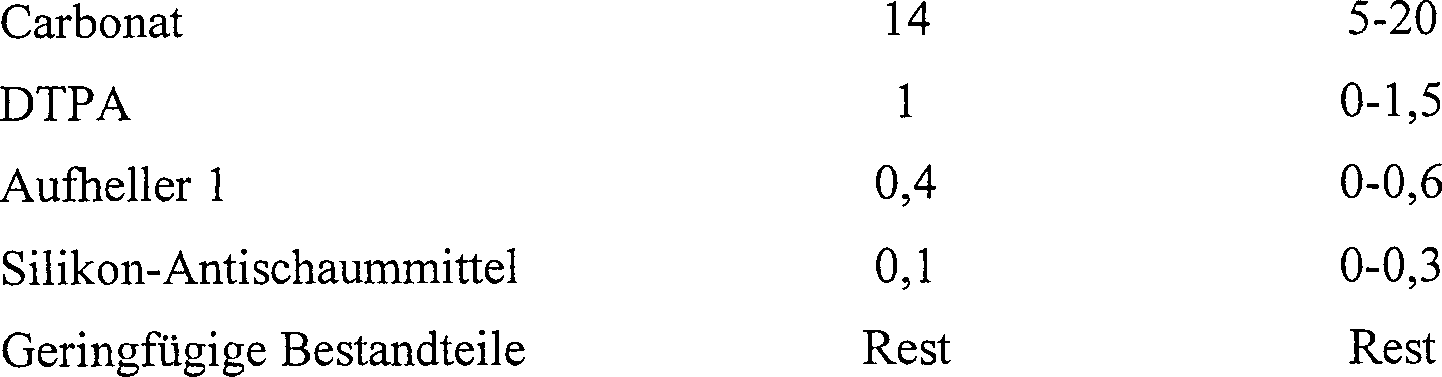
Das resultierende wasserfreie flüssige Vollwaschmittel bietet eine hervorragende Flecken- und Schmutzentfernungsleistung bei Verwendung in normalen Wäschewaschvorgängen.The resulting anhydrous heavy duty liquid detergent provides excellent stain and Dirt removal performance when used in normal laundry operations.
BEISPIEL 22EXAMPLE 22
Die nachfolgenden Beispiele R–V veranschaulichen die Erfindung bezüglich Shampooformulierungen weiter.The following examples R-V further illustrate the invention with respect to shampoo formulations.

Zusätzliche Synthesebeispieleadditional synthesis Examples
BEISPIEL 23EXAMPLE 23
Mischung aus linearem und verzweigtem Alkylbenzol mit einem 2/3-Phenylindex von etwa 200 und einem 2-Methyl-2-phenylindex von etwa 0,02Mixture of linear and branched alkylbenzene having a 2/3-phenyl index of about 200 and a 2-methyl-2-phenyl index of about 0.02
(erfindungsgemäße Alkylbenzolmischung)(Inventive alkylbenzene mixture)
110,25 g der im Wesentlichen aus monomethylverzweigten Olefinen bestehende Mischung von Beispiel 2, 36,75 g einer unverzweigten Olefinmischung (Verhältnis von Decen: Undecen: Dodecene: Tridecen von 2: 9: 20: 18) und 36 g eines formselektiven Zeolith-Katalysators (saurer Beta-Zeolith-Katalysator; ZeocatTM PB/H) werden unter Rühren in einen Edelstahl-Autoklav von 7,6 Liter (2 Gallonen) gegeben. Reste vom Olefin und vom Katalysator im Behälter werden mit 300 ml n-Hexan in den Autoklav gewaschen, und der Autoklav wird verschlossen. Von außerhalb der Autoklavzelle werden 2000 g Benzol (in einem isolierten Gefäß enthalten und über ein isoliertes Pumpsystem in die isolierte Autoklavzelle gegeben) in den Autoklav gegeben. Der Autoklav wird zwei Mal mit 1,8 × 10⁶ Pa (250 psig) N2 gespült und anschließend auf 4,13 × 10⁵ Pa (60 psig) N2 befüllt.110.25 g of the mixture of Example 2 consisting essentially of monomethyl branched olefins, 36.75 g of an unbranched olefin mixture (ratio of decene: undecene: dodecene: tridecene of 2: 9: 20: 18) and 36 g of a shape-selective zeolite catalyst (acid zeolite beta catalyst, Zeocat ™ PB / H) are added with stirring to a stainless steel autoclave of 7.6 liters (2 gallons). Residues of olefin and catalyst in the vessel are washed with 300 ml of n-hexane in the autoclave and the autoclave is capped. From outside the autoclave cell, 2000 g of benzene (contained in an isolated vessel and fed into the isolated autoclave cell via an isolated pumping system) are added to the autoclave. The autoclave is purged twice with 1.8 x 10 6 Pa (250 psig) N 2 and then charged to 4.13 x 10 5 Pa (60 psig) N 2 .
Die Mischung wird gerührt und etwa 4–5 Stunden lang auf etwa 200°C erhitzt. Der Autoklav wird über Nacht auf etwa 20°C abgekühlt. Das Ventil, das vom Autoklav zum Benzolkondensator und Auffangbehälter führt, wird geöffnet. Der Autoklav wird unter ständigem Auffangen des Benzols auf etwa 120°C erhitzt. Wenn der Reaktor 120°C erreicht hat, wird kein Benzol mehr aufgefangen. Der Reaktor wird anschließend auf 40°C abgekühlt, und 750 g n-Hexan werden unter Mischen in den Autoklav gepumpt. Der Autoklav wird anschließend abgelassen, um das Reaktionsgemisch zu entnehmen. Das Reaktionsgemisch wird gefiltert, um den Katalysator zu entfernen, und das n-Hexan wird unter Vakuum entnommen. Das Produkt wird unter Vakuum (0,13–0,67 Pa (1–5 mm Hg)) destilliert. Eine modifizierte Alkylbenzolmischung mit einem 2/3-Phenylindex von etwa 200 und einem 2-Methyl-2-phenylindex von etwa 0,02 wird bei 76°C–130°C aufgefangen (167 g).The Mixture is stirred and about 4-5 Hours at about 200 ° C heated. The autoclave will be over night to about 20 ° C cooled. The valve, which leads from the autoclave to the benzene condenser and receiver, becomes open. The autoclave is under constant Catching the benzene heated to about 120 ° C. When the reactor Reached 120 ° C benzene is no longer collected. The reactor is then opened Cooled to 40 ° C, and 750 g of n-hexane are pumped into the autoclave with mixing. Of the Autoclave will follow drained to remove the reaction mixture. The reaction mixture is filtered to remove the catalyst and the n-hexane is removed under vacuum. The product is dried under vacuum (0.13-0.67 Pa (1-5 mm Hg)) distilled. A modified alkylbenzene mixture with a 2/3 phenyl index of about 200 and a 2-methyl-2-phenyl index of about 0.02 is collected at 76 ° C-130 ° C (167 g).
BEISPIEL 24EXAMPLE 24
Erfindungsgemäße modifizierte Alkylbenzolsulfonsäuremischung)Modified according to the invention alkylbenzenesulfonic acid mixture)
(Mischung aus verzweigter und unverzweigter Alkylbenzolsulfonsäure)(Mixture of branched and unbranched alkylbenzenesulfonic acid)
mit einem 2/3-Phenylindex von etwa 200 und einem 2-Methyl-2-phenylindex von etwa 0,02with a 2/3-phenyl index of about 200 and a 2-methyl-2-phenyl index of about 0.02
Die Mischung aus modifiziertem Alkylbenzol aus Beispiel 23 wird mit einem molaren Äquivalent von Chlorsulfonsäure unter Verwendung von Methylenchlorid als Lösungsmittel sulfoniert. Das Methylenchlorid wird entfernt, um 210 g einer modifizierten Alkylbenzolsulfonsäuremischung mit einem 2/3-Phenylindex von etwa 200 und einem 2-Methyl-2-phenylindex von etwa 0,02 zu ergeben.The Mixture of modified alkylbenzene from Example 23 is with a molar equivalent of chlorosulfonic acid sulfonated using methylene chloride as a solvent. The Methylene chloride is removed to give 210 g of a modified alkylbenzenesulfonic acid mixture with a 2/3-phenyl index of about 200 and a 2-methyl-2-phenyl index of about 0.02.
BEISPIEL 25EXAMPLE 25
Erfindungsgemäße Mischung aus modifiziertem Alkylbenzolsulfonat, NatriumsalzInventive mixture modified alkyl benzene sulphonate, sodium salt
(Mischung aus verzweigtem und unverzweigtem Alkylbenzolsulfonat, Natriumsalz(Mixture of branched and unbranched alkyl benzene sulfonate, sodium salt
mit einem 2/3-Phenylindex von etwa 200 und einem 2-Methyl-2-phenylindex von etwa 0,02with a 2/3-phenyl index of about 200 and a 2-methyl-2-phenyl index of about 0.02
Die modifizierte Alkylbenzolsulfonsäure aus Beispiel 24 wird mit einem molaren Äquivalent von Natriummethoxid in Methanol neutralisiert, und das Methanol wird verdampft, um 225 g einer Mischung aus modifiziertem Alkylbenzolsulfonat, Natriumsalz mit einem 2/3-Phenylindex von etwa 200 und einem 2-Methyl-2-phenylindex von etwa 0,02 zu ergeben.The modified alkylbenzenesulfonic acid from Example 24 is reacted with one molar equivalent of sodium methoxide neutralized in methanol, and the methanol is evaporated to 225 g of a mixture of modified alkylbenzenesulfonate, sodium salt having a 2/3-phenyl index of about 200 and a 2-methyl-2-phenyl index of to give about 0.02.
BEISPIEL 26EXAMPLE 26
Die Waschmittelzusammensetzungen wie in den Beispielen 17–22 werden wiederholt, wobei MLAS durch das Produkt von Beispiel 25 ersetzt wird.The Detergent compositions as in Examples 17-22 with MLAS replaced by the product of Example 25 becomes.
Claims (39)


Applications Claiming Priority (3)
| Application Number | Priority Date | Filing Date | Title |
|---|---|---|---|
| US10496298P | 1998-10-20 | 1998-10-20 | |
| US104962P | 1998-10-20 | ||
| PCT/US1999/024031 WO2000023548A1 (en) | 1998-10-20 | 1999-10-13 | Laundry detergents comprising modified alkylbenzene sulfonates |
Publications (2)
| Publication Number | Publication Date |
|---|---|
| DE69930141D1 DE69930141D1 (en) | 2006-04-27 |
| DE69930141T2 true DE69930141T2 (en) | 2006-11-23 |
Family
ID=22303381
Family Applications (1)
| Application Number | Title | Priority Date | Filing Date |
|---|---|---|---|
| DE69930141T Expired - Fee Related DE69930141T2 (en) | 1998-10-20 | 1999-10-13 | DETERGENT CONTAINING MODIFIED ALKYL BENZENESULFONATE |
Country Status (12)
| Country | Link |
|---|---|
| US (1) | US6583096B1 (en) |
| EP (1) | EP1123369B1 (en) |
| JP (1) | JP2002527605A (en) |
| CN (1) | CN1331737A (en) |
| AR (1) | AR020912A1 (en) |
| AT (1) | ATE318882T1 (en) |
| AU (1) | AU6517099A (en) |
| BR (1) | BR9914678A (en) |
| CA (1) | CA2346690C (en) |
| DE (1) | DE69930141T2 (en) |
| ES (1) | ES2260941T3 (en) |
| WO (1) | WO2000023548A1 (en) |
Families Citing this family (334)
| Publication number | Priority date | Publication date | Assignee | Title |
|---|---|---|---|---|
| US6630430B1 (en) | 1996-02-08 | 2003-10-07 | Huntsman Petrochemical Corporation | Fuel and oil detergents |
| US6562776B1 (en) | 1996-02-08 | 2003-05-13 | Huntsman Petrochemical Corporation | Solid alkylbenzene sulfonates and cleaning compositions having enhanced water hardness tolerance |
| US6849588B2 (en) | 1996-02-08 | 2005-02-01 | Huntsman Petrochemical Corporation | Structured liquids made using LAB sulfonates of varied 2-isomer content |
| US6995127B1 (en) | 1996-02-08 | 2006-02-07 | Huntsman Petrochemical Corporation | Alkyl toluene sulfonate detergent |
| US6596680B2 (en) * | 1997-07-21 | 2003-07-22 | The Procter & Gamble Company | Enhanced alkylbenzene surfactant mixture |
| EP1022325A3 (en) * | 1999-01-20 | 2003-01-02 | The Procter & Gamble Company | Hard surface cleaning compositions comprising modified alkylbenzene sulfonates |
| US6696401B1 (en) | 1999-11-09 | 2004-02-24 | The Procter & Gamble Company | Laundry detergent compositions comprising zwitterionic polyamines |
| GB2371307B (en) | 2001-01-19 | 2003-10-15 | Reckitt Benckiser Nv | Packaged detergent compositions |
| US6521804B1 (en) | 2001-08-24 | 2003-02-18 | Uop Llc | Process for producing phenyl-alkanes using dual zones |
| CA2494131C (en) | 2002-09-12 | 2013-03-19 | The Procter & Gamble Company | Polymer systems and cleaning compositions comprising same |
| EP1431384B2 (en) † | 2002-12-19 | 2009-02-11 | The Procter & Gamble Company | Single compartment unit dose fabric treatment product comprising pouched compositions with non-cationic fabric softener actives |
| DK1670939T3 (en) * | 2003-09-18 | 2010-03-01 | Nuevolution As | Method for obtaining structural information on a coded molecule and method for selecting compounds |
| US7189885B1 (en) | 2003-10-07 | 2007-03-13 | Uop Llc | Staged process for producing linear 2-phenyl-alkanes |
| US20060105931A1 (en) | 2004-11-15 | 2006-05-18 | Jichun Shi | Liquid detergent composition for improved low temperature grease cleaning |
| EP1814972B1 (en) | 2004-11-15 | 2014-05-07 | The Procter and Gamble Company | Liquid detergent composition for improved low temperature grease cleaning |
| DE602006013099D1 (en) | 2005-02-17 | 2010-05-06 | Procter & Gamble | COMPOSITION FOR TISSUE CARE |
| ES2415872T3 (en) | 2005-08-19 | 2013-07-29 | The Procter & Gamble Company | Solid laundry detergent composition comprising an anionic detersive surfactant and calcium enhancement technology |
| ATE465235T1 (en) | 2005-08-19 | 2010-05-15 | Procter & Gamble | SOLID DETERGENT COMPOSITION CONTAINING ALKYLBENZENESULPHONATE AND A HYDRATEABLE SUBSTANCE |
| US7678752B2 (en) * | 2005-10-24 | 2010-03-16 | The Procter & Gamble Company | Fabric care composition comprising organosilicone microemulsion and anionic/nitrogen-containing surfactant system |
| CN101287820A (en) * | 2005-10-24 | 2008-10-15 | 宝洁公司 | Fabric care compositions and systems comprising organosiloxane microemulsions and methods of their use |
| US7449596B2 (en) * | 2005-12-21 | 2008-11-11 | Chevron Oronite Company Llc | Method of making a synthetic petroleum sulfonate |
| JP5345399B2 (en) | 2006-01-23 | 2013-11-20 | ザ プロクター アンド ギャンブル カンパニー | Laundry care composition with thiazolium dye |
| US20080177089A1 (en) | 2007-01-19 | 2008-07-24 | Eugene Steven Sadlowski | Novel whitening agents for cellulosic substrates |
| US7487720B2 (en) | 2007-03-05 | 2009-02-10 | Celanese Acetate Llc | Method of making a bale of cellulose acetate tow |
| EP2014755B1 (en) | 2007-05-29 | 2012-03-21 | The Procter & Gamble Company | Method of cleaning dishware |
| EP2014753A1 (en) | 2007-07-11 | 2009-01-14 | The Procter and Gamble Company | Liquid detergent composition |
| US20090023625A1 (en) * | 2007-07-19 | 2009-01-22 | Ming Tang | Detergent composition containing suds boosting co-surfactant and suds stabilizing surface active polymer |
| WO2009027925A2 (en) * | 2007-08-31 | 2009-03-05 | The Procter & Gamble Company | Compositions and visual perception changing methods |
| EP2071017A1 (en) * | 2007-12-04 | 2009-06-17 | The Procter and Gamble Company | Detergent composition |
| EP2083066A1 (en) | 2008-01-22 | 2009-07-29 | The Procter and Gamble Company | Liquid detergent composition |
| US8512480B2 (en) * | 2008-01-22 | 2013-08-20 | The Procter & Gamble Company | Liquid detergent composition comprising a hydrophobically modified cellulosic polymer |
| EP2103676A1 (en) | 2008-03-18 | 2009-09-23 | The Procter and Gamble Company | A laundry detergent composition comprising the magnesium salt of ethylene diamine-n'n' -disuccinic acid |
| EP2103675A1 (en) | 2008-03-18 | 2009-09-23 | The Procter and Gamble Company | Detergent composition comprising cellulosic polymer |
| EP2103678A1 (en) | 2008-03-18 | 2009-09-23 | The Procter and Gamble Company | Detergent composition comprising a co-polyester of dicarboxylic acids and diols |
| EP2107105B1 (en) * | 2008-04-02 | 2013-08-07 | The Procter and Gamble Company | Detergent composition comprising reactive dye |
| EP2107106A1 (en) * | 2008-04-02 | 2009-10-07 | The Procter and Gamble Company | A kit of parts comprising a solid laundry detergent composition and a dosing device |
| US9376648B2 (en) * | 2008-04-07 | 2016-06-28 | The Procter & Gamble Company | Foam manipulation compositions containing fine particles |
| EP2135931B1 (en) | 2008-06-16 | 2012-12-05 | The Procter & Gamble Company | Use of soil release polymer in fabric treatment compositions |
| EP2138566A1 (en) | 2008-06-25 | 2009-12-30 | The Procter and Gamble Company | A spray-drying process |
| ES2442541T3 (en) | 2008-06-25 | 2014-02-12 | The Procter & Gamble Company | Process to prepare a detergent powder |
| EP2138562A1 (en) | 2008-06-25 | 2009-12-30 | The Procter and Gamble Company | Low-built, anionic detersive surfactant-containing spray-dried powder that additionally comprises clay |
| EP2138567A1 (en) | 2008-06-25 | 2009-12-30 | The Procter & Gamble Company | Spray-drying process |
| EP2138568A1 (en) | 2008-06-25 | 2009-12-30 | The Procter and Gamble Company | Neutralisation process for producing a laundry detergent composition comprising anionic detersive surfactant and polymeric material |
| EP2138565A1 (en) | 2008-06-25 | 2009-12-30 | The Procter and Gamble Company | A spray-drying process |
| EP2138563A1 (en) | 2008-06-25 | 2009-12-30 | The Procter and Gamble Company | Low-built, anionic detersive surfactant-containing solid laundry detergent compositions that additionally comprises clay |
| EP2321040A1 (en) | 2008-07-22 | 2011-05-18 | ExxonMobil Chemical Patents Inc. | Preparation of molecular sieve containing catalyst and its use in the production of alkylaromatic hydrocarbons |
| WO2010039572A1 (en) | 2008-09-30 | 2010-04-08 | The Procter & Gamble Company | Liquid hard surface cleaning composition |
| EP2328999A1 (en) * | 2008-09-30 | 2011-06-08 | The Procter & Gamble Company | Liquid hard surface cleaning composition |
| EP2328998A1 (en) * | 2008-09-30 | 2011-06-08 | The Procter & Gamble Company | Liquid hard surface cleaning composition |
| US9926514B1 (en) * | 2009-01-09 | 2018-03-27 | Ascent Ip Holdings, Llc | Cleaning compositions |
| ES2461892T3 (en) | 2009-02-02 | 2014-05-21 | The Procter & Gamble Company | Liquid detergent composition for dishwashing by hand |
| EP2216392B1 (en) | 2009-02-02 | 2013-11-13 | The Procter and Gamble Company | Liquid hand dishwashing detergent composition |
| EP2213715A1 (en) | 2009-02-02 | 2010-08-04 | The Procter & Gamble Company | Liquid hand dishwashing detergent composition |
| EP2216391A1 (en) | 2009-02-02 | 2010-08-11 | The Procter & Gamble Company | Liquid hand dishwashing detergent composition |
| EP2216390B1 (en) | 2009-02-02 | 2013-11-27 | The Procter and Gamble Company | Hand dishwashing method |
| EP2213714B1 (en) | 2009-02-02 | 2014-06-11 | The Procter and Gamble Company | Liquid hand dishwashing detergent composition |
| BRPI1009095A2 (en) | 2009-03-13 | 2016-03-01 | Procter & Gamble | spray drying process |
| ES2412684T3 (en) | 2009-06-19 | 2013-07-12 | The Procter & Gamble Company | Liquid dishwashing detergent composition by hand |
| ES2412707T5 (en) | 2009-06-19 | 2023-06-12 | Procter & Gamble | Liquid detergent composition for hand dishwashing |
| MX2011013919A (en) | 2009-06-30 | 2012-02-23 | Procter & Gamble | Fabric care compositions comprising cationic polymers and amphoteric. |
| WO2011005630A1 (en) | 2009-07-09 | 2011-01-13 | The Procter & Gamble Company | Method of laundering fabric using a compacted laundry detergent composition |
| WO2011005917A1 (en) | 2009-07-09 | 2011-01-13 | The Procter & Gamble Company | Method of laundering fabric using a liquid laundry detergent composition |
| WO2011005813A1 (en) | 2009-07-09 | 2011-01-13 | The Procter & Gamble Company | Method of laundering fabric using a compacted laundry detergent composition |
| EP2451932A1 (en) | 2009-07-09 | 2012-05-16 | The Procter & Gamble Company | Method of laundering fabric using a compacted laundry detergent composition |
| WO2011005730A1 (en) | 2009-07-09 | 2011-01-13 | The Procter & Gamble Company | A catalytic laundry detergent composition comprising relatively low levels of water-soluble electrolyte |
| WO2011005623A1 (en) | 2009-07-09 | 2011-01-13 | The Procter & Gamble Company | Laundry detergent composition comprising low level of bleach |
| US20110005002A1 (en) | 2009-07-09 | 2011-01-13 | Hiroshi Oh | Method of Laundering Fabric |
| EP2451925A1 (en) | 2009-07-09 | 2012-05-16 | The Procter & Gamble Company | Method of laundering fabric using a compacted laundry detergent composition |
| US20110009307A1 (en) | 2009-07-09 | 2011-01-13 | Alan Thomas Brooker | Laundry Detergent Composition Comprising Low Level of Sulphate |
| WO2011005804A1 (en) | 2009-07-09 | 2011-01-13 | The Procter & Gamble Company | Method of laundering fabric using a liquid laundry detergent composition |
| EP2451922A1 (en) | 2009-07-09 | 2012-05-16 | The Procter & Gamble Company | Method of laundering fabric using a compacted liquid laundry detergent composition |
| US20110005001A1 (en) | 2009-07-09 | 2011-01-13 | Eric San Jose Robles | Detergent Composition |
| WO2011005913A1 (en) | 2009-07-09 | 2011-01-13 | The Procter & Gamble Company | A catalytic laundry detergent composition comprising relatively low levels of water-soluble electrolyte |
| WO2011016958A2 (en) | 2009-07-27 | 2011-02-10 | The Procter & Gamble Company | Detergent composition |
| EP2459606B1 (en) | 2009-07-31 | 2020-10-21 | Nouryon Chemicals International B.V. | Hybrid copolymer compositions |
| HUE029942T2 (en) | 2009-08-13 | 2017-04-28 | Procter & Gamble | Method of laundering fabrics at low temperature |
| EP2302025B1 (en) | 2009-09-08 | 2016-04-13 | The Procter & Gamble Company | A laundry detergent composition comprising a highly water-soluble carboxmethyl cellulose particle |
| BR112012005766A2 (en) | 2009-09-14 | 2016-02-16 | Procter & Gamble | external structuring system for liquid laundry detergent composition |
| AR078363A1 (en) * | 2009-09-14 | 2011-11-02 | Procter & Gamble | COMPACT FLUID DETERGENT COMPOSITION FOR LAUNDRY |
| US20110150817A1 (en) | 2009-12-17 | 2011-06-23 | Ricky Ah-Man Woo | Freshening compositions comprising malodor binding polymers and malodor control components |
| US20110241235A1 (en) | 2009-09-23 | 2011-10-06 | Rohan Govind Murkunde | Process for preparing spray-dried particles |
| CN102575191A (en) | 2009-10-07 | 2012-07-11 | 宝洁公司 | Detergent composition |
| US8334250B2 (en) | 2009-12-18 | 2012-12-18 | The Procter & Gamble Company | Method of making granular detergent compositions comprising amphiphilic graft copolymers |
| US20110152161A1 (en) | 2009-12-18 | 2011-06-23 | Rohan Govind Murkunde | Granular detergent compositions comprising amphiphilic graft copolymers |
| EP2338961A1 (en) | 2009-12-22 | 2011-06-29 | The Procter & Gamble Company | An alkaline liquid hand dish washing detergent composition |
| WO2011087739A1 (en) * | 2009-12-22 | 2011-07-21 | The Procter & Gamble Company | Liquid cleaning and/or cleansing composition |
| US8680036B2 (en) * | 2009-12-22 | 2014-03-25 | The Procter & Gamble Company | Liquid cleaning composition comprising color-stable polyurethane abrasive particles |
| US20110201532A1 (en) | 2010-02-12 | 2011-08-18 | Jennifer Beth Ponder | Benefit compositions comprising crosslinked polyglycerol esters |
| WO2011100405A1 (en) | 2010-02-12 | 2011-08-18 | The Procter & Gamble Company | Benefit compositions comprising crosslinked polyglycerol esters |
| US20110201534A1 (en) | 2010-02-12 | 2011-08-18 | Jennifer Beth Ponder | Benefit compositions comprising polyglycerol esters |
| US20110201533A1 (en) | 2010-02-12 | 2011-08-18 | Jennifer Beth Ponder | Benefit compositions comprising polyglycerol esters |
| WO2011109322A1 (en) | 2010-03-04 | 2011-09-09 | The Procter & Gamble Company | Detergent composition |
| US8889612B2 (en) | 2010-04-19 | 2014-11-18 | The Procter & Gamble Company | Method of laundering fabric using a compacted liquid laundry detergent composition |
| US20110257062A1 (en) | 2010-04-19 | 2011-10-20 | Robert Richard Dykstra | Liquid laundry detergent composition comprising a source of peracid and having a ph profile that is controlled with respect to the pka of the source of peracid |
| US20110257069A1 (en) | 2010-04-19 | 2011-10-20 | Stephen Joseph Hodson | Detergent composition |
| WO2011133306A1 (en) | 2010-04-19 | 2011-10-27 | The Procter & Gamble Company | Detergent composition |
| US20110257060A1 (en) | 2010-04-19 | 2011-10-20 | Robert Richard Dykstra | Laundry detergent composition comprising bleach particles that are suspended within a continuous liquid phase |
| MX336922B (en) | 2010-04-21 | 2016-02-05 | Procter & Gamble | Liquid cleaning and/or cleansing composition. |
| BR112012029188B1 (en) | 2010-05-18 | 2020-12-08 | Milliken & Company | optical whitening compounds and compositions comprising the same |
| BR112012029133A2 (en) | 2010-05-18 | 2016-09-13 | Milliken & Co | optical brighteners and compositions comprising the same |
| US8470760B2 (en) | 2010-05-28 | 2013-06-25 | Milliken 7 Company | Colored speckles for use in granular detergents |
| US8476216B2 (en) | 2010-05-28 | 2013-07-02 | Milliken & Company | Colored speckles having delayed release properties |
| EP2395070A1 (en) | 2010-06-10 | 2011-12-14 | The Procter & Gamble Company | Liquid laundry detergent composition comprising lipase of bacterial origin |
| EP2585573A1 (en) | 2010-06-23 | 2013-05-01 | The Procter and Gamble Company | Product for pre-treatment and laundering of stained fabric |
| BR112013000099A2 (en) | 2010-07-02 | 2016-05-17 | Procter & Gamble | filaments comprising non-woven non-scent active agent fabrics and methods of manufacture thereof |
| JP5759544B2 (en) | 2010-07-02 | 2015-08-05 | ザ プロクター アンド ギャンブルカンパニー | Methods for delivering active agents |
| ES2560218T3 (en) | 2010-07-02 | 2016-02-17 | The Procter & Gamble Company | Process for making films from bands of nonwoven material |
| RU2541949C2 (en) | 2010-07-02 | 2015-02-20 | Дзе Проктер Энд Гэмбл Компани | Filaments, containing active agent, non-woven cloths and methods of obtaining them |
| EP2588659B1 (en) | 2010-07-02 | 2016-03-16 | The Procter and Gamble Company | Filaments comprising an ingestible active agent nonwoven webs and methods for making same |
| MX345025B (en) | 2010-07-02 | 2017-01-12 | Procter & Gamble | Detergent product. |
| US8685171B2 (en) | 2010-07-29 | 2014-04-01 | The Procter & Gamble Company | Liquid detergent composition |
| EP2412792A1 (en) | 2010-07-29 | 2012-02-01 | The Procter & Gamble Company | Liquid detergent composition |
| PL2606111T3 (en) | 2010-08-17 | 2018-05-30 | The Procter And Gamble Company | Method for hand washing dishes having long lasting suds |
| ES2643613T3 (en) | 2010-08-17 | 2017-11-23 | The Procter & Gamble Company | Detergents for washing sustainable and stable dishes by hand |
| BR112013004889A8 (en) | 2010-09-20 | 2016-10-11 | Procter & Gamble | fluoropolymer-free surface protection composition |
| CN103732730A (en) | 2010-09-20 | 2014-04-16 | 宝洁公司 | Fabric care formulations and methods |
| CN103097464A (en) | 2010-09-20 | 2013-05-08 | 宝洁公司 | Non-fluoropolymer surface protection composition |
| WO2012040143A1 (en) | 2010-09-21 | 2012-03-29 | The Procter & Gamble Company | Liquid cleaning composition |
| JP5702469B2 (en) | 2010-09-21 | 2015-04-15 | ザ プロクター アンド ギャンブルカンパニー | Liquid cleaning composition |
| EP2431451A1 (en) | 2010-09-21 | 2012-03-21 | The Procter & Gamble Company | Liquid detergent composition with abrasive particles |
| WO2012054058A1 (en) | 2010-10-22 | 2012-04-26 | The Procter & Gamble Company | Bis-azo colorants for use as bluing agents |
| EP2630197B1 (en) | 2010-10-22 | 2019-03-06 | Milliken & Company | Bis-azo colorants for use as bluing agents |
| US20120101018A1 (en) | 2010-10-22 | 2012-04-26 | Gregory Scot Miracle | Bis-azo colorants for use as bluing agents |
| CN103210073B (en) | 2010-11-12 | 2016-06-08 | 宝洁公司 | Thiophene azo dyes and laundry care compositions containing them |
| WO2011017719A2 (en) | 2010-11-12 | 2011-02-10 | Milliken & Company | Thiophene azo dyes and laundry care compositions containing the same |
| US8715368B2 (en) | 2010-11-12 | 2014-05-06 | The Procter & Gamble Company | Thiophene azo dyes and laundry care compositions containing the same |
| WO2012075611A1 (en) | 2010-12-10 | 2012-06-14 | The Procter & Gamble Company | Laundry detergents |
| WO2012112828A1 (en) | 2011-02-17 | 2012-08-23 | The Procter & Gamble Company | Bio-based linear alkylphenyl sulfonates |
| EP2678410B1 (en) | 2011-02-17 | 2017-09-13 | The Procter and Gamble Company | Composiitons comprising mixtures of c10-c13 alkylphenyl sulfonates |
| EP2678101A1 (en) | 2011-02-25 | 2014-01-01 | Milliken & Company | Capsules and compositions comprising the same |
| EP2693928B1 (en) | 2011-04-04 | 2018-09-05 | The Procter and Gamble Company | Personal care article |
| CN102226135A (en) * | 2011-05-12 | 2011-10-26 | 荆立民 | Sterilizing/decontaminatimg/deodorizing shoe cleaning liquid and preparation method thereof |
| US9163146B2 (en) | 2011-06-03 | 2015-10-20 | Milliken & Company | Thiophene azo carboxylate dyes and laundry care compositions containing the same |
| EP2535401B1 (en) | 2011-06-17 | 2017-01-25 | Dalli-Werke GmbH & Co. KG | Detergent composition comprising soil-release polymers of improved storage stability |
| EP2537917A1 (en) | 2011-06-20 | 2012-12-26 | The Procter & Gamble Company | Liquid detergent composition with abrasive particles |
| WO2012177617A1 (en) | 2011-06-20 | 2012-12-27 | The Procter & Gamble Company | Liquid cleaning and/or cleansing composition |
| CA2839966C (en) | 2011-06-20 | 2016-08-23 | The Procter & Gamble Company | Liquid cleaning and/or cleansing composition |
| US8852643B2 (en) | 2011-06-20 | 2014-10-07 | The Procter & Gamble Company | Liquid cleaning and/or cleansing composition |
| US20120324655A1 (en) | 2011-06-23 | 2012-12-27 | Nalini Chawla | Product for pre-treatment and laundering of stained fabric |
| EP2557145A1 (en) * | 2011-06-28 | 2013-02-13 | SASOL Germany GmbH | Surfactant compositions |
| US20140141126A1 (en) | 2011-06-29 | 2014-05-22 | Solae Llc | Baked food compositions comprising soy whey proteins that have been isolated from processing streams |
| EP2737043B1 (en) | 2011-07-25 | 2017-01-04 | The Procter and Gamble Company | Detergents having acceptable color |
| US20130029894A1 (en) | 2011-07-27 | 2013-01-31 | Jean-Luc Philippe Bettiol | Multiphase liquid detergent composition |
| US8636918B2 (en) | 2011-08-05 | 2014-01-28 | Ecolab Usa Inc. | Cleaning composition containing a polysaccharide hybrid polymer composition and methods of controlling hard water scale |
| US8841246B2 (en) | 2011-08-05 | 2014-09-23 | Ecolab Usa Inc. | Cleaning composition containing a polysaccharide hybrid polymer composition and methods of improving drainage |
| US8853144B2 (en) | 2011-08-05 | 2014-10-07 | Ecolab Usa Inc. | Cleaning composition containing a polysaccharide graft polymer composition and methods of improving drainage |
| US8679366B2 (en) | 2011-08-05 | 2014-03-25 | Ecolab Usa Inc. | Cleaning composition containing a polysaccharide graft polymer composition and methods of controlling hard water scale |
| MX342855B (en) | 2011-08-15 | 2016-10-13 | Procter & Gamble | Detergent compositions containing pyridinol-n-oxide compounds. |
| AR088758A1 (en) | 2011-09-20 | 2014-07-02 | Procter & Gamble | EASY DETERGENT COMPOSITIONS RINSE THAT UNDERSTAND ISOPRENOID BASED SURFACTANTS |
| MX2014003280A (en) | 2011-09-20 | 2014-05-13 | Procter & Gamble | Detergent compositions comprising sustainable surfactant systems comprising isoprenoid-derived surfactants. |
| US20130072415A1 (en) | 2011-09-20 | 2013-03-21 | The Procter & Gamble Company | DETERGENT COMPOSITIONS COMPRISING SPECIFIC BLEND RATIOS of ISOPRENOID-BASED SURFACTANTS |
| MX2014003278A (en) | 2011-09-20 | 2014-05-21 | Procter & Gamble | Detergent compositions comprising primary surfactant systems comprising highly branched surfactants especially isoprenoid - based surfactants. |
| US20130072416A1 (en) | 2011-09-20 | 2013-03-21 | The Procter & Gamble Company | High suds detergent compositions comprising isoprenoid-based surfactants |
| EP2573157A1 (en) | 2011-09-20 | 2013-03-27 | The Procter and Gamble Company | Liquid detergent composition with abrasive particles |
| EP2773321B1 (en) | 2011-11-04 | 2015-09-09 | Akzo Nobel Chemicals International B.V. | Graft dendrite copolymers, and methods for producing the same |
| CN103945828A (en) | 2011-11-04 | 2014-07-23 | 阿克佐诺贝尔化学国际公司 | Hybrid dendrite copolymers, compositions thereof and methods for producing the same |
| AR088798A1 (en) | 2011-11-11 | 2014-07-10 | Procter & Gamble | SURFACE TREATMENT COMPOSITIONS INCLUDING PROTECTIVE SALTS |
| EP2594500A1 (en) | 2011-11-18 | 2013-05-22 | The Procter & Gamble Company | Packaging for a liquid detergent composition with abrasive particles |
| US20130150276A1 (en) | 2011-12-09 | 2013-06-13 | The Procter & Gamble Company | Method of providing fast drying and/or delivering shine on hard surfaces |
| CN102533462B (en) * | 2011-12-14 | 2013-10-30 | 中国日用化学工业研究院 | Low-temperature efficient liquid detergent composition and preparation process thereof |
| DK2798053T3 (en) | 2011-12-29 | 2018-08-13 | Novozymes As | DETERGENT COMPOSITIONS WITH LIPASE VARIATIONS |
| CA2860647C (en) | 2012-01-04 | 2022-06-14 | The Procter & Gamble Company | Active containing fibrous structures with multiple regions having differing densities |
| EP2800803A1 (en) | 2012-01-04 | 2014-11-12 | The Procter and Gamble Company | Active containing fibrous structures with multiple regions |
| MX340283B (en) | 2012-03-26 | 2016-07-04 | Procter & Gamble | Cleaning compositions comprising ph-switchable amine surfactants. |
| KR20150013274A (en) | 2012-05-11 | 2015-02-04 | 바스프 에스이 | Quaternized polyethylenimines with a high ethoxylation degree |
| US8623806B2 (en) | 2012-05-11 | 2014-01-07 | The Procter & Gamble Company | Liquid detergent composition for improved shine |
| US8754027B2 (en) | 2012-05-11 | 2014-06-17 | Basf Se | Quaternized polyethulenimines with a high ethoxylation degree |
| US9068147B2 (en) | 2012-05-11 | 2015-06-30 | Basf Se | Quaternized polyethylenimines with a high quaternization degree |
| CA2871020A1 (en) | 2012-05-11 | 2013-11-14 | Basf Se | Quaternized polyethylenimines with a high quaternization degree |
| US8759271B2 (en) | 2012-05-11 | 2014-06-24 | The Procter & Gamble Company | Liquid detergent composition for improved shine |
| BR112015001137A2 (en) | 2012-07-26 | 2017-06-27 | Procter & Gamble | low enzymatic liquid cleaning compositions |
| US8945314B2 (en) | 2012-07-30 | 2015-02-03 | Ecolab Usa Inc. | Biodegradable stability binding agent for a solid detergent |
| US9796952B2 (en) | 2012-09-25 | 2017-10-24 | The Procter & Gamble Company | Laundry care compositions with thiazolium dye |
| ES2577147T3 (en) | 2012-10-15 | 2016-07-13 | The Procter & Gamble Company | Liquid detergent composition with abrasive particles |
| EP2727991A1 (en) | 2012-10-30 | 2014-05-07 | The Procter & Gamble Company | Cleaning and disinfecting liquid hand dishwashing detergent compositions |
| PL2757145T5 (en) | 2013-01-21 | 2024-12-02 | The Procter & Gamble Company | DETERGENT |
| HUE038203T2 (en) | 2013-01-21 | 2018-10-29 | Procter & Gamble | Detergent |
| EP2757144B2 (en) | 2013-01-21 | 2023-12-20 | The Procter & Gamble Company | Detergent |
| US20140243252A1 (en) * | 2013-02-28 | 2014-08-28 | Futurefuel Chemical Company | Laundry detergent formulation |
| WO2014160590A1 (en) | 2013-03-26 | 2014-10-02 | The Procter & Gamble Company | Cleaning compositions for cleaning a hard surface |
| AU2014241193B2 (en) | 2013-03-28 | 2016-10-20 | The Procter And Gamble Company | Cleaning compositions containing a polyetheramine |
| PL2832842T3 (en) | 2013-07-30 | 2019-09-30 | The Procter & Gamble Company | Method of making granular detergent compositions comprising surfactants |
| EP2832841B1 (en) | 2013-07-30 | 2016-08-31 | The Procter & Gamble Company | Method of making detergent compositions comprising polymers |
| EP2832844A1 (en) | 2013-07-30 | 2015-02-04 | The Procter & Gamble Company | Method of making detergent compositions comprising polymers |
| EP2832843B1 (en) | 2013-07-30 | 2019-08-21 | The Procter & Gamble Company | Method of making granular detergent compositions comprising polymers |
| EP3039109B1 (en) | 2013-08-26 | 2017-09-13 | The Procter and Gamble Company | Compositions comprising alkoxylated polyamines having low melting points |
| US20150094252A1 (en) | 2013-09-27 | 2015-04-02 | The Procter & Gamble Company | Fibrous structures containing surfactants and methods for making the same |
| EP2862921A1 (en) | 2013-10-17 | 2015-04-22 | The Procter and Gamble Company | Liquid laundry composition comprising an alkoxylated polymer and a shading dye |
| EP2862919A1 (en) | 2013-10-17 | 2015-04-22 | The Procter and Gamble Company | Composition comprising shading dye |
| WO2015088826A1 (en) | 2013-12-09 | 2015-06-18 | The Procter & Gamble Company | Fibrous structures including an active agent and having a graphic printed thereon |
| EP2899259A1 (en) | 2014-01-22 | 2015-07-29 | The Procter and Gamble Company | Detergent compositions |
| US20150210964A1 (en) | 2014-01-24 | 2015-07-30 | The Procter & Gamble Company | Consumer Product Compositions |
| WO2015139221A1 (en) | 2014-03-19 | 2015-09-24 | Rhodia Operations | New copolymers useful in liquid detergent compositions |
| EP3122850A1 (en) | 2014-03-27 | 2017-02-01 | The Procter & Gamble Company | Cleaning compositions containing a polyetheramine |
| EP3122849B1 (en) | 2014-03-27 | 2021-07-21 | The Procter & Gamble Company | Cleaning compositions containing a polyetheramine |
| EP2924105A1 (en) | 2014-03-28 | 2015-09-30 | The Procter and Gamble Company | Water soluble unit dose article |
| EP2924107A1 (en) | 2014-03-28 | 2015-09-30 | The Procter and Gamble Company | Water soluble unit dose article |
| EP2940112A1 (en) | 2014-04-30 | 2015-11-04 | The Procter and Gamble Company | Cleaning composition |
| EP2940116B1 (en) | 2014-04-30 | 2018-10-17 | The Procter and Gamble Company | Detergent |
| EP2940117B1 (en) | 2014-04-30 | 2020-08-19 | The Procter and Gamble Company | Cleaning composition containing a polyetheramine |
| EP2940115B1 (en) | 2014-04-30 | 2018-10-17 | The Procter and Gamble Company | Cleaning composition |
| EP2940113A1 (en) | 2014-04-30 | 2015-11-04 | The Procter and Gamble Company | Cleaning composition |
| US9365805B2 (en) | 2014-05-15 | 2016-06-14 | Ecolab Usa Inc. | Bio-based pot and pan pre-soak |
| US9926516B2 (en) | 2014-06-05 | 2018-03-27 | The Procter & Gamble Company | Mono alcohols for low temperature stability of isotropic liquid detergent compositions |
| WO2015187757A1 (en) | 2014-06-06 | 2015-12-10 | The Procter & Gamble Company | Detergent composition comprising polyalkyleneimine polymers |
| EP2982737B1 (en) | 2014-08-07 | 2018-04-25 | The Procter and Gamble Company | Laundry detergent composition |
| ES2710236T5 (en) | 2014-08-07 | 2021-12-09 | Procter & Gamble | Composition of laundry detergent |
| RU2017102215A (en) | 2014-08-07 | 2018-09-13 | Дзе Проктер Энд Гэмбл Компани | A soluble unit dose capsule containing a laundry detergent composition |
| ES2710237T5 (en) | 2014-08-07 | 2022-10-03 | Procter & Gamble | Composition of laundry detergent |
| CA2956088C (en) | 2014-08-27 | 2019-07-30 | The Procter & Gamble Company | Detergent composition comprising a cationic polymer |
| EP3186345A1 (en) | 2014-08-27 | 2017-07-05 | The Procter and Gamble Company | Detergent composition comprising a cationic polymer |
| US9617501B2 (en) | 2014-08-27 | 2017-04-11 | The Procter & Gamble Company | Method of treating a fabric by washing with a detergent comprising an acrylamide/DADMAC cationic polymer |
| JP6728132B2 (en) | 2014-08-27 | 2020-07-22 | ザ プロクター アンド ギャンブル カンパニーThe Procter & Gamble Company | Detergent composition containing cationic polymer |
| WO2016049388A1 (en) | 2014-09-25 | 2016-03-31 | The Procter & Gamble Company | Fabric care compositions containing a polyetheramine |
| EP3034593B1 (en) | 2014-12-19 | 2019-06-12 | The Procter and Gamble Company | Liquid detergent composition |
| US10093890B2 (en) * | 2015-01-08 | 2018-10-09 | Domingo A. Mesa | Laundry detergent, fabric softener and cleaning formulations, systems, and water-soluble pouches |
| ES2670044T3 (en) | 2015-06-04 | 2018-05-29 | The Procter & Gamble Company | Liquid detergent composition for dishwashing by hand |
| EP3287513A1 (en) | 2015-06-04 | 2018-02-28 | The Procter & Gamble Company | Hand dishwashing liquid detergent composition |
| EP3118295B1 (en) | 2015-07-13 | 2018-10-17 | The Procter and Gamble Company | Use of glycol ether solvents in liquid cleaning compositions |
| US10597614B2 (en) | 2015-10-13 | 2020-03-24 | The Procter & Gamble Company | Whitening agents for cellulosic substrates |
| US10155868B2 (en) | 2015-10-13 | 2018-12-18 | Milliken & Company | Whitening agents for cellulosic substrates |
| US9777250B2 (en) | 2015-10-13 | 2017-10-03 | Milliken & Company | Whitening agents for cellulosic substrates |
| US9745544B2 (en) | 2015-10-13 | 2017-08-29 | The Procter & Gamble Company | Whitening agents for cellulosic substrates |
| US9976035B2 (en) | 2015-10-13 | 2018-05-22 | Milliken & Company | Whitening agents for cellulosic substrates |
| US9902923B2 (en) | 2015-10-13 | 2018-02-27 | The Procter & Gamble Company | Polyglycerol dye whitening agents for cellulosic substrates |
| ES2718380T3 (en) * | 2015-10-29 | 2019-07-01 | Procter & Gamble | Liquid detergent composition |
| EP3170884A1 (en) | 2015-11-20 | 2017-05-24 | The Procter and Gamble Company | Alcohols in liquid cleaning compositions to remove stains from surfaces |
| EP3181680A1 (en) | 2015-12-14 | 2017-06-21 | The Procter & Gamble Company | Water soluble unit dose article |
| US11377625B2 (en) | 2015-12-18 | 2022-07-05 | Basf Se | Cleaning compositions with polyalkanolamines |
| US10266795B2 (en) | 2015-12-18 | 2019-04-23 | The Procter & Gamble Company | Cleaning compositions with alkoxylated polyalkanolamines |
| US10308900B2 (en) | 2015-12-22 | 2019-06-04 | Milliken & Company | Occult particles for use in granular laundry care compositions |
| EP3405604B1 (en) | 2016-01-21 | 2025-08-20 | The Procter & Gamble Company | Fibrous elements comprising polyethylene oxide |
| US9719056B1 (en) | 2016-01-29 | 2017-08-01 | The Procter & Gamble Company | Bis-azo colorants for use as bluing agents |
| BR112018016690B1 (en) | 2016-02-15 | 2022-07-19 | Hercules Llc | LIQUID COMPOSITION FOR HOME CARE |
| US11682319B2 (en) | 2016-03-10 | 2023-06-20 | Intuitive Surgical Operations, Inc. | Fake blood for use in simulated surgical procedures |
| EP3243896B1 (en) | 2016-05-09 | 2019-07-03 | The Procter and Gamble Company | Detergent composition comprising a fatty acid decarboxylase |
| JP6945937B2 (en) | 2016-05-09 | 2021-10-13 | ザ プロクター アンド ギャンブル カンパニーThe Procter & Gamble Company | Detergent composition containing fatty acid converting enzyme |
| MX2018013710A (en) | 2016-05-09 | 2019-05-02 | Procter & Gamble | Detergent composition comprising an oleic acid-transforming enzyme. |
| EP3243894A1 (en) | 2016-05-10 | 2017-11-15 | The Procter and Gamble Company | Cleaning composition |
| EP3243895A1 (en) | 2016-05-13 | 2017-11-15 | The Procter and Gamble Company | Cleaning composition |
| US20170355930A1 (en) | 2016-06-09 | 2017-12-14 | The Procter & Gamble Company | Cleaning compositions including nuclease enzyme and amines |
| US10081783B2 (en) | 2016-06-09 | 2018-09-25 | The Procter & Gamble Company | Cleaning compositions having an enzyme system |
| US20170355932A1 (en) | 2016-06-09 | 2017-12-14 | The Procter & Gamble Company | Cleaning compositions including nuclease enzyme and tannins |
| US20170355933A1 (en) | 2016-06-09 | 2017-12-14 | The Procter & Gamble Company | Cleaning compositions including nuclease enzyme and malodor reduction materials |
| EP3257926A1 (en) | 2016-06-17 | 2017-12-20 | The Procter and Gamble Company | Liquid detergent composition |
| EP3257925B1 (en) | 2016-06-17 | 2019-10-16 | The Procter and Gamble Company | Liquid detergent composition |
| EP3257924A1 (en) | 2016-06-17 | 2017-12-20 | The Procter and Gamble Company | Liquid detergent composition |
| ES2753724T3 (en) | 2016-07-14 | 2020-04-14 | Procter & Gamble | Detergent composition |
| US10421932B2 (en) | 2016-07-21 | 2019-09-24 | The Procter & Gamble Company | Cleaning composition with insoluble quaternized cellulose particles and non-anionic performance polymers |
| US10421931B2 (en) | 2016-07-21 | 2019-09-24 | The Procter & Gamble Company | Cleaning composition with insoluble quaternized cellulose particles and an external structurant |
| WO2018017335A1 (en) | 2016-07-22 | 2018-01-25 | The Procter & Gamble Company | Dishwashing detergent composition |
| EP3284805B1 (en) | 2016-08-17 | 2020-02-19 | The Procter & Gamble Company | Cleaning composition comprising enzymes |
| US20180072970A1 (en) | 2016-09-13 | 2018-03-15 | The Procter & Gamble Company | Stable violet-blue to blue imidazolium compounds |
| US10920083B2 (en) | 2016-11-01 | 2021-02-16 | Milliken & Company | Leuco polymers as bluing agents in laundry care compositions |
| EP3535364B1 (en) | 2016-11-01 | 2020-12-23 | The Procter & Gamble Company | Leuco polymers as bluing agents in laundry care compositions |
| EP3535368A1 (en) | 2016-11-01 | 2019-09-11 | The Procter & Gamble Company | Leuco colorants as bluing agents in laundry care compositions |
| WO2018085306A1 (en) | 2016-11-01 | 2018-05-11 | The Procter & Gamble Company | Leuco polymers as bluing agents in laundry care compositions |
| WO2018085305A1 (en) | 2016-11-01 | 2018-05-11 | The Procter & Gamble Company | Leuco polymers as bluing agents in laundry care compositions |
| JP6866478B2 (en) | 2016-11-01 | 2021-04-28 | ミリケン・アンド・カンパニーMilliken & Company | Roy copolymer as a bluish agent in laundry care compositions |
| WO2018085372A1 (en) | 2016-11-01 | 2018-05-11 | Milliken & Company | Leuco polymers as bluing agents in laundry care compositions |
| US20180119069A1 (en) | 2016-11-01 | 2018-05-03 | The Procter & Gamble Company | Reactive leuco compounds and compositions comprising the same |
| BR112019006035A2 (en) | 2016-11-01 | 2019-08-13 | Milliken & Co | leuco polymers as dyeing agents of blue color in laundry care compositions |
| JP6932775B2 (en) | 2016-11-01 | 2021-09-08 | ザ プロクター アンド ギャンブル カンパニーThe Procter & Gamble Company | Method of using leuco colorant as a bluish agent in laundry care composition |
| BR112019006608A2 (en) | 2016-11-01 | 2019-07-02 | Milliken & Co | leuco reactive compounds and compositions comprising the same |
| EP3535328A1 (en) | 2016-11-01 | 2019-09-11 | Milliken & Company | Leuco polymers as bluing agents in laundry care compositions |
| WO2018085304A1 (en) | 2016-11-01 | 2018-05-11 | The Procter & Gamble Company | Leuco polymers as bluing agents in laundry care compositions |
| US20180119058A1 (en) | 2016-11-01 | 2018-05-03 | The Procter & Gamble Company | Leuco triphenylmethane colorants as bluing agents in laundry care compositions |
| WO2018085303A1 (en) | 2016-11-01 | 2018-05-11 | The Procter & Gamble Company | Leuco polymers as bluing agents in laundry care compositions |
| EP3535371B1 (en) | 2016-11-01 | 2020-09-09 | The Procter & Gamble Company | Leuco polymers as bluing agents in laundry care compositions |
| US10351709B2 (en) | 2016-11-01 | 2019-07-16 | Milliken & Company | Leuco polymers as bluing agents in laundry care compositions |
| EP3535326A1 (en) | 2016-11-01 | 2019-09-11 | Milliken & Company | Leuco polymers as bluing agents in laundry care compositions |
| US10577570B2 (en) | 2016-11-01 | 2020-03-03 | The Procter & Gamble Company | Leuco polymers as bluing agents in laundry care compositions |
| JP6907309B2 (en) | 2016-11-01 | 2021-07-21 | ザ プロクター アンド ギャンブル カンパニーThe Procter & Gamble Company | How to use leuco colorant as a bluish agent in laundry care compositions |
| US10954474B2 (en) | 2016-11-01 | 2021-03-23 | Milliken & Company | Leuco polymers as bluing agents in laundry care compositions |
| EP3535374B1 (en) | 2016-11-01 | 2020-09-30 | The Procter and Gamble Company | Leuco polymers as bluing agents in laundry care compositions |
| DE102016221849A1 (en) * | 2016-11-08 | 2018-05-09 | Henkel Ag & Co. Kgaa | A surfactant composition containing an amylase |
| CN110088261B (en) | 2016-12-02 | 2022-05-06 | 宝洁公司 | Cleaning compositions containing enzymes |
| DK3330349T3 (en) | 2016-12-02 | 2024-07-15 | Procter & Gamble | CLEANING COMPOSITIONS INCLUDING ENZYMES |
| US10550443B2 (en) | 2016-12-02 | 2020-02-04 | The Procter & Gamble Company | Cleaning compositions including enzymes |
| WO2019075143A1 (en) | 2017-10-12 | 2019-04-18 | The Procter & Gamble Company | Leuco colorants as bluing agents in laundry care compositions |
| EP3694974A1 (en) | 2017-10-12 | 2020-08-19 | The Procter and Gamble Company | Laundry care compositions and methods for determining their age |
| EP3694969B1 (en) | 2017-10-12 | 2021-08-18 | The Procter & Gamble Company | Laundry care compositions comprising leuco compounds |
| CN111479879B (en) | 2017-10-12 | 2022-05-31 | 美利肯公司 | Leuco compounds and compositions comprising the same |
| CN111247236A (en) | 2017-10-12 | 2020-06-05 | 宝洁公司 | Method for use of leuco colorants as bluing agents in laundry care compositions |
| WO2019075142A1 (en) | 2017-10-12 | 2019-04-18 | The Procter & Gamble Company | Methods of using leuco colorants as bluing agents in laundry care compositions |
| CA3074934A1 (en) | 2017-10-12 | 2019-04-18 | The Procter & Gamble Company | Leuco colorants with extended conjugation as bluing agents in laundry care formulations |
| BR112020006948A2 (en) | 2017-10-12 | 2020-10-06 | Milliken & Company | leuco dyes with extended conjugation |
| TW201922942A (en) | 2017-10-12 | 2019-06-16 | 美商美力肯及公司 | Triarylmethane leuco compounds and compositions comprising the same |
| CA3075094A1 (en) | 2017-10-12 | 2019-04-18 | The Procter & Gamble Company | Laundry care compositions comprising a leuco composition and an amine, and related methods for treating textile articles |
| US11236235B2 (en) | 2017-10-12 | 2022-02-01 | Milliken & Company | Leuco compounds |
| WO2019075147A1 (en) | 2017-10-12 | 2019-04-18 | The Procter & Gamble Company | Methods of using leuco colorants as bluing agents in laundry care compositions |
| BR112021001014A2 (en) * | 2018-07-19 | 2021-04-20 | Lonza, Llc | detergent composition |
| WO2020023892A1 (en) | 2018-07-27 | 2020-01-30 | Milliken & Company | Polymeric amine antioxidants |
| CN112513238A (en) | 2018-07-27 | 2021-03-16 | 美利肯公司 | Stable compositions comprising leuco compounds |
| BR112020027032A2 (en) | 2018-07-27 | 2021-03-30 | Milliken & Company | PHENOLIC POLYMERIC ANTIOXIDANTS |
| CA3106528A1 (en) | 2018-07-27 | 2020-01-30 | The Procter & Gamble Company | Leuco colorants as bluing agents in laundry care compositions |
| US11518963B2 (en) | 2018-10-18 | 2022-12-06 | Milliken & Company | Polyethyleneimine compounds containing N-halamine and derivatives thereof |
| US20200123472A1 (en) | 2018-10-18 | 2020-04-23 | Milliken & Company | Polyethyleneimine compounds containing n-halamine and derivatives thereof |
| US11732218B2 (en) | 2018-10-18 | 2023-08-22 | Milliken & Company | Polyethyleneimine compounds containing N-halamine and derivatives thereof |
| US11299591B2 (en) | 2018-10-18 | 2022-04-12 | Milliken & Company | Polyethyleneimine compounds containing N-halamine and derivatives thereof |
| US20200123319A1 (en) | 2018-10-18 | 2020-04-23 | Milliken & Company | Polyethyleneimine compounds containing n-halamine and derivatives thereof |
| US20200123475A1 (en) | 2018-10-18 | 2020-04-23 | Milliken & Company | Polyethyleneimine compounds containing n-halamine and derivatives thereof |
| US11466122B2 (en) | 2018-10-18 | 2022-10-11 | Milliken & Company | Polyethyleneimine compounds containing N-halamine and derivatives thereof |
| JP2022505301A (en) | 2018-11-16 | 2022-01-14 | ザ プロクター アンド ギャンブル カンパニー | Compositions and methods for removing stains from fabrics |
| EP3911795B1 (en) | 2019-01-17 | 2025-10-01 | ISP Investments LLC | Method of strengthening non-keratinous fibers, and uses thereof |
| EP3969555A1 (en) | 2019-06-21 | 2022-03-23 | Ecolab USA, Inc. | Solid nonionic surfactant compositions |
| CN110639426A (en) * | 2019-10-10 | 2020-01-03 | 太原理工大学 | Branched alkyl sulfonate surfactant and preparation process thereof |
| US12195703B2 (en) | 2020-03-02 | 2025-01-14 | Milliken & Company | Composition comprising hueing agent |
| US12031113B2 (en) | 2020-03-02 | 2024-07-09 | Milliken & Company | Composition comprising hueing agent |
| US11718814B2 (en) | 2020-03-02 | 2023-08-08 | Milliken & Company | Composition comprising hueing agent |
| WO2022023250A1 (en) | 2020-07-27 | 2022-02-03 | Unilever Ip Holdings B.V. | Use of an enzyme and surfactant for inhibiting microorganisms |
| EP4204527B1 (en) | 2020-08-26 | 2024-02-14 | Unilever IP Holdings B.V. | Detergent composition comprising isethionate surfactant |
| WO2022104631A1 (en) | 2020-11-19 | 2022-05-27 | The Procter & Gamble Company | Method of making detergent compositions comprising perfume |
| WO2022128561A1 (en) | 2020-12-16 | 2022-06-23 | Unilever Ip Holdings B.V. | Detergent compositions |
| WO2022162062A1 (en) | 2021-02-01 | 2022-08-04 | Unilever Ip Holdings B.V. | Detergent composition |
| WO2022162221A1 (en) | 2021-02-01 | 2022-08-04 | Unilever Ip Holdings B.V. | Detergent composition |
| EP4036199A1 (en) | 2021-02-01 | 2022-08-03 | Unilever IP Holdings B.V. | Detergent composition |
| WO2022197295A1 (en) | 2021-03-17 | 2022-09-22 | Milliken & Company | Polymeric colorants with reduced staining |
| WO2022219102A1 (en) | 2021-04-15 | 2022-10-20 | Unilever Ip Holdings B.V. | Solid composition |
| WO2022219101A1 (en) | 2021-04-15 | 2022-10-20 | Unilever Ip Holdings B.V. | Solid composition |
| WO2022243367A1 (en) | 2021-05-18 | 2022-11-24 | Nouryon Chemicals International B.V. | Polyester polyquats in cleaning applications |
| EP4341317A1 (en) | 2021-05-20 | 2024-03-27 | Nouryon Chemicals International B.V. | Manufactured polymers having altered oligosaccharide or polysaccharide functionality or narrowed oligosaccharide distribution, processes for preparing them, compositions containing them, and methods of using them |
| WO2023275269A1 (en) | 2021-06-30 | 2023-01-05 | Nouryon Chemicals International B.V. | Chelate-amphoteric surfactant liquid concentrates and use thereof in cleaning applications |
| EP4386035A4 (en) | 2021-08-10 | 2025-07-30 | Nippon Catalytic Chem Ind | POLYALKYLENE OXIDE-CONTAINING COMPOUND |
| WO2023025748A1 (en) | 2021-08-27 | 2023-03-02 | Unilever Ip Holdings B.V. | Use of a detergent composition |
| WO2023057647A1 (en) | 2021-10-08 | 2023-04-13 | Unilever Ip Holdings B.V. | Laundry composition |
| WO2023057604A2 (en) | 2021-10-08 | 2023-04-13 | Unilever Ip Holdings B.V. | Laundry composition |
| WO2023057537A1 (en) | 2021-10-08 | 2023-04-13 | Unilever Ip Holdings B.V. | Laundry composition |
| WO2023057367A1 (en) | 2021-10-08 | 2023-04-13 | Unilever Ip Holdings B.V. | Laundry composition |
| WO2023057437A1 (en) | 2021-10-08 | 2023-04-13 | Unilever Ip Holdings B.V. | Laundry composition |
| GB2622884A (en) * | 2022-10-01 | 2024-04-03 | Murphy Daniel | Neoprene wash bath bomb |
| JP2025538407A (en) | 2022-11-15 | 2025-11-28 | ミリケン・アンド・カンパニー | Optical brightener compositions and laundry care compositions containing same |
| JP2026501223A (en) | 2022-12-23 | 2026-01-14 | ノボザイムス アクティーゼルスカブ | Detergent composition containing catalase and amylase |
| WO2025076806A1 (en) | 2023-10-13 | 2025-04-17 | The Procter & Gamble Company | Method of making granular compositions comprising benefit agent |
Family Cites Families (51)
| Publication number | Priority date | Publication date | Assignee | Title |
|---|---|---|---|---|
| US2488382A (en) | 1946-06-07 | 1949-11-15 | Whitman W Davis | Pneumatic foot support |
| FR658428A (en) | 1947-12-18 | 1929-06-04 | Gear | |
| BE616998A (en) | 1960-09-23 | |||
| US3196174A (en) | 1962-03-01 | 1965-07-20 | Exxon Research Engineering Co | Perhydro bis-(isoprenyl) alkyl aryl sulfonates |
| NL293486A (en) | 1962-06-01 | |||
| NL299229A (en) | 1962-10-16 | |||
| GB1078572A (en) | 1964-01-17 | 1967-08-09 | British Hydrocarbon Chem Ltd | Improvements relating to the production of detergent alkylate |
| GB1022959A (en) | 1964-02-25 | 1966-03-16 | British Hydrocarbon Chem Ltd | Improvements relating to the production of olefines |
| US3355484A (en) | 1964-08-20 | 1967-11-28 | Universal Oil Prod Co | Process for making biodegradable detergents |
| US3492364A (en) | 1966-02-08 | 1970-01-27 | Phillips Petroleum Co | Process for preparing detergent alkylate |
| US3674885A (en) | 1970-10-09 | 1972-07-04 | Atlantic Richfield Co | Alkylation of benzene utilizing fischer-tropsch olefin-paraffin mixtures |
| US4310317A (en) | 1978-09-27 | 1982-01-12 | Sony Corporation | Educational apparatus with automatic terminal identification |
| SU793972A1 (en) | 1979-04-23 | 1981-01-07 | Институт Химии Башкирского Филиалаан Cccp | Method of preparing highest linear alpha-c8-c10 olefin dimers |
| US4301316A (en) | 1979-11-20 | 1981-11-17 | Mobil Oil Corporation | Preparing phenylalkanes |
| JPS59500166A (en) | 1982-02-17 | 1984-02-02 | コモンウェルス・サイエンティフィック・アンド・インダストリアル・リサ−チ・オ−ガニゼイション | Catalysts for olefin oligomerization and isomerization |
| US4447664A (en) | 1982-09-23 | 1984-05-08 | The Dow Chemical Company | Integrated Fischer-Tropsch and aromatic alkylation process |
| US4587374A (en) | 1984-03-26 | 1986-05-06 | Ethyl Corporation | Olefin isomerization process |
| US4962256A (en) | 1988-10-06 | 1990-10-09 | Mobil Oil Corp. | Process for preparing long chain alkyl aromatic compounds |
| US4959491A (en) | 1987-03-11 | 1990-09-25 | Chevron Research Company | Detergent grade olefins, alkylbenzenes and alkylbenzene sulfonates and processes for preparing |
| US4840929A (en) | 1987-07-02 | 1989-06-20 | Mobil Oil Corporation | Zeolite beta with improved regeneration characteristics |
| US5026933A (en) | 1987-10-07 | 1991-06-25 | Mobil Oil Corporation | Olefin oligomerization with surface modified zeolite catalyst |
| US4870038A (en) | 1987-10-07 | 1989-09-26 | Mobil Oil Corporation | Olefin oligomerization with surface modified zeolite catalyst |
| US4855527A (en) | 1987-10-07 | 1989-08-08 | Mobil Oil Corporation | Olefin oligomerization with surface modified zeolite |
| US5744673A (en) | 1988-03-30 | 1998-04-28 | Uop | Activated zeolite beta and its use for hydrocarbon conversion |
| US5116794A (en) | 1988-03-30 | 1992-05-26 | Uop | Method for enhancing the activity of zeolite beta |
| US5393718A (en) | 1988-03-30 | 1995-02-28 | Uop | Activated zeolite beta and its use for hydrocarbon conversion |
| CA1339903C (en) | 1988-08-09 | 1998-06-09 | Eugene Frederick Lutz | Process for the preparation of surfactants having improved physical properties |
| US4990718A (en) | 1989-04-03 | 1991-02-05 | Mobil Oil Corporation | Aromatic alkylation with alpha-olefin dimer |
| US4973788A (en) | 1989-05-05 | 1990-11-27 | Ethyl Corporation | Vinylidene dimer process |
| US5256392A (en) | 1989-06-23 | 1993-10-26 | Fina Technology, Inc. | Modified zeolite beta method of preparation |
| US4996386A (en) | 1989-12-21 | 1991-02-26 | Shell Oil Company | Concurrent isomerization and disproportionation of olefins |
| US5196624A (en) * | 1990-04-27 | 1993-03-23 | Chevron Research And Technology Company | Detergent grade to C10 to C28 olefins, (C10 to C28 alkyl)benzenes and C10 to C28 alkyl) benzene sulfonates and process for preparing same using a phosphine containing catalyst |
| US5196625A (en) | 1990-04-27 | 1993-03-23 | Chevron Research & Technology Company | Detergent grade to C10 to C28 olefins, (C10 to C28 alkyl) benzenes and (C10 to C28 alkyl) benzene sulfonates and process for preparing same using a phosphite containing catalyst |
| FR2664264B1 (en) | 1990-07-09 | 1992-09-18 | Inst Francais Du Petrole | PROCESS FOR PRODUCING 2- AND 3-PHENYLALCANES USING A MODIFIED MORDENITE-BASED CATALYST. |
| FR2665436B1 (en) | 1990-07-31 | 1992-10-16 | Inst Francais Du Petrole | PROCESS FOR PRODUCING 2- AND 3-PHENYLALCANES USING A CATALYST BASED ON A PARTICULAR MORDENITE. |
| US5087788A (en) | 1991-03-04 | 1992-02-11 | Ethyl Corporation | Preparation of high purity vinylindene olefin |
| US5164169A (en) | 1991-06-14 | 1992-11-17 | Mobil Oil Corporation | Zeolite Beta |
| US5210060A (en) | 1991-07-30 | 1993-05-11 | Amoco Corporation | Catalyst for converting synthesis gas to paraffin wax |
| US5139759A (en) | 1991-12-19 | 1992-08-18 | Uop | Synthesis of zeolite beta |
| DE69318393T2 (en) * | 1991-12-23 | 1998-09-03 | Uop Inc | Alkylation process for benzene using a fluorinated silica / alumina and a C6-C20 monoolefin |
| US5227558A (en) | 1992-02-10 | 1993-07-13 | Fina Technology, Inc. | Aromatic alkylation process employing steam modified zeolite beta catalyst |
| FR2697246B1 (en) | 1992-10-28 | 1995-01-06 | Inst Francais Du Petrole | Process for the production of phenylalkanes using a catalyst based on modified Y zeolite. |
| US5510306A (en) | 1993-12-29 | 1996-04-23 | Shell Oil Company | Process for isomerizing linear olefins to isoolefins |
| US5522984A (en) | 1994-08-18 | 1996-06-04 | Uop | Modified zeolite beta, processes for preparation and use thereof |
| US5648485A (en) | 1994-10-26 | 1997-07-15 | University Of British Columbia | β, β-dihydroxy meso-substituted chlorins, isobacteriochlorins, and bacteriochlorins |
| US5648484A (en) | 1995-03-07 | 1997-07-15 | Schering Corporation | Catalytic enantioselective synthesis of a spriofused azetidinone |
| US5565099A (en) | 1995-11-27 | 1996-10-15 | Les Traitements Des Eaux Poseidon Inc. | Floatation cell with integrated wall scraping means |
| US5625105A (en) | 1996-02-05 | 1997-04-29 | Amoco Corporation | Production of vinylidene olefins |
| US5777187A (en) * | 1996-02-08 | 1998-07-07 | Huntsman Petrochemical Corporation | Two-step process for alkylation of benzene to form linear alkylbenzenes |
| US5811623A (en) | 1997-06-09 | 1998-09-22 | Catalytic Distillation Technologies | Isomerization of olefins by alkylation and dealkylation of aromatic hydrocarbons |
| PH11998001775B1 (en) * | 1997-07-21 | 2004-02-11 | Procter & Gamble | Improved alkyl aryl sulfonate surfactants |
-
1999
- 1999-10-13 DE DE69930141T patent/DE69930141T2/en not_active Expired - Fee Related
- 1999-10-13 AT AT99953176T patent/ATE318882T1/en not_active IP Right Cessation
- 1999-10-13 EP EP99953176A patent/EP1123369B1/en not_active Expired - Lifetime
- 1999-10-13 CN CN99814815A patent/CN1331737A/en active Pending
- 1999-10-13 AU AU65170/99A patent/AU6517099A/en not_active Abandoned
- 1999-10-13 CA CA002346690A patent/CA2346690C/en not_active Expired - Fee Related
- 1999-10-13 ES ES99953176T patent/ES2260941T3/en not_active Expired - Lifetime
- 1999-10-13 US US09/807,364 patent/US6583096B1/en not_active Expired - Fee Related
- 1999-10-13 JP JP2000577263A patent/JP2002527605A/en not_active Withdrawn
- 1999-10-13 BR BR9914678-9A patent/BR9914678A/en not_active Application Discontinuation
- 1999-10-13 WO PCT/US1999/024031 patent/WO2000023548A1/en not_active Ceased
- 1999-10-20 AR ARP990105289A patent/AR020912A1/en unknown
Also Published As
| Publication number | Publication date |
|---|---|
| BR9914678A (en) | 2001-10-09 |
| AR020912A1 (en) | 2002-06-05 |
| EP1123369A1 (en) | 2001-08-16 |
| CA2346690C (en) | 2003-12-16 |
| WO2000023548A1 (en) | 2000-04-27 |
| AU6517099A (en) | 2000-05-08 |
| EP1123369B1 (en) | 2006-03-01 |
| US6583096B1 (en) | 2003-06-24 |
| CN1331737A (en) | 2002-01-16 |
| CA2346690A1 (en) | 2000-04-27 |
| DE69930141D1 (en) | 2006-04-27 |
| ES2260941T3 (en) | 2006-11-01 |
| ATE318882T1 (en) | 2006-03-15 |
| JP2002527605A (en) | 2002-08-27 |
Similar Documents
| Publication | Publication Date | Title |
|---|---|---|
| DE69930141T2 (en) | DETERGENT CONTAINING MODIFIED ALKYL BENZENESULFONATE | |
| AU763324B2 (en) | Laundry detergents comprising modified alkylbenzene sulfonates | |
| DE69814641T2 (en) | IMPROVED ALKYLARYL SULPHONATE SIDE | |
| DE69827009T2 (en) | IMPROVED ALKYLARYLSULFONATE SIDE | |
| DE69814870T2 (en) | DETERGENT COMPOSITIONS WITH CRYSTAL INHIBITANT SURFACES | |
| DE60030318T2 (en) | POLY (OXYALKYLATED) ALCOHOL SIDE THAT WAS CLOSED WITH ETHERS | |
| DE69814400T2 (en) | IMPROVED METHOD FOR PRODUCING ALKYLBENZENE SULFONATE TENSIDES AND PRODUCTS OBTAINED FROM THEM | |
| MXPA01004008A (en) | Laundry detergents comprising modified alkylbenzene sulfonates | |
| CZ2000246A3 (en) | Cleansing preparation containing mixtures of tensides with interrupted crystallinity | |
| MXPA00000834A (en) | Detergent compositions containing mixtures of crystallinity-disrupted surfactants |
Legal Events
| Date | Code | Title | Description |
|---|---|---|---|
| 8364 | No opposition during term of opposition | ||
| 8339 | Ceased/non-payment of the annual fee |