QUERVERWEIS
ZU VERWANDTEN ANMELDUNGENCROSS REFERENCE
RELATED APPLICATIONS
Diese
Anmeldung bezieht sich auf die auch anhängende und nach Common Law übertragene
Anmeldung, Seriennummer 08/828,368 mit dem Titel "High-Speed Module
Exponentiator",
von Gregory A. Powell, Mark W. Wilson, Kevin Q. Truong und Chistopher
P. Curren, die am 28. März
1997 eingereicht wurde, wobei diese Anmeldung hierin durch Bezugnahme
enthalten ist.These
Application refers to the appended and Common Law
Application, Serial No. 08 / 828,368 entitled "High-Speed Module
Exponentiator "
by Gregory A. Powell, Mark W. Wilson, Kevin Q. Truong and Chistopher
P. Curren, on March 28
1997, this application being incorporated herein by reference
is included.
Diese
Anmeldung bezieht sich auch auf die auch anhängende und nach Common Law übertragene Anmeldung,
Seriennummer --/---,---, mit dem Titel "High Speed Montgomery Value Calculation", von Matthew S.
McGregor, die an dem gleichen Tag hiermit eingereicht wurde, wobei
diese Anmeldung auch hierin durch Bezugnahme enthalten ist.These
The application also refers to the annexed and commonly assigned application,
Serial Number - / ---, ---, titled "High Speed Montgomery Value Calculation", by Matthew S.
McGregor, which was filed on the same day herewith, wherein
this application is also incorporated herein by reference.
HINTERGRUND
DER ERFINDUNGBACKGROUND
THE INVENTION
1. Gebiet
der Erfindung1st area
the invention
Die
vorliegende Erfindung bezieht sich auf kryptographische Systeme,
und insbesondere auf einen hocheffizienten Multiplizierer zum Ausführen modularer
Reduktionsoperationen, die wesentlich für kryptographische Schlüsselberechnungen
sind.The
The present invention relates to cryptographic systems,
and more particularly to a high efficiency multiplier for implementing modular
Reduction operations that are essential for cryptographic key calculations
are.
2. Beschreibung der verwandten
Technik2. Description of the related
technology
Kryptographische
Systeme werden gewöhnlich
zum Beschränken
eines unautorisierten Zugriffs auf Nachrichten verwendet, die über ansonsten
unsichere Kanäle
kommuniziert werden. Im allgemeinen verwenden kryptographische Systeme
einen einzigartigen Schlüssel,
wie zum Beispiel eine Reihe von Nummern, zum Steuern eines Algorithmus,
der zum Verschlüsseln einer
Nachricht verwendet wird, bevor sie über einen unsicheren Kommunikationskanal
an einen Empfänger übertragen
wird. Der Empfänger
muss Zugriff auf den gleichen Schlüssel haben, um die verschlüsselte Nachricht
zu decodieren. Daher ist es essentiell, dass der Schlüssel im
voraus durch den Sender an den Empfänger über einen sicheren Kanal kommuniziert
wird, um die Sicherheit des kryptographischen Systems zu gewährleisten;
jedoch wird eine sichere Kommunikation des Schlüssels durch die Nichtverfügbarkeit
und Kosten von sicheren Kommunikationskanälen beeinträchtigt. Über dies hinaus ist die Spontanität der meisten
Firmenkommunikationen durch den Bedarf gehemmt, den Schlüssel im
voraus zu kommunizieren.Cryptographic
Systems become common
for limiting
an unauthorized access to messages used over otherwise
unsafe channels
be communicated. In general, cryptographic systems use
a unique key,
such as a series of numbers, to control an algorithm,
the one for encrypting one
Message is used before it over an insecure communication channel
transmitted to a receiver
becomes. The recipient
must have access to the same key to the encrypted message
to decode. Therefore, it is essential that the key is in the
preceded by the transmitter communicating to the receiver via a secure channel
to ensure the security of the cryptographic system;
however, secure communication of the key is due to unavailability
and costs of secure communication channels impaired. Beyond that, the spontaneity of most
Company communications hampered by the need to keep the key in place
to communicate in advance.
Angesichts
dieser Schwierigkeit und Unbequemlichkeit eines Kommunizieren des
Schlüssels über einen
sicheren Kanal, werden sogenannte Öffentliche-Schlüssel-Kryptographische-Systeme bzw. Public-Key-kryptographische-Systeme
vorgeschlagen, in welchen ein Schlüssel über einen unsicheren Kanal ohne
die Sicherheit des Systems aufs Spiel zu setzen, kommuniziert werden
kann. Ein Öffentliches-Schlüssel-Kryptographisches-System
benutzt ein Paar von Schlüsseln,
in denen einer öffentlich
kommuniziert wird, das ist der öffentliche
Schlüssel,
und der andere durch den Empfänger
geheimgehalten wird, das ist der private Schlüssel bzw. private Key. Während der
private Schlüssel
mathematisch mit dem öffentlichen
Schlüssel
in Verbindung steht, ist es praktisch unmöglich, den privaten Schlüssel von
dem öffentlichen
Schlüssel
alleine abzuleiten. Auf diese Weise wird der öffentliche Schlüssel verwendet,
um eine Nachricht zu verschlüsseln,
und der private Schlüssel
wird verwendet, um die Nachricht zu entschlüsseln.in view of
this difficulty and inconvenience of communicating the
Key over one
secure channel, are called public-key cryptographic systems and public-key cryptographic systems
proposed in which a key over an insecure channel without
to compromise the security of the system, to be communicated
can. A public-key cryptographic system
use a pair of keys,
in one of public
is communicated, this is the public
Key,
and the other by the receiver
is kept private, this is the private key or private key. During the
private keys
mathematically with the public
key
communicating, it is virtually impossible to get the private key from
the public
key
derive alone. That way, the public key is used
to encrypt a message,
and the private key
is used to decrypt the message.
Solche
kryptographischen Systeme verlangen oft Berechnungen von modularen
Potenzierungen der Form y = be mod n, in der die Basis b, der Exponent
e und Modulus n extrem große
Zahlen sind, das heißt, eine
Länge von
1024 binären
Stellen oder Bits aufweisen. Falls beispielsweise der Exponent e
als öffentlicher Schlüssel übertragen
würde,
und die Basis b und der Modulus n dem Empfänger im voraus bekannt wären, könnte ein
privater Schlüssel
y durch Berechnen der modularen Potenzierung hergeleitet werden.
Es würde solch
eine extrem große
Menge an Rechenleistung und Zeit beanspruchen, den privaten Schlüssel y von
dem Exponenten e ohne Wissen der Basis b und des Modulus n zu faktorieren,
dass ein unautorisierter Zugriff auf die entschlüsselte Nachricht virtuell praktisch
ausgeschlossen ist.Such
Cryptographic systems often require calculations of modularity
Potentiations of the form y = be mod n, in which the basis b, the exponent
e and modulus n extremely large
Numbers are, that is, one
length of
1024 binary
Have digits or bits. For example, if the exponent e
as a public key
would,
and the base b and the modulus n would be known in advance to the receiver could be
private key
y by computing the modular exponentiation.
It would be like that
an extremely big one
Amount of computing power and time claim the private key y of
to factor the exponent e without knowledge of the basis b and the modulus n,
that unauthorized access to the decrypted message virtually virtually
is excluded.
Ein
Nachteil solcher kryptographischen Systeme ist, dass eine Berechnung
der modularen Potenzierung eine einschüchternde mathematische Aufgabe
sogar für
einen autorisierten Empfänger
ist, der einen Hochgeschwindigkeitscomputer verwendet. Mit der Verbreitung
von öffentlichen
Computernetzwerken, die zum Übertragen
vertraulicher Daten für
persönliche,
geschäftliche
und Regierungszwecke verwendet werden, ist es vorhersehbar, dass
die meisten Computerbenutzer kryptographische Systeme zum Steuern
eines Zugriffs auf ihre Daten haben wollen. Trotz der erhöhten Sicherheit
wird die Schwierigkeit der modularen Potenzierungsberechnung wesentliche
Computerressourcen verbrauchen und Datendurchsatzraten verschlechtern, und
stellt daher ein Haupthindernis dar für die weitverbreitete Adoption
von kommerziellen kryptographischen Systemen.A disadvantage of such cryptographic systems is that calculation of the modular exponentiation is an intimidating mathematical task even for an authorized receiver using a high-speed computer. With the proliferation of public computer networks used to transmit confidential information for personal, business, and governmental purposes, It is foreseeable that most computer users want cryptographic systems to control access to their data. Despite the increased security, the difficulty of modular exponentiation will consume significant computing resources and degrade data throughput rates, and therefore represents a major obstacle to the widespread adoption of commercial cryptographic systems.
Ein
System für
modulare Arithmetikoperationen wird in dem US Patent Nr. 5,499,299,
an Takenaka et al. beschrieben. Das System enthält eine modulare Arithmetikeinheit,
die ein Eingaberegister enthält,
sowie einen Mehrfachberechnungsabschnitt, einen Addierer und einen
Verbesserungsabschnitt. Auch enthält es eine Mehrfachtabelle,
in der vielfache eines Modulo N gespeichert werden, um niederwertigen
Bits einer Eingabezahl in dem Eingaberegister zu entsprechen. Die
niederwertigen Bits der Eingabezahl werden verwendet, um ein entsprechendes
Mehrfaches des Modulo N in der Mehrfachtabelle nachzuschauen. Der
Addierer addiert das von der Mehrfachtabelle erhaltene Mehrfache
des Modulo N, und die Inhalte der Eingaberegister. Diese Addition
wird n mal ausgeführt.
Die Inhalte des Eingangsregisters werden mit hochwertigen vorbestimmten Bits
der Summe in dem Addierer jedes Mal aktualisiert, wenn die Addition
in dem Addierer ausgeführt
wird. Der Sammelabschnitt führt
eine Sammlung von den Additionsergebnissen durch den Addierer durch,
nachdem n Additionen ausgeführt
wurden.One
System for
modular arithmetic operations is described in US Patent No. 5,499,299,
to Takenaka et al. described. The system contains a modular arithmetic unit,
which contains an input register,
and a multiple calculation section, an adder and a
Improvement section. It also contains a multiple table,
stored in the multiple of a modulo N to lower order
Bits to correspond to an input number in the input register. The
Low order bits of the input number are used to generate a corresponding one
Check the multiple of the modulo N in the multiple table. Of the
Adder adds the multiple obtained from the multiple table
of modulo N, and the contents of the input registers. This addition
is executed n times.
The contents of the input register are provided with high quality predetermined bits
the sum in the adder is updated every time the addition
executed in the adder
becomes. The collection section leads
a collection of the addition results by the adder,
after executing n additions
were.
Demgemäß existiert
ein kritischer Bedarf für
ein hochgeschwindigkeitsmodulares Potenzierungsverfahren und Vorrichtung
zum Bereitstellen einer ausreichenden Höhe an Kommunikationssicherheit,
während die
Auswirkung auf die Computersystemleistung und Datendurchsatzraten
minimiert werden.Accordingly exists
a critical need for
a high-speed modular exponentiation method and apparatus
to provide a sufficient level of communication security,
while the
Impact on computer system performance and data throughput rates
be minimized.
Gemäß den Lehren
der vorliegenden Erfindung wird ein hocheffizientes Verfahren und
Vorrichtung offenbart zum Ausführen
von Operationen, die für
eine modulare Potenzierung und zum Implementieren von Multiplikationen,
die den Montgomery-Algorithmus verwenden, benötigt werden.According to the teachings
The present invention is a highly efficient method and
Device disclosed for execution
of operations for
a modular exponentiation and to implement multiplications,
which use the Montgomery algorithm may be needed.
Gemäß einem
ersten Aspekt der Erfindung wird ein Verfahren bereitgestellt zum
Ausführen
einer effizienten Montgomery-Multiplikation
einer ersten Zahl repräsentierbar
bzw. darstellbar durch KN Bits und einer zweiten Zahl, die einem
Vorladeregister über
einen N-Bit-Datenkanal bereitgestellt wird, und durch KN Bits repräsentierbar
ist, wobei K und N positive ganze Zahlen sind und KN das Produkt
von K und N ist, die Schritte umfassend: (a) Bereitstellen von KN
Bits der zweiten Zahl von dem Vorladeregister an einen zweiten Eingangsanschluss
eines Multiplizierers in einem einzelnen Taktpuls; (b) Bereitstellen
von N Bits der ersten Zahl an einen ersten Eingangsanschluss eines
Multiplizierers von einem Speicher in einem einzelnen Taktpuls;
(c) Multiplizieren der KN Bits der zweiten Zahl mal den N Bits der
ersten Zahl; (d) Bereitstellen von N Bits einer neuen zweiten Zahl
mit KN Bits von dem Speicher an das Vorladeregister, wobei die neue
zweite Zahl für
eine Verwendung in einer nächsten
Multiplikation der zweiten und ersten Zahl vorhergesagt wird; und
(e) Wiederholen der Schritte (b) bis (d) bis alle KN Bits der ersten
Zahl mit allen KN Bits der zweiten Zahl multipliziert wurden, zum
Erzeugen einer Ausgabezahl, und bis alle KN Bits der neuen zweiten
Zahl dem Vorladeregister bereitgestellt wurden.According to one
In the first aspect of the invention, a method is provided for
To run
an efficient Montgomery multiplication
a first number representable
or representable by KN bits and a second number, the one
Preload registers over
an N-bit data channel is provided, and representable by KN bits
where K and N are positive integers and KN is the product
of K and N, comprising the steps of: (a) providing CN
Bits of the second number from the preload register to a second input port
a multiplier in a single clock pulse; (b) Provide
of N bits of the first number to a first input terminal of a
Multiplier of a memory in a single clock pulse;
(c) multiplying the KN bits of the second number times the N bits of
first number; (d) provide N bits of a new second number
with KN bits from the memory to the preload register, the new one
second number for
one use in another
Multiplication of the second and first numbers is predicted; and
(e) repeating steps (b) through (d) through all the KN bits of the first one
Number multiplied by all KN bits of the second number to
Generating an output number, and until all the KN bits of the new second
Number were provided to the preload register.
Gemäß einem
zweiten Aspekt der Erfindung wird eine Rechenvorrichtung zum Ausführen einer
effizienten Montgomery-Multiplikation
bereitgestellt, umfassend: einen Multiplizierer zum Multiplizieren
einer ersten Zahl, repräsentierbar
durch KN Bits, und einer zweiten Zahl, repräsentierbar durch KN Bits, zum
Erzeugen einer Ausgabe, wobei K und N positive ganze Zahlen sind,
und der Multiplizierer einen ersten Eingangsanschluss umfasst zum
Annehmen einer ersten Zahl, sowie einen zweiten Eingangsanschluss
zum Annehmen einer zweiten Eingangszahl, und einen Ausgangsanschluss;
einen Speicher zum Speichern der Ausgabe, wobei der Speicher einen
Eingangsanschluss eines Speichers umfasst, der kommunikativ über einen
ersten N Bit-Datenkanal
mit dem Ausgangsanschluss des Multiplizierers gekoppelt ist, sowie
einen Ausgangsanschluss eines Speichers, der kommunikativ über einen
zweiten N Bit-Datenkanal mit dem ersten Eingangsanschluss des Multiplizierers
gekoppelt ist; ein Vorladeregister zum Annehmen und Speichern der
zweiten Zahl, wobei das Vorladeregister kommunikativ über einen
KN Bit-Datenkanal mit dem zweiten Eingangsanschluss des Multiplizierers
gekoppelt ist; und eine Steuereinheit, die konfiguriert ist zum:
(a) Bereitstellen von KN Bits der zweiten Zahl von dem Vorladeregister
an den Multiplizierer in einem einzelnen Taktpuls; (b) Bereitstellen
von N Bits der ersten Zahl von dem Speicher an den Multiplizierer
in einem einzelnen Taktpuls, wobei die erste Zahl von einer Gesamtheit
von KN Bits umfasst wird; (c) Multiplizieren der KN Bits der zweiten
Zahl mit den N Bits der ersten Zahl; (d) Bereitstellen von N Bits
einer neuen zweiten Zahl mit KN Bits von dem Speicher an das Vorladeregister,
wobei die neue zweite Zahl für
eine Verwendung in einer nächsten
Multiplikation der zweiten und ersten Zahl vorhergesagt wird; und
(e) Wiederholen der Schritte (b) bis (d) bis alle KN Bits der ersten
Zahl mit allen KN Bits der zweiten Zahl multipliziert wurden, zum
Erzeugen einer Ausgabezahl, und alle KN Bits der neuen zweiten Zahl
dem Vorladeregister bereitgestellt wurden.According to one
second aspect of the invention is a computing device for performing a
efficient Montgomery multiplication
provided, comprising: a multiplier for multiplying
a first number, representable
by KN bits, and a second number, representable by KN bits, for
Generating an output, where K and N are positive integers,
and the multiplier comprises a first input terminal for
Accept a first number and a second input port
for accepting a second input number, and an output terminal;
a memory for storing the output, the memory having a
Input terminal of a memory that communicatively via a
first N bit data channel
is coupled to the output terminal of the multiplier, as well
an output port of a memory that communicatively communicates over a
second N-bit data channel to the first input terminal of the multiplier
is coupled; a preload register to accept and save the
second number, wherein the Vorladeregister communicatively over a
KN bit data channel to the second input terminal of the multiplier
is coupled; and a control unit configured to:
(a) provide KN bits of the second number from the preload register
to the multiplier in a single clock pulse; (b) Provide
of N bits of the first number from the memory to the multiplier
in a single clock pulse, where the first number is one unit
of KN bits is included; (c) multiplying the KN bits of the second
Number with the N bits of the first number; (d) provide N bits
a new second number of KN bits from the memory to the preload register,
being the new second number for
one use in another
Multiplication of the second and first numbers is predicted; and
(e) repeating steps (b) through (d) through all the KN bits of the first one
Number multiplied by all KN bits of the second number to
Generating an output number, and all the KN bits of the new second number
were provided to the preload register.
Gemäß eines
weiteren Aspekts der Erfindung wird ein Computerprogrammcode, ausführbar durch
ein Datenverarbeitungsgerät
bereitgestellt, um das Verfahren des ersten Aspekts der Erfindung
auszuführen,
und es wird die Rechenvorrichtung des zweiten Aspekts der Erfindung
bereitgestellt, sowie ein Computerprogrammprodukt umfassend ein
computerlesbares Medium, das solch ein Computerprogramm trägt.According to one
Another aspect of the invention is a computer program code executable by
a data processing device
provided to the method of the first aspect of the invention
perform,
and it becomes the computing device of the second aspect of the invention
provided as well as a computer program product comprising
computer readable medium carrying such a computer program.
Ein
vollständigeres
Verständnis
des recheneffizienten Multiplizierers wird von einem Fachmann erkannt
werden, wie auch eine Realisierung von zusätzlichen Vorteilen und Aufgaben
davon durch eine Betrachtung der folgenden detaillierten Beschreibung
der bevorzugten Ausführungsform.
Es wird Bezug genommen auf die anhängenden Zeichnungen, die zuerst
kurz beschrieben werden.One
complete
understanding
the computationally efficient multiplier is recognized by a person skilled in the art
as well as a realization of additional benefits and tasks
of which by consideration of the following detailed description
the preferred embodiment.
Reference is made to the attached drawings, which are first
be briefly described.
KURZE BESCHREIBUNG
DER ZEICHNUNGENSHORT DESCRIPTION
THE DRAWINGS
1 zeigt
ein Blockdiagramm einer beispielhaften Anwendung eines modularen
Potenzierers innerhalb eines kryptographischen Systems; 1 FIG. 12 is a block diagram of an exemplary application of a modular exponent within a cryptographic system; FIG.
2 zeigt
ein Blockdiagramm des modularen Potenzierers; 2 shows a block diagram of the modular exponentiation;
3 zeigt
ein Flussdiagramm auf Systemebene der durch den modularen Potenzierer
ausgeführten Funktionen; 3 shows a system level flow chart of the functions performed by the modular exponentiation;
4 zeigt
ein Flussdiagramm, das eine Exponenten-Bit-Abtastoperation zeigt, die durch
den modularen Potenzierer ausgeführt
wird; 4 Fig. 10 is a flowchart showing an exponent bit-scan operation performed by the modular exponentiation device;
5a bis 5c sind
Blockdiagramme eines Exponentenregisters innerhalb verschiedener
Abschnitte der Exponenten-Bit-Abtastoperation der 4; 5a to 5c FIG. 4 are block diagrams of an exponent register within various portions of the exponent bit sample operation of FIG 4 ;
6 zeigt
ein Flussdiagramm, das eine Multiplikationsoperation zeigt, die
von dem modularen Potenzierer ausgeführt wird; 6 Fig. 12 is a flow chart showing a multiplying operation performed by the modular exponentiation apparatus;
7 zeigt
ein Flussdiagramm, das eine Quadrierungsoperation zeigt, die in
Verbindung mit der Multiplikationsoperation der 6 ausgeführt wird; 7 FIG. 10 is a flowchart showing a squaring operation associated with the multiplication operation of FIG 6 is performed;
8 zeigt
ein Diagramm, das eine beispielhafte Exponenten-Bit-Abtastoperation
gemäß dem Flussdiagramm
von 4 zeigt; 8th FIG. 15 is a diagram illustrating an exemplary exponent bit-scan operation according to the flowchart of FIG 4 shows;
9 zeigt
ein Diagramm, das eine beispielhafte Multiplikation und Quadrierungsoperation
gemäß den Flussdiagrammen
der 6 und 7 zeigt; 9 FIG. 12 is a diagram showing an exemplary multiplication and squaring operation according to the flowcharts of FIG 6 and 7 shows;
10 zeigt
ein Blockdiagramm, das eine Systemarchitektur zeigt, die zum Ausführen der
vorliegenden Erfindung verwendet werden kann; 10 Fig. 10 is a block diagram showing a system architecture that may be used to practice the present invention;
11 zeigt
ein Blockdiagramm, das eine Ausführungsform
des Multiplizierers und im Zusammenhang stehenden Modulen zeigt; 11 Fig. 12 is a block diagram showing one embodiment of the multiplier and related modules;
12 zeigt
ein Zeitdiagramm, das das Vorladen von vorhersehbaren Multiplikanden
zeigt; und 12 shows a timing diagram showing the precharge of predictable multiplicands; and
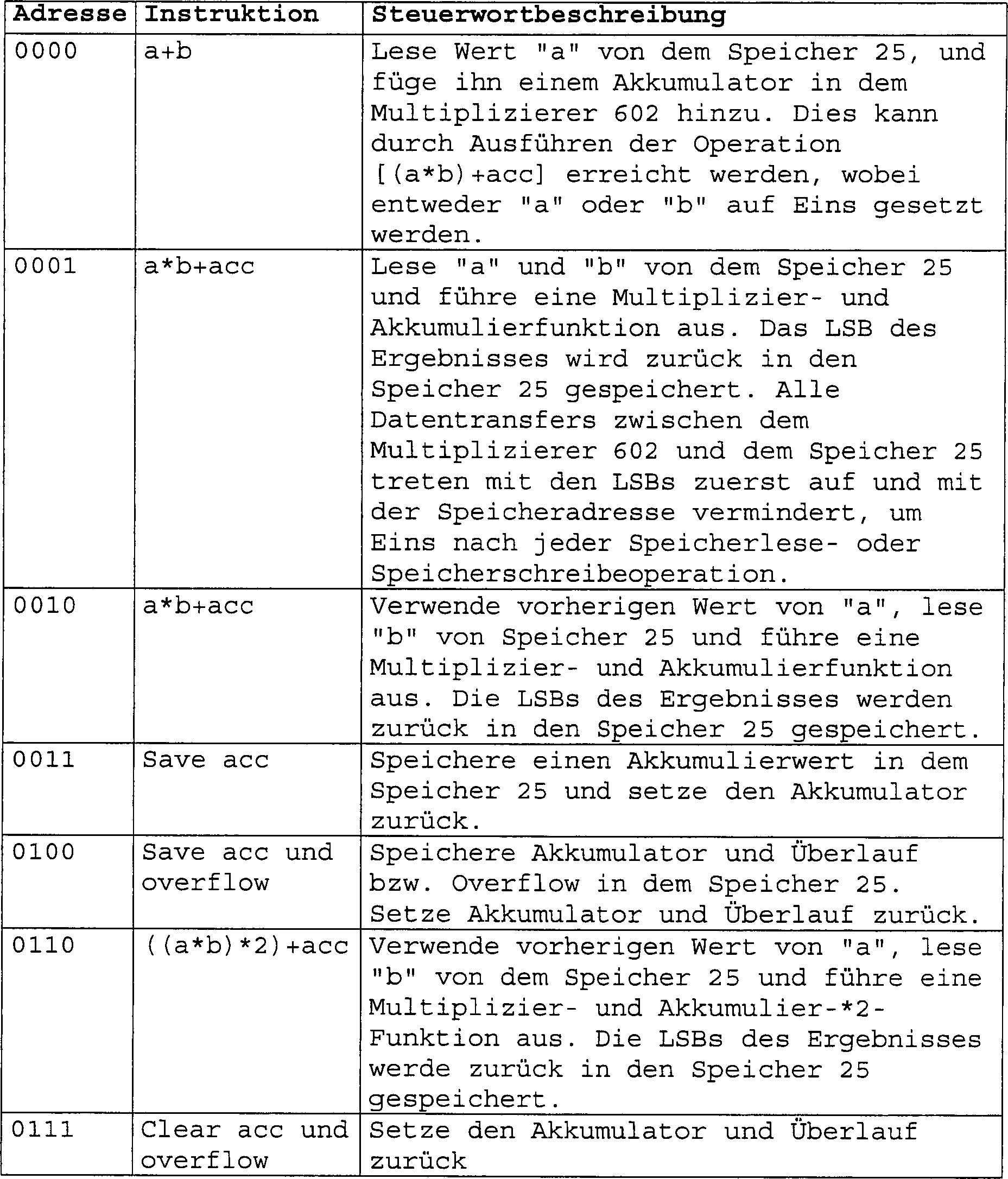
13 und 14 zeigen
Flussdiagramme, die Multiplikationsoperationen darstellen. 13 and 14 show flowcharts representing multiplication operations.
DETAILLIERTE
BESCHREIBUNG DER BEVORZUGTEN AUSFÜHRUNGSFORMDETAILED
DESCRIPTION OF THE PREFERRED EMBODIMENT
Die
vorliegende Erfindung erfüllt
den Bedarf für
ein hochgeschwindigkeits-modulares Potenzierungsverfahren und Vorrichtung,
das eine ausreichende Höhe
an Kommunikationssicherheit bereitstellt, während es die Auswirkung auf
die Computersystemleistung und Datendurchsatzraten minimiert. In
der folgenden detaillierten Beschreibung werden gleiche Bezugszeichen
verwendet, um ähnliche
Elemente in einer oder mehreren der Figuren zu beschreiben.The
present invention
the need for
a high-speed modular exponentiation method and apparatus,
that a sufficient height
provides communication security as it impacts
minimizes computer system performance and data throughput rates. In
The following detailed description will be given like reference numerals
used to similar
Describe elements in one or more of the figures.
Bezugnehmend
auf die 1 wird zuerst ein Blockdiagramm
und eine Anwendung eines modularen Potenzierers 20 innerhalb
eines beispielhaften kryptographischen Systems 10 dargestellt.
Das beispielhafte kryptographische System 10 enthält einen
Prozessor (CPU) 12, einen Schreibe-Lese-Speicher (RAM) 14, einen Nurlesespeicher
(ROM) 16 und einen modularen Potenzierer 20. Jedes
der Elemente des kryptographischen Systems 10 ist miteinander
durch einen bidirektionalen Daten- und Steuerbus 18 verbunden, über den Daten
und Steuernachrichten übertragen
werden. Die CPU 12 steuert den Betrieb des kryptographischen
Systems 10 und kann von einem herkömmlichen Mikroprozessor oder
einer Digitalsignalprozessorschaltung bereitgestellt werden. Der
RAM 14 stellt einen vorübergehenden
Datenspeicher für
den Betrieb der CPU 12 bereit, und der ROM 16 sieht
einen nichtflüchtigen
Speicher eines Instruktionssatzes vor, das bedeutet für Software,
die in einer nacheinanderfolgenden Art und Weise durch die CPU 12 ausgeführt wird,
um den Gesamtbetrieb des kryptographischen Systems 10 zu
steuern.Referring to the 1 First is a block diagram and an application of a modular exponentiation 20 within an exemplary cryptographic system 10 shown. The exemplary cryptographic system 10 contains a processor (CPU) 12 , a read-write memory (RAM) 14 , a read-only memory (ROM) 16 and a modular potentizer 20 , Each of the elements of cryptography system 10 is connected to each other by a bidirectional data and control bus 18 via which data and control messages are transmitted. The CPU 12 controls the operation of the cryptographic system 10 and may be provided by a conventional microprocessor or digital signal processor circuit. The RAM 14 provides a temporary data store for the operation of the CPU 12 ready, and the ROM 16 provides a non-volatile memory of an instruction set, that is, software that is executed in a sequential manner by the CPU 12 is executed to the overall operation of the cryptographic system 10 to control.
Der
modulare Potenzierer 20 kann ein Spezialfunktionsgerät umfassen,
wie zum Beispiel eine anwendungsspezifische integrierte Schaltung
(ASIC) oder einen feldprogrammierbaren Gate-Array (FPGA), auf den von
der CPU 12 zum Ausführen
von modularen Potenzierungsoperationen zugegriffen wird. Alternativ
können die
Elemente des kryptographischen Systems 10 alle innerhalb
eines einzelnen ASIC oder FPGA enthalten sein, in welchen der modulare
Potenzierer 20 als ein eingefügter Kernprozess bereitgestellt
wird.The modular potentizer 20 may include a special purpose device, such as an application specific integrated circuit (ASIC) or field programmable gate array (FPGA), that is supplied by the CPU 12 to access modular exponentiation operations. Alternatively, the elements of the cryptographic system 10 all contained within a single ASIC or FPGA, in which the modular exponentizer 20 is provided as an inserted core process.
Wie
in der Technik bekannt, stellt das kryptographische System eine
Schnittstelle zwischen einem nicht-sicheren Kommunikationskanal
und einem Datenbenutzer bereit. Das kryptographische System empfängt verschlüsselte Daten
von einer externen Quelle, wie zum Beispiel einem entfernten Sender
(nicht gezeigt), der mit dem kryptographischen System über den
Kommunikationskanal kommuniziert. Die verschlüsselten Daten werden durch
das kryptographische System entschlüsselt, und die entschlüsselten
Daten werden dem Datenbenutzer bereitgestellt. Umgekehrt stellt
der Datenbenutzer entschlüsselte
Daten dem kryptographischen System zur Verschlüsselung und nachfolgenden Übertragung über den
Kommunikationskanal bereit. Das kryptographische System empfängt und überträgt auch
verschiedene nicht-verschlüsselte
Nachrichten, wie zum Beispiel Steuerdaten und die öffentliche
Schlüsselinformation.
Es sollte ersichtlich sein, dass alle Kommunikationsvorgänge mit
dem kryptographischen System über
den Daten- und Steuerbus 18 auftreten.As known in the art, the cryptographic system provides an interface between a non-secure communication channel and a data user. The cryptographic system receives encrypted data from an external source, such as a remote transmitter (not shown), that communicates with the cryptographic system over the communication channel. The encrypted data is decrypted by the cryptographic system and the decrypted data is provided to the data user. Conversely, the data user provides decrypted data to the cryptographic system for encryption and subsequent transmission over the communication channel. The cryptographic system also receives and transmits various non-encrypted messages, such as control data and public key information. It should be apparent that all communications with the cryptographic system via the data and control bus 18 occur.
Der
modulare Potenzierer 20 wird detaillierter in 2 dargestellt.
Der modulare Potenzierer umfasst eine Schnittstellenlogikeinheit 22,
ein Paar paralleler Verarbeitungseinheiten 24a, 24b und
einen RAM 25, die alle intern über einen Daten- und Steuerbus 27 kommunizieren.
Die Schnittstellenlogikeinheit 22 steuert Kommunikationsvorgänge zwischen
dem modularen Potenzierer 20 und dem Daten- und Steuerbus 18 des
kryptographischen Systems 10, wie oben beschrieben. Die
Verarbeitungseinheiten 24a, 24b umfassen entsprechende
Steuereinheiten 26a, 26b und Multiplizierereinheiten 28a, 28b,
die weiterhin interne Schaltungselemente umfassen, die einen modularen
Potenzierungsprozess ausführen,
wie weiterhin unten beschrieben wird. Der RAM 25 sieht
einen vorläufigen
bzw. temporären
Speicher von Datenwerten vor, die durch die Steuereinheiten 26a, 26b und
Multiplizierereinheiten 28a, 28b erzeugt werden,
während
eine modulare Potenzierungsoperation ausgeführt wird.The modular potentizer 20 will be more detailed in 2 shown. The modular exponentiation includes an interface logic unit 22 , a pair of parallel processing units 24a . 24b and a ram 25 all internally via a data and control bus 27 communicate. The interface logic unit 22 controls communications between the modular exponentiation 20 and the data and control bus 18 of the cryptographic system 10 , as described above. The processing units 24a . 24b include appropriate control units 26a . 26b and multiplier units 28a . 28b further comprising internal circuit elements that perform a modular exponentiation process, as further described below. The RAM 25 provides a temporary storage of data values provided by the controllers 26a . 26b and multiplier units 28a . 28b while a modular exponentiation operation is being performed.
Bezugnehmend
auf die 3 in Verbindung mit der oben
beschriebenen 2 wird nun ein Flussdiagramm
auf Systemebene der Funktion dargestellt, das von dem modularen
Potenzierer 20 ausgeführt
wird. Wie in dem Schritt 101 gezeigt, berechnet der modulare
Potenzierer 20 eine modulare Potenzierung der Form y =
be mod n, in der der Modulus n, Basis b
und Exponent e jeweils k Bits lang sind. In einer bevorzugten Ausführungsform
der vorliegenden Erfindung ist k 1024 Bits. Unter Verwendung herkömmlicher
Verfahren würde das
Lösen solch
einer modularen Potenzierung eine gewaltige Menge an Verarbeitungsleistung
benötigen, aufgrund
der großen
Anzahl und Größe der Multiplikationen,
sowie modulare Reduktionen, die ausgeführt werden müssen. In
der vorliegenden Erfindung wird die modulare Potenzierung auf eine
hocheffiziente Art und Weise gelöst
durch Reduzieren der Größe des Problems
und durch Reduzieren der Anzahl von Multiplikationen, die ausgeführt werden.Referring to the 3 in conjunction with the above 2 Now, a system-level flowchart of the function represented by the modular exponentiation tool will be presented 20 is performed. As in the step 101 shown, calculates the modular exponentiation 20 a modular exponentiation of the form y = b e mod n, in which the modulus n, basis b and exponent e are each k bits long. In a preferred embodiment of the present invention, k is 1024 bits. Using conventional techniques, solving such a modular exponentiation would require a tremendous amount of processing power, due to the large number and size of multiplies, as well as modular reductions that must be made. In the present invention, the modular exponentiation is solved in a highly efficient manner by reducing the size of the problem and reducing the number of multiplications that are performed.
Als
ein erster Schritt beim Lösen
der modularen Potenzierung wird die ursprüngliche Potenzierung in Komponenten
wie folgt aufgeteilt: wobei p und q große Primzahlen
sind, und n = p*q. Für
eine maximale Sicherheit sollten p und q ungefähr die gleiche Größe haben.
Der Ausdruck q–1 mod p ist ein spezieller
Wert, der Inverses genannt wird, was wie in der Technik bekannt,
von dem chinesischen Restgliedtheorem, abgeleitet wird. Insbesondere
ist q–1 mod
p das Inverse von q mod p. Da das Inverse eine modulare Potenzierung
der gleichen Größenordnung
wie bep mod p repräsentiert, kann das Inverse
im voraus vorberechnet werden und in dem RAM 25 bei Schritt 108 gespeichert
werden. Die Werte ep und eq sind
k/2 Bit-Werte gleich e mod (p – 1)
bzw. e mod (q – 1).
Ein verringerter Basisausdruck br für jeweils mod
p und mod
q wird bereitgestellt, indem eine modulare Reduktion von b bezüglich p
bzw. q durchgeführt
wird. Die verringerten Basisausdrücke br weisen
daher auch eine k/2 Bit-Länge
auf.As a first step in solving modular exponentiation, the original exponentiation into components is broken down as follows: where p and q are large primes, and n = p * q. For maximum security, p and q should be approximately the same size. The term q -1 mod p is a special value called inverse, which is derived from the Chinese remainder theorem as known in the art. In particular, q -1 mod p is the inverse of q mod p. Since the inverse represents a modular exponentiation of the same order as b e p mod p, the inverse can be precomputed in advance and in the RAM 25 at step 108 get saved. The values e p and e q are k / 2 bit values equal to e mod (p-1) and e mod (q-1), respectively. A reduced base term b r for each mod p and mod q is provided by performing a modular reduction of b with respect to p and q, respectively. The reduced base terms b r therefore also have a k / 2 bit length.
Ein
Aufteilen der modularen Potenzierung erlaubt eine Lösung derselben
auf zwei parallele Wege, wie in 3 dargestellt,
die separat durch entsprechende Verarbeitungseinheiten 24a, 24b der 2 verarbeitet werden.
Bei den Schritten 104, 105 werden die modularen
Potenzierungen mod
p und mod
q separat berechnet unter Verwendung von Techniken, die des weiteren
unten beschrieben werden. Die br Ausdrücke jeder
der zwei modularen Potenzierungen können im voraus vorberechnet
werden und in dem RAM 25 bei den Schritten 102, 103 gespeichert
werden.Dividing the modular exponentiation allows a solution of the same in two parallel ways, as in 3 shown separately by appropriate processing units 24a . 24b of the 2 are processed. At the steps 104 . 105 become the modular potentiations mod p and mod q calculated separately using techniques which are described further below. The b r terms of each of the two modular exponentiations can be pre-calculated in advance and in the RAM 25 at the steps 102 . 103 get saved.
Da
p und q jeweils eine Länge
von k/2 Bits aufweisen, wird die Größe des entsprechenden Problems daher
im wesentlichen im Hinblick auf seine ursprüngliche Form reduziert. Über dies
hinaus benötigt
die parallele Berechnung der zwei reduzierten Größen modularen Potenzierungen
eine wesentlich geringere Computerverarbeitungszeit als eine entsprechende
Berechnung der ursprünglichen
modularen Potenzierung innerhalb einer einzelnen Verarbeitungseinheit.
Die Reduktion in Verarbeitungszeit resultiert aus der Tatsache,
dass die Anzahl von benötigten
Multiplizierungen zum Ausführen
einer Potenzierung mit einem effizienten Algorithmus (wie zum Beispiel
unten beschrieben) proportional zu 2s2 +
s ist, wobei s gleich k dividiert durch die Multiplikationsoperandengröße in Bits
ist. Falls ein s-Wortproblem, wie zwei separate s/2-Wortprobleme behandelt würde, wird
die Anzahl von Multiplizieroperationen pro Potenzierung auf einen
Wert proportional zu reduziert. Zum Beispiel würde, falls
k 1024 Bits wäre,
und der Multiplikationsoperand 128 Bits wäre, s gleich 8 sein. Demgemäß würde ein
s-Wortproblem eine Anzahl von Multiplizieroperationen proportional
zu 136 benötigen,
während
zwei separate s/2-Wortprobleme jeweils eine Anzahl von Multiplizieroperationen
proportional zu 36 benötigen
würden.
Daher wird die Anzahl von Multiplizieroperationen 3778 mal verringert.Since p and q each have a length of k / 2 bits, the size of the corresponding problem is therefore substantially reduced with respect to its original shape. In addition, parallel calculation of the two reduced sizes of modular exponentiation requires significantly less computational processing time than a corresponding computation of the original modular exponentiation within a single processing unit. The reduction in processing time results from the fact that the number of multiplies needed to perform potentiation with an efficient algorithm (such as described below) is proportional to 2s 2 + s, where s is k divided by the multiplication operand size in bits. If an s-word problem were treated as two separate s / 2 word problems, the number of multiply operations per exponentiation becomes proportional to a value reduced. For example, if k were 1024 bits and the multiplication operand were 128 bits, s would be equal to 8. Accordingly, an s-word problem would require a number of multiply operations proportional to 136, while two separate s / 2 word problems would each require a number of multiply operations proportional to 36. Therefore, the number of multiplying operations is reduced 3778 times.
Den
Berechnungen der Schritte 104, 105, folgend, wird
der mod
q Ausdruck von mod
p subtrahiert, und das Ergebnis wird p bei Schritt 106 hinzugefügt. Bei
dem Schritt 107 wird die resultierende Summe mit dem Inversen
q–1 mod
p multipliziert, was bei dem Schritt 108 vorberechnet wurde.
Dieser Schritt kann durch einen der Multiplizierer 28a, 28b ausgeführt werden,
die für
modulare Operationen optimiert sind, wie des weiteren unten beschrieben
wird. Das resultierende Produkt ist modular bezüglich p bei Schritt 109 reduziert
und wird ferner mit q bei Schritt 110 multipliziert, um
einen k-Bit-Wert zu produzieren. Letztendlich wird das Produkt der
Endmultiplikation mit mod
q bei Schritt 111 addiert, was vorher in Schritt 105 berechnet wurde.
Es sollte erkannt werden, dass die modulare Reduktion, die bei Schritt 109 auftritt,
viel leichter ist, als die ursprüngliche
modulare Potenzierung angesichts der substanziellen Reduktion in
Größe des ursprünglichen
be Ausdrucks. Diese Endlösung für die modulare Potenzierung
wird dem Daten- und Steuerbus 18 zur weiteren Verwendung
durch die CPU 12 bereitgestellt.The calculations of the steps 104 . 105 , following, the mod q expression of mod p subtracts, and the result becomes p at step 106 added. At the step 107 the resulting sum is multiplied by the inverse q -1 mod p, which is at step 108 was precalculated. This step can be done by one of the multipliers 28a . 28b which are optimized for modular operations, as further described below. The resulting product is modular with respect to p at step 109 is reduced and is further denoted by q at step 110 multiplied to produce a k-bit value. Ultimately, the product of the final multiplication with mod q at step 111 added what was in step before 105 was calculated. It should be recognized that the modular reduction used in step 109 is much easier than the original modular exponentiation given the substantial reduction in size of the original b e expression. This final solution for modular exponentiation becomes the data and control bus 18 for further use by the CPU 12 provided.
Nun
wird auf die 4 und 5a–c Bezug genommen, in denen die modularen
Potenzierungen von mod
p und mod
q der Schritte 104, 105 der 3 detaillierter
gezeigt werden. Genauer gesagt, stellt die 4 ein Flussdiagramm
dar, das eine als hierin Expontenten-Bit-Abtasten bezeichnete Routine
beschreibt, die verwendet wird zum Verringern der Anzahl von Multiplikationen,
die zum Ausführen
einer Potenzierung notwendig sind. Im allgemeinen faktorisiert die
Exponenten-Bit-Abtast-Routine
die Exponentialgrößen und in
ein Produkt der vorberechneten Potenzen der reduzierten Basis br modular reduziert bezüglich p oder q. Die Routine
kann in Firmware codiert bzw. programmiert werden und hintereinander
folgend durch entsprechende Verarbeitungseinheiten 24a, 24b ausgeführt werden,
was oben in der Form eines Software-Programms beschrieben wurde. Alternativ
kann die Routine als diskrete Logikschaltungen fest verdrahtet werden,
die zum Ausführen
der verschiedenen Funktionen der Exponenten-Bit-Abtastroutine optimiert werden. Zur
einfachen Darstellung bezieht sich die folgende Beschreibung nur
auf die Operation der Exponenten-Bit-Abtastroutine bezüglich dem
Exponentialausdruck ,
aber es sollte erkannt werden, dass eine ähnliche Operation bezüglich der
Exponentialgröße ausgeführt werden
muss.Now on the 4 and 5a - c Reference is made in which the modular exponentiations of mod p and mod q of the steps 104 . 105 of the 3 be shown in more detail. More specifically, the 4 5 is a flow chart describing a routine referred to herein as exponent bit sampling used to reduce the number of multiplications necessary to perform exponentiation. In general, the exponent bit sample routine factors the exponentials and modularly reduced in terms of p or q into a product of the precalculated powers of the reduced basis b r . The routine can be coded into firmware and sequentially followed by appropriate processing units 24a . 24b what has been described above in the form of a software program. Alternatively, the routine may be hard wired as discrete logic circuits that are optimized to perform the various functions of the exponent bit scanning routine. For ease of illustration, the following description refers only to the operation of the exponent bit scanning routine with respect to the exponential expression but it should be recognized that a similar operation in terms of exponential size must be executed.
Die
Exponenten-Bit-Abtastroutine wird bei Schritt 200 aufgerufen,
und ein laufender Zählstand
wird zu Eins bei Schritt 201 initialisiert. Ein zu bit-abtastender
Exponent ep wird in ein Register bei Schritt 202 geladen. Die 5a–c stellen einen k-Bit-Exponenten e (d.
h., ek–1–e0) dar, der in ein Register 32 geladen
wird. Das Register 32 kann einen vordefinierten Speicherplatz
innerhalb des RAM 25 umfassen. Zuerst wird ein Fenster 34 definiert,
durch das auf eine begrenzte Anzahl von Bits des Exponenten e zugegriffen
wird. Eine Fenstergröße von 3
Bits wird dann in einer beispielhaften Ausführungsform der vorliegenden
Erfindung verwendet, jedoch sollte es erkannt werden, dass eine
unterschiedliche Anzahl auch vorteilhaft verwendet werden könnte. Das Fenster 34 wird
ausgehend von der linken Seite des Registers 32 verschoben,
bis eine Eins in dem höchstwertigen
Bit (MSB) des 3-Bit-Fensters auftaucht, wie in einer bei den Schritten 203 und 204 definierten
Schleife gezeigt. In Schritt 203 wird das MSB nach einem
Vorhandensein einer Eins überprüft, und
falls eine Eins nicht detektiert wird, wird das Fenster um ein Bit
nach rechts bei Schritt 204 verschoben. Die 5b zeigt
das Fenster 34, das um ein Bit nach rechts verschoben ist.
Es sollte erkannt werden, dass die Schritte 203 und 204 wiederholt
werden, bis eine Eins detektiert wird.The exponent bit scan routine is entered at step 200 is called, and a running count becomes unity at step 201 initialized. An exponent e p to be bit-sampled is entered into a register at step 202 loaded. The 5a - c represent a k-bit exponent e (ie, e k-1 -e 0 ) that enters a register 32 is loaded. The registry 32 can have a predefined space inside the RAM 25 include. First, a window 34 defined by which a limited number of bits of the exponent e are accessed. A 3-bit window size is then used in an exemplary embodiment of the present invention, however, it should be appreciated that a different number could be used to advantage. The window 34 is starting from the left side of the register 32 until a one appears in the most significant bit (MSB) of the 3-bit window, as in one of the steps 203 and 204 shown defined loop. In step 203 the MSB is checked for the presence of a one, and if a one is not is detected, the window will be one bit to the right at step 204 postponed. The 5b shows the window 34 which is shifted one bit to the right. It should be recognized that the steps 203 and 204 be repeated until a one is detected.
Bei
Schritt 205 wurde eine Eins bei dem MSB detektiert, und
der Wert der 3-Bit-binären
Zahl in dem Fenster 34 ist eine Lese-Wert. Die Zahl ist
notwendigerweise eine 4, 5, 6, oder 7 (das heißt, binär 100, 101, 110 oder 111, entsprechend),
da das MSB Eins ist. Bei Schritt 206 wird ein vorberechneter
Wert für
die reduzierte Basis br, potenziert mit
der von dem Fenster 34 gelesenen Zahl (d. h., br 4, br 5, br 6 oder
entsprechend br 7) von
dem Speicher herausgenommen. Der vorberechnete Wert wird mit einem
laufenden Zählstand
der Potenzierung bei Schritt 207 multipliziert. Es sollte
erkannt werden, dass in dem ersten Durchgang der Routine der laufende
Zählstand
auf Eins als Standard gesetzt wird.At step 205 For example, a one was detected at the MSB, and the value of the 3-bit binary number in the window 34 is a read value. The number is necessarily a 4, 5, 6, or 7 (that is, binary 100, 101, 110, or 111, respectively) because the MSB is one. At step 206 is a precomputed value for the reduced base b r , exponentiated with that of the window 34 read number (ie, b r 4 , b r 5 , b r 6 or according to b r 7 ) taken from the memory. The precalculated value is incremented by a current count of exponentiation at step 207 multiplied. It should be appreciated that in the first pass of the routine, the current count is set to one as the default.
Danach
beginnt eine Schleife bei Schritt 209, in der das Register 32 überprüft wird,
um zu sehen, ob das niederwertigste Bit (LSB) des Exponenten ep in das Fenster 34 eingetreten
ist. Der Schritt 209 überprüft im wesentlichen
das LSB des gesamten Exponenten ep, im Gegensatz
zu Schritt 203, der das LSB des Fensters 34 liest.
Falls das LSB noch nicht in das Fenster 34 eingetreten
ist, fährt
die Schleife fort zu Schritt 212, bei dem das Fenster 34 erfolgreich
nach rechts verschoben ist, und zu Schritt 213, in dem
der laufende Zählstand
modular mit jeder solch einer Verschiebung quadriert wird. Die Schleife
wird drei mal wiederholt, bis die vorherigen drei Bits nicht mehr
in dem Fenster 34 sind, d. h., drei Verschiebungen des
Fensters. Sobald drei Verschiebungen aufgetreten sind, bestimmt
die Routine bei Schritt 216, ob das LSB Eins ist. Falls
dem so ist, kehrt die Routine zu Schritt 205 zurück, und
der Wert im Fenster 34 wird noch einmal gelesen. Alternativ
wird, falls das LSB Null ist, das Register 32 dann wieder
bei Schritt 217 überprüft, um zu
sehen, ob das LSB des Exponenten Ep in das
Fenster 34 eingetreten ist. Falls das LSB nicht in dem
Fenster 34 ist, wird die Schleife mit den Schritten 212 und 213 wieder
wiederholt, wobei das Fenster wieder ein Bit nach rechts verschoben wird,
und der laufende Zählstand
modular quadriert wird mit der Verschiebung.Thereafter, a loop begins at step 209 in which the register 32 is checked to see if the least significant bit (LSB) of the exponent e p in the window 34 occurred. The step 209 essentially checks the LSB of the total exponent e p , as opposed to step 203 , which is the LSB of the window 34 read. If the LSB is not in the window yet 34 has occurred, the loop continues to step 212 in which the window 34 successfully moved to the right, and to step 213 in which the running count is modularly squared with every such shift. The loop is repeated three times until the previous three bits are no longer in the window 34 are, ie, three shifts of the window. Once three shifts have occurred, the routine determines at step 216 whether the LSB is one. If so, the routine returns to step 205 back, and the value in the window 34 will be read again. Alternatively, if the LSB is zero, the register 32 then again at step 217 checked to see if the LSB of the exponent E p in the window 34 occurred. If the LSB is not in the window 34 is the loop with the steps 212 and 213 again, with the window again shifted one bit to the right, and the current count is modularly squared with the offset.
Falls
bei Schritt 217 das LSB in das Fenster 34 eingetreten
ist, kennzeichnet dies, dass das Ende des Exponenten ep erreicht
wurde, und die Exponenten-Bit-Abtastroutine fast fertig ist. Bei
dem Schritt 222 werden die letzten zwei Bits in dem Fenster
gelesen, und bei Schritt 223 wird der laufender Zählstand
mit der reduzierten Basis br so oft, wie
der Wert in dem Fenster gelesen wurde, multipliziert. Falls der
Wert der unteren zwei Bits 1, 2 oder 3 ist (d. h., binär 01, 10
oder entsprechend 11), dann wird beispielsweise der vorherige laufender Zählstand
mit der reduzierten Basis br Eins, Zwei
oder entsprechend Drei mal multipliziert. Falls der Wert der unteren
zwei Bits eine Null ist, wird dann der laufende Zählstand
nicht verändert
(d. h., mit Eins multipliziert). Dann endet die Exponenten-Bit-Abtastroutine
bei Schritt 224.If at step 217 the LSB in the window 34 This indicates that the end of the exponent e p has been reached and the exponent bit scan routine is almost done. At the step 222 the last two bits in the window are read, and at step 223 the running count with the reduced base b r is multiplied as many times as the value in the window was read. If the value of the lower two bits is 1, 2, or 3 (ie, binary 01, 10, or 11, respectively), then, for example, the previous running count is multiplied by the reduced base b r one, two, or three times. If the value of the lower two bits is a zero, then the current count is not changed (ie, multiplied by one). Then, the exponent bit scanning routine ends at step 224 ,
Es
wird zurückkehrend
auf den oben diskutierten Schritt 209 Bezug genommen, bevor
die Schleife beginnt, wird das Register 32 überprüft, um zu
sehen, ob das LSB des Exponenten ep in das
Fenster 34 eingetreten ist. Falls das LSB in das Fenster 34 eingetreten
ist, wird eine Reihe von Schritten ausgeführt, in denen der Zählwert überprüft wird.
Der Zählwert überwacht
die Anzahl von stattgefundenen Durchgängen durch die oben beschriebene
Schleife. Falls der Zählwert
Drei ist, was kennzeichnet, dass alle der Bits in dem Fenster 34 vorher
abgetastet wurden, endet dann die Exponenten-Bit-Abtastroutine bei Schritt 224.
Falls der Zählwert Zwei
ist, wurden dann alle bis auf das letzte Bit in dem Fenster 34 vorher
abgetastet, und bei Schritt 221 wird der Wert des letzten
Bits gelesen. Falls der Zählwert
Eins ist, wurde dann nur das erste Bit in dem Fenster 34 vorher
abgetastet, und bei Schritt 222 wird der Wert der letzten
zwei Bits gelesen (wie schon oben beschrieben). Noch einmal sei
bemerkt, dass bei Schritt 223 der laufender Zählstand
mit der reduzierten Basis br so oft, wie
der Wert in dem Fenster gelesen wurde, multipliziert wird. Dann
endet die Exponenten-Bit-Abtastroutine
bei Schritt 224.It will return to the step discussed above 209 Referenced, before the loop begins, the register becomes 32 checked to see if the LSB of the exponent e p in the window 34 occurred. If the LSB in the window 34 has occurred, a series of steps is performed in which the count is checked. The count monitors the number of passes that have taken place through the loop described above. If the count is three, indicating that all of the bits in the window 34 were previously sampled, then the exponent bit scan routine ends at step 224 , If the count is two, then all but the last bit in the window became 34 previously sampled, and at step 221 the value of the last bit is read. If the count is one, then only the first bit in the window became 34 previously sampled, and at step 222 the value of the last two bits is read (as described above). Once again, note that at step 223 the running count with the reduced base b r is multiplied as many times as the value read in the window. Then, the exponent bit scanning routine ends at step 224 ,
Ein
Beispiel der Exponenten-Bit-Abtast-Technik ist in 8 bezüglich einer
modularen Potenzierung einer Basis b potenziert mit einem Zehn-Bit-Exponenten
e dargestellt, wobei e = 1011010011 ist. Die nachfolgenden Verschiebungen
verringern den beispielhaften Ausdruck b1011010011 zu
((((((((b5)2)2)2)*b5)2)2)2)2*b3. Da der Ausdruck
b5 vorberechnet und aus dem Speicher geholt
wurde, wird Verarbeitungszeit dadurch gespart, dass dieser Ausdruck
nicht berechnet werden muss. Zusätzlich
gibt es zusätzliche
Verarbeitungszeitersparnisse, die erreicht werden, indem eine modulare
Reduktion des beispielhaften Ausdrucks bezüglich n aufgrund der Verteilungsnatur
der modularen Reduktion ausgeführt
wird. Eher als eine große
Anzahl von Multiplikationen gefolgt von einer großen Anzahl
modularer Reduktionen, werden nur neun Multiplikationen und modulare
Reduktionen benötigt,
und die modularen Reduktionen sind kleiner in der Größe, da dazwischen
liegende Werte kleiner sind.An example of the exponent bit-sampling technique is in FIG 8th with respect to a modular exponentiation of a base b, exponentiated with a ten-bit exponent e, where e = 1011010011. The subsequent shifts reduce the exemplary expression b 1011010011 to ((((((((b 5 ) 2 ) 2 ) 2 ) * b 5 ) 2 ) 2 ) 2 ) 2 * b 3 . Since the expression b 5 has been precalculated and fetched from memory, processing time is saved by not having to calculate this expression. In addition, there are additional processing time savings achieved by performing a modular reduction of the exemplary n expression due to the modular reduction nature of distribution. Rather than a large number of multiplications followed by a large number of modular reductions, only nine multiplies and modular reductions are needed, and the modular reductions are smaller in size because intervening values are smaller.
Es
sollte erkannt werden, dass der modulare Quadratisierschritt, der
mit jeder Verschiebung auftritt, notwendig ist, da das Exponenten-Bit-Abtasten
bei dem MSB des Exponenten ep beginnt, wobei
der Fensterwert nicht wirklich 4, 5, 6 oder 7 ist, aber tatsächlich 4,
5, 6 oder 7 mal 2k ist, wobei k die Exponenten-Bit-Position
für das
LSB-Bit des Fensters ist. Da der Wert des Exponent ep als
eine Hochzahl der Basis br interpretiert wird,
impliziert ein Faktor von 2k ein k-maliges
Quadrieren. Ein Multipliziere mit einem vorberechneten Wert, wenn
das Fenster MSB Eins ist, wird verwendet, um zu versichern, dass
alle Einsen in dem Exponent ep berücksichtigt
werden, und um die Gesamtzahl der benötigten vorberechneten Werte
zu reduzieren.It should be appreciated that the modular square step that occurs with each shift is necessary, since the exponent bit sampling starts at the MSB of the exponent e p , where the window value is not really 4, 5, 6, or 7, but is actually 4, 5, 6, or 7 times 2 k , where k is the Is the exponent bit position for the LSB bit of the window. Since the value of the exponent e p is interpreted as an integer of the base b r , a factor of 2 k implies k-times squaring. Multiplying by a precomputed value when the window MSB is one is used to assure that all ones in the exponent e p are taken into account and to reduce the total number of precalculated values needed.
Obwohl
die Exponenten-Bit-Abtastroutine die Anzahl von Multiplikationen
verringert hat, die in den entsprechenden Berechnungen von mod
p und mod
q ausgeführt
werden müssen,
gibt es noch immer eine Anzahl von Multiplikationen, die ausgeführt werden
müssen.
Der modulare Potenzierer 20 verwendet einen effizienten
Multiplikationsalgorithmus für
modulare Ausdrücke,
was in der Technik als eine Montgomery-Multiplikation bezeichnet wird. Der
Montgomery-Algorithmus gewährt,
dass wobei k die Anzahl von Bits
in dem Modulus n ist, und n ist relativ unteilbar durch 2k, und n > a,
n > b. Um den Algorithmus
für wiederholte
Vervielfachungen zu verwenden, müssen
die Werte a und b in die Montgomery-Form gebracht werden, bevor
die Montgomery-Vervielfachung ausgeführt wird, wobei x*2kmodn = xMont. Although the exponent bit-scan routine has reduced the number of multiplications used in the corresponding calculations of mod p and mod q, there are still a number of multiplications that must be executed. The modular potentizer 20 uses an efficient multiplication algorithm for modular expressions, which is referred to in the art as a Montgomery multiplication. The Montgomery algorithm grants that where k is the number of bits in the modulus n, and n is relatively indivisible by 2k , and n> a, n> b. In order to use the algorithm for repeated multiplication, the values a and b must be put in the Montgomery form before the Montgomery multiplication is performed, where x * 2 k modn = x Mont ,
Falls
die zwei Werte, multipliziert in der Montgomery in Montgomery-Form
sind, dann wird das Ergebnis auch in Montgomery-Form sein.If
the two values, multiplied in the Montgomery in Montgomery form
then the result will also be in Montgomery form.
Die 6 stellt
ein Flussdiagramm dar, das eine Montgomery-Multiplikationsoperation beschreibt,
die von dem modularen Potenzierer 20 ausgeführt wird.
Wie bei der bezüglich 4 oben
beschriebenen Exponenten-Bit-Abtastroutine, kann die Montgomery-Multiplikationsoperation
in der Firmware programmiert sein und hintereinanderfolgend innerhalb
entsprechender Verarbeitungseinheiten 24a, 24b von
den Steuereinheiten 26a, 26b ausgeführt werden,
die auf die Multiplizierer 28a, 28b für bestimmte
Aspekte der Operation zugreifen, wie ferner unten beschrieben wird.
Alternativ kann die Montgomery-Multiplikationsroutine als diskrete Logikschaltungen
fest verdrahtet sein, die optimiert sind zum Ausführen der
verschiedenen Funktionen der Routine.The 6 FIG. 4 illustrates a flowchart describing a Montgomery multiplication operation performed by the modular exponentiation engine 20 is performed. As with the respect 4 In the above-described exponent bit scanning routine, the Montgomery multiplication operation may be programmed in the firmware and sequentially within respective processing units 24a . 24b from the control units 26a . 26b running on the multipliers 28a . 28b for certain aspects of the operation, as further described below. Alternatively, the Montgomery multiplication routine may be hard-wired as discrete logic circuits optimized to perform the various functions of the routine.
Wie
in der 6 dargestellt, enthält die Montgomery-Multiplikationroutine
eine Hauptschleife und zwei Nebenschleifen. In jeder Hauptschleife
wird ein bestimmtes Wort eines Multiplikanten bi mit
jedem der Worte eines Multiplikanten aj multipliziert,
wobei j die Anzahl von Worten in dem Multiplikanten aj ist
und i die Anzahl von Worten in dem Multiplikanten bi ist.
Die Montgomery-Multiplikationsroutine
wird bei Schritt 301 aufgerufen. Die zwei Multiplikanten
aj und bi werden
in entsprechende Register bei Schritt 302 gemeinsam mit
einer Quadrier-Flag geladen. Falls die zwei Multiplikanden aj und bi gleich sind,
wird die Quadrier-Flag auf Eins gesetzt, so dass eine Quadrierbeschleunigungssubroutine
bei Schritt 400 aufgerufen werden kann. Die Quadrierbeschleunigungssubroutine
wird unten detaillierter beschrieben. Falls die zwei Multiplikanden
aj und bi nicht gleich
sind, dann wird die Quadrier-Flag auf Null gesetzt.Like in the 6 The Montgomery multiplication routine includes one main loop and two minor loops. In each main loop, a particular word of a multiplier b i is multiplied by each of the words of a multiplier a j , where j is the number of words in the multiplier a j and i is the number of words in the multiplicand b i . The Montgomery multiplication routine is at step 301 called. The two multipliers a j and b i are placed in corresponding registers at step 302 loaded together with a squaring flag. If the two multiplicands a j and b i are equal, the squaring flag is set to one, so that a squaring acceleration subroutine is applied at step 400 can be called. The squaring acceleration subroutine will be described in more detail below. If the two multiplicands a j and b i are not equal, then the squaring flag is set to zero.
Vor
einem Initiieren der ersten Hauptschleife wird i gleich Eins bei
Schritt 305 gesetzt, so dass auf das erste Wort des Multiplikanden
bi zugegriffen wird. Die Quadrier-Flag wird
bei Schritt 306 überprüft, um zu
bestimmen, ob die Quadrierbeschleunigungssubroutine aufgerufen werden
sollte, und falls nicht, wird j bei Schritt 307 gleich
Eins gesetzt. Die zwei Wörter
aj und bi werden
miteinander innerhalb der ersten Nebenschleife bei Schritt 308 multipliziert,
und das Produkt zu dem vorherigen Übertrag und vorherigen cj hinzu addiert. Es sollte erkannt werden,
dass in dem ersten Durchgang durch die Routine die Übertrags-
und cj-Werte Null sind. Das untere Wort
des Ergebnisses wird als cj gespeichert
und das höhere
Wort des Ergebnisses wird als nächster Übertrag
verwendet. Die erste Nebenschleife wird wiederholt durch Erhöhen von
j bei Schritt 310, bis das letzte Wort von aj bei
Schritt 309 detektiert ist, was die erste Nebenschleife
beendet. Vor einem Starten der zweiten Nebenschleife wird ein spezieller
Reduktionswert berechnet, der nur Nullen für das untere Wort von cj produziert, wenn mit cj multipliziert
wird, und j wird auf Zwei bei Schritt 311 gesetzt. Danach
bei Schritt 312 wird der spezielle Reduktionswert mit dem
Modulus nj multipliziert und dem vorherigen Übertrag
und cj hinzugefügt. Das untere Wort des Ergebnisses
wird als cj – 1 gespeichert und das höhere Wort
des Ergebnisses wird als der nächste Übertrag
verwendet. Die zweite Nebenschleife wird wiederholt durch Erhöhen von
j bei Schritt 314, bis das letzte Wort von cj bei
Schritt 313 detektiert wird, was die zweite Nebenschleife
beendet. Sobald die zweite Nebenschleife endet, wird sie bei Schritt 316 erhöht und die
Hauptschleife wird wiederholt, bis das letzte Wort von bi durch die Hauptschleife gegangen ist. Dann
wird die modulare Reduktion des Endergebnisses von cj bezüglich n
bei Schritt 317 erhalten, und die Montgomery-Multiplikationsroutine
endet bei Schritt 318. Ein Beispiel einer Montgomery-Multiplikation
von aj mit bi, in
der beide Multiplikanden vier Wörter
lang sind, wird in 9 bereitgestellt. In dem Beispiel
wird das Symbol F verwendet, um die Kombination von allen vorherigen Werten
zu bezeichnen.Before initiating the first main loop, i becomes equal to one at step 305 is set so that the first word of the multiplicand b i is accessed. The squaring flag will be at step 306 is checked to determine if the squaring acceleration subroutine should be called, and if not, j at step 307 set equal to one. The two words a j and b i become one within the first minor loop at step 308 multiplied, and adds the product to the previous carry and previous c j . It should be appreciated that in the first pass through the routine, the carry and c j values are zero. The lower word of the result is stored as c j and the higher word of the result is used as the next carry. The first minor loop is repeated by incrementing j at step 310 until the last word of a j at step 309 is detected, which ends the first minor loop. Before starting the second minor loop, a specific reduction value is produced which produces only zeros for the lower word of c j when multiplied by c j , and j goes to two at step 311 set. Then at step 312 the particular reduction value is multiplied by the modulus n j and added to the previous carry and c j . The lower word of the result is stored as c j -1 and the higher word of the result is used as the next carry. The second minor loop is repeated by incrementing j at step 314 until the last word of c j at step 313 is detected, which ends the second minor loop. As soon as the second minor loop ends, it will step 316 and the main loop is repeated until the last word of b i has passed through the main loop. Then the modular reduction of the final result of c j with respect to n at step 317 and the Montgomery multiplication routine ends at step 318 , An example of a Montgomery multiplication of a j with b i , in which both multiplicands are four words long, is given in 9 provided. In the example, the symbol F is used to denote the combination of all previous values.
Die
Montogmery-Multiplikationsroutine von 6 kann beschleunigt
werden, wenn sie verwendet wird, um eine Zahl zu quadrieren, indem
bemerkt wird, dass einige der Partialprodukte gleich sind. Insbesondere
würden
dann, wenn der Multiplikand aj gleich dem
Multiplikanden bi ist, d. h., eine Quadrieroperation,
die Partialprodukte von verschiedenen Komponenten der Multiplikation
gewöhnlich
wiederholt werden, zum Beispiel ist das Partialprodukt von a2 mit b3 gleich dem
Partialprodukt von a3 mit b2.
Wie in 9 dargestellt, treten beide dieser Partialprodukte
während
der dritten Hauptschleifeniteration auf. Daher kann es, das erstemal, wenn
das Partialprodukt angetroffen wird, mit Zwei multipliziert werden,
um das zweite Auftreten zu berücksichtigen,
und eine volle Multiplikation des zweiten Partialprodukts kann ausgelassen
werden. Eine Multiplikation mit Zwei stellt eine einfache Linksverschiebung
für eine
binäre
Zahl dar und ist signifikant schneller als eine volle Multiplikationsoperation.
Es sollte erkannt werden, dass eine große Anzahl von Quadrieroperationen
ausgeführt
wird durch den modularen Potenzierer 20 aufgrund der Operation
der oben beschriebenen Exponenten-Bit-Abtast-Routine, und eine Erhöhung in
der Geschwindigkeit der Quadrieroperationen würde einen signifikanten Effekt
auf die Gesamtverarbeitungszeit für eine bestimmte modulare Potenzierung
haben.The Montogmery multiplication routine of 6 can be sped up when used to square a number by noting that some of the partial products are the same. In particular, if the multiplicand a j equals the multiplicand b i , ie, a squaring operation, the partial products from different components of the multiplication would usually be repeated, for example, the partial product of a 2 with b 3 would be equal to the partial product of a 3 b 2 . As in 9 As shown, both of these partial products occur during the third main loop iteration. Therefore, the first time the partial product is encountered, it may be multiplied by two to account for the second occurrence, and full multiplication of the second partial product may be omitted. Multiplication by two represents a simple left shift for a binary number and is significantly faster than a full multiplication operation. It should be appreciated that a large number of squaring operations are performed by the modular exponentiation engine 20 due to the operation of the exponent bit sample routine described above, and an increase in the speed of the squaring operations would have a significant effect on the total processing time for a particular modular exponentiation.
Die 7 stellt
ein Flussdiagramm dar, das die Quadrierbeschleunigungssubroutine
beschreibt, die in Schritt 401 aufgerufen wird. Anfangs
wird j gleich i bei Schritt 402 gesetzt, was in der ersten
Iteration der Hauptschleife von 6 gleich
Eins sein wird. In nachfolgenden Iterationen der Hauptschleife sollte
jedoch erkannt werden, dass j mit dem letzten Wert von i beginnen
wird und daher die Bildung von Partialprodukten übergangen wird, die schon angetroffen
wurden. Bei Schritt 403 wird i mit j verglichen. Falls
i gleich j ist, wird dann bei Schritt 405 ein Faktor auf
Eins gesetzt, und falls i und j nicht gleich sind, wird dann der
Faktor bei Schritt 404 auf Zwei gesetzt. Danach werden
in Schritt 406 aj und bi und der Faktor miteinander multipliziert
und das Produkt wird dem vorherigen Übertrag und cj hinzugefügt. Wie
in Schritt 308 der 6, wird
das untere Wort des Ergebnisses als cj gespeichert
und das höhere
Wort des Ergebnisses wird als nächster Übertrag
verwendet. Nach Beendigung des Multiplikationsschritts 406 wird
j bei Schritt 408 erhöht,
und die Schleife wird wiederholt, bis das letzte Wort von bj durch die Schleife hindurch gegangen ist,
zu welcher Zeit die Quadrierbeschleunigungssubroutine bei Schritt 409 endet.
Bei dem Schritt 410 der 6 fängt die
Montgomery-Multiplikationsroutine genau nach der ersten Nebenschleife
an. Es sollte erkannt werden, dass die Quadrierbeschleunigungssubroutine,
anstatt der ersten Nebenschleife, für jede Iteration der Hauptschleife
der Montgomery-Multiplikationsroutine arbeiten wird, wenn die Quadrier-Flag
gesetzt ist.The 7 FIG. 10 is a flowchart describing the squaring acceleration subroutine described in step S4. FIG 401 is called. Initially, j becomes equal to i at step 402 what is set in the first iteration of the main loop of 6 will be equal to one. However, in subsequent iterations of the main loop, it should be appreciated that j will begin with the last value of i, thus bypassing the formation of partial products that have already been encountered. At step 403 i is compared to j. If i is equal to j, then at step 405 a factor is set to one, and if i and j are not equal, then the factor at step 404 set to two. After that, in step 406 a j and b i and the factor multiplied together and the product is added to the previous carry and c j . As in step 308 of the 6 , the lower word of the result is stored as c j and the higher word of the result is used as the next carry. After completion of the multiplication step 406 becomes j at step 408 is increased, and the loop is repeated until the last word of b j has passed through the loop, at which time the squaring acceleration subroutine at step 409 ends. At the step 410 of the 6 The Montgomery multiplication routine begins exactly after the first minor loop. It should be appreciated that the squaring acceleration subroutine, rather than the first minor loop, will operate for each iteration of the main loop of the Montgomery multiplication routine when the squaring flag is set.
Um
die Montgomery-Multiplikationsroutine effizienter auszuführen, werden
die Multiplizierer 28a, 28b auf ein Ausführen der
spezifischen Operationen abgestimmt. Insbesondere enthalten die
Multiplizierer 28a, 28b spezifische Funktionen
zum Multiplizieren mit Zwei (verwendet von der Quadrierbeschleunigungsroutine), Ausführen einer
a*b + c Funktion und Ausführen
der mod 2n Funktion bezüglich eines 2n-Bit-Ergebnisses,
während
die höheren
n Bits in einem Übertragsregister
gelassen werden.To perform the Montgomery multiplication routine more efficiently, the multipliers become 28a . 28b tuned to performing the specific operations. In particular, the multipliers contain 28a . 28b specific functions for multiplying by two (used by the squaring acceleration routine), performing an a * b + c function, and performing the mod 2 n function on a 2n-bit result while leaving the higher n bits in a carry register.
Die 10 zeigt
ein Diagramm, das ein Blockdiagramm einer Systemarchitektur zeigt,
die zum Ausführen
der vorliegenden Erfindung verwendet werden kann. In dieser Ausführungsform
wird die Architektur in einem ASIC 500 implementiert. Der
ASIC 500 umfasst eine CPU 12 mit einem Prozessor 502,
welcher Operationen ausführt,
die zum Implementieren der vorliegenden Erfindung benötigt werden.
In einer Ausführungsform
umfasst der Prozessor 502 einen reduzierten Instruktionensatz
(RISC) POWERPCTM 401 Kernprozessor verfügbar von
IBMTM Corporation. Der Prozessor 502 stellt
eine Spur-Schnittstelle 504 und eine Überwachungsschnittstelle 506 bzw.
Watch-Schnittstelle bereit und erhält Instruktionen über ein
externes FLASH/SRAM-Speicherschnittstellenmodul 520 und
eine 32-Bit externe Speicherschnittstelle 522. Die Spur-Schnittstelle 504 und
die Watch-Schnittstelle 506 sind für eine Fehlerdetektion und
zum Debuggen vorgesehen. Zum Verbessern der Leistung wird der Prozessor 502 mit
dem ASIC-Modulbus 524 über
einen wählbaren
Datencache 508 und einen Instruktionscache 510 über eine
Schnittstelle verbunden. Die ASIC-500-Schnittstellenlogik 522 umfasst
ein herkömmliches
Ein-/Ausgabe-Modul 516 mit einer 4-Bit externen Schnittstelle 518,
ein externes Speicherschnittstellenmodul 520 und eine damit
in Zusammenhang stehende Schnittstelle 522, sowie ein PCI-Schnittstellenmodul 512,
und eine damit in Zusammenhang stehende PCI-Schnittstelle 514.
Die PCI-Schnittstelle 514 stellt einen 32-Bit-Datenkanal
bereit, der nominell bei 33 MHz arbeitet. Das PCI-Schnittstellenmodul 512 stellt
die Operationen bereit, die zur Übereinstimmung
mit der PCI-Schnittstellen-Eingabe/Ausgabe
benötigt
werden, sowie ein Befehlsprotokoll mit eingebauten Eingabe- und
Ausgabe-First-Input/First-Output-(FIFO)-Puffern
für einen
effizienten Datentransfer. Der Datentransfer unter anderen Modulen
in der ASIC 500 wird durch den ASIC Modulbus 524 bereitgestellt.
Die ASIC 500 umfasst auch optional einen für Hochgeschwindigkeit
vorgesehenen Zufallszahlgenerator 526 zur Schlüsselerzeugung und
zur Polsterung bzw. Padding. Gemäß den hier
beschriebenen Prinzipien umfasst die ASIC 500 auch einen modularen
Potenzierer 20, der ein Paar von parallelen Verarbeitungseinheiten 24a, 24b enthält, die
jeweils mit einem RAM 25 in Zusammenhang stehen.The 10 Figure 14 is a diagram showing a block diagram of a system architecture that may be used to practice the present invention. In this embodiment, the architecture is in an ASIC 500 implemented. The ASIC 500 includes a CPU 12 with a processor 502 which performs operations needed to implement the present invention. In one embodiment, the processor includes 502 a reduced instruction set (RISC) POWERPC TM 401 Core processor available from IBM TM Corporation. The processor 502 represents a track interface 504 and a monitoring interface 506 or Watch interface and receives instructions via an external FLASH / SRAM memory interface module 520 and a 32-bit external memory interface 522 , The track interface 504 and the watch interface 506 are intended for fault detection and debugging. To improve the performance of the processor 502 with the ASIC module bus 524 via a selectable data cache 508 and an instruction cache 510 connected via an interface. The ASIC 500 -Schnittstellenlogik 522 includes a conventional I / O module 516 with a 4-bit external interface 518 , an external memory interface module 520 and an associated interface 522 , as well as a PCI interface module 512 , and a related PCI interface 514 , The PCI interface 514 provides a 32-bit data channel nominally operating at 33 MHz. The PCI interface module 512 provides the operations needed to match the PCI interface input / output, as well as a command protocol with built-in input and output first-in-first-out (FIFO) buffers for efficient data transfer. Data transfer among other modules in the ASIC 500 is through the ASIC module bus 524 provided. The ASIC 500 includes also optionally a high-speed random number generator 526 for key generation and for padding or padding. According to the principles described herein, the ASIC includes 500 also a modular potentizer 20 that is a pair of parallel processing units 24a . 24b contains, each with a RAM 25 being related.
Die 11 stellt
eine detailliertere Ansicht der Verarbeitungseinheiten 24a, 24b dar,
sowie die den damit in Zusammenhang stehenden RAM 25 und
die Steuereinheiten 26a, 26b. Die Verarbeitungseinheit 24a, b, umfasst
einen Multiplizierer 602, ein Vorladeregister 604,
einen Speicher 25 und einen Multiplexer 606. Eine Steuereinheit 26a, b,
betriebsfähig
gekoppelt mit dem Multiplizierer 602, sowie einem Vorladeregister 604,
einem Speicher 25 und einem Multiplizierer 606,
steuert den Betrieb dieser entsprechenden Geräte gemäß einem durch den Zeitgeber 608 bereitgestelltem
Taktsignal.The 11 provides a more detailed view of the processing units 24a . 24b and the associated RAM 25 and the control units 26a . 26b , The processing unit 24a . b , includes a multiplier 602 , a preload register 604 , a store 25 and a multiplexer 606 , A control unit 26a . b , operably coupled with the multiplier 602 , as well as a preload register 604 , a store 25 and a multiplier 606 controls the operation of these respective devices according to one by the timer 608 provided clock signal.
Es
ist wünschenswert,
1024-Bit RSA-Berechnungen so schnell wie möglich auszuführen, wie
zum Beispiel modulare Potenzierungen, bevorzugt mit weniger als
5 ms bei einer 33 MHz Taktgeschwindigkeit. Obwohl die 1024-Bit RSA-Berechnungen
auf 512-Bit-Berechnungen unter Verwendung der obigen Lehre verringert werden
können,
bleibt noch immer das Problem eines Ausführens von zwei 512-Bit-Berechnungen
innerhalb des 5 ms Intervalls übrig.It
is desirable
To run 1024-bit RSA calculations as fast as possible, like
for example, modular exponentiation, preferably with less than
5 ms at a 33 MHz clock speed. Although the 1024-bit RSA calculations
be reduced to 512-bit calculations using the above teaching
can,
The problem still remains of executing two 512-bit calculations
within the 5 ms interval.
Gewöhnlich würde ein
Multiplizierer 602 einen 64-Bit-Bus für jede zu multiplizierende
Eingangszahl umfassen. Jedoch würde
bei solch einer Ausführung
die Anzahl von Taktpulsen, die nötig
ist zum Eingeben beider Werte von einem 64-Bit-Bus, zu groß werden
zum Unterstützten
einer 5 ms Berechnungsgeschwindigkeit mit einem 33 MHz Takt. Die
vorliegende Erfindung stellt diese Hochgeschwindigkeitsfähigkeit
mit einer einzigartigen Architektur bereit, die einen 512-Bit Eingangsanschluss
eines Multiplizierers gekoppelt mit einem Vorladeregister enthält, sowie
eine Steuereinheit, die ein effizientes Berechnungsprotokoll ausführt zum
effizienten Ausführen
von 512 mal 512 Bit Multiplikationen. Ferner führt, wegen der vorhersehbaren
Natur der Berechnungen, die beim Ausführen der Montgomery-Multiplikationen
benötigt
werden, die Steuereinheit 26a, b, ein Berechnungsprotokoll
durch, das die Taktzyklen minimiert, um eine neue Zahl in das Vorladeregister
einzugeben.Usually a multiplier would 602 comprise a 64-bit bus for each input number to be multiplied. However, in such an embodiment, the number of clock pulses needed to input both values from a 64-bit bus would become too large to support a 5 ms computation rate with a 33 MHz clock. The present invention provides this high-speed capability with a unique architecture that includes a 512-bit input port of a multiplier coupled to a preload register, and a controller that performs an efficient computational protocol to efficiently perform 512 by 512-bit multiplications. Further, because of the predictable nature of the calculations needed to perform the Montgomery multiplications, the controller will result 26a . b , a calculation protocol that minimizes the clock cycles to enter a new number in the preload register.
Gemäß dem Vorhergehenden
umfasst der Multiplizierer einen ersten Eingang 610 mit
einer N Bit Kapazität,
wobei N eine ganze Zahl größer als
Eins ist, sowie einen zweiten Eingang 612 mit einer K*N
(hierin im folgenden KN) Bit Kapazität, wobei K eine ganze Zahl
größer als
Eins ist. Die dargestellte Ausführungsform zeigt
ein System, wobei N = 64 und K = 8, was die Situation darstellt,
wo der erste Eingang ein 64-Bit-Parallel-Eingang
bzw. Parallelport und der zweite Eingang ein 512-Bit-Parallelport
ist. Indem die Kapazität
des ersten Eingangs des Multiplizierers 610 ausgewählt wird,
geringer als die des Multiplizierers des zweiten Anschlusses 612 zu
sein, minimiert dies die Systemressourcenerfordernisse, ohne sich
wesentlich auf den Durchsatz des Multiplizierers 602 auszuwirken.
Dies kommt daher, dass der Multiplizierer 602 nur mit 64
Bits der Anzahl bei dem ersten Eingang 610 (dem "b" Multiplikand) alle vier Takte arbeitet,
während
die Multiplikation stattfindet.In accordance with the foregoing, the multiplier comprises a first input 610 with an N bit capacity, where N is an integer greater than one, and a second input 612 with a K * N (hereinafter KN) bit capacity, where K is an integer greater than one. The illustrated embodiment shows a system where N = 64 and K = 8, representing the situation where the first input is a 64-bit parallel input and the second input is a 512-bit parallel port. By taking the capacity of the first input of the multiplier 610 is selected lower than that of the multiplier of the second terminal 612 This minimizes system resource requirements without significantly affecting the multiplier's throughput 602 to impact. This is because the multiplier 602 only with 64 bits of the number at the first input 610 (the "b" multiplicand) works every four bars while the multiplication takes place.
Um
den Wert des Multiplikanden "a" am Anschluss 612 bei
jeder aufeinanderfolgenden Multiplikation zu steuern, können Eingaben
in das Vorladeregister 604 (was den Multiplikanden "a" darstellt), durch den Multiplizierer 602 bereitgestellt
werden (von einem Multipliziererausgang 614) oder dem Speicher 25 (von
einem Speicherausgang 616) unter Verwendung einer auswahlbaren
Steuerung des Multiplizierers 606 und der Steuereinheit 26a, b.
Beispielsweise schreibt der Montgomery-Algorithmus vor, dass der gewünschte Wert
für "a" in der nächsten Berechnung oft der gleiche
ist, wie der Wert für "a" in der vorhergehenden Multiplikation
(siehe beispielsweise 9). In solchen Fällen benötigt das
Vorladeregister 604 keinen neuen Wert für "a",
und die Steuereinheit 26a, b wird den vorherigen
Wert für "a" in dem Vorladeregister beibehalten,
und ihn dem Multiplizierer 602, wenn nötig bereitstellen. Ein Datenpfad
wird auch von dem Multipliziererausgang 614 dem Vorladeregister 604 bereitgestellt,
um sofort benötigten
Ergebnissen zu erlauben, den Speicher 25 zu umgehen, wodurch
Speicherbusverkehr verringert wird.To get the value of the multiplicand "a" at the port 612 to control at each successive multiplication, inputs to the preload register 604 (representing the multiplicand "a") by the multiplier 602 be provided (from a multiplier output 614 ) or the memory 25 (from a memory output 616 ) using a selectable control of the multiplier 606 and the control unit 26a . b , For example, the Montgomery algorithm dictates that the desired value for "a" in the next calculation is often the same as the value for "a" in the previous multiplication (see, for example, FIG 9 ). In such cases the preload register is required 604 no new value for "a", and the control unit 26a . b will keep the previous value for "a" in the preload register, and keep it to the multiplier 602 if necessary, provide. A data path is also from the multiplier output 614 the preload register 604 provided to allow immediate results to the memory 25 to bypass, which reduces memory bus traffic.
Unter
der Annahme, dass es eine in dem Speicher 25 gespeicherte
erste Zahl ("b") gibt, und eine
in dem Vorladeregister 604 geladene zweite Zahl ("a"), findet die Multiplikation von a*b
wie folgt statt. In dem ersten Taktzyklus wird der gesamte 512-Bit-Wert
für die
zweite Zahl ("a") von dem Vorladeregister 604 dem
Multiplizierer 602 eingegeben. Als nächstes werden die ersten 64
Bits der ersten Zahl ("b") in den Multiplizierer 602 geladen.
Dann wird über
die nächsten
drei Taktzyklen, die 64-Bit erste Zahl ("b")
mit der 512-Bit zweiten Zahl ("a") multipliziert.
Die nächsten
64 Bits der ersten Zahl ("b") werden dann in
den Multiplizierer 602 geladen, und dieser Teil von ("b") wird mit der 512-Bit zweiten Zahl
("a") multipliziert.
Dieser Prozess wird wiederholt, bis alle Bits des ("b") Multiplikanden mit allen Bits des
("a") Multiplikanden
multipliziert sind. Das Laden und Multiplizieren aller Bits von
("b") mit diesen von
("a") dauert 8*4 = 32
Taktzyklen. Nach 4 Taktzyklen der internen Verarbeitung des Multiplizierers 602 wird
die die niedrigstwertigen 512 Bits des Produkts der ersten Zahl
("b") und der zweiten
Zahl ("a") darstellende Ausgabe über die
nächsten
8 Taktzyklen ausgegeben. Die höchstwertigen
512 Bits des Produkts verbleiben in dem Multiplizierer 602 und
werden für
weitere Übertragsoperationen verwendet.
Demgemäß werden
45 Taktzyklen benötigt,
um das Produkt von ("a") und ("b") zu bestimmen.Assuming that there is one in the store 25 stored first number ("b"), and one in the preload register 604 loaded second number ("a"), the multiplication of a * b takes place as follows. In the first clock cycle, the entire 512-bit value for the second number ("a") from the preload register 604 the multiplier 602 entered. Next, the first 64 bits of the first number ("b") in the multiplier 602 loaded. Then, over the next three clock cycles, the 64-bit first number ("b") is multiplied by the 512-bit second number ("a"). The next 64 bits of the first number ("b") are then added to the multiplier 602 and that part of ("b") is multiplied by the 512-bit second number ("a"). This process is repeated until all bits of the ("b") multiplicand are multiplied by all bits of the ("a") multiplicand. The loading and multi Placing all bits of ("b") with these of ("a") takes 8 * 4 = 32 clock cycles. After 4 clock cycles of internal processing of the multiplier 602 For example, the output representing the least significant 512 bits of the product of the first number ("b") and the second number ("a") is output over the next 8 clock cycles. The most significant 512 bits of the product remain in the multiplier 602 and are used for further carry operations. Accordingly, 45 clock cycles are needed to determine the product of ("a") and ("b").
Obwohl
der Datenkanal 622 von dem Vorladeregister 604 an
den Multiplizierer 602 ein 512-Bit-Datenkanal ist, beträgt die Buskapazität zu allen
anderen Eingangs- und Ausgangsanschlüssen, einschließlich dem Speicher 25 nur
64 Bits. Deshalb würden
in den Fällen,
in denen ein Vorladewert benötigt
wird (ein neuer "a"-Wert) zusätzliche
8 Taktzyklen gewöhnlich
benötigt
werden zum Laden des Werts von dem Speicher 25 zu dem Vorladeregister 604 von
dem 64-Bit- Datenkanal.
Dies würde
bedeuten, dass für
eine einen neuen "a"-Wert benötigende
Multiplikation die Anzahl von benötigten Taktzyklen zum Beenden
der Operation 45 + 8 = 53 sein würde.
Um dieses Problem zu vermeiden, ruft die Steuereinheit 26a, b der
vorliegenden Erfindung ein unterschiedliches Befehlsprotokoll auf,
wenn ein neuer "a"-Wert erwartet wird.
Dieses Protokoll macht von dem 64-Bit-Eingangsbus gebraucht, während die
drei Takte nach jedem 64-Bit-"b"-Wert dem Multiplizierer 602 geliefert
werden. Insbesondere wird der vorhergesagte zukünftige Wert, der für die nächste Multiplikation
gebraucht wird, von dem Speicher 25 geholt und an das Vorladeregister 604 geleitet,
während
der der Eingabe von dem "b"-Wert an den Multiplizierer 602 folgenden
Taktperiode. Der vorhergesagte zukünftige Wert für "a" ist aufgrund der deterministischen
Art der Montgomery-Multiplikationsroutine
feststellbar, die häufig
den gleichen "a"-Wert verwendet,
während
nur der "b"-Wert variiert wird.Although the data channel 622 from the preload register 604 to the multiplier 602 is a 512-bit data channel, the bus capacity is to all other input and output ports, including memory 25 only 64 bits. Therefore, in cases where a precharge value is needed (a new "a" value), an additional 8 clock cycles would usually be needed to load the value from the memory 25 to the preload register 604 from the 64-bit data channel. This would mean that for a multiplication requiring a new "a" value, the number of clock cycles needed to complete the operation would be 45 + 8 = 53. To avoid this problem, the control unit calls 26a . b In the present invention, a different command protocol is expected when a new "a" value is expected. This protocol makes use of the 64-bit input bus, while the three clocks after each 64-bit "b" value are needed by the multiplier 602 to be delivered. In particular, the predicted future value needed for the next multiplication will be from the memory 25 brought and to the preload register 604 passed while inputting the "b" value to the multiplier 602 following clock period. The predicted future value for "a" is detectable due to the deterministic nature of the Montgomery multiplication routine, which often uses the same "a" value while only varying the "b" value.
Die 12 zeigt
ein Taktdiagramm, das die vorhergehende Logik darstellt. Die Linie
bzw. Spur 702 stellt das Signal des Taktgebers 608 dar.
Die Linie 704 kennzeichnet die Taktzyklen, wo Werte für "b" an den Multiplizierer 602 von
dem Speicher 520 geliefert werden. Da der den Ausgangsanschluss 616 des
Speichers 25 mit dem ersten Eingangsanschluss 610 des
Multiplizierers verbindende Bus ein 64-Bit-Bus ist, werden Werte
für die
512-Bit-Zahl "b" an den Multiplizierer 602 in
64-Bit-Inkrementen geliefert. Demgemäß kennzeichnet der Ort 708 auf
der Linie 704, wo die ersten 64 Bits der 512-Bit-Zahl "b" an den Multiplizierer 602 über den ersten
Eingangsanschluss 610 des Multiplizierers transferiert
werden. Bei einem Taktpuls nach dem Taktpuls, in dem die ersten
64 Bits des "b"-Werts an den Multiplizierer 602 transferiert
wurden, werden 64 Bits des "a"-Werts für die nächste Multiplikation
von dem Speicher 25 an das Vorladeregister 604 transferiert.
Dies ist durch den Puls 710 auf der Linie 706 gekennzeichnet.
Das Vorhergehende kann auch mit Puls 710 implementiert
werden, der zwei oder mehr Zyklen nach dem Zyklus auftritt und die "b"-Information auch lädt. Dieser Prozess wird wiederholt,
bis alle "b" darstellende Bits
in den Multiplizierer 602 geladen wurden und alle den neuen "a"-Wert darstellende Bits in das Vorladeregister 604 vorgeladen
wurden.The 12 shows a timing diagram representing the previous logic. The line or track 702 sets the signal of the clock 608 dar. The line 704 indicates the clock cycles where values for "b" to the multiplier 602 from the store 520 to be delivered. Because of the output terminal 616 of the memory 25 with the first input terminal 610 If the bus connecting the multiplier is a 64-bit bus, values for the 512-bit number "b" will be sent to the multiplier 602 delivered in 64-bit increments. Accordingly, the place marks 708 on the line 704 where the first 64 bits of the 512-bit number "b" to the multiplier 602 via the first input connection 610 of the multiplier. At a clock pulse after the clock pulse in which the first 64 bits of the "b" value to the multiplier 602 64 bits of the "a" value for the next multiplication from the memory become 64 bits 25 to the preload register 604 transferred. This is through the pulse 710 on the line 706 characterized. The foregoing can also be with pulse 710 which occurs two or more cycles after the cycle and also loads the "b" information. This process is repeated until all the "b" bits in the multiplier 602 and all the bits representing the new "a" value into the preload register 604 were summoned.
Die 13 und 14 zeigen
Flussdiagramme, die Multiplikationsoperationen einer Ausführungsform
der vorliegenden Erfindung zeigen. Zuerst werden, wie in Block 802 gezeigt,
KN Bits von "A" von dem Vorladeregister 602 zu
dem Multiplizierer 602 an dem zweiten Eingangsanschluss 612 des
Multiplizierers bereitgestellt. Dies wird in einem einzelnen Taktpuls
erreicht. Als nächstes
werden N Bits von "b" dem ersten Eingangsanschluss 610 des
Multiplizierers 602 in einem einzelnen Taktpuls bereitgestellt.
Dies ist in Block 804 gezeigt.The 13 and 14 FIG. 10 are flowcharts showing multiplication operations of an embodiment of the present invention. FIG. First, as in block 802 shown, KN bits of "A" from the preload register 602 to the multiplier 602 at the second input terminal 612 provided by the multiplier. This is achieved in a single clock pulse. Next, N bits of "b" become the first input terminal 610 of the multiplier 602 provided in a single clock pulse. This is in block 804 shown.
In
dem Montgomery-Algorithmus wird der Operand "a" oft
in hintereinanderfolgenden Berechnungen verwendet und kann auch
aus vorhergehenden Werten vorhergesagt werden. Aufgrund dieser deterministischen
Art, kann der Wert für "a" für
nacheinanderfolgende Berechnungen vorhergesagt werden. Falls ein
neuer Wert für "a" in den folgenden Berechnungen vorhergesagt
wird, werden N Bits des vorhergesagten "a"-Werts
von dem Speicher 25 dem Vorladeregister 604 in
einem einzelnen Takt bereitgestellt. Dies kann in einem einzelnen
Taktpuls ausgeführt
werden, der dem Puls folgt, der N Bits von "b" dem
Multiplizierer bereitstellt und dies ist in den Blöcken 806 und 814 gezeigt.
Durch Bereitstellen des vorhergesagten "a"-Werts
von dem Speicher 25 zu dieser Zeit, wird ein potentieller
Engpass in einem Datenfluss für
neue "a"-Werte minimiert, wie
es oben bezüglich 12 beschrieben
wird. Falls ein neuer Wert für "a" nicht vorhergesagt wird, schreitet die
Logik von Block 806 zu Block 808, wo die KN Bits
von "a" mit den N Bits von "b" multipliziert werden.In the Montgomery algorithm, the operand "a" is often used in sequential calculations and can also be predicted from previous values. Because of this deterministic nature, the value of "a" can be predicted for successive calculations. If a new value of "a" is predicted in the following calculations, N bits of the predicted "a" value from the memory become 25 the preload register 604 provided in a single bar. This can be done in a single clock pulse following the pulse that provides N bits of "b" to the multiplier and this is in the blocks 806 and 814 shown. By providing the predicted "a" value from the memory 25 At this time, a potential bottleneck in a data flow is minimized for new "a" values, as discussed above 12 is described. If a new value for "a" is not predicted, the logic of Block proceeds 806 to block 808 where the KN bits of "a" are multiplied by the N bits of "b".
Dieser
Prozess ist erst abgeschlossen, bis alle KN Bits von "b" mit allen KN Bits von "a" multipliziert wurden, wie es in Block 810 dargestellt
ist, was in der im Block 812 bereitgestellten Ausgangszahl
resultiert. Dann werden, wie in Block 814 gezeigt, N Bits
der Ausgangszahl dem Multipliziererausgangsanschluss in einem einzelnen
Taktpuls bereitgestellt. Falls der gegenwärtige Ausgangswert von dem
Multiplizierer 602 für
die nächste
Multiplikation benötigt
wird, werden N Bits der Ausgangszahl dem Vorladeregister 604 bereitgestellt. Dies
ist in den Blöcken 816 und 818 dargestellt.
Falls nicht, schreitet die Logik zu Block 820, wo die N
Bits der Ausgangszahl dem Speicher 25 bereitgestellt werden.
Wie in Block 822 gezeigt, werden die in den Blöcken 814 bis 822 ausgeführten Operationen
wiederholt, bis alle KN Bits der Ausgangszahl dem Speicher 25 bereitgestellt
werden.This process is completed until all KN bits of "b" have been multiplied by all KN bits of "a", as in block 810 what is shown in the block 812 provided initial number results. Then, as in block 814 N bits of the output number are provided to the multiplier output terminal in a single clock pulse. If the current output value from the multiplier 602 for the next multiplication, N bits of the output number become the preload register 604 provided. This is in the blocks 816 and 818 shown. If not, the logic moves to block 820 where the N bits of the output number are the memory 25 to be provided. As in block 822 shown in the blocks 814 to 822 Repeated operations are repeated until all KN bits of the output number memory 25 to be provided.
Unter
Verwendung der vorhergehenden Techniken ist der Multiplizierer 602 in
der Lage, eine Anzahl von Operationen bezüglich "a" und "b" zusätzlich
zu einer Multiplikation effizient auszuführen. Diese Operationen werden
unten in Tabelle 1 beschrieben:Using the preceding techniques, the multiplier is 602 capable of efficiently performing a number of operations on "a" and "b" in addition to multiplication. These operations are described below in Table 1:
Tabelle
1 Table 1
SCHLUSSFOLGERUNGCONCLUSION
Eine
recheneffiziente Multiplikationsvorrichtung und Verfahren, die speziell
für eine
modulare Potenzierung geeignet sind, wurden beschrieben. Die Vorrichtung
verwendet ein Vorladeregister, das mit einem Multiplizierer über einen
KN Bit-Bus gekoppelt ist zum Laden des Werts des "a" Multiplikanden in den Multiplizierer in
einem einzelnen Taktpuls. Der "b"-Multiplikand (der
auch KN Bits lang ist), wird an den Multiplizierer mit jeweils N
Bits von einem Speicher über
einen N-Bit-Bus geliefert. Der Multiplizierer multipliziert die
N Bits des "b"-Multiplikanden mit
den KN Bits des "a"-Multiplikanden,
bis alle KN Bits von "b" mit den KN Bits
von "a" multipliziert sind.A computationally efficient multiplier apparatus and methods specifically adapted for modular exponentiation have been described. The device uses a precharge register coupled to a multiplier via a KN bit bus for loading the value of the "a" multiplicand into the multiplier in a single clock pulse. The "b" multiplicand (which is also KN bits long) is supplied to the multiplier of N bits each from a memory over an N-bit bus. The multiplier multiplies the N bits of the "b" multiplicands with the KN bits of the "a" multiplicand until all KN bits of "b" are multiplied by the KN bits of "a".
Das
Verfahren stellt KN Bits des Multiplikanden "a" von
einem Vorladeregister dem Multiplizierer in einem einzelnen Taktpuls
bereit. Dann werden N Bits des Multiplikanden "b" dem
Multiplizierer auch in einem einzelnen Taktpuls bereitgestellt.
Als nächstes
werden die KN Bits der Zahl "a" wiederholt mit den
N Bits der Zahl "b" multipliziert, bis
alle der KN Bits des "b"-Multiplikanden dem
ersten Multiplizierereingangsanschluss bereitgestellt und mit den
KN Bits des "a"-Multiplikanden multipliziert
wurden. Wenn dies beendet ist, führen diese
Operationen zu einer Ausgabezahl, die dann mit jeweils N Bits an
den Speicher übertragen
wird, wo sie für
eine weitere Verarbeitung zur Verfügung gestellt werden kann.The
Method provides KN bits of the multiplicand "a" of
a precharge register to the multiplier in a single clock pulse
ready. Then, N bits of the multiplicand "b" become the
Multiplier also provided in a single clock pulse.
Next
the KN bits of the number "a" are repeated with the
N bits of the number "b" multiplied until
all of the KN bits of the "b" multiplicand
provided first multiplier input terminal and with the
KN bits of the "a" multiplicand multiplied
were. When this is done, they lead
Operations to an output number, which then each with N bits
transfer the memory
will, where to go for
further processing can be provided.
Gemäß dem deterministischen
Verhalten des Montgomery-Algorithmus
lädt eine
Ausführungsform
der vorliegenden Erfindung einen vorhergesagten (zukünftigen)
Wert für
einen Multiplikanden "a" in das Vorladeregister,
während
Multiplikationsoperationen bezüglich
der gegenwärtigen "a"- und "b"-Multiplikanden ausgeführt werden.
Diese Technik reduziert weiterhin die benötigten Taktzyklen zum Laden
und Multiplizieren der Parameter.According to the deterministic
Behavior of the Montgomery algorithm
invites one
embodiment
the present invention a predicted (future)
Value for
a multiplicand "a" in the preload register,
while
Multiplication operations with respect to
the current "a" and "b" multiples.
This technique further reduces the required clock cycles for charging
and multiplying the parameters.
Es
sollte auch erkannt werden, dass verschiedene Modifikationen, Anpassungen
und alternative Ausführungsformen
des recheneffizienten Multiplizierers innerhalb des Rahmens der
vorliegenden Erfindung gemacht werden können. Während die vorliegende Erfindung
gut für
kryptographische Systeme geeignet ist, die mit Prozessoren für spezielle
Zwecke implementiert werden, ist sie beispielsweise auch in nicht-kryptographischen
Systemen brauchbar und kann auch in Prozessoren für allgemeine
Zwecke implementiert werden. In solchen Fällen können ein oder mehrere computerausführbare Programme
mit Instruktionen, die die Erfindung implementieren, fest in einem
computerlesbaren Programmspeichergerät, wie zum Beispiel einer Floppy
Disk oder anderen Speichermedien, verkörpert werden.It
should also be recognized that various modifications, adjustments
and alternative embodiments
of the computationally efficient multiplier within the framework of
present invention can be made. While the present invention
good for
Cryptographic systems that are compatible with special purpose processors
For example, it is also implemented in non-cryptographic purposes
Systems useful and can also be used in general purpose processors
Purposes are implemented. In such cases, one or more computer-executable programs
with instructions implementing the invention firmly in one
computer-readable program storage device, such as a floppy
Disk or other storage media, to be embodied.