DE69825156T2 - MINERALS AND METHOD FOR THEIR MANUFACTURE AND USE - Google Patents
MINERALS AND METHOD FOR THEIR MANUFACTURE AND USE Download PDFInfo
- Publication number
- DE69825156T2 DE69825156T2 DE69825156T DE69825156T DE69825156T2 DE 69825156 T2 DE69825156 T2 DE 69825156T2 DE 69825156 T DE69825156 T DE 69825156T DE 69825156 T DE69825156 T DE 69825156T DE 69825156 T2 DE69825156 T2 DE 69825156T2
- Authority
- DE
- Germany
- Prior art keywords
- calcium phosphate
- solution
- calcium
- reaction
- oxidizing agent
- Prior art date
- Legal status (The legal status is an assumption and is not a legal conclusion. Google has not performed a legal analysis and makes no representation as to the accuracy of the status listed.)
- Expired - Lifetime
Links
- 238000000034 method Methods 0.000 title claims abstract description 67
- 238000004519 manufacturing process Methods 0.000 title abstract description 39
- 229910052500 inorganic mineral Inorganic materials 0.000 title description 82
- 239000011707 mineral Substances 0.000 title description 82
- 239000000243 solution Substances 0.000 claims abstract description 83
- -1 oxoacid anions Chemical class 0.000 claims abstract description 40
- 239000007864 aqueous solution Substances 0.000 claims abstract description 22
- 150000003839 salts Chemical class 0.000 claims abstract description 18
- 150000001450 anions Chemical class 0.000 claims abstract description 15
- QORWJWZARLRLPR-UHFFFAOYSA-H tricalcium bis(phosphate) Chemical group [Ca+2].[Ca+2].[Ca+2].[O-]P([O-])([O-])=O.[O-]P([O-])([O-])=O QORWJWZARLRLPR-UHFFFAOYSA-H 0.000 claims description 139
- 239000001506 calcium phosphate Substances 0.000 claims description 113
- 235000011010 calcium phosphates Nutrition 0.000 claims description 103
- 229910000389 calcium phosphate Inorganic materials 0.000 claims description 93
- 238000006243 chemical reaction Methods 0.000 claims description 75
- 238000010438 heat treatment Methods 0.000 claims description 65
- 239000002243 precursor Substances 0.000 claims description 56
- 239000000203 mixture Substances 0.000 claims description 40
- 239000013078 crystal Substances 0.000 claims description 38
- 239000000463 material Substances 0.000 claims description 31
- 239000004568 cement Substances 0.000 claims description 27
- 239000007800 oxidant agent Substances 0.000 claims description 23
- 239000000047 product Substances 0.000 claims description 22
- 230000008569 process Effects 0.000 claims description 21
- 238000002360 preparation method Methods 0.000 claims description 18
- 210000000988 bone and bone Anatomy 0.000 claims description 16
- NHNBFGGVMKEFGY-UHFFFAOYSA-N Nitrate Chemical compound [O-][N+]([O-])=O NHNBFGGVMKEFGY-UHFFFAOYSA-N 0.000 claims description 11
- ZCCIPPOKBCJFDN-UHFFFAOYSA-N calcium nitrate Chemical compound [Ca+2].[O-][N+]([O-])=O.[O-][N+]([O-])=O ZCCIPPOKBCJFDN-UHFFFAOYSA-N 0.000 claims description 11
- MWUXSHHQAYIFBG-UHFFFAOYSA-N Nitric oxide Chemical group O=[N] MWUXSHHQAYIFBG-UHFFFAOYSA-N 0.000 claims description 10
- 229910052698 phosphorus Inorganic materials 0.000 claims description 10
- 239000011574 phosphorus Substances 0.000 claims description 10
- OAICVXFJPJFONN-UHFFFAOYSA-N Phosphorus Chemical compound [P] OAICVXFJPJFONN-UHFFFAOYSA-N 0.000 claims description 9
- 238000006479 redox reaction Methods 0.000 claims description 9
- 229910002651 NO3 Inorganic materials 0.000 claims description 8
- 230000000975 bioactive effect Effects 0.000 claims description 8
- 238000002425 crystallisation Methods 0.000 claims description 8
- 230000008025 crystallization Effects 0.000 claims description 8
- ACVYVLVWPXVTIT-UHFFFAOYSA-N phosphinic acid Chemical compound O[PH2]=O ACVYVLVWPXVTIT-UHFFFAOYSA-N 0.000 claims description 8
- BHPQYMZQTOCNFJ-UHFFFAOYSA-N Calcium cation Chemical compound [Ca+2] BHPQYMZQTOCNFJ-UHFFFAOYSA-N 0.000 claims description 7
- 239000002244 precipitate Substances 0.000 claims description 7
- ACVYVLVWPXVTIT-UHFFFAOYSA-M phosphinate Chemical compound [O-][PH2]=O ACVYVLVWPXVTIT-UHFFFAOYSA-M 0.000 claims description 6
- NBIIXXVUZAFLBC-UHFFFAOYSA-N Phosphoric acid Chemical compound OP(O)(O)=O NBIIXXVUZAFLBC-UHFFFAOYSA-N 0.000 claims description 4
- 230000002378 acidificating effect Effects 0.000 claims description 4
- 230000007547 defect Effects 0.000 claims description 4
- 230000008439 repair process Effects 0.000 claims description 4
- 229910000147 aluminium phosphate Inorganic materials 0.000 claims description 2
- 239000003937 drug carrier Substances 0.000 claims description 2
- 150000004715 keto acids Chemical class 0.000 claims description 2
- 230000007704 transition Effects 0.000 claims description 2
- LFQSCWFLJHTTHZ-UHFFFAOYSA-N Ethanol Chemical compound CCO LFQSCWFLJHTTHZ-UHFFFAOYSA-N 0.000 claims 1
- 239000003085 diluting agent Substances 0.000 claims 1
- 238000007254 oxidation reaction Methods 0.000 abstract description 20
- 238000001556 precipitation Methods 0.000 abstract description 20
- 230000003647 oxidation Effects 0.000 abstract description 18
- 229910052751 metal Inorganic materials 0.000 abstract description 14
- 150000001768 cations Chemical class 0.000 abstract description 13
- 239000002184 metal Substances 0.000 abstract description 13
- 239000002245 particle Substances 0.000 abstract description 13
- 230000009467 reduction Effects 0.000 abstract description 9
- 238000011065 in-situ storage Methods 0.000 abstract description 6
- 125000000129 anionic group Chemical group 0.000 abstract description 5
- 150000004770 chalcogenides Chemical class 0.000 abstract description 3
- 150000004820 halides Chemical class 0.000 abstract description 3
- 238000007429 general method Methods 0.000 abstract description 2
- 241000295146 Gallionellaceae Species 0.000 abstract 1
- 239000007787 solid Substances 0.000 description 71
- 239000012071 phase Substances 0.000 description 67
- 239000011575 calcium Substances 0.000 description 56
- 238000002441 X-ray diffraction Methods 0.000 description 55
- 239000000843 powder Substances 0.000 description 32
- 239000000523 sample Substances 0.000 description 31
- XYJRXVWERLGGKC-UHFFFAOYSA-D pentacalcium;hydroxide;triphosphate Chemical compound [OH-].[Ca+2].[Ca+2].[Ca+2].[Ca+2].[Ca+2].[O-]P([O-])([O-])=O.[O-]P([O-])([O-])=O.[O-]P([O-])([O-])=O XYJRXVWERLGGKC-UHFFFAOYSA-D 0.000 description 27
- 229910052588 hydroxylapatite Inorganic materials 0.000 description 26
- XLYOFNOQVPJJNP-UHFFFAOYSA-N water Substances O XLYOFNOQVPJJNP-UHFFFAOYSA-N 0.000 description 26
- 229910019142 PO4 Inorganic materials 0.000 description 23
- 235000021317 phosphate Nutrition 0.000 description 23
- 239000010452 phosphate Substances 0.000 description 20
- 239000012153 distilled water Substances 0.000 description 19
- NBIIXXVUZAFLBC-UHFFFAOYSA-K phosphate Chemical compound [O-]P([O-])([O-])=O NBIIXXVUZAFLBC-UHFFFAOYSA-K 0.000 description 19
- 239000003153 chemical reaction reagent Substances 0.000 description 18
- 239000000919 ceramic Substances 0.000 description 15
- 230000015572 biosynthetic process Effects 0.000 description 14
- 229910052791 calcium Inorganic materials 0.000 description 14
- 239000011521 glass Substances 0.000 description 14
- 235000011837 pasties Nutrition 0.000 description 14
- 238000004090 dissolution Methods 0.000 description 13
- 239000012456 homogeneous solution Substances 0.000 description 13
- 238000006722 reduction reaction Methods 0.000 description 12
- 241000894007 species Species 0.000 description 12
- HEMHJVSKTPXQMS-UHFFFAOYSA-M Sodium hydroxide Chemical compound [OH-].[Na+] HEMHJVSKTPXQMS-UHFFFAOYSA-M 0.000 description 11
- RZVAJINKPMORJF-UHFFFAOYSA-N Acetaminophen Chemical compound CC(=O)NC1=CC=C(O)C=C1 RZVAJINKPMORJF-UHFFFAOYSA-N 0.000 description 10
- 239000000543 intermediate Substances 0.000 description 10
- 229910000392 octacalcium phosphate Inorganic materials 0.000 description 10
- 239000005297 pyrex Substances 0.000 description 10
- OYPRJOBELJOOCE-UHFFFAOYSA-N Calcium Chemical compound [Ca] OYPRJOBELJOOCE-UHFFFAOYSA-N 0.000 description 9
- 229910052586 apatite Inorganic materials 0.000 description 9
- ICSSIKVYVJQJND-UHFFFAOYSA-N calcium nitrate tetrahydrate Chemical compound O.O.O.O.[Ca+2].[O-][N+]([O-])=O.[O-][N+]([O-])=O ICSSIKVYVJQJND-UHFFFAOYSA-N 0.000 description 9
- VSIIXMUUUJUKCM-UHFFFAOYSA-D pentacalcium;fluoride;triphosphate Chemical compound [F-].[Ca+2].[Ca+2].[Ca+2].[Ca+2].[Ca+2].[O-]P([O-])([O-])=O.[O-]P([O-])([O-])=O.[O-]P([O-])([O-])=O VSIIXMUUUJUKCM-UHFFFAOYSA-D 0.000 description 9
- 239000011541 reaction mixture Substances 0.000 description 9
- 238000003756 stirring Methods 0.000 description 9
- YIGWVOWKHUSYER-UHFFFAOYSA-F tetracalcium;hydrogen phosphate;diphosphate Chemical compound [Ca+2].[Ca+2].[Ca+2].[Ca+2].OP([O-])([O-])=O.[O-]P([O-])([O-])=O.[O-]P([O-])([O-])=O YIGWVOWKHUSYER-UHFFFAOYSA-F 0.000 description 9
- XEEYBQQBJWHFJM-UHFFFAOYSA-N iron Substances [Fe] XEEYBQQBJWHFJM-UHFFFAOYSA-N 0.000 description 8
- 239000000376 reactant Substances 0.000 description 8
- 239000000126 substance Substances 0.000 description 8
- GBNXLQPMFAUCOI-UHFFFAOYSA-H tetracalcium;oxygen(2-);diphosphate Chemical compound [O-2].[Ca+2].[Ca+2].[Ca+2].[Ca+2].[O-]P([O-])([O-])=O.[O-]P([O-])([O-])=O GBNXLQPMFAUCOI-UHFFFAOYSA-H 0.000 description 8
- ZHJGWYRLJUCMRT-UHFFFAOYSA-N 5-[6-[(4-methylpiperazin-1-yl)methyl]benzimidazol-1-yl]-3-[1-[2-(trifluoromethyl)phenyl]ethoxy]thiophene-2-carboxamide Chemical compound C=1C=CC=C(C(F)(F)F)C=1C(C)OC(=C(S1)C(N)=O)C=C1N(C1=C2)C=NC1=CC=C2CN1CCN(C)CC1 ZHJGWYRLJUCMRT-UHFFFAOYSA-N 0.000 description 7
- 239000000654 additive Substances 0.000 description 7
- 238000000576 coating method Methods 0.000 description 7
- 229910000391 tricalcium phosphate Inorganic materials 0.000 description 7
- 235000019731 tricalcium phosphate Nutrition 0.000 description 7
- 229940078499 tricalcium phosphate Drugs 0.000 description 7
- 239000011701 zinc Substances 0.000 description 7
- 239000004698 Polyethylene Substances 0.000 description 6
- 238000007792 addition Methods 0.000 description 6
- 230000000694 effects Effects 0.000 description 6
- 150000002500 ions Chemical class 0.000 description 6
- 230000000399 orthopedic effect Effects 0.000 description 6
- 239000006072 paste Substances 0.000 description 6
- 229920000573 polyethylene Polymers 0.000 description 6
- 238000001157 Fourier transform infrared spectrum Methods 0.000 description 5
- 239000012620 biological material Substances 0.000 description 5
- 239000007795 chemical reaction product Substances 0.000 description 5
- 229910052739 hydrogen Inorganic materials 0.000 description 5
- 238000001727 in vivo Methods 0.000 description 5
- CVPJXKJISAFJDU-UHFFFAOYSA-A nonacalcium;magnesium;hydrogen phosphate;iron(2+);hexaphosphate Chemical compound [Mg+2].[Ca+2].[Ca+2].[Ca+2].[Ca+2].[Ca+2].[Ca+2].[Ca+2].[Ca+2].[Ca+2].[Fe+2].OP([O-])([O-])=O.OP([O-])([O-])=O.[O-]P([O-])([O-])=O.[O-]P([O-])([O-])=O.[O-]P([O-])([O-])=O.[O-]P([O-])([O-])=O.[O-]P([O-])([O-])=O.[O-]P([O-])([O-])=O CVPJXKJISAFJDU-UHFFFAOYSA-A 0.000 description 5
- 230000001590 oxidative effect Effects 0.000 description 5
- 238000012545 processing Methods 0.000 description 5
- 229910052591 whitlockite Inorganic materials 0.000 description 5
- QTBSBXVTEAMEQO-UHFFFAOYSA-M Acetate Chemical compound CC([O-])=O QTBSBXVTEAMEQO-UHFFFAOYSA-M 0.000 description 4
- 230000008901 benefit Effects 0.000 description 4
- 230000033558 biomineral tissue development Effects 0.000 description 4
- 239000003054 catalyst Substances 0.000 description 4
- 238000004814 ceramic processing Methods 0.000 description 4
- 230000008859 change Effects 0.000 description 4
- 239000003638 chemical reducing agent Substances 0.000 description 4
- 150000001875 compounds Chemical class 0.000 description 4
- 238000011049 filling Methods 0.000 description 4
- VQVDTKCSDUNYBO-UHFFFAOYSA-N neodymium(3+);trinitrate;hexahydrate Chemical compound O.O.O.O.O.O.[Nd+3].[O-][N+]([O-])=O.[O-][N+]([O-])=O.[O-][N+]([O-])=O VQVDTKCSDUNYBO-UHFFFAOYSA-N 0.000 description 4
- 230000001376 precipitating effect Effects 0.000 description 4
- 230000009257 reactivity Effects 0.000 description 4
- 239000000779 smoke Substances 0.000 description 4
- 238000006467 substitution reaction Methods 0.000 description 4
- 230000009466 transformation Effects 0.000 description 4
- KWSLGOVYXMQPPX-UHFFFAOYSA-N 5-[3-(trifluoromethyl)phenyl]-2h-tetrazole Chemical compound FC(F)(F)C1=CC=CC(C2=NNN=N2)=C1 KWSLGOVYXMQPPX-UHFFFAOYSA-N 0.000 description 3
- QTBSBXVTEAMEQO-UHFFFAOYSA-N Acetic acid Chemical compound CC(O)=O QTBSBXVTEAMEQO-UHFFFAOYSA-N 0.000 description 3
- BVKZGUZCCUSVTD-UHFFFAOYSA-L Carbonate Chemical compound [O-]C([O-])=O BVKZGUZCCUSVTD-UHFFFAOYSA-L 0.000 description 3
- HECLRDQVFMWTQS-UHFFFAOYSA-N Dicyclopentadiene Chemical compound C1C2C3CC=CC3C1C=C2 HECLRDQVFMWTQS-UHFFFAOYSA-N 0.000 description 3
- 229910004298 SiO 2 Inorganic materials 0.000 description 3
- 239000003462 bioceramic Substances 0.000 description 3
- JUNWLZAGQLJVLR-UHFFFAOYSA-J calcium diphosphate Chemical compound [Ca+2].[Ca+2].[O-]P([O-])(=O)OP([O-])([O-])=O JUNWLZAGQLJVLR-UHFFFAOYSA-J 0.000 description 3
- XAAHAAMILDNBPS-UHFFFAOYSA-L calcium hydrogenphosphate dihydrate Chemical compound O.O.[Ca+2].OP([O-])([O-])=O XAAHAAMILDNBPS-UHFFFAOYSA-L 0.000 description 3
- 239000004068 calcium phosphate ceramic Substances 0.000 description 3
- 229940043256 calcium pyrophosphate Drugs 0.000 description 3
- 239000002131 composite material Substances 0.000 description 3
- 238000001816 cooling Methods 0.000 description 3
- 235000019821 dicalcium diphosphate Nutrition 0.000 description 3
- 239000006185 dispersion Substances 0.000 description 3
- 239000000945 filler Substances 0.000 description 3
- 239000004811 fluoropolymer Substances 0.000 description 3
- 229920002313 fluoropolymer Polymers 0.000 description 3
- 239000007789 gas Substances 0.000 description 3
- SZQUEWJRBJDHSM-UHFFFAOYSA-N iron(3+);trinitrate;nonahydrate Chemical compound O.O.O.O.O.O.O.O.O.[Fe+3].[O-][N+]([O-])=O.[O-][N+]([O-])=O.[O-][N+]([O-])=O SZQUEWJRBJDHSM-UHFFFAOYSA-N 0.000 description 3
- 239000007788 liquid Substances 0.000 description 3
- 230000007246 mechanism Effects 0.000 description 3
- DZNFWGVDYGAMJB-UHFFFAOYSA-K neodymium(3+);phosphate Chemical compound [Nd+3].[O-]P([O-])([O-])=O DZNFWGVDYGAMJB-UHFFFAOYSA-K 0.000 description 3
- 229910052755 nonmetal Inorganic materials 0.000 description 3
- 230000003287 optical effect Effects 0.000 description 3
- 239000000049 pigment Substances 0.000 description 3
- 239000002901 radioactive waste Substances 0.000 description 3
- 239000011347 resin Substances 0.000 description 3
- 229920005989 resin Polymers 0.000 description 3
- 239000002002 slurry Substances 0.000 description 3
- 229910001379 sodium hypophosphite Inorganic materials 0.000 description 3
- 239000007790 solid phase Substances 0.000 description 3
- 238000007711 solidification Methods 0.000 description 3
- 230000008023 solidification Effects 0.000 description 3
- 239000007858 starting material Substances 0.000 description 3
- QBAZWXKSCUESGU-UHFFFAOYSA-N yttrium(3+);trinitrate;hexahydrate Chemical compound O.O.O.O.O.O.[Y+3].[O-][N+]([O-])=O.[O-][N+]([O-])=O.[O-][N+]([O-])=O QBAZWXKSCUESGU-UHFFFAOYSA-N 0.000 description 3
- 229910000164 yttrium(III) phosphate Inorganic materials 0.000 description 3
- 229910017119 AlPO Inorganic materials 0.000 description 2
- 235000019739 Dicalciumphosphate Nutrition 0.000 description 2
- 244000178870 Lavandula angustifolia Species 0.000 description 2
- 235000010663 Lavandula angustifolia Nutrition 0.000 description 2
- GRYLNZFGIOXLOG-UHFFFAOYSA-N Nitric acid Chemical compound O[N+]([O-])=O GRYLNZFGIOXLOG-UHFFFAOYSA-N 0.000 description 2
- 241000220317 Rosa Species 0.000 description 2
- 229920002125 Sokalan® Polymers 0.000 description 2
- 239000003513 alkali Substances 0.000 description 2
- 229910052784 alkaline earth metal Inorganic materials 0.000 description 2
- ILRRQNADMUWWFW-UHFFFAOYSA-K aluminium phosphate Chemical compound O1[Al]2OP1(=O)O2 ILRRQNADMUWWFW-UHFFFAOYSA-K 0.000 description 2
- SWCIQHXIXUMHKA-UHFFFAOYSA-N aluminum;trinitrate;nonahydrate Chemical compound O.O.O.O.O.O.O.O.O.[Al+3].[O-][N+]([O-])=O.[O-][N+]([O-])=O.[O-][N+]([O-])=O SWCIQHXIXUMHKA-UHFFFAOYSA-N 0.000 description 2
- 239000012736 aqueous medium Substances 0.000 description 2
- 230000009286 beneficial effect Effects 0.000 description 2
- 230000004071 biological effect Effects 0.000 description 2
- 239000002639 bone cement Substances 0.000 description 2
- XQKKWWCELHKGKB-UHFFFAOYSA-L calcium acetate monohydrate Chemical compound O.[Ca+2].CC([O-])=O.CC([O-])=O XQKKWWCELHKGKB-UHFFFAOYSA-L 0.000 description 2
- FUFJGUQYACFECW-UHFFFAOYSA-L calcium hydrogenphosphate Chemical compound [Ca+2].OP([O-])([O-])=O FUFJGUQYACFECW-UHFFFAOYSA-L 0.000 description 2
- 229910001424 calcium ion Inorganic materials 0.000 description 2
- IKNAJTLCCWPIQD-UHFFFAOYSA-K cerium(3+);lanthanum(3+);neodymium(3+);oxygen(2-);phosphate Chemical compound [O-2].[La+3].[Ce+3].[Nd+3].[O-]P([O-])([O-])=O IKNAJTLCCWPIQD-UHFFFAOYSA-K 0.000 description 2
- TYAVIWGEVOBWDZ-UHFFFAOYSA-K cerium(3+);phosphate Chemical compound [Ce+3].[O-]P([O-])([O-])=O TYAVIWGEVOBWDZ-UHFFFAOYSA-K 0.000 description 2
- 238000001246 colloidal dispersion Methods 0.000 description 2
- 230000007812 deficiency Effects 0.000 description 2
- 239000005548 dental material Substances 0.000 description 2
- 238000002059 diagnostic imaging Methods 0.000 description 2
- 238000010586 diagram Methods 0.000 description 2
- NEFBYIFKOOEVPA-UHFFFAOYSA-K dicalcium phosphate Chemical compound [Ca+2].[Ca+2].[O-]P([O-])([O-])=O NEFBYIFKOOEVPA-UHFFFAOYSA-K 0.000 description 2
- 229910000390 dicalcium phosphate Inorganic materials 0.000 description 2
- 229940038472 dicalcium phosphate Drugs 0.000 description 2
- RBLGLDWTCZMLRW-UHFFFAOYSA-K dicalcium phosphate dihydrate Substances O.O.[Ca+2].[Ca+2].[O-]P([O-])([O-])=O RBLGLDWTCZMLRW-UHFFFAOYSA-K 0.000 description 2
- 238000012377 drug delivery Methods 0.000 description 2
- 238000005516 engineering process Methods 0.000 description 2
- 238000002474 experimental method Methods 0.000 description 2
- 238000001914 filtration Methods 0.000 description 2
- 239000010437 gem Substances 0.000 description 2
- 229910001751 gemstone Inorganic materials 0.000 description 2
- 230000012010 growth Effects 0.000 description 2
- 239000012216 imaging agent Substances 0.000 description 2
- 230000006872 improvement Effects 0.000 description 2
- 238000000338 in vitro Methods 0.000 description 2
- 230000001965 increasing effect Effects 0.000 description 2
- 230000003993 interaction Effects 0.000 description 2
- 229910052742 iron Inorganic materials 0.000 description 2
- 229910000398 iron phosphate Inorganic materials 0.000 description 2
- WBJZTOZJJYAKHQ-UHFFFAOYSA-K iron(3+) phosphate Chemical compound [Fe+3].[O-]P([O-])([O-])=O WBJZTOZJJYAKHQ-UHFFFAOYSA-K 0.000 description 2
- 239000001102 lavandula vera Substances 0.000 description 2
- 235000018219 lavender Nutrition 0.000 description 2
- 229910052749 magnesium Inorganic materials 0.000 description 2
- 239000011777 magnesium Substances 0.000 description 2
- 229910001463 metal phosphate Inorganic materials 0.000 description 2
- 150000007522 mineralic acids Chemical class 0.000 description 2
- 238000002156 mixing Methods 0.000 description 2
- 230000004048 modification Effects 0.000 description 2
- 238000012986 modification Methods 0.000 description 2
- 229910052590 monazite Inorganic materials 0.000 description 2
- 230000000877 morphologic effect Effects 0.000 description 2
- 150000002823 nitrates Chemical class 0.000 description 2
- 229910017604 nitric acid Inorganic materials 0.000 description 2
- 150000003013 phosphoric acid derivatives Chemical class 0.000 description 2
- OJMIONKXNSYLSR-UHFFFAOYSA-N phosphorous acid Chemical compound OP(O)O OJMIONKXNSYLSR-UHFFFAOYSA-N 0.000 description 2
- 239000006069 physical mixture Substances 0.000 description 2
- LFULEKSKNZEWOE-UHFFFAOYSA-N propanil Chemical compound CCC(=O)NC1=CC=C(Cl)C(Cl)=C1 LFULEKSKNZEWOE-UHFFFAOYSA-N 0.000 description 2
- 239000011253 protective coating Substances 0.000 description 2
- 239000012217 radiopharmaceutical Substances 0.000 description 2
- 229940121896 radiopharmaceutical Drugs 0.000 description 2
- 230000002799 radiopharmaceutical effect Effects 0.000 description 2
- 238000001228 spectrum Methods 0.000 description 2
- 229910001220 stainless steel Inorganic materials 0.000 description 2
- 239000010935 stainless steel Substances 0.000 description 2
- 238000001356 surgical procedure Methods 0.000 description 2
- CNALVHVMBXLLIY-IUCAKERBSA-N tert-butyl n-[(3s,5s)-5-methylpiperidin-3-yl]carbamate Chemical class C[C@@H]1CNC[C@@H](NC(=O)OC(C)(C)C)C1 CNALVHVMBXLLIY-IUCAKERBSA-N 0.000 description 2
- DHCDFWKWKRSZHF-UHFFFAOYSA-L thiosulfate(2-) Chemical compound [O-]S([S-])(=O)=O DHCDFWKWKRSZHF-UHFFFAOYSA-L 0.000 description 2
- 238000011282 treatment Methods 0.000 description 2
- UXBZSSBXGPYSIL-UHFFFAOYSA-K yttrium(iii) phosphate Chemical compound [Y+3].[O-]P([O-])([O-])=O UXBZSSBXGPYSIL-UHFFFAOYSA-K 0.000 description 2
- 239000010457 zeolite Substances 0.000 description 2
- 229910052725 zinc Inorganic materials 0.000 description 2
- LRXTYHSAJDENHV-UHFFFAOYSA-H zinc phosphate Chemical compound [Zn+2].[Zn+2].[Zn+2].[O-]P([O-])([O-])=O.[O-]P([O-])([O-])=O LRXTYHSAJDENHV-UHFFFAOYSA-H 0.000 description 2
- 229910000165 zinc phosphate Inorganic materials 0.000 description 2
- JGPSMWXKRPZZRG-UHFFFAOYSA-N zinc;dinitrate;hexahydrate Chemical compound O.O.O.O.O.O.[Zn+2].[O-][N+]([O-])=O.[O-][N+]([O-])=O JGPSMWXKRPZZRG-UHFFFAOYSA-N 0.000 description 2
- XIOUDVJTOYVRTB-UHFFFAOYSA-N 1-(1-adamantyl)-3-aminothiourea Chemical compound C1C(C2)CC3CC2CC1(NC(=S)NN)C3 XIOUDVJTOYVRTB-UHFFFAOYSA-N 0.000 description 1
- MIDXCONKKJTLDX-UHFFFAOYSA-N 3,5-dimethylcyclopentane-1,2-dione Chemical compound CC1CC(C)C(=O)C1=O MIDXCONKKJTLDX-UHFFFAOYSA-N 0.000 description 1
- XNDZQQSKSQTQQD-UHFFFAOYSA-N 3-methylcyclohex-2-en-1-ol Chemical compound CC1=CC(O)CCC1 XNDZQQSKSQTQQD-UHFFFAOYSA-N 0.000 description 1
- 229910000619 316 stainless steel Inorganic materials 0.000 description 1
- 229910021532 Calcite Inorganic materials 0.000 description 1
- 235000014653 Carica parviflora Nutrition 0.000 description 1
- 244000132059 Carica parviflora Species 0.000 description 1
- 229910004631 Ce(NO3)3.6H2O Inorganic materials 0.000 description 1
- 241000238586 Cirripedia Species 0.000 description 1
- 229910000608 Fe(NO3)3.9H2O Inorganic materials 0.000 description 1
- 238000005033 Fourier transform infrared spectroscopy Methods 0.000 description 1
- 239000005574 MCPA Substances 0.000 description 1
- FYYHWMGAXLPEAU-UHFFFAOYSA-N Magnesium Chemical compound [Mg] FYYHWMGAXLPEAU-UHFFFAOYSA-N 0.000 description 1
- 241000124008 Mammalia Species 0.000 description 1
- 229910017498 Nd(NO3)3.6H2O Inorganic materials 0.000 description 1
- IOVCWXUNBOPUCH-UHFFFAOYSA-N Nitrous acid Chemical compound ON=O IOVCWXUNBOPUCH-UHFFFAOYSA-N 0.000 description 1
- SMZYLKGNLALTAX-UHFFFAOYSA-K P(=O)([O-])([O-])[O-].[Zr+4].[Al+3] Chemical class P(=O)([O-])([O-])[O-].[Zr+4].[Al+3] SMZYLKGNLALTAX-UHFFFAOYSA-K 0.000 description 1
- 239000004793 Polystyrene Substances 0.000 description 1
- 241001474728 Satyrodes eurydice Species 0.000 description 1
- QAOWNCQODCNURD-UHFFFAOYSA-L Sulfate Chemical compound [O-]S([O-])(=O)=O QAOWNCQODCNURD-UHFFFAOYSA-L 0.000 description 1
- LSNNMFCWUKXFEE-UHFFFAOYSA-N Sulfurous acid Chemical compound OS(O)=O LSNNMFCWUKXFEE-UHFFFAOYSA-N 0.000 description 1
- 239000004809 Teflon Substances 0.000 description 1
- 229920006362 Teflon® Polymers 0.000 description 1
- WHKUVVPPKQRRBV-UHFFFAOYSA-N Trasan Chemical compound CC1=CC(Cl)=CC=C1OCC(O)=O WHKUVVPPKQRRBV-UHFFFAOYSA-N 0.000 description 1
- 239000003082 abrasive agent Substances 0.000 description 1
- 238000010521 absorption reaction Methods 0.000 description 1
- 238000009825 accumulation Methods 0.000 description 1
- 239000002253 acid Substances 0.000 description 1
- 150000007513 acids Chemical class 0.000 description 1
- 230000000996 additive effect Effects 0.000 description 1
- 239000012670 alkaline solution Substances 0.000 description 1
- 238000013459 approach Methods 0.000 description 1
- 125000004429 atom Chemical group 0.000 description 1
- 229910052788 barium Inorganic materials 0.000 description 1
- 239000002585 base Substances 0.000 description 1
- 229910052790 beryllium Inorganic materials 0.000 description 1
- 238000006065 biodegradation reaction Methods 0.000 description 1
- 230000002051 biphasic effect Effects 0.000 description 1
- 239000006227 byproduct Substances 0.000 description 1
- 229910052792 caesium Inorganic materials 0.000 description 1
- 229940067460 calcium acetate monohydrate Drugs 0.000 description 1
- YYRMJZQKEFZXMX-UHFFFAOYSA-L calcium bis(dihydrogenphosphate) Chemical compound [Ca+2].OP(O)([O-])=O.OP(O)([O-])=O YYRMJZQKEFZXMX-UHFFFAOYSA-L 0.000 description 1
- 229910001382 calcium hypophosphite Inorganic materials 0.000 description 1
- 229940064002 calcium hypophosphite Drugs 0.000 description 1
- MGOXYFDUVXZGAX-UHFFFAOYSA-M calcium nitrate sodium hypophosphite Chemical compound [Na+].[Ca+2].[O-]P=O.[O-][N+]([O-])=O.[O-][N+]([O-])=O MGOXYFDUVXZGAX-UHFFFAOYSA-M 0.000 description 1
- 159000000007 calcium salts Chemical class 0.000 description 1
- ZBZJARSYCHAEND-UHFFFAOYSA-L calcium;dihydrogen phosphate;hydrate Chemical compound O.[Ca+2].OP(O)([O-])=O.OP(O)([O-])=O ZBZJARSYCHAEND-UHFFFAOYSA-L 0.000 description 1
- 238000004364 calculation method Methods 0.000 description 1
- 235000013736 caramel Nutrition 0.000 description 1
- 125000005587 carbonate group Chemical group 0.000 description 1
- 238000006555 catalytic reaction Methods 0.000 description 1
- 239000012700 ceramic precursor Substances 0.000 description 1
- QQZMWMKOWKGPQY-UHFFFAOYSA-N cerium(3+);trinitrate;hexahydrate Chemical compound O.O.O.O.O.O.[Ce+3].[O-][N+]([O-])=O.[O-][N+]([O-])=O.[O-][N+]([O-])=O QQZMWMKOWKGPQY-UHFFFAOYSA-N 0.000 description 1
- 239000002738 chelating agent Substances 0.000 description 1
- 239000013626 chemical specie Substances 0.000 description 1
- 238000004587 chromatography analysis Methods 0.000 description 1
- 239000012501 chromatography medium Substances 0.000 description 1
- 229910052804 chromium Inorganic materials 0.000 description 1
- 230000000536 complexating effect Effects 0.000 description 1
- 239000008139 complexing agent Substances 0.000 description 1
- 239000000470 constituent Substances 0.000 description 1
- 238000010924 continuous production Methods 0.000 description 1
- 229910052802 copper Inorganic materials 0.000 description 1
- 230000007797 corrosion Effects 0.000 description 1
- 238000005260 corrosion Methods 0.000 description 1
- 230000002950 deficient Effects 0.000 description 1
- 238000005115 demineralization Methods 0.000 description 1
- 210000003298 dental enamel Anatomy 0.000 description 1
- 239000004053 dental implant Substances 0.000 description 1
- 230000001419 dependent effect Effects 0.000 description 1
- 239000000032 diagnostic agent Substances 0.000 description 1
- 229940039227 diagnostic agent Drugs 0.000 description 1
- 230000029087 digestion Effects 0.000 description 1
- 238000010790 dilution Methods 0.000 description 1
- 239000012895 dilution Substances 0.000 description 1
- KRTSDMXIXPKRQR-UHFFFAOYSA-N dimethyl [4-(methylamino)-4-oxobut-2-en-2-yl] phosphate Chemical compound CNC(=O)C=C(C)OP(=O)(OC)OC KRTSDMXIXPKRQR-UHFFFAOYSA-N 0.000 description 1
- 229940075933 dithionate Drugs 0.000 description 1
- GRWZHXKQBITJKP-UHFFFAOYSA-L dithionite(2-) Chemical compound [O-]S(=O)S([O-])=O GRWZHXKQBITJKP-UHFFFAOYSA-L 0.000 description 1
- 239000003814 drug Substances 0.000 description 1
- 238000000605 extraction Methods 0.000 description 1
- 238000005562 fading Methods 0.000 description 1
- 239000003337 fertilizer Substances 0.000 description 1
- 239000010419 fine particle Substances 0.000 description 1
- 238000010304 firing Methods 0.000 description 1
- 229910052587 fluorapatite Inorganic materials 0.000 description 1
- 239000007850 fluorescent dye Substances 0.000 description 1
- 239000011737 fluorine Substances 0.000 description 1
- 229910052731 fluorine Inorganic materials 0.000 description 1
- 150000002222 fluorine compounds Chemical class 0.000 description 1
- 125000001153 fluoro group Chemical group F* 0.000 description 1
- 239000006260 foam Substances 0.000 description 1
- 238000005187 foaming Methods 0.000 description 1
- 238000009472 formulation Methods 0.000 description 1
- 230000006870 function Effects 0.000 description 1
- 230000008570 general process Effects 0.000 description 1
- 239000006112 glass ceramic composition Substances 0.000 description 1
- 238000005816 glass manufacturing process Methods 0.000 description 1
- 239000002241 glass-ceramic Substances 0.000 description 1
- 239000008187 granular material Substances 0.000 description 1
- 238000000227 grinding Methods 0.000 description 1
- 239000010440 gypsum Substances 0.000 description 1
- 229910052602 gypsum Inorganic materials 0.000 description 1
- 239000008131 herbal destillate Substances 0.000 description 1
- 230000007062 hydrolysis Effects 0.000 description 1
- 238000006460 hydrolysis reaction Methods 0.000 description 1
- 238000010335 hydrothermal treatment Methods 0.000 description 1
- 238000010348 incorporation Methods 0.000 description 1
- 230000001939 inductive effect Effects 0.000 description 1
- 230000000977 initiatory effect Effects 0.000 description 1
- 238000009830 intercalation Methods 0.000 description 1
- 230000002687 intercalation Effects 0.000 description 1
- 239000000087 laser glass Substances 0.000 description 1
- GVALZJMUIHGIMD-UHFFFAOYSA-H magnesium phosphate Chemical class [Mg+2].[Mg+2].[Mg+2].[O-]P([O-])([O-])=O.[O-]P([O-])([O-])=O GVALZJMUIHGIMD-UHFFFAOYSA-H 0.000 description 1
- 239000004137 magnesium phosphate Substances 0.000 description 1
- 235000010994 magnesium phosphates Nutrition 0.000 description 1
- 229910052748 manganese Inorganic materials 0.000 description 1
- 239000002609 medium Substances 0.000 description 1
- 239000012528 membrane Substances 0.000 description 1
- 229910001960 metal nitrate Inorganic materials 0.000 description 1
- 238000003801 milling Methods 0.000 description 1
- 230000003278 mimic effect Effects 0.000 description 1
- 229910000150 monocalcium phosphate Inorganic materials 0.000 description 1
- 235000019691 monocalcium phosphate Nutrition 0.000 description 1
- 239000004570 mortar (masonry) Substances 0.000 description 1
- 230000008450 motivation Effects 0.000 description 1
- 238000000465 moulding Methods 0.000 description 1
- NZFACMUBFNPQSR-UHFFFAOYSA-K neodymium(3+);phosphate;hydrate Chemical compound O.[Nd+3].[O-]P([O-])([O-])=O NZFACMUBFNPQSR-UHFFFAOYSA-K 0.000 description 1
- 229910052759 nickel Inorganic materials 0.000 description 1
- 150000002826 nitrites Chemical class 0.000 description 1
- 235000015097 nutrients Nutrition 0.000 description 1
- 230000000771 oncological effect Effects 0.000 description 1
- 239000005304 optical glass Substances 0.000 description 1
- 230000001599 osteoclastic effect Effects 0.000 description 1
- 239000003973 paint Substances 0.000 description 1
- 230000037361 pathway Effects 0.000 description 1
- 238000010587 phase diagram Methods 0.000 description 1
- 229940085991 phosphate ion Drugs 0.000 description 1
- UXBZSSBXGPYSIL-UHFFFAOYSA-N phosphoric acid;yttrium(3+) Chemical compound [Y+3].OP(O)(O)=O UXBZSSBXGPYSIL-UHFFFAOYSA-N 0.000 description 1
- 150000003018 phosphorus compounds Chemical class 0.000 description 1
- 238000005498 polishing Methods 0.000 description 1
- 239000004584 polyacrylic acid Substances 0.000 description 1
- 229920002223 polystyrene Polymers 0.000 description 1
- 229910052700 potassium Inorganic materials 0.000 description 1
- 102000004169 proteins and genes Human genes 0.000 description 1
- 108090000623 proteins and genes Proteins 0.000 description 1
- 229910052761 rare earth metal Inorganic materials 0.000 description 1
- 239000012429 reaction media Substances 0.000 description 1
- 230000035484 reaction time Effects 0.000 description 1
- 238000011946 reduction process Methods 0.000 description 1
- 238000011160 research Methods 0.000 description 1
- 229910052701 rubidium Inorganic materials 0.000 description 1
- 229910052706 scandium Inorganic materials 0.000 description 1
- 238000000926 separation method Methods 0.000 description 1
- 229910052708 sodium Inorganic materials 0.000 description 1
- 239000011734 sodium Substances 0.000 description 1
- KOUDKOMXLMXFKX-UHFFFAOYSA-N sodium oxido(oxo)phosphanium hydrate Chemical compound O.[Na+].[O-][PH+]=O KOUDKOMXLMXFKX-UHFFFAOYSA-N 0.000 description 1
- 239000002689 soil Substances 0.000 description 1
- 239000011343 solid material Substances 0.000 description 1
- 238000010591 solubility diagram Methods 0.000 description 1
- 230000003381 solubilizing effect Effects 0.000 description 1
- 239000011550 stock solution Substances 0.000 description 1
- 229910052712 strontium Inorganic materials 0.000 description 1
- 238000003786 synthesis reaction Methods 0.000 description 1
- 239000003826 tablet Substances 0.000 description 1
- 230000017423 tissue regeneration Effects 0.000 description 1
- 229910052719 titanium Inorganic materials 0.000 description 1
- 239000000606 toothpaste Substances 0.000 description 1
- 238000012546 transfer Methods 0.000 description 1
- 238000000844 transformation Methods 0.000 description 1
- 229910000319 transition metal phosphate Inorganic materials 0.000 description 1
- KRURGYOKPVLRHQ-UHFFFAOYSA-L trithionate(2-) Chemical compound [O-]S(=O)(=O)SS([O-])(=O)=O KRURGYOKPVLRHQ-UHFFFAOYSA-L 0.000 description 1
- 238000003828 vacuum filtration Methods 0.000 description 1
- 229910052720 vanadium Inorganic materials 0.000 description 1
- 238000005406 washing Methods 0.000 description 1
- 239000002699 waste material Substances 0.000 description 1
- 238000009736 wetting Methods 0.000 description 1
- 239000000080 wetting agent Substances 0.000 description 1
Classifications
-
- A—HUMAN NECESSITIES
- A61—MEDICAL OR VETERINARY SCIENCE; HYGIENE
- A61L—METHODS OR APPARATUS FOR STERILISING MATERIALS OR OBJECTS IN GENERAL; DISINFECTION, STERILISATION OR DEODORISATION OF AIR; CHEMICAL ASPECTS OF BANDAGES, DRESSINGS, ABSORBENT PADS OR SURGICAL ARTICLES; MATERIALS FOR BANDAGES, DRESSINGS, ABSORBENT PADS OR SURGICAL ARTICLES
- A61L27/00—Materials for grafts or prostheses or for coating grafts or prostheses
- A61L27/02—Inorganic materials
- A61L27/12—Phosphorus-containing materials, e.g. apatite
-
- A—HUMAN NECESSITIES
- A61—MEDICAL OR VETERINARY SCIENCE; HYGIENE
- A61K—PREPARATIONS FOR MEDICAL, DENTAL OR TOILETRY PURPOSES
- A61K6/00—Preparations for dentistry
- A61K6/15—Compositions characterised by their physical properties
- A61K6/17—Particle size
-
- A—HUMAN NECESSITIES
- A61—MEDICAL OR VETERINARY SCIENCE; HYGIENE
- A61K—PREPARATIONS FOR MEDICAL, DENTAL OR TOILETRY PURPOSES
- A61K6/00—Preparations for dentistry
- A61K6/60—Preparations for dentistry comprising organic or organo-metallic additives
- A61K6/69—Medicaments
-
- A—HUMAN NECESSITIES
- A61—MEDICAL OR VETERINARY SCIENCE; HYGIENE
- A61K—PREPARATIONS FOR MEDICAL, DENTAL OR TOILETRY PURPOSES
- A61K6/00—Preparations for dentistry
- A61K6/70—Preparations for dentistry comprising inorganic additives
- A61K6/71—Fillers
- A61K6/74—Fillers comprising phosphorus-containing compounds
- A61K6/75—Apatite
-
- A—HUMAN NECESSITIES
- A61—MEDICAL OR VETERINARY SCIENCE; HYGIENE
- A61K—PREPARATIONS FOR MEDICAL, DENTAL OR TOILETRY PURPOSES
- A61K6/00—Preparations for dentistry
- A61K6/70—Preparations for dentistry comprising inorganic additives
- A61K6/71—Fillers
- A61K6/77—Glass
-
- A—HUMAN NECESSITIES
- A61—MEDICAL OR VETERINARY SCIENCE; HYGIENE
- A61K—PREPARATIONS FOR MEDICAL, DENTAL OR TOILETRY PURPOSES
- A61K6/00—Preparations for dentistry
- A61K6/70—Preparations for dentistry comprising inorganic additives
- A61K6/78—Pigments
-
- A—HUMAN NECESSITIES
- A61—MEDICAL OR VETERINARY SCIENCE; HYGIENE
- A61K—PREPARATIONS FOR MEDICAL, DENTAL OR TOILETRY PURPOSES
- A61K6/00—Preparations for dentistry
- A61K6/80—Preparations for artificial teeth, for filling teeth or for capping teeth
- A61K6/831—Preparations for artificial teeth, for filling teeth or for capping teeth comprising non-metallic elements or compounds thereof, e.g. carbon
- A61K6/833—Glass-ceramic composites
-
- A—HUMAN NECESSITIES
- A61—MEDICAL OR VETERINARY SCIENCE; HYGIENE
- A61K—PREPARATIONS FOR MEDICAL, DENTAL OR TOILETRY PURPOSES
- A61K6/00—Preparations for dentistry
- A61K6/80—Preparations for artificial teeth, for filling teeth or for capping teeth
- A61K6/849—Preparations for artificial teeth, for filling teeth or for capping teeth comprising inorganic cements
- A61K6/864—Phosphate cements
-
- A—HUMAN NECESSITIES
- A61—MEDICAL OR VETERINARY SCIENCE; HYGIENE
- A61L—METHODS OR APPARATUS FOR STERILISING MATERIALS OR OBJECTS IN GENERAL; DISINFECTION, STERILISATION OR DEODORISATION OF AIR; CHEMICAL ASPECTS OF BANDAGES, DRESSINGS, ABSORBENT PADS OR SURGICAL ARTICLES; MATERIALS FOR BANDAGES, DRESSINGS, ABSORBENT PADS OR SURGICAL ARTICLES
- A61L24/00—Surgical adhesives or cements; Adhesives for colostomy devices
- A61L24/02—Surgical adhesives or cements; Adhesives for colostomy devices containing inorganic materials
-
- C—CHEMISTRY; METALLURGY
- C01—INORGANIC CHEMISTRY
- C01B—NON-METALLIC ELEMENTS; COMPOUNDS THEREOF; METALLOIDS OR COMPOUNDS THEREOF NOT COVERED BY SUBCLASS C01C
- C01B25/00—Phosphorus; Compounds thereof
- C01B25/16—Oxyacids of phosphorus; Salts thereof
- C01B25/26—Phosphates
- C01B25/32—Phosphates of magnesium, calcium, strontium, or barium
- C01B25/324—Preparation from a reaction solution obtained by acidifying with an acid other than orthophosphoric acid
-
- C—CHEMISTRY; METALLURGY
- C01—INORGANIC CHEMISTRY
- C01B—NON-METALLIC ELEMENTS; COMPOUNDS THEREOF; METALLOIDS OR COMPOUNDS THEREOF NOT COVERED BY SUBCLASS C01C
- C01B25/00—Phosphorus; Compounds thereof
- C01B25/16—Oxyacids of phosphorus; Salts thereof
- C01B25/26—Phosphates
- C01B25/36—Aluminium phosphates
-
- C—CHEMISTRY; METALLURGY
- C01—INORGANIC CHEMISTRY
- C01B—NON-METALLIC ELEMENTS; COMPOUNDS THEREOF; METALLOIDS OR COMPOUNDS THEREOF NOT COVERED BY SUBCLASS C01C
- C01B25/00—Phosphorus; Compounds thereof
- C01B25/16—Oxyacids of phosphorus; Salts thereof
- C01B25/26—Phosphates
- C01B25/37—Phosphates of heavy metals
-
- C—CHEMISTRY; METALLURGY
- C01—INORGANIC CHEMISTRY
- C01B—NON-METALLIC ELEMENTS; COMPOUNDS THEREOF; METALLOIDS OR COMPOUNDS THEREOF NOT COVERED BY SUBCLASS C01C
- C01B25/00—Phosphorus; Compounds thereof
- C01B25/16—Oxyacids of phosphorus; Salts thereof
- C01B25/26—Phosphates
- C01B25/37—Phosphates of heavy metals
- C01B25/375—Phosphates of heavy metals of iron
-
- A—HUMAN NECESSITIES
- A61—MEDICAL OR VETERINARY SCIENCE; HYGIENE
- A61F—FILTERS IMPLANTABLE INTO BLOOD VESSELS; PROSTHESES; DEVICES PROVIDING PATENCY TO, OR PREVENTING COLLAPSING OF, TUBULAR STRUCTURES OF THE BODY, e.g. STENTS; ORTHOPAEDIC, NURSING OR CONTRACEPTIVE DEVICES; FOMENTATION; TREATMENT OR PROTECTION OF EYES OR EARS; BANDAGES, DRESSINGS OR ABSORBENT PADS; FIRST-AID KITS
- A61F2310/00—Prostheses classified in A61F2/28 or A61F2/30 - A61F2/44 being constructed from or coated with a particular material
- A61F2310/00005—The prosthesis being constructed from a particular material
- A61F2310/00179—Ceramics or ceramic-like structures
- A61F2310/00293—Ceramics or ceramic-like structures containing a phosphorus-containing compound, e.g. apatite
Landscapes
- Health & Medical Sciences (AREA)
- Chemical & Material Sciences (AREA)
- Inorganic Chemistry (AREA)
- Oral & Maxillofacial Surgery (AREA)
- Epidemiology (AREA)
- Life Sciences & Earth Sciences (AREA)
- Animal Behavior & Ethology (AREA)
- General Health & Medical Sciences (AREA)
- Public Health (AREA)
- Veterinary Medicine (AREA)
- Organic Chemistry (AREA)
- Plastic & Reconstructive Surgery (AREA)
- Transplantation (AREA)
- Ceramic Engineering (AREA)
- Chemical Kinetics & Catalysis (AREA)
- Surgery (AREA)
- Dermatology (AREA)
- Medicinal Chemistry (AREA)
- Engineering & Computer Science (AREA)
- Materials For Medical Uses (AREA)
- Pharmaceuticals Containing Other Organic And Inorganic Compounds (AREA)
- Inorganic Compounds Of Heavy Metals (AREA)
- Oxygen, Ozone, And Oxides In General (AREA)
- Catalysts (AREA)
- Coloring Foods And Improving Nutritive Qualities (AREA)
- Saccharide Compounds (AREA)
Abstract
Description
Diese Erfindung betrifft Verfahren zur Herstellung von Mineralen, insbesondere von Phosphor-enthaltenden Mineralen, die so hergestellten Minerale und Verfahren zu deren Verwendung. Gemäß bestimmten Ausführungsformen werden Minerale bereitgestellt, die dahingehend neu sind, dass sie gleichzeitig im Wesentlichen homogen und nicht-stöchiometrisch sind. Sie können mit neuen Niedertemperaturtechniken hergestellt werden, die eine hervorragende Steuerung der Zusammensetzung und der Morphologie ermöglichen.These The invention relates to processes for the production of minerals, in particular of phosphorus-containing minerals, the minerals thus produced and method of use thereof. According to certain embodiments Minerals are provided that are new to them at the same time substantially homogeneous and non-stoichiometric are. You can be made with new low-temperature techniques, the one excellent control of composition and morphology enable.
Es bestand ein kontinuierlicher Bedarf für verbesserte Verfahren zur Herstellung mineralischer Zusammensetzungen, insbesondere Phosphor-enthaltender Minerale. Dieser lange bestehende Bedarf zeigt sich teilweise durch die intensive Forschung, die in der relevanten Literatur beschrieben ist. Während dieses Interesse und dieser Bedarf auf eine Anzahl industrieller Interessen zurückzuführen ist, war der Wunsch, Materialien bereitzustellen, die Säugerknochen genau nachahmen, um diese bei der Reparatur und dem Ersatz solcher Knochen zu verwenden, eine Hauptmotivation. Solche Minerale sind im Prinzip Calciumphosphatapatite, wie sie in Zähnen und Knochen gefunden werden. Beispielsweise ist carbonisierter Hydroxyapatit des B-Typs [Ca5(PO4)3-x(CO3)x(OH)] die vorwiegende mineralische Phase, die im Körper vorliegt, wobei Variationen bezüglich des Proteingehalts und des Gehalts an organischen Stoffen vorliegen, welche die Endzusammensetzung, die Kristallgröße, die Morphologie und die Struktur der daraus gebildeten Körperabschnitte bestimmen.There has been a continuing need for improved processes for making mineral compositions, particularly phosphorus-containing minerals. This long-felt need is demonstrated in part by the intensive research described in the relevant literature. While this interest and need stems from a number of industrial interests, the desire to provide materials that closely mimic mammalian bones for use in repairing and replacing such bones has been a major motivation. Such minerals are, in principle, calcium phosphate apatites as found in teeth and bones. For example, B-type carbonated hydroxyapatite [Ca 5 (PO 4 ) 3-x (CO 3 ) x (OH)] is the predominant mineral phase present in the body, with variations in protein content and organic content. which determine the final composition, crystal size, morphology and structure of the body sections formed therefrom.
Calciumphosphatkeramiken wurden bisher in vielen verschiedenen Formen, einschließlich als Formkörper, in Zementen und in anderer Weise hergestellt und in Säuger implantiert. Zu diesem Zweck wurden verschiedene stöchiometrische Zusammensetzungen wie z.B. Hydroxyapatit (HAp), Tricalciumphosphat (TCP) und Tetracalciumphosphat (TTCP) in einem Versuch verwendet, das Anpassungsvermögen, die Bioverträglichkeit, die Struktur und die Festigkeit natürlicher Knochen zu erreichen. Trotz eines immensen Aufwands, der auf die Herstellung verbesserter Calciumphosphatmaterialien und Hydroxyapatit-Vorläufermaterialien gerichtet war, verbleiben nach wie vor signifikante Unzulänglichkeiten.Calcium phosphate ceramics have been used in many different forms, including as Moldings, made in cements and otherwise and implanted in mammals. For this purpose, various stoichiometric compositions such as. Hydroxyapatite (HAp), tricalcium phosphate (TCP) and tetracalcium phosphate (TTCP) used in an attempt that adaptability, the biocompatibility, to achieve the structure and strength of natural bones. In spite of an immense effort, which has improved on the production Calcium phosphate materials and hydroxyapatite precursor materials significant deficiencies remain.
Frühe keramische Biomaterialien wiesen Probleme auf, die auf chemische Mängel und Verarbeitungsmängel zurückzuführen waren, welche die stöchiometrische Steuerung, die Kristallmorphologie, die Oberflächeneigenschaften und schließlich die Reaktivität im Körper beschränkten. Es war ein intensives Mahlen und Zerkleinern natürlicher Minerale mit verschie denen Zusammensetzungen erforderlich, worauf ein Pulvermischen und eine keramische Verarbeitung bei hohen Temperaturen stattfanden, um neue Phasen zur Verwendung in vivo herzustellen.Early ceramic Biomaterials had problems due to chemical deficiencies and workmanship were due which is the stoichiometric Control, the crystal morphology, the surface properties, and finally the Reactivity in the body limited. It was an intensive grinding and crushing of natural minerals with different ones Compositions required, followed by powder mixing and a ceramic processing at high temperatures took place to new To prepare phases for use in vivo.
Es
gibt eine Anzahl von Patenten, die keramische Biomaterialien betreffen,
wie z.B.
Während bei der Keramikverarbeitungstechnologie Fortschritte erzielt wurden, die zu keramischen Biomaterialien mit einer besseren Kontrolle über die Ausgangsmaterialien und schließlich der Endprodukte führten, besteht nach wie vor ein großer Bedarf für verbesserte Herstellungsverfahren. Zusätzlich besteht auch ein starker Bedarf für Verfahren, die zu Calciumphosphat-enthaltenden Biomaterialien führen, die verbesserte biologische Eigenschaften aufweisen, und zwar trotz intensiver Bemühungen bezüglich des Erreichens solcher Verbesserungen durch andere.While at the ceramic processing technology has progressed, to ceramic biomaterials with better control over the Starting materials and finally the end products led, is still a big one Need for improved manufacturing process. In addition, there is also a strong Need for Processes that lead to calcium phosphate-containing biomaterials, the have improved biological properties, despite intense efforts in terms of the achievement of such improvements by others.
Demgemäß ist es eine Hauptaufgabe der vorliegenden Erfindung, verbesserte Minerale, insbesondere Phosphor-enthaltende Minerale bereitzustellen.Accordingly, it is a main object of the present invention, improved minerals, in particular to provide phosphorus-containing minerals.
Eine weitere Aufgabe der Erfindung ist die Bereitstellung von Verfahren zur Bildung solcher Minerale mit verbesserten Ausbeuten, niedrigeren Verarbeitungstemperaturen, größerer Flexibilität und Steuerung bei der Produktbildung und einem Vermögen, Minerale zu erzeugen, die eine verbesserte Einheitlichkeit, biologische Aktivität und andere Eigenschaften aufweisen.A Another object of the invention is the provision of methods to form such minerals with improved yields, lower Processing temperatures, greater flexibility and control in product formation and a fortune to produce minerals the improved uniformity, biological activity and others Have properties.
Eine weitere Aufgabe ist die Verbesserung der Ausbeute und der Steuerung des Bildungsprozesses des synthetischen Minerals.A Another task is the improvement of the yield and the control the formation process of the synthetic mineral.
Eine weitere Aufgabe ist die Bereitstellung von Zementzusammensetzungen, die zur Reparatur oder zum Ersetzen von Knochen in orthopädischen Verfahren und Dentalverfahren geeignet sind.A Another object is the provision of cement compositions, used for repair or replacement of bone in orthopedic Methods and dental procedures are suitable.
Eine weitere Aufgabe ist die Bereitstellung von Mineralen, die sowohl im Wesentlichen einheitlich als auch nicht-stöchiometrisch sind.A Another task is the provision of minerals, both are substantially uniform as well as non-stoichiometric.
Weitere Aufgaben ergeben sich aus dem Studium der vorliegenden Beschreibung.Further Tasks arise from the study of the present description.
Die vorliegende Erfindung betrifft die Schaffung neuer Verfahren zur Herstellung von Mineralen, insbesondere von Phosphor-enthaltenden Mineralen. Die Erfindung stellt auch speziell ausgebildete Minerale bereit, einschließlich Minerale mit einer verbesserten Zusammensetzungshomogenität und Minerale mit modifizierten Kristallstrukturen. Durch die Erfindung werden auch neue Minerale bereitgestellt, einschließlich "nicht-stöchiometrische" Minerale, die sich von gewöhnlich vorkommenden Mineralen, in der Natur vorkommenden Kristallstrukturen und Strukturen unterscheiden, die herkömmliche "zulässige" Verhältnisse der aufbauenden Atome in Elementarzellen aufweisen.The The present invention relates to the creation of new methods for Production of minerals, in particular of phosphorus-containing Minerals. The invention also provides specially designed minerals ready, including Minerals with improved compositional homogeneity and minerals with modified crystal structures. Become by the invention also provided new minerals, including "non-stoichiometric" minerals usually occurring minerals, naturally occurring crystal structures and structures that are conventional "allowable" ratios of the constituent atoms in unit cells.
Die durch diese Erfindung geschaffenen neuen Gegenstände erfordern die Beschreibung von Begriffen, die in dieser Erfindung verwendet werden. Das allgemeine Verfahren geht von Ausgangsmaterialien aus, die hier als Salze, wässrige Lösungen von Salzen, stabile Hydrosole oder andere stabile Dispersionen und/oder anorganische Säuren beschrieben werden. Die mit den erfindungsgemäßen Verfahren [Redox-Ausfällungsreaktion (RPR) und Hydrothermalverarbeitung (HYPR)] erzeugten Phasen sind im Allgemeinen Vorläufermineral-Zwischenprodukte in der physikalischen Form von Pulvern, Teilchen, Aufschlämmungen und/oder Pasten. Diese Vorläuferminerale können im Allgemeinen mittels einer Wärmebe handlung, die im Vergleich zu bekannten Verfahren unter gemäßigten Brennbedingungen durchgeführt wird, einfach in viele verschiedene gemischte und reine Mineralphasen mit bekannten und in manchen Fällen noch unbekannten Mineralstöchiometrien umgewandelt werden.The New articles created by this invention require the description terms used in this invention. The general Process is based on starting materials, here as salts, aqueous solutions salts, stable hydrosols or other stable dispersions and / or inorganic acids to be discribed. The processes according to the invention [redox precipitation reaction (RPR) and hydrothermal processing (HYPR)] are phases generally precursor mineral intermediates in the physical form of powders, particles, slurries and / or Pastes. These precursor minerals can generally by means of a heat treatment, compared to known methods under moderate firing conditions carried out becomes, simply into many different mixed and pure mineral phases with known and in some cases still unknown mineral stoichiometries being transformed.
Die erfindungsgemäßen Verfahren sind energieeffizient, werden bei einer relativ niedrigen Temperatur durchgeführt, weisen hohe Ausbeuten auf und sind einer sorgfältigen Steuerung der Produktreinheit, -identität und -qualität zugänglich. Eine Grundanwendung für die erfindungsgemäßen Materialien ist eine Verwendung als biologische Keramiken mit verbesserten Eigenschaften.The inventive method are energy efficient, are performed at a relatively low temperature, exhibit high yields and are careful control of product purity, identity and -quality accessible. A basic application for the materials of the invention is a use as biological ceramics with improved properties.
Die
Die
Die
Die
Die
Die
Die
Die
Die
Die
Die
Die
Die
Die
Die
Die
Die
Die
Die
Die
Die
Die
Erfindungsgemäß werden Verfahren zur Herstellung eines Vorläufermineral-Zwischenprodukts aus mindestens einem Metallkation und mindestens einem Oxoanion bereitgestellt. Diese Verfahren umfassen das Herstellen einer wässrigen Lösung des Metallkations und mindestens eines Oxidationsmittels. Die Lösung wird mit mindestens einem löslichen Vorläuferanion ergänzt, das von dem Oxidationsmittel oxidierbar ist, so dass das Oxoanion ausfällt. Die so vorgesehene Oxidations-Reduktions-Reaktion wird herkömmlich durch Erhitzen der Lösung unter Temperatur- und Druckbedingungen initiiert, die dahingehend ef fektiv sind, die Initiation zu bewirken. Die Oxidations-Reduktions-Reaktion führt zur Erzeugung mindestens eines gasförmigen Produkts und zum Ausfällen des gewünschten Vorläufermineral-Zwischenprodukts aus der Lösung.According to the invention A process for preparing a precursor mineral intermediate from at least one Metal cation and at least one oxoanion provided. These Methods include preparing an aqueous solution of the metal cation and at least one oxidizing agent. The solution comes with at least one soluble Vorläuferanion added, which is oxidizable by the oxidizing agent, so that the oxoanion fails. The so-provided oxidation-reduction reaction is conventional Heating the solution initiated under temperature and pressure conditions, to that effect are effective to effect the initiation. The oxidation-reduction reaction leads to Generation of at least one gaseous Products and failures of the desired Intermediate precursor mineral product out of the solution.
Das so hergestellte Vorläufermineral-Zwischenprodukt kann auf verschiedene Arten behandelt werden. Es kann auf eine oder mehrere Arten wärmebehandelt werden, so dass darin eine vorgegebene Kristallstruktur oder andere vorgegebene morphologische Strukturen gebildet werden.The thus prepared precursor mineral intermediate can be treated in different ways. It can be on or several types heat treated so that there is a given crystal structure or other predetermined morphological structures are formed.
Gemäß bevorzugter Ausführungsformen ist das Oxidationsmittel ein Nitration und das gasförmige Produkt ist ein Stickstoffoxid, das im Allgemeinen als NOx(g) dargestellt wird. Es ist bevorzugt, dass das durch die vorliegenden Verfahren bereitgestellte Vorläufermineral im Wesentlichen homogen ist. Es ist ebenfalls bevorzugt, dass die Temperatur, die durch die Oxidations-Reduktions-Reaktion erreicht wird, etwa 150°C nicht übersteigt, solange die Reaktion unter Hydrothermalbedingungen oder in einem Druckbehälter durchgeführt wird.According to preferred embodiments, the oxidant is a nitrate ion and the gaseous product is a nitrogen oxide, which is generally represented as NO x (g) . It is preferred that the precursor mineral provided by the present methods is substantially homogeneous. It is also preferable that the temperature reached by the oxidation-reduction reaction does not exceed about 150 ° C as long as the reaction is carried out under hydrothermal conditions or in a pressure vessel.
Gemäß anderer bevorzugter Ausführungsformen ist das durch die vorliegende Erfindung bereitgestellte Vorläufermineral-Zwischenprodukt ein Calciumphosphat. Es ist bevorzugt, dass ein solcher Mineralvorläufer in einem Hauptanteil eine Festphase umfasst, die nicht nur als herkömmliche kristalline Form von Calciumphosphat identifiziert werden kann. Gleichzeitig sind die erfindungsgemäßen Calciumphosphat-Mineralvorläufer im Wesentlichen homogen und umfassen kein physikalisches Gemisch natürlich vorkommender oder herkömmlicher Kristallphasen.According to others preferred embodiments is the precursor mineral intermediate provided by the present invention a calcium phosphate. It is preferred that such a mineral precursor be in a major part comprises a solid phase that is not just conventional crystalline form of calcium phosphate can be identified. At the same time, the calcium phosphate mineral precursors according to the invention are in the Substantially homogeneous and do not include any physical mixture naturally occurring or more conventional Crystal phases.
Gemäß bevorzugter Ausführungsformen führen die erfindungsgemäßen Niedertemperaturverfahren zur homogenen Ausfällung von hochreinen Pulvern aus hochkonzentrierten Lösungen. Eine anschließende gemäßigte Wärmebehandlung wandelt das Zwischenproduktmaterial beispielsweise in neue einphasige Calciumphosphatminerale oder neue zweiphasige Teilchen von (β-Tricalciumphosphat ((β-TCP) + carbonisiertem Apapit des B-Typs (c-HAp) [β-Ca3(PO4)2 + Ca5(PO4)3-x(CO3)x(OH)] um.According to preferred embodiments, the low-temperature processes according to the invention lead to the homogeneous precipitation of ultrapure powders from highly concentrated solutions. A subsequent moderate heat treatment converts the intermediate material, for example, in new monophasic calcium phosphate minerals or new two-phase particles of (β-tricalcium phosphate ((β-TCP) + carbonized Apapit B-type (c-HAp) [β-Ca 3 (PO 4) 2 + Ca 5 (PO 4 ) 3-x (CO 3 ) x (OH)].
In anderen bevorzugten Ausführungsformen werden Calciumphosphatsalze durch Verfahren bereitgestellt, bei denen mindestens eines der Vorläuferanionen ein Phosphoroxoanion ist, das vorzugsweise als hypophosphorige Säure oder als lösliches Alkali- oder Erdalkalimetallhypophosphitsalz eingeführt wird. Zur Herstellung solcher Calciumphosphate ist es bevor zugt, dass der anfängliche pH-Wert unterhalb von etwa 3 und mehr bevorzugt unterhalb von etwa 1 gehalten wird.In other preferred embodiments, calcium phosphate salts are provided by methods wherein at least one of the precursor anions is a phosphoroxo anion, which is preferably introduced as a hypophosphorous acid or as a soluble alkali or alkaline earth metal hypophosphite salt. For the preparation of such calcium phosphates, it is preferred that the initial pH be kept below about 3 and more preferably below about one.
Die mit den vorliegenden Verfahren hergestellten Vorläufermineral-Zwischenprodukte sind als solche neu und waren ausgehend von bekannten Verfahren nicht zu erwarten. Folglich können diese Vorläuferminerale gleichzeitig nicht-stöchiometrisch sein und eine einheitliche Morphologie aufweisen.The precursor mineral intermediates prepared by the subject processes are new as such and were based on known methods not to be expected. Consequently, you can these precursor minerals simultaneously non-stoichiometric be and have a uniform morphology.
Im Zusammenhang mit einigen erfindungsgemäßen Ausführungsformen ist es bevorzugt, dass die gemäß den vorliegenden Verfahren hergestellten Vorläufermineral-Zwischenprodukte erhitzt oder auf andere Weise behandelt werden, um ihre Eigenschaften zu verändern. Folglich können diese Materialien auf niedrige Temperaturen von 300°C bis zu etwa 700°C erhitzt werden, so dass einige vorteilhafte Umwandlungen stattfinden. Ein solches Erhitzen wird Fremdmaterialien aus dem Mineralvorläufer entfernen, in manchen Fällen dessen Zusammensetzung und Morphologie verändern und dem Mineral eine spezielle und vorgegebene Kristallstruktur verleihen. Eine solche Wärmebehandlung wird bei Temperaturen durchgeführt, die beträchtlich niedriger sind als die Temperaturen, die gemäß bekannter Verfahren herkömmlich eingesetzt werden, die zur Herstellung des Mineralphasen-Endprodukts verwendet werden. Demgemäß führt die Wärmebehandlung der vorliegenden Erfindung nicht notwendigerweise zu den gewöhnlichen Kristallmorphologiestrukturen von Monetit, Dicalcium- oder Tricalciumphosphat, Tetracalciumphosphat, usw., sondern vielmehr zu neuen und nicht nahe liegenden Morphologien, die bei der praktischen Durchführung der vorliegenden Erfindung von großem Nutzen sind.in the In connection with some embodiments of the invention, it is preferable that according to the present Process produced precursor mineral intermediates heated or otherwise treated to their properties to change. Consequently, you can These materials up to low temperatures of 300 ° C about 700 ° C are heated so that some beneficial transformations take place. Such heating will remove foreign matter from the mineral precursor, in some cases Composition and morphology change and the mineral one give special and given crystal structure. Such heat treatment is carried out at temperatures which are considerably lower are used as the temperatures conventionally used according to known methods which are used to make the final mineral phase product. Accordingly, the leads heat treatment The present invention is not necessarily the ordinary one Crystal morphology structures of monetite, dicalcium or tricalcium phosphate, Tetracalcium phosphate, etc., but rather to new and not close lying morphologies, which in the practical implementation of the present invention of great benefit are.
Erfindungsgemäß sind die dadurch gebildeten Minerale in vielen verschiedenen Gebieten der Industrie, der Medizin und anderen Gebieten geeignet. Folglich können Calciumphosphatminerale, die gemäß bevorzugter erfindungsgemäßer Ausführungsformen hergestellt worden sind, in der Dentalchirurgie und der orthopädischen Chirurgie zur Wiederherstellung von Knochen, Dentalmaterial und dergleichen verwendet werden. Die vorliegenden Minerale können auch als Vorläufer in chemischen und keramischen Verfahren und in einer Anzahl industrieller Verfahren eingesetzt werden, wie z.B. bei der Kristallzüchtung, der Keramikverarbeitung, der Glasherstellung, der Katalyse, bei biologischen Trennungen, als pharmazeutische Träger, bei der Edelsteinsynthese und vielen anderen Anwendungen. Die einheitlichen Mikrostrukturen mit speziellen Zusammensetzungen der erfindungsgemäß hergestellten Minerale verleihen solchen Mineralen einen breiten Nutzen und einen großen „Mehrwert".According to the invention thereby formed minerals in many different areas of the Industry, medicine and other fields. Consequently, calcium phosphate minerals, the preferred according to inventive embodiments have been made in the dental surgery and the orthopedic Surgery to restore bones, dental material and the like can be used. The present minerals can also as a precursor in chemical and ceramic processes and in a number of industrial processes Methods are used, such. in crystal growth, ceramic processing, glassmaking, catalysis biological separations, as pharmaceutical carriers, in gemstone synthesis and many other applications. The uniform microstructures with special compositions of the invention produced Minerals give such minerals a wide benefit and one great "value added".
Die verbesserten Vorläufer, die durch diese Erfindung bereitgestellt werden, führen zu niedrigeren Bildungstemperaturen, einer schnelleren Phasenumwandlungskinetik, einer besseren Steuerung der Zusammensetzung, einer größeren Homogenität und einer größeren Flexibilität, wenn sie in chemischen und keramischen Verfahren eingesetzt werden. Zusätzlich weisen diese chemisch abgeleiteten keramischen Vorläufer eine geringe Kristallgröße und eine einheitliche Morphologie und ein entsprechendes Potenzial dahingehend auf, im Körper vorliegenden natürlichen Strukturen ähnlicher zu sein oder diese besser nachzuahmen.The improved precursor, which are provided by this invention lead to lower formation temperatures, faster phase change kinetics, a better control of the composition, a greater homogeneity and a greater flexibility, though they are used in chemical and ceramic processes. Additional wise These chemically derived ceramic precursors have a small crystal size and a consistent morphology and potential to in the body present natural Structures more similar to be or better imitate them.
Die gesteuerte Ausfällung spezifischer Phasen aus wässrigen Lösungen, die Metallkationen und Phosphatanionen enthalten, stellt eine schwierige technische Herausforderung dar. Bei Systemen, die Calcium- und Phosphationen enthalten, wird die Situation durch die Mehrzahl von Phasen, die an den Kristallisationsreaktionen beteiligt sein können, sowie durch die leicht stattfindenden Phasenübergänge, die während der Mineralisation ablaufen können, weiter kompliziert. Die Lösungschemie in wässrigen Systemen, die Calcium- und Phosphatspezies enthalten, wurde als Funktion des pH-Werts, der Temperatur, der Konzentration, des Anionencharakters, der Ausfällungsgeschwindigkeit, der Aufschlusszeit, usw., sehr genau untersucht (P. Koutsoukos, Z. Amjad, M.B. Tomson und G.H. Nancollas, „Kristallisation von Calciumphosphaten. Eine Studie bei konstanter Zusammensetzung", J. Am. Chem. Soc. 102, 1553 (1980); A.T.C. Wong und J.T. Czernuszka, „Vorhersage des Ausfällungs- und Umwandlungsverhaltens von Calciumphosphat in wässrigen Medien" in Hydroxyapatite and related Materials, Seiten 189–196 (1994), CRC Press, Inc.; G.H. Nancollas, „In-vitro-Studien der Calciumphosphatkristallisation" in Biomineralisation – Chemical and Biochemical Perspectives, Seiten 157–187 (1989)).The controlled precipitation specific phases from aqueous Solutions, containing metal cations and phosphate anions presents a difficult one technical challenge. In systems containing calcium and phosphate ions included, the situation is characterized by the majority of phases may be involved in the crystallization reactions, as well as through the easy-going phase transitions that occur during mineralization can, further complicated. The solution chemistry in aqueous Systems containing calcium and phosphate species have been reported as Function of the pH, the temperature, the concentration, the anionic character, the precipitation rate, digestion time, etc., are studied very closely (P. Koutsoukos, Z. Amyad, M.B. Tomson and G.H. Nancollas, "Crystallization of calcium phosphates. A Constant Composition Study, J. Am. Chem. Soc., 102, 1553 (1980); A.T.C. Wong and J.T. Czernuszka, "Prediction of precipitation and conversion behavior of calcium phosphate in aqueous Media "in Hydroxyapatite and Related Materials, pages 189-196 (1994), CRC Press, Inc .; G. H. Nancollas, "in vitro studies of Calcium phosphate crystallization "in Biomineralization - Chemical and Biochemical Perspectives, pages 157-187 (1989)).
Erwägungen bezüglich des Löslichkeitsprodukts legen der Lösungschemie starke Beschränkungen auf. Ferner wurden Verfahren zur Erzeugung spezifischer Calciumphosphatphasen in vielen technischen Artikeln und Patenten beschrieben (R.Z. LeGeros, „Herstellung von Octacalciumphosphat (OCP): Ein direktes und schnelles Verfahren", Calcif. Tiss. Int. 37, 194 (1985)). Wie es vorstehend diskutiert worden ist, wird bei keiner der vorstehend genannten Techniken die vorliegende Erfindung eingesetzt.Considerations regarding the solubility put the solution chemistry strong restrictions. Furthermore, methods have been developed for producing specific calcium phosphate phases in many technical articles and patents (R.Z. LeGeros, "Fabrication of Octacalcium Phosphate (OCP): A Direct and Fast Procedure ", Calcif. Tiss. Int. 37, 194 (1985)). As discussed above, is added none of the above techniques embody the present invention used.
Es wurden mehrere schlecht lösliche Calciumphosphatkristallphasen charakterisiert, die als „basische" Calciumphosphate bezeichnet werden, einschließlich alpha- und beta-Tricalciumphosphat (α-TCP, β-TCP, Ca3(PO4)2), Tetracalciumphosphat (TTCP, Ca4(PO4)2O), Octacalciumphosphat (OCP, Ca4H(PO4)3·nH2O, wobei 2 < n < 3) und Calciumhydroxyapatit (HAp, Ca5(PO4)3(OH)). Lösliche Calciumphosphatphasen, die als „saure" Calciumphosphatkristallphasen bezeichnet werden, umfassen Dicalciumphosphatdihydrat (Brushit – DCPD, CaHPO4 H2O), wasserfreies Dicalciumphosphat (Monetit-DCPA, CaHPO4), Monocalciumphosphatmonohydrat (MCPM, Ca(H2PO4)2·H2O) und wasserfreies Monocalciumphosphat (MCPA, Ca(H2PO4)2). Diese Calciumphosphatverbindungen haben im Bereich der Knochenzemente und der Knochentransplantatmaterialien eine kritische Bedeutung. Die Verwendung von DCPD, DCPA, α-TCP, β-TCP, TTCP, OCP und HAp allein oder in einer Kombination als biokompatible Beschichtungen, Füllstoffe, Zemente und knochenbildende Substanzen wurde gut dokumentiert (F.C.M. Driessens, M.G. Boltong, O. Bermudez, J.A. Planell, M.P. Ginebra und E. Fernandez, „Wirksame Formulierungen zur Herstellung von Calciumphosphat-Knochenzementen", J. Mat. Sci.:Mat. Med. 5, 164 (1994); R.Z. LeGeros, „Biologischer Abbau und biologische Resorption von Calciumphosphatkeramiken", Clin. Mat. 14(1), 65 (1993); K. Ishikawa, S. Takagi, L.C. Chow und Y. Ishikawa, „Eigenschaften und Mechanismen schnellhärtender Calciumphosphatzemente", J. Mat. Sci:Mat. Med 6, 528 (1995); A.A. Mirtchi, J. Lemaitre und E. Munting, „Calciumphosphatzemente: Effekt von Fluoriden auf die Härtung und Aushärtung von beta-Tricalciumphosphat-Dicalciumphosphat-Calcit-Zementen", Biomat. 12, 505 (1991); J.L. Lacout, „Calciumphosphat als Biokeramiken" in Biomaterials- Hard Tissue Repair and Replacement, Seiten 81–95 (1992), Elsevier Science Publishers).Several poorly soluble calcium phosphate crystal phases have been characterized, termed "basic" calcium phosphates, including alpha and beta tricalcium phosphate (α-TCP, β-TCP, Ca 3 (PO 4 ) 2 ), tetracalcium phosphate (TTCP, Ca 4 (PO 4 ) 2 O), octacalcium phosphate (OCP, Ca 4 H (PO 4 ) 3 .nH 2 O, where 2 <n <3) and calcium hydroxyapatite (HAp, Ca 5 (PO 4 ) 3 (OH)). Soluble calcium phosphate phases, termed "acidic" calcium phosphate crystal phases include dicalcium phosphate dihydrate (brushite - DCPD, CaHPO 4 H 2 O), anhydrous dicalcium phosphate (monetite DCPA, CaHPO 4 ), monocalcium phosphate monohydrate (MCPM, Ca (H 2 PO 4 ) 2 .H 2 O ) and anhydrous monocalcium phosphate (MCPA, Ca (H 2 PO 4 ) 2 ). These calcium phosphate compounds are of critical importance in the field of bone cements and bone graft materials. The use of DCPD, DCPA, α-TCP, β-TCP, TTCP, OCP and HAp alone or in combination as biocompatible coatings, fillers, cements and bone-forming substances has been well documented (FCM Driessens, MG Boltong, O. Bermudez, JA Planell, MP Ginebra and E. Fernandez, "Effective Formulations for the Production of Calcium Phosphate Bone Cements", J. Mat. Sci.: Mat. Med. 5, 164 (1994); RZ LeGeros, "Biodegradation and Biological Absorption of Calcium Phosphate Ceramics" , Mat. 14 (1), 65 (1993); K. Ishikawa, S. Takagi, LC Chow and Y. Ishikawa, "Properties and Mechanisms of Fast-Setting Calcium Phosphate Cements", J. Mat. Sci: Mat. Med. 6, 528 (1995); AA Mirtchi, J. Lemaitre and E. Munting, "Calcium Phosphate Cements: Effect of Fluorides on Curing and Curing Beta-Tricalcium Phosphate Dicalcium Phosphate-Calcite Cements", Biomat., 12: 505 (1991); JL Lacout, "Calcium Phosphate as Bioceramics" in Biomaterials- Hard Tissue Repair and Replacement, Pages 81-95 (1992), Elsevier Science Publishers).
Im Allgemeinen werden diese Phasen durch eine thermische Umwandlung oder eine Hydrothermalumwandlung (a) von Calciumphosphat-Vorläufermaterialien, die von Lösungen abgeleitet sind, (b) von physikalischen Gemischen von Calciumsalzen oder (c) von natürlichen Korallen erhalten. Die thermische Umwandlung von synthetischen Calciumphosphat-Vorläuferverbindungen zu TCP oder TTCP wird durch herkömmliche Keramikverarbeitungsverfahren bei einer hohen Temperatur von mehr als etwa 800°C erreicht. Folglich wurden trotz der verschiedenen Synthesewege zur Herstellung von Calciumphosphat-Vorläufern die in dem Fachgebiet verwendeten „basischen" Calciumphosphat-Materialien im Allgemeinen einer Hochtemperaturbehandlung unterworfen, und zwar häufig über einen längeren Zeitraum. Zur Herstellung anderer „basischer" Calciumphosphat-Materialien gemäß dieser Erfindung vgl. auch N. Monma, S. Ueno und T. Kanazawa, „Eigenschaften von Hydroxyapatit, der durch die Hydrolyse von Tricalciumphosphat hergestellt worden ist", J. Chem. Tech. Biotechnol. 31, 15 (1981); H. Chaair, J.C. Heughebaert und M. Heughebaert, „Ausfällung von stöchiometrischem apatitartigen Tricalciumphosphat, das mit einem kontinuierlichen Verfahren hergestellt wird", J. Mater. Chem. 5(6), 895 (1995); R. Famery, N. Richard und P. Boch, „Herstellung von alpha- und beta-Tricalciumphosphatkeramiken mit und ohne Magnesiumzusatz", Ceram. Int. 20, 327 (1994); Y. Fukase, E.D. Eanes, S. Takagi, L.C. Chow und W.E. Brown, „Härtungsreaktionen und Druckfestigkeiten von Calciumphosphatzementen", J. Dent. Res. 69(12), 1852 (1990).in the Generally, these phases are due to a thermal transformation or a hydrothermal conversion (a) of calcium phosphate precursor materials, the solutions (b) physical mixtures of calcium salts or (c) natural Preserved coral. The thermal transformation of synthetic calcium phosphate precursor compounds to TCP or TTCP is made by conventional ceramic processing method achieved at a high temperature of more than about 800 ° C. Consequently, were despite the different synthetic routes for the preparation of calcium phosphate precursors "basic" calcium phosphate materials used in the art generally subjected to a high temperature treatment, namely often over one longer Period. For the preparation of other "basic" calcium phosphate materials according to this Invention cf. also N. Monma, S. Ueno and T. Kanazawa, "Properties of hydroxyapatite by the hydrolysis of tricalcium phosphate has been produced ", J. Chem. Tech. Biotechnol. 31, 15 (1981); H. Chaair, J.C. Heughebaert and M. Heughebaert, "Precipitation of stoichiometric apatitic tricalcium phosphate, with a continuous Process is prepared ", J. Mater. Chem. 5 (6), 895 (1995); R. Famery, N. Richard and P. Boch, "Production of alpha and beta tricalcium phosphate ceramics with and without magnesium addition ", Ceram., Int. 327 (1994); Y. Fukase, E.D. Eanes, S. Takagi, L.C. Chow and W.E. Brown, "Hardening reactions and Compressive Strengths of Calcium Phosphate Cements ", J. Dent. Res. 69 (12), 1852 (1990).
Die vorliegende Erfindung unterscheidet sich dahingehend signifikant von bekannten Verfahren zur Herstellung von Metallphosphatmineralen im Allgemeinen und von Calciumphosphatpulvern im Besonderen, dass die Materialien aus einer homogenen Lösung unter Verwendung einer neuen Redoxfällungsreaktion (RPR) ausgefällt werden. Sie können anschließend bei mäßigen Temperaturen und kurzen Brennvorgängen in TCP, HAp und/oder Kombinationen davon umgewandelt werden. Ferner wurde gefunden, dass eine erfindungsgemäße Ausfällung aus einer homogenen Lösung (PFHS) zur Erzeugung von Teilchen mit einheitlicher Größe und Zusammensetzung in einer Form geeignet ist, die im Stand der Technik bisher nicht vorlag.The The present invention differs significantly in this respect of known processes for the preparation of metal phosphate minerals in general and of calcium phosphate powders in particular, that the materials from a homogeneous solution using a new redox precipitation reaction (RPR) precipitated become. You can subsequently at moderate temperatures and short burns in TCP, HAp and / or combinations thereof. Further it has been found that a precipitate of the invention from a homogeneous solution (PFHS) for producing particles of uniform size and composition in one Shape is suitable, which was not present in the prior art.
Die Verwendung des Hypophosphitanions [H2PO2 –-Anion] als Vorläufer für die Phosphationenerzeugung stellte sich als bevorzugt heraus, da dadurch viele der Löslichkeitsbeschränkungen, die durch eine herkömmliche Calciumphosphat-Ausfällungschemie auferlegt werden, umgangen werden, und da sie ferner eine einheitliche Ausfällung bei hohen Feststoffkonzentrationen ermöglicht. Beispielsweise können erfindungsgemäße Reaktionen durchgeführt werden, die zu Produktaufschlämmungen mit einem Feststoffgehalt von mehr als 30 führen. Das Nitratanion ist das bevorzugte Oxidationsmittel, obwohl auch andere Oxidationsmittel geeignet sind.The use of the hypophosphite anion [H 2 PO 2 - anion] as a precursor to phosphate ion generation has been found to be preferable because it circumvents many of the solubility limitations imposed by conventional calcium phosphate precipitation chemistry, and also provides uniform precipitation at high solids concentrations possible. For example, reactions according to the invention can be carried out which lead to product slurries having a solids content of more than 30. The nitrate anion is the preferred oxidizing agent, although other oxidizing agents are suitable.
Die neue Verwendung des Nitratanions unter stark sauren Bedingungen als Oxidationsmittel für die Reaktion von Hypophosphit zu Phosphat ist bezüglich mehrerer Gesichtspunkte nützlich. Nitrat ist ein leicht verfügbares und billiges Oxidationsmittel. Es passiviert Edelstahl (Typ 316SS) und ist gegenüber Glasverarbeitungsgeräten unreaktiv. Dessen Oxidationsnebenprodukte (NOx) können mittels bekannter Umweltverschmutzungskontrolltechnologien gehandhabt werden und jegliches restliche Nitrat wird sich in dem thermischen Umwandlungsverfahren, dem die Materialien gewöhnlich unterworfen werden, als NOx verflüchtigen, wodurch sehr reine Endmaterialien erhalten werden.The new use of the nitrate anion under strongly acidic conditions as an oxidant for the reaction of hypophosphite to phosphate is useful in several respects. Nitrate is a readily available and cheap oxidizer. It passivates stainless steel (Type 316SS) and is unreactive to glass processing equipment. Its oxidation by-products (NO x ) can be handled by known pollution control technologies, and any residual nitrate will volatilize as NO x in the thermal conversion process to which the materials are usually subjected, yielding very pure end-materials.
Die erfindungsgemäße Verwendung von Metallnitratsalzen und hypophosphoriger Säure in Reagenzqualität führt zu Metallphosphatphasen mit hoher Reinheit.The use according to the invention of metal nitrate salts and reagent grade hypophosphorous acid results in metal phosphate phases with high purity.
Verfahren zur Herstellung geeigneter Materialien auf Calciumphosphatbasis sind Reduktions-Oxidations-Fällungsreaktionen (RPR), die im Allgemeinen bei Umgebungsdruck und relativ niedrigen Temperaturen durchgeführt werden, gewöhnlich unterhalb von 250°C und vorzugsweise unterhalb von 200°C, insbesondere unterhalb von 150°C. Die Art und Weise, in der solche Reaktionen initiiert werden, hängt von den Ausgangsmaterialien, deren Behandlung und den elektrochemischen Redoxwechselwirkungen zwischen diesen ab.method for the preparation of suitable calcium phosphate-based materials are reduction-oxidation precipitation reactions (RPR), which is generally at ambient pressure and relatively low Temperatures performed usually below 250 ° C and preferably below 200 ° C, especially below 150 ° C. The The manner in which such reactions are initiated depends on the starting materials, their treatment and the electrochemical Redox interactions between these.
Die treibende Kraft für die RPR ist die gleichzeitige Reduktion und Oxidation anionischer Spezies, die von den Lösungsvorläufern abgeleitet sind. Die Vorteile der Ausgangslösungen können durch die hohen Anfangskonzentrationen der ionischen Spezies, insbesondere der Calcium- und Phosphorspezies realisiert werden. Es wurde gefunden, dass die Verwendung reduzierter Phosphorverbindungen zu einer Lösungsstabilität bei Ionenkonzentrationen führt, die beträchtlich größer sind als in dem Fall, wenn vollständig oxidierte [PO4]3–-Spezies verwendet werden. Bei den herkömmlichen Verfahren werden vollständig oxidierte Phosphoroxoanionverbindungen verwendet und diese werden folglich durch pH-Wert-, Löslichkeits- und Reaktionstemperaturbeschränkungen behindert, die aus dem Phosphatanion resultieren.The driving force behind RPR is the simultaneous reduction and oxidation of anionic species derived from the solution precursors. The advantages of the starting solutions can be realized by the high initial concentrations of the ionic species, in particular the calcium and phosphorus species. It has been found that the use of reduced phosphorus compounds results in solution stability at ion concentrations that are considerably greater than in the case when fully oxidized [PO 4 ] 3 species are used. Completely oxidized phosphorus oxyanion compounds are used in the conventional processes and thus are hindered by pH, solubility and reaction temperature limitations resulting from the phosphate anion.
Typische reduzierbare Spezies sind vorzugsweise Salpetersäure, Nitratsalze (z.B. Ca(NO3)2 4H2O) oder eine beliebige andere reduzierbare Nitratverbindung, die in Wasser sehr gut löslich ist. Andere reduzierbare Spezies umfassen salpetrige Säure (HNO2) oder Nitritsalze (NO2 –-Salze).Typical reducible species are preferably nitric acid, nitrate salts (eg, Ca (NO 3 ) 2 4H 2 O), or any other reducible nitrate compound that is highly soluble in water. Other reducible species include nitrous acid (HNO 2 ) or nitrite salts (NO 2 - salts).
Beispiele für die oxidierbare Spezies, die verwendet werden kann, sind hypophosphorige Säure oder Hypophosphitsalze (z.B. Ca(H2PO2)2), die in Wasser sehr gut löslich sind. Andere oxidierbare Spezies, die verwendet werden können, umfassen Säuren oder Salze von Phosphaten (HPO3 2–), Pyrophosphiten (H2P2O5 2–), Thiosulfat (S2O3 2–), Tetrathionat (S4O6 2–), Dithionit (S2O4 2–), Trithionat (S3O6 2–), Sulfit (SO3 2–) und Dithionat (S2O6 2–). Wenn die komplexe anorganische Chemie der Oxoanionen der Elemente der Gruppen 5B, 6B und 7B in Betracht gezogen wird, wird angenommen, dass in dieser Erfindung auch andere Beispiele für oxidierbare Anionen verwendet werden können.Examples of the oxidizable species which can be used are hypophosphorous acid or hypophosphite salts (eg, Ca (H 2 PO 2 ) 2 ) which are very soluble in water. Other oxidizable species which may be used include acids or salts of phosphates (HPO 3 2- ), pyrophosphites (H 2 P 2 O 5 2- ), thiosulfate (S 2 O 3 2- ), tetrathionate (S 4 O 6 2- ), dithionite (S 2 O 4 2- ), trithionate (S 3 O 6 2- ), sulfite (SO 3 2- ) and dithionate (S 2 O 6 2- ). When considering the complex inorganic chemistry of the oxoanions of Group 5B, 6B and 7B elements, it is believed that other examples of oxidizable anions may be used in this invention.
Das in das Reaktionsgemisch mit entweder dem Oxidationsmittel oder dem Reduktionsmittel oder beiden eingeführte Kation ist vorzugsweise oxidationsstabil (d.h. in seinem höchsten Oxidationszustand). Bei bestimmten Präparaten oder um bestimmte Reaktionen zu bewirken können die Kationen in einem teilweise reduzierten Oxidationszustand eingeführt werden. Unter diesen Umständen ist eine Einstellung der Menge des Oxidationsmittels erforderlich, um die während der Oxidation der Kationen während der RPR freigesetzten Elektronen zu kompensieren.The in the reaction mixture with either the oxidizing agent or the Reducing agent or both introduced cation is preferred oxidation stable (i.e., in its highest oxidation state). For certain preparations or to cause certain reactions, the cations in one partially reduced oxidation state can be introduced. Under these circumstances is an adjustment of the amount of oxidant required to the while the oxidation of the cations during compensate for the RPR released electrons.
Es ist in dem Fachgebiet bekannt, dass für Lösungen im Gleichgewicht mit ionischen Präzipitaten die Lösungskonzentrationen der Reaktantionen von den Löslichkeitsproduktbeziehungen und den Übersättigungsbeschränkungen bestimmt werden. Für das Ca2+-[PO4]3–-System sind diese Ausdrücke sehr kompliziert, was größtenteils auf die zahlreichen Wege (d.h. Festphasen) zur Verminderung des übersättigten Zustands zurückzuführen ist. Die Temperatur, der pH-Wert, die Ionenstärke, die Ionenpaarbildung, die Gegenwart von Fremdkationen und – anionen können die verschiedenen Gleichgewichte der gelösten Stoffe und die erreichbaren oder länger vorliegenden Übersättigungskonzentrationen beeinflussen (F. Abbona, M. Franchini-Angela und R. Boistelle, „Kristallisation von Calcium- und Magnesiumphosphaten von Lösungen mit mittleren und niedrigen Konzentrationen", Cryst. Res. Technol. 27, 41 (1992); G.H. Nancollas, „Die Beteiligung von Calciumphosphaten an biologischen Mineralisierungs- und Entmineralisierungsprozessen", Pure Appl. Chem. 64(11), 1673 (1992); G.H. Nancollas und J. Zhang, „Bildungs- und Lösungsmechanismen von Calciumphosphaten in wässrigen Systemen", in Hydroxyapatite and Related Materials, Seiten 73–81 (1994), CRC Press, Inc.; P.W. Brown, N. Hocker und S. Hoyle, „Variationen der Lösungschemie während der Niedertemperaturbildung von Hydroxyapatit", J. Am. Ceram. Soc. 74(8), 1848 (1991); G. Vereecke und J. Lemaitre, „Berechnung der Löslichkeitsdiagramme in dem System Ca(OH)2-H3PO4-KOH-HNO3-CO2-H2O", J. Cryst. Growth 104, 820 (1990); A.T.C. Wong und J.T. Czernuszka, „Vorhersage des Ausfällungs- und Umwandlungsverhaltens von Calciumphosphat in wässrigen Medien", in Hydroxyapatite and Related Materials, Seiten 189–196 (1994), CRC Press, Inc.; G.H. Nancollas, „In-vitro-Studien der Calciumphosphatkristallisation" in Biomineralisation – Chemical and Biochemical Perspectives, Seiten 157–187 (1989)).It is known in the art that for solutions in equilibrium with ionic precipitates, the solution concentrations of the reactant ions are determined by solubility product relationships and supersaturation limitations. For the Ca 2+ [PO 4 ] 3 system, these terms are very complicated, largely due to the numerous ways (ie, solid phases) of reducing the supersaturated state. Temperature, pH, ionic strength, ion pairing, the presence of foreign cations and anions can affect the various equilibria of the solutes and the achievable or longer existing supersaturation concentrations (F. Abbona, M. Franchini-Angela and R. Boistelle , "Crystallization of Calcium and Magnesium Phosphates of Medium and Low Concentration Solutions," Cryst. Res., Technol., 27, 41 (1992); GH Nancollas, "The Involvement of Calcium Phosphates in Biological Mineralization and Demineralization Processes," Pure Appl. Chem 64 (11), 1673 (1992); GH Nancollas and J. Zhang, "Forming and Dissolution Mechanisms of Calcium Phosphates in Aqueous Systems," in Hydroxyapatite and Related Materials, pages 73-81 (1994), CRC Press, Inc .; PW Brown, N. Hocker and S. Hoyle, "Variations of Solution Chemistry during Low Temperature Forming of Hydroxyapatite", J. Am. Ceram Soc 74 (8), 1848 (1991), G. Vereec Ke and J. Lemaitre, "Calculation of solubility diagrams in the system Ca (OH) 2 -H 3 PO 4 -KOH-HNO 3 -CO 2 -H 2 O", J. Cryst. Growth 104, 820 (1990); ATC Wong and JT Czernuszka, "Predicting the Precipitation and Conversion Behavior of Calcium Phosphate in Aqueous Media," in Hydroxyapatite and Related Materials, pages 189-196 (1994), CRC Press, Inc., GH Nancollas, "in vitro studies of Calcium phosphate crystallization "in Biomineralization - Chemical and Biochemical Perspectives, pages 157-187 (1989)).
Während die Thermodynamik bestimmt, ob eine bestimmte Reaktion möglich ist, können zusätzlich kinetische Effekte bei der Erklärung der Gegenwart oder des Fehlens bestimmter Calciumphosphatphasen während der Ausfällungsreaktionen sehr viel wichtiger sein.While the Thermodynamics determines whether a particular reaction is possible can additionally kinetic Effects in the explanation the presence or absence of certain calcium phosphate phases during the precipitation reactions be much more important.
Bei der Durchführung bestimmter erfindungsgemäßer Ausführungsformen, die zu Calciumphosphaten führen, werden lösliche Calciumionen bei Konzentrationen von mehreren mol/Liter in Gegenwart löslicher Hypophosphitanionen gehalten, die selbst auch in hohen molaren Konzentrationen vorliegen. Aufgrund der Gegenwart von Salpetersäure und hypophosphoriger Säure liegt die Lösung auch bei einem sehr niedrigen pH-Wert vor. Tatsächlich können solche Lösungen von Calcium- und Hypophosphitionen bezüglich der Ausfällung bei Raumtemperatur oder darunter unbegrenzt stabil sein. Im Gegensatz dazu ist es unmöglich (beim Fehlen von Ionenkomplexierungs- oder -chelatisierungsmitteln), Calcium- und Phosphatanionen bei ähnlichen Konzentrationen gleichzeitig aufrechtzuerhalten, da sofort eine Festphase ausfallen würde, um die Übersättigung zu vermindern. Bei der Oxidation des Hypophosphitions zu Phosphit und anschließend zu Phosphat werden Calciumphosphatphasen schnell aus einer homogenen Lösung unter Lösungsbedingungen (Konzentration, pH-Wert, Ionenstärke) ausgefällt, die für die Bildung solcher Materialien zugeschnitten sind. Die Kombination der homogenen Erzeugung des ausfallenden Anions, einer schnellen Reaktionskinetik und einer speziellen Thermodynamik führt zur Bildung von Calciumphosphat-Vorläufern mit spezieller Größe und speziellen morphologischen Eigenschaften, Oberflächeneigenschaften und Reaktivitäten.at the implementation certain embodiments of the invention, that lead to calcium phosphates, become soluble Calcium ions at concentrations of several moles / liter in the presence soluble Hypophosphite anions are also present in high molar concentrations available. Due to the presence of nitric acid and hypophosphorous acid the solution even at a very low pH. In fact, such solutions of Calcium and hypophosphite ions with respect to the precipitation at Room temperature or below be infinitely stable. In contrast it is impossible for that (in the absence of ion complexing or chelating agents), Calcium and phosphate anions at similar concentrations at the same time maintain, as immediately a solid phase would fail to the supersaturation to diminish. In the oxidation of hypophosphite to phosphite and subsequently To phosphate, calcium phosphate phases rapidly become homogeneous solution under solution conditions (Concentration, pH, Ionic strength) precipitated the for the formation of such materials are tailored. The combination the homogeneous generation of precipitating anion, a rapid one Reaction kinetics and a special thermodynamics leads to Formation of calcium phosphate precursors with special size and special morphological Properties, surface properties and reactivities.
Die vorstehenden Erwägungen gelten auch für Minerale, die von Calciumphosphaten verschieden sind. Die Phasendiagramme, die Gleichgewichtsbedingungen und die aufbauenden Mineralphasen werden sich jedoch bei jeder Mineralfamilie unterscheiden.The preceding considerations also apply to Minerals other than calcium phosphates. The phase diagrams, the equilibrium conditions and the building mineral phases however, will differ for each mineral family.
Mit dem vorliegenden allgemeinen Verfahren zur gesteuerten Ausfällung der Metallsalze aus einer wässigen Lösung können Metallsalzteilchen mit einheitlicher Größe und Form erhalten werden, die ein oder mehrere Metallkationen) in einer Kombination mit einem oder mehreren Oxosäureanion(en) umfassen. Diese Ausfällung findet über die homogene in-situ-Erzeugung einfacher oder komplexer Oxosäureanionen von einem oder mehreren der Nichtmetallelemente der Gruppen 5B und 6B (Chalkogenide) und 7B (Halogenide) statt. Das erste Oxosäureanion unterliegt einer Oxidation (Erhöhung des chemischen Oxidationszustands), wobei die ausgefallene anionische Spezies erzeugt wird, zusammen mit der gleichzeitigen Reduktion (Verminderung des chemischen Oxidationszustands) des nichtmetallischen Elements eines zweiten, davon verschiedenen Oxosäureanions, wobei alle Oxosäureanionen anfänglich in der Lösung mit einem oder mehreren Metallkationen) vorliegen, von dem bzw. denen bekannt ist, dass sie mit dem ausfällenden Anion unlösliche Salze bildet bzw. bilden. Die Metallkationen sind vorzugsweise oxidationsstabil, können jedoch unter bestimmten Bedingungen selbst einer Änderung des Oxidationszustands unterliegen.With the present general method of controlled precipitation of Metal salts from an aqueous solution can Metal salt particles of uniform size and shape are obtained the one or more metal cations) in combination with one or more oxo acid anion (s) include. This precipitation finds over homogeneous in situ generation of simple or complex oxo acid anions of one or more of the group 5B and non-metal elements 6B (chalcogenides) and 7B (halides). The first oxo acid anion is subject to oxidation (increase the chemical oxidation state), wherein the precipitated anionic Species is generated, along with the simultaneous reduction (Reduction of chemical oxidation state) of non-metallic Elements of a second, different Oxosäureanions, wherein all Oxosäureanionen initially in the solution with one or more metal cations), of which or which is known to form insoluble salts with the precipitating anion or form. The metal cations are preferably stable to oxidation, can however, under certain conditions, even a change subject to the oxidation state.
Die RPR wird vorzugsweise durch Erhitzen einer homogenen Lösung induziert, so dass das Einsetzen und die Fortsetzung einer exothermen Redoxreaktion gefördert werden. Diese exotherme Reaktion führt zur Erzeugung von Gasen, gewöhnlich verschiedenen Stickstoffoxidgasen, wie z.B. NOx, wobei 0,5 < x < 2 ist, wenn die löslichen reduzierten Phosphorspezies in ausfällende Anionen umgewandelt werden, die dann die Calciumionen homogen aus dem Reaktionsmedium ausfällen. Auf dieser Stufe ist die Reaktion im Wesentlichen abgeschlossen, was zu einer Ansammlung ultrafeiner ausgefällter Teilchen mit der vorgegebenen Calciumphosphat-Stöchiometrie führt. Die Reaktionsausbeute sowie die Reinheit der Reaktionsprodukte sind hoch.The RPR is preferably induced by heating a homogeneous solution to promote the onset and continuation of an exothermic redox reaction. This exothermic reaction results in the generation of gases, usually various nitrogen oxide gases, such as NO x , where 0.5 <x <2, when the soluble reduced phosphorus species are converted to precipitating anions, which then precipitate the calcium ions homogeneously from the reaction medium. At this stage, the reaction is essentially complete, resulting in an accumulation of ultrafine precipitated particles with the predetermined calcium phosphate stoichiometry. The reaction yield and the purity of the reaction products are high.
Vorläufermineral-Zwischenproduktpulver
werden homogen aus der Lösung
ausgefällt.
Eine mäßige Wärmebehandlung
bei Temperaturen von < 500°C kann eingesetzt
werden, um die Umwandlung in verschiedene Phosphat-enthaltende Phasen
weiterzuführen.
Geeignete Änderungen
der Chemie und des Verfahrens haben zu ein- und mehrphasigen Verbindungen
mit spezifischen Kristallmorphologien geführt [
Das
Nitrat/Hypophosphit-Redoxsystem umfasst gemäß der folgenden Gleichungen
eine Hypophosphitoxidation zu Phosphat (P+1 zu
P+5, eine 4e–-Oxidation)
(E0/V aus N.N. Greenwood und A. Earnshaw, „Oxosäuren von
Phosphor und deren Salze",
in Chemistry of the Elements, Seiten 586–595 (1984), Pergamon Press): 
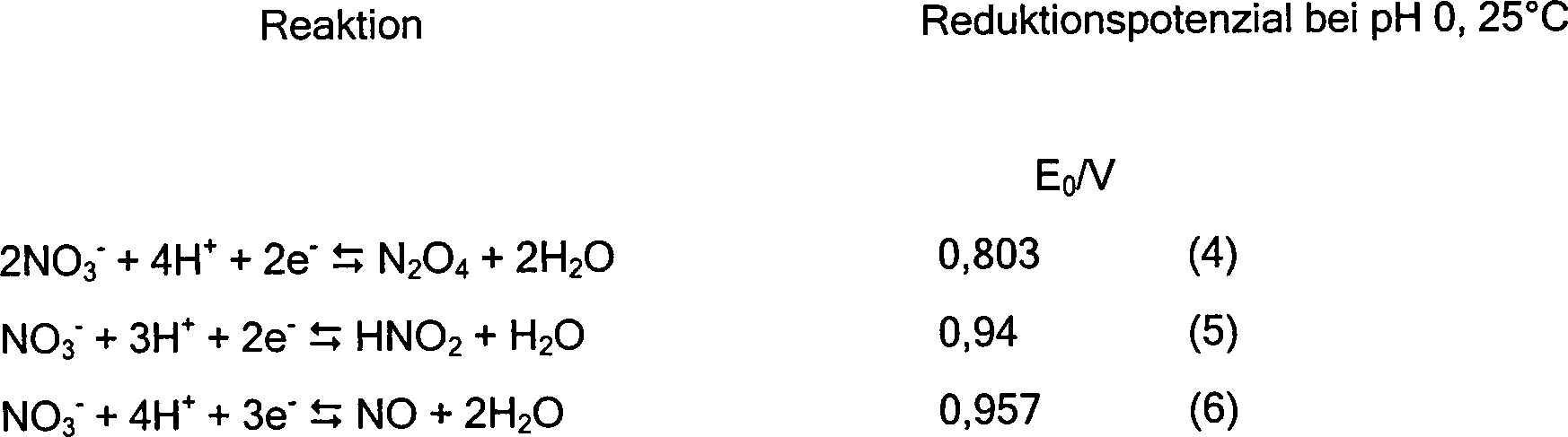
Chemische Reaktionen werden zweckmäßig als die Summe von zwei (oder mehr) elektrochemischen Halbreaktionen ausgedrückt, in denen Elektronen von einer chemischen Spezies zur anderen übertragen werden. Gemäß der elektrochemischen Konvention wird die Gesamtreaktion als Gleichgewicht dargestellt, in der die Hinreaktion als Reduktion (Hinzufügen von Elektronen) angegeben ist, d.h.: Oxidierte Spezies + ne– ⇆ reduzierte Spezies Für die angegebenen Gleichungen bei pH = 0 und 25°C findet die Reaktion spontan von links nach rechts statt, wenn E0 (das Reduktionspotenzial) größer als 0 ist, und spontan in der umgekehrten Richtung, wenn E0 weniger als 0 beträgt.Chemical reactions are conveniently expressed as the sum of two (or more) electrochemical half-reactions in which electrons are transferred from one chemical species to another. According to the electrochemical convention, the overall reaction is represented as equilibrium, in which the forward reaction is indicated as reduction (addition of electrons), ie: Oxidized species + ne - ⇆ reduced species For the given equations at pH = 0 and 25 ° C the reaction takes place spontaneously from left to right when E 0 (the reduction potential) is greater than 0, and spontaneously in the reverse direction when E 0 is less than 0.
Aus den vorstehenden Reaktionen und den dazugehörigen elektrochemischen Potenzialen ist ersichtlich, dass Nitrat ein starkes Oxidationsmittel ist, das Hypophosphit (P+1) ungeachtet des Reduktionsreaktionswegs, d.h. ob der Reduktionsprozess gemäß der Gleichung 4, 5 oder 6 stattfindet, zu Phosphit (P+3) oder Phosphat (P+5) oxidieren kann. Wenn angenommen wird, dass der gesamte Reaktionsweg eine Kombination aus einer Oxidationsreaktion (Gleichung 3) (4e–-Austausch) und einer Reduktionsreaktion (Gleichung 6) (3e–-Austausch) umfasst, kann berechnet werden, dass für einen vollständigen Ablauf der Redoxreaktion pro mol der Hypophosphitionen 4/3 mol NO3 – zu NO reduziert werden müssen, um ausreichend Elektronen bereitzustellen. Dem Fachmann ist klar, dass auch andere Redoxprozesse stattfinden können, die Kombinationen der angegebenen Oxidations- und Reduktionsreaktionen umfassen.From the above reactions and the associated electrochemical potentials, it can be seen that nitrate is a strong oxidant, the hypophosphite (P + 1 ) regardless of the reduction reaction path, ie whether the reduction process takes place according to Equation 4, 5 or 6, to phosphite (P +3 ) or phosphate (P +5 ). Assuming that the entire reaction pathway comprises a combination of an oxidation reaction (Equation 3) (4e - exchange) and a reduction reaction (Equation 6) (3e - exchange), it can be calculated that for a complete run of the redox reaction per of hypophosphite ions 4/3 mol of NO 3 - must be reduced to NO in order to provide sufficient electrons. It will be understood by those skilled in the art that other redox processes may also take place comprising combinations of the specified oxidation and reduction reactions.
Zur Erzeugung von erfindungsgemäßen Produkten können verschiedene Paarungen von Oxidations- und Reduktionsreaktionen eingesetzt werden. Tatsächlich ermöglicht die Erfindung im Allgemeinen eine homogene in-situ-Erzeugung einfacher oder komplexer Oxosäureanionen in wässriger Lösung, in der ein oder mehrere Nichtmetallelement(e), wie z.B. der Gruppen 5B und 6B (Chalkogenide) und 7B (Halogenide), die das erste Oxosäureanion umfassen, einer Oxidation unterliegt bzw. unterliegen, so dass die ausfällende anionische Spezies zusammen mit der gleichzeitigen Reduktion des Nichtmetallelements eines zweiten, davon verschiedenen Oxosäureanions erzeugt wird.to Production of products according to the invention can different pairings of oxidation and reduction reactions be used. Indeed allows the invention generally makes homogeneous in-situ generation easier or complex oxo acid anions in water Solution, in which one or more non-metal elements (e), e.g. of the groups 5B and 6B (chalcogenides) and 7B (halides), which are the first oxo acid anion , subject to oxidation, so that the precipitating anionic species together with the simultaneous reduction of Nonmetal elements of a second, different oxo acid anion is produced.
In jedem der vorstehend genannten Fälle liegt der Schlüssel in der Reduktions-Oxidations-Reaktion bei hohen Ionenkonzentrationen, die zur homogenen Ausfällung neuer Calciumphosphatpulver aus der Lösung führt. In der Literatur wurde das Vermögen zur Bildung solcher Phasen, insbesondere von Calciumphosphatphasen, unter den in dieser Erfindung beschriebenen Bedingungen noch nicht beschrieben.In each of the above cases is the key in the reduction-oxidation reaction at high ion concentrations leading to the homogeneous precipitation of new Calcium phosphate powder from the solution leads. In the literature became the fortune to form such phases, in particular calcium phosphate phases, not yet under the conditions described in this invention described.
Die Produkte können durch Ändern der Reaktionsbedingungen eingestellt werden. Eine einfache Modifizierung des Anionengemischs (d.h. das Einbringen von Acetationen) in die Ausgangslösung kann zu einer Calciumphosphatphase mit einbezogenem Carbonat führen, was für die Umwandlung zu Knochen in vivo sehr vorteilhaft ist, da ein Knochen selbst die carbonisierte Version eines Hydroxyapatitminerals ist, wobei die Substitution des Carbonats in der Phosphatgitterposition stattfindet, und das deshalb als HAp vom B-Typ bezeichnet wird. Andere vorteilhafte Substitutionen sind von F-Substitutionen, d.h. Fluorsubstitutionen abgeleitet, die zu Fluorapatit führen, der in Zahnpasten und im Zahnschmelz erwünscht ist. Das Sulfatanion kann zu einer anderen vorteilhaften Calciumphase führen, wobei die Hemihydratspezies, CaSO4·0,5H2O im Kontakt mit Wasser wie bei Gips eine weitere Härtungsreaktion bereitstellt. Zusätzliche Änderungen finden in der Gegenwart anderer Kationen als Zusätze oder Hauptkomponenten statt.The products can be adjusted by changing the reaction conditions. Simple modification of the anion mixture (ie introduction of acetate ions) into the starting solution can result in calcium phosphate phase incorporation of carbonate, which is very advantageous for in vivo conversion to bone, since a bone itself is the carbonated version of a hydroxyapatite mineral, substitution of the carbonate in the phosphate lattice position, and therefore referred to as B-type HAp. Other beneficial substitutions are derived from F-substitutions, ie, fluorine substitutions leading to fluoroapatite, which is desirable in toothpastes and enamel. The sulfate anion may lead to another advantageous calcium phase, with the hemihydrate species, CaSO 4 .5H 2 O, providing another curing reaction in contact with water, as in gypsum. Additional changes take place in the presence of other cations as additives or major components.
In spezifischen Ausführungsformen der Erfindung werden die vorstehend genannten Prozesse genutzt, um spezifische Calciumphosphat-Vorläuferminerale herzustellen, die zur Bildung eines selbsthärtenden Zements oder einer selbsthärtenden Paste verwendet werden können. Sobald sie in den Körper eingebracht worden sind, werden diese Calciumphosphatzemente (CPC) resorbiert und zu Knochen umgebaut (umgewandelt). Ein einzelnes Pulver, das aus zweiphasigen Mineralen mit unterschiedlichem Ca/P-Verhältnis besteht, kann unter Bildung von selbsthärtenden Pasten gemischt werden, die in vivo in carbonisierten Apatit vom B-Typ (Knochenmineral-Vorläufer) umgewandelt werden.In specific embodiments of the invention, the foregoing processes are utilized to prepare specific calcium phosphate precursor minerals that can be used to form a self-curing cement or a self-curing paste. Once introduced into the body, these calcium phosphate cements (CPC) are resorbed and converted to bone. A single powder consisting of biphasic minerals with different Ca / P ratios, can be mixed to form self-curing pastes which are converted in vivo in carbonated B-type apatite (bone mineral precursor).
Das Umwandlungsverhalten einer Calciumphosphat-Biokeramik zu Knochen wird von den Energieverhältnissen der Oberfläche der Keramik und den resultierenden Wechselwirkungen mit osteoklastischen Zellen bei der Annäherung an die Grenzfläche bestimmt. Spezifische Mikrostrukturen können zu einer beschleunigten Reaktivität und schließlich zu einer schnelleren Umwandlung in vivo führen. Die Flexibilität bei der Zusammensetzung der feinen Teilchen dieser Erfindung bietet eine einstellbare Reaktivität in vivo. Die Kristallitgröße und die Oberflächeneigenschaften der resultierenden Ausführungsformen dieser Erfindung sind dem Maßstab ähnlicher, der für die Zellen, die im Körper vorkommen, normal ist. Gemische von Pulvern, die mit den erfindungsgemäßen Verfahren erhalten werden können, weisen einen herausragenden Nutzen als Calciumphosphat-Zemente (CPC) auf.The Transformation behavior of a calcium phosphate bioceramic to bone becomes of the energy relations the surface the ceramic and the resulting interactions with osteoclastic Cells on approach to the interface certainly. Specific microstructures can lead to accelerated reactivity and eventually to lead to a faster in vivo conversion. The flexibility in the Composition of the fine particles of this invention provides a adjustable reactivity in vivo. The crystallite size and the surface properties the resulting embodiments of this invention are more like scale, the for the cells in the body occur, is normal. Mixtures of powders obtained by the methods of the invention can be obtained have outstanding benefits as calcium phosphate cements (CPC) on.
Beispielsweise können Calciumphosphatteilchen, die erfindungsgemäß hergestellt worden sind, in beliebigen orthopädischen Verfahren oder die Zähne betreffenden Verfahren, bei denen Calciumphosphat eingesetzt wird, bei Verfahren zur Reparatur von Knochenfüllungsdefekten, bei der Füllung onkologischer Defekte, bei der Füllung und Rekonstruktion kraniomaxillo-facialer Hohlräume, bei der Füllung von Zahnextraktionsstellen und potenziell für Arzneistoffabgabeanwendungen verwendet werden.For example can Calcium phosphate particles prepared according to the invention in any orthopedic Procedure or the teeth concerned, in which calcium phosphate is used, in procedures for the repair of bone filling defects, in the filling oncological Defects, at the filling and reconstruction of craniomaxillo-facial cavities, in the filling of Tooth extraction sites and potentially for drug delivery applications be used.
Es sind zahlreiche Anwendungen vorgesehen. Die Oxidationsmittel, Reduktionsmittel, Verhältnisse, Coreaktanten und andere Addukte, Produkte und die beispielhaften Anwendungen sind für den anorganischen Chemiker durch Betrachten der vorstehend beschriebenen chemischen Reaktionen verständlich. Calciumphosphate können für biologische Wiederherstellungen, Zahnwiederherstellungen, Biotrennmedien und die Ionen- oder Proteinchromatographie verwendet werden. Übergangsmetallphosphate (Sc, Ti, V, Cr, Mn, Fe, Co, Ni, Cu und Zn) können in vielfältiger Weise als Pigmente, Leuchtstoffe, Katalysatoren, elektromagnetische Koppler, Mikrowellenkoppler, induktive Elemente, Zeolithe, Gläser, Einschlusssysteme für radioaktive Abfälle und Beschichtungen verwendet werden. Der Zusatz von Seltenerdphosphaten kann zur Verwendung als Interkalationsverbindungen, Katalysatoren, Gläsern und Keramiken, Radiopharmazeutika, Pigmente und Leuchtstoffe, medizinische Bildgebungsmittel, zur Verfestigung radioaktiver Abfälle, für die Elektrooptik, Elektronikkeramiken und für Oberflächenmodifizierungen führen.It Many applications are planned. The oxidizing agents, reducing agents, Relationships, Coreactants and other adducts, products and exemplary applications are for the inorganic chemist by observing the above-described understandable chemical reactions. Calcium phosphates can for biological Restorations, dental restorations, bioterring media and the ion or protein chromatography can be used. Transition metal phosphates (Sc, Ti, V, Cr, Mn, Fe, Co, Ni, Cu and Zn) can be used in a variety of ways as pigments, phosphors, catalysts, electromagnetic couplers, Microwave couplers, inductive elements, zeolites, glasses, inclusion systems for radioactive Waste and Coatings are used. The addition of rare earth phosphates can be used as intercalation compounds, catalysts, glass and ceramics, radiopharmaceuticals, pigments and phosphors, medical Imaging agents for the solidification of radioactive waste, for electro-optics, Electronics ceramics and for surface modifications to lead.
Aluminium- und Zirkoniumphosphate sind ideale Kandidaten für Oberflächenschutzbeschichtungen, Schleifteilchen, Poliermittel, Zemente und Filtrationsprodukte entweder in Körnchenform oder als Beschichtungen. Die Alkali- (Na, K, Rb, Cs) und Erdalkaliphosphate (Be, Mg, Ca, Sr, Ba) würden zur Erzeugung idealer Niedertemperaturgläser, von Keramiken, Biomaterialien, Zementen, Glas-Metall-Dichtungen und zahlreichen anderen Glaskeramikmaterialien wie z.B. Porzellanen, Dentalgläsern, elektrooptischen Gläsern, Lasergläsern, Gläsern mit einem spezifischen Brechungsindex und optischen Filtern führen.Aluminum- and zirconium phosphates are ideal candidates for surface protective coatings, abrasive particles, Polishes, cements and filtration products either in granular form or as coatings. The alkali (Na, K, Rb, Cs) and alkaline earth phosphates (Be, Mg, Ca, Sr, Ba) would for the production of ideal low-temperature glasses, ceramics, biomaterials, Cements, glass-metal seals and many other glass-ceramic materials such as. Porcelains, dental glass, electro-optical glasses, Laser glasses, glasses with a specific refractive index and optical filters.
BeispieleExamples
Beispiel 1 – Neue Niedertemperatur-Herstellung eines CalciumphosphatpulversExample 1 - New low-temperature production a calcium phosphate powder
Eine wässrige Lösung von 8,51 g 50 Gew.-%ige hypophosphorige Säure, H3PO2 (Alfa/Aesar Reagenz #14142, CAS #6303-21-5), die 71,95 Gew.-% [PO4]3– äquivalent waren, wurde mit 8,00 g destilliertem Wasser vereinigt, wobei eine klare farblose Lösung gebildet wurde, die in einem 250 ml-Pyrexbecherglas enthalten war. Dieser Lösung wurden 22,85 g Calciumnitrattetrahydratsalz, Ca(NO3)2·4H2O (ACS Reagenz, Aldrich Chemical Co., Inc. #23,712-4, CAS #13477-34-4) zugesetzt, die 16,97 Gew.-% Ca äquivalent waren. Das Molverhältnis von Ca/Phosphat in diesem Gemisch betrug 3/2 und die äquivalente Feststoffkonzentration [als Ca3(PO4)2] betrug 25,4 Gew.-%. Das endotherme Lösen des Calciumnitrat-tetrahydrats schritt unter Umgebungstemperaturbedingungen fort, wobei schließlich eine homogene Lö sung gebildet wurde. Das Erwärmen dieser Lösung über 25°C initiierte eine Reaktion, bei der die Lösung heftig aufschäumte, während ein rot-brauner beißender Rauch entwickelt wurde, der für NOx(g) charakteristisch ist. Die Probe wandelte sich in eine weiße pastöse Masse um, die schäumte und Blasen wart, wobei NOx(g) periodisch abgegeben wurde. Nach etwa 2 min war die Reaktion im Wesentlichen vollständig, wobei eine weiße pastöse Masse zurückblieb, die sich warm anfühlte. Nach dem Abkühlen auf Raumtemperatur wurde der Feststoff (A) in einem Polyethylenbehälter gelagert.An aqueous solution of 8.51 g of 50% by weight hypophosphorous acid, H 3 PO 2 (Alfa / Aesar reagent # 14142, CAS # 6303-21-5), containing 71.95% by weight [PO 4 ] 3- were equivalent, was combined with 8.00 g of distilled water to form a clear colorless solution contained in a 250 ml Pyrex beaker. To this solution was added 22.85 g of calcium nitrate tetrahydrate salt, Ca (NO 3 ) 2 .4H 2 O (ACS Reagent, Aldrich Chemical Co., Inc. # 23,712-4, CAS # 13477-34-4), which contained 16.97 g % Ca were equivalent. The molar ratio of Ca / phosphate in this mixture was 3/2 and the equivalent solids concentration [as Ca 3 (PO 4 ) 2 ] was 25.4 wt%. The endothermic dissolution of the calcium nitrate tetrahydrate proceeded under ambient temperature conditions, eventually forming a homogeneous solution. Heating this solution above 25 ° C initiated a reaction in which the solution foamed vigorously while developing a red-brown pungent smoke characteristic of NO x (g) . The sample turned to a white pasty mass that foamed and bubbled, releasing NO x (g) periodically. After about 2 minutes, the reaction was essentially complete, leaving a white pasty mass that felt warm. After cooling to room temperature, the solid (A) was stored in a polyethylene container.
Drei Tage nach der Herstellung wurden einige Gramm des feuchten pastösen Feststoffs in 30 ml destilliertes Wasser eingetaucht, um jegliche nicht umgesetzte wasserlösliche Komponenten "auszuwaschen". Der Feststoff wurde mit einem Spatel geknetet, um den Feststoff maximal dem Wasser auszusetzen. Nach etwa 15 min wurde der Feststoff auf ein Filtrierpapier aufgebracht und der feuchte Feststoff (B) wurde in einem Polyethylenbehälter gelagert.Three days after the preparation, a few grams of the wet pasty solid was immersed in 30 ml of distilled water to "wash out" any unreacted water-soluble components. The solid was kneaded with a spatula to maximally expose the solid to the water. To The solid was applied to a filter paper for about 15 minutes and the wet solid (B) was stored in a polyethylene container.
Röntgenbeugungsdiagramme
(XRD-Diagramme) wurden aus verdichteten Pulverproben unter Verwendung
der Cu-Kα-Linie
(λ = 1,7889
Angstrom) mit einem Rigaku-Geigerflex-Gerät
erhalten, das bei 45 kV/30 mA unter Verwendung einer Abtastgeschwindigkeit
von 3°/min über den
2θ-Winkelbereich
von 15 bis 50° oder breiter
betrieben wurde. Die Proben wurden entweder so vermessen, wie sie
hergestellt worden sind, oder nach einer Wärmebehandlung in Luft entweder
in einem Thermolyne Typ 47900-Laborofen oder einem Ney Modell 3-550-Laborofen.
Die XRD-Ergebnisse sind wie folgt (vgl. die
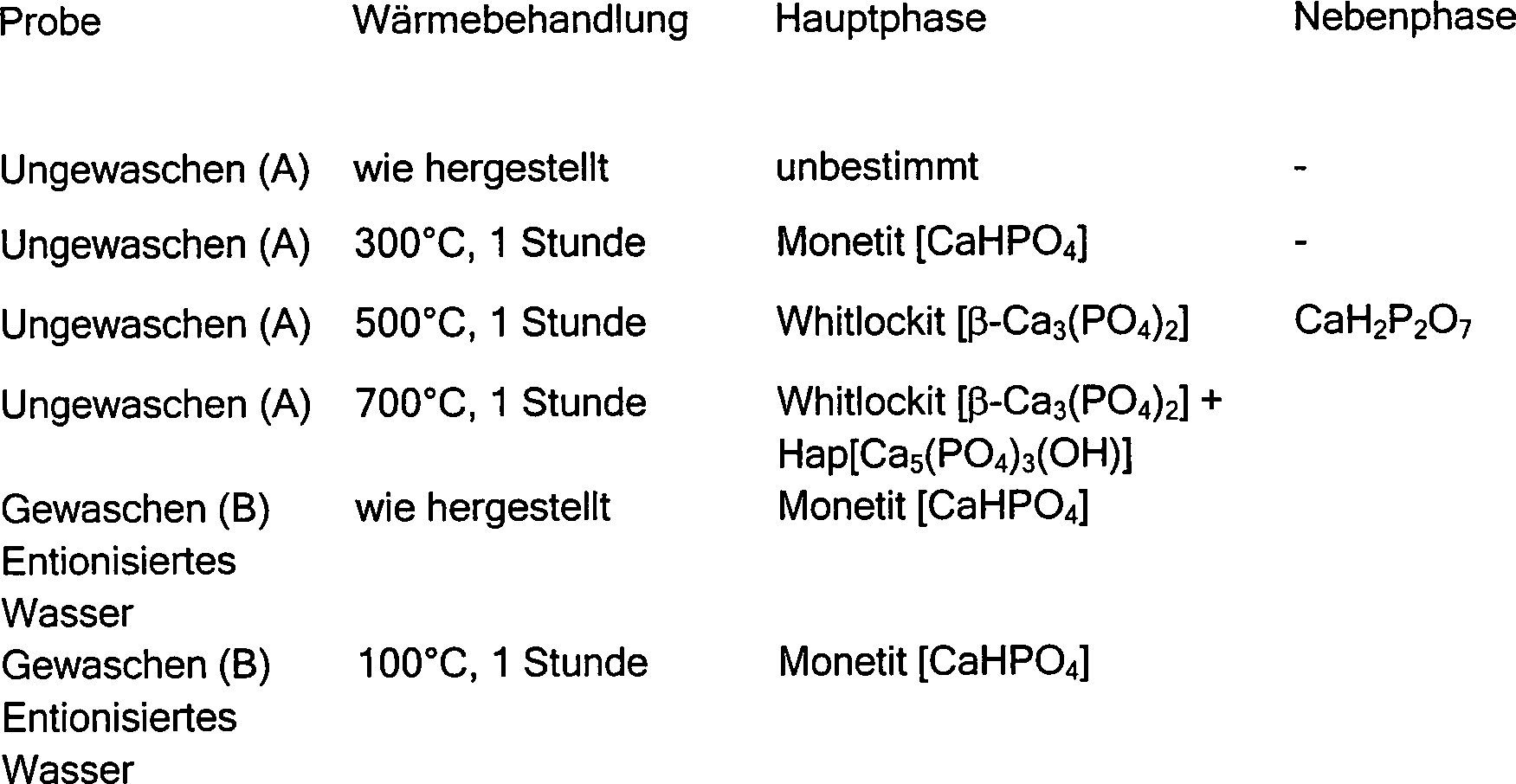
Während des Brennens der Proben bei oder über 300°C wurden beträchtliche Mengen an NOx(g) freigesetzt.During the burning of the samples at or above 300 ° C, significant amounts of NO x (g) were released.
Beispiel 2 – Neue Niedertemperatur-Herstellung eines CalciumphosphatpulversExample 2 - New low-temperature production a calcium phosphate powder
Beispiel 1 wurde unter Verwendung des Fünffachen der angegebenen Reagenzgewichte wiederholt. Die Reaktanten waren in einer Pyrex-Kristallisierschale mit einem Durchmesser von 5,5 Zoll auf einer Heizplatte enthalten, wobei nicht gerührt wurde. Das Erwärmen der homogenen Reaktantlösung über 25°C initiierte eine exotherme Reaktion, bei der ein rotbrauner beißender Rauch entwickelt wurde, der für NOx(g) charakteristisch ist. Die Probe wandelte sich innerhalb weniger Sekunden nach dem Einsetzen der Reaktion in eine weiße pastöse Masse um, die noch mehrere Minuten lang NOx(g) abgab. Nach etwa 5 min war die Reaktion im Wesentlichen vollständig, wobei eine feuchte feste Masse zurückblieb, die sich heiß anfühlte. Dieser Feststoff wurde unter Umgebungsbedingungen in etwa 20 min auf Raumtemperatur abgekühlt und vor der Wärmebehandlung in zwei Portionen aufgeteilt.Example 1 was repeated using five times the indicated reagent weights. The reactants were contained in a 5.5 inch diameter Pyrex crystallizer dish on a hot plate, not stirring. Heating the homogeneous reactant solution above 25 ° C initiated an exothermic reaction in which a reddish brown pungent smoke was developed which is characteristic of NO x (g) . Within a few seconds after the onset of the reaction, the sample turned to a white pasty mass which released NO x (g) for several minutes. After about 5 minutes, the reaction was essentially complete, leaving a moist solid that felt hot. This solid was cooled to room temperature under ambient conditions in about 20 minutes and divided into two portions prior to the heat treatment.
Die Wärmebehandlung und die Röntgenbeugung dieses Feststoffs wurden gemäß Beispiel 1 durchgeführt. Nach der Wärmebehandlung in Luft zeigte die XRD, dass die gebrannten Feststoffe wie folgt zusammengesetzt waren.The heat treatment and the X-ray diffraction of this solid were according to example 1 performed. After the heat treatment In air, the XRD showed that the fired solids as follows were composed.

Beispiel 3 – Neue Niedertemperatur-Herstellung eines CalciumphosphatpulversExample 3 - New low-temperature production a calcium phosphate powder
Eine
wässrige
Lösung
von 8,51 g 50 Gew.-%ige H3PO2 wurde
mit 8,00 g einer 25,0 Gew.-%igen
wässrigen
Lösung
von Calciumacetat-monohydrat, Ca(O2CCH3)2·H2O (ACS Reagenz, Aldrich Chemical Co., Inc. #40,285-0,
CAS 5743-26-0) gemischt, die 5,69 Gew.-% Ca äquivalent waren, wobei eine
klare farblose Lösung gebildet
wurde, die in einem 250 ml-Pyrexbecherglas
enthalten war. Dieser Lösung
wurden 20,17 g Ca(NO3)2·4H2O-Salz zugesetzt. Das Molverhältnis von
Ca/Phosphat in diesem Gemisch betrug 3/2 und die äquivalente
Feststoffkonzentration [als Ca3(PO4)
Die Wärmebehandlung und die Röntgenbeugungsanalyse dieses Feststoffs wurden gemäß Beispiel 1 durchgeführt. Nach der Wärmebehandlung in Luft bei 500°C für entweder 0,5 Stunden oder 1 Stunde zeigte eine XRD, dass der Feststoff aus Whitlockit als Primärphase zusammen mit Hydroxylapatit als Sekundärphase zusammengesetzt war. Die XRD-Ergebnisse zeigen, dass das relative Verhältnis der beiden Calciumphosphatphasen von der Dauer der Wärmebehandlung und der Gegenwart des Acetatanions abhängig war, jedoch wurden keine Versuche unternommen, die Abhängigkeit zu quantifizieren.The heat treatment and X-ray diffraction analysis of this solid were according to example 1 performed. After the heat treatment in air at 500 ° C for either 0.5 hours or 1 hour, an XRD showed that the solid matter Whitlockite as the primary phase together with hydroxyapatite as the secondary phase. The XRD results show that the relative ratio the two calcium phosphate phases of the duration of the heat treatment and the presence of the acetate anion, but none were Tried the dependency to quantify.

Ein
Vergleich der XRD-Spektren in den
Fouriertransform-Infrarotspektren
(FTIR-Spektren) wurden unter Verwendung eines Nicolet-Geräts (Modell
Nr. 5DXC) erhalten, das im diffusen Reflexionsmodus über einen
Bereich von 400 bis 4000 cm–1 betrieben wurde. Die
Gegenwart der carbonisierten Form von HAp wird durch das FTIR-Spektrum
in der
Beispiel 4 – Kolloidales SiO2, das Calciumphosphatgemischen mittels RPR zugesetzt worden istExample 4 - Colloidal SiO 2 Added to Calcium Phosphate Mixtures by RPR
Ein Aliquot von 8,00 g eines 34,0 Gew.-%igen SiO2-Hydrosols (Nalco Chemical Co., Inc. #1034A, Charge #B5G453C) wurde langsam 8,51 g einer 50 Gew.-%igen wässrigen Lösung von H3PO2 unter heftigem Rühren zugesetzt, wobei eine homogene, schwach trübe kolloidale Dispersion erhalten wurde. Dieser Dispersion wurden 22,85 g Ca(NO3)2·4H2O-Salz so zugesetzt, dass das Molverhältnis von Calcium/Phosphat in dem Gemisch 3/2 betrug. Es fand ein endothermes Lösen des Calciumnitrat-tetrahydrats statt, wobei eine homogene kolloidale Dispersion erhalten wurde, sobald sich die Probe auf Raumtemperatur erwärmt hatte. Das kolloidale SiO2 war trotz des stark sauren Charakters und der Ionenstärke in der Probe nicht ausgefallen. Das Erwärmen der Probe auf einer Heizplatte auf > 25°C initiierte eine Reaktion, so wie es im Beispiel 1 beschrieben worden ist. Der resultierende weiße pastöse Feststoff wurde in einem Polyethylenbehälter gelagert.An aliquot of 8.00 g of 34.0 wt% SiO 2 hydrosol (Nalco Chemical Co., Inc. # 1034A, Lot # B5G453C) was slowly added to 8.51 g of a 50 wt% aqueous solution of H 3 PO 2 with vigorous stirring to give a homogeneous, slightly turbid colloidal dispersion was obtained. To this dispersion, 22.85 g of Ca (NO 3 ) 2 .4H 2 O salt was added so that the molar ratio of calcium / phosphate in the mixture was 3/2. An endothermic dissolution of the calcium nitrate tetrahydrate took place, whereby a homogeneous colloidal dispersion was obtained as soon as the sample had warmed to room temperature. The colloidal SiO 2 had not precipitated despite the strongly acidic character and the ionic strength in the sample. Heating the sample on a hot plate to> 25 ° C initiated a reaction as described in Example 1. The resulting white pasty solid was stored in a polyethylene container.
Die Wärmebehandlung und die Röntgenbeugung dieses Feststoffs wurden gemäß Beispiel 1 durchgeführt. Nach der Wärmebehandlung in Luft bei 500°C für 1,0 Stunden zeigte eine XRD, dass der Feststoff aus Whitlockit plus Hydroxyapatit zusammengesetzt war.The heat treatment and the X-ray diffraction of this solid were according to example 1 performed. After the heat treatment in air at 500 ° C for 1.0 Hours showed an XRD that the solid from whitlockite plus Hydroxyapatit was composed.

Beispiel 5 – Neue Niedertemperatur-Herstellung eines CalciumphosphatpulversExample 5 - New low-temperature production a calcium phosphate powder
Beispiel 1 wurde unter Zusatz von 10,00 g Dicalciumphosphat-dihydrat, DCPD, CaHPO4 2H2O (Aldrich Chemical Co., Inc. #30,765-3, CAS #7789-77-7) zu der homogenen Lösung wiederholt, worauf das Calciumnitratsalz endotherm gelöst wurde. Das DCPD lag sowohl in Form von suspendierten Feststoffen als auch als ausgefallenes Material vor (es wurde nicht gerührt). Das Erwärmen der Probe auf > 25°C initiierte eine exotherme Reaktion, so wie es im Beispiel 1 beschrieben worden ist, was zur Bildung eines weißen pastösen Feststoffs führte. Die Wärmebehandlung und die Röntgenbeugung dieses Feststoffs wurden gemäß Beispiel 1 durchgeführt. Nach der Wärmebehandlung in Luft bei 500°C für 1 Stunde zeigte eine XRD, dass der Feststoff aus Whitlockit als Primärphase zusammen mit Calciumpyrophosphat (Ca2P2O7) als Sekundärphase zusammengesetzt war.Example 1 was repeated with the addition of 10.00 g of dicalcium phosphate dihydrate, DCPD, CaHPO 4 2H 2 O (Aldrich Chemical Co., Inc. # 30,765-3, CAS # 7789-77-7) to the homogeneous solution, whereupon the calcium nitrate salt was dissolved endothermically. The DCPD was in the form of suspended solids as well as precipitated material (it was not stirred). Heating the sample to> 25 ° C initiated an exothermic reaction as described in Example 1, resulting in the formation of a white pasty solid. The heat treatment and the X-ray diffraction of this solid were carried out according to Example 1. After heat treatment in air at 500 ° C for 1 hour, an XRD showed that the Whitlockite solid as a primary phase together with calcium pyrophosphate (Ca 2 P 2 O 7 ) was composed as a secondary phase.

Beispiel 6 – Neue Niedertemperatur-Herstellung eines ZinkphosphatpulversExample 6 - New low-temperature production a zinc phosphate powder
Eine wässrige Lösung von 8,51 g 50 Gew.-%ige H3PO2 in 8,00 g destilliertem Wasser wurde wie im Beispiel 1 hergestellt. Dieser Lösung wurden 28,78 g Zinknitrat-hexahydratsalz, Zn(NO3)2·6H2O (ACS Reagenz, Aldrich Chemical Co., Inc. #22,873-7, CAS #10196-18-6) zugesetzt, die 21,97 Gew.-% Zn äquivalent waren. Das Molverhältnis von Zn/Phosphat in diesem Gemisch betrug 3/2 und die äquivalente Feststoffkonzentration [als Zn3(PO4)2] betrug 27,5 Gew.-%. Das endotherme Lösen des Zinknitrat-hexahydrats schritt nach dem Erwärmen der Probe auf Raumtemperatur fort, wobei eine homogene Lösung gebildet wurde. Das weitere Erwärmen dieser Lösung auf > 25°C auf einer Heizplatte initiierte eine Reaktion, bei der die Lösung heftig rot-braunen beißenden Rauch aus NOx(g) entwickelte. Die Reaktion setzte sich etwa 10 min fort, während die Probe eine klare farblose Lösung blieb, worauf sich die Probe während eines Zeitraums von fünf Minuten etwas beruhigte, und dann die Reaktion schließlich wieder heftig wurde, was schließlich zur Bildung einer Masse eines feuchten weißen Feststoffs führte, von dem ein Teil sehr stark an den Wänden des Pyrex-Becherglases haftete, das als Reaktionsbehälter verwendet wurde. Der heiße Feststoff wurde auf Raumtemperatur abkühlen gelassen und in einem Polyethylenbehälter gelagert.An aqueous solution of 8.51 g of 50 wt.% H 3 PO 2 in 8.00 g of distilled water was prepared as in Example 1. To this solution was added 28.78 g of zinc nitrate hexahydrate salt, Zn (NO 3 ) 2 .6H 2 O (ACS Reagent, Aldrich Chemical Co., Inc. # 22,873-7, CAS # 10196-18-6), 21, 97 wt .-% Zn were equivalent. The molar ratio of Zn / phosphate in this mixture was 3/2 and the equivalent solids concentration [as Zn 3 (PO 4 ) 2 ] was 27.5% by weight. The endothermic dissolution of the zinc nitrate hexahydrate proceeded after heating the sample to room temperature, forming a homogeneous solution. Further heating of this solution to> 25 ° C on a hotplate initiated a reaction in which the solution developed violent red-brown biting smoke from NO x (g) . The reaction continued for about 10 minutes while the sample remained a clear, colorless solution, after which the sample calmed somewhat over a period of five minutes, and then finally the reaction became violent again, eventually forming a mass of a wet white solid a part of which adhered very strongly to the walls of the Pyrex beaker used as a reaction vessel. The hot solid was allowed to cool to room temperature and stored in a polyethylene container.
Die
Wärmebehandlung
und die Röntgenbeugung
dieses Feststoffs wurden gemäß Beispiel
1 durchgeführt.
Nach der Wärmebehandlung
in Luft bei 500°C
für 1 Stunde
zeigte eine XRD, dass der Feststoff aus Zn3(PO4)

Beispiel 7 – Neue Niedertemperatur-Herstellung eines EisenphosphatpulversExample 7 - New low-temperature production an iron phosphate powder
Eine wässrige Lösung von 17,50 g 50 Gew.-%ige H3PO2 wurde mit 15,00 g destilliertem Wasser kombiniert, wobei eine klare farblose Lösung gebildet wurde, die in einem 250 ml-Pyrexbecherglas auf einer Heizplatte/Rührer enthalten war. Dieser Lösung wurden 53,59 g Eisen(III)-nitrat-nonahydratsalz, Fe(NO3)3·9H2O (ACS Reagenz, Alfa/Aesar Reagenz #33315, CAS #7782-61-8) zugesetzt, die 13,82 Gew.-% Fe äquivalent waren. Das Molverhältnis von Fe/Phosphat in diesem Gemisch betrug 1/1 und die äquivalente Feststoffkonzentration [als Fe(PO4] betrug 23,2 Gew.-%. Das endotherme Lösen des Eisen(III)-nitratnonahydratsalzes lief nach dem schrittweisen Erwärmen des Reaktionsgemischs ab, wobei schließlich eine blass-lavendelfarbene Lösung plus ungelöstes Salz gebildet wurden. Bei einer Temperatur von > 25°C wurde eine exotherme Reaktion initiiert, bei der NOx(g) entwickelt wurde. Die Reaktion setzte sich etwa 15 min fort, während dessen das Reaktionsgemisch eine sirupartige Viskosität bekam. Bei fortgesetzter Reaktion begann sich am Boden des Becherglases ein blassgelber Feststoff zu bilden. Nach etwa 40 min Reaktionszeit wurde die Probe auf Raumtemperatur abkühlen gelassen. Das Produkt bestand aus einem inhomogenen Gemisch aus einem gelben Feststoff mit niedriger Dichte am Oberteil des Becherglases, einer braunen Flüssigkeit mit der Konsistenz von Karamel in der Mitte der Produktmasse und einem sandfarbenen Feststoff am Boden des Becherglases. Die Feststoffe wurden als getrennte Proben gesammelt, sofern dies möglich war.An aqueous solution of 17.50 g of 50% by weight H 3 PO 2 was combined with 15.00 g of distilled water to form a clear colorless solution contained in a 250 ml Pyrex beaker on a hot plate / stirrer , To this solution was added 53.59 g of iron (III) nitrate nonahydrate salt, Fe (NO 3 ) 3 .9H 2 O (ACS Reagent, Alfa / Aesar Reagent # 33315, CAS # 7782-61-8), which is 13, 82 wt .-% Fe were equivalent. The molar ratio of Fe / phosphate in this mixture was 1/1 and the equivalent solids concentration [as Fe (PO 4 ) was 23.2% by weight.] The endothermic dissolution of the ferric nitrate nonahydrate salt proceeded after the stepwise heating of the reaction mixture Finally, a pale lavender solution plus undissolved salt was formed, and an exothermic reaction was initiated at a temperature of> 25 ° C to evolve NO x (g) and the reaction continued for about 15 min As the reaction continued, a pale yellow solid began to form at the bottom of the beaker and after about 40 minutes reaction time, the sample was allowed to cool to room temperature, the product was an inhomogeneous mixture of a low density yellow solid on Top of the beaker, a brown liquid with the consistency of caramel in the middle of the product mass and a sa solid-colored solid on the bottom of the beaker. The solids were collected as separate samples, if possible.
Die
Wärmebehandlung
und die Röntgenbeugung
des Feststoffs, der von der Oberseite des Becherglases gesammelt
wurde, wurden gemäß Beispiel
1 durchgeführt.
Nach der Wärmebehandlung
in Luft bei 500°C
für 1 Stunde
zeigte eine XRD, dass der Feststoff aus Graftonit [Fe3(PO4)2] plus amorphes
Material zusammengesetzt war, was nahe legt, dass die Wärmebehandlung
nicht ausreichend war, um eine vollständige Kristallisation der Probe
zu induzieren (vgl. die

Es laufen offensichtlich Mechanismen ab, durch die Fe3+ zu Fe2+ reduziert worden ist.Apparently, mechanisms are in place that have reduced Fe 3+ to Fe 2+ .
Beispiel 8 – Neue Niedertemperatur-Herstellung eines CalciumphosphatpulversExample 8 - New low-temperature production a calcium phosphate powder
Eine wässrige Lösung von 19,41 g 50 Gew.-%ige H3PO2 wurde mit 5,00 g destilliertem Wasser kombiniert, wobei eine klare farblose Lösung gebildet wurde, die in einem 250 ml-Pyrexbecherglas enthalten war. Dieser Lösung wurden 34,72 g Ca(NO3)2·4H2O zugesetzt. Das Molverhältnis von Ca/Phosphat in diesem Gemisch betrug 1/1 und die äquivalente Feststoffkonzentration [als CaHPO4] betrug 33,8 Gew.-%. Das endotherme Lösen des Calciumnitrat-tetrahydrats lief unter Umgebungstemperaturbedingungen ab, wobei schließlich eine homogene Lösung gebildet wurde, sobald die Probe auf Raumtemperatur erwärmt wurde. Das Erwärmen dieser Lösung über 25°C initiierte eine heftige exotherme Reaktion, die zur Entwicklung von NOx(g), einem schnellen Temperaturanstieg der Probe auf > 100°C und einem übermäßigen Schäumen des Reaktionsgemischs über den Becherrand führte, vermutlich wegen des Siedeverzugs von Wasser bei der hohen Reaktionstemperatur. Nach dem Abkühlen auf Raumtemperatur wurde das Reaktionsprodukt als trockener weißer Schaum gesammelt, der durch Zerkleinern zu einem Pulver kompaktiert wurde.An aqueous solution of 19.41 g of 50 wt% H 3 PO 2 was combined with 5.00 g of distilled water to form a clear colorless solution contained in a 250 ml Pyrex beaker. To this solution was added 34.72 g of Ca (NO 3 ) 2 .4H 2 O. The molar ratio of Ca / phosphate in this mixture was 1/1 and the equivalent solids concentration [as CaHPO 4 ] was 33.8 wt%. The endothermic dissolution of the calcium nitrate tetrahydrate proceeded under ambient temperature conditions, eventually forming a homogeneous solution as the sample was warmed to room temperature. Heating this solution above 25 ° C initiated a vigorous exothermic reaction which resulted in the evolution of NO x (g) , a rapid rise in the temperature of the sample to> 100 ° C, and excessive foaming of the reaction mixture over the cup rim, presumably because of bumping Water at the high reaction temperature. After cooling to room temperature, the reaction product was collected as a dry white foam, which was compacted to a powder by milling.
Die Wärmebehandlung und die Röntgenbeugung dieses Feststoffs wurden gemäß Beispiel 1 durchgeführt. Es wurden die folgenden Ergebnisse erhalten.The heat treatment and the X-ray diffraction of this solid were according to example 1 performed. The following results were obtained.

Beispiel 9 – Neue Niedertemperatur-Herstellung eines CalciumphosphatpulversExample 9 - New low temperature production a calcium phosphate powder
Beispiel 3 wurde unter Verwendung des Zehnfachen der angegebenen Reagenzgewichte wiederholt. Die Reaktanten waren in einer Pyrex-Kristallisierschale mit einem Durchmesser von 5,5 Zoll auf einer Heizplatte/Rührer enthalten. Die Reaktanten wurden während der Lösungs- und Reaktionsstufen kontinuierlich gerührt. Die durch Erwärmen der Lösung auf > 25°C initiierte chemische Reaktion führte für mehrere Minuten zur Entwicklung von NOx(g), wobei kein offensichtlicher Effekt auf die Stabilität des Systems festgestellt wurde, d.h. die Lösung blieb klar und farblos, ohne dass eine Feststoffbildung auftrat. Nach dem Abklingen für mehrere Minuten setzte die Reaktion mit zunehmender Intensität wieder ein, was zu einer starken Erzeugung von NOx(g) und einem schnellen Auftreten eines pastösen weißen Feststoffmaterials führte. Sowohl der Reaktionsbehälter als auch das Produkt waren von der exothermen Reaktion heiß. Das Produkt wurde an der Luft zu einem weißen krümeligen Feststoff abgekühlt, der in einem Polyethylenbehälter gelagert wurde.Example 3 was repeated using ten times the indicated reagent weights. The reactants were contained in a 5.5 inch diameter Pyrex crystallizer dish on a hot plate / stirrer. The reactants were stirred continuously during the dissolution and reaction steps. The chemical reaction initiated by heating the solution to> 25 ° C resulted in the evolution of NO x (g) for several minutes, with no apparent effect on the stability of the system, ie, the solution remained clear and colorless, with no solid formation occurred. After fading for several minutes, the reaction resumed with increasing intensity, resulting in high production of NO x (g) and rapid appearance of a pasty white solid material. Both the reaction vessel and the product were hot from the exothermic reaction. The product was cooled in air to a white crumbly solid which was stored in a polyethylene container.
Die Wärmebehandlung und die Röntgenbeugung dieses Feststoffs wurden gemäß Beispiel 1 durchgeführt. Nach der Wärmebehandlung in Luft bei 500°C für entweder 0,5 Stunden oder 1 Stunde zeigte die XRD, dass der Feststoff aus Whitlockit als Primärphase zusammen mit Hydroxyapatit als Sekundärphase zusammengesetzt war. Die XRD-Ergebnisse zeigen, dass das relative Verhältnis der beiden Calciumphosphatphasen von der Dauer der Wärmebehandlung abhängig war, jedoch wurden keine Versuche unternommen, die Abhängigkeit zu quantifizieren.The heat treatment and the X-ray diffraction of this solid were according to example 1 performed. After the heat treatment in air at 500 ° C for either For 0.5 hours or 1 hour, the XRD showed that the solid was out Whitlockite as the primary phase together with hydroxyapatite as a secondary phase. The XRD results show that the relative ratio of both calcium phosphate phases was dependent on the duration of the heat treatment, however, no attempts were made to dependency to quantify.

Beispiel 10 – Neue Niedertemperatur-Herstellung eines AluminiumphosphatpulversExample 10 - New low-temperature production an aluminum phosphate powder
Eine wässrige Lösung von 10,82 g 50 Gew.-%ige H3PO2 wurde mit 2,00 g destilliertem Wasser kombiniert, wobei eine klare farblose Lösung gebildet wurde, die in einem 250 ml- Becherglas enthalten war. Dieser Lösung wurden 30,78 g Aluminiumnitrat-nonahydratsalz, Al(NO3)3·9H2O (ACS Reagenz, Alfa/Aesar Reagenz #36291, CAS #7784-27-2) zugesetzt, die 7,19 Gew.-% Al äquivalent waren. Das Molverhältnis von Al/Phosphat in diesem Gemisch betrug 1/1 und die äquivalente Feststoffkonzentration [als AlPO4] betrug 22,9 Gew.-%. Das endotherme Lösen des Aluminiumnitrat-nonahydrats lief unter Bildung einer homogenen Lösung ab, sobald die Probe auf Raumtemperatur erwärmt wurde. Das weitere Erwärmen dieser Lösung auf > 25°C auf einer Heizplatte initiierte eine Reaktion, bei der die Lösung heftig rot-braunen beißenden Rauch von NOx(g) entwickelte. Die Reaktion setzte sich etwa 15 min fort, während dessen die Lösungsviskosität beträchtlich zunahm, bevor ein weißer Feststoff gebildet wurde.An aqueous solution of 10.82 g of 50% by weight H 3 PO 2 was combined with 2.00 g of distilled water to form a clear, colorless solution contained in a 250 ml beaker. To this solution was added 30.78 g of aluminum nitrate nonahydrate salt, Al (NO 3 ) 3 .9H 2 O (ACS Reagent, Alfa / Aesar Reagent # 36291, CAS # 7784-27-2), which contained 7.19% by weight. Al were equivalent. The molar ratio of Al / phosphate in this mixture was 1/1 and the equivalent solids concentration [as AlPO 4 ] was 22.9 wt%. The endothermic dissolution of the aluminum nitrate nonahydrate proceeded to form a homogeneous solution as soon as the sample was warmed to room temperature. Further heating of this solution to> 25 ° C on a hotplate initiated a reaction in which the solution developed violent red-brown pungent smoke of NO x (g) . The reaction continued for about 15 minutes, during which time the solution viscosity increased considerably before a white solid was formed.
Die
Wärmebehandlung
und die Röntgenbeugung
dieses Feststoffs wurden gemäß Beispiel
1 durchgeführt.
Nach der Wärmebehandlung
in Luft bei 500°C
für 0,5
Stunden zeigte eine XRD, dass der Feststoff aus AlPO4 plus
amorphes Material zusammengesetzt war, was nahe legt, dass die Wärmebehandlung
nicht ausreichend war, um eine vollständige Kristallisation der Probe
zu induzieren (vgl. die
Beispiel 11 – Neue Niedertemperatur-Herstellung eines CalciumphosphatpulversExample 11 - New low temperature production a calcium phosphate powder
Eine wässrige Lösung von 8,06 g 50 Gew.-%iges H3PO2-Reagenz wurde mit 6,00 g destilliertem Wasser kombiniert, wobei eine klare farblose Lösung gebildet wurde, die in einem 250 ml-Pyrexbecherglas auf einer Heizplatte/Rührer enthalten war. Dieser Lösung wurden 19,23 g Ca(NO3)2·4H2O zugesetzt. Das Molverhältnis von Ca/Phosphat in diesem Gemisch betrug 4/3 und die äquivalente Feststoffkonzentration [als Octacalciumphosphat, Ca8H2(PO4)6 5H2O] betrug 30,0 Gew.-%. Das endotherme Lösen des Calciumnitrat-tetrahydrats lief unter Umgebungsbedingungen ab, wobei schließlich eine homogene Lösung gebildet wurde, sobald die Probe auf Raumtemperatur erwärmt wurde. Das Erwärmen der Lösung über 25°C initiierte eine heftige exotherme Reaktion, wie sie im Beispiel 1 beschrieben worden ist. Nach etwa 3 min war die Reaktion im Wesentlichen vollständig, wobei ein feuchter, weißer pastöser Feststoff zurückblieb.An aqueous solution of 8.06 g of 50% by weight H 3 PO 2 reagent was combined with 6.00 g of distilled water to form a clear colorless solution which was dissolved in a 250 ml Pyrex beaker on a hot plate / stirrer was included. To this solution was added 19.23 g of Ca (NO 3 ) 2 .4H 2 O. The molar ratio of Ca / phosphate in this mixture was 4/3 and the equivalent solids concentration [as octacalcium phosphate, Ca 8 H 2 (PO 4 ) 6 5H 2 O] was 30.0 wt%. The endothermic dissolution of the calcium nitrate tetrahydrate proceeded under ambient conditions, eventually forming a homogeneous solution as the sample was warmed to room temperature. Heating the solution above 25 ° C initiated a vigorous exothermic reaction as described in Example 1. After about 3 minutes, the reaction was essentially complete, leaving a moist, white pasty solid.
Die Wärmebehandlung und die Röntgenbeugung dieses Feststoffs wurden gemäß Beispiel 1 durchgeführt. Nach der Wärmebehandlung in Luft bei 500°C für 0,5 Stunden zeigte die XRD, dass der Feststoff aus Whitlockit als Primärphase zusammen mit Hydroxyapatit als Sekundärphase zusammengesetzt war. Trotz der ursprünglichen Probenstöchiometrie gab es keinen Hinweis bezüglich der Bildung von Octacalciumphosphat (OCP). Dieses Ergebnis legt nahe, dass (a) abwechselnde Wärmebehandlungen erforderlich sind, um OCP zu kristallisieren, und/oder (b) in dem Zwischenproduktpulver überschüssiges Calcium vorliegt.The heat treatment and the X-ray diffraction of this solid were according to example 1 performed. After the heat treatment in air at 500 ° C for 0.5 Hours, the XRD showed that the solid from whitlockite as the primary phase together with hydroxyapatite as the secondary phase was composed. Despite the original sample stoichiometry there was no reference regarding the formation of octacalcium phosphate (OCP). This result suggests that (a) alternating heat treatments are required to crystallize OCP, and / or (b) in the Intermediate powder excess calcium is present.

Beispiel 12 – Neue Niedertemperatur-Herstellung eines CalciumphosphatpulversExample 12 - New low-temperature production a calcium phosphate powder
Beispiel 11 wurde wiederholt, jedoch wurde bei der Herstellung des Reaktionsgemischs kein destilliertes Wasser verwendet. Das Erwärmen der homogenen Lösung über 25°C initiierte eine exotherme Reaktion, wie es im Beispiel 11 beschrieben worden ist. Nach etwa 3 min war die Reaktion im Wesentlichen vollständig, wobei ein feuchter pastöser weißer Feststoff zurückblieb.example 11 was repeated but was used in the preparation of the reaction mixture no distilled water used. Heating the homogeneous solution over 25 ° C initiated an exothermic reaction as described in Example 11 is. After about 3 minutes, the reaction was essentially complete, with a moist pasty white Remained solid.
Die Wärmebehandlung und die Röntgenbeugung dieses Feststoffs wurden gemäß Beispiel 1 durchgeführt. Nach der Wärmebehandlung in Luft bei 500°C für 0,5 Stunden zeigte die XRD, dass der Feststoff aus Calciumpyrophosphat (Ca2P2O7) zusammengesetzt war.The heat treatment and the X-ray diffraction of this solid were carried out according to Example 1. After heat treatment in air at 500 ° C for 0.5 hours, the XRD showed that the solid was composed of calcium pyrophosphate (Ca 2 P 2 O 7 ).

Beispiel 13 – Neue Niedertemperatur-Hydrothermal-Herstellung (HYPR-Herstellung) von CalciumphosphatpulverExample 13 - New low-temperature hydrothermal production (HYPR production) of calcium phosphate powder
Eine wässrige Lösung von 50 Gew.-%igem Calciumnitrat-tetrahydrat, Ca(NO3)2·4H2O (ACS Reagenz, Aldrich Chemical Co., Inc. #23,712-4, CAS #13477-34-4) wurde durch Lösen von 250,0 g des Salzes in 250,0 g destilliertem Wasser hergestellt. Diese Lösung war 8,49 Gew.-% Ca äquivalent. Insgesamt 47,0 g dieser Lösung wurden unter heftigem Rühren einer Lösung von 50 Gew.-%igem Natriumhypophosphit-monohydrat, NaH2PO2·H2O (Alfa/Aesar Reagenz #14104, CAS #10039-56-2) zugesetzt, die ebenfalls durch Lösen von 250,0 g des Salzes in 250,0 g destilliertem Wasser hergestellt worden ist. Die Natriumhypophosphitlösung war 44,80 Gew.-% [PO4]3– äquivalent. Die klare farblose Lösung von Calciumnitrat und Natriumhypophosphit wurde dann mit 40,3 g destilliertem Wasser verdünnt. Das Molverhältnis von Ca/Phosphat in diesem Gemisch betrug 5/3 und die äquivalente Feststoffkonzentration [als Ca5(PO4)3(OH) (Hydroxyapatit)] betrug 10,0 Gew.-%. Die Probe wurde unter Verwendung eines gerührten Hochdrucktischreaktors mit einem Volumen von 300 cm3 (Modell Nr. 4561 Mini Reactor, Parr Instrument Co., Moline, IL 61265), der mit einer Temperatursteuerungs/Digital-tachometereinheit (Modell Nr. 4842, Parr Instrument Co.) und einer Druckmessuhr ausgestattet war, einer Hydrothermalbehandlung unterworfen. Alle benetzten Teile des Reaktors waren aus Edelstahl vom Typ 316 hergestellt. Gewöhnlich ist der Typ 316SS nicht das Material der Wahl für anorganische Säuresysteme, wie z.B. die Lösungsvorläufer, die in dieser Erfindung verwendet werden, da Phosphorsäure Edelstahl bei erhöhten Temperaturen und Drücken angreifen kann. Bei der Durchführung dieser Erfindung wurde ein direkter Kontakt (d.h. eine Benetzung) der Reaktoroberflächen jedoch durch die Verwendung einer Pyrex-Glasauskleidung verhindert. Nur der Rührer und die Temperaturmesssondenhülle wurden in die Reaktantlösungen eingetaucht und es wurde keine Korrosion festgestellt. Darüber hinaus wird angenommen, dass die hohe Nitrationenkonzentration in dem Reaktantgemisch für den Typ 316SS eine passivierende Umgebung bereitstellte.An aqueous solution of 50% by weight calcium nitrate tetrahydrate, Ca (NO 3 ) 2 .4H 2 O (ACS Reagent, Aldrich Chemical Co., Inc. # 23,712-4, CAS # 13477-34-4) was used Dissolve 250.0 g of the salt prepared in 250.0 g of distilled water. This solution was equivalent to 8.49 wt% Ca. A total of 47.0 g of this solution was added with vigorous stirring to a solution of 50% by weight sodium hypophosphite monohydrate, NaH 2 PO 2 .H 2 O (Alfa / Aesar reagent # 14104, CAS # 10039-56-2), which has also been prepared by dissolving 250.0 g of the salt in 250.0 g of distilled water. The sodium hypophosphite solution was 44.80 weight percent [PO 4 ] 3- equivalent. The clear colorless solution of calcium nitrate and sodium hypophosphite was then diluted with 40.3 g of distilled water. The molar ratio of Ca / phosphate in this mixture was 5/3 and the equivalent solids concentration [as Ca 5 (PO 4 ) 3 (OH) (hydroxyapatite)] was 10.0 wt%. The sample was prepared using a 300 cm 3 volume stirred high pressure stage reactor (Model No. 4561 Mini Reactor, Parr Instrument Co., Moline, IL 61265) equipped with a temperature control / digital tachometer unit (Model No. 4842, Parr Instrument Co.) and a pressure gauge was subjected to a hydrothermal treatment. All wetted parts of the reactor were made of Type 316 stainless steel. Usually, Type 316SS is not the material of choice for inorganic acid systems, such as the solution precursors used in this invention, because phosphoric acid can attack stainless steel at elevated temperatures and pressures. However, in the practice of this invention, direct contact (ie, wetting) of the reactor surfaces has been prevented by the use of a Pyrex glass liner. Only the stirrer and the temperature probe sheath were immersed in the reactant solutions and no corrosion was detected. In addition, it is believed that the high nitrate ion concentration in the reactant mixture provided a passivating environment for Type 316SS.
100
g (etwa 100 ml) der Calciumnitrat-Natriumhypophosphit-Lösung wurden
in die Pyrex-Auskleidung des
Reaktors eingebracht und der Raum zwischen der Glasauskleidung und
dem Reaktorbehälter
wurde bis zum Niveau der Probe mit destilliertem Wasser gefüllt. Dies
stellte eine maximale Wärmeübertragung
zu der Probe sicher, da der Reaktor mit einem elektrischen Mantel
extern geheizt wurde. Das Probenvolumen von etwa 100 ml ließ in dem
Reaktor genügend
Kopfraum übrig,
um eine Lösungsausdehnung
bei erhöhten
Temperaturen aufzunehmen. Der Reaktor wurde durch Zusammendrücken einer
Teflondichtung verschlossen. Das Heizen des Reaktors wurde mit der
maximalen Geschwindigkeit bei einer Einstellung der Steuereinheit
auf 202°C
unter konstantem Rühren
(500 U/min) durchgeführt.
Das Heizprofil, das durch eine in das Reaktantgemisch eingetauchte
Temperaturmesssonde überwacht
wurde, war wie folgt: 
Nach dem Halten bei 200 ± 3°C für 12 min nahm die Temperatur rasch auf 216°C zu, mit einer resultierenden Zunahme des Reaktordrucks auf etwa 330 psi. Dieser exotherme Vorgang klang schnell ab, wie es sich durch den schnellen Abfall der Reaktortemperatur auf 208°C innerhalb von 2 min zeigte, als der Parr-Reaktor das thermische Gleichgewicht mittels eines nahezu adiabatischen Prozesses erreichte. Nach 15 min bei 200°C wurde der Reaktor aus dem Heizmantel entfernt, in einem kalten Wasserbad abgeschreckt und geöffnet, nachdem der Kopfraum auf Umgebungsdruck belüftet worden war.To holding at 200 ± 3 ° C for 12 min the temperature quickly rose to 216 ° C to, with a resulting increase in reactor pressure to about 330 psi. This exothermic process quickly fared as it did due to the rapid drop in reactor temperature to 208 ° C within of 2 min when the Parr reactor showed the thermal equilibrium reached by means of a nearly adiabatic process. After 15 min at 200 ° C The reactor was removed from the heating mantle in a cold water bath quenched and opened, after the headspace had been vented to ambient pressure.
In der Glasauskleidung lag ein weißer Niederschlag vor. Der Feststoff wurde mittels Vakuumfiltration auf einem 0,45 μm-Membranfilter (Millipore, Inc., Bedford, MA, 01730) gesammelt, mehrmals mit destilliertem Wasser gewaschen und bei etwa 55°C in einem Konvektionsofen getrocknet. Eine Röntgenbeugung dieses Feststoffs wurde gemäß Beispiel 1 durchgeführt.In the glass lining was a white one Precipitation before. The solid was collected by vacuum filtration a 0.45 μm membrane filter (Millipore, Inc., Bedford, MA, 01730), several times with distilled water washed and at about 55 ° C dried in a convection oven. An X-ray diffraction of this solid became according to example 1 performed.
Die
Röntgenbeugung
führte
zu einem speziellen, nicht identifizierbaren Beugungsmuster, vgl.
die
Beispiel 14 – Neue Niedertemperatur-Hydrothermal-Herstellung (HYPR-Herstellung) von CalciumphosphatpulverExample 14 - New Low Temperature Hydrothermal Preparation (HYPR production) of calcium phosphate powder
Beispiel 13 wurde wiederholt, jedoch wurden der homogenen Lösung von Calciumnitrat und Natriumhypophosphit anstelle des destillierten Wassers unter heftigem Rühren 40,3 g einer 1,0 M-NaOH-Lösung zugesetzt. Diese Basenzugabe führte zur Bildung einer milchig-weißen Dispersion, vermutlich aufgrund der Ausfällung von Ca(OH)2.Example 13 was repeated except that 40.3 g of a 1.0 M NaOH solution was added to the homogeneous solution of calcium nitrate and sodium hypophosphite in place of the distilled water with vigorous stirring. This base addition resulted in the formation of a milky white dispersion, presumably due to the precipitation of Ca (OH) 2 .
Die Probe wurde gemäß Beispiel 13 einer Hydrothermalverarbeitung unterworfen, wobei der Temperatureinstellpunkt bei 207°C lag. Der Temperaturanstieg bis 160°C (25 min) entsprach dem für Beispiel 13. Nach 30 min fand eine exotherme Reaktion statt, die dazu führte, dass die Temperatur des Reaktionsgemischs innerhalb von 5 min auf ein Maximum von 221°C stieg, wobei der entsprechende Druck auf 370 psi stieg. Nachdem das Experiment 38 min lang durchgeführt worden ist, wurde der Reaktor auf Raumtemperatur abgeschreckt.The Sample became according to example 13 subjected to a hydrothermal processing, wherein the temperature set point at 207 ° C was. The temperature rise to 160 ° C (25 min) was the same as for example 13. After 30 minutes an exothermic reaction took place, which led to the temperature of the reaction mixture within 5 min on a Maximum of 221 ° C rose, with the corresponding pressure rose to 370 psi. After this the experiment was carried out for 38 minutes, the reactor became quenched to room temperature.
Das
Reaktionsprodukt bestand aus einer geringen Menge eines weißen Niederschlags.
Das Material wurde wie im Beispiel 13 gesammelt. Eine Röntgenbeugung
der getrockneten Probe wurde wie im Beispiel 1 durchgeführt. Die
XRD-Ergebnisse zeigen, dass der Feststoff das gleiche nicht identifizierbare
Muster (Kristallphase) aufweist, wie es im Beispiel 13 gefunden
wurde, und geringere Mengen an HAp-(Ca5(PO4)3(OH)] umfasst
(vgl. die
Beispiel 15 – Neue Niedertemperatur-Hydrothermal-Herstellung (HYPR-Herstellung) von CalciumphosphatpulverExample 15 - New low-temperature hydrothermal production (HYPR production) of calcium phosphate powder
Insgesamt
47,0 g einer 50 Gew.-%igen wässrigen
Lösung
von Calciumnitrat-tetrahydrat wurden mit 53,0 g destilliertem Wasser
verdünnt.
Dann wurden 6,00 g Calciumhypophosphitsalz, Ca(H2PO2)2 (Alfa/Aesar Reagenz
#56168, CAS #7789-79-9), die 23,57 Gew.-% Ca und 111,7 Gew.-% [PO4]3– äquivalent waren, unter heftigem
Rühren
in der Ca(NO3)2-Lösung aufgeschlämmt. Eine
unbekannte Menge des Calciumhypophosphits blieb in der Probe bei
Raumtemperatur ungelöst.
Das Löslichkeitsverhalten
von Ca(H2PO2)
Diese Probe wurde gemäß Beispiel 13 einer Hydrothermalverarbeitung unterworfen, wobei der Temperatureinstellpunkt bei 212°C lag. Der Temperaturanstieg bis 200°C entsprach dem für Beispiel 13. Nach 39 min fand eine exotherme Reaktion statt, die dazu führte, dass die Temperatur des Reaktionsgemischs innerhalb von 3 min auf ein Maximum von 252°C stieg, wobei der entsprechende Druck auf 640 psi stieg. Nachdem das Experiment 44 min lang durchgeführt worden ist, wurde der Reaktor auf Raumtemperatur abgeschreckt.These Sample became according to example 13 subjected to a hydrothermal processing, wherein the temperature set point at 212 ° C was. The temperature increase up to 200 ° C was the same as for example 13. After 39 min an exothermic reaction took place, which led to the temperature of the reaction mixture within 3 min on a Maximum of 252 ° C rose, with the corresponding pressure rose to 640 psi. After that Experiment performed for 44 min has been quenched, the reactor was quenched to room temperature.
Das
Reaktionsprodukt war ein voluminöser
weißer
Niederschlag plus einige suspendierte Feststoffe. Das Material wurde
wie im Beispiel 13 gesammelt. Eine Röntgenbeugung des getrockneten
Feststoffs wurde wie im Beispiel 1 durchgeführt. Die XRD zeigte, dass der
Feststoff Monetit, d.h. CaHPO4, war, vgl.
die
Gemische der vorstehend beschriebenen RPR- und HYPR-Pulver sind bei der Bildung von selbsthärtenden Calciumphosphatzementen zur Reparatur von Dentaldefekten und orthopädischen Defekten geeignet. Zur Bildung der Knochenmineralvorläuferkonstrukte dieser Erfindung können spezifische Komponenten und solubilisierende Flüssigkeiten zugesetzt werden.mixtures The RPR and HYPR powders described above are in formation from self-curing Calcium phosphate cements for the repair of dental defects and orthopedic Defective suitable. To form the bone mineral precursor constructs of this invention specific components and solubilizing liquids are added.
Beispiel 16 – Neue ZementzusammensetzungExample 16 - New cement composition
Etwa
1,4 g einer alkalischen Lösung
(7 M), die unter Verwendung von NaOH und destilliertem Wasser hergestellt
worden ist, wurden mit 1,1 g HYPR-Monetit [Beispiel 15] und 1,1
g RPR-β-TCP-HAp(CO3) [Beispiel 3] in einem Glasmörser mit
Pistill etwa 45 s gemischt. Nach dem Mischen wurde eine glatte Paste
gebildet, die in eine 3 ml-Polystyrolspritze eingebracht und 20
min ohne Störung
eingeschlossen wurde. Die Raumtemperaturhärtung, die durch die Verwendung
einer 454 g-Gilmore-Nadel angezeigt wurde, wurde nach 20 min untersucht.
Der ausgehärtete
Zement wurde mittels Röntgenbeugung
analysiert, die eine Umwandlung zu carbonisiertem Apatit vorwiegend
vom B-Typ zeigte, wobei es sich um die gewünschte Knochenmineralvorläuferphase
handelt (vgl. die 
Beispiel 17 – Neue ZementzusammensetzungExample 17 - New cement composition
Eine Vorratslösung wurde mit der etwa 7 M NaOH-Lösung, die im Beispiel 1 verwendet wurde, und 1,0 % Polyacrylsäure (PAA) gebildet. PAA wird als chelatisierender Härtungszusatz und als Benetzungsmittel verwendet. Die vorstehend genannte Lösung wurde mit verschiedenen Pulverkombinationen zur Bildung von härtenden Zementen verwendet. Ein 50/50-Pulvergemisch aus HYPR-Monetit [Beispiel 15] und RPR-β-TCP-HAp(CO3) [Beispiel 3], etwa 0,7 g, wurde mit einem Glasspatel auf einer Glasplatte mit 0,39 g der 1 % PAA-NaOH-Lösung gemischt (Verhältnis Pulver:Flüssigkeit = 1,73). Der Zement wurde durch eine 3 ml-Spritze extrudiert und härten gelassen, nachdem der Zement 20 min bei Raumtemperatur (23°C) stehengelassen worden ist.A stock solution was formed with the approximately 7M NaOH solution used in Example 1 and 1.0% polyacrylic acid (PAA). PAA is used as a chelating hardening additive and as a wetting agent. The above solution was used with various powder combinations to form hardening cements. A 50/50 powder blend of HYPR-Monetit [Example 15] and RPR-β-TCP-HAp (CO 3 ) [Example 3], about 0.7 g, was coated with a glass spatula on a glass plate with 0.39 g of the 1% PAA-NaOH solution mixed (ratio powder: liquid = 1.73). The cement was extruded through a 3 ml syringe and allowed to cure after the cement had been allowed to stand for 20 minutes at room temperature (23 ° C).
Beispiele
18 bis 34: 
Beispiel 35 – Neue Niedertemperatur-Herstellung eines NeodymphosphatpulversExample 35 - New low-temperature production a neodymium phosphate powder
Eine
wässrige
Lösung
von 11,04 g 50 Gew.-%ige H3PO2 wurde
mit 5,00 g destilliertem Wasser verdünnt, wobei eine klare farblose
Lösung
gebildet wurde, die in einem 250 ml-Fluorpolymerharzbecher auf einer Heizplatte/Magnetrührer enthalten
war. Dieser Lösung
wurden 36,66 g Neodymnitrat-hexahydratsalz, Nd(NO3)3·6H2O (Alfa/Aesar Reagenz #12912, CAS #16454-60-7)
zugesetzt, die 32,90 Gew.-% Nd äquivalent waren.
Das Molverhältnis
von Nd/P in diesem Gemisch betrug 1/1 und die äquivalente Feststoffkonzentration [als
NdPO4] betrug 38 Gew.-%. Das endotherme
Lösen des
Neodymnitrat-hexahydratsalzes lief unter schrittweisem Erwärmen des
Reaktionsgemischs ab, wobei schließlich bei Raumtemperatur eine
klare, homogene lavendelfarbene Lösung gebildet wurde. Das Erwärmen dieser
Lösung
unter konstantem Rühren
auf etwa 70°C
initiierte eine heftige endotherme Reaktion, die zur Entwicklung
von NOx(g), einem schnellen Temperaturanstieg
der Probe auf etwa 100°C
und schließlich
zur Bildung einer pastösen
lavendelfarbenen Masse führte. Die
Wärmebehandlung
des pastösen
Feststoffs und eine anschließende
Röntgenbeugungsanalyse
des gebrannten Feststoffs wurden gemäß Beispiel 1 durchgeführt. Es
wurden die folgenden Ergebnisse erhalten (vgl. die 
Beispiel 36 – Neue Niedertemperatur-Herstellung eines CerphosphatpulversExample 36 - New low-temperature production a cerium phosphate powder
Eine
wässrige
Lösung
von 11,23 g 50 Gew.-%ige H3PO2 wurde
mit 5,00 g destilliertem Wasser verdünnt, wobei eine klare farblose
Lösung
gebildet wurde, die in einem 250 ml-Fluorpolymerharzbecher auf einer Heizplatte/Magnetrührer enthalten
war. Dieser Lösung
wurden 36,94 g Cernitrat-hexahydratsalz, Ce(NO3)3·6H2O (Johnson-Matthey Reagenz #11329-36) zugesetzt,
die 32,27 Gew.-% Ce äquivalent
waren. Das Molverhältnis
von Ce/P in diesem Gemisch betrug 1/1 und die äquivalente Feststoffkonzentration
(als CePO4] betrug 37,6 Gew.-%. Das endotherme
Lösen des
Neodymnitrat-hexahydratsalzes lief unter schrittweisem Erwärmen des
Reaktionsgemischs ab, wobei schließlich bei Raumtemperatur eine
klare, homogene farblose Lösung
gebildet wurde. Das Erwärmen
dieser Lösung
unter konstantem Rühren
auf etwa 65°C
initiierte eine heftige endotherme Reaktion, die zur Entwicklung
von NOx(g), einem schnellen Temperaturanstieg
der Probe auf etwa > 100°C und schließlich zur
Bildung einer pastösen
hellgrauen Masse führte.
Die Wärmebehandlung
des pastösen
Feststoffs und eine anschließende
Röntgenbeugungsanalyse
des gebrannten Feststoffs wurden gemäß Beispiel 1 durchgeführt. Es
wurden die folgenden Ergebnisse erhalten (vgl. die 
Beispiel 37 – Neue Niedertemperatur-Herstellung eines YttriumphosphatpulversExample 37 - New low-temperature production a yttrium phosphate powder
Eine
wässrige
Lösung
von 14,36 g 50 Gew.-%ige H3PO2 wurde
mit 5,00 g destilliertem Wasser verdünnt, wobei eine klare farblose
Lösung
gebildet wurde, die in einem 250 ml-Fluorpolymerharzbecher auf einer Heizplatte/Magnetrührer enthalten
war. Dieser Lösung
wurden 41,66 g Yttriumnitrat-hexahydratsalz, Y(NO3)3·6H2O (Alfa/Aesar Reagenz #12898, CAS #13494-98-9)
zugesetzt, die 23,21 Gew.-% Y äquivalent
waren. Das Molverhältnis
von Y/P in diesem Gemisch betrug 1/1 und die äquivalente Feststoffkonzentration
[als YPO4] betrug 32,8 Gew.-%. Das endotherme
Lösen des
Yttriumnitrat-hexahydratsalzes lief unter schrittweisem Erwärmen des
Reaktionsgemischs ab, wobei schließlich bei Raumtemperatur eine
klare, homogene farblose Lösung
gebildet wurde. Das Erwärmen
dieser Lösung
unter konstantem Rühren
auf etwa 75°C
initiierte eine heftige endotherme Reaktion, die zur Entwicklung
von NOx(g), einem schnellen Temperaturanstieg
der Probe auf etwa > 100°C und schließlich zur
Bildung einer pastösen
weißen
Masse führte.
Die Wärmebehandlung
des pastösen
Feststoffs und eine anschließende
Röntgenbeugungsanalyse
des gebrannten Feststoffs wurden gemäß Beispiel 1 durchgeführt. Es
wurden die folgenden Ergebnisse erhalten (vgl. die 
Beispiel 38Example 38
Erfnindungsgemäß können viele verschiedene Minerale hergestellt werden. In der nachstehenden Tabelle sind Oxidations- und Reduktionsmittel angegeben. Jegliche der angegebenen Oxidationsmittel können mit jeglichen der angegebenen Reduktionsmittel umgesetzt werden und es können jeweils Gemische davon eingesetzt werden. Es wird eine geeignete Stöchiometrie eingesetzt, die derart ist, dass die vorstehend genannte Reaktion abläuft. Es sind auch mögliche Zusätze und Füllstoffe für die Reaktionen angegeben. Die erwarteten Produkte sind ebenso angegeben wie die erwarteten Anwendungsgebiete für die Produkte. Die nachstehenden angegebenen Materialien können im Allgemeinen mit den Verfahren einiger oder aller vorstehend beschriebener Beispiele verarbeitet werden.Erfnindungsgemäß can many different minerals are produced. In the table below Oxidizing and reducing agents are indicated. Any of the specified Oxidizing agents can with any of the specified reducing agents are reacted and it can in each case mixtures thereof are used. It will be a suitable stoichiometry used, which is such that the above reaction expires. There are also possible additions and fillers for the Reactions indicated. The expected products are also indicated like the expected applications for the products. The following specified materials generally with the methods of some or all of the above Examples are processed.

Die vorstehend hergestellten Minerale können in vielen verschiedenen Anwendungen verwendet werden. Beispiele für diese Anwendungen sind Pigmente, Leuchtstoffe, fluoreszierende Mittel, Anstrichmittelzusätze, synthetische Edelsteine, Chromatographiemedien, Gaswaschmedien, Filtrationsmedien, Biotrennmedien, Zeolithe, Katalysatoren, Katalysatorträger, Keramiken, Gläser, Glaskeramiken, Zemente, Elektronikkeramiken, piezoelektrische Keramiken, Biokeramiken, Bedachungsgranulate, Schutzbeschichtungen, Rankenfüßer-Verzögerungsbeschichtungen, Abfallverfestigung, Verfestigung radioaktiver Abfälle, Schleifmittel, Poliermittel, Polierpasten, Radiopharmazeutika, medizinische Bildgebungsmittel und diagnostische Mittel, Arzneistoffabgabe, Träger, Tablettierträger, bioaktive Dentalmaterialien oder orthopädische Materialien und bioaktive Beschichtungen, Verbundfüllstoffe, Verbundzusätze, Viskositätseinstellzusätze, Papier-Finishingzusätze, optische Beschichtungen, Glasbeschichtungen, optische Filter, Düngemittel, Bodennährstoffzusätze.The Minerals produced above can be found in many different ways Applications are used. Examples of these applications are pigments, Phosphors, fluorescent agents, paint additives, synthetic Gemstones, chromatography media, gas washing media, filtration media, Biotrennmedien, zeolites, catalysts, catalyst supports, ceramics, glasses, Glass-ceramics, cements, electronic ceramics, piezoelectric ceramics, Bioceramics, roofing granules, protective coatings, barnacle retardation coatings, Solidification of waste, solidification of radioactive waste, abrasives, Polishes, polishing pastes, radiopharmaceuticals, medical imaging agents and diagnostic agents, drug delivery, carrier, tablet carrier, bioactive Dental materials or orthopedic Materials and bioactive coatings, composite fillers, Composite additives Viscosity adjusting additives, paper finishing additives, optical Coatings, glass coatings, optical filters, fertilizers, Soil nutrient additives.
Claims (24)
Applications Claiming Priority (3)
| Application Number | Priority Date | Filing Date | Title |
|---|---|---|---|
| US08/784,439 US5939039A (en) | 1997-01-16 | 1997-01-16 | Methods for production of calcium phosphate |
| US784439 | 1997-01-16 | ||
| PCT/US1998/000527 WO1998031630A1 (en) | 1997-01-16 | 1998-01-13 | Novel minerals and methods for their production and use |
Publications (2)
| Publication Number | Publication Date |
|---|---|
| DE69825156D1 DE69825156D1 (en) | 2004-08-26 |
| DE69825156T2 true DE69825156T2 (en) | 2005-07-28 |
Family
ID=25132461
Family Applications (1)
| Application Number | Title | Priority Date | Filing Date |
|---|---|---|---|
| DE69825156T Expired - Lifetime DE69825156T2 (en) | 1997-01-16 | 1998-01-13 | MINERALS AND METHOD FOR THEIR MANUFACTURE AND USE |
Country Status (14)
| Country | Link |
|---|---|
| US (3) | US5939039A (en) |
| EP (1) | EP0980338B1 (en) |
| JP (2) | JP4135990B2 (en) |
| KR (1) | KR20000070171A (en) |
| AT (1) | ATE271523T1 (en) |
| AU (1) | AU730352B2 (en) |
| CA (1) | CA2278176C (en) |
| DE (1) | DE69825156T2 (en) |
| ES (1) | ES2226094T3 (en) |
| IL (1) | IL130738A0 (en) |
| PT (1) | PT980338E (en) |
| TW (1) | TW442440B (en) |
| WO (1) | WO1998031630A1 (en) |
| ZA (1) | ZA9711219B (en) |
Families Citing this family (83)
| Publication number | Priority date | Publication date | Assignee | Title |
|---|---|---|---|---|
| US5939039A (en) * | 1997-01-16 | 1999-08-17 | Orthovita, Inc. | Methods for production of calcium phosphate |
| US7157065B2 (en) * | 1998-07-16 | 2007-01-02 | Chemetall Foote Corporation | Production of lithium compounds directly from lithium containing brines |
| US6891310B2 (en) * | 1998-07-20 | 2005-05-10 | Robert W. Beckwith | Neutrino light to photon light converting matrix |
| FR2783095B1 (en) * | 1998-09-03 | 2002-07-19 | France Etat | PIEZO-SENSITIVE DEVICE, ITS MANUFACTURING METHOD AND ITS IMPLEMENTATION |
| US6383519B1 (en) | 1999-01-26 | 2002-05-07 | Vita Special Purpose Corporation | Inorganic shaped bodies and methods for their production and use |
| US6133498A (en) * | 1999-05-05 | 2000-10-17 | The United States Of America As Represented By The United States Department Of Energy | Method for producing chemically bonded phosphate ceramics and for stabilizing contaminants encapsulated therein utilizing reducing agents |
| US7094282B2 (en) * | 2000-07-13 | 2006-08-22 | Calcitec, Inc. | Calcium phosphate cement, use and preparation thereof |
| US7169373B2 (en) | 1999-07-14 | 2007-01-30 | Calcitec, Inc. | Tetracalcium phosphate (TTCP) having calcium phosphate whisker on surface and process for preparing the same |
| US7270705B2 (en) | 1999-07-14 | 2007-09-18 | Jiin-Huey Chern Lin | Method of increasing working time of tetracalcium phosphate cement paste |
| US6960249B2 (en) | 1999-07-14 | 2005-11-01 | Calcitec, Inc. | Tetracalcium phosphate (TTCP) having calcium phosphate whisker on surface |
| US6840995B2 (en) | 1999-07-14 | 2005-01-11 | Calcitec, Inc. | Process for producing fast-setting, bioresorbable calcium phosphate cements |
| US6458162B1 (en) * | 1999-08-13 | 2002-10-01 | Vita Special Purpose Corporation | Composite shaped bodies and methods for their production and use |
| WO2001054746A2 (en) | 2000-01-31 | 2001-08-02 | Advanced Research And Technology Institute, Inc. | Composite biomaterial including anisometric calcium phosphate reinforcement particles |
| US6426114B1 (en) | 2000-05-02 | 2002-07-30 | The University Of British Columbia | Sol-gel calcium phosphate ceramic coatings and method of making same |
| US7204876B2 (en) | 2000-07-13 | 2007-04-17 | Calcitec, Inc. | Calcium phosphate cements made from (TTCP) with surface whiskers and process for preparing same |
| US7156915B2 (en) | 2000-07-13 | 2007-01-02 | Calcitec, Inc. | Tetracalcium phosphate (TTCP) with surface whiskers and method of making same |
| US7045125B2 (en) * | 2000-10-24 | 2006-05-16 | Vita Special Purpose Corporation | Biologically active composites and methods for their production and use |
| WO2002040963A2 (en) * | 2000-10-24 | 2002-05-23 | Vita Special Purpose Corporation | Biologically active composites and methods for their production and use |
| US7052517B2 (en) * | 2000-10-24 | 2006-05-30 | Vita Special Purpose Corporation | Delivery device for biological composites and method of preparation thereof |
| US6736799B1 (en) | 2000-10-24 | 2004-05-18 | Vita Licensing, Inc. | Delivery device for biological composites and method of preparation thereof |
| EP1379287A1 (en) * | 2001-04-12 | 2004-01-14 | Therics, Inc. | Method and apparatus for engineered regenerative biostructures |
| US6558779B1 (en) * | 2001-07-03 | 2003-05-06 | Agfa-Gevaert | Ink jet recording element |
| US7238203B2 (en) | 2001-12-12 | 2007-07-03 | Vita Special Purpose Corporation | Bioactive spinal implants and method of manufacture thereof |
| US7118705B2 (en) | 2003-08-05 | 2006-10-10 | Calcitec, Inc. | Method for making a molded calcium phosphate article |
| US6994726B2 (en) | 2004-05-25 | 2006-02-07 | Calcitec, Inc. | Dual function prosthetic bone implant and method for preparing the same |
| US7163651B2 (en) * | 2004-02-19 | 2007-01-16 | Calcitec, Inc. | Method for making a porous calcium phosphate article |
| US8029755B2 (en) * | 2003-08-06 | 2011-10-04 | Angstrom Medica | Tricalcium phosphates, their composites, implants incorporating them, and method for their production |
| US20050085922A1 (en) * | 2003-10-17 | 2005-04-21 | Shappley Ben R. | Shaped filler for implantation into a bone void and methods of manufacture and use thereof |
| WO2005037137A2 (en) * | 2003-10-17 | 2005-04-28 | Therics, Inc. | Spinal cage insert, filler piece and method of manufacturing |
| EP1686934B1 (en) * | 2003-11-07 | 2020-03-18 | Vivex Biologics Group, Inc. | Injectable bone substitute |
| US7189263B2 (en) * | 2004-02-03 | 2007-03-13 | Vita Special Purpose Corporation | Biocompatible bone graft material |
| US20050214194A1 (en) * | 2004-03-23 | 2005-09-29 | Absar Ahmad | Biological process for the preparation of mineral crystals using seeds |
| US9220595B2 (en) | 2004-06-23 | 2015-12-29 | Orthovita, Inc. | Shapeable bone graft substitute and instruments for delivery thereof |
| US20060110422A1 (en) * | 2004-11-19 | 2006-05-25 | Tas Ahmet C | Conversion of calcite powders into macro- and microporous calcium phosphate scaffolds for medical applications |
| DE102005026269A1 (en) * | 2005-06-08 | 2006-12-14 | Ivoclar Vivadent Ag | Dental glass-ceramics |
| US7901650B2 (en) * | 2005-06-22 | 2011-03-08 | Skeletal Kinectics, LLC | Porous beta-tricalcium phosphate and methods for producing the same |
| AU2006315629B2 (en) | 2005-11-14 | 2012-04-19 | Biomet 3I, Llc | Deposition of discrete nanoparticles on an implant surface |
| JP5491175B2 (en) * | 2006-06-05 | 2014-05-14 | コーニング インコーポレイテッド | Single-phase yttrium phosphate having xenotime crystal structure and method for producing the same |
| EP2040765A2 (en) * | 2006-06-29 | 2009-04-01 | Orthovita, INC. | Bioactive bone graft substitute |
| US20080112874A1 (en) * | 2006-08-31 | 2008-05-15 | Burkes Douglas E | Method for producing calcium phosphate powders using an auto-ignition combustion synthesis reaction |
| WO2008051555A2 (en) | 2006-10-24 | 2008-05-02 | Biomet 3I, Llc. | Deposition of discrete nanoparticles on a nanostructured surface of an implant |
| ES2666650T3 (en) | 2006-12-29 | 2018-05-07 | OstéoQC Inc. | Methods to alter bone growth by administration of antagonist or agonist of support or wise |
| JP5248848B2 (en) * | 2007-12-11 | 2013-07-31 | 山八歯材工業株式会社 | Implant manufacturing method and artificial tooth root manufacturing method |
| ES2545781T3 (en) | 2008-01-28 | 2015-09-15 | Biomet 3I, Llc | Superficial implant with greater hydrophilicity |
| EP3020410A1 (en) | 2008-04-18 | 2016-05-18 | Collplant Ltd. | Methods of generating and using procollagen |
| US8198292B2 (en) * | 2008-07-03 | 2012-06-12 | Osteogenex, Inc. | Vinpocetine and eburnamonine derivatives for promoting bone growth, treating renal damage and cancer, and devices thereof |
| CA2733930A1 (en) * | 2008-08-14 | 2010-02-18 | The Uab Research Foundation | Anti-arrhythmia agents, methods of their use, methods of their identification, and kits therefore |
| US8673364B2 (en) | 2009-09-28 | 2014-03-18 | Skeletal Kinetics, Llc | Rapid setting high strength calcium phosphate cements comprising cyclodextrins |
| US8409538B2 (en) | 2008-12-04 | 2013-04-02 | Skeletal Kinetics Llc | Tricalcium phosphate coarse particle compositions and methods for making the same |
| WO2010065780A1 (en) * | 2008-12-04 | 2010-06-10 | Skeletal Kinetics, Llc | Tricalcium phosphate coarse particle compositions and methods for making the same |
| US20110151027A1 (en) * | 2009-12-21 | 2011-06-23 | Theodore D Clineff | Strontium-doped calcium phosphate bone graft materials |
| WO2011109581A1 (en) * | 2010-03-03 | 2011-09-09 | Novabone Products, Llc | Devices and methods for the regeneration of bony defects |
| US9199032B2 (en) | 2010-03-03 | 2015-12-01 | Novabone Products, Llc | System and kit for delivering collagen bioglass composite bone grafting materials for regenerating hard tissues |
| US9144629B2 (en) | 2010-03-03 | 2015-09-29 | Novabone Products, Llc | Ionically crosslinked materials and methods for production |
| US8641418B2 (en) | 2010-03-29 | 2014-02-04 | Biomet 3I, Llc | Titanium nano-scale etching on an implant surface |
| US8551525B2 (en) | 2010-12-23 | 2013-10-08 | Biostructures, Llc | Bone graft materials and methods |
| WO2013142118A1 (en) | 2012-03-20 | 2013-09-26 | Biomet 3I, Llc | Surface treatment for an implant surface |
| US10207027B2 (en) | 2012-06-11 | 2019-02-19 | Globus Medical, Inc. | Bioactive bone graft substitutes |
| KR101423982B1 (en) * | 2012-08-10 | 2014-08-13 | 서울대학교산학협력단 | Whitlockite and method for manufacturing the same |
| GB201223473D0 (en) * | 2012-12-28 | 2013-02-13 | Faradion Ltd | Metal-containing compounds |
| PT2968284T (en) | 2013-03-14 | 2021-06-28 | Osteoqc Inc | Alkyl-amine harmine derivatives for promoting bone growth |
| US9539286B2 (en) | 2013-10-18 | 2017-01-10 | Globus Medical, Inc. | Bone grafts including osteogenic stem cells, and methods relating to the same |
| US9486483B2 (en) | 2013-10-18 | 2016-11-08 | Globus Medical, Inc. | Bone grafts including osteogenic stem cells, and methods relating to the same |
| US9579421B2 (en) | 2014-02-07 | 2017-02-28 | Globus Medical Inc. | Bone grafts and methods of making and using bone grafts |
| US9463264B2 (en) | 2014-02-11 | 2016-10-11 | Globus Medical, Inc. | Bone grafts and methods of making and using bone grafts |
| US10195305B2 (en) | 2015-03-24 | 2019-02-05 | Orthovita, Inc. | Bioactive flowable wash-out resistant bone graft material and method for production thereof |
| US11426489B2 (en) | 2015-06-10 | 2022-08-30 | Globus Medical, Inc. | Biomaterial compositions, implants, and methods of making the same |
| US10016529B2 (en) | 2015-06-10 | 2018-07-10 | Globus Medical, Inc. | Biomaterial compositions, implants, and methods of making the same |
| US11331191B2 (en) | 2015-08-12 | 2022-05-17 | Howmedica Osteonics Corp. | Bioactive soft tissue implant and methods of manufacture and use thereof |
| US10729548B2 (en) | 2016-05-02 | 2020-08-04 | Howmedica Osteonics Corp. | Bioactive soft tissue implant and methods of manufacture and use thereof |
| CA2938576A1 (en) | 2015-08-12 | 2017-02-12 | Howmedica Osteonics Corp. | Methods for forming scaffolds |
| RU2627403C1 (en) * | 2016-03-03 | 2017-08-08 | Акционерное общество "Минерально-химическая компания "ЕвроХим" | Solid phosphate salt and method of its production |
| DE102017106913A1 (en) | 2017-03-30 | 2018-10-04 | Chemische Fabrik Budenheim Kg | Process for the production of electrically conductive structures on a carrier material |
| DE102017106912A1 (en) | 2017-03-30 | 2018-10-04 | Chemische Fabrik Budenheim Kg | Process for the preparation of Fe (II) P / Fe (II) MetP compounds |
| DE102017106911A1 (en) * | 2017-03-30 | 2018-10-04 | Chemische Fabrik Budenheim Kg | Use of water-free Fe (II) compounds as radiation absorbers |
| EP3678602A4 (en) | 2017-09-08 | 2021-10-06 | Pioneer Surgical Technology, Inc. | INTERVERTEBRAL IMPLANTS, INSTRUMENTS AND PROCESSES |
| JP6842170B2 (en) * | 2017-09-28 | 2021-03-17 | 国立大学法人 岡山大学 | Manufacturing method of biological tissue adhesive and biological tissue adhesive |
| USD907771S1 (en) | 2017-10-09 | 2021-01-12 | Pioneer Surgical Technology, Inc. | Intervertebral implant |
| BR112021002614A2 (en) | 2018-08-14 | 2021-05-04 | Osteoqc Inc. | pyrrole-dipyridine compounds |
| EP3837241A4 (en) | 2018-08-14 | 2022-05-18 | Osteoqc Inc. | FLUORINATED ß-CARBOLINE COMPOUNDS |
| US11478557B2 (en) * | 2019-07-01 | 2022-10-25 | Vivos, Inc. | Method of preparing a radioactive yttrium phosphate particle suspension |
| US11896736B2 (en) | 2020-07-13 | 2024-02-13 | Globus Medical, Inc | Biomaterial implants and methods of making the same |
| EP4059885A1 (en) * | 2021-03-16 | 2022-09-21 | Studiengesellschaft Kohle mbH | Process for preparing a transition metal phosphate |
Family Cites Families (29)
| Publication number | Priority date | Publication date | Assignee | Title |
|---|---|---|---|---|
| US3679360A (en) * | 1970-06-26 | 1972-07-25 | Nasa | Process for the preparation of brushite crystals |
| JPS5264199A (en) * | 1975-11-21 | 1977-05-27 | Tokyo Ika Shika Daigakuchiyou | Artificial bone and dental root with sintered apatite and method of producing same |
| US4673355A (en) * | 1982-10-25 | 1987-06-16 | Farris Edward T | Solid calcium phosphate materials |
| US4612053A (en) * | 1983-10-06 | 1986-09-16 | American Dental Association Health Foundation | Combinations of sparingly soluble calcium phosphates in slurries and pastes as mineralizers and cements |
| JPS6267451A (en) * | 1985-09-20 | 1987-03-27 | Kanto Kagaku Kk | Packing agent for chromatography |
| JPS61201612A (en) * | 1985-03-01 | 1986-09-06 | Kanto Kagaku Kk | Production of calcium-phosphorous series apatite |
| US4711769A (en) * | 1984-12-18 | 1987-12-08 | Kanto Kagaku Kabushiki Kaisha | Calcium-phosphorus-apatite having novel properties and process for preparing the same |
| US5034352A (en) * | 1985-06-25 | 1991-07-23 | Lifecore Biomedical, Inc. | Calcium phosphate materials |
| JPH0762674B2 (en) * | 1986-03-07 | 1995-07-05 | 株式会社高研 | Chromatographic adsorbent, method for producing the same, and chromatographic column using the adsorbent |
| US4891164A (en) * | 1986-08-28 | 1990-01-02 | The Standard Oil Company | Method for separating and immobilizing radioactive materials |
| JP2543685B2 (en) * | 1986-10-31 | 1996-10-16 | 旭光学工業株式会社 | Method for producing calcium phosphate |
| JP2572793B2 (en) * | 1987-12-23 | 1997-01-16 | 株式会社神戸製鋼所 | Method for producing hydroxyapatite fine particles |
| US5047031A (en) * | 1988-04-20 | 1991-09-10 | Norian Corporation | In situ calcium phosphate minerals method |
| US5053212A (en) * | 1988-04-20 | 1991-10-01 | Norian Corporation | Intimate mixture of calcium and phosphate sources as precursor to hydroxyapatite |
| US5129905A (en) * | 1988-04-20 | 1992-07-14 | Norian Corporation | Methods for in situ prepared calcium phosphate minerals |
| US4880610A (en) * | 1988-04-20 | 1989-11-14 | Norian Corporation | In situ calcium phosphate minerals--method and composition |
| US4849193A (en) * | 1988-05-02 | 1989-07-18 | United States Gypsum Company | Process of preparing hydroxylapatite |
| JPH0788206B2 (en) * | 1988-12-01 | 1995-09-27 | 株式会社神戸製鋼所 | Method for producing hydroxyapatite fine particle aggregate |
| US5322675A (en) * | 1990-11-09 | 1994-06-21 | Director-General Of Agency Of Industrial Science And Technology | Method of preparing calcium phosphate |
| GB2246770B (en) * | 1990-07-27 | 1995-03-29 | Osaka Cement | Tetracalcium phosphate-based hardening materials |
| US5338356A (en) * | 1991-10-29 | 1994-08-16 | Mitsubishi Materials Corporation | Calcium phosphate granular cement and method for producing same |
| US5338334A (en) | 1992-01-16 | 1994-08-16 | Institute Of Gas Technology | Process for preparing submicron/nanosize ceramic powders from precursors incorporated within a polymeric foam |
| US5302362A (en) * | 1992-04-10 | 1994-04-12 | Uop | Crystalline microporous metallo-zinc phosphate compositions |
| JPH0798650B2 (en) * | 1993-01-11 | 1995-10-25 | 工業技術院長 | Method for producing plate-shaped hydroxyapatite |
| US5522893A (en) * | 1993-03-12 | 1996-06-04 | American Dental Association Health Foundation | Calcium phosphate hydroxyapatite precursor and methods for making and using the same |
| US5525148A (en) * | 1993-09-24 | 1996-06-11 | American Dental Association Health Foundation | Self-setting calcium phosphate cements and methods for preparing and using them |
| US5496399A (en) * | 1994-08-23 | 1996-03-05 | Norian Corporation | Storage stable calcium phosphate cements |
| JPH0948702A (en) * | 1995-08-03 | 1997-02-18 | Dainippon Toryo Co Ltd | Dental cement composition |
| US5939039A (en) * | 1997-01-16 | 1999-08-17 | Orthovita, Inc. | Methods for production of calcium phosphate |
-
1997
- 1997-01-16 US US08/784,439 patent/US5939039A/en not_active Expired - Lifetime
- 1997-12-12 ZA ZA9711219A patent/ZA9711219B/en unknown
- 1997-12-22 TW TW086118499A patent/TW442440B/en not_active IP Right Cessation
-
1998
- 1998-01-13 JP JP53446398A patent/JP4135990B2/en not_active Expired - Fee Related
- 1998-01-13 KR KR1019997006397A patent/KR20000070171A/en not_active Ceased
- 1998-01-13 EP EP98902492A patent/EP0980338B1/en not_active Expired - Lifetime
- 1998-01-13 ES ES98902492T patent/ES2226094T3/en not_active Expired - Lifetime
- 1998-01-13 DE DE69825156T patent/DE69825156T2/en not_active Expired - Lifetime
- 1998-01-13 AT AT98902492T patent/ATE271523T1/en active
- 1998-01-13 IL IL13073898A patent/IL130738A0/en unknown
- 1998-01-13 PT PT98902492T patent/PT980338E/en unknown
- 1998-01-13 CA CA002278176A patent/CA2278176C/en not_active Expired - Fee Related
- 1998-01-13 WO PCT/US1998/000527 patent/WO1998031630A1/en not_active Ceased
- 1998-01-13 AU AU59137/98A patent/AU730352B2/en not_active Ceased
-
1999
- 1999-04-21 US US09/295,506 patent/US6325987B1/en not_active Expired - Lifetime
-
2001
- 2001-10-03 US US09/970,173 patent/US6969501B2/en not_active Expired - Fee Related
-
2007
- 2007-09-27 JP JP2007250711A patent/JP4987655B2/en not_active Expired - Fee Related
Also Published As
| Publication number | Publication date |
|---|---|
| EP0980338B1 (en) | 2004-07-21 |
| JP2000512971A (en) | 2000-10-03 |
| TW442440B (en) | 2001-06-23 |
| CA2278176A1 (en) | 1998-07-23 |
| US20020039552A1 (en) | 2002-04-04 |
| EP0980338A4 (en) | 2000-02-23 |
| US6325987B1 (en) | 2001-12-04 |
| ES2226094T3 (en) | 2005-03-16 |
| JP4135990B2 (en) | 2008-08-20 |
| AU5913798A (en) | 1998-08-07 |
| WO1998031630A1 (en) | 1998-07-23 |
| AU730352B2 (en) | 2001-03-08 |
| ATE271523T1 (en) | 2004-08-15 |
| ZA9711219B (en) | 1998-06-23 |
| IL130738A0 (en) | 2000-06-01 |
| DE69825156D1 (en) | 2004-08-26 |
| JP2008050260A (en) | 2008-03-06 |
| PT980338E (en) | 2004-10-29 |
| US5939039A (en) | 1999-08-17 |
| JP4987655B2 (en) | 2012-07-25 |
| CA2278176C (en) | 2005-04-12 |
| KR20000070171A (en) | 2000-11-25 |
| US6969501B2 (en) | 2005-11-29 |
| EP0980338A1 (en) | 2000-02-23 |
Similar Documents
| Publication | Publication Date | Title |
|---|---|---|
| DE69825156T2 (en) | MINERALS AND METHOD FOR THEIR MANUFACTURE AND USE | |
| DE69000659T2 (en) | COMPOSITIONS FOR CALCIUM PHOSPHATE MINERALS MADE IN SITU. | |
| DE69803398T2 (en) | HYDRAULIC SURGICAL CEMENT | |
| Ginebra et al. | Setting reaction and hardening of an apatitic calcium phosphate cement | |
| DE69326082T2 (en) | CALCIUM PHOSPHATE AS A HYDROXYAPATITE PRECURSOR AND METHOD FOR THE PRODUCTION AND USE THEREOF | |
| DE68928816T2 (en) | Calcium phosphate mineral compositions and process for their preparation | |
| Fernandez et al. | Kinetic study of the setting reaction of a calcium phosphate bone cement | |
| Siddiqi et al. | Carbonate substituted hydroxyapatite | |
| Chow | Development of self-setting calcium phosphate cements | |
| DE69429526T2 (en) | SELF-HARDENING CALCIUM PHOSPHATE CEMENTS AND METHOD FOR THE PRODUCTION AND USE THEREOF | |
| CA2359488C (en) | Inorganic shaped bodies and methods for their production and use | |
| DE3750849T2 (en) | SOLID CALCIUM PHOSPHATE MATERIALS. | |
| Kannan et al. | Effect of sodium addition on the preparation of hydroxyapatites and biphasic ceramics | |
| US10967075B2 (en) | Biomedical materials | |
| Vlad et al. | Effect of the calcium to phosphorus ratio on the setting properties of calcium phosphate bone cements | |
| Chen et al. | Synthesis of fiber-like monetite without organic additives and its transformation to hydroxyapatite | |
| DE69127447T2 (en) | INNER MIXTURE OF GALCIUM AND PHOSPHATE SOURCES AS HYDROXYAPATITE PRECURSORS | |
| EP1837006B1 (en) | Dental material forming hydroxylapatite with bioactive effect | |
| Suzuki et al. | Fabrication of hydroxyapatite block from gypsum block based on (NH4) 2HPO4 treatment | |
| Shahrouzi et al. | The effect of paste concentration on mechanical and setting properties of calcium phosphate bone cements | |
| Mahmood et al. | Structural, magnetic, thermal, biocompatibility, and electronic properties of lanthanum doped-magnesium hydroxyapatite | |
| MXPA99006624A (en) | Novel minerals and methods for their production and use | |
| Saleh et al. | Microwave-Assisted Preparation of Zinc-Doped β-Tricalcium Phosphate for Orthopedic Applications | |
| Ebrahimi et al. | Effect of calcium to phosphate ratio on the thermal stability of hydroxyapatite powder | |
| Azer | Synthesis of Selenium-Incorporated Alpha-Tricalcium Phosphate and Evaluation of its Cement-Type Reactivity |
Legal Events
| Date | Code | Title | Description |
|---|---|---|---|
| 8327 | Change in the person/name/address of the patent owner |
Owner name: VITA SPECIAL PURPOSE CORP., WILMINGTON, DEL., US |
|
| 8364 | No opposition during term of opposition | ||
| R082 | Change of representative |
Ref document number: 980338 Country of ref document: EP Representative=s name: MUELLER-BORE & PARTNER PATENTANWAELTE, EUROPEA, DE |