DE69820023T2 - Endovascular vascular prostheses with a polymer coating - Google Patents
Endovascular vascular prostheses with a polymer coating Download PDFInfo
- Publication number
- DE69820023T2 DE69820023T2 DE69820023T DE69820023T DE69820023T2 DE 69820023 T2 DE69820023 T2 DE 69820023T2 DE 69820023 T DE69820023 T DE 69820023T DE 69820023 T DE69820023 T DE 69820023T DE 69820023 T2 DE69820023 T2 DE 69820023T2
- Authority
- DE
- Germany
- Prior art keywords
- stent
- monomers
- stent according
- group
- stents
- Prior art date
- Legal status (The legal status is an assumption and is not a legal conclusion. Google has not performed a legal analysis and makes no representation as to the accuracy of the status listed.)
- Expired - Fee Related
Links
- 238000000576 coating method Methods 0.000 title claims abstract description 24
- 239000011248 coating agent Substances 0.000 title claims abstract description 20
- 229920000642 polymer Polymers 0.000 title description 20
- 230000002792 vascular Effects 0.000 title description 2
- 239000000178 monomer Substances 0.000 claims abstract description 25
- 229910052751 metal Inorganic materials 0.000 claims abstract description 20
- 239000002184 metal Substances 0.000 claims abstract description 18
- 125000003277 amino group Chemical group 0.000 claims abstract description 10
- 230000002209 hydrophobic effect Effects 0.000 claims abstract description 8
- -1 ethacrylates Chemical class 0.000 claims description 9
- 239000003814 drug Substances 0.000 claims description 4
- 229940079593 drug Drugs 0.000 claims description 4
- 229920001651 Cyanoacrylate Polymers 0.000 claims description 3
- 208000037803 restenosis Diseases 0.000 claims description 3
- 239000003146 anticoagulant agent Substances 0.000 claims description 2
- PCHJSUWPFVWCPO-UHFFFAOYSA-N gold Chemical compound [Au] PCHJSUWPFVWCPO-UHFFFAOYSA-N 0.000 claims description 2
- 239000010931 gold Substances 0.000 claims description 2
- HLXZNVUGXRDIFK-UHFFFAOYSA-N nickel titanium Chemical compound [Ti].[Ti].[Ti].[Ti].[Ti].[Ti].[Ti].[Ti].[Ti].[Ti].[Ti].[Ni].[Ni].[Ni].[Ni].[Ni].[Ni].[Ni].[Ni].[Ni].[Ni].[Ni].[Ni].[Ni].[Ni] HLXZNVUGXRDIFK-UHFFFAOYSA-N 0.000 claims description 2
- 229910001000 nickel titanium Inorganic materials 0.000 claims description 2
- 125000002924 primary amino group Chemical group [H]N([H])* 0.000 claims description 2
- 239000010935 stainless steel Substances 0.000 claims description 2
- GUVRBAGPIYLISA-UHFFFAOYSA-N tantalum atom Chemical compound [Ta] GUVRBAGPIYLISA-UHFFFAOYSA-N 0.000 claims description 2
- NIXOWILDQLNWCW-UHFFFAOYSA-M Acrylate Chemical compound [O-]C(=O)C=C NIXOWILDQLNWCW-UHFFFAOYSA-M 0.000 claims 2
- 150000001252 acrylic acid derivatives Chemical class 0.000 claims 2
- 239000000654 additive Substances 0.000 claims 2
- 230000000996 additive effect Effects 0.000 claims 2
- NLCKLZIHJQEMCU-UHFFFAOYSA-N cyano prop-2-enoate Chemical class C=CC(=O)OC#N NLCKLZIHJQEMCU-UHFFFAOYSA-N 0.000 claims 2
- 150000002734 metacrylic acid derivatives Chemical class 0.000 claims 2
- 102000018997 Growth Hormone Human genes 0.000 claims 1
- 108010051696 Growth Hormone Proteins 0.000 claims 1
- 230000000844 anti-bacterial effect Effects 0.000 claims 1
- 230000001093 anti-cancer Effects 0.000 claims 1
- 230000000845 anti-microbial effect Effects 0.000 claims 1
- 239000004599 antimicrobial Substances 0.000 claims 1
- 229960004676 antithrombotic agent Drugs 0.000 claims 1
- 239000003795 chemical substances by application Substances 0.000 claims 1
- 229910052737 gold Inorganic materials 0.000 claims 1
- 239000000122 growth hormone Substances 0.000 claims 1
- 229910001220 stainless steel Inorganic materials 0.000 claims 1
- 229910052715 tantalum Inorganic materials 0.000 claims 1
- 239000000463 material Substances 0.000 description 13
- 210000001367 artery Anatomy 0.000 description 12
- 238000000034 method Methods 0.000 description 11
- 210000001715 carotid artery Anatomy 0.000 description 6
- 230000008569 process Effects 0.000 description 6
- 238000002399 angioplasty Methods 0.000 description 5
- 239000003960 organic solvent Substances 0.000 description 5
- 239000002861 polymer material Substances 0.000 description 5
- 238000012360 testing method Methods 0.000 description 5
- 208000007536 Thrombosis Diseases 0.000 description 4
- 208000027418 Wounds and injury Diseases 0.000 description 4
- 239000012620 biological material Substances 0.000 description 4
- 230000006378 damage Effects 0.000 description 4
- 208000014674 injury Diseases 0.000 description 4
- 238000004519 manufacturing process Methods 0.000 description 4
- 125000000250 methylamino group Chemical group [H]N(*)C([H])([H])[H] 0.000 description 4
- 239000000523 sample Substances 0.000 description 4
- WIYVVIUBKNTNKG-UHFFFAOYSA-N 6,7-dimethoxy-3,4-dihydronaphthalene-2-carboxylic acid Chemical compound C1CC(C(O)=O)=CC2=C1C=C(OC)C(OC)=C2 WIYVVIUBKNTNKG-UHFFFAOYSA-N 0.000 description 3
- 208000034656 Contusions Diseases 0.000 description 3
- 241001465754 Metazoa Species 0.000 description 3
- OKKJLVBELUTLKV-UHFFFAOYSA-N Methanol Chemical compound OC OKKJLVBELUTLKV-UHFFFAOYSA-N 0.000 description 3
- VVQNEPGJFQJSBK-UHFFFAOYSA-N Methyl methacrylate Chemical compound COC(=O)C(C)=C VVQNEPGJFQJSBK-UHFFFAOYSA-N 0.000 description 3
- 241000282898 Sus scrofa Species 0.000 description 3
- 230000015572 biosynthetic process Effects 0.000 description 3
- 210000004027 cell Anatomy 0.000 description 3
- 238000006243 chemical reaction Methods 0.000 description 3
- 229920001577 copolymer Polymers 0.000 description 3
- 230000035755 proliferation Effects 0.000 description 3
- 208000025962 Crush injury Diseases 0.000 description 2
- 241000282375 Herpestidae Species 0.000 description 2
- 241000282887 Suidae Species 0.000 description 2
- WYURNTSHIVDZCO-UHFFFAOYSA-N Tetrahydrofuran Chemical compound C1CCOC1 WYURNTSHIVDZCO-UHFFFAOYSA-N 0.000 description 2
- 229910045601 alloy Inorganic materials 0.000 description 2
- 239000000956 alloy Substances 0.000 description 2
- 230000017531 blood circulation Effects 0.000 description 2
- 210000004204 blood vessel Anatomy 0.000 description 2
- 238000012662 bulk polymerization Methods 0.000 description 2
- 238000003618 dip coating Methods 0.000 description 2
- 238000002474 experimental method Methods 0.000 description 2
- 239000007943 implant Substances 0.000 description 2
- 238000002513 implantation Methods 0.000 description 2
- 230000006872 improvement Effects 0.000 description 2
- 238000001727 in vivo Methods 0.000 description 2
- 230000003902 lesion Effects 0.000 description 2
- 230000007774 longterm Effects 0.000 description 2
- 239000000203 mixture Substances 0.000 description 2
- 125000000962 organic group Chemical group 0.000 description 2
- 230000001575 pathological effect Effects 0.000 description 2
- BASFCYQUMIYNBI-UHFFFAOYSA-N platinum Chemical compound [Pt] BASFCYQUMIYNBI-UHFFFAOYSA-N 0.000 description 2
- 238000005507 spraying Methods 0.000 description 2
- 230000002885 thrombogenetic effect Effects 0.000 description 2
- OZAIFHULBGXAKX-UHFFFAOYSA-N 2-(2-cyanopropan-2-yldiazenyl)-2-methylpropanenitrile Chemical compound N#CC(C)(C)N=NC(C)(C)C#N OZAIFHULBGXAKX-UHFFFAOYSA-N 0.000 description 1
- JKNCOURZONDCGV-UHFFFAOYSA-N 2-(dimethylamino)ethyl 2-methylprop-2-enoate Chemical compound CN(C)CCOC(=O)C(C)=C JKNCOURZONDCGV-UHFFFAOYSA-N 0.000 description 1
- OZAIFHULBGXAKX-VAWYXSNFSA-N AIBN Substances N#CC(C)(C)\N=N\C(C)(C)C#N OZAIFHULBGXAKX-VAWYXSNFSA-N 0.000 description 1
- 200000000007 Arterial disease Diseases 0.000 description 1
- 229910001020 Au alloy Inorganic materials 0.000 description 1
- JIGUQPWFLRLWPJ-UHFFFAOYSA-N Ethyl acrylate Chemical compound CCOC(=O)C=C JIGUQPWFLRLWPJ-UHFFFAOYSA-N 0.000 description 1
- 208000032843 Hemorrhage Diseases 0.000 description 1
- NNJVILVZKWQKPM-UHFFFAOYSA-N Lidocaine Chemical compound CCN(CC)CC(=O)NC1=C(C)C=CC=C1C NNJVILVZKWQKPM-UHFFFAOYSA-N 0.000 description 1
- MWCLLHOVUTZFKS-UHFFFAOYSA-N Methyl cyanoacrylate Chemical compound COC(=O)C(=C)C#N MWCLLHOVUTZFKS-UHFFFAOYSA-N 0.000 description 1
- 208000034827 Neointima Diseases 0.000 description 1
- 208000012868 Overgrowth Diseases 0.000 description 1
- 208000031481 Pathologic Constriction Diseases 0.000 description 1
- 239000004793 Polystyrene Substances 0.000 description 1
- 229910052777 Praseodymium Inorganic materials 0.000 description 1
- 229910001260 Pt alloy Inorganic materials 0.000 description 1
- 229910001362 Ta alloys Inorganic materials 0.000 description 1
- 108090000190 Thrombin Proteins 0.000 description 1
- 108010064129 Thrombogen Proteins 0.000 description 1
- 230000004913 activation Effects 0.000 description 1
- 230000001154 acute effect Effects 0.000 description 1
- 230000001464 adherent effect Effects 0.000 description 1
- 230000002776 aggregation Effects 0.000 description 1
- 238000004220 aggregation Methods 0.000 description 1
- 125000005250 alkyl acrylate group Chemical group 0.000 description 1
- 238000004458 analytical method Methods 0.000 description 1
- 229940127219 anticoagulant drug Drugs 0.000 description 1
- 238000013459 approach Methods 0.000 description 1
- 229920000249 biocompatible polymer Polymers 0.000 description 1
- 208000034158 bleeding Diseases 0.000 description 1
- 230000000740 bleeding effect Effects 0.000 description 1
- 210000004369 blood Anatomy 0.000 description 1
- 239000008280 blood Substances 0.000 description 1
- 210000001772 blood platelet Anatomy 0.000 description 1
- 230000036772 blood pressure Effects 0.000 description 1
- 208000034526 bruise Diseases 0.000 description 1
- HXXZVBSOMBHYIG-UHFFFAOYSA-N butyl 2-methylprop-2-enoate 2-methylprop-2-enamide Chemical compound CC(=C)C(N)=O.CCCCOC(=O)C(C)=C HXXZVBSOMBHYIG-UHFFFAOYSA-N 0.000 description 1
- 238000010276 construction Methods 0.000 description 1
- 230000001419 dependent effect Effects 0.000 description 1
- 238000011161 development Methods 0.000 description 1
- 230000010339 dilation Effects 0.000 description 1
- 125000000031 ethylamino group Chemical group [H]C([H])([H])C([H])([H])N([H])[*] 0.000 description 1
- 238000001704 evaporation Methods 0.000 description 1
- 230000008020 evaporation Effects 0.000 description 1
- 238000010528 free radical solution polymerization reaction Methods 0.000 description 1
- 238000005227 gel permeation chromatography Methods 0.000 description 1
- 238000010438 heat treatment Methods 0.000 description 1
- 125000001165 hydrophobic group Chemical group 0.000 description 1
- 206010020718 hyperplasia Diseases 0.000 description 1
- 238000000338 in vitro Methods 0.000 description 1
- 239000003999 initiator Substances 0.000 description 1
- 238000003780 insertion Methods 0.000 description 1
- 230000037431 insertion Effects 0.000 description 1
- 125000000959 isobutyl group Chemical group [H]C([H])([H])C([H])(C([H])([H])[H])C([H])([H])* 0.000 description 1
- 125000001449 isopropyl group Chemical group [H]C([H])([H])C([H])(*)C([H])([H])[H] 0.000 description 1
- 229960004194 lidocaine Drugs 0.000 description 1
- 239000007788 liquid Substances 0.000 description 1
- 239000012528 membrane Substances 0.000 description 1
- 229910001092 metal group alloy Inorganic materials 0.000 description 1
- 150000002739 metals Chemical class 0.000 description 1
- PNJWIWWMYCMZRO-UHFFFAOYSA-N pent‐4‐en‐2‐one Natural products CC(=O)CC=C PNJWIWWMYCMZRO-UHFFFAOYSA-N 0.000 description 1
- 238000013310 pig model Methods 0.000 description 1
- 229920000058 polyacrylate Polymers 0.000 description 1
- 238000006116 polymerization reaction Methods 0.000 description 1
- 229920000193 polymethacrylate Polymers 0.000 description 1
- 229920002223 polystyrene Polymers 0.000 description 1
- 238000002360 preparation method Methods 0.000 description 1
- 239000002987 primer (paints) Substances 0.000 description 1
- 230000009696 proliferative response Effects 0.000 description 1
- 230000002035 prolonged effect Effects 0.000 description 1
- 238000000425 proton nuclear magnetic resonance spectrum Methods 0.000 description 1
- 239000011541 reaction mixture Substances 0.000 description 1
- 238000011160 research Methods 0.000 description 1
- 239000013557 residual solvent Substances 0.000 description 1
- 230000000717 retained effect Effects 0.000 description 1
- 229910001285 shape-memory alloy Inorganic materials 0.000 description 1
- 239000002904 solvent Substances 0.000 description 1
- 239000007921 spray Substances 0.000 description 1
- 229910001256 stainless steel alloy Inorganic materials 0.000 description 1
- 230000036262 stenosis Effects 0.000 description 1
- 208000037804 stenosis Diseases 0.000 description 1
- 230000001954 sterilising effect Effects 0.000 description 1
- 238000004659 sterilization and disinfection Methods 0.000 description 1
- 230000004936 stimulating effect Effects 0.000 description 1
- 238000010557 suspension polymerization reaction Methods 0.000 description 1
- 230000008961 swelling Effects 0.000 description 1
- 238000007910 systemic administration Methods 0.000 description 1
- 229920001897 terpolymer Polymers 0.000 description 1
- 229920006029 tetra-polymer Polymers 0.000 description 1
- YLQBMQCUIZJEEH-UHFFFAOYSA-N tetrahydrofuran Natural products C=1C=COC=1 YLQBMQCUIZJEEH-UHFFFAOYSA-N 0.000 description 1
- 229960004072 thrombin Drugs 0.000 description 1
- XLYOFNOQVPJJNP-UHFFFAOYSA-N water Substances O XLYOFNOQVPJJNP-UHFFFAOYSA-N 0.000 description 1
Classifications
-
- A—HUMAN NECESSITIES
- A61—MEDICAL OR VETERINARY SCIENCE; HYGIENE
- A61L—METHODS OR APPARATUS FOR STERILISING MATERIALS OR OBJECTS IN GENERAL; DISINFECTION, STERILISATION OR DEODORISATION OF AIR; CHEMICAL ASPECTS OF BANDAGES, DRESSINGS, ABSORBENT PADS OR SURGICAL ARTICLES; MATERIALS FOR BANDAGES, DRESSINGS, ABSORBENT PADS OR SURGICAL ARTICLES
- A61L31/00—Materials for other surgical articles, e.g. stents, stent-grafts, shunts, surgical drapes, guide wires, materials for adhesion prevention, occluding devices, surgical gloves, tissue fixation devices
- A61L31/08—Materials for coatings
- A61L31/10—Macromolecular materials
-
- A—HUMAN NECESSITIES
- A61—MEDICAL OR VETERINARY SCIENCE; HYGIENE
- A61L—METHODS OR APPARATUS FOR STERILISING MATERIALS OR OBJECTS IN GENERAL; DISINFECTION, STERILISATION OR DEODORISATION OF AIR; CHEMICAL ASPECTS OF BANDAGES, DRESSINGS, ABSORBENT PADS OR SURGICAL ARTICLES; MATERIALS FOR BANDAGES, DRESSINGS, ABSORBENT PADS OR SURGICAL ARTICLES
- A61L33/00—Antithrombogenic treatment of surgical articles, e.g. sutures, catheters, prostheses, or of articles for the manipulation or conditioning of blood; Materials for such treatment
- A61L33/06—Use of macromolecular materials
- A61L33/064—Use of macromolecular materials obtained by reactions only involving carbon-to-carbon unsaturated bonds
Landscapes
- Health & Medical Sciences (AREA)
- Public Health (AREA)
- Veterinary Medicine (AREA)
- General Health & Medical Sciences (AREA)
- Epidemiology (AREA)
- Life Sciences & Earth Sciences (AREA)
- Animal Behavior & Ethology (AREA)
- Surgery (AREA)
- Engineering & Computer Science (AREA)
- Vascular Medicine (AREA)
- Chemical & Material Sciences (AREA)
- Heart & Thoracic Surgery (AREA)
- Materials Engineering (AREA)
- Hematology (AREA)
- Materials For Medical Uses (AREA)
- Prostheses (AREA)
Abstract
Description
Diese Erfindung bezieht sich auf endovaskuläre Stents und insbesondere bezieht sie sich auf polyrriere Beschichtungen, die auf die Oberfläche mit metallischen Stents aufgebracht sind, um ihre Biokompatibilität zu verbessern und/oder als Depot für die lokale Freisetzung einer Droge zu dienen, die darauf abzielt, intimale Hyperplasie nach der intraarieriellen Stentplatzierung zu hemmen oder zu vermindern.This invention relates to endovascular Stents and in particular it relates to polymeric coatings, the on the surface with metallic stents to improve their biocompatibility and / or as a deposit for to serve the local release of a drug that aims to intimal hyperplasia after intra-artery stent placement to inhibit or diminish.
Perkutane translumenale Angioplastie (PTA) ist ein weit verbreiteter Ansatz für die Behandlung arterieller Erkrankungen überall im menschlichen Körper geworden. Das Prinzip ist, dass ein arteriosklerotischer Plaque, der das Lumen einer Arterie verengt, mittels eines aufblasbaren Ballons dilatiert wird. DiePTA ist jedoch aufgrund der Tatsache, dass arteriosklerotische Plaques verschiedene Ausmaße an Elastizität zeigen, mit verschiedenen Nachteilen assoziiert. Dies impliziert, dass das Lumen nach Entfernung des Ballons wieder kontrahieren kann; dieser Prozess wird als elastisches Zurückschnellen bezeichnet. Daher ist die Erfolgsrate einer PTA ziemlich begrenzt. Das Wiederauftreten der Stenose kommt mit einer Wahrscheinlichkeit von etwa 40% vor. Diese eher enttäuschenden Ergebnisse haben die Entwicklung von klinisch nützlichen endolumenalen Stützvorrichtungen stimuliert, die üblicherweise Stents genannt werden. Ein Stent ist eine Vorrichtung, die perkutan eingebaut wird, um die Durchgängigkeit einer Arterie nach einer PTA zu verbessern. Der Stent wird entweder über eine Ballondilatation (im Falle eines Ballon-expandierbaren Stents) oder durch Auslösen der Stentstruktur in einer mechanischen Weise (im Falle eines selbstexpandierenden Stent) ausgebracht. Alle Stents, die derzeit in klinischer Verwendung sind, sind metallische Objekte. Selbstexpandierende Stents bestehen aus federartigen Metalldrähten und Ballon-expandierbare Stents sind aus plastisch-deformierbaren Legierungen hergestellt. Stents sind entweder Drahtwicklungen oder geschlitzte Metallröhren. Derzeitig sind mehr als 20 verschiedene Stents in klinischer Verwendung. Es gilt als gesichert, dass die Verwendung von Stents überlegene Akut- und Langzeitergebnisse im Vergleich zu normalen PTAs ergeben.Percutaneous transluminal angioplasty (PTA) is a widely used approach for the treatment of arterial Diseases everywhere in the human body become. The principle is that arteriosclerotic plaque, which narrows the lumen of an artery by means of an inflatable Balloons is dilated. However, due to the fact that that arteriosclerotic plaques show different degrees of elasticity with associated with various disadvantages. This implies that the lumen can contract again after removing the balloon; This process is called elastic snapback designated. Therefore the success rate of a PTA is quite limited. The stenosis recurs with a probability of about 40%. These have rather disappointing results the development of clinically useful endolumenal support devices stimulates that usually Stents are called. A stent is a percutaneous device is built to ensure continuity to improve an artery after a PTA. The stent is either over a Balloon dilation (in the case of a balloon expandable stent) or by triggering the stent structure in a mechanical manner (in the case of a self-expanding Stent). All stents currently in clinical use are, are metallic objects. Self-expanding stents exist made of spring-like metal wires and balloon expandable stents are made of plastically deformable Alloys made. Stents are either wire coils or slotted metal tubes. More than 20 different stents are currently in clinical use. It is considered certain that the use of stents is superior Acute and long-term results compared to normal PTAs result.
Ein verbleibendes Problem bei Stents ist, dass ihre Oberfläche thrombogen ist; der Metalloberfläche fehlt im wesentlichen hinreichende Biokompatibilität. Die Platzierung eines Stents impliziert das Risiko einer Stentoberflächen-induzierten Thrombenbildung. Langfristig kann die Anwesenheit einer Metalloberfläche in der Gefäßwand eine proliferative Reaktion der intimalen Zellstrukturen in der Nähe des Stents produzieren. Es wird geglaubt, dass diese Reaktionen wichtige Risikofaktoren in Bezug auf eine Im-Stent-Restenose sind. Das Risiko einer mit der Platzierung eines Stents assoziierten Thrombose kann durch systemische Gabe von Antikoagulantien (die jedoch das Blutungsrisiko vergrößern) oder Anti-Plättchenagenzien, welche die Aktivierung und/oder Aggregierung von Blutplättchen inhibieren, vermindert werden.A remaining problem with stents is that their surface is thrombogenic; the metal surface is missing essentially sufficient biocompatibility. The placement of a stent implies the risk of stent surface-induced thrombus formation. In the long term, the presence of a metal surface in the Vessel wall one proliferative response of intimal cell structures near the stent to produce. It is believed that these reactions are important risk factors with regard to im stent restenosis. The risk of having one The placement of a stent associated thrombosis can be caused by systemic Administration of anticoagulants (which, however, increase the risk of bleeding) or Anti-Plättchenagenzien, which inhibit the activation and / or aggregation of blood platelets, can be reduced.
Die vorliegende Erfindung bezieht sich auf einen Stent mit einer polymeren Beschichtung, die verwendet werden kann, um dessen Oberfläche komplett abzudecken, was zu einer merklichen Verbesserung der Biokompatibilität führt. Die Beschichtung ist so ausgelegt, dass sowohl ein signifikant vermindertes Überwachsen des Stents mit neointimalem Gewebe als auch feste Anheftung am Stentmetall erzielt werden können.The present invention relates on a stent with a polymeric coating that used can be to its surface to cover completely, which leads to a noticeable improvement in biocompatibility. The Coating is designed to both significantly reduce overgrowth of the stent with neointimal tissue as well as firm attachment to the stent metal can be achieved.
Das Aufbringen von Polymerbeschichtungen auf der Oberfläche von Metallstents ist beispiellos.The application of polymer coatings on the surface of metal stents is unprecedented.
Das US-Patent 5,674,241 beschreibt einen beschichteten expandierenden Drahtstent in der Form eines expandierbaren Siebs mit einer expandierbaren Polymerschicht darauf. Die resultierende Vorrichtung ist röhrenförmig, was keinen Fluss oder Wachstum von neointimalen Zellen über seine Wandung gestattet.U.S. Patent 5,674,241 describes a coated expanding wire stent in the shape of a expandable sieve with an expandable polymer layer on it. The resulting device is tubular, which means no flow or Allow neointimal cells to grow over its wall.
Das US-Patent 5,389,106 beschreibt einen radial expandierbaren Stent zur intravaskularen Implantation, der einen biegbaren Rahmen und eine impermeable deformierbare Membran umfasst, welche Bereiche des Rahmens verbindet, um eine impermeable äußere Wand zu bilden.U.S. Patent 5,389,106 describes a radially expandable stent for intravascular implantation, which has a bendable frame and an impermeable deformable membrane includes which areas of the frame connects to an impermeable outer wall to build.
Das US-Patent 5,282,823 beschreibt einen radial expandierbaren Stent zur Implantation in ein Körperlumen mit einem allgemein zylindrischen Körper mit offenen proximalen und distalen Enden, wobei der zylindrische Körper eine Mehrzahl von verbundenen Metallelementen umfasst, um ein Verbiegen des zylindrischen Körpers längs der Längsachse des Körpers zu gestatten, wodurch sich der Körper einem gekrümmten Körperlumen anpassen kann, und einem sich zwischen den Metallelementen des Stents erstreckenden Polymer. Der Stent stellt eine biokompatible Polymeroberfläche bereit, um ein Körperlumen zu kontaktieren und zu halten, und auch eine flexible Struktur, um dem Stent zu gestatten, sich eng an Biegungen in einem Körperlumen anzupassen. Der Stent ist besonders nützlich zum Reparieren einer Verletzung an Blutgefäßen, die während Angioplasten-Verfahren verursacht wurden.U.S. Patent 5,282,823 describes a radially expandable stent for implantation in a body lumen with a generally cylindrical body with open proximal and distal ends, the cylindrical body having a plurality of connected Metal elements comprises to bend the cylindrical body along the longitudinal axis of the body to allow what the body a curved one body lumen can adapt, and one between the metal elements of the stent extending polymer. The stent provides a biocompatible polymer surface around a body lumen to contact and keep, and also a flexible structure, to allow the stent to tightly bend in a body lumen adapt. The stent is particularly useful for repairing one Injury to blood vessels while Angioplast procedures were caused.
Es verbleibt jedoch ein Bedarf für weitere Verbesserungen, insbesondere in Bezug auf eine Stentbeschichtung, die als solche biokompatibel ist, die den Fluss und/oder das Wachstum von neointnalen Zellen über ihr Sieb oder ihre poröse Wandstruktur gestattet, welche potentiell als ein Depot für eine Droge nützlich ist, die lokal nach Ausbringen des Stents in die dilatierte Gefäßwand freigesetzt werden soll.However, there remains a need for more Improvements, particularly with regard to stent coating, which as such is biocompatible, which is the flow and / or the growth from neointnal cells over her sieve or her porous Wall structure allowed, which could potentially act as a depot for a drug is useful which is released locally into the dilated vessel wall after deployment of the stent shall be.
Eine Familie polymerer Biomaterialien ist in Bezug auf ihre potentielle Nützlichkeit als dünnes Beschichtungsmaterial für metallische endovaskuläre Stents hergestellt und getestet worden.A family of polymeric biomaterials is in terms of its potential usefulness as a thin coating material for metallic endovascular Stents have been manufactured and tested.
Die Erfindung ist demgemäss auf einen Stent gerichtet, wie im Anspruch 1 definiert.The invention is accordingly based on one Directed stent as defined in claim 1.
Der Zweck dieser Erfindung war es, die Biokompatibilität der Stentoberfläche zu verbessern, während die physikalischen/mechanischen Eigenschaften der Stentkonstruktion (d. h. selbstexpandierende Eigenschaften, Ballon-expandierbare Eigenschaften) erhalten bleiben. Die Polymermaterialien sind Copolymere, Terpolymere oder Tetrapolymere von Poly(acrylat), Poly(methacrylat), Poly(cyanoacrylat) oder einer ähnlichen Art. Diese Materialien werden aus zumindest zwei verschedenen molekularen Blöcken (reaktiven Monomeren) hergestellt, nämlich
- 1. ein oder mehr hydrophile Monomere vom (substituierten) Acrylattyp, was die beschichtete Oberfläche biokompatibler macht (d.h. weniger thrombogen und weniger stimulierend in Bezug auf neointimale Proliferation), wobei der Baublock oder die Baublöcke eine oder mehr Amino- oder substituierte Aminogruppen in ihrer Seitenkette aufweisen, und
- 2. ein oder mehrere hydrophobe Monomere vom (substituierten) Acrylattyp, was zu einer starken physischen Anhaftung der Polymerbeschichtung am Metallstent führt und das Ablösen der Beschichtung von der metallischen Oberfläche verhindert.
- 1. one or more hydrophilic monomers of the (substituted) acrylate type, which makes the coated surface more biocompatible (ie less thrombogenic and less stimulating with respect to neointimal proliferation), the building block or blocks having one or more amino or substituted amino groups in their side chain have, and
- 2. one or more hydrophobic monomers of the (substituted) acrylate type, which leads to a strong physical adhesion of the polymer coating to the metal stent and prevents the coating from detaching from the metallic surface.
Die bei dieser Erfindung zu verwenden
polymeren Materialien werden aus zumindest zwei verschiedenen monomeren
Strukturen vom (substituierten) Acrylattyp hergestellt. Zumindest
eines dieser Monomer weist eine hydrophile Natur aufgrund der Anwesenheit
einer oder mehrerer Aminogruppen, alkylierten Aminogruppen, arylierten
Aminogruppen oder Aminogruppen auf, die in einer anderen Weise an
ihrer Seitenkette substituiert sind. Die andere Art von Monomer
oder Monomeren weist eine hydrophobe Natur an seiner/ihren Seitenkette(n)
auf (Beispiele, die jedoch nicht beschränkend sind, sind: Alkylacrylate,
Arylacrylate, Alkylmethacrylate, Arylmethacrylate). Die polymeren
Materialien, die Gegenstand der Erfindung sind, werden durch die
verallgemeinerte Strukturformel in der anhängenden
Y=Me, Et, Pr, i-Pr, Bu, i-Bu,
Ph, Ar, oder jegliche andere hydrophobe organische Gruppe.The polymeric materials to be used in this invention are made from at least two different monomeric structures of the (substituted) acrylate type. At least one of these monomers is hydrophilic in nature due to the presence of one or more amino groups, alkylated amino groups, arylated amino groups or amino groups which are otherwise substituted on their side chain. The other type of monomer or monomers has a hydrophobic nature on its side chain (s) (examples, but not limiting, are: alkyl acrylates, aryl acrylates, alkyl methacrylates, aryl methacrylates). The polymeric materials which are the subject of the invention are represented by the generalized structural formula in the appended
Y = Me, Et, Pr, i-Pr, Bu, i-Bu, Ph, Ar, or any other hydrophobic organic group.
Spezifische Beispiele der in den
zwei Gruppen von Materialien zu verwendenden Monomere sind in der
nachfolgenden Tabelle und den anhängenden

Die Zusammensetzung der in dieser Erfindung zu verwendenden polymeren Materialien, ausgedrückt anhand von Mol-% von X (= 100 – Mol-% von Y) liegt im Bereich von 0,1 bis 99,9. Das relative Verhältnis der zwei Monomerarten kann abhängig von der Art der Stents und dem Niveau der 2-(N-Diphenylamino)-Ethylacrylat-Hydrophylizität und der Hydrophobizität der verschiedenen Monomere variieren. Selbstverständlich ist es auch möglich, zwei oder mehr Monomere jeder Gruppe zu verwenden, um die Eigenschaften fein abzustimmen. Zusätzlich ist es auch möglich, untergeordnete Mengen anderer Monomere einzuschließen, die nicht in den Bereich der zwei oben angegebenen Gruppen fallen.The composition of this Polymeric materials to be used according to the invention, expressed in terms of of mol% of X (= 100 - mol% of Y) is in the range of 0.1 to 99.9. The relative ratio of the two Monomer types can be dependent on the type of stents and the level of 2- (N-diphenylamino) ethyl acrylate hydrophylicity and hydrophobicity of the different monomers vary. Of course it is also possible, use two or more monomers of each group to improve the properties fine tune. additionally is it also possible include minor amounts of other monomers that do not fall within the range of the two groups specified above.
Beispiele von Kombinationen von hydrophoben
und hydrophilen Monomer-Baublöcken,
die zu besonders effektiven Stentbeschichtungen führen, sind:
2-(Dimethylamino)-Ethylmethacrylat – Methylmethacrylat
(vorzugsweise im molaren Verhältnis
90 : 10)
Methacrylamid – Butylmethacrylat
(vorzugsweise im molaren Verhältnis
95 : 15)
2-(N-Diphenylamino)-Ethylacrylat – Methylcyanoacrylat (vorzugsweise
im molaren Verhältnis
88 : 12).Examples of combinations of hydrophobic and hydrophilic monomer building blocks that lead to particularly effective stent coatings are:
2- (dimethylamino) ethyl methacrylate - methyl methacrylate (preferably in a molar ratio of 90:10)
Methacrylamide - butyl methacrylate (preferably in a molar ratio of 95:15)
2- (N-Diphenylamino) ethyl acrylate - methyl cyanoacrylate (preferably in a molar ratio of 88:12).
Die Seitengruppen X und Y können längs der Hauptkette der Polymermoleküle entweder in einer zufälligen Weise, in Blöcken oder in einer abwechselnden Weise angeordnet sein. Die hydrophilen Seitengruppen X sind für die Biokompatibilität der Polymer-beschichteten Stentoberfläche, wie auch für das (leichte) Anschwellen der Polymerbeschichtung verantwortlich, die auftritt, wenn man den Steht Blut auussetzt. Der Zweck der hydrophoben Gruppen Y ist es, eine starke Anhaftung der Beschichtung an der Stentstruktur zu erzielen, so dass keine Teile der Beschichtung von der Stentstruktur während oder nach seiner Ausbringung separieren. Man beachte, dass diese polymeren Materialien mit anderen polymeren Materialien auch physisch gemischt (gemengt) werden können und dass solche Gemenge auch eine gesteigerte Geeignetheit in der vorliegenden Erfindung zeigen.The side groups X and Y can be along the Main chain of the polymer molecules either in a random Way, in blocks or be arranged in an alternating manner. The hydrophilic Page groups X are for the biocompatibility the polymer-coated stent surface, as well as for the (light) Swelling responsible for the polymer coating that occurs if you expose the standing blood. The purpose of the hydrophobic groups Y is a strong adherence of the coating to the stent structure to achieve so that no parts of the coating from the stent structure while or separate after application. Note that this polymeric materials with other polymeric materials also physically can be mixed and that such batches also have an increased suitability in the present invention.
Alle zu verwendenden Polymertnaterialien dieser Erfindung können in einem Massenpolymerisierungsverfahren hergestellt werden, es sei jedoch angemerkt, dass andere Polymerisierungsprozeduren (wobei Beispiele, die nicht beschränkend sind, sind: Suspensionspolymerisation, Lösungspolymerisation oder andere im Stand der Technik bekamte präparative Verfahren) ebenfalls geeignete Präparationen ergeben würden.All polymer materials to be used of this invention be made in a bulk polymerization process however, it should be noted that other polymerization procedures (examples, the not restrictive are, are: suspension polymerization, solution polymerization or others in the State of the art got preparative Process) would also result in suitable preparations.
Die Copolymere, wie oben beschrieben, können in einem flüchtigen organischen Lösungsmittel gelöst werden und können über eine Tauchbeschichtungsprozedur oder über ein Sprühverfahren auf den Steht aufgebracht werden. Andere Verfahren, die zu einer geeigneten Beschichtung auf dem Metall führen, können ebenfalls verwendet werden.The copolymers as described above can in a fleeting organic solvents be solved and can have a Dip coating procedure or over a spraying process be applied to the stand. Other procedures leading to a suitable coating on the metal can also be used.
Das zu verwendende Metall oder die zu verwendende Metalllegierung als Basis für den Steht hängt von den benötigten Endeigenschaften ab. Beispiele geeigneter Metalle und Legierungen sind rostfreier Stahl, Tantal, Platin, Gold und Formgedächtnislegierungen wie Nitinol.The metal to be used or metal alloy to be used as the basis for the standing depends on the needed Final properties. Examples of suitable metals and alloys are stainless steel, tantalum, platinum, gold and shape memory alloys like nitinol.
In vitro-Tests wie auch Tiertests, die beschichtete und nicht-beschichtete (blanke) Stents verwenden, zeigten die verbesserte Biokompatibilität der Stentoberfläche, wie auch ihre mechanische Stabilität und Integrität. Die Platzierung von beschichteten und nichtbeschichteten selbstexpandierenden Stents (Wandstents) in der Arteria carotis von Schweinen zeigte, dass neointimale Proliferation als Folge der Anwesenheit der Beschichtung klar vermindert ist. Dies ist von großer Wichtigkeit in Bezug auf die weitere Optimierung der Leistung von endovaskularen Stents durch Vermindern des Komplikationsrisikos aufgrund von Thrombose und/oder In-Stent-Restenose.In vitro tests as well as animal tests, using coated and uncoated (bare) stents the improved biocompatibility the stent surface, as well as their mechanical stability and integrity. The placement of coated and uncoated self-expanding stents (Wall stents) in the carotid artery of pigs showed that neointimal Proliferation is clearly reduced as a result of the presence of the coating is. This is great Importance in terms of further optimizing the performance of endovascular stents by reducing the risk of complications due to thrombosis and / or in-stent restenosis.
Die Herstellung des polymeren Biomaterials,
das Gegenstand der Erfindung ist (vgl.
Die Polymerbeschichtung wird auf
die Oberfläche
des Stents in einem der abschließenden Schritte seiner Herstellung,
aber vor der Sterilisierung aufgebracht. Das polymere Biomaterial
kann als eine Lösung
in einem flüchtigen
organischen Lösungsmittel, über einen
Sprühprozess,
einen Tauchbeschichtungsprozess oder sonst wie aufgebracht werden.
Diesem kann eine Behandlung des beschichteten Stents bei erhöhter Temperatur
und/oder im Vakuum folgen, um das Verdampfen von Restlösungsmittelmolekülen zu gestatten, und/oder
um eine feste Anhaftung der Polymerbeschichtung an der Metalloberfläche zu erzielen.
Die Anwendung einer Primerbeschichtung, die zwischen der Metallstentoberfläche und
dein polymeren Biomaterial gemäß
Beispiel 1A. Herstellung eines polymeren MaterialsExample 1A. manufacturing a polymeric material
Das Copolymer von 2-(Dimethylamino)-Ethylmethacrylat und Methylmethacrylat (Molverhältnis 90 : 10) wurde aus Methylmethacrylat (7,28 g, 72,7 mmol) und 2-(Dimethylamino)-Ethylmethacrylat (102,82 g, 654,3 Mol) in einer Labormaßstab- Massenpolymerisationsreaktion hergestellt. AIBN (0,044 mol-%) wurde als Radikalinitiator verwendet.The copolymer of 2- (dimethylamino) ethyl methacrylate and methyl methacrylate (molar ratio 90:10) was made from methyl methacrylate (7.28 g, 72.7 mmol) and 2- (dimethylamino) ethyl methacrylate (102.82 g, 654.3 mol) in a laboratory scale bulk polymerization reaction. AIBN (0.044 mol%) was used as the radical initiator.
Die Reaktionsmischung wurde gründlich gemischt und einer Wärmebehandlung in einem Zeit-Temperatur-gesteuerten Reaktor unter Sauerstoff-freien Bedingungen unterworfen. Das verwendete Temperaturprofil war: 60°C (10 h), 85°C (4 h), 100°C (2 h). Dies ergab das gewünschte Polymer als ein opakes Material. Der Restmonomergehalt wurde als unter 0,4 mol-% gemessen (hochauflösende Protonen-NMR-Analyse). Eine Gelpermeationschromatographie gegen Polystyrolstandards zeigte: Mw = 81559 Dalton, Mn = 14393 Dalton, Mz = 955259 Dalton; Polydispersität = 5,67.The reaction mixture was mixed thoroughly and a heat treatment in a time-temperature controlled reactor under oxygen-free Subject to conditions. The temperature profile used was: 60 ° C (10 h), 85 ° C (4th h), 100 ° C (2 h). This gave the desired result Polymer as an opaque material. The residual monomer content was as measured below 0.4 mol% (high-resolution proton NMR analysis). Gel permeation chromatography against polystyrene standards showed: Mw = 81559 daltons, Mn = 14393 daltons, Mz = 955259 daltons; Polydispersity = 5.67.
Es wurde gefunden, dass das Polymermaterial in flüchtigen organischen Lösungsmitteln wie Tetrahydrofuran und Methanol löslich ist.It was found that the polymer material in fleeting organic solvents such as tetrahydrofuran and methanol is soluble.
Beispiel 1B. Herstellung von Testproben aus dem Material.Example 1B. manufacturing of test samples from the material.
Polymermaterialien wie das in Beispiel 1A beschriebene wurden für einen Filmguss verwendet. Aliquots des Polymers wurden in einem organischen Lösungsmittel gelöst und die Lösung wurde in eine Petrischale gegossen. Eine Verdampfung des Lösungsmittels bei Umgebungstemperatur ergab transparente Filme, die für Biokompatibilitätstests verwendet wurden. Insbesondere wurden diese Blätter für Thrombinerzeugungstests (Journal of Biomedical Materials Research, Band 29, 917–928 (1995)) verwendet. Einige Ergebnisse sind in Tabelle 1 zusammengefasst:Polymer materials like that in example 1A have been described for used a film cast. Aliquots of the polymer were made in one organic solvents solved and the solution was poured into a petri dish. Evaporation of the solvent at ambient temperature resulted in transparent films that were used for biocompatibility tests were used. In particular, these sheets were used for thrombin generation tests (Journal of Biomedical Materials Research, Volume 29, 917-928 (1995)). Some Results are summarized in Table 1:
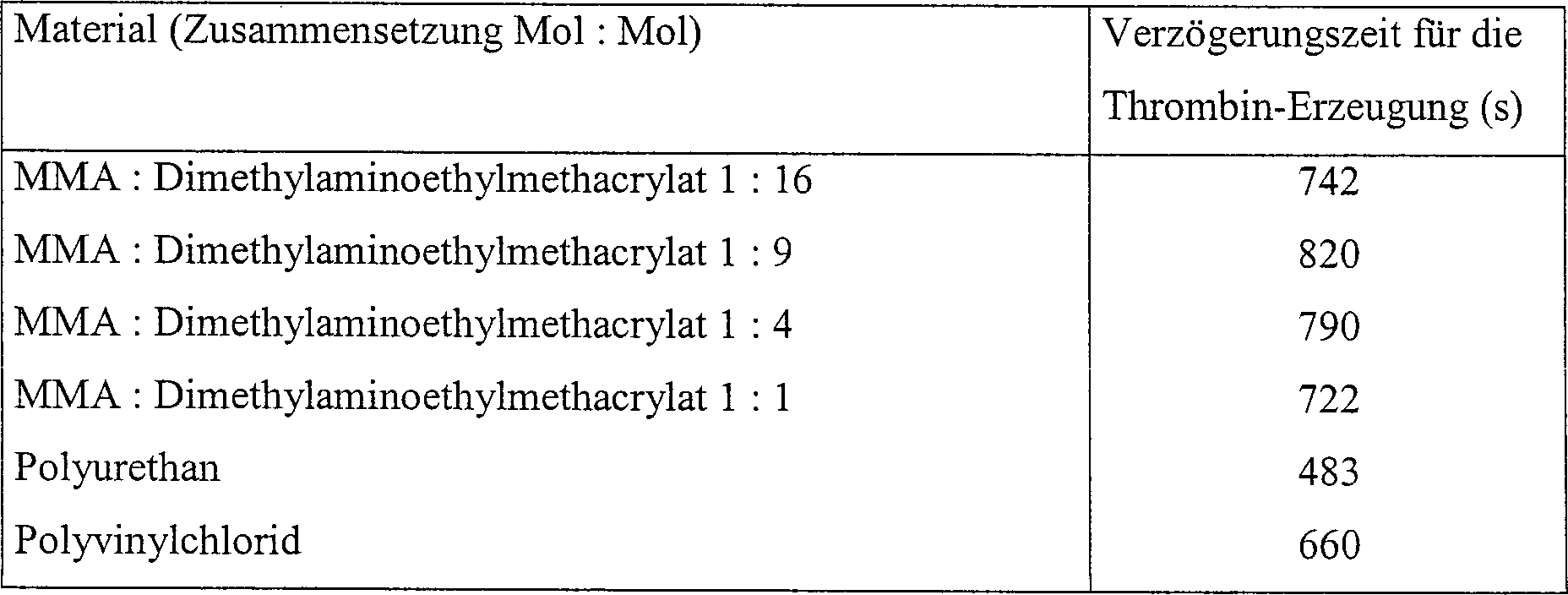
Beispiel 2. Sprühbeschichtung der Polymeren auf metallischen Oberflächen.Example 2. Spray coating of the polymers on metallic surfaces.
Verdünnte Lösungen der polymeren Materialien, wie in Beispiel 1A beschrieben, in einen flüchtigen organischen Lösungsmittel wurden für Sprühbeschichtungsexperimente verwendet. Die Lösungen wurden durch eine Düse mit Druckluft auf beispielsweise Metalldrähte gesprüht. Diese wurden nachfolgend bei erhöhten Temperaturen getrocknet. Es wurde eine starke Anhaftung der Polynermaterialien auf den Metalloberflächen bemerkt. Die anhaftende Polymerbeschichtung erwies sich als nicht löslich, selbst während verlängerter Exposition gegenüber heißem Wasser (80°C, 24 h–480 h). Diesem Verfahren wurde ebenfalls gefolgt, um Polymerbeschichtungen auf Metalldrähte von Stents, insbesondere auf die selbstexpandierenden Wandstents, aufzubringen. Die Leistung dieser Polymer-beschichteten Stents gegenüber unbeschichteten (blanken) Stents wurde in der Arteria carotis (in vivo Experimente) unter Verwendung eines Schweine-Modells getestet (siehe Beispiel 3).Dilute solutions of the polymeric materials, as described in Example 1A, in a volatile organic solvent were for Sprühbeschichtungsexperimente used. The solutions were through a nozzle sprayed with compressed air on metal wires, for example. These were below at elevated Temperatures dried. There was a strong adhesion of the polymer materials on the metal surfaces noticed. The adherent polymer coating was not found soluble, even during prolonged exposure across from hot Water (80 ° C, 24h-480 H). This procedure was also followed to make polymer coatings on metal wires of stents, in particular on the self-expanding wall stents. The performance of these polymer-coated stents over uncoated (bare) stents were in the carotid artery (in vivo experiments) tested using a pig model (see example 3).
Beispiel 3.Example 3.
Das Polymer mit der Zusammensetzung Methylmethacrylat/Dimethylaminoethylmethacrylat 1 : 9 wurde als dünne gleichmäßige Beschichtung auf die Streben einer Reihe von metallischen selbstexpandierenden Stents (Wand-Stents) aufgebracht. Es wurde eine in vivo-Tierstudie, die darauf abzielte, einen Vergleich der Leistungsfähigkeit der beschichteten versus unbeschichteten Stents zu machen, durchgeführt. Bei diesen Experimenten wurde die Arteria carotis von Schweinen als das Modellsystem verwendet. Das Studienprotokoll war wie folgt:The polymer with the composition Methyl methacrylate / dimethylaminoethyl methacrylate 1: 9 was used as thin even coating on the struts of a series of metallic self-expanding stents (Wall stents) applied. It was an in vivo animal study that aimed to compare the performance of the coated versus to make uncoated stents. In these experiments The carotid artery was used by pigs as the model system. The study protocol was as follows:
- – Versuchsschwein wird gewogen und, falls zwischen 10 und 16 kg, anästhesiert.- experimental pig is weighed and, if between 10 and 16 kg, anesthetized.
- – Femoraler Zugang wird etabliert und ein Angiogramm genommen. QCA bestätigt, dass die Arteriengröße zwischen 2,5 und 3,0 mm im Durchmesser ist.- Femoral Access is established and an angiogram is taken. QCA confirms that the artery size between 2.5 and 3.0 mm in diameter.
- – Ein Mittellinien-Nackeneinschnitt exponiert beide Carotis-Arterien. Sie werden isoliert und in Lidocaingel gebadet. Der Anfangsfluss durch beide Arterien wird 5 min nach Platzierung von Dopplersonden gemessen.- On Midline neck incision exposes both carotid arteries. They are isolated and bathed in Lidocaingel. The initial flow through both arteries is 5 min after placement of Doppler probes measured.
- – Die Sonden werden entfernt.- The Probes are removed.
- – Die erste Carotis-Arterie wird zerquetscht. Unter Verwendung einer verriegelnden Pinzette werden sechs Quetschungen kreuzweise aufgebracht, von 5 s Dauer mit jeweils 2 s Verzögerung zwischen den Quetschungen. Die Quetschungen liegen längs der Arterie nebeneinander, und die sich ergebende Verletzung ist 12 bis 15 mm lang.- The first carotid artery is crushed. Using a locking Tweezers are applied six squeezes crosswise, from 5 s Duration with a 2 s delay between the bruises. The bruises are along the Artery side by side, and the resulting injury is 12 up to 15 mm long.
- – Die Stentvorrichtung für die erste Arterie wird zum Platzieren vorbereitet.- The Stent device for the first artery is prepared for placement.
- – Fünf Minuten nach der Quetschverletzung wird der Stent über der Quetschverletzung platziert.- Five minutes after the crush injury, the stent is placed over the crush injury.
- – Ein auf den Arteriendurchmesser bemessener Mongoose-Katheter wird verwendet, um den Stent zu postdilatieren, wobei 30 s Aufblaszeit verwendet werden.- On Mongoose catheter sized to the artery diameter is used to post-dilate the stent using 30 s inflation time become.
- – Die zweite Arterie wird wie oben gequetscht.- The second artery is squeezed as above.
- – Die Stentvorrichtung für die zweite Arterie wird zum Einsetzen vorbereitet.- The Stent device for the second artery is prepared for insertion.
- – Fünf Minuten nach der Verletzung wird der zweite Stent über der Verletzung platziert.- Five minutes after the injury, the second stent is placed over the injury.
- – Ein auf den Arteriendurchmesser bemessener Mongoose-Katheter wird verwendet, um den Stent zu post-inflatieren.- On Mongoose catheter sized to the artery diameter is used to post-inflate the stent.
- – Alle Katheter werden entfernt und die Dopplersonden werden auf den Carotiden mit zusätzlichem Lidocaingel ersetzt. Der Flüss in beidcn Carotideil, die Herzrate und der Blutdruck werden einmal pro Minute für 10 Minuten, dann alle 5 Minuten verfolgt, bis 1 Stunde nach Verabreichung der Quetschverletzung.- All Catheters are removed and the Doppler probes are placed on the carotids with additional Lidocaine gel replaced. The liquid in both carotides, the heart rate and blood pressure become one per minute for 10 Minutes, then followed every 5 minutes until 1 hour after administration the bruise.
- – Die Sonden werden entfernt und der femorale und der Nackeneinschnitt geschlossen.- The Probes are removed and the femoral and neck incisions closed.
- – Der Carotidenfluss wird bei Tag 1 oder bei Tag 7 gemessen, die Carotiden werden mit einem Zoll proximalem und einem Zoll distalem Gefäß daran entnommen, das den Stent umgibt. Das Tier wird dann geschlachtet.- The Carotid flow is measured at day 1 or day 7, the carotid with an inch proximal and an inch distal vessel attached to it taken that surrounds the stent. The animal is then slaughtered.
Nach Vorbereitung mikroskopischer
Schnitte für
histologische/pathologische Studien wurden die in den
Mikroskopische Schnitte für eine histologische/pathologische
Prüfung
wurden nach Explantation vorbereitet. Diese Schnitte zeigten klare
Unterschiede bei den beschichteten versus den unbeschichteten Stents. Die
beschichteten Stents wiesen signifikant weniger Bildung von Neointima
und konsequenterweise ein viel weiteres Lumen auf. Bei den nichtbeschichteten
(blanken) Stets wurde in einigen Fällen ein Verschluss aufgrund
von Thromben-Bildung beobachtet. Die
Claims (10)
Applications Claiming Priority (1)
| Application Number | Priority Date | Filing Date | Title |
|---|---|---|---|
| EP98200952A EP0945148B1 (en) | 1998-03-26 | 1998-03-26 | Endovascular stents with a polymeric coating |
Publications (2)
| Publication Number | Publication Date |
|---|---|
| DE69820023D1 DE69820023D1 (en) | 2004-01-08 |
| DE69820023T2 true DE69820023T2 (en) | 2004-09-02 |
Family
ID=8233520
Family Applications (1)
| Application Number | Title | Priority Date | Filing Date |
|---|---|---|---|
| DE69820023T Expired - Fee Related DE69820023T2 (en) | 1998-03-26 | 1998-03-26 | Endovascular vascular prostheses with a polymer coating |
Country Status (4)
| Country | Link |
|---|---|
| EP (1) | EP0945148B1 (en) |
| AT (1) | ATE254935T1 (en) |
| DE (1) | DE69820023T2 (en) |
| ES (1) | ES2212821T3 (en) |
Families Citing this family (25)
| Publication number | Priority date | Publication date | Assignee | Title |
|---|---|---|---|---|
| ES2179646T3 (en) | 1998-04-27 | 2003-01-16 | Surmodics Inc | COATING THAT RELEASES A BIOACTIVE AGENT. |
| EP1104681A1 (en) * | 1999-12-03 | 2001-06-06 | Biomat B.V. | Wire, tube or catheter with hydrophilic coating |
| US20020065551A1 (en) * | 2000-09-22 | 2002-05-30 | Koole Levinas H. | Method for immobilizing poly(HEMA) on stents |
| EP1347794A2 (en) | 2000-11-27 | 2003-10-01 | Medtronic, Inc. | Stents and methods for preparing stents from wires having hydrogel coating layers thereon |
| US7097850B2 (en) | 2002-06-18 | 2006-08-29 | Surmodics, Inc. | Bioactive agent release coating and controlled humidity method |
| EP1633320A2 (en) | 2003-05-02 | 2006-03-15 | SurModics, Inc. | Implantable controlled release bioactive agent delivery device |
| US8246974B2 (en) | 2003-05-02 | 2012-08-21 | Surmodics, Inc. | Medical devices and methods for producing the same |
| DE602005015564D1 (en) | 2004-04-06 | 2009-09-03 | Surmodics Inc | COATING COMPOSITIONS FOR BIOACTIVE AGENTS |
| EP1933845A2 (en) | 2005-08-25 | 2008-06-25 | Medtronic Vascular, Inc. | Nitric oxide-releasing biodegradable polymers useful as medical devices and coatings therefore |
| US8241619B2 (en) * | 2006-05-15 | 2012-08-14 | Medtronic Vascular, Inc. | Hindered amine nitric oxide donating polymers for coating medical devices |
| US7811600B2 (en) | 2007-03-08 | 2010-10-12 | Medtronic Vascular, Inc. | Nitric oxide donating medical devices and methods of making same |
| US8273828B2 (en) | 2007-07-24 | 2012-09-25 | Medtronic Vascular, Inc. | Methods for introducing reactive secondary amines pendant to polymers backbones that are useful for diazeniumdiolation |
| DE102008006654A1 (en) * | 2008-01-30 | 2009-08-06 | Biotronik Vi Patent Ag | Implant with a body made of a biocorrodible alloy |
| US8158187B2 (en) | 2008-12-19 | 2012-04-17 | Medtronic Vascular, Inc. | Dry diazeniumdiolation methods for producing nitric oxide releasing medical devices |
| US8709465B2 (en) | 2009-04-13 | 2014-04-29 | Medtronic Vascular, Inc. | Diazeniumdiolated phosphorylcholine polymers for nitric oxide release |
| EP2855030B1 (en) | 2012-06-01 | 2019-08-21 | SurModics, Inc. | Apparatus and method for coating balloon catheters |
| US9827401B2 (en) | 2012-06-01 | 2017-11-28 | Surmodics, Inc. | Apparatus and methods for coating medical devices |
| US11090468B2 (en) | 2012-10-25 | 2021-08-17 | Surmodics, Inc. | Apparatus and methods for coating medical devices |
| US11628466B2 (en) | 2018-11-29 | 2023-04-18 | Surmodics, Inc. | Apparatus and methods for coating medical devices |
| US11819590B2 (en) | 2019-05-13 | 2023-11-21 | Surmodics, Inc. | Apparatus and methods for coating medical devices |
| EP4255495A4 (en) | 2020-12-03 | 2025-10-08 | Battelle Memorial Institute | POLYMER NANOPARTICLE AND DNA NANOSTRUCTURE COMPOSITIONS AND METHODS FOR NONVIRAL DELIVERY |
| US12496612B2 (en) | 2021-01-08 | 2025-12-16 | Surmodics, Inc. | Coating application system and methods for coating rotatable medical devices |
| WO2022216977A1 (en) | 2021-04-07 | 2022-10-13 | Batelle Memorial Institute | Rapid design, build, test, and learn technologies for identifying and using non-viral carriers |
| WO2025072751A1 (en) | 2023-09-29 | 2025-04-03 | Battelle Memorial Institute | Polymer nanoparticle compositions for in vivo expression of polypeptides |
| US12441996B2 (en) | 2023-12-08 | 2025-10-14 | Battelle Memorial Institute | Use of DNA origami nanostructures for molecular information based data storage systems |
Family Cites Families (5)
| Publication number | Priority date | Publication date | Assignee | Title |
|---|---|---|---|---|
| US3861396A (en) * | 1973-08-08 | 1975-01-21 | Hydro Med Sciences Inc | Drainage tube |
| GB8611838D0 (en) * | 1986-05-15 | 1986-06-25 | Yarsley Technical Centre Ltd | Hydrophilic copolymers |
| US5282823A (en) | 1992-03-19 | 1994-02-01 | Medtronic, Inc. | Intravascular radially expandable stent |
| US5389106A (en) | 1993-10-29 | 1995-02-14 | Numed, Inc. | Impermeable expandable intravascular stent |
| CA2213403C (en) | 1995-02-22 | 2007-01-16 | Menlo Care, Inc. | Covered expanding mesh stent |
-
1998
- 1998-03-26 DE DE69820023T patent/DE69820023T2/en not_active Expired - Fee Related
- 1998-03-26 EP EP98200952A patent/EP0945148B1/en not_active Expired - Lifetime
- 1998-03-26 AT AT98200952T patent/ATE254935T1/en not_active IP Right Cessation
- 1998-03-26 ES ES98200952T patent/ES2212821T3/en not_active Expired - Lifetime
Also Published As
| Publication number | Publication date |
|---|---|
| ES2212821T3 (en) | 2004-08-01 |
| EP0945148B1 (en) | 2003-11-26 |
| DE69820023D1 (en) | 2004-01-08 |
| ATE254935T1 (en) | 2003-12-15 |
| EP0945148A1 (en) | 1999-09-29 |
Similar Documents
| Publication | Publication Date | Title |
|---|---|---|
| DE69820023T2 (en) | Endovascular vascular prostheses with a polymer coating | |
| DE69729778T2 (en) | Stent for the dilation of stenotic damage of a blood vessel | |
| DE69415212T2 (en) | Coated dilator | |
| EP1891993B1 (en) | Bio-corrodible metal implant with a coating or cavity filling made of a Peg/Plga-copolymer | |
| DE60026065T2 (en) | ELECTROPOLYMERIZABLE MONOMERS AND POLYMER COATINGS ON IMPLANTABLE EQUIPMENT | |
| DE60126544T3 (en) | Coating for medical devices | |
| DE69901927T2 (en) | BIOACTIVE ACTIVE SUBSTANCES RELEASING COATINGS | |
| DE602004010977T2 (en) | Production process of a stent with laminated drug-polymer coating | |
| EP2151255B1 (en) | Biocorrodible implant with a coating comprising a hydrogel | |
| EP1930032A2 (en) | Bio-corrodable metal implant with a coating or cavity filling made of gelatine | |
| DE60220649T2 (en) | Stent made of a radiopaque alloy | |
| DE19843254C2 (en) | Use of polymer mixtures containing cyanoacrylate or methylene malonic ester for coating medical devices and implants, medical implants and processes for their production | |
| DE102007038799A1 (en) | Implant made of a biocorrodible magnesium alloy and coated with a biocorrodible polyphosphazene | |
| DE102007024256A1 (en) | vascular stent | |
| DE19731021A1 (en) | In vivo degradable metallic implant | |
| DE60130673T2 (en) | COATINGS FOR MEDICAL DEVICES | |
| DE10223310A1 (en) | Process for coating implants with a polysaccharide layer | |
| DE60002744T2 (en) | INTRALUMINAL DEVICE, COATING FOR SUCH A DEVICE AND METHOD FOR THE PRODUCTION THEREOF | |
| EP2089074B1 (en) | Textile vascular prosthesis with a coating | |
| DE102007050668A1 (en) | Stent with a base made of a bioinert metallic implant material | |
| DE102008040572A1 (en) | Implant with coating | |
| DE10234398B4 (en) | An implantable medical device coating composition and method of coating such device and its use | |
| WO2000044357A2 (en) | Agent for preventing in-stent restenoses and post-operative inflammations | |
| WO2000071052A1 (en) | Highly flexible coating for stents and/or stent grafts and/or vascular stent prostheses | |
| EP2452653B1 (en) | cRGD peptide derivative and its manufacture and implant having a coating containing a cRGD peptide derivative |
Legal Events
| Date | Code | Title | Description |
|---|---|---|---|
| 8364 | No opposition during term of opposition | ||
| 8327 | Change in the person/name/address of the patent owner |
Owner name: BOSTON SCIENTIFIC LTD., HASTINGS, CHRIST CHURCH, B |
|
| 8328 | Change in the person/name/address of the agent |
Representative=s name: FISH & RICHARDSON P.C., 80807 MUENCHEN |
|
| 8339 | Ceased/non-payment of the annual fee |