[go: up one dir, main page]

DE69817073T2 - Method and apparatus for predicting and displaying a printer's toner consumption - Google Patents

Method and apparatus for predicting and displaying a printer's toner consumption Download PDF

Info

Publication number
DE69817073T2
DE69817073T2 DE69817073T DE69817073T DE69817073T2 DE 69817073 T2 DE69817073 T2 DE 69817073T2 DE 69817073 T DE69817073 T DE 69817073T DE 69817073 T DE69817073 T DE 69817073T DE 69817073 T2 DE69817073 T2 DE 69817073T2
Authority
DE
Germany
Prior art keywords
toner
cartridge
level
pages
printed
Prior art date
Legal status (The legal status is an assumption and is not a legal conclusion. Google has not performed a legal analysis and makes no representation as to the accuracy of the status listed.)
Expired - Fee Related
Application number
DE69817073T
Other languages
German (de)
Other versions
DE69817073D1 (en
Inventor
Charles Michael Lexington Garr
Nathan Karl Lexington Klemperer
Patricia Ann Lexington Valenti
Earl Dawson Richmond Ward II
James Francis Lexington Webb
Phillip Byron Lexington Wright
Current Assignee (The listed assignees may be inaccurate. Google has not performed a legal analysis and makes no representation or warranty as to the accuracy of the list.)
Lexmark International Inc
Original Assignee
Lexmark International Inc
Priority date (The priority date is an assumption and is not a legal conclusion. Google has not performed a legal analysis and makes no representation as to the accuracy of the date listed.)
Filing date
Publication date
Application filed by Lexmark International Inc filed Critical Lexmark International Inc
Application granted granted Critical
Publication of DE69817073D1 publication Critical patent/DE69817073D1/en
Publication of DE69817073T2 publication Critical patent/DE69817073T2/en
Anticipated expiration legal-status Critical
Expired - Fee Related legal-status Critical Current

Links

Classifications

    • GPHYSICS
    • G03PHOTOGRAPHY; CINEMATOGRAPHY; ANALOGOUS TECHNIQUES USING WAVES OTHER THAN OPTICAL WAVES; ELECTROGRAPHY; HOLOGRAPHY
    • G03GELECTROGRAPHY; ELECTROPHOTOGRAPHY; MAGNETOGRAPHY
    • G03G15/00Apparatus for electrographic processes using a charge pattern
    • G03G15/55Self-diagnostics; Malfunction or lifetime display
    • G03G15/553Monitoring or warning means for exhaustion or lifetime end of consumables, e.g. indication of insufficient copy sheet quantity for a job
    • G03G15/556Monitoring or warning means for exhaustion or lifetime end of consumables, e.g. indication of insufficient copy sheet quantity for a job for toner consumption, e.g. pixel counting, toner coverage detection or toner density measurement
    • BPERFORMING OPERATIONS; TRANSPORTING
    • B41PRINTING; LINING MACHINES; TYPEWRITERS; STAMPS
    • B41JTYPEWRITERS; SELECTIVE PRINTING MECHANISMS, i.e. MECHANISMS PRINTING OTHERWISE THAN FROM A FORME; CORRECTION OF TYPOGRAPHICAL ERRORS
    • B41J2/00Typewriters or selective printing mechanisms characterised by the printing or marking process for which they are designed
    • B41J2/005Typewriters or selective printing mechanisms characterised by the printing or marking process for which they are designed characterised by bringing liquid or particles selectively into contact with a printing material
    • B41J2/01Ink jet
    • B41J2/17Ink jet characterised by ink handling
    • B41J2/175Ink supply systems ; Circuit parts therefor
    • B41J2/17566Ink level or ink residue control
    • GPHYSICS
    • G03PHOTOGRAPHY; CINEMATOGRAPHY; ANALOGOUS TECHNIQUES USING WAVES OTHER THAN OPTICAL WAVES; ELECTROGRAPHY; HOLOGRAPHY
    • G03GELECTROGRAPHY; ELECTROPHOTOGRAPHY; MAGNETOGRAPHY
    • G03G15/00Apparatus for electrographic processes using a charge pattern
    • G03G15/06Apparatus for electrographic processes using a charge pattern for developing
    • G03G15/08Apparatus for electrographic processes using a charge pattern for developing using a solid developer, e.g. powder developer
    • G03G15/0822Arrangements for preparing, mixing, supplying or dispensing developer
    • G03G15/0848Arrangements for testing or measuring developer properties or quality, e.g. charge, size, flowability
    • G03G15/0856Detection or control means for the developer level
    • GPHYSICS
    • G03PHOTOGRAPHY; CINEMATOGRAPHY; ANALOGOUS TECHNIQUES USING WAVES OTHER THAN OPTICAL WAVES; ELECTROGRAPHY; HOLOGRAPHY
    • G03GELECTROGRAPHY; ELECTROPHOTOGRAPHY; MAGNETOGRAPHY
    • G03G15/00Apparatus for electrographic processes using a charge pattern
    • G03G15/50Machine control of apparatus for electrographic processes using a charge pattern, e.g. regulating differents parts of the machine, multimode copiers, microprocessor control
    • G03G15/5075Remote control machines, e.g. by a host
    • G03G15/5079Remote control machines, e.g. by a host for maintenance
    • BPERFORMING OPERATIONS; TRANSPORTING
    • B41PRINTING; LINING MACHINES; TYPEWRITERS; STAMPS
    • B41JTYPEWRITERS; SELECTIVE PRINTING MECHANISMS, i.e. MECHANISMS PRINTING OTHERWISE THAN FROM A FORME; CORRECTION OF TYPOGRAPHICAL ERRORS
    • B41J2/00Typewriters or selective printing mechanisms characterised by the printing or marking process for which they are designed
    • B41J2/005Typewriters or selective printing mechanisms characterised by the printing or marking process for which they are designed characterised by bringing liquid or particles selectively into contact with a printing material
    • B41J2/01Ink jet
    • B41J2/17Ink jet characterised by ink handling
    • B41J2/175Ink supply systems ; Circuit parts therefor
    • B41J2/17566Ink level or ink residue control
    • B41J2002/17589Ink level or ink residue control using ink level as input for printer mode selection or for prediction of remaining printing capacity
    • GPHYSICS
    • G03PHOTOGRAPHY; CINEMATOGRAPHY; ANALOGOUS TECHNIQUES USING WAVES OTHER THAN OPTICAL WAVES; ELECTROGRAPHY; HOLOGRAPHY
    • G03GELECTROGRAPHY; ELECTROPHOTOGRAPHY; MAGNETOGRAPHY
    • G03G15/00Apparatus for electrographic processes using a charge pattern
    • G03G15/55Self-diagnostics; Malfunction or lifetime display
    • G03G15/553Monitoring or warning means for exhaustion or lifetime end of consumables, e.g. indication of insufficient copy sheet quantity for a job

Landscapes

  • Physics & Mathematics (AREA)
  • General Physics & Mathematics (AREA)
  • Engineering & Computer Science (AREA)
  • Microelectronics & Electronic Packaging (AREA)
  • Accessory Devices And Overall Control Thereof (AREA)
  • Control Or Security For Electrophotography (AREA)
  • Dry Development In Electrophotography (AREA)
  • Ink Jet (AREA)
  • Laser Beam Printer (AREA)

Description

Die vorliegende Erfindung betrifft allgemein Druckgerät und ist speziell auf einen Drucker des Typs gerichtet, der Information im Hinblick auf eine Tonerverwendung bereitstellt. Die Erfindung ist speziell als ein Drucker offenbart, der mit einem Hauptrechner verbunden ist, bei dem ein Benutzer am Hauptrechner den Drucker abfragen kann, um zu entnehmen, wie viel Toner im Drucker verbleibt, und auch, um eine Vorhersage im Hinblick darauf zu entnehmen, wie viele Seiten gedruckt werden können oder wie viele Drucktage von der vorhandenen Tonerpatrone noch verfügbar sind.The present invention relates to general pressure equipment and is specifically directed to a printer of the type that information in terms of toner usage. The invention is specifically disclosed as a printer that works with a host is connected, in which a user queries the printer on the main computer to see how much toner remains in the printer, and also to get a prediction of how many Pages can be printed or how many days of printing are still available from the existing toner cartridge.

Elektrofotografische Drucker sind jahrelang verfügbar gewesen, die ein geladenes fotoleitendes Element bei verschiedenen Spannungsniveaus verwenden, um eine spezielle Druckfarbe, die als "Toner" bekannt ist, entweder anzuziehen oder zurückzustoßen. Sobald der Toner von speziellen Gebieten des fotoleitenden Elements (typischerweise eine drehbare fotoleitende Trommel) angezogen worden ist, wird die Trommel oder das Element zu einem Punkt gedreht, wo sie in Berührung mit einem Bogen von Druckmedien, wie z. B. Papier, kommen kann. Zu diesem Zeitpunkt wird der Toner auf dem Papier abgelagert, und wird dann typischerweise durch eine Schmelzeinrichtung dazu gebracht, um am Druckmedium fest anzuhaften.Are electrophotographic printers available for years been a charged photoconductive element at various Use voltage levels to either a special ink known as a "toner" to put on or push back. As soon as the toner from specific areas of the photoconductive element (typically a rotatable photoconductive drum) has been tightened, the Drum or the element rotated to a point where it is in contact with a sheet of print media such as B. paper. To this At that point, the toner is deposited on the paper, and then typically caused by a melting device to am Adhere the print medium firmly.

Natürlich ist das Tonerniveau in einem solchen Drucker kritisch, und Benutzer wissen es zu würdigen, wenn ihnen bekannt ist, wie viel Toner in einer Druckvorrichtung verfügbar ist. Dies trifft insbesondere im Fall eines "entfernten" Druckers zu, bei dem der Benutzer an einem Hauptrechner arbeitet, der über einen gewissen Typ von Netzwerk mit dem entfernten Drucker verbunden ist. In dieser Situation kann der Benutzer den entfernten Drucker nicht sehen, und kann sich in Wirklichkeit mehrere hundert Fuß von diesem Drucker befinden. Wenn der Benutzer einen großen Druckjob über das Netzwerk zu diesem entfernten Drucker überträgt, kann der Benutzer be sorgt sein, wenn er herausfindet, dass dem Drucker Tinte oder Toner in der Mitte dieses großen Druckjobs ausging. Der Hauptgrund für diese Sorge ist, dass der Benutzer, während er am Hauptrechner saß, nicht feststellen konnte, dass das Tonerniveau am Drucker im Begriffe war, zu Ende zu gehen, und der Benutzer fand dies nicht heraus, bis er die mehreren hundert Fuß zum Drucker ging. Wenn der Benutzer imstande wäre, im voraus zu bestimmen, dass das Tonerniveau verhältnismäßig niedrig ist, könnte der Benutzer einige Maßnahmen ergreifen, um entweder die Möglichkeiten eines Druckens des ganzen Druckjobs unter Verwendung der in der augenblicklich installierten Tonerpatrone am Drucker verbleibenden Menge an Toner genauer zu veranschlagen, oder er könnte zuerst zum Drucker gehen und eine neue Patrone installieren oder irgendjemanden auf dem Netzwerkadministratorniveau bitten, die Tonerpatrone zu ersetzen.Of course, the toner level is in such a printer is critical, and users will appreciate it, though they know how much toner is available in a printing device. This is particularly true in the case of a "remote" printer where the user is on a host computer that operates over a certain type of Network is connected to the remote printer. In this situation the user cannot see the remote printer and can is actually several hundred feet from this printer. If the user has a large Print job over transfers the network to this remote printer, the user can be concerned if he finds that the printer has ink or toner in it the middle of this big one Print jobs ran out. The main reason for this concern is that the User while he was at the main computer, could not find that the toner level at the printer was about to was going to end and the user didn't find out until he reached the several hundred feet Printer went. If the user were able to predict in advance, that the toner level is relatively low is, could the user takes some action take either the options printing the entire print job using the in the currently installed toner cartridge remaining on the printer Amount of toner more accurately estimated, or it could be first go to the printer and install a new cartridge or anyone at the network administrator level, ask the toner cartridge to replace.

Vorherzusagen, wie viele Seiten bei der verbleibenden Menge an Toner in der Patrone gedruckt werden können, ist nicht notwendigerweise eine einfache Aufgabe. Viele Druckerhersteller veranschlagen, dass zumindest für Schriftstücke vom Texttyp (wie z. B. Textverarbeitungsschriftstücke) die Prozentbedeckung von Toner auf einer Druckseite etwa 5% ist und basieren für eine 21,25 × 27,5 cm (8-1/2 × 11 Inch)-Seite ihre Anzahl von Seiten, die gedruckt werden können, auf dieser 5%-Statistik. Natürlich ist die 5%-Veranschlagung nicht ganz genau, und in einer tatsächlichen Verwendung könnte dieser Prozentsatz variieren, entweder größer oder kleiner als 5% sein, abhängig vom Typ von Schriftstücken, die tatsächlich an einem speziellen Drucker gedruckt werden. Z. B. können Schriftstücke, die beim Erzeugen von Zeichnungen mit schwarzen Linien verwendet werden, einen ziemlich großen Betrag an leerem Zwischenabstand aufweisen und können sogar weniger Toner verwenden als ein Textschriftstück von einem Textverarbeitungsprogramm. Natürlich würden die Dicke der Zeichenlinien und der Grad an Detail bei einer speziellen Zeichnung ein bestimmender Faktor bei dieser Veranschlagung sein. Andererseits kann ein Buchführungsschriftstück, wie z. B. ein Arbeitsblatt- oder Geschäftsbuch-Schriftstück, auf einem großen Stück Papier, wie z. B. einer Seite, die 21,25 × 35 cm (8-1/2 × 14 Inch) groß ist, gedruckt werden. Selbst wenn die Tonerverwendung bei dem Legal-Format-großen Schriftstück tatsächlich bei 5% liegt, würde die wahre Menge an Toner für eine einzige Druckseite größer sein als die 5%-Veranschlagung für ein typisches Schriftstück von 21,25 × 27,5 cm (8-1/2 × 11 Inch).Predict how many pages at the amount of toner remaining in the cartridge can, is not necessarily an easy task. Many printer manufacturers estimate that at least for documents of the text type (such as word processing documents) the Percent coverage of toner on a print page is about 5% and based for a 21.25 x 27.5 cm (8-1 / 2 × 11 Inch) page the number of pages that can be printed this 5% statistic. Naturally the 5% estimate is not entirely accurate, and in an actual one Could use this percentage will vary, be either greater or less than 5%, dependent of the type of documents, actually printed on a special printer. For example, documents that used when creating drawings with black lines, a pretty big one Amount of empty space and can use even less toner as a piece of text from a word processor. Of course, the thickness of the drawing lines would be and the level of detail in a particular drawing is a determining one Factor in this estimate. On the other hand, an accounting document such as z. B. a worksheet or account book document a big one Piece of paper, such as B. a page that is 21.25 x 35 cm (8-1 / 2 x 14 inches) is great to be printed. Even if the use of toner in the legal-sized large document actually does 5% would the true amount of toner for a single printed page can be larger than the 5% estimate for a typical document of 21.25 x 27.5 cm (8-1 / 2 × 11 Inch).

Benutzer, die Grafikvorlagen- oder rechnererzeugte Bilder erzeugen, finden sehr wahrscheinlich, dass die 5%-Veranschlagung viel zu gering für ihren Typ von Schriftstücken ist. Dies trifft insbesondere für jeglichen Typ von Fotografie oder anderem Bild zu, das Halbtöne (auch bekannt als "Kontone") verwendet.Users who have graphic or generate computer generated images, it is very likely that the 5% estimate is far too low for their type of documents. This is especially true for any type of photography or other image that has halftones (too known as "accounts").

Frühere Erfindungen sind offenbart worden, um mindestens die Menge an Toner zu bestimmen, die auf gewisse Schriftstücke aufgebracht wird. Z. B. offenbart das US-Patent 5,204,699 einen Drucker, der die Masse an Toner misst, die verwendet wird, um einen Bogen von Druckmedium zu drucken, indem die einzelnen Tonermassensignale, die eine Funktion der Bildintensitätssignale sind, aufsummiert werden. Das US-Patent 5,349,377 veranschlagt den Verbrauch von Toner für eine digitale Kopiermaschine, indem die Häufigkeitsrate von len und 0en für die Pixel analysiert wird und Gewichtungsfaktoren für unterschiedliche Typen von Bildern berechnet werden. Diese Pixelhäufigkeit kann pro Seite verfolgt werden, und zusätzliche Gewichtungsfaktoren könnten in Beziehung mit dem Entwicklersystemspannung-Vorspannungsniveau gebracht werden, das typischerweise durch Bedienersteuerungen für eine hellere oder dunklere Kopie eingestellt wird.Earlier inventions are disclosed been used to determine at least the amount of toner on certain documents is applied. For example, U.S. Patent 5,204,699 discloses one Printer that measures the mass of toner used to make one Print sheets of print media using the individual toner mass signals, which are a function of the image intensity signals are summed up become. U.S. Patent 5,349,377 estimates toner consumption for one digital copying machine by changing the frequency rate of len and 0s for the Pixel is analyzed and weighting factors for different types of Images can be calculated. This pixel frequency can be tracked per page be, and additional Weighting factors could in relation to the developer system voltage bias level brought, typically by operator controls for a brighter or darker copy is set.

Das US-Patent 5,459,556 offenbart einen Drucker oder Kopierer, der auch die Tonerverwendung pro Druck messen kann. Die betätigbaren Einstellungen des Bedieners können die Tonerver wendung beeinflussen, und dies wird berücksichtigt. Diese Bediener-betätigbaren Einstellungen umfassen den Kontrast und die Heller/Dunkler-Steuerungen. Auf Grundlage dieser Einstellungen kann die Tonerverbrauchsrate genauer veranschlagt werden, um die Anzahl von verbleibenden Kopien, die von der vorhandenen Tonerpatrone hergestellt werden könnten, zu berechnen. Diese Tonerverbrauchsrate basiert jedoch auf der ursprünglichen veranschlagten Prozentverbrauchsrate, mit Modifikationen für die Bediener-betätigbaren Einstellungen, und nicht auf einer Messung von tatsächlicher Tonerverwendung.U.S. Patent 5,459,556 discloses a printer or copier that can also measure toner usage per print. The operable settings of the operator can influence the toner usage sen, and this is taken into account. These operator operated settings include contrast and lighter / darker controls. Based on these settings, the toner usage rate can be more accurately estimated to calculate the number of copies that could be made from the existing toner cartridge. However, this toner consumption rate is based on the original estimated percentage consumption rate, with modifications to the operator-operable settings, and not on a measurement of actual toner usage.

Die vorhandenen herkömmlichen Drucker und Kopierer können das Vermögen aufweisen, die Menge an Toner, die pro Seite verwendet wird, zu messen und können auch imstande sein, zu veranschlagen, wie viele Seiten von dem Resttoner in einer vorhandenen Patrone noch gedruckt werden können, jedoch stehen diese Eigenschaften in Beziehung mit der ursprünglichen Veranschlagung eines gewissen Prozentsatzes von Toner, der pro gedrucktes Schriftstück verwendet wird. Dies ist nicht dasselbe, wie zu versuchen, die zukünftige Anzahl von Kopien vorherzusagen, die auf Grundlage einer tatsächlichen Druckvorgeschichte von der vorhandenen Tonerpatrone gedruckt werden können. Die herkömmlichen Drucker und Kopierer offenbaren auch nicht das Vermögen, ihre Restverwendungs-Vorhersagen auf Grundlage von tatsächlichen Tonerniveauänderungen in der Tonerpatrone selbst zu aktualisieren.The existing conventional Printers and copiers can the Fortune the amount of toner used per page measure and can also be able to estimate how many pages of the waste toner can still be printed in an existing cartridge, however these properties are related to the original Estimation of a certain percentage of toner per printed document is used. This is not the same as trying to count the future number to predict copies based on an actual Print history can be printed from the existing toner cartridge can. The conventional Printers and copiers do not reveal their assets either Remaining usage predictions based on actual Toner level changes update in the toner cartridge itself.

Demgemäß ist es ein primäres Ziel der vorliegenden Erfindung, einen Drucker bereitzustellen, der ein tatsächliches Toner- oder Tintenniveau in der Tonerpatrone oder Tintenstrahlpatrone des Druckers messen kann, um die Anzahl von Seiten vorherzusagen, die unter Verwendung dieser Patrone noch gedruckt werden können, oder um die Zeit vorherzusagen, die verstreicht, bevor die Patrone leer wird, auf Grundlage der tatsächlichen Druckvorgeschichte.Accordingly, it is a primary goal of the present invention to provide a printer that has an actual Toner or ink level in the printer’s toner cartridge or inkjet cartridge, to predict the number of pages using this Cartridge can still be printed or to predict the time that passes before the cartridge becomes empty based on the actual print history.

Es ist ein anderes Ziel der vorliegenden Erfindung, einen Drucker bereitzustellen, der die Menge an Toner im Auge behält, die in der Tonerpatrone des Druckers in vorbestimmten Abstufungen (oder "Gradationen") verbleibt, und seine Vorhersage in Hinblick auf die Anzahl von Seiten, die verbleiben, um gedruckt zu werden, bevor die Tonerpatrone leer wird, auf Grundlage der neuesten Geschichte einer Tonerverwendung, in Abhängigkeit von der Anzahl von Seiten, die tatsächlich gedruckt werden, verfeinert.It is another goal of the present Invention to provide a printer that the amount of toner keep in mind those in the toner cartridge of the printer in predetermined increments (or "gradations") remains, and its prediction regarding the number of pages that remain to print before the toner cartridge runs out the latest history of toner usage, depending refined by the number of pages that are actually printed.

Es ist ein weiteres Ziel der vorliegenden Erfindung, einen Drucker bereitzustellen, der vorhersagt, wie viele Seiten unter Verwendung des Resttoners in der Tonerpatrone gedruckt werden können, oder vorhersagen kann, wie viel Zeit verstreicht, bevor die Tonerpatrone leer wird, bei dem ein Skalierungsfaktor für jede Seite, die gedruckt wird, verwendet wird, der von der Druckauflösung der Bildpunkte, die auf das Druckmedium aufgetragen werden, abhängt.It is another goal of the present Invention to provide a printer that predicts how many Pages printed using the waste toner in the toner cartridge can be or can predict how much time will pass before the toner cartridge becomes blank, with a scaling factor for each page that is printed is used by the print resolution of the pixels on the print media to be applied depends.

Zusätzliche Ziele, Vorteile und andere neue Merkmale der Erfindung werden zum Teil in der Beschreibung, die folgt, dargelegt und zum Teil werden sie Fachleuten bei Prüfung des Folgenden ersichtlich oder können mit der Praxis der Erfindung erlernt werden.Additional goals, benefits and other new features of the invention are set in part in the description, which follows, sets out and in part they become experts when examining the The following can be seen or can can be learned with the practice of the invention.

Um die vorhergehenden und andere Ziele zu erreichen und gemäß einem Aspekt der vorliegenden Erfindung wird eine Druckvorrichtung bereitgestellt, umfassend eine ein Tonermaterial enthaltende Patrone, die verwendet wird, um Druckkennzeichen auf einem Druckmedium zu erzeugen; eine Einrichtung zum Messen des Niveaus des Toners in der Patrone; eine Speicherschaltung zum Speichern von Information und eine Verarbeitungsschaltung; wobei die Messeinrichtung konfiguriert ist, um ein Tonerniveausignal zu der Verarbeitungsschaltung zu übertragen, wobei das Tonerniveausignal mit dem körperlichen Tonerniveau in Beziehung steht, das in der Patrone verbleibt; und die Verarbeitungsschaltung konfiguriert ist, um eine Statistik 'Tonerverwendung pro gedruckte Seite' zu bestimmen, auf Grundlage der vorherigen Anzahl von Seiten, die durch die Druckvorrichtung gedruckt worden sind, in Bezug zu dem körperlichen Tonerniveau der Patrone; wobei die Statistik 'Tonerverwendung pro gedruckte Seite' durch die Verarbeitungsschaltung verwendet wird, um die Anzahl von Seiten vorherzusagen, die unter Verwendung des Resttoners in der Patrone gedruckt werden kann; dadurch gekennzeichnet, dass die Messeinrichtung konfiguriert ist, um das Tonerniveausignal an die Verarbeitungsschaltung in Gradationsstufen zu melden, wobei nach dem Auftreten eines Übergangs von einer Gradationsstufe zu einer anderen Gradationsstufe die "neue" Gradationsstufe in der Speicherschaltung gespeichert wird; und eine neukalibrierte Statistik 'Tonerverwendung pro gedruckte Seite' bestimmt wird und in der Speicherschaltung gespeichert wird.To the previous and others To achieve goals and according to one Aspect of the present invention provides a printing device comprising a cartridge containing a toner material used to generate print indicia on a print medium; a Means for measuring the level of the toner in the cartridge; a Storage circuit for storing information and a processing circuit; wherein the measuring device is configured to generate a toner level signal to the processing circuit, the toner level signal with the physical Related toner level remaining in the cartridge; and the processing circuitry is configured to produce a statistics' toner usage per printed page ' determine based on the previous number of pages through the printing device has been printed in relation to the physical Toner level of the cartridge; where the statistics 'toner usage per printed page' by the processing circuit is used to predict the number of pages under Use of waste toner in the cartridge can be printed; thereby characterized that the measuring device is configured to the Toner level signal to the processing circuit in gradation levels to report, after the occurrence of a transition from a gradation level to another gradation level the "new" gradation level is stored in the memory circuit; and a recalibrated Statistics' toner usage per printed page ' is and is stored in the memory circuit.

Gemäß einem anderen Aspekt stellt die Erfindung ein Verfahren bereit, wie in Anspruch 10 dargelegt.According to another aspect the invention provides a method as set out in claim 10.

Die EP-A-0877300 wurde nach dem Prioritätsdatums der vorliegenden Anmeldung veröffentlicht, weist aber ein früheres Prioritätsdatum auf und ist deshalb Stand der Technik unter Art. 54(3) EPC. Dieses Schriftstück offenbart ein System, bei dem die Anzahl von Seiten, die unter Verwendung der in der Patrone verbleibenden körperlichen Menge an Toner gedruckt werden können, bei der in der Datenbank 48 gespeicherten Druckvorgeschichte vorhergesagt wird, insbesondere die Druckjobeigenschaften und die Verwendungszeit für eine spezielle Verwendung oder Rechnerauftragserteilungsdrucke, wodurch die Druckjobeigenschaften des Benutzers in 46 identifiziert werden.EP-A-0877300 was after the priority date published the present application, points but an earlier one priority date and is therefore state of the art under Art. 54 (3) EPC. This document reveals a system in which the number of pages using the amount of toner remaining in the cartridge can be predicted from the print history stored in database 48 in particular the print job properties and the usage time for a special Use or computer job placement prints, which improves the job's properties User identified in 46.

Unter Verwendung einer bevorzugten Vorrichtung zur Messung der Menge an Toner, die in der Tonerpatrone übrig ist, zeigt der Drucker der vorliegenden Erfindung die in der Patrone verbleibende annähernde Menge an Toner auf einem Bildschirm eines Hauptrechners an, der mit dem Drucker entweder direkt oder durch ein Netzwerk verbunden ist. Der Monitorschirm des Hauptrechners kann auch die vorhergesagte Anzahl von verbleibenden Seiten anzeigen, auf Grundlage der Verwendungsvorgeschichte des Druckers, wie oben beschrieben. Die Tonermessvorrichtung liefert vorzugsweise ein "Niveauänderungs"-Ausgangssignal, wenn der Resttoner durch einen vorbestimmten Gradationsschwellenwert hindurchtritt und abhängig von der Größe der Tonerpatrone und von der Zeit und dem Datum, bei dem die Niveauänderung detektiert wurde, werden die verbleibende vorhergesagte Anzahl von Seiten und die verbleibende tatsächliche Menge an Toner genauer aktualisiert, nachdem eine von diesen vorbestimmten Gradationsschwellenwerten erreicht worden ist. Bei Auftreten jedes Gradationsstufenübergangs berechnet der Drucker einen neuen Wert für die "Seiten-pro-Gradation"-Variable und berechnet auch die Anzahl von Seiten, die gedruckt worden sind, seitdem die letzte Patrone im Drucker installiert wurde, die Anzahl von Seiten, die seit der letzten Niveau- oder Gradationsänderung gedruckt wurden und die Anzahl von Seiten oder Bögen, die zwischen den letzten zwei (2) Niveauänderungen gedruckt wurden.Using a preferred device for measuring the amount of toner remaining in the toner cartridge, the printer of the present invention displays the approximate amount of toner remaining in the cartridge on a host computer screen, either directly or with the printer connected by a network. The host monitor screen can also display the predicted number of pages remaining based on the usage history of the printer as described above. The toner measuring device preferably provides a "level change" output when the residual toner passes through a predetermined gradation threshold and depending on the size of the toner cartridge and the time and date that the level change was detected, the remaining predicted number of pages and that remaining actual amount of toner updated more accurately after one of these predetermined gradation thresholds is reached. Each time a gradation level transition occurs, the printer calculates a new "Pages Per Gradation" variable and also calculates the number of pages that have been printed since the last cartridge was installed in the printer, the number of pages that have been the last level or gradation change printed and the number of pages or sheets printed between the last two (2) level changes.

Der Drucker der vorliegenden Erfindung weist auch das Vermögen auf, mit einer guten Genauigkeit die Menge an Toner anzunähern, die beim Drucken eines speziellen Typs von Seite von Druckmedien verwendet wird. Der Drucker der vorliegenden Erfindung berücksichtigt auch die Auflösung (in Punkten pro Inch), die verwendet wird, um eine spezielle Seite zu drucken, da dies die Menge an Toner beeinflusst, die verwendet wird, um einen speziellen Bildpunkt oder Slice eines Bildpunkts zu drucken.The printer of the present invention also shows the fortune to approximate with a good accuracy the amount of toner that used when printing a special type of page from print media becomes. The printer of the present invention also takes into account the resolution (in Dots per inch), which is used to make a specific page print as this affects the amount of toner used to print a specific pixel or slice of a pixel.

Noch andere Ziele der vorliegenden Erfindung werden Fachleuten aus der folgenden Beschreibung und den Zeichnungen ersichtlich, in denen eine bevorzugte Ausführungsform dieser Erfindung nur als Beispiel beschrieben und dargestellt ist.Still other goals of the present Invention will become apparent to those skilled in the art from the following description and the Drawings can be seen in which a preferred embodiment this invention is described and illustrated only as an example.

Die beigefügten Zeichnungen, die in der Beschreibung inkorpo riert sind und einen Teil von ihr bilden, veranschaulichen mehrere Aspekte der vorliegenden Erfindung und dienen zusammen mit der Beschreibung und den Ansprüchen dazu, die Prinzipien der Erfindung zu erklären.The accompanying drawings, which are in the Description are incorporated and form part of it, illustrate several aspects of the present invention and serve together with the description and the claims to explain the principles of the invention.

1 ist ein Hardware-Blockdiagramm der Hauptkomponenten, die in einem Laserdrucker verwendet werden, wie gemäß den Prinzipien der vorliegenden Erfindung konstruiert. 1 Figure 3 is a hardware block diagram of the major components used in a laser printer as constructed in accordance with the principles of the present invention.

2 ist ein Hardware-Blockdiagramm in teilweiser schematischer Darstellung eines Teils des ASIC-Bauelements, das in der Druckmaschine des Laserdruckers von 1 verwendet wird. 2 FIG. 10 is a hardware block diagram in partial schematic representation of a portion of the ASIC device used in the printing machine of the laser printer of FIG 1 is used.

3 ist ein Flussdiagramm, das die logischen Schritte wiedergibt, die unternommen werden, um eine "Seitentonerzählmarke" eines speziellen Druckjobs zu bestimmen, der durch den Laserdrucker von 1 gedruckt wird. 3 Fig. 4 is a flow diagram depicting the logical steps taken to determine a "page toner count" of a particular print job performed by the laser printer of 1 is printed.

Die 4A und 4B stellen ein Flussdiagramm dar, das die logischen Schritte wiedergibt, die unternommen werden, um den Typ von Druckpatrone zu bestimmen, der im Laserdrucker von 1 installiert worden ist.The 4A and 4B FIG. 5 is a flow diagram that illustrates the logical steps that are taken to determine the type of print cartridge used in the laser printer of 1 has been installed.

5 ist ein Flussdiagramm, das die logischen Schritte wiedergibt, die unternommen werden, um zu bestimmen, welches Tonerniveau von der Druckmaschine zum Abbildungssystem des Laserdruckers von 1 zu melden ist. 5 Fig. 3 is a flow diagram depicting the logical steps taken to determine which toner level from the press to the imaging system of the laser printer of 1 is to be reported.

Die 6A6C sind Flussdiagramme, die die logischen Schritte wiedergeben, die von einem Hauptrechner unternommen werden, der sich in Kommunikation mit dem Laserdrucker von 1 befindet und der Daten von diesem Drucker empfängt, so dass das Tonerniveau und die Tonervorhersageinformation auf einem Monitor an einem Hauptrechner angezeigt werden können.The 6A - 6C are flowcharts showing the logical steps taken by a host computer in communication with the laser printer of 1 and receives data from this printer so that the toner level and toner prediction information can be displayed on a monitor on a host computer.

Die 6D6E sind Flussdiagramme, die die logischen Schritte wiedergeben, die vom Rasterisiererteil des Laserdruckers von 1 ausgeführt werden, wenn sich die Resttonermenge um ein diskretes Niveau ändert.The 6D - 6E are flowcharts showing the logical steps taken by the rasterizer portion of the laser printer of 1 be executed when the amount of residual toner changes by a discrete level.

7 ist eine Ansicht eines Monitorschirms am Hauptrechner, der das augenblickliche Tonerniveau sowie die Toner vorhersageinformation bezüglich des Laserdruckers von 1 anzeigt. 7 FIG. 12 is a view of a monitor screen on the host computer that shows the current toner level and toner prediction information related to the laser printer of FIG 1 displays.

Es wird nun in Einzelheit auf die gegenwärtig bevorzugte Ausführungsform der Erfindung Bezug genommen, von der ein Beispiel in den begleitenden Zeichnungen veranschaulicht ist, wobei gleiche Ziffern dieselben Elemente überall in den Ansichten anzeigen.It will now focus on the currently preferred embodiment reference to the invention, an example of which in the accompanying Drawings is illustrated, like numerals being the same Elements everywhere Show in the views.

Mit Bezug nun auf die Zeichnungen stellt 1 ein Hardware-Blockdiagramm eines Laserdruckers dar, der allgemein mit der Bezugsziffer 10 bezeichnet ist. Der Laserdrucker 10 enthält vorzugsweise gewisse verhältnismäßig standardmäßige Komponenten, wie z. B. eine Gleichstrom-Stromversorgung 12, die mehrere Ausgänge von unterschiedlichen Spannungsniveaus aufweisen kann, einen Mikroprozessor 14 mit Adressleitungen, Datenleitungen und Steuer- und/oder Interrupt-Leitungen, Festwertspeicher (ROM) 16 und Direktzugriffsspeicher (RAM), der in mehrere Teile eingeteilt ist, um mehrere verschiedene Funktionen auszuführen.With reference now to the drawings 1 a hardware block diagram of a laser printer, generally designated by the reference numeral 10 is designated. The laser printer 10 preferably contains certain relatively standard components, such as. B. a DC power supply 12 , which can have several outputs of different voltage levels, a microprocessor 14 with address lines, data lines and control and / or interrupt lines, read-only memory (ROM) 16 and random access memory (RAM) divided into several parts to perform several different functions.

Der Laserdrucker 10 enthält auch typischerweise mindestens einen Serielleingangs- oder Paralleleingangsport oder in vielen Fällen beide Typen von Eingangsports (sowie andere Typen von Ports in einigen Druckern), wie durch die Bezugsziffer 18 für den seriellen Port und die Bezugsziffer 20 für den parallelen Port bezeichnet. Jeder von diesen Ports 18 und 20 würde mit einem entsprechenden Eingabepuffer verbunden sein, der in 1 allgemein mit der Bezugsziffer 22 bezeichnet ist. Der serielle Port 18 würde typischerweise mit einem seriellen Ausgangsport eines Personal-Rechners oder eines Arbeitsplatzrechners verbunden sein, der ein Software-Programm, wie z. B. ein Textverarbeitungssystem, oder ein Graphik-Software-Paket oder ein rechnerunterstütztes Zeichen-Software-Paket enthalten würde. Ähnlich könnte der parallele Port 20 auch mit einem parallelen Ausgangsport desselben Typs eines Personal-Rechners oder eines Arbeitsplatzrechners verbunden sein, der denselben Typ von Programmen enthält, außer dass das Datenkabel mehrere parallele Leitungen aufweisen würde, statt nur eine Doppelleitung, die mehrere serielle Kabel bildet. Solche Eingabevorrichtungen sind in 1 jeweils mit den Bezugsziffern 24 und 26 bezeichnet.The laser printer 10 Also typically includes at least one serial or parallel input port, or in many cases both types of input ports (as well as other types of ports in some printers), as indicated by the reference number 18 for the serial port and the reference number 20 designated for the parallel port. Any of these ports 18 and 20 would be connected to a corresponding input buffer that is in 1 generally with the reference number 22 is designated. The serial port 18 would typically be connected to a serial output port of a personal computer or a workstation that a software program such as B. would include a word processing system, or a graphics software package or a computer-aided drawing software package. The parallel port could be similar 20 also be connected to a parallel output port of the same type of personal computer or workstation that contains the same type of programs, except that the data cable would have multiple parallel lines rather than just a double line forming multiple serial cables. Such input devices are in 1 each with the reference numbers 24 and 26 designated.

Sobald die Text- oder Graphikdaten von dem Eingabepuffer 22 empfangen worden sind, werden sie üblicherweise einem oder mehreren Interpretierern übermittelt, die mit der Bezugsziffer 28 bezeichnet sind. Ein üblicher Interpretierer ist PostScript, der ein Industriestandard ist, der von den meisten Laserdruckern verwendet wird. Nach Interpretation werden die Eingabedaten typischerweise zu einer üblichen Graphikmaschine geschickt, um rasterisiert zu werden, was typischerweise in einem Teil eines RAM stattfindet, der in 1 mit der Bezugsziffer 30 bezeichnet ist. Um den Prozess einer Rasterisierung zu beschleunigen, ist in den meisten Laserdruckern ein Fontpool und möglicherweise auch ein Fontcache in einem ROM bzw. RAM gespeichert, und diese Fontspeicher sind in 1 mit der Bezugsziffer 32 bezeichnet. Solche Fontpools und -caches liefern Bitmapmuster für übliche alphanumerische Zeichen, so dass die übliche Graphikmaschine 30 jedes solche Zeichen unter Verwendung einer minimalen verstrichenen Zeit leicht in ein Bitmap übersetzen kann.Once the text or graphics data from the input buffer 22 have been received, they are usually transmitted to one or more interpreters, with the reference number 28 are designated. A common interpreter is PostScript, which is an industry standard used by most laser printers. Upon interpretation, the input data is typically sent to a conventional graphics engine to be rasterized, which typically takes place in a portion of RAM that is in 1 with the reference number 30 is designated. To speed up the process of rasterization, a font pool and possibly also a font cache is stored in ROM or RAM in most laser printers, and these font memories are in 1 with the reference number 32 designated. Such font pools and caches provide bitmap patterns for common alphanumeric characters, so that the common graphics engine 30 can easily translate each such character into a bitmap using a minimal elapsed time.

Sobald die Daten rasterisiert worden sind, werden sie in einen Warteschlangenmanager oder Seitenpuffer gelenkt, der ein Teil eines RAM ist, der mit der Bezugsziffer 34 bezeichnet ist. In einem typischen Laserdrucker wird eine ganze Seite von rasterisierten Daten im Warteschlangenmanager während des Zeitintervalls gespeichert, das es braucht, um die Hardcopy für diese Seite körperlich zu drucken. Die Daten im Warteschlangenmanager 34 werden über einen Datenbus 38 in Echtzeit zu einer Druckmaschine übermittelt, die mit der Bezugsziffer 36 bezeichnet ist. Die Druckmaschine 36 umfasst eine Laserlichtquelle im Druckkopf, und ihr Ausgang ist das körperliche Farbauftragen auf ein Stück Papier, das die fer tige Druckausgabe aus dem Laserdrucker 10 ist.Once the data has been rasterized, it is directed to a queue manager or page buffer, which is part of a RAM identified by the reference number 34 is designated. In a typical laser printer, a full page of rasterized data is stored in the queue manager during the time interval it takes to physically print the hard copy for that page. The data in the queue manager 34 are via a data bus 38 transmitted in real time to a printing press with the reference number 36 is designated. The printing press 36 includes a laser light source in the printhead, and its output is the physical application of color to a piece of paper, which is the finished print from the laser printer 10 is.

Es versteht sich, dass die Adress-, Daten- und Steuerleitungen typischerweise in Bussen gruppiert sind und die körperlich in parallelen (manchmal auch gemultiplexten) elektrisch leitenden Wegen um die verschiedenen elektronischen Bauteile im Laserdrucker 10 Verbindungen herstellen. Z. B. werden die Adress- und Datenbusse typischerweise zu allen ROM- und RAM-ICs geschickt, und die Steuerleitungen oder Interruptleitungen werden typischerweise zu allen Eingabe- oder Ausgabe-ICs gelenkt, die als Puffer wirken.It goes without saying that the address, data and control lines are typically grouped in buses and the physically in parallel (sometimes also multiplexed) electrically conductive paths around the various electronic components in the laser printer 10 Make connections. For example, the address and data buses are typically sent to all ROM and RAM ICs, and the control lines or interrupt lines are typically directed to all input or output ICs that act as buffers.

Die Druckmaschine 36 enthält eine ASIC (anwendungsspezifische integrierte Schaltung) 40, die als ein Kontroller und eine Datenhandhabungsvorrichtung für die verschiedenen Hardware-Komponenten in der Druckmaschine wirkt. Die Bitmapdruckdaten, die von dem Warteschlangenmanager 34 ankommen, werden von der ASIC 40 empfangen, und werden zu den richtigen Augenblicken über einen Bus von Datenleitungen 46 zur Laserlichtquelle gesendet, die mit der Bezugsziffer 48 bezeichnet ist.The printing press 36 contains an ASIC (application specific integrated circuit) 40 that acts as a controller and data handling device for the various hardware components in the printing press. The bitmap print data provided by the queue manager 34 will arrive from the ASIC 40 received, and are sent at the right moment via a bus of data lines 46 sent to the laser light source with the reference number 48 is designated.

Die ASIC 40 steuert die verschiedenen Motorantriebe in der Druckmaschine 36 und empfängt auch Zustandssignale von den verschiedenen Hardware-Komponenten der Druckmaschine. Ein anderes wichtiges von der ASIC 40 empfangenes Signal ist als das "HSYNC"-Signal bekannt, das von einem optischen Sensor empfangen wird, der mit der Bezugsziffer 52 bezeichnet ist und als der HSYNC-Sensor bezeichnet wird. Die Laserlichtquelle 48 erzeugt einen sich bewegenden Lichtstrahl, der über eine "Schreibzeile" auf einer fotoleitenden Trommel (nicht dargestellt) streicht oder "scannt", wodurch eine Rasterzeile von entweder schwarzen oder weißen Druckelementen erzeugt wird (auch als "Bildpunkte" bekannt). Wenn das Laserlicht scannt, um diese Rasterzeile zu erzeugen, streicht das Laserlicht am Anfang von jedem Überstreichen oder Scannen für einen Augenblick über den HSYNC-Sensor 52. Das Laserlicht läuft vom Laser 48 zum HSYNC-Sensor 52 entlang einem Licht pfad, der schematisch mit der Bezugsziffer 50 in 1 bezeichnet ist. Dies erzeugt ein elektrisches Impulsausgangssignal von dem HSYNC-Sensor 52, das der ASIC 40 durch eine Signalleitung 54 übermittelt wird.The ASIC 40 controls the various motor drives in the printing press 36 and also receives status signals from the various hardware components of the printing press. Another important one from the ASIC 40 received signal is known as the "HSYNC" signal received by an optical sensor identified by the reference numeral 52 and is referred to as the HSYNC sensor. The laser light source 48 creates a moving beam of light that sweeps or "scans" over a "writing line" on a photoconductive drum (not shown), thereby creating a raster line of either black or white printing elements (also known as "pixels"). When the laser light scans to create this raster line, the laser light sweeps across the HSYNC sensor for a moment at the beginning of each sweep or scan 52 , The laser light runs from the laser 48 to the HSYNC sensor 52 along a light path that is schematic with the reference number 50 in 1 is designated. This produces an electrical pulse output signal from the HSYNC sensor 52 that the ASIC 40 through a signal line 54 is transmitted.

Das HSYNC-Signal 54 könnte sofort zu einem Mikroprozessor 70 in der Druckmaschine gelenkt werden, jedoch wird es bevorzugt, einen "Teile-durch-n"-Zähler (nicht dargestellt) in der ASIC 40 zu verwenden, um die Frequenz von Impulsen zu verringern, die die ASIC 40 entlang einer Steuerleitung 56 verlassen, bevor sie am Mikroprozessor 70 ankommen. Es wird bevorzugt, den Wert für "n" in dem Teile-durch-n-Zähler auf acht (8) zu setzen, um dadurch die HSYNC-Sensorausgangssignalfrequenz durch acht (8) zu dividieren, bevor dieses Signal in ein Interruptsignal auf der Steuerleitung 56 übersetzt wird, das verwendet wird, um die Operationen des Mikroprozessors mit einem viel weniger häufigen Zeitintervall zu unterbrechen.The HSYNC signal 54 could immediately become a microprocessor 70 in the press, however, it is preferred to have a "divide-by-n" counter (not shown) in the ASIC 40 to use to reduce the frequency of pulses that the ASIC 40 along a control line 56 leave before working on the microprocessor 70 arrive. It is preferred to set the value for "n" in the divide by n counter to eight (8), thereby dividing the HSYNC sensor output signal frequency by eight (8) before this signal converts to an interrupt signal on the control line 56 which is used to interrupt the microprocessor's operations at a much less frequent time interval.

Wenn die Druckdaten in Bitmapform an der Druckmaschine 36 ankommen, werden sie über einen parallelen Datenbus zur ASIC 40 übertragen, und sobald sie sich innerhalb der ASIC 40 befinden, werden sie weiter durch einen Satz von parallelen Datenleitungen 42 zu einer Schieberegister/Zähler-Schaltung übermittelt, die mit der Bezugsziffer 60 bezeichnet ist. Die Einzelheiten des Schieberegisters/Zählers 60 werden in 2 geliefert.When the print data is in bitmap form on the press 36 arrive, they become an ASIC via a parallel data bus 40 transferred, and once they are within the ASIC 40 they will continue through a set of parallel data lines 42 transmitted to a shift register / counter circuit, which is identified by the reference number 60 is designated. The details of the shift register / counter 60 are in 2 delivered.

Ein Ausgang vom Schieberegister/Zähler 60 ist eine serielle Datensignalleitung 44, die die Druckdaten zur Laserlichtquelle 48 überträgt. Andere Ausgänge vom Schieberegister/Zähler 60 umfassen das höchstwertige Bit (MSB) des Zählers an einer Datenleitung 72 und den tatsächlichen Zählwert vom Zähler an einer Reihe von parallelen Datenleitungen 62. Ein anderer Eingang zum Schieberegister/Zähler 60 ist ein "Lösche MSB"-Signal 74 vom Mikroprozessor 70. Noch ein anderer ist ein "Lösche Zählung"-Signal 75.An output from the shift register / counter 60 is a serial data signal line 44 that print the data to the laser light source 48 transfers. Other outputs from the shift register / counter 60 include the highest term bit (MSB) of the counter on a data line 72 and the actual count from the counter on a series of parallel data lines 62 , Another input to the shift register / counter 60 is a "clear MSB" signal 74 from the microprocessor 70 , Another is a "clear count" signal 75 ,

Die parallelen Datenleitungen 42 in die ASIC 40 bringen Bitmapdruckdaten zu einem Videoschieberegister, das mit der Bezugsziffer 80 bezeichnet ist (siehe 2). Es wird bevorzugt, dass die parallelen Datenleitungen 42 mindestens acht (8) Leitungen weit sind, so dass dieser "Bus" mindestens ein ganzes Datenbyte von Bitmapdruckdaten fassen kann. Das Videoschieberegister 80 wird durch einen "Subbildpunkttakt" getrieben, der mit der Bezugsziffer 76 bezeichnet ist. Die Bitmapdaten werden zur Kantenkontrastierungslogik geschickt, die ein Slicemap von Daten erzeugt, das verwendet wird, um den Laser für jeden Bildpunkt des Bitmap zu steuern. In der bevorzugten Betriebsart wird jeder Bildpunkt von Bitmapdruckdaten in mindestens acht (8) "Slice" eingeteilt, so dass die Dunkelheit oder "Grau"-Stufe von jedem Bildpunkt bei Werten vorliegen kann, die von einem reinen weißen Bildpunkt (mit einem Wert von logisch 0) oder vollständig schwarzen (mit einem Wert von logisch 1 für alle Slice) verschieden sind. Wenn es acht Slice pro Bildpunkt gibt, dann würde es ausreichen, dass es nur acht (8) Datenleitungen in dem Datenbus 42 gibt.The parallel data lines 42 into the ASIC 40 bring bitmap print data to a video shift register labeled with the reference number 80 is designated (see 2 ). It is preferred that the parallel data lines 42 are at least eight (8) lines wide so that this "bus" can hold at least one full byte of bitmap print data. The video shift register 80 is driven by a "sub-pixel clock", which with the reference number 76 is designated. The bitmap data is sent to the edge contrast logic, which generates a slicemap of data that is used to control the laser for each pixel of the bitmap. In the preferred mode, each pixel of bitmap print data is divided into at least eight (8) "slices" so that the darkness or "gray" level of each pixel can be at values that are from a pure white pixel (with a value of logical 0) or completely black (with a value of logic 1 for all slice) are different. If there are eight slices per pixel, it would suffice for there to be only eight (8) data lines in the data bus 42 gives.

Vorausgesetzt, dass es acht Slice pro Bildpunkt gibt, dann würde die Subbildpunkttaktfrequenz auf der Leitung 76 eine Frequenz sein, die acht (8)-mal größer ist als die Datenratefrequenz, die benötigt wird, um einen einzigen Bildpunkt von Druckdaten zu drucken. Bei jedem Subbildpunkttaktübergang werden die parallelen Bitmapdruckdaten für einen einzelnen Bildpunkt in ein serielles Datenformat übersetzt, und diese seriellen Daten werden aus dem Videochipregister 80 bei der Subbildpunkttakt 76-Frequenzrate entlang der Datenleitung 44 zum Laser 48 getaktet. Assuming there are eight slices per pixel, the subpixel clock frequency would be on the line 76 be a frequency eight (8) times greater than the data rate frequency needed to print a single pixel of print data. At each subpixel clock transition, the parallel bitmap print data for a single pixel is translated into a serial data format, and this serial data is extracted from the video chip register 80 at the sub-pixel clock 76 frequency rate along the data line 44 to the laser 48 clocked.

Das Videoschieberegister 80 erzeugt auch einen parallelen Ausgang an Datenleitungen 82 in 2, und diese parallelen Datenleitungen sind zu einem Mehrfacheingangs-OR-Gate gelenkt, das mit der Bezugsziffer 84 bezeichnet ist. Die parallelen Ausgänge auf Leitungen 84 sind für ein ausreichendes Zeitintervall eingerastet, bis der ganze Bildpunkt durch das Videoschieberegister 80 verarbeitet worden ist. Wenn der ganze Bildpunkt, der im Augenblick durch das Videoschieberegister 80 übertragen wird, Null- oder "Leer"-Daten aufweist, dann ist der Ausgang des OR-Gate 84 auf einer Datenleitung 86 bei logisch 0. Andererseits, wenn eine oder mehrere der Slice für den augenblicklichen Bildpunkt, der durch das Videoschieberegister 80 übertragen wird, auf logisch 1 gesetzt ist, dann ist der Ausgang des OR-Gate 84 im Augenblick bei logisch 1.The video shift register 80 also creates a parallel output on data lines 82 in 2 , and these parallel data lines are routed to a multiple input OR gate, designated by the reference numeral 84 is designated. The parallel outputs on lines 84 are locked in for a sufficient time interval until the entire pixel through the video shift register 80 has been processed. If the whole pixel that is currently through the video shift register 80 is transmitted, has zero or "empty" data, then the output of the OR gate 84 on a data line 86 at logic 0. On the other hand, if one or more of the slice for the current pixel, which is by the video shift register 80 is transmitted, is set to logic 1, then the output of the OR gate 84 at the moment at logical 1.

Diese Ausgangsleitung 86 vom OR-Gate 84 wird zu einem n-Bit-Zähler, der mit der Bezugsziffer 88 bezeichnet ist, als dem "Zählungsaktivierungs"-Eingang gelenkt. Ein anderer Eingang zum n-Bit-Zähler 88 ist ein "Bildpunkttakt" 78, der mit einer Frequenz läuft, die gleich der Zeitspanne ist, die notwendig ist, um einen ganzen Bildpunkt über den Laser 48 zu drucken. Nachdem die ganze Gruppe von Slicen für den augenblicklichen Bildpunkt durch das Videoschieberegister 80 übertragen ist, macht der Bildpunkttakt 78 einen Übergang, so dass der Zählungsaktivierungseingang entweder bewirkt, dass der n-Bit-Zähler 88 inkrementiert oder bei seinem gegenwärtigen Zählwert bleibt. Dies hängt vom Logikzustand am Zählungsaktivierungseingang ab, der auf das Logiksignal auf der Datenleitung 86 zurückzuführen ist. Wenn mindestens eine der Slicen des augenblicklichen Bildpunkts einen Logik-1-Zustand aufwies, dann wird der Zählwert an den Ausgängen des n-Bit-Zählers 88 inkrementiert, und diese Ausgänge werden zu einem parallelen Satz von Datenleitungen übermittelt, die mit der Bezugsziffer 62 bezeichnet sind.This output line 86 from the OR gate 84 becomes an n-bit counter with the reference number 88 is referred to as the "count activation" input. Another input to the n-bit counter 88 is a "pixel clock" 78 which runs at a frequency equal to the amount of time it takes to pass an entire pixel across the laser 48 to print. After the whole group of slicing for the current pixel through the video shift register 80 is transferred, the pixel clock makes 78 a transition so that the count enable input either causes the n-bit counter 88 incremented or remains at its current count. This depends on the logic state at the count enable input, which is the logic signal on the data line 86 is due. If at least one of the slices of the current pixel was logic 1, then the count is incremented at the outputs of n-bit counter 88 and these outputs are communicated to a parallel set of data lines identified by the reference number 62 are designated.

In der bevorzugten Ausführungsform ist der n-Bit-Zähler 88 so aufgebaut, dass er zwanzig (20) parallele Ausgangsbits aufweist, was groß genug ist, um eine ausreichende Anzahl von Bildpunkten zu zählen, so dass der Zähler in zwei (2) Abtastperioden nicht überläuft. Bevor eine Seite gedruckt wird, wird der ganze Zähler 88 durch den Mikroprozessor 70 ge löscht, indem bei dem "Lösche Zählung"-Signal 75 getaktet wird, und der Mikroprozessor 70 löscht einen internen Zähler. Während eine Seite gedruckt wird, tastet die Systembetriebssoftware das höchstwertige Bit (MSB) an der Signalleitung 72 des n-Bit-Zählers 88 ab. Wenn diese MSB-Datenleitung 72 auf logisch 1 gesetzt ist, detektiert die Betriebssoftware am Mikroprozessor 70 dieses Signal und sendet entlang der Datenleitung 74 ein "Lösche MSB"-Signal aus. Außerdem wird der interne Zähler im Mikroprozessor 70 inkrementiert, während das Lösche-MSB-Signal 74 zum n-Bit-Zähler 88 eingegeben wird, der dann den Wert seines MSB-Ausgangs auf logisch 0 rücksetzt.In the preferred embodiment, the n-bit counter is 88 constructed to have twenty (20) parallel output bits, which is large enough to count a sufficient number of pixels so that the counter does not overflow in two (2) sampling periods. Before a page is printed, the whole counter 88 through the microprocessor 70 ge cleared by the "clear count" signal 75 is clocked, and the microprocessor 70 clears an internal counter. While a page is printing, the system operating software samples the most significant bit (MSB) on the signal line 72 of the n-bit counter 88 from. If this MSB data line 72 is set to logic 1, the operating software detects on the microprocessor 70 this signal and sends along the data line 74 a "clear MSB" signal. In addition, the internal counter in the microprocessor 70 incremented while the clear MSB signal 74 to the n-bit counter 88 is entered, which then resets the value of its MSB output to logic 0.

Wenn das MSB des n-Bit-Zählers 88 an der Leitung 72 bei logisch 0 bleibt, dann sendet der Mikroprozessor 70 kein Lösche-MSB-Signal entlang der Datenleitung 74. Ungeachtet des Zustands der Datenleitungen 72 und 74 werden sämtliche anderen Ausgangsbits des n-Bit-Zählers 88 ungeändert gelassen. Wenn das Lösche-MSB-Signal an der Datenleitung 74 auf logisch 1 aktiviert ist, dann wird der Zählwert am Ausgang des n-Bit-Zählers 88 um den Wert von 2n verringert. Sobald das Ende der gedruckten Seite erreicht ist, handhabt die Betriebssoftware das MSB wie gewöhnlich, multipliziert seine akkumulierte Zählung mit 2n und fügt den Wert an den Ausgangsbits 62 hinzu, um einen Wert zu erzeugen, der die Gesamtanzahl von Bildpunkten auf dieser Seite darstellt, die mindestens ein aktives Slice aufwiesen.If the MSB of the n-bit counter 88 on the line 72 remains at logic 0, then the microprocessor sends 70 no clear MSB signal along the data line 74 , Regardless of the state of the data lines 72 and 74 are all other output bits of the n-bit counter 88 left unchanged. If the clear MSB signal on the data line 74 is activated to logic 1, then the count value at the output of the n-bit counter 88 reduced by the value of 2 n . Once the end of the printed page is reached, the operating software handles the MSB as usual, multiplies its accumulated count by 2 n and adds the value to the output bits 62 to generate a value that represents the total number of pixels on this page that had at least one active slice.

Wenn man dieses Schema verwendet, ist es wichtig, dass nicht ermöglicht wird, dass der Zähler 88 mehr als einmal umläuft, bevor der Mikroprozessor 70 eine Gelegenheit hat, die Zählung zu akkumulieren und das MSB rückzusetzen (d. h. das Ausgangsbit 72), um einen Zählerüberlauf ein zweites Mal zu verhindern. Der bevorzugte 20-Bit-Zähler 88 liefert eine ausreichende Zählkapazität für eine 11-Inch-Schreibzeile bei 1200 Punkten pro Inch (dpi). Es ist folglich ersichtlich, dass der Zähler für die vorliegende Erfindung zum Teil durch Hardware und zum Teil durch Software implementiert ist, wobei das höchstwertige Ausgangsbit von dem Zähler 88 durch den Mikroprozessor 70 wiederholt rückgesetzt wird, wie benötigt, während die weniger signifikanten Ausgangbits nur als ein Hardwarezähler wirken, und dieses Schema verringert dadurch die Kosten für einen sonst viel größeren Hardwarezähler. Es versteht sich, dass andere Verfahren zum Handhaben von verschiedenen Hardwarezählereingängen und -ausgängen durch den Mikroprozessor 70 gesteuert werden können, ohne dass man von den Prinzipien der vorliegenden Erfindung abweicht.When using this scheme, it is important that the counter is not enabled 88 rotates more than once before the microprocessor 70 has an opportunity to accumulate the count and reset the MSB (ie the output bit 72 ) to prevent a counter overflow a second time. The preferred 20-bit counter 88 provides sufficient counting capacity for an 11 inch write line at 1200 dots per inch (dpi). It can thus be seen that the counter for the present invention is implemented partly by hardware and partly by software, with the most significant output bit from the counter 88 through the microprocessor 70 is reset repeatedly as needed while the less significant output bits only act as a hardware counter, and this scheme thereby reduces the cost of an otherwise much larger hardware counter. It is understood that other methods of handling various hardware counter inputs and outputs by the microprocessor 70 can be controlled without departing from the principles of the present invention.

In 1 bezieht sich die Bezugsziffer 66 auf einen Datenbus in der Druckmaschine 36, der eine Schnittstelle zwischen dem Mikroprozessor 70 und der ASIC 40 bildet und der die Zählinformation vom Zähler 88 zu den richtigen Augenblicken transportiert. Auch befindet sich in 1 eine mit der Bezugsziffer 90 bezeichnete Tonerpatrone, die eine generische Patrone darstellt, die Tinte oder Toner für jeglichen Typ von Tintenstrahl- bzw. Laserdrucker enthält. Eine Signalleitung 92 wird verwendet, um einen aktualisierten Tonerniveauwert anzufordern, der dann durch eine Signalleitung 94 zur Druckmaschine 36 übertragen wird. Eine Tonerniveaudetektiervorrichtung, die in der US-Patentanmeldung Serial No. 08/602,648 offenbart ist, nun als US-Patent Nr. 5,634,169 erteilt, ist in Verbindung mit der vorliegenden Erfindung erfolgreich demonstriert worden. Wie hierin und in den Ansprüchen verwendet, stellt der Begriff "Toner" einen Typ von Farbauftragsmaterial dar, der Schwarz- oder Farbpunkte auf einem Druckmedium bildet, und umfasst Flüssigtinte, Trockentinte, Thermowachs, Farbstoffsublimationsmaterial und dergleichen.In 1 the reference number refers 66 on a data bus in the printing press 36 which is an interface between the microprocessor 70 and the ASIC 40 and forms the count information from the counter 88 transported at the right moments. Also located in 1 one with the reference number 90 designated toner cartridge, which is a generic cartridge that contains ink or toner for any type of inkjet or laser printer. A signal line 92 is used to request an updated toner level value which is then through a signal line 94 to the printing press 36 is transmitted. A toner level detection device disclosed in U.S. Patent Application Serial No. 08 / 602,648, now issued as U.S. Patent No. 5,634,169, has been successfully demonstrated in connection with the present invention. As used herein and in the claims, the term "toner" is a type of inking material that forms black or color dots on a print medium and includes liquid ink, dry ink, thermal wax, dye sublimation material and the like.

Die in 2 wiedergegebene Schaltung "verfolgt" die Funktionen einer Druckvorrichtung, die ein serielles Ausgangssignal aufweist, das das Ein/Aus-Signalisieren von Slicen in einem Bildpunkt steuert. Diese Hardwareschaltung zählt jeglichen Bildpunkt mit einer von Null abweichenden Lasermodulation als einen "Ein-Bildpunkt". Die Druckmaschinensteuersoft ware akkumuliert diese Information und wendet einen Druckauflösungsskalierungsfaktor auf die Daten an, und diese Information wird dann dem Hauptrechner zur Verfügung gestellt. Die richtige Verwendung dieser Information kann die Genauigkeit der Pro-Seite-Toner-Verwendung und die 'Tonerpatrone-leer'-Vorhersage erhöhen.In the 2 The circuit shown "tracks" the functions of a printing device that has a serial output signal that controls the on / off signaling of slicing in a pixel. This hardware circuit counts every pixel with non-zero laser modulation as a "one pixel". The press control software would accumulate this information and apply a print resolution scaling factor to the data, and this information would then be provided to the host. Proper use of this information can increase the accuracy of per page toner usage and the 'toner cartridge empty' prediction.

In der veranschaulichten Ausführungsform verfolgt das Drucksystem die Tonerverwendung auf einer Pro-Seite-Basis, was die Klassifizierung der "Bedeckung" der Druckjobs des Benutzers ermöglicht, um genauere Lebensdauer-Kosten-Veranschlagungen auszuführen. In früheren herkömmlichen Systemen konnten Benutzer ihre Veranschlagungen nur auf einer 5%-Bedeckungsstatistik basieren, die ein Druckhersteller bekanntgeben würde. Die vorliegende Erfindung ermöglicht auch, dass die Benutzer des Druckers ihre Tonerverwendung nicht nur mit einer Papierverwendung in Beziehung bringen, sondern auch mit der Auflösung, die mit einer speziellen Seite, die gedruckt wird, verbunden ist.In the illustrated embodiment the printing system tracks toner usage on a per page basis, what the classification of the "coverage" of the print jobs of the Allows the user in order to carry out more precise lifespan cost estimates. In earlier usual Systems, users were only able to base their estimates on a 5% coverage statistic based that a print manufacturer would announce. The present invention allows also that users of the printer do not use their toner relate only to the use of paper, but also with the resolution, which is linked to a special page that is printed.

Die bevorzugte ASIC 40 weist das Vermögen auf, jeglichen Bildpunkt zu zählen, der irgendeine Menge an Logik-1-"Schwarz"-Daten darin enthalten aufweist, und das Vermögen, die Gesamtanzahl von "Ein-Bildpunkten" für eine gegebene gedruckte Seite zu akkumulieren. Diese Information kann zum Hauptrechner gesendet werden, um in einer Statistikdatendatei festgehalten zu werden, die dann dem Systemadministrator das Vermögen verleiht, um die Tonerverwendung dieses Druckers in der Form einer Zahl zu verfolgen, die relative Verwendungsvergleiche von Benutzer zu Benutzer auf einem gegebenen Drucker unter Verwendung einer gegebenen Drucktonerpatrone ermöglicht. Da die Druckmaschine die "Ein-Bildpunkt"-Zählung am Ende von jeder Seite akkumuliert, auch als "Tonerzählmarke" bezeichnet, werden die rohen Tonerzählmarkendaten zum RIP (d. h. dem Rasterbildverarbeitungssystem des Druckers) zur weiteren Verarbeitung gesendet. Diese Tonerzählmarkeninformation wird durch einen Vier-Byte-Wert repräsentiert, wobei jedes Inkrement einen Bildpunkt mit einer gegebenen Auflösung repräsentiert. Der RIP wird auch von der Auflösung für diese spezielle gedruckte Seite informiert und skaliert die rohe Tonerzählmarke durch einen Auflösungsfestwertmultiplikator als ein Ganzzahlmultiplizierer. Sobald sie skaliert ist, wird die resultierende 32-Bit-Zahl durch 12288 dividiert, so dass, wenn diese Zählung für einen Job akkumuliert ist, sie nicht aus zweiunddreißig (32) Bits überläuft. Zusätzlich stellt dieser Skalenfaktor ein Standardmaß einer Messung dar, und insbesondere bei 1200 dpi gibt es 122880000 Bildpunkte auf einer Letter-Format-großen Seite. Indem man diese Vier-Byte-Variable durch die Zahl 12288 dividiert, ist die resultierende inkrementale numerische Größe äquivalent mit einer 0,01%igen Bedeckung für eine Letter-Format-große Seite (in einem normalen Druckbereichsmodus).The preferred ASIC 40 has the ability to count any pixel that has any amount of logic 1 "black" data therein and the ability to accumulate the total number of "one pixels" for a given printed page. This information can be sent to the host to be recorded in a statistical data file, which then gives the system administrator the ability to track the toner usage of this printer in the form of a number using relative user-to-user comparisons on a given printer a given print toner cartridge. Because the press accumulates the "one-pixel" count at the end of each page, also referred to as the "toner counter," the raw toner counter data is sent to the RIP (ie, the printer's raster image processing system) for further processing. This toner counter information is represented by a four-byte value, with each increment representing a pixel with a given resolution. The RIP is also informed of the resolution for that particular printed page and scales the raw toner counter by a fixed resolution multiplier as an integer multiplier. Once scaled, the resulting 32-bit number is divided by 12288 so that when this count is accumulated for a job, it does not overflow from thirty-two (32) bits. In addition, this scale factor is a standard measure of a measurement, and especially at 1200 dpi there are 122880000 pixels on a letter-sized page. By dividing this four-byte variable by the number 12288, the resulting incremental numerical size is equivalent to 0.01% coverage for a letter-sized page (in a normal print area mode).

Nachdem der RIP die Seitenzählmarken während des Druckens eines Druckjobs akkumuliert, wird am Ende des Druckjobs der resultierende kumulative zweiunddreißig (32)-Bit-Wert zum Hauptrechner, der MARKVISION® ausführt, gesendet. Diese Berechnungen werden unter Verwendung der logischen Operationen ausgeführt, die im Flussdiagramm von 3 wiedergegeben sind. Beginnend an einem Funktionsblock 200 wird die Hardware initialisiert, die "Höherwertige Zählung" wird auf Null gesetzt, und der Druckjob beginnt das Drucken. Die Variable "Höherwertige Zählung" wird in einem Byte des RAM des Druckers gespeichert, der eine Schnittstelle mit dem Mikroprozessor 70 der Druckmaschine 36 bildet.After the RIP accumulates the page counters while a print job is printing, the resulting thirty-two (32) bit cumulative value is sent to the host running MARKVISION ® at the end of the print job. These calculations are performed using the logical operations shown in the flowchart of 3 are reproduced. Starting at a function block 200 the hardware is initialized, the "high order count" is set to zero, and the print job starts printing. The "Higher Count" variable is stored in a byte of the printer's RAM, which interfaces with the microprocessor 70 the printing press 36 forms.

Als Nächstes wartet ein Funktionsblock 202 auf einen auf dem HSYNC-Signal an der Signalleitung 54 beruhenden Interrupt, und der logische Fluss wird zu einem Entscheidungsblock 204 gelenkt. Am Entscheidungsblock 204 wird das obere Bit des Zählers 88 (d. h. sein Ausgangssignal 72) kontrolliert, um zu entnehmen, ob es auf logisch 1 gesetzt ist. Wenn die Antwort JA ist, wird der logische Fluss zu einem Funktionsblock 206 gelenkt, der die "Höherwertige Zählung" inkrementiert. Nach dem dies geschehen ist, setzt ein Funktionsblock 208 eine Variable "HIBITRST", um das höherwertige Bit der "Niederwertigen Zählung" über ein Eingangssignal 74 zu löschen.A function block is waiting next 202 on one on the HSYNC signal on the signal line 54 based interrupt, and the logical flow becomes a decision block 204 directed. At the decision dung block 204 becomes the top bit of the counter 88 (ie its output signal 72 ) checked to see whether it is set to logical 1. If the answer is yes, the logical flow becomes a functional block 206 directed, which increments the "higher order count". After this has been done, a function block is set 208 a variable "HIBITRST" to the high-order bit of the "low-order count" via an input signal 74 to delete.

Wenn das Ergebnis am Entscheidungsblock 204 NEIN war, wird der logische Fluss zu einem Entscheidungsblock 210 gelenkt, der bestimmt, ob das System das Drucken dieser speziellen Seite beendet hat. Wenn die Antwort NEIN ist, wird der logische Fluss zurück zum Funktionsblock 202 gelenkt und wartet darauf, dass der nächste HSYNC-Interrupt auftritt. Wenn die Antwort JA ist, Wird der logische Fluss zu einem Funktionsblock 212 gelenkt.If the result is at the decision block 204 If NO, the logical flow becomes a decision block 210 which determines whether the system has finished printing this particular page. If the answer is NO, the logic flow returns to the function block 202 directs and waits for the next HSYNC interrupt to occur. If the answer is yes, the logical flow becomes a functional block 212 directed.

Am Funktionsblock 212 wird eine Variable, die mit "Gesamtzählung" bezeichnet ist und auf sowohl der "Höherwertigen Zählung" als auch dem Zählwert des Hardwarezählers 88 basiert ist, berechnet. Wenn das höherwertige Bit der "TNRCNT"-Variablen in der ASIC 40 auf logisch 1 gesetzt worden ist, dann inkrementiert die Systemsoftware den Zählwert im RAM am Funktionsblock 206 und setzt das höherwertige Bit dieser Zählung am Funktionsblock 208 auf Null. Am Funktionsblock 212 wird der Wert der "Höherwertigen Zählung" mit 220 multipliziert. Dieser Wert wird zum Wert der Hardwarezählregister des Zählers 88 addiert, und dies liefert eine "rohe" Tonerzählmarke, und zwar auf Grundlage einer 1200-dpi-Auflösung.On the function block 212 becomes a variable called "total count" and on both the "higher order count" and the count value of the hardware counter 88 is calculated. If the most significant bit of the "TNRCNT" variable in the ASIC 40 has been set to logic 1, then the system software increments the count value in RAM on the function block 206 and sets the most significant bit of this count on the function block 208 to zero. On the function block 212 the value of the "higher order count" is multiplied by 220. This value becomes the value of the counter hardware count register 88 added, and this provides a "raw" toner counter based on 1200 dpi resolution.

Der logische Fluss wird nun zu einer Reihe von Entscheidungsblöcken gelenkt, was bestimmt, welche Auflösung für diese spezielle gedruckte Seite verwendet wurde. Wenn die Auflösung 300 dpi betrug, dann lenkt ein Entscheidungsblock 214 den logischen Fluss zu einem Funktionsblock 216, der den Auflösungsskalenfaktor auf acht (8) setzt. Wenn die Auflösung für diese Seite 600 dpi betrug, dann lenkt der Entscheidungsblock 218 den logischen Fluss zu einem Funktionsblock 220, der den Auflösungsskalenfaktor auf vier (4) setzt. Wenn die Auflösung für diese Seite "algorithmische 1200 dpi" betrug, dann lenkt ein Entscheidungsblock 222 den logischen Fluss zu einem Funktionsblock 224, der den Auflösungsskalenfaktor auf zwei (2) setzt. Wenn die Auflösung echte 1200 dpi betrug, dann lenkt schließlich ein Entscheidungsblock 226 den logischen Fluss zu einem Funktionsblock 228, der den Auflösungsskalenfaktor auf eins (1) setzt. Wenn die Auflösung keines von dem Obigen war, dann wird der logische Fluss aus dem NEIN-Ausgang vom Entscheidungsblock 226 gelenkt, und der Auflösungsfestwertmultiplikator setzt den Default auf den Wert eins (1).The logic flow is now directed to a series of decision blocks, which determines what resolution was used for that particular printed page. If the resolution 300 dpi was then a decision block 214 the logical flow to a function block 216 , which sets the resolution scale factor to eight (8). If the resolution for this page was 600 dpi, then the decision block guides 218 the logical flow to a function block 220 , which sets the resolution scale factor to four (4). If the resolution for this page was "algorithmic 1200 dpi" then a decision block guides 222 the logical flow to a function block 224 , which sets the resolution scale factor to two (2). If the resolution was a true 1200 dpi, then a decision block ultimately guides 226 the logical flow to a function block 228 , which sets the resolution scale factor to one (1). If the resolution was none of the above, then the logic flow from the NO output from the decision block 226 steered, and the fixed resolution multiplier sets the default to the value one (1).

Der logische Fluss wird nun zu einem Entscheidungsblock 230 gelenkt, der prüft, um zu entnehmen, ob die "Tonerspar"-Funktion eingeschaltet worden ist. Wenn die Antwort NEIN ist, wird der logische Fluss zu einem Funktionsblock 232 gelenkt, der bestimmt, dass der Prozentfestwertmultiplikator zur Tonerverwendung auf die "Drucke Dunkelheit"-Variable zu basieren ist. Es wird bevorzugt, dass der 'Drucke Dunkelheit'-Festwertmultiplikator auf 100% gesetzt wird, wenn die 'Drucke Dunkelheit' auf "normal" gesetzt worden ist. Andererseits, wenn der 'Drucke Dunkelheit'-Wert auf "dunkelst" gesetzt ist, wird der Skalenfaktor vorzugsweise auf 119% gesetzt, wenn er auf "dunkel" gesetzt ist, ist der Skalenfaktor vorzugsweise 106%, wenn er auf "hell" gesetzt ist, wird der Skalenfaktor vorzugsweise auf 94% gesetzt, und wenn er auf "hellst" gesetzt ist, wird der Skalenfaktor vorzugsweise auf 79% gesetzt.The logical flow now becomes a decision block 230 directed to check whether the "Toner Save" function has been activated. If the answer is NO, the logic flow becomes a functional block 232 directed that the percentage fixed multiplier for toner use is to be based on the "print darkness" variable. It is preferred that the 'Print Darkness' fixed multiplier be set to 100% when the 'Print Darkness' has been set to "normal". On the other hand, if the 'print darkness' value is set to "darkest", the scale factor is preferably set to 119% if it is set to "dark", the scale factor is preferably 106% if it is set to "light" , the scale factor is preferably set to 94%, and if it is set to "brightest", the scale factor is preferably set to 79%.

Wenn das "Tonerspar"-Merkmal eingeschaltet ist, folgt der logische Fluss vom Entscheidungsblock 230 zu einem Funktionsblock 234, der den Prozentfestwertmultiplikator auf einen bekannten "Tonersparfestwertmultiplikator"-Wert setzt. Es wird bevorzugt, dass der Skalenfaktor auf 61% gesetzt wird, wenn die Tonersparfunktion eingeschaltet worden ist.When the "toner save" feature is on, the logic flow follows from the decision block 230 to a functional block 234 , which sets the percentage fixed value multiplier to a known "toner saving fixed value multiplier" value. It is preferred that the scale factor be set to 61% when the toner save function has been activated.

Der logische Fluss wird nun zu einem Funktionsblock 236 gelenkt, der die Gesamtzählung, Prozentfestwertmultiplikator und Auflösungsfestwertmultiplikator zum RIP-Bildverarbeitungsteil des Druckers sendet. Nachdem dies geschehen ist, führt der RIP die Seitentonerzählmarkenberechnung an einem Funktionsblock 238 aus. Diese Seitentonerzählmarke ist gleich der Gleichung: {[Gesamtzählung*(%-Festwertmultiplikator/100)*Auflösungsfestwertmultiplikator]/ 12228} The logical flow now becomes a function block 236 which sends the total count, percentage fixed multiplier and resolution fixed multiplier to the RIP image processing part of the printer. After this has been done, the RIP carries out the page toner counter calculation on a function block 238 out. This side toner counter is equal to the equation: {[Total Count * (% Fixed Value Multiplier / 100) * Fixed Fixed Rate Multiplier] / 12228}

Es versteht sich, dass die Auflösungsskalenfaktoren bei den Funktionsblöcke 216, 220, 224 und 228 in Beziehung mit der tatsächlichen Auflösung eines speziellen Druckers stehen, der die vorliegende Tonerzählmarkenerfindung verwendet. Am Funktionsblock 216 würde der typische Auflösungsskalenfaktor sechzehn (16) für einen reinen 300-dpi-Modus sein; jedoch wandelt im bevorzugten Modus der vorliegenden Erfindung die ASIC tatsächlich 300 dpi in eine 300 × 600-Auflösung um, und der Skalenfaktor beträgt deshalb nur acht (8). Am Funktionsblock 224 ist der Auflösungsskalenfaktor gleich zwei (2), weil der "algorithmische" 1200-dpi-Modus tatsächlich eine Auflösung von 600 × 1200 ist. Es ist ersichtlich, dass jegliche Auflösung in der vorliegenden Erfindung verwendet werden kann, und der Skalenfaktor würde dementsprechend eingestellt werden. Dasselbe trifft für verschiedene Werte für 'Drucke Dunkelheit'-Skalierungsfaktoren zu.It is understood that the resolution scale factors in the function blocks 216 . 220 . 224 and 228 are related to the actual resolution of a particular printer using the present toner counter invention. On the function block 216 the typical resolution scale factor would be sixteen (16) for a 300 dpi only mode; however, in the preferred mode of the present invention, the ASIC actually converts 300 dpi to 300x600 resolution and the scale factor is therefore only eight (8). On the function block 224 the resolution scale factor is two (2) because the "algorithmic" 1200 dpi mode is actually a 600 × 1200 resolution. It will be appreciated that any resolution can be used in the present invention and the scale factor would be adjusted accordingly. The same applies to different values for 'Print Darkness' scaling factors.

Das "Tonerspar"-Merkmal verwendet vorzugsweise eine Kombination von Punktschattierung von internen schwarzen Bereichen und eine Tastgradverringerung auf nichtinternen schwarzen Bildpunkten, um die Menge an Toner zu verringern, die in einem Druckjob verwendet wird. Der Zahlenwert für die Tonerzählmarke, der aus der Niedrigniveauberechnung herauskommt, und bei der Hinzufügung der Auflösungsskalierungs- und 'Drucke Dunkelheit'-Einstellungen, muss weiter eingestellt werden, um die Tonereinsparungen in Kraft zu setzen. Der Typ von gedruckter Seite würde einen Einfluss auf die wahre Menge an Tonereinsparungen am Patronenniveau aufweisen, jedoch ist es, allgemein gesprochen, ausreichend genau, um eine Prozentverringerung der Gesamtzählung pauschal für alle Typen von Druckanwendungen zu verwenden, ohne dass ein signifikanter Fehler erwächst.The "toner save" feature preferably uses a combination of dot shading from internal black areas and duty cycle reduction on non-internal black pixels to reduce the amount of toner used in a print job. The numerical value for the toner counter, that comes out of the low level calculation, and with the addition of the resolution scaling and 'print darkness' settings, must be further adjusted to put the toner savings into effect. The type of printed page would have an impact on the true amount of toner savings at the cartridge level, but, generally speaking, it is sufficiently accurate to use a percentage reduction in the total count across all types of printing applications without a significant error.

Es versteht sich, dass eine genauere Berechnung einer Tonerverwendung erlangt werden könnte, indem einfach die genaue Menge an Slicen aufsummiert wird, die gedruckt werden, anstatt dass die Anzahl von Bildpunkten gezählt wird, die mindestens ein von Null abweichendes Slice in jedem Bildpunkt aufweisen. Um diese Berechnung auszuführen, könnte mit Bezug auf 2 der serielle Ausgang auf der Signalleitung 44 zum Laser außerdem zum Eingang eines n-Bit-Zählers übermittelt werden, wie z. B. des Zählers 88. Dies würde sowohl das OR-Gate 84 als auch die parallelen Signalleitungen 82 beseitigen. Natürlich versteht es sich, dass der n-Bit-Zähler einige Bits an Größe größer sein müsste, um sämtliche Daten zu enthalten, da die Anzahl von Slicen, die auf einer speziellen Seite gedruckt werden, größer ist, als die Anzahl von Bildpunkten, die für dieselbe Seite gedruckt werden. Eine andere Änderung im Diagramm von 2, um diese genauere Tonerzählmarkenschaltung zu implementieren, würde sein, dass der "Subbildpunkttakt" 76 auch zum Takteingang für den n-Bit-Zähler gelenkt würde, anstatt das Bildpunkttaktsignal 78, das in 2 dargestellt ist, jedoch kann die hohe Geschwindigkeit dieses Signals alle außer die kleinste Chip-große ASIC auf eine harte Probe stellen.It is understood that a more accurate calculation of toner usage could be obtained by simply summing up the exact amount of slices that are printed, rather than counting the number of pixels that have at least one non-zero slice in each pixel. To perform this calculation, you could refer to 2 the serial output on the signal line 44 be transmitted to the laser also to the input of an n-bit counter, such as. B. the counter 88 , This would both the OR gate 84 as well as the parallel signal lines 82 remove. Of course, it goes without saying that the n-bit counter would have to be a few bits larger in order to contain all the data, since the number of slices printed on a specific page is greater than the number of pixels that for the same page. Another change in the diagram from 2 to implement this more accurate toner counter circuitry would be that the "sub-pixel clock" 76 would also be routed to the clock input for the n-bit counter instead of the pixel clock signal 78 , this in 2 is shown, however, the high speed of this signal can test all but the smallest chip-sized ASIC.

In einem anderen Aspekt der Erfindung wird die Menge an Toner (oder das Tintenniveau) in der Patrone gemessen, und auf Grundlage einer Druckvorgeschichte für diese Patrone wird die Anzahl von Seiten, die noch unter Verwendung dieser Patrone gedruckt werden können, oder der Zeit, die verstreicht, bevor die Patrone leer ist, berechnet und an einem Hauptrechner angezeigt. Auf dem Druckmaschinenniveau fragt, sobald die Netzspannung erstellt ist (d. h. nach einer Einschaltrücksetzung), die Druckmaschine den RIP nach dem letzten detektierten Tonerniveau ab. Der Drucker bestimmt dann, ob das Tonerniveau zum Hauptrechner gesendet wird oder nicht, oder ein "unbekannter" Datenwert zum RIP gesendet wird. Dieser "unbekannte" Zustand bewirkt nicht, dass der RIP irgendeine neue Information speichert, sondern markiert den Zustand, dass sich die Druckmaschine im Augenblick des Niveaus nicht sicher ist, und der Hauptrechner handhabt diesen Zustand entsprechend.In another aspect of the invention the amount of toner (or ink level) in the cartridge is measured, and based on a print history for this cartridge, the number of pages that are still printed using this cartridge can, or the time that elapses before the cartridge is empty and displayed on a main computer. At the press level asks as soon as the mains voltage is created (i.e. after a power-on reset), the press does the RIP after the last detected toner level from. The printer then determines whether the toner level is sent to the host will or not, or an "unknown" data value to the RIP is sent. This "unknown" state causes not that the RIP is storing any new information, but rather marks the state that the press is at the moment level is not certain, and the host handles this condition corresponding.

Der Drucker muss auch die Patronenkonfiguration lesen, die das Fassungsvermögen oder die Größe der Tonerpatrone umfasst. Sobald die Patrone kontrolliert worden ist, informiert die Druckmaschine den RIP darüber, wie viele Niveaus oder "Gradationen" vorhanden sind, die betreffend dieser speziellen Patrone gemeldet werden können. Diese Information wird durch den RIP in einem EEPROM gespeichert.The printer also needs the cartridge configuration read that the capacity or the size of the toner cartridge includes. As soon as the cartridge has been checked, informed the press the RIP over it how many levels or "gradations" there are that can be reported regarding this particular cartridge. This The RIP stores information in an EEPROM.

Das Flussdiagramm der 4A und 4B stellt die logischen Schritte dar, um die Tonerpatrone zu kontrollieren. Beginnend an einem Funktionsblock 100 ist der Drucker bloß entweder hochgefahren worden, oder die Abdeckung wurde kürzlich geöffnet. Der logische Fluss bewegt sich zu einem Entscheidungsblock 102, der bestimmt, ob der Patronendetektiersensor einen offenen Schlitz (nicht dargestellt) anzeigt. Wenn die Antwort JA ist, bestimmt ein Entscheidungsblock 104, ob der Schlitz für eine längere Zeit als ein Zeitintervall geöffnet gewesen ist, das durch eine Variable gesetzt ist, die mit "CAR-TRIDGE_DETECT" bezeichnent ist. Wenn die Antwort am Entscheidungsblock 104 JA ist, dann meldet ein Funktionsblock 106 dem RIP, dass zu diesem Zeitpunkt im Drucker "KEINE PATRONE" installiert ist. Wenn die Antwort am Entscheidungsblock 104 NEIN war, dann sucht ein Funktionsblock 108 nach dem nächsten Schlitz, sobald der Sensor blockiert ist. The flow chart of the 4A and 4B represents the logical steps to control the toner cartridge. Starting at a function block 100 the printer has just started up or the cover has recently been opened. The logical flow moves to a decision block 102 which determines whether the cartridge detection sensor indicates an open slot (not shown). If the answer is yes, a decision block determines 104 whether the slot has been open for a longer time than a time interval set by a variable designated "CAR-TRIDGE_DETECT". If the answer at the decision block 104 Is YES, then a function block reports 106 the RIP that "NO CARTRIDGE" is installed in the printer at this time. If the answer at the decision block 104 Was NO, then a function block searches 108 after the next slot as soon as the sensor is blocked.

Wenn die Antwort am Entscheidungsblock 102 NEIN war, dann wird der logische Fluss zu einem Entscheidungsblock 110 gelenkt, der damit beginnt, Schritte zu zählen, bis der Code der Patrone gelesen ist. Der Zahlenwert dieses Codes wird mit einer Variablen mit dem Namen "ENCODING_DETECT" verglichen, und wenn der Code nicht kleiner als oder gleich der Variablen ENCODING_DETECT ist, dann bestimmt ein Funktionsblock 112, dass eine falsche Patrone gefunden wurde. Andererseits, wenn der numerische Code kleiner als oder gleich der Variablen ENCODING_DETECT ist, dann misst ein Funktionsblock 114 die Breite jedes Schlitzes.If the answer at the decision block 102 Was NO, then the logical flow becomes a decision block 110 that starts counting steps until the cartridge code is read. The numerical value of this code is compared to a variable called "ENCODING_DETECT", and if the code is not less than or equal to the variable ENCODING_DETECT, a function block determines 112 that a wrong cartridge was found. On the other hand, if the numeric code is less than or equal to the variable ENCODING_DETECT, then a function block measures 114 the width of each slot.

Der Funktionsblock 114 beginnt eine Subroutine oder eine Reihe von Funktionen, was mit einer Bestimmung endet, dass eine richtige Tonerpatrone im Drucker installiert worden ist, und der Code der Patrone wird dann in nichtflüchtigem Speicher gespeichert. Beginnend an einem Entscheidungsblock 116 wird die Breite kontrolliert, um zu entnehmen, ob sie in die Grenzen von zwei Schwellenwerten, zwischen dem Wert "MIN_HOME" und "MAX_HOME", fällt. Wenn die Antwort NEIN ist, wird der logische Fluss zurück zum Funktionsblock 114 gelenkt, um die nächste Schlitzbreite zu messen. Wenn die Antwort JA ist, wird der logische Fluss zu einem Funktionsblock 118 gelenkt, was bedeutet, dass die "Ausgangsstellung" gefunden worden ist.The function block 114 begins a subroutine or series of functions, ending with a determination that a proper toner cartridge has been installed in the printer, and the code of the cartridge is then stored in non-volatile memory. Starting at a decision block 116 the width is checked to see if it falls within the limits of two thresholds, between the "MIN_HOME" and "MAX_HOME" values. If the answer is NO, the logic flow returns to the function block 114 steered to measure the next slot width. If the answer is yes, the logical flow becomes a functional block 118 steered, which means that the "home position" has been found.

Der nächste Schritt erfolgt an einem Funktionsblock 120, bei dem die Schritte bis zu jedem Übergang gemessen werden, der Schlitz gemessen wird und die Schritte zur Hinterkante der Schlitze aufgezeichnet werden. An einem Funktionsblock 122 wird es bestimmt, ob mehr als sieben (7) Bits detektiert worden sind, was der Anzahl von optisch wichtigen Schlitzen im Rad der bevorzugten Tonermessvorrichtung entspricht. Wenn die Antwort JA ist, wird der logische Fluss zurück zum Funktionsblock 114 gelenkt. Wenn die Antwort NEIN ist, wird der logische Fluss zu einem anderen Entscheidungsblock 124 gelenkt, der bestimmt, ob redundante Fenster detektiert worden sind oder nicht. Wenn die Antwort JA ist, wird der logische Fluss zurück zum Funktionsblock 114 gelenkt. Wenn die Antwort NEIN ist, wird der logische Fluss zu einem Entscheidungsblock 126 gelenkt.The next step is a function block 120 measuring the steps to each transition, measuring the slot and recording the steps to the trailing edge of the slots. On a functional block 122 it is determined whether more than seven (7) bits have been detected, which corresponds to the number of optically important slots in the wheel of the preferred toner measuring device. If the answer is yes, the logical flow returns to the function block 114 directed. If the answer is NO, the logical flow becomes another decision block 124 directed, which determines whether redundant windows have been detected or not. If the answer is yes, the logical flow returns to the function block 114 directed. If the answer is NO, the logic flow becomes a decision block 126 directed.

Am Entscheidungsblock 126 wird es bestimmt, ob die Anzahl von Schritten, die gezählt worden sind, weniger sind als ein vorbestimmter Variablenwert mit dem Variablennamen "MAX_HOME_TO_STOP". Wenn die Antwort NEIN ist, wird der logische Fluss zurück zum Funktionsblock 114 gelenkt. Wenn die Antwort JA ist, wird der logische Fluss zu einem Entscheidungsblock 128 gelenkt, der bestimmt, ob die Variable "MIN STOP" kleiner ist als die Schlitzbreite. Wenn die Antwort NEIN ist, wird der logische Fluss zurück zum Funktionsblock 120 gelenkt. Wenn die Antwort JA ist, wird der logische Fluss zu einem Buchstaben "B" gelenkt, der den logischen Fluss zu 4B lenkt.At the decision block 126 it is determined whether the number of steps that have been counted is less than a predetermined variable value with the variable name "MAX_HOME_TO_STOP". If the answer is NO, the logic flow returns to the function block 114 directed. If the answer is yes, the logic flow becomes a decision block 128 which determines whether the "MIN STOP" variable is smaller than the slot width. If the answer is NO, the logic flow returns to the function block 120 directed. If the answer is YES, the logic flow is directed to a letter "B" that indicates the logic flow 4B directs.

In 4B wird der logische Fluss von dem Buchstaben "B" zu einem Entscheidungsblock 130 gelenkt, der bestimmt, ob der Sensor geschlossen worden ist oder nicht (d. h. weil kein Fenster entdeckt wurde). Wenn das Stopbit detektiert worden ist, bewegt sich der logische Fluss zu einem Funktionsblock 132. Wenn nicht, bewegt sich der logische Fluss zu einem Buchstaben "A", der den logischen Fluss zurück zu einem Funktionsblock 120 in 4A lenkt.In 4B the logical flow from the letter "B" to a decision block 130 which determines whether the sensor has been closed or not (ie because no window was found). When the stop bit has been detected, the logic flow moves to a function block 132 , If not, the logic flow moves to a letter "A", which returns the logic flow to a function block 120 in 4A directs.

Vom Funktionsblock 132 wird der logische Fluss zu einem Funktionsblock 134 gelenkt, der von den vorherigen Coderegistrierungen einen Endcode erzeugt. Der logische Fluss bewegt sich nun zu einem Funktionsblock 136, der den registrierten Endcode aus einer Tabelle nachsieht. An einem Funktionsblock 138 wird dann dieser Code zum RIP des Druckers gemeldet.From the function block 132 the logical flow becomes a function block 134 which generates an end code from the previous code registrations. The logical flow now moves to a function block 136 which looks up the registered end code from a table. On a functional block 138 this code is then reported to the printer RIP.

Der logische Fluss wird nun zu einem Entscheidungsblock 140 gelenkt, der bestimmt, ob der Code derselbe ist, wie derjenige, der zuvor im nichtflüchtigen Speicher gespeichert wurde oder nicht, vorzugsweise einem nichtflüchtigen Direktzugriffsspeicher oder NVRAM. Wenn die Antwort JA ist, bewegt sich der logische Fluss zu einem Funktionsblock 146, der diese Subroutine beendet. Wenn die Antwort NEIN ist, wird der logische Fluss zu einem anderen Entscheidungsblock 142 ge lenkt, der bestimmt, ob dieser selbe Code zuvor einmal gelesen worden ist oder nicht. Wenn die Antwort JA ist, speichert ein Funktionsblock 144 im NVRAM für zukünftige Vergleiche den Code, der zweimal gelesen worden ist, und der logische Fluss wird zu dem Funktionsblock "fertig" 146 gelenkt. Wenn die Antwort am Funktionsblock 142 NEIN ist, dann wird der logische Fluss zu einem Buchstaben "C" gelenkt, der den logischen Fluss zurück zum Funktionsblock 114 in 4A lenkt.The logical flow now becomes a decision block 140 that determines whether the code is the same as that previously stored or not in non-volatile memory, preferably non-volatile random access memory or NVRAM. If the answer is yes, the logic flow moves to a function block 146 that ends this subroutine. If the answer is NO, the logic flow becomes another decision block 142 ge who determines whether this same code has been read before or not. If the answer is yes, a function block stores 144 in NVRAM for future comparisons the code that has been read twice and the logical flow becomes "done" to the function block 146 directed. If the answer at the function block 142 If NO, then the logic flow is directed to a letter "C" which returns the logic flow to the function block 114 in 4A directs.

Die Druckmaschine führt auch Operationsschritte aus, um die Tonergradationsstufe während des Prozesses eines Druckens einer Seite zu bestimmen. Während einer von den Bestimmungen informiert, wenn sich das resultierende Niveau um mehr als zwei Gradationen von dem vorherigen detektierten Niveau unterscheidet, die Druckmaschine den RIP von dem neuen Niveau. Sie meldet auch eine Vier-Bytes-"Tonerzählmarke" für jede gedruckte Seite und einen Skalierungsfaktor zum RIP, und der RIP kann die endgültige Tonerzählmarkenberechnung unter Verwendung seiner 32-Bit-Mathematikfähigkeiten ausführen.The printing press also performs Operation steps to adjust the toner gradation level during the To determine the process of printing a page. During one informed of the provisions when the resulting level by more than two gradations from the previous detected level differentiates, the printing press the RIP from the new level. she also reports a four-byte "toner counter" for each printed Side and a scaling factor to the RIP, and the RIP can do that final Tonerzählmarkenberechnung using his 32-bit math skills.

5 ist ein Flussdiagramm, das die Operationsschritte darstellt, die die Druckmaschine erfährt, um das zum RIP zu meldende Tonerniveau zu bestimmen. Beginnend an einem "Einschalt"-Funktionsblock 300 und an einem Funktionsblock 302 empfängt die Druckmaschine vom RIP das letzte Niveau, das gemeldet wurde. Dies wird als eine Variable mit dem Namen "OLDLEVEL" gesichert. In einer alternativen Betriebsart kann der Drucker schon eingeschaltet worden sein, aber seine Abdeckung war geöffnet worden. An einem Funktionsblock 310 beginnen die logischen Operationsschritte, wenn die Abdeckung geschlossen ist, und an einem Funktionsblock 312 wird ein Niveau mit der Bezeichnung "unbekannt" zum RIP gesendet. 5 Fig. 4 is a flow diagram illustrating the operational steps that the press undergoes to determine the toner level to be reported to the RIP. Starting at a "power on" function block 300 and on a function block 302 the press receives from RIP the last level that was reported. This is saved as a variable with the name "OLDLEVEL". In an alternative mode, the printer may have been turned on, but its cover was open. On a functional block 310 The logical operational steps begin when the cover is closed and at a function block 312 a level labeled "unknown" is sent to the RIP.

An einem Entscheidungsblock 320 bestimmt die nächste logische Operation, ob die Patronenkonfiguration gelesen worden ist oder nicht. Wenn die Antwort NEIN ist, bleibt der logische Fluss an diesem Entscheidungsblock 320 bis die Antwort JA ist. Sobald dies auftritt, wird der logische Fluss zu einem Funktionsblock 322 gelenkt, der die Patronenkonfigurationsinformation zum RIP sendet. Es versteht sich, dass das Verarbeitungssystem des Druckers und die Druckmaschine von mehrprogrammfähiger Beschaffenheit sind, und die obige "DO-Schleife" am Entscheidungsblock 320 arretiert nicht buchstäblich den Betrieb des Druckers, während darauf gewartet wird, eine Patronenkonfiguration zu lesen, sondern wird bloß als eine Anzeige im Hinblick auf die Reihenfolge von logischen Operationsschritten für dieses spezielle Flussdiagramm verwendet.At a decision block 320 the next logical operation determines whether the cartridge configuration has been read or not. If the answer is NO, the logic flow remains at this decision block 320 until the answer is yes. As soon as this occurs, the logical flow becomes a functional block 322 that sends the cartridge configuration information to the RIP. It will be appreciated that the printer's processing system and press are multi-program capable, and the above "DO loop" at the decision block 320 It does not literally lock up the operation of the printer while waiting to read a cartridge configuration, but is merely used as an indication of the order of logical operations for that particular flowchart.

Der logische Fluss "wartet" nun bis eine Seite zu drucken ist, was an einem Entscheidungsblock 330 bestimmt wird. Wieder versteht es sich, dass, da der Drucker eine mehrprogrammfähige Maschine ist, der ganze Betrieb des Druckers nicht während dieser Operation des Entscheidungsblocks angehalten wird. Sobald es eine Seite gibt, die zu drucken ist, wird der logische Fluss zu einem Funktionsblock 322 gelenkt, der die Seite druckt und die Seiten-"Tonerzählmarke" zum RIP sendet. Der nächste logische Schritt ist an einem Entscheidungsblock 334, der bestimmt, ob ein Tonerniveau verfügbar ist oder nicht. Im Allgemeinen muss das tatsächliche Niveau der Tonerpatrone von ihrem Vollzustand durch mindestens eine Gradationsstufe fallen, bevor irgendwelche Tonerzählmarken- oder Seitenverbleibevorhersagen gemacht werden. Wenn das Tonerniveau nicht verfügbar ist, bewegt sich der logische Fluss aus dem NEIN-Ausgang zurück zum Entscheidungsblock 330. Wenn das Tonerniveau verfügbar ist, wird der logische Fluss zu einem Entscheidungsblock 336 gelenkt, der bestimmt, ob das Tonerniveau, das gelesen worden ist, kleiner als oder gleich dem "Toner niedrig"-Punkt ist. Wenn die Antwort JA ist, dann meldet ein Funktionsblock 338 einen "Toner niedrig"-Zustand zum RIP.The logical flow now "waits" until a page is to be printed, which is at a decision block 330 is determined. Again, it is understood that since the printer is a multi-program machine, all of the operation of the printer is not stopped during this decision block operation. As soon as there is a page to be printed, the logical flow becomes a function block 322 that prints the page and sends the page "toner counter" to the RIP. The next logical step is at a decision block 334 which determines whether a toner level is available or not. In general, the actual level of the toner cartridge must drop from its full state through at least one gradation level before making any toner counter or page retention predictions. If the toner level is not available, the logic flow moves from the NO output back to the decision block 330 , When the toner level is available, the logic flow becomes a decision block 336 steered which determines whether the toner level that has been read is less than or equal to the "toner low" point. If the answer is YES, then a function block reports 338 a "toner low" state to the RIP.

Wenn die Antwort am Entscheidungsblock 336 NEIN war, dann wird der logische Fluss zu einem Entscheidungsblock 340 gelenkt, der bestimmt, ob das letzte Tonerniveau, das gelesen worden ist, entweder geringer als das vorherige Niveau ist (d. h. die Variable mit Namen "OLDLEVEL") oder größer als die Größe {OLDLEVEL + 2} ist. Wenn die Antwort am Entscheidungsblock 340 JA ist, wird der logische Fluss zu einem Funktionsblock 342 gelenkt, der den Niveauwert, der gegenwärtig in der Variable "OLDLEVEL" vorhanden ist, zum RIP sendet. Wenn die Antwort am Entscheidungsblock 340 NEIN ist, dann wird der logische Fluss zu einem Funktionsblock 344 gelenkt, der das augenblickliche Niveau sendet, das gerade zum RIP gelesen wurde. Nachdem dies geschieht, setzt ein Funktionsblock 346 den Wert der Variable OLDLEVEL gleich dem letzten Niveau, das gelesen wurde.If the answer at the decision block 336 Was NO, then the logical flow becomes a decision block 340 which determines whether the last toner level that has been read is either lower than the previous level (ie the variable named "OLDLEVEL") or larger than the size {OLDLEVEL + 2}. If the answer at the decision block 340 YES, the logical flow becomes a function block 342 which sends the level value currently present in the "OLDLEVEL" variable to the RIP. If the answer at the decision block 340 Is NO, then the logical flow becomes a function block 344 that sends the current level that was just read to the RIP. After this happens, a function block continues 346 the value of the OLDLEVEL variable equal to the last level that was read.

In der bevorzugten Ausführungsform bildet die Druckmaschine 36 eine Schnittstelle mit der Tonerpatrone 90 über die Datensignalleitungen 92 und 94 (siehe 1). Das Ausgangssignal aus der Tonerpatrone, das auf der Signalleitung 94 ankommt, ist im Hinblick auf die in der Patrone verbleibende Menge an Toner bezeichnend, wie zuvor beschrieben. Diese Information ist vorzugsweise proportional oder fast proportional (d. h. ein gewisser Typ einer linearen Beziehung) zur in der Patrone 90 verbleibenden Grammmenge an Toner. Die Druckmaschine berechnet die Menge an Resttoner und bestimmt, welcher "Füllstand" der Menge an Resttoner entspricht. Der Begriff "Füllstand" hierin bezieht sich darauf, welche der Gradationen von Resttoner für diese Patrone der berechneten Menge an Resttoner in Gramm am genauesten entspricht. Um zweckmäßig zu bestimmen, welcher Füllstand oder Gradation dem tatsächlichen körperlichen Zustand der Tonerpatrone entsprechen sollte, muss die Druckmaschine gemäß dem Flussdiagramm der 4A und 4B zuerst die Konfiguration dieser Patrone kennen. In einem Laserdrucksystem, das von Lexmark International Incorporated hergestellt wird, gibt es drei (3) unterschiedliche Tonerpatronengrößen, die für eine einzige Druckerfamilie verfügbar sind. Diese drei Tonerpatronengrößen entsprechen einer berechneten Anzahl von Seiten, die gedruckt werden können, und in diesen drei Kategorien sind die Patronengrößen 4K (entsprechend 4000 Seiten), 7,5 K (entsprechend 7500 Seiten) und 17,6 K (entsprechend 17600 Seiten), alle mit 5% Bedeckung.In the preferred embodiment, the printing press forms 36 an interface with the toner cartridge 90 over the data signal lines 92 and 94 (please refer 1 ). The output signal from the toner cartridge that is on the signal line 94 arrives is indicative of the amount of toner remaining in the cartridge, as previously described. This information is preferably proportional or almost proportional (ie, some type of linear relationship) to that in the cartridge 90 Remaining grams of toner. The press calculates the amount of residual toner and determines which "fill level" corresponds to the amount of residual toner. The term "fill level" herein refers to which of the gradations of residual toner for that cartridge most closely corresponds to the calculated amount of residual toner in grams. In order to determine expediently which fill level or gradation should correspond to the actual physical condition of the toner cartridge, the printing press has to follow the flow diagram of 4A and 4B first know the configuration of this cartridge. In a laser printing system manufactured by Lexmark International Incorporated, there are three (3) different toner cartridge sizes available for a single family of printers. These three toner cartridge sizes correspond to a calculated number of pages that can be printed, and in these three categories are the cartridge sizes 4K (corresponding to 4000 pages), 7.5 K (corresponding to 7500 pages) and 17.6 K (corresponding to 17600 pages), all with 5% coverage.

In der veranschaulichten Ausführungsform von 7, die einen Monitorschirm 500 wiedergibt, der eine Anzeige in grafischer oder analoger Form des verbleibenden Toners mit einer Bezugsziffer 504 darstellt, sind die Tonergradationen oder -füllstände in 1/8-Intervallen eingeteilt, ganz wie ein Kraftstoffmessgerät in einem Kraftfahrzeug. Z. B. repräsentiert in der 7,5 K-Tonerpatrone jedes 1/8-Intervall annähernd 1000 Seiten, die gedruckt werden können (bei 5% Bedeckung). Im veranschaulichten "Kraftstoffmessgerät" 504 in 7 repräsentiert die Menge an Toner über dem "1/2"-Gradationsteilstrich bei einer Bezugsziffer 510 den halbleeren Punkt einer 17,6 K-Tonerpatrone. In beiden Patronen (d. h. der 7,5 K und der 17,6 K) laufen die Gradationsstufen zwischen den Werten. von Null (0) und neun (9). Wenn die Tonerpatrone neu ist, ist die Gradationsstufe, die von der Druckmaschine gemeldet wird, gleich "9/8", was bedeutet, dass die Nadel 512 in 7 auf den "Voll"-Gradationsteilstrich 508 zeigen sollte, der der neunte Teilstrich auf dem Messgerät ist.In the illustrated embodiment of FIG 7 who have a monitor screen 500 reproduces a display in graphic or analog form of the remaining toner with a reference number 504 represents, the toner gradations or fill levels are divided into 1/8 intervals, much like a fuel gauge in a motor vehicle. For example, in the 7.5 K toner cartridge each 1/8 interval represents approximately 1000 pages that can be printed (at 5% coverage). In the illustrated "fuel gauge" 504 in 7 represents the amount of toner above the "1/2" graduation at a reference number 510 the half-empty dot of a 17.6 K toner cartridge. In both cartridges (ie the 7.5 K and the 17.6 K) the gradation levels run between the values. from zero ( 0 ) and nine (9). When the toner cartridge is new, the gradation level reported by the press is "9/8", which means the needle 512 in 7 should point to the "full" graduation graduation 508, which is the ninth graduation on the meter.

Für die 7,5 K-Patrone ist die Verwendung von Toner fast linear, wenn die Messgerätnadel 512 auf der Anzeige 504 zu fallen beginnt. Für die 17,6 K-Patrone jedoch wird der Halbleer-Teilstrich bei der Bezugsziffer 510 nicht erreicht, bis die Patrone mehr als halbleer ist, was auftritt, wenn es annähernd 7500 Seiten gibt, die zum Drucken (bei 5% Bedeckung) von dieser großen Tonerpatrone übrig sind. Wenn dies auftritt, ist die Gradationsstufe, die von der Druckmaschine gemeldet wird, gleich "8/8". Obwohl es auf den ersten Blick scheint, dass die Druckmaschine eine vollständig volle Patrone meldet, wenn der Wert 8/8 ist, ist, was dies tatsächlich darstellt, die achte Gradationsstufe aus dem Bereich von 0–9 möglichen Gradationsstufen, und für die große 17,6 K-To nerpatrone der bevorzugten Ausführungsform stellt dies den halbleeren Punkt dar.For the 7.5 K cartridge, the use of toner is almost linear when the gauge needle 512 on the display 504 begins to fall. For the 17.6 K cartridge, however, the half-empty scale is at the reference number 510 not reached until the cartridge is more than half empty, which occurs when there are approximately 7,500 pages left of this large toner cartridge for printing (at 5% coverage). When this occurs, the gradation level reported by the press is "8/8". Although it appears at first glance that the press reports a completely full cartridge when the value is 8/8, what it actually represents is the eighth gradation level from the range of 0-9 possible gradation levels, and for the large 17 , 6 K-To ner cartridge of the preferred embodiment, this represents the half-empty point.

Für die kleinste Tonerpatrone, die eine 4 K-Nennkapazität aufweist, liegen die möglichen Niveaus, die zu melden sind, im Bereich von 0–5. Wenn die Patrone neu ist, ist das gemeldete Niveau "5/4", und jede Gradationsstufe unter diesem stellt annähernd Einviertel des Fassungsvermögens dieser 4 K-Patrone dar. Es ist ersichtlich, dass, sobald sie sich im aktiven Bereich einer Tonerentleerung von jeder Tonerpatronengröße befindet, jede Gradations- oder Füllstandsstufe annähernd 1000 Seiten repräsentiert, die bei 5% Bedeckung verbleiben, um durch diese Patrone gedruckt zu werden.For the smallest toner cartridge with a 4 K nominal capacity, lie the possible Levels to report, in the range 0-5. If the cartridge is new, is the reported level "5/4", and each gradation level under this represents approximately A quarter of the capacity this 4 K cartridge. It can be seen that once it located in the active area of toner emptying of any toner cartridge size, any gradation or level nearly Represents 1000 pages, which remain at 5% coverage to be printed through this cartridge to become.

Wenn die Patrone mit Toner so angefüllt ist, dass das gemeldete Niveau "9/8" oder "5/4" ist, kann keine Vorhersage auf Grundlage einer tatsächlichen Druckgeschichte dieser Tonerpatrone geliefert werden. Der Drucker muss warten, bis er ein Niveau erreicht, das zwei Gradationen entfernt ist, bevor irgendwelche Vorhersagen gemacht werden. Das heißt nicht, dass kein Zahlenwert für verbleibende Seiten auf dem Monitorschirm, der in 7 dargestellt ist, angezeigt werden könnte, und wenn verbleibende Seiten anzuzeigen wären, könnte die Anzahl von verbleibenden Seiten bei noch fast voller Tonerpatrone entweder auf einer 5%-Seitenbedeckungsveranschlagung oder auf der tatsächlichen Druckgeschichte einer vorherigen Patrone basiert werden. Wenn dieser Drucker schon mit einer vorherigen Tonerpatrone verwendet worden wäre, dann würde es eine gewisse Geschichte einer Tonerverwendung geben, auf Grundlage von welcher möglicherweise eine Vorhersage basiert werden könnte, und diese selbe vorhergesagte Verwendung könnte verwendet werden, selbst mit einer nagelneuen Patrone, wonach die Berechnung nach Erreichen der nächstniedrigeren Gradations- oder Füllstandsstufe von Resttoner verfeinert werden würde. Dies ist ein optionales Merkmal, das abhängig von den Umständen der Verwendung des Druckers in einer tatsächlichen Installation nicht erwünscht sein mag.If the cartridge is filled with toner so that the reported level is "9/8" or "5/4", no prediction can be made based on an actual print history of this toner cartridge. The printer must wait until it reaches a level that is two gradations away before making any predictions. This does not mean that there is no numerical value for remaining pages on the monitor screen that is in 7 could be displayed, and if there were remaining pages to display, the number of pages remaining with the toner cartridge nearly full could be based either on a 5% page coverage estimate or on the actual print history of a previous cartridge. If this printer had already been used with a previous toner cartridge, there would be some history of toner usage on which a prediction could possibly be based, and this same predicted use could be used, even with a brand new cartridge, according to which the calculation would be refined by residual toner after reaching the next lower gradation or fill level. This is an optional feature and may not be desirable depending on the circumstances of using the printer in an actual installation.

Wenn das Tonerniveau weiter abnimmt und mehr von den Gradationsstufen durchquert werden und von der Druckmaschine gemeldet werden, dann ist die tatsächliche Druckgeschichte beim Bestimmen der durchschnittlichen Tonerverwendung pro Seite sowie der vorhergesagten Anzahl von verbleibenden Seiten bei dieser Tonerpatrone um so genauer. Diese Berechnungen können entweder am Drucker oder am Hauptrechner vorgenommen werden, sowie eine zusätzliche Berechnung, die die Anzahl von Tagen vorhersagen könnte, bevor der Tonerpatrone Toner oder Tinte ausgeht. Um diesen letzten Vorhersagewert zu berechnen, muss die Berechnungsvorrichtung die Echtzeit wissen, in der das Tonerniveau mindestens zwei (2) Gradationen durchquerte. Wenn der Drucker eine Echtzeituhr enthält, dann kann diese Berechnung am Drucker ausgeführt werden. Andererseits, da die meisten Drucker keine Echtzeituhr enthalten, wird es bevorzugt, dass der Hauptrechner diese Berechnung macht. Damit dies richtig geschieht, muss der Hauptrechner ein Rechnerprogramm ausführen, das Mitteilungen vom Drucker empfangen und akzeptieren kann, insbesondere die speziellen Mitteilungen, in denen der Drucker den Hauptrechner informiert, dass eine neue Gradationsstufe erreicht worden ist. In der bevorzugten Ausführungsform würde der Hauptrechner ein Rechnerprogramm mit Namen MARKVISION® ausführen, das von Lexmark International, Incorporated, erhältlich ist, wohingegen der Drucker ein Lexmark OPTRA® ist. In den meisten Personal-Rechnern, die Windows® ausführen, das von der Microsoft Corporation hergestellt ist, kann die MARKVISION®-Software im "Hintergrund" laufen oder mit anderen Worten mit einem "minimierten" Ikonfenster laufen.If the toner level continues to decrease and more of the gradation levels are traversed and reported by the press, then the actual print history will be all the more accurate in determining the average toner usage per page as well as the predicted number of pages remaining with this toner cartridge. These calculations can be done either on the printer or on the host computer, as well as an additional calculation that could predict the number of days before the toner cartridge runs out of toner or ink. To calculate this last prediction value, the computing device must know the real time in which the toner level passed at least two (2) gradations. If the printer contains a real-time clock, this calculation can be carried out on the printer. On the other hand, since most printers do not include a real time clock, it is preferred that the host do this calculation. For this to happen properly, the host computer must run a computer program that can receive and accept messages from the printer, particularly the special messages in which the printer informs the host computer that a new gradation level has been reached. In the preferred embodiment, the host computer would be running a computer program named MARKVISION ®, which is available from Lexmark International, Incorporated, the printer while a Lexmark Optra ® is. In most personal computers that run Windows ® , which is manufactured by Microsoft Corporation, the MARKVISION ® software can run in the "background" or, in other words, run with a "minimized" icon window.

Es versteht sich, dass die Anzahl von Tonerniveaus oder Gradationen, die durch einen Drucker und eine gegebene Tonerpatrone unterstützt werden, so ausgelegt sein können, dass sie bei jeglichen gewünschten Zahlenwerten arbeiten, wie z. B. 0–15, statt der 0–9 oder 0–5, die oben erörtert sind. Die verfügbare Genauigkeit der Tonerniveaumessvorrichtung würde einen Haupteinfluss beim Entscheiden aufweisen, wie viele Gradationen dort vorhanden sein sollten, so dass jeder Gradationsübergang (oder differentielle Tonerniveauänderung) eine signifikante körperliche Menge darstellt. Es versteht sich auch, dass die größere Tonerpatrone nicht nur ihre Anzahl von Gradationen erhöht aufweisen könnte, sondern auch Gradationen hinzufügen könnte, um die obere Hälfte des Volumens der Patrone abzudecken. In der 17,6 K-Tonerpatrone, die oben angegeben ist, wird das Tonerniveau immer als 9/8 angezeigt, bis das Tonerniveau den halbleeren Punkt erreicht. Wenn dies auftritt, ist die gemeldete Gradation 8/8. Das bevorzugte Tonerniveaumeldesystem könnte so hergestellt worden sein, dass höhere Niveaus von Tonerübergangsereignissen gemeldet werden, obwohl es angemerkt werden sollte, dass die in einer Tonerpatrone verbleibenden geringeren Mengen an Toner für einen Benutzer normalerweise wichtiger sind, weil Benutzer im Allgemeinen wünschen, in der Nähe des Endes der Lebensdauer der Tonerpatrone am genauesten informiert zu werden, statt in der Nähe des Anfangs der Lebensdauer dieser Patrone.It is understood that the number of toner levels or gradations by a printer and a given toner cartridge supported can be designed so that they can do whatever you want Numerical values work, such as B. 0-15 instead of 0-9 or 0-5, the discussed above are. The available Accuracy of the toner level meter would be a major factor in Decide how many gradations there are should, so that each gradation transition (or differential Toner level change) a significant physical Represents quantity. It is also understood that the larger toner cartridge not only have their number of gradations increased, but also add gradations could, around the top half to cover the volume of the cartridge. In the 17.6 K toner cartridge, which is given above, the toner level is always displayed as 9/8, until the toner level reaches the half empty point. When this occurs the reported gradation is 8/8. The preferred toner level reporting system could so be made that higher Levels of toner transition events should be reported, although it should be noted that the in a smaller amount of toner remaining for one Users are usually more important because users in general to wish, nearby most accurately informed of the end of the toner cartridge life instead of being close the beginning of the life of this cartridge.

Wie oben angegeben, wird unter gewissen Umständen das Tonerniveau von der Druckmaschine als "unbekannt" zum RIP gemeldet. Wenn dies auftritt, wird dieser "unbekannte" Zustand als eine Warnmeldung zum Hauptrechner geschickt. Sobald die Druckmaschine eine gültige Tonerniveauablesung erfasst hat, schickt sie diese Information zum RIP, und der RIP warnt dann den Hauptrechner über diese Änderung im Zustand. Da die Druckmaschine genau weiß, wie viele Bögen von Druckmedien zwischen den ersten zwei Gradationsstufenänderungen gedruckt worden sind, ist der Drucker voll und ganz imstande, eine Menge oder Zahlenwert von Seiten pro Gradation bereitzustellen, sobald zwei Gradationsstufen tatsächlich auftreten.As stated above, certain circumstances the toner level reported by the press as "unknown" to the RIP. When this occurs this "unknown" state is considered one Warning message sent to the main computer. Once the press a valid one Toner level reading, it sends this information to RIP, and the RIP then warns the host of this change in state. Since the Printing press exactly white, how many bows of print media between the first two gradation level changes have been printed, the printer is fully capable of one Provide the amount or number of pages per gradation, as soon as two gradation levels actually occur.

Wenn die Druckmaschine den RIP von einer Niveauänderung zu einem neuen Gradationsübergang benachrichtigt, verwendet, wenn dies nicht der erste Übergang einer Tonerpatrone ist, der RIP die zuletzt gespeicherten "Seiten pro Gradation" (d. h. "PPG") und mittelt diese Anzahl mit der nächsten Vor hersage. Das Ergebnis dieser Mittelwertbildung wird über Einschaltrücksetzungssequenzen gespeichert. Wenn es Unterschiede in der Patrone gibt, die bewirken, dass ein Niveauübergang früher als ideal angegeben wird, ist das nächste Übergangsereignis größer als ideal, und folglich erhöht die Mittelwertbildung der beiden die Genauigkeit, mit der die vorhergesagte verbleibende Anzahl von Seiten angegeben werden kann.When the press gets the RIP from a level change notified of a new gradation transition, used if this is not the first transition of a toner cartridge the RIP is the last saved "Pages per Gradation" (i.e. "PPG") and averages this number with the next forecast. The result this averaging is over Einschaltrücksetzungssequenzen saved. If there are differences in the cartridge that cause that a level transition earlier is specified as ideal, the next transition event is greater than ideal, and consequently increased averaging the two the accuracy with which the predicted remaining number of pages can be specified.

Im Allgemeinen stellt der RIP sicher, dass die allererste Gradation der Patrone niemals bei der Berechnung von vorhergesagten Seiten pro Gradation verwendet wird. Dieser erste Übergang ist an sich nicht gültig, um diese Vorhersage zu machen, und dies trifft für alle Patronengrößen zu. Unter gewissen Fehlerbedingungen werden die vorhergesagten Seiten pro Gradation gleich Null (0) gesetzt, und diese Fehlerbedingungen umfassen Situationen, bei denen das Niveau, das von der Druckmaschine gemeldet wird, größer ist als das vorherige Niveau, oder das Niveau, das von der Druckmaschine gemeldet wird, mehr als zwei (2) Niveaus weniger als das vorherige gemeldete Niveau ist, oder das Niveau, das von der Druckmaschine gemeldet wird, gleich der {Anzahl von Niveaus in der Patrone – 1} ist. In allen anderen Umständen werden nach einem Niveauübergang die vorhergesagten Seiten pro Gradation gleich der Größe gesetzt: {("Bogen, gedruckt bei vorherigem Niveau" + "Bogen, gedruckt seit letztem Übergang")/2}. Außerdem wird der Wert von den 'Bogen, gedruckt bei dem vorherigen Niveau' gleich den 'Bogen, gedruckt seit dem letzten Übergang' gesetzt, und dieser Wert wird im RAM des Druckers gesichert, so dass auf diesen Wert durch den Hauptrechner zugegriffen werden kann. Der 'Bogen, gedruckt seit letztem Übergang'-Wert wird dann im EEPROM des Druckers auf Null gesetzt.In general, the RIP ensures that the very first gradation of the cartridge is never used in the calculation of predicted pages per gradation. This first transition in itself is not valid to make this prediction, and this is true for all cartridge sizes. Under certain error conditions, the predicted pages per gradation are set to zero (0), and these error conditions include situations where the level reported by the press is greater than the previous level or the level reported by the press is more than two (2) levels less than the previous reported level, or the level reported by the press is equal to the {number of levels in the cartridge - 1}. In all other circumstances, after a level transition, the predicted pages per gradation are set equal to the size: {("sheet, printed at previous level" + "sheet, printed since last transition") / 2}. In addition, the value of the 'sheets printed at the previous level' is set equal to the 'sheets printed since the last transition', and this The value is saved in the RAM of the printer so that this value can be accessed by the main computer. The 'sheet printed since last transition' value is then set to zero in the printer's EEPROM.

Es wird bevorzugt, dass gewisse wichtige Information im EEPROM auf dem RIP-Niveau im Drucker gespeichert wird. Dies umfasst die folgenden Funktionen oder Variablen- (1) 'Bogen, gedruckt seit letztem Übergang' (SPLT), was eine Zählung ist, die die Anzahl von Seiten repräsentiert, die seit dem letzten Übergang des Tonerniveaus gedruckt sind (der RIP aktualisiert diese Zählung, wenn die Seitenzählung des Druckers aktualisiert wird); (2) die 'vorhergesagte Seiten pro Gradation' (PPG), die vom RIP berechnet werden, wenn eine Tonerniveauänderung gemeldet wird – wenn ein Hauptrechner angeschlossen ist, der das MARKVISION-Dienstprogramm ausführt, wird diese Information zum Hauptrechner geschrieben und kann genauere Vorhersageinformation umfassen; (3) 'Letztes gemeldetes Patronenfassungsvermögen', was Information ist, die durch den RIP geschrieben wird, wenn die Druckmaschine meldet, dass sie die Patrone gelesen hat; (4) 'Letztes gemeldetes Niveau', was Information ist, die durch den RIP geschrieben wird, wenn die Druckmaschine eine Tonerniveauänderung meldet; (5) 'Datum von letztem Übergang' (DLT), was das Datum ist, an dem der letzte Tonerniveauübergang auftrat – der RIP setzt diesen Wert auf Null, wenn eine Niveauänderung auftritt, und MARKVISION, falls angeschlossen, schreibt das augenblickliche Datum zum Drucker zurück; (6) 'MARKVISION-Alter-Anzeiger', was Information ist, die der RIP des Druckers an das MARKVISION-Programm des Hauptrechners übergibt – diese Information wird vom Hauptrechner verwendet, um anderen Hauptrechnern Identifizierercodes und Alter zu übermitteln, um zu vermeiden, dass ein "weniger erfahrener" Hauptrechner die 'vorhergesagte Seitenzählung' zerstören lässt; (7) 'Tonerpatronen-Bogenzähler', der ein echter Seitenzähler ist, der durch den RIP des Druckers bei Beendigung von jedem Druckjob geschrieben wird – dieser Wert sollte immer dann rückgesetzt werden, wenn eine Patrone ausgewechselt worden ist, und er sollte durch einen Hauptrechner, der MARKVISION ausführt, gelesen werden, um eine tatsächliche Seitenzählung für eine Patrone anzuzeigen. (8) 'Datum von vorherigem Übergang' (DPT), was bei einem neuen Übergang des Tonerniveaus nicht rückgesetzt wird – diese Information wird im Fall benötigt, dass ein MARKVISION ausführender Hauptrechner nicht lief, wenn ein Übergang auftrat, so dass die vorhergesagten Tage, die übrig sind, unmittelbar durch einen neuen Spezialfall eines Hauptrechners, der MARKVISION ausführt, veranschlagt werden kann, und wenn ein gültiger Übergang auftritt, bewegt der RIP des Druckers das "Datum von letztem Übergang" in diese Speicherstelle; und (9) 'Bogen, gedruckt bei vorherigem Niveau' (SPPL), was die Anzahl von Bogen, die seit dem vorherigen Niveauübergang gedruckt sind, aufzeichnet.It is preferred that certain important ones Information stored in the EEPROM at the RIP level in the printer becomes. This includes the following functions or variables- (1) 'sheets printed since last transition '(SPLT) what a count is the number of pages that have passed since the last transition of the Toner levels are printed (the RIP updates this count if the page count the printer is updated); (2) the 'Predicted Pages per Gradation' (PPG) by the RIP be calculated if a toner level change is reported - if a Main computer connected to the MARKVISION utility executing, this information is written to the main computer and can be more precise Predict information include; (3) 'Last reported cartridge capacity', which is information is that is written by the RIP when the press reports that she has read the cartridge; (4) 'Last reported level', what information which is written by the RIP when the press is a Toner level change reports; (5) 'date from last transition '(DLT) what the date is where the last toner level transition occurred - the RIP sets this value to zero when a level change occurs and MARKVISION, if connected, writes the current date to the printer back; (6) 'MARKVISION age indicator', what information which the RIP of the printer transfers to the MARKVISION program of the main computer - this Information is used by the host to identify other host identifiers and age to convey to avoid a "less experienced "host the 'predicted Page count 'can be destroyed; (7) 'toner cartridge sheet counter', which is a real one Page counter is by the printer's RIP upon completion of each print job is written - this Value should always be reset then when a cartridge has been replaced and it should read by a host that runs MARKVISION actual pagination for one Cartridge display. (8) 'Date from previous transition '(DPT), which in a new transition toner level is not reset will - this Information is needed in case that a MARKVISION executing host did not run when a transition occurred so that the predicted days left are immediately through estimates a new special case of a mainframe running MARKVISION can be, and if a valid transition occurs, the printer's RIP moves the "date of last transition" to that location; and (9) 'sheet printed at previous level '(SPPL), what is the number of arcs that have passed since the previous level transition are printed, records.

Obwohl viele der wichtigen Funktionen der vorliegenden Erfindung am Drucker stattfinden, ist es aus der obigen Information ersichtlich, dass ein Hauptrechner, der ein Druckerdienstprogramm ausführt, wie z. B. MARKVISION, das von Lexmark International, Incorporated, hergestellt ist, auch insofern sehr wichtig ist, als Information an einen menschlichen Benutzer eines Drucknetzwerks oder direkt verbundenen Drucker übertragen wird. In 6A ist ein Flussdiagramm wiedergegeben, das die Initialisierungsroutine darstellt, die in einem MARKVISION-Rechnerprogramm bezüglich des 'Tonervorhersage'-Merkmals verwendet wird. Beginnend an einem Funktionsblock 400 beginnt die Initialisierung, indem der logische Fluss zu einem Funktionsblock 402 gelenkt wird, wo der Hauptrechner für "Tonervorhersagewarnmeldungen" registriert. Nachdem dies geschehen ist, registriert ein Funktionsblock 404 für "Jobabrechnungswarnmeldungen".Although many of the important functions of the present invention take place on the printer, it can be seen from the above information that a host that executes a printer utility, such as a printer. B. MARKVISION, manufactured by Lexmark International, Incorporated, is also very important in that information is transmitted to a human user of a printing network or directly connected printer. In 6A is a flow chart depicting the initialization routine used in a MARKVISION computer program related to the 'toner prediction' feature. Starting at a function block 400 initialization begins by the logical flow to a function block 402 is directed where the host registers for "toner prediction alerts". After this has been done, a function block registers 404 for "Job Accounting Alerts".

An einem Funktionsblock 406 empfängt der Hauptrechner nun den Tonerwert vom Drucker, und an einem Funktionsblock 408 werden die Tonerwerte verarbeitet. Nachdem dies geschehen ist, wird das Ende der Initialisierungsprozedur an einem Funktionsblock 410 erreicht. Der Funktionsblock 408 repräsentiert tatsächlich mehrere wichtige logische Operationen, die in größerer Einzelheit in 6C beschrieben sind, und die nachstehend erörtert werden.On a functional block 406 the main computer now receives the toner value from the printer, and at a function block 408 the toner values are processed. After this has been done, the end of the initialization procedure on a function block 410 reached. The function block 408 actually represents several important logical operations that are in more detail in 6C which are discussed below.

6B gibt die Flussdiagramme zum Verarbeiten von 'Jobabrechnungswarnmeldungen' und 'Tonervorhersagewarnmeldungen' wieder. Beginnend an einem Funktionsblock 420 beginnt eine 'Jobabrechnungswarnmeldung', indem die augenblicklichen Werte vom geeigneten Drucker an einem Funktionsblock 422 empfangen werden. An einem Funktionsblock 424 werden die Tonerwerte verarbeitet, und dieser Funktionsblock ist tatsächlich eine Reihe von logischen Operationen, die in Verbindung mit 6C vollständiger erörtert werden. Das Ende des Verarbeitens der 'Jobabrechnungswarnmeldung' tritt an einem Funktionsblock 426 auf. 6B provides the flowcharts for processing 'Job Accounting Alerts' and 'Toner Prediction Alerts'. Starting at a function block 420 starts a 'job accounting warning' by adding the current values from the appropriate printer to a function block 422 be received. On a functional block 424 the toner values are processed, and this function block is actually a series of logical operations related to 6C be discussed more fully. The end of processing the 'job accounting warning message' occurs at a function block 426 on.

An einem Funktionsblock 430 lenkt der Anfang der Verarbeitung für eine 'Tonervorhersagewarnmeldung' den logische Fluss zu einem Funktionsblock 432, der den Tonerwert verarbeitet. Diese Operationsschritte werden in größerer Einzelheit in 6C beschrieben. Das Ende der Verarbeitung für eine 'Tonervorhersagewarnmeldung' tritt an einem Funktionsblock 434 auf.On a functional block 430 The beginning of processing for a 'toner prediction warning message' directs the logical flow to a function block 432 that processes the toner value. These operational steps are described in more detail in 6C described. The end of processing for a 'toner prediction alert' occurs at a function block 434 on.

In 6C sind die detaillierten Schritte zur Verarbeitung von Tonerwerten wiedergegeben, wobei an einem Anfangsfunktionsblock 438 begonnen wird. Ein Entscheidungsblock 440 bestimmt, ob die 'vorhergesagten Seiten pro Gradation' (PPG) auf Null (0) gesetzt worden sind oder nicht, oder ob das 'augenblickliche Niveau' (CL) unbekannt ist. Wenn die Antwort JA ist, setzt ein Funktionsblock 442 das 'augenblickliche Niveau' gleich einem "unbekannten" Zustand. Wenn die Antwort NEIN ist, berechnet ein Funktionsblock 444 die "Tage, bevor leer" (DBE)- und 'vorhergesagte Seiten, die übrig sind' (PPL)-Variablen. Die grafische Benutzeroberfläche (GUI) wird nun durch einen Funktionsblock 446 aktualisiert, so dass der menschliche Benutzer am Hauptrechner die neuesten Daten sehen kann. Nachdem dies geschehen ist, kommt die Subroutine an einem Funktionsblock 448 zu einem Ende.In 6C the detailed steps for processing toner values are given, starting at a functional block 438 is started. A decision block 440 determines whether or not the 'predicted pages per gradation' (PPG) has been set to zero (0) or whether the 'current level' (CL) is unknown. If the answer is yes, a function block sets 442 the 'instantaneous level' is like an "unknown" state. If the answer is NO, a function block calculates 444 the "days before empty" (DBE) and 'predicted pages left' (PPL) variables. The graphical user interface che (GUI) is now a function block 446 updated so that the human user can see the latest data on the main computer. After this has been done, the subroutine arrives at a function block 448 to an end.

6D gibt ein Flussdiagramm der logischen Operationsschritte wieder, die nach dem Übergang eines Tonerniveaus am Drucker durch den RIP des Druckers ausgeführt werden. Beginnend an einem Funktionsblock 450 ist gerade ein neuer Toner niveauübergang aufgetreten. An einem Entscheidungsblock 452 wird bestimmt, ob der Niveauübergang für ein gültiges neues Niveau war oder nicht. Wenn die Antwort JA ist, fährt die logische Verarbeitung unter normalen Umständen fort. Wenn die Antwort NEIN ist, dann setzt ein Funktionsblock 454 viele von den Variablen im System auf gewisse vorbestimmte Werte. Z. B. wird die "Seitenzählung bei installierter Patrone"-Variable (PCI) auf den Wert der "augenblicklichen Seitenzählung" (CPC) gesetzt. Außerdem werden zwei (2) andere Variablen auf die 'augenblickliche Seitenzählung' gesetzt, und diese Variablen sind die "Seitenzählung am Anfang von augenblicklichem Niveau" (PCCL) und die "Seitenzählung am Anfang von vorherigem Niveau" (PCPL). 6D provides a flowchart of the logical operational steps performed by the printer's RIP after a toner level transition on the printer. Starting at a function block 450 a new toner level transition has just occurred. At a decision block 452 it is determined whether the level transition was for a valid new level or not. If the answer is yes, logic processing continues under normal circumstances. If the answer is NO, then a function block sets 454 many of the variables in the system to certain predetermined values. For example, the "page count with cartridge installed" variable (PCI) is set to the value of the "current page count" (CPC). In addition, two (2) other variables are set on the 'current page count', and these variables are 'page count at the beginning of current level' (PCCL) and 'page count at the beginning of previous level' (PCPL).

Der Funktionsblock 454 setzt auch mehrere Variablen auf Null (0), die die Variablen "vorhergesagte Seiten pro Gradation" (PPG), das "Datum von letztem Übergang" (DLT) und das "Datum von zweitem bis letztem Übergang" (D2LT) umfassen.The function block 454 also sets several variables to zero ( 0 ), which include the variables "Predicted Pages Per Gradation" (PPG), the "Date from Last Transition" (DLT) and the "Date from Second to Last Transition" (D2LT).

Wenn das Ergebnis am Entscheidungsblock 454 JA war, setzt ein Funktionsblock 456 den Wert von D2LT gleich dem Wert von DLT (Datum von letztem Übergang). Nachdem dies geschehen ist, setzt der Funktionsblock 456 den Wert von DLT auf Null. Ein Funktionsblock 458 berechnet nun einen aktualisierten Wert von 'vorhergesagten Seiten pro Gradation' (PPG), was tatsächlich eine Reihe von logischen Operationen ist, die in größerer Einzelheit in 6E beschrieben sind.If the result is at the decision block 454 Was YES, sets a function block 456 the value of D2LT is equal to the value of DLT (date of last transition). After this has been done, the function block continues 456 the value of DLT to zero. A functional block 458 now calculates an updated value of 'Predicted Pages per Gradation' (PPG), which is actually a series of logical operations that are described in more detail in 6E are described.

Ein Funktionsblock 460 setzt nun die Variable PCLP (d. h. 'Seitenzählung am Anfang von vorherigem Niveau') gleich der Variablen PCCL (d. h. 'Seitenzählung am Anfang von augenblicklichem Niveau') und setzt danach den Wert von PCCL gleich der Variablen CPC (d. h. der 'augenblicklichen Seitenzählung'). Ein Funktionsblock 462 erzeugt nun eine 'Tonerwarnmeldung', die dem Hauptrechner befiehlt, sein "Kraftstoffmessgerät"-Niveau entsprechend zu ändern. Ein Funktionsblock 464 wird nun erreicht, der das Ende der 'Tonerniveauübergangssubrouti ne' ist.A functional block 460 now sets the variable PCLP (ie 'page count at the beginning of the previous level') equal to the variable PCCL (ie 'page counting at the beginning of the current level') and then sets the value of PCCL equal to the variable CPC (ie the 'current page count') , A functional block 462 now generates a 'toner warning' commanding the host to change its "fuel gauge" level accordingly. A functional block 464 is now reached, which is the end of the 'toner level transition subroutine'.

6E stellt die Einzelheiten der logischen Schritte dar, um die 'vorhergesagte Seiten pro Gradation' (PPG) zu berechnen, wobei an einem Funktionsblock 468 begonnen wird. An einem Entscheidungsblock 470 wird die 'Seitenzählung am Anfang von augenblicklichem Niveau' (PCCL) überprüft, um zu entnehmen, ob sie gleich der 'Seitenzählung am Anfang von vorherigem Niveau' (PCPL) ist. Wenn die Antwort JA ist, wird der logische Fluss zu einem Funktionsblock 472 gelenkt, der die 'vorhergesagte Seiten pro Gradation' (PPG)-Variable auf Null (0) setzt. 6E presents the details of the logical steps to calculate the 'predicted pages per gradation' (PPG), using a function block 468 is started. At a decision block 470 the 'page count at the beginning of the current level' (PCCL) is checked to see if it is equal to the 'page count at the beginning of the previous level' (PCPL). If the answer is yes, the logical flow becomes a functional block 472 directed the 'predicted pages per gradation' (PPG) variable to zero ( 0 ) puts.

Wenn das Ergebnis am Entscheidungsblock 470 NEIN war, dann prüft ein Entscheidungsblock 474, um zu entnehmen, ob die 'vorhergesagte Seiten pro Gradation' (PPG)-Variable bereits auf Null (0) gesetzt war. Wenn die Antwort JA ist, dann setzt ein Funktionsblock 476 den Wert der 'vorhergesagten Seiten pro Gradation' (PPG) gleich dem Wert {CPC - PCCL}. Wenn die Antwort am Entscheidungsblock für 474 NEIN ist, dann setzt ein Funktionsblock 478 den Wert für 'vorhergesagte Seiten pro Gradation' (PPG) gleich der Größe: {[(PCCL - PCPL) + (CPC - PCCL)]/2}. Nachdem diese Berechnungen geschehen sind, wird das Ende der Subroutine zur Berechnung des PPG an einem Funktionsblock 480 erreicht.If the result is at the decision block 470 Was NO, then a decision block checks 474 to see if the 'Predicted Pages Per Gradation' (PPG) variable is already set to zero ( 0 ) was set. If the answer is YES, then a function block sets 476 the value of the 'predicted pages per gradation' (PPG) equal to the value {CPC - PCCL}. If the answer at the decision block for 474 Is NO, then a function block sets 478 the value for 'Predicted Pages per Gradation' (PPG) equal to the size: {[(PCCL - PCPL) + (CPC - PCCL)] / 2}. After these calculations are done, the end of the subroutine for calculating the PPG on a function block 480 reached.

Wie aus der obigen angegebenen Information bezüglich der Flussdiagramme, die die Operationsschritte eines Hauptrechners darstellen, ersichtlich ist, kann man entnehmen, dass der Hauptrechner in der vorliegenden Erfindung Tonergradationsänderungen von einem Drucker akzeptiert und verfolgt, indem er für Tonerwarnmeldungen betriebsbereit gemacht wird. Der Hauptrechner akzeptiert und verfolgt auch die Gesamtseiten, die für eine spezielle Patrone gedruckt werden, zeichnet das Datum von jeder Tonergradationsänderung am Drucker auf und sichert es, akzeptiert und verfolgt die Menge an Toner, die pro Job verwendet wird (wenn die "Jobabrechnungs"-Warn meldungen aktiviert sind) und sichert diese Information in einer Jobstatistikdatei für eine spätere Verarbeitung durch den Benutzer. Der Hauptrechner berechnet auch die veranschlagte Anzahl von Seiten, die in der augenblicklich installierten Tonerpatrone verbleiben, und kommuniziert mit anderen Hauptrechnern, die MARKVISION ausführen, über den NVRAM des Druckers, so dass die vorhergesagten Variablen in einem "weniger erfahrenen" MARKVISION, das auf einem Hauptrechner läuft, die Information widerspiegelt, die im erfahrensten Hauptrechner enthalten ist, der sich auf demselben Netzwerk aufhält, der MARKVISION ausführt. Diese Information ist auf eine deutliche und prägnante Weise einem Benutzer. am Hauptrechner auf dem Anzeigemonitor des Benutzers anzuzeigen.As from the information given above in terms of of the flowcharts showing the operational steps of a host represent, it can be seen that the main computer in the present invention toner gradation changes from a printer accepted and tracked by being ready for toner alerts is made. The mainframe also accepts and tracks them Total pages for a special cartridge to be printed records the date of each Tonergradationsänderung on the printer and secure it, accept and track the crowd on toner used per job (when the "job accounting" alerts are enabled) and backs up this information in a job statistics file for later processing by the User. The main computer also calculates the estimated number from pages in the currently installed toner cartridge remain, and communicates with other mainframes, the MARKVISION execute over the NVRAM of the printer, leaving the predicted variables in a "less experienced" MARKVISION that runs on a host, the information reflects that in the most experienced host that is on the same network as MARKVISION performs. This information is clear and concise to a user. display on the main computer on the user's display monitor.

Eine beispielhafte Anzeige ist in 7 bereitgestellt, die einen allgemein mit der Bezugsziffer 500 bezeichneten Monitorschirm wiedergibt, der die wichtige Information bezüglich einer Tonerverwendung eines Druckers darstellt. Der Monitorschirm 500 stellt einen analogen Anzeiger oder "Kraftstoffmessgerät", das die in der Patrone verbleibende Menge an Toner anzeigt, und ein Balkendiagramm dar, das die veranschlagten Bogen oder Seiten anzeigt, die verbleiben, auf Grundlage der tatsächlichen Geschichte der Verwendung von Toner oder Tinte des Druckers. Diese Veranschlagungen werden auf einer jobweisen Basis aktualisiert, und werden neukalibriert, wenn die Druckmaschine einen Übergang von einer Gradation "n" zu einer Gradation "n-1" detektiert. Wenn dies auftritt, verwendet der Hauptrechner den 'Seiten pro Gradation' (PPG)-Wert, der vom Drucker berechnet ist, multipliziert diese Anzahl mit den verbleibenden Gradationen und addiert die Anzahl von Seiten, die nach dem letzte. Niveau übrig sind, das von der Niveaumessvorrichtung des Druckers gemessen werden kann, um zu den 'vorhergesagten Seiten, die übrig sind' (PPL) in der Patrone zu gelangen.An exemplary display is in 7 provided a generally with the reference number 500 designated monitor screen that shows the important information regarding a toner usage of a printer. The monitor screen 500 FIG. 12 is an analog indicator or "fuel gauge" that shows the amount of toner remaining in the cartridge and a bar graph that shows the estimated sheets or pages that remain based on the actual history of the printer's use of toner or ink. These estimates are updated on a job-by-job basis, and are recalibrated when the press detects a transition from gradation "n" to gradation "n-1". When this occurs, the host uses the 'Pages per Gradation' (PPG) value calculated by the printer, multiplies that number by the remaining gradations, and adds the number of pages after the last one. Level remaining that can be measured by the level meter of the printer to get to the 'predicted pages left' (PPL) in the cartridge.

Der Hauptrechner muss eine Niveauänderung handhaben können, die während eines Druckjobs auftaucht, und dieses neue Niveau sofort darstellen können. Dies geschieht über eine "Tonerniveauwarnmeldung". Das "Kraftstoffmessgerät" ist allgemein mit der Bezugsziffer 504 wiedergegeben, und das Balkendiagramm ist allgemein mit der Bezugsziffer 520 wiedergegeben. Diese Anzeigen erscheinen, wenn der "Toner"-Reiter ausgewählt wird, wie bei einer Bezugsziffer 502 dargestellt.The host computer must be able to handle a level change that occurs during a print job and be able to present this new level immediately. This is done via a "toner level warning message". The "fuel gauge" is generally referenced 504 reproduced, and the bar graph is generally referenced 520 played. These indicators appear when the "Toner" tab is selected, like a reference number 502 shown.

Auf dem Tonerkraftstoffmessgerät 504 reichen die Gradationsteilstriche vom "Leer"-Teilstrich 506 zum "Voll"-Teilstrich 508. Das augenblickliche Niveau wird von der Nadel 512 angezeigt, und das "1/2"-Niveau wird bei Ziffer 510 angezeigt. In 7 wird das Tonerkraftstoffmessgerät 504 für eine 17,6K-Patrone angezeigt, die, wie oben beschrieben, im Hinblick auf irgendeinen genaueren 'verbleibende Seiten- oder verbleibender Toner'-Zustand keine Information zwischen dem Voll-Teilstrich 508 und dem "1/2"-Teilstrich 120 zur Verfügung stellt.On the toner fuel gauge 504 the graduation marks range from the "empty" graduation 506 to the "full" graduation 508. The current level is from the needle 512 is displayed, and the "1/2" level is shown at digit 510 displayed. In 7 becomes the toner fuel gauge 504 for a 17.6K cartridge, which, as described above, does not provide any information between the full tick with regard to any more precise 'remaining page or remaining toner' condition 508 and the "1/2" tick 120 provides.

Der Typ von Patrone ist in einer kleinen Anzeige mit der Bezugsziffer 514 wiedergegeben, die gleich der Größe der Patrone ist, in diesem Fall 17600 Seiten (bei 5%-Bedeckung). Ein anderer Wert wird bei Bezugsziffer 516 angezeigt, was die tatsächliche Anzahl von Seiten ist, die von dieser Tonerpatrone bis zu diesem Punkt gedruckt sind. Eine "Rücksetz"-Taste ist bei Bezugsziffer 518 vorgesehen, die von Hand zu betätigen ist (durch "Klicken" einer Maus oder Cursor), wenn eine neue Tonerpatrone im Drucker von Interesse installiert ist.The type of cartridge is in a small display with the reference number 514 reproduced, which is equal to the size of the cartridge, in this case 17600 pages (at 5% coverage). Another value is given at reference number 516 is displayed, which is the actual number of pages printed from this toner cartridge to this point. A "reset" button is at reference number 518 provided to be operated by hand (by "clicking" a mouse or cursor) when a new toner cartridge is installed in the printer of interest.

Auf dem Balkendiagramm 520 sind die Seiten, die übrig sind, als eine vorhergesagte Menge dargestellt, und die minimalen und maximalen Werte für die große 17,6 K-Patrone sind als "1500 oder weniger" bei einer Bezugsziffer 522 und "7500 oder mehr" bei einer Bezugsziffer 524 dargestellt. Abhängig von der tatsächlichen Vorrichtung, die das Tonerniveau in einer Patrone misst, gibt es unzweifelhaft eine minimale Menge an Toner, die nicht sehr leicht gemessen werden kann, so dass das Anzeigen einer Anzahl von Seiten, die als "1500 oder weniger" auf dem Monitorschirm 500 verbleiben, die Tatsache widerspiegelt, dass es schwierig ist, jedes letzte Gramm an Toner, das in einer Patrone verfügbar ist, zu messen. Der maximale Wert von "7500 oder mehr" bei Ziffer 524 spiegelt bloß die bevorzugte Ausführungsform wieder, bei der der 1/2-Punkt der großen Druckerpatrone erreicht wird, bevor die genaueren Seitenverbleibevorhersagen nach Niveauänderungen neukalibriert werden. Im Balkendiagramm 520 ist die 'tatsächliche Seiten, die verbleiben'-Vorhersage bei der Bezugsziffer 526 dargestellt, die einen Zahlenwert von annähernd 2200 verbleibenden Seiten anzeigt. Wie aus den Zahlenwerten ersichtlich ist, die an den Bezugsziffern 514 und 516 dargeboten werden, zeigt die Druckgeschichte des speziellen Druckers, der auf der Anzeige 500 wiedergegeben ist, eine ziemlich starke Verwendung von Toner pro Seite an. Anders, wenn die 5%-Bedeckung genau wäre, dann sollten mehr 10000 Seiten verbleiben, wenn nur 7265 Seiten bei einer Patrone mit einer Gesamtkapazität von 17600 Seiten bereits gedruckt worden wären.On the bar chart 520 the pages that are left are shown as a predicted amount, and the minimum and maximum values for the large 17.6 K cartridge are "1500 or less" at a reference number 522 and "7500 or more" for a reference number 524 shown. Depending on the actual device that measures the level of toner in a cartridge, there is undoubtedly a minimal amount of toner that cannot be measured very easily, causing a number of pages to be displayed as "1500 or less" on the monitor screen 500 remains, reflecting the fact that it is difficult to measure every last gram of toner available in a cartridge. The maximum value of "7500 or more" at digit 524 merely reflects the preferred embodiment in which the 1/2 point of the large print cartridge is reached before the more accurate page retention predictions are recalibrated after level changes. In the bar chart 520 is the 'actual pages remaining' prediction at the reference number 526 shown, which shows a numerical value of approximately 2200 remaining pages. As can be seen from the numerical values, the reference numbers 514 and 516 are presented shows the print history of the particular printer that is on the display 500 reproduces a fairly heavy use of toner per page. Otherwise, if the 5% coverage were accurate, there should be more 10,000 pages if only 7265 pages had already been printed on a cartridge with a total capacity of 17600 pages.

Es gibt Augenblicke, wo sich das Tonerniveau in einer Richtung ändert, die unerwartet ist, wie z. B. Augenblicke, wo die Tonerpatrone vorübergehend vom Drucker entfernt ist und etwas geschüttelt wird, um ihren Inhalt aufzurühren. Wenn dies auftritt, kann das gemessene Tonerniveau tatsächlich um eine Gradationsstufe ansteigen, was das MARKVISION-Dienstprogramm vorübergehend verwirren könnte, das auf einem Hauptrechner ausgeführt wird. Wenn diese Situation auftritt, entfernt die Anzeige 500 vorübergehend die Nadel 512 auf dem Kraftstoffmessgerät 504, um den Benutzer zu informieren, dass die Vorhersage nicht ausgeführt werden kann, weil eine Niveauänderung von der Druckmaschine eine gewisse Unsicherheit anzeigt, wie z. B. wo die Patrone ausgewechselt worden sein mag. In diesem Fall stellt der RIP im Drucker die 'vorhergesagte Seiten pro Gradation' (PPG)-Variable auf Null, wenn die Druckmaschine eine Niveauänderung sendet, die von dem zuvor gesendeten Wert entweder um mehr als ein Niveau anwächst oder abnimmt. Dieser unbekannte Zustand ist eine gewisse Zeitlang vorhanden, nachdem die Tonerpatrone geschüttelt worden ist, annähernd die nächsten zwanzig (20) Seiten lang, die von diesem Drucker gedruckt werden. Nachdem die zwanzig Seiten gedruckt worden sind, dann sollte sich, wenn das Niveau aufgrund der Tatsache anwuchs, dass der Toner aufgerührt oder geschüttelt wurde, das Niveau absetzen und wie sein früheres tatsächliches Niveau angezeigt werden. Andererseits, wenn eine neue Patrone installiert worden ist, dann bleibt das Niveau bei seinem Maximum, wie z. B. bei der 9/8-Gradationsstufe.There are times when the toner level changes in a direction that is unexpected, such as: B. Moments when the toner cartridge is temporarily removed from the printer and shaken slightly to stir its contents. When this occurs, the measured toner level can actually increase by one gradation level, which could temporarily confuse the MARKVISION utility running on a host. When this situation occurs, the ad removes 500 temporarily the needle 512 on the fuel gauge 504 to inform the user that the prediction cannot be performed because a change in level from the printing press indicates some uncertainty, e.g. B. where the cartridge may have been replaced. In this case, the RIP in the printer resets the 'Predicted Pages Per Gradation' (PPG) variable when the press sends a level change that either increases or decreases more than one level from the previously sent value. This unknown condition exists for some time after the toner cartridge has been shaken, approximately the next twenty (20) pages printed by this printer. After the twenty pages have been printed, if the level increased due to the fact that the toner was agitated or shaken, the level should drop and be displayed as its previous actual level. On the other hand, when a new cartridge has been installed, the level remains at its maximum, e.g. B. at the 9/8 gradation level.

Die Einzelheiten von einigen der vorhergesagten Werte werden nun geliefert, wobei mit der Berechnung von 'Seiten pro Gradation' (PPG) begonnen wird. Wenn die Maschine eine Niveauänderung zum RIP meldet, versucht der RIP, eine 'vorhergesagte Seiten pro Gradation' zu berechnen. Wenn das jüngst gemeldete Tonerniveau um eine Gradation niedriger war als das zuletzt gemeldete Niveau, dann ist die neue 'Seiten pro Gradation' (PPG) einfach der Mittelwert der 'Bogen, gedruckt seit letztem Übergang' (SPLT) und der Anzahl von 'Bogen, gedruckt während des vorherigen Niveaus' (SPPL). Wenn die 'Bogen, gedruckt während des vorherigen Niveaus' nicht bekannt ist, wird das 'Bogen, gedruckt seit dem letzten Übergang' verwendet. Wenn die Maschine jedoch eine Niveauänderung meldet, bei der das Niveau steigt oder das Niveau sinkt, und zwar um mehr als 1 Gradation, wird der PPG auf 0 gesetzt. Ein generisches Rechnerprogramm zur Durchführung dieser Berechnungen folgt:

Figure 00420001
Figure 00430001
The details of some of the predicted values are now provided, starting with the pages per gradation (PPG) calculation. When the machine reports a level change to the RIP, the RIP tries to calculate a 'predicted pages per gradation'. If the most recently reported toner level was one gradation lower than the last reported level, the new 'Pages per Gradation' (PPG) is simply the mean of 'Sheets Printed Since Last Transition' (SPLT) and the number of 'Sheets, printed during the previous level '(SPPL). If the 'Sheet printed during the previous level' is not known, the 'Sheet printed since the last transition' is used. If the However, if the machine reports a level change in which the level rises or falls, by more than 1 gradation, the PPG is set to 0. A generic computer program for performing these calculations follows:
Figure 00420001
Figure 00430001

Die Definitionen für die obigen Variablen sind:
PPG = Seiten pro Gradation
SPLT = Bogen, gedruckt seit letztem Übergang
SPPL = Bogen, gedruckt in vorherigem Niveau
The definitions for the above variables are:
PPG = pages per gradation
SPLT = sheet, printed since the last transition
SPPL = sheet printed at the previous level

Eine andere Berechnung, die ausgeführt wird, ist die "skalierte Seiten nach letztem Niveau". Da die Anzahl von Bogen, die in der Patrone übrig sind, nachdem das letzte Niveau von der Maschine detektiert worden ist, abhängig von der Tonerbedeckung auf einer Seite variieren kann, muss der Hauptrechner den Wert von "SPALL" unter Verwendung einer Skalierung der PPG-Werte erzeugen. Die Berechnung für die Bestimmung der 'Skalierten Seiten in letztem Niveau' (SPALL) wird unten durch ein generisches Rechnerprogramm wiedergegeben:
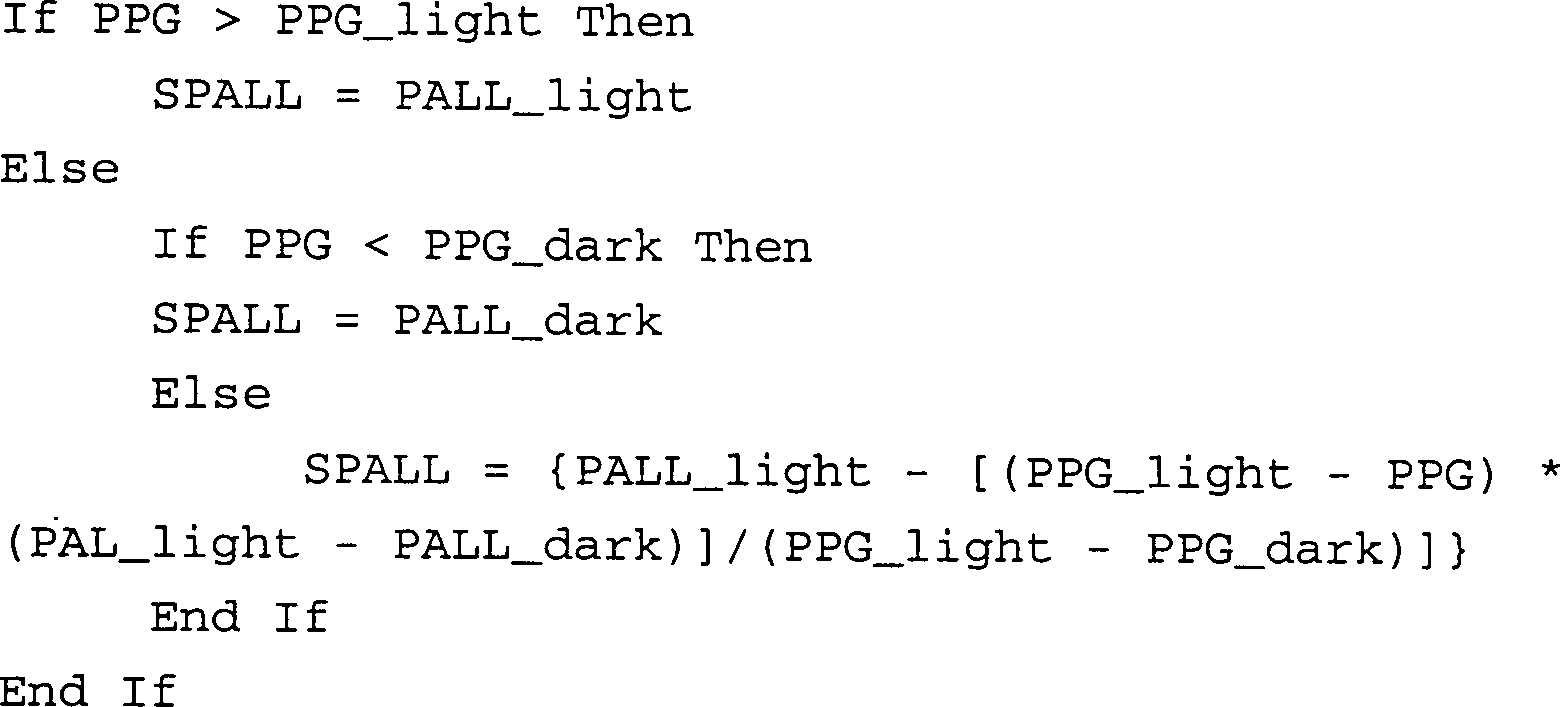
Figure 00430002
Another calculation that is performed is the "scaled pages by last level". Since the number of sheets left in the cartridge after the last level has been detected by the machine may vary depending on the toner coverage on one page, the host must measure the value of "SPALL" using a PPG scale. Generate values. The calculation for the determination of the 'scaled pages in last level' (SPALL) is given below by a generic computer program:
Figure 00430002

Die Definitionen für die obigen Variablen sind:
SPALL = Skalierte Seiten nach letztem Niveau
PALL_light = Seiten nach letztem Niveau für eine Seite von geringer Bedeckung
PALL_dark = Seiten nach letztem Niveau für eine Seite von hoher Bedeckung
PPG_light = Durchschnittliche Seiten pro Gradation für eine Seite von geringer Bedeckung
PPG_dark = Durchschnittliche Seiten pro Gradation für eine Seite von hoher Bedeckung
PPG = 'Augenblickliche Seiten pro Gradation'-Wert
The definitions for the above variables are:
SPALL = Scaled pages according to the last level
PALL_light = Pages after the last level for a page with little coverage
PALL_dark = Pages after the last level for a page of high coverage
PPG_light = Average pages per gradation for a page of low coverage
PPG_dark = Average pages per gradation for a page of high coverage
PPG = 'Instant Pages per Gradation' value

Eine andere wichtige Operation ist die Berechnung von 'vorhergesagten Seiten, die übrig sind' (PPL). Die Berechnung von 'vorhergesagten Seiten, die übrig sind' ist die Summe von drei Hauptkomponenten. Die erste Komponente ist ein einfaches Produkt von den 'Seiten pro Gradation' (PPG) und dem 'augenblicklichen Niveau' (CL). Von diesem Wert wird die Anzahl von 'Bogen, gedruckt seit dem letzten Übergang' (SPLT) subtrahiert. Schließlich, da die Patrone nicht vollständig leer ist, wenn sie den Niveau-Nullpunkt erreicht, ist ein Addierer enthalten, um Extrabogen zu veranschlagen, die in den vorherigen zwei Komponenten nicht enthalten waren. Diese Komponente, die als 'Skalierte Seiten nach letztem Niveau' (SPALL) bezeichnet wird, wird unter Verwendung der obigen Gleichungen berechnet, und die ganze Berechnung wird unten dargestellt: PPL = {(PPG*CL) – SPLT + SPALL} Another important operation is the calculation of 'predicted pages left' (PPL). The calculation of 'predicted pages left' is the sum of three main components. The first component is a simple product of the 'Pages per Gradation' (PPG) and the 'Current Level' (CL). From this value the number of 'sheets printed since the last transition' (SPLT) sub tracted. Finally, since the cartridge is not completely empty when it reaches level zero, an adder is included to estimate extra sheets that were not included in the previous two components. This component, called 'Scaled Pages by Last Level' (SPALL), is calculated using the equations above, and the whole calculation is shown below: PPL = {(PPG * CL) - SPLT + SPALL}

Die Definitionen für die obigen Variablen sind:
PPL = vorhergesagte Seiten, die übrig sind
PPG = Seiten pro Gradation
CL = Augenblickliches Niveau (von der Maschine gemeldet)
SPLT = Bogen, gedruckt seit letzten Übergang
SPALL = Skalierte Seiten nach letztem Niveau
The definitions for the above variables are:
PPL = predicted pages that are left
PPG = pages per gradation
CL = instantaneous level (reported by the machine)
SPLT = sheet, printed since last transition
SPALL = Scaled pages according to the last level

Diese Vorhersage liefert eine Veranschlagung der Anzahl von Bogen, die gedruckt werden können, bevor die Patrone leer wird.This prediction provides an estimate the number of sheets that can be printed before the cartridge runs out becomes.

Eine andere wichtige Operation ist die Berechnung von 'Tagen, bevor leer' (DBE), die die vergangene Verwendungsgeschichte des Druckers verwendet und einfach bestimmt, wie lang der Drucker braucht, um die Anzahl von Seiten zu drucken, die aus den obigen Vorhersageberechnungen vorhergesagt wurden. Beru hend darauf, wie lange es braucht, um diese Anzahl von Seiten zu drucken, sagt das System vorher, wenn der Toner knapp ist.Another important operation is the calculation of 'days, before empty '(DBE), that uses the past usage history of the printer and simply determines how long the printer takes to count to print from pages made from the above prediction calculations were predicted. Based on how long it takes to get this The system predicts the number of pages to print when the toner runs out is.

Aus zur Speicherung der Seitenzahl der letzten Niveauänderung ähnlichen Gründen kann das 'Datum des letzten Übergangs' auch gespeichert werden. Auf diese Weise gibt es, wenn ein Drucker ausgeschaltet worden ist, oder der Drucker durch MARKVISION aufgrund von Interrupts in seiner Verbindung nicht verfolgt worden ist, genügend Information, um eine "Zeit, bis leer"-Berechnung zu liefern.Off to save the page number similar to the last level change establish can the 'date of last transition 'also saved become. This way there is when a printer has been turned off or the printer has been interrupted by MARKVISION due to interrupts its connection has not been tracked, enough information to provide a "time to empty" calculation.

Figure 00450001
Figure 00450001

Die Definitionen für die obigen Variablen sind:
DBE = Tage, bevor leer
PPL = vorhergesagte Seiten, die übrig sind
DLT = Datum vom letztem Übergang
DPT = Datum von vorherigem Übergang
SPPL = Bogen, gedruckt in vorherigem Niveau
SPLT = Bogen, gedruckt in letztem Übergang
DLT = Datum von letztem Übergang
The definitions for the above variables are:
DBE = days before empty
PPL = predicted pages that are left
DLT = date of last transition
DPT = date from previous transition
SPPL = sheet printed at the previous level
SPLT = sheet printed in the last transition
DLT = date of last transition

Diese Gleichung gibt an, dass 'Tage, bevor leer' gleich dem Mittelwert der "Tage pro Bogen" für das letzte Niveau und der 'Tage pro Bogen' für das vorherige Niveau mal der Anzahl von vorhergesagten Seiten, die übrig sind, ist.This equation indicates that 'days before empty' equals the mean the "days per sheet" for the last one Level and the 'days per sheet 'for the previous one Level times the number of predicted pages left is.

Die folgenden Tabellen stellen eine ausführliche Auflistung der Information dar, die zwischen dem Drucker und dem Hauptrechner, der MARKVISION ausführt, in Verbindung mit der Tonervorhersagesysteminformation der vorliegenden Erfindung weitergegeben wird.The following tables represent one detailed Lists the information that exists between the printer and the Main computer that carries out MARKVISION in connection with the Toner prediction system information of the present invention becomes.

Tabelle 1 – NPA-Spezifikationshinzufügungen Lieferinformation

Figure 00460001
Table 1 - NPA specification additions delivery information
Figure 00460001

Figure 00470001
Figure 00470001

Tonervorhersagewarnmeldung

Figure 00480001
Toner Prediction Alert
Figure 00480001

Die vorhergehende Beschreibung einer bevorzugten Ausführungsform der Erfindung ist für Zwecke einer Veranschaulichung und Beschreibung dargeboten worden. Der Bereich der Erfindung soll durch die Ansprüche, die hieran angefügt sind, definiert sein.The previous description of a preferred embodiment the invention is for For purposes of illustration and description. The scope of the invention is to be determined by the claims appended hereto. be defined.

Claims (16)

Druckvorrichtung, umfassend: eine ein Tonermaterial enthaltende Patrone, die verwendet wird, um Druckkennzeichen auf einem Druckmedium zu erzeugen; eine Einrichtung zum Messen des Niveaus des Toners in der Patrone; eine Speicherschaltung zum Speichern von Information und eine Verarbeitungsschaltung; wobei die Messeinrichtung konfiguriert ist, um ein Tonerniveausignal zu der Verarbeitungsschaltung zu übertragen, wobei das Tonerniveausignal mit dem körperlichen Tonerniveau in Beziehung steht, das in der Patrone verbleibt; und die Verarbeitungsschaltung konfiguriert ist, um eine Statistik 'Tonerverwendung pro gedruckte Seite' zu bestimmen, auf Grundlage der vorherigen Anzahl von Seiten, die durch die Druckvorrichtung gedruckt worden sind, in Bezug zu dem körperlichen Tonerniveau der Patrone; wobei die Statistik 'Tonerverwendung pro gedruckte Seite' durch die Verarbeitungsschaltung verwendet wird, um die Anzahl von Seiten vorherzusagen, die unter Verwendung des Resttoners in der Patrone gedruckt werden kann; dadurch gekennzeichnet, dass die Messeinrichtung konfiguriert ist, um das Tonerniveausignal an die Verarbeitungsschaltung in Gradationsstufen zu melden, wobei nach dem Auftreten eines Übergangs von einer Gradationsstufe zu einer anderen Gradationsstufe die "neue" Gradationsstufe in der Speicherschaltung gespeichert wird; und eine neukalibrierte Statistik 'Tonerverwendung pro gedruckte Seite' bestimmt wird und in der Speicherschaltung gespeichert wird.A printing device, comprising: a cartridge containing a toner material used to create print indicia on a print medium; means for measuring the level of the toner in the cartridge; a storage circuit for storing information and a processing circuit; wherein the measuring device is configured to transmit a toner level signal to the processing circuit, the toner level signal being related to the physical toner level remaining in the cartridge; and the processing circuit is configured to determine a 'toner usage per printed page' statistic based on the previous number of pages printed by the printing device related to the physical toner level of the cartridge; wherein the 'toner usage per printed page' statistic is used by the processing circuitry to predict the number of pages that can be printed using the waste toner in the cartridge; characterized in that the measuring device is configured to report the toner level signal to the processing circuit in gradation levels, the "new" gradation level being stored in the memory circuit after the occurrence of a transition from one gradation level to another gradation level; and a recalibrated 'toner usage per printed page' statistic is determined and stored in the memory circuit. Druckvorrichtung nach Anspruch 1, bei der die Verarbeitungsschaltung konfiguriert ist, um Echtzeit von mindestens einem Zeitpnkt in der Vergangenheit zu verwenden, um eine Statistik 'Tonerverwendung pro Tag' auf Grundlage der vorherigen Anzahl von Seiten, die durch die Druckvorrichtung gedruckt worden sind, in Bezug zum körperlichen Tonerniveau der Patrone und der Echtzeit, zu der mindestens eine vorherige Messung des körperlichen Tonerniveaus der Patrone gemacht wurde, zu bestimmen; wobei die Statistik 'Tonerverwendung pro Tag' durch die Verarbeitungsschaltung verwendet wird, um die Anzahl von Tagen vorherzusagen, die verbleiben, bevor der Patrone effektiv Tonermaterial ausgeht.The printing apparatus according to claim 1, wherein the processing circuit is configured to run from at least one point in time in real time To use past 'to use toner per day' statistics previous number of pages printed by the printing device have been related to the physical Toner level of the cartridge and the real time at least one previous measurement of physical To determine toner levels of the cartridge; being the Statistics' toner usage per day 'through the Processing circuitry is used to predict the number of days that remain before the cartridge runs out of toner. Druckvorrichtung nach Anspruch 1 oder 2, bei der die Echtzeit von einem Hauptrechner erhalten wird, der in Verbindung mit der Druckvorrichtung steht, und sowohl Zeit als auch Datum umfasst.Printing device according to claim 1 or 2, wherein which is obtained in real time from a host that is connected stands with the printing device, and includes both time and date. Druckvorrichtung nach einem vorangehenden Anspruch, weiter umfassend einen Hauptrechner, der mit der Druckvorrichtung über einen ersten Datenübertragungsport an der Druckvorrichtung, einen zweiten Datenübertragungsport an dem Hauptrechner und eine Datenübertragungsverbindung dazwischen kommuniziert; und einen Sichtmonitor, der mit dem Hauptrechner verbunden ist, wobei der Monitor konfiguriert ist, um anzuzeigen: eine analoge Anzeige von Resttoner in der Patrone, eine numerische Menge, die mit dem Fassungsvermögen der Patrone, wenn sie neu ist, in Beziehung steht, und eine numerische Menge, die mit der Anzahl von Seiten in Beziehung steht, die unter Verwendung dieser speziellen Patrone gedruckt worden sind; und der Monitor weiter konfiguriert ist, um ein "Balkendia- gramm" von "vorhergesagten Seiten, die verbleiben" anzuzeigen, die durch die Menge von Toner, die in der Patrone verbleibt, zu drucken sind, auf Grundlage der vorherigen Geschichte einer Tonerverwendung in Bezug zu einer tatsächlichen Anzahl von Seiten, die durch die Druckvorrichtung unter. Verwendung der Patrone gedruckt worden sind.Printing device according to one of the preceding claims, further comprising a main computer which communicates with the printing device via a first data transmission port on the printing device, a second data transmission port on the main computer and a data transmission connection communicated in between; and a visual monitor that works with the host is connected, whereby the monitor is configured to display: an analog display of residual toner in the cartridge, a numerical one Amount with the capacity the cartridge, if new, related, and a numeric Quantity related to the number of pages listed under Using this special cartridge have been printed; and the Monitor is further configured to display a "bar graph" of "predicted pages remaining" that by the amount of toner that remains in the cartridge based on the previous history of toner usage in relation to an actual Number of pages taken by the printing device below. use the cartridge has been printed. Druckvorrichtung nach Anspruch 4, bei der der Monitor noch weiter konfiguriert ist, um eine numerische Menge anzuzeigen, die mit einer vorhergesagten Anzahl von Tagen in Beziehung steht, die verbleiben, bevor der Patrone effektiv Tonermaterial ausgeht.A printing device according to claim 4, wherein the monitor is still configured to display a numeric set, related to a predicted number of days that remain before the cartridge runs out of toner. Druckvorrichtung nach Anspruch 4 oder 5, bei der nach Einschaltinitialisierung des Hauptrechners die Druckvorrichtung eine Mitteilung übermittelt, die den Hauptrechner von dem Resttoner in der Patrone, der Anzahl von Seiten, die gedruckt worden sind, und den vorhergesagten Seiten, die verbleiben, informiert.Printing device according to claim 4 or 5, wherein after initialization of the main computer, the printing device sent a message which is the host of the waste toner in the cartridge, the number of pages that have been printed and the predicted pages, who remain informed. Druckvorrichtung nach Anspruch 4, 5 oder 6, weiter umfassend einen zweiten Hauptrechner, der mit der Druckvorrichtung über einen dritten Datenübertragungsport als der zweite Hauptrechner kommuniziert, und einen zweiten Sichtmonitor, der mit dem zweiten Hauptrechner verbunden ist, wobei der zweite Hauptrechner zu Beginn keine vorherige Geschichte der Druckvorrichtung enthält und der andere Hauptrechner eine vorherige Geschichte der Druckvorrichtung enthält und der zweite Hauptrechner konfiguriert ist, um von dem anderen Hauptrechner den Resttoner in der Patrone, die Anzahl von Seiten, die gedruckt worden sind, und die vorhergesagten Seiten, die verbleiben, zu erfahren, alles mit Bezug auf die Druckvorrichtung.Printing device according to claim 4, 5 or 6, further comprising a second main computer which communicates with the printing device via a third data transmission port when the second host communicates and a second visual monitor, which is connected to the second host, the second Main computer at the beginning no previous history of the printing device contains and the other host has a previous history of the printing device contains and the second host is configured to run from the other Host the waste toner in the cartridge, the number of pages, that have been printed and the predicted pages that remain to learn everything related to the printing device. Druckvorrichtung nach einem vorangehenden Anspruch, wobei die Druckvorrichtung einen Laserdrucker umfasst.Printing device according to one of the preceding claims, wherein the printing device comprises a laser printer. Druckvorrichtung nach einem der Ansprüche 1 bis 7, wobei die Druckvorrichtung einen Tintenstrahldrucker umfasst und das Tonermaterial Tinte umfasst.Printing device according to one of claims 1 to 7, wherein the printing device comprises an ink jet printer and the toner material comprises ink. Verfahren zum Bestimmen von Tonerverwendungsstatistiken in einem Drucksystem, wobei das Drucksystem umfasst: eine ein Tonermaterial enthaltende Patrone, die verwendet wird, um Druckkennzeichen auf einem Druckmedium zu erzeugen, eine Einrichtung zum Messen des Niveaus des Toners in der Patrone, eine Speicherschaltung zum Speichern von Information und eine Verarbeitungsschaltung, wobei das Verfahren die Schritte umfasst: (a) Messen des tatsächlichen Tonerniveaus, das in der Patrone verbleibt, und Übertragen eines entsprechenden Tonerniveausignals von der Schnittstellenschaltung zu der Verarbeitungsschaltung, (b) Bestimmen einer Statistik 'Tonerverwendung pro gedruckte Seite' auf Grundlage einer vorherigen Anzahl von Seiten, die von der Patrone gedruckt worden sind, in Bezug zu dem körperlichen Tonerniveau der Patrone; und (c) Vorhersagen einer Statistik der Anzahl von Seiten, die unter Verwendung des Resttoners in der Patrone gedruckt werden können, auf Grundlage der Statistik 'Tonerverwendung pro gedruckte Seite' und dem Resttoner in der Patrone; und gekennzeichnet durch weiteres Umfassen der Schritte: Speichern der Echtzeit und der "neuen" Gradationsstufe in der Speicherschaltung nach dem Auftreten eines Übergangs von einer Gradationsstufe zu einer anderen Gradationsstufe; Neukalibrieren der Statistik 'Tonerverwendung pro gedruckte Seite'; Neukalibrieren der Statistik 'Tonerverwendung pro Tag'; und Speichern von beiden besagten Statistiken in der Speicherschaltung.A method of determining toner usage statistics in a printing system, the printing System comprises: a cartridge containing toner material used to create print indicia on a print medium, means for measuring the level of toner in the cartridge, a memory circuit for storing information and a processing circuit, the method comprising the steps of: (a) measuring the actual toner level remaining in the cartridge and transmitting a corresponding toner level signal from the interface circuit to the processing circuit, (b) determining a 'toner usage per printed page' statistic based on a previous number of pages from the cartridge have been printed in relation to the physical toner level of the cartridge; and (c) predicting a statistic of the number of pages that can be printed using the waste toner in the cartridge based on the 'toner usage per printed page' statistic and the waste toner in the cartridge; and characterized by further comprising the steps of: storing the real time and the "new" gradation level in the memory circuit upon the occurrence of a transition from one gradation level to another gradation level; Recalibrate the 'Toner usage per printed page'statistics; Recalibrate the 'toner usage per day'statistics; and storing both said statistics in the memory circuit. Verfahren nach Anspruch 10, weiter umfassend den Schritt: (d) Vorhersagen einer Statistik der Anzahl von Tagen, die verbleiben, bevor der Patrone effektiv Tonermaterial ausgeht, auf Grundlage einer Statistik 'Tonerverwendung pro Tag', die mit dem körperlichen Tonerniveau der Patrone und der Echtzeit in Beziehung steht, zu der mindestens eine Messung des körperlichen Tonerniveaus der Patrone zuvor gemacht wurde.The method of claim 10, further comprising the Step: (d) predicting statistics of the number of days, that remain before the cartridge runs out of toner, based on statistics' toner usage per day 'with the physical Cartridge toner level and real time related to the at least one measurement of the physical toner level of the Cartridge was previously made. Verfahren nach Anspruch 10 oder 11, weiter umfassend den Schritt: Bereitstellen eines Hauptrechners, der die Echtzeit über eine Datenübertragungsverbindung zu dem Drucksystem überträgt, wobei die Echtzeit sowohl Zeit als auch Datum umfasst.The method of claim 10 or 11, further comprising the step: Provision of a main computer, which real-time over a Communication link transfers to the printing system, whereby that includes both time and date in real time. Verfahren nach Anspruch 12, weiter umfassend den Schritt: Bereitstellen eines Anzeigemonitors an dem Hauptrechner, wobei der Monitor anzeigt: eine analoge Anzeige von Resttoner in der Patrone, eine numerische Menge, die mit dem Fassungsvermögen der Patrone, wenn sie neu ist, in Beziehung steht, und eine numerische Menge, die mit der Anzahl von Seiten in Beziehung steht, die unter Verwendung dieser speziellen Patrone gedruckt worden sind; und wobei der Monitor weiter ein "Balkendiagramm" von "vorhergesagten Seiten, die verbleiben" anzeigt, die durch die Menge von Toner, die in der Patrone verbleibt, zu drucken sind, auf Grundlage der vorherigen Geschichte einer Tonerverwendung in Bezug zu einer tatsächlichen Anzahl von Seiten, die durch die Druckvorrichtung unter Verwendung der Patrone gedruckt worden sind.The method of claim 12, further comprising the Step: providing a display monitor on the main computer, where the monitor displays: an analog display of residual toner in the cartridge, a numerical quantity that corresponds to the capacity of the Cartridge if it is new, related, and a numeric Quantity related to the number of pages listed under Using this special cartridge have been printed; and where the monitor continues a "bar chart" of "predicted pages, the remaining "indicates due to the amount of toner that remains in the cartridge are based on the previous history of toner usage in relation to an actual Number of pages used by the printing device the cartridge has been printed. Verfahren nach Anspruch 13, weiter umfassend den Schritt: Anzeigen einer numerischen Menge, die mit einer vorhergesagten Anzahl von Tagen in Beziehung steht, die verbleiben, bevor der Patrone effektiv Tonermaterial ausgeht.The method of claim 13, further comprising the Step: Display a numeric set with a predicted one Number of related days that remain before the cartridge effectively runs out of toner. Verfahren nach Anspruch 12, 13 oder 14, weiter umfassend, nach Einschaltinitialisierung des Hauptrechners, den Schritt: Informieren des Hauptrechners von dem Resttoner in der Patrone, der Anzahl von Seiten, die gedruckt worden sind, und den vorhergesagten Seiten, die verbleiben.The method of claim 12, 13 or 14, further comprising after initialization of the main computer, the step: inform of the mainframe from the waste toner in the cartridge, the number of Pages that have been printed and the predicted pages, that remain. Verfahren nach Anspruch 13, weiter umfassend den Schritt: Übermitteln von Information zu einem zweiten Hauptrechner, der zu Beginn keine vorherige Geschichte des Drucksystems enthält, wobei die Information von dem anderen Hauptrechner hergeleitet wird und Information umfasst, die mit dem Resttoner in der Patrone, der Anzahl von Seiten, die gedruckt worden sind, und den vorhergesagten Seiten, die verbleiben, in Beziehung steht, alles mit Bezug auf das Drucksystem.The method of claim 13, further comprising the Step: Submit from information to a second main computer, which at the beginning none contains previous history of the printing system, the information from is derived from the other main computer and comprises information, with the waste toner in the cartridge, the number of pages that printed and the predicted pages that remain related, everything related to the printing system.
DE69817073T 1997-05-12 1998-05-12 Method and apparatus for predicting and displaying a printer's toner consumption Expired - Fee Related DE69817073T2 (en)

Applications Claiming Priority (2)

Application Number Priority Date Filing Date Title
US08/854,606 US5802420A (en) 1997-05-12 1997-05-12 Method and apparatus for predicting and displaying toner usage of a printer
US854606 2001-05-15

Publications (2)

Publication Number Publication Date
DE69817073D1 DE69817073D1 (en) 2003-09-18
DE69817073T2 true DE69817073T2 (en) 2004-04-01

Family

ID=25319146

Family Applications (1)

Application Number Title Priority Date Filing Date
DE69817073T Expired - Fee Related DE69817073T2 (en) 1997-05-12 1998-05-12 Method and apparatus for predicting and displaying a printer's toner consumption

Country Status (7)

Country Link
US (1) US5802420A (en)
EP (1) EP0878747B1 (en)
JP (1) JPH10319797A (en)
KR (1) KR19980086883A (en)
CN (1) CN1199185A (en)
DE (1) DE69817073T2 (en)
TW (1) TW405028B (en)

Families Citing this family (134)

* Cited by examiner, † Cited by third party
Publication number Priority date Publication date Assignee Title
US7046391B1 (en) * 1995-08-07 2006-05-16 Electronics For Imaging, Inc. Method and apparatus for providing a color-balanced multiple print engine
US6657741B1 (en) 1995-08-07 2003-12-02 Tr Systems, Inc. Multiple print engine system with selectively distributed ripped pages
US5923917A (en) * 1995-10-25 1999-07-13 Canon Kabushiki Kaisha Image forming apparatus, and a cartridge having a developer container detachably mountable on such apparatus
US5966555A (en) * 1996-11-20 1999-10-12 Minolta Co., Ltd. Image forming apparatus permitting whether or not input image can be formed as desired to be known
JP3441912B2 (en) * 1997-03-06 2003-09-02 キヤノン株式会社 Image forming device
US6940613B1 (en) * 1997-04-11 2005-09-06 Xerox Corporation System for managing replaceable modules in a digital printing apparatus
US5970275A (en) * 1997-05-12 1999-10-19 Lexmark International, Inc. Dynamic supply usage estimation
US6092943A (en) * 1997-06-11 2000-07-25 Brother Kogyo Kabushiki Kaisha Apparatus and method for measuring printing paper quantity and warning printing part exchange time
KR100230325B1 (en) * 1997-08-01 1999-11-15 윤종용 Method of adjusting developer concentration in developing tank and developer supply device of printing press
US6431703B2 (en) * 1997-10-31 2002-08-13 Xerox Corporation Apparatus and method for improved life sensing in a replaceable intermediate transfer surface application assembly
US20010013939A1 (en) 1998-01-27 2001-08-16 Hewlett-Packard Company Stabilization of toner consumption in an imaging device
US7283258B1 (en) * 1998-08-28 2007-10-16 Brother Kogyo Kabushiki Kaisha Print system capable of notifying user of required ink amount
JP3530752B2 (en) * 1998-10-09 2004-05-24 キヤノン株式会社 Electrophotographic image forming apparatus, process cartridge, developing device, developer supply container, and measuring component
FR2784936B1 (en) * 1998-10-23 2001-04-13 Canon Kk METHOD AND DEVICE FOR MANAGING THE RESOURCES OF A PRINTING PRODUCT AVAILABLE IN A PRINTER
DE69942387D1 (en) 1998-10-23 2010-07-01 Canon Europa Nv Method and apparatus for estimating the amount of ink in a printer and required for a print job
FR2784935A1 (en) * 1998-10-23 2000-04-28 Canon Europa Nv Method of predicting quantity of ink required to print job
US6106108A (en) * 1998-10-30 2000-08-22 Hewlett-Packard Company Adaptive image-based algorithm for refill-while-printing triggering
AUPP702498A0 (en) * 1998-11-09 1998-12-03 Silverbrook Research Pty Ltd Image creation method and apparatus (ART77)
US6529286B1 (en) * 1998-12-22 2003-03-04 Canon Kabushiki Kaisha Dynamic printing interface for routing print jobs in a computer network
US20020105668A1 (en) * 1999-01-20 2002-08-08 Lilland Kevin R. Print consumables monitoring
US20020180993A1 (en) * 1999-05-07 2002-12-05 Klinefelter Gary M. Identification card printer having multiple controllers
JP3363873B2 (en) * 1999-07-13 2003-01-08 キヤノン株式会社 Method for sequentially displaying developer amount and electrophotographic image forming apparatus
ATE363988T1 (en) 1999-08-31 2007-06-15 Seiko Epson Corp PRINTING SYSTEM, INK JET PRINTER AND METHOD FOR MANAGING THE LIFE OF AN INK CARTRIDGE
US6672695B1 (en) * 1999-08-31 2004-01-06 Seiko Epson Corporation Ink cartridge management system, printer, and ink cartridge
JP4336422B2 (en) * 1999-09-08 2009-09-30 キヤノン株式会社 Image forming apparatus
CA2318023A1 (en) * 1999-09-16 2001-03-16 Xerox Corporation Context sensitive web-based supply ordering
US6629134B2 (en) 1999-09-16 2003-09-30 Xerox Corporation Context sensitive web-based user support
US6985877B1 (en) 1999-09-16 2006-01-10 Xerox Corporation Method for supply ordering
JP4143236B2 (en) 1999-10-15 2008-09-03 キヤノン株式会社 Image forming apparatus
JP2001194890A (en) * 1999-10-27 2001-07-19 Canon Inc Developer amount display method and electrophotographic image forming apparatus
JP2001134152A (en) * 1999-11-01 2001-05-18 Fujitsu Ltd Image forming device
JP2001175133A (en) * 1999-12-15 2001-06-29 Canon Inc System for notifying remaining amount of developer and usage of other consumables and image forming apparatus
JP2001255786A (en) * 2000-01-07 2001-09-21 Canon Inc Electrophotographic image forming device
US6285835B1 (en) * 2000-01-11 2001-09-04 Hewlett-Packard Company Utilizing printer memory for automatic user messaging
WO2001059638A1 (en) * 2000-02-14 2001-08-16 Canon Kabushiki Kaisha Collecting method by information processor, and ordering method or sale method
US6275664B1 (en) 2000-04-25 2001-08-14 Hewlett-Packard Company Predicting supplies required for completion of unattended print jobs
US20020046101A1 (en) * 2000-04-28 2002-04-18 Katsuhisa Ogawa Expendable supplies providing method and expendable supplies providing apparatus, and control program
US6366744B1 (en) 2000-06-22 2002-04-02 Hewlett-Packard Company Image forming systems and methods for determining whether an image job will be imaged
JP4599671B2 (en) * 2000-06-29 2010-12-15 ソニー株式会社 Remote diagnosis apparatus, remote diagnosis method, and computer-readable program storage medium storing program having remote diagnosis function
JP2002036582A (en) * 2000-07-19 2002-02-05 Sony Corp Billing apparatus, billing method, and computer-readable program storage medium recording program having billing function
US6981015B1 (en) * 2000-10-10 2005-12-27 Hewlett-Packard Development Company, L.P. Internet print managing system and method with print services statistical analysis
US6856430B1 (en) * 2000-10-26 2005-02-15 Hewlett-Packard Development Company, L.P. Calculation of toner usage
JP4480114B2 (en) * 2000-12-13 2010-06-16 キヤノン株式会社 Image forming apparatus, apparatus for providing user interface, and display method
US7292369B2 (en) * 2000-12-28 2007-11-06 Seiko Epson Corporation Logo data generating method and system
JP3501790B2 (en) * 2000-12-28 2004-03-02 キヤノン株式会社 Information processing apparatus, information processing method, program, and storage medium for distributing image formation control software
US7280258B2 (en) * 2001-01-05 2007-10-09 Seiko Epson Corporation Logo data generating system, logo data generating method, and data storage medium
US6467888B2 (en) 2001-02-21 2002-10-22 Illinois Tool Works Inc. Intelligent fluid delivery system for a fluid jet printing system
US6456802B1 (en) * 2001-04-02 2002-09-24 Hewlett-Packard Co. Capacity determination for toner or ink cartridge
JP2003072107A (en) * 2001-06-11 2003-03-12 Canon Inc Portable electronic device, portable printing device, portable electronic device, charging device, and portable electronic device system
US7102770B2 (en) * 2001-06-13 2006-09-05 Hewlett-Packard Development Company, L.P. System and methods for smoothing sensed toner levels
EP1276065A3 (en) * 2001-07-12 2004-01-14 Seiko Epson Corporation Printing cost calculation system and coloring material supply management system
US6516160B1 (en) * 2001-08-14 2003-02-04 Hewlett-Packard Co. Estimation of toner usage based on pulse width count and pulse edge count
US7145671B2 (en) * 2001-08-16 2006-12-05 Hewlett-Packard Development Company, L.P. Image forming devices, methods of operating an image forming device, a method of providing consumable information, and a method of operating a printer
US20030046122A1 (en) * 2001-08-29 2003-03-06 Seymour Richard S. Systems and methods for managing printing device replaceable components for multiple organizations
JP4531308B2 (en) * 2001-09-06 2010-08-25 株式会社リコー Billing system for image forming fee according to toner amount and image forming system
US7061391B2 (en) * 2001-10-17 2006-06-13 International Business Machines Corporation Method, system, and program for monitoring a consumable resource used by a system
US7009719B2 (en) 2001-11-13 2006-03-07 Xerox Corporation Systems and methods for controlling an image forming system based on customer replaceable unit status
US6793312B2 (en) * 2001-11-20 2004-09-21 Canon Kabushiki Kaisha Ink jet recording apparatus and method for controlling ink jet recording apparatus
US7085505B2 (en) * 2001-12-19 2006-08-01 Toshiba Tec Kabushiki Kaisha Image forming apparatus which monitors lifetimes of expendables
US7106471B2 (en) * 2001-12-28 2006-09-12 Kabushiki Kaisha Toshiba Information distribution system and information distribution service
AUPS048102A0 (en) * 2002-02-13 2002-03-07 Silverbrook Research Pty. Ltd. Methods and systems (ap77)
AUPS048202A0 (en) * 2002-02-13 2002-03-07 Silverbrook Research Pty. Ltd. Methods and systems (ap78)
US6748183B2 (en) * 2002-02-22 2004-06-08 Xerox Corporation Printer driver user interface and system
US7158252B2 (en) * 2002-02-26 2007-01-02 Hewlett-Packard Development Company, L.P. Real-time distribution of imaging metrics information
US6718147B1 (en) 2002-11-04 2004-04-06 Lexmark International, Inc. Toner measurement and darkness control using printer systems
US6863364B2 (en) * 2002-11-19 2005-03-08 Hewlett-Packard Development Company, L.P. Systems and methods for estimating pages remaining for a printing device component
US6962399B2 (en) * 2002-12-30 2005-11-08 Lexmark International, Inc. Method of warning a user of end of life of a consumable for an ink jet printer
US6925268B2 (en) * 2003-03-21 2005-08-02 Hewlett-Packard Development Company, L.P. Estimating toner levels
US6871926B2 (en) * 2003-04-18 2005-03-29 Lexmark International, Inc. Method of estimating an amount of available ink contained in an ink reservoir
US20040215468A1 (en) * 2003-04-23 2004-10-28 Doeberl Terrence M. System and method for managing business machine assets
JP4419451B2 (en) * 2003-06-20 2010-02-24 コニカミノルタビジネステクノロジーズ株式会社 Tandem image forming system
US20050226642A1 (en) * 2003-11-07 2005-10-13 Santiago Rodriguez Estimation of marking material usage
KR20050045740A (en) * 2003-11-12 2005-05-17 삼성전자주식회사 Method and apparatus managing a printer using a selecting item information for printing
KR100565805B1 (en) * 2003-12-22 2006-03-29 삼성전자주식회사 Toner consumption measuring device and method
US20050174595A1 (en) * 2004-02-10 2005-08-11 First Data Corporation Systems and methods for print waste management and performance measurement
US20050219284A1 (en) * 2004-03-29 2005-10-06 Seiko Epson Corporation Refill management system
US7766438B2 (en) * 2004-06-04 2010-08-03 Lexmark International, Inc. Method of ink evaporation prediction for an ink reservoir
US20050286068A1 (en) * 2004-06-24 2005-12-29 Johnson Bruce L Monitoring the status and performance of printing devices
JP2006058944A (en) * 2004-08-17 2006-03-02 Canon Inc Image forming system and image forming apparatus
KR100713143B1 (en) * 2005-01-14 2007-05-02 삼성전자주식회사 Image forming apparatus, host device connected thereto and control method thereof
JP2006251180A (en) * 2005-03-09 2006-09-21 Sharp Corp Image forming apparatus
GB2424290A (en) * 2005-03-10 2006-09-20 Nrg Man Ltd Managing printing devices at distributed sites
US20060233587A1 (en) * 2005-04-14 2006-10-19 Vondran Gary L Jr Ink usage estimation from print run assets
US8825835B2 (en) * 2005-07-19 2014-09-02 Fmaudit, L.L.C. Status monitoring system and method
JP2007168132A (en) * 2005-12-19 2007-07-05 Ricoh Co Ltd Image forming apparatus
FR2903330B1 (en) * 2006-07-06 2008-10-10 Oreal ASSEMBLY COMPRISING A RECHARGE AND AN ASSOCIATED DETECTION SYSTEM
JP2008046159A (en) * 2006-08-10 2008-02-28 Konica Minolta Business Technologies Inc Image forming apparatus, printing condition setting method, and printing condition setting program
US20080111842A1 (en) * 2006-11-09 2008-05-15 Pitney Bowes Incorporated Method and system for ink consumption monitoring
US8897658B2 (en) * 2006-11-30 2014-11-25 Hewlett-Packard Development Company, L.P. Method and system for estimating toner remaining in a cartridge
US7801453B2 (en) * 2007-03-23 2010-09-21 Xerox Corporation Adaptive toner gas gauge
US20080232828A1 (en) * 2007-03-23 2008-09-25 Xerox Corporation Adaptive toner gas gauge
US7747180B2 (en) * 2007-05-30 2010-06-29 Lexmark International, Inc. Methods and apparatuses for determining the number of printed pages remaining in a toner cartridge
US20080300899A1 (en) * 2007-05-30 2008-12-04 Lexmark International, Inc. Supply item replacement optimization in imaging devices
US20080316521A1 (en) * 2007-06-21 2008-12-25 Philippe Lesage Systems and methods for managing facsimile documents
US20090024950A1 (en) * 2007-07-17 2009-01-22 Xerox Corporation Printer Driver Interface and Methods
US7987112B2 (en) * 2007-09-19 2011-07-26 Xerox Corporation Method and system of utilizing print device consumption information for pricing and service
EP2232359B1 (en) * 2007-12-14 2013-07-17 Hewlett-Packard Development Company, L.P. Printing
US7826760B2 (en) * 2008-01-18 2010-11-02 Xerox Corporation Document processing system with configurable graphic display of print consumable level
US20090323085A1 (en) * 2008-06-30 2009-12-31 Lexmark International, Inc Method and system for improving the output quality of image forming devices
US20100073706A1 (en) * 2008-09-22 2010-03-25 Konica Minolta Systems Laboratory, Inc. Printing of proof copy with reduced resource usage in a print shop management system
US7945175B2 (en) * 2008-11-25 2011-05-17 Lexmark International, Inc. Toner container structure and method for assessing toner consumption in an image forming apparatus
JP5258539B2 (en) * 2008-12-19 2013-08-07 株式会社沖データ Image forming apparatus
US8150297B2 (en) * 2009-04-16 2012-04-03 Lexmark International, Inc. Geneva drive and locking mechanism therefor in a toner metering mechanism for an image forming apparatus
US8059993B2 (en) * 2009-04-16 2011-11-15 Lexmark International, Inc. Rotating toner cleaning member for a toner delivery device in an image forming apparatus
JP4952821B2 (en) * 2010-05-17 2012-06-13 コニカミノルタビジネステクノロジーズ株式会社 Image forming system, image forming apparatus, image forming method, and image forming program
EP2431812B1 (en) * 2010-09-15 2021-05-26 Hewlett-Packard Development Company, L.P. Image forming apparatus including consumable unit and method of controlling power supply thereof
US8908201B2 (en) * 2011-01-24 2014-12-09 Xerox Corporation System and method for filtering non-actionable alerts in a managed print service
US8385973B1 (en) 2011-09-23 2013-02-26 Peter Tamposi Remote equipment control system
JP2013073035A (en) * 2011-09-28 2013-04-22 Seiko Epson Corp Printer, print control device, print control method, and print control program
US8867933B2 (en) * 2012-10-17 2014-10-21 Lexmark International, Inc. Methods for providing a transferable page countdown for a toner cartridge between image forming devices
US9134675B2 (en) 2013-06-27 2015-09-15 Xerox Corporation Predicting remaining useful life for a consumable using a weighted least square regression prediction technique
JP6444019B2 (en) * 2013-07-08 2018-12-26 キヤノン株式会社 Image forming apparatus, control method, and program
US9223271B2 (en) 2013-12-19 2015-12-29 Xerox Corporation Determining high toner usage
CN104309314B (en) * 2014-10-16 2016-08-31 深圳市理邦精密仪器股份有限公司 A kind of method and apparatus indicating thermal printer residue to print number
US9925786B2 (en) * 2015-01-14 2018-03-27 Seiko Epson Corporation Remaining amount of ink display apparatus, printing system
JP6685756B2 (en) * 2016-02-17 2020-04-22 キヤノン株式会社 Image forming apparatus, control method thereof, and program
US9807253B2 (en) * 2016-03-25 2017-10-31 Kyocera Document Solutions Inc. Colorant change prediction
US9656463B1 (en) 2016-06-30 2017-05-23 Ricoh Company, Ltd. Adjusting ink drop size estimates for improved ink use estimates
JP6862704B2 (en) * 2016-07-21 2021-04-21 ブラザー工業株式会社 Computer programs for control devices and control devices
WO2018048406A1 (en) 2016-09-08 2018-03-15 Hewlett-Packard Development Company, L.P. Decrementing a printing fluid-based estimate of a number of pages that can be printed according to different intervals
JP6880754B2 (en) * 2017-01-12 2021-06-02 セイコーエプソン株式会社 Droplet injection device
US20180240022A1 (en) * 2017-02-23 2018-08-23 Kabushiki Kaisha Toshiba System and method for predictive oid field identification
CN110461611B (en) 2017-03-24 2021-08-24 惠普发展公司,有限责任合伙企业 supply reservoir
ES3051394T3 (en) * 2017-03-30 2025-12-29 Nube Print S L Method for controlling image-processing devices and facility for carrying out such method
JP7031304B2 (en) 2017-12-27 2022-03-08 ブラザー工業株式会社 Image forming device and program
JP7040012B2 (en) * 2017-12-27 2022-03-23 ブラザー工業株式会社 Image forming device and program
US11163244B2 (en) * 2018-05-22 2021-11-02 Hewlett-Packard Development Company, L.P. Print material transfer mechanisms
CN108508721A (en) * 2018-05-31 2018-09-07 广州奥盛电子科技有限公司 A kind of printer that can calculate powder box residue usage time
JP2020052137A (en) * 2018-09-25 2020-04-02 キヤノン株式会社 Image formation device and control method of the same, and program
WO2020076283A1 (en) 2018-10-08 2020-04-16 Hewlett-Packard Development Company, L.P. Print material visual indicator
JP7327941B2 (en) * 2019-01-18 2023-08-16 キヤノン株式会社 IMAGE FORMING APPARATUS, IMAGE FORMING APPARATUS CONTROL METHOD, AND PROGRAM
JP7167758B2 (en) * 2019-02-14 2022-11-09 京セラドキュメントソリューションズ株式会社 Information processing device, information processing program and information processing method
JP7156135B2 (en) * 2019-03-28 2022-10-19 ブラザー工業株式会社 image recorder
CN114872445B (en) * 2022-06-16 2023-09-26 极海微电子股份有限公司 Data calibration method, device and chip

Family Cites Families (36)

* Cited by examiner, † Cited by third party
Publication number Priority date Publication date Assignee Title
US3529546A (en) * 1967-07-12 1970-09-22 Ibm Printing substance control
US3600955A (en) * 1969-10-16 1971-08-24 Dick Co Ab Ink drop velocity indicator
US4413264A (en) * 1981-12-28 1983-11-01 Pitney Bowes Inc. Print material supply control apparatus and method
US4513314A (en) * 1982-09-24 1985-04-23 Hazeltine Corporation Ink usage estimator
DE3473131D1 (en) * 1984-01-20 1988-09-08 Codi Jet Markierungs Systeme G Method and apparatus for the ink supply in an ink jet printer
JPS6147973A (en) * 1984-08-16 1986-03-08 Ricoh Co Ltd Toner density control method
US4772900A (en) * 1985-10-22 1988-09-20 Canon Kabushiki Kaisha Ink-jet recording apparatus
US4721978A (en) * 1986-10-31 1988-01-26 Xerox Corporation Color toner concentration control system
US4963927A (en) * 1987-05-11 1990-10-16 Matsushita Electric Industrial Co., Ltd. Electrophotographic recording apparatus having a developer resupply control function
US4847659A (en) * 1987-05-21 1989-07-11 Eastman Kodak Company Apparatus for controlling toner replenishment in electrostatographic printer
US5068806A (en) * 1988-12-02 1991-11-26 Spectra-Physics, Inc. Method of determining useful life of cartridge for an ink jet printer
US5049898A (en) * 1989-03-20 1991-09-17 Hewlett-Packard Company Printhead having memory element
US4969011A (en) * 1989-04-27 1990-11-06 Xerox Corporation Toner control system for xerographic reproduction machine
US4974024A (en) * 1989-07-03 1990-11-27 Xerox Corporation Predictive toner dispenser controller
JPH03150582A (en) * 1989-11-08 1991-06-26 Fuji Xerox Co Ltd Developing toner detecting device
JP2584879B2 (en) * 1990-02-23 1997-02-26 キヤノン株式会社 Facsimile machine
JPH0820806B2 (en) * 1990-03-19 1996-03-04 富士ゼロックス株式会社 Empty toner detection device for developing device
US5155528A (en) * 1990-07-06 1992-10-13 Nippon Steel Corporation Apparatus for controlling concentration of toner in the liquid toner of a recording apparatus
US5119132A (en) * 1990-10-24 1992-06-02 Xerox Corporation Densitometer and circuitry with improved measuring capabilities of marking particle density on a photoreceptor
US5162849A (en) * 1990-11-23 1992-11-10 Konica Corporation Image forming apparatus having a developer deterioration detecting device
US5202769A (en) * 1990-12-10 1993-04-13 Fuji Xerox Co., Ltd. Digital electrostatic printing apparatus using a counted number of pixels of various densities to determine and control an amount of toner used during image development
JP3106504B2 (en) * 1990-12-17 2000-11-06 ミノルタ株式会社 Image forming device
US5270728A (en) * 1991-04-17 1993-12-14 Hewlett-Packard Company Raster imaging device speed-resolution product multiplying method and resulting pixel image data structure
GB2259583B (en) * 1991-09-11 1995-08-16 Xerox Corp Toner monitoring in an electrostatographic printing/digital copying machine
JP3220256B2 (en) * 1991-11-25 2001-10-22 株式会社リコー Image forming method and image forming apparatus
JPH06102735A (en) * 1992-09-24 1994-04-15 Toshiba Corp Image forming device
US5349377A (en) * 1993-05-17 1994-09-20 Xerox Corporation Printer toner usage indicator with image weighted calculation
US5459556A (en) * 1994-01-12 1995-10-17 Xerox Corporation Toner consumption rate gauge for printers and copiers
JPH07281564A (en) * 1994-04-12 1995-10-27 Fuji Xerox Co Ltd Method for detecting service life of cartridge
US5673106A (en) * 1994-06-17 1997-09-30 Texas Instruments Incorporated Printing system with self-monitoring and adjustment
US5594529A (en) * 1994-11-30 1997-01-14 Exedy Corporation Imaging device with stock supervision means
JPH08166712A (en) * 1994-12-14 1996-06-25 Canon Inc Image forming device
KR0145884B1 (en) * 1995-06-17 1998-08-17 김광호 How to process print information from a page printing device
US5636032A (en) * 1995-10-11 1997-06-03 Xerox Corporation System and method for informing a user of a marking material status in a printing environment
US5655174A (en) * 1996-05-22 1997-08-05 Hewlett-Packard Company System with ambient sensor for estimating printing supply consumption
US5794094A (en) * 1997-05-08 1998-08-11 Hewlett-Packard Company Accurate toner level feedback via active artificial intelligence

Also Published As

Publication number Publication date
CN1199185A (en) 1998-11-18
EP0878747A2 (en) 1998-11-18
DE69817073D1 (en) 2003-09-18
EP0878747B1 (en) 2003-08-13
TW405028B (en) 2000-09-11
JPH10319797A (en) 1998-12-04
US5802420A (en) 1998-09-01
EP0878747A3 (en) 2000-01-26
KR19980086883A (en) 1998-12-05

Similar Documents

Publication Publication Date Title
DE69817073T2 (en) Method and apparatus for predicting and displaying a printer's toner consumption
US5797061A (en) Method and apparatus for measuring and displaying a toner tally for a printer
DE69829080T2 (en) SYSTEM FOR DETERMINING TONER CONSUMPTION
DE69311474T2 (en) Remaining recording material for a printer
DE60119225T2 (en) Apparatus and method for printer diagnosis and computer-readable recording medium with printer diagnostic function program
DE69716878T2 (en) System and method for determining the exact toner level
DE69920134T2 (en) Method and apparatus for measuring the use of a printer or a copier
DE10219624B4 (en) System and method for setting a color palette based on a printer consumable condition, computer readable medium, computer and printer
DE10034859B4 (en) Apparatus and method for detecting the condition of a consumable product
DE69717750T2 (en) Method and apparatus for selecting printer consumables
DE69528812T2 (en) Bi-directional printer interface
DE69929204T2 (en) DYNAMIC CONSUMPTION
DE69736161T2 (en) Image forming method and image forming apparatus
DE60000248T2 (en) Life extension of one drum maintenance unit
DE60120623T2 (en) Measurement method of an image ratio for an image forming apparatus
DE60020018T2 (en) Network system, printer monitoring and storage media
DE19620868A1 (en) Method for displaying a maintenance interval of replaceable parts in an imaging device
DE10112858A1 (en) Method and system for selecting a print mode for an ink jet printing device
DE60026195T2 (en) Stabilization of toner consumption in an image forming apparatus
US20100290094A1 (en) System and method of billing for scanning service costs
DE69520913T2 (en) Imager with toner saving agent
DE10206425A1 (en) Electrophotographic measuring system
DE102014012802B4 (en) Image forming apparatus, control method and storage medium
DE69202960T2 (en) Method and system for controlling toner supply.
DE10351740A1 (en) Toner level estimation method for printer, involves estimating remaining level of toner in toner cartridge using current pulse-width count and sensed toner level, when estimated toner level differs from sensed toner level

Legal Events

Date Code Title Description
8364 No opposition during term of opposition
8339 Ceased/non-payment of the annual fee