DE69735046T2 - Compositions and methods for the detection of Mycobacterium kansasii - Google Patents
Compositions and methods for the detection of Mycobacterium kansasii Download PDFInfo
- Publication number
- DE69735046T2 DE69735046T2 DE69735046T DE69735046T DE69735046T2 DE 69735046 T2 DE69735046 T2 DE 69735046T2 DE 69735046 T DE69735046 T DE 69735046T DE 69735046 T DE69735046 T DE 69735046T DE 69735046 T2 DE69735046 T2 DE 69735046T2
- Authority
- DE
- Germany
- Prior art keywords
- seq
- probe
- mycobacterium
- kansasii
- bases
- Prior art date
- Legal status (The legal status is an assumption and is not a legal conclusion. Google has not performed a legal analysis and makes no representation as to the accuracy of the status listed.)
- Expired - Lifetime
Links
Classifications
-
- C—CHEMISTRY; METALLURGY
- C12—BIOCHEMISTRY; BEER; SPIRITS; WINE; VINEGAR; MICROBIOLOGY; ENZYMOLOGY; MUTATION OR GENETIC ENGINEERING
- C12Q—MEASURING OR TESTING PROCESSES INVOLVING ENZYMES, NUCLEIC ACIDS OR MICROORGANISMS; COMPOSITIONS OR TEST PAPERS THEREFOR; PROCESSES OF PREPARING SUCH COMPOSITIONS; CONDITION-RESPONSIVE CONTROL IN MICROBIOLOGICAL OR ENZYMOLOGICAL PROCESSES
- C12Q1/00—Measuring or testing processes involving enzymes, nucleic acids or microorganisms; Compositions therefor; Processes of preparing such compositions
- C12Q1/68—Measuring or testing processes involving enzymes, nucleic acids or microorganisms; Compositions therefor; Processes of preparing such compositions involving nucleic acids
- C12Q1/6876—Nucleic acid products used in the analysis of nucleic acids, e.g. primers or probes
- C12Q1/6888—Nucleic acid products used in the analysis of nucleic acids, e.g. primers or probes for detection or identification of organisms
- C12Q1/689—Nucleic acid products used in the analysis of nucleic acids, e.g. primers or probes for detection or identification of organisms for bacteria
Landscapes
- Chemical & Material Sciences (AREA)
- Life Sciences & Earth Sciences (AREA)
- Analytical Chemistry (AREA)
- Proteomics, Peptides & Aminoacids (AREA)
- Organic Chemistry (AREA)
- Zoology (AREA)
- Wood Science & Technology (AREA)
- Health & Medical Sciences (AREA)
- Engineering & Computer Science (AREA)
- Microbiology (AREA)
- Immunology (AREA)
- Molecular Biology (AREA)
- Biotechnology (AREA)
- Biophysics (AREA)
- Physics & Mathematics (AREA)
- Biochemistry (AREA)
- Bioinformatics & Cheminformatics (AREA)
- General Engineering & Computer Science (AREA)
- General Health & Medical Sciences (AREA)
- Genetics & Genomics (AREA)
- Measuring Or Testing Involving Enzymes Or Micro-Organisms (AREA)
Abstract
Description
Gebiet der ErfindungTerritory of invention
Die hierin beschriebene und beanspruchte Erfindung betrifft das Design und die Verwendung von Nukleinsäuresonden und Helfer-Oligonukleotiden zum Nachweisen von Nukleinsäuren von der Bakterienspezies Mycobacterium kansasii in Testproben, z. B. aus Rachenabstrichen, Gewebeproben, Körperflüssigkeiten und aus Kulturen.The The invention described and claimed herein relates to the design and the use of nucleic acid probes and helper oligonucleotides for detecting nucleic acids of the bacterial species Mycobacterium kansasii in test samples, eg. B. from throat swabs, tissue samples, body fluids and from cultures.
Allgemeiner Stand der Technikgeneral State of the art
Mycobacterium kansasii ist ein langsam wachsendes photochromogenes Bakterium, das chronische Lungenerkrankung verursacht, die Tuberkulose ähnelt (L.G. Wayne und G.P. Kubica, 1986, „The Mycobacteria", S. 1435–1457, in Sneath et al., Hrsg., BERGEY'S MANUAL OF SYSTEMIC BACTERIOLOGY, Bd. 2, Williams und Wilkins, Baltimore, USA). Unter den Mykobakterien ist M. kansasii, abgesehen von den komplexen Stämmen M. tuberculosis. und M. avium, eine der am häufigsten isolierten Spezies.Mycobacterium kansasii is a slow growing photochromogenic bacterium, causes chronic lung disease similar to tuberculosis (L.G. Wayne and G.P. Kubica, 1986, "The Mycobacteria ", S. 1435-1457, in Sneath et al., eds., BERGEY'S MANUAL OF SYSTEMIC BACTERIOLOGY, vol. 2, Williams and Wilkins, Baltimore, USA). Among the mycobacteria is M. kansasii, apart from the complex trunks M. tuberculosis. and M. avium, one of the most frequently isolated species.
Von Nicht-Tuberkulose-Mykobakterien, wie M. kansasii, verursachte disseminierte Infektionen sind bei wachsender Zahl von mit AIDS infizierten Personen immer mehr zu einem Besorgnis erregenden Problem in der öffentlichen Gesundheitspflege geworden. M. kansasii ist derzeit das zweithäufigste Nicht-Tuberkulose-Mykobakterium, das bei mit HIV infizierten Patienten eine disseminierte Erkrankung verursacht (nach dem M. avium-Komplex).From Non-tuberculosis mycobacteria, such as M. kansasii, caused disseminated Infections are increasing in the number of people infected with AIDS More and more a worrying public issue Become health care. M. kansasii is currently the second most popular Non-tuberculosis mycobacterium in HIV-infected patients causes a disseminated disease (after the M. avium complex).
Klassische Verfahren zur Identifizierung von Mykobakterien umfassen verschiedene biochemische Techniken, säurefeste Färbung, Zellmorphologie und HPLC-Analyse. M. kansasii-Zellen sind mittellange bis lange Stäbchen. Kolonien reichen von flachen bis erhabenen und glatten bis rauen Kolonietypen. M. kansasii-Kolonien sind in der Regel unpigmentiert, wenn sie im Dunkeln gezüchtet wurden, und werden nach Lichteinwirkung gelb (photochromogen). Biochemische Tests umfassen positive Nitratreduktion, Tween- und Harnstoffhydrolyse, Katalaseaktivität und Niacinproduktion. Es kann mehrere Monate dauern, mit diesen Identifikationsverfahren die Speziation eines Mykobakterien-Isolats durchzuführen.Classical Methods for the identification of mycobacteria include various biochemical techniques, acid-fast Coloring, Cell morphology and HPLC analysis. M. kansasii cells are medium to long long rods. colonies range from flat to raised and smooth to rough colony types. M. kansasii colonies are usually unpigmented when in the Dark bred were yellow, and after exposure to light yellow (photochromogen). biochemical Tests include positive nitrate reduction, tween and urea hydrolysis, catalase activity and niacin production. It can take several months with these identification procedures to carry out the speciation of a mycobacteria isolate.
Bestimmte Subspezies von M. kansasii sind atypisch. Siehe beispielsweise Ross et al., J. Clin., Microbiol. 30:2930–2933 (1992). Diese atypischen Subspezies weisen Variationen in ihrer 23S-rRNA-Sequenz auf und sind daher nicht unbedingt mit Sonden nachweisbar, die gegen 23S-rRNA gerichtet sind, die aus den typischen Stämmen von M. kansasii abgeleitet wurde. Diese atypischen Stämme sind jedoch als Erregeragenzien bei Infektionen in Zusammenhang gebracht worden und es ist daher wichtig, die atypischen Stämme als M. kansasii zu identifizieren. Folglich bezieht sich der Ausdruck M. kansasii, wie er hierin verwendet wird, auf sowohl typische als auch atypische Stämme des Organismus.Certain Subspecies of M. kansasii are atypical. See, for example, Ross et al., J. Clin., Microbiol. 30: 2930-2933 (1992). This atypical Subspecies exhibit variations in their 23S rRNA sequence and are therefore not necessarily detectable with probes that are resistant to 23S rRNA directed, derived from the typical strains of M. kansasii has been. These atypical strains However, they are related as infectious agents in infections and it is therefore important to identify the atypical strains as M. to identify kansasii. Consequently, the term M. kansasii, as used herein, is typical of both also atypical strains of the organism.
Es ist daher eine Aufgabe der vorliegenden Erfindung, Nukleinsäurehybridisierungssonden für den schnellen und spezifischen Nachweis von M. kansasii in Testproben und insbesondere in menschlichen klinischen Spezimen bereitzustellen. Des Weiteren ist es eine Aufgabe der vorliegenden Erfindung, Sonden bereitzustellen, die früher nicht nachweisbare Subspezies von M. kansasii nachweisen können.It It is therefore an object of the present invention to use nucleic acid hybridization probes for the fast and specific detection of M. kansasii in test samples and in particular to provide in human clinical specimens. Furthermore it is an object of the present invention to provide probes the sooner undetectable subspecies of M. kansasii.
Wie hierin verwendet, soll der Ausdruck „Testprobe" eine beliebige Probe bedeuten, von der vermutet wird, dass sie die beabsichtigte Target-Nukleinsäure enthält, und der Ausdruck umfasst, ist aber nicht darauf beschränkt: biologische Proben, Körperflüssigkeiten oder -ausscheidungen, wie Urin, Blut, Milch, Gehirn- und Rückenmarksflüssigkeit, Sputum, Speichel, Fäkalien, Lungenaspirate, Rachen- oder Genitalabstriche, klinische Spezimen, die eine oder mehrere der vorhergehenden enthalten, Umweltproben, Lebensmittelproben und Laborproben.As As used herein, the term "test sample" is intended to mean any sample of which is suspected to contain the intended target nucleic acid, and the term includes, but is not limited to: biological Samples, body fluids or excretions, such as urine, blood, milk, cerebrospinal fluid, Sputum, saliva, faeces, Lung aspirates, throat or genital smears, clinical specimens, containing one or more of the preceding, environmental samples, Food samples and laboratory samples.
Bei Nukleinsäurehybridisierung handelt es sich um den Vorgang, durch den zwei Nukleinsäurestränge, die vollständig oder teilweise komplementäre Nukleotidsequenzen aufweisen, unter vorbestimmten Reaktionsbedingungen zusammengelangen, um ein stabiles, doppelsträngiges Hybrid mit spezifischen Wasserstoffbindungen zu bilden. Einer der Nukleinsäurestränge kann eine Desoxyribonukleinsäure (DNA) oder eine Ribonukleinsäure (RNA) sein; folglich kann die Hybridisierung RNA:RNA-Hybride, DNA:DNA-Hybride oder RNA:DNA-Hybride umfassen.at nucleic acid hybridization it is the process by which two strands of nucleic acid, the Completely or partially complementary Having nucleotide sequences, under predetermined reaction conditions come together to form a stable, double-stranded hybrid with specific To form hydrogen bonds. One of the nucleic acid strands can a deoxyribonucleic acid (DNA) or a ribonucleic acid Be (RNA); consequently, the hybridization can be RNA: RNA hybrids, DNA: DNA hybrids or RNA: comprise DNA hybrids.
Folglich bezieht sich der Ausdruck „Hybridisierung", wie in dieser Anmeldung verwendet, auf die Fähigkeit von zwei vollständig oder teilweise komplementären Nukleinsäure-Einzelsträngen, in einer antiparallelen Ausrichtung zusammenzugelangen, um eine stabile Struktur mit einer doppelsträngigen Region zu bilden. Die zwei konstituierenden Stränge dieser doppelsträngigen Struktur, manchmal ein Hybrid genannt, werden mit Wasserstoffbrückenbindungen zusammengehalten. Obwohl diese Wasserstoffbrückenbindungen sich am häufigsten zwischen Nukleotiden bilden, die die Basen Adenin und Thymin oder Uracil (A und T oder U) oder Cytosin und Guanin (C und G) enthalten, kann sich Basenpaarung zwischen Basen bilden, die nicht Mitglieder dieser „kanonischen" Paare sind. Nicht-kanonische Basenpaarung ist in der Technik wohl bekannt. Siehe z. B. The Biochemistry of the Nucleic Acids (Adams et al., Hrsg., 1992).Thus, as used in this application, the term "hybridization" refers to the ability of two fully or partially complementary nucleic acid single strands, in an antiparallel len alignment to form a stable structure with a double-stranded region. The two constituent strands of this double-stranded structure, sometimes called a hybrid, are held together by hydrogen bonds. Although these hydrogen bonds are most often formed between nucleotides containing the bases adenine and thymine or uracil (A and T or U) or cytosine and guanine (C and G), base pairing can form between bases that are not members of these "canonical" Non-canonical base pairing is well known in the art See, for example, The Biochemistry of the Nucleic Acids (Adams et al., Eds., 1992).
Bei Nukleinsäurehybridisierung handelt es sich um ein gebräuchliches Verfahren zum Nachweisen und Quantifizieren von Target-Nukleinsäuren mit spezifischen Nukleotidsequenzen. Derartige Verfahren sind zum Identifizieren und Klassifizieren von Organismen, Diagnostizieren infektiöser Erkrankungen und genetischen Anomalitäten, Prüfen von Lebensmitteln und Arzneimitteln und Identifizieren von Verbrechen verdächtiger Personen, neben zahlreichen anderen Zielen, von Nutzen. In der Regel verwenden Nukleinsäurehybridisierungsassays eine markierte Oligonukleotidhybridisierungsassay-Sonde mit einer Nukleinsäuresequenz, die zu der Targetsequenz komplementär ist. Solche Marker sind in der Technik wohl bekannt und können radioaktive Isotope, Enzyme oder fluoreszente, lumineszente oder chemilumineszente Gruppen umfassen; die Anmelder bevorzugen die Verwendung von chemilumineszenten Acridiniumestern als Markern. Siehe Arnold et al., US-Patentschrift Nr. 5,185,439, die Miteigentum an der vorliegenden Anmeldung genießt. Die Sonde wird mit einer Probe gemischt, von der vermutet wird, dass sie eine Nukleinsäure mit der Targetsequenz enthält, unter Hybridisierungsbedingungen, die dazu geeignet sind, das Fusionieren der zwei Stränge durch Wasserstoffbrückenbindung in der Komplementaritätsregion zu ermöglichen. Die Sonde hybridisiert dann an die in der Probe vorliegende Target-Nukleinsäure. Der resultierende Hybrid-Doppelstrang kann mittels verschiedener in der Technik wohl bekannter Verfahren nachgewiesen werden, wie Hydroxyapatit-Adsorption. Ebenfalls umfasst von diesen Techniken sind diejenigen, die das selektive Abbauen des auf der unhybridisierten Sonde vorliegenden Markers und dann das Messen der Markermenge, die mit der verbleibenden hybridisierten Sonde in Zusammenhang steht, umfasst, wie in Arnold et al., US-Patentschrift Nr. 5,283,174, offenbart, die Miteigentum an der vorliegenden Anmeldung genießt. Diese letztere Technik, „Hybridization Protection Assay" (HPA) genannt, wird derzeit von den Anmeldern bevorzugt.at nucleic acid hybridization it is a common one Method for detecting and quantifying target nucleic acids specific nucleotide sequences. Such methods are for identification and classifying organisms, diagnosing infectious diseases and genetic abnormalities, Check of food and medicines and identifying crimes suspicious People, among many other goals, of use. Usually use nucleic acid hybridization assays a labeled oligonucleotide hybridization assay probe having a Nucleic acid sequence which is complementary to the target sequence. Such markers are in well-known and well-known in the art radioactive isotopes, enzymes or fluorescent, luminescent or chemiluminescent groups include; Applicants prefer the Use of chemiluminescent acridinium esters as markers. See Arnold et al., U.S. Patent No. 5,185,439, co-owned enjoys the present application. The probe comes with a Mixed sample, which is suspected of having a nucleic acid contains the target sequence, under hybridization conditions suitable for fusing the two strands by hydrogen bonding in the complementarity region to enable. The probe then hybridizes to the target nucleic acid present in the sample. Of the resulting hybrid duplex may be obtained by means of various in Techniques well known in the art, such as hydroxyapatite adsorption. Also Included among these techniques are those that are selective Degradation of the marker present on the unhybridized probe and then measuring the amount of label that hybridized with the remaining one Probe, as described in Arnold et al., US Patent No. 5,283,174, discloses co-ownership of the present application enjoy. This latter technique, "Hybridization Protection Assay "(HPA) is currently preferred by the applicants.
Oftmals wird eine Testprobe aufgrund der Sensibilitätseinschränkungen des bestimmten verwendeten Markers nicht eine ausreichend große Anzahl von Nukleinsäuremolekülen enthalten, um einen direkten Nachweis oder eine direkte Quantifizierung mittels Nukleinsäurehybridisierung zu gestatten. In einem solchen Fall wird die Menge nachweisbarer Target-Nukleotidsequenz erhöht, bevor Nukleinsäurehybridisierung zum Identifizieren von deren Vorliegen oder Menge in der Testprobe verwendet wird. Diese Vorgehensweise wird Nukleinsäureamplifikation genannt und das Verfahren des Erhöhens der Menge der Target-Nukleinsäure wird als Amplifizieren der Target-Nukleinsäure oder Target-Nukleotidsequenz bezeichnet.often becomes a test sample due to the sensitivity limitations of the particular marker used not a big enough one Contain number of nucleic acid molecules, to direct detection or quantification by means of nucleic acid hybridization to allow. In such a case, the amount becomes more detectable Increased target nucleotide sequence, before nucleic acid hybridization for identifying their presence or amount in the test sample is used. This procedure becomes nucleic acid amplification called and the method of increasing the amount of the target nucleic acid as amplifying the target nucleic acid or target nucleotide sequence designated.
Amplifikationsverfahren umfassen die Verwendung von mindestens einem Nukleinsäurestrang, der eine Target-Nukleotidsequenz enthält, als einer Matrize in einer Nukleinsäure polymerisierenden Reaktion, um einen komplementären sekundären Strang zu produzieren, der die Target-Nukleotidsequenz enthält. Amplifikation kann an sowohl dem Sense- als auch dem Antisense-Strang eines doppelsträngigen Nukleinsäuremoleküls durchgeführt werden, das die Target-Nukleotidsequenz enthält. Durch Wiederholen dieses Vorgangs, unter Verwendung der Produkt-Nukleinsäuren als Matrizen in anschließenden Zyklen, nimmt die Anzahl von Nukleinsäuremolekülen mit der Target-Nukleotidsequenz schnell zu.amplification include the use of at least one nucleic acid strand, the one target nucleotide sequence contains as a template in a nucleic acid polymerizing reaction, a complementary one secondary To produce strand containing the target nucleotide sequence. amplification can be performed on both the sense and the antisense strand of a double-stranded nucleic acid molecule, that the target nucleotide sequence contains. By repeating this procedure, using the product nucleic acids as Matrices in subsequent Cycles, decreases the number of nucleic acid molecules with the target nucleotide sequence fast too.
Es ist eine Reihe von Amplifikationsverfahren beschrieben worden; dazu zählen verschiedene Ausführungsformen der Polymerasekettenreaktion (polymerase chain reaction, PCR) (siehe z. B. Mullis et al., US-Patentschrift Nr. 4,683,195) und Verfahren, die In-vitro-Transkription (RNA-Synthese) in einem oder mehreren Schritten des Vorgangs einsetzen (siehe z. B. Murakawa et al., DNA 7:287–295, Burg et al., PCT-Anmeldung Nr. WO89/1050, Gingeras et al., PCT-Anmeldung Nr. WO88/10315, Kacian & Fultz, europäische Anmeldung Nr. 89313154, McDonough et al., PCT-Anmeldung Nr. WO94/03472, Kacian et al., PCT-Anmeldung Nr. WO93/22461, und Dattagupta et al. (in den Vereinigten Staaten von Amerika am 16. März 1994 eingereicht, US-Anmeldung mit dem Aktenzeichen 08/215,081)). Die letzten zwei dieser Referenzen genießen Miteigentum an der vorliegenden Anmeldung.It a number of amplification methods have been described; to counting different embodiments the polymerase chain reaction (PCR) (see z. Mullis et al., U.S. Patent No. 4,683,195) and methods, In vitro transcription (RNA synthesis) in one or more steps of the process (see, for example, Murakawa et al., DNA 7: 287-295, Burg et al., PCT application no. WO89 / 1050, Gingeras et al., PCT Application No. WO88 / 10315, Kacian & Fultz, European application no. 89313154, McDonough et al., PCT Application No. WO94 / 03472, Kacian et al., PCT Application No. WO93 / 22461, and Dattagupta et al. (in filed to the United States of America on March 16, 1994, US application with the file number 08 / 215,081)). The last two of these references enjoy Co-ownership of the present application.
Eine Hybridisierungsassay-Sonde wird zum Nachweisen, Indizieren und/oder Quantifizieren des Vorliegens der beabsichtigten Target-Nukleinsäure verwendet; eine solche Sonde wird für gewöhnlich mit einem radioaktiven oder lumineszenten Atom oder einer nachweisbaren chemischen Gruppe, wie einem chemilumineszenten Rest, markiert. Die Anmelder bevorzugen die Verwendung von Acridiniumester-Derivaten als einem Markierungsreagens. Das Vorliegen der beabsichtigten Target-Nukleinsäure kann jedoch auch ohne die Verwendung einer markierten Sonde nachgewiesen werden.A hybridization assay probe is used to detect, index and / or quantitate the presence of the intended target nucleic acid; Such a probe is usually labeled with a radioactive or luminescent atom or a detectable chemical group, such as a chemiluminescent moiety. Applicants prefer the use of acridinium ester derivatives as a labeling reagent. However, the presence of the intended target nucleic acid can also be performed without the Ver be detected using a labeled probe.
Es können beispielsweise Hybride, die zwischen der Sonde und der Target-Nukleinsäure gebildet wurden, unter Verwendung. von Hydroxyapatit- oder Gelfiltration isoliert oder durch Verwendung von Elektrophorese mit nicht-denaturierendem Gel sichtbar gemacht werden. Manchmal wird die beabsichtigte Target-Nukleinsäure ein beliebiges einer Population von unterschiedlichen Nukleinsäuremolekülen mit Nukleotidsequenzen, die für gewöhnlich von einer biologischen Quelle stammen, enthalten. Lediglich beispielhaft und nicht einschränkend kann die Target-Nukleotidsequenz von den Nukleinsäuren einer Gattung von Organismen (aber nicht von Organismen außerhalb der Gattung) geteilt werden, bei denen der Nachweis eines beliebigen dieser erwünscht ist. Alternativ dazu kann die Target-Nukleotidsequenz auf eine Organismusspezies oder einen Stamm jener Spezies beschränkt sein.It can For example, hybrids formed between the probe and the target nucleic acid were, using. of hydroxyapatite or gel filtration isolated or by using electrophoresis with non-denaturing Gel to be visualized. Sometimes the intended target nucleic acid becomes one any of a population of different nucleic acid molecules Nucleotide sequences coding for usually from a biological source. Merely as an example and not restrictive the target nucleotide sequence of the nucleic acids of a Genus of organisms (but not of organisms outside the genus) in which the proof of any this desired is. Alternatively, the target nucleotide sequence may be of an organism species or be confined to a strain of that species.
Nicht alle Sonden sollen notwendigerweise nachweisbar sein. Manche Hybridisierungssonden, „Helfer-Oligonukleotide" oder „Helfersonden" genannt, sind dazu entworfen, die Fähigkeit einer separaten Assay-Sonde, sich an ihre Target-Nukleotidsequenz zu binden, zu fördern. Ohne sich an eine Theorie binden zu wollen, glauben die Anmelder, dass Helfersonden das Binden der Assay-Sonde durch lokales Verringern des Umfangs intramolekularer Wasserstoffbrückenbindung in der Target-Nukleinsäure fördern, wodurch die Target-Nukleotidsequenz vermehrt für spezifische Hybridisierung mit der markierten Sonde zur Verfügung gestellt wird. Je nach dem Lage der Bindungsstelle der markierten Sonde und der sekundären Struktur der Target-Nukleinsäure können Helfersonden zu Nukleotidsequenzregionen gesteuert werden, die zur Bindungsstelle der markierten Sonde proximal sind, oder zu Regionen gesteuert werden, die zur Bindungsstelle distal sind, aber dennoch die Sondenbindung beeinflussen. Helfersonden werden in Hogan et al., US-Patentschrift Nr. 5,030,557, beschrieben, die Miteigentum an der aktuellen Anmeldung genießt.Not all probes should necessarily be detectable. Some hybridization probes called "helper oligonucleotides" or "helper probes" are included designed the ability a separate assay probe, to its target nucleotide sequence to bind, to promote. Without wishing to be bound by theory, the applicants believe that helper probes bind the assay probe by reducing locally promote the extent of intramolecular hydrogen bonding in the target nucleic acid, thereby the target nucleotide sequence increases for specific hybridization provided with the labeled probe. Depending on the location of the binding site of the labeled probe and the secondary structure the target nucleic acid can Helper probes to nucleotide sequence regions are controlled to Binding site of the labeled probe are proximal, or to regions but distal to the binding site affect the probe binding. Helper probes are in Hogan et al., U.S. Patent No. 5,030,557, the co-owned enjoys the current application.
Beschreibungen der Verwendung von Nukleinsäurehybridisierung zum Nachweisen des Vorliegens bestimmter Nukleinsäuresequenzen sind in Kohne, US-Patentschrift Nr. 4,851,330, und in Hogan et al., internationale Patentanmeldung Nr. WO8803957, gegeben, wobei beide dieser Referenzen Miteigentum an der vorliegenden Anmeldung genießen. Hogan beschreibt Verfahren zum Bestimmen des Vorliegens eines nicht-viralen Organismus oder einer Gruppe von nicht-viralen Organismen in einer Probe (z. B. Sputum, Urin, Blut und Gewebeschnitte, Lebensmittel, Erdboden und Wasser) unter Verwendung von Nukleinsäurehybridisierungstechniken.descriptions the use of nucleic acid hybridization for detecting the presence of particular nucleic acid sequences are disclosed in Kohne, U.S. Patent No. 4,851,330, and in Hogan et al., International Patent Application No. WO8803957, both of these references enjoy co-ownership of the present application. Hogan describes methods for determining the presence of a non-viral Organism or a group of non-viral organisms in a sample (e.g. Sputum, urine, blood and tissue sections, food, soil and water) using nucleic acid hybridization techniques.
Hogan, oben, beschreibt außerdem eine Reihe von Hybridisierungssonden, die spezifisch nur Target-Nukleotidsequenzen von ribosomaler RNA (rRNA) nachweisen, die zu einem spezifischen Organismus oder einer spezifischen Gruppe von Organismen gehören.Hogan, above, also describes a series of hybridization probes that specifically target only nucleotide sequences of ribosomal RNA (rRNA) leading to a specific Organism or a specific group of organisms.
Yang et al., J. Clin. Microbiol. 31:2769–2772 (1993), offenbart die Isolierung einer Sequenz aus einem klinischen Isolat, die, wenn sie als eine Hybridisierungssonde verwendet wird, Spezifität für die M. kansasii-Spezies aufzeigt. Der darin offenbarte, von M. kansasii abgeleitete p6123-Klon enthält keine Region, die zu der Sequenz einer in der vorliegenden Erfindung offenbarten Sonde vollkommen homolog ist.Yang et al., J. Clin. Microbiol. 31: 2769-2772 (1993), discloses Isolation of a sequence from a clinical isolate which, when it is used as a hybridization probe, specificity for the M. kansasii species. The one revealed in it, by M. kansasii containing derived p6123 clone no region leading to the sequence of one in the present invention revealed probe is completely homologous.
Die europäische Patentschrift Nr. 0669402 offenbart Nukleinsäuresequenzen, die als Amplifikationsprimer zum speziesspezifischen Nachweis und zur Identifikation von M. kansasii von Nutzen ist. Die Amplifikationsprimer sind von dem p6123-Klon abgeleitet, der vorher in Yang et al., oben, offenbart wurde, und zeigen als solche keine vollständige Sequenzhomologie zu einer beliebigen der in der vorliegenden Erfindung offenbarten Sonden.The European Patent No. 0669402 discloses nucleic acid sequences useful as amplification primers for the species-specific detection and identification of M. kansasii is useful. The amplification primers are from the p6123 clone previously disclosed in Yang et al., supra, and show as such no complete Sequence homology to any of those in the present invention disclosed probes.
Die US-Patentschrift Nr. 5,500,341 offenbart Oligonukleotidsonden und -primer, die Spezifität für M. kansasii in Nukleinsäurehybridisierungsassays und in Nukleinsäureamplifikationsreaktionen aufzeigen. Der von M. kansasii abgeleitete genomische Klon MK7 enthält keine Region, die zu der Sequenz einer in der vorliegenden Erfindung offenbarten Sonde vollkommen homolog ist.The U.S. Patent No. 5,500,341 discloses oligonucleotide probes and U.S. Pat primer, the specificity for M. kansasii in nucleic acid hybridization assays and in nucleic acid amplification reactions show. The M. kansasii-derived genomic clone MK7 contains none Region corresponding to the sequence of one disclosed in the present invention Probe is completely homologous.
Endozo et al., Abstracts of the General Meeting of the American Society for Microbiology, Bd. 95, Seite 133, offenbart die Identifizierung einer Subgruppe von M. kansasii mittels rRNA-Sequenzanalyse. Es wurde eine Gruppe von 11 Isolaten identifiziert, die für M. kansasii typische Charakteristika aufzeigten, jedoch Unterschiede in den variablen Regionen der 23S-rDNA-Gene aufwiesen.Endozo et al., Abstracts of the General Meeting of the American Society for Microbiology, Vol. 95, page 133, discloses identification a subgroup of M. kansasii by rRNA sequence analysis. It a group of 11 isolates was identified for M. kansasii Typical characteristics showed, however, differences in the variable regions of the 23S rDNA genes.
Eine vollständige ribosomale 23S-DNA-Sequenz von M. kansasii ist in der GENBANK-DATENBANK als Zugangsnummer Z17212 erhältlich.A full M. kansasii 23S ribosomal DNA sequence is described in GENBANK DATABASE Accession number Z17212 available.
Zusammenfassung der ErfindungSummary the invention
Die dargebotene Erfindung offenbart und beansprucht Oligonukleotidhybridisierungsassay-Sonden und Helfer-Oligonukleotide, die dazu entworfen sind, zu spezifischen Regionen von M. kansasii-rRNA oder der diese kodierenden DNA oder zu einem Oligonukleotid oder einer Nukleinsäure, das bzw. die eine M. kansasii-rRNA- oder -rDNA-Nukleotidsequenz umfasst, im Wesentlichen daraus besteht oder daraus besteht, komplementär zu sein.The The present invention discloses and claims oligonucleotide hybridization assay probes and Helper oligonucleotides, which are designed to target specific regions of M. kansasii rRNA or the DNA encoding it or to an oligonucleotide or a nucleic acid, which essentially comprises a M. kansasii rRNA or rDNA nucleotide sequence consists of or consists of being complementary.
Die Hybridisierungssonden der vorliegenden Erfindung sind dazu entworfen, eine Target-Nukleinsäure in einer Region eines Moleküls mit einer spezifischen Target-Nukleotidsequenz unter Bedingungen, die den selektiven Nachweis der Target-Nukleinsäure ermöglichen, zu hybridisieren.The Hybridization probes of the present invention are designed to a target nucleic acid in a region of a molecule with a specific target nucleotide sequence under conditions which enable selective detection of the target nucleic acid to hybridize.
Folglich ist ein grundlegendes und neuartiges Charakteristikum der Hybridisierungssonden und Helfer-Oligonukleotide der vorliegenden Erfindung ihre Fähigkeit, unter geeigneten, definierten Hybridisierungsreaktionsbedingungen bevorzugt an eine vorbestimmte Region einer Target-Nukleinsäure von M. kansasii gegenüber Nukleinsäuren oder Nukleinsäureregionen, auf die nicht abgezielt wird, zu hybridisieren. Diese Spezifität hängt vom Komplementaritätsgrad zwischen den Nukleotidsequenzen der Regionen der Target-Nukleinsäure und der Hybridisierungssonde, die in den mittels Wasserstoffbrücken verbundenen Hybridisierungskomplex eingebunden ist, sowie den Hybridisierungsreaktionsbedingungen ab.consequently is a fundamental and novel feature of hybridization probes and helper oligonucleotides of the present invention their ability to under suitable, defined hybridization reaction conditions preferably to a predetermined region of a target nucleic acid of M. kansasii opposite nucleic acids or nucleic acid regions, which is not targeted to hybridize. This specificity depends on complementarity between the nucleotide sequences of the regions of the target nucleic acid and the hybridization probe used in the hydrogen bonding Hybridization complex is involved, as well as the hybridization reaction conditions from.
Die vorliegende Erfindung offenbart und beansprucht außerdem doppelsträngige Nukleinsäurehybridmoleküle, die zwischen den Hybridisierungssonden und ihren spezifischen Target-Nukleinsäuren gebildet werden. Zwischen Assay-Sonden und Target-Nukleinsäuremolekülen gebildete Hybride sind zum Nachweis und/oder zur Quantifizierung von M. kansasii von Nutzen, da diese Strukturen sich nach der Hybridisierungsreaktion von der unhybridisierten Assay-Sonde physikalisch oder chemisch unterscheiden können. Hybride, die zwischen den Assay-Sonden und den Target-Nukleinsäuremolekülen gebildet wurden, beispielsweise können durch Verwendung von Hydroxyapatit, Gelfiltration, Gelelektrophorese und anderen verwandten Methoden von unhybridisierten Assay-Sonden segregiert werden. Wenn markierte Assay-Sonden verwendet werden, kann auf den Assay-Sonden vorliegender Marker als Teil der Hybride nachgewiesen werden, so dass der Marker auf den Hybriden das Vorliegen der Target-Nukleinsäure in der Originalprobe anzeigt. Wenn nicht markierte Assay-Sonden verwendet werden, kann das Vorliegen der Hybride mittels Spektrophotometrie, Farbstoffbindung und anderen wohl bekannten Verfahren nachgewiesen werden.The The present invention also discloses and claims double-stranded nucleic acid hybrid molecules which formed between the hybridization probes and their specific target nucleic acids become. Formed between assay probes and target nucleic acid molecules Hybrids are for the detection and / or quantification of M. kansasii useful as these structures are after the hybridization reaction from the unhybridized assay probe physically or chemically can distinguish. Hybrids formed between the assay probes and the target nucleic acid molecules were, for example, can by using hydroxyapatite, gel filtration, gel electrophoresis and other related methods of unhybridized assay probes be segregated. When labeled assay probes are used, may be present on the assay probes marker as part of the hybrids be detected, so that the marker on the hybrids the presence the target nucleic acid in the original sample. When unmarked assay probes are used the presence of the hybrids by spectrophotometry, Dye binding and other well-known methods detected become.
Alternativ dazu kann das Vorliegen von Hybriden nachgewiesen werden, wenn markierte Assay-Sonden verwendet werden, ohne das Erfordernis, die Hybride physikalisch von der unhybridisierten markierten Sonde zu segregieren. In Arnold et al., US-Patentschrift Nr. 5,283,174, ist der selektive Abbau des auf unhybridisierter Sonde vorliegenden Markers offenbart. Diese letztere Technik, „Hybridization Protection Assay" (HPA) genannt, wird derzeit von den Anmeldern bevorzugt.alternative For this purpose, the presence of hybrids can be detected if labeled Assay probes are used without the need for the hybrids to segregate physically from the unhybridized labeled probe. Arnold et al., U.S. Pat. No. 5,283,174, is the selective one Degradation of the marker present on unhybridized probe revealed. This latter technique, "Hybridization Protection Assay "(HPA) is currently preferred by the applicants.
Folglich ist es eine Aufgabe der vorliegenden Erfindung, Oligonukleotidhybridisierungsassay-Sonden bereitzustellen, die M. kansasii von anderen Mikroorganismen in einer Testprobe unterscheiden können. Diese Sonden weisen einen hohen Grad an Spezifität für M. kansasii-Nukleinsäuren auf und werden an diese unter Hybridisierungsbedingungen hybridisieren, die die Hybridisierung derselben Sonde an Nukleinsäuren von eng damit verwandten Organismen, wie M. gastri, M. avium und M. intracellulare, nicht begünstigen.consequently it is an object of the present invention to provide oligonucleotide hybridization assay probes differentiate M. kansasii from other microorganisms in a test sample can. These probes have a high degree of specificity for M. kansasii nucleic acids and will hybridize to them under hybridization conditions, the hybridization of the same probe to nucleic acids of closely related organisms such as M. gastri, M. avium and M. intracellular, not favor.
Folglich ermöglicht die Verwendung von Hybridisierungsassay-Sonden den spezifischen Nachweis oder die spezifische Quantifizierung von M. kansasii in einer Testprobe, die diese Organismen enthält. Diese Sonden können für sich in einem Hybridisierungsassay verwendet werden oder können in Verbindung mit anderen Assay-Sonden und/oder Helfer-Oligonukleotiden verwendet werden. Die Hybridisierungsassay-Sonden können direkt zum Nachweisen nicht amplifizierter Target-Nukleinsäuren verwendet werden oder können zum Nachweisen von Nukleinsäuren mit M. kansasii-Nukleotidsequenzen, die mittels Nukleinsäureamplifikation erhalten wurden, verwendet werden.consequently allows the use of hybridization assay probes the specific Detection or specific quantification of M. kansasii in a test sample containing these organisms. These probes can be in for themselves can be used in a hybridization assay or can be used in Compound with other assay probes and / or helper oligonucleotides be used. The hybridization assay probes can be detected directly unamplified target nucleic acids are used or can for detecting nucleic acids with M. kansasii nucleotide sequences generated by nucleic acid amplification were used.
Die Sonden der Erfindung können entweder spezifisch oder nicht-spezifisch für Stämme von M. kansasii sein. Wie oben erwähnt, existieren atypische Varianten von M. kansasii, die unterschiedliche Nukleinsäuresequenzen in ihrer 235-rRNA aufweisen. Zwei solche atypischen Subspezies, hierin als die „BOV"- und die „COU"-Subspezies gekennzeichnet, werden unten identifiziert. Sonden können so entworfen werden, dass sie sowohl typische als auch atypische Subspezies von M. kansasii einschließen oder eine Subspezies ausschließen. Folglich ist es eine Aufgabe der vorliegenden Erfindung, Oligonukleotidhybridisierungsassay-Sonden und/oder -Sondenmischungen bereitzustellen, die alle M. kansasii-Organismen (typische und atypische) von Nicht-M. kansasiii-Organismen unterscheiden können. Weiterhin ist es eine Aufgabe der vorliegenden Erfindung, Oligonukleotidhybridisierungsassay-Sonden bereitzustellen, die eine Subspezies von M. kansasii-Organismen nachweisen und identifizieren können. Umfasst von diesen Sonden sind Sonden, die für die typischen M. kansasii-Organismen, M. kansasii-BOV-Subspezies und M. kansasii-COU-Subspezies spezifisch sind.The probes of the invention may be either specific or non-specific to strains of M. kansasii. As mentioned above, atypical variants of M. kansasii have different nucleic acid sequences in their 235 rRNA. Two such atypical subspecies, identified herein as the "BOV" and the "COU" subspecies, are identified below. Probes can be designed to include both typical and atypical subspecies of M. kansasii or to exclude a subspecies. Accordingly, it is an object of the present invention to provide oligonucleotide hybridization assay probes and / or probe mixtures containing all M. kansasii organisms (typical and atypical) of Non-M. kansasiii organisms can distinguish. Furthermore, it is an object of the present invention to provide oligonucleotide hybridization assay probes which can detect and identify a subspecies of M. kansasii organisms. Included with these probes are probes specific for the typical M. kansasii organisms, M. kansasii BOV subspecies, and M. kansasii COU subspecies.
Es ist eine weitere Aufgabe der vorliegenden Erfindung, Verfahren zum Nachweis von allen M. kansasii-Organismen und zum Unterscheiden von M. kansasii von Nicht-M. kansasii-Organismen bereitzustellen. Weiterhin ist es eine Aufgabe der vorliegenden Erfindung, Verfahren zum Unterscheiden von Subspezies von M. kansasii, wie typischen, BOV und COU, voneinander bereitzustellen.It Another object of the present invention is to provide methods for Detection of all M. kansasii organisms and for differentiation by M. kansasii of non-M. to provide kansasii organisms. Farther It is an object of the present invention to provide methods for discriminating of subspecies of M. kansasii, such as typical, BOV and COU, from each other provide.
Es ist eine weitere Aufgabe der vorliegenden Erfindung, die schnelle, spezifische und reproduzierbare Identifizierung von M. kansasii in einer Testprobe, die von einem Rachenabstrich oder einer anderen Probe stammt, durch Verwendung von Hybridisierungsassay-Sonden und Helfer-Oligonukleotiden, die gegen M. kansasii-Nukleinsäuren gerichtet sind, zu ermöglichen.It is another object of the present invention, the fast, specific and reproducible identification of M. kansasii in a test sample from a throat swab or another Probe derived by using hybridization assay probes and Helper oligonucleotides directed against M. kansasii nucleic acids are to enable.
Es ist eine weitere Aufgabe der vorliegenden Erfindung, eine Zusammensetzung zum Steigern der Hybridisierungsrate einer M. kansasii-spezifischen Hybridisierungsassay-Sonde an ihre Target-Nukleinsäure sowie zum Steigern der Stabilität des dadurch gebildeten Hybrids durch Verwendung von Helfer-Oligonukleotiden, die an M. kansasii-Nukleinsäuren hybridisieren können, bereitzustellen, wodurch die Bindung der markierten Sonde an ihr Target unterstützt wird.It Another object of the present invention is a composition to increase the rate of hybridization of a M. kansasii-specific Hybridization assay probe to its target nucleic acid as well to increase stability of the hybrid formed thereby by using helper oligonucleotides, to M. kansasii nucleic acids can hybridise, to provide binding of the labeled probe to it Target supported becomes.
Dementsprechend stellt die vorliegende Erfindung eine Hybridisierungsassay-Sonde zum Nachweisen des Vorliegens von Mycobacterium kansasii in einer Probe bereit, wobei die Sonde von 10 bis 100 Basen lang ist und eine zusammenhängende Region mit mindestens 10 Basen aufweist, die zu einer zusammenhängenden Region mit mindestens 10 Basen perfekt komplementär ist, die in einer Targetsequenz vorliegt, die aus der Gruppe bestehend aus SEQ ID NO: 5, SEQ ID NO: 6, SEQ ID NO: 8, SEQ ID NO: 9, dem Komplement von SEQ ID NO: 9, SEQ ID NO: 10, SEQ ID NO: 17, SEQ ID NO: 18, SEQ ID NO: 20, SEQ ID NO: 21, dem Komplement von SEQ ID NO: 21 und SEQ ID NO: 22 ausgewählt ist. Die Sonde bildet unter stringenten Hybridisierungsbedingungen einen nachweisbaren Doppelstrang mit Nukleinsäure von Mycobacterium kansasii und bildet unter den stringenten Hybridisierungsbedingungen keinen nachweisbaren Doppelstrang mit Nukleinsäure von Mycobacterium avium, Mycobacterium chelonae, Mycobacterium fortuitum, Mycobacterium gastri, Mycobacterium gordonae, Mycobacterium haemophilum, Mycobacterium intracellulare, Mycobacterium scrofulacelum, Mycobacterium simiae oder Mycobacterium tuberculosis.Accordingly The present invention provides a hybridization assay probe for detecting the presence of Mycobacterium kansasii in one Sample ready, wherein the probe is from 10 to 100 bases long and a coherent one Region with at least 10 bases that is related to one another Region with at least 10 bases is perfectly complementary, the is present in a target sequence consisting of the group consisting of SEQ ID NO: 5, SEQ ID NO: 6, SEQ ID NO: 8, SEQ ID NO: 9, the complement of SEQ ID NO: 9, SEQ ID NO: 10, SEQ ID NO: 17, SEQ ID NO: 18, SEQ ID NO: 20, SEQ ID NO: 21, the complement of SEQ ID NO: 21 and SEQ ID NO: 22 selected is. The probe forms under stringent hybridization conditions a detectable double strand with nucleic acid from Mycobacterium kansasii and does not form detectable under stringent hybridization conditions Double strand with nucleic acid of Mycobacterium avium, Mycobacterium chelonae, Mycobacterium fortuitum, Mycobacterium gastri, Mycobacterium gordonae, Mycobacterium haemophilum, Mycobacterium intracellulare, Mycobacterium scrofulacelum, Mycobacterium simiae or Mycobacterium tuberculosis.
In einer bevorzugten Ausführungsform ist die Targetsequenz aus der Gruppe bestehend aus SEQ ID NO: 5, SEQ ID NO: 8, SEQ ID NO: 17 und SEQ ID NO: 20 ausgewählt. In einer anderen bevorzugten Ausführungsform ist die Targetsequenz aus der Gruppe bestehend aus SEQ ID NO: 6, SEQ ID NO: 9, dem Komplement von SEQ ID NO: 9, SEQ ID NO: 10, SEQ ID NO: 18, SEQ ID NO: 21 und dem Komplement von SEQ ID NO: 21 und SEQ ID NO: 22 ausgewählt.In a preferred embodiment is the target sequence from the group consisting of SEQ ID NO: 5, SEQ ID NO: 8, SEQ ID NO: 17 and SEQ ID NO: 20 are selected. In another preferred embodiment is the target sequence from the group consisting of SEQ ID NO: 6, SEQ ID NO: 9, the complement of SEQ ID NO: 9, SEQ ID NO: 10, SEQ ID NO: 18, SEQ ID NO: 21 and the complement of SEQ ID NO: 21 and SEQ ID NO: 22 selected.
Vorzugsweise ist die Basensequenz der Sonde, jedoch nicht die zusammenhängende Region mit 10 Basen umfassend, die zu einer zusammenhängenden Region mit mindestens 10 Basen perfekt komplementär ist, die in einer Targetsequenz vorliegt, zu mindestens 80 % zu der in der Targetsequenz vorliegenden Basensequenz komplementär. Mehr bevorzugt ist die Basensequenz der Sonde, jedoch nicht die zusammenhängende Region mit 10 Basen umfassend, die zu einer zusammen hängenden Region mit mindestens 10 Basen perfekt komplementär ist, die in einer Targetsequenz vorliegt, zu mindestens 90 % zu der in der Targetsequenz vorliegenden Basensequenz komplementär.Preferably is the base sequence of the probe, but not the contiguous region comprising 10 bases leading to a contiguous region with at least 10 bases is perfectly complementary, which is present in a target sequence, at least 80% of the in complementary to the target sequence present base sequence. More preferred is the base sequence of the probe, but not the contiguous region comprising 10 bases leading to a cohesive region with at least 10 bases perfectly complementary is present in a target sequence, at least 90% the base sequence present in the target sequence complementary.
Vorzugsweise ist die Basensequenz der Sonde zu der in der Targetsequenz vorliegenden Basensequenz perfekt komplementär. Vorzugsweise ist die Basensequenz der Sonde von 10 bis 50 Basen lang.Preferably is the base sequence of the probe to that present in the target sequence Base sequence perfectly complementary. Preferably, the base sequence of the probe is from 10 to 50 bases long.
Vorzugsweise handelt es sich bei dem Mycobacterium kansasii um die Mycobacterium kansasii-BOV-Subspezies. Alternativ dazu handelt es sich bei dem Mycobacterium kansasii um die Mycobacterium kansasii-COU-Subspezies. Vorzugsweise enthält die Sonde einen Marker.Preferably Mycobacterium kansasii is Mycobacterium kansasii BOV subspecies. Alternatively, it is in the Mycobacterium kansasii around the Mycobacterium kansasii COU subspecies. Preferably contains the probe has a marker.
Die Erfindung stellt einen nachweisbaren Doppelstrang bereit, der zwischen einer Sonde der Erfindung und Nukleinsäure von Mycobacterium kansasii gebildet wird. Die Erfindung stellt außerdem eine Sondenmischung zum Nachweisen des Vorliegens von Mycobacterium kansasii in einer Probe bereit. Die Sondenmischung umfasst eine Sonde der Erfindung und ein oder mehrere Helfer-Oligonukleotide. Vorzugsweise ist jedes des einen oder der mehreren Helfer-Oligonukleotide von 10 bis 100 Basen lang und weist eine zusammenhängende Region mit mindestens 10 Basen auf, die zu einer zusammenhängenden Region mit mindestens 10 Basen perfekt komplementär ist, die in einer Referenzsequenz vorliegt, die aus der Gruppe bestehend aus SEQ ID NO: 11, SEQ ID NO: 12, SEQ ID NO: 13, SEQ ID NO: 14, SEQ ID NO: 15, SEQ ID NO: 23, SEQ ID NO: 24, SEQ ID NO: 25, SEQ ID NO: 26, SEQ ID NO: 27 und Komplementen davon ausgewählt ist.The invention provides a detectable duplex formed between a probe of the invention and nucleic acid of Mycobacterium kansasii. The invention also provides a probe mixture for detecting the presence of Mycobacterium kansasii in a sample. The probe mixture comprises a probe of the invention and one or more helper oligonucleotides. Preferably, each of the one or more helper oligonucleotides is from 10 to 100 bases in length and has one compound a mating region of at least 10 bases, which is perfectly complementary to a contiguous region of at least 10 bases present in a reference sequence selected from the group consisting of SEQ ID NO: 11, SEQ ID NO: 12, SEQ ID NO: 13 , SEQ ID NO: 14, SEQ ID NO: 15, SEQ ID NO: 23, SEQ ID NO: 24, SEQ ID NO: 25, SEQ ID NO: 26, SEQ ID NO: 27, and complements thereof.
In einer bevorzugten Ausführungsform ist die Referenzsequenz der Sondenmischung aus der Gruppe bestehend aus SEQ ID NO: 13, SEQ ID NO: 25, SEQ ID NO: 14, SEQ ID NO: 26, SEQ ID NO: 15, SEQ ID NO: 27 und Komplementen davon ausgewählt.In a preferred embodiment is the reference sequence of the probe mixture from the group from SEQ ID NO: 13, SEQ ID NO: 25, SEQ ID NO: 14, SEQ ID NO: 26, SEQ ID NO: 15, SEQ ID NO: 27 and complements thereof.
Die Erfindung stellt eine Sondenmischung zum Nachweisen des Vorliegens von Mycobacterium kansasii in einer Probe bereit. Die Sondenmischung umfasst eine erste Hybridisierungsassay-Sonde der Erfindung, wobei die Targetsequenz aus der Gruppe bestehend aus SEQ ID NO: 5, SEQ ID NO: 8, SEQ ID NO: 17 und SEQ ID NO: 20 ausgewählt ist; und eine zweite Hybridisierungsassay-Sonde der Erfindung, wobei die Targetsequenz aus der Gruppe bestehend aus SEQ ID NO: 6, SEQ ID NO: 9, dem Komplement von SEQ ID NO: 9, SEQ ID NO: 10, SEQ ID NO: 18, SEQ ID NO: 21, dem Komplement von SEQ ID NO: 21 und SEQ ID NO: 22 ausgewählt ist.The The invention provides a probe mixture for detecting presence of Mycobacterium kansasii in a sample ready. The probe mixture comprises a first hybridization assay probe of the invention, wherein the target sequence from the group consisting of SEQ ID NO: 5, SEQ ID NO: 8, SEQ ID NO: 17 and SEQ ID NO: 20; and a second hybridization assay probe of the invention, wherein the target sequence consists of the group from SEQ ID NO: 6, SEQ ID NO: 9, the complement of SEQ ID NO: 9, SEQ ID NO: 10, SEQ ID NO: 18, SEQ ID NO: 21, the complement of SEQ ID NO: 21 and SEQ ID NO: 22 is selected.
Vorzugsweise umfasst die Sondenmischung weiterhin ein oder mehrere Helfer-Oligonukleotide. Vorzugsweise ist jedes Helfer-Oligonukleotid von 10 bis 100 Basen lang und weist eine zusammenhängende Region mit mindestens 10 Basen auf, die zu einer zusammenhängenden Region mit mindestens 10 Basen perfekt komplementär ist, die in einer Referenzsequenz vorliegt, die aus der Gruppe bestehend aus SEQ ID NO: 11, SEQ ID NO: 12, SEQ ID NO: 13, SEQ ID NO: 14, SEQ ID NO: 15, SEQ ID NO: 23, SEQ ID NO: 24, SEQ ID NO: 25, SEQ ID NO: 26, SEQ ID NO: 27 und Komplementen davon ausgewählt ist.Preferably For example, the probe mixture further comprises one or more helper oligonucleotides. Preferably, each helper oligonucleotide is from 10 to 100 bases long and has a coherent Region with at least 10 bases, which is related to one another Region with at least 10 bases is perfectly complementary, the is present in a reference sequence consisting of the group from SEQ ID NO: 11, SEQ ID NO: 12, SEQ ID NO: 13, SEQ ID NO: 14, SEQ ID NO: 15, SEQ ID NO: 23, SEQ ID NO: 24, SEQ ID NO: 25, SEQ ID NO: 26, SEQ ID NO: 27 and complements thereof.
Vorzugsweise umfasst die Sondenmischung weiterhin eine dritte Hybridisierungsassay-Sonde zum Nachweisen des Vorliegens von Mycobacterium kansasii in einer Probe. Die Sonde ist von 10 bis 100 Basen lang und weist eine zusammenhängende Region mit mindestens 10 Basen auf, die zu einer zusammenhängenden Region mit mindestens 10 Basen perfekt komplementär ist, die in einer dritten Targetsequenz vorliegt, die aus der Gruppe bestehend aus SEQ ID NO: 4, SEQ ID NO: 7, SEQ ID NO: 16 und SEQ ID NO: 19 ausgewählt ist. Die dritte Sonde bildet unter stringenten Hybridisierungsbedingungen einen nachweisbaren Doppelstrang mit Nukleinsäure von Mycobacterium kansasii und die dritte Sonde bildet unter den stringenten Hybridisierungsbedingungen keinen nachweisbaren Doppelstrang mit Nukleinsäure von Mycobacterium avium, Mycobacterium chelonae, Mycobacterium fortuitum, Mycobacterium gastri, Mycobacterium gordonae, Mycobacterium haemophilum, Mycobacterium intracellulare, Mycobacterium scrofulacelum, Mycobacterium simiae oder Mycobacterium tuberculosis.Preferably For example, the probe mixture further comprises a third hybridization assay probe for detecting the presence of Mycobacterium kansasii in one Sample. The probe is from 10 to 100 bases long and has a contiguous region with at least 10 bases attached to one related Region with at least 10 bases is perfectly complementary, the is present in a third target sequence consisting of the group from SEQ ID NO: 4, SEQ ID NO: 7, SEQ ID NO: 16 and SEQ ID NO: 19 selected is. The third probe forms under stringent hybridization conditions a detectable double strand with nucleic acid from Mycobacterium kansasii and the third probe forms under the stringent hybridization conditions no detectable double strand with nucleic acid of Mycobacterium avium, Mycobacterium chelonae, Mycobacterium fortuitum, Mycobacterium gastri, Mycobacterium gordonae, Mycobacterium haemophilum, Mycobacterium intracellulare, Mycobacterium scrofulacelum, Mycobacterium simiae or Mycobacterium tuberculosis.
Vorzugsweise ist die Basensequenz der dritten Sonde von 10 bis 50 Basen lang. Vorzugsweise ist die Basensequenz der dritten Sonde, jedoch nicht die zusammenhängende Region mit 10 Basen umfassend, die zu einer zusammenhängenden Region mit mindestens 10 Basen perfekt komplementär ist, die in einer Targetsequenz vorliegt, zu mindestens 80 % zu der in der dritten Targetsequenz vorliegenden Basensequenz komplementär. Mehr bevorzugt ist die Basensequenz der dritten Sonde, jedoch nicht die zusammenhängende Region mit 10 Basen umfassend, die zu einer zusammenhängenden Region mit mindestens 10 Basen perfekt komplementär ist, die in einer Targetsequenz vorliegt, zu mindestens 90 % zu der in der dritten Targetsequenz vorliegenden Basensequenz komplementär. Am meisten bevorzugt ist die Basensequenz der dritten Sonde zu der in der dritten Targetsequenz vorliegenden Basensequenz perfekt komplementär. Vorzugsweise enthält die dritte Sonde einen Marker.Preferably the base sequence of the third probe is from 10 to 50 bases long. Preferably, the base sequence is the third probe, but not the coherent one Comprehensive region with 10 bases that is related to one another Region with at least 10 bases is perfectly complementary, the is present in a target sequence, at least 80% to that in the third target sequence present complementary base sequence. More preferred is the base sequence of the third probe, but not the contiguous region comprising 10 bases leading to a contiguous region with at least 10 bases perfectly complementary is present in a target sequence, at least 90% the base sequence present in the third target sequence complementary. Most Preferably, the base sequence of the third probe is to that in the third Target sequence present perfectly complementary base sequence. Preferably contains the third probe a marker.
Die Erfindung stellt außerdem ein Verfahren zum Nachweisen des Vorliegens von Mycobacterium kansasii in einer Probe bereit. Das Verfahren umfasst die Schritte des Versehens der Probe mit mindestens einer Sonde oder einer Sondenmischung der Erfindung und des Inkubierens der Probe unter stringenten Hybridisierungsbedingungen, so dass die Sonde bzw. die Sonden an Mycobacterium kansasii-Nukleinsäure hybridisieren, wodurch ein nachweisbarer Doppelstrang gebildet wird. Die Sonde bildet unter stringenten Hybridisierungsbedingungen keinen nachweisbaren Doppelstrang mit Nukleinsäure von Mycobacterium avium, Mycobacterium chelonae, Mycobacterium fortuitum, Mycobacterium gastri, Mycobacterium gordonae, Mycobacterium haemophilum, Mycobacterium intracellulare, Mycobacterium scrofulacelum, Mycobacterium simiae oder Mycobacterium tuberculosis. Das Verfahren umfasst außerdem das Nachweisen des Doppelstrangs, falls dieser gebildet wurde, als einem Anzeichen für das Vorliegen von Mycobacterium kansasii in der Probe.The Invention also provides a method of detecting the presence of Mycobacterium kansasii ready in a sample. The method comprises the steps of providing the sample with at least one probe or a probe mixture of Invention and incubating the sample under stringent hybridization conditions, such that the probe or probes hybridize to Mycobacterium kansasii nucleic acid, whereby a detectable double strand is formed. The probe does not form detectable under stringent hybridization conditions Double strand with nucleic acid of Mycobacterium avium, Mycobacterium chelonae, Mycobacterium fortuitum, Mycobacterium gastri, Mycobacterium gordonae, Mycobacterium haemophilum, Mycobacterium intracellulare, Mycobacterium scrofulacelum, Mycobacterium simiae or Mycobacterium tuberculosis. The method also includes the Detecting the double strand, if it was formed, as one Signs for the presence of Mycobacterium kansasii in the sample.
Die vorliegende Erfindung stellt außerdem ein Kit zum Nachweisen des Vorliegens von Mycobacterium kansasii bereit. Das Kit umfasst eine Hybridisierungsassay-Sonde der Erfindung.The the present invention also provides a kit for detecting the presence of Mycobacterium kansasii ready. The kit includes a hybridization assay probe of the invention.
Ausführliche Beschreibung der ErfindungFull Description of the invention
Die vorliegende Erfindung ist auf Hybridisierungsassay-Sonden und Helfer-Oligonukleotide gerichtet, die für den spezifischen Nachweis von M. kansasii-Nukleinsäuren, einschließlich jener von atypischen Stämmen von M. kansasii-Nukleinsäuren, verwendet werden sollen. Alle der hierin offenbarten und beanspruchten Oligonukleotide haben die Tatsache gemein, dass sie mindestens eine Nukleotidsequenzregion enthalten, die zu der einer M. kansasii-Nukleinsäure komplementär ist.The The present invention is directed to hybridization assay probes and helper oligonucleotides directed for the specific detection of M. kansasii nucleic acids, including those from atypical strains of M. kansasii nucleic acids should be. All of the oligonucleotides disclosed and claimed herein have in common the fact that they have at least one nucleotide sequence region which is complementary to that of a M. kansasii nucleic acid.
Definitionendefinitions
Die folgenden Ausdrücke haben die in der Patentschrift angegebenen Bedeutungen, sofern nicht ausdrücklich anders angegeben.The following expressions have the meanings given in the patent specification, if not expressly stated otherwise.
Mit „Target-Nukleinsäure" ist eine einzel- oder doppelsträngige Nukleinsäure mit einer Target-Nukleotidsequenz gemeint.Target nucleic acid is an individual or double-stranded nucleic acid meant with a target nucleotide sequence.
Mit „Oligonukleotid" ist ein einzelsträngiges Nukleotid-Polymer, das mehr als 2 Nukleotide lang ist, vorzugsweise zwischen 10 und 100 Nukleotiden, am meisten bevorzugt zwischen 12 und 50 Nukleotiden lang. Solche Oligonukleotide können durch Phosphodiesterverbindungen, durch Phosphorthioatverbindungen oder durch andere seltene oder nicht natürlich vorkommende Verbindungen verknüpft sein. Ein Oligonukleotid kann beispielsweise Peptidnukleinsäuren (PNAs) enthalten. Des Weiteren kann ein Oligonukleotid ungewöhnliche Nukleotide oder Nicht-Nukleotid-Teile, wie 2'-Methoxy- oder 2'-Halogenidribopyranosyl-Teile, aufweisen. Ein wie hierin definiertes Oligonukleotid ist eine Nukleinsäure, vorzugsweise DNA, kann aber auch RNA sein oder weist eine Kombination von kovalent verknüpften Ribo- und Desoxyribonukleotiden auf. Substitutionen von seltenen oder nicht natürlich vorkommenden Verbindungen und/oder ungewöhnlichen Nukleotiden oder Nicht-Nukleotid-Teilen dürfen nicht die Fähigkeit des Oligonukleotids beeinträchtigen, mit Targetsequenzen zu hybridisieren. Oligonukleo tidsonden mit einer definierten Sequenz können mittels Durchschnittsfachmännern bekannten Techniken, wie chemischer oder biochemischer Synthese, und mittels In-vitro- oder In-vivo-Expression aus rekombinanten Nukleinsäuremolekülen, z. B. bakteriellen oder retroviralen Vektoren, hergestellt werden. Wie von dieser Offenbarung vorgesehen, besteht ein Oligonukleotid nicht aus chromosomaler DNA oder den In-vivo-Transkriptionsprodukten davon.By "oligonucleotide" is a single-stranded nucleotide polymer that is more is 2 nucleotides long, preferably between 10 and 100 nucleotides, most preferably between 12 and 50 nucleotides long. Such Oligonucleotides can by phosphodiester compounds, by phosphorothioate compounds or by other rare or non-naturally occurring compounds connected be. An oligonucleotide can be, for example, peptide nucleic acids (PNAs) contain. Furthermore, an oligonucleotide may have unusual nucleotides or non-nucleotide portions such as 2'-methoxy or 2'-halide ribopyranosyl portions. An oligonucleotide as defined herein is a nucleic acid, preferably DNA, but may also be RNA or has a combination of covalent linked Ribo and deoxyribonucleotides on. Substitutions of rare or non-naturally occurring compounds and / or unusual Nucleotides or non-nucleotide parts may not have the ability affect the oligonucleotide, to hybridize with target sequences. Oligonucleotide tidsonden with a defined sequence can known by the average person skilled in the art Techniques, such as chemical or biochemical synthesis, and by means of In vitro or in vivo expression from recombinant nucleic acid molecules, e.g. B. bacterial or retroviral vectors. As envisioned by this disclosure, an oligonucleotide exists not from chromosomal DNA or the in vivo transcription products from that.
Mit „Target-Nukleinsäuresequenz", „Target-Nukleotidsequenz" oder „Targetsequenz" ist eine spezifische erwünschte Desoxyribonukleotid- oder Ribonukleotidsequenz gemeint, die die gesamte oder einen Teil der Nukleotidsequenz eines einzelsträngigen Target-Nukleinsäuremoleküls umfasst, und die dazu perfekt komplementäre Desoxyribonukleotid- oder Ribonukleotidsequenz gemeint.By "target nucleic acid sequence", "target nucleotide sequence" or "target sequence" is a specific one desirable Deoxyribonucleotide or Ribonukleotidsequenz meant that the comprises all or part of the nucleotide sequence of a single-stranded target nucleic acid molecule, and the perfectly complementary ones Deoxyribonucleotide or Ribonukleotidsequenz meant.
Bei einer „im Wesentlichen ähnlichen" Nukleotidsequenz handelt es sich um eine Nukleotidsequenz, die mit einer bestimmten identifizierten Nukleinsäuresequenz identisch ist oder im Vergleich zu dieser nicht mehr als 20 Fehlpaarungen oder interne Deletionen und/oder Additionen (mit Ausnahme von RNA- oder DNA-äquivalenten Nukleotide) aufweist. Ein Oligonukleotid mit einer zu einer identifizierten Sequenz in einer Referenznukleinsäure im Wesentlichen ähnlichen Nukleotidsequenz hat mit jener Referenznukleinsäure die selektive Hybridisierungsfähigkeit gemein. Darüber hinaus kann ein Oligonukleotid mit einer im Wesentlichen ähnlichen Nukleotidsequenz unter stringenten Hybridisierungsbedingungen mit einer Nukleinsäure mit einer zu der identifizierten Sequenz perfekt komplementären Nukleotidsequenz ein stabiles nachweisbares Hybrid bilden, wird jedoch mit einer Nicht-Target-Nukleinsäuresequenz kein stabiles nachweisbares Hybrid bilden. Diese im Wesentlichen ähnlichen Sequenzen können zusätzliche Nukleotide am 3'- und/oder 5'-Ende der identifizierten Sequenz aufweisen.at a "im Substantially similar "nucleotide sequence it is a nucleotide sequence that matches a particular identified nucleic acid sequence is identical or compared to this no more than 20 mismatches or internal deletions and / or additions (with the exception of RNA or DNA equivalent Nucleotides). An oligonucleotide with one to one identified Sequence in a reference nucleic acid substantially similar Nucleotide sequence has selective hybridization capability with that reference nucleic acid common. About that In addition, an oligonucleotide having a substantially similar Nucleotide sequence under stringent hybridization conditions with a nucleic acid with a nucleotide sequence that is perfectly complementary to the identified sequence form a stable detectable hybrid, but with a Non-target nucleic acid sequence do not form a stable detectable hybrid. These are essentially similar Sequences can additional Nucleotides at the 3 'and / or 5' end of the identified Sequence.
„Stringente" Hybridisierungsassaybedingungen beziehen sich auf Bedingungen, in denen eine spezifische Hybridisierungsassay-Sonde in der Lage ist, mit Target-Nukleinsäuren (vorzugsweise rRNA oder rDNA von M. kansasii) und nicht wesentlich mit anderen in der Testprobe vorliegenden Nukleinsäuren, die entweder von anderen Mikroorganismen (z. B. M. gastri, M. avium und M. intracellulare) oder von Menschen stammen, zu hybridisieren. Man wird zu schätzen wissen, dass diese Bedingungen in Abhängigkeit von Faktoren variieren können, darunter der GC-Gehalt und die Länge der Sonde, die Hybridisierungstemperatur, die Zusammensetzung des Hybridisierungsreagens bzw. der Hybridisierungslösung und das Ausmaß erstrebter Hybridisierungsspezifität. Beispiele spezifischer stringenter Hybridisierungsbedingungen sind in der Offenbarung unten bereitgestellt."Stringent" hybridization assay conditions refer to conditions in which a specific hybridization assay probe is able to interact with target nucleic acids (preferably rRNA or rRNA from M. kansasii) and not significantly with others in the test sample present nucleic acids, either from other microorganisms (eg M. gastri, M. avium and M. intracellulare) or from human to hybridize. It will be appreciated know that these conditions vary depending on factors can, including the GC content and the length the probe, the hybridization temperature, the composition of the Hybridisierungsreagens or the hybridization solution and the extent desired Hybridization specificity. Examples of specific stringent hybridization conditions are provided in the disclosure below.
Mit „Sonde" ist ein einzelsträngiges Oligonukleotid gemeint, das eine Sequenz aufweist, die teilweise oder vollständig zu einer Nukleinsäuresequenz komplementär ist, deren Nachweis erstrebt wird, um unter stringenten Hybridisierungsbedingungen stabil daran zu hybridisieren. Im Fall einer gruppen- oder speziesspezifischen Sonde weist die Sonde die Fähigkeit auf, unter stringenten Hybridisierungsbedingungen stabil an eine Target-Nukleinsäure und nicht an Nicht-Target-Nukleinsäuren zu hybridisieren, wie jene von Organismen außerhalb der phylogenetischen Gruppe oder Spezies. Sonden können, müssen jedoch nicht, Regionen aufweisen, die nicht zu einer Targetsequenz komplementär sind, solange solche Sequenzen die erwünschte Spezifität der Sonde unter stringenten Hybridisierungsbedingungen nicht wesentlich verändern. Wenn solche nicht komplementären Regionen vorliegen, können sie eine 5'-Promotorsequenz und/oder eine Bindungsstelle für RNA-Transkription, eine Restriktionsendonukleaseerkennungsstelle, eine nichtselektive Sequenz, die eine Immobilisierung der Sonde oder Hybridisierung mit einer spezifischen Target-Nukleinsäure ermöglicht, enthalten oder sie können Sequenzen enthalten, die eine erwünschte sekundäre oder tertiäre Struktur verleihen werden, wie eine katalytisch aktive Stelle oder eine Haarnadelstruktur an der Sonde, an der Target-Nukleinsäure- oder beiden. Eine Sonde kann mit einem Reportergruppenteil, wie einem Radioisotop, einem fluoreszenten oder chemilumineszenten Teil, mit einem Enzym oder anderen Liganden markiert werden, der bzw. das zum Nachweis oder zur Bestätigung dafür, dass die Sonde an die Targetsequenz hybridisiert ist, verwendet werden kann. Ein Verwendungszweck einer Sonde ist als eine Hybridisierungsassay-Sonde; Sonden können auch als therapeutische Oligonukleotide in vivo oder in vitro oder Antisense-Agenzien zum Blockieren oder Inhibieren der Gentranskription, des mRNA-Spleißens oder der Translation in kranke, infizierte oder pathogene Zellen verwendet werden.By "probe" is meant a single-stranded oligonucleotide having a sequence, partially or completely complementary to a nucleic acid sequence whose detection is sought to stably hybridize thereto under stringent hybridization conditions. In the case of a group or species-specific probe, the probe has the ability to stably hybridize under stringent hybridization conditions to a target nucleic acid and not to non-target nucleic acids, such as those from organisms outside the phylogenetic group or species. Probes may, but need not, have regions that are not complementary to a target sequence as long as such sequences do not substantially alter the desired specificity of the probe under stringent hybridization conditions. When such noncomplementary regions are present, they may or may include a 5 'promoter sequence and / or an RNA transcription binding site, a restriction endonuclease recognition site, a nonselective sequence that allows immobilization of the probe or hybridization with a specific target nucleic acid Contain sequences which will confer a desired secondary or tertiary structure, such as a catalytically active site or a hairpin structure on the probe, on the target nucleic acid or both. A probe can be labeled with a reporter moiety such as a radioisotope, a fluorescent or chemiluminescent moiety, with an enzyme or other ligand that can be used to detect or confirm that the probe has hybridized to the target sequence. A purpose of a probe is as a hybridization assay probe; Probes may also be used as therapeutic oligonucleotides in vivo or in vitro or antisense agents for blocking or inhibiting gene transcription, mRNA splicing, or translation into diseased, infected or pathogenic cells.
Wie in dieser Offenbarung verwendet, bedeutet die Phrase „eine Sonde (oder ein Oligonukleotid) mit einer Nukleinsäuresequenz, die im Wesentlichen aus einer Sequenz besteht, ausgewählt aus", dass die Sonde als ein grundlegendes und neuartiges Charakteristikum unter stringenten Hybridisierungsbedingungen mit einer Nukleinsäure in einer Nukleotidsequenzregion mit einer Nukleotidsequenz, die zu einer der aufgeführten Nukleinsäuresequenzen der Gruppe genau komplementär ist, ein stabiles nachweisbares Hybrid bildet. Ein genaues Komplement umfasst unter dieser Definition die entsprechende DNA- oder RNA-Sequenz.As used in this disclosure, the phrase "means a probe (or an oligonucleotide) having a nucleic acid sequence that is substantially consists of a sequence selected from "that the probe as a basic and novel characteristics under stringent hybridization conditions with a nucleic acid in a nucleotide sequence region having a nucleotide sequence, the to one of the listed nucleic acid sequences the group exactly complementary is, forms a stable detectable hybrid. An exact complement under this definition includes the corresponding DNA or RNA sequence.
Mit „Nukleinsäurehybrid" oder „Hybrid" ist eine Nukleinsäurestruktur gemeint, die eine doppelsträngige, mittels Wasserstoffbrücken verbundenen Region enthält, vorzugsweise zwischen 10 und 100 Nukleotide lang, am meisten bevorzugt zwischen etwa 12 und 50 Nukleotide lang, wobei jeder Strang zu dem anderen komplementär ist und wobei die Region unter stringenten Hybridisierungsbedingungen ausreichend stabil ist, um durch Mittel, einschließlich, jedoch nicht darauf beschränkt, Nachweis mit Chemilumineszenz- oder Fluoreszenzlicht, Autoradiographie oder Gelelektrophorese, nachgewiesen zu werden. Solche Hybride können RNA:RNA-, RNA:DNA- oder DNA:DNA-Doppelstrangmoleküle umfassen.By "nucleic acid hybrid" or "hybrid" is a nucleic acid structure meant a double-stranded, by hydrogen bonding contains connected region, preferably between 10 and 100 nucleotides long, most preferred between about 12 and 50 nucleotides long, with each strand to the other complementary and wherein the region is under stringent hybridization conditions is sufficiently stable by means, including, however not limited to Detection with chemiluminescent or fluorescent light, autoradiography or gel electrophoresis, to be detected. Such hybrids can be RNA: RNA, RNA: DNA or DNA: comprise DNA double-stranded molecules.
Mit „komplementär" ist gemeint, dass die Nukleotidsequenzen von ähnlichen Regionen von zwei einzelsträngigen Nukleinsäuren oder zwei verschiedenen Regionen derselben einzelsträngigen Nukleinsäure eine Nukleotidbasenzusammensetzung aufweisen, die ermöglicht, dass die Einzelstränge unter stringenten Hybridisierungsbedingungen zusammen in einer stabilen doppelsträngigen, mittels Wasserstoffbrücken verbundenen Region hybridisieren. Wenn eine zusammenhängende Sequenz von Nukleotiden einer einzelsträngigen Region mit einer analogen Sequenz von Nukleotiden der anderen einzelsträngigen Region eine Reihe von „kanonischen", mittels Wasserstoffbrückenbindungen verbundenen Basenpaaren bilden kann, so dass A mit U oder T gepaart ist und C mit G gepaart ist, sind die Nukleotidsequenzen „perfekt" komplementär.By "complementary" is meant that the nucleotide sequences of similar ones Regions of two single-stranded nucleic acids or two different regions of the same single-stranded nucleic acid one Have nucleotide base composition, which allows the single strands under stringent hybridization conditions together in a stable double, by hydrogen bonding hybridize connected region. If a coherent sequence of nucleotides of a single-stranded Region with an analogous sequence of nucleotides of the other single-stranded region a series of "canonical" hydrogen bonds may form connected base pairs such that A is paired with U or T. and C is paired with G, the nucleotide sequences are "perfect" complementary.
Mit „konservativ modifizierte Varianten" sind Nukleinsäuren oder Oligonukleotide mit einer Nukleotidsequenz gemeint, die zu einer ersten Nukleotidsequenzregion einer ersten Nukleinsäure komplementär ist, wobei die erste Nukleotidsequenzregion zu einer zweiten Nukleotidsequenzregion, die in einer zweiten „Referenz"-Nukleinsäure enthalten ist, perfekt komplementär ist. Konservativ modifizierte Varianten weisen nicht mehr als 8 zusätzliche Nukleotide und nicht mehr als 8 Nukleotide weniger als die Referenznukleinsäure auf. Es versteht sich, dass solche konservativ modifizierten Varianten nicht-komplementäre Nukleotide am 5'- und 3'-Ende aufweisen können, die die Sonde länger als die Referenznukleotidsequenz machen. Konservativ modifizierte Varianten werden unter stringenten Hybridisierungsbedingungen mit einer Target-Nukleinsäureregion mit einer M. kansasii-Nukleotidsequenz ein stabiles nachweisbares Hybrid bilden, werden aber mit Nicht-Target-Nukleinsäure kein stabiles nachweisbares Hybrid bilden.With "conservative modified variants "are Nucleic acids or Meant oligonucleotides having a nucleotide sequence leading to a first nucleotide sequence region of a first nucleic acid is complementary, wherein the first nucleotide sequence region to a second nucleotide sequence region, contained in a second "reference" nucleic acid is, perfectly complementary is. Conservatively modified variants have no more than 8 additional Nucleotides and not more than 8 nucleotides less than the reference nucleic acid. It It is understood that such conservatively modified variants are non-complementary nucleotides at the 5'- and 3'-end, the the probe longer as the reference nucleotide sequence. Conservative modified Variants are associated with stringent hybridization conditions a target nucleic acid region with a M. kansasii nucleotide sequence is a stable detectable hybrid but are not stable detectable with non-target nucleic acid Hybrid form.
Mit „Nukleinsäureamplifikation" oder „Target-Amplifikation" ist das Erhöhen der Anzahl von Nukleinsäuremolekülen mit mindestens einer Target-Nukleinsäuresequenz gemeint.By "nucleic acid amplification" or "target amplification" is to increase the Number of nucleic acid molecules with at least one target nucleic acid sequence meant.
Mit „Helfer-Oligonukleotid" ist eine normalerweise nicht markierte Nukleinsäuresonde gemeint, die dazu entworfen ist, mit der Target-Nukleinsäure an einem anderen Ort als dem einer markierten Hybridisierungsassay-Sonde zu hybridisieren, wodurch entweder die Hybridisierungsrate der markierten Sonde gesteigert wird, die Schmelztemperatur (Tm) des Hybrids aus Target und markierter Probe erhöht wird oder beides.By "helper oligonucleotide" is meant a normally unlabeled nucleic acid probe designed to interact with the target nucleic acid at a location other than a labeled hybridization hybridization probe, whereby either the hybridization rate of the labeled probe is increased, the melting temperature (T m ) of the hybrid of target and labeled probe is increased, or both.
Hybridisierungsbedingungen und Sonden-/Primerdesignhybridization conditions and probe / primer design
Die Hybridisierungsreaktionsbedingungen, von größter Bedeutung die Hybridisierungstemperatur und die Salzkonzentration in der Hybridisierungslösung, können so gewählt werden, dass die Hybridisierungssonden der vorliegenden Erfindung bevorzugt an Nukleinsäuren mit einer Target-Nukleotidsequenz von M. kansasii gegenüber anderen Nukleinsäuren, auf die nicht abgezielt wird und von denen vermutet wird, dass sie in der Testprobe vorliegen, zu hybridisieren. Bei verminderten Salzkonzentrationen und/oder erhöhten Temperaturen (erhöhte Stringenz genannt) verringert sich das Ausmaß an Nukleinsäurehybridisierung, da die Wasserstoffbrückenbindung zwischen gepaarten Nukleotidbasen in dem doppelsträngigen Hybridmolekül getrennt wird; dieser Vorgang wird „Schmelzen" genannt.The Hybridization reaction conditions, of paramount importance the hybridization temperature and the salt concentration in the hybridization solution, can do so chosen be that the hybridization probes of the present invention preferred to nucleic acids with a target nucleotide sequence from M. kansasii opposite other nucleic acids, which is not targeted and which is believed to be in the test sample to hybridize. At reduced salt concentrations and / or elevated Temperatures (increased Stringency), the extent of nucleic acid hybridization decreases, since the hydrogen bond between paired nucleotide bases in the double-stranded hybrid molecule is separated; this process is called "melting".
Allgemein ausgedrückt sind die stabilsten Hybride jene, die die größte Anzahl von zusammenhängenden, perfekt angepassten (d. h. mittels Wasserstoffbrücken verbundenen) Nukleotidbasenpaaren aufweist. Folglich würde von solchen Hybride für gewöhnlich erwartet, dass sie diejenigen sind, die zuletzt schmelzen, da die Stringenz der Hybridisierungsbedingungen zunimmt. Eine doppelsträngige Nukleinsäureregion, die ein oder mehrere fehlgepaarte, „nicht-kanonische" oder unvollkommene Basenpaare enthält (was in einer schwächeren oder nicht existierenden Basenpaarung an jener Position in der Nukleotidsequenz einer Nukleinsäure resultiert), kann jedoch unter Bedingungen relativer hoher Stringenz trotzdem noch ausreichend stabil sein, um zu ermöglichen, dass das Nukleinsäurehybrid in einem Hybridisierungsassay ohne Kreuzreagieren mit anderen Nukleinsäuren, auf die nicht abgezielt wird und die in der Testprobe vorliegen, nachgewiesen wird.Generally expressed the most stable hybrids are those that have the largest number of contiguous, perfectly matched (i.e., hydrogen bonded) nucleotide base pairs having. Consequently, would of such hybrids for usually expects that they are the ones who melt last, since the Stringency of the hybridization conditions increases. A double-stranded nucleic acid region, the one or more mismatched, "non-canonical" or imperfect ones Contains base pairs (which in a weaker or nonexistent base pairing at that position in the nucleotide sequence a nucleic acid results), however, under conditions of relatively high stringency can still still be sufficiently stable to allow the nucleic acid hybrid in a hybridization assay without cross-reacting with other nucleic acids not targeted and present in the test sample becomes.
Daher werden, je nach sowohl dem Ausmaß an Sequenzvariation zwischen Nukleinsäuren des Target-Organismus und jener von Nicht-Target-, aber eng damit verwandten Organismen einerseits als auch dem Ausmaß an Komplementarität zwischen der Nukleotidsequenz einer bestimmten Hybridisierungssonde und jener der Target-Nukleinsäure andererseits, eine oder mehrere Fehlpaarungen zwischen der Sonde und dem Target nicht notwendigerweise die Fähigkeit des Oligonukleotids, an Target- anstelle von Nicht-Target-Nukleinsäuren zu hybridisieren, aufheben.Therefore depending on both the amount of sequence variation between nucleic acids of the target organism and that of non-target, but closely related between related organisms on the one hand and the degree of complementarity on the other the nucleotide sequence of a particular hybridization probe and that the target nucleic acid on the other hand, one or more mismatches between the probe and the target does not necessarily have the ability of the oligonucleotide, to hybridize to target rather than non-target nucleic acids.
Die Hybridisierungsassay-Sonden der vorliegenden Erfindung wurden ausgewählt, selektiert und/oder entworfen, um den Unterschied zwischen den Schmelztemperaturen des Hybrids aus Sonde und Target (Tm, als die Temperatur definiert, bei der sich die Hälfte der potentiellen doppelsträngigen Moleküle in einer gegebenen Reaktionsmischung in einem einzelsträngigen, denaturierten Zustand befindet) und der Tm eines fehlgepaarten Hybrids, der zwischen der Sonde und der rRNA oder rDNA der phylogenetisch am engsten damit verwandten Organismen, die in der Testprobe vorliegen, aber deren Nachweis nicht angestrebt wird, gebildet wurde, zu maximieren. Während die nicht markierten Amplifikationsoligonukleotide und Helfer-Oligonukleotide nicht einen solchen äußerst hohen Spezifitätsgrad wie die markierte Hybridisierungsassay-Sonde aufweisen müssen, um in der vorliegenden Erfindung von Nutzen zu sein, werden sie im Allgemeinen auf eine ähnliche Art und Weise entworfen, um bevorzugst an Target-Nukleinsäuren eines oder mehrerer Organismen gegenüber anderen Nukleinsäuren zu hybridisieren.The hybridization assay probes of the present invention were selected, selected and / or designed to determine the difference between the melting temperatures of the probe-target hybrid (T m , as the temperature at which half of the potential double-stranded molecules in a given reaction mixture in a single-stranded, denatured state) and the T m of a mismatched hybrid formed between the probe and the rRNA or rDNA of the most closely related phylogenetically related organisms present in the test sample but whose detection is not desired maximize. While the unlabeled amplification oligonucleotides and helper oligonucleotides do not need to have such an extremely high level of specificity as the labeled hybridization assay probe to be useful in the present invention, they are generally designed in a similar manner, most preferably to target Nucleic acids of one or more organisms to hybridize to other nucleic acids.
Nukleinsäuresequenzennucleic acid sequences
Nukleotidsequenzen der rRNA von M. kansasii und eng damit verwandten Organismen, wie M. gastri, M. avium und M. intracellulare, wurden von veröffentlichten Quellen erhalten oder wurden unabhängig davon von den Anmeldern unter Verwendung von in der Technik wohl bekannten Nukleinsäuresequenzierungstechniken bestimmt. Siehe z. B. Lane et al., Proc. Natl. Acad. Sci. 82:6955 (1985).nucleotide the rRNA of M. kansasii and closely related organisms, such as M. gastri, M. avium and M. intracellulare, were published from Sources received or were independent of the applicants using nucleic acid sequencing techniques well known in the art certainly. See, for example, Lane et al., Proc. Natl. Acad. Sci. 82: 6955 (1985).
Durch Koordinieren der rRNA-Sequenzen dieser verschiedenen Organismen haben die Anmelder spezifische diskrete Regionen mit relativer Interspeziesvariabilität entdeckt. Jene Regionen, die den größten Umfang an Nukleotidsequenzvariabilität zwischen dem Target-Organismus, M. kansasii, und den Organismen, auf die „nicht abgezielt" wird, z. B. M. gastri, M. avium und M. intracellulare, aufzeigten, wurden für das Design von speziesspezifischen Hybridisierungsassay-Sonden als potentielle Targetregionen gewählt.By Coordinate the rRNA sequences of these different organisms Applicants have discovered specific discrete regions with relative interspecies variability. Those regions that have the largest scale at nucleotide sequence variability between the target organism, M. kansasii, and the organisms the "not is targeted, z. M. gastri, M. avium and M. intracellulare for the Design of species-specific hybridization assay probes as potential Target regions selected.
Lediglich Identifizieren von mutmaßlich eindeutigen, potentiellen Target-Nukleotidsequenzen garantiert nicht, dass eine funktionsgemäß speziesspezifische Hybridisierungsassay-Sonde dazu gebracht werden kann, an M. kansasii-rRNA oder -rDNR zu hybridisieren, die jene Sequenz umfasst. Verschiedene andere Faktoren werden die Eignung eines Nukleinsäureorts als einer Targetstelle für speziesspezi fische Sonden bestimmen. Beispiel: Das Erhöhen des GC-Gehalts der potentiellen Target-Nukleotidsequenz (und folglich des doppelsträngigen Hybrids aus Sonde und Target) erhöht im Allgemeinen. die Stabilität und folglich die Tm des Hybrids. Die Anzahl von zusammenhängenden Nukleotiden in jener Sequenzregion, die mit einem oder mehreren der Organismen, auf die „nicht abgezielt" wird, identisch sind, wirkt sich ebenfalls auf die Stabilität und folglich die Tm eines teilweise fehlgepaarten Hybrids zwischen einer Sonde, die zu M. kansasii-rRNA perfekt komplementär ist, und einer Nukleinsäure mit rRNA-Nukleotidsequenzen des Organismus oder der Organismen, auf den bzw. die nicht abgezielt wird, aus. Folglich kann, wenn der Unterschied zwischen den Schmelztemperaturen der zwei Hybride nicht ausreichend groß ist, normalerweise mindestens 2–5 °C, eine Sonde möglicherweise nicht speziesspezifisch sein, auch wenn sie auf eine eindeutige Region gerichtet ist.Merely identifying presumptive, unique target nucleotide sequences does not guarantee that a functionally species-specific hybridization assay probe can be made to hybridize to M. kansasii rRNA or rDNR comprising that sequence. Several other factors will determine the suitability of a nucleic acid site as a target site for species-specific probes. Example: Increasing the GC content of the potential target nucleotide sequence (and thus the double-stranded hybrid of probe and target) generally increases. the stability and thus the T m of the hybrid. The number of contiguous nucleotides in that sequence region that are identical to one or more of the organisms that are "not targeted" also affects the stability, and thus the T m, of a partially mismatched hybrid between a probe that belongs to M Thus, if the difference between the melting temperatures of the two hybrids is not sufficiently large, then normally, a nucleic acid having rRNA nucleotide sequences of the organism or organisms to which it is not targeted may precipitate out at least 2-5 ° C, a probe may not be species-specific, even if it targets a unique region.
Die gewünschte Hybridisierungstemperatur und die Zusammensetzung der Hybridisierungslösung (wie die Salzkonzentration) sind zwei Bedingungen, die eine große Auswirkung auf die Stabilität von doppelsträngigen Hybriden haben; diese Bedingungen müssen beim Konstruieren einer gruppen- oder speziesspezifischen Sonde berücksichtigt werden. Die thermische Stabilität von Hybrid-Nukleinsäuren nimmt mit der Ionenstärke der Reaktionsmischung zu. Andererseits können chemische Reagenzien, die Wasserstoffbrückenbindungen trennen, wie Formamid, Harnstoff, Dimethylsulfoxid und Alkohole, die thermische Stabilität der Hybride erheblich reduzieren.The desired Hybridization temperature and the composition of the hybridization solution (such as the salt concentration) are two conditions that have a big impact on the stability of double-stranded Have hybrids; These conditions must be considered when constructing a group- or species-specific probe. The thermal stability of hybrid nucleic acids decreases with ionic strength the reaction mixture. On the other hand, chemical reagents, the hydrogen bonds such as formamide, urea, dimethyl sulfoxide and alcohols, the thermal stability significantly reduce the hybrid.
Um die Spezifität einer Sonde für deren Target zu maximieren, wurden die beanspruchten Sonden der vorliegenden Erfindung dazu entworfen, unter stringenten Hybridisierungsbedingungen mit ihren Targets zu hybridisieren. Unter derartigen Bedingungen werden nur Nukleinsäure-Einzelstränge mit einem hohen Komplementaritätsgrad aneinander hybridisieren; Nukleinsäure-Einzelstränge ohne einen solchen hohen Komplementaritätsgrad werden nicht dazu neigen, Hybride zu bilden. Dementsprechend kann die Stringenz der Assaybedingungen (d. h. die Temperatur und die Ionenstärke) den Umfang an Komplementarität bestimmen, der zwischen zwei Nukleinsäuresträngen bestehen sollte, um ein Hybrid zu bilden. In Verbindung mit der vorliegenden Erfindung wird die Stringenz so gewählt, dass der Unterschied bei der Stabilität zwischen dem Hybrid, das zwischen der Sonde und der Target-Nukleinsäure gebildet wird, und potentiellen Hybriden, die zwischen der Sonde und etwaigen vorliegenden einzelsträngigen Nicht-Target-Nukleinsäuren gebildet werden, maximiert wird.Around the specificity a probe for to maximize their target became the claimed probes of the present invention designed to work under stringent hybridization conditions to hybridize their targets. Under such conditions only nucleic acid single strands with a high degree of complementarity hybridize to each other; Nucleic acid single strands without such a high degree of complementarity will not tend to To form hybrids. Accordingly, the stringency of the assay conditions (i.e., temperature and ionic strength) determine the amount of complementarity which exist between two nucleic acid strands should be to form a hybrid. In conjunction with the present Invention, the stringency is chosen so that the difference in stability between the hybrid formed between the probe and the target nucleic acid and potential hybrids between the probe and any present single-stranded Non-target nucleic acids be formed, maximized.
Die korrekte Sondenspezifität kann durch Minimieren der Länge der Sonde mit einer Nukleotidsequenz, die zu Sequenzen von Nicht-Target-Organismen perfekt komplementär ist, durch Vermeiden von an G und C reichen Regionen mit Homologie zu Nicht-Target-Sequenzen und durch Konstruieren der Sonde derart, dass sie so viele destabilisierende Fehlpaarungen zu Nicht-Target-Sequenzen wie möglich enthält, entwickelt werden.The correct probe specificity can by minimizing the length the probe with a nucleotide sequence leading to sequences of non-target organisms perfectly complementary by avoiding regions rich in G and C homology to non-target sequences and by constructing the probe such that they have so many destabilizing mismatches to non-target sequences as possible contains be developed.
Die Länge der Target-Nukleinsäuresequenz und folglich die Gesamtlänge der Sondensequenz kann für die Spezifität ebenfalls wichtig sein. In einigen Fällen können mehrere Nukleotidsequenzen in einer bestimmten „variablen" Region, die in Bezug auf den Ort und die Länge unterschiedlich sein kann, vorliegen, die als speziesspezifische Sondentargets verwendet werden könnten. In einigen Fällen kann einespeziesspezifische Sonde nicht auf eine bestimmte variable rRNA-Region ausgelegt werden, entweder weil die Sequenzregion für die Sonde nicht zugänglich ist oder aus anderen Gründen. Obwohl das Hybridisieren von Nukleinsäuren, die nicht perfekt komplementär sind, möglich ist, wird der längste Abschnitt einer perfekt homologen Basensequenz im Allgemeinen die Hybridstabilität bestimmen. Es können Oligonukleotidsonden mit unterschiedlichen Längen und unterschiedlicher Basenzusammensetzung verwendet werden.The Length of Target nucleic acid sequence and hence the total length the probe sequence may be for the specificity also be important. In some cases, multiple nucleotide sequences in a given "variable" region, in relation to on the place and the length may be different than species-specific Probe targets could be used. In some cases A species-specific probe may not respond to a specific variable rRNA region, either because the sequence region for the probe inaccessible is or for other reasons. Although hybridizing nucleic acids that are not perfectly complementary, possible is, will be the longest Section of a perfectly homologous base sequence in general the hybrid stability determine. It can Oligonucleotide probes with different lengths and different Base composition can be used.
Targetregionen, die starke intramolekulare Strukturen bilden, die auf die Hybridisierung inhibierend wirken, sind weniger bevorzugte Targetregionen. Desgleichen sollten Sondendesigns, die in umfassender Selbstkomplementarität resultieren, vermieden werden. Wie oben erläutert, ist Hybridisierung die Assoziation von zwei Einzelsträngen von komplementären Nukleinsäuren, um ein mittels Wasserstoffbrücken verbundenes, doppelsträngiges Hybrid zu bilden. Wenn einer oder beide der zwei Stränge ganz oder teilweise an intramolekularer oder intermolekularer Bindung beteiligt sind, werden dieser bzw. diese weniger dazu in der Lage sein, an der Bildung eines neuen intermolekularen Hybrids aus. Sonde und Target mitzuwirken. Von ribosomalen RNA-Molekülen beispielsweise ist bekannt, dass sie mittels Wasserstoffbrückenbindung sehr stabile intramolekulare Helices und sekundäre Strukturen bilden. Durch Entwerfen eines Hybridisierungsassays derart, dass ein wesentlicher Anteil der Targetsequenz bis zur Hybridisierung mit der Sonde in einem einzelsträngigen Zustand verbleibt, können die Rate und das Ausmaß der Hybridisierung zwischen Sonde und Target erheblich erhöht werden. Eine Methode, dies durchzuführen, besteht darin, als eine Target-Nukleotid sequenz eine Sequenz zu wählen, die an intramolekularer Wasserstoffbrückenbindung relativ unbeteiligt ist. Alternativ oder zusätzlich dazu kann die Hybridisierungsassay-Sonde in einer Sondenmischung mit Helfer-Oligonukleotiden verwendet werden, was die Targetstelle für die Hybridisierung mit der Hybridisierungsassay-Sonde zugänglicher machen kann. Solche Helfersonden sind allgemein beschrieben.Target regions that form strong intramolecular structures that inhibit hybridization are less preferred target regions. Similarly, probe designs that result in comprehensive self-complementarity should be avoided. As discussed above, hybridization is the association of two single strands of complementary nucleic acids to form a hydrogen-bonded double-stranded hybrid. If one or both of the two strands are wholly or partially involved in intramolecular or intermolecular bonding, they will be less able to form a new intermolecular hybrid. Contribute probe and target. For example, ribosomal RNA molecules are known to form very stable intramolecular helices and secondary structures through hydrogen bonding. By designing a hybridization assay such that a substantial portion of the target sequence is in a single-stranded state until hybridization with the probe State remains, the rate and extent of hybridization between probe and target can be significantly increased. One way to do this is to choose as a target nucleotide sequence a sequence that is relatively uninvolved in intramolecular hydrogen bonding. Alternatively or additionally, the hybridization assay probe may be used in a probe mixture with helper oligonucleotides, which may make the target site more accessible for hybridization with the hybridization assay probe. Such helper probes are generally described.
Eine Reihe von Formeln steht zur Verfügung, die einen Schätzwert der Schmelztemperatur für perfekt auf ihre Target-Nukleinsäuren angepasste Oligonukleotide bereitstellen. Eine solche Formel, Tm = 81,5 + 16,6 (log10[Na+]) + 0,41 (Anteil G + C) – (600/N) (wobei N = die Länge des Oligonukleotids in Anzahl der Nukleotide), liefert einen. guten Schätzwert der Tm für Oligonukleotide, die zwischen etwa 14 und 70 Nukleotiden lang sind. Aus solchen Berechnungen kann eine anschließende empirische Verifizierung oder „Feinabstimmung" der Tm unter Verwendung von Screeningtechniken vorgenommen werden. (Zwecks weiterer Informationen zu Hybridisierung und Oligonukleotidsonden siehe z. B. Sambrook et al., Molecular Cloning: A Laboratory Manual (Cold Spring Harbor Laboratory Press 1989) (in Kapitel 11). Diese Referenz liefert auch Schätzwerte der Auswirkung von Fehlpaarungen auf die Tm eines Hybrids.A number of formulas are available that provide an estimate of the melting temperature for oligonucleotides perfectly matched to their target nucleic acids. Such a formula, T m = 81.5 + 16.6 (log 10 [Na + ]) + 0.41 (proportion G + C) - (600 / N) (where N = the length of the oligonucleotide in number of nucleotides ), delivers one. good estimate of T m for oligonucleotides that are between about 14 and 70 nucleotides in length. From such calculations, subsequent empirical verification or "fine tuning" may be the T m using screening techniques made are (For further information on hybridization and oligonucleotide probes see e.g., Sambrook et al, Molecular Cloning:... A Laboratory Manual (Cold Spring Harbor Laboratory Press 1989) (in Chapter 11) This reference also provides estimates of the effect of mismatches on the T m of a hybrid.
Herstellung von Oligonukleotidenmanufacturing of oligonucleotides
Ein Oligonukleotid besteht aus kovalent miteinander verknüpften Nukleotid-Untereinheiten. Die Zuckergruppen der Nukleotid-Untereinheiten können Ribose, Desoxyribose oder modifizierte Derivate davon, wie O-Methylribose oder 2'- Halogenidribose, sein. Die Nukleotid-Untereinheiten können durch Verbindungen wie Phosphodiesterverbindungen, modifizierte Verbindungen oder durch Nicht-Nukleotid-Teile verknüpft sein, die die Hybridisierung des Oligonukleotids nicht verhindern. Modifizierte Verbindungen umfassen jene Verbindungen, in denen eine Standard-Phosphodiesterverbindung durch eine andere Verbindung ersetzt wird, wie eine Phosphorthioatverbindung oder Methylphosphonatverbindung. Wie oben erwähnt, enthält das Oligonukleotid, wenn es als eine Hybridisierungsassay-Sonde verwendet wird, vorzugsweise eine Reportergruppe, wie Acridiniumester oder ein Radioisotop, um das Ermitteln der Hybridisierung der Sonde an deren Targetsequenz zu unterstützen.One Oligonucleotide consists of covalently linked nucleotide subunits. The sugar groups of the nucleotide subunits can be ribose, deoxyribose or modified derivatives thereof, such as O-methylribose or 2'-halide ribose. The nucleotide subunits can by compounds such as phosphodiester compounds, modified Compounds or be linked by non-nucleotide parts, which do not prevent hybridization of the oligonucleotide. modified Compounds include those compounds in which a standard phosphodiester compound is replaced by another compound, such as a phosphorothioate compound or methylphosphonate compound. As mentioned above, the oligonucleotide contains, when it is used as a hybridization assay probe, preferably a reporter group, such as acridinium ester or a radioisotope determining the hybridization of the probe to its target sequence to support.
Alle Oligonukleotide der vorliegenden Erfindung, ob Hybridisierungsassay-Sonden oder Helfer-Oligonukleotide, können mit chemischen Gruppen modifiziert werden, um ihre Leistung zu steigern oder die Charakterisierung von Amplifikationsprodukten zu unterstützen. Hauptkettenmodifizierte Oligonukleotide, wie jene, die Phosphorthioat- oder Methylphosphonatgruppen aufweisen, die die Oligonukleotide gegenüber der nukleolytischen Aktivität bestimmter Polymerasen resistent machen, beispielsweise ermöglichen die Verwendung solcher Enzyme in einer Amplifikations- oder anderen Reaktion. Ein weiteres Modifikationsbeispiel umfasst das Verwenden von Nicht-Nukleotid-Linkern (z. B. Arnold et al., europäische Patentanmeldung 88308766-0), die zwischen Nukleotiden oder an einem Ende der Oligonukleotidkette eingebunden sind und die Hybridisierung oder die Elongation der Primer nicht verhindern.All Oligonucleotides of the present invention, whether hybridization assay probes or helper oligonucleotides be modified with chemical groups to increase their performance or to assist in the characterization of amplification products. Backbone Modified Oligonucleotides, such as those containing phosphorothioate or methyl phosphonate groups have the oligonucleotides against the nucleolytic activity of certain Make polymerases resistant, for example, allow the use of such Enzymes in an amplification or other reaction. Another one Modification example includes using non-nucleotide linkers (eg Arnold et al., European Patent Application 88308766-0) between nucleotides or on a End of the oligonucleotide chain are involved and hybridization or prevent the elongation of the primer.
Wie oben offenbart, kann das 5'-Ende der Oligonukleotide so modifiziert werden, dass es gegenüber der in manchen Nukleinsäurepolymerasen vorliegenden 5'-Exonukleaseaktivität resistent ist. Solche Modifikationen können mittels Hinzufügen einer Nicht-Nukleotid-Gruppe zu dem 5'-terminalen Nukleotid des Primers unter Verwendung von Techniken, wie jenen, die von Arnold et al., oben, mit dem Titel „Non-Nucleotide Linking Reagents for Nucleotide Probes", beschrieben werden, durchgeführt werden.As As disclosed above, the 5'-end the oligonucleotides are modified so that it is opposite to the in some nucleic acid polymerases present 5'-exonuclease activity resistant is. Such modifications can by adding a non-nucleotide group to the 5'-terminal nucleotide of the primer below Use of techniques such as those described by Arnold et al., Supra, entitled "Non-Nucleotide Linking Reagents for Nucleotide Probes ", be described performed become.
Oligonukleotidhybridisierungsassay-Sonden an M. kansasii-rRNA und -rDNAOligonucleotide hybridization probes on M. kansasii rRNA and rDNA
Die hierin offenbarten und beanspruchten Oligonukleotidhybridisierungsassay-Sonden sind dazu in der Lage, bevorzugt an Target-Nukleinsäuren, die Nukleotidsequenzen von M. kansasii-rRNA oder -rDNA enthalten, gegenüber der Nukleinsäuren von phylogenetisch eng damit verwandten Bakterienspezies, vorzugsweise M. gastri, M. avium und M. intracellulare, zu hybridisieren. Diese Hybridisierungsassay-Sonden wurden auf Grundlage eines Vergleichs der Nukleotidsequenzen von entsprechenden Regionen der ribosomalen RNA von M. kansasii, einschließlich der rRNA von M. kansasii-Varianten, und der phylogenetisch eng damit verwandten Spezies entworfen, selektiert und/oder ausgewählt.The herein disclosed and claimed oligonucleotide hybridization assay probes are capable of doing so, preferentially to target nucleic acids that Contain nucleotide sequences of M. kansasii rRNA or rDNA against the nucleic acids phylogenetically closely related bacterial species, preferably M. gastri, M. avium and M. intracellulare. These Hybridization assay probes were based on a comparison the nucleotide sequences of corresponding regions of the ribosomal RNA from M. kansasii, including the rRNA of M. kansasii variants, and the phylogenetically close to it designed, selected and / or selected from related species.
Die
Hybridisierungsassay-Sonden der vorliegenden Erfindung sind zu den
folgenden Target-rRNA-Nukleotidsequenzen komplementär: 
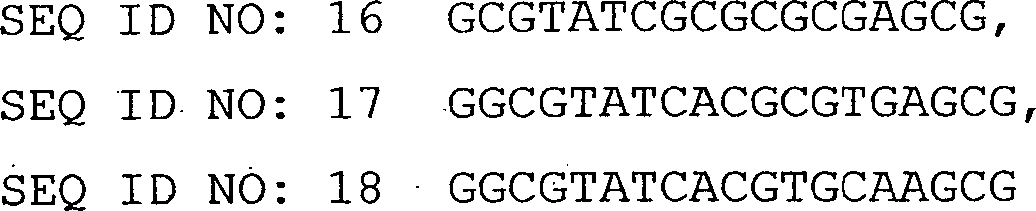
Die Hybridisierungssonden können von der Länge her von 10, 11, 12, 13, 14 oder 15 bis 100 Nukleotide variieren und sind vorzugsweise zwischen 10 und 50 Nukleotide lang. Die Sonden müssen dazu in der Lage sein, unter stringenten Hybridisierungsbedingungen an die identifizierten Targetregionen zu hybridisieren, wie oben definiert. Als solche müssen sie eine zusammenhängende Region mit mindestens 10 Basen aufweisen, die zu einer zusammenhängenden Region mit mindestens 10 Basen perfekt komplementär ist, die in einer. Targetsequenz vorliegt. Des Weiteren muss die Hybridisierung an die zusammenhängende Region ein nachweisbares Hybrid mit M. kansasii-Nukleinsäure erzeugen und darf nicht dazu in der Lage sein, mit Nicht-Target-Nukleinsäure, wie der von M. avium, M. gastri oder M. intracellulare, ein nachweisbares Hybrid zu bilden.The Hybridization probes can of the length vary from 10, 11, 12, 13, 14 or 15 to 100 nucleotides and are preferably between 10 and 50 nucleotides in length. The probes have to to be able to do so under stringent hybridization conditions to hybridize to the identified target regions as above Are defined. As such, must they are a coherent one Region with at least 10 bases that are related to one another Region with at least 10 bases is perfectly complementary, the in a. Target sequence is present. Furthermore, the hybridization needs to the coherent one Create a detectable hybrid with M. kansasii nucleic acid and may not be able to handle non-target nucleic acid, such as that of M. avium, M. gastri or M. intracellulare, a detectable To form hybrid.
Bevorzugte
Ausführungsformen
dieser Oligonukleotidhybridisierungsassay-Sonden haben die Nukleotidsequenz: 


Kernsequenzen dieser bevorzugten Oligonukleotidhybridisierungsassay-Sonden haben die Nukleotidsequenz: core sequences of these preferred oligonucleotide hybridization assay probes the nucleotide sequence:

Die Oligonukleotidhybridisierungsassay-Sonden können entweder einzeln oder in Kombination verwendet werden. Sonden, die SEQ ID NO: 7 CGCTCGCGCGCGATACGC entsprechen, und ihre verwandten Sonden können zum Nachweis von typischem M. kansasii verwendet werden; Sonden, die SEQ ID NO: 8 entsprechen, und ihre verwandten Sonden können zum Nachweis von atypischen M. kansasii-BOV-Stämmen verwendet werden; Sonden, die SEQ ID NO: 9 und SEQ ID NO: 10 entsprechen, und ihre verwandten Sonden können zum Nachweis von atypischen M. kansasii-CQU-Stämmen verwendet werden. Kombinationen dieser Sonden können zum Nachweis der entsprechenden Kombinationen von M. kansasii-Stämmen verwendet werden.The oligonucleotide hybridization assay probes may be used either singly or in combination. Probes corresponding to SEQ ID NO: 7 CGCTCGCGCGCGATACGC and their related probes can be used to detect typical M. kansasii; Probes corresponding to SEQ ID NO: 8 and their related probes can be used to detect atypical M. kansasii BOV strains; Probes corresponding to SEQ ID NO: 9 and SEQ ID NO: 10 and their related probes can be used to detect atypical M. kansasii CQU strains. Combinations of these Probes can be used to detect the corresponding combinations of M. kansasii strains.
Die Oligonukleotidhybridisierungsassay-Sonden der vorliegenden Erfindung werden vorzugsweise mit einem nachweisbaren. Marker, wie einem Radioisotop, einem fluoreszenten oder chemilumineszenten Teil, mit einem Enzym oder einem anderen Liganden markiert, das bzw, der zum Nachweis oder zur Bestätigung, dass die Sonde an die Targetsequenz hybridisiert ist, verwendet werden kann. Die Anmelder bevorzugen die Verwendung von chemilumineszenten Acridiniumestern als Markern. Siehe Arnold et al., US-Patentschrift Nr. 5,185,439, die Miteigentum an der vorliegenden Anmeldung genießt. Die Assay-Sonde wird mit einer Probe gemischt, von der vermutet wird, dass sie eine Nukleinsäure mit der Targetsequenz enthält, unter Hybridisierungsbedingungen, die dazu geeignet sind, das Fusionieren der zwei Stränge durch Wasserstoffbrückenbindung in der Komplementaritätsregion zu ermöglichen.The Oligonucleotide hybridization assay probes of the present invention are preferably with a detectable. Markers, such as a radioisotope, a fluorescent or chemiluminescent part, with an enzyme or another ligand labeled, respectively, for detection or for confirmation, that the probe is hybridized to the target sequence can be. Applicants prefer the use of chemiluminescent Acridinium esters as markers. See Arnold et al., U.S. Patent No. 5,185,439, which enjoys co-ownership of the present application. The Assay probe is mixed with a sample suspected that they are a nucleic acid containing the target sequence, under hybridization conditions suitable for fusing the two strands by hydrogen bonding in the complementarity region to enable.
Die Sonde bzw. die Sonden können auch mit einem oder mehreren nicht markierten Helfer-Oligonukleotide kombiniert werden, um die Bindung an die Nukleinsäure mit der Target-Nukleotidsequenz von M. kansasii zu unterstützen. Die Sonden hybridisieren dann an die in der Probe vorliegende Target-Nukleinsäure; die resultierenden Hybrid-Doppelstränge können getrennt und mittels verschiedener in der Technik wohl bekannter Techniken nachgewiesen werden, wie Hydroxyapatit-Adsorption und Radioaktivitätsüberwachung. Ebenfalls umfasst von diesen Techniken sind diejenigen, die das selektive Abbauen des auf der unhybridisierten Sonde vorliegenden Markers und dann das Messen der Markermenge, die mit der verbleibenden hybridisierten Sonde in Zusammen hang steht, umfasst, wie in Arnold et al., US-Patentschrift Nr. 5,283,174, offenbart, die Miteigentum an der vorliegenden Anmeldung genießt. Diese letztere Technik wird derzeit von den Anmeldern bevorzugt.The Probe or probes can also with one or more unlabeled helper oligonucleotides combined to bind to the nucleic acid with the target nucleotide sequence by M. kansasii. The probes then hybridize to the target nucleic acid present in the sample; the resulting Hybrid duplexes can separated and by means of various well-known in the art Techniques are detected, such as hydroxyapatite adsorption and Radioactivity monitoring. Also included among these techniques are those that selective degradation of that present on the unhybridized probe Markers and then measuring the amount of marker, with the remaining hybridized probe is involved, as in Arnold et al., U.S. Patent No. 5,283,174, discloses co-ownership enjoys the present application. This latter technique is currently preferred by the applicants.
Beim Nachweis von M. kansasii verwendete Helfer-OligonukleotideWhen detecting M. kansasii used helper oligonucleotides
Zum
Unterstützen
der Hybridisierung der Hybridisierungsassay-Sonden an die Target-Nukleinsäure wurden
spezifische Helfer-Oligonukleotide verwendet. Helfer-Oligonukleotide
sind in Hogan und Milliman, US-Patentschrift Nr. 5,030,557, beschrieben,
die Miteigentum an der vorliegenden Anmeldung genießt. Spezifische
Helfer-Oligonukleotide zum Unterstützen des spezifischen Nachweises
von M. kansasii haben Nukleotidsequenzen, die zu einer M. kansasii-RNA-Nukleotidsequenz
komplementär
sind: 

Bevorzugte
Ausführungsformen
dieser Helfer-Oligonukleotide sind Oligonukleotide mit der Nukleotidsequenz: 

Helfer-Oligonukleotide können im Allgemeinen unter stringenten Hybridisierungsbedingungen verwendet werden, sind aber nicht notwendigerweise bei ihrer Selektivität speziesspezifisch, d. h, die Target-Nukleotidsequenzen für die Helfer-Oligonukleotide sind nicht notwendigerweise eindeutig für die Spezies M. kansasii. Vorzugsweise werden Hybridisierungsassay-Sonden in Kombination mit Helfer-Oligonukleotiden zum Nachweis von M. kansasii verwendet.Helper oligonucleotides can generally be obtained under stringent hybridization conditions but are not necessarily species specific in their selectivity, i. h, the target nucleotide sequences for the helper oligonucleotides are not necessarily unique to the species M. kansasii. Preferably hybridization assay probes are used in combination with helper oligonucleotides for the detection of M. kansasii.
Die folgenden Beispiele verschiedener Ausführungsformen der vorliegenden Erfindung sind lediglich zur Veranschaulichung und sollen nicht den Schutzumfang der Erfindung einschränken.The following examples of various embodiments of the present Invention are for illustration only and not intended limit the scope of the invention.
Beispiel 1example 1
Die DNA-Sequenzen, die für die 23S-rRNA von verschiedenen Stämmen von M. kansasii kodieren, wurden unter Verwendung von PCR-Amplifikation und Zyklussequenzierung erhalten.The DNA sequences for encoding the 23S rRNA from different strains of M. kansasii obtained using PCR amplification and cycle sequencing.
Die verschiedenen 23S-rRNA-Sequenzen von M. kansasii wurden mit denen einiger seiner phylogenetisch nächsten Nachbarn verglichen, einschließlich M. gastri, M. avium und M. intracellulare. Von der Region, die einer E. coli-Region in der Nähe des Nukleotids 650 entspricht, wurde festgestellt, dass sie speziesspezifische Variationen aufweist, die für das Sondendesign verwendet werden könnten. Sonde SEQ ID NO: 7, Sonde SEQ ID NO: 8 und Sonde SEQ ID NO: 9 wurden als die beste Unterscheidung zwischen den rRNA-Sequenzen von M. kansasii, einschließlich der atypischen Varianten, und den anderen, eng damit verwandten Organismen bereitstellend ausgewählt.The Various 23S rRNA sequences of M. kansasii were identified with those some of his phylogenetically next Neighbors compared, including M. gastri, M. avium and M. intracellulare. From the region, the one Nearby E. coli region of nucleotide 650 was found to be species-specific Has variations for the probe design could be used. Probe SEQ ID NO: 7, probe SEQ ID NO: 8 and probe SEQ ID NO: 9 were considered the best distinction between the rRNA sequences of M. kansasii, including the atypical variants, and the other, closely related organisms providing selected.
Beispiel 2Example 2
In diesem Versuch wurde die Spezifität der Hybridisierungssonde mit der Nukleotidsequenz nach SEQ ID NO: 8 mittels Hybridisierung an die eng verwandten Organismen M. gastri und M. tuberculosis geprüft. Ein Helfer-Oligonukleotid mit der Sequenz nach SEQ ID NO: 13 wurde verwendet, um die Hybridisierung der Hybridisierungsassay-Sonden an die Target-Nukleinsäure zu unterstützen. Es wurden ATCC-Stämme von M. kansasii, M. gastri und M. tuberculosis verwendet. Die Organismen wurden in geeignete feste Medien inokuliert und zur log-Phase gewachsen. Eine mit Wuchs gefüllte 1-μl-Impföse von jeder Kultur wurde zu einem Bakterienlyseröhrchen gegeben, das Glasperlen und 200 μl Lyselösung enthielt, die aus 5 % Sorbit, 2,85 mM Natriumazid, 3,7 mM Hepes, 0,035 % Triton X-100, 50 mM Succinat, 10 mM EDTA, 10 mM EGTA, 1 % Lithiumlaurylsulfat (LLS) und 600 mM LiCl bestand. Die Röhrchen wurden 15 Minuten lang bei Raumtemperatur beschallt, um die Organismen zu lysieren, und dann 10 Minuten lang bei 95 °C ± 5 °C inaktiviert.In this experiment was the specificity of the hybridization probe with the nucleotide sequence according to SEQ ID NO: 8 by means of hybridization tested for the closely related organisms M. gastri and M. tuberculosis. A helper oligonucleotide with the sequence of SEQ ID NO: 13 was used to hybridize the hybridization assay probes to support the target nucleic acid. It were ATCC strains used by M. kansasii, M. gastri and M. tuberculosis. The organisms were inoculated into suitable solid media and grown to log phase. One filled with growth 1 μl inoculum of each Culture was added to a bacterial lysis tube, the glass beads and 200 μl lysis solution containing 5% sorbitol, 2.85 mM sodium azide, 3.7 mM Hepes, 0.035% Triton X-100, 50mM Succinate, 10mM EDTA, 10mM EGTA, 1 % Lithium lauryl sulfate (LLS) and 600 mM LiCl. The tubes were Sonicated for 15 minutes at room temperature to the organisms and then inactivated at 95 ° C ± 5 ° C for 10 minutes.
Die Sonden wurden mit Acridiniumester markiert. Für jede Sonde wurden ungefähr 2,5 × 10⁶ RLE (relative Lichteinheiten – eine Maßeinheit der Anzahl von Photonen, die von einem Luminometer erkannt werden) verwendet. Die Hybridisierungen wurden 15 Minuten lang bei 60 °C in einer Lösung durchgeführt, die 0,05 M Lithiumsuccinat, pH 5, 0,6 M LiCl, 1 % (w/v) Lithiumlaurylsulfat (LLS), 10 mM Ethylendiamintetraessigsäure (EDTA), 10 mM Ethylenglykolbis(betaaminoethylether)-N,N,N',N'-tetraessigsäure (EGTA) enthielt. Dreihundert Mikroliter einer Lösung, die 0,15 M Natriumtetraborat, pH 8,5, und 1 % Triton® X-100 enthielt, wurden in jedes Röhrchen gegeben und jede Reaktionsmischung wurde 8 Minuten lang bei 60 °C inkubiert und auf Raumtemperatur abgekühlt. Der Nachweis der Hybridisierung wurden in einem LEADER® I-Luminometer von Gen-Probe (Gen-Probe Incorporated, San Diego, CA, USA) analysiert. Das Luminometer injiziert automatisch zwei Reagenzien, wobei das erste 1 mM Salpetersäure und 0,1 % Wasserstoffperoxid umfasst und das zweite 1 N Natriumhydroxid umfasst. Die Assayergebnisse wurden in RLE angegeben. RLE-Werte, die höher als 30.000 RLE waren, wurden als eine positive Reaktion angesehen. Bei diesen Versuchen wurde jede Reaktion in doppelter Ausfertigung durchgeführt und die Ergebnisse sind unten angezeigt.The probes were labeled with acridinium ester. For each probe, approximately 2.5 x 10 6 RLE (relative units of light - a unit of measurement of the number of photons detected by a luminometer) was used. Hybridizations were performed for 15 minutes at 60 ° C in a solution containing 0.05 M lithium succinate, pH 5, 0.6 M LiCl, 1% (w / v) lithium lauryl sulfate (LLS), 10 mM ethylenediaminetetraacetic acid (EDTA), 10 mM ethylene glycol bis (beta-aminoethyl ether) -N, N, N ', N'-tetraacetic acid (EGTA). Three hundred microliters of a solution containing 0.15 M sodium tetraborate, pH 8.5, and 1% Triton® X-100 were added to each tube and each reaction mixture was incubated at 60 ° C for 8 minutes and cooled to room temperature. Evidence of hybridization were analyzed in a LEADER ® I luminometer Gen-Probe (Gen-Probe Incorporated, San Diego, CA, USA). The luminometer automatically injects two reagents, the first comprising 1 mM nitric acid and 0.1% hydrogen peroxide and the second comprising 1 N sodium hydroxide. The assay results were reported in RLE. RLE values higher than 30,000 RLE were considered to be a positive reaction. In these experiments, each reaction was carried out in duplicate and the results are shown below.
Tabelle 1: Nachweis von M. kansasii-Nukleinsäure unter Verwendung einer Hybridisierungsassay-Sonde mit einer Nukleotidsequenz nach SEQ ID NO: 2.table 1: Detection of M. kansasii nucleic acid using a Hybridization assay probe with a nucleotide sequence according to SEQ ID NO: 2.
TABELLE
1 
Beispiel 3Example 3
In diesem Versuch wurde die Spezifität der Hybridisierungssonden mit den Nukleotidsequenzen nach SEQ ID NO: 8 und SEQ ID NO: 9 mittels Hybridisierung dieser Sonden an atypische Stämme von M. kansasii geprüft. Die Stämme 1–9 wurden als der BOV-Stamm klassifiziert, während die Stämme 10–11 als der COU-Stamm klassifiziert wurden. Zellwachstum und Lyse, Hybridisierung und Nachweis waren wie in Beispiel 2 beschrieben. Die Hybridisierung wurde durch die Verwendung von Helfersonden in jeder Hybridisierungsreaktion gefördert. Für Sonden mit den Nukleotidsequenzen nach SEQ ID NO: 8 wurden Helfersonden mit der Nukleotidsequenz nach SEQ ID NO: 14 und SEQ ID NO: 15 verwendet; für Sonden mit den Nukleotidsequenzen nach SEQ ID NO: 9 wurden Helfersonden mit der Nukleotidsequenz nach SEQ ID NO: 14 und SEQ ID NO: 13 verwendet. Die Ergebnisse demonstrieren die Spezifität der Sonden für die zwei Typen von Variantenstämmen von M. kansasii.In In this experiment, the specificity of the hybridization probes was determined with the nucleotide sequences according to SEQ ID NO: 8 and SEQ ID NO: 9 by means of Hybridization of these probes to atypical strains of M. kansasii tested. The strains Were 1-9 classified as the BOV strain, while the strains 10-11 as the COU strain were classified. Cell growth and lysis, hybridization and detection were as described in Example 2. The hybridization was through the use of helper probes in each hybridization reaction promoted. For probes with the nucleotide sequences of SEQ ID NO: 8 were helper probes used with the nucleotide sequence of SEQ ID NO: 14 and SEQ ID NO: 15; for probes with the nucleotide sequences of SEQ ID NO: 9 were helper probes with the nucleotide sequence according to SEQ ID NO: 14 and SEQ ID NO: 13. The results demonstrate the specificity of the probes for the two Types of variant strains from M. kansasii.
Tabelle 2: Nachweis von atypischer M. kansasii-Nukleinsäure unter Verwendung von Hybridisierungsassay-Sonden mit einer Nukleotidsequenz nach SEQ ID NO: 8 oder SEQ ID NO: 9.table Figure 2: Detection of atypical M. kansasii nucleic acid using hybridization assay probes with a nucleotide sequence according to SEQ ID NO: 8 or SEQ ID NO: 9.
TABELLE
2 
Beispiel 4Example 4
In diesem Versuch wird die Spezifität der Hybridisierungssonde mit der Nukleotidsequenz SEQ ID NO: 7 durch Hybridisierung mit einer Reihe von anderen, eng verwandten Organismen demonstriert. Zellwachstum und Lyse waren wie in Beispiel 2 beschrieben, unter Verwendung von RNA, die aus einer Kolonie bzw. > 108 Organismen ausgelöst wurde: Die Hybridisierung war wie in Beispiel 2 beschrieben, unter Verwendung von Helfersonden mit der Nukleotidsequenz nach SEQ ID NO: 13 und SEQ ID NO: 14. Der Nachweis war wie in Tabelle 2 beschrieben.In this experiment, the specificity of the hybridization probe with the nucleotide sequence of SEQ ID NO: 7 is demonstrated by hybridization with a number of other, closely related organisms. Cell growth and lysis were as described in Example 2, using RNA elicited from a colony or> 10 8 organisms: Hybridization was as described in Example 2 using helper probes with the nucleotide sequence of SEQ ID NO: 13 and SEQ ID NO: 14. The detection was as described in Table 2.
Tabelle 3: Nachweis von M. kansasii-Nukleinsäure unter Verwendung der Hybridisierungsassay-Sonde mit der Nukleotidsequenz nach SEQ ID NO: 7 und Helfersonden mit den Nukleotidsequenzen nach SEQ ID NO: 13 und SEQ ID NO: 14.table 3: Detection of M. kansasii nucleic acid using hybridization assay probe with the nucleotide sequence according to SEQ ID NO: 7 and helper probes with the nucleotide sequences of SEQ ID NO: 13 and SEQ ID NO: 14.
TABELLE
3 

Beispiel 5Example 5
In diesem Versuch wird die Spezifität der Hybridisierungssonde mit der Nukleotidsequenz SEQ ID NO: 7 für M. kansasii weiter durch Hybridisierung an einen breiten phylogenetischen Querschnitt von Organismen demonstriert. Zellwachstum und Lyse waren wie in Beispiel 4 beschrieben. Hybridisierung und Nachweis waren wie in Beispiel 4 beschrieben, unter Verwendung derselben Helfersonden. Die Ergebnisse dieses Versuchs sind in Tabelle 4 unten dargestellt.In this experiment is the specificity the hybridization probe with the nucleotide sequence SEQ ID NO: 7 for M. kansasii further by hybridization to a broad phylogenetic cross section demonstrated by organisms. Cell growth and lysis were as in Example 4 described. Hybridization and detection were as in Example 4 using the same helper probes. The results of this experiment are shown in Table 4 below.
Tabelle 4: Nachweis von M. kansasii-Nukleinsäure unter Verwendung von Hybridisierungsassay-Sonden mit einer Nukleotidsequenz nach SEQ ID NO: 7.table Figure 4: Detection of M. kansasii nucleic acid using hybridization assay probes with a nucleotide sequence according to SEQ ID NO: 7.
TABELLE
4 

Beispiel 6Example 6
In diesem Versuch wurde die Spezifität einer Sondenmischung, die alle drei entworfenen Sonden (SEQ ID NO: 7, SEQ ID NO: 8 und SEQ ID NO: 9) und beide Helfersonden (SEQ ID NO: 13 und SEQ ID NO: 14) enthielt, gegen Standardbakterienstämme geprüft. Insgesamt 55 ATCC-Referenzstämme von Mykobakterien (ATCC = American Type Culture Collection) wurden bewertet. Diese Stämme stellten die mit M. kansasii am engsten verwandten Organismen dar. Die Standardspezifitätsprüfung wurde unter Verwendung von Wuchs durchgeführt, der aus aktiv wachsenden Kulturen der ATCC-Stämme gewonnen wurde, mit Ausnahme von Mycobacterium haemophilum, für den keine Zellen verfügbar waren. Stattdessen wurde rRNA von Mycobacterium haemophilum mit einer Konzentration verwendet, die zu der der wachsenden Zellkulturen äquivalent war. Zellwachstum und Lyse waren wie in Beispiel 2 beschrieben. Hybridisierung und Nachweis waren wie in Beispiel 2 beschrieben. Alle eng verwandten Mykobakterien ergaben negative Ergebnisse von weit unter dem Cut-off-Wert von 30.000 RLE.In In this experiment, the specificity of a probe mixture, the all three probes designed (SEQ ID NO: 7, SEQ ID NO: 8 and SEQ ID NO: 9) and both helper probes (SEQ ID NO: 13 and SEQ ID NO: 14) contained tested against standard bacterial strains. A total of 55 ATCC reference strains of Mycobacteria (ATCC = American Type Culture Collection) were evaluated. These tribes represented the organisms most closely related to M. kansasii. The standard specification check was carried out using growth that is growing out of active Cultures of the ATCC strains with the exception of Mycobacterium haemophilum, for which no Cells available were. Instead, rRNA from Mycobacterium haemophilum was involved a concentration equivalent to that of growing cell cultures was. Cell growth and lysis were as described in Example 2. Hybridization and detection were as described in Example 2. All closely related mycobacteria gave negative results far below the cut-off value of 30,000 RLE.
Tabelle 5: Spezifität von Sonden mit den Nukleotidsequenzen SEQ ID NO: 7, SEQ ID NO: 8 und SEQ ID NO: 9 für M. kansasii gegenüber anderen Mykobakterien.table 5: specificity of probes having the nucleotide sequences SEQ ID NO: 7, SEQ ID NO: 8 and SEQ ID NO: 9 for M. kansasii opposite other mycobacteria.
TABELLE
5 


Beispiel 7Example 7
In diesem Versuch wurde die Spezifität der Mischung von Sonden und Helfern, die in Beispiel 6 verwendet wurde, gegen Standardbakterienstämme geprüft. Insgesamt 68 ATCC-Referenzstämme (ATCC = American Type Culture Collection) wurden bewertet. Diese Stämme stellten einen phylogenetischen Querschnitt von Organismen dar. Die Standardspezifitätsprüfung wurde unter Verwendung von Wuchs durchgeführt, der aus aktiv wachsenden Kulturen der ATCC-Stämme gewonnen wurde. Zellwachstum und Lyse waren wie in Beispiel 2 beschrieben. Hybridisierung und Nachweis waren wie in Beispiel 2 beschrieben. Alle Organismen des phylogenetischen Querschnitts ergaben negative Ergebnisse von weit unter dem Cut-off-Wert von 30.000 RLE.In In this experiment, the specificity of the mixture of probes and Helpers used in Example 6 tested against standard bacterial strains. All in all 68 ATCC Reference Strains (ATCC = American Type Culture Collection) were evaluated. These tribes presented a phylogenetic cross section of organisms. The standard specificity test was carried out using growth that is growing out of active Cultures of the ATCC strains was won. Cell growth and lysis were as described in Example 2. Hybridization and detection were as described in Example 2. All organisms of the phylogenetic cross section yielded negative Results well below the cut-off value of 30,000 RLE.
Tabelle 6: Spezifität von Sonden mit den Nukleotidsequenzen SEQ ID NO: 7, SEQ ID NO: 8 und SEQ ID NO: 9 für M. kansasii gegenüber einem phylogenetischen Querschnitt von Organismen.table 6: specificity of probes having the nucleotide sequences SEQ ID NO: 7, SEQ ID NO: 8 and SEQ ID NO: 9 for M. kansasii opposite a phylogenetic cross section of organisms.
TABELLE
6 


Beispiel 8Example 8
Die Mischung von Hybridisierungssonden (in Beispiel 6 gezeigt) wurde auf Spezifität für M. kansasii gegen 58 klinische Isolate, die 7 Spezies von Mykobakterien darstellen, geprüft. Zellkultur und -wachstum und Hybridisierung waren wie in Beispiel 2 beschrieben. Es wurden keine Kreuzreaktionen mit eng verwandten klinischen Isolaten beobachtet.The Mixture of hybridization probes (shown in Example 6) on specificity for M. kansasii against 58 clinical isolates, the 7 species of mycobacteria represent, tested. Cell culture and growth and hybridization were as in Example 2 described. There were no cross reactions with closely related observed clinical isolates.
Tabelle 7: Spezifität der Mischung von Sonden und Helfern für M. kansasii in klinischen Isolaten.table 7: specificity the mixture of probes and aides for M. kansasii in clinical Isolates.
TABELLE
7 


Beispiel 9Example 9
In diesem Versuch wurde die Sensibilität der Sonden/Helfermischung (in Beispiel 6 gezeigt) mit typischen und atypischen M. kansasii-rRNA geprüft. Die rRNA wurde in Konzentrationen von 0, 0,1, 0,25, 05 und 1 ng/μl verwendet. Die Prüfung wurde für jede Konzentration und jeden RNA-Typ in doppelter Ausfertigung durchgeführt. 100 μl rRNA von entweder dem typischen Stamm von M. kansasii, dem atypischen BOV-Stamm oder dem atypischen COU-Stamm wurden zu Röhrchen gegeben, die lyophilisierte Sonde und Hybridisierungsreagenzien enthielten, wie in Beispiel 2 beschrieben. Die Reaktionsmischungen wurden gevortext und 15 Minuten lang bei 60 °C hybridisiert. Der Nachweis war wie in Beispiel 2 beschrieben. Die Ergebnisse zeigen, dass die Sonden leicht reagieren und dazu in der Lage sind, geringe Mengen von typischer und atypischer M. kansasii-rRNA nachzuweisen.In This experiment was the sensitivity of the probes / helper mixture (shown in Example 6) with typical and atypical M. kansasii rRNA checked. The rRNA was used in concentrations of 0, 0.1, 0.25, 05 and 1 ng / μl. The exam was for each concentration and each RNA type carried out in duplicate. 100 μl rRNA of either the typical strain of M. kansasii, the atypical BOV strain or the atypical COU strain was added to tubes which lyophilized Probe and hybridization reagents contained as in Example 2 described. The reaction mixtures were vortexed and 15 minutes long at 60 ° C hybridized. The detection was as described in Example 2. The Results show that the probes react easily and in capable of producing low levels of typical and atypical M. kansasii rRNA demonstrated.
Tabelle 8: Sensibilitätsprüfung der Mischung von Sonden und Helfern für typische und atypische rRNAs.table 8: Sensitivity test of Mix of probes and auxiliaries for typical and atypical rRNAs.
TABELLE
8 
Beispiel 10Example 10
Dieser Versuch prüfte die Sensibilität der Sonden/Helfermischung von Beispiel 6 zum Nachweisen von M. kansasii-rRNA bei Anwesenheit von Nicht-Targetzellen mit deren rRNA und rDNA. Zellen von M. avium, M. gastri und M. tuberculosis wurden gezüchtet und lysiert, wie in Beispiel 2 beschrieben. Die Proben wurden mit der entsprechenden Mischung aus lysierten Nicht-Targetzellen und M. kansasii-rRNA in einem Bereich von 0 ng bis 100 ng, wie angegeben, hergestellt und Hybridisierung und Nachweis wurden wie in Beispiel 2 beschrieben vorgenommen. Die Ergebnisse zeigen eine gute Signalwiederherstellung bei Anwesenheit einer großen Anzahl (etwa 1,5 × 10⁷) von Nicht-Targetzellen.This experiment tested the sensitivity of the probe / helper mix of Example 6 to detect M. kansasii rRNA in the presence of non-target cells with their rRNA and rDNA. Cells of M. avium, M. gastri and M. tuberculosis were grown and lysed as described in Example 2. Samples were prepared with the appropriate mixture of lysed non-target cells and M. kansasii rRNA ranging from 0 ng to 100 ng as indicated, and hybridization and detection were performed as described in Example 2. The results show good signal recovery in the presence of a large number (about 1.5 x 10 7 ) of non-target cells.
Tabelle 9: Sensibilität der Sonden/Helfermischung bei Anwesenheit von Nicht-Targetzellen.table 9: Sensitivity the probe / helper mix in the presence of non-target cells.
TABELLE
9 
Die Ausführungsformen, die in den verschiedenen, oben beschriebenen Beispielen gezeigt sind, bestätigen, dass die hierin beschriebenen Oligonukleotide dazu in der Lage sind, M. kansasii-Nukleinsäuren nachzuweisen, und in einem Assay zum Unterscheiden von M. kansasii von seinen bekannten, nächsten phylogenetischen Nachbarn verwendet werden können. Keines der hierin beschriebenen Beispiele soll die vorliegende Erfindung auf die Ausführungsformen der vorstehenden Offenbarung beschränken; weitere Ausführungsformen liegen innerhalb der folgenden Ansprüche.The Embodiments, those shown in the various examples described above are, confirm, that the oligonucleotides described herein are capable of To detect M. kansasii nucleic acids and in an assay to distinguish M. kansasii from his known, next phylogenetic neighbors can be used. None of those described herein Examples of the present invention to the embodiments limit the above disclosure; further embodiments are within the following claims.
SEQUENZPROTOKOLL 


Claims (25)
Applications Claiming Priority (2)
| Application Number | Priority Date | Filing Date | Title |
|---|---|---|---|
| US1585296P | 1996-05-22 | 1996-05-22 | |
| US15852P | 1996-05-22 |
Publications (2)
| Publication Number | Publication Date |
|---|---|
| DE69735046D1 DE69735046D1 (en) | 2006-03-30 |
| DE69735046T2 true DE69735046T2 (en) | 2006-08-17 |
Family
ID=21773998
Family Applications (1)
| Application Number | Title | Priority Date | Filing Date |
|---|---|---|---|
| DE69735046T Expired - Lifetime DE69735046T2 (en) | 1996-05-22 | 1997-05-22 | Compositions and methods for the detection of Mycobacterium kansasii |
Country Status (10)
| Country | Link |
|---|---|
| US (1) | US6218107B1 (en) |
| EP (1) | EP0808907B1 (en) |
| JP (1) | JP4241929B2 (en) |
| AT (1) | ATE315102T1 (en) |
| AU (1) | AU710996B2 (en) |
| CA (1) | CA2255624C (en) |
| DE (1) | DE69735046T2 (en) |
| DK (1) | DK0808907T3 (en) |
| ES (1) | ES2256871T3 (en) |
| WO (1) | WO1997044488A2 (en) |
Families Citing this family (10)
| Publication number | Priority date | Publication date | Assignee | Title |
|---|---|---|---|---|
| DE69736667T2 (en) * | 1996-07-16 | 2007-09-06 | Gen-Probe Inc., San Diego | PROCESS FOR THE DETECTION AND AMPLIFICATION OF NUCLEIC ACID SEQUENCES USING MODIFIED OLIGONUCLEOTIDES WITH INCREASED TARGET MELT TEMPERATURE (TM) |
| US7070925B1 (en) * | 1996-07-16 | 2006-07-04 | Gen-Probe Incorporated | Method for determining the presence of an RNA analyte in a sample using a modified oligonucleotide probe |
| US6821770B1 (en) | 1999-05-03 | 2004-11-23 | Gen-Probe Incorporated | Polynucleotide matrix-based method of identifying microorganisms |
| ATE335847T1 (en) | 1999-05-03 | 2006-09-15 | Gen Probe Inc | POYNUCLEOTIDE PROBE FOR EXCLUSIVE DETECTION AND QUANTIFICATION OF STAPHYLOCOCCUS |
| DE60028758T2 (en) | 1999-05-03 | 2007-05-24 | Gen-Probe Inc., San Diego | POLYNUCLEOTIDE DONSES FOR THE DETECTION AND QUANTIFICATION OF ACTINOMYCETES |
| DE10021947A1 (en) * | 2000-05-05 | 2001-11-08 | Max Planck Gesellschaft | Detecting nucleic acid by in situ hybridization, useful for detecting microorganisms, with addition of helper probes to increase target accessibility |
| DE10237284A1 (en) * | 2002-08-14 | 2004-03-04 | Advalytix Ag | nucleic acid detection |
| GB0526033D0 (en) | 2005-12-21 | 2006-02-01 | Bioeos Ltd | Method |
| EP3237637B1 (en) | 2014-12-23 | 2019-09-04 | 3M Innovative Properties Company | Composition for reducing inhibition of nucleic acid amplification |
| WO2017176469A1 (en) * | 2016-04-08 | 2017-10-12 | 3M Innovative Properties Company | Process for cell lysis and nucleic acid amplification |
Family Cites Families (16)
| Publication number | Priority date | Publication date | Assignee | Title |
|---|---|---|---|---|
| EP0756010B1 (en) | 1983-01-10 | 2001-07-04 | Gen-Probe Incorporated | Method for detecting, identifying, and quantitating organisms and viruses |
| US4683195A (en) | 1986-01-30 | 1987-07-28 | Cetus Corporation | Process for amplifying, detecting, and/or-cloning nucleic acid sequences |
| PT86204B (en) | 1986-11-24 | 1990-11-07 | Hogan James John | METHOD FOR THE PREPARATION OF NUCLEIC ACID PROBES FOR THE DETECTION AND / OR QUANTIFICATION OF NON-VIRAL ORGANISMS |
| IL86724A (en) | 1987-06-19 | 1995-01-24 | Siska Diagnostics Inc | Method and kits for the amplification and detection of nucleic acid sequences |
| JP2774121B2 (en) | 1987-07-31 | 1998-07-09 | ザ ボード オブ トラスティーズ オブ ザ リーランド スタンフォード ジュニア ユニバーシティ | Selective amplification of target polynucleotide sequence |
| US5283174A (en) | 1987-09-21 | 1994-02-01 | Gen-Probe, Incorporated | Homogenous protection assay |
| KR970005898B1 (en) | 1987-09-21 | 1997-04-21 | 젠- 프로우브 인코퍼레이티드 | Non-nucleotide linking reagents for nucleotide rpobes |
| US5185439A (en) | 1987-10-05 | 1993-02-09 | Gen-Probe Incorporated | Acridinium ester labelling and purification of nucleotide probes |
| US5030557A (en) | 1987-11-24 | 1991-07-09 | Ml Technology Venture | Means and method for enhancing nucleic acid hybridization |
| FI911152A7 (en) | 1989-07-11 | 1991-03-07 | Gen Probe Inc | Nucleic acid sequence amplification methods |
| US5681698A (en) * | 1991-04-25 | 1997-10-28 | Gen-Probe Incorporated | 23S rRNA nucleic acid probes to mycobacterium kansasii |
| JP4137996B2 (en) | 1992-05-06 | 2008-08-20 | ジェン−プローブ・インコーポレイテッド | Nucleic acid sequence amplification method, composition and kit |
| AU670116B2 (en) | 1992-08-04 | 1996-07-04 | Gen-Probe Incorporated | Nucleic acid sequence amplification |
| US5518884A (en) | 1994-02-28 | 1996-05-21 | Becton, Dickinson And Company | Nucleic acid sequences specific for mycbacterium kansasii |
| US5500341A (en) * | 1994-09-19 | 1996-03-19 | Becton, Dickinson And Company | Species-specific detection of Mycobacterium kansasii |
| US5614390A (en) | 1996-06-14 | 1997-03-25 | Becton, Dickinson And Company | Species-specific detection of Mycobacterium kansasii |
-
1997
- 1997-05-15 WO PCT/US1997/008486 patent/WO1997044488A2/en not_active Ceased
- 1997-05-15 US US08/856,963 patent/US6218107B1/en not_active Expired - Lifetime
- 1997-05-15 AU AU31329/97A patent/AU710996B2/en not_active Ceased
- 1997-05-15 CA CA002255624A patent/CA2255624C/en not_active Expired - Fee Related
- 1997-05-15 JP JP54263497A patent/JP4241929B2/en not_active Expired - Fee Related
- 1997-05-22 ES ES97303491T patent/ES2256871T3/en not_active Expired - Lifetime
- 1997-05-22 EP EP97303491A patent/EP0808907B1/en not_active Expired - Lifetime
- 1997-05-22 DE DE69735046T patent/DE69735046T2/en not_active Expired - Lifetime
- 1997-05-22 DK DK97303491T patent/DK0808907T3/en active
- 1997-05-22 AT AT97303491T patent/ATE315102T1/en not_active IP Right Cessation
Also Published As
| Publication number | Publication date |
|---|---|
| JP2000511058A (en) | 2000-08-29 |
| AU710996B2 (en) | 1999-10-07 |
| DK0808907T3 (en) | 2006-05-22 |
| CA2255624C (en) | 2007-09-04 |
| WO1997044488A3 (en) | 1997-12-24 |
| EP0808907A3 (en) | 1998-01-07 |
| EP0808907A2 (en) | 1997-11-26 |
| WO1997044488A2 (en) | 1997-11-27 |
| DE69735046D1 (en) | 2006-03-30 |
| ES2256871T3 (en) | 2006-07-16 |
| CA2255624A1 (en) | 1997-11-27 |
| ATE315102T1 (en) | 2006-02-15 |
| JP4241929B2 (en) | 2009-03-18 |
| AU3132997A (en) | 1997-12-09 |
| US6218107B1 (en) | 2001-04-17 |
| EP0808907B1 (en) | 2006-01-04 |
Similar Documents
| Publication | Publication Date | Title |
|---|---|---|
| DE3486254T2 (en) | METHOD FOR DETECTING, IDENTIFYING AND QUANTIFYING ORGANISMS AND VIRUSES. | |
| DE3752172T2 (en) | Nucleic acid probes for the detection and / or quantification of non-viral organisms | |
| DE69230555T2 (en) | Oligonucleotides complementary to mycobacterial nucleic acid | |
| DE69113261T3 (en) | HYBRIDIZING PRObes FROM THE DISTANCE BETWEEN THE 16S AND 23S RNA GENES AND DETECTION OF NON-VIRAL MICROORGANISMS. | |
| DE69609161T2 (en) | AMPLIFICATION OLIGONUCLEOTIDS AND PROBESTS FOR BORRELIA ASSOCIATED WITH LYME DISEASE | |
| DE69619845T2 (en) | IMPROVED IS6110-BASED MOLECULAR DETECTION OF MYCOBACTERIUM TUBERCULOSIS | |
| CN102329880B (en) | Probe and primer for tubercle bacillus detection, and method of detecting human tubercle bacillus therewith | |
| DE69334050T2 (en) | Nucleic acid probes for Chlamydia pneumoniae | |
| DE69627625T2 (en) | THE AMPLIFICATION AND DETERMINATION OF TYPES OF THE MYCOBAKTERIUM AVIUM COMPLEX | |
| DE3688985T2 (en) | Method and probe for the detection of Actinobacillus Actinomycetemcomitans. | |
| DE69026716T2 (en) | NUCLEIC ACID FRAGMENTS FROM A GENOME OF A SUITABLE MYCOBACTERIUM, THEIR USE FOR DIAGNOSIS OF MYCOBACTORY INFECTIONS AND PLASMIDES CONTAINING THESE FRAGMENTS | |
| DE69514883T2 (en) | Species-specific detection of Mycobacterium Kansasii | |
| DE69735046T2 (en) | Compositions and methods for the detection of Mycobacterium kansasii | |
| EP1389242B1 (en) | Detecting microorganisms of the yersinia pestis/yersinia pseudotuberculosis species and/or differentiating between yersinia pestis and yersinia pseudotuberculosis | |
| DE69323267T2 (en) | Probes for Mycobacterium Avium, Mycobacterium Intracellulare, and Mycobacterium Paratuberculosis | |
| DE69328951T2 (en) | Nucleic acid probes for Mykobacterium tuberculosis | |
| DE60029945T2 (en) | Polynucleotide probes for the detection and quantitation of Staphylococcus | |
| DE60122067T2 (en) | Reproduction and detection of Legionella pneumophila nucleic acids | |
| DE69022362T2 (en) | NUCLEIC ACID PROBE FOR THE DETECTION OF NEISSERIA GONORRHOEAE. | |
| DE69636917T2 (en) | Nucleic acid probes and amplification oligonucleotides for Neisseria species | |
| DE69822242T2 (en) | Neisseria gonorrhoae-specific oligonucleotides | |
| DE69209846T2 (en) | NUCLEOTIDE SEQUENCES THAT SPECIFICALLY HYBRID COMPLEX WITH BACTERIA OF THE MYCOBACTERIUM AVIUM-INTERCELLULARE | |
| DE60028758T2 (en) | POLYNUCLEOTIDE DONSES FOR THE DETECTION AND QUANTIFICATION OF ACTINOMYCETES | |
| DE60132454T2 (en) | POLYNUCLEOTIDE THONES FOR THE DETECTION AND QUANTIFICATION OF CANDIDA ALBICANS AND CANDIDA DUBLINIENSIS | |
| DE19918479A1 (en) | Isolated nucleic acid for the GC-3 fragment from Neisseria gonorrhoeae, useful for species-specific detection |
Legal Events
| Date | Code | Title | Description |
|---|---|---|---|
| 8364 | No opposition during term of opposition |