DE69633800T2 - METAL-LIGAND COMPLEXES CATALYSED MANUFACTURING METHOD - Google Patents
METAL-LIGAND COMPLEXES CATALYSED MANUFACTURING METHOD Download PDFInfo
- Publication number
- DE69633800T2 DE69633800T2 DE69633800T DE69633800T DE69633800T2 DE 69633800 T2 DE69633800 T2 DE 69633800T2 DE 69633800 T DE69633800 T DE 69633800T DE 69633800 T DE69633800 T DE 69633800T DE 69633800 T2 DE69633800 T2 DE 69633800T2
- Authority
- DE
- Germany
- Prior art keywords
- hydroformylation
- metal
- catalyst
- reaction
- organophosphite ligand
- Prior art date
- Legal status (The legal status is an assumption and is not a legal conclusion. Google has not performed a legal analysis and makes no representation as to the accuracy of the status listed.)
- Expired - Lifetime
Links
- 239000003446 ligand Substances 0.000 title claims abstract description 241
- 238000004519 manufacturing process Methods 0.000 title description 8
- 238000000034 method Methods 0.000 claims abstract description 172
- 239000003054 catalyst Substances 0.000 claims abstract description 169
- 230000008569 process Effects 0.000 claims abstract description 121
- CURLTUGMZLYLDI-UHFFFAOYSA-N Carbon dioxide Chemical compound O=C=O CURLTUGMZLYLDI-UHFFFAOYSA-N 0.000 claims abstract description 114
- 150000008301 phosphite esters Chemical class 0.000 claims abstract description 103
- 239000007795 chemical reaction product Substances 0.000 claims abstract description 70
- 229910002092 carbon dioxide Inorganic materials 0.000 claims abstract description 58
- 239000001569 carbon dioxide Substances 0.000 claims abstract description 57
- 239000000047 product Substances 0.000 claims abstract description 50
- XLYOFNOQVPJJNP-UHFFFAOYSA-N water Substances O XLYOFNOQVPJJNP-UHFFFAOYSA-N 0.000 claims abstract description 39
- 239000000376 reactant Substances 0.000 claims abstract description 14
- 239000012530 fluid Substances 0.000 claims abstract description 10
- 238000007037 hydroformylation reaction Methods 0.000 claims description 179
- -1 hydrocarbon radical Chemical class 0.000 claims description 165
- 239000007788 liquid Substances 0.000 claims description 97
- 150000001299 aldehydes Chemical class 0.000 claims description 78
- 239000010948 rhodium Substances 0.000 claims description 63
- 238000006243 chemical reaction Methods 0.000 claims description 62
- 229910052703 rhodium Inorganic materials 0.000 claims description 54
- MHOVAHRLVXNVSD-UHFFFAOYSA-N rhodium atom Chemical compound [Rh] MHOVAHRLVXNVSD-UHFFFAOYSA-N 0.000 claims description 53
- 239000000203 mixture Substances 0.000 claims description 46
- 239000000243 solution Substances 0.000 claims description 41
- UGFAIRIUMAVXCW-UHFFFAOYSA-N Carbon monoxide Chemical compound [O+]#[C-] UGFAIRIUMAVXCW-UHFFFAOYSA-N 0.000 claims description 40
- 229910002091 carbon monoxide Inorganic materials 0.000 claims description 40
- 239000001257 hydrogen Substances 0.000 claims description 38
- 229910052739 hydrogen Inorganic materials 0.000 claims description 38
- 239000002253 acid Substances 0.000 claims description 37
- 238000000926 separation method Methods 0.000 claims description 34
- UFHFLCQGNIYNRP-UHFFFAOYSA-N Hydrogen Chemical compound [H][H] UFHFLCQGNIYNRP-UHFFFAOYSA-N 0.000 claims description 30
- 150000002897 organic nitrogen compounds Chemical class 0.000 claims description 30
- 125000004432 carbon atom Chemical group C* 0.000 claims description 29
- 229930195733 hydrocarbon Natural products 0.000 claims description 27
- 150000003018 phosphorus compounds Chemical class 0.000 claims description 26
- 239000004215 Carbon black (E152) Substances 0.000 claims description 25
- 230000002378 acidificating effect Effects 0.000 claims description 25
- 239000007789 gas Substances 0.000 claims description 25
- 150000001875 compounds Chemical class 0.000 claims description 21
- HYZJCKYKOHLVJF-UHFFFAOYSA-N 1H-benzimidazole Chemical compound C1=CC=C2NC=NC2=C1 HYZJCKYKOHLVJF-UHFFFAOYSA-N 0.000 claims description 14
- 239000012062 aqueous buffer Substances 0.000 claims description 14
- 239000007853 buffer solution Substances 0.000 claims description 14
- 150000003839 salts Chemical class 0.000 claims description 12
- 229910052698 phosphorus Inorganic materials 0.000 claims description 11
- QRUDEWIWKLJBPS-UHFFFAOYSA-N benzotriazole Chemical compound C1=CC=C2N[N][N]C2=C1 QRUDEWIWKLJBPS-UHFFFAOYSA-N 0.000 claims description 8
- 239000012964 benzotriazole Substances 0.000 claims description 8
- 239000011574 phosphorus Substances 0.000 claims description 8
- 229910019142 PO4 Inorganic materials 0.000 claims description 7
- 150000001450 anions Chemical class 0.000 claims description 6
- 125000004437 phosphorous atom Chemical group 0.000 claims description 6
- NBIIXXVUZAFLBC-UHFFFAOYSA-K phosphate Chemical compound [O-]P([O-])([O-])=O NBIIXXVUZAFLBC-UHFFFAOYSA-K 0.000 claims description 5
- 239000010452 phosphate Substances 0.000 claims description 5
- BVKZGUZCCUSVTD-UHFFFAOYSA-L Carbonate Chemical compound [O-]C([O-])=O BVKZGUZCCUSVTD-UHFFFAOYSA-L 0.000 claims description 4
- WTKZEGDFNFYCGP-UHFFFAOYSA-N Pyrazole Chemical class C=1C=NNC=1 WTKZEGDFNFYCGP-UHFFFAOYSA-N 0.000 claims description 4
- 229910052783 alkali metal Inorganic materials 0.000 claims description 4
- 150000001340 alkali metals Chemical class 0.000 claims description 4
- 230000006315 carbonylation Effects 0.000 claims description 4
- 238000005810 carbonylation reaction Methods 0.000 claims description 4
- 150000001768 cations Chemical class 0.000 claims description 4
- 239000012084 conversion product Substances 0.000 claims description 4
- 150000003918 triazines Chemical class 0.000 claims description 4
- 150000003852 triazoles Chemical class 0.000 claims description 4
- QGZKDVFQNNGYKY-UHFFFAOYSA-O Ammonium Chemical compound [NH4+] QGZKDVFQNNGYKY-UHFFFAOYSA-O 0.000 claims description 3
- 230000001976 improved effect Effects 0.000 claims description 3
- KRKNYBCHXYNGOX-UHFFFAOYSA-K Citrate Chemical compound [O-]C(=O)CC(O)(CC([O-])=O)C([O-])=O KRKNYBCHXYNGOX-UHFFFAOYSA-K 0.000 claims description 2
- 150000001642 boronic acid derivatives Chemical class 0.000 claims description 2
- 238000010924 continuous production Methods 0.000 claims description 2
- 150000004891 diazines Chemical class 0.000 claims description 2
- 230000006872 improvement Effects 0.000 claims description 2
- 150000002926 oxygen Chemical class 0.000 claims 1
- 230000009849 deactivation Effects 0.000 abstract description 22
- 230000000694 effects Effects 0.000 abstract description 11
- 230000015556 catabolic process Effects 0.000 abstract 1
- 238000006731 degradation reaction Methods 0.000 abstract 1
- 229910052751 metal Inorganic materials 0.000 description 55
- 239000002184 metal Substances 0.000 description 55
- 239000012429 reaction media Substances 0.000 description 32
- 239000007858 starting material Substances 0.000 description 29
- IJGRMHOSHXDMSA-UHFFFAOYSA-N Atomic nitrogen Chemical compound N#N IJGRMHOSHXDMSA-UHFFFAOYSA-N 0.000 description 28
- 238000000354 decomposition reaction Methods 0.000 description 24
- ZTQSAGDEMFDKMZ-UHFFFAOYSA-N butyric aldehyde Natural products CCCC=O ZTQSAGDEMFDKMZ-UHFFFAOYSA-N 0.000 description 20
- 238000006460 hydrolysis reaction Methods 0.000 description 20
- 239000011541 reaction mixture Substances 0.000 description 20
- 150000001336 alkenes Chemical class 0.000 description 19
- 230000007062 hydrolysis Effects 0.000 description 18
- 229910017464 nitrogen compound Inorganic materials 0.000 description 18
- XEEYBQQBJWHFJM-UHFFFAOYSA-N Iron Chemical compound [Fe] XEEYBQQBJWHFJM-UHFFFAOYSA-N 0.000 description 17
- 230000003197 catalytic effect Effects 0.000 description 17
- 125000000217 alkyl group Chemical group 0.000 description 15
- 229910052757 nitrogen Inorganic materials 0.000 description 15
- 238000004821 distillation Methods 0.000 description 14
- JRZJOMJEPLMPRA-UHFFFAOYSA-N olefin Natural products CCCCCCCC=C JRZJOMJEPLMPRA-UHFFFAOYSA-N 0.000 description 14
- 239000002243 precursor Substances 0.000 description 13
- 150000003254 radicals Chemical class 0.000 description 13
- 239000002904 solvent Substances 0.000 description 13
- 125000000999 tert-butyl group Chemical group [H]C([H])([H])C(*)(C([H])([H])[H])C([H])([H])[H] 0.000 description 13
- 125000003118 aryl group Chemical group 0.000 description 12
- 150000002431 hydrogen Chemical class 0.000 description 12
- 230000015572 biosynthetic process Effects 0.000 description 11
- 239000010410 layer Substances 0.000 description 11
- HGBOYTHUEUWSSQ-UHFFFAOYSA-N pentanal Chemical compound CCCCC=O HGBOYTHUEUWSSQ-UHFFFAOYSA-N 0.000 description 11
- 239000006227 byproduct Substances 0.000 description 10
- 238000004064 recycling Methods 0.000 description 10
- 125000001424 substituent group Chemical group 0.000 description 10
- ISIJQEHRDSCQIU-UHFFFAOYSA-N tert-butyl 2,7-diazaspiro[4.5]decane-7-carboxylate Chemical compound C1N(C(=O)OC(C)(C)C)CCCC11CNCC1 ISIJQEHRDSCQIU-UHFFFAOYSA-N 0.000 description 10
- 238000001704 evaporation Methods 0.000 description 9
- 230000008020 evaporation Effects 0.000 description 9
- 230000003301 hydrolyzing effect Effects 0.000 description 9
- 239000003960 organic solvent Substances 0.000 description 9
- 230000002829 reductive effect Effects 0.000 description 9
- 239000007787 solid Substances 0.000 description 9
- 239000000126 substance Substances 0.000 description 9
- ABLZXFCXXLZCGV-UHFFFAOYSA-N Phosphorous acid Chemical compound OP(O)=O ABLZXFCXXLZCGV-UHFFFAOYSA-N 0.000 description 8
- ZUOUZKKEUPVFJK-UHFFFAOYSA-N diphenyl Chemical group C1=CC=CC=C1C1=CC=CC=C1 ZUOUZKKEUPVFJK-UHFFFAOYSA-N 0.000 description 8
- 150000002739 metals Chemical class 0.000 description 8
- 239000012074 organic phase Substances 0.000 description 8
- 238000001556 precipitation Methods 0.000 description 8
- NBIIXXVUZAFLBC-UHFFFAOYSA-N Phosphoric acid Chemical compound OP(O)(O)=O NBIIXXVUZAFLBC-UHFFFAOYSA-N 0.000 description 7
- QQONPFPTGQHPMA-UHFFFAOYSA-N Propene Chemical compound CC=C QQONPFPTGQHPMA-UHFFFAOYSA-N 0.000 description 7
- 150000007513 acids Chemical class 0.000 description 7
- 238000009835 boiling Methods 0.000 description 7
- 125000002915 carbonyl group Chemical group [*:2]C([*:1])=O 0.000 description 7
- 150000002148 esters Chemical class 0.000 description 7
- 229910052736 halogen Inorganic materials 0.000 description 7
- 150000002367 halogens Chemical class 0.000 description 7
- 239000003456 ion exchange resin Substances 0.000 description 7
- 229920003303 ion-exchange polymer Polymers 0.000 description 7
- 230000004048 modification Effects 0.000 description 7
- 238000012986 modification Methods 0.000 description 7
- 125000001997 phenyl group Chemical group [H]C1=C([H])C([H])=C(*)C([H])=C1[H] 0.000 description 7
- 238000003786 synthesis reaction Methods 0.000 description 7
- WYURNTSHIVDZCO-UHFFFAOYSA-N Tetrahydrofuran Chemical compound C1CCOC1 WYURNTSHIVDZCO-UHFFFAOYSA-N 0.000 description 6
- 239000000654 additive Substances 0.000 description 6
- 239000002585 base Substances 0.000 description 6
- 239000000872 buffer Substances 0.000 description 6
- 239000012018 catalyst precursor Substances 0.000 description 6
- 238000009833 condensation Methods 0.000 description 6
- 238000011065 in-situ storage Methods 0.000 description 6
- 239000012528 membrane Substances 0.000 description 6
- 230000036961 partial effect Effects 0.000 description 6
- 235000021317 phosphate Nutrition 0.000 description 6
- 238000002360 preparation method Methods 0.000 description 6
- HVLLSGMXQDNUAL-UHFFFAOYSA-N triphenyl phosphite Chemical compound C=1C=CC=CC=1OP(OC=1C=CC=CC=1)OC1=CC=CC=C1 HVLLSGMXQDNUAL-UHFFFAOYSA-N 0.000 description 6
- NBBJYMSMWIIQGU-UHFFFAOYSA-N Propionic aldehyde Chemical compound CCC=O NBBJYMSMWIIQGU-UHFFFAOYSA-N 0.000 description 5
- 125000003545 alkoxy group Chemical group 0.000 description 5
- 150000005840 aryl radicals Chemical class 0.000 description 5
- GGRQQHADVSXBQN-FGSKAQBVSA-N carbon monoxide;(z)-4-hydroxypent-3-en-2-one;rhodium Chemical compound [Rh].[O+]#[C-].[O+]#[C-].C\C(O)=C\C(C)=O GGRQQHADVSXBQN-FGSKAQBVSA-N 0.000 description 5
- 150000004649 carbonic acid derivatives Chemical class 0.000 description 5
- 230000005494 condensation Effects 0.000 description 5
- 238000005516 engineering process Methods 0.000 description 5
- 239000000543 intermediate Substances 0.000 description 5
- 150000002894 organic compounds Chemical class 0.000 description 5
- 239000012071 phase Substances 0.000 description 5
- 229920000642 polymer Polymers 0.000 description 5
- 125000004805 propylene group Chemical group [H]C([H])([H])C([H])([*:1])C([H])([H])[*:2] 0.000 description 5
- YLQBMQCUIZJEEH-UHFFFAOYSA-N tetrahydrofuran Natural products C=1C=COC=1 YLQBMQCUIZJEEH-UHFFFAOYSA-N 0.000 description 5
- CSCPPACGZOOCGX-UHFFFAOYSA-N Acetone Chemical compound CC(C)=O CSCPPACGZOOCGX-UHFFFAOYSA-N 0.000 description 4
- KAKZBPTYRLMSJV-UHFFFAOYSA-N Butadiene Chemical compound C=CC=C KAKZBPTYRLMSJV-UHFFFAOYSA-N 0.000 description 4
- VQTUBCCKSQIDNK-UHFFFAOYSA-N Isobutene Chemical compound CC(C)=C VQTUBCCKSQIDNK-UHFFFAOYSA-N 0.000 description 4
- OAICVXFJPJFONN-UHFFFAOYSA-N Phosphorus Chemical compound [P] OAICVXFJPJFONN-UHFFFAOYSA-N 0.000 description 4
- ZLMJMSJWJFRBEC-UHFFFAOYSA-N Potassium Chemical compound [K] ZLMJMSJWJFRBEC-UHFFFAOYSA-N 0.000 description 4
- JUJWROOIHBZHMG-UHFFFAOYSA-N Pyridine Chemical compound C1=CC=NC=C1 JUJWROOIHBZHMG-UHFFFAOYSA-N 0.000 description 4
- VYPSYNLAJGMNEJ-UHFFFAOYSA-N Silicium dioxide Chemical compound O=[Si]=O VYPSYNLAJGMNEJ-UHFFFAOYSA-N 0.000 description 4
- 229910021536 Zeolite Inorganic materials 0.000 description 4
- 230000002411 adverse Effects 0.000 description 4
- 125000002877 alkyl aryl group Chemical group 0.000 description 4
- 125000002947 alkylene group Chemical group 0.000 description 4
- 125000000732 arylene group Chemical group 0.000 description 4
- 125000004429 atom Chemical group 0.000 description 4
- 235000010290 biphenyl Nutrition 0.000 description 4
- 239000000470 constituent Substances 0.000 description 4
- HNPSIPDUKPIQMN-UHFFFAOYSA-N dioxosilane;oxo(oxoalumanyloxy)alumane Chemical compound O=[Si]=O.O=[Al]O[Al]=O HNPSIPDUKPIQMN-UHFFFAOYSA-N 0.000 description 4
- 238000002474 experimental method Methods 0.000 description 4
- 239000011521 glass Substances 0.000 description 4
- 125000000623 heterocyclic group Chemical group 0.000 description 4
- 150000002430 hydrocarbons Chemical class 0.000 description 4
- 238000010952 in-situ formation Methods 0.000 description 4
- 230000007935 neutral effect Effects 0.000 description 4
- 230000003647 oxidation Effects 0.000 description 4
- 238000007254 oxidation reaction Methods 0.000 description 4
- 239000011148 porous material Substances 0.000 description 4
- 238000011084 recovery Methods 0.000 description 4
- 230000009467 reduction Effects 0.000 description 4
- 150000003283 rhodium Chemical class 0.000 description 4
- ZUHZGEOKBKGPSW-UHFFFAOYSA-N tetraglyme Chemical compound COCCOCCOCCOCCOC ZUHZGEOKBKGPSW-UHFFFAOYSA-N 0.000 description 4
- 239000010457 zeolite Substances 0.000 description 4
- GGQQNYXPYWCUHG-RMTFUQJTSA-N (3e,6e)-deca-3,6-diene Chemical compound CCC\C=C\C\C=C\CC GGQQNYXPYWCUHG-RMTFUQJTSA-N 0.000 description 3
- NWUYHJFMYQTDRP-UHFFFAOYSA-N 1,2-bis(ethenyl)benzene;1-ethenyl-2-ethylbenzene;styrene Chemical compound C=CC1=CC=CC=C1.CCC1=CC=CC=C1C=C.C=CC1=CC=CC=C1C=C NWUYHJFMYQTDRP-UHFFFAOYSA-N 0.000 description 3
- WPFMJGGTGRYQCV-UHFFFAOYSA-N 1-tert-butyl-2,10-dimethoxybenzo[d][1,3,2]benzodioxaphosphepine Chemical compound CC(C)(C)C1=C(C=CC=2OPOC3=C(C21)C=C(C=C3)OC)OC WPFMJGGTGRYQCV-UHFFFAOYSA-N 0.000 description 3
- ZWEHNKRNPOVVGH-UHFFFAOYSA-N 2-Butanone Chemical compound CCC(C)=O ZWEHNKRNPOVVGH-UHFFFAOYSA-N 0.000 description 3
- MBVFRSJFKMJRHA-UHFFFAOYSA-N 4-fluoro-1-benzofuran-7-carbaldehyde Chemical compound FC1=CC=C(C=O)C2=C1C=CO2 MBVFRSJFKMJRHA-UHFFFAOYSA-N 0.000 description 3
- QTBSBXVTEAMEQO-UHFFFAOYSA-M Acetate Chemical compound CC([O-])=O QTBSBXVTEAMEQO-UHFFFAOYSA-M 0.000 description 3
- XEKOWRVHYACXOJ-UHFFFAOYSA-N Ethyl acetate Chemical compound CCOC(C)=O XEKOWRVHYACXOJ-UHFFFAOYSA-N 0.000 description 3
- DGAQECJNVWCQMB-PUAWFVPOSA-M Ilexoside XXIX Chemical compound C[C@@H]1CC[C@@]2(CC[C@@]3(C(=CC[C@H]4[C@]3(CC[C@@H]5[C@@]4(CC[C@@H](C5(C)C)OS(=O)(=O)[O-])C)C)[C@@H]2[C@]1(C)O)C)C(=O)O[C@H]6[C@@H]([C@H]([C@@H]([C@H](O6)CO)O)O)O.[Na+] DGAQECJNVWCQMB-PUAWFVPOSA-M 0.000 description 3
- SJRJJKPEHAURKC-UHFFFAOYSA-N N-Methylmorpholine Chemical compound CN1CCOCC1 SJRJJKPEHAURKC-UHFFFAOYSA-N 0.000 description 3
- PXHVJJICTQNCMI-UHFFFAOYSA-N Nickel Chemical compound [Ni] PXHVJJICTQNCMI-UHFFFAOYSA-N 0.000 description 3
- KDLHZDBZIXYQEI-UHFFFAOYSA-N Palladium Chemical compound [Pd] KDLHZDBZIXYQEI-UHFFFAOYSA-N 0.000 description 3
- KJTLSVCANCCWHF-UHFFFAOYSA-N Ruthenium Chemical compound [Ru] KJTLSVCANCCWHF-UHFFFAOYSA-N 0.000 description 3
- YXFVVABEGXRONW-UHFFFAOYSA-N Toluene Chemical compound CC1=CC=CC=C1 YXFVVABEGXRONW-UHFFFAOYSA-N 0.000 description 3
- ZMANZCXQSJIPKH-UHFFFAOYSA-N Triethylamine Chemical compound CCN(CC)CC ZMANZCXQSJIPKH-UHFFFAOYSA-N 0.000 description 3
- 238000009825 accumulation Methods 0.000 description 3
- 125000003668 acetyloxy group Chemical group [H]C([H])([H])C(=O)O[*] 0.000 description 3
- 125000004423 acyloxy group Chemical group 0.000 description 3
- 229910052784 alkaline earth metal Inorganic materials 0.000 description 3
- 229910000147 aluminium phosphate Inorganic materials 0.000 description 3
- 125000000440 benzylamino group Chemical group [H]N(*)C([H])([H])C1=C([H])C([H])=C([H])C([H])=C1[H] 0.000 description 3
- IAQRGUVFOMOMEM-UHFFFAOYSA-N butene Natural products CC=CC IAQRGUVFOMOMEM-UHFFFAOYSA-N 0.000 description 3
- BVKZGUZCCUSVTD-UHFFFAOYSA-N carbonic acid Chemical compound OC(O)=O BVKZGUZCCUSVTD-UHFFFAOYSA-N 0.000 description 3
- 150000001733 carboxylic acid esters Chemical class 0.000 description 3
- 150000001767 cationic compounds Chemical class 0.000 description 3
- 229910017052 cobalt Inorganic materials 0.000 description 3
- 239000010941 cobalt Substances 0.000 description 3
- GUTLYIVDDKVIGB-UHFFFAOYSA-N cobalt atom Chemical compound [Co] GUTLYIVDDKVIGB-UHFFFAOYSA-N 0.000 description 3
- 230000000052 comparative effect Effects 0.000 description 3
- 125000004122 cyclic group Chemical group 0.000 description 3
- 125000004663 dialkyl amino group Chemical group 0.000 description 3
- 125000001301 ethoxy group Chemical group [H]C([H])([H])C([H])([H])O* 0.000 description 3
- 238000001914 filtration Methods 0.000 description 3
- 230000006870 function Effects 0.000 description 3
- 230000002401 inhibitory effect Effects 0.000 description 3
- 150000002576 ketones Chemical class 0.000 description 3
- 239000000463 material Substances 0.000 description 3
- 125000000956 methoxy group Chemical group [H]C([H])([H])O* 0.000 description 3
- 125000002496 methyl group Chemical group [H]C([H])([H])* 0.000 description 3
- 150000002825 nitriles Chemical class 0.000 description 3
- 125000000449 nitro group Chemical group [O-][N+](*)=O 0.000 description 3
- 125000004433 nitrogen atom Chemical group N* 0.000 description 3
- 150000002892 organic cations Chemical class 0.000 description 3
- 229960004838 phosphoric acid Drugs 0.000 description 3
- 235000011007 phosphoric acid Nutrition 0.000 description 3
- BASFCYQUMIYNBI-UHFFFAOYSA-N platinum Chemical compound [Pt] BASFCYQUMIYNBI-UHFFFAOYSA-N 0.000 description 3
- 229910052700 potassium Inorganic materials 0.000 description 3
- 239000011591 potassium Substances 0.000 description 3
- 125000002924 primary amino group Chemical class [H]N([H])* 0.000 description 3
- 238000004886 process control Methods 0.000 description 3
- 229910052707 ruthenium Inorganic materials 0.000 description 3
- 239000002002 slurry Substances 0.000 description 3
- 229910052708 sodium Inorganic materials 0.000 description 3
- 239000011734 sodium Substances 0.000 description 3
- 229910001220 stainless steel Inorganic materials 0.000 description 3
- 239000010935 stainless steel Substances 0.000 description 3
- 238000006467 substitution reaction Methods 0.000 description 3
- IMNIMPAHZVJRPE-UHFFFAOYSA-N triethylenediamine Chemical compound C1CN2CCN1CC2 IMNIMPAHZVJRPE-UHFFFAOYSA-N 0.000 description 3
- 239000004711 α-olefin Substances 0.000 description 3
- POILWHVDKZOXJZ-ARJAWSKDSA-M (z)-4-oxopent-2-en-2-olate Chemical compound C\C([O-])=C\C(C)=O POILWHVDKZOXJZ-ARJAWSKDSA-M 0.000 description 2
- XWJBRBSPAODJER-UHFFFAOYSA-N 1,7-octadiene Chemical compound C=CCCCCC=C XWJBRBSPAODJER-UHFFFAOYSA-N 0.000 description 2
- VQOXUMQBYILCKR-UHFFFAOYSA-N 1-Tridecene Chemical compound CCCCCCCCCCCC=C VQOXUMQBYILCKR-UHFFFAOYSA-N 0.000 description 2
- AFFLGGQVNFXPEV-UHFFFAOYSA-N 1-decene Chemical compound CCCCCCCCC=C AFFLGGQVNFXPEV-UHFFFAOYSA-N 0.000 description 2
- CRSBERNSMYQZNG-UHFFFAOYSA-N 1-dodecene Chemical compound CCCCCCCCCCC=C CRSBERNSMYQZNG-UHFFFAOYSA-N 0.000 description 2
- ADOBXTDBFNCOBN-UHFFFAOYSA-N 1-heptadecene Chemical compound CCCCCCCCCCCCCCCC=C ADOBXTDBFNCOBN-UHFFFAOYSA-N 0.000 description 2
- GQEZCXVZFLOKMC-UHFFFAOYSA-N 1-hexadecene Chemical compound CCCCCCCCCCCCCCC=C GQEZCXVZFLOKMC-UHFFFAOYSA-N 0.000 description 2
- LIKMAJRDDDTEIG-UHFFFAOYSA-N 1-hexene Chemical compound CCCCC=C LIKMAJRDDDTEIG-UHFFFAOYSA-N 0.000 description 2
- PAMIQIKDUOTOBW-UHFFFAOYSA-N 1-methylpiperidine Chemical compound CN1CCCCC1 PAMIQIKDUOTOBW-UHFFFAOYSA-N 0.000 description 2
- KWKAKUADMBZCLK-UHFFFAOYSA-N 1-octene Chemical compound CCCCCCC=C KWKAKUADMBZCLK-UHFFFAOYSA-N 0.000 description 2
- PJLHTVIBELQURV-UHFFFAOYSA-N 1-pentadecene Chemical compound CCCCCCCCCCCCCC=C PJLHTVIBELQURV-UHFFFAOYSA-N 0.000 description 2
- HFDVRLIODXPAHB-UHFFFAOYSA-N 1-tetradecene Chemical compound CCCCCCCCCCCCC=C HFDVRLIODXPAHB-UHFFFAOYSA-N 0.000 description 2
- DCTOHCCUXLBQMS-UHFFFAOYSA-N 1-undecene Chemical compound CCCCCCCCCC=C DCTOHCCUXLBQMS-UHFFFAOYSA-N 0.000 description 2
- YBYIRNPNPLQARY-UHFFFAOYSA-N 1H-indene Chemical compound C1=CC=C2CC=CC2=C1 YBYIRNPNPLQARY-UHFFFAOYSA-N 0.000 description 2
- GVNVAWHJIKLAGL-UHFFFAOYSA-N 2-(cyclohexen-1-yl)cyclohexan-1-one Chemical compound O=C1CCCCC1C1=CCCCC1 GVNVAWHJIKLAGL-UHFFFAOYSA-N 0.000 description 2
- RYPKRALMXUUNKS-UHFFFAOYSA-N 2-Hexene Natural products CCCC=CC RYPKRALMXUUNKS-UHFFFAOYSA-N 0.000 description 2
- FTZILAQGHINQQR-UHFFFAOYSA-N 2-Methylpentanal Chemical compound CCCC(C)C=O FTZILAQGHINQQR-UHFFFAOYSA-N 0.000 description 2
- MHNNAWXXUZQSNM-UHFFFAOYSA-N 2-methylbut-1-ene Chemical compound CCC(C)=C MHNNAWXXUZQSNM-UHFFFAOYSA-N 0.000 description 2
- JNQRXMDVFIVLTO-UHFFFAOYSA-N 2-methyloctacosanal Chemical compound CCCCCCCCCCCCCCCCCCCCCCCCCCC(C)C=O JNQRXMDVFIVLTO-UHFFFAOYSA-N 0.000 description 2
- OYPRJOBELJOOCE-UHFFFAOYSA-N Calcium Chemical compound [Ca] OYPRJOBELJOOCE-UHFFFAOYSA-N 0.000 description 2
- VEXZGXHMUGYJMC-UHFFFAOYSA-M Chloride anion Chemical compound [Cl-] VEXZGXHMUGYJMC-UHFFFAOYSA-M 0.000 description 2
- HEDRZPFGACZZDS-UHFFFAOYSA-N Chloroform Chemical compound ClC(Cl)Cl HEDRZPFGACZZDS-UHFFFAOYSA-N 0.000 description 2
- 101150065749 Churc1 gene Proteins 0.000 description 2
- RRHGJUQNOFWUDK-UHFFFAOYSA-N Isoprene Chemical compound CC(=C)C=C RRHGJUQNOFWUDK-UHFFFAOYSA-N 0.000 description 2
- AMIMRNSIRUDHCM-UHFFFAOYSA-N Isopropylaldehyde Chemical compound CC(C)C=O AMIMRNSIRUDHCM-UHFFFAOYSA-N 0.000 description 2
- WHXSMMKQMYFTQS-UHFFFAOYSA-N Lithium Chemical compound [Li] WHXSMMKQMYFTQS-UHFFFAOYSA-N 0.000 description 2
- FYYHWMGAXLPEAU-UHFFFAOYSA-N Magnesium Chemical compound [Mg] FYYHWMGAXLPEAU-UHFFFAOYSA-N 0.000 description 2
- JLTDJTHDQAWBAV-UHFFFAOYSA-N N,N-dimethylaniline Chemical compound CN(C)C1=CC=CC=C1 JLTDJTHDQAWBAV-UHFFFAOYSA-N 0.000 description 2
- 238000005481 NMR spectroscopy Methods 0.000 description 2
- XYFCBTPGUUZFHI-UHFFFAOYSA-N Phosphine Natural products P XYFCBTPGUUZFHI-UHFFFAOYSA-N 0.000 description 2
- 102100038239 Protein Churchill Human genes 0.000 description 2
- SMWDFEZZVXVKRB-UHFFFAOYSA-N Quinoline Chemical compound N1=CC=CC2=CC=CC=C21 SMWDFEZZVXVKRB-UHFFFAOYSA-N 0.000 description 2
- CDBYLPFSWZWCQE-UHFFFAOYSA-L Sodium Carbonate Chemical compound [Na+].[Na+].[O-]C([O-])=O CDBYLPFSWZWCQE-UHFFFAOYSA-L 0.000 description 2
- PPBRXRYQALVLMV-UHFFFAOYSA-N Styrene Chemical compound C=CC1=CC=CC=C1 PPBRXRYQALVLMV-UHFFFAOYSA-N 0.000 description 2
- GWEVSGVZZGPLCZ-UHFFFAOYSA-N Titan oxide Chemical compound O=[Ti]=O GWEVSGVZZGPLCZ-UHFFFAOYSA-N 0.000 description 2
- MCMNRKCIXSYSNV-UHFFFAOYSA-N Zirconium dioxide Chemical compound O=[Zr]=O MCMNRKCIXSYSNV-UHFFFAOYSA-N 0.000 description 2
- YRKCREAYFQTBPV-UHFFFAOYSA-N acetylacetone Chemical compound CC(=O)CC(C)=O YRKCREAYFQTBPV-UHFFFAOYSA-N 0.000 description 2
- DZBUGLKDJFMEHC-UHFFFAOYSA-N acridine Chemical compound C1=CC=CC2=CC3=CC=CC=C3N=C21 DZBUGLKDJFMEHC-UHFFFAOYSA-N 0.000 description 2
- 125000002015 acyclic group Chemical group 0.000 description 2
- 230000000996 additive effect Effects 0.000 description 2
- 150000001342 alkaline earth metals Chemical class 0.000 description 2
- 125000003282 alkyl amino group Chemical group 0.000 description 2
- XXROGKLTLUQVRX-UHFFFAOYSA-N allyl alcohol Chemical compound OCC=C XXROGKLTLUQVRX-UHFFFAOYSA-N 0.000 description 2
- SJNALLRHIVGIBI-UHFFFAOYSA-N allyl cyanide Chemical compound C=CCC#N SJNALLRHIVGIBI-UHFFFAOYSA-N 0.000 description 2
- XCPQUQHBVVXMRQ-UHFFFAOYSA-N alpha-Fenchene Natural products C1CC2C(=C)CC1C2(C)C XCPQUQHBVVXMRQ-UHFFFAOYSA-N 0.000 description 2
- 150000001408 amides Chemical class 0.000 description 2
- 239000012223 aqueous fraction Substances 0.000 description 2
- 239000007864 aqueous solution Substances 0.000 description 2
- 125000003710 aryl alkyl group Chemical group 0.000 description 2
- 229910052788 barium Inorganic materials 0.000 description 2
- DSAJWYNOEDNPEQ-UHFFFAOYSA-N barium atom Chemical compound [Ba] DSAJWYNOEDNPEQ-UHFFFAOYSA-N 0.000 description 2
- 230000008901 benefit Effects 0.000 description 2
- 230000005540 biological transmission Effects 0.000 description 2
- 229910052792 caesium Inorganic materials 0.000 description 2
- 229910052791 calcium Inorganic materials 0.000 description 2
- 239000011575 calcium Substances 0.000 description 2
- CRPUJAZIXJMDBK-UHFFFAOYSA-N camphene Chemical compound C1CC2C(=C)C(C)(C)C1C2 CRPUJAZIXJMDBK-UHFFFAOYSA-N 0.000 description 2
- 125000002837 carbocyclic group Chemical group 0.000 description 2
- 229910052799 carbon Inorganic materials 0.000 description 2
- 150000003857 carboxamides Chemical class 0.000 description 2
- 125000003178 carboxy group Chemical group [H]OC(*)=O 0.000 description 2
- 230000008859 change Effects 0.000 description 2
- 239000012295 chemical reaction liquid Substances 0.000 description 2
- 239000003795 chemical substances by application Substances 0.000 description 2
- 239000000460 chlorine Substances 0.000 description 2
- 229910052801 chlorine Inorganic materials 0.000 description 2
- 239000011651 chromium Substances 0.000 description 2
- 238000001816 cooling Methods 0.000 description 2
- 125000000753 cycloalkyl group Chemical group 0.000 description 2
- HGCIXCUEYOPUTN-UHFFFAOYSA-N cyclohexene Chemical compound C1CCC=CC1 HGCIXCUEYOPUTN-UHFFFAOYSA-N 0.000 description 2
- KSMVZQYAVGTKIV-UHFFFAOYSA-N decanal Chemical compound CCCCCCCCCC=O KSMVZQYAVGTKIV-UHFFFAOYSA-N 0.000 description 2
- 230000007423 decrease Effects 0.000 description 2
- 230000003247 decreasing effect Effects 0.000 description 2
- 230000001419 dependent effect Effects 0.000 description 2
- 230000001627 detrimental effect Effects 0.000 description 2
- 150000005690 diesters Chemical class 0.000 description 2
- GGSUCNLOZRCGPQ-UHFFFAOYSA-N diethylaniline Chemical compound CCN(CC)C1=CC=CC=C1 GGSUCNLOZRCGPQ-UHFFFAOYSA-N 0.000 description 2
- HFJRKMMYBMWEAD-UHFFFAOYSA-N dodecanal Chemical compound CCCCCCCCCCCC=O HFJRKMMYBMWEAD-UHFFFAOYSA-N 0.000 description 2
- FJKIXWOMBXYWOQ-UHFFFAOYSA-N ethenoxyethane Chemical compound CCOC=C FJKIXWOMBXYWOQ-UHFFFAOYSA-N 0.000 description 2
- 150000002170 ethers Chemical class 0.000 description 2
- RRAFCDWBNXTKKO-UHFFFAOYSA-N eugenol Chemical compound COC1=CC(CC=C)=CC=C1O RRAFCDWBNXTKKO-UHFFFAOYSA-N 0.000 description 2
- 238000004817 gas chromatography Methods 0.000 description 2
- WBCFUJSINLYPNY-UHFFFAOYSA-N hentriacontanal Chemical compound CCCCCCCCCCCCCCCCCCCCCCCCCCCCCCC=O WBCFUJSINLYPNY-UHFFFAOYSA-N 0.000 description 2
- PIYDVAYKYBWPPY-UHFFFAOYSA-N heptadecanal Chemical compound CCCCCCCCCCCCCCCCC=O PIYDVAYKYBWPPY-UHFFFAOYSA-N 0.000 description 2
- FXHGMKSSBGDXIY-UHFFFAOYSA-N heptanal Chemical compound CCCCCCC=O FXHGMKSSBGDXIY-UHFFFAOYSA-N 0.000 description 2
- 125000005842 heteroatom Chemical group 0.000 description 2
- NIOYUNMRJMEDGI-UHFFFAOYSA-N hexadecanal Chemical compound CCCCCCCCCCCCCCCC=O NIOYUNMRJMEDGI-UHFFFAOYSA-N 0.000 description 2
- JARKCYVAAOWBJS-UHFFFAOYSA-N hexanal Chemical compound CCCCCC=O JARKCYVAAOWBJS-UHFFFAOYSA-N 0.000 description 2
- 238000004128 high performance liquid chromatography Methods 0.000 description 2
- 125000002887 hydroxy group Chemical group [H]O* 0.000 description 2
- 239000004615 ingredient Substances 0.000 description 2
- 239000003112 inhibitor Substances 0.000 description 2
- 238000004255 ion exchange chromatography Methods 0.000 description 2
- 229910052741 iridium Inorganic materials 0.000 description 2
- GKOZUEZYRPOHIO-UHFFFAOYSA-N iridium atom Chemical compound [Ir] GKOZUEZYRPOHIO-UHFFFAOYSA-N 0.000 description 2
- AWJUIBRHMBBTKR-UHFFFAOYSA-N isoquinoline Chemical compound C1=NC=CC2=CC=CC=C21 AWJUIBRHMBBTKR-UHFFFAOYSA-N 0.000 description 2
- XMGQYMWWDOXHJM-UHFFFAOYSA-N limonene Chemical compound CC(=C)C1CCC(C)=CC1 XMGQYMWWDOXHJM-UHFFFAOYSA-N 0.000 description 2
- CDOSHBSSFJOMGT-UHFFFAOYSA-N linalool Chemical compound CC(C)=CCCC(C)(O)C=C CDOSHBSSFJOMGT-UHFFFAOYSA-N 0.000 description 2
- 229910052744 lithium Inorganic materials 0.000 description 2
- 229910052749 magnesium Inorganic materials 0.000 description 2
- 239000011777 magnesium Substances 0.000 description 2
- WCYWZMWISLQXQU-UHFFFAOYSA-N methyl Chemical compound [CH3] WCYWZMWISLQXQU-UHFFFAOYSA-N 0.000 description 2
- VAMFXQBUQXONLZ-UHFFFAOYSA-N n-alpha-eicosene Natural products CCCCCCCCCCCCCCCCCCC=C VAMFXQBUQXONLZ-UHFFFAOYSA-N 0.000 description 2
- LQNUZADURLCDLV-UHFFFAOYSA-N nitrobenzene Chemical compound [O-][N+](=O)C1=CC=CC=C1 LQNUZADURLCDLV-UHFFFAOYSA-N 0.000 description 2
- QJGQUHMNIGDVPM-UHFFFAOYSA-N nitrogen group Chemical group [N] QJGQUHMNIGDVPM-UHFFFAOYSA-N 0.000 description 2
- NHLUYCJZUXOUBX-UHFFFAOYSA-N nonadec-1-ene Chemical compound CCCCCCCCCCCCCCCCCC=C NHLUYCJZUXOUBX-UHFFFAOYSA-N 0.000 description 2
- GYHFUZHODSMOHU-UHFFFAOYSA-N nonanal Chemical compound CCCCCCCCC=O GYHFUZHODSMOHU-UHFFFAOYSA-N 0.000 description 2
- CCCMONHAUSKTEQ-UHFFFAOYSA-N octadec-1-ene Chemical compound CCCCCCCCCCCCCCCCC=C CCCMONHAUSKTEQ-UHFFFAOYSA-N 0.000 description 2
- FWWQKRXKHIRPJY-UHFFFAOYSA-N octadecanal Chemical compound CCCCCCCCCCCCCCCCCC=O FWWQKRXKHIRPJY-UHFFFAOYSA-N 0.000 description 2
- NUJGJRNETVAIRJ-UHFFFAOYSA-N octanal Chemical compound CCCCCCCC=O NUJGJRNETVAIRJ-UHFFFAOYSA-N 0.000 description 2
- 239000012044 organic layer Substances 0.000 description 2
- 239000013110 organic ligand Substances 0.000 description 2
- 125000004430 oxygen atom Chemical group O* 0.000 description 2
- 239000002245 particle Substances 0.000 description 2
- HAGKFWXVDSAFHB-UHFFFAOYSA-N pentacosanal Chemical compound CCCCCCCCCCCCCCCCCCCCCCCCC=O HAGKFWXVDSAFHB-UHFFFAOYSA-N 0.000 description 2
- XGQJZNCFDLXSIJ-UHFFFAOYSA-N pentadecanal Chemical compound CCCCCCCCCCCCCCC=O XGQJZNCFDLXSIJ-UHFFFAOYSA-N 0.000 description 2
- YWAKXRMUMFPDSH-UHFFFAOYSA-N pentene Chemical compound CCCC=C YWAKXRMUMFPDSH-UHFFFAOYSA-N 0.000 description 2
- QMMOXUPEWRXHJS-UHFFFAOYSA-N pentene-2 Natural products CCC=CC QMMOXUPEWRXHJS-UHFFFAOYSA-N 0.000 description 2
- AQSJGOWTSHOLKH-UHFFFAOYSA-N phosphite(3-) Chemical class [O-]P([O-])[O-] AQSJGOWTSHOLKH-UHFFFAOYSA-N 0.000 description 2
- 150000003013 phosphoric acid derivatives Chemical class 0.000 description 2
- 229910000073 phosphorus hydride Inorganic materials 0.000 description 2
- 239000002574 poison Substances 0.000 description 2
- 231100000614 poison Toxicity 0.000 description 2
- 239000002244 precipitate Substances 0.000 description 2
- 238000000746 purification Methods 0.000 description 2
- UMJSCPRVCHMLSP-UHFFFAOYSA-N pyridine Natural products COC1=CC=CN=C1 UMJSCPRVCHMLSP-UHFFFAOYSA-N 0.000 description 2
- XSCHRSMBECNVNS-UHFFFAOYSA-N quinoxaline Chemical compound N1=CC=NC2=CC=CC=C21 XSCHRSMBECNVNS-UHFFFAOYSA-N 0.000 description 2
- 239000012758 reinforcing additive Substances 0.000 description 2
- 238000009877 rendering Methods 0.000 description 2
- 229910052701 rubidium Inorganic materials 0.000 description 2
- IGLNJRXAVVLDKE-UHFFFAOYSA-N rubidium atom Chemical compound [Rb] IGLNJRXAVVLDKE-UHFFFAOYSA-N 0.000 description 2
- 239000000377 silicon dioxide Substances 0.000 description 2
- 239000012064 sodium phosphate buffer Substances 0.000 description 2
- 239000011949 solid catalyst Substances 0.000 description 2
- 229910052712 strontium Inorganic materials 0.000 description 2
- CIOAGBVUUVVLOB-UHFFFAOYSA-N strontium atom Chemical compound [Sr] CIOAGBVUUVVLOB-UHFFFAOYSA-N 0.000 description 2
- 125000003107 substituted aryl group Chemical group 0.000 description 2
- SEEPANYCNGTZFQ-UHFFFAOYSA-N sulfadiazine Chemical compound C1=CC(N)=CC=C1S(=O)(=O)NC1=NC=CC=N1 SEEPANYCNGTZFQ-UHFFFAOYSA-N 0.000 description 2
- 125000000446 sulfanediyl group Chemical group *S* 0.000 description 2
- HGINZVDZNQJVLQ-UHFFFAOYSA-N tetracosanal Chemical compound CCCCCCCCCCCCCCCCCCCCCCCC=O HGINZVDZNQJVLQ-UHFFFAOYSA-N 0.000 description 2
- 125000003944 tolyl group Chemical group 0.000 description 2
- RUVINXPYWBROJD-ONEGZZNKSA-N trans-anethole Chemical compound COC1=CC=C(\C=C\C)C=C1 RUVINXPYWBROJD-ONEGZZNKSA-N 0.000 description 2
- BGEHHAVMRVXCGR-UHFFFAOYSA-N tridecanal Chemical compound CCCCCCCCCCCCC=O BGEHHAVMRVXCGR-UHFFFAOYSA-N 0.000 description 2
- KUDFBCZSMLQWHB-UHFFFAOYSA-K trisodium;3-bis(3-sulfonatophenyl)phosphanylbenzenesulfonate;tetrahydrate Chemical compound O.O.O.O.[Na+].[Na+].[Na+].[O-]S(=O)(=O)C1=CC=CC(P(C=2C=C(C=CC=2)S([O-])(=O)=O)C=2C=C(C=CC=2)S([O-])(=O)=O)=C1 KUDFBCZSMLQWHB-UHFFFAOYSA-K 0.000 description 2
- KMPQYAYAQWNLME-UHFFFAOYSA-N undecanal Chemical compound CCCCCCCCCCC=O KMPQYAYAQWNLME-UHFFFAOYSA-N 0.000 description 2
- 238000009834 vaporization Methods 0.000 description 2
- 230000008016 vaporization Effects 0.000 description 2
- WTARULDDTDQWMU-RKDXNWHRSA-N (+)-β-pinene Chemical compound C1[C@H]2C(C)(C)[C@@H]1CCC2=C WTARULDDTDQWMU-RKDXNWHRSA-N 0.000 description 1
- WTARULDDTDQWMU-IUCAKERBSA-N (-)-Nopinene Natural products C1[C@@H]2C(C)(C)[C@H]1CCC2=C WTARULDDTDQWMU-IUCAKERBSA-N 0.000 description 1
- RRKODOZNUZCUBN-CCAGOZQPSA-N (1z,3z)-cycloocta-1,3-diene Chemical compound C1CC\C=C/C=C\C1 RRKODOZNUZCUBN-CCAGOZQPSA-N 0.000 description 1
- VNPFTLIIEKEYIW-UHFFFAOYSA-N (3-ethenylphenyl)-phenylmethanone Chemical compound C=CC1=CC=CC(C(=O)C=2C=CC=CC=2)=C1 VNPFTLIIEKEYIW-UHFFFAOYSA-N 0.000 description 1
- 239000001490 (3R)-3,7-dimethylocta-1,6-dien-3-ol Substances 0.000 description 1
- DESHQCATMQCOPF-UHFFFAOYSA-N (4-benzoylphenyl) bis(3,6,8-tritert-butylnaphthalen-2-yl) phosphite Chemical compound CC(C)(C)C1=CC2=CC(C(C)(C)C)=CC(C(C)(C)C)=C2C=C1OP(OC=1C(=CC2=CC(=CC(=C2C=1)C(C)(C)C)C(C)(C)C)C(C)(C)C)OC(C=C1)=CC=C1C(=O)C1=CC=CC=C1 DESHQCATMQCOPF-UHFFFAOYSA-N 0.000 description 1
- PDVNOQOMGZLXSB-UHFFFAOYSA-N (4-sulfonylcyclohexa-1,5-dien-1-yl) bis(3,6,8-tritert-butylnaphthalen-2-yl) phosphite Chemical compound CC(C)(C)C1=CC2=CC(C(C)(C)C)=CC(C(C)(C)C)=C2C=C1OP(OC=1C(=CC2=CC(=CC(=C2C=1)C(C)(C)C)C(C)(C)C)C(C)(C)C)OC1=CCC(=S(=O)=O)C=C1 PDVNOQOMGZLXSB-UHFFFAOYSA-N 0.000 description 1
- PRBHEGAFLDMLAL-GQCTYLIASA-N (4e)-hexa-1,4-diene Chemical compound C\C=C\CC=C PRBHEGAFLDMLAL-GQCTYLIASA-N 0.000 description 1
- JKJCKJFOSSLMJF-UHFFFAOYSA-N (5-ethenylthiophen-2-yl)-phenylmethanone Chemical compound S1C(C=C)=CC=C1C(=O)C1=CC=CC=C1 JKJCKJFOSSLMJF-UHFFFAOYSA-N 0.000 description 1
- PMJHHCWVYXUKFD-SNAWJCMRSA-N (E)-1,3-pentadiene Chemical group C\C=C\C=C PMJHHCWVYXUKFD-SNAWJCMRSA-N 0.000 description 1
- CDOSHBSSFJOMGT-JTQLQIEISA-N (R)-linalool Natural products CC(C)=CCC[C@@](C)(O)C=C CDOSHBSSFJOMGT-JTQLQIEISA-N 0.000 description 1
- WUCQRXWCJPCWTQ-NSCUHMNNSA-N (e)-pent-3-enal Chemical compound C\C=C\CC=O WUCQRXWCJPCWTQ-NSCUHMNNSA-N 0.000 description 1
- MBVAQOHBPXKYMF-LNTINUHCSA-N (z)-4-hydroxypent-3-en-2-one;rhodium Chemical compound [Rh].C\C(O)=C\C(C)=O.C\C(O)=C\C(C)=O.C\C(O)=C\C(C)=O MBVAQOHBPXKYMF-LNTINUHCSA-N 0.000 description 1
- BHVGMUDWABJNRC-UHFFFAOYSA-N (±)-2-methylhexanal Chemical compound CCCCC(C)C=O BHVGMUDWABJNRC-UHFFFAOYSA-N 0.000 description 1
- RRTJOAHJZQVSSE-UHFFFAOYSA-N 1,3,2-dioxaphosphepine Chemical compound C=1C=COPOC=1 RRTJOAHJZQVSSE-UHFFFAOYSA-N 0.000 description 1
- IBVPVTPPYGGAEL-UHFFFAOYSA-N 1,3-bis(prop-1-en-2-yl)benzene Chemical compound CC(=C)C1=CC=CC(C(C)=C)=C1 IBVPVTPPYGGAEL-UHFFFAOYSA-N 0.000 description 1
- FAEVFNQBOLFWSN-UHFFFAOYSA-N 1,3-ditert-butyl-5-(3,5-ditert-butylphenyl)benzene Chemical group CC(C)(C)C1=CC(C(C)(C)C)=CC(C=2C=C(C=C(C=2)C(C)(C)C)C(C)(C)C)=C1 FAEVFNQBOLFWSN-UHFFFAOYSA-N 0.000 description 1
- GJYSYQQXHBPJRD-UHFFFAOYSA-N 1-(2-methylpropyl)-4-prop-1-enylbenzene Chemical compound CC=CC1=CC=C(CC(C)C)C=C1 GJYSYQQXHBPJRD-UHFFFAOYSA-N 0.000 description 1
- VXNZUUAINFGPBY-UHFFFAOYSA-N 1-Butene Chemical compound CCC=C VXNZUUAINFGPBY-UHFFFAOYSA-N 0.000 description 1
- MDVNEXBDNYVHGG-UHFFFAOYSA-N 1-[3,5-bis(2-methylbutan-2-yl)phenyl]-3,5-bis(2-methylbutan-2-yl)benzene Chemical group CCC(C)(C)C1=CC(C(C)(C)CC)=CC(C=2C=C(C=C(C=2)C(C)(C)CC)C(C)(C)CC)=C1 MDVNEXBDNYVHGG-UHFFFAOYSA-N 0.000 description 1
- KOFVOHFXVZYMII-UHFFFAOYSA-N 1-benzo[d][1,3,2]benzodioxaphosphepin-1-yloxybenzo[d][1,3,2]benzodioxaphosphepine Chemical compound O(C1=CC=CC=2OPOC3=C(C=21)C=CC=C3)C1=CC=CC=2OPOC3=C(C=21)C=CC=C3 KOFVOHFXVZYMII-UHFFFAOYSA-N 0.000 description 1
- 229940106006 1-eicosene Drugs 0.000 description 1
- FIKTURVKRGQNQD-UHFFFAOYSA-N 1-eicosene Natural products CCCCCCCCCCCCCCCCCC=CC(O)=O FIKTURVKRGQNQD-UHFFFAOYSA-N 0.000 description 1
- YYMLNVWFCKTXSJ-UHFFFAOYSA-N 1-ethenyl-3-[2-[2-(3-ethenylphenyl)phenoxy]phenyl]benzene Chemical compound C=CC1=CC=CC(C=2C(=CC=CC=2)OC=2C(=CC=CC=2)C=2C=C(C=C)C=CC=2)=C1 YYMLNVWFCKTXSJ-UHFFFAOYSA-N 0.000 description 1
- VTMSSJKVUVVWNJ-UHFFFAOYSA-N 1-ethenyl-4-(2-methylpropyl)benzene Chemical compound CC(C)CC1=CC=C(C=C)C=C1 VTMSSJKVUVVWNJ-UHFFFAOYSA-N 0.000 description 1
- QQHQTCGEZWTSEJ-UHFFFAOYSA-N 1-ethenyl-4-propan-2-ylbenzene Chemical compound CC(C)C1=CC=C(C=C)C=C1 QQHQTCGEZWTSEJ-UHFFFAOYSA-N 0.000 description 1
- ZDZHCHYQNPQSGG-UHFFFAOYSA-N 1-naphthalen-1-ylnaphthalene Chemical group C1=CC=C2C(C=3C4=CC=CC=C4C=CC=3)=CC=CC2=C1 ZDZHCHYQNPQSGG-UHFFFAOYSA-N 0.000 description 1
- YXXGMGYJDNUEAB-UHFFFAOYSA-N 1-tert-butyl-3-(3-tert-butyl-5-ethoxyphenyl)-5-ethoxybenzene Chemical group CC(C)(C)C1=CC(OCC)=CC(C=2C=C(C=C(OCC)C=2)C(C)(C)C)=C1 YXXGMGYJDNUEAB-UHFFFAOYSA-N 0.000 description 1
- NDIKTMITKTUDJJ-UHFFFAOYSA-N 1-tert-butyl-3-(3-tert-butyl-5-ethylphenyl)-5-ethylbenzene Chemical group CC(C)(C)C1=CC(CC)=CC(C=2C=C(C=C(CC)C=2)C(C)(C)C)=C1 NDIKTMITKTUDJJ-UHFFFAOYSA-N 0.000 description 1
- GVQAJJUPWDZQGD-UHFFFAOYSA-N 1-tert-butyl-3-(3-tert-butyl-5-methoxyphenyl)-5-methoxybenzene Chemical group CC(C)(C)C1=CC(OC)=CC(C=2C=C(C=C(OC)C=2)C(C)(C)C)=C1 GVQAJJUPWDZQGD-UHFFFAOYSA-N 0.000 description 1
- SAJOSZWPXBHRRU-UHFFFAOYSA-N 1-tert-butyl-3-(3-tert-butyl-5-methylphenyl)-5-methylbenzene Chemical group CC(C)(C)C1=CC(C)=CC(C=2C=C(C=C(C)C=2)C(C)(C)C)=C1 SAJOSZWPXBHRRU-UHFFFAOYSA-N 0.000 description 1
- QEDJMOONZLUIMC-UHFFFAOYSA-N 1-tert-butyl-4-ethenylbenzene Chemical compound CC(C)(C)C1=CC=C(C=C)C=C1 QEDJMOONZLUIMC-UHFFFAOYSA-N 0.000 description 1
- IHKJXCKVKGBGSQ-UHFFFAOYSA-N 1-tert-butyl-4-prop-1-en-2-ylbenzene Chemical compound CC(=C)C1=CC=C(C(C)(C)C)C=C1 IHKJXCKVKGBGSQ-UHFFFAOYSA-N 0.000 description 1
- HECLRDQVFMWTQS-RGOKHQFPSA-N 1755-01-7 Chemical compound C1[C@H]2[C@@H]3CC=C[C@@H]3[C@@H]1C=C2 HECLRDQVFMWTQS-RGOKHQFPSA-N 0.000 description 1
- OISVCGZHLKNMSJ-UHFFFAOYSA-N 2,6-dimethylpyridine Chemical class CC1=CC=CC(C)=N1 OISVCGZHLKNMSJ-UHFFFAOYSA-N 0.000 description 1
- GKVVFBRUOAPKMI-UHFFFAOYSA-N 2-(4-ethenylphenyl)-3h-isoindol-1-one Chemical compound C1=CC(C=C)=CC=C1N1C(=O)C2=CC=CC=C2C1 GKVVFBRUOAPKMI-UHFFFAOYSA-N 0.000 description 1
- JRBDENXMNZQUIP-UHFFFAOYSA-N 2-(hydroxymethyl)-2-methylbutane-1,4-diol Chemical compound OCC(C)(CO)CCO JRBDENXMNZQUIP-UHFFFAOYSA-N 0.000 description 1
- OTTZHAVKAVGASB-HYXAFXHYSA-N 2-Heptene Chemical compound CCCC\C=C/C OTTZHAVKAVGASB-HYXAFXHYSA-N 0.000 description 1
- ZKPFRIDJMMOODR-UHFFFAOYSA-N 2-Methyloctanal Chemical compound CCCCCCC(C)C=O ZKPFRIDJMMOODR-UHFFFAOYSA-N 0.000 description 1
- ONDFOFWKYWTFMV-UHFFFAOYSA-N 2-ethyldodecanal Chemical compound CCCCCCCCCCC(CC)C=O ONDFOFWKYWTFMV-UHFFFAOYSA-N 0.000 description 1
- JTJHUJKROKHLLW-UHFFFAOYSA-N 2-ethylheptadecanal Chemical compound CCCCCCCCCCCCCCCC(CC)C=O JTJHUJKROKHLLW-UHFFFAOYSA-N 0.000 description 1
- XGFJTLRIXGSGFE-UHFFFAOYSA-N 2-ethylheptanal Chemical compound CCCCCC(CC)C=O XGFJTLRIXGSGFE-UHFFFAOYSA-N 0.000 description 1
- ZDZGGFLQKVRUMV-UHFFFAOYSA-N 2-ethyltricosanal Chemical compound CCCCCCCCCCCCCCCCCCCCCC(CC)C=O ZDZGGFLQKVRUMV-UHFFFAOYSA-N 0.000 description 1
- OTTZHAVKAVGASB-UHFFFAOYSA-N 2-heptene Natural products CCCCC=CC OTTZHAVKAVGASB-UHFFFAOYSA-N 0.000 description 1
- BRZMRZVKWQWYPJ-UHFFFAOYSA-N 2-hydroxy caproaldehyde Chemical compound CCCCC(O)C=O BRZMRZVKWQWYPJ-UHFFFAOYSA-N 0.000 description 1
- IIFFFBSAXDNJHX-UHFFFAOYSA-N 2-methyl-n,n-bis(2-methylpropyl)propan-1-amine Chemical compound CC(C)CN(CC(C)C)CC(C)C IIFFFBSAXDNJHX-UHFFFAOYSA-N 0.000 description 1
- LBICMZLDYMBIGA-UHFFFAOYSA-N 2-methyldecanal Chemical compound CCCCCCCCC(C)C=O LBICMZLDYMBIGA-UHFFFAOYSA-N 0.000 description 1
- TUAPEIBYDXJQCY-UHFFFAOYSA-N 2-methyldocosanal Chemical compound CCCCCCCCCCCCCCCCCCCCC(C)C=O TUAPEIBYDXJQCY-UHFFFAOYSA-N 0.000 description 1
- PELJVDHIBZLNOC-UHFFFAOYSA-N 2-methylheptadecanal Chemical compound CCCCCCCCCCCCCCCC(C)C=O PELJVDHIBZLNOC-UHFFFAOYSA-N 0.000 description 1
- DHEKCFIOOSCJRW-UHFFFAOYSA-N 2-methylheptanal Chemical compound CCCCCC(C)C=O DHEKCFIOOSCJRW-UHFFFAOYSA-N 0.000 description 1
- CTUHQRWBXMBEPD-UHFFFAOYSA-N 2-methylhexadecanal Chemical compound CCCCCCCCCCCCCCC(C)C=O CTUHQRWBXMBEPD-UHFFFAOYSA-N 0.000 description 1
- NICDGFIIDLQPAF-UHFFFAOYSA-N 2-methylhexanedial Chemical compound O=CC(C)CCCC=O NICDGFIIDLQPAF-UHFFFAOYSA-N 0.000 description 1
- SYINEDRCBKSZPF-UHFFFAOYSA-N 2-methylicosanal Chemical compound CCCCCCCCCCCCCCCCCCC(C)C=O SYINEDRCBKSZPF-UHFFFAOYSA-N 0.000 description 1
- MNXNDLQGVDOJQY-UHFFFAOYSA-N 2-methylnonanal Chemical compound CCCCCCCC(C)C=O MNXNDLQGVDOJQY-UHFFFAOYSA-N 0.000 description 1
- TZXFTUHLVMYUGE-UHFFFAOYSA-N 2-methyloctadecanal Chemical compound CCCCCCCCCCCCCCCCC(C)C=O TZXFTUHLVMYUGE-UHFFFAOYSA-N 0.000 description 1
- AULXFJFWCQVVTN-UHFFFAOYSA-N 2-methylpentadecanal Chemical compound CCCCCCCCCCCCCC(C)C=O AULXFJFWCQVVTN-UHFFFAOYSA-N 0.000 description 1
- IQKPRZPVTQHVOY-UHFFFAOYSA-N 2-methylpentanedial Chemical compound O=CC(C)CCC=O IQKPRZPVTQHVOY-UHFFFAOYSA-N 0.000 description 1
- BSKHPKMHTQYZBB-UHFFFAOYSA-N 2-methylpyridine Chemical class CC1=CC=CC=N1 BSKHPKMHTQYZBB-UHFFFAOYSA-N 0.000 description 1
- SVRCDLKKNASNPW-UHFFFAOYSA-N 2-methyltetracosanal Chemical compound CCCCCCCCCCCCCCCCCCCCCCC(C)C=O SVRCDLKKNASNPW-UHFFFAOYSA-N 0.000 description 1
- MJHNFOWITPQFBW-UHFFFAOYSA-N 2-methyltetradecanal Chemical compound CCCCCCCCCCCCC(C)C=O MJHNFOWITPQFBW-UHFFFAOYSA-N 0.000 description 1
- AJLYPAZKAZMIJP-UHFFFAOYSA-N 2-methyltriacontanal Chemical compound CCCCCCCCCCCCCCCCCCCCCCCCCCCCC(C)C=O AJLYPAZKAZMIJP-UHFFFAOYSA-N 0.000 description 1
- MJHMCKKNRYKFGH-UHFFFAOYSA-N 2-methyltricosanal Chemical compound CCCCCCCCCCCCCCCCCCCCCC(C)C=O MJHMCKKNRYKFGH-UHFFFAOYSA-N 0.000 description 1
- BBBHELVSOCQEHJ-UHFFFAOYSA-N 2-methyltridecanal Chemical compound CCCCCCCCCCCC(C)C=O BBBHELVSOCQEHJ-UHFFFAOYSA-N 0.000 description 1
- NFAVNWJJYQAGNB-UHFFFAOYSA-N 2-methylundecanal Chemical compound CCCCCCCCCC(C)C=O NFAVNWJJYQAGNB-UHFFFAOYSA-N 0.000 description 1
- ILPBINAXDRFYPL-UHFFFAOYSA-N 2-octene Chemical compound CCCCCC=CC ILPBINAXDRFYPL-UHFFFAOYSA-N 0.000 description 1
- DTCCTIQRPGSLPT-UHFFFAOYSA-N 2-pentenal Chemical class CCC=CC=O DTCCTIQRPGSLPT-UHFFFAOYSA-N 0.000 description 1
- AKXKFZDCRYJKTF-UHFFFAOYSA-N 3-Hydroxypropionaldehyde Chemical compound OCCC=O AKXKFZDCRYJKTF-UHFFFAOYSA-N 0.000 description 1
- NHIRIMBKJDSLBY-UHFFFAOYSA-N 3-[bis(3-hydroxypropyl)amino]propan-1-ol Chemical compound OCCCN(CCCO)CCCO NHIRIMBKJDSLBY-UHFFFAOYSA-N 0.000 description 1
- ZQDPJFUHLCOCRG-UHFFFAOYSA-N 3-hexene Chemical compound CCC=CCC ZQDPJFUHLCOCRG-UHFFFAOYSA-N 0.000 description 1
- JSDZSLGMRRSAHD-UHFFFAOYSA-N 3-methylbutan-2-ylcyclopropane Chemical compound CC(C)C(C)C1CC1 JSDZSLGMRRSAHD-UHFFFAOYSA-N 0.000 description 1
- UZPWKTCMUADILM-UHFFFAOYSA-N 3-methylcyclohexene Chemical compound CC1CCCC=C1 UZPWKTCMUADILM-UHFFFAOYSA-N 0.000 description 1
- XTVRLCUJHGUXCP-UHFFFAOYSA-N 3-methyleneheptane Chemical compound CCCCC(=C)CC XTVRLCUJHGUXCP-UHFFFAOYSA-N 0.000 description 1
- REOYKRDMVBXLRN-UHFFFAOYSA-N 3-methylhexanedial Chemical compound O=CCC(C)CCC=O REOYKRDMVBXLRN-UHFFFAOYSA-N 0.000 description 1
- BHCOGXLEVRDEIQ-UHFFFAOYSA-N 3-propylhexadecanal Chemical compound CCCCCCCCCCCCCC(CCC)CC=O BHCOGXLEVRDEIQ-UHFFFAOYSA-N 0.000 description 1
- RWWLOVLDPMGHRN-UHFFFAOYSA-N 3-propylhexanal Chemical compound CCCC(CCC)CC=O RWWLOVLDPMGHRN-UHFFFAOYSA-N 0.000 description 1
- KZGKBVMULRBWOD-UHFFFAOYSA-N 3-propylundecanal Chemical compound CCCCCCCCC(CCC)CC=O KZGKBVMULRBWOD-UHFFFAOYSA-N 0.000 description 1
- RAMUVMFXEBADSF-UHFFFAOYSA-N 4,8-ditert-butyl-6-(2-tert-butyl-4-methoxyphenoxy)-2,10-dimethoxybenzo[d][1,3,2]benzodioxaphosphepine Chemical compound CC(C)(C)C1=CC(OC)=CC=C1OP1OC2=C(C(C)(C)C)C=C(OC)C=C2C(C=C(OC)C=C2C(C)(C)C)=C2O1 RAMUVMFXEBADSF-UHFFFAOYSA-N 0.000 description 1
- KHAYFHDIDZLWIR-UHFFFAOYSA-N 4,8-ditert-butyl-6-[2-tert-butyl-6-(3-tert-butyl-5-methoxyphenyl)-4-methoxyphenoxy]-2,10-dimethoxybenzo[d][1,3,2]benzodioxaphosphepine Chemical compound CC(C)(C)C1=CC(=CC2=C1OP(OC1=C2C=C(C=C1C(C)(C)C)OC)OC1=C(C=C(C=C1C(C)(C)C)OC)C1=CC(=CC(=C1)OC)C(C)(C)C)OC KHAYFHDIDZLWIR-UHFFFAOYSA-N 0.000 description 1
- JLBJTVDPSNHSKJ-UHFFFAOYSA-N 4-Methylstyrene Chemical compound CC1=CC=C(C=C)C=C1 JLBJTVDPSNHSKJ-UHFFFAOYSA-N 0.000 description 1
- QUMSUJWRUHPEEJ-UHFFFAOYSA-N 4-Pentenal Chemical compound C=CCCC=O QUMSUJWRUHPEEJ-UHFFFAOYSA-N 0.000 description 1
- NTYHSGAJVIGSEY-UHFFFAOYSA-N 4-ethenyl-2-fluoro-1-phenylbenzene Chemical group FC1=CC(C=C)=CC=C1C1=CC=CC=C1 NTYHSGAJVIGSEY-UHFFFAOYSA-N 0.000 description 1
- 125000002373 5 membered heterocyclic group Chemical group 0.000 description 1
- 125000004070 6 membered heterocyclic group Chemical group 0.000 description 1
- WUFGFUAXCBPGOL-UHFFFAOYSA-N 6-[2-(2-benzo[d][1,3,2]benzodioxaphosphepin-6-yloxy-3-tert-butyl-5-methoxyphenyl)-6-tert-butyl-4-methoxyphenoxy]benzo[d][1,3,2]benzodioxaphosphepine Chemical compound O1C=2C=CC=CC=2C2=CC=CC=C2OP1OC=1C(C(C)(C)C)=CC(OC)=CC=1C1=CC(OC)=CC(C(C)(C)C)=C1OP(OC1=CC=CC=C11)OC2=C1C=CC=C2 WUFGFUAXCBPGOL-UHFFFAOYSA-N 0.000 description 1
- QXLBLSBONSZHRQ-UHFFFAOYSA-N 6-[2-[2-benzo[d][1,3,2]benzodioxaphosphepin-6-yloxy-3,5-bis(2-methylbutan-2-yl)phenyl]-4,6-bis(2-methylbutan-2-yl)phenoxy]benzo[d][1,3,2]benzodioxaphosphepine Chemical compound O1C=2C=CC=CC=2C2=CC=CC=C2OP1OC=1C(C(C)(C)CC)=CC(C(C)(C)CC)=CC=1C1=CC(C(C)(C)CC)=CC(C(C)(C)CC)=C1OP(OC1=CC=CC=C11)OC2=C1C=CC=C2 QXLBLSBONSZHRQ-UHFFFAOYSA-N 0.000 description 1
- FPFTWHJPEMPAGE-UHFFFAOYSA-N 6-hydroxy caproaldehyde Chemical compound OCCCCCC=O FPFTWHJPEMPAGE-UHFFFAOYSA-N 0.000 description 1
- UMHJEEQLYBKSAN-UHFFFAOYSA-N Adipaldehyde Chemical compound O=CCCCCC=O UMHJEEQLYBKSAN-UHFFFAOYSA-N 0.000 description 1
- RMZIOVJHUJAAEY-UHFFFAOYSA-N Allyl butyrate Chemical compound CCCC(=O)OCC=C RMZIOVJHUJAAEY-UHFFFAOYSA-N 0.000 description 1
- BVKZGUZCCUSVTD-UHFFFAOYSA-M Bicarbonate Chemical class OC([O-])=O BVKZGUZCCUSVTD-UHFFFAOYSA-M 0.000 description 1
- 0 CC*(O*)(O*)O*ON(OC)O*I Chemical compound CC*(O*)(O*)O*ON(OC)O*I 0.000 description 1
- HWIWCWNYGNVKMB-UHFFFAOYSA-N CCCCCC1=CC(OC)=CC(C=2C=C(OC)C=C(CCCCC)C=2)=C1 Chemical group CCCCCC1=CC(OC)=CC(C=2C=C(OC)C=C(CCCCC)C=2)=C1 HWIWCWNYGNVKMB-UHFFFAOYSA-N 0.000 description 1
- KXDHJXZQYSOELW-UHFFFAOYSA-M Carbamate Chemical compound NC([O-])=O KXDHJXZQYSOELW-UHFFFAOYSA-M 0.000 description 1
- OKTJSMMVPCPJKN-UHFFFAOYSA-N Carbon Chemical compound [C] OKTJSMMVPCPJKN-UHFFFAOYSA-N 0.000 description 1
- NPBVQXIMTZKSBA-UHFFFAOYSA-N Chavibetol Natural products COC1=CC=C(CC=C)C=C1O NPBVQXIMTZKSBA-UHFFFAOYSA-N 0.000 description 1
- ZAMOUSCENKQFHK-UHFFFAOYSA-N Chlorine atom Chemical compound [Cl] ZAMOUSCENKQFHK-UHFFFAOYSA-N 0.000 description 1
- VYZAMTAEIAYCRO-UHFFFAOYSA-N Chromium Chemical compound [Cr] VYZAMTAEIAYCRO-UHFFFAOYSA-N 0.000 description 1
- ZFMSMUAANRJZFM-UHFFFAOYSA-N Estragole Chemical compound COC1=CC=C(CC=C)C=C1 ZFMSMUAANRJZFM-UHFFFAOYSA-N 0.000 description 1
- 239000005770 Eugenol Substances 0.000 description 1
- 230000005526 G1 to G0 transition Effects 0.000 description 1
- BJIOGJUNALELMI-ONEGZZNKSA-N Isoeugenol Natural products COC1=CC(\C=C\C)=CC=C1O BJIOGJUNALELMI-ONEGZZNKSA-N 0.000 description 1
- VHVOLFRBFDOUSH-NSCUHMNNSA-N Isosafrole Chemical compound C\C=C\C1=CC=C2OCOC2=C1 VHVOLFRBFDOUSH-NSCUHMNNSA-N 0.000 description 1
- VHVOLFRBFDOUSH-UHFFFAOYSA-N Isosafrole Natural products CC=CC1=CC=C2OCOC2=C1 VHVOLFRBFDOUSH-UHFFFAOYSA-N 0.000 description 1
- VVQNEPGJFQJSBK-UHFFFAOYSA-N Methyl methacrylate Chemical compound COC(=O)C(C)=C VVQNEPGJFQJSBK-UHFFFAOYSA-N 0.000 description 1
- ZOKXTWBITQBERF-UHFFFAOYSA-N Molybdenum Chemical compound [Mo] ZOKXTWBITQBERF-UHFFFAOYSA-N 0.000 description 1
- KWYHDKDOAIKMQN-UHFFFAOYSA-N N,N,N',N'-tetramethylethylenediamine Chemical compound CN(C)CCN(C)C KWYHDKDOAIKMQN-UHFFFAOYSA-N 0.000 description 1
- YJLYANLCNIKXMG-UHFFFAOYSA-N N-Methyldioctylamine Chemical compound CCCCCCCCN(C)CCCCCCCC YJLYANLCNIKXMG-UHFFFAOYSA-N 0.000 description 1
- 229910002651 NO3 Inorganic materials 0.000 description 1
- NHNBFGGVMKEFGY-UHFFFAOYSA-N Nitrate Chemical compound [O-][N+]([O-])=O NHNBFGGVMKEFGY-UHFFFAOYSA-N 0.000 description 1
- SXIYYZWCMUFWBW-UHFFFAOYSA-N Nonadecanal Chemical compound CCCCCCCCCCCCCCCCCCC=O SXIYYZWCMUFWBW-UHFFFAOYSA-N 0.000 description 1
- MUBZPKHOEPUJKR-UHFFFAOYSA-L Oxalate Chemical compound [O-]C(=O)C([O-])=O MUBZPKHOEPUJKR-UHFFFAOYSA-L 0.000 description 1
- MUBZPKHOEPUJKR-UHFFFAOYSA-N Oxalic acid Chemical compound OC(=O)C(O)=O MUBZPKHOEPUJKR-UHFFFAOYSA-N 0.000 description 1
- PXRCIOIWVGAZEP-UHFFFAOYSA-N Primaeres Camphenhydrat Natural products C1CC2C(O)(C)C(C)(C)C1C2 PXRCIOIWVGAZEP-UHFFFAOYSA-N 0.000 description 1
- UVMRYBDEERADNV-UHFFFAOYSA-N Pseudoeugenol Natural products COC1=CC(C(C)=C)=CC=C1O UVMRYBDEERADNV-UHFFFAOYSA-N 0.000 description 1
- WTARULDDTDQWMU-UHFFFAOYSA-N Pseudopinene Natural products C1C2C(C)(C)C1CCC2=C WTARULDDTDQWMU-UHFFFAOYSA-N 0.000 description 1
- KEAYESYHFKHZAL-UHFFFAOYSA-N Sodium Chemical compound [Na] KEAYESYHFKHZAL-UHFFFAOYSA-N 0.000 description 1
- QAOWNCQODCNURD-UHFFFAOYSA-L Sulfate Chemical compound [O-]S([O-])(=O)=O QAOWNCQODCNURD-UHFFFAOYSA-L 0.000 description 1
- NINIDFKCEFEMDL-UHFFFAOYSA-N Sulfur Chemical group [S] NINIDFKCEFEMDL-UHFFFAOYSA-N 0.000 description 1
- GSEJCLTVZPLZKY-UHFFFAOYSA-N Triethanolamine Chemical compound OCCN(CCO)CCO GSEJCLTVZPLZKY-UHFFFAOYSA-N 0.000 description 1
- 239000007983 Tris buffer Substances 0.000 description 1
- XSQUKJJJFZCRTK-UHFFFAOYSA-N Urea Chemical compound NC(N)=O XSQUKJJJFZCRTK-UHFFFAOYSA-N 0.000 description 1
- XTXRWKRVRITETP-UHFFFAOYSA-N Vinyl acetate Chemical compound CC(=O)OC=C XTXRWKRVRITETP-UHFFFAOYSA-N 0.000 description 1
- HCHKCACWOHOZIP-UHFFFAOYSA-N Zinc Chemical compound [Zn] HCHKCACWOHOZIP-UHFFFAOYSA-N 0.000 description 1
- QROGIFZRVHSFLM-QHHAFSJGSA-N [(e)-prop-1-enyl]benzene Chemical compound C\C=C\C1=CC=CC=C1 QROGIFZRVHSFLM-QHHAFSJGSA-N 0.000 description 1
- 238000005903 acid hydrolysis reaction Methods 0.000 description 1
- 150000008043 acidic salts Chemical class 0.000 description 1
- 230000004913 activation Effects 0.000 description 1
- 125000002252 acyl group Chemical group 0.000 description 1
- 125000004442 acylamino group Chemical group 0.000 description 1
- 150000001298 alcohols Chemical class 0.000 description 1
- 238000005882 aldol condensation reaction Methods 0.000 description 1
- 150000001335 aliphatic alkanes Chemical class 0.000 description 1
- 125000001931 aliphatic group Chemical group 0.000 description 1
- 239000003513 alkali Substances 0.000 description 1
- 125000003342 alkenyl group Chemical group 0.000 description 1
- 125000004946 alkenylalkyl group Chemical group 0.000 description 1
- 150000001345 alkine derivatives Chemical class 0.000 description 1
- 125000004414 alkyl thio group Chemical group 0.000 description 1
- XYLMUPLGERFSHI-UHFFFAOYSA-N alpha-Methylstyrene Chemical compound CC(=C)C1=CC=CC=C1 XYLMUPLGERFSHI-UHFFFAOYSA-N 0.000 description 1
- PNEYBMLMFCGWSK-UHFFFAOYSA-N aluminium oxide Inorganic materials [O-2].[O-2].[O-2].[Al+3].[Al+3] PNEYBMLMFCGWSK-UHFFFAOYSA-N 0.000 description 1
- 125000003277 amino group Chemical group 0.000 description 1
- 125000004103 aminoalkyl group Chemical group 0.000 description 1
- 229940011037 anethole Drugs 0.000 description 1
- 150000001449 anionic compounds Chemical class 0.000 description 1
- 125000000129 anionic group Chemical group 0.000 description 1
- 125000004104 aryloxy group Chemical group 0.000 description 1
- 230000004888 barrier function Effects 0.000 description 1
- 230000009286 beneficial effect Effects 0.000 description 1
- 125000001797 benzyl group Chemical group [H]C1=C([H])C([H])=C(C([H])=C1[H])C([H])([H])* 0.000 description 1
- 229930006722 beta-pinene Natural products 0.000 description 1
- 125000000319 biphenyl-4-yl group Chemical group [H]C1=C([H])C([H])=C([H])C([H])=C1C1=C([H])C([H])=C([*])C([H])=C1[H] 0.000 description 1
- 229910052794 bromium Inorganic materials 0.000 description 1
- 230000003139 buffering effect Effects 0.000 description 1
- VNBGVYNPGOMPHX-UHFFFAOYSA-N but-3-en-2-ylcyclohexane Chemical compound C=CC(C)C1CCCCC1 VNBGVYNPGOMPHX-UHFFFAOYSA-N 0.000 description 1
- IEKXSSZASGLISC-UHFFFAOYSA-N but-3-enyl acetate Chemical compound CC(=O)OCCC=C IEKXSSZASGLISC-UHFFFAOYSA-N 0.000 description 1
- XCEBJLPHHAEUJR-UHFFFAOYSA-N butyl diethyl phosphite Chemical compound CCCCOP(OCC)OCC XCEBJLPHHAEUJR-UHFFFAOYSA-N 0.000 description 1
- 125000000484 butyl group Chemical group [H]C([*])([H])C([H])([H])C([H])([H])C([H])([H])[H] 0.000 description 1
- 150000001663 caesium Chemical class 0.000 description 1
- TVFDJXOCXUVLDH-UHFFFAOYSA-N caesium atom Chemical compound [Cs] TVFDJXOCXUVLDH-UHFFFAOYSA-N 0.000 description 1
- 159000000007 calcium salts Chemical class 0.000 description 1
- 238000011088 calibration curve Methods 0.000 description 1
- 229930006739 camphene Natural products 0.000 description 1
- ZYPYEBYNXWUCEA-UHFFFAOYSA-N camphenilone Natural products C1CC2C(=O)C(C)(C)C1C2 ZYPYEBYNXWUCEA-UHFFFAOYSA-N 0.000 description 1
- 239000004202 carbamide Substances 0.000 description 1
- 150000007942 carboxylates Chemical class 0.000 description 1
- 229920002301 cellulose acetate Polymers 0.000 description 1
- 239000013522 chelant Substances 0.000 description 1
- 230000009920 chelation Effects 0.000 description 1
- 229910052804 chromium Inorganic materials 0.000 description 1
- BJIOGJUNALELMI-ARJAWSKDSA-N cis-isoeugenol Chemical compound COC1=CC(\C=C/C)=CC=C1O BJIOGJUNALELMI-ARJAWSKDSA-N 0.000 description 1
- 150000001860 citric acid derivatives Chemical class 0.000 description 1
- 239000004927 clay Substances 0.000 description 1
- 239000002131 composite material Substances 0.000 description 1
- 239000007859 condensation product Substances 0.000 description 1
- 239000004035 construction material Substances 0.000 description 1
- 239000000356 contaminant Substances 0.000 description 1
- 238000011437 continuous method Methods 0.000 description 1
- 239000006184 cosolvent Substances 0.000 description 1
- 239000012043 crude product Substances 0.000 description 1
- 238000002425 crystallisation Methods 0.000 description 1
- 230000008025 crystallization Effects 0.000 description 1
- 125000004093 cyano group Chemical group *C#N 0.000 description 1
- 125000002993 cycloalkylene group Chemical group 0.000 description 1
- FSDSKERRNURGGO-UHFFFAOYSA-N cyclohexane-1,3,5-triol Chemical compound OC1CC(O)CC(O)C1 FSDSKERRNURGGO-UHFFFAOYSA-N 0.000 description 1
- FLKYBXDXRFGNFY-UHFFFAOYSA-N cyclohexyl bis(3,6,8-tritert-butylnaphthalen-2-yl) phosphite Chemical compound CC(C)(C)C1=CC2=CC(C(C)(C)C)=CC(C(C)(C)C)=C2C=C1OP(OC=1C(=CC2=CC(=CC(=C2C=1)C(C)(C)C)C(C)(C)C)C(C)(C)C)OC1CCCCC1 FLKYBXDXRFGNFY-UHFFFAOYSA-N 0.000 description 1
- 125000000113 cyclohexyl group Chemical group [H]C1([H])C([H])([H])C([H])([H])C([H])(*)C([H])([H])C1([H])[H] 0.000 description 1
- 125000000640 cyclooctyl group Chemical group [H]C1([H])C([H])([H])C([H])([H])C([H])([H])C([H])(*)C([H])([H])C([H])([H])C1([H])[H] 0.000 description 1
- 125000001511 cyclopentyl group Chemical group [H]C1([H])C([H])([H])C([H])([H])C([H])(*)C1([H])[H] 0.000 description 1
- 230000006378 damage Effects 0.000 description 1
- 238000010908 decantation Methods 0.000 description 1
- 125000002704 decyl group Chemical group [H]C([H])([H])C([H])([H])C([H])([H])C([H])([H])C([H])([H])C([H])([H])C([H])([H])C([H])([H])C([H])([H])C([H])([H])* 0.000 description 1
- 230000002950 deficient Effects 0.000 description 1
- 230000002939 deleterious effect Effects 0.000 description 1
- 230000008021 deposition Effects 0.000 description 1
- 238000013461 design Methods 0.000 description 1
- 150000001993 dienes Chemical class 0.000 description 1
- IDUSTNHRSGBKQU-UHFFFAOYSA-N diethyl phenyl phosphite Chemical compound CCOP(OCC)OC1=CC=CC=C1 IDUSTNHRSGBKQU-UHFFFAOYSA-N 0.000 description 1
- 239000000539 dimer Substances 0.000 description 1
- XLGKKDZDZBIMRD-UHFFFAOYSA-N dimethyl phenyl phosphite Chemical compound COP(OC)OC1=CC=CC=C1 XLGKKDZDZBIMRD-UHFFFAOYSA-N 0.000 description 1
- XNMQEEKYCVKGBD-UHFFFAOYSA-N dimethylacetylene Natural products CC#CC XNMQEEKYCVKGBD-UHFFFAOYSA-N 0.000 description 1
- XXBDWLFCJWSEKW-UHFFFAOYSA-N dimethylbenzylamine Chemical compound CN(C)CC1=CC=CC=C1 XXBDWLFCJWSEKW-UHFFFAOYSA-N 0.000 description 1
- 238000004090 dissolution Methods 0.000 description 1
- 238000009826 distribution Methods 0.000 description 1
- 229940069096 dodecene Drugs 0.000 description 1
- 239000003480 eluent Substances 0.000 description 1
- 150000002118 epoxides Chemical class 0.000 description 1
- NHOGGUYTANYCGQ-UHFFFAOYSA-N ethenoxybenzene Chemical compound C=COC1=CC=CC=C1 NHOGGUYTANYCGQ-UHFFFAOYSA-N 0.000 description 1
- UIWXSTHGICQLQT-UHFFFAOYSA-N ethenyl propanoate Chemical compound CCC(=O)OC=C UIWXSTHGICQLQT-UHFFFAOYSA-N 0.000 description 1
- CASMCKLJGNCLNZ-UHFFFAOYSA-N ethyl diphenyl phosphite Chemical compound C=1C=CC=CC=1OP(OCC)OC1=CC=CC=C1 CASMCKLJGNCLNZ-UHFFFAOYSA-N 0.000 description 1
- 125000001495 ethyl group Chemical group [H]C([H])([H])C([H])([H])* 0.000 description 1
- 229960002217 eugenol Drugs 0.000 description 1
- 238000000605 extraction Methods 0.000 description 1
- 239000004744 fabric Substances 0.000 description 1
- 239000011552 falling film Substances 0.000 description 1
- 230000002349 favourable effect Effects 0.000 description 1
- NBVXSUQYWXRMNV-UHFFFAOYSA-N fluoromethane Chemical group FC NBVXSUQYWXRMNV-UHFFFAOYSA-N 0.000 description 1
- RMLOZYVMENRVSS-UHFFFAOYSA-N formaldehyde;rhodium Chemical class [Rh].O=C RMLOZYVMENRVSS-UHFFFAOYSA-N 0.000 description 1
- 239000012458 free base Substances 0.000 description 1
- 125000000524 functional group Chemical group 0.000 description 1
- LCWMKIHBLJLORW-UHFFFAOYSA-N gamma-carene Natural products C1CC(=C)CC2C(C)(C)C21 LCWMKIHBLJLORW-UHFFFAOYSA-N 0.000 description 1
- 238000010438 heat treatment Methods 0.000 description 1
- FJZCFGKQFDPNHS-UHFFFAOYSA-N henicosanal Chemical compound CCCCCCCCCCCCCCCCCCCCC=O FJZCFGKQFDPNHS-UHFFFAOYSA-N 0.000 description 1
- UEAAOADMOOTTQM-UHFFFAOYSA-N heptacosanal Chemical compound CCCCCCCCCCCCCCCCCCCCCCCCCCC=O UEAAOADMOOTTQM-UHFFFAOYSA-N 0.000 description 1
- 150000002391 heterocyclic compounds Chemical class 0.000 description 1
- 239000002638 heterogeneous catalyst Substances 0.000 description 1
- UOGFCIYBLKSQHL-UHFFFAOYSA-N hex-5-en-3-ol Chemical compound CCC(O)CC=C UOGFCIYBLKSQHL-UHFFFAOYSA-N 0.000 description 1
- RTKJOHNRJGFJQF-UHFFFAOYSA-N hex-5-enamide Chemical compound NC(=O)CCCC=C RTKJOHNRJGFJQF-UHFFFAOYSA-N 0.000 description 1
- 238000009396 hybridization Methods 0.000 description 1
- 150000004678 hydrides Chemical class 0.000 description 1
- 125000001183 hydrocarbyl group Chemical group 0.000 description 1
- 238000005984 hydrogenation reaction Methods 0.000 description 1
- 238000006459 hydrosilylation reaction Methods 0.000 description 1
- 150000004679 hydroxides Chemical class 0.000 description 1
- 125000002768 hydroxyalkyl group Chemical group 0.000 description 1
- FWBUWJHWAKTPHI-UHFFFAOYSA-N icosanal Chemical compound CCCCCCCCCCCCCCCCCCCC=O FWBUWJHWAKTPHI-UHFFFAOYSA-N 0.000 description 1
- 239000012535 impurity Substances 0.000 description 1
- 230000000977 initiatory effect Effects 0.000 description 1
- 229910052809 inorganic oxide Inorganic materials 0.000 description 1
- 230000002452 interceptive effect Effects 0.000 description 1
- 229910052740 iodine Inorganic materials 0.000 description 1
- 238000005342 ion exchange Methods 0.000 description 1
- 229910052742 iron Inorganic materials 0.000 description 1
- 125000001449 isopropyl group Chemical group [H]C([H])([H])C([H])(*)C([H])([H])[H] 0.000 description 1
- 229940087305 limonene Drugs 0.000 description 1
- 235000001510 limonene Nutrition 0.000 description 1
- 229930007744 linalool Natural products 0.000 description 1
- 238000012423 maintenance Methods 0.000 description 1
- 238000005259 measurement Methods 0.000 description 1
- VUZPPFZMUPKLLV-UHFFFAOYSA-N methane;hydrate Chemical compound C.O VUZPPFZMUPKLLV-UHFFFAOYSA-N 0.000 description 1
- JFZUABNDWZQLIJ-UHFFFAOYSA-N methyl 2-[(2-chloroacetyl)amino]benzoate Chemical compound COC(=O)C1=CC=CC=C1NC(=O)CCl JFZUABNDWZQLIJ-UHFFFAOYSA-N 0.000 description 1
- RPFDXPIIIULIBT-UHFFFAOYSA-N methyl bis(3,6,8-tritert-butylnaphthalen-2-yl) phosphite Chemical compound C1=C(C(C)(C)C)C=C2C=C(C(C)(C)C)C(OP(OC=3C(=CC4=CC(=CC(=C4C=3)C(C)(C)C)C(C)(C)C)C(C)(C)C)OC)=CC2=C1C(C)(C)C RPFDXPIIIULIBT-UHFFFAOYSA-N 0.000 description 1
- CRVGTESFCCXCTH-UHFFFAOYSA-N methyl diethanolamine Chemical compound OCCN(C)CCO CRVGTESFCCXCTH-UHFFFAOYSA-N 0.000 description 1
- NYCZNDFWFCCTPA-UHFFFAOYSA-N methyl diphenyl phosphite Chemical compound C=1C=CC=CC=1OP(OC)OC1=CC=CC=C1 NYCZNDFWFCCTPA-UHFFFAOYSA-N 0.000 description 1
- MBAHGFJTIVZLFB-UHFFFAOYSA-N methyl pent-2-enoate Chemical compound CCC=CC(=O)OC MBAHGFJTIVZLFB-UHFFFAOYSA-N 0.000 description 1
- XJRBAMWJDBPFIM-UHFFFAOYSA-N methyl vinyl ether Chemical compound COC=C XJRBAMWJDBPFIM-UHFFFAOYSA-N 0.000 description 1
- 229910052750 molybdenum Inorganic materials 0.000 description 1
- 239000011733 molybdenum Substances 0.000 description 1
- 150000005673 monoalkenes Chemical class 0.000 description 1
- GYVGXEWAOAAJEU-UHFFFAOYSA-N n,n,4-trimethylaniline Chemical compound CN(C)C1=CC=C(C)C=C1 GYVGXEWAOAAJEU-UHFFFAOYSA-N 0.000 description 1
- DIAIBWNEUYXDNL-UHFFFAOYSA-N n,n-dihexylhexan-1-amine Chemical compound CCCCCCN(CCCCCC)CCCCCC DIAIBWNEUYXDNL-UHFFFAOYSA-N 0.000 description 1
- AJUXDFHPVZQOGF-UHFFFAOYSA-N n,n-dimethyl-1-naphthylamine Chemical compound C1=CC=C2C(N(C)C)=CC=CC2=C1 AJUXDFHPVZQOGF-UHFFFAOYSA-N 0.000 description 1
- NHLUVTZJQOJKCC-UHFFFAOYSA-N n,n-dimethylhexadecan-1-amine Chemical compound CCCCCCCCCCCCCCCCN(C)C NHLUVTZJQOJKCC-UHFFFAOYSA-N 0.000 description 1
- VMOWKUTXPNPTEN-UHFFFAOYSA-N n,n-dimethylpropan-2-amine Chemical compound CC(C)N(C)C VMOWKUTXPNPTEN-UHFFFAOYSA-N 0.000 description 1
- XTAZYLNFDRKIHJ-UHFFFAOYSA-N n,n-dioctyloctan-1-amine Chemical compound CCCCCCCCN(CCCCCCCC)CCCCCCCC XTAZYLNFDRKIHJ-UHFFFAOYSA-N 0.000 description 1
- TVMXDCGIABBOFY-UHFFFAOYSA-N n-Octanol Natural products CCCCCCCC TVMXDCGIABBOFY-UHFFFAOYSA-N 0.000 description 1
- 125000001280 n-hexyl group Chemical group C(CCCCC)* 0.000 description 1
- DYFFAVRFJWYYQO-UHFFFAOYSA-N n-methyl-n-phenylaniline Chemical compound C=1C=CC=CC=1N(C)C1=CC=CC=C1 DYFFAVRFJWYYQO-UHFFFAOYSA-N 0.000 description 1
- HNBDRPTVWVGKBR-UHFFFAOYSA-N n-pentanoic acid methyl ester Natural products CCCCC(=O)OC HNBDRPTVWVGKBR-UHFFFAOYSA-N 0.000 description 1
- 125000000740 n-pentyl group Chemical group [H]C([H])([H])C([H])([H])C([H])([H])C([H])([H])C([H])([H])* 0.000 description 1
- 125000004123 n-propyl group Chemical group [H]C([H])([H])C([H])([H])C([H])([H])* 0.000 description 1
- 125000001624 naphthyl group Chemical group 0.000 description 1
- 125000001971 neopentyl group Chemical group [H]C([*])([H])C(C([H])([H])[H])(C([H])([H])[H])C([H])([H])[H] 0.000 description 1
- 238000006386 neutralization reaction Methods 0.000 description 1
- 229910052759 nickel Inorganic materials 0.000 description 1
- 239000012299 nitrogen atmosphere Substances 0.000 description 1
- 150000002830 nitrogen compounds Chemical class 0.000 description 1
- 231100000989 no adverse effect Toxicity 0.000 description 1
- AUSHGUYKHVWAKG-UHFFFAOYSA-N nonacosanal Chemical compound CCCCCCCCCCCCCCCCCCCCCCCCCCCCC=O AUSHGUYKHVWAKG-UHFFFAOYSA-N 0.000 description 1
- UZGCMRVEDHLBGY-UHFFFAOYSA-N oct-1-en-4-ol Chemical compound CCCCC(O)CC=C UZGCMRVEDHLBGY-UHFFFAOYSA-N 0.000 description 1
- 238000006384 oligomerization reaction Methods 0.000 description 1
- 150000002891 organic anions Chemical class 0.000 description 1
- 229910052762 osmium Inorganic materials 0.000 description 1
- SYQBFIAQOQZEGI-UHFFFAOYSA-N osmium atom Chemical compound [Os] SYQBFIAQOQZEGI-UHFFFAOYSA-N 0.000 description 1
- 230000001590 oxidative effect Effects 0.000 description 1
- SJLOMQIUPFZJAN-UHFFFAOYSA-N oxorhodium Chemical compound [Rh]=O SJLOMQIUPFZJAN-UHFFFAOYSA-N 0.000 description 1
- 229910052763 palladium Inorganic materials 0.000 description 1
- RUVINXPYWBROJD-UHFFFAOYSA-N para-methoxyphenyl Natural products COC1=CC=C(C=CC)C=C1 RUVINXPYWBROJD-UHFFFAOYSA-N 0.000 description 1
- LHTVMBMETNGEAN-UHFFFAOYSA-N pent-1-en-1-ol Chemical class CCCC=CO LHTVMBMETNGEAN-UHFFFAOYSA-N 0.000 description 1
- HVAMZGADVCBITI-UHFFFAOYSA-M pent-4-enoate Chemical compound [O-]C(=O)CCC=C HVAMZGADVCBITI-UHFFFAOYSA-M 0.000 description 1
- 238000005191 phase separation Methods 0.000 description 1
- 125000000951 phenoxy group Chemical group [H]C1=C([H])C([H])=C(O*)C([H])=C1[H] 0.000 description 1
- UMZUANCVWKODIN-UHFFFAOYSA-N phenyl bis(3,6,8-tritert-butylnaphthalen-2-yl) phosphite Chemical compound CC(C)(C)C1=CC2=CC(C(C)(C)C)=CC(C(C)(C)C)=C2C=C1OP(OC=1C(=CC2=CC(=CC(=C2C=1)C(C)(C)C)C(C)(C)C)C(C)(C)C)OC1=CC=CC=C1 UMZUANCVWKODIN-UHFFFAOYSA-N 0.000 description 1
- DWYFUJJWTRPARQ-UHFFFAOYSA-N phenyl(thiophen-2-yl)methanone Chemical compound C=1C=CC=CC=1C(=O)C1=CC=CS1 DWYFUJJWTRPARQ-UHFFFAOYSA-N 0.000 description 1
- 125000000286 phenylethyl group Chemical group [H]C1=C([H])C([H])=C(C([H])=C1[H])C([H])([H])C([H])([H])* 0.000 description 1
- WJIBZZVTNMAURL-UHFFFAOYSA-N phosphane;rhodium Chemical class P.[Rh] WJIBZZVTNMAURL-UHFFFAOYSA-N 0.000 description 1
- 239000008363 phosphate buffer Substances 0.000 description 1
- 239000007981 phosphate-citrate buffer Substances 0.000 description 1
- 238000001394 phosphorus-31 nuclear magnetic resonance spectrum Methods 0.000 description 1
- PMJHHCWVYXUKFD-UHFFFAOYSA-N piperylene Natural products CC=CC=C PMJHHCWVYXUKFD-UHFFFAOYSA-N 0.000 description 1
- 239000004014 plasticizer Substances 0.000 description 1
- 229910052697 platinum Inorganic materials 0.000 description 1
- 231100000572 poisoning Toxicity 0.000 description 1
- 230000000607 poisoning effect Effects 0.000 description 1
- 229920012287 polyphenylene sulfone Polymers 0.000 description 1
- 229920001296 polysiloxane Chemical group 0.000 description 1
- 150000003140 primary amides Chemical class 0.000 description 1
- 230000001737 promoting effect Effects 0.000 description 1
- HJWLCRVIBGQPNF-UHFFFAOYSA-N prop-2-enylbenzene Chemical compound C=CCC1=CC=CC=C1 HJWLCRVIBGQPNF-UHFFFAOYSA-N 0.000 description 1
- KJBRZWADVLEUIE-UHFFFAOYSA-N propyl oct-7-enoate Chemical compound CCCOC(=O)CCCCCC=C KJBRZWADVLEUIE-UHFFFAOYSA-N 0.000 description 1
- WHFQAROQMWLMEY-UHFFFAOYSA-N propylene dimer Chemical compound CC=C.CC=C WHFQAROQMWLMEY-UHFFFAOYSA-N 0.000 description 1
- SBYHFKPVCBCYGV-UHFFFAOYSA-N quinuclidine Chemical compound C1CC2CCN1CC2 SBYHFKPVCBCYGV-UHFFFAOYSA-N 0.000 description 1
- 239000002516 radical scavenger Substances 0.000 description 1
- 239000002994 raw material Substances 0.000 description 1
- 238000000066 reactive distillation Methods 0.000 description 1
- 230000009257 reactivity Effects 0.000 description 1
- 239000013074 reference sample Substances 0.000 description 1
- 230000008929 regeneration Effects 0.000 description 1
- 238000011069 regeneration method Methods 0.000 description 1
- 230000008439 repair process Effects 0.000 description 1
- 229910003450 rhodium oxide Inorganic materials 0.000 description 1
- ZMQAAUBTXCXRIC-UHFFFAOYSA-N safrole Chemical compound C=CCC1=CC=C2OCOC2=C1 ZMQAAUBTXCXRIC-UHFFFAOYSA-N 0.000 description 1
- 239000000523 sample Substances 0.000 description 1
- 229920006395 saturated elastomer Polymers 0.000 description 1
- 229930195734 saturated hydrocarbon Natural products 0.000 description 1
- 230000002000 scavenging effect Effects 0.000 description 1
- 125000002914 sec-butyl group Chemical group [H]C([H])([H])C([H])([H])C([H])(*)C([H])([H])[H] 0.000 description 1
- 238000007086 side reaction Methods 0.000 description 1
- 229910000029 sodium carbonate Inorganic materials 0.000 description 1
- 238000000638 solvent extraction Methods 0.000 description 1
- 210000002023 somite Anatomy 0.000 description 1
- 230000006641 stabilisation Effects 0.000 description 1
- 238000011105 stabilization Methods 0.000 description 1
- 230000000087 stabilizing effect Effects 0.000 description 1
- 125000004079 stearyl group Chemical group [H]C([*])([H])C([H])([H])C([H])([H])C([H])([H])C([H])([H])C([H])([H])C([H])([H])C([H])([H])C([H])([H])C([H])([H])C([H])([H])C([H])([H])C([H])([H])C([H])([H])C([H])([H])C([H])([H])C([H])([H])C([H])([H])[H] 0.000 description 1
- 238000003756 stirring Methods 0.000 description 1
- 125000000547 substituted alkyl group Chemical group 0.000 description 1
- HXJUTPCZVOIRIF-UHFFFAOYSA-N sulfolane Chemical compound O=S1(=O)CCCC1 HXJUTPCZVOIRIF-UHFFFAOYSA-N 0.000 description 1
- 229910052717 sulfur Chemical group 0.000 description 1
- 239000011593 sulfur Chemical group 0.000 description 1
- 230000008093 supporting effect Effects 0.000 description 1
- 230000002459 sustained effect Effects 0.000 description 1
- 150000003512 tertiary amines Chemical class 0.000 description 1
- 125000000383 tetramethylene group Chemical group [H]C([H])([*:1])C([H])([H])C([H])([H])C([H])([H])[*:2] 0.000 description 1
- 239000010409 thin film Substances 0.000 description 1
- 238000004809 thin layer chromatography Methods 0.000 description 1
- 239000004408 titanium dioxide Substances 0.000 description 1
- BJIOGJUNALELMI-UHFFFAOYSA-N trans-isoeugenol Natural products COC1=CC(C=CC)=CC=C1O BJIOGJUNALELMI-UHFFFAOYSA-N 0.000 description 1
- 125000005270 trialkylamine group Chemical group 0.000 description 1
- XTTGYFREQJCEML-UHFFFAOYSA-N tributyl phosphite Chemical compound CCCCOP(OCCCC)OCCCC XTTGYFREQJCEML-UHFFFAOYSA-N 0.000 description 1
- IMFACGCPASFAPR-UHFFFAOYSA-N tributylamine Chemical compound CCCCN(CCCC)CCCC IMFACGCPASFAPR-UHFFFAOYSA-N 0.000 description 1
- IALIDHPAWNTXOK-UHFFFAOYSA-N tricosanal Chemical compound CCCCCCCCCCCCCCCCCCCCCCC=O IALIDHPAWNTXOK-UHFFFAOYSA-N 0.000 description 1
- IVIIAEVMQHEPAY-UHFFFAOYSA-N tridodecyl phosphite Chemical compound CCCCCCCCCCCCOP(OCCCCCCCCCCCC)OCCCCCCCCCCCC IVIIAEVMQHEPAY-UHFFFAOYSA-N 0.000 description 1
- BDZBKCUKTQZUTL-UHFFFAOYSA-N triethyl phosphite Chemical compound CCOP(OCC)OCC BDZBKCUKTQZUTL-UHFFFAOYSA-N 0.000 description 1
- 125000002023 trifluoromethyl group Chemical group FC(F)(F)* 0.000 description 1
- RKBCYCFRFCNLTO-UHFFFAOYSA-N triisopropylamine Chemical compound CC(C)N(C(C)C)C(C)C RKBCYCFRFCNLTO-UHFFFAOYSA-N 0.000 description 1
- 239000013638 trimer Substances 0.000 description 1
- CYTQBVOFDCPGCX-UHFFFAOYSA-N trimethyl phosphite Chemical compound COP(OC)OC CYTQBVOFDCPGCX-UHFFFAOYSA-N 0.000 description 1
- QOQNJVLFFRMJTQ-UHFFFAOYSA-N trioctyl phosphite Chemical compound CCCCCCCCOP(OCCCCCCCC)OCCCCCCCC QOQNJVLFFRMJTQ-UHFFFAOYSA-N 0.000 description 1
- ZMBHCYHQLYEYDV-UHFFFAOYSA-N trioctylphosphine oxide Chemical compound CCCCCCCCP(=O)(CCCCCCCC)CCCCCCCC ZMBHCYHQLYEYDV-UHFFFAOYSA-N 0.000 description 1
- FIQMHBFVRAXMOP-UHFFFAOYSA-N triphenylphosphane oxide Chemical compound C=1C=CC=CC=1P(C=1C=CC=CC=1)(=O)C1=CC=CC=C1 FIQMHBFVRAXMOP-UHFFFAOYSA-N 0.000 description 1
- QOPBTFMUVTXWFF-UHFFFAOYSA-N tripropyl phosphite Chemical compound CCCOP(OCCC)OCCC QOPBTFMUVTXWFF-UHFFFAOYSA-N 0.000 description 1
- YFTHZRPMJXBUME-UHFFFAOYSA-N tripropylamine Chemical compound CCCN(CCC)CCC YFTHZRPMJXBUME-UHFFFAOYSA-N 0.000 description 1
- ILLOBGFGKYTZRO-UHFFFAOYSA-N tris(2-ethylhexyl) phosphite Chemical compound CCCCC(CC)COP(OCC(CC)CCCC)OCC(CC)CCCC ILLOBGFGKYTZRO-UHFFFAOYSA-N 0.000 description 1
- 125000002221 trityl group Chemical group [H]C1=C([H])C([H])=C([H])C([H])=C1C([*])(C1=C(C(=C(C(=C1[H])[H])[H])[H])[H])C1=C([H])C([H])=C([H])C([H])=C1[H] 0.000 description 1
- WFKWXMTUELFFGS-UHFFFAOYSA-N tungsten Chemical compound [W] WFKWXMTUELFFGS-UHFFFAOYSA-N 0.000 description 1
- 229910052721 tungsten Inorganic materials 0.000 description 1
- 239000010937 tungsten Substances 0.000 description 1
- 239000003039 volatile agent Substances 0.000 description 1
- 238000003260 vortexing Methods 0.000 description 1
- 238000010626 work up procedure Methods 0.000 description 1
- 125000005023 xylyl group Chemical group 0.000 description 1
- 229910052725 zinc Inorganic materials 0.000 description 1
- 239000011701 zinc Substances 0.000 description 1
Classifications
-
- C—CHEMISTRY; METALLURGY
- C07—ORGANIC CHEMISTRY
- C07F—ACYCLIC, CARBOCYCLIC OR HETEROCYCLIC COMPOUNDS CONTAINING ELEMENTS OTHER THAN CARBON, HYDROGEN, HALOGEN, OXYGEN, NITROGEN, SULFUR, SELENIUM OR TELLURIUM
- C07F9/00—Compounds containing elements of Groups 5 or 15 of the Periodic Table
- C07F9/02—Phosphorus compounds
- C07F9/547—Heterocyclic compounds, e.g. containing phosphorus as a ring hetero atom
- C07F9/6564—Heterocyclic compounds, e.g. containing phosphorus as a ring hetero atom having phosphorus atoms, with or without nitrogen, oxygen, sulfur, selenium or tellurium atoms, as ring hetero atoms
- C07F9/6571—Heterocyclic compounds, e.g. containing phosphorus as a ring hetero atom having phosphorus atoms, with or without nitrogen, oxygen, sulfur, selenium or tellurium atoms, as ring hetero atoms having phosphorus and oxygen atoms as the only ring hetero atoms
- C07F9/6574—Esters of oxyacids of phosphorus
- C07F9/65746—Esters of oxyacids of phosphorus the molecule containing more than one cyclic phosphorus atom
-
- B—PERFORMING OPERATIONS; TRANSPORTING
- B01—PHYSICAL OR CHEMICAL PROCESSES OR APPARATUS IN GENERAL
- B01J—CHEMICAL OR PHYSICAL PROCESSES, e.g. CATALYSIS OR COLLOID CHEMISTRY; THEIR RELEVANT APPARATUS
- B01J19/00—Chemical, physical or physico-chemical processes in general; Their relevant apparatus
- B01J19/18—Stationary reactors having moving elements inside
-
- B—PERFORMING OPERATIONS; TRANSPORTING
- B01—PHYSICAL OR CHEMICAL PROCESSES OR APPARATUS IN GENERAL
- B01J—CHEMICAL OR PHYSICAL PROCESSES, e.g. CATALYSIS OR COLLOID CHEMISTRY; THEIR RELEVANT APPARATUS
- B01J31/00—Catalysts comprising hydrides, coordination complexes or organic compounds
- B01J31/02—Catalysts comprising hydrides, coordination complexes or organic compounds containing organic compounds or metal hydrides
- B01J31/0234—Nitrogen-, phosphorus-, arsenic- or antimony-containing compounds
- B01J31/0235—Nitrogen containing compounds
- B01J31/0237—Amines
-
- B—PERFORMING OPERATIONS; TRANSPORTING
- B01—PHYSICAL OR CHEMICAL PROCESSES OR APPARATUS IN GENERAL
- B01J—CHEMICAL OR PHYSICAL PROCESSES, e.g. CATALYSIS OR COLLOID CHEMISTRY; THEIR RELEVANT APPARATUS
- B01J31/00—Catalysts comprising hydrides, coordination complexes or organic compounds
- B01J31/02—Catalysts comprising hydrides, coordination complexes or organic compounds containing organic compounds or metal hydrides
- B01J31/0234—Nitrogen-, phosphorus-, arsenic- or antimony-containing compounds
- B01J31/0235—Nitrogen containing compounds
- B01J31/0244—Nitrogen containing compounds with nitrogen contained as ring member in aromatic compounds or moieties, e.g. pyridine
-
- B—PERFORMING OPERATIONS; TRANSPORTING
- B01—PHYSICAL OR CHEMICAL PROCESSES OR APPARATUS IN GENERAL
- B01J—CHEMICAL OR PHYSICAL PROCESSES, e.g. CATALYSIS OR COLLOID CHEMISTRY; THEIR RELEVANT APPARATUS
- B01J31/00—Catalysts comprising hydrides, coordination complexes or organic compounds
- B01J31/02—Catalysts comprising hydrides, coordination complexes or organic compounds containing organic compounds or metal hydrides
- B01J31/0234—Nitrogen-, phosphorus-, arsenic- or antimony-containing compounds
- B01J31/0255—Phosphorus containing compounds
- B01J31/0257—Phosphorus acids or phosphorus acid esters
- B01J31/0259—Phosphorus acids or phosphorus acid esters comprising phosphorous acid (-ester) groups ((RO)P(OR')2) or the isomeric phosphonic acid (-ester) groups (R(R'O)2P=O), i.e. R= C, R'= C, H
-
- B—PERFORMING OPERATIONS; TRANSPORTING
- B01—PHYSICAL OR CHEMICAL PROCESSES OR APPARATUS IN GENERAL
- B01J—CHEMICAL OR PHYSICAL PROCESSES, e.g. CATALYSIS OR COLLOID CHEMISTRY; THEIR RELEVANT APPARATUS
- B01J31/00—Catalysts comprising hydrides, coordination complexes or organic compounds
- B01J31/02—Catalysts comprising hydrides, coordination complexes or organic compounds containing organic compounds or metal hydrides
- B01J31/0234—Nitrogen-, phosphorus-, arsenic- or antimony-containing compounds
- B01J31/0255—Phosphorus containing compounds
- B01J31/0267—Phosphines or phosphonium compounds, i.e. phosphorus bonded to at least one carbon atom, including e.g. sp2-hybridised phosphorus compounds such as phosphabenzene, the other atoms bonded to phosphorus being either carbon or hydrogen
-
- B—PERFORMING OPERATIONS; TRANSPORTING
- B01—PHYSICAL OR CHEMICAL PROCESSES OR APPARATUS IN GENERAL
- B01J—CHEMICAL OR PHYSICAL PROCESSES, e.g. CATALYSIS OR COLLOID CHEMISTRY; THEIR RELEVANT APPARATUS
- B01J31/00—Catalysts comprising hydrides, coordination complexes or organic compounds
- B01J31/16—Catalysts comprising hydrides, coordination complexes or organic compounds containing coordination complexes
- B01J31/18—Catalysts comprising hydrides, coordination complexes or organic compounds containing coordination complexes containing nitrogen, phosphorus, arsenic or antimony as complexing atoms, e.g. in pyridine ligands, or in resonance therewith, e.g. in isocyanide ligands C=N-R or as complexed central atoms
- B01J31/1805—Catalysts comprising hydrides, coordination complexes or organic compounds containing coordination complexes containing nitrogen, phosphorus, arsenic or antimony as complexing atoms, e.g. in pyridine ligands, or in resonance therewith, e.g. in isocyanide ligands C=N-R or as complexed central atoms the ligands containing nitrogen
-
- B—PERFORMING OPERATIONS; TRANSPORTING
- B01—PHYSICAL OR CHEMICAL PROCESSES OR APPARATUS IN GENERAL
- B01J—CHEMICAL OR PHYSICAL PROCESSES, e.g. CATALYSIS OR COLLOID CHEMISTRY; THEIR RELEVANT APPARATUS
- B01J31/00—Catalysts comprising hydrides, coordination complexes or organic compounds
- B01J31/16—Catalysts comprising hydrides, coordination complexes or organic compounds containing coordination complexes
- B01J31/18—Catalysts comprising hydrides, coordination complexes or organic compounds containing coordination complexes containing nitrogen, phosphorus, arsenic or antimony as complexing atoms, e.g. in pyridine ligands, or in resonance therewith, e.g. in isocyanide ligands C=N-R or as complexed central atoms
- B01J31/1845—Catalysts comprising hydrides, coordination complexes or organic compounds containing coordination complexes containing nitrogen, phosphorus, arsenic or antimony as complexing atoms, e.g. in pyridine ligands, or in resonance therewith, e.g. in isocyanide ligands C=N-R or as complexed central atoms the ligands containing phosphorus
- B01J31/185—Phosphites ((RO)3P), their isomeric phosphonates (R(RO)2P=O) and RO-substitution derivatives thereof
-
- B—PERFORMING OPERATIONS; TRANSPORTING
- B01—PHYSICAL OR CHEMICAL PROCESSES OR APPARATUS IN GENERAL
- B01J—CHEMICAL OR PHYSICAL PROCESSES, e.g. CATALYSIS OR COLLOID CHEMISTRY; THEIR RELEVANT APPARATUS
- B01J31/00—Catalysts comprising hydrides, coordination complexes or organic compounds
- B01J31/40—Regeneration or reactivation
- B01J31/4015—Regeneration or reactivation of catalysts containing metals
- B01J31/4023—Regeneration or reactivation of catalysts containing metals containing iron group metals, noble metals or copper
-
- B—PERFORMING OPERATIONS; TRANSPORTING
- B01—PHYSICAL OR CHEMICAL PROCESSES OR APPARATUS IN GENERAL
- B01J—CHEMICAL OR PHYSICAL PROCESSES, e.g. CATALYSIS OR COLLOID CHEMISTRY; THEIR RELEVANT APPARATUS
- B01J31/00—Catalysts comprising hydrides, coordination complexes or organic compounds
- B01J31/40—Regeneration or reactivation
- B01J31/4015—Regeneration or reactivation of catalysts containing metals
- B01J31/4023—Regeneration or reactivation of catalysts containing metals containing iron group metals, noble metals or copper
- B01J31/4038—Regeneration or reactivation of catalysts containing metals containing iron group metals, noble metals or copper containing noble metals
- B01J31/4046—Regeneration or reactivation of catalysts containing metals containing iron group metals, noble metals or copper containing noble metals containing rhodium
-
- B—PERFORMING OPERATIONS; TRANSPORTING
- B01—PHYSICAL OR CHEMICAL PROCESSES OR APPARATUS IN GENERAL
- B01J—CHEMICAL OR PHYSICAL PROCESSES, e.g. CATALYSIS OR COLLOID CHEMISTRY; THEIR RELEVANT APPARATUS
- B01J31/00—Catalysts comprising hydrides, coordination complexes or organic compounds
- B01J31/40—Regeneration or reactivation
- B01J31/4015—Regeneration or reactivation of catalysts containing metals
- B01J31/4053—Regeneration or reactivation of catalysts containing metals with recovery of phosphorous catalyst system constituents
-
- B—PERFORMING OPERATIONS; TRANSPORTING
- B01—PHYSICAL OR CHEMICAL PROCESSES OR APPARATUS IN GENERAL
- B01J—CHEMICAL OR PHYSICAL PROCESSES, e.g. CATALYSIS OR COLLOID CHEMISTRY; THEIR RELEVANT APPARATUS
- B01J31/00—Catalysts comprising hydrides, coordination complexes or organic compounds
- B01J31/40—Regeneration or reactivation
- B01J31/4015—Regeneration or reactivation of catalysts containing metals
- B01J31/4061—Regeneration or reactivation of catalysts containing metals involving membrane separation
-
- B—PERFORMING OPERATIONS; TRANSPORTING
- B01—PHYSICAL OR CHEMICAL PROCESSES OR APPARATUS IN GENERAL
- B01J—CHEMICAL OR PHYSICAL PROCESSES, e.g. CATALYSIS OR COLLOID CHEMISTRY; THEIR RELEVANT APPARATUS
- B01J38/00—Regeneration or reactivation of catalysts, in general
- B01J38/74—Regeneration or reactivation of catalysts, in general utilising ion-exchange
-
- C—CHEMISTRY; METALLURGY
- C07—ORGANIC CHEMISTRY
- C07C—ACYCLIC OR CARBOCYCLIC COMPOUNDS
- C07C45/00—Preparation of compounds having >C = O groups bound only to carbon or hydrogen atoms; Preparation of chelates of such compounds
- C07C45/49—Preparation of compounds having >C = O groups bound only to carbon or hydrogen atoms; Preparation of chelates of such compounds by reaction with carbon monoxide
-
- C—CHEMISTRY; METALLURGY
- C07—ORGANIC CHEMISTRY
- C07C—ACYCLIC OR CARBOCYCLIC COMPOUNDS
- C07C45/00—Preparation of compounds having >C = O groups bound only to carbon or hydrogen atoms; Preparation of chelates of such compounds
- C07C45/49—Preparation of compounds having >C = O groups bound only to carbon or hydrogen atoms; Preparation of chelates of such compounds by reaction with carbon monoxide
- C07C45/50—Preparation of compounds having >C = O groups bound only to carbon or hydrogen atoms; Preparation of chelates of such compounds by reaction with carbon monoxide by oxo-reactions
-
- C—CHEMISTRY; METALLURGY
- C07—ORGANIC CHEMISTRY
- C07C—ACYCLIC OR CARBOCYCLIC COMPOUNDS
- C07C45/00—Preparation of compounds having >C = O groups bound only to carbon or hydrogen atoms; Preparation of chelates of such compounds
- C07C45/49—Preparation of compounds having >C = O groups bound only to carbon or hydrogen atoms; Preparation of chelates of such compounds by reaction with carbon monoxide
- C07C45/50—Preparation of compounds having >C = O groups bound only to carbon or hydrogen atoms; Preparation of chelates of such compounds by reaction with carbon monoxide by oxo-reactions
- C07C45/505—Asymmetric hydroformylation
-
- C—CHEMISTRY; METALLURGY
- C07—ORGANIC CHEMISTRY
- C07F—ACYCLIC, CARBOCYCLIC OR HETEROCYCLIC COMPOUNDS CONTAINING ELEMENTS OTHER THAN CARBON, HYDROGEN, HALOGEN, OXYGEN, NITROGEN, SULFUR, SELENIUM OR TELLURIUM
- C07F9/00—Compounds containing elements of Groups 5 or 15 of the Periodic Table
- C07F9/02—Phosphorus compounds
- C07F9/025—Purification; Separation; Stabilisation; Desodorisation of organo-phosphorus compounds
-
- C—CHEMISTRY; METALLURGY
- C07—ORGANIC CHEMISTRY
- C07F—ACYCLIC, CARBOCYCLIC OR HETEROCYCLIC COMPOUNDS CONTAINING ELEMENTS OTHER THAN CARBON, HYDROGEN, HALOGEN, OXYGEN, NITROGEN, SULFUR, SELENIUM OR TELLURIUM
- C07F9/00—Compounds containing elements of Groups 5 or 15 of the Periodic Table
- C07F9/02—Phosphorus compounds
- C07F9/06—Phosphorus compounds without P—C bonds
- C07F9/08—Esters of oxyacids of phosphorus
- C07F9/141—Esters of phosphorous acids
- C07F9/145—Esters of phosphorous acids with hydroxyaryl compounds
-
- B—PERFORMING OPERATIONS; TRANSPORTING
- B01—PHYSICAL OR CHEMICAL PROCESSES OR APPARATUS IN GENERAL
- B01J—CHEMICAL OR PHYSICAL PROCESSES, e.g. CATALYSIS OR COLLOID CHEMISTRY; THEIR RELEVANT APPARATUS
- B01J2219/00—Chemical, physical or physico-chemical processes in general; Their relevant apparatus
- B01J2219/00049—Controlling or regulating processes
- B01J2219/00051—Controlling the temperature
- B01J2219/00074—Controlling the temperature by indirect heating or cooling employing heat exchange fluids
- B01J2219/00076—Controlling the temperature by indirect heating or cooling employing heat exchange fluids with heat exchange elements inside the reactor
- B01J2219/00083—Coils
-
- B—PERFORMING OPERATIONS; TRANSPORTING
- B01—PHYSICAL OR CHEMICAL PROCESSES OR APPARATUS IN GENERAL
- B01J—CHEMICAL OR PHYSICAL PROCESSES, e.g. CATALYSIS OR COLLOID CHEMISTRY; THEIR RELEVANT APPARATUS
- B01J2219/00—Chemical, physical or physico-chemical processes in general; Their relevant apparatus
- B01J2219/00049—Controlling or regulating processes
- B01J2219/00051—Controlling the temperature
- B01J2219/00074—Controlling the temperature by indirect heating or cooling employing heat exchange fluids
- B01J2219/00087—Controlling the temperature by indirect heating or cooling employing heat exchange fluids with heat exchange elements outside the reactor
- B01J2219/00103—Controlling the temperature by indirect heating or cooling employing heat exchange fluids with heat exchange elements outside the reactor in a heat exchanger separate from the reactor
-
- B—PERFORMING OPERATIONS; TRANSPORTING
- B01—PHYSICAL OR CHEMICAL PROCESSES OR APPARATUS IN GENERAL
- B01J—CHEMICAL OR PHYSICAL PROCESSES, e.g. CATALYSIS OR COLLOID CHEMISTRY; THEIR RELEVANT APPARATUS
- B01J2231/00—Catalytic reactions performed with catalysts classified in B01J31/00
- B01J2231/30—Addition reactions at carbon centres, i.e. to either C-C or C-X multiple bonds
- B01J2231/32—Addition reactions to C=C or C-C triple bonds
-
- B—PERFORMING OPERATIONS; TRANSPORTING
- B01—PHYSICAL OR CHEMICAL PROCESSES OR APPARATUS IN GENERAL
- B01J—CHEMICAL OR PHYSICAL PROCESSES, e.g. CATALYSIS OR COLLOID CHEMISTRY; THEIR RELEVANT APPARATUS
- B01J2231/00—Catalytic reactions performed with catalysts classified in B01J31/00
- B01J2231/30—Addition reactions at carbon centres, i.e. to either C-C or C-X multiple bonds
- B01J2231/32—Addition reactions to C=C or C-C triple bonds
- B01J2231/321—Hydroformylation, metalformylation, carbonylation or hydroaminomethylation
-
- B—PERFORMING OPERATIONS; TRANSPORTING
- B01—PHYSICAL OR CHEMICAL PROCESSES OR APPARATUS IN GENERAL
- B01J—CHEMICAL OR PHYSICAL PROCESSES, e.g. CATALYSIS OR COLLOID CHEMISTRY; THEIR RELEVANT APPARATUS
- B01J2231/00—Catalytic reactions performed with catalysts classified in B01J31/00
- B01J2231/50—Redistribution or isomerisation reactions of C-C, C=C or C-C triple bonds
- B01J2231/52—Isomerisation reactions
-
- B—PERFORMING OPERATIONS; TRANSPORTING
- B01—PHYSICAL OR CHEMICAL PROCESSES OR APPARATUS IN GENERAL
- B01J—CHEMICAL OR PHYSICAL PROCESSES, e.g. CATALYSIS OR COLLOID CHEMISTRY; THEIR RELEVANT APPARATUS
- B01J2531/00—Additional information regarding catalytic systems classified in B01J31/00
- B01J2531/80—Complexes comprising metals of Group VIII as the central metal
- B01J2531/82—Metals of the platinum group
- B01J2531/822—Rhodium
-
- B—PERFORMING OPERATIONS; TRANSPORTING
- B01—PHYSICAL OR CHEMICAL PROCESSES OR APPARATUS IN GENERAL
- B01J—CHEMICAL OR PHYSICAL PROCESSES, e.g. CATALYSIS OR COLLOID CHEMISTRY; THEIR RELEVANT APPARATUS
- B01J2531/00—Additional information regarding catalytic systems classified in B01J31/00
- B01J2531/90—Catalytic systems characterized by the solvent or solvent system used
- B01J2531/96—Water
-
- B—PERFORMING OPERATIONS; TRANSPORTING
- B01—PHYSICAL OR CHEMICAL PROCESSES OR APPARATUS IN GENERAL
- B01J—CHEMICAL OR PHYSICAL PROCESSES, e.g. CATALYSIS OR COLLOID CHEMISTRY; THEIR RELEVANT APPARATUS
- B01J31/00—Catalysts comprising hydrides, coordination complexes or organic compounds
- B01J31/16—Catalysts comprising hydrides, coordination complexes or organic compounds containing coordination complexes
- B01J31/20—Carbonyls
-
- Y—GENERAL TAGGING OF NEW TECHNOLOGICAL DEVELOPMENTS; GENERAL TAGGING OF CROSS-SECTIONAL TECHNOLOGIES SPANNING OVER SEVERAL SECTIONS OF THE IPC; TECHNICAL SUBJECTS COVERED BY FORMER USPC CROSS-REFERENCE ART COLLECTIONS [XRACs] AND DIGESTS
- Y02—TECHNOLOGIES OR APPLICATIONS FOR MITIGATION OR ADAPTATION AGAINST CLIMATE CHANGE
- Y02P—CLIMATE CHANGE MITIGATION TECHNOLOGIES IN THE PRODUCTION OR PROCESSING OF GOODS
- Y02P20/00—Technologies relating to chemical industry
- Y02P20/50—Improvements relating to the production of bulk chemicals
- Y02P20/582—Recycling of unreacted starting or intermediate materials
-
- Y—GENERAL TAGGING OF NEW TECHNOLOGICAL DEVELOPMENTS; GENERAL TAGGING OF CROSS-SECTIONAL TECHNOLOGIES SPANNING OVER SEVERAL SECTIONS OF THE IPC; TECHNICAL SUBJECTS COVERED BY FORMER USPC CROSS-REFERENCE ART COLLECTIONS [XRACs] AND DIGESTS
- Y02—TECHNOLOGIES OR APPLICATIONS FOR MITIGATION OR ADAPTATION AGAINST CLIMATE CHANGE
- Y02P—CLIMATE CHANGE MITIGATION TECHNOLOGIES IN THE PRODUCTION OR PROCESSING OF GOODS
- Y02P20/00—Technologies relating to chemical industry
- Y02P20/50—Improvements relating to the production of bulk chemicals
- Y02P20/584—Recycling of catalysts
Landscapes
- Chemical & Material Sciences (AREA)
- Organic Chemistry (AREA)
- Chemical Kinetics & Catalysis (AREA)
- Engineering & Computer Science (AREA)
- Materials Engineering (AREA)
- Life Sciences & Earth Sciences (AREA)
- Health & Medical Sciences (AREA)
- Biochemistry (AREA)
- General Health & Medical Sciences (AREA)
- Molecular Biology (AREA)
- Inorganic Chemistry (AREA)
- Organic Low-Molecular-Weight Compounds And Preparation Thereof (AREA)
- Catalysts (AREA)
- Low-Molecular Organic Synthesis Reactions Using Catalysts (AREA)
- Physical Or Chemical Processes And Apparatus (AREA)
- Electric Double-Layer Capacitors Or The Like (AREA)
- Saccharide Compounds (AREA)
- Polysaccharides And Polysaccharide Derivatives (AREA)
- Preparation Of Compounds By Using Micro-Organisms (AREA)
- Separation Using Semi-Permeable Membranes (AREA)
- Investigating Or Analysing Materials By The Use Of Chemical Reactions (AREA)
- Pyridine Compounds (AREA)
- Lasers (AREA)
- Design And Manufacture Of Integrated Circuits (AREA)
- Luminescent Compositions (AREA)
- Glass Compositions (AREA)
- Investigating Or Analyzing Non-Biological Materials By The Use Of Chemical Means (AREA)
- Removal Of Specific Substances (AREA)
- Carbon And Carbon Compounds (AREA)
Abstract
Description
Technisches Gebiettechnical area
Diese Erfindung bezieht sich auf einen verbesserten durch einen Metall-Organophosphitligand-Komplex katalysierten Hydroformylierungsprozess, der auf die Erzeugung von Aldehyden gerichtet ist. Spezieller bezieht sich diese Erfindung auf Hydroformylierungsprozesse, die in Gegenwart von Kohlendioxid betrieben werden können, ohne wesentliche Zersetzung des Organophosphitliganden und Deaktivierung des Metall-Organophosphitligand-Komplex-Katalysators solcher Hydroformylierungsprozesse zu bewirken.These This invention relates to an improved metal-organophosphite ligand complex catalyzed hydroformylation process, which is based on the generation of Aldehydes is addressed. More particularly, this invention relates on hydroformylation processes in the presence of carbon dioxide can be operated without substantial decomposition of the organophosphite ligand and deactivation of the metal-organophosphite ligand complex catalyst of such hydroformylation processes to effect.
Hintergrund der Erfindungbackground the invention
Es ist in der Technik wohl bekannt, dass Aldehyde ohne weiteres durch Umsetzen einer olefinisch ungesättigten Verbindung mit Kohlenmonoxid und Wasserstoff in Gegenwart eines Rhodium-Organophosphitligand-Komplex-Katalysators hergestellt werden können und dass bevorzugte Verfahren kontinuierliche Hydroformylierung und Kreislaufführung der Katalysatorlösung beinhalten, wie z. B. in U.S.-Patenten Nrn. 4,148,830, 4,717,775 und 4,769,498 offenbart. Solche Aldehyde haben einen breiten Bereich von bekanntem Nutzwert und sind z. B. als Zwischenprodukte für die Hydrierung von aliphatischen Alkoholen, für die Aldolkondensation, um Weichmacher herzustellen, für die Oxidation, um aliphatische Säuren herzustellen, nützlich.It It is well known in the art that aldehydes readily pass through Reacting an olefinically unsaturated Compound with carbon monoxide and hydrogen in the presence of a Rhodium organophosphite ligand complex catalyst can be prepared and that preferred processes include continuous hydroformylation and Recycling the catalyst solution include such. In U.S. Patent Nos. 4,148,830, 4,717,775 and 4,769,498. Such aldehydes have a wide range of known utility and are z. B. as intermediates for the hydrogenation of aliphatic alcohols, for the aldol condensation to produce plasticizer, for the oxidation, to aliphatic acids useful, useful.
Ungeachtet jedoch der Vorteile, die solche durch Rhodium-Organophosphitligand-Komplex katalysierte Hydroformulierungsverfahren mit Kreislaufführung der Flüssigkeit begleiten, bleibt die Stabilisierung des Katalysators und Organophosphitliganden ein Hauptproblem der Tech nik. Offensichtlich ist Katalysatorstabilität ein Kernpunkt beim Einsatz eines jeden Katalysators. Verlust von Katalysator oder katalytischer Aktivität infolge von unerwünschten Reaktionen der sehr teuren Rhodiumkatalysatoren kann für die Herstellung des gewünschten Aldehyds nachteilig sein. Ebenso kann die Zersetzung der Organophosphitliganden, der während des Hydroformylierungsverfahrens eingesetzt wird, zu vergiftenden Organophosphitverbindungen oder Inhibitoren oder sauren Nebenprodukten führen, die die katalytische Aktivität des Rhodiumkatalysators herabsetzen. Weiterhin steigen offensichtlich die Herstellungskosten des Aldehydprodukts, wenn die Produktivität des Katalysators abnimmt.regardless however, the benefits of such by rhodium-organophosphite ligand complex catalyzed hydroformulation process with recycling of the liquid accompany the stabilization of the catalyst and organophosphite ligands a major problem of the technology. Obviously, catalyst stability is a key issue when using any catalyst. Loss of catalyst or catalytic activity as a result of unwanted Reactions of the very expensive rhodium catalysts can be used for the production of the desired Aldehyds be detrimental. Likewise, the decomposition of the organophosphite ligands, during the Hydroformylierungsverfahrens is used, to be poisoned organophosphite compounds or inhibitors or acidic by-products that cause the catalytic activity of the rhodium catalyst. Continue to rise obviously the production cost of the aldehyde product when the productivity of the catalyst decreases.
Zahlreiche Verfahren wurden vorgeschlagen, um Katalysator- und/oder Organophosphitligand-Stabilität zu erhalten. Z. B. schlägt U.S.-Patent Nr. 5,288,918 vor, ein Additiv zur Verbesserung der katalytischen Aktivität, wie etwa Wasser und/oder eine schwach saure Verbindung, einzusetzen; U.S.-Patent Nr. 5,364,950 schlägt vor, ein Epoxid hinzuzufügen, um den Organophosphitliganden zu stabilisieren, und U.S.-Patent Nr. 4,774,361 schlägt vor, die Verdampfungstrennung, die eingesetzt wird, um das Aldehydprodukt getrennt von dem Katalysator zu gewinnen, in Gegenwart eines organischen Polymers durchzuführen, das polare funktionelle Gruppen, ausgewählt aus der Klasse bestehend aus Amid-, Keton-, Carbamat-, Harnstoff- und Carbonatresten, enthält, um die Rhodiumausfällung aus Lösung als Rhodiummetall oder in Form von Rhodiumclustern zu verhindern und/oder zu verringern. Ungeachtet des Werts der Lehren dieser Referenzen bleibt die Suche nach alternativen Verfahren und hoffentlich sogar besseren und effizienteren Mitteln zur Stabilisierung des Rhodiumkatalysators und des Organophosphitliganden, die eingesetzt werden, eine fortwährende Aktivität in der Technik.numerous Methods have been proposed to obtain catalyst and / or organophosphite ligand stability. For example, beats U.S. Patent No. 5,288,918, an additive for improving catalytic activity, such as water and / or a weakly acidic compound; U.S. Patent No. 5,364,950 before adding an epoxide, to stabilize the organophosphite ligand, and U.S. Patent No. 4,774,361 suggests before, the evaporation separation that is used to the aldehyde product to recover separately from the catalyst, in the presence of an organic Perform polymers, the polar functional groups selected from the class from amide, ketone, carbamate, urea and carbonate radicals, contains to the Rhodiumausfällung out of solution as rhodium metal or in the form of rhodium clusters to prevent and / or reduce. Regardless of the value of the teachings of these references the search for alternative methods remains and hopefully even better and more efficient means of stabilizing the rhodium catalyst and the organophosphite ligand used, have a sustained activity in the Technology.
Zum Beispiel ist eine Hauptursache der Organophosphitligand-Zersetzung und Katalysatordeaktivierung der durch Rhodium-Organophosphitligand-Komplex katalysierten Hydroformylierungsverfahren in der hydrolytischen Instabilität der Organophosphitliganden begründet. Alle Organophosphite sind mehr oder weniger hydrolyseempfindlich, wobei die Hydrolysegeschwindigkeit von Organophosphiten im Allgemeinen von der stereochemischen Natur des Organophosphits abhängt. Im Allgemeinen ist die Hydrolysegeschwindigkeit desto langsamer, je sperriger die sterische Umgebung um das Phosphoratom ist. Zum Beispiel sind tertiäre Triorganophosphite, wie etwa Triphenylphosphit, empfindlicher auf Hydrolyse als Diorganophosphite, wie etwa in U.S.-Patent Nr. 4,737,588 offenbart, und Organopolyphosphite, wie etwa in U.S.-Patenten Nrn. 4,748,261 und 4,769,498 offenbart. Außerdem erzeugen alle solche Hydrolysereaktionen unveränderlich saure Phosphorverbindungen, die die Hydrolysereaktionen katalysieren. Zum Beispiel erzeugt die Hydrolyse eines tertiären Organophosphits einen Phosphonsäurediester, der zu einem Phosphonsäuremonoester hydrolysierbar ist, welcher wiederum zu H3PO3-Säure hydrolysierbar ist. Weiterhin kann die Hydrolyse der zusätzlichen Produkte aus Nebenreaktionen, wie etwa zwischen einem Phosphonsäurediester und dem Aldehyd oder zwischen bestimmten Organophosphitliganden und einem Aldehyd, zur Erzeugung von unerwünschten starken Aldehydsäuren, z. B. n-C3H7CH(OH)P(O)(OH)2 führen.For example, a major cause of the organophosphite ligand decomposition and catalyst deactivation of the rhodium-organophosphite ligand complex catalyzed hydroformylation process is due to the hydrolytic instability of the organophosphite ligands. All organophosphites are more or less susceptible to hydrolysis, the rate of hydrolysis of organophosphites generally being dependent on the stereochemical nature of the organophosphite. In general, the bulkier the steric environment around the phosphorus atom, the slower the rate of hydrolysis. For example, tertiary triorganophosphites, such as triphenyl phosphite, are more sensitive to hydrolysis than diorganophosphites, such as disclosed in U.S. Patent No. 4,737,588, and organopolyphosphites, such as disclosed in U.S. Patent Nos. 4,748,261 and 4,769,498. In addition, all such hydrolysis reactions invariably produce acid phosphorus compounds that catalyze the hydrolysis reactions. For example, hydrolysis of a tertiary organophosphite produces a phosphonic diester which is hydrolyzable to a phosphonic acid monoester, which in turn is hydrolyzable to H 3 PO 3 acid. Furthermore, hydrolysis of the additional products may be due to side reactions, such as between a phosphonic diester and the aldehyde or between certain organophosphite ligands and an aldehyde, to produce undesirable strong aldehyde acids, e.g. B. nC 3 H 7 CH (OH) P (O) (OH) 2 lead.
Tatsächlich können sogar sehr günstige sterisch gehinderte Organobiphosphite, die nicht sehr gut hydrolysierbar sind, mit dem Aldehydprodukt reagieren, um vergiftende Organophosphite, z. B. Organomonophosphite, zu bilden, die nicht nur katalytische Inhibitoren sind, sondern bei weitem empfindlicher auf Hydrolyse und die Bildung von solchen Aldehydsäurenebenprodukten, z. B. Hydroxyalkylphosphonsäuren, sind, wie z. B. in U.S.-Patenten Nrn. 5,288,918 und 5,364,950 gezeigt. Weiterhin kann die Hydrolyse von Organophosphitliganden im Hinblick auf die Erzeugung von solchen sauren Phosphorverbindungen, z. B. H3PO3, Aldehydsäuren, wie etwa Hydroxyalkylphosphonsäuren, H3PO4, als autokatalytisch betrachtet werden und wenn das katalytische System des kontinuierlichen Hydroformylierungsverfahren mit Kreislaufführung der Flüssigkeit unkontrolliert bleibt, wird es mit der Zeit mehr und mehr sauer werden. Somit kann die eventuelle Anhäufung von inakzeptablen Mengen solcher sauren Phosphormaterialien mit der Zeit die völlige Zerstörung des vorhandenen Organophosphits bewirken und dabei den Hydroformylierungskatalysator vollständig unwirksam (deaktiviert) und das wertvolle Rhodiummetall für Verluste empfänglich machen, z. B. infolge von Ausfällung und/oder Abscheidung auf den Wänden des Reaktors.In fact, even very cheap sterically hindered organobiphosphites, which are not very well hydrolyzable, can react with the aldehyde product to remove poisoning organophosphites, e.g. As organomonophosphites, which are not only catalytic inhibitors, but far more sensitive to hydrolysis and the formation of such Aldehydsäurenebenprodukten, z. B. hydroxyalkylphosphonic, are such. In U.S. Patent Nos. 5,288,918 and 5,364,950. Furthermore, the hydrolysis of organophosphite ligands with respect to the production of such acidic phosphorus compounds, e.g. For example, H 3 PO 3 , aldehyde acids, such as hydroxyalkylphosphonic acids, H 3 PO 4 , are considered to be autocatalytic, and if the catalytic system of the continuous hydroformylation process with recirculation of the liquid remains uncontrolled, it will become more and more acidic over time. Thus, the eventual accumulation of unacceptable amounts of such acidic phosphor materials over time may cause complete destruction of the existing organophosphite, thereby rendering the hydroformylation catalyst completely inactive (deactivated) and rendering the valuable rhodium metal susceptible to loss, e.g. Due to precipitation and / or deposition on the walls of the reactor.
Ein
anderer beitragender Faktor zur Säureanhäufung in dem Hydrosilylierungsverfahren
involviert Kohlensäure,
die aus der Reaktion von Kohlendioxid und Wasser gebildet wird.
Kohlendioxid ist in Synthesegas vorhanden und wird typischerweise
aus dem Synthesegas entfernt, bevor es in den Hydroformulierungsprozess
eingeführt
wird. Die Kapitalinvestition für
Apparaturen zur Entfernung von Kohlendioxid ist erheblich. Die Investition
für eine
Oxofabrik könnte
wesentlich verringert werden, wenn Kohlendioxidentfernung nicht
benötigt
würde,
d. h. wenn der Hydroformylierungsprozess in Gegenwart von Kohlendioxid
durchgeführt
werden könnte,
ohne zur wesentlichen Zersetzung des Organophosphitliganden und
Deaktivierung des Metall-Organophosphitligand-Komplex-Katalysators
von solchen Hydroformylierungsprozessen beizutragen oder diese zu bewirken.
Demgemäß wäre ein erfolgreiches Verfahren zum Betrieb von Hydroformylierungsprozessen in Gegenwart von Kohlendioxid, ohne wesentliche Zersetzung des Organophosphitliganden und Deaktivierung des Metall-Organophosphitligand-Komplex-Katalysators solcher Hydroformylierungsprozesse zu bewirken, in der Technik stark erwünscht.Accordingly, a successful one would be Process for the operation of hydroformylation processes in the presence of carbon dioxide, without substantial decomposition of the organophosphite ligand and deactivation of the metal-organophosphite ligand complex catalyst to effect such hydroformylation processes, strong in the art he wishes.
Offenbarung der Erfindungepiphany the invention
Es wurde entdeckt, dass Hydroformylierungsverfahren in Gegenwart von Kohlendioxid und gelöstem Wasser durchgeführt werden können, ohne wesentliche Zersetzung des Organophosphitliganden und Deaktivierung des Metall-Organophosphitligand-Komplex-Katalysators solcher Hydroformylierungsverfahren zu bewirken. Obwohl Kohlensäure ein Faktor bei der Hydrolyse von Organophosphitliganden sein kann, wurde überraschend festgestellt, dass Hydroformylierungsreaktionssysteme gegenüber hohen Mengen von Kohlensäure ohne wesentliche Zunahme der Organophosphithydrolyse tolerant sind. Somit kann Kohlendioxid in Hydroformylierungsverfahren vorhanden sein und dadurch wird die Notwendigkeit einer wesentlichen Investition in Apparaturen zur Entfernung von Kohlendioxid eliminiert. Es wurde auch entdeckt, dass das Vorhandensein von Kohlendioxid in einem Hydroformylierungssystem im Wesentlichen keinen Effekt auf die Hydroformylierungsreaktionsgeschwindigkeit hat.It It was discovered that hydroformylation processes in the presence of Carbon dioxide and dissolved water carried out can be without substantial decomposition of the organophosphite ligand and deactivation of the metal-organophosphite ligand complex catalyst of such hydroformylation processes to effect. Although carbonated may be a factor in the hydrolysis of organophosphite ligands, was surprising found that hydroformylation reaction systems against high Amounts of carbon dioxide without substantial increase in organophosphite hydrolysis are tolerant. Consequently For example, carbon dioxide may be present in hydroformylation processes and that makes the need for a substantial investment eliminated in carbon dioxide removal equipment. It was also discovered that the presence of carbon dioxide in one Hydroformylation substantially no effect on the hydroformylation reaction rate Has.
Gemäß der vorliegenden Erfindung wird ein Hydroformylierungs-, Hydroacylierungs- (intramolekular und intermolekular), Hyroamidierungs-, Hydroveresterungs- oder Carbonylierungsverfahren bereitgestellt, das Umsetzen eines oder mehrerer Reaktanten in Gegenwart von einem Metall-Organophosphitligand-Komplex-Katalysator und gelöstem Wasser und optional freiem Organophosphitliganden umfasst, um eine Reaktionsproduktflüssigkeit zu erzeugen, die ein oder mehrere Produkte enthält, wobei dieses Verfahren in Gegenwart von Kohlendioxid in einer Menge von 5 Mol-% bis 70 Mol-%, bezogen auf die Gesamtgasmischung, durchgeführt wird.According to the present Invention is a hydroformylation, hydroacylation (intramolecular and intermolecular), hybridization, hydroesterification or carbonylation processes provided reacting one or more reactants in the presence from a metal-organophosphite ligand complex catalyst and solved Water and optionally free organophosphite ligand to a Reaction product fluid to produce one or more products, this method in the presence of carbon dioxide in an amount of 5 mol% to 70 Mol%, based on the total gas mixture, is performed.
Vorzugsweise ist das Verfahren ein Hydroformylierungsverfahren, das Umsetzen einer oder mehrerer olefinisch ungesättigten Verbindungen mit Kohlenmonoxid und Wasserstoff in Gegenwart eines Metall-Organophosphitligand-Komplex-Katalysators und gelöstem Wasser und optional freiem Organophosphitliganden umfasst, um eine Reaktionsproduktflüssigkeit herzustellen, die ein oder mehrere Aldehyde enthält.Preferably the process is a hydroformylation process, the reaction one or more olefinically unsaturated compounds with carbon monoxide and hydrogen in the presence of a metal-organophosphite ligand complex catalyst and solved Water and optionally free organophosphite ligand to a Reaction product fluid to produce one or more aldehydes.
Eine bevorzugte Ausführungsform der Erfindung ist ein verbessertes Hydroformylierungsverfahren, das (i) Umsetzen in mindestens einer Reaktionszone einer oder mehrerer olefinisch ungesättigten Verbindungen mit Kohlenmonoxid und Wasserstoff in Gegenwart eines Metall-Organophosphitligand-Komplex-Katalysators und gelöstem Wasser und optional freiem Organophosphitliganden, um eine Reaktionsproduktflüssigkeit zu erzeugen, die ein oder mehrere Aldehyde enthält, und (ii) Abtrennen in mindestens eine Abtrennzone oder in dieser mindestens einen Reaktionszone des einen oder der mehreren Aldehyde von dieser Reaktionsproduktflüssigkeit umfasst, wobei die Verbesserung die Eliminierung der Notwendigkeit der Kohlendioxidentfernung, bevor sie in diese mindestens eine Reaktionszone eingeführt wird, umfasst.A preferred embodiment of the invention is an improved hydroformylation process comprising (i) reacting in at least one reaction zone of one or more olefinically unsaturated compounds with carbon monoxide and hydrogen in the presence of a metal-organophosphite ligand complex catalyst and dissolved water and optionally free organophosphite ligand to produce a reaction product liquid containing one or more aldehydes, and (ii) separating into at least one separation zone or at least one thereof Reaction zone of said one or more aldehydes from said reaction product liquid, said improvement comprising eliminating the need for carbon dioxide removal before being introduced into said at least one reaction zone.
Detaillierte Beschreibungdetailed description
Die Hydroformylierungsverfahren dieser Erfindung können asymmetrisch oder nichtasymmetrisch sein, wobei die bevorzugten Verfahren nicht asymmetrisch sind, und sie können auf jede beliebige kontinuierliche oder halbkontinuierliche Art und Weise durchgeführt werden und können jede gewünschte Katalysatorflüssigkeits- und/oder Gas-Kreislaufführungsarbeitsweise umfassen. Somit sollte klar sein, dass das spezielle Hydroformylierungsverfahren zur Erzeugung solcher Aldehyde aus einer olefinisch ungesättigten Verbindung, ebenso wie die Reaktionsbedingungen und Bestandteile des Hydroformylierungsverfahrens keine entscheidenden Merkmale dieser Erfindung sein. Es ist beabsichtigt, dass, der Begriff "Hydroformylierung", wie hierin verwendet, alle erlaubten asymmetrischen und nichtasymmetrischen Hydroformylierungsverfahren, die Umsetzen einer oder mehrerer substituierten oder unsubstituierten olefinischen Verbindungen oder einer Reaktionsmischung, die ein oder mehrere substituierte oder unsubstituierte olefinische Verbindungen enthält, zu einem oder mehreren substituierten oder unsubstituierten Aldehyden oder einer Reaktionsmischung, die ein oder mehrere substituierte oder unsubstituierte Aldehyde enthält, einbeziehen, umfasst, aber nicht darauf beschränkt ist. Es ist beabsichtigt, dass der Begriff "Reaktionsproduktflüssigkeit", wie hierin verwendet, eine Reaktionsmischung, die eine Menge jedes beliebigen oder mehrerer der folgenden enthält, umfasst, aber nicht darauf beschränkt ist: (a) Metall-Organopolyphosphitligand-Komplex-Katalysator, (b) freien Organopolyphosphitliganden, (c) ein oder mehrere saure Phosphorverbindungen, die bei der Reaktion gebildet werden, (d) Aldehydprodukt, das bei der Reaktion gebildet wird, (e) nichtumgesetzte Reaktanten und (f) ein organisches Mittel zur Auflösung dieses Metall-Organopolyphosphitligand-Komplex-Katalysators und dieses freien Organopolyphosphitliganden. Die Reaktionsproduktflüssigkeit umfasst, ist aber nicht beschränkt auf (a) das Reaktionsmedium in der Reaktionszone, (b) den Strom des Reaktionsmediums auf seinem Weg zu der Abtrennzone, (c) das Reaktionsmedium in der Abtrennzone, (d) den Kreislaufstrom zwischen der Abtrennzone und der Reaktionszone, (e) das Reaktionsmedium, das aus der Reaktionszone oder Abtrennzone zur Behandlung in der Säureentfernungszone entnommen wurde, (f) das entnommene Reaktionsmedium, das in der Säureentfernungszone behandelt wird, (g) das behandelte Reaktionsmedium, das zu der Reaktionszone oder Abtrennzone zurückgeführt wird, und (h) Reaktionsmedium im äußeren Kühler. Wie hierin verwendet bezieht sich die gesamte Gasmischung auf die gesamte dampfförmige Fraktion eines Hydroformylierungsverfahrens und umfasst, ist aber nicht beschränkt auf eine Mischung aus Kohlenmonoxid, Wasserstoff, Kohlendioxid, Olefinen, Reaktionsnebenprodukten und Produkten und inerten Bestandteilen.The Hydroformylation processes of this invention may be asymmetric or non-asymmetric, the preferred methods are not asymmetric, and they can in any continuous or semi-continuous way and manner performed can and can any desired catalyst liquid and / or gas recycling operation include. Thus, it should be clear that the specific hydroformylation process for producing such aldehydes from an olefinically unsaturated Compound, as well as the reaction conditions and constituents the hydroformylation process no decisive features of this Be invention. It is intended that the term "hydroformylation" as used herein, all allowed asymmetric and non-asymmetric hydroformylation processes, the reaction of one or more substituted or unsubstituted olefinic compounds or a reaction mixture containing a or more substituted or unsubstituted olefinic compounds contains to one or more substituted or unsubstituted aldehydes or a reaction mixture which is substituted one or more or containing unsubstituted aldehydes, includes, but not limited to this is. It is intended that the term "reaction product liquid" as used herein means a reaction mixture, which contains a lot of any or more of the following, but not limited to that is: (a) metal-organopolyphosphite ligand complex catalyst, (b) free organopolyphosphite ligands, (c) one or more acid phosphorus compounds involved in the reaction (d) aldehyde product formed in the reaction (e) unreacted reactants and (f) an organic agent to the resolution this metal-organopolyphosphite ligand complex catalyst and this free organopolyphosphite ligand. The reaction product liquid includes, but is not limited on (a) the reaction medium in the reaction zone, (b) the stream the reaction medium on its way to the separation zone, (c) the Reaction medium in the separation zone, (d) the circulation stream between the separation zone and the reaction zone, (e) the reaction medium, from the reaction zone or separation zone for treatment in the Acid removal zone (f) the withdrawn reaction medium used in the Acid removal zone (g) the treated reaction medium coming to the reaction zone or separation zone is recycled, and (h) reaction medium in the outer condenser. As As used herein, the entire gas mixture refers to the entire vaporous But is but a fraction of a hydroformylation process not limited to a mixture of carbon monoxide, hydrogen, carbon dioxide, Olefins, reaction by-products and products and inert constituents.
Beispielhafte durch Metall-Organophosphitligand-Komplex katalysierte Hydroformylierungsverfahren, die solche hydrolytische Zersetzung des Organophosphitliganden und katalytische Deaktivierung erfahren mögen, umfassen solche Verfahren, wie z. B. in U.S.-Patenten Nrn. 4,148,830; 4,593,127; 4,769,498; 4,717,775; 4,774,361; 4,885,401; 5,264,616; 5,288,918; 5,360,938; 5,364,950 und 5,491,266 beschrieben. Demgemäß können die Hydroformylierungsprozessführungstechniken dieser Erfindung irgendwelchen bekannten Prozessführungstechniken entsprechen. Bevorzugte Verfahren sind solche, die Hydroformylierungsverfahren mit Kreislaufführung der Katalysatorflüssigkeit umfassen.exemplary by metal-organophosphite ligand complex catalyzed hydroformylation process, the such hydrolytic decomposition of the organophosphite ligand and catalytic Like to experience deactivation such methods, such. In U.S. Patent Nos. 4,148,830; 4,593,127; 4,769,498; 4,717,775; 4,774,361; 4,885,401; 5,264,616; 5,288,918; 5,360,938; 5,364,950 and 5,491,266. Accordingly, the Hydroformylierungsprozessführungstechniken of this invention any known process control techniques correspond. Preferred methods are those which are hydroformylation methods with circulation the catalyst liquid include.
Im Allgemeinen umfassen solche Hydroformylierungsverfahren mit Kreislaufführung der Katalysatorflüssigkeit die Erzeugung von Aldehyden durch Umsetzen einer olefinisch ungesättigten Verbindung mit Kohlenmonoxid und Wasserstoff in Gegenwart eines Metall-Organophosphitligand-Komplex-Katalysators in einem flüssigen Medium, das auch ein organisches Lösungsmittel für den Katalysator und den Liganden enthält. Vorzugsweise ist auch freier Organophosphitligand in dem flüssigen Hydroformylierungsreaktionsmedium vorhanden. Mit "freier Organophosphitligand" ist Organophosphitligand gemeint, der nicht mit dem Metall, z. B. Metallatom, des Komplex-Katalysators komplexiert (daran angeknüpft oder damit verbunden) ist. Der Kreislaufführungsvorgang umfasst im Allgemeinen das Entnehmen eines Teils des flüssigen Reaktionsmediums, das den Katalysator und das Aldehydprodukt enthält, aus dem Hydroformylierungsreaktor (d. h. der Reaktionszone), entweder kontinuierlich oder intermittierend, und Gewinnen des Aldehydprodukts daraus durch Verwendung einer Verbundstoffmembran, wie in U.S.-Patent Nr. 5,430,194 und ebenfalls anhängiger U.S-Patentanmeldung Aktenzeichen Nr. 08/430,790, eingereicht am 5. Mai 1995, offenbart, oder durch das üblichere und bevorzugte Verfahren der Destillation (d. h. Verdampfungstrennung) in einer oder mehreren Stufen unter Normaldruck, reduziertem oder erhöhtem Druck, wie angemessen, in einer separaten Destillationszone, wobei der nicht verdampfte metallkatalysatorhaltige Rückstand der Reaktionszone wieder zugeführt wird, wie z. B. in U.S.-Patent Nr. 5,288,918 offenbart. Kondensation der verdampften Stoffe und Abtrennung und weitere Gewinnung derselben, z. B. durch weitere Destillation, kann in jeder beliebigen üblichen Art und Weise durchgeführt werden, wobei das Aldehyd-Rohprodukt zur weiteren Reinigung und Isomerenauftrennung weitergeführt werden kann, falls gewünscht, und irgendwelche gewonnenen Reaktanten, z. B. olefinisches Ausgangsmaterial und Synthesegas, in jeder gewünschten Art und Weise der Hydroformylierungszone (dem Reaktor) wieder zugeführt werden können. Der gewonnene Metallkatalysator, der das Raffinat einer solchen Membrantrennung enthält, oder gewonnener nicht verdampfter metallkatalysatorhaltiger Rückstand solch einer Verdampfungstrennung können der Hydroformylierungszone (dem Reaktor) in jeder gewünschten üblichen Art und Weise wieder zugeführt werden.In general, such hydroformylation processes involving recirculation of the catalyst liquid include the production of aldehydes by reacting an olefinically unsaturated compound with carbon monoxide and hydrogen in the presence of a metal-organophosphite ligand complex catalyst in a liquid medium which also contains an organic solvent for the catalyst and ligand , Preferably, free organophosphite ligand is also present in the liquid hydroformylation reaction medium. By "free organophosphite ligand" is meant organophosphite ligand that does not interfere with the metal, e.g. As metal atom complexed the complex catalyst (attached or attached thereto) is. The recycle process generally involves withdrawing a portion of the liquid reaction medium containing the catalyst and aldehyde product from the hydroformylation reactor (ie, the reaction zone), either continuously or intermittently, and recovering the aldehyde product therefrom by use of a composite membrane as described in US Pat No. 5,430,194 and co-pending U.S. Patent Application Serial No. 08 / 430,790, filed May 5, 1995, or by the more common and preferred method of distillation (ie, evaporation separation) in one or more stages under normal pressure, reduced or elevated pressure as appropriate, in a separate distillation zone, the unvaporized metal catalyst-containing residue is fed back to the reaction zone, such as. In U.S. Patent No. 5,288,918. Condensation of the vaporized substances and separation and further recovery thereof, z. B. by further distillation, can be carried out in any conventional manner, wherein the aldehyde crude product for further purification and isomer separation can be continued, if desired, and any recovered reactants, eg. For example, olefinic starting material and synthesis gas, in any desired manner of the hydroformylation zone (the reactor) can be recycled. The recovered metal catalyst containing the raffinate of such membrane separation or recovered non-evaporated metal catalyst-containing residue from such vaporization separation can be recycled to the hydroformylation zone (the reactor) in any desired conventional manner.
In einer bevorzugten Ausführungsform enthält die Hydroformylierungsreaktionsproduktflüssigkeit, die hierin einsetzbar ist, irgendeine Flüssigkeit, die aus irgendeinem entsprechenden Hydroformylierungsverfahren stammt und die mindestens eine gewisse Menge von 4 verschiedenen Hauptbestandteilen oder -komponenten, d. h. das Aldehydprodukt, einen Metall-Organophosphitligand-Komplex-Katalysator, freien Organophosphitliganden und ein organisches Auflösungsmittel für diesen Katalysator und diesen freien Liganden, enthält, wobei diese Bestandteile denjenigen entsprechen, die von dem Hydroformylierungsverfahren verwendet und/oder erzeugt werden, aus welchem das Ausgangsmaterial der Hydroformylierungsreaktionsmischung stammen kann. Es ist selbstverständlich, dass die Hydroformylierungsreaktionsmischungszusammensetzungen, die hierin einsetzbar sind, geringfügige Mengen an zusätzlichen Bestandteilen, wie etwa solche, die entweder bewusst in dem Hydroformylierungsverfahren eingesetzt worden sind oder in situ während dieses Verfahrens gebildet worden sind, enthalten können und normalerweise enthalten werden. Beispiele für solche Bestandteile, die auch vorhanden sein können, umfassen nicht umgesetztes Olefinausgangsmaterial, Kohlenmonoxid- und Wasserstoffgas und Produkte der in-situ-gebildeten Art, wie etwa gesättigte Kohlenwasserstoffe und/oder nicht umgesetzte isomerisierte Olefine entsprechend den Olefinausgangsmaterialien und hochsiedende flüssige Aldehydkondensationsnebenprodukte, ebenso wie andere inerte Stoffe des Colösungsmitteltyps oder Kohlenwasserstoffadditive, falls eingesetzt.In a preferred embodiment contains the hydroformylation reaction product liquid usable herein is, any liquid, derived from any corresponding hydroformylation process and the at least some amount of 4 different main components or components, d. H. the aldehyde product, a metal-organophosphite ligand complex catalyst, free organophosphite ligands and an organic dissolution agent For this Catalyst and this free ligand, containing these constituents correspond to those of the hydroformylation process used and / or produced, from which the starting material hydroformylation reaction mixture. It goes without saying that the hydroformylation reaction mixture compositions, used herein, minor amounts of additional Ingredients, such as those that are either deliberate in the hydroformylation process have been used or formed in situ during this process may contain and usually included. Examples of such components that can also be present include unreacted olefin starting material, carbon monoxide and hydrogen gas and in-situ type products, such as about saturated Hydrocarbons and / or unreacted isomerized olefins corresponding to the olefin starting materials and high boiling liquid aldehyde condensation by-products, as well as other inert cosolvent type or hydrocarbon additives, if used.
Veranschaulichende Metall-Organophosphitligand-Komplex-Katalysatoren, die in solchen Hydroformylierungsreaktionen einsetzbar sind und von dieser Erfindung umfasst werden, ebenso wie Verfahren zu ihrer Herstellung sind in der Technik wohl bekannt und umfassen solche, die in den oben erwähnten Patenten offenbart sind. Im Allgemeinen können solche Katalysatoren vorgebildet oder in situ gebildet werden, wie in solchen Referenzen beschrieben, und bestehen im Wesentlichen aus Metall in komplexer Kombination mit einem Organophosphitliganden. Es wird geglaubt, dass auch Kohlenmonoxid vorhanden ist und mit dem Metall in der aktiven Spezies komplexiert ist. Die aktive Spezies kann auch Wasserstoff enthalten, der direkt an das Metall gebunden ist.Illustrative Metal organophosphite ligand complex catalysts used in such Hydroformylation reactions are used and of this invention are included, as well as processes for their preparation are in well known in the art and include those described in the above-mentioned patents are disclosed. In general, you can such catalysts are preformed or formed in situ, such as described in such references, and consist essentially of metal in complex combination with an organophosphite ligand. It is believed that carbon monoxide is also present and with complexed to the metal in the active species. The active species can also contain hydrogen, which is bound directly to the metal is.
Der Katalysator, der in dem Hydroformylierungsverfahren nützlich ist, umfasst einen Metall-Organophosphitligand-Komplex-Katalysator, der optisch aktiv oder nicht optisch aktiv sein kann. Die zulässigen Metalle, die die Metall-Organophosphitligand-Komplexe ausmachen, umfassen Gruppe-8-. -9- und -10-Metalle, ausgewählt aus Rhodium (Rh), Cobalt (Co), Iridium (Ir), Ruthenium (Ru), Eisen (Fe), Nickel (Ni), Palladium (Pd), Platin (Pt), Osmium (Os) und Mischungen daraus, wobei die bevorzugten Metalle Rhodium, Cobalt, Iridium und Ruthenium sind, bevorzugter Rhodium, Cobalt und Ruthenium, insbesondere Rhodium. Andere zulässige Metalle umfassen Gruppe-6-Metalle, ausgewählt aus Chrom (Cr), Molybdän (Mo), Wolfram (W) und Mischungen daraus. Es können in dieser Erfindung auch Mischungen von Metallen der Gruppen 6, 8, 9 und 10 verwendet werden. Die zulässigen Organophosphitliganden, die die Metall-Organophosphitligand-Komplexe und den freien Organophosphitliganden ausmachen, umfassen Mono-, Di-, Tri- und höhere Polyorganophosphite. Falls gewünscht, können Mischungen solcher Liganden in dem Metall-Organophosphitligand-Komplex- Katalysator und/oder als freier Ligand eingesetzt werden und solche Mischung können gleich oder unterschiedlich sein. Es ist nicht beabsichtigt, dass diese Erfindung in irgendeiner Weise durch die zulässigen Organophosphitliganden und deren Mischungen beschränkt wird. Es wird bemerkt, dass die erfolgreiche Durchführung dieser Erfindung nicht von der exakten Struktur der Metall-Organophosphitligand-Komplexspezies, die in ihren einkernigen, zweikernigen und/oder höherkörnigen Formen vorliegen können, abhängt und nicht dadurch begründet wird. Tatsächlich ist die exakte Struktur nicht bekannt. Obwohl hierin nicht beabsichtigt ist, durch irgendeine Theorie oder eine mechanistische Ausführung gebunden zu sein, scheint es, dass die katalytische Spezies in ihrer einfachsten Form im Wesentlichen aus dem Metall in komplexer Kombination mit dem Organophosphitliganden und Kohlenmonoxid und/oder Wasserstoff, falls verwendet, bestehen kann.Of the Catalyst useful in the hydroformylation process comprises a metal-organophosphite ligand complex catalyst which optically active or not optically active. The permissible metals, which comprise the metal-organophosphite ligand complexes Group 8. -9- and -10 metals, selected of rhodium (Rh), cobalt (Co), iridium (Ir), ruthenium (Ru), iron (Fe), nickel (Ni), palladium (Pd), platinum (Pt), osmium (Os) and Mixtures thereof, the preferred metals being rhodium, cobalt, Iridium and ruthenium are, preferably rhodium, cobalt and ruthenium, especially rhodium. Other permissible Metals include Group 6 metals selected from chromium (Cr), molybdenum (Mo), Tungsten (W) and mixtures thereof. It can also be used in this invention Mixtures of metals of groups 6, 8, 9 and 10 can be used. The permissible Organophosphite ligands containing the metal-organophosphite ligand complexes and the free organophosphite ligands include mono-, di-, tri- and higher Polyorganophosphites. If desired, can Mixtures of such ligands in the metal-organophosphite ligand complex catalyst and / or can be used as a free ligand and such mixture can be the same or be different. It is not intended that this Invention in any way by the permissible organophosphite ligands and their mixtures are limited becomes. It is noted that the successful implementation of this Invention not of the exact structure of the metal-organophosphite ligand complex species, in their mononuclear, binuclear and / or higher-grained forms can be present depends and not justified by it becomes. Indeed the exact structure is unknown. Although not intended herein is bound by some theory or mechanistic design To be, it seems that the catalytic species in its simplest Form essentially made of metal in complex combination with the organophosphite ligand and carbon monoxide and / or hydrogen, if used, can exist.
Der Begriff "Komplex", wie hierin und in den Ansprüchen verwendet, bedeutet eine Koordinationsverbindung, die durch die Vereinigung eines oder mehrerer elektronenreichen Moleküle oder Atome, die zur unabhängigen Existenz fähig sind, mit einem oder mehreren elektronenarmen Molekülen oder Atomen, von denen auch jedes zur unabhängigen Existenz fähig ist, gebildet wird. Zum Beispiel können die Organophosphitliganden, die hierin einsetzbar sind, ein oder mehrere Phosphor-Donoratome enthalten, wobei jedes ein zur Verfügung stehendes oder ungeteiltes Elektronenpaar aufweist, das fähig ist, eine koordinativ-kovalente Bindung unabhängig voneinander oder möglicherweise in Übereinstimmung (z. B. über Chelatbildung) mit dem Metall zu bilden. Kohlenmonoxid (das auch richtigerweise als ein Ligand klassifiziert wird) kann auch vorhanden und mit dem Metall komplexiert sein. Die Endzusammensetzung des Komplex-Katalysators kann auch einen zusätzlichen Liganden, z. B. Wasserstoff oder ein Anion, der die Koordinationsstellen oder Kernladung des Metalls absättigt, enthalten. Beispielhafte zusätzliche Liganden umfassen z. B. Halogen (Cl, Br, I), Alkyl, Aryl, substituiertes Aryl, Acyl, CF3, C2F5, CN, (R)2PO und RP(O)(OH)O (worin jedes R gleich oder unterschiedlich ist und ein substituierter oder unsubstituierter Kohlenwasserstoffrest, z. B. der Alkyl- oder Arylrest, ist), Acetat, Acetylacetonat, SO4, PF4, PF6, NO2, NO3, CH3O, CH2=CHCH2, CH3CH=CHCH2, C6H5CN, CH3CN, NH3, Pyridin, (C2H5)3N, Monoolefine, Diolefine und Triolefine und Tetrahydroforan. Es ist natürlich selbstverständlich, dass die Komplex-Spezies vorzugsweise frei von irgendwelchem zusätzlichen organischen Liganden oder Anion sind, der/das den Katalysator vergiften könnte oder einen übermäßigen nachteiligen Effekt auf das Katalysatorleistungsvermögen haben könnte. Es ist in den durch Metall-Organophosphitligand-Komplex katalysierten Hydroformylierungsreaktionen bevorzugt, dass die aktiven Katalysatoren frei von Halogen und Schwefel sind, die direkt an das Metall gebunden sind, obwohl dies nicht absolut notwendig ist.The term "complex" as used herein and in the claims means a coordination compound that is formed by the union of one or more electron-rich molecules or atoms that are unique to the un dependent existence are formed with one or more electron-deficient molecules or atoms, each of which is capable of independent existence. For example, the organophosphite ligands employable herein may contain one or more phosphorus donor atoms, each having an available or undivided electron pair capable of coordinating independently of, or possibly in accordance with, a coordinate-covalent bond (e.g. via chelation) with the metal. Carbon monoxide (which is also properly classified as a ligand) can also be present and complexed with the metal. The final composition of the complex catalyst may also contain an additional ligand, e.g. As hydrogen or an anion which saturates the coordination sites or nuclear charge of the metal contained. Exemplary additional ligands include e.g. Halogen, (Cl, Br, I), alkyl, aryl, substituted aryl, acyl, CF 3 , C 2 F 5 , CN, (R) 2 PO and RP (O) (OH) O (wherein each R is the same or is different and is a substituted or unsubstituted hydrocarbon radical, eg the alkyl or aryl radical), acetate, acetylacetonate, SO 4 , PF 4 , PF 6 , NO 2 , NO 3 , CH 3 O, CH 2 = CHCH 2 , CH 3 CH = CHCH 2 , C 6 H 5 CN, CH 3 CN, NH 3 , pyridine, (C 2 H 5 ) 3 N, monoolefins, diolefins and triolefins and tetrahydroforane. It is, of course, understood that the complex species are preferably free of any additional organic ligand or anion that could poison the catalyst or have an excessive deleterious effect on catalyst performance. It is preferred in the hydroformylation reactions catalyzed by metal-organophosphite ligand complex that the active catalysts be free of halogen and sulfur bonded directly to the metal, although this is not absolutely necessary.
Die Zahl von verfügbaren Koordinationsstellen an solchen Metallen ist in der Technik wohl bekannt. Somit kann die katalytische Spezies eine Komplexkatalysatormischung, in ihren monomeren, dimeren oder höherkernigen Formen enthalten, die vorzugsweise durch mindestens ein organophosphithaltiges Molekül, das pro Metallmolekül, z. B. Rhodium, komplexiert ist, gekennzeichnet sind. Zum Beispiel wird es für möglich gehalten, dass die katalytische Spezies des bevorzugten Katalysators, der in einer Hydroformylierungsreaktion eingesetzt wird, in Anbetracht des Kohlenmonoxid- und Wasserstoffgases, die bei der Hydroformylierungsreaktion eingesetzt werden, zusätzlich zu den Organophosphitliganden mit Kohlenmonoxid und Wasserstoff komplexiert sein kann.The Number of available Coordination sites on such metals are well in the art known. Thus, the catalytic species may be a complex catalyst mixture, contained in their monomeric, dimeric or higher nuclear forms, preferably by at least one organophosphite molecule, the pro Metal molecule z. B. rhodium, is complexed. For example it will be for possible that the catalytic species of the preferred catalyst, which is used in a hydroformylation reaction, in consideration carbon monoxide and Hydrogen gas used in the hydroformylation reaction be, in addition complexed to the organophosphite ligands with carbon monoxide and hydrogen can be.
Die Organophosphite, die als der Ligand des Metall-Organophosphitligand-Komplex-Katalysators und/oder als freier Ligand der Hydroformylierungsverfahren und der Reaktionsproduktflüssigkeiten dieser Erfindung dienen können, können von der achiralen (optisch inaktiven) oder chiralen (optisch aktiven) Art sein und sind in der Technik wohl bekannt. Achirale Organophosphite sind bevorzugt.The Organophosphites serving as the ligand of the metal-organophosphite ligand complex catalyst and / or as a free ligand of the hydroformylation process and the reaction product liquids can serve this invention can of achiral (optically inactive) or chiral (optically active) Be kind and are well known in the art. Achiral organophosphites are preferred.
Unter den Organophosphiten, die als der Ligand des Metall-Organophosphitligand-Komplex-Katalysators, der in den Reaktionsproduktflüssigkeiten enthalten ist, und/oder als freier Organophosphitligand des Hydroformylierungsverfahrens, der auch in diesen Reaktionsproduktflüssigkeiten vorhanden sein kann, dienen können, sind Monoorganophosphite, Diorganophosphite, Triorganophosphite und Organopolyphosphite. Solche Organophosphitliganden, die in dieser Erfindung einsetzbar sind, und/oder Verfahren zu ihrer Herstellung, sind in der Technik wohl bekannt.Under the organophosphites serving as the ligand of the metal-organophosphite ligand complex catalyst, in the reaction product liquids and / or as the free organophosphite ligand of the hydroformylation process, which may also be present in these reaction product liquids, can serve, are monoorganophosphites, diorganophosphites, triorganophosphites and organopolyphosphites. Such organophosphite ligands found in this Invention can be used, and / or processes for their preparation, are well known in the art.
Stellvertretende
Monoorganophosphite können
solche umfassen, die die Formel aufweisen: 
Stellvertretende
Diorganophosphite können
solche umfassen, die die Formel aufweisen: 
Stellvertretende substituierte und unsubstituierte monovalente Kohlenwasserstoffreste, die durch W in der obigen Formel (II) dargestellt werden, umfassen Alkyl- und Arylreste, während stellvertretende substituierte und unsubstituierte divalente Kohlenwasserstoffreste, die durch R2 dargestellt werden, divalente acyclische Reste und divalente aromatische Reste umfassen. Veranschaulichende divalente acyclische Reste umfassen z. B. Alkylen-, Alkylenoxyalkylen-, Alkylen-NR4-Alkylen-, worin R4 gleich Wasserstoff oder ein substituierter oder unsubstituierter monovalenter Kohlenwasserstoffrest, z. B. ein Alkylrest mit 1 bis 4 Kohlenstoffatomen, ist, Alkylen-S-Alkylen- und Cycloalkylen-Reste. Die bevorzugteren divalenten acyclischen Reste sind die divalenten Alkylenreste, wie etwa solche, die vollständiger z. B. in U.S.-Patenten Nrn. 3,415,906 und 4,567,302 offenbart sind. Veranschaulichende divalente aromatische Reste umfassen z. B. Arylen, Bisarylen, Arylenalkylen, Arylenalkylenarylen, Arylenoxyarylen, Arylen-NR4-Arylen, worin R4 wie oben definiert ist, Arylen-S-arylen und Arylen-S-Alkylen. Bevorzugter ist R2 ein divalenter aromatischer Reste, wie etwa vollständiger z. B. in U.S.-Patenten Nrn. 4,599,206, 4,717,775 und 4,835,299 offenbart.Representative substituted and unsubstituted monovalent hydrocarbon radicals represented by W in formula (II) above include alkyl and aryl radicals, while representative substituted and unsubstituted divalent hydrocarbon radicals represented by R 2 include divalent acyclic radicals and divalent aromatic radicals. Illustrative divalent acyclic radicals include, for example: Alkylene, alkyleneoxyalkylene, alkylene-NR 4 alkylene, wherein R 4 is hydrogen or a substituted or unsubstituted monovalent hydrocarbon radical, e.g. Example, an alkyl group having 1 to 4 carbon atoms, is alkylene-S-alkylene and cycloalkylene radicals. The more preferred divalent acyclic radicals are the divalent alkylene radicals, such as those more completely e.g. In U.S. Patent Nos. 3,415,906 and 4,567,302. Illustrative divalent aromatic radicals include e.g. Arylene, bisarylene, arylenealkylene, arylenealkylenearylene, arylenoxyarylene, arylene-NR 4 -arylene wherein R 4 is as defined above, arylene-S-arylene and arylene-S-alkylene. More preferably, R 2 is a divalent aromatic radical, such as more complete, e.g. In U.S. Patent Nos. 4,599,206, 4,717,775 and 4,835,299.
Stellvertretend
für eine
bevorzugtere Klasse von Diorganophosphiten sind solche der Formel: 
Stellvertretende
Triorganophosphite können
solche umfassen, die die Formel aufweisen: 
Stellvertretende
Organopolyphosphite enthalten zwei oder mehr tertitäre (trivalente)
Phosphoratome und können
solche umfassen, die die Formel aufweisen: 
Beispielhafte
bevorzugte Organopolyphosphite können
Biphosphite, wie solche der Formeln (VI) bis (VIII) unten umfassen: 

Des weiteren kann jedes gegebene Organopolyphosphit in den obigen Formeln (I) bis (XI) ein ionisches Phosphit sein, d. h. es kann ein oder mehrere ionische Einheiten enthalten, ausgewählt aus der Gruppe bestehend aus:
- – SO3M, worin M ein anorganisches oder organisches Kation darstellt,
- – PO3M, worin M ein anorganisches oder organisches Kation darstellt,
- – N(R9)3X1, worin jedes R9 gleich oder unterschiedlich ist und einen Kohlenwasserstoffrest mit 1 bis 30 Kohlenstoffatomen, z. B. Alkyl-, Aryl-, Alkaryl-, Aralkyl- und Cycloalkylreste, darstellt und X1 ein anorganisches oder organisches Anion darstellt,
- – CO2M, worin M ein anorganisches oder organisches Kation darstellt,
- SO 3 M, wherein M represents an inorganic or organic cation,
- PO 3 M, where M is an inorganic or organic cation,
- --N (R 9 ) 3 X 1 , wherein each R 9 is the same or different and is a hydrocarbon radical having from 1 to 30 carbon atoms, e.g. B. alkyl, aryl, alkaryl, aralkyl and cycloalkyl, and X 1 represents an inorganic or organic anion,
- CO 2 M, in which M represents an inorganic or organic cation,
Natürlich kann jeder der R1-, R2-, R6-, R7-, R8-, R9-, X-, Q- und Ar-Reste solcher nichtionischen und ionischen Organophoshite der Formeln (I) bis (XII) oben, falls gewünscht, mit irgendeinem geeigneten Substituenten, der 1 bis 30 Kohlenstoffatome enthält und nicht das gewünschte Ergebnis des Verfahrens dieser Erfindung übermäßig nachteilig beeinflusst, substituiert sein. Substituenten, die an diesen Resten, natürlich zusätzlich zu entsprechenden Kohlenwasserstoffresten, wie etwa Alkyl-, Aryl-, Aralkyl-, Alkaryl- und Cyclohexylsubstituenten, vorhanden sein können, können z. B. Silylreste, wie etwa -Si(R10)3; Aminoreste, wie etwa -N(R10)2; Phosphinreste, wie etwa -Aryl-P(R10)2; Acylreste, wie etwa -C(O)R10; Acyloxyreste, wie etwa -OC(O)R10; Amidoreste, wie etwa -CON(R10)2 und -N(R10)COR10; Sulfonylreste, wie etwa -SO2R10; Alkoxyreste, wie etwa -OR10; Sulfinylreste, wie etwa -SOR10; Sulfenylreste, wie etwa -SR10; Phosphonylreste, wie etwa -P(O)(R10)2, ebenso wie Halogen-, Nitro-, Cyano-, Trifluormethyl- und Hydroxyreste umfassen, worin jeder R10-Rest unabhängig voneinander den gleichen oder einen unterschiedlichen monovalenten Kohlenwasserstoffrest mit 1 bis 18 Kohlenstoffatomen (z. B. Alkyl-, Aryl-, Aralkyl-, Alkaryl- und Cyclohexylreste) darstellt, unter der Voraussetzung, dass in Aminosubstituenten, wie etwa -N(R10)2, jedes R10 zusammengenommen auch eine divalente verbrückende Gruppe darstellen kann, die einen heterocyclischen Rest mit dem Stickstoffatom bildet, und in Amidosubstituenten, wie etwa -C(O)N(R10)2 und N(R10)COR10, jedes R10, das an N gebunden ist, auch Wasserstoff sein kann. Es ist natürlich selbstverständlich, dass jede der substituierten oder unsubstituierten Kohlenwasserstoffrestgruppen, die ein spezielles gegebenes Organophosphit ausmachen, gleich oder unterschiedlich sein kann.Of course, each of the R 1 , R 2 , R 6 , R 7 , R 8 , R 9 , X, Q and Ar radicals of such nonionic and ionic organophosphites of formulas (I) to (XII ) above, if desired, may be substituted with any suitable substituent containing from 1 to 30 carbon atoms which does not unduly adversely affect the desired result of the process of this invention. Substituents which may be present on these radicals, of course in addition to corresponding hydrocarbon radicals, such as alkyl, aryl, aralkyl, alkaryl and cyclohexyl substituents, may e.g. Silyl radicals such as -Si (R 10 ) 3 ; Amino radicals such as -N (R 10 ) 2 ; Phosphine radicals such as -aryl-P (R 10 ) 2 ; Acyl radicals such as -C (O) R 10 ; Acyloxy radicals such as -OC (O) R 10 ; Amido radicals such as -CON (R 10 ) 2 and -N (R 10 ) COR 10 ; Sulfonyl radicals, such as -SO 2 R 10 ; Alkoxy, such as -OR 10 ; Sulfinyl radicals, such as -SOR 10 ; Sulfenyl radicals, such as -SR 10 ; Phosphonyl radicals such as -P (O) (R 10 ) 2 , as well as halogen, nitro, cyano, trifluoromethyl and hydroxy radicals, wherein each R 10 radical is independently of the same or different monovalent hydrocarbon radical of 1 to For example, assuming that in amino substituents, such as -N (R 10 ) 2 , each R 10 taken together is also a divalent bridging group which represents a heterocyclic radical with the nitrogen atom, and in amido substituents such as -C (O) N (R 10 ) 2 and N (R 10 ) COR 10 , any R 10 attached to N also represents hydrogen can be. It is, of course, understood that each of the substituted or unsubstituted hydrocarbyl groups which constitute a particular given organophosphite may be the same or different.
Spezifischere beispielhafte Substituenten umfassen primäre, sekundäre und tertiäre Alkylreste, wie etwa Methyl, Ethyl, n-Propyl, Isopropyl, Butyl, sek.-Butyl, t-Butyl, Neopentyl, n-Hexyl, Amyl, sek.-Amyl, t-Amyl, Isooctyl, Decyl und Octadecyl; Arylreste, wie etwa Phenyl, Naphtyl; Aralkylreste, wie etwa Benzyl, Phenylethyl, Triphenylmethyl; Alkarylreste, wie etwa Tolyl, Xylyl; alicyclische Reste, wie etwa Cyclopentyl, Cyclohexyl, 1-Methylcyclohexyl, Cyclooctyl und Cyclohexylethyl; Alkoxyreste, wie etwa Methoxy, Ethoxy, Propoxy, t-Butoxy, -OCH2CH2OCH3, -O(CH2CH2)2OCH3 und -O(CH2CH2)3OCH3; Aryloxyreste, wie etwa Phenoxy; ebenso wie Silylreste, wie etwa -Si(CH3)3, -Si(OCH3)3 und -Si(C3H7)3; Aminoreste, wie etwa -NH2, -N(CH3)2, -NHCH3 und -NH(C2H5); Arylphosphinreste, wie etwa -P(C6H5)2; Acylreste, wie etwa -C(O)CH3, -C(O)C2H5, -C(O)C6H5; Carbonyloxyreste, wie etwa -C(O)OCH3; Oxycarbonylreste, wie etwa -O(CO)C6H5; Amidoreste, wie etwa -CONH2, -CON(CH3)2 und -NHC(O)CH3; Sulfonylreste, wie etwa -S(O)2C2H5; Sulfinylreste, wie etwa -S(O)CH3; Sulfenylreste, wie etwa -SCH3, -SC2H5 und -SC6H5; Phosphonylreste wie -P(O)(C6H5)2, -P(O)(CH3)2, -P(O)(C2H5)2, -P(O)(C3H7)2, -P(O)(C4H9)2, -P(O)(C6H13)2, -P(O)CH3(C6H5) und -P(O)(H)(C6H5).More specific exemplary substituents include primary, secondary and tertiary alkyl radicals such as methyl, ethyl, n-propyl, isopropyl, butyl, sec-butyl, t-butyl, neo-pentyl, n-hexyl, amyl, sec-amyl, t-amyl Isooctyl, decyl and octadecyl; Aryl radicals such as phenyl, naphthyl; Aralkyl radicals such as benzyl, phenylethyl, triphenylmethyl; Alkaryl radicals such as tolyl, xylyl; alicyclic radicals such as cyclopentyl, cyclohexyl, 1-methylcyclohexyl, cyclooctyl and cyclohexylethyl; Alkoxy radicals such as methoxy, ethoxy, propoxy, t-butoxy, -OCH 2 CH 2 OCH 3 , -O (CH 2 CH 2 ) 2 OCH 3, and -O (CH 2 CH 2 ) 3 OCH 3 ; Aryloxy radicals such as phenoxy; as well as silyl radicals such as -Si (CH 3 ) 3 , -Si (OCH 3 ) 3 and -Si (C 3 H 7 ) 3 ; Amino radicals such as -NH 2 , -N (CH 3 ) 2 , -NHCH 3 and -NH (C 2 H 5 ); Aryl phosphine radicals such as -P (C 6 H 5 ) 2 ; Acyl radicals such as -C (O) CH 3 , -C (O) C 2 H 5 , -C (O) C 6 H 5 ; Carbonyloxy radicals such as -C (O) OCH 3 ; Oxycarbonyl radicals such as -O (CO) C 6 H 5 ; Amido radicals such as -CONH 2 , -CON (CH 3 ) 2 and -NHC (O) CH 3 ; Sulfonyl radicals such as -S (O) 2 C 2 H 5 ; Sulfinyl radicals, such as -S (O) CH 3 ; Sulfenyl radicals such as -SCH 3 , -SC 2 H 5 and -SC 6 H 5 ; Phosphonyl radicals such as -P (O) (C 6 H 5 ) 2 , -P (O) (CH 3 ) 2 , -P (O) (C 2 H 5 ) 2 , -P (O) (C 3 H 7 ) 2 , -P (O) (C 4 H 9 ) 2 , -P (O) (C 6 H 13 ) 2 , -P (O) CH 3 (C 6 H 5 ) and -P (O) (H) (C 6 H 5 ).
Spezielle veranschaulichende Beispiele solcher Organobiphosphitliganden umfassen die Folgenden:Specific Illustrative examples of such organobiphosphite ligands include the following:
2-t-Butyl-4-methoxyphenyl(3,3'-di-t-butyl-5,5'dimethoxy-1,1'-biphenyl-2,2'-diyl)phosphit mit der Formel:2-t-Butyl-4-methoxyphenyl (3,3'-di-t-butyl-5,5'-dimethoxy-1,1'-biphenyl-2,2'-diyl) phosphite with the formula:

Methyl(3,3'-di-t-butyl-5,5'-dimethoxy-1,1'-biphenyl-2,2',diyl)phosphit mit der Formel:Methyl (3,3'-di-t-butyl-5,5'-dimethoxy-1,1'-biphenyl-2,2 ', diyl) phosphite with the formula:

6,6'-[[4,4'-Bis(1,1-dimethylethyl)-[1,1'-binaphthyl]-2,2'-diyl]bis(oxy)]bis-dibenzo[d,f][1,3,2]-dioxaphosphepin mit der Formel:6,6 '- [[4,4'-bis (1,1-dimethylethyl) - [1,1'-binaphthyl] -2,2'-diyl] bis (oxy)] bis-dibenzo [d f,] [1,3,2] dioxaphosphepin with the formula:
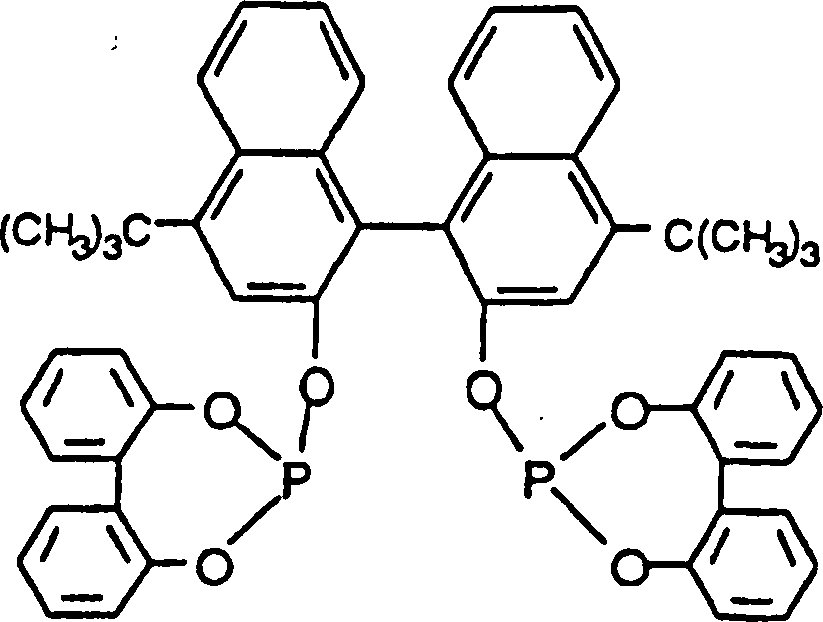
6,6'-[[3,3'-Bis(1,1-dimethylethyl)-5,5'-dimethoxy-[1,1'-biphenyl]-2,2'-diyl]bis(oxy)]bis-dibenzo[d,f][1,3,2]dioxaphosphepin mit der Formel:6,6 '- [[3,3'-bis (1,1-dimethylethyl) -5,5'-dimethoxy- [1,1'-biphenyl] -2,2'-diyl] bis (oxy)] bis -dibenzo [d, f] [1,3,2] dioxaphosphepin with the formula:

6,6'-[[3,3',5,5'-Tetrakis(1,1-dimethylpropyl)-[1,1'-biphenyl]-2,2'-diyl]bis(oxy)]bis-dibenzo[d,f][1,3,2]dioxaphosphepin mit der Formel:6,6 '- [[3,3', 5,5'-tetrakis (1,1-dimethylpropyl) - [1,1'-biphenyl] -2,2'-diyl] bis (oxy)] bis-dibenzo [d, f] [1,3,2] dioxaphosphepin with the formula:
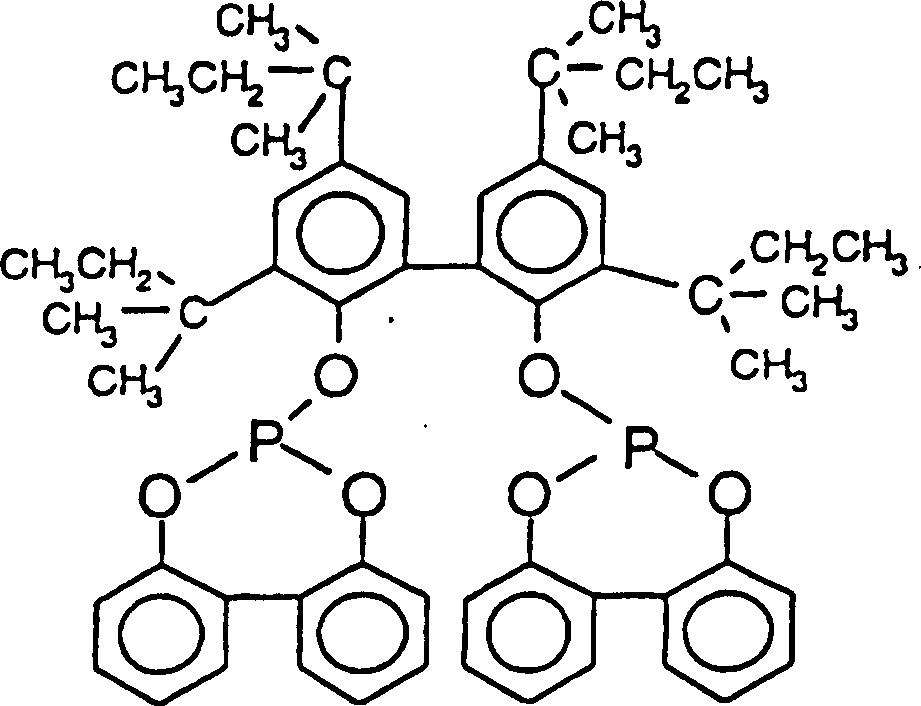
6,6'-[[3,3',5,5'-Tetrakis(1,1-dimethylethyl)-1,1'-biphenyl]-2,2'-diyl]bis(oxy)bis-dibenzo[d,f][1,3,2]-dioxaphosphepin mit der Formel:6,6 '- [[3,3', 5,5'-tetrakis (1,1-dimethylethyl) -1,1'-biphenyl] -2,2'-diyl] bis (oxy) bis-dibenzo [d , f] [1,3,2] dioxaphosphepin with the formula:

(2R,4R)-Di[2,2'-(3,3',5,5'-tetrakis-tert.-amyl-1,1'-biphenyl)]-2,4-pentyldiphosphit mit der Formel:(2R, 4R) -di [2,2 '- (3,3', 5,5'-tetrakis-tert-amyl-1,1'-biphenyl)] - 2,4-pentyldiphosphit with the formula:

(2R,4R)-Di[2,2'-(3,3',5,5'-tetrakis-tert.-butyl-1,1'-biphenyl)]-2,4-pentyldiphosphit mit der Formel:(2R, 4R) -di [2,2 '- (3,3', 5,5'-tetrakis-tert-butyl-1,1'-biphenyl)] - 2,4-pentyldiphosphit with the formula:

(2R,4R)-Di[2,2'-(3,3'-di-amyl-5,5'-dimethoxy-1,1'-biphenyl)]-2,4-pentyldiphosphit mit der Formel:(2R, 4R) -di [2,2 '- (3,3'-di-amyl-5,5'-dimethoxy-1,1'-biphenyl)] - 2,4-pentyldiphosphit with the formula:

(2R,4R)-Di[2,2'-(3,3'-di-tert.-butyl-5,5'-dimethyl-1,1'-biphenyl)]-2,4-pentyldiphosphit mit der Formel:(2R, 4R) -di [2,2 '- (3,3'-di-tert-butyl-5,5'-dimethyl-1,1'-biphenyl)] - 2,4-pentyldiphosphit with the formula:

(2R,4R)-Di[2,2'-(3,3'-di-tert.-butyl-5,5'-diethoxy-1,1'-biphenyl)]-2,4-pentyldiphosphit mit der Formel:(2R, 4R) -di [2,2 '- (3,3'-di-tert-butyl-5,5'-diethoxy-1,1'-biphenyl)] - 2,4-pentyldiphosphit with the formula:

(2R,4R)-Di[2,2'-(3,3'-di-tert.-butyl-5,5'-diethyl-1,1'-biphenyl)]-2,4-pentyldiphosphit mit der Formel:(2R, 4R) -di [2,2 '- (3,3'-di-tert-butyl-5,5'-diethyl-1,1'-biphenyl)] - 2,4-pentyldiphosphit with the formula:

(2R,4R)-Di[2,2'-(3,3'-di-tert.-butyl-5,5'-dimethoxy-1,1'-biphenyl)]-2,4-pentyldiphosphit mit der Formel:(2R, 4R) -di [2,2 '- (3,3'-di-tert-butyl-5,5'-dimethoxy-1,1'-biphenyl)] - 2,4-pentyldiphosphit with the formula:

6-[[2'-[(4,6-Bis(1,1-dimethylethyl)-1,3,2-benzodioxaphosphol-2-yl)oxy]-3,3'-bis(1,1-dimethylethyl)-5,5'-dimethoxy[1,1'-biphenyl]-2-yl]oxy]-4,8-bis(1,1-dimethylethyl)-2,10-dimethoxydibenzo[d,f][1,3,2]dioxaphosphepin mit der Formel:6 - [[2 '- [(4,6-bis (1,1-dimethylethyl) -1,3,2-benzodioxaphosphol-2-yl) oxy] (1,1-dimethylethyl) -3,3'-bis -5,5'-dimethoxy [1,1'-biphenyl] -2-yl] oxy] -4,8-bis (1,1-dimethylethyl) -2,10-dimethoxydibenzo [d, f] [1,3 , 2] dioxaphosphepin with the formula:

6-[[2'-[1,3,2-Benzodioxaphosphol-2-yl)oxy]-3,3'-bis(1,1-dimethylethyl)-5,5'-dimethoxy[1,1'-biphenyl]-2-yl]oxy]-4,8-bis(1,1-dimethylethyl)-2,10-dimethoxydibenzo[d,f][1,3,2]dioxaphosphepin mit der Formel:6 - [[2 '- [1,3,2-Benzodioxaphosphol-2-yl) oxy] -3,3'-bis (1,1-dimethylethyl) -5,5'-dimethoxy [1,1'-biphenyl ] -2-yl] oxy] -4,8-bis (1,1-dimethylethyl) -2,10-dimethoxydibenzo [d, f] [1,3,2] dioxaphosphepin with the formula:

6-[[2'-[(5,5'-Dimethyl-1,3,2-dioxaphosphorinan-2-yl)oxy]-3,3'-bis(1,1-dimethylethyl)-5,5'-dimethoxy[1,1'-biphenyl]-2-yl]oxy]-4,8-bis(1,1-dimethylethyl)-2,10-dimethoxydibenzo[d,f][1,3,2]dioxaphosphepin mit der Formel:6 - [[2 '- [(5,5'-dimethyl-1,3,2-dioxaphosphorinan-2-yl) oxy] -3,3'-bis (1,1-dimethylethyl) -5,5'- dimethoxy [1,1'-biphenyl] -2-yl] oxy] -4,8-bis (1,1-dimethylethyl) -2,10-dimethoxydibenzo [d, f] [1,3,2] dioxaphosphepin with the formula:

2'-[[4,8-Bis(1,1-dimethylethyl)-2,10-dimethoxydibenzo[d,f][1,3,2]dioxaphosphepin-6-yl]oxy]-3,3'-bis-(1,1-dimethylethyl)-5,5'-dimethoxy[1,1'-biphenyl]-2-yl-bis(4-hexylphenyl)ester von phosphoriger Säure mit der Formel:2 '- [[4,8-bis (1,1-dimethylethyl) -2,10-dimethoxydibenzo [d, f] [1,3,2] dioxaphosphepin-6-yl] oxy] -3,3'-bis - (1,1-dimethylethyl) -5,5'-dimethoxy [1,1'-biphenyl] -2-yl-bis (4-hexylphenyl) ester of phosphorous acid with the formula:
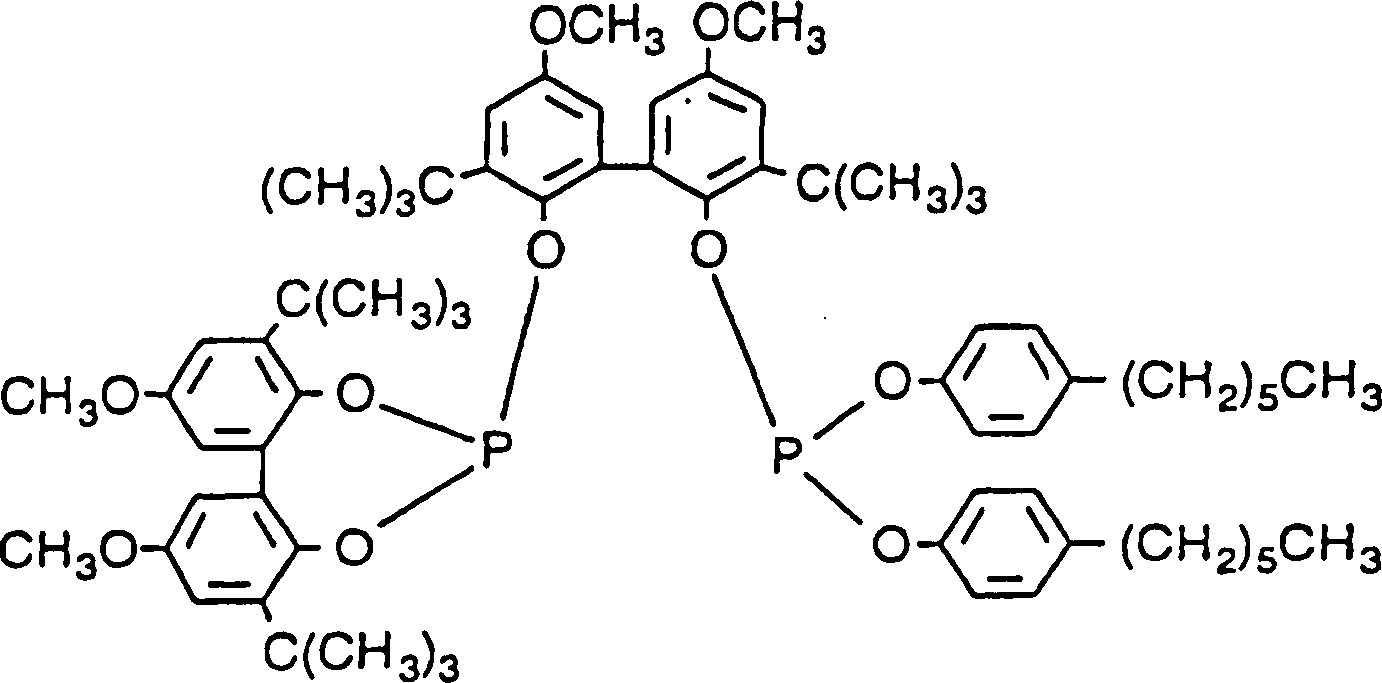
2-[[2-[[4,8,-Bis(1,1-dimethylethyl)-2,10-dimethoxydibenzo[d,f][1,3,2]dioxophosphepin-6-yl]oxy]-3-(1,1-dimethylethyl)-5-methoxyphenyl]methyl]-4-methoxy,6-(1,1-dimethylethyl)phenyldiphenylester von phosphoriger Säure mit der Formel:2 - [[2 - [[4,8-bis (1,1-dimethylethyl) -2,10-dimethoxydibenzo [d, f] [1,3,2] dioxophosphepin-6-yl] oxy] -3- (1,1-dimethylethyl) -5-methoxyphenyl] methyl] -4-methoxy, 6- (1,1-dimethylethyl) phenyldiphenylester of phosphorous acid with the formula:

3-Methoxy-1,3-cyclohexamethylen-tetrakis[3,6-bis(1,1-dimethylethyl)-2-naphthalenyl]ester von phosphoriger Säure mit der Formel:3-Methoxy-1,3-cyclohexamethylene-tetrakis [3,6-bis (1,1-dimethylethyl) -2-naphthalenyl] ester of phos phoric acid with the formula:

2,5-Bis(1,1-dimethylethyl)-1,4-phenylen-tetrakis[2,4-bis(1,1-dimethylethyl)phenyl]ester von phosphoriger Säure mit der Formel:2,5-bis (1,1-dimethylethyl) -1,4-phenylene tetrakis [2,4-bis (1,1-dimethylethyl) phenyl] ester of phosphorous acid with the formula:

Methylendi-2,1-phenylen-tetrakis[2,4-bis(1,1-dimethylethyl)phenyl]ester von phosphoriger Säure mit der Formel:Methylenedi-2,1-phenylene tetrakis [2,4-bis (1,1-dimethylethyl) phenyl] ester of phosphorous acid with the formula:

[1,1'-Biphenyl]-2,2'-diyl-tetrakis-2-(1,1-dimethylethyl)-4-methoxyphenyl]ester von phosphoriger Säure mit der Formel:[1,1'-biphenyl] -2,2'-diyl tetrakis-2- (1,1-dimethylethyl) -4-methoxyphenyl] ester of phosphorous acid with the formula:

Wie oben erwähnt können die Metall-Organophosphitligand-Komplex-Katalysatoren, die in dieser Erfindung einsetzbar sind, durch in der Technik bekannte Verfahren gebildet werden. Die Metall-Organophosphitligand-Komplex-Katalysatoren können in homogener oder heterogener Form vorliegen. Zum Beispiel können vorgeformte Rhodium-Hydrido-Carbonyl-Organophosphitligand-Katalysatoren hergestellt werden und in die Reaktionsmischung eines Hydroformylierungsverfahrens eingeführt werden. Bevorzugter können die Rhodium-Organophosphitligand-Komplex-Katalysatoren von einem Rhodiumkatalysatorvorläufer stammen, der in das Reaktionsmedium zur in-situ-Bildung des aktiven Katalysators eingeführt werden kann. Zum Beispiel können Rhodiumkatalysatorvorläufer, wie etwa Rhodiumdicarbonylacetylacetonat, Rh2O3, Rh4(CO)12, Rh6(CO)16, Rh(NO3)3 und ähnliche in die Reaktionsmischung zusammen mit dem Organophosphitliganden zur in-situ-Bildung des aktiven Katalysators eingeführt werden. In einer bevorzugten Ausführungsform dieser Erfindung wird Rhodiumdicarbonylacetylacetonat als ein Rhodiumvorläufer eingesetzt und in Gegenwart eines Lösungsmittels mit dem Organophosphitliganden umgesetzt, um einen katalytischen Rhodium-Organophosphitligand-Komplexvorläufer zu bilden, der in den Reaktor zusammen mit überschüssigem (freiem) Organophosphitliganden zur in-situ-Bildung des aktiven Katalysators eingeführt wird. In jedem Fall ist es für den Zweck dieser Erfindung ausreichend, dass Kohlenmonoxid, Wasserstoff und Organophosphitverbindung alles Liganden sind, die fähig sind, mit dem Metall komplexiert zu werden, und dass ein aktiver Metall-Organophosphitligand-Katalysator in der Reaktionsmischung unter den Bedingungen, die in der Hydroformylierungsreaktion verwendet werden, vorhanden ist.As mentioned above, the metal-organophosphite ligand complex catalysts useful in this invention can be formed by methods known in the art. The metal-organophosphite ligand complex catalysts may be in homogeneous or heterogeneous form. For example, preformed rhodium-hydrido-carbonyl-organophosphite ligand catalysts can be prepared and introduced into the reaction mixture of a hydroformylation process. More preferably, the rhodium-organophosphite ligand complex catalysts can be derived from a rhodium catalyst precursor which in the reaction medium can be introduced for in-situ formation of the active catalyst. For example, rhodium catalyst precursors such as rhodium dicarbonyl acetylacetonate, Rh 2 O 3 , Rh 4 (CO) 12 , Rh 6 (CO) 16 , Rh (NO 3 ) 3 and the like can be incorporated into the reaction mixture together with the organophosphite ligand for in-situ formation of the active catalyst can be introduced. In a preferred embodiment of this invention, rhodium dicarbonyl acetylacetonate is employed as a rhodium precursor and reacted with the organophosphite ligand in the presence of a solvent to form a rhodium-organophosphite ligand catalytic complex precursor which is introduced into the reactor along with excess (free) organophosphite ligand for in situ formation of the active catalyst is introduced. In any event, it is sufficient for the purpose of this invention that carbon monoxide, hydrogen and organophosphite compound are all ligands capable of being complexed with the metal and that an active metal-organophosphite ligand catalyst be present in the reaction mixture under the conditions used in the hydroformylation reaction.
Spezieller kann eine Katalysatorvorläufer-Zusammensetzung gebildet werden, die im Wesentlichen aus einem gelösten Metall-Organophosphitligand-Komplexvorläufer-Katalysator, einem organischen Lösungsmittel und freiem Organophosphitliganden besteht. Solche Vorläufer-Zusammensetzungen können hergestellt werden, indem eine Lösung eines Rhodiumausgangsstoffes, wie etwa einem Rhodiumoxid, -hydrid, -carbonyl oder -salz, z. B. einem Nitrat, der in komplexer Kombination mit einem Organophosphitliganden wie hierin definiert vorliegen kann oder nicht, gebildet wird. Jeder geeignete Rhodiumausgangsstoff kann eingesetzt werden, z. B. Rhodiumdicarbonylacetylacetonat, Rh2O3, Rh4(CO)12, Rh6(CO)16, Rh(NO3)3 und Organophosphitligand-Rhodiumcarbonylhydride. Carbonyl- und Organophosphitliganden, wenn sie nicht bereits mit dem ursprünglichen Rhodium komplexiert sind, können mit dem Rhodium entweder vor oder in situ während des Hydroformylierungsverfahrens komplexiert werden.More specifically, a catalyst precursor composition consisting essentially of a dissolved metal-organophosphite ligand complex precursor catalyst, an organic solvent, and free organophosphite ligand can be formed. Such precursor compositions can be prepared by reacting a solution of a rhodium starting material, such as a rhodium oxide, hydride, carbonyl or salt, e.g. A nitrate, which may or may not be in complex combination with an organophosphite ligand as defined herein. Any suitable rhodium starting material may be used, e.g. Rhodium dicarbonyl acetylacetonate, Rh 2 O 3 , Rh 4 (CO) 12 , Rh 6 (CO) 16 , Rh (NO 3 ) 3, and organophosphite ligand rhodium carbonyl hydrides. Carbonyl and organophosphite ligands, if not already complexed with the original rhodium, can be complexed with the rhodium either before or in situ during the hydroformylation process.
Die bevorzugte Katalysatorvorläufer-Zusammensetzung dieser Erfindung, als Veranschaulichung, besteht im Wesentlichen aus einem gelösten Rhodium-Carbonyl-Organophosphitligand-Komplexvorläufer-Katalysator, einem Lösungsmittel und optional freiem Organophosphitliganden und wird hergestellt, indem eine Lösung aus Rhodiumdicarbonylacetylacetonat, einem organischen Lösungsmittel und einem Organophosphitliganden wie hierin definiert gebildet wird. Der Organophosphitligand ersetzt ohne Weiteres einen der Carbonylliganden des Rhodiumacetylacetonat-Komplexvorläufers bei Raumtemperatur, wie durch die Entwicklung von Kohlenmonoxidgas bewiesen wird. Diese Substitutionsreaktion kann durch Erwärmen der Lösung erleichtert werden, falls gewünscht. Jedes geeignete organische Lösungsmittel, in dem sowohl der Rhodiumdicarbonylacetylacetonat-Komplexvorläufer als auch der Rhodium-Organophosphitligand-Komplexvorläufer löslich sind, kann eingesetzt werden. Die Mengen an Rhodiumkomplexkatalysatorvorläufer, organischem Lösungsmittel und Organophosphitligand, ebenso wie ihre bevorzugten Ausführungsformen, die in solchen Katalysatorvorläufer-Zusammensetzungen vorhanden sind, können offensichtlich solchen Mengen entsprechen, die in dem Hydroformylierungsverfahren dieser Erfindung einsetzbar sind. Die Erfahrung hat gezeigt, dass der Acetylacetonatligand des Vorläuferkatalysators ersetzt wird, nachdem der Hydroformylierungsprozess mit einem unterschiedlichen Liganden, z. B. Wasserstoff, Kohlenmonoxid oder auch Organophosphitligand, begonnen hat, den aktiven Komplexkatalysator wie oben erklärt zu bilden. Das Acetylaceton, das aus dem Vorläuferkatalysator unter Hydroformylierungsbedingungen freigesetzt wird, wird aus dem Reaktionsmedium zusammen mit dem Produktaldehyd entfernt und ist somit in keiner Weise für das Hydroformylierungsverfahren schädlich. Die Verwendung solcher bevorzugten katalytischen Rhodiumkomplexvorläufer-Zusammensetzungen stellt ein einfaches wirtschaftliches und wirkungsvolles Verfahren zur Handhabung des Rhodiumvorläufers und des Anspringens der Hydroformylierung bereit.The preferred catalyst precursor composition This invention, by way of illustration, is essentially from a solved Rhodium carbonyl organophosphite ligand complex precursor catalyst, a solvent and optionally free organophosphite ligand and is prepared by a solution from rhodium dicarbonyl acetylacetonate, an organic solvent and an organophosphite ligand as defined herein. The organophosphite ligand readily replaces one of the carbonyl ligands of the rhodium acetylacetonate complex precursor at room temperature, such as is evidenced by the evolution of carbon monoxide gas. These Substitution reaction can be facilitated by heating the solution if desired. Any suitable organic solvent, in which both the rhodium dicarbonyl acetylacetonate complex precursor as also the rhodium-organophosphite ligand complex precursor are soluble be used. The amounts of rhodium complex catalyst precursor, organic Solvent and Organophosphite ligand, as well as their preferred embodiments, those in such catalyst precursor compositions can exist obviously correspond to those amounts in the hydroformylation process can be used in this invention. Experience has shown that the acetylacetonate ligand of the precursor catalyst is replaced, after the hydroformylation process with a different Ligands, e.g. As hydrogen, carbon monoxide or organophosphite ligand, has begun to form the active complex catalyst as explained above. The acetylacetone obtained from the precursor catalyst under hydroformylation conditions is released from the reaction medium together with the Product aldehyde removed and is therefore in no way for the hydroformylation harmful. The use of such preferred catalytic rhodium complex precursor compositions provides a simple economical and effective process for handling the rhodium precursor and the initiation of hydroformylation.
Demgemäß bestehen die Metall-Organophosphitligand-Komplex-Katalysatoren, die in dem Verfahren dieser Erfindung verwendet werden, im Wesentlichen aus dem Metall, das mit Kohlenmonoxid und einem Organophosphitliganden komplexiert ist, wobei dieser Ligand an das Metall in einer Chelatform und/oder Nichtchelatform gebunden (komplexiert) ist. Des weiteren schließt die Terminologie "besteht im Wesentlichen aus", wie hierin verwendet, Wasserstoff, der mit dem Metall komplexiert ist, nicht aus, sondern umfasst diesen vielmehr, zusätzlich zu Kohlenmonoxid und dem Organophosphitliganden. Ferner schließt solche Terminologie nicht die Möglichkeit anderer organischen Liganden und/oder Anionen, die auch mit dem Metall komplexiert sein könnten, aus. Stoffe in Mengen, die übermäßig nachteilig den Katalysator vergiften oder übermäßig deaktivieren, sind nicht erwünscht und deshalb ist der Katalysator am günstigsten frei von Verunreinigungen, wie etwa metallgebundenem Halogen (z. B. Chlor), obwohl dies nicht unbedingt notwendig sein mag. Die Wasserstoff- und/oder Carbonylliganden eines aktiven Metall-Organophosphitligand-Komplex-Katalysators können als ein Ergebnis davon vorhanden sein, dass sie Liganden sind, die an einen Vorläuferkatalysator gebunden sind, und/oder als ein Ergebnis von in-situ-Bildung, z. B. infolge des Wasserstoff- und/oder Kohlenmonoxidgases, die in dem Hydroformylierungsverfahren dieser Erfindung eingesetzt werden.Accordingly exist the metal-organophosphite ligand complex catalysts used in the Processes of this invention are used essentially the metal containing carbon monoxide and an organophosphite ligand complexed, this ligand attached to the metal in a chelated form and / or non-chelate form (complexed). Furthermore includes the terminology "exists essentially "like used herein, hydrogen that is complexed with the metal, not rather, but rather includes this, in addition to carbon monoxide and the organophosphite ligand. Further, such terminology does not exclude the possibility other organic ligands and / or anions, which also with the Metal could be complexed, out. Substances in quantities that are excessively disadvantageous poison or over-deactivate the catalyst, are not wanted and therefore, the catalyst is most free of impurities, such as metal-bound halogen (e.g., chlorine), though not absolutely necessary. The hydrogen and / or carbonyl ligands of an active Metal-organophosphite ligand complex catalyst can as a result may be that they are ligands that bind to a precursor catalyst bound, and / or as a result of in situ formation, e.g. B. due to the hydrogen and / or carbon monoxide gas in the hydroformylation process of this invention.
Wie erwähnt umfassen die Hydroformylierungsverfahren dieser Erfindung die Verwendung eines Metall-Organophosphitligand-Komplex-Katalysators wie hierin beschrieben. Natürlich können auch Mischungen solcher Katalysatoren eingesetzt werden, falls gewünscht. Die Menge an Metall-Organophosphitligand-Komplex-Katalysator, die in dem Reaktionsmedium eines gegebenen Hydroformylierungsverfahrens, das von dieser Erfindung umfasst ist, vorhanden ist, muss nur die minimale Menge sein, die notwendig ist, um die gegebene Metallkonzentration bereitzustellen, von der gewünscht ist, dass sie eingesetzt wird, und die die Grundlage für mindestens die katalytische Menge an Metall liefern wird, die notwendig ist, um das spezielle Hydroformylierungsverfahren, das involviert ist, wie etwa z. B. in den oben erwähnten Patenten offenbart, zu katalysieren. Im Allgemeinen sollten Metall-, z. B. Rhodiumkonzentrationen im Bereich von 10 Teilen pro Million bis 1.000 Teilen pro Million, berechnet als freies Rhodium, in dem Hydroformylierungsreaktionsmedium für die meisten Prozesse ausreichend sein, während es im Allgemeinen bevorzugt ist, 10 bis 500 Teile pro Million Metall, z. B. Rhodium, und bevorzugter 25 bis 350 Teile pro Million Metall, z. B. Rhodium einzusetzen.As mentioned For example, the hydroformylation processes of this invention include use a metal-organophosphite ligand complex catalyst as herein described. Naturally can also mixtures of such catalysts can be used, if desired. The Amount of metal-organophosphite ligand complex catalyst used in the reaction medium of a given hydroformylation process, which is included in this invention, only the be minimal amount necessary to the given metal concentration to provide, of the desired is that it is used and that is the basis for at least will provide the catalytic amount of metal that is necessary the special hydroformylation process that is involved such as B. in the above-mentioned Patents discloses to catalyze. In general, metal, z. Rhodium concentrations in the range of 10 parts per million to 1,000 parts per million, calculated as free rhodium, in the Hydroformylation reaction medium sufficient for most processes be while it is generally preferred that 10 to 500 parts per million of metal, z. Rhodium, and more preferably 25 to 350 parts per million metal, z. B. use rhodium.
Zusätzlich zu dem Metall-Organophosphitligand-Komplex-Katalysator kann auch freier Organophosphitligand (d. h. Ligand, der nicht mit dem Metall komplexiert ist) in dem Hydroformylierungsreaktionsmedium vorhanden sein. Der freie Organophosphitligand kann jedem der oben definierten Organophosphitliganden entsprechen, die oben als hierin einsetzbar diskutiert wurden. Es ist bevorzugt, dass der freie Organophosphitligand der gleiche wie der Organophosphitligand des eingesetzten Metall-Organophosphitligand-Komplex-Katalysators ist. Solche Liganden jedoch müssen nicht in jedem gegebenen Verfahren die gleichen sein. Das Hydroformylierungsverfahren dieser Erfindung kann 0,1 mol oder weniger bis 100 mol oder mehr freien Organophosphitliganden pro mol Metall in dem Hydroformylierungsreaktionsmedium enthalten. Vorzugsweise wird das Hydroformylierungsverfahren dieser Erfindung in Gegenwart von 1 bis 50 mol Organophosphitligand und bevorzugter für Organopolyphosphite von 1,1 bis 4 mol Organopolyphosphitligand pro mol Metall, das in dem Reaktionsmedium vorhanden ist, durchgeführt, wobei diese Mengen an Organophosphitligand die Summe von sowohl der Menge an Organophosphitligand, der an das vorhandene Rhodium gebunden (komplexiert) ist, als auch der Menge an vorhandenem freien (nicht komplexierten) Organophosphitliganden sind. Da es bevorzugter ist, nicht optisch aktive Aldehyde durch Hydroformylierung von achiralen Olefinen herzustellen, sind die bevorzugteren Organophosphitliganden Organophosphitliganden des achiralen Typs, insbesondere solche, die von Formel (V) oben umfasst sind, und bevorzugter solche der Formeln (VI) und (IX) oben. Natürlich kann, falls gewünscht, Nachschub- oder zusätzlicher Organophosphitligand dem Reaktionsmedium des Hydroformylierungsverfahrens zu jeder Zeit und in jeder geeigneten Art und Weise zugeführt werden, um z. B. ein vorbestimmtes Niveau an freiem Ligand in dem Reaktionsmedium aufrechtzuerhalten.In addition to The metal-organophosphite ligand complex catalyst may also be more free Organophosphite ligand (i.e., ligand that does not complex with the metal is) in the hydroformylation reaction medium. Of the free organophosphite ligand may correspond to any of the above-defined organophosphite ligands, which have been discussed above as being useful herein. It is preferable the free organophosphite ligand is the same as the organophosphite ligand the metal-organophosphite ligand complex catalyst used is. However, such ligands must not be the same in any given procedure. The hydroformylation process This invention may be 0.1 mol or less to 100 mol or more free organophosphite ligands per mole of metal in the hydroformylation reaction medium contain. Preferably, the hydroformylation process of this Invention in the presence of 1 to 50 mol Organophosphitligand and more preferred for organopolyphosphites from 1.1 to 4 moles of organopolyphosphite ligand per mole of metal incorporated in the reaction medium is present, carried out, these amounts of Organophosphite ligand is the sum of both the amount of organophosphite ligand, which is bound (complexed) to the existing rhodium, as well the amount of free (uncomplexed) organophosphite ligand present are. Since it is more preferred, non-optically active aldehydes by Hydroformylation of achiral olefins are the more preferred organophosphite ligands organophosphite ligands of the achiral type, in particular those comprising formula (V) above and more preferably those of formulas (VI) and (IX) above. Of course, if desired, Replenishment or additional Organophosphite ligand the reaction medium of the hydroformylation process be fed at any time and in any suitable manner, to z. A predetermined level of free ligand in the reaction medium maintain.
Wie oben angegeben, kann der Hydroformylierungskatalysator während der Reaktion und/oder während der Produktabtrennung in heterogener Form vorliegen. Solche Katalysatoren sind besonders vorteilhaft bei der Hydroformylierung von Olefinen, um hochsiedende oder thermisch empfindliche Aldehyde herzustellen, so dass der Katalysator von dem Produkten durch Filtration oder Dekantieren bei niedrigen Temperaturen abgetrennt werden kann. Zum Beispiel kann der Rhodiumkatalysator an einen Träger gebunden werden, so dass der Katalysator seine feste Form während sowohl der Hydroformylierungs- als auch den Trennstufen beibehält, oder er ist in einem flüssigen Reaktionsmedium bei hohen Temperaturen löslich und wird dann nach Abkühlen ausgefällt.As stated above, the hydroformylation catalyst may be used during the Reaction and / or during the product separation in heterogeneous form. Such catalysts are particularly advantageous in the hydroformylation of olefins, to produce high-boiling or thermally sensitive aldehydes, so that the catalyst from the products by filtration or Decantation can be separated at low temperatures. To the For example, the rhodium catalyst can be bound to a support so that the catalyst retains its solid form during both the hydroformylation as well as the separation stages, or he is in a liquid Reactive medium soluble at high temperatures and is then precipitated after cooling.
Als eine Veranschaulichung kann der Rhodiumkatalysator auf irgendeinen festen Träger, wie etwa anorganische Oxide (d. h. Aluminiumoxid, Siliciumdioxid, Titandioxid oder Zirkoniumdioxid), Kohlenstoff oder Ionenaustauschharze, imprägniert werden. Der Katalysator kann auf einem Zeolith, Glas oder Ton unterstützt sein oder in deren Poren eingelagert sein; der Katalysator kann auch in einem flüssigen Film gelöst sein, der die Poren dieses Zeoliths oder Glases überzieht. Solche zeolithgestützten Katalysatoren sind besondert vorteilhaft zur Herstellung von einem oder mehreren regioisomeren Aldehyden in hoher Selektivität, wie durch die Porengröße des Zeoliths bestimmt wird. Die Techniken zur Unterstützung von Katalysatoren auf Feststoffen, wie etwa beginnende Feuchtigkeit, werden den Fachleuten bekannt sein. Der so gebildete feste Katalysator kann noch mit einem oder mehreren der oben definierten Liganden komplexiert werden. Beschreibungen solcher festen Katalysatoren können z. B. in: J. Mol. Cat. 1991, 70, 363–368; Catal. Lett. 1991, 8, 209–214; J. Organomet. Chem, 1991, 403, 221–227; Nature, 1989, 339, 454–455; J. Catal. 1985, 96, 563–573; J. Mol. Cat. 1987, 39, 243–259 gefunden werden.When An illustration may refer to any of the rhodium catalyst solid support, such as inorganic oxides (i.e., alumina, silica, Titanium dioxide or zirconia), carbon or ion exchange resins, waterproof become. The catalyst may be supported on a zeolite, glass or clay or embedded in their pores; the catalyst can too in a liquid Movie solved which covers the pores of this zeolite or glass. Such zeolite supported catalysts are particularly advantageous for the production of one or more regioisomeric aldehydes in high selectivity, such as by the pore size of the zeolite is determined. The techniques for supporting catalysts Solids, such as incipient moisture, will be available to those skilled in the art be known. The solid catalyst thus formed can still with a or more of the ligands defined above. Descriptions of such solid catalysts may, for. In: J. Mol. Cat. 1991, 70, 363-368; Catal. Lett. 1991, 8, 209-214; J. Organomet. Chem, 1991, 403, 221-227; Nature, 1989, 339, 454-455; J. Catal. 1985, 96, 563-573; J. Mol. Cat. 1987, 39, 243-259 being found.
Der Metall-, z. B. Rhodiumkatalysator kann an einen Dünnschicht- oder Membranträger, wie etwa Celluloseacetat oder Polyphenylensulfon, gebunden sein, wie z. B. in J. Mol. Cat. 1990, 63, 213–221 beschrieben.Of the Metal, z. B. Rhodium catalyst can be attached to a thin film or membrane carrier, such as cellulose acetate or polyphenylene sulfone, such as In J. Mol. Cat. 1990, 63, 213-221.
Der Metall-, z. B. Rhodiumkatalysator kann an einen unlöslichen polymeren Träger über einen organophosphorhaltigen Liganden, wie etwa ein Phosphit, der in das Polymer eingebaut ist, gebunden sein. Der unterstützte Katalysator ist nicht durch die Auswahl an Polymer oder phosphorhaltigen Spezies, die darin eingebaut sind, beschränkt. Beschreibungen von polymergestützten Katalysatoren können z. B. in: J. Mol. Cat. 1993, 83, 17–35; Chemtech 1983, 46; J. Am. Chem. Soc 1987, 109, 7122–7127 gefunden werden.The metal, z. B. Rhodium catalyst may be bonded to an insoluble polymeric support via an organophosphorus-containing ligand, such as a phosphite incorporated into the polymer. Of the supported catalyst is not limited by the choice of polymer or phosphorus-containing species incorporated therein. Descriptions of polymer-supported catalysts may, for. In: J. Mol. Cat. 1993, 83, 17-35; Chemtech 1983, 46; J. Am. Chem. Soc. 1987, 109, 7122-7127.
In den oben beschriebenen heterogenen Katalysatoren kann der Katalysator während des gesamten Hydroformylierungs- und Katalysatorabtrennverfahrens in seiner heterogenen Form bleiben. In einer anderen Ausführungsform der Erfindung kann der Katalysator auf einem Polymer unterstützt sein, das durch die Natur seines Molekulargewichts in dem Reaktionsmedium bei erhöhten Temperaturen löslich ist, aber nach Kühlen ausfällt, somit Katalysatorabtrennung aus der Reaktionsmischung erleichtert. Solche "löslichen" polymergestützten Katalysatoren sind z. B. in Polymer, 1992, 33, 161; J. Org. Chem. 1989, 54, 2726–2730 beschrieben.In The above-described heterogeneous catalysts, the catalyst while the entire hydroformylation and catalyst separation process stay in its heterogeneous shape. In another embodiment of the invention, the catalyst may be supported on a polymer, that by the nature of its molecular weight in the reaction medium at elevated Temperatures soluble is, but after cooling fails, thus Catalyst separation from the reaction mixture easier. Such "soluble" polymer-supported catalysts are, for. In Polymer, 1992, 33, 161; J. Org. Chem. 1989, 54, 2726-2730.
Bevorzugter wird die Reaktion infolge der hohen Siedepunkte der Produkte und um Zersetzung der Produktaldehyde zu vermeiden, in der Aufschlämmungsphase durchgeführt. Der Katalysator kann dann von der Produktmischung, z. B. durch Filtration oder Dekantieren, abgetrennt werden. Die Reaktionsproduktflüssigkeit kann einen heterogenen Metall-Organophosphitligand-Komplex-Katalysator, z. B. als Aufschlämmung, enthalten, oder mindestens ein Teil der Reaktionsproduktflüssigkeit kann einen fixierten heterogenen Metall-Organophosphitligand-Komplex-Katalysator während des Hydroformylierungsverfahren berühren. In einer Ausführungsform dieser Erfindung kann der Metall-Organophosphitligand-Komplex-Katalysator in der Reaktionsproduktflüssigkeit aufgeschlämmt sein.preferred the reaction is due to the high boiling points of the products and in order to avoid decomposition of the product aldehydes in the slurry phase carried out. The catalyst may then be removed from the product mixture, e.g. B. by filtration or decanting, to be separated. The reaction product liquid may be a heterogeneous metal-organophosphite ligand complex catalyst, z. As a slurry, or at least a portion of the reaction product liquid may be a fixed one heterogeneous metal-organophosphite ligand complex catalyst during the hydroformylation process touch. In one embodiment This invention may include the metal-organophosphite ligand complex catalyst in the reaction product liquid slurried be.
Die substituierten oder unsubstituierten olefinisch ungesättigten Ausgangsstoffreaktanten, die in den Hydroformylierungsverfahren dieser Erfindung eingesetzt werden können, umfassen sowohl optisch aktive (prochirale und chirale) als auch nicht optisch aktive (achirale) olefinisch ungesättigte Verbindungen mit 2 bis 40, vorzugsweise 4 bis 20 Kohlenstoffatomen. Solche olefinisch ungesättigten Verbindungen können endständig oder im Inneren ungesättigt sein und geradkettige, verzweigtkettige oder cyclische Strukturen haben, außerdem Olefinmischungen, wie etwa aus der Oligomerisation von Propen, Buten, Isobuten usw. erhalten (wie etwa sogenanntes dimeres, trimeres oder tetrameres Propylen, wie z. B. in U.S.-Patenten Nrn. 4,518,809 und 4,528,403 offenbart), sein. Des weiteren können solche Olefinverbindungen ferner ein oder mehrere ethylenisch ungesättigte Gruppen enthalten und natürlich können Mischungen aus zwei oder mehr unterschiedlichen olefinisch ungesättigten Verbindungen als das Ausgangshydroformylierungsmaterial eingesetzt werden, falls gewünscht. Zum Beispiel können kommerzielle α-Olefine mit 4 oder mehr Kohlenstoffatomen geringe Mengen an entsprechenden inneren Olefinen und/oder deren entsprechendem gesättigten Kohlenwasserstoff enthalten und solche kommerziellen Olefine müssen nicht notwendigerweise von denselben gereinigt werden, bevor sie hydroformyliert werden. Beispielhafte Mischungen von olefinischen Ausgangsstoffen, die in den Hydroformylierungsreaktionen verwendet werden können, umfassen z. B. gemischte Butene, z. B. Raffinat I und II. Weiterhin können solche olefinisch ungesättigten Verbindungen und die entsprechenden Aldehydprodukte, die sich davon ableiten, auch ein oder mehrere Gruppen oder Substituenten enthalten, die nicht den Hydroformylierungsprozess oder den Prozess dieser Erfindung übermäßig nachteilig beeinflussen, wie z. B. in U.S.-Patenten Nrn. 3,527,809 und 4,769,498 beschrieben.The substituted or unsubstituted olefinically unsaturated Starting material reactants used in the hydroformylation process of this invention include both optically active (prochiral and chiral) as well as non-optically active (achiral) olefinically unsaturated Compounds of 2 to 40, preferably 4 to 20 carbon atoms. Such olefinically unsaturated Connections can terminally or unsaturated in the interior and straight-chain, branched-chain or cyclic structures have, as well Olefin mixtures, such as from the oligomerization of propene, butene, Isobutene, etc. (such as so-called dimeric, trimeric or tetrameric propylene, such as. In U.S. Patent Nos. 4,518,809 and 4,528,403 disclosed). Furthermore, you can such olefin compounds further include one or more ethylenically unsaturated groups included and of course can Mixtures of two or more different olefinically unsaturated Compounds used as the Ausgangsshydroformylierungsmaterial if desired. For example, you can commercial α-olefins with 4 or more carbon atoms small amounts of corresponding internal olefins and / or their corresponding saturated Contain hydrocarbon and such commercial olefins do not need necessarily be purified from them before hydroformylating become. Exemplary mixtures of olefinic starting materials, which can be used in the hydroformylation reactions z. B. mixed butenes, e.g. B. raffinate I and II. Furthermore, such olefinically unsaturated Compounds and the corresponding aldehyde products that differ contain one or more groups or substituents, not the hydroformylation process or the process of this Invention excessively disadvantageous influence, such. In U.S. Patent Nos. 3,527,809 and 4,769,498 described.
Am meisten bevorzugt ist die betreffende Erfindung insbesondere für die Herstellung von nicht optisch aktiven Aldehyden durch Hydroformylierung von achiralen α-Olefinen mit 2 bis 30, vorzugsweise 4 bis 20 Kohlenstoffatomen und achiralen inneren Olefinen mit 4 bis 20 Kohlenstoffatomen, ebenso wie von Ausgangsmaterialmischungen solcher α-Olefine und inneren Olefine geeignet.At the Most preferably, the invention in question is in particular for the production of non-optically active aldehydes by hydroformylation of achiral α-olefins with 2 to 30, preferably 4 to 20 carbon atoms and achirals internal olefins of 4 to 20 carbon atoms, as well as of Starting material mixtures of such α-olefins and internal olefins suitable.
Beispielhafte α- und innere Olefine umfassen z. B. Ethylen, Propylen, 1-Buten, 1-Penten, 1-Hexen, 1-Octen, 1-Nonen, 1-Decen, 1-Undecen, 1-Dodecen, 1-Tridecen, 1-Tetradecen, 1-Pentadecen, 1-Hexadecen, 1-Heptadecen, 1-Octadecen, 1-Nonadecen, 1-Eicosen, 2-Buten, 2-Methylpropen (Isobutylen), 2-Methylbuten, 2-Penten, 2-Hexen, 3-Hexen, 2-Hepten, 2-Octen, Cyclohexen, Propylendimere, Propylentrimere, Propylentetramere, Butadien, Piperylen, Isopren, 2-Ethyl-1-hexen, Styrol, 4-Methylstyrol, 4-Isopropylstyrol, 4-tert.-Butylstyrol, α-Methylstyrol, 4-tert.-Butyl-α-methylstyrol, 1,3-Diisopropenylbenzol, 3-Phenyl-1-propen, 1,4-Hexadien, 1,7-Octadien, 3-Cyclohexyl-1-buten, außerdem 1,3-Diene, Butadien, Alkylalkenoate, z. B. Methylpentenoat, Alkenylalkanoate, Alkenylalkylether, Alkenole, z. B. Pentenole, Alkenale, z. B. Pentenale, wie etwa Allylalkohol, Allylbutyrat, Hex-1-en-4-ol, Oct-1-en-4-ol, Vinylacetat, Allylacetat, 3-Butenylacetat, Vinylpropionat, Allylpropionat, Methylmethacrylat, Vinylethylether, Vinylmethylether, Allylethylether, n-Propyl-7-octenoat, 3-Butennitril, 5-Hexenamid, Eugenol, Isoeugenol, Safrol, Isosafrol, Anethol, 4-Allylanisol, Inden, Limonen, β-Pinen, Dicyclopentadien, Cyclooctadien, Camphen und Linalool.Exemplary α- and inner Olefins include, for. Ethylene, propylene, 1-butene, 1-pentene, 1-hexene, 1-octene, 1-nonene, 1-decene, 1-undecene, 1-dodecene, 1-tridecene, 1-tetradecene, 1-pentadecene, 1-hexadecene, 1-heptadecene, 1-octadecene, 1-nonadecene, 1-eicosene, 2-butene, 2-methylpropene (isobutylene), 2-methylbutene, 2-pentene, 2-hexene, 3-hexene, 2-heptene, 2-octene, cyclohexene, propylene dimer, propylene trimer, Propylene tetramers, butadiene, piperylene, isoprene, 2-ethyl-1-hexene, Styrene, 4-methylstyrene, 4-isopropylstyrene, 4-tert-butylstyrene, α-methylstyrene, 4-tert-butyl-α-methylstyrene, 1,3-diisopropenylbenzene, 3-phenyl-1-propene, 1,4-hexadiene, 1,7-octadiene, 3-cyclohexyl-1-butene, Furthermore 1,3-dienes, butadiene, alkyl alkenoates, e.g. Methyl pentenoate, alkenyl alkanoates, Alkenyl alkyl ethers, alkenols, e.g. As pentenols, alkenals, z. Pentenals, such as allyl alcohol, allyl butyrate, hex-1-en-4-ol, oct-1-en-4-ol, Vinyl acetate, allyl acetate, 3-butenyl acetate, vinyl propionate, allyl propionate, Methyl methacrylate, vinyl ethyl ether, vinyl methyl ether, allyl ethyl ether, n-propyl-7-octenoate, 3-butenenitrile, 5-hexenamide, eugenol, isoeugenol, Safrol, isosafrole, anethole, 4-allylanisole, indene, limonene, β-pinene, dicyclopentadiene, Cyclooctadiene, camphene and linalool.
Prochirale
und chirale Olefine, die in der asymmetrischen Hydroformylierung
nützlich
sind und eingesetzt werden können,
um enantiomere Aldehydmischungen herzustellen, die von dieser Erfindung
umfasst werden können,
schließen
solche ein, die durch die Formel dargestellt werden: 
Beispielhafte optisch aktive oder prochirale olefinische Verbindungen, die in der asymmetrischen Hydroformylierung nützlich sind, umfassen z. B. p-Isobutylstyrol, 2-Vinyl-6-methoxy-2-naphthylen, 3-Ethenylphenylphenylketon, 4-Ethenylphenyl-2-thienylketon, 4-Ethenyl-2-fluorbiphenyl, 4-(1,3-Dihydro-1-oxo-2H-isoindol-2-yl)styrol, 2-Ethenyl-5-benzoylthiophen, 3-Ethenylphenylphenylether, Propenylbenzol, Isobutyl-4-propenylbenzol und Phenylvinylether. Andere olefinische Verbindungen umfassen substituierte Arylethylene, wie z. B. in U.S.-Patenten Nrn. 4,329,507, 5,360,938 und 5,491,266 beschrieben.exemplary optically active or prochiral olefinic compounds which are known in asymmetric hydroformylation, include e.g. B. p-isobutylstyrene, 2-vinyl-6-methoxy-2-naphthylene, 3-ethenylphenyl phenyl ketone, 4-ethenyl-2-thienyl ketone, 4-ethenyl-2-fluorobiphenyl, 4- (1,3-dihydro-1-oxo-2H-isoindol-2-yl) -styrene, 2-ethenyl-5-benzoylthiophene, 3-ethenylphenylphenyl ether, propenylbenzene, Isobutyl-4-propenylbenzene and phenyl vinyl ether. Other olefinic Compounds include substituted aryl ethylenes, such as. In U.S. patents Nos. 4,329,507, 5,360,938 and 5,491,266.
Beispiele für geeignete substituierte und unsubstituierte olefinische Ausgangsmaterialien umfassen solche zulässigen substituierten und unsubstituierten olefinischen Verbindungen, die in Kirk-Othmer, Encyclopedia of Chemical Technology, Vierte Auflage, 1996, beschrieben sind.Examples for suitable substituted and unsubstituted olefinic starting materials include such permissible substituted and unsubstituted olefinic compounds which in Kirk-Othmer, Encyclopedia of Chemical Technology, Fourth Edition, 1996, are described.
Die Reaktionsbedingungen der Hydroformylierungsverfahren, die von dieser Erfindung umfasst sind, können jede geeignete Art von Hydroformylierungsbedingungen umfassen, die zuvor zur Herstellung von optisch aktiven und/oder nicht optisch aktiven Aldehyden eingesetzt wurden. Zum Beispiel kann der Gesamtgasdruck von Wasserstoff, Kohlenmonoxid und Olefinausgangsverbindung des Hydroformylierungsverfahren von 108,21 bis 69.001 kPa (1 bis 10.000 psia) reichen. Im Allgemeinen jedoch ist es bevorzugt, dass das Verfahren bei einem Gesamtgasdruck von Wasserstoff, Kohlenmono xid und Olefinausgangsverbindung von weniger als 13.881 kPa (2.000 psia) und bevorzugter weniger als 3.546 kPa (500 psia) betrieben wird. Der minimale Gesamtdruck wird in erster Linie durch die Menge an Reaktanten beschränkt, die notwendig ist, um eine gewünschte Reaktionsgeschwindigkeit zu erhalten. Spezieller beträgt der Kohlenmonoxid-Partialdruck des Hydroformylierungsverfahren dieser Erfindung vorzugsweise 180,21 bis 6.991 kPa (1 bis 1.000 psia) und bevorzugter 122 bis 5,613 kPa (3 bis 800 psia), während der Wasserstoff-Partialdruck vorzugsweise 135,8 bis 3.546 kPa (5 bis 500 psia), bevorzugter 170 bis 4.235 kPa (10 bis 300 psia) beträgt. Im Allgemeinen kann das H2 : CO-Molverhältnis von gasförmigem Wasserstoff zu Kohlenmonoxid von 1 : 10 bis 100 : 1 oder höher reichen, wobei das bevorzugtere Wasserstoff-zu-Kohlenmonoxid-Molverhältnis von 1 : 10 bis 10 : 1 reicht. Weiterhin kann das Hydroformylierungsverfahren bei einer Reaktionstemperatur von –25°C bis 200°C durchgeführt werden. Im Allgemeinen sind Hydroformylierungsreaktionstemperaturen von 50°C bis 120°C für alle Arten von olefinischen Ausgangsstoffen bevorzugt. Es ist natürlich selbstverständlich, dass, wenn nicht optisch aktive Aldehydprodukte erwünscht sind, Olefinausgangsstoffe und Organophosphitliganden des achiralen Typs eingesetzt werden, und wenn optisch aktive Aldehydprodukte erwünscht sind, Olefinausgangsstoffe und Organophosphitliganden des prochiralen oder chiralen Typs eingesetzt werden. Es ist natürlich auch selbstverständlich, dass die Hydroformylierungsreaktionsbedingungen, die eingesetzt werden, durch die Art des gewünschten Aldehydprodukts bestimmt werden.The reaction conditions of the hydroformylation processes encompassed by this invention may include any suitable type of hydroformylation conditions previously used to prepare optically active and / or non-optically active aldehydes. For example, the total gas pressure of hydrogen, carbon monoxide, and olefin starting compound of the hydroformylation process may range from 108.21 to 69.001 kPa (1 to 10,000 psia). In general, however, it is preferred that the process be operated at a total gas pressure of hydrogen, carbon monoxide, and olefin starting compound of less than 2,000 psia and more preferably less than 3,546 kPa (500 psia). The minimum total pressure is limited primarily by the amount of reactants necessary to obtain a desired rate of reaction. More specifically, the carbon monoxide partial pressure of the hydroformylation process of this invention is preferably 180.21 to 6991 kPa (1 to 1000 psia), and more preferably 122 to 5.613 kPa (3 to 800 psia), while the hydrogen partial pressure is preferably 135.8 to 3546 kPa (5 to 500 psia), more preferably 170 to 4235 kPa (10 to 300 psia). In general, the H 2 : CO molar ratio of gaseous hydrogen to carbon monoxide may range from 1:10 to 100: 1 or higher, with the more preferred hydrogen to carbon monoxide molar ratio ranging from 1:10 to 10: 1. Furthermore, the hydroformylation process can be carried out at a reaction temperature of -25 ° C to 200 ° C. In general, hydroformylation reaction temperatures of 50 ° C to 120 ° C are preferred for all types of olefinic starting materials. It is, of course, understood that when non-optically active aldehyde products are desired, achiral-type olefin starting materials and organophosphite ligands are employed, and when optically active aldehyde products are desired, olefin starting materials and organophosphite ligands of the prochiral or chiral type are employed. It is of course also understood that the hydroformylation reaction conditions employed will be determined by the nature of the desired aldehyde product.
Der Kohlendioxidpartialdruck, der in den Hydroformylierungsverfahren dieser Erfindung nützlich ist, ist ausreichend, um keine wesentliche Zersetzung des Organophosphitliganden und/oder Deaktivierung des Metall-Organophosphitligand-Komplex-Katalysators zu bewirken. Der Kohlendioxidpartialdruck kann von 5 Mol-% bis 70 Mol-% reichen und ist typischerweise größer als 5 Mol-%, bezogen auf die Gesamtgasmischung. Wie hierin verwendet, bedeutet "wesentliche Zersetzung des Organophosphitliganden und/oder wesentliche Deaktivierung des Metall-Organophosphitligand-Komplex-Katalysators" mehr als 50% Zersetzung des Organophosphitliganden (pro 30 Tage kontinuierlicher Betrieb in Bezug auf die Anfangskonzentration dieses Organophosphitliganden) und mehr als 50% Deaktivierung des Metall-Organophosphitligand-Komplex-Katalysators (pro 30 Tage kontinuierlicher Betrieb in Bezug auf das höchste Aktivierungsniveau dieses Metall-Organophosphitligand-Komplex-Katalysators).The carbon dioxide partial pressure useful in the hydroformylation process of this invention is sufficient to cause no substantial decomposition of the organophosphite ligand and / or deactivation of the metal-organophosphite ligand complex catalyst. The carbon dioxide partial pressure may range from 5 mole% to 70 mole% and is typically greater than 5 mole%, based on the total gas mixture. As As used herein, "substantial decomposition of the organophosphite ligand and / or substantial deactivation of the metal-organophosphite ligand complex catalyst" means greater than 50% decomposition of the organophosphite ligand (per 30 days of continuous operation relative to the initial concentration of this organophosphite ligand) and greater than 50% deactivation of the metal-organophosphite ligand complex catalyst (per 30 days continuous operation with respect to the highest activation level of this metal-organophosphite ligand complex catalyst).
Diese Erfindung ist nützlich, die Wirtschaftlichkeit von Hydroformylierungsverfahren, die Kohlendioxid verwenden, zu verbessern. Typischerweise wird Kohlendioxid aus Synthesegas entfernt, bevor es in ein Oxoreaktionssystem eingeführt wird. Wie oben angegeben, ist die Investition für Aparraturen zur Entfernung von Kohlendioxid erheblich. Diese Erfindung erlaubt, dass die Investition in eine Oxoanlage wesentlich verringert wird, da Kohlendioxidentfernung nicht erforderlich ist, d. h. die Hydroformylierungsverfahren dieser Erfindung können in Gegenwart von Kohlendioxid durchgeführt werden, ohne zur wesentlichen Zersetzung des Organophosphitliganden und Deaktivierung des Metall-Organophosphitligand-Komplex-Katalysators solcher Hydroformylierungsverfahren beizutragen oder diese zu bewirken. Diese Erfindung verringert erheblich die hohen Kapitalkosten, die typischerweise für Oxoreaktionssysteme benötigt werden.These Invention is useful the economics of hydroformylation processes using carbon dioxide to improve. Typically, carbon dioxide is made from synthesis gas removed before it is introduced into an oxo reaction system. As stated above, the investment for repairs is for removal of carbon dioxide significantly. This invention allows the investment into an oxo plant is substantially reduced, since carbon dioxide removal is not required, d. H. the hydroformylation process of this Invention can be carried out in the presence of carbon dioxide without being essential Decomposition of the organophosphite ligand and deactivation of the metal-organophosphite ligand complex catalyst contribute to or cause such hydroformylation. This invention significantly reduces the high cost of capital that typically for Oxoreaction systems needed become.
Obwohl man nicht an irgendeine exakte Theorie oder eine mechanistische Ausführung gebunden sein möchte, wird geglaubt, dass der hemmende Effekt von Kohlendioxid, wenn es als ein Salz eines sulfonierten Triarylphosphins verwendet wird, in der relativ hohen Konzentration von Kohlensäure, die erzeugt wird, wenn Kohlendioxid in der wässrigen Katalysatorlösung gelöst wird, begründet ist. US-Patent Nr. 3,555,098 offenbart, dass Säure die Hydroformylierungsgeschwindigkeit verringern kann. Die Säure kann ihren hemmenden Effekt ausüben, indem sie die Menge eines Rhodium-Hydridligand-Komplexes verringert. Bei den Metall-Organophos phitligand-Komplex-Katalysatoren, die in dieser Erfindung eingesetzt werden, ist die Konzentration von Kohlensäure, die aus Kohlendioxid und gelöstem Wasser in der Katalysatorlösung gebildet wird, nicht ausreichend, um eine nachweisbare Wirkung auf die Hydroformylierungsgeschwindigkeit zu haben.Even though one does not follow any exact theory or a mechanistic one execution want to be bound It is believed that the inhibitory effect of carbon dioxide when it is used as a salt of a sulfonated triarylphosphine, in the relatively high concentration of carbon dioxide that is produced when carbon dioxide in the aqueous catalyst solution solved is justified is. U.S. Patent No. 3,555,098 discloses that acid is the rate of hydroformylation can reduce. The acid can exert its inhibitory effect, by reducing the amount of a rhodium-hydride ligand complex. In the case of metal-organophosphate ligand complex catalysts used in used in this invention is the concentration of carbonic acid, the from carbon dioxide and dissolved Water in the catalyst solution is not sufficient to have a detectable effect to have the hydroformylation rate.
Diese Erfindung, die die Verwendung von Wasser beinhaltet, ist insbesondere zur Verwendung in kontinuierlichen Hydroformylierungsverfahren mit Kreislaufführung der Katalysatorflüssigkeit anpassbar, die die Erfindung von US-Patent Nr. 5,288,918 einsetzen, welche Durchführung des Verfahrens in Gegenwart eines katalytisch aktiven verstärkenden Zusatzstoffes umfasst, wobei dieser Zusatzstoff ausgewählt ist aus der Klasse, bestehend aus zugesetztem Wasser, einer schwach sauren Verbindung (zum Beispiel Biphenol) oder sowohl zugesetztem Wasser als auch einer schwach sauren Verbindung. Der verstärkende Zusatzstoff wird eingesetzt, um zu unterstützen, dass ein unerwünschtes Monophosphitnebenprodukt, das während bestimmter Verfahren gebildet werden kann und das den Metallkatalysator wie hierin erklärt vergiftet, selektiv hydrolysiert wird und dessen Ansammlung verhindert wird. Es ist selbstverständlich, dass das bevorzugte Hydroformylierungsverfahren dieser Erfindung als ein im Wesentlichen "nichtwässriger" Prozess betrachtet wird, was bedeutet, dass irgendwelches Wasser, das in dem Hyroformylierungsreaktionsmedium vorhanden ist, gelöstes Wasser ist, z. B. nicht in einer Menge vorhanden ist, die ausreichend ist, um zu bewirken, dass entweder die Hydroformylierungsreaktion oder dieses Medium so betrachtet werden muss, als dass sie/es eine getrennte wässrige oder Wasserphase oder -schicht zusätzlich zu einer organischen Schicht umfasst.These Invention involving the use of water is particular for use in continuous hydroformylation processes Recycling the catalyst liquid customizable employing the invention of U.S. Patent No. 5,288,918, which implementation of the process in the presence of a catalytically active reinforcing Additive, wherein this additive is selected from the class consisting of added water, one weak acidic compound (for example biphenol) or both added Water as well as a weakly acidic compound. The reinforcing additive is used to assist that an undesirable Monophosphite byproduct which during certain method can be formed and that the metal catalyst as explained herein poisoned, selectively hydrolyzed and prevents its accumulation becomes. It goes without saying that the preferred hydroformylation process of this invention considered as a substantially "non-aqueous" process which means that any water present in the hydroformylation reaction medium is present, solved Water is, for. B. is not present in an amount that is sufficient is to cause either the hydroformylation reaction or that medium must be considered to be one separate aqueous or water phase or layer in addition to an organic one Layer includes.
Demgemäß muss die Menge an solchem Wasser, die in dem Hydroformylierungsverfahren dieser Erfindung einsetzbar ist, nur die minimale Menge sein, die notwendig ist, um die gewünschte selektive Hydrolyse des Organomonophosphitligand-Nebenprodukts wie in U.S.-Patent Nr. 5,288,918, auf das oben Bezug genommen wurde, zu erreichen. Mengen von solchem Wasser von 0,01 oder weniger bis zu 10 Gew.-% oder mehr, falls gewünscht, bezogen auf das Gesamtgewicht des Hydroformylierungsreaktionsmediums, können eingesetzt werden. Natürlich sind Mengen von Wasser, die auch zur nachteiligen Hydrolyse des gewünschten Organophosphitliganden in irgendeiner unerwünschten Geschwindigkeit führen könnten, zu vermeiden. Wie oben angegeben, sind Mengen von Wasser, die in einem zweiphasigen (organisch-wässrigem) Hydroformylierungsreaktionsmedium im Gegensatz zu dem gewünschten und üblichen einphasigen (organischen) homogenen Hydroformylierungsreaktionsmedium resultieren können, zu vermeiden. Im Allgemeinen ist es bevorzugt, Mengen von solchem Wasser in dem Bereich von 0,05 bis 10 Gew.-%, bezogen auf das Gesamtgewicht des Hydroformylierungsreaktionsmediums, einzusetzen.Accordingly, the Amount of such water used in the hydroformylation process This invention can be used only the minimum amount that is necessary to the desired selective hydrolysis of the organomonophosphite ligand by-product such as in U.S. Patent No. 5,288,918, referred to above, to reach. Amounts of such water from 0.01 or less up to 10% by weight or more, if desired, based on the total weight of the hydroformylation reaction medium may be used. Of course they are Quantities of water that are also harmful to the hydrolysis of the desired Organophosphite ligands at any undesirable rate avoid. As indicated above, amounts of water are in one two-phase (organic-aqueous) Hydroformylation reaction medium as opposed to the desired and usual single phase (organic) homogeneous hydroformylation reaction medium can result to avoid. In general, it is preferred to use amounts of such Water in the range of 0.05 to 10 wt .-%, based on the total weight of the hydroformylation reaction medium.
Die Hydroformylierungsverfahren, die von dieser Erfindung umfasst werden, werden auch in Gegenwart eines organischen Lösungsmittels für den Metall-Organophosphitligand-Komplex-Katalysator und den freien Organophosphitliganden durchgeführt. Das Lösungsmittel kann auch gelöstes Wasser bis zur Sättigungsgrenze enthalten. In Abhängigkeit von dem speziellen eingesetzten Katalysator und den speziellen eingesetzten Reaktanten umfassen geeignete organische Lösungsmittel z. B. Alkohole, Alkane, Alkene, Alkine, Ether, Aldehyde, höhersiedende Aldehydkondensationsnebenprodukte, Ketone, Ester, Amide, tertiäre Amine und Aromaten. Jedes beliebige geeignete Lösungsmittel, das nicht übermäßig nachteilig die beabsichtigte Hydroformylierungsreaktion stört, kann eingesetzt werden und solche Lösungsmittel können solche umfassen, die zuvor als üblicherweise in bekannten metallkatalysierten Hydroformylierungsreaktionen eingesetzt offenbart wurden. Mischungen aus einem oder mehreren unterschiedlichen Lösungsmitteln können eingesetzt werden, falls gewünscht. Im Allgemeinen ist es im Hinblick auf die Herstellung von achiralen (nicht optisch aktiven) Aldehyden bevorzugt, Aldehydverbindungen, die den Aldehydprodukten, die hergestellt werden sollen, entsprechen, und/oder höhersiedende flüssige Aldehydkondensationsnebenprodukte als die hauptsächlichen organischen Lösungsmittel einzusetzen, wie es in der Technik üblich ist. Solche Aldehydkondensationsnebenprodukte können auch vorgebildet werden, falls gewünscht, und demgemäß verwendet werden. Beispielhafte bevorzugte Lösungsmittel, die bei der Herstellung von Aldehyden einsetzbar sind, umfassen Ketone (z. B. Aceton und Methylethylketon), Ester (z. B. Ethylacetat), Kohlenwasserstoffe (z. B. Toluol), Nitrokohlenwasserstoffe (z. B. Nitrobenzol), Ether (z. B. Tetrahydrofuran (THF)) und Sulfolan. Geeignete Lösungsmittel sind in U.S.-Patent Nr. 5,312,996 offenbart. Die Menge an eingesetztem Lösungsmittel ist für die betreffende Erfindung nicht entscheidend und muss nur die Menge sein, die ausreichend ist, um den Katalysator und freien Liganden der zu behandelnden Hydroformylierungsreaktionsmischung aufzulösen. Im Allgemeinen kann die Menge an Lösungsmittel von etwa 5 Gewichtsprozent bis zu etwa 99 Gewichtsprozent oder mehr, bezogen auf das Gesamtgewicht des Ausgangsmaterials der Hydroformylierungsreaktionsmischung, reichen.The hydroformylation processes encompassed by this invention are also conducted in the presence of an organic solvent for the metal-organophosphite ligand complex catalyst and the free organophosphite ligand. The solvent may also contain dissolved water to the saturation limit. Depending on the particular catalyst employed and the particular reactants employed, suitable organic solvents include, for example, sodium carbonate. As alcohols, alkanes, alkenes, alkynes, Ethers, aldehydes, higher boiling aldehyde condensation by-products, ketones, esters, amides, tertiary amines and aromatics. Any suitable solvent which does not unduly interfere with the intended hydroformylation reaction may be employed and such solvents may include those previously disclosed as commonly employed in known metal-catalyzed hydroformylation reactions. Mixtures of one or more different solvents can be used if desired. Generally, with respect to the preparation of achiral (non-optically active) aldehydes, it is preferred to employ aldehyde compounds corresponding to the aldehyde products to be prepared and / or higher boiling liquid aldehyde condensation by-products as the major organic solvents, as in the art is common. Such aldehyde condensation by-products may also be preformed, if desired, and used accordingly. Exemplary preferred solvents useful in the preparation of aldehydes include ketones (e.g., acetone and methyl ethyl ketone), esters (e.g., ethyl acetate), hydrocarbons (e.g., toluene), nitrohydrocarbons (e.g., nitrobenzene ), Ethers (eg tetrahydrofuran (THF)) and sulfolane. Suitable solvents are disclosed in U.S. Patent No. 5,312,996. The amount of solvent employed is not critical to the subject invention and need only be that amount sufficient to dissolve the catalyst and free ligand of the hydroformylation reaction mixture to be treated. In general, the amount of solvent can range from about 5 weight percent to about 99 weight percent or more, based on the total weight of the hydroformylation reaction mixture starting material.
Demgemäß umfassen veranschaulichende nicht optisch aktive Aldehydprodukte z. B. Propionaldehyd, n-Butyraldehyd, Isobutyraldehyd, n-Valeraldehyd, 2-Methyl-1-butyraldehyd, Hexanal, Hydroxyhexanal, 2-Methylvaleraldehyd, Heptanal, 2-Methyl-1-hexanal, Octanal, 2-Methyl-1-heptanal, Nonanal, 2-Methyl-1-octanal, 2-Ethyl-1-heptanal, 3-Propyl-1-Hexanal, Decanal, Adipinaldehyd, 2-Methylglutaraldehyd, 2-Methyladipinaldehyd, 3-Methyladipinaldehyd, 3-Hydroxypropionaldehyd, 6-Hydroxyhexanal, Alkenale, z. B. 2-, 3- und 4-Pentenal, Alkyl-5-formylvalerat, 2-Methyl-1-nonanal, Undecanal, 2-Methyl-1-decanal, Dodecanal, 2-Methyl-1-undecanal, Tridecanal, 2-Methyl-1-Tridecanal, 2-Ethyl-1-dodecanal, 3-Propyl-1-undecanal, Pentadecanal, 2-Methyl-1-tetradecanal, Hexadecanal, 2-Methyl-1-pentadecanal, Heptadecanal, 2-Methyl-1-hexadecanal, Octadecanal, 2-Methyl-1-heptadecanal, Nonadecanal, 2-Methyl-1-octadecanal, 2-Ethyl-1-heptadecanal, 3-Propyl-1-hexadecanal, Eicosanal, 2-Methyl-1-nonacecanal, Heneicosanal, 2-Methyl-1-eicosanal, Tricosanal, 2-Methyl-1-docosanal, Tetracosanal, 2- Methyl-1-tricosanal, Pentacosanal, 2-Methyl-1-tetracosanal, 2-Ethyl-1-tricosanal, 3-Propyl-1-docasanal, Heptacosanal, 2-Methyl-1-octacosanal, Nonacosanal, 2-Methyl-1-octacosanal, Hentriacontanal und 2-Methyl-1-triacontanal.Accordingly, illustrative non-optically active aldehyde products e.g. For example, propionaldehyde, n-butyraldehyde, isobutyraldehyde, n-valeraldehyde, 2-methyl-1-butyraldehyde, Hexanal, hydroxyhexanal, 2-methylvaleraldehyde, heptanal, 2-methyl-1-hexanal, Octanal, 2-methyl-1-heptanal, nonanal, 2-methyl-1-octanal, 2-ethyl-1-heptanal, 3-propyl-1-hexanal, decanal, adipaldehyde, 2-methylglutaraldehyde, 2-methyladipaldehyde, 3-methyladipaldehyde, 3-hydroxypropionaldehyde, 6-hydroxyhexanal, alkenals, e.g. 2-, 3- and 4-pentenal, alkyl 5-formylvalerate, 2-methyl-1-nonanal, undecanal, 2-methyl-1-decanal, dodecanal, 2-methyl-1-undecanal, Tridecanal, 2-methyl-1-tridecanal, 2-ethyl-1-dodecanal, 3-propyl-1-undecanal, Pentadecanal, 2-methyl-1-tetradecanal, hexadecanal, 2-methyl-1-pentadecanal, Heptadecanal, 2-methyl-1-hexadecanal, octadecanal, 2-methyl-1-heptadecanal, Nonadecanal, 2-methyl-1-octadecanal, 2-ethyl-1-heptadecanal, 3-propyl-1-hexadecanal, Eicosanal, 2-methyl-1-nonacecanal, heneicosanal, 2-methyl-1-eicosanal, Tricosanal, 2-methyl-1-docosanal, tetracosanal, 2-methyl-1-tricosanal, Pentacosanal, 2-methyl-1-tetracosanal, 2-ethyl-1-tricosanal, 3-propyl-1-docasanal, heptacosanal, 2-methyl-1-octacosanal, nonacosanal, 2-methyl-1-octacosanal, hentriacontanal and 2-methyl-1-triacontanal.
Veranschaulichende optisch aktive Aldehydprodukte umfassen (enantiomere) Aldehydverbindungen, die durch das asymmetrische Hydroformylierungsverfahren dieser Erfindung hergestellt werden können, wie etwa z. B. S-2-(p-Isobutylphenyl)propionaldehyd, S-2-(6-Methoxy-2-naphthyl)propionaldehyd, S-2-(3-Benzoylphenyl)propionaldehyd, S-2-(p-Thienoylphenyl)propionaldehyd, S-2-(3-Fluor-4-phenyl)phenylpropionaldehyd, S-2-[4-(1,3-Dihydro-1-oxo-1H-isoindol-2-yl)phenyl]propionaldehyd, S-2-(2-Methylacetaldehyd)-5-benzoylthiophen und ähnliche.Illustrative Optically active aldehyde products include (enantiomeric) aldehyde compounds which by the asymmetric hydroformylation process of this invention can be produced such as B. S-2- (p-isobutylphenyl) propionaldehyde, S-2- (6-methoxy-2-naphthyl) propionaldehyde, S-2- (3-benzoylphenyl) propionaldehyde, S-2- (p-thienoylphenyl) propionaldehyde, S-2- (3-fluoro-4-phenyl) phenylpropionaldehyde, S-2- [4- (1,3-dihydro-1-oxo-1H-isoindole-2-one yl) phenyl] propionaldehyde, benzoylthiophene -5-S-2- (2-methylacetaldehyde) and similar.
Veranschaulichende geeignete substituiert und unsubstituierte Aldehydprodukte umfassen solche zulässigen substituierten und unsubstituierten Aldehydprodukte, die in Kirk-Othmer, Encyclopedia of Chemical Technology, Vierte Auflage, 1996, beschrieben sind.Illustrative suitable substituted and unsubstituted aldehyde products such permissible substituted and unsubstituted aldehyde products found in Kirk-Othmer, Encyclopedia of Chemical Technology, Fourth Edition, 1996 are.
Wie oben angegeben ist es im Allgemeinen bevorzugt, die Hydroformylierungsverfahren dieser Erfindung in einer kontinuierlichen Art und Weise durchzuführen. Im Allgemeinen sind kontinuierliche Hydroformylierungsprozesse in der Technik wohl bekannt und können umfassen: (a) Hydroformylieren des (der) olefinischen Ausgangsmaterials(ien) mit Kohlenmonoxid und Wasserstoff in einer flüssigen homogenen Reaktionsmischung, die ein Lösungsmittel, den Metall-Organophosphitligand-Komplex-Katalysator und freien Organophosphitliganden enthält; (b) Aufrechterhalten der Reaktionstemperatur und der Druckbedingungen, die für die Hydroformylierung des (der) Olefinausgangsmaterials(ien) günstig sind; (c) Zuführen von Nachschubmengen des (der) olefinischen Ausgangsmaterials(ien), Kohlenmonoxid und Wasserstoff zu dem Reaktionsmedium, wenn diese Reaktanten verbraucht sind, und (d) Gewinnen des (der) gewünschten Aldehyd-Hydroformylierungsprodukts(e) in irgendeiner gewünschten Art und Weise. Das kontinuierliche Verfahren kann in einem Einzeldurchgangsmodus durchgeführt werden, d. h., worin eine dampfförmige Mischung, die nicht umgesetztes(e) olefinisches(e) Ausgangsmaterial(ien) und verdampftes Aldehydprodukt enthält, aus der flüssigen Reaktionsmischung abgeführt wird, von woher das Aldehydprodukt gewonnen wird, und olefinisches(e) Nachschubausgangsmaterial(ien), Kohlenmonoxid und Wasserstoff dem flüssigen Reaktionsmedium für den nächsten Einzeldurchgang zugeführt werden, ohne das (die) nicht umgesetzte(n) olefinische(n) Ausgangsmaterial(ien) im Kreislauf zu führen. Solche Arten von Vorgehensweisen mit Kreislaufführung sind in der Technik wohl bekannt und können die Flüssigkeitskreislaufführung der Metall-Organophosphitligand-Komplex-Katalysatorflüssigkeit, die von dem (den) gewünschten Aldehydprodukt(en) abgetrennt wird, wie etwa z. B. in U.S.-Patent 4,148,830 offenbart, oder einen Gaskreislaufführungsvorgang, wie etwa z. B. in U.S.-Patent 4,247,486 offenbart, außerdem eine Kombination aus sowohl einem Flüssigkeits- als auch Gaskreislaufführungsvorgang umfassen, falls gewünscht. Das am meisten bevorzugte Hydroformylierungsverfahren dieser Erfindung umfasst ein kontinuierliches Verfahren mit Kreislaufführung der Katalysatorflüssigkeit. Geeignete Vorgehensweisen zur Kreislaufführung der Katalysatorflüssigkeit sind z. B. in U.S.-Patenten Nrn. 4,668,651; 4,774,361; 5,102,505 und 5,110,990 offenbart.As indicated above, it is generally preferred to carry out the hydroformylation processes of this invention in a continuous manner. In general, continuous hydroformylation processes are well known in the art and may include: (a) hydroformylating the olefinic starting material (s) with carbon monoxide and hydrogen in a liquid homogeneous reaction mixture containing a solvent, the metal-organophosphite ligand complex catalyst and contains free organophosphite ligands; (b) maintaining the reaction temperature and the pressure conditions favorable for the hydroformylation of the olefin starting material (s); (c) supplying replenishing amounts of the olefinic starting material (s), carbon monoxide and hydrogen to the reaction medium when these reactants are consumed, and (d) recovering the desired aldehyde hydroformylation product (s) in any desired manner and Wise. The continuous process can be carried out in a single pass mode, ie, wherein a vaporous mixture containing unreacted olefinic starting material (s) and vaporized aldehyde product is removed from the liquid reaction mixture, from whence the aldehyde product is recovered, and supplying olefinic replenisher (s), carbon monoxide and hydrogen to the liquid reaction medium for the next single pass without recycling the unreacted olefinic feedstock (s). Such types of closed loop procedures are well known in the art The fluid circulation guide of the metal-organophosphite ligand complex catalyst liquid separated from the desired aldehyde product (s), such as e.g. As disclosed in U.S. Patent 4,148,830, or a gas cycle guide operation such as e.g. As disclosed in U.S. Patent 4,247,486, also include a combination of both liquid and gas recirculation operations, if desired. The most preferred hydroformylation process of this invention comprises a continuous recycling process of the catalyst liquid. Suitable procedures for recycling the catalyst liquid are, for. In U.S. Patent Nos. 4,668,651; 4,774,361; 5,102,505 and 5,110,990.
In einer Ausführungsform dieser Erfindung können die Aldehydproduktmischungen von den anderen Komponenten der Rohreaktionsmischungen, in welchen die Aldehydmischungen hergestellt werden, durch irgendein geeignetes Verfahren abgetrennt werden. Geeignete Trennverfahren umfassen z. B. Lösungsmittelextraktion, Kristallisation, Destillation, Verdampfung, Fraktionierbürstenverdampfung, Fallfilmverdampfung, Phasentrennung, Filtration und ähnliche. Es mag gewünscht sein, die Aldehydprodukte, wenn sie gebildet werden, durch die Verwendung von Abfangmitteln von der Rohreaktionsmischung zu entfernen, wie in veröffentlichter PCT- Patentanmeldung WO 88/08835 beschrieben. Ein bevorzugtes Verfahren zur Abtrennung der Aldehydmischungen von den anderen Komponenten der Rohreaktionsmischungen ist Membrantrennung. Solche Membrantrennung kann wie in U.S.-Patent Nr. 5,430,194 und ebenfalls anhängigem U.S.-Patent Nr. 5,681,743 ausgeführt durchgeführt werden.In an embodiment of this invention the aldehyde product mixtures from the other components of the crude reaction mixtures, in which the aldehyde mixtures are prepared by any suitable method to be separated. Suitable separation methods include, for. B. solvent extraction, Crystallization, distillation, evaporation, fractionating brush evaporation, Falling film evaporation, phase separation, filtration and the like. It may be desired be the aldehyde products when they are formed by use remove scavengers from the crude reaction mixture, such as in published PCT patent application WO 88/08835. A preferred method for separation the aldehyde mixtures from the other components of the crude reaction mixtures is membrane separation. Such membrane separation can be carried out as described in U.S. Patent No. 5,430,194 and also pending U.S. Patent No. 5,681,743 carried out become.
Wie oben angegeben, können die gewünschten Aldehyde nach Abschluss (oder während) des Verfahrens dieser Erfindung aus den Reaktionsmischungen, die in dem Verfahren diese Erfindung verwendet werden, gewonnen werden. Zum Beispiel können die Aufarbeitungstechniken, die in U.S.-Patenten 4,148,830 und 4,247,486 offenbart sind, verwendet werden. Zum Beispiel kann in einem kontinuierlichen Verfahren mit Kreislaufführung der Katalysatorflüssigkeit der Teil der flüssigen Reaktionsmischung (enthaltend Aldehydprodukt, Katalysator usw.), d. h. Reaktionsproduktflüssigkeit, die aus der Reaktionszone entnommen wurde, in eine Auftrennzone, z. B. Verdampfer/Abscheider, geführt werden, wo das gewünschte Aldehydprodukt mittels Destillation in einer oder mehreren Stufen unter Normaldruck, reduziertem Druck oder erhöhtem Druck von der flüssigen Reaktionsflüssigkeit abgetrennt, kondensiert und in einem Produktaufnahmegefäß gesammelt und weiter gereinigt werden kann, falls gewünscht. Die verbleibende nicht verflüchtigte katalysatorhaltige flüssige Reaktionsmischung kann dann dem Reaktor wieder zugeführt werden, ebenso wie, falls gewünscht, irgendwelche anderen flüchtigen Stoffe, z. B. nicht umgesetztes Olefin, zusammen mit irgendwelchem Wasserstoff und Kohlenmonoxid, die in der flüssigen Reaktion nach Abtrennung derselben von dem kondensierten Aldehydprodukt, z. B. durch Destillation in irgendeiner üblichen Art und Weise, gelöst sind. Im Allgemeinen ist es bevorzugt, die gewünschten Aldehyde von der katalysatorhaltigen Reaktionsmischung bei reduziertem Druck und bei niedrigen Temperaturen abzutrennen, um mögliche Zersetzung des Organophosphitliganden und der Reaktionsprodukte zu vermeiden. Wenn auch ein α-Monoolefin-Reaktant eingesetzt wird, kann das Aldehydderivat desselben auch durch die obigen Methoden abgetrennt werden.As stated above the desired Aldehydes after completion (or during) of the process of this invention from the reaction mixtures which in the method of this invention are used. For example, you can the work-up techniques described in U.S. Patents 4,148,830 and 4,247,486 are disclosed. For example, in a continuous Method with circulation the catalyst liquid the part of the liquid Reaction mixture (containing aldehyde product, catalyst, etc.), d. H. Reaction product fluid, which was taken from the reaction zone, into a separation zone, z. B. evaporator / separator, out be where the desired Aldehyde product by distillation in one or more stages under normal pressure, reduced pressure or elevated pressure of the liquid reaction liquid separated, condensed and collected in a product receptacle and can be further purified, if desired. The remaining not volatilized catalyst-containing liquid reaction mixture can then be recycled to the reactor, as well as if desired any other fleeting ones Fabrics, e.g. Unreacted olefin, along with any Hydrogen and carbon monoxide in the liquid reaction after separation the same of the condensed aldehyde product, e.g. B. by distillation in any usual Way, solved are. In general, it is preferred to have the desired aldehydes from the catalyst-containing Reaction mixture at reduced pressure and at low temperatures separate to possible Decomposition of the organophosphite ligand and the reaction products to avoid. Although an α-monoolefin reactant is used, the aldehyde derivative of the same can also by the above methods are separated.
Spezieller können Destillation und Abtrennung des gewünschten Aldehydprodukts von der den Metall-Organophosphitligand-Komplex-Katalysator enthaltenden Reaktionsproduktflüssigkeit bei irgendeiner geeigneten gewünschten Temperatur stattfinden. Im Allgemeinen wird empfohlen, dass solch eine Destillation bei relativ niedrigen Temperaturen stattfindet, wie etwa unterhalb von 150°C und bevorzugter bei einer Temperatur im Bereich von etwa 50°C bis etwa 140°C. Es wird auch im Allgemeinen vorgeschlagen, dass solch eine Aldehydestillation bei reduziertem Druck, z. B. einem Gesamtgasdruck, der wesentlich niedriger als der Gesamtgasdruck ist, der während der Hydroformylierung eingesetzt wird, wenn niedrigsiedende Aldehyde (z. B. C4 bis C6) involviert sind, oder im Vakuum, wenn hochsiedende Aldehyde, (z. B. C7 oder größer) involviert sind, stattfindet. Zum Beispiel ist es eine übliche Praxis, das flüssige Reaktionsproduktmedium, das aus dem Hydroformylierungsreaktor entnommen wurde, einer Druckverminderung zu unterwerfen, um einen wesentlichen Teil der nicht umgesetzten Gase, die in dem flüssigen Medium gelöst sind, das nun eine viel niedrigere Synthesegaskonzentration als in dem Hydroformylierungsreaktionsmedium für die Destillationszone, z. B. Verdampfer/Abscheider, worin das gewünschte Aldehydprodukt destilliert wird, vorhanden war enthält, zu verdampfen. Im Allgemeinen sollten Destillationsdrücke im Bereich von Vakuumdrücken bis zu einem Gesamtgasdruck von etwa 50 psig für die meisten Zwecke ausreichend sein.More specifically, distillation and separation of the desired aldehyde product from the metal-organophosphite ligand complex catalyst-containing reaction product liquid may occur at any suitable desired temperature. Generally, it is recommended that such distillation take place at relatively low temperatures, such as below 150 ° C and more preferably at a temperature in the range of from about 50 ° C to about 140 ° C. It is also generally suggested that such aldehyde distillation be carried out under reduced pressure, e.g. A total gas pressure substantially lower than the total gas pressure used during hydroformylation when low boiling aldehydes (eg, C 4 to C 6 ) are involved, or in vacuum when high boiling aldehydes (e.g. C 7 or greater) are involved. For example, it is a common practice to subject the liquid reaction product medium withdrawn from the hydroformylation reactor to a pressure reduction to remove a substantial portion of the unreacted gases dissolved in the liquid medium, which now has a much lower synthesis gas concentration than that in the Hydroformylation reaction medium for the distillation zone, e.g. B. evaporator / separator wherein the desired aldehyde product is distilled, was present, to evaporate. In general, distillation pressures in the range of vacuum pressures to a total gas pressure of about 50 psig should be sufficient for most purposes.
Wie oben angegeben können die Reaktionsproduktflüssigkeiten, die saure Phosphorverbindungen und Kohlensäureverbindungen enthalten, in einer Säureentfernungszone ausreichend behandelt werden, um mindestens eine gewisse Menge der sauren Phosphorverbindungen und Kohlensäureverbindungen aus dieser Reaktionsproduktflüssigkeit zu entfernen. In einer Ausführungsform dieser Erfindung umfasst ein Mittel zur Verhinderung oder Minimierung der Ligandenzersetzung und Katalysatordeaktivierung und/oder Ausfällung, das in dieser Erfindung nützlich sein kann, Durchführung der Erfindung, die in ebenfalls anhängigen U.S.-Patenten Nrn. 5,741,944 und 5,741,942, die beide am selben Tag mit dieser Anmeldung eingereicht wurden, beschrieben und gelehrt ist, die Verwendung einer wässrigen Pufferlösung und optional organischer Stickstoffverbindungen wie darin offenbart umfasst.As indicated above, the reaction product liquids containing acidic phosphorus compounds and carbonic acid compounds can be sufficiently treated in an acid removal zone to remove at least some of the acidic phosphorus compounds and carbonic acid compounds from this reaction product liquid. In one embodiment of this invention, means for preventing or minimizing ligand decomposition and catalyst deactivation and / or precipitation, which may be useful in this invention, practice of the invention described and taught in co-pending U.S. Patent Nos. 5,741,944 and 5,741,942, both of which filed on the same day of this application, the use of an aqueous buffer solution and optionally organic nitrogen compounds as disclosed therein.
Zum Beispiel umfasst diese Erfindung bezüglich der wässrigen Pufferlösung Behandeln mindestens eines Teils der Reaktionsproduktflüssigkeit, die einen Metall-Organophosphitligand-Komplex-Katalysator enthält und aus diesen Hydroformylierungsverfahren stammt und die auch saure Phosphorverbindungen und Kohlensäureverbindungen enthält, die während dieses Hydroformylierungsverfahrens gebildet wurden, mit einer wässrigen Pufferlösung, um mindestens eine gewisse Menge der sauren Phosphorverbindungen und Kohlensäureverbindungen zu neutralisieren und aus dieser Reaktionsproduktflüssigkeit zu entfernen, und dann Rückführung der behandelnden Reaktionsproduktflüssigkeit in die Hydroformylierungsreaktionszone oder Auftrennzone. Beispielhafte saure Phosphorverbindungen umfassen z. B. H3PO3, Aldehydsäuren, wie etwa Hydroxyalkylphosphonsäuren, und H3PO4. Diese Behandlung der Reaktionsproduktflüssigkeit, die Metall-Organophosphitligand-Komplex-Katalysator enthält, mit der wässrigen Pufferlösung kann in irgendeiner geeigneten gewünschten Art oder Weise durchgeführt werden, die nicht übermäßig nachteilig den Grundhydroformylierungsprozess beeinflusst, aus dem diese Reaktionsproduktflüssigkeit stammte.For example, with respect to the aqueous buffer solution, this invention comprises treating at least a portion of the reaction product liquid containing a metal-organophosphite ligand complex catalyst derived from these hydroformylation processes and also containing acidic phosphorus compounds and carbonic acid compounds formed during this hydroformylation process with an aqueous one Buffer solution to neutralize and remove at least a certain amount of the acidic phosphorus compounds and carbonic acid compounds from this reaction product liquid, and then recycling the treating reaction product liquid into the hydroformylation reaction zone or separation zone. Exemplary acidic phosphorus compounds include e.g. H 3 PO 3 , aldehyde acids such as hydroxyalkylphosphonic acids, and H 3 PO 4 . This treatment of the reaction product liquid containing metal-organophosphite ligand complex catalyst with the aqueous buffer solution may be carried out in any suitable desired manner which does not unduly adversely affect the basic hydroformylation process from which this reaction product liquid originated.
Somit kann z. B. die wässrige Pufferlösung verwendet werden, um das gesamte oder einen Teil des Reaktionsmediums aus einem kontinuierlichen Hydroformylierungsverfahren mit Kreislaufführung der Katalysatorflüssigkeit, das aus der Reaktionszone entfernt wurde, zu irgendeiner Zeit vor oder nach Abtrennung des Aldehydproduktes daraus, zu behandeln. Bevorzugter umfasst diese Behandlung mit wässrigem Puffer Behandlung der gesamten oder eines Teils der Reaktionsproduktflüssigkeit, die nach Abdestillation von so viel Aldehydprodukt wie gewünscht erhalten wurde, z. B. vor oder während der Rückführung dieser Reaktionsproduktflüssigkeit in die Reaktionszone. Zum Beispiel wäre ein bevorzugter Modus, die gesamte oder einen Teil (z. B. einen Seitenstrom) der rückgeführten Reaktionsproduktflüssigkeit, die der Reaktionszone wieder zugeführt wird, kontinuierlich durch einen Flüssigkeitsextraktor zu führen, der die wässrige Pufferlösung enthält, unmittelbar bevor dieser katalysatorhaltige Rückstand wieder in die Reaktionszone eintritt.Consequently can z. B. the aqueous buffer solution used to cover all or part of the reaction medium from a continuous hydroformylation process with recycling of the Catalyst liquid, that was removed from the reaction zone at any one time or after separation of the aldehyde product therefrom. More preferably, this aqueous buffer treatment comprises treatment of all or part of the reaction product liquid after distilling off of as much aldehyde product as desired, e.g. B. before or during the return of this Reaction product fluid in the reaction zone. For example, a preferred mode would be all or part (eg, a side stream) of the recycled reaction product liquid, which is recycled to the reaction zone, continuously a liquid extractor respectively, the watery one buffer solution contains immediately before this catalyst-containing residue back into the reaction zone entry.
Somit ist selbstverständlich, dass die Reaktionsproduktflüssigkeit, die den Metall-Organophosphitligand-Komplex-Katalysator enthält und die mit der wässrigen Pufferlösung zu behandeln ist, zusätzlich zu dem Katalysatorkomplex und seinem organischen Lösungsmittel, Aldehydprodukt, freien Phosphitliganden, nicht umgesetztes Olefin und irgendwelche anderen Bestandteile oder Zusätze, die mit dem Reaktionsmedium des Hydroformylierungsprozesses, aus welchem diese Reaktionsproduktflüssigkeiten stammen, konsistent sind, enthalten kann.Consequently is self-evident, that the reaction product liquid, which contains the metal-organophosphite ligand complex catalyst and the with the watery buffer solution to treat, in addition to the catalyst complex and its organic solvent, Aldehyde product, free phosphite ligands, unreacted olefin and any other ingredients or additives associated with the reaction medium the hydroformylation process from which these reaction product liquids come, are consistent, can contain.
Typische maximale Konzentrationen der wässrigen Pufferlösung werden nur durch praktische Überlegungen bestimmt. Wie bemerkt, können Behandlungsbedingungen, wie etwa Temperatur, Druck und Berührungszeit auch stark variieren und jede geeignete Kombination solcher Bedingungen kann hierin eingesetzt werden. Im Allgemeinen sollten Flüssigkeitstemperaturen im Bereich von 20°C bis 80°C und vorzugsweise von 25°C bis 60°C für die meisten Fälle geeignet sein, obwohl niedrigere oder höhere Temperaturen eingesetzt werden könnten, falls gewünscht. Normalerweise wird die Behandlung unter Drücken durchgeführt, die vom Umgebungsdruck bis zu Reaktionsdrücken reichen, und die Berührungszeit kann von einem Zeitraum von Sekunden oder Minuten bis zu ein paar Stunden oder mehr variieren.typical maximum concentrations of the aqueous buffer solution be only by practical considerations certainly. As noted, you can Treatment conditions, such as temperature, pressure and contact time also vary widely and any suitable combination of such conditions can be used herein. In general, liquid temperatures should be in the range of 20 ° C up to 80 ° C and preferably 25 ° C up to 60 ° C for the most cases be suitable, although lower or higher temperatures are used could if desired. Usually, the treatment is performed under pressures that ranging from ambient pressure to reaction pressures, and the contact time can range from a few seconds or minutes to a few Hours or more vary.
Weiterhin kann der Erfolg bei der Entfernung von sauren Phosphorverbindungen aus der Reaktionsproduktflüssigkeit durch Messen der Zersetzungsgeschwindigkeit (Verbrauch) des Organophosphitliganden, der in dem Hydroformylierungsreaktionsmedium vorliegt, bestimmt werden. Zusätzlich wird, wenn die Neutralisation und Extraktion der sauren Phosphorverbindungen in die wässrige Pufferlösung fortschreitet, der pH der Pufferlösung abnehmen und mehr und mehr sauer werden. Wenn die Pufferlösung ein inakzeptables Aciditätsniveau erreicht, kann sie einfach durch eine neue Pufferlösung ersetzt werden.Farther can be the success in the removal of acidic phosphorus compounds from the reaction product liquid by measuring the decomposition rate (consumption) of the organophosphite ligand, the in the hydroformylation reaction medium. additionally when neutralization and extraction of the acidic phosphorus compounds into the watery buffer solution progresses, the pH of the buffer solution decrease and more and be more angry. If the buffer solution has an unacceptable level of acidity achieved, it can simply be replaced by a new buffer solution become.
Die wässrigen Pufferlösungen, die in dieser Erfindung einsetzbar sind, können jede geeignete Puffermischung enthalten, die Salze von Oxysäuren enthält, wobei die Natur und die Mengen derselben in der Mischung so sind, dass der pH ihrer wässrigen Lösung von 3 bis 9, vorzugsweise von 4 bis 8 und bevorzugter von 4,5 bis 7,5 reichen kann. In diesem Zusammenhang geeignete Puffersysteme können Mischungen aus Anionen, ausgewählt aus der Gruppe bestehend aus Phosphat-, Carbonat-, Citrat- und Boratverbindungen, und Kationen, ausgewählt aus der Gruppe bestehend aus Ammonium und Alkalimetallen, z. B. Natrium, Kalium und ähnliche, enthalten. Solche Puffersysteme und/oder Verfahren zu ihrer Herstellung sind in der Technik wohl bekannt.The aqueous Buffer solutions, which can be used in this invention may be any suitable buffer mixture contain the salts of oxyacids contains the nature and the amounts of them in the mixture being such that the pH of their aqueous solution from 3 to 9, preferably from 4 to 8 and more preferably from 4.5 to 7.5 can reach. In this context suitable buffer systems can Mixtures of anions selected from the group consisting of phosphate, carbonate, citrate and borate compounds, and Cations, selected from the group consisting of ammonium and alkali metals, e.g. B. Sodium, potassium and similar, contain. Such buffer systems and / or processes for their preparation are well known in the art.
Bevorzugte Puffersysteme sind Phosphatpuffer und Citratpuffer, z. B. einbasische Phosphate/dibasische Phosphate eines Alkalimetalls und Citrate eines Alkalimetalls. Bevorzugter sind Puffersysteme, die aus Mischungen des monobasischen Phosphats und des dibasischen Phosphats von Natrium oder Kalium bestehen.preferred Buffer systems are phosphate buffer and citrate buffer, e.g. B. monobasic Phosphates / dibasic phosphates of an alkali metal and citrates of a Alkali metal. More preferred are buffer systems consisting of mixtures of monobasic phosphate and dibasic phosphate of sodium or potassium.
Optional kann eine organische Stickstoffverbindung der Hydroformylierungsreaktionsproduktflüssigkeit zugesetzt werden, um die sauren Hydrolysenebenprodukte, die nach Hydrolyse des Organophosphitliganden gebildet werden, abzufangen, wie z. B. in U.S.-Patent Nr. 4,567,306 gelehrt. Solche organischen Stickstoffverbindungen können verwendet werden, um mit den sauren Verbindungen zu reagieren und diese zu neutralisieren, indem Umwandlungsproduktsalze damit gebildet werden und dabei verhindert wird, dass das Rhodium mit den sauren Hydrolysenebenprodukten komplexiert, und somit geholfen wird, die Aktivität des Metall-, z. B. Rhodiumkatalysators, während er sich in der Reaktionszone unter Hydroformylierungsbedingungen befindet, zu schützen. Die Wahl der organischen Stickstoffverbindung für diese Funktion wird zum Teil durch die Annehmlichkeit diktiert, ein basisches Material zu verwenden, das in dem Reaktionsmedium löslich ist und nicht dazu neigt, die Bildung von Aldolen und anderen Kondensationsprodukten mit einer wesentlichen Geschwindigkeit zu katalysieren oder übermäßig mit dem Produktaldehyd zu reagieren.optional For example, an organic nitrogen compound of the hydroformylation reaction product liquid be added to the acidic hydrolysis byproducts after Hydrolysis of the organophosphite ligands are formed to intercept such as As taught in U.S. Patent No. 4,567,306. Such organic Nitrogen compounds can used to react with the acidic compounds and to neutralize these by making conversion product salts with it while preventing the rhodium from becoming acidic Complexed hydrolysis byproducts, and thus is helped, the activity of metal, e.g. Rhodium catalyst while in the reaction zone under hydroformylation conditions. The Choice of organic nitrogen compound for this function becomes part dictated by the convenience of using a basic material that is soluble in the reaction medium is and does not tend to the formation of aldols and other condensation products to catalyze at an essential rate or excessively with to react with the product aldehyde.
Solche organischen Stickstoffverbindungen können 2 bis 30 Kohlenstoffatome und vorzugsweise 2 bis 24 Kohlenstoffatome enthalten. Primäre Amide sollten von der Verwendung als diese organischen Stickstoffverbindungen ausgeschlossen werden. Bevorzugte organische Stickstoffverbindungen sollten einen Verteilungskoeffizienten aufweisen, der Löslichkeit in der organischen Phase begünstigt. Im Allgemeinen umfassen bevorzugtere organische Stickstoffverbindungen, die zum Abfangen der sauren Phosphorverbindungen, die in der Hydroformylierungsreaktionsproduktflüssigkeit dieser Erfindung vorhanden sind, geeignet sind, solche mit einem pKa-Wert innerhalb von ±3 des pHs der eingesetzten wässrigen Pufferlösung. Am meisten bevorzugt wird der pKa-Wert der organischen Stickstoffverbindung im Wesentlichen etwa der gleiche wie der pH-Wert wie der eingesetzten wässrigen Pufferlösung sein. Es ist natürlich selbstverständlich, dass, während es bevorzugt sein mag, nur eine solche organische Stickstoffverbindung zu einer Zeit in einem gegebenen Hydroformylierungsverfahren einzusetzen, Mischungen aus zwei oder mehr unterschiedlichen organischen Stickstoffverbindungen auch in irgendeinem gegebenen Verfahren eingesetzt werden können, falls gewünscht.Such Organic nitrogen compounds can have 2 to 30 carbon atoms and preferably contain 2 to 24 carbon atoms. Primary amides should be of use as these organic nitrogen compounds be excluded. Preferred organic nitrogen compounds should have a distribution coefficient, solubility favored in the organic phase. In general, more preferred organic nitrogen compounds include for trapping the acidic phosphorus compounds present in the hydroformylation reaction product liquid of this invention are suitable, those with a pKa value within from ± 3 the pH of the aqueous used Buffer solution. Most preferred is the pKa of the organic nitrogen compound essentially the same as the pH value used aqueous buffer solution be. It is natural Of course, that, while it may be preferred, only such an organic nitrogen compound to use at one time in a given hydroformylation process, Mixtures of two or more different organic nitrogen compounds can also be used in any given process, if desired.
Veranschaulichende organische Stickstoffverbindungen umfassen z. B. Trialkylamine, wie etwa Triethylamin, Tri-n-propylamin, Tri-n-butylamin, Triisobutylamin, Triisopropylamin, Tri-n-hexylamin, Tri-n-octylamin, Dimethylisopropylamin, Dimethylhexadecylamin, Methyl-di-n-octylamin, außerdem substituierte Derivate derselben, die ein oder mehrere nichtstörende Substituenten, wie etwa Hydroxygruppen, enthalten, z. B. Triethanolamin, N-Methyldiethanolamin und Tris-(3-hydroxypropyl)amin. Heterocyclische Amine können auch verwendet werden, wie etwa Pyridin, Picoline, Lutidine, Kollidine, N-Methylpiperidin, N-Methylmorpholin, N-2'-Hydroxyethylmorpholin, Chinolin, Isochinolin, Chinoxalin, Acridin, Chinuclidin, außerdem Diazole, Triazol-, Diazin- und Triazin- verbindungen. Auch geeignet zur möglichen Verwendung sind aromatische tertiäre Amine, wie etwa N,N-Dimethylanilin, N,N-Diethylanilin, N,N-Dimethyl-p-toluidin, N-Methyldiphenylamin, N,N-Dimethylbenzylamin und N,N-Dimethyl-1-naphthylamin. Verbindungen, die zwei oder mehr Aminogruppen enthalten, wie etwa N,N,N',N'-Tetramethylethylendiamin und Triethylendiamin (d. h. 1,4-Diazabicyclo-[2,2,2]-octan) können auch erwähnt werden.Illustrative organic nitrogen compounds include, for. For example trialkylamines, such as triethylamine, tri-n-propylamine, tri-n-butylamine, triisobutylamine, Triisopropylamine, tri-n-hexylamine, tri-n-octylamine, dimethylisopropylamine, Dimethylhexadecylamine, methyl-di-n-octylamine, as well as substituted derivatives the same containing one or more non-interfering substituents, such as Hydroxy groups, e.g. For example, triethanolamine, N-methyldiethanolamine and tris (3-hydroxypropyl) amine. Heterocyclic amines can also such as pyridine, picolines, lutidines, collidines, N-methylpiperidine, N-methylmorpholine, N-2'-hydroxyethylmorpholine, Quinoline, isoquinoline, quinoxaline, acridine, quinuclidine, and also diazoles, Triazole, diazine and triazine compounds. Also suitable for possible Use are aromatic tertiary amines, such as N, N-dimethylaniline, N, N-diethylaniline, N, N-dimethyl-p-toluidine, N-methyldiphenylamine, N, N-dimethylbenzylamine and N, N-dimethyl-1-naphthylamine. Compounds containing two or more amino groups, such as N, N, N ', N'-tetramethylethylenediamine and triethylenediamine (i.e., 1,4-diazabicyclo [2,2,2] octane) may also mentioned become.
Bevorzugte organische Stickstoffverbindungen, die zum Abfangen der sauren Phosphorverbindungen, die in den Hydroformylierungsreaktionsproduktflüssigkeiten dieser Erfindung vorhanden sind, nützlich sind, sind heterocyclische Verbindungen, ausgewählt aus der Gruppe bestehend aus Diazolen, Triazolen, Diazinen und Triazinen, wie etwa solche, die in ebenfalls anhängiger europäischen Patentanmeldung Nr. 96 943 614.6, eingereicht am selben Tag wie diese, offenbart und eingesetzt werden. Zum Beispiel sind Benzimidazol und Benztriazol bevorzugte Kandidaten für solch eine Verwendung.preferred organic nitrogen compounds used to trap the acidic phosphorus compounds, those in the hydroformylation reaction product liquids of this invention are present, useful, are heterocyclic compounds selected from the group consisting from diazoles, triazoles, diazines and triazines, such as those which are also pending European Patent Application No. 96 943 614.6 filed on the same day as these, disclosed and used. For example, benzimidazole and Benzotriazole is a preferred candidate for such use.
Veranschaulichende geeignete organische Stickstoffverbindungen umfassen solche zulässigen organischen Stickstoffverbindungen, die in Kirk-Othmer, Encyclopedia of Chemical Technology, vierte Auflage, 1996, beschrieben sind.Illustrative suitable organic nitrogen compounds include those permissible organic ones Nitrogen compounds available from Kirk-Othmer, Encyclopaedia of Chemical Technology, fourth edition, 1996, are described.
Die Menge an organischer Stickstoffverbindung, die in der Reaktionsproduktflüssigkeit zum Abfangen der sauren Phosphorverbindungen, die in den Hydroformylierungsreaktionsproduktflüssigkeiten dieser Erfindung vorliegen, vorhanden ist, ist typischerweise ausreichend, um eine Konzentration von mindestens 0,0001 mol freie organische Stickstoffverbindung pro 1 Reaktionsproduktflüssigkeit bereitzustellen. Im Allgemeinen beträgt das Verhältnis von organischer Stickstoffverbindung zu gesamtem Organophosphitligand (ob an Rhodium gebunden oder als freies Organophosphit vorhanden) mindestens 0,1 : 1 und sogar bevorzugter mindestens 0,5 : 1. Die Obergrenze der Menge an eingesetzter organischer Stickstoffverbindung wird hauptsächlich durch wirtschaftliche Überlegungen bestimmt. Molverhältnisse von organischer Stickstoffverbindung zu Organophosphit von mindestens 1 : 1 bis zu 5 : 1 sollten für die meisten Zwecke ausreichend sein.The amount of organic nitrogen compound present in the reaction product liquid for scavenging the acidic phosphorus compounds present in the hydroformylation reaction product liquids of this invention is typically sufficient to provide a concentration of at least 0.0001 mole of free organic nitrogen compound per liter of reaction product liquid. In general, the ratio of organic nitrogen compound to total organophosphite ligand (whether bound to rhodium or present as free organophosphite) is at least 0.1: 1, and even more preferably min At least 0.5: 1. The upper limit of the amount of the organic nitrogen compound used is determined mainly by economic considerations. Molar ratios of organic nitrogen compound to organophosphite of at least 1: 1 to 5: 1 should be sufficient for most purposes.
Es ist selbstverständlich, dass die organische Stickstoffverbindung, die eingesetzt wird, um diese sauren Phosphorverbindungen abzufangen, nicht die gleiche sein muss wie die heterocyclische Stickstoffverbindung, die eingesetzt wird, um den Metallkatalysator unter strengen Bedingungen, wie sie in dem Aldehyd-Verdampfer/Abscheider vorliegen, zu schützen, wie in ebenfalls anhängiger europäischen Patentanmeldung Nr. 96 943 614.6, auf die oben Bezug genommen wurde, gelehrt. Wenn jedoch gewünscht ist, dass diese organische Stickstoffverbindung und diese heterocyclische Stickstoffverbindung die gleiche sind und diese beiden Funktionen in einem gegebenen Verfahren erfüllt, sollte darauf geachtet werden, sicherzustellen, dass eine ausreichende Menge der heterocyclischen Stickstoffverbindung in dem Reaktionsmedium vorhanden sein wird, um auch die Menge an freier heterocyclischen Stickstoffverbindung in dem Hydroformylierungsverfahren, z. B. Verdampfer-Abscheider, bereitzustellen, die erlauben wird, dass beide gewünschte Funktionen ausgeführt werden.It is self-evident, that the organic nitrogen compound that is used to to intercept these acid phosphorus compounds, not the same must be like the heterocyclic nitrogen compound used is going to be the metal catalyst under severe conditions, like them in the aldehyde evaporator / separator, such as also pending European Patent Application No. 96 943 614.6, referred to above, taught. If desired is that this organic nitrogen compound and these heterocyclic Nitrogen compounds are the same and these two functions fulfilled in a given procedure, Care should be taken to ensure that sufficient Amount of the heterocyclic nitrogen compound in the reaction medium will also be available to increase the amount of free heterocyclic Nitrogen compound in the hydroformylation process, e.g. B. evaporator separator, to provide that will allow both the desired functions accomplished become.
Demgemäß wird die Behandlung mit wässriger Pufferlösung dieser Erfindung nicht nur freie saure Phosphorverbindungen aus den Reaktionsproduktflüssigkeiten, die Metall-Organophosphitligand-Komplex-Katalysator enthalten, entfernen, die wässrige Pufferlösung entfernt überraschend auch das saure Phosphormaterial des Umwandlungsproduktsalzes, das durch die Verwendung des organischen Stickstoffverbindungs-Abfängers, falls eingesetzt, gebildet wird, d. h. die phosphorhaltige Säure dieses Umwandlungsproduktsalzes bleibt in der wässrigen Pufferlösung zurück, während die behandelte Reaktionsproduktflüssigkeit zusammen mit der reaktivierten (freien) organischen Stickstoffverbindung wieder der Hydroformylierungsreaktionszone zugeführt wird.Accordingly, the Treatment with aqueous buffer solution of this invention not only free acid phosphorus compounds the reaction product liquids, containing the metal-organophosphite ligand complex catalyst, remove, the watery buffer solution removed surprisingly also the acidic phosphorus material of the conversion product salt, the by the use of the organic nitrogen compound scavenger, if used, is formed, d. H. the phosphoric acid of this Conversion product salt remains in the aqueous buffer solution while the treated reaction product liquid together with the reactivated (free) organic nitrogen compound is returned to the hydroformylation reaction zone.
Ein anderes Problem wurde beobachtet, wenn mit Organophosphitligand aktivierte Metallkatalysatoren in Hydroformylierungsverfahren, z. B. kontinuierlichen Hydroformylierungsverfahren mit Kreislaufführung der Katalysatorflüssigkeit, die strenge Bedingungen, wie etwa Gewinnung des Aldehyds über einen Verdampfer-Abscheider, mit sich bringen, eingesetzt werden, d. h. man glaubt, dass der langsame Verlust an katalytischer Aktivität der Katalysatoren zumindest teilweise von den strengen Bedingungen herrührt, wie sie etwa in einem Verdampfer vorliegen, der bei der Abtrennung und Gewinnung des Aldehydprodukts aus seiner Reaktionsproduktflüssigkeit eingesetzt wird. Zum Beispiel wurde festgestellt, dass, wenn ein mit Organophosphit aktivierter Rhodiumkatalysator strengen Bedingungen, wie etwa hoher Temperatur und niedrigem Kohlenmonoxid-Partialdruck, ausgesetzt wird, der Katalysator mit einer erhöhten Geschwindigkeit über die Zeit deaktiviert, am wahrscheinlichsten infolge der Bildung einer inaktiven oder weniger aktiven Rhodiumspezies, die bei ausgedehntem Aussetzen an solche strengen Bedingungen auch empfindlich auf Ausfällung sein kann. Ein solches Anzeichen ist auch konsistent mit der Betrachtungsweise, dass der aktive Katalysator, von dem geglaubt wird, dass er unter Hydroformylierungsbedingungen einen Komplex aus Rhodium, Organophosphit, Kohlenmonoxid und Wasserstoff enthält, zumin dest etwas von seinem koordinierten Kohlenmonoxidliganden während des Aussetzens an solche strengen Bedingungen, wie man sie bei der Verdampfung antrifft, verliert, was einen Weg für die Bildung von katalytisch inaktiven oder weniger aktiven Rhodiumspezies bereitstellt. Die Mittel zur Verhinderung oder Minimierung solcher Katalysatordeaktivierung und/oder Ausfällung umfassen Durchführung der Erfindung, die in ebenfalls anhängiger europäischen Patentanmeldung Nr. 96 943 614.6, auf die oben Bezug genommen wurde, beschrieben und gelehrt ist, die Durchführung des Hydroformylierungsprozesses unter Bedingungen von niedrigem Kohlenmonoxid-Partialdruck in Gegenwart einer freien heterocyclischen Stickstoffverbindung wie darin offenbart umfasst.One another problem was observed when using organophosphite ligand activated metal catalysts in hydroformylation processes, e.g. B. Continuous hydroformylation process with circulation of the Catalyst liquid, the strict conditions, such as recovery of the aldehyde over one Evaporator separator, bring with it, are used, d. H. It is believed that the slow loss of catalytic activity of the catalysts at least partly due to the severe conditions, such as they are present in an evaporator, which in the separation and Recovery of the aldehyde product from its reaction product liquid is used. For example, it was found that when a rigorous conditions with organophosphite activated rhodium catalyst, such as high temperature and low carbon monoxide partial pressure is, the catalyst at an increased speed over the Time off, most likely as a result of the formation of a inactive or less active Rhodiumspezies that in extensive Exposure to such severe conditions may also be sensitive to precipitation can. Such an indication is also consistent with the perspective that the active catalyst that is believed to be under Hydroformylation conditions a complex of rhodium, organophosphite, carbon monoxide and contains hydrogen, at least some of its coordinated carbon monoxide ligand during the Exposure to such severe conditions as you get in evaporation What happens is a path for the formation of catalytic loses provides inactive or less active Rhodiumspezies. The means to prevent or minimize such catalyst deactivation and / or precipitation include implementation of the invention described in co-pending European patent application No. 96,943,614.6, referred to above and is taught to carry the hydroformylation process under conditions of low Carbon monoxide partial pressure in the presence of a free heterocyclic Nitrogen compound as disclosed therein.
Als weitere Erläuterung wird geglaubt, dass die freie heterocyclische Stickstoffverbindung als ein Ersatzligand für den verlorenen Kohlenmonoxidliganden dient und dabei während solcher strengen Bedingungen, z. B. Verdampfungstrennung, eine neutrale Metallspezies als Zwischenstufe bildet, die einen Komplex des Metalls, Organophosphits, der heterocyclischen Stickstoffverbindung und des Wasserstoff enthält, und dabei die Bildung irgendwelcher solcher oben erwähnten katalytisch inaktiven oder weniger katalytisch aktiven Metallspezies verhindert oder minimiert. Es besteht weiterhin die Theorie, dass der Erhalt von katalytischer Aktivität oder die Minimierung ihrer Deaktivierung überall im Verlauf solcher kontinuierlichen Hydroformylierung mit Kreislaufführung der Flüssigkeit in der Regenerierung des aktiven Katalysators aus diesem neutralen Metallspezies-Zwischenprodukt in dem Reaktor (d. h. Hydroformylierungsreaktionszone) des speziellen involvierten Hydroformylierungsprozesses begründet ist. Es wird geglaubt, dass unter den Hydroformylierungsbedingungen mit höheren Synthesegasdruck in dem Reaktor der aktive Katalysatorkomplex, der Metall, z. B. Rhodium, Organophosphit, Kohlenmonoxid und Wasserstoff enthält, als ein Ergebnis davon regeneriert wird, dass etwas von dem Kohlenmonoxid in dem Reaktantensynthesegas den heterocyclischen Stickstoffliganden des rückgeführten neutralen Rhodiumspezies-Zwischen produkts ersetzt. Das heißt, dass Kohlenmonoxid mit einer stärkeren Ligandenaffinität für Rhodium den schwächer gebunden heterocyclischen Stickstoffliganden des rückgeführten neutralen Rhodiumspezies-Zwischenprodukts, das während der Verdampfungstrennung wie oben erwähnt gebildet wurde, ersetzt und dabei den aktiven Katalysator in der Hydroformylierungsreaktionszone bildet.By way of further explanation, it is believed that the free heterocyclic nitrogen compound serves as a substitute ligand for the lost carbon monoxide ligand and, during such severe conditions, e.g. Evaporation separation, forms a neutral metal species intermediate containing a complex of the metal, organophosphite, heterocyclic nitrogen compound and hydrogen, thereby preventing or minimizing the formation of any of the above-mentioned catalytically inactive or less catalytically active metal species. It is further theorized that maintaining catalytic activity or minimizing its deactivation throughout such continuous hydroformylation with recirculation of the liquid in the regeneration of the active catalyst from this neutral metal species intermediate in the reactor (ie, hydroformylation reaction zone) of the particular hydroformylation process involved is justified. It is believed that under the higher synthesis gas pressure hydroformylation conditions in the reactor, the active catalyst complex, the metal, e.g. Rhodium, organophosphite, carbon monoxide and hydrogen, as a result of which some of the carbon monoxide in the reactant synthesis gas is regenerated from the heterocyclic nitrogen ligands of the replaceable neutral rhodium species intermediates replaced. That is, carbon monoxide having a stronger ligand affinity for rhodium replaces the weaker-bonded heterocyclic nitrogen ligand of the recycle neutral rhodium species intermediate formed during the vaporization separation as mentioned above, thereby forming the active catalyst in the hydroformylation reaction zone.
Somit wird gesagt, dass die Möglichkeit der Metallkatalysatordeaktivierung infolge von solchen strengen Bedingungen minimiert oder verhindert wird, indem solche Destillation des gewünschten Aldehydprodukts von den den Metall-Organophosphit-Katalysator enthaltenden Produktflüssigkeiten in Gegenwart einer zugesetzten freien heterocyclischen Stickstoffverbindung mit einem 5- oder 6-gliedrigen heterocyclischen Ring, der aus 2 bis 5 Kohlenstoffatomen und 2 bis 3 Stickstoffatomen besteht, wobei mindestens eines dieser Stickstoffatome eine Doppelbindung aufweist, durchgeführt wird. Solche freien heterocyclischen Stickstoffverbindungen können ausgewählt sein aus der Klasse bestehend aus Diazol-, Triazol-, Diazin- und Triazinverbindungen, wie etwa z. B. Benzimidazol oder Benzotriazol und ähnliche. Der Begriff "frei", wie er auf diese heterocyclischen Stickstoffverbindungen zutrifft, wird hierin verwendet, um irgendwelche sauren Salze solcher heterocyclischen Stickstoffverbindungen, d. h. Salzverbindungen, die durch Reaktion irgendeiner sauren Phosphorverbindung, die in den Hydroformylierungsreaktionsflüssigkeiten vorliegt, mit solchen freien heterocyclischen Stickstoffverbindungen wie hierin oben diskutiert gebildet werden, auszuschließen.Consequently it is said that the possibility Metal catalyst deactivation as a result of such severe Conditions are minimized or prevented by such distillation of the desired Aldehyde product of the metal organophosphite catalyst containing product fluids in the presence of an added free heterocyclic nitrogen compound with a 5- or 6-membered heterocyclic ring selected from 2 to 5 carbon atoms and 2 to 3 nitrogen atoms, wherein at least one of these nitrogen atoms has a double bond, carried out becomes. Such free heterocyclic nitrogen compounds may be selected from the class consisting of diazole, triazole, diazine and triazine compounds, such as B. benzimidazole or benzotriazole and the like. The term "free" as he refers to this heterocyclic nitrogen compounds is used herein, to any acidic salts of such heterocyclic nitrogen compounds, d. H. Salt compounds obtained by reaction of any acidic phosphorus compound, the in the hydroformylation reaction liquids, with such free heterocyclic nitrogen compounds as discussed hereinabove be formed, exclude.
Es ist selbstverständlich, dass, während es bevorzugt sein mag, nur eine freie heterocyclische Stickstoffverbindung zu einer Zeit in irgendeinem gegebenen Hydroformylierungsverfahren einzusetzen, Mischungen aus zwei oder mehr unterschiedlichen freien heterocyclischen Stickstoffverbindungen auch in irgendeinem gegebenen Verfahren eingesetzt werden können, falls gewünscht. Des Weiteren muss die Menge an solchen freien hetero cyclischen Stickstoffverbindungen, die während strenger Bedingungen, z. B. während des Verdampfungsvorgangs, vorhanden ist, nur die minimale Menge sein, die notwendig ist, um die Basis für mindestens eine gewisse Minimierung solcher Katalysatordeaktivierung zu liefern, wie man feststellen könnte, dass sie als ein Ergebnis der Durchführung eines identischen metallkatalysierten Hydroformylierungsverfahrens mit Kreislaufführung der Flüssigkeit unter im Wesentlichen gleichen Bedingungen in Abwesenheit irgendeiner freien heterocyclischen Stickstoffverbindung während der Verdampfungstrennung des Aldehydprodukts auftreten würde. Mengen an solchen freien heterocyclischen Stickstoffverbindungen im Bereich von 0,01 bis zu 10 Gewichtsprozent oder mehr, falls gewünscht, bezogen auf das Gesamtgewicht der zu destillierenden Hydroformylierungsreaktionsproduktflüssigkeit, sollten für die meisten Zwecke ausreichend sein.It is self-evident, that, while it may be preferred, only one free heterocyclic nitrogen compound at any time in any given hydroformylation process to use mixtures of two or more different free ones heterocyclic nitrogen compounds also in any given Method can be used if desired. Furthermore, the amount of such free heterocyclic nitrogen compounds, the while severe conditions, eg. During the evaporation process, is present, only the minimum amount that is necessary to be the basis for at least a certain minimization to provide such catalyst deactivation, it was found could, that as a result of carrying out an identical metal-catalyzed Hydroformylation process with recirculation of the liquid under substantially the same conditions in the absence of any free heterocyclic nitrogen compound during evaporation separation the aldehyde product would occur. Amounts of such free heterocyclic nitrogen compounds in the range of 0.01 to 10% by weight or more, if desired on the total weight of the hydroformylation reaction product liquid to be distilled, should for most purposes will be sufficient.
Ein alternatives Verfahren zur Übertragung von Acidität von der Hydroformylierungsreaktionsproduktflüssigkeit auf eine wässrige Fraktion erfolgt durch die zwischenliegende Verwendung eines heterocyclischen Amins, das eine Fluorkohlenstoff- oder Siliconseitenkette von ausreichender Größe aufweist und sowohl mit der Hydroformylierungsreaktionsproduktflüssigkeit als auch mit der wässrigen Fraktion unmischbar ist. Das heterocyclische Amin kann zuerst mit der Hydroformylierungsreaktionsproduktflüssigkeit in Berührung gebracht werden, wo die Acidität, die in der Reaktionsproduktflüssigkeit vorhanden ist, auf den Stickstoff des heterocyclischen Amins übertragen werden wird. Diese Schicht aus heterocyclischem Amin kann dann dekantiert oder auf andere Art und Weise von der Reaktionsproduktflüssigkeit abgetrennt werden, bevor sie mit der wässrigen Fraktion in Berührung gebracht wird, wo sie wiederum als eine getrennte Phase existieren würde. Diese Schicht aus heterocyclischem Amin kann dann zurückgeführt werden, um die Hydroformylierungsreaktionsproduktflüssigkeit zu kontaktieren.One alternative method of transmission of acidity from the hydroformylation reaction product liquid to an aqueous fraction takes place by the intervening use of a heterocyclic amine, the one fluorocarbon or silicone side chain of sufficient Has size and with both the hydroformylation reaction product liquid as well as with the watery Fraction is immiscible. The heterocyclic amine may be first with the hydroformylation reaction product liquid are brought into contact, where the acidity, in the reaction product liquid is present, transferred to the nitrogen of the heterocyclic amine will be. This layer of heterocyclic amine can then be decanted or otherwise from the reaction product fluid are separated before being contacted with the aqueous fraction becomes where it in turn would exist as a separate phase. This layer heterocyclic amine may then be recycled to the hydroformylation reaction product liquid to contact.
Ein anderes Mittel zur Verhinderung oder Minimierung von Ligandenzersetzung oder Katalysatordeaktivierung und/oder Ausfällung, das in dieser Erfindung nützlich sein kann, umfasst Ausführen der Erfindung, die in U.S.-Patenten Nrn. 5,744,649 und 5,786,517, die beide am gleichen Tag wie diese Anmeldung eingereicht wurden, beschrieben und gelehrt ist, die Verwenden von Wasser und optional organischen Stickstoffverbindungen wie darin offenbart umfasst.One another means of preventing or minimizing ligand decomposition or catalyst deactivation and / or precipitation, in this invention useful can be execute includes of the invention described in U.S. Patent Nos. 5,744,649 and 5,786,517, both filed on the same day as this application, described and taught, the use of water and optional organic nitrogen compounds as disclosed therein.
Zum Beispiel wurde festgestellt, dass hydrolytische Zersetzung und Rhodiumkatalysatordeaktivierung, wie hierin diskutiert, verhindert oder verringert werden können, indem zumindest ein Teil der Reaktionsproduktflüssigkeit, die aus dem Hydroformylierungsverfahren stammt und die auch saure Phosphorverbindungen enthält, die während des Hydroformylierungsprozesses gebildet wurden, mit ausreichend Wasser behandelt wird, um zumindest eine gewisse Menge der sauren Phosphorverbindungen aus der Reaktionsproduktflüssigkeit zu entfernen. Obwohl sowohl Wasser als auch Säure Faktoren bei der Hydrolyse der Organophosphitliganden sind, wurde überraschend entdeckt, dass Hydroformylierungsreaktionssysteme gegenüber höheren Gehalten an Wasser toleranter sind als gegenüber höheren Gehalten an Säure. Somit kann Wasser überraschend verwendet werden, um Säure zu entfernen und die Verlustrate von Organophosphitligand durch Hydrolyse zu verringern.For example, it has been found that hydrolytic decomposition and rhodium catalyst deactivation, as discussed herein, can be prevented or reduced by adding sufficient water to at least a portion of the reaction product fluid derived from the hydroformylation process, which also contains acid phosphorus compounds formed during the hydroformylation process is treated to remove at least a certain amount of the acidic phosphorus compounds from the reaction product liquid. Although both water and acid are factors in the hydrolysis of the organophosphite ligands, it has been surprisingly discovered that hydroformylation reaction systems are more tolerant to higher levels of water than to higher levels of acid. Thus, water can surprisingly be used to remove acid and the rate of loss of organophosphite ligand by Hy reduce drolysis.
Noch ein anderes Mittel, um Ligandenzersetzung und Katalysatordeaktivierung und/oder Ausfällung zu verhindern oder zu minimieren, das in dieser Erfindung nützlich sein kann, umfasst Durchführung der Erfindung, die in ebenfalls anhängigen U.S.-Patenten Nrn. 5,763,671 und 5,789,620, die beide am gleichen Tag wie diese Anmeldung eingereicht wurden, beschrieben und gelehrt ist, die Verwendung von Wasser in Verbindung mit Substanzen zur Säureentfernung und optional organischen Stickstoffverbindungen wie darin beschrieben umfasst.Yet another means to ligand decomposition and catalyst deactivation and / or precipitation too prevent or minimize that may be useful in this invention can, includes implementation of the invention described in co-pending U.S. Patent Nos. 5,763,671 and 5,789,620, both filed on the same date as this application have been described and taught the use of water in Compound with substances for acid removal and optionally organic nitrogen compounds as described therein.
Zum Beispiel wurde festgestellt, dass hydrolytische Zersetzung und Rhodiumkatalysatordeaktivierung, wie hierin diskutiert, verhindert oder verringert werden kann, indem mindestens ein Teil der Reaktionsproduktflüssigkeit, die aus dem Hydroformylierungsverfahren stammt und die auch saure Phosphorverbindungen enthält, die während dieses Hydroformylierungsverfahrens gebildet wurden, mit Wasser in Verbindung mit einer oder mehreren Substanzen zur Säureentfernung, z. B. Oxiden, Hydroxiden, Carbonaten, Bicarbonaten und Carboxylaten von Gruppe-2-, -11- und -12-Metallen ausreichend behandelt wird, um mindestens eine gewisse Menge der sauren Phosphorverbindungen aus dieser Reaktionsproduktflüssigkeit zu entfernen. Weil Metallsalzverunreinigungen, z. B. Eisen-, Zink-, Calciumsalze und ähnliche, in einer Hydroformylierungsreaktionsproduktflüssigkeit unerwünscht die Selbstkondensation von Aldehyden fördern, ist ein Vorteil, dass man die Fähigkeit zur Aciditätsentfernung von bestimmten Substanzen zur Säureentfernung mit minimaler Übertragung von Metallsalzen auf die Hydroformylierungsreaktionsproduktflüssigkeit nutzen kann.To the Example, it was found that hydrolytic decomposition and rhodium catalyst deactivation, as discussed herein, can be prevented or reduced by: at least a portion of the reaction product liquid resulting from the hydroformylation process which also contains acid phosphorus compounds, which while this hydroformylation process were formed with water in connection with one or more acid removal substances, z. As oxides, hydroxides, carbonates, bicarbonates and carboxylates sufficiently treated by Group 2, 11 and 12 metals, at least a certain amount of the acidic phosphorus compounds from this reaction product liquid to remove. Because metal salt contaminants, e.g. B. iron, zinc, Calcium salts and the like, undesirable in a hydroformylation reaction product liquid Promoting self-condensation of aldehydes is an advantage that one's ability for acidity removal of certain substances for acid removal with minimal transmission of metal salts on the hydroformylation reaction product liquid can use.
Ein weiteres Mittel zur Verhinderung oder Minimierung von Ligandenzersetzung und Katalysatordeaktivierung und/oder Ausfällung, das in dieser Erfindung nützlich sein kann, umfasst Durchführung der Erfindung, die in ebenfalls anhängigen U.S.-Patenten Nrn. 5,763,677 und 5,763,680, die beide am gleichen Tag wie diese Anmeldung eingereicht wurden, beschrieben und gelehrt ist, die Verwendung von Ionenaustauschharzen und optional organischen Stickstoffverbindungen wie darin offenbart umfasst.One another means for preventing or minimizing ligand decomposition and catalyst deactivation and / or precipitation, in this invention useful can be implementation includes of the invention described in co-pending U.S. Patent Nos. 5,763,677 and 5,763,680, both filed on the same date as this application have been described, described and taught, the use of ion exchange resins and optionally organic nitrogen compounds as disclosed therein includes.
Zum Beispiel wurde festgestellt, dass hydrolytische Zersetzung und Rhodiumkatalysatordeaktivierung, wie hierin diskutiert, verhindert oder verringert werden kann, indem (a) in mindestens einer Wäscherzone mindestens ein Teil dieser Reaktionsproduktflüssigkeit, die aus diesem Hydroformylierungsverfahren stammt und die auch saure Phosphorverbindungen enthält, die während dieses Hydroformylierungsverfahrens gebildet wurden, mit ausreichend Wasser behandelt wird, um mindestens eine gewis se Menge der sauren Phosphorverbindungen aus dieser Reaktionsproduktflüssigkeit zu entfernen, und (b) in mindestens einer Ionenaustauschzone mindestens ein Teil des Wassers, das saure Phosphorverbindungen enthält, die aus dieser Reaktionsproduktflüssigkeit entfernt wurden, mit einem oder mehreren Ionenaustauschharzen ausreichend behandelt wird, um mindestens eine gewisse Menge der saure Phosphorverbindungen aus diesem Wasser zu entfernen. Da Hindurchführen einer Hydroformylierungsreaktionsproduktflüssigkeit direkt durch ein Ionenaustauschharz Rhodiumausfällung auf der Ionenaustauschharzoberfläche und in den Ionenaustauschharzporen bewirken kann und dabei Prozesskomplikationen bewirkt werden, ist es von Vorteil, dass man die Fähigkeit zur Aciditätsentfernung von Ionenaustauschharzen ohne wesentlichen Verlust an Rhodium nutzen kann.To the Example, it was found that hydrolytic decomposition and rhodium catalyst deactivation, as discussed herein, can be prevented or reduced by: (a) in at least one scrubber zone at least a portion of this reaction product liquid resulting from this hydroformylation process which also contains acid phosphorus compounds, which while this hydroformylation process were formed with sufficient Water is treated to at least a certain amount of the acidic Phosphorus compounds from this reaction product liquid and (b) in at least one ion exchange zone at least a part of the water that contains acid phosphorus compounds, the from this reaction product liquid were removed, with one or more ion exchange resins is sufficient is treated to at least a certain amount of the acidic phosphorus compounds to remove from this water. As passing a hydroformylation reaction product liquid directly by an ion exchange resin rhodium precipitation on the ion exchange resin surface and in the ion exchange resin pores and process complications It is beneficial to have the ability for acidity removal use of ion exchange resins without substantial loss of rhodium can.
Andere Mittel zur Entfernung von sauren Phosphorverbindungen aus den Reaktionsproduktflüssigkeiten dieser Erfindungen können eingesetzt werden, falls gewünscht. Es ist nicht beabsichtigt, diese Erfindung in irgendeiner Art und Weise durch die zulässigen Mittel zur Entfernung von sauren Phosphorverbindungen aus den Reaktionsproduktflüssigkeiten zu beschränken.Other Means for removing acid phosphorus compounds from the reaction product liquids of these inventions can can be used if desired. It is not intended that this invention in any way and Way through the allowed Means for removing acid phosphorus compounds from the reaction product liquids to restrict.
Zusätzlich zu Hydroformylierungsverfahren umfassen andere Verfahren, für welche diese Erfindung nützlich sein kann, solche die infolge von Hydrolyse einen Verlust an katalytischer Aktivität von organophosphitaktivierten Metallkatalysatoren zeigen. Veranschaulichende Verfahren umfassen z. B. Hydroacylierung (intramolekular oder intermolekular), Hydroamidierung, Hydroveresterung und Carbonylierung. Bevorzugte Verfahren umfassen die Reaktion von organischen Verbindungen mit Kohlenmonoxid oder mit Kohlenmonoxid und einem dritten Reaktanten, z. B. Wasserstoff, in Gegenwart von Kohlendioxid und einer katalytischen Menge eines Metall-Organophosphitligand-Komplex-Katalysators. Die am meisten bevorzugten Verfahren umfassen Hydroformylierung und Carbonylierung.In addition to Hydroformylation processes include other processes for which this invention is useful those which as a result of hydrolysis may be a loss of catalytic activity of organophosphite activated metal catalysts. Illustrative Methods include, for. B. hydroacylation (intramolecular or intermolecular), Hydroamidation, hydroesterification and carbonylation. preferred Methods include the reaction of organic compounds with Carbon monoxide or with carbon monoxide and a third reactant, z. As hydrogen, in the presence of carbon dioxide and a catalytic Amount of a metal-organophosphite ligand complex catalyst. The most preferred methods include hydroformylation and Carbonylation.
Wie Hydroformylierungsverfahren können diese anderen Verfahren asymmetrisch oder nicht asymmetrisch sein, wobei die bevorzugten Verfahren nicht asymmetrisch sind, und sie können in irgendeiner kontinuierlichen oder halbkontinuierlichen Art und Weise durchgeführt werden und können jede gewünschte Betriebsweise der Kreislaufführung von Katalysatorflüssigkeit und/oder Gas umfassen. Die speziellen Verfahren zur Herstellung von Produkten aus einem oder mehreren Reaktanten, ebenso die Reaktionsbedingungen und Bestandteile der Verfahren sind keine entscheidenden Merkmale dieser Erfindung. Die Prozessführungstechniken dieser Erfindung können jeder beliebigen der bekannten Prozessführungstechniken entsprechen, die zuvor in konventionellen Verfahren angewandt wurden. Zum Beispiel können die Verfahren in entweder dem flüssigen oder gasförmigen Zustand und in einer kontinuierlichen, halbkontinuierlichen oder absatzweisen Art und Weise durchgeführt werden und umfassen Betriebsweisen der Kreislaufführung von Katalysatorflüssigkeit und/oder Gas oder eine Kombination von solchen Systemen, wie gewünscht. Ebenso ist die Art oder Reihenfolge der Zugabe der Reaktionsbestandteile, des Katalysators und Lösungsmittels nicht entscheidend und kann in jeder beliebigen üblichen Art und Weise bewirkt werden. Diese Erfindung umfasst das Durchführung von bekannten konventionellen Synthesen in einer üblichen Art und Weise unter Verwendung eines Metall-Organophosphitligand-Komplex-Katalysators.Like hydroformylation processes, these other processes may be asymmetric or non-asymmetric, the preferred processes being non-asymmetric, and may be conducted in any continuous or semi-continuous manner, and may include any desired mode of operation of catalyst liquid and / or gas recycle. The specific processes for the preparation of products from one or more reactants, as well as the reaction conditions and Be Components of the methods are not critical features of this invention. The process control techniques of this invention may be in accordance with any of the known process control techniques heretofore used in conventional processes. For example, the processes may be conducted in either the liquid or gaseous state and in a continuous, semi-continuous or batchwise manner and include modes of recirculation of catalyst liquid and / or gas or a combination of such systems as desired. Likewise, the nature or sequence of addition of the reactants, catalyst and solvent is not critical and may be effected in any conventional manner. This invention involves carrying out known conventional syntheses in a conventional manner using a metal-organophosphite ligand complex catalyst.
Die Hydroformylierungsverfahren dieser Erfindung können unter Verwendung z. B. eines Festbettreaktors, eines Fließbettreaktors, eines kontinuierlichen Rührkesselreaktors (CSTR) oder eines Aufschlämmungsreaktors durchgeführt werden. Die optimale Größe und Form der Katalysatoren wird von der Art des verwendeten Reaktors abhängen. Im Allgemeinen ist für Fließbettreaktoren ein kleines, kugelförmiges Katalysatorteilchen zur leichteren Verwirbelung bevorzugt. Bei Festbettreaktoren sind größere Katalysatorteilchen bevorzugt, so dass der Gegendruck innerhalb des Reaktors vernünftig niedrig gehalten wird. Die mindestens eine Reaktionszone, die in dieser Erfindung eingesetzt wird, kann ein einzelnes Gefäß sein oder kann zwei oder mehr getrennte Gefäße umfassen. Die mindestens eine Abtrennzone, die in dieser Erfindung eingesetzt wird, kann ein einzelnes Gefäß sein oder kann zwei oder mehr getrennte Gefäße umfassen. Die mindestens eine Wäscherzone, die in dieser Erfindung eingesetzt wird, kann ein einzelnes Gefäß sein oder kann zwei oder mehr getrennte Gefäße umfassen. Es sollte selbstverständlich sein, dass die Reaktionszone(n) und Auftrennzone(n), die hierin eingesetzt werden, in demselben oder in unterschiedlichen Gefäßen existieren können. Zum Beispiel können reaktive Trenntechniken, wie etwa reaktive Destillation und reaktive Membrantrennung, in der (den) Reaktionszone(n) erfolgen.The Hydroformylation processes of this invention may be carried out using e.g. B. a fixed bed reactor, a fluidized bed reactor, a continuous one stirred tank reactor (CSTR) or a slurry reactor carried out become. The optimal size and shape the catalysts will depend on the type of reactor used. in the General is for Fluidized bed reactors a small, spherical one Catalyst particles for ease of vortexing preferred. For fixed bed reactors larger catalyst particles are preferred, so that the backpressure within the reactor is reasonably low is held. The at least one reaction zone in this Invention may be a single vessel or may comprise two or more separate vessels. The least a separation zone used in this invention may be a single vessel or may comprise two or more separate vessels. The at least one Scrubber zone used in this invention may be a single vessel or may comprise two or more separate vessels. It should be self-evident, that the reaction zone (s) and separation zone (s) used herein will exist in the same or in different vessels can. To the Example can reactive separation techniques, such as reactive distillation and reactive Membrane separation, take place in the (the) reaction zone (s).
Die Hydroformylierungsverfahren dieser Erfindung können in einer absatzweisen oder kontinuierlichen Art und Weise mit Rückführung nicht verbrauchter Ausgangsstoffe durchgeführt werden, falls gewünscht. Die Reaktion kann in einer einzigen Reaktionszone oder in einer Vielzahl von Reaktionszonen, in Reihe oder parallel, durchgeführt werden, oder sie kann absatzweise oder kontinuierlich in einer länglichen rohrförmigen Zone oder einer Reihe solcher Zonen durchgeführt werden. Die verwendeten Konstruktionsmaterialien sollten in Bezug auf die Ausgangsstoffe während der Reaktion inert sein und die Fertigung der Apparatur sollte fähig sein, den Reaktionstemperaturen und -drücken standzuhalten. Mittel, um Ausgangsstoffe oder Bestandteile, die absatzweise oder kontinuierlich in die Reaktionszone im Verlauf der Reaktion eingeführt werden, einzuführen und/oder deren Menge anzupassen, können praktischerweise in den Verfahren eingesetzt werden, insbesondere um das gewünschte Molverhältnis der Ausgangsstoffe aufrechtzuerhalten. Die Reaktionsschritte können durch die inkrementelle Zugabe eines der Ausgangsstoffe zu dem anderen bewirkt werden. Auch können die Reaktionsschritte durch die gemeinsame Zugabe der Ausgangsstoffe kombiniert werden. Wenn vollständiger Umsatz nicht gewünscht wird oder nicht erreichbar ist, können die Ausgangsstoffe von dem Produkt abgetrennt werden, z. B. durch Destillation, und die Ausgangsstoffe dann der Reaktionszone wieder zugeführt werden.The Hydroformylation processes of this invention may be carried out in batch or continuous mode with recycling of unused starting materials carried out if desired. The reaction can be carried out in a single reaction zone or in a single reaction zone Variety of reaction zones, in series or in parallel, are performed, or it may be intermittent or continuous in an oblong tubular Zone or a number of such zones. The used Construction materials should be in relation to the starting materials while be inert to the reaction and the manufacture of the apparatus should be capable of Reaction temperatures and pressures withstand. Means to raw materials or constituents that batchwise or continuously into the reaction zone in the course the reaction introduced to introduce and / or can adjust their quantity conveniently used in the processes, in particular to the desired molar ratio maintain the starting materials. The reaction steps can through the incremental addition of one of the starting materials to the other be effected. Also can the reaction steps by the joint addition of the starting materials be combined. When complete sales not wished is or can not be reached, the starting materials of be separated from the product, for. B. by distillation, and the Starting materials are then fed back to the reaction zone.
Die Hydroformylierungsverfahren können in entweder einer glasausgekleideten, Edelstahl- oder einer Reaktionsapparatur ähnlichen Typs durchgeführt werden. Die Reaktionszone kann mit einem oder mehreren inneren und/oder äußeren Wärmeaustauschern ausgerüstet sein, um übermäßige Temperaturschwankungen zu kontrollieren oder um irgendwelche möglichen "durchgehenden" Reaktionstemperaturen zu verhindern.The Hydroformylation can in either a glass-lined, stainless steel or reaction apparatus Type performed become. The reaction zone may be with one or more internal and / or external heat exchangers equipped to be excessive temperature fluctuations too or to prevent any possible "continuous" reaction temperatures.
Die Hydroformylierungsverfahren dieser Erfindung können in einem oder mehreren Schritten oder Stufen durchgeführt werden. Die exakte Anzahl von Reaktionsschritten oder -stufen wird durch den besten Kompromiss zwischen Kapitalkosten und dem Erreichen hoher Katalysatorselektivität, -aktivität, -lebenszeit und der Leichtigkeit des Betriebs, ebenso wie die wirkliche Reaktivität der in Frage stehenden Ausgangsstoffe und der Stabilität der Ausgangsstoffe und des gewünschten Reaktionsproduktes in Bezug auf die Reaktionsbedingungen bestimmt.The Hydroformylation processes of this invention may be in one or more Steps or stages performed become. The exact number of reaction steps or stages becomes through the best compromise between cost of capital and achievement high catalyst selectivity, -activity, life and the ease of operation, as well as the real one Reactivity the starting materials in question and the stability of the starting materials and the desired Reaction product determined in relation to the reaction conditions.
In einer Ausführungsform können die Hydroformylierungsverfahren, die in dieser Erfindung nützlich sind, in einem mehrstufigen Reaktor durchgeführt werden. Solche mehrstufigen Reaktoren können mit inneren physikalischen Sperren gestaltet sein, die mehr als eine theoretische reaktive Stufe pro Gefäß erzeugen. Tatsächlich ist es so, wie eine Anzahl von Reaktoren innerhalb eines einzigen kontinuierlichen Rührkesselreaktorgefäßes zu haben. Reaktive Mehrfachstufen innerhalb eines einzelnen Gefäßes sind eine kosteneffiziente Art und Weise, das Reaktorgefäßvolumen zu nutzen. Es reduziert erheblich die Anzahl von Gefäßen, die andernfalls benötigt werden würden, um die gleichen Ergebnisse zu erzielen. Weniger Gefäße reduzieren das benötigte Gesamtkapital und Instandhaltungsbelange in Bezug auf separate Gefäße und Rührer.In one embodiment, the hydroformylation processes useful in this invention may be carried out in a multi-stage reactor. Such multi-stage reactors may be designed with internal physical barriers that generate more than one theoretical reactive stage per vessel. In fact, it is like having a number of reactors within a single continuous stirred tank reactor vessel. Multi-stage reactive stages within a single vessel are a cost effective way to utilize the reactor vessel volume. It significantly reduces the number of vessels that would otherwise be needed to achieve the same results. Less vessels reduce that Total capital required and maintenance related to separate vessels and stirrers.
Für die Zwecke dieser Erfindung ist beabsichtigt, dass der Begriff "Kohlenwasserstoff" alle zulässigen Verbindungen mit mindestens einem Wasserstoff- und einem Kohlenstoffatom umfasst. Solche zulässigen Verbin dungen können auch ein oder mehrere Heteroatome enthalten. In einem breiten Aspekt umfassen die zulässigen Kohlenwasserstoffe acyclische (mit oder ohne Heteroatome) und cyclische, verzweigte und unverzweigte, carbocyclische und heterocyclische, aromatische und nichtaromatische organische Verbindungen, die substituiert oder unsubstituiert sein können.For the purpose In this invention, it is intended that the term "hydrocarbon" include all permissible compounds comprising at least one hydrogen and one carbon atom. Such permissible Connections can also contain one or more heteroatoms. In a broad aspect include the permissible Hydrocarbons acyclic (with or without heteroatoms) and cyclic, branched and unbranched, carbocyclic and heterocyclic, aromatic and non-aromatic organic compounds substituted or unsubstituted.
Wie hierin verwendet, ist beabsichtigt, dass der Begriff "substituiert" alle zulässigen Substituenten von organischen Verbindungen umfasst, wenn nichts anderes angegeben ist. In einem breiten Aspekt umfassen die zulässigen Substituenten acyclische und cyclische, verzweigte und unverzweigte, carbocyclische und heterocyclische, aromatische und nichtaromatische Substituenten von organischen Verbindungen. Veranschaulichende Substituenten umfassen z. B. Alkyl, Alkyloxy, Aryl, Aryloxy, Hydroxy, Hydroxyalkyl, Amino, Aminoalkyl, Halogen und ähnliche, in welchen die Zahl der Kohlenstoffe von 1 bis 20 oder mehr, vorzugsweise von 1 bis 12 reichen kann. Die zulässigen Substituenten können ein oder mehrere und gleich oder unterschiedlich für passende organische Verbindungen sein. Es ist nicht beabsichtigt, dass diese Erfindung in irgendeiner Art und Weise durch die zulässigen Substituenten von organischen Verbindungen beschränkt wird.As As used herein, it is intended that the term "substituted" includes all permissible substituents of organic compounds, unless otherwise stated is. In a broad aspect, the permissible substituents include acyclic and cyclic, branched and unbranched, carbocyclic and heterocyclic, aromatic and non-aromatic substituents of organic compounds. Illustrative substituents include e.g. Alkyl, alkyloxy, Aryl, aryloxy, hydroxy, hydroxyalkyl, amino, aminoalkyl, halogen and similar, in which the number of carbons is from 1 to 20 or more, preferably can range from 1 to 12. The permissible substituents can be or more and equal or different for appropriate organic compounds be. It is not intended that this invention be in any way Way through the allowed Substituents of organic compounds is limited.
Bestimmte der folgenden Beispiele werden bereitgestellt, um diese Erfindung weiter zu illustrieren. Alle Manipulationen wurden unter einer Stickstoffatmosphäre durchgeführt, wenn nichts anderes angegeben ist.Certain The following examples are provided to illustrate this invention to illustrate further. All manipulations were performed under a nitrogen atmosphere when nothing else is stated.
Beispiel 1example 1
Ein magnetisch gerührter Edelstahl-Autoklav mit einer Kapazität von 100 ml wurde mit einer Tetraglyme-Lösung befüllt, die 68 ppm Rhodium, 0,1 Gew.-% Ligand F (wie hierin gekennzeichnet) und 0,49 Gew.-% Wasser enthielt. Die Lösung wurde gerührt und die Reaktortemperatur wurde dann auf 79°C eingestellt. 60 psig Stickstoff wurden dann in den Reaktor eingeführt, gefolgt von 60 psig H2 : CO : Propylen (1 : 1 : 1-Mischung). Die Reaktionsgeschwindigkeit wurde dann bestimmt, indem 34,45-kPa-Druckabfälle (5 psig) gemessen wurden, indem der Reaktor auf einen Druck von etwa 861,25 kPa (125 psig) mit H2 : CO : Propylen (1 : 1 : 1) gesetzt wurde, der Reaktor verschlossen wurde und die Zeit gemessen wurde, bis der Druck von 826,8 kPa (120 psig) auf 792,35 kPa (115 psig) fiel. Es wurde festgestellt, dass die mittlere Geschwindigkeit für drei Durchgänge 1,39 g mol/l/h betrug. Dies ist ein Kontrollexperiment, um die inerte Natur von Kohlendioxid in Hydroformylierungsreaktionen unter Verwendung von mit Organopolyphosphit modifiziertem Rhodium zu demonstrieren. Beispiel 1 stellt eine experimentelle Kontrollgeschwindigkeit mit Stickstoff zusätzlich zu den Hydroformylierungsgasen bereit.A 100 ml capacity magnetically stirred stainless steel autoclave was charged with a tetraglyme solution containing 68 ppm rhodium, 0.1 wt% Ligand F (as characterized herein), and 0.49 wt% water. The solution was stirred and the reactor temperature was then adjusted to 79 ° C. 60 psig of nitrogen was then introduced into the reactor, followed by 60 psig H 2: CO: Propylene (1: 1: 1 mixture). The reaction rate was then determined by measuring 34.45 kPa (5 psig) pressure drops by moving the reactor to a pressure of about 125 psig with H 2 : CO: propylene (1: 1: 1 The reactor was capped and the time taken for the pressure to drop from 826.8 kPa (120 psig) to 792.35 kPa (115 psig). It was found that the average speed for three passes was 1.39 g mol / l / h. This is a control experiment to demonstrate the inert nature of carbon dioxide in hydroformylation reactions using organopolyphosphite modified rhodium. Example 1 provides an experimental nitrogen control rate in addition to the hydroformylation gases.
Beispiel 2Example 2
Die Vorgehensweise in Beispiel 1 wurde mit der Modifikation wiederholt, 413,4 kPa (60 psig) Kohlendioxid anstelle von Stickstoff zu verwenden. Es wurde festgestellt, dass die mittlere Geschwindigkeit für 3 Durchgänge 1,40 g mol/l/h betrug, was im Wesentlichen die gleiche Hydroformylierungsgeschwindigkeit ist, als wenn Stickstoff zusammen mit den Hydroformylierungsgasen vorhanden wäre. Somit besteht keine Verringerung in der Hydroformylierungsgeschwindigkeit, wenn Kohlendioxid vorhanden ist, wenn ein mit Organopolyphosphit modifizierter Rhodiumkatalysator verwendet wird.The Procedure in Example 1 was repeated with the modification, 413.4 kPa (60 psig) of carbon dioxide instead of nitrogen. It was found that the mean speed for 3 passes is 1.40 g mol / l / h, which was essentially the same hydroformylation rate is as if nitrogen together with the hydroformylation gases would be present. Thus, there is no reduction in hydroformylation rate, if carbon dioxide is present, if one with organopolyphosphite modified rhodium catalyst is used.
Beispiel 3Example 3
Die Vorgehensweise aus Beispiel 1 wurde mit der Modifikation wiederholt, eine Lösung zu verwenden, die 148 ppm Rhodium, 0,5 Gewichtsteile Ligand F und 0,70 Gew.-% Wasser enthielt. Es wurde festgestellt, dass die mittlere Geschwindigkeit für 2 Durchgänge 2,47 g mol/l/h betrug. Dieses Kontrollbeispiel veranschaulicht Hydroformylierung in Abwesenheit von Kohlendioxid.The The procedure of Example 1 was repeated with the modification, a solution to use the 148 ppm rhodium, 0.5 part by weight of ligand F and 0.70 wt .-% water. It was found that the middle Speed for 2 passes 2.47 g mol / l / h. This control example illustrates hydroformylation in the absence of carbon dioxide.
Beispiel 4Example 4
Die Vorgehensweise aus Beispiel 3 wurde mit der Modifikation wiederholt, 413,4 kPa (60 psig) Kohlendioxid anstelle von Stickstoff zu verwenden. Es wurde festgestellt, dass die mittlere Geschwindigkeit für drei Durchgänge 2,44 g mol/l/h betrug. Vergleicht man die Ergebnisse, die in Beispiel 3 erhalten wurden, mit den Ergebnissen in diesem Beispiel 4, ist ersichtlich, dass Kohlendioxid als eine inerte Substanz in dem System fungiert und es keine Verringerung in der Hydroformylierungsgeschwindigkeit gibt.The procedure of Example 3 was repeated with the modification of using 413.4 kPa (60 psig) carbon dioxide instead of nitrogen. It was found that the average speed for three passes was 2.44 g mol / l / h. Comparing the results obtained in Example 3 with the results in this Example 4, it can be seen that carbon dioxide is an inert substance in the system and there is no reduction in hydroformylation rate.
Vergleichsbeispiel AComparative example A
In einen mechanisch gerührten 100-ml-Edelstahl-Autoklav wurde eine wässrige Lösung eingefüllt, die 964 ppm Rhodium und 1,6 Gew.-% Tris(3-sulfonatophenyl)phosphintetrahydrattrinatrium-Salz enthielt. Der Reaktor wurde dann mit 1.074,84 kPa (156 psig) Stickstoff befüllt und auf 80°C erhitzt. Der Reaktor wurde dann mit 5,0 g Propylen befüllt und auf einen Gesamtdruck von 6.063,4 kPa (880 psig) mit 3.238,3 kPa (470 psig) H2 : CO (1 : 1) unter Druck gesetzt und verschlossen. Druckabfälle in dem Reaktor wurden in Bezug auf die Zeit gemessen, gefolgt von Unter-Druck-Setzen des Reaktors mit H2 : CO (1 : 1) und Wiederholung der Messung. Es wurde festgestellt, dass die Momentangeschwindigkeit bei 13 min 37,1 kPa/min (5,38 psig/min) betrug. Dieses Beispiel veranschaulicht Hydroformylierung unter Verwendung eines wasserlöslichen phosphinmodifizierten Rhodiumkatalysatorsystems in Abwesenheit von Kohlendioxid.Into a mechanically stirred 100 ml stainless steel autoclave was charged an aqueous solution containing 964 ppm of rhodium and 1.6% by weight of tris (3-sulfonatophenyl) phosphine tetrahydrate trisodium salt. The reactor was then charged with nitrogen at 1074.84 kPa (156 psig) and heated to 80 ° C. The reactor was then charged with 5.0 grams of propylene and pressurized to a total pressure of 880 psig with 470 psig H 2 : CO (1: 1) and sealed. Pressure drops in the reactor were measured with respect to time, followed by pressurizing the reactor with H 2 : CO (1: 1) and repeating the measurement. The instantaneous rate at 13 min was found to be 37.1 kPa / min (5.38 psig / min). This example illustrates hydroformylation using a water-soluble phosphine-modified rhodium catalyst system in the absence of carbon dioxide.
Vergleichsbeispiel BComparative example B
Dieses Beispiel veranschaulicht den hemmenden Effekt von Kohlendioxid unter Verwendung eines wasserlöslichen phosphinmodifizierten Katalysatorsystems in Gegenwart von Kohlendioxid. Die Vorgehensweise in Vergleichsbeispiel A wurde mit der Modifikation wiederholt, eine wässrige Lösung, die 915 ppm Rhodium und 1,5 Gewichtsteile Tris(3-sulfonatophenyl)phosphintetrahydrattrinatrium-Salz enthielt, und 1.026,61 kPa (149 psig) Kohlendioxid anstelle von Stickstoff zu verwenden. Es wurde festgestellt, dass die Momentangeschwindigkeit bei 14 min 26,18 kPa/min (3,80 psig/min) betrug. Ein Vergleich der Momentangeschwindigkeit in Abwesenheit von Kohlendioxid ergibt, dass diese nur 71% der Momentangeschwindigkeit in Abwesenheit von Kohlendioxid ist. Kohlendioxid hemmt Hydroformylierung in diesem System.This Example illustrates the inhibitory effect of carbon dioxide below Use of a water-soluble Phosphine-modified catalyst system in the presence of carbon dioxide. The procedure in Comparative Example A was with the modification repeated, a watery Solution, the 915 ppm rhodium and 1.5 parts by weight tris (3-sulfonatophenyl) phosphine tetrahydrate trisodium salt and 1,026.61 kPa (149 psig) of carbon dioxide instead of To use nitrogen. It was found that the instantaneous speed at 14 min 26.18 kPa / min (3.80 psig / min). A comparison of Instantaneous velocity in the absence of carbon dioxide, that this only 71% of the instantaneous speed in the absence of Carbon dioxide is. Carbon dioxide inhibits hydroformylation in this System.
Beispiel 5Example 5
Kohlendioxid und gelöstes Wasser können ausreichend Kohlensäure ergeben, um einen nachteiligen Effekt auf die hydrolytische Stabilität des Organopolyphosphitliganden zu haben. Das folgende Experiment zeigt, dass Kohlendioxid keinen solchen nachteiligen Effekt auf die hydrolytische Stabilität von Ligand F hat. Unter Stickstoff wurde eine Tetraglyme-Lösung hergestellt, die 0,2 Gew.-% Ligand F (wie hierin gekennzeichnet) und 0,44 Gew.-% Wasser enthielt. Triphenylphosphinoxid (0,05 Gew.-%) wurde zugefügt, um als ein innerer Standard zu fungieren. 25-ml-Teilmengen der Lösung wurden unter 13,78 kPa (2 psig) Stickstoff in 3 separate Fisher-Porter-Reaktionsgefäße, die mit einem magnetischen Rührkern ausgestattet waren, gefüllt. Die Lösungen wurden auf 95°C erhitzt und dann unter 0,689 bzw. 626,99 kPa (0,10 bzw. 90 psig) Kohlendioxid gesetzt. Proben wurden für die 31P-NMR-Analyse genommen, indem 2,0-ml-Teilmengen aus den Reaktionsgefäßen bei 95°C entnommen wurden. Die Menge von Ligand F wurde überwacht, indem die Peakhöhe des Phosphoratoms in dem 31P-NMR-Spektrum beobachtet wurde. Die Peakhöhen wurden in Bezug auf den inneren Standard normalisiert. Tabelle A zeigt die Behandlung in Bezug auf die Zeit.Carbon dioxide and dissolved water can produce enough carbonic acid to have an adverse effect on the hydrolytic stability of the organopolyphosphite ligand. The following experiment shows that carbon dioxide has no such detrimental effect on the hydrolytic stability of ligand F. Under nitrogen, a tetraglyme solution was prepared containing 0.2% by weight of ligand F (as characterized herein) and 0.44% by weight of water. Triphenylphosphine oxide (0.05% by weight) was added to act as an internal standard. 25 ml aliquots of the solution were charged under 13.78 kPa (2 psig) nitrogen into 3 separate Fisher-Porter reaction vessels equipped with a magnetic stir bar. The solutions were heated to 95 ° C and then placed below 0.689 and 626.99 kPa (0.10 and 90 psig respectively) of carbon dioxide. Samples were taken for 31 P NMR analysis by taking 2.0 ml aliquots from the reaction vessels at 95 ° C. The amount of ligand F was monitored by observing the peak height of the phosphorus atom in the 31 P-NMR spectrum. The peak heights were normalized with respect to the internal standard. Table A shows the treatment with respect to time.
Tabelle
A 
Innerhalb der Fehlergrenzen liegt keine Veränderung der Konzentration von Ligand F vor. Somit zeigen die Daten, dass Kohlendioxid die hydrolytische Stabilität von Ligand F nicht nachteilig beeinflusst.Within the error limits there is no change in the concentration of Ligand F before. Thus, the data show that carbon dioxide is the hydrolytic stability Ligand F is not adversely affected.
Beispiel 6Example 6
Das folgende Experiment veranschaulicht, dass Kohlendioxid in Gegenwart von Rhodium keinen nachteiligen Effekt auf die oxidative oder hydrolytische Stabilität von Ligand F hat. Eine Tetraglyme-Lösung wurde hergestellt, die 2,0 Gew.-% Ligand F, 1,0 Gew.-% Wasser und 400 ppm Rhodium enthielt. 1,0 Gew.-% Tris(octyl)phosphinoxid wurde zugegeben, um als ein innerer Standard zu fungieren. 25 ml der Lösung wurden in eine Fisher-Porter-Flasche gefüllt. Der Kolben wurde zweimal mit Kohlendioxid gespült und dann unter 275,6 kPa (50 psig) Kohlendioxid gesetzt. Die Lösung wurde dann 24 h auf 100°C erhitzt. Eine Probe der Lösung, die unter Kohlendioxid erhitzt wurde, wurde dann mithilfe von 31P-NMR analysiert. Es trat keine Zunahme der Oxidation oder Hydrolyse von Ligand F nach Zugabe des Kohlendioxids auf.The following experiment illustrates that carbon dioxide in the presence of rhodium has no adverse effect on the oxidative or hydrolytic stability of ligand F. A tetraglyme solution was prepared containing 2.0% by weight of Ligand F, 1.0% by weight of water and 400 ppm of rhodium. 1.0 wt% tris (octyl) phosphine oxide was added to act as an internal standard. 25 ml of the solution was filled in a Fisher-Porter bottle. The flask was purged twice with carbon dioxide and then placed under 275.6 kPa (50 psig) carbon dioxide. The solution was then heated to 100 ° C for 24 h. A sample of the solution heated under carbon dioxide was then analyzed by 31 P NMR. There was no increase in the oxidation or hydrolysis of ligand F upon addition of the carbon dioxide.
Beispiel 7Example 7
Das folgende Experiment veranschaulicht, dass die Gegenwart von Kohlendioxid die Oxidation von Ligand F in einer Mischung aus Rhodium, Butyraldehyd und Ligand F nicht verstärkt. Die Vorgehensweise, die in Beispiel 6 ausgeführt wurde, wurde mit der Modifikation wiederholt, eine Mischung aus Tetraglyme und Butyraldehyd (25 : 75, bezogen auf Volumen) als Lösungsmittel zu verwenden. Es wurde keine Zunahme der Oxidation von Ligand F nach Zugabe von Kohlendioxid in Gegenwart von Rhodium und Butyraldehyd beobachtet.The following experiment illustrates that the presence of carbon dioxide the oxidation of ligand F in a mixture of rhodium, butyraldehyde and ligand F not reinforced. The procedure that was carried out in Example 6 was with the modification repeated, a mixture of tetraglyme and butyraldehyde (25: 75, by volume) as solvent to use. There was no increase in the oxidation of ligand F after addition of carbon dioxide in the presence of rhodium and butyraldehyde observed.
Beispiele 8 bis 12 veranschaulichen den In-situ-Puffereffekt von stickstoffhaltigen Additiven, wie etwa Benzimidazol, und die Fähigkeit dieser Additive, die Acidität auf eine wässrige Pufferlösung zu übertragen.Examples Figures 8 to 12 illustrate the in-situ buffering effect of nitrogenous Additives, such as benzimidazole, and the ability of these additives, the acidity on a watery buffer solution transferred to.
Beispiel 8Example 8
Dieses Kontrollbeispiel veranschaulicht die Stabilität von Ligand F (wie hierin gekennzeichnet) in einer Lösung, die 200 ppm Rhodium und 0,39 Gew.-% Ligand F in Butyraldehyd, der Aldehyd-Dimer und -Trimer enthielt, in Abwesenheit von zugesetzter Säure oder Benzimidazol enthielt.This Control example illustrates the stability of ligand F (as herein characterized) in a solution, the 200 ppm rhodium and 0.39 wt% ligand F in butyraldehyde, the Aldehyde dimer and trimer contained, in the absence of added Acid or Benzimidazole contained.
In eine saubere trockene 25-ml-Ampulle wurden 12 g der oben erwähnten Butyraldehyd-Lösung gegeben. Proben wurden auf Ligand F unter Verwendung von Hochleistungs-Flüssigkeitschromatographie nach 24 und 72 h analysiert. Gewichtsprozent von Ligand F wurden mithilfe von Hochleistungs-Flüssigkeitschromatographie relativ zu einer Eichkurve bestimmt. Es wurde weder nach 24 noch nach 72 h eine Änderung in der Konzentration von Ligand F beobachtet.In A clean dry 25 ml vial was charged with 12 g of the above-mentioned butyraldehyde solution. Samples were run on Ligand F using high performance liquid chromatography analyzed after 24 and 72 h. Percent by weight of ligand F. using high performance liquid chromatography determined relative to a calibration curve. It was neither after 24 nor after 72 h a change observed in the concentration of ligand F.
Beispiel 9Example 9
Diese Beispiel ist ähnlich zu Beispiel 8, ausgenommen, dass Phosphorigsäure zugegeben wurde, um die Art von Säure zu simulieren, die während der Hydrolyse eines Organophosphits gebildet werden könnte.These Example is similar to Example 8, except that phosphorous acid was added to the Kind of acid to simulate that during the hydrolysis of an organophosphite could be formed.
Die Vorgehensweise aus Beispiel 8 wurde mit der Modifikation wiederholt, 0,017 g Phosphorigsäure (H3PO3) zu den 12 g Lösung zu geben. Nach 24 h hatte die Konzentration von Ligand F von 0,39 auf 0,12 Gew.-% abgenommen; nach 72 h hatte die Konzentration von Ligand F auf 0,04 Gew.-% abgenommen. Diese Daten zeigen, dass starke Säuren die Zersetzung von Ligand F katalysieren.The procedure of Example 8 was repeated with the modification to add 0.017 g of phosphorous acid (H 3 PO 3 ) to the 12 g solution. After 24 hours, the concentration of ligand F had decreased from 0.39 to 0.12 wt%; after 72 hours, the concentration of ligand F had decreased to 0.04% by weight. These data show that strong acids catalyze the decomposition of ligand F.
Beispiel 10Example 10
Dieses Beispiel ist ähnlich zu Beispiel 8, ausgenommen, dass sowohl Phosphorigsäure als auch Benzimidazol zugegeben wurden.This Example is similar to Example 8, except that both phosphorous acid and also benzimidazole were added.
Die Vorgehensweise aus Beispiel 8 wurde mit der Modifikation wiederholt, 0,018 g Phosphorigsäure und 0,0337 g Benzimidazol zu der Lösung zu geben. Es wurde weder nach 24 noch nach 72 h Zersetzung von Ligand F beobachtet. Dies zeigt, dass die Zugabe von Benzimidazol wirksam den Effekt der starken Säure abpuffert und dabei die rasche Zersetzung von Ligand F verhindert.The The procedure of Example 8 was repeated with the modification, 0.018 g of phosphorous acid and 0.0337 g of benzimidazole to the solution to give. There was no decomposition of ligand after 24 hours or 72 hours F observed. This shows that the addition of benzimidazole is effective the effect of strong acidity buffered while preventing the rapid decomposition of ligand F.
Beispiel 11Example 11
Diese Beispiel zeigt, dass ein wässriger Puffer die Acidität von dem Stickstoffbasen-in-situ-Puffer gewinnen kann und erlaubt, dass die Stickstoffbase Teil der organischen Phase wird, wo sie der Hydroformylierungszone wieder zugeführt werden kann.These Example shows that an aqueous Buffer the acidity can gain from the nitrogen base in situ buffer and allows that the nitrogenous base becomes part of the organic phase where it is the hydroformylation zone can be recycled.
Festes (Benzimidazol)(H3PO4) wurde hergestellt, indem 1,18 g (10 mmol) Benzimidazol in ein 250-ml-Becherglas gegeben wurden und das Benzimidazol in 30 ml Tetrahydrofuran gelöst wurde. Zu dieser Lösung wurden langsam 0,5 g 86 gew.-%ige Phosphorsäure (H3PO4) gegeben. Nach Zugabe der Säure bildete sich ein Niederschlag. Der Niederschlag wurde auf einer gesinterten Glasfritte gesammelt und mit Tetrahydrofuran gewaschen. Der resultierende Feststoff wurde unter Anwendung von Vakuum luftgetrocknet und ohne weitere Reinigung verwendet. 0,109 g (0,504 mmol) des wasserlöslichen (Benzimidazol)(H3PO4)-Feststoffs, der in dem vorhergehenden Schritt hergestellt wurde, wurden in 10 g 0,1 M Natriumphosphat-Pufferlösung bei pH 7 gelöst. Die resultierende Lösung wurde mit 10 g Valeraldehyd extrahiert. Die organische Schicht wurde dann von der wässrigen Schicht unter Verwendung eines Trenntrichters abgetrennt. Die flüchtigen Bestandteile wurden dann von der organischen Schicht durch Destillation bei 100°C entfernt, um einen Feststoff zu liefern. Der Feststoff war mit authentischem Benzimidazol identisch, wie durch Dünnschichtchromatographie unter Verwendung einer 1 : 1-Volumenmischung aus Chloroform und Aceton als Eluent und Siliciumdioxid als stationäre Phase gezeigt wurde. Bezogen auf Gewinnung des Feststoffs wurde Benzimidazol vollständig in die organische Phase überführt.Solid (benzimidazole) (H 3 PO 4 ) was prepared by placing 1.18 g (10 mmol) of benzimidazole in a 250 ml beaker and dissolving the benzimidazole in 30 ml of tetrahydrofuran. 0.5 g of 86% strength by weight phosphoric acid (H 3 PO 4 ) was slowly added to this solution. Upon addition of the acid, a precipitate formed. The precipitate was collected on a sintered glass frit and combined with tetrahydro washed furan. The resulting solid was air dried using vacuum and used without further purification. 0.109 g (0.504 mmol) of the water-soluble (benzimidazole) (H 3 PO 4 ) solid prepared in the previous step was dissolved in 10 g of 0.1 M sodium phosphate buffer solution at pH 7. The resulting solution was extracted with 10 g of valeraldehyde. The organic layer was then separated from the aqueous layer using a separatory funnel. The volatiles were then removed from the organic layer by distillation at 100 ° C to provide a solid. The solid was identical to authentic benzimidazole as shown by thin layer chromatography using a 1: 1 volume mixture of chloroform and acetone as eluent and silica as stationary phase. Based on the recovery of the solid benzimidazole was completely converted into the organic phase.
Diese Daten zeigen, dass eine organische lösliche Stickstoffbase, die als ein starkes Säuresalz existiert, durch In-Berührung-Bringen mit einem wässrigen Puffer regeneriert und in die organische Phase zurückgeführt werden kann.These Data show that an organic soluble nitrogen base, the as a strong acid salt exists by touching with an aqueous Buffer regenerated and returned to the organic phase can.
Beispiel 12Example 12
Dieses Beispiel zeigt, dass eine Pufferlösung wirksam ist, ein organisches lösliches Salz einer schwachen Base und starken Säure zu neutralisieren, und somit erlaubt, dass die Base wieder in die organische Phase zurückkehrt und die Säure wirksam aus der organischen Phase entfernt wird.This Example shows that a buffer solution is effective, an organic one soluble Neutralize salt of a weak base and strong acid, and thus allowing the base to return to the organic phase and the acid effectively removed from the organic phase.
Eine Butyraldehyd-Lösung wurde hergestellt, die 1,0 Gew.-% Benzotriazol enthielt. Die Lösung wurde dann mithilfe von Gaschromatographie auf Benzotriazol-Gehalt analysiert, um als eine Referenzprobe zu dienen. Zu der Lösung, die in dem vorhergehenden Schritt hergestellt wurde, wurden 0,25 Mol-Äquivalente Phosphorigsäure (H3PO3) gegeben. In eine 1-Pint-Glasflasche wurden 50 g der Butyraldehyd-Lösung, die Benzotriazol enthielt, und 50 g einer 0,2 M Natriumphosphat-Pufferlösung bei pH 7 gegeben. Die Mischung wurde 15 min gerührt und dann in einen Trenntrichter überführt. Die wässrige Schicht wurde dann von der Aldehydschicht abgetrennt. Die wässrige Schicht wurde dann auf H3PO3-Gehalt mithilfe von Ionenchromatographie analysiert. Die Aldehydschicht wurde auf Benzotriazolgehalt mithilfe von Gaschromatographie und H3PO3-Gehalt mithilfe von Ionenchromatographie analysiert. Es wurde festgestellt, dass H3PO3 vollständig in die wässrige Schicht überführt wurde. Vollständige Rückkehr von Benzotriazol in die Butyraldehydschicht wurde auch festgestellt.A butyraldehyde solution was prepared containing 1.0 wt% benzotriazole. The solution was then analyzed for benzotriazole content by gas chromatography to serve as a reference sample. To the solution prepared in the previous step was added 0.25 molar equivalents of phosphorous acid (H 3 PO 3 ). Into a 1-pint glass bottle, 50 g of the butyraldehyde solution containing benzotriazole and 50 g of a 0.2 M sodium phosphate buffer solution at pH 7 were placed. The mixture was stirred for 15 minutes and then transferred to a separatory funnel. The aqueous layer was then separated from the aldehyde layer. The aqueous layer was then analyzed for H 3 PO 3 content using ion chromatography. The aldehyde layer was analyzed for benzotriazole content by gas chromatography and H 3 PO 3 content using ion chromatography. It was found that H 3 PO 3 was completely transferred to the aqueous layer. Complete return of benzotriazole to the butyraldehyde layer was also noted.
Diese Daten zeigen, dass ein organisches lösliches Salz einer schwachen Base und schwachen Säure vollständig neutralisiert werden kann, indem die organische Phase mit einer wässrigen Pufferlösung in Berührung gebracht wird, und dass die freie Base dadurch in die organische Phase zurückgeführt wird.These Data show that an organic soluble salt is a weak one Base and weak acid Completely can be neutralized by the organic phase with a aqueous buffer solution in touch is brought, and that the free base thereby into the organic Phase is returned.
Claims (16)
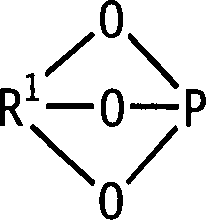


Applications Claiming Priority (11)
| Application Number | Priority Date | Filing Date | Title |
|---|---|---|---|
| US828695P | 1995-12-06 | 1995-12-06 | |
| US828495P | 1995-12-06 | 1995-12-06 | |
| US828995P | 1995-12-06 | 1995-12-06 | |
| US876395P | 1995-12-06 | 1995-12-06 | |
| US8763P | 1995-12-06 | ||
| US8286P | 1995-12-06 | ||
| US8289P | 1995-12-06 | ||
| US8284P | 1995-12-06 | ||
| US08/753,498 US5731473A (en) | 1995-12-06 | 1996-11-26 | Metal-ligand complex catalyzed processes |
| US753498 | 1996-11-26 | ||
| PCT/US1996/019276 WO1997020792A1 (en) | 1995-12-06 | 1996-12-05 | Improved metal-ligand complex catalyzed processes |
Publications (2)
| Publication Number | Publication Date |
|---|---|
| DE69633800D1 DE69633800D1 (en) | 2004-12-09 |
| DE69633800T2 true DE69633800T2 (en) | 2005-10-27 |
Family
ID=27485760
Family Applications (5)
| Application Number | Title | Priority Date | Filing Date |
|---|---|---|---|
| DE69613858T Expired - Fee Related DE69613858T2 (en) | 1995-12-06 | 1996-12-05 | METAL-LIGAND COMPLEX CATALYZED MANUFACTURING PROCESS |
| DE69611765T Revoked DE69611765T2 (en) | 1995-12-06 | 1996-12-05 | MANUFACTURING METHOD USING INDICATOR LIGANDS |
| DE69633800T Expired - Lifetime DE69633800T2 (en) | 1995-12-06 | 1996-12-05 | METAL-LIGAND COMPLEXES CATALYSED MANUFACTURING METHOD |
| DE69621839T Expired - Lifetime DE69621839T2 (en) | 1995-12-06 | 1996-12-05 | METHOD USING MULTI-STAGE REACTORS |
| DE69626990T Expired - Lifetime DE69626990T3 (en) | 1995-12-06 | 1996-12-05 | IMPROVED, METAL-LIGAND COMPLEX CATALYZED METHOD |
Family Applications Before (2)
| Application Number | Title | Priority Date | Filing Date |
|---|---|---|---|
| DE69613858T Expired - Fee Related DE69613858T2 (en) | 1995-12-06 | 1996-12-05 | METAL-LIGAND COMPLEX CATALYZED MANUFACTURING PROCESS |
| DE69611765T Revoked DE69611765T2 (en) | 1995-12-06 | 1996-12-05 | MANUFACTURING METHOD USING INDICATOR LIGANDS |
Family Applications After (2)
| Application Number | Title | Priority Date | Filing Date |
|---|---|---|---|
| DE69621839T Expired - Lifetime DE69621839T2 (en) | 1995-12-06 | 1996-12-05 | METHOD USING MULTI-STAGE REACTORS |
| DE69626990T Expired - Lifetime DE69626990T3 (en) | 1995-12-06 | 1996-12-05 | IMPROVED, METAL-LIGAND COMPLEX CATALYZED METHOD |
Country Status (18)
| Country | Link |
|---|---|
| US (12) | US5763679A (en) |
| EP (4) | EP0904259B1 (en) |
| JP (4) | JP2002504888A (en) |
| CN (4) | CN1106374C (en) |
| AT (1) | ATE235451T1 (en) |
| AU (4) | AU721638B2 (en) |
| BR (5) | BR9611857A (en) |
| CA (4) | CA2239696C (en) |
| DE (5) | DE69613858T2 (en) |
| EA (4) | EA001482B1 (en) |
| ES (9) | ES2164936T3 (en) |
| IN (2) | IN207646B (en) |
| MX (3) | MX203408B (en) |
| MY (1) | MY115709A (en) |
| PL (4) | PL327078A1 (en) |
| SK (4) | SK68898A3 (en) |
| WO (5) | WO1997020801A1 (en) |
| ZA (4) | ZA9610306B (en) |
Families Citing this family (136)
| Publication number | Priority date | Publication date | Assignee | Title |
|---|---|---|---|---|
| JPH09173835A (en) * | 1995-12-25 | 1997-07-08 | Chiyoda Corp | Adsorbent for precious metals and method for recovering precious metals |
| EP0839787A1 (en) * | 1996-11-04 | 1998-05-06 | Dsm N.V. | Process for the preparation of an aldehyde |
| JP3314630B2 (en) | 1996-09-27 | 2002-08-12 | 株式会社日立製作所 | Chromatographic apparatus and chromatographic analysis method |
| US5874640A (en) * | 1996-11-26 | 1999-02-23 | Union Carbide Chemicals & Plastics Technology Corporation | Metal-ligand complex catalyzed processes |
| DE19654961C2 (en) * | 1996-12-12 | 1999-04-29 | Basf Ag | Process for the preparation of copolymers from carbon monoxide and olefinically unsaturated compounds |
| US5919978A (en) * | 1997-04-15 | 1999-07-06 | Union Carbide Chemicals & Plastics Technology Corporation | Processes for producing aldehyde acids or salts |
| DE19954510A1 (en) | 1999-11-12 | 2001-05-17 | Oxeno Olefinchemie Gmbh | Process for the catalytic production of aldehydes from olefins using ligand mixtures |
| EP1172143A1 (en) * | 2000-07-14 | 2002-01-16 | Dsm N.V. | Process for the recovery of rhodium |
| FI20002807A0 (en) * | 2000-09-05 | 2000-12-20 | Neste Chemicals Oy | A process for the hydroformylation of alkenes |
| DE10106482A1 (en) | 2001-02-13 | 2002-08-14 | Basf Ag | hydroformylation |
| EP1249444A1 (en) * | 2001-04-13 | 2002-10-16 | Dsm N.V. | Continuous hydroformylation process for forming an aldehyde |
| EP1249438A1 (en) * | 2001-04-13 | 2002-10-16 | Dsm N.V. | Continuous hydroformylation process for producing an aldehyde |
| DE10201676A1 (en) * | 2002-01-17 | 2003-07-31 | Basf Ag | Process for the hydroformylation of olefins having 2 to 6 carbon atoms |
| US7074735B2 (en) * | 2002-03-13 | 2006-07-11 | Exxonmobil Research And Engineering Company | Selectively suppressing catalytic hydrogenation |
| FR2838431B1 (en) * | 2002-04-11 | 2005-05-06 | Inst Francais Du Petrole | HYDROFORMYLATION PROCESS USING COBALT CATALYST IN NON-AQUEOUS IONIC LIQUID WITH ENHANCED CATALYST RECYCLING |
| DE10220801A1 (en) | 2002-05-10 | 2003-11-20 | Oxeno Olefinchemie Gmbh | Process for the rhodium-catalyzed hydroformylation of olefins while reducing the rhodium loss |
| US7317130B2 (en) | 2002-08-31 | 2008-01-08 | Oxeno Olefinchemie Gmbh | Method for the hydroformylation of olefinically unsaturated compounds, especially olefins, in the presence of cyclic carbonic acid esters |
| TW200418770A (en) * | 2002-10-03 | 2004-10-01 | Shell Int Research | Reduction of the viscosity of reactive heavy byproducts during the production of 1,3-propanediol |
| EP1565151A4 (en) * | 2002-11-06 | 2009-03-25 | Eveready Battery Inc | Shaving systems |
| FR2849027B1 (en) * | 2002-12-23 | 2005-01-21 | Rhodia Polyamide Intermediates | PROCESS FOR THE SYNTHESIS OF COMPOUNDS COMPRISING NITRIL FUNCTIONS FROM ETHYLENE-UNSATURATED COMPOUNDS |
| CN101654462B (en) * | 2003-07-03 | 2013-05-29 | 陶氏技术投资有限责任公司 | Minimization of ligand degradation products, or reversion of same to useful phosphine ligands |
| DE10344690A1 (en) * | 2003-09-25 | 2005-04-14 | Basf Ag | Process for the preparation of 1,7-octadiene and its use |
| US7615645B2 (en) * | 2003-10-21 | 2009-11-10 | Basf Aktiengesellschaft | Method for the continuous production of aldehydes |
| DE10349343A1 (en) * | 2003-10-23 | 2005-06-02 | Basf Ag | Stabilization of hydroformylation catalysts based on phosphoramidite ligands |
| DE10357718A1 (en) | 2003-12-09 | 2005-07-21 | Basf Ag | Process for the preparation of tricyclodecanedialdehyde |
| WO2005060657A2 (en) * | 2003-12-15 | 2005-07-07 | Yale University | Magnetoelectronic devices based on colossal magnetoresistive thin films |
| US20050143600A1 (en) * | 2003-12-26 | 2005-06-30 | Chaudhari Raghunath V. | Process for the preparation of 2-hydroxy carboxylic acids |
| CN1309728C (en) * | 2004-07-30 | 2007-04-11 | 中国科学院上海有机化学研究所 | Chiral organic, inorganic polymer assembled catalyst, synthesis method and use |
| CA2575122C (en) * | 2004-08-02 | 2013-06-25 | Union Carbide Chemicals & Plastics Technology Corporation | Stabilization of a hydroformylation process |
| KR100744477B1 (en) * | 2004-09-15 | 2007-08-01 | 주식회사 엘지화학 | Catalyst composition comprising phosphorus compound and hydroformylation method using same |
| PL1863747T3 (en) * | 2005-03-16 | 2017-06-30 | Perstorp Specialty Chemicals Ab | Hydroformylation process with improved iso-selectivity |
| US7329783B2 (en) * | 2005-06-30 | 2008-02-12 | Shell Oil Company | Hydroformylation process |
| US7718158B2 (en) * | 2005-10-13 | 2010-05-18 | Lyondell Chemical Technology, L.P. | Polymer-encapsulated ion-exchange resin |
| US20080021179A1 (en) * | 2006-06-30 | 2008-01-24 | Mul Wilhelmus P | Catalytic chemical reaction process |
| US8110266B2 (en) | 2007-02-08 | 2012-02-07 | Allegiance Corporation | Glove coating and manufacturing process |
| CN101657407B (en) * | 2007-03-20 | 2014-02-12 | 陶氏技术投资有限公司 | Hydroformylation process with improved control over product isomers |
| US20080306200A1 (en) | 2007-06-11 | 2008-12-11 | Seong Fong Chen | Antistatic gloves and process for making same |
| US8387983B2 (en) * | 2007-11-27 | 2013-03-05 | Angel Playing Cards Co., Ltd. | Shuffled playing cards and manufacturing method thereof |
| US7872157B2 (en) * | 2007-12-26 | 2011-01-18 | Eastman Chemical Company | Phosphonite containing catalysts for hydroformylation processes |
| US7872156B2 (en) * | 2007-12-26 | 2011-01-18 | Eastman Chemical Company | Fluorophosphite containing catalysts for hydroformylation processes |
| NZ587607A (en) * | 2008-03-14 | 2012-08-31 | Allegiance Corp | Elastomer dispersion comprising a dispersed elastomer and accelerator in an aqueous phase and latex materials produced therefrom |
| EP2519014B1 (en) | 2008-04-22 | 2014-05-14 | Ehn Spire Limited Liability Company | Position-permissive autostereoscopic display systems and methods |
| TWI413260B (en) * | 2008-07-31 | 2013-10-21 | 半導體能源研究所股份有限公司 | Semiconductor device and method of manufacturing same |
| WO2010021863A1 (en) * | 2008-08-19 | 2010-02-25 | Dow Technology Investments Llc | Hydroformylation process using a symmetric bisphosphite ligand for improved control over product isomers |
| WO2010057099A1 (en) | 2008-11-14 | 2010-05-20 | University Of Kansas | Polymer-supported transition metal catalyst complexes and methods of use |
| PL2414314T3 (en) | 2009-03-31 | 2018-02-28 | Dow Technology Investments Llc | Hydroformylation process with triphenylphosphine and a doubly open-ended bisphosphite ligand |
| US7928267B1 (en) * | 2009-06-22 | 2011-04-19 | Eastman Chemical Company | Phosphite containing catalysts for hydroformylation processes |
| RU2546110C2 (en) | 2009-12-22 | 2015-04-10 | Дау Текнолоджи Инвестментс Ллс | Regulation of ratio aldehyde of normal structure: aldehyde of iso-structure in process of hydroformylation with mixed ligand by regulation of synthesis-gas partial pressure |
| PL2942343T3 (en) | 2009-12-22 | 2020-02-28 | Dow Technology Investments Llc | Controlling the normal : iso aldehyde ratio in a mixed ligand hydroformylation process |
| US8664451B2 (en) | 2009-12-22 | 2014-03-04 | Dow Technology Investments Llc | Controlling the normal:ISO aldehyde ratio in a mixed ligand hydroformylation process by controlling the olefin partial pressure |
| EP2624953B1 (en) | 2010-10-05 | 2018-10-24 | Dow Technology Investments LLC | Hydroformylation process |
| SG190138A1 (en) | 2010-11-12 | 2013-06-28 | Dow Technology Investments Llc | Mitigation of fouling in hydroformylation processes by water addition |
| US8513468B2 (en) * | 2010-12-30 | 2013-08-20 | Eastman Chemical Company | Process for removing degradation acids from hydroformylation reactions |
| SA112330271B1 (en) * | 2011-04-18 | 2015-02-09 | داو تكنولوجى انفستمنتس ال ال سى | Mitigation Of Fouling In Hydroformylation Processes By Water Addition |
| JP5890535B2 (en) | 2011-12-20 | 2016-03-22 | ダウ テクノロジー インベストメンツ リミティド ライアビリティー カンパニー | Improved hydroformylation process |
| WO2013098368A1 (en) | 2011-12-30 | 2013-07-04 | Basf Se | Method for purifying organic diphosphite compounds |
| CA2862100C (en) | 2011-12-30 | 2021-12-21 | Basf Se | Crystalline solvate and non-solvated forms of 6,6'-[[3,3',5,5'-tetrakis(1,1-dimethylethyl)-[1,1'-biphenyl]-2,2'-diyl]bis(oxy)]bis-dibenzo [d,f] [1,3,2]-dioxaphosphepine |
| WO2013107902A1 (en) * | 2012-01-20 | 2013-07-25 | Dsm Ip Assets B.V. | Process for the separation of a dissolved catalyst system from an alkoxycarbonylation reaction mixture |
| US8889917B2 (en) | 2012-04-12 | 2014-11-18 | Basf Se | Method of supplementing the catalyst in continuous hydroformylation |
| JP6516670B2 (en) | 2012-04-12 | 2019-05-22 | ビーエーエスエフ ソシエタス・ヨーロピアBasf Se | Method of replenishing catalyst in continuous hydroformylation |
| CN104379258B (en) * | 2012-06-04 | 2017-05-03 | 陶氏技术投资有限责任公司 | Hydroformylation process |
| JP6339572B2 (en) * | 2012-08-29 | 2018-06-06 | ダウ テクノロジー インベストメンツ リミティド ライアビリティー カンパニー | Catalyst production method |
| BR112015006495B1 (en) * | 2012-09-25 | 2020-12-15 | Dow Technology Investments Llc | PROCESS TO STABILIZE A PHOSPHITE BINDING AGAINST DEGRADATION IN A HYDROFORMILLATION REACTION FLUID |
| DE102013219510A1 (en) | 2012-10-12 | 2014-04-17 | Evonik Degussa Gmbh | Mixture, useful as a catalyst in a hydroformylation reaction of unsaturated compounds, comprises a combination of two substituted bis(6-phenoxybenzo(d)(1,3,2)benzodioxaphosphepine) compounds |
| MX2015004616A (en) | 2012-10-12 | 2015-07-17 | Evonik Degussa Gmbh | Asymmetrical bisphosphite. |
| DE102013219508A1 (en) | 2012-10-12 | 2014-04-17 | Evonik Degussa Gmbh | Mixture useful as a catalyst for hydroformylating unsaturated compound or its mixture, comprises e.g. 6,6'-(3,3'-di-tert-butyl-5,5'-dimethoxybiphenyl-2,2'-diyl)bis(oxy)bis(2,4,8,10-tetramethyldibenzo(d,f)(1,3,2)dioxaphosphepine) |
| DE102013219512A1 (en) | 2012-10-12 | 2014-04-17 | Evonik Degussa Gmbh | Mixture useful as a catalyst for hydroformylating an unsaturated compound or its mixture, comprises bisphosphite compounds which are not identical |
| DE102013219506A1 (en) | 2012-10-12 | 2014-04-17 | Evonik Degussa Gmbh | New 4,8-di-tert-butyl-2,10-dimethoxy-6-(3,3',5,5'-tetramethyl-2'-(2,4,8,10-tetramethyldibenzo(d,f)(1,3,2)dioxaphosphepin-6-yloxy)biphenyl-2-yloxy)dibenzo(d,f)(1,3,2)dioxaphosphepine useful as catalyst to hydroformylate unsaturated compound |
| EP2740535A1 (en) * | 2012-12-04 | 2014-06-11 | Dow Technology Investments LLC | Bidentate ligands for hydroformylation of ethylene |
| JP6174711B2 (en) * | 2012-12-06 | 2017-08-02 | ダウ テクノロジー インベストメンツ リミティド ライアビリティー カンパニー | Hydroformylation process |
| DE102012223572A1 (en) | 2012-12-18 | 2014-06-18 | Evonik Industries Ag | Control of the viscosity of reaction solutions in hydroformylation processes |
| US10012627B2 (en) | 2013-03-15 | 2018-07-03 | Georgetown University | Determining stereoisomeric excess, concentration and absolute configuration |
| CN104045532B (en) | 2013-03-15 | 2018-05-25 | 陶氏技术投资有限责任公司 | Hydroformylation process |
| RU2527455C1 (en) * | 2013-03-28 | 2014-08-27 | Открытое акционерное общество "Нефтяная компания "Роснефть" | Method of producing aldehydes |
| CN104248860A (en) | 2013-06-27 | 2014-12-31 | 陶氏技术投资有限责任公司 | Heat management process |
| DE102013214378A1 (en) | 2013-07-23 | 2015-01-29 | Evonik Industries Ag | Phosphoramidite derivatives in the hydroformylation of olefin-containing mixtures |
| CN104513143A (en) | 2013-09-26 | 2015-04-15 | 陶氏技术投资有限责任公司 | Hydroformylation process |
| CN104725170B (en) | 2013-12-19 | 2019-08-23 | 陶氏技术投资有限责任公司 | Hydroformylation process |
| JP2016540780A (en) | 2013-12-19 | 2016-12-28 | ダウ テクノロジー インベストメンツ リミティド ライアビリティー カンパニー | Hydroformylation process |
| KR102362007B1 (en) * | 2014-03-31 | 2022-02-11 | 다우 테크놀로지 인베스트먼츠 엘엘씨. | Hydroformylation process |
| EP3143031B1 (en) * | 2014-05-14 | 2020-11-04 | Dow Technology Investments LLC | Stabilized organophosphorous compounds |
| MY184826A (en) | 2014-12-04 | 2021-04-24 | Dow Technology Investments Llc | Hydroformylation process |
| ES2899823T3 (en) | 2015-07-10 | 2022-03-14 | Basf Se | Process for the hydroformylation of 2-substituted butadienes and for the production of their derivatives, especially from Ambrox |
| JP6916164B2 (en) | 2015-07-28 | 2021-08-11 | ダウ テクノロジー インベストメンツ リミティド ライアビリティー カンパニー | Method for preparing a stabilized organophosphorus compound solution |
| TWI709566B (en) | 2015-09-30 | 2020-11-11 | 美商陶氏科技投資公司 | Processes for producing organophosphorous compounds |
| JP2018533564A (en) | 2015-10-12 | 2018-11-15 | ビーエーエスエフ ソシエタス・ヨーロピアBasf Se | Hydroformylation process for producing 1, 6-disubstituted hexane derivatives |
| CA3004907C (en) | 2015-11-10 | 2024-01-02 | Dow Technology Investments Llc | Process for producing aldehydes |
| CA3014177C (en) | 2016-02-11 | 2023-12-12 | Dow Technology Investments Llc | Processes for converting olefins to alcohols, ethers, or combinations thereof |
| MX2018010980A (en) * | 2016-03-18 | 2018-11-15 | Dow Technology Investments Llc | HYDROFORMILATION PROCESS. |
| RU2619951C1 (en) * | 2016-06-21 | 2017-05-22 | ФЕДЕРАЛЬНОЕ ГОСУДАРСТВЕННОЕ БЮДЖЕТНОЕ УЧРЕЖДЕНИЕ НАУКИ ИНСТИТУТ ОРГАНИЧЕСКОЙ ХИМИИ им. Н.Д. ЗЕЛИНСКОГО РОССИЙСКОЙ АКАДЕМИИ НАУК (ИОХ РАН) | Two-step process of obtaining the propionic aldehyde |
| TWI758353B (en) | 2016-11-08 | 2022-03-21 | 美商陶氏科技投資有限公司 | Methods to rejuvenate a deactivated hydroformylation catalyst solution |
| TW201840362A (en) | 2016-11-08 | 2018-11-16 | 美商陶氏科技投資有限公司 | Methods to rejuvenate a deactivated hydroformylation catalyst solution |
| TW201840363A (en) | 2016-11-08 | 2018-11-16 | 美商陶氏科技投資有限公司 | Methods of treating a hydroformylation catalyst solution |
| KR20200018442A (en) | 2017-06-13 | 2020-02-19 | 바스프 에스이 | Hydroformylation Method to Prepare 1,6-hexanediol Derivatives |
| TWI788364B (en) * | 2017-06-23 | 2023-01-01 | 美商陶氏科技投資有限公司 | Hydroformylation reaction processes |
| RU2020115090A (en) | 2017-10-25 | 2021-10-29 | Дау Текнолоджи Инвестментс Ллк | METHOD FOR REDUCING THE FORMATION OF HEAVY FRACTIONS IN A SOLUTION CONTAINING ALDEHYDE COMPOUNDS FORMED IN THE PROCESS OF HYDROFORMYLATION |
| CN107721195A (en) * | 2017-10-27 | 2018-02-23 | 福州瑞克布朗医药科技有限公司 | A kind of method for strengthening gear division devitrified glass physicochemical property |
| RU2020117417A (en) | 2017-11-13 | 2021-11-29 | Дау Текнолоджи Инвестментс Ллк | METHODS FOR RHODIUM EXTRACTION FROM HYDROFORMYLATION PROCESS |
| KR20250057144A (en) | 2018-05-30 | 2025-04-28 | 다우 테크놀로지 인베스트먼츠 엘엘씨. | Methods for slowing deactivation of a catalyst and/or slowing tetraphosphine ligand usage in hydroformylation processes |
| WO2019231613A1 (en) | 2018-05-30 | 2019-12-05 | Dow Technology Investments Llc | Catalyst composition comprising the combination of a monophopsphine, a tetraphosphine ligand and a hydroformylation process using it |
| WO2019231611A1 (en) | 2018-05-30 | 2019-12-05 | Dow Technology Investments Llc | Methods of controlling hydroformylation processes |
| CN108927216B (en) * | 2018-06-29 | 2020-07-28 | 同济大学 | A patch-constrained porous carrier catalytic material and its preparation method and application |
| WO2020028396A1 (en) | 2018-07-30 | 2020-02-06 | Georgetown University | Chirality sensing with molecular click chemistry probes |
| US11860084B2 (en) | 2018-09-11 | 2024-01-02 | Georgetown University | Quantitative auxiliary-free chirality sensing with a metal probe |
| CA3120660A1 (en) | 2018-11-29 | 2020-06-04 | Dow Technology Investments Llc | Hydroformylation process |
| CN111320656A (en) * | 2018-12-17 | 2020-06-23 | 中国石油化工股份有限公司 | Phosphine ligand compound and preparation method thereof, catalyst composition and application thereof, and vinyl acetate hydroformylation method |
| RU2691064C1 (en) * | 2018-12-17 | 2019-06-10 | Акционерное Общество "Газпромнефть - Московский Нпз" (Ао "Газпромнефть - Мнпз") | Method of preparing a catalyst and a method for hydroskimming a diesel distillate using said catalyst |
| CN111408407B (en) * | 2019-01-04 | 2023-07-21 | 中国石油化工股份有限公司 | Catalyst composition, preparation method thereof and application thereof in reaction of synthesizing 1-butene by ethylene selective dimerization |
| KR20220024858A (en) | 2019-06-27 | 2022-03-03 | 다우 테크놀로지 인베스트먼츠 엘엘씨. | Process for preparing solution from hydroformylation process for precious metal recovery |
| SE543297C2 (en) * | 2019-07-18 | 2020-11-17 | Perstorp Ab | Use of a method for reduction of heavy end formation and catalyst loss in a hydroformylation process comprising a bidentate phosphite ligand |
| CN114206819B (en) * | 2019-07-05 | 2024-06-25 | 佩什托普公司 | Method for reducing heavy ends formation and catalyst loss in a hydroformylation process |
| SE543296C2 (en) | 2019-07-05 | 2020-11-17 | Perstorp Ab | A use of epoxide in order to reduce the formation of heavy ends in a hydroformylation process |
| TWI874467B (en) | 2019-11-05 | 2025-03-01 | 美商陶氏科技投資有限公司 | Process for the recovery of rhodium from a catalyst purge stream from a c6 or higher olefin hydroformylation process |
| US11976017B2 (en) | 2019-12-19 | 2024-05-07 | Dow Technology Investments Llc | Processes for preparing isoprene and mono-olefins comprising at least six carbon atoms |
| PL4103571T3 (en) | 2020-02-11 | 2024-04-29 | Basf Se | LOW PRESSURE HYDROFORMYLATION OF DIISOBUTENE |
| JP7761587B2 (en) | 2020-05-29 | 2025-10-28 | ダウ グローバル テクノロジーズ エルエルシー | Process for producing mixed alcohols from an octene-containing purge stream |
| JP7698668B2 (en) | 2020-05-29 | 2025-06-25 | ダウ グローバル テクノロジーズ エルエルシー | Compositions containing mixed C8 to C18 alcohols and surfactants thereof |
| EP4157817A1 (en) | 2020-05-29 | 2023-04-05 | Dow Global Technologies LLC | Organic catalyst for non-aqueous aldol condensation |
| WO2021242864A1 (en) | 2020-05-29 | 2021-12-02 | Dow Global Technologies Llc | Composition with mixed c13-c14 alcohols and surfactants |
| CN112174791A (en) * | 2020-11-02 | 2021-01-05 | 中国海洋石油集团有限公司 | Method for separating catalyst in preparation of aldehyde by olefin hydroformylation |
| KR20230120131A (en) | 2020-12-14 | 2023-08-16 | 다우 테크놀로지 인베스트먼츠 엘엘씨. | Method for improving catalytic metal charge in hydroformylation process |
| WO2022139989A1 (en) | 2020-12-22 | 2022-06-30 | Dow Technology Investments Llc | Hydroformylation reaction processes |
| CN112791680A (en) * | 2020-12-24 | 2021-05-14 | 华阳新材料科技集团有限公司 | A nickel phosphorus complex synthesis system for adiponitrile production |
| KR20230162956A (en) | 2021-03-31 | 2023-11-29 | 다우 테크놀로지 인베스트먼츠 엘엘씨. | Hydroformylation method |
| EP4430218A1 (en) | 2021-11-11 | 2024-09-18 | Dow Technology Investments LLC | Processes for recovering rhodium from hydroformylation processes |
| US20240399349A1 (en) | 2021-12-16 | 2024-12-05 | Dow Technology Investments Llc | Transition metal complex hydroformylation catalyst precuror compositions comprising such compounds, and hydroformylation processes |
| US20250128245A1 (en) | 2021-12-16 | 2025-04-24 | Dow Technology Investments Llc | Compounds, transition metal complex hydroformylation catalyst precuror compositions comprising such compounds, and hydroformylation processes |
| CN114243113A (en) * | 2021-12-27 | 2022-03-25 | 天津中电新能源研究院有限公司 | A high temperature electrolyte additive, battery electrolyte and sodium ion battery |
| CN114832860B (en) * | 2022-03-17 | 2025-06-03 | 江西苏克尔新材料有限公司 | A catalyst composition for olefin hydroformylation and its preparation method and application |
| CN114835751A (en) * | 2022-03-17 | 2022-08-02 | 江西苏克尔新材料有限公司 | Phosphite ester-phosphate ester compound and preparation method and application thereof |
| GB202213997D0 (en) | 2022-09-26 | 2022-11-09 | Johnson Matthey Davy Technologies Ltd | Parallel zone hydroformylation reaction |
| WO2024129290A1 (en) | 2022-12-13 | 2024-06-20 | Dow Technology Investments Llc | Process to minimize polyphosphine usage by making use of degradation products |
| KR20260004447A (en) | 2023-05-04 | 2026-01-08 | 다우 테크놀로지 인베스트먼츠 엘엘씨. | hydroformylation process |
| CN121194957A (en) | 2023-06-26 | 2025-12-23 | 陶氏技术投资有限责任公司 | Methods for controlling the hydroformylation process |
| WO2025029349A1 (en) | 2023-08-03 | 2025-02-06 | Dow Technology Investments Llc | Hydroformylation process |
| CN119708477A (en) * | 2024-12-06 | 2025-03-28 | 中国石油化工股份有限公司 | Covalent organic framework phosphine ligand and preparation method thereof, heterogeneous catalyst containing ligand and preparation method and application thereof |
Family Cites Families (42)
| Publication number | Priority date | Publication date | Assignee | Title |
|---|---|---|---|---|
| US1338698A (en) * | 1915-11-26 | 1920-05-04 | Swift & Co | Apparatus for making catalyzers |
| US2192124A (en) * | 1937-02-24 | 1940-02-27 | Du Pont | Chemical process and apparatus |
| US2582899A (en) * | 1946-12-14 | 1952-01-15 | Blaw Knox Co | Autoclave reactor |
| US2590436A (en) * | 1948-06-21 | 1952-03-25 | Shell Dev | Method for controlling chemical reactions |
| US2757202A (en) * | 1952-03-22 | 1956-07-31 | Exxon Research Engineering Co | Aldehyde synthesis process |
| US3222141A (en) * | 1960-03-23 | 1965-12-07 | Kaiser Aluminium Chem Corp | Digesting apparatus |
| US3266872A (en) * | 1962-04-13 | 1966-08-16 | Sumitomo Chemical Co | Reaction and separation apparatus |
| US3194638A (en) * | 1962-11-21 | 1965-07-13 | Kimberly Clark Co | Combined slaker-causticizer apparatus |
| US3271458A (en) * | 1962-11-23 | 1966-09-06 | Exxon Research Engineering Co | Cooling and catalyst recycle in oxo synthesis |
| US3527809A (en) * | 1967-08-03 | 1970-09-08 | Union Carbide Corp | Hydroformylation process |
| US3555098A (en) * | 1967-12-13 | 1971-01-12 | Union Oil Co | Hydroformylation |
| US3917661A (en) * | 1970-01-07 | 1975-11-04 | Union Carbide Corp | Hydroformylation of unsaturated organic compounds |
| DE2012807A1 (en) * | 1970-03-18 | 1971-10-07 | Faserwerke Hüls GmbH, 4370 Mari | Process and device for the continuous transesterification of dialkyl esters of aromatic dicarboxylic acids with diols |
| DE2045169A1 (en) * | 1970-09-12 | 1972-03-23 | Badische Anilin- & Soda-Fabrik Ag, 6700 Ludwigshafen | Treatment of oxo reaction mixts - by addn of aqs alkali hydroxide |
| US3868422A (en) * | 1971-12-23 | 1975-02-25 | Eastman Kodak Co | Multistage hydroformylation process |
| US3909207A (en) * | 1973-03-09 | 1975-09-30 | Monsanto Co | Vertical stirred mass polymerization apparatus |
| CA1023389A (en) * | 1973-04-06 | 1977-12-27 | Uop Inc. | Hydroformylation process |
| DE2343788C3 (en) * | 1973-08-30 | 1980-07-10 | Wacker-Chemie Gmbh, 8000 Muenchen | Device for the continuous implementation of chemical reactions, in particular polymerizations and processes for the continuous suspension polymerization of vinyl chloride |
| JPS5638576B2 (en) * | 1974-07-25 | 1981-09-08 | ||
| US4137240A (en) * | 1976-01-31 | 1979-01-30 | E. I. Du Pont De Nemours And Company | Hydroformylation process for preparation of predominantly linear aldehydes |
| US4277627A (en) * | 1977-01-25 | 1981-07-07 | Union Carbide Corporation | Hydroformylation process |
| DE2840168A1 (en) * | 1978-09-15 | 1980-03-27 | Basf Ag | METHOD FOR PRODUCING ALDEHYDES |
| US4267383A (en) * | 1979-05-04 | 1981-05-12 | Celanese Corporation | Hydrocarbonylation |
| US4258215A (en) * | 1979-08-29 | 1981-03-24 | Eastman Kodak Company | Hydroformylation process |
| US4283562A (en) * | 1979-10-26 | 1981-08-11 | Union Carbide Corporation | Hydroformylation process using stable rhodium catalyst |
| US4374093A (en) * | 1981-02-20 | 1983-02-15 | Mobil Oil Corporation | Continuous-stream upflow zeolite crystallization apparatus |
| DE3361212D1 (en) * | 1982-06-11 | 1985-12-19 | Davy Mckee London | Hydroformylation process |
| US4483624A (en) * | 1982-08-25 | 1984-11-20 | Freeport Kaolin Company | High intensity conditioning mill and method |
| GB8334359D0 (en) * | 1983-12-23 | 1984-02-01 | Davy Mckee Ltd | Process |
| US4599206A (en) * | 1984-02-17 | 1986-07-08 | Union Carbide Corporation | Transition metal complex catalyzed reactions |
| DE3415968A1 (en) * | 1984-04-28 | 1985-10-31 | Ruhrchemie Ag, 4200 Oberhausen | METHOD FOR PRODUCING ALDEHYDES |
| US4668651A (en) * | 1985-09-05 | 1987-05-26 | Union Carbide Corporation | Transition metal complex catalyzed processes |
| US4748261A (en) * | 1985-09-05 | 1988-05-31 | Union Carbide Corporation | Bis-phosphite compounds |
| US4835299A (en) * | 1987-03-31 | 1989-05-30 | Union Carbide Corporation | Process for purifying tertiary organophosphites |
| FR2615606B1 (en) * | 1987-05-22 | 1990-07-27 | Faiveley Ets | HEAT EXCHANGER REACTOR |
| JPH0763706B2 (en) * | 1988-04-21 | 1995-07-12 | 有限会社パラサイト | Multiple gas phase liquid treatment equipment |
| US5114473A (en) * | 1988-08-25 | 1992-05-19 | Union Carbide Chemicals And Plastics Technology Corporation | Transition metal recovery |
| JPH0763601B2 (en) * | 1989-01-13 | 1995-07-12 | 鐘淵化学工業株式会社 | Stirrer for viscous substances |
| JP2893902B2 (en) * | 1989-10-19 | 1999-05-24 | 三菱化学株式会社 | Hydroformylation of olefins |
| US5288918A (en) * | 1992-09-29 | 1994-02-22 | Union Carbide Chemicals & Plastics Technology Corporation | Hydroformylation process |
| US5410091A (en) * | 1994-06-02 | 1995-04-25 | Quimica Oxal C.A. | Rhodium catalyzed oxo process in tubular reactor |
| US5498801A (en) * | 1994-12-30 | 1996-03-12 | Council Of Scientific & Industrial Interest | Process for the catalytic hydroformylation of alkenes |
-
1996
- 1996-11-26 US US08/756,499 patent/US5763679A/en not_active Expired - Lifetime
- 1996-11-26 US US08/756,501 patent/US5741944A/en not_active Expired - Lifetime
- 1996-11-26 US US08/756,500 patent/US5741943A/en not_active Expired - Lifetime
- 1996-11-26 US US08/756,788 patent/US5763680A/en not_active Expired - Lifetime
- 1996-11-26 US US08/753,498 patent/US5731473A/en not_active Expired - Lifetime
- 1996-11-26 US US08/757,743 patent/US5728893A/en not_active Expired - Lifetime
- 1996-11-26 US US08/756,482 patent/US5763677A/en not_active Expired - Lifetime
- 1996-11-26 US US08/757,741 patent/US5741945A/en not_active Expired - Lifetime
- 1996-11-26 US US08/756,498 patent/US5763670A/en not_active Expired - Lifetime
- 1996-11-26 US US08/757,742 patent/US5763671A/en not_active Expired - Lifetime
- 1996-11-26 US US08/757,744 patent/US5744650A/en not_active Expired - Lifetime
- 1996-11-26 US US08/753,504 patent/US5744649A/en not_active Expired - Lifetime
- 1996-12-05 BR BR9611857A patent/BR9611857A/en not_active Application Discontinuation
- 1996-12-05 ES ES96943614T patent/ES2164936T3/en not_active Expired - Lifetime
- 1996-12-05 SK SK688-98A patent/SK68898A3/en unknown
- 1996-12-05 AU AU12801/97A patent/AU721638B2/en not_active Ceased
- 1996-12-05 ES ES96942139T patent/ES2174125T3/en not_active Expired - Lifetime
- 1996-12-05 ES ES96942897T patent/ES2156306T3/en not_active Expired - Lifetime
- 1996-12-05 JP JP52142497A patent/JP2002504888A/en active Pending
- 1996-12-05 EA EA199800518A patent/EA001482B1/en not_active IP Right Cessation
- 1996-12-05 ES ES96944758T patent/ES2155949T3/en not_active Expired - Lifetime
- 1996-12-05 AU AU13295/97A patent/AU724425B2/en not_active Ceased
- 1996-12-05 CA CA002239696A patent/CA2239696C/en not_active Expired - Lifetime
- 1996-12-05 ES ES96942149T patent/ES2158369T3/en not_active Expired - Lifetime
- 1996-12-05 SK SK684-98A patent/SK68498A3/en unknown
- 1996-12-05 DE DE69613858T patent/DE69613858T2/en not_active Expired - Fee Related
- 1996-12-05 EP EP96942139A patent/EP0904259B1/en not_active Expired - Lifetime
- 1996-12-05 AU AU11292/97A patent/AU719870B2/en not_active Ceased
- 1996-12-05 EP EP96943600A patent/EP0876322B1/en not_active Expired - Lifetime
- 1996-12-05 PL PL96327078A patent/PL327078A1/en unknown
- 1996-12-05 ES ES96943600T patent/ES2160853T3/en not_active Expired - Lifetime
- 1996-12-05 WO PCT/US1996/019413 patent/WO1997020801A1/en not_active Ceased
- 1996-12-05 WO PCT/US1996/019276 patent/WO1997020792A1/en not_active Ceased
- 1996-12-05 EA EA199800516A patent/EA001650B1/en not_active IP Right Cessation
- 1996-12-05 SK SK691-98A patent/SK69198A3/en unknown
- 1996-12-05 CN CN96198762A patent/CN1106374C/en not_active Expired - Lifetime
- 1996-12-05 DE DE69611765T patent/DE69611765T2/en not_active Revoked
- 1996-12-05 EA EA199800513A patent/EA001608B1/en not_active IP Right Cessation
- 1996-12-05 JP JP52144397A patent/JP2002504076A/en active Pending
- 1996-12-05 JP JP52142897A patent/JP2002515859A/en active Pending
- 1996-12-05 CA CA002239536A patent/CA2239536A1/en not_active Abandoned
- 1996-12-05 DE DE69633800T patent/DE69633800T2/en not_active Expired - Lifetime
- 1996-12-05 ES ES96944748T patent/ES2227625T3/en not_active Expired - Lifetime
- 1996-12-05 EP EP96944758A patent/EP0874797B1/en not_active Revoked
- 1996-12-05 EP EP96944748A patent/EP1019353B1/en not_active Expired - Lifetime
- 1996-12-05 PL PL96327115A patent/PL327115A1/en unknown
- 1996-12-05 DE DE69621839T patent/DE69621839T2/en not_active Expired - Lifetime
- 1996-12-05 BR BR9611663A patent/BR9611663A/en not_active IP Right Cessation
- 1996-12-05 JP JP52139897A patent/JP3867998B2/en not_active Expired - Lifetime
- 1996-12-05 PL PL96327076A patent/PL327076A1/en unknown
- 1996-12-05 CA CA002230561A patent/CA2230561C/en not_active Expired - Lifetime
- 1996-12-05 AU AU13287/97A patent/AU722459B2/en not_active Ceased
- 1996-12-05 SK SK690-98A patent/SK69098A3/en unknown
- 1996-12-05 PL PL96327074A patent/PL327074A1/en unknown
- 1996-12-05 DE DE69626990T patent/DE69626990T3/en not_active Expired - Lifetime
- 1996-12-05 WO PCT/US1996/019313 patent/WO1997020793A1/en not_active Ceased
- 1996-12-05 CN CN96198748A patent/CN1077874C/en not_active Expired - Fee Related
- 1996-12-05 WO PCT/US1996/019373 patent/WO1997020795A1/en not_active Ceased
- 1996-12-05 CN CN96198749A patent/CN1080252C/en not_active Expired - Fee Related
- 1996-12-05 WO PCT/US1996/019380 patent/WO1997020796A1/en not_active Ceased
- 1996-12-05 CA CA002239518A patent/CA2239518A1/en not_active Abandoned
- 1996-12-05 AT AT96942908T patent/ATE235451T1/en not_active IP Right Cessation
- 1996-12-05 BR BR9611830A patent/BR9611830A/en unknown
- 1996-12-05 BR BR9611665A patent/BR9611665A/en not_active IP Right Cessation
- 1996-12-05 BR BR9611776A patent/BR9611776A/en unknown
- 1996-12-05 EA EA199800519A patent/EA001834B1/en not_active IP Right Cessation
- 1996-12-05 CN CN96198747A patent/CN1090169C/en not_active Expired - Lifetime
- 1996-12-05 ES ES96942908T patent/ES2190485T3/en not_active Expired - Lifetime
- 1996-12-05 ES ES96942907T patent/ES2203725T3/en not_active Expired - Lifetime
- 1996-12-06 ZA ZA9610306A patent/ZA9610306B/en unknown
- 1996-12-06 ZA ZA9610312A patent/ZA9610312B/en unknown
- 1996-12-06 ZA ZA9610308A patent/ZA9610308B/en unknown
- 1996-12-06 MY MYPI96005117A patent/MY115709A/en unknown
- 1996-12-06 ZA ZA9610313A patent/ZA9610313B/en unknown
- 1996-12-18 IN IN2301CH1996 patent/IN207646B/en unknown
- 1996-12-18 IN IN2299CH1996 patent/IN228562B/en unknown
-
1998
- 1998-05-29 MX MX9804284A patent/MX203408B/en not_active IP Right Cessation
- 1998-06-05 MX MX9804489A patent/MX203409B/en not_active IP Right Cessation
- 1998-06-05 MX MX9804494A patent/MX9804494A/en unknown
Also Published As
Similar Documents
| Publication | Publication Date | Title |
|---|---|---|
| DE69633800T2 (en) | METAL-LIGAND COMPLEXES CATALYSED MANUFACTURING METHOD | |
| DE69630322T2 (en) | IMPROVED METHODS CATALYZED BY METAL-LIGAND COMPLEXES | |
| DE69618240T2 (en) | METAL-LIGAND COMPLEX CATALYZED MANUFACTURING PROCESS | |
| US5741942A (en) | Metal-ligand complex catalyzed processes | |
| DE69616586T2 (en) | MANUFACTURING METHODS CATALYZED BY METAL-LIGAND COMPLEX | |
| DE69612570T2 (en) | MANUFACTURING METHODS CATALYZED BY METAL-LIGAND COMPLEX | |
| DE69611845T2 (en) | MANUFACTURING METHODS CATALYZED BY METAL-LIGAND COMPLEXES | |
| CA2239568C (en) | Improved metal-ligand complex catalyzed processes | |
| JP3970927B6 (en) | Process catalyzed by an improved metal-ligand complex |
Legal Events
| Date | Code | Title | Description |
|---|---|---|---|
| 8364 | No opposition during term of opposition | ||
| 8327 | Change in the person/name/address of the patent owner |
Owner name: DOW TECHNOLOGY INVESTMENTS LLC, MIDLAND, MICH., US |