DE69434052T2 - PARTICLE SEPARATOR FOR MAMMAL CELL CULTURE - Google Patents
PARTICLE SEPARATOR FOR MAMMAL CELL CULTURE Download PDFInfo
- Publication number
- DE69434052T2 DE69434052T2 DE69434052T DE69434052T DE69434052T2 DE 69434052 T2 DE69434052 T2 DE 69434052T2 DE 69434052 T DE69434052 T DE 69434052T DE 69434052 T DE69434052 T DE 69434052T DE 69434052 T2 DE69434052 T2 DE 69434052T2
- Authority
- DE
- Germany
- Prior art keywords
- cells
- plates
- liquid
- cell
- fermenter
- Prior art date
- Legal status (The legal status is an assumption and is not a legal conclusion. Google has not performed a legal analysis and makes no representation as to the accuracy of the status listed.)
- Expired - Lifetime
Links
- 239000002245 particle Substances 0.000 title abstract description 22
- 238000004113 cell culture Methods 0.000 title description 5
- 241000124008 Mammalia Species 0.000 title 1
- 239000007788 liquid Substances 0.000 claims abstract description 37
- 210000004408 hybridoma Anatomy 0.000 claims abstract description 14
- 239000013049 sediment Substances 0.000 claims abstract description 3
- 210000004027 cell Anatomy 0.000 claims description 135
- 239000012530 fluid Substances 0.000 claims description 19
- 238000000034 method Methods 0.000 claims description 17
- 238000000855 fermentation Methods 0.000 claims description 15
- 230000004151 fermentation Effects 0.000 claims description 15
- 239000006228 supernatant Substances 0.000 claims description 11
- 238000000926 separation method Methods 0.000 claims description 10
- 229910001220 stainless steel Inorganic materials 0.000 claims description 8
- 239000010935 stainless steel Substances 0.000 claims description 8
- 210000004962 mammalian cell Anatomy 0.000 claims description 7
- 230000012010 growth Effects 0.000 claims description 2
- 230000000737 periodic effect Effects 0.000 claims description 2
- 230000010412 perfusion Effects 0.000 description 22
- 230000014759 maintenance of location Effects 0.000 description 12
- 210000004102 animal cell Anatomy 0.000 description 10
- 239000002609 medium Substances 0.000 description 10
- 238000004062 sedimentation Methods 0.000 description 10
- 238000000151 deposition Methods 0.000 description 8
- 239000000047 product Substances 0.000 description 8
- 230000008021 deposition Effects 0.000 description 7
- 238000005516 engineering process Methods 0.000 description 7
- 238000010276 construction Methods 0.000 description 6
- 239000012737 fresh medium Substances 0.000 description 6
- 108090000623 proteins and genes Proteins 0.000 description 6
- 239000006144 Dulbecco’s modified Eagle's medium Substances 0.000 description 5
- 239000000463 material Substances 0.000 description 5
- 239000012528 membrane Substances 0.000 description 5
- 239000000126 substance Substances 0.000 description 5
- 230000035899 viability Effects 0.000 description 5
- 230000008859 change Effects 0.000 description 4
- 238000002474 experimental method Methods 0.000 description 4
- 239000007789 gas Substances 0.000 description 4
- 230000005484 gravity Effects 0.000 description 4
- 238000004519 manufacturing process Methods 0.000 description 4
- 230000008569 process Effects 0.000 description 4
- 102000004169 proteins and genes Human genes 0.000 description 4
- XLYOFNOQVPJJNP-UHFFFAOYSA-N water Substances O XLYOFNOQVPJJNP-UHFFFAOYSA-N 0.000 description 4
- 210000004369 blood Anatomy 0.000 description 3
- 239000008280 blood Substances 0.000 description 3
- 230000007910 cell fusion Effects 0.000 description 3
- 230000010261 cell growth Effects 0.000 description 3
- 239000006285 cell suspension Substances 0.000 description 3
- 230000003247 decreasing effect Effects 0.000 description 3
- 230000003248 secreting effect Effects 0.000 description 3
- 230000007704 transition Effects 0.000 description 3
- 239000002351 wastewater Substances 0.000 description 3
- IJGRMHOSHXDMSA-UHFFFAOYSA-N Atomic nitrogen Chemical compound N#N IJGRMHOSHXDMSA-UHFFFAOYSA-N 0.000 description 2
- 108020004511 Recombinant DNA Proteins 0.000 description 2
- QVGXLLKOCUKJST-UHFFFAOYSA-N atomic oxygen Chemical compound [O] QVGXLLKOCUKJST-UHFFFAOYSA-N 0.000 description 2
- 238000009395 breeding Methods 0.000 description 2
- 230000001488 breeding effect Effects 0.000 description 2
- 230000006727 cell loss Effects 0.000 description 2
- 230000003833 cell viability Effects 0.000 description 2
- 238000011143 downstream manufacturing Methods 0.000 description 2
- 230000006872 improvement Effects 0.000 description 2
- 230000002503 metabolic effect Effects 0.000 description 2
- 230000004048 modification Effects 0.000 description 2
- 238000012986 modification Methods 0.000 description 2
- 239000001301 oxygen Substances 0.000 description 2
- 229910052760 oxygen Inorganic materials 0.000 description 2
- 229920001296 polysiloxane Polymers 0.000 description 2
- 238000012545 processing Methods 0.000 description 2
- 230000000717 retained effect Effects 0.000 description 2
- 238000003860 storage Methods 0.000 description 2
- 239000000725 suspension Substances 0.000 description 2
- FHVDTGUDJYJELY-UHFFFAOYSA-N 6-{[2-carboxy-4,5-dihydroxy-6-(phosphanyloxy)oxan-3-yl]oxy}-4,5-dihydroxy-3-phosphanyloxane-2-carboxylic acid Chemical compound O1C(C(O)=O)C(P)C(O)C(O)C1OC1C(C(O)=O)OC(OP)C(O)C1O FHVDTGUDJYJELY-UHFFFAOYSA-N 0.000 description 1
- 229920000936 Agarose Polymers 0.000 description 1
- 241000894006 Bacteria Species 0.000 description 1
- 239000002028 Biomass Substances 0.000 description 1
- 108091003079 Bovine Serum Albumin Proteins 0.000 description 1
- 108020004414 DNA Proteins 0.000 description 1
- 206010013642 Drooling Diseases 0.000 description 1
- 206010035226 Plasma cell myeloma Diseases 0.000 description 1
- 229920005830 Polyurethane Foam Polymers 0.000 description 1
- 206010039238 Rouleaux formation Diseases 0.000 description 1
- 240000004808 Saccharomyces cerevisiae Species 0.000 description 1
- 241001282153 Scopelogadus mizolepis Species 0.000 description 1
- 208000008630 Sialorrhea Diseases 0.000 description 1
- 230000002411 adverse Effects 0.000 description 1
- 229940072056 alginate Drugs 0.000 description 1
- 235000010443 alginic acid Nutrition 0.000 description 1
- 229920000615 alginic acid Polymers 0.000 description 1
- 230000003698 anagen phase Effects 0.000 description 1
- 239000000427 antigen Substances 0.000 description 1
- 102000036639 antigens Human genes 0.000 description 1
- 108091007433 antigens Proteins 0.000 description 1
- 230000009286 beneficial effect Effects 0.000 description 1
- 230000008901 benefit Effects 0.000 description 1
- 230000015572 biosynthetic process Effects 0.000 description 1
- 230000000903 blocking effect Effects 0.000 description 1
- 238000007664 blowing Methods 0.000 description 1
- UBAZGMLMVVQSCD-UHFFFAOYSA-N carbon dioxide;molecular oxygen Chemical compound O=O.O=C=O UBAZGMLMVVQSCD-UHFFFAOYSA-N 0.000 description 1
- 230000015556 catabolic process Effects 0.000 description 1
- 210000002421 cell wall Anatomy 0.000 description 1
- 238000006243 chemical reaction Methods 0.000 description 1
- 238000013461 design Methods 0.000 description 1
- 239000000032 diagnostic agent Substances 0.000 description 1
- 229940039227 diagnostic agent Drugs 0.000 description 1
- LIKFHECYJZWXFJ-UHFFFAOYSA-N dimethyldichlorosilane Chemical compound C[Si](C)(Cl)Cl LIKFHECYJZWXFJ-UHFFFAOYSA-N 0.000 description 1
- 239000003814 drug Substances 0.000 description 1
- 230000000694 effects Effects 0.000 description 1
- 238000005538 encapsulation Methods 0.000 description 1
- 210000003743 erythrocyte Anatomy 0.000 description 1
- 239000012894 fetal calf serum Substances 0.000 description 1
- 238000005429 filling process Methods 0.000 description 1
- 238000011010 flushing procedure Methods 0.000 description 1
- 238000007499 fusion processing Methods 0.000 description 1
- 230000001279 glycosylating effect Effects 0.000 description 1
- 238000011081 inoculation Methods 0.000 description 1
- 239000002054 inoculum Substances 0.000 description 1
- 238000011068 loading method Methods 0.000 description 1
- 239000000314 lubricant Substances 0.000 description 1
- 238000002156 mixing Methods 0.000 description 1
- 239000000203 mixture Substances 0.000 description 1
- 201000000050 myeloid neoplasm Diseases 0.000 description 1
- 229910052757 nitrogen Inorganic materials 0.000 description 1
- 238000012536 packaging technology Methods 0.000 description 1
- 230000002572 peristaltic effect Effects 0.000 description 1
- 238000009428 plumbing Methods 0.000 description 1
- 229920001184 polypeptide Polymers 0.000 description 1
- 239000011496 polyurethane foam Substances 0.000 description 1
- 230000004481 post-translational protein modification Effects 0.000 description 1
- 108090000765 processed proteins & peptides Proteins 0.000 description 1
- 102000004196 processed proteins & peptides Human genes 0.000 description 1
- 238000000746 purification Methods 0.000 description 1
- 238000004064 recycling Methods 0.000 description 1
- 238000011160 research Methods 0.000 description 1
- 238000005070 sampling Methods 0.000 description 1
- 238000006748 scratching Methods 0.000 description 1
- 230000002393 scratching effect Effects 0.000 description 1
- 210000004989 spleen cell Anatomy 0.000 description 1
- 238000012360 testing method Methods 0.000 description 1
- 238000010257 thawing Methods 0.000 description 1
- 229940124597 therapeutic agent Drugs 0.000 description 1
- 230000001225 therapeutic effect Effects 0.000 description 1
- 229960005486 vaccine Drugs 0.000 description 1
- 238000013022 venting Methods 0.000 description 1
- 238000003466 welding Methods 0.000 description 1
Classifications
-
- B—PERFORMING OPERATIONS; TRANSPORTING
- B01—PHYSICAL OR CHEMICAL PROCESSES OR APPARATUS IN GENERAL
- B01D—SEPARATION
- B01D21/00—Separation of suspended solid particles from liquids by sedimentation
- B01D21/0015—Controlling the inclination of settling devices
-
- B—PERFORMING OPERATIONS; TRANSPORTING
- B01—PHYSICAL OR CHEMICAL PROCESSES OR APPARATUS IN GENERAL
- B01D—SEPARATION
- B01D21/00—Separation of suspended solid particles from liquids by sedimentation
- B01D21/0039—Settling tanks provided with contact surfaces, e.g. baffles, particles
-
- B—PERFORMING OPERATIONS; TRANSPORTING
- B01—PHYSICAL OR CHEMICAL PROCESSES OR APPARATUS IN GENERAL
- B01D—SEPARATION
- B01D21/00—Separation of suspended solid particles from liquids by sedimentation
- B01D21/0039—Settling tanks provided with contact surfaces, e.g. baffles, particles
- B01D21/0045—Plurality of essentially parallel plates
-
- B—PERFORMING OPERATIONS; TRANSPORTING
- B01—PHYSICAL OR CHEMICAL PROCESSES OR APPARATUS IN GENERAL
- B01D—SEPARATION
- B01D21/00—Separation of suspended solid particles from liquids by sedimentation
- B01D21/0039—Settling tanks provided with contact surfaces, e.g. baffles, particles
- B01D21/0057—Settling tanks provided with contact surfaces, e.g. baffles, particles with counter-current flow direction of liquid and solid particles
-
- B—PERFORMING OPERATIONS; TRANSPORTING
- B01—PHYSICAL OR CHEMICAL PROCESSES OR APPARATUS IN GENERAL
- B01D—SEPARATION
- B01D21/00—Separation of suspended solid particles from liquids by sedimentation
- B01D21/009—Heating or cooling mechanisms specially adapted for settling tanks
-
- B—PERFORMING OPERATIONS; TRANSPORTING
- B01—PHYSICAL OR CHEMICAL PROCESSES OR APPARATUS IN GENERAL
- B01D—SEPARATION
- B01D21/00—Separation of suspended solid particles from liquids by sedimentation
- B01D21/24—Feed or discharge mechanisms for settling tanks
- B01D21/2488—Feed or discharge mechanisms for settling tanks bringing about a partial recirculation of the liquid, e.g. for introducing chemical aids
-
- C—CHEMISTRY; METALLURGY
- C12—BIOCHEMISTRY; BEER; SPIRITS; WINE; VINEGAR; MICROBIOLOGY; ENZYMOLOGY; MUTATION OR GENETIC ENGINEERING
- C12M—APPARATUS FOR ENZYMOLOGY OR MICROBIOLOGY; APPARATUS FOR CULTURING MICROORGANISMS FOR PRODUCING BIOMASS, FOR GROWING CELLS OR FOR OBTAINING FERMENTATION OR METABOLIC PRODUCTS, i.e. BIOREACTORS OR FERMENTERS
- C12M33/00—Means for introduction, transport, positioning, extraction, harvesting, peeling or sampling of biological material in or from the apparatus
- C12M33/22—Settling tanks; Sedimentation by gravity
-
- B—PERFORMING OPERATIONS; TRANSPORTING
- B01—PHYSICAL OR CHEMICAL PROCESSES OR APPARATUS IN GENERAL
- B01D—SEPARATION
- B01D2221/00—Applications of separation devices
- B01D2221/10—Separation devices for use in medical, pharmaceutical or laboratory applications, e.g. separating amalgam from dental treatment residues
-
- Y—GENERAL TAGGING OF NEW TECHNOLOGICAL DEVELOPMENTS; GENERAL TAGGING OF CROSS-SECTIONAL TECHNOLOGIES SPANNING OVER SEVERAL SECTIONS OF THE IPC; TECHNICAL SUBJECTS COVERED BY FORMER USPC CROSS-REFERENCE ART COLLECTIONS [XRACs] AND DIGESTS
- Y10—TECHNICAL SUBJECTS COVERED BY FORMER USPC
- Y10S—TECHNICAL SUBJECTS COVERED BY FORMER USPC CROSS-REFERENCE ART COLLECTIONS [XRACs] AND DIGESTS
- Y10S435/00—Chemistry: molecular biology and microbiology
- Y10S435/813—Continuous fermentation
Landscapes
- Chemical & Material Sciences (AREA)
- Chemical Kinetics & Catalysis (AREA)
- Health & Medical Sciences (AREA)
- Life Sciences & Earth Sciences (AREA)
- Organic Chemistry (AREA)
- Engineering & Computer Science (AREA)
- Bioinformatics & Cheminformatics (AREA)
- Zoology (AREA)
- Wood Science & Technology (AREA)
- Sustainable Development (AREA)
- Microbiology (AREA)
- Biotechnology (AREA)
- Biomedical Technology (AREA)
- Biochemistry (AREA)
- General Engineering & Computer Science (AREA)
- General Health & Medical Sciences (AREA)
- Genetics & Genomics (AREA)
- Molecular Biology (AREA)
- Apparatus Associated With Microorganisms And Enzymes (AREA)
- Micro-Organisms Or Cultivation Processes Thereof (AREA)
Abstract
Description
Die Erfindung betrifft eine Partikelabscheidevorrichtung und die Benutzung einer solchen Vorrichtung in der Zellkultur. Die Erfindung ist anwendbar für die Züchtung von Tierzellen zur Produktion von abgeschiedenen Substanzen wie Polypeptiden und Proteine, insbesondere monoklonale Antikörper.The The invention relates to a Partikelabscheidevorrichtung and the use such a device in cell culture. The invention is applicable for the breeding of animal cells for the production of deposited substances such as Polypeptides and proteins, in particular monoclonal antibodies.
In den vergangenen Jahren hat es ein beträchtliches Interesse an der Kultur von Tierzellen für die Produktion einer Vielfalt nützlicher Produkte gegeben. Die Zellenfusionstechnologie (Köhler und Milstein, Nature 256, 495-597 (1975)) hat die Erschaffung von vielen unterschiedlichen Hybridom abscheidenden monoklonalen Mäuseantikörpern mit einem Bereich spezifischer Eigenschaften ermöglicht. Monoklonale Antikörper haben sich als nützliche therapeutische und diagnostische Mittel erwiesen, zur Immunreinigung und als Forschungs-werkzeuge. Menschliche monoklonale Antikörper wurden auch mit Zellfusionsprozessen erzeugt (Thompson et al, Immunology 58 157 (1986)), wodurch der Bereich der Anwendbarkeit weiter ausgedehnt wurde. Rekombinante DNA-Techniken sind angewendet worden, um monoklonale Antikörper zu verändern und zu verbessern, oft unter Verwendung einer Vielzahl von Tierzellen als Wirtszellen. Die rekombinante DNA-Technologie ist auch verwendet worden, um Zelllinien mit fremden Genen zu erzeugen, die aufgenommen werden und in der Lage sind, das Produkt zu erzeugen, das durch dieses Gen kodiert ist. Es wurde oft herausgefunden, daß die Tierzelle Bakterien oder Hefe als Gast für Proteinexpression überlegen ist, wegen der Fähigkeit der Tierzelle zum Glykolysieren von Protein und zum Austragen posttranslationaler Modifikation.In In recent years there has been considerable interest in the Culture of animal cells for the production of a variety of useful ones Given products. The cell fusion technology (Köhler and Milstein, Nature 256, 495-597 (1975)) has the creation of many different hybridoma secreting monoclonal mouse antibodies a range of specific properties. Have monoclonal antibodies to be useful therapeutic and diagnostic agents proven for immuno-purification and as research tools. Human monoclonal antibodies were also produced by cell fusion processes (Thompson et al, Immunology 58 157 (1986)), which further extends the field of applicability has been. Recombinant DNA techniques have been applied to monoclonal antibody to change and improve, often using a variety of animal cells as host cells. The recombinant DNA technology is also used been used to produce cell lines with foreign genes that were ingested and are able to produce the product through this gene is encoded. It has often been found that the animal cell Bacteria or yeast as a guest for Superior to protein expression is because of the ability of the Animal cell for glycosylating protein and delivering post-translational Modification.
Damit spielen die Technologien der Tierzellenfusion und die rekombinante DNA-Technologie in Tierzellen eine wichtige Rolle in der Produktion von nützlichen Produkten, zusätzlich zu ihrer traditionellen Rolle in der Impfstoffproduktion.In order to play the animal cell fusion and recombinant technologies DNA technology in animal cells play an important role in the production of beneficial Products, in addition to their traditional role in vaccine production.
Um diese Produkte in ausreichender Menge mit wirtschaftlichen Kosten herzustellen, müssen Zellkulturprozesse maßstäblich vergrößert werden. Die herkömmliche Batch-Fermentationstechnologie beruhte auf Rührkessel oder Druckluftfermentern. Verschiedene Beispiele von großen Fermentern (beispiels-weise 2000 dm3 Druckluftfermentern) existieren bereits. Solche Fermenter müssen in großen Gebäuden untergebracht werden und benötigen die Versorgung mit Betriebskraft. Üblicherweise ist eine stromabwärtige Bearbeitung der Ausbringung, die oft relativ gering ist, erforderlich.In order to produce these products in sufficient quantity at economic cost, cell culture processes must be scaled up. Conventional batch fermentation technology relied on stirred tanks or compressed air fermenters. Various examples of large fermenters (for example 2000 dm 3 compressed air fermenters) already exist. Such fermenters must be housed in large buildings and require the supply of operating power. Usually, a downstream processing of the application, which is often relatively low, is required.
Es hat ein großes Interesse an der kontinuierlichen Perfusionstechnologie gegeben, bei der Zellen innerhalb des Fermenters gehalten werden, während ein zellfreies Überstandsprodukt fortlaufend abgezogen wird und der Fermenter kontinuierlich über eine Zeitspanne von Wochen oder Monaten mit frischem Medium aufgefüllt wird. Dies ermöglicht den Erhalt höherer Zelldichte in dem Fermenter, was zu höheren Substrat-zu-Produkt-Umwandlungsgeschwindigkeiten und zu einer besseren Ausnutzung von Fermenterzeit führen kann; außerdem können kleinere Fermenter benutzt werden. Um einen Zellenrückstand zu erreichen, muß es Mittel zum physikalischen Zurückhalten der Zellen innerhalb des Fermenters geben, schließlich zum Abscheiden der Zelle von dem umgebenden Medium, das dann der Produktstrom wird. Da Tierzellen keine Zellwand haben und empfindlich sind, muß das Rückhaltemittel sanft sein. Die Vorrichtung oder das Verfahren, das zu diesem Zweck angewendet wird, muß zu einer im wesentlichen kontinuierlich sterilen Operation ohne signifikante Ausfälle oder Prozeßunterbrechungen in der Lage sein. Der Aufbau sollte einfach, robust, hygienisch sein und von einem ökonomischen großen Maßstab. Sie sollte auch zur sicheren Einschließung in der Lage sein, wenn gefährliche Organismen darin wachsen müssen.It has a big one Given interest in continuous perfusion technology, be kept at the cells inside the fermenter while a cell-free supernatant product is withdrawn continuously and the fermenter continuously over a Period of weeks or months is filled with fresh medium. this makes possible the receipt of higher Cell density in the fermenter, resulting in higher substrate-to-product conversion rates and can lead to a better utilization of fermenter time; Furthermore can smaller fermenters are used. To a cell residue to reach it, it must mean for physical restraint of the cells inside the fermenter, eventually to the Separate the cell from the surrounding medium, which is then the product stream becomes. Since animal cells have no cell wall and are sensitive, the retention means must be gentle. The device or method used for this purpose is applied must a substantially continuous sterile operation without significant losses or process interruptions be able. The construction should be simple, robust, hygienic and from an economic one huge Scale. It should also be able to safely contain, if dangerous Organisms must grow in it.
Eine Vielzahl von Vorrichtungen oder Verfahren sind zur Zellretention vorgeschlagen oder in Benutzung genommen worden. Diese schließen externe oder interne Spinfilter (Himmelfarb et al., Science 164, 555-557 (1969)) Membranseparatoren (Knazek et al, Science 178, 65-67 (1972)), Zelleinschluß (Nilsson et al., Nature 302, 629-630 (1983), Einkapselung (Jarvis und Grdrina, Bio Techniques 1 22-27 (1983)) oder Schwerkraftablagerung (Kitano et al., Appl. Microbiol. Biotechnol. 24 282-286 (1986) und Batt et al., Biotechnol. Prog. 6 458-464 (1990)) ein.A Variety of devices or methods are for cell retention proposed or put into use. These close external or internal spin filters (Himmelfarb et al., Science 164, 555-557 (1969)) Membrane Separators (Knazek et al, Science 178, 65-67 (1972)), Cell inclusion (Nilsson et al., Nature 302, 629-630 (1983), encapsulation (Jarvis and Grdrina, Bio Techniques 1 22-27 (1983)) or gravity deposition (Kitano et al., Appl. Microbiol. Biotechnol. 24, 282-286 (1986) and Batt et al., Biotechnol. Prog. 6: 458-464 (1990)).
Die meisten gegenwärtig verwendeten Vorrichtungen haben im Labormaßstab erfolgreich gearbeitet, und einige im industriellen Maßstab, jedoch leiden sie alle unter einigen Nachteilen. Spinfiltervorrichtungen neigen zum Verklumpen, stützen sich auf mechanische Dichtungen und sind für Betriebsausfälle oder den Verlust von Integrität anfällig. Membranvorrichtungen neigen zum Faulen, erfordern häufigen Ersatz während eines Laufs mit einem aseptischen Risiko. Membranvorrichtungen erfordern auch eine hohe tangentiale Fließgeschwindigkeit, um die Membran sauber zu halten, was bei scherempfind-lichen Zellen Probleme bereiten kann.The most present used devices have worked successfully on a laboratory scale, and some on an industrial scale, however, they all suffer from some disadvantages. Spin filter devices tend to clump, support on mechanical seals and are for downtime or the loss of integrity susceptible. Membrane devices tend to rot, requiring frequent replacement while a run with an aseptic risk. Require membrane devices also a high tangential flow velocity, to keep the membrane clean, which in shear-sensitive cells Can cause problems.
Die Zelleinhülltechnologie führt oft zu einer geringen Lebensfähigkeit in der Hülle, und der Antikörper wird darin zurückgehalten. Die Ausbildung der Hüllen ist ein komplexer Vorgang, der schwerlich erfolgreich im größeren Maßstab ausgeführt werden kann. Der Zelleinschluß in Tröpfchen von Substanzen wie Agarose oder Alginat kann unter der Desintegration der Tröpfchen bei ausgedehnter Kultur leiden, womit wiederum Probleme mit dem größeren Maßstab bestehen.Cell-packaging technology often results in poor envelope viability and antibody is restrained in it. The formation of the envelopes is a complex process that can hardly be successfully performed on a larger scale. Cell entrapment in droplets of substances such as agarose or alginate may suffer from disintegration of the droplets in extensive culture, which in turn presents problems on a larger scale.
Die Schwerkraftablagerungsvorrichtungen haben ein großes Potential, da sie eine einfache Konstruktion haben und keine bewegten Teile, die brechen können. Da sie keine Filter oder Membrane verwenden, ist es unmöglich, daß sie bei normaler Benutzung verstopfen oder blockieren. Die Benutzung eines Absetztanks ist ein einfacher Weg, dies zu erreichen, wobei eine Zellsuspension in dem Tank ruht und die Zellen sich am Boden absetzen, wobei eine zellfreie obere Schicht zurückbleibt. Der Hauptnachteil für die Art von Tank besteht darin, daß er groß im Verhältnis zu dem Fermenter ist, an dem er angebracht ist, und die Verweilzeit der Zellen darin ist lang, was zu nachteiligen metabolischen Effekten führt. Die metabolischen Effekte können durch Kühlen des Tanks überwunden werden, jedoch ist die Größe des Tanks weiterhin problematisch, selbst wenn Verbesserungen des Aufbaus wie bei dem Dortmund Settler (Hulscher et al., Biotechnology and Bioengineering 39 442-446 (1992)) möglich sind.The Gravity deposit devices have great potential because they have a simple construction and no moving parts, that can break. Since they do not use filters or membranes, it is impossible for them to clogging or blocking during normal use. The use of a Depositing tanks is an easy way to accomplish this, taking one Cell suspension rests in the tank and the cells settle to the bottom, leaving a cell-free top layer. The main disadvantage for the Kind of tank is that he big in the relationship to the fermentor to which it is attached and the residence time The cells in it are long, resulting in adverse metabolic effects leads. The metabolic effects can be due Cool overcome the tank However, the size of the tank is continues to be problematic, even if improvements in construction as in the case of the Dortmund Settler (Hulscher et al., Biotechnology and Bioengineering 39 442-446 (1992)) are.
Die Theorie der schrägen Sedimentation wurde 1925 von E. Pounder (J. Exp. Physiol. 15 235-253 (1925)) durch Studien der Sedimentation und Rouleaux Formation von Erythrozyten entwickelt. Sie wurde beim Biomassen-Recycling im breiten Maße angewendet, jedoch erst kürzlich bei der Tierzellenkultur. In ihrer einfachsten Form werden Zellen aus einer Suspension entfernt, indem sie sich auf einer nach oben weisenden Schrägen eines langen Rohres oder einen Kanal, der gegenüber der Vertikalen geneigt ist, absetzen. Hier bilden sie dünne Ablagerungsschichten, die zum Boden des Behälters herabgleiten. Somit werden die Zellen an dem Boden konzentriert, und der Flüssigkeitsüberstand im oberen Bereich wird geklärt. Die konzentrierten Zellen werden zu dem Fermenter zurückgeführt, womit Zellen innerhalb des Fermenters behalten werden, und die geklärte Überstandflüssigkeit, die das abgetrennte Molekül enthält, wird als Ernte oben abgezogen.The Theory of the oblique Sedimentation was carried out in 1925 by E. Pounder (J. Exp. Physiol., 15, 235-253 (1925)). through studies of sedimentation and rouleaux formation of erythrocytes developed. It has been widely used in biomass recycling, but only recently in animal cell culture. In their simplest form are cells removed from a suspension by standing on an upward pointing bevels a long pipe or a channel inclined to the vertical is, settle. Here they form thin layers of deposits, to the bottom of the container slide down. Thus, the cells are concentrated at the bottom, and the supernatant in the upper area is clarified. The concentrated cells are returned to the fermenter, which Keep cells within the fermenter, and the clarified supernatant fluid, the separated molecule contains is deducted as a crop above.
Allgemein
kann die Theorie der schrägen
Sedimentation durch die folgende Gleichung zusammengefaßt werden,
die von Batt et al. (Biotechnol. Prog. 6 458-464 (1990)), ausgedrückt ist,
wonach:
- wobei s(v) die volumetrische Menge des geklärten Fluids
- v die Partikelabsetzgeschwindigkeit
- w die Breite der Absetzplatte
- l die Länge der Absetzplatte
- θ der Neigungswinkel zur Vertikalen
- b der Abstand zwischen den schrägen Wänden der Absetzplatte
- where s (v) is the volumetric quantity of clarified fluid
- v the particle settling speed
- w the width of the settling plate
- l the length of the settling plate
- θ the angle of inclination to the vertical
- b is the distance between the sloping walls of the settling plate
Ausgehend von dieser Gleichung ist es möglich, die Leistungseigenschaften einer Absetzvorrichtung für Partikel verschiedener Sedimentationsgeschwindigkeiten vorherzusagen, beispielsweise nicht-lebensfähiges Hybridom bei 1.1 cm/h und lebensfähiges Hybridom bei 2,9 cm/h.outgoing from this equation it is possible the performance characteristics of a particle settler predict different sedimentation rates, for example non-viable Hybridoma at 1.1 cm / h and viable hybridoma at 2.9 cm / h.
Alle bisher entworfenen oder getesteten Vorrichtungen sind nur in einem sehr kleinen Maßstab angewendet worden. Die Vorrichtungen konnten nicht volumetrisch vergrößert werden, da ein Anstieg der Größe einen proportionalen Anstieg in der Zellenverweilzeit bedeutet hätte, um eine Benutzung in einem industriellen Maßstab ermöglichen zu können.All previously designed or tested devices are only in one very small scale been applied. The devices could not volumetric to be enlarged because an increase in size one proportional increase in cell residence time would have meant to to enable use on an industrial scale.
Es wurde nun herausgefunden, daß es durch eine Änderung im Aufbau der Sedimentationsabsetzeinrichtung möglich ist, daß diese Absetzeinrichtungen vergrößert werden können. Die Konstruktionsänderung, die dies ermöglicht, besteht darin, daß mehr als eine Sedimentationsfläche vorgesehen ist.It it has now been found out that it by a change in the structure of Sedimentationsabsetzeinrichtung is possible that this Absetzzeinrichtungen be increased can. The design change, the this makes possible, is that more as a sedimentation area is provided.
Nach
einem ersten Aspekt der vorliegenden Erfindung ist eine Vorrichtung
(
Eine solche „multilamellare" Absetzvorrichtung kann kompakt sein, den Prinzipien eines sterilen Aufbaus entsprechen, einen großen Maßstab haben und fähig sein, kontinuierlich zu arbeiten. Vorrichtungen gemäß der Erfindung können daher die strengen Anforderungen der Tierzellenkultur erfüllen, die Zellretention und eine hohe Produktivität erreichen. Durch ihren Aufbau haben die Absetzvorrichtungen gemäß der Erfindung eine relativ große Oberfläche (im Vergleich zu bekannten Vorrichtungen), die durch die Vielzahl von Platten gebildet ist, für die Flüssigkeitsmenge.A such "multilamellar" settling device can be compact, comply with the principles of a sterile construction, a big scale have and able be to work continuously. Devices according to the invention can Therefore meet the stringent requirements of animal cell culture, the Cell retention and achieve high productivity. By their construction the settling devices according to the invention have a relative size surface (in comparison to known devices), which by the multiplicity is made of plates, for the amount of fluid.
Eine Vorrichtung zur Behandlung von Abwasser durch Schwerkraftablagerung ist in EP-A-0003146 beschrieben, wobei das Abwasser von wasserlöslichen Substanzen wie Öl getrennt wird. EP-A-0259928 beschreibt eine Anlage zur anaeroben Fermentation von Abwasser, bei der primäres Sedimentationsmaterial durch Ablagerung über geneigte, offenzellige Polyurethanschaumschichten entfernt werden. EP-A-0599651 ist bezüglich der vorliegenden Anmeldungen ein Dokument, das unter Artikel 54 (3) EPC eingeordnet ist. Das Dokument beschreibt einen Bioreaktor für die Perfusionskultur von Zellen, der oben in dem Tank des Bioreaktors eine Öffnung zum Einlaß von Flüssigkeit hat, die Zellen enthält, die abzuscheiden sind.A Device for the treatment of waste water by gravity deposition is described in EP-A-0003146, wherein the wastewater of water-soluble Substances like oil is disconnected. EP-A-0259928 describes an anaerobic plant Fermentation of wastewater, in the primary sedimentation material through Deposit over inclined, open-cell polyurethane foam layers are removed. EP-A-0599651 is related of the present applications, a document referred to in Article 54 (3) EPC is classified. The document describes a bioreactor for the Perfusion culture of cells, the top of the tank of the bioreactor an opening to the Intake of liquid has, which contains cells, which are to be separated.
Eine Vorrichtung gemäß der Erfindung hat viele Anwendungsmöglichkeiten, aber eine der meisten Gemeinsamkeiten besteht in der kontinuierlichen Fermentation von Zellen. Die Vorrichtung kann mit dem Auslaß eines Fermenters verbunden sein, um entweder alle Zellen aus der Zellüberstandsflüssigkeit oder einer ausgewählten Population von Zellen (beispielsweise nicht-lebensfähige Zellen, die andere Sedimentationseigenschaften haben als lebensfähige Zellen) abzuführen. Die Erfindung hat eine besondere Anwendbarkeit bei der Fermentation von Proteinproduzierenden Zellen einschl. gezüchteter hybridomabsondernder monoklonaler Antikörper.A Device according to the invention has many uses, but one of the most common features is the continuous one Fermentation of cells. The device can be connected to the outlet of a Fermenters be connected to either all cells from the cell supernatant fluid or a selected one Population of cells (for example, non-viable cells, the other sedimentation properties have as viable cells) dissipate. The invention has particular applicability to fermentation of protein producing cells including cultured hybridomas monoclonal antibody.
Es ist bevorzugt, daß die Vorrichtung wenigstens drei, fünf, zehn oder sogar fünfzehn Platten enthält, um eine Vielzahl von Größen von Ablagerungsflächen aufzunehmen.It it is preferred that the Device at least three, five, ten or even fifteen Contains plates to a variety of sizes from disposal sites take.
Die Platten werden bei den meisten Ausführungsformen der Erfindung parallel zueinander sein, da dann die Ablagerungseigenschaften jeder Platte ähnlich, wenn nicht identisch sind. Bisweilen kann es jedoch wünschenswert sein, daß wenigstens eine der Platten etwas konvergent (oder divergent) von der anderen oder den anderen ist, um auf bestimmten Flächen unterschiedliche Sedimentationseigenschaften hervorzurufen, beispielsweise um Strömungsunterschiede über die verschiedenen Flächen hervorzurufen, die beispielsweise aus der Lage des Flüssigkeitseinlasses herrühren. Die Platten sind aus spiegelpoliertem, rostfreiem Stahl hergestellt, was eine ausgezeichnete Oberfläche bedeutet. Wenn erforderlich oder wünschenswert können die Oberflächen mit einem geeigneten Gleitmittel wie einem Silikonmaterial beschichtet sein, Dimethyldichlorsilian ist ein Beispiel. Die Platten können in einem Stapel angeordnet sein, der entfernbar ist, in einer anderen Ausführungsform sind einzelne Platten oder Kombinationen von Platten entfernbar.The Plates become in most embodiments of the invention be parallel to each other, since then the deposition properties of each Plate similar, if not identical. Sometimes, however, it may be desirable be that at least one of the plates slightly convergent (or divergent) from the other or the other is to different sedimentation properties on certain areas For example, to flow differences over the different surfaces cause, for example, the location of the liquid inlet originate. The plates are made of mirror-polished stainless steel, what an excellent surface means. If necessary or desirable, the surfaces can be used with a suitable lubricant such as a silicone material coated Its dimethyldichlorosilane is an example. The plates can be in a stack that is removable, in another embodiment For example, individual plates or combinations of plates are removable.
Der Winkel in dem die Platten zu der Vertikalen geneigt sind, wird entsprechend der jeweiligen Anwendung der Vorrichtung bestimmt.Of the Angle in which the plates are inclined to the vertical, accordingly determined the particular application of the device.
Allgemein liegt der Winkel zwischen 10° und 50° oder sogar 80°, jedoch für viele Anwendungen zwischen 20° und 40° oder etwa 30°. Bevorzugt sind Mittel vorgesehen, die die Einstellung des Neigungswinkels ermöglichen. Solche Mittel können ein einstellbarer Arm oder eine Stütze sein.Generally the angle is between 10 ° and 50 ° or even 80 °, however for many applications between 20 ° and 40 ° or about 30 °. Preferably, means are provided which allow the adjustment of the angle of inclination. Such means can be an adjustable arm or a support.
Der Neigungswinkel ist einer der Parameter, der in Abhängigkeit von der Abtrennaufgabe eingestellt wird, die die Vorrichtung ausführt. Es wird darauf hingewiesen, daß eine Flüssigkeitsmenge eine heterogene Population von Partikeln enthalten kann, von denen nur einige entfernt werden sollen. Partikel von unterschiedlichen Dichten und Durchmessern lagern sich mit unterschiedlichen Geschwindigkeiten ab, und somit können die Parameter der Vorrichtung einschl. des Neigungswinkels so eingestellt werden, daß nur die unerwünschten Partikel entfernt werden. Beispielsweise kann es wünschenswert sein, Partikel zu entfernen, die Ablagerungsgeschwindigkeiten haben, die größer als 0,1 cm/h oder von 0,01 – bis 10 cm/h haben; bei der Anwendung der Erfindung auf die Hybridomtechnologie kann es wünschenswert sein, lebensfähige von nicht-lebensfähigen Zellen zu trennen.The inclination angle is one of the parameters that is set depending on the separation task performed by the device. It should be noted that an amount of liquid may include a heterogeneous population of particles, only a few of which are to be removed. Particles of different densities and diameters deposit at different rates, and thus the parameters of the device including inclination angle can be adjusted to remove only the unwanted particles. For example, it may be desirable to remove particles having deposition rates greater than 0.1 cm / hr or from 0.01 to 10 cm / hr; In applying the invention to hybridoma technology, it may be desirable to have viable non-le separating cells that are capable of
Andere Parameter schließen die Flüssigkeitsströmungsgeschwindigkeit und die Oberflächenlänge (in Richtung der Strömung) ein. Im Falle der Abscheidung von Hybridomzellen aus einer Zellüberstandsflüssigkeit, wobei die Zellen in dem Reaktorsystem zurückzuhalten sind, beträgt die Strömungsgeschwindigkeit der Zellen enthaltenden Flüssigkeit von einem angebrachten Fermenter über die Platten und zurück zu dem Fermenter häufig 0,5 bis 5 dm3/h, bevorzugt etwa 1 dm3/h. Diese Menge kann entsprechend dem Zelltyp variert werden; eine hauptsächliche Anforderung ist, daß die Zellen zu dem Fermenter in einer ausreichenden Geschwindigkeit zurückgeführt werden, um eine nennenswerte Zellenablagerung in der Strömung und der Rückleitung zu verhindern.Other parameters include liquid flow rate and surface length (in the direction of flow). In the case of the deposition of hybridoma cells from a cell supernatant fluid, wherein the cells are to be retained in the reactor system, the flow rate of cell-containing fluid from an attached fermentor across the plates and back to the fermentor is often 0.5 to 5 dm 3 / h, preferably about 1 dm 3 / h. This amount can be varied according to the cell type; a major requirement is that the cells be returned to the fermenter at a rate sufficient to prevent appreciable cell deposition in the flow and return.
Die Länge der Platten in Richtung der Strömung kann nach Wunsch variiert werden. Größen von 5 cm bis 30 cm sind zweckmäßig. Für ein maximales Zurückhalten sowohl der lebensfähigen als auch der nicht-lebensfähigen Hybridomzellen kann eine große Länge von beispielsweise etwa 30 cm gewählt werden. Zur maximalen Unterscheidung zwischen lebensfähigen und nicht-lebensfähigen Hybridomzellen sind kleinere Längen wie beispielsweise etwa 10 cm geeignet. Allgemein gilt, daß die gesamte Absetzleistung um so geringer ist, je kürzer die Länge ist, wobei die Absetzeinrichtung um so mehr in der Lage ist, zwischen lebensfähigen und nicht-lebensfähigen (d.h. toten) Zellen zu unterscheiden.The Length of Plates in the direction of the flow can be varied as desired. Sizes are from 5 cm to 30 cm appropriate. For a maximum retention both the viable as well as the non-viable Hybridoma cells can be a big length of for example, selected about 30 cm become. For maximum distinction between viable and non-viable Hybridoma cells are smaller lengths such as about 10 cm suitable. Generally, the whole Settling performance is the lower, the shorter the length, the settler the more capable of distinguishing between viable and non-viable (i.e. dead) cells.
Der
Abstand zwischen den Platten kann jede geeignete Größe haben, üblicherweise
zwischen 0,2 cm und 2 cm, einschließlich. Für die Hybridomtrennung dürfte etwa
0,5 cm die optimale Strömung
der Überstandsflüssigkeit
und Zellenablagerung ermöglichen.
Die Gleichung von Batt et al., die oben angegeben ist, kann folgendermaßen modifiziert
werden, um den Abstand zwischen den Platten in einer erfindungsgemäßen Vorrichtung
zu berücksichtigen:
- S(v) die volumetrische Geschwindigkeit des geklärten Fluids
- v die Partikelabsetzgeschwindigkeit
- n die Anzahl der Platten
- w die Breite der Absetzplatte
- l die Länge der Absetzplatte
- θ der Neigungswinkel zu der Vertikalen und
- b der Abstand zwischen den Platten
- S (v) the volumetric velocity of the clarified fluid
- v the particle settling speed
- n the number of plates
- w the width of the settling plate
- l the length of the settling plate
- θ the angle of inclination to the vertical and
- b the distance between the plates
Diese modifizierte Gleichung kann verwendet werden, um Abmessungen der erfindungsgemäßen Vorrichtung für viele verschiedene Anwendungen zu ermitteln, und für verschiedene Anzahlen von Oberflächen bildenden Platten bei einer vorgegebenen Anwendung. Große oder kleine Vorrichtungen können entsprechend aufgebaut sein: die großen Versionen neigen dazu, mehr und/oder breitere Platten zu haben.These modified equation can be used to measure the dimensions Device according to the invention for many to determine different applications, and for different numbers of Surface forming Plates in a given application. Big or small devices can be structured accordingly: the large versions tend to to have more and / or wider plates.
Die Platten befinden sich in einem Gehäuse; dieses kann kritisch sein, wenn die Vorrichtung aseptisch arbeiten soll. Das Gehäuse kann einen rechteckigen Abschnitt haben und aus jedem geeigneten Material bestehen, wobei rostfreier Stahl, der elektropoliert sein kann, für viele Anwendungen einschl. steriler Art geeignet ist. Das Gehäuse kann so bemessen sein, daß es eine größere Anzahl von Platten aufnehmen kann, als bei einer vorgegebenen Anwendung erforderlich ist. Ein Kastenelement ist vorgesehen (vorzugsweise aus spiegelpoliertem, rostfreiem Stahl wie die Platten aufgebaut) um den Raum einzunehmen, der durch die fehlenden Platten zurückgelassen wird, um hierdurch für Plattentrennung zu sorgen.The Plates are in a housing; this can be critical if the device is to work aseptically. The housing can have a rectangular section and made of any suitable material stainless steel, which may be electropolished, for many Applications including sterile type is suitable. The housing can be so measured that it A larger number of disks than in a given application is required. A box member is provided (preferably made of mirror polished stainless steel like the plates) to occupy the space left by the missing panels is going to be for this To provide plate separation.
Flüssigkeit, die die Partikel enthält, die abzuscheiden sind, tritt in das Gehäuse durch einen Einlaß ein. In einer sterilen Ausführung ist der Einlaß mit einem Sanitärverbinder versehen. Der Einlaß ist allgemein an dem Boden der Platten, darunter oder nicht weit darüber, angeordnet, um deren Länge in Strömungsrichtung optimal zu nutzen.Liquid, which contains the particles, which are to be separated enters the housing through an inlet. In a sterile version is the inlet with a sanitary connector Mistake. The inlet is generally located at the bottom of the plates, below or not far above, about their length optimal in the flow direction to use.
Flüssigkeit, von der unerwünschte Partikel entfernt sind, verläßt das Gehäuse durch einen Auslaß, das auf ähnliche Weise mit einem Sanitärverbinder versehen sein kann. Der Auslaß ist allgemein am oberen Ende der Platten, darüber oder nicht weit darunter angeordnet, wiederum um die Länge der Platten optimal zu nutzen.Liquid, from the unwanted Particles are removed leaves the housing through an outlet, that on similar Way with a plumbing connector can be provided. The outlet is generally at the top of the plates, above or not far below arranged, again by the length optimal use of the plates.
An dem untersten Punkt des Gehäuses, der von den abgelagerten Partikeln erreicht werden kann, die die Platten herabgleiten, kann ein Sammelauslaß für die Partikel vorgesehen sein. Der Sammelauslaß kann die Rückkehr der Partikel zu einem anderen Gerät (beispielsweise einem Fermenter) erleichtern, an dem die Vorrichtung befestigt ist oder mit dem sie auf andere Weise operativ gekoppelt ist.At the lowest point of the housing, which can be reached by the deposited particles which the Sliding plates, a collection outlet for the particles may be provided. The collection outlet can the return the particle to another device (for example a fermenter) facilitate, on which the device is attached or with which they otherwise operatively linked.
Die Mittel, die bewirken, daß die Flüssigkeit aufwärts über die Platten fließt, können eine Pumpe sein (beispielsweise eine Peristaltikpumpe), obwohl ein Schwerkraftzuführsystem verwendet werden kann, falls dies gewünscht ist.The Means that cause the liquid upwards over the Plates flows, can be a pump (for example, a peristaltic pump), although a gravity feeding can be used if desired.
Die Pumpe oder andere Mittel, die die Flüssigkeit fließen lassen, kann kontinuierlich oder intermittierend arbeiten. Wenn sie intermittierend arbeitet, tritt während der Zeitspanne, in der die Pumpe aus ist, das Absetzen auf, während das umgebende Fluid in Ruhe ist. Dies ermöglicht es, daß die Zellen, die sich schon abgesetzt haben, an den Platten herableiten, ungehindert durch einen Aufwärtsstrom der Flüssigkeit, wie dies während eines normalen Gegenstromvorgangs geschieht. Der intermittierende Betrieb hat den Vorteil, daß er die Geschwindigkeit verbessern kann, mit dem die Zellen nach unten zurückkehren, wodurch die Zellenlebensfähigkeit und die Produktivität verbessert sind.The Pump or other means that allow the fluid to flow, can work continuously or intermittently. When she intermittently works, occurs while the period in which the pump is off, the weaning on, while the surrounding fluid is at rest. This allows the cells, which have already set down, drooling on the plates, unhindered through an upward current the liquid, like this during a normal countercurrent process happens. The intermittent Operation has the advantage that he the Speed at which the cells return down, causing cell viability and productivity are improved.
Alternativ oder zusätzlich kann die Strömung der Flüssigkeit umgekehrt werden, beispielsweise für Perioden von etwa einer Minute in jeweils 5 Minuten. Die periodische Umkehr, die erreicht werden kann, in dem die Betriebsrichtung einer Pumpe umgekehrt wird, hat die Wirkung, kurze Perioden von mit der Strömung einhergehender Ablagerung hervorzurufen und außerdem eine schnellere Rückkehr solcher Zellen nach unten zu gewährleisten, die bereits abgesetzt sind, wegen der gleichgerichteten Bewegung der Flüssigkeit über ihnen.alternative or additionally can the flow the liquid be reversed, for example for periods of about one minute in 5 minutes each. The periodic reversal that is achieved can, in which the operating direction of a pump is reversed has the effect, short periods of sedimentation associated with the flow and also a faster return to ensure such cells down which are already discontinued because of the rectified movement the liquid above them.
Temperatursteuermittel können vorgesehen sein, um die Temperatur der Flüssigkeit in der Vorrichtung innerhalb vorbestimmter Grenzen zu halten. Die Grenzen variieren in Abhängigkeit von der Anwendung und können beispielsweise 1°C bis 60°C betragen. Üblicherweise betragen sie etwa 37°C. Die Temperatursteuermittel können einen Wassermantel ausgleichen oder jede andere geeignete Anordnung.Temperature control means can be provided to the temperature of the liquid in the device within to keep predetermined limits. The limits vary depending on from the application and can for example 1 ° C up to 60 ° C be. Usually they are about 37 ° C. The temperature control means can balance a water jacket or any other suitable arrangement.
Wie
oben erklärt,
kann eine Vorrichtung der oben beschriebenen Art mit einem Fermenter
für Zellen gekoppelt
sein. Gemäß einem
zweiten Aspekt der vorliegenden Erfindung ist daher eine Bioreaktoranlage
vorgesehen, die einen Fermentationsbehälter (
Der Fermentationsbehälter kann jeden geeigneten Suspensionsaufbau haben (wie ein Rührkessel oder Druckluftgärbehälter). Mehr als eine Absetzvorrichtung können auf parallele Weise verbunden sein (oder sogar in Reihe, wenn verschiedene Absetzkriterien nacheinander angewendet werden sollen).Of the fermentation vessel may have any suitable suspension structure (such as a stirred tank or Druckluftgärbehälter). More as a settling device be connected in parallel (or even in series, if different Discontinuation criteria should be applied one after the other).
Der Fermenter kann zum Züchten von Säugetierzellen verwendet werden, die genetisch modifiziert, immortalisiert oder anderweitig modifiziert oder unmodifiziert sind. Die Erfindung ist insbesondere auf die kontinuierliche Perfusionsfermentation von beispielsweise monoklonalen, Antikörper-absondernden Hybridomzellen anwendbar.Of the Fermenter can be used for breeding of mammalian cells be used, genetically modified, immortalized or otherwise modified or unmodified. The invention is in particular to the continuous perfusion fermentation of for example, monoclonal, antibody-secreting hybridoma cells applicable.
Gemäß einem dritten Aspekt der vorliegenden Erfindung ist ein Verfahren zum Abscheiden von Säugetierzellen aus einer Zellenüberstandsflüssigkeit unter sterilen oder aseptischen Bedingungen vorgesehen, wobei das Verfahren die Verwendung einer Vorrichtung gemäß dem ersten Aspekt der Erfindung enthält.According to one Third aspect of the present invention is a method for Separation of mammalian cells from a cell supernatant fluid provided under sterile or aseptic conditions, the Method the use of a device according to the first aspect of the invention contains.
Bevorzugte Merkmale jedes Aspekts der Erfindung treffen auch für jeden anderen Aspekt, mutatis mutandis, zu.preferred Features of each aspect of the invention apply to everyone other aspect, mutatis mutandis, too.
Bevorzugte Ausführungsformen der Erfindung werden nun mit Bezug auf die beigefügten Zeichnungen, in der folgenden detaillierten Beschreibung und den Beispielen ausgeführt. Die Zeichnungen zeigen:preferred embodiments The invention will now be described with reference to the attached drawings, in which in the following detailed description and examples. The Drawings show:
Die
allgemeine Anordnung einer Abscheidevorrichtung gemäß 1 gemäß der Erfindung
ist in
Die
Vorrichtung
Wie
schematisch in
Die
Rezirkulationsschleife
Das
Fermenter/Absetzsystem kann dann über lange Zeitspannen betätigt werden,
vorausgesetzt, daß eine
konstante Zufuhr von frischem Medium und ein konstantes Abziehen
aufrechterhalten werden können. Wenn
die Rezinkulationspumpe
Alternativ kann die Pumpe nacheinander über eine Zeitvorrichtung ein- und ausgeschaltet werden, so daß dann, wenn die Pumpe eingeschaltet ist, Zellensuspension über die Absetzplatten gezogen wird, wobei das Absetzen in den normalen Gegenstrommodus auftritt, wie oben. Wenn die Pumpe abgeschaltet ist, tritt Absetzen auf, während das umgebende Fluid in Ruhe ist. Dies ermöglicht es auch, daß solche Zellen, die bereits abgesetzt sind, an den Absetzplatten ungehindert durch den Aufwärtsstrom der Flüssigkeit nach unten gleichen, wie dies während des normalen Gegenstrombetriebs auftreten kann. Diese Technik kann die Geschwindigkeit verbessern, mit der Zellen zu dem Fermenter zurückkehren, womit die Zellenlebensfähigkeit und die Produktivität verbessert sind.alternative can overflow the pump one after another a timer is turned on and off so that then when the pump is on, cell suspension over the Settling plates is pulled, the settling in the normal countercurrent mode occurs as above. When the pump is off, settling occurs on, while the surrounding fluid is at rest. This also allows such Cells that are already deposited, unhindered at the settling plates through the upward current the liquid same down as this during the normal countercurrent operation can occur. This technique can Improve the speed with the cells to the fermenter to return, bringing the cell viability and productivity are improved.
Eine
weitere Verbesserung dieser Lösung
besteht darin, periodisch (beispielsweise für eine Minute alle fünf Minuten)
die Strömung
der Pumpe
Die Vorrichtung kann auch in vielen alternativen Modi für eine Vielzahl von Prozeduren verwendet werden einschließlich:The Device can also be used in many alternative modes for a variety used by procedures including:
- 1. Einstufenklärung von Partikel/Zellen enthaltenden Flüssigkeiten, bei der abgesetzte Partikel/Zellen nicht rezirkuliert werden, sondern die Partikel/Zellen enthaltende Flüssigkeit am Boden der Absetzvorrichtung eintritt und ein von Partikel/Zellen befreiter Strom abgezogen wird, wobei die Partikel/Zellen in dem Boden der Absetzvorrichtung zurückgehalten werden (entweder zur intermittierenden Entfernung oder am Ende des Prozesses in einem Sammelbehälter zur weiteren Bearbeitung oder Abtöten).1. Level classification of particles / cells containing Liquids, in the settled particles / cells are not recirculated, but the particle / cell containing liquid enters the bottom of the settler and withdrawing a particle / cell liberated stream, wherein the particles / cells are retained in the bottom of the settler (either for intermittent removal or at the end of the Process in a storage tank for further processing or killing).
- 2. Die Verwendung von zwei oder mehr Absetzvorrichtungen in Reihe, die erste zum Halten von lebensfähigen Zellen zur Rückkehr in einen Fermenter. Die zweite oder weitere größere Absetzvorrichtung dient der Aufnahme von allen Zellen vor der weiteren stromabwärtigen Verarbeitung.2. The use of two or more settling devices in Row, the first to keep viable cells returning to a fermenter. The second or further larger settling device is used the uptake of all cells before further downstream processing.
Weitere
Ausführungsformen
enthalten Vorrichtungen
Beispiel 1 – Wachstum von HybridomzellenExample 1 - Growth of hybridoma cells
Mäusehybridomzellen von ES4 bezeichneter Zelllinie wurden gezüchtet, um ausreichend Zellen zu erhalten, um einen 25 dm3 Druckluftfermenter (Chemap Zürich) zu inokulieren. Diese Zellen wurden verschmolzen aus Mäusemilzzellen und Mäusemyelomzellen auf herkömmliche Art, die auf dem Gebiet bekannt ist, und stellten eine immortale Zelllinie dar, die in Kultur Antikörper gegen Antigene der menschlichen Blutgruppe B produzieren.Mouse hybridoma cells from ES4 designated cell line were grown to obtain enough cells to inoculate a 25 dm 3 compressed air fermenter (Chemap Zurich). These cells were fused together from mouse spleen cells and mouse myeloma cells in a conventional manner known in the art and constituted an immortal cell line producing antibodies against human blood group B antigens in culture.
Das Inokulum wurde vorbereitet, indem eine Ampulle mit etwa 107 gefrorenen Zellen aufgetaut und in Fläschchen bei 37°C in einem Gemisch von DMEM/F12 (Gibco) + 5% fötales Kalbserum gezüchtet wurden. Die Kultur wurde nacheinander in Fläschchen ausgeweitet um ausreichend Zellen zu erhalten, um einen 1 dm3 Wirbelbehälter mit 105 Zellen/ml in dem obigen Medium zu impfen. Ein weiteres Zellenwachstum in dem 1 dm3 Spinner wurde verwendet, um einen weiteren Wirbelbehälter mit 4 dm3 Arbeitsvolumen zu impfen. Diese 4 dm3 Spinnerkultur wurde verwendet, um den 25 dm3 Fermenter zu impfen.The inoculum was prepared by thawing one vial of about 10 7 frozen cells and growing it in vials at 37 ° C in a mixture of DMEM / F12 (Gibco) + 5% fetal calf serum. The culture was sequentially expanded into vials to obtain sufficient cells to inoculate a 1 dm 3 vortex container of 10 5 cells / ml in the above medium. Further cell growth in the 1 dm 3 spinner was used to inoculate another vortex container with 4 dm 3 working volume. This 4 dm3 spinner culture was used to inoculate the 25 dm 3 fermenter.
Die anfängliche Zelldichte in dem Fermenter (Tag 0) betrug 0,7 ×10⁵ lebende Zellen/ml. Der Fermenter wurde gesteuert mit einer Temperatur von 37°C, pH bei 7.2 und gelöstem Sauerstoff (dO) bei 50% Luftsättigung. Die Gasdurchblasgeschwindigkeit wurde auf 20dm3 Gas pro Stunde eingestellt. Gas, das Luft mit Sauerstoff, Kohlendioxid und Stickstoff enthielt, wurde in den gesamten Gasstrom eingegeben, um die eingestellten Steuerventile für pH und dO zu halten. Der Lauf wurde mit SAL024 bezeichnet.The initial cell density in the fermentor (day 0) was 0.7 x 10 5 live cells / ml. The fermenter was controlled at a temperature of 37 ° C, pH at 7.2, and dissolved oxygen (dO) at 50% air saturation. The gas blowing rate was set at 20dm 3 gas per hour. Gas, the air with sow oxygen, carbon dioxide and nitrogen was added to the entire gas flow to maintain the adjusted control valves for pH and dO. The barrel was designated SAL024.
Das Medium war wieder DMEM/F12 mit 5% FCS. Das Arbeitsvolumen des Fermenters betrug 21 dm3. Die Zellen durften frei im Batchmodus über drei Tage wachsen, bis die Anzahl der lebensfähigen Zellen 5×10⁵/ml mit einer Lebensfähigkeit von 86% erreichte.The medium was again DMEM / F12 with 5% FCS. The working volume of the fermenter was 21 dm 3 . The cells were allowed to grow freely in batch mode for three days until the number of viable cells reached 5 x 10 5 / ml with a viability of 86%.
Eine
zuvor autoklavierte Abscheidevorrichtung
Geklärte Flüssigkeit wurde aus dem Absetzer mit einer anfänglichen Geschwindigkeit von 10 dm pro Tag abgezogen (die Perfusionsgeschwindigkeit als Volumenentzug pro Volumen des Fermenters pro Tag). Dies wurde progressiv über eine Zeitspanne von 9 Tagen auf ein Maximum von 50 dm3 pro Tag erhöht.Clarified fluid was withdrawn from the spreader at an initial rate of 10 dm per day (the perfusion rate as volume removal per volume of fermentor per day). This was progressively increased over a period of 9 days to a maximum of 50 dm 3 per day.
Die lebensfähige Zellmasse stieg auf etwa 5×10⁶ Zellen/ml nach 12 Tagen an (stimmt mit 50 dm3/Tag Perfusionsgeschwindigkeit überein). Dies blieb für weitere 10 Tage relativ konstant. Die gesamte Zellenanzahl (lebensfähige + tote Zellen) stieg vom Tag 12 bis zum Tag 15 scharf an und danach weniger scharf.The viable cell mass increased to about 5 x 10 6 cells / ml after 12 days (consistent with 50 dm 3 / day perfusion rate). This remained relatively constant for another 10 days. The total number of cells (viable + dead cells) increased sharply from day 12 to day 15 and then less sharply.
Eine
konstante lebensfähige
Zellenmasse wurde demnach mit ansteigender Gesamtzellenmasse und abnehmender
prozentualen Lebensfähigkeit
erhalten. Dies wurde bis zum Tag 22 beibehalten, als Probleme mit
der Steuerung der Fermentereinstellpunkte eine Abnahme der lebensfähigen Zellenpopulation
mit sich brachten und danach eine Beendigung des Durchlaufs. Die
Ergebnisse sind in
Eine Gesamtheit von 935 dm3 Medium wurde benutzt. Die anfänglichen 100 dm3 waren DMEM/F12 5% FCS, und das folgende Medium war DMEM/F12 2% FCS. Dies führte zu einer Gesamtheit von 34,9 g Antikörpern. Über das Experiment hielt die Absetzvorrichtung 95 bis 99% der Zellen. Typischerweise gab es 0.5 × 10⁵ lebensfähige Zellen mit 2 × 10⁵ toten Zellen in der abgesetzten Entnahme. Dies stellt ein Halten von 99% lebensfähigen Zellen und 96% toten Zellen dar.A total of 935 dm 3 medium was used. The initial 100 dm 3 were DMEM / F12 5% FCS, and the following medium was DMEM / F12 2% FCS. This resulted in a total of 34.9 g of antibodies. Through the experiment, the settler held 95 to 99% of the cells. Typically, there were 0.5 x 10 5 viable cells with 2 x 10 5 dead cells in the remote collection. This represents a retention of 99% viable cells and 96% dead cells.
Beispiel 2Example 2
Alle
Betriebsbedingungen (mit Ausnahme der Perfusionsrate) des Beispiels
1 wurden wiederholt; die Ergebnisse sind in
Beispiel 3 – Effizienz der Absetzvorrichtung für den Rückstand von lebensfähigen und toten ZellenExample 3 - Efficiency the settling device for the residue of viable and dead cells
Eine Fermentation wurde durchgeführt wie im Beispiel 2, jedoch mit folgenden Modifikationen:A Fermentation was carried out as in Example 2, but with the following modifications:
- 1. Die verwendete Zelllinie war BIRMA 1, ein Mäusehybridom, das Antikörper absondert, die spezifisch für die Blutgruppensubstanz A sind.1. The cell line used was BIRMA 1, a Mäusehybridom, the antibody Separates that specific to the Blood group substance A are.
- 2. 9 Tage nach der Inokulation betrug die Perfusionsmenge 50 dm3 pro Tag und die Zellenpopulation in dem Fermenter hatte sich bei 3.76 × 10⁶ lebensfähige und 5.08 × 10⁶ total stabilisiert (total ist die Summe von lebensfähigen und toten Zellen). In dem Entnahmestrom befanden sich 0,3 × 10⁵ lebensfähige und 2 × 10⁵ totale Zellen, was 99% Retention lebensfähiger Zellen und 96% Retention der totalen Zellen bedeutet.2. 9 days after inoculation, the perfusion amount was 50 dm 3 per day and the cell population in the fermenter had totally stabilized at 3.76 x 10 6 viable and 5.08 x 10 6 (total is the sum of viable and dead cells). The retrieval stream contained 0.3 x 10 5 viable and 2 x 10 5 total cells, representing 99% viable cell retention and 96% total cell retention.
- 3. Die Perfusionsmenge wurde stufenweise erhöht, um die Zurückhalteeffizienz der Absetzvorrichtung zu untersuchen (siehe Tabelle unten für die Ergebnisse).3. The perfusion amount was gradually increased to the retention efficiency of the settler (see table below for the results).

Aus den obigen Ergebnissen ist zu ersehen, daß kein wirksamer Anstieg im Verlust von Zellen pro ml des Entnahmestroms bis zu einer Perfusionsmenge von 4,38 auftrat. Für diese Fermentation würde der Gesamtverlust von Zellen von dem Fermenter über die Absetzvorrichtung bei einer Perfusionsmenge von 3,62 WD 3,27×10¹⁰ sein. Bei dem gesamten Fermenterinhalt von 1,59×10¹¹ ist der Gesamtverlust von Zellen aus dem Fermenter 20%. Der Fermenter ist durch Zellenwachstum in der Lage, diesen Verlust an Zellen zu ersetzen.From the above results it can be seen that there was no effective increase in loss of cells per ml of withdrawal stream to a perfusion level of 4.38. For this fermentation, the total loss of cells from the fermentor via the settling apparatus at a perfusion rate of 3.62 WD would be 3.27 x 10 10 . At the total fermenter content of 1.59 × 10 11 , the total loss of cells from the fermenter is 20%. The fermenter is able to replace this loss of cells by cell growth.
Bei einer Perfusionsmenge von 4,38 WD gibt es keinen signifikanten Anstieg in dem prozentualen Verlust von Zellen pro ml des abgesetzten Materials aus dem Fermenter. Jedoch steigt der Gesamtzellenverlust pro Tag infolge der erhöhten Perfusionsmenge, die 3,8 × 10¹⁰ beträgt an. Die Gesamtzahl von Zellen in dem Fermenter betrug 1,06 × 10¹¹, was einem Gesamtverlust von Zellen aus dem Fermenter von 36% darstellt. Wegen des Abfalls der Zahl der lebensfähigen Zellen und der Gesamtzellen in dem Fermenter war zu schließen, daß der Fermenter nicht in der Geschwindigkeit Zellen ersetzen konnte, in der sie verloren gingen.At a 4.38 WD perfusion level, there is no significant increase in the percentage loss of cells per ml of settled material from the fermentor. However, the total cell loss per day increases due to the increased perfusion amount, which is 3.8 × 10 10 . The total number of cells in the fermenter was 1.06 x 10 11 , representing a total loss of cells from the fermenter of 36%. Because of the decrease in the number of viable cells and total cells in the fermenter, it was concluded that the fermenter could not replace cells at the rate at which they were lost.
Die Perfusionsmenge wurde auf 6,03 WD erhöht, und nach einer Stunde hatte sich die Anzahl der lebensfähigen Zellen und der gesamten Zellen in dem Entnahmestrom erhöht, was einen Verlust von 6,6 × 10¹⁰ pro Tag bedeutet bei einem Fermenter mit 4,87 × 10¹⁰ gesamte Zellen. Dies zeigte an, daß bei dieser Menge ein Auswaschen gesamter Zellen schnell erreicht würde. Ein weiterer Anstieg des Zellenverlustes wurde bei einer Perfusionsmenge von 8,1 WD beobachtet.The perfusion level was increased to 6.03 WD, and after 1 hour, the number of viable cells and total cells in the withdrawal stream had increased, resulting in a loss of 6.6 x 10 10 per day for a 4.87 fermentor × 10 10 entire cells. This indicated that at this level, total cell washout would be achieved quickly. A further increase in cell loss was observed at a perfusion rate of 8.1 WD.
Aus diesen Ergebnissen für diese Größe der Absetzvorrichtung, die mit einem 21 dm3 Druckluftfermenter verwendet wurde, ist die maximale Perfusionsmenge 76 dm3 pro Tag (oder 3,62 WD). Experimente dieser Art können verwendet werden, um eine optimale Konfiguration der Absetzvorrichtungsgröße gegenüber der erforderlichen Perfusionsmenge abzuleiten.From these results for this size of settler used with a 21 dm 3 compressed air fermenter, the maximum perfusion rate is 76 dm 3 per day (or 3.62 WD). Experiments of this type can be used to derive an optimal settler size configuration versus the required perfusion amount.
Beispiel 4 – Durchbruchprüfung nicht-lebensfähiger ZellenExample 4 - Breakthrough testing of non-viable cells
Eine Fermentation wie im Beispiel 3 wurde durchgeführt, jedoch mit folgenden Modifikationen:A Fermentation as in Example 3 was carried out, but with the following modifications:
- 1. Die verwendete Zelllinie war NELP 3, ein menschliches Heterohybridom, das Antikörper absondert, die spezifisch für die Blutgruppensubstanz RhD sind.1. The cell line used was NELP 3, a human heterohybridoma secreting antibodies specific for the Blood group substance RhD are.
- 2. Die Absetzvorrichtung wurde mit einem Einsatz von 15 Platten versehen, wobei jede Platte eine Länge und eine Breite von 10 cm hatten. Mit einer Sedimentationsgeschwindigkeit von 1,1 cm/h. für nicht-lebensfähige Zellen wurde von einer 10 cm Platte erwartet, gemäß der modifizierten Batt-Gleichung, daß sie einen Zellendurchbruch über 21,5 dm3 Tag Austauschgeschwindigkeit zeigt, d.h. annähernd 1 WD.2. The settler was fitted with 15 plates, each plate having a length and width of 10 cm. With a sedimentation rate of 1.1 cm / h. for non-viable cells, a 10 cm plate was expected, according to the modified Batt equation, to show cell breakage above 21.5 dm 3 day exchange rate, ie, approximately 1 WD.
Die Perfusionsmenge wurde stufenweise erhöht, um die Rückhalteeffizienz und den Durchbruchlevel der Absetzvorrichtung zu untersuchen (siehe Resultate der nachfolgenden Tabelle).The Perfusion amount was gradually increased to the retention efficiency and to investigate the breakdown level of the settler (see Results of the following table).
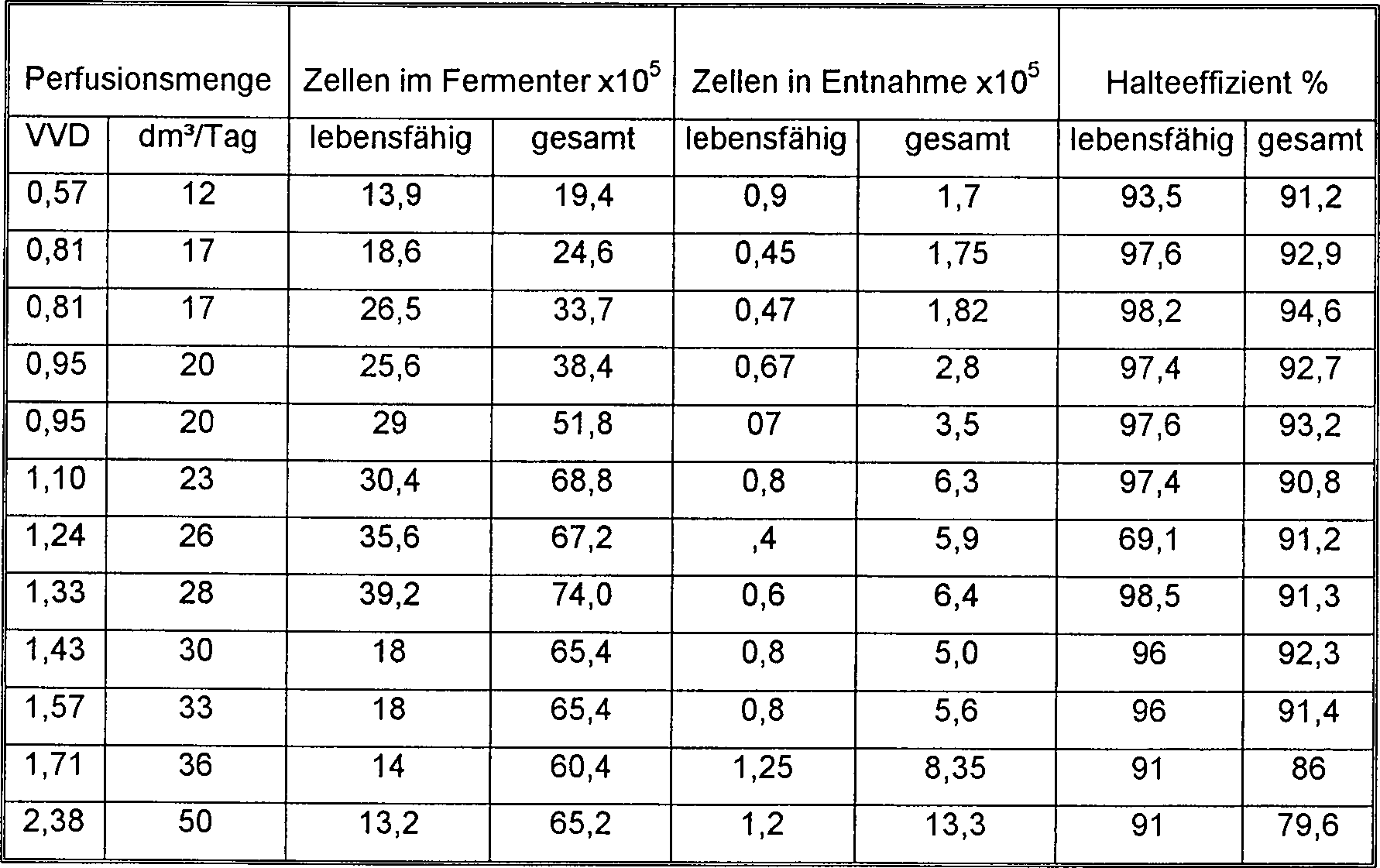
Aus den obigen Ergebnissen ist zu ersehen, daß kein wirksamer Anstieg des Verlustes von Zellen pro ml des Entnahmestroms bis zu einer Perfusionsmenge von 1,57 WD auftrat.Out From the above results it can be seen that no effective increase in the Loss of cells per ml of withdrawal stream up to a perfusion amount of 1.57 WD occurred.
Oberhalb dieser Perfusionsmenge konnte eine ansteigende Konzentration nicht-lebensfähiger Zellen in dem Entnahmestrom beobachtet werden, mit einer abnehmenden Gesamtzellenrückhalteeffizienz auf 79,6 % bei 2,38 WD. Die Retention lebensfähiger Zellen nahm ebenfalls ab, aber in einem geringeren Maß. Dies zeigte an, daß die Absetzvorrichtung zur Leistung in der Lage war, wie für nicht-lebensfähige Zellen errechnet, mit einer Gesamtzellenretention unter 21 dm3 Tag, und einem Durchbruch von kleineren, nicht-lebensfähigen Zellen oberhalb dieser Strömungsmenge.Above this perfusion level, an increasing concentration of non-viable cells could be observed in the withdrawal stream, with a decreasing total cell retention efficiency of 79.6% at 2.38 WD. Retention of viable cells also decreased, but to a lesser extent. This indicated that the settling apparatus was capable of performance as calculated for non-viable cells, with a total cell retention below 21 dm 3 days, and a breakthrough of smaller, non-viable cells above this flow rate.
Claims (19)
Applications Claiming Priority (3)
| Application Number | Priority Date | Filing Date | Title |
|---|---|---|---|
| GB939309429A GB9309429D0 (en) | 1993-05-07 | 1993-05-07 | Fermenter accessory |
| GB9309429 | 1993-05-07 | ||
| PCT/GB1994/000997 WO1994026384A1 (en) | 1993-05-07 | 1994-05-09 | Particle settler for use in cell culture |
Publications (2)
| Publication Number | Publication Date |
|---|---|
| DE69434052D1 DE69434052D1 (en) | 2004-11-11 |
| DE69434052T2 true DE69434052T2 (en) | 2005-02-10 |
Family
ID=10735095
Family Applications (1)
| Application Number | Title | Priority Date | Filing Date |
|---|---|---|---|
| DE69434052T Expired - Lifetime DE69434052T2 (en) | 1993-05-07 | 1994-05-09 | PARTICLE SEPARATOR FOR MAMMAL CELL CULTURE |
Country Status (9)
| Country | Link |
|---|---|
| US (1) | US5817505A (en) |
| EP (1) | EP0699101B1 (en) |
| JP (1) | JP3328287B2 (en) |
| AT (1) | ATE278447T1 (en) |
| AU (1) | AU691494B2 (en) |
| CA (1) | CA2162140C (en) |
| DE (1) | DE69434052T2 (en) |
| GB (1) | GB9309429D0 (en) |
| WO (1) | WO1994026384A1 (en) |
Cited By (2)
| Publication number | Priority date | Publication date | Assignee | Title |
|---|---|---|---|---|
| DE102022000456B3 (en) | 2022-02-05 | 2023-04-20 | Zellwerk Gmbh | Plate meander bioreactor for the isolation and propagation of cells, especially adherently growing mesenchymal stoma cells |
| DE102023002232B3 (en) | 2023-06-01 | 2024-06-13 | Zellwerk Gmbh | Perfusion plate meander bioreactor for cell expansion |
Families Citing this family (29)
| Publication number | Priority date | Publication date | Assignee | Title |
|---|---|---|---|---|
| JP3874442B2 (en) * | 1996-03-18 | 2007-01-31 | 旭化成エンジニアリング株式会社 | Liquid component continuous separator |
| RU2145514C1 (en) * | 1998-01-26 | 2000-02-20 | Агафонов Дмитрий Валентинович | Settler |
| CN1112442C (en) * | 2000-06-14 | 2003-06-25 | 华东理工大学 | Cell retaining and separating method and device for cell depositing culture |
| ATE494358T1 (en) * | 2001-08-31 | 2011-01-15 | Bayer Schering Pharma Ag | DEVICE AND METHOD FOR FERMENTATION IN HIGH CELL DENSITIES |
| CN1297659C (en) * | 2004-02-11 | 2007-01-31 | 上海伯瑞生物技术发展有限公司 | Method and device for perfusion and culture of hematopoietic cell |
| GB0410118D0 (en) * | 2004-05-06 | 2004-06-09 | Glaxo Group Ltd | Novel bioreactor |
| WO2009111564A1 (en) * | 2008-03-04 | 2009-09-11 | Cleveland State University | Method and system for particle settling velocity measurement |
| DE102008029307A1 (en) | 2008-06-20 | 2009-12-24 | Bayer Technology Services Gmbh | Method and device for retention and return of cells |
| US20100093078A1 (en) * | 2008-10-14 | 2010-04-15 | Cleveland State University | Separating device, an algae culture photobioreactor, and methods of using them |
| DE202010018640U1 (en) * | 2009-07-24 | 2019-11-14 | F. Hoffmann-La Roche Ag | stirrer system |
| FR2964666B1 (en) * | 2010-09-13 | 2014-11-21 | Univ Nantes | DEVICE FOR CONTROLLING THE TEMPERATURE OF A DIRECT LIGHTING SOLAR PHOTOBIOREACTOR |
| ES2890412T3 (en) * | 2011-01-17 | 2022-01-19 | Hoffmann La Roche | separation apparatus |
| BR112014020462B1 (en) * | 2012-02-20 | 2020-11-10 | Bayer Aktiengesellschaft | unidirectional separator for cell retention and recirculation |
| DE102012219184A1 (en) * | 2012-10-22 | 2014-05-08 | Krones Aktiengesellschaft | Device for the thermal treatment of products with cleaning of the process fluid |
| WO2014074606A1 (en) | 2012-11-06 | 2014-05-15 | University Of Pittsburgh-Of The Commonwealth System Of Higher Education | Adjustable liposuction cannula |
| US10596492B2 (en) | 2014-07-09 | 2020-03-24 | Sudhin Biopharma | Particle settling devices |
| EP3275992A1 (en) * | 2016-07-29 | 2018-01-31 | Bayer Aktiengesellschaft | Adapter for cell-culture vessel |
| US11434461B2 (en) * | 2018-03-20 | 2022-09-06 | Keck Graduate Institute Of Applied Life Sciences | Airlift perfusion bioreactor for the culture of cells |
| KR20210003169A (en) | 2018-04-18 | 2021-01-11 | 수딘 바이오파마 | Particle sedimentation device |
| EP3561038A1 (en) * | 2018-04-24 | 2019-10-30 | Bayer AG | Cell separator |
| CN112334208B (en) * | 2018-06-18 | 2023-09-01 | 武田药品工业株式会社 | Bottom section for connection to an assembly with a plate settler and the assembly |
| US11028359B2 (en) * | 2018-09-11 | 2021-06-08 | Global Life Sciences Solutions Usa Llc | Separation devices, associated methods, and systems |
| US12325848B2 (en) | 2019-05-15 | 2025-06-10 | Life Technologies Corporation | Cell settler apparatus systems and methods for perfusion processes |
| JP7352146B2 (en) * | 2019-07-23 | 2023-09-28 | 住友ベークライト株式会社 | Separator and culture system |
| US20230037137A1 (en) * | 2019-08-29 | 2023-02-02 | Fanuc Corporation | Cell production device and system therefor |
| WO2021038996A1 (en) * | 2019-08-29 | 2021-03-04 | ファナック株式会社 | Cell production device and cell production method |
| TW202136283A (en) * | 2019-12-12 | 2021-10-01 | 日商武田藥品工業股份有限公司 | Method for continuous protein recovering |
| AU2021236679B2 (en) | 2020-03-19 | 2024-02-15 | Sudhin Biopharma | Particle settling devices |
| CN116606713B (en) * | 2023-07-12 | 2024-03-15 | 无锡海拓环保装备科技有限公司 | Flora culture device |
Family Cites Families (4)
| Publication number | Priority date | Publication date | Assignee | Title |
|---|---|---|---|---|
| NL7800180A (en) * | 1978-01-06 | 1979-07-10 | Ballast Nedam Groep Nv | DEVICE FOR THE SEPARATION OF WATER AND SUBSTANCES THEREOF. |
| NL8602285A (en) * | 1986-09-10 | 1988-04-05 | Gechem Nv | Apparatus for anaerobically fermenting sewage water and a method for a combined anaerobic / aerobic fermentation of sewage water. |
| DK136092D0 (en) * | 1992-11-09 | 1992-11-09 | Cowiconsult A S | WASTE CLEANING PLANT AND PARAMETER |
| DE9308282U1 (en) * | 1993-06-02 | 1993-08-19 | TechnoPur GmbH, 27243 Dünsen | Plate phase separator |
-
1993
- 1993-05-07 GB GB939309429A patent/GB9309429D0/en active Pending
-
1994
- 1994-05-09 CA CA002162140A patent/CA2162140C/en not_active Expired - Fee Related
- 1994-05-09 AU AU66845/94A patent/AU691494B2/en not_active Ceased
- 1994-05-09 AT AT94914494T patent/ATE278447T1/en not_active IP Right Cessation
- 1994-05-09 EP EP94914494A patent/EP0699101B1/en not_active Expired - Lifetime
- 1994-05-09 JP JP52513694A patent/JP3328287B2/en not_active Expired - Lifetime
- 1994-05-09 US US08/545,712 patent/US5817505A/en not_active Expired - Lifetime
- 1994-05-09 DE DE69434052T patent/DE69434052T2/en not_active Expired - Lifetime
- 1994-05-09 WO PCT/GB1994/000997 patent/WO1994026384A1/en not_active Ceased
Cited By (2)
| Publication number | Priority date | Publication date | Assignee | Title |
|---|---|---|---|---|
| DE102022000456B3 (en) | 2022-02-05 | 2023-04-20 | Zellwerk Gmbh | Plate meander bioreactor for the isolation and propagation of cells, especially adherently growing mesenchymal stoma cells |
| DE102023002232B3 (en) | 2023-06-01 | 2024-06-13 | Zellwerk Gmbh | Perfusion plate meander bioreactor for cell expansion |
Also Published As
| Publication number | Publication date |
|---|---|
| GB9309429D0 (en) | 1993-06-23 |
| JPH09500818A (en) | 1997-01-28 |
| EP0699101B1 (en) | 2004-10-06 |
| US5817505A (en) | 1998-10-06 |
| CA2162140A1 (en) | 1994-11-24 |
| CA2162140C (en) | 2005-09-20 |
| EP0699101A1 (en) | 1996-03-06 |
| DE69434052D1 (en) | 2004-11-11 |
| AU6684594A (en) | 1994-12-12 |
| AU691494B2 (en) | 1998-05-21 |
| WO1994026384A1 (en) | 1994-11-24 |
| ATE278447T1 (en) | 2004-10-15 |
| JP3328287B2 (en) | 2002-09-24 |
Similar Documents
| Publication | Publication Date | Title |
|---|---|---|
| DE69434052T2 (en) | PARTICLE SEPARATOR FOR MAMMAL CELL CULTURE | |
| DE69024473T2 (en) | ROTATING BREEDING ARRANGEMENT | |
| DE68913962T2 (en) | BIOREACTOR AND DEVICE FOR CULTIVATING ANIMAL CELLS. | |
| DE69329706T2 (en) | METHOD AND DEVICE FOR CULTIVATING BIOMASS PARTICLES | |
| DE3601705A1 (en) | GAS BUBBLE GENERATOR AND DEVICE AND METHOD FOR BREEDING CELLS | |
| DE102018000561B4 (en) | Meander bioreactor and method for the isolation and propagation of cells from tissue parts of tumors, metastases and other tissues | |
| DE69006695T2 (en) | Method and system for cell cultures. | |
| EP0189398A1 (en) | Method and plant for continuously producing biological humus-forming fertilizer | |
| DE4213015C2 (en) | Biogas reactor | |
| EP0995793A1 (en) | Apparatus for the culture and the concentration of non-adherent cells and for the coculture of two distinct sort of cells | |
| DE10022635A1 (en) | Separation of viable biological cells from their suspensions, comprises a process takes place in robust hydrocyclone with controlled maximum pressure | |
| EP1277831A2 (en) | Method and apparatus for microbial biomass production from a cell culture system | |
| DE3650550T2 (en) | Method of growing animal cells | |
| DE202018000370U1 (en) | Meander bioreactor for the isolation and propagation of cells from tissue sections of tumors, metastases and other tissues | |
| DE102005024886B3 (en) | Method for controlling a content of microbial biomass in one or more reactors of a biogas plant and device for generating biogas | |
| DE744133C (en) | Fermentation process and device, in particular for the production of yeast or other microorganisms | |
| DE69029887T2 (en) | Centrifugal separator, method for separating animal cells from suspension containing animal cells using this separator and method for growing animal cells in suspension using this separator | |
| WO2024110534A1 (en) | Device for handling cell cultures | |
| WO1986004085A1 (en) | Installation and method for the culture and treatment of biocatalysts | |
| DE10223536A1 (en) | Separation of non-adherent cells from adherent cells comprises rotating a culture vessel so that the non-adherent cells sediment away from the adherent cells under gravity | |
| DE102023111197B4 (en) | Method and device for continuous algae production | |
| DE102019211243A1 (en) | Provision of cell cultures | |
| DE102011078945A1 (en) | Separating phototrophic microorganisms from aqueous medium, comprises culturing microorganisms, inducing formation of a surface molecule by microorganisms, adding magnetizable particles to medium, and passing medium through magnetic field | |
| EP0560957B1 (en) | Device and method for conveying and separating a suspension containing biological cells or microorganisms | |
| DE4316376A1 (en) | Method for the continuous cultivation of suspended cells without walls |
Legal Events
| Date | Code | Title | Description |
|---|---|---|---|
| 8364 | No opposition during term of opposition |