DE69432919T2 - Methods for the detection of specific polynucleotides - Google Patents
Methods for the detection of specific polynucleotides Download PDFInfo
- Publication number
- DE69432919T2 DE69432919T2 DE69432919T DE69432919T DE69432919T2 DE 69432919 T2 DE69432919 T2 DE 69432919T2 DE 69432919 T DE69432919 T DE 69432919T DE 69432919 T DE69432919 T DE 69432919T DE 69432919 T2 DE69432919 T2 DE 69432919T2
- Authority
- DE
- Germany
- Prior art keywords
- nuclease
- primer
- dna
- dna polymerase
- detected
- Prior art date
- Legal status (The legal status is an assumption and is not a legal conclusion. Google has not performed a legal analysis and makes no representation as to the accuracy of the status listed.)
- Expired - Fee Related
Links
Classifications
-
- C—CHEMISTRY; METALLURGY
- C12—BIOCHEMISTRY; BEER; SPIRITS; WINE; VINEGAR; MICROBIOLOGY; ENZYMOLOGY; MUTATION OR GENETIC ENGINEERING
- C12Q—MEASURING OR TESTING PROCESSES INVOLVING ENZYMES, NUCLEIC ACIDS OR MICROORGANISMS; COMPOSITIONS OR TEST PAPERS THEREFOR; PROCESSES OF PREPARING SUCH COMPOSITIONS; CONDITION-RESPONSIVE CONTROL IN MICROBIOLOGICAL OR ENZYMOLOGICAL PROCESSES
- C12Q1/00—Measuring or testing processes involving enzymes, nucleic acids or microorganisms; Compositions therefor; Processes of preparing such compositions
- C12Q1/68—Measuring or testing processes involving enzymes, nucleic acids or microorganisms; Compositions therefor; Processes of preparing such compositions involving nucleic acids
- C12Q1/6844—Nucleic acid amplification reactions
- C12Q1/686—Polymerase chain reaction [PCR]
Landscapes
- Chemical & Material Sciences (AREA)
- Organic Chemistry (AREA)
- Life Sciences & Earth Sciences (AREA)
- Chemical Kinetics & Catalysis (AREA)
- Zoology (AREA)
- Wood Science & Technology (AREA)
- Proteomics, Peptides & Aminoacids (AREA)
- Health & Medical Sciences (AREA)
- Engineering & Computer Science (AREA)
- Biophysics (AREA)
- Immunology (AREA)
- Microbiology (AREA)
- Molecular Biology (AREA)
- Biotechnology (AREA)
- Analytical Chemistry (AREA)
- Physics & Mathematics (AREA)
- Biochemistry (AREA)
- Bioinformatics & Cheminformatics (AREA)
- General Engineering & Computer Science (AREA)
- General Health & Medical Sciences (AREA)
- Genetics & Genomics (AREA)
- Measuring Or Testing Involving Enzymes Or Micro-Organisms (AREA)
Description
Die vorliegende Erfindung betrifft ein Verfahren zum Nachweis eines in einer Probe vorhandenen Polynucleotids mit einer spezifischen Sequenz (im folgenden als "nachzuweisendes Polynucleotid" bezeichnet), wobei das Verfahren zur Diagnose von genetisch bedingten Erkrankungen sowie Infektionskrankheiten geeignet ist. Ein für das Verfahren verwendeter Kit zum Nachweis eines Polynucleotids ist ebenfalls umfasst.The present invention relates to a method for the detection of a polynucleotide present in a sample with a specific sequence (hereinafter referred to as "polynucleotide to be detected"), wherein the procedure for the diagnosis of genetic diseases as well as infectious diseases. One used for the process Kit for detection of a polynucleotide is also included.
Ein auf der Komplementarität zwischen Nucleotidsequenzen beruhendes Analyseverfahren ermöglicht die direkte Analyse genetischer Merkmale. Es stellt daher ein sehr wirkungsvolles Mittel zur Identifizierung genetisch bedingter Erkrankungen, einer karzinomartigen Veränderung von normalen Zellen, Mikroorganismen, usw. dar. Da es das Gen direkt nachweist, lassen sich damit zeitaufwendige und schwierige Arbeitsschritte wie Kultivierung usw. vermeiden.One on the complementarity between Analysis method based on nucleotide sequences enables the direct analysis of genetic traits. It therefore represents a very effective one Means of identifying genetic diseases, one carcinoma-like change of normal cells, microorganisms, etc. Since it is the gene directly proves time-consuming and difficult work steps such as cultivation etc. avoid.
Es ist jedoch im allgemeinen nicht leicht, eine in Spuren vorkommende Menge eines nachzuweisenden Nucleotids in einer Probe nachzuweisen, so dass das nachzuweisende Nucleotid selbst bzw. ein Signal davon amplifiziert werden sollte. Ein bekanntes Verfahren zur Amplifikation des nachzuweisenden Nucleotids ist die Polymerasekettenreaktion (Polymerase Chain Reaction, PCR). Bei der PCR handelt es sich um das gängigste Verfahren einer in vitro Nukleinsäureamplifikation. Mit der PCR sind jedoch bekannte Nachteile, z. B. das Erfordernis einer Temperatur-kontrolleinheit bei der praktischen Durchführung, unzureichende Quantifizierung aufgrund der logarithmischen Amplifikation und die leichte Anfälligkeit gegenüber Verunreinigungen, verbunden.However, it is generally not easily, a trace amount of a nucleotide to be detected to be detected in a sample so that the nucleotide to be detected itself or a signal thereof should be amplified. A well known The method for amplifying the nucleotide to be detected is Polymerase chain reaction (PCR). In the PCR is the most common Method of in vitro nucleic acid amplification. With the PCR are known disadvantages, e.g. B. the need for a temperature control unit in the practical implementation, insufficient quantification due to logarithmic amplification and the slight vulnerability across from Impurities, connected.
Das heißt, dass eine Reaktion, z. B. eine PCR, in der DNA mehrere Millionen Male amplifiziert wird, leicht zu fehlerhaften Ergebnissen führen kann, die durch die gleichzeitige Amplifikation von Spuren von DNA-Verunreinigungen hervorgerufen werden. Dadurch entsteht ein ernstes Problem, insbesondere bei der gleichzeitigen Bearbeitung einer großen Anzahl von Proben. Um eine derartige Kontaminierung zu verhindern, wird ein Labor daher geteilt, usw. Des weiteren gibt es einen chemischen Ansatz, bei dem eine Uracilbase während der PCR eingebaut wird und danach die Probe vor dem Start einer weiteren PCR-Amplifikation mit Uracil-Glycosylase behandelt wird, so dass nur das Amplifikationsprodukt aus einem anderen Reaktionssystem, welches aus einer verunreinigten Probe stammt, abgebaut wird. Diese obigen Ansätze sind jedoch hinsichtlich der Verhinderung von Kontaminierungen nicht immer zufriedenstellend.This means that a reaction, e.g. B. a PCR in which DNA is amplified several million times easily lead to incorrect results can by the simultaneous amplification of traces of DNA contaminants are caused. This creates a serious problem, in particular with the simultaneous processing of a large number of samples. To one to prevent such contamination, a laboratory is therefore shared, etc. There is also a chemical approach where one Uracilbase during the PCR is installed and then the sample before starting one further PCR amplification is treated with uracil glycosylase, so that only the amplification product from another reaction system which comes from a contaminated sample, is broken down. These above approaches however, are not in terms of preventing contamination always satisfactory.
Als ein Verfahren zur Amplifikation eines Signals ist ein Verfahren zur Amplifikation von Signal-RNA durch Qβ-Replicase bekannt (P. M. Lizardi et al., Bio/Technology, 6, 1197–1202 (1988)). Da jedoch dieses Verfahren die Insertion einer Amplifikationssequenz in eine Sequenz, die von der Replicase erkannt werden kann, erfordert, sind die inserierte Sequenz sowie die Position, in der sie inseriert wird, stereostrukturell eingeschränkt. Bei diesem Amplifikationsverfahren besteht ebenfalls das Kontaminierungsproblem, ähnlich wie bei der PCR.As a method of amplification of a signal is a method of amplifying signal RNA by QB replicase known (P.M. Lizardi et al., Bio / Technology, 6, 1197-1202 (1988)). However, since this procedure involves the insertion of an amplification sequence into a sequence that can be recognized by the replicase, are the inserted sequence and the position in which it is inserted is stereostructurally restricted. With this amplification process there is also the contamination problem, similar to PCR.
Neben der obengenannten Amplifikation der nachzuweisenden Nucleotidsequenz gibt es Signalamplifikationsverfahren, mit denen Abbauprodukte nachgewiesen werden.In addition to the above amplification there are signal amplification methods for the nucleotide sequence to be detected, with which degradation products are detected.
So ist beispielsweise aus der
Auch wurde ein zyklischer Assay mit λ-Exonuclease,
die für
die Spaltung doppelsträngiger
DNA spezifisch ist, entwickelt (C. G. Copley et al., BioTechniques,
Vol. 13, Nr. 6, 882–892
(1992)). Bei diesem Verfahren wird eine Oligonucleotidsonde mit
einer zu ihr komplementären
Sequenz hybridisiert, wodurch die λ-Exonuclease die gebildete doppelsträngige DNA
angreifen kann, so dass die hybridisierte DNA-Sonde abgebaut wird. Die
DNA-Sonde wird durch
eine weitere DNA-Sonde ersetzt, die daraufhin abgebaut wird. Diese
zyklische Reaktion wird dann wiederholt. Bei diesem Verfahren lässt sich
durch den Nachweis der abgebauten Sonde die Anwesenheit einer spezifischen
DNA-Sequenz abschätzen.
Dieses Verfahren ist gegenüber
Verfahren mit Restriktionsenzymen (
λ-Exonuclease benötigt jedoch als Substrat eine am 5'-Ende phosphorylierte DNA-Sonde. Ein Problem bei diesem Verfahren scheint die Schwierigkeit bei der Reproduktion der 5'-phosphorylierten Sonde zu sein. Bei der chemischen Synthese der DNA-Sonde im DNA-Syntheseautomat wird das 5'-Ende nicht phosphoryliert. Daher ist es schwierig, die vollständige Phosphorylierung aller 5'-Enden sicherzustellen. Ein weiteres Problem ist die niedrige Wiederholungsrate der zyklischen Reaktionen (etwa 500 mal pro Stunde nach Literaturangaben), da bei konstanter Temperatur der geschwindigkeitsbestimmende Schritt die Hybridisierung zwischen der DNA-Sonde und dem DNA-Template, die in dem zykli schen Assay wiederholt durchgeführt wird und Reaktionszeit in Anspruch zu nehmen scheint, ist.However, λ-exonuclease requires a 5 'end phosphorylated DNA probe as substrate. A problem with this method appears to be the difficulty in reproducing the 5'-phosphorylated probe. In the chemical synthesis of the DNA probe in the DNA synthesizer, the 5 'end is not phosphorylated. It is therefore difficult to ensure complete phosphorylation of all 5 'ends. Another problem is the low repetition rate of the cyclic reactions (about 500 times per hour according to the literature), since at a constant temperature the rate-determining step is the hybridization between the DNA probe and the DNA template, which is carried out repeatedly in the cyclic assay and seems to take response time is.
Ein weiterer zyklischer Assay mit
einer Exonuclease wird in der
Aus der WO 93/21340 ist ein Verfahren zur Sequenzierung von DNA bekannt, bei dem fluoreszenzmarkierte Nucleotide am Ende eines Primers eingebaut werden. Die Nucleotide werden jeweils nacheinander eingebaut, und die Art des hinzugefügten Nucleotids (A, T, C oder G) wird vor Entfernung der Fluoreszenzmarkierung bestimmt und danach der Vorgang wiederholt. Um die Addition von mehr als einem Nucleotid zu verhindern, werden Kettenverlängerungsinhibitoren eingebaut. Diese Inhibi-toren müssen vor der nächsten Syntheserunde durch eine Exonuclease entfernt werden, so dass der Nachweis stattfinden kann. Um zu verhindern, dass die Exonuclease den Primer selbst verdaut, wird ein Nuclease-resistenter Primer verwendet.A method is known from WO 93/21340 known for sequencing DNA, in which fluorescence-labeled Nucleotides are inserted at the end of a primer. The nucleotides are inserted one after the other, and the type of nucleotide added (A, T, C or G) is determined before removing the fluorescent label and then the process is repeated. To add more than to prevent a nucleotide, chain extension inhibitors are incorporated. These inhibitors must before the next Round of synthesis can be removed by an exonuclease, so that the Proof can take place. To prevent the exonuclease digested the primer itself becomes a nuclease resistant primer used.
Aus der WO 93/23564 ist ein Verfahren zur Identifizierung einer einzelnen Base an einer nachzuweisen den Position einer bekannten DNA-Sequenz bekannt. Dies wird erreicht, indem ein komplementäres Nucleotid am Ende eines an einen einzelsträngigen DNA-Strang gebundenen Primers eingebaut wird und die daraus folgende Pyrophosphatfreisetzung nachgewiesen wird. Da jeweils nur eine Nucleotidart (A, T, C oder G) verwendet wird, erlaubt die Bildung von Pyrophosphat die Identifizierung der Base an der nachzuweisenden Position. Der zur Durchführung dieses Verfahrens beschriebene Kit umfasst wenigstens einen Primer, Polymerase, Enzyme zur Identifizierung der Pyrophosphatfreisetzung, Desoxynucleotide und gegebenenfalls Didesoxynucleotide.A method is known from WO 93/23564 to identify a single base on a Position of a known DNA sequence known. This is achieved by adding a complementary Nucleotide at the end of one bound to a single-stranded DNA strand Primers is installed and the resulting pyrophosphate release is proven. Since only one type of nucleotide (A, T, C or G) is used, the formation of pyrophosphate allows identification the base at the position to be verified. The one to carry out this Process described kit comprises at least one primer, polymerase, Enzymes to identify the release of pyrophosphate, deoxynucleotides and optionally dideoxynucleotides.
Zur Lösung der obigen Probleme wurde
von den Erfindern der vorliegenden Erfindung ein Verfahren zum Nachweis
einer Nucleotidsequenz entwickelt, in dem ein Verstärkungsreagenz
zusammen mit Exonuclease III verwendet wird (japanische Offenlegungsschrift
Nr.
In den bisher beschriebenen Amplifikationsverfahren wird ein als Primer zugegebenes Oligonucleotid zu einem amplifizierten Produkt und fungiert nicht länger als Primer. Daher sollte das Oligonucleotid in großem Überschuss relativ zu der geschätzten Menge des nachzuweisenden Nucleotids zugegeben werden. Besonders in einem System wie z. B. PCR, in der die Amplifikation logarithmisch erfolgt, sollte eine extrem große Oligonucleotidmenge vor Beginn zugegeben werden. Vom wirtschaftlichen Gesichtspunkt her ist eine geringere Oligonucleotidmenge vorzuziehen, unbeachtlich ob sie chemisch synthetisiert oder aus biologischen Materialien gewonnen wird.In the amplification methods described so far an oligonucleotide added as a primer becomes an amplified one Product and no longer functions as a primer. Therefore, the oligonucleotide should be in large excess relative to the estimated Amount of nucleotide to be added. Especially in a system such as B. PCR, in which the amplification is logarithmic extremely large amount of oligonucleotides be added before the start. From an economic point of view A smaller amount of oligonucleotides is preferable, irrelevant whether it's chemically synthesized or from biological materials is won.
Es ist daher eine Aufgabe der vorliegenden Erfindung, ein Verfahren zum Nachweis eines Polynucleotids bereitzustellen, das in einem einfachen Reaktionssystem weniger anfällig gegenüber dem Einfluss von Verunreinigungen ist, ohne dass irgendeine spezielle Ausrüstung, wie etwa eine komplizierte Temperaturkontrolle, erforderlich ist. Eine weitere Aufgabe der vorliegenden Erfindung ist die Bereitstellung eines Nachweisverfahrens, das auf eine große Vielfalt einer unbegrenzten Zahl von Nucleotidsequenzen angewendet werden kann. Noch eine weitere Aufgabe der vorliegenden Erfindung besteht darin, ein Nachweisverfahren bereitzustellen, mit dem sich, nach geeigneter Wahl des vorliegenden Nachweissystems, eine höhere Empfindlichkeit und bessere Quantifizierung erzielen lässt.It is therefore an object of the present Invention to provide a method for the detection of a polynucleotide that is less susceptible to that in a simple reaction system Influence of impurities is without any special Equipment, such as complicated temperature control. Another object of the present invention is to provide a detection procedure that is based on a wide variety of unlimited Number of nucleotide sequences can be applied. Another one The object of the present invention is a detection method provide with which, according to the appropriate choice of the present Detection system, a higher one Sensitivity and better quantification.
Als Ergebnis ihrer Forschungsbemühungen wurde von den Erfindern der vorliegenden Erfindung erfolgreich ein Verfahren entwickelt, worin eine Nuclease, die an einer doppelsträngigen DNA angreift, jedoch nicht an einer einzelsträngigen DNA angreift, zusammen mit DNA-Polymerase verwendet wird, so dass das Signal amplifiziert werden kann.As a result of their research efforts a method successfully used by the inventors of the present invention developed in which a nuclease attached to a double-stranded DNA attacks, but does not attack a single-stranded DNA with DNA polymerase is used so that the signal can be amplified.
Das heißt, die vorliegende Erfindung umfasst:
- 1. Verfahren zum Nachweis eines nachzuweisenden Polynucleotids, umfassend: Hybridisieren eines Nuclease-resistenten Oligonucleotidprimers, der eine Sequenz aufweist, die komplementär zu einer bekannten Nucleotidsequenz eines Teils des nachzuweisenden Polynucleotids ist, in Gegenwart von DNA-Polymerase, Nuclease dafür sowie mindestens einer Desoxynucleosid-Triphosphat-Art, welche zu demjenigen Nucleotid des nachzuweisenden Polynucleotids komplementär ist, das sich in 5'-Richtung an dasjenige Nucleotid des nachzuweisenden Polynucleotids an schließt, welches zum 3'-Ende des Primers komplementär ist, unter Bedingungen, worunter das 3'-Ende des Primers durch Hinzufügen des Desoxynucleosid-Monophosphatrests des Desoxynucleosid-Triphosphats verlängert wird, gefolgt vom Entfernen des hinzugefügten Desoxynucleosids durch eine Nuclease, die an doppelsträngiger DNA angreift, nicht aber einzelsträngige DNA angreift, wobei die Vorgänge des Verlängerns und Entfernens einmal oder mehrfach wiederholt werden, und Nachweisen der erhaltenen Pyrophosphorsäure und/oder des Desoxynucleosid-Monophosphats, die durch das Verlängern oder Entfernen freigesetzt werden.
- 2. Verfahren zum Nachweis eines Polynucleotids nach Punkt 1, wobei der Oligonucleotidprimer im Bereich des 3'-Endes phosphorothioiert ist.
- 3. Verfahren zum Nachweis eines Polynucleotids nach Punkt 1 oder 2, wobei die DNA-Polymerase eine DNA-Polymerase I, das Klenow-Fragment der DNA-Polymerase I, T4 DNA-Polymerase, T7 DNA-Polymerase oder Phi29 DNA-Polymerase ist.
- 4. Verfahren zum Nachweis eines Polynucleotids nach einem der Punkte 1 bis 3, wobei die Nuclease die Exonuclease III ist.
- 5. Verfahren zum Nachweis eines Polynucleotids nach einem der Punkte 1 bis 4, wobei ein Atom oder ein Molekül, mit Ausnahme der Phosphorsäuremoleküle an Position β und γ des Desoxynucleosid-Triphosphats, mit einem Radioisotop markiert ist und das Desoxynucleosid-Monophosphat, das bei der Nuclease-Spaltung freigesetzt wird, nachgewiesen wird.
- 6. Verfahren zum Nachweis eines Polynucleotids nach einem der Punkte 1 bis 5, wobei das bei der Nuclease-Spaltung freigesetzte Desoxynucleosid-Monophosphat chromatographisch abgetrennt und optisch bestimmt wird.
- 7. Verfahren zum Nachweis eines Polynucleotids nach einem der Punkte 1 bis 6, wobei die Pyrophosphorsäure, die beim Einbau einer komplementären Base durch die DNA-Polymerase gebildet wird, mit Adenosin-5'-Phosphosulfat und Adenonsin-Triphosphat-Sulfurylase zur Reaktion gebracht werden kann, wobei Adenosin-Triphosphat gebildet wird, welches daraufhin nachgewiesen wird.
- 8. Verfahren zum Nachweis eines Polynucleotids nach Punkt 7, wobei Adenosin-Triphosphat durch eine Luciferin/Luciferase-Reaktion bestimmt wird.
- 9. Kit zur Verwendung in dem Verfahren zum Nachweis eines Polynucleotids nach einem der Punkte 1 bis 8, umfassend:
- 1. einen Nuclease-resistenten Oligonucleotidprimer mit einer Sequenz, die komplementär zu einem Teil des nachzuweisenden Polynucleotids mit bekannter Nucleotidsequenz ist;
- 2. eine DNA-Polymerase;
- 3. mindestens eine Desoxynucleosid-Triphosphat-Art;
- 4. eine Nuclease mit der Wirkung, eine doppelsträngige DNA in der 3' zu 5'-Richtung abzubauen, die aber nicht an einzelsträngiger DNA angreift; und
- 5. Reagenzien zum Nachweis von Desoxynucleosid-Monophosphat und/oder Reagenzien zum Nachweis von Pyrophosphorsäure.
- 1. A method for the detection of a polynucleotide to be detected, comprising: hybridizing a nuclease-resistant oligonucleotide primer which has a sequence which is complementary to a known nucleotide sequence of part of the polynucleotide to be detected, in the presence of DNA polymerase, nuclease therefor and at least one deoxynucleoside Triphosphate species which is complementary to that nucleotide of the polynucleotide to be detected which in the 5 'direction joins the nucleotide of the polynucleotide to be detected which is complementary to the 3' end of the primer under conditions, including the 3 'end the primer by adding the deoxynucleoside monophos pha residues of the deoxynucleoside triphosphate is extended, followed by removal of the added deoxynucleoside by a nuclease which attacks double-stranded DNA but does not attack single-stranded DNA, the processes of extension and removal being repeated one or more times, and detecting the pyrophosphoric acid and / or the deoxynucleoside monophosphate released by the elongation or removal.
- 2. A method for the detection of a polynucleotide according to item 1, the oligonucleotide primer being phosphorothioated in the region of the 3 'end.
- 3. A method for the detection of a polynucleotide according to item 1 or 2, wherein the DNA polymerase is a DNA polymerase I, the Klenow fragment of DNA polymerase I, T4 DNA polymerase, T7 DNA polymerase or Phi29 DNA polymerase.
- 4. A method for the detection of a polynucleotide according to any one of items 1 to 3, the nuclease being exonuclease III.
- 5. A method for the detection of a polynucleotide according to any one of items 1 to 4, wherein an atom or a molecule, with the exception of the phosphoric acid molecules at positions β and γ of the deoxynucleoside triphosphate, is labeled with a radioisotope and the deoxynucleoside monophosphate which is used in the Nuclease cleavage released is detected.
- 6. A method for the detection of a polynucleotide according to any one of items 1 to 5, the deoxynucleoside monophosphate released in the nuclease cleavage being separated chromatographically and optically determined.
- 7. A method for the detection of a polynucleotide according to any one of items 1 to 6, wherein the pyrophosphoric acid which is formed by the DNA polymerase when a complementary base is incorporated is reacted with adenosine 5'-phosphosulfate and adenonsine triphosphate sulfurylase can, whereby adenosine triphosphate is formed, which is then detected.
- 8. A method for the detection of a polynucleotide according to item 7, wherein adenosine triphosphate is determined by a luciferin / luciferase reaction.
- 9. A kit for use in the method of detecting a polynucleotide according to any one of items 1 to 8, comprising:
- 1. a nuclease-resistant oligonucleotide primer with a sequence which is complementary to a part of the polynucleotide to be detected with a known nucleotide sequence;
- 2. a DNA polymerase;
- 3. at least one deoxynucleoside triphosphate species;
- 4. a nuclease with the effect of breaking down a double-stranded DNA in the 3 'to 5' direction, but which does not attack single-stranded DNA; and
- 5. Reagents for the detection of deoxynucleoside monophosphate and / or reagents for the detection of pyrophosphoric acid.
Die vorliegende Erfindung wird im folgenden ausführlich beschrieben.The present invention is described in following in detail described.
- (A) Bei dem in der vorliegenden Erfindung nachzuweisenden Molekül handelt es sich um ein Polynucleotid mit einer bekannten Nucleotidsequenz.(A) The one to be detected in the present invention molecule it is a polynucleotide with a known nucleotide sequence.
Das nachzuweisende Polynucleotid der vorliegenden Erfindung umfasst, ohne darauf beschränkt zu sein, Polynucleotide aus solchen Organismen wie Tier, Pflanze, Bakterium, Hefe, Schimmelpilze, Mycoplasma, Rickettsien, Virus, usw. Die Polynucleotidarten umfassen, ohne darauf beschränkt zu sein, genomische Nucleinsäure und von RNA-Virus bzw. mRNA abgeleitete cDNA.The polynucleotide to be detected of the present invention includes, but is not limited to, Polynucleotides from organisms such as animals, plants, bacteria, Yeast, mold, mycoplasma, rickettsia, virus, etc. The types of polynucleotides include, but not limited to to be genomic nucleic acid and cDNA derived from RNA virus or mRNA.
Für die praktische Analyse kann eine DNA-Sequenz, bei der es sich weder um das nachzuweisende Polynucleotid noch um eine als Primer für die DNA-Synthese in Frage kommende Sequenz handelt, ein Problem darstellen. Es besteht die Möglichkeit der Verunreinigung der Probe mit DNA-Polymerase- bzw. Nuclease-inhibierenden Substanzen sowie mit Desoxynucleosid-Triphosphat. Weiterhin kann in den Fällen, in denen Pyrophosphorsäure als Signal von dem nachzuweisenden Nucleotid verwendet wird, die in einer Probe vorhandene Pyrophosphorsäure die Analyse stören.For the practical analysis can be a DNA sequence that is neither to the polynucleotide to be detected as a primer for DNA synthesis the sequence in question is a problem. It exists the possibility contamination of the sample with DNA polymerase or nuclease inhibitors Substances as well as with deoxynucleoside triphosphate. Furthermore can in cases in which pyrophosphoric acid is used as a signal from the nucleotide to be detected, which Pyrophosphoric acid present in a sample can interfere with the analysis.
Daher ist bei der Amplifikation in der vorliegenden Erfindung die Minimierung einer solchen Verunreinigung bevorzugt. Die vorliegende Erfindung ist in der Lage, ein hintergrundfreies, hochempfindliches Nachweissystem zur Verfügung zu stellen, indem beispielsweise das nachzuweisende Nucleotid mit einer Festphasengebundenen Fängersonde usw. eingefangen und gewaschen wird. Ist die Fängersonde am 5'-Ende an eine Festphase gebunden (H. Kohsaka et al., Eur. J. Immunol., 23, 1895–1901 (1993); H. Kohsaka et al., Nucleic Acids Research, 21, 3469–3472 (1993)), lässt sich die Fänger sonde selbst ebenfalls als Primer bei der Anwendung des vorliegenden experimentellen Verfahrens einsetzen. Die obenerwähnte Pyrophosphorsäure in der Probe lässt sich ebenfalls enzymatisch mit Pyrophosphatase entfernen.Therefore in the amplification in the present invention to minimize such contamination prefers. The present invention is able to provide a background-free, to provide highly sensitive detection system, for example by the nucleotide to be detected with a solid-phase capture probe etc. is captured and washed. Is the capture probe at the 5 'end on a solid phase bound (H. Kohsaka et al., Eur. J. Immunol., 23, 1895-1901 (1993); H. Kohsaka et al., Nucleic Acids Research, 21, 3469-3472 (1993)), let yourself the catcher probe itself also as a primer in the application of the present experimental Use procedure. The above-mentioned pyrophosphoric acid in the sample let yourself also remove enzymatically with pyrophosphatase.
In einer bevorzugten Ausführungsform der vorliegenden Erfindung, in der insbesondere ein Nucleotid wiederholt eingebaut und abgebaut wird, lässt sich eine Punktmutation wie im folgenden beschrieben nachweisen.In a preferred embodiment of the present invention, in particular a nucleotide repeated installation and dismantling, a point mutation can be demonstrated as described below.
Das Verfahren zum Nachweis einer
Punktmutation ist bekannt, wie beispielsweise beschrieben in der
Das vorgenannte Verfahren stimmt mit der vorliegenden Erfindung in einigen Elementen überein. Ein wesentlicher Unterschied liegt jedoch darin, dass das vorgenannte Verfahren die Gegenwart bzw. Abwesenheit eines Nuclease-resistenten Fragments als Indikator der Anwesenheit der Punktmutation verwendet, wohingegen in der vorliegenden Erfindung das Auftreten einer wiederholt ablaufenden Reaktion eingesetzt wird. Weiterhin besitzt das vorliegende Verfahren beim Nachweis einer Punktmutation eine höhere Empfindlichkeit gegenüber dem obigen Verfahren.The above procedure is correct in some elements consistent with the present invention. A major difference, however, is that the above Process the presence or absence of a nuclease resistant Fragments used as an indicator of the presence of the point mutation, whereas in the present invention the occurrence of a repeats ongoing reaction is used. Furthermore, the present Procedure when detecting a point mutation has a higher sensitivity to that procedure above.
- (B) Die vorliegende Erfindung ist gekennzeichnet durch Hybridisieren eines bekannten Polynucleotids mit einem Nuclease-resistenten Oligonucleotidprimer mit einer Sequenz, die zu einem Teil des bekannten Polynucleotids komplementär ist.(B) The present invention is characterized by hybridizing a known polynucleotide with a nuclease resistant Oligonucleotide primer with a sequence that is part of the known Complementary polynucleotides is.
In der vorliegenden Erfindung bezieht sich der Ausdruck "komplementär" auf den Zustand, der es zwei Nucleinsäureketten gestattet, eine doppelsträngige Kette über Wasserstoffbrückenbindung gemäß der Watson-Crick-Basenpaarung zu bilden. Insbesondere ist Thymin (T) komplementär zu Adenin (A) und Cytosin (C) komplementär zu Guanin (G). In der vorliegenden Erfindung muss der Primer nicht vollkommen komplementär zu der nachzuweisenden Polynucleotidsequenz sein, insoweit das nachzuweisende Oligonucleotid als Ganzes mit dem nachzuweisenden Polynucleotid hybridisieren kann. Insbesondere sollten wenigstens 70% des Primer-Oligonucleotids komplementär zu dem nachzuweisenden Polynucleotid sein, unter der Bedingung, dass das 3'-Ende des Primers an das nachzuweisende Nucleotid hybridisiert und vollständig komplementär zu diesem ist. Eine Komplementarität von weniger als 70% ist aufgrund unzureichender Hybridisierung nicht bevorzugt. In der vorliegenden Erfindung ist die Bedingung, dass das 3'-Ende des Oligonucleotidprimers zu dem nachzuweisenden Nucleotid, an das der Primer hybridisiert, komplementär ist, eine Voraussetzung für die Nucleotidverlängerung am 3'-Ende. Falls der 3'-terminale Bereich nicht in der Lage ist, mit der nachzuweisenden DNA zu hybridisieren, und daher einzelsträngig bleibt, kann der Primerbereich von Polymerase und Nuclease nicht erkannt werden.In the present invention the expression "complementary" to the state of there are two nucleic acid chains allowed a double-stranded Chain over Hydrogen bonding according to the Watson-Crick base pairing. In particular, thymine (T) is complementary to adenine (A) and cytosine (C) complementary to Guanin (G). In the present invention, the primer need not completely complementary to the polynucleotide sequence to be detected, insofar as the one to be detected Oligonucleotide as a whole with the polynucleotide to be detected can hybridize. In particular, at least 70% of the primer oligonucleotide should complementary to the polynucleotide to be detected, provided that that the 3 'end of the primer hybridized to the nucleotide to be detected and completely complementary to it is. A complementarity is less than 70% due to insufficient hybridization prefers. In the present invention, the condition is that the 3 'end of the Oligonucleotide primer to the nucleotide to be detected to which the Primer hybridizes, complementarily is a requirement for the nucleotide extension at the 3 'end. If the 3'-terminal Region is unable to hybridize with the DNA to be detected, and therefore single-stranded remains, the primer range of polymerase and nuclease cannot be recognized.
Der Oligonucleotidprimer in der vorliegenden Erfindung ist dadurch gekennzeichnet, dass er zu "einem Teil" eines nachzuweisenden bekannten Polynucleotids komplementär ist. Der Grund dafür ist, dass das vorliegende Verfahren dadurch gekennzeichnet ist, dass eine spezifische Desoxynucleotid-Art, die zu dem Reaktionssystem gegeben wird und dann von der DNA-Polymerase an das 3'-Ende des Oligonucleotidprimers gebunden wird, nachgewiesen wird. Das heißt, falls das nachzuweisende Polynucleotid, welches als Template für das an das 3'-Ende des Primers gebundene SubstratDesoxynucleotid dient, unbekannt ist, kann niemand wissen, welche Desoxynucleotid-Art als Substrat zu dem System gegeben werden sollte. Daher muss der Oligonucleotidprimer komplementär zu "einem Teil" eines bekannten nachzuweisenden Polynucleotids sein.The oligonucleotide primer in the present Invention is characterized in that it becomes "a part" of one to be demonstrated known polynucleotide is complementary. the reason for that is the present method is characterized in that a specific type of deoxynucleotide added to the reaction system and then from the DNA polymerase to the 3 'end of the oligonucleotide primer is detected. The is called, if the polynucleotide to be detected, which serves as a template for the the 3 'end of the Primer-bound substrate deoxynucleotide is used, is unknown, no one can know what kind of deoxynucleotide as substrate should be given to the system. Therefore, the oligonucleotide primer complementary to "a part" of a known one to be detected polynucleotide.
Der in der vorliegenden Erfindung verwendete Oligonucleotidprimer sollte Nuclease-resistent sein, um den Abbau durch die in dem System vorhandene Nuclease zu verhindern.The one in the present invention oligonucleotide primer used should be nuclease resistant, to prevent degradation by the nuclease present in the system.
Das Verfahren zur Übertragung der Nuclease-Resistenz auf dem Oligonucleotidprimer ist nicht besonders beschränkt, und es lassen sich daher alle im Fachgebiet bekannten Verfahren dazu verwenden.The procedure for transfer nuclease resistance on the oligonucleotide primer is not special limited, and therefore all methods known in the art can be use for this.
So kann beispielsweise ein Oligonucleotidprimer mit Nuclease-Resistenz in einem DNA-Syntheseautomat synthetisiert werden, indem eine Phosphorothioatbindung in die gewünschte Stelle des Primers mit einem im Fachgebiet bekannten Verfahren eingeführt wird. Insbesondere wird der Oligonucleotidprimer beispielsweise in dem Festphasen-Phosphoramiditverfahren synthetisiert, bei dem der herkömmliche Oxidationsschritt mit Iodwasser durch eine oxidative Behandlung mit einem für die Phosphorothioierung geeigneten Reagenz ersetzt wird, wodurch eine Phosphorothioatbindung anstelle einer Phosphordiesterbindung eingeführt werden kann. Als Phosphorothioierungsreagenz sind 3H-1,2-Benzodithiol-3-on-1,l-dioxid (Beaucage's Reagenz), TETD/Acetonitril (TETD: Tetraethylthiuramdisulfid), usw. zu nennen. Dieses Verfahren ermöglicht die Einführung einer Phosphorothioatbindung in das Oligonucleotid an einer beliebigen Stelle.For example, an oligonucleotide primer synthesized with nuclease resistance in a DNA synthesizer by placing a phosphorothioate bond in the desired location of the primer is introduced using a method known in the art. In particular, the oligonucleotide primer is used, for example, in the Solid-phase phosphoramidite method synthesized in which the conventional Oxidation step with iodine water through an oxidative treatment with one for the phosphorothioation-appropriate reagent is replaced, whereby a phosphorothioate bond instead of a phosphorodiester bond be introduced can. 3H-1,2-benzodithiol-3-one-1,1-dioxide (Beaucage's reagent), TETD / acetonitrile are the phosphorothioating reagents (TETD: tetraethylthiuram disulfide), etc. This method allows the introduction a phosphorothioate bond into the oligonucleotide at any Job.
Als ein alternatives Verfahren zur Einführung einer Phosphorothioatbindung in den Oligonucleotidprimer lässt sich die enzymatische DNA-Synthese mit DNA-Polymerase in Gegenwart von Desoxyribonucleosid- Triphosphat durchführen, bei dem das Sauerstoffatom an der α-Stellung durch Schwefel ersetzt ist. Als derartige substituierte Verbindungen sind α-S-Desoxythymidin-Triphosphat, α-S-Desoxycytidin-Triphosphat, α-S-Desoxyadenosin-Triphosphat sowie α-S-Desoxyguanosin-Triphosphat (die im folgenden gemeinsam als SdXTP bezeichnet werden) zu nennen. DNA-Polymerase baut SdXTP anstelle von Desoxynucleosid-Triphosphat (im folgenden als dXTP bezeichnet) ein, so dass sich ein phosphorothioierter Oligonucleotidprimer mit Nuclease-Resistenz ergibt. Eine Phosphorothioatbindung lässt sich durch DNA-Polymerase ebenfalls in ein mit dem nachzuweisenden Polynucleotid hybridisiertes Oligonucleotid einführen. Das heisst, dem Oligonucleotidprimer wird während der Analyse Nuclease-Resistenz verliehen, und er braucht daher nicht unbedingt vorher hergestellt werden.As an alternative method for introducing a phosphorothioate bond into the oligonucleotide primer, enzymatic DNA synthesis with DNA polymerase can be carried out in the presence of deoxyribonucleoside triphosphate, in which the oxygen atom at the α-position is replaced by sulfur. Examples of such substituted compounds are α-S-deoxythymidine triphosphate, α-S-deoxycytidine triphosphate, α-S-deoxyadenosine triphosphate and α-S-deoxyguanosine triphosphate (hereinafter referred to collectively as SdXTP). DNA polymerase incorporates SdXTP instead of deoxynucleoside triphosphate (hereinafter referred to as dXTP), so that a phosphorothioated oligonucleotide primer with Nu clease resistance results. A phosphorothioate bond can also be introduced into an oligonucleotide hybridized with the polynucleotide to be detected by DNA polymerase. This means that the oligonucleotide primer is given nuclease resistance during the analysis and therefore does not necessarily have to be prepared beforehand.
In diesem Fall führt die DNA-Polymerase eine Verlängerung mit mindestens 2 Nucleotiden durch, d. h. zunächst wird SdXTP eingebaut und danach dXTP unmittelbar neben dem eingebauten SdXMP (α-S-Desoxynucleosid-Monophosphat) gebunden. Das letztere dXMP kann von der Nuclease angegriffen werden. Sobald Nuclease-Resistenz vorliegt, kann die nachfolgende Reaktion gemäß dem unten beschriebenen Reaktionsprinzip ablaufen.In this case, the DNA polymerase introduces one renewal with at least 2 nucleotides, i.e. H. first SdXTP is installed and then dXTP immediately next to the built-in SdXMP (α-S-deoxynucleoside monophosphate) bound. The latter dXMP can be attacked by the nuclease. Once nuclease resistance is present, the subsequent reaction can according to the below described reaction principle run.
In jedem Fall verleiht die Gegenwart einer Bindung einer Phosphorothioatgruppe anstelle einer Phosphodiesterbindung in der Umgebung des 3'-Endes des Primers dem Oligonucleotidprimer Resistenz gegenüber einem Nucleaseangriff an der 3'-terminalen Seite. Es ist jedoch anzumerken, dass die Hybridisierungseffizienz mit wachsender Nuclease-Resistenz durch die Einführung von mehr Phosphorothioatbindungen in dem gesamten Oligonucleotidprimer abnimmt. Unter Berücksichtigung des Gleichgewichts zwischen Hybridisierungseffizienz und Nuclease-Resistenz wird vorzugsweise eine Phosphorothioatbindung bzw. wenige Phosphorothioatbindungen verwen det. Durch die Einführung von lediglich einer Phosphorothioatbindung wird genügend Nuclease-Resistenz verliehen. Es wird jedoch durch Einführung einiger weniger Phosphorothioatbindungen, vorzugsweise drei Phosphorothioatbindungen, eine bessere Nuclease-Resistenz verliehen.In any case, the present gives binding of a phosphorothioate group instead of a phosphodiester bond in the vicinity of the 3 'end of the primer to the oligonucleotide primer Nuclease attack at the 3'-terminal Page. However, it should be noted that the hybridization efficiency with increasing nuclease resistance through the introduction of more phosphorothioate bonds decreases throughout the oligonucleotide primer. Considering the balance between hybridization efficiency and nuclease resistance is preferably a phosphorothioate bond or a few phosphorothioate bonds used. Through the introduction from just one phosphorothioate bond there is enough nuclease resistance awarded. However, by introducing a few phosphorothioate bonds, preferably three phosphorothioate bonds, better nuclease resistance awarded.
Verglichen mit dXTP ist die Einbaueffizienz von SdXTP durch DNA-Polymerase relativ niedrig. Daher sollte SdXTP vor Zugabe von dXTP zugegeben werden, andernfalls müsste es im Überschuss zugegeben werden.Compared to dXTP is the installation efficiency of SdXTP by DNA polymerase relatively low. Therefore SdXTP be added before adding dXTP, otherwise it should in excess be added.
Neben der obenerwähnten Phosphorothiotierung lassen sich Methylphosphonat-, Phosphoroamidat-, Polyamidnucleinsäure-(PNA-)Bindungen, usw. als Mittel zur Verleihung von Nuclease-Resistenz verwenden. Diese Bindungen modifizieren das Nucleotid an der Phosphorsäurebindungsstelle, im Bereich der Ribose bzw. im Bereich der Base oder in dessen Struktur, so dass sich eine Nuclease-Resistenz ergibt.In addition to the phosphorothiotation mentioned above methylphosphonate, phosphoroamidate, polyamide nucleic acid (PNA) bonds, etc. as a means of conferring nuclease resistance. This Bonds modify the nucleotide at the phosphoric acid binding site, in the area of the ribose or in the area of the base or in its structure, resulting in nuclease resistance.
Alternativ kann eine RNA als Oligonucleotidprimer verwendet werden. RNA ist gegenüber einer auf DNA wirkenden Nuclease weitgehend resistent. Daher entfällt bei der Verwendung eines RNR-Primers der Bedarf an einem modifizierten, gegenüber einer auf DNA wirkenden Nuclease-resistenten Oligonucleotidprimer weg. Da jedoch einige Vertreter der auf DNA wirkenden Nucleasen sowie DNA-Polymerasen auch eine RNase-H-Aktivität besitzen, sollte hier angemerkt werden, dass solche Enzyme RNA-Primer abbauen und daher zu einer Verschlechterung der Empfindlichkeit führen.Alternatively, an RNA can be used as an oligonucleotide primer be used. RNA is opposite largely resistant to a DNA-acting nuclease. Therefore does not apply to the use of an RNR primer the need for a modified, across from a nuclease-resistant oligonucleotide primer acting on DNA. However, since some representatives of the nucleases acting on DNA as well DNA polymerases also have RNase H activity should be noted here that such enzymes are RNA primers degrade and therefore deteriorate in sensitivity to lead.
In der vorliegenden Erfindung beträgt die Anzahl der Nucleotide im Oligonucleotidprimer mindestens 6, vorzugsweise 10 bis 50 und weiter bevorzugt 15 bis 30.In the present invention, the number is the nucleotides in the oligonucleotide primer at least 6, preferably 10 to 50 and more preferably 15 to 30.
Bei einem Primer mit einer Länge von weniger als 6 Nucleotiden lässt sich unter Normalbedingungen eine Hybri disierung nur schwer erzielen. Und selbst für den Fall, dass das kurze Oligomer an die nachzuweisende DNA hybridisiert, treten nichtspezifische Reaktionen mit hoher Effizienz auf. Wird andererseits einem Oligonucleotidprimer durch Phosphorothioierung Nuclease-Resistenz verliehen, erniedrigt sich seine Affinität zum Template (Tm), so dass als Kompensation für die Affinitätsabnahme eine gewisse Länge erforderlich ist. Ein Primer mit einer Länge von mehr als 30 Nucleotiden ist jedoch vom wirtschaftlichen Gesichtspunkt her ungünstig, da sich bei Verlängerung des Primerstranges die Ausbeute in der chemischen Synthese verringert. Darüber hinaus treten bei einem zu langen Primer leicht nichtspezifische Reaktionen auf, da sich leicht eine doppelsträngige Kette über Wasserstoffbrückenbindungen intramolekular oder zwischen Primern ausbilden kann. Daher verursacht ein zu langer Primer eine nichtspezifische Synthese, usw. und ist daher nicht bevorzugt.For a primer with a length of leaves less than 6 nucleotides it is difficult to achieve hybridization under normal conditions. And even for the case that the short oligomer hybridizes to the DNA to be detected, non-specific reactions occur with high efficiency. Becomes on the other hand, an oligonucleotide primer by phosphorothioation Nuclease resistance awarded, its affinity for the template (Tm) lowers, so that as compensation for the decrease in affinity a certain length is required. A primer longer than 30 nucleotides in length is however unfavorable from an economic point of view, because yourself on renewal of the primer strand reduces the yield in chemical synthesis. Furthermore slightly non-specific reactions occur if the primer is too long because a double-stranded chain easily forms over hydrogen bonds can form intramolecularly or between primers. Therefore caused too long a primer is a non-specific synthesis, etc. and therefore not preferred.
Einige DNA-Polymerasearten, wie z. B. DNA-Polymerase I, besitzen eine 5' → 3'-Exonucleaseaktivität, durch die doppelsträngige DNA verdaut wird. Für die Verwendung eines derartigen Enzyms als DNA-Polymerase ist es bevorzugt, den Primer am 5'-Ende Nuclease-resistent zu machen, um den Abbau vom 5'-terminalen Bereich her zu verhindern. DNA-Polymerasen, wie z. B. das Klenow-Fragment und Phi29-DNA-Polymerase, sind bevorzugt, da sie keine solche Aktivität besitzen und daher keine besondere Modifikation am 5'-Ende erforderlich ist.Some types of DNA polymerase, e.g. B. DNA polymerase I, have a 5 '→ 3' exonuclease activity by the double-stranded DNA is digested. For the use of such an enzyme as a DNA polymerase is preferred, the primer at the 5 'end Nuclease resistant to prevent degradation from the 5'-terminal area. DNA polymerases, such as. B. the Klenow fragment and Phi29 DNA polymerase preferred because they have no such activity and therefore none special modification at the 5 'end is required.
In einem herkömmlichen Verfahren zur Amplifikation einer Nucleotidsequenz wird zur Bildung eines amplifizierten Produkts der Oligonucleotidprimer selbst verbraucht. Deswegen wird der Oligonucleotidprimer relativ zur nachzuweisenden DNA im Überschuss zugegeben. Dies steht im Gegensatz zur vorliegenden Erfindung, da hier nach erfolgter Hybridisierung der Oligonucleo-tidprimer wiederholt tätig werden kann, so dass damit die Reaktion quantitativ mit einer relativ zur Template- Nucleotidsequenz mindestens äquimolaren Menge ablaufen kann. In der Praxis wird vorzugsweise eine zur Erzielung eines die Hybridisierung begünstigenden Gleichgewichts ausreichende Menge an Oligonucleotidprimer eingesetzt. Obwohl die Abschätzung des Gehalts an der nachzuweisenden Sequenz vor der Analyse schwierig sein kann, läßt sich eine hohe Empfindlichkeit durch die Anwesenheit eines Oligonucleotidprimers, der bezogen auf den gewünschten Nachweisbereich wenigstens äquimolar und vorzugsweise in einem 5fachen Überschuss vorliegt, sicherstellen.In a conventional method of amplification a nucleotide sequence is used to form an amplified product the oligonucleotide primer consumes itself. Because of this, the oligonucleotide primer becomes relative in excess of the DNA to be detected added. This is in contrast to the present invention because repeated here after hybridization of the oligonucleotide primers Act can, so that the reaction is quantitative with a relative to Template nucleotide sequence at least equimolar Amount can expire. In practice, one is preferred to achieve an equilibrium favoring hybridization sufficient amount of oligonucleotide primer used. Although the appraisal the content of the sequence to be detected difficult before the analysis can be, can be high sensitivity due to the presence of an oligonucleotide primer, the based on the desired Detection range at least equimolar and preferably in a 5-fold excess.
Die Hybridisierungsbedingungen sind nicht besonders beschränkt, insoweit als die nachfolgende Reaktion in Gegenwart von DNA-Polymerase und Nuclease ablaufen kann. Daher sollten die Reaktionsbedingungen so gewählt werden, dass die Nucleaseaktivität beibehalten und optimiert wird, wenn die Temperaturstabilität der Nuclease nicht so hoch ist wie beispielsweise bei der in der PCR verwendeten Taq-Polymerase. Andere Faktoren wie z. B. Puffer, pH usw. sollten ebenfalls so gewählt werden, daß ausreichende Nucleaseaktivität und ausreichende Hybridisierung erzielt wird. Insbesondere liegt die Temperatur im Bereich von 20 bis 55°C, vorzugsweise 30 bis 45°C, und der pH-Wert im Bereich von etwa 7 bis 9, vorzugsweise pH 7,5 bis 8,5, z. B. in Tris-HCl-Puffer.The hybridization conditions are not particularly limited insofar as the subsequent reaction in the presence of DNA polymerase and nuclease can expire. Hence the reaction conditions so chosen that nuclease activity maintained and optimized when the temperature stability of the nuclease is not as high as, for example, that used in the PCR Taq polymerase. Other factors such as B. buffer, pH, etc. should also chosen this way be that sufficient nuclease and sufficient hybridization is achieved. In particular lies the temperature in the range of 20 to 55 ° C, preferably 30 to 45 ° C, and the pH in the range of about 7 to 9, preferably pH 7.5 to 8.5, e.g. B. in Tris-HCl buffer.
Wie in den Beispielen gezeigt, wird eine Probe 5 min. bei 100°C erhitzt, um die nachzuweisende DNA in einer Lösung, die ausschließlich aus 0,1 pmol Primer, 50 mM Tris-HCl-Puffer (pH 7,5) sowie 10 mM MgCl2 besteht, zu denaturieren, und dann 10 min. bei 65°C "annealt", d. h. wieder aushärtet, wobei unmittelbar auf das Annealing eine Behandlung mit DNA-Polymerase und Nuclease bei 37°C folgen kann.As shown in the examples, a sample is 5 min. heated at 100 ° C to denature the DNA to be detected in a solution consisting exclusively of 0.1 pmol primer, 50 mM Tris-HCl buffer (pH 7.5) and 10 mM MgCl 2 , and then 10 min , "annealed" at 65 ° C, ie cured again, and treatment with DNA polymerase and nuclease at 37 ° C can immediately follow the annealing.
Falls die in der Reaktion angereicherte Pyrophosphorsäure enzymatisch bestimmt wird, sollten Bedingungen wie pH, Salzkonzentration, Temperatur, usw. in geeigne ter Weise so gewählt sein, dass sie an die Enzymreaktion angepasst sind.If the one enriched in the reaction pyrophosphoric is determined enzymatically, conditions such as pH, salt concentration, Temperature, etc. can be chosen in a suitable manner so that they respond to the enzyme reaction are adjusted.
Stabilisatoren für die DNA-Polymerase bzw. Nuclease dürfen hinzugefügt werden. Bei solchen Stabilisatoren handelt es sich beispielsweise um Rinderserumalbumin (RSA), Dithiothreitol (DTT) und β-Mercaptoethanol, die in einer Menge von 10 bis 500 μg/ml für RSA, etwa 1 mM für DTT und etwa 10 mM für β-Mercaptoethanol zugegeben werden.Stabilizers for the DNA polymerase or nuclease allowed to added become. Such stabilizers are, for example for bovine serum albumin (RSA), dithiothreitol (DTT) and β-mercaptoethanol, which in an amount of 10 to 500 μg / ml for RSA, about 1 mM for DTT and about 10 mM for β-mercaptoethanol be added.
Ist das nachzuweisende Polynucleotid doppelsträngig, sollte es zuvor durch Denaturierung in die einzelsträngige Form überführt werden. Die Denaturierung lässt sich mit einem beliebigen, im Fachgebiet bekannten Verfahren ausführen, wie Hitzedenaturierung, saurer Denaturierung, alkalischer Denaturierung, usw., von denen die Hitzedenaturierung (Erhitzen bei 90–100°C für 5 min. oder länger) aufgrund der einfachen Vorgehensweise und Zuverlässigkeit bevorzugt ist.Is the polynucleotide to be detected double-stranded, it should be converted into the single-stranded form beforehand by denaturation. The denaturation leaves perform with any method known in the art, such as Heat denaturation, acid denaturation, alkaline denaturation, etc., of which the heat denaturation (heating at 90-100 ° C for 5 min. or longer) is preferred due to the simple procedure and reliability.
Vor der Zugabe von DNA-Polymerase kann die Probe mit Exonuclease behandelt werden, wodurch eine Hybridisierung einer von der nachzuweisenden DNA verschiedenen DNA sowie eine durch nichtspezifische Hybridisierung verursachte nichtspezifische Reaktion verhindert werden kann.Before adding DNA polymerase the sample can be treated with exonuclease, causing hybridization a DNA different from the DNA to be detected and one by nonspecific hybridization caused nonspecific reaction can be prevented.
- (C) Die vorliegende Erfindung ist dadurch gekennzeichnet, dass nach der obigen Hybridisierung mindestens eine Art von Desoxynucleosid-Triphosphat, DNA-Polymerase und Nuclease zu dem System gegeben werden, so dass ein sich an das 3'-Ende des Primers anschließendes und zum nachzuweisenden Polynucleotid komplementäres Nucleotid eingebaut und anschließend abgebaut wird, wobei die Synthese und der Abbau des komplementären Stranges ein oder mehrere Male wiederholt wird.(C) The present invention is characterized in that that after the above hybridization at least one type of deoxynucleoside triphosphate, DNA polymerase and nuclease are added to the system so that one at the 3 'end subsequent to the primer and a nucleotide complementary to the polynucleotide to be detected and subsequently is degraded, with the synthesis and degradation of the complementary strand is repeated one or more times.
Das Reaktionsprinzip der vorliegenden
Erfindung ist in
Schema 1Scheme 1
Es findet eine Hybridisierung mit
dem Oligonucleotidprimer (der durch die Anwesenheit einer Phosphorothioatbindung
zwischen dem T-C am 3'-Ende
Nucleaseresistent gemacht wurde) statt: 
Ein Molekül PPi wird nach Verlängerung
mit C (markiert mit *) am 3'-Ende
des Primers durch DNA-Polymerase gebildet: 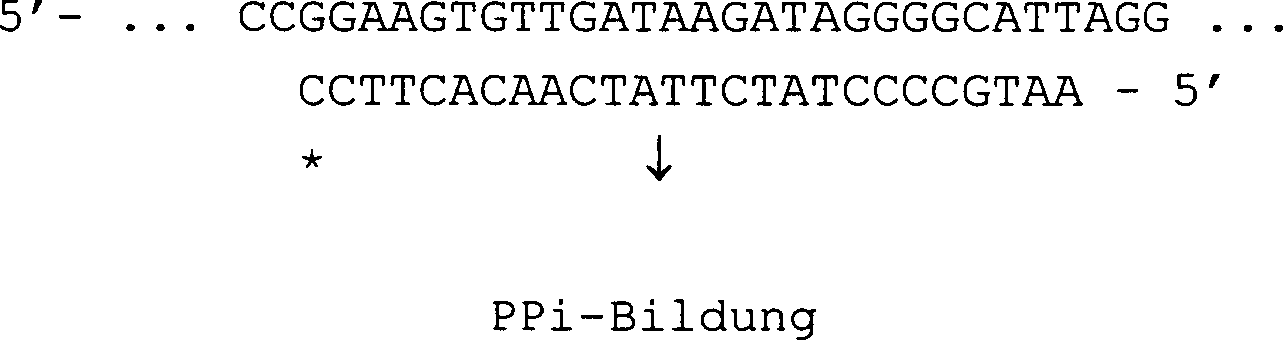

Ein weiteres C wird durch DNA-Polymerase
an das 3'-Ende des
Primers angefügt:
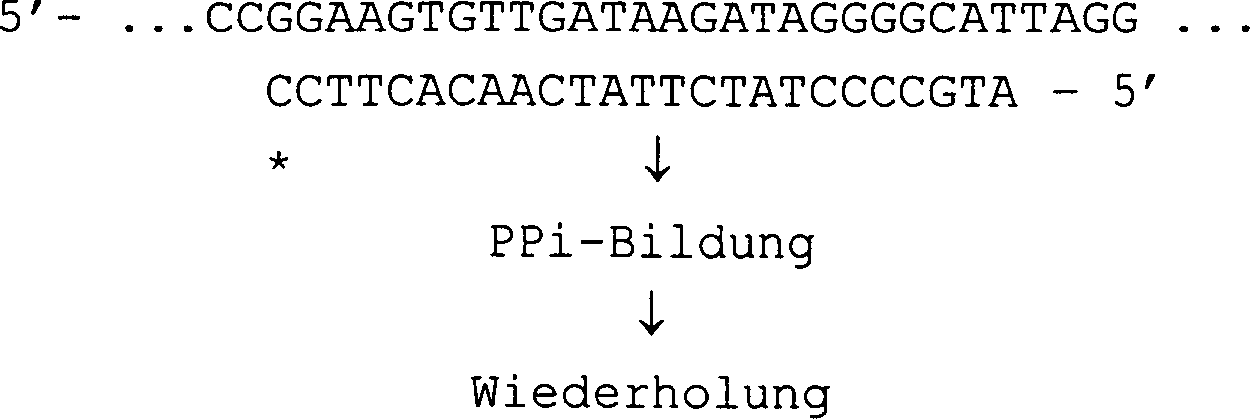
Zunächst wird ein Oligonucleotidprimer mit dem nachzuweisenden Nucleotid hybridisiert. Danach wird ein komplementärer Strang durch Einbau eines Moleküls dXTP an das 3'-Ende des Oligonucleotidprimers verlängert, wobei gleichzeitig ein Molekül Pyrophosphorsäure (PPi) freigesetzt wird. Danach wird der komplementäre Strang vom 3'-Ende her durch Nuclease abgebaut, wobei ein Molekül Desoxynucleosid-Monophosphat (dXMP) freigesetzt wird. Aufgrund der Stelle mit Nuclease-Resistenz wird der Oligonucleotidprimer selbst von der Nuclease nicht abgebaut. Die Nucleotidsequenz bleibt intakt und ermöglicht eine weitere Runde der von ihr ausgehenden Verlängerung durch DNA-Polymerase. Die Reaktion wiederholt sich, so daß Pyrophosphorsäure und das von der Nuclease gebildete Desoxynucleosid-Monophosphat sich im System anreichern.First, an oligonucleotide primer hybridized with the nucleotide to be detected. After that, a complementary Strand by incorporating a molecule dXTP at the 3 'end of the oligonucleotide primer, being a molecule at the same time pyrophosphoric (PPi) is released. After that, the complementary strand from the 3 'end degraded by nuclease, one molecule of deoxynucleoside monophosphate (dXMP) is released. Because of the site with nuclease resistance the oligonucleotide primer itself is not degraded by the nuclease. The nucleotide sequence remains intact and allows another round of extension from it by DNA polymerase. The reaction repeats so that pyrophosphoric acid and the deoxynucleoside monophosphate formed by the nuclease enrich in the system.
Der Oligonucleotidprimer lässt sich während der Durchführung der obigen Reaktion unter Verwendung der bereits beschriebenen DNA-Polymerasereaktion Nucleaseresistent machen.The oligonucleotide primer can be while the implementation the above reaction using the DNA polymerase reaction already described Make nuclease resistant.
Die Pyrophosphorsäure bzw. das beim Abbau durch Nuclease gebildete Desoxynucleosid-Monophosphat wird zum Nachweis bzw. der Quantifizierung des nachzuweisenden Nucleotids verwendet.The pyrophosphoric acid or the degradation by Nuclease-formed deoxynucleoside monophosphate is used for detection or the quantification of the nucleotide to be detected.
Weiterhin kann das vorliegende Nachweisverfahren ein System für den Nachweis eines nachzuweisenden Nucleotids mit einer Punktmutation bilden, falls die Stelle der Punktmutation bereits bekannt ist. Das heißt, eine zu dem sich an das 5'-Ende der Punktmutation anschlie ßenden Bereich komplementäre Sequenz wird als Oligonucleotidprimer verwendet. Wenn nur diejenige dXTP-Art, die dem Nucleotid in der Normalsequenz entspricht, als Substrat zugegeben wird, findet an der Stelle der Punktmutation keine Verlängerung statt, und die Reaktion kann nicht weiterlaufen. Auf diese Weise lässt sich die Anwesenheit der Punktmutation leicht bestätigen (Schema 2).Furthermore, the present verification procedure a system for the detection of a nucleotide to be detected with a point mutation if the point mutation location is already known. This means, one to which is at the 5 'end after the point mutation Complementary area Sequence is used as an oligonucleotide primer. If only that dXTP type, which corresponds to the nucleotide in the normal sequence, as Substrate is added takes place at the point of the point mutation no extension instead, and the reaction cannot continue. In this way let yourself easily confirm the presence of the point mutation (Scheme 2).
Schema 2Scheme 2
Zunächst wird der Oligonucleotidprimer
(der durch die Anwesenheit einer Phosphorothioatbindung zwischen
dem T-C am 3'-Ende
Nuclease-resistent gemacht wurde) hybridisiert: 
Handelt es sich bei der nachzuweisenden
Sequenz um eine Normalsequenz (in diesem Fall mit einem G-Rest),
wird das 3'-Ende
des Primers von der DNA-Polymerase mit einem C (mit einem * angedeutet)
verlängert: 
Wird G bei der Punktmutation durch
ein anderes Nucleotid (z. B. A) ersetzt, findet in Gegenwart von dCTP
als dem einzigen Substrat keine Verlängerung der DNA mit dem zu
A komplementären
T statt: 
Selbst wenn eine Mutation innerhalb des mit dem Oligonucleotidprimers hybridisierenden Bereichs liegt, lässt sich die Anwesenheit der Punktmutation ebenfalls nachweisen, da der Primer nicht mit dem nachzuweisenden Nucleotid hybridisiert und die Reaktion nicht weiterläuft.Even if there is a mutation inside the region hybridizing with the oligonucleotide primer, let yourself also detect the presence of the point mutation since the primer does not hybridize with the nucleotide to be detected and the reaction does not continue.
Die oben verwendete DNA-Polymerase katalysiert die Verlängerung eines komplementären Stranges in 5' → 3'-Richtung von dem Oligonucleotidprimer, der mit dem nachzuweisenden Nucleotid hybridisiert hat. Jede bis jetzt bekannte DNA-Polymerase besitzt die DNA-Syntheseaktivität in 5' → 3'-Richtung. In Abwesenheit eines mit einem Template-Strang hybridisierten Primers findet keine DNA-Synthese statt. Daher beruht die vorliegende Erfindung auf einer hohen Spezifität, die von der Hybridisierung zwischen dem Primer und dem Template-Strang abhängt. Als DNA-Polymerase zur Verwendung in der vorliegenden Erfindung sind die DNA-Polymerase I, das Klenow-Fragment der DNA-Polymerase I, T4-DNA-Polymerase, T7-DNA-Polymerase und Phi29-DNA-Polymerase sowie Mutationen davon zu nennen.The DNA polymerase used above catalyzes the extension of a complementary one Strands in 5 '→ 3' direction from the oligonucleotide primer, that has hybridized with the nucleotide to be detected. Each up now known DNA polymerase has DNA synthesis activity in the 5 '→ 3' direction. In the absence of one primer hybridized with a template strand finds no DNA synthesis instead of. Therefore, the present invention is based on a high specificity that of depends on the hybridization between the primer and the template strand. As DNA polymerase for use in the present invention DNA polymerase I, the Klenow fragment of DNA polymerase I, T4 DNA polymerase, T7 DNA polymerase and Phi29 DNA polymerase and mutations thereof to call.
Wenn eine DNA-Polymerase mit einer starken 3' → 5'-Exonucleaseaktivität, wie z. B. T4-DNA-Polymerase oder T7-DNA-Polymerase, verwendet wird, besteht die Möglichkeit, den Gehalt an einer Nuclease herabzusetzen, und in einigen Fällen kann sogar auf die Verwendung der Nuclease ganz verzichtet werden. Eine solche DNA-Polymerase kann jedoch die Empfindlichkeit beeinträchtigen, da das Enzym zu einem gewissen Grad Phosphorothioatbindungen abbauen kann. In diesem Fall ist die Einführung mehrerer Phosporothioatbindungen in der Nähe des Primerendes bzw. die Modifikation des Primers mit anderen Mitteln als der Phosphorothioierung bevorzugt, um die Resistenz des Primers gegenüber Nuclease zu erhöhen.If a DNA polymerase with a strong 3 '→ 5' exonuclease activity, e.g. B. T4 DNA polymerase or T7 DNA polymerase is used, there is the possibility reduce the level of a nuclease, and in some cases may even the use of the nuclease can be dispensed with entirely. Such DNA polymerase can however affect sensitivity because the enzyme becomes a can break down phosphorothioate bonds to a certain degree. In this case is the introduction several phosporothioate bonds near the primer end or the Modification of the primer by means other than phosphorothioation preferred to increase the primer's resistance to nuclease.
Bei der oben verwendeten Nuclease handelt es sich um diejenige, die eine doppelsträngige DNA in 3' → 5'-Richtung abbaut. Exonuclease III ist bekanntermaßen eine solche Nuclease. Obwohl Exonuclease III aus E. coli kommerziell erhältlich ist, kann jede beliebige, entweder aus anderen Mikroorganismen stammende oder durch genetische Rekombination erhaltene Exonuclease verwendet werden. Exonuclease III wird unter fast denselben Bedingungen wie für DNA-Polymerasen, wie DNA-Polymerase I, ihr Klenow-Fragment, T4-DNA-Polymerase usw., eingesetzt, so dass sowohl für Exonuclease III als auch DNA-Polymerase der gleiche Reaktionspuffer verwendet werden kann. Für die vorliegende zyklische Reaktion ist Exonuclease III stark bevorzugt, da sie spezifisch doppelsträngige DNA in 3' → 5'-Richtung abbaut, keine einzelsträngige DNA, wie das nachzuweisende Nucleotid und den Primer selbst, abbaut und ein Primer durch Phosphorothioierung oder Synthese in Gegenwart von SdXTP leicht resistent gegenüber Exonuclease III gemacht wird.With the nuclease used above it is the one that has a double-stranded DNA in the 3 '→ 5' direction degrades. Exonuclease III is known to be such a nuclease. Even though Exonuclease III from E. coli is commercially available, any either from other microorganisms or from genetic Recombination obtained exonuclease can be used. exonuclease III is made under almost the same conditions as for DNA polymerases, such as DNA polymerase I, their Klenow fragment, T4 DNA polymerase, etc., used so that as well as Exonuclease III as well as DNA polymerase the same reaction buffer can be used. For the present Cyclic response is exonuclease III highly preferred as it is specific double Degrades DNA in 3 '→ 5' direction, no single-stranded DNA, such as the nucleotide to be detected and the primer itself, breaks down and a primer by phosphorothioation or synthesis in the presence slightly resistant to SdXTP Exonuclease III is made.
Als Substrat zur Verlängerung der DNA von dem Oligonucleotidprimer aus durch DNA-Polymerase wird Desoxynucleosid-Triphosphat (dXTP) verwendet. In der vorliegenden Erfindung lässt sich ein Polynucleotid bekannter Sequenz durch die Analyse einer Ein-Basen-Verlängerung nachweisen. Daher kann die vorliegende Reaktion in Anwesenheit von einer Desoxynucleosid-Triphosphat-Art als Substrat, das der nachzuweisenden Sequenz entspricht, ablaufen. Das Substrat (dXTP) wird in einer bezogen auf die Anzahl Mole des nachzuweisenden Nucleotids ausreichenden Menge bzw. im Überschuss dazu zugegeben. Da es normalerweise schwierig ist, vor der Analyse die Menge des nachzuweisenden Nucleotids genau vorherzusagen, ist es bevorzugt, mindestens 0,1 μmol/l, vorzugsweise 1 μmol/l oder mehr, zuzugeben, um einen Mangel an Substrat (dXTP) praktisch zu verhindern.As a substrate for extension the DNA from the oligonucleotide primer by DNA polymerase Deoxynucleoside triphosphate (dXTP) used. In the present Invention leaves a polynucleotide of known sequence by analyzing a Single base extension prove. Therefore, the present reaction can take place in the presence of a deoxynucleoside triphosphate type as a substrate, that of the Sequence corresponds to expire. The substrate (dXTP) is in a sufficient based on the number of moles of the nucleotide to be detected Amount or in excess added to that. Since it is usually difficult before analysis is to accurately predict the amount of nucleotide to be detected it preferred at least 0.1 μmol / l, preferably 1 μmol / l or more, admit to lack of substrate (dXTP) practical to prevent.
- (D) Die vorliegende Erfindung ist dadurch gekennzeichnet, dass Pyrophosphorsäure oder Desoxynucleosid-Monophosphat nachgewiesen wird.(D) The present invention is characterized in that that pyrophosphoric acid or deoxynucleoside monophosphate is proven.
(1) Nachweis von angereichertem Desoxynucleosid-Monophosphat(1) Evidence of enriched Deoxynucleoside monophosphate
Im vorliegenden Verfahren lässt sich das nachzuweisende Polynucleotid durch Bestimmung des durch Abbau des eingebauten Nucleotids nach der Polymerisierung angereicherten Desoxynucleosid-Monophosphats (dXMP) nachweisen.In the present procedure, the polynucleotide to be detected by determining the degradation of the incorporated nucleotide after the polymerization Detect deoxynucleoside monophosphate (dXMP).
Zur Bestimmung des dXMP wird das dXTP-Substrat mit einem Radioisotop (32P oder 33P) an einem Phosphoratom in der α-Stellung; mit 3H an einem Wasserstoffatom der Phosphorsäure in der α-Stellung, der Desoxyribosegruppe bzw. der Basengruppe; oder mit 14C an einem Kohlenstoffatom der Desoxyribosegruppe markiert. Danach wird das dXMP vom dXTP-Substrat unter Verwendung von Chromatographietechniken z. B. einem Ionenaustauschharz getrennt, wobei die Radioaktivität verfolgt wird, so daß das dXMP durch seine Radioaktivität bestimmt wird. dATP, dCTP, dGTP und dTTP sind als das mit 32P an einem Phosphoratom in der α-Stellung markierte dXTP kommerziell erhältlich. dATP und dCTP sind ebenfalls als das mit 33P an einem Phosphoratom in der α-Stellung markierte dXTP kommerziell erhältlich. Schließlich sind dATP, dCTP, dGTP und dTTP als das mit 3H in der Basengruppe markierte dXTP kommerziell erhältlich.To determine the dXMP, the dXTP substrate with a radioisotope ( 32 P or 33 P) on a phosphorus atom in the α-position; with 3 H on a hydrogen atom of phosphoric acid in the α-position, the deoxyribose group or the base group; or labeled with 14 C on a carbon atom of the deoxyribose group. Thereafter, the dXMP is removed from the dXTP substrate using chromatography techniques e.g. B. an ion exchange resin separated, the radioactivity is monitored so that the dXMP is determined by its radioactivity. dATP, dCTP, dGTP and dTTP are commercially available as the dXTP marked with 32 P on a phosphorus atom in the α-position. dATP and dCTP are also commercially available as the dXTP marked with 33 P on a phosphorus atom in the α-position. Finally, dATP, dCTP, dGTP and dTTP as the labeled with 3 H on the base moiety dXTP commercially available.
Radioaktiv markiertes dXMP lässt sich leicht und qualitativ durch Bestimmung seiner Radioaktivität mittels Autoradiographie nach Trennung durch Dünnschichtchromatographie auf einem Ionenaustauschharz nachweisen. Wie in den Beispielen gezeigt, lässt sich dXMP auch quantitativ bestimmen, indem die Radioaktivität eines ausgeschnittenen Stückchens in einem Szintillationszähler bestimmt wird. Die Markierung eines Substrats mit einem Isotop ist jedoch nicht unbedingt für die Trennung und Bestimmung von dXMP erforderlich. So lässt sich beispielsweise nach Auftrennung der Reaktionslösung durch mit einem kommerziellen Fluoreszenzfarbstoff beschichtete Dünnschichtchromatographie dXMP als ein nicht fluoreszierender Fleck bei Bestrahlung mit ultraviolettem Licht sichtbar machen, da das Nucleotid ultraviolettes Licht absorbiert. dXMP lässt sich auch quantitativ nachweisen, indem es durch Flüssigchromatographie getrennt und seine ultraviolette Lichtabsorption bestimmt wird.Radio-labeled dXMP can be easily and qualitatively by determining its radioactivity by means of Autoradiography after separation by thin layer chromatography detect an ion exchange resin. As shown in the examples let yourself dXMP also quantify by the radioactivity of a cut out pieces in a scintillation counter is determined. The labeling of a substrate with an isotope is but not necessarily for separation and determination of dXMP required. So you can for example after separation of the reaction solution by using a commercial Fluorescent dye coated thin layer chromatography dXMP as a non-fluorescent spot when irradiated with ultraviolet Make light visible because the nucleotide absorbs ultraviolet light. dXMP can be also demonstrate quantitatively by separating it by liquid chromatography and its ultraviolet light absorption is determined.
(2) Quantifizierung von bei der Strangverlängerung mit DNR-Polymerase gebildeter Pyrophosphorsäure(2) quantification of with the strand extension pyrophosphoric acid formed with DNR polymerase
In der vorliegenden Erfindung lässt sich das nachzuweisende Polynucleotid durch Bestimmung des bei der Verlängerung von dXMP durch DNA-Polymerase gebildeten PPi nachweisen.In the present invention, the polynucleotide to be detected by determining the length of the extension detect PPi formed by dXMP by DNA polymerase.
Das PPi lässt sich ohne jede Trennung von dXMP und cXTP mittels Chromatographie usw. enzymatisch bestimmen. So verspricht beispielsweise die folgende bekannte Reaktion 1 eine hochempfindliche Bestimmung bei einfacher Durchführung in einem homogenen System (T. Tabary et al., J. Immunological Methods, 156, 55–60 (1992)).The PPi can be used without any separation Determine dXMP and cXTP enzymatically using chromatography etc. For example, the following known reaction 1 promises one highly sensitive determination with simple implementation in a homogeneous system (T. Tabary et al., J. Immunological Methods, 156, 55-60 (1992)).
Reaktion
1: 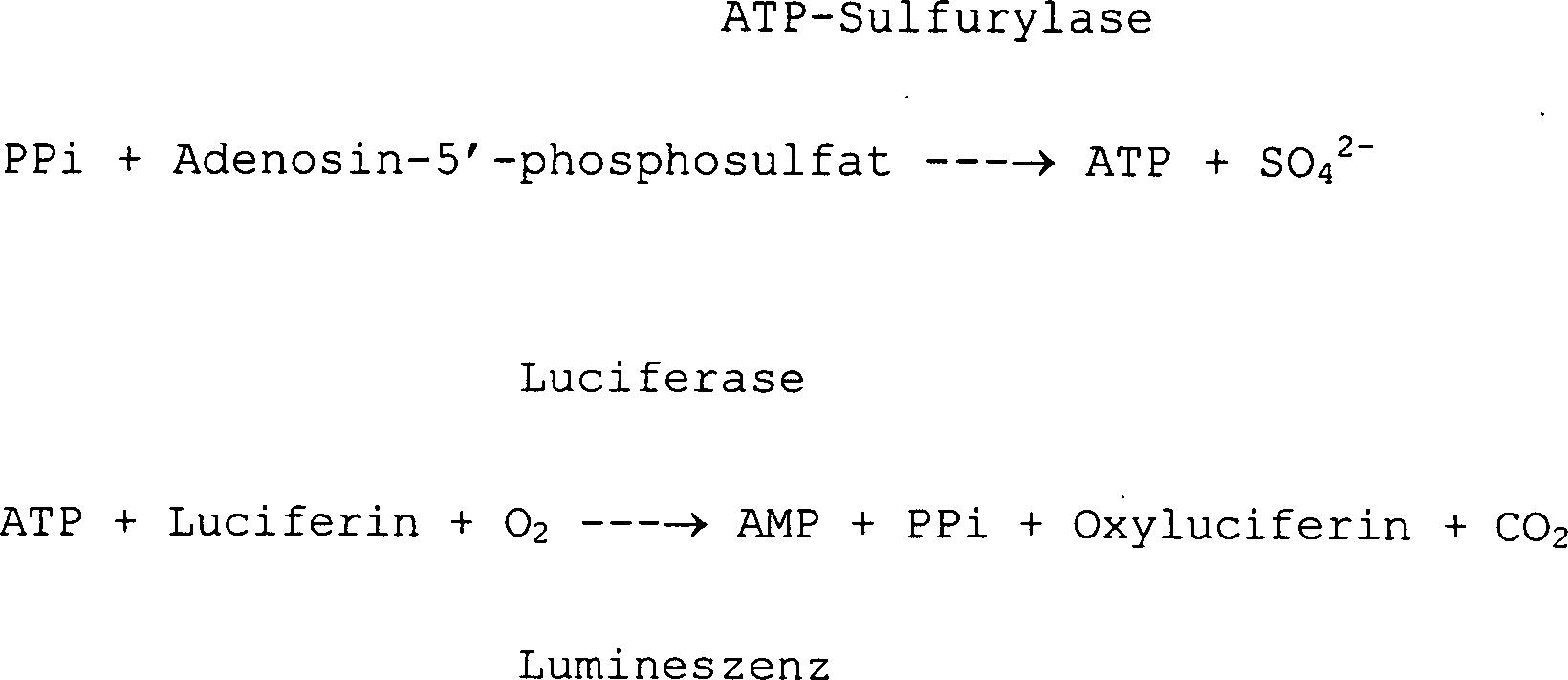
Als weiteres Verfahren zur Bestimmung von Pyrophosporsäure ist das in Anal. Biochem., 94, 117–120 (1979) beschriebene Verfahren zu nennen.As another method of determination of pyrophosphoric acid is that in anal. Biochem., 94, 117-120 (1979) to call.
- (E) Das erfindungsgemäße Reaktionssystem beispielhaft wird unter Bezugnahme auf ein spezifisches Oligonucleotid im folgenden Reaktionssystem (Schema 3) erläutert.(E) The reaction system according to the invention is exemplary is with reference to a specific oligonucleotide in the following Reaction system (Scheme 3) explained.
Schema 3Scheme 3
Eine für den menschlichen Cytomegalievirus
(im folgenden als CMV bezeichnet) spezifische Sequenz im D-Fragment im Genom 
PPi wird durch Verlängerung mit A (mit *markiert) durch DNA-Polymerase gebildet.PPi is by extension with A (marked with *) formed by DNA polymerase.

Nuclease baut die 3'-Bindung zwischen
T und A ab, wobei dAMP abgespalten wird. Daraufhin wird die Position
unbesetzt und steht für
einen neuerlichen Einbau von dAMP zur Verfügung: 
Ein weiteres A wird als Verlängerung
durch DNA-Polymerase
eingebaut:
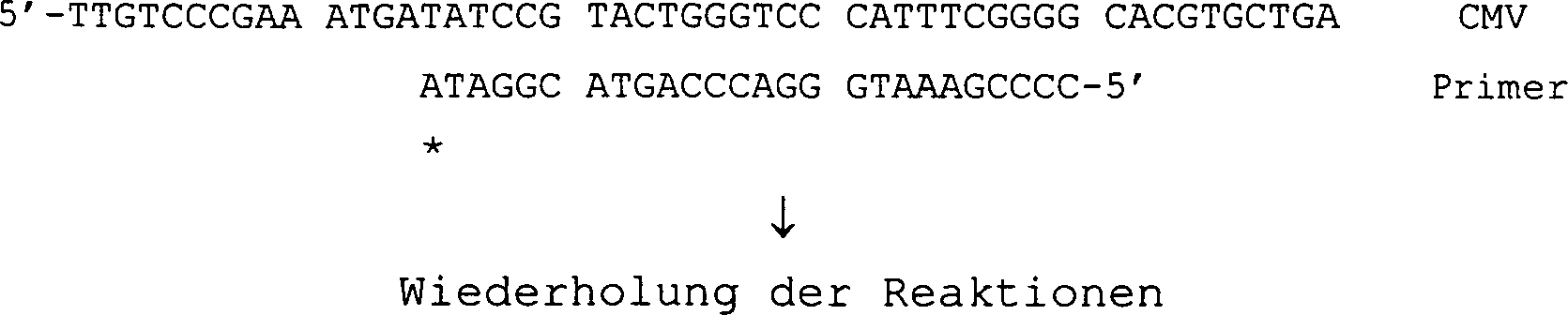
- (1) Für den Nachweis von CMV wird die Primersequenz von dem D-Fragment in einem mit dem Restriktionsenzym EcoRI hergestellten Fragment in der genomischen DNA abgeleitet. Die Sequenz ist in Schema 3 gezeigt.(1) For the detection of CMV will result in the primer sequence from the D fragment a fragment produced with the restriction enzyme EcoRI in derived from genomic DNA. The sequence is shown in Scheme 3.
In der folgenden Beschreibung wird ein zu der nachzuweisenden Sequenz zwischen "→" und "←" komplementärer Strang als die Primersequenz (SEQ ID Nr: 1) verwendet, obwohl man hinsichtlich der zu hybridisierenden Primersequenz nicht besonders eingeschränkt ist und daher einen beliebigen Teil der nachzuweisenden Sequenz in Schema 3 verwenden kann. Bei der Bindung zwischen A-T am 3'-Ende des Primers handelt es sich um eine Phosphorothioatbindung anstelle einer natürlichen Phosphordiesterbindung.The following description will a strand complementary to the sequence to be detected between "→" and "←" as the primer sequence (SEQ ID NO: 1) was used, although with regard to the hybridized Primer sequence is not particularly limited and therefore any Can use part of the sequence to be detected in Scheme 3. at the bond between A-T at the 3 'end the primer is a phosphorothioate bond instead a natural one Phosphodiester.
Das Vorhandensein einer CMV-Sequenz lässt sich über den Nachweis des PPi bzw. des Abbauprodukts dAMP feststellen.The presence of a CMV sequence can be done via the Find evidence of the PPi or the degradation product dAMP.
- (2) Für den Nachweis einer Punktmutation, wie oben beschrieben, lässt sich als bevorzugtes erfindungsgemäßes Verfahren ein Verfahren, bei dem insbesondere ein Nucleotid wiederholt eingebaut und abgelöst wird, einsetzen. In dem folgenden Beispiel wird die Punktmutation des menschlichen Onkogens Ki-ras/12 nachgewiesen. Eine bekannte Ki-ras/12-Mutante ist in Schema 4 dargestellt (die Normalsequenz ist mit Punkten dargestellt).(2) For the detection of a point mutation as described above can be as the preferred method according to the invention a method in which a nucleotide in particular is repeatedly incorporated and is relieved deploy. In the following example, the point mutation of the human oncogene Ki-ras / 12 detected. A well-known Ki-ras / 12 mutant is shown in Scheme 4 (the normal sequence is shown with dots).
Schema
4 
Die Teilsequenz (SEQ ID Nr. 2) in Schema 4 wird als Primer verwendet. Dem Primer wird durch die Anwesenheit einer Thiophosphatbindung zwischen dem T-G am 3'-Ende Nuclease-Resistenz verliehen. Für die DNA-Polymerasereaktion wird nur eine Art von Substrat, nämlich dGTP, zugegeben. In diesem Beispiel sollte dGTP eingebaut werden, wenn die Probe die Normalsequenz besitzt, und PPi und dGMP sollten dann angereichert werden. Besitzt die Probe eine Mutationssequenz, findet aufgrund der Tat0sache, dass die mutierte Sequenz einen A-Rest aufweist, in Abwesenheit von dTTP keine Synthese des komplementären Stranges statt. Die Anwesenheit der Punktmutation lässt sich bestätigen, wenn die Reaktion durch Zugabe von dTTP als Substrat initiiert wird. Auf diese Weise kann erfindungsgemäß eine Punktmutation nachgewiesen werden (siehe Schema 5).The partial sequence (SEQ ID No. 2) in Scheme 4 is used as a primer. Nuclease resistance is imparted to the primer by the presence of a thiophosphate bond between the TG at the 3 'end. Only one type of substrate, namely dGTP, is added for the DNA polymerase reaction. In this example, dGTP should be included if the sample has the normal sequence, and PPi and dGMP should then be enriched. If the sample has a mutation sequence, due to the fact that the mutated sequence has an A residue, no synthesis of the complementary strand takes place in the absence of dTTP. The presence of the point mutation can be confirmed if the reaction by adding dTTP is initiated as a substrate. In this way, a point mutation can be detected according to the invention (see scheme 5).
Schema 5Scheme 5
dGTP wird in die Normalsequenz eingebaut.dGTP is built into the normal sequence.

In den Schemata 4 und 5 ist der Primer in der oberen Sequenz und die Template-Sequenz in der unteren Sequenz gezeigt, wobei diese Darstellungsweise verschieden zu der in den Schemata 1–3 ist (Primer in der unteren Sequenz und Template in der oberen Sequenz).In schemes 4 and 5 is the primer in the top sequence and the template sequence in the bottom sequence shown, this representation different from that in the Schemes 1-3 (primer in the lower sequence and template in the upper sequence).
- (F) Der Kit zum Nachweis eines Polynucleotids gemäß der vorliegenden Erfindung(F) The kit for detection of a polynucleotide according to the present invention
Die oben beschriebenen, für die vorliegende Erfindung notwendigen Elemente können in Form von zuvor zusammengegebenen Reagenzien bereitgestellt werden. Im folgenden wird der erfindungsgemäße Kit erläutert. Die folgenden Reagenzien können mit beliebigen Komponenten, z. B. solchen, die für den Markierungsnachweis benötigt werden, Pufferreagenzien für die Reaktionslösung oder Komponenten für positive bzw. negative Kontrollen usw., kombiniert werden.The ones described above, for the present Invention necessary elements can in the form of previously assembled reagents. The kit according to the invention is explained below. The following reagents can with any components, e.g. B. those required for the proof of marking, Buffer reagents for the reaction solution or components for positive or negative controls, etc., can be combined.
Der erfindungsgemäße Kit stellt sich wie folgt dar:
- 1. Ein Nuclease-resistenter Oligonucleotidprimer mit einer Sequenz, die komplementär zu einem Teil des nachzuweisenden Polynucleotids mit bekannter Nucleotidsequenz ist
- 2. Eine DNA-Polymerase
- 3. Mindestens eine Desoxynucleosid-Triphosphat-Art und
- 4. Eine Nuclease mit der Wirkung, eine doppelsträngige DNA in 3' → 5'Richtung abzubauen.
- 1. A nuclease-resistant oligonucleotide primer with a sequence that is complementary to a part of the polynucleotide to be detected with a known nucleotide sequence
- 2. A DNA polymerase
- 3. At least one type of deoxynucleoside triphosphate and
- 4. A nuclease with the effect of breaking down a double-stranded DNA in the 3 '→ 5' direction.
Der die Bestandteile 1–4 enthaltende Kit kann zusätzliche Reagenzien, die für den Nachweis der angereicherten Verbindung benötigt werden, enthalten. So ist vorgesehen, dass der Kit beispielsweise zum Nachweis von dXMP Reagenzien zum Nachweis von Desoxynucleosid-Monophospat enthält.The one containing components 1-4 Kit can be additional Reagents for proof of the enriched compound are required. So it is intended that the kit be used, for example, to detect dXMP Contains reagents for the detection of deoxynucleoside monophosphate.
Bei den Reaktionsreagenzien handelt es sich beispielsweise um phosphorothioiertes Oligonucleotid als Primer, das Klenow-Fragment der DNA-Polymerase I, Desoxynucleosid-Triphosphat (mit 32P markiert), Exonuclease III, Tris-HCl-Puffer, MgCl2, RSA und DTT. In dem Kit ist ebenfalls EDTA-Lösung zum Beenden der Reaktion enthalten. Für den Nachweis von dXMP wird Celullose für den Innenaustausch (PEI = Polyethylenimincellulose) zur Dünnschichtchromatographie sowie LiCl (Laufmittel) verwendet. Andererseits wird für den Nachweis von Pyrophosphorsäure ATP-Sulfurylase, Adenosin-5'-Phosphosulfat, Luciferin und Luciferase verwendet.The reaction reagents are, for example, phosphorothioated oligonucleotide as a primer, the Klenow fragment of DNA polymerase I, deoxynucleoside triphosphate (labeled with 32 P), exonuclease III, Tris-HCl buffer, MgCl 2 , RSA and DTT. The kit also contains EDTA solution to stop the reaction. For the detection of dXMP, Celullose is used for internal exchange (PEI = Polyethylenimincellulose) for thin layer chromatography as well as LiCl (eluent). On the other hand, ATP-sulfurylase, adenosine-5'-phosphosulfate, luciferin and luciferase are used for the detection of pyrophosphoric acid.
Im folgenden sind der Mechanismus und die Wirkungen der vorliegenden Erfindung zusammengefasst.The following are the mechanism and summarized the effects of the present invention.
Der erfindungsgemäße Oligonucleotidprimer wird spezifisch mit der nachzuweisenden Nucleotidsequenz hybridisiert, um von dort aus die Verlängerung durch DNA-Polymerase zu ermöglichen. Eine Nuclease-Resistenz wird diesem Primer entweder in einer vorhergehenden Synthese oder während der Analyse durch Bindung eines Desoxynucleotidderivats (SdXTP usw.) in der Polymerisierungsreaktion vermittelt. Der Oligonucleotidprimer erlaubt dann die Addition von Desoxynucleosid-Triphosphat (dXTP) durch DNA-Polymerase sowie dessen Ablösung durch Nuclease. Die Reaktion findet wiederholt statt, wodurch sich das von der Nuclease abgebaute Produkt im Reaktionssystem anreichert. Auf diese Weise wird von der vorliegenden Erfindung ein quantitatives und hochempfindliches System bereitgestellt.The oligonucleotide primer according to the invention is hybridizes specifically with the nucleotide sequence to be detected, to extend from there by DNA polymerase to enable. Nuclease resistance is given to this primer either in a previous one Synthesis or during analysis by binding a deoxynucleotide derivative (SdXTP etc.) mediated in the polymerization reaction. The oligonucleotide primer then allows the addition of deoxynucleoside triphosphate (dXTP) by DNA polymerase as well as its replacement by nuclease. The reaction takes place repeatedly, resulting in the product degraded by the nuclease accumulates in the reaction system. In this way, the present invention becomes a quantitative one and highly sensitive system provided.
Selbst falls der Primer mit einer anderen Sequenz als dem nachzuweisenden Nucleotid hybridisiert, läuft die nachfolgende Reaktion nicht weiter, wenn das zuvor als Substrat zugegebene dXTP zu der sich an den Primer anschließenden Sequenzstelle nicht komplementär ist.Even if the primer with a hybridizes other sequence than the nucleotide to be detected, runs subsequent reaction does not continue if that was previously as a substrate added dXTP to the sequence site following the primer not complementary is.
Da in der vorliegenden Erfindung die Wiederholung des Denaturierungsvorgangs der Erhitzung von DNA nicht erforderlich ist, brauchen die Reagenzien einschließlich DNA-Polymerase nicht temperaturstabil zu sein, und eine komplizierte Temperaturkontrolle ist nicht erforder lich. Daher liegt ein weiterer Vorteil darin, dass sich diese Vorgänge leicht automatisieren lassen.Because in the present invention repeating the denaturing process of heating DNA is not required, the reagents including DNA polymerase are required not being temperature stable, and complicated temperature control not necessary. So another advantage is that these processes easy to automate.
In der vorliegenden Erfindung wird von der DNA-Polymerase ein Strang synthetisiert, der zu einer sich an den Bereich, an den der Primer hybridisiert worden ist, anschließenden Teilsequenz komplementär ist. Bei dieser Synthese wird nach der Additionsreaktion von einem (1) Molekül dXTP ein (1) Molekül PPi gebildet. PPi lässt sich durch eine Enzymreaktion spezifisch bestimmen, das heißt, die vorliegende Erfindung ermöglicht, dass Signals gleichzeitig mit der Verlängerungsreaktion die Signalisierung stattfindet. In einer weiteren Ausführungsform kann die von Nuclease abgespaltene verlängerte Kette nachgewiesen werden. Durch die Verwendung von DNA-Polymerase lässt sich Nuclease-Resistenz auf ein Nuclease-empfindliches Oligonucleotid in Gegenwart eines Desoxynucleotidderivats als Substrat übertragen.In the present invention, a strand is synthesized from the DNA polymerase which is complementary to a partial sequence which adjoins the region to which the primer has been hybridized. In this synthesis, one (1) molecule of dXTP forms one (1) molecule of PPi after the addition reaction. PPi can be specifically determined by an enzyme reaction, that is, the present invention enables that the signaling takes place simultaneously with the extension reaction. In a further embodiment, the extended chain split off from nuclease can be detected. By using DNA polymerase, nuclease resistance can be transferred to a nuclease-sensitive oligonucleotide in the presence of a deoxynucleotide derivative as a substrate.
In der vorliegenden Erfindung wird von der Nuclease der von dem mit dem nachzuweisenden Nucleotid hybridisierten Primer aus verlängerte Strang spezifisch hydrolysiert, solange bis der Abbau die Nuclease-resistente Stelle erreicht. Bei Abwesenheit der nachzuweisenden Sequenz findet keine Hydrolyse statt. Selbst wenn die nachzuweisende Sequenz vorhanden ist, findet ohne ihre Hybridisierung an ein Oligonucleotid sowie die nachfolgende Verlängerung eines komplementären Stranges durch DNA-Polymerase keine Hydrolyse statt. Das durch Nuclease entstandene Abbauprodukt ist spezifisch für das nachzuweisende Polynucleotid und reichert sich in der Reaktionslösung an, wobei seine Menge in einer linearen Abhängigkeit vom Gehalt an nachzuweisendem Polynucleotid zunimmt, so dass eine sehr genaue Analyse ermöglicht wird.In the present invention from the nuclease that from the hybridized with the nucleotide to be detected Extended primer Strand specifically hydrolyzed until the nuclease-resistant degradation Position reached. In the absence of the sequence to be detected no hydrolysis instead. Even if the sequence to be verified exists is without their hybridization to an oligonucleotide as well the subsequent extension of a complementary one Strands by DNA polymerase no hydrolysis take place. Nuclease The resulting degradation product is specific for the polynucleotide and accumulates in the reaction solution with its amount in a linear dependence on the content of the detected Polynucleotide increases so that a very accurate analysis is made possible.
Ein weiterer Vorteil der vorliegenden Erfindung liegt in der äußerst geringen Anfälligkeit gegenüber dem Einfluss von Verunreinigungen, da selbst wenn eine zu un tersuchende Probenlösung mit einer bereits reagierten Probenlösung verunreinigt ist, das darin Produkt nicht als Template für eine weitere Amplifikationsrunde fungieren kann. Damit ist das vorliegende Verfahren in der Praxis sehr vorteilhaft.Another advantage of the present Invention lies in the extremely small susceptibility compared to the Influence of impurities because even if one is to be examined sample solution is contaminated with a sample solution that has already reacted product not as a template for another round of amplification can act. The present method is thus in practice very advantageous.
Darüber hinaus stellt die vorliegende Erfindung ein homogenes System für einfache Arbeitsschritte bereit. Die folgende Erfindung stellt weiterhin ein Reaktionssystem bereit, das keine Vorgänge wie Hybridisierung mit einer zusätzlichen Sonde, Trennung durch Elektrophorese usw. benötigt, indem das nach Addition von dXTP durch DNA-Polymerase gebildete PPi bestimmt wird. Die spezifische Analyse von PPi mittels Enzymreaktion lässt sich in der Reaktionslösung für die Verlängerung und den Abbau durchführen. Dieser Vorteil wird deutlich im Hinblick auf die PCR, bei der für den Nachweis des Amplifikationsprodukts Sondenhybridisierung und Trennung durch Elektrophorese benötigt werden.In addition, the present Invention a homogeneous system for simple work steps ready. The following invention further provides a reaction system ready that doesn't involve processes like hybridization an additional Probe, separation by electrophoresis, etc. needed by adding that of dXTP by DNA polymerase formed PPi is determined. The specific analysis of PPi using Enzyme reaction leaves itself in the reaction solution for the renewal and carry out the dismantling. This advantage is clear with regard to the PCR, for the detection of the amplification product probe hybridization and separation by Electrophoresis needed become.
Ein weiterer Vorteil der vorliegenden Erfindung liegt in einer geringeren benötigten Primermenge. Das heißt, es reicht aus, den Primer in leichtem Überschuss gegenüber dem Molverhältnis des nachzuweisenden Nucleotids zuzugeben, da der in der ersten Reaktion mit dem nachzuweisenden Nucleotid hybridisierte Primer eine wiederholt stattfindende Verlängerung erlaubt. Dies steht im Gegensatz zu einem System wie PCR, zu dem der Primer in großem Überschuss zugegeben werden sollte, um den als Amplifikationsprodukt verbrauchten Primer auszugleichen. Dies trifft auf Desoxynucleosid-Triphosphat als Substrat zu. Beispielsweise benötigt die PCR für die Verlängerung vier Desoxynucleosid-Triphosphate (dXTP). Andererseits reicht es bei der vorliegenden Erfindung aus, nur eine (1) Art von Desoxynucleosid-Triphosphat als Substrat zuzugeben, welches zu dem sich an den hybridisierten Bereich anschließenden Nucleotid komplementär ist. Dies führt zu einer Vereinfachung der Zusammensetzung der Reagenzien.Another advantage of the present Invention lies in a lower amount of primer required. That means it is enough out, the primer in slight excess across from the molar ratio of the nucleotide to be detected since the one in the first reaction primer hybridized repeatedly with the nucleotide to be detected extension taking place allowed. This is in contrast to a system like PCR, to which the primer in large excess should be added to the consumed as amplification product Balance primer. This applies to deoxynucleoside triphosphate as a substrate too. For example, the PCR needs for the extension four deoxynucleoside triphosphates (dXTP). On the other hand, it is enough in the present invention, only one (1) type of deoxynucleoside triphosphate to add as a substrate to which the hybridized Adjoining area Complementary nucleotide is. this leads to to simplify the composition of the reagents.
In einer weiteren Ausführungsform lässt sich die vorliegende Erfindung auf den Nachweis einer Punktmutation anwenden, falls die Position sowie die Sequenz der Punktmutation bereits bekannt sind. Bei dieser Anwendung wird der Primer mit einer sich an die bekannte Position einer Punktmutation anschließenden nachzuweisenden Nucleotidsequenz hybridisiert, wobei, falls eine Punktmutation vorhanden ist, die Strangverlängerung verhindert wird, da das zu der Punktmutation komplementäre Nucleotidsubstrat fehlt.In another embodiment let yourself apply the present invention to the detection of a point mutation, if the position and sequence of the point mutation are already known are. In this application, the primer is used with a Known position of a point mutation subsequent nucleotide sequence to be detected hybridizes, whereby if there is a point mutation, the strand extension is prevented since the nucleotide substrate complementary to the point mutation is missing.
Das folgende Verfahren besitzt, wie beschrieben, viele Vorteile und kann ein wirkungsvolles Verfahren bei der Genanalyse darstellen.The following procedure has how Described many benefits and can be an effective procedure of genetic analysis.
Gemäß der vorliegenden Erfindung wird ein Verfahren bereitgestellt, womit ein eine spezifische Sequenz enthaltendes Polynucleotid nachgewiesen werden kann und welches zur Diagnose von genetisch bedingten Erkrankungen sowie Infektionskrankheiten geeignet ist, sowie ein für dieses Verfahren eingesetzter Kit zum Nachweis eines Polynucleotids.According to the present invention a method is provided whereby a specific sequence containing polynucleotide can be detected and which for the diagnosis of genetic diseases and infectious diseases is suitable, as well as one for Kit used for this method for the detection of a polynucleotide.
Im folgenden wird die vorliegende Erfindung ausführlich mit Bezugnahme auf die folgenden Beispiele, die jedoch nicht als Einschränkung des Rahmens der Erfindung aufzufassen sind, beschrieben.The following is the present Invention in detail with reference to the following examples, which, however, are not considered restriction of the scope of the invention are described.
BEISPIEL: Nachweis eines HBV-e-Antigen-Gens in HBV-DNREXAMPLE: Evidence of a HBV e antigen gene in HBV DNR
Der Nachweis eines Gens für HBV-e-Antigen in HBV-DNA wurde in der folgenden Weise durchgeführt. Exonuclease III (ein Produkt der Firma Takara Shuzo Co., Ltd.) aus E. coli wurde als die Nuclease verwendet, und das Oligonucleotid der SEQ ID Nr 3 wurde chemisch als die Primer-DNA synthetisiert.Detection of a gene for HBV-e antigen in HBV DNA was carried out in the following manner. Exonuclease III (a product from Takara Shuzo Co., Ltd.) from E. coli was used as the nuclease used, and the oligonucleotide of SEQ ID No. 3 was chemical than the primer DNA synthesized.
1.1 Herstellung der Primer-DNA1.1 Preparation of the primer DNA
Das Oligonucleotid mit der obigen Sequenz (SEQ ID Nr. 3) wurde mittels der β-Cyanoethylamidit-Methode synthetisiert (J. Am. Chem. Soc., 112, 1253–1254 (1990)). Ein Nuclease-resistenter Oligonucleotidprimer wurde durch Einführung einer Phosphorothioatbindung in T-C am 3'-Ende mit 3H-1,2-Benzodithiol-3-on-1,l-dioxid (Beaucage's Reagenz) als Reagenz für die Phosporothioierung erhalten. Für die Synthese der DNA wurde ein Cyclone" Plus DNA/RNA-Syntheseautomat (Japan Millipore Limited) eingesetzt. Das synthetisierte, phosphorothioierte Oligonucleotid wurde in üblicher Weise mittels HPLC gereinigt.The oligonucleotide with the above Sequence (SEQ ID No. 3) was synthesized using the β-cyanoethylamidite method (J. Am. Chem. Soc., 112, 1253-1254 (1990)). A nuclease resistant oligonucleotide primer was run by introduction a phosphorothioate bond in T-C at the 3 'end with 3H-1,2-benzodithiol-3-one, 1,1-dioxide (Beaucage's reagent) as reagent for the Preserved phosphorosis. For the synthesis of the DNA was a Cyclone "Plus DNA / RNA synthesizer (Japan Millipore Limited). The synthesized, phosphorothioated Oligonucleotide became more common Way cleaned by HPLC.
1.2 Nachweis der Nucleotidsequenz1.2 Detection of the nucleotide sequence
Der Oligonucleotidprimer wurde mit der HBV-DNA als ein nachzuweisendes Nucleotid tragender M13-Phagen-DNA gemischt und diese Mischung der Reaktion der vorliegenden Erfindung ausgesetzt. Die Zusammensetzung der Reaktionslösung ist unten gezeigt, wobei die Endkonzentrationen angegeben sind. Um das Fortschreiten der Reaktion zu bestätigen, wurde der Reaktion gestattet, in Abwesenheit von jeweils einer Komponente abzulaufen. Um die Notwendigkeit des Nuclease-resistenten Primers in dem System zu bestätigen, wurde der Nuclease-resistente Primer mit dem dieselbe Sequenz tragenden Nucleaseempfindlichen Primer verglichen.The oligonucleotide primer was with the HBV DNA as a nucleotide-bearing M13 phage DNA to be detected mixed and this mixture the reaction of the present invention exposed. The composition of the reaction solution is shown below, where the final concentrations are given. To the progress of the To confirm reaction the reaction was allowed in the absence of one component at a time expire. The need for the nuclease-resistant primer to confirm in the system became the nuclease-resistant primer with the same sequence Nuclease sensitive primers compared.
Wenn der in diesem Beispiel verwendete Primer mit dem nachzuweisenden Polynucleotid hybridisiert wird, so ist das sich an das 3'-Ende anschließende Nucleotid ein G, so daß für die Synthese des komplementären Stranges dCTP benötigt wird. Das dCTP wird dann von Nuclease unter Erhalt von dCMP verdaut.If the one used in this example The primer is hybridized with the polynucleotide to be detected, so that's at the 3 'end subsequent Nucleotide a G, so for synthesis of the complementary Strands dCTP required becomes. The dCTP is then digested by nuclease to obtain dCMP.
Zusammensetzungencompositions
Erste Reaktionslösung (5 μl)First reaction solution (5 μl)
- 10 fmol nachzuweisendes Nucleotid (einzelsträngige10 fmol nucleotide to be detected (single stranded
- DNA mit dem HBV-e-Antigen-Gen auf M13-Phagen-DNA)DNA with the HBV e antigen gene on M13 phage DNA)
- 1 pmol Primer-DNA1 pmol of primer DNA
- 50 mmol/l Tris-HCl, pH 7,550 mmol / l Tris-HCl, pH 7.5
- 10 mmol/l MgCl2 10 mmol / l MgCl 2
Zweite Reaktionslösung (10 μl)Second reaction solution (10 μl)
- 1 Einheit (unit) Klenow-Fragment der DNA-Polymerase I1 unit (Klenow fragment of DNA polymerase I)
- 5 Einheiten (units) Exonuclease III5 units of exonuclease III
- 10 μmol/l dCTP (markiert mit 32P, 5 × 10⁴ cpm)10 μmol / l dCTP (labeled with 32 P, 5 × 10 4 cpm)
- 50 μg/ml Rinderserumalbumin (BSA)50 μg / ml Bovine Serum Albumin (BSA)
- 10 mmol/l Dithiothreitol10 mmol / l dithiothreitol
In der ersten Reaktion wurde die Reaktionslösung (5 μl) 5 min. bei 100°C erhitzt, wodurch die DNA in die einzelsträngige Form überführt wurde. Der Oligonucleotidprimer wurde dann mit dem nachzuweisenden Nucleotid hybridisiert, indem es 10 min. bei 65°C stehen gelassen wurde. Die zweite Reaktionslösung wurde dann hinzugegeben und 1 Stunde bei 37°C reagieren gelassen. Die Reaktion wurde dann durch Zugabe von 1 μl 20 mmol/l EDTA beendet. Die gesamte Reaktionslösung wurde mittels Dünnschichtchromatographie (Dünnschicht: PEI-Cellulose F, Merck) 40 min. bei Raumtemperatur mit 0,4 mol/l LiCl als Laufmittel entwickelt. dCMP wurde dann durch Autoradiographie als das Nuclease-Abbauprodukt nachgewiesen.In the first reaction, the reaction solution (5 μl) 5 minute at 100 ° C heated, whereby the DNA was converted into the single-stranded form. The oligonucleotide primer was then hybridized to the nucleotide to be detected by it 10 min. at 65 ° C was left standing. The second reaction solution was then added and 1 hour at 37 ° C reacted calmly. The reaction was then carried out by adding 1 ul 20 mmol / l EDTA ended. The entire reaction solution was analyzed by thin layer chromatography (thin layer: PEI cellulose F, Merck) 40 min. at room temperature with 0.4 mol / l LiCl developed as an eluent. dCMP was then analyzed by autoradiography proven as the nuclease degradation product.
Wie aus
Falls der Nuclease-empfindliche Primer
anstelle des Nuclease-resistenten Primers verwendet wird, reichert
sich, wie in
2. Template-Spezifität2. Template specificity
Im folgenden Experiment wurde bestätigt, daß das Substrat (dXTP) von Nuclease nur dann abgebaut wird, wenn der Primer komplementär zum nachzuweisenden Nucleotid ist. Die Reaktionsbedingungen waren dieselben wie in (1) oben, außer dass eine Primersequenz ohne jegliche Komplementarität zum nachzuweisenden Nucleotid (Spur 2) bzw. keine nachzuweisende Sequenz (Spur 3) zugegeben wurde.The following experiment confirmed that the substrate (dXTP) is only degraded by nuclease if the primer is complementary to the one to be detected Is nucleotide. The reaction conditions were the same as in (1) above, except that a primer sequence without any complementarity to the detected Nucleotide (lane 2) or no sequence to be detected (lane 3) added has been.
Wie in
3. Substrat-(Desoxynucleosid-Triphosphat-)Spezifität3. Substrate (deoxynucleoside triphosphate) specificity
Im folgenden Experiment wurde gezeigt, daß das Substrat nur dann in das 3'-Ende des Primers eingebaut werden kann, wenn dCTP als einzige Quelle für Desoxynucleosid-Triphosphat eingesetzt wurde. Im Gegensatz dazu wurde dann kein Abbauprodukt nachgewiesen, wenn eine andere Desoxynucleosid-Triphosphat-Art als Substrat verwendet wurde (dGTP wurde anstelle des Substrats dCTP in (1) oben verwendet).The following experiment showed that this Only then substrate into the 3 'end of the primer can be installed if dCTP is the only source used for deoxynucleoside triphosphate has been. In contrast, no degradation product was detected if another type of deoxynucleoside triphosphate is used as the substrate (dGTP was used in place of the substrate dCTP in (1) above).
Wie in
Dieses Ergebnis deutet darauf hin, dass sich das vorliegende Verfahren auf den Nachweis einer Punktmutation anwenden lässt.This result suggests that the present method is based on the detection of a point mutation can be applied.
4. Empfindlichkeit des vorliegenden Verfahrens4. Sensitivity of the present proceedings
Die Empfindlichkeit des vorliegenden
Verfahrens wurde an 0 bis 1 pmol DNA pro Reaktionsmischung als nachzuweisendes
Nucleotid in der gleichen Weise wie in 1. oben untersucht (
In diesem Beispiel wurde 32P-markiertes dCTP zuvor mit unmarkiertem dCTP verdünnt, um eine Bande im Autoradiogramm deutlich sichtbar machen zu können. Daher lässt sich eine höhere Empfindlichkeit mit einem höheren Anteil an markiertem dCTP erzielen.In this example, 32 P-labeled dCTP was previously diluted with unlabeled dCTP in order to make a band clearly visible in the autoradiogram. Therefore, a higher sensitivity can be achieved with a higher proportion of labeled dCTP.
Tabelle
1.: Empfindlichkeit des vorliegenden Nachweisverfahrens 
5. Verwendung von T4-DNA-Polymerase mit den vorliegenden Verfahren5. Use of T4 DNA polymerase with the present procedures
Das vorliegende Verfahren zum Nachweis der nachzuweisenden Nucleotidsequenz wurde in der gleichen Weise wie in 1. oben durchgeführt, außer dass anstelle des Klenow-Fragments T4-DNA-Polymerase verwendet wurde. Wie oben beschrieben, besitzt T4-DNA-Polymerase zusätzlich zu ihrer Polymeraseaktivität eine starke 3' → 5'-Exonucleaseaktivität, so dass bei ihrer Verwendung auf die Verwendung von Exonuclease im Reakionssystem verzichtet werden kann.The present method of detection the nucleotide sequence to be detected was done in the same manner as done in 1. above, except that T4 DNA polymerase was used instead of the Klenow fragment. As described above, T4 has DNA polymerase in addition to their polymerase activity strong 3 '→ 5' exonuclease activity, so when used dispense with the use of exonuclease in the reaction system can be.
In dem unten beschriebenen Reaktionssystem
wurden 4 Einheiten T4-DNA-Polymerase eingesetzt. Die anderen Reaktionsbedingungen
waren dieselben wie in (1) oben. Die Ergebnisse sind in
Zusammensetzungencompositions
Erste Reaktionslösung (5 μl)First reaction solution (5 μl)
- 10 fmol nachzuweisendes Nucleotid10 fmol nucleotide to be detected
- 1 pmol Primer-DNA1 pmol of primer DNA
- 67 mmol/l Tris-HCl, pH 8,867 mmol / l Tris-HCl, pH 8.8
- 6,7 mmol/l MgCl2 6.7 mmol / l MgCl 2
- 16,7 mmol/l (NH4)2SO4 16.7 mmol / l (NH 4 ) 2 SO 4
- 6,7 mmol/l EDTA6.7 mmol / l EDTA
Zweite Reaktionslösung (10 μl)Second reaction solution (10 μl)
- 10 mmol/l β-Mercaptoethanol10 mmol / l β-mercaptoethanol
- 10 umol/l dCTP (markiert mit 32P, 5 × 10⁴ cpm)10 umol / l dCTP (labeled with 32 P, 5 × 10 4 cpm)
- 50 μg/ml RSA50 μg / ml RSA
- 4 Einheiten T4-DNA-Polymerase (ein Produkt der Firma Takara Shuzo Co., Ltd.)4 units of T4 DNA polymerase (a product of Takara Shuzo Co., Ltd.)
SEQUENZPROTOKOLL 
Claims (10)
Applications Claiming Priority (2)
| Application Number | Priority Date | Filing Date | Title |
|---|---|---|---|
| JP33786393 | 1993-12-28 | ||
| JP33786393 | 1993-12-28 |
Publications (2)
| Publication Number | Publication Date |
|---|---|
| DE69432919D1 DE69432919D1 (en) | 2003-08-14 |
| DE69432919T2 true DE69432919T2 (en) | 2004-05-27 |
Family
ID=18312699
Family Applications (1)
| Application Number | Title | Priority Date | Filing Date |
|---|---|---|---|
| DE69432919T Expired - Fee Related DE69432919T2 (en) | 1993-12-28 | 1994-12-21 | Methods for the detection of specific polynucleotides |
Country Status (3)
| Country | Link |
|---|---|
| US (1) | US5849487A (en) |
| EP (1) | EP0663447B1 (en) |
| DE (1) | DE69432919T2 (en) |
Families Citing this family (77)
| Publication number | Priority date | Publication date | Assignee | Title |
|---|---|---|---|---|
| GB9620209D0 (en) | 1996-09-27 | 1996-11-13 | Cemu Bioteknik Ab | Method of sequencing DNA |
| GB9626815D0 (en) | 1996-12-23 | 1997-02-12 | Cemu Bioteknik Ab | Method of sequencing DNA |
| US6159693A (en) * | 1998-03-13 | 2000-12-12 | Promega Corporation | Nucleic acid detection |
| US6312902B1 (en) | 1998-03-13 | 2001-11-06 | Promega Corporation | Nucleic acid detection |
| US6270973B1 (en) | 1998-03-13 | 2001-08-07 | Promega Corporation | Multiplex method for nucleic acid detection |
| AU765428B2 (en) * | 1998-03-13 | 2003-09-18 | Promega Corporation | Methods for determining the presence of nucleic acid target sequences and applications thereof |
| US6235480B1 (en) | 1998-03-13 | 2001-05-22 | Promega Corporation | Detection of nucleic acid hybrids |
| US6270974B1 (en) * | 1998-03-13 | 2001-08-07 | Promega Corporation | Exogenous nucleic acid detection |
| US6268146B1 (en) | 1998-03-13 | 2001-07-31 | Promega Corporation | Analytical methods and materials for nucleic acid detection |
| US6277578B1 (en) * | 1998-03-13 | 2001-08-21 | Promega Corporation | Deploymerization method for nucleic acid detection of an amplified nucleic acid target |
| US6703211B1 (en) | 1998-03-13 | 2004-03-09 | Promega Corporation | Cellular detection by providing high energy phosphate donor other than ADP to produce ATP |
| US6391551B1 (en) | 1998-03-13 | 2002-05-21 | Promega Corporation | Detection of nucleic acid hybrids |
| US7090975B2 (en) | 1998-03-13 | 2006-08-15 | Promega Corporation | Pyrophosphorolysis and incorporation of nucleotide method for nucleic acid detection |
| US6335162B1 (en) | 1998-03-13 | 2002-01-01 | Promega Corporation | Nucleic acid detection |
| GB9823005D0 (en) * | 1998-10-22 | 1998-12-16 | Harbron Stuart | Detection of amplified products in nucleic acid assays |
| JP3401201B2 (en) * | 1998-12-02 | 2003-04-28 | 東京応化工業株式会社 | Method for producing base material for electronic component and resist remover used therefor |
| EP1155150A1 (en) * | 1999-02-18 | 2001-11-21 | Promega Corporation | Multiplex method for nucleic acid detection |
| JP2003530817A (en) | 1999-06-01 | 2003-10-21 | ベイラー カレッジ オブ メディスン | Compositions and methods for therapeutic use of atonal-related sequences for hearing impairment, osteoarthritis and cell overgrowth |
| EP1218543A2 (en) * | 1999-09-29 | 2002-07-03 | Solexa Ltd. | Polynucleotide sequencing |
| RU2200762C2 (en) * | 1999-11-22 | 2003-03-20 | Ксиао Бинг ВАНГ | Method of detection of nucleic acid sequence variant using shift termination analysis |
| US6762018B1 (en) | 1999-12-23 | 2004-07-13 | Tetragen Sa | Analysis of nucleotide polymorphisms at a site |
| CN100497655C (en) * | 2000-05-01 | 2009-06-10 | 荣研化学株式会社 | Method for detecting reaction product of nucleic acid synthesis |
| US6824980B2 (en) | 2000-06-08 | 2004-11-30 | Xiao Bing Wang | Isometric primer extension method and kit for detection and quantification of specific nucleic acid |
| US20040018502A1 (en) * | 2001-06-14 | 2004-01-29 | Yoshihiko Makino | Method for analyzing a target nucleic acid fragment and a kit for analyzing a target nucleic acid fragment |
| JP3821773B2 (en) * | 2002-11-06 | 2006-09-13 | 富士写真フイルム株式会社 | Dry analytical element for the determination of pyrophosphoric acid |
| US20060073530A1 (en) * | 2001-08-15 | 2006-04-06 | Olaf Schneewind | Methods and compositions involving sortase B |
| US7223541B2 (en) * | 2001-08-29 | 2007-05-29 | Ge Healthcare Bio-Sciences Corp. | Terminal-phosphate-labeled nucleotides and methods of use |
| US7052839B2 (en) * | 2001-08-29 | 2006-05-30 | Amersham Biosciences Corp | Terminal-phosphate-labeled nucleotides and methods of use |
| US7256019B2 (en) * | 2001-08-29 | 2007-08-14 | Ge Healthcare Bio-Sciences Corp. | Terminal phosphate blocked nucleoside polyphosphates |
| US7560254B2 (en) | 2001-08-29 | 2009-07-14 | Ge Healthcare Bio-Sciences Corp. | Allele specific primer extension |
| WO2003020734A2 (en) * | 2001-08-29 | 2003-03-13 | Amersham Biosciences Corp | Labeled nucleoside polyphosphates |
| US7033762B2 (en) | 2001-08-29 | 2006-04-25 | Amersham Biosciences Corp | Single nucleotide amplification and detection by polymerase |
| US20060009409A1 (en) | 2002-02-01 | 2006-01-12 | Woolf Tod M | Double-stranded oligonucleotides |
| EP1572902B1 (en) | 2002-02-01 | 2014-06-11 | Life Technologies Corporation | HIGH POTENCY siRNAS FOR REDUCING THE EXPRESSION OF TARGET GENES |
| EP2128248B2 (en) | 2002-02-01 | 2017-01-11 | Life Technologies Corporation | Oligonucleotide compositions with enhanced efficiency |
| EP1378575A4 (en) * | 2002-03-19 | 2006-05-24 | Matsushita Electric Industrial Co Ltd | PROCESS FOR DETECTION OF INORGANIC PHOSPHORIC ACID, PYROPHOSPHORIC ACID AND NUCLEIC ACID AND METHOD FOR DETERMINING A DNA SNP SEQUENCE |
| CN101912421A (en) | 2002-08-12 | 2010-12-15 | 杰能斯有限公司 | Methods and compositions concerning poxviruses and cancer |
| EP1546353A4 (en) * | 2002-08-29 | 2006-02-01 | Amersham Biosciences Corp | Allele specific primer extension |
| AU2004277589A1 (en) * | 2003-09-30 | 2005-04-14 | Perkinelmer Las, Inc. | Compositions and processes for genotyping single nucleotide polymorphisms |
| DE602005021525D1 (en) | 2004-09-14 | 2010-07-08 | Univ Colorado | R TREATMENT WITH BUCINDOLOL |
| US9040237B2 (en) * | 2005-03-04 | 2015-05-26 | Intel Corporation | Sensor arrays and nucleic acid sequencing applications |
| US9695472B2 (en) * | 2005-03-04 | 2017-07-04 | Intel Corporation | Sensor arrays and nucleic acid sequencing applications |
| US7666593B2 (en) * | 2005-08-26 | 2010-02-23 | Helicos Biosciences Corporation | Single molecule sequencing of captured nucleic acids |
| US8980246B2 (en) | 2005-09-07 | 2015-03-17 | Sillajen Biotherapeutics, Inc. | Oncolytic vaccinia virus cancer therapy |
| US9180149B2 (en) | 2005-09-07 | 2015-11-10 | Sillajen Biotherapeutics, Inc. | Systemic treatment of metastatic and/or systemically-disseminated cancers using GM-CSF-expressing poxviruses |
| EP2064229B1 (en) | 2006-09-15 | 2015-08-12 | Ottawa Hospital Research Institute | Oncolytic rhabdovirus |
| GB0703997D0 (en) * | 2007-03-01 | 2007-04-11 | Oxitec Ltd | Methods for detecting nucleic sequences |
| WO2009100080A1 (en) * | 2008-02-04 | 2009-08-13 | Life Technologies Corporation | Composition and method for sequencing nucleic acid |
| EP2449104B1 (en) | 2009-06-29 | 2014-06-04 | Luminex Corporation | Chimeric primers with hairpin conformations and methods of using same |
| US9409983B2 (en) | 2009-07-23 | 2016-08-09 | The Board Of Trustess Of The University Of Illinois | Methods and compositions involving PBEF inhibitors for lung inflammation conditions and diseases |
| WO2011032088A1 (en) | 2009-09-11 | 2011-03-17 | Arca Biopharma, Inc. | Polymorphisms in the pde3a gene |
| AU2010291901C1 (en) | 2009-09-14 | 2016-03-03 | Sillajen Biotherapeutics, Inc. | Oncolytic vaccinia virus combination cancer therapy |
| CN102858959B (en) | 2009-12-10 | 2016-02-24 | 渥太华医院研究院 | Oncolytic rhabdovirus |
| CA2822747A1 (en) | 2009-12-23 | 2011-06-30 | Arca Biopharma, Inc. | Use of s-(6-nitro-oxi-hexahydro-furo[3,2-b]thioacetate in the treatment of cardiovascular disorders associated with oxide synthase dysfunction |
| US8962279B2 (en) * | 2009-12-30 | 2015-02-24 | Intel Corporation | Solid-phase chelators and electronic biosensors |
| US8500979B2 (en) * | 2009-12-31 | 2013-08-06 | Intel Corporation | Nanogap chemical and biochemical sensors |
| US8674086B2 (en) | 2010-06-25 | 2014-03-18 | Intel Corporation | Nucleotides and oligonucleotides for nucleic acid sequencing |
| US8715932B2 (en) | 2010-08-20 | 2014-05-06 | Intel Corporation | Nucleic acid sequencing |
| US8444835B2 (en) | 2010-09-09 | 2013-05-21 | Intel Corporation | Electronic and fluidic interface |
| EP2633076B1 (en) | 2010-10-28 | 2016-07-27 | Life Technologies Corporation | Chemically-enhanced primer compositions, methods and kits |
| AU2012204467B2 (en) | 2011-01-04 | 2016-08-18 | Sillajen, Inc. | Generation of antibodies to tumor antigens and generation of tumor specific complement dependent cytotoxicity by administration of oncolytic vaccinia virus |
| EP2681566A2 (en) | 2011-02-28 | 2014-01-08 | University of Iowa Research Foundation | Anti-müllerian hormone changes in pregnancy and prediction ofadverse pregnancy outcomes and gender |
| EP2683835B1 (en) | 2011-03-08 | 2017-01-11 | King Abdullah University Of Science And Technology | Molecular biomarker set for early detection of ovarian cancer |
| EP2718427B1 (en) | 2011-06-08 | 2017-01-11 | Children's Hospital of Eastern Ontario Research Institute Inc. | Compositions for glioblastoma treatment |
| WO2013036799A2 (en) | 2011-09-09 | 2013-03-14 | Fred Hutchinson Cancer Research Center | Methods and compositions involving nkg2d inhibitors and cancer |
| CA2858036C (en) | 2011-12-15 | 2017-08-22 | Intel Corporation | Diamond electrode nanogap transducers |
| WO2013100949A1 (en) | 2011-12-28 | 2013-07-04 | Intel Corporation | Nanogap transducers with selective surface immobilization sites |
| US10125373B2 (en) | 2013-01-22 | 2018-11-13 | Arizona Board Of Regents On Behalf Of Arizona State University | Geminiviral vector for expression of rituximab |
| EP2958994B1 (en) | 2013-02-21 | 2019-05-29 | Turnstone Limited Partnership | Vaccine composition |
| US20150098940A1 (en) | 2013-10-03 | 2015-04-09 | Oklahoma Medical Research Foundation | Biomarkers for Systemic Lupus Erythematosus Disease Activity, and Intensity and Flare |
| CA2969145A1 (en) | 2014-11-26 | 2016-06-02 | The Regents Of The University Of California | Therapeutic compositions comprising transcription factors and methods of making and using the same |
| CA3049778C (en) | 2017-01-26 | 2024-06-18 | Oklahoma Medical Research Foundation | Biomarkers for systemic lupus erythematosus disease activity, and intensity and flare |
| US12140592B2 (en) | 2017-06-16 | 2024-11-12 | Oklahoma Medical Research Foundation | Biomarkers for assessing risk of transitioning to systemic lupus erythematosus classification and disease pathogenesis |
| US20210349088A1 (en) | 2018-10-18 | 2021-11-11 | Oklahoma Medical Research Foundation | Biomarkers For A Systemic Lupus Erythematosus (SLE) Disease Activity Immune Index That Characterizes Disease Activity |
| US12510539B2 (en) | 2018-10-18 | 2025-12-30 | Progentec Diagnostics, Inc. | Biomarkers for a systemic lupus erythematosus (SLE) disease activity immune index that characterizes disease activity |
| AU2019371161A1 (en) | 2018-10-31 | 2021-06-17 | Arizona Board Of Regents On Behalf Of The University Of Arizona | Biomarkers and methods of use for radiation-induced lung injury |
| US20220296622A1 (en) | 2019-09-16 | 2022-09-22 | The Children's Hospital Of Philadelphia | Compositions and methods for the treatment of swi-snf mutant tumors |
Family Cites Families (9)
| Publication number | Priority date | Publication date | Assignee | Title |
|---|---|---|---|---|
| US4464359A (en) * | 1981-04-10 | 1984-08-07 | Research Corporation | (2'-5')-Oligo (3'-deoxyadenylate) and derivatives thereof |
| GB8311018D0 (en) * | 1983-04-22 | 1983-05-25 | Amersham Int Plc | Detecting mutations in dna |
| US4971903A (en) * | 1988-03-25 | 1990-11-20 | Edward Hyman | Pyrophosphate-based method and apparatus for sequencing nucleic acids |
| FR2650840B1 (en) * | 1989-08-11 | 1991-11-29 | Bertin & Cie | RAPID DETECTION AND / OR IDENTIFICATION OF A SINGLE BASED ON A NUCLEIC ACID SEQUENCE, AND ITS APPLICATIONS |
| US5102784A (en) * | 1990-05-04 | 1992-04-07 | Oncor, Inc. | Restriction amplification assay |
| US5210015A (en) * | 1990-08-06 | 1993-05-11 | Hoffman-La Roche Inc. | Homogeneous assay system using the nuclease activity of a nucleic acid polymerase |
| FR2674254B1 (en) * | 1991-03-20 | 1995-10-06 | Univ Reims Champagne Ardenne | NON-RADIOACTIVE DETECTION OF THE PRESENCE OF A DETERMINED NUCLEIC ACID IN A BIOLOGICAL SAMPLE. |
| GB9208733D0 (en) * | 1992-04-22 | 1992-06-10 | Medical Res Council | Dna sequencing method |
| GB9210168D0 (en) * | 1992-05-12 | 1992-06-24 | Cemu Bioteknik Ab | Method of sequencing dna |
-
1994
- 1994-12-21 DE DE69432919T patent/DE69432919T2/en not_active Expired - Fee Related
- 1994-12-21 EP EP94309620A patent/EP0663447B1/en not_active Expired - Lifetime
-
1996
- 1996-01-29 US US08/590,674 patent/US5849487A/en not_active Expired - Fee Related
Also Published As
| Publication number | Publication date |
|---|---|
| EP0663447A2 (en) | 1995-07-19 |
| EP0663447B1 (en) | 2003-07-09 |
| EP0663447A3 (en) | 1998-06-03 |
| DE69432919D1 (en) | 2003-08-14 |
| US5849487A (en) | 1998-12-15 |
Similar Documents
| Publication | Publication Date | Title |
|---|---|---|
| DE69432919T2 (en) | Methods for the detection of specific polynucleotides | |
| DE69432586T2 (en) | METHOD FOR GENERATING SINGLE-STRENGTH DNA MOLECULES | |
| DE69531542T2 (en) | LIGASE / POLYMERASE-MEDIATED ANALYSIS OF GENETIC ELEMENTS OF SINGLE-NUCLEOTIDE POLYMORPHISMS AND THEIR USE IN GENETIC ANALYSIS | |
| DE69421277T2 (en) | NUCLEIC ACID SEQUENCE ANALYSIS BY THE METHOD OF PARALLEL PRIMER EXTENSION | |
| DE69736667T2 (en) | PROCESS FOR THE DETECTION AND AMPLIFICATION OF NUCLEIC ACID SEQUENCES USING MODIFIED OLIGONUCLEOTIDES WITH INCREASED TARGET MELT TEMPERATURE (TM) | |
| DE69233458T2 (en) | NUCLEIC ACIDIFYING BY POLYMERASE EXTENSION OF OLIGONUCLEOTIDES USING TERMINATOR MIXTURES | |
| DE69507646T2 (en) | MICROSATELLITE CONNECTION FOR DETECTING GENETIC POLYMORPHISMS | |
| DE68911648T2 (en) | CATALYTIC HYBRIDIZING SYSTEMS FOR DETECTING NUCLEIC ACID SEQUENCES BASED ON THEIR ACTIVITY AS COFACTORS IN CATALYTIC REACTIONS IN WHICH A COMPLEMENTARY, MARKED NUCLEIC ACID SAMPLE IS SPLIT. | |
| DE60220025T2 (en) | METHODS AND COMPOSITIONS FOR THE MAJORITY OF RNA SEQUENCES | |
| DE69527171T2 (en) | Strand displacement amplification using thermophilic enzymes | |
| DE69128077T2 (en) | NUCLEIC ACID AMPLIFICATION WITH DNA-DEPENDENT RNS POLYMERASES ACTIVITY OF RNS REPLICASES | |
| DE68909266T2 (en) | Labeling by simultaneous ligation and restriction. | |
| DE60009323T2 (en) | METHODS AND COMPOSITIONS FOR LINEAR ISOTHERMAL AMPLIFICATION OF POLYNUCLEOTIDE SEQUENCES | |
| DE60208278T2 (en) | System and method for testing nucleic acid molecules | |
| DE69706183T2 (en) | MULTIPLEX METHOD FOR CAPTURING POLYNUCLEOTIDES AND COMPOSITIONS | |
| DE69603723T2 (en) | METHOD FOR DETECTING NUCLEIC ACIDS | |
| DE69706430T2 (en) | METHOD FOR SEQUENCING DNA | |
| DE69713386T2 (en) | METHOD FOR DNA SEQUENCING BASED ON DETECTION OF THE PYROPHOSPHATE RELEASE | |
| DE69523360T2 (en) | Isothermal amplification of nucleic acids by strand displacement | |
| DE69804143T2 (en) | METHOD FOR CHARACTERIZING NUCLEIC ACID MOLECULES, WHICH INCLUDES THE GENERATION OF EXTENSIBLE UPBACK DNA FRAGMENTS THROUGH CUTTING THE NUCLEIC ACID AT AN ABASIC SITE | |
| DE69512003T2 (en) | Oligonucleotide usable as a primer in an amplification process based on strand displacement replication | |
| DE69223755T2 (en) | Process for the preparation of a polynucleotide for use in "single primer" amplification and phosphorothioate-containing oligonucleotides as primers in nucleic acid amplification | |
| EP0718408B1 (en) | Sensitive method for detecting nucleic acids | |
| DD284053A5 (en) | A PROCESS FOR THE REINFORCEMENT OF NUCLEOTIDE SEQUENCES | |
| DE60113945T2 (en) | Method for the analysis of Recurrent PCR products based on the analysis of DNA melting curves |
Legal Events
| Date | Code | Title | Description |
|---|---|---|---|
| 8364 | No opposition during term of opposition | ||
| 8339 | Ceased/non-payment of the annual fee |