DE69333745T2 - SOLUBLE COMPLEX OF MORPHOGENIC PROTEINS AND COMPOSITIONS THEREOF - Google Patents
SOLUBLE COMPLEX OF MORPHOGENIC PROTEINS AND COMPOSITIONS THEREOF Download PDFInfo
- Publication number
- DE69333745T2 DE69333745T2 DE69333745T DE69333745T DE69333745T2 DE 69333745 T2 DE69333745 T2 DE 69333745T2 DE 69333745 T DE69333745 T DE 69333745T DE 69333745 T DE69333745 T DE 69333745T DE 69333745 T2 DE69333745 T2 DE 69333745T2
- Authority
- DE
- Germany
- Prior art keywords
- morphogen
- mature
- soluble
- complex
- protein
- Prior art date
- Legal status (The legal status is an assumption and is not a legal conclusion. Google has not performed a legal analysis and makes no representation as to the accuracy of the status listed.)
- Expired - Lifetime
Links
- 108090000623 proteins and genes Proteins 0.000 title claims abstract description 154
- 102000004169 proteins and genes Human genes 0.000 title claims abstract description 147
- 239000000203 mixture Substances 0.000 title claims abstract description 23
- 230000000921 morphogenic effect Effects 0.000 title claims abstract description 15
- 235000018102 proteins Nutrition 0.000 claims description 142
- 235000001014 amino acid Nutrition 0.000 claims description 37
- 210000001519 tissue Anatomy 0.000 claims description 36
- 125000003275 alpha amino acid group Chemical group 0.000 claims description 35
- 150000001413 amino acids Chemical class 0.000 claims description 35
- 210000004027 cell Anatomy 0.000 claims description 27
- 108090000765 processed proteins & peptides Proteins 0.000 claims description 26
- 238000000034 method Methods 0.000 claims description 25
- 210000002966 serum Anatomy 0.000 claims description 24
- 210000004899 c-terminal region Anatomy 0.000 claims description 23
- 210000001124 body fluid Anatomy 0.000 claims description 15
- 239000010839 body fluid Substances 0.000 claims description 15
- 241000124008 Mammalia Species 0.000 claims description 14
- 210000000988 bone and bone Anatomy 0.000 claims description 14
- 239000000539 dimer Substances 0.000 claims description 14
- 101000762366 Homo sapiens Bone morphogenetic protein 2 Proteins 0.000 claims description 11
- 102100024506 Bone morphogenetic protein 2 Human genes 0.000 claims description 10
- 102100024505 Bone morphogenetic protein 4 Human genes 0.000 claims description 10
- 101000762379 Homo sapiens Bone morphogenetic protein 4 Proteins 0.000 claims description 10
- 238000003018 immunoassay Methods 0.000 claims description 10
- 235000018417 cysteine Nutrition 0.000 claims description 9
- 230000027455 binding Effects 0.000 claims description 8
- 238000011069 regeneration method Methods 0.000 claims description 7
- 101000899361 Homo sapiens Bone morphogenetic protein 7 Proteins 0.000 claims description 6
- 208000026062 Tissue disease Diseases 0.000 claims description 6
- 102000046107 human BMP7 Human genes 0.000 claims description 6
- 238000001727 in vivo Methods 0.000 claims description 6
- 230000008929 regeneration Effects 0.000 claims description 6
- 238000002560 therapeutic procedure Methods 0.000 claims description 6
- 102100022544 Bone morphogenetic protein 7 Human genes 0.000 claims description 5
- 208000001132 Osteoporosis Diseases 0.000 claims description 5
- 230000001225 therapeutic effect Effects 0.000 claims description 5
- 239000007788 liquid Substances 0.000 claims description 4
- 102000002067 Protein Subunits Human genes 0.000 claims description 3
- 108010001267 Protein Subunits Proteins 0.000 claims description 3
- 239000003125 aqueous solvent Substances 0.000 claims description 3
- 239000012530 fluid Substances 0.000 claims description 3
- 201000008968 osteosarcoma Diseases 0.000 claims description 3
- 208000010191 Osteitis Deformans Diseases 0.000 claims description 2
- 208000027868 Paget disease Diseases 0.000 claims description 2
- 201000010099 disease Diseases 0.000 claims description 2
- 208000037265 diseases, disorders, signs and symptoms Diseases 0.000 claims description 2
- 208000027202 mammary Paget disease Diseases 0.000 claims description 2
- 208000024891 symptom Diseases 0.000 claims description 2
- 239000000523 sample Substances 0.000 claims 6
- 101001128134 Mus musculus NACHT, LRR and PYD domains-containing protein 5 Proteins 0.000 claims 2
- 101001128811 Opistophthalmus carinatus Opistoporin-1 Proteins 0.000 claims 2
- 239000013068 control sample Substances 0.000 claims 1
- 150000001945 cysteines Chemical class 0.000 claims 1
- 235000021190 leftovers Nutrition 0.000 claims 1
- 239000013636 protein dimer Substances 0.000 claims 1
- 238000004519 manufacturing process Methods 0.000 abstract description 7
- 241000894007 species Species 0.000 description 34
- FAPWRFPIFSIZLT-UHFFFAOYSA-M Sodium chloride Chemical compound [Na+].[Cl-] FAPWRFPIFSIZLT-UHFFFAOYSA-M 0.000 description 25
- 239000000427 antigen Substances 0.000 description 24
- 102000036639 antigens Human genes 0.000 description 24
- 108091007433 antigens Proteins 0.000 description 24
- KDXKERNSBIXSRK-YFKPBYRVSA-N L-lysine Chemical compound NCCCC[C@H](N)C(O)=O KDXKERNSBIXSRK-YFKPBYRVSA-N 0.000 description 22
- KDXKERNSBIXSRK-UHFFFAOYSA-N Lysine Natural products NCCCCC(N)C(O)=O KDXKERNSBIXSRK-UHFFFAOYSA-N 0.000 description 22
- 239000000243 solution Substances 0.000 description 21
- 238000003556 assay Methods 0.000 description 19
- 230000014509 gene expression Effects 0.000 description 19
- RAXXELZNTBOGNW-UHFFFAOYSA-N imidazole Natural products C1=CNC=N1 RAXXELZNTBOGNW-UHFFFAOYSA-N 0.000 description 18
- ODKSFYDXXFIFQN-BYPYZUCNSA-N L-arginine Chemical compound OC(=O)[C@@H](N)CCCN=C(N)N ODKSFYDXXFIFQN-BYPYZUCNSA-N 0.000 description 17
- 102000004196 processed proteins & peptides Human genes 0.000 description 17
- 101710167839 Morphogenetic protein Proteins 0.000 description 15
- 229920001184 polypeptide Polymers 0.000 description 15
- 125000000151 cysteine group Chemical class N[C@@H](CS)C(=O)* 0.000 description 13
- 108010076504 Protein Sorting Signals Proteins 0.000 description 12
- 239000011780 sodium chloride Substances 0.000 description 12
- 238000010561 standard procedure Methods 0.000 description 12
- 108091003079 Bovine Serum Albumin Proteins 0.000 description 11
- 238000000746 purification Methods 0.000 description 11
- 239000003656 tris buffered saline Substances 0.000 description 11
- 108020004414 DNA Proteins 0.000 description 10
- 210000004962 mammalian cell Anatomy 0.000 description 10
- 229940098773 bovine serum albumin Drugs 0.000 description 9
- 238000009472 formulation Methods 0.000 description 9
- 230000001002 morphogenetic effect Effects 0.000 description 9
- 102000014914 Carrier Proteins Human genes 0.000 description 8
- 108091028043 Nucleic acid sequence Proteins 0.000 description 8
- 229920002684 Sepharose Polymers 0.000 description 8
- 230000001965 increasing effect Effects 0.000 description 8
- 239000007924 injection Substances 0.000 description 8
- 238000002347 injection Methods 0.000 description 8
- 230000007030 peptide scission Effects 0.000 description 8
- 101710117973 Bone morphogenetic protein 8A Proteins 0.000 description 7
- 102100022545 Bone morphogenetic protein 8B Human genes 0.000 description 7
- 102100040897 Embryonic growth/differentiation factor 1 Human genes 0.000 description 7
- 108010090296 Growth Differentiation Factor 1 Proteins 0.000 description 7
- 241000699666 Mus <mouse, genus> Species 0.000 description 7
- 210000004369 blood Anatomy 0.000 description 7
- 239000008280 blood Substances 0.000 description 7
- 150000001875 compounds Chemical class 0.000 description 7
- 230000000694 effects Effects 0.000 description 7
- 238000007911 parenteral administration Methods 0.000 description 7
- 238000011282 treatment Methods 0.000 description 7
- 241000283973 Oryctolagus cuniculus Species 0.000 description 6
- 229920001213 Polysorbate 20 Polymers 0.000 description 6
- 241000700159 Rattus Species 0.000 description 6
- 239000003636 conditioned culture medium Substances 0.000 description 6
- 239000003814 drug Substances 0.000 description 6
- 238000002474 experimental method Methods 0.000 description 6
- 238000003780 insertion Methods 0.000 description 6
- 230000037431 insertion Effects 0.000 description 6
- 238000012544 monitoring process Methods 0.000 description 6
- 108020004707 nucleic acids Proteins 0.000 description 6
- 150000007523 nucleic acids Chemical class 0.000 description 6
- 102000039446 nucleic acids Human genes 0.000 description 6
- 239000000256 polyoxyethylene sorbitan monolaurate Substances 0.000 description 6
- 235000010486 polyoxyethylene sorbitan monolaurate Nutrition 0.000 description 6
- 229920005989 resin Polymers 0.000 description 6
- 239000011347 resin Substances 0.000 description 6
- 239000013598 vector Substances 0.000 description 6
- 238000001262 western blot Methods 0.000 description 6
- 108010078791 Carrier Proteins Proteins 0.000 description 5
- 108090001012 Transforming Growth Factor beta Proteins 0.000 description 5
- 102000004887 Transforming Growth Factor beta Human genes 0.000 description 5
- 230000008901 benefit Effects 0.000 description 5
- 230000033228 biological regulation Effects 0.000 description 5
- 230000037396 body weight Effects 0.000 description 5
- 239000000872 buffer Substances 0.000 description 5
- 239000003795 chemical substances by application Substances 0.000 description 5
- 239000003599 detergent Substances 0.000 description 5
- LOKCTEFSRHRXRJ-UHFFFAOYSA-I dipotassium trisodium dihydrogen phosphate hydrogen phosphate dichloride Chemical compound P(=O)(O)(O)[O-].[K+].P(=O)(O)([O-])[O-].[Na+].[Na+].[Cl-].[K+].[Cl-].[Na+] LOKCTEFSRHRXRJ-UHFFFAOYSA-I 0.000 description 5
- 238000005516 engineering process Methods 0.000 description 5
- 239000012634 fragment Substances 0.000 description 5
- PJJJBBJSCAKJQF-UHFFFAOYSA-N guanidinium chloride Chemical compound [Cl-].NC(N)=[NH2+] PJJJBBJSCAKJQF-UHFFFAOYSA-N 0.000 description 5
- 239000002953 phosphate buffered saline Substances 0.000 description 5
- -1 such as the OP-1 Proteins 0.000 description 5
- 101100339496 Caenorhabditis elegans hop-1 gene Proteins 0.000 description 4
- 102100024746 Dihydrofolate reductase Human genes 0.000 description 4
- 238000002965 ELISA Methods 0.000 description 4
- 108700028146 Genetic Enhancer Elements Proteins 0.000 description 4
- 101000899390 Homo sapiens Bone morphogenetic protein 6 Proteins 0.000 description 4
- 241001465754 Metazoa Species 0.000 description 4
- 241000713333 Mouse mammary tumor virus Species 0.000 description 4
- 241001460678 Napo <wasp> Species 0.000 description 4
- 108010071390 Serum Albumin Proteins 0.000 description 4
- 102000007562 Serum Albumin Human genes 0.000 description 4
- 239000000654 additive Substances 0.000 description 4
- 239000002671 adjuvant Substances 0.000 description 4
- 210000003567 ascitic fluid Anatomy 0.000 description 4
- 235000013877 carbamide Nutrition 0.000 description 4
- 238000004113 cell culture Methods 0.000 description 4
- 210000001175 cerebrospinal fluid Anatomy 0.000 description 4
- 238000003776 cleavage reaction Methods 0.000 description 4
- 239000003398 denaturant Substances 0.000 description 4
- 238000011161 development Methods 0.000 description 4
- 230000018109 developmental process Effects 0.000 description 4
- 108020001096 dihydrofolate reductase Proteins 0.000 description 4
- 238000010790 dilution Methods 0.000 description 4
- 239000012895 dilution Substances 0.000 description 4
- 239000000499 gel Substances 0.000 description 4
- 239000001963 growth medium Substances 0.000 description 4
- 229960000789 guanidine hydrochloride Drugs 0.000 description 4
- 238000009396 hybridization Methods 0.000 description 4
- 230000002209 hydrophobic effect Effects 0.000 description 4
- 230000006698 induction Effects 0.000 description 4
- 230000003993 interaction Effects 0.000 description 4
- 239000011159 matrix material Substances 0.000 description 4
- 239000002773 nucleotide Substances 0.000 description 4
- 125000003729 nucleotide group Chemical group 0.000 description 4
- 210000000056 organ Anatomy 0.000 description 4
- 230000002188 osteogenic effect Effects 0.000 description 4
- 238000001742 protein purification Methods 0.000 description 4
- 230000007017 scission Effects 0.000 description 4
- 230000008685 targeting Effects 0.000 description 4
- 238000012360 testing method Methods 0.000 description 4
- ZRKFYGHZFMAOKI-QMGMOQQFSA-N tgfbeta Chemical compound C([C@H](NC(=O)[C@H](C(C)C)NC(=O)CNC(=O)[C@H](CCC(O)=O)NC(=O)[C@H](CCCNC(N)=N)NC(=O)[C@H](CC(N)=O)NC(=O)[C@H](CC(C)C)NC(=O)[C@H]([C@@H](C)O)NC(=O)[C@H](CCC(O)=O)NC(=O)[C@H]([C@@H](C)O)NC(=O)[C@H](CC(C)C)NC(=O)CNC(=O)[C@H](C)NC(=O)[C@H](CO)NC(=O)[C@H](CCC(N)=O)NC(=O)[C@@H](NC(=O)[C@H](C)NC(=O)[C@H](C)NC(=O)[C@@H](NC(=O)[C@H](CC(C)C)NC(=O)[C@@H](N)CCSC)C(C)C)[C@@H](C)CC)C(=O)N[C@@H]([C@@H](C)O)C(=O)N[C@@H](C(C)C)C(=O)N[C@@H](CC=1C=CC=CC=1)C(=O)N[C@@H](C)C(=O)N1[C@@H](CCC1)C(=O)N[C@@H]([C@@H](C)O)C(=O)N[C@@H](CC(N)=O)C(=O)N[C@@H](CCC(O)=O)C(=O)N[C@@H](C)C(=O)N[C@@H](CC=1C=CC=CC=1)C(=O)N[C@@H](CCCNC(N)=N)C(=O)N[C@@H](C)C(=O)N[C@@H](CC(C)C)C(=O)N1[C@@H](CCC1)C(=O)N1[C@@H](CCC1)C(=O)N[C@@H](CCCNC(N)=N)C(=O)N[C@@H](CCC(O)=O)C(=O)N[C@@H](CCCNC(N)=N)C(=O)N[C@@H](CO)C(=O)N[C@@H](CCCNC(N)=N)C(=O)N[C@@H](CC(C)C)C(=O)N[C@@H](CC(C)C)C(O)=O)C1=CC=C(O)C=C1 ZRKFYGHZFMAOKI-QMGMOQQFSA-N 0.000 description 4
- 230000017423 tissue regeneration Effects 0.000 description 4
- 108091032973 (ribonucleotides)n+m Proteins 0.000 description 3
- 108010021809 Alcohol dehydrogenase Proteins 0.000 description 3
- 108700028369 Alleles Proteins 0.000 description 3
- 102100022525 Bone morphogenetic protein 6 Human genes 0.000 description 3
- PEDCQBHIVMGVHV-UHFFFAOYSA-N Glycerine Chemical compound OCC(O)CO PEDCQBHIVMGVHV-UHFFFAOYSA-N 0.000 description 3
- 101000899388 Homo sapiens Bone morphogenetic protein 5 Proteins 0.000 description 3
- ZDXPYRJPNDTMRX-VKHMYHEASA-N L-glutamine Chemical compound OC(=O)[C@@H](N)CCC(N)=O ZDXPYRJPNDTMRX-VKHMYHEASA-N 0.000 description 3
- 239000004472 Lysine Substances 0.000 description 3
- XSQUKJJJFZCRTK-UHFFFAOYSA-N Urea Chemical compound NC(N)=O XSQUKJJJFZCRTK-UHFFFAOYSA-N 0.000 description 3
- 239000002253 acid Substances 0.000 description 3
- 230000003321 amplification Effects 0.000 description 3
- 239000007864 aqueous solution Substances 0.000 description 3
- 108091008324 binding proteins Proteins 0.000 description 3
- 230000008468 bone growth Effects 0.000 description 3
- 239000004202 carbamide Substances 0.000 description 3
- 239000000969 carrier Substances 0.000 description 3
- 239000005018 casein Substances 0.000 description 3
- BECPQYXYKAMYBN-UHFFFAOYSA-N casein, tech. Chemical compound NCCCCC(C(O)=O)N=C(O)C(CC(O)=O)N=C(O)C(CCC(O)=N)N=C(O)C(CC(C)C)N=C(O)C(CCC(O)=O)N=C(O)C(CC(O)=O)N=C(O)C(CCC(O)=O)N=C(O)C(C(C)O)N=C(O)C(CCC(O)=N)N=C(O)C(CCC(O)=N)N=C(O)C(CCC(O)=N)N=C(O)C(CCC(O)=O)N=C(O)C(CCC(O)=O)N=C(O)C(COP(O)(O)=O)N=C(O)C(CCC(O)=N)N=C(O)C(N)CC1=CC=CC=C1 BECPQYXYKAMYBN-UHFFFAOYSA-N 0.000 description 3
- 235000021240 caseins Nutrition 0.000 description 3
- 210000004978 chinese hamster ovary cell Anatomy 0.000 description 3
- 238000004587 chromatography analysis Methods 0.000 description 3
- 230000009918 complex formation Effects 0.000 description 3
- 230000002354 daily effect Effects 0.000 description 3
- 239000006167 equilibration buffer Substances 0.000 description 3
- 239000013604 expression vector Substances 0.000 description 3
- 230000012010 growth Effects 0.000 description 3
- 238000004128 high performance liquid chromatography Methods 0.000 description 3
- 230000001976 improved effect Effects 0.000 description 3
- 238000011534 incubation Methods 0.000 description 3
- 210000004072 lung Anatomy 0.000 description 3
- 239000002609 medium Substances 0.000 description 3
- 238000010369 molecular cloning Methods 0.000 description 3
- 210000000944 nerve tissue Anatomy 0.000 description 3
- 238000003199 nucleic acid amplification method Methods 0.000 description 3
- 229920002401 polyacrylamide Polymers 0.000 description 3
- 230000008569 process Effects 0.000 description 3
- 230000002829 reductive effect Effects 0.000 description 3
- 238000012163 sequencing technique Methods 0.000 description 3
- 210000000130 stem cell Anatomy 0.000 description 3
- 230000004936 stimulating effect Effects 0.000 description 3
- 239000000126 substance Substances 0.000 description 3
- 238000007910 systemic administration Methods 0.000 description 3
- 238000002255 vaccination Methods 0.000 description 3
- 239000011534 wash buffer Substances 0.000 description 3
- JKMHFZQWWAIEOD-UHFFFAOYSA-N 2-[4-(2-hydroxyethyl)piperazin-1-yl]ethanesulfonic acid Chemical compound OCC[NH+]1CCN(CCS([O-])(=O)=O)CC1 JKMHFZQWWAIEOD-UHFFFAOYSA-N 0.000 description 2
- KWIUHFFTVRNATP-UHFFFAOYSA-N Betaine Natural products C[N+](C)(C)CC([O-])=O KWIUHFFTVRNATP-UHFFFAOYSA-N 0.000 description 2
- 102000004506 Blood Proteins Human genes 0.000 description 2
- 108010017384 Blood Proteins Proteins 0.000 description 2
- 102100024504 Bone morphogenetic protein 3 Human genes 0.000 description 2
- 102100022526 Bone morphogenetic protein 5 Human genes 0.000 description 2
- 102000003846 Carbonic anhydrases Human genes 0.000 description 2
- 108090000209 Carbonic anhydrases Proteins 0.000 description 2
- 108010067225 Cell Adhesion Molecules Proteins 0.000 description 2
- 241000699802 Cricetulus griseus Species 0.000 description 2
- 102000018832 Cytochromes Human genes 0.000 description 2
- 108010052832 Cytochromes Proteins 0.000 description 2
- 101150074155 DHFR gene Proteins 0.000 description 2
- 238000012270 DNA recombination Methods 0.000 description 2
- 241000255581 Drosophila <fruit fly, genus> Species 0.000 description 2
- 108700005865 Drosophila gbb Proteins 0.000 description 2
- ZHNUHDYFZUAESO-UHFFFAOYSA-N Formamide Chemical compound NC=O ZHNUHDYFZUAESO-UHFFFAOYSA-N 0.000 description 2
- ZRALSGWEFCBTJO-UHFFFAOYSA-N Guanidine Chemical compound NC(N)=N ZRALSGWEFCBTJO-UHFFFAOYSA-N 0.000 description 2
- 239000007995 HEPES buffer Substances 0.000 description 2
- 101000762375 Homo sapiens Bone morphogenetic protein 3 Proteins 0.000 description 2
- 125000000998 L-alanino group Chemical group [H]N([*])[C@](C([H])([H])[H])([H])C(=O)O[H] 0.000 description 2
- 229930064664 L-arginine Natural products 0.000 description 2
- 235000014852 L-arginine Nutrition 0.000 description 2
- 241000699670 Mus sp. Species 0.000 description 2
- KWIUHFFTVRNATP-UHFFFAOYSA-O N,N,N-trimethylglycinium Chemical compound C[N+](C)(C)CC(O)=O KWIUHFFTVRNATP-UHFFFAOYSA-O 0.000 description 2
- 102000004067 Osteocalcin Human genes 0.000 description 2
- 108090000573 Osteocalcin Proteins 0.000 description 2
- 108091005804 Peptidases Proteins 0.000 description 2
- 239000004365 Protease Substances 0.000 description 2
- 102000001708 Protein Isoforms Human genes 0.000 description 2
- 108010029485 Protein Isoforms Proteins 0.000 description 2
- 239000012506 Sephacryl® Substances 0.000 description 2
- 208000037065 Subacute sclerosing leukoencephalitis Diseases 0.000 description 2
- 206010042297 Subacute sclerosing panencephalitis Diseases 0.000 description 2
- QAOWNCQODCNURD-UHFFFAOYSA-N Sulfuric acid Chemical compound OS(O)(=O)=O QAOWNCQODCNURD-UHFFFAOYSA-N 0.000 description 2
- 241000269370 Xenopus <genus> Species 0.000 description 2
- 238000010521 absorption reaction Methods 0.000 description 2
- 239000000443 aerosol Substances 0.000 description 2
- 229960003237 betaine Drugs 0.000 description 2
- 230000008416 bone turnover Effects 0.000 description 2
- 210000005013 brain tissue Anatomy 0.000 description 2
- 238000004364 calculation method Methods 0.000 description 2
- 102000008395 cell adhesion mediator activity proteins Human genes 0.000 description 2
- 230000008859 change Effects 0.000 description 2
- 238000006243 chemical reaction Methods 0.000 description 2
- 239000002299 complementary DNA Substances 0.000 description 2
- 230000001143 conditioned effect Effects 0.000 description 2
- 210000004748 cultured cell Anatomy 0.000 description 2
- XUJNEKJLAYXESH-UHFFFAOYSA-N cysteine Natural products SCC(N)C(O)=O XUJNEKJLAYXESH-UHFFFAOYSA-N 0.000 description 2
- 230000001419 dependent effect Effects 0.000 description 2
- 230000004069 differentiation Effects 0.000 description 2
- 229940079593 drug Drugs 0.000 description 2
- 238000010828 elution Methods 0.000 description 2
- 239000012894 fetal calf serum Substances 0.000 description 2
- 238000001502 gel electrophoresis Methods 0.000 description 2
- 238000001641 gel filtration chromatography Methods 0.000 description 2
- 238000002523 gelfiltration Methods 0.000 description 2
- 230000002068 genetic effect Effects 0.000 description 2
- 229960004198 guanidine Drugs 0.000 description 2
- 210000005003 heart tissue Anatomy 0.000 description 2
- 238000000338 in vitro Methods 0.000 description 2
- 208000019423 liver disease Diseases 0.000 description 2
- 238000011068 loading method Methods 0.000 description 2
- 238000012423 maintenance Methods 0.000 description 2
- 239000003550 marker Substances 0.000 description 2
- 239000007923 nasal drop Substances 0.000 description 2
- 229940100662 nasal drops Drugs 0.000 description 2
- 230000001537 neural effect Effects 0.000 description 2
- 210000001672 ovary Anatomy 0.000 description 2
- 230000004962 physiological condition Effects 0.000 description 2
- 235000010482 polyoxyethylene sorbitan monooleate Nutrition 0.000 description 2
- 229920000053 polysorbate 80 Polymers 0.000 description 2
- 238000001556 precipitation Methods 0.000 description 2
- 239000002243 precursor Substances 0.000 description 2
- 238000002360 preparation method Methods 0.000 description 2
- 239000003755 preservative agent Substances 0.000 description 2
- 230000002335 preservative effect Effects 0.000 description 2
- 230000035755 proliferation Effects 0.000 description 2
- 238000003127 radioimmunoassay Methods 0.000 description 2
- 230000009257 reactivity Effects 0.000 description 2
- 238000003259 recombinant expression Methods 0.000 description 2
- 230000014515 replacement ossification Effects 0.000 description 2
- 238000011160 research Methods 0.000 description 2
- 238000000926 separation method Methods 0.000 description 2
- 239000000758 substrate Substances 0.000 description 2
- 229940124597 therapeutic agent Drugs 0.000 description 2
- 230000014616 translation Effects 0.000 description 2
- 238000002054 transplantation Methods 0.000 description 2
- 238000011144 upstream manufacturing Methods 0.000 description 2
- MTCFGRXMJLQNBG-REOHCLBHSA-N (2S)-2-Amino-3-hydroxypropansäure Chemical compound OC[C@H](N)C(O)=O MTCFGRXMJLQNBG-REOHCLBHSA-N 0.000 description 1
- KIUKXJAPPMFGSW-DNGZLQJQSA-N (2S,3S,4S,5R,6R)-6-[(2S,3R,4R,5S,6R)-3-Acetamido-2-[(2S,3S,4R,5R,6R)-6-[(2R,3R,4R,5S,6R)-3-acetamido-2,5-dihydroxy-6-(hydroxymethyl)oxan-4-yl]oxy-2-carboxy-4,5-dihydroxyoxan-3-yl]oxy-5-hydroxy-6-(hydroxymethyl)oxan-4-yl]oxy-3,4,5-trihydroxyoxane-2-carboxylic acid Chemical compound CC(=O)N[C@H]1[C@H](O)O[C@H](CO)[C@@H](O)[C@@H]1O[C@H]1[C@H](O)[C@@H](O)[C@H](O[C@H]2[C@@H]([C@@H](O[C@H]3[C@@H]([C@@H](O)[C@H](O)[C@H](O3)C(O)=O)O)[C@H](O)[C@@H](CO)O2)NC(C)=O)[C@@H](C(O)=O)O1 KIUKXJAPPMFGSW-DNGZLQJQSA-N 0.000 description 1
- 102000007698 Alcohol dehydrogenase Human genes 0.000 description 1
- 208000022309 Alcoholic Liver disease Diseases 0.000 description 1
- 108010049955 Bone Morphogenetic Protein 4 Proteins 0.000 description 1
- 102000007350 Bone Morphogenetic Proteins Human genes 0.000 description 1
- 108010007726 Bone Morphogenetic Proteins Proteins 0.000 description 1
- 102000055006 Calcitonin Human genes 0.000 description 1
- 108060001064 Calcitonin Proteins 0.000 description 1
- 241000283707 Capra Species 0.000 description 1
- 108010001857 Cell Surface Receptors Proteins 0.000 description 1
- 102000008186 Collagen Human genes 0.000 description 1
- 108010035532 Collagen Proteins 0.000 description 1
- 230000004544 DNA amplification Effects 0.000 description 1
- BWGNESOTFCXPMA-UHFFFAOYSA-N Dihydrogen disulfide Chemical compound SS BWGNESOTFCXPMA-UHFFFAOYSA-N 0.000 description 1
- 108700003483 Drosophila dpp Proteins 0.000 description 1
- 238000012286 ELISA Assay Methods 0.000 description 1
- 241000588724 Escherichia coli Species 0.000 description 1
- 206010016654 Fibrosis Diseases 0.000 description 1
- 108010007979 Glycocholic Acid Proteins 0.000 description 1
- AEMRFAOFKBGASW-UHFFFAOYSA-N Glycolic acid Polymers OCC(O)=O AEMRFAOFKBGASW-UHFFFAOYSA-N 0.000 description 1
- HTTJABKRGRZYRN-UHFFFAOYSA-N Heparin Chemical compound OC1C(NC(=O)C)C(O)OC(COS(O)(=O)=O)C1OC1C(OS(O)(=O)=O)C(O)C(OC2C(C(OS(O)(=O)=O)C(OC3C(C(O)C(O)C(O3)C(O)=O)OS(O)(=O)=O)C(CO)O2)NS(O)(=O)=O)C(C(O)=O)O1 HTTJABKRGRZYRN-UHFFFAOYSA-N 0.000 description 1
- 241000282412 Homo Species 0.000 description 1
- 101100218947 Homo sapiens BMP3 gene Proteins 0.000 description 1
- 101000899364 Homo sapiens Bone morphogenetic protein 8A Proteins 0.000 description 1
- 101000899368 Homo sapiens Bone morphogenetic protein 8B Proteins 0.000 description 1
- 101000893552 Homo sapiens Embryonic growth/differentiation factor 1 Proteins 0.000 description 1
- 241000701024 Human betaherpesvirus 5 Species 0.000 description 1
- 206010061218 Inflammation Diseases 0.000 description 1
- 108090000723 Insulin-Like Growth Factor I Proteins 0.000 description 1
- 102000004218 Insulin-Like Growth Factor I Human genes 0.000 description 1
- 102000048143 Insulin-Like Growth Factor II Human genes 0.000 description 1
- 108090001117 Insulin-Like Growth Factor II Proteins 0.000 description 1
- WHUUTDBJXJRKMK-VKHMYHEASA-N L-glutamic acid Chemical compound OC(=O)[C@@H](N)CCC(O)=O WHUUTDBJXJRKMK-VKHMYHEASA-N 0.000 description 1
- 125000000393 L-methionino group Chemical group [H]OC(=O)[C@@]([H])(N([H])[*])C([H])([H])C(SC([H])([H])[H])([H])[H] 0.000 description 1
- GUBGYTABKSRVRQ-QKKXKWKRSA-N Lactose Natural products OC[C@H]1O[C@@H](O[C@H]2[C@H](O)[C@@H](O)C(O)O[C@@H]2CO)[C@H](O)[C@@H](O)[C@H]1O GUBGYTABKSRVRQ-QKKXKWKRSA-N 0.000 description 1
- 239000013214 MOP-1 Substances 0.000 description 1
- 208000029725 Metabolic bone disease Diseases 0.000 description 1
- 108010006519 Molecular Chaperones Proteins 0.000 description 1
- 102000005431 Molecular Chaperones Human genes 0.000 description 1
- 102000007474 Multiprotein Complexes Human genes 0.000 description 1
- 241001529936 Murinae Species 0.000 description 1
- 101000899362 Mus musculus Bone morphogenetic protein 7 Proteins 0.000 description 1
- 101000899367 Mus musculus Bone morphogenetic protein 8A Proteins 0.000 description 1
- CHJJGSNFBQVOTG-UHFFFAOYSA-N N-methyl-guanidine Natural products CNC(N)=N CHJJGSNFBQVOTG-UHFFFAOYSA-N 0.000 description 1
- 108010025020 Nerve Growth Factor Proteins 0.000 description 1
- 102000007072 Nerve Growth Factors Human genes 0.000 description 1
- 208000036364 Normal newborn Diseases 0.000 description 1
- 238000000636 Northern blotting Methods 0.000 description 1
- 102000003982 Parathyroid hormone Human genes 0.000 description 1
- 108090000445 Parathyroid hormone Proteins 0.000 description 1
- 102000035195 Peptidases Human genes 0.000 description 1
- 102000007079 Peptide Fragments Human genes 0.000 description 1
- 108010033276 Peptide Fragments Proteins 0.000 description 1
- 206010035226 Plasma cell myeloma Diseases 0.000 description 1
- 229920002535 Polyethylene Glycol 1500 Polymers 0.000 description 1
- 239000002202 Polyethylene glycol Substances 0.000 description 1
- 229920000954 Polyglycolide Polymers 0.000 description 1
- 101710203175 Prothoracicotropic hormone Proteins 0.000 description 1
- 108020004511 Recombinant DNA Proteins 0.000 description 1
- 102100037486 Reverse transcriptase/ribonuclease H Human genes 0.000 description 1
- 241000714474 Rous sarcoma virus Species 0.000 description 1
- 101710141012 Secreted protein A Proteins 0.000 description 1
- 238000012300 Sequence Analysis Methods 0.000 description 1
- 238000002105 Southern blotting Methods 0.000 description 1
- 108010090804 Streptavidin Proteins 0.000 description 1
- 239000004098 Tetracycline Substances 0.000 description 1
- 102000046299 Transforming Growth Factor beta1 Human genes 0.000 description 1
- 101800002279 Transforming growth factor beta-1 Proteins 0.000 description 1
- 239000007983 Tris buffer Substances 0.000 description 1
- 230000002159 abnormal effect Effects 0.000 description 1
- 230000005856 abnormality Effects 0.000 description 1
- 150000007513 acids Chemical class 0.000 description 1
- 230000002411 adverse Effects 0.000 description 1
- 238000001042 affinity chromatography Methods 0.000 description 1
- 150000001298 alcohols Chemical class 0.000 description 1
- 125000000539 amino acid group Chemical group 0.000 description 1
- BFNBIHQBYMNNAN-UHFFFAOYSA-N ammonium sulfate Chemical compound N.N.OS(O)(=O)=O BFNBIHQBYMNNAN-UHFFFAOYSA-N 0.000 description 1
- 229910052921 ammonium sulfate Inorganic materials 0.000 description 1
- 235000011130 ammonium sulphate Nutrition 0.000 description 1
- 229940005553 analgesics and anesthetics Drugs 0.000 description 1
- 238000004458 analytical method Methods 0.000 description 1
- 230000019552 anatomical structure morphogenesis Effects 0.000 description 1
- 239000003242 anti bacterial agent Substances 0.000 description 1
- 230000002421 anti-septic effect Effects 0.000 description 1
- 230000000840 anti-viral effect Effects 0.000 description 1
- 229940088710 antibiotic agent Drugs 0.000 description 1
- 239000003429 antifungal agent Substances 0.000 description 1
- 229940121375 antifungal agent Drugs 0.000 description 1
- 229940064004 antiseptic throat preparations Drugs 0.000 description 1
- 239000003443 antiviral agent Substances 0.000 description 1
- 239000012736 aqueous medium Substances 0.000 description 1
- 230000009286 beneficial effect Effects 0.000 description 1
- 239000000227 bioadhesive Substances 0.000 description 1
- 238000004166 bioassay Methods 0.000 description 1
- 230000004071 biological effect Effects 0.000 description 1
- 230000008033 biological extinction Effects 0.000 description 1
- 230000008827 biological function Effects 0.000 description 1
- 230000005540 biological transmission Effects 0.000 description 1
- 230000015572 biosynthetic process Effects 0.000 description 1
- 230000000903 blocking effect Effects 0.000 description 1
- 210000001185 bone marrow Anatomy 0.000 description 1
- 229940112869 bone morphogenetic protein Drugs 0.000 description 1
- 230000010072 bone remodeling Effects 0.000 description 1
- 229910021538 borax Inorganic materials 0.000 description 1
- 239000007853 buffer solution Substances 0.000 description 1
- 239000008366 buffered solution Substances 0.000 description 1
- BBBFJLBPOGFECG-VJVYQDLKSA-N calcitonin Chemical compound N([C@H](C(=O)N[C@@H](CC(C)C)C(=O)NCC(=O)N[C@@H](CCCCN)C(=O)N[C@@H](CC(C)C)C(=O)N[C@@H](CO)C(=O)N[C@@H](CCC(N)=O)C(=O)N[C@@H](CCC(O)=O)C(=O)N[C@@H](CC(C)C)C(=O)N[C@@H](CC=1NC=NC=1)C(=O)N[C@@H](CCCCN)C(=O)N[C@@H](CC(C)C)C(=O)N[C@@H](CCC(N)=O)C(=O)N[C@@H]([C@@H](C)O)C(=O)N[C@@H](CC=1C=CC(O)=CC=1)C(=O)N1[C@@H](CCC1)C(=O)N[C@@H](CCCNC(N)=N)C(=O)N[C@@H]([C@@H](C)O)C(=O)N[C@@H](CC(N)=O)C(=O)N[C@@H]([C@@H](C)O)C(=O)NCC(=O)N[C@@H](CO)C(=O)NCC(=O)N[C@@H]([C@@H](C)O)C(=O)N1[C@@H](CCC1)C(N)=O)C(C)C)C(=O)[C@@H]1CSSC[C@H](N)C(=O)N[C@@H](CO)C(=O)N[C@@H](CC(N)=O)C(=O)N[C@@H](CC(C)C)C(=O)N[C@@H](CO)C(=O)N[C@@H]([C@@H](C)O)C(=O)N1 BBBFJLBPOGFECG-VJVYQDLKSA-N 0.000 description 1
- 229960004015 calcitonin Drugs 0.000 description 1
- 239000001506 calcium phosphate Substances 0.000 description 1
- 239000002775 capsule Substances 0.000 description 1
- 238000005341 cation exchange Methods 0.000 description 1
- 230000007910 cell fusion Effects 0.000 description 1
- 239000013592 cell lysate Substances 0.000 description 1
- 230000004663 cell proliferation Effects 0.000 description 1
- 230000003196 chaotropic effect Effects 0.000 description 1
- 238000012512 characterization method Methods 0.000 description 1
- 238000010382 chemical cross-linking Methods 0.000 description 1
- 230000007882 cirrhosis Effects 0.000 description 1
- 208000019425 cirrhosis of liver Diseases 0.000 description 1
- 238000010367 cloning Methods 0.000 description 1
- 229920001436 collagen Polymers 0.000 description 1
- 229960005188 collagen Drugs 0.000 description 1
- 238000007398 colorimetric assay Methods 0.000 description 1
- 235000021277 colostrum Nutrition 0.000 description 1
- 210000003022 colostrum Anatomy 0.000 description 1
- 230000000052 comparative effect Effects 0.000 description 1
- 238000012875 competitive assay Methods 0.000 description 1
- 239000012141 concentrate Substances 0.000 description 1
- 230000003750 conditioning effect Effects 0.000 description 1
- 239000000470 constituent Substances 0.000 description 1
- 238000010276 construction Methods 0.000 description 1
- 229920001577 copolymer Polymers 0.000 description 1
- 239000003431 cross linking reagent Substances 0.000 description 1
- 239000012228 culture supernatant Substances 0.000 description 1
- 230000002950 deficient Effects 0.000 description 1
- 238000012217 deletion Methods 0.000 description 1
- 230000037430 deletion Effects 0.000 description 1
- 238000004925 denaturation Methods 0.000 description 1
- 230000036425 denaturation Effects 0.000 description 1
- 210000004268 dentin Anatomy 0.000 description 1
- 229940009976 deoxycholate Drugs 0.000 description 1
- KXGVEGMKQFWNSR-LLQZFEROSA-N deoxycholic acid Chemical compound C([C@H]1CC2)[C@H](O)CC[C@]1(C)[C@@H]1[C@@H]2[C@@H]2CC[C@H]([C@@H](CCC(O)=O)C)[C@@]2(C)[C@@H](O)C1 KXGVEGMKQFWNSR-LLQZFEROSA-N 0.000 description 1
- 230000001066 destructive effect Effects 0.000 description 1
- 238000001514 detection method Methods 0.000 description 1
- 230000001627 detrimental effect Effects 0.000 description 1
- 229960003957 dexamethasone Drugs 0.000 description 1
- UREBDLICKHMUKA-CXSFZGCWSA-N dexamethasone Chemical compound C1CC2=CC(=O)C=C[C@]2(C)[C@]2(F)[C@@H]1[C@@H]1C[C@@H](C)[C@@](C(=O)CO)(O)[C@@]1(C)C[C@@H]2O UREBDLICKHMUKA-CXSFZGCWSA-N 0.000 description 1
- 238000000502 dialysis Methods 0.000 description 1
- 102000038379 digestive enzymes Human genes 0.000 description 1
- 108091007734 digestive enzymes Proteins 0.000 description 1
- 210000002249 digestive system Anatomy 0.000 description 1
- 238000003113 dilution method Methods 0.000 description 1
- SWSQBOPZIKWTGO-UHFFFAOYSA-N dimethylaminoamidine Natural products CN(C)C(N)=N SWSQBOPZIKWTGO-UHFFFAOYSA-N 0.000 description 1
- 239000003792 electrolyte Substances 0.000 description 1
- 230000002708 enhancing effect Effects 0.000 description 1
- 229940011871 estrogen Drugs 0.000 description 1
- 239000000262 estrogen Substances 0.000 description 1
- 239000005038 ethylene vinyl acetate Substances 0.000 description 1
- 230000003203 everyday effect Effects 0.000 description 1
- 235000013305 food Nutrition 0.000 description 1
- 230000006870 function Effects 0.000 description 1
- 230000004927 fusion Effects 0.000 description 1
- 102000037865 fusion proteins Human genes 0.000 description 1
- 108020001507 fusion proteins Proteins 0.000 description 1
- 210000001156 gastric mucosa Anatomy 0.000 description 1
- 238000010353 genetic engineering Methods 0.000 description 1
- RFDAIACWWDREDC-FRVQLJSFSA-N glycocholic acid Chemical compound C([C@H]1C[C@H]2O)[C@H](O)CC[C@]1(C)[C@@H]1[C@@H]2[C@@H]2CC[C@H]([C@@H](CCC(=O)NCC(O)=O)C)[C@@]2(C)[C@@H](O)C1 RFDAIACWWDREDC-FRVQLJSFSA-N 0.000 description 1
- 230000036541 health Effects 0.000 description 1
- 230000003862 health status Effects 0.000 description 1
- 210000002216 heart Anatomy 0.000 description 1
- 229960002897 heparin Drugs 0.000 description 1
- 229920000669 heparin Polymers 0.000 description 1
- 208000007386 hepatic encephalopathy Diseases 0.000 description 1
- 102000045896 human BMP2 Human genes 0.000 description 1
- 102000044396 human BMP8B Human genes 0.000 description 1
- 229920002674 hyaluronan Polymers 0.000 description 1
- 229960003160 hyaluronic acid Drugs 0.000 description 1
- 230000028993 immune response Effects 0.000 description 1
- 238000002649 immunization Methods 0.000 description 1
- 230000003053 immunization Effects 0.000 description 1
- 238000003119 immunoblot Methods 0.000 description 1
- 230000016784 immunoglobulin production Effects 0.000 description 1
- 230000006872 improvement Effects 0.000 description 1
- 230000001939 inductive effect Effects 0.000 description 1
- 230000008595 infiltration Effects 0.000 description 1
- 238000001764 infiltration Methods 0.000 description 1
- 230000004054 inflammatory process Effects 0.000 description 1
- 238000001802 infusion Methods 0.000 description 1
- 229910052500 inorganic mineral Inorganic materials 0.000 description 1
- 230000003834 intracellular effect Effects 0.000 description 1
- 238000007917 intracranial administration Methods 0.000 description 1
- 238000007918 intramuscular administration Methods 0.000 description 1
- 239000007928 intraperitoneal injection Substances 0.000 description 1
- 238000001990 intravenous administration Methods 0.000 description 1
- 238000007914 intraventricular administration Methods 0.000 description 1
- 238000004255 ion exchange chromatography Methods 0.000 description 1
- 208000028867 ischemia Diseases 0.000 description 1
- 238000002955 isolation Methods 0.000 description 1
- JJTUDXZGHPGLLC-UHFFFAOYSA-N lactide Chemical compound CC1OC(=O)C(C)OC1=O JJTUDXZGHPGLLC-UHFFFAOYSA-N 0.000 description 1
- 239000008101 lactose Substances 0.000 description 1
- 230000000670 limiting effect Effects 0.000 description 1
- 239000002502 liposome Substances 0.000 description 1
- 239000006193 liquid solution Substances 0.000 description 1
- 239000006194 liquid suspension Substances 0.000 description 1
- 210000004185 liver Anatomy 0.000 description 1
- 210000005228 liver tissue Anatomy 0.000 description 1
- 238000004020 luminiscence type Methods 0.000 description 1
- 210000005075 mammary gland Anatomy 0.000 description 1
- 125000000311 mannosyl group Chemical group C1([C@@H](O)[C@@H](O)[C@H](O)[C@H](O1)CO)* 0.000 description 1
- 102000006240 membrane receptors Human genes 0.000 description 1
- 108020004999 messenger RNA Proteins 0.000 description 1
- 229910021645 metal ion Inorganic materials 0.000 description 1
- 150000004702 methyl esters Chemical class 0.000 description 1
- 239000012982 microporous membrane Substances 0.000 description 1
- 235000013336 milk Nutrition 0.000 description 1
- 210000004080 milk Anatomy 0.000 description 1
- 239000008267 milk Substances 0.000 description 1
- 230000003278 mimic effect Effects 0.000 description 1
- 239000011707 mineral Substances 0.000 description 1
- 238000012986 modification Methods 0.000 description 1
- 230000004048 modification Effects 0.000 description 1
- 239000000178 monomer Substances 0.000 description 1
- 230000031727 morphogen activity Effects 0.000 description 1
- 230000000877 morphologic effect Effects 0.000 description 1
- 201000000050 myeloid neoplasm Diseases 0.000 description 1
- 150000002790 naphthalenes Chemical class 0.000 description 1
- 210000002569 neuron Anatomy 0.000 description 1
- 231100000989 no adverse effect Toxicity 0.000 description 1
- 230000009871 nonspecific binding Effects 0.000 description 1
- 231100000252 nontoxic Toxicity 0.000 description 1
- 230000003000 nontoxic effect Effects 0.000 description 1
- 238000001668 nucleic acid synthesis Methods 0.000 description 1
- 239000000162 organ preservation solution Substances 0.000 description 1
- 239000003960 organic solvent Substances 0.000 description 1
- 230000003204 osmotic effect Effects 0.000 description 1
- 230000011164 ossification Effects 0.000 description 1
- 208000005368 osteomalacia Diseases 0.000 description 1
- 230000001009 osteoporotic effect Effects 0.000 description 1
- 229940094443 oxytocics prostaglandins Drugs 0.000 description 1
- 210000004923 pancreatic tissue Anatomy 0.000 description 1
- 229960001319 parathyroid hormone Drugs 0.000 description 1
- 239000000199 parathyroid hormone Substances 0.000 description 1
- 230000036961 partial effect Effects 0.000 description 1
- 239000002245 particle Substances 0.000 description 1
- 230000008807 pathological lesion Effects 0.000 description 1
- 230000002085 persistent effect Effects 0.000 description 1
- 239000008194 pharmaceutical composition Substances 0.000 description 1
- 239000000546 pharmaceutical excipient Substances 0.000 description 1
- 239000012071 phase Substances 0.000 description 1
- 239000002504 physiological saline solution Substances 0.000 description 1
- 239000013612 plasmid Substances 0.000 description 1
- 229920000729 poly(L-lysine) polymer Polymers 0.000 description 1
- 229920001200 poly(ethylene-vinyl acetate) Polymers 0.000 description 1
- 229920000747 poly(lactic acid) Polymers 0.000 description 1
- 229920001515 polyalkylene glycol Polymers 0.000 description 1
- 229920001896 polybutyrate Polymers 0.000 description 1
- 229920001223 polyethylene glycol Polymers 0.000 description 1
- 229920000642 polymer Polymers 0.000 description 1
- 229920002981 polyvinylidene fluoride Polymers 0.000 description 1
- 239000011148 porous material Substances 0.000 description 1
- 239000000843 powder Substances 0.000 description 1
- 239000003761 preservation solution Substances 0.000 description 1
- 230000002265 prevention Effects 0.000 description 1
- 230000009465 prokaryotic expression Effects 0.000 description 1
- 150000003180 prostaglandins Chemical class 0.000 description 1
- 238000001243 protein synthesis Methods 0.000 description 1
- 239000002516 radical scavenger Substances 0.000 description 1
- 238000005215 recombination Methods 0.000 description 1
- 230000006798 recombination Effects 0.000 description 1
- 230000001172 regenerating effect Effects 0.000 description 1
- 210000005084 renal tissue Anatomy 0.000 description 1
- 238000004153 renaturation Methods 0.000 description 1
- 230000008439 repair process Effects 0.000 description 1
- 238000004007 reversed phase HPLC Methods 0.000 description 1
- 230000002441 reversible effect Effects 0.000 description 1
- 210000003296 saliva Anatomy 0.000 description 1
- 238000012216 screening Methods 0.000 description 1
- 238000007493 shaping process Methods 0.000 description 1
- 238000002741 site-directed mutagenesis Methods 0.000 description 1
- 210000003491 skin Anatomy 0.000 description 1
- 239000011734 sodium Substances 0.000 description 1
- 229960002668 sodium chloride Drugs 0.000 description 1
- 235000010339 sodium tetraborate Nutrition 0.000 description 1
- 239000007790 solid phase Substances 0.000 description 1
- 239000002904 solvent Substances 0.000 description 1
- 210000004989 spleen cell Anatomy 0.000 description 1
- 239000011550 stock solution Substances 0.000 description 1
- 238000007920 subcutaneous administration Methods 0.000 description 1
- 238000006467 substitution reaction Methods 0.000 description 1
- 230000008093 supporting effect Effects 0.000 description 1
- 230000009885 systemic effect Effects 0.000 description 1
- 229960002180 tetracycline Drugs 0.000 description 1
- 229930101283 tetracycline Natural products 0.000 description 1
- 235000019364 tetracycline Nutrition 0.000 description 1
- 150000003522 tetracyclines Chemical class 0.000 description 1
- VUYXVWGKCKTUMF-UHFFFAOYSA-N tetratriacontaethylene glycol monomethyl ether Chemical compound COCCOCCOCCOCCOCCOCCOCCOCCOCCOCCOCCOCCOCCOCCOCCOCCOCCOCCOCCOCCOCCOCCOCCOCCOCCOCCOCCOCCOCCOCCOCCOCCOCCOCCO VUYXVWGKCKTUMF-UHFFFAOYSA-N 0.000 description 1
- 229960004072 thrombin Drugs 0.000 description 1
- 230000000451 tissue damage Effects 0.000 description 1
- 231100000827 tissue damage Toxicity 0.000 description 1
- 230000009772 tissue formation Effects 0.000 description 1
- 230000008467 tissue growth Effects 0.000 description 1
- 230000025934 tissue morphogenesis Effects 0.000 description 1
- 238000001890 transfection Methods 0.000 description 1
- 238000013519 translation Methods 0.000 description 1
- QORWJWZARLRLPR-UHFFFAOYSA-H tricalcium bis(phosphate) Chemical compound [Ca+2].[Ca+2].[Ca+2].[O-]P([O-])([O-])=O.[O-]P([O-])([O-])=O QORWJWZARLRLPR-UHFFFAOYSA-H 0.000 description 1
- 229940078499 tricalcium phosphate Drugs 0.000 description 1
- 229910000391 tricalcium phosphate Inorganic materials 0.000 description 1
- 235000019731 tricalcium phosphate Nutrition 0.000 description 1
- LENZDBCJOHFCAS-UHFFFAOYSA-N tris Chemical compound OCC(N)(CO)CO LENZDBCJOHFCAS-UHFFFAOYSA-N 0.000 description 1
- BSVBQGMMJUBVOD-UHFFFAOYSA-N trisodium borate Chemical compound [Na+].[Na+].[Na+].[O-]B([O-])[O-] BSVBQGMMJUBVOD-UHFFFAOYSA-N 0.000 description 1
- 150000003672 ureas Chemical class 0.000 description 1
- 235000015112 vegetable and seed oil Nutrition 0.000 description 1
- 239000008158 vegetable oil Substances 0.000 description 1
- 210000003462 vein Anatomy 0.000 description 1
- QYSXJUFSXHHAJI-YRZJJWOYSA-N vitamin D3 Chemical compound C1(/[C@@H]2CC[C@@H]([C@]2(CCC1)C)[C@H](C)CCCC(C)C)=C\C=C1\C[C@@H](O)CCC1=C QYSXJUFSXHHAJI-YRZJJWOYSA-N 0.000 description 1
- 239000011800 void material Substances 0.000 description 1
- XLYOFNOQVPJJNP-UHFFFAOYSA-N water Substances O XLYOFNOQVPJJNP-UHFFFAOYSA-N 0.000 description 1
Classifications
-
- C—CHEMISTRY; METALLURGY
- C12—BIOCHEMISTRY; BEER; SPIRITS; WINE; VINEGAR; MICROBIOLOGY; ENZYMOLOGY; MUTATION OR GENETIC ENGINEERING
- C12N—MICROORGANISMS OR ENZYMES; COMPOSITIONS THEREOF; PROPAGATING, PRESERVING, OR MAINTAINING MICROORGANISMS; MUTATION OR GENETIC ENGINEERING; CULTURE MEDIA
- C12N15/00—Mutation or genetic engineering; DNA or RNA concerning genetic engineering, vectors, e.g. plasmids, or their isolation, preparation or purification; Use of hosts therefor
- C12N15/09—Recombinant DNA-technology
- C12N15/11—DNA or RNA fragments; Modified forms thereof; Non-coding nucleic acids having a biological activity
-
- A—HUMAN NECESSITIES
- A61—MEDICAL OR VETERINARY SCIENCE; HYGIENE
- A61L—METHODS OR APPARATUS FOR STERILISING MATERIALS OR OBJECTS IN GENERAL; DISINFECTION, STERILISATION OR DEODORISATION OF AIR; CHEMICAL ASPECTS OF BANDAGES, DRESSINGS, ABSORBENT PADS OR SURGICAL ARTICLES; MATERIALS FOR BANDAGES, DRESSINGS, ABSORBENT PADS OR SURGICAL ARTICLES
- A61L27/00—Materials for grafts or prostheses or for coating grafts or prostheses
- A61L27/14—Macromolecular materials
- A61L27/22—Polypeptides or derivatives thereof, e.g. degradation products
- A61L27/227—Other specific proteins or polypeptides not covered by A61L27/222, A61L27/225 or A61L27/24
-
- A—HUMAN NECESSITIES
- A61—MEDICAL OR VETERINARY SCIENCE; HYGIENE
- A61K—PREPARATIONS FOR MEDICAL, DENTAL OR TOILETRY PURPOSES
- A61K38/00—Medicinal preparations containing peptides
-
- A—HUMAN NECESSITIES
- A61—MEDICAL OR VETERINARY SCIENCE; HYGIENE
- A61K—PREPARATIONS FOR MEDICAL, DENTAL OR TOILETRY PURPOSES
- A61K38/00—Medicinal preparations containing peptides
- A61K38/16—Peptides having more than 20 amino acids; Gastrins; Somatostatins; Melanotropins; Derivatives thereof
- A61K38/17—Peptides having more than 20 amino acids; Gastrins; Somatostatins; Melanotropins; Derivatives thereof from animals; from humans
- A61K38/18—Growth factors; Growth regulators
- A61K38/1875—Bone morphogenic factor; Osteogenins; Osteogenic factor; Bone-inducing factor
-
- A—HUMAN NECESSITIES
- A61—MEDICAL OR VETERINARY SCIENCE; HYGIENE
- A61L—METHODS OR APPARATUS FOR STERILISING MATERIALS OR OBJECTS IN GENERAL; DISINFECTION, STERILISATION OR DEODORISATION OF AIR; CHEMICAL ASPECTS OF BANDAGES, DRESSINGS, ABSORBENT PADS OR SURGICAL ARTICLES; MATERIALS FOR BANDAGES, DRESSINGS, ABSORBENT PADS OR SURGICAL ARTICLES
- A61L27/00—Materials for grafts or prostheses or for coating grafts or prostheses
- A61L27/14—Macromolecular materials
- A61L27/22—Polypeptides or derivatives thereof, e.g. degradation products
- A61L27/24—Collagen
-
- A—HUMAN NECESSITIES
- A61—MEDICAL OR VETERINARY SCIENCE; HYGIENE
- A61P—SPECIFIC THERAPEUTIC ACTIVITY OF CHEMICAL COMPOUNDS OR MEDICINAL PREPARATIONS
- A61P1/00—Drugs for disorders of the alimentary tract or the digestive system
- A61P1/02—Stomatological preparations, e.g. drugs for caries, aphtae, periodontitis
-
- A—HUMAN NECESSITIES
- A61—MEDICAL OR VETERINARY SCIENCE; HYGIENE
- A61P—SPECIFIC THERAPEUTIC ACTIVITY OF CHEMICAL COMPOUNDS OR MEDICINAL PREPARATIONS
- A61P1/00—Drugs for disorders of the alimentary tract or the digestive system
- A61P1/16—Drugs for disorders of the alimentary tract or the digestive system for liver or gallbladder disorders, e.g. hepatoprotective agents, cholagogues, litholytics
-
- A—HUMAN NECESSITIES
- A61—MEDICAL OR VETERINARY SCIENCE; HYGIENE
- A61P—SPECIFIC THERAPEUTIC ACTIVITY OF CHEMICAL COMPOUNDS OR MEDICINAL PREPARATIONS
- A61P11/00—Drugs for disorders of the respiratory system
-
- A—HUMAN NECESSITIES
- A61—MEDICAL OR VETERINARY SCIENCE; HYGIENE
- A61P—SPECIFIC THERAPEUTIC ACTIVITY OF CHEMICAL COMPOUNDS OR MEDICINAL PREPARATIONS
- A61P19/00—Drugs for skeletal disorders
-
- A—HUMAN NECESSITIES
- A61—MEDICAL OR VETERINARY SCIENCE; HYGIENE
- A61P—SPECIFIC THERAPEUTIC ACTIVITY OF CHEMICAL COMPOUNDS OR MEDICINAL PREPARATIONS
- A61P19/00—Drugs for skeletal disorders
- A61P19/02—Drugs for skeletal disorders for joint disorders, e.g. arthritis, arthrosis
-
- A—HUMAN NECESSITIES
- A61—MEDICAL OR VETERINARY SCIENCE; HYGIENE
- A61P—SPECIFIC THERAPEUTIC ACTIVITY OF CHEMICAL COMPOUNDS OR MEDICINAL PREPARATIONS
- A61P19/00—Drugs for skeletal disorders
- A61P19/08—Drugs for skeletal disorders for bone diseases, e.g. rachitism, Paget's disease
- A61P19/10—Drugs for skeletal disorders for bone diseases, e.g. rachitism, Paget's disease for osteoporosis
-
- A—HUMAN NECESSITIES
- A61—MEDICAL OR VETERINARY SCIENCE; HYGIENE
- A61P—SPECIFIC THERAPEUTIC ACTIVITY OF CHEMICAL COMPOUNDS OR MEDICINAL PREPARATIONS
- A61P25/00—Drugs for disorders of the nervous system
-
- A—HUMAN NECESSITIES
- A61—MEDICAL OR VETERINARY SCIENCE; HYGIENE
- A61P—SPECIFIC THERAPEUTIC ACTIVITY OF CHEMICAL COMPOUNDS OR MEDICINAL PREPARATIONS
- A61P35/00—Antineoplastic agents
-
- A—HUMAN NECESSITIES
- A61—MEDICAL OR VETERINARY SCIENCE; HYGIENE
- A61P—SPECIFIC THERAPEUTIC ACTIVITY OF CHEMICAL COMPOUNDS OR MEDICINAL PREPARATIONS
- A61P43/00—Drugs for specific purposes, not provided for in groups A61P1/00-A61P41/00
-
- A—HUMAN NECESSITIES
- A61—MEDICAL OR VETERINARY SCIENCE; HYGIENE
- A61P—SPECIFIC THERAPEUTIC ACTIVITY OF CHEMICAL COMPOUNDS OR MEDICINAL PREPARATIONS
- A61P9/00—Drugs for disorders of the cardiovascular system
-
- A—HUMAN NECESSITIES
- A61—MEDICAL OR VETERINARY SCIENCE; HYGIENE
- A61P—SPECIFIC THERAPEUTIC ACTIVITY OF CHEMICAL COMPOUNDS OR MEDICINAL PREPARATIONS
- A61P9/00—Drugs for disorders of the cardiovascular system
- A61P9/10—Drugs for disorders of the cardiovascular system for treating ischaemic or atherosclerotic diseases, e.g. antianginal drugs, coronary vasodilators, drugs for myocardial infarction, retinopathy, cerebrovascula insufficiency, renal arteriosclerosis
-
- C—CHEMISTRY; METALLURGY
- C07—ORGANIC CHEMISTRY
- C07K—PEPTIDES
- C07K14/00—Peptides having more than 20 amino acids; Gastrins; Somatostatins; Melanotropins; Derivatives thereof
- C07K14/435—Peptides having more than 20 amino acids; Gastrins; Somatostatins; Melanotropins; Derivatives thereof from animals; from humans
- C07K14/475—Growth factors; Growth regulators
- C07K14/51—Bone morphogenetic factor; Osteogenins; Osteogenic factor; Bone-inducing factor
-
- C—CHEMISTRY; METALLURGY
- C07—ORGANIC CHEMISTRY
- C07K—PEPTIDES
- C07K16/00—Immunoglobulins [IGs], e.g. monoclonal or polyclonal antibodies
- C07K16/18—Immunoglobulins [IGs], e.g. monoclonal or polyclonal antibodies against material from animals or humans
- C07K16/22—Immunoglobulins [IGs], e.g. monoclonal or polyclonal antibodies against material from animals or humans against growth factors ; against growth regulators
-
- A—HUMAN NECESSITIES
- A61—MEDICAL OR VETERINARY SCIENCE; HYGIENE
- A61F—FILTERS IMPLANTABLE INTO BLOOD VESSELS; PROSTHESES; DEVICES PROVIDING PATENCY TO, OR PREVENTING COLLAPSING OF, TUBULAR STRUCTURES OF THE BODY, e.g. STENTS; ORTHOPAEDIC, NURSING OR CONTRACEPTIVE DEVICES; FOMENTATION; TREATMENT OR PROTECTION OF EYES OR EARS; BANDAGES, DRESSINGS OR ABSORBENT PADS; FIRST-AID KITS
- A61F2310/00—Prostheses classified in A61F2/28 or A61F2/30 - A61F2/44 being constructed from or coated with a particular material
- A61F2310/00005—The prosthesis being constructed from a particular material
- A61F2310/00365—Proteins; Polypeptides; Degradation products thereof
-
- A—HUMAN NECESSITIES
- A61—MEDICAL OR VETERINARY SCIENCE; HYGIENE
- A61K—PREPARATIONS FOR MEDICAL, DENTAL OR TOILETRY PURPOSES
- A61K48/00—Medicinal preparations containing genetic material which is inserted into cells of the living body to treat genetic diseases; Gene therapy
Landscapes
- Health & Medical Sciences (AREA)
- Life Sciences & Earth Sciences (AREA)
- Chemical & Material Sciences (AREA)
- General Health & Medical Sciences (AREA)
- Medicinal Chemistry (AREA)
- Organic Chemistry (AREA)
- Engineering & Computer Science (AREA)
- Animal Behavior & Ethology (AREA)
- Bioinformatics & Cheminformatics (AREA)
- Public Health (AREA)
- Veterinary Medicine (AREA)
- Pharmacology & Pharmacy (AREA)
- Chemical Kinetics & Catalysis (AREA)
- General Chemical & Material Sciences (AREA)
- Nuclear Medicine, Radiotherapy & Molecular Imaging (AREA)
- Genetics & Genomics (AREA)
- Orthopedic Medicine & Surgery (AREA)
- Physical Education & Sports Medicine (AREA)
- Zoology (AREA)
- Proteomics, Peptides & Aminoacids (AREA)
- Epidemiology (AREA)
- Biomedical Technology (AREA)
- Immunology (AREA)
- Molecular Biology (AREA)
- Biophysics (AREA)
- Biochemistry (AREA)
- Gastroenterology & Hepatology (AREA)
- Rheumatology (AREA)
- General Engineering & Computer Science (AREA)
- Wood Science & Technology (AREA)
- Cardiology (AREA)
- Biotechnology (AREA)
- Dermatology (AREA)
- Heart & Thoracic Surgery (AREA)
- Transplantation (AREA)
- Oral & Maxillofacial Surgery (AREA)
- Physics & Mathematics (AREA)
- Pulmonology (AREA)
- Toxicology (AREA)
- Neurology (AREA)
Abstract
Description
Gebiet der ErfindungTerritory of invention
Die vorliegende Erfindung betrifft im Allgemeinen morphogenetische Proteine und betrifft insbesondere Zusammensetzungen, die in wässrigen Lösungsmitteln eine verbesserte Löslichkeit aufweisen.The The present invention relates generally to morphogenic proteins and in particular relates to compositions which are aqueous solvents an improved solubility exhibit.
Hintergrund der Erfindungbackground the invention
Morphogenetische Proteine („Morphogene") sind in der Technik wohl bekannt und wohl beschrieben. Siehe beispielsweise US-Patente Nr. 4 968 590; 5 011 691; 5 018 753; PCT US 92/01968 und PCT US 92/07432; ebenso wie verschiedene Artikel, die in der wissenschaftlichen Literatur veröffentlicht wurden, einschließlich Ozkaynak et al. (1992) J. Biol. Chem. 267: 25220–25227 und Ozkaynak et al. (1991) Biochem. Biophys. Res. Comm. 179: 116–123. In der Technik wurde beschrieben, wie morphogenetische Proteine aus Knochen zu isolieren sind, wie Gene zu identifizieren sind, die diese Proteine kodieren, und wie diese unter Verwendung von DNA-Rekombinationstechnik zu exprimieren sind. Die morphogenetischen Proteine sind dazu in der Lage, die Ersatzknochenbildung und andere Gewebsbildung in einem Säugetier zu induzieren, wenn sie in geeigneter Weise gefaltet, dimerisiert und Disulfidverbrückt werden, um eine dimere Spezies zu erzeugen, die die geeignete dreidimensionale Konformation aufweist. Die Proteine weisen in therapeutischen Anwendungen entweder durch direkte oder systemische Verabreichung Nützlichkeit auf. Wenn eine Knocheninduktion erwünscht ist, wird beispielsweise das Morphogen typischerweise an den erwünschten Ort zur Knochenbildung in einem Säugetier in Verbindung mit einer geeigneten Matrix bereitgestellt, die die geeignete Konformation aufweist, so dass die Infiltration, Proliferation und Differentiation von migrierenden Vorläuferzellen ermöglicht wird. Das morphogenetische Protein, das an die Oberflächen einer geeigneten Matrix adsorbiert ist, wird im Allgemeinen in der Technik als osteogenetische Vorrichtung bezeichnet. Die Proteine können aus Knochen isoliert werden, oder das Gen, das das Protein kodiert, wird rekombinant in einer geeigneten Wirtszelle erzeugt.morphogenetic Proteins ("morphogens") are in the art well known and well described. For example, see US patents No. 4,968,590; 5,011,691; 5,018,753; PCT US 92/01968 and PCT US 92/07432; as well as various articles in the scientific literature released were, including Ozkaynak et al. (1992) J. Biol. Chem. 267: 25220-25227 and Ozkaynak et al. (1991) Biochem. Biophys. Res. Comm. 179: 116-123. In technology was described how to isolate morphogenetic proteins from bone are how to identify genes that encode these proteins, and how these are using recombinant DNA technology too are expressing. The morphogenetic proteins are in the Able, the replacement bone formation and other tissue formation in one mammal when properly folded, dimerized and disulfide bridged to produce a dimeric species that is the appropriate three-dimensional Has conformation. The proteins exhibit in therapeutic applications either by direct or systemic administration utility on. For example, when bone induction is desired the morphogen is typically at the desired site for bone formation in a mammal provided in conjunction with a suitable matrix containing the has appropriate conformation, allowing infiltration, proliferation and differentiation of migrating progenitor cells. The morphogenetic protein attached to the surfaces of a suitable matrix is adsorbed, is generally known in the art as osteogenic Device called. The proteins can be isolated from bone, or the gene encoding the protein becomes recombinant in one suitable host cell generated.
Die Morphogen-Vorläuferpolypeptidketten teilen ein gemeinsames Strukturmotiv, einschließlich einer N-terminalen Signalsequenz und einer Proregion, von denen beide abgespalten werden, um eine reife Sequenz zu erzeugen, die in der Lage sind, eine Disulfidbrücke zu bilden und die eine N-terminate Verlängerung und eine C-terminale Domäne umfassen, deren Aminosäuresequenz zwischen den Familienmitgliedern hoch konserviert ist. In ihren reifen dimeren Formen sind die Morphogene typischerweise unter physiologischen Bedingungen ziemlich unlöslich. Eine Zunahme der Löslichkeit dieser Proteine weist eine signifikante medizinische Nützlichkeit auf, weil diese die systemische Verabreichung von Morphogenen als Therapeutika verbessern würde. Verschiedene Carrier- bzw. Trägerproteine, einschließlich Serumalbumin und Kasein, erhöhen bekanntermaßen die Löslichkeit der Morphogene (siehe beispielsweise PCT US 92/07432). PCT US 92/05309 (WO 93/00050) diskutiert die Verwendung verschiedener Solubilisierungsmittel, einschließlich verschiedener Aminosäuren und Methylester hiervon, ebenso wie von Guanidin, Natriumchlorid und Heparin, um die Löslichkeit von reifem dimeren BMP2 zu erhöhen.The Morphogen Vorläuferpolypeptidketten share a common structural motif, including an N-terminal signal sequence and a proregion, both of which are split off to one generate mature sequence capable of forming a disulfide bond and the one N-terminal extension and a C-terminal domain whose amino acid sequence is highly conserved among family members. In your mature dimeric forms, the morphogens are typically under physiological Conditions quite insoluble. An increase in solubility These proteins have significant medical utility because this is the systemic administration of morphogens as a Would improve therapeutics. Various carrier or carrier proteins, including Serum albumin and casein, increase known the solubility the morphogens (see, for example, PCT US 92/07432). PCT US 92/05309 (WO 93/00050) discusses the use of various solubilizers, including different amino acids and methyl esters thereof, as well as guanidine, sodium chloride and heparin, for solubility of mature dimeric BMP2 increase.
Verbesserte Verfahren für die rekombinante Expression morphogenetischer Proteine sind in der Technik ein anhaltendes Bestreben. Beispielsweise offenbaren Hammonds et al. (1991) Mol. Endocrin. 4: 149–155 und WO 91/18047 die Konstruktion von rekombinanten BMP-2a/BM-2b-Hybridgenen und deren Expression in Säugetierzellkultur. Es wurde herausgefunden, dass die Expression von reifem BMP-2b-Protein durch Ligieren einer DNA-Sequenz erhöht werden kann, die die BMP-2a-Proregion stromaufwärts der reifen BMP-2B-DNA-Sequenz kodiert.improved Procedure for the recombinant expression of morphogenetic proteins are in the Technology a persistent endeavor. For example, Hammonds reveal et al. (1991) Mol. Endocrin. 4: 149-155 and WO 91/18047 the construction of recombinant BMP-2a / BM-2b hybrid genes and their expression in mammalian cell culture. It was found that the expression of mature BMP-2b protein can be increased by ligating a DNA sequence containing the BMP-2a proregion upstream the mature BMP-2B DNA sequence coded.
Es ist eine Aufgabe dieser Erfindung, eine Verbesserung der zur Erzeugung und Aufreinigung von morphogenetischen Proteinen zur Verfügung stehenden Verfahren bereitzustellen, die eine hoch spezifische Aktivität aufweisen, und es ist eine Aufgabe, Zusammensetzungen und osteogenetische Vorrichtungen zu formulieren, die diese Proteine umfassen. Es ist eine weitere Aufgabe, lösliche Formen morphogenetischer Proteine bereitzustellen, die im Wesentlichen aus Aminosäuresequenzen bestehen, die aus morphogenetischen Proteinen abgeleitet sind. Es ist eine weitere Aufgabe, Formulierungen bereitzustellen, die den löslichen Komplex der morphogenetischen Proteine stabilisieren. Es ist eine noch weitere Aufgabe, Mittel zur Unterscheidung zwischen löslichen Formen des Proteins und der reifen morphogenetischen Spezies bereitzustellen, Mittel zum Quantifizieren der Menge dieser Proteine in einer Flüssigkeit bereitzustellen, einschließlich einer Körperflüssigkeit, wie beispielsweise Serum, zerebrospina ler Flüssigkeit oder peritonealer Flüssigkeit und polyklonale und monoklonale Antikörper bereitzustellen, die dazu in der Lage sind, zwischen diesen verschiedenen Spezies zu unterscheiden.It It is an object of this invention to provide an improvement in production and purification of morphogenetic proteins available To provide processes that have a highly specific activity, and it is an object to compositions and osteogenic devices to formulate, which include these proteins. It is another Task, soluble Shaping forms of morphogenetic proteins that are essentially from amino acid sequences consisting of morphogenetic proteins. It It is another object to provide formulations containing the soluble Stabilize complex of morphogenetic proteins. It is one Yet another task, means for distinguishing between soluble Provide forms of the protein and the mature morphogenetic species, Means for quantifying the amount of these proteins in a liquid to provide, including a body fluid, such as serum, cerebrospinal fluid or peritoneal liquid and to provide polyclonal and monoclonal antibodies thereto are able to distinguish between these different species.
Es ist eine weitere Aufgabe, Antikörper und biologische diagnostische Assays zur Überwachung der Konzentration der Morphogene und endogener Anti-Morphogen-Antikörper bereitzustellen, die in einer Körperflüssigkeit vorliegen, und Kits und Assays zum Nachweisen von Fluktuationen bzw. Schwankungen der Konzentrationen dieser Proteine in einer Körperflüssigkeit bereitzustellen. US-Patent Nr. 4 857 456 und Urist et al. (1984) Proc. Soc. Exp. Biol. Med. 176: 472–475, beschreiben einen Serum-Assay zum Nachweisen eines Proteins, von dem behauptet wird, dass es ein Knochen-morphogenetisches Protein ist. Das Protein ist kein Mitglied der Morphogenfamilie von Proteinen, die hierin beschrieben sind und unterscheidet sich im Molekulargewicht, strukturellen Eigenschaften und Löslichkeit von diesen Proteinen.It Another task is antibodies and biological diagnostic assays for monitoring concentration to provide the morphogens and endogenous anti-morphogen antibodies, in a body fluid and kits and assays for detecting fluctuations or variations in the concentrations of these proteins in a body fluid provide. U.S. Patent No. 4,857,456 and Urist et al. (1984) Proc. Soc. Exp. Biol. Med. 176: 472-475, describe a serum assay to detect a protein that is claimed to be a Bone morphogenetic protein is. The protein is not a member the morphogen family of proteins described herein and differs in molecular weight, structural properties and solubility of these proteins.
Zusammenfassung der ErfindungSummary the invention
Es wurde nunmehr entdeckt, dass in Kulturmedium aus Säugetierzellen sezerniertes morphogenetisches Protein als signifikante Fraktion des sezernierten Proteins eine lösliche Form des Proteins enthält und dass diese lösliche Form die reife dimere Spezies umfasst, einschließlich trunkierter Formen hiervon, nicht kovalent verbunden mit zumindest einer und vorzugsweise zwei Prodomänen. Es wurde weiterhin entdeckt, dass Antikörper dazu verwendet werden können, zwischen diesen beiden Formen des Proteins zu unterscheiden. Diese Antikörper können als Teil eines Aufreinigungsschemas verwendet werden, um die reife oder die lösliche Form des morphogenetischen Proteins selektiv zu isolieren, ebenso wie die Menge an reifen und löslichen Formen, die erzeugt wurden zu quantifizieren bzw. mengenmäßig zu bestimmen. Diese Antikörper können ebenfalls als Teil diagnostischer Behandlungen verwendet werden, um die Konzentration morphogenetischer Proteine in Lösung in einem Körper zu überwachen und um Fluktuation in der Konzentration der Proteine in ihren verschiedenen Formen nachzuweisen. Die Antikörper und Proteine können ebenfalls in diagnostischen Assays verwendet werden, um Konzentrationen endogener anti-Morphogen-Antikörper gegen die verschiedenen Formen dieser Proteine im Körper nachzuweisen und zu überwachen.It It has now been discovered that in culture medium from mammalian cells secreted morphogenetic protein as a significant fraction of the secreted protein a soluble Contains the form of the protein and that this soluble Form comprising mature dimeric species, including truncated forms thereof, not covalently associated with at least one and preferably two Prodomain. It has also been discovered that antibodies are used can, to distinguish between these two forms of the protein. These antibody can used as part of a purification scheme to mature or the soluble form to selectively isolate the morphogenetic protein, as well as the amount of mature and soluble Forms that have been generated to quantify or quantify. These antibodies can also be used as part of diagnostic treatments, to the concentration of morphogenetic proteins in solution in a body to monitor and to fluctuation in the concentration of proteins in their different Prove forms. The antibodies and proteins can also used in diagnostic assays for concentrations endogenous anti-morphogen antibody against the different forms of these proteins in the body and monitor.
Eine bedeutende Ausführungsform der Erfindung ist ein dimeres Protein, das zwei Polypeptid-Untereinheiten verbunden aufweist, so dass eine dimere Struktur mit einer morphogeneti schen Aktivität definiert wird. Wie hierin und wie in Stammanmeldungen und in verwandten Anmeldungen definiert sind Morphogene im Allgemeinen zu all den nachfolgenden biologischen Funktionen in einer morphogenetisch permissiven Umgebung in der Lage: Stimulierung der Proliferation von Vorläuferzellen; Stimulierung der Differenzierung von Vorläuferzellen; Stimulierung der Proliferation differenzierter Zellen; und Unterstützen des Wachstums und Aufrechterhaltung differenzierter Zellen.A significant embodiment The invention is a dimeric protein comprising two polypeptide subunits connected, so that a dimeric structure with a morphogeneti rule activity is defined. As herein and as in parent applications and related Applications are generally defined to be morphogens subsequent biological functions in a morphogenically permissive Environment capable of: stimulating progenitor cell proliferation; Stimulating the differentiation of progenitor cells; Stimulating the Proliferation of differentiated cells; and supporting the Growth and maintenance of differentiated cells.
Jede der Untereinheiten des dimeren morphogenetischen Proteins umfasst zumindest die 100-Aminosäure-Peptidsequenz, die zumindest 70% Aminosäuresequenzhomologie mit der C-terminalen 7-Cystein-Domäne von humanem OP-1, Reste 330 bis 431 von SEQ ID NO: 1 aufweist. Zumindest eine der Untereinheiten umfasst die reife Form einer Untereinheit eines Mitglieds der Morphogenfamilie oder eine Aminosäuresequenzvariante hiervon, die nicht-kovalent mit einem Peptid komplexiert ist, das aus einer Proregion besteht, ausgewählt aus den Sequenzen, die durch Reste 30–48, 30–292 und 40–292 von SEQ ID NO: 1 oder einem Element der Morphogenfamilie oder einer Allel-, Spezies-, Chimäre- oder anderen Sequenzvariante hiervon definiert ist. Das Paar Untereinheiten und ein oder vorzugsweise zwei Proregion-Peptide bilden zusammen einen Komplex, der in wässrigen Lösungsmitteln löslicher ist als das unkomplexierte Paar von Untereinheiten, wobei der Komplex in vivo eine morphogenetische Aktivität zeigt.each subunits of the dimeric morphogenetic protein at least the 100 amino acid peptide sequence, the at least 70% amino acid sequence homology with the C-terminal 7-cysteine domain of human OP-1, residues 330 to 431 of SEQ ID NO: 1. At least one of the subunits comprises the mature form of a subunit a member of the morphogen family or an amino acid sequence variant hereof non-covalent is complexed with a peptide consisting of a proregion selected from the sequences represented by residues 30-48, 30-292 and 40-292 of SEQ ID NO: 1 or an element of the morphogen family or an allele, species, Chimera- or other sequence variant thereof. The pair of subunits and one or preferably two proregion peptides together a complex that is in aqueous solvents soluble is called the uncomplexed pair of subunits, where the complex shows a morphogenetic activity in vivo.
Vorzugsweise umfassen beide Untereinheiten eine reife Form einer Untereinheit eines Elements der Morphogenfamilie oder einer Allel-, Spezies-, Chimär- oder andere Sequenzvarianten hiervon und beide Untereinheiten sind nicht-kovalent mit einem Peptid komplexiert, das eine Proregion oder ein Fragment hiervon umfasst. Am meisten bevorzugt ist jede Untereinheit die reife Form von humanem OP-1 oder einer Spezies-, Allel- oder andere Sequenzvariante hiervon und ist das Proregion-Peptid die gesamte oder Teilsequenz der Proregion von humanem OP-1, wie oben definiert. Gegenwärtig ist die bevorzugte Proregion die Volle-Länge-Form der Proregion.Preferably Both subunits include a mature form of subunit an element of the morphogen family or an allele, species, Chimär- or other sequence variants thereof and both subunits non-covalently complexed with a peptide that is a proregion or a fragment thereof. Most preferred is each Subunit the mature form of human OP-1 or a species, allele or other sequence variant thereof, and is the proregion peptide the entire or partial sequence of the proregion of human OP-1, such as defined above. Currently the preferred region is the full-length shape the proregion.
Wie der Fachmann auf dem Gebiet zu schätzen weiß, können nützliche Sequenzen, die die Proregion kodieren, aus Gen-Sequenzen gewonnen werden, die bekannte Morphogene kodieren.As Those skilled in the art appreciate useful sequences that can be used Proregion encode can be obtained from gene sequences known Code morphogens.
Wie
hierin verwendet, schließt
die reife Form einer Morphogenprotein-Untereinheit die intakte C-terminale
Domäne
und die intakten oder trunkierten Formen der N-terminalen Verlängerungen
ein. Beispielsweise schließen
nützliche
reife Formen zu OP-1 dimere Spezies ein, die durch die Reste 293–431 von
SEQ ID NO: 1 definiert sind, ebenso wie trunkierte Sequenzen hiervon,
einschließlich
Sequenzen, die von den Resten 300–431, 313–431, 315–431, 316–431 und 318–431 definiert
sind. Es sei erwähnt,
dass diese letzte Sequenz nur ungefähr die letzten 10 Reste der
N-terminalen Verlängerungssequenz
beibehält.
Weitere lösliche Formen von Morphogenen schließen Dimere der ungespaltenen Proformen dieser Proteine ein (siehe unten), ebenso wie „Hemidimere", wobei eine Untereinheit des Dimers eine ungespaltene Proform des Proteins ist und die andere Untereinheit die reife Form des Proteins umfasst, einschließlich trunkierter Formen hiervon, nicht-kovalent komplexiert mit einer gespaltenen Prodomäne.Further soluble Close forms of morphogens Dimers of the uncleaved pro-forms of these proteins (see below), as well as "Hemidimere", where one subunit the dimer is an uncleaved pro form of the protein and the other Subunit comprising the mature form of the protein, including truncated Forms thereof, non-covalently complexed with a split one Pro domain.
Die löslichen Proteine dieser Erfindung sind ebenfalls bei der Bildung therapeutischer Zusammensetzungen zur Verabreichung an ein Säugetier, insbesondere einen Menschen, von Nutzen und für die Entwicklung biologischer Assays zur Überwachung der Konzentration dieser Proteine und von endogenen Antikörpern gegen diese Proteine in den Zellproben und Körperflüssigkeiten einschließlich, jedoch nicht beschränkt auf, Serum, Zerebrospinalflüssigkeit und Peritonealflüssigkeit.The soluble Proteins of this invention are also more therapeutic in the formation Compositions for administration to a mammal, in particular a People of use and for the development of biological assays to monitor the concentration these proteins and endogenous antibodies to these proteins in cell samples and body fluids including, but not limited on, serum, cerebrospinal fluid and peritoneal fluid.
Das Vorhergehende und weitere Aufgaben, Merkmale und Vorteile der vorliegenden Erfindung werden aus der nachfolgenden ausführlichen Beschreibung der Erfindung erkennbar werden.The Previous and further objects, features and advantages of the present Invention will become apparent from the following detailed description of the invention become recognizable.
Kurze Beschreibung der ZeichnungenShort description the drawings
Ausführliche BeschreibungFull description
Eine lösliche Form morphogenetischer Proteine wurde nunmehr entdeckt, wobei die Proteine im Wesentlichen aus der Aminosäuresequenz des Proteins bestehen. Die lösliche Form ist ein nicht-kovalent assoziierter Komplex, der die Prodomäne oder ein Fragment hiervon umfasst, nicht-kovalent verbunden oder komplexiert mit einer dimeren Proteinspezies, die morphogenetische Aktivität aufweist, wobei jedes Polypeptid des Dimers weniger als 200 Aminosäuren aufweist und zumindest die C-terminalen 6- und vorzugsweise 7-Cystein-Skelette aufweist, die durch die Reste 335–431 und 330–431, jeweils von SEQ ID NO: 1, umfassen. Vorzugsweise umfassen die Polypeptidketten der dimeren Spezies die reifen Formen dieser Sequenzen oder trunkierte Formen hiervon. Bevorzugte trunkierte Formen umfassen die intakte C-terminale Domäne und zumindest 10 Aminosäuren der N-terminalen Verlängerungssequenz. Die löslichen Formen dieser morphogenen Proteine können aus kultiviertem Zellmedium, einer Säugetierflüssigkeit isoliert werden oder können in vitro formuliert werden.A soluble Form of morphogenetic proteins has now been discovered, with the Proteins consist essentially of the amino acid sequence of the protein. The soluble Form is a non-covalently associated complex that contains the prodomain or a fragment thereof, non-covalently linked or complexed with a dimeric protein species that has morphogenetic activity, wherein each polypeptide of the dimer has less than 200 amino acids and at least the C-terminal 6 and preferably 7-cysteine skeletons characterized by residues 335-431 and 330-431, respectively of SEQ ID NO: 1. Preferably, the polypeptide chains include Of the dimeric species, the mature forms of these sequences or truncated Forms of this. Preferred truncated forms include the intact ones C-terminal domain and at least 10 amino acids the N-terminal extension sequence. The soluble Forms of these morphogenic proteins can be obtained from cultured cell medium, a mammalian fluid be isolated or can be formulated in vitro.
In vivo kann die Prodomäne unter physiologischen Bedingungen dazu dienen, die Transportabilität bzw. Transportfähigkeit der Proteine zu erhöhen und/oder die Proteine vor Proteasen und Scavenger-Molekülen, einschließlich von Antikörpern, zu schützen. Die Prodomänen können ebenfalls bei der zielgerichteten Leitung der Proteine zu speziellem Gewebe und/oder zum Präsentieren des Morphogens an einen Morphogenzelloberflächenrezeptor durch Interaktion mit einem Korezeptor-Molekül dienen. Die isolierten Proteine können ebenfalls in therapeutischen Zubereitungen verwendet werden, insbesondere zur oralen oder parenteralen Verabreichung, und bei der Entwicklung diagnostischer und anderer Gewebs-evaluierender Kits bzw. Bausätze und von Assays zur Überwachung der Konzentration endogener Morphogene und endogener Anti-Morphogen-Antikörper.In vivo, under physiological conditions, the prodomain may serve to increase the transportability of the proteins and / or to protect the proteins from proteases and scavenger molecules, including antibodies. The prodomains may also serve to target the proteins to specific tissue and / or to present the morphogen to a morphogen cell surface receptor through interaction with a co-receptor molecule. The isolated proteins may also be used in therapeutic preparations, particularly for oral or parenteral administration, and in the development of diagnostic and other tissue-assaying kits and assays for monitoring the concentration of endogenous morphogens and endogenous anti-morphogen gen-antibody.
Ausführliche Beschreibungen der Nützlichkeit dieser Morphogene in Therapien zum Regenerieren von verlorenen oder geschädigten Geweben und/oder um Gewebs-destruktive Wirkungen von Gewebsstörungen oder Krankheiten zu hemmen, werden in den internationalen Anmeldungen US92/01968 (WO92/15323); US92/07358 (WO93/04692) und US92/07432 (WO93/05751) bereitgestellt. Morphogene, einschließlich der löslichen Morphogenkomplexe dieser Erfindung, weisen eine spezielle Nützlichkeit als Teil von Therapien zum Regenerieren von verlorengegangenem oder geschädigtem Knochen, Dentin, Perodontal, Leber-, Herz-, Lungen- und Nervengewebe auf, ebenso wie zum Schutz dieser Gewebe vor den Gewebsdestruktiven Wirkungen, die mit einer immunologischen Reaktion verbunden sind. Es wird ebenfalls angenommen, dass diese Proteine eine Gewebsschutzwirkung bei der Behandlung von metabolischen Knochenerkrankungen, wie beispielsweise Osteoporose, Osteomalazie und Osteosarkomen, bereitstellen; in der Behandlung von Leberstörungen einschließlich der Zirrhose, Hepatose, Alkoholleberkrankheit und hepatischer Encephalopathie; und bei der Behandlung oder Vorbeugung einer Ischämiereperfusions-assoziierten Gewebsschädigung, insbesondere für Nerven- oder Herzgewebe.Full Descriptions of usefulness these morphogens in therapies for regenerating lost or damaged Tissues and / or tissue-destructive effects of tissue disorders or Disease-related diseases are mentioned in international applications US92 / 01968 (WO92 / 15323); US92 / 07358 (WO93 / 04692) and US92 / 07432 (WO93 / 05751). Morphogens, including the soluble Morphogen complexes of this invention have a particular utility as part of therapies to regenerate lost or lost damaged Bones, dentin, perodontal, liver, heart, lung and nerve tissues as well as to protect these tissues from the tissue destructive Effects associated with an immunological response. It is also believed that these proteins have a tissue protection effect in the treatment of metabolic bone diseases, such as Osteoporosis, osteomalacia and osteosarcomas; in the Treatment of liver disorders including cirrhosis, hepatosis, alcoholic liver disease and hepatic encephalopathy; and in the treatment or prevention of ischemia-reperfusion-associated tissue damage, especially for nervous or heart tissue.
Unten präsentiert sind ausführliche Beschreibungen nützlicher löslicher Morphogenkomplexe dieser Erfindung, ebenso wie diese herzustellen und zu verwenden sind.Below presents are detailed Descriptions more useful soluble Morphogen complexes of this invention, as well as to prepare them and to use.
I. Nützliche lösliche Morphogenkomplexe – Erwägungen bezüglich der ProteineI. Useful Soluble Morphogen Complexes - Considerations Regarding the proteins
Zu
den in dieser Erfindung nützlichen
Morphogene zählen
Proteine, die ursprünglich
als Osteogene bzw. osteogenetische Proteine identifiziert wurden,
wie beispielsweise die OP-1, OP-2 und CBMP2-Proteine, ebenso wie
Aminosäuresequenz-verwandte
Proteine, wie beispielsweise DPP (von Drosophila), Vgl (von Xenopus),
Vgr-1 (von der Maus, siehe
Die
Elemente dieser Familie, die eine Subklasse bzw. Unterklasse der
TGF-β-Superfamilie
von Proteinen sind, teilen charakteristische strukturelle Merkmale,
repräsentiert
schematisch in
Das
Signalpeptid wird rasch nach Translation abgespalten und zwar an
einer Spaltstelle, die in einer gegebenen Sequenz unter Verwendung
des Verfahrens von Von Heijne ((1986), Nucleic Acids Research 14: 4683–4691) vorhergesagt
werden kann. Die „Pro"-Form der Proteinuntereinheit
Weitere lösliche Formen von Morphogenen, die aus Säugetierzellen sezerniert wurden, schließen Dimere der Proformen dieser Proteine ein, wobei die Proregion nicht aus der reifem Domäne abgespalten wird, und „Hemidimere", wobei eine Untereinheit eine Proform der Polypeptidkettenuntereinheit umfasst und die andere Untereinheit die gespaltene reife Form der Polypeptidkettenuntereinheit umfasst (einschließlich trunkierter Formen hiervon), die vorzugsweise nicht-kovalent mit einer gespaltenen Prodomäne assoziiert sind.Further soluble Forms of morphogens secreted from mammalian cells, shut down Dimers of the pro-forms of these proteins, with the proregion not from the mature domain is split off, and "Hemidimere", with a subunit a proform of the polypeptide chain subunit and the other Subunit the cleaved mature form of the polypeptide chain subunit includes (including truncated forms thereof), preferably non-covalently with a split pro domain are associated.
Die isolierte Prodomäne weist typischerweise einen im Wesentlichen hydrophoben Charakter auf, wie es sowohl durch Analyse der Sequenz als auch durch Charakterisierung ihrer Eigenschaften in Lösung bestimmt wird. Die isolierten Proregionen alleine sind typischerweise in wässrigen Lösungen nicht signifikant löslich oder fordern das Vorhandensein von denaturierenden Mitteln, beispielsweise Detergentien, Urea, Guanidin-HCl und dergleichen, und/oder ein oder mehrere Trägerproteine. Demgemäß schließt, ohne an eine gegebene Theorie gebunden sein zu wollen, die nicht-kovalente Bindung der gespaltenen Proregion mit der reifen morphogenen dimeren Spezies wahrscheinlich eine Interaktion eines hydrophoben Anteils der Proregion mit einer entsprechenden hydrophoben Region auf der dimeren Spezies mit ein, wobei die Interaktion einen in anderer Weise exponierten hydrophoben Bereich des reifen Dimers vor einer Exposition gegenüber wässrigen Umgebungen schützt oder „verbirgt", wodurch die Affinität der reifen dimeren Spezies für wässrige Lösungen gesteigert wird.The isolated prodomain typically has a substantially hydrophobic character, as determined both by analysis of the sequence and by characterization of its properties in solution. The isolated proregions alone are typically not significantly soluble in aqueous solutions or require the presence of denaturing agents, for example detergents, ureas, guanidine HCl and the like, and / or one or more carrier proteins. Accordingly, without wishing to be bound by any given theory, noncovalent binding of the cleaved proregion with the mature morphogenic dimeric species likely involves interaction of a hydrophobic portion of the proregion with a corresponding hydrophobic region on the dimeric species, which interaction protects or "hides" an otherwise exposed hydrophobic region of the mature dimer from exposure to aqueous environments, thereby increasing the affinity of the mature dimeric species for aqueous solutions.
Morphogene umfassen eine Unterfamilie von Proteinen innerhalb der TGF-β-Superfamilie strukturell verwandter Proteine. Wie die hierin beschriebenen Morphogene weist TGF-β ebenfalls eine Proregion auf, die nicht kovalent mit der reifen TGF-β-Proteinform assoziiert. Jedoch enthält, anders als die Morphogene, die TGF-β-Proregion zahlreiche Cysteine und bildet Disulfid-Brücken mit einem speziellen Bindungsprotein. Die TGF-β1-Prodomäne wird ebenfalls an einem oder mehreren Mannose-Resten phosphoryliert, wohingegen die Morphogen-Proregionen dies typischerweise nicht sind.morphogenic include a subfamily of proteins within the TGF-β superfamily structurally related proteins. Like the morphogens described herein also has TGF-β a proregion that is not covalent with the mature TGF-β protein form associated. However, contains Unlike the morphogens, the TGF-β proregion has numerous cysteines and forms disulfide bridges with a special binding protein. The TGF-β1 prodomain is also at a or several mannose residues phosphorylated, whereas the morphogen proregions these are typically not.
Die in der Erfindung verwendeten Prodomänen werden aus Sequenzen ausgewählt, die durch die Reste 30–48, 30–292 (Volle-Länge-Form) und 48–292 definiert sind. Die lösliche OP-1-Komplexstabilität wird erhöht, wenn die Proregion die Volle-Länge-Form umfasst, eher als eine trunkierte Form, beispielsweise die trunkierte 48–292-Form, dahingehend als die Reste 30–47 eine Sequenzhomologie mit den N-terminalen Anteilen anderer Morphogene zeigen, und es wird angenommen, dass diese eine spezielle Nützlichkeit bei der Steigerung der Komplexstabilität für alle Morphogene aufweisen. Demgemäß sind gegenwärtig bevorzugte Prosequenzen solche, die die Volle-Länge-Form der Proregion kodieren.The Prodomains used in the invention are selected from sequences which through the residues 30-48, 30-292 (Full-length form) and 48-292 are defined. The soluble OP-1 complex stability is increased when the proregion the full-length shape rather than a truncated form, for example the truncated 48-292-shape, as residues 30-47 a sequence homology with the N-terminal portions of other morphogens show, and it is believed that this is a special utility in enhancing the complex stability for all morphogens. Accordingly, presently preferred are prosequences those that have the full-length shape encode the proregion.
Tabelle
I unten beschreibt die verschiedenen bevorzugten Morphogene, die
bis jetzt identifiziert wurden, einschließlich ihrer wie hierin verwendeten
Nomenklatur, die Sequenzen, die die verschiedenen Regionen der Untereinheitsequenzen
definieren, ihre Sequenz-ID-Referenzen
und die Publikationsquellen für
ihre Nucleinsäure-
und Aminosäuresequenzen.
Die reifen Proteinsequenzen, die definiert sind, sind die längsten angenommenen
Formen dieser Sequenzen. Wie oben beschrieben, werden kürzere, trunkierte
Formen dieser Sequenzen, ebenfalls ins Auge gefasst. Vorzugsweise
schließen
trunkierte reife Sequenzen zumindest 10 Aminosäuren der N-terminalen Verlängerung
mit ein.
Tabelle ITable I
„OP-1" bezeichnet generisch die Gruppe morphogenetisch aktiver Proteine, die aus dem Teil oder der gesamten DNA-Sequenz exprimiert wird, die das OP-1-Protein kodiert, einschließlich Allel- und Speziesvarianten hiervon, beispielsweise humanes OP-1 („hOP-1") oder Maus-OP-1 („mOP-1"). Die cDNA-Sequenzen und die Aminosäuren, die die Volle-Länge-Proteine kodieren, sind in den SEQ ID NO: 1 und 2 (hOPI) und in den SEQ ID NO: 3 und 4 (mOP1) bereitgestellt. Die reifen Proteine sind durch die Reste 293–431 (hOP1) und 292–430 (mOP1) definiert, wobei das konservierte 7-Cystein-Skelett durch die Reste 330–431 bzw. 329–430 definiert ist, und die N-terminalen Verlängerungen sind durch die Reste 293–329 bzw. 292–329 definiert. Die „Pro"-Regionen der Proteine, gespalten um die reifen, morphogenetisch aktiven Proteine zu ergeben, sind im Wesentlichen durch die Reste 30–292 (hOP1) und die Reste 30–291 (mOP1) definiert."OP-1" is generic the group of morphogenetically active proteins derived from the part or the entire DNA sequence encoding the OP-1 protein is expressed, including Allelic and species variants thereof, for example human OP-1 ("HOP-1") or mouse OP-1 ("MOP-1"). The cDNA sequences and the amino acids, the full-length proteins are in SEQ ID NO: 1 and 2 (hOPI) and SEQ ID NO: 3 and 4 (mOP1) provided. The mature proteins are through the residues 293-431 (hOP1) and 292-430 (mOP1), wherein the conserved 7-cysteine skeleton by the residues 330-431 or 329-430 defined is, and the N-terminal extensions are by residues 293-329 or 292-329 Are defined. The "pro" regions of the proteins, cleaved to give the mature, morphogenetically active proteins, are essentially represented by residues 30-292 (hOP1) and residues 30-291 (mOP1) Are defined.
„OP-2" bezeichnet generisch bzw. allgemein die Gruppe aktiver Proteine, die aus einem Teil oder der gesamten DNA-Sequenz exprimiert werden, die das OP-2-Protein kodiert, einschließlich von Allel- und Speziesvarianten hiervon, beispielsweise humanes OP-2 („hOP-2"), oder Maus-OP-2 („mOP-2). Die Volle-Länge-Proteine werden in den SEQ ID NO: 5 und 6 bereitgestellt (hOP2) und in den SEQ ID NO: 7 und 8 (mOP2). Die reifen Proteine sind im Wesentlichen durch die Reste 264–402 (hOP2) und 261–399 (mOP2) definiert, wobei das konservierte 7-Cystein-Skelett durch die Reste 301–402 bzw. 298–399 definiert ist, und die N-terminalen Verlängerungen durch die Reste 264–300 bzw. 261–297 definiert sind. Die „Pro"- Regionen dieser Proteine, gespalten um die reifen, morphogenetisch aktiven Proteine zu ergeben, sind wahrscheinlich im Wesentlichen durch die Reste 18–263 (hOP2) und die Reste 18–260 (mOP2) definiert (eine andere Spaltstelle tritt ebenfalls 21 Reste stromaufwärts für beide OP-2-Proteine auf)."OP-2" is generic or in general, the group of active proteins, which consists of a part or the entire DNA sequence expressing the OP-2 protein coded, including of allelic and species variants thereof, for example human OP-2 ("hOP-2"), or mouse OP-2 ("mOP-2)." The full-length proteins are provided in SEQ ID NOS: 5 and 6 (hOP2) and in the SEQ ID NO: 7 and 8 (mOP2). The mature proteins are essentially through residues 264-402 (hOP2) and 261-399 (mOP2), wherein the conserved 7-cysteine skeleton by the residues 301-402 or 298-399 is defined, and the N-terminal Renewals through the residues 264-300 or 261-297 are defined. The "pro" regions of these proteins, split to give the mature, morphogenetically active proteins are probably essentially by residues 18-263 (hOP2) and residues 18-260 (mOP2) defined (another cleavage site also occurs 21 residues upstream for both OP-2 proteins).
„OP-3" betrifft allgemein die Gruppe der aktiven Proteine, die aus einem Teil oder der gesamten DNA-Sequenz exprimiert werden, die das OP-3-Protein kodiert, einschließlich Allel- und Speziesvarianten hiervon, beispielsweise Maus-OP-3 („mOP-3"). Das Volle-Länge-Protein ist in SEQ ID NO: 9 bereitgestellt. Das reife Protein ist im Wesentlichen durch Reste 261–399 oder 264–399 definiert, wobei das konservierte 7-Cystein-Skelett durch die Reste 298–399 und die N-terminale Verlängerung durch die Reste 264–297 oder 261–297 definiert ist. Die „Pro"-Region des Proteins, gespalten, um die reifen, morphogenetisch aktiven Proteine zu ergeben, wird wahrscheinlich im Wesentlichen durch die Reste 20–262 definiert."OP-3" generally refers to the group of active proteins expressed from part or all of the DNA sequence encoding the OP-3 protein, including allelic and species variants hereof, for example, mouse OP-3 ("mOP-3"). The full-length protein is provided in SEQ ID NO: 9. The mature protein is essentially defined by residues 261-399 or 264-399, wherein the the conserved 7-cysteine skeleton is defined by residues 298-399 and the N-terminal extension is defined by residues 264-297 or 261-297 The "pro" region of the protein is cleaved to the mature, morphogenetically active proteins is likely to be essentially defined by residues 20-262.
„BMP2/BMP4" betrifft Proteinsequenzen, die durch die humanen BMP2- und BMP4-Gene kodiert werden. Die Aminosäuresequenz für die Volle-Länge-Proteine, die in der Literatur als BMP2A und BMP2B oder BMP2 oder BMP4 bezeichnet werden, erscheinen jeweils in den SEQ ID NO: 10 und 11 und in Wozney et al. (1988), Science 242: 1528–1534. Die Prodomäne für BMP2 (BMP2A) schließt wahrscheinlich die Reste 25–248 oder 25–282 ein; das reife Protein die Reste 249–396 oder 283–396, wovon die Reste 249–296/283–296 die N-terminale Verlängerung definieren und 295–396 die C-terminale Domäne definieren. Die Prodomäne für BMP4 (BMP2B) schließt wahrscheinlich die Reste 25–256 oder 25–292 ein; das reife Protein, die Reste 257–408 oder 293–408, wovon 257–307/293–307 die N-terminale Verlängerung definieren und 308–408 die C-terminale Domäne definieren."BMP2 / BMP4" refers to protein sequences, which are encoded by the human BMP2 and BMP4 genes. The amino acid sequence for the Full-length proteins, referred to in the literature as BMP2A and BMP2B or BMP2 or BMP4 appear in each of SEQ ID NOs: 10 and 11 and in Wozney et al. (1988), Science 242: 1528-1534. The Prodomain for BMP2 (BMP2A) includes probably the remains 25-248 or 25-282 one; the mature protein residues 249-396 or 283-396, of which the residues 249-296 / 283-296 the N-terminal extension define and 295-396 the C-terminal domain define. The Prodomain for BMP4 (BMP2B) closes probably the remains 25-256 or 25-292 one; the mature protein, residues 257-408 or 293-408, of which 257-307 / 293-307 the N-terminal extension define and 308-408 the C-terminal domain define.
„DPP" betrifft Proteinsequenzen, die durch das Drosophila-DPP-Gen kodiert sind. Die Aminosäuresequenz für das Volle-Länge-Protein, einschließlich der reifen Form und der Proregion, erscheint in SEQ ID NO: 12 und in Padgett et al., (1987), Nature 325: 81–84. Die Prodomäne erstreckt sich wahrscheinlich von der Signalpeptidspaltstelle bis zum Rest 456; das reife Protein ist wahrscheinlich durch die Reste 457–588 definiert, wobei die Reste 457–586 die N-terminale Verlängerung definieren und 487–588 die C-terminale Domäne definieren."DPP" refers to protein sequences, which are encoded by the Drosophila DPP gene. The amino acid sequence for the Full-length protein, including the mature form and the proregion appears in SEQ ID NO: 12 and in Padgett et al., (1987), Nature 325: 81-84. The Prodomain extends probably from the signal peptide cleavage site to the rest 456; the mature protein is probably defined by residues 457-588, where the residues 457-586 the N-terminal extension define and 487-588 the C-terminal domain define.
„Vgl" betrifft Proteinsequenzen, die durch das Xenopus-Vgl-Gen kodiert sind. Die Aminosäuresequenz für das Volle-Länge-Protein, einschließlich der reifen Form und der Pro region, erscheint in den SEQ ID NO: 13 und in Weeks (1987), Cell 51: 861–867. Die Prodomäne erstreckt sich wahrscheinlich von der Signalpeptidspaltstelle bis zu Rest 246; das reife Protein ist wahrscheinlich durch die Reste 247–360 definiert, wobei die Reste 247–258 die N-terminale Verlängerung definieren und die Reste 259–360 die C-terminale Domäne definieren."Vgl" relates to protein sequences, which are encoded by the Xenopus Vgl gene. The amino acid sequence for the full-length protein, including the mature form and the pro-region appears in SEQ ID NOS: 13 and in Weeks (1987), Cell 51: 861-867. The Prodomain probably extends from the signal peptide cleavage site to to remainder 246; the mature protein is probably due to the residues 247-360 defined, where the radicals 247-258 the N-terminal ones renewal define and residues 259-360 the C-terminal domain define.
„Vgr-1" betrifft Proteinsequenzen, die durch das murine Vgr-1-Gen kodiert sind. Die Aminosäuresequenz für das Volle-Länge-Protein, einschließlich der reifen Form und der Proregion, erscheint in den SEQ ID NO: 14 und in Lyons et al., (1989), PNAS 86: 4554–4558. Die Prodomäne erstreckt sich wahrscheinlich von der Signalpeptidspaltstelle bis zu Rest 299; das reife Protein ist wahrscheinlich durch die Reste 300–438 definiert, wobei die Reste 300–336 die N-terminale Verlängerung definieren und die Reste 337–438 den C-Terminus definieren."Vgr-1" refers to protein sequences, which are encoded by the murine Vgr-1 gene. The amino acid sequence for the Full-length protein, including the mature form and the proregion appears in SEQ ID NO: 14 and in Lyons et al., (1989), PNAS 86: 4554-4558. The Prodomain extends probably from the signal peptide cleavage site to the rest 299; the mature protein is probably defined by residues 300-438, where the residues are 300-336 the N-terminal extension define and residues 337-438 define the C-terminus.
„GDF-1" betrifft Proteinsequenzen, die durch das humane GDF-1-Gen kodiert sind. Die cDNA und die kodierte Aminosäuresequenz für das Volle-Länge-Protein ist in den SEQ ID Nr. 15 und in Lee (1991), PNAS 88: 4250–4254 bereitgestellt. Die Prodomäne erstreckt sich wahrscheinlich von der Signalpeptidspaltstelle bis zu Rest 214; das reife Protein ist wahrscheinlich durch die Reste 215–372 definiert, wobei die Reste 215–256 die N-terminale Verlängerung definieren und die Reste 257–372 den C-Terminus definieren."GDF-1" refers to protein sequences, which are encoded by the human GDF-1 gene. The cDNA and the coded amino acid sequence for the Full-length protein is provided in SEQ ID NO: 15 and Lee (1991), PNAS 88: 4250-4254. The Prodomain probably extends from the signal peptide cleavage site to Remainder 214; the mature protein is probably defined by residues 215-372, where radicals 215-256 are the N-terminal extension define and residues 257-372 define the C-terminus.
„60A" betrifft Proteinsequenzen, die durch das Drosophila-60A-Gen kodiert sind. Die Aminosäuresequenz für das Volle-Länge-Protein erscheint in SEQ ID NO: 16 und in Wharton et al. (1991), PNAS 88: 9214–9218). Die Prodomäne erstreckt sich wahrscheinlich von der Signalpeptidspaltstelle bis zu Rest 324; das reife Protein ist wahrscheinlich durch die Reste 325–455 definiert, wobei die Reste 325–353 die N-terminale Verlängerung definieren und die Reste 354–455 den C-Terminus definieren."60A" refers to protein sequences, which are encoded by the Drosophila 60A gene. The amino acid sequence for the Full-length protein appears in SEQ ID NO: 16 and in Wharton et al. (1991), PNAS 88: 9214-9218). The Prodomain probably extends from the signal peptide cleavage site to to residue 324; the mature protein is probably due to the residues 325-455 defined, wherein the residues 325-353 the N-terminal extension define and residues 354-455 define the C-terminus.
„BMP3" betrifft Proteinsequenzen, die durch das humane BMP3-Gen kodiert sind. Die Aminosäuresequenz für das Volle-Länge-Protein, einschließlich der reifen Form und der Proregion, erscheint in SEQ ID NO: 17 und in Wozney et al. (1988), Science 242: 1528–1534. Die Prodomäne erstreckt sich wahrscheinlich von der Signalpeptidspaltstelle bis zu Rest 290; das reife Protein ist wahrscheinlich durch die Reste 291–472 definiert, wobei die Reste 291–370 die N-terminale Verlängerung definieren und die Reste 371–472 den C-Terminus definieren."BMP3" refers to protein sequences, which are encoded by the human BMP3 gene. The amino acid sequence for the Full-length protein, including the mature form and the proregion appear in SEQ ID NO: 17 and in Wozney et al. (1988), Science 242: 1528-1534. The Prodomain extends probably from the signal peptide cleavage site to the rest 290; the mature protein is probably defined by residues 291-472, where the residues 291-370 the N-terminal extension define and residues 371-472 define the C-terminus.
„BMP5" betrifft Proteinsequenzen, die durch das humane BMP-5-Gen kodiert sind. Die Aminosäuresequenz für das Volle-Länge-Protein, einschließlich der reifen Form und der Proregion, erscheint in SEQ ID NO: 18 und in Celeste et al. (1990), PNAS 87: 9843–9847. Die Prodomäne erstreckt sich wahrscheinlich von der Signalpeptidspaltstelle bis zu Rest 316; das reife Protein ist wahrscheinlich durch die Reste 317–454 definiert, wobei die Reste 317–352 den N-Terminus definieren und die Reste 352–454 den C-Terminus definieren."BMP5" refers to protein sequences encoded by the human BMP-5 gene The amino acid sequence for the full-length protein, including the mature form and the proregion, appears in SEQ ID NO: 18 and in Celeste et al. 1990), PNAS 87: 9843-9847 The prodomain probably extends from the signal peptide cleavage site to residue 316, and the mature protein is probably defined by residues 317-454 nests, where residues 317-352 define the N-terminus and residues 352-454 define the C-terminus.
„BMP6" betrifft Proteinsequenzen, die durch das humane BMP6-Gen kodiert sind. Die Aminosäuresequenz für das Volle-Länge-Protein, einschließlich der reifen Form und der Proregion, erscheint in SEQ ID NO: 16 und in Celeste et al. (1990), PNAS 87: 9843–5847. Die Prodomäne erstreckt sich wahrscheinlich von der Signalpeptidspaltstelle bis zu Rest 374; die reife Sequenz erstreckt sich wahrscheinlich von den Resten 375–513, wobei die Reste 375–411 den N-Terminus definieren und die Reste 412–513 den C-Terminus definieren."BMP6" refers to protein sequences, which are encoded by the human BMP6 gene. The amino acid sequence for the Full-length protein, including the mature form and the proregion appears in SEQ ID NO: 16 and in Celeste et al. (1990), PNAS 87: 9843-5847. The Prodomain extends probably from the signal peptide cleavage site to the rest 374; the mature sequence probably extends from residues 375-513, where the residues 375-411 define the N-terminus and residues 412-513 define the C-terminus.
Es sei angemerkt, dass die OP-2- und OP-3-Proteine einen zusätzlichen Cystein-Rest in der C-terminalen Region aufweisen (siehe beispielsweise Reste 338 in diesen Sequenzen) zusätzlich zum konservierten Cystein-Skelett, das es mit anderen Proteinen in dieser Familie gemeinsam hat. Das GDF-1-Protein weist eine 4-Aminosäure-Insertion innerhalb des konservierten Skelettes auf („Gly-Gly-Pro-Pro"), jedoch stört dieser Insert wahrscheinlich das Verhältnis der Cysteine in der gefalteten Struktur nicht. Zusätzlich fehlt den CBMP2-Proteinen ein Aminosäurerest innerhalb des Cystein-Skeletts.It It should be noted that the OP-2 and OP-3 proteins have an additional Cysteine residue in the C-terminal region have (see for example Residues 338 in these sequences) in addition to the conserved cysteine skeleton, that it shares with other proteins in this family. The GDF-1 protein has a 4-amino acid insertion within the preserved skeleton ("Gly-Gly-Pro-Pro"), but this bothers Insert probably the ratio cysteines in the folded structure are not. Additionally missing the CBMP2 proteins an amino acid residue within the cysteine skeleton.
Die dimeren Morphogenspezies sind inaktiv, wenn sie reduziert sind, sind jedoch als oxidierte Homodimere aktiv, und wenn sie in Kombination mit anderen Morphogenen dieser Erfindung oxidiert sind. Somit ist ein wie hierin definiertes Morphogen, das in einem löslichen Morphogenkomplex von Nutzen ist, ein dimeres Protein, das zwei Polypeptidketten umfasst, wobei jede Polypeptidkette weniger als 200 Aminosäuren aufweist und zumindest das C-terminale 6-, vorzugsweise 7-Cystein-Skelett umfasst, definiert durch die Reste 335–431 von SEQ ID NO: 1, einschließlich funktionell äquivalenter Anordnungen dieser Cysteine (beispielsweise Aminosäureinsertionen oder -deletionen, die die lineare Anordnung der Cysteine in der Sequenz verändern, jedoch nicht ihr Verhältnis in der gefaltenen Struktur) derart, dass, wenn die Polypeptidketten gefaltet werden, die dimere Proteinspezies, die zwei Polypeptidketten umfasst, die geeignete dreidimensionale Struktur aufweist, einschließlich der geeigneten Intra- oder Interketten-Disulfid-Brücken, so dass das Protein dazu in der Lage ist, als ein wie hierin definiertes Morphogen zu dienen. Die Löslichkeit dieser Strukturen wird verbessert, wenn die reife dimere Form eines Morphogens gemäß der vorliegenden Erfindung mit zumindest einer und vorzugsweise zwei Prodomänen komplexiert wird.The dimeric morphogen species are inactive when reduced, however, are active as oxidized homodimers, and when combined are oxidized with other morphogens of this invention. Thus, one is morphogen as defined herein, in a soluble morphogen complex of Benefit is a dimeric protein comprising two polypeptide chains, wherein each polypeptide chain has less than 200 amino acids and comprises at least the C-terminal 6-, preferably 7-cysteine skeleton, defined by residues 335-431 of SEQ ID NO: 1, inclusive functionally equivalent Arrangements of these cysteines (for example, amino acid insertions or deletions that govern the linear arrangement of cysteines in the Change sequence, but not their relationship in the folded structure) such that when the polypeptide chains folded, the dimeric protein species, the two polypeptide chains comprising suitable three-dimensional structure, including suitable intra- or Inter-chain disulfide bridges, such that the protein is capable of being as defined herein To serve morphogens. The solubility of these structures is improved when the mature dimeric form of a Morphogens according to the present Invention complexed with at least one and preferably two prodomains becomes.
Verschiedene generische Sequenzen (generische Sequenz 1-6), die die bevorzugten C-terminalen Sequenzen definieren, die in den löslichen Morphogenen dieser Erfindung von Nutzen sind, sind in WO93/05751 beschrieben. Zwei gegenwärtig bevorzugte generische Sequenzen sind unten beschrieben.Various generic sequences (generic sequence 1-6), which are the preferred C-terminal sequences define that in the soluble Morphogens of this invention are useful in WO93 / 05751 described. Two present preferred generic sequences are described below.
Die
generische Sequenz 7 (SEQ ID NO: 20) und die generische Sequenz
8 (SEQ ID NO: 21), unten offenbart, nehmen die Homologien auf, die
zwischen bevorzugten Morphogenproteinfamilie-Mitgliedern, die bis
jetzt identifiziert wurden, geteilt werden, einschließlich OP-1,
OP-2, OP-3, CBMP2A, CBMP2B, BMP3, 60A, DPP, Vgl, BMP5, BMP6, Vrg-1
und GDF-1. Die Aminosäuresequenzen
für diese
Proteine sind hierin beschrieben (siehe Sequenzprotokoll (und/oder
in der Technik ebenso wie in der PCT-Veröffentlichung US 92/07358 (WO93/04692)
und US 91/07635 (WO92107073), um nur Beispiele zu nennen. Die generischen
Sequenzen schließen
sowohl die von diesen Sequenzen in der C-terminalen Domäne geteilte
Aminosäureidentität ein, definiert
durch die 6- und 7-Cystein-Skelette (generische Sequenzen 7 bzw.
8), ebenso wie alternative Reste für die variablen Positionen
innerhalb der Sequenz. Die generischen Sequenzen ermöglichen
ein zusätzliches
Cystein an Position 41 (generische Sequenz 7) oder Position 46 (generische
Sequenz 8), wodurch sich ein geeignetes Cystein-Skelett ergibt,
indem sich inter- oder intramolekular Disulfid-Brücken bilden
können,
und die bestimmte entscheidende Aminosäuren enthalten, die die Tertiärstruktur
der Proteine beeinflussen. Generische
Sequenz 7 
Wie oben beschrieben, schließt die generische Sequenz 8 (SEQ ID NO: 21) die gesamte generische Sequenz 7 ein und schließt zusätzlich die nachfolgende Sequenz an ihrem N-Terminus ein:As described above, concludes the generic sequence 8 (SEQ ID NO: 21) the entire generic sequence 7 and closes additionally the following sequence at its N-terminus:

Demgemäß ist, beginnend mit Rest 7, jedes „Xaa" in der generischen Sequenz 8 eine spezifizierte Aminosäure, die wie für die generische Sequenz 7 definiert ist, mit dem Unterschied, dass jede Restenummer, die für die generische Sequenz 7 beschrieben ist, um 5 in der generischen Sequenz 8 verschoben ist. Somit betrifft „Xaa bei Rest 2 = (Tyr oder Lys)" in der generischen Sequenz 7 Xaa bei Rest 7 in der generischen Sequenz 8. In der generischen Sequenz 8, ist Xaa bei Rest 2 = (Lys, Arg, Ala oder Gln); Xaa bei Rest 3 = (Lys, Arg oder Met); Xaa bei Rest 4 = (His, Arg oder Gln); und Xaa bei Rest 5 = (Glu, Ser, His, Gly, Arg, Pro, Thr, oder Tyr).Accordingly, starting with rest 7, each "Xaa" in the generic Sequence 8 a specified amino acid as for the generic Sequence 7 is defined, with the difference that each residue number, the for the generic sequence 7 is described, at 5 in the generic sequence 8 is moved. Thus, "Xaa at residue 2 = (Tyr or Lys) "in the generic Sequence 7 Xaa at residue 7 in the generic sequence 8. In the generic Sequence 8, Xaa is at residue 2 = (Lys, Arg, Ala or Gln); Xaa at Residue 3 = (Lys, Arg or Met); Xaa at residue 4 = (His, Arg or Gln); and Xaa at residue 5 = (Glu, Ser, His, Gly, Arg, Pro, Thr, or Tyr).
Demgemäß sind andere nützliche Sequenzen, die bevorzugte C-terminale Sequenzen definieren, solche, die zumindest 70% Aminosäuresequenzhomologie oder -„ähnlichkeit" und vorzugsweise 80% Homologie oder Ähnlichkeit mit irgendeiner der in den generischen Sequenzen 7 und 8, siehe oben, enthaltenen Sequenzen teilt. Diese schließen Allel-, Spezies-, Chimär- und andere Sequenzvarianten ein (beispielsweise einschließlich von „Muteinen" oder „mutierten Proteinen"), gleichgültig, ob natürlich vorkommend oder biosynthetisch erzeugt, ebenso wie neue Mitglieder dieser morphogenetischen Familie von Proteinen. Wie hierin verwendet, soll der Begriff „Aminosäuresequenzhomologie" eine Aminosäuresequenzähnlichkeit bedeuten, und homologe Sequenzen teilen identische oder ähnliche Aminosäuren, wobei ähnliche Aminosäuren konservierte Aminosäuren sind, wie von Dayoff et al., Atlas of Protein Sequence and Structure, Bd. 5, Ergänzungsband 3, Seiten 345–362 definiert (M. O. Dayoff Hsg., National BioMed. Research Fdn. Washington D. C., 1978). Somit erfordert eine Kandidatensequenz, die 70% Aminosäuresequenzhomologie mit einer Referenzsequenz teilt, dass, im Anschluss an ein Alignment bzw. eine Ausrichtung der Kandidatensequenz mit der Referenzsequenz, 70% der Aminosäuren in der Kandidatensequenz mit der entsprechenden Aminosäure in der Referenzsequenz identisch sind oder einen konservierten Aminosäure- Austausch damit darstellen. „Aminosäuresequenzidentität" soll identische Aminosäuren zwischen zwei ausgerichteten Sequenzen bedeuten. Somit erfordert eine Kandidatensequenz, die 60% Aminosäuresequenzidentität mit einer Referenzsequenz teilt, dass, im Anschluss an das Alignment der Kandidatensequenz mit der Referenzsequenz, 60% der Aminosäuren in der Kandidatensequenz mit der entsprechenden Aminosäure in der Referenzsequenz identisch sind.Accordingly, others are useful Sequences defining preferred C-terminal sequences, such the at least 70% amino acid sequence homology or - "similarity" and preferably 80% homology or similarity with any of those in generic sequences 7 and 8, see above, contains contained sequences. These include allelic, species, chimera and others Sequence variants (for example, including "muteins" or "mutated proteins"), regardless of whether Naturally occurring or produced biosynthetically, as well as new members this morphogenetic family of proteins. As used herein The term "amino acid sequence homology" is intended to indicate an amino acid sequence similarity mean, and homologous sequences share identical or similar Amino acids, being similar amino acids conserved amino acids as described by Dayoff et al., Atlas of Protein Sequence and Structure, Vol. 5, supplementary volume 3, pages 345-362 (M.O. Dayoff Hsg., National BioMed. Research Fdn. Washington D.C., 1978). Thus, a candidate sequence requires 70% amino acid sequence homology with a reference sequence that, following an alignment or alignment of the candidate sequence with the reference sequence, 70% of the amino acids in the candidate sequence with the corresponding amino acid in the Reference sequence are identical or represent a conserved amino acid exchange with it. "Amino acid sequence identity" is intended to be identical amino acids between two aligned sequences. Thus, one requires Candidate sequence having 60% amino acid sequence identity with a Reference sequence tells that, following the alignment of the candidate sequence with the reference sequence, 60% of the amino acids in the candidate sequence with the corresponding amino acid are identical in the reference sequence.
Wie hierin verwendet, verwenden alle Homologien und Identitäten, die berechnet wurden, OP-1 als Referenzsequenz. Ebenfalls wie hierin verwendet, werden die Sequenzen bezüglich Homologie- und Identitätskalkulationen unter Verwendung des Verfahrens von Needleman et al. ausgerichtet bzw. aligned (1970), J. Mol. Biol. 48: 443–453, und Identitäten, die durch das Align-Programm (DNAstar, Inc.) berechnet wurden. In allen Fällen werden interne Lücken und Aminosäureinsertionen in der Kandidatensequenz ignoriert, wenn die Homologie/Identitätsberechnung durch geführt wird.As used herein, all use homologies and identities were calculated, OP-1 as a reference sequence. Also as here used, the sequences are relative to homology and identity calculations using the method of Needleman et al. aligned and aligned (1970), J. Mol. Biol. 48: 443-453, and identities calculated by the Align program (DNAstar, Inc.). In all make become internal gaps and amino acid insertions ignored in the candidate sequence, if the homology / identity calculation carried out becomes.
Ebenfalls wie hierin verwendet, soll „Sequenzvariante" eine Aminosäuresequenzvariante-Form des morphogenen Proteins bedeuten, wobei der Aminosäureaustausch oder -austausche in der Sequenz die morphogenetische Aktivität nicht signifikant verändern (beispielsweise die Gewebsregenerationsaktivität) des Proteins, und das Varianten-Molekül leistet im Wesentlichen dieselbe Funktion auf dem im Wesentlichen selben Weg wie die natürlich vorkommende Form des Moleküls. Sequenzvarianten können einzelne oder multiple Aminosäureveränderungen einschließen und sollen chimäre Sequenzen, wie unten beschrieben, einschließen. Die Varianten können natürlich vorkommend sein oder können biosynthetisch durch Verwendung von DNA-Standardrekombinationstechniken induziert werden oder durch chemische Proteinsynthesemethodologien.Also as used herein, "sequence variant" is intended to mean an amino acid sequence variant form of the morphogenic protein, wherein the amino acid substitution or exchange in the sequence does not significantly alter the morphogenetic activity (eg, tissue regeneration activity) of the protein, and the variant molecule performs substantially the same Function in essentially the same way as the naturally occurring form of the molecule. Sequence variants can be single or multiple Amino acid changes and are intended to include chimeric sequences as described below. The variants may be naturally occurring or may be biosynthetically induced by use of standard DNA recombination techniques or by chemical protein synthesis methodologies.
Gegenwärtig am meisten bevorzugte Proteinsequenzen, die in den löslichen Morphogenkomplexen in dieser Erfindung von Nutzen sind, schließen solche ein, die mehr als 60% Identität, vorzugsweise mehr als 65% Identität mit der Aminosäuresequenz aufweisen, die das konservierte 6-Cystein-Skelett von hOP-1 definiert (beispielsweise die Reste 335–431 von SEQ ID NO: 1). Diese am meisten bevorzugten Sequenzen schließen sowohl Allel- als auch Speziesvarianten der OP-1- und OP-2-Proteine ein, einschließlich des Drosophila-60A-Proteins. Demgemäß schließen in einem weiteren bevorzugten Aspekt der Erfindung nützliche Morphogene aktive Proteine ein, die Spezies von Polypeptidketten umfassen, die die ge nerische Aminosäuresequenz aufweisen, die hierin als „OPX" bezeichnet wird, die die Homologien zwischen den verschiedenen identifizierten Spezies von OP1 und OP2 (SEQ ID NO: 22) aufnimmt.Currently at Most preferred protein sequences present in the soluble Morphogen complexes useful in this invention include those one that has more than 60% identity, preferably more than 65% identity with the amino acid sequence which defines the conserved 6-cysteine skeleton of hOP-1 (For example, residues 335-431 of SEQ ID NO: 1). These most preferred sequences include both Allelic as well as species variants of OP-1 and OP-2 proteins, including of the Drosophila 60A protein. Accordingly close in one In another preferred aspect of the invention, useful morphogens are active proteins which include species of polypeptide chains that are genetic Have amino acid sequence, herein referred to as "OPX", the homologies between the different identified species of OP1 and OP2 (SEQ ID NO: 22).
In einem noch weiteren bevorzugten Aspekt der Erfindung schließen nützliche Morphogene aktive Proteine ein, die Aminosäuresequenzen umfassen, die durch Nucleinsäuren kodiert sind, die unter stringenten Hybridisierungsbedingungen an DNA- oder RNA-Sequenzen hybridisieren, die die konservierte C-terminale Cysteindomäne von OP1 oder OP2 kodieren, beispielsweise wie sie durch die Nucleotide 1036-1341 und die Nucleotide 1390-1695 der SEQ ID NO: 1 bzw. 5 definiert sind. Wie hierin verwendet, sind stringente Hybridisierungsbedingungen als Hybridisierung in 40% Formamid, 5 × SSPE 5 × Denhardt's-Lösung und 0,1% SDS bei 37°C über Nacht definiert und als Waschen in 0,1 × SSPE, 0,1% SDS bei 50°C. In ähnlicher Weise schließen in einem weiteren bevorzugten Aspekt der Erfindung nützliche Proregion-Peptide Polypeptidketten ein, die Aminosäuresequenzen umfassen, die durch die Nucleinsäuren kodiert sind, die unter stringenten Hybridisierungsbedingungen an DNA- oder RNA-Sequenzen hybridisieren, die zumindest die N-terminalen 18 Aminosäuren der Proregionsequenzen für jede der in den SEQ ID Nr. 1–19 aufgelisteten Sequenzen kodieren. Am meisten bevorzugt werden die Peptide durch Nucleinsäuren kodiert, die an die DNA- oder RNA-Sequenzen hybridisieren, die zumindest die N-terminalen 18 Aminosäuren der Proregionsequenzen für OP1 oder OP2 kodieren, beispielsweise die Nucleotide 136-192 und die Nucleotide 152-211 von SEQ ID NO: 1 bzw. 5.In Yet another preferred aspect of the invention includes useful ones Morphogenic active proteins comprising amino acid sequences which by nucleic acids under stringent hybridization conditions DNA or RNA sequences that hybridize to the conserved C-terminal cysteine domain of OP1 or OP2, for example as described by nucleotides 1036-1341 and nucleotides 1390-1695 of SEQ ID NOs: 1 and 5, respectively. As used herein, stringent hybridization conditions are as hybridization in 40% formamide, 5x SSPE 5x Denhardt's solution and 0.1% SDS at 37 ° C overnight and washed as in 0.1X SSPE, 0.1% SDS at 50 ° C. In similar Close the way useful in another preferred aspect of the invention Proregion peptide polypeptide chains, the amino acid sequences include, by the nucleic acids under stringent hybridization conditions Hybridize DNA or RNA sequences that contain at least the N-terminal 18 amino acids the proregion sequences for each of SEQ ID NOs 1-19 encode listed sequences. Most preferred are the Peptides by nucleic acids encoded to the DNA or Hybridize RNA sequences that contain at least the N-terminal 18 amino acids of Proregion sequences for OP1 or OP2, for example nucleotides 136-192 and Nucleotides 152-211 of SEQ ID NO: 1 and 5, respectively.
Nützliche
N-terminale Verlängerungssequenzen
sind in
Zuletzt können die Morphogenprodomänen und/oder die reife Form der N-terminalen Verlängerungen selbst als Gewebstargetingsequenzen nützlich sein. Wie oben beschrieben, teilen die Morphogenfamilienmitglieder eine signifikante Sequenzhomologie in ihren C-terminalen aktiven Domänen. Im Gegensatz hierzu divergieren die Sequenzen in den Sequenzen, die die Prodomäne und die N-terminalen 39 Aminosäuren des reifen Proteines definieren, signifikant. Demgemäß können die Prodomäne und/oder die N-terminale Verlängerungssequenz Morphogen-spezifisch sein. Demgemäß kann ein Teil oder die gesamten dieser Morphogen-spezifischen Sequenzen als Gewebstargetingsequenzen für die hierin beschriebenen Morphogene dienen. Beispielsweise kann die N-terminale Verlängerung und/oder die Prodomänen spezifisch mit ein oder mehreren Molekülen in dem Zielgewebe interagieren, um das mit der Prodomäne assoziierte Morphogen zu diesem Gewebe zu leiten. Somit können beispielsweise die Morphogen-spezifischen Sequenzen von OP-1, BMP2 oder BMP4, die alle natürlich mit Knochengewebe verbunden sind (siehe beispielsweise US-Patent Nr. 5 011 691), besonders nützliche Sequenzen sein, wenn der Morphogenkomplex an Knochen geleitet werden würde. In ähnlicher Weise können die BMP6 (oder Vgr-1) spezifischen Sequenzen verwendet werden, wenn ein Targeting an das Lungengewebe erwünscht ist. Alternativ können die Morphogen-spezifischen Sequenzen von GDF-1 dazu verwendet werden, lösliche Morphogenkomplexe an Nervengewebe, insbesondere Gehirngewebe, zu richten, wo GDF-1 in erster Linie exprimiert zu werden scheint (siehe beispielsweise Lee, PNAS, 88: 4250–4254 (1991)), hierin durch Bezugnahme mit aufgenommen).Finally, the morphogen prodomains and / or the mature form of the N-terminal extensions themselves may be useful as tissue-targeting sequences. As described above, the morphogen family members share significant sequence homology in their C-terminal active domains. In contrast, the sequences in the sequences that define the prodomain and the N-terminal 39 amino acids of the mature protein diverge significantly. Accordingly, the prodomain and / or the N-terminal extension sequence may be morphogen-specific. Accordingly, some or all of these morphogen-specific sequences may serve as tissue-targeting sequences for the morphogens described herein. For example, the N-terminal extension and / or prodomains may specifically interact with one or more molecules in the target tissue to direct the prodomain-associated morphogen to that tissue. Thus, for example, the morphogen-specific sequences of OP-1, BMP2 or BMP4, all of which are naturally associated with bone tissue (see, for example, U.S. Patent No. 5,011,691), may be particularly useful sequences if the morphogen complex were directed to bone , Similarly, the BMP6 (or Vgr-1) specific sequences can be used if Targeting to the lung tissue is desired. Alternatively, the morphogen-specific sequences of GDF-1 can be used to direct soluble morphogen complexes to neural tissue, particularly brain tissue, where GDF-1 appears to be primarily expressed (see, for example, Lee, PNAS, 88: 4250-4254 ( 1991), incorporated herein by reference).
II. Rekombinante Produktion löslicher MorphogenkomplexeII. Recombinant production soluble Morphogenkomplexe
Lösliche Morphogenkomplexe können aus eukaryontischen Wirtszellen, vorzugsweise Säugetierzellen, unter Verwendung von Standardrekombinationsexpressionstechniken erzeugt werden. Eine beispielhafte Vorschrift, die gegenwärtig bevorzugt wird, ist unten dargestellt, unter Verwendung eines speziellen Vektorkonstruktes und der chinesischen Hamsterovar(CHO)-Zelllinie. Der Fachmann auf dem Gebiet wird erkennen, dass andere Expressionssysteme als nützlich in Erwägung gezogen werden, einschließlich anderer Vektoren und anderer Zellsysteme, und die Erfindung soll nicht auf lösliche morphogenetische Proteinkomplexe beschränkt werden, die nur durch das hierin ausführlich dargestellte Verfahren erzeugt werden. Mit den hierin dargestellten Ergebnissen ähnliche Ergebnisse wurden unter Verwendung von rekombinanten Expressionssystemen beobachtet, die für COS- und BSC-Zellen entwickelt wurden.Soluble morphogen complexes can from eukaryotic host cells, preferably mammalian cells, using of standard recombination expression techniques. A Exemplary regulation that is presently preferred is below shown using a special vector construct and the Chinese hamster ovary (CHO) cell line. The specialist The field will recognize that other expression systems are useful in consideration be drawn, including other vectors and other cell systems, and the invention is intended not on soluble morphogenetic protein complexes restricted only by the detailed here illustrated methods are generated. With the herein shown Similar results Results were obtained using recombinant expression systems observed for COS and BSC cells were developed.
Morphogen-DNA, die die Präcursorsequenz kodiert, wird in eine Insertionsstelle eines geeigneten, kommerziell erhältlichen pUC-Typ-Vektors (beispielsweise pUC-19, ATTC Nr. 37254, Rockville, MD) subkloniert, zusammen mit geeigneten Promotor/Enhancersequenzen und 3'-Terminationssequenzen. Nützliche DNA-Sequenzen schließen die veröffentlichten Sequenzen ein, die diese Proteine kodieren, und/oder synthetische Konstrukte. Gegenwärtig bevorzugte Promotor/Enhancersequenzen sind der CMV-Promotor (humaner Zytomegalie-Virus-majorintermediate-early-Promotor) und der Maus-Brustdrüsentumor-Viruspromotor (Mouse Mammary Tumor Virus Promoter = mMTV), geboostet durch die Rous-sarcoma-Virus-LTR-Enhancersequenz (beispielsweise von Clontech, Inc., Palo Alto). Die Expression kann ebenfalls weiterhin unter Verwendung transaktivierender Enhancersequenzen gesteigert werden. Das Plasmid enthält ebenfalls DHFR als amplifizierbaren Marker unter Kontrolle des SV40-early-Promotors (ATTC Nr. 37148). Die Transfektion, Zellkultivierung, Gen-Amplifikation und Proteinexpressionsbedingungen sind Standardbedingungen, die in der Technik wohl bekannt sind, wie sie beispielsweise in Ausubel et al., Hsg., Current Protocols in Molecular Biology, John Wiley & Sons, NY (1989), beschrieben sind. Kurz gesagt, werden transfizierte Zellen in Medium kultiviert, das 0,1 bis 0,5% dialysiertes fötales Kalbsserum (FCS) enthält, und stabil transfizierte Hochexpressionszelllinien werden durch Subklonieren gewonnen und durch Standard-Western- oder Northern-Blot evaluiert. Southern-Blots werden ebenfalls dazu verwendet, den Zustand integrierter Sequenzen und den Umfang ihrer Kopienanzahl-Amplifikation zu überprüfen.Morphogen DNA the the precursor sequence is inserted into an insertion site of a suitable, commercial available pUC type vector (e.g., pUC-19, ATTC # 37254, Rockville, MD), together with suitable promoter / enhancer sequences and 3 'termination sequences. Useful DNA sequences shut down the published Sequences that encode these proteins, and / or synthetic Constructs. Currently preferred promoter / enhancer sequences are the CMV promoter (human cytomegalovirus major intermediate early promoter) and the mouse mammary tumor virus promoter (Mouse Mammary Tumor Virus Promoter = mMTV) boosted by the Rous sarcoma virus LTR enhancer sequence (e.g. by Clontech, Inc., Palo Alto). Expression may continue increased using transactivating enhancer sequences become. The plasmid contains also DHFR as an amplifiable marker under the control of the SV40 early promoter (ATTC No. 37148). Transfection, cell culture, gene amplification and protein expression conditions are standard conditions that are well known in the art, as for example in Ausubel et al., eds., Current Protocols in Molecular Biology, John Wiley & Sons, NY (1989), are described. In short, transfected cells become medium cultured containing 0.1 to 0.5% dialyzed fetal calf serum (FCS), and Stably transfected high expression cell lines are subcloned and evaluated by standard Western or Northern blot. Southern blots are also used to determine the state of integrated sequences and to check the extent of their copy number amplification.
Ein gegenwärtig bevorzugter Expressionsvektor enthält das DHFR-Gen unter einer SV40-early-Promotor-Kontrolle sowohl als Selektionsmarker als auch induzierbaren Gen-Amplifikator. Die DNA-Sequenz für DHFR ist in der Technik wohl charakterisiert und ist kommerziell erhältlich. Beispielsweise kann ein geeigneter Vektor aus pMAM-neo (Clontech, Inc., Palo Alto, CA) durch Ersetzen des Neogens (BamHI-Digest) mit einem SphI-BamHI- oder einem PvuII-BamHI-Fragment aus pSV5-DHFR (ATCC Nr. 37148) erzeugt werden, das das DHFR-Gen unter einer SV40-Early-Promotorkontrolle enthält. Ein BamHI-Ort kann an der SphI- oder PvuII-Stelle unter Verwendung von Standardtechniken gentechnisch verändert werden (beispielsweise durch Linkerinsertion oder ortsgerichtete Mutagenese), um die Insertion des Fragmentes in das Vektorgrundgerüst zu ermöglichen. Die Morphogen-DNA kann in den Polylinker-Ort stromabwärts der MMTV-LTR-Sequenz eingefügt werden (Mouse Mammary Tumor Virus LTR). Die CMV-Promotorsequenz kann dann in den Expressionsvektor eingefügt werden (beispielsweise aus pCDM8, Invitrogen, Inc.). Der SV40-Early-Promotor, der die DHFR-Expression antreibt, wird vorzugsweise in diesen Vektoren modifiziert, um das Niveau der DHFR mRNA, die erzeugt wird, zu reduzieren.One currently preferred expression vector contains the DHFR gene under one SV40 early promoter control both as a selection marker and inducible gene amplifier. The DNA sequence for DHFR is well characterized in the art and is commercially available. For example, a suitable vector from pMAM-neo (Clontech, Inc., Palo Alto, CA) by replacing the Neogen (BamHI digest) with a SphI-BamHI or a PvuII-BamHI fragment from pSV5-DHFR (ATCC No. 37148), which is the DHFR gene under an SV40 early promoter control. A BamHI place may be at the SphI or PvuII site using standard techniques by genetic engineering changed (for example, by linker insertion or site-directed Mutagenesis) to allow insertion of the fragment into the vector backbone. The morphogen DNA can be located in the polylinker site downstream of the MMTV LTR sequence inserted (Mouse Mammary Tumor Virus LTR). The CMV promoter sequence can then be inserted into the expression vector (for example pCDM8, Invitrogen, Inc.). The SV40 early promoter expressing DHFR expression is preferably modified in these vectors to the To reduce the level of DHFR mRNA that is produced.
Die gegenwärtig bevorzugte Säugetierzelllinie ist eine Chinesische-Hamsterovar-CHO-Zelllinie und das bevorzugte Verfahren zur Etablierung einer stabilen Morphogen-Produktionszelllinie mit hohen Expressionsniveaus bzw. hohen Expressionsstärken umfasst das Transfizieren einer stabilen CHO-Zelllinie, vorzugsweise von CHO-DXB11 mit dem oben beschriebenen Expressionsvektor, ein Isolieren von Klonen mit hohen Morphogen-Expressionsstärken und ein Unterwerfen dieser Klone gegenüber Zyklen des Subklonierens unter Verwendung des limitierten Verdünnungsverfahrens, das unten beschrieben ist, um eine Population von Hochexpressions-Klonen zu gewinnen. Ein Subklonieren wird vorzugsweise in Abwesenheit von MTX durchgeführt, um Hochexpressionsklone stabil zu identifizieren, die den Zusatz von MTX zu Wachstumsmedien für die Morphogen-Produktion nicht erfordern.The currently preferred mammalian cell line is a Chinese hamster ovary CHO cell line and the preferred method to establish a stable morphogen production cell line with high expression levels or high expression levels involves transfecting a stable CHO cell line, preferably of CHO-DXB11 with the expression vector described above Isolate clones with high morphogen expression levels and subject them to Clones opposite Cycles of subcloning using the limited dilution method, described below to a population of high expression clones to win. Subcloning is preferably carried out in the absence of MTX performed to To identify high expression clones stably, the addition of MTX on growth media for do not require the morphogen production.
Im Subklonierungsprotokoll werden Zellen auf zehn 100 mm-Petrischalen in einer Zelldichte von entweder 50 oder 100 Zellen pro Platte ausgesät, mit oder vorzugsweise ohne MTX im Kulturmedium. Nach 14 Tagen Wachstums werden die Klone unter Verwendung eines Klonierungszylinders unter Verwendung von Standardverfahren isoliert und werden in 24-Well-Platten kultiviert. Die Klone werden darauf bezüglich einer Morphogen-Expression durch Western-Immunblots unter Verwendung von Standardverfahren gescreent und die Morphogen-Expressionsstärken werden mit den Stammlinien verglichen. Die Zelllinienstabilität von Hochexpressionssubklonen wird dann durch Überwachung der Morphogen-Expressionsstärken über multiple Zellpassagen hinweg bestimmt (beispielsweise 4 oder 5 Passagen).In the subcloning protocol, cells are plated on ten 100 mm Petri dishes in a cell density of neither 50 or 100 cells seeded per plate, with or preferably without MTX in the culture medium. After 14 days of growth, the clones are isolated using a cloning cylinder using standard procedures and are cultured in 24-well plates. The clones are then screened for morphogen expression by Western immunoblots using standard procedures, and the morphogen expression levels are compared to the stem lines. Cell line stability of high expression subclones is then determined by monitoring morphogen expression levels across multiple cell passages (for example, 4 or 5 passages).
III. Isolierung löslicher Morphogen-Komplexe aus konditionieren Medien oder KörperflüssigkeitIII. Isolation soluble Morphogen complexes from conditioning media or body fluid
Morphogene werden auf Säugetierzellen als lösliche Komplexe exprimiert. Typischerweise jedoch wird der Komplex während der Aufreinigung dissoziiert bzw. disassoziiert, im Allgemeinen durch Exposition gegenüber denaturierenden Mitteln, die oftmals den Aufreinigungslösungen zugesetzt werden, wie beispielsweise Detergentien, Alkoholen, organischen Lösungsmitteln, chaotropen Mitteln und Verbindungen, die zugesetzt wurden, um den pH der Lösung zu reduzieren. Unten bereitgestellt ist ein gegenwärtig bevorzugtes Protokoll bzw. Vorschrift zur Aufreinigung der löslichen Proteine aus konditionierten Medien (oder wahlweise einer Körperflüssigkeit, wie beispielsweise Serum, cerebrospinale oder peritoneale Flüssigkeit) unter nicht-denaturierenden Bedingungen. Das Verfahren ist rasch, reproduzierbar und ergibt isolierte lösliche Morphogen-Komplexe in im Wesentlichen reiner Form.morphogenic be on mammalian cells as soluble Expressed complexes. Typically, however, the complex will during the Purification dissociated or disassociated, generally by Exposure to denaturants often added to the purification solutions be such as detergents, alcohols, organic solvents chaotropic agents and compounds added to the pH of the solution to reduce. Provided below is a currently preferred one Protocol or protocol for the purification of soluble proteins from conditioned Media (or optionally a body fluid, such as serum, cerebrospinal or peritoneal fluid) under non-denaturing conditions. The process is fast, reproducible and yields isolated soluble morphogen complexes in essentially pure form.
Lösliche Morphogen-Komplexe können aus konditionierten Medien unter Verwendung einer einfachen, Dreischritt-Chromatographievorschrift isoliert werden, die in Abwesenheit von Denaturantien durchgeführt wird. Die Vorschrift schließt das Laufenlassen der Medien (oder der Körperflüssigkeit) über eine Affinitätssäule, gefolgt von Ionenaustausch und Gel-Filtrationschromatographien ein. Die Affinitätssäule, die unten beschrieben ist, ist eine Zn-IMAC-Säule. Die vorliegende Vorschrift weist allgemeine Anwendbarkeit zur Aufreinigung einer Vielzahl von Morphogenen auf, von denen allen angenommen wird, dass sie unter Verwendung nur geringer Modifikationen des unten beschriebenen Verfahrens isolierbar sind. Eine alternative Vorschrift, die ebenfalls insofern ins Auge gefasst wird als sie eine gewisse Nützlichkeit aufweist, ist eine Immunaffinitätssäule, die unter Verwendung von Standardverfahren erzeugt wurde, beispielsweise unter Verwendung eine Antikörpers, der für eine gegebene Morphogen-Prodomäne spezifisch ist (beispielsweise komplexiert an eine Protein-A-konjugierte Sepharose-Säule). Vorschriften zur Entwicklung von Immunaffinitätssäulen sind in der Technik wohl bekannt (siehe beispielsweise Guide to Protein Purification, M. Deutscher, Hsg., Academic Press, San Diego, 1990, insbesondere Abschnitte VII und XI).Soluble morphogen complexes can from conditioned media using a simple, three-step chromatography protocol isolated in the absence of denaturants. The provision concludes running the media (or body fluid) over an affinity column of ion exchange and gel filtration chromatography one. The affinity column, the below is a Zn-IMAC column. The present regulation has general applicability to the purification of a variety of Morphogens, all of which are believed to be under Use only minor modifications of the method described below are isolable. An alternative rule, which also applies is considered as having a certain usefulness is one Immunoaffinity column, the was generated using standard methods, for example using an antibody, the for a given morphogen prodomain is specific (for example, complexed to a protein A-conjugated Sepharose column). regulations for the development of immunoaffinity columns well known in the art (see, for example, Guide to Protein Purification, M. Deutscher, eds., Academic Press, San Diego, 1990, in particular sections VII and XI).
In diesem Experiment wurde OP-1 in CHO-Zellen wie oben beschrieben exprimiert. Die CHO-Zell-konditionierten Medien, die 0,5% FBS enthielten, wurden anfänglich unter Verwendung einer immobilisierten Metallionen-Affinitätschromatographie (IMAC) aufgereinigt.In In this experiment, OP-1 was in CHO cells as described above expressed. CHO cell-conditioned media containing 0.5% FBS were initially using immobilized metal ion affinity chromatography (IMAC).
Der lösliche OP-1-Komplex aus konditionierten Medien bindet sehr selektiv an das Zn-IMAC-Harz und eine hohe Konzentration an Imidazol (50 mM Imidazol, pH 8,0) ist für die effektive Elution des gebundenen Komplexes erforderlich. Der Zn-IMAC-Schritt trennt das lösliche OP-1 vom Großteil der kontaminierenden Serumproteine, die im Durchfluss und 35 mM Imidazol Waschfraktionen eluieren. Das Zn-IMAC-aufgereinigte lösliche OP-1 wird als nächstes auf eine S-Sepharose-Kationenaustauschersäule aufgebracht, die in 20 mM NaPO4 (pH 7,0) mit 50 mM NaCl äquilibriert wird. Dieser S-Sepharose-Schritt dient dazu, den löslichen OP-1-Komplex weiter aufzureinigen und zu konzentrieren, in Vorbereitung für den anschließenden Gel-Filtrationsschritt. Das Protein wurde auf eine Sephacryl-S-200HR-Säule aufgebracht, die in TBS äquilibriert wurde. Unter Verwendung des im Wesentlichen selben Protokolls können lösliche Morphogene ebenfalls aus einer oder mehreren Körperflüssigkeiten isoliert werden, einschließlich Serum, cerebrospinaler Flüssigkeit oder peritonealer Flüssigkeit.The soluble OP-1 complex of conditioned media binds very selectively to the Zn-IMAC resin and a high concentration of imidazole (50 mM imidazole, pH 8.0) is required for effective elution of the bound complex. The Zn-IMAC step separates the soluble OP-1 from most of the contaminating serum proteins, which elute in flow and 35 mM imidazole wash fractions. The Zn-IMAC purified soluble OP-1 is next applied to an S-sepharose cation exchange column which is equilibrated in 20 mM NaPO 4 (pH 7.0) with 50 mM NaCl. This S-Sepharose step serves to further purify and concentrate the soluble OP-1 complex in preparation for the subsequent gel filtration step. The protein was applied to a Sephacryl S-200HR column equilibrated in TBS. Using substantially the same protocol, soluble morphogens may also be isolated from one or more body fluids, including serum, cerebrospinal fluid, or peritoneal fluid.
IMAC wurde unter Verwendung Chelierender-Sepharose (Pharmacia) durchgeführt, die mit drei Säulenvolumen 0,2 M ZnSO4 beladen wurde. Die konditionierten Medien wurden auf pH 7,0 titriert und direkt auf ein Zn-IMAC-Harz aufgebracht, das in 20 mM HEPES (pH 7,0) mit 500 mM NaCl äquilibriert wurde. Das Zn-IMAC-Harz wurde mit 80 ml konditionierten Startmedien pro ml Harz beladen. Nach dem Beladen der Säulen wurden diese mit Äquilibrations- bzw. Ausgleichspuffer gewaschen, und die meisten der kontaminierenden Proteine wurden mit 35 mM Imidazol (pH 7,0) in Äquilibrationspuffer eluiert. Der lösliche OP-1-Komplex wird dann mit 50 mM Imidazol (pH 8,0) in 20 mM HEPES und 500 mM NaCl eluiert.IMAC was performed using Chelating Sepharose (Pharmacia) loaded with three column volumes of 0.2 M ZnSO 4 . The conditioned media were titered to pH 7.0 and applied directly to a Zn-IMAC resin equilibrated in 20 mM HEPES (pH 7.0) with 500 mM NaCl. The Zn-IMAC resin was loaded with 80 ml of conditioned starting media per ml of resin. After loading the columns, they were washed with equilibration buffer, and most of the contaminating proteins were eluted with 35 mM imidazole (pH 7.0) in equilibration buffer. The soluble OP-1 complex is then eluted with 50 mM imidazole (pH 8.0) in 20 mM HEPES and 500 mM NaCl.
Das
50 mM Imidazol-Eluat, das den löslichen
OP-1-Komplex enthält,
wird mit neun Volumina 20 mM NaPO4 (pH 7,0)
verdünnt
und auf eine S-Sepharose (Pharmacia)-Säule aufgebracht, die in 20
mM NaPO4 (pH 7,0) mit 50 mM NaCl äquilibriert
wurde. Das S-Sepharose-Harz
wurde mit einem Äquivalent
von 800 ml konditionierten Startmedien pro ml Harz aufgebracht bzw.
aufgeladen. Nach dem Beladen wurde die S-Sepharose-Säule mit Äquilibrationspuffer
gewaschen und mit 100 mM NaCl, gefolgt von 300 mM und 500 mM NaCl
in 20 mM NaPO4 (pH 7,0) eluiert. Der 300
mM NaCl-Pool wurde weiter unter Verwendung einer Gel-Filtrationschromatographie
aufgereinigt. 50 ml des 300 mm NaCl-Eluats wurden auf eine 5,0 × 90 cm
Sephacryl-S-200HR (Pharmacia) aufgebracht, die in Tris-gepufferter
Salzlösung
(TBS), 50 mM Tris, 150 mM NaCl (pH 7,4) äquilibriert wurde. Die Säule wurde
in einer Durchflussgeschwindigkeit bzw. Durchflussrate von 5 ml/min
eluiert, unter Sammlung von 10 ml Fraktionen. Das apparente Molekulargewicht
des löslichen
OP-1 wurde durch Vergleich mit Proteinmolekulargewichtsstandards
(Alkoholdehydrogenase (ADH, 150 kDa), Rinderserumalbumin (BSA, 68
kDa), Carboanhydrase (CA, 30 kDa) und Cytochrom C (Cyt C, 12,5 kDa)
bestimmt (siehe
Die Komplexbestandteile können durch Laufenlassen der Komplex-enthaltenden Fraktion aus den zwei S-200- oder S-200HR-Säulen über ein Umkehrphasen-C18-HPLC-Säule und Eluieren in einem Acetonitril-Graduenten (in 0,1% TFA) unter Verwendung von Standardverfahren verifiziert werden. Der Komplex wird durch diesen Schritt dissoziiert und die Prodomäne und die reife Spezies eluieren als separate Spezies. Diese getrennten Spezies können dann einer N-terminalen Sequenzierung unter Verwendung von Standardverfahren unterworfen werden (siehe beispielsweise Guide to Protein Purification, M. Deutscher, Hsg., Academic Press, San Diego, 1990, insbesondere die Seiten 602–613) und die Identität der isolierten 36 kD-, 39 kDa-Proteine wurde als reifes Morphogen bzw. isolierte, gespaltene Prodomäne bestätigt. Eine N-terminale Sequenzierung der isolierten Prodomäne aus Säugetierzellen erzeugt im OP-1 zeigte zwei Formen der Proregion; die intakte Form (beginnend bei Rest 30 von SEQ ID NO: 1) und eine trunkierte Form (beginnend bei Rest 48 von SEQ ID NO: 1). Eine N-terminale Sequenzierung der Polypeptiduntereinheit der isolierten reifen Spezies zeigt einen Bereich von N-Termini für die reife Sequenz, beginnend bei den Resten 293, 300, 313, 315, 316 und 318 von SEQ ID NO: 1, die alle aktiv sind, wie es durch Standardknocheninduktionsassay demonstriert wurde.The Complex components can by running the complex-containing fraction from the two S-200 or S-200HR columns over one C18 reverse phase HPLC column and eluting in an acetonitrile-gradient (in 0.1% TFA) Use of standard methods can be verified. The complex is dissociated through this step and the pro domain and the Mature species elute as separate species. This separated species can then N-terminal sequencing using standard techniques (see, for example, Guide to Protein Purification, M. Deutscher, ed., Academic Press, San Diego, 1990, in particular pages 602-613) and the identity of the isolated 36 kD, 39 kDa proteins became a mature morphogen or isolated, split Prodomäne confirmed. An N-terminal sequencing the isolated prodomain from mammalian cells produced in OP-1 showed two forms of proregion; the intact form (starting at residue 30 of SEQ ID NO: 1) and a truncated form (beginning at residue 48 of SEQ ID NO: 1). An N-terminal sequencing the polypeptide subunit of the isolated mature species shows a Range of N-termini for the mature sequence, starting at residues 293, 300, 313, 315, 316 and 318 of SEQ ID NO: 1, all of which are active as described by Standard bone induction assay was demonstrated.
V. In-vitro-lösliche Morphogen-KomplexbildungV. In Vitro-soluble Morphogen Complex Formation
Als Alternative zur Aufreinigung löslicher Komplexe aus Kulturmedium oder einer Körperflüssigkeit können lösliche Komplexe aus aufgereinigten Prodomänen und reifen dimeren Spezies formuliert werden. Eine erfolgreiche Komplexbildung erfordert offensichtlich die Assoziation der Bestandteile unter denaturierenden Bedingungen, die ausreichend sind, um die gefaltene Struktur dieser Moleküle zu entspannen, ohne die Disulfidbrücken zu beeinträchtigen. Vorzugsweise ahmen die denaturierenden Bedingungen die Umgebung eines intrazellulären Vesikels ausreichend derart nach, dass die gespaltene Prodomäne eine Gelegenheit aufweist, mit der reifen dimeren Spezies sich unter entspannten Faltungsbedingungen zu assoziieren bzw. zu verbinden. Die Konzentration des denaturierenden Mittels in der Lösung wird dann in einer kontrollierten, vorzugsweise schrittweisen Art und Weise, gesenkt, um eine erneute Um- bzw. Rückfaltung des Dimers und der Proregionen zu ermöglichen, während die Bindung der Prodomäne mit dem Dimer aufrechterhalten wird. Nützliche denaturierende Mittel schließen 4–6 M Urea oder Guanidinhydrochlorid (GuHCl) in gepufferten Lösungen von pH 4–10, vorzugsweise pH 6–8, ein. Der lösliche Komplex wird dann durch kontrollierte Dialyse oder Verdünnung in einer Lösung gebildet, die eine endgültige Denaturierungsmittelkonzentration von weniger als 0,1 bis 2 M Urea oder GuHCl, vorzugsweise 1 bis 2 M Urea oder GuHCl aufweist, die dann vorzugsweise in einem physiologischen Puffer verdünnt werden kann. Proteinaufreinigungs-/Denaturierungsverfahren und Erwägungen sind in der Technik gut beschrieben worden, und Details bezüglich der Entwicklung einer geeigneten Renaturierungsvorschrift können in einfacher Weise vom Durchschnittsfachmann auf dem Gebiet bestimmt werden. Ein nützlicher Text bezüglich dieses Gegenstandes ist Guide to Protein Purification, M. Deutscher, Hsg., Academic Press, San Diego, 1990, insbesondere Abschnitt V. Die Komplexbildung kann ebenfalls durch Zusatz eines oder mehrerer Chaperon-Proteine unterstützt werden.When Alternative to purification soluble Complexes of culture medium or body fluid can be purified complexes of purified prodomain and mature dimeric species. A successful Complex formation obviously requires the association of the constituents under denaturing conditions that are sufficient to the folded structure of these molecules to relax without affecting the disulfide bridges. Preferably, the denaturing conditions mimic the environment of an intracellular Vesicles sufficiently such that the split Prodomäne a Opportunity, with the mature dimeric species below to associate or connect relaxed folding conditions. The concentration of the denaturant in the solution becomes then in a controlled, preferably gradual manner and Way, lowered to a refolding or refolding of the dimer and the To enable proregions while the binding of the prodomain is maintained with the dimer. Useful denaturing agents shut down 4-6 m Urea or guanidine hydrochloride (GuHCl) in buffered solutions of pH 4-10, preferably pH 6-8, one. The soluble Complex is then controlled by dialysis or dilution in a solution formed, which is a definitive Denaturant concentration of less than 0.1 to 2 M urea or GuHCl, preferably 1 to 2 M urea or GuHCl, which then preferably diluted in a physiological buffer can. Protein purification / denaturation procedures and considerations have been well described in the art, and details regarding the Development of a suitable renaturation regulation can be found in simple manner determined by one of ordinary skill in the art become. A useful one Text re this subject is Guide to Protein Purification, M. Deutscher, Hsg., Academic Press, San Diego, 1990, especially Section V. Complex formation can also be achieved by adding one or more Supports chaperone proteins become.
VI. Stabilität löslicher Morphogen-KomplexeVI. Stability more soluble Morphogen complexes
Die Stabilität der hochaufgereinigten löslichen Morphogen-Komplexe in einem physiologischen Puffer, beispielsweise Tris-gepufferter Salzlösung (TBS) und Phosphat-gepufferter Salzlösung (PBS) kann durch mehrere Mittel gesteigert werden. Gegenwärtig bevorzugt erfolgt dies mittels einer Proregion, die zumindest die ersten 18 Aminosäuren der Prosequenz umfasst (beispielsweise die Reste 30–47 von SEQ ID NO: 1 für OP-1) und ist vorzugsweise die Volle-Länge-Proregion. Die Reste 30–47 zeigen eine Sequenzhomologie gegenüber dem N-terminalen Anteil der anderen Morphogene, und es wird angenommen, dass diese bei der Steigerung der Komplexstabilität für alle Morphogene eine besondere Nützlichkeit aufweisen. Weitere nützliche Mittel zur Steigerung der Stabilität löslicher Morphogen-Komplexe schließen drei Klassen von Additiven ein. Dieses Additive schließen basische Aminosäuren (beispielsweise L-Arginin, Lysin und Betain); nicht-ionische Detergentien (beispielsweise Tween 80 oder NonIdet P-120) und Trägerproteine (beispielsweise Serumalbumin und Casein) ein. Nützliche Konzentrationen dieser Additive schließen 1–100 mM, vorzugsweise 10–70 mM, einschließlich 50 mM, basische Aminosäure; 0,01–1,0%, vorzugsweise 0,05–0,2%, einschließlich 0,1% (V/V) nicht-ionisches Detergens; und 0,01–1,0%, vorzugsweise 0,05–0,2%, einschließlich 0,1% (G/V) Trägerprotein ein.The stability the highly purified soluble Morphogen complexes in a physiological buffer, for example Tris-buffered saline (TBS) and phosphate-buffered saline (PBS) can be replaced by several Increased funds. Currently This is preferably done by means of a proregion, which at least the first 18 amino acids the prosequence (for example, residues 30-47 of SEQ ID NO: 1 for OP-1) and is preferably the full-length region. The residues 30-47 show a sequence homology to the N-terminal portion the other morphogens, and it is believed that these in the increase the complex stability for all Morphogens a special usefulness exhibit. Other useful Agent for increasing the stability of soluble morphogen complexes shut down three classes of additives. These additives include basic ones amino acids (for example, L-arginine, lysine and betaine); non-ionic detergents (eg Tween 80 or NonIdet P-120) and carrier proteins (for example, serum albumin and casein). Useful concentrations of these Close additives 1-100 mM, preferably 10-70 mM, including 50 mM, basic amino acid; 0.01-1.0% preferably 0.05-0.2%, including 0.1% (v / v) non-ionic detergent; and 0.01-1.0%, preferably 0.05-0.2%, including 0.1% (W / v) carrier protein one.
VII. Aktivität des löslichen Morphogen-KomplexesVII. Activity of the soluble Morphogen complex
Die Bindung der Prodomäne mit der reifen dimeren Spezies stört die morphogenetische Aktivität des Proteins in vivo nicht, wie durch unterschiedliche Aktivitätsassays demonstriert wurde. Insbesondere induziert ein löslicher OP-1-Komplex, der in einem Standard-Rattenosteopenie-Modell bereitgestellt wurde, signifikant die Zunahme des Knochenwachstums und der Osteocalcin-Produktion (siehe Tabelle II unten) in einer Weise, die den unter Verwendung von reifem Morphogen erzielten Ergebnissen analog ist.The Binding of the Prodomain with the mature dimeric species disturbs the morphogenetic activity of the protein not in vivo, as by different activity assays was demonstrated. In particular, a soluble OP-1 complex induced in a standard rat osteophenia model was provided significantly the increase in bone growth and osteocalcin production (see Table II below) in one Way, the results obtained using mature morphogen is analog.
Der Assay ist dem Osteoporose-Modell analog, das in der internationalen Anmeldung US92/07432 (WO93/05751) beschrieben wurde, verwendet jedoch ältere weibliche Ratten und nicht ovariektomisierte Tiere. Kurz gesagt, wurden junge und ältere weibliche Ratten (Charles River Labs, von einem Körpergewicht von jeweils 115–145 und 335–460 g) täglich für 7 Tage durch intravenöse Schwanzinjektion mit entweder 20 μg/kg Körpergewicht löslichem OP-1 oder 100 μg/kg Körpergewicht löslichem OP-1 versehen. Kontrollgruppen für junge und ältere weibliche Ratten wurden nur mit Tris-gepufferter Salzlösung (TBS) dosiert. Wasser und Nahrungsmittel wurden allen Tieren ad libitum bereitgestellt. Nach 14 Tagen wurden die Tiere getötet und das Knochenneuwachstum wurde durch histometrische Standardverfahren gemessen. Die Osteocalcin-Konzentrationen in Serum wurden ebenfalls gemessen. Keine abträglichen Wirkungen der Morphogen-Verabreichung wurde nachgewiesen, wie es durch Veränderungen im Tierkörper oder Organgewicht oder durch Hämatologie-Profile bestimmt wurde.Of the Assay is analogous to the osteoporosis model used in the international Application US92 / 07432 (WO93 / 05751), but uses older female ones Rats and non-ovariectomized animals. In short, were young and older ones female rats (Charles River Labs, of one body weight from 115-145 each and 335-460 g) daily for 7 days by intravenous Tail injection with either 20 μg / kg body weight soluble OP-1 or 100 μg / kg body weight soluble OP-1 provided. Control groups for young and older ones female rats were treated only with Tris-buffered saline (TBS) dosed. Water and food were ad libitum to all animals provided. After 14 days the animals were killed and new bone growth was by standard histometric methods measured. The osteocalcin concentrations in serum were also measured. No detrimental Effects of morphogen administration have been demonstrated as is through changes in the carcass or organ weight or determined by hematology profiles has been.
Tabelle
II 
Ähnliche Experimente, die unter Verwendung von löslichem OP-1-Komplex im Osteoporose-Modell durchgeführt wurden, beschrieben in WO93/05751, unter Verwendung von Ovariektomisierten Ratten zeigen ebenfalls keine abträgliche Wirkung unter Verwendung der Komplexform.Similar Experiments performed using soluble OP-1 complex in the osteoporosis model described in WO93 / 05751, using ovariectomized Rats also show no adverse effect using the complex form.
Sowohl reifes als auch lösliches Morphogen kann ebenfalls die CAM (Zelladhäsionsmolekül)-Expression induzieren, wie es unten demonstriert wurde. Kurz gesagt kann die Induktion von N-CAM-Isoformen (N-CAM-180, N-CAM-140 und N-CAM-120) durch Reaktion mit dem kommerziell erhältlichen Antikörper mAb H28.123 (Sigma Co., St. Louis) und Standard-Westernblot-Analyse (siehe beispielsweise Molecular Cloning, A Laboratory Manual, Sambrook et al., Hsg., Cold Spring Harbor Press, New York, 1989, insbesondere Sektion 18) überwacht werden. Die Inkubation einer Wachstumskultur transformierter Zellen neuronalen Ursprungs, nämlich NG108-15-Zellen (ATCC-Rockville, MD) entweder mit reifen Morphogen-Dimeren oder löslichen Morphogen-Komplexen (10–100 ng/ml, vorzugsweise zumindest 40 ng/ml) induziert die Redifferenziation dieser Zellen zurück zu einer morphologischen Charakteristik nicht-transformierter Neuronen, einschließlich der spezifischen Induktion und/oder gesteigerten Expression aller drei N-CAM-Isoformen. Im Experiment wurden Zellen auf Poly-L-Lysin-beschichteten 6-Well-Platten subkultiviert und in chemisch definiertem Medium für 2 Tage vor dem Experiment gezüchtet. Frische Teilmengen an Morphogen wurden täglich (2,5 μl) zugesetzt.Both mature and soluble morphogen can also induce CAM (cell adhesion molecule) expression, as demonstrated below. Briefly, induction of N-CAM isoforms (N-CAM-180, N-CAM-140 and N-CAM-120) can be induced by reaction with the commercially available antibody mAb H28.123 (Sigma Co., St. Louis) and standard Western blot analysis (see, for example, Molecular Cloning, A Laboratory Manual, Sambrook et al., Eds., Cold Spring Harbor Press, New York, 1989, especially Section 18). be monitored. Incubation of a growth culture of transformed cells of neuronal origin, namely NG108-15 cells (ATCC-Rockville, MD) with either mature morphogen dimers or soluble morphogen complexes (10-100 ng / ml, preferably at least 40 ng / ml) induces the Redifferentiation of these cells back to a morphological characteristic of untransformed neurons, including the specific induction and / or expression of all three N-CAM isoforms. In the experiment, cells were subcultured on poly-L-lysine-coated 6-well plates and grown in chemically defined medium for 2 days prior to the experiment. Fresh aliquots of morphogen were added daily (2.5 μl).
VIII. Antikörper-ProduktionVIII. Antibody Production
Unten bereitgestellt sind Standardvorschriften für die Herstellung polyklonaler und monoklonaler Antikörper. Für Antikörper, die nur den löslichen Komplex erkennen, wird vorzugsweise die isolierte Proregion als Antigen verwendet; wo Antikörper erwünscht sind, die gegen das reife Protein spezifisch sind, umfasst das Antigen vorzugsweise zumindest die C-terminale Domäne oder die intakte reife Sequenz.Below provided are standard provisions for the production of polyclonal and monoclonal antibody. For antibodies that only the soluble Complex recognition is preferably the isolated proregion as antigen used; where antibodies he wishes which are specific for the mature protein include the antigen preferably at least the C-terminal domain or the intact mature sequence.
Ein polyklonaler Antikörper kann wie folgt hergestellt werden. Jedes Kaninchen erhält einer primäre Immunisierung von 100 μg/500 μl Antigen in 0,1% SDS, gemischt mit 500 μl vollständigem Freund'schen Adjuvans. Das Antigen wird subkutan an verschiedenen Stellen auf dem Rücken und den Flanken des Tieres injiziert. Das Kaninchen erhält 1 Monat später in derselben Weise unter Verwendung von unvollständigem Freund'schen Adjuvans eine Auffrischungsimpfung. Testblutentnahmen werden aus der Ohrvene 7 Tage später vorgenommen. Zwei zusätzliche Auffrischungsimpfungen und Testblutentnahmen werden in monatlichen Intervallen vorgenommen, bis Antikörper gegen das Morphogen-Antigen im Serum unter Verwendung eines ELISA-Assays nachgewiesen werden kann. Danach erhält das Kaninchen monatlich eine Auffrischungsimpfung mit 100 μg Antigen und eine Blutentnahme wird (15 ml pro Blutentnahme) an den Tagen 7 und 10 nach der Auffrischungsimpfung durchgeführt.One polyclonal antibody can be made as follows. Each rabbit receives one primary immunization of 100 μg / 500 μl of antigen in 0.1% SDS mixed with 500 μl complete Freund's adjuvant. The antigen is administered subcutaneously in various places on the back and injected the flanks of the animal. The rabbit receives 1 month later in the same way using incomplete Freund's adjuvant Booster shot. Test blood withdrawals are taken from the ear vein 7 days later performed. Two additional ones Booster vaccinations and test blood withdrawals are at monthly intervals made up antibodies against the morphogen antigen in serum using an ELISA assay can be detected. Thereafter, the rabbit receives monthly a booster vaccination with 100 μg antigen and a blood sample (15 ml per blood sample) on days 7 and 10 after the booster dose carried out.
Ein monoklonaler Antikörper, der für ein vorgegebenes Morphogen spezifisch ist, kann wie folgt hergestellt werden. Eine Maus erhält zwei Injektionen des Morphogen-Antigens. Das Protein oder Proteinfragment ist vorzugsweise rekombinant hergestellt worden. Die erste Injektion enthält 100 μg Antigen in vollständigem Freund'schen Adjuvans und wird subkutan verabreicht. Die zweite Injektion enthält 50 μg Antigen in unvollständigem Adjuvans und wird intraperitoneal verabreicht. Die Maus erhält dann insgesamt 230 μg OP-3 in vier intraperitonealen Injektionen zu verschiedenen Zeitpunkten über eine Zeitspanne von 8 Monaten hinweg. Eine Woche vor der Fusion erhält die Maus intraperitoneal Antigen (beispielsweise 100 μg) und kann dann zusätzlich eine Auffrischungsimpfung mit einem Peptidfragment erhalten, das an Rinderserumalbumin mit einem geeigneten Vernetzungsmittel konjugiert ist. Diese Auffrischung kann 5 Tage (IP), 4 Tage (IP), 3 Tage (IP) und 1 Tag (IV) vor der Fusion wiederholt werden. Die Maus-Milzzellen werden dann an kommerziell erhältliche Myelomazellen im Verhältnis von 1:1 unter Verwendung von PEG 1500 (Boeringer Mannheim, Deutschland) fusioniert und die fusionierten Zellen ausplattiert und nach reifen oder löslichen Morphogen-spezifischen Antikörpern unter Verwendung des geeigneten Anteils der Morphogen-Sequenz als Antigen gescreent. Die Zellfusion und monoklonalen Screening-Schritte werden einfach gemäß Standardverfahren durchgeführt, die in Standardtexten gut beschrieben sind, die in der Technik verfügbar sind.One monoclonal antibody, the for a given morphogen is specific can be prepared as follows become. A mouse gets two injections of the morphogen antigen. The protein or protein fragment has preferably been prepared recombinantly. The first injection contains 100 μg of antigen in complete Freund's adjuvant and is administered subcutaneously. The second injection contains 50 μg of antigen in incomplete Adjuvant and is administered intraperitoneally. The mouse then receives a total of 230 μg OP-3 in four intraperitoneal injections at different times over one Time span of 8 months. One week before the merger receives the mouse intraperitoneally antigen (for example 100 μg) and can then additionally one Booster vaccination with a peptide fragment derived from bovine serum albumin is conjugated with a suitable crosslinking agent. This refreshment can be 5 days (IP), 4 days (IP), 3 days (IP) and 1 day (IV) before the Fusion be repeated. The mouse spleen cells then become commercial available Myeloma cells in proportion of 1: 1 using PEG 1500 (Boeringer Mannheim, Germany) fused and the fused cells plated and matured or soluble morphogen-specific antibodies using the appropriate portion of the morphogen sequence as Screened antigen. Cell fusion and monoclonal screening steps be easy according to standard procedures carried out, which are well described in standard texts available in the art.
Unter Verwendung dieser Standardprozeduren wurde Anti-Prodomäne-Antiserum aus Kaninchen unter Verwendung der isolierten Prodomäne aus OP-1 als Antigen hergestellt und monoklonale Antikörper („mAB") gegenüber der reifen Domäne wurde in Mäusen unter Verwendung einer E.-coli-produzierten trunkierten Form von OP-1 als Antigen hergestellt.Under Using these standard procedures became anti-Prodomain antiserum from rabbits using the isolated pro-domain from OP-1 prepared as an antigen and monoclonal antibody ("mAb") to the mature domain in mice using an E. coli-produced truncated form of OP-1 prepared as an antigen.
Standard-Westernblot-Analysen, die unter Verwendung reduzierender Bedingungen durchgeführt wurden, demonstrieren dass die Anti-Prodomänen-Antiseren („anti-pro") für die Prodomäne lediglich spezifisch sind, wohingegen der mAb gegenüber reifem Op-1 („anti-reifes OP-1") für die Dimeruntereinheiten spezifisch ist, so dass die beiden Antikörper nicht kreuzreagieren und dass die Antikörper dazu verwendet werden können, zwischen löslichen und reifen Proteinformen in einer Probe zu unterscheiden, beispielsweise in konditionierten Medien oder Serum. Eine tabellarische Darstellung der Westernblot-Ergebnisse ist in Tabelle III unten dargelegt, wobei die Reaktivität von mAbs gegenüber reifem OP-1 durch „yy" angezeigt ist und die Reaktivität der Anti-Pro-Antiseren ist durch „xx" angezeigt.Standard Western blot analyzes, which were carried out using reducing conditions, demonstrate that the anti-prodrominant antisera ("anti-pro") for the prodomain only whereas the mAb are resistant to mature Op-1 ("anti-mature OP-1 ") for the dimer subunits is specific, so the two antibodies do not cross-react and that the antibodies can be used to between soluble and to distinguish mature protein forms in a sample, for example in conditioned media or serum. A tabular representation Western blot results are set forth in Table III below, wherein the reactivity from mAbs mature OP-1 is indicated by "yy" and the reactivity the Anti-Pro antisera is indicated by "xx".
Tabelle
III 
IX. ImmunassaysIX. immunoassays
Die Fähigkeit, Morphogene in Lösung nachzuweisen und zwischen löslichen und reifen Morphogen-Formen zu unterscheiden, stellt ein wertvolles Werkzeug für diagnostische Assays bereit und ermöglicht, das Niveau und die Art von Morphogen zu überwachen, das im Körper frei ist, beispielsweise in Serum und anderen Körperflüssigkeiten, ebenso wie um diagnostische und anderer Gewebsbewertungskits bzw. -bausätze zu entwickeln.The Ability, Morphogens in solution to prove and between soluble and to distinguish mature morphogen forms constitutes a valuable one Tool for ready diagnostic assays and allows the level and the Monitor type of morphogen, that in the body is free, for example in serum and other body fluids, as well as diagnostic and other tissue assessment kits.
Beispielsweise ist OP-1 ein intimer Teilnehmer am normalen Knochenwachstum und Resorption. Deswegen wird angenommen, dass lösliches OP-1 in höheren Konzentrationen in Individuen nachzuweisen ist, die einen höheren Knochenumsatz erfahren, beispielsweise Kinder, und in wesentlichen niedrigeren Konzentrationen in Individuen mit abnormalen Raten des Knochenumsatzes wie beispielsweise bei Patienten mit Osteoporose, Osteosarkom; Morbus Paget und dergleichen. Eine Überwachung der Konzentration an OP-1 oder anderer Knochen gerichteter Morphogene, wie beispielsweise BMP2 und BMP4 in Serum stellt somit ein Mittel zum Auswerten des Status des Knochengewebes in einem Individuum bereit, ebenso wie ein Mittel zur Überwachung der Leistungsfähigkeit einer Behandlung zur Regenerierung geschädigten oder verlorengegangenen Knochengewebes. In ähnlicher Weise kann eine Überwachung der Konzentration an endogenem GDF-1 eine diagnostische Information bezüglich der Gesundheit des Nervengewebes bereitstellen, insbesondere von Gehirngewebe. Überdies kann man unter Befolgung dieser Offenbarung zwischen der Konzentration an löslichen und reifen Formen in Lösung unterscheiden.For example OP-1 is an intimate participant in normal bone growth and Absorption. Therefore, it is believed that soluble OP-1 is in higher concentrations in individuals who experience higher bone turnover, for example, children, and in substantially lower concentrations in individuals with abnormal rates of bone turnover such as in patients with osteoporosis, osteosarcoma; Paget's disease and the like. A surveillance the concentration of OP-1 or other bone-directed morphogens, such as BMP2 and BMP4 in serum thus provides a means for Evaluating the status of bone tissue in an individual ready as well as a means of monitoring the efficiency a treatment for the regeneration of damaged or lost bone tissue. In similar Way can be a surveillance the concentration of endogenous GDF-1 diagnostic information in terms of provide the health of the nervous tissue, in particular of Brain tissue. moreover following the revelation, one can choose between concentration on soluble and mature forms in solution differ.
Ein gegenwärtig bevorzugtes Nachweismittel zur Auswertung der Morphogen-Konzentration in einer Körperflüssigkeit umfasst einen Immunassay, der einen Antikörper oder ein anderes geeignetes Bindungsprotein verwendet, das dazu in der Lage ist, spezifisch mit einem Morphogen zu reagieren, und das als Teil eines Komplexes mit dem Morphogen nachweisbar ist. Immunassays können unter Verwendung von Standardtechniken durchgeführt werden, die in der Technik bekannt sind, und mit Hilfe von Antikörpern, die gegen ein Morphogen gezüchtet wurden und für dieses Morphogen spezifisch sind. Antikörper, die eine Morphogen-Proteinform von Interesse erkennen können, können wie hierin beschrieben erzeugt werden, und diese Antikörper können dann zur Überwachung der endogenen Proteinkonzentration in einer Körperflüssigkeit, wie beispielsweise Serum, Vollblut oder Peritonealflüssigkeit, verwendet werden. Um endogene Konzentrationen an löslichem Morphogen zu überwachen, weist der gewählte Antikörper vorzugsweise eine Bindungsspezifität für die lösliche Form auf, er weist beispielsweise eine Spezifität für die Prodomäne auf. Derartige Antikörper können durch Verwendung der Prodomäne oder eines Anteils hiervon als Antigen erzeugt werden, im Wesentlichen wie hierin beschrieben wurde. Eine geeignete Prodomäne zur Verwendung als Antigen kann durch Isolieren des löslichen Komplexes und dann durch Separieren der nicht-kovalent gebundenen Prodomäne aus der reifen Domäne unter Verwendung von Standardverfahren gewonnen werden, beispielsweise durch Passieren des Komplexes über eine HPLC-Säule, wie es oben beschrieben wurde, oder durch Auftrennung durch Gel- Elektrophorese. Alternativ kann die Proform des Proteins in ihrer monomeren Form als Antigen verwendet werden und die Kandidaten-Antikörper durch Westernblot gescreent oder durch einen anderen Standard-Immunasay nach solchen Formen gescreent werden, die die Prodomäne der löslichen Form des Proteins von Interesse erkennen, jedoch nicht die reife Form, wie es ebenfalls oben beschrieben wurde.One currently preferred detection means for evaluating the morphogen concentration in a body fluid includes an immunoassay containing an antibody or other appropriate Binding protein that is capable of specific to react with a morphogen, as part of a complex is detectable with the morphogen. Immunoassays can be performed using standard techniques carried out which are known in the art, and with the help of antibodies, the bred against a morphogen were and for this morphogen is specific. Antibodies that are a morphogen-protein form of interest can recognize can as described herein, and these antibodies can then for monitoring the endogenous protein concentration in a body fluid, such as Serum, whole blood or peritoneal fluid. To endogenous concentrations of soluble To monitor morphogens, indicates the chosen one antibody Preferably, a binding specificity for the soluble form, he has, for example a specificity for the prodomain on. Such antibodies can through Use of the Prodomain or a portion thereof as an antigen, substantially as described herein. A suitable prodomain for use as an antigen can by isolating the soluble Complex and then by separating the non-covalently bound prodomain from the mature domain obtained using standard methods, for example passing through the complex an HPLC column, as described above, or by separation by gel electrophoresis. alternative can the proform of the protein in its monomeric form as an antigen are used and the candidate antibodies are screened by Western blot or by another standard immunoassay for such forms be screened that the Prodomain the soluble Recognize the shape of the protein of interest, but not the mature one Shape, as also described above.
Monomere Proformen können aus Zelllysaten von CHO-erzeugten Zellen gewonnen werden, oder aus einer prokaryontischen Expression einer DNA, die die Proform kodiert, beispielsweise in E. coli. Die Proform, die ein apparentes Molekulargewicht von ungefähr 50 kDa in Säugetierzellen aufweist, kann dann durch HPLC isoliert und/oder durch Gel-Elektrophorese isoliert werden, wie es oben beschrieben wurde.monomers Proformen can be obtained from cell lysates of CHO-generated cells, or from a prokaryotic expression of a DNA encoding the proform, for example in E. coli. The proform, which has an apparent molecular weight of about 50 kDa in mammalian cells can then be isolated by HPLC and / or by gel electrophoresis isolated as described above.
Um die Menge an morphogenetischem Protein nachzuweisen und/oder zu quantifizieren, die in einer Lösung vorliegt, kann ein Immunassay durchgeführt werden, um das Morphogen unter Verwendung eines polyklonalen oder monoklonalen Antikörpers nachzuweisen, der für dieses Protein spezifisch ist. Hier können lösliche und reife Formen des Morphogens ebenfalls durch Verwendung von Antikörpern unterschieden werden, die zwischen den beiden Formen der Proteine wie oben beschrieben unterscheiden können. Gegenwärtig bevorzugte Assays schließen ELISAS und Radioimmunassays ein, einschließlich kompetitive Standard-Assays, die zum Quantifizieren des Morphogens in einer Probe von Nutzen sind, wobei eine unbekannte Probenmenge des Morphogens mit einem Anti-Morphogen-Antikörper reagieren gelassen wird und diese Interaktion einer Konkurrenz mit einer bekannten Menge an markiertem Antigen ausgesetzt wird. Die Konzentration an gebundenem oder frei markiertem Antigen-Gleichgewicht wird dann gemessen, um die Menge an unmarkiertem Antigen in Lösung zu quantifizieren, wobei die Menge des Proben-Antigens der Menge an frei markiertem Antigen proportional ist. Beispielhafte Vorschriften für diese Assays sind unten bereitgestellt. Jedoch wie der Fachmann auf dem Gebiet zu würdigen weiß, sind Variationen dieser Vorschriften ebenso wie andere Immunassays in der Literatur wohl bekannt und liegen innerhalb der Fähigkeiten des Durchschnittfachmanns. Beispielsweise wird in der ELISA-Vorschrift, die unten bereitgestellt wird, lösliches OP-1 in einer Probe unter Verwendung von biotinyliertem Anti-Pro-Antiserum identifiziert. Biotinylierte Antikörper können in einem colorimetrischen Assay oder in einem chemilumineszenten Assay wie unten beschrieben visualisiert werden. Alternativ kann der Antikörper mit einem geeigneten Molekül wie beispielsweise 125I radiomarkiert werden. Eine noch weitere Vorschrift, die verwendet werden kann, ist ein Festphasen-Immunassay, vorzugsweise unter Verwendung einer Affinitätssäule mit einem Anti-Morphogen-Antikörper, der an Matrixoberfläche komplexiert ist, und über die eine Serumprobe passiert werden kann. Eine ausführliche Beschreibung nützlicher Immunassays einschließlich von Vorschriften und allgemeinen Erwägungen ist beispielsweise in Molecular Cloning: A Laboratory Manual, Sambrook et al., Hsg., Cold Spring Harbor Press, New York, 1989, insbesondere Abschnitt 18, bereitgestellt.To detect and / or quantify the amount of morphogenetic protein present in a solution, an immunoassay can be performed to detect the morphogen using a polyclonal or monoclonal antibody specific for that protein. Here, soluble and mature forms of the morphogen can also be distinguished by the use of antibodies that can distinguish between the two forms of proteins as described above. Currently be Preferred assays include ELISA and radioimmunoassays, including standard competitive assays useful for quantifying the morphogen in a sample, where an unknown sample amount of the morphogen is reacted with an anti-morphogen antibody, and this interaction competes with a known one Amount of labeled antigen is exposed. The concentration of bound or free labeled antigen equilibrium is then measured to quantify the amount of unlabeled antigen in solution, the amount of the sample antigen being proportional to the amount of free labeled antigen. Exemplary protocols for these assays are provided below. However, as one of ordinary skill in the art appreciates, variations of these prescriptions, as well as other immunoassays, are well known in the literature and are within the skill of one of ordinary skill in the art. For example, in the ELISA protocol provided below, soluble OP-1 in a sample is identified using biotinylated anti-Pro antiserum. Biotinylated antibodies can be visualized in a colorimetric assay or in a chemiluminescent assay as described below. Alternatively, the antibody can be radiolabeled with a suitable molecule, such as 125 I. Yet another prescription that can be used is a solid phase immunoassay, preferably using an affinity column with an anti-morphogen antibody complexed to the matrix surface over which a serum sample can be passed. A detailed description of useful immunoassays, including regulations and general considerations, is provided in, for example, Molecular Cloning: A Laboratory Manual, Sambrook et al., Ed., Cold Spring Harbor Press, New York, 1989, especially Section 18.
Für Serumassays wird das Serum vorzugsweise teilweise aufgereinigt, um einige der überschüssigen kontaminierenden Serumproteine wie beispielsweise Serumalbumin zu entfernen. Vorzugsweise wird das Serum durch Ausfällung bzw. Präzipitation in Ammoniumsulfat (beispielsweise 45%) derart extrahiert, dass der Komplex ausgefällt wird. Eine weitere Aufreinigung kann unter Verwendung von Aufreinigungsstrategien erreicht werden, die einen Vorteil aus der unterschiedlichen Löslichkeit löslicher Morphogen-Komplexe oder reifer Komplexe bezüglich derjenigen der anderen im Serum vorliegenden Proteine ziehen. Eine weitere Aufreinigung kann ebenfalls durch chromatographische Techniken erreicht werden, die in der Technik wohl bekannt sind.For serum assays Preferably, the serum is partially purified to remove some of the excess contaminating To remove serum proteins such as serum albumin. Preferably The serum is removed by precipitation or precipitation in ammonium sulfate (for example 45%) extracted in such a way that the complex precipitated becomes. Further purification may be done using purification strategies be achieved, taking advantage of the different solubility soluble Morphogen complexes or mature complexes relative to those of the others draw proteins present in the serum. Another purification can also be achieved by chromatographic techniques, which are well known in the art.
Lösliches OP-1 kann unter Verwendung eines polyklonalen Antikörpers, der für die OP-1-Prodomäne in einem ELISA spezifisch ist, wie folgt nachgewiesen werden. 1 μg/100 μl Affinitäts-aufgereinigter polyklonaler Kaninchen-IgG, der für OP-1-Pro spezifisch ist, wird jeder Well einer 96-Well-Platte zugesetzt und bei 37°C für 1 Stunde inkubiert. Die Wells werden viermal mit 0,167 M Natriumboratpuffer mit 0,15 M NaCl (BSB), pH 8,2, gewaschen, das 0,1% Tween 20 enthält. Um eine unspezifische Bindung zu minimieren, werden die Wells durch vollständiges Befüllen mit 1% Rinderserumalbumin (BSA) in BSB blockiert und für 1 Stunde bei 37°C inkubiert. Die Wells werden dann viermal mit BSB gewaschen, das 0,1% Tween 20 enthält. Eine 100 μl Teilmenge einer geeigneten Verdünnung jeder der Testproben der Zellkulturüberstände oder Serumprobe wird jedem Well dreifach zugesetzt und bei 37°C für 30 Minuten inkubiert. Nach Inkubation wird 100 μl biotinyliertes Kaninchen-Anti-Pro-Serum (Stammlösung ungefähr 1 mg/ml und 1:400 in BSB, das 1% BSA enthält, vor Verwendung verdünnt) wird jedem Well zugesetzt und bei 37°C für 30 Minuten inkubiert. Die Wells werden dann viermal mit BSB gewaschen, das 0,1% Tween 20 enthält. 100 μl alkalisches Streptavidin (Southern Biotechnology Associates, Inc., Birmingham, Alabama, verdünnt 1:2000 in BSB, das 0,1% Tween 20 enthält, vor Verwendung) wird jedem Well zugesetzt und bei 37°C für 30 Minuten inkubiert. Die Platten werden viermal mit 0,5 M Tris- gepufferter Salzlösung (TBS), pH 7,2, gewaschen. 50 μl Substrat (ELISA Amplification System Kit, Life Technologies, Inc., Bethesda, MD) wird jedem Well zugesetzt, das bei Raumtemperatur für 15 Minuten inkubiert wird. Darauf werden 50 μl Verstärker bzw. Amplifier (aus demselben Amplifikationssystemkit) zugesetzt und für weitere 15 Minuten bei Raumtemperatur inkubiert. Die Reaktion wird durch Zusatz von 50 μl 0,3 M Schwefelsäure gestoppt. Die OD bei 490 nm der Lösung in jeder Well wird aufgezeichnet. Um die Konzentration an löslichem OP-1 in der Probe zu quantifizieren, wird eine Standardkurve parallel mit den Testproben durchgeführt. In der Standardkurve werden bekannte zunehmende Mengen an aufgereinigtem OP-1-Pro zugesetzt. Alternativ kann unter Verwendung von beispielsweise Lumi-phos 530 (Analytical Luminescence Laboratories) als Substrat und Nachweis bei 300–650 nm in einem Standard-Luminometer Komplexe durch Chemilumineszenz nachgewiesen werden, was typischerweise einen empfindlicheren Assay als der Nachweis mittels einer sichtbaren Farbveränderung bereitstellt.soluble OP-1 can be prepared using a polyclonal antibody, the for the OP-1 prodomain in one ELISA is specific as demonstrated. 1 μg / 100 μl affinity purified polyclonal rabbit IgG specific for OP-1-Pro, Each well is added to a 96-well plate and incubated at 37 ° C for 1 hour incubated. The wells are washed four times with 0.167 M sodium borate buffer with 0.15 M NaCl (BSB), pH 8.2, containing 0.1% Tween 20. To one To minimize non-specific binding, the wells are filled with complete 1% bovine serum albumin (BSA) blocked in BOD and for 1 hour incubated at 37 ° C. The wells are then washed four times with BSB containing 0.1% Tween 20 contains. One 100 μl Subset of a suitable dilution each of the test samples of the cell culture supernatants or serum sample becomes each Well added in triplicate and incubated at 37 ° C for 30 minutes. To Incubation is 100 μl biotinylated rabbit anti-pro-serum (stock solution approximately 1 mg / ml and 1: 400 in BSB, containing 1% BSA, diluted before use) is added to each well and incubated at 37 ° C for 30 minutes. The Wells are then washed four times with BOD containing 0.1% Tween 20. 100 μl alkaline Streptavidin (Southern Biotechnology Associates, Inc., Birmingham, Alabama, diluted 1: 2000 in BSB containing 0.1% Tween 20, before use) is added to each Well added and at 37 ° C for 30 Incubated for a few minutes. The plates are washed four times with 0.5 M tris buffered saline (TBS), pH 7.2, washed. 50 μl Substrate (ELISA Amplification System Kit, Life Technologies, Inc.) Bethesda, MD) is added to each well at room temperature for 15 Is incubated for a few minutes. Then 50 μl amplifier or amplifier (from the same Amplification system kit) and for a further 15 minutes at room temperature incubated. The reaction is stopped by addition of 50 μl of 0.3 M sulfuric acid. The OD at 490 nm of the solution in each well is recorded. To the concentration of soluble To quantify OP-1 in the sample, a standard curve becomes parallel performed with the test samples. In the standard curve, known increasing amounts of purified OP-1-Pro added. Alternatively, using, for example, Lumi-phos 530 (Analytical Luminescence Laboratories) as a substrate and proof at 300-650 nm in a standard luminometer complexes by chemiluminescence be detected, which is typically a more sensitive assay as the proof by means of a visible color change provides.
Morphogen (lösliche oder reife Form) kann in einem Standard-Platten-basierten Radioimmunassay wie folgt nachgewiesen werden. Empirisch bestimmte limitierende Konzentrationen an Anti-Morphogen-Antikörper (beispielsweise Anti-OP-1, typischerweise 50–80 ng/Well) werden an Wells einer PVC-Platte gebunden, beispielsweise in 50 μl PBS Phosphat-gepufferter Salzlösung. Nach einer ausreichenden Inkubation, um eine Bindung bei Raumtemperatur zu erreichen, typischerweise einer Stunde, wird die Platte in einer PBS/Tween20-Lösung gewaschen („Wasch-Puffer"), und 200 μl Blockierung (3% BSA, 0,1 μg Lysin in 1 × BSB) wird jedem Well zugesetzt und 1 Stunde inkubieren gelassen, wonach die Wells erneut in Waschpuffer gewaschen werden. 40 μl einer Probe, die aus seriell verdünntem Plasma (vorzugsweise teilweise verdünnt, wie oben beschrieben) oder Morphogen-Standard (beispielsweise OP-1) zusammengesetzt ist, wird den Wells dreifach zugesetzt. Proben werden vorzugsweise in PTTH (15 mM KH2PO4, 8 mM Na2PO4, 27 mM KCl, 137 mM NaCl, 0,05% Tween 20, 1 mg/ml HSA, 0,05% NaN3, pH 7,2) verdünnt. 10 μl markiertes Konkurrenz-Antigen, vorzugsweise 100.000 bis 500.000 cpm/Probe wird zugesetzt (beispielsweise 125I OP-1, radioaktiv markiert, unter Verwendung von Standardverfahren) und Platten werden über Nacht bei 4°C inkubiert. Die Platten werden dann in Waschpuffer gewaschen und trocknen gelassen. Die Wells werden ausgeschnitten und gebundenes markiertes OP-1 wird in einem Standard-Gammazähler gezählt. Die Mengen an gebundenem markiertem Antigen (beispielsweise 125I OP-1, gemessen in Gegenwart und Abwesenheit von Probe werden dann verglichen, wobei der Unterschied der Menge an Probenantigen (Morphogen) proportional ist, das in der Probenflüssigkeit vorliegt.Morphogen (soluble or mature form) can be detected in a standard plate-based radioimmunoassay as follows. Empirically determined limiting concentrations of anti-morphogen antibody (e.g., anti-OP-1, typically 50-80 ng / well) are bound to wells of a PVC plate, for example, in 50 μl of PBS phosphate buffered saline. After sufficient incubation to achieve binding at room temperature, typically one hour, the plate is placed in a Washed PBS / Tween20 solution ("wash buffer") and 200 μl of blocking (3% BSA, 0.1 μg lysine in 1 × BSB) is added to each well and allowed to incubate for 1 hour, after which the wells are washed again in wash buffer 40 μl of a sample composed of serially diluted plasma (preferably partially diluted as described above) or morphogen standard (eg OP-1) is added in triplicate to the wells Samples are preferably added to PTTH (15 mM KH 2 PO 4 , 8 mM Na 2 PO 4 , 27 mM KCl, 137 mM NaCl, 0.05% Tween 20, 1 mg / ml HSA, 0.05% NaN 3 , pH 7.2). Antigen, preferably 100,000 to 500,000 cpm / sample is added (e.g., 125 I of OP-1, radiolabeled using standard procedures) and plates are incubated overnight at 4 ° C. The plates are then washed in wash buffer and allowed to dry Wells are excised and bound labeled OP-1 is transformed into a standard gamma The amounts of bound labeled antigen (for example 125 IOP-1, measured in the presence and absence of sample are then compared, the difference being proportional to the amount of sample antigen (morphogen) present in the sample liquid.
Als Folgeassayverfahren können Immunassays entwickelt werden, um endogene Anti-Morphogen-Antikörper nachzuweisen und um zwischen solchen Antikörpern gegen lösliche oder reife Formen zu unterscheiden. Endogene Anti-Morphogen-Antikörper wurden im Serum nachgewiesen und ihre Konzentration nimmt bekanntermaßen beispielsweise nach Implantieren einer osteogenetischen Vorrichtung in ein Säugetier zu. Ohne an eine spezielle Theorie gebunden sein zu wollen, können diese Antikörper eine Rolle beim Modulieren der Morphogen-Aktivität spielen, indem die Konzentration an verfügbarem Protein im Serum moduliert wird. Assays, die die Konzentration an endogenen Antikörpern im Blut oder ihren Körperflüssigkeiten überwachen, können in diagnostischen Assays verwendet werden, um den Status eines Gewebes zu evaluieren, ebenso wie um ein Mittel zur Überwachung der Effizienz einer Therapie zur Gewebsregeneration bereitzustellen.When Follow-up assays can Immunoassays are being developed to detect and target endogenous anti-morphogen antibodies such antibodies against soluble or to distinguish mature forms. Endogenous anti-morphogen antibodies were detected in serum and their concentration is known to take, for example after implanting an osteogenic device into a mammal. Without wanting to be tied to a specific theory, they can antibody play a role in modulating the morphogen activity by increasing the concentration on available Protein is modulated in serum. Assays that determine the concentration endogenous antibodies monitor in the blood or their body fluids, can Used in diagnostic assays to assess the status of a tissue to evaluate, as well as a means to monitor the efficiency of a To provide therapy for tissue regeneration.
Das gegenwärtig bevorzugte Mittel zum Nachweisen endogener Anti-Morphogen-Antikörper ist ein Standard-Westernblot. Siehe beispielsweise Molecular Cloning: A Laboratory Manual, Sambrook et al., Hsg. Cold Spring Harbor Press, New York, 1989, insbesondere die Seiten 18.60–18.75, hierin durch Bezugnahme aufgenommen, bezüglich einer ausführlichen Beschreibung dieser Assays. Aufgereinigtes reifes oder lösliches Morphogen wird auf einem SDS-Polyacrylamid-Gel unter oxidierten oder reduzierten Bedingungen elektrophoretisiert, um die Proteine in Lösung aufzutrennen, und die Proteine werden dann auf eine Polyvinylidendifluorid-Mikroporenmembran (0,45 μm Porengrößen) übertragen, unter Verwendung von Standardpuffern und Standardverfahren. Der Filter wird darauf mit dem zu testenden Serum inkubiert (in verschiedenen Verdünnungen). Antikörper, die entweder an die Prodomäne oder die reife Morphogendomäne gebunden ist, wird mittels eines anti-humanen Antikörperproteins nachgewiesen, beispielsweise Ziegen-anti-humanes Ig. Titer des Anti-Morphogen-Antikörpers können durch weitere Verdünnung des Serums bestimmt werden, bis kein Signal mehr nachgewiesen wird.The currently preferred means for detecting endogenous anti-morphogen antibody a standard western blot. For example, see Molecular Cloning: A Laboratory Manual, Sambrook et al., Eds. Cold Spring Harbor Press, New York, 1989, in particular pages 18.60-18.75, incorporated herein by reference, in terms of a detailed Description of these assays. Purified mature or soluble morphogen is oxidized or reduced on an SDS-polyacrylamide gel Electrophoresed to separate the proteins in solution, and the proteins are then transferred to a polyvinylidene difluoride microporous membrane (0.45 μm Pore sizes), using standard buffers and standard methods. Of the Filter is then incubated with the serum to be tested (in different Dilutions). Antibody, either to the Prodomain or the mature morphogen domain is bound by means of an anti-human antibody protein detected, for example, goat anti-human Ig. Titers of the anti-morphogen antibody can by further dilution of the serum until no signal is detected.
X. Formulierungen und Verfahren zur Verabreichung löslicher Morphogene als therapeutische MittelX. Formulations and Method for administering soluble Morphogens as therapeutic agents
Die löslichen Morphogene dieser Erfindung sind besonders als therapeutische Mittel zur Regeneration erkrankten oder geschädigten Gewebes in einem Säugetier, insbesondere in einem Menschen, von Nutzen.The soluble Morphogens of this invention are particularly useful as therapeutic agents for regeneration of diseased or damaged tissue in a mammal, especially in a human, of benefit.
Die löslichen Morphogen-Komplexe können verwendet werden, um einen speziellen Vorteil bei der Regeneration von geschädigter oder erkrankter Lunge-, Herz-, Leber-, Niere-, Nerven- oder Pankreas-Gewebe, ebenso wie bei der Transplantation und/oder Übertragung dieser Gewebe, und Knochenmark, Haut, Magenschleimhaut und anderen lebenden Geweben bereitstellen.The soluble Morphogen complexes can used to give a special advantage in the regeneration of the injured or diseased lung, heart, liver, kidney, nerve or pancreas tissue, as well as in the transplantation and / or transmission of these tissues, and Bone marrow, skin, gastric mucosa and other living tissues provide.
Die löslichen Morphogen-Komplexe, die hierin beschrieben sind, können einem Individuum durch irgendwelche geeigneten Mittel verabreicht werden, einschließlich direkt oder systemisch, beispielsweise parenteral oder oral. Wenn das Morphogen direkt verabreicht werden soll (beispielsweise lokal wie durch Injektion an einen gewünschten Gewebsort) oder parenteral, wie beispielsweise intravenös, subkutan, intramuskulär, intraorbital, ophthalmisch, intraventrikulär, intrakranial, intrakapsulär, intraspinal, intracisternal, intraperodontal, bukkal, rektal, vaginal, intranasal oder durch Aerosol-Verabreichung, umfasst der lösliche Morphogen-Komplex vorzugsweise eine wässrige Lösung. Die Lösung ist physiologisch so verträglich, dass zusätzlich zur Abgabe des erwünschten Morphogens an den Patienten die Lösung den Elektrolyt- und Volumenhaushalt des Patienten nicht nachteilig beeinflusst. Das wässrige Medium für das lösliche Morphogen kann somit normale physiologische Salzlösung (0,9% NaCl, 0,15 M), pH 7–7,4, umfassen.The soluble Morphogen complexes described herein may include a Individual be administered by any suitable means, including directly or systemically, for example parenterally or orally. If the morphogen is to be administered directly (for example, locally as by injection to a desired one Tissue site) or parenterally, such as intravenously, subcutaneously, intramuscular, intraorbital, ophthalmic, intraventricular, intracranial, intracapsular, intraspinal, intracisternal, intraperodontal, buccal, rectal, vaginal, intranasally or by aerosol administration, the soluble morphogen complex comprises preferably an aqueous one Solution. The solution is physiologically compatible, that in addition to deliver the desired Morphogens to the patient the solution the electrolyte and volume balance of the patient is not adversely affected. The aqueous medium for the soluble Morphogen can thus be normal physiological saline solution (0.9% NaCl, 0.15 M), pH 7-7.4, include.
Lösliche Morphogene dieser Erfindung werden leicht aus kultivierten Zellmedien in einem physiologischen Puffer wie oben beschrieben aufgereinigt. Zusätzlich können die löslichen Komplexe und wie oben beschrieben, falls erwünscht, mit einem oder mehreren zusätzlichen Additiven formuliert werden, einschließlich basischen Aminosäuren (beispielsweise L-Arginin, Lysin, Betain); nicht-ionischen Detergenzien (beispielsweise Tween-80 oder NonIdet-120) und mit Trägerproteinen (beispielsweise Serumalbumin und Casein).Soluble morphogens of this invention are readily prepared from cultured cell media in a physiological cleaned buffer as described above. In addition, the soluble complexes and, as described above, if desired, may be formulated with one or more additional additives, including basic amino acids (e.g., L-arginine, lysine, betaine); non-ionic detergents (e.g., Tween-80 or NonIdet-120) and with carrier proteins (e.g., serum albumin and casein).
Nützliche Lösungen zur oralen und parenteralen Verabreichung können durch irgendeines der Verfahren hergestellt werden, die in der pharmazeutischen Technik wohl bekannt sind, beschrieben beispielsweise in Remington's Pharmaceutical Sciences, (Gennaro, A., Hsg.), Mack Publishing, 1990. Formulierungen können beispielsweise Polyalkylenglycole, wie beispiels weise Polyethylenglycol, Öle pflanzlichen Ursprungs, hydrierte Naphthaline und dergleichen einschließen. Formulierungen zur direkten Verabreichung können insbesondere Glycerol und andere Zusammensetzungen mit hoher Viskosität einschließen. Biokompatible, vorzugsweise bioresorbierbare Polymere, einschließlich beispielsweise Hyaluronsäure, Collagen, Tricalciumphosphat, Polybutyrat, Polylactid, Polyglycolid und Lactid/Gylcolid-Kopolymere, können nützliche Trägerstoffe sein, um die Freisetzung des löslichen Morphogens in vivo zu kontrollieren.helpful solutions for oral and parenteral administration may be administered by any of Processes are produced in the pharmaceutical technique well known in, for example, Remington's Pharmaceutical Sciences, (Gennaro, A., ed.), Mack Publishing, 1990. Formulations for example Polyalkylene glycols, such as example, polyethylene glycol, vegetable oils Origin, hydrogenated naphthalenes and the like. formulations for direct administration especially glycerol and other high viscosity compositions. biocompatible, preferably bioresorbable polymers, including, for example hyaluronic acid, Collagen, tricalcium phosphate, polybutyrate, polylactide, polyglycolide and lactide / glycolide copolymers, may be useful carriers to aid release of the soluble To control morphogens in vivo.
Weitere potentiell nützliche parenterale Abgabesysteme für diese Morphogene schließen Ethylenvinylacetat-Copolymerteilchen, osmotische Pumpen, implantierbare Infusionssysteme und Liposome ein. Formulierungen zur Inhalation/Verabreichung können als Trägerstoffe beispielsweise Lactose enthalten oder können wässrige Lösungen sein, die beispielsweise Polyoxyethylen-9-laurylether, Glycocholat und Desoxycholat enthalten oder ölige Lösungen zur Verabreichung in Form von Nasentropfen oder als Gel, das intranasal verabreicht werden soll.Further potentially useful parenteral delivery systems for close these morphogens Ethylene vinyl acetate copolymer particles, osmotic pumps, implantable Infusion systems and liposomes. Formulations for inhalation / administration can as carriers For example, contain lactose or may be aqueous solutions, for example Polyoxyethylene-9-lauryl ether, glycocholate and deoxycholate or oily solutions for administration in the form of nasal drops or as a gel intranasally should be administered.
Die löslichen Morphogene, die hierin beschrieben sind, können ebenfalls oral verabreicht werden. Die orale Verabreichung von Proteinen als Therapeutika wird im Allgemeinen nicht praktiziert, weil die meisten Proteine leicht durch Verdauungsenzyme und Säuren im Säugetierverdauungssystem abgebaut werden, bevor sie in den Blutstrom absorbiert werden können. Jedoch sind die reifen Domänen der hierin beschriebenen Morphogene typischerweise säurestabil und Protease-resistent (siehe beispielsweise US-Patent Nr. 4 968 590). Zusätzlich wurde zumindest ein Morphogen, nämlich OP-1, in Brustdrüsenextrakt, Colostrum und Milch ebenso wie in Speichel identifiziert. Überdies ist das OP-1, das aus Brustdrüsenextrakt aufgereinigt wurde, morphogenetisch aktiv. Beispielsweise induziert das Protein die Ersatzknochenbildung in Säugetieren, wenn es subkutan in Verbindung mit einem geeigneten Matrixmaterial implantiert wird, unter Verwendung eines Standard-in-vivo-Knochenassays, wie er beispielsweise im US-Patent Nr. 4 968 590 offenbart ist. Zusätzlich wird endogenes Morphogen ebenfalls in humanem Serum (siehe oben) nachgewiesen. Zuletzt zeigen Vergleichsexperimente mit löslichen und reifen Morphogenen in mehreren Experimenten, die die morphogenetische Aktivität definieren, an, dass die nicht-kovalente Bindung der Prodomäne mit der dimeren Spezies die morphogenetische Aktivität nicht stört. Diese Erkenntnisse zeigen an, dass eine orale und parenterale Verabreichung gangbare Wege zur Verabreichung von Morphogenen an ein Individuum darstellen und dass lösliche Morphogene eine Nützlichkeit bei systemischen Verabreichungvorschriften aufweisen.The soluble Morphogens described herein can also be administered orally become. The oral administration of proteins as therapeutics will generally not practiced, because most proteins are light by digestive enzymes and acids in the mammalian digestive system are degraded before they can be absorbed into the bloodstream. however are the mature domains The morphogens described herein are typically acid stable and protease resistant (see, for example, U.S. Patent No. 4,968 590). additionally was at least a morphogen, namely OP-1, in mammary extract, Colostrum and milk are identified as well as in saliva. moreover is the OP-1, which is made from mammary gland extract was purified, morphogenically active. For example, induced the protein replacement bone formation in mammals when it is subcutaneous implanted in conjunction with a suitable matrix material, using a standard in vivo bone assay, such as in U.S. Patent No. 4,968,590. In addition, it becomes endogenous morphogen also detected in human serum (see above). Show last Comparative experiments with soluble and mature morphogens in several experiments involving the morphogenetic activity define that the non-covalent binding of the prodomain with the dimeric species that does not interfere with morphogenetic activity. These findings show that oral and parenteral administration are viable ways for the administration of morphogens to an individual and that soluble Morphogens a usefulness in systemic administration regimens.
Die hierin bereitgestellten löslichen Komplexe können ebenfalls mit Molekülen verbunden sein, die dazu in der Lage sind, das Morphogen an ein gewünschtes Gewebe zu abzugeben bzw. zu transportieren bzw. zu liefern. Beispielsweise ist bekannt, dass Tetracyclin und Diphosphonate (Biphosphonate) an Knochenmineral binden, insbesondere in Zonen einer Knochenumbildung, wenn sie systemisch einem Säugetier verabreicht werden. Demgemäß können diese Moleküle als nützliche Mittel zur Anvisierung löslicher Morphogene an Knochengewebe eingeschlossen werden. Alternativ kann ebenfalls ein Antikörper oder ein anderes Bindungsprotein, das spezifisch mit einem Oberflächenmolekül auf den erwünschten Zielgewebszellen interagiert, verwendet werden. Solche Targetingmoleküle können weiterhin kovalent an den Morphogen-Komplex gebunden werden, beispielsweise durch chemische Vernetzung oder durch Verwendung von genetischen Standardtechniken zur Erzeugung beispielsweise einer labilen Säurebindung, wie beispielsweise der Asp-Pro-Bindung. Nützliche Targetingmoleküle können beispielsweise unter Verwendung der Ein-Ketten-Bindungsstellentechnologie designt werden, die beispielsweise im US-Patent Nr. 5 091 513 offenbart ist. Zuletzt können die löslichen Morphogen-Komplexe, die hierin bereitgestellt sind, alleine oder in Kombination mit anderen Molekülen verabreicht werden, von denen bekannt ist, dass sie auf die Gewebsmorphogenese eine vorteilhafte Wirkung haben, einschließlich von Molekülen, die dazu in der Lage sind, Gewebe zu reparieren und zu regenerieren und/oder eine Entzündung zu hemmen. Beispiele für nützliche Kofaktoren zur Simulierung des Knochengewebswachstums bei osteoporotischen Individuen schließen beispielsweise ein, sind jedoch nicht beschränkt auf, Vitamin D3, Calcitonin, Prostaglandine, Parathormon, Dexamethason, Östrogen und IGF-I oder IGF-II. Nützliche Kofaktoren für Nervengewebsreparatur und -regeneration können Nervenwachstumsfaktoren einschließen. Weitere nützliche Kofaktoren schließen Symptom-lindernde Kofaktoren ein, einschließlich Antiseptika, Antibiotika, antivirale und Anti-Pilz-Mittel und Analgetika und Anästhetika.The soluble complexes provided herein may also be linked to molecules capable of delivering the morphogen to a desired tissue. For example, it is known that tetracycline and diphosphonates (biphosphonates) bind to bone mineral, particularly in zones of bone remodeling, when systemically administered to a mammal. Accordingly, these molecules can be included as useful agents for targeting soluble morphogens to bone tissue. Alternatively, an antibody or other binding protein that specifically interacts with a surface molecule on the desired target tissue cells may also be used. Such targeting molecules may be further covalently bound to the morphogen complex, for example by chemical crosslinking or by using standard genetic techniques to produce, for example, a labile acid bond, such as the Asp-Pro bond. Useful targeting molecules can be designed, for example, using the single-chain binding site technology disclosed, for example, in U.S. Patent No. 5,091,513. Finally, the soluble morphogen complexes provided herein may be administered alone or in combination with other molecules known to have a beneficial effect on tissue morphogenesis, including molecules capable of tissue to repair and regenerate and / or to inhibit inflammation. Examples of useful cofactors for simulating bone tissue growth in osteoporotic individuals include, but are not limited to, vitamin D 3 , calcitonin, prostaglandins, parathyroid hormone, dexamethasone, estrogen and IGF-I or IGF-II. Useful cofactors for nerve tissue repair and regeneration may include nerve growth factors. Other useful cofactors include symptom-alleviating cofactors, including antiseptics, antibiotics, antiviral and antifungal agents, and analgesics and anesthetics.
Die hierin bereitgestellten Verbindungen können durch Beimischung mit pharmazeutisch verträglichen nicht-toxischen Trägerstoffen und Trägern zu pharmazeutischen Zusammensetzungen formuliert werden. Wie oben erwähnt ist, können solche Zusammensetzungen zur parenteralen Verabreichung, insbesondere in Form flüssiger Lösungen oder Suspensionen, hergestellt werden; zur oralen Verabreichung, insbesondere in Form von Tabletten oder Kap seln; oder intranasal, insbesondere in Form von Pulvern, Nasentropfen oder Aerosolen. Wenn eine Adhäsion an eine Gewebsoberfläche erwünscht ist, kann die Zusammensetzung das Morphogen in einer Fibrinogen-Thrombin-Zusammensetzung oder anderen Bioklebstoffen dispergiert einschließen. Die Zusammensetzung kann dann auf die erwünschte Gewebsoberfläche aufgestrichen, gesprayt oder in anderer Weise aufgebracht werden.The Compounds provided herein may be admixed with pharmaceutically acceptable non-toxic excipients and straps be formulated into pharmaceutical compositions. As above mentioned is, can such compositions for parenteral administration, in particular in the form of liquid solutions or suspensions; for oral administration, in particular in the form of tablets or capsules; or intranasal, especially in the form of powders, nasal drops or aerosols. If an adhesion to a tissue surface he wishes For example, the composition may be the morphogen in a fibrinogen-thrombin composition or other bioadhesives. The composition can then to the desired tissue surface brushed, sprayed or otherwise applied.
Die Zusammensetzungen können zur parenteralen oder oralen Verabreichung an Menschen oder andere Säugetiere in therapeutisch wirksamen Mengen formuliert werden, beispielsweise Mengen, die geeignete Konzentrationen des Morphogens für das Zielgewebe einschließen, für eine Zeit, die ausreichend ist, um die Morphogenese zu induzieren, einschließlich spezieller Schritte hiervon, wie oben beschrieben ist.The Compositions can for parenteral or oral administration to humans or others mammals in therapeutically effective amounts, for example Quantities, the appropriate concentrations of the morphogen for the target tissue lock in, for one Time sufficient to induce morphogenesis, including more specific ones Steps thereof, as described above.
Wo der lösliche Morphogen-Komplex als Teil eines Transplantationsverfahrens verwendet werden soll, kann das Morphogen dem lebenden Gewebe oder Organ, das transplantiert werden soll, vor Entfernung des Gewebes oder des Organs vom Spender bereitgestellt werden. Das Morphogen kann dem Spenderwirt direkt wie durch Injektion oder durch Formulierung, die den löslichen Komplex umfasst, in das Gewebe oder indirekt verabreicht werden, beispielsweise durch orale oder parenterale Verabreichung unter Verwendung irgendeines der oben beschriebenen Mittel.Where the soluble one Morphogen complex used as part of a transplant procedure the morphogen can be the living tissue or organ, that should be transplanted before removal of the tissue or of the organ provided by the donor. The morphogen can the donor host directly as by injection or by formulation, the soluble Complex includes, into the tissue or administered indirectly, for example, by oral or parenteral administration Use of any of the means described above.
Alternativ oder zusätzlich dazu kann, wenn es einmal vom Spender entfernt wurde, das Organ oder das lebende Gewebe in einer Konservierungslösung angeordnet werden, die das Morphogen enthält. Zusätzlich kann dem Empfänger das Morphogen ebenfalls knapp vor oder gleichzeitig mit der Transplantation bereitgestellt werden. In allen Fällen kann der lösliche Komplex direkt dem dem Risiko ausgesetzten Gewebe verabreicht werden, wie durch Injektion an das Gewebe, oder es kann systemisch bereitgestellt werden, entweder durch orale oder parenterale Verabreichung unter Verwendung irgendeines der bekannten Verfahren und hierin beschriebenen Formulierungen und oder, wie sie in der Technik bekannt sind.alternative or additionally Once removed from the donor, the organ may do so or the living tissue is placed in a preservative solution which that contains morphogen. additionally can the receiver the morphogen also just before or at the same time as the transplant to be provided. In all cases, the soluble complex be administered directly to the exposed tissue, such as by injection to the tissue, or it may be provided systemically , either by oral or parenteral administration Use of any of the known methods and described herein Formulations and or as known in the art.
Wenn das Morphogen den Teil einer Gewebe- oder Organ-Konservierungslösung darstellt, kann irgendeine verfügbare Konservierungslösung vorteilhaft verwendet werden. Eine nützliche Konservierungslösung ist in PCT/US92/07358 (WO93/04692) beschrieben.If the morphogen is part of a tissue or organ preservation solution, can any available preservation solution be used advantageously. A useful preservative solution is in PCT / US92 / 07358 (WO93 / 04692).
Wie der Fachmann zu würdigen weiß, variiert die Konzentration der in einer therapeutischen Zusammensetzung beschriebenen Verbindung abhängig von mehreren Faktoren, einschließlich der Dosierung des zu verabreichenden Arzneistoffs, der chemischen Eigenschaften (beispielsweise Hydrophobie), der verwendeten Verbindungen und dem Verabreichungsweg. Die bevorzugte Dosierung eines zu verabreichenden Arzneistoffs hängt wahrscheinlich von solchen Variablen ab wie dem Typ und dem Umfang des Gewebsverlustes oder Defektes, dem Gesamtgesundheitsstatus des speziellen Patienten, der relativen biologischen Wirksamkeit der ausgewählten Verbindung, der Formulierung der Verbindung, des Vorhandenseins und der Typen von Trägerstoffen in der Formulierung und dem Verabreichungsweg. Allgemein gesagt, können die Verbindungen dieser Erfindung in einer wässrigen physiologischen Pufferlösung, die ungefähr 0,001 bis 10 Gew.-% Verbindung zur parenteralen Verabreichung enthält, bereitgestellt werden. Typische Dosen bewegen sich von ungefähr 10 ng/kg bis ungefähr 1 g/kg Körpergewicht pro Tag; ein bevorzugter Dosisbereich ist von ungefähr 0,1 μg/kg bis 100 mg/kg Körpergewicht. Keine offensichtlichen Morphogen-induzierten pathologischen Läsionen werden induziert, wenn reifes Morphogen (beispielsweise OP-1, 20 μg) täglich normal wachsenden Ratten über 21 aufeinanderfolgende Tage verabreicht wird. Darüber hinaus erzeugen 10 μg systemische Injektionen von Morphogen (beispielsweise OP-1), das täglich für 10 Tage normalen neugeborenen Mäusen verabreicht wurde, keine groben Abnormalitäten.As to appreciate the expert White, the concentration of those in a therapeutic composition varies dependent connection described of several factors, including the dosage of the too administering drug, the chemical properties (for example Hydrophobicity), the compounds used and the route of administration. The preferred dosage of a drug to be administered is likely to be dependent from such variables as the type and extent of tissue loss or Defective, the overall health status of the particular patient, the relative biological activity of the selected compound, the formulation of the compound, the presence and the types of carriers in the formulation and the route of administration. Generally speaking, can the compounds of this invention in an aqueous physiological buffer solution containing approximately 0.001 to 10% by weight of compound for parenteral administration become. Typical doses range from about 10 ng / kg to about 1 g / kg body weight per day; a preferred dose range is from about 0.1 μg / kg to 100 mg / kg body weight. No obvious morphogen-induced pathological lesions will be when mature morphogen (e.g., OP-1, 20 μg) daily normal growing rats over 21 consecutive days. Furthermore generate 10 μg systemic injections of morphogen (e.g., OP-1), the Every day for 10 Days of normal newborn mice was administered, no gross abnormalities.
Wenn Morphogene systemisch verabreicht werden, wird in den Verfahren der vorliegenden Erfindung vorzugsweise eine großvolumige Startdosis zu Beginn der Behandlung verwendet. Die Behandlung wird dann mit einer Aufrechterhaltungsdosis fortgeführt.If Morphogens are administered systemically in the procedure the present invention preferably a large volume starting dose at the beginning the treatment used. The treatment then comes with a maintenance dose continued.
Weiterhin kann die Verabreichung dann durch Überwachung der Morphogen-Konzentrationen im Blut in Zeitintervallen bestimmt werden.Farther can then be administered by monitoring the morphogen concentrations in the administration Blood can be determined in time intervals.
Sequenzprotokoll 


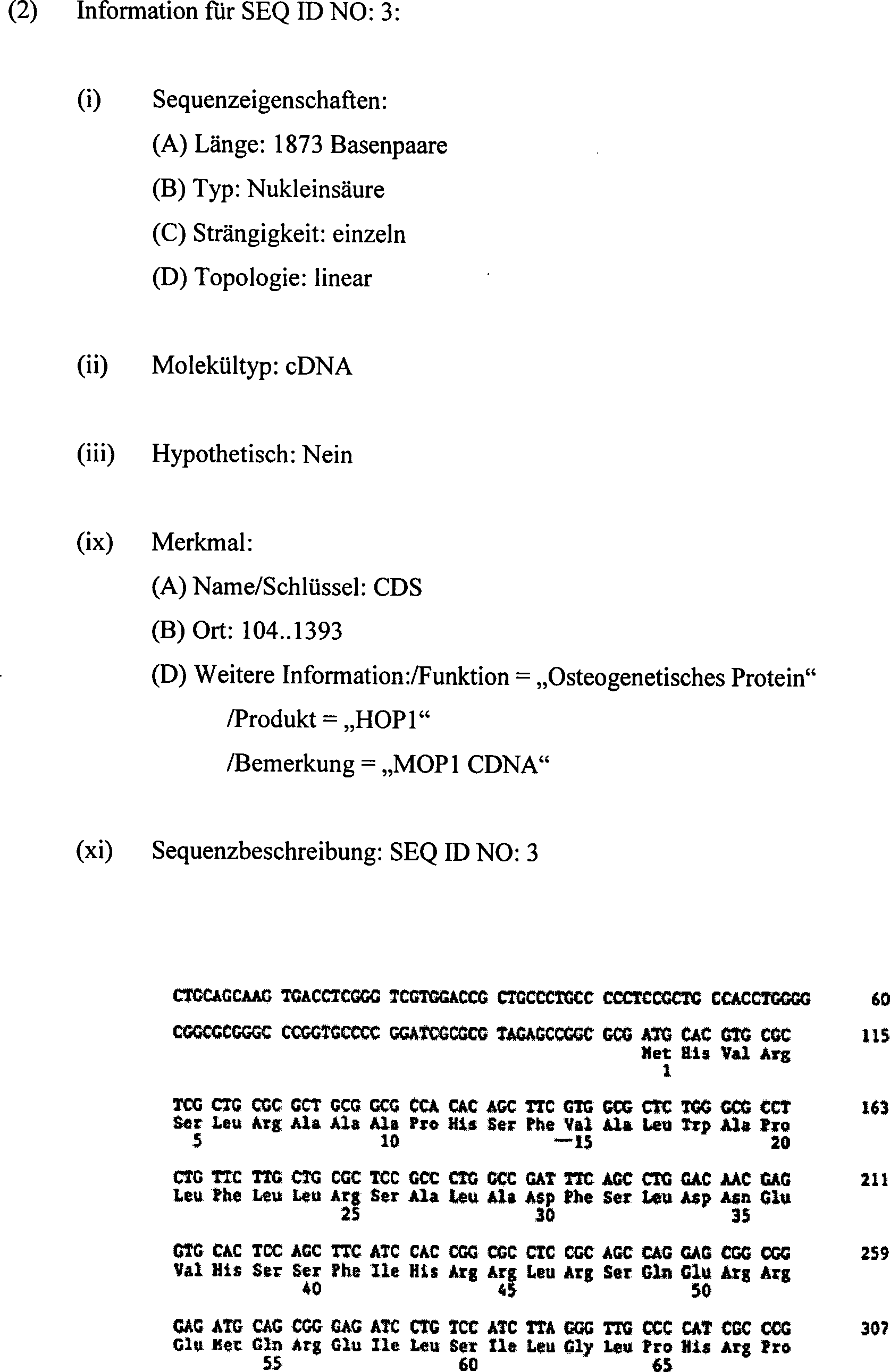


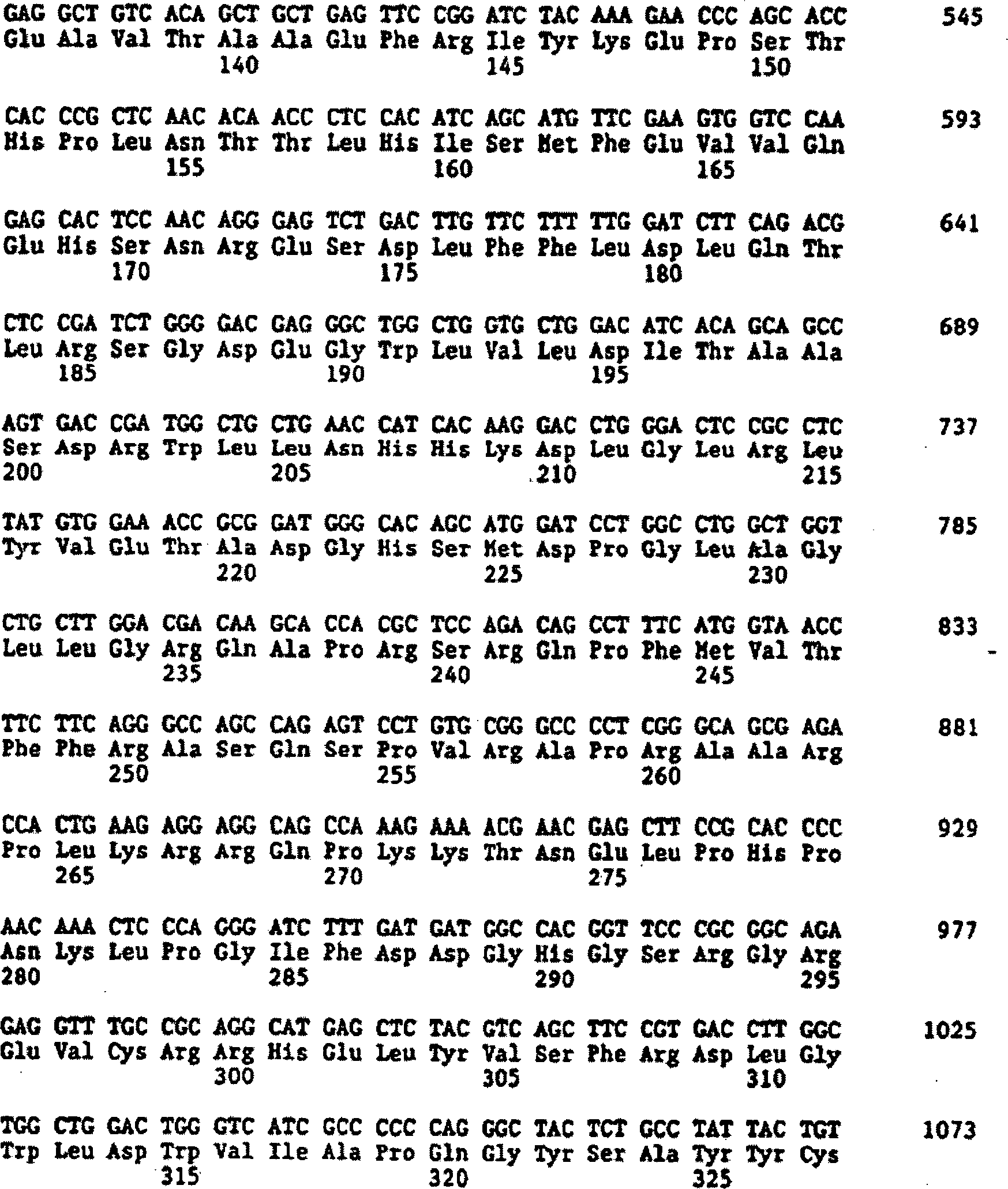


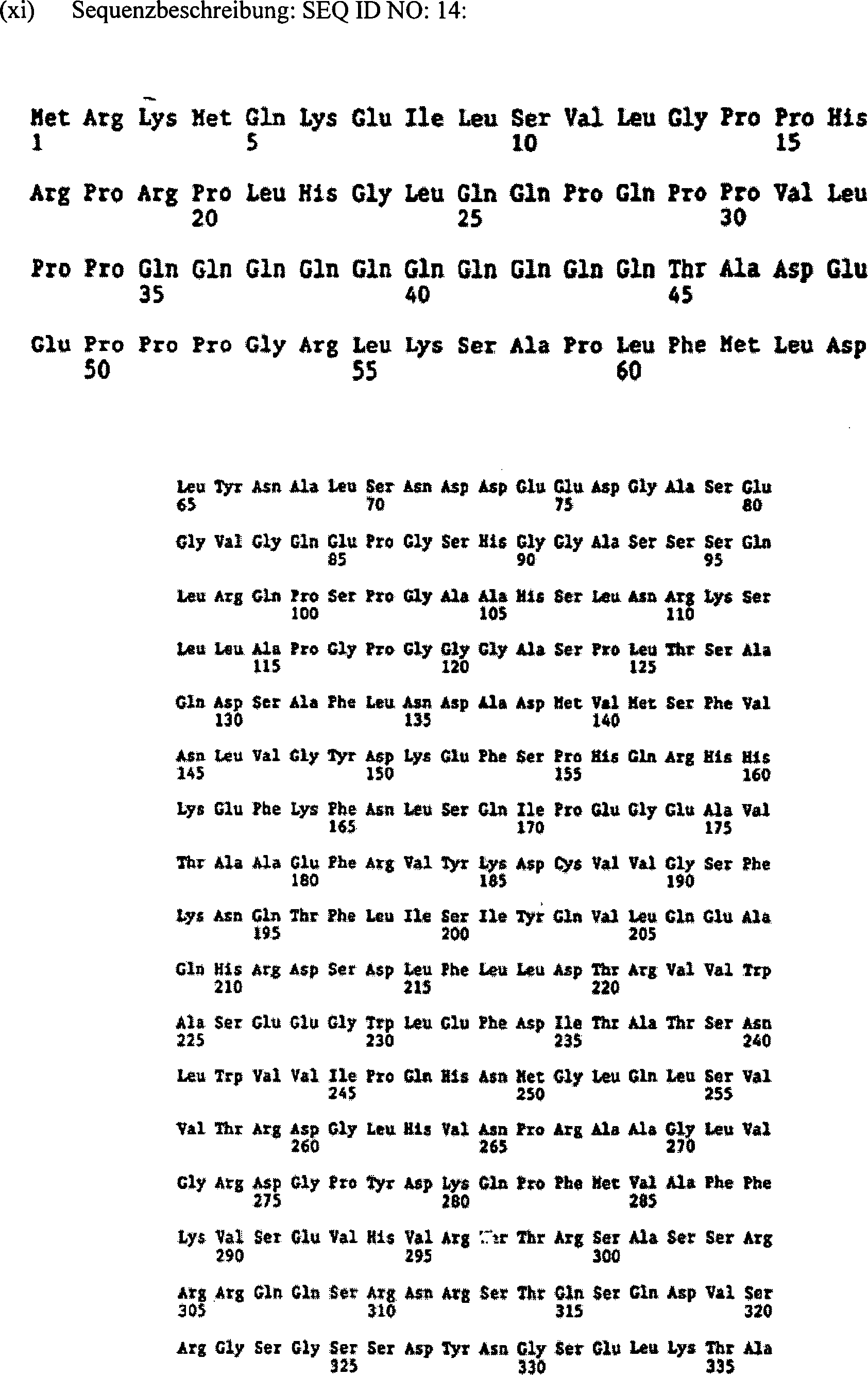


Claims (14)
Applications Claiming Priority (7)
| Application Number | Priority Date | Filing Date | Title |
|---|---|---|---|
| US92378092A | 1992-07-31 | 1992-07-31 | |
| US923780 | 1992-07-31 | ||
| US2933593A | 1993-03-04 | 1993-03-04 | |
| US29335 | 1993-03-04 | ||
| US4051093A | 1993-03-31 | 1993-03-31 | |
| US40510 | 1993-03-31 | ||
| PCT/US1993/007189 WO1994003600A1 (en) | 1992-07-31 | 1993-07-29 | Morphogenic protein soluble complex and composition thereof |
Publications (2)
| Publication Number | Publication Date |
|---|---|
| DE69333745D1 DE69333745D1 (en) | 2005-03-03 |
| DE69333745T2 true DE69333745T2 (en) | 2005-12-29 |
Family
ID=27363455
Family Applications (1)
| Application Number | Title | Priority Date | Filing Date |
|---|---|---|---|
| DE69333745T Expired - Lifetime DE69333745T2 (en) | 1992-07-31 | 1993-07-29 | SOLUBLE COMPLEX OF MORPHOGENIC PROTEINS AND COMPOSITIONS THEREOF |
Country Status (8)
| Country | Link |
|---|---|
| EP (1) | EP0652953B1 (en) |
| JP (3) | JP3981405B2 (en) |
| KR (1) | KR950702627A (en) |
| AT (1) | ATE287949T1 (en) |
| AU (1) | AU678380B2 (en) |
| CA (1) | CA2141555C (en) |
| DE (1) | DE69333745T2 (en) |
| WO (1) | WO1994003600A1 (en) |
Families Citing this family (18)
| Publication number | Priority date | Publication date | Assignee | Title |
|---|---|---|---|---|
| US7056882B2 (en) | 1991-03-11 | 2006-06-06 | Curis, Inc. | Treatment to prevent loss of and/or increase bone mass in metabolic bone diseases |
| US5610021A (en) * | 1992-02-21 | 1997-03-11 | Creative Biomolecules, Inc. | Compositions and methods for identification and use of soluble complex forms of osteogenic proteins |
| WO1994010203A2 (en) * | 1992-11-03 | 1994-05-11 | Creative Biomolecules, Inc. | Op-3-induced morphogenesis |
| AU682176B2 (en) * | 1993-03-04 | 1997-09-25 | Stryker Corporation | Method and compositions for recombinant osteogenic protein production |
| AU1180195A (en) * | 1993-11-16 | 1995-06-06 | Children's Medical Center Corporation | Method of identifying a substance capable of inducing bone formation |
| US6498142B1 (en) | 1996-05-06 | 2002-12-24 | Curis, Inc. | Morphogen treatment for chronic renal failure |
| ZA9711580B (en) * | 1996-12-25 | 1999-09-23 | Hoechst Marion Roussel Ltd | Process for the production of purified dimeric bone morphogenetic factors. |
| ATE278414T1 (en) | 1997-05-05 | 2004-10-15 | Curis Inc | THERAPIES FOR THE TREATMENT OF ACUTE KIDNEY FAILURE |
| EP1988395A1 (en) | 1997-05-30 | 2008-11-05 | Curis, Inc. | Methods for evaluating tissue morphogenesis and morphogenic activity |
| WO1999028341A2 (en) * | 1997-12-04 | 1999-06-10 | Creative Biomolecules, Inc. | Maintenance of smooth muscle integrity by morphogenic proteins |
| US7147839B2 (en) | 1998-05-29 | 2006-12-12 | Curis, Inc. | Methods for evaluating tissue morphogenesis and activity |
| AU2005229072A1 (en) | 2004-03-26 | 2005-10-13 | Acceleron Pharma Inc. | BMP-3 propeptides and related methods |
| WO2005113590A2 (en) | 2004-05-12 | 2005-12-01 | Acceleron Pharma Inc. | Bmp10 propeptides and related methods |
| US7465706B2 (en) | 2004-06-24 | 2008-12-16 | Acceleron Pharma Inc. | GDF3 propeptides and related methods |
| JP5100662B2 (en) * | 2005-12-22 | 2012-12-19 | セントカー・インコーポレーテツド | BMP-7 variant compositions, methods and uses |
| US7659250B2 (en) | 2005-12-22 | 2010-02-09 | Centocor, Inc. | BMP-7 variant compositions, methods and uses |
| EP2035030A2 (en) * | 2006-05-17 | 2009-03-18 | Stryker Corporation | Use of a soluble morphogenic protein complex for treating cartilage defects |
| EP2056852A4 (en) * | 2006-07-27 | 2010-01-13 | Centocor Ortho Biotech Inc | Bmp-7 variant compositions, methods and uses |
Family Cites Families (5)
| Publication number | Priority date | Publication date | Assignee | Title |
|---|---|---|---|---|
| US4857456A (en) * | 1985-04-30 | 1989-08-15 | The Regents Of The University Of California | Assay of Bone morphogenetic protein (BMP) and anti-BMP antibody for the diagnosis of bone disorders |
| US5168050A (en) * | 1990-05-24 | 1992-12-01 | Genentech, Inc. | Mammalian expression of the bone morphogenetic protein-2b using bmp2a/bmp2b fusion |
| DE69129865T2 (en) * | 1990-10-18 | 1999-03-04 | Stryker Corp., Kalamazoo, Mich. | OSTEOGENEIC PEPTIDES |
| ATE308336T1 (en) * | 1991-08-30 | 2005-11-15 | Curis Inc | OSTEOGENIC PROTEINS IN THE TREATMENT OF METABOLIC BONE DISEASES |
| AU682176B2 (en) * | 1993-03-04 | 1997-09-25 | Stryker Corporation | Method and compositions for recombinant osteogenic protein production |
-
1993
- 1993-07-29 DE DE69333745T patent/DE69333745T2/en not_active Expired - Lifetime
- 1993-07-29 CA CA002141555A patent/CA2141555C/en not_active Expired - Lifetime
- 1993-07-29 WO PCT/US1993/007189 patent/WO1994003600A1/en not_active Ceased
- 1993-07-29 EP EP93918529A patent/EP0652953B1/en not_active Expired - Lifetime
- 1993-07-29 AU AU47951/93A patent/AU678380B2/en not_active Expired
- 1993-07-29 AT AT93918529T patent/ATE287949T1/en not_active IP Right Cessation
- 1993-07-29 KR KR1019950700360A patent/KR950702627A/en not_active Ceased
- 1993-07-29 JP JP50546294A patent/JP3981405B2/en not_active Expired - Lifetime
-
2006
- 2006-11-17 JP JP2006312291A patent/JP4126321B2/en not_active Expired - Lifetime
-
2008
- 2008-01-08 JP JP2008001668A patent/JP2008163028A/en not_active Withdrawn
Also Published As
| Publication number | Publication date |
|---|---|
| DE69333745D1 (en) | 2005-03-03 |
| JPH07509611A (en) | 1995-10-26 |
| AU678380B2 (en) | 1997-05-29 |
| WO1994003600A1 (en) | 1994-02-17 |
| CA2141555C (en) | 2007-03-27 |
| EP0652953A1 (en) | 1995-05-17 |
| JP2008163028A (en) | 2008-07-17 |
| CA2141555A1 (en) | 1994-02-17 |
| JP2007051162A (en) | 2007-03-01 |
| EP0652953B1 (en) | 2005-01-26 |
| AU4795193A (en) | 1994-03-03 |
| KR950702627A (en) | 1995-07-29 |
| ATE287949T1 (en) | 2005-02-15 |
| JP3981405B2 (en) | 2007-09-26 |
| JP4126321B2 (en) | 2008-07-30 |
Similar Documents
| Publication | Publication Date | Title |
|---|---|---|
| DE69333745T2 (en) | SOLUBLE COMPLEX OF MORPHOGENIC PROTEINS AND COMPOSITIONS THEREOF | |
| US20080227956A1 (en) | Novel morphogenic protein compositions of matter | |
| DE69432815T2 (en) | GROWTH FACTOR-8 | |
| DE69723429T2 (en) | METHOD FOR IMPROVED FUNCTIONAL RECOVERY OF MOTOR COORDINATION, LANGUAGE OR SENSUAL ASSESSMENT AFTER TRAUMA OR ISCHEMIA OF THE CNS | |
| DE69333040T2 (en) | MORPHOGEN INDUCED NERVES RESTORATION AND RECONSTRUCTION. | |
| DE69635738T2 (en) | Neurturin and related growth factors | |
| DE69129302T2 (en) | TUMOR GROWTH INHIBITORS FROM FABRICS, METHODS OF THEIR PRODUCTION AND USE | |
| DE69017753T2 (en) | Tumor necrosis factor binding protein II, its purification and specific antibodies. | |
| EP0713529B1 (en) | Growth differentiation factor of the TGF-B family | |
| DE69231062T3 (en) | Morphogen-induced modulation of inflammatory responses | |
| DE69028671T3 (en) | Soluble extracellular fragment of the human IFN-beta 2 / IL-6 receptor, its preparation and pharmaceutical fragment containing this fragment | |
| AU2008345689B2 (en) | BMP mutants with decreased susceptibility to Noggin | |
| US6949505B1 (en) | Morphogen-induced dendritic growth | |
| DE3751179T2 (en) | Peptides that inhibit the binding of the Von Willebrand factor. | |
| DE69726884T2 (en) | HUMAN SDF-5 PROTEIN AND RELATED COMPOSITIONS | |
| DE69231567T2 (en) | Screening method of morphogenic proteins | |
| EP1151095A1 (en) | Polypeptide variants with raised heparin-binding capacity | |
| DE69826854T2 (en) | THERAPIES FOR THE TREATMENT OF ACUTE KIDNEY FAILURES | |
| DE69732350T2 (en) | PERSEPHIN AND RELATED GROWTH FACTORS | |
| DE69833211T2 (en) | HUMAN PERSEPHIN | |
| US8138148B2 (en) | GDNF derived peptides | |
| DE69434914T2 (en) | METHOD AND COMPOSITIONS FOR PREPARING RECOMBINANT OSTEOGENIC PROTEIN | |
| DE69318166T2 (en) | FOOD COMPOSITION ENRICHED WITH MORPHOGEN | |
| DE3938953A1 (en) | CLONING AND EXPRESSION OF THE HT7 SPECIFIC PROTEIN FOR BLOOD BRAIN BARRIERS |
Legal Events
| Date | Code | Title | Description |
|---|---|---|---|
| 8364 | No opposition during term of opposition |