DE69026773T3 - Wear-resistant component - Google Patents
Wear-resistant component Download PDFInfo
- Publication number
- DE69026773T3 DE69026773T3 DE69026773T DE69026773T DE69026773T3 DE 69026773 T3 DE69026773 T3 DE 69026773T3 DE 69026773 T DE69026773 T DE 69026773T DE 69026773 T DE69026773 T DE 69026773T DE 69026773 T3 DE69026773 T3 DE 69026773T3
- Authority
- DE
- Germany
- Prior art keywords
- sintering
- silicon nitride
- wear
- powder
- sintered
- Prior art date
- Legal status (The legal status is an assumption and is not a legal conclusion. Google has not performed a legal analysis and makes no representation as to the accuracy of the status listed.)
- Expired - Lifetime
Links
Classifications
-
- C—CHEMISTRY; METALLURGY
- C04—CEMENTS; CONCRETE; ARTIFICIAL STONE; CERAMICS; REFRACTORIES
- C04B—LIME, MAGNESIA; SLAG; CEMENTS; COMPOSITIONS THEREOF, e.g. MORTARS, CONCRETE OR LIKE BUILDING MATERIALS; ARTIFICIAL STONE; CERAMICS; REFRACTORIES; TREATMENT OF NATURAL STONE
- C04B35/00—Shaped ceramic products characterised by their composition; Ceramics compositions; Processing powders of inorganic compounds preparatory to the manufacturing of ceramic products
- C04B35/01—Shaped ceramic products characterised by their composition; Ceramics compositions; Processing powders of inorganic compounds preparatory to the manufacturing of ceramic products based on oxide ceramics
- C04B35/26—Shaped ceramic products characterised by their composition; Ceramics compositions; Processing powders of inorganic compounds preparatory to the manufacturing of ceramic products based on oxide ceramics based on ferrites
-
- C—CHEMISTRY; METALLURGY
- C04—CEMENTS; CONCRETE; ARTIFICIAL STONE; CERAMICS; REFRACTORIES
- C04B—LIME, MAGNESIA; SLAG; CEMENTS; COMPOSITIONS THEREOF, e.g. MORTARS, CONCRETE OR LIKE BUILDING MATERIALS; ARTIFICIAL STONE; CERAMICS; REFRACTORIES; TREATMENT OF NATURAL STONE
- C04B35/00—Shaped ceramic products characterised by their composition; Ceramics compositions; Processing powders of inorganic compounds preparatory to the manufacturing of ceramic products
- C04B35/515—Shaped ceramic products characterised by their composition; Ceramics compositions; Processing powders of inorganic compounds preparatory to the manufacturing of ceramic products based on non-oxide ceramics
- C04B35/58—Shaped ceramic products characterised by their composition; Ceramics compositions; Processing powders of inorganic compounds preparatory to the manufacturing of ceramic products based on non-oxide ceramics based on borides, nitrides, i.e. nitrides, oxynitrides, carbonitrides or oxycarbonitrides or silicides
- C04B35/584—Shaped ceramic products characterised by their composition; Ceramics compositions; Processing powders of inorganic compounds preparatory to the manufacturing of ceramic products based on non-oxide ceramics based on borides, nitrides, i.e. nitrides, oxynitrides, carbonitrides or oxycarbonitrides or silicides based on silicon nitride
- C04B35/593—Shaped ceramic products characterised by their composition; Ceramics compositions; Processing powders of inorganic compounds preparatory to the manufacturing of ceramic products based on non-oxide ceramics based on borides, nitrides, i.e. nitrides, oxynitrides, carbonitrides or oxycarbonitrides or silicides based on silicon nitride obtained by pressure sintering
-
- F—MECHANICAL ENGINEERING; LIGHTING; HEATING; WEAPONS; BLASTING
- F16—ENGINEERING ELEMENTS AND UNITS; GENERAL MEASURES FOR PRODUCING AND MAINTAINING EFFECTIVE FUNCTIONING OF MACHINES OR INSTALLATIONS; THERMAL INSULATION IN GENERAL
- F16C—SHAFTS; FLEXIBLE SHAFTS; ELEMENTS OR CRANKSHAFT MECHANISMS; ROTARY BODIES OTHER THAN GEARING ELEMENTS; BEARINGS
- F16C33/00—Parts of bearings; Special methods for making bearings or parts thereof
- F16C33/02—Parts of sliding-contact bearings
- F16C33/04—Brasses; Bushes; Linings
- F16C33/043—Sliding surface consisting mainly of ceramics, cermets or hard carbon, e.g. diamond like carbon [DLC]
-
- F—MECHANICAL ENGINEERING; LIGHTING; HEATING; WEAPONS; BLASTING
- F16—ENGINEERING ELEMENTS AND UNITS; GENERAL MEASURES FOR PRODUCING AND MAINTAINING EFFECTIVE FUNCTIONING OF MACHINES OR INSTALLATIONS; THERMAL INSULATION IN GENERAL
- F16C—SHAFTS; FLEXIBLE SHAFTS; ELEMENTS OR CRANKSHAFT MECHANISMS; ROTARY BODIES OTHER THAN GEARING ELEMENTS; BEARINGS
- F16C33/00—Parts of bearings; Special methods for making bearings or parts thereof
- F16C33/30—Parts of ball or roller bearings
Landscapes
- Engineering & Computer Science (AREA)
- Chemical & Material Sciences (AREA)
- Ceramic Engineering (AREA)
- General Engineering & Computer Science (AREA)
- Mechanical Engineering (AREA)
- Manufacturing & Machinery (AREA)
- Materials Engineering (AREA)
- Structural Engineering (AREA)
- Organic Chemistry (AREA)
- Ceramic Products (AREA)
Description
Die vorliegende Erfindung bezieht sich auf ein verschleißbeständiges Bauteil in der Form eines Lagerelements und insbesondere auf verschleißbeständige Lagerelemente, die für zum Beispiel ein Kugel- und/oder Rollenlagerelement geeignet sind.The The present invention relates to a wear resistant component in the form of a bearing element and in particular wear-resistant bearing elements, the for For example, a ball and / or roller bearing element are suitable.
Siliziumnitridkeramikstoffe sind als Materialien für mechanische Teile, die unter erschwerten Bedingungen verwendet wer den, wegen ihrer guten Wärmebeständigkeit, Korrosionsbeständigkeit und Verschleißbeständigkeit vorgeschlagen worden. Es sind beispielsweise Versuche unternommen worden, gesintertes Siliziumnitrid als Material für Kugeln und Rollen, d. h. für die wälzenden Teile bei einem Lager, zu verwenden.Siliziumnitridkeramikstoffe are considered materials for mechanical parts used under severe conditions because of their good heat resistance, corrosion resistance and wear resistance been proposed. For example, attempts have been made been sintered silicon nitride as a material for balls and roles, d. H. For the rolling ones Parts at a warehouse to use.
Aber Siliziumnitrid selbst hat verhältnismäßig dürftige Sintereigenschaften. Keramische Werkstoffe, welche hauptsächlich aus Siliziumnitrid bestehen, werden konventionell mit Hilfe eines Verfahrens hergestellt, welches ein Druckverfestigungs-Sintern mit Verwendung eines Additivs einschließt oder ein Reaktionssintern entsprechend einem Nitridbildungsprozess einbezieht.But Silicon nitride itself has relatively poor sintering properties. Ceramic materials mainly consisting of silicon nitride, are conventionally prepared by a process which a pressure-hardening sintering with use of an additive or reaction sintering accordingly involves a nitride formation process.
Von
den vorstehenden Sinterverfahren fördert das erstere, welches
ein druckverdichtendes Sintern unter Verwendung eines Additivs durchführt, ein
Liquidus-Sintern durch das Additiv und ermöglicht dadurch, dass das gesinterte
Material eine hohe Dichte hat. Da nun dieses Verfahren in Verbindung
mit verschiedenen anderen Sinterverfahren benutzt werden kann, wird
es üblicherweise
verwendet. Als Additiv für
das Fördern eines
solchen Liquidus-Sinterns oder als Sinter-Hilfsstoff werden bis
jetzt Oxide oder Nitride von Mg, Al, Y, Sc, La oder Ce allein oder
in Kombination von zwei oder mehreren davon verwendet. Der Leser
wird zum Beispiel auf
Solch ein bekannter Sinter-Hilfsstoff kann jedoch als amorphe Phase in der Kristallkorngrenze in der gesinterten Substanz je nach der dem Haupt-Keramikwerkstoff zugesetzten Menge verbleiben. Diese amorphe Phase erweicht bei hoher Temperatur, was die Hochtemperatur-Festigkeit der Siliziumnitridkeramik verschlechtert. Sinter-Hilfsstoffe sind bisher Untersuchungen in Bezug auf Zusammensetzung und Menge unterzogen worden.Such however, a known sintering excipient may be used as an amorphous phase in the crystal grain boundary in the sintered substance depending on the Main ceramic material added amount remain. This amorphous Phase softens at high temperature, resulting in high-temperature strength the silicon nitride ceramic deteriorates. Sintering auxiliaries are previously subjected to investigations in terms of composition and quantity Service.
Ein
spezielles Verfahren für
die Herstellung von gesintertem Siliziumnitrid ist das folgende:
Zuerst
wird ein Sinter-Hilfsstoff Siliziumnitridpulver zugesetzt und gründlich damit
vermischt, um das Pulver-Rohmaterial herzustellen. Dann wird das
so vorbereitete Pulver einem Druckformen oder Spritzformen für das Formen
zu einem Formling ausgesetzt. Der Formling kann unter normalem Druck
in der Atmosphäre
oder unter Druck gesintert werden. Es kann ein Heißpressverfahren
benutzt werden, um das Formen und Sintern in einem einzigen Prozess
zu bewerkstelligen. Ein entsprechendes Verfahren wird je nach der
Gestalt und dem Verwendungszweck des erzeugten Produktes gewählt.A specific method for the production of sintered silicon nitride is the following:
First, a sintering assistant is added with silicon nitride powder and thoroughly mixed therewith to prepare the powder raw material. Then, the thus-prepared powder is subjected to compression molding or injection molding for molding into a molded article. The molding can be sintered under normal pressure in the atmosphere or under pressure. A hot pressing process can be used to accomplish the molding and sintering in a single process. A corresponding method is selected depending on the shape and intended use of the product produced.
Siliziumnitrid-Keramikwerkstoffe, die durch Sintern unter normalem Druck hergestellt worden sind, haben im allgemeinen große Poren, die im Innern des gesinterten Produkts ausgebildet sind, und eine relativ geringere Druckfestigkeit. Deshalb kann dann, wenn Siliziumnitrid-Keramikwerkstoffe beispielsweise als Lagerelement verwendet werden, das Heißpressverfahren verwendet werden, welches nicht so leicht Poren erzeugt, ebenso, wie ein Verfahren, welches eine HIP-(isostatische Heißpress-)Behandlung mit einem Sintern unter atmosphärischem Druck kombiniert, so dass ein dichtes gesintertes Produkt erzeugt wird.Silicon nitride ceramics, which have been produced by sintering under normal pressure, generally have big ones Pores formed inside the sintered product and a relatively lower pressure resistance. Therefore, if Silicon nitride ceramic materials, for example, as a bearing element be used, the hot pressing process used, which does not easily generate pores, as well, such as a method which is a HIP (isostatic hot pressing) treatment with a sintering under atmospheric Pressure combined, creating a dense sintered product becomes.
Wie vorstehend beschrieben, sind Sinterverfahren, welche die guten Eigenschaften von gut gesintertem Siliziumnitrid nutzen, untersucht worden. Jedoch haben Lager, die aus Siliziumnitridkeramik hergestellt werden, den Nachteil, dass die Wälz-Dauerbelastbarkeit, eine wesentliche Eigenschaft als Lager, einer großen Schwankung unterliegt. Eine Anwendung der HIP-Behandlung zusammen mit gesintertem Siliziumnitrid von verminderter Porosität verbessert die relativen Wälz-Dauerbelastungseigenschaften, hat aber diese Schwankung bei der Wälz-Dauerbelastbarkeit noch nicht wirksam herabgesetzt.As As described above, sintering methods are the good properties use of well sintered silicon nitride has been investigated. however have bearings made of silicon nitride ceramics, the Disadvantage that the rolling permanent loadability, an essential property as a warehouse, a large fluctuation subject. An application of HIP treatment along with sintered Silicon nitride of reduced porosity improves the relative Rolling-continuous load properties, But this fluctuation in the Wälz-Durability still has not effectively reduced.
Keramische Lager werden häufig als Lager für eine Verwendung in geschmolzenem Metall verwendet, wo ein metallisches Lager nicht benutzt werden kann. Eine solche Verwendung macht es erforderlich, dass das Lager korrosionsbeständig gegen Säure, Alkalien, geschmolzenes Metall und dergleichen ist. Sie haben jedoch den Nachteil, dass sie generell dazu tendieren, an einer Stelle zu korrodieren, wo der Sinter-Hilfsstoff in der Siliziumnitridkeramik enthalten ist.ceramic Bearings become common as a warehouse for used in molten metal where a metallic one Stock can not be used. Such use makes it required that the bearing be resistant to corrosion by acids, alkalis, molten metal and the like. However, they have the disadvantage that they generally tend to corrode at one point, where the sintering excipient contained in the silicon nitride ceramic is.
Dementsprechend ist es eine Aufgabe der vorliegenden Erfindung, danach zu trachten, für zuverlässige, verschleißbeständige Bauteile mit attraktiven Gleiteigenschaften, speziell bei den Wälz-Dauerbelastungseigenschaften, zu sorgen.Accordingly It is an object of the present invention to seek for reliable, wear-resistant components with attractive sliding properties, especially with rolling load endurance properties, to care.
Eine weitere Aufgabe der vorliegenden Erfindung ist, danach zu trachten, für verschleißbeständige Bauteile mit einer erwünschten Korrosionsbeständigkeit zu sorgen.A Another object of the present invention is to seek for wear-resistant components with a desired corrosion resistance to care.
Verschleißbeständige Bauteile entsprechend der vorliegenden Erfindung sind verschleißbeständige Bauteile gemäß Anspruch 1.Wear-resistant components according to the present invention are wear resistant components according to claim 1.
Ein Verfahren für die Herstellung eines verschleißbeständigen Bauteils gemäß Anspruch 1 weist einen Schritt auf, 0,1 bis 5 Gewichtsprozent an Yttriumoxidpulver als einen Sinter-Hilfsstoff zu Siliziumnitridpulver hinzuzufügen und mit diesem zu vermischen, einen Schritt, dieses gemischte Pulver als Aus gangsmaterialpulver zu verwenden und es zu einem gewünschten geformten verschleißbeständigen Bauteil zu formen, einen Schritt, das geformte Produkt zu sintern, um eine Porosität von 2% oder darunter zu erhalten, und einen Schritt, das gesinterte Produkt einer isostatischen Heißpressbehandlung (im Nachstehenden HIP genannt) zu unterziehen, um seine Porosität 1% oder geringer zu machen.One Procedure for the production of a wear-resistant component according to claim 1 comprises one step, 0.1 to 5 weight percent of yttria powder as a sintering assistant to add silicon nitride powder and to mix with this one step, this mixed powder to use as a starting material powder and make it a desired molded wear-resistant component to form a step, to sinter the molded product to one porosity of 2% or less, and one step sintered Product of an isostatic hot pressing treatment (hereinafter referred to as HIP) to undergo its porosity 1% or lower.
Das vorstehende Yttriumoxid und Aluminiumoxid, die als die Sinter-Hilfskomponente enthalten sind, sind als amorphe Phase in dem gesinterten Körper vorhanden. Diese amorphe Phase liegt generell in der kristallinen Korngrenze vor, doch ist so segregiert, dass sie in Abhängigkeit von dem Herstellungsverfahren in der gesinterten Substanz existiert. Diese Entmischung bzw. Trennung der amorphen Phase wird durch eine Vielzahl von Dispersionen gebildet, welche vom Inneren bis zur Oberfläche des gesinterten Körpers reichen. Deshalb gibt es entmischte Teile in verschiedenen Größen.The above yttria and alumina, which are referred to as the sintering auxiliary component are present as an amorphous phase in the sintered body. This amorphous phase is generally in the crystalline grain boundary before, however, it is so segregated that it depends on the manufacturing process exists in the sintered substance. This segregation or separation the amorphous phase is formed by a variety of dispersions, which range from the inside to the surface of the sintered body. That's why there are segregated parts in different sizes.
Die vorliegende Erfindung basiert auf dem unerwarteten Ergebnis, dass eine Entmischung (segregation) der amorphen Phase einen beträchtlichen Einfluss auf die Gleiteigenschaften ausübt. Für verschleißbeständige Bauteile der vorliegenden Erfindung wird die Entmischung der amorphen Phase, die in der gesinterten Substanz existiert, so definiert, dass sie nicht höher als, aber vorzugsweise kleiner als 50 μm ist, wobei die Entmischungsgröße anschließend definiert wird.The The present invention is based on the unexpected result that a segregation of the amorphous phase a considerable Influences the gliding properties. For wear resistant components of the present Invention is the segregation of the amorphous phase, which in the sintered Substance exists, so defined that it is not higher than, but preferably less than 50 microns is, with the segregation size then defined becomes.
Bis jetzt war man der Meinung, dass die Wälz-Dauerbelastbarkeit durch das Vorhandensein oder Nichtvorhandensein von Poren beeinflusst wird, welche während des Sinterns gebildet wurden. Um die Poren zu beseitigen, wurde eine HIP-Behandlung verwendet, welche die Betriebs-Lebensdauer erhöhte. Aber selbst bei keramischen Werkstoffen, welche einer HIP-Behandlung ausgesetzt wurden und nur eine kleine Anzahl Poren enthielten, hatten manche nur eine kurze Wälz-Lebensdauer. Folglich war der grundlegende Faktor, welcher die Wälz-Lebensdauer beeinflusste, noch nicht vollkommen erkannt.To now it was believed that the rolling load capacity through influences the presence or absence of pores which is during of sintering were formed. To eliminate the pores, was used a HIP treatment which increased the service life. But even with ceramic materials which undergo a HIP treatment were exposed and contained only a small number of pores some just a short rolling life. Consequently, the fundamental factor was the rolling life influenced, not yet fully recognized.
Eine detaillierte Untersuchung wurde unter Verwendung von Elektronenmikroskop-Reflexionselektronenbildern der inneren Struktur von Siliziumnitrid-Keramikwerkstoffen ausgeführt, welche einer HIP-Behandlung ausgesetzt worden waren. Es wurde festgestellt, dass die Poren, welche vorher bestanden, als Ergebnis der HIP-Behandlung fast vollkommen verschwunden waren, aber die amorphe Phase, die hauptsächlich aus Sinter-Hilfsstoff bestand, der ein verhältnismäßig hohes Fließvermögen hat, in diejenigen Teile hineinfloss, in denen die Poren vorhanden waren und dort entmischte.A Detailed investigation was made using electron microscope reflection electron images the internal structure of silicon nitride ceramic materials executed which HIP treatment. It was determined, that the pores that existed before, as a result of the HIP treatment almost completely disappeared, but the amorphous phase, the mainly from sintering aid which was a relatively high Has fluidity, into those parts in which the pores were present and segregated there.
Die Erfinder haben festgestellt, dass dann, wenn solche Siliziumnitrid-Keramikwerkstoffe, die entmischte Teile der amorphen Phase enthielten, als verschleißbeständige Bauteile, beispielsweise als Lager, verwendet wurden, die Tendenz entstand, dass ein Abschälen in den entmischten Teilen auftrat, wenn irgendwelche solcher entmischten Teile eine Größe hatten, die einen bestimmten Wert überschritt, und dadurch die Betriebs-Lebensdauer herabgesetzt wurde.The Inventors have found that when such silicon nitride ceramics, containing the demixed portions of the amorphous phase, as wear resistant components, for example, as bearings, were used, the tendency arose, that a peeling off occurred in the segregated parts, if any such segregated Parts had a size, which exceeded a certain value, and thereby the service life was lowered.
Das heißt, die Entmischung der amorphen Phase, die in mehreren und unterschiedlichen Größen vorhanden ist, kann da kein Abschälen (welches ein Hindernis bei der praktischen Nutzung sein kann) verursachen, wo deren Größe 50 μm oder kleiner ist, selbst dann nicht, wenn deren Abmessung groß ist. Deshalb umfassen verschleißbeständige Bauteile der vorliegenden Erfindung Siliziumnitrid-Keramikwerkstoffe, welche in der amorphen Phase insgesamt eine maximale Entmischungsgröße von 50 μm oder weniger haben, um ein Abschälen der entmischten Teile zu verhüten, um die Lagereigenschaften des verschleißbeständigen Bauteils, insbesondere die Wälz-Lebensdauer, zu verbessern und eine Schwankung bei derselben herabzusetzen.The is called, the demixing of the amorphous phase, which occurs in several and different Sizes available is, there can be no peeling (which may be an obstacle in practical use), where their size is 50 microns or smaller is, even if their size is large. Therefore, wear-resistant components include According to the present invention silicon nitride ceramic materials, which in total, in the amorphous phase, a maximum segregation size of 50 μm or less have to peel off to prevent the segregated parts to the bearing properties of the wear-resistant component, in particular the rolling life, to improve and minimize a variation in the same.
Die vorstehende amorphe Phase besteht hauptsächlich aus der Sinter-Hilfsstoff-Komponente. Deren Entmischung wird gebildet, wenn die amorphe Phase, welche ein verhältnismäßig hohes Fließvermögen hat, durch zum Beispiel eine HIP-Behandlung in die Poren kondensiert wird, die gebildet werden, wenn wie vorstehend beschrieben gesintert wird, und an dem Tripelpunkt der Korngrenze existiert. Die Entmischungsgröße wird durch den Durchmesser eines Kreises repräsentiert, welcher die fragliche Entmischung umgibt.The above amorphous phase mainly consists of the sintering assistant component. their Segregation is formed when the amorphous phase, which has a relatively high fluidity, is condensed into the pores by, for example, HIP treatment, which are formed when sintering as described above and exist at the triple point of the grain boundary. The segregation size is represented by the diameter of a circle surrounding the segregation in question.
Ein Verfahren für die Herstellung eines verschleißbeständigen Bauteils der vorliegenden Erfindung, welches hauptsächlich aus einem Siliziumnitrid-Keramikwerkstoff besteht, welcher so gesteuert wird, dass er eine entmischte amorphe Phase von einer Entmischungsgröße von 50 μm oder darunter einschließt, wird jetzt zum Zweck der Veranschaulichung beschrieben.One Procedure for the production of a wear-resistant component of the present invention, which is mainly made of a silicon nitride ceramic material which is controlled to be a demixed amorphous one Phase of a segregation size of 50 microns or less includes, is now described for purposes of illustration.
Siliziumnitridpulver wird eine bestimmte Menge eines Sinter-Hilfsstoffpulvers zugesetzt und vollständig gemischt, um ein Ausgangspulver herzustellen. Als Sinter-Hilfsstoff wird Yttriumoxidpulver verwendet. Yttriumoxid wird mit einem oder mehreren Bestandteilen gemischt verwendet. Aluminiumoxidpulver wird in Verbindung mit Yttriumoxid als einer Sinter-Hilfsstoff-Komponente verwendet.silicon nitride a certain amount of a sintering excipient powder is added and mixed completely, to make a starting powder. The sintering assistant is yttrium oxide powder used. Yttrium oxide is one or more components used mixed. Alumina powder is used in conjunction with yttria as a sintering excipient component used.
Yttriumoxid wird benutzt, um ein Sintern der Liquidusphase zu fördern, um einen gesinterten Körper hoher Dichte herzustellen, und wenn die verwendete Menge übermäßig klein ist, dann kann es sein, dass der Effekt der Förderung des Sinterns nicht ausreichend ist. Wenn die Menge übermäßig groß ist, dann wird die Entmischung der amorphen Phase, welche innerhalb des gesinterten Siliziuimnitrids vorhanden ist, größer, was die Wälz-Lebensdauer herabsetzt und die Schwankung vergrößert. Deshalb beträgt die zugesetzte Menge an Yttriumoxid vorzugsweise 1 bis 5 Gewichtsprozent. Yttriumoxid kann ausreichend sein, wenn es in einer Menge von 5 Gewichtsprozenten verwendet wird, um einen geeigneten Effekt der vorliegenden Erfindung zu liefern. Aluminiumoxid wird auch vorzugsweise in einer Menge von 1 bis 5 Gewichtsprozenten aus ähnlichen Gründen verwendet.yttria is used to promote sintering of the liquidus phase a sintered body higher Density produce, and if the amount used is excessively small is, then it may be that the effect of promoting sintering is not is sufficient. If the amount is excessive, then is the segregation of the amorphous phase, which within the sintered Siliziuimnitrids is present, greater what the rolling life minimizes and increases the fluctuation. Therefore, the added is Amount of yttria preferably 1 to 5 wt%. yttria may be sufficient if it is in an amount of 5% by weight is used to provide a suitable effect of the present invention to deliver. Alumina is also preferably present in an amount from 1 to 5 weight percent for similar reasons.
Mindestens eines von Titanoxid, Aluminiuimnitrid und Hafniumoxid wird jeweils im Bereich von 0,1 bis zu 5 Gewichtsprozent ebenfalls verwendet. Diese Komponenten können einzeln oder kollektiv beim Fördern des Sinterns beitragen. Speziell kann das Zusetzen von Titanoxid bei der Verbesserung der Lagereigenschaften, wie beispielsweise der Wälz-Lebensdauer, effektiv sein.At least one of titanium oxide, aluminum nitride and hafnium oxide is respectively also used in the range of 0.1 to 5 weight percent. These components can individually or collectively while promoting the Contribute to sintering. Specifically, the addition of titanium oxide at the improvement of storage properties, such as the Rolling life, be effective.
Titanoxid und Hafniumoxid können als das Sintern fördernde Mittel bei dem Sinterprozess verwendet werden und können dazu beitragen, dass die Menge an verwendetem Yttriumoxid gesenkt wird. Nach dem Sintern reagiert beispielsweise Titanoxid mit Siliziumnitrid, um Titannitrid zu erzeugen, und wir glauben, dass Hafniumoxid ohne Reaktion bleibt. Die Titannitrid- und Hafniumoxid-Bestandteile werden, wenn sie verwendet werden, in der Korngrenze in kornförmigem Zustand dispergiert, um die Korngrenze zu verstärken. Folglich können die Wälz-Lebensdauer-Eigenschaften verbessert werden. Speziell kann das Zusetzen von Titanoxid die Wälz-Lebensdauer umfassend verbessern.titanium oxide and hafnium oxide as the sintering promoting Means can be used in the sintering process and can do so contribute to lowering the amount of yttria used. For example, after sintering, titanium oxide reacts with silicon nitride, to produce titanium nitride, and we believe hafnium oxide without Reaction remains. The titanium nitride and hafnium oxide constituents are when used, in the grain boundary in a granular state dispersed to reinforce the grain boundary. Consequently, the Rolling fatigue life properties be improved. Specifically, the addition of titanium oxide may Rolling life improve comprehensively.
Es kann sein, dass zugesetztes Titanoxid und Hafniumoxid die Wälz-Lebensdauer nicht verbessern, wenn sie in einer geringen Menge verwendet werden, wenn sie aber übermäßig verwendet werden, dann ist der zu verbessernde Effekt begrenzt. Praktisch wird jeder Bestandteil in einer Menge von 5 Gewichtsprozenten oder darunter verwendet.It may be that added titanium oxide and hafnium oxide the rolling life do not improve when used in a small amount but if used excessively be, then the effect to be improved is limited. Practically each ingredient is in an amount of 5 percent by weight or used underneath.
Die vorstehend erwähnten Sinter-Hilfsstoffe können die Entmischung der amorphen Phase vergrößern, wenn ihre Gesamtmenge übermäßig groß ist, können aber nicht für einen ausreichenden das Sintern fördernden Effekt sorgen, wenn sie in einer übermäßig geringen Menge verwendet werden. Deshalb werden sie im Bereich von 2 bis 15 Gewichtsprozent verwendet.The mentioned above Sintering auxiliaries can however, they can increase the segregation of the amorphous phase when their total amount is excessively large not for provide adequate sintering promoting effect when she in an overly small Amount to be used. Therefore they will be in the range of 2 to 15 weight percent used.
Ein organisches Bindemittel kann, wenn erforderlich, dem vorstehenden Ausgangsmaterialpulver zugesetzt werden, und es kann ein verschleißbeständiges Bauteil einer gewünschten Gestalt geformt werden. Bei diesem Formprozess kann jeder beliebige bekannte Formprozess verwendet werden, wie beispielsweise Pressformen, Strangpressformen, Spritzformen und andere. Das geformte Produkt wird dann durch Sintern unter atmosphärischem Druck oder erhöhtem Druck oder dergleichen gesintert, um für ein gesintertes Siliziumnitrid zu sorgen. Der vorstehend erwähnte Formprozess und der Sinterprozess können durch Verwendung von Heißpressen zu einem zusammengefasst werden.One organic binder may, if necessary, the above Starting material powder can be added, and it can be a wear-resistant component a desired one Shape are formed. Anything can be done in this molding process known molding process can be used, such as press molding, Extrusion molding, injection molding and others. The molded product is then sintered under atmospheric or elevated pressure or the like sintered for to provide a sintered silicon nitride. The above-mentioned molding process and the sintering process can by using hot pressing to be summarized.
Bei dem vorstehenden Sinterschritt ist es wichtig, solche Bedingungen einzustellen, dass die Porosität des gesinterten Körpers 2% oder kleiner wird. Wenn die Porosität des bei dem Sinterschritt erhaltenen gesinterten Körpers 2% überschreitet, dann wird die amorphe Phase, welche hauptsächlich aus der Sinter-Hilfsstoff-Komponente gebildet wird, konzentriert, wenn die Poren durch den nächsten HIP-Prozess geschlossen oder gefüllt werden, was dazu tendiert, dass die Entmischungsgröße 100 μm überschreitet. Spezielle Bedingungen sind zum Beispiel wie folgt: Der Druck beim Sintern beträgt vorzugsweise 1,033 bis 9,3 kg/cm2 (1 bis 9 atm). Die Sintertemperatur reicht vorzugsweise von 1650°C bis zu 1900°C. Die Sintertemperatur wird vorzugsweise 1 Stunde bis 4 Stunden lang gehalten.In the above sintering step, it is important to set such conditions that the porosity of the sintered body becomes 2% or less. When the porosity of the sintered body obtained in the sintering step exceeds 2%, the amorphous phase, which is mainly composed of the sintering assistant component, is concentrated as the pores are closed by the next HIP process or filling, which tends to cause the segregation size to exceed 100 μm. Specific conditions are, for example, as follows: The pressure at sintering is preferably 1.033 to 9.3 kg / cm 2 (1 to 9 atm). The sintering temperature preferably ranges from 1650 ° C up to 1900 ° C. The sintering temperature is preferably maintained for 1 hour to 4 hours.
Dann wird der vorstehende gesinterte Körper einer HIP-Behandlung unterzogen, um das verschleißbeständige Bauteil zu erhalten, das aus Siliziumnitrid gebildet wird, dessen Entmischung der amorphen Phase auf eine Größe von 50 μm oder darunter gesteuert ist. Diese HIP-Behandlung wird so ausgeführt, dass die Porosität 1% nicht überschreitet. Dies deshalb, weil dann, wenn die Porosität nach der HIP-Behandlung 1% überschreitet, das verschleißbeständige Bauteil keine ausreichende Druckfestigkeit haben könnte.Then the above sintered body is subjected to HIP treatment, around the wear-resistant component obtained from silicon nitride, its segregation the amorphous phase to a size of 50 microns or less is controlled. This HIP treatment is performed so that the porosity Does not exceed 1%. This is because if the porosity after the HIP treatment exceeds 1%, the wear-resistant component could not have sufficient compressive strength.
Wie vorstehend beschrieben, macht es die Verwendung eines Siliziumnitrid-Keramikwerkstoffs, der eine maximale Entmischungsgröße in der amorphen Phase von 50 μm oder darunter hat, möglich, für ein verschleißbeständiges Bauteil zu sorgen, welches eine lange Wälz-Lebensdauer und weniger Schwankungen bei der Betriebs-Lebensdauer hat. Das Zusetzen von Yttriumoxid als der Sinter-Hilfsstoff ist auf 5 Gewichtsprozent oder darunter beschränkt, und Titanoxid oder dergleichen wird zugesetzt, um die Wälz-Lebensdauer zu verbessern und um verschleißbeständige Bauteile zu erhalten, deren Lebensdauer und Zuverlässigkeit beständiger und verbessert sind.As described above, it makes use of a silicon nitride ceramic material, which has a maximum segregation size in the amorphous phase of 50 microns or below, it is possible for a wear-resistant component which has a long rolling life and less fluctuation in operating life. The clogging yttria as the sintering aid is 5 percent by weight or below that, and titanium oxide or the like is added to the rolling life to improve and wear-resistant components whose durability and reliability are more stable and reliable are improved.
Damit
die Erfindung sogar noch weiter veranschaulicht werden kann, werden
die folgenden nicht einschränkenden
Beispiele unter Bezugnahme auf
Bei
der beigefügten
Zeichnung ist
Beispiel 1example 1
Einem Si3N4-Pulver wurden als Sinter-Hilfsstoff 5 Gewichtsprozent Y2O3-Pulver, 2 Gewichtsprozent Al2O3 und 1 Gewichtsprozent TiO2-Pulver zugesetzt. Es wurde gründlich gemischt, um Ausgangsmaterialpulver herzustellen. Dann wurden dem vorstehenden Ausgangsmaterialpulver ungefähr 5 Gewichtsprozent eines organischen Bindemittels zugesetzt und gründlich gemischt.5 percent by weight of Y 2 O 3 powder, 2 percent by weight of Al 2 O 3 and 1 percent by weight of TiO 2 powder were added as sintering aid to a Si 3 N 4 powder. It was mixed thoroughly to prepare raw material powder. Then, about 5% by weight of an organic binder was added to the above raw material powder and mixed thoroughly.
Dann wurde unter Verwendung des vorstehenden gemischten Pulvers eine Vielzahl pelletförmiger Produkte durch Pressformen mit verschiedenen Pressdrücken im Bereich von 1 t/cm2 bis 2 t/cm2 hergestellt. Die pelletförmigen Formlinge wurden einem Sintern unter atmosphärischem oder erhöhten atmosphärischen Druck in Stickstoffgas unterzogen. Das Sintern erfolgte bei einem amtosphärischen Druck von 1,033 bis 10,33 kg·cm–2 (1 bis 10 atm), einer Sintertemperatur von 1700°C bis 1900°C und einer Sinterzeit (Haltezeit bei der Sintertemperatur) von 1 bis 4 Stunden. An diesem Punkt wurde jeder gesinterte Körper auf seine Porosität vermessen.Then, using the above mixed powder, a plurality of pellet-shaped products were prepared by press molding with various pressing pressures in the range of 1 t / cm 2 to 2 t / cm 2 . The pelletized moldings were subjected to sintering under atmospheric or elevated atmospheric pressure in nitrogen gas. The sintering was carried out at an atmospheric pressure of 1.033 to 10.33 kg · cm -2 (1 to 10 atm), a sintering temperature of 1700 ° C to 1900 ° C and a sintering time (holding time at the sintering temperature) of 1 to 4 hours. At this point, each sintered body was measured for porosity.
Danach wurde die Vielzahl der gesinterten Körper einer HIP-Behandlung unterzogen, um eine Vielzahl Siliziumnitrid-Lagerelemente zu erhalten. Die HIP-Behandlung wurde unter einem Druck von 1033 kg/cm2 (1000 atm) mit verschiedenen Behandlungstemperaturen von 1700 bis 1900°C und Behandlungszeiten von 0,5 bis 2 Stunden durchgeführt. Die Siliziumnitridelemente wurden nach dieser HIP-Behandlung auf ihre Porosität vermessen.Thereafter, the plurality of sintered bodies were subjected to HIP treatment to obtain a plurality of silicon nitride bearing members. The HIP treatment was carried out under a pressure of 1033 kg / cm 2 (1000 atm) at various treatment temperatures of 1700 to 1900 ° C and treatment times of 0.5 to 2 hours. The silicon nitride elements were measured for porosity after this HIP treatment.
Die so erhaltene vorstehende Vielzahl von Siliziumnitrid-Lagerelementen wurde auf die Entmischungsgröße der amorphen Phase vermessen. Die Entmischungsgröße bedeutet hier den maximalen Durchmesser (Durchmesser eines Kreises, der die Entmischung umgibt) der größten Entmischung unter den anderen einer Vielzahl von amorphen Phasen, die innerhalb des gesinterten Siliziumnitrids bestehen. Die Entmischungsgröße wurde mit Hilfe eines abtastenden Elektronenmikroskops (SEM) gemessen. Tabelle 1 zeigt die Entmischungsgröße und auch die Herstellungsbedingungen jedes Siliziumnitrid-Lagerelementes.The thus obtained above plurality of silicon nitride bearing elements was based on the segregation size of the amorphous Measure phase. The segregation size here means the maximum Diameter (diameter of a circle surrounding the segregation) the biggest demix among the others a variety of amorphous phases that are within consist of sintered silicon nitride. The segregation size was measured with the aid of a scanning electron microscope (SEM). Table 1 shows the segregation size and also the production conditions each silicon nitride bearing element.
Man erkennt aus Tabelle 1, dass ein Verändern der Form-, Sinter- und HIP-Bedingungen die Entmischungsgröße der amorphen Phase selbst dann ändert, wenn Ausgangsmaterialpulver derselben Zusammensetzung verwendet wird. Um die Entmischungsgröße auf 50 μm oder darunter zu begrenzen, hat sich herausgestellt, dass die Porosität des gesinterten Körpers vor der HIP-Behandlung vorzugsweise so klein wie möglich gemacht werden sollte.you recognizes from Table 1 that changing the shape, sintering and HIP conditions the segregation size of the amorphous phase itself then change when raw material powder of the same composition is used becomes. To the segregation size to 50 microns or less To limit, it has been found that the porosity of the sintered body preferably made as small as possible before the HIP treatment should be.
Die erhaltenen Siliziumnitrid-Bauelemente wurden anschließend auf ihre Wälz-Lebensdauer vermessen.The obtained silicon nitride devices were subsequently on their rolling life measured.
Um die Wälz-Lebensdauer zu messen, wurde ein einfach geformtes Prüfgerät mit schlankem Kegel benutzt, um die Wälz-Lebensdauer des Siliziumnitrid-Bauteils selbst und dessen Veränderlichkeit zu messen. Um die Arbeitsbelastung und ihre Wiederholzeiten abzuklären, wurde die Wälz-Lebensdauer an einer Probescheibe und mit Stahlkugeln bestimmt, die um 120 Grad auf dem Umfang eines Kreises voneinander getrennt waren. Die Wälz-Lebensdauer wurde unter einer Last von 400 kg und bei einer Drehzahl von 1500 Umdrehungen/min gemessen, bis das Abblättern an der Probenscheibe aus dem gesinterten Siliziumnitrid auftrat. Wenn die Stahlkugel eher getrennt wurde, wurde sie durch eine andere ersetzt und die Prüfung fortgesetzt.Around the rolling life to measure, a simple-shaped slender cone tester was used, around the rolling life the silicon nitride component itself and its variability to eat. To clarify the workload and its repetition times, was the rolling life on a test disc and with steel balls determined by 120 degrees on the circumference of a circle were separated. The rolling life was under a load of 400 kg and at a speed of 1500 Revolutions / min measured until the flaking on the sample disc from the sintered silicon nitride occurred. If the steel ball was separated, it was replaced by another and the exam continued.
Die Ergebnisse der Wälz-Lebensdauerprüfung werden auch in Tabelle 1 gezeigt.The Rolling life test results also shown in Table 1.
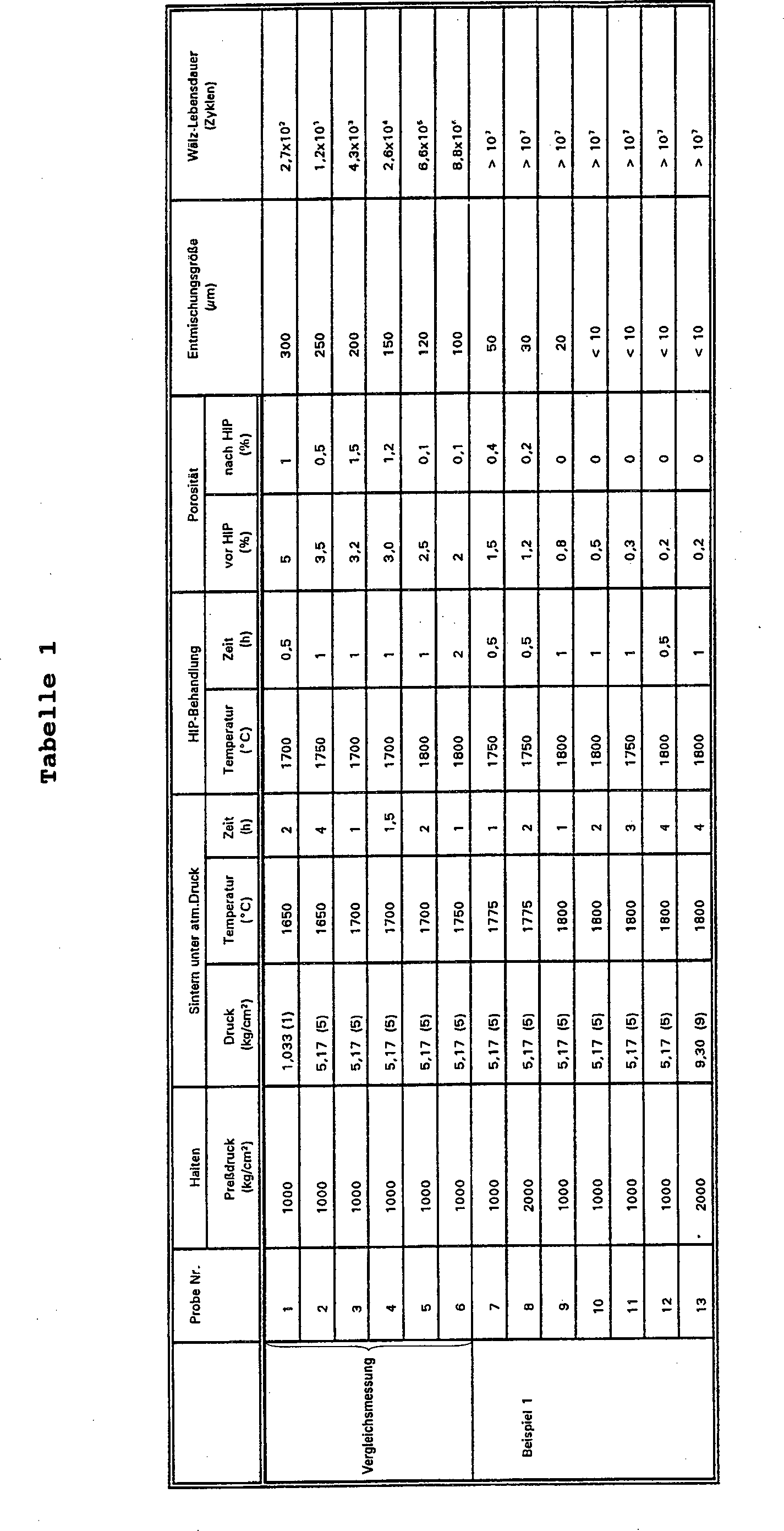
Man erkennt aus Tabelle 1, die die Ergebnisse der Walz-Lebensdauerprüfung zeigt, dass selbst dann, wenn die Entmischungsgröße der amorphen Phase maximal ist, man ein langlebiges Siliziumnitrid-Lagerelement erhalten kann, wenn die Größe nicht mehr als 50 μm beträgt. Seine Wälz-Lebensdauer ist um mindestens das 10-fache länger, verglichen mit einem Siliziumnitridbauteil, das eine höhere Entmischungsgröße hat.you recognizes from Table 1, which shows the results of the rolling life test, that even if the segregation size of the amorphous phase is maximum is, you can get a long-lived silicon nitride bearing element, if the size is not more than 50 μm is. Its rolling life is at least 10 times longer, compared with a silicon nitride component having a higher segregation size.
Wie bei diesem Beispiel wurde ein Siliziumnitridbauteil, dessen Entmischungsgröße, die in dem gesinterten Siliziumnitrid existierte, insgesamt 50 μm oder darunter war, benutzt, um ein keramisches Kugellager mit einem Nenndurchmesser von 9,525 mm herzustellen. Das erhaltene keramische Kugellager hatte eine lange Wälz-Lebensdauer, welche die vorstehenden Prüfergebnisse unterstützte und war ausgezeichnet als Kugellager.As In this example, a silicon nitride component whose segregation size, the in the sintered silicon nitride, 50 μm or less in total was used to make a ceramic ball bearing with a nominal diameter of 9.525 mm. The obtained ceramic ball bearing had a long rolling life, which the above test results supported and was excellent as a ball bearing.
Wenn man als Sinter-Hilfsstoff eine Zusammensetzung verwendet, die von diesem Beispiel verschieden ist, zum Beispiel eine, die eine geringfügig größere Menge an Y2O3 enthält, kann die Wälz-Lebensdauer durch Steuerung der Entmischungsgröße in geeigneter Weise verbessert werden. Weiterhin wurden, da sich ja herausgestellt hat, dass die Wälz-Lebensdauer und die Entmischungsgröße in Beziehung zueinander stehen, Richtlinien für die Herstellungsbedingungen bei der Fertigung eines Siliziumnitrid-Lagerelementes erhalten.By using, as a sintering assistant, a composition other than this example, for example, one containing a slightly larger amount of Y 2 O 3 , the rolling life can be appropriately improved by controlling the amount of segregation. Further, since the rolling life and the size of the segregation have been found to be related to each other, guidelines for the manufacturing conditions in manufacturing a silicon nitride bearing member have been obtained.
Beispiel 2Example 2
Si3N4-Pulver wurden als ein Sinter-Hilfsstoff 5 Gewichtsprozent Y2O3-Pulver, 1 Gewichtsprozent TiO2-Pulver und 2 Gewichtsprozent Al2O3-Pulver zugesetzt. Alle diese Bestandteile wurden vollständig gemischt, um ein Ausgangsmaterialpulver herzustellen.Si 3 N 4 powders were added as a sintering aid, 5 weight percent Y 2 O 3 powder, 1 weight percent TiO 2 powder and 2 weight percent Al 2 O 3 powder. All of these ingredients were completely mixed to make a source powder.
Dann wurden diesem Ausgangsmaterialpulver ungefähr 5 Gewichtsprozent eines organischen Bindemittels zugesetzt und gut ver mischt. Ein Pressformen der Mischung unter einem Druck von 750 kg/cm2 erzeugte einen pelletförmigen Formling. Dann wurde der pelletförmige Formling in Stickstoffgas, das unter einen Druck von 5,17 kg/cm2 (5 atm) gesetzt war, bei 1750°C vier Stunden lang gesintert.Then, about 5% by weight of an organic binder was added to this raw material powder and mixed well. Press-molding the mixture under a pressure of 750 kg / cm 2 produced a pellet-shaped molding. Then, the pellet-shaped molding was sintered in nitrogen gas pressurized to 5.17 kg / cm 2 (5 atm) at 1750 ° C for four hours.
Dann wurde das gesinterte Siliziumnitrid einer HIP-Behandlung unterzogen, um ein Siliziumnitrid-Lagerelement herzustellen. Die HIP-Behandlung wurde in Stickstoffgas unter einem Druck von 1033 kg/cm2 (1000 atm) bei 1800°C ausgeführt.Then, the sintered silicon nitride was subjected to HIP treatment to produce a silicon nitride bearing member. The HIP treatment was carried out in nitrogen gas under a pressure of 1033 kg / cm 2 (1000 atm) at 1800 ° C.
Eine Vielzahl von Proben der Siliziumnitrid-Lagerelemente, welche die vorstehende Zusammensetzung hatten, wurde der Wälz-Lebensdauerprüfung in derselben Art und Weise unterzogen, wie bei Beispiel 1, und das Weibull-Wahrscheinlichkeitspapier wurde für eine Weibull-Darstellung einer Bruchwahrscheinlichkeit benutzt. Die Entmischungsgröße jeder Probe in der amorphen Phase betrug maximal 100 μm oder weniger.A Variety of samples of silicon nitride bearing elements, which the had the above composition, the rolling life test in the same manner subjected as in Example 1, and the Weibull probability paper was for used a Weibull representation of a probability of fracture. The segregation size of each Sample in the amorphous phase was at most 100 μm or less.
Die
Bruchwahrscheinlichkeit bei der vorstehenden Wälz-Lebensdauerprüfung wird
durch eine ausgezogene Linie in
Vergleichendes Beispiel 1Comparative Example 1
Einem Si3N4-Pulver wurde ein Sinter-Hilfsstoff, der 5 Gewichtsprozent Y2O3- und 2 Gewichtsprozent Al2O3-Pulver aufwies, zugesetzt. Alles wurde gründlich gemischt, um ein Ausgangsmateri alpulver herzustellen. Dieses Ausgangsmaterialpulver wurde benutzt, um ein Siliziumnitrid-Bauteil in derselben Weise, wie bei Beispiel 2 herzustellen.To a Si 3 N 4 powder was added a sintering assistant comprising 5% by weight of Y 2 O 3 and 2% by weight of Al 2 O 3 powder. Everything was mixed thoroughly to make a starting material powder. This raw material powder was used to prepare a silicon nitride component in the same manner as in Example 2.
Für dieses
Siliziumnitrid-Bauteil wurde eine Vielzahl von Proben einer Wälz-Lebensdauerprüfung in derselben
Weise, wie bei Beispiel 2 unterzogen, und die Ergebnisse nach Weibull
aufgetragen.
Es
wird aus
Das Ausgangsmaterialpulver der bei dem vorstehenden Beispiel 2 verwendeten Mischung wurde unter Verwendung einer Metallpresse zu einer vorgeschriebenen Gestalt geformt und dann gesintert. Der gesinterte Körper wurde dann zu einem Siliziumnitrid-Kugellager verarbeitet, welches einen Nennduchmesser von 3/8 Zoll (9,525 mm) hatte. Das erhaltene Siliziumnitrid-Kugellager hatte eine ausgezeichnete Wälz-Lebensdauer und Korrosionsbeständigkeit, was die vorstehend angeführten Prüfergebnisse unterstützt und erwies sich als sehr gutes Wälzlagererzeugnis.The Starting material powders used in Example 2 above Mixture became a prescribed using a metal press Shape molded and then sintered. The sintered body was then processed into a silicon nitride ball bearing, which is a Nominal diameter of 3/8 inch (9.525 mm) had. The obtained silicon nitride ball bearing had an excellent rolling life and corrosion resistance, what the above test results supports and proved to be a very good rolling bearing product.
Beispiel 3Example 3
Als ein Sinter-Hilfsstoff wurde Y2O3-Pulver, Al2O3-Pulver, AlN-Pulver, TiO2-Pulver und HfO2-Pulver entsprechend einem Si3N4-Pulver in dem Komponentenverhältnis wie in Tabelle 2 gezeigt zugesetzt, um eine Vielzahl von Ausgangsmaterialpulverarten herzustellen.As a sintering assistant, Y 2 O 3 powder, Al 2 O 3 powder, AlN powder, TiO 2 powder, and HfO 2 powder corresponding to a Si 3 N 4 powder in the component ratio as shown in Table 2 were added to produce a variety of starting material powder types.
Diesen Ausgangsmaterialpulvern wurden ungefähr 5 Gewichtsprozent eines organischen Bindemittels zugesetzt und gründlich damit vermischt. Die Mischungen wurden entsprechend unter einem Formdruck von 750 kg/cm2 pressgeformt, um pelletförmige Formlinge zu erzeugen. Die erhaltenen pelletförmigen Formlinge wurden in unter einem Druck von 5,17 kg/cm2 (5 atm) stehenden Stickstoffgas bei 1750°C vier Stunden lang gesintert.To these starting material powders was added about 5% by weight of an organic binder and mixed thoroughly therewith. The mixtures were correspondingly press-molded under a molding pressure of 750 kg / cm 2 to produce pellet-shaped moldings. The obtained pellet-shaped moldings were sintered under nitrogen pressure of 5.17 kg / cm 2 (5 atm) at 1750 ° C for four hours.
Dann wurde die Vielzahl gesinterter Körper der HIP-Behandlung unterzogen, um eine Vielzahl von Siliziumnitrid-Lagerelementen zu erzeugen. Die HIP-Behandlung wurde in unter einem Druck von 1033 kg/cm2 (1000 atm) stehendem Stickstoffgas bei 1800°C aus geführt. Jedes auf diese Weise erhaltene Siliziumnitrid-Bauteil wurde auf die Entmischungsgröße der amorphen Phase in derselben Weise wie bei Beispiel 1 vermessen. Die Porosität vor und nach der HIP-Behandlung wurde ebenfalls gemessen. Die erzielten Ergebnisse werden zusammen mit den Ausgangsmaterialzusammensetzungen in Tabelle 2 gezeigt (Probe Nr. 5 bis 13).Then, the plurality of sintered bodies were subjected to HIP treatment to produce a plurality of silicon nitride bearing members. The HIP treatment was performed under nitrogen pressure of 1033 kg / cm 2 (1000 atm) at 1800 ° C. Each silicon nitride component thus obtained was measured for the amorphous phase segregation amount in the same manner as in Example 1. The porosity before and after the HIP treatment was also measured. The results obtained are shown together with the starting material compositions in Table 2 (Sample Nos. 5 to 13).
Diese Siliziumnitrid-Lagerelemente wurden der Wälz-Lebensdauerprüfung (in derselben Weise, wie bei Beispiel 2) und der Korrosionsbeständigkeitsprüfung unterzogen. Die Korrosionsbeständigkeitsprüfung wurde unter Verwendung von drei entsprechenden Säurelösungen von HCl, HNO3 und H2SO4 ausgeführt, in welche die Siliziumnitrid-Bauteile entsprechend 100 Stunden lang eingetaucht wurden. Dann wurden diese Siliziumnitrid-Bauteile bezüglich ihres Gewichtsverlustes und der Beibehaltung der Festigkeit vermessen.These silicon nitride bearing members were subjected to the rolling life test (in the same manner as in Example 2) and the corrosion resistance test. The corrosion resistance test was carried out using three corresponding acid solutions of HCl, HNO 3 and H 2 SO 4 into which the silicon nitride components were immersed for 100 hours respectively. Then, these silicon nitride members were measured for their weight loss and strength retention.
Diese Prüfergebnisse bezüglich der Wälz-Lebensdauer und der Korrosionsbeständigkeit werden ebenfalls in Tabelle 2 gezeigt, Gewichtsverlust und Beibehaltung der Festigkeit sind in Prozentwerten angegeben.These test results in terms of the rolling life and corrosion resistance are also shown in Table 2, weight loss and retention the strength are given in percentages.
Vergleichendes Beispiel 2Comparative Example 2
Wie in Tabelle 2 gezeigt, wurden Siliziumnitrid-Lagerelemente unter Befolgung des Verfahrens von Beispiel 3 mit der Ausnahme hergestellt, dass bei dem Ausgangsmaterialpulver die Menge an Y2O3-Pulver im Bereich von 20 Gewichtsprozent bis zu 6 Gewichtsprozent verändert wurde.As shown in Table 2, silicon nitride bearing members were prepared following the procedure of Example 3 except that the amount of Y 2 O 3 powder in the starting material powder was changed in the range of 20 wt% to 6 wt%.
Die verschiedenen erhaltenen Siliziumnitrid-Lagerelemente wurden auf Porosität und Entmischungsgröße, Wälz-Lebensdauer und Korrosionsbeständigkeit unter Befolgung der Prozedur von Beispiel 3 vermessen. Die erzielten Ergebnisse werden in Tabelle 2 gezeigt (Probe Nr. 1 bis 4).The various silicon nitride bearing elements were obtained porosity and segregation size, rolling life and corrosion resistance following the procedure of Example 3. The achieved Results are shown in Table 2 (Sample Nos. 1 to 4).
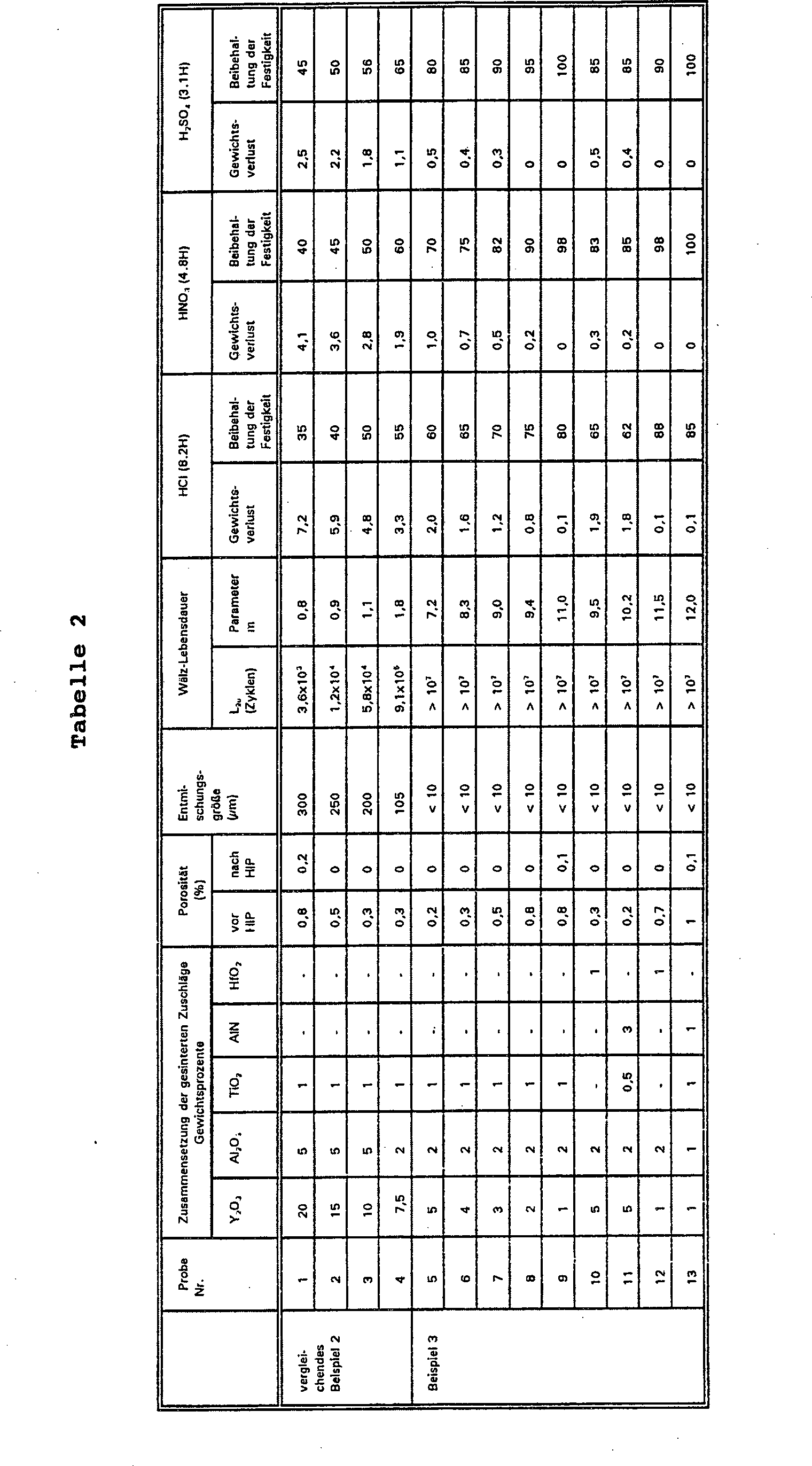
Es wird aus Tabelle 2 deutlich, dass die bei dem vorstehenden Beispiel 3 erhaltenen Siliziumnitrid-Bauteile ausgezeichnet bezogen auf die Wälz-Lebensdauer sind und alle ihre Probeplatten 107 Zyklen überschritten haben. Dies ist ein um das Zehnfache oder mehr größerer Wert als bei einem konventionellen Stahlelement. Und auch die Korrosionsbeständigkeit war sehr gut. Andererseits hatten die bei dem vergleichenden Beispiel 2 erhaltenen Siliziumnitrid-Bauelemente eine kurze Wälz-Lebensdauer mit einer großen Schwankung.It is apparent from Table 2 that the silicon nitride components obtained in the above Example 3 are excellent in rolling life and all their sample plates have exceeded 107 cycles. This is ten times or more greater than a conventional steel element. And also the corrosion resistance was very good. On the other hand, they had at the comparative Example 2 silicon nitride devices obtained a short rolling life with a large variation.
Claims (4)
Applications Claiming Priority (2)
| Application Number | Priority Date | Filing Date | Title |
|---|---|---|---|
| JP1195331A JP2755702B2 (en) | 1989-07-27 | 1989-07-27 | Wear-resistant material |
| JP195331/89 | 1989-07-27 |
Publications (3)
| Publication Number | Publication Date |
|---|---|
| DE69026773D1 DE69026773D1 (en) | 1996-06-05 |
| DE69026773T2 DE69026773T2 (en) | 1996-10-02 |
| DE69026773T3 true DE69026773T3 (en) | 2010-12-09 |
Family
ID=16339395
Family Applications (1)
| Application Number | Title | Priority Date | Filing Date |
|---|---|---|---|
| DE69026773T Expired - Lifetime DE69026773T3 (en) | 1989-07-27 | 1990-07-26 | Wear-resistant component |
Country Status (5)
| Country | Link |
|---|---|
| US (1) | US5098872A (en) |
| EP (1) | EP0414383B2 (en) |
| JP (1) | JP2755702B2 (en) |
| KR (1) | KR950005502B1 (en) |
| DE (1) | DE69026773T3 (en) |
Families Citing this family (23)
| Publication number | Priority date | Publication date | Assignee | Title |
|---|---|---|---|---|
| AU657040B2 (en) * | 1992-02-28 | 1995-02-23 | Mitsubishi Jidosha Kogyo Kabushiki Kaisha | Valve-moving apparatus for internal combustion engine |
| WO1993020023A1 (en) * | 1992-03-31 | 1993-10-14 | Sumitomo Electric Industries, Ltd. | Sliding member and production thereof |
| ES2116395T3 (en) * | 1992-12-23 | 1998-07-16 | Hoechst Ag | CERAMIC MATERIAL OF SILICON NITRIDE RESISTANT TO HIGH TEMPERATURES AND PROCEDURE FOR ITS MANUFACTURE. |
| US5424256A (en) * | 1993-03-17 | 1995-06-13 | Sumitomo Electric Industries, Ltd. | Silicon nitride sintered body |
| US5571760A (en) * | 1993-08-27 | 1996-11-05 | Saint-Gobain/Norton Industrial Ceramics Corporation | Silicon nitride having a high tensile strength |
| US5591687A (en) * | 1994-02-07 | 1997-01-07 | Isuzu Ceramics Research Insitute Co., Ltd. | Silicon nitride based sintered product |
| US5508241A (en) * | 1994-03-22 | 1996-04-16 | Saint Gobain/Norton Industrial Ceramics Corp. | Silicon nitride bearing ball having a high rolling contact fatigue life |
| US5759481A (en) * | 1994-10-18 | 1998-06-02 | Saint-Gobain/Norton Industrial Ceramics Corp. | Silicon nitride having a high tensile strength |
| DE19546238A1 (en) * | 1995-12-12 | 1997-06-19 | Sueddeutsche Kalkstickstoff | Process for the production of sintered silicon nitride |
| JP3042402B2 (en) * | 1996-04-26 | 2000-05-15 | 住友電気工業株式会社 | Silicon nitride ceramic sliding material and method for producing the same |
| DE19746008A1 (en) | 1997-10-20 | 1999-04-22 | Bayer Ag | Sintering additive- and silica-containing silicon nitride material has high acid resistance |
| US5908796A (en) * | 1998-05-01 | 1999-06-01 | Saint-Gobain Industrial Ceramics, Inc. | Dense silicon nitride ceramic having fine grained titanium carbide |
| US7052182B2 (en) * | 2000-02-01 | 2006-05-30 | Toto Ltd. | Hydrostatic gas bearing, hydrostatic gas bearing device for use in vacuum environment, and gas recovering method for the hydrostatic gas bearing device |
| JP4744704B2 (en) * | 2000-03-16 | 2011-08-10 | 株式会社東芝 | Method for manufacturing wear-resistant member |
| DE10165107B3 (en) * | 2000-09-20 | 2015-06-18 | Hitachi Metals, Ltd. | Substrate with silicon nitride sintered body and printed circuit board |
| KR20030017728A (en) * | 2001-08-22 | 2003-03-04 | 기아자동차주식회사 | Wheel cap with light emitting logo |
| JP4874475B2 (en) * | 2001-08-28 | 2012-02-15 | 株式会社東芝 | Abrasion resistant member for electronic equipment, method for producing the same, and bearing for electronic equipment using the same |
| US20040220679A1 (en) * | 2003-05-01 | 2004-11-04 | Diaz Robert L. | Hybrid ceramic composite implants |
| CN1842506B (en) * | 2004-05-20 | 2010-06-16 | 株式会社东芝 | Silicon nitride sintered body and silicon nitride structural parts with high thermal conductivity |
| JP4869171B2 (en) * | 2007-07-13 | 2012-02-08 | 株式会社東芝 | Method for producing wear-resistant member made of silicon nitride |
| CN108546131B (en) * | 2018-06-29 | 2020-12-29 | 山东浮来春生物化工有限公司 | Preparation method of silicon nitride porous ceramic |
| CN108558412B (en) * | 2018-06-29 | 2021-01-15 | 扬州爱斯派电器有限公司 | Preparation method of porous silicon nitride ceramic material |
| CN108821774B (en) * | 2018-06-29 | 2020-12-15 | 临沭县东升磨料有限公司 | Preparation method of porous silicon nitride-silicon carbide composite ceramic |
Family Cites Families (13)
| Publication number | Priority date | Publication date | Assignee | Title |
|---|---|---|---|---|
| JPS51132207A (en) * | 1975-05-14 | 1976-11-17 | Tokyo Shibaura Electric Co | Manufacture of high density and high strength sintering articles |
| JPS5823345B2 (en) * | 1979-02-22 | 1983-05-14 | 株式会社東芝 | Method for manufacturing ceramic sintered bodies |
| JPS5826077A (en) * | 1981-08-10 | 1983-02-16 | 株式会社東芝 | Ceramic sintered body and manufacture |
| JPS5841770A (en) * | 1981-09-01 | 1983-03-11 | 株式会社東芝 | Ceramic sintered body and manufacture |
| JPS6172684A (en) * | 1984-09-18 | 1986-04-14 | 株式会社東芝 | High strength high abrasion resistance sliding member and manufacture |
| JPS6178657A (en) * | 1984-09-27 | 1986-04-22 | Toshiba Corp | Guide member for printer |
| JPS6191067A (en) * | 1984-10-10 | 1986-05-09 | 株式会社東芝 | Sliding member |
| JPS61158866A (en) * | 1984-12-28 | 1986-07-18 | 株式会社東芝 | Ceramic sintered body and manufacture |
| US4904624A (en) † | 1986-10-28 | 1990-02-27 | Norton Company | Silicon nitride with improved high temperature strength |
| JPS62123069A (en) * | 1986-11-08 | 1987-06-04 | 住友電気工業株式会社 | Hot forming tools for wire, plate or strip made of copper and copper alloys |
| US4820665A (en) * | 1986-12-16 | 1989-04-11 | Ngk Insulators, Ltd. | Ceramic sintered bodies and a process for manufacturing the same |
| JPH06658B2 (en) * | 1988-10-25 | 1994-01-05 | 株式会社東芝 | Ceramic sliding component and manufacturing method thereof |
| ATE288600T1 (en) * | 1999-08-12 | 2005-02-15 | Ovd Kinegram Ag | DATA CARRIER |
-
1989
- 1989-07-27 JP JP1195331A patent/JP2755702B2/en not_active Expired - Lifetime
-
1990
- 1990-07-26 US US07/557,775 patent/US5098872A/en not_active Expired - Lifetime
- 1990-07-26 DE DE69026773T patent/DE69026773T3/en not_active Expired - Lifetime
- 1990-07-26 EP EP90308188A patent/EP0414383B2/en not_active Expired - Lifetime
- 1990-07-27 KR KR1019900011604A patent/KR950005502B1/en not_active Expired - Lifetime
Also Published As
| Publication number | Publication date |
|---|---|
| KR910003134A (en) | 1991-02-27 |
| JP2755702B2 (en) | 1998-05-25 |
| US5098872A (en) | 1992-03-24 |
| DE69026773T2 (en) | 1996-10-02 |
| KR950005502B1 (en) | 1995-05-24 |
| JPH0360467A (en) | 1991-03-15 |
| EP0414383B1 (en) | 1996-05-01 |
| EP0414383B2 (en) | 2010-06-16 |
| DE69026773D1 (en) | 1996-06-05 |
| EP0414383A2 (en) | 1991-02-27 |
| EP0414383A3 (en) | 1992-09-23 |
Similar Documents
| Publication | Publication Date | Title |
|---|---|---|
| DE69026773T3 (en) | Wear-resistant component | |
| DE69031087T2 (en) | Corrosion-resistant cemented carbide substrate | |
| DE3786765T2 (en) | Sintered ceramic moldings and process for their production. | |
| EP0102590B1 (en) | Shaped ceramic body, process for its manufacture and its application | |
| DE2549652C3 (en) | Ceramic molded bodies with high fracture toughness | |
| DE3106675C2 (en) | Process for producing a silicon nitride/boron nitride mixed sintered body | |
| DE69104862T2 (en) | Ceramic material based on alumina. | |
| DE2923213A1 (en) | CUTTING INSERT FOR CUTTING MACHINING | |
| DE69433475T2 (en) | BALL AND ROLLER BEARINGS | |
| DE2741295C2 (en) | Ceramic molded body | |
| DE2262785A1 (en) | METHOD OF MANUFACTURING CERAMICS FROM SILICON NITRIDE | |
| DE2752752C2 (en) | Process for the production of bodies with a honeycomb structure from ceramic materials of the barium titanate group with positive temperature resistance coefficients of the electrical resistance | |
| DE2107797B2 (en) | Method of manufacturing an alumina ceramic substrate by casting | |
| DE69207257T2 (en) | Heat resistant sintered oxide dispersion hardened alloy | |
| DE3927083A1 (en) | SINTERING KOERPER OF SILICON NITRIDE AND ITS MANUFACTURE | |
| DE19629074A1 (en) | High strength and hardness sintered silicon nitride-based material | |
| DE60130704T2 (en) | Ceramic products based on Alumina | |
| DE69500961T2 (en) | SILICON NITIRD BEARING BALL WITH HIGH FATIGUE RESISTANCE | |
| DE10351517B4 (en) | Molding composition for molding precious metal and method for producing precious metal sintered bodies | |
| DE3938879A1 (en) | Sintered sialon body - with alpha-sialon rich surface and beta-sialon rich internal regions | |
| DE69828137T2 (en) | Carbonitride cermet cutting body and method of its production | |
| DE2631906A1 (en) | METAL POWDER MIXTURE FOR THE MANUFACTURE OF DENTAL AMALGAMS USED IN DENTISTRY BY MIXING WITH MERCURY | |
| DE3784754T2 (en) | CEMENTED CARBIDE WIRE PART FROM TUNGSTEN CARBIDE. | |
| DE69010427T2 (en) | Sintered body made of silicon nitride and process for its production. | |
| DE2937740C2 (en) |
Legal Events
| Date | Code | Title | Description |
|---|---|---|---|
| 8363 | Opposition against the patent | ||
| 8320 | Willingness to grant licences declared (paragraph 23) | ||
| 8366 | Restricted maintained after opposition proceedings |