DE60225595T2 - Preparation of silicon-bonded metallocene compounds - Google Patents
Preparation of silicon-bonded metallocene compounds Download PDFInfo
- Publication number
- DE60225595T2 DE60225595T2 DE60225595T DE60225595T DE60225595T2 DE 60225595 T2 DE60225595 T2 DE 60225595T2 DE 60225595 T DE60225595 T DE 60225595T DE 60225595 T DE60225595 T DE 60225595T DE 60225595 T2 DE60225595 T2 DE 60225595T2
- Authority
- DE
- Germany
- Prior art keywords
- formula
- groups
- compound
- potassium
- sodium
- Prior art date
- Legal status (The legal status is an assumption and is not a legal conclusion. Google has not performed a legal analysis and makes no representation as to the accuracy of the status listed.)
- Expired - Lifetime
Links
- 150000001875 compounds Chemical class 0.000 title claims abstract description 52
- 238000002360 preparation method Methods 0.000 title claims description 8
- 238000000034 method Methods 0.000 claims abstract description 36
- 229910052744 lithium Inorganic materials 0.000 claims description 26
- 229910052726 zirconium Inorganic materials 0.000 claims description 26
- ZLMJMSJWJFRBEC-UHFFFAOYSA-N Potassium Chemical group [K] ZLMJMSJWJFRBEC-UHFFFAOYSA-N 0.000 claims description 25
- WHXSMMKQMYFTQS-UHFFFAOYSA-N Lithium Chemical group [Li] WHXSMMKQMYFTQS-UHFFFAOYSA-N 0.000 claims description 24
- 125000004435 hydrogen atom Chemical group [H]* 0.000 claims description 23
- 239000002168 alkylating agent Substances 0.000 claims description 22
- 229940100198 alkylating agent Drugs 0.000 claims description 22
- 239000000460 chlorine Substances 0.000 claims description 22
- 239000003446 ligand Substances 0.000 claims description 21
- 229910052784 alkaline earth metal Inorganic materials 0.000 claims description 20
- DGAQECJNVWCQMB-PUAWFVPOSA-M Ilexoside XXIX Chemical group C[C@@H]1CC[C@@]2(CC[C@@]3(C(=CC[C@H]4[C@]3(CC[C@@H]5[C@@]4(CC[C@@H](C5(C)C)OS(=O)(=O)[O-])C)C)[C@@H]2[C@]1(C)O)C)C(=O)O[C@H]6[C@@H]([C@H]([C@@H]([C@H](O6)CO)O)O)O.[Na+] DGAQECJNVWCQMB-PUAWFVPOSA-M 0.000 claims description 19
- 229910007926 ZrCl Inorganic materials 0.000 claims description 19
- 229910052700 potassium Chemical group 0.000 claims description 19
- 239000011591 potassium Chemical group 0.000 claims description 19
- 229920006395 saturated elastomer Polymers 0.000 claims description 19
- 229910052708 sodium Inorganic materials 0.000 claims description 19
- 239000011734 sodium Chemical group 0.000 claims description 19
- 125000005843 halogen group Chemical group 0.000 claims description 18
- 229910052751 metal Inorganic materials 0.000 claims description 15
- 239000002184 metal Substances 0.000 claims description 15
- 150000001342 alkaline earth metals Chemical class 0.000 claims description 13
- 229910052794 bromium Inorganic materials 0.000 claims description 13
- 229910052801 chlorine Inorganic materials 0.000 claims description 13
- ZCYVEMRRCGMTRW-UHFFFAOYSA-N 7553-56-2 Chemical compound [I] ZCYVEMRRCGMTRW-UHFFFAOYSA-N 0.000 claims description 12
- WKBOTKDWSSQWDR-UHFFFAOYSA-N Bromine atom Chemical compound [Br] WKBOTKDWSSQWDR-UHFFFAOYSA-N 0.000 claims description 12
- ZAMOUSCENKQFHK-UHFFFAOYSA-N Chlorine atom Chemical compound [Cl] ZAMOUSCENKQFHK-UHFFFAOYSA-N 0.000 claims description 12
- 125000000217 alkyl group Chemical group 0.000 claims description 12
- GDTBXPJZTBHREO-UHFFFAOYSA-N bromine Substances BrBr GDTBXPJZTBHREO-UHFFFAOYSA-N 0.000 claims description 12
- 238000006243 chemical reaction Methods 0.000 claims description 12
- 229910052740 iodine Inorganic materials 0.000 claims description 12
- 239000011630 iodine Substances 0.000 claims description 12
- 125000003118 aryl group Chemical group 0.000 claims description 11
- 125000005842 heteroatom Chemical group 0.000 claims description 10
- 230000000737 periodic effect Effects 0.000 claims description 10
- 125000001424 substituent group Chemical group 0.000 claims description 10
- 230000003647 oxidation Effects 0.000 claims description 9
- 238000007254 oxidation reaction Methods 0.000 claims description 9
- 125000002877 alkyl aryl group Chemical group 0.000 claims description 8
- 239000003513 alkali Substances 0.000 claims description 7
- 229910052710 silicon Inorganic materials 0.000 claims description 7
- 229910052783 alkali metal Inorganic materials 0.000 claims description 6
- 150000001340 alkali metals Chemical group 0.000 claims description 6
- 125000004429 atom Chemical group 0.000 claims description 6
- 125000000058 cyclopentadienyl group Chemical group C1(=CC=CC1)* 0.000 claims description 6
- 150000004678 hydrides Chemical class 0.000 claims description 6
- 229910052719 titanium Inorganic materials 0.000 claims description 6
- 125000000753 cycloalkyl group Chemical group 0.000 claims description 5
- 229910052735 hafnium Inorganic materials 0.000 claims description 3
- 150000001255 actinides Chemical group 0.000 claims description 2
- 125000004432 carbon atom Chemical group C* 0.000 claims description 2
- 229910052747 lanthanoid Inorganic materials 0.000 claims description 2
- 150000002602 lanthanoids Chemical class 0.000 claims description 2
- 229910052723 transition metal Inorganic materials 0.000 claims description 2
- 150000003624 transition metals Chemical class 0.000 claims description 2
- YXFVVABEGXRONW-UHFFFAOYSA-N Toluene Chemical compound CC1=CC=CC=C1 YXFVVABEGXRONW-UHFFFAOYSA-N 0.000 description 42
- -1 aluminum alkyl compound Chemical class 0.000 description 42
- IHLVCKWPAMTVTG-UHFFFAOYSA-N lithium;carbanide Chemical compound [Li+].[CH3-] IHLVCKWPAMTVTG-UHFFFAOYSA-N 0.000 description 28
- 241000349731 Afzelia bipindensis Species 0.000 description 26
- 239000000243 solution Substances 0.000 description 20
- RTZKZFJDLAIYFH-UHFFFAOYSA-N Diethyl ether Chemical compound CCOCC RTZKZFJDLAIYFH-UHFFFAOYSA-N 0.000 description 16
- 230000015572 biosynthetic process Effects 0.000 description 11
- 239000000725 suspension Substances 0.000 description 11
- 239000011541 reaction mixture Substances 0.000 description 10
- 239000012071 phase Substances 0.000 description 9
- 239000000047 product Substances 0.000 description 9
- 239000002904 solvent Substances 0.000 description 9
- KEAYESYHFKHZAL-UHFFFAOYSA-N Sodium Chemical compound [Na] KEAYESYHFKHZAL-UHFFFAOYSA-N 0.000 description 8
- WYURNTSHIVDZCO-UHFFFAOYSA-N Tetrahydrofuran Chemical compound C1CCOC1 WYURNTSHIVDZCO-UHFFFAOYSA-N 0.000 description 8
- 238000003756 stirring Methods 0.000 description 7
- 238000003786 synthesis reaction Methods 0.000 description 7
- IJGRMHOSHXDMSA-UHFFFAOYSA-N Atomic nitrogen Chemical compound N#N IJGRMHOSHXDMSA-UHFFFAOYSA-N 0.000 description 6
- CODNYICXDISAEA-UHFFFAOYSA-N bromine monochloride Chemical compound BrCl CODNYICXDISAEA-UHFFFAOYSA-N 0.000 description 6
- PNDPGZBMCMUPRI-UHFFFAOYSA-N iodine Chemical compound II PNDPGZBMCMUPRI-UHFFFAOYSA-N 0.000 description 6
- 239000002002 slurry Substances 0.000 description 6
- 238000005160 1H NMR spectroscopy Methods 0.000 description 5
- 239000000010 aprotic solvent Substances 0.000 description 5
- 239000003054 catalyst Substances 0.000 description 5
- 230000000052 comparative effect Effects 0.000 description 5
- SMBQBQBNOXIFSF-UHFFFAOYSA-N dilithium Chemical class [Li][Li] SMBQBQBNOXIFSF-UHFFFAOYSA-N 0.000 description 5
- OZIJRVRERJTEGQ-UHFFFAOYSA-N dimethyl-bis(2-methyl-4-phenyl-1h-inden-1-yl)silane Chemical compound CC1=CC(C(=CC=C2)C=3C=CC=CC=3)=C2C1[Si](C)(C)C1C(C)=CC2=C1C=CC=C2C1=CC=CC=C1 OZIJRVRERJTEGQ-UHFFFAOYSA-N 0.000 description 5
- 229910052736 halogen Inorganic materials 0.000 description 5
- 150000002367 halogens Chemical class 0.000 description 5
- 239000000203 mixture Substances 0.000 description 5
- 125000001997 phenyl group Chemical group [H]C1=C([H])C([H])=C(*)C([H])=C1[H] 0.000 description 5
- 238000006116 polymerization reaction Methods 0.000 description 5
- 239000012266 salt solution Substances 0.000 description 5
- 239000010936 titanium Substances 0.000 description 5
- 238000005481 NMR spectroscopy Methods 0.000 description 4
- 150000001336 alkenes Chemical class 0.000 description 4
- ZSWFCLXCOIISFI-UHFFFAOYSA-N endo-cyclopentadiene Natural products C1C=CC=C1 ZSWFCLXCOIISFI-UHFFFAOYSA-N 0.000 description 4
- 239000011777 magnesium Substances 0.000 description 4
- 238000004519 manufacturing process Methods 0.000 description 4
- 125000002496 methyl group Chemical group [H]C([H])([H])* 0.000 description 4
- 238000001228 spectrum Methods 0.000 description 4
- YBYIRNPNPLQARY-UHFFFAOYSA-N 1H-indene Natural products C1=CC=C2CC=CC2=C1 YBYIRNPNPLQARY-UHFFFAOYSA-N 0.000 description 3
- 229910052782 aluminium Inorganic materials 0.000 description 3
- 125000003710 aryl alkyl group Chemical group 0.000 description 3
- 238000007334 copolymerization reaction Methods 0.000 description 3
- 150000004820 halides Chemical class 0.000 description 3
- 229930195733 hydrocarbon Natural products 0.000 description 3
- 150000002430 hydrocarbons Chemical class 0.000 description 3
- 125000002249 indol-2-yl group Chemical group [H]C1=C([H])C([H])=C2N([H])C([*])=C([H])C2=C1[H] 0.000 description 3
- 125000001449 isopropyl group Chemical group [H]C([H])([H])C([H])(*)C([H])([H])[H] 0.000 description 3
- 229910052749 magnesium Inorganic materials 0.000 description 3
- 229910001507 metal halide Inorganic materials 0.000 description 3
- 150000005309 metal halides Chemical class 0.000 description 3
- VLKZOEOYAKHREP-UHFFFAOYSA-N n-Hexane Chemical compound CCCCCC VLKZOEOYAKHREP-UHFFFAOYSA-N 0.000 description 3
- 125000004108 n-butyl group Chemical group [H]C([H])([H])C([H])([H])C([H])([H])C([H])([H])* 0.000 description 3
- 229910052757 nitrogen Inorganic materials 0.000 description 3
- XLYOFNOQVPJJNP-UHFFFAOYSA-N water Substances O XLYOFNOQVPJJNP-UHFFFAOYSA-N 0.000 description 3
- 125000006701 (C1-C7) alkyl group Chemical group 0.000 description 2
- LIKMAJRDDDTEIG-UHFFFAOYSA-N 1-hexene Chemical compound CCCCC=C LIKMAJRDDDTEIG-UHFFFAOYSA-N 0.000 description 2
- KWKAKUADMBZCLK-UHFFFAOYSA-N 1-octene Chemical compound CCCCCCC=C KWKAKUADMBZCLK-UHFFFAOYSA-N 0.000 description 2
- AQZWEFBJYQSQEH-UHFFFAOYSA-N 2-methyloxaluminane Chemical compound C[Al]1CCCCO1 AQZWEFBJYQSQEH-UHFFFAOYSA-N 0.000 description 2
- WSSSPWUEQFSQQG-UHFFFAOYSA-N 4-methyl-1-pentene Chemical compound CC(C)CC=C WSSSPWUEQFSQQG-UHFFFAOYSA-N 0.000 description 2
- 229910018072 Al 2 O 3 Inorganic materials 0.000 description 2
- KAKZBPTYRLMSJV-UHFFFAOYSA-N Butadiene Chemical compound C=CC=C KAKZBPTYRLMSJV-UHFFFAOYSA-N 0.000 description 2
- 125000005915 C6-C14 aryl group Chemical group 0.000 description 2
- 239000004215 Carbon black (E152) Substances 0.000 description 2
- VGGSQFUCUMXWEO-UHFFFAOYSA-N Ethene Chemical compound C=C VGGSQFUCUMXWEO-UHFFFAOYSA-N 0.000 description 2
- 239000005977 Ethylene Substances 0.000 description 2
- 239000007818 Grignard reagent Substances 0.000 description 2
- RRHGJUQNOFWUDK-UHFFFAOYSA-N Isoprene Chemical compound CC(=C)C=C RRHGJUQNOFWUDK-UHFFFAOYSA-N 0.000 description 2
- WMFOQBRAJBCJND-UHFFFAOYSA-M Lithium hydroxide Chemical compound [Li+].[OH-] WMFOQBRAJBCJND-UHFFFAOYSA-M 0.000 description 2
- FYYHWMGAXLPEAU-UHFFFAOYSA-N Magnesium Chemical compound [Mg] FYYHWMGAXLPEAU-UHFFFAOYSA-N 0.000 description 2
- MZRVEZGGRBJDDB-UHFFFAOYSA-N N-Butyllithium Chemical compound [Li]CCCC MZRVEZGGRBJDDB-UHFFFAOYSA-N 0.000 description 2
- IMNFDUFMRHMDMM-UHFFFAOYSA-N N-Heptane Chemical compound CCCCCCC IMNFDUFMRHMDMM-UHFFFAOYSA-N 0.000 description 2
- OFBQJSOFQDEBGM-UHFFFAOYSA-N Pentane Chemical compound CCCCC OFBQJSOFQDEBGM-UHFFFAOYSA-N 0.000 description 2
- 239000004698 Polyethylene Substances 0.000 description 2
- 239000004743 Polypropylene Substances 0.000 description 2
- ATUOYWHBWRKTHZ-UHFFFAOYSA-N Propane Chemical compound CCC ATUOYWHBWRKTHZ-UHFFFAOYSA-N 0.000 description 2
- VYPSYNLAJGMNEJ-UHFFFAOYSA-N Silicium dioxide Chemical compound O=[Si]=O VYPSYNLAJGMNEJ-UHFFFAOYSA-N 0.000 description 2
- YTPLMLYBLZKORZ-UHFFFAOYSA-N Thiophene Chemical compound C=1C=CSC=1 YTPLMLYBLZKORZ-UHFFFAOYSA-N 0.000 description 2
- 229910003074 TiCl4 Inorganic materials 0.000 description 2
- 229910007932 ZrCl4 Inorganic materials 0.000 description 2
- 125000003342 alkenyl group Chemical group 0.000 description 2
- 125000001797 benzyl group Chemical group [H]C1=C([H])C([H])=C(C([H])=C1[H])C([H])([H])* 0.000 description 2
- 239000006227 byproduct Substances 0.000 description 2
- 230000003197 catalytic effect Effects 0.000 description 2
- 150000001768 cations Chemical class 0.000 description 2
- HGCIXCUEYOPUTN-UHFFFAOYSA-N cyclohexene Chemical compound C1CCC=CC1 HGCIXCUEYOPUTN-UHFFFAOYSA-N 0.000 description 2
- LPIQUOYDBNQMRZ-UHFFFAOYSA-N cyclopentene Chemical compound C1CC=CC1 LPIQUOYDBNQMRZ-UHFFFAOYSA-N 0.000 description 2
- 125000000118 dimethyl group Chemical group [H]C([H])([H])* 0.000 description 2
- XXHUSANMBSHRKP-UHFFFAOYSA-N dimethyl-bis(2-methyl-1h-inden-1-yl)silane Chemical compound CC1=CC2=CC=CC=C2C1[Si](C)(C)C1C2=CC=CC=C2C=C1C XXHUSANMBSHRKP-UHFFFAOYSA-N 0.000 description 2
- KLKFAASOGCDTDT-UHFFFAOYSA-N ethoxymethoxyethane Chemical compound CCOCOCC KLKFAASOGCDTDT-UHFFFAOYSA-N 0.000 description 2
- 125000001495 ethyl group Chemical group [H]C([H])([H])C([H])([H])* 0.000 description 2
- 150000004795 grignard reagents Chemical class 0.000 description 2
- 238000005984 hydrogenation reaction Methods 0.000 description 2
- NNPPMTNAJDCUHE-UHFFFAOYSA-N isobutane Chemical compound CC(C)C NNPPMTNAJDCUHE-UHFFFAOYSA-N 0.000 description 2
- 238000006263 metalation reaction Methods 0.000 description 2
- 125000003261 o-tolyl group Chemical group [H]C1=C([H])C(*)=C(C([H])=C1[H])C([H])([H])[H] 0.000 description 2
- 238000006384 oligomerization reaction Methods 0.000 description 2
- YWAKXRMUMFPDSH-UHFFFAOYSA-N pentene Chemical compound CCCC=C YWAKXRMUMFPDSH-UHFFFAOYSA-N 0.000 description 2
- 229920000573 polyethylene Polymers 0.000 description 2
- 229920001155 polypropylene Polymers 0.000 description 2
- 239000000843 powder Substances 0.000 description 2
- 239000000376 reactant Substances 0.000 description 2
- 125000002914 sec-butyl group Chemical group [H]C([H])([H])C([H])([H])C([H])(*)C([H])([H])[H] 0.000 description 2
- 229910000104 sodium hydride Inorganic materials 0.000 description 2
- 239000012312 sodium hydride Substances 0.000 description 2
- 238000010561 standard procedure Methods 0.000 description 2
- XJDNKRIXUMDJCW-UHFFFAOYSA-J titanium tetrachloride Chemical compound Cl[Ti](Cl)(Cl)Cl XJDNKRIXUMDJCW-UHFFFAOYSA-J 0.000 description 2
- JLTRXTDYQLMHGR-UHFFFAOYSA-N trimethylaluminium Chemical compound C[Al](C)C JLTRXTDYQLMHGR-UHFFFAOYSA-N 0.000 description 2
- DUNKXUFBGCUVQW-UHFFFAOYSA-J zirconium tetrachloride Chemical compound Cl[Zr](Cl)(Cl)Cl DUNKXUFBGCUVQW-UHFFFAOYSA-J 0.000 description 2
- PRBHEGAFLDMLAL-GQCTYLIASA-N (4e)-hexa-1,4-diene Chemical compound C\C=C\CC=C PRBHEGAFLDMLAL-GQCTYLIASA-N 0.000 description 1
- QWUWMCYKGHVNAV-UHFFFAOYSA-N 1,2-dihydrostilbene Chemical group C=1C=CC=CC=1CCC1=CC=CC=C1 QWUWMCYKGHVNAV-UHFFFAOYSA-N 0.000 description 1
- RYHBNJHYFVUHQT-UHFFFAOYSA-N 1,4-Dioxane Chemical compound C1COCCO1 RYHBNJHYFVUHQT-UHFFFAOYSA-N 0.000 description 1
- PRBHEGAFLDMLAL-UHFFFAOYSA-N 1,5-Hexadiene Natural products CC=CCC=C PRBHEGAFLDMLAL-UHFFFAOYSA-N 0.000 description 1
- ZMZGFLUUZLELNE-UHFFFAOYSA-N 2,3,5-triiodobenzoic acid Chemical compound OC(=O)C1=CC(I)=CC(I)=C1I ZMZGFLUUZLELNE-UHFFFAOYSA-N 0.000 description 1
- USVQDQRLYYGLPV-UHFFFAOYSA-N 2-(2,4,4-trimethylpentyl)oxaluminane Chemical compound CC(C)(C)CC(C)C[Al]1CCCCO1 USVQDQRLYYGLPV-UHFFFAOYSA-N 0.000 description 1
- 239000007848 Bronsted acid Substances 0.000 description 1
- XDTMQSROBMDMFD-UHFFFAOYSA-N Cyclohexane Chemical compound C1CCCCC1 XDTMQSROBMDMFD-UHFFFAOYSA-N 0.000 description 1
- ZAFNJMIOTHYJRJ-UHFFFAOYSA-N Diisopropyl ether Chemical compound CC(C)OC(C)C ZAFNJMIOTHYJRJ-UHFFFAOYSA-N 0.000 description 1
- XTHFKEDIFFGKHM-UHFFFAOYSA-N Dimethoxyethane Chemical compound COCCOC XTHFKEDIFFGKHM-UHFFFAOYSA-N 0.000 description 1
- NHTMVDHEPJAVLT-UHFFFAOYSA-N Isooctane Chemical compound CC(C)CC(C)(C)C NHTMVDHEPJAVLT-UHFFFAOYSA-N 0.000 description 1
- 238000004639 Schlenk technique Methods 0.000 description 1
- XUIMIQQOPSSXEZ-UHFFFAOYSA-N Silicon Chemical compound [Si] XUIMIQQOPSSXEZ-UHFFFAOYSA-N 0.000 description 1
- 239000007983 Tris buffer Substances 0.000 description 1
- CIUQDSCDWFSTQR-UHFFFAOYSA-N [C]1=CC=CC=C1 Chemical compound [C]1=CC=CC=C1 CIUQDSCDWFSTQR-UHFFFAOYSA-N 0.000 description 1
- 238000000184 acid digestion Methods 0.000 description 1
- 125000001931 aliphatic group Chemical group 0.000 description 1
- 150000001338 aliphatic hydrocarbons Chemical class 0.000 description 1
- XAGFODPZIPBFFR-UHFFFAOYSA-N aluminium Chemical compound [Al] XAGFODPZIPBFFR-UHFFFAOYSA-N 0.000 description 1
- PNEYBMLMFCGWSK-UHFFFAOYSA-N aluminium oxide Inorganic materials [O-2].[O-2].[O-2].[Al+3].[Al+3] PNEYBMLMFCGWSK-UHFFFAOYSA-N 0.000 description 1
- 238000004458 analytical method Methods 0.000 description 1
- 150000001450 anions Chemical class 0.000 description 1
- 150000004945 aromatic hydrocarbons Chemical class 0.000 description 1
- 239000012298 atmosphere Substances 0.000 description 1
- 125000006267 biphenyl group Chemical group 0.000 description 1
- 229910052799 carbon Inorganic materials 0.000 description 1
- 238000012512 characterization method Methods 0.000 description 1
- 125000001309 chloro group Chemical group Cl* 0.000 description 1
- 229920001577 copolymer Polymers 0.000 description 1
- 150000001925 cycloalkenes Chemical class 0.000 description 1
- 238000007872 degassing Methods 0.000 description 1
- 239000008367 deionised water Substances 0.000 description 1
- 229910021641 deionized water Inorganic materials 0.000 description 1
- 239000000706 filtrate Substances 0.000 description 1
- 125000003983 fluorenyl group Chemical group C1(=CC=CC=2C3=CC=CC=C3CC12)* 0.000 description 1
- 238000002290 gas chromatography-mass spectrometry Methods 0.000 description 1
- 238000012685 gas phase polymerization Methods 0.000 description 1
- GEAWFZNTIFJMHR-UHFFFAOYSA-N hepta-1,6-diene Chemical compound C=CCCCC=C GEAWFZNTIFJMHR-UHFFFAOYSA-N 0.000 description 1
- PYGSKMBEVAICCR-UHFFFAOYSA-N hexa-1,5-diene Chemical compound C=CCCC=C PYGSKMBEVAICCR-UHFFFAOYSA-N 0.000 description 1
- 229920001903 high density polyethylene Polymers 0.000 description 1
- 239000004700 high-density polyethylene Substances 0.000 description 1
- 239000001257 hydrogen Substances 0.000 description 1
- 229910052739 hydrogen Inorganic materials 0.000 description 1
- 125000003454 indenyl group Chemical group C1(C=CC2=CC=CC=C12)* 0.000 description 1
- 238000009616 inductively coupled plasma Methods 0.000 description 1
- 239000001282 iso-butane Substances 0.000 description 1
- 125000000959 isobutyl group Chemical group [H]C([H])([H])C([H])(C([H])([H])[H])C([H])([H])* 0.000 description 1
- 229920000092 linear low density polyethylene Polymers 0.000 description 1
- 239000004707 linear low-density polyethylene Substances 0.000 description 1
- 239000007791 liquid phase Substances 0.000 description 1
- 229910003002 lithium salt Inorganic materials 0.000 description 1
- 159000000002 lithium salts Chemical class 0.000 description 1
- 239000002808 molecular sieve Substances 0.000 description 1
- TVMXDCGIABBOFY-UHFFFAOYSA-N n-Octanol Natural products CCCCCCCC TVMXDCGIABBOFY-UHFFFAOYSA-N 0.000 description 1
- YCWSUKQGVSGXJO-NTUHNPAUSA-N nifuroxazide Chemical group C1=CC(O)=CC=C1C(=O)N\N=C\C1=CC=C([N+]([O-])=O)O1 YCWSUKQGVSGXJO-NTUHNPAUSA-N 0.000 description 1
- JFNLZVQOOSMTJK-KNVOCYPGSA-N norbornene Chemical compound C1[C@@H]2CC[C@H]1C=C2 JFNLZVQOOSMTJK-KNVOCYPGSA-N 0.000 description 1
- JRZJOMJEPLMPRA-UHFFFAOYSA-N olefin Natural products CCCCCCCC=C JRZJOMJEPLMPRA-UHFFFAOYSA-N 0.000 description 1
- 238000005580 one pot reaction Methods 0.000 description 1
- 125000002524 organometallic group Chemical group 0.000 description 1
- RGSFGYAAUTVSQA-UHFFFAOYSA-N pentamethylene Natural products C1CCCC1 RGSFGYAAUTVSQA-UHFFFAOYSA-N 0.000 description 1
- 150000004291 polyenes Chemical class 0.000 description 1
- NTTOTNSKUYCDAV-UHFFFAOYSA-N potassium hydride Chemical compound [KH] NTTOTNSKUYCDAV-UHFFFAOYSA-N 0.000 description 1
- 229910000105 potassium hydride Inorganic materials 0.000 description 1
- 238000003918 potentiometric titration Methods 0.000 description 1
- 239000001294 propane Substances 0.000 description 1
- 238000010926 purge Methods 0.000 description 1
- 239000010703 silicon Substances 0.000 description 1
- 239000000377 silicon dioxide Substances 0.000 description 1
- URGAHOPLAPQHLN-UHFFFAOYSA-N sodium aluminosilicate Chemical compound [Na+].[Al+3].[O-][Si]([O-])=O.[O-][Si]([O-])=O URGAHOPLAPQHLN-UHFFFAOYSA-N 0.000 description 1
- 241000894007 species Species 0.000 description 1
- 238000006467 substitution reaction Methods 0.000 description 1
- 239000000758 substrate Substances 0.000 description 1
- 230000002194 synthesizing effect Effects 0.000 description 1
- 125000000999 tert-butyl group Chemical group [H]C([H])([H])C(*)(C([H])([H])[H])C([H])([H])[H] 0.000 description 1
- YLQBMQCUIZJEEH-UHFFFAOYSA-N tetrahydrofuran Natural products C=1C=COC=1 YLQBMQCUIZJEEH-UHFFFAOYSA-N 0.000 description 1
- 229930192474 thiophene Natural products 0.000 description 1
- MCULRUJILOGHCJ-UHFFFAOYSA-N triisobutylaluminium Chemical compound CC(C)C[Al](CC(C)C)CC(C)C MCULRUJILOGHCJ-UHFFFAOYSA-N 0.000 description 1
- HKVFGFGPRISDFM-UHFFFAOYSA-N tris(2,3,3-trimethylbutyl)alumane Chemical compound CC(C)(C)C(C)C[Al](CC(C)C(C)(C)C)CC(C)C(C)(C)C HKVFGFGPRISDFM-UHFFFAOYSA-N 0.000 description 1
- SSEXLBWMXFFGTD-UHFFFAOYSA-N tris(2,3-dimethylbutyl)alumane Chemical compound CC(C)C(C)C[Al](CC(C)C(C)C)CC(C)C(C)C SSEXLBWMXFFGTD-UHFFFAOYSA-N 0.000 description 1
- WUGMXCQCNQHHDC-UHFFFAOYSA-N tris(2,3-dimethylheptyl)alumane Chemical compound CCCCC(C)C(C)C[Al](CC(C)C(C)CCCC)CC(C)C(C)CCCC WUGMXCQCNQHHDC-UHFFFAOYSA-N 0.000 description 1
- VGONMIOMLRCRSS-UHFFFAOYSA-N tris(2,3-dimethylhexyl)alumane Chemical compound CCCC(C)C(C)C[Al](CC(C)C(C)CCC)CC(C)C(C)CCC VGONMIOMLRCRSS-UHFFFAOYSA-N 0.000 description 1
- BENYMJNPVWYYES-UHFFFAOYSA-N tris(2,3-dimethylpentyl)alumane Chemical compound CCC(C)C(C)C[Al](CC(C)C(C)CC)CC(C)C(C)CC BENYMJNPVWYYES-UHFFFAOYSA-N 0.000 description 1
- XZIKSWMNFLIAQP-UHFFFAOYSA-N tris(2,4,4-trimethylpentyl)alumane Chemical compound CC(C)(C)CC(C)C[Al](CC(C)CC(C)(C)C)CC(C)CC(C)(C)C XZIKSWMNFLIAQP-UHFFFAOYSA-N 0.000 description 1
- WXUZTGFTOYFKIR-UHFFFAOYSA-N tris(2-ethyl-3,3-dimethylbutyl)alumane Chemical compound CCC(C(C)(C)C)C[Al](CC(CC)C(C)(C)C)CC(CC)C(C)(C)C WXUZTGFTOYFKIR-UHFFFAOYSA-N 0.000 description 1
- AMPVHNIRJXJXEN-UHFFFAOYSA-N tris(3-ethyl-2-methylpentyl)alumane Chemical compound CCC(CC)C(C)C[Al](CC(C)C(CC)CC)CC(C)C(CC)CC AMPVHNIRJXJXEN-UHFFFAOYSA-N 0.000 description 1
- 239000004711 α-olefin Substances 0.000 description 1
Classifications
-
- C—CHEMISTRY; METALLURGY
- C07—ORGANIC CHEMISTRY
- C07F—ACYCLIC, CARBOCYCLIC OR HETEROCYCLIC COMPOUNDS CONTAINING ELEMENTS OTHER THAN CARBON, HYDROGEN, HALOGEN, OXYGEN, NITROGEN, SULFUR, SELENIUM OR TELLURIUM
- C07F17/00—Metallocenes
-
- Y—GENERAL TAGGING OF NEW TECHNOLOGICAL DEVELOPMENTS; GENERAL TAGGING OF CROSS-SECTIONAL TECHNOLOGIES SPANNING OVER SEVERAL SECTIONS OF THE IPC; TECHNICAL SUBJECTS COVERED BY FORMER USPC CROSS-REFERENCE ART COLLECTIONS [XRACs] AND DIGESTS
- Y10—TECHNICAL SUBJECTS COVERED BY FORMER USPC
- Y10S—TECHNICAL SUBJECTS COVERED BY FORMER USPC CROSS-REFERENCE ART COLLECTIONS [XRACs] AND DIGESTS
- Y10S526/00—Synthetic resins or natural rubbers -- part of the class 520 series
- Y10S526/943—Polymerization with metallocene catalysts
Landscapes
- Chemical & Material Sciences (AREA)
- Organic Chemistry (AREA)
Abstract
Description
Die vorliegende Erfindung betrifft ein Verfahren zur Herstellung von siliciumverbrückten Metallocenverbindungen. Diese Metallocene sind als Katalysatorkomponenten, z. B. bei der Polymerisation, Oligomerisation und Hydrierung von Olefinen, zusammen mit Alumoxanen und/oder Verbindungen, die in der Lage sind, Alkylmetallocenkationen zu bilden, nützlich. Homogene katalytische Systeme, die auf Metallocenen zusammen mit einer Aluminiumalkylverbindung oder einem Alumoxan basieren, sind im Stand der Technik gut bekannt und werden häufig in den Polymerisationsreaktionen von Olefinen verwendet.The The present invention relates to a process for the preparation of silicon bridged Metallocene compounds. These metallocenes are as catalyst components, z. As in the polymerization, oligomerization and hydrogenation of Olefins, together with alumoxanes and / or compounds used in the Being able to form alkyl metallocene cations are useful. Homogeneous catalytic Systems based on metallocenes together with an aluminum alkyl compound or an alumoxane are well known in the art and become common used in the polymerization reactions of olefins.
Wenn die Sigma-Liganden des zentralen Metallatoms Alkyl- oder Arylgruppen sind, werden die vorstehenden Metallocene gewöhnlich nach einem Verfahren erhalten, das die folgenden Schritte umfasst:
- 1) Herstellen des Metallocenhalogenids, gewöhnlich des Metallocendichlorids, durch Reagieren eines geeigneten Liganden bzw. geeigneter Liganden mit MX4, wobei X Halogen ist (gewöhnlich TiCl4 oder ZrCl4);
- 2) Umwandeln des Metallocenhalogenids, das in Schrit (1) erhalten wurde, in den entsprechenden Dialkyl- oder Diarylkomplex durch Substitution der Halogene, die an dem Metallatom gebunden sind, mit den gewünschten Alkyl- oder Arylgruppen mit Hilfe eines Alkylierungsmittels, wie Alkyllithium, Dialkylmagnesium oder dem entsprechenden Grignard-Reagens.
- 1) preparing the metallocene halide, usually the metallocene dichloride, by reacting an appropriate ligand (s) with MX 4 , wherein X is halogen (usually TiCl 4 or ZrCl 4 );
- 2) converting the metallocene halide obtained in step (1) into the corresponding dialkyl or diaryl complex by substituting the halogens bound to the metal atom with the desired alkyl or aryl groups with the aid of an alkylating agent such as alkyl lithium, dialkyl magnesium or the corresponding Grignard reagent.
Die vorstehenden Metallocene können dennoch nicht zweckdienlich durch die existierende Methodik synthetisiert werden, vielmehr beinhalten die Verfahren des Standes der Technik immer die Synthese des Metallocenhalogenids, das anschließend in das Zielprodukt überführt wird, und führen daher zu unbefriedigenden Gesamtausbeuten und erfordern mindestens zwei Verfahrensschritte.The above metallocenes can nevertheless not expediently synthesized by the existing methodology rather, the methods of the prior art include always the synthesis of the metallocene halide, which subsequently in the target product is transferred, and lead therefore to unsatisfactory overall yields and require at least two process steps.
- 1. Kontaktieren des Cyclopentadienylliganden mit mindestens 4 Äquivalenten eines Alkylierungsmittels und
- 2. Kontaktieren des Reaktionsgemischs mit einem Metallhalogenid der Formel MX4, wobei X Halogen ist (gewöhnlich TiCl4 oder ZrCl4).
- 1. contacting the cyclopentadienyl ligand with at least 4 equivalents of an alkylating agent and
- 2. Contact the reaction mixture with a metal halide of formula MX 4 wherein X is halogen (usually TiCl 4 or ZrCl 4 ).
- Phase 1) die Zugabe des Alkylierungsmittels wird innerhalb eines bevorzugten Temperaturbereichs von –80°C bis –20°C durchgeführt;
- Phase 2) das Alkylierungsmittel wird innerhalb eines bevorzugten Temperaturbereichs von –10°C bis +80°C, insbesondere bei Raumtemperatur, reagieren gelassen;
- Phase 3) die Zugabe des Metallhalogenids wird innerhalb eines bevorzugten Temperaturbereichs von –80°C bis –70°C durchgeführt und
- Phase 4) das Metallhalogenid wird innerhalb eines bevorzugten Temperaturbereichs von –50°C bis 0°C reagieren gelassen.
- Phase 1) the addition of the alkylating agent is carried out within a preferred temperature range of -80 ° C to -20 ° C;
- Phase 2) the alkylating agent is allowed to react within a preferred temperature range of -10 ° C to + 80 ° C, especially at room temperature;
- Phase 3) the addition of the metal halide is carried out within a preferred temperature range of -80 ° C to -70 ° C and
- Phase 4) the metal halide is allowed to react within a preferred temperature range of -50 ° C to 0 ° C.
In den Beispielen wurden nur kohlenstoffverbrückte Metallocene synthetisiert und Schritt 1) wurde bei einmaliger Zugabe der 4 Äquivalente des Alkylierungsmittels durchgeführt.In In the examples, only carbon-bridged metallocenes were synthesized and step 1) when added once, the 4 equivalents of the alkylating agent.
Die
Temperaturen, die in den Beispielen von
In "Inorganic Chemistry" 2001, 40, 6588–6597 sind höhere Temperaturen verwendet worden, um kohlenstoffverbrückte Metallocenverbindungen zu erhalten, das Alkylierungsmittel wird jedoch immer in einer einmaligen Zugabe zugegeben. Es wäre daher wünschenswert, ein industrielles Verfahren bereitzustellen, das es gestattet, siliciumverbrückte Metallocenverbindungen in höheren Ausbeuten zu erhalten.In "Inorganic Chemistry" 2001, 40, 6588-6597 higher Temperatures have been used to form carbon-bridged metallocene compounds however, the alkylating agent will always be unique Addition added. It would be therefore desirable to provide an industrial process that allows silicon-bridged metallocene compounds in higher To obtain yields.
Es ist jetzt gefunden worden, dass es durch richtige Wahl der Temperaturen und durch Zugeben des Alkylierungsmittels in zwei Schritten möglich ist, die Ausbeuten dieses Verfahrens zu verbessern.It It has now been found that it is through proper choice of temperatures and by adding the alkylating agent in two steps, the To improve yields of this method.
Die
vorliegende Erfindung betrifft daher ein Verfahren zur Herstellung
der siliciumverbrückten Metallocenverbindungen
der Formel (I):
q eine ganze Zahl im Bereich
von 0 bis 2 ist, die gleich dem Oxidationszustand des Metalls M
minus 2 ist;
wobei das Verfahren die folgenden Schritte umfasst:
- a) Reagieren, bei einer Temperatur zwischen –10°C und 70°C, eines Liganden der Formel (Y-Cp)-(SiR1 2)(Cp-Y) mit etwa 2 molaren Äquivalenten eines Alkylierungsmittels der Formel THW, LjB oder LMgL', wobei Cp, R1 und L die oben angegebene Bedeutung haben; T Lithium, Natrium oder Kalium ist, H ein Wasserstoffatom ist, w 0 oder 1 ist, wobei wenn w 0 ist, die Verbindung THW metallisches Lithium, Natrium oder Kalium ist, wenn w 1 ist, die Verbindung der Formel THW ein Hydrid des Lithiums, Natriums oder Kaliums ist; L' ein Halogenatom ist, das ausgewählt ist aus Chlor, Brom und Iod; B ein Alkali- oder Erdalkalimetall ist und j 1 oder 2 ist, wobei j gleich 1 ist, wenn B ein Alkalimetall ist, und j gleich 2 ist, wenn B ein Erdalkalimetall ist; die Gruppen Y, die gleich oder verschieden voneinander sein können, geeignete Austrittsgruppen sind;
- b) nachdem die Reaktion vollendet ist, d. h. zu einem Zeitpunkt im Bereich von 1 Minute bis 6 Stunden, vorzugsweise von 20 Minuten bis 5 Stunden, insbesondere von 40 Minuten bis 5 Stunden, Zugeben von mindestens q molaren Äquivalenten, vorzugsweise mindestens 1 + q molaren Äquivalenten, eines Alkylierungsmittels der Formel LjB oder LMgL' und
- c) Reagieren, bei einer Temperatur zwischen –10°C und 70°C, des Produktes, das in Schritt b) erhalten wurde, mit mindestens 1 molaren Äquivalent einer Verbindung der Formel ML'S, wobei M die oben angegebene Bedeutung hat, s eine ganze Zahl ist, die dem Oxidationszustand des Metalls entspricht und im Bereich von 3 bis 6 liegt; und L' ein Halogenatom ist, das aus Chlor, Brom und Iod ausgewählt ist.
q is an integer in the range of 0 to 2, which is equal to the oxidation state of the metal M minus 2;
the method comprising the following steps:
- a) reacting, at a temperature between -10 ° C and 70 ° C, a ligand of the formula (Y-Cp) - (SiR 1 2 ) (Cp-Y) with about 2 molar equivalents of an alkylating agent of the formula TH W , L j B or LMgL ', wherein Cp, R 1 and L are as defined above; T is lithium, sodium or potassium, H is a hydrogen atom, w is 0 or 1, where when w is 0, the compound TH W is metallic lithium, sodium or potassium, when w is 1, the compound of formula THW is a hydride of Lithium, sodium or potassium; L 'is a halogen atom selected from chlorine, bromine and iodine; B is an alkali or alkaline earth metal and j is 1 or 2, where j is 1 when B is an alkali metal and j is 2 when B is an alkaline earth metal; the groups Y, which may be the same or different, are suitable leaving groups;
- b) after the reaction is complete, ie at a time in the range from 1 minute to 6 hours, preferably from 20 minutes to 5 hours, especially from 40 minutes to 5 hours, adding at least q molar equivalents, preferably at least 1 + q molar Equivalents, an alkylating agent of the formula L j B or LMgL 'and
- c) reacting, at a temperature between -10 ° C and 70 ° C, of the product obtained in step b) with at least 1 molar equivalent of a compound of formula ML ' S , wherein M has the meaning given above, s is an integer corresponding to the oxidation state of the metal and ranging from 3 to 6; and L 'is a halogen atom selected from chlorine, bromine and iodine.
In
den Metallocenen der Formel (I) ist R1 vorzugsweise
ein Wasserstoffatom, ein Methyl- oder ein Phenylrest;
ist der
Ligand Cp, der an das Metall M π-gebunden ist,
vorzugsweise aus der Gruppe ausgewählt, die aus Cyclopentadienyl,
Mono-, Di-, Tri- und Tetramethylcyclopentadienyl; 4-tert-Butylcyclopentadienyl; 4-Adamantylcyclopentadienyl;
Indenyl; Mono-, Di-, Tri- und Tetramethylindenyl; 4,5,6,7-Tetrahydroindenyl;
2-Methylindenyl;
2-Methyl-4-phenylindenyl; 2-Isopropyl-4-phenylindenyl; 2-Methyl-4(4'-tert-butylphenyl)indenyl;
Fluorenyl; 5,10-Dihydroindeno[1,2-b]indol-10-yl; N-Methyl- oder N-Phenyl-5,10-dihydroindeno[1,2-b]indol-10-yl;
5,6-Dihydroindeno[2,1-b]indol-6-yl;
N-Methyl- oder N-Phenyl-5,6-dihydroindeno[2,1-b]indol-o-yl;
Azapentalen-4-yl; Thiapentalen-4-yl; Azapentalen-6-yl; Thiapentalen-6-yl;
Mono-, Di- und Trimethylazapentalen-4-yl, 3-Phenyl-2-5-dimethylthiapentalen-4-yl; 1-Thio-3-phenyl-2,5-methylpentalen-6-yl besteht.In the metallocenes of the formula (I), R 1 is preferably a hydrogen atom, a methyl or a phenyl radical;
the ligand Cp, which is π-bonded to the metal M, is preferably selected from the group consisting of cyclopentadienyl, mono-, di-, tri-, and tetramethylcyclopentadienyl; 4-tert-butylcyclopentadienyl; 4-Adamantylcyclopentadienyl; indenyl; Mono-, di-, tri- and tetramethylindenyl; 4,5,6,7-tetrahydroindenyl; 2-methylindenyl; 2-methyl-4-phenylindenyl; 2-isopropyl-4-phenylindenyl; 2-methyl-4 (4'-tert-butylphenyl) indenyl; fluorenyl; 5,10-dihydroindeno [1,2-b] indol-10-yl; N-methyl- or N-phenyl-5,10-dihydroindeno [1,2-b] indol-10-yl; 5,6-dihydroindeno [2,1-b] indol-6-yl; N-methyl or N-phenyl-5,6-dihydroindeno [2,1-b] indol-o-yl; Azapentalene-4-yl; Thiapentalene-4-yl; Azapentalene-6-yl; Thiapentalene-6-yl; Mono-, di- and trimethylazapentalen-4-yl, 3-phenyl-2-5-dimethylthiapentalen-4-yl; 1-thio-3-phenyl-2,5-methylpentalene-6-yl.
Das Metall M ist vorzugsweise Ti, Zr oder Hf, insbesondere ist es Zr.The Metal M is preferably Ti, Zr or Hf, in particular it is Zr.
Die Substituenten L sind vorzugsweise die gleichen und sie sind vorzugsweise C1-C7-Alkylgruppen, C6-C14-Arylgruppen und C7-C14-Arylalkylgruppen, die gegebenenfalls ein oder mehrere Si- oder Ge-Atome enthalten; insbesondere sind die Substituenten L aus der Gruppe ausgewählt, die aus Methyl, Ethyl, n-Butyl, sec-Butyl, Phenyl, Benzyl und -CH2Si(CH3)3 besteht.The substituents L are preferably the same and are preferably C 1 -C 7 alkyl groups, C 6 -C 14 aryl groups and C 7 -C 14 arylalkyl groups optionally containing one or more Si or Ge atoms; In particular, the substituents L are selected from the group consisting of methyl, ethyl, n-butyl, sec-butyl, phenyl, benzyl and -CH 2 Si (CH 3 ) 3 .
Nicht
beschränkende
Beispiele für
Metallocenverbindungen der Formel (I) sind:
Dimethylsilandiylbis(indenyl)zirconiumdimethyl,
Dimethylsilandiylbis(2-methyl-4-phenylindenyl)zirconiumdimethyl,
Dimethylsilandiylbis(4-naphthylindenyl)zirconiumdimethyl,
Dimethylsilandiylbis(2-methylindenyl)zirconiumdimethyl,
Dimethylsilandiylbis(2-methyl-4-t-butylindenyl)zirconiumdimethyl,
Dimethylsilandiylbis(2-methyl-4-isopropylindenyl)zirconiumdimethyl,
Dimethylsilandiylbis(2,4-dimethylindenyl)zirconiumdimethyl,
Dimethylsilandiylbis(2-methyl-4,5-benzoindenyl)zirconiumdimethyl,
Dimethylsilandiylbis
(2,4,7-trimethylindenyl) zirconiumdimethyl,
Dimethylsilandiylbis(2,4,6-trimethylindenyl)zirconiumdimethyl,
Dimethylsilandiylbis(2,5,6-trimethylindenyl)zirconiumdimethyl,
Methyl(phenyl)silandiylbis(2-methyl-4,6-diisopropylindenyl)zirconiumdimethyl,
Methyl(phenyl)silandiylbis(2-methyl-4-isopropylindenyl)zirconiumdimethyl,
Dimethylsilandiylbis(4,7-dimethylindenyl)zirconiumdimethyl,
Dimethylsilandiylbis(2-methyl-4,6-diisopropylindenyl)zirconiumdimethyl,
Dimethylsilandiyl(3-tert-butylcyclopentadienyl)(9-fluorenyl)zirconiumdimethyl,
Dimethylsilandiyl(3-isopropylcyclopentadienyl)(9-fluorenyl)zirconiumdimethyl,
Dimethylsilandiyl(3-methylcyclopentadienyl)(9-fluorenyl) zirconiumdimethyl,
Dimethylsilandiyl(3-ethylcyclopentadienyl)(9-fluorenyl)zirconiumdimethyl,
Dimethylsilandiylbis-6-(3-methylcyclopentadienyl-[1,2-b]-thiophen)dimethyl;
Dimethylsilandiylbis-6-(4-methylcyclopentadienyl-[1,2-b]-thiophen)zirconiumdimethyl;
Dimethylsilandiylbis-6-(4-isopropylcyclopentadienyl-[1,2-b]-thiophen)zirconiumdimethyl;
Dimethylsilandiylbis-6-(4-tert-butylcyclopentadienyl-[1,2-b]-thiophen)zirconiumdimethyl;
Dimethylsilandiylbis-6-(3-isopropyloyolopentadienyl-[1,2-b]-thiophen)zirconiumdimethyl;
Dimethylsilandiylbis-6-(3-phenylcyclopentadienyl-[1,2-b]-thiophen)zirconiumdimethyl;
Dimethylsilandiylbis-6-(2,5-dimethyl-3-phenylcyclopentadienyl-[1,2-b]-thiophen)zirconiumdimethyl;
Dimethylsilandiylbis-6-[2,5-dimethyl-3-(2-methylphenyl)cyclopentadienyl-[1,2-b]-thiophen]zirconiumdimethyl;
Dimethylsilandiylbis-6-[2,5-dimethyl-3-(2,4,6-trimethylphenyl)cyclopentadienyl-[1,2-b]-thiophen]zirconiumdimethyl;
Dimethylsilandiylbis-6-[2,5-dimethyl-3-mesitylencyclopentadienyl-[1,2-b]-thiophen]zirconiumdimethyl;
Dimethylsilandiylbis-6-(2,4,5-trimethyl-3-phenylcyclopentadienyl-[1,2-b]-thiophen)zirconiumdimethyl;
Dimethylsilandiylbis-6-(2,5-diethyl-3-phenylcyclopentadienyl-[1,2-b]-thiophen)zirconiumdimethyl;
Dimethylsilandiylbis-6-(2,5-diisopropyl-3-phenylcyclopentadienyl-[1,2-b]-thiophen)zirconiumdimethyl;
Dimethylsilandiylbis-6-(2,5-ditert-butyl-3-phenylcyclopentadienyl-[1,2-b]-thiophen)zirconiumdimethyl;
Dimethylsilandiylbis-6-(2,5-ditrimethylsilyl-3-phenylcyclopentadienyl-[1,2-b]-thiophen)
zirconiumdimethyl;
Dimethylsilandiylbis-6-(3-methylcyclopentadienyl-[1,2-b]-silol)zirconiumdimethyl;
Dimethylsilandiylbis-6-(3-isopropylcyclopentadienyl-[1,2-b]-silol)zirconiumdimethyl;
Dimethylsilandiylbis-6-(3-phenylcyclopentadienyl-[1,2-b]-silol)zirconiumdimethyl;
Dimethylsilandiylbis-6-(2,5-dimethyl-3-phenylcyclopentadienyl-[1,2-b]-silol)zirconiumdimethyl;
Dimethylsilandiylbis-6-[2,5-dimethyl-3-(2-methylphenyl)cyclopentadienyl-[1,2-b]-silol]zirconiumdimethyl;
Dimethylsilandiylbis-6-[2,5-dimethyl-3-(2,4,6-trimethylphenyl)cyclopentadienyl-[1,2-b]-silol]zirconiumdimethyl;
Dimethylsilandiylbis-6-[2,5-dimethyl-3-mesitylencyclopentadienyl-[1,2-b]-silol]zirconiumdimethyl;
Dimethylsilandiylbis-6-(2,4,5-trimethyl-3-phenylcyclopentadienyl-[1,2-b]-silol)zirconiumdimethyl;
[Dimethylsilyl(2-methyl-1-indenyl)][(N-methyl-1,2-dihydrocyclopenta[2,1-b]indol-2-yl)]titandimethyl;
[Dimethylsilyl(2-methyl-1-indenyl)][(6-methyl-N-methyl-1,2-dihydrocyclopenta[2,1-b]indol-2-yl)]titandimethyl;
[Dimethylsilyl(2-methyl-1-indenyl)][(6-methoxy-N-methyl-1,2-dihydrocyclopenta[2,1-b]indol-2-yl)]titandimethyl;
[Dimethylsilyl(2-methyl-1-indenyl)][(N-ethyl-1,2-dihydrocyclopenta[2,1-b]indol-2-yl)]titandimethyl;
[Dimethylsilyl(2-methyl-1-indenyl)][(N-phenyl-1,2-dihydrocyclopenta[2,1-b]indol-2-yl)]titandimethyl;
[Dimethylsilyl(2-methyl-1-indenyl)][(6-methyl-N-phenyl-1,2-dihydrocyclopenta[2,1-b]indol-2-yl)]titandimethyl;
[Dimethylsilyl(2-methyl-1-indenyl)][(6-methoxy-N-phenyl-1,2-dihydrocyclopenta[2,1-b]indol-2-yl)]titandimethyl;
[Dimethylsilyl(2-methyl-1-indenyl)][(N-methyl-3,4-dimethyl-1,2-dihydrocyclopenta[2,1-b]indol-2-yl)]titandimethyl;
[Dimethylsilyl(2-methyl-1-indenyl)][(N-ethyl-3,4-dimethyl-1,2-dihydrocyclopenta[2,1-b]indol-2-yl)]titandimethyl;
[Dimethylsilyl(2-methyl-1-indenyl)][(N-phenyl-3,4-dimethyl-1,2-dihydrocyclopenta[2,1-b]indol-2-yl)]titandimethyl;
sowie
die entsprechenden Dibenzyl- und Diphenylverbindungen.Non-limiting examples of metallocene compounds of formula (I) are:
Dimethylsilanediylbis (indenyl) zirconium dimethyl,
Dimethylsilanediylbis (2-methyl-4-phenylindenyl) zirconium dimethyl,
Dimethylsilanediylbis (4-naphthylindenyl) zirconium dimethyl,
Dimethylsilanediylbis (2-methylindenyl) zirconium dimethyl,
Dimethylsilanediylbis (2-methyl-4-t-butylindenyl) zirconium dimethyl,
Dimethylsilanediylbis (2-methyl-4-isopropylindenyl) zirconium dimethyl,
Dimethylsilanediylbis (2,4-dimethylindenyl) zirconium dimethyl,
Dimethylsilanediylbis (2-methyl-4,5-benzoindenyl) zirconium dimethyl,
Dimethylsilanediylbis (2,4,7-trimethylindenyl) zirconium dimethyl,
Dimethylsilanediylbis (2,4,6-trimethylindenyl) zirconium dimethyl,
Dimethylsilanediylbis (2,5,6-trimethylindenyl) zirconium dimethyl,
Methyl (phenyl) silanediylbis (2-methyl-4,6-diisopropylindenyl) zirconium dimethyl,
Methyl (phenyl) silanediylbis (2-methyl-4-isopropylindenyl) zirconium dimethyl,
Dimethylsilanediylbis (4,7-dimethylindenyl) zirconium dimethyl,
Dimethylsilanediylbis (2-methyl-4,6-diisopropylindenyl) zirconium dimethyl,
Dimethylsilanediyl (3-tert-butylcyclopentadienyl) (9-fluorenyl) zirconium dimethyl,
Dimethylsilanediyl (3-isopropyl-cyclopentadienyl) (9-fluorenyl) zirconium dimethyl,
Dimethylsilanediyl (3-methylcyclopentadienyl) (9-fluorenyl) zirconium dimethyl,
Dimethylsilanediyl (3-ethylcyclopentadienyl) (9-fluorenyl) zirconium dimethyl,
Dimethylsilandiylbis-6- (3-methylcyclopentadienyl [1,2-b] -thiophene) dimethyl;
Dimethylsilandiylbis-6- (4-methylcyclopentadienyl [1,2-b] -thiophene) zirconium dimethyl;
Dimethylsilandiylbis-6- (4-isopropylcyclopentadienyl- [1,2-b] -thiophene) zirconium dimethyl;
Dimethylsilandiylbis-6- (4-tert-butylcyclopentadienyl [1,2-b] -thiophene) zirconium dimethyl;
Dimethylsilandiylbis-6- (3-isopropyloyolopentadienyl- [1,2-b] -thiophene) zirconium dimethyl;
Dimethylsilandiylbis-6- (3-phenylcyclopentadienyl- [1,2-b] -thiophene) zirconium dimethyl;
Dimethylsilandiylbis-6- (2,5-dimethyl-3-phenylcyclopentadienyl- [1,2-b] -thiophene) zirconium dimethyl;
Dimethylsilandiylbis-6- [2,5-dimethyl-3- (2-methylphenyl) cyclopentadienyl- [1,2-b] -thiophene] zirconium dimethyl;
Dimethylsilandiylbis-6- [2,5-dimethyl-3- (2,4,6-trimethylphenyl) cyclopentadienyl- [1,2-b] -thiophene] zirconium dimethyl;
Dimethylsilandiylbis-6- [2,5-dimethyl-3-mesitylencyclopentadienyl- [-thiophene 1,2-b]] zirconium dimethyl;
Dimethylsilandiylbis-6- (2,4,5-trimethyl-3-phenylcyclopentadienyl- [1,2-b] -thiophene) zirconium dimethyl;
Dimethylsilandiylbis-6- (2,5-diethyl-3-phenylcyclopentadienyl- [1,2-b] -thiophene) zirconium dimethyl;
Dimethylsilandiylbis-6- (2,5-diisopropyl-3-phenylcyclopentadienyl- [1,2-b] -thiophene) zirconium dimethyl;
Dimethylsilandiylbis-6- (2,5-di-tert-butyl-3-phenylcyclopentadienyl- [1,2-b] -thiophene) zirconium dimethyl;
Dimethylsilanediylbis-6- (2,5-ditrimethylsilyl-3-phenylcyclopentadienyl- [1,2-b] thiophene) zirconium dimethyl;
Dimethylsilandiylbis-6- (3-methylcyclopentadienyl [1,2-b] -silole) zirconium dimethyl;
Dimethylsilandiylbis-6- (3-isopropylcyclopentadienyl- [1,2-b] -silole) zirconium dimethyl;
Dimethylsilandiylbis-6- (3-phenylcyclopentadienyl- [1,2-b] -silole) zirconium dimethyl;
Dimethylsilandiylbis-6- (2,5-dimethyl-3-phenylcyclopentadienyl- [1,2-b] -silole) zirconium dimethyl;
Dimethylsilandiylbis-6- [2,5-dimethyl-3- (2-methylphenyl) cyclopentadienyl- [1,2-b] -silole] zirconium dimethyl;
Dimethylsilandiylbis-6- [2,5-dimethyl-3- (2,4,6-trimethylphenyl) cyclopentadienyl- [1,2-b] -silole] zirconium dimethyl;
Dimethylsilandiylbis-6- [2,5-dimethyl-3-mesitylencyclopentadienyl- [1,2-b] -silole] zirconium dimethyl;
Dimethylsilandiylbis-6- (2,4,5-trimethyl-3-phenylcyclopentadienyl- [1,2-b] -silole) zirconium dimethyl;
[Dimethylsilyl (2-methyl-1-indenyl)] [(N-methyl-1,2-dihydrocyclopenta [2,1-b] indol-2-yl)] titanium dimethyl;
[Dimethylsilyl (2-methyl-1-indenyl)] [(6-methyl-N-methyl-1,2-dihydrocyclopenta [2,1-b] indol-2-yl)] titanium dimethyl;
[Dimethylsilyl (2-methyl-1-indenyl)] [(6-methoxy-N-methyl-1,2-dihydrocyclopenta [2,1-b] indol-2-yl)] titanium dimethyl;
[Dimethylsilyl (2-methyl-1-indenyl)] [(N-ethyl-1,2-dihydrocyclopenta [2,1-b] indol-2-yl)] titanium dimethyl;
[Dimethylsilyl (2-methyl-1-indenyl)] [(N-phenyl-1,2-dihydrocyclopenta [2,1-b] indol-2-yl)] titanium dimethyl;
[Dimethylsilyl (2-methyl-1-indenyl)] [(6-methyl-N-phenyl-1,2-dihydrocyclopenta [2,1-b] indol-2-yl)] titanium dimethyl;
[Dimethylsilyl (2-methyl-1-indenyl)] [(6-methoxy-N-phenyl-1,2-dihydrocyclopenta [2,1-b] indol-2-yl)] titanium dimethyl;
[Dimethylsilyl (2-methyl-1-indenyl)] [(N-methyl-3,4-dimethyl-1,2-dihydrocyclopenta [2,1-b] indol-2-yl)] titanium dimethyl;
[Dimethylsilyl (2-methyl-1-indenyl)] [(N-ethyl-3,4-dimethyl-1,2-dihydrocyclopenta [2,1-b] indol-2-yl)] titanium dimethyl;
[Dimethylsilyl (2-methyl-1-indenyl)] [(N-phenyl-3,4-dimethyl-1,2-dihydrocyclopenta [2,1-b] indol-2-yl)] titanium dimethyl;
and the corresponding dibenzyl and diphenyl compounds.
In
einer Ausführungsform
betrifft die vorliegende Erfindung ein Verfahren zur Herstellung
einer siliciumverbrückten
Metallocenverbindung der Formel (II): 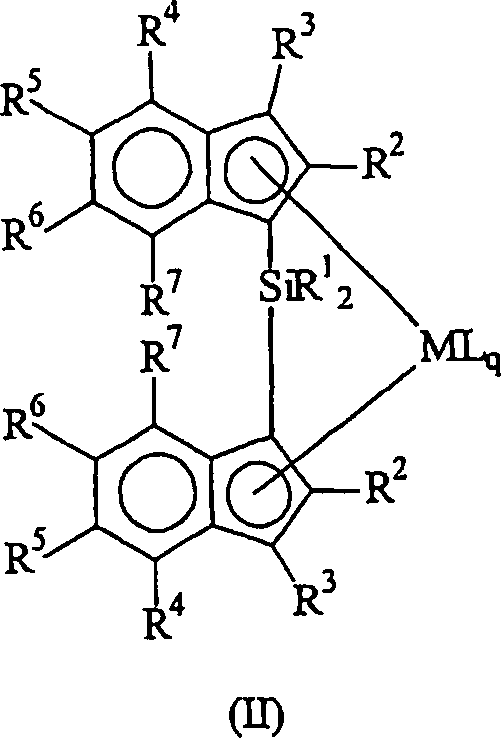
M, L, q und R1 die oben angegebene Bedeutung haben;
R2, die gleich oder verschieden voneinander
sind, ein Wasserstoffatom oder ein linearer oder verzweigter, gesättigter
oder ungesättigter
C1-C20-Alkyl-, C3-C20-Cycloalkyl,
C6-C20-Aryl-, C7-C20-Alkylaryl-
oder C7-C20-Arylalkylrest
ist, der gegebenenfalls Heteroatome enthält, die zu den Gruppen 13–17 des
Periodensystems der Elemente gehören;
R3, R4, R5,
R6 und R7, die gleich
oder verschieden voneinander sind, Wasserstoffatome oder lineare oder
verzweigte, gesättigte
oder ungesättigte C1-C20-Alkyl-, C3-C20-Cycloalkyl-,
C6-C20-Aryl-, C7-C20-Alkylaryl-
oder C7-C20-Arylalkylreste
sind, die gegebenenfalls Heteroatome enthalten, die zu den Gruppen
13–17
des Periodensystems der Elemente gehören; zwei benachbarte Gruppen
R3, R4, R5, R6 und R7 auch einen oder mehrere kondensierte 5- oder
6-gliedrige gesättigte
oder ungesättigte
Ringe bilden können,
die gegebenenfalls Heteroatome enthalten, die zu den Gruppen 13–16 des
Periodensystems der Elemente gehören,
wobei die Ringe Alkylsubstituenten tragen können;
wobei das Verfahren
die folgenden Schritte umfasst:
- a) Reagieren,
bei einer Temperatur zwischen –10°C und 70°C, eines
Liganden der Formel (III) und/oder eines seiner Doppelbindungsisomere; wobei R1, R2, R3, R4, R5, R6 und R7 die oben beschriebene Bedeutung haben, mit etwa 2 molaren Äquivalenten eines Alkylierungsmittels der Formel THW, LjB oder LMgL', wobei L die oben angegebene Bedeutung hat; T Lithium, Natrium oder Kalium ist, H ein Wasserstoffatom ist, w 0 oder 1 ist, wobei wenn w 0 ist, die Verbindung THW metallisches Lithium, Natrium oder Kalium ist, wenn w 1 ist, die Verbindung der Formel THW ein Hydrid des Lithiums, Natriums oder Kaliums ist; L' ein Halogenatom ist, das ausgewählt ist aus Chlor, Brom und Iod; B ein Alkali- oder Erdalkalimetall ist und j 1 oder 2 ist, wobei j gleich 1 ist, wenn B ein Alkalimetall ist, und j gleich 2 ist, wenn B ein Erdalkalimetall ist; die Gruppen Y, die gleich oder verschieden voneinander sind, geeignete Austrittsgruppen sind, wie oben angegeben;

- b) nachdem die Reaktion vollendet ist, d. h. zu einem Zeitpunkt im Bereich von 1 Minute bis 6 Stunden, vorzugsweise von 20 Minuten bis 5 Stunden, insbesondere von 40 Minuten bis 5 Stunden, Zugeben von mindestens q molaren Äquivalenten, vorzugsweise mindestens 1 + q molaren Äquivalenten, einer Verbindung der Formel LjB oder LMgL' und
- c) Reagieren, bei einer Temperatur zwischen –10°C und 70°C, des Produktes, das in Schritt b) erhalten wurde, mit mindestens 1 molaren Äquivalent einer Verbindung der Formel ML'S, wobei M die oben angegebene Bedeutung hat, s eine ganze Zahl ist, die dem Oxidationszustand des Metalls entspricht und im Bereich von 3 bis 6 liegt; und L' ein Halogenatom ist, das aus Chlor, Brom und Iod ausgewählt ist.
M, L, q and R 1 are as defined above;
R 2 , which are identical or different, represent a hydrogen atom or a linear or branched, saturated or unsaturated C 1 -C 20 -alkyl, C 3 -C 20 -cycloalkyl, C 6 -C 20 -aryl, C 7 - C 20 is alkylaryl or C 7 -C 20 arylalkyl radical optionally containing heteroatoms belonging to groups 13-17 of the Periodic Table of the Elements;
R 3 , R 4 , R 5 , R 6 and R 7 , which are the same or different from each other, are hydrogen atoms or linear or branched, saturated or unsaturated C 1 -C 20 -alkyl, C 3 -C 20 -cycloalkyl, C 6 -C 20 -aryl, C 7 -C 20 -alkylaryl or C 7 -C 20 -arylalkyl radicals optionally containing heteroatoms belonging to groups 13-17 of the Periodic Table of the Elements; two adjacent groups R 3 , R 4 , R 5 , R 6 and R 7 may also form one or more fused 5- or 6-membered saturated or unsaturated rings optionally containing heteroatoms belonging to groups 13-16 of the Periodic Table of the Elements may be included, which rings may carry alkyl substituents;
the method comprising the following steps:
- a) reacting, at a temperature between -10 ° C. and 70 ° C., of a ligand of the formula (III) and / or one of its double bond isomers; wherein R 1 , R 2 , R 3 , R 4 , R 5 , R 6 and R 7 have the meaning described above, with about 2 molar equivalents of an alkylating agent of the formula TH W , L j B or LMgL ', wherein L is the above has meaning given; T is lithium, sodium or potassium, H is a hydrogen atom, w is 0 or 1, where when w is 0, the compound TH W is metallic lithium, sodium or potassium, when w is 1, the compound of the formula TH W is a hydride of lithium, sodium or potassium; L 'is a halogen atom selected from chlorine, bromine and iodine; B is an alkali or alkaline earth metal and j is 1 or 2, where j is 1 when B is an alkali metal and j is 2 when B is an alkaline earth metal; the groups Y, which are the same or different from each other, are suitable leaving groups as stated above;
- b) after the reaction is complete, ie at a time in the range from 1 minute to 6 hours, preferably from 20 minutes to 5 hours, especially from 40 minutes to 5 hours, adding at least q molar equivalents, preferably at least 1 + q molar Equivalents, a compound of formula L j B or LMgL 'and
- c) reacting, at a temperature between -10 ° C and 70 ° C, of the product obtained in step b) with at least 1 molar equivalent of a compound of formula ML ' S , wherein M has the meaning given above, s is an integer corresponding to the oxidation state of the metal and ranging from 3 to 6; and L 'is a halogen atom selected from chlorine, bromine and iodine.
In
den Verbindungen der Formeln (II) und (III) ist R2 vorzugsweise
ein linearer oder verzweigter, gesättigter oder ungesättigter
C1-C20-Alkylrest;
ist
R4 vorzugsweise ein Wasserstoffatom, ein C1-C20-Alkylrest,
ein C6-C20-Arylrest
oder bildet mit R5 einen kondensierten Benzenring;
ist
R5 vorzugsweise ein Wasserstoffatom, ein C1-C20-Alkylrest oder
bildet mit R4 einen kondensierten Benzenring;
sind
R6 und R7 vorzugsweise
Wasserstoffatome oder lineare oder verzweigte, gesättigte oder
ungesättigte C1-C20-Alkylreste.In the compounds of the formulas (II) and (III), R 2 is preferably a linear or branched, saturated or unsaturated C 1 -C 20 -alkyl radical;
R 4 is preferably a hydrogen atom, a C 1 -C 20 -alkyl radical, a C 6 -C 20 -aryl radical or forms with R 5 a fused benzene ring;
R 5 is preferably a hydrogen atom, a C 1 -C 20 alkyl radical or forms with R 4 a fused benzene ring;
R 6 and R 7 are preferably hydrogen atoms or linear or branched, saturated or unsaturated C 1 -C 20 -alkyl radicals.
In
einer weiteren Ausführungsform
betrifft die vorliegende Erfindung ein Verfahren zur Herstellung einer
siliciumverbrückten
Metallocenverbindung der Formel (IV): 
M, L, q, R1, R2, R3,
R5, R6 und R7 die gleiche Bedeutung wie oben haben und
R8, die gleich oder verschieden voneinander
sind, ein Wasserstoffatom oder ein linearer oder verzweigter, gesättigter
oder ungesättigter
C1-C20-Alkyl-, C3-C20-Cycloalkyl-, C6-C20-Aryl-, C7-C20-Alkylaryl-
oder C7-C20-Arylalkylrest
ist, der gegebenenfalls Heteroatome enthält, die zu den Gruppen 13–17 des
Periodensystems der Elemente gehören,
wobei der Substituent R8 in Stellung 4 des
Phenylrings vorzugsweise ein linearer oder verzweigter, gesättigter
oder ungesättigter C1-C20-Alkylrest, insbesondere ein tert-Butylrest,
ist;
die Substituenten R8 in den Stellungen
2, 3, 4 und 5 vorzugsweise Wasserstoffatome sind;
wobei das
Verfahren die folgenden Schritte umfasst:
- a)
Reagieren, bei einer Temperatur zwischen –10°C und 70°C, eines Liganden der Formel
(V) oder eines seiner Doppelbindungsisomere; wobei R1, R2, R3, R4, R5, R6, R7 und R8 die oben beschriebene Bedeutung haben; mit etwa 2 molaren Äquivalenten eines Alkylierungsmittels der Formel THW, LjB oder LMgL', wobei L die oben angegebene Bedeutung hat; T Lithium, Natrium oder Kalium ist, H ein Wasserstoffatom ist, w 0 oder 1 ist, wobei wenn w 0 ist, die Verbindung THW metallisches Lithium, Natrium oder Kalium ist, wenn w 1 ist, die Verbindung der Formel THW ein Hydrid des Lithiums, Natriums oder Kaliums ist; L' ein Halogenatom ist, das ausgewählt ist aus Chlor, Brom und Iod; B ein Alkali- oder Erdalkalimetall ist und j 1 oder 2 ist, wobei j gleich 1 ist, wenn B ein Alkalimetall ist, und j gleich 2 ist, wenn B ein Erdalkalimetall ist; die Gruppen Y, die gleich oder verschieden voneinander sind, geeignete Austrittsgruppen sind;

- b) nachdem die Reaktion vollendet ist, d. h. zu einem Zeitpunkt im Bereich von 1 Minute bis 6 Stunden, vorzugsweise von 20 Minuten bis 5 Stunden, insbesondere von 40 Minuten bis 5 Stunden, Zugeben von mindestens q molaren Äquivalenten, vorzugsweise mindestens 1 + q molaren Äquivalenten, einer Verbindung der Formel LjB oder LMgL' und
- c) Reagieren, bei einer Temperatur zwischen –10°C und 70°C, des Produktes, das in Schritt b) erhalten wurde, mit mindestens 1 molaren Äquivalent einer Verbindung der Formel ML's, wobei M die oben angegebene Bedeutung hat, s eine ganze Zahl ist, die dem Oxidationszustand des Metalls entspricht und im Bereich von 3 bis 6 liegt; und L' ein Halogenatom ist, das aus Chlor, Brom und Iod ausgewählt ist.
M, L, q, R 1 , R 2 , R 3 , R 5 , R 6 and R 7 have the same meaning as above and R 8 , which are the same or different from each other, a hydrogen atom or a linear or branched, saturated or unsaturated C 1 -C 20 alkyl, C 3 -C 20 cycloalkyl, C 6 -C 20 aryl, C 7 -C 20 alkylaryl or C 7 -C 20 arylalkyl radical which optionally contains heteroatoms which belong to groups 13-17 of the Periodic Table of the Elements, wherein the substituent R 8 in position 4 of the phenyl ring is preferably a linear or branched, saturated or unsaturated C 1 -C 20 -alkyl, in particular a tert-butyl, is;
the substituents R 8 in positions 2, 3, 4 and 5 are preferably hydrogen atoms;
the method comprising the following steps:
- a) reacting, at a temperature between -10 ° C and 70 ° C, of a ligand of the formula (V) or one of its double bond isomers; wherein R 1 , R 2 , R 3 , R 4 , R 5 , R 6 , R 7 and R 8 have the meaning described above; with about 2 molar equivalents of an alkylating agent of the formula TH W , L j B or LMgL ', wherein L has the meaning given above; T is lithium, sodium or potassium, H is a hydrogen atom, w is 0 or 1, where when w is 0, the compound TH W is metallic lithium, sodium or potassium, when w is 1, the compound of the formula TH W is a hydride of lithium, sodium or potassium; L 'is a halogen atom selected from chlorine, bromine and iodine; B is an alkali or alkaline earth metal and j is 1 or 2, where j is 1 when B is an alkali metal and j is 2 when B is an alkaline earth metal; the groups Y, which are the same or different, are suitable leaving groups;
- b) after the reaction is complete, ie at a time in the range from 1 minute to 6 hours, preferably from 20 minutes to 5 hours, especially from 40 minutes to 5 hours, adding at least q molar equivalents, preferably at least 1 + q molar Equivalents, a compound of formula L j B or LMgL 'and
- c) reacting, at a temperature between -10 ° C and 70 ° C, of the product obtained in step b) with at least 1 molar equivalent of a compound of formula MLs, wherein M has the meaning given above, s a whole Number corresponding to the oxidation state of the metal and ranging from 3 to 6; and L 'is a halogen atom selected from chlorine, bromine and iodine.
Die Metallocenverbindungen der Formeln (I), (II) und (IV) können zum Schluss von dem Reaktionsgemisch, das in Schritt c) erhalten wurde, abgetrennt und gegebenenfalls nach Standardverfahren gereinigt werden. Das Verfahren gestattet es, die Cyclopentadienylmetallocenverbindungen der Formel (I) in sehr hohen Ausbeuten mit Hilfe einer sehr praktischen und günstigen Eintopfreaktion zu gewinnen.The Metallocene compounds of the formulas (I), (II) and (IV) can be used for Conclusion of the reaction mixture obtained in step c) separated and optionally purified by standard methods. The process allows the cyclopentadienyl metallocene compounds of the formula (I) in very high yields with the help of a very practical and cheap To gain a one-pot reaction.
Die Austrittsgruppe Y ist vorzugsweise ein Wasserstoffatom oder eine Gruppe -SiR3 oder -SnR3, wobei die Gruppen R lineare oder verzweigte, gesättigte oder ungesättigte C1-C20-Alkyl-, C3-C20-Cycloalkyl-, C6-C20-Aryl-, C7-C20-Alkylaryl- oder C7-C20-Arylalkylreste sind, insbesondere ist Y ein Wasserstoffatom. In dem Reaktionspartner ML's ist das Metall M vorzugsweise Ti, Zr oder Hf und die Substituenten L' sind vorzugsweise die gleichen und sind Chloratome; die Variable s ist im Bereich von 3 bis 6 und entspricht dem Oxidationszustand des Metalls M; Beispiele für Verbindungen MLS sind ZrCl4, ZrBr4, ZrF4, HfCl4, HfBr4, HfF4, TiCl4, TiBr4 und TiF4. Die Verbindungen der Formel MLS können in der Form eines stabilisierten Derivats, wie zum Beispiel ein Etheratkomplex, verwendet werden.The leaving group Y is preferably a hydrogen atom or a group -SiR 3 or -SnR 3 , where the groups R are linear or branched, saturated or unsaturated C 1 -C 20 -alkyl, C 3 -C 20 -cycloalkyl, C 6 - C 20 aryl, C 7 -C 20 alkylaryl or C 7 -C 20 arylalkyl radicals, in particular Y is a hydrogen atom. In the reactant ML's, the metal M is preferably Ti, Zr or Hf and the substituents L 'are preferably the same and are chlorine atoms; the variable s is in the range of 3 to 6 and corresponds to the oxidation state of the metal M; Examples of compounds ML S are ZrCl 4 , ZrBr 4 , ZrF 4 , HfCl 4 , HfBr 4 , HfF 4 , TiCl 4 , TiBr 4 and TiF 4 . The compounds of formula ML S can be used in the form of a stabilized derivative, such as an etherate complex.
Beispiele für eine Verbindung der Formel THW sind metallisches Natrium oder Kalium, Natriumhydrid und Kaliumhydrid.Examples of a compound of the formula TH W are metallic sodium or potassium, sodium hydride and potassium hydride.
In den Alkylierungsmitteln LjB und LMgL' ist L vorzugsweise eine C1-C7-Alkylgruppe, eine C6-C14-Arylgruppe oder eine C7-C14-Arylalkylgruppe, die gegebenenfalls mit Si oder Ge substituiert ist, und noch bevorzugterweise ist L aus der Gruppe ausgewählt, die aus Methyl, Ethyl, n-Butyl, sec-Butyl, Phenyl, Benzyl und -CH2Si(CH3)3 besteht, insbesondere ist L Methyl. In der Verbindung LjB ist B ein Alkali- oder Erdalkalimetall und vorzugsweise ist B Li oder Mg; j kann 1 oder 2 sein, wie bereits angegeben.In the alkylating agents L j B and LMgL ', L is preferably a C 1 -C 7 alkyl group, a C 6 -C 14 aryl group or a C 7 -C 14 arylalkyl group optionally substituted with Si or Ge, and still Preferably, L is selected from the group consisting of methyl, ethyl, n-butyl, sec-butyl, phenyl, benzyl and -CH 2 Si (CH 3 ) 3 , especially L is methyl. In compound L j B, B is an alkali or alkaline earth metal and preferably B is Li or Mg; j can be 1 or 2, as previously stated.
Die Verbindung LMgL' ist ein Grignard-Reagens, wobei Mg Magnesium ist und L und L' die oben angegebenen Bedeutungen haben; L' ist vorzugsweise Cl oder Br. Die Alkylierungsmittel, die in den Schritten a) und b) verwendet werden, können die gleichen oder verschieden sein. Butyllithium oder Natriumhydrid kann zum Beispiel in Schritt a) verwendet werden und Methyllithium kann in Schritt b) verwendet werden. Dies führt zu einem weiteren Vorteil aus dem Grund, dass es möglich ist, stärkere und manchmal preiswertere Reaktionspartner in Schritt a) zu verwenden, ohne die Wahl der Substituenten L in Schritt b) zu beeinflussen. Gemäß einer Ausführungsform des Verfahrens der Erfindung ist das Alkylierungsmittel Methyllithium.The compound LMgL 'is a Grignard reagent, wherein Mg is magnesium and L and L' are as defined above; L 'is preferably Cl or Br. The alkylating agents used in steps a) and b) may be the same or different. Butyllithium or sodium hydride can be used, for example, in step a), and methyllithium can be used in step b). This leads to a further advantage for the reason that it is possible to use stronger and sometimes cheaper reactants in step a) without affecting the choice of the substituents L in step b). According to a Ausfüh The form of the process of the invention is the alkylating agent methyllithium.
Gemäß einer
Ausführungsform
wird das Verfahren der Erfindung in einem aprotischen Lösemittel,
das entweder polar oder unpolar ist, durchgeführt, wobei das aprotische Lösemittel
vorzugsweise ein aromatischer oder aliphatischer Kohlenwasserstoff oder
ein Ether ist. Die Schritte a) und b) werden insbesondere in Etherat-Lösemitteln
oder Mischungen von Etherat-Lösemitteln
mit Kohlenwasserstoffen durchgeführt.
Beispiele für
Etherat-Lösemittel
sind Diethylether, Tetrahydrofuran-Diisopropylether, Dioxan, Dimethoxyethan
oder Mischungen davon. In Schritt c) kann die Verbindung ML'S als solche,
als eine Suspension oder Lösung
in einem Kohlenwasserstoff-Lösemittel
oder als eine Lösung
oder eine Suspension in einem Etherat-Lösemittel zugegeben werden.
Gemäß einer
weiteren Ausführungsform
des Verfahrens der Erfindung werden in Schritt a) die Ausgangsliganden
vorher in einem aprotischen Lösemittel
gelöst
und zu der resultierenden Lösung etwa
2 Äquivalente
des Alkylierungsmittels THW, LjB oder
LMgL' zugegeben;
diese Zugabe wird vorzugsweise bei einer Temperatur im Bereich von –5°C bis +30°C und insbesondere
von 0°C
bis 25°C über einen
Zeitraum von 5–45
Minuten und insbesondere 10–20
Minuten durchgeführt.
Das Alkylierungsmittel wird vorzugsweise langsam in der Form einer
Lösung in
einem der oben erwähnten
aprotischen Lösemittel zugegeben.
Das auf diese Weise erhaltene Reaktionsgemisch wird vorzugsweise
unter Rühren
für eine Zeitspanne
im Bereich von 1 Minute bis 6 Stunden und insbesondere 20 Minuten
bis 5 Stunden bei einer Temperatur, die vorzugsweise zwischen –5°C und +55°C liegt,
und insbesondere bei einer Temperatur zwischen 0°C und 50°C reagieren gelassen. Nachdem
die Reaktion vollendet ist, d. h. der gesamte Cyclopentadienylligand
mit dem Alkylierungsmittel reagiert hat, werden mindestens q Aquivalente,
vorzugsweise q + 1 Äquivalente,
des Alkylierungsmittels bei einer Temperatur, die zwischen –10°C und +70°C liegt,
vorzugsweise bei einer Temperatur zwischen –5°C und 55°C, zugegeben. Dann wird die
Mischung, die aus Schritt b) erhalten wurde, vorzugsweise bei einer
Temperatur, die zwischen 0°C
und 60°C
und insbesondere zwischen 20°C
und 50°C
liegt, erwärmt.
Anschließend
wird die Verbindung ML'S schnell zu der Mischung in der Form einer
Lösung oder
Suspension in einem der oben erwähnten
aprotischen Lösemittel,
vorzugsweise Toluen, zugegeben. Das Reaktionsgemisch wird dann für eine Zeitspanne
im Bereich von 10 Minuten bis 36 Stunden und insbesondere 1 Stunde
bis 18 Stunden bei einer Temperatur, die zwischen 0°C und 60°C und insbesondere
zwischen 20°C
und 50°C
liegt, reagieren gelassen. Die auf diese Weise erhaltenen Metallocenverbindungen
der Formel (I) können
nach üblichen Verfahren
isoliert werden. Mischungen von racemischen und meso-Isomeren können erhalten
werden und reine Isomere können
in hohen Ausbeuten unter Verwendung von Standardverfahren abgetrennt
werden. Die Metallocenverbindungen, die mit dem Verfahren gemäß der vorliegenden
Erfindung erhalten werden, können
als Katalysator für
die Homo- oder Copolymerisation von Olefinen, insbesondere von α-Olefinen
der Formel CH2=CHT, wobei T Wasserstoff
oder ein C1-C20-Alkyl,
wie zum Beispiel Ethylen, Propylen, 1-Buten, 1-Penten, 4-Methyl-1-penten, 1-Hexen
und 1-Octen, ist,
in Kombination mit Alumoxanen und/oder metallorganischen Aluminiumverbindungen
verwendet werden. Sie können
vorteilhaft zur Produktion von Polyethylen, insbesondere HDPE und
LLDPE, isotaktischem, syndiotaktischem oder ataktischem Polypropylen
verwendet werden. Des Weiteren können
sie bei der Copolymerisation von Ethylen mit Cycloolefinen, wie
zum Beispiel Cyclopenten, Cyclohexen, Norbornen und 4,6-Dimethyl-1-hegten,
oder bei der Ethylencopolymerisation mit Polyenen, wie zum Beispiel
1,4-Hexadien, Isopren,
1,3-Butadien, 1,5-Hexadien und 1,6-Heptadien, verwendet werden. Schließlich können sie
vorteilhaft bei Olefinoligomerisations- und Hydrierungsreaktionen
verwendet werden. Die obigen Metallocene bilden geeignete katalytische
Polymerisationssysteme zusammen mit Alumoxanen der Formel: 
Die Polymerisationsverfahren können in flüssiger Phase, gegebenenfalls in Gegenwart eines inerten Kohlenwasserstoff-Lösemittels, das entweder aromatisch (z. B. Toluen) oder aliphatisch (z. B. Propan, Hexan, Heptan, Isobutan, Cyclohexan und 2,2,4-Trimethylpentan) ist, durchgeführt werden. Die Polymerisationstemperatur liegt im Allgemeinen im Bereich von etwa 0°C bis etwa 250°C und vorzugsweise von 20 bis 150°C.The Polymerization can in liquid Phase, optionally in the presence of an inert hydrocarbon solvent, either aromatic (eg toluene) or aliphatic (eg propane, hexane, heptane, isobutane, Cyclohexane and 2,2,4-trimethylpentane). The polymerization temperature is generally in the range of about 0 ° C up to about 250 ° C and preferably from 20 to 150 ° C.
Die folgenden Beispiele werden zu veranschaulichenden und nicht zu beschränkenden Zwecken angeführt.The The following examples are to be considered as illustrative and not restrictive For purposes stated.
BEISPIELEEXAMPLES
Allgemeine Verfahren und Charakterisierungen.General procedures and characterizations.
Alle
Arbeitsgänge
wurden unter Stickstoff unter Verwendung herkömmlicher Schlenktechniken ausgeführt. Die
Lösemittel
wurden durch Entgasen mit N2 und Leiten über aktiviertes
(8 Stunden, N2-Spülung, 300°C) Al2O3 gereinigt und unter Stickstoff gelagert.
MeLi (Acros oder Aldrich oder Fluka) und ZrCl4 (Aldrich)
wurden so verwendet, wie sie erhalten wurden. Die genaue Konzentration
der handelsüblichen
MeLi-Lösung
in Diethylether wurde durch potentiometrische Titration mit HCl
von 2 ml MeLi-Lösung,
die vorher mit 20 ml entionisiertem Wasser behandelt wurde, um LiOH
zu bilden, bestimmt. Bis(2-methyl-4-phenylindenyl)dimethylsilan wurde
hergestellt, indem dem Verfahren, das in Beispiel A der
Beispiel 1example 1
Synthese von Me2Si(2-Me-4-PhInd)2ZrMe2 Synthesis of Me 2 Si (2-Me-4-PhInd) 2 ZrMe 2
Eine
1,6 M MeLi-Lösung
in Ethylether (23,7 ml, 37,92 mmol, MeLi:Me2Si(2-Me-4-Ph-Ind)2 = 2,10:1) wurde tropfenweise bei Raumtemperatur
zu einer orangen Lösung
von 8,45 g Bis(2-methyl-4-phenylindenyl)dimethylsilan
(MW = 468,72, 18,03 mmol) in 7,6 ml THF und 140 ml Toluen zugegeben.
Am Ende der Zugabe wurde das Reaktionsgemisch für 1 h bei Raumtemperatur und
dann für
1 h bei 40°C
gerührt.
Zusätzliche
35,3 ml MeLi 1,6 M in Et2O (56,48 mmol,
Gesamtäquiv.
MeLi = 5,24 in Bezug auf den Ausgangsliganden) wurden 7 Minuten vor
der Metallierung zugegeben. Dann wurde die Dilithiumsalzlösung (die
einen Überschuss
an MeLi enthielt) bei 45°C
in 20 min zu einer Aufschlämmung von
ZrCl4 (4,20 g, MW = 233,03, 18,02 mmol, ZrCl4:Me2Si(2-Me-4-Ph-Ind)2 = 1,0:1) in 160 ml Toluen, das ebenfalls
vorher bei 45°C
erwärmt
wurde, zugegeben. Am Ende der Zugabe wurde eine dunkelbraune (fast
schwarze) Suspension erhalten. Nach 10 min Rühren zeigte eine 1H-NMR-Analyse
in CD2Cl2 eine vollständige Umwandlung
des Ausgangsliganden in die Dimethylverbindung. Das Reaktionsgemisch
wurde zu einem Endvolumen von 40 ml eingeengt und unter Rühren über eine
G3-Fritte filtriert.
Der Rückstand
wurde bei 60°C
mit Toluen extrahiert, bis die Lösung
farblos war. Das Extrakt in Toluen wurde unter reduziertem Druck
getrocknet, um ein gelbes Pulver als Produkt zu ergeben. Ausbeute 70%.
Anal.
Berechnet für
C36H36SiZr: C, 73,54%;
H, 6,17%; Si, 4,78%; Zr, 15,51%; Gefunden: C, 73,2%; H, 5,9%; Zr,
14,7%.A 1.6 M MeLi solution in ethyl ether (23.7 mL, 37.92 mmol, MeLi: Me 2 Si (2-Me-4-Ph-Ind) 2 = 2.10: 1) was added dropwise at room temperature an orange solution of 8.45 g of bis (2-methyl-4-phenylindenyl) dimethylsilane (MW = 468.72, 18.03 mmol) in 7.6 ml of THF and 140 ml of toluene. At the end of the addition, the reaction mixture was stirred for 1 h at room temperature and then for 1 h at 40 ° C. An additional 35.3 ml of MeLi 1.6 M in Et 2 O (56.48 mmol, total equivalent MeLi = 5.24 with respect to the starting ligand) was added 7 minutes prior to metallation. Then, the dilithium salt solution (containing an excess of MeLi) was added to a slurry of ZrCl 4 (4.20 g, MW = 233.03, 18.02 mmol, ZrCl 4 : Me 2 Si (2 -Me-4-Ph-Ind) 2 = 1.0: 1) in 160 ml of toluene, which was also previously heated at 45 ° C was added. At the end of the addition, a dark brown (almost black) suspension was obtained. After stirring for 10 minutes, 1 H NMR analysis in CD 2 Cl 2 showed complete conversion of the starting ligand to the dimethyl compound. The reaction mixture was concentrated to a final volume of 40 ml and filtered with stirring through a G3 frit. The residue was extracted with toluene at 60 ° C until the solution was colorless. The extract in toluene was dried under reduced pressure to give a yellow powder as a product. Yield 70%.
Anal. Calculated for C 36 H 36 SiZr: C, 73.54%; H, 6.17%; Si, 4.78%; Zr, 15.51%; Found: C, 73.2%; H, 5.9%; Zr, 14.7%.
Vergleichsbeispiel 2Comparative Example 2
Synthese von Me2Si(2-Me-4-PhInd)2ZrMe2 Synthesis of Me 2 Si (2-Me-4-PhInd) 2 ZrMe 2
Eine 1,6 M MeLi-Lösung in Ethylether (7,60 ml, 12,16 mmol, MeLi:Me2Si(2-Me-4-Ph-Ind)2 = 4:1) wurde tropfenweise bei Raumtemperatur zu einer gelben Lösung von 1,42 g Bis(2-methyl-4-phenylindenyl)dimethylsilan (MW = 468,72, 3,03 mmol) in 32 ml i-Pr2O und 30 ml Toluen zugegeben. Während der Zugabe schlug die Farbe von gelb nach orange um und eine leichte Exothermizität (+4°C) wurde beobachtet. Die Dilithiumsalzlösung, die einen MeLi-Überschuss enthielt, wurde für 1 h bei Raumtemperatur gerührt, dann wurde eine Aufschlämmung von ZrCl4 (0,70 g, MW = 233,03, 3,00 mmol, ZrCl4:Me2Si(2-Me-4-Ph-Ind)2 = 1:1) in 10 ml Toluen bei der gleichen Temperatur zugegeben. Nach 2 h Rühren wurde die resultierende braune Suspension durch 1H-NMR-Spektroskopie in CD2Cl2 analysiert, die hauptsächlich die Bildung von Me2Si (2-Me-4-Ph-Ind)2ZrCl2 und nur Spuren der gewünschten Dimethylverbindung zeigte.A 1.6 M MeLi solution in ethyl ether (7.60 mL, 12.16 mmol, MeLi: Me 2 Si (2-Me-4-Ph-Ind) 2 = 4: 1) was added dropwise at room temperature to a yellow Solution of 1.42 g of bis (2-methyl-4-phenylindenyl) dimethylsilane (MW = 468.72, 3.03 mmol) in 32 ml of i-Pr 2 O and 30 ml of toluene. During the addition the color changed from yellow to orange and a slight exothermicity (+ 4 ° C) was observed. The dilithium salt solution containing a MeLi excess was allowed to stand at room temperature for 1 h stirred, then a slurry of ZrCl 4 (0.70 g, MW = 233.03, 3.00 mmol, ZrCl 4 : Me 2 Si (2-Me-4-Ph-Ind) 2 = 1: 1) in Add 10 ml of toluene at the same temperature. After stirring for 2 h, the resulting brown suspension was analyzed by 1 H NMR spectroscopy in CD 2 Cl 2 , which showed mainly the formation of Me 2 Si (2-Me-4-Ph-Ind) 2 ZrCl 2 and only traces of the desired Dimethyl compound showed.
Dieses Beispiel zeigt, dass wenn Schritt a) und b) der vorliegenden Erfindung in einer Sequenz durchgeführt werden, es nicht möglich ist, das gewünschte Produkt zu erzielen.This Example shows that when step a) and b) of the present invention performed in a sequence it will not be possible is, the desired Product to achieve.
Vergleichsbeispiel 3Comparative Example 3
Synthese von Me2Si(2-Me-4-PhInd)2ZrMe2 Synthesis of Me 2 Si (2-Me-4-PhInd) 2 ZrMe 2
Eine 1,72 M MeLi-Lösung in Ethylether (6,25 ml, 10,75 mmol, MeLi:Me2Si(2-Me-4-Ph-Ind)2 = 4:1) wurde tropfenweise bei 0°C zu einer gelben Lösung von 1,26 g Bis(2-methyl-4-phenylindenyl)dimethylsilan (MW = 468,72, 2,69 mmol) in 15 ml i-Pr2O, 5 ml THF und 10 ml Toluen zugegeben. Während der Zugabe schlug die Farbe von gelb nach orange-bräunlich um. Die Dilithiumsalzlösung, die einen MeLi-Überschuss enthielt, wurde auf Raumtemperatur erwärmen gelassen und für 1 h gerührt. Dann wurde ein Aufschlämmung von ZrCl4 (0,63 g, MW = 233,03, 2,70 mmol, ZrCl4:Me2Si(2-Me-4-Ph-Ind)2 = 1:1) in 15 ml Toluen bei Raumtemperatur zugegeben. Nach 1 h Rühren wurde die resultierende braune Suspension durch 1H-NMR-Spektroskopie in CD2Cl2 analysiert, die hauptsächlich die Bildung von Me2Si(2-Me-4-Ph-Ind)2ZrCl2 und nur Spuren der gewünschten Dimethylverbindung zeigte. Dieses Beispiel zeigt, dass wenn Schritt b) der vorliegenden Erfindung durchgeführt wird, ohne zu gestatten, dass die Reaktion von Schritt a) vollendet wird, es nicht möglich ist, das gewünschte Produkt zu erzielen, selbst wenn ein anderes Lösemittel verwendet wird.A 1.72M MeLi solution in ethyl ether (6.25ml, 10.75mmol, MeLi: Me 2 Si (2-Me-4-Ph-Ind) 2 = 4: 1) was added dropwise at 0 ° C of a yellow solution of 1.26 g of bis (2-methyl-4-phenylindenyl) dimethylsilane (MW = 468.72, 2.69 mmol) in 15 ml of i-Pr 2 O, 5 ml of THF and 10 ml of toluene. During the addition, the color changed from yellow to orange-brownish. The dilithium salt solution containing a MeLi excess was allowed to warm to room temperature and stirred for 1 h. Then, a slurry of ZrCl 4 (0.63 g, MW = 233.03, 2.70 mmol, ZrCl 4 : Me 2 Si (2-Me-4-Ph-Ind) 2 = 1: 1) in 15 ml Added toluene at room temperature. After stirring for 1 h, the resulting brown suspension was analyzed by 1 H NMR spectroscopy in CD 2 Cl 2 , which showed mainly the formation of Me 2 Si (2-Me-4-Ph-Ind) 2 ZrCl 2 and only traces of the desired Dimethyl compound showed. This example shows that when step b) of the present invention is carried out without allowing the reaction of step a) to be completed, it is not possible to obtain the desired product even if another solvent is used.
Vergleichsbeispiel 4Comparative Example 4
Synthese von Me2Si(2-Me-4-PhInd)2ZrMe2 Synthesis of Me 2 Si (2-Me-4-PhInd) 2 ZrMe 2
Eine 1,6 M MeLi-Lösung in Ethylether (6,70 ml, 10,72 mmol, MeLi:Me2Si(2-Me-4-Ph-Ind)2 = 2,01:1) wurde tropfenweise bei Raumtemperatur zu einer Suspension von 2,50 g Bis(2-methyl-4-phenylindenyl)dimethylsilan (MW = 468,72, 5,33 mmol) in 5,0 ml i-Pr2O und 35 ml Toluen zugegeben. Am Ende der Zugabe wurde das Reaktionsgemisch bei 40°C für 1,5 h erwärmt, dann wurden zu der resultierenden orangen Lösung weitere 8,4 ml MeLi 1,6 M in Et2O (13,44 mmol, Gesamtäquiv. MeLi = 4,5 in Bezug auf den Ausgangsliganden) zugegeben. Nach 5 min wurde die Dilithiumsalzlösung (die einen Überschuss an MeLi enthielt), die bei 45°C gehalten wurde, in 15 min zu einer Aufschlämmung von ZrCl4 (1,25 g, MW = 233,03, 5,36 mmol, ZrCl4:Me2Si(2-Me-4-Ph-Ind)2 = 1,0:1) in 30 ml Toluen bei 75°C zugegeben. Am Ende der Zugabe wurde eine dunkelbraune (fast schwarze) Suspension erhalten. Nach 5 min Rühren zeigte eine 1H-NMR-Analyse in CD2Cl2 Spuren der Dimethylverbindung.A 1.6 M MeLi solution in ethyl ether (6.70 ml, 10.72 mmol, MeLi: Me 2 Si (2-Me-4-Ph-Ind) 2 = 2.01: 1) was added dropwise at room temperature a suspension of 2.50 g of bis (2-methyl-4-phenylindenyl) dimethylsilane (MW = 468.72, 5.33 mmol) in 5.0 ml of i-Pr 2 O and 35 ml of toluene. At the end of the addition, the reaction mixture was heated at 40 ° C for 1.5 h, then to the resulting orange solution was added another 8.4 ml of MeLi 1.6 M in Et 2 O (13.44 mmol, total equivalent MeLi = 4 , 5 with respect to the starting ligand). After 5 minutes, the dilithium salt solution (containing an excess of MeLi) maintained at 45 ° C was added in 15 minutes to a slurry of ZrCl 4 (1.25 g, MW = 233.03, 5.36 mmol, ZrCl 4 : Me 2 Si (2-Me-4-Ph-Ind) 2 = 1.0: 1) in 30 ml toluene at 75 ° C. At the end of the addition, a dark brown (almost black) suspension was obtained. After stirring for 5 minutes, 1 H NMR analysis in CD 2 Cl showed 2 traces of the dimethyl compound.
Dieses Beispiel zeigt, dass wenn Schritt b) der vorliegenden Erfindung durchgeführt wird, ohne zu gestatten, das die Reaktion von Schritt a) vollendet wird, und wenn die Temperatur von Schritt c) außerhalb des beanspruchten Bereichs liegt, es nicht möglich ist, das gewünschte Produkt zu erzielen.This Example shows that when step b) of the present invention carried out without allowing the reaction of step a) to be completed and if the temperature of step c) is outside the claimed range, it is not possible is, the desired Product to achieve.
Beispiel 5Example 5
Synthese von Me2Si(2-Me-Ind)2ZrMe2 Synthesis of Me 2 Si (2-Me-Ind) 2 ZrMe 2
Eine
3,05 M MeLi-Lösung
in Diethoxymethan (8,5 ml, 25,92 mmol, MeLi:Me2Si(2-MeIndH)2 = 2,05:1) wurde tropfenweise bei 0°C zu einer
Lösung von
4,00 g Bis(2-methylindenyl)dimethylsilan (MW = 316,52, 12,64 mmol)
in 40 ml THF zugegeben. Am Ende der Zugabe wurde das Reaktionsgemisch
auf Raumtemperatur erwärmen
gelassen und für
1 h und 30 min gerührt.
Zusätzliche
8,5 ml MeLi 3,05 M in Diethoxymethan (25,92 mmol, Gesamtäquiv. MeLi
= 4,10 in Bezug auf den Ausgangsliganden) wurden tropfenweise bei
0°C wenige
Minuten vor der Metallierung zugegeben. Dann wurde eine Aufschlämmung von
ZrCl4 (2,95 g, MW = 233,03, 12,66 mmol, ZrCl4:Me2Si(2-MeIndH)2 = 1,00:1) in 40 ml Toluen bei 0°C zu der
Dilithiumsalzlösung
(die einen Überschuss
an MeLi enthielt) zugegeben. Am Ende der Zugabe wurde das Reaktionsgemisch
auf Raumtemperatur erwärmen
gelassen und bei 40°C
für 1 h
und 30 min bei letztendlicher Bildung einer dunkelbraunen (fast
schwarzen) Suspension erwärmt.
Eine 1H-NMR-Analyse in CD2Cl2 zeigte eine fast vollständige Umwandlung des Ausgangsliganden
in die Dimethylverbindung. Die Lösemittel
wurden dann unter reduziertem Druck entfernt, was einen schwarzen Rückstand
ergab. Letzterer wurde in einem Soxhlet-Apparat mit 150 ml Pentan extrahiert.
Das Filtrat wurde unter reduziertem Druck zur Trockne eingedampft,
um 3,60 g eines gelben Pulvers (65,2% metallbasierende Ausbeute)
zu ergeben, das durch 1H-NMR als spektroskopisch
reines Me2Si(2-MeInd)2ZrMe2 charakterisiert wurde.
1H-NMR
(CD2Cl2, δ, ppm, rac): –1,28 (s,
6H, Zr-CH3); 1,12 (s, 6H, Si-CH3);
2,09 (s, 6H, 2-CH3); 6,78 (s, H3, 2H); 6,95
(ddd, H5 oder H6, 2H, J = 1,57, 6,65, 8,61 Hz); 7,28 (ddd, H6 oder
H5, 2H, J = 1,57, 6,65, 8,61 Hz); 7,53-7,59 (m, Ar, 4H).
1H-NMR (CD2Cl2, δ,
ppm, meso): –2,35
(s, 3H, Zr-CH3); 0,02 (s, 3H, Zr-CH3); 1,04 (s, 3H, Si-CH3); 1,23
(s, 3H, Si-CH3); 2,35 (s, 6H, 2-CH3); 6,67 (ddd, H5 oder H6, 2H, J = 1,57,
6,65, 8,61 Hz); 6,80 (s, H3, 2H); 7,05 (ddd, H6 oder H5, 2H, J =
1,57, 6,65; 8,61 Hz); 7,38-7,53 (m, Ar, 4H).A 3.05 M MeLi solution in diethoxymethane (8.5 mL, 25.92 mmol, MeLi: Me 2 Si (2-MeIndH) 2 = 2.05: 1) was added dropwise at 0 ° C to a solution of 4 Add 00 g of bis (2-methylindenyl) dimethylsilane (MW = 316.52, 12.64 mmol) in 40 mL of THF. At the end of the addition, the reaction mixture was allowed to warm to room temperature and stirred for 1 h and 30 min. An additional 8.5 mL MeLi 3.05 M in diethoxymethane (25.92 mmol, total equiv. MeLi = 4.10 relative to the starting ligand) was added dropwise at 0 ° C a few minutes prior to metallation. Then, a slurry of ZrCl 4 (2.95 g, MW = 233.03, 12.66 mmol, ZrCl 4 : Me 2 Si (2-MeIndH) 2 = 1.00: 1) in 40 mL toluene at 0 ° C was added to the dilithium salt solution (which contained an excess of MeLi). At the end of the addition, the reaction mixture was allowed to warm to room temperature and heated at 40 ° C for 1 h and 30 min with the final formation of a dark brown (near black) suspension. 1 H NMR analysis in CD 2 Cl 2 showed almost complete conversion of the starting ligand to the dimethyl compound. The solvents were then removed under reduced pressure to give a black residue. The latter was extracted in a Soxhlet apparatus with 150 ml of pentane. The filtrate was evaporated to dryness under reduced pressure to give 3.60 g of a yellow powder (65.2% metal-based yield) which was characterized by 1 H-NMR spectroscopically pure Me 2 Si (2-MeInd) 2 ZrMe 2 has been.
1 H-NMR (CD 2 Cl 2 , δ, ppm, rac): -1.28 (s, 6H, Zr-CH 3 ); 1.12 (s, 6H, Si-CH 3); 2.09 (s, 6H, 2 -CH 3 ); 6.78 (s, H3, 2H); 6.95 (ddd, H5 or H6, 2H, J = 1.57, 6.65, 8.61 Hz); 7.28 (ddd, H6 or H5, 2H, J = 1.57, 6.65, 8.61 Hz); 7.53-7.59 (m, Ar, 4H).
1 H-NMR (CD 2 Cl 2 , δ, ppm, meso): -2.35 (s, 3H, Zr-CH 3 ); 0.02 (s, 3H, Zr-CH 3); 1.04 (s, 3H, Si-CH 3); 1.23 (s, 3H, Si-CH 3); 2.35 (s, 6H, 2 -CH 3 ); 6.67 (ddd, H5 or H6, 2H, J = 1.57, 6.65, 8.61 Hz); 6.80 (s, H3, 2H); 7.05 (ddd, H6 or H5, 2H, J = 1.57, 6.65, 8.61 Hz); 7.38-7.53 (m, Ar, 4H).
Vergleichsbeispiel 6Comparative Example 6
Synthese von Me2Si(2-Me-Ind)2ZrMe2 Synthesis of Me 2 Si (2-Me-Ind) 2 ZrMe 2
Eine titrierte 1,66 M MeLi-Lösung in Et2O (22,6 ml, 37,52 mmol, MeLi:Me2Si(2-MeIndH)2 = 4:1) wurde tropfenweise bei Raumtemperatur zu einer Lösung von 3,00 g Bis(2-methylindenyl)dimethylsilan (MW = 316,52, 98,9% nach GC-MS, 9,37 mmol) in 40 ml Et2O zugegeben. Am Ende der Zugabe wurde das Reaktionsgemisch für 3 h bei letztendlicher Bildung einer weißen Suspension gerührt. Dann wurde eine Aufschlämmung von ZrCl4 (2,19 g, MW = 233,03, 9,40 mmol, ZrCl4/Me2Si (2-MeIndH)2 = 1:1) in 60 ml Toluen schnell zu der Lithiumsalzsuspension, die vorher durch ein Wasserbad auf 16°C gekühlt wurde, zugegeben. Während der Zugabe schlug die Farbe von weiß nach gelb um und eine leichte Exothermizität (+5°C ÷ 6°C) wurde beobachtet. Nach 1 h Rühren bei Raumtemperatur zeigte ein 1H NMR in C6D6 die Gegenwart einer großen Menge polymerer Nebenprodukte und nur eine geringe Menge des gewünschten Dimethylmetallocens.A titrated 1.66 M MeLi solution in Et 2 O (22.6 mL, 37.52 mmol, MeLi: Me 2 Si (2-MeIndH) 2 = 4: 1) was added dropwise at room temperature to a solution of 3, Add 00 g of bis (2-methylindenyl) dimethylsilane (MW = 316.52, 98.9% by GC-MS, 9.37 mmol) in 40 mL of Et 2 O. At the end of the addition, the reaction mixture was stirred for 3 hours to finally form a white suspension. Then, a slurry of ZrCl 4 (2.19 g, MW = 233.03, 9.40 mmol, ZrCl 4 / Me 2 Si (2-MeIndH) 2 = 1: 1) in 60 ml toluene was added rapidly to the lithium salt suspension, which was previously cooled to 16 ° C by a water bath. During the addition, the color turned from white to yellow and a slight exothermicity (+ 5 ° C ÷ 6 ° C) was observed. After 1 h stirring at room temperature, 1 H NMR in C 6 D 6 showed the presence of a large amount of polymeric by-products and only a small amount of the desired dimethyl metallocene.
Dieses Beispiel zeigt, dass wenn Schritt b) der vorliegenden Erfindung durchgeführt wird, ohne zu gestatten, dass die Reaktion von Schritt a) vollendet wird, es nicht möglich ist, das gewünschte Produkt zu erzielen.This Example shows that when step b) of the present invention carried out without allowing the reaction of step a) to be completed it will not be possible is, the desired Product to achieve.
Claims (10)


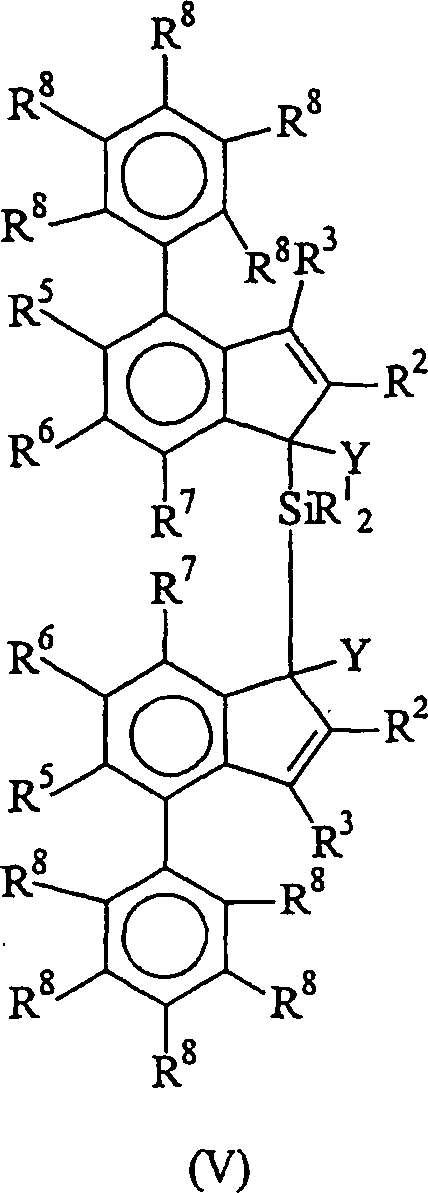
Applications Claiming Priority (3)
| Application Number | Priority Date | Filing Date | Title |
|---|---|---|---|
| EP02075040 | 2002-01-08 | ||
| EP02075040 | 2002-01-08 | ||
| PCT/EP2002/014899 WO2003057705A1 (en) | 2002-01-08 | 2002-12-30 | Preparation of silicon-bridged metallocene compounds |
Publications (2)
| Publication Number | Publication Date |
|---|---|
| DE60225595D1 DE60225595D1 (en) | 2008-04-24 |
| DE60225595T2 true DE60225595T2 (en) | 2009-04-16 |
Family
ID=8185505
Family Applications (1)
| Application Number | Title | Priority Date | Filing Date |
|---|---|---|---|
| DE60225595T Expired - Lifetime DE60225595T2 (en) | 2002-01-08 | 2002-12-30 | Preparation of silicon-bonded metallocene compounds |
Country Status (6)
| Country | Link |
|---|---|
| US (1) | US7002031B2 (en) |
| EP (1) | EP1470140B1 (en) |
| JP (1) | JP4417719B2 (en) |
| AT (1) | ATE388957T1 (en) |
| DE (1) | DE60225595T2 (en) |
| WO (1) | WO2003057705A1 (en) |
Families Citing this family (11)
| Publication number | Priority date | Publication date | Assignee | Title |
|---|---|---|---|---|
| EP1492825A1 (en) | 2002-02-25 | 2005-01-05 | Basell Polyolefine GmbH | Process for the copolymerization of ethylene |
| US7468451B2 (en) * | 2003-05-08 | 2008-12-23 | Basell Polyolefine Gmbh | Process for the production of halide metallocene compounds |
| BRPI0414762A (en) | 2003-09-29 | 2006-11-28 | Basell Polyolefine Gmbh | process for isomerization of metallocene compounds |
| US7884163B2 (en) | 2008-03-20 | 2011-02-08 | Chevron Phillips Chemical Company Lp | Silica-coated alumina activator-supports for metallocene catalyst compositions |
| US20090240010A1 (en) * | 2008-03-20 | 2009-09-24 | Mcdaniel Max P | Alumina-silica activator-supports for metallocene catalyst compositions |
| US11208514B2 (en) | 2008-03-20 | 2021-12-28 | Chevron Phillips Chemical Company Lp | Silica-coated alumina activator-supports for metallocene catalyst compositions |
| US8895679B2 (en) | 2012-10-25 | 2014-11-25 | Chevron Phillips Chemical Company Lp | Catalyst compositions and methods of making and using same |
| US8937139B2 (en) | 2012-10-25 | 2015-01-20 | Chevron Phillips Chemical Company Lp | Catalyst compositions and methods of making and using same |
| US8877672B2 (en) | 2013-01-29 | 2014-11-04 | Chevron Phillips Chemical Company Lp | Catalyst compositions and methods of making and using same |
| US9034991B2 (en) | 2013-01-29 | 2015-05-19 | Chevron Phillips Chemical Company Lp | Polymer compositions and methods of making and using same |
| KR102064411B1 (en) | 2016-11-22 | 2020-01-09 | 주식회사 엘지화학 | Metallocene supported catalyst and method for preparing polypropylene using the same |
Family Cites Families (6)
| Publication number | Priority date | Publication date | Assignee | Title |
|---|---|---|---|---|
| TW294669B (en) * | 1992-06-27 | 1997-01-01 | Hoechst Ag | |
| IT1256259B (en) | 1992-12-30 | 1995-11-29 | Montecatini Tecnologie Srl | METTALLOCENIC COMPOUNDS HAVING FLUORENYLIC BINDERS |
| WO1996019488A1 (en) * | 1994-12-21 | 1996-06-27 | Exxon Chemical Patents Inc. | A method of preparing high purity racemic metallocene alkyls and use thereof |
| WO1998043989A1 (en) * | 1997-03-29 | 1998-10-08 | Montell Technology Company B.V. | Metallocenes and catalysts for polymerization of olefins |
| WO1998043931A1 (en) * | 1997-03-29 | 1998-10-08 | Montell Technology Company B.V. | Process for preparing cyclopentadienyl compounds |
| EP0979232B1 (en) * | 1998-01-14 | 2002-10-09 | Basell Polyolefine GmbH | Process for the preparation of metallocene compounds |
-
2002
- 2002-12-30 DE DE60225595T patent/DE60225595T2/en not_active Expired - Lifetime
- 2002-12-30 WO PCT/EP2002/014899 patent/WO2003057705A1/en not_active Ceased
- 2002-12-30 JP JP2003558020A patent/JP4417719B2/en not_active Expired - Lifetime
- 2002-12-30 US US10/500,542 patent/US7002031B2/en not_active Expired - Lifetime
- 2002-12-30 AT AT02795296T patent/ATE388957T1/en not_active IP Right Cessation
- 2002-12-30 EP EP02795296A patent/EP1470140B1/en not_active Expired - Lifetime
Also Published As
| Publication number | Publication date |
|---|---|
| EP1470140B1 (en) | 2008-03-12 |
| JP4417719B2 (en) | 2010-02-17 |
| US7002031B2 (en) | 2006-02-21 |
| EP1470140A1 (en) | 2004-10-27 |
| ATE388957T1 (en) | 2008-03-15 |
| WO2003057705A1 (en) | 2003-07-17 |
| JP2005514424A (en) | 2005-05-19 |
| DE60225595D1 (en) | 2008-04-24 |
| US20050080244A1 (en) | 2005-04-14 |
Similar Documents
| Publication | Publication Date | Title |
|---|---|---|
| DE69617543T3 (en) | METALOCO COMPOUNDS, METHOD FOR THE PRODUCTION THEREOF AND THEIR USE IN CATALYSTS FOR OLEFIN POLYMERIZATION | |
| DE60202524T2 (en) | CATALYST SYSTEM FOR THE POLYMERIZATION OF OLEFINES | |
| DE60103702T2 (en) | Organometallic compounds used as cocatalyst in the polymerization of olefins | |
| DE69903388T2 (en) | METHOD FOR PRODUCING METALLOCENES | |
| DE60003936T2 (en) | CATALYST SYSTEM AND METHOD FOR THE POLYMERIZATION OF OLEFINS | |
| EP0490256B1 (en) | Metallocenes with bicyclic cyclopentadiene derivatives as ligands, process for their preparation and their use as catalysts | |
| DE69623833T2 (en) | Bridged bis-fluorenylmetallocenes, processes for their preparation and their use in catalysts for the polymerization of olefins | |
| EP1074557A2 (en) | Transition metal complexes, ligands, catalysts, and their use in the polymerisation of olefins | |
| EP0528287A1 (en) | Bridged chiral metallocenes, process for their preparation and their use as catalysts | |
| EP0990003A1 (en) | New catalyst systems for (co-)polymerization reactions, metallocene amide halogenides, the production and use thereof | |
| EP0839823A2 (en) | Metallocenes | |
| EP1033371B1 (en) | Transition metal compound, catalyst system, process for the preparation thereof and its use for the polymerization of olefins | |
| DE69725675T2 (en) | Process for the production of metallocenes | |
| DE60225595T2 (en) | Preparation of silicon-bonded metallocene compounds | |
| DE10052162A1 (en) | New transition metal metallocene compounds having indenyl ligand with heteroaromatic substituent(s) are useful as catalyst components for olefin polymerization, especially polyolefin elastomer production | |
| EP1000073B1 (en) | Method for producing metallocenes | |
| EP1003757B1 (en) | Method for producing metallocenes | |
| DE60210089T2 (en) | METALLOCENE, USE IN CATALYSTS FOR OLEFIN POLYMERIZATION | |
| EP1284981B1 (en) | Method for producing transition metal compounds and their use for the polymerization of olefins | |
| DE60001902T2 (en) | METHOD FOR PRODUCING TITANIUM COMPLEXES | |
| DE69904982T2 (en) | Functionalized metallocenes, their production and their use | |
| EP1294734B1 (en) | Method for the selective production of racemic metallocene complexes | |
| EP1334107B1 (en) | Non-metallocene compounds, method for the production thereof and use of the same for the polymerisation of olefins | |
| EP1373283A1 (en) | Non-metallocenes, method for the production thereof and the use thereof for the polymerisation of olefins | |
| DE602004004293T2 (en) | METHOD OF ISOMERIZING METALOCOUS COMPOUNDS |
Legal Events
| Date | Code | Title | Description |
|---|---|---|---|
| 8364 | No opposition during term of opposition |