DE60219611T2 - MODIFIED ANNEXIN PROTEINS AND PREVENTION AND TREATMENT OF THROMBOSE - Google Patents
MODIFIED ANNEXIN PROTEINS AND PREVENTION AND TREATMENT OF THROMBOSE Download PDFInfo
- Publication number
- DE60219611T2 DE60219611T2 DE60219611T DE60219611T DE60219611T2 DE 60219611 T2 DE60219611 T2 DE 60219611T2 DE 60219611 T DE60219611 T DE 60219611T DE 60219611 T DE60219611 T DE 60219611T DE 60219611 T2 DE60219611 T2 DE 60219611T2
- Authority
- DE
- Germany
- Prior art keywords
- annexin
- protein
- nucleic acid
- modified
- thrombosis
- Prior art date
- Legal status (The legal status is an assumption and is not a legal conclusion. Google has not performed a legal analysis and makes no representation as to the accuracy of the status listed.)
- Expired - Lifetime
Links
- 108050008874 Annexin Proteins 0.000 title claims abstract description 228
- 102000000412 Annexin Human genes 0.000 title claims abstract description 224
- 208000007536 Thrombosis Diseases 0.000 title claims abstract description 64
- 238000011282 treatment Methods 0.000 title claims description 15
- 230000002265 prevention Effects 0.000 title claims description 11
- 108090000623 proteins and genes Proteins 0.000 claims abstract description 134
- 102000004169 proteins and genes Human genes 0.000 claims abstract description 113
- 150000007523 nucleic acids Chemical class 0.000 claims description 145
- 102000039446 nucleic acids Human genes 0.000 claims description 117
- 108020004707 nucleic acids Proteins 0.000 claims description 117
- 238000000034 method Methods 0.000 claims description 64
- 238000004519 manufacturing process Methods 0.000 claims description 17
- 206010047249 Venous thrombosis Diseases 0.000 claims description 15
- 230000001580 bacterial effect Effects 0.000 claims description 14
- 230000000295 complement effect Effects 0.000 claims description 13
- 206010003178 Arterial thrombosis Diseases 0.000 claims description 11
- 239000003814 drug Substances 0.000 claims description 11
- 201000001429 Intracranial Thrombosis Diseases 0.000 claims description 6
- 239000008194 pharmaceutical composition Substances 0.000 claims description 5
- 238000002360 preparation method Methods 0.000 claims description 5
- 230000008569 process Effects 0.000 claims description 5
- 206010011091 Coronary artery thrombosis Diseases 0.000 claims description 4
- 230000035606 childbirth Effects 0.000 claims description 4
- 208000002528 coronary thrombosis Diseases 0.000 claims description 4
- 230000035935 pregnancy Effects 0.000 claims description 4
- 206010012601 diabetes mellitus Diseases 0.000 claims description 3
- 238000001356 surgical procedure Methods 0.000 claims description 3
- 210000004556 brain Anatomy 0.000 claims description 2
- 108090000672 Annexin A5 Proteins 0.000 abstract description 49
- 102000004121 Annexin A5 Human genes 0.000 abstract description 46
- 208000032843 Hemorrhage Diseases 0.000 abstract description 28
- 230000027455 binding Effects 0.000 abstract description 26
- 230000001965 increasing effect Effects 0.000 abstract description 26
- TZCPCKNHXULUIY-RGULYWFUSA-N 1,2-distearoyl-sn-glycero-3-phosphoserine Chemical compound CCCCCCCCCCCCCCCCCC(=O)OC[C@H](COP(O)(=O)OC[C@H](N)C(O)=O)OC(=O)CCCCCCCCCCCCCCCCC TZCPCKNHXULUIY-RGULYWFUSA-N 0.000 abstract description 16
- ZWZWYGMENQVNFU-UHFFFAOYSA-N Glycerophosphorylserin Natural products OC(=O)C(N)COP(O)(=O)OCC(O)CO ZWZWYGMENQVNFU-UHFFFAOYSA-N 0.000 abstract description 16
- 230000015572 biosynthetic process Effects 0.000 abstract description 15
- 230000001225 therapeutic effect Effects 0.000 abstract description 13
- 208000010110 spontaneous platelet aggregation Diseases 0.000 abstract description 11
- 239000002202 Polyethylene glycol Substances 0.000 abstract description 9
- 229920001223 polyethylene glycol Polymers 0.000 abstract description 9
- 239000000710 homodimer Substances 0.000 abstract description 8
- 108010014806 prothrombinase complex Proteins 0.000 abstract description 6
- 210000000170 cell membrane Anatomy 0.000 abstract description 5
- 230000004087 circulation Effects 0.000 abstract description 5
- 230000023597 hemostasis Effects 0.000 abstract description 4
- 125000003827 glycol group Chemical group 0.000 abstract 1
- 230000002459 sustained effect Effects 0.000 abstract 1
- 210000004027 cell Anatomy 0.000 description 73
- 230000002785 anti-thrombosis Effects 0.000 description 30
- 208000034158 bleeding Diseases 0.000 description 27
- 230000000740 bleeding effect Effects 0.000 description 27
- 108091028043 Nucleic acid sequence Proteins 0.000 description 25
- 230000000694 effects Effects 0.000 description 22
- 238000012360 testing method Methods 0.000 description 21
- 238000009396 hybridization Methods 0.000 description 20
- 150000001413 amino acids Chemical group 0.000 description 19
- 230000014509 gene expression Effects 0.000 description 19
- 108020004414 DNA Proteins 0.000 description 16
- 239000003146 anticoagulant agent Substances 0.000 description 15
- 230000006870 function Effects 0.000 description 15
- 238000002825 functional assay Methods 0.000 description 15
- 230000022532 regulation of transcription, DNA-dependent Effects 0.000 description 15
- 239000013598 vector Substances 0.000 description 15
- 230000004927 fusion Effects 0.000 description 14
- 239000000203 mixture Substances 0.000 description 13
- 241000282414 Homo sapiens Species 0.000 description 12
- 108091034117 Oligonucleotide Proteins 0.000 description 11
- 239000013604 expression vector Substances 0.000 description 11
- 230000004048 modification Effects 0.000 description 11
- 238000012986 modification Methods 0.000 description 11
- 108091032973 (ribonucleotides)n+m Proteins 0.000 description 10
- 241001465754 Metazoa Species 0.000 description 10
- 230000003321 amplification Effects 0.000 description 10
- 238000000338 in vitro Methods 0.000 description 10
- 230000007246 mechanism Effects 0.000 description 10
- 238000003199 nucleic acid amplification method Methods 0.000 description 10
- 102000037865 fusion proteins Human genes 0.000 description 9
- 108020001507 fusion proteins Proteins 0.000 description 9
- 238000002347 injection Methods 0.000 description 9
- 239000007924 injection Substances 0.000 description 9
- 239000002773 nucleotide Substances 0.000 description 9
- 125000003729 nucleotide group Chemical group 0.000 description 9
- 108010073385 Fibrin Proteins 0.000 description 8
- 102000009123 Fibrin Human genes 0.000 description 8
- BWGVNKXGVNDBDI-UHFFFAOYSA-N Fibrin monomer Chemical compound CNC(=O)CNC(=O)CN BWGVNKXGVNDBDI-UHFFFAOYSA-N 0.000 description 8
- 108020004511 Recombinant DNA Proteins 0.000 description 8
- 229950003499 fibrin Drugs 0.000 description 8
- 108091033319 polynucleotide Proteins 0.000 description 8
- 102000040430 polynucleotide Human genes 0.000 description 8
- 239000002157 polynucleotide Substances 0.000 description 8
- 108090000765 processed proteins & peptides Proteins 0.000 description 8
- 241000282412 Homo Species 0.000 description 7
- 108010000499 Thromboplastin Proteins 0.000 description 7
- 102000002262 Thromboplastin Human genes 0.000 description 7
- JLCPHMBAVCMARE-UHFFFAOYSA-N [3-[[3-[[3-[[3-[[3-[[3-[[3-[[3-[[3-[[3-[[3-[[5-(2-amino-6-oxo-1H-purin-9-yl)-3-[[3-[[3-[[3-[[3-[[3-[[5-(2-amino-6-oxo-1H-purin-9-yl)-3-[[5-(2-amino-6-oxo-1H-purin-9-yl)-3-hydroxyoxolan-2-yl]methoxy-hydroxyphosphoryl]oxyoxolan-2-yl]methoxy-hydroxyphosphoryl]oxy-5-(5-methyl-2,4-dioxopyrimidin-1-yl)oxolan-2-yl]methoxy-hydroxyphosphoryl]oxy-5-(6-aminopurin-9-yl)oxolan-2-yl]methoxy-hydroxyphosphoryl]oxy-5-(6-aminopurin-9-yl)oxolan-2-yl]methoxy-hydroxyphosphoryl]oxy-5-(6-aminopurin-9-yl)oxolan-2-yl]methoxy-hydroxyphosphoryl]oxy-5-(6-aminopurin-9-yl)oxolan-2-yl]methoxy-hydroxyphosphoryl]oxyoxolan-2-yl]methoxy-hydroxyphosphoryl]oxy-5-(5-methyl-2,4-dioxopyrimidin-1-yl)oxolan-2-yl]methoxy-hydroxyphosphoryl]oxy-5-(4-amino-2-oxopyrimidin-1-yl)oxolan-2-yl]methoxy-hydroxyphosphoryl]oxy-5-(5-methyl-2,4-dioxopyrimidin-1-yl)oxolan-2-yl]methoxy-hydroxyphosphoryl]oxy-5-(5-methyl-2,4-dioxopyrimidin-1-yl)oxolan-2-yl]methoxy-hydroxyphosphoryl]oxy-5-(6-aminopurin-9-yl)oxolan-2-yl]methoxy-hydroxyphosphoryl]oxy-5-(6-aminopurin-9-yl)oxolan-2-yl]methoxy-hydroxyphosphoryl]oxy-5-(4-amino-2-oxopyrimidin-1-yl)oxolan-2-yl]methoxy-hydroxyphosphoryl]oxy-5-(4-amino-2-oxopyrimidin-1-yl)oxolan-2-yl]methoxy-hydroxyphosphoryl]oxy-5-(4-amino-2-oxopyrimidin-1-yl)oxolan-2-yl]methoxy-hydroxyphosphoryl]oxy-5-(6-aminopurin-9-yl)oxolan-2-yl]methoxy-hydroxyphosphoryl]oxy-5-(4-amino-2-oxopyrimidin-1-yl)oxolan-2-yl]methyl [5-(6-aminopurin-9-yl)-2-(hydroxymethyl)oxolan-3-yl] hydrogen phosphate Polymers Cc1cn(C2CC(OP(O)(=O)OCC3OC(CC3OP(O)(=O)OCC3OC(CC3O)n3cnc4c3nc(N)[nH]c4=O)n3cnc4c3nc(N)[nH]c4=O)C(COP(O)(=O)OC3CC(OC3COP(O)(=O)OC3CC(OC3COP(O)(=O)OC3CC(OC3COP(O)(=O)OC3CC(OC3COP(O)(=O)OC3CC(OC3COP(O)(=O)OC3CC(OC3COP(O)(=O)OC3CC(OC3COP(O)(=O)OC3CC(OC3COP(O)(=O)OC3CC(OC3COP(O)(=O)OC3CC(OC3COP(O)(=O)OC3CC(OC3COP(O)(=O)OC3CC(OC3COP(O)(=O)OC3CC(OC3COP(O)(=O)OC3CC(OC3COP(O)(=O)OC3CC(OC3COP(O)(=O)OC3CC(OC3COP(O)(=O)OC3CC(OC3CO)n3cnc4c(N)ncnc34)n3ccc(N)nc3=O)n3cnc4c(N)ncnc34)n3ccc(N)nc3=O)n3ccc(N)nc3=O)n3ccc(N)nc3=O)n3cnc4c(N)ncnc34)n3cnc4c(N)ncnc34)n3cc(C)c(=O)[nH]c3=O)n3cc(C)c(=O)[nH]c3=O)n3ccc(N)nc3=O)n3cc(C)c(=O)[nH]c3=O)n3cnc4c3nc(N)[nH]c4=O)n3cnc4c(N)ncnc34)n3cnc4c(N)ncnc34)n3cnc4c(N)ncnc34)n3cnc4c(N)ncnc34)O2)c(=O)[nH]c1=O JLCPHMBAVCMARE-UHFFFAOYSA-N 0.000 description 7
- 239000002609 medium Substances 0.000 description 7
- 239000000047 product Substances 0.000 description 7
- 230000002035 prolonged effect Effects 0.000 description 7
- 230000002792 vascular Effects 0.000 description 7
- 241000588724 Escherichia coli Species 0.000 description 6
- 230000000692 anti-sense effect Effects 0.000 description 6
- 150000001875 compounds Chemical class 0.000 description 6
- 229940079593 drug Drugs 0.000 description 6
- 238000001990 intravenous administration Methods 0.000 description 6
- 108091005573 modified proteins Proteins 0.000 description 6
- 102000035118 modified proteins Human genes 0.000 description 6
- 230000001105 regulatory effect Effects 0.000 description 6
- 239000000523 sample Substances 0.000 description 6
- KCXVZYZYPLLWCC-UHFFFAOYSA-N EDTA Chemical compound OC(=O)CN(CC(O)=O)CCN(CC(O)=O)CC(O)=O KCXVZYZYPLLWCC-UHFFFAOYSA-N 0.000 description 5
- 101150022345 GAS6 gene Proteins 0.000 description 5
- 241000124008 Mammalia Species 0.000 description 5
- 208000006011 Stroke Diseases 0.000 description 5
- 108090000190 Thrombin Proteins 0.000 description 5
- 241000700605 Viruses Species 0.000 description 5
- -1 anionic phospholipids Chemical class 0.000 description 5
- 238000003556 assay Methods 0.000 description 5
- 210000004204 blood vessel Anatomy 0.000 description 5
- 230000001413 cellular effect Effects 0.000 description 5
- 238000006243 chemical reaction Methods 0.000 description 5
- 150000002632 lipids Chemical class 0.000 description 5
- 239000002502 liposome Substances 0.000 description 5
- 230000036961 partial effect Effects 0.000 description 5
- 150000003904 phospholipids Chemical class 0.000 description 5
- 239000013612 plasmid Substances 0.000 description 5
- 238000003752 polymerase chain reaction Methods 0.000 description 5
- 238000012216 screening Methods 0.000 description 5
- 229960004072 thrombin Drugs 0.000 description 5
- 210000001519 tissue Anatomy 0.000 description 5
- 230000009466 transformation Effects 0.000 description 5
- 210000003462 vein Anatomy 0.000 description 5
- PGOHTUIFYSHAQG-LJSDBVFPSA-N (2S)-6-amino-2-[[(2S)-5-amino-2-[[(2S)-2-[[(2S)-2-[[(2S)-2-[[(2S)-4-amino-2-[[(2S)-2-[[(2S)-2-[[(2S)-2-[[(2S)-2-[[(2S)-5-amino-2-[[(2S)-5-amino-2-[[(2S)-2-[[(2S)-2-[[(2S)-2-[[(2S,3R)-2-[[(2S)-5-amino-2-[[(2S)-2-[[(2S)-2-[[(2S,3R)-2-[[(2S)-2-[[(2S)-2-[[(2S)-2-[[(2S)-2-[[(2S)-5-amino-2-[[(2S)-1-[(2S,3R)-2-[[(2S)-2-[[(2S)-2-[[(2R)-2-[[(2S)-2-[[(2S)-2-[[2-[[(2S)-2-[[(2S)-2-[[(2S)-2-[[(2S)-1-[(2S)-2-[[(2S)-2-[[(2S)-2-[[(2S)-2-amino-4-methylsulfanylbutanoyl]amino]-3-(1H-indol-3-yl)propanoyl]amino]-5-carbamimidamidopentanoyl]amino]propanoyl]pyrrolidine-2-carbonyl]amino]-3-methylbutanoyl]amino]-4-methylpentanoyl]amino]-4-methylpentanoyl]amino]acetyl]amino]-3-hydroxypropanoyl]amino]-4-methylpentanoyl]amino]-3-sulfanylpropanoyl]amino]-4-methylsulfanylbutanoyl]amino]-5-carbamimidamidopentanoyl]amino]-3-hydroxybutanoyl]pyrrolidine-2-carbonyl]amino]-5-oxopentanoyl]amino]-3-hydroxypropanoyl]amino]-3-hydroxypropanoyl]amino]-3-(1H-imidazol-5-yl)propanoyl]amino]-4-methylpentanoyl]amino]-3-hydroxybutanoyl]amino]-3-(1H-indol-3-yl)propanoyl]amino]-5-carbamimidamidopentanoyl]amino]-5-oxopentanoyl]amino]-3-hydroxybutanoyl]amino]-3-hydroxypropanoyl]amino]-3-carboxypropanoyl]amino]-3-hydroxypropanoyl]amino]-5-oxopentanoyl]amino]-5-oxopentanoyl]amino]-3-phenylpropanoyl]amino]-5-carbamimidamidopentanoyl]amino]-3-methylbutanoyl]amino]-4-methylpentanoyl]amino]-4-oxobutanoyl]amino]-5-carbamimidamidopentanoyl]amino]-3-(1H-indol-3-yl)propanoyl]amino]-4-carboxybutanoyl]amino]-5-oxopentanoyl]amino]hexanoic acid Chemical compound CSCC[C@H](N)C(=O)N[C@@H](Cc1c[nH]c2ccccc12)C(=O)N[C@@H](CCCNC(N)=N)C(=O)N[C@@H](C)C(=O)N1CCC[C@H]1C(=O)N[C@@H](C(C)C)C(=O)N[C@@H](CC(C)C)C(=O)N[C@@H](CC(C)C)C(=O)NCC(=O)N[C@@H](CO)C(=O)N[C@@H](CC(C)C)C(=O)N[C@@H](CS)C(=O)N[C@@H](CCSC)C(=O)N[C@@H](CCCNC(N)=N)C(=O)N[C@@H]([C@@H](C)O)C(=O)N1CCC[C@H]1C(=O)N[C@@H](CCC(N)=O)C(=O)N[C@@H](CO)C(=O)N[C@@H](CO)C(=O)N[C@@H](Cc1cnc[nH]1)C(=O)N[C@@H](CC(C)C)C(=O)N[C@@H]([C@@H](C)O)C(=O)N[C@@H](Cc1c[nH]c2ccccc12)C(=O)N[C@@H](CCCNC(N)=N)C(=O)N[C@@H](CCC(N)=O)C(=O)N[C@@H]([C@@H](C)O)C(=O)N[C@@H](CO)C(=O)N[C@@H](CC(O)=O)C(=O)N[C@@H](CO)C(=O)N[C@@H](CCC(N)=O)C(=O)N[C@@H](CCC(N)=O)C(=O)N[C@@H](Cc1ccccc1)C(=O)N[C@@H](CCCNC(N)=N)C(=O)N[C@@H](C(C)C)C(=O)N[C@@H](CC(C)C)C(=O)N[C@@H](CC(N)=O)C(=O)N[C@@H](CCCNC(N)=N)C(=O)N[C@@H](Cc1c[nH]c2ccccc12)C(=O)N[C@@H](CCC(O)=O)C(=O)N[C@@H](CCC(N)=O)C(=O)N[C@@H](CCCCN)C(O)=O PGOHTUIFYSHAQG-LJSDBVFPSA-N 0.000 description 4
- 102000004149 Annexin A2 Human genes 0.000 description 4
- 108090000668 Annexin A2 Proteins 0.000 description 4
- IJGRMHOSHXDMSA-UHFFFAOYSA-N Atomic nitrogen Chemical compound N#N IJGRMHOSHXDMSA-UHFFFAOYSA-N 0.000 description 4
- 206010053567 Coagulopathies Diseases 0.000 description 4
- 101000780122 Homo sapiens Annexin A5 Proteins 0.000 description 4
- 102000003978 Tissue Plasminogen Activator Human genes 0.000 description 4
- 108090000373 Tissue Plasminogen Activator Proteins 0.000 description 4
- 208000032109 Transient ischaemic attack Diseases 0.000 description 4
- 238000009825 accumulation Methods 0.000 description 4
- 239000002253 acid Substances 0.000 description 4
- 230000008859 change Effects 0.000 description 4
- 230000035602 clotting Effects 0.000 description 4
- 230000000875 corresponding effect Effects 0.000 description 4
- 210000002889 endothelial cell Anatomy 0.000 description 4
- 239000003623 enhancer Substances 0.000 description 4
- 238000000855 fermentation Methods 0.000 description 4
- 230000004151 fermentation Effects 0.000 description 4
- 238000001415 gene therapy Methods 0.000 description 4
- 238000000099 in vitro assay Methods 0.000 description 4
- 238000001727 in vivo Methods 0.000 description 4
- 238000001802 infusion Methods 0.000 description 4
- 238000002955 isolation Methods 0.000 description 4
- 231100000350 mutagenesis Toxicity 0.000 description 4
- 208000010125 myocardial infarction Diseases 0.000 description 4
- 238000000746 purification Methods 0.000 description 4
- 230000002829 reductive effect Effects 0.000 description 4
- 229940124597 therapeutic agent Drugs 0.000 description 4
- 230000002537 thrombolytic effect Effects 0.000 description 4
- 229960000187 tissue plasminogen activator Drugs 0.000 description 4
- 201000010875 transient cerebral ischemia Diseases 0.000 description 4
- LMDZBCPBFSXMTL-UHFFFAOYSA-N 1-Ethyl-3-(3-dimethylaminopropyl)carbodiimide Substances CCN=C=NCCCN(C)C LMDZBCPBFSXMTL-UHFFFAOYSA-N 0.000 description 3
- 206010008111 Cerebral haemorrhage Diseases 0.000 description 3
- 206010008132 Cerebral thrombosis Diseases 0.000 description 3
- 108091026890 Coding region Proteins 0.000 description 3
- 108010035532 Collagen Proteins 0.000 description 3
- 102000008186 Collagen Human genes 0.000 description 3
- 102000004190 Enzymes Human genes 0.000 description 3
- 108090000790 Enzymes Proteins 0.000 description 3
- 241000238631 Hexapoda Species 0.000 description 3
- 241000699670 Mus sp. Species 0.000 description 3
- 229940096437 Protein S Drugs 0.000 description 3
- 102000029301 Protein S Human genes 0.000 description 3
- 108010066124 Protein S Proteins 0.000 description 3
- 230000004913 activation Effects 0.000 description 3
- 238000010171 animal model Methods 0.000 description 3
- 229940127219 anticoagulant drug Drugs 0.000 description 3
- 210000001367 artery Anatomy 0.000 description 3
- QVGXLLKOCUKJST-UHFFFAOYSA-N atomic oxygen Chemical compound [O] QVGXLLKOCUKJST-UHFFFAOYSA-N 0.000 description 3
- 239000011575 calcium Substances 0.000 description 3
- 230000002490 cerebral effect Effects 0.000 description 3
- 239000003795 chemical substances by application Substances 0.000 description 3
- 238000003776 cleavage reaction Methods 0.000 description 3
- 229920001436 collagen Polymers 0.000 description 3
- 239000002299 complementary DNA Substances 0.000 description 3
- 210000004351 coronary vessel Anatomy 0.000 description 3
- 208000037265 diseases, disorders, signs and symptoms Diseases 0.000 description 3
- 229940088598 enzyme Drugs 0.000 description 3
- 230000002439 hemostatic effect Effects 0.000 description 3
- 238000005462 in vivo assay Methods 0.000 description 3
- 230000000302 ischemic effect Effects 0.000 description 3
- 239000003446 ligand Substances 0.000 description 3
- 239000012528 membrane Substances 0.000 description 3
- 238000002703 mutagenesis Methods 0.000 description 3
- 230000035772 mutation Effects 0.000 description 3
- 230000014508 negative regulation of coagulation Effects 0.000 description 3
- 239000001301 oxygen Substances 0.000 description 3
- 229910052760 oxygen Inorganic materials 0.000 description 3
- 230000006320 pegylation Effects 0.000 description 3
- 229920001184 polypeptide Polymers 0.000 description 3
- 239000013615 primer Substances 0.000 description 3
- 102000004196 processed proteins & peptides Human genes 0.000 description 3
- 230000004952 protein activity Effects 0.000 description 3
- 238000001742 protein purification Methods 0.000 description 3
- 238000005215 recombination Methods 0.000 description 3
- 230000006798 recombination Effects 0.000 description 3
- 238000011084 recovery Methods 0.000 description 3
- 230000007017 scission Effects 0.000 description 3
- 238000003786 synthesis reaction Methods 0.000 description 3
- 230000002103 transcriptional effect Effects 0.000 description 3
- 230000014616 translation Effects 0.000 description 3
- 210000002700 urine Anatomy 0.000 description 3
- UCTWMZQNUQWSLP-VIFPVBQESA-N (R)-adrenaline Chemical compound CNC[C@H](O)C1=CC=C(O)C(O)=C1 UCTWMZQNUQWSLP-VIFPVBQESA-N 0.000 description 2
- 229930182837 (R)-adrenaline Natural products 0.000 description 2
- 206010002383 Angina Pectoris Diseases 0.000 description 2
- 241000894006 Bacteria Species 0.000 description 2
- HEDRZPFGACZZDS-UHFFFAOYSA-N Chloroform Chemical compound ClC(Cl)Cl HEDRZPFGACZZDS-UHFFFAOYSA-N 0.000 description 2
- 108020004705 Codon Proteins 0.000 description 2
- 206010011086 Coronary artery occlusion Diseases 0.000 description 2
- 239000003155 DNA primer Substances 0.000 description 2
- 241000196324 Embryophyta Species 0.000 description 2
- 241000701832 Enterobacteria phage T3 Species 0.000 description 2
- XZWYTXMRWQJBGX-VXBMVYAYSA-N FLAG peptide Chemical compound NCCCC[C@@H](C(O)=O)NC(=O)[C@H](CC(O)=O)NC(=O)[C@H](CC(O)=O)NC(=O)[C@H](CC(O)=O)NC(=O)[C@H](CC(O)=O)NC(=O)[C@H](CCCCN)NC(=O)[C@@H](NC(=O)[C@@H](N)CC(O)=O)CC1=CC=C(O)C=C1 XZWYTXMRWQJBGX-VXBMVYAYSA-N 0.000 description 2
- ZHNUHDYFZUAESO-UHFFFAOYSA-N Formamide Chemical compound NC=O ZHNUHDYFZUAESO-UHFFFAOYSA-N 0.000 description 2
- 102000014150 Interferons Human genes 0.000 description 2
- 108010050904 Interferons Proteins 0.000 description 2
- 102000015696 Interleukins Human genes 0.000 description 2
- 108010063738 Interleukins Proteins 0.000 description 2
- 241000283973 Oryctolagus cuniculus Species 0.000 description 2
- 229910019142 PO4 Inorganic materials 0.000 description 2
- 241000700159 Rattus Species 0.000 description 2
- 102000007056 Recombinant Fusion Proteins Human genes 0.000 description 2
- 108010008281 Recombinant Fusion Proteins Proteins 0.000 description 2
- 240000004808 Saccharomyces cerevisiae Species 0.000 description 2
- 108091081021 Sense strand Proteins 0.000 description 2
- FAPWRFPIFSIZLT-UHFFFAOYSA-M Sodium chloride Chemical compound [Na+].[Cl-] FAPWRFPIFSIZLT-UHFFFAOYSA-M 0.000 description 2
- 108091027544 Subgenomic mRNA Proteins 0.000 description 2
- 239000000556 agonist Substances 0.000 description 2
- 238000002399 angioplasty Methods 0.000 description 2
- 230000010100 anticoagulation Effects 0.000 description 2
- 229960004676 antithrombotic agent Drugs 0.000 description 2
- 238000011882 arthroplasty Methods 0.000 description 2
- 230000008901 benefit Effects 0.000 description 2
- 230000023555 blood coagulation Effects 0.000 description 2
- 125000003178 carboxy group Chemical group [H]OC(*)=O 0.000 description 2
- 238000005119 centrifugation Methods 0.000 description 2
- 239000007795 chemical reaction product Substances 0.000 description 2
- HVYWMOMLDIMFJA-DPAQBDIFSA-N cholesterol Chemical compound C1C=C2C[C@@H](O)CC[C@]2(C)[C@@H]2[C@@H]1[C@@H]1CC[C@H]([C@H](C)CCCC(C)C)[C@@]1(C)CC2 HVYWMOMLDIMFJA-DPAQBDIFSA-N 0.000 description 2
- 210000000349 chromosome Anatomy 0.000 description 2
- 238000010367 cloning Methods 0.000 description 2
- 230000015271 coagulation Effects 0.000 description 2
- 238000005345 coagulation Methods 0.000 description 2
- 238000007820 coagulation assay Methods 0.000 description 2
- 230000021615 conjugation Effects 0.000 description 2
- 230000001276 controlling effect Effects 0.000 description 2
- 238000012258 culturing Methods 0.000 description 2
- 230000001419 dependent effect Effects 0.000 description 2
- 238000011161 development Methods 0.000 description 2
- 201000010099 disease Diseases 0.000 description 2
- 238000005516 engineering process Methods 0.000 description 2
- 229960005139 epinephrine Drugs 0.000 description 2
- 239000012634 fragment Substances 0.000 description 2
- 230000002538 fungal effect Effects 0.000 description 2
- 239000007789 gas Substances 0.000 description 2
- 230000002068 genetic effect Effects 0.000 description 2
- 229920001519 homopolymer Polymers 0.000 description 2
- 230000028993 immune response Effects 0.000 description 2
- 230000001976 improved effect Effects 0.000 description 2
- 230000001939 inductive effect Effects 0.000 description 2
- 239000003112 inhibitor Substances 0.000 description 2
- 230000005764 inhibitory process Effects 0.000 description 2
- 230000000977 initiatory effect Effects 0.000 description 2
- 238000003780 insertion Methods 0.000 description 2
- 230000037431 insertion Effects 0.000 description 2
- 210000003127 knee Anatomy 0.000 description 2
- 239000006166 lysate Substances 0.000 description 2
- 229920002521 macromolecule Polymers 0.000 description 2
- 230000001404 mediated effect Effects 0.000 description 2
- 238000010172 mouse model Methods 0.000 description 2
- 229910052757 nitrogen Inorganic materials 0.000 description 2
- 235000015097 nutrients Nutrition 0.000 description 2
- 230000002093 peripheral effect Effects 0.000 description 2
- YBYRMVIVWMBXKQ-UHFFFAOYSA-N phenylmethanesulfonyl fluoride Chemical compound FS(=O)(=O)CC1=CC=CC=C1 YBYRMVIVWMBXKQ-UHFFFAOYSA-N 0.000 description 2
- NBIIXXVUZAFLBC-UHFFFAOYSA-K phosphate Chemical compound [O-]P([O-])([O-])=O NBIIXXVUZAFLBC-UHFFFAOYSA-K 0.000 description 2
- 239000010452 phosphate Substances 0.000 description 2
- 229920000642 polymer Polymers 0.000 description 2
- 230000006555 post-translational control Effects 0.000 description 2
- 230000003389 potentiating effect Effects 0.000 description 2
- 125000002924 primary amino group Chemical group [H]N([H])* 0.000 description 2
- 238000011555 rabbit model Methods 0.000 description 2
- 102000027426 receptor tyrosine kinases Human genes 0.000 description 2
- 108091008598 receptor tyrosine kinases Proteins 0.000 description 2
- 230000000306 recurrent effect Effects 0.000 description 2
- 150000003839 salts Chemical class 0.000 description 2
- 238000000926 separation method Methods 0.000 description 2
- 238000012163 sequencing technique Methods 0.000 description 2
- RPENMORRBUTCPR-UHFFFAOYSA-M sodium;1-hydroxy-2,5-dioxopyrrolidine-3-sulfonate Chemical compound [Na+].ON1C(=O)CC(S([O-])(=O)=O)C1=O RPENMORRBUTCPR-UHFFFAOYSA-M 0.000 description 2
- 239000000126 substance Substances 0.000 description 2
- 238000006467 substitution reaction Methods 0.000 description 2
- 230000001732 thrombotic effect Effects 0.000 description 2
- DSNBHJFQCNUKMA-SCKDECHMSA-N thromboxane A2 Chemical compound OC(=O)CCC\C=C/C[C@@H]1[C@@H](/C=C/[C@@H](O)CCCCC)O[C@@H]2O[C@H]1C2 DSNBHJFQCNUKMA-SCKDECHMSA-N 0.000 description 2
- 238000001890 transfection Methods 0.000 description 2
- 238000012546 transfer Methods 0.000 description 2
- 230000001131 transforming effect Effects 0.000 description 2
- 230000001052 transient effect Effects 0.000 description 2
- 238000013519 translation Methods 0.000 description 2
- DIGQNXIGRZPYDK-WKSCXVIASA-N (2R)-6-amino-2-[[2-[[(2S)-2-[[2-[[(2R)-2-[[(2S)-2-[[(2R,3S)-2-[[2-[[(2S)-2-[[2-[[(2S)-2-[[(2S)-2-[[(2R)-2-[[(2S,3S)-2-[[(2R)-2-[[(2S)-2-[[(2S)-2-[[(2S)-2-[[2-[[(2S)-2-[[(2R)-2-[[2-[[2-[[2-[(2-amino-1-hydroxyethylidene)amino]-3-carboxy-1-hydroxypropylidene]amino]-1-hydroxy-3-sulfanylpropylidene]amino]-1-hydroxyethylidene]amino]-1-hydroxy-3-sulfanylpropylidene]amino]-1,3-dihydroxypropylidene]amino]-1-hydroxyethylidene]amino]-1-hydroxypropylidene]amino]-1,3-dihydroxypropylidene]amino]-1,3-dihydroxypropylidene]amino]-1-hydroxy-3-sulfanylpropylidene]amino]-1,3-dihydroxybutylidene]amino]-1-hydroxy-3-sulfanylpropylidene]amino]-1-hydroxypropylidene]amino]-1,3-dihydroxypropylidene]amino]-1-hydroxyethylidene]amino]-1,5-dihydroxy-5-iminopentylidene]amino]-1-hydroxy-3-sulfanylpropylidene]amino]-1,3-dihydroxybutylidene]amino]-1-hydroxy-3-sulfanylpropylidene]amino]-1,3-dihydroxypropylidene]amino]-1-hydroxyethylidene]amino]-1-hydroxy-3-sulfanylpropylidene]amino]-1-hydroxyethylidene]amino]hexanoic acid Chemical compound C[C@@H]([C@@H](C(=N[C@@H](CS)C(=N[C@@H](C)C(=N[C@@H](CO)C(=NCC(=N[C@@H](CCC(=N)O)C(=NC(CS)C(=N[C@H]([C@H](C)O)C(=N[C@H](CS)C(=N[C@H](CO)C(=NCC(=N[C@H](CS)C(=NCC(=N[C@H](CCCCN)C(=O)O)O)O)O)O)O)O)O)O)O)O)O)O)O)N=C([C@H](CS)N=C([C@H](CO)N=C([C@H](CO)N=C([C@H](C)N=C(CN=C([C@H](CO)N=C([C@H](CS)N=C(CN=C(C(CS)N=C(C(CC(=O)O)N=C(CN)O)O)O)O)O)O)O)O)O)O)O)O DIGQNXIGRZPYDK-WKSCXVIASA-N 0.000 description 1
- SBKVPJHMSUXZTA-MEJXFZFPSA-N (2S)-2-[[(2S)-2-[[(2S)-1-[(2S)-5-amino-2-[[2-[[(2S)-1-[(2S)-6-amino-2-[[(2S)-2-[[(2S)-5-amino-2-[[(2S)-2-[[(2S)-2-[[(2S)-2-[[(2S)-2-amino-3-(1H-indol-3-yl)propanoyl]amino]-3-(1H-imidazol-4-yl)propanoyl]amino]-3-(1H-indol-3-yl)propanoyl]amino]-4-methylpentanoyl]amino]-5-oxopentanoyl]amino]-4-methylpentanoyl]amino]hexanoyl]pyrrolidine-2-carbonyl]amino]acetyl]amino]-5-oxopentanoyl]pyrrolidine-2-carbonyl]amino]-4-methylsulfanylbutanoyl]amino]-3-(4-hydroxyphenyl)propanoic acid Chemical compound C([C@@H](C(=O)N[C@@H](CC=1C2=CC=CC=C2NC=1)C(=O)N[C@@H](CC(C)C)C(=O)N[C@@H](CCC(N)=O)C(=O)N[C@@H](CC(C)C)C(=O)N[C@@H](CCCCN)C(=O)N1CCC[C@H]1C(=O)NCC(=O)N[C@@H](CCC(N)=O)C(=O)N1CCC[C@H]1C(=O)N[C@@H](CCSC)C(=O)N[C@@H](CC=1C=CC(O)=CC=1)C(O)=O)NC(=O)[C@@H](N)CC=1C2=CC=CC=C2NC=1)C1=CNC=N1 SBKVPJHMSUXZTA-MEJXFZFPSA-N 0.000 description 1
- FPQQSJJWHUJYPU-UHFFFAOYSA-N 3-(dimethylamino)propyliminomethylidene-ethylazanium;chloride Chemical compound Cl.CCN=C=NCCCN(C)C FPQQSJJWHUJYPU-UHFFFAOYSA-N 0.000 description 1
- WMGABKFSUGMOEV-UHFFFAOYSA-N 4-amino-1-(hydroxyamino)-1,4-dioxobutane-2-sulfonic acid Chemical compound NC(=O)CC(S(O)(=O)=O)C(=O)NO WMGABKFSUGMOEV-UHFFFAOYSA-N 0.000 description 1
- 102000007469 Actins Human genes 0.000 description 1
- 108010085238 Actins Proteins 0.000 description 1
- 108010025188 Alcohol oxidase Proteins 0.000 description 1
- 241000710929 Alphavirus Species 0.000 description 1
- 101001050984 Apple stem grooving virus (strain Korea) Putative movement protein Proteins 0.000 description 1
- 101001050983 Apple stem grooving virus (strain P-209) Probable movement protein Proteins 0.000 description 1
- 201000001320 Atherosclerosis Diseases 0.000 description 1
- 239000005552 B01AC04 - Clopidogrel Substances 0.000 description 1
- 241000702194 Bacillus virus SPO1 Species 0.000 description 1
- 241000283690 Bos taurus Species 0.000 description 1
- 208000002381 Brain Hypoxia Diseases 0.000 description 1
- OYPRJOBELJOOCE-UHFFFAOYSA-N Calcium Chemical compound [Ca] OYPRJOBELJOOCE-UHFFFAOYSA-N 0.000 description 1
- UXVMQQNJUSDDNG-UHFFFAOYSA-L Calcium chloride Chemical compound [Cl-].[Cl-].[Ca+2] UXVMQQNJUSDDNG-UHFFFAOYSA-L 0.000 description 1
- 102000005701 Calcium-Binding Proteins Human genes 0.000 description 1
- 108010045403 Calcium-Binding Proteins Proteins 0.000 description 1
- 102000053642 Catalytic RNA Human genes 0.000 description 1
- 108090000994 Catalytic RNA Proteins 0.000 description 1
- 108700010070 Codon Usage Proteins 0.000 description 1
- 102000053602 DNA Human genes 0.000 description 1
- 238000012270 DNA recombination Methods 0.000 description 1
- 101100364969 Dictyostelium discoideum scai gene Proteins 0.000 description 1
- 238000002965 ELISA Methods 0.000 description 1
- 206010014523 Embolism and thrombosis Diseases 0.000 description 1
- 102100038132 Endogenous retrovirus group K member 6 Pro protein Human genes 0.000 description 1
- 241000701959 Escherichia virus Lambda Species 0.000 description 1
- 108010074860 Factor Xa Proteins 0.000 description 1
- BCCRXDTUTZHDEU-VKHMYHEASA-N Gly-Ser Chemical compound NCC(=O)N[C@@H](CO)C(O)=O BCCRXDTUTZHDEU-VKHMYHEASA-N 0.000 description 1
- 108010051696 Growth Hormone Proteins 0.000 description 1
- 241000255967 Helicoverpa zea Species 0.000 description 1
- HTTJABKRGRZYRN-UHFFFAOYSA-N Heparin Chemical compound OC1C(NC(=O)C)C(O)OC(COS(O)(=O)=O)C1OC1C(OS(O)(=O)=O)C(O)C(OC2C(C(OS(O)(=O)=O)C(OC3C(C(O)C(O)C(O3)C(O)=O)OS(O)(=O)=O)C(CO)O2)NS(O)(=O)=O)C(C(O)=O)O1 HTTJABKRGRZYRN-UHFFFAOYSA-N 0.000 description 1
- 102100037907 High mobility group protein B1 Human genes 0.000 description 1
- 101710168537 High mobility group protein B1 Proteins 0.000 description 1
- 108060003951 Immunoglobulin Proteins 0.000 description 1
- 108010021625 Immunoglobulin Fragments Proteins 0.000 description 1
- 102000008394 Immunoglobulin Fragments Human genes 0.000 description 1
- 208000026350 Inborn Genetic disease Diseases 0.000 description 1
- 208000032382 Ischaemic stroke Diseases 0.000 description 1
- 206010023237 Jugular vein thrombosis Diseases 0.000 description 1
- 108091026898 Leader sequence (mRNA) Proteins 0.000 description 1
- 239000006391 Luria-Bertani Medium Substances 0.000 description 1
- 241000829100 Macaca mulatta polyomavirus 1 Species 0.000 description 1
- 108010038049 Mating Factor Proteins 0.000 description 1
- 108010052285 Membrane Proteins Proteins 0.000 description 1
- 102000003792 Metallothionein Human genes 0.000 description 1
- 108090000157 Metallothionein Proteins 0.000 description 1
- 101100364971 Mus musculus Scai gene Proteins 0.000 description 1
- 229910002651 NO3 Inorganic materials 0.000 description 1
- NHNBFGGVMKEFGY-UHFFFAOYSA-N Nitrate Chemical compound [O-][N+]([O-])=O NHNBFGGVMKEFGY-UHFFFAOYSA-N 0.000 description 1
- 108020005187 Oligonucleotide Probes Proteins 0.000 description 1
- 238000012408 PCR amplification Methods 0.000 description 1
- 108091006006 PEGylated Proteins Proteins 0.000 description 1
- 108091005804 Peptidases Proteins 0.000 description 1
- 241000235648 Pichia Species 0.000 description 1
- 239000004365 Protease Substances 0.000 description 1
- 102000007466 Purinergic P2 Receptors Human genes 0.000 description 1
- 108010085249 Purinergic P2 Receptors Proteins 0.000 description 1
- 102000013674 S-100 Human genes 0.000 description 1
- 108700021018 S100 Proteins 0.000 description 1
- 241001468001 Salmonella virus SP6 Species 0.000 description 1
- 206010039491 Sarcoma Diseases 0.000 description 1
- 239000012506 Sephacryl® Substances 0.000 description 1
- 102100038803 Somatotropin Human genes 0.000 description 1
- 108091081024 Start codon Proteins 0.000 description 1
- 230000024932 T cell mediated immunity Effects 0.000 description 1
- 108091036066 Three prime untranslated region Proteins 0.000 description 1
- 239000007983 Tris buffer Substances 0.000 description 1
- XSQUKJJJFZCRTK-UHFFFAOYSA-N Urea Chemical compound NC(N)=O XSQUKJJJFZCRTK-UHFFFAOYSA-N 0.000 description 1
- 102000003990 Urokinase-type plasminogen activator Human genes 0.000 description 1
- 108090000435 Urokinase-type plasminogen activator Proteins 0.000 description 1
- 241000700618 Vaccinia virus Species 0.000 description 1
- 108010003533 Viral Envelope Proteins Proteins 0.000 description 1
- 108700005077 Viral Genes Proteins 0.000 description 1
- 102100023038 WD and tetratricopeptide repeats protein 1 Human genes 0.000 description 1
- 208000027418 Wounds and injury Diseases 0.000 description 1
- 230000021736 acetylation Effects 0.000 description 1
- 238000006640 acetylation reaction Methods 0.000 description 1
- 208000037919 acquired disease Diseases 0.000 description 1
- 230000009471 action Effects 0.000 description 1
- 239000012190 activator Substances 0.000 description 1
- 230000001154 acute effect Effects 0.000 description 1
- 206010000891 acute myocardial infarction Diseases 0.000 description 1
- 239000002671 adjuvant Substances 0.000 description 1
- 239000000443 aerosol Substances 0.000 description 1
- 238000001042 affinity chromatography Methods 0.000 description 1
- 230000009435 amidation Effects 0.000 description 1
- 238000007112 amidation reaction Methods 0.000 description 1
- 150000001408 amides Chemical class 0.000 description 1
- 150000001412 amines Chemical class 0.000 description 1
- AVKUERGKIZMTKX-NJBDSQKTSA-N ampicillin Chemical compound C1([C@@H](N)C(=O)N[C@H]2[C@H]3SC([C@@H](N3C2=O)C(O)=O)(C)C)=CC=CC=C1 AVKUERGKIZMTKX-NJBDSQKTSA-N 0.000 description 1
- 229960000723 ampicillin Drugs 0.000 description 1
- 238000005349 anion exchange Methods 0.000 description 1
- 230000002429 anti-coagulating effect Effects 0.000 description 1
- 229940127218 antiplatelet drug Drugs 0.000 description 1
- 230000001640 apoptogenic effect Effects 0.000 description 1
- 238000013459 approach Methods 0.000 description 1
- 239000012736 aqueous medium Substances 0.000 description 1
- 230000002238 attenuated effect Effects 0.000 description 1
- 230000033228 biological regulation Effects 0.000 description 1
- 238000001574 biopsy Methods 0.000 description 1
- 230000017531 blood circulation Effects 0.000 description 1
- 239000000872 buffer Substances 0.000 description 1
- 229910052791 calcium Inorganic materials 0.000 description 1
- 239000001110 calcium chloride Substances 0.000 description 1
- 229910001628 calcium chloride Inorganic materials 0.000 description 1
- 239000004202 carbamide Substances 0.000 description 1
- 150000001720 carbohydrates Chemical class 0.000 description 1
- 150000007942 carboxylates Chemical group 0.000 description 1
- 210000001715 carotid artery Anatomy 0.000 description 1
- 125000002091 cationic group Chemical group 0.000 description 1
- 230000007248 cellular mechanism Effects 0.000 description 1
- 239000003153 chemical reaction reagent Substances 0.000 description 1
- 235000012000 cholesterol Nutrition 0.000 description 1
- 238000004140 cleaning Methods 0.000 description 1
- 238000012411 cloning technique Methods 0.000 description 1
- GKTWGGQPFAXNFI-HNNXBMFYSA-N clopidogrel Chemical compound C1([C@H](N2CC=3C=CSC=3CC2)C(=O)OC)=CC=CC=C1Cl GKTWGGQPFAXNFI-HNNXBMFYSA-N 0.000 description 1
- 229960003009 clopidogrel Drugs 0.000 description 1
- 238000010668 complexation reaction Methods 0.000 description 1
- 238000004590 computer program Methods 0.000 description 1
- 238000012926 crystallographic analysis Methods 0.000 description 1
- 210000000805 cytoplasm Anatomy 0.000 description 1
- 230000006378 damage Effects 0.000 description 1
- 238000012217 deletion Methods 0.000 description 1
- 230000037430 deletion Effects 0.000 description 1
- 238000002716 delivery method Methods 0.000 description 1
- 230000008021 deposition Effects 0.000 description 1
- 238000002059 diagnostic imaging Methods 0.000 description 1
- RNPXCFINMKSQPQ-UHFFFAOYSA-N dicetyl hydrogen phosphate Chemical compound CCCCCCCCCCCCCCCCOP(O)(=O)OCCCCCCCCCCCCCCCC RNPXCFINMKSQPQ-UHFFFAOYSA-N 0.000 description 1
- 229940093541 dicetylphosphate Drugs 0.000 description 1
- 239000000539 dimer Substances 0.000 description 1
- 208000035475 disorder Diseases 0.000 description 1
- 239000002552 dosage form Substances 0.000 description 1
- 231100000673 dose–response relationship Toxicity 0.000 description 1
- 230000002526 effect on cardiovascular system Effects 0.000 description 1
- 238000004520 electroporation Methods 0.000 description 1
- 238000010828 elution Methods 0.000 description 1
- 210000003038 endothelium Anatomy 0.000 description 1
- 230000002708 enhancing effect Effects 0.000 description 1
- 125000004185 ester group Chemical group 0.000 description 1
- 150000002148 esters Chemical class 0.000 description 1
- 210000003527 eukaryotic cell Anatomy 0.000 description 1
- 238000002474 experimental method Methods 0.000 description 1
- 239000003527 fibrinolytic agent Substances 0.000 description 1
- 125000002485 formyl group Chemical class [H]C(*)=O 0.000 description 1
- 238000012637 gene transfection Methods 0.000 description 1
- 208000016361 genetic disease Diseases 0.000 description 1
- 238000010353 genetic engineering Methods 0.000 description 1
- 230000013595 glycosylation Effects 0.000 description 1
- 238000006206 glycosylation reaction Methods 0.000 description 1
- 239000008187 granular material Substances 0.000 description 1
- 239000000122 growth hormone Substances 0.000 description 1
- 229960002897 heparin Drugs 0.000 description 1
- 229920000669 heparin Polymers 0.000 description 1
- 229920000140 heteropolymer Polymers 0.000 description 1
- 239000005556 hormone Substances 0.000 description 1
- 229940088597 hormone Drugs 0.000 description 1
- 230000028996 humoral immune response Effects 0.000 description 1
- 238000003384 imaging method Methods 0.000 description 1
- 238000003018 immunoassay Methods 0.000 description 1
- 238000003119 immunoblot Methods 0.000 description 1
- 230000002163 immunogen Effects 0.000 description 1
- 102000018358 immunoglobulin Human genes 0.000 description 1
- 238000001114 immunoprecipitation Methods 0.000 description 1
- 239000012535 impurity Substances 0.000 description 1
- 230000002779 inactivation Effects 0.000 description 1
- 238000010348 incorporation Methods 0.000 description 1
- 238000011534 incubation Methods 0.000 description 1
- 239000000411 inducer Substances 0.000 description 1
- 230000006698 induction Effects 0.000 description 1
- 208000014674 injury Diseases 0.000 description 1
- 229910052500 inorganic mineral Inorganic materials 0.000 description 1
- 230000010354 integration Effects 0.000 description 1
- 230000017730 intein-mediated protein splicing Effects 0.000 description 1
- 229940079322 interferon Drugs 0.000 description 1
- 229940047124 interferons Drugs 0.000 description 1
- 229940047122 interleukins Drugs 0.000 description 1
- 210000003093 intracellular space Anatomy 0.000 description 1
- 208000020658 intracerebral hemorrhage Diseases 0.000 description 1
- 238000010253 intravenous injection Methods 0.000 description 1
- 238000011835 investigation Methods 0.000 description 1
- BPHPUYQFMNQIOC-NXRLNHOXSA-N isopropyl beta-D-thiogalactopyranoside Chemical compound CC(C)S[C@@H]1O[C@H](CO)[C@H](O)[C@H](O)[C@H]1O BPHPUYQFMNQIOC-NXRLNHOXSA-N 0.000 description 1
- 238000001638 lipofection Methods 0.000 description 1
- 229940127215 low-molecular weight heparin Drugs 0.000 description 1
- 210000004962 mammalian cell Anatomy 0.000 description 1
- 239000000463 material Substances 0.000 description 1
- 238000005259 measurement Methods 0.000 description 1
- 229910052751 metal Inorganic materials 0.000 description 1
- 239000002184 metal Substances 0.000 description 1
- 150000002739 metals Chemical class 0.000 description 1
- 230000011987 methylation Effects 0.000 description 1
- 238000007069 methylation reaction Methods 0.000 description 1
- 238000000520 microinjection Methods 0.000 description 1
- 238000000386 microscopy Methods 0.000 description 1
- 239000011707 mineral Substances 0.000 description 1
- 238000010369 molecular cloning Methods 0.000 description 1
- 208000031225 myocardial ischemia Diseases 0.000 description 1
- 210000000107 myocyte Anatomy 0.000 description 1
- 210000004940 nucleus Anatomy 0.000 description 1
- 239000002751 oligonucleotide probe Substances 0.000 description 1
- 210000000056 organ Anatomy 0.000 description 1
- 230000026792 palmitoylation Effects 0.000 description 1
- 239000002245 particle Substances 0.000 description 1
- 230000007918 pathogenicity Effects 0.000 description 1
- 239000008188 pellet Substances 0.000 description 1
- 210000001322 periplasm Anatomy 0.000 description 1
- 230000000144 pharmacologic effect Effects 0.000 description 1
- 230000026731 phosphorylation Effects 0.000 description 1
- 238000006366 phosphorylation reaction Methods 0.000 description 1
- 230000004962 physiological condition Effects 0.000 description 1
- 210000002826 placenta Anatomy 0.000 description 1
- 230000003169 placental effect Effects 0.000 description 1
- 239000000106 platelet aggregation inhibitor Substances 0.000 description 1
- 230000004481 post-translational protein modification Effects 0.000 description 1
- 230000013823 prenylation Effects 0.000 description 1
- 239000003805 procoagulant Substances 0.000 description 1
- 230000002947 procoagulating effect Effects 0.000 description 1
- 230000002250 progressing effect Effects 0.000 description 1
- 210000001236 prokaryotic cell Anatomy 0.000 description 1
- 230000009465 prokaryotic expression Effects 0.000 description 1
- 125000006239 protecting group Chemical group 0.000 description 1
- 230000016434 protein splicing Effects 0.000 description 1
- 230000003331 prothrombotic effect Effects 0.000 description 1
- 210000001938 protoplast Anatomy 0.000 description 1
- 238000003127 radioimmunoassay Methods 0.000 description 1
- 102000005962 receptors Human genes 0.000 description 1
- 108020003175 receptors Proteins 0.000 description 1
- 230000007115 recruitment Effects 0.000 description 1
- 230000009711 regulatory function Effects 0.000 description 1
- 230000002787 reinforcement Effects 0.000 description 1
- 230000010076 replication Effects 0.000 description 1
- 230000003362 replicative effect Effects 0.000 description 1
- 230000004044 response Effects 0.000 description 1
- 208000037803 restenosis Diseases 0.000 description 1
- 108091008146 restriction endonucleases Proteins 0.000 description 1
- 230000000717 retained effect Effects 0.000 description 1
- 230000001177 retroviral effect Effects 0.000 description 1
- 230000002441 reversible effect Effects 0.000 description 1
- 108091092562 ribozyme Proteins 0.000 description 1
- 230000003248 secreting effect Effects 0.000 description 1
- 230000028327 secretion Effects 0.000 description 1
- 210000002966 serum Anatomy 0.000 description 1
- 230000035939 shock Effects 0.000 description 1
- 238000004904 shortening Methods 0.000 description 1
- 238000002741 site-directed mutagenesis Methods 0.000 description 1
- 239000011780 sodium chloride Substances 0.000 description 1
- 238000002415 sodium dodecyl sulfate polyacrylamide gel electrophoresis Methods 0.000 description 1
- 239000007790 solid phase Substances 0.000 description 1
- 238000000527 sonication Methods 0.000 description 1
- 238000001179 sorption measurement Methods 0.000 description 1
- 230000002269 spontaneous effect Effects 0.000 description 1
- 238000011301 standard therapy Methods 0.000 description 1
- 238000003860 storage Methods 0.000 description 1
- 238000010254 subcutaneous injection Methods 0.000 description 1
- 239000007929 subcutaneous injection Substances 0.000 description 1
- 239000006228 supernatant Substances 0.000 description 1
- 230000008093 supporting effect Effects 0.000 description 1
- 239000000725 suspension Substances 0.000 description 1
- 208000024891 symptom Diseases 0.000 description 1
- 230000009885 systemic effect Effects 0.000 description 1
- 238000002560 therapeutic procedure Methods 0.000 description 1
- 229960000103 thrombolytic agent Drugs 0.000 description 1
- 238000013518 transcription Methods 0.000 description 1
- 230000035897 transcription Effects 0.000 description 1
- 230000005026 transcription initiation Effects 0.000 description 1
- 230000001960 triggered effect Effects 0.000 description 1
- LENZDBCJOHFCAS-UHFFFAOYSA-N tris Chemical compound OCC(N)(CO)CO LENZDBCJOHFCAS-UHFFFAOYSA-N 0.000 description 1
- 238000000108 ultra-filtration Methods 0.000 description 1
- 238000002604 ultrasonography Methods 0.000 description 1
- 241000701161 unidentified adenovirus Species 0.000 description 1
- 241000701447 unidentified baculovirus Species 0.000 description 1
- 241001529453 unidentified herpesvirus Species 0.000 description 1
- 241001430294 unidentified retrovirus Species 0.000 description 1
- 229960005356 urokinase Drugs 0.000 description 1
- 230000003612 virological effect Effects 0.000 description 1
- 229940088594 vitamin Drugs 0.000 description 1
- 239000011782 vitamin Substances 0.000 description 1
- 235000013343 vitamin Nutrition 0.000 description 1
- 229930003231 vitamin Natural products 0.000 description 1
- 239000011800 void material Substances 0.000 description 1
- 238000005406 washing Methods 0.000 description 1
Classifications
-
- A—HUMAN NECESSITIES
- A61—MEDICAL OR VETERINARY SCIENCE; HYGIENE
- A61K—PREPARATIONS FOR MEDICAL, DENTAL OR TOILETRY PURPOSES
- A61K38/00—Medicinal preparations containing peptides
- A61K38/16—Peptides having more than 20 amino acids; Gastrins; Somatostatins; Melanotropins; Derivatives thereof
- A61K38/17—Peptides having more than 20 amino acids; Gastrins; Somatostatins; Melanotropins; Derivatives thereof from animals; from humans
- A61K38/1703—Peptides having more than 20 amino acids; Gastrins; Somatostatins; Melanotropins; Derivatives thereof from animals; from humans from vertebrates
- A61K38/1709—Peptides having more than 20 amino acids; Gastrins; Somatostatins; Melanotropins; Derivatives thereof from animals; from humans from vertebrates from mammals
-
- A—HUMAN NECESSITIES
- A61—MEDICAL OR VETERINARY SCIENCE; HYGIENE
- A61K—PREPARATIONS FOR MEDICAL, DENTAL OR TOILETRY PURPOSES
- A61K47/00—Medicinal preparations characterised by the non-active ingredients used, e.g. carriers or inert additives; Targeting or modifying agents chemically bound to the active ingredient
- A61K47/50—Medicinal preparations characterised by the non-active ingredients used, e.g. carriers or inert additives; Targeting or modifying agents chemically bound to the active ingredient the non-active ingredient being chemically bound to the active ingredient, e.g. polymer-drug conjugates
- A61K47/51—Medicinal preparations characterised by the non-active ingredients used, e.g. carriers or inert additives; Targeting or modifying agents chemically bound to the active ingredient the non-active ingredient being chemically bound to the active ingredient, e.g. polymer-drug conjugates the non-active ingredient being a modifying agent
- A61K47/56—Medicinal preparations characterised by the non-active ingredients used, e.g. carriers or inert additives; Targeting or modifying agents chemically bound to the active ingredient the non-active ingredient being chemically bound to the active ingredient, e.g. polymer-drug conjugates the non-active ingredient being a modifying agent the modifying agent being an organic macromolecular compound, e.g. an oligomeric, polymeric or dendrimeric molecule
- A61K47/59—Medicinal preparations characterised by the non-active ingredients used, e.g. carriers or inert additives; Targeting or modifying agents chemically bound to the active ingredient the non-active ingredient being chemically bound to the active ingredient, e.g. polymer-drug conjugates the non-active ingredient being a modifying agent the modifying agent being an organic macromolecular compound, e.g. an oligomeric, polymeric or dendrimeric molecule obtained otherwise than by reactions only involving carbon-to-carbon unsaturated bonds, e.g. polyureas or polyurethanes
- A61K47/60—Medicinal preparations characterised by the non-active ingredients used, e.g. carriers or inert additives; Targeting or modifying agents chemically bound to the active ingredient the non-active ingredient being chemically bound to the active ingredient, e.g. polymer-drug conjugates the non-active ingredient being a modifying agent the modifying agent being an organic macromolecular compound, e.g. an oligomeric, polymeric or dendrimeric molecule obtained otherwise than by reactions only involving carbon-to-carbon unsaturated bonds, e.g. polyureas or polyurethanes the organic macromolecular compound being a polyoxyalkylene oligomer, polymer or dendrimer, e.g. PEG, PPG, PEO or polyglycerol
-
- A—HUMAN NECESSITIES
- A61—MEDICAL OR VETERINARY SCIENCE; HYGIENE
- A61K—PREPARATIONS FOR MEDICAL, DENTAL OR TOILETRY PURPOSES
- A61K47/00—Medicinal preparations characterised by the non-active ingredients used, e.g. carriers or inert additives; Targeting or modifying agents chemically bound to the active ingredient
- A61K47/50—Medicinal preparations characterised by the non-active ingredients used, e.g. carriers or inert additives; Targeting or modifying agents chemically bound to the active ingredient the non-active ingredient being chemically bound to the active ingredient, e.g. polymer-drug conjugates
- A61K47/51—Medicinal preparations characterised by the non-active ingredients used, e.g. carriers or inert additives; Targeting or modifying agents chemically bound to the active ingredient the non-active ingredient being chemically bound to the active ingredient, e.g. polymer-drug conjugates the non-active ingredient being a modifying agent
- A61K47/62—Medicinal preparations characterised by the non-active ingredients used, e.g. carriers or inert additives; Targeting or modifying agents chemically bound to the active ingredient the non-active ingredient being chemically bound to the active ingredient, e.g. polymer-drug conjugates the non-active ingredient being a modifying agent the modifying agent being a protein, peptide or polyamino acid
-
- A—HUMAN NECESSITIES
- A61—MEDICAL OR VETERINARY SCIENCE; HYGIENE
- A61P—SPECIFIC THERAPEUTIC ACTIVITY OF CHEMICAL COMPOUNDS OR MEDICINAL PREPARATIONS
- A61P7/00—Drugs for disorders of the blood or the extracellular fluid
- A61P7/02—Antithrombotic agents; Anticoagulants; Platelet aggregation inhibitors
-
- A—HUMAN NECESSITIES
- A61—MEDICAL OR VETERINARY SCIENCE; HYGIENE
- A61P—SPECIFIC THERAPEUTIC ACTIVITY OF CHEMICAL COMPOUNDS OR MEDICINAL PREPARATIONS
- A61P9/00—Drugs for disorders of the cardiovascular system
- A61P9/10—Drugs for disorders of the cardiovascular system for treating ischaemic or atherosclerotic diseases, e.g. antianginal drugs, coronary vasodilators, drugs for myocardial infarction, retinopathy, cerebrovascula insufficiency, renal arteriosclerosis
Landscapes
- Health & Medical Sciences (AREA)
- Life Sciences & Earth Sciences (AREA)
- Engineering & Computer Science (AREA)
- Bioinformatics & Cheminformatics (AREA)
- Medicinal Chemistry (AREA)
- Chemical & Material Sciences (AREA)
- Pharmacology & Pharmacy (AREA)
- Animal Behavior & Ethology (AREA)
- General Health & Medical Sciences (AREA)
- Public Health (AREA)
- Veterinary Medicine (AREA)
- Epidemiology (AREA)
- Proteomics, Peptides & Aminoacids (AREA)
- Zoology (AREA)
- Immunology (AREA)
- Gastroenterology & Hepatology (AREA)
- Marine Sciences & Fisheries (AREA)
- Chemical Kinetics & Catalysis (AREA)
- General Chemical & Material Sciences (AREA)
- Nuclear Medicine, Radiotherapy & Molecular Imaging (AREA)
- Organic Chemistry (AREA)
- Diabetes (AREA)
- Hematology (AREA)
- Heart & Thoracic Surgery (AREA)
- Urology & Nephrology (AREA)
- Cardiology (AREA)
- Vascular Medicine (AREA)
- Medicines That Contain Protein Lipid Enzymes And Other Medicines (AREA)
- Peptides Or Proteins (AREA)
- Preparation Of Compounds By Using Micro-Organisms (AREA)
- Investigating Or Analysing Biological Materials (AREA)
- Measuring Or Testing Involving Enzymes Or Micro-Organisms (AREA)
- Micro-Organisms Or Cultivation Processes Thereof (AREA)
Abstract
Description
GEBIET DER ERFINDUNGFIELD OF THE INVENTION
Die vorliegende Erfindung betrifft allgemein Verfahren und Zusammensetzungen zum Behandeln von Thrombose. Insbesondere betrifft sie modifizierte Annexinproteine und deren Verwendung.The The present invention relates generally to methods and compositions for treating thrombosis. In particular, it relates to modified Annexin proteins and their use.
HINTERGRUND DER ERFINDUNGBACKGROUND OF THE INVENTION
Thrombose – die Bildung, Entwicklung oder Anwesenheit eines Blutgerinnsels (Thrombus) in einem Blutgefäß – ist die häufigste schwere internistische Erkrankung. Das häufigste Beispiel einer Arterienthrombose ist die Koronararterienthrombose, die zum Verschluss der Herzkranzarterien und oftmals zu Myokardinfarkt (Herzinfarkt) führt. Jedes Jahr werden in Nordamerika mehr als 1,3 Millionen Patienten aufgrund eines Myokardinfarkts ins Krankenhaus eingewiesen. Die Standardtherapie ist die Verabreichung eines thrombolytischen Proteins durch Infusion. Es wird geschätzt, dass die thrombolytische Behandlung des akuten Myokardinfarkts 30 Leben pro 1000 behandelte Patienten rettet; nichtsdestotrotz bleibt die 30 Tage-Mortalität für diese Erkrankung beträchtlich (Mehta et al., Lancet 356:449-454 (2000)). Es wäre praktisch, antithrombotische und thrombolytische Mittel durch Bolusinjektion verabreichen zu können, da sie vor der Einlieferung ins Krankenhaus mit zusätzlichem Nutzen angewendet werden könnten (Rawles, J. Am. Coll. Cardiol. 30:1181-1186 (1997)). Jedoch erhöht eine Bolusinjektion (im Gegensatz zu einer allmählicher erfolgenden intravenösen Infusion) das Risiko einer Hirnblutung signifikant (Mehta et al., 2000). Es wäre die Entwicklung eines Mittels wünschenswert, das in der Lage ist, Thrombose zu verhindern und/oder Thrombolyse zu verstärken, ohne das Blutungsrisiko zu erhöhen.Thrombosis - the formation, Development or presence of a blood clot (thrombus) in a blood vessel - is the common serious medical illness. The most common example of arterial thrombosis is the coronary artery thrombosis leading to the occlusion of the coronary arteries and often leads to myocardial infarction (heart attack). Every year in North America more than 1.3 million patients due to myocardial infarction hospitalized. The standard therapy is the administration of a thrombolytic protein by infusion. It is estimated that the thrombolytic treatment of acute myocardial infarction 30 lives rescues per 1,000 treated patients; Nonetheless, that remains 30 day mortality for this Disease considerably (Mehta et al., Lancet 356: 449-454 (2000)). It would be convenient antithrombotic and administer thrombolytic agents by bolus injection can, since they are hospitalized with extra Benefit could be applied (Rawles, J. Am. Coll. Cardiol. 30: 1181-1186 (1997)). However, one increases Bolus injection (as opposed to a gradual intravenous infusion) the risk of cerebral hemorrhage (Mehta et al., 2000). It that would be Development of an agent desirable, the is able to prevent thrombosis and / or thrombolysis too strengthen without increasing the risk of bleeding.
Instabile Stenokardie, die durch eine unzureichende Sauerstoffabgabe an das Herz aufgrund eines Herzkranzarterienverschlusses hervorgerufen wird, ist die häufigste Ursache einer Einlieferung in das Krankenhaus mit 1,5 Millionen Fällen pro Jahr allein in den Vereinigten Staaten. Wenn Patienten mit einem Verschluss der Herzkranzarterien mittels Angioplastie und Einsetzen von Stents behandelt werden, verringert die Verwendung eines Antikörpers gegen Plättchen-gp IIb/IIIa die Wahrscheinlichkeit einer Restenose. Es hat sich jedoch gezeigt, dass der gleiche Antikörper keinen Nutzen bei instabiler Stenokardie ohne Angioplastie hat, und es wird ein besseres Verfahren zum Verhindern von Herzkranzarterienverschluss bei diesen Patienten benötigt.unstable Stenocardia caused by insufficient oxygen delivery to the Heart caused due to a coronary artery occlusion is, is the most common Cause of hospitalization with 1.5 million make per year alone in the United States. When patients with a Closure of the coronary arteries by angioplasty and insertion treated by stents reduces the use of an antibody to platelet gp IIb / IIIa the probability of restenosis. It has, however shown that the same antibody has no benefit in unstable stenocardia without angioplasty, and it will be a better method of preventing coronary artery occlusion needed in these patients.
Ein anderes wichtiges Beispiel einer Arterienthrombose ist die Hirnthrombose. Intravenös verabreichter rekombinanter Gewebeplasminogenaktivator (rtPA) ist die einzige Behandlung für akuten, ischämischen Schlaganfall, die von der Food and Drug Administration zugelassen ist. Je früher dieser verabreicht wird, umso besser (Ernst et al., Stroke 31:2552-2557 (2000)). Jedoch ist eine intravenöse rtPA-Verabreichung mit einem erhöhten Risiko einer intrazerebralen Blutung verbunden. Vollständig ausgeprägten Schlaganfällen gehen oftmals transitorische ischämische Attacken (TIA) voran und es wird geschätzt, dass jedes Jahr in den Vereinigten Staaten etwa 300000 Personen TIA erleiden. Es wäre wünschenswert, über ein sicheres und wirksames Mittel zu verfügen, das als ein Bolus verabreicht werden könnte und für mehrere Tage das Wiederauftreten einer Hirnthrombose verhindern würde, ohne das Risiko einer Hirnblutung zu erhöhen. Thrombosen tragen auch zum Verschluss von peripheren Arterien bei Diabetikern und anderen Patienten bei und es wird ein wirksames und sicheres Antithrombosemittel für eine Verwendung bei solchen Patienten benötigt.One Another important example of arterial thrombosis is brain thrombosis. intravenous recombinant tissue plasminogen activator (rtPA) the only treatment for acute, ischemic stroke, approved by the Food and Drug Administration. The sooner this one the better (Ernst et al., Stroke 31: 2552-2557 (2000)). However, intravenous rtPA administration is at increased risk associated with intracerebral hemorrhage. Completely struck strokes go often transient ischemic Attacks (TIA) are progressing and it is estimated that every year in the United States about 300,000 people TIA suffer. It would be desirable about one to have a safe and effective remedy administered as a bolus could be and for prevent recurrence of cerebral thrombosis for several days would, without increasing the risk of cerebral hemorrhage. Thromboses also carry for occlusion of peripheral arteries in diabetics and others Patients in and it becomes an effective and safe antithrombotic for one Use needed in such patients.
Venenthrombose ist eine häufige Komplikation von operativen Eingriffen, wie Hüft- und Kniearthroplastiken. Es wäre wünschenswert, Thrombosen zu verhindern, ohne Einblutungen in das Operationsfeld zu erhöhen. Ähnliche Erwägungen treffen auf Venenthrombosen, die mit Schwangerschaft und Geburt verbunden sind, zu. Einige Personen neigen zu wiederholten Venenthrombose-Ereignissen und werden gegenwärtig durch antithrombotische Mittel, wie Arzneimittel vom Cumarin-Typ, behandelt. Die Dosis von solchen Arzneimitteln muss bei jedem Patient individuell ermittelt werden, und der Grenzbereich zwischen wirksamen antithrombotischen Dosen und jenen, die die Blutung erhöhen, ist schmal. Es ist wünschenswert, über eine Behandlung mit einer besseren Trennung zwischen antithrombotischer Aktivität und einem erhöhten Blutungsrisiko verfügen zu können. Alle der unlängst eingeführten antithrombotischen Therapien, ein schließlich Liganden von Plättchen-gp IIb/IIIa, Heparine mit niedrigem Molekulargewicht und ein Pentasaccharid-Inhibitor von Faktor Xa, bringen ein erhöhtes Blutungsrisiko mit sich (Levine et al., Chest 119:1085-1215 (2001)). Es gibt folglich eine Notwendigkeit, alternative Strategien für die Verhinderung von Arterien- und Venenthrombose, ohne das Blutungsrisiko zu erhöhen, zu erforschen.venous thrombosis is a common one Complication of surgical procedures, such as hip and knee arthroplasty. It would be desirable, Prevent thrombosis without bleeding into the surgical field to increase. Similar considerations encounter venous thrombosis associated with pregnancy and childbirth connected to, too. Some people are prone to recurrent venous thrombosis events and are currently going through antithrombotic agents, such as coumarin-type drugs. The dose of such medicines must be individual for each patient be determined, and the borderline between effective antithrombotic Doses and those that increase the bleeding is narrow. It is desirable about one Treatment with a better separation between antithrombotic activity and an elevated one Bleeding risk to be able to. All of the recently introduced antithrombotic therapies, including ligands of platelet gp IIb / IIIa, low molecular weight heparins and a pentasaccharide inhibitor from factor Xa, bring an increased Risk of bleeding (Levine et al., Chest 119: 1085-1215 (2001)). There is therefore a need for alternative strategies for prevention of arterial and venous thrombosis without increasing the risk of bleeding explore.
Um die Ausdehnung von Arterien- und Venenthrombi zu hemmen, ohne die Blutung zu verstärken, ist es notwendig, potentielle Unterschiede zwischen an Hämostase beteiligten Mechanismen und jenen, die an Thrombosen in großen Blutgefäßen beteiligt sind, auszunutzen. Primäre hämostatische Mechanismen umfassen die Bildung von Plättchen-Mikroaggregaten, die Kapillaren verstopfen und sich über geschädigten oder aktivierten Endothelzellen in kleinen Blutgefäßen anhäufen. Inhibitoren der Plättchenaggregation, einschließlich Mitteln, die die Bildung oder Wirkung von Thromboxan A2 unterdrücken, Liganden von gp IIa/IIIb und Arzneimittel, die auf ADP-Rezeptoren wirken, wie Clopidogrel (Hallopeter, Nature 409:202-207 (2001)), interferieren mit diesem Prozess und erhöhen dementsprechend das Blutungsrisiko (Levine et al., 2001). Im Gegensatz zur Mikroaggregat-Bildung erfordert ein Verschluss durch einen Arterien- oder Venenthrombus die andauernde Rekrutierung und den andauernden Einbau von Plättchen in den Thrombus. Um die Ablösung durch Scherkräfte in großen Blutgefäßen zu überwinden, müssen Plättchen fest aneinander und an das Fibrin-Netzwerk, das um sie herum abgeschieden wird, gebunden werden.To inhibit the expansion of arterial and venous thrombi without increasing bleeding is it is necessary to exploit potential differences between mechanisms involved in hemostasis and those involved in thrombosis in large blood vessels. Primary hemostatic mechanisms involve the formation of platelet microaggregates that plug capillaries and accumulate over damaged or activated endothelial cells in small blood vessels. Platelet aggregation inhibitors, including agents that suppress the formation or action of thromboxane A 2 , ligands of gp IIa / IIIb, and drugs that act on ADP receptors, such as clopidogrel (Hallopeter, Nature 409: 202-207 (2001)), interfere with this process and accordingly increase the risk of bleeding (Levine et al., 2001). In contrast to microaggregate formation, occlusion by an arterial or venous thrombus requires ongoing recruitment and continuous incorporation of platelets into the thrombus. In order to overcome shear force shedding in large blood vessels, platelets must be firmly bound to each other and to the fibrin network that is deposited around them.
Es haben sich Beweise angehäuft, dass die Bildung von dichten Makroaggregaten von Plättchen durch einen zellulären und einen humoralen Amplifizierungsmechanismus, die einander verstärken, vereinfacht wird. Bei dem zellulären Mechanismus wird die Bildung von relativ losen Mikroaggregaten von Plättchen, die durch moderate Konzentrationen von Agonisten, wie ADP, Thromboxan A2 oder Kollagen, induziert wird, begleitet von der Freisetzung des 85 kD-Proteins Gas6 aus Plättchen-α-Granula (Angelillo-Scherrer et al., Nature Medicine 7:215-221 (2001)). Die Bindung von freigesetztem Gas6 an Rezeptortyrosinkinasen (Ax1, Sky, Mer), die auf der Oberfläche von Plättchen exprimiert werden, induziert eine vollständige Degranulation und die Bildung von dichten Makroaggregaten von die sen Zellen. Bei dem humoralen Amplifizierungsmechanismus wird ein Prothrombinase-Komplex an der Oberfläche von aktivierten Plättchen und Mikrovesikeln gebildet. Dieser erzeugt Thrombin und Fibrin. Thrombin ist selbst ein starker Plättchenaktivator und ein starkes Induktionsmittel der Freisetzung von Gas6 (Ishimoto und Nakano, FEBS Lett. 446:197-199 (2000)). Vollständig aktivierte Plättchen binden fest an das Fibrin-Netzwerk, das um sie herum abgelagert wird. Histologische Beobachtungen zeigen, dass sowohl Plättchen als auch Fibrin für die Bildung eines stabilen Herzkranzarterienthrombus bei Menschen erforderlich sind (Falk et al., Interrelationship between atherosclerosis and thrombosis. In Vanstraete et al. (Herausgeber), Cardiovascular Thrombosis: Thrombocardiology and Thromboneurology. Philadelphia: Lipincott-Raven Publishers (1998), S. 45-58). Ein anderes Plättchenadhäsionsmolekül, Amphoterin, wird während der Aktivierung zur Plättchenoberfläche transloziert und bindet anionische Phospholipide (Rouhainen et al., Thromb. Hemost. 84:1087-1094 (2000), welche in diese Unterlagen unter Bezugnahme aufgenommen wird). Wie Gas6 könnte Amphoterin während der Plättchenaggregation eine Brücke bilden.Evidence has accumulated that the formation of dense macroaggregates of platelets is facilitated by a cellular and a humoral amplification mechanism that reinforce each other. In the cellular mechanism, the formation of relatively loose platelet microaggregates induced by moderate concentrations of agonists, such as ADP, thromboxane A 2 or collagen, is accompanied by the release of the 85 kD protein from platelet α-granules (Fig. Angelillo-Scherrer et al., Nature Medicine 7: 215-221 (2001)). The binding of released gas 6 to receptor tyrosine kinases (Ax1, Sky, Mer) expressed on the surface of platelets induces complete degranulation and the formation of dense macroaggregates from these cells. In the humoral amplification mechanism, a prothrombinase complex is formed on the surface of activated platelets and microvesicles. This produces thrombin and fibrin. Thrombin is itself a potent platelet activator and a strong gas release inducer (Ishimoto and Nakano, FEBS Lett. 446: 197-199 (2000)). Fully activated platelets bind tightly to the fibrin network that is deposited around them. Histological observations indicate that both platelets and fibrin are required for the formation of a stable coronary artery thrombus in humans (Falk et al., Interrelationship between atherosclerosis and thrombosis., Vanstraete et al., Ed., Cardiovascular Thrombosis: Thrombocardiology and Thromboneurology.) Philadelphia: Lipincott-Raven Publishers (1998), p. 45-58). Another platelet adhesion molecule, amphoterin, is translocated to the platelet surface during activation and binds anionic phospholipids (Rouhainen et al., Thromb. Hemost., 84: 1087-1094 (2000), which is incorporated herein by reference). Like gas6, amphoteric could bridge during platelet aggregation.
Es stellt sich die Frage, ob es möglich ist, diese Amplifizierungsmechanismen, aber nicht den anfänglichen Plättchenaggregationsschritt zu hemmen, wodurch Thrombosen verhindert werden könnten, ohne die Blutung zu verstärken. Die Bedeutung der zellulären Amplifizierung ist unlängst durch Untersuchungen von Mäusen mit zielgerichteter Inaktivierung von Gas6 ermittelt worden (Angelillo-Scherrer et al., 2001). Es wurde festgestellt, dass die Gas6-/-Mäuse vor Thrombosen und Embolien, die durch Kollagen und Epinephrin induziert werden, geschützt waren. Jedoch litten die Gas6-/-Mäuse nicht unter spontanen Blutungen und zeigten nach einer Schnittverletzung des Schwanzes eine normale Blutung. Darüber hinaus hemmten Antikörper gegen Gas6 die Plättchenaggregation in vitro ebenso wie eine Thrombose, die in vivo durch Kollagen und Epinephrin induziert wird. Im Prinzip könnten solche Antikörper oder Liganden, die mit einer Gas6-Bindung an Rezeptortyrosinkinasen in Wettbewerb treten bzw. kompetitieren, verwendet werden, um Thrombosen zu hemmen. Es könnte jedoch angesichts der Stärke der humoralen Amplifizierung zu bevorzugen sein, jenen Schritt zu hemmen. Idea lerweise würde ein solcher Inhibitor auch eine zusätzliche unterdrückende Aktivität auf den Gas6-vermittelten zellulären Amplifizierungsmechanismus haben.It the question arises, is it possible is, these amplification mechanisms, but not the initial ones Platelet aggregation step to inhibit thrombosis, without to increase the bleeding. The importance of cellular Amplification is recent by investigations of mice with targeted inactivation of Gas6 (Angelillo-Scherrer et al., 2001). It was found that the gas6 - / - mice before thrombosis and embolism induced by collagen and epinephrine be protected were. However, the gas6 - / - mice did not suffer under spontaneous bleeding and showed after a cut injury of the tail a normal bleeding. In addition, antibodies inhibited Gas6 is platelet aggregation in vitro as well as thrombosis in vivo by collagen and Epinephrine is induced. In principle, such antibodies or Ligands associated with a Gas6 binding to receptor tyrosine kinases in Compete or compete, used to thrombosis to inhibit. It could however, given the strength of humoral amplification, that step inhibit. Ideally, it would such an inhibitor also has an additional suppressive activity on the Gas6-mediated cellular Have amplification mechanism.
Eine Strategie zur Verhinderung sowohl der zellulären als auch der humoralen Amplifizierung der Plättchenaggregation wird durch die Annexine, eine Familie von hochgradig homologen antithrombotischen Proteinen, von denen zehn in mehreren humanen Geweben exprimiert werden (Benz und Hofmann, Biol. Chem. 378:177-183 (1997)), bereitgestellt. Annexine weisen gemeinsam die Eigenschaft auf, dass sie Calcium und negativ geladene Phospholipide, die beide für die Blutgerinnung benötigt werden, binden. Unter physiologischen Bedingungen wird negativ geladenes Phospholipid hauptsächlich durch Phosphatidylserin (PS) in aktivierten oder geschädigten Zellmembranen bereitgestellt. In intakten Zellen ist PS auf die innere Schicht („leaflet") der Plasmamembran-Doppelschicht begrenzt und ist auf der Oberfläche nicht zugänglich. Wenn Plättchen aktiviert werden, werden die Mengen von PS; die an deren Oberfläche zugänglich sind, und dementsprechend das Ausmaß der Annexin-Bindung stark erhöht (Sun et al., Thrombosis Res. 69:289-296 (1993)). Während der Aktivierung von Plättchen werden aus ihren Oberflächen Mikrovesikel freigesetzt, die die Oberfläche, welche anionische Phospholipide mit prokoagulierender Aktivität exprimiert, stark erhöhen (Merten et al., Circulation 99:2577-2582 (1999); Chow et al., J. Lab. Clin. Med. 135:66-72 (2000)). Diese können eine wichtige Rolle bei der Propagierung von von Plättchen vermittelten arteriellen Thrombi spielen.A Strategy for the prevention of both cellular and humoral Amplification of platelet aggregation is caused by the annexins, a family of highly homologous antithrombotic Proteins, of which ten expressed in several human tissues (Benz and Hofmann, Biol. Chem. 378: 177-183 (1997)). Annexins share the property of being calcium and negatively charged phospholipids, both needed for blood clotting, tie. Under physiological conditions becomes negatively charged Phospholipid mainly by phosphatidylserine (PS) in activated or damaged cell membranes provided. In intact cells, PS is on the inner layer ("Leaflet") of the plasma membrane bilayer limited and is on the surface inaccessible. When platelets are activated become, are the quantities of PS; which are accessible on their surface, and accordingly the extent of Annexin binding greatly increased (Sun et al., Thrombosis Res. 69: 289-296 (1993)). During activation of platelets become out of their surfaces Microvesicles released the surface, which anionic phospholipids with procoagulant activity expressed, greatly increased (Merten et al., Circulation 99: 2577-2582 (1999); Chow et al., J. Chem. Lab. Clin. Med. 135: 66-72 (2000)). These can play an important role in the Propagation of platelets mediated arterial thrombi play.
Proteine, die an der Blutgerinnungskaskade beteiligt sind (Faktoren X, Xa und Va) binden an Membranen, die PS auf ihren Oberflächen tragen, und aneinander, wodurch ein stabiler, dicht gebundener Prothrombinase-Komplex gebildet wird. Mehrere Annexine, einschließlich II, V und VIII, binden PS mit hoher Affinität, wodurch sie die Bildung eines Prothrombinase-Komplexes verhindern und antithrombotische Aktivität ausüben. Annexin V bindet PS mit sehr hoher Affinität (Ka = 1,7 nmol/l), welche höher ist als die Affinität der Faktoren X, Xa und Va für negativ geladene Phospholipide (Thiagarajan und Tait, J. Biol. Chem. 265:17420-17423 (1990)). Eine Gewebefaktor-abhängige Blutgerinnung auf der Oberfläche von aktivierten oder geschädigten Endothelzellen erfordert ebenfalls eine Oberflächenexpression von PS und Annexin V kann diesen Prozess hemmen (van Heerde et al., Arterioscl. Thromb. 14:824-830 (1994)), obwohl Annexin hinsichtlich dieser Aktivität weniger wirksam ist als bei der Hemmung der Prothrombinase-Erzeugung (Rao et al., Thromb. Res. 62:517-531 (1992)).proteins, involved in the coagulation cascade (factors X, Xa and Va) bind to membranes bearing PS on their surfaces, and to each other, creating a stable, tightly bound prothrombinase complex is formed. Several annexins, including II, V and VIII, bind PS with high affinity, thereby they prevent the formation of a prothrombinase complex and antithrombotic activity exercise. Annexin V binds PS with very high affinity (Ka = 1.7 nmol / l), which is higher as the affinity of factors X, Xa and Va for negatively charged phospholipids (Thiagarajan and Tait, J. Biol. Chem. 265: 17420-17423 (1990)). Tissue factor-dependent blood clotting on the surface of activated or damaged endothelial cells also requires a surface expression of PS and annexin V may inhibit this process (van Heerde et al., Arterioscl. Thromb. 14: 824-830 (1994)), although annexin is concerned this activity less effective than in the inhibition of prothrombinase production (Rao et al., Thromb. Res. 62: 517-531 (1992)).
Die Bindung von Annexin V an aktivierte Plättchen und an geschädigte Zellen erklärt wahrscheinlich die selektive Zurückhaltung des Proteins in Thrombi. Dies ist in Versuchstiermodellen von Venen- und Arterienthrombose gezeigt worden (Stratton et al., Circulation 92:3113-3121 (1995); Thiagarajan und Benedict, Circulation 96:2339-2347 (1997)) und markiertes Annexin ist für die medizinische Bildgebung von Gefäßthrombi bei Menschen mit verringertem Hintergrundrauschen und erhöhter Sicherheit vorgeschlagen worden (Reno und Kasina, Internationale Patentanmeldung PCT/US95/07599 (WO 95/34315) (veröffentlicht am 21. Dezember 1995)). Die Bindung eines starken antithrombotischen Mittels, wie Annexin V, an Thrombi, stellt eine Strategie zur Verhinderung der Ausdehnung oder des Wiederauftretens einer Thrombose bereit. Transitorische Myokardischämie erhöht ebenfalls die Annexin V-Bindung (Dumont et al., Circulation 102:1564-1568 (2000)). Eine Annexin V-Bildgebung bei Menschen hat eine verstärkte Bindung des Proteins bei transplantierten Herzen gezeigt, wenn eine Endomyokardbiopsie eine Gefäßabstoßung gezeigt hat (Acio et al., J. Nuclear Med. 41 (5 Suppl.):127P (2000)). Diese Bindung ist mutmaßlich auf PS zurückzuführen, das auf der Oberfläche von geschädigten Endothelzellen wie auch von apoptotischen Myozyten bei Herzen, die abgestoßen werden, exteriorisiert wird. Daraus folgt, dass eine Verabreichung von Annexin nach einem Myokardinfarkt die Bildung von prothrombotischen Komplexen sowohl auf Plättchen als auch Endothelzellen verhindern sollte, wodurch die Ausdehnung oder das Wiederauftreten einer Thrombose verhindert wird. Die Annexin V-Bindung ist bei Menschen auch nach zerebraler Hypoxie erhöht (D'Arceuil et al., Stroke 2000:2692-2700 (2000)), was die Hypothese stützt, dass eine Verabreichung von Annexin nach TIA die Wahrscheinlichkeit einer Entwicklung eines vollständig ausgeprägten Schlaganfalls verringern könnte.The Binding of annexin V to activated platelets and damaged cells explained probably the selective restraint of the protein in Thrombi. This is in experimental animal models of venous and arterial thrombosis (Stratton et al., Circulation 92: 3113-3121 (1995); Thiagarajan and Benedict, Circulation 96: 2339-2347 (1997)) and labeled annexin is for medical imaging from vascular thrombi People with reduced background noise and increased safety (Reno and Kasina, International Patent Application PCT / US95 / 07599 (WO 95/34315) (published 21 December 1995)). The binding of a potent antithrombotic agent, such as Annexin V, to Thrombi, provides a strategy for preventing the Extension or recurrence of thrombosis. Transient myocardial ischemia also increases Annexin V binding (Dumont et al., Circulation 102: 1564-1568 (2000)). Annexin V imaging in humans has increased binding of the protein shown in transplanted hearts when undergoing endomyocardial biopsy shown a vascular rejection has (Acio et al., J. Nuclear Med. 41 (5 Suppl.): 127P (2000)). These Binding is suspected attributed to PS, the on the surface of injured Endothelial cells as well as apoptotic myocytes in the heart, the repelled be exteriorized. It follows that an administration of annexin after a myocardial infarction the formation of prothrombotic Complexes on platelets as well as endothelial cells should prevent, causing the expansion or the recurrence of thrombosis is prevented. The annexin V-binding is also increased in humans after cerebral hypoxia (D'Arceuil et al., Stroke 2000: 2692-2700 (2000)), supporting the hypothesis that administration from Annexin to TIA the likelihood of developing a complete stroke could reduce.
Annexine haben in mehreren Thrombin-abhängigen in vitro-Assays wie auch in Versuchstiermodellen von Venenthrombose (Römisch et al., Thrombosis Res. 61:93-104 (1991); Van Ryn-McKenna et al., Thrombosis Hemostasis 69:227-230 (1993)) und Arterienthrombose (Thiagarajan und Benedict, 1997) gerinnungshemmende Aktivität gezeigt. Bemerkenswerterweise hatte Annexin in antithrombotischen Dosen bei behandelten Kaninchen keine nachweisbare Wirkung auf traditionelle ex vivo-Gerinnungstests (Thiagarajan und Benedict, 1997) und verlängerte die Blutungsdauern von behandelten Ratten nicht signifikant (Van Ryn-McKenna et al., 1993). Bei behandelten Kaninchen verstärkte Annexin die Einblutung in einen operativen Einschnitt nicht (Thiagarajan und Benedict, 1997). Dementsprechend üben einzigartig unter allen Mitteln, die bislang untersucht worden sind, Annexine antithrombotische Aktivität ohne Verstärkung der Blutung aus. Annexine hemmen nicht die Plättchenaggregation, die durch andere Agonisten als Thrombin ausgelöst wird (van Heerde et al., 1994) und die Plättchenaggregation ist der primäre hämostatische Mechanismus. In den Wänden von geschädigten Blutgefäßen und in extravaskulären Geweben übt der Gewebefaktor/VIIa-Komplex ebenfalls hämostatische Wirkungen aus und dieses System ist weniger anfällig für eine Hemmung durch Annexin V als der Prothrombinase-Komplex (Rao et al., 1992). Dies ist ein Argument, um verabreichtes Annexin. V auf das vaskuläre Kompartiment so weit wie möglich zu beschränken; das Blutungsrisiko wird wahrscheinlich verringert.annexins have in several thrombin-dependent in vitro assays as well as in experimental animal models of venous thrombosis (Roman et al., Thrombosis Res. 61: 93-104 (1991); Van Ryn-McKenna et al. Thrombosis Hemostasis 69: 227-230 (1993)) and arterial thrombosis (Thiagarajan and Benedict, 1997) anticoagulant activity. Remarkably, had annexin in antithrombotic doses in treated rabbits no detectable effect on traditional ex vivo coagulation tests (Thiagarajan and Benedict, 1997) and prolonged the bleeding durations of treated rats were not significant (Van Ryn-McKenna et al., 1993). Enhanced in treated rabbits Annexin does not bleed into an operative incision (Thiagarajan and Benedict, 1997). Accordingly, practice unique among all Agents that have been studied so far, annexin antithrombotic activity without reinforcement bleeding. Annexins do not inhibit platelet aggregation by other agonists than thrombin is triggered (van Heerde et al., 1994) and platelet aggregation is the primary one hemostatic Mechanism. In the walls of damaged blood vessels and in extravascular Tissues the Tissue Factor / VIIa complex also has hemostatic effects and this system is less vulnerable for one Inhibition by annexin V as the prothrombinase complex (Rao et al., 1992). This is an argument to administered annexin. V on the vascular compartment as far as possible to restrict; the risk of bleeding is likely to be reduced.
Trotz solcher vielversprechender Ergebnisse für die Verhinderung von Thrombosen ist ein Hauptproblem, das mit der therapeutischen Verwendung von Annexinen verbunden ist, ihre kurze Halbwertszeit im Blutkreislauf, die bei Versuchstieren auf 5 bis 15 min ge- schätzt wird (Römisch et al., 1991; Stratton et al., 1995; Thiagarajan und Benedict, 1997); Annexin V hat auch im Blutkreislauf von Menschen eine kurze Halbwertszeit (Strauss et al., J. Nuclear Med. 41 (5 Suppl.):149P (2000)). Das meiste Annexin geht im Harn verloren, wie es von einem 36 kDa-Protein erwartet wird (Thiagarajan und Benedict, 1997). Es gibt dementsprechend einen Bedarf an einem Verfahren, um den Annexinverlust aus dem vaskulären Kompartiment in das extravaskuläre Kompartiment und in den Harn zu verhindern, wo durch die antithrombotische Aktivität nach einer einzelnen Injektion verlängert wird.In spite of such promising results for the prevention of thrombosis is a major problem associated with the therapeutic use of Annexins, their short half-life in the bloodstream, which is estimated at 5 to 15 min in experimental animals (Römisch et al., 1991, Stratton et al., 1995; Thiagarajan and Benedict, 1997); Annexin V also has In the circulatory system of humans a short half-life (Strauss et al., J. Nuclear Med. 41 (5 Suppl.): 149P (2000)). Most annexin gets lost in the urine, as expected from a 36 kDa protein becomes (Thiagarajan and Benedict, 1997). There is accordingly one Need for a method to reduce annexin loss from the vascular compartment into the extravascular compartment and to prevent urine, where by the antithrombotic activity after a prolonged single injection becomes.
ZUSAMMENFASSUNG DER ERFINDUNGSUMMARY OF THE INVENTION
Die vorliegende Erfindung betrifft Verbindungen und Mittel zum Verhindern von Arterien- oder Venenthrombose, ohne die Blutung zu verstärken. Ein rekombinantes humanes Annexin, vorzugsweise Annexin V, wird auf eine solche Weise modifiziert, dass seine Halbwertszeit im vaskulären Kompartiment verlängert wird. Eine bevorzugte Ausführungsform ist eine pharmazeutische Zusammensetzung, welche ein Annexin, welches mit einem anderen Annexinprotein über ein Verbindungssegment oder Fusionssegment verbunden ist, umfasst. Das modifizierte Annexin bindet mit hoher Affinität an Phosphatidylserin auf der Oberfläche von aktivierten Plättchen oder geschädigten Zellen, wodurch die Bindung von Gas6 wie auch von prokoagulierenden Proteinen und die Bildung eines Prothrombinase-Komplexes verhindert werden. Modifiziertes Annexin hemmt dementsprechend sowohl die zellulären als auch humoralen Mechanismen, durch welche die Plättchenaggregation amplifiziert wird, wodurch Thrombose verhindert wird.The The present invention relates to compounds and means for preventing of arterial or venous thrombosis without increasing bleeding. One Recombinant human annexin, preferably annexin V, is released modified such that its half-life in the vascular compartment extended becomes. A preferred embodiment is a pharmaceutical composition containing an annexin which is associated with another annexin protein a connection segment or fusion segment is connected. The modified annexin binds with high affinity to phosphatidylserine on the surface of activated platelets or injured Cells, thereby binding Gas6 as well as procoagulant Proteins and the formation of a prothrombinase complex prevented become. Modified annexin accordingly inhibits both cellular and also humoral mechanisms by which platelet aggregation amplifies which prevents thrombosis.
In einer Ausführungsform enthält ein isoliertes modifiziertes Annexinprotein ein Annexinprotein, welches mit wenigstens einem zusätzlichen Annexinprotein (unter Bildung eines Homodimers) verbunden ist. Das zusätzliche Protein weist vorzugsweise ein Molekulargewicht von wenigstens 30 kDa auf. Durch die vorliegende Erfindung werden auch pharmazeutische Zusammensetzungen bereitgestellt, die eine antithrombotisch wirksame Menge eines jeglichen der modifizierten Annexinproteine der Erfindung enthalten.In an embodiment contains an isolated modified annexin protein an annexin protein, which with at least one additional Annexin protein (to form a homodimer). The extra Protein preferably has a molecular weight of at least 30 kDa on. By the present invention are also pharmaceutical Compositions provided which have an antithrombotic effect Amount of any of the modified annexin proteins of the invention contain.
Bei Verwendungen der Erfindung soll das modifizierte Annexin an ein Subjekt, bei welchem ein Thromboserisiko besteht, in einer pharmazeutischen Zusammensetzung mit einer antithrombotisch wirksamen Menge eines jeglichen der modifizierten Annexinproteine der vorliegenden Erfindung verabreicht werden. Die pharmazeutische Zusammensetzung kann beispielsweise nach einer Arterienthrombose, wie einer Koronararterienthrombose, einer Hirnthrombose oder einer transitorischen zerebralen ischämischen Attacke verabreicht werden. Sie kann auch nach einem operativen Eingriff, der mit einer Venenthrombose verbunden ist, verabreicht werden. Zusätzlich kann sie Individuen mit Zuständen, bei welchen eine Arterien- oder Venenthrombose auftreten kann, wie Diabetes, Schwangerschaft oder Geburt, verabreicht werden.at Uses of the invention to the modified annexin to a Subject at risk of thrombosis in a pharmaceutical Composition with an antithrombotically effective amount of a any of the modified annexin proteins of the present invention be administered. The pharmaceutical composition may, for example after an arterial thrombosis, such as a coronary artery thrombosis, a brain thrombosis or a transitory cerebral ischemic Be administered. You can also look for an operative Procedure associated with venous thrombosis become. additionally can she be individuals with states, in which an arterial or venous thrombosis may occur, such as Diabetes, pregnancy or childbirth.
Auch bereitgestellt durch die vorliegende Erfindung werden ein isoliertes Nukleinsäuremolekül, welches ein Homodimer von Annexin kodiert, ein rekombinantes Molekül, welches wenigstens einen Abschnitt des Nukleinsäuremoleküls enthält, und eine rekombinante Zelle, welche wenigstens einen Abschnitt des Nukleinsäuremoleküls enthält. Die rekombinante Zelle wird in einem Verfahren der Erfindung unter geeigneten Bedingungen kultiviert, um ein Homodimer von Annexin zu produzieren.Also provided by the present invention are an isolated Nucleic acid molecule which a homodimer of annexin encodes, a recombinant molecule which contains at least a portion of the nucleic acid molecule, and a recombinant cell, which contains at least a portion of the nucleic acid molecule. The recombinant cell is used in a process of the invention under suitable conditions cultured to produce a homodimer of annexin.
KURZE BESCHREIBUNG DER FIGURENBRIEF DESCRIPTION OF THE FIGURES
DETAILLIERTE BESCHREIBUNG DER ERFINDUNGDETAILED DESCRIPTION OF THE INVENTION
Die vorliegende Erfindung stellt Verbindungen und Mittel zum Verhindern von Thrombosen bei Säugetieren, ohne die Blutung zu verstärken, bereit. Die Erfindung beruht zum Teil auf der Erkenntnis, dass die primären Mechanismen der Plättchenaggregation von den Mechanismen der Amplifizierung der Plättchenaggregation, die für die Bildung eines Arterien- oder Venenthrombus erforderlich sind, verschieden sind. Indem die Thrombusbildung, nicht aber die primäre Plättchenaggregation gehemmt wird, kann eine Thrombose verhindert werden, ohne die Blutung zu erhöhen.The The present invention provides compounds and means for preventing thrombosis in mammals, without increasing the bleeding, ready. The invention is based in part on the recognition that the primary Mechanisms of platelet aggregation from the mechanisms of amplification of platelet aggregation responsible for formation of an arterial or venous thrombus are different are. By thrombus formation, but not primary platelet aggregation inhibited, thrombosis can be prevented without the bleeding to increase.
Verbindungen der Erfindung umfassen ein jegliches Produkt, enthaltend Annexin-Aminosäuresequenzen, die modifiziert worden sind, um die Halbwertszeit des Produkts in Menschen oder anderen Säugetieren zu erhöhen, wie in den Ansprüchen definiert. Wenn hier „Aminosäuresequenz" genannt wird, um auf eine Aminosäuresequenz eines in der Natur vorkommenden Proteinmoleküls zu verweisen, sollen „Aminosäuresequenz" und ähnliche Begriffe, wie „Polypeptid" oder „Protein", die Aminosäuresequenz nicht auf die vollständige, native Aminosäuresequenz, die mit den genannten Proteinen assoziiert ist, beschränken. Die Annexine sind eine Familie von homologen Phospholipid-bindenden Membranproteinen, von denen zehn unterschiedliche Genprodukte, die in Säugetieren exprimiert werden, repräsentieren (Benz und Hofmann, 1997). Die kristallographische Analyse hat eine gemeinsame Tertiärstruktur für alle bislang untersuchten Familienmitglieder enthüllt, die durch Annexin V exemplifiziert wird (Huber et al., EMBO Journal 9:3867 (1990)). Die Kerndomäne ist eine konkave scheibenförmige Struktur, die eng neben Phospholipidmembranen angeordnet werden kann. Sie enthält vier Unterdomänen, wobei jede aus einer 70 Aminosäuren-Annexin-Wiederholung, die aus fünf α-Helices gebildet wird, besteht. Die Annexine haben auch eine hydrophilere Schwanzdomäne, deren Länge und Aminosäuresequenz bei den verschiedenen Annexinen variiert. Die Sequenzen von Genen, die Annexine kodieren, sind wohlbekannt (z.B. Funakoshi et al., Biochemistry 26:8087-8092 (1987)(Annexin V)).Compounds of the invention include any product containing annexin amino acid sequences which have been modified to increase the half-life of the product in humans or other mammals as defined in the claims. When referred to herein as "amino acid sequence" to refer to an amino acid sequence of a naturally occurring protein molecule, "amino acid sequence" and similar terms such as "polypeptide" or "protein" are not intended to cover the entire, native amino acid sequence associated with the amino acid sequence the said proteins is restricted. The annexins are a family of homologous phospholipid-binding membrane proteins, of which ten represent different gene products expressed in mammals (Benz and Hofmann, 1997). The crystallographic analysis has a common tertiary structure for all family members studied so far which is exemplified by annexin V (Huber et al., EMBO Journal 9: 3867 (1990)). The nuclear domain is a concave disc-shaped structure that can be placed close to phospholipid membranes. It contains four subdomains, each consisting of a 70 amino acid annexin repeat formed from five α-helices. The annexins also have a more hydrophilic tail domain whose length and amino acid sequence varies among the various annexins. The sequences of genes encoding annexins are well known (eg Funakoshi et al., Biochemistry 26: 8087-8092 (1987) (annexin V)).
Im Rahmen der vorliegenden Erfindung werden Annexinproteine modifiziert, um ihre Halbwertszeit in Menschen oder anderen Säugetieren zu erhöhen. In einer bevorzugten Ausführungsform ist das Annexinprotein Annexin V. Eine geeignete Modifizierung von Annexin ist die Erhöhung von dessen effektiver Größe, was einen Verlust aus dem vaskulären Kompartiment in das extravaskuläre Kompartiment und in den Harn verhindert, wodurch die antithrombotische Aktivität nach einer einzelnen Injektion verlängert wird. Eine jegliche Erhöhung der effektiven Größe, die eine ausreichende Bindungsaffinität gegenüber Phosphatidylserin beibehält, liegt innerhalb des Umfangs der Erfindung.in the In the context of the present invention, annexin proteins are modified, to increase their half-life in humans or other mammals. In a preferred embodiment is the annexin protein annexin V. A suitable modification of Annexin is the increase from its effective size, what a Loss from the vascular Compartment in the extravascular Compartment and in the urine prevented, reducing the antithrombotic activity is extended after a single injection. Any increase in the effective size, the maintains a sufficient binding affinity to phosphatidylserine within the scope of the invention.
In einer Ausführungsform der vorliegenden Erfindung ist das modifizierte Annexinprotein ein Polymer von Annexinproteinen, das eine erhöhte effektive Größe hat. Es wird angenommen, dass die Erhöhung der effektiven Größe zu einer verlängerten Halbwertszeit in dem vaskulären Kompartiment und einer verlängerten antithrombotischen Aktivität führt. Ein solches modifiziertes Annexin ist ein Dimer von Annexin V. Ein anderes derartiges Polymer ist das Heterotetramer von Annexin II mit p11, einem Mitglied der S100-Familie von Calcium-bindenden Proteinen. Die Bindung eines S100-Proteins an ein Annexin erhöht die Affinität des Annexins für Ca2+. Das Annexin- In one embodiment of the present invention, the modified annexin protein is a polymer of annexin proteins that has an increased effective size. It is believed that the increase in effective size results in a prolonged half-life in the vascular compartment and prolonged antithrombotic activity. One such modified annexin is a dimer of annexin V. Another such polymer is the heterotetramer of annexin II with p11, a member of the S100 family of calcium-binding proteins. Binding of an S100 protein to an annexin increases the affinity of annexin for Ca 2+ . The annexin
Homopolymer oder -Heterotetramer kann durch Biokonjugationsmethoden oder in vitro-DNA-Rekombinationsmethoden hergestellt und an sich oder in einer mit PEG konjugierten Form verabreicht werden.homopolymer or heterotetramer can be obtained by bioconjugation methods or in In vitro recombinant DNA methods prepared and in itself or in be administered in a PEG-conjugated form.
Ein modifiziertes Annexinprotein der Erfindung ist vorzugswei se ein isoliertes modifiziertes Annexinprotein. Das modifizierte Annexinprotein kann Annexin II, Annexin V oder Annexin VIII enthalten. In bevorzugten Ausführungsformen ist das Protein modifiziertes humanes Annexin. In besonders bevorzugten Ausführungsformen enthält das modifizierte Annexin rekombinantes humanes Annexin. Gemäß der vorliegenden Erfindung ist ein isoliertes oder biologisch reines Protein ein Protein, das aus seiner natürlichen Umgebung entfernt worden ist. Als solches reflektiert „isoliert" oder „biologisch rein" nicht notwendigerweise das Ausmaß, bis zu welchem das Protein gereinigt worden ist. Ein isoliertes modifiziertes Annexinprotein der vorliegenden Erfindung kann ausgehend von seiner natürlichen Quelle erhalten werden, kann unter Verwendung der in vitro-DNA-Rekombinationstechnik hergestellt werden oder kann durch chemische Synthese hergestellt werden. Wie hier verwendet, kann ein isoliertes modifiziertes Annexinprotein ein modifiziertes Volllängenprotein oder ein jegliches Homolog eines solchen Proteins sein. Es kann auch (z.B. bei einem pegylierten Protein) ein modifiziertes Volllängenprotein oder ein modifiziertes Homolog eines solchen Proteins sein.One Modified annexin protein of the invention is preferably a isolated modified annexin protein. The modified annexin protein may contain Annexin II, Annexin V or Annexin VIII. In preferred embodiments the protein is modified human annexin. In particularly preferred embodiments contains the modified annexin recombinant human annexin. According to the present Invention is an isolated or biologically pure protein Protein that comes from its natural Environment has been removed. As such, "isolated" or "biological pure "not necessarily the extent, up to which the protein has been purified. An isolated Modified annexin protein of the present invention can be prepared from his natural Can be obtained using the in vitro recombinant DNA technique can be prepared or prepared by chemical synthesis become. As used herein, an isolated modified annexin protein a modified full-length protein or any homologue of such a protein. It can also (e.g., in a pegylated protein) a modified full-length protein or a modified homolog of such a protein.
Die minimale Größe eines Proteinhomologs der vorliegenden Erfindung ist eine Größe, die ausreicht, um durch ein Nukleinsäuremolekül kodiert zu werden, das zur Bildung eines stabilen Hybrids mit der komplementären Sequenz eines Nukleinsäuremoleküls, welches das entsprechende natürliche Protein kodiert, in der Lage ist. Als solche ist die Größe des Nukleinsäuremoleküls, das ein solches Proteinhomolog kodiert, abhängig von der Nukleinsäurezusammensetzung und der prozentualen Homologie zwischen dem Nukleinsäuremolekül und der komplementären Sequenz, wie auch von den Hybridisierungsbedingungen per se (z.B. Temperatur, Salzkonzentration und Formamid-Konzentration). Die minimale Größe von solchen Nukleinsäuremolekülen ist typischerweise wenigstens etwa 12 bis etwa 15 Nukleotide Länge, wenn die Nukleinsäuremoleküle GC-reich sind, und wenigstens etwa 15 bis etwa 17 Basen Länge, wenn sie AT-reich sind. Als solche ist die minimale Größe eines Nukleinsäuremoleküls, das verwendet wird, um ein Proteinhomolog der vorliegenden Erfindung zu kodieren, etwa 12 bis etwa 18 Nukleotide lang. Es gibt keine Grenze hinsichtlich der maximalen Größe eines solchen Nukleinsäuremoleküls, indem das Nukleinsäuremolekül einen Abschnitt eines Gens, ein gesamtes Gen oder eine Mehrzahl von Genen oder Abschnitten davon umfassen kann. In ähnlicher Weise ist die minimale Größe eines Annexinprotein-Homologs oder eines modifizierten Annexinprotein-Homologs der vorliegenden Erfindung etwa 4 bis etwa 6 Aminosäuren Länge, wobei bevorzugte Größen davon abhängen, ob ein volle Länge aufweisendes, multivalentes (d.h. Fusionsprotein mit mehr als einer Domäne, von welchen jede eine Funktion hat) Protein oder funktionale Abschnitte von solchen Proteinen gewünscht werden. Annexin und modifizierte Annexin-Homologe der vorliegenden Erfindung weisen vorzugsweise eine dem natürlichen Protein entsprechende Aktivität auf, wie dass sie beispielsweise in der Lage sind, die Aktivität des Annexinproteins bei der Verhinderung einer Thrombusbildung auszuüben.The minimum size of one Protein homologue of the present invention is a size that sufficient to be encoded by a nucleic acid molecule to be able to form a stable hybrid with the complementary sequence a nucleic acid molecule which the corresponding natural Protein encoded is capable. As such, the size of the nucleic acid molecule is encodes such a protein homolog, depending on the nucleic acid composition and the percent homology between the nucleic acid molecule and the complementary Sequence, as well as the hybridization conditions per se (e.g. Temperature, salt concentration and formamide concentration). The minimum size of such Nucleic acid molecules is typically at least about 12 to about 15 nucleotides in length, if the nucleic acid molecules are GC-rich and at least about 15 to about 17 bases in length if they are AT-rich. As such, the minimum size is one Nucleic acid molecule, the is used to make a protein homolog of the present invention for about 12 to about 18 nucleotides in length. There is none Limit on the maximum size of such a nucleic acid molecule by the nucleic acid molecule one Section of a gene, an entire gene or a plurality of genes or sections thereof. Similarly, the minimum Size of one Annexin protein homolog or a modified annexin protein homolog of the present invention about 4 to about 6 amino acids in length, wherein preferred sizes thereof depend on whether a full length containing multivalent (i.e., fusion protein with more than one Domain, each of which has a function) protein or functional sections desired by such proteins become. Annexin and modified annexin homologs of the present Invention preferably have a natural protein corresponding activity on, such as being able to, for example, the activity of the annexin protein in the prevention of thrombus formation.
Annexinprotein und modifizierte Annexin-Homologe können das Ergebnis einer natürlichen Allelvariation oder natürlichen Mutation sein. Die Protein-Homologen können auch unter Verwendung von Techniken, die in diesem Fachgebiet bekannt sind, hergestellt werden, einschließlich, aber nicht beschränkt auf direkte Modifizierungen an dem Protein oder Modifizierungen an dem Gen, welches das Protein kodiert, unter Verwendung von beispielsweise klassischen Techniken oder von DNA-Rekombinationstechniken, um eine zufällige oder zielgerichtete Mutagenese zu bewirken.annexin and modified annexin homologs may be the result of a natural Allelic variation or natural Be mutation. The protein homologs can also be used of techniques known in the art be, including, but not limited on direct modifications to the protein or modifications on the gene encoding the protein using, for example, classic techniques or recombinant DNA techniques to one random or to effect targeted mutagenesis.
Auch bevorzugt ist ein modifiziertes Annexinprotein, welches eine Aminosäuresequenz enthält, die wenigstens zu etwa 95% und am meisten bevorzugt wenigstens zu etwa 98% identisch mit der Aminosäuresequenz SEQ ID NO:6 ist, oder ein Protein, welches durch eine Allelvariante eines Nukleinsäuremoleküls kodiert wird, welches ein Protein, welches eine jegliche von diesen Sequenzen enthält, kodiert. Verfahren zur Bestimmung der prozentualen Identitäten zwischen Aminosäuresequenzen und zwischen Nukleinsäuresequenzen sind dem Fachmann bekannt. Bevorzugte Verfahren zur Bestimmung von prozentualen Identitäten zwischen Sequenzen umfassen Computerprogramme, wie das GCG® Wisconsin packageTM (erhältlich von Accelrys Corpo ration), das DNAsisTM-Programm (erhältlich von Hitachi Software, San Bruno, CA), die Vector NTI Suite-(erhältlich von Informax, Inc., North Bethesda, MD) oder die BLAST-Software, die auf der NCBI-Internetseite erhältlich ist.Also preferred is a modified annexin protein containing an amino acid sequence that is at least about 95% and most preferably at least about 98% identical to the amino acid sequence of SEQ ID NO: 6, or a protein encoded by an allelic variant of a nucleic acid molecule which encodes a protein containing any of these sequences. Methods for determining the percent identities between amino acid sequences and between nucleic acid sequences are known to those skilled in the art. Preferred methods to determine percent identities between sequences include computer programs such as the GCG ® Wisconsin package ™ (available from Accelrys Corpo ration), the DNAsis ™ program (available from Hitachi Software, San Bruno, CA), the Vector NTI Suite ( available from Informax, Inc., North Bethesda, MD) or the BLAST software available on the NCBI website.
In einer Ausführungsform ist ein bevorzugtes isoliertes modifiziertes Annexinprotein der vorliegenden Erfindung ein modifiziertes Protein, welches durch ein Nukleinsäuremolekül mit der Nukleinsäuresequenz SEQ ID NO:4 oder durch eine Allelvariante eines Nukleinsäuremoleküls mit dieser Sequenz kodiert wird. Alternativ enthält das modifizierte Annexinprotein ein Protein, das durch ein Nukleinsäuremolekül mit der Nukleinsäuresequenz SEQ ID NO:1 oder durch eine Allelvariante eines Nukleinsäuremoleküls mit dieser Sequenz kodiert wird.In an embodiment is a preferred isolated modified annexin protein of present invention, a modified protein by a nucleic acid molecule with the nucleic acid sequence SEQ ID NO: 4 or by an allelic variant of a nucleic acid molecule with this Sequence is encoded. Alternatively, the modified annexin protein contains a protein produced by a nucleic acid molecule containing the nucleic acid sequence SEQ ID NO: 1 or by an allelic variant of a nucleic acid molecule with this Sequence is encoded.
Ein nicht-natives modifiziertes Annexinprotein, das durch ein Nukleinsäuremolekül, das unter stringenten Hybridisierungsbedingungen mit einem Annexingen hybridisiert, kodiert wird, wird auch beschrieben. Wie hier verwendet, beziehen sich stringente Hybridisierungsbedingungen auf Standard-Hybridisierungsbedingungen, unter welchen Nukleinsäuremoleküle, einschließlich Oligonukleotide, verwendet werden, um Moleküle mit ähnlichen Nukleinsäuresequenzen zu identifizieren. Solche Standardbedingungen werden beispielsweise in Sambrook et al., Molecular Cloning: A Laboratory Manual, Cold Spring Harbor Labs Press (1989), offenbart. Stringente Hybridisierungsbedingungen erlauben typischerweise die Isolierung von Nukleinsäuremolekülen mit wenigstens etwa 70% Nukleinsäuresequenzidentität mit dem Nukleinsäuremolekül, das als Sonde für eine Hybridisierung in der Hybridisierungsreaktion verwendet wird. Formeln, um die geeigneten Hybridisierungs- und Waschbedingungen zu berechnen, um eine Hybridisierung zu erzielen, welche 30% oder weniger Fehlpaarungen von Nukleotiden erlaubt, werden beispielsweise in Meinkoth et al., Anal. Biochem. 138:267-284 (1984), offenbart. In bevorzugten Ausführungsformen werden Hybridisierungsbedingungen die Isolierung von Nukleinsäuremolekülen mit wenigstens etwa 80% Nukleinsäuresequenzidentität mit dem Nukleinsäuremolekül, das als Sonde für die Hybridisierung verwendet wird, erlauben. In mehr bevorzugten Ausführungsformen werden Hybridisierungsbedingungen die Isolierung von Nukleinsäuremolekülen mit wenigstens etwa 90% Nu kleinsäuresequenzidentität mit dem Nukleinsäuremolekül, das als Sonde für die Hybridisierung verwendet wird, erlauben. In mehr bevorzugten Ausführungsformen werden Hybridisierungsbedingungen die Isolierung von Nukleinsäuremolekülen mit wenigstens etwa 95% Nukleinsäuresequenzidentität mit dem Nukleinsäuremolekül, das als Sonde für die Hybridisierung verwendet wird, erlauben.One non-native modified annexin protein produced by a nucleic acid molecule, which is described in U.S. Pat stringent hybridization conditions hybridized with an Annexingen, is also described. As used herein, refer stringent hybridization conditions to standard hybridization conditions, under which nucleic acid molecules, including oligonucleotides, used to molecules with similar ones nucleic acid sequences to identify. Such standard conditions become, for example in Sambrook et al., Molecular Cloning: A Laboratory Manual, Cold Spring Harbor Labs Press (1989). Stringent hybridization conditions typically allow the isolation of nucleic acid molecules with at least about 70% nucleic acid sequence identity with the Nucleic acid molecule known as Probe for a hybridization is used in the hybridization reaction. Formulas to the appropriate hybridization and washing conditions to calculate hybridization, which is 30% or For example, fewer mismatches of nucleotides are allowed in Meinkoth et al., Anal. Biochem. 138: 267-284 (1984). In preferred embodiments hybridization conditions involve the isolation of nucleic acid molecules at least about 80% nucleic acid sequence identity with the Nucleic acid molecule known as Probe for the hybridization is used allow. In more preferred Become embodiments Hybridization conditions with the isolation of nucleic acid molecules with at least about 90% nucleic acid sequence identity with the Nucleic acid molecule known as Probe for the hybridization is used allow. In more preferred embodiments hybridization conditions involve the isolation of nucleic acid molecules at least about 95% nucleic acid sequence identity with the Nucleic acid molecule known as Probe for the hybridization is used allow.
Ein bevorzugtes modifiziertes Annexinprotein umfasst ein Protein, welches durch ein Nukleinsäuremolekül kodiert wird, das aus wenigstens etwa 50 Nukleotiden besteht und das unter Bedingungen, die vorzugsweise etwa 20% Basenpaar-Fehlpaarungen zulassen, mehr bevorzugt unter Bedingungen, die etwa 15% Basenpaar-Fehlpaarungen zulassen, mehr bevorzugt unter Bedingungen, die etwa 10% Basenpaar-Fehlpaarungen zulassen, mehr bevorzugt unter Bedingungen, die etwa 5% Basenpaar-Fehlpaarungen zulassen, und sogar noch mehr bevorzugt unter Bedingungen, die etwa 2% Basenpaar-Fehlpaarungen zulassen, mit einem Nukleinsäuremolekül von SEQ ID NO:4 oder einer komplementären Sequenz von einem dieser Nukleinsäuremoleküle hybridisiert.One Preferred modified annexin protein comprises a protein which encoded by a nucleic acid molecule which consists of at least about 50 nucleotides and that Conditions that preferably allow about 20% base pair mismatches, more preferably under conditions involving about 15% base pair mismatches more preferably under conditions allowing for about 10% base pair mismatches, more preferably under conditions containing about 5% base pair mismatches allow, and even more preferable under conditions that are about Allow 2% base pair mismatches with a nucleic acid molecule of SEQ ID NO: 4 or a complementary one Sequence of one of these nucleic acid molecules hybridized.
Wie hier verwendet, umfasst ein Annexingen alle Nukleinsäuresequenzen, die mit einem natürlichen Annexingen in Verbindung stehen, wie regulatorische Regionen, die die Produktion des durch jenes Gen kodierten Annexinproteins kontrollieren (wie beispielsweise, aber nicht beschränkt auf Transkriptions-, Translations- oder Posttranslationskontrollregionen) wie auch die kodierende Region selbst. In einer Ausführungsform umfasst ein Annexingen die Nukleinsäuresequenz SEQ ID NO:1. Es sollte festgehalten werden, dass, da die Nukleinsäuresequenzierungstechnik nicht vollständig fehlerfrei ist, SEQ ID NO:1 (wie auch andere Sequenzen, die hier aufgeführt werden) bestenfalls eine einleuchtende Nukleinsäuresequenz des Nukleinsäuremoleküls, welches ein Annexinprotein der vorliegenden Erfindung kodiert, darstellt.As used herein, annexing includes all nucleic acid sequences associated with natural annexing, such as regulatory regions that control the production of the annexin protein encoded by that gene (such as, but not limited to, transcriptional, translational, or post-translational control regions) such as also the coding region itself. In one embodiment, an annexin gene comprises the nucleic acid sequence SEQ ID NO: 1. It should be noted that since the nucleic acid sequencing technique is not completely error-free, SEQ ID NO: 1 (as well as other Sequen zen) listed here) is, at best, an illuminating nucleic acid sequence of the nucleic acid molecule encoding an annexin protein of the present invention.
In einer anderen Ausführungsform kann ein Annexingen eine Allelvariante sein, die eine ähnliche, aber nicht identische Sequenz zu SEQ ID NO:1 umfasst. Eine Allelvariante eines Annexingens, welches SEQ ID NO:1 umfasst, ist ein Gen, das an im Wesentlichen dem gleichen Genort (oder den gleichen Genorten) in dem Genom wie das Gen, welches SEQ ID NO:1 umfasst, vorkommt, aber welches aufgrund von natürlichen Variationen, die beispielsweise durch Mutation oder Rekombination verursacht werden, eine ähnliche, aber nicht identische Sequenz aufweist. Allelvarianten kodieren typischerweise Proteine mit einer ähnlichen Aktivität zu jener des Proteins, das durch das Gen, mit welchem sie verglichen werden, kodiert wird. Allelvarianten können auch Veränderungen in den 5'- oder 3'- untranslatierten Regionen des Gens (z.B. in regulatorischen Kontrollregionen) umfassen. Allelvarianten sind dem Fachmann wohlbekannt und es wird erwartet, dass sie innerhalb eines gegebenen Menschen, da das Genom diploid ist, und/oder unter einer Population, welche zwei oder mehrere Menschen umfasst, gefunden werden.In another embodiment Annexing can be an allelic variant that has a similar, but not identical to SEQ ID NO: 1. An allelic variant an annexin gene comprising SEQ ID NO: 1 is a gene which at substantially the same locus (or loci) in the genome as the gene comprising SEQ ID NO: 1 occurs, but which due to natural Variations, for example, by mutation or recombination caused a similar, but does not have identical sequence. Encode allelic variants typically proteins with a similar activity to that of the protein that is affected by the gene with which they are compared is encoded. Allelic variants can also changes in the 5'- or 3'-untranslated Regions of the gene (e.g., in regulatory control regions). Allelic variants are well known to those skilled in the art and it is expected that they are within a given human, since the genome is diploid is, and / or among a population, which is two or more people includes, can be found.
Ein isoliertes modifiziertes Annexinprotein der vorliegenden Erfindung kann ausgehend von seiner natürlichen Quelle erhalten werden, kann unter Verwendung von DNA-Rekombinationstechniken hergestellt werden oder kann durch chemische Synthese hergestellt wer- den. Wie hier verwendet, kann ein isoliertes modifiziertes Annexinprotein ein Volllängen-Protein oder ein jegliches Homolog eines solchen Proteins enthalten. Beispiele von Annexin und modifizierten Annexin-Homologen umfassen Annexin und modifizierte Annexinproteine, in denen Aminosäuren deletiert (z.B. eine verkürzte Version des Proteins, wie ein Peptid, oder durch eine Proteinspleißreaktion, wo ein Intein entfernt worden ist oder zwei Exteine verknüpft werden), inseriert, invertiert, substituiert und/oder derivatisiert worden sind (z.B. durch Glycosylierung., Phosphorylierung, Acetylierung, Methylierung, Myristylierung, Prenylierung, Palmitoylierung, Amidierung und/oder Hinzufügung von Glycerophosphatidylinositol), so dass das Homolog wenigstens ein Epitop umfasst, welches in der Lage ist, eine Immunantwort gegen ein Annexinprotein auszulösen. Dies bedeutet, dass, wenn das Homolog einem Tier als ein Immunogen verabreicht wird unter Verwendung von Techniken, die dem Fachmann bekannt sind, das Tier eine humorale und/oder zelluläre Immunantwort gegen wenigstens ein Epitop eines Annexinproteins produzieren wird. Annexin und modifizierte Annexin-Homologe können auch aufgrund ihrer Fähigkeit, selektiv an Immunserum zu binden, ausgewählt werden. Verfahren zum Messen von solchen Aktivitäten werden hier offenbart. Annexin und modifizierte Annexin-Homologe umfassen auch jene Proteine, die in der Lage sind, die Funktion von nativem Annexin in einem funktionalen Assay auszuüben; dies bedeutet, dass sie in der Lage sind, an Phosphatidylserin oder an aktivierte Plättchen zu binden oder antithrombotische Aktivitäte auszuüben. Methoden für solche Assays werden in dem Abschnitt mit den Beispielen und hier andersweitig beschrieben.One isolated modified annexin protein of the present invention can start from its natural Source can be obtained using recombinant DNA techniques can be prepared or prepared by chemical synthesis become. As used herein, an isolated modified Annexin protein is a full-length protein or any homologue of such a protein. Examples Annexin and modified annexin homologs include annexin and modified annexin proteins in which amino acids are deleted (e.g., a shortened one Version of the protein, such as a peptide, or by a protein splicing reaction, where an intein has been removed or two exteins are linked), inserted, inverted, substituted and / or derivatized (e.g., by glycosylation, phosphorylation, acetylation, Methylation, myristylation, prenylation, palmitoylation, amidation and / or addition of glycerophosphatidylinositol) so that the homolog is at least includes an epitope capable of providing an immune response against trigger an annexin protein. This means that if the homologue is an animal as an immunogen is administered using techniques known to those skilled in the art The animal is known to have a humoral and / or cellular immune response against at least one epitope of an annexin protein will produce. Annexin and modified annexin homologs may also be due to their ability to to selectively bind to immune serum. Method of measuring from such activities are revealed here. Annexin and modified annexin homologs also include those proteins that are able to function of native annexin in a functional assay; this means that they are able to bind to phosphatidylserine or activated platelets to bind or exercise antithrombotic activities. Methods for such Assays are in the section with the examples and elsewhere described.
Ein modifiziertes Annexinprotein der Erfindung kann aufgrund seiner Fähigkeit, die Funktion eines Annexinproteins in einem funktionalen Assay auszuüben, identifiziert werden. Der Ausdruck „in der Lage, die Funktion von jenem Protein in einem funktionalen Assay auszuüben", bedeutet, dass das Protein oder modifizierte Protein wenigstens etwa 10% der Aktivität des natürlichen Proteins in dem funktionalen Assay hat. In anderen bevorzugten Ausführungsformen hat es wenigstens etwa 20%. der Aktivität des natürlichen Proteins in dem funktionalen Assay. In anderen bevorzugten Ausführungsformen hat es wenigstens etwa 30% der Aktivität des natürlichen Proteins in dem funktionalen Assay. In anderen bevorzugten Ausführungsformen hat es wenigstens etwa 40% der Aktivität des natürlichen Proteins in dem funktionalen Assay. In anderen bevorzugten Ausführungsformen hat es wenigstens etwa 50% der Aktivität des natürlichen Proteins in dem funktionalen Assay. In anderen bevorzugten Ausführungsformen hat das Protein oder modifizierte Protein wenigstens etwa 60% der Aktivität des natürlichen Proteins in dem funktionalen Assay. In mehr bevorzugten Ausführungsformen hat das Protein oder modifizierte Protein wenigstens etwa 70% der Aktivität des natürlichen Proteins in dem funktionalen Assay. In mehr bevorzugten Ausführungsformen hat das Protein oder modifizierte Protein wenigstens etwa 80% der Aktivität des natürlichen Proteins in dem funktionalen Assay. In mehr bevorzugten Ausführungsformen hat das Protein oder modifizierte Protein wenigstens etwa 90% der Aktivität des natürlichen Proteins in dem funktionalen Assay. Beispiele von funktionalen Assays werden hier beschrieben.One Modified annexin protein of the invention may, by virtue of its Ability, identified the function of an annexin protein in a functional assay become. The expression "in able to function of that protein in a functional assay to exercise ", means that the protein or modified protein at least about 10% of the activity of the natural Protein in the functional assay. In other preferred embodiments it has at least about 20%. the activity of the natural protein in the functional Assay. In other preferred embodiments it has at least about 30% of the activity of the natural Protein in the functional assay. In other preferred embodiments it has at least about 40% of the activity of the natural protein in the functional Assay. In other preferred embodiments it has at least about 50% of the activity of the natural Protein in the functional assay. In other preferred embodiments the protein or modified protein has at least about 60% of the protein activity of the natural Protein in the functional assay. In more preferred embodiments the protein or modified protein accounts for at least about 70% of the activity of the natural Protein in the functional assay. In more preferred embodiments the protein or modified protein has at least about 80% of the protein activity of the natural Protein in the functional assay. In more preferred embodiments the protein or modified protein has at least about 90% of the protein activity of the natural Protein in the functional assay. Examples of functional assays are described here.
Ein isoliertes Protein der Erfindung kann auf verschiedene Weisen hergestellt werden, einschließlich der Gewinnung eines solchen Proteins aus einem Bakterium und der rekombinanten Produktion eines solches Proteins. Eine Ausführungsform der vorliegenden Erfindung ist ein Verfahren zur Herstellung eines isolierten modifizierten Annexinproteins der vorliegenden Erfindung unter Verwendung der Technik der in vitro-DNA-Rekombination. Ein solches Verfahren umfasst die Schritte (a) einer Kultivierung einer rekombinanten Zelle, welche ein Nukleinsäuremolekül enthält, welches ein modifiziertes Annexinprotein der vorliegenden Erfindung kodiert, um das Protein zu produzieren, und (b) eines Gewinnens des Proteins daraus. Einzelheiten über die Herstellung von rekombinanten Zellen und die Kultivierung von diesen werden nachfolgend aufgeführt. Der Ausdruck „Gewinnen des Proteins" bezieht sich einfach auf das Sammeln des gesamten Fermentationsmediums, welches das Protein enthält, und muss nicht zusätzliche Trenn- oder Reinigungsschritte implizieren. Proteine der Erfindung können unter Verwendung von verschiedenen Standard-Proteinreinigungstechniken gereinigt werden.An isolated protein of the invention can be prepared in a variety of ways, including the recovery of such a protein from a bacterium and the recombinant production of such a protein. One embodiment of the present invention is a method for producing an isolated modified annexin protein of the present invention using the in vitro recombinant DNA technique. Such a method comprises the steps of (a) culturing a recombinant cell containing a nucleic acid molecule encoding a modified annexin protein of the present invention to produce the protein, and (b) recovering the protein therefrom. Details of the production of recombinant cells and the cultivation of these are given below. The off The term "protein recovery" simply refers to the collection of the entire fermentation medium containing the protein and need not imply additional separation or purification steps Proteins of the invention can be purified using various standard protein purification techniques.
Isolierte Proteine der vorliegenden Erfindung werden vorzugsweise in „im Wesentlichen reiner" Form gewonnen. Wie hier verwendet, bezieht sich „im Wesentlichen rein" auf eine Reinheit, die die wirksame Verwendung des Proteins in einem funktionalen Assay ermöglicht.isolated Proteins of the present invention are preferably expressed in "substantially pure "form won. As used herein, "substantially pure" refers to a purity, the effective use of the protein in a functional assay allows.
Modifizierte Annexinnukleinsäuremoleküle oder -gene.Modified Annexinnuic Acid Molecules or genes.
Auch beschrieben wird ein isoliertes Nukleinsäuremolekül, welches zu einer Hybridisierung mit einem Gen, welches ein modifiziertes Annexinprotein, wie ein Homodimer von Annexin V, kodiert, unter stringenten Bedingungen in der Lage ist. Ein solches Nukleinsäuremolekül wird hier auch als ein modifiziertes Annexinnukleinsäuremolekül bezeichnet. Besonders bevorzugt ist ein isoliertes Nukleinsäuremolekül, das unter stringenten Bedingungen mit einem modifizierten Annexingen hybridisiert. Die Merkmale von solchen Genen werden hier offenbart. Gemäß der vorliegenden Erfindung ist ein isoliertes Nukleinsäuremolekül ein Nukleinsäuremolekül, das aus seiner natürlichen Umgebung entfernt worden ist (d.h. das einer Manipulation durch den Menschen unterworfen worden ist). Als solches, spiegelt „isoliert" nicht das Ausmaß, bis zu welchem das Nukleinsäuremolekül gereinigt worden ist, wieder. Ein isoliertes Nukleinsäuremolekül kann DNA, RNA oder Derivate von entweder DNA oder RNA umfassen.Also describes an isolated nucleic acid molecule, which leads to a hybridization with a gene containing a modified annexin protein, such as Homodimer of annexin V, encoded, under stringent conditions be able to. Such a nucleic acid molecule is also referred to herein as a modified Annexinnukleinsäuremolekül called. Particularly preferred is an isolated nucleic acid molecule which is under stringent conditions hybridized with a modified annexin gene. The features of such genes are disclosed here. According to the present invention an isolated nucleic acid molecule is a nucleic acid molecule that comprises his natural Environment has been removed (i.e., that of being manipulated) has been subjected to man). As such, "isolated" does not reflect the extent to which which purified the nucleic acid molecule has been, again. An isolated nucleic acid molecule can be DNA, RNA or derivatives of either DNA or RNA.
Wie oben angegeben, umfasst ein modifiziertes Annexingen alle Nukleinsäuresequenzen, die mit einem natürlichen Annexingen in Verbindung stehen, wie regulatorische Regionen, die die Produktion eines durch jenes Gen kodierten Annexinproteins kontrollieren (wie beispielsweise, aber nicht beschränkt auf Transkriptions-, Translations- oder Posttranslationskontrollregionen) wie auch die kodierende Region selbst. Ein Nukleinsäuremolekül der vorliegenden Erfindung kann ein isoliertes modifiziertes Annexinnukleinsäuremolekül oder ein Homolog davon sein. Ein Nukleinsäuremolekül der vorliegenden Erfindung kann eine oder mehrere regulatorische Regionen, in voller Länge vorliegende oder partiell kodierende Regionen oder Kombinationen davon umfassen. Die minimale Größe eines modifizierten Annexinnukleinsäuremoleküls der vorliegenden Erfindung ist die minimale Größe, die in der Lage ist, unter stringenten Hybridisierungsbedingungen ein stabiles Hybrid mit einem entsprechenden natürlichen Gen zu bilden. Annexinnukleinsäuremoleküle können auch ein Nukleinsäuremolekül umfassen, welches ein hybrides Protein, ein Fusionsprotein, ein multivalentes Protein oder ein aus einer Verkürzung hervorgegangenes Fragment kodiert.As above, a modified annexin gene comprises all nucleic acid sequences, with a natural one Annexingen, such as regulatory regions, the control the production of an annexin protein encoded by that gene (such as but not limited to transcriptional, translational or post-translational control regions) as well as the coding region itself. A nucleic acid molecule of the present Invention may be an isolated modified Annexinnukleinsäuremolekül or a Be a homologue of it. A nucleic acid molecule of the present invention Invention may be one or more regulatory regions, in full Length present or partially coding regions or combinations thereof. The minimum size of a Modified Annexinnukleinsäuremoleküls the present Invention is the minimum size that is capable of undergoing stringent hybridization conditions to form a stable hybrid with a corresponding natural gene. Annexinnucleic acid molecules can also comprise a nucleic acid molecule, which is a hybrid protein, a fusion protein, a multivalent Protein or one from a shortening resulting fragment encoded.
Ein isoliertes Nukleinsäuremolekül der vorliegenden Erfindung kann ausgehend von seiner natürlichen Quelle entweder als ein ganzes (d.h. vollständiges) Gen oder als ein Abschnitt davon, welcher in der Lage ist, mit jenem Gen ein stabiles Hybrid zu bilden, erhalten werden. Wie hier verwendet, bezieht sich der Ausdruck „wenigstens ein Abschnitt von" einer Entität auf eine Menge der Entität, die zumindest ausreichend ist, um die funktionalen Aspekte jener Entität zu haben. Beispielsweise ist wenigstens ein Abschnitt einer Nukleinsäuresequenz, wie hier verwendet, eine Menge einer Nukleinsäuresequenz, die in der Lage ist, unter stringenten Hybridisierungsbedingungen ein stabiles Hybrid mit dem entsprechenden Gen zu bilden.One isolated nucleic acid molecule of the present The invention can be understood as starting from its natural source a whole (i.e., complete) Gene or as a part of it which is capable of with that Gene to form a stable hybrid. As used here the term "at least a section of "one entity on a lot of the entity, which is at least adequate to the functional aspects of those entity to have. For example, at least a portion of a nucleic acid sequence, As used herein, an amount of a nucleic acid sequence capable of is a stable hybrid under stringent hybridization conditions to form with the appropriate gene.
Ein isoliertes Nukleinsäuremolekül der vorliegenden Erfindung kann auch unter Verwendung der Technik der in vitro-DNA-Rekombination (z.B. Polymerasekettenreaktion (PCR)-Amplifizierung, Klonierung u.s.w.) oder einer chemischen Synthese hergestellt werden. Isolierte modifizierte Annexinnukleinsäuremoleküle umfassen natürliche Nukleinsäuremoleküle und Homologe davon, einschließlich, aber nicht beschränkt auf natürliche Allelvarianten und modifizierte Nukleinsäuremoleküle, in denen Nukleotide inseriert, deletiert, substituiert und/oder invertiert worden sind in einer solchen Weise, dass solche Modifizierungen mit der Fähigkeit des Nukleinsäure moleküls, ein modifiziertes Annexinprotein der vorliegenden Erfindung zu kodieren oder unter stringenten Bedingungen stabile Hybride mit natürlichen Nukleinsäuremolekül-Isolaten zu bilden, nicht substantiell interferieren.One isolated nucleic acid molecule of the present Invention can also be performed using the technique of in vitro recombinant DNA (e.g. Polymerase chain reaction (PCR) amplification, cloning, etc.) or a chemical synthesis are produced. Isolated modified Annexinnukleinsäuremoleküle include natural Nucleic acid molecules and homologs including, but not limited on natural Allelic variants and modified nucleic acid molecules in which nucleotides are inserted, have been deleted, substituted and / or inverted in one such a way that such modifications with the ability of the nucleic acid molecule modified annexin protein of the present invention or under stringent conditions stable hybrids with natural Nucleic acid molecule isolates do not substantially interfere.
Ein modifiziertes Annexinnukleinsäuremolekül-Homolog kann hergestellt werden unter Verwendung von verschiedenen Methoden, die dem Fachmann bekannt sind (siehe z.B. Sambrook et al., 1989). Beispielsweise können Nukleinsäuremoleküle modifiziert werden unter Verwendung von verschiedenen Techniken, einschließlich, aber nicht beschränkt auf klassische Mutagenesetechniken und DNA-Rekombinationstechniken, wie ortsgerichtete Mutagenese, chemische Behandlung eines Nukleinsäuremoleküls um Mutationen zu induzieren, Restriktionsenzymspaltung eines Nukleinsäurefragments, Ligation von Nukleinsäurefragmenten, Polymerasekettenreaktion (PCR)-Amplifizierung und/oder Mutagenese von ausgewählten Regionen einer Nukleinsäuresequenz, Synthese von Oligonukleotidmischungen und Ligation von Mischungsgruppen, um eine Mischung von Nukleinsäuremolekülen und Kombinationen davon zu „konstruieren". Nukleinsäuremolekül-Homologe können aus einer Mischung von modifizierten Nukleinsäuren durch Screenen auf die Funktion des durch die Nukleinsäure kodierten Proteins (z.B. die Fähigkeit eines Homologs, eine Immunantwort gegen ein Annexinprotein auszulösen und/oder in einem Gerinnungsassay oder anderen funktionalen Assay zu funktionieren). und/oder durch Hybridisierung mit isolierten Annexin kodierenden Nukleinsäuren unter stringenten Bedingungen ausgewählt werden.A modified annexin nucleic acid molecule homolog can be prepared using various methods known to those skilled in the art (see, eg, Sambrook et al., 1989). For example, nucleic acid molecules can be modified using a variety of techniques, including but not limited to classical mutagenesis techniques and recombinant DNA techniques, such as site-directed mutagenesis, chemical treatment of a nucleic acid molecule to induce mutations, restriction enzyme cleavage of a nucleic acid fragment, nucleic acid fragment ligation, polymerase chain reaction (PCR). Amplification and / or mutagenesis of selected regions of a nucleus nucleic acid molecule homologs may be prepared from a mixture of modified nucleic acids by screening for the function of the protein encoded by the nucleic acid (eg, the ability of a homologue) to synthesize oligonucleotide mixtures and ligate ligation mixtures to construct a mixture of nucleic acid molecules and combinations thereof to elicit an immune response against an annexin protein and / or to function in a coagulation assay or other functional assay) and / or under stringent conditions by hybridization with isolated annexin-encoding nucleic acids.
Ein isoliertes modifiziertes Annexinnukleinsäuremolekül der vorliegenden Erfindung kann eine Nukleinsäuresequenz umfassen, die wenigstens ein modifiziertes Annexinprotein der vorliegenden Erfindung kodiert, wobei Beispiele von solchen Proteinen hier offenbart werden. Obwohl der Ausdruck „Nukleinsäuremolekül" sich primär auf das körperliche Nukleinsäuremolekül bezieht und der Ausdruck „Nukleinsäuresequenz" sich primär auf die Abfolge von Nukleotiden auf dem Nukleinsäuremolekül bezieht, können die beiden Ausdrücke gegeneinander austauschbar verwendet werden, insbesondere in Hinblick auf ein Nukleinsäuremolekül oder eine Nukleinsäuresequenz, die in der Lage sind, ein modifiziertes Annexinprotein zu kodieren.One isolated modified Annexinnukleinsäuremolekül of the present invention can be a nucleic acid sequence comprising at least one modified annexin protein of the present invention Invention, examples of such proteins being disclosed herein become. Although the term "nucleic acid molecule" refers primarily to the physical Nucleic acid molecule refers and the term "nucleic acid sequence" primarily refers to the Sequence of nucleotides on the nucleic acid molecule, the both expressions be used interchangeably, in particular with regard to to a nucleic acid molecule or a Nucleic acid sequence which are capable of encoding a modified annexin protein.
Eine Ausführungsform der Erfindung ist ein modifiziertes Annexinnukleinsäuremolekül, das in der Lage ist, unter stringenten Bedingungen mit einem Nukleinsäurestrang, der wenigstens einen Abschnitt eines modifizierten Annexinproteins oder eines Homologs davon kodiert, oder mit der komplementären Sequenz eines solchen Nukleinsäurestrangs zu hybridisieren. Eine komplementäre Nukleinsäuresequenz einer jeglichen Nukleinsäuresequenz der vorliegenden Erfindung bezieht sich auf die Nukleinsäuresequenz des Nukleinsäurestrangs, der komplementär ist zu (d.h. eine vollständige Doppelhelix bilden kann mit) dem Strang, für welchen die Sequenz aufgeführt wird. Es muss festgehalten werden, dass ein doppelsträngiges Nukleinsäuremolekül der vorliegenden Erfindung, für welches eine Nukleinsäuresequenz für einen Strang, welche durch eine SEQ ID NO. repräsentiert wird, bestimmt worden ist, auch einen komplementären Strang mit einer Sequenz, die eine komplementäre Sequenz zu jener SEQ ID NO. ist, umfasst. Als solche umfassen Nukleinsäuremoleküle der vorliegenden Erfindung, die entweder doppelsträngig oder einzelsträngig sein können, jene Nukleinsäuremoleküle, die unter stringenten Hybridisierungsbedingungen stabile Hybride mit entweder einer hier aufgeführten gegebenen SEQ ID NO. und/oder mit der komplementären Sequenz von jener SEQ ID NO., die hier angegeben sein kann oder nicht, bilden. Methoden, um eine komplementäre Sequenz abzuleiten, sind dem Fachmann bekannt. Bevorzugt ist ein modifiziertes Annexinnukleinsäuremolekül, das eine Nukleinsäuresequenz mit wenigstens etwa 65%, vorzugsweise wenigstens etwa 70%, mehr bevorzugt wenigstens etwa 75%, mehr bevorzugt wenigstens etwa 80%, mehr bevorzugt wenigstens etwa 85%, mehr bevorzugt wenigstens etwa 90% und sogar noch mehr bevorzugt wenigstens etwa 95% Homologie zu der bzw. den entsprechenden Region(en) der Nukleinsäuresequenz, die wenigstens einen Abschnitt eines modifizierten Annexinproteins kodiert, umfasst. Besonders bevorzugt ist ein modifiziertes Annexinnukleinsäuremolekül, welches in der Lage ist, ein Homodimer eines Annexinproteins oder Homologs davon zu kodieren.A embodiment The invention relates to a modified Annexinnukleinsäuremolekülemolekül, in is capable, under stringent conditions, of a nucleic acid strand, the at least a portion of a modified annexin protein or a homologue thereof, or with the complementary sequence such a nucleic acid strand to hybridize. A complementary nucleic acid sequence of any nucleic acid sequence The present invention relates to the nucleic acid sequence the nucleic acid strand, the complementary is too (i.e. a full Double helix can form with) the strand for which the sequence is listed. It must be noted that a double-stranded nucleic acid molecule of the present Invention, for which is a nucleic acid sequence for one Strand, which is represented by a SEQ ID NO. has been determined is, also a complementary Strand having a sequence having a complementary sequence to that of SEQ ID NO. is included. As such, nucleic acid molecules of the present invention include which are either double-stranded or single-stranded could be, those nucleic acid molecules that under stringent hybridization conditions stable hybrids with either one listed here given SEQ ID NO. and / or with the complementary sequence of that SEQ ID NO., Which may or may not be stated here. methods a complementary one Derive sequence, are known in the art. Preferred is a modified Annexinnukleinsäuremolekülemolekül, the one nucleic acid sequence at least about 65%, preferably at least about 70%, more preferably at least about 75%, more preferably at least about 80%, more preferably at least about 85%, more preferably at least about 90% and even more preferably at least about 95% homology to the corresponding region (s) of the nucleic acid sequence, the at least a portion of a modified annexin protein encoded. Particularly preferred is a modified Annexinnukleinsäuremolekül, which is capable of producing a homodimer of an annexin protein or homologue to code from it.
Bevorzugte Annexinnukleinsäuremoleküle umfassen SEQ ID NO:4 und Allelvarianten von SEQ ID NO:4.preferred Annexinnukleinsäuremoleküle include SEQ ID NO: 4 and allelic variants of SEQ ID NO: 4.
Die Kenntnis eines Nukleinsäuremoleküls eines modifizierten Annexinproteins der vorliegenden Erfindung ermöglicht es einem Fachmann, Kopien von jenem Nukleinsäuremolekül herzustellen, wie auch, ein Nukleinsäuremolekül, welches zusätzliche Abschnitte von Annexinprotein-kodierenden Genen (z.B. Nukleinsäuremoleküle, die die Translationsstartstelle und/oder Transkriptions- und/oder Translationskontrollregionen umfassen) umfasst, und/oder Annexinnukleinsäuremolekül-Homologe zu erhalten. Die Kenntnis eines Abschnitts einer Aminosäuresequenz eines Annexinproteins der vorliegenden Erfindung ermöglicht es einem Fachmann, Nukleinsäuresequenzen, die ein solches Annexinprotein kodieren, zu klonieren. Zusätzlich kann ein gewünschtes modifiziertes Annexinnukleinsäuremolekül auf verschiedene Weisen erhalten werden, einschließlich des Screenings von geeigneten Expressionsbibliotheken mit Antikörpern, die an Rnnexinproteine der vorliegenden Erfindung binden, traditionellen Klonierungstechniken unter Verwendung von Oligonukleotidsonden der vorliegenden Erfindung, um geeignete Bibliotheken oder DNA zu screenen; und PCR-Amplifizierung von geeigneten Bibliotheken oder RNA oder DNA unter Verwendung von Oligonukleotidprimern der vorliegenden Erfindung (es können genomische und/oder cDNA-Bibliotheken verwendet werden).The Knowledge of a Nucleic Acid Molecule of a modified annexin protein of the present invention makes it possible one skilled in the art to make copies of that nucleic acid molecule as well Nucleic acid molecule which additional Sections of annexin protein-encoding genes (e.g., nucleic acid molecules, the the translation start site and / or transcriptional and / or translational control regions include), and / or to obtain annexinnucleic acid molecule homologs. The Knowledge of a portion of an amino acid sequence of an annexin protein of the present invention one skilled in the art, nucleic acid sequences, which encode such an annexin protein to clone. In addition, can a desired one Modified Annexinnukleinsäuremolekül to different Wise ones, including screening of appropriate Expression libraries of antibodies to rnnexin proteins of the present invention, traditional cloning techniques using oligonucleotide probes of the present invention, to screen suitable libraries or DNA; and PCR amplification from suitable libraries or RNA or DNA using Oligonucleotide primers of the present invention (may be genomic and / or cDNA libraries are used).
Die vorliegende Erfindung umfasst auch Nukleinsäuremoleküle, die Oligonukleotide sind, die zu einer Hybridisierung unter stringenten Bedingungen mit komplementären Regionen von anderen, vorzugsweise längeren Nukleinsäuremolekülen der vorliegenden Erfindung, die wenigstens einen Abschnitt eines modifizierten Annexin- proteins kodieren, in der Lage sind. Oligonukleotide der vorliegenden Erfindung können RNA, DNA oder Derivate von einer der beiden sein. Die minimale Größe von solchen Oligonukleotiden ist die Größe, die benötigt wird, um ein stabiles Hybrid zwischen einem gegebenen Oligonukleotid und der komplementären Sequenz auf einem anderen Nukleinsäuremolekül der vorliegenden Erfindung zu bilden. Minimale Größenmerkmale werden hier offenbart. Die Größe des Oligonukleotids muss auch für die Verwendung des Oligonukleotids gemäß der vorliegenden Erfindung ausreichend sein. Oligonukleotide der vorliegenden Erfindung können in verschiedenen Anwendungen verwendet werden, einschließlich, aber nicht beschränkt auf die Anwendung als Sonden, um zusätzliche Nukleinsäuremoleküle zu identifizieren, als Primer, um Nukleinsäuremoleküle zu amplifizieren oder zu verlän gern, oder in therapeutischen Anwendungen, um die Produktion von modifiziertem Annexin zu modulieren. Solche therapeutischen Anwendungen umfassen die Verwendung von solchen Oligonukleotiden in beispielsweise auf Antisense-Strategien, Triplexbildung, Ribozymen und/oder RNA-Arzneimitteln basierenden Technologien. Die vorliegende Erfindung umfasst dementsprechend solche Oligonukleotide und Verfahren, um die Produktion von modifizierten Annexinproteinen durch die Verwendung von einer oder mehrerer von solchen Technologien zu modulieren.The present invention also includes nucleic acid molecules that are oligonucleotides capable of hybridizing under stringent conditions to complementary regions of other, preferably longer, nucleic acid molecules of the present invention that encode at least a portion of a modified annexin protein. Oligonucleotides of the present invention may be RNA, DNA or derivatives of either. The minimum size of such oligonucleotides is the size that is required to form a stable hybrid between a given oligonucleotide and the complementary sequence on another nucleic acid molecule of the present invention. Minimal size features are disclosed here. The size of the oligonucleotide must also be sufficient for the use of the oligonucleotide according to the present invention. Oligonucleotides of the present invention may be used in a variety of applications including, but not limited to, use as probes to identify additional nucleic acid molecules, as primers to amplify or extend nucleic acid molecules, or in therapeutic applications to facilitate the production of modified nucleic acid molecules Modulate annexin. Such therapeutic applications include the use of such oligonucleotides in, for example, antisense strategies, triplexing, ribozymes, and / or RNA drug-based technologies. Accordingly, the present invention encompasses such oligonucleotides and methods to modulate the production of modified annexin proteins through the use of one or more of such technologies.
Natürliche Wildtyp-Bakterienzellen und rekombinante Moleküle und ZellenNatural wild-type bacterial cells and recombinant molecules and cells
Die vorliegende. Erfindung umfasst auch einen rekombinanten Vektor, der ein modifiziertes Annexinnukleinsäuremolekül der vorliegenden Erfindung inseriert in einen jeglichen Vektor, der zu einer Abgabe des Nukleinsäuremoleküls in eine Wirtszelle in der Lage ist, umfasst. Ein solcher Vektor enthält heterologe Nukleinsäuresequenzen, d.h. Nukleinsäuresequenzen, die von Natur aus nicht angrenzend an modifizierte Annexinnukleinsäuremoleküle der vorliegenden Erfindung gefunden werden. Der Vektor kann entweder RNA oder DNA, entweder prokaryotisch oder eukaryotisch sein und ist typischerweise ein Virus oder ein. Plasmid. Rekombinante Vektoren können bei der Klonierung, Sequenzierung und/oder andersartigen Manipulation von modifizierten Annexinnukleinsäuremolekülen der vorliegenden Erfindung verwendet werden. Eine Art von rekombinantem Vektor, hier bezeichnet als rekombinantes Molekül und nachfolgend detaillierter beschrieben, kann bei der Expression von Nukleinsäuremolekülen der vorliegenden Erfindung verwendet werden. Bevorzugte rekombinante Vektoren. sind zu einer Replikation in der transformierten Zelle. in der Lage. Bevorzugte Nukleinsäuremoleküle für eine Aufnahme in rekombinante Vektoren der vorliegenden Erfindung werden hier offenbart.The present. Invention also encompasses a recombinant vector, the modified annexin nucleic acid molecule of the present invention inserted into any vector that results in delivery of the nucleic acid molecule into a Host cell is capable of comprising. Such a vector contains heterologous Nucleic acid sequences, i.e. Nucleic acid sequences, not inherently adjacent to modified annexinnucleic acid molecules of the present invention Invention can be found. The vector can be either RNA or DNA, either prokaryotic or eukaryotic and is typically a virus or a. Plasmid. Recombinant vectors may be included cloning, sequencing and / or other manipulation modified Annexinnukleinsäuremolekülen the present invention be used. One type of recombinant vector, referred to here as a recombinant molecule and described in more detail below, may be used in expression of nucleic acid molecules of can be used in the present invention. Preferred recombinant Vectors. are to replicate in the transformed cell. in a position. Preferred nucleic acid molecules for uptake Recombinant vectors of the present invention are disclosed herein.
Wie zuvor offenbart, ist eine Ausführungsform der vorliegenden Erfindung ein Verfahren zur Herstellung eines modifizierten Annexinproteins der vorliegenden Erfindung durch Kultivieren einer Zelle, die zu einer Expression des Proteins in der Lage ist unter Bedingungen, die wirksam sind, um das Protein zu produzieren und Ge winnen des Proteins. In einer alternativen Ausführungsform umfasst das Verfahren das Herstellen eines Annexinproteins durch Kultivieren einer Zelle, die zu einer Expression des Proteins in der Lage ist unter Bedingungen, die wirksam sind, um das Annexinprotein zu produzieren, Gewinnen des Proteins und Modifizieren des Proteins, indem es mit einem Mittel, das seine. effektive Größe erhöht, verbunden wird.As previously disclosed is an embodiment the present invention, a method for producing a modified Annexin protein of the present invention by cultivating a Cell that is capable of expression of the protein under Conditions that are effective to produce the protein and Gaining the protein. In an alternative embodiment The method comprises producing an annexin protein Culturing a cell leading to expression of the protein in capable of acting under the conditions that are effective for the annexin protein producing, recovering the protein and modifying the protein, by having a means that its. increased effective size, connected becomes.
In einer bevorzugten Ausführungsform ist die zu kultivierende Zelle eine natürliche Bakterienzelle und modifiziertes Annexin wird aus diesen Zellen isoliert. In einer anderen Ausführungsform ist eine bevorzugte zu kultivierende Zelle eine rekombinante Zelle, die in der Lage ist, das modifizierte Annexinprotein zu produzieren, wobei die rekombinante Zelle hergestellt wird, indem eine Wirtszelle mit einem oder mehreren Nukleinsäuremolekülen der vorliegenden Erfindung transformiert wird. Eine Transformation einer Zelle mit einem Nukleinsäuremolekül kann bewerkstelligt werden durch ein jegliches Verfahren, durch welches ein Nukleinsäuremolekül in die Zelle inseriert werden kann. Transformationstechniken umfassen, sind aber nicht beschränkt auf Transfektion, Elektroporation, Mikroinjektion, Lipofektion, Adsorption und Protoplastenfusion. Eine rekombinante Zelle kann einzellig bleiben oder zu einem Gewebe, Organ oder einem mehrzelligen Organismus wachsen. Durch Transformation eingeschleuste Nukleinsäuremoleküle der vorliegenden Erfindung können extrachromosomal bleiben oder sich in eine oder mehrere Stellen innerhalb eines Chromosoms der transformierten (d.h. rekombinanten) Zelle integrieren in einer solchen Weise, dass ihre Fähigkeit, exprimiert zu werden, bewahrt bleibt. Bevorzugte Nukleinsäuremoleküle, mit denen eine Wirtszelle transformiert werden kann, werden hier offenbart.In a preferred embodiment the cell to be cultivated is a natural bacterial cell and modified Annexin is isolated from these cells. In another embodiment a preferred cell to be cultivated is a recombinant cell, which is capable of producing the modified annexin protein, wherein the recombinant cell is prepared by using a host cell one or more nucleic acid molecules of The present invention is transformed. A transformation of a Cell with a nucleic acid molecule can be accomplished be by any method by which a nucleic acid molecule in the Cell can be inserted. Include transformation techniques, but are not limited on transfection, electroporation, microinjection, lipofection, Adsorption and protoplast fusion. A recombinant cell can remain unicellular or to a tissue, organ or a multicellular Organism grow. By transformation introduced nucleic acid molecules of the present Invention can remain extrachromosomal or in one or more places within a chromosome of the transformed (i.e., recombinant) Integrate cell in such a way that their ability to is preserved. Preferred nucleic acid molecules, with where a host cell can be transformed are disclosed herein.
Geeignete Wirtszellen für eine Transformation umfassen eine jegliche Zelle, die transformiert werden kann und die das eingeführte modifizierte Annexinprotein exprimieren kann. Solche Zellen sind dementsprechend in der Lage, modifizierte Annexinproteine der vorliegenden Erfindung zu produzieren, nachdem sie mit wenigstens einem Nukleinsäuremolekül der vorliegenden Erfindung transformiert worden sind. Wirtszellen können entweder untransformierte Zellen oder Zellen, die bereits mit wenigstens einem Nukleinsäuremolekül transformiert sind, sein. Geeignete Wirtszellen der vorliegenden Erfindung können Bakterien-, Pilz- (einschließlich Hefe-), Insekten, Tier- und Pflanzenzellen umfassen. Bevorzugte Wirtszellen umfassen Bakterienzellen, wobei E. coli-Zellen besonders bevorzugt sind. Alternative bevorzugte Wirtszellen sind untransformierte (Wildtyp) Bakterienzellen, welche modifizierte Annexinproteine gleichen Ursprungs produzieren, einschließlich attenuierter Stämme mit verringerter Pathogenität, sowie geeignet.Suitable host cells for transformation include any cell that can be transformed and that can express the introduced modified annexin protein. Such cells are accordingly capable of producing modified annexin proteins of the present invention after being transformed with at least one nucleic acid molecule of the present invention. Host cells may be either untransformed cells or cells already transformed with at least one nucleic acid molecule. Suitable host cells of the present invention may include bacterial, fungal (including yeast), insect, animal and plant cells. Preferred host cells include bacterial cells, with E. coli cells being particularly preferred. Alternative preferred host cells are untransformed (Wild-type) bacterial cells which produce modified annexin proteins of similar origin, including attenuated strains with reduced pathogenicity, as well as suitable.
Eine rekombinante Zelle wird vorzugsweise hergestellt, indem eine Wirtszelle transformiert wird mit einem oder mehreren rekombinanten Molekülen, wobei jedes ein oder mehrere Nukleinsäuremoleküle der vorliegenden Erfindung funktionsfähig (operativ) verknüpft mit einem Expressionsvektor, welcher eine oder mehrere Transkriptionskontrollsequenzen enthält, umfasst. Der Ausdruck „funktionsfähig (operativ) verknüpft" bezieht sich auf die Insertion eines Nukleinsäuremoleküls in einen Expressionsvektor in einer solchen Weise, dass das Molekül in der Lage ist, exprimiert zu werden, wenn es durch Transformation in eine Wirtszelle eingeschleust wird. Wie hier verwendet, ist ein Expressionsvektor ein DNA- oder RNA-Vektor, der in der Lage ist, eine Wirtszelle zu transformieren und eine Expression eines spezifizierten Nukleinsäuremoleküls zu bewirken. Vorzugsweise ist der Expressionsvektor auch in der Lage, sich innerhalb der Wirtszelle zu replizieren. Expressionsvektoren können entweder prokaryotisch oder eukaryotisch sein und sind typischerweise Viren oder Plasmide. Expressionsvektoren der vorliegenden Erfindung umfassen jegliche Vektoren, die in rekombinanten Zellen der vorliegenden Erfindung, einschließlich in Bakterien-, Pilz-, Insekten-, Tier- und/oder Pflanzenzellen, ihre Funktion entfalten (d.h. eine Genexpression dirigieren). Als solche können Nukleinsäuremoleküle der vorliegenden Erfindung funktionsfähig mit Expressionsvektoren, welche regulatorische Sequenzen, wie Promotoren, Operatoren, Repressoren, Enhancer, Terminationssequenzen, Replikationsstartpunkte und andere regulatorische Sequenzen, die mit der rekombinanten Zelle verträglich sind und die die Expression von Nukleinsäuremolekülen der vorliegenden Erfindung kontrollieren, enthalten, verknüpft sein. Wie hier verwendet, umfasst eine Transkriptionskontrollsequenz eine Sequenz, die in der Lage ist, den Start, die Ver längerung und die Termination der Transkription zu kontrollieren. Besonders wichtige Transkriptionskontrollsequenzen sind jene, die den Transkriptionsstart kontrollieren, wie Promotor-, Enhancer-, Operator- und Repressorsequenzen. Geeignete Transkriptionskontrollsequenzen umfassen eine jegliche Transkriptionskontrollsequenz, die in wenigstens einer der rekombinanten Zellen der vorliegenden Erfindung ihre Funktion entfalten kann. In diesem Fachgebiet sind verschiedene derartige Transkriptionskontrollsequenzen bekannt. Bevorzugte Transkriptionskontrollsequenzen umfassen jene, die in Bakterien-, Hefe-, Insekten- und Säugetierzellen ihre Funktion entfalten, wie, aber nicht beschränkt auf die Transkriptionskontrollsequenzen von tac, lac, tzp, trc, oxy-pro, omp/lpp, rrnB, Bakteriophage lambda (λ) (wie λpL und λpR und Fusionen, die solche Promotoren umfassen), Bakteriophage T7, T7lac, Bakteriophage T3, Bakteriophage SP6, Bakteriophage SP01, Metallothionein, alpha-Paarungsfaktor („alpha mating factor"), Pichia-Alkoholoxidase, subgenomischen Alphavirus-Promotoren (wie subgenomischen Sindbis-Virus-Promotoren), Baculovirus, Heliothis zea-Insektenvirus, Vacci- niavirus, Herpesvirus, Poxvirus, Adenovirus, Simian-Virus 40, Retrovirus-Aktin, der retroviralen langen terminalen Wiederholung, Rous-Sarkom-Virus, Hitzeschock-, Phosphat- und Nitrattranskriptionskontrollsequenzen wie auch andere Sequenzen, die in der Lage sind, die Genexpression in prokaryotischen oder eukaryotischen Zellen zu kontrollieren. Zusätzliche geeignete Transkriptionskontrollsequenzen umfassen gewebespezifische Promotoren und Enhancer wie auch durch Lymphokine induzierbare Promotoren (z.B. Promotoren, die durch Interferone oder Interleukine induzierbar sind). Transkriptionskontrollsequenzen der vorliegenden Erfindung können auch in der Natur vorkommende Transkriptionskontrollsequenzen, die von Natur aus mit einer DNA-Sequenz, welche ein Annexinprotein kodiert, assoziiert sind, umfassen. Eine bevorzugte Transkriptionskontrollsequenz ist die starke Promotor- und Initiationssequenz nach Kozak.A recombinant cell is preferably prepared by transforming a host cell with one or more recombinant molecules, each comprising one or more nucleic acid molecules of the present invention operably linked to an expression vector containing one or more transcriptional control sequences. The term "operatively linked" refers to the insertion of a nucleic acid molecule into an expression vector in such a way that the molecule is capable of being expressed when introduced into a host cell by transformation. For example, an expression vector is a DNA or RNA vector that is capable of transforming a host cell and causing expression of a specified nucleic acid molecule Preferably, the expression vector is also capable of replicating within the host cell Expression vectors may be either prokaryotic or eukaryotic, and are typically viruses or plasmids Expression vectors of the present invention include any vectors that function in recombinant cells of the present invention, including bacterial, fungal, insect, animal and / or plant cells (ie Direct gene expression.) As such k Nucleic acid molecules of the present invention may be operably linked to expression vectors containing regulatory sequences such as promoters, operators, repressors, enhancers, termination sequences, origins of replication, and other regulatory sequences compatible with the recombinant cell which control the expression of nucleic acid molecules of the present invention. be linked. As used herein, a transcriptional control sequence includes a sequence capable of controlling the start, extension, and termination of transcription. Particularly important transcriptional control sequences are those that control transcription initiation, such as promoter, enhancer, operator, and repressor sequences. Suitable transcription control sequences include any transcription control sequence that can function in at least one of the recombinant cells of the present invention. Various such transcriptional control sequences are known in the art. Preferred transcriptional control sequences include those that function in bacterial, yeast, insect and mammalian cells, such as but not limited to the transcriptional control sequences of tac, lac, tzp, trc, oxy-pro, omp / lpp, rrnB, bacteriophage lambda (λ) (such as λp L and λp R and fusions comprising such promoters), bacteriophage T7, T7lac, bacteriophage T3, bacteriophage SP6, bacteriophage SP01, metallothionein, alpha mating factor, Pichia alcohol oxidase, subgenomic alphavirus promoters (such as Sindbis viral subgenomic promoters), baculovirus, Heliothis zea insect virus, vaccinia virus, herpesvirus, poxvirus, adenovirus, simian virus 40, retrovirus actin, retroviral long terminal repeat, Rous's sarcoma Virus, heat shock, phosphate and nitrate transcriptional control sequences as well as other sequences capable of controlling gene expression in prokaryotic or eukaryotic cells Additional suitable transcription control sequences include tissue specific promoters and enhancers as well as lymphokine inducible promoters (eg, promoters that are inducible by interferons or interleukins). Transcriptional control sequences of the present invention may also include naturally occurring transcriptional control sequences inherently associated with a DNA sequence encoding an annexin protein. A preferred transcription control sequence is the strong Kozak promoter and initiation sequence.
Expressionsvektoren der vorliegenden Erfindung können auch sekretorische Signale (d.h. Signalsegment-Nukleinsäuresequenzen) enthalten, um es einem exprimierten Annexinprotein zu ermöglichen, aus der Zelle, die das Protein produziert, sekretiert zu werden. Geeignete Signalsegmente umfassen ein Annexinprotein-Signalsegment oder ein jegliches heterologes Signalsegment, welches in der Lage ist, die Sekretion eines Annexinproteins, einschließlich Fusionsproteine, der vorliegenden Erfindung zu dirigieren. Bevorzugte Signalsegmente umfassen, sind aber nicht beschränkt auf Gewebeplasminogenaktivator (t-PA)-, Interferon-, Interleukin-, Wachstumshormon-, Histokompatibilitäts- und virales Hüllglycoprotein-Signalsegmente.expression vectors of the present invention also secretory signals (i.e., signal segment nucleic acid sequences) to allow an expressed annexin protein to from the cell that produces the protein to be secreted. Suitable signal segments include an annexin protein signal segment or any heterologous signal segment capable of is the secretion of an annexin protein, including fusion proteins, to direct the present invention. Preferred signal segments include, but are not limited to on tissue plasminogen activator (t-PA), interferon, interleukin, Growth hormone, histocompatibility and viral envelope glycoprotein signal segments.
Expressionsvektoren der vorliegenden Erfindung können auch Fusionssequenzen enthalten, die zu der Expression von inserierten Nukleinsäuremolekülen der vorliegenden Erfindung als Fusionsproteine führen. Die Aufnahme einer Fusionssequenz als Teil eines modifizierten Annexinnukleinsäuremoleküls der vorliegenden Erfindung kann die Stabilität während Herstellung, Lagerung und/oder Verwendung des durch das Nukleinsäuremolekül kodierten Proteins erhöhen. Darüber hinaus kann ein Fusionssegment als ein Hilfsmittel (Tool), um die Reinigung eines modifizierten Annexinproteins zu vereinfachen, wirken, wie um die Reinigung des resultierenden Fusionsproteins unter Verwendung von Affinitätschromatographie zu ermöglichen. Ein bevorzugtes Fusionssegment, das für eine Proteinreinigung verwendet. werden kann, ist die 8 Aminosäuren-Peptidsequenz asp-tyr-lys-aspasp-asp-asp-lys (SEQ ID NO:9).expression vectors of the present invention also contain fusion sequences that result in the expression of Nucleic acid molecules of present invention as fusion proteins. The recording of a fusion sequence as part of a modified Annexinnukleinsäuremoleküls of the present invention can the stability while Production, storage and / or use of the encoded by the nucleic acid molecule Increase protein. About that In addition, a fusion segment can be used as an aid (tool) to the Simplify purification of a modified annexin protein, as to purify the resulting fusion protein using of affinity chromatography to enable. A preferred fusion segment used for protein purification. is the 8 amino acid peptide sequence Asp-tyr-lys-aspasp-asp-asp-lys (SEQ ID NO: 9).
Ein geeignetes Fusionssegment kann eine Domäne von beliebiger Größe sein, die die gewünschte Funktion hat (z.B. erhöhte Stabilität und/oder Reinigungshilfsmittel). Es liegt innerhalb des Umfangs der vorliegenden Erfindung, ein oder mehrere Fusionssegmente zu verwenden. Fusionssegmente können mit Amino- und/oder Carboxyltermini eines Annexinproteins verknüpft werden. Eine andere Art von bevorzugtem Fusionsprotein ist ein Fusionsprotein, in welchem das Fusionssegment zwei oder mehrere Annexinproteine oder modifizierte Annexinproteine verbindet. Es können Verknüpfungen zwischen Fusionssegmenten und Annexinproteinen konstruiert werden, so dass sie anfällig für eine Spaltung sind, um eine geradlinige Gewinnung der Annexin- oder modifizierten Annexinproteine zu ermöglichen. Fusionsproteine werden vorzugsweise hergestellt, indem eine rekombinante Zelle kultiviert wird, die mit einer Fusionsnukleinsäuresequenz transformiert ist, die ein Protein, welches das Fusionssegment angeheftet an entweder das carboxyl- und/oder aminoterminale Ende eines Annexinproteins umfasst, kodiert.One suitable fusion segment may be a domain of any size, the desired function has (e.g., increased stability and / or cleaning aids). It lies within the scope of the present invention, one or more fusion segments use. Fusion segments can be linked to amino and / or carboxyl termini of an annexin protein. Another type of preferred fusion protein is a fusion protein, in which the fusion segment has two or more annexin proteins or modified annexin proteins. There can be links between fusion segments and annexin proteins, making them vulnerable for one Cleavage are to a straightforward recovery of annexin or modified To allow Annexinproteins. Fusion proteins are preferably produced by using a recombinant Cell is cultured with a fusion nucleic acid sequence which is a protein which attaches the fusion segment to either the carboxyl and / or amino terminal end of an annexin protein includes, encoded.
Ein rekombinantes Molekül der vorliegenden Erfindung ist ein Molekül, das wenigstens eines von einem jeglichen Nukleinsäuremolekül, das zuvor beschrieben worden ist, funktionsfähig verknüpft mit wenigstens einer von einer jeglichen Transkriptionskontrollsequenz, die zu einer effektiven Regulation der Expression der Nukleinsäuremoleküle in der zu transformierenden Zelle in der Lage ist, umfassen kann. Ein bevorzugtes rekombinantes Molekül umfasst ein oder mehrere Nukleinsäuremoleküle der vorliegenden Erfindung, wobei jene, die ein oder mehrere modifizierte Annexinproteine kodieren, besonders bevorzugt sind. Bevorzugte rekombinante Moleküle der vorliegenden Erfindung und deren Herstellung werden in dem Abschnitt mit den Beispielen beschrieben. In ähnlicher Weise umfasst eine bevorzugte rekombinante Zelle ein oder mehrere Nukleinsäuremoleküle der vorliegenden Erfindung mit jenen, die ein oder mehrere modifizierte Annexinproteine kodieren. Bevorzugte rekombinante Zellen der vorliegenden Erfindung umfassen jene, die in dem Abschnitt mit den Beispielen offenbart werden.One recombinant molecule The present invention is a molecule comprising at least one of any nucleic acid molecule previously has been described, operatively linked to at least one of any transcription control sequence that results in an effective Regulation of the Expression of the Nucleic Acid Molecules in the To Be Transformed Cell is able to include. A preferred recombinant molecule comprises one or more nucleic acid molecules of the present invention, those encoding one or more modified annexin proteins, are particularly preferred. Preferred recombinant molecules of the present invention Invention and its preparation are in the section with the Examples are described. In similar For example, a preferred recombinant cell comprises one or more Nucleic acid molecules of the present Invention with those containing one or more modified annexin proteins encode. Preferred recombinant cells of the present invention include those disclosed in the Examples section become.
Es kann von einem Fachmann geschätzt werden, dass eine Verwendung der DNA-Rekombinationstechniken die Expression von transformierten Nukleinsäuremolekülen verbessern kann, indem beispielsweise die Anzahl von Kopien der Nukleinsäuremoleküle innerhalb einer Wirtszelle, die Effizienz, mit welcher jene Nukleinsäuremoleküle transkribiert werden, die Effizienz, mit welcher die resultierenden Transkripte translatiert werden und die Effizienz von posttranslationalen Modifizierungen manipuliert werden. Rekombinationstechniken, die nützlich sind, um die Expression von Nukleinsäuremolekülen der vorliegenden Erfindung zu verstärken, umfassen, sind aber nicht beschränkt auf das funktionsfähige Verknüpfen von Nukleinsäuremolekülen mit in hoher Anzahl in Bakterienzellen vorhandenen Plasmiden („high-copy number plasmids"), eine Integration der Nukleinsäuremoleküle in ein oder mehrere Wirtszellchromosome, ein Hinzufügen von Vektorstabilitätssequenzen zu Plasmiden, Substitutionen oder Modifikationen von Transkriptionskontrollsignalen (z.B. Promotoren, Operatoren, Enhancern), Substitutionen oder Modifikationen von Translationskontrollsignalen (z.B. Ribosomenbindungsstellen, Shine-Dalgarno-Sequenzen), eine Modifikation von Nukleinsäuremolekülen der vorliegenden Erfindung, so dass sie der Codonverwendung der Wirtszelle entsprechen, eine Deletion von Sequenzen, die Transkripte destabilisieren, und eine Verwendung von Kontrollsignalen, die die Vermehrung von rekombinanten Zellen von der Produktion von rekombinantem Protein während der Fermentation zeitlich trennen. Die Aktivität eines exprimierten rekombinanten Proteins der vorliegenden Erfindung kann verbessert werden, indem das resultierende Protein fragmentiert, modifiziert oder derivatisiert wird.It can be appreciated by a professional be a use of the recombinant DNA techniques the Expression of transformed nucleic acid molecules can improve by for example, the number of copies of the nucleic acid molecules within a host cell, the efficiency with which those nucleic acid molecules transcribe be the efficiency with which the resulting transcripts be translated and the efficiency of post-translational modifications be manipulated. Recombination techniques that are useful to the expression of nucleic acid molecules of the to amplify the present invention include, but are not limited to on the functional Link of nucleic acid molecules with in high numbers present in bacterial cells plasmids ("high-copy number plasmids "), an integration of the nucleic acid molecules in a or multiple host cell chromosomes, adding vector stability sequences to plasmids, substitutions or modifications of transcriptional control signals (e.g., promoters, operators, enhancers), substitutions, or modifications translation control signals (e.g., ribosome binding sites, Shine-Dalgarno sequences), a modification of nucleic acid molecules of present invention, so that they codon usage of the host cell a deletion of sequences that destabilize transcripts, and a use of control signals that increase the amount of Recombinant cells from the production of recombinant protein while Separate the fermentation time. The activity of an expressed recombinant Protein of the present invention can be improved by: the resulting protein is fragmented, modified or derivatized becomes.
Gemäß der vorliegenden Erfindung können rekombinante Zellen verwendet werden, um Annexin- oder modifizierte Annexinproteine der vorliegenden Erfindung herzustellen, indem solche Zellen unter Bedingungen, die wirksam sind, um ein solches Protein zu produzieren, kultiviert werden und das Protein gewonnen wird. Effektive Bedingungen, um ein Protein zu produzieren, umfassen, sind aber nicht beschränkt auf geeignete Medien, Bioreaktor-, Temperatur-, pH- und Sauerstoffbedingungen, die eine Proteinproduktion erlauben. Ein geeignetes oder effektives Medium bezieht sich auf ein jegliches Medium, in welchem eine Zelle der vorliegenden Erfindung, wenn sie kultiviert wird, in der Lage ist, ein Annexin- oder modifiziertes Annexinprotein zu produzieren. Ein solches Medium ist typischerweise ein wässriges Medium, welches assimilierbare Kohlenhydrat-, Stickstoff- und Phosphatquellen wie auch geeignete Salze, Mineralien, Metalle und andere Nährstoffe, wie Vitamine, umfasst. Das Medi- um kann komplexe Nährstoffe umfassen oder kann ein definiertes Minimalmedium sein.According to the present Invention can recombinant cells can be used to annexin or modified To produce annexin proteins of the present invention by such Cells under conditions that are effective for such a protein to be cultured, and the protein is recovered. Effective conditions to produce a protein include, but are not limited suitable media, bioreactor, temperature, pH and oxygen conditions, which allow a protein production. A suitable or effective Medium refers to any medium in which a cell of the present invention when cultured is to produce an annexin or modified annexin protein. Such a medium is typically an aqueous medium which is assimilable Carbohydrate, nitrogen and phosphate sources as well as suitable ones Salts, minerals, metals and other nutrients, such as vitamins, includes. The medium can be complex nutrients include or may be a defined minimal medium.
Zellen der vorliegenden Erfindung können in herkömmlichen Fermentationsbioreaktoren, die Batch-, Fed-Batch-, Cell-Recycle- und kontinuierliche Fermenter umfassen, aber nicht darauf beschränkt sind, kultiviert werden. Das Kultivieren kann auch in Schüttelkolben, Teströhrchen, Mikrotiterplatten und Petrischalen ausgeführt werden. Das Kultivieren wird bei einer Temperatur, einem pH und einem Sauerstoffgehalt ausgeführt, die für die rekombinante Zelle geeignet sind. Solche Kultivierungsbedingungen liegen ohne weiteres innerhalb der fachlichen Fähigkeiten eines Fachmanns auf diesem Gebiet.cell of the present invention in conventional Fermentation bioreactors, the batch, fed-batch, cell-recycle and continuous fermenters include, but are not limited to, be cultivated. Cultivation can also be done in shake flasks, Test tubes, Microplates and Petri dishes are performed. Cultivating is carried out at a temperature, a pH and an oxygen content, the for the recombinant cell are suitable. Such cultivation conditions are readily within the skill of a person skilled in the art this area.
Abhängig von dem Vektor- und Wirtssystem, das für die Produktion verwendet wird, können die resultierenden modifizierten Annexinproteine entweder innerhalb der rekombinanten Zelle verbleiben, in das Fermentationsmedium sekretiert werden, in einen Raum zwischen zwei Zellmembranen, wie den periplasmatischen Raum bei E. coli, sekretiert werden oder auf der äußeren Oberfläche einer Zell- oder Virusmembran zurückgehalten werden. Verfahren, um solche Proteine zu reinigen, werden in dem Abschnitt mit den Beispielen offenbart.Depending on the vector and host system used for production will, can the resulting modified annexin proteins either within the recombinant cell remain, secreted into the fermentation medium be in a space between two cell membranes, such as the periplasmic Space in E. coli, to be secreted or on the outer surface of a Cell or virus membrane retained become. Methods to purify such proteins are described in U.S. Pat Section with the examples disclosed.
Antikörperantibody
Es werden auch isolierte anti-modifiziertes Annexin-Antikörper und deren Verwendung beschrieben. Ein anti-modifiziertes Annexin-Antikörper ist ein Antikörper, der in der Lage ist, selektiv an ein modifiziertes Annexinprotein zu binden. Isolierte Antikörper sind Antikörper, die aus ihrer natürlichen Umgebung entfernt worden sind. Der Begriff „isoliert" bezieht sich nicht auf den Reinheitszustand von solchen Antikörpern. Als solche können isolierte Antikörper Antiseren, welche solche Antikörper enthalten, oder Antikörper, die bis zu, unterschiedlichen Ausmaßen gereinigt worden sind, umfassen. Wie hier verwendet, bezieht sich der Begriff „bindet selektiv an" auf die Fähigkeit von solchen Antikörpern, präferentiell an das Protein, gegen welches der Antikörper erzeugt worden ist, zu binden (d.h. in der Lage zu sein, jenes Protein von nicht verwandten Komponenten in einer Mischung zu unterscheiden). Bindungsaffinitäten, die üblicherweise als Gleichgewichtsbindungskonstanten ausgedrückt werden, reichen typischerweise von etwa 103 M–1 bis etwa 1012 M–1. Die Bindung kann gemessen werden unter Verwendung von verschiedenen Verfahren, die dem Fachmann bekannt sind, einschließlich Immunoblot-Assays, Immunpräzipitationsassays, Radioimmunoassays, Enzymimmunassays (z.B. ELISA), immunfluoreszierende Antikörper-Assays und Immunelektronenmikroskopie; siehe z.B. Sambrook et al., 1989.Also described are isolated anti-modified annexin antibodies and their use. An anti-modified annexin antibody is an antibody capable of selectively binding to a modified annexin protein. Isolated antibodies are antibodies that have been removed from their natural environment. As such, isolated antibodies may include antisera containing such antibodies or antibodies that have been purified to varying extents. As used herein, the term refers to "Selectively binds" to the ability of such antibodies to preferentially bind to (ie, be able to distinguish that protein from unrelated components in a mixture) against the protein against which the antibody was raised. Bond affinities, commonly expressed as equilibrium binding constants, typically range from about 10 3 M -1 to about 10 12 M -1 . The binding can be measured using various methods known to those skilled in the art, including immunoblot assays, immunoprecipitation assays, radioimmunoassays, enzyme immunoassays (eg, ELISA), immunofluorescent antibody assays, and immunoelectron microscopy; see, eg, Sambrook et al., 1989.
Antikörper, die hier beschrieben werden, können entweder polyklonale oder monoklonale Antikörper sein. Antikörper, die hier beschrieben werden, umfassen funktionale Äquivalente, wie Antikörper-fragmente und durch Gentechnik erzeugte Antikörper, einschließlich einzelkettiger Antikörper, die in der Lage sind, selektiv an wenigstens eines der Epitope des Proteins, das verwendet wurde, um die Antikörper zu erhalten, zu binden. Antikörper, die hier beschrieben werden, umfassen auch chimäre Antikörper, die an mehr als ein Epi top binden können. Bevorzugte Antikörper werden in Reaktion auf Proteine, die zumindest teilweise durch ein modifiziertes Annexinnukleinsäuremolekül der vorliegenden Erfindung kodiert werden, erzeugt.Antibodies that can be described here be either polyclonal or monoclonal antibodies. Antibodies that include functional equivalents, such as antibody fragments and by Genetic engineering generated antibodies, including single-chain antibody, which are able to selectively bind to at least one of the epitopes of the Protein used to obtain the antibodies to bind. Antibody, which are described herein also include chimeric antibodies that bind to more than one epitope can. Preferred antibodies be in response to proteins that at least partially through a modified Annexinnukleinsäuremolekül the present Invention are generated.
Anti-modifiziertes Annexin-Antikörper, die hier beschrieben werden, umfassen Antikörper, die in einem Tier, welchem ein modifiziertes Annexin verabreicht worden ist, erzeugt werden. Antimodifiziertes Annexin-Antikörper der vorliegenden Erfindung umfassen auch Antikörper, die in einem Tier gegen ein oder mehrere modifizierte Annexinproteine erzeugt werden, die dann aus der Zelle unter Verwendung von Techniken, die dem Fachmann bekannt sind, gewonnen werden. Noch zusätzliche Antikörper der vorliegenden Erfindung werden rekombinant unter Verwendung von Techniken, wie zuvor für modifizierte Annexinproteine der vorliegenden Erfindung offenbart, produziert. Antikörper, die gegen definierte Proteine produziert werden, können vorteilhaft sein, da solche Antikörper nicht substantiell mit Antikörpern gegen andere Substanzen, die ansonsten eine Interferenz in einem diagnostischen Assay oder Nebenwirkungen bei einer Verwendung in einer therapeutischen Zusammensetzung verursachen könnten, verunreinigt sind.Anti-modified Annexin antibody which are described herein include antibodies present in an animal to which a modified annexin has been administered. Antimodified annexin antibody The present invention also encompasses antibodies raised in an animal one or more modified annexin proteins are produced which then out of the cell using techniques known to those skilled in the art are known to be won. Still additional antibodies of the present invention are recombinantly using techniques, as before for discloses modified annexin proteins of the present invention, produced. Antibody, which are produced against defined proteins may be advantageous there such antibodies not substantial with antibodies against other substances that otherwise cause interference in one diagnostic assay or side effects when used in could cause a therapeutic composition, contaminated are.
Anti-modifiziertes Annexin-Antikörper, die hier beschrieben werden, haben verschiedene Verwendungen, die innerhalb des Umfangs der vorliegenden Erfindung liegen. Anti-modifiziertes Annexin-Antikörper können als Hilfsmittel zum Screenen von Expressionsbibliotheken und/oder zum Gewinnen von gewünschten Proteinen der vorliegenden Erfindung aus einer Mischung von Proteinen und anderen Verunreinigungen verwendet werden.Anti-modified Annexin antibody which are described here have different uses are within the scope of the present invention. Anti-modified Annexin antibodies can be considered as Aids for screening expression libraries and / or for Winning from desired Proteins of the present invention from a mixture of proteins and other impurities.
Ein bevorzugter anti-modifizierter Annexin-Antikörper der vorliegenden Erfindung kann selektiv an ein modifiziertes Annexinprotein binden.One preferred anti-modified annexin antibody of the present invention can selectively bind to a modified annexin protein.
Therapeutische VerwendungenTherapeutic uses
Ein jegliches der oben beschriebenen modifizierten Annexinproteine wird in Verfahren der Erfindung verwendet, um Arterien- oder Venenthrombose, die durch einen jeglichen medizinischen Eingriff oder Zustand hervorgerufen wird, zu behandeln. Allgemein werden die therapeutischen Mittel, die im Rahmen der Erfindung verwendet werden, einem Tier in einer wirksamer Menge verabreicht. Allgemein ist eine wirksame Menge eine Menge, die entweder wirksam ist (1), um die Symptome der Erkrankung, bezüglich welcher angestrebt wird, dass sie behandelt wird, zu verringern, oder (2), um eine pharmakologische Veränderung zu induzieren, welche relevant für eine Behandlung der Erkrankung, bezüglich welcher angestrebt wird, dass sie behandelt wird, ist.Any of the modified annexin proteins described above are used in methods of the invention to treat arterial or venous thrombosis caused by any medical procedure or condition. Generally, the therapeutic agents used in the invention will be administered to an animal in an effective amount. Generally, an effective amount is an amount that is either effective (1) to reduce the symptoms of the disorder sought to be treated, or (2) to induce a pharmacological change, as described in U.S. Pat This is relevant to treatment of the disease sought to be treated.
Für Thrombose umfasst eine wirksame Menge eine Menge, welche wirksam ist, um eine verlängerte antithrombotische Aktivität auszuüben, ohne das Blutungsrisiko substantiell zu erhöhen, oder um die Lebenserwartung des betroffenen Tiers zu verlängern. Wie hier verwendet, bezieht sich verlängerte antithrombotische Aktivität auf die Aktivitätsdauer des modifizierten Annexinproteins in Bezug auf die Aktivitätsdauer der gleichen (molaren) Menge eines unmodifizierten Annexinproteins. Vorzugsweise wird die antithrombotische Aktivität um zumindest etwa einen Faktor von zwei, mehr bevorzugt um zumindest etwa einen Faktor von fünf und am meisten bevorzugt um zumindest etwa einen Faktor von zehn verlängert. Die wirksame Menge erhöht vorzugsweise das Blutungsrisiko verglichen mit dem Blutungsrisiko desselben Patienten, welchem das modifizierten Annexin nicht verabreicht worden ist, nicht substantiell. Das Blutungsrisiko ist vorzugsweise sehr gering und höchstens unterhalb von jenem, welches durch alternative antithrombotische Behandlungen, die im Stand der Technik zur Verfügung stehen, bewirkt wird. Therapeutisch wirksame Mengen der therapeutischen Mittel können eine jegliche Menge oder Dosis sein, die ausreichend ist, um die gewünschte antithrombotische Wirkung zu bewirken, und hängen teilweise von dem Zustand, der Art und der Lage des Thrombus, der Größe und dem Zustand des Patienten wie auch von anderen Faktoren, die dem Fachmann bekannt sind, ab. Die Dosierungen können als eine einzelne Dosis oder als mehrere Dosen, beispielsweise aufgeteilt über den Verlauf von mehreren Wochen, verabreicht werden.For thrombosis For example, an effective amount comprises an amount effective to produce a prolonged antithrombotic activity exercise, without substantially increasing the risk of bleeding or life expectancy of the affected animal. As used herein, prolonged antithrombotic activity refers to the activity duration of the modified annexin protein in terms of activity duration the same (molar) amount of an unmodified annexin protein. Preferably, the antithrombotic activity will be at least about one factor of two, more preferably at least about a factor of five and on most preferably extended by at least about a factor of ten. The effective amount increased preferably the risk of bleeding compared to the risk of bleeding same patient who did not receive the modified annexin not material. The risk of bleeding is preferred very low and at most below from that caused by alternative antithrombotic treatments, which are available in the prior art, is effected. Therapeutically effective amounts of the therapeutic agents may be one any amount or dose sufficient to produce the desired antithrombotic Effect and hang partly from the condition, the type and the location of the thrombus, the Size and that Condition of the patient as well as other factors that the expert are known, from. The dosages can be considered a single dose or as multiple doses, for example, divided over the Course of several weeks, administered.
Eine Verabreichung erfolgt vorzugsweise durch Bolusinjektion oder durch intravenöse Infusion, entweder nach einer Thrombose, um weitere Thrombosen zu verhindern, oder unter Bedingungen, bei welchen der Patient anfällig für eine Thrombose ist oder bei welchen für den Patienten ein Thromboserisiko besteht.A Administration is preferably by bolus injection or by intravenous Infusion, either after a thrombosis, to further thrombosis prevent or in conditions where the patient is prone to thrombosis is or at which for the patient is at risk of thrombosis.
Die therapeutischen Mittel der vorliegenden Erfindung können durch jegliche geeignete Mittel, einschließlich beispielsweise parenterale oder lokale Verabreichung, wie intravenöse oder subkutane Injektion, oder durch ein Aerosol verabreicht werden. Eine therapeutische Zusammensetzung kann in verschiedenen Einheitsdosierungsformen abhängig von dem Verabreichungsverfahren verabreicht werden. Bevorzugte Abgabemethoden für eine therapeutische Zusammensetzung der vorliegenden Erfindung umfassen eine intravenöse Verabreichung und lokale Verabreichung durch beispielsweise Injektion. Für bestimmte Abgabeweisen kann eine therapeutische Zusammensetzung der vorliegenden Erfindung in einem Träger oder Hilfsstoff der vorliegenden Erfindung formuliert werden. Ein therapeutisches Reagenz der vorliegenden Erfindung kann einem jeglichen Tier, vorzugsweise an Säugetiere, und mehr bevorzugt Menschen verabreicht werden.The Therapeutic agents of the present invention can by any suitable means, including, for example, parenteral or local administration, such as intravenous or subcutaneous injection, or be administered by aerosol. A therapeutic composition may vary in different unit dosage forms administered by the administration method. Preferred delivery methods for one therapeutic composition of the present invention an intravenous Administration and local administration by, for example, injection. For certain Abgabeweisen can be a therapeutic composition of the present Invention in a carrier or adjuvant of the present invention. One Therapeutic reagent of the present invention may be any Animal, preferably of mammals, and more preferably humans are administered.
Ein geeigneter Verabreichungszeitpunkt tritt nach einer Koronararterienthrombose auf, wodurch das erneute Auftreten einer Thrombose verhindert wird, ohne das Blutungsrisiko substantiell zu erhöhen. Eine Bolusinjektion des modifizierten Annexins wird vorzugsweise bald nach der Thrombose, z.B. vor einer Einlieferung in das Krankenhaus, ausgeführt. Das modifizierte Annexin kann in Verbindung mit einem thrombolytischen Therapeutikum, wie Gewebeplasminogenaktivator, Urokinase oder einem bakteriellen Enzym, verabreicht werden.One Appropriate administration time occurs after coronary artery thrombosis which prevents the reoccurrence of thrombosis, without substantially increasing the risk of bleeding. A bolus injection of the modified annexin is preferably administered soon after thrombosis, e.g. before being admitted to the hospital. The modified annexin may be associated with a thrombolytic Therapeutic, such as tissue plasminogen activator, urokinase or a bacterial enzyme.
Verwendungen von modifizierten Annexinproteinen der vorliegenden Erfindung umfassen Strategien, um Hirnthrombose, einschließlich offenkundiger Hirnthrombose oder transitorischen zerebralen ischämischen Attacken, zu behandeln, indem eine wirksame Menge von modifiziertem Annexinprotein einem Patienten, welcher diese benötigt, verabreicht wird. Transitorische zerebrale ischämische Attacken gehen häufig vollständig ausgeprägten Schlaganfällen voraus. Das modifizierte Annexin kann auch diabetischen oder anderen Patienten, bei welchen ein erhöhtes Thromboserisiko in peripheren Arterien besteht, verabreicht werden. Dementsprechend stellt die vorliegende Erfindung Mittel zum Verringern des Thromboserisikos bei einem Patienten, bei welchem ein erhöhtes Thromboserisiko besteht, bereit, einschließlich Verabreichen einer wirksamen Menge eines modifizierten Annexinproteins an einen Patienten, der diese benötigt. Für ei nen erwachsenen Patienten kann das modifizierte Annexin intravenös oder als Bolus im Dosierungsbereich von etwa 1 bis etwa 100 mg verabreicht werden.uses of modified annexin proteins of the present invention Strategies for cerebral thrombosis, including overt cerebral thrombosis or transitory cerebral ischemic attacks, to treat by an effective amount of modified annexin protein Patient who needs these is administered. Transient cerebral ischemic attacks are often preceded by full-blown strokes. The modified annexin may also be diabetic or other patients, where an increased Thrombosis risk in peripheral arteries is administered. Accordingly, the present invention provides means for reducing the risk of thrombosis in a patient at which an increased risk of thrombosis exists, ready, inclusive Administering an effective amount of a modified annexin protein to a patient who needs it. For an adult patient The modified annexin may be given intravenously or as a bolus in the dosage range from about 1 to about 100 mg.
Mittel zum Verringern des Risikos einer Venenthrombose, welches mit einigen operativen Eingriffen, wie Hüft- und Kniearthroplastiken, verbunden ist, durch Verabreichen einer wirksamen Menge eines modifizierten Annexinproteins der vorliegenden Erfindung an einen Patienten, welcher diese benötigt, werden ebenfalls bereitgestellt. Die Behandlung mit modifiziertem Annexin kann eine Thrombose verhindern, ohne Einblutungen in das Operationsfeld zu verstärken. In einer anderen Ausführungsform stellt die vorliegende Erfindung Mittel zum Verhindern einer Thrombose, welche mit Schwangerschaft und Geburt verbunden ist, ohne Verstärkung der Blutung durch Verabreichung einer wirksamen Menge eines modifizierten Annexinproteins der vorliegenden Erfindung an einen Patienten, welcher diese benötigt, bereit. In einer weiteren Ausführungsform stellt die vorliegende Erfindung Mittel für die Behandlung von rekurrenter Venenthrombose durch Verabreichung einer wirksamen Menge eines modifizierten Annexinproteins der vorliegenden Erfindung an einen Patienten, welcher diese benötigt, bereit. Für einen erwachsenen Patienten kann das modifizierte Annexin intravenös als Bolus im Dosierungsbereich von etwa 1 bis etwa 100 mg verabreicht werden.Means for reducing the risk of venous thrombosis associated with some surgical procedures, such as hip and knee arthroplasty, by administering an effective amount of a modified annexin protein of the present invention to a patient in need thereof are also provided. Treatment with modified annexin can prevent thrombosis without increasing bleeding into the surgical field. In another embodiment, the present invention provides means for preventing thrombosis associated with pregnancy and childbirth without enhancing bleeding by administering an effective amount of a modified annexin protein the invention to a patient who needs them ready. In another embodiment, the present invention provides means for the treatment of recurrent venous thrombosis by administering an effective amount of a modified annexin protein of the present invention to a patient in need thereof. For an adult patient, the modified annexin may be administered intravenously as a bolus in the dosage range of about 1 to about 100 mg.
Es wird auch ein Verfahren zum Screenen auf ein modifiziertes Annexinprotein, welches Thrombose moduliert, durch Inkontaktbringen eines Thrombose-Testsystems mit wenigstens einem modifizierten Annexin-Testprotein unter Bedingungen, die eine Thrombose zulassen, und Vergleichen der antithrombotischen Aktivität in Gegenwart des modifizierten Annexin-Testproteins mit der antithrombotischen Aktivität in Abwesenheit des modifizierten Annexin-Testproteins beschrieben, wobei eine Veränderung bei der antithrombotischen Aktivität in Anwesenheit des modifizierten Annexin-Testproteins ein modifiziertes Annexinprotein, das thrombotische Aktivität moduliert, anzeigt. In einer bevorzugten Ausführungsform ist das Thrombose-Testsystem ein System zum Messen der aktivierten partiellen Thromboplastinzeit. Innerhalb des Umfangs der vorliegenden Erfindung enthalten sind auch modifizierte Annexinproteine, die Thrombose modulieren, wie sie durch dieses Verfahren identifiziert werden.It is also a method of screening for a modified annexin protein, which modulates thrombosis by contacting a thrombosis test system with at least one modified annexin-test protein under conditions which allow thrombosis, and comparing the antithrombotic activity in the presence of the modified annexin-test protein with the antithrombotic activity in the absence of the modified annexin test protein, being a change in the antithrombotic activity in the presence of the modified Annexin test protein a modified annexin protein that is thrombotic activity modulated, indicating. In a preferred embodiment, the thrombosis test system is a system for measuring the activated partial thromboplastin time. Within included in the scope of the present invention are also modified Annexin proteins that modulate thrombosis as determined by this procedure be identified.
Es wird auch ein Verfahren zum Identifizieren eines modifizierten Annexinproteins hinsichtlich Annexinaktivität beschrieben, welches das Inkontaktbringen von aktivierten Plättchen mit wenigstens einem modifizierten Annexin-Testprotein unter Bedingungen, welche eine Bindung zulassen, und das Vergleichen der Bindungsaktivität der modifizierten Annexin-Testverbindung und der Protein S-Bindungsaktivität der Plättchen in Gegenwart des modifizierten Annexin-Testproteins mit der Annexin-Bindungsaktivität und der Protein S-Bindungsaktivität in Gegenwart von unmodifiziertem Annexinprotein umfasst, wodurch ein modifiziertes Annexinprotein mit Annexinaktivität identifiziert werden kann. Von dem Umfang der Erfindung werden auch modifizierte Annexinproteine, die durch das Verfahren identifiziert werden, umfasst.It also provides a method of identifying a modified annexin protein regarding annexin activity which describes the contacting of activated platelets with at least one modified annexin test protein under conditions which allow binding and comparing the binding activity of the modified Annexin test compound and the protein S-binding activity of the platelets in the presence of the modified Annexin test protein with annexin-binding activity and Protein S-binding activity in the presence of unmodified annexin protein, whereby identified a modified annexin protein with annexin activity can be. The scope of the invention also includes modified annexin proteins, which are identified by the method.
Es wird auch ein Verfahren zum Screenen auf ein modifiziertes Annexinprotein, das Thrombose moduliert, beschrieben, indem ein in vivo-Thrombose-Testsystem mit wenigstens einem modifizierten Annexin-Testprotein unter Bedingungen, welche eine Thrombose zulassen, in Kontakt gebracht wird und die antithrombotische Aktivität in Gegenwart des modifizierten Annexin-Testproteins mit der antithrombotischen Aktivität in Abwesenheit des modifizierten Annexin-Testproteins verglichen wird. Eine Veränderung bei der antithrombotischen Aktivität in Gegenwart des modifizierten Annexin-Testproteins zeigt ein modifiziertes Annexinprotein, das thrombotische Aktivität moduliert, an. Zusätzlich wird die Zeitdauer, über welche antithrombotische Aktivität in Gegenwart des modifizierten Annexin-Testproteins aufrechterhalten wird, verglichen mit einer Zeitdauer von antithrombotischer Aktivität in Gegenwart von unmodifiziertem Annexin, um die Verlängerung der antithrombotischen Aktivität, welche mit dem modifizierten Annexin-Testprotein. verbunden ist, zu bestimmen. Das Blutungsausmaß in Gegenwart des modifizierten Annexin-Testproteins wird bestimmt, indem z.B. die Blutungsdauer des Schwanzes gemessen und mit dem Blutungsausmaß in Abwesenheit des modifizierten Annexin-Testproteins verglichen wird. In einer bevorzugten Ausführungsform ist das in vivo-Thrombose-Testsystem ein Mäusemodell eines photochemisch induzierten Thrombus in M. cremaster. Von dem Umfang der vorliegenden Erfindung werden auch modi fizierte Annexinproteine, die Thrombose modulieren, wie sie durch dieses Verfahren identifiziert werden, umfasst.It is also a method of screening for a modified annexin protein, which modulates thrombosis, described by an in vivo thrombosis test system with at least one modified annexin-test protein under conditions which allow a thrombosis is brought into contact and the antithrombotic activity in the presence of the modified annexin-test protein with the antithrombotic activity in the absence of the modified annexin test protein. A change in antithrombotic activity in the presence of the modified Annexin test protein shows a modified annexin protein that modulates thrombotic activity, at. additionally is the time duration, over which antithrombotic activity maintained in the presence of the modified annexin test protein compared to a period of antithrombotic activity in the presence from unmodified annexin to the extension of the antithrombotic Activity, which with the modified annexin test protein. connected is, to determine. The amount of bleeding in Presence of modified annexin test protein is determined by e.g. measured the bleeding time of the tail and with the Bleeding in Absence of the modified annexin test protein is compared. In a preferred embodiment For example, the in vivo thrombosis test system is a photochemical mouse model induced thrombus in M. cremaster. From the scope of the present Invention also modi ficated annexin proteins, thrombosis modulate as identified by this method includes.
Die therapeutischen Mittel der vorliegenden Erfindung können für eine Gentherapie nützlich sein. Wie hier verwendet, bezieht sich der Ausdruck „Gentherapie" auf den Transfer von genetischem Material (z.B. DNA oder RNA) von Interesse in einen Wirt, um eine genetisch bedingte oder erworbene Erkrankung oder einen genetisch bedingten oder erworbenen Zustand zu behandeln oder zu verhindern. Das genetische Material von Interesse kodiert ein Produkt (z.B. ein Protein, Polypeptid, Peptid oder funktionale RNA), dessen Produktion in vivo gewünscht wird. Das genetische Material von Interesse kann beispielsweise ein Hormon, einen Rezeptor, ein Enzym oder (Poly)peptid von therapeutischem Wert kodieren. In einer speziellen Ausführungsform setzt die Erfindung eine Klasse von Lipidmolekülen für eine Verwendung im Rahmen einer nicht-viralen Gentherapie ein, die einen Komplex mit Nukleinsäuren bilden können, wie in Hughes et al., U.S.-Patent Nr. 6,169,078 beschrieben, in welchen ein Disulfid-Linker zwischen einer polaren Kopfgruppe und einer lipophilen Schwanzgruppe eines Lipids vorgesehen wird.The Therapeutic agents of the present invention may be for gene therapy useful be. As used herein, the term "gene therapy" refers to the transfer of genetic material (e.g., DNA or RNA) of interest in one Host to a genetic or acquired disease or to treat a genetic or acquired condition or to prevent. The genetic material of interest encodes Product (e.g., a protein, polypeptide, peptide or functional RNA), desired its production in vivo becomes. For example, the genetic material of interest a hormone, a receptor, an enzyme or (poly) peptide of therapeutic Encode value. In a specific embodiment, the invention sets a class of lipid molecules for one Use in the context of a non-viral gene therapy, the one Complex with nucleic acids can form as described in Hughes et al., U.S. Patent No. 6,169,078, in which a disulfide linker between a polar head group and a lipophilic tail group of a lipid is provided.
Diese therapeutischen Verbindungen der vorliegenden Erfindung bilden effektiv Komplexe mit DNA und vereinfachen den Transfer von DNA durch eine Zellmembran in den intrazellulären Raum einer Zelle, die mit heterologer DNA transformiert werden soll. Darüber hinaus vereinfachen. diese Lipidmoleküle die Freisetzung von heterologer DNA in das Zellzytoplasma, wodurch die Gentransfektion während einer Gentherapie in einem Menschen oder Tier erhöht wird.These Therapeutic compounds of the present invention form effectively Complexes with DNA and simplify the transfer of DNA through a Cell membrane into the intracellular Space of a cell to be transformed with heterologous DNA. About that simplify beyond. these lipid molecules release heterologous DNA into the cell cytoplasm, whereby gene transfection during a Gene therapy in a human or animal is increased.
Kationisches Lipid-polyanionisches Makromolekül-Aggregate können durch verschiedene Methoden, die in diesem Fachgebiet bekannt sind, gebildet werden. Repräsentative Methoden werden von Feigner et al., Proc. Natl. Acad. Sci. USA 86:7413-7417 (1987); Eppstein et al., U.S.-Patent Nr. 4,897,355; Behr et al., Proc. Natl. Acad. Sci. USA 86:6982-6986 (1989); Bangham et al., J. Mol. Biol. 23:238-252 (1965); Olson et al., Biochim. Biophys. Acta 557:9 (1979); Szoka et al., Proc. Natl. Acad. Sci. 75:4194 (1978); Mayhew et al., Biochim. Biophys. Acta 775:169 (1984); Kim et al., Biochim. Biophys. Acta 728:339 (1983); und Fukunaga et al., Endocrinol. 115:757 (1984), offenbart. Allgemein können Aggregate gebildet werden, indem Li pidpartikel, bestehend entweder (1) aus einem kationischen Lipid oder (2) einem kationischen Lipid gemischt mit einem Colipid, hergestellt werden, gefolgt von einem Zugeben eines polyanionischen Makromoleküls zu den Lipidpartikeln bei ungefähr Raumtemperatur (etwa 18 bis 26°C). Allgemein werden Bedingungen gewählt, die nicht zu einer Entfernung von Schutzgruppen von geschützten Gruppen führen. In einer Ausführungsform lässt man die Mischung dann über einen Zeitraum von etwa 10 min bis etwa 20 h ein Aggregat bilden, wobei am besten geeignet etwa 15 bis 60 min verwendet werden. Andere Zeitspannen können für spezielle Lipidarten geeignet sein. Die Komplexe können über einen längeren Zeitraum gebildet werden, aber es wird durch einen längeren Zeitraum der Komplexierung üblicherweise keine zusätzliche Erhöhung der Transfektionseffizienz erzielt werden.cationic Lipid-polyanionic macromolecule aggregates can by various methods known in the art, be formed. Representative Methods are described by Feigner et al., Proc. Natl. Acad. Sci. USA 86: 7413-7417 (1987); Eppstein et al., U.S. Patent No. 4,897,355; Behr et al. Proc. Natl. Acad. Sci. USA 86: 6982-6986 (1989); Bangham et al. Biol. 23: 238-252 (1965); Olson et al., Biochim. Biophys. Acta 557: 9 (1979); Szoka et al., Proc. Natl. Acad. Sci. 75: 4194 (1978); Mayhew et al., Biochim. Biophys. Acta 775: 169 (1984); Kim et al., Biochim. Biophys. Acta 728: 339 (1983); and Fukunaga et al. Endocrinol. 115: 757 (1984). In general, aggregates are formed by Li pidpartikel, consisting of either (1) a cationic lipid or (2) a cationic lipid with a colipid, followed by an admit a polyanionic macromolecule at about the lipid particles Room temperature (about 18 to 26 ° C). Generally, conditions are chosen which does not result in removal of protecting groups from protected groups to lead. In one embodiment you leave then the mixture over form an aggregate for a period of about 10 minutes to about 20 hours, most suitably about 15 to 60 minutes are used. Other Time periods can for special Be suitable for lipid types. The complexes can be formed over a longer period, but it gets through a longer one Period of complexation usually no additional increase the transfection efficiency can be achieved.
Die Verbindungen und Verfahren der Erfindung können verwendet werden, um ein gewünschtes Molekül, wie beispielsweise ein Polynukleotid, an eine Zielzelle intrazellulär abzugeben. Das gewünschte Polynukleotid kann aus DNA oder RNA oder Analoga davon zusammengesetzt sein. Die gewünschten Polynukleotide, die unter Verwendung der vorliegenden Erfindung abgegeben werden, können aus Nukleotidsequenzen bestehen, die unterschiedliche Funktionen oder Aktivitäten bereitstellen, wie Nukleotide, die eine regulatorische Funktion haben, z.B. Promotorsequenzen, oder die ein Polypeptid kodieren. Das gewünschte Polynukleotid kann auch Nukleotidsequenzen bereitstellen, die zu anderen Nukleotidsequenzen in der Zelle Antisense (Antisinn) sind. Beispielsweise kann das gewünschte Polynukleotid, wenn es in der Zelle transkribiert wird, ein Polynukleotid bereitstellen, das eine Sequenz aufweist, die zu anderen Nukleotidsequenzen in der Zelle Antisense ist. Die Antisense-Sequenzen können mit den Sense-Strang-Sequenzen in der Zelle hybridisieren. Polynukleotide, die Antisense-Sequenzen bereitstellen, können leicht durch den Fachmann auf diesem Gebiet hergestellt werden. Das gewünschte Polynukleotid, das in die Zelle abgegeben wird, kann auch eine Nukleotidsequenz umfassen, die in der Lage ist, einen Dreifachstrang-Komplex mit doppelsträngiger DNA in der Zelle zu bilden.The Compounds and methods of the invention may be used to obtain a desired Molecule, such as a polynucleotide, to deliver intracellularly to a target cell. The wished Polynucleotide may be composed of DNA or RNA or analogs thereof be. The desired Polynucleotides produced using the present invention can be delivered consist of nucleotide sequences that have different functions or activities provide, as nucleotides, a regulatory function have, e.g. Promoter sequences or encoding a polypeptide. The wished Polynucleotide may also provide nucleotide sequences that belong to other nucleotide sequences in the cell are antisense (antisense). For example, the desired Polynucleotide, when transcribed in the cell, is a polynucleotide provide a sequence that corresponds to other nucleotide sequences in the cell is antisense. The antisense sequences can be used with hybridize to the sense strand sequences in the cell. polynucleotides The antisense sequences can be readily determined by those skilled in the art produced in this field. The desired polynucleotide used in the cell is delivered may also comprise a nucleotide sequence, which is capable of a triple-stranded complex with double-stranded DNA to form in the cell.
Die folgenden Beispiele veranschaulichen die Herstellung von modifizierten Annexinproteinen der vorliegenden Erfindung und in vitro- und in vivo-Assays auf gerinnungshemmende Aktivität von modifizierten Annexinproteinen. Es ist zu verstehen, dass die vorliegende Erfindung nicht auf die exemplarischen Arbeiten, die in den Beispielen beschrieben werden, oder auf die speziellen Einzelheiten, die in den Beispielen aufgeführt werden, beschränkt ist.The The following examples illustrate the preparation of modified Annexin proteins of the present invention and in vitro and in vivo assays for anticoagulant activity of modified annexin proteins. It is to be understood that the present invention is not limited to the exemplary work described in the examples or the specific details given in the examples, limited is.
BEISPIELEEXAMPLES
Beispiel 1: Herstellung von modifiziertem AnnexinExample 1: Preparation of Modified annexin
Annexine können aus humanen Geweben gereinigt oder durch die Technik der in vitro-DNA-Rekombination hergestellt werden. Beispielsweise kann Annexin V aus humanen Placentas gereinigt werden, wie von Funakoshi et al. (1987) beschrieben. Beispiele von rekombinanten Produkten sind die Expression von Annexin II und Annexin V in Escherichia coli (Kang, H.-M., Trends Cardiovasc. Med. 9:92-102 (1999); Thiagarajan und Benedict, 1997, 2000). Ein schnelles und effizientes Reinigungsverfahren für rekombinantes Annexin V, welches auf einer Ca2+-verstärkten Bindung an Phosphatidylserin enthaltende Liposome und einer nachfolgenden Elution durch EDTA basiert, ist von Berger, FEBS Lett. 329:25-28 (1993), beschrieben worden. Diese Vorgehensweise kann durch die Verwendung von Phosphatidylserin, welches an einen Festphasen-Träger gekoppelt ist, verbessert werden.Annexins can be purified from human tissues or prepared by the technique of in vitro DNA recombination. For example, annexin V can be purified from human placentas as described by Funakoshi et al. (1987). Examples of recombinant products are the expression of annexin II and annexin V in Escherichia coli (Kang, H.-M., Trends Cardiovasc. Med. 9: 92-102 (1999); Thiagarajan and Benedict, 1997, 2000). A rapid and efficient purification method for recombinant annexin V based on Ca 2+ -promoted binding to phosphatidylserine-containing liposomes and subsequent elution by EDTA is disclosed by Berger, FEBS Lett. 329: 25-28 (1993). This approach can be improved by the use of phosphatidylserine coupled to a solid phase support.
Annexine können mit Polyethylenglycol (PEG) durch jegliche von mehreren gut etablierten Prozeduren (zusammenfassend dargestellt von Hermanson, 1996) in einem Verfahren, welches als Pegylierung bezeichnet wird, gekoppelt werden. Die vorliegende Erfindung umfasst chemisch derivatisierte Annexinmoleküle mit mono- oder poly(z.B. 2-4) PEG-Einheiten. Verfahren zur Herstellung eines pegylierten Annexins umfassen allgemein die Schritte (a) einer Umsetzung des Annexins mit Polyethylenglycol (wie einem reaktiven Ester- oder Aldehydderivat von PEG) unter Bedingungen, wodurch das Annexin. an eine oder mehrere PEG-Gruppen angeheftet wird, und (b) einer Gewinnung des Reaktionsprodukts oder der Reaktionsprodukte. Allgemein müssen die optimalen Reaktionsbedingungen für die Reaktionen für jeden Fall basierend auf bekannten Parametern und dem gewünschten Ergebnis bestimmt werden. Darüber hinaus kann die Reaktion ver schiedene Produkte mit einer unterschiedlichen Anzahl von PEG-Ketten herstellen und es kann eine weitere Reinigung erforderlich sein, um das gewünschte Produkt zu erhalten.Annexins can be coupled to polyethylene glycol (PEG) by any of several well-established procedures (reviewed by Hermanson, 1996) in a process referred to as pegylation. The present invention includes chemically derivatized annexin molecules having mono- or poly (eg 2-4) PEG units. Methods of preparing a pegylated annexin generally include the steps of (a) reacting the annexin with polyethylene glycol (such as a reactive ester or aldehyde derivative of PEG) under conditions whereby the annexin. (b) recovering the reaction product or reaction products. Generally, the optimal reaction conditions for the reactions must be determined for each case based on known parameters and the desired result. In addition, the reaction can vary Pro produce with a different number of PEG chains and further purification may be required to obtain the desired product.
Eine Konjugation von PEG mit Annexin V kann ausgeführt werden unter Verwendung der EDC plus Sulfo-NHS-Prozedur. EDC (1-Ethyl-3-(3-dimethylaminopropyl)-carbodiimidhydrochlorid) wird verwendet, um aktive Estergruppen mit Carboxylatgruppen unter Verwendung von Sulfo-NHS (N-Hydroxysulfosuccinamid) zu bilden. Dies erhöht die Stabilität des aktiven Zwischenprodukts, welches mit einem Amin reagiert, um eine stabile Amidverknüpfung zu ergeben. Die Konjugation kann ausgeführt werden, wie in Hermanson, 1996, beschrieben.A Conjugation of PEG with annexin V can be carried out using the EDC plus sulfo-NHS procedure. EDC (1-ethyl-3- (3-dimethylaminopropyl) carbodiimide hydrochloride) is used to lower active ester groups with carboxylate groups Use of sulfo-NHS (N-hydroxysulfosuccinamide) to form. This elevated the stability of the active intermediate which reacts with an amine a stable amide linkage to surrender. The conjugation can be carried out, as in Hermanson, 1996, described.
Biokonjugat-Methoden können verwendet werden, um Homopolymere oder Heteropolymere von Annexin herzustellen; Verfahren werden zusammenfassend von Hermanson, 1996, dargestellt. Rekombinationsmethoden können auch verwendet werden, um Fusionsproteine, z.B Annexin, exprimiert mit dem Fc-Abschnitt eines Immunglobulins oder einem anderen Protein, herzustellen. Das Heterotetramer von Annexin II mit P11 ist ebenfalls in E. coli hergestellt worden (Kang et al., 1999). Alle diese Vorgehensweisen erhöhen das Molekulargewicht von Annexin und haben das Potential, die Halbwertszeit von Annexin im Blutkreislauf zu erhöhen und dessen gerinnungshemmende Wirkung zu verlängern.Bioconjugate methods can used to form homopolymers or heteropolymers of annexin manufacture; Procedures are summarized by Hermanson, 1996, shown. Recombination methods can also be used for fusion proteins, e.g., annexin, expressed with the Fc portion of a Immunoglobulin or another protein. The heterotetramer Annexin II with P11 has also been produced in E. coli (Kang et al., 1999). All of these procedures increase that Molecular weight of annexin and have the potential of half life increase of annexin in the bloodstream and its anticoagulant Extend the effect.
Ein
Homodimer von Annexin V kann hergestellt werden unter Verwendung
eines DNA-Konstrukts, das schematisch in
Annexin
V hat die folgende Aminosäuresequenz: 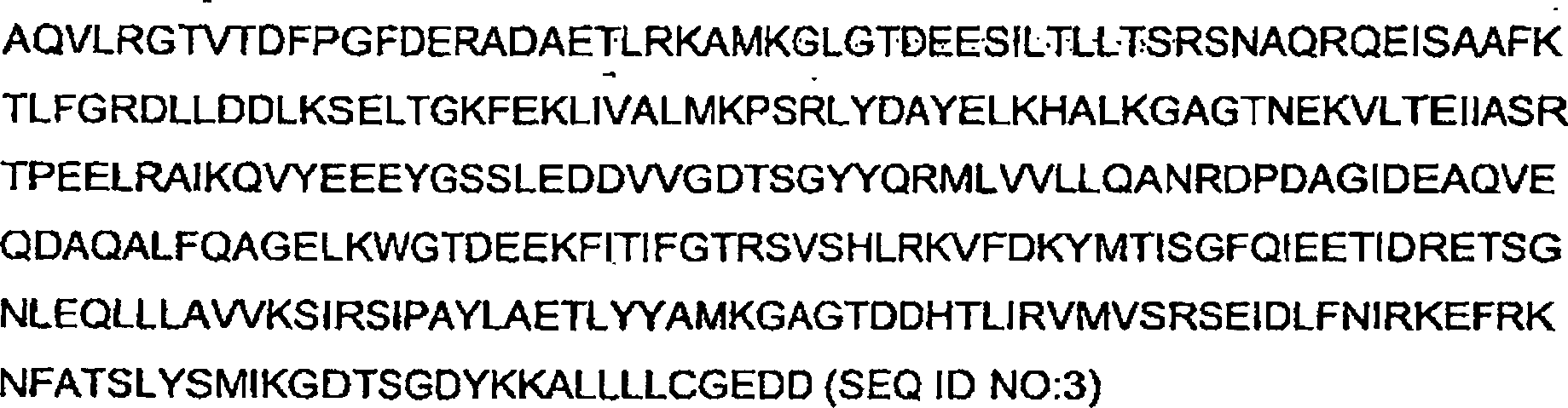
Die
Nukleotidsequenz von Annexin V ist, wie folgt: 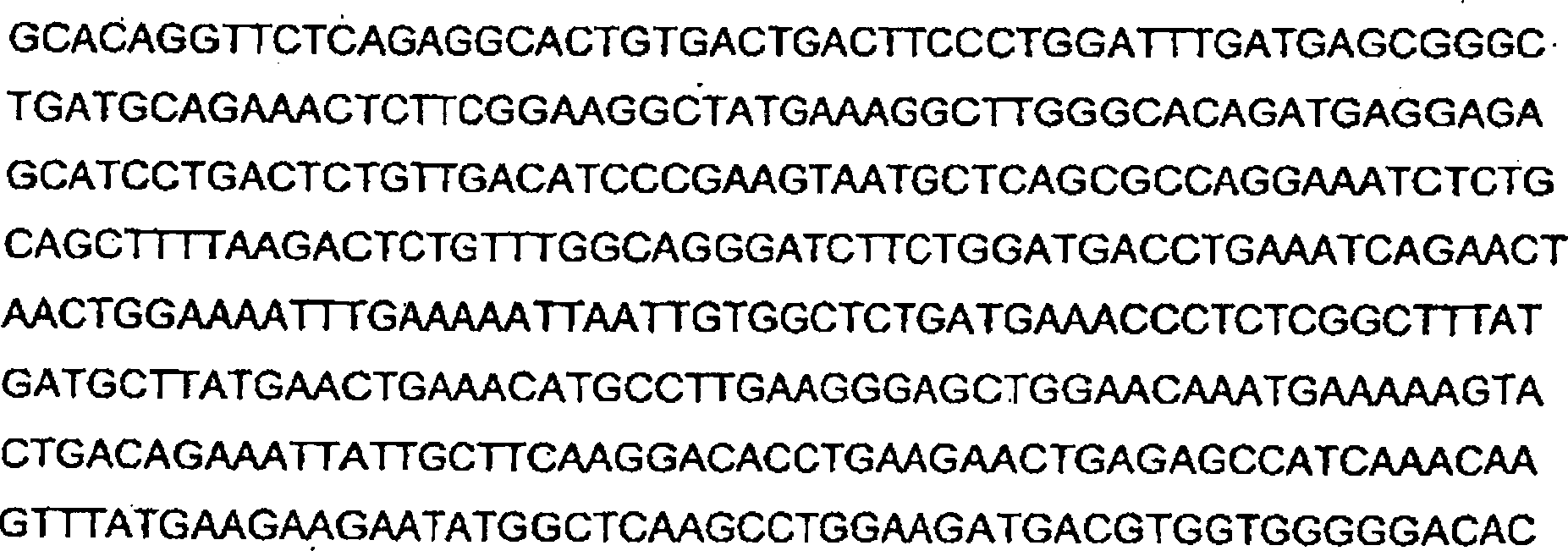
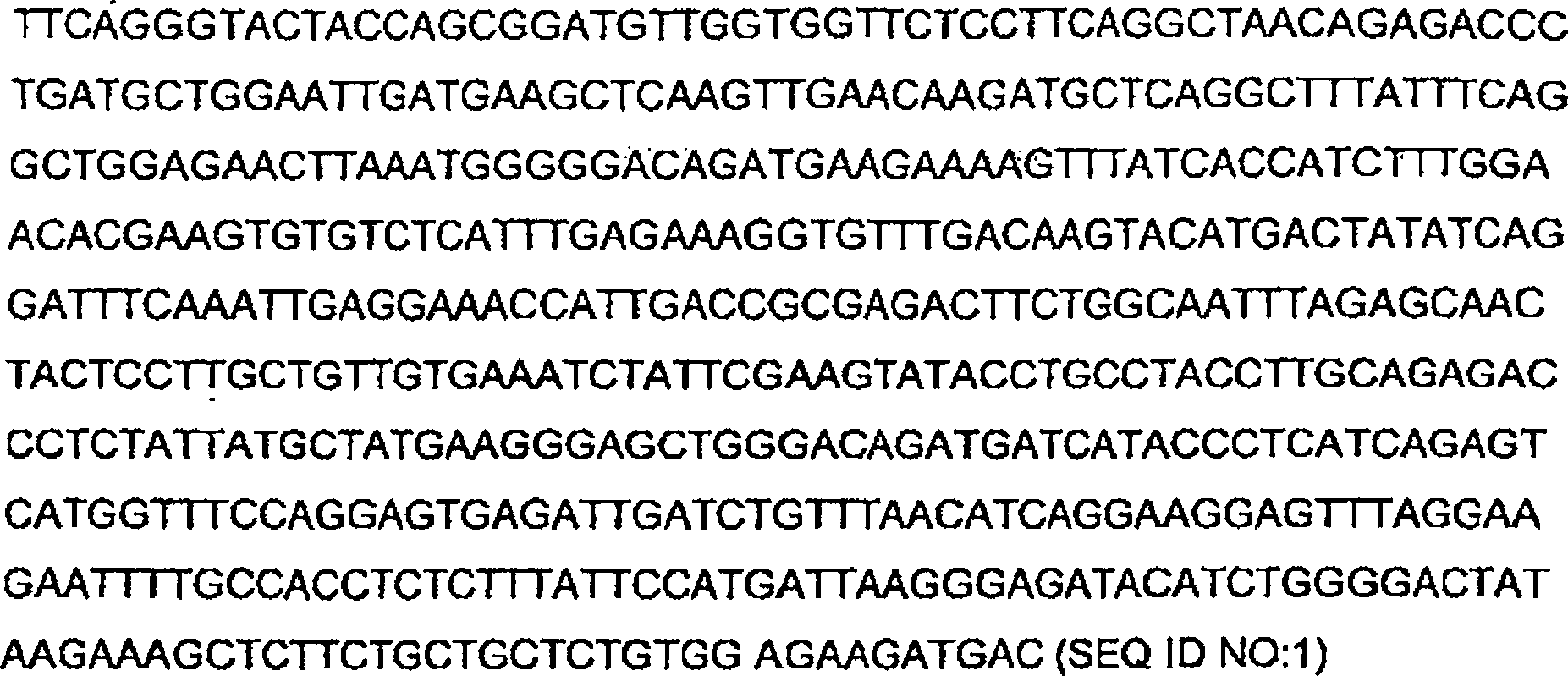
Beispiel 2: In vitro- und in vivo-AssaysExample 2: In Vitro and In Vivo Assays
In vitro-Assays bestimmen die Fähigkeit von modifizierten Annexinproteinen, an aktivierte Plättchen zu binden. Annexin V bindet an Plättchen und diese Bindung wird in vitro durch eine Aktivierung der Plättchen mit Thrombin deutlich erhöht (Thiagarajan und Tait, 1990; Sun et al., 1993). Die modifizierten Annexinproteine der vorliegenden Erfindung werden vorzugsweise so hergestellt, dass sie die Funktion von Annexin ausüben, indem sie an Plättchen binden und das Protein S daran hindern, an Plättchen zu binden (Sun et al., 1993). Die modifizierten Annexinproteine üben auch die Funktion aus, dass sie die gleiche gerinnungshemmende Aktivität in vitro ausüben, wie sie unmodifizierte Annexinproteine zeigen. Ein Verfahren zum Messen der Gerinnungszeit ist die aktivierte partielle Thromboplastinzeit (Fritsma, in Hemostasis and thrombosis in the clinical laboratory (Corriveau, D.M., und Fritsma, G.A., Hrsg.), J.P. Lipincott Co., Philadelphia (1989), S. 92-124.In vitro assays determine the ability of modified annexin proteins, to activated platelets tie. Annexin V binds to platelets and this binding is in vitro by activation of the platelets with Thrombin increased significantly (Thiagarajan and Tait, 1990; Sun et al., 1993). The modified Annexin proteins of the present invention are preferably so that they perform the function of annexin by they on tiles bind and prevent the protein S from binding to platelets (Sun et al., 1993). The modified annexin proteins also have the function of that they exert the same anticoagulant activity in vitro as they show unmodified annexin proteins. A method of measuring the clotting time is the activated partial thromboplastin time (Fritsma, in Hemostasis and thrombosis in the clinical laboratory (Corriveau, D.M., and Fritsma, G.A., ed.), J.P. Lipincott Co., Philadelphia (1989), pp. 92-124.
In vivo-Assays bestimmen die antithrombotische Aktivität von Annexinproteinen. Es ist gezeigt worden, dass Annexin V Venenthrombosen, die durch einen Laser oder photochemisch in Ratten induziert worden sind, verringert (Römisch et al., 1991). Die maximale gerinnungshemmende Wirkung wurde zwischen 15 und 30 min nach einer intravenösen Verabreichung von Annexin V, wie funktional durch Thrombelastographie bestimmt, beobachtet. Die modifizierten Annexinproteine der vorliegenden Erfindung zeigen vorzugsweise eine stärker verlängerte Aktivität in einem solchen Modell als unmodifiziertes Annexin. Es wurde auch festgestellt, dass Annexin V die Fibrin- Anhäufung in einem Kaninchen-Modell von Jugularvenen-Thrombose verringerte (Van Ryn-McKenna et al., 1993). Es wurde eine Injektion von Luft verwendet, um das Endothel zu entfernen, und es wurde gezeigt, dass Annexin V an die behandelte Vene, nicht aber an die kontralaterale Kontrollvene band. Die verringerte Fibrin-Anhäufung in der geschädigten Vene war nicht mit einer systemischen Gerinnungshemmung verbunden. Heparin hemmte die Fibrin-Anhäufung in der geschädigten Vene nicht. Die modifizierten Annexinproteine der vorliegenden Erfindung üben vorzugsweise die Funktion von Annexin in diesem Venenthrombose-Modell aus. Ein Kaninchen-Modell von Arterienthrombose wurde von Thiagarajan und Benedict, 1997, verwendet. Ein partiell okklusiver Thrombus wurde in der linken Halsschlagader durch Anwendung eines elektrischen Stroms gebildet. Eine Annexin V-Infusion hemmte eine Thrombose stark, wie sich durch Messungen des Blutflusses, des Thrombusgewichts, der Abscheidung von markiertem Fibrin und der Anhäufung von markierten Plättchen manifestierte. Unlängst wurde ein Mäuse-Modell eines photochemisch induzierten Thrombus in M. cremaster vorgestellt (Vollmar et al., Thromb. Haemost. 85:160-164 (2001)). Unter Verwendung dieser Technik kann eine Thrombose in einer jeglichen gewünschten Arterie oder Vene induziert werden. Die modifizierten Annexinproteine der vorliegenden Erfindung üben in solchen Modellen vorzugsweise die Funktion von Annexin aus, sogar wenn sie durch Bolus-Injektion verabreicht werden.In vivo assays determine the antithrombotic activity of annexin proteins. Annexin V has been shown to reduce venous thrombosis induced by laser or photochemically in rats (Römisch et al., 1991). The maximum anticoagulant effect was observed between 15 and 30 min after intravenous administration of annexin V as functionally determined by thrombelastography. The modified annexin proteins of the present invention preferably exhibit more prolonged activity in such a model than unmodified annexin. Annexin V was also found to reduce fibrin accumulation in a rabbit model of jugular vein thrombosis (Van Ryn-McKenna et al., 1993). An injection of air was used to remove the endothelium and it was shown that annexin V bound to the treated vein but not to the contralateral control vein. The reduced fibrin accumulation in the damaged vein was not associated with systemic anticoagulation. Heparin did not inhibit fibrin accumulation in the damaged vein. The modified annexin proteins of the present invention preferably exert the function of annexin in this vein thrombosis model. A rabbit model of arterial thrombosis was used by Thiagarajan and Benedict, 1997. A partial occlusive thrombus was formed in the left carotid artery by applying an electric current. Annexin V infusion strongly inhibited thrombosis as manifested by measurements of blood flow, thrombus weight, deposition of labeled fibrin and accumulation of labeled platelets. Recently, a mouse model of a photochemically induced Thrombus in M. cremaster (Vollmar et al., Thromb Haemost 85: 160-164 (2001)). Using this technique, thrombosis can be induced in any desired artery or vein. The modified annexin proteins of the present invention preferentially exert the function of annexin in such models, even when administered by bolus injection.
Beispiel 3Example 3
Das Gerinnungshemmungsvermögen von humanem rekombinantem Annexin V und von pegyliertem humanem rekombinantem Annexin V wurde in vitro verglichen.The Anticoagulation assets of human recombinant annexin V and pegylated human recombinant annexin V was compared in vitro.
Annexin V-Produktion. Die Polymerasekettenreaktion wurde verwendet, um die cDNA ausgehend von dem Start-Metionin bis zu dem Stop-Codon mit spezifischen Oligonukleotid-Primern aus einer humanen plazentaren cDNA-Bibliothek zu amplifizieren. Der Vorwärts-Primer war 5'-ACCTGAGTAGTCGCCATGGCACAGGTTCTC-3' (SEQ ID NO:7) und der Rückwärts-Primer war 5'-CCCGAATTCACGTTRGTCATCTTCTCCACAGAGCAG-3' (SEQ ID NO:8). Das amplifizierte 1,1 kb-Fragment wurde mit NcoI und EcoRI verdaut und in den prokaryotischen Expressionsvektor pTRC 99A li giert. Das Ligationsprodukt wurde verwendet, um den kompetenten Escherichia coli-Stamm JM 105 zu transformieren, und sequenziert.annexin V production. The polymerase chain reaction was used to obtain the cDNA from the starting metionin to the stop codon with specific oligonucleotide primers from a human placental amplify cDNA library. The forward primer was 5'-ACCTGAGTAGTCGCCATGGCACAGGTTCTC-3 '(SEQ ID NO: 7) and the reverse primer was 5'-CCCGAATTCACGTTRGTCATCTTCTCCACAGAGCAG-3 '(SEQ ID NO: 8). The amplified 1.1 kb fragment was digested with NcoI and EcoRI and in the prokaryotic expression vector pTRC 99A li giert. The ligation product was used to obtain the competent Escherichia coli strain JM 105 to transform, and sequenced.
Rekombinantes Annexin V wurde aus den Bakterienlysaten isoliert, wie von Berger et al., 1993, beschrieben, mit einigen Modifikationen. Eine Übernachtkultur von mit pTRC 99A-Annexin V transformierten E. coli JM 105 wurde in frischem Luria-Bertani-Medium, welches 100 mg/l Ampicillin enthielt, 50-fach expandiert. Nach 2 h wurde Isopropyl-β-D-thiogalactopyranosid bis zu einer Endkonzentration von 1 mmol/l zugegeben. Nach 16 h Induktion wurden die Bakterien bei 3500 g 15 min bei 4°C pelletiert. Das Bakterienpellet wurde in TBS, pH 7,5, enthaltend 1 mmol/l PMSF, 5 mmol/l EDTA und 6 mol/l Harnstoff, suspendiert. Die Bakteriensuspension wurde mit einer Ultraschallsonde bei einer Einstellung von 6 auf Eis 3 min beschallt. Das Lysat wurde bei 10000 g 15 min zentrifugiert und der Überstand zweimal gegen 50 Vol. TBS, enthaltend 1 mmol/l EDTA, und einmal gegen 50-Vol. TBS dialysiert.recombinant Annexin V was isolated from the bacterial lysates as described by Berger et al., 1993, with some modifications. An overnight culture of E. coli JM 105 transformed with pTRC 99A-annexin V in fresh Luria Bertani medium containing 100 mg / L ampicillin, Expanded 50 times. After 2 hours, isopropyl-β-D-thiogalactopyranoside was up added to a final concentration of 1 mmol / l. After 16 h induction The bacteria were pelleted at 3500 g for 15 min at 4 ° C. The bacterial pellet was in TBS, pH 7.5, containing 1 mmol / l PMSF, 5 mmol / l EDTA and 6 mol / l urea, suspended. The bacterial suspension was with an ultrasound probe at a setting of 6 on ice for 3 min sonication. The lysate was centrifuged at 10,000 g for 15 min and the supernatant twice against 50 vol. TBS containing 1 mmol / l EDTA, and once against 50 vol. TBS dialysed.
Multilamellare Liposome wurden hergestellt, indem Phosphatidylserin, lyophilisierter Rinderhirnextrakt, Cholesterol und Dicetylphosphat in Chloroform in einem Molverhältnis von 10:15:1 gelöst und in einem Stickstoffstrom in einem konischen Kolben getrocknet wurden. TBS (5 ml) wurde zu dem Kolben zugegeben und kräftig in einem Vortex-Mischer 1 min bewegt. Die Liposome wurden durch Zentrifugation bei 3500 g 15 min gewaschen, dann mit dem Bakterienextrakt inkubiert und es wurde Calciumchlorid bis zu einer Endkonzentration von 5 mmol/l zugegeben. Nach 15 min Inkubation bei 37°C wurden die Liposome durch Zentrifugation bei 10000 g für 10 min sedimentiert und das gebundene Annexin V wurde mit 10 mmol/l EDTA eluiert. Das eluierte Annexin V wurde durch Amicon-Ultrafiltration aufkonzentriert und auf eine Sephacryl S 200-Säule aufgetragen. Das Annexin V wurde in dem eingeschlossenen Volumen gewonnen, wohingegen der größte Teil der Liposome sich in dem Hohlraumvolumen befand. Annexin V enthaltende Fraktionen wurden gepoolt und gegen 10 mmol/l Tris und 2 mmol/l EDTA, pH 8,1, dialysiert, auf eine Anionenaustauschersäule aufgetragen und mit einem linearen Gradienten von 0 bis 200 mmol/l NaCl in dem gleichen Puffer eluiert. Das gereinigte Präparat zeigte in SDS-PAGE unter reduzierenden Bedingungen eine einzelne Bande.multilamellar Liposomes were prepared by phosphatidylserine, lyophilized Bovine brain extract, cholesterol and dicetyl phosphate in chloroform in a molar ratio of 10: 15: 1 solved and dried in a stream of nitrogen in a conical flask were. TBS (5 ml) was added to the flask and poured vigorously into a vortex mixer 1 min moves. The liposomes were purified by centrifugation washed at 3500 g for 15 min, then incubated with the bacterial extract and calcium chloride was added to a final concentration of 5 mmol / l added. After 15 min incubation at 37 ° C, the liposomes were passed through Centrifugation at 10,000 g for Sedimented for 10 min and the bound annexin V was 10 mmol / l EDTA elutes. The eluted annexin V was purified by Amicon ultrafiltration concentrated and applied to a Sephacryl S 200 column. The annexin V was recovered in the trapped volume, whereas the most of the Liposome was in the void volume. Annexin V containing Fractions were pooled and tested against 10 mmol / l Tris and 2 mmol / l EDTA, pH 8.1, dialyzed, applied to an anion exchange column and with a linear gradient from 0 to 200 mmol / l NaCl in the same Buffer eluted. The purified preparation showed in SDS-PAGE reducing conditions a single band.
Das wie oben hergestellte Annexin V wurde unter Verwendung des Verfahrens von Hermanson, 1996, wie oben beschrieben, pegyliert.The Annexin V prepared as above was prepared using the method by Hermanson, 1996, pegylated as described above.
Antikoagulationsassays.
Es wurde die Verlängerung
der Gerinnungszeit (aktivierte partielle Thromboplastinzeit), die
durch Annexin V und pegyliertes Annexin V induziert wird, verglichen.
Aktivierte partielle Thromboplastinzeiten wurden mit mit Citrat
versetztem normalem gepooltem Plasma bestimmt, wie in Fritsma, 1989,
beschrieben. Unter Verwendung von unterschiedlichen Konzentrationen
von Annexin V und pegyliertem Annexin V, das wie oben beschrieben
hergestellt worden war, wurden Dosis-Wirkungs-Kurven für die Verlängerung
der Gerinnungszeiten erhalten. Die Ergebnisse sind in
Es sollte festgehalten werden, dass die vorangegangene Beschreibung die Erfindung nur veranschaulicht. Verschiedene Alternativen und Modifizierungen können durch den Fachmann ersonnen werden, ohne von der Erfindung abzuweichen. Dementsprechend soll die vorliegende Erfindung alle derartigen Alternativen, Modifizierungen und Veränderungen, die unter den Umfang der offenbarten Erfindung fallen, mit umfassen.It should be noted that the foregoing description only illustrates the invention. Various alternatives and modifications can be devised by those skilled in the art without to deviate from the invention. Accordingly, the present invention is intended to embrace all such alternatives, modifications and variations that fall within the scope of the disclosed invention.
SEQUENZPROTOKOLL 

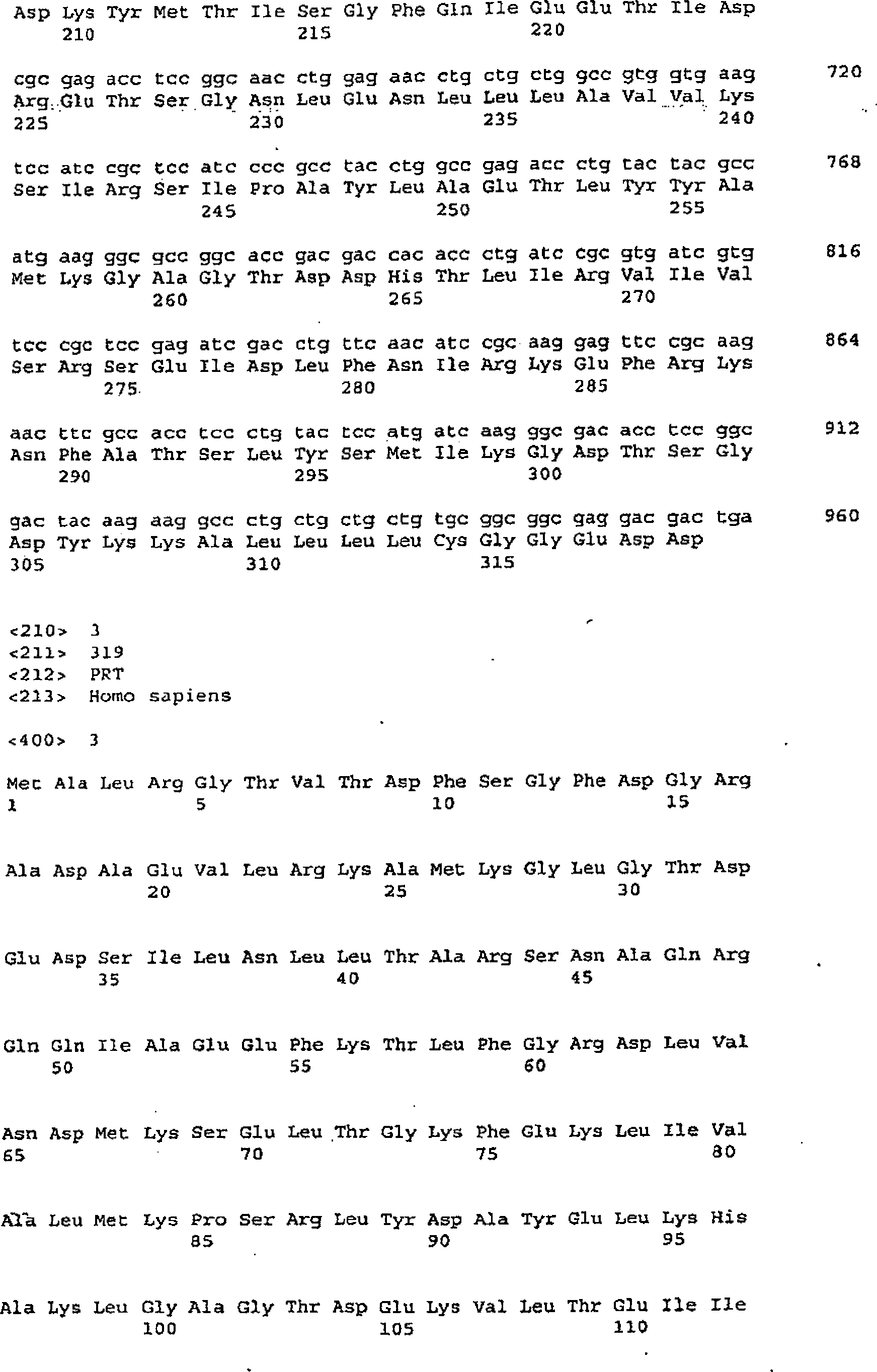

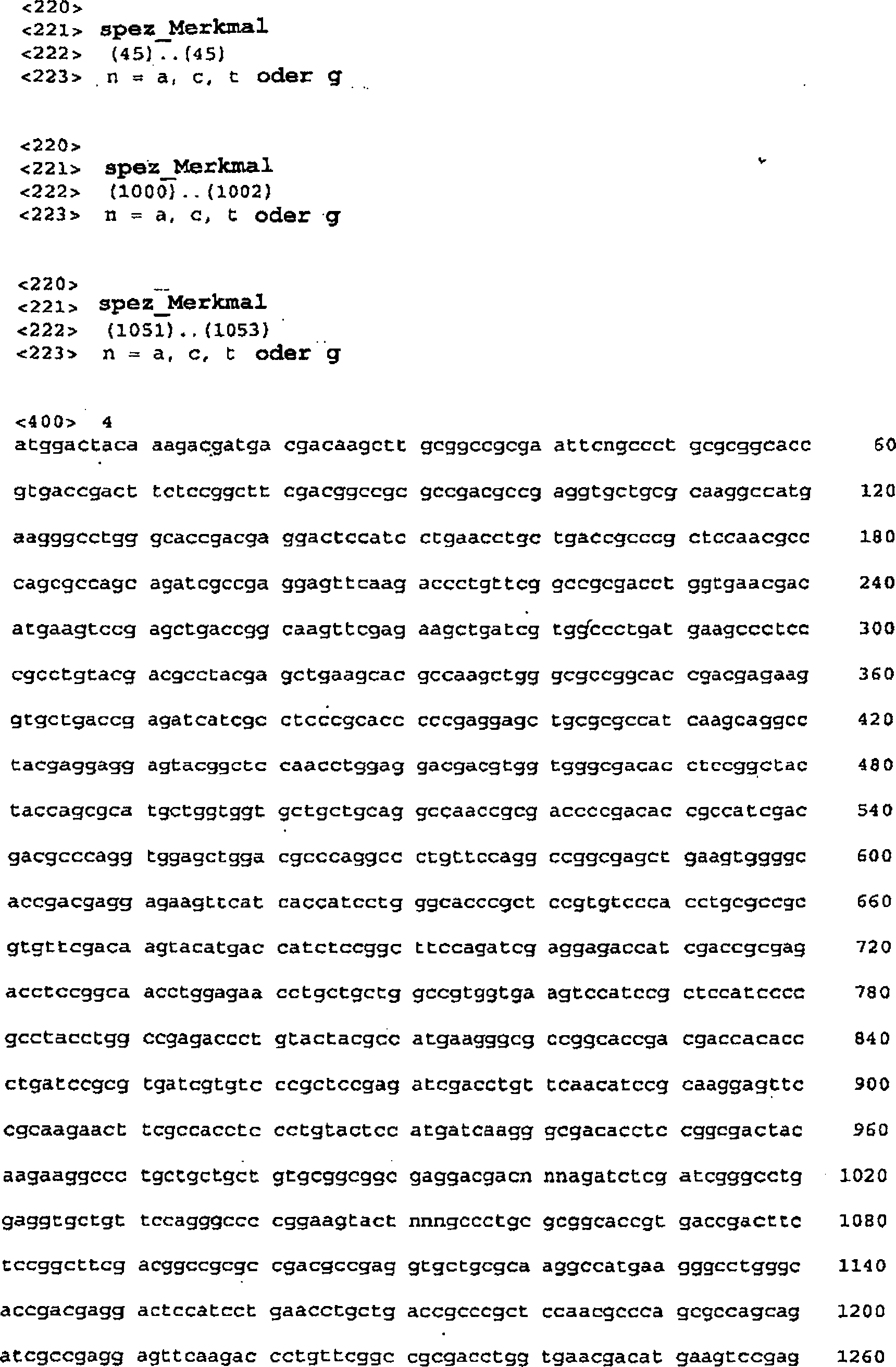


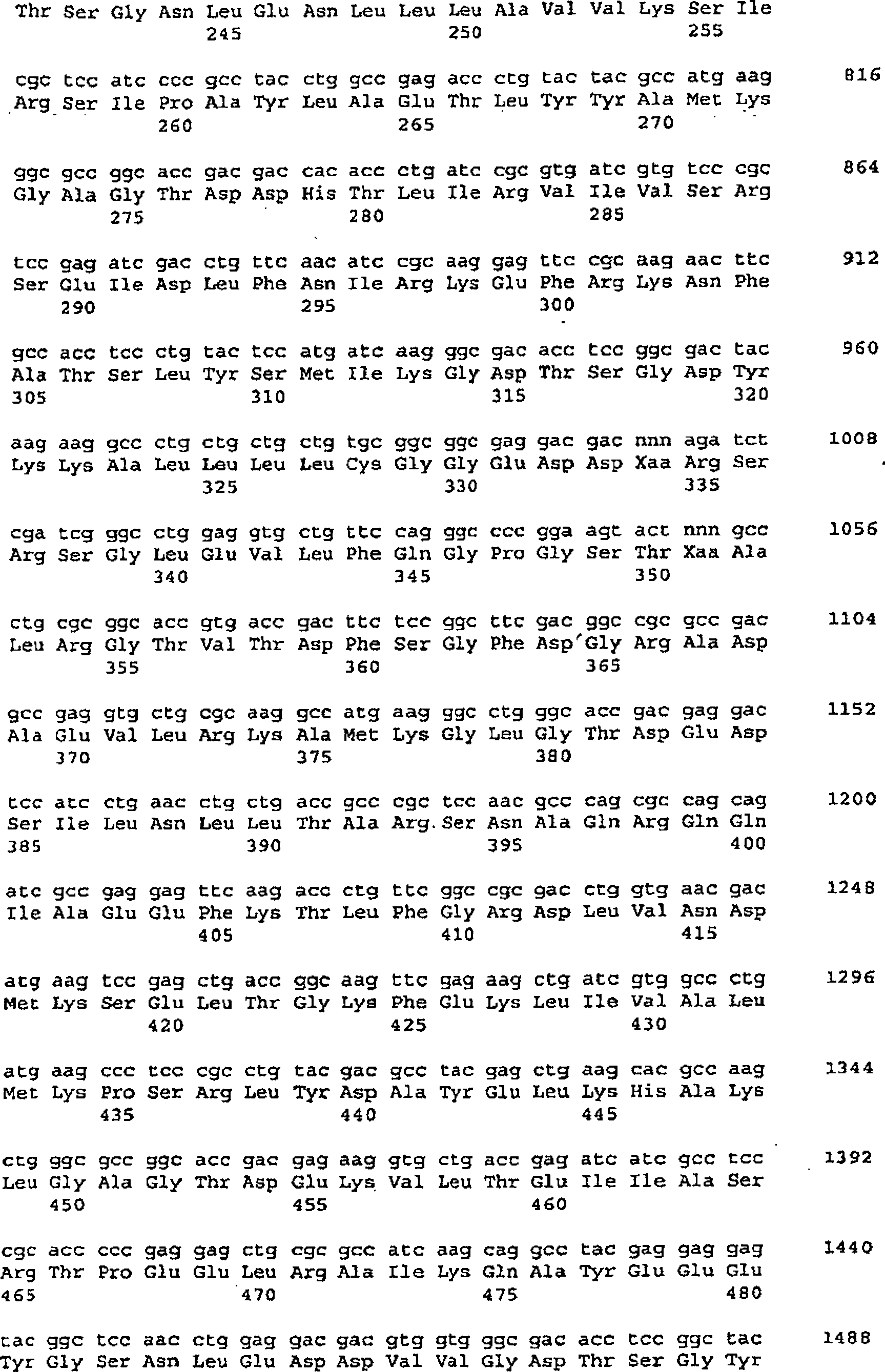
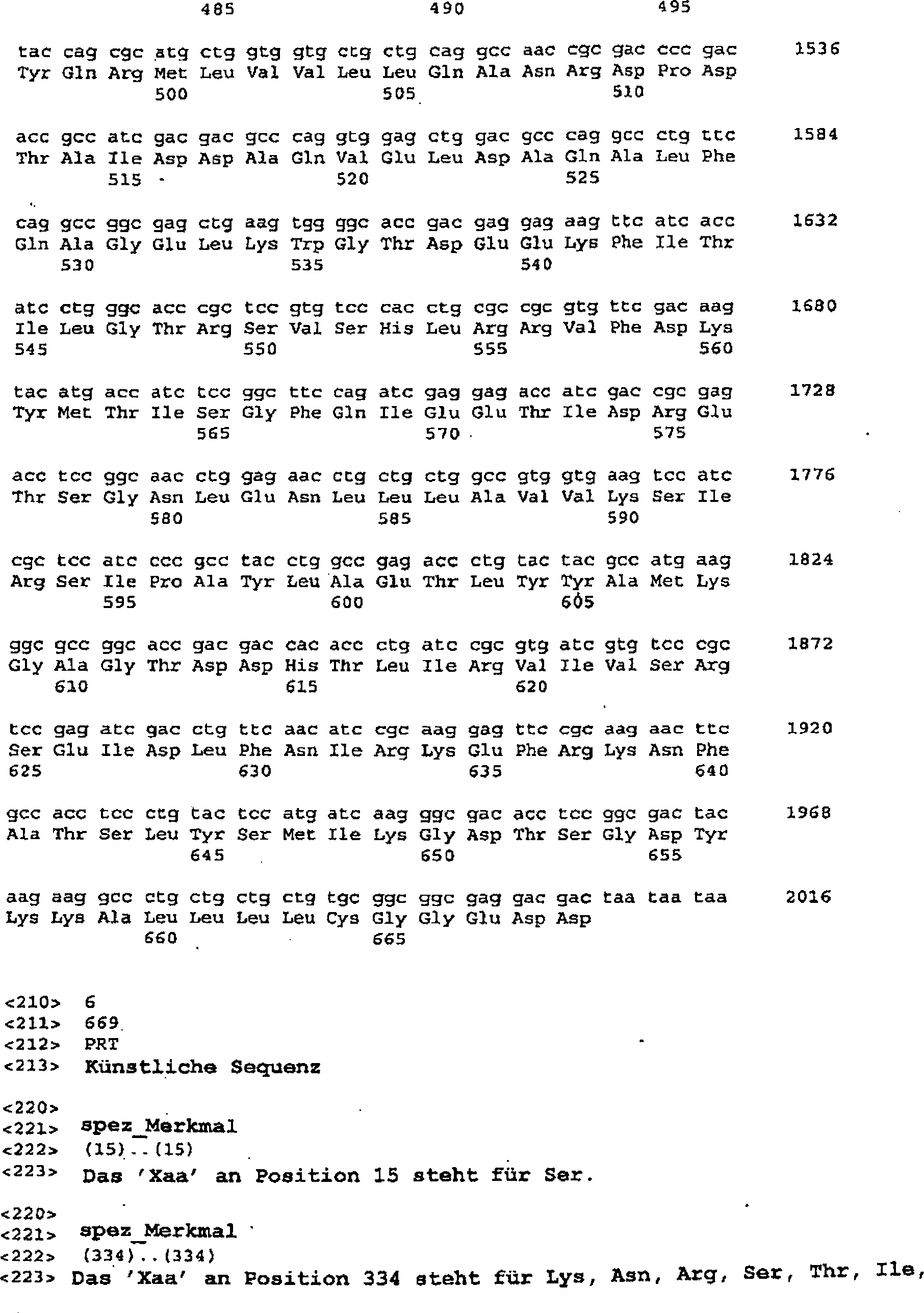

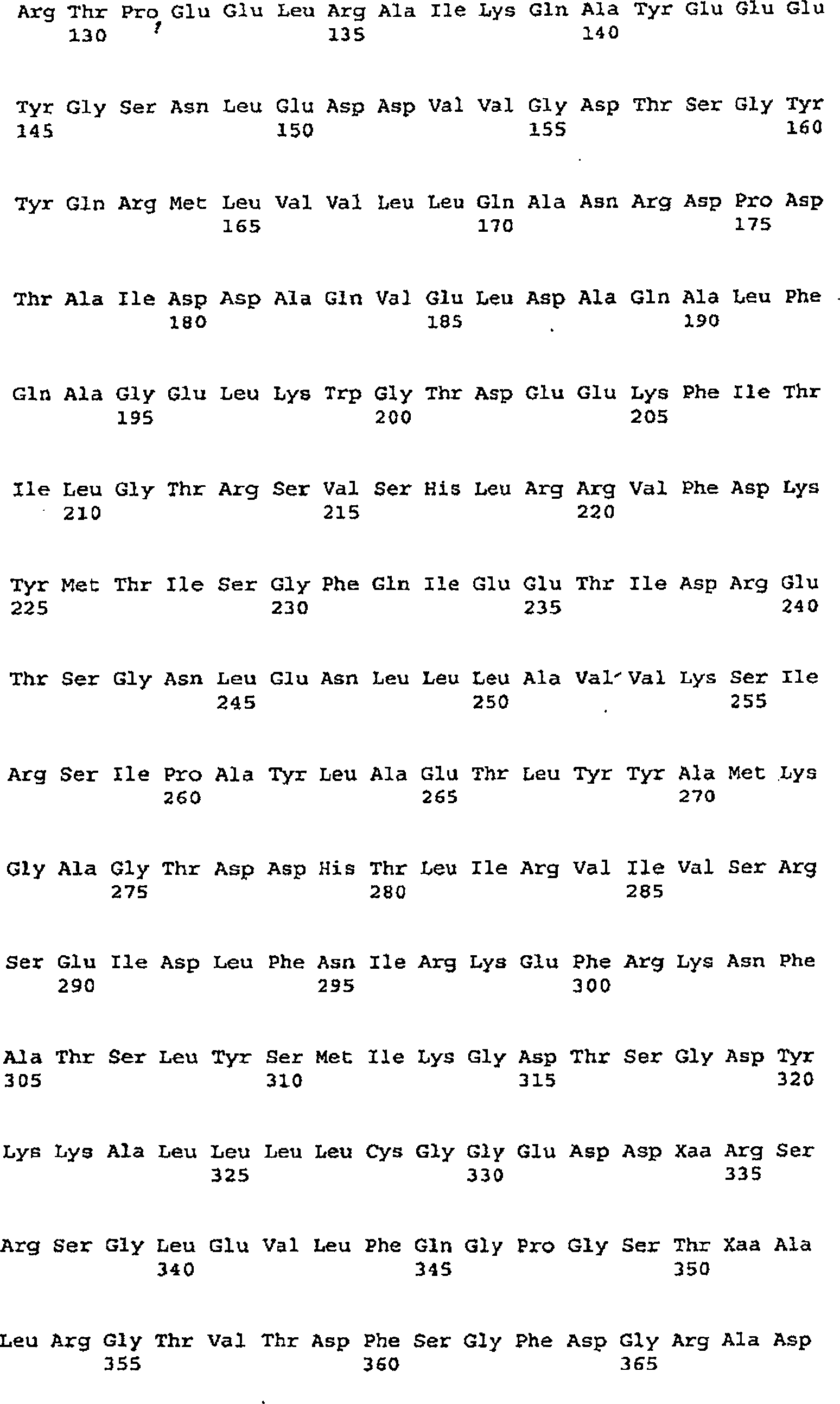
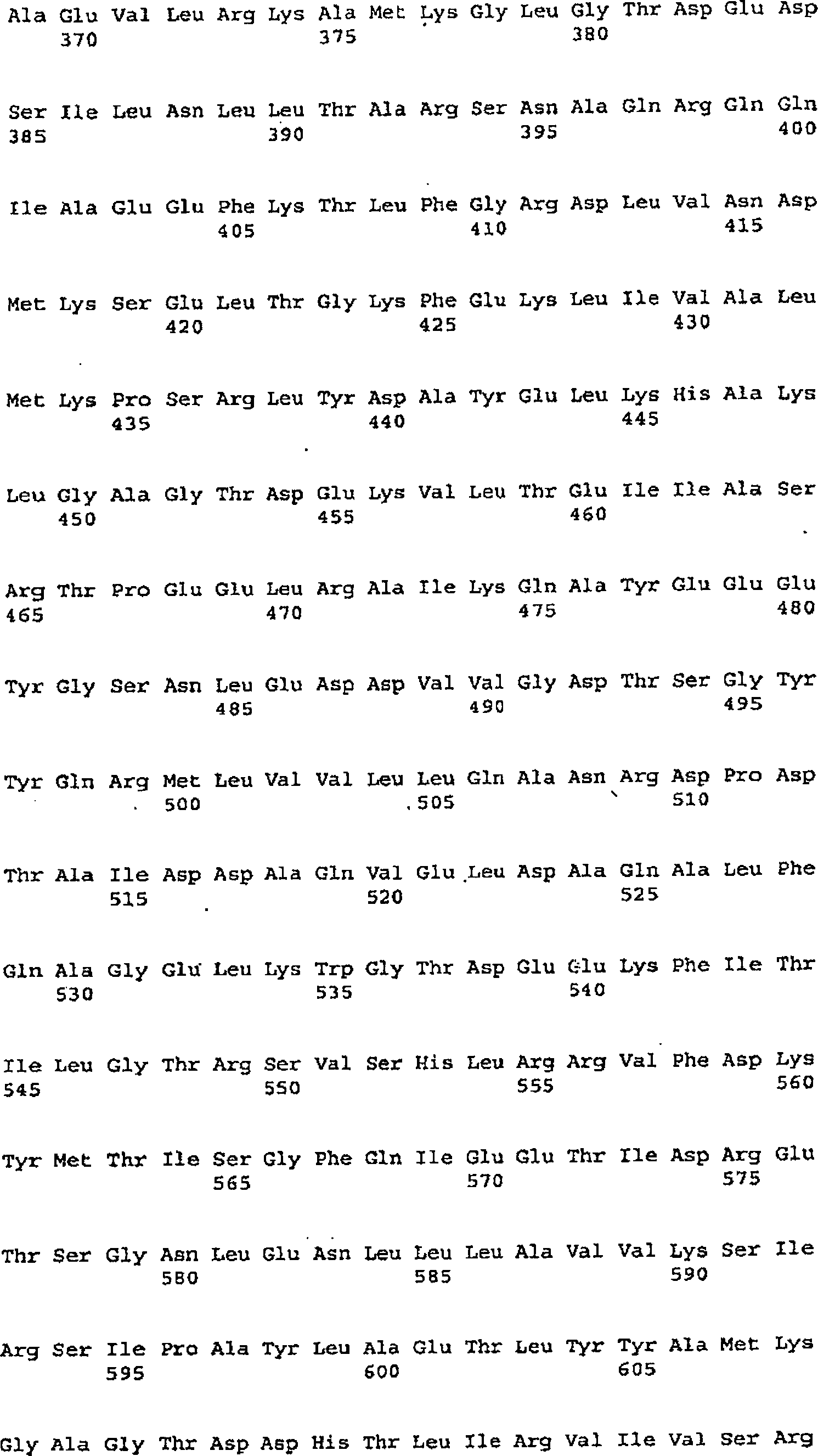
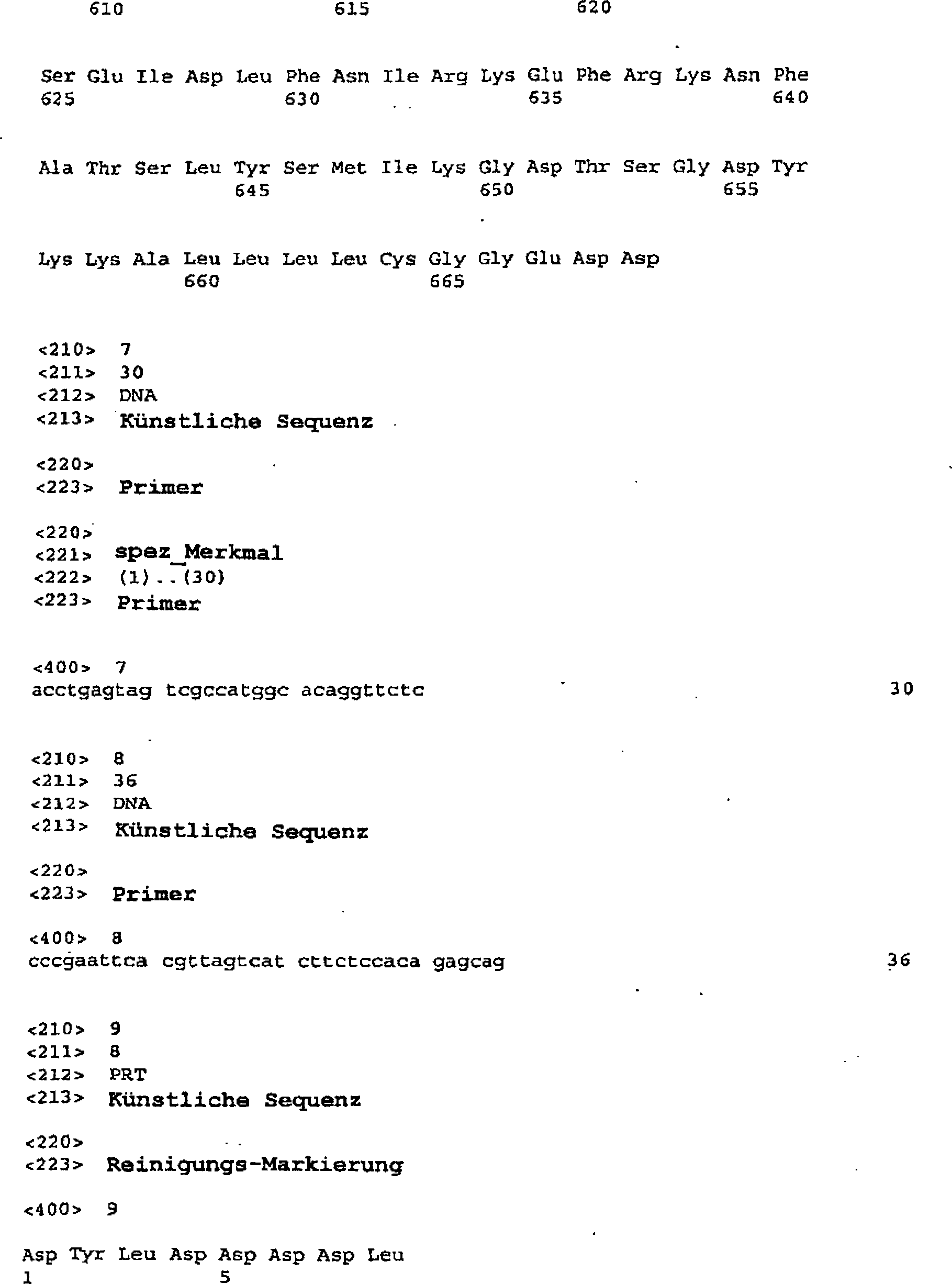
Claims (12)
Applications Claiming Priority (5)
| Application Number | Priority Date | Filing Date | Title |
|---|---|---|---|
| US27040201P | 2001-02-21 | 2001-02-21 | |
| US270402P | 2001-02-21 | ||
| US33258201P | 2001-11-21 | 2001-11-21 | |
| US332582P | 2001-11-21 | ||
| PCT/US2002/005079 WO2002067857A2 (en) | 2001-02-21 | 2002-02-21 | Modified annexin proteins and methods for preventing thrombosis |
Publications (2)
| Publication Number | Publication Date |
|---|---|
| DE60219611D1 DE60219611D1 (en) | 2007-05-31 |
| DE60219611T2 true DE60219611T2 (en) | 2007-12-27 |
Family
ID=26954268
Family Applications (1)
| Application Number | Title | Priority Date | Filing Date |
|---|---|---|---|
| DE60219611T Expired - Lifetime DE60219611T2 (en) | 2001-02-21 | 2002-02-21 | MODIFIED ANNEXIN PROTEINS AND PREVENTION AND TREATMENT OF THROMBOSE |
Country Status (8)
| Country | Link |
|---|---|
| US (2) | US6962903B2 (en) |
| EP (2) | EP1839670A3 (en) |
| JP (3) | JP2004528025A (en) |
| AT (1) | ATE359807T1 (en) |
| AU (1) | AU2002252035A1 (en) |
| DE (1) | DE60219611T2 (en) |
| ES (1) | ES2286247T3 (en) |
| WO (1) | WO2002067857A2 (en) |
Families Citing this family (33)
| Publication number | Priority date | Publication date | Assignee | Title |
|---|---|---|---|---|
| US20050222030A1 (en) * | 2001-02-21 | 2005-10-06 | Anthony Allison | Modified annexin proteins and methods for preventing thrombosis |
| US7635676B2 (en) * | 2001-02-21 | 2009-12-22 | Alavita Pharmaccuticals, Inc. | Modified annexin proteins and methods for their use in organ transplantation |
| US7645739B2 (en) * | 2001-02-21 | 2010-01-12 | Alavita Pharmaceuticals, Inc. | Modified annexin compositions and methods of using same |
| US20090291086A1 (en) * | 2001-02-21 | 2009-11-26 | Alavita Pharmaceuticals, Inc. | Compositions and Methods for Treating Cerebral Thrombosis and Global Cerebral Ischemia |
| DE10162434A1 (en) * | 2001-12-18 | 2003-09-25 | November Ag Molekulare Medizin | Expression vector and method for producing an expression vector |
| WO2005023096A2 (en) * | 2003-09-09 | 2005-03-17 | Point Biomedical Corporation | Methods and compositions for ultrasound imaging of apoptosis |
| CA2559167A1 (en) * | 2004-03-11 | 2005-09-22 | Alavita, Inc. | Modified annexin proteins and methods for preventing thrombosis |
| PT1755642E (en) * | 2004-04-15 | 2010-04-20 | Athera Biotechnologies Ab | Annexin v for preventing plaque rupture |
| US7393833B2 (en) * | 2005-03-09 | 2008-07-01 | The Board Of Regents Of The University Of Oklahoma | Chimeric proteins with phosphatidylserine binding domains |
| EP2044111B1 (en) | 2006-06-21 | 2014-08-13 | MUSC Foundation For Research Development | Targeting complement factor h for treatment of diseases |
| KR100835879B1 (en) | 2006-10-10 | 2008-06-09 | 학교법인 한림대학교 | Annexin fusion protein |
| CN101015686B (en) * | 2007-02-06 | 2010-05-19 | 中国人民解放军军事医学科学院基础医学研究所 | Thrombolytic drug synergist and preparation method thereof |
| WO2009105231A1 (en) | 2008-02-20 | 2009-08-27 | The General Hospital Corporation | Compositions and methods for treating vascular disorders |
| HUE044621T2 (en) | 2008-02-22 | 2019-11-28 | Annexin Pharmaceuticals Ab | Compounds and methods for the prevention or treatment of restenosis |
| EP2123258A1 (en) * | 2008-05-23 | 2009-11-25 | Liplasome Pharma A/S | Liposomes for drug delivery |
| WO2010040147A2 (en) | 2008-10-03 | 2010-04-08 | Advanced Proteome Therapeutics, Inc. | Site-specific n-terminal modifications of proteins and conjugate formation |
| EP2380023A2 (en) | 2008-12-19 | 2011-10-26 | Medirista Biotechnologies AB | Oxidized cardiolipin as a novel pro-inflammatory factor |
| JP5871798B2 (en) | 2009-07-02 | 2016-03-01 | エムユーエスシー ファウンデーション フォー リサーチ ディベロップメント | How to stimulate liver regeneration |
| US10239937B2 (en) | 2009-11-05 | 2019-03-26 | Alexion Pharmaceuticals, Inc. | Treatment of paroxysmal nocturnal hemoglobinuria, hemolytic anemias and disease states involving intravascular and extravascular hemolysis |
| CA2799192A1 (en) | 2010-05-14 | 2011-11-17 | The Regents Of The University Of Colorado, A Body Corporate | Improved complement receptor 2 (cr2) targeting groups |
| EA201291328A1 (en) | 2010-06-22 | 2013-10-30 | Дзе Риджентс Оф Дзе Юниверсити Оф Колорадо, Э Боди Корпорейт | ANTIBODIES TO C3d FRAGMENT OF COMPONENT 3 |
| JP5584026B2 (en) * | 2010-07-02 | 2014-09-03 | 株式会社ダイヘン | Resistance welding control method |
| CN102690345B (en) * | 2011-03-24 | 2014-03-19 | 江苏靶标生物医药研究所有限公司 | Human annexin V variant and its expression, preparation method and use |
| HUE030922T2 (en) | 2011-04-05 | 2017-06-28 | Annexin Pharmaceuticals Ab | Therapeutic and prophylactic methods, uses and compositions comprising anexin a5 |
| WO2014028865A1 (en) | 2012-08-17 | 2014-02-20 | The Regents Of The University Of Colorado, A Body Corporate | Compositions and methods for detecting complement activation |
| US10413620B2 (en) | 2012-08-17 | 2019-09-17 | The Regents Of The University Of Colorado, A Body Corporate | Light-emitting versions of the monoclonal antibody to C3D (MAB 3D29) for imaging |
| WO2016205062A1 (en) * | 2015-06-15 | 2016-12-22 | Shifa Biomedical Corporation | Antithrombotic therapies |
| GB2542391A (en) | 2015-09-17 | 2017-03-22 | Annexin Pharmaceuticals Ab | Process of manufacture |
| CN105906800A (en) * | 2016-05-06 | 2016-08-31 | 中国科学院长春应用化学研究所 | Gene transmission system and preparation method thereof |
| AU2017331739A1 (en) | 2016-09-23 | 2019-03-07 | Csl Limited | Coagulation factor binding proteins and uses thereof |
| GB201702144D0 (en) | 2017-02-09 | 2017-03-29 | Annexin Pharmaceuticals Ab | Therapeutic compositions |
| TW202146042A (en) * | 2020-03-06 | 2021-12-16 | 瑞典商阿斯特捷利康公司 | Synergistic and targeting compositions for treatment of arterial and venous thrombosis |
| CN114672483B (en) * | 2022-05-31 | 2022-09-02 | 上海百力格生物技术有限公司 | Method for preparing nucleic acid probe by ultrasonic method |
Family Cites Families (62)
| Publication number | Priority date | Publication date | Assignee | Title |
|---|---|---|---|---|
| US4179337A (en) * | 1973-07-20 | 1979-12-18 | Davis Frank F | Non-immunogenic polypeptides |
| US4002531A (en) * | 1976-01-22 | 1977-01-11 | Pierce Chemical Company | Modifying enzymes with polyethylene glycol and product produced thereby |
| DE3315000A1 (en) * | 1983-04-26 | 1984-10-31 | Behringwerke Ag, 3550 Marburg | TISSUE PROTEIN PP (DOWN ARROW) 4 (DOWN ARROW), METHOD FOR ITS RECOVERY AND USE |
| US5066788A (en) * | 1984-09-21 | 1991-11-19 | Boehringer Ingelheim International Gmbh | Blood coagulation inhibiting proteins, processes for preparing them and their uses |
| NO164991C (en) * | 1984-09-21 | 1990-12-05 | Boehringer Ingelheim Int | PROCEDURE FOR THE PREPARATION OF BLOOD-COAGULATING INHIBITIVE PROTEINS. |
| US4897355A (en) * | 1985-01-07 | 1990-01-30 | Syntex (U.S.A.) Inc. | N[ω,(ω-1)-dialkyloxy]- and N-[ω,(ω-1)-dialkenyloxy]-alk-1-yl-N,N,N-tetrasubstituted ammonium lipids and uses therefor |
| CA1265446A (en) * | 1985-09-30 | 1990-02-06 | Masahiro Maki | Anticoagulating substance, process for preparing same and anticoagulant comprising same as an effective component |
| JPH08840B2 (en) * | 1986-11-14 | 1996-01-10 | 興和株式会社 | Anti-PCI monoclonal antibody, anti-PCI purification method and immunoassay using the same |
| DE3643182A1 (en) * | 1986-12-18 | 1988-06-30 | Behringwerke Ag | MEDICINAL PRODUCTS CONTAINING THE TISSUE PROTEIN PP4, METHOD FOR THE PRODUCTION OF PP4 AND ITS PASTEURIZATION AND THE USE OF PP4 |
| US4937324A (en) * | 1987-02-06 | 1990-06-26 | Zymogenetics, Inc. | Chromatographic purification of human proteins having anticoagulant and anti-inflammatory activity |
| JP2660514B2 (en) * | 1987-02-20 | 1997-10-08 | 興和株式会社 | Polypeptide having anticoagulant action |
| PT87083B (en) | 1987-03-28 | 1992-07-31 | Boehringer Ingelheim Int | A PROCESS FOR THE PREPARATION OF A VASCULAR ANTICOAGULANT PROTEIN, OF DNA THAT CODIFIES FOR THIS PROTEIN AND OF PHARMACEUTICAL COMPOSITIONS CONTAINING IT |
| US4965251A (en) | 1987-04-03 | 1990-10-23 | The Board Of Regents Of The University Of Washington | Pulse treatment of hemoglobinopathies with erythropoietin |
| DE3737239A1 (en) | 1987-11-03 | 1989-10-12 | Behringwerke Ag | GENETIC PRODUCTION OF ANTICOAGULATORY PROTEIN PP4 |
| DE68923107T2 (en) | 1988-02-26 | 1996-01-18 | Biogen Inc | DNA sequences, recombinant DNA molecules and methods for the production of lipocortin III, IV, V, and VI. |
| US5324844A (en) * | 1989-04-19 | 1994-06-28 | Enzon, Inc. | Active carbonates of polyalkylene oxides for modification of polypeptides |
| EP0409053B1 (en) | 1989-07-15 | 1993-09-29 | BOEHRINGER INGELHEIM INTERNATIONAL GmbH | Process for purifying annexins |
| DE4022010A1 (en) * | 1989-07-15 | 1991-01-17 | Boehringer Ingelheim Int | Anticoagulant compsn. for treatment and prophylaxis of thrombosis - contains vascular anti-coagulant protein (annexine) and divalent salt of calcium, cadmium, zinc, manganese or cobalt |
| DE3937607A1 (en) | 1989-11-11 | 1991-05-16 | Boehringer Ingelheim Int | USE OF AN ANTI-COAGULAR TREATMENT FOR TUMOR DISEASES |
| DE3942081A1 (en) | 1989-12-20 | 1991-06-27 | Behringwerke Ag | MEANS FOR IMPROVING THE REINFORCEMENT OF ANNExINES |
| US5627036A (en) | 1989-12-27 | 1997-05-06 | Boehringer Ingelheim International Gmbh | Use of an anticoagulant as a diagnostic agent |
| US5225537A (en) * | 1989-12-29 | 1993-07-06 | Zymogenetics, Inc. | Methods for producing hybrid phospholipid-binding proteins |
| EP0527940A1 (en) | 1990-05-08 | 1993-02-24 | Liposome Technology, Inc. | Direct spray-dried drug/lipid powder composition |
| CA2092315A1 (en) | 1990-11-02 | 1992-05-03 | John P. Burnier | Platelet aggregation inhibitors |
| CA2096520C (en) | 1990-11-20 | 2000-12-19 | Hiroshi Nakao | Therapeutic agent for skin or corneal disease |
| JP2916947B2 (en) * | 1990-11-28 | 1999-07-05 | 興和株式会社 | Method for stabilizing CPB-I and formulation composition |
| US5229367A (en) | 1991-01-21 | 1993-07-20 | Sclavo S.P.A. | Antiinflammatory peptide derived from human lipocortin V |
| WO1992019279A1 (en) | 1991-05-09 | 1992-11-12 | Board Of Regents Of The University Of Washington | Phospholipid-targeted thrombolytic agents |
| US5632986A (en) * | 1991-05-09 | 1997-05-27 | The University Of Washington | Phospholipid-targeted thrombolytic agents |
| JPH051096A (en) | 1991-06-26 | 1993-01-08 | Kowa Co | Oligopeptide with anticoagulant activity |
| EP1138334A3 (en) * | 1992-06-09 | 2002-04-03 | Neorx Corporation | Pretargeting methods and compounds |
| CA2139735A1 (en) | 1992-07-08 | 1994-01-20 | Sing-Hiem Yap | Polypeptides, derived from endonexin 2, having hepatitis b virus receptor activity and their use in diagnostic and pharmaceutical compositions |
| JP3416912B2 (en) | 1992-10-08 | 2003-06-16 | 興和株式会社 | Oligopeptides with anticoagulant activity |
| JPH0772149A (en) | 1993-06-30 | 1995-03-17 | Nippon Shinyaku Co Ltd | Chemical and method for diagnosis of liver cancer or cirrhosis |
| JPH0772147A (en) | 1993-07-02 | 1995-03-17 | Noboru Kaneko | Antianexin v antibody as well as preparation and utilization of same antibody |
| US5849600A (en) | 1993-11-10 | 1998-12-15 | The Mclean Hospital Corporation | Diagnostic assays for Alzheimer's disease |
| US5968477A (en) | 1994-01-24 | 1999-10-19 | Neorx Corporation | Radiolabeled annexin conjugates with hexose and a chelator |
| US5747446A (en) * | 1994-03-22 | 1998-05-05 | Beth Israel Deaconess Medical Center | Modified polypeptides with increased biological activity |
| JPH10504534A (en) | 1994-06-16 | 1998-05-06 | ネオルクス コーポレイション | Radiolabeled annexin-galactose conjugate |
| ES2139957T3 (en) | 1994-07-23 | 2000-02-16 | Roche Diagnostics Gmbh | METHOD FOR THE DETERMINATION OF THE PRETHROMBOTIC STATE. |
| DE19541284C2 (en) | 1995-11-06 | 1998-09-24 | Kalden Joachim Robert Prof Dr | Immunomodulation method |
| IL124831A0 (en) * | 1995-12-27 | 1999-01-26 | Genentech Inc | Ob protein derivatives having prolonged half-life |
| AU731924B2 (en) | 1996-07-05 | 2001-04-05 | Philip E. Branton | Adenovirus E4 proteins for inducing cell death |
| WO1998029442A1 (en) | 1996-12-30 | 1998-07-09 | Innogenetics N.V. | ANNEXIN V-BINDING POLYPEPTIDES DERIVED FROM HBsAg AND THEIR USES |
| AU725133B2 (en) * | 1997-01-15 | 2000-10-05 | Polaris Group | Modified tumor necrosis factor |
| US6358508B1 (en) * | 1997-06-11 | 2002-03-19 | Human Genome Sciences, Inc. | Antibodies to human tumor necrosis factor receptor TR9 |
| US6242570B1 (en) * | 1997-07-10 | 2001-06-05 | Beth Israel Deaconess Medical Center | Production and use of recombinant protein multimers with increased biological activity |
| WO1999002992A1 (en) | 1997-07-11 | 1999-01-21 | The Mount Sinai School Of Medicine Of The City University Of New York | Assays for diagnosis of thrombophilic disease |
| US6511829B1 (en) | 1997-10-09 | 2003-01-28 | The Regents Of The University Of California | GFP-annexin fusion proteins |
| JP2001522809A (en) | 1997-11-06 | 2001-11-20 | イノジェネティックス・ナムローゼ・フェンノートシャップ | Host-derived protein-bound HCV: pharmaceutical, diagnostic and purification applications |
| CA2322843A1 (en) | 1998-03-27 | 1999-09-30 | The Board Of Trustees Of The Leland Stanford, Jr. University | Hypoxia-inducible human genes, proteins, and uses thereof |
| US20040002056A1 (en) * | 1998-05-12 | 2004-01-01 | Lorens James B. | Methods of screening for bioactive agents using cells transformed with self-inactivating viral vectors |
| US6169078B1 (en) * | 1998-05-12 | 2001-01-02 | University Of Florida | Materials and methods for the intracellular delivery of substances |
| CA2331789C (en) | 1998-07-13 | 2013-09-10 | Board Of Regents, The University Of Texas System | Cancer treatment methods using therapeutic conjugates that bind to aminophospholipids |
| IL125908A (en) | 1998-08-24 | 2005-05-17 | Nst Neurosurvival Technologies | Peptides and pharmaceutical compositions comprising same |
| WO2000010673A1 (en) | 1998-08-24 | 2000-03-02 | Nst Neurosurvival Technologies Ltd. | Apparatus and method for capturing particles with surface exposure of anionic phospholipids from biological fluids |
| EP1107983A2 (en) | 1998-09-01 | 2001-06-20 | Innogenetics N.V. | Benzodiazepine and benzothiazepine derivatives and hbsag peptides binding to annexins, their compositions and use |
| US6387366B1 (en) | 1998-12-31 | 2002-05-14 | Alg Company | Methods for reducing adverse side effects associated with cellular transplantation |
| CN1125084C (en) * | 1999-03-12 | 2003-10-22 | 中国科学院上海生物化学研究所 | Thrombolytic fusion protein targeting thrombus |
| US6323313B1 (en) | 1999-06-01 | 2001-11-27 | The University Of Washington | Annexin derivative with endogenous chelation sites |
| US6645465B2 (en) | 1999-08-06 | 2003-11-11 | Michigan, University Of The Regents | Annexin proteins and autoantibodies as serum markers for cancer |
| EP1389090A2 (en) | 2001-04-26 | 2004-02-18 | Board of Regents, The University of Texas System | Diagnostic imaging compositions, their methods of synthesis and use |
-
2002
- 2002-02-21 DE DE60219611T patent/DE60219611T2/en not_active Expired - Lifetime
- 2002-02-21 WO PCT/US2002/005079 patent/WO2002067857A2/en not_active Ceased
- 2002-02-21 AT AT02721083T patent/ATE359807T1/en not_active IP Right Cessation
- 2002-02-21 EP EP07106226A patent/EP1839670A3/en not_active Withdrawn
- 2002-02-21 EP EP02721083A patent/EP1379266B1/en not_active Expired - Lifetime
- 2002-02-21 AU AU2002252035A patent/AU2002252035A1/en not_active Abandoned
- 2002-02-21 JP JP2002567229A patent/JP2004528025A/en not_active Withdrawn
- 2002-02-21 ES ES02721083T patent/ES2286247T3/en not_active Expired - Lifetime
- 2002-02-21 US US10/080,370 patent/US6962903B2/en not_active Expired - Fee Related
-
2005
- 2005-04-20 US US11/110,306 patent/US7407475B2/en not_active Expired - Fee Related
-
2008
- 2008-05-27 JP JP2008137728A patent/JP2008263991A/en active Pending
-
2010
- 2010-04-01 JP JP2010084883A patent/JP2010189405A/en active Pending
Also Published As
| Publication number | Publication date |
|---|---|
| US20050197295A1 (en) | 2005-09-08 |
| EP1839670A2 (en) | 2007-10-03 |
| EP1839670A3 (en) | 2009-11-11 |
| EP1379266B1 (en) | 2007-04-18 |
| US7407475B2 (en) | 2008-08-05 |
| ATE359807T1 (en) | 2007-05-15 |
| ES2286247T3 (en) | 2007-12-01 |
| JP2008263991A (en) | 2008-11-06 |
| EP1379266A2 (en) | 2004-01-14 |
| WO2002067857A3 (en) | 2002-11-07 |
| DE60219611D1 (en) | 2007-05-31 |
| WO2002067857A2 (en) | 2002-09-06 |
| JP2004528025A (en) | 2004-09-16 |
| EP1379266A4 (en) | 2004-05-06 |
| AU2002252035A1 (en) | 2002-09-12 |
| US20030166532A1 (en) | 2003-09-04 |
| JP2010189405A (en) | 2010-09-02 |
| US6962903B2 (en) | 2005-11-08 |
Similar Documents
| Publication | Publication Date | Title |
|---|---|---|
| DE60219611T2 (en) | MODIFIED ANNEXIN PROTEINS AND PREVENTION AND TREATMENT OF THROMBOSE | |
| DE60207053T2 (en) | RECOMBINANT GELATINE PROTEINS FOR USE AS PLASMA EXPANDERS | |
| KR20150121715A (en) | Csf1 therapeutics | |
| DE68929388T2 (en) | Anticoagulant compound isolated from urine | |
| JP5208135B2 (en) | Recombinant leukocyte inhibitory factor and hirugen chimeric protein and drug composition thereof | |
| CA2161971A1 (en) | Recombinant bpi-based and lbp-based proteins, nucleic acid molecules encoding same, methods of producing same, and uses thereof | |
| US20240124534A1 (en) | Anticoagulant fusion proteins and uses thereof | |
| JPWO1992000325A1 (en) | Polypeptides with anticoagulant activity | |
| DE69333738T2 (en) | THERAPEUTIC DOMAINS OF THE WILLEBRAND FACTOR | |
| JP2012254992A (en) | Modified annexin protein and method for preventing thrombosis | |
| PL203706B1 (en) | Tnf-derived peptides for use in treating oedema | |
| DE69901805T2 (en) | PHARMACEUTICAL COMPOSITION WITH MUTATED TYROSIN 353 EZRIN | |
| JP3030386B2 (en) | Anticancer agent | |
| CN107987144B (en) | Centipede polypeptide SLP _ SstX as well as encoding gene and application thereof | |
| DE10053870A1 (en) | Procollagen (III) propeptides and related substances for the treatment of fibrotic diseases | |
| WO2004013303A2 (en) | Modified annexin proteins and methods for treating vaso-occlusive sickle-cell disease | |
| JP2002528058A (en) | Contotrostatin (CN) and its use in inhibiting metastasis and other symptoms | |
| US6982154B2 (en) | Modified annexin proteins and methods for treating vaso-occlusive sickle-cell disease | |
| JPH083065A (en) | Therapeutic agent for hepatopathy | |
| PT99632B (en) | METHOD FOR PREPARING A THROMBIN LIGATION SUBSTANCE | |
| WO2001015721A1 (en) | Novel uses of semaphorin and vegf | |
| JPH1014581A (en) | Rabbit-type macrophage colony-stimulating factor and DNA fragment encoding the same | |
| JPWO2001052901A1 (en) | gene therapy drugs | |
| WO2000020572A2 (en) | Tissue binding peptides, identification, production and utilization thereof | |
| JPWO1999055864A1 (en) | Novel polypeptide, cDNA encoding said polypeptide, and uses thereof |
Legal Events
| Date | Code | Title | Description |
|---|---|---|---|
| 8327 | Change in the person/name/address of the patent owner |
Owner name: ALAVITA PHARMACEUTICALS, INC., MOUNTAIN VIEW, , US |
|
| 8364 | No opposition during term of opposition |