DE60200947T2 - BIMETALIC CATALYSTS FOR OLEFIN POLYMERIZATION - Google Patents
BIMETALIC CATALYSTS FOR OLEFIN POLYMERIZATION Download PDFInfo
- Publication number
- DE60200947T2 DE60200947T2 DE60200947T DE60200947T DE60200947T2 DE 60200947 T2 DE60200947 T2 DE 60200947T2 DE 60200947 T DE60200947 T DE 60200947T DE 60200947 T DE60200947 T DE 60200947T DE 60200947 T2 DE60200947 T2 DE 60200947T2
- Authority
- DE
- Germany
- Prior art keywords
- group
- complex
- ligand
- indenoindolyl
- metal
- Prior art date
- Legal status (The legal status is an assumption and is not a legal conclusion. Google has not performed a legal analysis and makes no representation as to the accuracy of the status listed.)
- Expired - Lifetime
Links
- 239000003054 catalyst Substances 0.000 title claims abstract description 29
- 150000001336 alkenes Chemical class 0.000 title claims abstract description 17
- 238000006116 polymerization reaction Methods 0.000 title claims abstract description 16
- JRZJOMJEPLMPRA-UHFFFAOYSA-N olefin Natural products CCCCCCCC=C JRZJOMJEPLMPRA-UHFFFAOYSA-N 0.000 title claims abstract description 13
- -1 indenoindolyl Chemical group 0.000 claims abstract description 54
- 239000012190 activator Substances 0.000 claims abstract description 20
- 229910052751 metal Inorganic materials 0.000 claims abstract description 15
- 239000002184 metal Substances 0.000 claims abstract description 15
- 125000002524 organometallic group Chemical group 0.000 claims abstract description 15
- 229910052747 lanthanoid Inorganic materials 0.000 claims abstract description 12
- 150000002602 lanthanoids Chemical class 0.000 claims abstract description 9
- 239000003446 ligand Substances 0.000 claims description 50
- 150000003624 transition metals Chemical class 0.000 claims description 23
- 238000000034 method Methods 0.000 claims description 22
- 229910052723 transition metal Inorganic materials 0.000 claims description 21
- IJGRMHOSHXDMSA-UHFFFAOYSA-N nitrogen Substances N#N IJGRMHOSHXDMSA-UHFFFAOYSA-N 0.000 claims description 13
- 229910052783 alkali metal Inorganic materials 0.000 claims description 10
- 229910052757 nitrogen Inorganic materials 0.000 claims description 9
- 150000001340 alkali metals Chemical class 0.000 claims description 8
- 229910052795 boron group element Inorganic materials 0.000 claims description 8
- 125000000082 organogermanium group Chemical group 0.000 claims description 8
- 125000000058 cyclopentadienyl group Chemical group C1(=CC=CC1)* 0.000 claims description 6
- 229920000642 polymer Polymers 0.000 claims description 5
- QJGQUHMNIGDVPM-UHFFFAOYSA-N nitrogen group Chemical group [N] QJGQUHMNIGDVPM-UHFFFAOYSA-N 0.000 claims 1
- 230000007704 transition Effects 0.000 abstract description 6
- MZRVEZGGRBJDDB-UHFFFAOYSA-N N-Butyllithium Chemical compound [Li]CCCC MZRVEZGGRBJDDB-UHFFFAOYSA-N 0.000 description 12
- 238000006243 chemical reaction Methods 0.000 description 11
- VGGSQFUCUMXWEO-UHFFFAOYSA-N Ethene Chemical compound C=C VGGSQFUCUMXWEO-UHFFFAOYSA-N 0.000 description 10
- 239000005977 Ethylene Substances 0.000 description 10
- 239000000243 solution Substances 0.000 description 9
- WYURNTSHIVDZCO-UHFFFAOYSA-N Tetrahydrofuran Chemical compound C1CCOC1 WYURNTSHIVDZCO-UHFFFAOYSA-N 0.000 description 8
- 239000002585 base Substances 0.000 description 8
- IJOOHPMOJXWVHK-UHFFFAOYSA-N chlorotrimethylsilane Chemical compound C[Si](C)(C)Cl IJOOHPMOJXWVHK-UHFFFAOYSA-N 0.000 description 8
- RXXXUIOZOITBII-UHFFFAOYSA-N indeno[1,2-g]indole Chemical compound C1=C2C=CC=CC2=C2C1=C1N=CC=C1C=C2 RXXXUIOZOITBII-UHFFFAOYSA-N 0.000 description 7
- 239000000203 mixture Substances 0.000 description 7
- 125000000217 alkyl group Chemical group 0.000 description 6
- 150000001875 compounds Chemical class 0.000 description 6
- 230000005595 deprotonation Effects 0.000 description 6
- 238000010537 deprotonation reaction Methods 0.000 description 6
- 150000004820 halides Chemical class 0.000 description 6
- NNPPMTNAJDCUHE-UHFFFAOYSA-N isobutane Chemical compound CC(C)C NNPPMTNAJDCUHE-UHFFFAOYSA-N 0.000 description 6
- 239000002243 precursor Substances 0.000 description 6
- 125000003118 aryl group Chemical group 0.000 description 5
- 125000004122 cyclic group Chemical group 0.000 description 5
- VXNZUUAINFGPBY-UHFFFAOYSA-N 1-Butene Chemical compound CCC=C VXNZUUAINFGPBY-UHFFFAOYSA-N 0.000 description 4
- ZOXJGFHDIHLPTG-UHFFFAOYSA-N Boron Chemical compound [B] ZOXJGFHDIHLPTG-UHFFFAOYSA-N 0.000 description 4
- SIKJAQJRHWYJAI-UHFFFAOYSA-N Indole Chemical compound C1=CC=C2NC=CC2=C1 SIKJAQJRHWYJAI-UHFFFAOYSA-N 0.000 description 4
- 125000003710 aryl alkyl group Chemical group 0.000 description 4
- 125000004429 atom Chemical group 0.000 description 4
- 230000015572 biosynthetic process Effects 0.000 description 4
- 229910052796 boron Inorganic materials 0.000 description 4
- ZSWFCLXCOIISFI-UHFFFAOYSA-N endo-cyclopentadiene Natural products C1C=CC=C1 ZSWFCLXCOIISFI-UHFFFAOYSA-N 0.000 description 4
- 125000004435 hydrogen atom Chemical group [H]* 0.000 description 4
- 238000002360 preparation method Methods 0.000 description 4
- 239000000047 product Substances 0.000 description 4
- 238000003786 synthesis reaction Methods 0.000 description 4
- YLQBMQCUIZJEEH-UHFFFAOYSA-N tetrahydrofuran Natural products C=1C=COC=1 YLQBMQCUIZJEEH-UHFFFAOYSA-N 0.000 description 4
- YBYIRNPNPLQARY-UHFFFAOYSA-N 1H-indene Natural products C1=CC=C2CC=CC2=C1 YBYIRNPNPLQARY-UHFFFAOYSA-N 0.000 description 3
- OKTJSMMVPCPJKN-UHFFFAOYSA-N Carbon Chemical compound [C] OKTJSMMVPCPJKN-UHFFFAOYSA-N 0.000 description 3
- WHXSMMKQMYFTQS-UHFFFAOYSA-N Lithium Chemical compound [Li] WHXSMMKQMYFTQS-UHFFFAOYSA-N 0.000 description 3
- YXFVVABEGXRONW-UHFFFAOYSA-N Toluene Chemical compound CC1=CC=CC=C1 YXFVVABEGXRONW-UHFFFAOYSA-N 0.000 description 3
- 230000002378 acidificating effect Effects 0.000 description 3
- 229910052782 aluminium Inorganic materials 0.000 description 3
- XAGFODPZIPBFFR-UHFFFAOYSA-N aluminium Chemical compound [Al] XAGFODPZIPBFFR-UHFFFAOYSA-N 0.000 description 3
- 125000000129 anionic group Chemical group 0.000 description 3
- 125000004104 aryloxy group Chemical group 0.000 description 3
- DCBDOYDVQJVXOH-UHFFFAOYSA-N azane;1h-indole Chemical group N.C1=CC=C2NC=CC2=C1 DCBDOYDVQJVXOH-UHFFFAOYSA-N 0.000 description 3
- 229910052799 carbon Inorganic materials 0.000 description 3
- 239000007795 chemical reaction product Substances 0.000 description 3
- 125000004663 dialkyl amino group Chemical group 0.000 description 3
- 239000000539 dimer Substances 0.000 description 3
- 125000003454 indenyl group Chemical group C1(C=CC2=CC=CC=C12)* 0.000 description 3
- 239000001282 iso-butane Substances 0.000 description 3
- 239000004711 α-olefin Substances 0.000 description 3
- LWNGJAHMBMVCJR-UHFFFAOYSA-N (2,3,4,5,6-pentafluorophenoxy)boronic acid Chemical compound OB(O)OC1=C(F)C(F)=C(F)C(F)=C1F LWNGJAHMBMVCJR-UHFFFAOYSA-N 0.000 description 2
- LIKMAJRDDDTEIG-UHFFFAOYSA-N 1-hexene Chemical compound CCCCC=C LIKMAJRDDDTEIG-UHFFFAOYSA-N 0.000 description 2
- KWKAKUADMBZCLK-UHFFFAOYSA-N 1-octene Chemical compound CCCCCCC=C KWKAKUADMBZCLK-UHFFFAOYSA-N 0.000 description 2
- AQZWEFBJYQSQEH-UHFFFAOYSA-N 2-methyloxaluminane Chemical compound C[Al]1CCCCO1 AQZWEFBJYQSQEH-UHFFFAOYSA-N 0.000 description 2
- BMGLVVNENOOPFC-UHFFFAOYSA-N 5,10-dihydroindeno[1,2-b]indole Chemical compound N1C2=CC=CC=C2C2=C1C1=CC=CC=C1C2 BMGLVVNENOOPFC-UHFFFAOYSA-N 0.000 description 2
- JDTRVJYDVHSJKB-UHFFFAOYSA-N 5,6-dihydroindeno[2,1-b]indole Chemical compound N1C2=CC=CC=C2C2=C1CC1=CC=CC=C12 JDTRVJYDVHSJKB-UHFFFAOYSA-N 0.000 description 2
- LFQSCWFLJHTTHZ-UHFFFAOYSA-N Ethanol Chemical compound CCO LFQSCWFLJHTTHZ-UHFFFAOYSA-N 0.000 description 2
- VYPSYNLAJGMNEJ-UHFFFAOYSA-N Silicium dioxide Chemical compound O=[Si]=O VYPSYNLAJGMNEJ-UHFFFAOYSA-N 0.000 description 2
- 125000003545 alkoxy group Chemical group 0.000 description 2
- 150000004645 aluminates Chemical class 0.000 description 2
- 239000006227 byproduct Substances 0.000 description 2
- YNLAOSYQHBDIKW-UHFFFAOYSA-M diethylaluminium chloride Chemical compound CC[Al](Cl)CC YNLAOSYQHBDIKW-UHFFFAOYSA-M 0.000 description 2
- 230000000694 effects Effects 0.000 description 2
- 150000004678 hydrides Chemical group 0.000 description 2
- 229910052739 hydrogen Inorganic materials 0.000 description 2
- QNXSIUBBGPHDDE-UHFFFAOYSA-N indan-1-one Chemical compound C1=CC=C2C(=O)CCC2=C1 QNXSIUBBGPHDDE-UHFFFAOYSA-N 0.000 description 2
- PZOUSPYUWWUPPK-UHFFFAOYSA-N indole Natural products CC1=CC=CC2=C1C=CN2 PZOUSPYUWWUPPK-UHFFFAOYSA-N 0.000 description 2
- RKJUIXBNRJVNHR-UHFFFAOYSA-N indolenine Natural products C1=CC=C2CC=NC2=C1 RKJUIXBNRJVNHR-UHFFFAOYSA-N 0.000 description 2
- 125000001041 indolyl group Chemical group 0.000 description 2
- 229910052744 lithium Inorganic materials 0.000 description 2
- KWGKDLIKAYFUFQ-UHFFFAOYSA-M lithium chloride Chemical compound [Li+].[Cl-] KWGKDLIKAYFUFQ-UHFFFAOYSA-M 0.000 description 2
- ZCSHNCUQKCANBX-UHFFFAOYSA-N lithium diisopropylamide Chemical compound [Li+].CC(C)[N-]C(C)C ZCSHNCUQKCANBX-UHFFFAOYSA-N 0.000 description 2
- NXPHGHWWQRMDIA-UHFFFAOYSA-M magnesium;carbanide;bromide Chemical compound [CH3-].[Mg+2].[Br-] NXPHGHWWQRMDIA-UHFFFAOYSA-M 0.000 description 2
- 125000002496 methyl group Chemical group [H]C([H])([H])* 0.000 description 2
- VLKZOEOYAKHREP-UHFFFAOYSA-N n-Hexane Chemical class CCCCCC VLKZOEOYAKHREP-UHFFFAOYSA-N 0.000 description 2
- 230000007935 neutral effect Effects 0.000 description 2
- 230000000269 nucleophilic effect Effects 0.000 description 2
- NFHFRUOZVGFOOS-UHFFFAOYSA-N palladium;triphenylphosphane Chemical compound [Pd].C1=CC=CC=C1P(C=1C=CC=CC=1)C1=CC=CC=C1.C1=CC=CC=C1P(C=1C=CC=CC=1)C1=CC=CC=C1.C1=CC=CC=C1P(C=1C=CC=CC=1)C1=CC=CC=C1.C1=CC=CC=C1P(C=1C=CC=CC=1)C1=CC=CC=C1 NFHFRUOZVGFOOS-UHFFFAOYSA-N 0.000 description 2
- 239000012071 phase Substances 0.000 description 2
- 239000002685 polymerization catalyst Substances 0.000 description 2
- 230000003389 potentiating effect Effects 0.000 description 2
- 125000004469 siloxy group Chemical group [SiH3]O* 0.000 description 2
- 239000002904 solvent Substances 0.000 description 2
- VOITXYVAKOUIBA-UHFFFAOYSA-N triethylaluminium Chemical compound CC[Al](CC)CC VOITXYVAKOUIBA-UHFFFAOYSA-N 0.000 description 2
- MCULRUJILOGHCJ-UHFFFAOYSA-N triisobutylaluminium Chemical compound CC(C)C[Al](CC(C)C)CC(C)C MCULRUJILOGHCJ-UHFFFAOYSA-N 0.000 description 2
- XLYOFNOQVPJJNP-UHFFFAOYSA-N water Substances O XLYOFNOQVPJJNP-UHFFFAOYSA-N 0.000 description 2
- DUNKXUFBGCUVQW-UHFFFAOYSA-J zirconium tetrachloride Chemical compound Cl[Zr](Cl)(Cl)Cl DUNKXUFBGCUVQW-UHFFFAOYSA-J 0.000 description 2
- XAMBIJWZVIZZOG-UHFFFAOYSA-N (4-methylphenyl)hydrazine Chemical compound CC1=CC=C(NN)C=C1 XAMBIJWZVIZZOG-UHFFFAOYSA-N 0.000 description 1
- BHNQYGJTXLQHMK-UHFFFAOYSA-N 2,6-bis(2-methylpropyl)oxaluminane Chemical compound CC(C)CC1CCC[Al](CC(C)C)O1 BHNQYGJTXLQHMK-UHFFFAOYSA-N 0.000 description 1
- HFTJPLJUUIHDFA-UHFFFAOYSA-N 2,7-dimethyl-5,6-dihydroindeno[2,1-b]indole Chemical compound C1=2C3=CC(C)=CC=C3NC=2CC2=C1C=CC=C2C HFTJPLJUUIHDFA-UHFFFAOYSA-N 0.000 description 1
- YVSMQHYREUQGRX-UHFFFAOYSA-N 2-ethyloxaluminane Chemical compound CC[Al]1CCCCO1 YVSMQHYREUQGRX-UHFFFAOYSA-N 0.000 description 1
- ZAFWXEVXNIKQRX-UHFFFAOYSA-N 4,7-dimethyl-5,10-dihydroindeno[1,2-b]indole Chemical compound C1C2=CC=CC(C)=C2C2=C1C1=CC=C(C)C=C1N2 ZAFWXEVXNIKQRX-UHFFFAOYSA-N 0.000 description 1
- ZARMNUZMWCBFIC-UHFFFAOYSA-N 4,8-dichloro-5,10-dihydroindeno[1,2-b]indole Chemical compound C1=CC(Cl)=C2C(NC3=CC=C(C=C33)Cl)=C3CC2=C1 ZARMNUZMWCBFIC-UHFFFAOYSA-N 0.000 description 1
- KKSIONNPJZYGTJ-UHFFFAOYSA-N 4-tert-butyl-8-methyl-5,10-dihydroindeno[1,2-b]indole Chemical compound C1=CC(C(C)(C)C)=C2C(NC3=CC=C(C=C33)C)=C3CC2=C1 KKSIONNPJZYGTJ-UHFFFAOYSA-N 0.000 description 1
- YGRCIFRFDDKIRR-UHFFFAOYSA-N 8-methyl-5,10-dihydroindeno[1,2-b]indole Chemical compound C12=CC=CC=C2CC2=C1NC1=CC=C(C)C=C12 YGRCIFRFDDKIRR-UHFFFAOYSA-N 0.000 description 1
- BTBUEUYNUDRHOZ-UHFFFAOYSA-N Borate Chemical compound [O-]B([O-])[O-] BTBUEUYNUDRHOZ-UHFFFAOYSA-N 0.000 description 1
- IRYZMGSKGLNQSR-UHFFFAOYSA-N C=[C]C1C=Cc2ccccc12 Chemical compound C=[C]C1C=Cc2ccccc12 IRYZMGSKGLNQSR-UHFFFAOYSA-N 0.000 description 1
- UFHFLCQGNIYNRP-UHFFFAOYSA-N Hydrogen Chemical compound [H][H] UFHFLCQGNIYNRP-UHFFFAOYSA-N 0.000 description 1
- DGAQECJNVWCQMB-PUAWFVPOSA-M Ilexoside XXIX Chemical compound C[C@@H]1CC[C@@]2(CC[C@@]3(C(=CC[C@H]4[C@]3(CC[C@@H]5[C@@]4(CC[C@@H](C5(C)C)OS(=O)(=O)[O-])C)C)[C@@H]2[C@]1(C)O)C)C(=O)O[C@H]6[C@@H]([C@H]([C@@H]([C@H](O6)CO)O)O)O.[Na+] DGAQECJNVWCQMB-PUAWFVPOSA-M 0.000 description 1
- 239000004698 Polyethylene Substances 0.000 description 1
- ZLMJMSJWJFRBEC-UHFFFAOYSA-N Potassium Chemical compound [K] ZLMJMSJWJFRBEC-UHFFFAOYSA-N 0.000 description 1
- KEAYESYHFKHZAL-UHFFFAOYSA-N Sodium Chemical compound [Na] KEAYESYHFKHZAL-UHFFFAOYSA-N 0.000 description 1
- VMHLLURERBWHNL-UHFFFAOYSA-M Sodium acetate Chemical compound [Na+].CC([O-])=O VMHLLURERBWHNL-UHFFFAOYSA-M 0.000 description 1
- RTAQQCXQSZGOHL-UHFFFAOYSA-N Titanium Chemical compound [Ti] RTAQQCXQSZGOHL-UHFFFAOYSA-N 0.000 description 1
- GCTFWCDSFPMHHS-UHFFFAOYSA-M Tributyltin chloride Chemical compound CCCC[Sn](Cl)(CCCC)CCCC GCTFWCDSFPMHHS-UHFFFAOYSA-M 0.000 description 1
- QCWXUUIWCKQGHC-UHFFFAOYSA-N Zirconium Chemical compound [Zr] QCWXUUIWCKQGHC-UHFFFAOYSA-N 0.000 description 1
- 229910007926 ZrCl Inorganic materials 0.000 description 1
- 150000008043 acidic salts Chemical class 0.000 description 1
- 239000003513 alkali Substances 0.000 description 1
- 229910000102 alkali metal hydride Inorganic materials 0.000 description 1
- 150000008046 alkali metal hydrides Chemical class 0.000 description 1
- 150000004703 alkoxides Chemical class 0.000 description 1
- 125000005234 alkyl aluminium group Chemical group 0.000 description 1
- PNEYBMLMFCGWSK-UHFFFAOYSA-N aluminium oxide Inorganic materials [O-2].[O-2].[O-2].[Al+3].[Al+3] PNEYBMLMFCGWSK-UHFFFAOYSA-N 0.000 description 1
- 150000001408 amides Chemical class 0.000 description 1
- 150000001450 anions Chemical class 0.000 description 1
- 239000008280 blood Substances 0.000 description 1
- 210000004369 blood Anatomy 0.000 description 1
- 125000004432 carbon atom Chemical group C* 0.000 description 1
- 239000003795 chemical substances by application Substances 0.000 description 1
- DJGJBRMHVVAZOU-UHFFFAOYSA-N chloro(dimethyl)borane Chemical compound CB(C)Cl DJGJBRMHVVAZOU-UHFFFAOYSA-N 0.000 description 1
- DHUWBNXXQFWIKW-UHFFFAOYSA-N chloro(diphenyl)borane Chemical compound C=1C=CC=CC=1B(Cl)C1=CC=CC=C1 DHUWBNXXQFWIKW-UHFFFAOYSA-N 0.000 description 1
- 150000004696 coordination complex Chemical class 0.000 description 1
- QOXHZZQZTIGPEV-UHFFFAOYSA-K cyclopenta-1,3-diene;titanium(4+);trichloride Chemical compound Cl[Ti+](Cl)Cl.C=1C=C[CH-]C=1 QOXHZZQZTIGPEV-UHFFFAOYSA-K 0.000 description 1
- 125000004986 diarylamino group Chemical group 0.000 description 1
- DWCMDRNGBIZOQL-UHFFFAOYSA-N dimethylazanide;zirconium(4+) Chemical compound [Zr+4].C[N-]C.C[N-]C.C[N-]C.C[N-]C DWCMDRNGBIZOQL-UHFFFAOYSA-N 0.000 description 1
- 238000006073 displacement reaction Methods 0.000 description 1
- 150000002170 ethers Chemical class 0.000 description 1
- UAIZDWNSWGTKFZ-UHFFFAOYSA-L ethylaluminum(2+);dichloride Chemical compound CC[Al](Cl)Cl UAIZDWNSWGTKFZ-UHFFFAOYSA-L 0.000 description 1
- 230000008020 evaporation Effects 0.000 description 1
- 238000001704 evaporation Methods 0.000 description 1
- 239000012530 fluid Substances 0.000 description 1
- 125000003983 fluorenyl group Chemical group C1(=CC=CC=2C3=CC=CC=C3CC12)* 0.000 description 1
- 239000007789 gas Substances 0.000 description 1
- 150000004795 grignard reagents Chemical class 0.000 description 1
- 229910052736 halogen Inorganic materials 0.000 description 1
- 150000002367 halogens Chemical class 0.000 description 1
- 125000005842 heteroatom Chemical group 0.000 description 1
- 229930195733 hydrocarbon Natural products 0.000 description 1
- 150000002430 hydrocarbons Chemical class 0.000 description 1
- 239000001257 hydrogen Substances 0.000 description 1
- BSPJVRORVHKCQW-UHFFFAOYSA-N indeno[2,1-b]indole Chemical group C1=CC=C2C3=C4C=CC=CC4=CC3=NC2=C1 BSPJVRORVHKCQW-UHFFFAOYSA-N 0.000 description 1
- 239000004615 ingredient Substances 0.000 description 1
- 229910052746 lanthanum Inorganic materials 0.000 description 1
- 239000007791 liquid phase Substances 0.000 description 1
- 239000012280 lithium aluminium hydride Substances 0.000 description 1
- 229910000103 lithium hydride Inorganic materials 0.000 description 1
- ANYSGBYRTLOUPO-UHFFFAOYSA-N lithium tetramethylpiperidide Chemical compound [Li]N1C(C)(C)CCCC1(C)C ANYSGBYRTLOUPO-UHFFFAOYSA-N 0.000 description 1
- UBJFKNSINUCEAL-UHFFFAOYSA-N lithium;2-methylpropane Chemical compound [Li+].C[C-](C)C UBJFKNSINUCEAL-UHFFFAOYSA-N 0.000 description 1
- IWCVDCOJSPWGRW-UHFFFAOYSA-M magnesium;benzene;chloride Chemical compound [Mg+2].[Cl-].C1=CC=[C-]C=C1 IWCVDCOJSPWGRW-UHFFFAOYSA-M 0.000 description 1
- 230000008018 melting Effects 0.000 description 1
- 238000002844 melting Methods 0.000 description 1
- SNVLJLYUUXKWOJ-UHFFFAOYSA-N methylidenecarbene Chemical compound C=[C] SNVLJLYUUXKWOJ-UHFFFAOYSA-N 0.000 description 1
- TVMXDCGIABBOFY-UHFFFAOYSA-N n-Octanol Natural products CCCCCCCC TVMXDCGIABBOFY-UHFFFAOYSA-N 0.000 description 1
- KAHVZNKZQFSBFW-UHFFFAOYSA-N n-methyl-n-trimethylsilylmethanamine Chemical compound CN(C)[Si](C)(C)C KAHVZNKZQFSBFW-UHFFFAOYSA-N 0.000 description 1
- HQFPMGPCIKGRON-UHFFFAOYSA-N n-methyl-n-trimethylstannylmethanamine Chemical compound CN(C)[Sn](C)(C)C HQFPMGPCIKGRON-UHFFFAOYSA-N 0.000 description 1
- 125000000449 nitro group Chemical group [O-][N+](*)=O 0.000 description 1
- 150000002829 nitrogen Chemical class 0.000 description 1
- 125000004433 nitrogen atom Chemical group N* 0.000 description 1
- 150000002894 organic compounds Chemical class 0.000 description 1
- 239000003960 organic solvent Substances 0.000 description 1
- 125000001181 organosilyl group Chemical group [SiH3]* 0.000 description 1
- VDJJKYYENYIHFF-UHFFFAOYSA-J oxolane;tetrachlorozirconium Chemical compound C1CCOC1.C1CCOC1.Cl[Zr](Cl)(Cl)Cl VDJJKYYENYIHFF-UHFFFAOYSA-J 0.000 description 1
- 125000000538 pentafluorophenyl group Chemical group FC1=C(F)C(F)=C(*)C(F)=C1F 0.000 description 1
- 125000001997 phenyl group Chemical group [H]C1=C([H])C([H])=C(*)C([H])=C1[H] 0.000 description 1
- 229920000573 polyethylene Polymers 0.000 description 1
- 230000000379 polymerizing effect Effects 0.000 description 1
- 229920000098 polyolefin Polymers 0.000 description 1
- 229910052700 potassium Inorganic materials 0.000 description 1
- 239000011591 potassium Substances 0.000 description 1
- QQONPFPTGQHPMA-UHFFFAOYSA-N propylene Natural products CC=C QQONPFPTGQHPMA-UHFFFAOYSA-N 0.000 description 1
- 125000004805 propylene group Chemical group [H]C([H])([H])C([H])([*:1])C([H])([H])[*:2] 0.000 description 1
- 125000000168 pyrrolyl group Chemical group 0.000 description 1
- 239000000376 reactant Substances 0.000 description 1
- 239000011541 reaction mixture Substances 0.000 description 1
- 125000006413 ring segment Chemical group 0.000 description 1
- 239000000377 silicon dioxide Substances 0.000 description 1
- 229910052708 sodium Inorganic materials 0.000 description 1
- 239000011734 sodium Substances 0.000 description 1
- 235000017281 sodium acetate Nutrition 0.000 description 1
- 239000001632 sodium acetate Substances 0.000 description 1
- 229910000104 sodium hydride Inorganic materials 0.000 description 1
- 239000012312 sodium hydride Substances 0.000 description 1
- 239000007787 solid Substances 0.000 description 1
- 229910001220 stainless steel Inorganic materials 0.000 description 1
- 239000010935 stainless steel Substances 0.000 description 1
- 239000000126 substance Substances 0.000 description 1
- 125000005415 substituted alkoxy group Chemical group 0.000 description 1
- 239000000725 suspension Substances 0.000 description 1
- 150000003568 thioethers Chemical class 0.000 description 1
- 229910052719 titanium Inorganic materials 0.000 description 1
- 239000010936 titanium Substances 0.000 description 1
- 150000003623 transition metal compounds Chemical class 0.000 description 1
- JLTRXTDYQLMHGR-UHFFFAOYSA-N trimethylaluminium Chemical compound C[Al](C)C JLTRXTDYQLMHGR-UHFFFAOYSA-N 0.000 description 1
- OGJDNTCMTVTFAS-UHFFFAOYSA-N trioctylborane Chemical compound CCCCCCCCB(CCCCCCCC)CCCCCCCC OGJDNTCMTVTFAS-UHFFFAOYSA-N 0.000 description 1
- MXSVLWZRHLXFKH-UHFFFAOYSA-N triphenylborane Chemical compound C1=CC=CC=C1B(C=1C=CC=CC=1)C1=CC=CC=C1 MXSVLWZRHLXFKH-UHFFFAOYSA-N 0.000 description 1
- OBAJXDYVZBHCGT-UHFFFAOYSA-N tris(pentafluorophenyl)borane Chemical compound FC1=C(F)C(F)=C(F)C(F)=C1B(C=1C(=C(F)C(F)=C(F)C=1F)F)C1=C(F)C(F)=C(F)C(F)=C1F OBAJXDYVZBHCGT-UHFFFAOYSA-N 0.000 description 1
- 229910052726 zirconium Inorganic materials 0.000 description 1
Classifications
-
- B—PERFORMING OPERATIONS; TRANSPORTING
- B01—PHYSICAL OR CHEMICAL PROCESSES OR APPARATUS IN GENERAL
- B01J—CHEMICAL OR PHYSICAL PROCESSES, e.g. CATALYSIS OR COLLOID CHEMISTRY; THEIR RELEVANT APPARATUS
- B01J31/00—Catalysts comprising hydrides, coordination complexes or organic compounds
- B01J31/02—Catalysts comprising hydrides, coordination complexes or organic compounds containing organic compounds or metal hydrides
- B01J31/12—Catalysts comprising hydrides, coordination complexes or organic compounds containing organic compounds or metal hydrides containing organo-metallic compounds or metal hydrides
- B01J31/14—Catalysts comprising hydrides, coordination complexes or organic compounds containing organic compounds or metal hydrides containing organo-metallic compounds or metal hydrides of aluminium or boron
- B01J31/143—Catalysts comprising hydrides, coordination complexes or organic compounds containing organic compounds or metal hydrides containing organo-metallic compounds or metal hydrides of aluminium or boron of aluminium
-
- B—PERFORMING OPERATIONS; TRANSPORTING
- B01—PHYSICAL OR CHEMICAL PROCESSES OR APPARATUS IN GENERAL
- B01J—CHEMICAL OR PHYSICAL PROCESSES, e.g. CATALYSIS OR COLLOID CHEMISTRY; THEIR RELEVANT APPARATUS
- B01J31/00—Catalysts comprising hydrides, coordination complexes or organic compounds
- B01J31/16—Catalysts comprising hydrides, coordination complexes or organic compounds containing coordination complexes
- B01J31/1691—Coordination polymers, e.g. metal-organic frameworks [MOF]
-
- B—PERFORMING OPERATIONS; TRANSPORTING
- B01—PHYSICAL OR CHEMICAL PROCESSES OR APPARATUS IN GENERAL
- B01J—CHEMICAL OR PHYSICAL PROCESSES, e.g. CATALYSIS OR COLLOID CHEMISTRY; THEIR RELEVANT APPARATUS
- B01J31/00—Catalysts comprising hydrides, coordination complexes or organic compounds
- B01J31/16—Catalysts comprising hydrides, coordination complexes or organic compounds containing coordination complexes
- B01J31/18—Catalysts comprising hydrides, coordination complexes or organic compounds containing coordination complexes containing nitrogen, phosphorus, arsenic or antimony as complexing atoms, e.g. in pyridine ligands, or in resonance therewith, e.g. in isocyanide ligands C=N-R or as complexed central atoms
-
- B—PERFORMING OPERATIONS; TRANSPORTING
- B01—PHYSICAL OR CHEMICAL PROCESSES OR APPARATUS IN GENERAL
- B01J—CHEMICAL OR PHYSICAL PROCESSES, e.g. CATALYSIS OR COLLOID CHEMISTRY; THEIR RELEVANT APPARATUS
- B01J31/00—Catalysts comprising hydrides, coordination complexes or organic compounds
- B01J31/16—Catalysts comprising hydrides, coordination complexes or organic compounds containing coordination complexes
- B01J31/22—Organic complexes
- B01J31/2282—Unsaturated compounds used as ligands
- B01J31/2295—Cyclic compounds, e.g. cyclopentadienyls
-
- C—CHEMISTRY; METALLURGY
- C07—ORGANIC CHEMISTRY
- C07F—ACYCLIC, CARBOCYCLIC OR HETEROCYCLIC COMPOUNDS CONTAINING ELEMENTS OTHER THAN CARBON, HYDROGEN, HALOGEN, OXYGEN, NITROGEN, SULFUR, SELENIUM OR TELLURIUM
- C07F17/00—Metallocenes
-
- C—CHEMISTRY; METALLURGY
- C08—ORGANIC MACROMOLECULAR COMPOUNDS; THEIR PREPARATION OR CHEMICAL WORKING-UP; COMPOSITIONS BASED THEREON
- C08F—MACROMOLECULAR COMPOUNDS OBTAINED BY REACTIONS ONLY INVOLVING CARBON-TO-CARBON UNSATURATED BONDS
- C08F10/00—Homopolymers and copolymers of unsaturated aliphatic hydrocarbons having only one carbon-to-carbon double bond
-
- B—PERFORMING OPERATIONS; TRANSPORTING
- B01—PHYSICAL OR CHEMICAL PROCESSES OR APPARATUS IN GENERAL
- B01J—CHEMICAL OR PHYSICAL PROCESSES, e.g. CATALYSIS OR COLLOID CHEMISTRY; THEIR RELEVANT APPARATUS
- B01J2531/00—Additional information regarding catalytic systems classified in B01J31/00
- B01J2531/10—Complexes comprising metals of Group I (IA or IB) as the central metal
-
- B—PERFORMING OPERATIONS; TRANSPORTING
- B01—PHYSICAL OR CHEMICAL PROCESSES OR APPARATUS IN GENERAL
- B01J—CHEMICAL OR PHYSICAL PROCESSES, e.g. CATALYSIS OR COLLOID CHEMISTRY; THEIR RELEVANT APPARATUS
- B01J2531/00—Additional information regarding catalytic systems classified in B01J31/00
- B01J2531/20—Complexes comprising metals of Group II (IIA or IIB) as the central metal
-
- B—PERFORMING OPERATIONS; TRANSPORTING
- B01—PHYSICAL OR CHEMICAL PROCESSES OR APPARATUS IN GENERAL
- B01J—CHEMICAL OR PHYSICAL PROCESSES, e.g. CATALYSIS OR COLLOID CHEMISTRY; THEIR RELEVANT APPARATUS
- B01J2531/00—Additional information regarding catalytic systems classified in B01J31/00
- B01J2531/40—Complexes comprising metals of Group IV (IVA or IVB) as the central metal
-
- B—PERFORMING OPERATIONS; TRANSPORTING
- B01—PHYSICAL OR CHEMICAL PROCESSES OR APPARATUS IN GENERAL
- B01J—CHEMICAL OR PHYSICAL PROCESSES, e.g. CATALYSIS OR COLLOID CHEMISTRY; THEIR RELEVANT APPARATUS
- B01J2531/00—Additional information regarding catalytic systems classified in B01J31/00
- B01J2531/40—Complexes comprising metals of Group IV (IVA or IVB) as the central metal
- B01J2531/48—Zirconium
-
- C—CHEMISTRY; METALLURGY
- C08—ORGANIC MACROMOLECULAR COMPOUNDS; THEIR PREPARATION OR CHEMICAL WORKING-UP; COMPOSITIONS BASED THEREON
- C08F—MACROMOLECULAR COMPOUNDS OBTAINED BY REACTIONS ONLY INVOLVING CARBON-TO-CARBON UNSATURATED BONDS
- C08F210/00—Copolymers of unsaturated aliphatic hydrocarbons having only one carbon-to-carbon double bond
- C08F210/16—Copolymers of ethene with alpha-alkenes, e.g. EP rubbers
-
- C—CHEMISTRY; METALLURGY
- C08—ORGANIC MACROMOLECULAR COMPOUNDS; THEIR PREPARATION OR CHEMICAL WORKING-UP; COMPOSITIONS BASED THEREON
- C08F—MACROMOLECULAR COMPOUNDS OBTAINED BY REACTIONS ONLY INVOLVING CARBON-TO-CARBON UNSATURATED BONDS
- C08F2410/00—Features related to the catalyst preparation, the catalyst use or to the deactivation of the catalyst
- C08F2410/03—Multinuclear procatalyst, i.e. containing two or more metals, being different or not
-
- C—CHEMISTRY; METALLURGY
- C08—ORGANIC MACROMOLECULAR COMPOUNDS; THEIR PREPARATION OR CHEMICAL WORKING-UP; COMPOSITIONS BASED THEREON
- C08F—MACROMOLECULAR COMPOUNDS OBTAINED BY REACTIONS ONLY INVOLVING CARBON-TO-CARBON UNSATURATED BONDS
- C08F4/00—Polymerisation catalysts
- C08F4/42—Metals; Metal hydrides; Metallo-organic compounds; Use thereof as catalyst precursors
- C08F4/44—Metals; Metal hydrides; Metallo-organic compounds; Use thereof as catalyst precursors selected from light metals, zinc, cadmium, mercury, copper, silver, gold, boron, gallium, indium, thallium, rare earths or actinides
- C08F4/60—Metals; Metal hydrides; Metallo-organic compounds; Use thereof as catalyst precursors selected from light metals, zinc, cadmium, mercury, copper, silver, gold, boron, gallium, indium, thallium, rare earths or actinides together with refractory metals, iron group metals, platinum group metals, manganese, rhenium technetium or compounds thereof
- C08F4/62—Refractory metals or compounds thereof
- C08F4/64—Titanium, zirconium, hafnium or compounds thereof
- C08F4/659—Component covered by group C08F4/64 containing a transition metal-carbon bond
- C08F4/65912—Component covered by group C08F4/64 containing a transition metal-carbon bond in combination with an organoaluminium compound
-
- C—CHEMISTRY; METALLURGY
- C08—ORGANIC MACROMOLECULAR COMPOUNDS; THEIR PREPARATION OR CHEMICAL WORKING-UP; COMPOSITIONS BASED THEREON
- C08F—MACROMOLECULAR COMPOUNDS OBTAINED BY REACTIONS ONLY INVOLVING CARBON-TO-CARBON UNSATURATED BONDS
- C08F4/00—Polymerisation catalysts
- C08F4/42—Metals; Metal hydrides; Metallo-organic compounds; Use thereof as catalyst precursors
- C08F4/44—Metals; Metal hydrides; Metallo-organic compounds; Use thereof as catalyst precursors selected from light metals, zinc, cadmium, mercury, copper, silver, gold, boron, gallium, indium, thallium, rare earths or actinides
- C08F4/60—Metals; Metal hydrides; Metallo-organic compounds; Use thereof as catalyst precursors selected from light metals, zinc, cadmium, mercury, copper, silver, gold, boron, gallium, indium, thallium, rare earths or actinides together with refractory metals, iron group metals, platinum group metals, manganese, rhenium technetium or compounds thereof
- C08F4/62—Refractory metals or compounds thereof
- C08F4/64—Titanium, zirconium, hafnium or compounds thereof
- C08F4/659—Component covered by group C08F4/64 containing a transition metal-carbon bond
- C08F4/6592—Component covered by group C08F4/64 containing a transition metal-carbon bond containing at least one cyclopentadienyl ring, condensed or not, e.g. an indenyl or a fluorenyl ring
-
- C—CHEMISTRY; METALLURGY
- C08—ORGANIC MACROMOLECULAR COMPOUNDS; THEIR PREPARATION OR CHEMICAL WORKING-UP; COMPOSITIONS BASED THEREON
- C08F—MACROMOLECULAR COMPOUNDS OBTAINED BY REACTIONS ONLY INVOLVING CARBON-TO-CARBON UNSATURATED BONDS
- C08F4/00—Polymerisation catalysts
- C08F4/42—Metals; Metal hydrides; Metallo-organic compounds; Use thereof as catalyst precursors
- C08F4/44—Metals; Metal hydrides; Metallo-organic compounds; Use thereof as catalyst precursors selected from light metals, zinc, cadmium, mercury, copper, silver, gold, boron, gallium, indium, thallium, rare earths or actinides
- C08F4/60—Metals; Metal hydrides; Metallo-organic compounds; Use thereof as catalyst precursors selected from light metals, zinc, cadmium, mercury, copper, silver, gold, boron, gallium, indium, thallium, rare earths or actinides together with refractory metals, iron group metals, platinum group metals, manganese, rhenium technetium or compounds thereof
- C08F4/62—Refractory metals or compounds thereof
- C08F4/64—Titanium, zirconium, hafnium or compounds thereof
- C08F4/659—Component covered by group C08F4/64 containing a transition metal-carbon bond
- C08F4/6592—Component covered by group C08F4/64 containing a transition metal-carbon bond containing at least one cyclopentadienyl ring, condensed or not, e.g. an indenyl or a fluorenyl ring
- C08F4/65922—Component covered by group C08F4/64 containing a transition metal-carbon bond containing at least one cyclopentadienyl ring, condensed or not, e.g. an indenyl or a fluorenyl ring containing at least two cyclopentadienyl rings, fused or not
Landscapes
- Chemical & Material Sciences (AREA)
- Organic Chemistry (AREA)
- Chemical Kinetics & Catalysis (AREA)
- Engineering & Computer Science (AREA)
- Materials Engineering (AREA)
- Inorganic Chemistry (AREA)
- Health & Medical Sciences (AREA)
- Medicinal Chemistry (AREA)
- Polymers & Plastics (AREA)
- Transition And Organic Metals Composition Catalysts For Addition Polymerization (AREA)
Abstract
Description
GEBIET DER ERFINDUNGAREA OF INVENTION
Die Erfindung betrifft Katalysatoren, die bei der Olefin-Polymerisation nützlich sind. Insbesondere umfassen die Katalysatoren dianionische Indenoindolyl-Liganden und wenigstens ein Übergangs- oder Lanthanidmetallatom der Gruppe 3–10.The This invention relates to catalysts useful in olefin polymerization useful are. In particular, the catalysts include dianionic indenoindolyl ligands and at least one transitional or Lanthanide metal atom of group 3-10.
HINTERGRUND DER ERFINDUNGBACKGROUND THE INVENTION
Während Ziegler-Natta-Katalysatoren ein wesentlicher Bestandteil für die Polyolefinherstellung sind, sind Metallocene und ähnliche Katalysatoren die Zukunft dieser Industrie. Metallocene umfassen typischerweise ein Übergangsmetall und wenigstens einen Cyclopentadienyl- oder substituierten Cyclopentadienyl-Liganden. In neuerer Zeit wurde auch von mehreren Nicht-Metallocen-Single-Site-Katalysatoren berichtet. Einige dieser Katalysatoren ersetzen die Cyclopentadienylgruppen der Metallocene mit einem oder mehreren heteroatomischen Ringliganden wie Boraaryl (US-Patent 5,554,775), Indolyl oder Pyrrolyl (US-Patent 5,539,124) oder Azaborolinylgruppen (US-Patent 5,902,866).While Ziegler-Natta catalysts an essential ingredient for which are polyolefinic, are metallocenes and the like Catalysts the future of this industry. Metallocenes include typically a transition metal and at least one cyclopentadienyl or substituted cyclopentadienyl ligand. More recently, several non-metallocene single-site catalysts have also been used reported. Some of these catalysts replace the cyclopentadienyl groups the metallocenes having one or more heteroatomic ring ligands such as Boraaryl (U.S. Patent 5,554,775), indolyl or pyrrolyl (U.S. Patent 5,539,124) or azaborolinyl groups (U.S. Patent 5,902,866).
Organometallische Komplexe, die ein Übergangsmetall und wenigstens einen Indenoindolyl-Liganden aufweisen, sind ebenfalls beschrieben worden (s. PCT-Anmeldung WO 99/24446 und die parallele anhängige Anmeldung 09/417,510, angemeldet am 14. Oktober 1999). Diese Komplexe werden üblicherweise hergestellt, indem eine Übergangsmetallquelle (z. B. Zirconium-Tetrachlorid) mit einem oder zwei Äquivalenten eines Indenoindolyl-Monoanions reagiert werden. Das Monoanion wird zweckmäßigerweise hergestellt, indem ein geeigneter Vorläufer mit ungefähr einem Äquivalent einer stark wirksamen Base wie n-Butyllithium oder Methylmagnesiumbromid reagiert wird.organometallic Complex, which is a transition metal and at least one indenoindolyl ligand are also been described (see PCT application WO 99/24446 and the co-pending application 09 / 417,510, registered on October 14, 1999). These complexes usually become prepared by a transition metal source (eg zirconium tetrachloride) with one or two equivalents an indenoindolyl monoanion are reacted. The monoanion will expediently prepared by adding a suitable precursor of approximately one equivalent a strong base such as n-butyllithium or methylmagnesium bromide is reacted.
Durch Deprotonierung wird ein saures Proton aus dem Methylenkohlenstoff des Cyclopentadienfragments entfernt:By Deprotonation becomes an acidic proton from the methylene carbon removed from the cyclopentadiene fragment:

Das Indenoindolyl-Monoanion ist ein n-Elektron-Donorligand, der labile anionische Gruppen (z. B. ein Halogenid) aus einer Übergangsmetallverbindung verdrängen kann, so dass ein Indenoindolyl-Metall-Komplex entsteht:The Indenoindolyl monoanion is an n-electron donor ligand that labile anionic groups (eg, a halide) from a transition metal compound repress can, so that an indenoindolyl-metal complex is formed:

In den Literaturbeispielen ist R üblicherweise eine Alkyl- oder Arylgruppe. In den Beispielen der PCT-Anmeldung WO 99/24446, bei denen ein Indenoindolyl-Übergangsmetall-Komplex hergestellt wird, ist R fast ausschließlich Methyl oder Phenyl. In den Beispielen der parallelen anhängigen Anmeldung 09/417,510 ist R Methyl (s. Beispiele A und B). Die dargestellten Komplexe werden normalerweise mit einem Aktivator wie Methylalumoxan kombiniert und werden dann verwendet, um Olefine wie Ethylen oder Mischungen aus Ethylen und anderen α-Olefinen zu polymerisieren. In der Literatur fehlt jeder Hinweis darauf, Komplexe aus Indenoindolyl-Liganden-Vorläufern herzustellen, bei denen ein Wasserstoffatom an den Indol-Stickstoff gebunden ist. Eine einzigartige und potenziell wertvolle Eigenschaft dieser Liganden-Vorläufer ist ihre Fähigkeit, bei Deprotonierung mit zwei Äquivalenten einer starken Base Dianionen zu bilden. Bisher umfassten Übergangsmetallkomplexe keine solchen dianionischen Liganden.In the literature examples, R is usually an alkyl or aryl group. In the examples of PCT application WO 99/24446, in which an indenoindolyl-transition metal complex is prepared, R is almost exclusively methyl or phenyl. In the examples of co-pending application 09 / 417,510, R is methyl (see Examples A and B). The complexes shown are usually combined with an activator such as methylalumoxane and are then used to polymerize olefins such as ethylene or mixtures of ethylene and other alpha-olefins. There is no evidence in the literature to prepare complexes of indenoindolyl ligand precursors in which a hydrogen atom is attached to the indole nitrogen. A unique and potentially valuable feature of these ligand precursors is their ability to form dianions upon deprotonation with two equivalents of a strong base. So far, transition metal complexes have not included such dianionic ligands.
ZUSAMMENFASSUNG DER ERFINDUNGSUMMARY THE INVENTION
In einem Aspekt ist die Erfindung ein organometallischer Komplex, der wenigstens ein Übergangs- oder Lanthanidmetall der Gruppe 3–10 und wenigstens einen dianionischen Indenoindolyl-Liganden umfasst, der an das Metall pi- oder sigma-gebunden ist. Die Erfindung umfasst Komplexe, die aus einem dianionischen Indenoindolyl-Liganden hergestellt werden, der aus einem Syntheseäquivalent erzeugt wird. Erfindungsgemäße Katalysatorsysteme umfassen den Komplex und einen Aktivator, der bevorzugt ein Alkylalumoxan ist. Die Erfindung umfasst auch ein Verfahren, das die Polymerisierung eines Olefins bei Vorhandensein eines erfindungsgemäßen Katalysatorsystems umfasst.In In one aspect, the invention is an organometallic complex which at least one transitional or Lanthanide metal of group 3-10 and at least one dianionic indenoindolyl ligand comprising pi- or sigma-bound to the metal. The invention includes Complexes made from a dianionic indenoindolyl ligand be made of a synthetic equivalent is produced. Inventive catalyst systems include the complex and an activator, preferably an alkylalumoxane is. The invention also includes a process which comprises polymerizing an olefin in the presence of a catalyst system according to the invention includes.
Indenoindolyl-Dianionen und ihre Syntheseäquivalente sind bemerkenswert vielseitig. Wie unten beschrieben können sie verwendet werden, um ein vielfältiges Sortiment von monomeren, dimeren und sogar polymeren oder zwitterionischen Komplexen zu erzeugen, die ein oder mehrere Übergangsmetallatome oder eine Kombination aus Übergangsmetallatomen und Atomen der Gruppe 13 umfassen. Wenn sie mit einem Aktivator verwendet werden, sind die Komplexe wertvolle Olefin-Polymerisationskatalysatoren.Indenoindolyl dianions and their synthesis equivalents are remarkably versatile. As described below you can used to be a diverse one Assortment of monomeric, dimeric and even polymeric or zwitterionic To produce complexes containing one or more transition metal atoms or a Combination of transition metal atoms and Group 13 atoms. If you are with an activator used, the complexes are valuable olefin polymerization catalysts.
AUSFÜHRLICHE BESCHREIBUNG DER ERFINDUNGDETAILED DESCRIPTION OF THE INVENTION
Organometallische Komplexe, die für erfindungsgemäße Katalysatorsysteme nützlich sind, umfassen wenigstens ein Übergangs- oder Lanthanidmetallatorn der Gruppe 3–10 und wenigstens einen dianionischen Indenoindolyl-Liganden. Bevorzugte Komplexe umfassen ein Übergangsmetall der Gruppe 4 bis 6; am meisten bevorzugt enthält der Komplex ein Metall der Gruppe 4 wie Titan oder Zirconium.organometallic Complexes for Inventive catalyst systems useful include at least one transitional or Lanthanide metallators of group 3-10 and at least one dianionic indenoindolyl ligand. Preferred complexes include a Group 4 transition metal until 6; most preferably the complex is a Group 4 metal such as titanium or zirconium.
Dianionische Indenoindolyl-Liganden werden hergestellt, indem zwei Äquivalente einer stark wirksamen Base mit einer Indenoindol-Verbindung reagiert werden. Mit „Indenoindol-Verbindung" ist eine organische Verbindung gemeint, die sowohl Indol- als auch Inden-Ringe aufweist. Die fünfgliedrigen Ringe beider Arten werden anelliert, d. h. sie teilen sich zwei Kohlenstoffatome. Vorzugsweise werden die Ringe so anelliert, dass der Indol-Stickstoff und der einzige sp3-hybridisierte Kohlenstoff an dem Indenylring zueinander „trans" sind. Das ist bei einem Indeno[1,2-b]-Ringsystem der Fall, wie:Dianionic indenoindolyl ligands are prepared by reacting two equivalents of a potent base with an indenoindole compound. By "indenoindole compound" is meant an organic compound having both indole and indene rings The five-membered rings of both types are fused, ie they share two carbon atoms Preferably, the rings are fused so that the indole nitrogen and the only sp 3 -hybridized carbon on the indenyl ring are "trans" to each other. This is the case with an Indeno [1,2-b] ring system, such as:
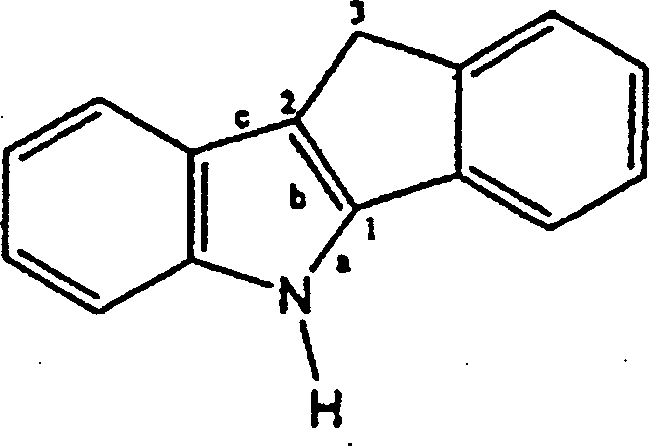
Geeignete Ringsysteme umfassen auch solche, bei denen der Indol-Stickstoff und der sp3-hybridisierte Kohlenstoff des Indens zueinander beta sind, d. h. an der gleichen Seite des Moleküls angeordnet sind. Dies ist ein Indeno[2,1-b]indol-Ringsystem:Suitable ring systems also include those in which the indole nitrogen and the sp 3 -hybridized carbon of the indene are beta to each other, that are arranged on the same side of the molecule. This is an indeno [2,1-b] indole ring system:

Die Ringatome können unsubstituiert oder mit einer oder mehreren Gruppen wie der Alkyl-, Aryl-, Aralkyl-, Halogen-, Silyl-, Nitro-, Dialkylamino-, Diarylamino-, Alkoxy-, Aryloxy-, Thioether- oder ähnlichen Gruppen substituiert sein. Zusätzliche anellierte Ringe können vorhanden sein, so lange ein Indenoindol-Anteil vorhanden ist. Wenn das Indenoindol zur Herstellung eines dianionischen Liganden verwendet wird, muss es sowohl einen unsubstituierten Stickstoff aufweisen (d. h. ein an Stickstoff gebundenes Wasserstoffatom haben) als auch wenigstens ein Wasserstoffatom an dem Indenyl-Methylen-Kohlenstoff aufweisen.The Ring atoms can unsubstituted or with one or more groups such as the alkyl, Aryl, aralkyl, halogen, silyl, nitro, dialkylamino, diarylamino, Substituted alkoxy, aryloxy, thioether or similar groups be. additional fused rings can be present as long as an indenoindole component is present. If the indenoindole used to prepare a dianionic ligand it must have both an unsubstituted nitrogen (i.e., have a hydrogen atom attached to nitrogen) as well at least one hydrogen atom on the indenyl-methylene-carbon exhibit.
Die
Nummerierung der Indenoindole folgt der IUPAC-Regel A-22. Das Molekül ist wie
unten gezeigt orientiert, und die Nummerierung erfolgt im Uhrzeigersinn
begin nend mit dem Ring ganz oben rechts in der Struktur, so, dass
das Heteroatom die kleinstmögliche
Zahl erhält.
So wird 5,10-Dihydroindeno[1,2-b]indol wie folgt nummeriert: 

Zur korrekten Nomenklatur und Nummerierung dieser Ringsysteme s. Ring Systems Handbook (1998), eine Veröffentlichung der Chemical Abstracts Service, Ringsysteme Dokument II: RF 33986 – RF 66391 bei RF 58952. (Es ist zu beachten, dass Indenoindole in der parallelen anhängigen Anmeldung 09/417,510 falsch nummeriert sind; eine korrektere Nummerierung findet sich in der PCT-Anmeldung WO 99/24446.) Geeignete Indenoindolverbindungen, die Vorläufer zu Indenoindolyl-Dianionen und deren Syntheseäquivalenten sind, umfassen z. B. 5,10-Dihydroindeno[1,2-b]indol, 5,6-Dihydroindeno[2,1-b]indol, 4,7-Dimethyl-5,10-Dihydroindeno[1,2-b]indol, 4-tert-Butyl-8-Methyl-5,10-Dihydroindeno[1,2-b]indol, 4,8-Dichloro-5,10-Dihydroindeno[1,2-b]indol, 2,7-Dimethyl-5,6-Dihydroindeno[2,1-b]indol und Ähnliches.to correct nomenclature and numbering of these ring systems s. ring Systems Handbook (1998), a publication of the Chemical Abstracts Service, ring systems Document II: RF 33986 - RF 66391 bei RF 58952. (Es It should be noted that indenoindoles are described in co-pending application 09 / 417,510 are numbered incorrectly; a more correct numbering can be found in PCT application WO 99/24446.) Suitable indenoindole compounds, the precursors to indenoindolyl dianions and their synthetic equivalents z. 5,10-dihydroindeno [1,2-b] indole, 5,6-dihydroindeno [2,1-b] indole, 4,7-dimethyl-5,10-dihydroindeno [1,2-b] indole, 4-tert-butyl-8-methyl-5,10-dihydroindeno [1,2-b] indole, 4,8-dichloro-5,10-dihydroindeno [1,2-b] indole, 2,7-dimethyl-5,6-dihydroindeno [2,1-b] indole and the like.
Verfahren zur Herstellung von Indenoindolverbindungen sind bekannt. Geeignete Verfahren sind beispielsweise in der parallelen anhängigen Anmeldung 09/417,510 und den darin zitierten Quellen offenbart, einschließlich des Verfahrens von Buu-Hoi und Xuong, J. Chem. Soc. (1952) 2225. Geeignete Verfahren sind auch in der PCT-Anmeldung WO 99/24446 genannt.method for the preparation of indenoindole compounds are known. suitable Methods are, for example, in the co-pending application 09 / 417,510 and the references cited therein, including the Method of Buu-Hoi and Xuong, J. Chem. Soc. (1952) 2225. Suitable Procedures are also in the PCT application Called WO 99/24446.
Indenoindolyl-Dianionen können erzeugt werden, indem eine Indenoindolverbindung mit zwei Äquivalenten einer stark wirksamen Base deprotoniert wird. Geeignete Basen umfassen Alkalimetalle (z. B. Natrium oder Kalium), Alkalimetallhydride (Natriumhydrid, Lithiumhydrid), Alkalimetall-Aluminium-Hydride (Lithium-Aluminium-Hydrid), Alkalimetallalkyle (n-Butyllithium), Grignard-Reagenzien (Methylmagnesiumbromid, Phenylmagnesiumchlorid) etc. Der Deprotonierungsschritt wird normalerweise bei oder unterhalb Raumtemperatur durchgeführt, vorzugsweise etwa bei Raumtemperatur, indem die Indenoindolverbindung und das Deprotonierungs-Agens üblicherweise bei Vorhandensein von einem oder mehreren trockenen organischen Lösungsmitteln, speziell Äthern und/oder Kohlenwasserstoffen, kombiniert werden.Indenoindolyl dianions can be generated by deprotonating an indenoindole compound with two equivalents of a potent base. Suitable bases include alkali metals (e.g., sodium or potassium), alkali metal hydrides (sodium hydride, lithium hydride), alkali metal aluminum hydrides (lithium aluminum hydride), alkali metal alkyls (n-butyllithium), Grignard reagents (methyl magnesium bromide, phenylmagnesium chloride), etc The deprotonation step will normally be at or below room temperature carried out, preferably at about room temperature, by combining the indenoindole compound and the deprotonating agent usually in the presence of one or more dry organic solvents, especially ethers and / or hydrocarbons.
Geeignete Verfahren zum Erzeugen von dianionischen Indenoindolyl-Liganden (und ihren Syntheseäquivalenten wie Trimethylsilyl-substituierten Indenoindolen) werden auch von T. Abraham et al. in Monatsh. Chem. 120 (1989) 117 und Tetrahedron 38 (1982) 1019 offenbart. Bei einem typischen Verfahren werden zwei Äquivalente von n-Buthyllithium langsam zu einer eisgekühlten Lösung des Indenoindols in trockenem Tetrahydrofuoran hinzugefügt, so dass eine blutrote Lösung des Dianions erzeugt wird.suitable Process for producing dianionic indenoindolyl ligands (and their synthesis equivalents such as trimethylsilyl-substituted indenoindoles) are also of T. Abraham et al. in month Chem. 120 (1989) 117 and Tetrahedron 38 (1982) 1019. In a typical procedure, two equivalents from n-butyllithium slowly to an iced solution of indenoindole in dry Added tetrahydrofuran, making a blood red solution of the Dianion is generated.
Das erste Basenäquivalent deprotoniert das Stickstoffatom und erzeugt ein Sigma-Elektron-Donorzentrum bei StickstoffThe first base equivalent deprotonates the nitrogen atom and creates a sigma electron donor center at nitrogen

Durch weitere Deprotonierung wird das cyclopentadienylartige Proton entfernt, so dass ein Dianion erzeugt wird, das als Sigma- und Pi-Elektronendonor wirkt:By further deprotonation removes the cyclopentadienyl-like proton, so that a dianion is generated, as a sigma and pi electron donor acts:

Die Reaktion des Dianions mit Übergangsmetallquellen gibt einen Komplex, der normalerweise einen oder mehrere dianionische Indenoindolyl-Liganden enthält, die an das Übergangs- oder Lanthanidmetall π- und/oder σ-gebunden sind.The Reaction of dianion with transition metal sources There is a complex, usually one or more dianionic Contains indenoindolyl ligands, to the transitional or lanthanide metal π- and / or σ-bonded are.
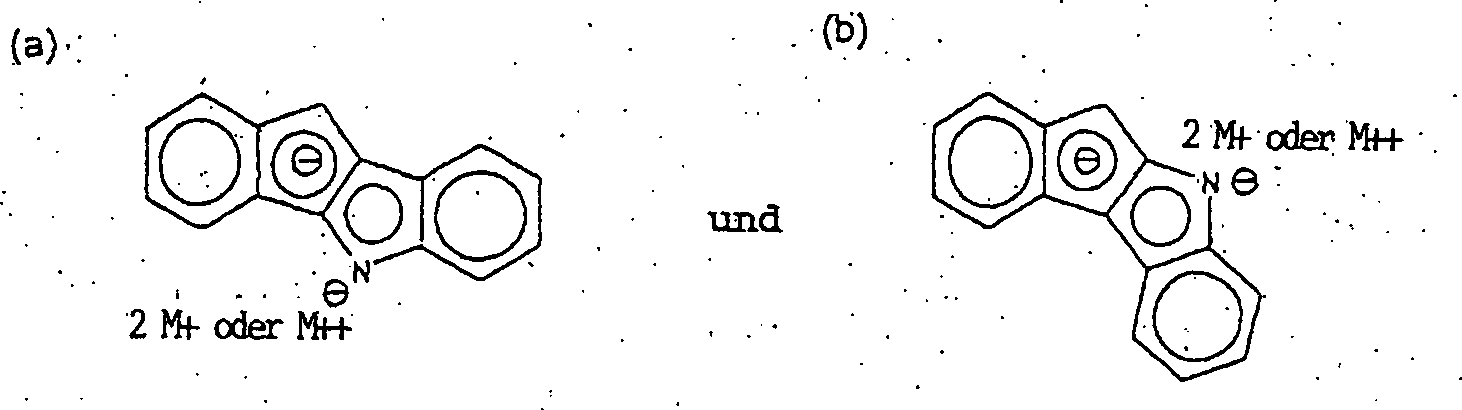
Das
Indenoindolyl-Dianion hat vorzugsweise eine Struktur, die ausgewählt ist
aus: 
Bei der Erfindung können Syntheseäquivalente von Indenoindolyl-Dianionen verwendet werden, um die organometallischen Komplexe herzustellen. Mit „Syntheseäquivalent" eines Indenoindolyl-Dianions ist ein „maskiertes" Dianion gemeint. Während es kein Indenoindolyl-Dianion per se ist, hat das Syntheseäquivalent die Fähigkeit, ein solches zu liefern, wenn es mit einer Übergangsmetallquelle reagiert wird (wie Zirconium-Tetrachlorid oder Cyclopentadienyltitan-Trichlorid). Eine allgemeine Diskussion von Syntheseäquivalenten findet sich in F. A. Carey und R. J. Sundberg, Advanced Organic Chemistry, Teil B (1977), S. 418–419.at of the invention synthetic equivalents used by indenoindolyl dianions to the organometallic To produce complexes. With "synthetic equivalent" of an indenoindolyl dianion is meant a "masked" Dianion. While if it is not indenoindolyl dianion per se, the synthetic equivalent has the Ability, to provide such when reacting with a transition metal source (such as zirconium tetrachloride or cyclopentadienyl titanium trichloride). A general discussion of synthetic equivalents can be found in F.A. Carey and R.J. Sundberg, Advanced Organic Chemistry, Part B (1977), pp. 418-419.
Geeignete Syntheseäquivalente ersetzen einen oder zwei saure Wasserstoffe aus einer Indenoindolverbindung durch eine Organosilizium-, Organozinn- oder Organogermaniumgruppe. Beispiele (a)–(f) unten illustrieren verschiedene Syntheseäquivalente von Indenoindolyl-Dianionen.suitable synthetic equivalents replace one or two acidic hydrogens from an indenoindole compound by an organosilicon, organotin or organogermanium group. Examples (a) - (f) below illustrate various synthetic equivalents of indenoindolyl dianions.

Bei den oben stehenden Strukturen ist M ein Alkalimetall, und R und R' werden jeweils unabhängig aus der Gruppe ausgewählt, die aus Organozinn, Organosilizium und Organogermanium besteht. Daher können geeignete Syntheseäquivalente der Dianionen neutrale Verbindungen sein, die zwei Organozinn-, Organosilizium- oder Organogermaniumgruppen enthalten; sie können auch monoanionische Verbindungen sein, die eine einzige Organozinn-, Organosilizium- oder Organogermaniumgruppe aufweisen.at In the above structures, M is an alkali metal, and R and R 'are each independent from the group selected, which consists of organotin, organosilicon and organogermanium. Therefore, you can suitable synthesis equivalents the dianions are neutral compounds containing two organotin, Containing organosilicon or organogermanium groups; You can also monoanionic compounds containing a single organotin, Organosilicon or organogermanium group have.
Wenn diese Syntheseäquivalente mit geeigneten Übergangsmetallquellen reagieren, geben sie leicht den gewünschten Indenoindolylmetallkomplex und ein leicht zu entfernendes Nebenprodukt wie tri-n-Butylzinn-Chlorid, Dimethylamino(trimethylzinn) oder N,N-Dimethyltrimethylsilylamin. Die Reaktion des Syntheseäquivalents (X) unten mit einem Äquivalent von Tetrakis(dimethylamino)zirconium dient als Illustration:If these synthetic equivalents with suitable transition metal sources react, easily give the desired indenoindolyl metal complex and an easily removed by-product such as tri-n-butyltin chloride, Dimethylamino (trimethyltin) or N, N-dimethyltrimethylsilylamine. The reaction of the synthetic equivalent (X) below with one equivalent of tetrakis (dimethylamino) zirconium serves as illustration:

Die Syntheseäquivalente können durch verschiedene Techniken hergestellt werden. Einige davon werden von Abraham et al. beschreiben (s. insbesondere Schema 3 in Monatsh. Chemie 120 auf S. 122). Üblicherweise wird ein schrittweiser Ansatz angewandt.The synthetic equivalents can produced by various techniques. Some of them will by Abraham et al. describe (see in particular Scheme 3 in Monatsh. Chemistry 120 on p. 122). Usually a step-by-step approach is used.
Bei einem geeigneten Verfahren wird ein Indenoindolyl-N-zentriertes Monoanion erzeugt und mit Chlorotrimethylsilan reagiert. (Fakultativ wird die Mischung mit Wasser abgeschreckt und das N-silylierte Produkt wird isoliert.) Die Reaktion mit einem zweiten Basenäquivalent, typischerweise n-Butyllithium o. Ä., gefolgt von der Reaktion mit einem weiteren Äquivalent von Chlorotrimethylsilan gibt das gewünschte disilylierte Produkt, das ein Dianion-Syntheseäquivalent ist:at a suitable method is an indenoindolyl N-centered Monoanion generated and reacted with chlorotrimethylsilane. (Optional the mixture is quenched with water and the N-silylated product is isolated.) Reaction with a second base equivalent, typically n-butyllithium o. Ä., followed by reaction with another equivalent of chlorotrimethylsilane gives the desired disilylated product that is a dianion synthetic equivalent:

Bei einem anderen geeigneten Verfahren wird zuerst ein Dianion erzeugt, z. B. mit zwei Äquivalenten von n-Butyllithium. Die Reaktion mit einem Äquivalent von Chlorotrimethylsilan maskiert das reaktionsfähigere Cyclopentadienyl-Anion. (Wieder wird die Mischung fakultativ mit Wasser abgeschreckt, um das C-silylierte Produkt zu iso lieren.) Die Reaktion mit einem zweiten Äquivalent von Chlorotrimethylsilan gibt das gleiche Dianion-Syntheseäquivalent:at another suitable method, a dianion is first generated, z. With two equivalents of n-butyl lithium. The reaction with one equivalent of chlorotrimethylsilane masks the more reactive cyclopentadienyl anion. (Again the mixture is optionally quenched with water to isolate the C-silylated product.) Reaction with a second equivalent of chlorotrimethylsilane gives the same dianion synthesis equivalent:

Ähnliche Strategien können verwendet werden, die Organozinn, Organosilizium oder Organogermaniumgruppen an einem oder beiden Orten an dem Indenoindolyl-Liganden umfassen. Bei der Herstellung der Syntheseäquivalente werden bekannte Verfahren zum Umwandeln von sauren N-H oder C-H-Bindungen, üblicherweise in zwei Schritten (Deprotonierung und nukleophile Verdrängung) in organosilizium-, organozinn- oder organogermanium-substituiertem Stickstoff oder Kohlenstoff genutzt.Similar Strategies can used are the organotin, organosilicon or organogermanium groups at one or both locations on the indenoindolyl ligand. In the preparation of the synthetic equivalents are known methods for converting acidic N-H or C-H bonds, usually in two steps (deprotonation and nucleophilic displacement) in organosilicon, organotin or organogermanium substituted Used nitrogen or carbon.
Erfindungsgemäße organometallische Komplexe sind Reaktionsprodukte einer Übergangs- oder Lanthanidmetallverbindung der Gruppe 3–10 und eines dianionischen Indenoindolyl-Liganden oder seines Syntheseäquivalents. Die Übergargs- oder Lanthanidmetallverbindung der Gruppe 3–10 umfasst üblicherweise zwei oder mehr labile anionische oder neutrale Liganden, die durch eine oder mehrere Indenoindolylgruppen ersetzt werden können. Jede zweckmäßige Quelle des Übergangs- oder Lanthanidmetalls der Gruppe 3 bis 10 kann verwendet werden. Üblicherweise ist die Quelle ein Komplex, der einen oder mehrere labile Liganden enthält, die leicht durch das Indenoindolyl-Dianion oder das Syntheseäquivalent verdrängt werden. Beispiele sind Halogenide (z. B. TiCl4, ZrCl4), Alkoxide, Amide usw. Die Metallquelle kann einen oder mehrere der polymerisationsstabilen anionischen Liganden umfassen, die unten beschrieben sind.Organometallic complexes of the present invention are reaction products of a transition or lanthanide metal compound of Group 3-10 and a dianionic indenoindolyl ligand or its synthetic equivalent. The overgarg or lanthanide metal compound of group 3-10 usually comprises two or more labile anionic or neutral ligands which can be replaced by one or more indenoindolyl groups. Any convenient source of Group 3 to 10 transition or lanthanide metal may be used. Typically, the source is a complex containing one or more labile ligands that are readily displaced by the indenoindolyl dianion or the synthetic equivalent. Examples are halides (eg, TiCl 4 , ZrCl 4 ), alkoxides, amides, etc. The metal source may comprise one or more of the polymerization stable anionic ligands described below.
Eine vielfältige Auswahl von organometallischen Komplexen kann aus den Indenoindolyl-Dianionen und ihren Äquivalenten getroffen werden. Z. B. können monomere, dimere oder sogar polymere organometallische Komplexe hergestellt werden. Die Komplexe können mono-, bi- oder multimetallisch sein. Die Komplexe können in zwitterionischer Form bestehen und können Atome der Gruppe 13 wie Bor oder Aluminium umfassen.A diverse Selection of organometallic complexes can be made from the indenoindolyl dianions and their equivalents to be hit. For example, you can monomeric, dimeric or even polymeric organometallic complexes getting produced. The complexes can be mono-, bimetallic or multimetallic be. The complexes can exist in zwitterionic form and can atoms of group 13 as Boron or aluminum include.
Ein
bevorzugter Komplex hat folgende Struktur: 
Bevorzugte Pi-Donor-Liganden, L, umfassen Cyclopentadienyle, Indenyle, Fluorenyle, Azaborolinyle, Indolyle usw. Diese Liganden werden normalerweise als „polymerisationsstabil" beschrieben, weil sie während Olefin-Polymerisationen koordinativ an dem Übergangsmetall angelagert bleiben. Diese und andere geeignete Pi-Donor-Liganden sind in den US-Patenten 4,791,180 und 4,752,597 beschrieben.preferred Pi donor ligands, L, include cyclopentadienyls, indenyls, fluorenyls, Azaborolinyls, indolyls, etc. These ligands usually become described as "stable to polymerization", because during olefin polymerizations coordinatively on the transition metal stay attached. These and other suitable pi-donor ligands are in U.S. Patents 4,791,180 and 4,752,597.
Geeignete Sigma-Donor-Liganden, X, sind normalerweise labile Gruppen wie Halogenid-, Hydrid-, Alkyl-, Aryl-, Aralkyl-, Alkoxy-, Aryloxy-, Dialkylamino-, Siloxy-Gruppen usw. Halogenide sind bevorzugt.suitable Sigma donor ligands, X, are usually labile groups such as halide, Hydride, alkyl, aryl, aralkyl, alkoxy, aryloxy, dialkylamino, Siloxy groups, etc. Halides are preferred.
Der
organometallische Komplex kann im Wesentlichen ein Dimer sein, das
zwei Übergangsmetallatome
und zwei Indenoindolyl-Liganden umfasst. Solche Katalysatoren werden
zweckmäßigerweise
hergestellt, indem ein Äquivalent
eines dianionischen Liganden oder sein Äquivalent mit einem Äquivalent
des Übergangsmetallkomplexes reagiert
wird. Bevorzugte Komplexe dieser Art haben eine Struktur, die ausgewählt wird
aus: 
Wenn
die Dimerkomplexe wie oben beschrieben hergestellt werden, können polymere
Komplexe einen kleineren oder größeren Teil
des Reaktionsprodukts ausmachen. Durch Änderung der Reaktionsbedingungen
kann der Fachmann den Anteil des herzustellenden Dimers gegenüber dem
Polymerkomplex ändern. Ein
bevorzugter Polymerkomplex hat folgende Struktur: 
Zusätzliche
erfindungsgemäße organometallische
Komplexe umfassen das Reaktionsprodukt einer Übergangs- oder Lanthanidmetallverbindung
der Gruppe 3–10,
eine Verbindung der Gruppe 13 und einen dianionischen Indenoindolyl-Liganden
oder dessen Äquivalent.
Ein bevorzugter Komplex dieser Art, der eine Indenoindolyl-Gruppe
aufweist, hat eine Struktur, die ausgewählt ist aus: 
Geeignete Verbindungen der Gruppe 13 sind bekannt. Sie haben bevorzugt die Formel BX3 oder AIX3, wobei jedes X unabhängig einen labilen Sigma-Donor-Liganden wie Halogenid, Hydrid, Alkyl, Aryl, Aralkyl, Alkoxy, Aryloxy, Dialkylamino, Siloxy usw. darstellt. Halogenide und Alkyle sind bevorzugt. Typische Beispiele sind Chlorodimethylboran, Chlorodiphenylboran, Diethylaluminiumchlorid, Triethylaluminium, Ethylaluminiumdichlorid usw.Suitable compounds of group 13 are known. They preferably have the formula BX 3 or AIX 3 , wherein each X independently represents a labile sigma donor ligand such as halide, hydride, alkyl, aryl, aralkyl, alkoxy, aryloxy, dialkylamino, siloxy, etc. Halides and alkyls are preferred. Typical examples are chlorodimethylborane, chlorodiphenylborane, diethylaluminum chloride, triethylaluminum, ethylaluminum dichloride, etc.
Komplexe,
die zwei Indenoindolylgruppen, ein Element der Gruppe 13 und ein
Element der Gruppe 3–10
(bevorzugt Gruppe 4) enthalten, können ebenfalls hergestellt
werden. Bevorzugte Komplexe in dieser Kategorie haben eine Struktur,
die ausgewählt
ist aus: 
Zusätzliche
Komplexe umfassen ein Übergangs-
oder Lanthanidmetall der Gruppe 3–10, zwei Atome der Gruppe
13 und zwei dianionische Indenoindolyl-Liganden. Bevorzugte Komplexe
in dieser Kategorie haben eine Struktur, die ausgewählt ist
aus: 
Durch
Einstellen der Reaktionsbedingungen und der Proportionen der Reaktanden
können
auch polymere Komplexe hergestellt werden. Bevorzugte polymere Komplexe
dieser Art haben eine Struktur, die ausgewählt ist aus: 
Erfindungsgemäße Katalysatorsysteme umfassen den organometallischen Komplex und einen Aktivator. Geeignete Aktivatoren ionisieren den organometallischen Komplex, um einen aktiven Olefin-Polymerisations-Katalysator zu erzeugen. Geeignete Aktivatoren sind im Stand der Technik bekannt. Beispiele umfassen Alkylalumoxane (Methylalumoxan (MAO), PMAO, Ethylalumoxan, Diisobutylalumoxan), Alkylaluminiumverbindungen (Triethylaluminium, Diethylaluminiumchlorid, Trimethylaluminium, Triisobutylaluminium) usw. Geeignete Aktivatoren umfassen saure Salze, die nicht nukleophile Anionen enthalten. Diese Verbindungen bestehen allgemein aus sperrigen Liganden, die an Bor oder Aluminium gebunden sind. Beispiele umfassen Lithiumtetrakis(pentafluorphenyl)borat, Lithiumtetrakis(pentafluorphenyl)aluminat, Anilintetrakis(pentafluorphenyl)borat usw. Geeignete Aktivatoren umfassen auch Organoborane, die Bor und eine oder mehrere Alkyl- Aryl- oder Aralkylgruppen umfassen. Geeignete Aktivatoren umfassen substituierte und unsubstituierte Trialkyl- und Triarylborane wie Tris(pentafluorphenyl)boran, Triphenylboran, Tri-n-Octylboran usw. Diese und andere geeignete borhaltige Aktivatoren sind in den US-Patenten 5,153,157, 5,198,401 und 5,241,025 beschrieben. Alkylalumoxane wie MAO sind am stärksten bevorzugt.Inventive catalyst systems include the organometallic complex and an activator. suitable Activators ionize the organometallic complex to form a to produce active olefin polymerization catalyst. suitable Activators are known in the art. Examples include alkylalumoxanes (Methylalumoxane (MAO), PMAO, ethylalumoxane, diisobutylalumoxane), Alkylaluminum compounds (triethylaluminum, diethylaluminum chloride, Trimethylaluminum, triisobutylaluminum), etc. Suitable activators include acidic salts containing non-nucleophilic anions. These Compounds generally consist of bulky ligands attached to boron or aluminum are bonded. Examples include lithium tetrakis (pentafluorophenyl) borate, Lithium tetrakis (pentafluorophenyl) aluminate, anilinetetrakis (pentafluorophenyl) borate etc. Suitable activators also include organoboranes, boron and include one or more alkyl, aryl or aralkyl groups. suitable Activators include substituted and unsubstituted trialkyl and triarylboranes such as tris (pentafluorophenyl) borane, triphenylborane, Tri-n-octylborane, etc. These and other suitable boron-containing activators are described in U.S. Patents 5,153,157, 5,198,401 and 5,241,025. Alklyalumoxanes like MAO are strongest prefers.
Die Menge an Aktivator, die im Verhältnis zur Menge des organometallischen Komplexes benötigt wird, hängt von vielen Faktoren ab, einschließlich der Art des Komplexes und des Aktivators, der gewünschten Reaktionsrate, der Art des Polyolefinprodukts, den Reaktionsbedingungen und anderen Faktoren. Wenn der Aktivator eine Alkylalumoxan- oder eine Alkylaluminiumverbindung ist, liegt die verwendete Menge im Allgemeinen jedoch innerhalb des Bereichs von ungefähr 0,01 bis ungefähr 5.000 mol, bevorzugt von ungefähr 0,1 bis ungefähr 500 mol Aluminium pro Mol Übergangsmetall. Wenn der Aktivator ein Organoboran oder ein ionisches Borat oder Aluminat ist, liegt die verwendete Menge im Bereich von ungefähr 0,01 bis ungefähr 5.000 mol, bevorzugt von ungefähr 0,1 bis ungefähr 500 mol Aktivator pro Mol Übergangsmetall.The Amount of activator in the ratio depends on the amount of organometallic complex needed many factors, including the type of complex and the activator, the desired reaction rate, the nature of the polyolefin product, the reaction conditions and others Factors. When the activator is an alkylalumoxane or an alkylaluminum compound However, the amount used is generally within of the area of about 0.01 to about 5,000 mol, preferably about 0.1 to about 500 moles of aluminum per mole of transition metal. If the activator is an organoborane or an ionic borate or Aluminate, the amount used is in the range of about 0.01 until about 5,000 mol, preferably about 0.1 to about 500 mol activator per mole of transition metal.
Falls gewünscht, kann ein Katalysatorträger wie Siliziumdioxid oder Aluminiumoxid verwendet werden. Die Verwendung eines Trägers ist jedoch im Allgemeinen für die Durchführung des erfindungsgemäßen Verfahrens nicht nötig.If desired can be a catalyst carrier such as silica or alumina can be used. The usage a carrier however, is generally for the implementation the method according to the invention not necessary.
Die Katalysatoren sind besonders wertvoll für die Polymerisierung von Olefinen. Bevorzugte Olefine sind Ethylen und C3-C20 α-Olefine wie Propylen, 1-Buten, 1-Hexen, 1-Okten usw. Mischungen von Olefinen können verwendet werden. Ethylen und Mischungen von Ethylen mit C3-C10 α-Olefinen sind besonders bevorzugt.The catalysts are particularly valuable for the polymerization of olefins. Preferred olefins are ethylene and C 3 -C 20 α-olefins such as propylene, 1-butene, 1-hexene, 1-octene, etc. Mixtures of olefins can be used. Ethylene and mixtures of ethylene with C 3 -C 10 α-olefins are particularly preferred.
Viele Arten von Olefin-Polymerisationsverfahren können verwendet werden. Vorzugsweise wird das Verfahren in der flüssigen Phase durchgeführt, die Trübe, Lösung, Suspension oder Massenverfahren oder eine Kombination daraus umfassen kann. Hochdruck-Fluidphasen- oder Gasphasentechniken können ebenfalls verwendet werden. Das erfindungsgemäße Verfahren ist besonders wertvoll für Lösungs- und Trübenverfahren.Lots Types of olefin polymerization methods can be used. Preferably the process is in the liquid Phase performed, the cloudy, Solution, Suspension or bulk process or a combination thereof can. High pressure fluid phase or gas phase techniques may also be used be used. The process according to the invention is particular valuable for solvent and turbid methods.
Die Olefin-Polymerisationen können in einem breiten Temperaturbereich durchgeführt werden, z. B. von ungefähr –30°C bis ungefähr 280°C. Ein stärker bevorzugter Bereich liegt zwischen ungefähr 30°C bis ungefähr 180°C; am stärksten bevorzugt ist der Bereich von ungefähr 60°C bis ungefähr 100°C. Olefin-Partialdrücke liegen normalerweise im Bereich von ungefähr 15 psia bis ungefähr 50.000 psia. Stärker bevorzugt ist der Bereich von ungefähr 15 psia bis ungefähr 1.000 psia.The Olefin polymerizations can be carried out in a wide temperature range, for. From about -30 ° C to about 280 ° C. A more preferred Range is between about 30 ° C to approximately 180 ° C; at the most preferably, the range is from about 60 ° C to about 100 ° C. Olefin partial pressures are normally in the range of about 15 psia to about 50,000 psia. Stronger preferably, the range is from about 15 psia to about 1,000 psia.
Katalysatorkonzentrationen, die für die Olefin-Polymerisierung verwendet werden, hängen von vielen Faktoren ab. Vorzugsweise liegt jedoch die Konzentration zwischen ungefähr 0,01 Mikromol pro Liter und ungefähr 100 Mikromol pro Liter. Polymerisationszeiten hängen von der Art des Verfahrens, der Katalysatorkonzentration und anderen Faktoren ab. Allgemein sind Polymerisationen nach mehreren Sekunden bis zu mehreren Stunden abgeschlossen.Catalyst concentrations used for olefin polymerization depend on many Factors off. Preferably, however, the concentration is between about 0.01 micromoles per liter and about 100 micromoles per liter. Polymerization times depend on the type of process, the catalyst concentration and other factors. Generally, polymerizations are completed after several seconds to several hours.
Die unten stehenden Beispiele stellen die Herstellung eines Indenonindolyl-Dianions, seine Aufnahme in einen bimetallischen Metallkomplex der Gruppe 4 und die Verwendung eines Katalysatorsystems dar, das den Komplex für die Polymerisierung von Ethylen umfasst. Wie die Beispiele zeigen, sind die Katalysatoren leicht herzustellen und haben eine gute Aktivität.The Examples below illustrate the preparation of an indenonol dianyl dianion, its inclusion in a bimetallic metal complex of the group 4 and the use of a catalyst system containing the complex for the Polymerization of ethylene includes. As the examples show are the catalysts are easy to prepare and have a good activity.
Die folgenden Beispiele dienen nur der Illustration der Erfindung. Der Fachmann wird viele Abwandlungen erkennen, die innerhalb des Erfindungsgedankens und innerhalb des Schutzbereichs der Patentansprüche liegen.The The following examples serve only to illustrate the invention. Of the One skilled in the art will recognize many variations that are within the spirit of the invention and within the scope of the claims.
Herstellung eines Liganden-VorläufersPreparation of a ligand precursor
8-Methyl-5,10-Dihydroindeno[1,2-b]indol (I), der Ligandenvorläufer des Katalysators, der in Beispiel A hergestellt wird, wird durch das Verfahren von Buu-Hoi und Xuong (J. Chem. Soc. (1952) 2225) hergestellt, indem p-Tolylhydrazin mit 1-Indanon bei Vorhandensein von Natriumacetat/-ethanol reagiert wird:8-methyl-5,10-dihydroindeno [1,2-b] indole (I), the ligand precursor of the catalyst prepared in Example A is carried through the method of Buu-Hoi and Xuong (J.Chem.Soc. (1952) 2225) prepared by adding p-tolylhydrazine with 1-indanone in the presence of sodium acetate / ethanol is reacted:

BEISPIEL AEXAMPLE A
Herstellung eines bimetallischen Katalysators aus einem Indenoindolyl-DianionProducing a bimetallic Catalyst from an indenoindolyl dianion
8-Methyl-5,10-Dihydroindenol[1,2-b]indol (I) (0,219 g, 1,00 mmol) wird in Tetrahydrofuran (THF) (25 ml) gelöst und wird unter Stickstoff gerührt. n-Butyllithium (1,0 ml von 2,0 m Lösung in Hexanen, 2,0 mmol) wird hinzugefügt, und die Mischung wird bei Raumtemperatur 30 min. lang gerührt. Die resultierende Dianion-Lösung (1,0 mmol) wird zu einer Lösung eines Zirconiumtetrachlorid-bis(tetrahydrofuran)-Komplexes (0,377 g, 1,0 mmol) in THF (20 ml) zugefügt. Die Verdampfung des Lösungsmittels gibt einen orangefarbenen Feststoff (0,582 g), vermutlich eine Mischung aus LiCl und dem gewünschten bimetallischen Komplex (II), und polymere Nebenprodukte.8-methyl-5,10-Dihydroindenol [1,2-b] indole (I) (0.219 g, 1.00 mmol) is dissolved in tetrahydrofuran (THF) (25 mL) and becomes stirred under nitrogen. n-Butyllithium (1.0 mL of 2.0 M solution in hexanes, 2.0 mmol) added and the mixture is stirred at room temperature for 30 min. stirred for a long time. The resulting dianion solution (1.0 mmol) becomes a solution of a zirconium tetrachloride bis (tetrahydrofuran) complex (0.377 g, 1.0 mmol) in THF (20 ml) added. The evaporation of the solvent gives an orange solid (0.582 g), probably a mixture from LiCl and the desired one bimetallic complex (II), and polymeric by-products.

BEISPIEL BEXAMPLE B
Ethylen-PolymerisationEthylene polymerization
Ein 1,7-l Rührreaktor aus nicht rostendem Stahl wird mit Stickstoff gespült, abgedichtet, und mit Wasserstoff beschickt (Δ 60 psi aus einem Zylinder mit V = 7,0 cm3). Triisobutylaluminium (1,18 ml einer 1,00 m-Lösung in Isobutan) wird in den Reaktor eingespritzt, gefolgt von 1-Buten (200 ml) und Isobutan (600 ml). Der Reaktor wird auf 70°C aufgeheizt und kann ein Gleichgewicht herstellen. Ethylen wird eingeführt, so dass in dem Reaktor ein Gesamtdruck von 350 psig entsteht, und der Reaktor kann erneut ein Gleichgewicht herstellen. Eine Lösung aus PMAO (1,2 ml von 2,22 m Lösung in Toluol), ein Teil des bimetallischen Komplexes (II) aus Beispiel A (4,0 mg, 0,0044 mmol) und Isobutan (200 ml) werden in den Reaktor eingespritzt, um die Polymerisation zu starten. Ethylen wird nach Bedarf zugeführt, um den Reaktordruck auf 350 psig zu halten. Nach 30 min. wird der Ethylenfluss angehalten und die Reaktionsmischung wird auf Raumtemperatur abgekühlt. Der Ertrag an Polyethylen (Schmelztemperatur 127°C) beträgt 11,4 g. Katalysatoraktivität: 5.700 g Polymer pro Gramm Zr pro Stunde.A 1.7-liter stirred tank reactor of stainless steel is purged with nitrogen, sealed, and charged with hydrogen (Δ 60 psi from a cylinder having V = 7.0 cm3). Triisobutylaluminum (1.18 ml of a 1.00 m solution in isobutane) is injected into the reactor, followed by 1-butene (200 ml) and isobutane (600 ml). The reactor is heated to 70 ° C and can establish equilibrium. Ethylene is introduced to produce a total pressure of 350 psig in the reactor and the reactor can re-equilibrate. A solution of PMAO (1.2 mL of 2.22 M solution in toluene), part of the bimetallic complex (II) of Example A (4.0 mg, 0.0044 mmol) and isobutane (200 mL) are added to the Reactor injected to the poly to start. Ethylene is supplied as needed to maintain the reactor pressure at 350 psig. After 30 min. the ethylene flow is stopped and the reaction mixture is cooled to room temperature. The yield of polyethylene (melting temperature 127 ° C) is 11.4 g. Catalyst activity: 5,700 g of polymer per gram of Zr per hour.
Die oben stehenden Beispiele sind nur als Illustrationen zu verstehen. Die folgenden Patentansprüche definieren die Erfindung.The The examples above are to be understood as illustrations only. Define the following claims The invention.
Claims (20)


Applications Claiming Priority (3)
| Application Number | Priority Date | Filing Date | Title |
|---|---|---|---|
| US826545 | 1986-02-06 | ||
| US09/826,545 US6414162B1 (en) | 2001-04-05 | 2001-04-05 | Bimetallic catalysts for olefin polymerization |
| PCT/US2002/003946 WO2002081529A2 (en) | 2001-04-05 | 2002-02-01 | Bimetallic catalysts for olefin polymerization |
Publications (2)
| Publication Number | Publication Date |
|---|---|
| DE60200947D1 DE60200947D1 (en) | 2004-09-16 |
| DE60200947T2 true DE60200947T2 (en) | 2005-09-15 |
Family
ID=25246838
Family Applications (1)
| Application Number | Title | Priority Date | Filing Date |
|---|---|---|---|
| DE60200947T Expired - Lifetime DE60200947T2 (en) | 2001-04-05 | 2002-02-01 | BIMETALIC CATALYSTS FOR OLEFIN POLYMERIZATION |
Country Status (10)
| Country | Link |
|---|---|
| US (1) | US6414162B1 (en) |
| EP (1) | EP1373282B1 (en) |
| AT (1) | ATE273317T1 (en) |
| AU (1) | AU2002242145A1 (en) |
| CA (1) | CA2442709A1 (en) |
| DE (1) | DE60200947T2 (en) |
| DK (1) | DK1373282T3 (en) |
| ES (1) | ES2225761T3 (en) |
| MX (1) | MXPA03008327A (en) |
| WO (1) | WO2002081529A2 (en) |
Families Citing this family (23)
| Publication number | Priority date | Publication date | Assignee | Title |
|---|---|---|---|---|
| US6544918B1 (en) * | 2001-07-17 | 2003-04-08 | Equistar Chemicals, Lp | Olefin polymerization catalysts containing chelating dianionic ligands |
| US6440889B1 (en) * | 2001-08-15 | 2002-08-27 | Equistar Chemicals, Lp | Amine elimination process for making single-site catalysts |
| US6908972B2 (en) * | 2002-04-16 | 2005-06-21 | Equistar Chemicals, Lp | Method for making polyolefins |
| US6841500B2 (en) * | 2002-12-03 | 2005-01-11 | Equistar Chemicals, Lp | Bimetallic indenoindolyl catalysts |
| US6812183B1 (en) * | 2003-04-23 | 2004-11-02 | Equistar Chemicals, Lp | Triple-decker catalysts based on delocalized dianionic ligands |
| US6861485B2 (en) * | 2003-06-20 | 2005-03-01 | Equistar Chemicals, Lp | Multi-catalyst system for olefin polymerization |
| US7741417B2 (en) * | 2004-01-07 | 2010-06-22 | Exxonmobil Chemical Patents Inc. | Preparation of polymerization catalyst activators utilizing indole-modified silica supports |
| US7220695B2 (en) * | 2004-01-07 | 2007-05-22 | Exxonmobil Chemical Patents Inc. | Supported activator |
| US20050228156A1 (en) * | 2004-04-07 | 2005-10-13 | Holland Charles S | Preparation of polyethylene films |
| KR100677869B1 (en) * | 2004-07-01 | 2007-02-02 | 대림산업 주식회사 | Multinuclear Metal Compounds, Catalyst Systems Comprising the Same, and Polymerization Methods of Olefins Using the Same |
| US8022005B2 (en) | 2007-11-08 | 2011-09-20 | Exxonmobil Chemical Patents Inc. | Halogen substituted heterocyclic heteroatom containing ligands-alumoxane activation of metallocenes |
| US9321854B2 (en) | 2013-10-29 | 2016-04-26 | Exxonmobil Chemical Patents Inc. | Aluminum alkyl with C5 cyclic and pendent olefin polymerization catalyst |
| US10351647B2 (en) | 2015-05-29 | 2019-07-16 | Exxonmobil Chemical Patents Inc. | Polymerization process using bridged metallocene compounds supported on organoaluminum treated layered silicate supports |
| US11041029B2 (en) | 2015-08-31 | 2021-06-22 | Exxonmobil Chemical Patents Inc. | Aluminum alkyls with pendant olefins for polyolefin reactions |
| EP3344385A4 (en) | 2015-08-31 | 2019-08-14 | ExxonMobil Chemical Patents Inc. | Aluminum alkyls with pendant olefins on clays |
| US10618988B2 (en) | 2015-08-31 | 2020-04-14 | Exxonmobil Chemical Patents Inc. | Branched propylene polymers produced via use of vinyl transfer agents and processes for production thereof |
| US10059788B2 (en) | 2016-04-29 | 2018-08-28 | Exxonmobil Chemical Patents Inc. | Organoaluminum activators on clays |
| US10562987B2 (en) | 2016-06-30 | 2020-02-18 | Exxonmobil Chemical Patents Inc. | Polymers produced via use of quinolinyldiamido transition metal complexes and vinyl transfer agents |
| US10626200B2 (en) | 2017-02-28 | 2020-04-21 | Exxonmobil Chemical Patents Inc. | Branched EPDM polymers produced via use of vinyl transfer agents and processes for production thereof |
| US10676551B2 (en) | 2017-03-01 | 2020-06-09 | Exxonmobil Chemical Patents Inc. | Branched ethylene copolymers produced via use of vinyl transfer agents and processes for production thereof |
| EP3642249B1 (en) * | 2017-06-20 | 2021-08-11 | Dow Global Technologies LLC | Biaryl phenoxy group iv transition metal catalysts for olefin polymerization |
| CN108218901B (en) * | 2018-02-08 | 2020-08-07 | 中国石油天然气股份有限公司 | A kind of indeno[1,2-b]indolyl rare earth metal complex and preparation method thereof |
| US11440979B2 (en) | 2018-02-19 | 2022-09-13 | Exxonmobil Chemical Patents Inc. | Catalysts, catalyst systems, and methods for using the same |
Family Cites Families (8)
| Publication number | Priority date | Publication date | Assignee | Title |
|---|---|---|---|---|
| US5198401A (en) | 1987-01-30 | 1993-03-30 | Exxon Chemical Patents Inc. | Ionic metallocene catalyst compositions |
| US5241025A (en) | 1987-01-30 | 1993-08-31 | Exxon Chemical Patents Inc. | Catalyst system of enhanced productivity |
| US5153157A (en) | 1987-01-30 | 1992-10-06 | Exxon Chemical Patents Inc. | Catalyst system of enhanced productivity |
| US5539124A (en) | 1994-12-19 | 1996-07-23 | Occidental Chemical Corporation | Polymerization catalysts based on transition metal complexes with ligands containing pyrrolyl ring |
| US5554775A (en) | 1995-01-17 | 1996-09-10 | Occidental Chemical Corporation | Borabenzene based olefin polymerization catalysts |
| ES2178704T3 (en) | 1995-04-25 | 2003-01-01 | Equistar Chem Lp | AZABOROLINILO MATAL COMPLEXES AS OLEFIN POLYMERIZATION CATALYSTS. |
| CA2277127A1 (en) | 1997-11-12 | 1999-05-20 | Montell Technology Company B.V. | Metallocenes and catalysts for olefin-polymerisation |
| US6232260B1 (en) | 1999-10-14 | 2001-05-15 | Equistar Chemicals, L.P. | Single-site catalysts for olefin polymerization |
-
2001
- 2001-04-05 US US09/826,545 patent/US6414162B1/en not_active Expired - Fee Related
-
2002
- 2002-02-01 WO PCT/US2002/003946 patent/WO2002081529A2/en not_active Ceased
- 2002-02-01 DK DK02707756T patent/DK1373282T3/en active
- 2002-02-01 DE DE60200947T patent/DE60200947T2/en not_active Expired - Lifetime
- 2002-02-01 EP EP02707756A patent/EP1373282B1/en not_active Expired - Lifetime
- 2002-02-01 MX MXPA03008327A patent/MXPA03008327A/en active IP Right Grant
- 2002-02-01 ES ES02707756T patent/ES2225761T3/en not_active Expired - Lifetime
- 2002-02-01 AT AT02707756T patent/ATE273317T1/en not_active IP Right Cessation
- 2002-02-01 CA CA002442709A patent/CA2442709A1/en not_active Abandoned
- 2002-02-01 AU AU2002242145A patent/AU2002242145A1/en not_active Abandoned
Also Published As
| Publication number | Publication date |
|---|---|
| WO2002081529A3 (en) | 2002-12-05 |
| MXPA03008327A (en) | 2003-12-11 |
| DK1373282T3 (en) | 2004-12-20 |
| US6414162B1 (en) | 2002-07-02 |
| DE60200947D1 (en) | 2004-09-16 |
| AU2002242145A1 (en) | 2002-10-21 |
| EP1373282B1 (en) | 2004-08-11 |
| ES2225761T3 (en) | 2005-03-16 |
| WO2002081529A2 (en) | 2002-10-17 |
| ATE273317T1 (en) | 2004-08-15 |
| EP1373282A2 (en) | 2004-01-02 |
| CA2442709A1 (en) | 2002-10-17 |
Similar Documents
| Publication | Publication Date | Title |
|---|---|---|
| DE60200947T2 (en) | BIMETALIC CATALYSTS FOR OLEFIN POLYMERIZATION | |
| DE69028057T2 (en) | Catalysts for the polymerization of olefins | |
| DE69518356T2 (en) | Metallocene with high ethylene selective activity | |
| DE69922548T2 (en) | BROKEN METAL OENCENE FOR OLEFIN COPOLYMERIZATION | |
| EP0816372B1 (en) | Transition metal compound | |
| DE69520450T2 (en) | Process for the preparation of polyolefins in the presence of catalyst systems and catalyst systems which contain azametallocenes | |
| DE69635719T2 (en) | Polymerization of α-olefins in the presence of transition metal catalysts based on bidentate ligands containing pyridine or quinoline | |
| DE69328996T2 (en) | Catalyst composition and process for making polyolefins | |
| DE60226010T2 (en) | MULTICOLORED METAL CELL CALCULATOR | |
| DE69329361T2 (en) | Organic transition metal compound with pi-bonded heterocyclic ligand and associated process for the polymerization of olefins | |
| EP1015463B1 (en) | Method for producing metallocenes | |
| DE69811221T2 (en) | METHOD FOR PRODUCING BRIDGED PHOSPHOL-CYCLOPENTADIENYL COMPOUNDS | |
| DE69712667T2 (en) | Unbridged substituted indenyl metallocenes | |
| DE69132836T2 (en) | METHOD FOR PRODUCING CRYSTALLINE POLY-ALPHA-OLEFINS WITH MONOCYCLOPENTADIENYL COMPLEX OF TRANSITIONAL METALS | |
| DE60201340T2 (en) | CATALYST CONTAINER FOR OLEFIN POLYMERIZATION AND CATALYST SYSTEM AND POLYMERIZATION METHOD USING SUCH A CATALYST SYSTEM | |
| EP1288219B1 (en) | Monocyclopentadienyl complexes of chromium, molybdenum or tungsten with a donor bridge | |
| DE69116157T3 (en) | SUPPORT CATALYST FOR OLEFIN POLYMERIZATION WITH MONOCYCLOPENTADIENYL COMPLEXES OF TRANSITIONAL METALS | |
| EP1290039B1 (en) | Catalyst system for carrying out olefin polymerization comprising a calcined hydrotalcite serving as a supporting material | |
| EP0582195B1 (en) | Process for the preparation of polymers using specific metallocenes | |
| DE69603604T2 (en) | BIMETAL CYCLE TRANSITION METAL CONTAINING CATALYST SYSTEMS | |
| EP1325926B1 (en) | Metallocenes | |
| DE69929064T2 (en) | POLYMERIZATION PROCEDURES USING IMPROVED LOCKERS LIGAND METALLOCENE CATALYSTS | |
| DE60205368T2 (en) | ACTIVATION OF "SINGLE SITE" POLYMERIZATION CATALYSTS BY (DIALKYL ALUMINO) BROROIC ACID ESTERS | |
| DE60202685T2 (en) | METHOD FOR THE PRODUCTION OF CATALYSTS FROM LATE TRANSITION METALS FOR OLEFIN POLYMERIZATION | |
| DE60011453T2 (en) | CATALYST COMPOSITIONS FOR THE POLYMERIZATION OF OLEFINS TO POLYMERS WITH A MULTIMODAL MOLECULAR WEIGHT DISTRIBUTION, METHOD FOR THE PRODUCTION AND USE OF THE CATALYST |
Legal Events
| Date | Code | Title | Description |
|---|---|---|---|
| 8364 | No opposition during term of opposition |