DE60132436T2 - RETINOLIC ACID RECEPTOR BETA-2 AND GENETHERAPY VECTORS FOR THE TREATMENT OF NEUROLOGICAL DISEASES - Google Patents
RETINOLIC ACID RECEPTOR BETA-2 AND GENETHERAPY VECTORS FOR THE TREATMENT OF NEUROLOGICAL DISEASES Download PDFInfo
- Publication number
- DE60132436T2 DE60132436T2 DE60132436T DE60132436T DE60132436T2 DE 60132436 T2 DE60132436 T2 DE 60132436T2 DE 60132436 T DE60132436 T DE 60132436T DE 60132436 T DE60132436 T DE 60132436T DE 60132436 T2 DE60132436 T2 DE 60132436T2
- Authority
- DE
- Germany
- Prior art keywords
- vector
- cells
- rarβ2
- cell
- expression
- Prior art date
- Legal status (The legal status is an assumption and is not a legal conclusion. Google has not performed a legal analysis and makes no representation as to the accuracy of the status listed.)
- Expired - Fee Related
Links
- 239000013598 vector Substances 0.000 title claims description 328
- 238000011282 treatment Methods 0.000 title claims description 40
- 208000037265 diseases, disorders, signs and symptoms Diseases 0.000 title description 43
- 201000010099 disease Diseases 0.000 title description 36
- 238000001415 gene therapy Methods 0.000 title description 14
- 239000002253 acid Substances 0.000 title description 4
- 230000000926 neurological effect Effects 0.000 title description 2
- 230000014511 neuron projection development Effects 0.000 claims abstract description 121
- 239000000556 agonist Substances 0.000 claims abstract description 74
- 239000003814 drug Substances 0.000 claims abstract description 13
- 210000004027 cell Anatomy 0.000 claims description 360
- 229930002330 retinoic acid Natural products 0.000 claims description 192
- SHGAZHPCJJPHSC-YCNIQYBTSA-N all-trans-retinoic acid Chemical compound OC(=O)\C=C(/C)\C=C\C=C(/C)\C=C\C1=C(C)CCCC1(C)C SHGAZHPCJJPHSC-YCNIQYBTSA-N 0.000 claims description 191
- 229960001727 tretinoin Drugs 0.000 claims description 189
- 108090000623 proteins and genes Proteins 0.000 claims description 173
- 238000000034 method Methods 0.000 claims description 116
- 241000713730 Equine infectious anemia virus Species 0.000 claims description 96
- 210000000278 spinal cord Anatomy 0.000 claims description 77
- 102000003702 retinoic acid receptors Human genes 0.000 claims description 55
- 108090000064 retinoic acid receptors Proteins 0.000 claims description 55
- 150000007523 nucleic acids Chemical group 0.000 claims description 51
- 239000002773 nucleotide Substances 0.000 claims description 50
- 125000003729 nucleotide group Chemical group 0.000 claims description 50
- 241000713666 Lentivirus Species 0.000 claims description 40
- 230000008929 regeneration Effects 0.000 claims description 40
- 238000011069 regeneration method Methods 0.000 claims description 40
- 230000001177 retroviral effect Effects 0.000 claims description 40
- 108091026890 Coding region Proteins 0.000 claims description 37
- 210000003169 central nervous system Anatomy 0.000 claims description 36
- 238000012217 deletion Methods 0.000 claims description 32
- 230000037430 deletion Effects 0.000 claims description 32
- 238000004519 manufacturing process Methods 0.000 claims description 31
- 230000001537 neural effect Effects 0.000 claims description 24
- 210000004962 mammalian cell Anatomy 0.000 claims description 23
- 238000000338 in vitro Methods 0.000 claims description 19
- 239000008194 pharmaceutical composition Substances 0.000 claims description 17
- 101710149951 Protein Tat Proteins 0.000 claims description 11
- 210000001428 peripheral nervous system Anatomy 0.000 claims description 10
- 208000012902 Nervous system disease Diseases 0.000 claims description 9
- 108091028043 Nucleic acid sequence Proteins 0.000 claims description 9
- 239000000546 pharmaceutical excipient Substances 0.000 claims description 8
- 108010027225 gag-pol Fusion Proteins Proteins 0.000 claims description 7
- 102100023933 Deoxyuridine 5'-triphosphate nucleotidohydrolase, mitochondrial Human genes 0.000 claims description 6
- 108010011219 dUTP pyrophosphatase Proteins 0.000 claims description 6
- 108700004026 gag Genes Proteins 0.000 claims description 6
- 101150098622 gag gene Proteins 0.000 claims description 6
- 230000002093 peripheral effect Effects 0.000 claims description 6
- 108700004027 tat Genes Proteins 0.000 claims description 6
- 101150098170 tat gene Proteins 0.000 claims description 5
- 241000713692 Equine lentivirus group Species 0.000 claims description 4
- 241000124008 Mammalia Species 0.000 claims description 3
- 230000002463 transducing effect Effects 0.000 claims description 3
- 239000003937 drug carrier Substances 0.000 claims description 2
- 238000002360 preparation method Methods 0.000 abstract description 25
- 108010079850 retinoic acid receptor beta Proteins 0.000 abstract 1
- 230000014509 gene expression Effects 0.000 description 211
- 108010025020 Nerve Growth Factor Proteins 0.000 description 170
- 210000002569 neuron Anatomy 0.000 description 154
- 102000015336 Nerve Growth Factor Human genes 0.000 description 143
- 229940053128 nerve growth factor Drugs 0.000 description 143
- 210000002241 neurite Anatomy 0.000 description 91
- 210000003594 spinal ganglia Anatomy 0.000 description 81
- 230000000694 effects Effects 0.000 description 62
- 239000000047 product Substances 0.000 description 58
- 108090000742 Neurotrophin 3 Proteins 0.000 description 53
- 102000004230 Neurotrophin 3 Human genes 0.000 description 50
- 229940032018 neurotrophin 3 Drugs 0.000 description 50
- 239000013612 plasmid Substances 0.000 description 49
- 102000004169 proteins and genes Human genes 0.000 description 47
- 108010038912 Retinoid X Receptors Proteins 0.000 description 45
- 102000034527 Retinoid X Receptors Human genes 0.000 description 45
- 102000005962 receptors Human genes 0.000 description 45
- 108020003175 receptors Proteins 0.000 description 45
- 102100033909 Retinoic acid receptor beta Human genes 0.000 description 44
- 210000001519 tissue Anatomy 0.000 description 44
- 230000001419 dependent effect Effects 0.000 description 43
- 102000039446 nucleic acids Human genes 0.000 description 40
- 108020004707 nucleic acids Proteins 0.000 description 40
- 235000018102 proteins Nutrition 0.000 description 39
- 238000003752 polymerase chain reaction Methods 0.000 description 37
- 238000001890 transfection Methods 0.000 description 37
- 229920002477 rna polymer Polymers 0.000 description 36
- 108091008761 retinoic acid receptors β Proteins 0.000 description 34
- 230000001105 regulatory effect Effects 0.000 description 32
- 239000013615 primer Substances 0.000 description 31
- 238000004806 packaging method and process Methods 0.000 description 30
- 102100033912 Retinoic acid receptor gamma Human genes 0.000 description 29
- 239000002245 particle Substances 0.000 description 29
- 108010029485 Protein Isoforms Proteins 0.000 description 28
- 102000001708 Protein Isoforms Human genes 0.000 description 28
- 230000002441 reversible effect Effects 0.000 description 28
- 241000699666 Mus <mouse, genus> Species 0.000 description 27
- 102000007072 Nerve Growth Factors Human genes 0.000 description 27
- 238000013518 transcription Methods 0.000 description 27
- 230000035897 transcription Effects 0.000 description 27
- 240000004808 Saccharomyces cerevisiae Species 0.000 description 26
- 241000700605 Viruses Species 0.000 description 26
- 108091008760 retinoic acid receptors γ Proteins 0.000 description 26
- 230000003612 virological effect Effects 0.000 description 26
- 108020004414 DNA Proteins 0.000 description 25
- 235000014680 Saccharomyces cerevisiae Nutrition 0.000 description 25
- 102000053602 DNA Human genes 0.000 description 24
- 102000004190 Enzymes Human genes 0.000 description 24
- 108090000790 Enzymes Proteins 0.000 description 24
- 238000003556 assay Methods 0.000 description 24
- 229940088598 enzyme Drugs 0.000 description 24
- 239000012634 fragment Substances 0.000 description 24
- 238000003757 reverse transcription PCR Methods 0.000 description 24
- 102100034349 Integrase Human genes 0.000 description 23
- 208000014674 injury Diseases 0.000 description 22
- 239000002609 medium Substances 0.000 description 22
- 108090000765 processed proteins & peptides Proteins 0.000 description 22
- 230000004044 response Effects 0.000 description 22
- 230000015572 biosynthetic process Effects 0.000 description 21
- 239000002299 complementary DNA Substances 0.000 description 20
- 239000003623 enhancer Substances 0.000 description 20
- 230000008569 process Effects 0.000 description 20
- 230000006378 damage Effects 0.000 description 19
- 102000004196 processed proteins & peptides Human genes 0.000 description 19
- 108010092799 RNA-directed DNA polymerase Proteins 0.000 description 18
- 102100023606 Retinoic acid receptor alpha Human genes 0.000 description 18
- 108010005774 beta-Galactosidase Proteins 0.000 description 18
- 208000015181 infectious disease Diseases 0.000 description 18
- 229920001184 polypeptide Polymers 0.000 description 18
- 238000010361 transduction Methods 0.000 description 18
- 230000026683 transduction Effects 0.000 description 18
- 241000282414 Homo sapiens Species 0.000 description 17
- 208000027418 Wounds and injury Diseases 0.000 description 17
- 230000006870 function Effects 0.000 description 17
- 239000007924 injection Substances 0.000 description 17
- 238000002347 injection Methods 0.000 description 17
- 108700026244 Open Reading Frames Proteins 0.000 description 16
- 150000001875 compounds Chemical class 0.000 description 16
- 238000001727 in vivo Methods 0.000 description 16
- 239000000203 mixture Substances 0.000 description 16
- 239000000523 sample Substances 0.000 description 16
- 239000013603 viral vector Substances 0.000 description 16
- 206010061218 Inflammation Diseases 0.000 description 15
- 239000003102 growth factor Substances 0.000 description 15
- 230000004054 inflammatory process Effects 0.000 description 15
- 230000001404 mediated effect Effects 0.000 description 15
- 108020004999 messenger RNA Proteins 0.000 description 15
- 108091008726 retinoic acid receptors α Proteins 0.000 description 15
- 238000011144 upstream manufacturing Methods 0.000 description 15
- 230000001965 increasing effect Effects 0.000 description 14
- 230000019491 signal transduction Effects 0.000 description 14
- 230000004083 survival effect Effects 0.000 description 14
- 238000003786 synthesis reaction Methods 0.000 description 14
- 239000003795 chemical substances by application Substances 0.000 description 13
- 238000012216 screening Methods 0.000 description 13
- 238000010186 staining Methods 0.000 description 13
- 102000004127 Cytokines Human genes 0.000 description 12
- 108090000695 Cytokines Proteins 0.000 description 12
- 101001132698 Homo sapiens Retinoic acid receptor beta Proteins 0.000 description 12
- 241000700159 Rattus Species 0.000 description 12
- 238000013459 approach Methods 0.000 description 12
- 230000001413 cellular effect Effects 0.000 description 12
- 230000000052 comparative effect Effects 0.000 description 12
- 238000011161 development Methods 0.000 description 12
- 230000018109 developmental process Effects 0.000 description 12
- 230000029087 digestion Effects 0.000 description 12
- 230000001939 inductive effect Effects 0.000 description 12
- 230000002757 inflammatory effect Effects 0.000 description 12
- 238000003780 insertion Methods 0.000 description 12
- 230000037431 insertion Effects 0.000 description 12
- 238000012360 testing method Methods 0.000 description 12
- 108020004705 Codon Proteins 0.000 description 11
- 241000196324 Embryophyta Species 0.000 description 11
- 241001183012 Modified Vaccinia Ankara virus Species 0.000 description 11
- 241000288906 Primates Species 0.000 description 11
- 230000027455 binding Effects 0.000 description 11
- 230000002950 deficient Effects 0.000 description 11
- 230000009466 transformation Effects 0.000 description 11
- 241001430294 unidentified retrovirus Species 0.000 description 11
- 241000699670 Mus sp. Species 0.000 description 10
- 206010037742 Rabies Diseases 0.000 description 10
- FPIPGXGPPPQFEQ-OVSJKPMPSA-N all-trans-retinol Chemical compound OC\C=C(/C)\C=C\C=C(/C)\C=C\C1=C(C)CCCC1(C)C FPIPGXGPPPQFEQ-OVSJKPMPSA-N 0.000 description 10
- 238000004458 analytical method Methods 0.000 description 10
- 230000008901 benefit Effects 0.000 description 10
- 230000000903 blocking effect Effects 0.000 description 10
- 238000006243 chemical reaction Methods 0.000 description 10
- 239000013613 expression plasmid Substances 0.000 description 10
- 239000013604 expression vector Substances 0.000 description 10
- 210000005260 human cell Anatomy 0.000 description 10
- 239000000126 substance Substances 0.000 description 10
- 230000002103 transcriptional effect Effects 0.000 description 10
- 101001046870 Homo sapiens Hypoxia-inducible factor 1-alpha Proteins 0.000 description 9
- 102000016978 Orphan receptors Human genes 0.000 description 9
- 108070000031 Orphan receptors Proteins 0.000 description 9
- 108700008625 Reporter Genes Proteins 0.000 description 9
- 102000040945 Transcription factor Human genes 0.000 description 9
- 108091023040 Transcription factor Proteins 0.000 description 9
- 230000004913 activation Effects 0.000 description 9
- WQZGKKKJIJFFOK-FPRJBGLDSA-N beta-D-galactose Chemical compound OC[C@H]1O[C@@H](O)[C@H](O)[C@@H](O)[C@H]1O WQZGKKKJIJFFOK-FPRJBGLDSA-N 0.000 description 9
- 230000008859 change Effects 0.000 description 9
- 238000002474 experimental method Methods 0.000 description 9
- 230000002068 genetic effect Effects 0.000 description 9
- 230000002401 inhibitory effect Effects 0.000 description 9
- 210000002966 serum Anatomy 0.000 description 9
- 239000000243 solution Substances 0.000 description 9
- 230000001225 therapeutic effect Effects 0.000 description 9
- 238000012546 transfer Methods 0.000 description 9
- FPIPGXGPPPQFEQ-UHFFFAOYSA-N 13-cis retinol Natural products OCC=C(C)C=CC=C(C)C=CC1=C(C)CCCC1(C)C FPIPGXGPPPQFEQ-UHFFFAOYSA-N 0.000 description 8
- 102100031181 Glyceraldehyde-3-phosphate dehydrogenase Human genes 0.000 description 8
- 101000640882 Homo sapiens Retinoic acid receptor RXR-gamma Proteins 0.000 description 8
- 241000725303 Human immunodeficiency virus Species 0.000 description 8
- 102100022875 Hypoxia-inducible factor 1-alpha Human genes 0.000 description 8
- 102100034353 Integrase Human genes 0.000 description 8
- 241001529936 Murinae Species 0.000 description 8
- 206010028980 Neoplasm Diseases 0.000 description 8
- 102100034262 Retinoic acid receptor RXR-gamma Human genes 0.000 description 8
- 108091081024 Start codon Proteins 0.000 description 8
- 230000006399 behavior Effects 0.000 description 8
- 238000010276 construction Methods 0.000 description 8
- 230000000875 corresponding effect Effects 0.000 description 8
- 108010078428 env Gene Products Proteins 0.000 description 8
- 108020004445 glyceraldehyde-3-phosphate dehydrogenase Proteins 0.000 description 8
- 230000006698 induction Effects 0.000 description 8
- 238000005259 measurement Methods 0.000 description 8
- 230000004936 stimulating effect Effects 0.000 description 8
- 230000001052 transient effect Effects 0.000 description 8
- 102100026189 Beta-galactosidase Human genes 0.000 description 7
- 241000701022 Cytomegalovirus Species 0.000 description 7
- 101150049660 DRD2 gene Proteins 0.000 description 7
- 108091006027 G proteins Proteins 0.000 description 7
- 102000030782 GTP binding Human genes 0.000 description 7
- 108091000058 GTP-Binding Proteins 0.000 description 7
- 101000640876 Homo sapiens Retinoic acid receptor RXR-beta Proteins 0.000 description 7
- 206010021143 Hypoxia Diseases 0.000 description 7
- 208000025966 Neurological disease Diseases 0.000 description 7
- SHGAZHPCJJPHSC-UHFFFAOYSA-N Panrexin Chemical compound OC(=O)C=C(C)C=CC=C(C)C=CC1=C(C)CCCC1(C)C SHGAZHPCJJPHSC-UHFFFAOYSA-N 0.000 description 7
- 102100034253 Retinoic acid receptor RXR-beta Human genes 0.000 description 7
- 230000009471 action Effects 0.000 description 7
- 210000003050 axon Anatomy 0.000 description 7
- 230000033077 cellular process Effects 0.000 description 7
- 210000000349 chromosome Anatomy 0.000 description 7
- 238000005516 engineering process Methods 0.000 description 7
- 108700004025 env Genes Proteins 0.000 description 7
- 239000000499 gel Substances 0.000 description 7
- 230000012010 growth Effects 0.000 description 7
- 238000007901 in situ hybridization Methods 0.000 description 7
- 230000010354 integration Effects 0.000 description 7
- 239000003446 ligand Substances 0.000 description 7
- 230000033001 locomotion Effects 0.000 description 7
- 239000003550 marker Substances 0.000 description 7
- 239000002953 phosphate buffered saline Substances 0.000 description 7
- 230000008488 polyadenylation Effects 0.000 description 7
- 230000001172 regenerating effect Effects 0.000 description 7
- 230000000638 stimulation Effects 0.000 description 7
- 108091003079 Bovine Serum Albumin Proteins 0.000 description 6
- IAZDPXIOMUYVGZ-UHFFFAOYSA-N Dimethylsulphoxide Chemical compound CS(C)=O IAZDPXIOMUYVGZ-UHFFFAOYSA-N 0.000 description 6
- 101100500000 Drosophila melanogaster Dop2R gene Proteins 0.000 description 6
- 241000713869 Moloney murine leukemia virus Species 0.000 description 6
- 238000010240 RT-PCR analysis Methods 0.000 description 6
- 108091027981 Response element Proteins 0.000 description 6
- 241000714474 Rous sarcoma virus Species 0.000 description 6
- FPIPGXGPPPQFEQ-BOOMUCAASA-N Vitamin A Natural products OC/C=C(/C)\C=C\C=C(\C)/C=C/C1=C(C)CCCC1(C)C FPIPGXGPPPQFEQ-BOOMUCAASA-N 0.000 description 6
- 230000003321 amplification Effects 0.000 description 6
- 230000033228 biological regulation Effects 0.000 description 6
- 125000004122 cyclic group Chemical group 0.000 description 6
- 208000035475 disorder Diseases 0.000 description 6
- 101150030339 env gene Proteins 0.000 description 6
- 210000003527 eukaryotic cell Anatomy 0.000 description 6
- 239000012894 fetal calf serum Substances 0.000 description 6
- 238000009396 hybridization Methods 0.000 description 6
- 229910052739 hydrogen Inorganic materials 0.000 description 6
- 230000007954 hypoxia Effects 0.000 description 6
- 230000002458 infectious effect Effects 0.000 description 6
- 230000007775 late Effects 0.000 description 6
- 210000002540 macrophage Anatomy 0.000 description 6
- 239000011159 matrix material Substances 0.000 description 6
- 230000007246 mechanism Effects 0.000 description 6
- 230000035772 mutation Effects 0.000 description 6
- 210000001577 neostriatum Anatomy 0.000 description 6
- 208000015122 neurodegenerative disease Diseases 0.000 description 6
- 238000003199 nucleic acid amplification method Methods 0.000 description 6
- 239000008188 pellet Substances 0.000 description 6
- 210000000578 peripheral nerve Anatomy 0.000 description 6
- 239000013600 plasmid vector Substances 0.000 description 6
- 150000004492 retinoid derivatives Chemical class 0.000 description 6
- 239000006228 supernatant Substances 0.000 description 6
- 239000011719 vitamin A Substances 0.000 description 6
- 235000019155 vitamin A Nutrition 0.000 description 6
- 229940045997 vitamin a Drugs 0.000 description 6
- OPIFSICVWOWJMJ-AEOCFKNESA-N 5-bromo-4-chloro-3-indolyl beta-D-galactoside Chemical compound O[C@@H]1[C@@H](O)[C@@H](O)[C@@H](CO)O[C@H]1OC1=CNC2=CC=C(Br)C(Cl)=C12 OPIFSICVWOWJMJ-AEOCFKNESA-N 0.000 description 5
- 108700010070 Codon Usage Proteins 0.000 description 5
- 108020004635 Complementary DNA Proteins 0.000 description 5
- 239000003155 DNA primer Substances 0.000 description 5
- 102000016911 Deoxyribonucleases Human genes 0.000 description 5
- 108010053770 Deoxyribonucleases Proteins 0.000 description 5
- 102100030341 Ethanolaminephosphotransferase 1 Human genes 0.000 description 5
- 101710142265 Ethanolaminephosphotransferase 1 Proteins 0.000 description 5
- 101001092197 Homo sapiens RNA binding protein fox-1 homolog 3 Proteins 0.000 description 5
- 241000701024 Human betaherpesvirus 5 Species 0.000 description 5
- XQFRJNBWHJMXHO-RRKCRQDMSA-N IDUR Chemical compound C1[C@H](O)[C@@H](CO)O[C@H]1N1C(=O)NC(=O)C(I)=C1 XQFRJNBWHJMXHO-RRKCRQDMSA-N 0.000 description 5
- 241001465754 Metazoa Species 0.000 description 5
- 102100035530 RNA binding protein fox-1 homolog 3 Human genes 0.000 description 5
- 241000251539 Vertebrata <Metazoa> Species 0.000 description 5
- 241000711975 Vesicular stomatitis virus Species 0.000 description 5
- 150000001413 amino acids Chemical class 0.000 description 5
- 230000031018 biological processes and functions Effects 0.000 description 5
- 238000010367 cloning Methods 0.000 description 5
- 230000004069 differentiation Effects 0.000 description 5
- 239000003085 diluting agent Substances 0.000 description 5
- 150000002430 hydrocarbons Chemical group 0.000 description 5
- 210000003292 kidney cell Anatomy 0.000 description 5
- MYWUZJCMWCOHBA-VIFPVBQESA-N methamphetamine Chemical compound CN[C@@H](C)CC1=CC=CC=C1 MYWUZJCMWCOHBA-VIFPVBQESA-N 0.000 description 5
- 210000005036 nerve Anatomy 0.000 description 5
- 210000000653 nervous system Anatomy 0.000 description 5
- 230000004770 neurodegeneration Effects 0.000 description 5
- 201000001119 neuropathy Diseases 0.000 description 5
- 230000007823 neuropathy Effects 0.000 description 5
- 102000006255 nuclear receptors Human genes 0.000 description 5
- 108020004017 nuclear receptors Proteins 0.000 description 5
- 102000027507 nuclear receptors type II Human genes 0.000 description 5
- 108091008686 nuclear receptors type II Proteins 0.000 description 5
- 230000009467 reduction Effects 0.000 description 5
- 230000002829 reductive effect Effects 0.000 description 5
- 238000012552 review Methods 0.000 description 5
- 208000020431 spinal cord injury Diseases 0.000 description 5
- 230000008733 trauma Effects 0.000 description 5
- 208000030507 AIDS Diseases 0.000 description 4
- 102000007469 Actins Human genes 0.000 description 4
- 108010085238 Actins Proteins 0.000 description 4
- 208000024827 Alzheimer disease Diseases 0.000 description 4
- 208000023275 Autoimmune disease Diseases 0.000 description 4
- 239000006144 Dulbecco’s modified Eagle's medium Substances 0.000 description 4
- 101710091045 Envelope protein Proteins 0.000 description 4
- 241000588724 Escherichia coli Species 0.000 description 4
- 241000233866 Fungi Species 0.000 description 4
- 108700028146 Genetic Enhancer Elements Proteins 0.000 description 4
- 101710154606 Hemagglutinin Proteins 0.000 description 4
- 241000238631 Hexapoda Species 0.000 description 4
- 241000282412 Homo Species 0.000 description 4
- 101001109700 Homo sapiens Nuclear receptor subfamily 4 group A member 1 Proteins 0.000 description 4
- 241000700588 Human alphaherpesvirus 1 Species 0.000 description 4
- 108091092195 Intron Proteins 0.000 description 4
- 108020005497 Nuclear hormone receptor Proteins 0.000 description 4
- 102100022679 Nuclear receptor subfamily 4 group A member 1 Human genes 0.000 description 4
- 101710093908 Outer capsid protein VP4 Proteins 0.000 description 4
- 101710135467 Outer capsid protein sigma-1 Proteins 0.000 description 4
- 208000018737 Parkinson disease Diseases 0.000 description 4
- 101710176177 Protein A56 Proteins 0.000 description 4
- 101710188315 Protein X Proteins 0.000 description 4
- 244000078856 Prunus padus Species 0.000 description 4
- 238000000692 Student's t-test Methods 0.000 description 4
- 241000700618 Vaccinia virus Species 0.000 description 4
- 241000700647 Variola virus Species 0.000 description 4
- 230000000692 anti-sense effect Effects 0.000 description 4
- 238000005119 centrifugation Methods 0.000 description 4
- 238000012761 co-transfection Methods 0.000 description 4
- 238000010168 coupling process Methods 0.000 description 4
- 230000007423 decrease Effects 0.000 description 4
- 206010012601 diabetes mellitus Diseases 0.000 description 4
- 210000002950 fibroblast Anatomy 0.000 description 4
- 238000001476 gene delivery Methods 0.000 description 4
- ZDXPYRJPNDTMRX-UHFFFAOYSA-N glutamine Natural products OC(=O)C(N)CCC(N)=O ZDXPYRJPNDTMRX-UHFFFAOYSA-N 0.000 description 4
- 239000005090 green fluorescent protein Substances 0.000 description 4
- 239000000185 hemagglutinin Substances 0.000 description 4
- 238000010348 incorporation Methods 0.000 description 4
- 239000004615 ingredient Substances 0.000 description 4
- 239000003112 inhibitor Substances 0.000 description 4
- 230000003834 intracellular effect Effects 0.000 description 4
- 101150066555 lacZ gene Proteins 0.000 description 4
- 208000032839 leukemia Diseases 0.000 description 4
- 210000001161 mammalian embryo Anatomy 0.000 description 4
- 239000002207 metabolite Substances 0.000 description 4
- 210000001616 monocyte Anatomy 0.000 description 4
- 239000003900 neurotrophic factor Substances 0.000 description 4
- 238000005457 optimization Methods 0.000 description 4
- 229910052760 oxygen Inorganic materials 0.000 description 4
- 230000037361 pathway Effects 0.000 description 4
- 208000033808 peripheral neuropathy Diseases 0.000 description 4
- 210000001236 prokaryotic cell Anatomy 0.000 description 4
- 239000011541 reaction mixture Substances 0.000 description 4
- 230000010076 replication Effects 0.000 description 4
- 238000010839 reverse transcription Methods 0.000 description 4
- 239000012679 serum free medium Substances 0.000 description 4
- 125000001424 substituent group Chemical group 0.000 description 4
- 239000000758 substrate Substances 0.000 description 4
- 230000009261 transgenic effect Effects 0.000 description 4
- 239000003981 vehicle Substances 0.000 description 4
- 210000005253 yeast cell Anatomy 0.000 description 4
- 206010003210 Arteriosclerosis Diseases 0.000 description 3
- 241000894006 Bacteria Species 0.000 description 3
- 102000053642 Catalytic RNA Human genes 0.000 description 3
- 108090000994 Catalytic RNA Proteins 0.000 description 3
- 230000004543 DNA replication Effects 0.000 description 3
- 102100038132 Endogenous retrovirus group K member 6 Pro protein Human genes 0.000 description 3
- 108010043121 Green Fluorescent Proteins Proteins 0.000 description 3
- 102000004144 Green Fluorescent Proteins Human genes 0.000 description 3
- 241000700721 Hepatitis B virus Species 0.000 description 3
- 101001093899 Homo sapiens Retinoic acid receptor RXR-alpha Proteins 0.000 description 3
- 101001132658 Homo sapiens Retinoic acid receptor gamma Proteins 0.000 description 3
- 206010024229 Leprosy Diseases 0.000 description 3
- 101710125418 Major capsid protein Proteins 0.000 description 3
- 241000714177 Murine leukemia virus Species 0.000 description 3
- 208000028389 Nerve injury Diseases 0.000 description 3
- 108091034117 Oligonucleotide Proteins 0.000 description 3
- 206010033799 Paralysis Diseases 0.000 description 3
- 108091005804 Peptidases Proteins 0.000 description 3
- 239000004365 Protease Substances 0.000 description 3
- 108010076504 Protein Sorting Signals Proteins 0.000 description 3
- 101001109695 Rattus norvegicus Nuclear receptor subfamily 4 group A member 1 Proteins 0.000 description 3
- 108020004511 Recombinant DNA Proteins 0.000 description 3
- 102100035178 Retinoic acid receptor RXR-alpha Human genes 0.000 description 3
- 229940121908 Retinoid X receptor agonist Drugs 0.000 description 3
- 241000235070 Saccharomyces Species 0.000 description 3
- HEMHJVSKTPXQMS-UHFFFAOYSA-M Sodium hydroxide Chemical compound [OH-].[Na+] HEMHJVSKTPXQMS-UHFFFAOYSA-M 0.000 description 3
- 208000006011 Stroke Diseases 0.000 description 3
- 210000001744 T-lymphocyte Anatomy 0.000 description 3
- 208000025865 Ulcer Diseases 0.000 description 3
- 230000001154 acute effect Effects 0.000 description 3
- 208000011775 arteriosclerosis disease Diseases 0.000 description 3
- QVGXLLKOCUKJST-UHFFFAOYSA-N atomic oxygen Chemical compound [O] QVGXLLKOCUKJST-UHFFFAOYSA-N 0.000 description 3
- 230000002238 attenuated effect Effects 0.000 description 3
- 230000003376 axonal effect Effects 0.000 description 3
- 239000000872 buffer Substances 0.000 description 3
- 239000001506 calcium phosphate Substances 0.000 description 3
- 229910000389 calcium phosphate Inorganic materials 0.000 description 3
- 235000011010 calcium phosphates Nutrition 0.000 description 3
- -1 cofactors Substances 0.000 description 3
- LOKCTEFSRHRXRJ-UHFFFAOYSA-I dipotassium trisodium dihydrogen phosphate hydrogen phosphate dichloride Chemical compound P(=O)(O)(O)[O-].[K+].P(=O)(O)([O-])[O-].[Na+].[Na+].[Cl-].[K+].[Cl-].[Na+] LOKCTEFSRHRXRJ-UHFFFAOYSA-I 0.000 description 3
- 238000009826 distribution Methods 0.000 description 3
- 238000007877 drug screening Methods 0.000 description 3
- 210000003414 extremity Anatomy 0.000 description 3
- 230000002538 fungal effect Effects 0.000 description 3
- 210000000609 ganglia Anatomy 0.000 description 3
- 239000001963 growth medium Substances 0.000 description 3
- 230000036541 health Effects 0.000 description 3
- 239000005556 hormone Substances 0.000 description 3
- 229940088597 hormone Drugs 0.000 description 3
- RAXXELZNTBOGNW-UHFFFAOYSA-N imidazole Natural products C1=CNC=N1 RAXXELZNTBOGNW-UHFFFAOYSA-N 0.000 description 3
- 230000001976 improved effect Effects 0.000 description 3
- 230000005764 inhibitory process Effects 0.000 description 3
- 230000003993 interaction Effects 0.000 description 3
- 238000011835 investigation Methods 0.000 description 3
- 210000004698 lymphocyte Anatomy 0.000 description 3
- 239000000463 material Substances 0.000 description 3
- 239000012528 membrane Substances 0.000 description 3
- 201000000585 muscular atrophy Diseases 0.000 description 3
- 239000007922 nasal spray Substances 0.000 description 3
- 230000008764 nerve damage Effects 0.000 description 3
- 210000003061 neural cell Anatomy 0.000 description 3
- 231100000252 nontoxic Toxicity 0.000 description 3
- 230000003000 nontoxic effect Effects 0.000 description 3
- 210000000056 organ Anatomy 0.000 description 3
- 150000002894 organic compounds Chemical class 0.000 description 3
- 230000008520 organization Effects 0.000 description 3
- 239000001301 oxygen Substances 0.000 description 3
- 230000004962 physiological condition Effects 0.000 description 3
- 125000003367 polycyclic group Chemical group 0.000 description 3
- 102000040430 polynucleotide Human genes 0.000 description 3
- 108091033319 polynucleotide Proteins 0.000 description 3
- 239000002157 polynucleotide Substances 0.000 description 3
- 239000002243 precursor Substances 0.000 description 3
- 230000003362 replicative effect Effects 0.000 description 3
- 102000027483 retinoid hormone receptors Human genes 0.000 description 3
- 108091008679 retinoid hormone receptors Proteins 0.000 description 3
- 108091092562 ribozyme Proteins 0.000 description 3
- 238000013207 serial dilution Methods 0.000 description 3
- 239000007787 solid Substances 0.000 description 3
- 102000005969 steroid hormone receptors Human genes 0.000 description 3
- 238000001356 surgical procedure Methods 0.000 description 3
- 230000008685 targeting Effects 0.000 description 3
- ABZLKHKQJHEPAX-UHFFFAOYSA-N tetramethylrhodamine Chemical compound C=12C=CC(N(C)C)=CC2=[O+]C2=CC(N(C)C)=CC=C2C=1C1=CC=CC=C1C([O-])=O ABZLKHKQJHEPAX-UHFFFAOYSA-N 0.000 description 3
- QORWJWZARLRLPR-UHFFFAOYSA-H tricalcium bis(phosphate) Chemical compound [Ca+2].[Ca+2].[Ca+2].[O-]P([O-])([O-])=O.[O-]P([O-])([O-])=O QORWJWZARLRLPR-UHFFFAOYSA-H 0.000 description 3
- 231100000397 ulcer Toxicity 0.000 description 3
- 230000003827 upregulation Effects 0.000 description 3
- 108091032973 (ribonucleotides)n+m Proteins 0.000 description 2
- 102000040650 (ribonucleotides)n+m Human genes 0.000 description 2
- AZQWKYJCGOJGHM-UHFFFAOYSA-N 1,4-benzoquinone Chemical compound O=C1C=CC(=O)C=C1 AZQWKYJCGOJGHM-UHFFFAOYSA-N 0.000 description 2
- FJKROLUGYXJWQN-UHFFFAOYSA-N 4-hydroxybenzoic acid Chemical compound OC(=O)C1=CC=C(O)C=C1 FJKROLUGYXJWQN-UHFFFAOYSA-N 0.000 description 2
- 241000714175 Abelson murine leukemia virus Species 0.000 description 2
- 108020005544 Antisense RNA Proteins 0.000 description 2
- 241000228212 Aspergillus Species 0.000 description 2
- 241000228245 Aspergillus niger Species 0.000 description 2
- IJGRMHOSHXDMSA-UHFFFAOYSA-N Atomic nitrogen Chemical compound N#N IJGRMHOSHXDMSA-UHFFFAOYSA-N 0.000 description 2
- 241000713840 Avian erythroblastosis virus Species 0.000 description 2
- 241000193830 Bacillus <bacterium> Species 0.000 description 2
- 244000063299 Bacillus subtilis Species 0.000 description 2
- 235000014469 Bacillus subtilis Nutrition 0.000 description 2
- 241000713704 Bovine immunodeficiency virus Species 0.000 description 2
- 241000713756 Caprine arthritis encephalitis virus Species 0.000 description 2
- 101710132601 Capsid protein Proteins 0.000 description 2
- 102000000844 Cell Surface Receptors Human genes 0.000 description 2
- 108010001857 Cell Surface Receptors Proteins 0.000 description 2
- 108091062157 Cis-regulatory element Proteins 0.000 description 2
- 101710094648 Coat protein Proteins 0.000 description 2
- 206010009900 Colitis ulcerative Diseases 0.000 description 2
- 108091035707 Consensus sequence Proteins 0.000 description 2
- 208000011231 Crohn disease Diseases 0.000 description 2
- 108010014303 DNA-directed DNA polymerase Proteins 0.000 description 2
- 102000016928 DNA-directed DNA polymerase Human genes 0.000 description 2
- 201000004624 Dermatitis Diseases 0.000 description 2
- 101100364969 Dictyostelium discoideum scai gene Proteins 0.000 description 2
- 238000002965 ELISA Methods 0.000 description 2
- 241000283086 Equidae Species 0.000 description 2
- 241000713800 Feline immunodeficiency virus Species 0.000 description 2
- 241000714475 Fujinami sarcoma virus Species 0.000 description 2
- 208000003098 Ganglion Cysts Diseases 0.000 description 2
- 108700039691 Genetic Promoter Regions Proteins 0.000 description 2
- 208000010412 Glaucoma Diseases 0.000 description 2
- WQZGKKKJIJFFOK-GASJEMHNSA-N Glucose Natural products OC[C@H]1OC(O)[C@H](O)[C@@H](O)[C@@H]1O WQZGKKKJIJFFOK-GASJEMHNSA-N 0.000 description 2
- 102100021181 Golgi phosphoprotein 3 Human genes 0.000 description 2
- 208000031886 HIV Infections Diseases 0.000 description 2
- 208000037357 HIV infectious disease Diseases 0.000 description 2
- 101000837626 Homo sapiens Thyroid hormone receptor alpha Proteins 0.000 description 2
- 241000713772 Human immunodeficiency virus 1 Species 0.000 description 2
- 206010020751 Hypersensitivity Diseases 0.000 description 2
- 206010061598 Immunodeficiency Diseases 0.000 description 2
- 102000000589 Interleukin-1 Human genes 0.000 description 2
- 108010002352 Interleukin-1 Proteins 0.000 description 2
- 102000004388 Interleukin-4 Human genes 0.000 description 2
- 108090000978 Interleukin-4 Proteins 0.000 description 2
- 102000004889 Interleukin-6 Human genes 0.000 description 2
- 108090001005 Interleukin-6 Proteins 0.000 description 2
- 108090001007 Interleukin-8 Proteins 0.000 description 2
- 102000004890 Interleukin-8 Human genes 0.000 description 2
- 101100364971 Mus musculus Scai gene Proteins 0.000 description 2
- 206010028289 Muscle atrophy Diseases 0.000 description 2
- 108010083674 Myelin Proteins Proteins 0.000 description 2
- 102000006386 Myelin Proteins Human genes 0.000 description 2
- 102000008763 Neurofilament Proteins Human genes 0.000 description 2
- 108010088373 Neurofilament Proteins Proteins 0.000 description 2
- 101710141454 Nucleoprotein Proteins 0.000 description 2
- 108700020796 Oncogene Proteins 0.000 description 2
- 238000012408 PCR amplification Methods 0.000 description 2
- 229930040373 Paraformaldehyde Natural products 0.000 description 2
- 241001494479 Pecora Species 0.000 description 2
- 208000010886 Peripheral nerve injury Diseases 0.000 description 2
- ISWSIDIOOBJBQZ-UHFFFAOYSA-N Phenol Chemical compound OC1=CC=CC=C1 ISWSIDIOOBJBQZ-UHFFFAOYSA-N 0.000 description 2
- 101710083689 Probable capsid protein Proteins 0.000 description 2
- 241000589516 Pseudomonas Species 0.000 description 2
- 201000004681 Psoriasis Diseases 0.000 description 2
- 102000013009 Pyruvate Kinase Human genes 0.000 description 2
- 108020005115 Pyruvate Kinase Proteins 0.000 description 2
- 101150010097 RARB gene Proteins 0.000 description 2
- 238000010802 RNA extraction kit Methods 0.000 description 2
- 241000711798 Rabies lyssavirus Species 0.000 description 2
- 206010063837 Reperfusion injury Diseases 0.000 description 2
- 241000283984 Rodentia Species 0.000 description 2
- 206010040070 Septic Shock Diseases 0.000 description 2
- FAPWRFPIFSIZLT-UHFFFAOYSA-M Sodium chloride Chemical compound [Na+].[Cl-] FAPWRFPIFSIZLT-UHFFFAOYSA-M 0.000 description 2
- 241000187747 Streptomyces Species 0.000 description 2
- 101710172711 Structural protein Proteins 0.000 description 2
- 208000005400 Synovial Cyst Diseases 0.000 description 2
- 230000024932 T cell mediated immunity Effects 0.000 description 2
- 108020005038 Terminator Codon Proteins 0.000 description 2
- 102100028702 Thyroid hormone receptor alpha Human genes 0.000 description 2
- 101710120037 Toxin CcdB Proteins 0.000 description 2
- 108700029229 Transcriptional Regulatory Elements Proteins 0.000 description 2
- 206010052779 Transplant rejections Diseases 0.000 description 2
- 102000004243 Tubulin Human genes 0.000 description 2
- 108090000704 Tubulin Proteins 0.000 description 2
- 102100040247 Tumor necrosis factor Human genes 0.000 description 2
- 201000006704 Ulcerative Colitis Diseases 0.000 description 2
- 108020000999 Viral RNA Proteins 0.000 description 2
- 241000713325 Visna/maedi virus Species 0.000 description 2
- 239000013543 active substance Substances 0.000 description 2
- 239000000443 aerosol Substances 0.000 description 2
- 230000008484 agonism Effects 0.000 description 2
- PLIUCYCUYQIBDZ-RMWYGNQTSA-N all-trans-4-oxoretinol Chemical compound OC\C=C(/C)\C=C\C=C(/C)\C=C\C1=C(C)C(=O)CCC1(C)C PLIUCYCUYQIBDZ-RMWYGNQTSA-N 0.000 description 2
- 150000004347 all-trans-retinol derivatives Chemical class 0.000 description 2
- 102000013529 alpha-Fetoproteins Human genes 0.000 description 2
- 108010026331 alpha-Fetoproteins Proteins 0.000 description 2
- 229940035676 analgesics Drugs 0.000 description 2
- 239000005557 antagonist Substances 0.000 description 2
- 239000000730 antalgic agent Substances 0.000 description 2
- 230000003110 anti-inflammatory effect Effects 0.000 description 2
- 239000000427 antigen Substances 0.000 description 2
- 108091007433 antigens Proteins 0.000 description 2
- 102000036639 antigens Human genes 0.000 description 2
- 210000004507 artificial chromosome Anatomy 0.000 description 2
- 208000006673 asthma Diseases 0.000 description 2
- 238000000376 autoradiography Methods 0.000 description 2
- 210000004369 blood Anatomy 0.000 description 2
- 239000008280 blood Substances 0.000 description 2
- 229910052796 boron Inorganic materials 0.000 description 2
- 210000004556 brain Anatomy 0.000 description 2
- 239000011575 calcium Substances 0.000 description 2
- 201000011510 cancer Diseases 0.000 description 2
- 229910052799 carbon Inorganic materials 0.000 description 2
- 230000015556 catabolic process Effects 0.000 description 2
- 238000012512 characterization method Methods 0.000 description 2
- 230000003399 chemotactic effect Effects 0.000 description 2
- 238000004587 chromatography analysis Methods 0.000 description 2
- 230000001684 chronic effect Effects 0.000 description 2
- ZPUCINDJVBIVPJ-LJISPDSOSA-N cocaine Chemical compound O([C@H]1C[C@@H]2CC[C@@H](N2C)[C@H]1C(=O)OC)C(=O)C1=CC=CC=C1 ZPUCINDJVBIVPJ-LJISPDSOSA-N 0.000 description 2
- 230000002860 competitive effect Effects 0.000 description 2
- 239000003184 complementary RNA Substances 0.000 description 2
- 230000001276 controlling effect Effects 0.000 description 2
- 230000008878 coupling Effects 0.000 description 2
- 238000005859 coupling reaction Methods 0.000 description 2
- 239000012531 culture fluid Substances 0.000 description 2
- 210000000805 cytoplasm Anatomy 0.000 description 2
- 229940127089 cytotoxic agent Drugs 0.000 description 2
- 239000002254 cytotoxic agent Substances 0.000 description 2
- 230000007547 defect Effects 0.000 description 2
- 238000004925 denaturation Methods 0.000 description 2
- 230000036425 denaturation Effects 0.000 description 2
- 238000001514 detection method Methods 0.000 description 2
- 229940079593 drug Drugs 0.000 description 2
- 241001493065 dsRNA viruses Species 0.000 description 2
- 239000000975 dye Substances 0.000 description 2
- 210000002919 epithelial cell Anatomy 0.000 description 2
- 230000001605 fetal effect Effects 0.000 description 2
- 238000001943 fluorescence-activated cell sorting Methods 0.000 description 2
- 238000009472 formulation Methods 0.000 description 2
- 239000012737 fresh medium Substances 0.000 description 2
- 210000001035 gastrointestinal tract Anatomy 0.000 description 2
- 230000007274 generation of a signal involved in cell-cell signaling Effects 0.000 description 2
- 239000008103 glucose Substances 0.000 description 2
- 238000003306 harvesting Methods 0.000 description 2
- 230000035876 healing Effects 0.000 description 2
- 206010073071 hepatocellular carcinoma Diseases 0.000 description 2
- 125000005842 heteroatom Chemical group 0.000 description 2
- 238000013537 high throughput screening Methods 0.000 description 2
- 230000003054 hormonal effect Effects 0.000 description 2
- 208000033519 human immunodeficiency virus infectious disease Diseases 0.000 description 2
- 230000028996 humoral immune response Effects 0.000 description 2
- 230000001900 immune effect Effects 0.000 description 2
- 230000008105 immune reaction Effects 0.000 description 2
- 230000003308 immunostimulating effect Effects 0.000 description 2
- 230000006872 improvement Effects 0.000 description 2
- 230000028709 inflammatory response Effects 0.000 description 2
- 230000000977 initiatory effect Effects 0.000 description 2
- 230000002452 interceptive effect Effects 0.000 description 2
- 238000007917 intracranial administration Methods 0.000 description 2
- 238000007918 intramuscular administration Methods 0.000 description 2
- 238000007912 intraperitoneal administration Methods 0.000 description 2
- 238000001990 intravenous administration Methods 0.000 description 2
- 150000002634 lipophilic molecules Chemical class 0.000 description 2
- 210000004185 liver Anatomy 0.000 description 2
- 230000003137 locomotive effect Effects 0.000 description 2
- 238000000464 low-speed centrifugation Methods 0.000 description 2
- 210000005230 lumbar spinal cord Anatomy 0.000 description 2
- 210000004072 lung Anatomy 0.000 description 2
- 238000012423 maintenance Methods 0.000 description 2
- 238000013507 mapping Methods 0.000 description 2
- 230000004060 metabolic process Effects 0.000 description 2
- 238000002493 microarray Methods 0.000 description 2
- 238000002156 mixing Methods 0.000 description 2
- 230000004048 modification Effects 0.000 description 2
- 238000012986 modification Methods 0.000 description 2
- 230000000877 morphologic effect Effects 0.000 description 2
- 210000003205 muscle Anatomy 0.000 description 2
- 230000020763 muscle atrophy Effects 0.000 description 2
- 210000005012 myelin Anatomy 0.000 description 2
- 230000023105 myelination Effects 0.000 description 2
- 229940097496 nasal spray Drugs 0.000 description 2
- 210000000944 nerve tissue Anatomy 0.000 description 2
- 210000005044 neurofilament Anatomy 0.000 description 2
- 230000004031 neuronal differentiation Effects 0.000 description 2
- 230000009689 neuronal regeneration Effects 0.000 description 2
- 230000006576 neuronal survival Effects 0.000 description 2
- 230000003472 neutralizing effect Effects 0.000 description 2
- 229910052757 nitrogen Inorganic materials 0.000 description 2
- 210000004940 nucleus Anatomy 0.000 description 2
- 201000005737 orchitis Diseases 0.000 description 2
- 229920002866 paraformaldehyde Polymers 0.000 description 2
- 230000036961 partial effect Effects 0.000 description 2
- 208000028169 periodontal disease Diseases 0.000 description 2
- 108010089520 pol Gene Products Proteins 0.000 description 2
- 229920000136 polysorbate Polymers 0.000 description 2
- 238000001556 precipitation Methods 0.000 description 2
- 239000003755 preservative agent Substances 0.000 description 2
- 230000002265 prevention Effects 0.000 description 2
- 210000002248 primary sensory neuron Anatomy 0.000 description 2
- 239000002987 primer (paints) Substances 0.000 description 2
- 238000000746 purification Methods 0.000 description 2
- 210000002804 pyramidal tract Anatomy 0.000 description 2
- 238000000163 radioactive labelling Methods 0.000 description 2
- 238000003127 radioimmunoassay Methods 0.000 description 2
- 229940044601 receptor agonist Drugs 0.000 description 2
- 239000000018 receptor agonist Substances 0.000 description 2
- 108091008598 receptor tyrosine kinases Proteins 0.000 description 2
- 102000027426 receptor tyrosine kinases Human genes 0.000 description 2
- 238000003259 recombinant expression Methods 0.000 description 2
- 238000011084 recovery Methods 0.000 description 2
- 230000011514 reflex Effects 0.000 description 2
- 230000022532 regulation of transcription, DNA-dependent Effects 0.000 description 2
- 238000011160 research Methods 0.000 description 2
- 235000020945 retinal Nutrition 0.000 description 2
- 239000011604 retinal Substances 0.000 description 2
- 229960003471 retinol Drugs 0.000 description 2
- 235000020944 retinol Nutrition 0.000 description 2
- 239000011607 retinol Substances 0.000 description 2
- 206010039073 rheumatoid arthritis Diseases 0.000 description 2
- 230000028327 secretion Effects 0.000 description 2
- 230000036303 septic shock Effects 0.000 description 2
- 230000011664 signaling Effects 0.000 description 2
- MFBOGIVSZKQAPD-UHFFFAOYSA-M sodium butyrate Chemical compound [Na+].CCCC([O-])=O MFBOGIVSZKQAPD-UHFFFAOYSA-M 0.000 description 2
- 241000894007 species Species 0.000 description 2
- 108020003113 steroid hormone receptors Proteins 0.000 description 2
- 150000003431 steroids Chemical class 0.000 description 2
- 238000007920 subcutaneous administration Methods 0.000 description 2
- 230000001629 suppression Effects 0.000 description 2
- 239000000375 suspending agent Substances 0.000 description 2
- 239000000725 suspension Substances 0.000 description 2
- 239000003826 tablet Substances 0.000 description 2
- 238000002560 therapeutic procedure Methods 0.000 description 2
- 231100000331 toxic Toxicity 0.000 description 2
- 230000002588 toxic effect Effects 0.000 description 2
- 239000003053 toxin Substances 0.000 description 2
- 231100000765 toxin Toxicity 0.000 description 2
- 238000012549 training Methods 0.000 description 2
- 230000005026 transcription initiation Effects 0.000 description 2
- 108091006106 transcriptional activators Proteins 0.000 description 2
- 238000013519 translation Methods 0.000 description 2
- 230000014621 translational initiation Effects 0.000 description 2
- 238000002054 transplantation Methods 0.000 description 2
- 241000701161 unidentified adenovirus Species 0.000 description 2
- 241001515965 unidentified phage Species 0.000 description 2
- 230000029812 viral genome replication Effects 0.000 description 2
- 210000002845 virion Anatomy 0.000 description 2
- NCYCYZXNIZJOKI-UHFFFAOYSA-N vitamin A aldehyde Natural products O=CC=C(C)C=CC=C(C)C=CC1=C(C)CCCC1(C)C NCYCYZXNIZJOKI-UHFFFAOYSA-N 0.000 description 2
- 230000029663 wound healing Effects 0.000 description 2
- KQRMGBSYWRUESQ-UHFFFAOYSA-N (2-chlorophenyl)sulfonylurea Chemical compound NC(=O)NS(=O)(=O)C1=CC=CC=C1Cl KQRMGBSYWRUESQ-UHFFFAOYSA-N 0.000 description 1
- MTCFGRXMJLQNBG-REOHCLBHSA-N (2S)-2-Amino-3-hydroxypropansäure Chemical compound OC[C@H](N)C(O)=O MTCFGRXMJLQNBG-REOHCLBHSA-N 0.000 description 1
- PCRZONNRANOQPA-ZVSDKSQSSA-N (2r,3e,5e,7e,9e)-3,7-dimethyl-9-(2,6,6-trimethylcyclohex-2-en-1-ylidene)nona-3,5,7-triene-1,2-diol Chemical compound OC[C@H](O)C(/C)=C/C=C/C(/C)=C/C=C1/C(C)=CCCC1(C)C PCRZONNRANOQPA-ZVSDKSQSSA-N 0.000 description 1
- MZOFCQQQCNRIBI-VMXHOPILSA-N (3s)-4-[[(2s)-1-[[(2s)-1-[[(1s)-1-carboxy-2-hydroxyethyl]amino]-4-methyl-1-oxopentan-2-yl]amino]-5-(diaminomethylideneamino)-1-oxopentan-2-yl]amino]-3-[[2-[[(2s)-2,6-diaminohexanoyl]amino]acetyl]amino]-4-oxobutanoic acid Chemical compound OC[C@@H](C(O)=O)NC(=O)[C@H](CC(C)C)NC(=O)[C@H](CCCN=C(N)N)NC(=O)[C@H](CC(O)=O)NC(=O)CNC(=O)[C@@H](N)CCCCN MZOFCQQQCNRIBI-VMXHOPILSA-N 0.000 description 1
- XYGVIBXOJOOCFR-BTJKTKAUSA-N (z)-but-2-enedioic acid;8-chloro-6-(2-fluorophenyl)-1-methyl-4h-imidazo[1,5-a][1,4]benzodiazepine Chemical compound OC(=O)\C=C/C(O)=O.C12=CC(Cl)=CC=C2N2C(C)=NC=C2CN=C1C1=CC=CC=C1F XYGVIBXOJOOCFR-BTJKTKAUSA-N 0.000 description 1
- FJQZXCPWAGYPSD-UHFFFAOYSA-N 1,3,4,6-tetrachloro-3a,6a-diphenylimidazo[4,5-d]imidazole-2,5-dione Chemical compound ClN1C(=O)N(Cl)C2(C=3C=CC=CC=3)N(Cl)C(=O)N(Cl)C12C1=CC=CC=C1 FJQZXCPWAGYPSD-UHFFFAOYSA-N 0.000 description 1
- UGBLISDIHDMHJX-UHFFFAOYSA-N 1-(4-fluorophenyl)-4-[4-(2-methoxyphenyl)piperazin-1-yl]butan-1-one;hydrochloride Chemical compound [Cl-].COC1=CC=CC=C1N1CC[NH+](CCCC(=O)C=2C=CC(F)=CC=2)CC1 UGBLISDIHDMHJX-UHFFFAOYSA-N 0.000 description 1
- VOXZDWNPVJITMN-ZBRFXRBCSA-N 17β-estradiol Chemical compound OC1=CC=C2[C@H]3CC[C@](C)([C@H](CC4)O)[C@@H]4[C@@H]3CCC2=C1 VOXZDWNPVJITMN-ZBRFXRBCSA-N 0.000 description 1
- QKNYBSVHEMOAJP-UHFFFAOYSA-N 2-amino-2-(hydroxymethyl)propane-1,3-diol;hydron;chloride Chemical compound Cl.OCC(N)(CO)CO QKNYBSVHEMOAJP-UHFFFAOYSA-N 0.000 description 1
- QFVHZQCOUORWEI-UHFFFAOYSA-N 4-[(4-anilino-5-sulfonaphthalen-1-yl)diazenyl]-5-hydroxynaphthalene-2,7-disulfonic acid Chemical compound C=12C(O)=CC(S(O)(=O)=O)=CC2=CC(S(O)(=O)=O)=CC=1N=NC(C1=CC=CC(=C11)S(O)(=O)=O)=CC=C1NC1=CC=CC=C1 QFVHZQCOUORWEI-UHFFFAOYSA-N 0.000 description 1
- 229940090248 4-hydroxybenzoic acid Drugs 0.000 description 1
- QRXMUCSWCMTJGU-UHFFFAOYSA-N 5-bromo-4-chloro-3-indolyl phosphate Chemical compound C1=C(Br)C(Cl)=C2C(OP(O)(=O)O)=CNC2=C1 QRXMUCSWCMTJGU-UHFFFAOYSA-N 0.000 description 1
- 206010065040 AIDS dementia complex Diseases 0.000 description 1
- 206010000234 Abortion spontaneous Diseases 0.000 description 1
- 241000931526 Acer campestre Species 0.000 description 1
- 206010048998 Acute phase reaction Diseases 0.000 description 1
- 206010001052 Acute respiratory distress syndrome Diseases 0.000 description 1
- 108020002663 Aldehyde Dehydrogenase Proteins 0.000 description 1
- 102000005369 Aldehyde Dehydrogenase Human genes 0.000 description 1
- 206010002198 Anaphylactic reaction Diseases 0.000 description 1
- 206010003211 Arteriosclerosis coronary artery Diseases 0.000 description 1
- 239000000592 Artificial Cell Substances 0.000 description 1
- 206010003445 Ascites Diseases 0.000 description 1
- 241001513093 Aspergillus awamori Species 0.000 description 1
- 241000351920 Aspergillus nidulans Species 0.000 description 1
- 240000006439 Aspergillus oryzae Species 0.000 description 1
- 235000002247 Aspergillus oryzae Nutrition 0.000 description 1
- BSYNRYMUTXBXSQ-UHFFFAOYSA-N Aspirin Chemical compound CC(=O)OC1=CC=CC=C1C(O)=O BSYNRYMUTXBXSQ-UHFFFAOYSA-N 0.000 description 1
- 201000001320 Atherosclerosis Diseases 0.000 description 1
- 241000271566 Aves Species 0.000 description 1
- 241000713834 Avian myelocytomatosis virus 29 Species 0.000 description 1
- 241000193744 Bacillus amyloliquefaciens Species 0.000 description 1
- 241000194108 Bacillus licheniformis Species 0.000 description 1
- 101710166119 Basic membrane protein Proteins 0.000 description 1
- 108010081589 Becaplermin Proteins 0.000 description 1
- 208000006373 Bell palsy Diseases 0.000 description 1
- 208000034577 Benign intracranial hypertension Diseases 0.000 description 1
- 201000006474 Brain Ischemia Diseases 0.000 description 1
- 208000014644 Brain disease Diseases 0.000 description 1
- 102000004219 Brain-derived neurotrophic factor Human genes 0.000 description 1
- 108090000715 Brain-derived neurotrophic factor Proteins 0.000 description 1
- 206010006187 Breast cancer Diseases 0.000 description 1
- 208000026310 Breast neoplasm Diseases 0.000 description 1
- 102100032528 C-type lectin domain family 11 member A Human genes 0.000 description 1
- 101150045267 CEA gene Proteins 0.000 description 1
- 206010006895 Cachexia Diseases 0.000 description 1
- OYPRJOBELJOOCE-UHFFFAOYSA-N Calcium Chemical compound [Ca] OYPRJOBELJOOCE-UHFFFAOYSA-N 0.000 description 1
- 241000282472 Canis lupus familiaris Species 0.000 description 1
- 239000004215 Carbon black (E152) Substances 0.000 description 1
- 208000005623 Carcinogenesis Diseases 0.000 description 1
- 201000009030 Carcinoma Diseases 0.000 description 1
- 206010007559 Cardiac failure congestive Diseases 0.000 description 1
- 102000014914 Carrier Proteins Human genes 0.000 description 1
- 108010078791 Carrier Proteins Proteins 0.000 description 1
- 206010008120 Cerebral ischaemia Diseases 0.000 description 1
- 101000883061 Chassalia parviflora Circulin-D Proteins 0.000 description 1
- 108010012236 Chemokines Proteins 0.000 description 1
- 102000019034 Chemokines Human genes 0.000 description 1
- 206010008748 Chorea Diseases 0.000 description 1
- 208000002691 Choroiditis Diseases 0.000 description 1
- 102000008186 Collagen Human genes 0.000 description 1
- 108010035532 Collagen Proteins 0.000 description 1
- 208000035473 Communicable disease Diseases 0.000 description 1
- 206010010741 Conjunctivitis Diseases 0.000 description 1
- 206010010744 Conjunctivitis allergic Diseases 0.000 description 1
- 241000699800 Cricetinae Species 0.000 description 1
- 241000699802 Cricetulus griseus Species 0.000 description 1
- 241000938605 Crocodylia Species 0.000 description 1
- 201000003883 Cystic fibrosis Diseases 0.000 description 1
- 206010058202 Cystoid macular oedema Diseases 0.000 description 1
- 238000000018 DNA microarray Methods 0.000 description 1
- 230000004568 DNA-binding Effects 0.000 description 1
- 102000004163 DNA-directed RNA polymerases Human genes 0.000 description 1
- 108090000626 DNA-directed RNA polymerases Proteins 0.000 description 1
- 208000027219 Deficiency disease Diseases 0.000 description 1
- 206010012438 Dermatitis atopic Diseases 0.000 description 1
- 108050004812 Dopamine receptor Proteins 0.000 description 1
- 102000015554 Dopamine receptor Human genes 0.000 description 1
- 201000010374 Down Syndrome Diseases 0.000 description 1
- 208000032274 Encephalopathy Diseases 0.000 description 1
- 201000009273 Endometriosis Diseases 0.000 description 1
- 206010014989 Epidermolysis bullosa Diseases 0.000 description 1
- 241000283073 Equus caballus Species 0.000 description 1
- 108700039887 Essential Genes Proteins 0.000 description 1
- 241000206602 Eukaryota Species 0.000 description 1
- 101710112457 Exoglucanase Proteins 0.000 description 1
- 102000010834 Extracellular Matrix Proteins Human genes 0.000 description 1
- 108010037362 Extracellular Matrix Proteins Proteins 0.000 description 1
- 241000713859 FBR murine osteosarcoma virus Species 0.000 description 1
- 241000714165 Feline leukemia virus Species 0.000 description 1
- 102000018233 Fibroblast Growth Factor Human genes 0.000 description 1
- 108050007372 Fibroblast Growth Factor Proteins 0.000 description 1
- 102100028071 Fibroblast growth factor 7 Human genes 0.000 description 1
- 108090000385 Fibroblast growth factor 7 Proteins 0.000 description 1
- 102000016359 Fibronectins Human genes 0.000 description 1
- 108010067306 Fibronectins Proteins 0.000 description 1
- 102000012673 Follicle Stimulating Hormone Human genes 0.000 description 1
- 108010079345 Follicle Stimulating Hormone Proteins 0.000 description 1
- 235000016623 Fragaria vesca Nutrition 0.000 description 1
- 240000009088 Fragaria x ananassa Species 0.000 description 1
- 235000011363 Fragaria x ananassa Nutrition 0.000 description 1
- 101150094690 GAL1 gene Proteins 0.000 description 1
- 101150066002 GFP gene Proteins 0.000 description 1
- 101710177291 Gag polyprotein Proteins 0.000 description 1
- 108010093031 Galactosidases Proteins 0.000 description 1
- 102000002464 Galactosidases Human genes 0.000 description 1
- 102100028501 Galanin peptides Human genes 0.000 description 1
- 241000287828 Gallus gallus Species 0.000 description 1
- 206010018364 Glomerulonephritis Diseases 0.000 description 1
- 108010073178 Glucan 1,4-alpha-Glucosidase Proteins 0.000 description 1
- 102100022624 Glucoamylase Human genes 0.000 description 1
- 108010060309 Glucuronidase Proteins 0.000 description 1
- 102000053187 Glucuronidase Human genes 0.000 description 1
- SXRSQZLOMIGNAQ-UHFFFAOYSA-N Glutaraldehyde Chemical compound O=CCCCC=O SXRSQZLOMIGNAQ-UHFFFAOYSA-N 0.000 description 1
- 108090000288 Glycoproteins Proteins 0.000 description 1
- 102000003886 Glycoproteins Human genes 0.000 description 1
- 108010017080 Granulocyte Colony-Stimulating Factor Proteins 0.000 description 1
- 102000004269 Granulocyte Colony-Stimulating Factor Human genes 0.000 description 1
- 108010017213 Granulocyte-Macrophage Colony-Stimulating Factor Proteins 0.000 description 1
- 102100039620 Granulocyte-macrophage colony-stimulating factor Human genes 0.000 description 1
- 101150069554 HIS4 gene Proteins 0.000 description 1
- 206010065681 HIV peripheral neuropathy Diseases 0.000 description 1
- 208000010496 Heart Arrest Diseases 0.000 description 1
- 206010019280 Heart failures Diseases 0.000 description 1
- 208000031220 Hemophilia Diseases 0.000 description 1
- 208000009292 Hemophilia A Diseases 0.000 description 1
- 208000032843 Hemorrhage Diseases 0.000 description 1
- 206010019668 Hepatic fibrosis Diseases 0.000 description 1
- 208000009889 Herpes Simplex Diseases 0.000 description 1
- 101000942297 Homo sapiens C-type lectin domain family 11 member A Proteins 0.000 description 1
- 101100121078 Homo sapiens GAL gene Proteins 0.000 description 1
- 101000926939 Homo sapiens Glucocorticoid receptor Proteins 0.000 description 1
- 101000960954 Homo sapiens Interleukin-18 Proteins 0.000 description 1
- 101000650854 Homo sapiens Small glutamine-rich tetratricopeptide repeat-containing protein alpha Proteins 0.000 description 1
- 101000712600 Homo sapiens Thyroid hormone receptor beta Proteins 0.000 description 1
- 101000611183 Homo sapiens Tumor necrosis factor Proteins 0.000 description 1
- 108010048209 Human Immunodeficiency Virus Proteins Proteins 0.000 description 1
- 208000023105 Huntington disease Diseases 0.000 description 1
- 208000018127 Idiopathic intracranial hypertension Diseases 0.000 description 1
- 208000029462 Immunodeficiency disease Diseases 0.000 description 1
- 108090000723 Insulin-Like Growth Factor I Proteins 0.000 description 1
- 102000004218 Insulin-Like Growth Factor I Human genes 0.000 description 1
- 108090001117 Insulin-Like Growth Factor II Proteins 0.000 description 1
- 102000048143 Insulin-Like Growth Factor II Human genes 0.000 description 1
- 108010061833 Integrases Proteins 0.000 description 1
- 102100037850 Interferon gamma Human genes 0.000 description 1
- 108010074328 Interferon-gamma Proteins 0.000 description 1
- 102000003814 Interleukin-10 Human genes 0.000 description 1
- 108090000174 Interleukin-10 Proteins 0.000 description 1
- 108090000177 Interleukin-11 Proteins 0.000 description 1
- 102000003815 Interleukin-11 Human genes 0.000 description 1
- 102000013462 Interleukin-12 Human genes 0.000 description 1
- 108010065805 Interleukin-12 Proteins 0.000 description 1
- 102000003816 Interleukin-13 Human genes 0.000 description 1
- 108090000176 Interleukin-13 Proteins 0.000 description 1
- 102000003812 Interleukin-15 Human genes 0.000 description 1
- 108090000172 Interleukin-15 Proteins 0.000 description 1
- 102000049772 Interleukin-16 Human genes 0.000 description 1
- 101800003050 Interleukin-16 Proteins 0.000 description 1
- 108050003558 Interleukin-17 Proteins 0.000 description 1
- 102000013691 Interleukin-17 Human genes 0.000 description 1
- 102000003810 Interleukin-18 Human genes 0.000 description 1
- 108090000171 Interleukin-18 Proteins 0.000 description 1
- 102100039898 Interleukin-18 Human genes 0.000 description 1
- 102000000588 Interleukin-2 Human genes 0.000 description 1
- 108010002350 Interleukin-2 Proteins 0.000 description 1
- 102000000646 Interleukin-3 Human genes 0.000 description 1
- 108010002386 Interleukin-3 Proteins 0.000 description 1
- 102100039897 Interleukin-5 Human genes 0.000 description 1
- 108010002616 Interleukin-5 Proteins 0.000 description 1
- 102100021592 Interleukin-7 Human genes 0.000 description 1
- 108010002586 Interleukin-7 Proteins 0.000 description 1
- 102000000585 Interleukin-9 Human genes 0.000 description 1
- 108010002335 Interleukin-9 Proteins 0.000 description 1
- 206010022557 Intermediate uveitis Diseases 0.000 description 1
- 206010022941 Iridocyclitis Diseases 0.000 description 1
- 208000010038 Ischemic Optic Neuropathy Diseases 0.000 description 1
- SHGAZHPCJJPHSC-NUEINMDLSA-N Isotretinoin Chemical compound OC(=O)C=C(C)/C=C/C=C(C)C=CC1=C(C)CCCC1(C)C SHGAZHPCJJPHSC-NUEINMDLSA-N 0.000 description 1
- 102100020880 Kit ligand Human genes 0.000 description 1
- 101710177504 Kit ligand Proteins 0.000 description 1
- 241000235649 Kluyveromyces Species 0.000 description 1
- 241001138401 Kluyveromyces lactis Species 0.000 description 1
- AYFVYJQAPQTCCC-GBXIJSLDSA-N L-threonine Chemical compound C[C@@H](O)[C@H](N)C(O)=O AYFVYJQAPQTCCC-GBXIJSLDSA-N 0.000 description 1
- OUYCCCASQSFEME-QMMMGPOBSA-N L-tyrosine Chemical compound OC(=O)[C@@H](N)CC1=CC=C(O)C=C1 OUYCCCASQSFEME-QMMMGPOBSA-N 0.000 description 1
- 102100038609 Lactoperoxidase Human genes 0.000 description 1
- 108010023244 Lactoperoxidase Proteins 0.000 description 1
- GUBGYTABKSRVRQ-QKKXKWKRSA-N Lactose Natural products OC[C@H]1O[C@@H](O[C@H]2[C@H](O)[C@@H](O)C(O)O[C@@H]2CO)[C@H](O)[C@@H](O)[C@H]1O GUBGYTABKSRVRQ-QKKXKWKRSA-N 0.000 description 1
- 102100032352 Leukemia inhibitory factor Human genes 0.000 description 1
- 108090000581 Leukemia inhibitory factor Proteins 0.000 description 1
- 108060001084 Luciferase Proteins 0.000 description 1
- 239000005089 Luciferase Substances 0.000 description 1
- 102000004083 Lymphotoxin-alpha Human genes 0.000 description 1
- 108090000542 Lymphotoxin-alpha Proteins 0.000 description 1
- 101150114927 MUC1 gene Proteins 0.000 description 1
- 108010046938 Macrophage Colony-Stimulating Factor Proteins 0.000 description 1
- 102000007651 Macrophage Colony-Stimulating Factor Human genes 0.000 description 1
- 208000001344 Macular Edema Diseases 0.000 description 1
- 206010026673 Malignant Pleural Effusion Diseases 0.000 description 1
- 108010052285 Membrane Proteins Proteins 0.000 description 1
- 102000018697 Membrane Proteins Human genes 0.000 description 1
- 201000009906 Meningitis Diseases 0.000 description 1
- 206010027476 Metastases Diseases 0.000 description 1
- 208000019695 Migraine disease Diseases 0.000 description 1
- 241000713862 Moloney murine sarcoma virus Species 0.000 description 1
- 208000026072 Motor neurone disease Diseases 0.000 description 1
- 241000713333 Mouse mammary tumor virus Species 0.000 description 1
- 101100480015 Mus musculus Rars1 gene Proteins 0.000 description 1
- 101001132697 Mus musculus Retinoic acid receptor beta Proteins 0.000 description 1
- 208000003926 Myelitis Diseases 0.000 description 1
- 108091008604 NGF receptors Proteins 0.000 description 1
- 101150111783 NTRK1 gene Proteins 0.000 description 1
- 101150117329 NTRK3 gene Proteins 0.000 description 1
- 102000007339 Nerve Growth Factor Receptors Human genes 0.000 description 1
- 101710138657 Neurotoxin Proteins 0.000 description 1
- 101150056950 Ntrk2 gene Proteins 0.000 description 1
- 239000004677 Nylon Substances 0.000 description 1
- 108020005187 Oligonucleotide Probes Proteins 0.000 description 1
- 108090000630 Oncostatin M Proteins 0.000 description 1
- 102000004140 Oncostatin M Human genes 0.000 description 1
- 208000003435 Optic Neuritis Diseases 0.000 description 1
- 206010030924 Optic ischaemic neuropathy Diseases 0.000 description 1
- 208000025157 Oral disease Diseases 0.000 description 1
- 208000001132 Osteoporosis Diseases 0.000 description 1
- 208000005141 Otitis Diseases 0.000 description 1
- 208000002193 Pain Diseases 0.000 description 1
- 206010033892 Paraplegia Diseases 0.000 description 1
- 208000008469 Peptic Ulcer Diseases 0.000 description 1
- 206010034620 Peripheral sensory neuropathy Diseases 0.000 description 1
- 241000286209 Phasianidae Species 0.000 description 1
- 108091000080 Phosphotransferase Proteins 0.000 description 1
- 206010035138 Placental insufficiency Diseases 0.000 description 1
- 102100037596 Platelet-derived growth factor subunit A Human genes 0.000 description 1
- 229920001213 Polysorbate 20 Polymers 0.000 description 1
- 208000003971 Posterior uveitis Diseases 0.000 description 1
- 208000010366 Postpoliomyelitis syndrome Diseases 0.000 description 1
- 241000700625 Poxviridae Species 0.000 description 1
- 101710093543 Probable non-specific lipid-transfer protein Proteins 0.000 description 1
- 208000002158 Proliferative Vitreoretinopathy Diseases 0.000 description 1
- 101710150344 Protein Rev Proteins 0.000 description 1
- 101710149136 Protein Vpr Proteins 0.000 description 1
- 206010037660 Pyrexia Diseases 0.000 description 1
- 108091034057 RNA (poly(A)) Proteins 0.000 description 1
- 108020005067 RNA Splice Sites Proteins 0.000 description 1
- 208000013616 Respiratory Distress Syndrome Diseases 0.000 description 1
- 102000018822 Retinal Dehydrogenase Human genes 0.000 description 1
- 108010027691 Retinal dehydrogenase Proteins 0.000 description 1
- 208000017442 Retinal disease Diseases 0.000 description 1
- NCYCYZXNIZJOKI-OVSJKPMPSA-N Retinaldehyde Chemical compound O=C\C=C(/C)\C=C\C=C(/C)\C=C\C1=C(C)CCCC1(C)C NCYCYZXNIZJOKI-OVSJKPMPSA-N 0.000 description 1
- 206010038910 Retinitis Diseases 0.000 description 1
- 208000007014 Retinitis pigmentosa Diseases 0.000 description 1
- 206010038923 Retinopathy Diseases 0.000 description 1
- 101150075200 S-2 gene Proteins 0.000 description 1
- 101150014136 SUC2 gene Proteins 0.000 description 1
- 206010039705 Scleritis Diseases 0.000 description 1
- 206010039966 Senile dementia Diseases 0.000 description 1
- 238000012300 Sequence Analysis Methods 0.000 description 1
- MTCFGRXMJLQNBG-UHFFFAOYSA-N Serine Natural products OCC(N)C(O)=O MTCFGRXMJLQNBG-UHFFFAOYSA-N 0.000 description 1
- 241000287219 Serinus canaria Species 0.000 description 1
- XUIMIQQOPSSXEZ-UHFFFAOYSA-N Silicon Chemical compound [Si] XUIMIQQOPSSXEZ-UHFFFAOYSA-N 0.000 description 1
- BQCADISMDOOEFD-UHFFFAOYSA-N Silver Chemical compound [Ag] BQCADISMDOOEFD-UHFFFAOYSA-N 0.000 description 1
- 241000700584 Simplexvirus Species 0.000 description 1
- UIIMBOGNXHQVGW-DEQYMQKBSA-M Sodium bicarbonate-14C Chemical compound [Na+].O[14C]([O-])=O UIIMBOGNXHQVGW-DEQYMQKBSA-M 0.000 description 1
- 229920002472 Starch Polymers 0.000 description 1
- 108010085012 Steroid Receptors Proteins 0.000 description 1
- 208000014151 Stomatognathic disease Diseases 0.000 description 1
- 208000037065 Subacute sclerosing leukoencephalitis Diseases 0.000 description 1
- 206010042297 Subacute sclerosing panencephalitis Diseases 0.000 description 1
- NINIDFKCEFEMDL-UHFFFAOYSA-N Sulfur Chemical compound [S] NINIDFKCEFEMDL-UHFFFAOYSA-N 0.000 description 1
- 208000002847 Surgical Wound Diseases 0.000 description 1
- 208000027522 Sydenham chorea Diseases 0.000 description 1
- 206010042742 Sympathetic ophthalmia Diseases 0.000 description 1
- 102100036011 T-cell surface glycoprotein CD4 Human genes 0.000 description 1
- 208000031320 Teratogenesis Diseases 0.000 description 1
- 208000011622 Testicular disease Diseases 0.000 description 1
- AYFVYJQAPQTCCC-UHFFFAOYSA-N Threonine Natural products CC(O)C(N)C(O)=O AYFVYJQAPQTCCC-UHFFFAOYSA-N 0.000 description 1
- 239000004473 Threonine Substances 0.000 description 1
- 102000006601 Thymidine Kinase Human genes 0.000 description 1
- 108020004440 Thymidine kinase Proteins 0.000 description 1
- 102100033451 Thyroid hormone receptor beta Human genes 0.000 description 1
- 102100027188 Thyroid peroxidase Human genes 0.000 description 1
- 101710113649 Thyroid peroxidase Proteins 0.000 description 1
- AUYYCJSJGJYCDS-LBPRGKRZSA-N Thyrolar Chemical class IC1=CC(C[C@H](N)C(O)=O)=CC(I)=C1OC1=CC=C(O)C(I)=C1 AUYYCJSJGJYCDS-LBPRGKRZSA-N 0.000 description 1
- 101710195626 Transcriptional activator protein Proteins 0.000 description 1
- 108090001012 Transforming Growth Factor beta Proteins 0.000 description 1
- 102000004887 Transforming Growth Factor beta Human genes 0.000 description 1
- 101800004564 Transforming growth factor alpha Proteins 0.000 description 1
- 102400001320 Transforming growth factor alpha Human genes 0.000 description 1
- 241000223259 Trichoderma Species 0.000 description 1
- 241000499912 Trichoderma reesei Species 0.000 description 1
- 206010044688 Trisomy 21 Diseases 0.000 description 1
- 102000004142 Trypsin Human genes 0.000 description 1
- 108090000631 Trypsin Proteins 0.000 description 1
- 108060008682 Tumor Necrosis Factor Proteins 0.000 description 1
- 206010064996 Ulcerative keratitis Diseases 0.000 description 1
- 208000036826 VIIth nerve paralysis Diseases 0.000 description 1
- 206010046865 Vaccinia virus infection Diseases 0.000 description 1
- 108010019530 Vascular Endothelial Growth Factors Proteins 0.000 description 1
- 102000005789 Vascular Endothelial Growth Factors Human genes 0.000 description 1
- 206010047115 Vasculitis Diseases 0.000 description 1
- 206010058874 Viraemia Diseases 0.000 description 1
- 108700005077 Viral Genes Proteins 0.000 description 1
- 208000036142 Viral infection Diseases 0.000 description 1
- 101710201961 Virion infectivity factor Proteins 0.000 description 1
- JLCPHMBAVCMARE-UHFFFAOYSA-N [3-[[3-[[3-[[3-[[3-[[3-[[3-[[3-[[3-[[3-[[3-[[5-(2-amino-6-oxo-1H-purin-9-yl)-3-[[3-[[3-[[3-[[3-[[3-[[5-(2-amino-6-oxo-1H-purin-9-yl)-3-[[5-(2-amino-6-oxo-1H-purin-9-yl)-3-hydroxyoxolan-2-yl]methoxy-hydroxyphosphoryl]oxyoxolan-2-yl]methoxy-hydroxyphosphoryl]oxy-5-(5-methyl-2,4-dioxopyrimidin-1-yl)oxolan-2-yl]methoxy-hydroxyphosphoryl]oxy-5-(6-aminopurin-9-yl)oxolan-2-yl]methoxy-hydroxyphosphoryl]oxy-5-(6-aminopurin-9-yl)oxolan-2-yl]methoxy-hydroxyphosphoryl]oxy-5-(6-aminopurin-9-yl)oxolan-2-yl]methoxy-hydroxyphosphoryl]oxy-5-(6-aminopurin-9-yl)oxolan-2-yl]methoxy-hydroxyphosphoryl]oxyoxolan-2-yl]methoxy-hydroxyphosphoryl]oxy-5-(5-methyl-2,4-dioxopyrimidin-1-yl)oxolan-2-yl]methoxy-hydroxyphosphoryl]oxy-5-(4-amino-2-oxopyrimidin-1-yl)oxolan-2-yl]methoxy-hydroxyphosphoryl]oxy-5-(5-methyl-2,4-dioxopyrimidin-1-yl)oxolan-2-yl]methoxy-hydroxyphosphoryl]oxy-5-(5-methyl-2,4-dioxopyrimidin-1-yl)oxolan-2-yl]methoxy-hydroxyphosphoryl]oxy-5-(6-aminopurin-9-yl)oxolan-2-yl]methoxy-hydroxyphosphoryl]oxy-5-(6-aminopurin-9-yl)oxolan-2-yl]methoxy-hydroxyphosphoryl]oxy-5-(4-amino-2-oxopyrimidin-1-yl)oxolan-2-yl]methoxy-hydroxyphosphoryl]oxy-5-(4-amino-2-oxopyrimidin-1-yl)oxolan-2-yl]methoxy-hydroxyphosphoryl]oxy-5-(4-amino-2-oxopyrimidin-1-yl)oxolan-2-yl]methoxy-hydroxyphosphoryl]oxy-5-(6-aminopurin-9-yl)oxolan-2-yl]methoxy-hydroxyphosphoryl]oxy-5-(4-amino-2-oxopyrimidin-1-yl)oxolan-2-yl]methyl [5-(6-aminopurin-9-yl)-2-(hydroxymethyl)oxolan-3-yl] hydrogen phosphate Polymers Cc1cn(C2CC(OP(O)(=O)OCC3OC(CC3OP(O)(=O)OCC3OC(CC3O)n3cnc4c3nc(N)[nH]c4=O)n3cnc4c3nc(N)[nH]c4=O)C(COP(O)(=O)OC3CC(OC3COP(O)(=O)OC3CC(OC3COP(O)(=O)OC3CC(OC3COP(O)(=O)OC3CC(OC3COP(O)(=O)OC3CC(OC3COP(O)(=O)OC3CC(OC3COP(O)(=O)OC3CC(OC3COP(O)(=O)OC3CC(OC3COP(O)(=O)OC3CC(OC3COP(O)(=O)OC3CC(OC3COP(O)(=O)OC3CC(OC3COP(O)(=O)OC3CC(OC3COP(O)(=O)OC3CC(OC3COP(O)(=O)OC3CC(OC3COP(O)(=O)OC3CC(OC3COP(O)(=O)OC3CC(OC3COP(O)(=O)OC3CC(OC3CO)n3cnc4c(N)ncnc34)n3ccc(N)nc3=O)n3cnc4c(N)ncnc34)n3ccc(N)nc3=O)n3ccc(N)nc3=O)n3ccc(N)nc3=O)n3cnc4c(N)ncnc34)n3cnc4c(N)ncnc34)n3cc(C)c(=O)[nH]c3=O)n3cc(C)c(=O)[nH]c3=O)n3ccc(N)nc3=O)n3cc(C)c(=O)[nH]c3=O)n3cnc4c3nc(N)[nH]c4=O)n3cnc4c(N)ncnc34)n3cnc4c(N)ncnc34)n3cnc4c(N)ncnc34)n3cnc4c(N)ncnc34)O2)c(=O)[nH]c1=O JLCPHMBAVCMARE-UHFFFAOYSA-N 0.000 description 1
- 229960001138 acetylsalicylic acid Drugs 0.000 description 1
- 108020002494 acetyltransferase Proteins 0.000 description 1
- 102000005421 acetyltransferase Human genes 0.000 description 1
- 230000002378 acidificating effect Effects 0.000 description 1
- 230000004658 acute-phase response Effects 0.000 description 1
- 230000006978 adaptation Effects 0.000 description 1
- 230000002730 additional effect Effects 0.000 description 1
- 230000000996 additive effect Effects 0.000 description 1
- 239000002671 adjuvant Substances 0.000 description 1
- 230000002411 adverse Effects 0.000 description 1
- 150000001299 aldehydes Chemical class 0.000 description 1
- 125000003545 alkoxy group Chemical group 0.000 description 1
- 125000000217 alkyl group Chemical group 0.000 description 1
- 208000002205 allergic conjunctivitis Diseases 0.000 description 1
- 208000026935 allergic disease Diseases 0.000 description 1
- 150000001408 amides Chemical class 0.000 description 1
- 229940126574 aminoglycoside antibiotic Drugs 0.000 description 1
- 239000002647 aminoglycoside antibiotic agent Substances 0.000 description 1
- 206010002026 amyotrophic lateral sclerosis Diseases 0.000 description 1
- 230000001195 anabolic effect Effects 0.000 description 1
- 230000036783 anaphylactic response Effects 0.000 description 1
- 208000003455 anaphylaxis Diseases 0.000 description 1
- 208000007502 anemia Diseases 0.000 description 1
- 230000033115 angiogenesis Effects 0.000 description 1
- 210000004102 animal cell Anatomy 0.000 description 1
- 238000010171 animal model Methods 0.000 description 1
- 208000022531 anorexia Diseases 0.000 description 1
- 210000004960 anterior grey column Anatomy 0.000 description 1
- 201000007058 anterior ischemic optic neuropathy Diseases 0.000 description 1
- 201000004612 anterior uveitis Diseases 0.000 description 1
- 230000002785 anti-thrombosis Effects 0.000 description 1
- 230000000840 anti-viral effect Effects 0.000 description 1
- 239000004599 antimicrobial Substances 0.000 description 1
- 239000003963 antioxidant agent Substances 0.000 description 1
- 235000006708 antioxidants Nutrition 0.000 description 1
- 239000003443 antiviral agent Substances 0.000 description 1
- 229940121357 antivirals Drugs 0.000 description 1
- 230000006907 apoptotic process Effects 0.000 description 1
- 239000007864 aqueous solution Substances 0.000 description 1
- 238000003491 array Methods 0.000 description 1
- 206010003246 arthritis Diseases 0.000 description 1
- 208000024998 atopic conjunctivitis Diseases 0.000 description 1
- 201000008937 atopic dermatitis Diseases 0.000 description 1
- 208000010668 atopic eczema Diseases 0.000 description 1
- 210000003719 b-lymphocyte Anatomy 0.000 description 1
- 230000001580 bacterial effect Effects 0.000 description 1
- 230000009286 beneficial effect Effects 0.000 description 1
- HFACYLZERDEVSX-UHFFFAOYSA-N benzidine Chemical compound C1=CC(N)=CC=C1C1=CC=C(N)C=C1 HFACYLZERDEVSX-UHFFFAOYSA-N 0.000 description 1
- 102000012740 beta Adrenergic Receptors Human genes 0.000 description 1
- 108010079452 beta Adrenergic Receptors Proteins 0.000 description 1
- 108010051210 beta-Fructofuranosidase Proteins 0.000 description 1
- 210000000941 bile Anatomy 0.000 description 1
- 239000011230 binding agent Substances 0.000 description 1
- 230000003115 biocidal effect Effects 0.000 description 1
- 230000004071 biological effect Effects 0.000 description 1
- 230000007321 biological mechanism Effects 0.000 description 1
- 230000005540 biological transmission Effects 0.000 description 1
- 210000000601 blood cell Anatomy 0.000 description 1
- 230000037396 body weight Effects 0.000 description 1
- 210000000988 bone and bone Anatomy 0.000 description 1
- 210000001185 bone marrow Anatomy 0.000 description 1
- 238000010322 bone marrow transplantation Methods 0.000 description 1
- 229940077737 brain-derived neurotrophic factor Drugs 0.000 description 1
- 229910052791 calcium Inorganic materials 0.000 description 1
- 230000036952 cancer formation Effects 0.000 description 1
- 230000009400 cancer invasion Effects 0.000 description 1
- 210000000234 capsid Anatomy 0.000 description 1
- 239000002775 capsule Substances 0.000 description 1
- 150000001718 carbodiimides Chemical class 0.000 description 1
- 150000001720 carbohydrates Chemical class 0.000 description 1
- 235000014633 carbohydrates Nutrition 0.000 description 1
- 125000002915 carbonyl group Chemical group [*:2]C([*:1])=O 0.000 description 1
- 125000003178 carboxy group Chemical group [H]OC(*)=O 0.000 description 1
- 231100000504 carcinogenesis Toxicity 0.000 description 1
- 230000002612 cardiopulmonary effect Effects 0.000 description 1
- 210000000845 cartilage Anatomy 0.000 description 1
- 238000006555 catalytic reaction Methods 0.000 description 1
- 230000005779 cell damage Effects 0.000 description 1
- 230000011712 cell development Effects 0.000 description 1
- 230000024245 cell differentiation Effects 0.000 description 1
- 208000037887 cell injury Diseases 0.000 description 1
- 210000000170 cell membrane Anatomy 0.000 description 1
- 230000004663 cell proliferation Effects 0.000 description 1
- 239000006285 cell suspension Substances 0.000 description 1
- 230000010307 cell transformation Effects 0.000 description 1
- 230000036755 cellular response Effects 0.000 description 1
- 206010008118 cerebral infarction Diseases 0.000 description 1
- 238000012412 chemical coupling Methods 0.000 description 1
- 239000003153 chemical reaction reagent Substances 0.000 description 1
- 230000001659 chemokinetic effect Effects 0.000 description 1
- 210000000038 chest Anatomy 0.000 description 1
- 210000003837 chick embryo Anatomy 0.000 description 1
- VDQQXEISLMTGAB-UHFFFAOYSA-N chloramine T Chemical compound [Na+].CC1=CC=C(S(=O)(=O)[N-]Cl)C=C1 VDQQXEISLMTGAB-UHFFFAOYSA-N 0.000 description 1
- WIIZWVCIJKGZOK-RKDXNWHRSA-N chloramphenicol Chemical compound ClC(Cl)C(=O)N[C@H](CO)[C@H](O)C1=CC=C([N+]([O-])=O)C=C1 WIIZWVCIJKGZOK-RKDXNWHRSA-N 0.000 description 1
- 229960005091 chloramphenicol Drugs 0.000 description 1
- 201000004709 chorioretinitis Diseases 0.000 description 1
- 230000007882 cirrhosis Effects 0.000 description 1
- 208000019425 cirrhosis of liver Diseases 0.000 description 1
- 239000013599 cloning vector Substances 0.000 description 1
- 230000015271 coagulation Effects 0.000 description 1
- 238000005345 coagulation Methods 0.000 description 1
- 239000011248 coating agent Substances 0.000 description 1
- 229960003920 cocaine Drugs 0.000 description 1
- 229920001436 collagen Polymers 0.000 description 1
- 208000029742 colonic neoplasm Diseases 0.000 description 1
- 239000003086 colorant Substances 0.000 description 1
- 238000004040 coloring Methods 0.000 description 1
- 230000000295 complement effect Effects 0.000 description 1
- 230000001010 compromised effect Effects 0.000 description 1
- 238000004590 computer program Methods 0.000 description 1
- 238000007796 conventional method Methods 0.000 description 1
- 210000004087 cornea Anatomy 0.000 description 1
- 230000002596 correlated effect Effects 0.000 description 1
- 239000006071 cream Substances 0.000 description 1
- 210000000695 crystalline len Anatomy 0.000 description 1
- 201000010206 cystoid macular edema Diseases 0.000 description 1
- 108010057085 cytokine receptors Proteins 0.000 description 1
- 102000003675 cytokine receptors Human genes 0.000 description 1
- 231100000433 cytotoxic Toxicity 0.000 description 1
- 231100000599 cytotoxic agent Toxicity 0.000 description 1
- 230000001472 cytotoxic effect Effects 0.000 description 1
- 206010061428 decreased appetite Diseases 0.000 description 1
- 230000003247 decreasing effect Effects 0.000 description 1
- 230000003412 degenerative effect Effects 0.000 description 1
- 239000007857 degradation product Substances 0.000 description 1
- 238000006731 degradation reaction Methods 0.000 description 1
- 239000007933 dermal patch Substances 0.000 description 1
- 239000003599 detergent Substances 0.000 description 1
- 230000001236 detergent effect Effects 0.000 description 1
- 238000003745 diagnosis Methods 0.000 description 1
- 235000005911 diet Nutrition 0.000 description 1
- 230000037213 diet Effects 0.000 description 1
- 230000003291 dopaminomimetic effect Effects 0.000 description 1
- 238000012137 double-staining Methods 0.000 description 1
- 239000000890 drug combination Substances 0.000 description 1
- 238000007878 drug screening assay Methods 0.000 description 1
- 238000010410 dusting Methods 0.000 description 1
- 230000004064 dysfunction Effects 0.000 description 1
- 208000019258 ear infection Diseases 0.000 description 1
- 208000002296 eclampsia Diseases 0.000 description 1
- 235000013399 edible fruits Nutrition 0.000 description 1
- 230000002526 effect on cardiovascular system Effects 0.000 description 1
- 230000002500 effect on skin Effects 0.000 description 1
- 238000001962 electrophoresis Methods 0.000 description 1
- 238000004520 electroporation Methods 0.000 description 1
- 210000002257 embryonic structure Anatomy 0.000 description 1
- 238000005538 encapsulation Methods 0.000 description 1
- 206010014599 encephalitis Diseases 0.000 description 1
- 201000002491 encephalomyelitis Diseases 0.000 description 1
- 210000003038 endothelium Anatomy 0.000 description 1
- 239000002158 endotoxin Substances 0.000 description 1
- 230000007613 environmental effect Effects 0.000 description 1
- 230000002255 enzymatic effect Effects 0.000 description 1
- 238000006911 enzymatic reaction Methods 0.000 description 1
- 239000003248 enzyme activator Substances 0.000 description 1
- 239000002532 enzyme inhibitor Substances 0.000 description 1
- 201000010062 epididymo-orchitis Diseases 0.000 description 1
- 210000000981 epithelium Anatomy 0.000 description 1
- 150000002148 esters Chemical class 0.000 description 1
- 229930182833 estradiol Natural products 0.000 description 1
- 108010038795 estrogen receptors Proteins 0.000 description 1
- BEFDCLMNVWHSGT-UHFFFAOYSA-N ethenylcyclopentane Chemical compound C=CC1CCCC1 BEFDCLMNVWHSGT-UHFFFAOYSA-N 0.000 description 1
- 230000029142 excretion Effects 0.000 description 1
- 210000002744 extracellular matrix Anatomy 0.000 description 1
- 208000030533 eye disease Diseases 0.000 description 1
- 108010052621 fas Receptor Proteins 0.000 description 1
- 102000018823 fas Receptor Human genes 0.000 description 1
- 230000002349 favourable effect Effects 0.000 description 1
- 238000000855 fermentation Methods 0.000 description 1
- 230000004151 fermentation Effects 0.000 description 1
- 230000035558 fertility Effects 0.000 description 1
- 229940126864 fibroblast growth factor Drugs 0.000 description 1
- 238000001914 filtration Methods 0.000 description 1
- 239000000796 flavoring agent Substances 0.000 description 1
- 108700014844 flt3 ligand Proteins 0.000 description 1
- 239000012530 fluid Substances 0.000 description 1
- 239000007850 fluorescent dye Substances 0.000 description 1
- 229940028334 follicle stimulating hormone Drugs 0.000 description 1
- 238000005194 fractionation Methods 0.000 description 1
- 238000001997 free-flow electrophoresis Methods 0.000 description 1
- 125000000524 functional group Chemical group 0.000 description 1
- 108020001507 fusion proteins Proteins 0.000 description 1
- 102000037865 fusion proteins Human genes 0.000 description 1
- 101150047047 gag-pol gene Proteins 0.000 description 1
- 230000002496 gastric effect Effects 0.000 description 1
- 238000001502 gel electrophoresis Methods 0.000 description 1
- 102000034356 gene-regulatory proteins Human genes 0.000 description 1
- 108091006104 gene-regulatory proteins Proteins 0.000 description 1
- 208000007565 gingivitis Diseases 0.000 description 1
- 230000000762 glandular Effects 0.000 description 1
- 239000011521 glass Substances 0.000 description 1
- 230000013595 glycosylation Effects 0.000 description 1
- 238000006206 glycosylation reaction Methods 0.000 description 1
- 239000003966 growth inhibitor Substances 0.000 description 1
- 101150048380 grp94 gene Proteins 0.000 description 1
- 230000002650 habitual effect Effects 0.000 description 1
- 150000003278 haem Chemical class 0.000 description 1
- 125000001475 halogen functional group Chemical group 0.000 description 1
- 101150026524 hap gene Proteins 0.000 description 1
- 230000003862 health status Effects 0.000 description 1
- 230000011132 hemopoiesis Effects 0.000 description 1
- 230000002439 hemostatic effect Effects 0.000 description 1
- 210000003494 hepatocyte Anatomy 0.000 description 1
- 230000001744 histochemical effect Effects 0.000 description 1
- 238000002744 homologous recombination Methods 0.000 description 1
- 230000006801 homologous recombination Effects 0.000 description 1
- 229930195733 hydrocarbon Natural products 0.000 description 1
- 125000001183 hydrocarbyl group Chemical group 0.000 description 1
- 230000009610 hypersensitivity Effects 0.000 description 1
- 230000001146 hypoxic effect Effects 0.000 description 1
- 238000010191 image analysis Methods 0.000 description 1
- 230000002519 immonomodulatory effect Effects 0.000 description 1
- 230000028993 immune response Effects 0.000 description 1
- 210000000987 immune system Anatomy 0.000 description 1
- 230000036039 immunity Effects 0.000 description 1
- 238000003018 immunoassay Methods 0.000 description 1
- 230000007813 immunodeficiency Effects 0.000 description 1
- 238000010166 immunofluorescence Methods 0.000 description 1
- 238000003364 immunohistochemistry Methods 0.000 description 1
- 238000012744 immunostaining Methods 0.000 description 1
- 230000001506 immunosuppresive effect Effects 0.000 description 1
- 230000001861 immunosuppressant effect Effects 0.000 description 1
- 230000001771 impaired effect Effects 0.000 description 1
- 239000007943 implant Substances 0.000 description 1
- 201000001881 impotence Diseases 0.000 description 1
- 208000000509 infertility Diseases 0.000 description 1
- 230000036512 infertility Effects 0.000 description 1
- 231100000535 infertility Toxicity 0.000 description 1
- 208000027866 inflammatory disease Diseases 0.000 description 1
- 206010022000 influenza Diseases 0.000 description 1
- 238000001802 infusion Methods 0.000 description 1
- 230000030214 innervation Effects 0.000 description 1
- 238000009434 installation Methods 0.000 description 1
- 210000000936 intestine Anatomy 0.000 description 1
- 238000000185 intracerebroventricular administration Methods 0.000 description 1
- 239000007928 intraperitoneal injection Substances 0.000 description 1
- 239000001573 invertase Substances 0.000 description 1
- 235000011073 invertase Nutrition 0.000 description 1
- 229910052740 iodine Inorganic materials 0.000 description 1
- 150000002500 ions Chemical class 0.000 description 1
- JEIPFZHSYJVQDO-UHFFFAOYSA-N iron(III) oxide Inorganic materials O=[Fe]O[Fe]=O JEIPFZHSYJVQDO-UHFFFAOYSA-N 0.000 description 1
- 208000028867 ischemia Diseases 0.000 description 1
- 229960005280 isotretinoin Drugs 0.000 description 1
- 208000017169 kidney disease Diseases 0.000 description 1
- 238000011813 knockout mouse model Methods 0.000 description 1
- 238000002372 labelling Methods 0.000 description 1
- 229940057428 lactoperoxidase Drugs 0.000 description 1
- 239000008101 lactose Substances 0.000 description 1
- 238000002684 laminectomy Methods 0.000 description 1
- 150000002605 large molecules Chemical class 0.000 description 1
- 210000003041 ligament Anatomy 0.000 description 1
- 230000031700 light absorption Effects 0.000 description 1
- 230000029226 lipidation Effects 0.000 description 1
- 150000002632 lipids Chemical class 0.000 description 1
- 239000007788 liquid Substances 0.000 description 1
- 210000005229 liver cell Anatomy 0.000 description 1
- 208000019423 liver disease Diseases 0.000 description 1
- 239000006210 lotion Substances 0.000 description 1
- 210000003141 lower extremity Anatomy 0.000 description 1
- 239000007937 lozenge Substances 0.000 description 1
- 239000000314 lubricant Substances 0.000 description 1
- 125000003588 lysine group Chemical group [H]N([H])C([H])([H])C([H])([H])C([H])([H])C([H])([H])C([H])(N([H])[H])C(*)=O 0.000 description 1
- 229920002521 macromolecule Polymers 0.000 description 1
- 239000006249 magnetic particle Substances 0.000 description 1
- 230000036210 malignancy Effects 0.000 description 1
- 238000004949 mass spectrometry Methods 0.000 description 1
- 238000001840 matrix-assisted laser desorption--ionisation time-of-flight mass spectrometry Methods 0.000 description 1
- 230000035800 maturation Effects 0.000 description 1
- 238000000691 measurement method Methods 0.000 description 1
- 210000000412 mechanoreceptor Anatomy 0.000 description 1
- 108091008704 mechanoreceptors Proteins 0.000 description 1
- 230000002503 metabolic effect Effects 0.000 description 1
- 238000001000 micrograph Methods 0.000 description 1
- 238000000520 microinjection Methods 0.000 description 1
- 206010027599 migraine Diseases 0.000 description 1
- 230000005012 migration Effects 0.000 description 1
- 238000013508 migration Methods 0.000 description 1
- 208000015994 miscarriage Diseases 0.000 description 1
- 239000003226 mitogen Substances 0.000 description 1
- ZAHQPTJLOCWVPG-UHFFFAOYSA-N mitoxantrone dihydrochloride Chemical compound Cl.Cl.O=C1C2=C(O)C=CC(O)=C2C(=O)C2=C1C(NCCNCCO)=CC=C2NCCNCCO ZAHQPTJLOCWVPG-UHFFFAOYSA-N 0.000 description 1
- 238000010369 molecular cloning Methods 0.000 description 1
- 230000009456 molecular mechanism Effects 0.000 description 1
- 238000012544 monitoring process Methods 0.000 description 1
- 210000005087 mononuclear cell Anatomy 0.000 description 1
- 150000002772 monosaccharides Chemical class 0.000 description 1
- 208000005264 motor neuron disease Diseases 0.000 description 1
- 210000004877 mucosa Anatomy 0.000 description 1
- 201000006417 multiple sclerosis Diseases 0.000 description 1
- 201000006938 muscular dystrophy Diseases 0.000 description 1
- 206010028417 myasthenia gravis Diseases 0.000 description 1
- 208000010125 myocardial infarction Diseases 0.000 description 1
- 208000031225 myocardial ischemia Diseases 0.000 description 1
- 210000001087 myotubule Anatomy 0.000 description 1
- 230000007498 myristoylation Effects 0.000 description 1
- 108700004028 nef Genes Proteins 0.000 description 1
- 101150023385 nef gene Proteins 0.000 description 1
- 210000000276 neural tube Anatomy 0.000 description 1
- 208000008795 neuromyelitis optica Diseases 0.000 description 1
- 230000002981 neuropathic effect Effects 0.000 description 1
- 239000002581 neurotoxin Substances 0.000 description 1
- 231100000618 neurotoxin Toxicity 0.000 description 1
- 230000000508 neurotrophic effect Effects 0.000 description 1
- 238000006386 neutralization reaction Methods 0.000 description 1
- 125000000449 nitro group Chemical group [O-][N+](*)=O 0.000 description 1
- 230000003040 nociceptive effect Effects 0.000 description 1
- 238000010606 normalization Methods 0.000 description 1
- 210000001009 nucleus accumben Anatomy 0.000 description 1
- 229920001778 nylon Polymers 0.000 description 1
- 239000002674 ointment Substances 0.000 description 1
- 210000004248 oligodendroglia Anatomy 0.000 description 1
- 239000002751 oligonucleotide probe Substances 0.000 description 1
- 210000001328 optic nerve Anatomy 0.000 description 1
- 201000008482 osteoarthritis Diseases 0.000 description 1
- 210000001672 ovary Anatomy 0.000 description 1
- 230000002018 overexpression Effects 0.000 description 1
- 230000001590 oxidative effect Effects 0.000 description 1
- 230000008058 pain sensation Effects 0.000 description 1
- 239000003973 paint Substances 0.000 description 1
- 210000001002 parasympathetic nervous system Anatomy 0.000 description 1
- 238000007911 parenteral administration Methods 0.000 description 1
- 230000001717 pathogenic effect Effects 0.000 description 1
- 230000007170 pathology Effects 0.000 description 1
- 208000011906 peptic ulcer disease Diseases 0.000 description 1
- 201000001245 periodontitis Diseases 0.000 description 1
- 210000002856 peripheral neuron Anatomy 0.000 description 1
- 230000026731 phosphorylation Effects 0.000 description 1
- 238000006366 phosphorylation reaction Methods 0.000 description 1
- 102000020233 phosphotransferase Human genes 0.000 description 1
- 230000001766 physiological effect Effects 0.000 description 1
- 230000035479 physiological effects, processes and functions Effects 0.000 description 1
- 230000003169 placental effect Effects 0.000 description 1
- 239000004033 plastic Substances 0.000 description 1
- 229920003023 plastic Polymers 0.000 description 1
- 108010017843 platelet-derived growth factor A Proteins 0.000 description 1
- 108010000685 platelet-derived growth factor AB Proteins 0.000 description 1
- 230000004983 pleiotropic effect Effects 0.000 description 1
- 108700004029 pol Genes Proteins 0.000 description 1
- 101150088264 pol gene Proteins 0.000 description 1
- 238000002264 polyacrylamide gel electrophoresis Methods 0.000 description 1
- 239000000256 polyoxyethylene sorbitan monolaurate Substances 0.000 description 1
- 235000010486 polyoxyethylene sorbitan monolaurate Nutrition 0.000 description 1
- 239000011148 porous material Substances 0.000 description 1
- 230000023603 positive regulation of transcription initiation, DNA-dependent Effects 0.000 description 1
- 238000002600 positron emission tomography Methods 0.000 description 1
- 230000001323 posttranslational effect Effects 0.000 description 1
- 244000144977 poultry Species 0.000 description 1
- 239000000843 powder Substances 0.000 description 1
- 201000011461 pre-eclampsia Diseases 0.000 description 1
- 125000002924 primary amino group Chemical group [H]N([H])* 0.000 description 1
- 230000001566 pro-viral effect Effects 0.000 description 1
- 238000012545 processing Methods 0.000 description 1
- 239000000651 prodrug Substances 0.000 description 1
- 229940002612 prodrug Drugs 0.000 description 1
- 238000004393 prognosis Methods 0.000 description 1
- 230000002062 proliferating effect Effects 0.000 description 1
- 230000035755 proliferation Effects 0.000 description 1
- 230000006785 proliferative vitreoretinopathy Effects 0.000 description 1
- 230000001737 promoting effect Effects 0.000 description 1
- 238000011321 prophylaxis Methods 0.000 description 1
- 230000000272 proprioceptive effect Effects 0.000 description 1
- 235000004252 protein component Nutrition 0.000 description 1
- 230000017854 proteolysis Effects 0.000 description 1
- 208000001381 pseudotumor cerebri Diseases 0.000 description 1
- 208000020016 psychiatric disease Diseases 0.000 description 1
- 210000002637 putamen Anatomy 0.000 description 1
- 238000011002 quantification Methods 0.000 description 1
- 238000012207 quantitative assay Methods 0.000 description 1
- 238000011472 radical prostatectomy Methods 0.000 description 1
- 230000002285 radioactive effect Effects 0.000 description 1
- 108700005869 rat calstorin Proteins 0.000 description 1
- 230000010335 redox stress Effects 0.000 description 1
- 230000009719 regenerative response Effects 0.000 description 1
- 230000014493 regulation of gene expression Effects 0.000 description 1
- 230000008263 repair mechanism Effects 0.000 description 1
- 230000008439 repair process Effects 0.000 description 1
- 125000006853 reporter group Chemical group 0.000 description 1
- 208000037803 restenosis Diseases 0.000 description 1
- 230000000284 resting effect Effects 0.000 description 1
- 230000002207 retinal effect Effects 0.000 description 1
- 108700004030 rev Genes Proteins 0.000 description 1
- 101150098213 rev gene Proteins 0.000 description 1
- 238000002976 reverse transcriptase assay Methods 0.000 description 1
- 206010039083 rhinitis Diseases 0.000 description 1
- 150000003839 salts Chemical class 0.000 description 1
- 230000037390 scarring Effects 0.000 description 1
- 201000000980 schizophrenia Diseases 0.000 description 1
- 210000001044 sensory neuron Anatomy 0.000 description 1
- 201000005572 sensory peripheral neuropathy Diseases 0.000 description 1
- 238000003196 serial analysis of gene expression Methods 0.000 description 1
- 230000000405 serological effect Effects 0.000 description 1
- 230000035939 shock Effects 0.000 description 1
- 229910052709 silver Inorganic materials 0.000 description 1
- 239000004332 silver Substances 0.000 description 1
- 210000002027 skeletal muscle Anatomy 0.000 description 1
- 229940083538 smallpox vaccine Drugs 0.000 description 1
- WXMKPNITSTVMEF-UHFFFAOYSA-M sodium benzoate Chemical compound [Na+].[O-]C(=O)C1=CC=CC=C1 WXMKPNITSTVMEF-UHFFFAOYSA-M 0.000 description 1
- 235000010234 sodium benzoate Nutrition 0.000 description 1
- 239000004299 sodium benzoate Substances 0.000 description 1
- 239000011780 sodium chloride Substances 0.000 description 1
- 210000001082 somatic cell Anatomy 0.000 description 1
- 230000000392 somatic effect Effects 0.000 description 1
- 235000010199 sorbic acid Nutrition 0.000 description 1
- 239000004334 sorbic acid Substances 0.000 description 1
- 229940075582 sorbic acid Drugs 0.000 description 1
- 238000004611 spectroscopical analysis Methods 0.000 description 1
- 238000001228 spectrum Methods 0.000 description 1
- 210000000952 spleen Anatomy 0.000 description 1
- 208000000995 spontaneous abortion Diseases 0.000 description 1
- 239000003381 stabilizer Substances 0.000 description 1
- 238000010561 standard procedure Methods 0.000 description 1
- 235000019698 starch Nutrition 0.000 description 1
- 239000008107 starch Substances 0.000 description 1
- 210000000130 stem cell Anatomy 0.000 description 1
- 239000011550 stock solution Substances 0.000 description 1
- 229910052717 sulfur Inorganic materials 0.000 description 1
- 239000011593 sulfur Substances 0.000 description 1
- 239000013589 supplement Substances 0.000 description 1
- 230000008093 supporting effect Effects 0.000 description 1
- 239000000829 suppository Substances 0.000 description 1
- 210000002820 sympathetic nervous system Anatomy 0.000 description 1
- 208000011580 syndromic disease Diseases 0.000 description 1
- 230000002194 synthesizing effect Effects 0.000 description 1
- 201000000596 systemic lupus erythematosus Diseases 0.000 description 1
- 210000002435 tendon Anatomy 0.000 description 1
- 208000001608 teratocarcinoma Diseases 0.000 description 1
- 230000002381 testicular Effects 0.000 description 1
- ZRKFYGHZFMAOKI-QMGMOQQFSA-N tgfbeta Chemical compound C([C@H](NC(=O)[C@H](C(C)C)NC(=O)CNC(=O)[C@H](CCC(O)=O)NC(=O)[C@H](CCCNC(N)=N)NC(=O)[C@H](CC(N)=O)NC(=O)[C@H](CC(C)C)NC(=O)[C@H]([C@@H](C)O)NC(=O)[C@H](CCC(O)=O)NC(=O)[C@H]([C@@H](C)O)NC(=O)[C@H](CC(C)C)NC(=O)CNC(=O)[C@H](C)NC(=O)[C@H](CO)NC(=O)[C@H](CCC(N)=O)NC(=O)[C@@H](NC(=O)[C@H](C)NC(=O)[C@H](C)NC(=O)[C@@H](NC(=O)[C@H](CC(C)C)NC(=O)[C@@H](N)CCSC)C(C)C)[C@@H](C)CC)C(=O)N[C@@H]([C@@H](C)O)C(=O)N[C@@H](C(C)C)C(=O)N[C@@H](CC=1C=CC=CC=1)C(=O)N[C@@H](C)C(=O)N1[C@@H](CCC1)C(=O)N[C@@H]([C@@H](C)O)C(=O)N[C@@H](CC(N)=O)C(=O)N[C@@H](CCC(O)=O)C(=O)N[C@@H](C)C(=O)N[C@@H](CC=1C=CC=CC=1)C(=O)N[C@@H](CCCNC(N)=N)C(=O)N[C@@H](C)C(=O)N[C@@H](CC(C)C)C(=O)N1[C@@H](CCC1)C(=O)N1[C@@H](CCC1)C(=O)N[C@@H](CCCNC(N)=N)C(=O)N[C@@H](CCC(O)=O)C(=O)N[C@@H](CCCNC(N)=N)C(=O)N[C@@H](CO)C(=O)N[C@@H](CCCNC(N)=N)C(=O)N[C@@H](CC(C)C)C(=O)N[C@@H](CC(C)C)C(O)=O)C1=CC=C(O)C=C1 ZRKFYGHZFMAOKI-QMGMOQQFSA-N 0.000 description 1
- 206010043554 thrombocytopenia Diseases 0.000 description 1
- 230000002537 thrombolytic effect Effects 0.000 description 1
- 229940036555 thyroid hormone Drugs 0.000 description 1
- 239000005495 thyroid hormone Substances 0.000 description 1
- 102000004217 thyroid hormone receptors Human genes 0.000 description 1
- 108090000721 thyroid hormone receptors Proteins 0.000 description 1
- 206010043778 thyroiditis Diseases 0.000 description 1
- 230000005100 tissue tropism Effects 0.000 description 1
- 230000000699 topical effect Effects 0.000 description 1
- 230000001988 toxicity Effects 0.000 description 1
- 231100000419 toxicity Toxicity 0.000 description 1
- 210000003437 trachea Anatomy 0.000 description 1
- 230000001131 transforming effect Effects 0.000 description 1
- 230000007704 transition Effects 0.000 description 1
- 102000035160 transmembrane proteins Human genes 0.000 description 1
- 108091005703 transmembrane proteins Proteins 0.000 description 1
- 230000000472 traumatic effect Effects 0.000 description 1
- 238000011269 treatment regimen Methods 0.000 description 1
- 230000001960 triggered effect Effects 0.000 description 1
- 238000001665 trituration Methods 0.000 description 1
- 230000001228 trophic effect Effects 0.000 description 1
- 239000012588 trypsin Substances 0.000 description 1
- 210000004881 tumor cell Anatomy 0.000 description 1
- 230000004614 tumor growth Effects 0.000 description 1
- OUYCCCASQSFEME-UHFFFAOYSA-N tyrosine Natural products OC(=O)C(N)CC1=CC=C(O)C=C1 OUYCCCASQSFEME-UHFFFAOYSA-N 0.000 description 1
- 125000001493 tyrosinyl group Chemical group [H]OC1=C([H])C([H])=C(C([H])=C1[H])C([H])([H])C([H])(N([H])[H])C(*)=O 0.000 description 1
- 241000701447 unidentified baculovirus Species 0.000 description 1
- 241001529453 unidentified herpesvirus Species 0.000 description 1
- 241000712461 unidentified influenza virus Species 0.000 description 1
- 108010022486 uridine triphosphatase Proteins 0.000 description 1
- 208000014001 urinary system disease Diseases 0.000 description 1
- 208000007089 vaccinia Diseases 0.000 description 1
- 238000010200 validation analysis Methods 0.000 description 1
- 208000019553 vascular disease Diseases 0.000 description 1
- 230000002227 vasoactive effect Effects 0.000 description 1
- 210000003462 vein Anatomy 0.000 description 1
- 108700026220 vif Genes Proteins 0.000 description 1
- 101150059019 vif gene Proteins 0.000 description 1
- 230000009385 viral infection Effects 0.000 description 1
- 210000000605 viral structure Anatomy 0.000 description 1
- 230000000007 visual effect Effects 0.000 description 1
- 238000012800 visualization Methods 0.000 description 1
- 150000002266 vitamin A derivatives Chemical class 0.000 description 1
- 108700026215 vpr Genes Proteins 0.000 description 1
- 101150024249 vpr gene Proteins 0.000 description 1
- 101150040614 vpx gene Proteins 0.000 description 1
Classifications
-
- G—PHYSICS
- G01—MEASURING; TESTING
- G01N—INVESTIGATING OR ANALYSING MATERIALS BY DETERMINING THEIR CHEMICAL OR PHYSICAL PROPERTIES
- G01N33/00—Investigating or analysing materials by specific methods not covered by groups G01N1/00 - G01N31/00
- G01N33/48—Biological material, e.g. blood, urine; Haemocytometers
- G01N33/50—Chemical analysis of biological material, e.g. blood, urine; Testing involving biospecific ligand binding methods; Immunological testing
- G01N33/74—Chemical analysis of biological material, e.g. blood, urine; Testing involving biospecific ligand binding methods; Immunological testing involving hormones or other non-cytokine intercellular protein regulatory factors such as growth factors, including receptors to hormones and growth factors
-
- A—HUMAN NECESSITIES
- A61—MEDICAL OR VETERINARY SCIENCE; HYGIENE
- A61K—PREPARATIONS FOR MEDICAL, DENTAL OR TOILETRY PURPOSES
- A61K31/00—Medicinal preparations containing organic active ingredients
-
- A—HUMAN NECESSITIES
- A61—MEDICAL OR VETERINARY SCIENCE; HYGIENE
- A61K—PREPARATIONS FOR MEDICAL, DENTAL OR TOILETRY PURPOSES
- A61K31/00—Medicinal preparations containing organic active ingredients
- A61K31/185—Acids; Anhydrides, halides or salts thereof, e.g. sulfur acids, imidic, hydrazonic or hydroximic acids
- A61K31/19—Carboxylic acids, e.g. valproic acid
- A61K31/20—Carboxylic acids, e.g. valproic acid having a carboxyl group bound to a chain of seven or more carbon atoms, e.g. stearic, palmitic, arachidic acids
- A61K31/203—Retinoic acids ; Salts thereof
-
- A—HUMAN NECESSITIES
- A61—MEDICAL OR VETERINARY SCIENCE; HYGIENE
- A61K—PREPARATIONS FOR MEDICAL, DENTAL OR TOILETRY PURPOSES
- A61K31/00—Medicinal preparations containing organic active ingredients
- A61K31/33—Heterocyclic compounds
- A61K31/38—Heterocyclic compounds having sulfur as a ring hetero atom
- A61K31/381—Heterocyclic compounds having sulfur as a ring hetero atom having five-membered rings
-
- A—HUMAN NECESSITIES
- A61—MEDICAL OR VETERINARY SCIENCE; HYGIENE
- A61P—SPECIFIC THERAPEUTIC ACTIVITY OF CHEMICAL COMPOUNDS OR MEDICINAL PREPARATIONS
- A61P25/00—Drugs for disorders of the nervous system
-
- A—HUMAN NECESSITIES
- A61—MEDICAL OR VETERINARY SCIENCE; HYGIENE
- A61P—SPECIFIC THERAPEUTIC ACTIVITY OF CHEMICAL COMPOUNDS OR MEDICINAL PREPARATIONS
- A61P3/00—Drugs for disorders of the metabolism
- A61P3/02—Nutrients, e.g. vitamins, minerals
-
- A—HUMAN NECESSITIES
- A61—MEDICAL OR VETERINARY SCIENCE; HYGIENE
- A61P—SPECIFIC THERAPEUTIC ACTIVITY OF CHEMICAL COMPOUNDS OR MEDICINAL PREPARATIONS
- A61P43/00—Drugs for specific purposes, not provided for in groups A61P1/00-A61P41/00
-
- C—CHEMISTRY; METALLURGY
- C07—ORGANIC CHEMISTRY
- C07K—PEPTIDES
- C07K14/00—Peptides having more than 20 amino acids; Gastrins; Somatostatins; Melanotropins; Derivatives thereof
- C07K14/435—Peptides having more than 20 amino acids; Gastrins; Somatostatins; Melanotropins; Derivatives thereof from animals; from humans
- C07K14/705—Receptors; Cell surface antigens; Cell surface determinants
- C07K14/70567—Nuclear receptors, e.g. retinoic acid receptor [RAR], RXR, nuclear orphan receptors
-
- C—CHEMISTRY; METALLURGY
- C12—BIOCHEMISTRY; BEER; SPIRITS; WINE; VINEGAR; MICROBIOLOGY; ENZYMOLOGY; MUTATION OR GENETIC ENGINEERING
- C12N—MICROORGANISMS OR ENZYMES; COMPOSITIONS THEREOF; PROPAGATING, PRESERVING, OR MAINTAINING MICROORGANISMS; MUTATION OR GENETIC ENGINEERING; CULTURE MEDIA
- C12N15/00—Mutation or genetic engineering; DNA or RNA concerning genetic engineering, vectors, e.g. plasmids, or their isolation, preparation or purification; Use of hosts therefor
- C12N15/09—Recombinant DNA-technology
- C12N15/63—Introduction of foreign genetic material using vectors; Vectors; Use of hosts therefor; Regulation of expression
- C12N15/79—Vectors or expression systems specially adapted for eukaryotic hosts
- C12N15/85—Vectors or expression systems specially adapted for eukaryotic hosts for animal cells
- C12N15/86—Viral vectors
-
- G—PHYSICS
- G01—MEASURING; TESTING
- G01N—INVESTIGATING OR ANALYSING MATERIALS BY DETERMINING THEIR CHEMICAL OR PHYSICAL PROPERTIES
- G01N33/00—Investigating or analysing materials by specific methods not covered by groups G01N1/00 - G01N31/00
- G01N33/48—Biological material, e.g. blood, urine; Haemocytometers
- G01N33/50—Chemical analysis of biological material, e.g. blood, urine; Testing involving biospecific ligand binding methods; Immunological testing
- G01N33/68—Chemical analysis of biological material, e.g. blood, urine; Testing involving biospecific ligand binding methods; Immunological testing involving proteins, peptides or amino acids
- G01N33/6893—Chemical analysis of biological material, e.g. blood, urine; Testing involving biospecific ligand binding methods; Immunological testing involving proteins, peptides or amino acids related to diseases not provided for elsewhere
- G01N33/6896—Neurological disorders, e.g. Alzheimer's disease
-
- A—HUMAN NECESSITIES
- A61—MEDICAL OR VETERINARY SCIENCE; HYGIENE
- A61K—PREPARATIONS FOR MEDICAL, DENTAL OR TOILETRY PURPOSES
- A61K38/00—Medicinal preparations containing peptides
-
- A—HUMAN NECESSITIES
- A61—MEDICAL OR VETERINARY SCIENCE; HYGIENE
- A61K—PREPARATIONS FOR MEDICAL, DENTAL OR TOILETRY PURPOSES
- A61K48/00—Medicinal preparations containing genetic material which is inserted into cells of the living body to treat genetic diseases; Gene therapy
-
- C—CHEMISTRY; METALLURGY
- C12—BIOCHEMISTRY; BEER; SPIRITS; WINE; VINEGAR; MICROBIOLOGY; ENZYMOLOGY; MUTATION OR GENETIC ENGINEERING
- C12N—MICROORGANISMS OR ENZYMES; COMPOSITIONS THEREOF; PROPAGATING, PRESERVING, OR MAINTAINING MICROORGANISMS; MUTATION OR GENETIC ENGINEERING; CULTURE MEDIA
- C12N2740/00—Reverse transcribing RNA viruses
- C12N2740/00011—Details
- C12N2740/10011—Retroviridae
- C12N2740/15011—Lentivirus, not HIV, e.g. FIV, SIV
- C12N2740/15041—Use of virus, viral particle or viral elements as a vector
- C12N2740/15043—Use of virus, viral particle or viral elements as a vector viral genome or elements thereof as genetic vector
-
- C—CHEMISTRY; METALLURGY
- C12—BIOCHEMISTRY; BEER; SPIRITS; WINE; VINEGAR; MICROBIOLOGY; ENZYMOLOGY; MUTATION OR GENETIC ENGINEERING
- C12N—MICROORGANISMS OR ENZYMES; COMPOSITIONS THEREOF; PROPAGATING, PRESERVING, OR MAINTAINING MICROORGANISMS; MUTATION OR GENETIC ENGINEERING; CULTURE MEDIA
- C12N2830/00—Vector systems having a special element relevant for transcription
- C12N2830/008—Vector systems having a special element relevant for transcription cell type or tissue specific enhancer/promoter combination
-
- C—CHEMISTRY; METALLURGY
- C12—BIOCHEMISTRY; BEER; SPIRITS; WINE; VINEGAR; MICROBIOLOGY; ENZYMOLOGY; MUTATION OR GENETIC ENGINEERING
- C12N—MICROORGANISMS OR ENZYMES; COMPOSITIONS THEREOF; PROPAGATING, PRESERVING, OR MAINTAINING MICROORGANISMS; MUTATION OR GENETIC ENGINEERING; CULTURE MEDIA
- C12N2830/00—Vector systems having a special element relevant for transcription
- C12N2830/42—Vector systems having a special element relevant for transcription being an intron or intervening sequence for splicing and/or stability of RNA
-
- C—CHEMISTRY; METALLURGY
- C12—BIOCHEMISTRY; BEER; SPIRITS; WINE; VINEGAR; MICROBIOLOGY; ENZYMOLOGY; MUTATION OR GENETIC ENGINEERING
- C12N—MICROORGANISMS OR ENZYMES; COMPOSITIONS THEREOF; PROPAGATING, PRESERVING, OR MAINTAINING MICROORGANISMS; MUTATION OR GENETIC ENGINEERING; CULTURE MEDIA
- C12N2830/00—Vector systems having a special element relevant for transcription
- C12N2830/50—Vector systems having a special element relevant for transcription regulating RNA stability, not being an intron, e.g. poly A signal
-
- C—CHEMISTRY; METALLURGY
- C12—BIOCHEMISTRY; BEER; SPIRITS; WINE; VINEGAR; MICROBIOLOGY; ENZYMOLOGY; MUTATION OR GENETIC ENGINEERING
- C12N—MICROORGANISMS OR ENZYMES; COMPOSITIONS THEREOF; PROPAGATING, PRESERVING, OR MAINTAINING MICROORGANISMS; MUTATION OR GENETIC ENGINEERING; CULTURE MEDIA
- C12N2830/00—Vector systems having a special element relevant for transcription
- C12N2830/80—Vector systems having a special element relevant for transcription from vertebrates
- C12N2830/85—Vector systems having a special element relevant for transcription from vertebrates mammalian
-
- C—CHEMISTRY; METALLURGY
- C12—BIOCHEMISTRY; BEER; SPIRITS; WINE; VINEGAR; MICROBIOLOGY; ENZYMOLOGY; MUTATION OR GENETIC ENGINEERING
- C12N—MICROORGANISMS OR ENZYMES; COMPOSITIONS THEREOF; PROPAGATING, PRESERVING, OR MAINTAINING MICROORGANISMS; MUTATION OR GENETIC ENGINEERING; CULTURE MEDIA
- C12N2840/00—Vectors comprising a special translation-regulating system
- C12N2840/20—Vectors comprising a special translation-regulating system translation of more than one cistron
-
- G—PHYSICS
- G01—MEASURING; TESTING
- G01N—INVESTIGATING OR ANALYSING MATERIALS BY DETERMINING THEIR CHEMICAL OR PHYSICAL PROPERTIES
- G01N2500/00—Screening for compounds of potential therapeutic value
Landscapes
- Health & Medical Sciences (AREA)
- Life Sciences & Earth Sciences (AREA)
- Chemical & Material Sciences (AREA)
- Engineering & Computer Science (AREA)
- General Health & Medical Sciences (AREA)
- Medicinal Chemistry (AREA)
- Biomedical Technology (AREA)
- Organic Chemistry (AREA)
- Molecular Biology (AREA)
- Public Health (AREA)
- Veterinary Medicine (AREA)
- Pharmacology & Pharmacy (AREA)
- Animal Behavior & Ethology (AREA)
- Genetics & Genomics (AREA)
- Bioinformatics & Cheminformatics (AREA)
- Hematology (AREA)
- Immunology (AREA)
- Urology & Nephrology (AREA)
- Physics & Mathematics (AREA)
- Biochemistry (AREA)
- Biotechnology (AREA)
- Cell Biology (AREA)
- Epidemiology (AREA)
- Zoology (AREA)
- Nuclear Medicine, Radiotherapy & Molecular Imaging (AREA)
- Microbiology (AREA)
- General Chemical & Material Sciences (AREA)
- Chemical Kinetics & Catalysis (AREA)
- Wood Science & Technology (AREA)
- General Physics & Mathematics (AREA)
- Proteomics, Peptides & Aminoacids (AREA)
- General Engineering & Computer Science (AREA)
- Pathology (AREA)
- Biophysics (AREA)
- Analytical Chemistry (AREA)
- Neurology (AREA)
- Neurosurgery (AREA)
- Food Science & Technology (AREA)
- Endocrinology (AREA)
- High Energy & Nuclear Physics (AREA)
Abstract
Description
GEBIET DER ERFINDUNGFIELD OF THE INVENTION
Die vorliegende Erfindung betrifft Vektoren, die befähigt sind, die Expression eines Faktors zu steuern, der das Neuritenwachstum betrifft.The The present invention relates to vectors which are capable of expressing a human Controlling factor affecting neurite outgrowth.
HINTERGRUND DER ERFINDUNGBACKGROUND OF THE INVENTION
Das humane periphere und zentrale Nervensystem besteht aus terminal differenzierten Zellen, die nicht befähigt sind, das Auswachsen oder die Regeneration von Neuriten zu steuern.The human peripheral and central nervous system consists of terminal differentiated cells that are unable, outgrowth or to control the regeneration of neurites.
Es ist erstrebenswert, Neuritenentwicklung zu veranlassen, wie etwa Neuritenauswachsen und/oder Neuritenregeneration, z.B. im Falle von Nervenverletzungen, wie etwa Rückenmarksverletzungen, oder bei Erkrankungen wie etwa Diabetes oder Neuropathien.It is desirable to induce neurite development, such as Neurite outgrowth and / or neurite regeneration, e.g. in the event of from nerve injuries, such as spinal cord injury, or in diseases such as diabetes or neuropathies.
Es ist bekannt, dass Nervenwachstumsfaktor (NGF) bestimmte Ereignisse, wie etwa das Auswachsen von Neuriten, stimuliert. Jedoch ist NGF ein relativ großes Molekül mit einem entsprechend hohen Molekulargewicht. Darüber hinaus ist NGF empfindlich gegenüber Proteasevermitteltem Abbau. Aufgrund dieser und anderer Überlegungen ist NGF schwer zu verabreichen. NGF ist außerdem relativ teuer in der Herstellung. Dies sind Probleme, die mit dem Stand der Technik assoziiert sind.It is known that nerve growth factor (NGF) certain events, such as the outgrowth of neurites, stimulated. However, NGF is a relatively large one molecule with a correspondingly high molecular weight. Furthermore NGF is sensitive to Protease-mediated removal. Because of these and other considerations NGF is difficult to administer. NGF is also relatively expensive in the Production. These are problems associated with the prior art are.
ZUSAMMENFASSUNG DER ERFINDUNGSUMMARY OF THE INVENTION
Wir haben überraschender Weise herausgefunden, dass es möglich ist, Neuritenentwicklung, wie etwa das Neuritenauswachsen und/oder die Neuritenregeneration, zu veranlassen, indem man Retinsäurerezeptor β2 (RARβ2) verwendet. Darüber hinaus ist überraschender Weise gezeigt worden, dass RARβ2 unter Verwendung von Vektoren gemäß der Erfindung an sich nicht teilende Säugerzellen ausgeliefert werden kann.We have more surprising Way found out that it is possible is neurite development, such as neurite outgrowth and / or neurite regeneration, by using retinoic acid receptor β2 (RARβ2). About that It is more surprising It has been shown that RARβ2 not using vectors according to the invention per se dividing mammalian cells can be delivered.
ZUSAMMENFASSUNG DER ASPEKTE DER VORLIEGENDEN ERFINDUNGSUMMARY OF ASPECTS THE PRESENT INVENTION
Die vorliegende Erfindung basiert auf der überraschenden Entdeckung, dass es möglich ist, Neuritenentwicklung, wie etwa Neuritenauswachsen und/oder Neuritenregeneration, durch die Verwendung von RARβ2 zu bewirken, und dass RARβ2 unter Verwendung retroviraler Vektoren, die auf lentiviralen Vektoren basieren, in neuronale Zellen eingeführt werden kann.The The present invention is based on the surprising discovery that it possible is neurite development, such as neurite outgrowth and / or neurite regeneration, through the use of RARβ2 to cause, and that RARβ2 using retroviral vectors based on lentiviral vectors, introduced into neuronal cells can be.
Aspekte der vorliegenden Erfindung nutzen diese Entdeckung. Es ist beispielsweise möglich, ein Verfahren zu haben, das die Modulation der Neuritenentwicklung, wie etwa das Neuritenauswachsen und/oder die Neuritenregeneration, unter Verwendung eines Vektors bewirkt, der eine Nukleinsäuresequenz umfasst, die für RARβ2 codiert.aspects The present invention makes use of this discovery. It is for example possible, to have a procedure that modulates the neurite development, such as neurite outgrowth and / or neurite regeneration, using a vector which has a nucleic acid sequence includes that for RARβ2 encoded.
DETAILLIERTE ASPEKTE DER VORLIEGENDEN ERFINDUNGDETAILED ASPECTS OF THE PRESENT INVENTION
Bei einem Aspekt betrifft die vorliegende Erfindung einen lentiviralen Vektor, der eine Nukleinsäuresequenz umfasst, die für RARβ2 codiert.at In one aspect, the present invention relates to a lentiviral Vector containing a nucleic acid sequence includes that for RARβ2 encoded.
Bei einem anderen Aspekt betrifft die vorliegende Erfindung die Verwendung eines Vektors wie hier beschrieben, bei der Herstellung eines Medikaments zum Herbeiführen von Neuritenentwicklung.at In another aspect, the present invention relates to use a vector as described herein in the manufacture of a medicament to bring about of neurite development.
Bei einem anderen Aspekt betrifft die vorliegende Erfindung die Verwendung eines Vektors wie hier beschrieben, bei der Herstellung eines Medikaments zur Behandlung einer neurologischen Erkrankung.at In another aspect, the present invention relates to use a vector as described herein in the manufacture of a medicament for the treatment of a neurological disorder.
Bei einem anderen Aspekt betrifft die vorliegende Erfindung eine Wirtszelle, wenn sie durch einen Vektor wie hier beschrieben, transduziert wurde.at In another aspect, the present invention relates to a host cell, when transduced by a vector as described herein.
Bei einem anderen Aspekt betrifft die vorliegende Erfindung eine pharmazeutische Zusammensetzung, umfassend einen Vektor wie hier beschrieben, im Gemisch mit einem pharmazeutisch verträglichen Träger, Verdünnungsmittel oder Hilfsstoff, wobei die pharmazeutische Zusammensetzung dafür verwendet werden soll, Neuritenentwicklung zu bewirken.at In another aspect, the present invention relates to a pharmaceutical A composition comprising a vector as described herein, in Mixture with a pharmaceutically acceptable carrier, diluent or excipient, wherein the pharmaceutical composition is to be used for neurite development to effect.
Der Begriff „RARβ2", wie er hier verwendet wird, kann sich auf das Polypeptid-Translationsprodukt des offenen Leserasters (ORF) des RARβ2-Gens beziehen, d.h. auf den eigentlichen Rezeptor selbst, oder er kann sich auf das Nukleinsäure-ORF beziehen, das dieses Polypeptid codiert, oder er kann sich gelegentlich sogar auf das RARβ2-Gen selbst beziehen. Es wird dem Leser aus dem speziellen Kontext, in dem ein solcher Begriff verwendet wird, ersichtlich sein, auf welche dieser Einheiten oder Kombinationen dieser Einheiten durch den Begriff RARβ2 Bezug genommen wird.Of the Term "RARβ2" as used here may be due to the polypeptide translation product of the open reading frame (ORF) of the RARβ2 gene refer, i. to the actual receptor itself, or he can on the nucleic acid ORF which encodes this polypeptide, or it may occasionally even on the RARβ2 gene yourself. It gets to the reader from the special context, in which such term is used, it will be apparent to which of these units or combinations of these units by the term RARβ2 reference is taken.
Bei der vorliegenden Erfindung kann RARβ2 als ein pharmazeutisch aktives Mittel bezeichnet werden.at of the present invention can be used as a pharmaceutically active RARβ2 Mean be designated.
Neuriten sind wohlbekannte Strukturen, die sich aus verschiedenen neuronalen Zelltypen entwickeln. Sie erscheinen als mikroskopische Verzweigung oder als kammartige Strukturen oder morphologische Projektionen auf der Oberfläche der Zellen, von denen sie ausgehen. Beispiele des Neuritenauswachsens sind in den begleitenden Figuren und in Veröffentlichungen, wie etwa denen, auf die in Maden 1998, Übersichtsartikel, Bezug genommen wird, gezeigt, und sie sind im Stand der Technik wohlbekannt.neurites are well-known structures that are made up of different neuronal Develop cell types. They appear as microscopic branching or as comb-like structures or morphological projections on the surface the cells from which they emanate. Examples of neurite outgrowth are in the accompanying figures and in publications, such as those to the in Maden 1998, review article, reference are shown and are well known in the art.
Die RARβ2 codierende Sequenz (d.h. das RARβ2-Gen) wird verwendet, wie hier im Folgenden beschrieben. Das RARβ2-Gen kann durch die Verwendung rekombinanter DNA-Techniken und/oder durch synthetische Techniken hergestellt werden. Beispielsweise kann es hergestellt werden unter Verwendung des PCR-amplifizierten Genfragments, das hergestellt wird wie in den Beispielabschnitten dieses Dokuments beschrieben, unter Verwendung der dort detailliert dargestellten Primer etc., oder es kann gemäß irgendwelcher anderer geeigneter und in der Technik bekannter Verfahren hergestellt werden.The RARβ2 coding Sequence (i.e., the RARβ2 gene) is used as described below. The RARβ2 gene can by the use of recombinant DNA techniques and / or by synthetic Techniques are made. For example, it can be made are using the PCR-amplified gene fragment, the is prepared as in the example sections of this document described using the detailed therein Primer etc., or it may according to any other suitable and known in the art process.
Bei einem anderen Aspekt bezieht sich die vorliegende Erfindung auf die Verwendung eines Vektors wie hier beschrieben, in Verbindung mit einem RARβ2-Agonisten. Der Agonist kann Retinsäure (RA) und/oder CD2019 sein.at In another aspect, the present invention relates to the use of a vector as described herein in connection with a RARβ2 agonist. The agonist may be retinoic acid (RA) and / or CD2019.
Retinsäure ist kommerziell erhältlich. CD2019 ist ein polycyclisches Heterocarbylmolekül, das ein RARβ2-Agonist ist, mit der hier diskutierten Struktur und wie gezeigt in Elmazar et al., (1996) Teratology, Band 53, S. 158-167).Retinoic acid is commercially available. CD2019 is a polycyclic heterocarbyl molecule that is a RARβ2 agonist is, with the structure discussed here and as shown in Elmazar et al., (1996) Teratology, Vol. 53, pp. 158-167).
Bei einem weiteren Aspekt betrifft die Erfindung eine pharmazeutische Zusammensetzung, umfassend einen Vektor wie hier beschrieben, und optional einen Agonisten hiervon im Gemisch mit einem pharmazeutisch verträglichen Träger, Verdünnungsmittel oder Hilfsstoff, wobei die pharmazeutische Zusammensetzung für die Verwendung zum Herbeiführen von Neuritenentwicklung vorgesehen ist.at In another aspect, the invention relates to a pharmaceutical A composition comprising a vector as described herein, and optionally an agonist thereof in admixture with a pharmaceutical acceptable Carrier, thinner or excipient, wherein the pharmaceutical composition is for use to bring about of neurite development is provided.
Der Vektor der vorliegenden Erfindung kann ein deletiertes gag-Gen aus einem Lentivirus umfassen, wobei die Deletion in gag ein oder mehrere Nukleotide stromabwärts von Nukleotid 350 der gag codierenden Sequenz entfernt. Bevorzugt dehnt sich die Deletion von Nukleotid 350 bis wenigstens zum C-Terminus der gagpol codierenden Region aus. Bevorzugter entfernt die Deletion zusätzlich Nukleotid 300 der gag codierenden Region, und am bevorzugtesten belässt die Deletion nur die ersten 150 Nukleotide der gag codierenden Region. Jedoch können sogar größere Deletionen von gag ebenfalls verwendet werden, z.B. kann die gag codierende Region nur die ersten 109 Nukleotide der gag codierenden Region enthalten. Es kann für die gag codierende Region außerdem möglich sein, nur die ersten 2 Nukleotide der gag codierenden Region zu enthalten. Bevorzugt ist das Vektorgenom befähigt, die Expression von weitgehend dem gesamten RARβ2-Polypeptid zu steuern.Of the Vector of the present invention may comprise a deleted gag gene a lentivirus, wherein the deletion in gag is one or more Nucleotides downstream from nucleotide 350 of the gag coding sequence. Prefers the deletion extends from nucleotide 350 to at least the C-terminus the gagpol coding region. More preferably removes the deletion additionally Nucleotide 300 of the gag coding region, and most preferably leaves the deletion only the first 150 nucleotides of the gag coding region. However, you can even larger deletions gag are also used, e.g. can gag the coding Region only the first 109 nucleotides of the gag coding region contain. It can be for the gag coding region as well possible be to contain only the first 2 nucleotides of the gag coding region. Preferably, the vector genome is capable of largely expressing the entire RARβ2 polypeptide to control.
Der Vektor der vorliegenden Erfindung basiert auf oder ist abgeleitet von einem Lentivirus. Der Vektor der vorliegenden Erfindung kann auf einem Nicht-Primaten-Lentivirus basieren oder von diesem abgeleitet sein. Bei einer hochgradig bevorzugten Ausführungsform basiert der Vektor der vorliegenden Erfindung auf oder ist abgeleitet von einem Nicht-Primaten-Lentivirus, wie etwa dem equinen infektiösen Anämievirus (EIAV). Dies wird später in größerem Detail diskutiert.Of the Vector of the present invention is based on or derived from from a lentivirus. The vector of the present invention may be based on or derived from a non-primate lentivirus. In a highly preferred embodiment, the vector is based of the present invention or derived from a non-primate lentivirus, such as the equine infectious anemia virus (EIAV). This will be later in greater detail discussed.
Es werden weitere Eigenschaften des lentiviralen Genoms in das Vektorgenom einbezogen, die notwendig für die Transduktion der Zielzelle sind, wie etwa reverse Transkription und Integration. Diese sind – wenigstens – ein Teil einer LTR enthaltenden Sequenz von der R-Region und der U5-Region, Sequenzen, die der 3'-LTR benachbart sind, die einen Polypurinabschnitt (PPT) enthalten, sowie eine 3'-LTR von dem Lentivirus oder eine Hybrid-LTR, die Sequenzen von dem Lentivirus und andere Elemente enthält. Optional kann das retrovirale Genom akzessorische Gene enthalten, die von einem Retrovirus abgeleitet sind, wie etwa, ohne hierauf beschränkt zu sein, ein rev-Gen, ein tat-Gen, ein vif-Gen, ein nef-Gen, ein vpr-Gen oder ein S2-Gen. Zusätzliche Komponenten können hinzugefügt werden, wie etwa Introns, Splice-Donor-Stellen, ein rev-Response-Element (RRE), als cPPT bezeichnete Sequenzen, die die Polymeraseregion enthalten (Stetor SR, Rausch JW, Guo MJ, Burnham JP, Boone LR, Waring MJ, Le Grice SF „Characterization of (+) strand initiation and termination sequences located at the center of the equine infectious anemia virus genome", Biochemistry, 1999, Mar 23; 38(12): 3656-67), Klonierungsstellen und selektierbare Markergene.Additional properties of the lentiviral genome are included in the vector genome necessary for transduction of the target cell, such as reverse transcription and integration. These are, at least, part of an LTR-containing sequence from the R region and the U5 region, sequences adjacent to the 3 'LTR containing a polypurine segment (PPT), and a 3' LTR from the lentivirus or a hybrid LTR containing sequences from the lentivirus and other elements. Optionally, the retroviral genome may contain accessory genes derived from a retrovirus, such as, but not limited to, a rev gene, a tat gene, a vif gene, a nef gene, a vpr gene, or an S2 gene. Additional components can be added, such as introns, splice donor sites, a rev-re sponse element (RRE), cPPT sequences containing the polymerase region (Stetor SR, Rausch JW, Guo MJ, Burnham JP, Boone LR, Waring MJ, Le Grice SF "Characterization of (+) strand initiation and termination sequences located at the center of the equine infectious anemia virus genome ", Biochemistry, 1999, Mar 23; 38 (12): 3656-67), cloning sites and selectable marker genes.
Darüber hinaus
ist gezeigt worden (siehe z.B.
Somit ist es gemäß einem anderen Aspekt so, dass dem Lentivirusgenom, von dem der Vektor abgeleitet ist, ein oder mehrere akzessorische Gene fehlen.Consequently is it according to one other aspect so that the lentivirus genome of which the vector is derived, one or more accessory genes are missing.
Die Deletion akzessorischer Gene ist hochgradig vorteilhaft. Erstens erlaubt sie die Produktion von Vektoren ohne die Gene, die normalerweise mit Erkrankung bei lentiviralen Infektionen (z.B. HIV) assoziiert sind. Insbesondere sind tat und nef mit Erkrankung assoziiert. Zweitens erlaubt die Deletion akzessorischer Gene, dass der Vektor mehr heterologe DNA verpackt. Drittens können Gene, deren Funktion unbekannt ist, wie etwa dUTPase und S2, weggelassen werden, was somit das Risiko des Auslösens unerwünschter Wirkungen reduziert.The Deletion of accessory genes is highly advantageous. First it allows the production of vectors without the genes that normally with disease in lentiviral infections (e.g., HIV). In particular, tat and nef are associated with disease. Secondly Deletion of accessory genes allows the vector to become more heterologous DNA packed. Third, you can Genes whose function is unknown, such as dUTPase and S2, are omitted thus reducing the risk of triggering adverse effects.
Zusätzlich haben wir gezeigt, dass die Leader-Sequenz des Lentivirus-Genoms essentiell für hohe Proteinexpression ist.Additionally have we demonstrated that the leader sequence of the lentivirus genome is essential for high protein expression is.
Daher ist es bei einem weiteren Aspekt so, dass dem Lentivirusgenom, von dem der Vektor abgeleitet ist, das tat-Gen fehlt, dass es jedoch die Leader-Sequenz zwischen dem Ende des 5'-LTR und dem ATG von gag beinhaltet.Therefore in another aspect, it is such that the lentivirus genome, of the vector is derived, the tat gene lacks that, however includes the leader sequence between the end of the 5 'LTR and the ATG of gag.
Diese Daten definieren weiterhin einen minimalen essentiellen Satz funktioneller Komponenten für einen optimalen lentiviralen Vektor. Es wird ein Vektor mit maximaler genetischer Kapazität und hohem Titer, jedoch ohne akzessorische Gene, die entweder von unbekannter Funktion sind (S2, UTPase) und daher ein Risiko darstellen könnten, oder die Analoge von HIV-Proteinen sind, die mit AIDS assoziiert sein können (tat, rev), bereitgestellt.These Data continues to define a minimal essential set of functional Components for an optimal lentiviral vector. It becomes a vector with maximum genetic capacity and high titer, but without accessory genes, either from are unknown function (S2, UTPase) and therefore pose a risk could or the analogues of HIV proteins are those that may be associated with AIDS (tat, rev).
Es wird ersichtlich sein, dass die vorliegende Erfindung einen retroviralen Vektor bereitstellt, der von einem Lentivirusgenom abgeleitet ist, und der eine Nukleinsäuresequenz umfasst, die befähigt ist, die Expression von RARβ2 zu steuern und (1) ein deletiertes gag-Gen umfasst, bei dem die Deletion in gag einen oder mehrere Nukleotide stromabwärts von Nukleotid 350 der gag codierenden Sequenz entfernt; (2) bei dem ein oder mehrere akzessorische Gene in dem Lentivirusgenom fehlen; (3) bei dem dem Lentivirusgenom das tat-Gen fehlt, jedoch die Leader-Sequenz zwischen dem Ende von 5'-LTR und dem ATG von gag darin enthalten ist; sowie Kombinationen von (1), (2) und (3). Bei einer bevorzugten Ausführungsform umfasst der retrovirale Vektor alle Merkmale (1) und (2) und (3).It It will be apparent that the present invention is a retroviral Vector derived from a lentivirus genome, and the one nucleic acid sequence includes, which empowers is the expression of RARβ2 and (1) comprises a deleted gag gene in which the Deletion in gag one or more nucleotides downstream of Removed nucleotide 350 of the gag coding sequence; (2) in the one or more accessory genes are missing in the lentivirus genome; (3) where the lentivirus genome lacks the tat gene, but the leader sequence between the end of 5'-LTR and the ATG of gag contained therein; as well as combinations of (1), (2) and (3). In a preferred embodiment, the retroviral comprises Vector all features (1) and (2) and (3).
Ein „Nicht-Primaten-Vektor", wie er hier verwendet wird, bezieht sich auf einen Vektor, der von einem Virus abgeleitet wird, das nicht primär Primaten, insbesondere Menschen, infiziert. Somit beinhalten Nicht-Primaten-Virus-Vektoren Vektoren, die Nicht-Primaten-Säuger infizieren, wie etwa Hunde, Schafe und Pferde, Reptilien, Vögel und Insekten.A "non-primate vector" as used herein is refers to a vector derived from a virus that is not primary Primates, especially humans, are infected. Thus, non-primate virus vectors include Vectors, the non-primate mammal infect such as dogs, sheep and horses, reptiles, birds and Insects.
Ein Lentivirus oder ein lentiviraler Vektor, wie er hier verwendet wird, ist ein Vektor, der wenigstens einen Komponentenbestandteil umfasst, der von einem Lentivirus abgeleitet ist. Bevorzugt ist dieser Komponentenbestandteil in die biologischen Mechanismen involviert, durch die der Vektor Zellen infiziert, Gene exprimiert oder repliziert wird.One Lentivirus or a lentiviral vector as used herein is a vector comprising at least one component component, which is derived from a lentivirus. This component component is preferred involved in the biological mechanisms by which the vector Cells are infected, genes are expressed or replicated.
Das Lentivirus kann ein beliebiges Mitglied aus der Familie der Lentiviridae sein. Bevorzugt ist das Lentivirus ein solches, das nicht natürlicherweise einen Primaten infiziert („Nicht-Primaten-Lentivirus"). Solche Viren können ein felines Immunschwächevirus (FIV), ein bovines Immunschwächevirus (BIV), ein caprines Arthritis-Encephalitis-Virus (CAEV), ein Maedi visna Virus (MVV) oder ein equines infektiöses Anämievirus (EIAV) beinhalten. Bevorzugt ist das Lentivirus ein EIAV. Das equine infektiöse Anämievirus infiziert alle Equidae, was in Plasma-Virämie und Thrombozytopenie resultiert (Clabough et al., 1991, J. Virol. 65: 6242-51). Man nimmt an, dass die Virusreplikation durch den Prozess der Reifung von Monozyten zu Makrophagen kontrolliert wird.Lentivirus can be any member of the Lentiviridae family. Preferably, the lentivirus is one that does not naturally infect a primate ("non-primate lentivirus.") Such viruses may include feline immunodeficiency virus (FIV), bovine immunodeficiency virus (BIV), caprine arthritis encephalitis virus (CAEV). , a Maedi visna virus (MVV) or an equine infectious anemia virus (EIAV) Preferably, the lentivirus is an EIAV The equine infectious anemia virus infects all equidae resulting in plasma viremia and thrombocytopenia (Clabough et al., 1991, J. Org Virol 65: 6242-51). It is believed that viral replication is controlled by the process of monocyte to macrophage maturation is liert.
EIAV besitzt die einfachste genomische Struktur der Lentiviren. Zusätzlich zu den Genen gag, pol und env codiert EIAV drei weitere Gene: tat, rev und S2. Tat wirkt als transkriptioneller Aktivator der viralen LTR (Derse und Newbold, 1993, Virology, 194: 530-6; Maury et al., 1994, Virology, 200: 632-42), und Rev reguliert und koordiniert die Expression viraler Gene durch rev-Response-Elemente (RRE) (Martarano et al., 1994, J. Virol. 68: 3102-11). Man nimmt an, dass die Wirkungsmechanismen dieser zwei Proteine in breitem Maße ähnlich zu den analogen Mechanismen der Primatenviren sind (Martano et al., ibidem). Die Funktion von S2 ist unbekannt. Zusätzlich wurde ein EIAV-Protein, Ttm, identifiziert, das codiert wird von dem ersten Exon von tat, gespleißt an die env codierende Sequenz am Start des Transmembranproteins.EIAV has the simplest genomic structure of lentiviruses. In addition to the genes gag, pol and env encoded EIAV three more genes: did, rev and S2. Tat acts as a transcriptional activator of the viral LTR (Derse and Newbold, 1993, Virology, 194: 530-6, Maury et al. 1994, Virology, 200: 632-42), and Rev regulates and coordinates the expression of viral genes by rev-response elements (RRE) (Martarano et al., 1994, J. Virol. 68: 3102-11). It is believed that the mechanisms of action of these two proteins to a great extent similar to the analogous mechanisms the primate viruses are (Martano et al., ibidem). The function of S2 is unknown. additionally an EIAV protein, Ttm, has been identified which is encoded by the first exon of tat, spliced to the env coding sequence at the start of the transmembrane protein.
Zusätzlich zu Protease, reverser Transkriptase und Integrase enthalten Lentiviren ein viertes pol-Genprodukt, das für eine dUTPase codiert. Dieses mag eine Rolle bei der Fähigkeit dieser Lentiviren spielen, bestimmte, sich nicht teilende Zelltypen zu infizieren.In addition to Protease, reverse transcriptase and integrase contain lentiviruses a fourth pol gene product encoding a dUTPase. This May have a role in the ability These lentiviruses play certain non-dividing cell types to infect.
Die virale RNA wird von einem Promotor aus transkribiert, der von viralem oder nicht-viralem Ursprung sein kann, der jedoch befähigt ist, die Expression in einer eukaryotischen Zelle, wie etwa einer Säugerzelle, zu steuern. Optional wird ein Enhancer hinzugefügt, entweder stromaufwärts des Promotors oder stromabwärts. Das RNA-Transkript wird an einer Polyadenylierungsstelle terminiert, die diejenige sein kein, die in dem lentiviralen 3'-LTR bereitgestellt wird, oder ein davon verschiedenes Polyadenylierungssignal.The viral RNA is transcribed from a promoter derived from viral or non-viral origin, but which is capable of expression in a eukaryotic cell, such as a mammalian cell, to control. Optionally, an enhancer is added, either upstream of the Promoter or downstream. The RNA transcript is terminated at a polyadenylation site, the ones that are not provided in the lentiviral 3 'LTR or a different polyadenylation signal.
Eine DNA-Transkriptionseinheit umfasst einen Promotor und optional einen Enhancer, der befähigt ist, die Expression eines retroviralen Vektorgenoms zu steuern.A DNA transcription unit comprises a promoter and optionally a Enhancer that empowers is to control the expression of a retroviral vector genome.
Die Transkriptionseinheiten, wie sie hier beschrieben sind, umfassen Regionen von Nukleinsäure, die Sequenzen beinhalten, die befähigt sind, transkribiert zu werden. Somit werden Sequenzen, die für mRNA, tRNA und rRNA codieren, in diese Definition einbezogen. Die Sequenzen können im Bezug auf dem Promotor in der Sense- oder Antisense-Orientierung vorliegen. Antisense-Konstrukte können verwendet werden, um die Expression eines Gens in einer Zelle gemäß wohlbekannten Techniken zu inhibieren. Nukleinsäuren können z.B. Ribonukleinsäure (RNA) oder Desoxyribonukleinsäure (DNA) oder Analoge hiervon sein. Sequenzen, die für mRNA codieren, werden optional einen Teil oder die Gesamtheit der 5'- und/oder 3'-ständigen transkribierten, jedoch untranslatierten flankierenden Sequenzen, natürlich oder anderweitig, in Assoziation mit der translatierten codierenden Sequenz beinhalten. Eine solche Sequenz kann weiterhin optional die assoziierten transkriptionellen Kontrollsequenzen beinhalten, die normalerweise mit den transkribierten Sequenzen assoziiert sind, z.B. transkriptionelle Stop-Signale, Polyadenylierungsstellen und stromabwärtige Enhancer-Elemente. Nukleinsäuren können cDNA oder genomische DNA (die Introns enthalten kann) umfassen.The Transcriptional units as described herein include Regions of nucleic acid, include the sequences that are capable of being transcribed become. Thus, sequences encoding mRNA, tRNA, and rRNA become included in this definition. The sequences may be related to the promoter in the sense or antisense orientation. Antisense constructs can used to monitor the expression of a gene in a cell according to well-known Inhibit techniques. Nucleic acids can e.g. Ribonucleic acid (RNA) or deoxyribonucleic acid (DNA) or analogues thereof. Sequences that code for mRNA, are optionally transcribed part or all of the 5'- and / or 3'-permanents, however, untranslated flanking sequences, natural or otherwise, in association with the translated coding sequence include. Such a sequence may optionally further include the associated ones include transcriptional control sequences that are normally associated with the transcribed sequences, e.g. transcriptional Stop signals, polyadenylation sites and downstream enhancer elements. Nucleic acids may be cDNA or genomic DNA (which may include introns).
Bei einem weiteren Aspekt betrifft die vorliegende Erfindung einen retroviralen Vektor, der von einem Lentivirus-Genom abgeleitet ist, das eine Nukleinsäuresequenz umfasst, die befähigt ist, die Expression von RARβ2 zu steuern, und umfassend ein deletiertes gag-Gen, wobei die Deletion in gag ein oder mehrere Nukleotide stromabwärts von Nukleotid 350 der gag codierenden Sequenz entfernt.at In another aspect, the present invention relates to a retroviral Vector Derived from a Lentivirus Genome Having a nucleic acid sequence includes, which empowers is the expression of RARβ2 and comprising a deleted gag gene, wherein the deletion in gag one or more nucleotides downstream of nucleotide 350 of the gag coding sequence removed.
Bei einem anderen Aspekt betrifft die vorliegende Erfindung einen lentiviralen Vektor wie hier beschrieben, wobei sich die Deletion von Nukleotid 350 bis wenigstens zum C-Terminus der gagpol-codierenden Region erstreckt.at In another aspect, the present invention relates to a lentiviral Vector as described herein, wherein the deletion of nucleotide 350 to at least the C-terminus of the gagpol coding region extends.
Bei einem anderen Aspekt betrifft die vorliegende Erfindung einen lentiviralen Vektor wie hier beschrieben, wobei die Deletion zusätzlich Nukleotid 300 der gag-codierenden Region entfernt.at In another aspect, the present invention relates to a lentiviral Vector as described here, wherein the deletion additionally nucleotide 300 of the gag coding region.
Bei einem anderen Aspekt betrifft die vorliegende Erfindung einen lentiviralen Vektor wie hier beschrieben, wobei die Deletion die ersten 150 Nukleotide der gag-codierenden Region belässt.at In another aspect, the present invention relates to a lentiviral Vector as described herein, wherein the deletion is the first 150 nucleotides gag coding region.
Bei einem anderen Aspekt betrifft die vorliegende Erfindung einen lentiviralen Vektor wie hier beschrieben, wobei die Deletion die ersten 109 Nukleotide der gag-codierenden Region belässt.at In another aspect, the present invention relates to a lentiviral Vector as described herein, wherein the deletion is the first 109 nucleotides gag coding region.
Bei einem anderen Aspekt betrifft die vorliegende Erfindung einen lentiviralen Vektor wie hier beschrieben, wobei die Deletion nur die ersten 2 Nukleotide der gag-codierenden Region belässt.at In another aspect, the present invention relates to a lentiviral Vector as described here, wherein the deletion only the first 2 Nucleotides of the gag coding region leaves.
Bei einem anderen Aspekt betrifft die vorliegende Erfindung einen lentiviralen Vektor wie hier beschrieben, wobei die Deletion die der gesamten gag-codierenden Region ist.at In another aspect, the present invention relates to a lentiviral Vector as described herein, the deletion being that of the whole gag coding region.
Bei einem anderen Aspekt betrifft die vorliegende Erfindung einen retroviralen Vektor, der von einem Lentivirusgenom abgeleitet ist, wobei ein oder mehrere akzessorische Gene auf dem Lentivirusgenom fehlen.at In another aspect, the present invention relates to a retroviral Vector derived from a lentivirus genome, wherein a or multiple accessory genes on the lentivirus genome are missing.
Bei einem anderen Aspekt betrifft die vorliegende Erfindung einen lentiviralen Vektor wie hier beschrieben, wobei die akzessorischen Gene ausgewählt sind aus dUTPase, S2, rev und tat.at In another aspect, the present invention relates to a lentiviral Vector as described herein, with the accessory genes selected from dUTPase, S2, rev and tat.
Bei einem anderen Aspekt betrifft die vorliegende Erfindung einen retroviralen Vektor, der von einem Lentivirusgenom, wie etwa EIAV, abgeleitet ist, wobei dem Lentivirusgenom das tat-Gen fehlt, jedoch die Leader-Sequenzen zwischen dem Ende des 5'-LTR und dem ATG von gag enthalten sind.at In another aspect, the present invention relates to a retroviral Vector derived from a lentivirus genome, such as EIAV with the lentivirus genome lacking the tat gene, but the leader sequences between the end of the 5'-LTR and the ATG of gag.
Bei einem anderen Aspekt betrifft die vorliegende Erfindung einen lentiviralen Vektor wie hier beschrieben, der wenigstens eine Komponente aus einem equinen Lentivirus umfasst.at In another aspect, the present invention relates to a lentiviral Vector as described here, the at least one component an equine lentivirus.
Bei einem anderen Aspekt betrifft die vorliegende Erfindung einen lentiviralen Vektor wie hier beschrieben, wobei das equine Lentivirus EIAV ist.at In another aspect, the present invention relates to a lentiviral Vector as described herein, wherein the equine lentivirus is EIAV.
Bei einem anderen Aspekt betrifft die vorliegende Erfindung einen lentiviralen Vektor wie hier beschrieben, wobei der retrovirale Vektor wesentlich von EIAV abgeleitet ist.at In another aspect, the present invention relates to a lentiviral Vector as described herein, wherein the retroviral vector is essential derived from EIAV.
Bei einem anderen Aspekt betrifft die vorliegende Erfindung ein Verfahren, umfassend das Transfizieren oder Transduzieren einer Zelle in vitro mit einem lentiviralen Vektor wie hier beschrieben.at In another aspect, the present invention relates to a method comprising transfecting or transducing a cell in vitro with a lentiviral vector as described here.
Bei einem anderen Aspekt betrifft die vorliegende Erfindung ein Auslieferungssystem in Form eines Vektors wie hier beschrieben.at In another aspect, the present invention relates to a delivery system in the form of a vector as described herein.
Bei einem anderen Aspekt betrifft die vorliegende eine Zelle, die mit einem Vektor, wie hier beschrieben, transfiziert oder transduziert ist.at In another aspect, the present invention relates to a cell comprising a vector as described herein, transfected or transduced is.
Bei einem anderen Aspekt betrifft die vorliegende Erfindung die Verwendung eines Vektors wie hier beschrieben.at In another aspect, the present invention relates to use a vector as described here.
Bei einem anderen Aspekt betrifft die Erfindung die Verwendung eines Vektors wie hier beschrieben, bei der Herstellung eines Medikaments zur Auslieferung des Retinsäurerezeptors β2 an eine Zelle, die im peripheren oderzentralen Nervensystem enthalten ist.at In another aspect, the invention relates to the use of a Vector as described herein in the manufacture of a medicament for the delivery of the retinoic acid receptor β2 to a Cell that is contained in the peripheral or central nervous system.
Für die Expression von RARβ2 im adulten Rückenmark wurde gezeigt, dass sie das Auswachsen und die Regeneration von Neuriten stimuliert. Somit betrifft die Erfindung bei einem bevorzugten Aspekt die Verwendung von Vektoren, wie hier definiert, bei der Herstellung eines Medikaments im Bezug auf Verfahren zur Stimulierung des Neuritenauswachsens und/oder zur Neuritenregeneration in neuronalen Zellen von Säugern.For the expression from RARβ2 in the adult spinal cord has been shown to promote the outgrowth and regeneration of Neurites stimulated. Thus, the invention relates to a preferred Aspect the use of vectors as defined herein in which Manufacture of a medicament in relation to methods of stimulation of neurite outgrowth and / or neurite regeneration in neuronal Cells of mammals.
Wie hier verwendet, wird der Begriff „adult" verwendet, um „nicht-fötal" und/oder „nicht-embryonal" zu bezeichnen. Der Begriff beinhaltet somit Erwachsene als solche, ebenso wie er junge Individuen beinhaltet, wie etwa Kinder und/oder Babys/Kleinkinder oder andere derartige Minderjährige. Somit kann der Begriff „adult, wie er hier verwendet wird, so verstanden werden, dass er jedweden „post-natalen", d.h. nachgeburtlichen Organismus einschließt.As As used herein, the term "adult" is used to refer to "non-fetal" and / or "non-embryonic." The term includes thus adults as such, as well as young individuals, such as such as children and / or babies / toddlers or other such minors. Consequently the term "adult, as used herein should be understood to include any "post-natal," that is, post-natal Organism.
Die Vektoren der vorliegenden Erfindung können als ein in differentielles in vitro-Expressions-Screening-Verfahren zum Identifizieren von Genen verwendet werden, die an einem zellulären Prozess beteiligt sind, wobei das Verfahren das Vergleichen der Genexpression bei folgendem umfasst: in einer ersten Zelle von Interesse, und in einer zweiten Zellen von Interesse, wobei diese Zelle aufgrund der Einführung einer heterologen, für RARβ2 codierenden Nukleinsäure in die zweite Zelle im Vergleich zu physiologischen Spiegeln veränderte Spiegel eines biologischen Moleküls beinhaltet; und Identifizieren von Genprodukten, deren Expression sich unterscheidet.The Vectors of the present invention may be considered to be in a differential in vitro expression screening method used to identify genes involved in a cellular process The method involves comparing gene expression in the following: in a first cell of interest, and in a second cell of interest, this cell due the introduction a heterologous, for RARβ2 coding nucleic acid in the second cell compared to physiological levels changed levels a biological molecule includes; and identifying gene products whose expression is different.
Optional können Retinsäure oder ein Analoges hiervon auch in der zellulären Umgebung einer oder bevorzugt beider Zellen von Interesse vorhanden sein. Dieses Verfahren oder eine Variante hiervon kann vorteilhafter Weise verwendet werden zum Vergleich sich nicht-teilender neuronaler Zellen mit einer abweichenden Probe der gleichen Zellen, die induziert wurden, um das Auswachsen von Neuriten zu zeigen, wie etwa über die Transduktion mit einem Vektor, der RARβ2 ausliefert, oder über andere, hier diskutierte Techniken.optional can retinoic acid or an analog thereof also in the cellular environment of one or preferred Both cells of interest be present. This method or a variant thereof may be used advantageously to compare non-dividing neuronal cells with a different one Sample the same cells that were induced to grow out to show neurites, such as transduction with a Vector, the RARβ2 delivered or over other techniques discussed here.
Zur Erleichterung der Bezugnahme werden diese und weitere Aspekte der vorliegenden Erfindung nun unter geeigneten Abschnittsüberschriften diskutiert. Jedoch sind die Lehren unter jedem Abschnitt nicht notwendigerweise auf den jeweiligen spezifischen Abschnitt beschränkt.to Facilitation of the reference, these and other aspects of the present invention under appropriate section headings discussed. However, the lessons under each section are not necessarily limited to the specific section.
BEVORZUGTE ASPEKTEPREFERRED ASPECTS
Bei einem bevorzugten Aspekt wird die Verabreichung eines Nukleinsäurekonstrukts, das zur Steuerung der Expression von RARβ2 befähigt ist, von der Verabreichung eines RARβ2-Agonisten, wie etwa RA oder bevorzugt CD2019 (oder einem Mimetikum hiervon), begleitet.at In a preferred aspect, the administration of a nucleic acid construct, which is capable of controlling the expression of RARβ2 from administration a RARβ2 agonist, such as RA or preferably CD2019 (or a mimetic thereof), accompanied.
Bevorzugt wird der Agonist in einem gewissen Maße selektiv für den RARβ2-Rezeptor sein. Bevorzugt wird der Agonist den RARα-Rezeptor nicht wesentlich beeinflussen. Bevorzugt wird der Agonist den RARγ-Rezeptor nicht wesentlich beeinflussen. Bevorzugter wird der Agonist den RARα-Rezeptor oder den RARγ-Rezeptor nicht wesentlich beeinflussen. Noch bevorzugter wird der Agonist ein hohes Maß an Selektivität für den RARβ2-Rezeptor zeigen.Prefers the agonist becomes to some extent selective for the RARβ2 receptor be. Preferably, the agonist will not significantly affect the RARα receptor. Preferably, the agonist will not significantly affect the RARγ receptor. More preferably, the agonist becomes the RARα receptor or the RARγ receptor do not significantly affect. Even more preferred is the agonist a high level of selectivity for the RARβ2 receptor demonstrate.
Der Vektor der Erfindung kann befähigt sein, sich nicht teilende Säugerzellen, wie etwa neurale Zellen, zu infizieren. Der Vektor kann von einem lentiviralen Vektor abgeleitet sein (bevorzugt von einem Nicht-Primaten-Lentivirusvektor, wie oben diskutiert), bevorzugter wird der Vektor von einem equinen infektiösen Anämievirus (EIAV) abgeleitet. Bei einem hochgradig bevorzugten Aspekt wird der von EIAV abgeleitete Vektor ein pseudotypisiertes Partikel sein, wie etwa pseudotypisiertes VSV-G oder pseudotypisiertes Rabies G.Of the Vector of the invention may be capable be non-dividing mammalian cells, such as neural cells, to infect. The vector can be from a lentiviral vector (preferably from a non-primate lentivirus vector, as discussed above), more preferably the vector is an equine infectious anemia virus (EIAV) derived. In a highly preferred aspect the EIAV-derived vector will be a pseudotyped particle, such as pseudotyped VSV-G or pseudotyped Rabies G.
VORTEILEADVANTAGES
Die vorliegende Erfindung ist vorteilhaft, da RARβ2, optional in Verbindung mit einem Agonisten hiervon, die Modulation neuraler Zellentwicklung bewirken kann.The The present invention is advantageous because RARβ2, optionally in conjunction with an agonist of this, the modulation of neural cell development can cause.
Es ist außerdem ein Vorteil der vorliegenden Erfindung, dass die Verabreichung von NGF an ein Subjekt vermieden wird.It is also an advantage of the present invention that the administration of NGF to a subject is avoided.
Es ist außerdem ein Vorteil der vorliegenden Erfindung, dass sie es ermöglicht, das Neuritenauswachsen in adultem neuralem Gewebe zu unterstützen.It is also an advantage of the present invention in that it allows to support neurite outgrowth in adult neural tissue.
Es ist außerdem ein Vorteil der vorliegenden Erfindung, dass sie es ermöglicht, RARβ2 in sich nicht teilende Säugerzellen, wie etwa neuronale Zellen, einzuführen.It is also an advantage of the present invention in that it allows RARβ2 in non-dividing mammalian cells, such as neuronal cells, to introduce.
Es ist außerdem ein Vorteil der vorliegenden Erfindung, dass der Rezeptor an Zellen ausgeliefert werden kann, deren Umgebung endogene Spiegel des Agonisten für den Rezeptor, wie etwa Retinsäure (RA), umfasst.It is also An advantage of the present invention is that the receptor attaches to cells can be delivered, whose environment endogenous levels of the agonist for the Receptor, such as retinoic acid (RA).
RETINOIDERETINOIDS
Retinoide sind eine Familie von Molekülen, die von Vitamin A abgeleitet sind, und sie beinhalten den biologisch aktiven Metaboliten, Retinsäure (RA). Die zellulären Wirkungen von RA werden durch die Wirkung von zwei Klassen von Rezeptoren vermittelt, die Retinsäurerezeptoren (RARs), die sowohl durch all-trans-RA (tRA) als auch durch 9-cis-RA (9-cis-RA) aktiviert werden, und die Retinoid-X-Rezeptoren, (RXRs), die nur durch 9-cis-RA aktiviert werden (Kastner et al., 1994; Kleiwer et al., 1994). Die Rezeptoren gehören zu drei Haupt-Subtypen, α, β und γ, von denen es aufgrund alternativen Spleißens und differenzieller Promotornutzung multiple Isoformen gibt (Leid et al.). Die RARs vermitteln die Genexpression durch die Ausbildung von Heterodimeren mit den RXRs, während die RXRs die Genexpression als Homodimere oder durch die Ausbildung von Heterodimeren mit einer Vielzahl von Orphan-Rezeptoren vermitteln können (Mangelsdorf & Evans, 1995). Viele Studien über die Vielzahl embryonaler neuronaler Typen haben gezeigt, dass RA sowohl die Neuritenanzahl als auch -Länge stimulieren kann (Übersichtsartikel, Maden, 1998), ebenso wie dies in der Tat durch Neurotrophine erfolgen kann (Campenot, 1977; Lindsay, 1988; Tuttle und Mathew, 1995). Die Neurotrophine sind eine Familie von Wachstumsfaktoren, die für das Überleben einer Vielzahl von Neuronen von primären sensorischen Neuronen im sich entwickelnden peripheren Nervensystem benötigt werden (Snider, 1994). Eines der frühesten Gene, das durch NGF in PC12-Zellen induziert wird, ist der Orphan-Rezeptor NGFI-B (NURR1) (Millbrandt, 1989). Dies deutet darauf hin, dass die von Wachstumsfaktor und von Retinoid vermittelten Signalwege in sich entwickelnden Neuronen interagieren könnten.retinoids are a family of molecules, which are derived from vitamin A, and they include the biological active metabolite, retinoic acid (RA). The cellular Effects of RA are due to the action of two classes of receptors mediates the retinoic acid receptors (RARs) produced by both all-trans RA (tRA) and 9-cis RA (9-cis-RA), and the retinoid X receptors, (RXRs), activated only by 9-cis-RA (Kastner et al., 1994; Kleiwer et al., 1994). The receptors belong to three main subtypes, α, β and γ, of which it due to alternative splicing and differential promoter use gives multiple isoforms (Leid et al.). The RARs mediate gene expression through training of heterodimers with the RXRs, while the RXRs gene expression as homodimers or by the formation of heterodimers with a Variety of orphan receptors (Mangelsdorf & Evans, 1995). Many studies on The variety of embryonic neuronal types has shown that RA both the neurite number and length can stimulate (review article, Maden, 1998), as indeed done by neurotrophins (Campenot, 1977, Lindsay, 1988, Tuttle and Mathew, 1995). The Neurotrophins are a family of growth factors responsible for survival a variety of neurons from primary sensory neurons in the developing peripheral nervous system are needed (Snider, 1994). One of the earliest Gene induced by NGF in PC12 cells is the orphan receptor NGFI-B (NURR1) (Millbrandt, 1989). This indicates that the growth factor and retinoid-mediated signaling pathways could interact in developing neurons.
Die Hintergrundlehre über diese Aspekte ist präsentiert worden von Victor A. McKusick et al. auf http://www.ncbi.nlm.nih.gov/Omim. Die folgende Information ist aus dieser Quelle extrahiert worden.The Background theory about these aspects are presented by Victor A. McKusick et al. on http://www.ncbi.nlm.nih.gov/Omim. The following information has been extracted from this source.
Drei Retinsäurerezeptoren, alpha, beta und gamma, sind Mitglieder der Kernrezeptor-Superfamilie. Retinsäure war das erste in Vertebraten beschriebene Morphogen. Die RARA- und RARB-Gene zeigen eine stärkere Homologie zu den zwei nahe verwandten Thyroidhormonrezeptoren THRA und THRB, die sich auf den Chromosomen 17 bzw. 3 befinden, als zu jedwedem anderen Mitglied der Kernrezeptorfamilie. Diese Beobachtungen legen nah, dass sich die Thyroidhormon- und Retinsäurerezeptoren durch Gen- und möglicherweise durch Chromosomen-Duplikationen aus einem gemeinsamen Vorläufer entwickelt haben, der sich in der Evolution recht früh von dem gemeinsamen Vorfahren der Steroidrezeptorgruppe der Familie getrennt hat. Das RARB-Gen, früher mit HAP symbolisiert, kartiert bei somatischer Zellhybridisierung und in situ-Hybridisierung auf 3p24.Three retinoic acid receptors, alpha, beta and gamma are members of the nuclear receptor superfamily. Retinoic acid was the first morphogen described in vertebrates. The RARA and RARB genes show a stronger one Homology to the two closely related thyroid hormone receptors THRA and THRB located on chromosomes 17 and 3, respectively any other member of the nuclear receptor family. These observations suggest that the thyroid hormone and retinoic acid receptors through gene and maybe developed by chromosome duplications from a common precursor that evolved in evolution quite early from the common ancestor the steroid receptor group of the family has separated. The RARB gene, earlier symbolized with HAP mapped in somatic cell hybridization and in situ hybridization to 3p24.
Benbrook et al. (1988) zeigten eine vorherrschende Verteilung in epithelialen Geweben und verwendeten daher die Bezeichnung RAR(epsilon). Durch in situ-Hybridisierung ordneten Mattei et al. (1988) das RARB-Gen 3p24 zu. Unter Verwendung von Deletionskartierung identifizierten de The et al. (1990) ein 27 bp-Fragment, das sich 59 bp stromaufwärts des Transskriptionsstarts befand, und das dem Herpesvirus Thymidinkinase-Promotor Antwortbereitschaft gegenüber Retinsäure verleiht. Sie fanden Anzeichen dafür, dass sowohl Alpha- als auch Beta-Rezeptoren über die gleiche DNA-Sequenz wirken. Mattei et al. (1991) ordneten das entsprechende Gen dem Chromosom 14, Bande A in der Maus und dem Chromosom 15 in der Ratte zu.Benbrook et al. (1988) showed a predominant distribution in epithelial Tissues and therefore used the designation RAR (epsilon). By in situ hybridization, Mattei et al. (1988) the RARB gene 3p24 too. Identified using deletion mapping de The et al. (1990), a 27 bp fragment located 59 bp upstream of the Transcription launches, and the herpesvirus thymidine kinase promoter Ready to answer retinoic acid gives. They found signs that both alpha and Beta receptors over act the same DNA sequence. Mattei et al. (1991) ruled that gene corresponding to chromosome 14, band A in the mouse and the Chromosome 15 in the rat too.
Nadeau et al. (1992) bestätigten die Zuordnung des Maushomologs zu dem zentromerischen Teil von Chromosom 14.Nadeau et al. (1992) the assignment of the mouse homolog to the centromeric part of chromosome 14th
Durch einen Vergleich einer Hepatitis B-Virus (HBV)-Integrationsstelle, die in einem bestimmten humanen Leberzellkarzinom (HCC) vorliegt, mit der entsprechenden nicht besetzten Stelle in Nicht-Tumorgewebe derselben Leber fanden Dejean et al. (1986) heraus, dass die HBV-Integration die virale Sequenz nah an einer Leberzellsequenz platzierte, die eine auffallende Ähnlichkeit sowohl mit einem Onkogen, ERBA, als auch mit der vermuteten DNA-Bindedomäne des humanen Glucokortikoid-Rezeptor- und des Östrogen-Rezeptor-Gens aufweist.By a comparison of a hepatitis B virus (HBV) integration site, which is present in a specific human liver cell carcinoma (HCC), with the corresponding vacant spot in non-tumor tissue the same liver was found by Dejean et al. (1986) found that HBV integration is viral Sequence placed close to a liver cell sequence that has a striking similarity both with an oncogene, ERBA, and with the putative DNA binding domain of the human Glucocorticoid receptor and the estrogen receptor gene.
Dejean et al. (1986) schlugen vor, dass dieses Gen, in normalen Hepatozyten für gewöhnlich still oder nur auf sehr niedrigem Niveau transkribiert, als Folge der HBV-Integration unangemessen exprimiert wird und somit zur Zelltransformation beiträgt.Dejean et al. (1986) suggested that this gene, in normal hepatocytes usually silent or transcribed only at a very low level, as a result of HBV integration is inappropriately expressed and thus cell transformation contributes.
Mittels einer Palette somatischer Nager-Mensch-Zellhybrid-DNAs lokalisierten Dejean et al. (1986) das Gen auf Chromosom 3. Weitere Studien durch de The et al. (1987) legten nahe, dass das HAP-Genprodukt ein neues, auf Liganden reagierendes regulatorisches Protein sein könnte, dessen unangemessene Expression in der Leber mit Leberzell-Karzinogenese in Beziehung steht. Brand et al. (1988) zeigten, dass das neue, als HAP (für HBV-aktiviertes Protein) bezeichnete Protein ein Retinsäurerezeptor ist. Sie bezeichneten diesen Rezeptor als Beta-Typ (RARB) und kartierten ihn auf 3p25-p21.through of a range of somatic rodent human cell hybrid DNAs Dejean et al. (1986) the gene on chromosome 3. Further studies by de The et al. (1987) suggested that the HAP gene product is a new, ligand responsive regulatory protein could be the Inappropriate expression in the liver with hepatocellular carcinogenesis in relationship. Brand et al. (1988) showed that the new, as HAP (for HBV-activated protein) called a retinoic acid receptor is. They called this receptor beta type (RARB) and mapped it him on 3p25-p21.
Lotan et al. (1995) fanden heraus, dass die Expression von RARB-mRNA bei prämalignen oralen Läsionen selektiv verloren geht und durch die Behandlung mit Isotretinoin wiederhergestellt werden kann. Die Wiederherstellung der Expression der RARB-mRNA war mit einer klinischen Antwort assoziiert.Lotan et al. (1995) found that expression of RARB mRNA in premalignant oral lesions is lost selectively and by treatment with isotretinoin can be restored. The restoration of expression the RARB mRNA was associated with a clinical response.
RARB, RARG, RXRB und RXRG werden im Striatum exprimiert. Um die Wirkung dieser Gene auf die Fortbewegung zu untersuchen, entwickelten Kreczel et al. (1998) einzelne und doppelte Knockout-Mäuse und analysierten deren Fortbewegungsfähigkeiten durch Testen im offenen Feld und am Drehstab. RARB-RXRB, RARB-RXRG und RXRB-RXRG Doppelnullmutanten der Mäuse, nicht jedoch die entsprechenden Einzelnull-Mutanten zeigten Einschränkungen bei der Vorwärtsbewegung, wenn man sie mit wildtypischen Geschwistertieren verglich. Vierzig Prozent der RARB-RXRB-Nullmutanten zeigten Rückwärtsbewegung. Die Testleistung auf dem Drehstab wurde beeinträchtigt für RARB-, RARB-RXRB-, RARB-RXRG- und RXRB-RXRG-Mäuse. Im Gegensatz dazu zeigten RARA-, RARG-, RARA-RXRG- und RARG-RXRG-Nullmäuse keine Defekte bei der Vorwärtsbewegung, obwohl sowohl RARA als auch RARG ebenfalls im Striatum exprimiert werden. Die Morphologie, Entwicklung und Funktion des Skelettmuskels, der peripheren Nerven und des Rückenmarks waren bei allen einfachen Mutanten und Doppelnullmutanten normal, ebenso wie die Gleichgewichtsreflexe.RARB, RARG, RXRB and RXRG are expressed in the striatum. To the effect Kreczel developed these genes to study locomotion et al. (1998) single and double knockout mice and analyzed their Locomotion skills by testing in the open field and on the torsion bar. RARB-RXRB, RARB-RXRG and RXRB-RXRG double-null mutants of the mice, but not the corresponding ones Single-null mutants showed limitations in forward movement, when compared to wild siblings. Fourty Percent of RARB-RXRB null mutants showed backward motion. The test performance on the torsion bar was impaired for RARB, RARB-RXRB, RARB-RXRG and RXRB-RXRG mice. In contrast, showed RARA, RARG, RARA-RXRG and RARG-RXRG null mice do not have any forward motion defects, although both RARA and RARG are also expressed in the striatum. The morphology, development and function of the skeletal muscle, the peripheral nerves and spinal cord were normal for all simple mutants and double null mutants, as well as the balance reflexes.
Diese Ergebnisse legten Kreczel et al. (1998) nahe, dass RARB, RXRB und RXRG spezifisch an der Kontrolle des Bewegungsverhaltens beteiligt sind, und dass Heterodimere von RARB entweder mit RXRB oder RXRG die funktionellen Rezeptoreinheiten darstellen, sodass RXRB und RXRG funktionell redundant sind.These results were given by Kreczel et al. (1998) suggest that RARB, RXRB and RXRG are specific to the Control of movement behavior are involved, and that heterodimers of RARB with either RXRB or RXRG represent the functional receptor units, so that RXRB and RXRG are functionally redundant.
Kreczel et al. (1998) untersuchten bei diesen mutanten Mäusen die Expression von D1 und D2-Dopamin-Rezeptoren (D1R und D2R), die am häufigsten vorkommenden Dopaminrezeptoren im Striatum. RARB-RXRB, RARB-RXRG und RXRB-RXRG Doppelnullmutanten, nicht jedoch RARB- oder RXRG-Einzelmutanten, zeigten 40% bzw. 30% Verringerung der gesamten im Striatum vorliegenden DIR- und D2R-Transkripte, wenn man dies mit wildtypischen Kontrollen verglich.Kreczel et al. (1998) investigated the expression of D1 in these mutant mice and D2 dopamine receptors (D1R and D2R), the most common occurring dopamine receptors in the striatum. RARB-RXRB, RARB-RXRG and RXRB-RXRG double-null mutants, but not RARB or RXRG single mutants, showed 40% and 30% reduction of the total in the striatum DIR and D2R transcripts, if compared to wild-type controls compared.
Die Reduzierung lag hauptsächlich in den medioventralen Regionen des Striatums vor, einschließlich der Schale und des Kerns des Nucleus accumbens und des mediodorsalen Teils des caudaten Putamens. Die Reduzierung lag nicht am Verlust der D2R-exprimierenden Neuronen; es wurde kein Anstieg der Apoptose beobachtet. Die Histologie des Striatums war normal.The Reduction was mainly in the medioventral regions of the striatum, including the Shell and the nucleus of the nucleus accumbens and mediodorsalen Part of the caudate putamen. The reduction was not due to the loss the D2R-expressing neurons; there was no increase in apoptosis observed. The histology of the striatum was normal.
Die Charakterisierung eines Retinsäure-Response-Elements in dem D2R-Promotor durch Samad et al. (1997) führte Kreczel et al. (1998) dazu, vorzuschlagen, dass die Reduzierung von D2R und der D2R-Expression auf einem transkriptionellen Niveau erfolgt. Die RARB-RXRG, RARB-RXRG und RXRG-RXRG Doppelnullmutanten zeigten nicht die normale Zunahme der Bewegung, die durch Kokain induziert wird, was den Phänotyp von D1R-Nullmäusen nachahmt.The Characterization of a Retinoic Acid Response Element in the D2R promoter by Samad et al. (1997) Kreczel et al. (1998) to suggest that the reduction of D2R and D2R expression at a transcriptional level. The RARB-RXRG, RARB-RXRG and RXRG-RXRG Double-null mutants did not show the normal increase in movement, which is induced by cocaine, which mimics the phenotype of D1R null mice.
Zusammengenommen zeigten diese Ergebnisse für Kreczel et al. (1998) an, dass Retinoide an der Kontrolle der Funktion des dopaminergen mesolimbischen Wegs beteiligt sind und legen nahe, dass Defekte am Retinsäuresignalweg zu neurologischen Erkrankungen beitragen können.Taken together, showed these results for Kreczel et al. (1998) indicate that retinoids are involved in the control of function involved in the dopaminergic mesolimbic pathway and suggest that defects in the retinoic acid signaling pathway contribute to neurological disorders.
AGONISTENAGONIST
Der Agonist, der optional in Verbindung mit einem Vektor der vorliegenden Erfindung verwendet werden kann, kann jedweder geeignete RARβ2-Agonist sein. Bevorzugt ist der Agonist von RARβ2 befähigt, RARβ2 in einem Transaktivierungs-Assay zu aktivieren.Of the Agonist, which is optional in conjunction with a vector of the present The invention may be any suitable RARβ2 agonist be. Preferably, the agonist of RARβ2 is capable of RARβ2 in a transactivation assay to activate.
Der Agonist kann eine organische Verbindung oder eine andere Chemikalie sein. Der Agonist kann eine Aminosäuresequenz oder ein chemisches Derivat davon oder eine Kombination hiervon sein. Das Mittel kann sogar eine Nukleotidsequenz sein – die eine Sense-Sequenz oder eine Antisense-Sequenz sein kann. Das Mittel kann sogar ein Antikörper sein.Of the Agonist may be an organic compound or another chemical be. The agonist may be an amino acid sequence or a chemical Derivative thereof or a combination thereof. The agent can even a nucleotide sequence - the one sense sequence or may be an antisense sequence. The agent may even be an antibody.
Typischerweise wird der Agonist eine organische Verbindung sein. Typischerweise wird die organische Verbindung zwei oder mehr Kohlenwasserstoffgruppen (Hydrocarbylgruppen) umfassen. Hier bezeichnet der Begriff „Kohlenwasserstoffgruppe" eine Gruppe, die wenigstens C und H umfasst, und sie kann optional einen oder mehrere andere geeignete Substituenten umfassen. Beispiele solcher Substituenten können Halo-, Alkoxy-, Nitro-, eine Alkylgruppe, eine zyklische Gruppe etc. beinhalten. Zusätzlich zu der Möglichkeit, dass die Substituenten eine zyklische Gruppe darstellen, kann auch eine Kombination von Substituenten eine zyklische Gruppe ausbilden. Wenn die Kohlenwasserstoffgruppe mehr als ein C umfasst, so müssen diese Kohlenstoffe nicht notwendigerweise miteinander verbunden sein. Beispielsweise können wenigstens zwei der Kohlenstoffe über ein geeignetes Element oder eine geeignete Gruppe verbunden sein. Somit kann die Kohlenwasserstoffgruppe Heteroatome enthalten. Geeignete Heteroatome werden Fachleuten ersichtlich sein und beinhalten beispielsweise Schwefel, Stickstoff und Sauerstoff. Bei einigen Anwendungen umfasst das Mittel bevorzugt wenigstens eine zyklische Gruppe. Die zyklische Gruppe kann eine polyzyklische Gruppe sein, wie etwa eine nicht-fusionierte polyzyklische Gruppe. Bei einigen Anwendungen umfasst der Agonist wenigstens diejenige der zyklischen Gruppen, die mit einer anderen Kohlenwasserstoffgruppe verbunden ist.typically, the agonist will be an organic compound. typically, For example, the organic compound will be two or more hydrocarbon groups (Hydrocarbyl groups). Here, the term "hydrocarbon group" refers to a group which at least C and H, and optionally one or more include other suitable substituents. Examples of such substituents can Halo, alkoxy, nitro, an alkyl group, a cyclic group etc. include. additionally to the possibility that the substituents represent a cyclic group can also a combination of substituents form a cyclic group. If the hydrocarbon group comprises more than one C, they must Carbons are not necessarily connected to each other. For example, you can at least two of the carbons via a suitable element or a suitable group. Thus, the hydrocarbon group Contain heteroatoms. Suitable heteroatoms will be apparent to those skilled in the art and include, for example, sulfur, nitrogen and oxygen. For some applications, the agent preferably comprises at least a cyclic group. The cyclic group can be a polycyclic Group, such as a non-fused polycyclic group. In some applications, the agonist comprises at least that of cyclic groups with a different hydrocarbon group connected is.
SPEZIFISCHE AGONISTENSPECIFIC AGONISTS
Ein Beispiel für einen spezifischen Agonisten ist Retinsäure (RA). Beide gebräuchlichen Formen der Retinsäure (entweder all-trans-Retinsäure (tRA) oder 9-cis-RA) sind Agonisten von RARβ2.One example for a specific agonist is retinoic acid (RA). Both common Forms of retinoic acid (either all-trans retinoic acid (tRA) or 9-cis-RA) are agonists of RARβ2.
CD2019 ist ein RARβ2-Agonist mit der hier diskutierten Struktur und wie gezeigt in Elmazar et al., (1996), Teratology Band 53, S. 158-167). Dieser und weitere Agonisten werden auch besprochen in Beard und Chandraratna, S. 194; Johnson et al., 1996). Die Struktur von CD2019 ist als Formel 1 in den angefügten Figuren dargestellt.CD2019 is a RARβ2 agonist with the structure discussed here and as shown in Elmazar et al., (1996), Teratology Vol. 53, pp. 158-167). This and more Agonists are also discussed in Beard and Chandraratna, p. 194; Johnson et al., 1996). The structure of CD2019 is as Formula 1 in the attached Figures shown.
Ein alternativer RARβ2-Agonist ist als Formel 11 in den angefügten Figuren dargestellt.One alternative RARβ2 agonist is as formula 11 in the attached Figures shown.
Die vorliegende Erfindung umfasst auch die Verwendung von Mimetika von Bioisosteren mit Formeln der Formel 1 und/oder Formel 11.The The present invention also encompasses the use of mimetics of Bioisosters with formulas of formula 1 and / or formula 11.
Bevorzugt ist der Agonist, der nützlich in Verbindung mit einem Vektor gemäß der vorliegenden Erfindung ist, für RARβ2 selektiv.Prefers is the agonist that is useful in conjunction with a vector according to the present invention is for RARβ2 selective.
ASSAY, UM RARβ2-AGONISMUS ZU BESTIMMENASSAY TO DETERMINE RARβ2 AGONISM
Agonisten können identifiziert und/oder verifiziert werden, indem man einen Assay zur Bestimmung von RARβ2-Agonismus verwendet.agonists can be identified and / or verified by taking an assay for the determination of RARβ2 agonism used.
Somit kann ein Agonist gemäß folgenden Schritten identifiziert und verwendet werden:
- (i) Bestimmen, ob ein Kandidatenmittel befähigt ist, als ein RARβ2-Agonist zu wirken;
- (ii) Wenn das Kandidatenmittel befähigt ist, als ein RARβ2-Agonist zu wirken, dann Ausliefern des Mittels an ein Subjekt, und in einer solchen Menge, um Neuritenentwicklung zu bewirken.
- (i) determining whether a candidate agent is capable of acting as a RARβ2 agonist;
- (ii) If the candidate agent is capable of acting as a RARβ2 agonist, then delivering the agent to a subject and in such amount to effect neurite development.
ASSAYASSAY
Ein beliebiges oder mehrere der geeigneten Ziele („Targets") – wie etwa eine Aminosäuresequenz und/oder eine Nukleotidsequenz – können verwendet werden, um ein Mittel zu identifizieren, das befähigt ist, RARβ2 in einer beliebigen von einer Vielzahl von Arzneimittel-Screening-Techniken zu modulieren. Das bei einem solchen Test verwendete Ziel kann frei in Lösung vorliegen, an einen festen Träger fixiert sein, auf einer Zelloberfläche befindlich sein oder intrazellulär lokalisiert sein. Die Aufhebung von Zielaktivität oder die Ausbildung von Bindungskomplexen zwischen dem Ziel und dem getesteten Mittel können gemessen werden.One any one or more of the appropriate targets ("targets") - like about an amino acid sequence and / or a nucleotide sequence - can be used to identify a drug that is capable of delivering RARβ2 in one to modulate any of a variety of drug screening techniques. The target used in such a test may be free in solution, to a solid support be fixed, located on a cell surface or localized intracellularly be. The cancellation of target activity or the formation of binding complexes between the target and the agent tested can be measured.
Der Assay kann ein Screen sein, bei dem eine Anzahl von Mitteln getestet wird. Beispielsweise kann das Assay-Verfahren ein Hochdurchsatz-Screen sein.Of the Assay may be a screen in which a number of agents are tested becomes. For example, the assay method can be a high throughput screen be.
Techniken
zur Arzneimittel-Durchmusterung können auf den Verfahren basieren,
die beschrieben sind in Geysen,
Es können außerdem kompetitive Arzneimittel-Screening-Assays verwendet werden, bei denen neutralisierende Antikörper, die befähigt sind, ein Ziel spezifisch zu binden, mit einer Testverbindung um die Bindung an ein Ziel konkurrieren.It can Furthermore Competitive drug screening assays are used neutralizing antibodies, which empowers To specifically bind a target, with a test compound the binding to a goal compete.
Eine
weitere Technik zum Durchmustern liefert ein Hochdurchsatz-Screening
(HTS) von Mitteln, die eine geeignete Bindungsaffinität an die
Substanzen besitzen, und basiert auf dem Verfahren, das im Detail
in der
Es wird erwartet, dass die Assay-Verfahren sowohl geeignet sein werden für das Screening von Testverbindungen im kleinen und großen Maßstab als auch bei quantitativen Assays.It It is expected that the assay procedures will be both suitable for the Screening of test compounds on a small and large scale as even with quantitative assays.
Der Assay kann ein Verfahren sein, um Mittel zu identifizieren, die selektiv RARβ2 modulieren.Of the Assay can be a procedure to identify agents that selectively RARβ2 modulate.
Beispielsweise kann der Assay Zellen verwenden, die RARβ2 auf ihren Oberflächen präsentieren. Diese Zellen können aus einem Subjekt isoliert werden, das solche Zellen besitzt. Jedoch werden die Zellen bevorzugt hergestellt durch Transfizieren von Zellen derart, dass diese Zellen nach der Transfektion auf ihrer Oberfläche RARβ2 präsentieren.For example For example, the assay can use cells that present RARβ2 on their surfaces. These cells can be isolated from a subject having such cells. however The cells are preferably prepared by transfecting Cells such that after transfection these cells present RARβ2 on their surface.
Ein
weiteres Beispiel eines Assays, der verwendet werden kann, ist in
der
Ein Vektor gemäß der vorliegenden Erfindung, der befähigt ist, die Expression von RARβ2 zu steuern, kann verwendet werden, um Zelle(n) zur Verwendung bei Agonisten/Antagonisten-Assays zu erzeugen. Beispielsweise kann der Assay neuronale Zelle(n) umfassen, wobei diese Zellen einen von EIAV abgeleiteten Vektor beinhalten, der befähigt ist, die Expression von RARβ2 in dieser/diesen Zellen) zu steuern.One Vector according to the present Invention that empowers is the expression of RARβ2 can be used to control cell (s) for use To produce agonist / antagonist assays. For example, the Assay include neuronal cell (s), which cells include one of EIAV derived vector that is capable of expression of RARβ2 in these / these cells).
REPORTERREPORTER
Es kann eine große Vielzahl an Reportern bei den Assay-Verfahren (ebenso wie bei den Screens) verwendet werden, wobei bevorzugte Reporter praktischerweise detektierbare Signale bereitstellen (z.B. durch Spektroskopie). Beispielsweise kann ein Reportergen für ein Enzym codieren, das eine Reaktion katalysiert, die die Lichtabsorptionseigenschaften verändert.It can be a big one Many reporters in the assay procedures (as well as in the Screens), with preferred reporters conveniently provide detectable signals (e.g., by spectroscopy). For example, a reporter gene may encode an enzyme that has a Catalyzed reaction that changes the light absorption properties.
Andere Protokolle beinhalten Enzym-gebundenen Immunosorptions-Assay (ELISA), Radioimmunoassay (RIA) und Fluoreszenz-aktivierte Zellsortierung (FACS). Es kann sogar ein zweiseitiger, monoklonal basierter Immunoassay verwendet werden, der monoklonale Antikörper verwendet, die reaktiv gegenüber zwei nicht sich nicht beeinflussenden oder störenden Epitopen sind. Diese und andere Assays sind unter anderem beschrieben in Hampton R et al. (1990, Serological Methods, A Laborstory Manual, APS Press, St Paul MN) und Maddox DE et al. (1983, J Exp Med 15, 8:121 1).Other Protocols include enzyme-linked immunosorbent assay (ELISA), Radioimmunoassay (RIA) and fluorescence-activated cell sorting (FACS). It can even be a two-sided, monoclonal immunoassay which uses monoclonal antibodies that are reactive across from are two non-interfering or interfering epitopes. These and other assays are described inter alia in Hampton R et al. (1990, Serological Methods, A Laboratory Manual, APS Press, St Paul MN) and Maddox DE et al. (1983, J Exp Med 15, 8: 121 1).
Beispiele von Reportermolekülen beinhalten, ohne hierauf beschränkt zu sein, Galactosidase, Invertase, grünes Fluoreszenzprotein, Luciferase, Chloramphenicol, Acetyltransferase, Glucuronidase, Exo-Glucanase und Glucoamylase. Alternativ können radioaktiv markierte oder mit Fluoreszenz-Tag markierte Nukleotide in naszierende Transkripte eingebaut werden, die dann identifiziert werden, wenn sie an Oligonukleotid-Sonden gebunden werden.Examples of reporter molecules include, but are not limited to to be, galactosidase, invertase, green fluorescent protein, luciferase, Chloramphenicol, acetyltransferase, glucuronidase, exo-glucanase and glucoamylase. Alternatively you can radioactively labeled or fluorescently tagged nucleotides be incorporated into nascent transcripts, which are then identified when bound to oligonucleotide probes.
Um
weitere Beispiele zu nennen, stellt eine Reihe von Firmen, wie etwa
Pharmacia Biotech (Piscataway, NJ), Promega (Madison, WI) und US
Biochemical Corp (Cleveland, OH), kommerzielle Kits und Protokolle für Assay-Prozeduren
bereit. Geeignete Reportermoleküle
oder Markierungen beinhalten solche Radionuklide, Enzyme, fluoreszenten,
chemilumineszenten oder chromogenen Mittel ebenso wie Substrate,
Cofaktoren, Inhibitoren, magnetische Partikel und dergleichen. Patente, die
die Verwendung solcher Markierungen lehren, beinhalten
Differentielle Expressions-Screening-TechnikenDifferential expression screening techniques
Gene codieren Genprodukte, hauptsächlich Polypeptide, jedoch auch RNAs, die an einer großen Vielzahl zellulärer Prozesse beteiligt sind. Die Technik des differenziellen Expressions-Screenings basiert auf der Idee, dass durch das Vergleichen der Expression unter zwei Sets von Bedingungen Gene identifiziert werden können, deren Expression zwischen diesen zwei Bedingungen variiert, und dass ihre Funktion auf die Unterschiede zwischen diesen Bedingungen rückbezogen werden kann. Beispielsweise können Gene, die an einem Pathway beteiligt sind, der auf Mitogene, wie etwa den Blutplättchen-Wachstumsfaktor (PDGF) reagiert, identifiziert werden, indem man die Genexpression in Zellen, die PDGF ausgesetzt wurden, mit der Genexpression in Zellen, die nicht PDGF ausgesetzt wurden, vergleicht. Somit bedeutet der Begriff „differenzielles Expressions-Screening", wie er hier verwendet wird, das Vergleichen der Genexpression zwischen zwei Zellen unter verschiedenen Bedingungen oder bei zwei verschiedenen Zellen unter den gleichen oder verschiedenen Bedingungen, mit dem Ziel, Genprodukte zu identifizieren, die sich in ihren Expressionsniveaus zwischen den beiden Zellen unterscheiden.Gene encode gene products, mainly Polypeptides but also RNAs involved in a wide variety of cellular processes involved. The technique of differential expression screening is based on the idea that by comparing the expression under two Sets of conditions genes can be identified whose expression is intermediate these two conditions varies, and that their function on the Differences between these conditions can be referred back. For example can Genes involved in a pathway affecting mitogens, such as such as the platelet growth factor (PDGF) reacts by identifying gene expression in cells exposed to PDGF with gene expression in Cells that have not been exposed to PDGF are compared. Thus means the term "differential Expression screening " as used herein, comparing gene expression between two cells under different conditions or two different ones Cells under the same or different conditions, with the Aim to identify gene products that vary in their expression levels distinguish between the two cells.
Die Unterschiede der Genexpression können unter Verwendung einer Vielzahl von Techniken gemessen werden. Der erste Haupttyp von Technik basiert auf der Messung von Nukleinsäuren und wird hier als „genomische oder cDNA-Techniken" bezeichnet. Ein nützlicher Überblick wird in Kozian und Kirschbaum (1999) bereitgestellt. Der zweite Haupttyp von Technik basiert auf der Messung des zellulären Proteingehalts und wird hier als „proteomische Techniken" bezeichnet.The Differences in gene expression can be measured using a variety of techniques. Of the First major type of technique is based on the measurement of nucleic acids and is here called "genomic or cDNA techniques ". A useful overview is provided in Kozian and Kirschbaum (1999). The second Main type of technique is based on the measurement of cellular protein content and is referred to here as "proteomic Techniques ".
Genomische oder cDNA-TechnikenGenomic or cDNA techniques
Ein
in der Technik gut bekanntes Verfahren ist die subtraktive cDNA-Hybridisierung.
Diese Technik beinhaltet das Hybridisieren einer Population von
mRNAs aus einer Zelle (z.B. einer Kontrollzelle) mit einer Population
von cDNAs, die aus der mRNA einer anderen Zelle hergestellt wurden
(z.B. einer Zelle, die PDGF ausgesetzt wurde). Dieser Schritt wird
alle Sequenzen aus der cDNA-Präparation
entfernen, die beide Zellen gemeinsam haben. Die cDNAs, die von
mRNAs abgeleitet sind, deren Expression in derjenigen Zelle heraufreguliert
wurde, die PDGF ausgesetzt war, wird keine korrespondierende mRNA
aus der Kontrolle besitzen, mit der sie hybridisieren kann und kann
isoliert werden. Typischerweise werden die cDNAs auch mit mRNA aus derselben
Zelle hybridisiert, um zu bestätigen,
dass sie codierende Sequenzen darstellen. Diese Prozedur ist im
Detail in der
Die Polymerasekettenreaktion (PCR) hat zur Entwicklung einer Reihe anderer Verfahren geführt. RT-PCR Differential Display wurde zuerst von Lang und Pardee (1992) beschrieben. Diese Technik beinhaltet die Verwendung von oligo-dT-Primern und Zufalls-5'-Oligonukleotid-10-meren zur Durchführung von PCR an revers transkribierter RNA aus unterschiedlichen Zellpopulationen. PCR wird oft unter Verwendung eines radioaktiv markierten Nukleotids durchgeführt, sodass die Produkte nach der Gelelektrophorese und Autoradiographie sichtbar gemacht werden können. Wilkinson et al. (1995) verwendeten PCR Differential Display zum Identifizieren von fünf mRNAs, die während des Reifens in der Erdbeerfrucht heraufreguliert werden. Eine Übersichtsdarstellung der Differential Display RT-PCR (auch bekannt als Differential Display von mRNA) wird von Zhang et al. (1998) bereitgestellt, und eine jüngst erfolgte Verbesserung unter Verwendung von „long distance" PCR ist in Zhao et al. (1999) beschrieben.The Polymerase chain reaction (PCR) has led to the development of a number of others Procedure led. RT-PCR Differential Display was first described by Lang and Pardee (1992). This technique involves the use of oligo-dT primers and Random 5 'oligonucleotide 10-mers to carry out PCR on reverse transcribed RNA from different cell populations. PCR is often done using a radiolabelled nucleotide carried out, so the products after gel electrophoresis and autoradiography can be made visible. Wilkinson et al. (1995) used PCR differential display for identification of five mRNAs released during of the tire in the strawberry fruit are up-regulated. An overview the differential display RT-PCR (also known as differential display of mRNA) is described by Zhang et al. (1998), and a recently improvement done using "long distance" PCR is in Zhao et al. (1999).
Eine weitere Technik wird als cDNA-Bibliothek-Screening bezeichnet. Eine Übersichtsdarstellung dieser Technik und der anderen zwei differenziellen Expressions-Screening-Techniken, die oben erwähnt sind, wird in Maser und Calvet (1995) bereitgestellt.A another technique is called cDNA library screening. An overview This technique and the other two differential expression screening techniques described above mentioned are provided in Maser and Calvet (1995).
Differential Display kompetitive PCR ist eine recht junge Neuerung, die erfolgreich verwendet wurde, um Veränderungen der globalen Genexpression in Situationen zu untersuchen, bei denen nur einige wenige Gene die Expressionsniveaus verändern, wie etwa bei der Exposition von MCF17-Zellen gegenüber Ostradiol, und in komplexeren Situationen, wie etwa bei der neuronalen Differenzierung humaner NTERA2-Zellen (Jorgensen et al., 1999).differential Display competitive PCR is a fairly recent innovation that has been successful was used to change to investigate global gene expression in situations where only a few genes alter expression levels, such as for example, in the exposure of MCF17 cells to oestradiol, and in more complex ones Situations such as the neuronal differentiation of human NTERA2 cells (Jorgensen et al., 1999).
Eine weitere PCR-basierte Technik ist die repräsentative Differenz-Analyse (RDA) – siehe Kozian und Kirschbaum (1999) für eine Übersichtsdarstellung und darin befindliche Referenzstellen. Ebenfalls übersichtsartig dargestellt in Kozian und Kirschbaum (1999) ist eine Technik, die als serielle Analyse der Genexpression bezeichnet wird.A Another PCR-based technique is the representative difference analysis (RDA) - see Kozian and Kirschbaum (1999) for an overview and reference points therein. Also clear presented in Kozian and Kirschbaum (1999) is a technique that is referred to as a serial analysis of gene expression.
Die tatsächliche Identifizierung von Genprodukten, deren Expression sich zwischen den beiden Zellpopulationen unterscheidet, kann in einer Reihe von Wegen durchgeführt werden. Subtraktive Verfahren werden inhärent Genprodukte identifizieren, deren Expression sich unterscheidet, da Genprodukte, deren Expression gleich ist, aus der Probe eliminiert werden. Andere Verfahren beinhalten das einfache Vergleichen der Expressionsprodukte von einer Zelle mit den Expressionsprodukten einer anderen und das Suchen nach irgendwelchen Unterschieden (mit PCR-basierten Techniken, die Anzahl von Produkten in jeder Probe kann auf eine vernünftige Größe beschränkt werden), optional mit Hilfe eines Computerprogramms. Beispielsweise erlaubt die Verwendung einer PCR-basierten Technik für einen visuellen Vergleich von Banden, die in verschiedenen Spuren vorliegen, die Identifizierung von Banden, die für eine Spur singulär sind. Diese Banden können aus dem Gel ausgeschnitten und nachfolgend analysiert werden.The actual Identification of gene products whose expression is intermediate The two cell populations may differ in a number of ways Because of performed become. Subtractive methods will inherently identify gene products whose expression differs, since gene products whose expression is equal to be eliminated from the sample. Other methods include simply comparing the expression products of a cell with another's expression products and looking for any Differences (with PCR-based techniques, the number of products in each sample can be limited to a reasonable size), optionally with the help a computer program. For example, the use of a PCR-based technique for a visual comparison of bands in different tracks present, the identification of bands that are unique to a track. These gangs can be cut out of the gel and subsequently analyzed.
Das
Erscheinen der DNA-Chip-Technologie erlaubt es, Vergleiche praktisch über die
Verwendung von Mikroarrays durchzuführen (siehe Kozian und Kirschbaum,
1999 für
eine Übersichtsdarstellung
und die darin enthaltenen Referenzstellen). Typischerweise werden
Arrays unter Verwendung von cDNAs (einschließlich ESTs), PCR-Produkten,
klonierter DNA und synthetischen Oligonukleotiden erzeugt, die auf
einem Substrat, wie etwa Nylon-Filtern, Glas-Objektträgern und Siliziumchips, fixiert
werden. Um Unterschiede in der Genexpression festzustellen, werden
markierte cDNAs oder PCR-Produkte mit dem Array hybridisiert, und
die Hybridisierungsmuster werden verglichen. Die Verwendung fluoreszent
markierter Sonden erlaubt es, dass zwei verschiedene Zellpopulationen
simultan auf einen Chip aufgebracht werden und dass die Ergebnisse
bei verschiedenen Wellenlängen
gemessen werden. Eine Mikroarray-basierte differentielle Expressions-Screening-Technik
ist in der
Proteomische TechnikenProteomic techniques
„Proteomics" bezeichnet die Untersuchung von Proteineigenschaften im großen Maßstab, um eine umfassende, integrierte Sicht auf Krankheitsprozesse, zelluläre Prozesse und Netzwerke auf Proteinebene zu erhalten. Eine Übersichtsdarstellung von Techniken, die bei Proteomics verwendet werden, ist in Blackstock und Weir (1999) angegeben – siehe auch darin bereitgestellte Referenzstellen. Die Verfahren der vorliegenden Erfindung beschäftigen sich hauptsächlich mit den Proteomics der Expression, der Untersuchung umfassender Veränderungen der Proteinexpression in Zellen unter Verwendung elektrophoretischer Techniken und Bildanalyse, um Proteine aufzulösen. Während sich die Nukleinsäureanalyse betont auf die „Botschaft" richtet, beschäftigt sich Proteomics mehr mit dem Produkt. Die zwei Ansätze sind manchmal komplementär, da Proteomics-Techniken nützlich sein können beim Detektieren von Veränderungen auf Polypeptidniveau, die eher auf Veränderungen der Proteinstabilität als auf mRNA-Mengenniveaus beruhen."Proteomics" refers to the investigation of protein properties on a large scale Scale, for a comprehensive, integrated view of disease processes, cellular processes and to obtain networks at the protein level. An overview of techniques used in proteomics is in Blackstock and Weir (1999) - see also reference points provided therein. The methods of the present invention employ mainly with the proteomics of expression, the investigation more comprehensive changes protein expression in cells using electrophoretic Techniques and image analysis to dissolve proteins. While the nucleic acid analysis emphasizes on the "message", deals Proteomics more with the product. The two approaches are sometimes complementary because proteomics techniques useful could be when detecting changes at the polypeptide level, which is more responsive to changes in protein stability than based on mRNA levels.
Eine wohlbekannte und ubiquitäre Technik, die auf dem Gebiet der Proteomics verwendet wird, beinhaltet das Messen des Polypeptidgehalts einer Zelle unter Verwendung von 2D-Polyacrylamid-Gelelektrophorese (PAGE) und dem Vergleich dessen mit dem Polypeptidgehalt einer anderen Zelle. Die Ergebnisse der Elektrophorese sind typischerweise ein Gel, das mit einem Farbstoff, wie etwa einer Silberfärbung oder Coomassie Blau, sichtbar gemacht wird, oder eine von dem Gel produzierte Autoradiographie, alle mit Spots, die individuellen Proteinen entsprechen. Fluoreszenzfarbstoffe sind ebenfalls verfügbar.A well-known and ubiquitous Technique used in the field of proteomics includes measuring the polypeptide content of a cell using 2D-polyacrylamide gel electrophoresis (PAGE) and comparing it with the polypeptide content of another Cell. The results of electrophoresis are typically one Gel that is mixed with a dye, such as a silver stain or Coomassie blue, made visible, or one produced by the gel Autoradiography, all with spots that correspond to individual proteins. Fluorescent dyes are also available.
Es ist daher die Zielsetzung, Spots zu identifizieren, die sich zwischen zwei Gelen/Autoradiographien unterscheiden, d.h. bei einem davon fehlen oder hinsichtlich der Intensität reduziert oder gesteigert sind. Somit ist es im Fall der Proteomics so, dass ein Vergleich der Genexpression einfach einen Vergleich des Proteinprofils von einer Zelle mit dem Proteinprofil aus einer anderen Zelle beinhaltet. Es sind kommerzielle Software-Pakete für die automatisierte Detektion der Spots verfügbar.It is therefore the objective to identify spots that are between distinguish two gels / autoradiographs, i. at one of them missing or reduced or increased in intensity are. Thus, in the case of proteomics, that is a comparison Gene expression simply compares the protein profile of a cell with the protein profile from another cell. These are commercial software packages for automated detection the spots available.
Spots von Interesse können aus den Gelen ausgeschnitten werden, und die Proteine können unter Verwendung von Techniken wie etwa Matrix-assistierter Laser-Desorptions-Ionisations-Flugzeit (MALDI-TOF) Massenspektrometrie und Elektrospray identifiziert werden.Spots of interest are cut out of the gels, and the proteins can be made using of techniques such as matrix-assisted laser desorption ionization time-of-flight (MALDI-TOF) mass spectrometry and electrospray are identified.
Es kann erstrebenswert sein, ein gewisses Maß an Vorab-Fraktionierung durchzuführen, wie etwa durch Zentrifugation oder Free-Flow-Elektrophorese, um die Identifizierung von Proteinen geringer Häufigkeit zu verbessern. Spezielle Prozeduren sind auch für basische Proteine, Membranproteine und andere geringfügig lösliche Proteine entwickelt worden (Rabilloud et al., 1997).It may be desirable to perform some pre-fractionation, such as such as by centrifugation or free-flow electrophoresis to the Improve identification of low frequency proteins. Specific Procedures are also for basic proteins, membrane proteins and other slightly soluble proteins been developed (Rabilloud et al., 1997).
Die obige Diskussion liefert eine Beschreibung von Verfahren aus dem Stand der Technik, die dem Fachmann zur Durchführung von differentiellem Expressions-Screening von zwei oder mehr Zellpopulationen in einem allgemeinen Sinne zur Verfügung stehen. Bei den hier beschriebenen Verfahren werden die Mengenniveaus eines endogenen biologischen Moleküls in einer Zelle durch den Experimentator verändert, sodass die Mengenniveaus der Genprodukte, die durch das Molekül beeinflusst werden, eine stärkere Antwortbereitschaft gegenüber zellulären Störungen, wie etwa Signalereignissen, erlangen. Mit anderen Worten besteht die Zielsetzung darin, das Verhältnis von Signal zu Hintergrundrauschen bei der normal erhaltenen differentiellen Antwort zu amplifizieren und/oder zu verstärken, um so die Wahrscheinlichkeit zu erhöhen, Genprodukte zu detektieren, deren Mengenniveaus in einer Zelle gering sind, und/oder deren Expression sich normalerweise nur um eine kleine Menge verändert.The The above discussion provides a description of methods from the Prior art, those of skill in the art for performing differential expression screening of two or more cell populations in a general sense disposal stand. In the methods described here, the quantity levels of an endogenous biological molecule in a cell by the Changed the experimenter, so that the levels of the gene products affected by the molecule become a stronger one Ready to answer cellular disorders, such as signal events. In other words, there is the objective in it, the relationship from signal to background noise in the normally received differential response to amplify and / or amplify so the likelihood to increase, To detect gene products whose levels in a cell low are, and / or their expression is usually only a small Quantity changed.
Beispielsweise reagiert der Transkriptionsfaktor HIF-1α auf die intrazellulären Sauerstoffspiegel. Abnahmen des Sauerstoffgehalts verstärken die HIF-1α-Aktivität und führen zu einer verstärkten Transkription von Genen, die ein Hypoxie-Response-Element (HRE) enthalten. Wenn die Spiegel an HIF-1α in der Zelle künstlich erhöht werden, z.B. durch Infizieren der Zellen mit einem viralen Vektor, der die Expression von HIF-1α steuert, so würde man erwarten, eine Steigerung der von HIF-1α vermittelten transkriptionellen Antwort zu beobachten. Folglich sollten Veränderungen in der Expression von Genen, deren Expression empfindlich gegenüber der von HIF-1α vermittelten Hypoxie-Antwort ist, größer sein als bei normalen Zellen, die physiologische Mengenniveaus an HIF-1α exprimieren.For example the transcription factor HIF-1α responds to intracellular oxygen levels. Decreases in oxygen content increase HIF-1α activity and lead to it a reinforced Transcription of genes containing a hypoxia response element (HRE) contain. When the levels of HIF-1α in the cell become artificial elevated be, e.g. by infecting the cells with a viral vector, which controls the expression of HIF-1α, so would One expects an increase in transcriptional HIF-1α mediated To observe answer. Consequently, changes in expression should be of genes whose expression is sensitive to that of HIF-1α mediated Hypoxia response is to be bigger as in normal cells expressing physiological levels of HIF-1α.
Biologische MoleküleBiological molecules
Das biologische Molekül kann jedwede Verbindung sein, die sich als Ergebnis anabolischer oder katabolischer Prozesse oder als Ergebnis der Aufnahme aus der extrazellulären Umgebung durch beliebige Mittel und Wege in einer Zelle befindet. Der Begriff „biologisches Molekül" meint, dass das Molekül Aktivität in einem biologischen Sinne besitzt. Bevorzugt wird das biologische Molekül in der Zelle synthetisiert, d.h. ist endogen für diese Zelle, oder, im Fall mehrzelliger Organismen, ebenfalls innerhalb beliebiger Zellen des Organismus.The biological molecule can be any compound that is in a cell as a result of anabolic or catabolic processes or as a result of uptake from the extracellular environment by any means. The term "biological molecule" means that the molecule has activity in egg in a biological sense. Preferably, the biological molecule is synthesized in the cell, ie is endogenous to that cell or, in the case of multicellular organisms, also within any cells of the organism.
Beispiele biologischer Moleküle werden daher Proteine, Nukleinsäuren, Kohlenhydrate, Lipide, Steroide, Co-Faktoren, prosthetische Gruppen (wie etwa Häm), anorganische Moleküle, Ionen (wie etwa Ca2+), Inositide, beinhalten. Dort, wo es angemessen ist, sind Vorläufer, monomere, oligomere und polymere Formen und Abbauprodukte des oben Genannten ebenfalls einbezogen.Examples of biological molecules will therefore include proteins, nucleic acids, carbohydrates, lipids, steroids, cofactors, prosthetic groups (such as heme), inorganic molecules, ions (such as Ca 2+ ), inositides. Where appropriate, precursors, monomeric, oligomeric and polymeric forms and degradation products of the above are also included.
Beispiele von Polypeptiden beinhalten Enzyme, Transkriptionsfaktoren, Hormone, Strukturkomponenten von Zellen und Rezeptoren, einschließlich membrangebundener Rezeptoren.Examples of polypeptides include enzymes, transcription factors, hormones, Structural components of cells and receptors, including membrane-bound Receptors.
Bevorzugt ist das biologische Molekül bekannter Weise an zellulären Prozessen von Interesse beteiligt.Prefers is the biological molecule known manner to cellular Involved in processes of interest.
Bei einer Ausführungsform der Erfindung reagiert das biologische Molekül auf ein Signal, das ein extern appliziertes Signal sein kann, wie etwa ein Umweltsignal, z.B. Redoxstress, die Bindung eines extrazellulären Liganden an einen Zelloberflächenrezeptor, was zu einer zellulären Antwort führt, die über ein Signaltransduktionssignal vermittelt wird. Alternativ kann das Signal ein innerlich appliziertes Signal sein, wie etwa eine Zunahme der Kinaseaktivität aufgrund fallender Spiegel eines Zellmetaboliten.at an embodiment In accordance with the invention, the biological molecule responds to a signal that is external applied signal, such as an environmental signal, e.g. redox stress, the binding of an extracellular Ligands to a cell surface receptor, what about a cellular Answer leads, the above a signal transduction signal is mediated. Alternatively, the Signal is an internally applied signal, such as an increase the kinase activity due to falling levels of a cell metabolite.
Die Mengenniveaus des biologischen Moleküls können direkt oder indirekt verändert werden. Eine direkte Veränderung kann z.B. erreicht werden, indem man die Zellen veranlasst, das Molekül aufzunehmen, indem man die Zellen in einem Medium inkubiert, das höhere als die physiologischen Spiegel des Moleküls enthält. Andere Verfahren beinhalten Vesikel-vermittelte Auslieferung und Mikroinjektion. Im Falle von Nukleinsäuren und Polypeptiden kann das Mengenniveau des biologischen Moleküls in der Zelle durch die Einführung einer heterologen Nukleinsäure, die die Expression der Nukleinsäure oder des Polypeptids steuert, in die Zelle gesteigert werden.The Quantity levels of the biological molecule can be altered directly or indirectly. A direct change can e.g. be achieved by causing the cells to molecule by incubating the cells in a medium containing higher as the physiological levels of the molecule. Other methods include Vesicle-mediated delivery and microinjection. In case of nucleic acids and polypeptides, the level of the biological molecule in the Cell by the introduction of a heterologous nucleic acid, which is the expression of the nucleic acid or the polypeptide is increased into the cell.
Der Begriff „heterologe Nukleinsäure" im vorliegenden Kontext meint, dass die Nukleinsäure nicht in ihrem natürlichen Kontext vorliegt, d.h. die Zelle ist modifiziert worden, um so die Nukleinsäure zu enthalten, die sonst nicht in der Form, in der sie eingeführt wurde, vorliegen würde.Of the Term "heterologous Nucleic acid "in the present Context means that the nucleic acid not in their natural Context exists, i. the cell has been modified so the nucleic acid to contain otherwise not in the form in which it was introduced would be present.
Beispielsweise kann die Nukleinsäure extrachromosomal sein. Die Nukleinsäure kann auch durch virale Transduktion oder homologe Rekombination in das Genom integriert werden. Nichtsdestoweniger kann ein Teil oder die Gesamtheit der heterologen Nukleinsäure identisch zu einer korrespondierenden genomischen Sequenz sein, da die Einführung zusätzlicher Kopien eines Gens ein praktisches Mittel darstellt, um die Expressionsniveaus dieses Gens zu steigern.For example can the nucleic acid be extrachromosomal. The nucleic acid can also be viral Transduction or homologous recombination integrated into the genome become. Nevertheless, a part or the whole of the heterologous nucleic acid be identical to a corresponding genomic sequence, since the introduction additional Copies of a gene represents a convenient means to assess expression levels to increase this gene.
Indirekte Mittel zur Veränderung der Mengenniveaus des biologischen Moleküls sind zahlreich und beinhalten das Steigern der Mengenniveaus eines inhibitorischen oder stimulatorischen Moleküls unter Verwendung der oben beschriebenen Verfahren. Inhibitorische Moleküle beinhalten Antisense-Nukleinsäuren, Ribozym oder ein EGS, das gegen die mRNA gerichtet ist, die das biologische Molekül codiert, eine transdominant negative Mutante, die gegen das biologische Molekül gerichtet ist, Transkriptionsfaktoren, Enzyminhibitoren und intrazelluläre Antikörper, wie etwa scFvs. Stimulatorische Moleküle beinhalten Enzymaktivatoren und Transkriptionsaktivatoren. Somit können Zellen auf eine Anzahl von Weisen derart manipuliert werden, dass schließlich die Mengenniveaus des biologischen Moleküls verändert werden. Eine reduzierte Expression kann durch Exprimieren einer Antisense-RNA erreicht werden.indirect Means of change The abundance levels of the biological molecule are numerous and include increasing the levels of an inhibitory or stimulatory molecule using the methods described above. inhibitory molecules include antisense nucleic acids, Ribozyme or an EGS directed against the mRNA encoding the biological molecule coded, a transdominant negative mutant that is biological molecule directed, transcription factors, enzyme inhibitors and intracellular antibodies, such as about scFvs. Stimulatory molecules include enzyme activators and transcriptional activators. Thus, cells can count on a number are so manipulated by wise that finally the Amount levels of the biological molecule to be changed. A reduced Expression can be achieved by expressing an antisense RNA.
Die Spiegel des biologischen Moleküls werden in Relation zu physiologischen Spiegeln verändert. Somit können sie gesteigert oder reduziert werden. Der Ausdruck „in Relation zu physiologischen Spiegeln" bedeutet in Relation zur Konzentration oder Aktivität des biologischen Moleküls, das typischerweise unter normalen physiologischen Bedingungen in der Zelle vorliegt, bevor die Manipulation dieser Spiegel erfolgt. Somit ist die Intention diejenige, dass die Aktivität des biologischen Moleküls durch beliebige Mittel auf oberhalb oder unterhalb von dem verändert wird, was sich in der Zelle unter einer Reihe normaler physiologischer Bedingungen findet. „Physiologische Bedingungen" beinhalten die Bedingungen, die sich normalerweise in vivo finden, und die Bedingungen, die normalerweise in vitro verwendet werden, um Zellen zu kultivieren.The Mirror of the biological molecule are changed in relation to physiological levels. Consequently can they can be increased or reduced. The expression "in relation to physiological levels "means in relation to the concentration or activity of the biological molecule, the typically in normal physiological conditions in the Cell is present before the manipulation of these mirrors takes place. Consequently the intention is the one that the activity of the biological molecule through any means above or below which is changed, which is in the cell under a series of normal physiological Conditions found. "Physiological Conditions " the conditions that are normally found in vivo, and the Conditions that are normally used in vitro for cells to cultivate.
Beispielsweise kann die Aktivität oder Konzentration eine Steigerung oder Verringerung um das 5-fache, 10-fache, 20-fache, 50-fache oder 100-fache im Vergleich zu der normalen physiologischen Aktivität oder Konzentration erfahren, die sich in der Zelle findet, bevor z.B. die heterologe Nukleinsäure eingeführt wird.For example, the activity or concentration may be increased or decreased by 5, 10, 20, 50, or 100 times compared to normal physiological activity Experience concentration, which is found in the cell before, for example, the heterologous nucleic acid is introduced.
Dort, wo die Mengenniveaus des biologischen Moleküls durch Einführen einer heterologen Nukleinsäure verändert werden, typischerweise einer Nukleinsäure, die die Expression eines Polypeptids steuert, wird die heterologe Nukleinsäure eine codierende Sequenz umfassen, die funktionsfähig mit einer Kontrollsequenz verbunden ist, die befähigt ist, die Expression der codierenden Sequenz durch die Wirtszelle bereitzustellen, d.h. der Vektor ist ein Expressionsvektor. Der Ausdruck „funktionsfähig verbunden" bedeutet, dass die beschriebenen Komponenten in einer Beziehung zueinander stehen, die es ihnen erlaubt, in ihrer beabsichtigten Weise zu funktionieren. Eine regulatorische Sequenz, die „funktionsfähig verbunden" ist mit einer codierenden Sequenz, ist in einer solchen Weise ligiert, dass die Expression der codierenden Sequenz unter Bedingungen erreicht wird, die mit den Kontrollsequenzen kompatibel sind.There, where the levels of the biological molecule by introducing a heterologous nucleic acid changed be, typically a nucleic acid, the expression of a Polypeptide controls, the heterologous nucleic acid is a coding sequence operably linked to a control sequence is that empowers is the expression of the coding sequence by the host cell to provide, i. the vector is an expression vector. Of the Expression "operably linked" means that the described components are related to each other, which allows them to function in their intended way. A regulatory sequence that is "operably linked" to a coding sequence, is ligated in such a way that the expression of the coding Sequence is achieved under conditions consistent with the control sequences are compatible.
Die Kontrollsequenzen können modifiziert werden, z.B. durch die Anfügung weiterer transkriptioneller regulatorischer Elemente, um das Niveau der Transkription, das durch die Kontrollsequenzen gesteuert wird, antwortbereiter gegenüber transkriptionellen Modulatoren zu machen.The Control sequences can modified, e.g. by the addition of further transcriptional regulatory Elements related to the level of transcription provided by the control sequences is more responsive to transcriptional modulators close.
Kontrollsequenzen, die funktionsfähig mit Sequenzen verbunden sind, die das Protein der Erfindung codieren, beinhalten Promotoren/Enhancer und andere Expressionsregulationssignale. Diese Kontrollsequenzen können ausgewählt werden, um mit der Wirtszelle kompatibel zu sein, in der man den Expressionsvektor benutzen möchte. Der Begriff „Promotor" ist in der Technik wohlbekannt und umfasst Nukleinsäureregionen, die in Größe und Komplexität von Minimalpromotoren bis hin zu Promotoren reichen, die stromaufwärtige Elemente und Enhancer beinhalten.Control sequences the functional associated with sequences encoding the protein of the invention, include promoters / enhancers and other expression regulation signals. These control sequences can selected to be compatible with the host cell in which the Would like to use expression vector. The term "promoter" is in the art well known and includes nucleic acid regions which in size and complexity of minimal promoters ranging up to promoters, the upstream elements and enhancers include.
Der Promotor wird typischerweise unter Promotoren ausgewählt, die in Säugerzellen funktionell sind, obwohl Promotoren, die in prokaryotischen Zellen oder in anderen eukaryotischen Zellen funktionell sind, verwendet werden können, wo es passend ist. Somit wird der Promotor typischerweise von Promotorsequenzen viraler oder eukaryotischer Gene abgeleitet. Beispielsweise kann es ein Promotor sein, der von dem Genom einer Zelle abgeleitet ist, in der Expression erfolgen soll. Eukaryotische Promotoren können Promotoren sein, die in einer ubiquitären Weise funktionieren (wie etwa Promotoren von α-Actin, β-Actin, Tubulin) oder, alternativ, in einer gewebespezifischen Weise (wie etwa Promotoren des Gens für Pyruvatkinase). Es können gewebespezifische Promotoren verwendet werden, die für bestimmte Zellen spezifisch sind. Es können außerdem Promotoren sein, die auf spezifische Stimuli reagieren, z.B. Promotoren, die Steroidhormonrezeptoren binden. Es können auch virale Promotoren verwendet werden, z.B. der Promotor aus der langen terminalen Sequenzwiederholung des murinen Moloney Leukämievirus (MMLV LTR), der Rous Sarcomavirus (RSV) LTR-Promotor oder der humane Cytomegalievirus (CMV) IE-Promotor.Of the Promoter is typically selected from promoters that in mammalian cells are functional, although promoters in prokaryotic cells or are functional in other eukaryotic cells can be where it is appropriate. Thus, the promoter typically becomes viral from promoter sequences or eukaryotic genes. For example, it can be a Be derived from the genome of a cell in the expression is to take place. Eukaryotic promoters may be promoters be that in a ubiquitous Function (such as promoters of α-actin, β-actin, tubulin) or, alternatively, in a tissue-specific manner (such as promoters of the gene for pyruvate kinase). It can tissue specific promoters are used for certain Cells are specific. It can also promoters which respond to specific stimuli, e.g. Promoters that Bind to steroid hormone receptors. It can also be viral promoters can be used, e.g. the promoter from the long terminal repeat of the murine Moloney leukemia virus (MMLV LTR), the Rous Sarcoma Virus (RSV) LTR promoter or the human Cytomegalovirus (CMV) IE promoter.
Es kann für die Promotoren vorteilhaft sein, induzierbar zu sein, sodass die Expressionsniveaus der heterologen Nukleinsäure während der Lebensdauer der Zelle reguliert werden können. „Induzierbar" bedeutet, dass die unter Verwendung des Promotors erhaltenen Expressionsniveaus reguliert werden können.It can for the promoters may be advantageous to be inducible, so that the Expression levels of the heterologous nucleic acid during the lifetime of the cell can be regulated. "Inducible" means that the regulated expression levels using the promoter can be.
Zusätzlich kann jeder dieser Promotoren durch die Hinzufügung weiterer regulatorischer Sequenzen, z.B. von Enhancer-Sequenzen, modifiziert werden. Es können auch chimäre Promotoren verwendet werden, die Sequenzelemente von zwei oder mehr der verschiedenen, oben beschriebenen Promotoren umfassen.In addition, can each of these promoters by the addition of additional regulatory Sequences, e.g. of enhancer sequences. It can too chimeric promoters used, the sequence elements of two or more of the different, include promoters described above.
Geeignete Vektoren beinhalten Plasmide, künstliche Chromosomen und virale Vektoren. Virale Vektoren beinhalten DNA-Virus-Vektoren, RNA-Virus-Vektoren (d.h. retrovirale Vektoren), wie etwa Lentiviren, adenovirale Vektoren, Adeno-assoziierte Vektoren und Herpes simplex virale Vektoren. Vektoren/Polynukleotide können unter Verwendung einer Vielzahl von in der Technik bekannten Techniken, wie etwa Transfektion, Transformation, Elektroporation, Infektion mit rekombinanten viralen Vektoren, wie etwa Retroviren, Herpes simplex Viren und Adenoviren, die direkte Injektion von Nukleinsäuren und biolistische Transformation, in geeignete Wirtszellen eingeführt werden. Es ist besonders bevorzugt, durch rekombinante virale Vektoren vermittelte Techniken zu verwenden.suitable Vectors include plasmids, artificial Chromosomes and viral vectors. Viral vectors include DNA virus vectors, RNA virus vectors (i.e., retroviral vectors), such as lentiviruses, adenoviral vectors, adeno-associated vectors and herpes simplex viral vectors. Vectors / polynucleotides can be generated using a Variety of techniques known in the art, such as transfection, transformation, Electroporation, infection with recombinant viral vectors, such as such as retroviruses, herpes simplex viruses and adenoviruses that are direct Injection of nucleic acids and biolistic transformation, into appropriate host cells. It is particularly preferred mediated by recombinant viral vectors Techniques to use.
Eine Zelle von Interesse kann jedwede Zelle sein, z.B. eine prokaryotische Zelle, eine Hefezelle, eine Pflanzenzelle oder eine Tierzelle, wie etwa eine Insektenzelle oder eine Säugerzelle, einschließlich einer menschlichen Zelle. Im Falle von Zellen aus multizellulären Organismen können die Zellen primäre Zellen oder immortalisierte Zelllinien sein. Obwohl auf die Zellen häufig im Singular Bezug genommen wird, werden die Zellen im allgemeinen Bestandteil einer Zellpopulation sein.A Cell of interest may be any cell, e.g. a prokaryotic Cell, a yeast cell, a plant cell or an animal cell, such as such as an insect cell or a mammalian cell, including a human Cell. In the case of cells from multicellular organisms, the Cells primary Cells or immortalized cell lines. Although on the cells often in the singular, the cells generally become Be part of a cell population.
Bei dem oben beschriebenen Assay-Verfahren kann ein Vergleich zwischen der Genexpression in wenigstens zwei verschiedenen Zellen erforderlich sein. Typischerweise wird die erste der zwei oder mehr Zellen als Referenzzelle bezeichnet. Bei einer bevorzugten Ausführungsform sind die Zellen, die im Vergleich verwendet werden sollen, in allen Belangen weitgehend identisch. Beispielsweise können sie beide Zellen derselben Zelllinie sein oder vom gleichen Gewebe in einem Organismus erhalten worden sein. Eine oder beide der Zellen kann/können dann derart manipuliert werden, dass sie im Vergleich zu physiologischen Spiegeln veränderte Niveaus des biologischen Moleküls gemäß obiger Beschreibung umfasst/umfassen. Bei einer Ausführungsform ist die erste Zelle unverändert, und die zweite Zelle ist verändert. Dies ist besonders bevorzugt, da es in einem verbesserten Verhältnis von Signal zu Hintergrundrauschen resultieren sollte. Bei einer hochgradig bevorzugten Ausführungsform ist die erste Zelle unverändert, und die zweite Zelle umfasst RARβ2 gemäß der vorliegenden Erfindung. Bevorzugt sind die Zellen neuronale Zellen von Säugern.In the assay method described above, a comparison between gene expression in we at least two different cells may be required. Typically, the first of the two or more cells will be referred to as a reference cell. In a preferred embodiment, the cells to be used in comparison are largely identical in all respects. For example, they may both be cells of the same cell line or obtained from the same tissue in an organism. One or both of the cells may then be manipulated to include, as compared to physiological levels, altered levels of the biological molecule as described above. In one embodiment, the first cell is unchanged and the second cell is altered. This is particularly preferred since it should result in an improved signal to noise ratio. In a highly preferred embodiment, the first cell is unchanged and the second cell comprises RARβ2 according to the present invention. Preferably, the cells are mammalian neuronal cells.
Nichtsdestoweniger ist es nicht notwendig, dass die Zellen, die als Ausgangspunkt der Untersuchung verwendet werden, weitgehend identisch sind. Beispielsweise können Gene, die an Krankheitsprozessen beteiligt sind, unter Verwendung von Zellen aus einem erkrankten Organismus, wie etwa einem Säugerpatienten, untersucht werden. Diese können mit Zellen aus einem normalen Organismus oder mit ähnlichen Zellen aus dem gleichen oder einem anderen erkrankten Individuum verglichen werden. Wenn Zellen aus einem normalen Organismus und einem erkrankten Organismus verwendet werden, so entsprechen im Allgemeinen die normalen Zellen der ersten Zelle von Interesse, und die erkrankten Zellen entsprechen der zweiten Zelle von Interesse. Folglich werden wenigstens die erkrankten Zellen gemäß obiger Beschreibung modifiziert, sodass sie veränderte Mengenniveaus des biologischen Moleküls umfassen.Nonetheless It is not necessary for the cells to be used as a starting point Examination used are largely identical. For example can Genes involved in disease processes using of cells from a diseased organism, such as a mammalian patient become. these can with cells from a normal organism or similar Cells from the same or another diseased individual be compared. When cells are from a normal organism and to be used in a diseased organism, so in the Generally the normal cells of the first cell of interest, and the diseased cells correspond to the second cell of interest. Thus, at least the diseased cells will become as above Description modified so that they changed levels of biological molecule include.
Eine Zelle kann eine Zelle sein, die ein mutantes Gen umfasst, wogegen die andere Zelle eine wildtypische Version des gleichen Gens umfassen kann.A Cell may be a cell comprising a mutant gene, whereas the other cell comprises a wild-type version of the same gene can.
Eine andere Möglichkeit besteht darin, dass die Zellen von verschiedenen Geweben oder aus verschiedenen Stadien der Entwicklung oder Differenzierung stammen, z.B. wie beeinflusst durch die Gegenwart oder Abwesenheit von RARβ2 und/oder Retinsäure oder Derivaten hiervon.A different possibility is that the cells of different tissues or out come from different stages of development or differentiation, e.g. as influenced by the presence or absence of RARβ2 and / or retinoic acid or derivatives thereof.
Die Vektoren der vorliegenden Erfindung können auch beim Identifizieren von Genen verwendet werden, die an einem zellulären Prozess beteiligt sind. Im wesentlichen wird eine der Zellen so manipuliert, dass die Mengenniveaus eines biologischen Moleküls, das an einem zellulären Prozess beteiligt ist, in der Zelle verändert werden. Bevorzugt ist dieser Prozess das Neuritenauswachsen und/oder die neurale Regeneration, wie sie durch die Wirkung von Retinsäure über RARβ2 bewirkt wird. Typischerweise wird dies erreicht durch die Einführung einer heterologen Nukleinsäure in die Zelle zum Steuern der Expression eines Polypeptids wie etwa RARβ2. Das Polypeptid kann dem biologischen Molekül entsprechen, oder es kann die Mengenniveaus des biologischen Moleküls, wie oben beschrieben, modulieren.The Vectors of the present invention may also be used in identifying of genes involved in a cellular process. Essentially, one of the cells is manipulated so that the level levels a biological molecule, that at a cellular Process involved in the cell being changed. Is preferred this process neurite outgrowth and / or neural regeneration, as caused by the action of retinoic acid over RARβ2. typically, This is achieved by the introduction of a heterologous nucleic acid in the A cell for directing the expression of a polypeptide such as RARβ2. The polypeptide can be the biological molecule or it may be the level levels of the biological molecule, such as described above, modulate.
Im allgemeinen ist das einfache Modulieren der Mengenniveaus eines biologischen Moleküls in einer von zwei identischen Zellen, gefolgt vom Messen der Gentranskription, nicht das Ziel der Verfahren der vorliegenden Erfindung, da man eher die Wirkung des biologischen Moleküls auf die Genexpression in den Zellen misst als die Veränderung des Mengenniveaus des biologischen Moleküls zu verwenden, um die Antwort auf ein Ereignis von Interesse zu verstärken oder zu reduzieren.in the general is simply modulating the quantity levels of one biological molecule in one of two identical cells, followed by measuring gene transcription, not the object of the methods of the present invention, as one rather, the effect of the biological molecule on gene expression in the cells measure as the change of the level of biological molecule to use the answer to amplify or reduce to an event of interest.
Wenn jedoch das biologische Molekül ein Genprodukt, wie etwa ein Polypeptid, ist, das natürlich in der Zelle produziert wird, so kann die Veränderung der Mengenniveaus des Genprodukts durch die Einführung einer heterologen Nukleinsäure verwendet werden, um simultan sowohl einen zellulären Prozess zu stören als auch die Antwort auf eine solche Störung zu verstärken, was es leichter macht, Genprodukte zu identifizieren, die an einem solchen zellulären Prozess beteiligt sind, indem man differenzielle Expressionstechniken verwendet. Um ein Beispiel zu nennen, induziert die Überexpression von HIF-1α nicht nur eine Hypoxie-Antwort, sondern amplifiziert die stromabwärtigen Elemente dieser Antwort aufgrund einer verstärkten regulatorischen Wirkung auf die durch HIF-1α vermittelte Transkription.If but the biological molecule a gene product, such as a polypeptide, which is naturally present in the cell is produced, so can the change in the levels of the Gene product through the introduction a heterologous nucleic acid used simultaneously to both a cellular process disturb as well as reinforce the answer to such a disorder, what makes it easier to identify gene products that are involved in such a process cellular Process involved by using differential expression techniques used. To give an example, overexpression induces from HIF-1α not only a hypoxia response, but amplifies the downstream elements this response due to increased regulatory impact to those mediated by HIF-1α Transcription.
Nichtsdestoweniger ergeben sich zwei Hauptmöglichkeiten. Zum ersten sind die beiden Zellen unterschiedlich und besitzen inhärent verschiedene Muster der Genexpression. In dieser Situation können Veränderungen der Mengenniveaus des biologischen Moleküls verwendet werden, um diese Unterschiede zu verstärken. Die zwei Zellen können z.B. von unterschiedlichen Geweben stammen oder von unterschiedlichen Stadien der Entwicklung oder Differenzierung. Die zwei Zellen können auch insofern unterschiedlich sein, als dass eine Zelle aus erkranktem Gewebe stammt und die andere Zelle aus normalem Gewebe. Andere ins Auge gefasste Anordnungen sind oben angegeben.Nonetheless There are two main possibilities. First, the two cells are different and inherently different Pattern of gene expression. In this situation, changes in quantity levels of the biological molecule used to reinforce these differences. The two cells may e.g. come from different tissues or from different stages development or differentiation. The two cells can too be different in that as a cell from diseased Tissue stems and the other cell is normal tissue. Others in the eye Arrangements made are given above.
Zum zweiten sind die zwei Zellen gleich, jedoch wird eine der Zellen auf eine gewisse Weise stimuliert und die andere Zelle nicht (oder eine wird in einem größeren Ausmaß als die andere stimuliert). Beispielsweise wird eine Zelle in Gegenwart eines Wachstumsfaktors inkubiert und die andere nicht. Der Wachstumsfaktor ist daher nicht „das biologische Molekül", sondern ist stattdessen ein Stimulus, der dafür konzipiert ist, die Genexpression in der Zelle zu stören, wobei die Wirkungen hiervon durch das biologische Molekül verstärkt werden können, das wiederum in seinem Mengenniveau verändert wird durch das Polypeptid, das von der heterologen Nukleinsäure exprimiert wird.To the second, the two cells are the same, but one of the cells becomes stimulated in some way and the other cell does not (or one becomes to a greater extent than that others stimulated). For example, a cell becomes present One growth factor incubated and the other not. The growth factor is not "that biological molecule ", but is instead a stimulus for that is designed to disrupt gene expression in the cell, wherein the effects of which can be enhanced by the biological molecule, the again in its amount level is changed by the polypeptide, that of the heterologous nucleic acid is expressed.
Gene, deren Expression durch ein Signal reguliert wird, können identifiziert werden, indem man zwei verschiedene Zellpopulationen verschiedenen Stärken bzw. Mengen eines Signals aussetzt, wobei eine von beiden oder beide Zellen derart manipuliert wurde(n), dass die Mengenniveaus eines biologischen Moleküls, dessen Aktivität auf das Signal reagiert, verändert werden, und Genprodukte identifiziert werden, deren Expression sich unterscheidet. Der Ausdruck „dessen Aktivität auf das Signal reagiert" beinhaltet ein biologisches Molekül, dessen Konzentration in der Zelle in Reaktion auf das Signal variiert, ebenso wie biologische Moleküle, deren Eigenschaften, wie etwa enzymatische Aktivität oder Affinität für eine andere zelluläre Komponente, in Antwort auf das Signal variieren.genes whose expression is regulated by a signal can be identified become different by differentiating two different cell populations Strengthen or sets of a signal, either or both Cells were manipulated so that the quantity levels of a biological molecule whose activity reacted to the signal, changed and gene products whose expression is identified different. The expression "its activity responsive to the signal "includes a biological molecule, whose concentration in the cell varies in response to the signal, as well as biological molecules, their properties, such as enzymatic activity or affinity for another cellular Component, in response to the signal vary.
Somit, wenn man zu unserem Faktorbeispiel zurückkehrt, können die Zellen, die dem Faktor ausgesetzt sind, verändert worden sein, um gesteigerte Mengenniveaus eines Transkriptionsfaktors zu exprimieren, der an der Signaltransduktionskaskade beteiligt ist. Entsprechend wird die Wirkung des Wachstumsfaktors stromabwärts des Transkriptionsfaktors gesteigert (entweder in einem negativen oder positiven Sinn), was es leichter macht, differentiell exprimierte Gene zu identifizieren, deren Expression durch den Transkriptionsfaktor und schließlich durch den Faktor reguliert wird. Bevorzugt führt der Faktor zur Stimulierung der neuralen Regeneration/des Neuritenauswachsens über Signalerzeugung durch RARβ2.Consequently, When you return to our factor example, the cells that are the factor are exposed, changed have been to increase levels of a transcription factor expressing involved in the signal transduction cascade is. Accordingly, the effect of the growth factor downstream of Increased transcription factor (either in a negative or positive sense), which makes it easier to differentially express To identify genes whose expression is due to the transcription factor and after all is regulated by the factor. Preferably, the factor leads to stimulation neural regeneration / neurite outgrowth via signal generation by RARβ2.
Das Signal kann entweder physikalisch sein, wie etwa Redoxbedingungen, CO2-Spiegel, Licht oder Temperatur, oder chemisch, wie etwa Liganden, die an Rezeptoren auf der Zelloberfläche binden und Signaltransduktionswege auslösen (einschließlich Hormonen oder Zelloberflächenmolekülen, die normalerweise an anderen Zellen angehaftet sind) oder Substrate für Enzymreaktionen, die in die Zelle diffundieren oder in die Zelle transportiert werden.The signal can be either physical, such as redox conditions, CO 2 levels, light or temperature, or chemical, such as ligands that bind to cell surface receptors and trigger signal transduction pathways (including hormones or cell surface molecules that are normally attached to other cells ) or substrates for enzyme reactions that diffuse into the cell or are transported into the cell.
Die erste Zelle wird dem Signal auf einem ersten Niveau ausgesetzt, und die zweite Zelle wird dem Signal auf einem zweiten Niveau ausgesetzt. Das erste Niveau kann einfach die Abwesenheit des Signals sein, und das zweite Niveau kann die Anwesenheit des Signals sein, oder umgekehrt. Die Niveaus der Signale können eingestellt werden, um so einen erkennbaren Unterschied der Genexpression bereitzustellen, sind jedoch bevorzugt auf physiologisch relevanten Niveaus.The first cell is exposed to the signal at a first level and the second cell is exposed to the signal at a second level. The first level may simply be the absence of the signal, and the second level may be the presence of the signal, or vice versa. The levels of the signals can be adjusted so as to have a noticeable difference in gene expression but are preferably physiologically relevant Levels.
Wissen, das bereits über Gene gesammelt wurde, die an einer Krankheit oder an einem anderen biologischen Prozess beteiligt sind, kann verwendet werden, um weitere Informationen über andere Gene zu erzeugen, deren Expression bei einer Erkrankung oder einem anderen biologischen Prozess verändert wird. Um dies zu tun, wird eine Zelle modifiziert, sodass die Mengenniveaus des Genprodukts, von dem bekannt ist, dass es an der Erkrankung oder einem anderen biologischen Prozess beteiligt ist, verändert werden, entweder direkt durch Einführen einer heterologen Nukleinsäure, die für das Genprodukt codiert, oder indirekt, wie oben beschrieben. Die Genexpression wird dann in beiden Zellen gemessen, und die Ergebnisse werden verglichen, um Genprodukte zu identifizieren, deren Expression variiert.Knowledge, that already over Genes collected from one disease or another involved in biological process can be used to further information about generate other genes whose expression in a disease or changed in another biological process. In order to do this, a cell is modified so that the levels of the gene product, it is known that it is due to the disease or another involved in a biological process, be changed, either directly by introducing a heterologous nucleic acid, the for the gene product encoded, or indirectly, as described above. The Gene expression is then measured in both cells, and the results are compared to identify gene products whose expression varied.
Die beiden Zellen können identisch sein, mit Ausnahme der Veränderung der Niveaus des Genprodukts, von dem bekannt ist, dass es an der Erkrankung oder an einem anderen biologischen Prozess von Interesse beteiligt ist. Die beiden Zellen können somit beide normale Zellen des gleichen Typs wie ein Zelltyp sein, in dem sich die Erkrankung oder ein anderer Prozess manifestiert, oder sie können beide erkrankte Zellen sein. Alternativ kann eine Zelle normal und die andere erkrankt sein. Bevorzugt ist die erkrankte Zelle die modifizierte Zelle, wenn nur eine der Zellen modifiziert wird.The both cells can be identical, except for the change in levels of the gene product, it is known that it is due to the disease or to another involved in the biological process of interest. The two cells can thus, be both normal cells of the same type as a cell type, where the disease or another process manifests, or you can be both diseased cells. Alternatively, a cell can be normal and the other one is ill. Preferably, the diseased cell is the modified cell when only one of the cells is modified.
Screening-Verfahren für differentielle Expression können verwendet werden, um in einem Zwei-Stufen-Verfahren Gene zu identifizieren, die an einer Erkrankung oder an einem anderen Prozess beteiligt sind. Zuerst erfolgt ein Vergleich der Genexpression zwischen einer ersten Zelle von Interesse, z.B. einer Zelle von einem normalen Patienten, und einer zweiten Zelle von Interesse, z.B. entsprechender Zellen von einem erkrankten Patienten. Wie oben diskutiert, werden die erste und die zweite Zelle in einem gewissen Aspekt verschieden sein, sodass sie unterschiedliche Expressionsmuster besitzen. Dies kann daran liegen, dass die Zellen aus verschiedenen Geweben oder von unterschiedlichen Individuen stammen (z.B. von einem normalen Patienten und einem erkrankten Patienten), oder die Zellen können einen ähnlichen Ursprung haben, jedoch in gewisser Hinsicht unterschiedlich behandelt worden sein.Differential expression screening methods can be used to identify genes involved in a disease or other process in a two-step process. First, a comparison of gene expression is made between a first cell of interest, eg, a cell from a normal patient, and a second cell of interest, eg, corresponding cells from a diseased patient. As discussed above, in a certain aspect, the first and second cells will be different so that they have different patterns of expression. This may be because the cells come from different tissues or from different individuals (eg from a normal one) Patients and a diseased patient), or the cells may have a similar origin, but in some respects have been treated differently.
Es werden Genprodukte identifiziert, deren Expression sich zwischen der ersten Zelle und der zweiten Zelle unterscheidet. Zweitens wird eine dritte Zelle von Interesse, die im Wesentlichen identisch zur ersten Zelle ist, bei einem Screening-Verfahren verwendet, bei dem ein Kandidatengen in die dritte Zelle eingeführt wird, sodass die Niveaus der Gene verändert (typischerweise erhöht) werden. Die Genexpression in dieser Zelle wird mit der Genexpression in der ersten Zelle verglichen, und die Genprodukte, deren Expression sich zwischen der normalen Zelle und der dritten Zelle unterscheidet, umfassend veränderte Mengenniveaus des Kandidatengens, werden identifiziert. Wenn ein Genprodukt, dessen Expression in der zweiten Zelle verändert ist, auch eine veränderte Genexpression in der dritten Zelle besitzt, so wird das Kandidatengen für die weitere Untersuchung ausgewählt. Bevorzugt gibt es eine Korrelation über zwei oder mehr Genprodukte, bevorzugt über wenigstens vier oder fünf Genprodukte, um Falschpositive zu minimieren.It gene products are identified whose expression is between the first cell and the second cell is different. Second, will a third cell of interest that is essentially identical to first cell is used in a screening process in which a candidate gene is introduced into the third cell, so the levels the genes changed (typically increased) become. Gene expression in this cell is linked to gene expression compared in the first cell, and the gene products whose expression is different between the normal cell and the third cell, comprehensively changed Quantity levels of the candidate gene are identified. When a Gene product whose expression is altered in the second cell, too a changed one Gene expression in the third cell, so does the candidate gene for the further investigation selected. Preferably there is a correlation across two or more gene products, preferably over at least four or five Gene products to minimize false positives.
Natürlich können die Verfahren vorteilhafter Weise angewendet werden auf die differentielle Analyse sich nicht teilender neuronaler Zellen und eine abweichende Probe der gleichen Zellen, die durch die Verfahren der vorliegenden Erfindung induziert wurde, um sich zu regenerieren oder das Auswachsen von Neuriten durchzumachen. Diese differentielle Analyse richtet sich auf die Entdeckung und/oder Validierung von Kandidatenmolekülen, insbesondere diejenigen biologischen Moleküle, die im Signalweg zwischen der Aktivierung des RARβ2-Rezeptors und dem tatsächlichen morphologischen Phänotyp des Neuritenauswachsens liegen. Das Phänomen des Neuriten-Auswachsens bzw. der Neuriten-Regeneration wird über physiologische Veränderungen in der Zelle erwirkt, die durch die Aktivierung von RARβ2 initiiert werden, und diese können Veränderungen der Genexpression beinhalten. Daher, durch Heranziehen einer Probe neuronaler Zellen und Einführen von RARβ2 wie hier beschrieben, sowie Zulassen, dass Retinsäure über diesen Rezeptor Signale erzeugt, und Vergleichen des Musters der Genexpression mit einer Probe solcher Zellen, die kein(e) RARβ2/Retinsäure enthalten, können Schlüsselunterschied(e) in der Genexpression identifiziert werden. Der/die Signalweg(e), die zum Neuritenauswachsen führen, werden mit RARβ2/Retinsäure in den Zellen angeschaltet. Durch paralleles Herstellen von cDNA aus diesen und aus den nicht-aktivierten Zellen können subtraktive cDNA-Bibliotheken hergestellt werden, um Unterschiede in der Genexpression zwischen den zwei Sätzen von Zellen zu isolieren. Diese oder (eine) andere differentielle Screening-Technik(en) oder proteomische Techniken, wie etwa 2D-Elektrophoresekartierung, können verwendet werden, um die Stimulierung und/oder Repression bestimmter Gen(e) oder Sets von Genen mittels der verschiedenen Prozedurbedingungen zu detektieren. Diese differentiell exprimierten Gene und/oder ihre Genprodukte sind allesamt individuelle Kandidatenfaktoren beim Stimulieren des Neuritenauswachsens, und es wird klar verständlich sein, dass sich die Erfindung auch auf diese bezieht. Dieser Punkt wird unten in größerem Detail diskutiert.Of course they can Methods are advantageously applied to the differential Analysis of non-dividing neuronal cells and a different one Sample the same cells by the methods of the present Invention was induced to regenerate or outgrowth to undergo neurites. This differential analysis is aimed to the discovery and / or validation of candidate molecules, in particular those biological molecules, that in the signal pathway between the activation of the RARβ2 receptor and the actual morphological phenotype of neurite outgrowth. The phenomenon of neurite outgrowth or the neurite regeneration is over physiological changes obtained in the cell, which is initiated by the activation of RARβ2 be, and they can changes include gene expression. Therefore, by taking a sample neuronal cells and insertion from RARβ2 as described here, as well as allowing retinoic acid over this Receptor generates signals, and comparing the pattern of gene expression with a sample of such cells that do not contain RARβ2 / retinoic acid, key difference (s) be identified in gene expression. The signaling path (s), that lead to neurite outgrowth, be used with RARβ2 / retinoic acid in the Cells switched on. By preparing cDNA from these in parallel and from the non-activated Cells can subtractive cDNA libraries are made to differences to isolate in gene expression between the two sets of cells. This or any other differential screening technique (s) or proteomic techniques, such as 2D electrophoretic mapping, may be used be used to stimulate and / or repress certain gene (s) or sets of genes using the various procedure conditions to detect. These differentially expressed genes and / or their Gene products are all individual candidate factors in stimulating of neurite outgrowth, and it will be clearly understood that the Invention also relates to this. This point will be explained in more detail below discussed.
WIRTSZELLENHOST CELLS
Der Vektor der vorliegenden Erfindung kann verwendet werden, um eine Nukleinsäure, die RARβ2 codiert, in Wirtszellen einzuführen.Of the Vector of the present invention can be used to a Nucleic acid, the RARβ2 coded to introduce into host cells.
Der Begriff „Wirtszelle" im Bezug auf die vorliegende Erfindung beinhaltet jedwede Zelle, die die RARβ2-codierende Polynukleotidsequenz umfassen könnte.Of the Term "host cell" in relation to the The present invention includes any cell encoding the RARβ2 coding Could include polynucleotide sequence.
Hierbei können Polynukleotide in prokaryotische Zellen oder eukaryotische Zellen, z.B. Hefe-, Insekten- oder Säugerzellen, eingebracht werden.in this connection can Polynucleotides in prokaryotic cells or eukaryotic cells, e.g. Yeast, insect or mammalian cells, be introduced.
Der lentivirale Vektor der vorliegenden Erfindung kann befähigt sein, sich nicht teilende Säugerzellen zu transfizieren/transduzieren. Ein Beispiel für einen solchen Vektor ist ein viraler Vektor, wie etwa ein Vektor, der auf EIAV basiert oder hiervon abgeleitet ist. Dies und weitere Beispiele werden hier ausführlich diskutiert.Of the Lentiviral vector of the present invention may be capable of non-dividing mammalian cells transfect / transduce. An example of such a vector is a viral vector, such as a vector based on EIAV or derived therefrom. This and other examples are discussed in detail here.
Somit liefert eine weitere Ausführungsform der vorliegenden Erfindung Wirtszellen, die mit einem Vektor, wie er hier definiert ist, transformiert oder transfiziert wurden. Die Zellen werden so ausgewählt, dass sie mit dem Vektor kompatibel sind, und es können z.B. prokaryotische (z.B. bakterielle) oder pilzliche Zellen, Hefe- oder Pflanzenzellen sein.Consequently provides a further embodiment In the present invention, host cells treated with a vector such as he is here defined, transformed or transfected. The Cells are selected that they are compatible with the vector, and e.g. prokaryotic (e.g., bacterial) or fungal cells, yeast or Be plant cells.
Das gram-negative Bakterium E. coli wird als Wirt für die heterologe Genexpression in weitem Umfang verwendet. Jedoch haben große Mengen an heterologem Protein die Neigung, im Inneren der Zelle zu akkumulieren. Eine nachfolgende Reinigung des erwünschten Proteins aus der Masse der intrazellulären E. coli-Proteine kann manchmal schwierig sein.The Gram-negative bacterium E. coli is used as a host for heterologous gene expression widely used. However, they have large amounts of heterologous protein the tendency to accumulate inside the cell. A subsequent one Purification of the desired Protein from the mass of intracellular E. coli proteins can sometimes to be difficult.
Im Gegensatz zu E. coli sind Bakterien der Gattung Bacillus sehr geeignet als heterologe Wirte, da sie die Fähigkeit besitzen, Proteine in das Kulturmedium zu sekretieren. Andere Bakterien, die als Wirte geeignet sind, sind diejenigen der Gattungen Streptomyces und Pseudomonas.in the Unlike E. coli, bacteria of the genus Bacillus are very suitable as heterologous hosts, since they have the ability to protein to secrete into the culture medium. Other bacteria acting as hosts are those of the genera Streptomyces and Pseudomonas.
Der Wirt kann eukaryotisch sein, wie etwa Hefen oder andere Pilze. Im allgemeinen sind Hefezellen gegenüber Pilzzellen bevorzugt, da sie leichter zu manipulieren sind. Jedoch werden einige Proteine entweder nur gering von den Hefezellen sekretiert, oder in einigen Fällen werden sie nicht korrekt prozessiert (z.B. Hyperglycosylierung in Hefe). In diesen Fällen sollte ein anderer pilzlicher Wirtsorganismus ausgewählt werden.Of the Host can be eukaryotic, such as yeasts or other fungi. in the In general, yeast cells are preferred to fungal cells since they are easier to manipulate. However, some proteins become either secreted only slightly by the yeast cells, or in some make they are not processed correctly (e.g., hyperglycosylation in Yeast). In these cases another fungal host organism should be selected.
Beispiele
geeigneter Expressionswirte im Schutzumfang der vorliegenden Erfindung
sind Pilze, wie etwa Aspergillus-Spezies (wie etwa diejenigen, die
beschrieben sind in der
Polypeptide, die in ausgedehntem Maße modifiziert werden, können eine korrekte Prozessierung benötigen, um ihre Funktion zu erfüllen. In diesen Fällen sind Säugerzellexpressionssysteme (wie etwa HEK-293, CHO, HeLa) erforderlich, und die Polypeptide werden entweder intrazellulär exprimiert, auf den Zellmembranen exprimiert, oder sie werden in das Kulturmedium sekretiert, wenn ihnen eine geeignete Leader-Sequenz vorangeht.polypeptides the extensively can be modified need correct processing, to fulfill their function. In these cases are mammalian cell expression systems (such as HEK-293, CHO, HeLa) and the polypeptides become either intracellular expressed on the cell membranes, or they are expressed in the culture medium secreted when preceded by a suitable leader sequence.
Die Verwendung geeigneter Wirtszellen – wie etwa Hefe-, Pilz-, Pflanzen- und Säuger-Wirtszellen – kann posttranslationale Modifikationen bereitstellen (z.B. Myristoylierung, Glykosylierung, Trunkierung, Lipidierung, sowie Tyrosin-, Serin- oder Threonin-Phosphorylierung), wie es benötigt werden kann, um den rekombinanten Expressionsprodukten der vorliegenden Erfindung eine optimale biologische Aktivität zu verleihen.The Use of suitable host cells - such as yeast, fungus, plant and mammalian host cells - may be posttranslational Provide modifications (e.g., myristoylation, glycosylation, Truncation, lipidation, as well as tyrosine, serine or threonine phosphorylation), as needed can be to the recombinant expression products of the present Invention to confer optimal biological activity.
ORGANISMUSORGANISM
Der Begriff „Organismus" im Bezug auf die vorliegende Erfindung beinhaltet jedweden Organismus, der die Sequenz gemäß der vorliegenden Erfindung und/oder Produkte, die hiervon erhalten werden, umfassen kann. Beispiele für Organismen können einen Pilz, eine Hefe oder eine Pflanze beinhalten.Of the Term "organism" in relation to the The present invention includes any organism containing the sequence according to the present Invention and / or products obtained therefrom include can. examples for Organisms can a fungus, a yeast or a plant.
Der Begriff „transgener Organismus" im Bezug auf die vorliegende Erfindung beinhaltet jedweden Organismus, der das Ziel gemäß der vorliegenden Erfindung und/oder erhaltene Produkte umfasst.Of the Term "transgenic Organism "in relation The present invention includes any organism which the goal according to the present Invention and / or products obtained.
TRANSFORMATION VON WIRTSZELLEN/WIRTSORGANISMENTRANSFORMATION OF HOST COSTS / HOST ORGANISMS
Wie zuvor angegeben, kann der Wirtsorganismus ein prokaryotischer oder ein eukaryotischer Organismus sein. Beispiele geeigneter prokaryotischer Wirte beinhalten E. coli und Bacillus subtilis.As previously stated, the host organism may be a prokaryotic or a eukaryotic organism. Examples of suitable prokaryotic Hosts include E. coli and Bacillus subtilis.
Lehren über die Transformation prokaryotischer Wirte sind in der Technik gut dokumentiert, siehe z.B. Sambrook et al. (Molecular Cloning: A Laborstory Manual, 2. Auflage, 1989, Cold Spring Harbor Laborstory Press) und Ausubel et al., Current Protocols in Molecular Biology (1995), John Wiley & Sons, Inc.Teachings about the Transformation of prokaryotic hosts are well documented in the art, see, e.g. Sambrook et al. (Molecular Cloning: A Laboratory Manual, 2nd edition, 1989, Cold Spring Harbor Laboratory Press) and Ausubel et al., Current Protocols in Molecular Biology (1995), John Wiley & Sons, Inc.
Wenn ein prokaryotischer Wirt verwendet wird, so kann es notwendig sein, die Nukleotidsequenz vor der Transformation geeignet zu modifizieren, wie etwa durch die Entfernung von Introns.If a prokaryotic host is used, it may be necessary suitably modify the nucleotide sequence prior to transformation, such as the removal of introns.
Bei einer anderen Ausführungsform kann der transgene Organismus eine Hefe sein. Diesbezüglich ist Hefe ebenfalls in breitem Maße als Vehikel für die heterologe Genexpression verwendet worden. Die Spezies Saccharomyces cerevisiae besitzt eine lange Geschichte der industriellen Nutzung, einschließlich ihrer Verwendung für die heterologe Genexpression. Die Expression heterologer Gene in Saccharomyces cerevisiae ist übersichtsartig von Goodey et al. (1987, Yeast Biotechnology, D R Berry et al., Herausgeber, S. 401-429, Allen und Unwin, London) und von King et al. (1989, Molecular and Cell Biology of Yeasts, E F Walton und G T Yarronton, Herausgeber, S. 107-133, Blackie, Glasgow) dargestellt worden.at another embodiment The transgenic organism may be a yeast. In this regard, yeast is yeast also to a large extent as a vehicle for heterologous gene expression has been used. The species Saccharomyces cerevisiae has a long history of industrial use, including their use for heterologous gene expression. Expression of heterologous genes in Saccharomyces cerevisiae is surveyable Goodey et al. (1987, Yeast Biotechnology, D R Berry et al., Publishers, pp. 401-429, Allen and Unwin, London) and King et al. (1989, Molecular and Cell Biology of Yeasts, E F Walton and G T Yarronton, Eds., Pp. 107-133, Blackie, Glasgow) Service.
Aus mehreren Gründen ist Saccharomyces cerevisiae gut geeignet für die heterologe Genexpression. Erstens ist sie für Menschen nicht-pathogen und unfähig, bestimmte Endotoxine zu produzieren. Zweitens besitzt sie eine lange Geschichte sicherer Nutzung nach Jahrhunderten der kommerziellen Verwertung für verschiedene Zwecke. Dies hat zu einer breiten öffentlichen Akzeptanz geführt. Drittens hat die ausgedehnte kommerzielle Nutzung und Erforschung, die diesem Organismus gewidmet wurde, zu einem Schatz an Wissen über die Genetik und Physiologie und ebenso über die Fermentationseigenschaften von Saccharomyces cerevisiae im Großmaßstab geführt.For several reasons, Saccharomyces cerevisiae is well suited for heterologous gene expression. First, it is non-pathogenic to humans and unable to produce certain endotoxins. Second, it has a long history of safe use after centuries of commercial exploitation for various purposes. This has led to a broad public acceptance. Third, the extensive commercial exploitation and research devoted to this organism has led to a wealth of knowledge of genetics and physiology, as well as the large-scale fermentation properties of Saccharomyces cerevisiae.
Eine Übersichtsdarstellung über die Prinzipien der heterologen Genexpression in Saccharomyces cerevisiae und die Sekretion von Genprodukten wird gegeben von E. Hinchcliffe, E. Kennt (1993, „Yeast as a vehicle for the expression of heterologous genes", Yeasts, Band 5, Anthony H Rose und J Stuart Harrison, Herausgeber, 2. Auflage, Academic Press Ltd.).An overview of the Principles of heterologous gene expression in Saccharomyces cerevisiae and the secretion of gene products is given by E. Hinchcliffe, E. Known (1993, "Yeast as a vehicle for the expression of heterologous genes ", Yeasts, Volume 5, Anthony H Rose and J Stuart Harrison, Editor, 2nd Edition, Academic Press Ltd.).
Es sind verschiedene Typen von Hefevektoren verfügbar, einschließlich integrativer Vektoren, die eine Rekombination mit dem Wirtsgenom für ihre Aufrechterhaltung benötigen, sowie sich autonom replizierende Plasmidvektoren.It There are several types of yeast vectors available, including integrative ones Vectors that recombine with the host genome for their maintenance need, and autonomously replicating plasmid vectors.
Um die transgene Saccharomyces herzustellen, werden Expressionskonstrukte hergestellt, indem man die Nukleotidsequenz der vorliegenden Erfindung in ein Konstrukt inseriert, das für die Expression in Hefe konzipiert ist. Es sind verschiedene Typen von Konstrukten, die für die heterologe Expression verwendet werden, entwickelt worden. Die Konstrukte enthalten einen Promotor, der in Hefe aktiv ist, fusioniert an die Nukleotidsequenz der vorliegenden Erfindung, wobei üblicherweise ein Promotor mit Ursprung aus Hefe, wie etwa der GAL1-Promotor, verwendet wird. Gewöhnlich wird eine Signalsequenz mit Ursprung aus Hefe, wie etwa die Sequenz, die das SUC2-Signalpeptid codiert, verwendet. Ein in Hefe aktiver Terminator beendet das Expressionssystem.Around to produce the transgenic Saccharomyces, are expression constructs prepared by the nucleotide sequence of the present invention inserted into a construct designed for expression in yeast is. There are different types of constructs that are responsible for the heterologous Expression to be used has been developed. The constructs included a promoter that is active in yeast fuses to the nucleotide sequence the present invention, wherein usually a promoter with Yeast origin such as the GAL1 promoter is used. Usually will a yeast-derived signal sequence, such as the sequence, the the SUC2 signal peptide coded, used. A yeast-active terminator terminates the expression system.
Für die Transformation von Hefe sind verschiedene Transformationsprotokolle entwickelt worden. Beispielsweise kann eine transgene Saccharomyces gemäß der vorliegenden Erfindung hergestellt werden, indem man den Lehren von Hinnen et al. (1978, Proceedings of the National Academy of Sciences of the USA 75, 1929); Beggs, J D (1978, Nature, London, 275, 104) und Ito, H et al. (1983, J Bacteriology 153, 163-168) folgt.For the transformation From yeast, various transformation protocols have been developed Service. For example, a transgenic Saccharomyces according to the present invention Invention are made by the teachings of Hinnen et al. (1978, Proceedings of the National Academy of Sciences of the USA 75, 1929); Beggs, J D (1978, Nature, London, 275, 104) and Ito, H et al. (1983, J Bacteriology 153, 163-168).
Die transformierten Hefezellen werden unter Verwendung verschiedener selektiver Marker selektiert. Unter den Markern, die für die Transformation verwendet werden, befindet sich eine Reihe auxotropher Marker, wie etwa LEU2, HIS4 und TRP1, und dominante Antibiotika-Resistenzmarker, wie etwa Aminoglycosid-Antibiotikamarker, z.B. G418.The transformed yeast cells are prepared using various selected selective marker. Among the markers responsible for the transformation used, there are a number of auxotrophic markers, such as about LEU2, HIS4 and TRP1, and dominant antibiotic resistance markers, such as aminoglycoside antibiotic labels, e.g. G418.
Ein
anderer Wirtsorganismus ist eine Pflanze. Das grundlegende Prinzip
bei der Konstruktion genetisch modifizierter Pflanzen besteht darin,
genetische Information in das Pflanzengenom zu inserieren, um so eine
stabile Aufrechterhaltung des inserierten genetischen Materials
zu erhalten. Es existieren verschiedene Techniken für das Inserieren
der genetischen Information, wobei die zwei Hauptprinzipien darin
bestehen, die genetische Information direkt einzuführen, und
die Einführung
der genetischen Information durch die Verwendung eines Vektorsystems.
Eine Übersicht über die
allgemeinen Techniken ist zu finden in Artikeln von Potrykus (Annu
Rev Plant Physiol Plant Mol Biol [1991] 42:205-225) und Christou
(Agro-Fond Industry Hi-Tech März/April
1994, 17-27). Weitere Lehren über
die Pflanzentransformation sind zu finden in der
Weitere Wirte, die für die Nukleotidsequenz der vorliegenden Erfindung geeignet sind, beinhalten höhere eukaryotische Zellen, wie etwa Insektenzellen oder Vertebratenzellen, insbesondere Säugerzellen, einschließlich menschlicher Zellen, oder kernhaltige Zellen anderer mehrzelliger Organismen. In den letzten Jahren ist die Vermehrung von Vertebratenzellen in Kultur (Gewebekultur) eine Routineprozedur geworden. Beispiele nützlicher Säugerwirtszelllinien sind epitheliale Zelllinien oder Fibroblasten-Zelllinien, wie etwa Chinesische Hamster-Ovarial (CHO)-Zellen, NIH 3T3-Zellen, HeLa-Zellen oder 293T-Zellen.Further Hosts for the nucleotide sequence of the present invention are suitable higher eukaryotic cells, such as insect cells or vertebrate cells, especially mammalian cells, including human cells, or nucleated cells of other multicellular Organisms. In recent years, the proliferation of vertebrate cells in culture (tissue culture) has become a routine procedure. Examples more useful Mammalian host cell lines are epithelial cell lines or fibroblast cell lines, such as Chinese hamster ovary (CHO) cells, NIH 3T3 cells, HeLa cells or 293T cells.
Die Nukleotidsequenz kann stabil in Wirtszellen eingebaut werden, oder sie kann unter Verwendung in der Technik bekannter Verfahren transient exprimiert werden. Beispielsweise können stabil transfizierte Säugerzellen hergestellt werden, indem man Zellen mit einem Expressionsvektor transfiziert, der ein selektierbares Markergen besitzt, und die transfizierten Zellen unter Bedingungen vermehrt, die für Zellen selektiv sind, die das Markergen exprimieren. Um transiente Transfektanten herzustellen, werden Säugerzellen mit einem Reportergen transfiziert, um die Transfektionseffizienz zu überwachen.The Nucleotide sequence can be stably incorporated into host cells, or it may transient using techniques known in the art are expressed. For example, stably transfected mammalian cells be prepared by adding cells to an expression vector transfected, which has a selectable marker gene, and the Transfected cells proliferated under conditions appropriate for cells are selective expressing the marker gene. To transient transfectants become mammalian cells transfected with a reporter gene to increase transfection efficiency to monitor.
Um solche stabil oder transient transfizierten Zellen herzustellen, sollten die Zellen mit einer geeigneten Menge der Nukleotidsequenz transfiziert werden. Die genauen Mengen der Nukleotidsequenz der vorliegenden Erfindung können empirisch bestimmt und für eine bestimmte Zelle und einen bestimmten Assay optimiert werden.To produce such stable or transiently transfected cells, the cells should be treated with a suitable Amount of nucleotide sequence to be transfected. The precise amounts of the nucleotide sequence of the present invention can be determined empirically and optimized for a particular cell and assay.
Wirtszellen, die mit der Nukleotidsequenz transformiert wurden, können unter Bedingungen kultiviert werden, die für die Expression des codierten Proteins geeignet sind. Das von einer rekombinanten Zelle erzeugte Protein kann auf der Oberfläche der Zelle präsentiert werden. Wenn gewünscht, und wie es von Fachleuten verstanden werden wird, können Expressionsvektoren, die codierende Sequenzen enthalten, mit Signalsequenzen erstellt werden, die die Sekretion der codierenden Sequenzen durch eine bestimmte prokaryotische oder eukaryotische Zellmembran steuern. Andere rekombinante Konstruktionen können die codierende Sequenz mit einer Nukleotidsequenz verbinden, die eine Polypeptiddomäne codiert, die die Reinigung der löslichen Proteine erleichtern wird. (Kroll DJ et al. (1993) DNA Cell Biol 12: 441-53).Host cells which have been transformed with the nucleotide sequence can be found under Conditions are cultured, which are coded for the expression of Proteins are suitable. That produced by a recombinant cell Protein can be on the surface presented to the cell become. If desired, and as will be understood by those skilled in the art, expression vectors, containing the coding sequences, created with signal sequences be the secretion of the coding sequences by a specific control prokaryotic or eukaryotic cell membrane. Other recombinant Constructions can connect the coding sequence to a nucleotide sequence which a polypeptide domain coded, the purification of the soluble Proteins will facilitate. (Kroll DJ et al., (1993) DNA Cell Biol 12: 441-53).
REZEPTORENRECEPTORS
Der RARβ2-Rezeptor, wie er hier diskutiert wird, beinhaltet Mimetika, Homologe, Fragmente und einen Teil des Genprodukts oder die Gesamtheit des vollständigen Genprodukts. Bevorzugt bezieht sich der RARβ2-Rezeptor, wie er hier diskutiert wird, auf weitgehend das gesamte Genprodukt.Of the RARβ2 receptor, as discussed here includes mimetics, homologs, fragments and a portion of the gene product or the whole of the complete gene product. Preferably, the RARβ2 receptor refers to as discussed here, to largely the entire gene product.
Bei einer Ausführungsform betrifft die vorliegende Erfindung die Verwendung eines Vektors, der befähigt ist, RARβ2 zu codieren, bei der Herstellung eines Medikaments zum Hervorrufen des Auswachsens von Neuriten. Zuvor sind Versuche unternommen worden, um das Neuritenauswachsen unter Verwendung einer Anzahl verschiedener Techniken auszulösen. Typischerweise wird Nervenwachstumsfaktor (NGF) verwendet, um das Neuritenauswachsen zu stimulieren. Jedoch ist NGF ein relativ großes Molekül mit einem entsprechend hohen Molekulargewicht, und er ist empfindlich gegenüber durch Protease vermittelten Abbau. NGF ist außerdem relativ teuer in der Herstellung. Ähnliche Ansätze zum Stimulieren des Neuritenauswachsens sind ebenfalls auf verschiedene Schwierigkeiten gestoßen. Darüber hinaus haben sich solche Ansätze auf die Verwendung stimulierender Faktoren, wie etwa Wachstumsfaktoren, fokussiert, um (einen) solche(n) erwünschten Phänotyp(en) zu erzeugen. Jedoch wird hier überraschender Weise gezeigt, dass der lange empfundene Bedarf zum Hervorrufen des Neuritenauswachsens, beispielsweise bei sich nicht teilenden Zellen, erreicht werden kann unter Verwendung des hier offenbarten, gegenteiligen Ansatzes, d.h. der Verwendung von Rezeptoren zum Stimulieren des Neuritenauswachsens, wie bei der vorliegenden Erfindung beschrieben und demonstriert. Diese Offenbarung läuft dem derzeitigen Denken im Stand der Technik zuwider, das auf die Verwendung von Wachstumsfaktoren fokussiert gewesen ist, um das Neuritenauswachsen bei sich nicht teilenden Zellen, wie etwa terminal differenzierten neuronalen Zellen, auszulösen. Die überraschende Entdeckung, dass Rezeptor(en) an solche Zellen ausgeliefert werden können, um neuronale Regeneration/das Auswachsen von Neuriten zu erzeugen, wird hier dargestellt, indem man RARβ2 als ein Beispiel dieses allgemeinen Ansatzes verwendet. Somit betrifft die vorliegende Erfindung den Vektor, der für RARβ2 codiert, zur Verwendung beim Hervorrufen des Neuritenauswachsens.at an embodiment the present invention relates to the use of a vector, the capable is, RARβ2 to code in the manufacture of a medicament for eliciting the outgrowth of neurites. Previous attempts have been made Neurite outgrowth using a number of different Triggering techniques. Typically, nerve growth factor (NGF) is used to treat the To stimulate neurite outgrowth. However, NGF is a relatively large molecule with one correspondingly high molecular weight, and it is sensitive to Protease mediated degradation. NGF is also relatively expensive in the Production. Similar approaches to stimulate neurite outgrowth are also different Encountered difficulties. About that In addition, such approaches have the use of stimulating factors, such as growth factors, focused to produce such a desired phenotype (s). however gets more surprising here Ways shown that the long felt need to elicit Neurite outgrowth, for example, when not dividing Cells can be achieved using the disclosed herein, opposite approach, i. the use of receptors to stimulate neurite outgrowth as described in the present invention and demonstrates. This revelation is current thinking contrary to the prior art, the use of growth factors has not focused on the neurite outgrowth dividing cells, such as terminally differentiated neuronal cells, trigger. The surprising Discovery that receptor (s) are delivered to such cells can, to generate neuronal regeneration / neurite outgrowth, is shown here by using RARβ2 as an example of this general Approach used. Thus, the present invention relates to Vector for RARβ2 encoded, for use in inducing neurite outgrowth.
NEUROLOGISCHE ERKRANKUNGENNEUROLOGICAL DISEASES
Natürlich wird das Stimulieren des Neuritenauswachsens gemäß der vorliegenden Erfindung therapeutischen Nutzen bei einer Reihe von Erkrankungen besitzen. Diese beinhalten, ohne hierauf beschränkt zu sein, neurologische Erkrankungen, z.B. degenerative neurologische Erkrankungen, wie etwa die Parkinson-Krankheit, das Alzheimer-Syndrom oder verwandte Zustände, oder neurale Verletzung, wie etwa Rückenmarksverletzung oder andere derartige physische Zustände.Of course it will stimulating neurite outgrowth according to the present invention possess therapeutic benefit in a number of diseases. These include, but are not limited to, neurological Diseases, e.g. degenerative neurological diseases, such as Parkinson's disease, Alzheimer's syndrome or related Conditions, or neural injury, such as spinal cord injury or others such physical conditions.
Der Begriff „neurologische Erkrankungen", wie er hier verwendet wird, kann sich auf jedwede Verletzung beziehen, ob nun mechanisch (z.B. durch Trauma) oder chemisch induziert (z.B. durch Neurotoxin(e) oder durch ein Behandlungsschema mit einem immunsuppressiven Effekt, ob nun unter Vorsatz oder als Nebenwirkung), auf jedwede neurale Pathologie, wie etwa verursacht durch virale Infektion oder anderweitig, jedwede degenerative Erkrankung oder auf eine andere, auf Nervengewebe bezogene Erkrankung.Of the Term "neurological Diseases ", like used here can refer to any injury whether mechanical (e.g., trauma) or chemically induced (e.g. by neurotoxin (s) or by a treatment regimen with an immunosuppressant Effect, whether intentional or as a side effect), on any neural pathology, such as caused by viral infection or otherwise, any degenerative disease or another, nervous tissue related disease.
Beispiele neurologischer Erkrankungen beinhalten Zustände wie etwa Parkinson-Krankheit, Alzheimer-Krankheit, Senilität, Motorneuronen-Erkrankung, Schizophrenie und ebenso andere neurale und/oder neurodegenerative Erkrankungen. Die anderen Erkrankungen mit neuralem Bezug können Glaukom oder andere Ursachen von Schäden am Sehnerv, Bell-Lähmung oder eine andere Form lokalisierter Paralyse, neural basierte Impotenz, wie etwa verursacht durch Nerventrauma nach radikaler Prostatektomie, oder andere Beschwerden beinhalten. Andere Erkrankungen, bei denen die Erfindung nützlich sein kann, beinhalten neuropathologische Wirkungen von Diabetes, AIDS-Neuropathie, Lepra etc.Examples of neurological disorders include conditions such as Parkinson's disease, Alzheimer's disease, senility, motor neuron disease, schizophrenia and also other neural and / or neurodegenerative diseases. The other neural-related disorders may include glaucoma or other causes of optic nerve damage, Bell's palsy or some other form of localized paralysis, neural-based impotence, such as those caused by nerve trauma following radical prostatectomy, or other ailments. Other diseases in which the invention may be useful include neuro pathological effects of diabetes, AIDS neuropathy, leprosy etc.
Der Begriff „neurologische Erkrankung" bezieht sich auf jede Störung eines Nervensystems, ob peripheres Nervensystem oder zentrales Nervensystem (ZNS), ob sympathisches Nervensystem oder parasympathisches Nervensystem, ob unter Beeinflussung einer Untermenge oder Obermenge verschiedener Nerventypen.Of the Term "neurological Disease "refers focus on any disorder a nervous system, whether peripheral nervous system or central nervous system (CNS), whether sympathetic nervous system or parasympathetic nervous system, whether under influence of a subset or superset of different Nervous types.
CODON-OPTIMIERUNGCodon optimization
Wie hier verwendet, beziehen sich die Begriffe „Codon-optimiert" und „Codon-Optimierung" auf eine Verbesserung der Codon-Nutzung. Beispielsweise können Veränderungen der Codonsequenzen für virale Komponenten die Sequenzen für die Codon-Nutzung in Säugerzellen oder anderen Zellen, die als Produzentenzellen für die Produktion retroviraler Vektorpartikel fungieren sollen, verbessern. Dies wird als „Codon-Optimierung" bezeichnet. Viele Viren, einschließlich HIV und anderer Lentiviren, verwenden eine große Anzahl seltener Codons, und durch Veränderung dieser, damit sie gebräuchlich verwendeten Säuger-Codons entsprechen, kann eine gesteigerte Expression der Verpackungskomponenten in Säuger-Produzentenzellen erreicht werden. Tabellen der Codon-Nutzung sind in der Technik für Sängerzellen bekannt, ebenso wie für eine Vielzahl anderer Organismen.As As used herein, the terms "codon optimized" and "codon optimization" refer to an improvement the codon usage. For example, changes in codon sequences for viral components the sequences for the codon usage in mammalian cells or other cells used as producer cells for retroviral production Vector particles are to improve. This is called "codon optimization." Many Including viruses HIV and other lentiviruses use a large number of rare codons, and by change this, so that they are in use used mammalian codons may correspond to an increased expression of the packaging components in mammalian producer cells be achieved. Tables of codon usage are in the art for singer cells known, as well as for a variety of other organisms.
Bevorzugt
wird ein einen hoher Titer aufweisender lentiviraler Vektor unter
Verwendung eines Codon-optimierten gag und eines Codon-optimierten
pol oder eines Codon-optimierten env erzeugt (siehe Sequenzliste
und/oder
Bevorzugt wird ein retroviraler Vektor mit hohem Titer unter Verwendung eines modifizierten und/oder erweiterten Verpackungssignals produziert.Prefers is a high titer retroviral vector using a modified and / or extended packaging signal produced.
VERPACKUNGSSIGNALPACKAGING SIGNAL
Wie hier verwendet, bezieht sich der Begriff „Verpackungssignal" oder „Verpackungssequenz" auf Sequenzen, die im retroviralen Genom lokalisiert sind, und die erforderlich sind für den Einbau der viralen RNA in das virale Capsid oder Partikel. Verschiedene retrovirale Vektoren verwenden das minimale Verpackungssignal (auch bezeichnet als die psi-Sequenz), das für die Einkapselung des viralen Genoms benötigt wird. Beispielsweise umfasst dieses minimale Verpackungssignal die Basen 212 bis 563 des Mo-MLV-Genoms (Mann et al., 1983: Cell 33: 153).As As used herein, the term "packaging signal" or "packaging sequence" refers to sequences that are localized in the retroviral genome and that are required for the Incorporation of the viral RNA into the viral capsid or particle. Various retroviral vectors use the minimal packaging signal (also referred to as the psi sequence) responsible for the encapsulation of the viral Genome needed becomes. For example, this minimum packaging signal includes the Bases 212 to 563 of the Mo-MLV genome (Mann et al., 1983: Cell 33: 153).
Wie hier verwendet, bezieht sich der Begriff „erweitertes Verpackungssignal" oder „erweiterte Verpackungssequenz" auf die Verwendung von Sequenzen um die psi-Sequenz mit einer weiteren Ausdehnung in das gag-Gen. Die Einbeziehung dieser zusätzlichen Verpackungssequenzen kann die Effizienz der Insertion von Vektor-RNA in virale Partikel erhöhen.As as used herein, the term "extended packaging signal" or "extended packaging signal" refers to Packaging sequence " the use of sequences around the psi sequence with another Expansion into the gag gene. The inclusion of these additional Packaging sequences can increase the efficiency of insertion of vector RNA into viral particles increase.
Bevorzugt wird ein lentiviraler Vektor mit hohem Titer unter Verwendung eines modifizierten Verpackungssignals produziert.Prefers is a high titer lentiviral vector using a produced modified packaging signal.
Bevorzugt basiert das lentivirale Konstrukt auf einem EIAV-Vektor-Genom, bei dem alle akzessorischen Gene mit Ausnahme von Rev entfernt wurden.Prefers For example, the lentiviral construct is based on an EIAV vector genome all accessory genes except Rev have been removed.
AKZESSORISCHE GENEACCRESSIVE GENES
Wie hier verwendet, bezieht sich der Begriff „akzessorische Gene auf eine Vielzahl viral codierter akzessorischer Proteine, die befähigt sind, verschiedene Aspekte der retroviralen Replikation und Infektivität zu modulieren. Diese Proteine werden in Coffin et al. (ibidem) (Kapitel 6 und 7) diskutiert. Beispiele akzessorischer Proteine in lentiviralen Vektoren beinhalten, ohne hierauf beschränkt zu sein, tat, rev, nef, vpr, vpu, vif, vpx. Ein Beispiel für einen lentiviralen Vektor, der bei der vorliegenden Erfindung von Nutzen ist, ist einer, bei dem die gesamten akzessorischen Gene außer rev entfernt wurden.As As used herein, the term "accessory genes refers to a Variety of virally encoded accessory proteins that are capable of to modulate various aspects of retroviral replication and infectivity. These proteins are described in Coffin et al. (ibidem) (chapters 6 and 7) discussed. Examples of accessory proteins in lentiviral vectors include, but are not limited to to be, rev, nef, vpr, vpu, vif, vpx. An example of one lentiviral vector useful in the present invention is one in which the entire accessory genes except rev were removed.
TRANSKRIPTIONELLE KONTROLLETRANSCRIPTIVE CONTROL
Die Kontrolle der proviralen Transkription verbleibt im wesentlichen bei den nicht-codierenden Sequenzen des viralen LTR. Die Stelle der Transkriptionsinitiation liegt an der Grenze zwischen U3 und R im linksseitigen LTR, und die Stelle der poly-(A)-Anfügung (Termination) liegt an der Grenze zwischen R und U5 im rechtsseitigen LTR. Die 3'-ständige U3-Sequenz enthält den Großteil der transkriptionellen Kontrollelemente des Provirus, was den Promotor und multiple Enhancer-Sequenzen einbezieht, die auf zelluläre, und in einigen Fällen, auf virale Transkriptionsaktivator-Proteine reagieren.The control of proviral transcription remains essentially in the non-coding sequences of the viral LTR. The site of transcription initiation is at the boundary between U3 and R in the left-sided LTR, and the site of poly (A) addition (termination) is at the boundary between R and U5 in the right-hand LTR. The 3 'U3 sequence contains most of the transcriptional control elements of the provirus, which involves the promoter and multiple enhancer sequences that respond to cellular, and in some cases, viral transcriptional activator proteins.
Ein vorliegendes LTR, z.B. bei einem Konstrukt der vorliegenden Erfindung, und als ein 3'-LTR im Provirus bei z.B. einer Zielzelle der Erfindung, kann ein natives LTR oder ein heterologes, regulierbares LTR sein. Es kann auch ein transkriptionell ruhendes LTR für die Verwendung bei der SIN-Vektortechnologie sein.One present LTR, e.g. in a construct of the present invention, and as a 3 'LTR in the provirus at e.g. a target cell of the invention may be a native LTR or a heterologous, regulatable LTR. It can also be one transcriptionally resting LTR for its use in SIN vector technology.
Der Begriff „reguliertes LTR" beinhaltet auch ein inaktives LTR, sodass das resultierende Provirus in der Zielzelle kein verpackbares virales Genom erzeugen kann (selbstinaktivierende (SIN) Vektortechnologie).Of the Term "regulated LTR "includes also an inactive LTR, so that the resulting provirus in the Target cell can not produce a packable viral genome (self-inactivating (SIN) vector technology).
Bevorzugt ist der regulierte retrovirale Vektor der vorliegenden Erfindung ein selbstinaktivierender (SIN) Vektor.Prefers is the regulated retroviral vector of the present invention a self-inactivating (SIN) vector.
SELBSTINAKTIVIERENDER (SIN)-VEKTORSELF-INACTIVATING (SIN) VECTOR
Beispielsweise sind selbstinaktivierende retrovirale Vektoren konstruiert worden, indem man die transkriptionellen Enhancer oder die Enhancer und den Promotor in der U3-Region des 3'-LTR deletiert. Nach einer Runde der reversen Vektortranskription und -Integration werden diese Veränderungen sowohl in die 5'- als auch in die 3'-LTRs kopiert, was ein transkriptionell inaktives Provirus erzeugt (Yu et al. 1986, Proc Natl Acad Sci 83: 3194-3198; Dougherty und Temin 1987, Proc Natl Acad Sci 84: 1197-1201; Hawley et al., 1987, Proc Natl Acad Sci 84: 2406-2410; Yee et al., 1987, Proc Natl Acad Sci 91: 9564-9568). Jedoch wird jeder bzw. werden sämtliche Promotor(en), die bei solchen Vektoren in den LTRs liegen, nach wie vor transkriptionell aktiv sein. Diese Strategie ist angewendet worden, um Wirkungen der Enhancer und Promotoren in den viralen LTRs auf die Transkription von im Inneren angeordneten Genen zu eliminieren. Solche Effekte beinhalten eine gesteigerte Transkription (Jolly et al., 1983, Nucleic Acids Res 11: 1855-1872) oder eine Suppression der Transkription (Emerman und Temin, 1984, Cell 39: 449-467). Diese Strategie kann auch verwendet werden, um die stromabwärtige Transkription von dem 3'-LTR in die genomische DNA zu eliminieren (Herman und Coffin, 1987, Science, 236: 845-848). Dies ist von besonderem Belang bei der humanen Gentherapie, wo es von entscheidender Wichtigkeit ist, die zufällige Aktivierung eines endogenen Onkogens zu verhindern.For example self-inactivating retroviral vectors have been constructed, by getting the transcriptional enhancers or the enhancers and deleted the promoter in the U3 region of the 3 'LTR. After a round of reverse vector transcription and integration will be these changes both in the 5 ' as well as in the 3'-LTRs copies what creates a transcriptionally inactive provirus (Yu et al. 1986, Proc Natl Acad Sci 83: 3194-3198; Dougherty and Temin 1987, Proc Natl Acad Sci 84: 1197-1201; Hawley et al., 1987, Proc Natl Acad Sci 84: 2406-2410; Yee et al., 1987, Proc Natl Acad Sci 91: 9,564 to 9,568). However, everyone or all promoters will be included such vectors are in the LTRs, still transcriptional be active. This strategy has been applied to effects the enhancer and promoters in the viral LTRs on transcription to eliminate internal genes. Such effects include increased transcription (Jolly et al., 1983, Nucleic Acids Res 11: 1855-1872) or suppression of transcription (Emerman and Temin, 1984, Cell 39: 449-467). This strategy can also be used to control the downstream transcription of the 3'-LTR in the genomic DNA to eliminate (Herman and Coffin, 1987, Science, 236: 845-848). This is of particular concern in human gene therapy where it Of crucial importance is the random activation of an endogenous Prevent oncogene.
ZIELGERICHTETER VEKTORTARGETED VECTOR
Der Begriff „zielgerichteter Vektor" bezieht sich auf einen Vektor, dessen Befähigung zum Infizieren/Transfizieren/Transduzieren einer Zelle oder zur Expression in einem Wirt und/oder einer Zielzelle auf bestimmte Zelltypen im Wirtsorganismus beschränkt ist, für gewöhnlich auf Zellen mit einem gemeinsamen oder ähnlichen Phänotyp.Of the Term "targeted Vector "refers refers to a vector whose ability to infect / transfect / transduce a cell or for expression in a host and / or a target cell is restricted to certain cell types in the host organism, usually on Cells with a common or similar phenotype.
Bevorzugt besitzt der zielgerichtete Vektor ein pseudotypisiertes Hüll-Gen (envelope-Gen), um einen spezifischen Zelltyp wirkungsvoll zu transduzieren.Prefers the targeting vector has a pseudotyped envelope gene (envelope gene), to effectively transduce a specific cell type.
ENVELOPE (ENV)ENVELOPE (ENV)
Wenn
die retrovirale Komponente eine env-Nukleotidsequenz beinhaltet,
so kann die Gesamtheit oder ein Teil dieser Sequenz optional durch
die Gesamtheit oder einen Teil einer anderen env-Nukleotidsequenz
ersetzt werden, wie etwa, beispielsweise, das amphotrope Env-Protein mit der Bezeichnung
4070A oder das Influenza-Hämagglutinin
(HA) oder das G-Protein des vesikulären Stomatitis-Virus (VSV-G).
Der Austausch des env-Gens durch ein heterologes env-Gen ist ein
Beispiel für
eine Technik oder Strategie, die als Pseudotypisierung bezeichnet
wird. Beispiele für
Pseudotypisierung sind zu finden in der
Bei einem bevorzugten Aspekt ist der retrovirale Vektor der vorliegenden Erfindung pseudotypisiert worden. In diesem Kontext kann die Pseudotypisierung einen oder mehrere Vorteile verleihen. Bei den lentiviralen Vektoren beispielsweise würde das env-Genprodukt von HIV- basierten Vektoren diese Vektoren darauf beschränken, nur Zellen zu infizieren, die ein als CD4 bezeichnetes Protein exprimieren.at a preferred aspect is the retroviral vector of the present invention Invention pseudotyped. In this context, the pseudotyping give one or more benefits. In lentiviral vectors for example the env gene product of HIV-based Vectors restrict these vectors to infecting only cells express a protein called CD4.
Wenn jedoch das env-Gen in diesen Vektoren durch env-Sequenzen aus anderen RNA-Viren ersetzt wurde, so können diese Vektoren ein breiteres infektiöses Spektrum haben (Verma und Somia, 1997, Nature 389: 239-242). Beispielsweise haben Fachleute einen HIV-basierten Vektor mit dem Glykoprotein von VSV pseudotypisiert (Verma und Somia, 1997, ibidem).However, if the env gene in these vectors has been replaced by env sequences from other RNA viruses, these vectors may have a broader infectious spectrum (Verma and Somia, 1997, Nature 389: 239-242). For example, those skilled in the art have an HIV-based vector with the glycoprotein of VSV pseudotyped (Verma and Somia, 1997, ibidem).
Bei einer anderen Alternative kann das Env-Protein ein modifiziertes Env-Protein sein, wie etwa ein mutantes oder künstlich hergestelltes Env-Protein. Es können Modifikationen durchgeführt oder ausgewählt werden, um Zielsteuerungsfähigkeit einzuführen oder um die Toxizität zu reduzieren oder für andere Zwecke (Valsesia-Wittman et al., 1996, J. Virol. 70: 2056-64; Nilson et al., 1996, Gene Therapy 3: 280-6; Fielding et al., 1998 Blood 9: 1802 und darin zitierte Referenzstellen).at In another alternative, the Env protein may be a modified Env protein, such as a mutant or engineered Env protein. It can Modifications performed or be selected about targeting ability introduce or the toxicity to reduce or for other purposes (Valsesia-Wittman et al., 1996, J. Virol. 70: 2056-64; Nilson et al., 1996, Gene Therapy 3: 280-6; Fielding et al., 1998 Blood 9: 1802 and references cited therein).
Der Begriff „retrovirales Vektorpartikel" bezieht sich auf den verpackten retroviralen Vektor, der bevorzugt befähigt ist, an Zielzellen zu binden und in diese einzutreten. Die Komponenten des Partikels, wie bereits für den Vektor diskutiert, können im Bezug auf das wildtypische Retrovirus modifiziert werden. Beispielsweise können die Env-Proteine in der proteinösen Hülle des Partikels genetisch modifiziert werden, um deren Zielsteuerungsspezifität zu verändern oder um bestimmte andere erwünschte Funktionen zu erreichen.Of the Term "retroviral Vector particle "refers on the packaged retroviral vector, which is preferentially bind to and enter target cells. The components of the particle, as already for can discuss the vector modified with respect to the wild-type retrovirus. For example, the Env proteins in the proteinaceous Cover of the Be genetically modified to alter their targeting specificity or to certain other desired ones To achieve functions.
Es ist vorzugsweise so, dass der virale Vektor bevorzugt einen bestimmten Zelltyp oder bestimmte Zelltypen transduziert.It is preferably such that the viral vector preferably has a particular one Cell type or certain cell types transduced.
Bevorzugter ist der virale Vektor ein zielgesteuerter bzw. zielgerichteter Vektor, d.h. besitzt einen Gewebetropismus, der im Vergleich zum nativen Virus verändert ist, sodass der Vektor auf bestimmte Zellen abgezielt wird.preferred the viral vector is a targeted vector, i.e. has a tissue tropism compared to the native Virus changed is such that the vector is targeted to specific cells.
Bei retroviralen Vektoren kann dies erreicht werden, indem man das Env-Protein modifiziert. Das Env-Protein des retroviralen sekundären Vektors muss ein nicht-toxisches envelope oder ein envelope sein, das in der primären Zielzelle in nicht-toxischen Mengen produziert werden kann, wie beispielsweise ein MMLV amphotropes envelope oder ein modifiziertes amphotropes envelope. Das Sicherheitsmerkmal ist in einem solchen Fall bevorzugt die Deletion von Regionen oder Sequenzhomologie zwischen retroviralen Komponenten.at This can be achieved by retroviral vectors by using the Env protein modified. The Env protein of the retroviral secondary vector must be a non-toxic envelope or envelope that is in the primary Target cell can be produced in non-toxic quantities, such as for example, an MMLV amphotropic envelope or a modified one amphotropic envelope. The security feature is in such a Case prefers the deletion of regions or sequence homology retroviral components.
Bevorzugt ist das envelope ein solches, das die Transduktion humaner Zellen erlaubt. Beispiele für geeignete env-Gene beinhalten, ohne hierauf beschränkt zu sein, VSV-G, ein MLV-amphotropes env, wie etwa das 4070A env, das RD114 feline Leukämievirus-env oder Hämagglutinin (HA) aus dem Influenzavirus. Das Env-Protein kann ein solches sein, das befähigt ist, an einen Rezeptor auf einer begrenzten Zahl humaner Zelltypen zu binden, und es kann ein künstlich hergestelltes envelope sein, das Zielsteuerungsgruppierungen enthält. Die für env und gag-pol codierenden Sequenzen werden von einem Promotor und optional von einem Enhancer transkribiert, der in der gewählten Verpackungszelllinie aktiv ist, und die Transkriptionseinheit wird über ein Polyadenylierungssignal terminiert. Wenn die Verpackungszelle beispielsweise eine menschliche Zelle ist, so ist eine geeignete Promotor-Enhancer-Kombination diejenige aus dem sehr frühen Hauptgen des humanen Cytomegalievirus (hCMV-MIE), und es kann ein Polyadenylierungssignal des SV40-Virus verwendet werden. Andere geeignete Promotoren und Polyadenylierungssignale sind in der Technik bekannt.Prefers the envelope is one that transduces human cells allowed. examples for suitable env genes include, but are not limited to, VSV-G, an MLV amphotropic env, such as the 4070A env, the RD114 feline leukemia virus env or hemagglutinin (HA) from the influenza virus. The Env protein can be one that enables is to a receptor on a limited number of human cell types to bind, and it can be an artificial one be prepared envelope containing Zielsteuerungsgruppierungen. The for env and gag-pol coding sequences are derived from a promoter and optionally transcribed from an enhancer present in the selected packaging cell line is active, and the transcription unit is via a polyadenylation signal terminated. For example, if the packaging cell is a human Cell, so a suitable promoter-enhancer combination is the one from the very early Main gene of the human cytomegalovirus (hCMV-MIE), and it can Polyadenylation signal of the SV40 virus can be used. Other suitable promoters and polyadenylation signals are known in the art known.
Die Verpackungszelle kann eine in vivo-Verpackungszelle im Körper eines zu behandelnden Individuums sein, oder sie kann eine Zelle sein, die in vitro kultiviert wird, wie etwa eine Gewebekulturzelllinie. Geeignete Zelllinien beinhalten Säugerzellen, wie etwa von murinen Fibroblasten abgeleitete Zelllinien oder humane Zelllinien. Bevorzugt ist die Verpackungszelllinie eine humane Zelllinie, wie z.B.: 293-Zelllinie, HEK293, 293-T, TE671, HT1080.The Packaging cell can be an in vivo packaging cell in the body of a to be treated individual, or it may be a cell which is cultured in vitro, such as a tissue culture cell line. Suitable cell lines include mammalian cells, such as murine Fibroblast-derived cell lines or human cell lines. Prefers the packaging cell line is a human cell line, such as: 293 cell line, HEK293, 293-T, TE671, HT1080.
Alternativ kann die Verpackungszelle eine Zelle sein, die von dem zu behandelnden Individuum stammt, wie etwa eine Monocyte, Makrophage, Stammzelle, Blutzelle oder ein Fibroblast. Die Zelle kann aus einem Individuum isoliert werden, und die Verpackungs- und Vektor-Komponenten können ex vivo appliziert werden, gefolgt von der erneuten Verabreichung der autologen Verpackungszellen. Alternativ können die Verpackungs- und Vektorkomponenten der Verpackungszelle in vivo verabreicht werden. Verfahren zur Einführung retroviraler Verpackungs- und Vektor-Komponenten in die Zellen eines Individuums sind in der Technik bekannt. Ein Ansatz besteht beispielsweise darin, die verschiedenen DNA-Sequenzen, die benötigt werden, um ein retrovirales Vektorpartikel zu erzeugen, z.B. die env codierende Sequenz, die gag-pol codierende Sequenz und das defektive retrovirale Genom simultan durch transiente Dreifachtransfektion in die Zelle einzuführen (Landau & Littman, 1992, J Virol. 66, 5110, Soneoka et al., 1995, Nucleic Acid Res, 23: 628-633).alternative For example, the packaging cell may be a cell different from the one to be treated Individual, such as a monocyte, macrophage, stem cell, Blood cell or a fibroblast. The cell can be from an individual isolated and the packaging and vector components can be applied ex vivo, followed by re-administration of the autologous packaging cells. Alternatively you can the packaging and vector components of the packaging cell in vivo be administered. Method for introducing retroviral packaging and vector components in the cells of an individual are known in the art. One Approach is, for example, to use the different DNA sequences, which needed to produce a retroviral vector particle, e.g. the env coding sequence, the gag-pol coding sequence and the defective retroviral genome simultaneously by transient triple transfection to introduce into the cell (Landau & Littman, 1992, J Virol. 66, 5110, Soneoka et al., 1995, Nucleic Acid Res, 23: 628-633).
Bei einer Ausführungsform verwenden die Vektoranordnungen der vorliegenden Erfindung als ihr Produktionssystem drei Transkriptionseinheiten, die ein Genom, die gag-pol-Komponenten und ein Hüllprotein (envelope) exprimieren. Die Expressionskassette von envelope kann eines von einer Vielzahl von Hüllproteinen beinhalten, wie etwa VSV-G oder verschiedene murine Retrovirus-Hüllproteine, wie etwa 4070A.at an embodiment use the vector arrangements of the present invention as theirs Production system three transcription units, which is a genome that gag-pol components and a coat protein (envelope) express. The expression cassette of envelope can be one of a variety of envelope proteins such as VSV-G or various murine retrovirus envelope proteins, such as 4070A.
Konventioneller Weise würde erwartet, dass diese drei Kassetten von den drei Plasmiden aus exprimiert werden, die transient in eine geeignete Zelllinie transfiziert wurden, wie etwa in 293T oder von integrierten Kopien in einer stabilen Produzentenzelllinie. Ein alternativer Ansatz ist die Verwendung eines weiteren Virus als ein Expressionssystem für die drei Kassetten, z.B. Baculovirus oder Adenovirus. Dies sind beides nukleäre Expressionssysteme. Bis zum heutigen Tag ist die Verwendung eines Pockenvirus zur Expression aller Komponenten eines retroviralen oder lentiviralen Vektorsystems nicht beschrieben worden. Insbesondere ist es angesichts der ungewöhnlichen Codon-Nutzung von Lentiviren und ihrer Anforderungen im Bezug auf RNA-Handhabungssysteme, wie etwa das rev/RRE-System, nicht klar gewesen, ob der Einbau aller drei Kassetten und ihre nachfolgende Expression in einem Vektor, der im Zytoplasma statt im Kern exprimiert, durchführbar ist. Bis jetzt verblieb die Möglichkeit, dass nukleäre Schlüsselfaktoren und nukleäre Wege der RNA-Handhabung für die Expression der Vektorkomponenten und ihre Funktion in einem Genauslieferungsvehikel benötigt würden. Hier beschreiben wir ein solches System und zeigen, dass lentivirale Komponenten im Zytoplasma hergestellt werden können und dass sie zu funktionellen Genauslieferungssystemen zusammengebaut werden. Der Vorteil dieses Systems ist die Leichtigkeit, mit der Pockenviren gehandhabt werden können, die hohen Expressionsniveaus und die Fähigkeit, Introns in den Vektorgenomen beizubehalten.conventional Way would expects these three cassettes to be expressed from the three plasmids transiently transfected into an appropriate cell line, like in 293T or from integrated copies in a stable one Producer cell line. An alternative approach is the use another virus as an expression system for the three cassettes, e.g. Baculovirus or adenovirus. These are both nuclear expression systems. To date, the use of a poxvirus for expression all components of a retroviral or lentiviral vector system not described. In particular, it is given the unusual Codon usage of lentiviruses and their requirements for RNA handling systems, such as the rev / RRE system, it was not clear if the installation of all three cassettes and their subsequent expression in a vector, which is expressed in the cytoplasm instead of in the nucleus, is feasible. Until now, the possibility remained that nuclear key factors and nuclear Ways of RNA handling for the expression of the vector components and their function in one Gene delivery vehicle needed would. Here we describe such a system and show that lentiviral Components in the cytoplasm can be produced and that they are too functional Genauslieferungssysteme be assembled. The advantage of this Systems is the ease with which smallpox viruses are handled can, the high expression levels and the ability to detect introns in vector genomes maintain.
Gemäß einem anderen Aspekt wird daher ein hybrides virales Vektorsystem für die in vivo-Genauslieferung bereitgestellt, wobei das System einen primären viralen Vektor umfasst, der erhalten werden kann von oder basiert auf einem Pockenvirus und einem zweiten viralen Vektor, der erhalten werden kann von oder basiert auf einem lentiviralen Vektor, bevorzugt einem Nicht-Primaten-lentiviralen Vektor, bevorzugter einem EIAV.According to one another aspect is therefore a hybrid viral vector system for in vivo gene delivery provided, the system comprising a primary viral vector, which can be obtained from or based on a poxvirus and a second viral vector which can be obtained from or is based on a lentiviral vector, preferably a non-primate lentiviral Vector, more preferably an EIAV.
Der zweite bzw. sekundäre Vektor kann erzeugt werden über die Expression essentieller Gene für die retrovirale Vektor-Produktion, codiert in der DNA des primären Vektors. Solche Gene können ein gag-pol aus einem Retrovirus beinhalten, ein env-Gen aus einem umhüllten Virus und einen defektiven retroviralen Vektor, der ein oder mehrere therapeutische oder diagnostische NOI(s) enthält. Der defektive retrovirale Vektor enthält in allgemeinen Begriffen Sequenzen, um die reverse Transkription zu ermöglichen, wenigstens einen Teil einer 5'-ständigen langen terminalen Sequenzwiederholung (long terminal repeat, LTR), wenigstens einen Teil einer 3'-LTR und ein Verpackungssignal.Of the second or secondary Vector can be generated via the expression of essential genes for retroviral vector production, encoded in the DNA of the primary Vector. Such genes can a gag-pol from a retrovirus, an env gene from one sheathed Virus and a defective retroviral vector, one or more contains therapeutic or diagnostic NOI (s). The defective retroviral Vector contains in general terms sequences to reverse the transcription too enable, at least part of a 5'-long standing terminal repeat repeat (LTR), at least a part of a 3'-LTR and a packaging signal.
Wenn es erwünscht ist, den sekundären Vektor replikationsdefektiv zu machen, so kann dieser sekundäre Vektor von einer Vielzahl von Transkriptionseinheiten codiert werden, die sich in einem einzelnen oder in zwei oder mehr adenoviralen oder anderen primären Vektoren befinden können.If it desired is, the secondary Vector can make replication-defective, so can this secondary vector be encoded by a variety of transcription units themselves in a single or in two or more adenoviral or other primary Vectors can be located.
Bei einigen therapeutischen oder experimentellen Situationen kann es erstrebenswert sein, der Notwendigkeit abzuhelfen, dass EIAV in vitro abgeleitet von MVA erzeugt wird. MVA-EIAV-Hybride werden direkt an den Patienten/das Tier ausgeliefert, z.B. wird MVA-EIAV intravenös in die Schwanzvene einer Maus injiziert, und dieses rekombinante Virus infiziert eine Vielzahl muriner Gewebe, z.B. Lunge, Milz etc. Infizierte Zellen exprimieren transduktionskompetentes EIAV, das z.B. ein therapeutisches Gen für die Gentherapie enthält. EIAV-Vektorpartikel knospen aus diesen Zellen aus und transduzieren benachbarte Zellen. Die transduzierte Zelle enthält dann eine integrierte Kopie des EIAV-Vektorgenoms und exprimiert das therapeutische Genprodukt oder andere Genprodukte von Interesse. Wenn die Expression des therapeutischen Genprodukts potentiell toxisch für den Wirt ist, so kann sie durch einen spezifischen Promotor reguliert werden, z.B. durch das Hypoxie-Response-Element (HRE), das die Expression auf die Zellen in einer hypoxischen Umgebung beschränken wird. Für die Gentherapie von Lungen-/Luftröhren-Epithelzellen, z.B. zur Behandlung von cystischer Fibrose, kann MVA-EIAV als ein Aerosol verabreicht werden, das intranasal ausgeliefert wird. Alternativ können Makrophagen in vitro transduziert und dann erneut zugeführt werden, um Makrophagen-Fabriken für EIAV-basierte Vektoren zu erzeugen. Weiterhin, da MVA für Replikation inkompetent ist, können MVA-EIAV-Hybride auch verwendet werden, um immunsupprimierte Wirte zu behandeln.at It can be some therapeutic or experimental situations be worthwhile to remedy the need for EIAV in derived from MVA produced in vitro. MVA EIAV hybrids are delivered directly to the patient / the Animal delivered, e.g. MVA-EIAV is injected intravenously into the tail vein of a Mouse injected, and this recombinant virus infects a variety murine tissue, e.g. Lung, spleen etc. Express infected cells transduction-competent EIAV, e.g. a therapeutic gene for the Contains gene therapy. EIAV vector particles buds out of these cells and transduce neighboring cells. The transduced cell contains then an integrated copy of the EIAV vector genome and expressed the therapeutic gene product or other gene products of interest. When the expression of the therapeutic gene product is potentially toxic for the Host is so it can be regulated by a specific promoter be, e.g. through the hypoxia-response element (HRE), which is the expression to the cells in a hypoxic environment. For the Gene therapy of lung / trachea epithelial cells, e.g. For the treatment of cystic fibrosis, MVA-EIAV may be considered a Aerosol delivered intranasally. Alternatively, macrophages can transduced in vitro and then re-fed to macrophage factories for EIAV-based Create vectors. Furthermore, because MVA is incompetent for replication, can MVA EIAV hybrids also used to be immunosuppressed hosts to treat.
Vacciniavirus, das prototypische Mitglied der Gattung Orthopox in der Familie der Pockenviren (Poxviridae) war das erste Virus, das für die Expression von rekombinanten exogenen Proteinen verwendet wurde (Mackett et al., 1982, Paoletti & Panicalli, 1982). Vacciniavirus besitzt ein großes DNA-Genom von mehr als 180 kb, und Berichte zeigen an, dass es über 25 kb an Fremd-DNA beherbergen kann (Merchlinsky & Moss, 1992). Verschiedene andere Stämme von Pockenviren sind als rekombinante Expressionsvektoren angepasst worden (für eine Übersichtsdarstellung siehe Carroll und Moss, 1997), z.B. Geflügelpocken (Taylor & Paoletti, 1988), Kanarienvogelpocken (Taylor et al., 1991), Schweinepocken (van der Leek, et al., 1994) und Entomopocken (Li et al., 1997). Zusätzlich, aufgrund von Sicherheitsgründen, sind mehrere hochgradig abgeschwächte Stämme von Vacciniavirus entwickelt worden, die in humanen und anderen Säugerzellen beeinträchtigt sind, z.B. modifiziertes Vacciniavirus Ankara (MVA) (Mayr 1978, Sutter 1992), NYVAC (Paoletti et al., 1994), Vacciniavirus, das für ein DNA-Replikationsenzym defizient ist (Holzer et al., 1997). Diese können alle bei der vorliegenden Erfindung verwendet werden.Vaccinia virus, the prototypical member of the genus Orthopox in the poxvirus family (Poxviridae), was the first virus used for the expression of recombinant exogenous proteins (Mackett et al., 1982, Paoletti & Panicalli, 1982). Vaccinia virus has a large DNA genome of more than 180 kb, and reports indicate that it can harbor over 25 kb of foreign DNA (Merchlinsky & Moss, 1992). Several other strains of poxviruses have been adapted as recombinant expression vectors (for a review, see Carroll and Moss, 1997), eg, poultry pox (Taylor & Paoletti, 1988), canary pox (Taylor et al., 1991), swinepox (van der Leek, et al., 1994) and entomopoxes (Li et al., 1997). In addition, for safety reasons, several highly attenuated strains of vaccinia virus have been developed that are compromised in human and other mammalian cells, eg modified vaccinia virus Ankara (MVA) (Mayr 1978, Sutter 1992), NYVAC (Paoletti et al., 1994), vacci niavirus deficient for a DNA replication enzyme (Holzer et al., 1997). These can all be used in the present invention.
MVA wurde von einem replikationskompetenten Vaccinia-Pocken-lmpfstoffstamm, Ankara, abgeleitet. Nach >500 Passagen in Hühnerembryo-Fibroblastenzellen wurde gezeigt, dass das Virusisolat bei einer Reihe von Tiermodellen, einschließlich immundefizienten Mäusen, hochgradig abgeschwächt war (Mayr et al., 1978). Das abgeschwächte Isolat, MVA, wurde verwendet, um über 120.000 Menschen zu impfen, von denen viele immungeschwächt waren, und dies ohne Nebenwirkungen (Mahnel, 1994). Studien zeigen, dass MVA eine breite Palette von Säugerzellen infizieren kann, jedoch wurde eine produktive Infektion nur bei der Hamster-Nierenzelle BHK-21 beobachtet (Carroll, 1997). Bei allen anderen getesteten Säugerzelllinien werden frühe Expression, DNA-Replikation und späte Expression beobachtet, was zur Produktion nicht-infektiöser unreifer Viruspartikel führt (Carroll 1997, Meyer 1991). Virusreplikationsstudien zeigen, dass eine Minderheit von Säugerzellen eine Produktion von infektiösem Virus auf sehr niedrigem Niveau unterstützen kann, d.h. BS-C-1-Zellen, bei denen 1 infektiöses MVA-Partikel pro Zelle produziert wird (Carroll und Moss, 1997). Die späte Genexpression führt gewöhnlich zu >10-mal mehr Protein als bei den Genen unter frühen Promotoren (Chakrabarti et al., 1997, Wyatt et al., 1996). Bei allen anderen abgeschwächten Pockenvirenstämmen wird späte Genexpression selten in Säugerzellen beobachtet.MVA was from a replication-competent vaccinia smallpox vaccine strain, Ankara, derived. After> 500 Passages in chicken embryo fibroblast cells It has been shown that the virus isolate is used in a number of animal models, including immunodeficient mice, highly attenuated was (Mayr et al., 1978). The attenuated isolate, MVA, was used to over Inoculate 120,000 people, many of whom were immunocompromised, and without side effects (Mahnel, 1994). Studies show that MVA a wide range of mammalian cells However, a productive infection was only at hamster kidney cell BHK-21 (Carroll, 1997). At all other mammalian cell lines tested become early expression, DNA replication and late Expression observed, resulting in the production of non-infectious immature virus particles leads (Carroll 1997, Meyer 1991). Virus replication studies show that a minority of mammalian cells a production of infectious Virus can support at a very low level, i. BS-C-1 cells where 1 infectious MVA particles per cell is produced (Carroll and Moss, 1997). The late Gene expression leads usually to> 10 times more protein as with the genes under early Promoters (Chakrabarti et al., 1997, Wyatt et al., 1996). At all other weakened Smallpox virus strains will be late Gene expression rare in mammalian cells observed.
Die Produktion retroviraler Vektorsysteme, z.B. von MLV-HIV und Lentivirus-Vektorsystemen, erfordert die Konstruktion von Produzentenlinien, die das Virusgenom und essentielle Strukturproteine exprimieren, um transduktionskompetentes Virus herzustellen. Allgemein ist dies ein relativ ineffizienter Prozess, der weiter verkompliziert wird, wenn das Virus mit toxischen Hüllproteinen, wie etwa VSV-G, pseudotypisiert wird. Die Expression eines funktionellen Genoms und der erforderlichen Strukturproteine ausgehend von einem rekombinanten Pockenvirus kann viele der derzeitigen ineffizienten Produktionstechniken für Retrovirus- und Lentivirus-Vektoren vermeiden. Zusätzlich können solche rekombinanten Pockenviren direkt in Patienten injiziert werden, um zur in vivo-Produktion von Retrovirus oder Lentivirus zu führen.The Production of retroviral vector systems, e.g. MLV-HIV and lentivirus vector systems, requires the construction of producer lines containing the virus genome and express essential structural proteins to produce transduction competent Produce virus. Generally this is a relatively inefficient one Process that is further complicated when the virus is toxic coat proteins, such as VSV-G, is pseudotyped. The expression of a functional Genome and the required structural proteins starting from a Recombinant poxvirus can be many of the current inefficient Production techniques for Avoid retrovirus and lentivirus vectors. In addition, such recombinant poxviruses are injected directly into patients, to lead to the in vivo production of retrovirus or lentivirus.
MVA ist ein besonders geeignetes Pockenvirus für die Konstruktion eines Pocken-Retrovirus- oder Pocken-Lentivirus-Hybrids aufgrund seines nicht-replizierenden Phänotyps und seiner Fähigkeit, sowohl frühe als auch starke späte Expression für die Produktion von Vektorpräparationen mit hohem Titer durchzuführen.MVA is a particularly suitable poxvirus for the construction of a smallpox retrovirus or smallpox lentivirus hybrid due to its non-replicating phenotype and its ability to both early as well as strong late Expression for the production of vector preparations to carry out with a high titer.
WIRTS-/ZIEL-ZELLENHost / TARGET CELLS
Wirts- und/oder Zielzellen, die mit einem Vektor der vorliegenden Erfindung transfiziert oder transduziert sind, können verwendet werden, um RARβ2 unter in vitro-, in vivo- und ex vivo-Bedingungen zu exprimieren.host and / or target cells labeled with a vector of the present invention transfected or transduced can be used to convert RARβ2 to in in vitro, in vivo and ex vivo conditions to express.
Der Begriff „Wirtszelle" und/oder „Zielzelle" beinhaltet jedwede Zelle, die von einem geeigneten Organismus ableitbar ist und die ein Vektor transfizieren oder transduzieren kann. Beispiele von Wirts- und/oder Ziel-Zellen können, ohne hierauf beschränkt zu sein, Zellen beinhalten, die befähigt sind, das RARβ2 der vorliegenden Erfindung unter in vitro-, in vivo- und ex vivo-Bedingungen zu exprimieren. Beispiele solcher Zellen beinhalten, ohne hierauf beschränkt zu sein, neuronale Zellen, Nervenzellen, postmitotisch terminal differenzierte, sich nicht replizierende Zellen, wie etwa Neuronen oder Kombinationen hiervon.Of the The term "host cell" and / or "target cell" includes any Cell derivable from a suitable organism and the can transfect or transduce a vector. Examples of Host and / or target cells, without being limited thereto to contain cells that are capable of carrying the RARβ2 of the present Invention under in vitro, in vivo and ex vivo conditions. Examples of such cells include, but are not limited to, neuronal cells, nerve cells, postmitotic terminal differentiated, non-replicating cells, such as neurons or combinations hereof.
Bei einer bevorzugten Ausführungsform ist die Zelle eine Säugerzelle.at a preferred embodiment the cell is a mammalian cell.
Bei einer hochgradig bevorzugten Ausführungsform ist die Zelle eine humane Zeile.at In a highly preferred embodiment, the cell is one humane line.
Der Begriff „Organismus" beinhaltet jedweden geeigneten Organismus. Bei einer bevorzugten Ausführungsform ist der Organismus ein Säuger. Bei einer hochgradig bevorzugten Ausführungsform ist der Organismus ein Mensch.Of the The term "organism" includes any suitable organism. In a preferred embodiment the organism is a mammal. In a highly preferred embodiment, the organism is a human.
Die vorliegende Erfindung stellt außerdem ein Verfahren bereit, umfassend das Transformieren eines Wirtes und/oder einer Zielzelle mit einem Vektor der vorliegenden Erfindung.The the present invention also provides a method comprising transforming a host and / or a target cell with a vector of the present invention.
Der Begriff „transformierte Zelle" bezeichnet eine Wirtszelle und/oder eine Zielzelle mit einer modifizierten genetischen Struktur. Bei der vorliegenden Erfindung besitzt eine Zelle eine modifizierte genetische Struktur, wenn ein Vektor gemäß der vorliegenden Erfindung in die Zelle eingeführt wurde.Of the Term "transformed Cell " a host cell and / or a target cell with a modified genetic structure. In the present invention has a Cell has a modified genetic structure when a vector according to the present Invention introduced into the cell has been.
REGULATION DER EXPRESSION IN VITRO/IN VIVO/EX VIVOREGULATION OF EXPRESSION IN VITRO / IN VIVO / EX VIVO
Die vorliegende Erfindung umfasst außerdem die Verwendung von Vektoren für die Gentherapie, wobei die RARβ2-codierende(n) Nukleotidsequenz(en) in vitro/in vivo/ex vivo reguliert wird/werden. Beispielsweise kann die Expressionsregulation erreicht werden durch Verabreichen von Verbindungen, die an die für RARβ2 codierende(n) Nukleotidsequenz(en) der vorliegenden Erfindung binden, oder an Kontrollregionen, die mit der RARβ2-codierenden Nukleotidsequenz der vorliegenden Erfindung assoziiert sind, oder an das korrespondierende RNA-Transkript, um die Rate der Transkription oder Translation zu modifizieren.The The present invention also encompasses the use of vectors for the Gene therapy, wherein the RARβ2-encoding (s) Nucleotide sequence (s) is / are regulated in vitro / in vivo / ex vivo. For example, the expression regulation can be achieved by Administering compounds that bind to the RARβ2-encoding nucleotide sequence (s) bind to the present invention, or to control regions with the RARβ2 coding Nucleotide sequence of the present invention are associated, or to the corresponding RNA transcript, to the rate of transcription or to modify translation.
KONTROLLSEQUENZENCONTROL SEQUENCES
Kontrollsequenzen, die funktionsfähig mit Sequenzen verbunden sind, die für RARβ2 codieren, beinhalten Promotoren/Enhancer und andere Expressionsregulationssignale. Diese Kontrollsequenzen können so ausgewählt werden, dass sie mit der Wirtszelle und/oder der Zielzelle, in der die Verwendung des Expressionsvektors vorgesehen ist, kompatibel sind. Die Kontrollsequenzen können modifiziert werden, z.B. durch die Anfügung weiterer transkriptionell regulatorischer Elemente, damit das Transkriptionsniveau, das von den Kontrollsequenzen gesteuert wird, antwortbereiter gegenüber transkriptionellen Modulatoren gemacht wird.Control sequences the functional linked to sequences encoding RARβ2 include promoters / enhancers and other expression regulation signals. These control sequences can so selected be that they interact with the host cell and / or the target cell in the the use of the expression vector is provided compatible are. The control sequences can modified, e.g. by the addition of another transcriptional regulatory elements, so that the transcriptional level generated by the control sequences is controlled, more responsive to transcriptional Modulators is made.
FUNKTIONSFAHIG VERBUNDENFUNCTIONALLY CONNECTED
Der Ausdruck „funktionsfähig verbunden" bedeutet, dass die beschriebenen Komponenten in einer Beziehung zueinander stehen, die es ihnen erlaubt, in ihrer beabsichtigten Weise zu funktionieren. Eine regulatorische Sequenz, die „funktionsfähig verbunden ist" mit einer codierenden Sequenz, ist in einer solchen Weise ligiert, dass die Expression der codierenden Sequenz unter Bedingungen erreicht wird, die mit den Kontrollsequenzen kompatibel sind.Of the Expression "operably linked" means that the described components are related to each other, which allows them to function in their intended way. A regulatory sequence that is "operably linked is "with a coding Sequence, is ligated in such a way that the expression the coding sequence is achieved under conditions associated with the control sequences are compatible.
Bevorzugt ist die Nukleotidsequenz, die für RARβ2 codiert, funktionsfähig mit einer Transkriptionseinheit verbunden.Prefers is the nucleotide sequence coding for RARβ2 encoded, functioning connected to a transcription unit.
Der Begriff „Transkriptionseinheit(en)" wie hier verwendet, bezeichnet Regionen von Nukleinsäure, die codierende Sequenzen und die Signale zum Erreichen der Expression dieser codierenden Sequenzen unabhängig von irgendwelchen anderen codierenden Sequenzen enthalten. Somit umfasst jede Transkriptionseinheit im Allgemeinen wenigstens einen Promotor, einen optionalen Enhancer und ein Polyadenylierungssignal.Of the Term "transcription unit (s)" as used herein denotes regions of nucleic acid, the coding sequences and the signals to reach expression these coding sequences independent of any others contain coding sequences. Thus, each transcription unit comprises generally at least one promoter, an optional enhancer and a polyadenylation signal.
PROMOTORENPROMOTERS
Der Begriff „Promotor" ist in der Technik wohlbekannt und wird im normalen technischen Sinne verwendet, z.B. als eine RNA-Polymerase-Bindungsstelle. Der Begriff umfasst Nukleinsäureregionen, die in Größe und Komplexität von Minimalpromotoren bis hin zu Promotoren reichen, die stromaufwärtige Elemente und Enhancer beinhalten.Of the Term "promoter" is in the art well known and used in the normal technical sense, e.g. as an RNA polymerase binding site. The term includes nucleic acid regions, the size and complexity of minimal promoters ranging up to promoters, the upstream elements and enhancers include.
Der Promotor wird typischerweise unter Promotoren ausgewählt, die in Säugerzellen funktionell sind, obwohl prokaryotische Promotoren und Promotoren, die in anderen Eukaryotenzellen funktionell sind, verwendet werden können. Der Promotor wird typischerweise von Promotorsequenzen viraler oder eukaryotischer Gene abgeleitet. Beispielsweise kann es ein Promotor sein, der von dem Genom einer Zelle abgeleitet ist, in der Expression stattfinden soll. Im Hinblick auf eukaryotische Promotoren können dies Promotoren sein, die in einer ubiquitären Weise funktionieren (wie etwa Promotoren von α-Actin, β-Actin, Tubulin), oder, alternativ, in einer gewebespezifischen Weise (wie etwa Promotoren der Gene für Pyruvatkinase).Of the Promoter is typically selected from promoters that in mammalian cells are functional, although prokaryotic promoters and promoters, which are functional in other eukaryotic cells can. The promoter is typically derived from viral or promoter sequences Derived from eukaryotic genes. For example, it may be a promoter which is derived from the genome of a cell in expression to be held. With regard to eukaryotic promoters, this may be Be promoters that work in a ubiquitous manner (like promoters of α-actin, β-actin, tubulin), or, alternatively, in a tissue-specific manner (such as promoters the genes for Pyruvate kinase).
Bevorzugt ist der Promotor ein konstitutiver Promotor wie etwa CMV.Prefers For example, the promoter is a constitutive promoter such as CMV.
Bevorzugt sind die Promotoren der vorliegenden Erfindung gewebespezifisch.Prefers For example, the promoters of the present invention are tissue specific.
GEWEBE-SPEZIFISCHE PROMOTORENTISSUE-SPECIFIC PROMOTERS
Die Promotoren können gewebespezifische Promotoren sein. Beispiele geeigneter, im Bezug auf die Gewebe beschränkter Promotoren/Enhancer sind diejenigen, die in Tumorzellen hochaktiv sind, wie etwa der Promotor/Enhancer aus einem MUC1-Gen, einem CEA-Gen oder einem 5T4-Antigengen. Beispiele zeitlich eingeschränkter Promotoren/Enhancer sind diejenigen, die auf Ischämie und/oder Hypoxie reagieren, wie etwa Hypoxie-Response-Elemente oder der Promotor/Enhancer eines grp78- oder eines grp94-Gens. Der Promotor von alpha-Fetoprotein (AFP) ist ebenfalls ein tumorspezifischer Promotor. Eine bevorzugte Promotor-Enhancer-Kombination ist eine sehr frühe Haupt (major immediate early, MIE) Promotor/Enhancer-Kombination aus dem humanen Cytomegalievirus (hCMV). Bevorzugt sind die Promotoren gewebespezifisch. Das bedeutet, sie sind befähigt, die Transkription von RARβ2 codierenden Nukleotidsequenz(en) in einem Gewebe anzutreiben, während sie in anderen Gewebetypen im wesentlichen „still" bleiben.The promoters may be tissue-specific promoters. Examples of suitable tissue-restricted promoters / enhancers are those which are highly active in tumor cells, such as the promoter / enhancer from a MUC1 gene, a CEA gene or a 5T4 antigen gene. Examples of time-limited promoters / enhancers are those that respond to ischemia and / or hypoxia, such as hypoxia-response elements or the promoter / enhancer of a grp78 or a grp94 gene. Of the Promoter of alpha-fetoprotein (AFP) is also a tumor-specific promoter. A preferred promoter-enhancer combination is a very early major (MCH) promoter / enhancer combination from the human cytomegalovirus (hCMV). The promoters are preferably tissue-specific. That is, they are capable of driving the transcription of RARβ2-encoding nucleotide sequence (s) in a tissue while remaining essentially "silent" in other tissue types.
Der Begriff „gewebespezifisch" bezeichnet Promotoren, die hinsichtlich ihrer Aktivität nicht auf einen einzelnen Gewebetyp beschränkt sind, die aber nichtsdestoweniger Selektivität in der Weise zeigen, als sie in einer Gruppe von Geweben aktiv und bei einer anderen Gruppe weniger aktiv oder still (ruhend) sein können.Of the Term "tissue-specific" refers to promoters, in terms of their activity are not limited to a single type of tissue, but nonetheless selectivity show in the way they are active and in a group of tissues be less active or still (dormant) in another group can.
Das Expressionsniveau der RARβ2 codierenden Nukleotidsequenz(en) unter der Kontrolle eines bestimmten Promotors kann moduliert werden, indem man die Promotorregion manipuliert. Beispielsweise können verschiedene Domänen in einer Promotorregion verschiedene genregulatorische Aktivitäten besitzen. Die Rolle dieser verschiedenen Regionen wird typischerweise unter Verwendung von Vektorkonstrukten bestimmt, die verschiedene Varianten des Promotors aufweisen, bei denen spezifische Regionen deletiert wurden (d.h. Deletionsanalyse). Dieser Ansatz kann verwendet werden, um z.B. die kleinste Region zu identifizieren, die befähigt ist, Gewebespezifität zu verleihen.The Expression level of RARβ2 coding nucleotide sequence (s) under the control of a particular Promoter can be modulated by manipulating the promoter region. For example, you can different domains have in a promoter region different gene regulatory activities. The role of these different regions is typically under Use of vector constructs determines the different variants of the promoter which deletes specific regions were (i.e., deletion analysis). This approach can be used by e.g. to identify the smallest region that is capable tissue specificity to rent.
Eine Anzahl gewebespezifischer Promotoren, die oben beschrieben sind, kann besonders vorteilhaft sein, um die vorliegende Erfindung durchzuführen. In den meisten Fällen können diese Promotoren als praktische Restriktionsverdaufragmente isoliert werden, die für die Klonierung in einen ausgewählten Vektor geeignet sind. Alternativ können Promotorfragmente unter Verwendung der Polymerasekettenreaktion isoliert werden. Die Klonierung der amplifizierten Fragmente kann durch den Einbau von Restriktionsstellen an den 5'-Enden der Primer erleichtert werden. Bevorzugt ist ein gewebespezifischer Promotor, der hier verwendet wird, spezifisch für neuronale Zellen.A Number of tissue-specific promoters described above may be particularly advantageous to carry out the present invention. In most cases can these promoters isolated as practical restriction digest fragments be that for the cloning into a selected one Vector are suitable. Alternatively, promoter fragments may be included Use of polymerase chain reaction can be isolated. The cloning The amplified fragments can be obtained by incorporation of restriction sites at the 5 'ends the primer can be relieved. Preferred is a tissue-specific Promoter used here, specific for neuronal cells.
INDUZIERBARE PROMOTORENINDUCIBLE PROMOTERS
Die Promotoren können außerdem Promotoren sein, die auf spezifische Stimuli reagieren, z.B. Promotoren, die Steroidhormonrezeptoren binden. Es können außerdem virale Promotoren verwendet werden, z.B. der Promotor aus der langen terminalen Sequenzwiederholung des murinen Moloney Leukämievirus (MMLV LTR), der Rous-Sarkomavirus (RSV) LTR-Promotor oder der humane Cytomegalievirus (CMV) IE-Promotor.The Promoters can Furthermore Be promoters that respond to specific stimuli, e.g. Promoters to bind the steroid hormone receptors. Viral promoters may also be used be, e.g. the promoter from the long terminal repeat of the murine Moloney leukemia virus (MMLV LTR), the Rous sarcoma virus (RSV) LTR promoter or the human Cytomegalovirus (CMV) IE promoter.
Es kann außerdem vorteilhaft für die Promotoren sein, induzierbar zu sein, sodass die Expressionsniveaus des heterologen Gens während der Lebensdauer der Zelle reguliert werden können. „induzierbar" bedeutet, dass die unter Verwendung des Promotors erhaltenen Expressionsniveaus reguliert werden können.It can also advantageous for the promoters to be inducible so that the expression levels of the heterologous gene during the lifetime of the cell can be regulated. "Inducible" means that the regulated expression levels using the promoter can be.
ENHANCERENHANCER
Zusätzlich können sämtliche dieser Promotoren durch die Hinzufügung weiterer regulatorischer Sequenzen, z.B. von Enhancer-Sequenzen, modifiziert werden. Es können auch chimäre Promotoren verwendet werden, die Sequenzelemente aus zwei oder mehr verschiedenen oben beschriebenen Promotoren umfassen.In addition, all of these promoters by the addition of additional regulatory Sequences, e.g. of enhancer sequences. It can too chimera Promoters are used, the sequence elements of two or more various promoters described above.
Der Begriff „Enhancer" beinhaltet eine DNA-Sequenz, die an andere Proteinkomponenten des Transkriptionsinitiationskomplexes bindet und somit die Initiation der Transkription erleichtert, die von dem zugehörigen Promotor gesteuert wird.Of the Term "enhancer" includes a DNA sequence linked to other protein components of the transcription initiation complex binds and thus facilitates the initiation of transcription, the from the associated Promoter is controlled.
Die in vitro/in vivo/ex vivo-Expression von RARβ2 kann in Kombination mit einem Protein von Interesse (POI) oder einer Nukleotidsequenz von Interesse (NOI), die selbiges codiert, verwendet werden.The in vitro / in vivo / ex vivo expression of RARβ2 may be used in combination with a Protein of interest (POI) or a nucleotide sequence of interest (NOI) encoding the same.
POIs UND NOIsPOIs AND NOIs
Geeignete Proteine von Interesse (POIs) oder NOIs, die selbige codieren, zur Verwendung bei der vorliegenden Erfindung, beinhalten diejenigen, die von therapeutischer und/oder diagnostischer Anwendung sind, wie etwa, ohne hierauf beschränkt zu sein, Sequenzen, die codieren für Zytokine, Chemokine, Hormone, Antikörper, künstlich hergestellte Immunglobulin-artige Moleküle, einen Einzelketten-Antikörper, Fusionsproteine, Enzyme, immun-co-stimulatorische Moleküle, immunmodulatorische Moleküle, Antisense-RNA, eine transdominant negative Mutante eines Zielproteins, ein Toxin, ein konditionales Toxin, ein Antigen, ein Tumorsuppressor-Protein, sowie Wachstumsfaktoren, Membranproteine, vasoaktive Proteine und Peptide, anti-virale Proteine und Ribozyme und Derivate davon (wie etwa mit einer assoziierten Reportergruppe). Wenn sie einbezogen sind, so können die POIs oder NOIs, die selbige codieren, typischerweise funktionsfähig mit einem geeigneten Promotor verbunden sein, der ein Promotor sein kann, der die Expression von Ribozym(en) antreibt, oder ein andersartiger Promotor oder Promotoren, wie etwa in einem oder in mehreren spezifischen Zelltypen.Suitable proteins of interest (POIs) or NOIs encoding the same for use in the present invention include those which are of therapeutic and / or diagnostic use, such as, but not limited to, sequences encoding cytokines. Chemokines, hormones, antibodies, engineered immunoglobulin-like molecules, a single-chain antibody, fusion proteins, enzymes, immuno-stimulatory molecules, immunomodulatory molecules, antisense RNA, a trans-dominant negative mutant of a target protein, a toxin, a conditional toxin, an antigen, a tumor suppressant sor protein, as well as growth factors, membrane proteins, vasoactive proteins and peptides, anti-viral proteins and ribozymes and derivatives thereof (such as with an associated reporter group). When included, the POIs or NOIs encoding the same may typically be operably linked to a suitable promoter, which may be a promoter that drives expression of ribozyme (s), or another type of promoter or promoters, such as in one or more specific cell types.
ZYTOKINECYTOKINES
Die NOI(s) kann/können (ein) POI(s) codieren, wobei das POI ein Zytokin oder ein Zytokinrezeptor ist.The NOI (s) can / can (a) encode POI (s), wherein the POI is a cytokine or a cytokine receptor is.
Wie hier verwendet, bezieht sich der Begriff „Zytokine" auf jedwede variierte Gruppe von Proteinen, die von Säugerzellen freigesetzt werden, und die durch spezifische Rezeptoren auf andere Zellen wirken, wobei dieser Begriff auch die Rezeptoren einschließt. Der Begriff „Zytokin" wird oft austauschbar mit dem Begriff „Mediator" verwendet. Zytokine können in Abhängigkeit vom Zytokin und der Zielzelle bei den Zielzellen eine Vielzahl von Antworten auslösen. Beispielsweise können Zytokine wichtig sein bei der Signalerzeugung zwischen Zellen, wenn sich inflammatorische Reaktionen entwickeln. In den anfänglichen Stufen können Zytokine, wie etwa IL-1 und IL-6, aus den Zellen des Gewebes, in dem die inflammatorische Reaktion stattfindet, freigesetzt werden. Sobald Lymphozyten und mononukleare Zellen begonnen haben, in die entzündliche Stelle einzutreten, können sie durch Antigen aktiviert werden und setzen selbst Zytokine frei, wie etwa IL-1, TNF, IL-4 und IFNγ, die wiederum die zelluläre Wanderung durch ihre Wirkungen auf das lokale Endothel verstärken. Andere Zytokine, wie etwa IL-8, sind chemotaktisch oder können eintretende Zellen aktivieren. Der Begriff „Zytokin" beinhaltet, ohne hierauf beschränkt zu sein, Faktoren, wie etwa Cardiotrophin, EGF, FGF-sauer, FGF-basisch, flt3-Ligand, G-CSF, GM-CSF, IFN-γ, IGF-1, IGF-II, IL-1α, IL-1β, IL-2, IL-3, IL-4, IL-5, IL-6, IL-7, IL-8, IL-9, IL-10, IL-11, IL-12, IL-13, IL-15, IL-16, IL-17, IL-18 (IGIF), KGF, LIF, M-CSF, Oncostatin M, PDGF-A, PDGF-AB, PDGF-BB, SCF, SCGF, TGF-α, TGF-ß1, TNF-α, TNF-β, TPO and VEGF, ebenso wie ihre zugehörigen Rezeptoren.As used herein, the term "cytokines" refers to any diversified group of proteins released from mammalian cells that act on other cells through specific receptors, which term also includes the receptors. "Cytokine" often becomes interchangeable cytokines may elicit a variety of responses in the target cells depending on the cytokine and the target cell, for example, cytokines may be important in signal generation between cells when inflammatory responses develop. such as IL-1 and IL-6, can be released from the cells of the tissue in which the inflammatory response is occurring Once lymphocytes and mononuclear cells have begun to enter the inflammatory site, they can be activated by antigen and self-assemble cytokines free, such as IL-1, TNF, IL-4 and IFNγ, which in turn d increase cellular migration through their effects on the local endothelium. Other cytokines, such as IL-8, are chemotactic or can activate incoming cells. The term "cytokine" includes, but is not limited to, factors such as cardiotrophin, EGF, FGF-acid, FGF-basic, flt3 ligand, G-CSF, GM-CSF, IFN-γ, IGF-1, IGF II, IL-1α, IL-1β, IL-2, IL-3, IL-4, IL-5, IL-6, IL-7, IL-8, IL-9, IL-10, IL-11 , IL-12, IL-13, IL-15, IL-16, IL-17, IL-18 (IGIF), KGF, LIF, M-CSF, Oncostatin M, PDGF-A, PDGF-AB, PDGF-BB , SCF, SCGF, TGF-α, TGF-beta 1, TNF-α, TNF-β, TPO and VEGF, as well as their cognate receptors.
KOPPLUNGCOUPLING
RARβ2 kann unter Verwendung von Standardverfahren an andere Moleküle gekoppelt werden. Die Amino- und Carboxy-Termini von RARβ2 können mittels vieler Techniken auf Basis von Isotopen und Isotopen-frei markiert werden, z.B. mittels Radiomarkierung unter Verwendung konventioneller Techniken (Tyrosinreste, Chloramin T, lodogen, Lactoperoxidase; Lysinreste – Bolton-Hunter-Reagenz). Diese Kopplungstechniken sind Fachleuten wohlbekannt. Die Kopplungstechnik wird auf Basis der funktionellen Gruppen ausgewählt, die im Bezug auf die Aminosäuren verfügbar ist, einschließlich, ohne hierauf beschränkt zu sein, Amino, Sulfhydryl, Carboxyl, Amid, Phenol und Imidazol. Die verschiedenen Reagenzien, die verwendet werden, um diese Kopplungen zu bewirken, beinhalten unter anderem Glutaraldehyd, diazotiertes Benzidin, Carbodiimid und p-Benzochinon.RARβ2 can under Use of standard methods coupled to other molecules. The amino and carboxy-termini of RARβ2 can using many techniques based on isotopes and isotope-free be marked, e.g. by radiolabelling using conventional Techniques (tyrosine residues, chloramine T, iodogen, lactoperoxidase; Lysine residues - Bolton-Hunter reagent). These coupling techniques are well known to those skilled in the art. The coupling technique is selected on the basis of the functional groups available with respect to the amino acids including, without being limited thereto to be amino, sulfhydryl, carboxyl, amide, phenol and imidazole. The different reagents that are used to make these couplings include glutaraldehyde, diazotized Benzidine, carbodiimide and p-benzoquinone.
CHEMISCHE KOPPLUNGCHEMICAL COUPLING
RARβ2 kann chemisch gekoppelt werden an Isotope, Enzyme, Trägerproteine, zytotoxische Mittel, fluoreszente Moleküle, radioaktive Nukleotide und andere Verbindungen für eine Vielzahl von Anwendungen, einschließlich, ohne hierauf beschränkt zu sein, Abbildung/Prognose, Diagnose und/oder Therapie.RARβ2 can be chemical be coupled to isotopes, enzymes, carrier proteins, cytotoxic agents, fluorescent molecules, radioactive nucleotides and other compounds for a variety of applications, including, without being limited thereto to be, picture / prognosis, diagnosis and / or therapy.
ABBILDUNGILLUSTRATION
Die Verwendung von markiertem RARβ2 mit kurzlebigen Isotopen erlaubt die Sichtbarmachung und Quantifizierung von RARβ2-Bindungsstellen in vivo unter Verwendung von autoradiographischen Techniken oder modernen radiographischen oder anderen Membranbindungstechniken, wie etwa Positronenemissionstomographie, um Tumore mit RARβ2-Bindungsstellen zu lokalisieren. Diese Anwendung liefert wichtige diagnostische und/oder prognostische Forschungswerkzeuge.The Use of labeled RARβ2 with short-lived isotopes allows visualization and quantification of RARβ2 binding sites in vivo using autoradiographic techniques or modern radiographic or other membrane binding techniques, such as positron emission tomography to tumors with RARβ2 binding sites locate. This application provides important diagnostic and / or prognostic research tools.
KONJUGATECONJUGATES
RARβ2 kann gekoppelt werden an eine szintigraphische Radiomarkierung, eine zytotoxische Verbindung oder ein Radioisotop, ein RARβ2 zur Umsetzung eines nicht-toxischen Prowirkstoffs in einen zytotoxischen Wirkstoff, eine Verbindung zur Aktivierung des Immunsystems, um das resultierende Konjugat auf eine Krankheitsstelle, wie etwa einen Colontumor, abzuzielen, oder mit einer zellstimulierenden Verbindung. Solche Konjugate besitzen einen „Bindungsteil", bestehend aus dem RARβ2 der Erfindung, und einen „funktionalen Teil", der aus der Radiomarkierung besteht.RARβ2 can be coupled to a scintigraphic radiolabel, a cytotoxic compound or a radioisotope, a RARβ2 to convert a non-toxic prodrug into a cytotoxic drug, a compound to activate the immune system to target the resulting conjugate to a disease site, such as a colon tumor, or with a cell-stimulating compound. Such conjugates have a "binding portion" consisting of the RARβ2 of the invention and a "functional" Part ", which consists of the radiolabelling.
INDIVIDUUMINDIVIDUAL
Wie hier verwendet, bezieht sich der Begriff „Individuum" auf Vertebraten, insbesondere auf Mitglieder von Säugerspezies, insbesondere auf Menschen.As used here, the term "individual" refers to vertebrates, in particular to members of mammalian species, in particular to People.
BEHANDLUNGTREATMENT
Es ist zu beachten, dass alle hier getroffenen Bezugnahmen auf Behandlung heilende, lindernde (palliative) und prophylaktische Behandlung einschließen.It It should be noted that all references made here to treatment healing, soothing (palliative) and prophylactic treatment lock in.
DOSIERUNGDOSAGE
Die Dosierung des Vektors und/oder der pharmazeutischen Zusammensetzung der vorliegenden Erfindung wird vom Krankheitsstadium oder Zustand abhängen, der behandelt wird, sowie von anderen klinischen Faktoren, wie etwa Gewicht, dem Zustand des Individuums und der Verabreichungsroute der Verbindung. In Abhängigkeit von der Halbwertszeit des RARβ2 in dem bestimmten Individuum können der Vektor und/oder die pharmazeutische Zusammensetzung zwischen mehrmals pro Tag bis einmal pro Woche verabreicht werden. Es versteht sich, dass die vorliegende Erfindung Anwendungen sowohl für den Gebrauch beim Menschen als auch im Veterinärbereich besitzt. Die Verfahren der vorliegenden Erfindung fassen einfache ebenso wie mehrfache Verabreichungen ins Auge, die entweder simultan oder über eine verlängerte Zeitspanne verabreicht werden.The Dosage of vector and / or pharmaceutical composition The present invention is related to the disease state or condition depend, treated as well as other clinical factors, such as Weight, the condition of the individual and the route of administration the connection. Dependent on from the half-life of RARβ2 in the particular individual the vector and / or the pharmaceutical composition between be administered several times a day until once a week. It understands itself, that the present invention applications both for use in humans as well as in the veterinary field. The proceedings The present invention encompasses simple as well as multiple Injections into the eye, either simultaneously or via one extended Period of time to be administered.
Typischerweise wird ein Arzt die tatsächliche Dosis bestimmen, die für ein individuelles Subjekt am geeignetsten sein wird, und diese wird mit dem Alter, Gewicht, der Antwort des bestimmten Patienten und dem Schweregrad des Zustands variieren. Die folgenden Dosierungen sind Beispiele für den durchschnittlichen Fall. Es kann natürlich individuelle Umstände geben, bei denen höhere oder niedrigere Dosierungsbereiche segensreich sind.typically, a doctor becomes the actual Determine dose for an individual subject will be the most appropriate, and will become with the age, weight, the specific patient's response and vary according to the severity of the condition. The following dosages are examples of the average case. There can, of course, be individual circumstances where higher or lower dosage ranges are beneficial.
Zusätzlich oder alternativ können die Zusammensetzungen der vorliegenden Erfindung (oder Bestandteile hiervon) durch direkte Injektion verabreicht werden. Zusätzlich oder alternativ können die Zusammensetzungen der vorliegenden Erfindung (oder Bestandteile hiervon) topisch verabreicht werden. Zusätzlich oder alternativ können die Zusammensetzungen der vorliegenden Erfindung (oder Bestandteile hiervon) durch Inhalation verabreicht werden. Zusätzlich oder alternativ können die Zusammensetzungen der vorliegenden Erfindung (oder Bestandteile hiervon) auch durch eines oder mehrere der folgenden verabreicht werden: eine Schleimhaut-Route, z.B. als ein Nasenspray oder ein Aerosol für die Inhalation, oder als eine einnehmbare Lösung, wie etwa durch eine orale Route, oder über eine parenterale Route, bei der die Auslieferung durch eine injizierbare Form erfolgt, wie etwa durch folgende Routen: rektal, ophthalmisch (einschließlich intravitreal oder intracameral), nasal, topisch (einschließlich buccal und sublingual), intrauterin, vaginal oder parenteral (einschließlich subkutan, intraperitoneal, intramuskulär, intravenös, intradermal, intracranial, intratracheal und epidural), transdermal, intraperitoneal, intracranial, intracerebroventrikulär, intracerebral, intravaginal, intrauterin oder parenteral (z.B. intravenös, intraspinal, intracavernös, subkutan, transdermal oder intramuskulär).Additionally or alternatively you can the compositions of the present invention (or ingredients thereof) by direct injection. Additionally or alternatively you can the compositions of the present invention (or ingredients thereof) are administered topically. Additionally or alternatively, the Compositions of the present invention (or ingredients thereof) by inhalation. Additionally or alternatively you can the compositions of the present invention (or ingredients thereof) also administered by one or more of the following are: a mucosal route, e.g. as a nasal spray or a Aerosol for inhalation, or as an ingestible solution, such as by an oral Route, or over a parenteral route in which delivery by an injectable Form takes place, such as by the following routes: rectal, ophthalmic (including intravitreal or intracameral), nasal, topical (including buccal and sublingual), intrauterine, vaginal or parenteral (including subcutaneous, intraperitoneal, intramuscular, intravenously, intradermal, intracranial, intratracheal and epidural), transdermal, intraperitoneal, intracranial, intracerebroventricular, intracerebral, intravaginal, intrauterine or parenteral (e.g., intravenous, intraspinal, intracavernös, subcutaneously, transdermally or intramuscularly).
Um ein weiteres Beispiel zu nennen, kann die pharmazeutische Zusammensetzung der vorliegenden Erfindung in Übereinstimmung mit einem Schema von 1 bis 10 Mal pro Tag verabreicht werden, wie etwa ein oder zweimal pro Tag. Das spezifische Dosisniveau und die Dosierungshäufigkeit für jeden speziellen Patienten können variiert werden und werden von einer Vielzahl von Faktoren abhängen, einschließlich der Aktivität der spezifischen verwendeten Verbindung, der metabolischen Stabilität und der Wirkungsdauer dieser Verbindung, dem Alter, Körpergewicht, dem allgemeinen Gesundheitszustand, dem Geschlecht, der Ernährung, der Art und dem Zeitpunkt der Verabreichung, der Exkretionsgeschwindigkeit, der Wirkstoffkombination, dem Schweregrad des jeweiligen Zustands und dem Individuum, das die Therapie durchmacht.Around to name another example, the pharmaceutical composition of the present invention in accordance be administered with a regimen of 1 to 10 times a day, like about once or twice a day. The specific dose level and the dosing frequency for each special patients can will vary and will depend on a variety of factors, including Activity of specific compound used, metabolic stability and the Duration of action of this compound, age, body weight, general Health status, sex, diet, type and time administration, excretion rate, drug combination, the severity of each state and the individual who undergoing the therapy.
ERKRANKUNGENDISEASES
Es wird angenommen, dass die vorliegende Erfindung eine breite therapeutische Anwendbarkeit besitzt.It It is believed that the present invention provides a broad therapeutic Applicability owns.
Beispielsweise
kann die vorliegende Erfindung nützlich
sein bei der Behandlung der in der
Zusätzlich oder
alternativ kann die vorliegende Erfindung nützlich sein bei der Behandlung
der in der
Zusätzlich oder
alternativ kann die vorliegende Erfindung nützlich sein bei der Behandlung
von Erkrankungen, die in der
Insbesondere kann die vorliegende Erfindung nützlich sein bei der Behandlung neurologischer Erkrankungen oder Verletzungen wie hier diskutiert.Especially The present invention may be useful be in the treatment of neurological diseases or injuries as discussed here.
AUSLIEFERUNGDELIVERY
Das Auslieferungssystem zur Verwendung bei der vorliegenden Erfindung ist ein lentiviraler Vektor.The Delivery system for use with the present invention is a lentiviral vector.
VEKTORENVECTORS
Wie in der Technik wohlbekannt ist, ist ein Vektor ein Werkzeug, das die Übertragung einer Einheit von einem Umfeld in ein anderes erlaubt oder erleichtert. Beispielsweise erlauben es einige Vektoren, die bei rekombinanten DNA-Techniken verwendet werden, Einheiten, wie etwa einem DNA-Segment (wie etwa einem heterologen DNA-Segment, etwa einem heterologen cDNA-Segment), in eine Zielzelle übertragen zu werden. Optional kann der Vektor, sobald er sich in der Zielzelle befindet, dann dazu dienen, die heterologe DNA in der Zelle aufrecht zu erhalten, oder er kann als eine Einheit der DNA-Replikation dienen. Beispiele von Vektoren, die bei rekombinanten DNA-Techniken verwendet werden, beinhalten Plasmide, Chromosomen, künstliche Chromosomen oder Viren.As As is well known in the art, a vector is a tool that the transfer a unit from one environment to another allowed or facilitated. For example, some vectors that are recombinant DNA techniques, such as a DNA segment (such as a heterologous DNA segment, such as a heterologous one cDNA segment), in transmit a target cell to become. Optionally, the vector, as soon as it is in the target cell then serve to maintain the heterologous DNA in the cell or it can serve as a unit of DNA replication. Examples of vectors used in recombinant DNA techniques include plasmids, chromosomes, artificial chromosomes or viruses.
Der Begriff „Vektor" beinhaltet Expressionsvektoren und/oder Transformationsvektoren.Of the The term "vector" includes expression vectors and / or transformation vectors.
Der Begriff „Expressionsvektor" bezeichnet ein Konstrukt, das zur Expression in vivo oder in vitro/ex vivo befähigt ist.Of the Term "expression vector" refers to a construct which is capable of expression in vivo or in vitro / ex vivo.
Der Begriff „Transformationsvektor" bezeichnet ein Konstrukt, das befähigt ist, von einer Spezies auf eine andere übertragen zu werden.Of the Term "transformation vector" refers to a construct that enables is to be transferred from one species to another.
RETROVIRALE VEKTORENRetroviral vectors
Beispiele für Retroviren beinhalten, ohne hierauf beschränkt zu sein, murines Leukämievirus (MLV), humanes Immunschwächevirus (HIV), equines infektiöses Anämievirus (EIAV), Maus-Brusttumorvirus (MMTV), Rous-Sarkomavirus (RSV), Fujinami Sarkomavirus (FuSV), murines Moloney-Leukämievirus (Mo-MLV), FBR murines Osteosarkomvirus (FBR MSV), murines Moloney-Sarkomavirus (Mo-MSV), Abelson murines Leukämievirus (A-MLV), Vogel-Myelozytomatose-Virus-29 (MC29) und Vogel-Erythroblastose-Virus (AEV). Eine detaillierte Liste von Retroviren ist zu finden in Coffin et al. („Retrovirus” 1997 Cold Spring Harbor Laborstory Press, Herausgeber: JM Coffin, SM Hughes, HE Varmus, S. 758-763).Examples for retroviruses include, but are not limited to to be, murine leukemia virus (MLV), human immunodeficiency virus (HIV), equines infectious anemia virus (EIAV), Mouse Breast Tumor Virus (MMTV), Rous sarcoma virus (RSV), Fujinami sarcoma virus (FuSV), Moloney murine leukemia virus (Mo-MLV), FBR murine osteosarcoma virus (FBR MSV), murine Moloney sarcoma virus (Mo-MSV), Abelson murine leukemia virus (A-MLV), avian myelocytomatosis virus-29 (MC29) and avian erythroblastosis virus (AEV). A detailed list of retroviruses can be found in Coffin et al. ("Retrovirus" 1997 Cold Spring Harbor Laboratory Press, Editor: JM Coffin, SM Hughes, HE Varmus, pp. 758-763).
Vektoren zur Verwendung in Übereinstimmung mit der vorliegenden Erfindung sind lentivirale Vektoren. Lentivirale Vektoren sind befähigt, Gene an sich nicht-teilende, terminal differenzierte Zellen auszuliefern.vectors for use in accordance with the present invention are lentiviral vectors. Lentiviral Vectors are capable To deliver genes to non-dividing, terminally differentiated cells.
Der Begriff „rekombinanter retroviraler Vektor" (RRV) bezieht sich auf einen Vektor mit hinreichender retroviraler genetischer Information, um die Verpackung eines RNA-Genoms zu erlauben, in Gegenwart von Verpackungskomponenten, in ein virales Partikel, das befähigt ist, eine Zielzelle zu infizieren. Die Infektion der Zielzelle beinhaltet die reverse Transkription und Integration in das Zielzellgenom. Das RRV trägt nicht-virale codierende Sequenzen, die durch den Vektor an die Zielzelle ausgeliefert werden sollen. Ein RRV ist nicht befähigt zu unabhängiger Replikation zur Erzeugung infektiöser retroviraler Partikel in der endgültigen Zielzelle. Gewöhnlich fehlt dem RRV ein funktionelles gag-pol- und/oder env-Gen und/oder es fehlen andere Gene, die für die Replikation essentiell sind.The term "recombinant retroviral vector" (RRV) refers to a vector with sufficient retroviral genetic information to allow the packaging of an RNA genome, in the presence of packaging components, into a viral particle capable of infecting a target cell. The infection of the Target cell involves reverse transcription and integration into the target cell genome. The RRV carries non-viral coding sequences to be delivered by the vector to the target cell. An RRV is not capable of independent replication to produce infectious retroviral particles in the final target cell. Usually, the RRV lacks a functional gag-pol and / or env gene and / or other genes that are essential for replication.
Lentivirale Genome können recht variabel sein. Beispielsweise gibt es viele Quasi-Spezies von HIV-1, die nach wie vor funktionell sind. Dies gilt auch für EIAV. Diese Varianten können verwendet werden, um bestimmte Teile des Transduktionsprozesses zu verstärken. Beispiele für HIV-1-Varianten sind zu finden unter http://hiv-web.lanl.gov. Details für EIAV-Klone sind in der NCBI-Datenbank zu finden: http://www.ncbi.nlm.nih.gov.Lentiviral Genomes can be quite variable. For example, there are many quasi-species of HIV-1, which are still functional. This also applies to EIAV. These variants can used to identify specific parts of the transduction process to reinforce. examples for HIV-1 variants can be found at http://hiv-web.lanl.gov. Details for EIAV clones are in the NCBI database to find: http://www.ncbi.nlm.nih.gov.
Für EIAV-Vektoren ist gezeigt worden, dass sie sehr effizient Gene an eine Reihe neuronaler Zelltypen in vitro und in vivo ausliefern. Die Genexpression ist für eine Reihe von Monaten in vivo aufrechterhalten worden, und zwar mit geringen oder keinen immunologischen Reaktionen. Somit, gemäß der vorliegenden Erfindung, sind EIAV-Vektoren geeignete Auslieferungssysteme, um die Expression von RARβ2 im humanen peripheren und zentralen Nervensystem zu steuern, und solche Systeme werden hier im Detail diskutiert.For EIAV vectors has been shown to be very efficient at linking genes to a number of neuronal genes Deliver cell types in vitro and in vivo. Gene expression is for one Series of months in vivo, with little or no immunological reactions. Thus, according to the present Invention, EIAV vectors are suitable delivery systems to the expression of RARβ2 in the human peripheral and central nervous system, and such systems are discussed in detail here.
Der Vektortiter kann über Infektions-Assays bestimmt werden. Beispielsweise können Infektionen mit der fraglichen Vektorpräparation durchgeführt werden, und eine Antikörperfärbung des Produkts des Nukleotids von Interesse kann verwendet werden, um den Anteil produktiv infizierter Zellen zu bestimmen, was eine Anzeige im Bezug auf den Titer der Vektorpräparation liefert. Beispielsweise sind Antikörper, die gegen RARβ2 gerichtet sind, kommerziell erhältlich und können in vorteilhafter Weise für diesen Zweck gemäß den Herstelleranweisungen verwendet werden. Alternativ kann ein PCR-Ansatz verwendet werden, durch Amplifizieren unter Verwendung von Primern, die auf das Nukleotid von Interesse – ausgeliefert durch den Vektor – gerichtet sind, wie etwa einer Nukleotidsequenz, die die Expression von RARβ2 steuert. Primer können vorteilhafterweise konzipiert werden, um Vektorsequenz(en) einzubeziehen oder zu umfassen, um sicherzustellen, dass das relevante Amplifikationsprodukt tatsächlich seinen Ursprung in der fraglichen Sequenz hat. Andere Wege, durch die der Vektortiter bestimmt werden kann, sind in der Technik bekannt und werden im folgenden Beispielabschnitt diskutiert.Of the Vector titer can over Infection assays are determined. For example, infections with the vector preparation in question carried out and an antibody staining of the Product of the nucleotide of interest can be used to determine the proportion of productively infected cells, what an ad in relation to the titre of the vector preparation. For example are antibodies, directed against RARβ2 are commercially available and can in an advantageous way for this purpose according to the manufacturer's instructions be used. Alternatively, a PCR approach can be used by amplifying using primers directed to the nucleotide of interest - delivered are directed by the vector, such as a nucleotide sequence that directs the expression of RARβ2. Primer can be advantageously designed to include vector sequence (s) or to include to ensure that the relevant amplification product indeed has its origin in the sequence in question. Other ways, through the vector titer can be determined are known in the art and are discussed in the following example section.
PHARMAZEUTISCHE ZUSAMMENSETZUNGENPHARMACEUTICAL COMPOSITIONS
Die vorliegende Erfindung liefert auch eine pharmazeutische Zusammensetzung, umfassend einen Vektor der vorliegenden Erfindung und ein(en) pharmazeutisch verträglichen Träger, Verdünnungsmittel oder Hilfsstoffe (einschließlich Kombinationen hiervon). Die pharmazeutische Zusammensetzung kann zwei Komponenten beinhalten – wobei eine erste Komponente einen Vektor umfasst, der für RARβ2 codiert, und eine zweite Komponente, die einen RARβ2-Agonisten umfasst.The The present invention also provides a pharmaceutical composition, comprising a vector of the present invention and a pharmaceutical acceptable Carrier, thinner or excipients (including Combinations thereof). The pharmaceutical composition can Two components include - where a first component comprises a vector coding for RARβ2, and a second component comprising a RARβ2 agonist.
Die erste und die zweite Komponente können sequentiell, simultan oder zusammen zugeführt werden, und sogar über verschiedene Verabreichungsrouten. Die pharmazeutischen Zusammensetzungen können für den Gebrauch am Menschen oder Tier in der Human- oder Veterinärmedizin sein, und sie werden typischerweise ein beliebiges oder mehrere von einem pharmazeutisch verträglichen Verdünnungsmittel, Träger oder Hilfsstoff umfassen. Verträgliche Träger oder Verdünnungsmittel für die therapeutische Verwendung sind in der pharmazeutischen Technik wohlbekannt und sind z.B. beschrieben in Remington's Pharmaceutical Sciences, Mack Publishing Co. (AR. Gennaro, Herausgeber, 1985). Die Auswahl des pharmazeutischen Trägers, Hilfsstoffs oder Verdünnungsmittels kann im Hinblick auf die beabsichtigte Verabreichungsroute und die pharmazeutische Standardpraxis erfolgen. Die pharmazeutischen Zusammensetzungen können als – oder zusätzlich zu – dem Träger, Hilfsstoff oder Verdünnungsmittel jedwedes/jedweden bzw. sämtliche geeigneten Bindemittel, Gleitmittel, Suspendiermittel, Beschichtungsmittel und Lösungsvermittler umfassen.The first and second components can be sequential, simultaneous or fed together be, and even over different administration routes. The pharmaceutical compositions can for the Use on humans or animals in human or veterinary medicine and they will typically be any or several from a pharmaceutically acceptable Diluents, carrier or excipient. compatible carrier or diluents for the Therapeutic uses are well known in the pharmaceutical art and are e.g. described in Remington's Pharmaceutical Sciences, Mack Publishing Co. (AR Gennaro, ed., 1985). The selection of the pharmaceutical support Excipient or diluent with regard to the intended route of administration and standard pharmaceutical practice. The pharmaceutical compositions can as - or in addition to - the carrier, excipient or diluents any / all or all suitable binder, lubricant, suspending agent, coating agent and solver include.
In der pharmazeutischen Zusammensetzung können Konservierungsmittel, Stabilisatoren, Farbstoffe und sogar Geschmacksstoffe bereitgestellt werden. Beispiele von Konservierungsmitteln beinhalten Natriumbenzoat, Sorbinsäure und Ester von p-Hydroxybenzoesäure. Antioxidantien und Suspendiermittel können ebenfalls verwendet werden.In the pharmaceutical composition may contain preservatives, Stabilizers, dyes and even flavorings provided become. Examples of preservatives include sodium benzoate, sorbic acid and esters of p-hydroxybenzoic acid. Antioxidants and suspending agents may also be used.
Es kann in Abhängigkeit von den verschiedenen Zuführungssystemen verschiedene Anforderungen an die Zusammensetzung/Formulierung geben. Beispielsweise kann die pharmazeutische Zusammensetzung der vorliegenden Erfindung dafür formuliert werden, um unter Verwendung einer Minipumpe oder über eine Schleimhaut-Route zugeführt zu werden, z.B. als ein Nasenspray oder Aerosol für die Inhalation oder als eine einnehmbare Lösung, oder parenteral, wo die Zusammensetzung für die Auslieferung über eine injizierbare Form formuliert wird, beispielsweise über eine intravenöse, intramuskuläre oder subkutane Route. Alternativ kann die Formulierung dafür konzipiert sein, über beide Routen zugeführt zu werden.There may be different composition / formulation requirements depending on the different delivery systems. For example, the pharmaceutical composition of the present invention may be formulated to be delivered using a minipump or via a mucosal route, eg, as a nasal spray or aerosol for inhalation or as one ingestible solution, or parenteral, where the composition for delivery is formulated via an injectable form, for example via an intravenous, intramuscular or subcutaneous route. Alternatively, the formulation may be designed to be delivered over both routes.
Dort, wo der Vektor oder die Nukleinsäuresequenz mukosal über die Magendarmschleimhaut zugeführt werden soll, sollte er/sie befähigt sein, während des Durchgangs durch den Magendarmtrakt stabil zu bleiben; beispielsweise sollte er/sie resistent gegenüber proteolytischem Abbau sein, stabil bei saurem pH, sowie resistent gegenüber den Detergenswirkungen von Galle.There, where the vector or nucleic acid sequence mucosal over supplied to the gastrointestinal mucosa should he / she be able to qualify be while to remain stable through the gastrointestinal tract; for example He / she should be resistant to be proteolytic degradation, stable at acidic pH, as well as resistant across from the detergent effects of bile.
Dort, wo es passend ist, können die pharmazeutischen Zusammensetzungen durch Inhalation, in Form eines Zäpfchens oder Pessars, topisch in Form einer Lotion, Lösung, Creme, Salbe oder als Stäubepuder, durch die Verwendung eines Hautpflasters, oral in Form von Tabletten, die Hilfsstoffe, wie etwa Stärke oder Laktose, enthalten, oder in Kapseln oder Ovula verabreicht werden, dies entweder alleine oder im Gemisch mit Hilfsstoffen, oder in Form von Elixieren, Lösungen oder Suspensionen, die Geschmacksstoffe oder Färbemittel enthalten, oder sie können parenteral injiziert werden, z.B. intravenös, intramuskulär oder subkutan. Für die parenterale Verabreichung werden die Zusammensetzungen am besten in Form einer sterilen wässrigen Lösung verwendet, die andere Substanzen enthalten kann, z.B. genug Salze oder Monosaccharide, um die Lösung isotonisch mit Blut zu machen. Für die buccale oder sublinguale Verabreichung können die Zusammenzusetzungen in Form von Tabletten oder Lutschtabletten verabreicht werden, die in einer konventionellen Weise formuliert werden können.There, where it is appropriate, can the pharmaceutical compositions by inhalation, in form a suppository or pessaries, topically in the form of a lotion, solution, cream, ointment or as Dusting powder, by the use of a dermal patch, orally in the form of tablets, the adjuvants, such as starch or lactose, or administered in capsules or ovules be it either alone or in admixture with excipients, or in the form of elixirs, solutions or suspensions containing flavoring or coloring agents, or they can parenterally, e.g. intravenously, intramuscularly or subcutaneously. For the parenteral administration, the compositions are best used in the form of a sterile aqueous solution, which may contain other substances, e.g. enough salts or monosaccharides, to the solution to make isotonic with blood. For buccal or sublingual administration may be the compositions be administered in the form of tablets or lozenges, the can be formulated in a conventional manner.
PHARMAZEUTISCHE KOMBINATIONENPHARMACEUTICAL COMBINATIONS
Der Vektor der vorliegenden Erfindung kann zusammen mit einer oder mehreren anderen pharmazeutisch aktiven Substanzen verabreicht werden. Beispielsweise deckt die vorliegende Erfindung die simultanen oder sequentiellen Behandlungen mit einem Vektor gemäß der vorliegenden Erfindung und einem oder mehreren Steroiden, Analgetika, antiviralen Mitteln oder (einer) anderen pharmazeutisch aktiven Substanz(en) ab.Of the Vector of the present invention may be used together with one or more other pharmaceutically active substances. For example The present invention covers the simultaneous or sequential ones Treatments with a vector according to the present invention and one or more steroids, analgesics, antivirals or another pharmaceutically active substance (s).
Es versteht sich, dass diese Schemata die Verabreichungen der Substanzen sequentiell, simultan oder zusammen beinhalten.It It is understood that these schemes are the administrations of the substances sequentially, simultaneously or together.
BEISPIELEEXAMPLES
Die vorliegende Erfindung wird nun rein beispielhaft beschrieben, wobei auf die folgenden Figuren Bezug genommen wird:The The present invention will now be described by way of example only, in which: Reference is made to the following figures:
Die
Die
Die Figuren werden in den folgenden Beispielabschnitten vollständiger beschrieben.The Figures are more fully described in the following example sections.
Plasmidkonstruktionplasmid
Zahlreiche
Plasmide/Konstrukte, die in den folgenden Beispielen verwendet werden
(einschließlich pRV67,
pRabG/pSA91RbG und andere) sind in der
Das Plasmid, das verwendet wird, um EIAV REV zu exprimieren, ist pE syn REV, welches ein auf pClneo basierendes Plasmid (Promega) ist, das durch Einführen des EcoRI- bis Sall-Fragments aus einem synthetischen EIAV REV-Plasmid in die Polylinker-Region von pClneo unter Verwendung der entsprechenden Stellen hergestellt wird. Das synthetische EIAV REV-Plasmid, hergestellt von Operon, enthält ein Codon-optimiertes offenes Leseraster von EIAV REV, flankiert von EcoRI- und Sall-Stellen. Die Sequenz dieses Fragments ist in der Sequenzliste als Codon-optimiertes EIAV REV gezeigt.The Plasmid used to express EIAV REV is pE syn REV, which is a pClneo-based plasmid (Promega), this by insertion of the EcoRI to SalI fragment from a synthetic EIAV REV plasmid into the polylinker region of pClneo using the appropriate sites will be produced. The synthetic EIAV REV plasmid prepared from Operon a codon optimized open reading frame from EIAV REV, flanked from EcoRI and Sall sites. The sequence of this fragment is in the sequence list shown as codon-optimized EIAV REV.
ESDSYNGP wird hergestellt aus pESYNGP, indem man das 306 bp EcoRI-NheI-Fragment, reichend von genau oberhalb des Startcodons für gag/pol bis etwa 300 Rasenpaare ins Innere des gag/pol ORF, austauscht durch ein 308 bp EcoRI-NheI-Fragment, stammend aus dem Verdau eines PCR-Ansatzes, der erzeugt wurde unter Verwendung von pESYNGP als Matrize und unter Verwendung der folgenden Primer: SD FOR [GGCTAGAGAATTCCAGGTAAGATGGGCGATCCCCTCACCTGG] und SD REV [TTGGGTACTCCTCGCTAGGTTC]. Diese Manipulation ersetzt die Kozak-Konsensussequenz stromaufwärts des ATG in pESYNGP durch den Spleiß-Donor, der sich in EIAV findet. Die Sequenz zwischen der EcoRI-Stelle und dem ATG von gag/pol ist daher CAGGTAAG.ESDSYNGP is prepared from pESYNGP by digesting the 306 bp EcoRI-NheI fragment, ranging from just above the start codon for gag / pol to about 300 pairs of lawns into the interior of the gag / pol ORF, exchanged with a 308 bp EcoRI-NheI fragment, originating from the digestion of a PCR approach that was generated under Use of pESYNGP as template and using the following Primers: SD FOR [GGCTAGAGAATTCCAGGTAAGATGGGCGATCCCCTCACCGG] and SD REV [TTGGGTACTCCTCGCTAGGTTC]. This manipulation replaces the Kozak consensus sequence upstream of the ATG in pESYNGP by the splice donor found in EIAV. The sequence between the EcoRI site and the gag / pol ATG is therefore CAGGTAAG.
Das codon-optimierte EIAV gag/pol ORF wird von Operon Technologies Inc., Alameda synthetisiert und in einem firmeneigenen Plasmidrückgrat, GeneOp, geliefert. Das vollständige synthesierte Fragment beinhaltet Sequenzen, die das ORF von EIAV gag/pol flankieren: tctagaGAATTCGCCACCATG- EIAV gag/pol- UGAACCCGGGgcggccgc. Das ATG-Start- und das UGA-Stop-Codon sind in Fettschrift gezeigt. Die XbaI- und NotI-Stellen sind in Kleinschrift angezeigt. Sie werden verwendet, um das gag/pol ORF von GeneOp in pClneo (Promega) zu übertragen, indem die NheI- und NotI-Stellen des letzteren verwendet werden.The codon-optimized EIAV gag / pole ORF is manufactured by Operon Technologies Inc., Alameda synthesized and stored in a proprietary plasmid backbone, GeneOp, delivered. The whole synthesized Fragment contains sequences flanking the ORF of EIAV gag / pol: tctagaGAATTCGCCACCATG- EIAV gag / pol- UGAACCCGGGgcggccgc. The ATG start and the UGA stop codon are shown in bold type. The XbaI and NotI sites are displayed in small type. They are used to gag / pol ORF from GeneOp to pClneo (Promega) by transferring the NheI and NotI sites of the latter are used.
Konstruktion von pONY8.0Z: pONY8.0Z ist abgeleitet von pONY4.0Z durch Einführen von Mutationen, die (1) die Expression von TAT durch eine 83 Nt-Deletion im Exon 2 von tat verhindern, (2) die Expression des S2 ORF durch eine 51 Nt-Deletion verhindern, (3) die REV-Expression durch die Deletion einer einzelnen Base in Exon 1 von rev verhindern und (4) die Expression des N-terminalen Teils von gag durch Insertion von T in ATG-Startcodons verhindern, wodurch die Sequenz von ATG zu ATTG verändert wird. Im Hinblick auf die wildtypische EIAV-Sequenz, Zugangsnummer U01866, entspricht dies der Deletion von Nt 5234-5316 einschließlich, Nt 5346-5396 einschließlich und Nt 5538. Die Insertion der T-Reste erfolgt nach Nt 526 und 543.construction of pONY8.0Z: pONY8.0Z is derived from pONY4.0Z by introducing Mutations involving (1) the expression of TAT by a 83 Nt deletion in exon 2 of tat prevent, (2) the expression of the S2 ORF by prevent a 51 Nt deletion, (3) REV expression by the Prevent deletion of a single base in exon 1 by rev and (4) the expression of the N-terminal Prevent part of gag by insertion of T into ATG start codons, whereby the sequence is changed from ATG to ATTG. With regard the wild-type EIAV sequence, accession number U01866 including the deletion of Nt 5234-5316 including, Nt 5346-5396 inclusive and Nt 5538. The insertion of the T residues takes place according to Nt 526 and 543.
VERGLEICHSBEISPIEL 1: STIMULIERUNG DES NEURITENAUSWACHSENSCOMPARATIVE EXAMPLE 1: STIMULATION OF THE neurite outgrowth
Nervenwachstumsfaktor wirkt über die Synthese von Retinsäure, um das Neuritenauswachsen im peripheren Nervensystem zu stimulieren.Nerve growth factor works over the synthesis of retinoic acid, to stimulate neurite outgrowth in the peripheral nervous system.
Nervenwachstumsfaktor (NGF) stimuliert das Neuritenauswachsen bei kultivierten adulten Dorsalwurzelganglien (DRG) (1). Das Vitamin A-Derivat Retinsäure (RA) induziert außerdem das Neuritenauswachsen bei verschiedenen embryonalen Quellen, einschließlich DRG (2,3). Bestehen solche Ähnlichkeiten in den Wirkungen von NGF und RA, weil sie beide Komponenten der gleichen genetischen Kaskade sind, die zum Neuritenauswachsen führt? RA bewirkt eine Heraufregulierung der niedrig- und hochaffinen NGF-Rezeptoren (3,4) und induziert die Transkription von NGF selbst (5), was nahelegt, dass RA in der Kaskade stromaufwärts von NGF sein könnte. Hier zeigen wir jedoch das Gegenteil, nämlich, dass sich NGF stromaufwärts von RA befindet. Wir zeigen, dass, wenn DRG von adulten Mäusen in Gegenwart von NGF und einer Verbindung, die die an der RA-Synthese beteiligten Enzyme inhibiert, kultiviert wird, kein Neuritenauswachsen erfolgt. Umgekehrt, wenn RA zusammen mit einem blockierenden Antikörper gegen NGF hinzugegeben wird, so erfolgt Neuritenauswachsen wie normal. Wir zeigen weiterhin, dass NGF die Transkription sowohl des Retinsäure synthetisierenden Enzyms RALDH-2 als auch des Retinsäurerezeptors β, sowie außerdem eine detektierbare Freisetzung synthetisierter RA induziert. Wir schlagen vor, dass RA benötigt wird für die Neuritenregeneration bei adulten DRG, und dass NGF stromaufwärts von RA wirkt, um deren Synthese zu induzieren.Nerve growth factor (NGF) stimulates neurite outgrowth in cultured adults Dorsal Root Ganglia (DRG) (1). The vitamin A derivative retinoic acid (RA) induces as well neurite outgrowth in various embryonic sources, including DRG (2,3). There are such similarities in the effects of NGF and RA, because they are both components of the same genetic cascade that leads to neurite outgrowth? RA causes upregulation of low and high affinity NGF receptors (3,4) and induces transcription of NGF itself (5), suggesting that RA in the cascade upstream could be from NGF. Here, however, we show the opposite, namely that NGF upstream of RA is located. We show that when DRG of adult mice in Presence of NGF and a compound involving those involved in RA synthesis Enzyme is inhibited, cultured, no neurite outgrowth occurs. Conversely, when RA interacts with a blocking antibody against NGF is added, neurite outgrowth is as normal. We further show that NGF synthesizes the transcription of both retinoic acid Enzyme RALDH-2 and the retinoic acid receptor β, and also a induced detectable release of synthesized RA. We strike before that RA needed is for neurite regeneration in adult DRG, and that NGF upstream of RA acts to induce their synthesis.
Die zellulären Wirkungen von RA werden durch die Bindung an nukleare Rezeptoren vermittelt, die Liganden-aktivierte Transkriptionsfaktoren darstellen. Es gibt zwei Klassen von Rezeptoren, Retinsäurerezeptoren (RARs) und Retinoid X-Rezeptoren (RXRs), mit jeweils drei Subtypen: α, β und γ (6,7). Zusätzlich gibt es aufgrund alternativen Spleißens und differentieller Promotornutzung multiple Isoformen von jedem Subtyp. RAR-Rezeptoren vermitteln die Genexpression durch Ausbildung von Heterodimeren mit den RXRs, wogegen die RXRs selbst die Genexpression entweder als Homodimere oder durch die Ausbildung von Heterodimeren mit Orphan-Rezeptoren, wie etwa LXR8, vermitteln können. Eine zusätzliche mechanistische Assoziation zwischen NGF- und RA-Signalwegen wird nahegelegt durch die Entdeckungen, dass der nukleäre Rezeptor NGFIB mit RXRs heterodimerisiert (8), und dass NGFIB durch die Verabreichung von NGF rasch in PC12-Zellen induziert wird (9).The cellular effects of RA are mediated by binding to nuclear receptors that are ligand-activated transcription factors. There are two classes of receptors, Retinoic Acid Receptors (RARs) and Retinoid X Receptors (RXRs), each with three subtypes: α, β and γ (6,7). In addition, due to alternative splicing and differential promoter utilization, there are multiple isoforms of each subtype. RAR receptors mediate gene expression by forming heterodimers with the RXRs, whereas the RXRs themselves can mediate gene expression either as homodimers or through the formation of heterodimers with orphan receptors such as LXR8. An additional mechanistic association between NGF and RA signaling pathways is suggested by the discovery that the nuclear receptor NGFIB is heterodimerized with RXRs (8), and that NGFIB is rapidly metabolized into PC12 cells by the administration of NGF is induced (9).
Obwohl
es eine klare Rolle für
RA beim Stimulieren des Neuritenauswachsens von embryonalem DRG gibt
(2,3), ist noch nicht bekannt, ob das gleiche im adulten DRG passiert.
Um dies zu testen, haben wir adulte Maus-DRG in Gegenwart von NGF
(100 ng pro ml) oder RA (100 nM) in entfettetem Serum für fünf Tage
kultiviert. In beiden Fällen
erfolgte Neuritenauswachsen (
Um
zu testen, welche dieser Hypothesen am wahrscheinlichsten ist, haben
wir adulte DRG in Gegenwart von NGF und 10 μM Disulphiram kultiviert, einer
Verbindung, die die Umsetzung von Retinaldehyd zu RA blockiert,
indem sie das Enzym Aldehyd-Dehydrogenase inhibiert (10). Wenn RA
die Wirkung hat, die Produktion von NGF zu stimulieren, so sollte
Disulphiram keine Wirkung auf das durch NGF stimulierte Neuritenauswachsen
haben, wogegen, wenn NGF die RA-Synthese induziert, Disulphiram
das Auswachsen inhibieren sollte. Wie in
Die
Inhibition des induktiven Effekts von NGF, nicht jedoch von RA durch
Disulphiram deutet darauf hin, dass NGF RA in der Kaskade, die zum
Neuritenauswachsen führt,
vorangehen könnte.
Um dies zu testen, verwendeten wir einen blockierenden Antikörper gegen
NGF. In Gegenwart von NGF und dem blockierenden Antikörper erfolgte
praktisch kein Neuritenauswachsen (
Wenn
NGF stromaufwärts
von RA liegt, so sollte er nach seiner Zugabe zu den DRG-Kulturen
die Synthese von RA induzieren. Um diese Vorhersage zu testen, verwendeten
wir eine F9-Reporterzelllinie,
die aufgrund der Transfektion mit 1,8 kb des Maus-RARβ-Genpromotors,
enthaltend ein Retinsäure-Response-Element
(RARE) in Verbindung mit dem IacZ-Gen, spezifisch auf die Gegenwart
von RA reagierte (Sonneveld, E., van den Brink, C.E., van der Leede,
B.J. Maden, M. & van
der Saag, P.T. (1999), Embryonal carcinoma cell line stably transfected
with mRARb2-lacZ: sensitive system for measuring levels of active
retinoids. (Exp. Cell Res., Band 250, S. 284-297)). In Gegenwart
von RA können
aktivierte Zellen detektiert werden, nachdem eine histochemische
p-Galaktosidase-Färbung
erfolgt ist. Wir eliminierten zunächst die Möglichkeit, dass NGF selbst
die F9-Zellen aktiviert, indem wir sie in Gegenwart von NGF vermehrten
(100 ng pro ml), wobei es keine Markierung der F9-Zellen oberhalb
des Hintergrunds gab. Wir kultivierten dann adulte DRG für fünf Tage
in entfettetem Serum, und zwar unter drei verschiedenen Bedingungen:
in Abwesenheit von NGF, in Anwesenheit von NGF oder in Anwesenheit
sowohl von NGF als auch von NGF-blockierendem Antikörper. Die
kultivierten DRG wurden dann mit Ultraschall aufgeschlossen und
auf die F9-Reporterzellen gebracht. Die Homogenste von mit NGF behandeltem
DRG erzeugten ein eindeutiges RA-Signal im Vergleich zu unbehandeltem
DRG (
Wir überlegten
dann, welche Retinsäure
synthetisierenden Enzyme durch NGF induziert werden könnten. Retinol
wird über
einen oxidativen Zweistufen-Prozess in ein Aldehyd, Retinal, umgewandelt,
welches dann zu Retinsäure
oxidiert wird (für
eine Übersichtsdarstellung,
siehe Ref. 11). Es hat sich gezeigt, dass Retinaldehyd-Dehydrogenase
Typ 2 (RALDH-2) im sich entwickelnden Nervensystem einschließlich des
DRG exprimiert wird (12). Unter Verwendung von RT-PCR fanden wir
eine starke Induktion von RALDH-2 durch NGF auch im kultivierten
adulten DRG (
Unsere Ergebnisse zeigen, dass RA das Neuritenauswachsen bei einem adulten neuralen Gewebe, dem DRG, stimulieren kann. NGF stimuliert in ähnlicher Weise das Neuritenauswachsen aus diesem Gewebe, und wir haben gezeigt, dass es dies tut, indem es die RA-Synthese über ein Enzym, RALDH-2, induziert. In Gegenwart entweder eines NGF-blockierenden Antikörpers oder eines Inhibitors der RA-Synthese, zeigt NGF dann keine Wirkung. Somit ist die wahrscheinlichste Abfolge von Ereignissen beim Induzieren des Neuritenauswachsens durch NGF: NGF – RALDH-2 – RA – RARβ – Neuritenauswachsen. Wir haben noch nicht bestimmt, ob NGF direkt dafür verantwortlich ist, RALDH-2 zu induzieren, oder ob irgendein intermediäres Protein für diesen Prozess benötigt wird. Jedoch, da NGFIB eines der frühesten Gene ist, das durch NGF induziert wird (9) und sein Produkt mit RXRs heterodimerisieren kann (8), könnte das NGFIB/RXR-Heterodimer dafür verantwortlich sein, das RALDH-2-Gen zu aktivieren. Neurotrophine sind klassisch als potentielle Mittel zum Induzieren der Nervenregeneration (14) und zur Behandlung neurodegenerativer Krankheiten (15) eingestuft worden, jedoch ist ein Hauptproblem für ihre Verwendung das Fehlen wirksamer Auslieferungsweisen an die Verletzungsstelle. Da RA für die regenerative Antwort benötigt wird, und da sie stromabwärts von NGF liegt, könnte das Problem der Auslieferung an die Verletzungsstelle dann überwunden, da RA eine lipophile Verbindung mit niedrigem Molekulargewicht ist, die oral verabreicht werden kann. Somit kann RA von klinischem Nutzen in der Neurologie sein.Our Results show that RA is the neurite outgrowth in an adult neural tissue, the DRG. NGF stimulates in a similar way Way neurite outgrowth from this tissue, and we have shown that it does this by inducing RA synthesis via an enzyme, RALDH-2. In the presence of either an NGF-blocking antibody or an inhibitor of RA synthesis, NGF then shows no effect. Thus, the most likely sequence of events is induction of neurite outgrowth by NGF: NGF - RALDH-2 - RA - RARβ - neurite outgrowth. We have not yet determined if NGF is directly responsible, RALDH-2 or any intermediary protein for this Process needed becomes. However, since NGFIB is one of the earliest genes to do so NGF is induced (9) and its product is heterodimerized with RXRs can (8), could the NGFIB / RXR heterodimer responsible for be to activate the RALDH-2 gene. Neurotrophins are classic as potential agents for inducing nerve regeneration (14) and for the treatment of neurodegenerative diseases (15), however, one major problem is for their use the absence of effective delivery routes to the injury agency. Since RA for the regenerative response is needed will, and since they are downstream from NGF could then overcome the problem of extradition to the injury since RA is a low molecular weight lipophilic compound, which can be administered orally. Thus, RA can be of clinical benefit to be in neurology.
FIGUREN FÜR DAS VERGLEICHSBEISPIEL 1FIGURES FOR COMPARATIVE EXAMPLE 1
VERGLEICHSBEISPIEL 2: INDUKTION VON NEURITENENTWICKLUNG IN ADULTEM NEURALEM GEWEBECOMPARATIVE EXAMPLE 2: INDUCTION OF NEURITE DEVELOPMENT IN ADULT NEURAL TISSUE
Es ist hier überraschender Weise gezeigt worden, dass Retinsäurerezeptor β2 das Auswachsen von Neuriten im Rückenmark adulter Mäuse induziert.It is more surprising here It has been shown that retinoic acid receptor β2 outgrowth of neurites in the spinal cord adult mice induced.
Es ist für Retinsäure gezeigt worden, dass sie für das Auswachsen von Neuriten benötigt wird. Wir haben jüngst gezeigt, dass der Mechanismus ihrer Wirkung bei der Regeneration peripherer Nerven durch die Aktivierung des Retinsäurerezeptors βP2 erfolgt. Das adulte Zentralnervensystem kann sich nicht regenerieren. Daher haben wir untersucht, ob das regenerative Versagen im adulten Rückenmark in Beziehung mit der Expression von Retinsäurerezeptor β2 steht.It has been shown for retinoic acid to be needed for the outgrowth of neurites. We have recently shown that the mechanism of their action in the regeneration of peripheral nerves is through the activation of the retinoic acid receptor βP2. The adult central nervous system can not regenerate Therefore, we investigated whether the regenerative failure in the adult spinal cord is related to the expression of retinoic acid receptor β2.
Ergebnisse: Wir berichten hier, dass im embryonalen Maus-Rückenmark, das sich regenerieren kann, RARβ2 auf Konzentrationen heraufreguliert wird, die das Neuritenauswachsen maximal stimulieren. Im Gegensatz dazu, ist es im adulten Mäuserückenmark so, dass RARβ2 weder detektiert wird noch durch RA induziert wird, und es in vitro nicht zu einer Verlängerung von Neuriten kommt. Wenn das adulte Rückenmark mit RARβ2 transfiziert wird, so kann Neuritenregeneration induziert werden. Es gibt kein Neuritenauswachsen, wenn das Rückenmark mit einer anderen Isoform von RARβ, RARβ4, transfiziert wird. Dies zeigt die Wichtigkeit der Rezeptorspezifität bei der Neuritenregeneration.Results: We report here that embryonic mouse spinal cord regenerate can, RARβ2 is upregulated to levels that outgrow the neurite maximally stimulate. In contrast, it is in the adult Mouse Marketmark so that RARβ2 neither is detected nor induced by RA, and it is in vitro not to an extension comes from neurites. When the adult spinal cord is transfected with RARβ2 neurite regeneration can be induced. There is no Neurite outgrowth, when the spinal cord with another isoform of RARβ, RARβ4, transfected becomes. This demonstrates the importance of receptor specificity in the Neurite regeneration.
Schlussfolgerung: Diese Daten deuten darauf hin, dass der Verlust des regenerativen Potentials des adulten ZNS teilweise durch den Verlust der Expression von RARβ2 begründet ist und dass dieser intrinsisch für das Neuron selbst ist. Wir schlagen vor, dass die Gentherapie mit RARβ2 in der funktionellen Heilung des verletzten Rückenmarks resultieren kann.Conclusion: These data indicate that the loss of the regenerative Potential of the adult CNS partly due to the loss of expression from RARβ2 justified and that this is intrinsic to the neuron itself. We suggest that gene therapy with RARβ2 in functional healing of the injured spinal cord can result.
Hintergrund: Die Induktion axonaler Regeneration im adulten Zentralnervensystem (ZNS) ist ein Hauptziel der Neurobiologie. Das Unvermögen von ZNS-Axonen, sich unter normalen Umständen zu regenerieren, ist einer Ursache oder einer Kombination von Ursachen zugeschrieben worden: dem niedrigen Vorkommen von neurotrophen Faktoren, dem Fehlen wachstumsfördernder Moleküle; der Gegenwart wachstumshemmender Moleküle. Somit haben sich Versuche, das Axon-Wachstum im ZNS erneut zu stimulieren, auf diese drei Möglichkeiten konzentriert. Wenn periphere Nerventransplantate verwendet wurden, um eine permissive Umgebung bereitzustellen, so streckten Neuronen des Rückenmarks und der Medulla in der adulten Ratte Axone bis zu 30 mm aus1. Eine ähnliche Strategie, kombiniert mit der Applikation von Fibroblasten-Wachstumsfaktor, resultierte in der partiellen Widerherstellung der Funktion der Hinterläufe2. Die Neutralisation von Neuritenwachstumsinhibitoren, die im Myelin vorhanden sind, mit Antikörpern erlaubte eine längere Ausdehnung von Axonen als bei jungen Kontrollratten3 und führte zur Wiederherstellung spezifischer Reflex- und Fortbewegungsfunktionen nach Rückenmarksverletzung4. Eine Kombination von Neurotrophin-3 und diesen Antikörpern war erfolgreich beim Induzieren einer lange Distanz aufweisenden Regeneration von Axonen des Corticospinaltrakts (CST)5. Eine Suspension olfaktorischer Gliazellen („olfactory ensheathing cells") war ebenfalls wirksam beim Wiederherstellen der Fortbewegungsfunktion bei verletztem CST von Ratten6. Wenn Neurotrophine einfach dazu dienen, axotomierte Neuronen am Leben zu erhalten, so ist es bei diesen Methodiken zum Induzieren von Regeneration die Umgebung, die die Axone umgibt, die im Zentrum der Aufmerksamkeit steht, und es sind weniger die intrinsischen Fähigkeiten des Neurons selbst. Jedoch ist wenigstens ein Teil des regenerativen Verlusts des ZNS intrinsisch für das Neuron selbst (4 Ref). Dies deutet darauf hin, dass die Identifizierung von Genen, die im sich nicht regenerierenden adulten ZNS nicht exprimiert werden, dafür aber im sich entwickelnden ZNS, das Neuriten regenerieren kann, zu neuen Strategien der Behandlung von Rückenmarkverletzungen durch Gentherapie führen kann.Background: The induction of axonal regeneration in the adult central nervous system (CNS) is a major target of neurobiology. The inability of CNS axons to regenerate under normal circumstances has been attributed to a cause or a combination of causes: the low incidence of neurotrophic factors, the lack of growth promoting molecules; the presence of growth-inhibiting molecules. Thus, attempts to re-stimulate axonal growth in the CNS have focused on these three possibilities. When peripheral nerve grafts were used to provide a permissive environment, spinal cord and medulla neurons in the adult rat extended axons up to 30 mm 1 . A similar strategy, combined with the application of fibroblast growth factor, resulted in the partial recovery of hindlimb function 2 . The neutralization of neurite growth inhibitors present in myelin with antibodies allowed for a longer extension of axons than in young control rats 3 and led to the restoration of specific reflex and locomotor functions after spinal cord injury 4 . A combination of neurotrophin-3 and these antibodies has been successful in inducing long-range regeneration of corticospinal tract (CST) 5 axons. A suspension of olfactory ensheathing cells was also effective in restoring locomotor function in injured rat CST 6. When neurotrophins are simply used to keep axotomized neurons alive, it is the environment in these methods of inducing regeneration , which surrounds the axons at the center of attention, and it is less the intrinsic capabilities of the neuron itself. However, at least part of the regenerative loss of the CNS is intrinsic to the neuron itself (4 ref) the identification of genes that are not expressed in the non-regenerating adult CNS but, in the developing CNS, which can regenerate neurites, may lead to new strategies for treating spinal cord injury through gene therapy.
Wir zeigen hier, dass ein solches Gen RARβ2 ist, das durch Retinsäure (RA), den biologisch aktiven Metaboliten von Vitamin A, aktiviert wird. RA ist in verschiedenen Geweben des sich entwickelnden Embryos und des adulten Tieres vorhanden, insbesondere im Nervensystem8-13. Wenn sie abwesend ist, strecken sich entwickelnde Neuronen des ZNS keine Neuriten in die Peripherie aus14,15. Demgegenüber, wenn sie auf kultivierte Neuronen angewendet wird, induziert RA sowohl eine größere Anzahl von Neuriten als auch längere Neuriten16, und sie ist ebenso befähigt, deren Wachstumsrichtung vorzugeben17. RA wirkt auf dem Niveau der Gentranskription, da sie ein Ligand für zwei Klassen nukleärer Transkriptionsfaktoren ist, die Retinsäurerezeptoren (RARs) und die Retinoid X-Rezeptoren (RXRs)18-19. Es gibt drei Mitglieder jeder Klasse von Retinoidrezeptor, a, b und g, ebenso wie verschiedene Isoformen jedes Mitglieds, und diese Diversität kann verantwortlich sein für die pleiotropen Effekte von RA auf Zellen.We show here that one such gene is RARβ2, which is activated by retinoic acid (RA), the biologically active metabolite of vitamin A. RA is present in various tissues of the developing embryo and the adult animal, especially in the nervous system 8-13 . When it is absent, CNS developing neurons do not extend neurites into the periphery 14,15 . In contrast, when applied to cultured neurons, RA induces a greater number of neurites as well as longer neurites 16 , and is also able to dictate their direction of growth 17 . RA acts at the level of gene transcription as it is a ligand for two classes of nuclear transcription factors, the retinoic acid receptors (RARs) and the retinoid X receptors (RXRs) 18-19 . There are three members of each class of retinoid receptor, a, b and g, as well as different isoforms of each member, and this diversity may be responsible for the pleiotropic effects of RA on cells.
Wir haben die molekularen Mechanismen der Wirkung von RA auf Neuronen untersucht und geschlussfolgert, dass einer dieser Retinsäurerezeptoren, RARβ2, der entscheidende Überträger des RA-Signals in Neuronen ist, da er in Situationen heraufreguliert wird, in denen RA das Auswachsen der Neuriten stimuliert20. Wir haben daher die Hypothese aufgestellt, dass die Abwesenheit oder ein Wert unterhalb des Schwellenwerts für diesen nuklearen Rezeptor im adulten Rückenmark zur Unfähigkeit dieses Gewebes beitragen könnte, axonale Projektionen zu regenerieren.We have investigated the molecular mechanisms of RA action on neurons and concluded that one of these retinoic acid receptors, RARβ2, is the critical carrier of RA signaling in neurons as it is up-regulated in situations where RA stimulates the outgrowth of neurites 20 . We have therefore hypothesized that the absence or value below the threshold for this nuclear receptor in the adult spinal cord could contribute to the inability of this tissue to regenerate axonal projections.
Ergebnisse und DiskussionResults and discussion
Wirkung von RA auf das embryonale Maus-Rückenmark in vitroEffect of RA on the embryonic Mouse spinal cord in vitro
Wir
haben damit begonnen, zu bestätigen,
dass das embryonale Mausrückenmark
auf RA reagiert, indem es Neuriten ausstreckt, ebenso, wie dies
andere Bereiche des embryonalen ZNS tun12, 17,
21-23, und dass dieses Verhalten ein Heraufregulieren von
RARβ2 beinhaltet.
E13.5-Rückenmark
wurde aus Hausembryonen präpariert,
in eine Cellogen-Matrix platziert und in 10% entfettetem („delipidiertem") Serum kultiviert.
Es wurde all-trans-RA bei 3 verschiedenen Konzentrationen (10-8 M, 10-7 M, 10-6 M) hinzugegeben, und nach 5 Tagen wurden
die Explantate mit einem Neurofilament-Antikörper angefärbt und auf die Gegenwart von
Neuriten hin untersucht. Mit steigenden Konzentrationen von RA gab
es eine steigende Anzahl an Neuriten, die aus dem kultivierten Mark
hervorgingen, mit der maximalen Wirkung bei 10-6 M
(
Fehlende Wirkung von RA auf das adulte Mausrückenmark in vitro.Lack of effect of RA on the adult Mouse spinal cord in vitro.
Wir
haben danach eine identische Reihe von Versuchen durchgeführt, bei
denen wir 10 Monate altes adultes Rückenmark anstelle des embryonalen
Rückenmarks
verwendeten. Im Gegensatz zu dem embryonalen Rückenmark besaß RA keine
Wirkung auf das Neuritenauswachsen bei sämtlichen der getesteten Konzentrationen,
und wie die unbehandelten Kontrollen war dieses mit RA behandelte
adulte Mark nicht in der Lage, irgendwelche Neuriten auszustrecken
(
Induktion von Neuriten im adulten RückenmarkInduction of neurites in the adult spinal cord
Wir haben daher die Hypothese aufgestellt, dass es das Fehlen von RARβ2-Expression war, das für das vollständig inerte Verhalten des adulten Rückenmarks verantwortlich sein könnte. Unsere vorherigen Beobachtungen, dass das adulte DRG, das auf RA reagiert, indem es Neuriten ausstreckt, außerdem RARβ2 heraufreguliert24, zeigt, dass das gleiche Verhalten bei embryonalen und den geeigneten adulten Neuronen ausgelöst wird, und dies verstärkt die Unterschiede des regulativen Verhaltens zwischen PNS- und ZNS-Neuronen. Um unsere Hypothese zu testen, verwendeten wir einen defektiven Herpes simplex Virus Typ 1 (HSV-1)-Vektor, um Stücke von adultem (10 Monate) Mausrückenmark zu transfizieren.We therefore hypothesized that it was the lack of RARβ2 expression that could be responsible for the fully inert behavior of the adult spinal cord. Our previous observations that adult DRG, which responds to RA by extending neurites, also upregulates RARβ2 24 , shows that the same behavior is triggered in embryonic and the appropriate adult neurons, and this enhances the differences in regulatory behavior between PNS and CNS neurons. To test our hypothesis, we used a defective herpes simplex virus type 1 (HSV-1) vector to transfect pieces of adult (10 months) mouse spinal cord.
Es
wurden drei verschiedene Transfektionen durchgeführt, von denen zwei als Kontrollen
dienten. Zum Erstem nur der Vektor, der IacZ enthält (pHSVIacZ);
zweitens der Vektor, der RARβ2
enthält (pHSVRARβ2); drittens
der Vektor, der eine andere Isoform des RARβ-Gens, RARβ4, enthält (pHSVRARβ4). Letzterer diente als sehr
genaue Kontrolle für
die Transfektion, da wir die RARβ4-Isoform
nach der RA-Behandlung der Neuronen in unseren vorherigen Experimenten
nicht detektierten20, sodass diese nicht
am Neuritenauswachsen beteiligt war. Wir stellten zunächst sicher,
dass die Transfektionen erfolgreich waren, und dass die relevante
Rezeptor-Isoform in dem kultivierten Mark exprimiert wurde. Stücke von
Rückenmark
wurden über
Nacht mit dem geeigneten Konstrukt transfiziert und entweder drei
oder vier Tage später
analysiert. Das mit pHSVIacZ behandelte Mark zeigte jeweils, dass
ein signifikantes Maß an
Transfektion stattgefunden hatte, wie zu urteilen nach der β-Galaktosidase-Färbung des
adulten Marks (
Die
Wirkungen dieser Transfektionen auf das Neuritenauswachsen waren
scharf erkennbar. Die Transfektion mit pHSVIacZ schaffte es nicht,
das Verhalten des kultivierten adulten Marks zu verändern, das im
Hinblick auf das Neuritenauswachsen vollständig antwortlos blieb (
Diese Ergebnisse liefern eine starke Unterstützung für unsere Hypothese, dass die RARβ2-Isoform eine Schlüsselrolle bei der Induktion des Neuritenauswachsens in Reaktion auf RA spielt, und dass dies eine entscheidende Komponente sein könnte, die im verletzten adulten ZNS nicht heraufreguliert werden kann. Unsere Hypothese basiert auf mehreren Versuchen, die entweder die Regeneration oder Nicht-Regeneration von neuronalen Geweben und deren Antwort auf RA einbeziehen. Somit antworten das embryonale Maus-Rückenmark, das embryonale Maus-DRG und das adulte Maus-DRG alle auf RA, indem sie RARβ2 heraufregulieren und Neuriten ausstrecken. Im Gegensatz dazu schafft es das adulte Maus-Rückenmark nicht, RARβ2 heraufzuregulieren und Neuriten auszustrecken. Weiterhin stimuliert NGF das Neuritenauswachsen und wirkt durch Heraufregulieren von RARβ224, und das Neuritenauswachsen aus dem embryonalen Maus-DRG kann durch einen RARβ-Agonisten stimuliert werden20.These results strongly support our hypothesis that the RARβ2 isoform plays a key role in the induction of neurite outgrowth in response to RA, and that this could be a critical component that can not be up-regulated in the injured adult CNS. Our hypothesis is based on several experiments involving either the regeneration or non-regeneration of neural tissues and their response to RA. Thus, mouse embryonic spinal cord, embryonic mouse DRG and adult mouse DRG all respond to RA by up-regulating RARβ2 and extending neurites. In contrast, the adult mouse spinal cord fails to upregulate RARβ2 and extend neurites. Furthermore, NGF stimulates neurite outgrowth and acts by up-regulating RARβ2 24 , and neurite outgrowth from mouse embryonic DRG can be stimulated by a RARβ agonist 20 .
Diese Ergebnisse zeigen, dass, wenn das Genom des Neurons selbst manipuliert wird, die Regeneration wieder zum Leben erweckt werden kann. Dies steht im Gegensatz zu jüngst erfolgten Induktionen des Neuritenauswachsens in vivo, die sich auf die inhibitorischen Faktoren konzentriert haben, die in der Umgebung des ZNS vorliegen1-5. Während der Entwicklung korreliert der Verlust der regenerativen Kapazität des Rückenmarks mit dem Erscheinen von mit dem Myelin assoziierten, das Neuritenwachstum inhibierenden Molekülen, und bei einigen von diesen nimmt man an, dass sie von Oligodendrozyten produziert werden25. Entweder ist es so, dass die Regeneration von Neuriten, die wir in unseren Kulturen sehen, und diejenige, die wir in Kulturen sehen, bei denen die Umgebung manipuliert wurde, zwei verschiedene Mechanismen der Neuritenregeneration sind, oder es sind verwandte Prozesse. Unterstützung für die letztere Sichtweise wird von der Tatsache geliefert, dass für die ZNS-Neuronen selbst gezeigt wurde, dass sie an der Myelinisierung beteiligt sind26. Daher ist es verlockend, zu spekulieren, dass die Gegenwart von RARβ2 in Neuronen während der Entwicklung Gene regulieren könnte, die an der Myelinisierung beteiligt sind, und dass dieser Prozess durch die Transfektion des RARβ2-Gens in das adulte ZNS rekapituliert wird.These results show that when the genome of the neuron itself is manipulated, regeneration can be brought back to life. This contrasts with recent inducements of neurite outgrowth in vivo that have focused on the inhibitory factors present in the CNS environment 1-5 . During development, the loss of regenerative capacity of the spinal cord correlates with the appearance of neurite growth-inhibiting molecules associated with myelin, and some of these are believed to be produced by oligodendrocytes 25 . Either the regeneration of neurites we see in our cultures and the ones we see in cultures where the environment has been manipulated are two different mechanisms of neurite regeneration, or they are related processes. Support for the latter view is provided by the fact that the CNS neurons themselves have been shown to be involved in myelination 26 . Therefore, it is tempting to speculate that the presence of RARβ2 in neurons during development might regulate genes involved in myelination, and that this process is recapitulated by transfecting the RARβ2 gene into the adult CNS.
Keiner der Neuriten, die wir in dem mit RARβ2 transfizierten Mark beobachtet haben, verlängerte sich über eine nennenswerte Distanz. Dies deutet darauf hin, dass die Verlängerung des Neuriten die Expression eines anderen Sets von Genen erfordern könnte. Hinweise darauf, dass dies stimmen könnte, zeigen sich durch die Regeneration von Axonen im adulten PNS, wo ein Übergang vom auszweigenden zum verlängernden Wachstum von einem transkriptionsabhängigen Umschalten abhängt27. Alternativ könnte das Versagen der Verlängerung von Neuriten in unseren Kulturen auf der Tatsache beruhen, dass es aufgrund der transienten Natur der Transfektionen wahrscheinlich einen Verlust der Expression von RARβ2 über den Zeitverlauf gibt, und dass dies nicht genug Zeit einräumt, damit Verlängerung stattfinden kann.None of the neurites we observed in the RARβ2-transfected marrow lengthened for any significant distance. This suggests that extension of the neurite might require the expression of another set of genes. Evidence that this might be correct is shown by the regeneration of axons in the adult PNS, where a transition from branching to elongating growth depends on transcription-dependent switching 27 . Alternatively, the failure of neurite extension in our cultures could be due to the fact that, due to the transient nature of the transfections, there is likely to be a loss of expression of RARβ2 over time, and that this does not allow enough time for extension to take place.
Nichtsdestoweniger schlagen wir vor, dass diese vorläufigen Daten eine Rolle von RARβ2 bei der Regeneration von Neuriten im adulten ZNS unterstützen, und dass die Gentherapie mit diesem Transkript in Verbindung mit anderen Behandlungen eines Tages zu einer funktionellen Wiederherstellung des verletzten Rückenmarks führen könnte.Nonetheless Let us suggest that this preliminary data has a role to play RARβ2 at support the regeneration of neurites in the adult CNS, and that gene therapy with this transcript in conjunction with others Treatments one day for a functional recovery of the injured spinal cord to lead could.
Verfahrenmethod
Kulturen. Das Rückenmark wurde entweder von E13.5 oder 10 Monate alten Mäusen präpariert und in transversale Stücke von etwa 5 mm geschnitten. Diese wurden kultiviert in einer Cellogen-Matrix (ICN flow), hergestellt durch Mischen von 1 Volumen 7,5% Natriumbicarbonat, 1 Volumen 10x MEM (Gibco) und 8 Teilen Cellogen (ICN flow). Der pH-Wert wurde auf 7,5 eingestellt, indem man tropfenweise 5 M NaOH hinzugab. Die Explantate wurden alle zwei Tage gefüttert. Die Medien bestanden aus DMEM-F12 mit Glutamin (Gibco), 6% Glucose, GMS-A (Gibco) 10% entfettetem Serum und all-trans-RA (Stammlösung, 1 × 10⁻⁵ M, Sigma). Am fünften Tag wurden sie in 4% Paraformaldehyd fixiert und mit dem Neurofilament-Antikörper, NF200 (Sigma), angefärbt.Cultures. The spinal cord was prepared from either E13.5 or 10-month-old mice and cut into transverse pieces of about 5 mm. These were cultured in a cellogen matrix (ICN flow) prepared by mixing 1 volume of 7.5% sodium bicarbonate, 1 volume 10x MEM (Gibco) and 8 parts cellogen (ICN flow). The pH was adjusted to 7.5 by the dropwise addition of 5 M NaOH. The explants were fed every two days. The media consisted of DMEM-F12 with glutamine (Gibco), 6% glucose, GMS-A (Gibco) 10% defatted serum and all-trans-RA (stock solution, 1 x 10 -5 M, Sigma). On the fifth day, they were fixed in 4% paraformaldehyde and stained with the neurofilament antibody, NF200 (Sigma).
RT-PCR-Analyse. RNA wurde extrahiert (Trizol, Gibco), und es wurde cDNA durch die Verwendung eines Pharmacia-Kits, wie beschrieben in den Herstelleranweisungen, hergestellt. Die verwendeten Primer stammten aus GAPDH, RARβ2 und RARβ4. Die PCR wurde für 25 Zyklen im Fall des embryonalen Rückenmarks und für 40 Zyklen im Fall des adulten Rückenmarks durchgeführt. Die Amplifikation wurde wie folgt durchgeführt: Denaturierung für 30 s bei 95°C, Anhybridisieren für 30 s bei 55°C und Verlängerung für 1 min bei 72°C. Man ließ dann ein Fünftel des resultierenden Produkts auf einem Gel laufen.RT-PCR analysis. RNA was extracted (Trizol, Gibco) and cDNA was generated by use of a Pharmacia kit as described in the manufacturer's instructions. The primers used were from GAPDH, RARβ2 and RARβ4. The PCR was performed for 25 cycles in the case of the embryonic spinal cord and for 40 cycles in the case of the adult spinal cord. The amplification was carried out as follows: denaturation for 30 s at 95 ° C, hybridization for 30 s at 55 ° C and extension for 1 min at 72 ° C. One fifth of the resulting product was then run on a gel.
Transfektionen. Es wurden Virusstämme hergestellt, und eine β-Galaktosidase-Färbung wurde durchgeführt, wie in Ref28 beschrieben. Die verwendeten Titer waren: pHSVRARβ2 5 × 10⁻⁴ ip/μl, pHSVRARβ4 4 × 10⁻⁴ ip/μl, pHSVIacZ 5 × 10⁻⁴ ip/μl.Transfections. Viral strains were prepared and β-galactosidase staining was performed as described in Ref. 28 . The titres used were: pHSVRARβ2 5 x 10 -4 ip / μl, pHSVRARβ4 4 x 10 -4 ip / μl, pHSVIacZ 5 x 10 -4 ip / μl.
FIGUREN FÜR DAS VERGLEICHSBEISPIEL 2:FIGURES FOR COMPARATIVE EXAMPLE 2:
VERGLEICHSBEISPIEL 3: NEURITENAUSWACHSEN VON DORSALWURZELGANGLION-NEURONEN DER MAUSCOMPARATIVE EXAMPLE 3: NEURITE GROWTH OF DORSAL ROOT GANGLION NEURONES THE MOUSE
Dieses Beispiel zeigt die Stimulierung des Neuritenauswachsens durch Retinsäure/RARβ im peripheren Nervensystem. Rolle von Retinsäurerezeptoren beim Neuritenauswachsen aus verschiedenen Populationen embryonaler Dorsalwurzelganglien der Maus.This Example shows the stimulation of neurite outgrowth by retinoic acid / RARβ in the peripheral Nervous system. Role of retinoic acid receptors in neurite outgrowth from different embryonic populations Dorsal root ganglia of the mouse.
Neurone des Dorsalwurzelganglions (DRG) können auf Basis ihrer Erfordernisse für Neurotrophine zum Überleben in wenigstens drei Typen kategorisiert werden. Wir haben die Expression der Retinsäurerezeptoren (RARs) und der Retinoid X-Rezeptoren (RXRs) in NGF-, NT-3- und BDNF-abhängigen Neuronen, die aus Maus-DRG vom embryonalen Tag 13,5 isoliert wurden, analysiert. Wir zeigen, dass jede Population von Neuronen jeden der drei RXRs, α, β und γ, exprimierte. Jedoch, während die NGF- und NT-3-abhängigen Neuronen jeden der RARs, α, β und γ, exprimierten, exprimierten die BDNF-abhängigen Neuronen nur RARα und β. Wenn Retinsäure zu jeder neuronalen Klasse hinzugegeben wurde, so reagierten nur die NGF- und NT3-abhängigen Neuronen, indem sie Neuriten ausstreckten, und diese Antwort beinhaltete das Heraufregulieren von RARβ2. Diese Spezifität wurde durch die Verwendung Rezeptor-selektiver Agonisten bestätigt, da nur eine für RARβ selektive Verbindung das Neuritenauswachsen stimulierte. Diese Ergebnisse legen eine Rolle für RA nah, die darin besteht, dass sie beim Auswachsen von Neuriten über RARβ2 wirkt.Neurons of Dorsal Root Ganglion (DRG) can be categorized into at least three types based on their neurotrophic survival requirements. We have analyzed the expression of retinoic acid receptors (RARs) and retinoid X receptors (RXRs) in NGF, NT-3 and BDNF-dependent neurons isolated from mouse DRG from embryonic day 13.5. We show that each population of neurons expressed each of the three RXRs, α, β and γ. However, while the NGF and NT-3 dependent neurons expressed each of the RARs, α, β and γ, the BDNF dependent neurons expressed only RARα and β. When retinoic acid was added to each neuronal class, only the NGF and NT3 excreted pending neurons by extending neurites, and this response involved up-regulating RARβ2. This specificity was confirmed by the use of receptor-selective agonists since only one RARβ-selective compound stimulated neurite outgrowth. These results suggest a role for RA in that it acts on the outgrowth of neurites via RARβ2.
Einführungintroduction
Die Neurotrophine sind eine Familie von Wachstumsfaktoren, die für das Überleben einer Vielzahl primärer sensorischer Neuronen im sich entwickelnden peripheren Nervensystem benötigt werden (Snider, 1994). Die Familie beinhaltet Nervenwachstumsfaktor (NGF) (Levi-Montalcini, 1987), Neurotrophin-3 (NT-3) (Maisonpierre et al., 1990) und Gehirn-neurotrophen Faktor (brainderived neurotrophic factor (BDNF)) (Barde et al., 1982). Diese werden in Zielgebieten synthetisiert, die von peripheren Neuronen innerviert werden, und man nimmt an, dass sie durch einen retrograden Mechanismus ausgehend vom Zielgebiet transportiert werden, um das Überleben der sich entwickelnden Neuronen zu unterstützen. Die Neurotrophine wirken über Rezeptor-Tyrosinkinasen, die als Trk bezeichnet werden. NGF aktiviert spezifisch TrkA; BDNF aktiviert TrkB, und NT-3 aktiviert TrkC (Übersichtsdarstellung in Snider, 1994). Die Analyse der Phänotypen, die sich aus Funktionsverlustversuchen der Neurotrophine und der Rezeptor-Tyrosinkinasen ergeben, hat gezeigt, dass die Neuronen des Dorsalwurzelganglions (DRG) in wenigstens drei Typen einklassifiziert werden können. Neuronen, die NGF für ihr Überleben benötigen, vermitteln nozirezeptive (Schmerz) und thermorezeptive Funktionen. In der Peripherie enden die Axone in den oberflächlichen Schichten der Haut und innervieren die oberflächlichen Laminae des Rückenmarks (Crowley et al., 1994; Smeyne et al., 1994). Propriozeptive Neuronen (ermitteln die Position der Gliedmaßen im Raum), die viel größer als Neuronen des NGF-Typs sind, in die Peripherie bis zu den Primärenden der Muskelfasern hinaus ragen und einen Kollateralzweig hin zu den Motor-Pools im Rückenmark ausstrecken, sind für ihr Überleben von NT-3 abhängig (Ernfors et al., 1994; Farinas et al., 1994; Klein et al., 1994). BDNF-Neuronen sind von kleiner bis mittlerer Größe und können einige Klassen der Mechanorezeptoren beinhalten (Klein et al., 1993; Jones et al., 1994).The Neurotrophins are a family of growth factors responsible for survival a variety of primary sensory neurons in the developing peripheral nervous system needed become (Snider, 1994). The family includes nerve growth factor (NGF) (Levi-Montalcini, 1987), Neurotrophin-3 (NT-3) (Maisonpierre et al., 1990) and brain neurotrophic factor (brained neurotrophic factor (BDNF)) (Barde et al., 1982). These are in target areas synthesized, which are innervated by peripheral neurons, and man assumes that they are going through a retrograde mechanism be transported from the target area to the survival of the developing Support neurons. The neurotrophins act over Receptor tyrosine kinases, which are referred to as Trk. NGF specifically activates TrkA; BDNF activates TrkB, and NT-3 activates TrkC (overview in Snider, 1994). The analysis of phenotypes, resulting from loss of function of the neurotrophins and the Receptor tyrosine kinases revealed that the neurons of Dorsal Root Ganglion (DRG) is classified into at least three types can be. Neurons, the NGF for her survival need, mediate nociceptive (pain) and thermoreceptive functions. In the periphery, the axons end up in the superficial layers of the skin and innervate the superficial laminae of the spinal cord (Crowley et al., 1994; Smeyne et al., 1994). Proprioceptive neurons (determine the position of the limbs in the room), which is much larger than Neurons of the NGF type are, in the periphery up to the primary ends of the Muscle fibers stick out and a collateral branch towards the motor pools in the spinal cord are for, are for her survival depends on NT-3 (Ernfors et al., 1994; Farinas et al., 1994; Klein et al., 1994). BDNF neurons are of small to medium size and may have some classes of mechanoreceptors (Klein et al., 1993; Jones et al., 1994).
Zusätzlich zu Wachstumsfaktoren, die am Überleben von Neuronen beteiligt sind, können Retinoide ebenfalls die gleiche Rolle erfüllen. Retinoide sind eine Familie von Molekülen, die sich von Vitamin A ableiten und den biologisch aktiven Metaboliten, Retinsäure (RA), beinhalten. Die zellulären Wirkungen von RA werden durch die Wirkung von zwei Klassen von Rezeptoren vermittelt, die Retinsäurerezeptoren (RARs), die sowohl von all-trans-RA (tRA) als auch von 9-cis-RA (9-cis-RA) aktiviert werden, und die Retinoid-X-Rezeptoren, (RXRs), die nur durch 9-cis-RA aktiviert werden (Kastner et al., 1994; Kleiwer et al., 1994). Die Rezeptoren gehören zu drei Haupt-Subtypen, α, β und γ, von denen aufgrund von alternativem Spleißen und differentieller Promotornutzung multiple Isoformen vorliegen (Leid et al., 1992). Die RARs vermitteln die Genexpression durch die Ausbildung von Heterodimeren mit den RXRs, während die RXRs die Genexpression als Homodimere oder durch die Ausbildung von Heterodimeren mit einer Vielzahl von Orphan-Rezeptoren vermitteln können (Mangelsdorf & Evans, 1995). Interessanter Weise ist eines der frühesten Gene, das durch NGF in PC12-Zellen induziert wird, der Orphan-Rezeptor NGFI-B (NURR1) (Millbrandt, 1989). Dies deutet darauf hin, dass die Signalwege, die von Wachstumsfaktoren und Retinoid in sich entwickelnden Neuronen vermittelt werden, interagieren könnten. Diese Interaktion kann entscheidend für das Überleben des Neurons sein, da für RA gezeigt wurde, dass sie am Überleben und der Differenzierung von Neuronen beteiligt ist (Wuarin und Sidell, 1991; Quinn und De Boni, 1991). Weiterhin haben viele Studien über eine Vielzahl embryonaler neuronaler Typen gezeigt, dass RA sowohl die Neuritenzahl als auch die Neuritenlänge stimulieren kann (übersichtsartig dargestellt in Maiden, 1998), und in der Tat können dies auch Neurotrophine (Campenot, 1977; Lindsay, 1988; Tuttle und Mathew, 1995). Wir haben jüngst gezeigt, dass RA entscheidend ist für die Neuritenregeneration im adulten DRG, und dass ihre Synthese durch NGF reguliert werden kann (Corcoran und Maden, 1999).In addition to Growth factors that contribute to survival neurons are involved Retinoids also fulfill the same role. Retinoids are a family of molecules, derived from vitamin A and the biologically active metabolite, retinoic acid (RA). The cellular Effects of RA are due to the action of two classes of receptors mediates the retinoic acid receptors (RARs) activated by both all-trans RA (tRA) and 9-cis RA (9-cis RA) , and the retinoid X receptors, (RXRs), which are only produced by 9-cis RA (Kastner et al., 1994; Kleiwer et al., 1994). The Belong to receptors to three main subtypes, α, β and γ, of which due to alternative splicing and differential promoter use multiple isoforms (Leid et al., 1992). The RARs mediate gene expression the formation of heterodimers with the RXRs, while the RXRs gene expression as homodimers or by the formation of heterodimers with a Variety of orphan receptors (Mangelsdorf & Evans, 1995). Interestingly, one of the earliest genes produced by NGF is induced in PC12 cells, the orphan receptor NGFI-B (NURR1) (Millbrandt, 1989). This indicates that the signaling pathways, the growth factors and retinoid developing neurons mediated, could interact. This interaction can crucial for the survival of the neuron, there for RA was shown to survive and the differentiation of neurons (Wuarin and Sidell, 1991; Quinn and De Boni, 1991). Furthermore, many studies have one Variety of embryonic neuronal types demonstrated that RA both the Neurite number as well as the neurite length can stimulate (übersichtsartig presented in Maiden, 1998), and indeed, neurotrophins may also do so (Campenot, 1977, Lindsay, 1988, Tuttle and Mathew, 1995). We have recently demonstrated that RA is crucial for neurite regeneration in adult DRG, and that their synthesis is regulated by NGF can (Corcoran and Maden, 1999).
Bei der hier beschriebenen Arbeit verwenden wir E13.5-Maus-DRG, um die Natur der Interaktion zwischen dem Retinoid-vermittelten Signalweg und dem Wachstumsfaktor-Signalweg weiter zu untersuchen, indem wir die Frage stellen, welche der RARs und RXRs in Neuronen exprimiert werden, die für ihr Überleben von verschiedenen Neurotrophinen abhängig sind. Wir zeigen, dass tatsächlich ein unterschiedliches Retinoidrezeptorprofil in den NGF-, NT-3- und BDNF-Neuronen exprimiert wird, und dass dieses Profil nach einer RA-Behandlung verändert wird, die das Neuritenauswachsen induziert. Spezifisch wird RARβ2 in NGF- und NT-3-Neuronen heraufreguliert, nicht jedoch in Neuronen des BDNF-Typs. Dieses Ergebnis wurde durch die Verwendung von Rezeptor-selektiven Agonisten bestätigt, da nur der RARβ-Agonist als Ersatz für RA beim Induzieren von Neuritenauswachsen fungieren wird. Diese Ergebnisse suggerieren eine Rolle von RA, bei der diese über RARβ2 beim Auswachsen von Neuriten wirkt.at In the work described here, we use E13.5 mouse DRG to do the Nature of the interaction between the retinoid-mediated signaling pathway and the growth factor signaling pathway by investigating ask which of the RARs and RXRs are expressed in neurons be that for their survival from dependent on various neurotrophins are. We actually show that a different retinoid receptor profile in the NGF, NT-3 and BDNF neurons is expressed and that this profile after RA treatment changed which induces neurite outgrowth. Specifically, RARβ2 is expressed in NGF and upregulated NT-3 neurons, but not in neurons of the BDNF type. This result was confirmed by the use of receptor-selective Agonists confirmed because only the RARβ agonist as replacement for RA will act to induce neurite outgrowth. These Results suggest a role for RA in the outgrowth of RARβ2 of neurites acts.
Materialien und MethodenMaterials and methods
DRG-Kulturen. DRG wurde aus E13.5-Mäusen erhalten, von Nicht-Ganglien-Gewebe befreit und in eiskalter, Calcium/Magnesium-freier Phosphat-gepufferter Saline gesammelt. Um dissoziierte Zellsuspensionen herzustellen, wurden die Ganglien für 15 min bei 15°C mit 0,05% Trypsin behandelt. Die Reaktion wurde durch die Zugabe von 1% Serum abgestoppt, und Einzelzellen wurden durch Trituration mit einer 23 G-Nadel erhalten. Die Zellen wurden dann bei 1000 g für zehn Minuten zentrifugiert und in Medium resuspendiert. Sie wurden dann mit einer Dichte von etwa 25.000 Zellen/cm2 in Wells ausplattiert, die vorab für 2 Stunden mit 100 μg/ml an polt-D-Lysin beschichtet worden waren. Die Kulturen wurden alle 2 Tage gefüttert.DRG cultures. DRG was obtained from E13.5 mice, stripped of non-ganglion tissue, and collected in ice-cold, calcium / magnesium-free phosphate buffered saline. To prepare dissociated cell suspensions, the ganglia were treated with 0.05% trypsin for 15 min at 15 ° C. The reaction was stopped by the addition of 1% serum, and single cells were obtained by trituration with a 23 G needle. The cells were then centrifuged at 1000 g for ten minutes and resuspended in medium. They were then plated at a density of about 25,000 cells / cm 2 in wells previously coated with polt-D-lysine at 100 μg / ml for 2 hours. The cultures were fed every 2 days.
Das Kulturmedium bestand aus DMEM-F12 mit Glutamin (Gibco), 6% Glukose, ITS (Gibco). Die verwendeten Wachstumsfaktoren waren entweder 50 ng/ml NGF (7s, Promega), 50 ng/ml NT3 (Promega) oder 50 ng/ml BDNF (Promega). Retinoide wurden bei einer Konzentration von 1 × 10⁻⁷ M verwendet. All-trans-Retinsäure wurde von Sigma erhalten, und die Rezeptoragonisten wurden von CIRD Galderma synthetisiert: CD366 aktiviert RARα, CD2019 aktiviert RARβ, CD437 aktiviert RARγ, und CD2809 aktiviert alle RXRs.The culture medium consisted of DMEM-F12 with glutamine (Gibco), 6% glucose, ITS (Gibco). The growth factors used were either 50 ng / ml NGF (7s, Promega), 50 ng / ml NT3 (Promega) or 50 ng / ml BDNF (Promega). Retinoids were used at a concentration of 1 x 10 -7 M. All trans-retinoic acid was obtained from Sigma and the receptor agonists were synthesized by CIRD Galderma: CD366 activates RARα, CD2019 activates RARβ, CD437 activates RARγ, and CD2809 activates all RXRs.
RT-PCR-Analyse. RNA wurde extrahiert (Trizol, Gibco), und es wurde cDNA unter Verwendung eines Pharmacia-Kits präpariert, wie in den Herstelleranweisungen beschrieben. Die verwendeten Primer stammten aus RARs, RXRs und GAPDH der Maus. Um zu identifizieren, welche RAR/RXR-Rezeptoren am Neuritenauswachsen beteiligt waren, wurde semiquantitative PCR verwendet. Die Amplifikation wurde im linearen Bereich für jeden RAR und RXR durchgeführt, und ihre Expressionsniveaus wurden mit GAPDH verglichen. Für die RXRs wurden 28 Zyklen durchgeführt, während 25 Zyklen für RARα und RARγ und 22 Zyklen für RARβ und GAPDH verwendet wurden. Die Amplifikation wurde wie folgt durchgeführt: Denaturierung für 30 s bei 95°C, Anhybridisieren für 30 s bei 55°C und Verlängerung für 1 min bei 72°C. Man ließ dann ein Fünftel des resultierenden Produkts auf einem Gel laufen und blottete es. Dieses wurde dann sondenmarkiert mit passendem RAR, RXR oder GAPDH für die Normalisierung.RT-PCR analysis. RNA was extracted (Trizol, Gibco) and cDNA was used prepared a Pharmacia kit, as described in the manufacturer's instructions. The used primers were from mouse RARs, RXRs and GAPDH. To identify which RAR / RXR receptors were involved in neurite outgrowth, semiquantitative PCR was used. The amplification was in linear range for every RAR and RXR performed, and their expression levels were compared to GAPDH. For the RXRs 28 cycles were carried out while 25 cycles for RARα and RARγ and 22 cycles for RARβ and GAPDH were used. The amplification was carried out as follows: denaturation for 30 s at 95 ° C, hybridize for 30 s at 55 ° C and extension for 1 min at 72 ° C. One then left a fifth of the resulting product on a gel and blotted it. This was then probe marked with matching RAR, RXR or GAPDH for the Normalization.
In situ-Hybridisierung. Die Zellen wurden einmal mit PBS gewaschen und in 4% PFA für 30 min fixiert. Sie wurden dann zweimal für 5 Minuten in PBS-0,05% Tween (PBT) gewaschen. Die Hybridisierung erfolgte bei 55°C über Nacht. Der Puffer bestand aus 0,1 M Tris-Cl, pH 9,5, 0,05 M MgCl2, 0,1 M NaCl und 0,1% Tween-20. Die Zellen wurden dann sequentiell für 15 Min bei 65°C in 50% Hybridisierungspuffer, 50% 2 × SSC, 100% 2 × SSC und schließlich in 0,2% SSC gewaschen. Sie wurden dann bei RT für 5 Minuten jeweils gewaschen in 75% 0,2 × SSC, 25% PBT; 50% 0,2 × SSC, 50% PBT; 25% 0,2 × SSC, 75% PBT; und 100% PBT. Die Zellen wurden dann für 1 Stunde in 2% Schafserum in PBT geblockt und über Nacht bei 4°C mit Anti-DIG-Antikörper inkubiert. Die Zellen wurden dann 8-mal für 2 Stunden in PBT gewaschen. Die Farbe wurde gemäß den Herstelleranweisungen (Boehringer Mannheim) unter Verwendung von NBT/BCIP entwickelt.In situ hybridization. The cells were washed once with PBS and fixed in 4% PFA for 30 min. They were then washed twice for 5 minutes in PBS-0.05% Tween (PBT). Hybridization was at 55 ° C overnight. The buffer consisted of 0.1 M Tris-Cl, pH 9.5, 0.05 M MgCl 2 , 0.1 M NaCl and 0.1% Tween-20. The cells were then washed sequentially for 15 min at 65 ° C in 50% hybridization buffer, 50% 2X SSC, 100% 2X SSC and finally in 0.2% SSC. They were then washed at RT for 5 minutes each in 75% 0.2X SSC, 25% PBT; 50% 0.2x SSC, 50% PBT; 25% 0.2x SSC, 75% PBT; and 100% PBT. The cells were then blocked for 1 hour in 2% sheep serum in PBT and incubated overnight at 4 ° C with anti-DIG antibody. The cells were then washed 8 times for 2 hours in PBT. The paint was developed according to the manufacturer's instructions (Boehringer Mannheim) using NBT / BCIP.
Immunhistochemie und Messung der Neuritenlänge. Die Zellen wurden einmal mit PBS gewaschen und für 30 min in 4% PFA fixiert. Sie wurden dann zweimal für fünf Minuten in PBS-0,05% Tween (PBT) gewaschen. Sie wurden dann bei 4°C über Nacht in primärem Antikörper NF200 (Sigma) inkubiert und 8-mal für 2 Stunden in PBS gewaschen. Der sekundäre Antikörper wurde dann für 2 Stunden bei RT appliziert, und die Zellen wurden wiederum 8-mal für 2 Stunden in PBT gewaschen. Sie wurden dann für 5 Minuten in PBS mit 0,5 mg/ml an DAB und 6% H2O2 inkubiert. Die Neuritenlänge wurde unter Verwendung von NIH-Bildsoftware gemessen. Die Experimente wurden dreimal wiederholt, und es wurden drei Zufallsfelder für jeden Versuch zur Analyse herangezogen. Es gab durchschnittlich 40 Neuronen in jedem Feld, und für ein gegebenes Neuron wurde der längste Neuritenzweig gemessen.Immunohistochemistry and measurement of neurite length. The cells were washed once with PBS and fixed in 4% PFA for 30 min. They were then washed twice in PBS-0.05% Tween (PBT) for five minutes. They were then incubated at 4 ° C overnight in primary antibody NF200 (Sigma) and washed 8 times for 2 hours in PBS. The secondary antibody was then applied for 2 hours at RT and the cells were again washed 8 times for 2 hours in PBT. They were then incubated for 5 minutes in PBS with 0.5 mg / ml of DAB and 6% H 2 O 2 . Neurite length was measured using NIH imaging software. The experiments were repeated three times and three random fields were used for each experiment for analysis. There were an average of 40 neurons in each field, and for a given neuron, the longest neurite branch was measured.
ErgebnisseResults
Expression von Rezeptoren, gemessen durch In situ-HybridisierungExpression of receptors, measured by In situ hybridization
Wir
untersuchten zunächst
die Expression der RARs und der RXRs in primären Kulturen von Maus-E13.5-DRG
durch In situ-Hybridisierung. Dissoziierte DRG-Neuronen wurden in
serumfreiem Medium, entweder in Gegenwart von NGF, NT-3 oder BDNF,
für eine
Zeitspanne von fünf
Tagen kultiviert. In Abwesenheit von Neurotrophinen starben die
Zellen. Wir fanden heraus, dass alle drei Typen von Neuronen RXRα (
Wirkung von RA auf das Auswachsen von NeuritenEffect of RA on outgrowth of neurites
Um
jedwede trophische Wirkung von RA auf die verschiedenen Populationen
von Neuronen zu eliminieren, züchteten
wir Neuronen in serumfreiem Medium plus dem relevanten Neurotrophin
für eine
Zeitspanne von zwei Tagen, bevor den Kulturen für 3 Tage 1 × 10⁻⁷ M
RA zugegeben wurde. Bei den Kontrollkulturen wurde keine RA hinzugegeben,
und sie wurden alleine mit Neurotrophin gehalten. Es gab keinen
signifikanten Unterschied bei der Anzahl von Neuronen, die in Gegenwart
oder Abwesenheit von RA gehalten wurden. Dies legt nah, dass sich
die Wirkung von RA auf das Neuritenauswachsen richtete und nicht
am selektiven Überleben einer
Untergruppe von Neuronen unter den verschiedenen verwendeten Kulturbedingungen
lag. Um das Auswachsen der Neuriten zu analysieren, wurden die Kulturen
nach fünf
Tagen fixiert und mit dem monoklonalen Antikörper NF200 angefärbt. Die
Neuritenlänge
wurde mittels der NIH-Abbildungssoftware gemessen. Der Versuch wurde
dreimal wiederholt. Bei jedem Versuch wurde eine Gesamtheit von
etwa 120 Neuronen ausgezählt,
und es wurde der längste
Neurit von jedem Neuron gemessen, woraus eine durchschnittliche
Neuritenlänge
für jede
Behandlung ermittelt wurde. In Abwesenheit von RA bildeten die BDNF-abhängigen Neuronen (
Expression von Rezeptoren und Antwort auf RA, gemessen durch RT-PCRExpression of receptors and response on RA, measured by RT-PCR
Um
zu identifizieren, welcher der Rezeptoren am Neuritenauswachsen
beteiligt war, wurde eine semiquantitative PCR unter Verwendung
von Primern gegen die RXRs und die individuellen RAR-Isoformen durchgeführt, wie
in Materialien und Methoden beschrieben. Es gab keinen Unterschied
in der Expression der RXRs bei jedem der drei Typen von Neuronen,
die mit oder ohne RA kultiviert worden waren. Im Gegensatz dazu gab
es Variationen bei den RAR-Rezeptorprofilen. Jeder der drei Typen
von Neuronen exprimierte RARα1 (
Von
den vier möglichen
RARβ-Isoformen
wurde nur die Isoform RARβ2
bei allen drei Typen von Neuronen detektiert. Diese Isoform wurde
durch RA in den NGF-abhängigen
(
Von
den sieben RARγ-Isoformen
wurde nur die Isoform RARγ1
in den neuronalen Kulturen detektiert, und dann auch nur in den
NGF-abhängigen
(
Rezeptor-selektive Analoga und NeuritenauswachsenReceptor-selective analogs and neurite outgrowth
Die
obigen Daten suggerieren, dass das Heraufregulieren entweder von
RARα1 oder
RARβ2 verantwortlich
sein könnte
für die
Steigerung des Neuritenauswachsens, die bei NGF- und NT-3-abhängigen Neuronen
beobachtet wird (
In
Gegenwart des RARα-Agonisten
gab es keine signifikante Erhöhung
des Neuritenauswachsens bei irgendeiner neuronalen Population (
Somit ist es in Übereinstimmung mit unseren RT-PCR-Daten so, dass RARβ2 für das Neuritenauswachsen benötigt wird. Weiterhin kann RARγ das Neuritenauswachsen inhibieren.Consequently is it in agreement with our RT-PCR data so that RARβ2 is needed for neurite outgrowth. Furthermore, RARγ may be the Inhibit neurite outgrowth.
Beziehungen der RARs untereinanderRelationships between RARs
Schließlich haben
wir versucht zu untersuchen, ob es irgendwelche regulatorischen
Interaktionen zwischen den Rezeptoren RARβ2 und RARγ1 gibt, da diese entgegengesetzte
Einflüsse
auf das Neuritenauswachsen haben. Um dies zu überprüfen, kultivierten wir NGF-
und NT-3-abhängige Neuronen
in serumfreiem Medium in Gegenwart entweder des RARγ-Agonisten
oder des RARβ-Agonisten
und betrachteten die Niveaus der Rezeptorexpression mittels semiquantitativer
RT-PCR 24 Stunden später.
Der RARβ-Agonist
führte
zum Heraufregulieren der Expression von RARβ2 sowohl bei den NGF- als auch
bei den NT-3-abhängigen
Neuronen (
DISKUSSION VON VERGLEICHSBEISPIEL 3DISCUSSION OF COMPARATIVE EXAMPLE 3
Unsere Ergebnisse zeigen, dass jede der drei neuronalen Populationen der Dorsalwurzelganglien, die wir isoliert hatten (NGF-, NT-3- und BDNF-abhängig) sowohl ein allgemeines Set als auch ein singuläres Set an Retinoidrezeptoren exprimiert. Im Hinblick auf die RXRs exprimieren sie alle RXRα, RXRβ und RXRγ, und es wurde für keinen von diesen gefunden, dass er direkt am Neuritenauswachsen beteiligt ist. Im Gegensatz dazu exprimierten die Neuronen unterschiedliche RARs in Abhängigkeit vom Neurotrophin, das verwendet wurde, um diese zu selektieren. Die Haupt-Isoformen von RAR, die jeder Population gemeinsam waren, waren RARα1 und RARβ2. Zusätzlich exprimierten die NGF- und NT-3-Populationen RARγ1, das zum Zeitpunkt der Analyse nicht in der BDNF-Population exprimiert wurde.Our Results show that each of the three neuronal populations of the Dorsal root ganglia that we isolated (NGF, NT-3, and BDNF-dependent) both a general set as well as a singular set of retinoid receptors expressed. With regard to the RXRs, they all express RXRα, RXRβ and RXRγ, and it was for none of these found that he is directly growing on the neurite is involved. In contrast, the neurons expressed different RARs depending of the neurotrophin used to select them. The major isoforms of RAR that were common to each population, were RARα1 and RARβ2. additionally NGF and NT-3 populations expressed RARγ1 at the time of analysis was not expressed in the BDNF population.
Es reagierten nur die NGF- und NT3-abhängigen Neuronen auf RA, indem sie Neuriten ausstreckten, wogegen die BDNF-abhängigen Neuronen Neuriten unabhängig von der Gegenwart oder Abwesenheit von RA produzierten. Parallel hierzu gab es eine Veränderung der RAR-Profile nach der Zugabe von RA. RARα1 und RARβ2 wurden in den NGF- und NT-3-abhängigen Neuronen stark heraufreguliert, wogegen bei den BDNF-abhängigen Neuronen nur RARα1 heraufreguliert wurde. Dies legte nahe, dass RARβ2 für die Induktion des Neuritenauswachsens benötigt wurde, und um diese Beobachtung zu bestätigen, verwendeten wir Rezeptor-selektive Agonisten.It Only the NGF- and NT3-dependent neurons responded to RA by they extended neurites, whereas the BDNF-dependent neurons were neurites independent of produced the presence or absence of RA. Parallel to this there was a change the RAR profiles after the addition of RA. RARα1 and RARβ2 were in the NGF and NT-3 dependent neurons upregulated, whereas only RARα1 up-regulated in the BDNF-dependent neurons has been. This suggested that RARβ2 for the Induction of neurite outgrowth was needed, and this observation to confirm, we used receptor-selective agonists.
Die Entwicklung Rezeptor-selektiver Agonisten hat ein extrem wertvolles Werkzeug bereitgestellt, um damit zu beginnen, die Rolle einzelner Rezeptoren bei jedwedem speziellen biologischen Prozess zu untersuchen. Wir zeigen hier, dass nur der RARβ-Agonist, CD2019, die Wirkung von RA nachahmte, indem er das Neuritenauswachsen bei NGF- und NT-3-Neuronen induzierte und somit unsere RT-PCR-Ergebnisse bestätigte.The Development of receptor-selective agonists has an extremely valuable Tool provided to begin the role of individual To examine receptors in any particular biological process. We show here that only the RARβ agonist, CD2019 mimicked the effect of RA by outgrowing the neurite in NGF and NT-3 neurons induced and thus our RT-PCR results confirmed.
Wir beobachteten auch, dass der RARγ-Agonist eine Abnahme des Neuritenauswachsens bei den NGF- und NT-3-abhängigen Neuronen verursachte. Bei einem Versuch, zu zeigen, ob dies mit der Expression von RARβ2 assoziiert war, untersuchten wir, ob die RAR-Agonisten irgendeine Wirkung auf die Rezeptorexpression hatten. Der RARβ-Agonist führte zum Heraufregulieren der Expression von RARβ2, hatte jedoch keine Wirkung auf die Expression von RARγ1. Im Gegensatz dazu war es so, dass der RARγ-Agonist, obwohl er keine Wirkung auf die Expression von RARγ1 hatte, zu einer Herunterregulierung des Niveaus der RARβ2-Expression führte, wobei dieses Phänomen auch ein Vorspiel für das Neuritenauswachsen darstellen könnte. Dies legt nahe, dass das RARβ-Transkript durch RARγ/RXR-Heterodimere reguliert werden kann. Das Fehlen einer Steigerung des Neuritenauswachsens in Reaktion auf RA bei den BDNF-abhängigen Neuronen legt außerdem nahe, dass es bei dem untersuchten embryonalen Stadium so ist, dass bei diesem Typ von Neuron RARβ anders reguliert werden könnte als RARβ bei den NGF- und NT-3-abhängigen Neuronen.We also observed that the RARγ agonist caused a decrease in neurite outgrowth in the NGF and NT-3 dependent neurons. In an attempt to show if this was associated with the expression of RARβ2, we examined whether the RAR agonists had any effect on receptor expression. The RARβ agonist up-regulated the expression of RARβ2, but had no effect on the expression of RARγ1. In contrast, although the RARγ agonist had no effect on the expression of RARγ1, it downregulated the level of RARβ2 expression, which phenomenon may also be a prelude to neurite outgrowth. This suggests that the RARβ transcript can be regulated by RARγ / RXR heterodimers. The missing An increase in neurite outgrowth in response to RA in the BDNF-dependent neurons also suggests that at the embryonic stage studied, RARβ could be regulated differently than RARβ in the NGF and NT-3 neurons in this type of neuron. dependent neurons.
Unsere Ergebnisse legen nahe, dass es die Aktivierung des RAR-Signalwegs ist, die für das Neuritenauswachsen verantwortlich ist, da ein RXR-Agonist, der RXR/Orphan-Rezeptoren aktiviert, keine Wirkung auf das Neuritenauswachsen besaß, wogegen der RARβ-Agonist, der RAR/RXR-Heterodimere aktiviert, die Menge des Neuritenauswachsens steigerte. Dies deutet darauf hin, dass, wenn NGF über den RXR/Orphan-Rezeptor-Weg, beispielsweise unter Nutzung von NGFI-B, wirkt, er bei diesen embryonalen Stadien nicht direkt für das Neuritenauswachsen verantwortlich ist, sondern eher für das neuronale Überleben benötigt werden könnte. Interessanter Weise scheint im Adulten das Gegenteil der Fall zu sein. NGF wird dort nicht für das neuronale Überleben benötigt, jedoch wird er für das Neuritenauswachsen benötigt (Lindsay, 1988). Es kann somit verschiedene Mechanismen für das Neuritenauswachsen bei sich entwickelnden und adulten, regenerierenden Neuriten geben. Jedoch gibt es ein absolutes Erfordernis für RA beim Neuritenauswachsen während der Entwicklung. Bei der für Vitamin A defizienten Wachtel schafft es das Neuralrohr nicht, Neuriten in die Peripherie auszustrecken (Maden et al., 1996; Maden et al., 1998).Our Results suggest that it activates the RAR signaling pathway is that for neurite outgrowth is responsible since an RXR agonist, the RXR / orphan receptors activated, no effect on neurite outgrowth possessed, whereas the RARβ agonist, the RAR / RXR heterodimers activated, the amount of neurite outgrowth increased. This indicates point out that if NGF over the RXR / orphan receptor pathway, for example using NGFI-B, He does not work directly for neurite outgrowth at these embryonic stages responsible, but rather for neuronal survival needed could be. Interestingly, the opposite seems to be the case in the adult be. NGF will not be there for the neuronal survival needed however, he will for Neurite outgrowth needed (Lindsay, 1988). There may thus be various mechanisms for neurite outgrowth in developing and adult, regenerating neurites. However, there is an absolute requirement for RA in neurite outgrowth while development. At the for Vitamin A deficient quail does not manage the neural tube, neurites into the periphery (Maden et al., 1996, Maden et al. 1998).
Die unterschiedliche Antwort dieser Neuronen auf RA und die Rezeptoragonisten kann eine gewisse Signifikanz für embryonale und adulte Gewebe besitzen, die Retinoide für ihre Entwicklung und/oder ihr Überleben benötigen. Um verschiedene RAR/RXR- und RXR/Orphan-Rezeptor-Kombinationen zu aktivieren, können in den Geweben verschiedene Retinoide vorhanden sein. Eine gewisse Unterstützung für diese Sichtweise wird durch die Tatsache geliefert, dass es zahlreiche RA-erzeugende Enzyme gibt, die während der Entwicklung eine lokalisierte Expression zeigen (McCaffery et al., 1992; Drager & McCaffery, 1995; Godbout et al., 1996; Neiderreither et al., 1997; Ang & Duester, 1997), und jedes dieser Enzyme könnte verschiedene Retinoide herstellen. Es sind bislang mehrere neue Retinoide entdeckt worden, z.B. 5,6-Epoxyretinsäure, die im Darm zu finden ist (McCormick et al., 1978), 4-oxo-Retinol, welches der biologisch aktive Metabolit ist, der für die Differenzierung muriner embryonaler F9-Zellen verantwortlich ist (Achkar et al., 1996) und 14-Hydroxy-4,14-retroretinol, welches sich in B-Lymphozyten findet (Ruck et al., 1991).The different response of these neurons to RA and the receptor agonists may have some significance for embryonic and adult tissues possess the retinoids for their development and / or their survival need. To activate different RAR / RXR and RXR / orphan receptor combinations, in the tissues different retinoids may be present. A certain support for this Viewpoint is delivered by the fact that there are numerous RA-generating enzymes that exist during show a localized expression of development (McCaffery et al., 1992; Drager & McCaffery, 1995; Godbout et al., 1996; Neiderreither et al., 1997; Ang & Duester, 1997), and any of these enzymes could produce various retinoids. There are several new ones so far Retinoids have been discovered, e.g. 5,6-Epoxyretic acid found in the intestine (McCormick et al., 1978), 4-oxo-retinol, which is the biological active metabolite is responsible for the Differentiation of murine embryonic F9 cells is responsible (Achkar et al., 1996) and 14-hydroxy-4,14-retroretinol, which is found in B lymphocytes (Ruck et al., 1991).
Daher kann der Embryo befähigt sein, die Menge an Neuritenauswachsen durch die Synthese verschiedener Retinoide zu regulieren. Durch Aktivierung von RARβ2/RXR-Heterodimeren könnte Neuritenauswachsen erfolgen, wogegen durch die Aktivierung von RARγ/RXR-Heterodimeren das Neuritenauswachsen gestoppt werden könnte. Zusätzlich könnte die Menge des Neuritenauswachsens durch die Menge an Retinsäure reguliert werden. Beispielsweise könnte es im sich entwickelnden Mausrückenmark so sein, dass hohe Konzentrationen von Retinoiden in den brachialen und lumbalen Erweiterungen vorliegen (McCaffery & Drager, 1994). Es kann ein intrinsisches Erfordernis für die Innervierung der Extremitäten der Gliedmaßen geben, bei der die Neuriten lange Wege zurücklegen müssen, um ihre endgültigen Ziele zu erreichen, wogegen in der Thoraxregion, wo die Konzentration an Retinoiden geringer ist, ein solch extensives Auswachsen von Neuriten nicht benötigt würde.Therefore can empower the embryo be the amount of neurite outgrowth through the synthesis of various To regulate retinoids. By activation of RARβ2 / RXR heterodimers could Neurite outgrowth, whereas activation of RARγ / RXR heterodimers Neurite outgrowth could be stopped. In addition, the amount of neurite outgrowth could be by the amount of retinoic acid be regulated. For example, it could be evolving Mouse spinal cord so be that high levels of retinoids in the brute and lumbar extensions (McCaffery & Drager, 1994). It can be an intrinsic one Requirement for the innervation of the extremities of the limbs where neurites have to travel long distances to reach their final goals whereas, in the thorax region, where the concentration is lower on retinoids, such extensive outgrowth of Neurites not needed would.
Figur-Legenden für Vergleichsbeispiel 3Figure legends for Comparative Example 3
VERGLEICHSBEISPIEL 4: GENÜBERTRAGUNG AUF SICH NICHT-TEILENDE ZELLENCOMPARATIVE EXAMPLE 4: GENERAL TRANSMISSION ON NON-SHARING CELLS
Dieses Beispiel zeigt die Genübertragung auf das Dorsalwurzelganglion, d.h. die Genübertragung auf sich nicht teilende neuronale Zellen durch einen equinen infektiösen Anämievirus-Vektor, pONY8Z.This Example shows the gene transfer to the dorsal root ganglion, i. the gene transfer is not divisive neuronal cells by an equine infectious anemia virus vector, pONY8Z.
Der EIAV-Vektor pONY8Z wird durch transiente Co-Transfektion von 293T, humanen embryonalen Nierenzellen, mit pONY8Z-Plasmid/pONY3.1 und einem Expressionsplasmid für envelope (Hüllprotein), pRV67 (codierend für das Protein G des vesikulären Stomatitisvirus, VSV-G), unter Verwendung des Calciumphosphat-Präzipitationsverfahrens hergestellt.Of the EIAV vector pONY8Z is generated by transient co-transfection of 293T, human embryonic kidney cells, with pONY8Z plasmid / pONY3.1 and an expression plasmid for envelope (envelope protein), pRV67 (coding for the protein G of the vesicular Stomatitis virus, VSV-G), using the calcium phosphate precipitation method produced.
Das pONY8.0Z-Plasmid ist eine Variante von pONY4.0Z (siehe Sequenzliste), jedoch exprimiert es keinerlei EIAV-Sequenz. Die ersten beiden ATG-Sequenzen in gag werden zu ATTG verändert, und die akzessorischen Gene, Tat, S2 und Rev, werden entweder deletiert oder es werden Stop-Codons in ihre offenen Leseraster inseriert. Das Startcodon von env wird ebenfalls entfernt.The pONY8.0Z plasmid is a variant of pONY4.0Z (see sequence list), however, it does not express any EIAV sequence. The first two ATG sequences in gag are changed to ATTG, and the accessory genes, Tat, S2 and Rev, are either deleted or stop codons are inserted in their open reading frames. The start codon of env is also removed.
Vierundzwanzig Stunden vor der Transfektion wurden die 293T-Zellen mit 3,6 × 10⁶ Zellen pro 10 cm Schale in 10 ml an DMEM, supplementiert mit Glutamin, nicht-essentiellen Aminosäuren und 10% fötalem Kälberserum, ausgesät. Die Transfektionen wurden am späten Nachmittag durchgeführt, und die Zellen wurden über Nacht inkubiert, bevor das Medium ersetzt wurde durch 6 ml frisches Medium, das mit Natriumbutyrat (5 mM) supplementiert war. Nach 7 Stunden wird das Medium gesammelt, und es werden 6 ml frisches, unsupplementiertes Medium zu den Zellen hinzugegeben. Das gesammelte Medium wird durch Zentrifugation bei niedriger Geschwindigkeit gereinigt und dann durch 0,4 Mikrometer-Filter abgefiltert.Twenty-four hours prior to transfection, the 293T cells were seeded at 3.6 x 10 6 cells per 10 cm dish in 10 ml of DMEM supplemented with glutamine, nonessential amino acids, and 10% fetal calf serum. The transfections were performed in the late afternoon and the cells were incubated overnight before replacing the medium with 6 ml of fresh medium supplemented with sodium butyrate (5 mM). After 7 hours, the medium is collected and 6 ml of fresh, unsupplemented medium is added to the cells. The collected medium is purified by low speed centrifugation and then filtered through 0.4 micron filters.
Es werden dann Vektorpartikel mittels Zentrifugation bei niedriger Geschwindigkeit (6.000 g, JLA 10.500 Rotor) übernacht bei 4°C konzentriert, und dann wird der Überstand abgeschüttet, was das Pellet am Boden des Röhrchens belässt. Am folgenden Morgen wird die verbleibende Gewebekulturflüssigkeit geerntet, gereinigt und filtriert. Sie wird dann auf das zuvor gesammelte Pellet gegeben, und die Zentrifugation über Nacht wird wiederholt. Danach wird der Überstand abdekantiert, und man lässt die überschüssige Flüssigkeit ablaufen. Dann wird das Pellet in Phosphat-gepufferter Saline auf 1/1000 des Volumens des Ausgangsüberstands resuspendiert. Aliquots werden dann bei -80°C gelagert.It Then, vector particles become lower by centrifugation Speed (6,000 g, JLA 10,500 rotor) overnight at 4 ° C, and then the supernatant decanted, what the pellet at the bottom of the tube leaves. The following morning, the remaining tissue culture fluid harvested, cleaned and filtered. It will then be collected on the previously collected Pellet is added, and the centrifugation is repeated overnight. After that, the supernatant decanted, and you leave drain off the excess fluid. Then the pellet in phosphate-buffered saline is reduced to 1/1000 of the Volume of the initial supernatant resuspended. Aliquots are then stored at -80 ° C.
Dorsalwurzelganglien werden für die Transduktion mit dem pONY8Z-Vektor präpariert. Adulte Ratten (acht Monate alt) werden getötet, und die Dorsalwurzelganglien (DRG) werden entnommen. Dies wird erreicht, indem man zuerst das Rückenmark weg präpariert und dann das DRG aus den knöchernen Spalten an der Innenoberfläche der Wirbel entnimmt (d.h. aus den Spalten im intravertebralen Raum oder Kanal, der das Rückenmark trägt). Die vollständigen explantierten Ganglien werden dann in ein Cellogen-Matrix-Medium gebracht, wobei das Medium so ist, wie in den Beispielen 1 und 2 oben beschrieben.dorsal root ganglia be for prepared the transduction with the pONY8Z vector. Adult rats (eight Months old) are killed, and the Dorsal Root Ganglia (DRG) are removed. This is achieved by one first the spinal cord Prepared away and then the DRG out of the bony Columns on the inner surface the vertebra (i.e., from the columns in the intravertebral space or channel, the spinal cord wearing). The complete explanted ganglia are then transformed into a cellogen matrix medium with the medium being as in Examples 1 and 2 described above.
Die Transduktion wird durchgeführt, indem man 3 μl an 1000 × konzentrierten Vektorpartikeln, hergestellt wie oben beschrieben, in das DRG-Explantat injiziert. Dies wird erreicht, indem man eine feine Chromatographienadel verwendet.The Transduction is performed by adding 3 μl concentrated at 1000 × Vector particles prepared as described above into the DRG explant injected. This is achieved by using a fine chromatography needle used.
pONY8Z trägt ein β-Galaktosidasegen, dessen Expression durch den CMV-Promotor angetrieben wird. Die Transduktion wird mittels X-Gal-Färbung festgestellt, wobei die Färbung so ist, wie beschrieben wurde in Lim, F., Hartley, D., Starr, P., Song, S., Lang, P., Yu, L., Wang, Y.M. & Geller, A.I. Use of defective herpes-derived plasmid vectors. Meth. Mol. Biol. 62, 223-232 (1997).pONY8Z carries a β-galactosidase gene, whose expression is driven by the CMV promoter. The transduction is by X-Gal staining noted, with the staining is as described in Lim, F., Hartley, D., Starr, P., Song, S., Lang, P., Yu, L., Wang, Y.M. & Geller, A.I. Use of defective herpes-derived plasmid vectors. Meth. Mol. Biol. 62, 223-232 (1997).
Somit wird die Expression von Nukleinsäuresequenzen unter Verwendung von EIAV-Vektoren gemäß der vorliegenden Erfindung demonstriert.Consequently is the expression of nucleic acid sequences using EIAV vectors according to the present invention demonstrated.
Die
Vektoren können
auch gemäß der Erfindung
hergestellt werden, indem man verschiedene Proteine verwendet, die
befähigt
sind, EIAV zu pseudotypisieren, wie etwa Rabies G oder Varianten
von Rabies G (
DRGs werden hergestellt und infiziert wie oben beschrieben.DRGs are prepared and infected as described above.
X-Gal-Färbung wird
durchgeführt
wie oben beschrieben (Lim, F., Hartley, D., Starr, P., Song, S.,
Lang, P., Yu, L., Wang, Y.M., & Geller,
A.I. Use of defectice herpes-derived plasmid vectors. Meth. Mol.
Biol. 62, 223-232 (1997)). Typische Ergebnisse sind in
FIGUR ZUM VERGLEICHSBEISPIEL 4FIGURE OF COMPARATIVE EXAMPLE 4
Es wird somit gezeigt, dass die Vektoren der vorliegenden Erfindung befähigt sind, die Expression einer Nukleinsäure von Interesse in sich nicht-teilenden Zellen hervorzurufen. Weiterhin wird klar gezeigt, dass die Expression der Vektorsequenzen gemäß der vorliegenden Erfindung in sich nicht-teilenden adulten neuronalen Zellen hervorgerufen werden kann.It Thus, it is shown that the vectors of the present invention capable are, non-dividing expression of a nucleic acid of interest To cause cells. Furthermore, it is clearly shown that expression the vector sequences according to the present invention Invention caused in non-dividing adult neuronal cells can be.
BEISPIEL 5: HERSTELLUNG EINES EIAV-VEKTORGENOMS, DAS RARβ2 EXPRIMIERTEXAMPLE 5: PREPARATION OF EIAV VECTOR GENOM, THE RARβ2 Expressed
Ein
DNA-Fragment, das den Retinsäurerezeptor β2 codiert,
wird durch die Polymerasekettenreaktion aus einer geeigneten Matrize
für RARβ2 amplifiziert,
z.B. aus cDNA, die hergestellt wurde aus Trizol-präparierter
RNA, wie beschrieben in Beispiel 2, oder alternativ über ein
beliebiges Nukleinsäuremolekül, das RARβ2 umfasst,
wie etwa beschrieben unter der Zugangsnummer NM_000965. Die verwendeten
Oligonukleotid-Primer sind:
RARβ2 FWD: 5 CAG TAC ccg.cgg GCC
ACC ATG TTT GAC TGT ATG GAT GTT CTG 3'
RARβ2 REV: 5' CAG TAC ctg cag.ATC ATT GCA CGA GTG
GTG ACT GAC T3'A DNA fragment encoding the retinoic acid receptor β2 is amplified by the polymerase chain reaction from a suitable template for RARβ2, eg from cDNA prepared from Trizol prepa labeled RNA as described in Example 2, or alternatively via any nucleic acid molecule comprising RARβ2, as described under accession number NM_000965. The oligonucleotide primers used are:
RARβ2 FWD: 5 CAG TAC ccg.cgg GCC ACC ATG TTT GAC TGT ATG GAT GTT CTG 3 '
RARβ2 REV: 5 'CAG TAC ctg cag.ATC ATT GCA CGA GTG GTG ACT GAC T3'
Die Oligonukleotid-Primer enthalten SacII- bzw. PstI-Restriktionsstellen, um die Klonierung in das EIAV-Vektorgenom zu erleichtern. Zusätzlich wird eine Kozak-Sequenz (GCCACC) stromaufwärts des ATG-Startcodons des RARβ2-Gens in RARβ2 FWD eingeführt, um die Effizienz der Translationsinitiation zu verbessern, und das Stopcodon und das Umfeld (in RARβ2 REV) wird zu UGAA verändert, für das gezeigt wurde, dass es das effizienteste Terminationssignal in Eukaryoten ist.The Oligonucleotide primers contain SacII or PstI restriction sites, to facilitate cloning into the EIAV vector genome. In addition will a Kozak sequence (GCCACC) upstream of the ATG start codon of the RARβ2 gene in RARβ2 FWD introduced, to improve the efficiency of translation initiation, and the Stop codon and the environment (in RARβ2 REV) is changed to UGAA, for the has been shown to be the most efficient termination signal in eukaryotes is.
Das resultierende, 1.378 bp große PCR-Produkt, das RARβ2 codiert, wird mit SacII und PstI verdaut und in die EIAV-Vektorgenome pONY9Z 5'POS MIN oder pONY9Z 3'POS MIN ligiert, die ihrerseits durch Verdau mit SacII und SbfI für die Ligation vorbereitet wurden. Diese Enzyme schneiden die DNA an jeder Seite des LacZ-Reportergens. Die Vektorplasmide pONY9Z 5'POS MIN oder pONY9Z 3'POS MIN sind Derivate von pONY8Z, das konstruiert wurde, wie in den folgenden Abschnitten beschrieben.The resulting, 1,378 bp in size PCR product, the RARβ2 is digested with SacII and PstI and into the EIAV vector genomes pONY9Z 5'POS MIN or pONY9Z 3'POS MIN ligated, in turn, by digestion with SacII and SbfI for ligation were prepared. These enzymes cut the DNA on each side of the DNA LacZ reporter gene. The vector plasmids pONY9Z 5'POS MIN or pONY9Z 3'POS MIN are derivatives from pONY8Z, which was constructed as in the following sections described.
Konstruktion von pONY9Z 5'POS MIN und pONY9Z 3'POS MINConstruction of pONY9Z 5'POS MIN and pONY9Z 3'POS MIN
Die
Gegenwart einer Sequenz, die als der zentrale Polypurinabschnitt
bezeichnet wird, (cPPT, siehe Stetor et al., Biochemistry, 1999,
Mar 23; 38(12): 3656-6) kann die Effizienz der Genauslieferung an
sich nicht-teilende Zellen verbessern. Dieses in cis wirkende Element
befindet sich im Element der Polymerase codierenden Region und kann
als ein funktionelles Element erhalten werden, indem man PCR-Amplifikation
wie folgt unter Verwendung eines beliebigen Plasmids einsetzt, das
die für
die EIAV-Polymerase codierende Region enthält (z.B. pONY3.1). Das PCR-Produkt
beinhaltet den zentralen Polypurinabschnitt und die zentrale Terminationssequenz
(CTS). Die bei der PCR-Reaktion verwendeten Oligonukleotid-Primer
sind:
EIAV cPPT POS: CAGGTTATTCTAGAGTCGACGCTCTCATTACTTGTAAC
EIAV
cPPT NEG: CGAATGCGTTCTAGAGTCGACCATGTTCACCAGGGATTTTGThe presence of a sequence termed the central polypurine segment (cPPT, see Stetor et al., Biochemistry, 1999, Mar 23; 38 (12): 3656-6) can improve the efficiency of gene delivery to non-dividing cells , This cis-acting element is located in the element of the polymerase coding region and can be obtained as a functional element by using PCR amplification as follows using any plasmid containing the EIAV polymerase coding region (eg, pONY3. 1). The PCR product contains the central polypurine segment and the central termination sequence (CTS). The oligonucleotide primers used in the PCR reaction are:
EIAV cPPT POS: CAGGTTATTCTAGAGTCGACGCTCTCATTACTTGTAAC
EIAV cPPT NEG: CGAATGCGTTCTAGAGTCGACCATGTTCACCAGGGATTTTG
Erkennungssequenzen für XbaI und SelI sind in Kursivschrift bzw. Fettdruck geschrieben; sie erleichtern die Insertion in das pONY8Z-Rückgrat.recognition sequences for XbaI and SelI are written in italics or bold; make it easier the insertion into the pONY8Z backbone.
Vor der Insertion des PCR-Produkts cPPT/CTS, das hergestellt wurde, wie oben beschrieben, wird pONY8Z modifiziert, um das CTS zu entfernen, das bereits im pONY8Z-Vektor vorhanden ist. Dies wird erreicht durch Subklonieren des SelI bis ScaI-Fragments, umfassend das CTS und die RRE-Region aus pONY8Z, in pSP72, das für die Ligation durch Verdau mit SelI und EcoRV vorbereitet wurde. Die CTS-Region wird dann durch Verdau mit KpnI und PpuMI entfernt, die überhängenden Enden werden durch Behandlung mit T4-DNA-Polymerase „geglättet', und dann werden die Enden religiert. Das modifizierte EIAV-Vektorfragment wird dann unter Verwendung von SalI und NheI ausgeschnitten und in pONY8Z ligiert, das für die Ligation durch Verdau mit den gleichen Enzymen vorbereitet wurde. Dieser neue EIAV-Vektor wird als pONY8Z del CTS bezeichnet.In front the insertion of the PCR product cPPT / CTS that was prepared As described above, pONY8Z is modified to remove the CTS, already present in the pONY8Z vector. This is achieved by Subcloning the SelI to ScaI fragment comprising the CTS and the RRE region from pONY8Z, in pSP72, for ligation by digestion was prepared with SelI and EcoRV. The CTS region is then going through Digestion with KpnI and PpuMI removed, the overhanging ends are through Treated with T4 DNA polymerase, and then the ends are religated. The modified EIAV vector fragment is then used of SalI and NheI and ligated into pONY8Z, which is required for ligation by Digestion was prepared with the same enzymes. This new EIAV vector is called pONY8Z del CTS.
pONY8Z del CTS besitzt singuläre XbaI- und SalI-Stellen, die sich unmittelbar stromaufwärts bzw. stromabwärts der CMV-LacZ-Einheit befinden. Das PCR-Produkt cPPT/CTS wird mit einem dieser beiden Enzyme verdaut und dann in pONY8Z del CTS ligiert, das für die Ligation durch Verdau entweder mit XbaI oder SelI vorbereitet wurde. Die Ligation in diese Stellen resultierte in Plasmiden mit dem Element cPPT/CTS in entweder der positiven oder negativen Orientierung. Klone, in denen das cPPT/CTS in der positiven Orientierung vorlag (funktionell aktiv), und zwar entweder an der 5'- oder 3'-Position, werden als pONY9Z 5'POS bzw. pONY9Z 3'POS bezeichnet.pONY8Z del CTS has singular XbaI and SalI sites located immediately upstream and downstream, respectively CMV-LacZ unit. The PCR product cPPT / CTS is labeled with a digested with these two enzymes and then ligated into pONY8Z del CTS, that for the ligation is prepared by digestion with either XbaI or SelI has been. Ligation into these sites resulted in plasmids the element cPPT / CTS in either the positive or negative orientation. Clones in which the cPPT / CTS was in the positive orientation (functionally active), either at the 5 'or 3' position, are referred to as pONY9Z 5'POS and pONY9Z 3'POS, respectively.
Das
Sicherheitsprofil des EIAV-Vektors kann dadurch verbessert werden,
dass man den integrierten Vektor so aufbaut, dass er funktionell
inaktive LTRs besitzt. Solche Vektoren werden als SIN (selbstinaktivierende
Vektoren) bezeichnet. Hierbei sind die einzigen Transkriptionsereignisse,
die mit der Gegenwart des Vektors nach der Transduktion assoziiert
sind, diejenigen von dem inneren Promotor. Bei den Vektorreihen pONY8
und pONY9 ist der innere Promotor CMV, jedoch können andere Promotoren, wie
etwa gewebespezifische Promotoren, verwendet werden. Die SIN-Konfiguration wird
wie folgt durch Herstellen einer Deletion in der U3-Region des 3'-LTR unter Verwendung
PCR-basierter Techniken erzeugt. Die Matrize für die Amplifikation ist pONY8Z,
und die Primer, die für
die Amplifikation verwendet werden, sind:
MIN FOR: CACCTAGCAGGCGTGACCGGTGG
MIN
REV: CCTACCAATTGTATAAAACCCCTCATAAAAACCCCACThe safety profile of the EIAV vector can be improved by building the integrated vector so that it has functionally inactive LTRs. Such vectors are referred to as SIN (self-inactivating vectors). Here, the only transcription events associated with the presence of the vector after transduction are those of the inner promoter. For the vector series pONY8 and pONY9, the inner promoter is CMV, but other promoters, such as tissue-specific promoters, may be used. The SIN configuration is generated as follows by making a deletion in the U3 region of the 3 'LTR using PCR-based techniques. The template for amplification is pONY8Z and the primers used for amplification are:
MIN FOR: CACCTAGCAGGCGTGACCGGTGG
MIN REV: CCTACCAATTGTATAAAACCCCTCATAAAACCCCAC
Der Vorwärts-Primer bindet genau 5' von einer singulären NspV-Stelle in pONY8Z, und der reverse Primer bindet an das 5'-Ende der U3-Region und besitzt eine MunI-Stelle (in Fettdruck) am 5'-Ende. Somit beinhaltet das PCR-Produkt Sequenzen, die dem zweiten Exon von EIAV REV entsprechen und dehnt sich durch den 3'-Polypurinabschnitt aus, um die 5'-ständigen 26 Nukleotide von U3 einzubeziehen. Das PCR-Produkt wird mit NspV und MunI verdaut und entweder in pONY9Z 5'POS oder in pONY9Z 3'POS ligiert, das jeweils für die Ligation mit den gleichen Enzymen vorbereitet wurde. Die Sequenz des resultierenden Plasmids wird durch Sequenzanalyse bestätigt, und das Plasmid wird als pONY9Z 5'POS MIN oder pONY9Z 3'POS MIN bezeichnet.Of the Forward primer binds exactly 5 'from a singular NspV site in pONY8Z, and the reverse primer binds to the 5 'end of the U3 region and has a MunI site (in bold) at the 5 'end. Thus, the PCR product includes Sequences that correspond to and stretch the second exon of EIAV REV through the 3 'polypurine section out to the 5'-standing 26th Include nucleotides of U3. The PCR product is labeled NspV and MunI digested and ligated into either pONY9Z 5'POS or pONY9Z 3'POS, respectively for ligation was prepared with the same enzymes. The sequence of the resulting Plasmid is confirmed by sequence analysis, and the plasmid becomes as pONY9Z 5'POS MIN or pONY9Z 3'POS MIN denotes.
Produktion von pONY9-RARβ2-VektorpräparationenProduction of pONY9-RARβ2 vector preparations
Vektorpräparationen werden hergestellt durch transiente Co-Transfektion von 293 T, humanen embryonalen Nierenzellen, entweder mit pONY9 5'-RARβ2 oder pONY9 3'-RARβ2-Plasmid, pONY3.1 und einem envelope exprimierenden Plasmid, wie etwa pRV67 (das VSV-G codiert), pRabG oder Derivaten von pRabG (Rabies-Virus G-Protein) oder Expressionsplasmiden, die andere Proteine codieren, die befähigt sind, EIAV zu pseudotypisieren.vector preparations are made by transient co-transfection of 293 T, human embryonic kidney cells, either with pONY9 5'-RARβ2 or pONY9 3'RARβ2 plasmid, pONY3.1 and a envelope-expressing plasmid, such as pRV67 (encoding VSV-G), pRabG or derivatives of pRabG (Rabies virus G protein) or expression plasmids encoding other proteins, which empowers are to pseudotype EIAV.
Alternativ kann die pE SYN GP-Kassette, die das EIAV gag/pol-Protein codiert, jedoch für die Expression in humanen Zellen optimiert ist, indem die Codon-Nutzung verändert wurde, anstelle von pONY3.1 inseriert werden. Diese Kassette kann in jedem beliebigen konventionellen eukaryotischen Genexpressionsvektor exprimiert werden. Alternativ kann pESDSYNGP, das einen Spleiß-Donor im Leader besitzt, verwendet werden. Wenn Transfektionen auf diese Weise durchgeführt werden, so werden höhere Ausbeuten erhalten, wenn ein viertes Plasmid, das EIAV REV codiert, ebenfalls in die Transfektion einbezogen wird.alternative For example, the pE SYN GP cassette encoding the EIAV gag / pol protein can be however for Expression in human cells is optimized by codon usage changed was advertised instead of pONY3.1. This cassette can expressed in any conventional eukaryotic gene expression vector become. Alternatively, pESDSYNGP, which has a splice donor in Leader owns. If transfections on this Manner performed become, so are higher Yields obtained when a fourth plasmid encoding EIAV REV, also included in the transfection.
Transfektionen, das Ernten und Konzentrieren der Vektorpartikel werden durchgeführt wie oben für pONY8Z beschrieben.transfections the harvesting and concentration of the vector particles are carried out as above for pONY8Z described.
Bestimmung der pONY9-RARβ2-VektorpräparationDetermination of the pONY9-RARβ2 vector preparation
Die Bestimmung des Titers von pONY9-RARβ2 erfolgt durch Messen der Eigenschaften der Vektorpräparation: die reverse Transkriptase (RT)-Aktivität und der Einbau der Vektor-RNA in Partikel können zusammen oder unabhängig voneinander verwendet werden, um den Vektortiter zu bestimmen. Diese werden dann zu denen anderer Vektorpräparationen in Beziehung gesetzt, z.B. pONY8Z, mit bekanntem biologischem Titer, was eine Schätzung des Titers der getesteten Vektorpräparation gibt.The Determination of the titer of pONY9-RARβ2 is done by measuring the properties the vector preparation: reverse transcriptase (RT) activity and incorporation of vector RNA into particles together or independently be used from each other to determine the vector titer. These are then related to those of other vector preparations, e.g. pONY8Z, with known biological titer, which is an estimate of the Titers of the vector preparation tested gives.
Die
Menge an RT-Aktivität
wird über
einen leistungsverstärkten
Reverse Transkriptase Assay (PERT) ermittelt. Diese Assay wurde
zuvor beschrieben von Lovatt et al., (1999), J. Virological Methods,
82, 185-200, wobei Trespen-Mosaikvirus-RNA als Matrize für die RT
verwendet wurde. In diesem Beispiel wird MS2-Bakteriophagen-RNA
anstelle der dort beschriebenen Trespen-Mosaikvirus-RNA verwendet. Kurz dargestellt,
verläuft
dieser Assay wie folgt: Die RT-Aktivität wird aus den in der Präparation
vorliegenden Vektorpartikeln durch milde Detergensbehandlung freigesetzt,
und verwendet, um cDNA aus RNA von MS2-Bakteriophagen zu synthetisieren.
Die MS2-RNA und die Primer sind im Überschuss vorhanden, daher
ist die Menge an synthetisierter cDNA proportional zur Menge an
freigesetzter RT-Aktivität.
Die MS2-cDNA wird dann durch PCR-Verfahren unter
Verwendung eines ABI PRISM 7700 Sequenzdetektors quantifiziert.
Der erhaltene Wert erlaubt den Vergleich mit der Standard-Vektorpräparation
von pONY8Z und somit die Bestimmung eines Titers. Die Details des
Assays sind wie folgt:
Der PERT-Assay verwendet quantitative
Echtzeit-RT-PCR-Technologie, um ein spezifisches PCR-Produkt aus der
MS2-RNA und die retrovirale reverse Transkriptase, die in den viralen
Partikeln vorhanden ist (in diesem Fall EIAV RT) zu detektieren.
Kurz dargestellt, werden die viralen Partikel durch Mischen von
1:1 Volumina der viralen Vektorstämme und Aufbrech-Puffer (40
mM Tris-HCl pH 7,5, 50 mM KCl, 20 mM DTT und 0,2% NP-40) aufgeschlossen.
Es werden dann serielle Verdünnungen
der aufgeschlossenen Partikel durchgeführt, bevor sie zu dem RT-PCR
TaqMan Reaktionsgemisch (Perkin-Elmer) hinzugegeben werden. Das
Reaktionsgemisch enthält
1/10 Volumen der aufgeschlossenen viralen Partikel, 300 nM PERT
Vorwärts-Primer,
300 nM PERT Rückwärts-Primer,
150 nM PERT-Sonde, 80 mg/ml MS2-RNA. Die Bedingungen der RT-PCR
sind wie folgt: 48°C
für 30
min; 95°C
für 10
min; dann 40 Zyklen von 95°C
für 15
sec und 60°C
für 1 min.
Die Daten werden unter Verwendung der TaqMan Software (Perkin Elmer)
analysiert.The amount of RT activity is determined by a performance-enhanced reverse transcriptase assay (PERT). This assay has previously been described by Lovatt et al., (1999), J. Virological Methods, 82, 185-200, using trespen mosaic virus RNA as a template for the RT. In this example, MS2 bacteriophage RNA is used in place of the trespen mosaic virus RNA described therein. Briefly, this assay proceeds as follows: RT activity is released from the vector particles present in the preparation by mild detergent treatment and used to synthesize cDNA from RNA from MS2 bacteriophage. The MS2 RNA and primers are in excess so the amount of cDNA synthesized is proportional to the amount of RT activity released. The MS2 cDNA is then quantified by PCR methods using an ABI PRISM 7700 Sequence Detector. The value obtained allows comparison with the standard vector preparation of pONY8Z and thus the determination of a titer. The details of the assay are as follows:
The PERT assay uses real time quantitative RT-PCR technology to detect a specific PCR product from the MS2 RNA and the retroviral reverse transcriptase present in the viral particles (in this case EIAV RT). Briefly, the viral particles are disrupted by mixing 1: 1 volumes of viral vector strains and disruption buffer (40 mM Tris-HCl pH 7.5, 50 mM KCl, 20 mM DTT and 0.2% NP-40). Serial dilutions of the digested particles are then performed before being added to the RT-PCR TaqMan reaction mixture (Perkin-Elmer). The reaction mixture contains 1/10 volume of digested viral particles, 300 nM PERT forward primer, 300 nM PERT reverse primer, 150 nM PERT probe, 80 mg / ml MS2 RNA. The conditions of RT-PCR are as follows: 48 ° C for 30 min; 95 ° C for 10 min; then 40 cycles of 95 ° C for 15 sec and 60 ° C for 1 min. The data are analyzed using the TaqMan software (Perkin Elmer).
PERT-Primer
werden unter Verwendung der Primer/Sonden-Vorhersageprogramme auf
TaqMan unter Verwendung der MS2-RNA, Zugangsnummer J02467, als Eingabe
abgeleitet:
Negativsinn-Primer für den Reverse Transkriptase-Schritt:
5'-CACAGGTCAAACCTCCTAGGAATG
Plussinn-Primer:
5' TCCTGCTCAACTTCCTGTCGA
Sonde:
5' FAM-CGAGACGCTACCATGGCTA-(TAMRA)p3'PERT primers are seeded on TaqMan using the primer / probe prediction programs Use of MS2 RNA, accession number J02467, derived as input:
Negative sense primer for the reverse transcriptase step:
5'-CACAGGTCAAACCTCCTAGGAATG
Plus sense primer:
5 'TCCTGCTCAACTTCCTGTCGA
Probe:
5 'FAM-CGAGACGCTACCATGGCTA- (TAMRA) p3'
Die Verwendung von MS2-RNA als Matrize in dem F-PERT-Assay ist wie beschrieben in Arnold et al., (BioTechniques, (1998), Band 25, 98-106).The Use of MS2 RNA as a template in the F-PERT assay is as described in Arnold et al., (BioTechniques, (1998), Vol. 25, 98-106).
Bestimmung des Titers über die Messung verpackter Vektor-RNADetermination of the titer over the Measurement of packaged vector RNA
Die
Detektion des Verpackungssignals wird erreicht durch die Überwachung
des Einbaus von Vektor-RNA in Partikel, was unter Verwendung des
Verpackungssignal-Assays wie folgt quantifiziert wird. Der RNA-Gehalt
der viralen Präparationen
wird bestimmt über
RT-PCR im Vergleich mit einer pONY8G-Vektorpraparation von bekanntem
biologischem Titer (siehe oben). Vektor-RNA wird aus den Vektorstämmen unter
Verwendung eines Qiagen RNA-Isolierungskits (Qiagen) isoliert und
dann mit DNase behandelt, wobei hierfür RNase-freie DNase (Ambion)
verwendet wird. Es werden serielle Verdünnungen der RNA als Matrize
bei der RT-PCR-Reaktion verwendet. Es werden zwei TaqMan (Perkin-Elmer)
Reaktionsgemische hergestellt, +RT und -RT, enthaltend 1/10 Volumen
an RNA-Matrize und die spezifischen Vorwärts- und Rückwärts-Primer und Sonde. Die Bedingungen
der RT-PCR sind wie folgt: Halten, 48°C für 30 min; halten 95°C für 10 min;
vierzig Zyklen, 95°C
für 15
sec und 60°C
für 1 min.
Die Daten wurden unter Verwendung der TaqMan Software (Perkin-Elmer) analysiert.
Negativsinn-Primer,
für den
Reverse Transkriptase-Schritt:
5'-accagtagttaatttctgagacccttgta
Plussinn-Primer:
5' ATTGGGAGACCCTTTGACATT
Sonde:
5' FAM-CACCTTCTCTAACTTCTTGAGCGCCTTGCT-(TAMRA)p3'
(Dieses Set
von Primern detektiert Vektor-Genom, jedoch nicht wildtypisches
gag/pol).The detection of the packaging signal is accomplished by monitoring the incorporation of vector RNA into particles, which is quantified using the packaging signal assay as follows. The RNA content of the viral preparations is determined by RT-PCR as compared to a pONY8G vector preparation of known biological titre (see above). Vector RNA is isolated from the vector strains using a Qiagen RNA isolation kit (Qiagen) and then treated with DNase using RNase-free DNase (Ambion). Serial dilutions of the RNA are used as template in the RT-PCR reaction. Two TaqMan (Perkin-Elmer) reaction mixtures are prepared, + RT and -RT, containing 1/10 volume of RNA template and the specific forward and reverse primers and probe. The conditions of RT-PCR are as follows: hold, 48 ° C for 30 min; hold 95 ° C for 10 min; forty cycles, 95 ° C for 15 sec and 60 ° C for 1 min. The data was analyzed using the TaqMan software (Perkin-Elmer).
Negative sense primer, for the reverse transcriptase step:
5'-accagtagttaatttctgagacccttgta
Plus sense primer:
5 'ATTGGGAGACCCTTTGACATT
Probe:
5 'FAM-CACCTTCTCTAACTTCTTGAGCGCCTTGCT- (TAMRA) p3'
(This set of primers detects vector genome but not wild gag / pol).
Der biologische Titer des Vektors wird mit der Menge an Vektor-RNA in Beziehung gesetzt, die in Virionen verpackt wird, und sie kann unter Verwendung quantitativer RT-PCR unter Verwendung des ABI PRISM 7700 Sequenzdetektors bestimmt werden. Die Primer und die Sonde für die Reaktion binden an die Verpackungssignalregion des Vektors.Of the biological titer of the vector is determined by the amount of vector RNA in Put relationship, which is packed in virions, and they can under Using quantitative RT-PCR using the ABI PRISM 7700 Sequence detector can be determined. The primer and the probe for the reaction bind to the packaging signal region of the vector.
Es wird somit demonstriert, dass Vektorpartikel für die Auslieferung von RARβ2 gemäß der Erfindung hergestellt werden können.It Thus, it is demonstrated that vector particles are prepared for delivery of RARβ2 according to the invention can be.
VERGLEICHSBEISPIEL 6: TRANSFER VON GENETISCHEM MATERIAL AUF SICH NICHT-TEILENDE ZELLENCOMPARATIVE EXAMPLE 6: TRANSFER OF GENETIC MATERIAL ON NON-SHARING CELLS
Dieses Beispiel zeigt die Genübertragung auf Dorsalwurzelganglion (DRG), d.h. die Genübertragung auf sich nicht-teilende neuronale Zellen, durch den equinen infektiösen Anämievirus-Vektor pONY8.0Z.This Example shows the gene transfer on dorsal root ganglion (DRG), i. gene transfer to non-dividing neuronal cells, by the equine infectious anemia virus vector pONY8.0Z.
Der
EIAV-Vektor pONY8.0Z wird hergestellt durch transiente Co-Transfektion
von HEK 293T, humanen embryonalen Nierenzellen, mit pONY8.0Z Vektorgenom-Plasmid
(
Vektoren
können
außerdem
gemäß der Erfindung
produziert werden, indem man verschiedene Proteine verwendet, die
befähigt
sind, EIAV zu pseudotypisieren, wie etwa Rabies G oder Varianten
von Rabies G (
pONY8.0Z
wird von pONY4.0Z (
Es
werden Mutation(en) eingeführt,
die die Expression von tat verhindern. Bei dem vorliegenden Beispiel
wird dies durch eine 83 Nt-Deletion im Exon 2 von tat erreicht.pONY8.0Z is replaced by pONY4.0Z (
Mutation (s) are introduced that prevent the expression of tat. In the present example this is achieved by a 83 Nt deletion in exon 2 of tat.
Es werden Mutation(en) eingeführt, die die Expression des S2 ORF verhindern. Im vorliegenden Beispiel wird dies durch eine 51 Nt-Deletion erreicht.It mutation (s) are introduced, which prevent the expression of S2 ORF. In the present example this is achieved by a 51 Nt deletion.
Es werden Mutation(en) eingeführt, die die REV-Expression verhindern. Im vorliegenden Beispiel wird dies erreicht, indem man eine einzelne Base in Exon 1 von rev deletiert.It mutation (s) are introduced, which prevent REV expression. In the present example this will be achieved by deleting a single base in exon 1 of rev.
Es werden Mutation(en) eingeführt, die die Expression des N-terminalen Teils von gag verhindern. Im vorliegenden Beispiel wird dies erreicht durch Insertion von T in ATG-Startcodons, wodurch die Sequenz von ATG zu ATTG verändert wird. Im Hinblick auf die wildtypische EIAV-Sequenz, Zugangsnummer U01866, entspricht dies der Deletion von Nt 5234-5316 einschließlich, Nt 5346-5396 einschließlich und Nt 5538. Die Insertion von T-Resten liegt nach den Nt 526 und 543.It mutation (s) are introduced, which prevent the expression of the N-terminal part of gag. In the present For example, this is achieved by insertion of T into ATG start codons, whereby the sequence is changed from ATG to ATTG. With regard the wild-type EIAV sequence, Accession number U01866, this corresponds to the deletion of Nt 5234-5316 including, Nt 5346-5396 including and Nt 5538. The insertion of T-residues is after the Nt 526 and 543rd
Das Verfahren der Vektorproduktion durch Calciumphosphat-vermittelte Transfektion ist wie folgt. Vierundzwanzig Stunden nach der Transfektion werden die HEK 293T-Zellen mit 3,6 × 10⁶ Zellen pro 10 cm-Schale in 10 ml DMEM, supplementiert mit Glutamin, nicht-essentiellen Aminosäuren und 10% fetalem Kälberserum, ausgesät. Die Transfektionen werden im späten Nachmittag durchgeführt, und die Zellen werden über Nacht inkubiert, bevor das Medium durch 6 ml frisches Medium, supplementiert mit Natriumbutyrat (5 mM), ersetzt wird. Nach 7 Stunden wird das Medium gesammelt, und es werden 6 ml an frischem unsupplementiertem Medium zu den Zellen hinzugegeben. Das gesammelte Medium wird durch Zentrifugation bei niedriger Geschwindigkeit gereinigt und dann durch Filter mit 0,45 Mikrometer Porengröße filtriert.The method of vector production by calcium phosphate-mediated transfection is as follows. Twenty four hours after transfection, the HEK 293T cells are seeded at 3.6 x 10 6 cells per 10 cm dish in 10 ml of DMEM supplemented with glutamine, nonessential amino acids, and 10% fetal calf serum. The transfections are performed in the late afternoon and the cells are incubated overnight before replacing the medium with 6 ml of fresh medium supplemented with sodium butyrate (5 mM). After 7 hours, the medium is collected and 6 ml of fresh unsupplemented medium is added to the cells. The collected medium is purified by low speed centrifugation and then filtered through 0.45 micron pore size filters.
Die Vektorpartikel werden dann durch Zentrifugation bei niedriger Geschwindigkeit (6.000 g, JLA 10.500-Rotor) über Nacht bei 4°C konzentriert, danach wird der Überstand abgegossen, was das Pellet am Boden des Röhrchens zurücklässt. Am folgenden Morgen wird die verbleibende Gewebekulturflüssigkeit geerntet, gereinigt und filtriert. Sie wird dann auf das zuvor gesammelte Pellet aufgebracht, und die Übernacht-Zentrifugation wird wiederholt. Danach wird der Überstand abdekantiert, und man lässt die überschüssige Flüssigkeit abfließen. Das Pellet wird dann in Phosphat-gepufferter Saline auf 1/1000 des Volumens des Ausgangsüberstandes resuspendiert. Es werden dann Aliquots bei -80°C gelagert.The Vector particles are then centrifuged at low speed (6,000 g, JLA 10,500 rotor) over Night at 4 ° C concentrated, then the supernatant poured off, leaving the pellet at the bottom of the tube. The next morning will be the remaining tissue culture fluid harvested, cleaned and filtered. It will then be collected on the previously collected Pellet applied, and the overnight centrifugation will be repeated. Thereafter, the supernatant is decanted, and you leave the excess liquid flow away. The pellet is then diluted to 1/1000 of the phosphate buffered saline Volume of the initial supernatant resuspended. Aliquots are then stored at -80 ° C.
Dorsalwurzelganglien werden für die Transduktion mit dem pONY8.0Z-Vektor präpariert. Adulte Ratten (acht Monate alt) werden getötet, und die DRG werden entnommen. Dies wird erreicht, indem man zuerst das Rückenmark weg präpariert und dann das DRG aus den knöchernen Spalten an der Innenoberfläche der Wirbel entnimmt (d.h. aus den Spalten im intravertebralen Raum oder Kanal, der das Rückenmark trägt). Die vollständigen explantierten Ganglien werden dann in ein Cellogen-Matrix-Medium gebracht, wobei das Medium so ist, wie in den Beispielen 1 und 2 oben beschrieben. Es wurden außerdem Schnitte des Rückenmarks in Cellogen-Matrix-Medium in DMEM/F12-Medium mit 5% fötalem Kälberserum (FCS) kultiviert.dorsal root ganglia be for prepared the transduction with the pONY8.0Z vector. Adult rats (eight Months old) are killed, and the DRG are taken. This is achieved by first doing the spinal cord Prepared away and then the DRG out of the bony Columns on the inner surface the vertebra (i.e., from the columns in the intravertebral space or channel, the spinal cord wearing). The complete explanted ganglia are then transformed into a cellogen matrix medium with the medium being as in Examples 1 and 2 described above. There were also Cuts of the spinal cord in Cellogen matrix medium in DMEM / F12 medium with 5% fetal calf serum (FCS) cultivated.
Die Fähigkeit von pONY8.0Z, entweder das Rückenmark oder DRG-Explantate zu transduzieren, wurde gemessen, indem man 3 μl der 1000 × konzentrierten pONY8.0Z- Vektorpartikel, produziert wie oben beschrieben, in die Explantate injizierte. Dies wurde unter Verwendung einer feinen Chromatographienadel erreicht. Nach 5 Tagen wurden sie auf β-Galaktosidase-Expression hin angefärbt. pONY8.0Z trägt ein β-Galaktosidase-Gen, dessen Expression durch den CMV-Promotor angetrieben wird. Daher lässt sich die Transduktion leicht durch X-Gal-Färbung bestimmen, wobei diese Färbung beschrieben ist in Lim, F., Hartley, D., Starr, P., Song, S., Lang, P., Yu, L., Wang, Y.M. & Geller, A.I. Use of defective herpes-derived plasmid vectors. Meth. Mol. Biol. 62, 223-232 (1997)).The ability from pONY8.0Z, either the spinal cord or to transduce DRG explants was measured by 3 μl of 1000 × concentrated pONY8.0Z vector particles, produced as described above, injected into the explants. This was achieved using a fine chromatography needle. After 5 days, they were tested for β-galactosidase stained towards. pONY8.0Z carries a β-galactosidase gene, whose expression is driven by the CMV promoter. Therefore let yourself to determine the transduction easily by X-gal staining, taking this coloring is described in Lim, F., Hartley, D., Starr, P., Song, S., Lang, P., Yu, L., Wang, Y.M. & Geller, A.I Use of defective herpes-derived plasmid vectors. Meth. Mol. Biol. 62, 223-232 (1997)).
Somit wird die Expression von Nukleinsäuresequenzen unter Verwendung von EIAV-Vektoren gemäß der vorliegenden Erfindung gezeigt. Weiterhin wird gezeigt, dass die Vektoren der vorliegenden Erfindung befähigt sind, die Expression einer Nukleinsäure von Interesse in sich nicht-teilenden Zellen hervorzurufen. Weiterhin wird klar gezeigt, dass die Expression von Vektorsequenzen gemäß der vorliegenden Erfindung in sich nicht-teilenden adulten neuronalen Zellen hervorgerufen werden kann.Consequently is the expression of nucleic acid sequences using EIAV vectors according to the present invention shown. Furthermore, it is shown that the vectors of the present Invention enabled are the expression of a nucleic acid of interest in non-dividing cells cause. Furthermore, it is clearly shown that expression vector sequences according to the present invention Invention caused in non-dividing adult neuronal cells can be.
BEISPIEL 7: KONSTRUKTION UND HERSTELLUNG EINES EIAV-VEKTORGENOMS, DAS RETINSAURE-REZEPTOR β2 (RARβ2) EXPRIMIERTEXAMPLE 7: CONSTRUCTION AND MANUFACTURE AN EIAV VECTOR GENOM EXPRESSING RETINSUCE RECEPTOR β2 (RARβ2)
Ein
DNA-Fragment, das den Retinsäurerezeptor β2 codiert,
wird durch Polymerasekettenreaktion aus einer geeigneten Matrize
für RARβ2 amplifiziert,
wie etwa aus cDNA, die aus Trizol-präparierter RNA hergestellt wurde,
wie in Beispiel 2 beschrieben, oder, alternativ, aus einem beliebigen
Nukleinsäuremolekül, das RARβ2 umfasst,
wie etwa beschrieben unter der Genbank Zugangsnummer S56660. Es
wurden zwei Versionen hergestellt: eine, bei der eine wildtypische
RARβ2-Sequenz
konstruiert wurde, und eine, bei der dieser das „FLAG"-Epitop-Tag (Immunex Corporation) voranging.
Die FLAG-Sequenz erlaubt eine leichte Identifikation der RARβ2-Expression. Die verwendeten
Oligonukleotid-Primer waren:
EX7 RARβ2 FWD:
5'ACTGccg.cgg GCC ACC
ATG TTT GAC TGT ATG GAT GTT CTG TC3'
EX7 RARβ2 FLAG FWD:
5' ACTGccg.cgg GCC
ACC ATG GACTACAAGGACGACGATGACAAG TTT GAC TGT ATG GAT GTT CTG TC3'
EX7 RARβ2 REV:
5' ACTGGCGGCCGCTCACTGCAGCAGTGGTG3' A DNA fragment encoding the retinoic acid receptor β2 is amplified by polymerase chain reaction from a suitable template for RARβ2, such as cDNA derived from trizol-prepared RNA as described in Example 2 or, alternatively, from any nucleic acid molecule comprising RARβ2, such as described under Genbank Accession No. S56660. Two versions were made: one in which a wild-type RARβ2 sequence was constructed, and one in which it preceded the FLAG epitope tag (Immunex Corporation) .The FLAG sequence allows for easy identification of RARβ2 expression The oligonucleotide primers used were:
EX7 RARβ2 FWD:
5'ACTGccg.cgg GCC ACC ATG TTT GAC TGT ATG GAT GTT CTG TC3 '
EX7 RARβ2 FLAG FWD:
5 'ACTGccg.cgg GCC ACC ATG GACTACAAGGACGACGATGACAAG TTT GAC TGT ATG GAT GTT CTG TC3'
EX7 RARβ2 REV:
5 'ACTGGCGGCCGCTCACTGCAGCAGTGGTG3'
Die Oligonukleotid-Vorwärts (FWD) und Rückwärts- (REV) Primer enthalten SacII- bzw. NotI-Erkennungsstellen, um die Klonierung in das EIAV-Vektorgenom zu erleichtern. Zusätzlich wurde eine Kozak-Sequenz (GCCACC) stromaufwärts des ATG-Startcodons des RARβ2- oder FLAG RARβ2-Gens in die Vorwärts (FWD)-Primer eingeführt, um die Effizienz der Translationsinitiation zu verbessern.The Oligonucleotide forward (FWD) and Reverse (REV) Primers contain SacII and NotI recognition sites for cloning into the EIAV vector genome. In addition, a Kozak sequence (GCCACC) upstream the ATG start codon of RARβ2- or FLAG RARβ2 gene into the forward (FWD) primer introduced, to improve the efficiency of translation initiation.
Die
resultierenden PCR-Produkte, die für RARβ2 oder FLAG RARβ2 codieren
(
Konstruktion von pONY8G 5'cPPT POS deICTSConstruction of pONY8G 5'cPPT POS deICTS
Die
Gegenwart einer Sequenz, die als der zentrale Polypurinabschnitt
und als zentrale Terminationssequenz bezeichnet wird, (cPPT, siehe
Stetor et al., Biochemistry, 1999, Mar 23; 38(12): 3656-6) verbessert die
Effizienz der Genauslieferung an sich nicht-teilende Zellen (
EX7 EDAV cPPT POS:
CAGGTTATTCTAGAGTCGACGCTCTCATTACTTGTAAC
EX7
EIAV cPPT NEG:
CGAATGCGTTCTAGAGTCGACCATGTTCACCAGGGATTTTGThe presence of a sequence termed the central polypurine segment and central termination sequence (cPPT, see Stetor et al., Biochemistry, 1999, Mar 23; 38 (12): 3656-6) does not improve the efficiency of gene delivery per se dividing cells (
EX7 EDAV cPPT POS:
CAGGTTATTCTAGAGTCGACGCTCTCATTACTTGTAAC
EX7 EIAV cPPT NEG:
CGAATGCGTTCTAGAGTCGACCATGTTCACCAGGGATTTTG
Die Erkennungssequenzen für XbaI sind in Kursivschrift gezeigt, und die Verwendung dieses Enzyms erleichtert die Insertion des PCR-Produkts in das pONY8G-Rückgrat.The Recognition sequences for XbaI are shown in italics, and facilitates the use of this enzyme the insertion of the PCR product into the pONY8G backbone.
Vor
der Insertion des cPPT/CTS-PCR-Produkts, das gemäß obiger Beschreibung hergestellt
wurde, wird das Vektor-Rückgrat
modifiziert, um das CTS zu entfernen, das bereits aufgrund der Gegenwart
einiger EIAV pol-Sequenzen stromabwärts des Reportergens vorhanden
ist. Dies wird erreicht durch Subklonieren des SalI bis ScaI-Fragments,
umfassend die CTS- und RRE-Region aus pONY8.0Z in pSP72 (Genbank
Zugangsnr. X65332), das durch Verdau mit SelI und EcoRV für die Ligation
vorbereitet wurde. Die CTS-Region wird dann durch Verdau mit KpnI
und PpuMI entfernt, die überhängenden
Enden werden durch Behandlung mit T4-DNA-Polymerase „geglättet", und die Enden werden
dann religiert. Das modifizierte EIAV-Vektorfragment wird dann unter
Verwendung von SalI und NheI ausgeschnitten und in pONY8G ligiert,
das durch Verdau mit den gleichen Enzymen für die Ligation vorbereitet
wurde. Dieser neue EIAV-Vektor wird als pONY8G deICTS bezeichnet.
pONY8G wird von pONY8.0Z durch Austausch des LacZ-Reportergens durch
das verstärkte
Gen des grünen
Fluoreszenzproteins (GFP) abgeleitet. Dies wird erreicht, indem
man das SacII-KpnI-Fragment, das dem GFP-Gen und flankierenden Sequenzen
entspricht, aus pONY2.13GFP (
pONY8G
deICTS besitzt zwei XbaI-Stellen, die sich unmittelbar stromaufwärts bzw.
stromabwärts
der CMV-LacZ-Einheit befinden. Das cPPT/CTS PCR-Produkt wird mit
XbaI verdaut und dann in pONY8G deICTS ligiert, das für die Ligation
durch partiellen Verdau an einer der beiden XbaI-Stellen vorbereitet
wurde. Die Ligation in diese Stellen resultiert in Plasmiden, bei
denen das cPPT/CTS-Element entweder in positiver oder negativer
Orientierung vorliegt. Ein Klon, bei dem das cPPT/CTS in der positiven
Orientierung (funktionell aktiv) und positioniert an der 5'-Seite des internen
CMV-Promotors vorliegt, wurde ausgewählt und als pONY8G 5'cPPT POS deICTS bezeichnet
(
Produktion von pONY-RARβ2 VektorpräparationenProduction of pONY-RARβ2 vector preparations
Es wurden Vektorpräparationen durch transiente Co-Transfektion von HEK 293T, humanen embryonalen Nierenzellen, gemäß obiger Beschreibung (siehe Beispiel 6) für pONY8.0Z hergestellt, mit dem Unterschied, dass das Vektorgenom-Plasmid das pONY-RARβ2-Vektorgenomplasmid war. Vektoren werden hergestellt unter Verwendung entweder des envelope-Expressionsplasmids pRV67 (codierend für VSV-G), pRabG oder Derivaten von pRabG (die Rabies Virus G-Protein codieren). Jedoch können Expressionsplasmide, die andere Proteine codieren, die befähigt sind, EIAV zu pseudotypisieren, gleichermaßen verwendet werden.It were vector preparations by transient co-transfection of HEK 293T, human embryonic Kidney cells, according to the above Description (see Example 6) made for pONY8.0Z, with the difference being that the vector genome plasmid is the pONY-RARβ2 vector genomic plasmid was. Vectors are made using either the envelope expression plasmid pRV67 (coding for VSV-G), pRabG or derivatives of pRabG (the Rabies virus G protein encode). However, you can Expression plasmids that encode other proteins that are capable of EIAV to pseudotype, equally used.
Der
Vektor kann unter Verwendung von anderen Gag/Pol-Expressionsplasmiden
als pONY3.1 hergestellt werden. Beispielsweise können sie unter Verwendung des
pESYNGP-Plasmids hergestellt werden (
pESYNREV ist ein auf pClneo basierendes Plasmid (Promega), erzeugt durch Einführen des EcoRI bis SalI-Fragments aus einem synthetischen EIAV REV Plasmid, hergestellt von Operon Technologies Alameda, CA, und es enthält ein Codon-optimiertes offenes Leseraster von EIAV REV, flankiert von EcoRI- und SalI-Erkennungssequenzen.pESYNREV is a pClneo based plasmid (Promega) generated by Introduce the EcoRI to SalI fragment from a synthetic EIAV REV plasmid, manufactured by Operon Technologies Alameda, CA, and it contains a codon-optimized open reading frame of EIAV REV flanked by EcoRI and SalI recognition sequences.
Transfektionen, Ernte und Konzentration der Vektorpartikel werden durchgeführt wie oben für pONY8.0Z beschrieben.transfections Harvest and concentration of the vector particles are performed as above for pONY8.0Z described.
Bestimmung des Titers der pONY-RARα2-Vektor-PräparationenDetermination of the titer of pONY-RARα2 vector preparations
Den pONY-RARβ2-Vektor-Präparationen fehlen β-Galaktosidase oder GFP-Marker, die gewöhnlich verwendet werden, um den Titer zu bestimmen. Jedoch kann der Titer einer Vektor-Präparation bestimmt werden in Relation zu einer Präparation von pONY8.0Z- oder pONY8G-Vektor von bekanntem biologischem Titer, indem man die Mengen an Vektor-RNA, die in die Partikel eingebaut werden, vergleicht. Die Validität dieses Messverfahrens ist abhängig von äquivalenten Effizienzen des Vektoreintritts, der reversen Transkription und der Integration der verglichenen Vektoren. Es können ähnliche Methodiken verwendet werden, um den Titer durch direkte Messung der integrierten Vektor-DNA in Chromosomen von Zielzellen zu bestimmen. Bei diesem Ansatz wird eine direkte Messung des biologischen Titers durchgeführt.The pONY-RARβ2 vector preparations lack of β-galactosidase or GFP marker, which is commonly used to determine the titer. However, the titer of a vector preparation be determined in relation to a preparation of pONY8.0Z- or pONY8G vector of known biological titer by dividing the amounts of vector RNA incorporated into the particle compares. The validity this measurement method is dependent of equivalents Efficiencies of vector entry, reverse transcription and Integration of the compared vectors. Similar methodologies can be used be to the titer by direct measurement of the integrated vector DNA in chromosomes of target cells. In this approach will performed a direct measurement of the biological titer.
A) Bestimmung des Titers über die Messung verpackter Vektor-RNAA) Determination of the titre on the Measurement of packaged vector RNA
Der
biologische Titer des Vektors wird in Beziehung zur Menge an Vektor-RNA
gesetzt, die in Virionen verpackt wird, und kann unter Verwendung
quantitativer RT-PCR unter Einsatz des ABI PRISM 7700 Sequenzdetektors
bestimmt werden. Es kann jede beliebige Sequenz in der genomischen
Vektor-RNA als Ziel (Target) verwendet werden, jedoch sollte sie
für die
Vektorkomponente des Produktionssystems singulär sein. Ein günstiges
Ziel ist das Verpackungssignal. Vektor-RNA wird unter Verwendung
eines QIAGEN RNA-Isolierungskits (Qiagen) aus den Vektorstämmen isoliert
und dann unter Verwendung RNase-freier DNase (Ambion) mit DNase
behandelt. Es werden serielle Verdünnungen der RNA bei den RT-PCR-Reaktionen als Matrize
verwendet. Es werden zwei TaqMan (Perkin-Elmer) Reaktionsgemische
hergestellt, plus-RT und minus-RT, enthaltend 1/10 Volumen an RNA-Matrize,
die spezifischen Vorwärts-
und Rückwärts-Primer
und Sonde. Die Minus-RT-Reaktion wird verwendet, um die Effizienz
der DNase-Behandlung zu bestimmen. Die RT-PCR-Reaktion erfolgt auf
einem ABI PRISM 7700 Sequenzdetektor unter Verwendung der folgenden
Bedingungen: Halten, 48°C
für 30
min; halten, 95°C
für 10
min; vierzig Zyklen, 95°C
für 15
sec und 60°C
für 1 min.
Die Daten werden unter Verwendung der TaqMan Software (Perkin-Elmer)
analysiert.
EX7 Negativsinn-Primer, für den Schritt der reversen
Transkription:
5-accagtagttaatttctgagacccttgta
EX7 Plussinn-Primer:
5' ATTGGGAGACCCTTTGACATT
EX7
Sonde:
5' ACCTTCTCTAACTTCTTGAGCGCCTTGCT-(TAMRA)p3'
(Dieses Set
von Primern detektiert Vektorgenom, jedoch kein wildtypisches gag/pol)The biological titer of the vector is set in relation to the amount of vector RNA that is packaged in virions and can be determined using quantitative RT-PCR using the ABI PRISM 7700 Sequence Detector. Any sequence in the genomic vector RNA may be used as the target, but it should be unique to the vector component of the production system. A favorable goal is the packaging signal. Vector RNA is isolated from the vector strains using a QIAGEN RNA isolation kit (Qiagen) and then treated with DNase using RNase-free DNase (Ambion). Serial dilutions of the RNA are used as template in the RT-PCR reactions. Two TaqMan (Perkin-Elmer) reaction mixtures are prepared, plus RT and minus RT, containing 1/10 volume of RNA template, the specific forward and reverse primers and probe. The minus RT reaction is used to determine the efficiency of DNase treatment. The RT-PCR reaction is performed on an ABI PRISM 7700 Sequence Detector using the following conditions: hold, 48 ° C for 30 min; hold, 95 ° C for 10 min; forty cycles, 95 ° C for 15 sec and 60 ° C for 1 min. The data are analyzed using the TaqMan software (Perkin-Elmer).
EX7 Negative sense primer, for the step of reverse transcription:
5-accagtagttaatttctgagacccttgta
EX7 positive-sense primer:
5 'ATTGGGAGACCCTTTGACATT
EX7 probe:
5 'ACCTTCTCTAACTTCTTGAGCGCCTTGCT- (TAMRA) p3'
(This set of primers detects vector genome but no wild gag / pol)
A) Bestimmung des Titers über die Messung integrierter Vektor-DNAA) Determination of the titre on the Measurement of integrated vector DNA
Es wird ein dem obigen ähnlicher Ansatz verwendet, mit der Ausnahme, dass DNA aus Zellen präpariert wird, die mit pONY-RARβ2 oder pONY-FLAG-RARβ2 oder dem Vektor-Standard transduziert wurden, dies unter Verwendung eines Qiagen QIAamp DNA Mini-Kits und unter Weglassen des RT-Schritts.It becomes more similar to the above Approach used except that DNA is prepared from cells that is with pONY-RARβ2 or pONY-FLAG-RARβ2 or the vector standard were transduced using this Qiagen QIAamp DNA Mini Kits and omitting the RT step.
Es wird somit gezeigt, dass die Vektorpartikel zur Auslieferung von RARβ2 gemäß der Erfindung produziert werden können.It is thus shown that the vector particles for delivery of RARβ2 according to the invention can be produced.
VERGLEICHSBEISPIEL 8: GEN-TRANSFER AUF ADULTES NERVENGEWEBECOMPARATIVE EXAMPLE 8: GEN TRANSFER ON ADULT NERVE TISSUE
Die Vektoren der vorliegenden Erfindung können durch direkte Applikation in ein Subjekt eingeführt werden. In diesem Beispiel wird gezeigt, wie Nukleinsäureexpressionskonstrukte der vorliegenden Erfindung in adulte, sich nicht-teilende neurale Zellen transduziert werden können, indem man pseudotypisierte, von EIAV abgeleitete Vektoren gemäß obiger Beschreibung verwendet. Es wird weiterhin gezeigt, dass eine robuste Genexpression, die durch die Vektoren der vorliegenden Erfindung vermittelt wird, nach der Genübertragung, wie sie hier offenbart ist, in vivo beobachtet wird.The Vectors of the present invention may be prepared by direct application be introduced into a subject. In this example it is shown how nucleic acid expression constructs of present invention in adult, non-dividing neural cells can be transduced, by using pseudotyped EIAV-derived vectors according to the above Description used. It is further shown to be a sturdy one Gene expression produced by the vectors of the present invention is mediated, after gene transfer, as disclosed herein is observed in vivo.
Intraspinale Injektion von EIAV-VektorenIntraspinal injection of EIAV vectors
Der
lentivirale Vektor wird verwendet, um den direkten In vivo-Gentransfer
zu erleichtern und um das Reportergen β-Galaktosidase in Rückenmarkzellen
von Nagern zu exprimieren. Ein System, umfassend einen stereotaktischen
Rahmen und eine automatische Mikropumpe, erlaubt die lokalisierte
Injektion von viraler Stammlösung
in das Rückenmark
der Ratte, ohne irgendwelchen signifikanten Schaden zu induzieren
(Azzouz et al., 2000 Hum Mol Genet., Band 9, S. 803-11). In diesem
Beispiel wird dies wie folgt erreicht:
Ratten werden durch
eine intraperitoneale Injektion einer Mischungslösung aus Hypnorm und Hypnovel
(Wood et al., 1994, Gene Therapy, Band 1, S. 283-291) betäubt. Die
Tiere werden in einen stereotaktischen Rahmen platziert, und ihr
Rückenmark
wird unter Verwendung eines Spinaladapters (Stoelting Co., IL, USA)
immobilisiert. Nach einer Laminektomie wird der EIAV-Vektor in das lumbale
Rückenmark
injiziert.The lentiviral vector is used to facilitate direct in vivo gene transfer and to express the reporter gene β-galactosidase in rodent spinal cord cells. A system comprising a stereotactic frame and an automatic micropump allows the localized injection of viral stock into the spinal cord of the rat without inducing any significant damage (Azzouz et al., 2000 Hum Mol Genet., Vol. 9, p. 803- 11). In this example, this is achieved as follows:
Rats are anesthetized by intraperitoneal injection of a mixture solution of Hypnorm and Hypnovel (Wood et al., 1994, Gene Therapy, Vol. 1, pp. 283-291). The animals are placed in a stereotactic frame and their spinal cord is immobilized using a spinal adapter (Stoelting Co., IL, USA). After a laminectomy, the EIAV vector is injected into the lumbar spinal cord.
Um die Transduktionseffizienz der EIAV-Vektoren in das Rückenmark zu bestimmen, erhalten 2 Monate alte Albinoratten Injektionen von 1 μl EIAVLacZ, pseudotypisiert mit VSV-G envelope (n = 3) (6 × 10⁸ T.U./ml), an einer Stelle. Die Injektionen, kontrolliert durch eine Infusionspumpe (World Precision Instruments Inc., Sarasota, USA), betragen 0,1 μl/min und erfolgen durch eine 10 μl Hamilton-Spritze, ausgestattet mit einer Nadel des Kalibers 33. Nach der Injektion wird die Nadel für 5 Minuten an Ort und Stelle belassen, bevor sie zurückgezogen wird. Drei Wochen nach der Virusinjektion werden die Tiere transcardial mit 4% Paraformaldehyd perfundiert. Das lumbale Rückenmark wird herauspräpariert, und es wird eine histologische Analyse durchgeführt.To determine the transduction efficiency of the EIAV vectors into the spinal cord, 2-month-old albino rats are injected with 1 μl of EIAV LacZ, pseudotyped with VSV-G envelope (n = 3) (6 x 10 8 TU / ml), at one site. The injections, controlled by an infusion pump (World Precision Instruments Inc., Sarasota, USA), are 0.1 μl / min and are passed through a 10 μl Hamilton syringe fitted with a caliber 33 needle. After injection, the needle becomes leave in place for 5 minutes before being withdrawn. Three weeks after the virus injection, the animals are transcardially perfused with 4% paraformaldehyde. The lumbar spinal cord is dissected out, and it becomes a histological analysis carried out.
Die
intraspinale Injektion des lentiviralen Vektors ist nur mit einem
milden Ausmaß an
Entzündung, ohne
signifikante Zellschädigung,
assoziiert. Alle Subjekte tolerierten die Chirurgie und die Vektorinjektionen ohne
detektierbare Komplikationen. Die Subjekte bewegten sich nach der
Injektion weiterhin normal im Käfig, was
ein Fehlen funktioneller Schädigung
nach der intraspinalen Injektion des viralen Vektors anzeigt. Sowohl Histochemie
(X-Gal-Färbung)
als auch Immunfluoreszenz zeigen eine robuste Reportergen-Expression
in dem mit VSV-G injizierten Rückenmark
an (
Transversalschnitte
des Rückenmarks
zeigen eine hohe Transduktionseffizienz für den mit VSV-G pseudotypisierten
Vektor. Um den Phänotyp
dieser Zellen zu zeigen, werden Schnitte mit Antikörpern gegen NeuN
und gegen β-Gal
doppelt markiert. Wenigstens etwa 90% der transduzierten Zellen
werden in den Schnitten, die Injektionen von mit VSV-G pseudotypisiertem
Vektor erhalten haben, doppelt mit NeuN markiert (
EIAV-Injektion in das lumbale DRG der RatteEIAV injection in the lumbar DRG of the rat
Das oben beschriebene Protokoll wird für die direkte Injektion des auf EIAV basierenden Vektors in das DRG angepasst. Kurz dargestellt, wird DRG (Level L4/L5) durch Zerlegen des Musculus multifidus und des Musculus longissimus lumborum und durch Entfernen des Processus accessorius und Teilen des Processus transversus chirurgisch freigelegt. EIAV-Vektor, der das Reportergen β-Gal codiert (~2-5 × 10⁹ TU/ml), wird direkt in das DRG injiziert. Ratten erhalten 1 μl der viralen Vektorlösung pro Ganglion. Alle Injektionen werden unter Verwendung eines stereotaktischen Rahmens und einer Hamilton-Spritze mit einer Nadel von Kaliber 34 durchgeführt. Die Lösung wird bei einer Geschwindigkeit von etwa 0,1 μl/min langsam infundiert. Um die Transduktion der sensorischen Neuronen durch EIAV-Vektor zu bestätigen, wird Histologie und Immunhistologie unter Verwendung von β-Gal-Antikörpern (Affiniti) an den Wochen 2, 4 und 8 durchgeführt.The protocol described above is adapted for direct injection of the EIAV-based vector into the DRG. Briefly, DRG (Level L4 / L5) is surgically exposed by dissecting the multifidus muscle and the longissimus lumborum muscle and removing the accessory process and dividing the transversus process. EIAV vector encoding the reporter gene β-gal (~ 2-5 x 10 9 TU / ml) is injected directly into the DRG. Rats receive 1 μl of the viral vector solution per ganglion. All injections are performed using a stereotactic frame and a Hamilton syringe with a 34 gauge needle. The solution is slowly infused at a rate of about 0.1 μl / min. To confirm the transduction of sensory neurons by EIAV vector, histology and immunohistology are performed using β-gal antibodies (Affiniti) at weeks 2, 4 and 8.
Figuren für Vergleichsbeispiel 8Figures for Comparative Example 8
ZUSAMMENFASSUNGSUMMARY
Die Beispiele zeigen, dass RARβ2 daher verwendet werden kann, um Neuritenentwicklung auszulösen.The Examples show that RARβ2 Therefore, it can be used to trigger neurite development.
Insbesondere zeigen wir unter anderem die Verwendung von Retinoiden zur Stimulierung der Neuritenregeneration in peripheren Nerven durch Aktivierung von RARβ2.Especially Among other things, we show the use of retinoids for stimulation neurite regeneration in peripheral nerves by activation from RARβ2.
Die Auslieferung und Expression von Nukleinsäuresequenzen in sich nicht-teilende neuronale Zellen wird unter Verwendung retroviraler Vektoren gezeigt, insbesondere unter Verwendung von EIAV, das mit Rabies-G- oder VSV-G-Proteinen pseudotypisiert ist. Es ist der letztere Gegenstand, d.h. ein lentiviraler, Vektor, der RARβ2 umfasst, den die vorliegende Erfindung in spezifischer Weise betrifft, wie in den Patentansprüchen definiert. Wir zeigen, dass virale Vektoren für die Auslieferung von Nukleinsäuresequenzen, die RARβ2 codieren, an Zellen produziert werden können.The Delivery and expression of nucleic acid sequences in non-dividing neuronal cells are shown using retroviral vectors in particular using EIAV, with Rabies G or VSV G proteins is pseudotyped. It is the latter object, i. a lentiviral, Vector, the RARβ2 to which the present invention specifically relates, as defined in the claims. We show that viral vectors are essential for the delivery of nucleic acid sequences, the RARβ2 encode, can be produced on cells.
Somit werden Neuritenauswachsen und/oder Neuritenregeneration über die Vektoren der vorliegenden Erfindung bewerkstelligt, die für RARβ2 codierende Nukleinsäuresequenzen an sich nicht-teilende Zellen des Säugernervensystems ausliefern.Consequently be neurite outgrowth and / or neurite regeneration over the Vectors of the present invention which encodes RARβ2 nucleic acid sequences in itself deliver non-dividing cells of the mammalian nervous system.
Wenn periphere Nerven verletzt werden, so kann eine gewisse Regeneration erfolgen, anders als bei Nerven des Zentralnervensystems, die keine Regeneration zeigen. Jedoch ist die Regeneration der peripheren Nerven begrenzt, insbesondere, wenn es eine traumatische Nervenverletzung gibt, bei der ein Verlust von Nervengewebe, wie etwa eine Lücke, erzeugt wird, die der sich regenerierende Neurit beim Auswachsen nicht überbrücken kann. Diese Verzögerung der Nervenregeneration kann zu Muskelathrophie und zu dauerhafter Behinderung führen.When peripheral nerves are injured, some regeneration may occur, unlike nerves of the central nervous system that show no regeneration. However, the regeneration of the peripheral nerves is limited, especially when there is a traumatic nerve injury in which a loss of neural tissue, such as a gap, is created which the regenerating neurite does not grow upon outgrowth can bridge. This delay in nerve regeneration can lead to muscle atrophy and permanent disability.
In Reaktion auf periphere Nervenverletzungen werden Neurotrophine produziert. Dies ist eine Familie von Wachstumsfaktoren, die für das Überleben einer Vielzahl von Neuronen benötigt werden. Die Familie beinhaltet Nervenwachstumsfaktor (NGF), Neurotrophin-3 (NT-3) und Gehirnneurotrophen Faktor (brain-derived neurotrophic factor, BDNF). Es wurde gehofft, dass Neurotrophine bei der Behandlung von PNS-Verletzungen verwendet werden könnten. Jedoch waren die Ergebnisse nicht ermutigend. Man stieß auf zwei Hauptprobleme, erstens das Problem der Auslieferung an die Verletzung, und zweitens muss, da verschiedene Neuronen verschiedene Neurotrophine benötigen, ein Cocktail von diesen verabreicht werden, damit sich alle Nerven regenerieren. Wir haben untersucht, wie Neurotrophine die Neuritenregeneration stimulieren.In In response to peripheral nerve injury, neurotrophins are produced. This is a family of growth factors responsible for survival a variety of neurons needed become. The family includes nerve growth factor (NGF), neurotrophin-3 (NT-3) and Brain Neurotrophic Factor (brain-derived neurotrophic factor, BDNF). It was hoped that neurotrophins in the treatment could be used by PNS injuries. However, the results were not encouraging. You came up two main problems, first, the problem of delivery to the Injury, and secondly, because different neurons have different Need neurotrophins, A cocktail of these are administered to all nerves regenerate. We investigated how neurotrophins affect neurite regeneration stimulate.
Wir haben herausgefunden, dass das Vitamin A-Derivat all-trans-Retinsäure (tRA) wie NGF das Auswachsen von Neuriten aus verschiedenen embryonalen Quellen, einschließlich des PNS, induziert. Die zellulären Effekte von tRA werden vermittelt durch die Bindung an nukleare Rezeptoren, die Liganden-aktivierte Transkriptionsfaktoren darstellen. Es gibt zwei Klassen von Rezeptoren, Retinsäurerezeptoren (RARs) und Retinoid X-Rezeptoren (RXRs), mit jeweils drei Subtypen: α, β und γ. RAR-Rezeptoren vermitteln die Genexpression durch die Ausbildung von Heterodimeren mit den RXRs, wogegen RXRs die Genexpression entweder als Homodimere oder durch Ausbildung von Heterodimeren mit Orphan-Rezeptoren vermitteln können.We have found that the vitamin A derivative is all-trans retinoic acid (tRA) Like NGF, the outgrowth of neurites from various embryonic Sources, including of the PNS. The cellular Effects of tRA are mediated by binding to nuclear Receptors that are ligand-activated transcription factors. There are two classes of receptors, retinoic acid receptors (RARs) and retinoid X-receptors (RXRs), each with three subtypes: α, β and γ. To mediate RAR receptors Gene expression by the formation of heterodimers with the RXRs, whereas RXRs express gene expression as either homodimers or by training heterodimers with orphan receptors can.
Wir haben herausgefunden, dass nur RARβ2 für das Neuritenauswachsen aller Typen von Neuronen, die wir kultiviert haben, benötigt wird. Weiterhin, wenn adultes Maus-DRG in Gegenwart von NGF und einem Inhibitor der tRA-Synthese kultiviert wird, so erfolgt kein Neuritenauswachsen. Umgekehrt, wenn tRA zusammen mit einem blockierenden Antikörper gegen NGF verabreicht wird, so erfolgt Neuritenauswachsen wie normal. Wir haben außerdem gezeigt, dass NGF die Transkription sowohl des tRA-synthetisierenden Enzyms RALDH-2 als auch von RARβ2 induziert, und dass er außerdem eine detektierbare Freisetzung von synthetisierter tRA induziert.We have found out that only RARβ2 for neurite outgrowth of all Types of neurons that we have cultivated are needed. Furthermore, when adult mouse DRG in the presence of NGF and an inhibitor the tRA synthesis is cultured, there is no neurite outgrowth. Conversely, when tRA is used with a blocking antibody against NGF is administered, neurite outgrowth is as normal. We also have shown that NGF transcribing both the tRA-synthesizing Enzyme RALDH-2 as well as RARβ2 induced, and that he also induced a detectable release of synthesized tRA.
Wir schlagen vor, dass die Stimulierung von RARβ2 ein intrinsisches Erfordernis für die Regeneration von Neuriten im peripheren Nervensystem ist, und dass dies entscheidender Weise stromabwärts der Neurotrophine liegt. Daher wollen wir im Hinblick auf das periphere Nervensystem Retinoide verabreichen, die den RARβ2-Rezeptor aktivieren können, damit Neu ritenregeneration erfolgen kann.We suggest that the stimulation of RARβ2 is an intrinsic requirement for the Regeneration of neurites in the peripheral nervous system is, and that this is crucial downstream of the neurotrophins. Therefore, we want retinoids with regard to the peripheral nervous system administer the RARβ2 receptor can activate so that new generation regeneration can take place.
Wir haben unsere Beobachtungen auf das ZNS ausgedehnt. Wir haben herausgefunden, dass das embryonale Rückenmark RARβ2 exprimiert, und dass die Menge von dessen Expression mit dem Ausmaß des Neuritenauswachsens korreliert. Im Gegensatz dazu exprimiert das adulte Rückenmark weder RARβ2 noch kann es Neuriten regenerieren. In Arbeit, die zu der vorliegenden, beanspruchten Erfindung führt, haben wir gezeigt, dass wir durch das Transfizieren von RARβ2 durch die Verwendung eines defektiven Herpes simplex Virus Typ 1 (HSV-1)-Vektors in das kultivierte adulte Rückenmark das normale inerte Rückenmark in ein solches umwandeln konnten, das Neuriten ausstrecken kann. Wir schlagen daher vor, dass die Gentherapie des verletzten Rückenmarks mit RARβ2 zu einer funktionellen Widerherstellung führen wird.We have extended our supervision to the CNS. We found out that the embryonic spinal cord RARβ2 expressed, and that the amount of its expression matches the extent of neurite outgrowth correlated. In contrast, the adult spinal cord expresses neither RARβ2 nor It can regenerate neurites. Work in progress claimed invention leads, we have shown that by transfecting RARβ2 through the Use of a defective herpes simplex virus type 1 (HSV-1) vector into the cultivated adult spinal cord the normal inert spinal cord could transform into one that can extend neurites. We therefore suggest that gene therapy of the injured spinal cord with RARβ2 will lead to a functional restoration.
Die Verwendung von Retinoid zur Behandlung von Verletzungen des peripheren Nervensystems (PNS) hätte mindestens drei Hauptvorteile gegenüber der Verwendung von Neurotrophinen. Erstens sind Retinoide, anders als Neurotrophine, kleine lipophile Moleküle, die leicht an die Verletzungsstelle verabreicht werden können; daher sollte die Regeneration mit einer viel schnelleren Geschwindigkeitsrate erfolgen als dies mit Neurotrophinen erreicht werden kann; dies sollte zu einer Reduzierung der Muskelatrophie und der nachfolgenden Paralyse führen. Zweitens, da die Stimulierung von RARβ2 entscheidend für die Regeneration aller Neuronen ist, haben wir nur einen Typ von Retinoid getestet, der verwendet werden muss, was die Notwendigkeit umgeht, einen Cocktail von Neurotrophinen zu verabreichen. Drittens sind Retinoide anders als Neurotrophine relativ leicht zu synthetisieren.The Use of retinoid for the treatment of peripheral injuries Nervous system (PNS) at least three major advantages over the use of neurotrophins. First, retinoids, unlike neurotrophins, are small lipophilic molecules which can be easily administered to the site of injury; therefore should regeneration with a much faster rate of speed occur as can be achieved with neurotrophins; this should lead to a reduction of muscle atrophy and subsequent Paralysis. Second, because the stimulation of RARβ2 is crucial for regeneration of all neurons, we tested only one type of retinoid, which needs to be used, which bypasses the need for a cocktail of neurotrophins. Third, retinoids are different as neurotrophins relatively easy to synthesize.
Die Gentherapie mit RARβ2 zur Behandlung von ZNS- und/oder PNS-Verletzungen sollte zu einer funktionellen Wiederherstellung und daher zum Verhindern der Paralyse führen.The Gene therapy with RARβ2 for the treatment of CNS and / or PNS injuries should be functional Restoration and therefore lead to the prevention of paralysis.
Steigende RARβ2-Mengen gemäß der vorliegenden Erfindung stimulieren bevorzugt andere neuronale Reparaturmechanismen, wie etwa die periphere Reparatur.increasing RARβ2 amounts according to the present Invention preferably stimulates other neuronal repair mechanisms, such as the peripheral repair.
ZNS- und PNS-Verletzungen finden auf der ganzen Welt statt; unglücklicherweise ist es unwahrscheinlich, dass die Häufigkeit solcher Verletzungen abnehmen wird. Weltweit erleiden 1000 Menschen pro Million der Population pro Jahr eine Rückenmarksverletzung, das Zehnfache dieser Zahl leidet an irgendeiner Art von PNS-Verletzung.CNS and PNS injuries are occurring around the world; Unfortunately, it is unlikely that the frequency of such injuries will decrease. 1000 people suffer per year worldwide Million of the population a year a spinal cord injury, ten times that number suffers from any kind of PNS injury.
Zusätzlich gibt es drei andere Bereiche, bei denen Retinoide nützlich wären. Bei Lepra, Diabetes und AIDS kommt es zu Neuropathie (die Neuriten sterben), was äquivalent zu einer PNS-Verletzung ist. Sowohl bei Lepra als auch bei Diabetes ist gezeigt worden, dass es einen Verlust an NGF in der Haut beider Typen von Patienten gibt, was zu einem Verlust von Schmerzempfinden und zu Entzündung führt, die zur Geschwürbildung führen kann. Bei AIDS-Patienten ist die sensorische Neuropathie eine der häufigsten Wirkungen der HIV-Infektion, und NGF ist bereits verwendet worden, um diesen Zustand zu behandeln.In addition there there are three other areas where retinoids would be useful. In leprosy, diabetes and AIDS it comes to neuropathy (the neurites die), which is equivalent to a PNS injury is. Both leprosy and diabetes have been shown that there is a loss of NGF in the skin of both types of patients which leads to a loss of pain sensation and inflammation that for ulcer formation to lead can. In AIDS patients, sensory neuropathy is one of common Effects of HIV infection, and NGF has already been used to treat this condition.
Wir schlagen vor, dass die Gentherapie mit RARβ2 verwendet werden kann, um ZNS-Verletzungen und/oder PNS-Verletzungen zu behandeln.We suggest that gene therapy with RARβ2 can be used to CNS injuries and / or To treat PNS injuries.
Zusammengefasst zeigen unsere Ergebnisse eine Rolle für RA an, die über RARβ2 beim Auswachsen von Neuriten bei bestimmten Klassen von Neuronen wirkt.Summarized Our results indicate a role for RA beyond RARβ2 in outgrowth Neurites work in certain classes of neurons.
Die vorliegende Erfindung bezieht sich spezifisch auf Zusammensetzungen für die Behandlung neurodegenerativer Erkrankungen, bei denen die Expression von Retinsäurerezeptor RARβ2 in betroffenen Zellen oder Geweben sichergestellt wird. Dies wird erreicht durch den vorliegenden Gegenstand („subject-matter"), der definiert ist als eine Zusammensetzung, umfassend ein LV-RARβ2, optional in Kombination mit einem Agonisten. Die Erfindung kann auch als ein Medikament betrachtet werden, das diese Mittel enthält, bei der medikamentösen Behandlung für die Behandlung von peripheren Nervenverletzungen und Rückenmarksregeneration, z.B. in Fällen von Paraplegie.The The present invention relates specifically to compositions for the Treatment of neurodegenerative diseases involving expression of retinoic acid receptor RARβ2 in affected cells or tissues is ensured. This is achieved by subject matter ("subject-matter") that defines is as a composition comprising an LV-RARβ2, optional in combination with an agonist. The invention can also be considered as a drug containing these agents the medicinal Treatment for the treatment of peripheral nerve injury and spinal cord regeneration, e.g. in cases of paraplegia.
Es kann möglich sein, einige oder alle der RARβ2-Agonisten der vorliegenden Erfindung durch einen Inhibitor eines Antagonisten von RARβ2 zu ersetzen.It may be possible be, some or all of the RARβ2 agonists of the present invention by an inhibitor of an antagonist from RARβ2 to replace.
LITERATURSTELLEN FÜR DEN RETINSÄURE-ABSCHNITTLITERATURE STATIONS FOR THE RETINIC ACID SECTION
- 1. Benbrook, D.; Lernhardt, E.; Pfahl, M.: A new retinoic acid receptor identified from a hepatocellular carcinoma. Nature 333: 669-672, 1988.1. Benbrook, D .; Lernhardt, E .; Pile, M .: A novel retinoic acid receptor identified from a hepatocellular carcinoma. Nature 333: 669-672, 1988.
- 2. Brand, N.; Petkovich, M.; Krust, A.; Chambon, P.; de The, H.; Marchio, A.; Tiollais, P.; Dejean, A.: Identification of a second human retinoic acid receptor. Nature 332: 850-853, 1988.2. Brand, N .; Petkovich, M .; Krust, A .; Chambon, P .; de The, H.; Marchio, A .; Tiollais, P .; Dejean, A .: Identification of a second human retinoic acid receptor. Nature 332: 850-853, 1988.
- 3. Dejean, A.; Bougueleret, L.; Grzeschik, K.-H.; Tiollais, P.: Hepatitis B virus DNA integration in a sequence homologous to v-erb-A and steroid receptor genes in a hepatocellular carcinoma. Nature 322: 70-72, 1986.3. Dejean, A .; Bougueleret, L .; Grzeschik, K.-H .; Tiollais, P .: Hepatitis B virus DNA integration in a sequence homologous to v-erb-A and steroid receptor genes in a hepatocellular carcinoma. Nature 322: 70-72, 1986.
- 4. de The, H.; del Mar Vivanco-Ruiz, M.; Tiollais, P.; Stunnenberg, H.; Dejean, A.: Identification of a retinoic acid responsive element in the retinoic acid receptor beta gene. Nature 343: 177-180, 1990.4. de The, H .; del Mar Vivanco-Ruiz, M .; Tiollais, P .; Stunnenberg, H.; Dejean, A .: Identification of a retinoic acid responsive element in the retinoic acid receptor beta gene. Nature 343: 177-180, 1990.
- 5. de The, H.; Marchio, A.; Tiollais, P.; Dejean, A.: A novel steroid thyroid hormone receptor-related gene inappropriately expressed in human hepatocellular carcinoma. Nature 330: 667-670, 1987.5. de The, H .; Marchio, A .; Tiollais, P .; Dejean, A .: A novel steroid thyroid hormone receptor-related gene inappropriately expressed in human hepatocellular carcinoma. Nature 330: 667-670, 1987.
- 6. Kreczel, W.; Ghyselinck, N.; Samad, T. A.; Dupe, V.; Kastner, P.; Borrelli, E.; Chambon, P.: Impaired locomotion and dopamine signaling in retinoid receptor mutant mice. Science 279: 863-867, 1998.6. Kreczel, W .; Ghyselinck, N .; Samad, T. A .; Dupe, V .; Kastner, P .; Borrelli, E .; Chambon, P .: Impaired locomotion and dopamine signaling in retinoid mutant mutant mice. Science 279: 863-867, 1998.
- 7. Lotan, R.; Xu, X.-C.; Lippman, S. M.; Ro, J. Y.; Lee, J. S.; Lee, J. J.; Hong, W. K.: Suppression of retinoic acid receptor-beta inpremalignant oral lesions and its upregulation by isotretinoin. New Eng. J. Med. 332: 1405-1410, 1995.Lotan, R .; Xu, X.-C .; Lippman, S. M .; Ro, J.Y .; Lee, J. S .; Lee, J.J .; Hong, W.K .: Suppression of retinoic acid receptor-beta inpremalignant oral lesions and its upregulation by isotretinoin. New Eng. J. Med. 332: 1405-1410, 1995.
- 8. Mattei, M.-G.; de The, H.; Mattei, J.-F.; Marchio, A.; Tiollais, P.; Dejean, A.: Assignment of the human hap retinoic acid receptor RAR-beta gene to the p24 band of chromosome 3. Hum. Genet. 80: 189-190, 1988.8. Mattei, M.-G .; de The, H .; Mattei, J.-F .; Marchio, A .; Tiollais, P .; Dejean, A .: Assignment of the human hap retinoic acid receptor RAR-beta gene to the p24 band of chromosomes 3. Hum. Genet. 80: 189-190, 1988th
- 9. Mattei, M.-G.; Riviere, M.; Krust, A.; Ingvarsson, S.; Vennstrom, B.; Islam, M. Q.; Levan, G.; Kautner, P.; Zelent, A.; Chambon, P.; Szpirer, J.; Szpirer, C.: Chromosomal assignment of retinoic acid receptor(RAR) genes in the human, mouse, and rat genomes. Genomics 10: 1061-1069, 1991.9. Mattei, M.-G .; Riviere, M .; Krust, A .; Ingvarsson, S .; Vennstrom, B .; Islam, M.Q .; Levan, G .; Kautner, P .; Zelent, A .; Chambon, P .; Szpirer, J .; Szpirer, C .: Chromosomal assignment of retinoic acid receptor (RAR) genes in the human, mouse, and rat genomes. Genomics 10: 1061-1069, 1991.
- 10. Nadeau, J. H.; Compton, J. G.; Giguere, V.; Rossant, J.; Varmuza, S.: Close linkage of retinoic acid receptor genes with homeobox-and keratin-encoding genes on paralogous segments of mouse chromosomes 11 and 15. Mammalian Genome 3: 202-208, 1992.10. Nadeau, J.H .; Compton, J. G .; Giguere, V .; Rossant, J .; Varmuza, S .: Close linkage of retinoic acid receptor genes with homeobox-and keratin-encoding genes on paralogous segments of mouse Chromosomes 11 and 15. Mammalian genomes 3: 202-208, 1992.
- 11. Samad, A.; Kreczel, W.; Chambon, P.; Borrelli, E.: Regulation of dopaminergic pathways by retinoids: activation of the D2 receptor promoter by members of the retinoic acid receptor-retinoid X receptor family. Proc. Nat. Acad. Sci. 94: 14349-14354, 1997.11. Samad, A .; Kreczel, W .; Chambon, P .; Borrelli, E .: Regulation of dopaminergic pathways by retinoids: activation of the D2 receptor promoter by members of the retinoic acid receptor retinoid X receptor family. Proc. Nat. Acad. Sci. 94: 14349-14354, 1997.
Literaturstellen zu Beispiel 1References to Example 1
- 1. Lindsay, R. J Neurosci. 8, 2394-2405 (1988).1. Lindsay, R. J Neurosci. 8, 2394-2405 (1988).
- 2. Quinn, S. D. P. & De Boni, U. In Vitro Cell. Dev. Biol. 27A, 55-62 (1991).2. Quinn, S.D.P. & De Bonuses, U. In Vitro Cell. Dev. Biol. 27A, 55-62 (1991).
- 3. Haskell, B. E., Stach, R. W., Werrbach-Perez, K. & Perez-Polo, J. R. Cell Tissue Res. 247,67-73 (1987).3. Haskell, B.E., Stach, R.W., Werrbach-Perez, K. & Perez-Polo, J. R. Cell Tissue Res. 247, 67-73 (1987).
- 4. Rodriguez-Tebar, A. & Rohrer, H. Development 112, 813-820 (1991).4. Rodriguez-Tebar, A. & Rohrer, H. Development 112, 813-820 (1991).
- 5. Wion, D., Houlgatte, R., Barbot, N., Barrand, P., Dicou, E. & Brachet, P. Biochem. Biophys. Res. Comm. 149, 510-514 (1987).5. Wion, D., Houlgatte, R., Barbot, N., Barrand, P., Dicou, E. & Brachet, P. Biochem. Biophys. Res. Comm. 149, 510-514 (1987).
- 6. Kastner, P., Chambon, P. & Leid, M. in Vitamin A in Health and Disease (Herausgeber Blomhoff, R.) 189-238 (Dekker, New York, 1994).6. Kastner, P., Chambon, P. & Leid, M. in Vitamin A in Health and Disease (Editor Blomhoff, R.) 189-238 (Dekker, New York, 1994).
- 7. Kliewer, S. A., Umesono, K., Evans, R. M. & Mangelsdorf, D. J. in Vitamin A in Health and Disease (Herausgeber Blomhoff, R.) 239-255. (Dekker, New York, 1994).7. Kliewer, S.A., Umesono, K., Evans, R.M. & Mangelsdorf, D.J in Vitamin A in Health and Disease (publisher Blomhoff, R.) 239-255. (Dekker, New York, 1994).
- 8. Mangelsdorf, D. J. & Evans, R. M. Cell 83, 841-850 (1995).8. Mangelsdorf, D.J. & Evans, R.M. Cell 83, 841-850 (1995).
- 9. Millbrandt, J. Neuron 1, 183-188 (1988).9. Millbrandt, J. Neuron 1, 183-188 (1988).
- 10. McCaffery, P., Lee, M.-O., Wagner, M. A., Sladek, N. E. & Drager, U. Development 115, 371-382 (1992).10. McCaffery, P., Lee, M.-O., Wagner, M.A., Sladek, N.E. & Drager, U. Development 115, 371-382 (1992).
- 11. Duester, G. Biochemistry 35, 12221-12227 (1996).11. Duester, G. Biochemistry 35, 12221-12227 (1996).
- 12. Drager, U. C. & McCaffery, P. in Enzymology and Molecular Biology of Carbonyl Metabolism Band 5 (Herausgeber Weiner, H. et al.) 185-192 (Plenum, New York, 1995).12. Drager, U.C. & McCaffery, P. in Enzymology and Molecular Biology of Carbonyl Metabolism Band 5 (Ed. Weiner, H. et al.) 185-192 (Plenum, New York, 1995).
- 13. Plum, L. A. & Clagett-Dame, M. Dev. Dynam. 205, 52-63 (1996).13. Plum, L.A. & Clagett-Dame, M. Dev. Dynam. 205, 52-63 (1996).
- 14. Schnell, L., Schneider, R., Kolbeck, R., Barde, Y.-A. & Schwab, M. E. Nature 367, 170-173 (1994).14. Schnell, L., Schneider, R., Kolbeck, R., Barde, Y.-A. & Schwab, M.E. Nature 367, 170-173 (1994).
- 15. Schatzl, H. M. Trends Neurosci. 18, 463-464 (1995).15. Schatzl, H.M. Trends Neurosci. 18, 463-464 (1995).
- 16. Maden, M., Sonneveld, E., van der Saag, P. T. & Gale, E. Development 125, 4133-4144 (1998).16. Maden, M., Sonneveld, E., van der Saag, P.T. & Gale, E. Development 125, 4133-4144 (1998).
LITERATURSTELLEN ZU BEISPIEL 2LITERATURE SITES TO EXAMPLE 2
- 1. David, S. & Agayo, A. J. Axonal elongation into peripheral nervous system "bridges" after central nervous system injury in adult rats. Science 214, 931-933 (1981).1. David, S. & Agayo, A.J. Axonal elongation into peripheral nervous system "bridges" after central nervous system injury in adult rats. Science 214, 931-933 (1981).
- 2. Cheng, H., Cao, Y. & Olsen, L. Spinal cord repair in adult paraplegic rats: partial restoration of hind limb function. Science 273, 510-513 (1996).2. Cheng, H., Cao, Y. & Olsen, L. Spinal cord repair in adult paraplegic rats: partial restoration of hind limb function. Science 273, 510-513 (1996).
- 3. Schwab, M. E. Nerve fibre regeneration after traumatic lesions of the CNS; progress and problems. Phil. Trans. R. Soc. Lond. B 331, 303-306 (1991).3. Schwab, M.E. Nerve fiber regeneration after traumatic lesions of the CNS; progress and problems. Phil. Trans. R. Soc. Lond. B 331, 303-306 (1991).
- 4. Bregman, B. S. et al. Recovery from spinal cord injury mediated by antibodies to neurite growth inhibitors. Nature 378, 498-501 (1995).4. Bregman, B.S. et al. Recovery from spinal cord injury mediated by antibodies to neurite growth inhibitors. Nature 378, 498-501 (1995).
- 5. Schnell, L. et al. Neurotrophin-3 enhances sprouting of corticospinal tract during development and after adult spinal cord lesion. Nature 367, 170-173 (1994).5. Fast, L. et al. Neurotrophin-3 enhances sprouting of corticospinal tract during development and after adult spinal cord lesion. Nature 367, 170-173 (1994).
- 6. Li, Y. et al. Repair of adult rat corticospinal tract by transplants of olfactory ensheathing cells. Science 277, 2000-2002 (1997).6. Li, Y. et al. Repair of adult rat corticospinal tract by transplants of olfactory ensheathing cells. Science 277, 2000-2002 (1997).
- 7. Kobayashi, N. R. et al. BDNF and NT4/5 prevent atrophy of rat rubrospinal neurons after cervical axotomy, stimulate GAP-43 and Tal-tubulin mRNA expression, and promote axonal regeneration. J. Neurosci. 17, 9583-9595 (1997).7. Kobayashi, N.R. et al. BDNF and NT4 / 5 prevent atrophy of rat rubrospinal neurons after cervical axotomy, stimulate GAP-43 and Tal-tubulin mRNA expression, and promote axonal regeneration. J. Neurosci. 17, 9583-9595 (1997).
- 8. Wagner, M. et al. Regional differences in retinoid release from embryonic neural tissue detected by an in vitro reporter assay. Development 116, 55-66 (1992).8. Wagner, M. et al. Regional differences in retinoid release from embryonic neural tissue detected by an in vitro reporter assay. Development 116, 55-66 (1992).
- 9. Horton, C. & Maden, M. Endogenous distribution of retinoids during normal development and teratogenesis in the mouse embryo. Dev. Dynam. 202, 312-323 (1995).9. Horton, C. & Maden, M. Endogenous distribution of retinoids during normal development and teratogenesis in the mouse embryo. Dev. Dynam. 202, 312-323 (1995).
- 10. McCaffery, P. & Drager, U. C. Hot spots of retinoic acid synthesis in the developing spinal cord. Proc. Natl. Acad. Sci. USA 91, 7194-7197 (1994).10. McCaffery, P. & Drager, U. C. Hot spots of retinoic acid synthesis in the developing spinal cord. Proc. Natl. Acad. Sci. USA 91, 7194-7197 (1994).
- 11. McCaffery, P. & Drager, U. C. Retinoic acid synthesising enzymes in the embryonic and adult vertebrate. In Enzymology and Molecular Biology of Carbonyl Metabolism 5 (H. Weiner et al., Herausgeber), S. 173-183. Plenum Press, New York (1995).11. McCaffery, P. & Drager, U. C. Retinoic acid synthesizing enzymes in the embryonic and adult vertebrate. In Enzymology and Molecular Biology of Carbonyl Metabolism 5 (H. Weiner et al., Eds.), Pp. 173-183. Plenary Press, New York (1995).
- 12. Yamamoto, M. et al. Influence of the choroid plexus on cerebellar development: analysis of retinoic acid synthesis. Dev. Brain Res. 93, 182-190 (1996).12. Yamamoto, M. et al. Influence of the choroid plexus on cerebellar development: analysis of retinoic acid synthesis. Dev. Brain Res. 93, 182-190 (1996).
- 13. Maden, M. et al. The distribution of endogenous retinoic acid in the chick embryo: implications for developmental mechanisms. Development 125, 4133-4144 (1998).13. Maden, M. et al. The distribution of endogenous retinoic acid in the chick embryo: implications for developmental mechanisms. Development 125, 4133-4144 (1998).
- 14. Maden, M. et al. Vitamin A-deficient quail embryos have half a hindbrain and other neural defects. Current Biol. 6, 417-426 (1996).14. Maden, M. et al. Vitamin A-deficient quail embryos have helped a hindbrain and other neural defects. Current Biol. 6, 417-426 (1996).
- 15. Maden, M. et al. The role of vitamin A in the development of the central nervous system. J Nutr 128, 471S-475S (1998).15. Maden, M. et al. The role of vitamin A in the development of the central nervous system. J Nutr 128, 471S-475S (1998).
- 16. Maden, M. Retinoids in neural development. In Handbook of Experimental Pharmacology. (H. Nau & W. S. Blaner, Herausgeber) Springer-Verlag, Heidelberg (1998), in press.16. Maggots, M. retinoids in neural development. In Handbook of Experimental Pharmacology. (H. Nau & W. S. Blaner, publisher) Springer-Verlag, Heidelberg (1998), in press.
- 17. Maden, M. et al. Retinoic acid as a chemotactic molecule in neuronal development. Int. J. Devl. Neurosci. 16, 317-322 (1998).17. Maden, M. et al. Retinoic acid as a chemotactic molecule in neuronal development. Int. J. Devl. Neurosci. 16, 317-322 (1998).
- 18. Kastner, P et al. Role of nuclear retinoic acid receptors in the regulation of gene expression.18. Kastner, P et al. Role of nuclear retinoic acid receptors in the regulation of gene expression.
- In Vitamin A in Health and Disease. (R. Blomhoff, Herausgeber) S. 189-238. Marcel Dekker Inc., New York (1994).In Vitamin A in Health and Disease. (R. Blomhoff, editor) Pp. 189-238. Marcel Dekker Inc., New York (1994).
- 19. Kliewer, S. A. et al. The retinoid X receptors: modulators of multiple hormonal signalling pathways. In Vitamin A in Health and Disease. (R. Blomhoff, Herausgeber) S. 239-255. Marcel Dekker Inc., New York (1994).19. Kliewer, S.A. et al. The retinoid X receptors: modulators of multiple hormonal signaling pathways. In Vitamin A in Health and Disease. (R. Blomhoff, Editor) pp. 239-255. Marcel Dekker Inc., New York (1994).
- 20. Corcoran, J und Maden M. (1999). Nerve growth factor acts via retinoic acid synthesis to stimulate neurite outgrowth. Nat. Neuroscience 2, 307-308.20. Corcoran, J and Maden M. (1999). Nerve growth factor acts via retinoic acid synthesis to stimulate neurite outgrowth. Nat. Neuroscience 2, 307-308.
- 21. Quinn, S. D. P. & De Boni, U. Enhanced neuronal regeneration by retinoic acid of murine dorsal root ganglia and of fetal murine and human spinal cord in vitro. In Vitro Cell. Dev. Biol. 27A, 55-62 (1991).21. Quinn, S.D.P. & De Bonuses, U. Enhanced neuronal regeneration by retinoic acid of murine dorsal root ganglia and fetal mouse and human spinal cord in vitro. In Vitro Cell. Dev. Biol. 27A, 55-62 (1991).
- 22. Wuarin, L. & Sidell, N. Differential susceptibilities of spinal cord neurons to retinoic acidinduced survival and differentiation. Dev. Biol. 144, 429-435 (1991).22. Wuarin, L. & Sidell, N. Differential susceptibilities of spinal cord neurons to retinoic acid-induced survival and differentiation. Dev. Biol. 144, 429-435 (1991).
- 23. Ved, H. S. & Pieringer, R. A. Regulation of neuronal differentiation by retinoic acid alone and in cooperation with thyroid hormone or hydrocortisone. Dev. Neurosci. 15, 49-53 (1993).23. Ved, H.S. & Pieringer, R.A. Regulation of neuronal differentiation by retinoic acid alone and in cooperation with thyroid hormone or hydrocortisone. Dev. Neurosci. 15, 49-53 (1993).
- 24. Corcoran, J. & Maden, M. Nerve growth factor acts via retinoic acid synthesis to stimulate neurite outgrowth. Nature Neurosci., in press (1999).24. Corcoran, J. & Maden, M. Nerve growth factor acts via retinoic acid synthesis to stimulate neurite outgrowth. Nature Neurosci., In press (1999).
- 25. Caroni, P. & Schwab, M. E. Codistribution of neurite growth inhibitors and oligodendrocytes in rat CNS: appearance follows nerve fiber growth and precedes myelination. Dev. Biol. 136, 287-295. (1989).25. Caroni, P. & Schwab, M. E. Codistribution of neurite growth inhibitors and oligodendrocytes in rat CNS: appearance follows nerve fiber growth and precedes myelination. Dev. Biol. 136, 287-295. (1989).
- 26. Notterpek, L. M. & Rome, L. H. Functional evidence for the role of axolemma in CNS myelination. Neuron 13, 473-485. (1994).26. Notterpek, L.M. & Rome, L.H. Functional evidence for the role of axolemma in CNS myelination. Neuron 13, 473-485. (1994).
- 27. Smith, D. S. & Skene, J. H. P. A transcription-dependent switch controls competence of adult neurons for distinct modes of axon growth. J. Neurosci. 17, 646-658 (1997).27. Smith, D.S. & Skene, J.H.P. transcription-dependent switch controls adult neurons for distinct modes of axon growth. J. Neurosci. 17 646-658 (1997).
- 28. Lim, F., Hartley, D., Starr, P., Song, S., Lang, P., Yu, L., Wang, Y. M. & Geller, A. I. Use of defective herpes-derived plasmid vectors. Meth. Mol. Biol. 62, 223-232 (1997).28. Lim, F., Hartley, D., Starr, P., Song, S., Lang, P., Yu. L., Wang, Y.M. & Geller, A. I. Use of defective herpes-derived plasmid vectors. Meth. Mol. Biol. 62, 223-232 (1997).
LITERATURSTELLEN ZU BEISPIEL 3LITERATURE SITES TO EXAMPLE 3
- Achkar, C. C., Dergiuni, F., Blumberg, B., Langston, A., Levin, A. A., Speck, J., Evans, R. M., Bolado, J., Nakanishi, K., Buck, J. und Gudas, L. J. (1996). 4-oxoretinol, a new natural ligand and transactivator of the retinoic acid receptors. Proc. Natl. Acad. Sci. USA 93, 4879-4884.Achkar, C.C., Dergiuni, F., Blumberg, B., Langston, A., Levin, A.A., Speck, J., Evans, R.M., Bolado, J., Nakanishi, K., Buck, J. and Gudas, L.J. (1996). 4-oxo-retinol, a new natural ligand and transactivator of the retinoic acid receptors. Proc. Natl. Acad. Sci. USA 93, 4879-4884.
- Ang, H. L. und Duester, G. (1997). Initiation of retinoid signalling in primitive streak mouse embryos: spatiotemporal expression patterns of receptors and metabolic enzymes for ligand synthesis. Dev. Dynam. 208, 536-543.Ang, H.L. and Duester, G. (1997). Initiation of retinoid signaling in primitive streak mouse embryos: spatiotemporal expression patterns of receptors and metabolic enzymes for ligand synthesis. Dev. Dynam. 208, 536-543.
- Barde, Y.-A., Edgar, D. und Thoenen, H. (1982). Purification of a new neurotrophic factor from mammalian brain. EMBO J1, 549-553.Barde, Y.-A., Edgar, D. and Thoenen, H. (1982). Purification of a new neurotrophic factor from mammalian brain. EMBO J1, 549-553.
- Buck, J., Derguini, F., Levi, E., Nakanishi, K. und Hammerling, U. (1991). Intracellular signalling by 14-hydroxy-4,14-retro-retinol. Science 254, 1654-1656.Buck, J., Derguini, F., Levi, E., Nakanishi, K. and Hammerling, U. (1991). Intracellular signaling by 14-hydroxy-4,14-retro-retinol. Science 254, 1654-1656.
- Campenot, R. B. (1977). Local control of neurite development by nerve growth factor. Proc. Natl. Acad. Sci. USA 74, 4516-4519.Campenot, R. B. (1977). Local control of neurite development by nerve growth factor. Proc. Natl. Acad. Sci. USA 74, 4516-4519.
- Crowley, C., Spencer, S. D., Nishimura, M. C., Chen, K. S., Pitts-Meek, S., Armanini, M. P., Ling, L. H., McMahon, S. B., Shelton, D. L, Levinson, A. D. und Phillips, H. S. (1994). Mice lacking nerve growth factor display perinatal loss of sensory and sympathetic neurons yet develop basal forebrain cholinergic neurons. Cell 76, 1001-1012.Crowley, C., Spencer, S.D., Nishimura, M.C., Chen, K.S., Pitts-Meek, S., Armanini, M.P., Ling, L.H., McMahon, S.B., Shelton, L, Levinson, A.D. and Phillips, H.S. (1994). Mice lacking nerve growth factor display perinatal loss of sensory and sympathetic neurons yet develop basal forebrain cholinergic neurons. Cell 76, 1001-1012.
- Corcoran, J und Maden M. (1999). Nerve growth factor acts via retinoic acid synthesis to stimulate neurite outgrowth. Nat. Neuroscience 2, 307-308.Corcoran, J and Maden M. (1999). Nerve growth factor acts via retinoic acid synthesis to stimulate neurite outgrowth. Nat. Neuroscience 2, 307-308.
- Drager, U. C. und McCafery, P. (1995). Retinoic acid synthesis in the developing spinal cord. In Enzymology and Molecular Biology of Carbonyl Metabolism. 5 (Herausgeber H. Weiner et al.), 185-192 (Plenum Press, New York).Drager, U.C. and McCafery, P. (1995). Retinoic acid synthesis in the developing spinal cord. In Enzymology and Molecular Biology of carbonyl metabolism. 5 (Editor H. Weiner et al.), 185-192 (Plenum Press, New York).
- Ernfors, P, Lee, K, Kucera. J. und Jaenisch, R. (1994). Lack of Neurotrophin-3 leads to deficiencies in the peripheral nervous system and loss of limb proprioceptive afferents. Cell 77, 503-512.Ernfors, P, Lee, K, Kucera. J. and Jaenisch, R. (1994). paint of Neurotrophin-3 leads to deficiencies in the peripheral nervous system and loss of limb proprioceptive afferents. Cell 77, 503-512.
- Farinas, I., Jones, K. R., Backus, C., Wang, X-Y. und Reichardt, L. F. (1994). Severe sensory and sympathetic deficits in mice lacking neurotrophin-3. Nature 369, 658-661. Farinas, I., Jones, K.R., Backus, C., Wang, X-Y. and Reichardt, L.F. (1994). Severe sensory and sympathetic deficits in mice paint neurotrophin-third Nature 369, 658-661.
- Godbout, R., Packer, M., Poppema, S. & Dabbath, L. (1996). Localization of cytosolic aldehyde dehydrogenase in the developing chick retina: in situ hybridisation and immunohistochemical analyses. Dev. Dynam. 205, 319-331.Godbout, R., Packer, M., Poppema, S. & Dabbath, L. (1996). Localization of cytosolic aldehyde dehydrogenase in the developing chick retina: in situ hybridization and immunohistochemical analyzes. Dev. Dynam. 205, 319-331.
- Jones, K. R, Farlinas, I, Backus, C. und Reichardt, L. F. (1994). Targeted disruption of the BDNF gene perturbs brain and sensory neuron development but not motor neuron development. Cell 76, 989-999.Jones, K.R, Farlinas, I, Backus, C. and Reichardt, L.F. (1994). Targeted disruption of the BDNF gene perturbs brain and sensory neuron development but not motor neuron development. Cell 76, 989-999.
- Klein, R., Silos-Santiago, I., Smeyne, R. J., Lira, S. A., Brambilla, R., Bryant, S., Zhang, L., Snider, W. D. und Barbacid. M. (1994). Disruption of the neurotrophin-3 receptor gene trkC eliminates 1a muscle afferents and results in abnormal movements. Nature 368, 249-251.Klein, R., Silos-Santiago, I., Smeyne, R.J., Lira, S.A., Brambilla, R., Bryant, S., Zhang, L., Snider, W.D. and Barbacid. M. (1994). Disruption of the neurotrophin-3 receptor gene trkC eliminates 1a Muscle afferents and results in abnormal movements. Nature 368, 249-251.
- Klein, R., Smeyne, R. J., Wurst, W., Long, L.K., Auerbach, B. A., Joyner, A. L. Barbacid. M. (1993). Targeted disruption of the trkB neurotrophin receptor gene results in nervous system lesions and neonatal death. Cell 75, 113-122.Klein, R., Smeyne, R.J., Wurst, W., Long, L.K., Auerbach, B. A., Joyner, A.L. Barbacid. M. (1993). Targeted disruption of the trkB neurotrophin receptor gene results in nervous system lesions and neonatal death. Cell 75, 113-122.
- Kastner, P., Chambon, P. und Leid, M. (1994). Role of nuclear retinoic acid receptors in the regulation of gene expression. In Vitamin A in Health and Disease. (R. Blomhoff, Herausgeber) S. 189-238. Marcel Dekker Inc., New York.Kastner, P., Chambon, P. and Leiden, M. (1994). Role of nuclear retinoic acid receptors in the regulation of gene expression. In Vitamin A in Health and Disease. (R. Blomhoff, Editor) pp. 189-238. Marcel Dekker Inc., New York.
- Kliewer, S. A., Umesono, K., Evans, R. M. und Mangelsdorf, D. J. (1994). The retinoid X receptors: modulators of multiple hormonal signalling pathways. In Vitamin A in Health and Disease. (R. Blomhoff, Herausgeber) S. 239-255. Marcel Dekker Inc., New York.Kliewer, S.A., Umesono, K., Evans, R.M. and Mangelsdorf, D. J. (1994). The retinoid X receptors: modulators of multiple hormonal signaling pathways. In Vitamin A in Health and Disease. (R. Blomhoff, Publisher) pp. 239-255. Marcel Dekker Inc., New York.
- Leid, M., Kastner, P. und Chambon, P. (1992). Multiplicity generates diversity in the retinoic signalling pathways. Trends Biol. Sci. 17, 427-433Leid, M., Kastner, P. and Chambon, P. (1992). Multiplicity generates diversity in the retinoic signaling pathways. Trends Biol. Sci. 17, 427-433
- Levi-Montalcini, R. The nerve growth factor: Thirty five years later. Science 237, 1154-1164 (1987).Levi-Montalcini, R. The nerve growth factor: Thirty five years later. Science 237, 1154-1164 (1987).
- Lindsay, R. (1998). Nerve growth factors (NGF, BDNF) enhance axonal regeneration but are not required for survival of adult sensory neurons. J Neurosci. 8, 2394-2405.Lindsay, R. (1998). Nerve growth factors (NGF, BDNF) enhance axonal regeneration but are not required for survival of adult sensory neurons. J Neurosci. 8, 2394-2405.
- Maden, M., Gale, E., Kostetskii, I. und Zile, M. (1996). Vitamin A-deficient quail embryos have half a hindbrain and other neural defects. Current Biol. 6, 417-426.Maden, M., Gale, E., Kostetskii, I. and Zile, M. (1996). vitamin A-deficient quail embryos have helped a hindbrain and other neural defects. Current Biol. 6, 417-426.
- Maden, M. Retinoids in neural development. In Handbook of Experimental Pharmacology. (H. Nau & W. S. Blaner, Herausgeber) Springer-Verlag, Heidelberg (1998), in press. Maggots, M. retinoids in neural development. In Handbook of Experimental Pharmacology. (H. Nau & W. S. Blaner, publisher) Springer-Verlag, Heidelberg (1998), in press.
- Maden, M., Gale, E. und Zile, E. (1998). The role of vitamin A in the development of the central nervous system. J Nutr. 128, 471S-475S.Maden, M., Gale, E. and Zile, E. (1998). The role of vitamin A in the development of the central nervous system. J Nutr. 128 471S-475S.
- Maden, M., Sonneveld, E., van der Saag, P. T. und Gale, E. (1998). The distribution of endogenous retinoic acid in the chick embryo: implications for developmental mechanisms. Development 125, in press.Maden, M., Sonneveld, E., van der Saag, P.T. and Gale, E. (1998). The distribution of endogenous retinoic acid in the chick embryo: implications for developmental mechanisms. Development 125, in press.
- Mangelsdorf, D. J. und Evans, R. M. (1995). The RXR heterodimers and orphan receptors. Cell 83, 841-850.Mangelsdorf, D.J. and Evans, R.M. (1995). The RXR heterodimers and orphan receptors. Cell 83, 841-850.
- Maisonpierre. P. C., Belluscio, L., Squinto, S., Ip, N. Y., Furth, M. E., Lindsay, R. M. und Yancopoulos, G. D. (1990). Neurotrophin-3: a neurotrophic factor related to NGF and BDNF. Science 247, 1446-1451.Maison Pierre. P.C., Belluscio, L., Squinto, S., Ip, N.Y., Furth, M.E., Lindsay, R.M. and Yancopoulos, G.D. (1990). Neurotrophin-3: a neurotrophic factor related to NGF and BDNF. Science 247, 1446-1451.
- McCaffery, P. und Drager, U. C. (1994). Hot spots of retinoic acid synthesis in the developing spinal cord. Proc. Natl. Acad. Sci. USA 91, 7194-7197.McCaffery, P. and Drager, U.C. (1994). Hot spots of retinoic acid synthesis in the developing spinal cord. Proc. Natl. Acad. Sci. USA 91, 7194-7197.
- McCaffery, P., Lee, M.-O., Wagner, M. A., Sladek, N. E. & Drager, U. (1992). Asymmetrical retinoic acid synthesis in the dorsoventral axis of the retina. Development 115, 371-382.McCaffery, P., Lee, M.-O., Wagner, M.A., Sladek, N.E. & Drager, U. (1992). Asymmetrical retinoic acid synthesis in the dorsoventral axis of the retina. Development 115, 371-382.
- McCormick, A. M., Napoli, J. L., Schnoes, H. K. & Deluca, H. F. (1978). Isolation and identification of 5, 6-epoxyretinoic acid: a biologically active metabolite of retinoic acid. Biochemistry 17, 4084-4090.McCormick, A.M., Napoli, J.L., Schnoes, H.K. & Deluca, H.F. (1978). Isolation and identification of 5, 6-epoxyretinoic acid: a biologically active metabolite of retinoic acid. Biochemistry 17, 4084-4090.
- Millbrandt, J. (1989). Nerve growth factor induces a gene homologous to the glucocorticoid receptor gene. Neuron 1, 183-188.Millbrandt, J. (1989). Nerve growth factor induces a gene homologous to the glucocorticoid receptor gene. Neuron 1, 183-188.
- Niederreither, K., McCaffery, P., Drager, U. C., Chambon, P. und Dolle, P. (1997). Restricted expression and retinoic acid-induced downregulation of the retinaldehyde dehydrogenase type 2 (RALDH-2) gene during mouse development. Mech of Dev 62, 67-68Niederreither, K., McCaffery, P., Drager, U.C., Chambon, P. and Dolle, P. (1997). Restricted expression and retinoic acid-induced downregulation of the retinaldehyde dehydrogenase type 2 (RALDH-2) genes during mouse development. Mech of Dev 62, 67-68
- Quinn, S. D. P und De Boni, U. (1991). Enhanced neuronal regeneration by retinoic acid of murine dorsal root ganglia and of fetal murine and human spinal cord in vitro. In Vitro Cell. Dev. Biol. 27A, 55-62.Quinn, S.D. P and De Boni, U. (1991). Enhanced neuronal regeneration by retinoic acid of murine dorsal root ganglia and of fetal murine and human spinal cord in vitro. In Vitro Cell. Dev. Biol. 27A, 55-62.
- Smeyne, R. J., Klein, R., Schnapp, A., Long, L.K., Bryant, S., Lewin, A, Lira, S. A. und Barbacid, M. (1994). Severe sensory and sympathetic neuropathies in mice carrying a disrupted trk/NGF receptor gene. Nature 368, 246-249. Smeyne, R.J., Klein, R., Schnapp, A., Long, L.K., Bryant, S., Lewin, A, Lira, S.A. and Barbacid, M. (1994). Severe sensory and sympathetic neuropathies in mice carrying a disrupted trk / NGF receptor gene. Nature 368, 246-249.
- Snider, W. D. (1994). Functions of the neurotrophins during nervous system development: what the knockouts are teaching us. Cell 77, 627-638.Snider, W.D. (1994). Functions of the neurotrophins during nervous system development: what the knockouts are teaching us. Cell 77, 627-638.
- Tuttle R. & Mathew, W. D (1995). Neurotrophins affect the pattern of DRG neurite growth in a bioassay that presents a choice of CNS and PNS substrates. Development 121, 1301-1309.Tuttle R. & Mathew, W. D (1995). Neurotrophins affect the pattern of DRG neurite growth in a bioassay that presents a choice of CNS and PNS substrates. Development 121, 1301-1309.
- Wuarin, L. & Sidell, N. (1991). Differential susceptibilities of spinal cord neurons to retinoic acidinduced survival and differentiation. Dev. Biol. 144, 429-435.Wuarin, L. & Sidell, N. (1991). Differential susceptibilities of spinal cord neurons to retinoic acid-induced survival and differentiation. Dev. Biol. 144, 429-435.
Literaturstellen zu Beispiel 4:References to Example 4:
- Lim, F., Hartley, D., Starr, P., Song, S., Lang, P., Yu, L., Wang, Y. M. & Geller, A. I. Use of defective herpes-derived plasmid vectors. Meth. Mol. Biol. 62, 223-232 (1997).Lim, F., Hartley, D., Starr, P., Song, S., Lang, P., Yu. L., Wang, Y.M. & Geller, A. I. Use of defective herpes-derived plasmid vectors. Meth. Mol. Biol. 62, 223-232 (1997).
-
World Intellectual Property Organization Veröffentlichungsnummer
WO 98/17817 WO 98/17817 -
World Intellectual Property Organization Veröffentlichungsnummer
WO 98/17816 WO 98/17816 -
World Intellectual Property Organization Veröffentlichungsnummer
WO 99/61639 WO 99/61639
SEQUENZEN 


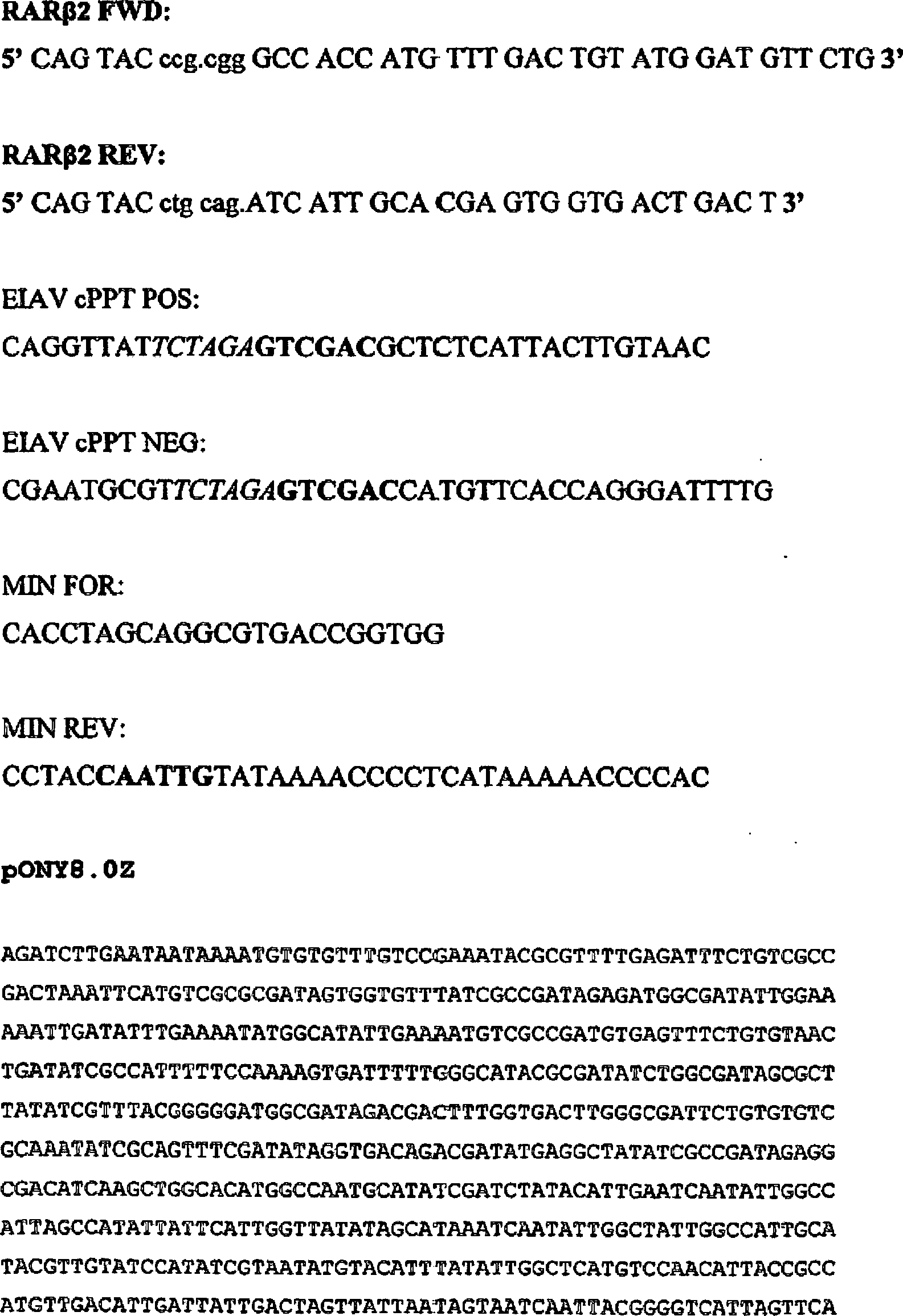


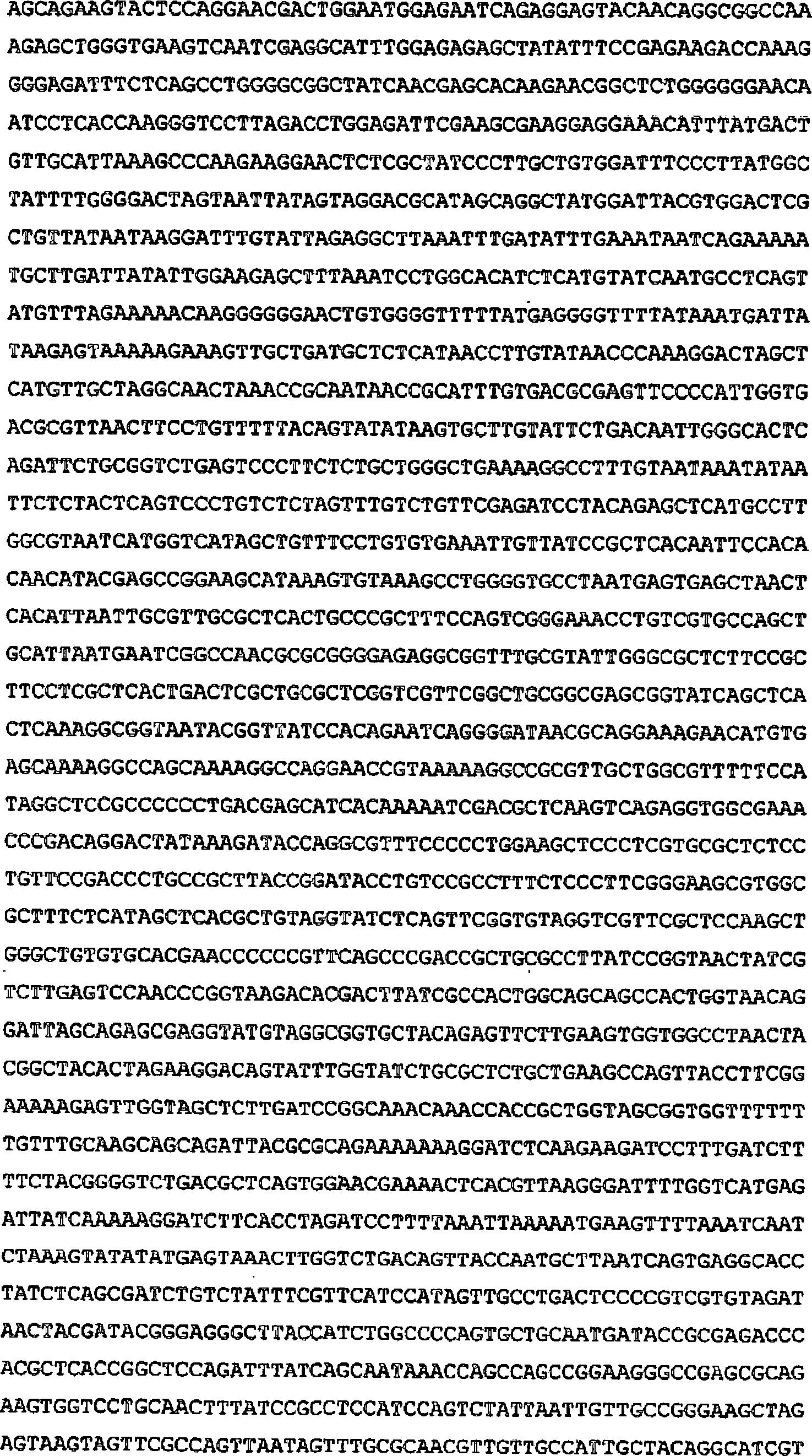


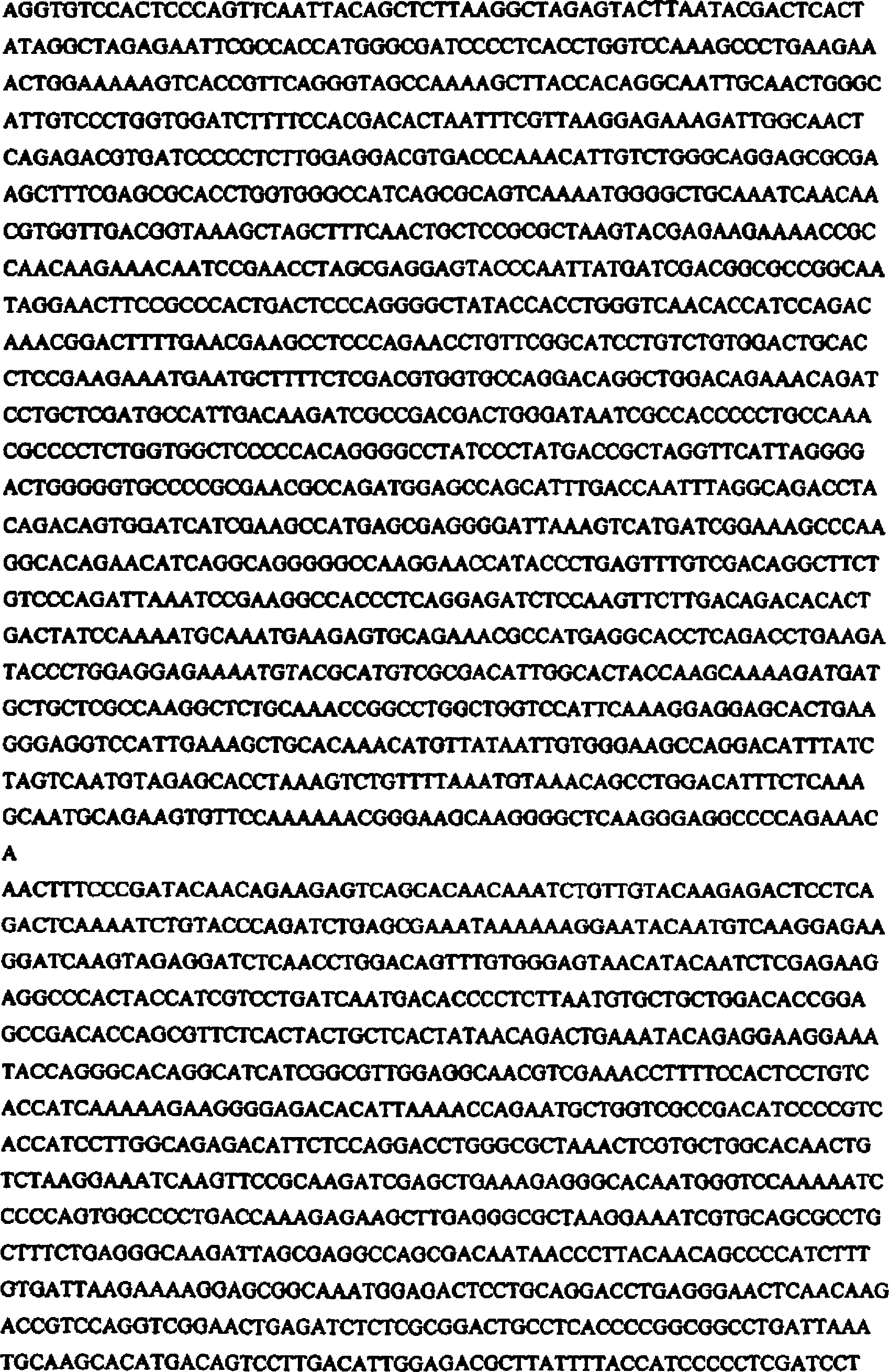

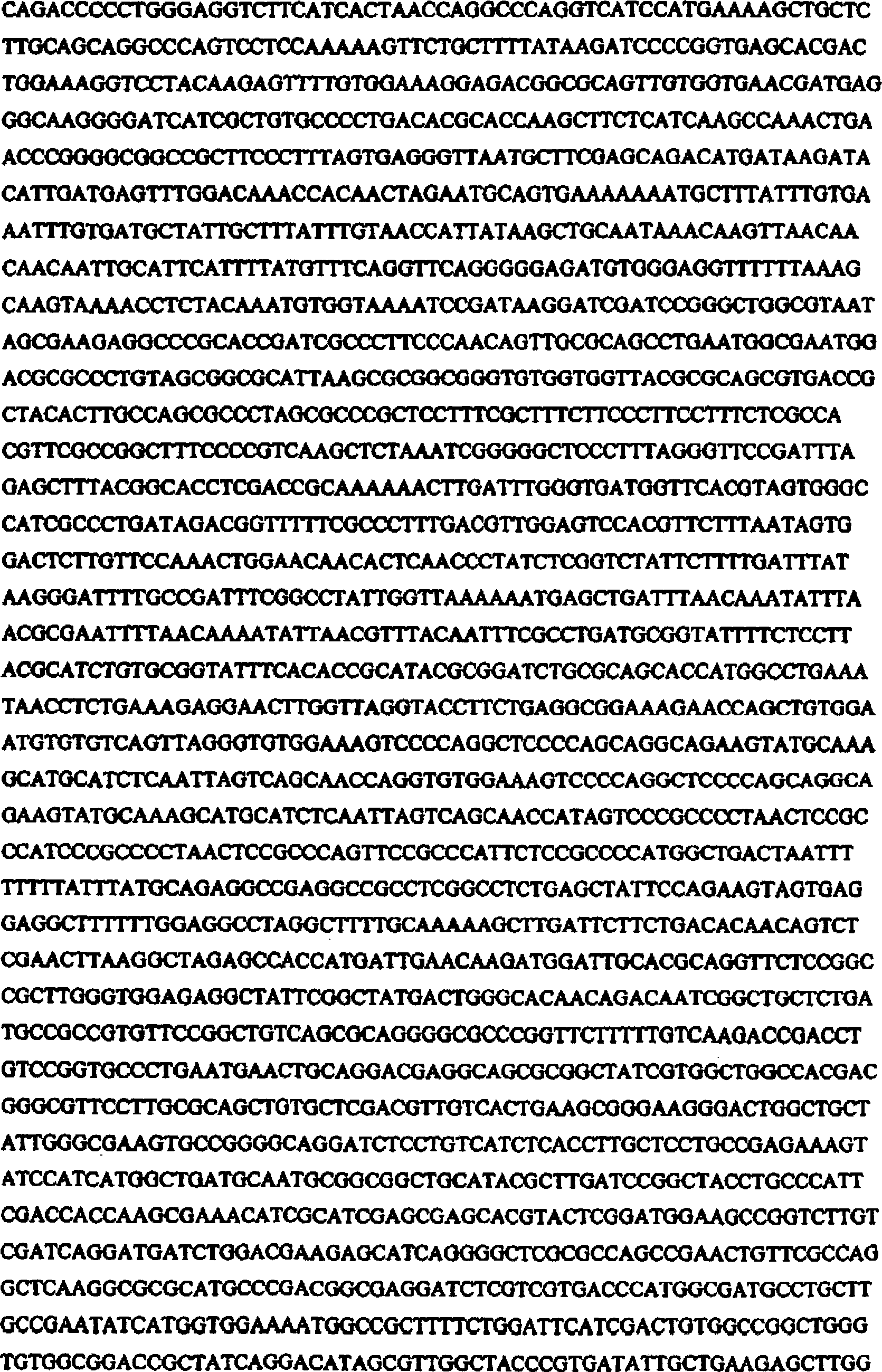


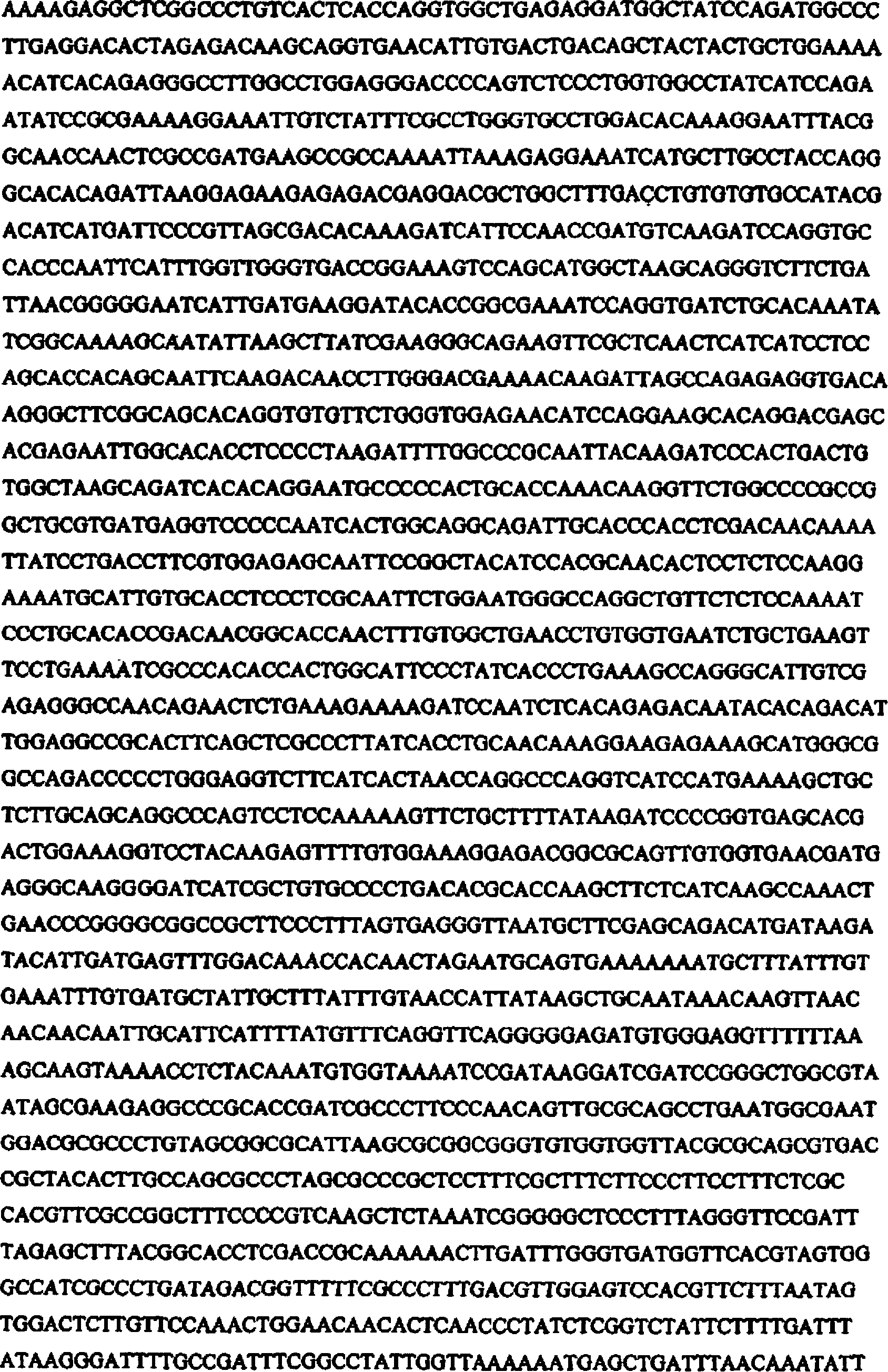
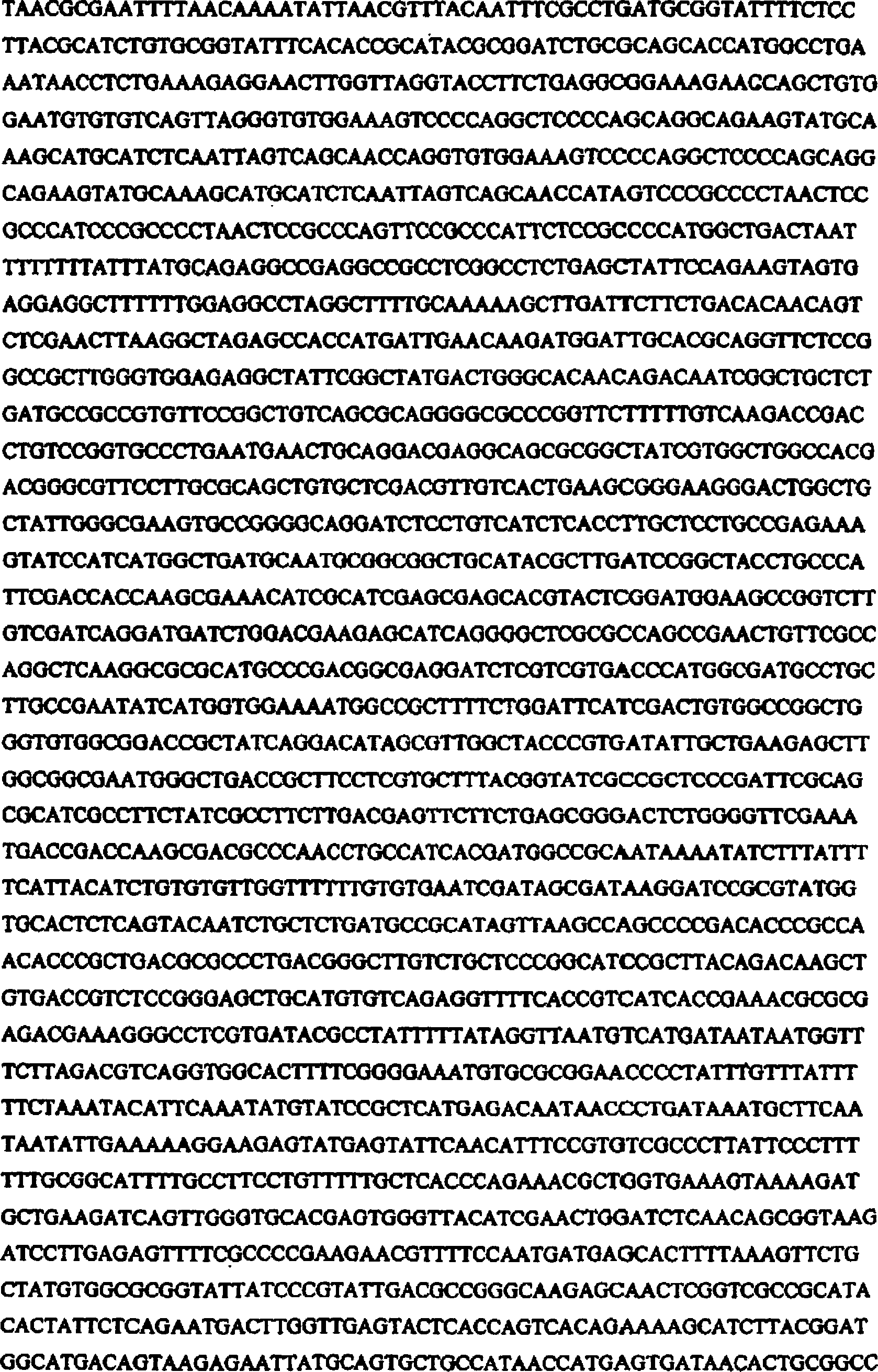


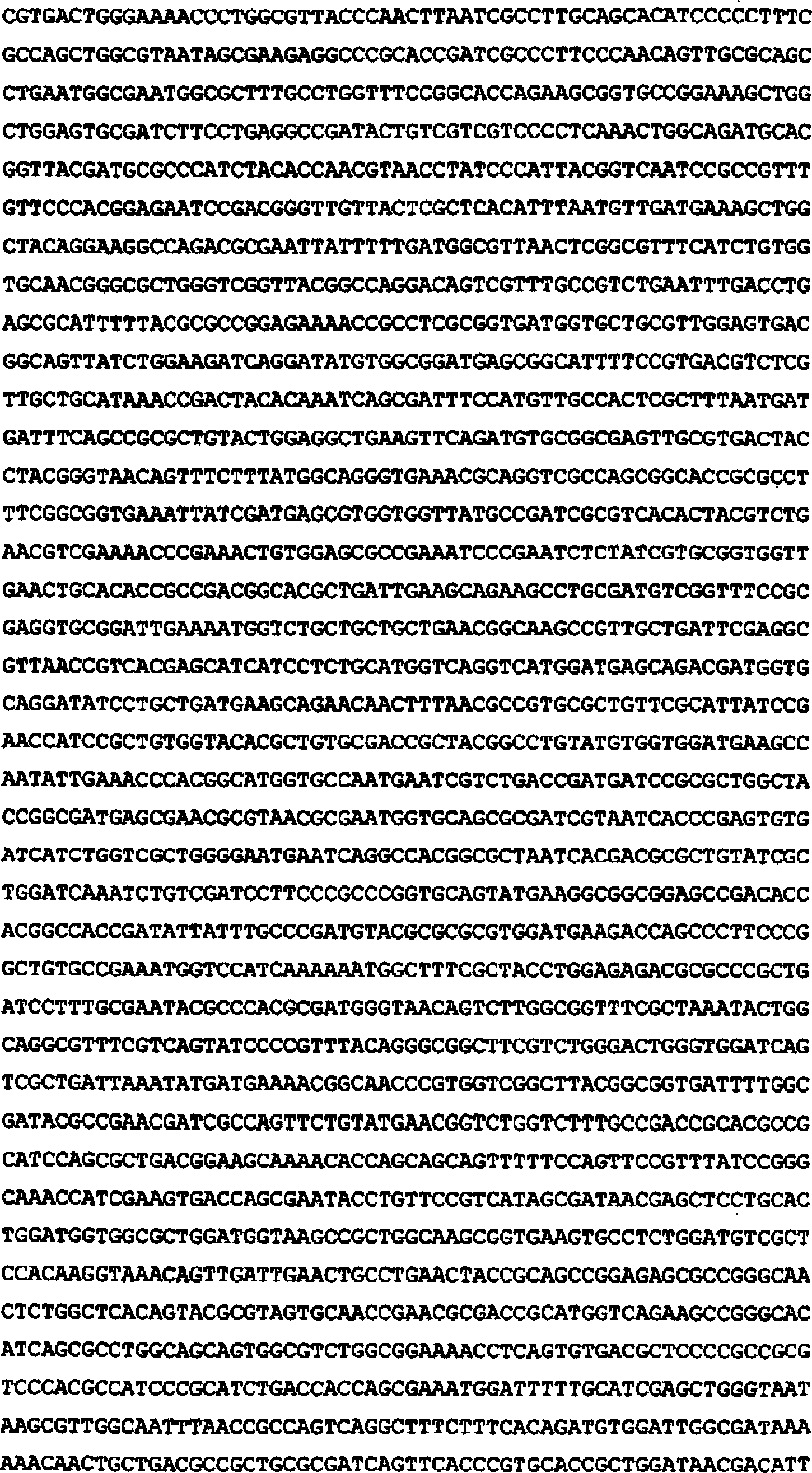

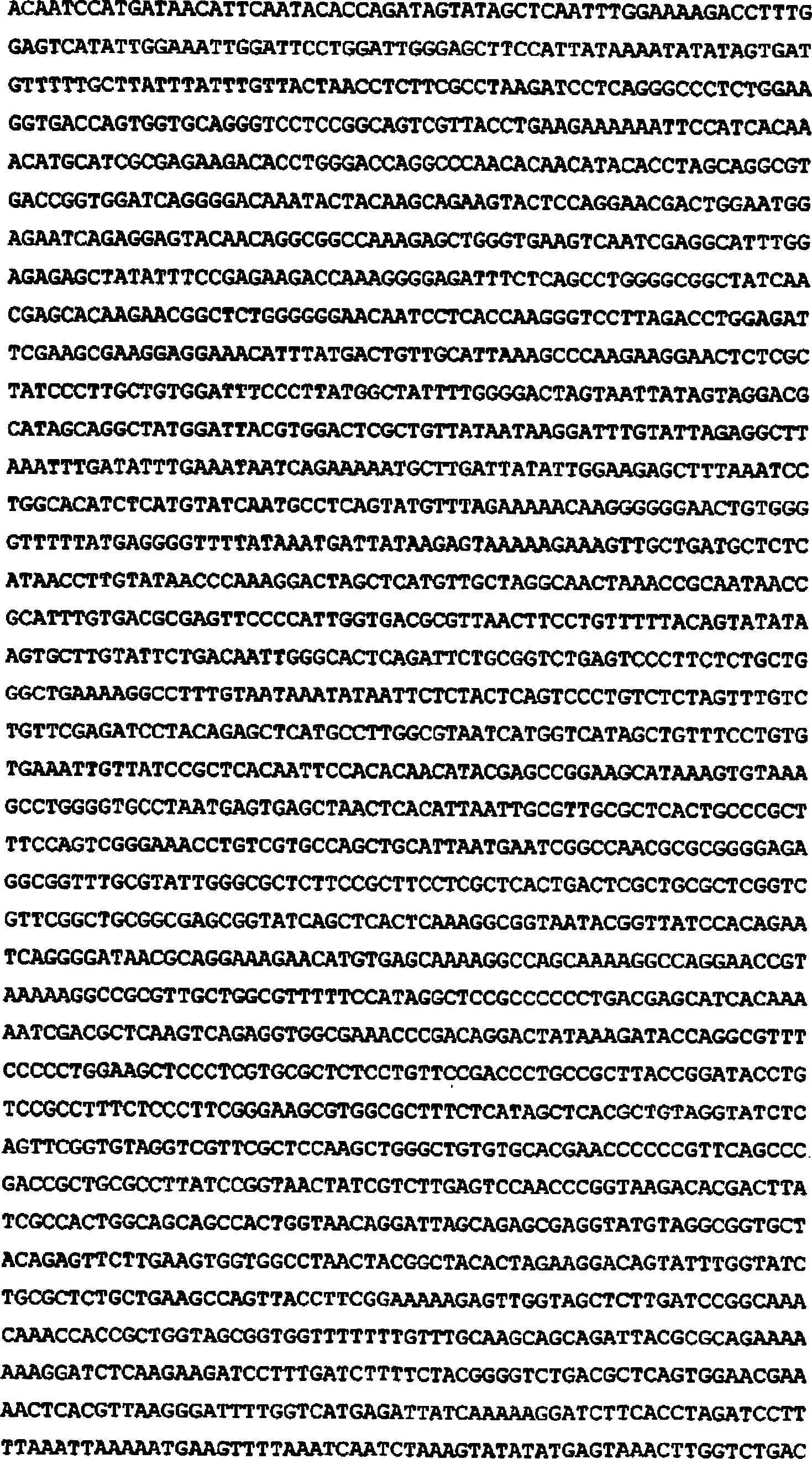
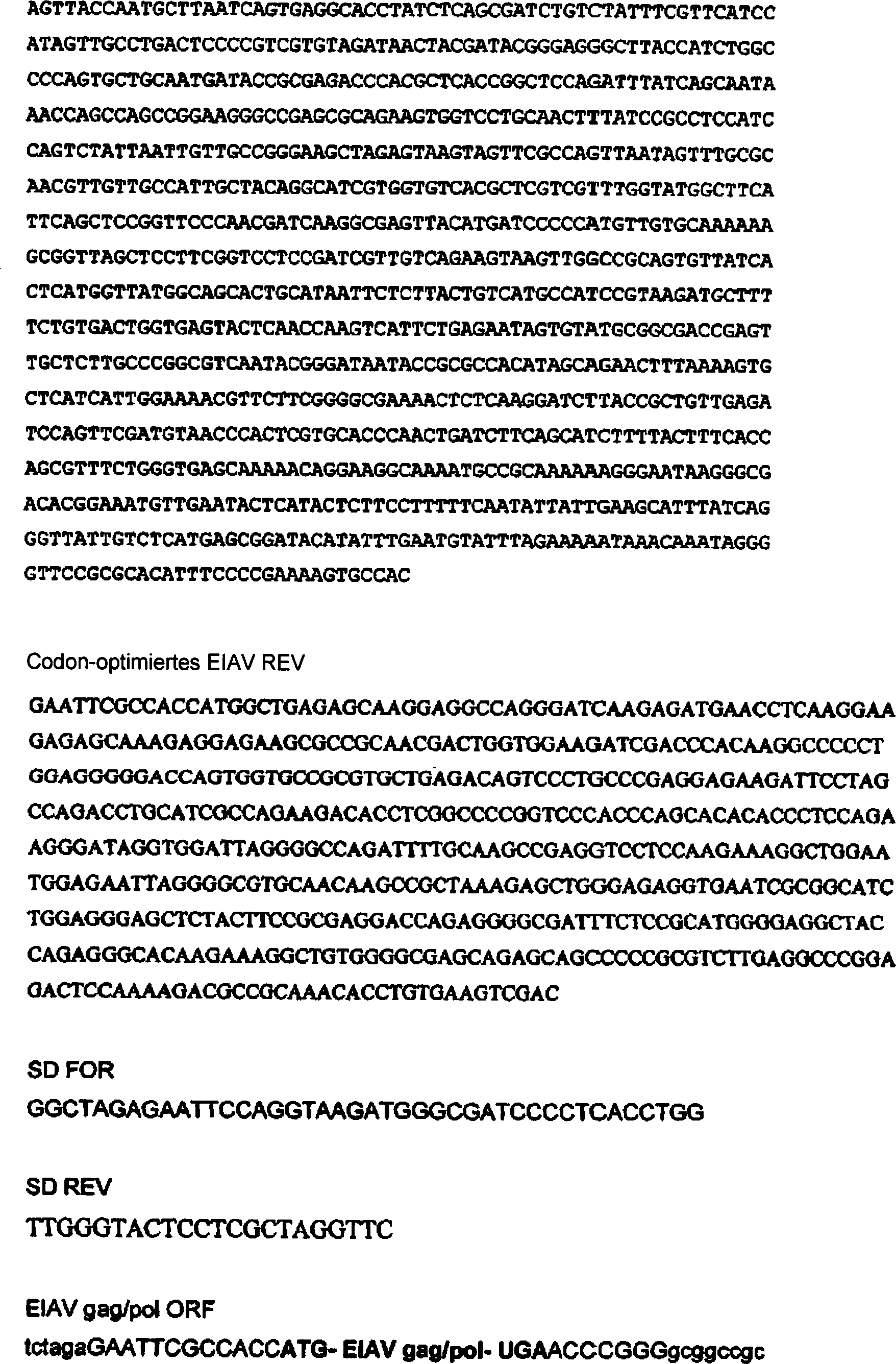
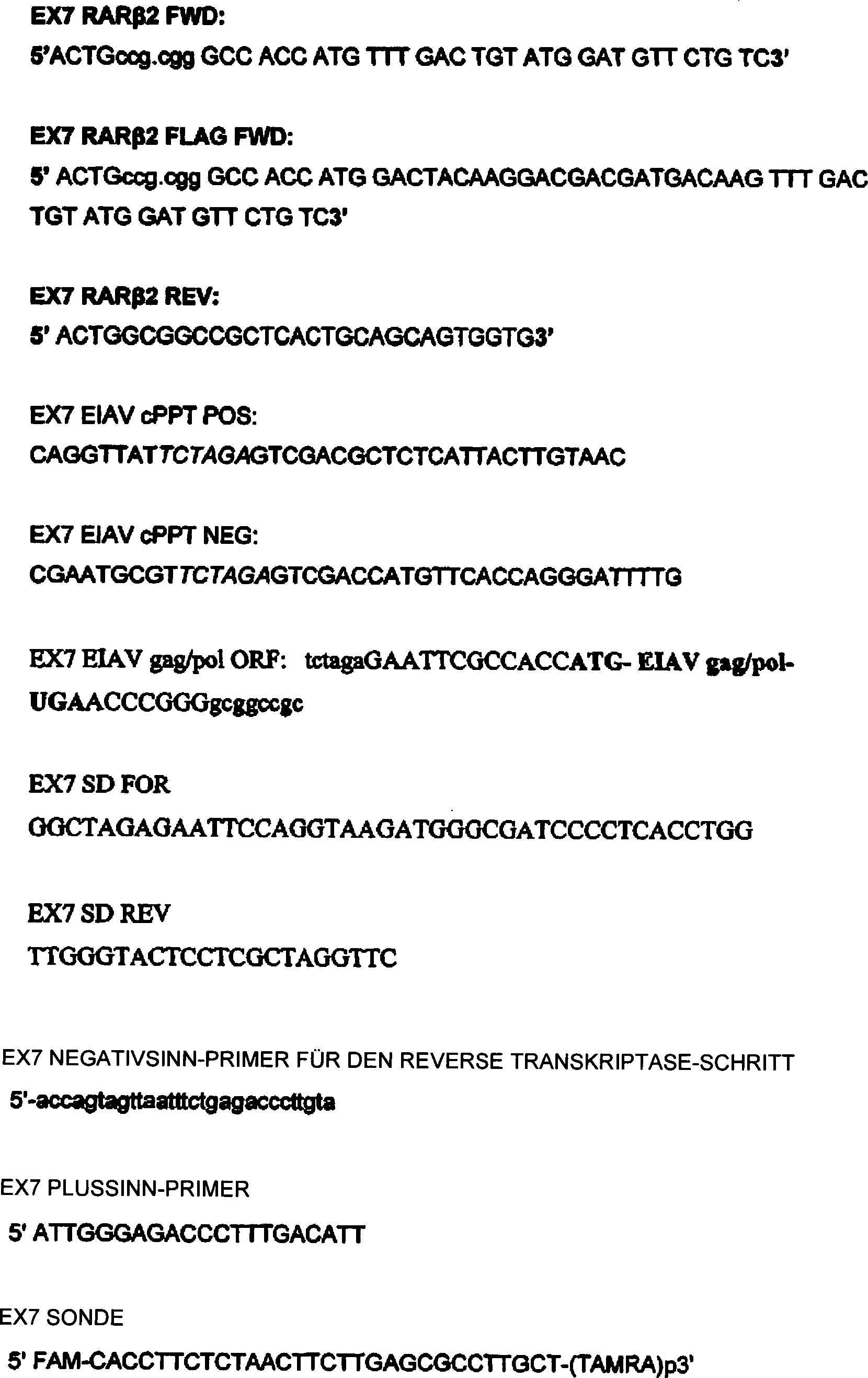
Weitere
Sequenzen sind so, wie in den Figuren offenbart, wie etwa in den
SEQUENZPROTOKOLL 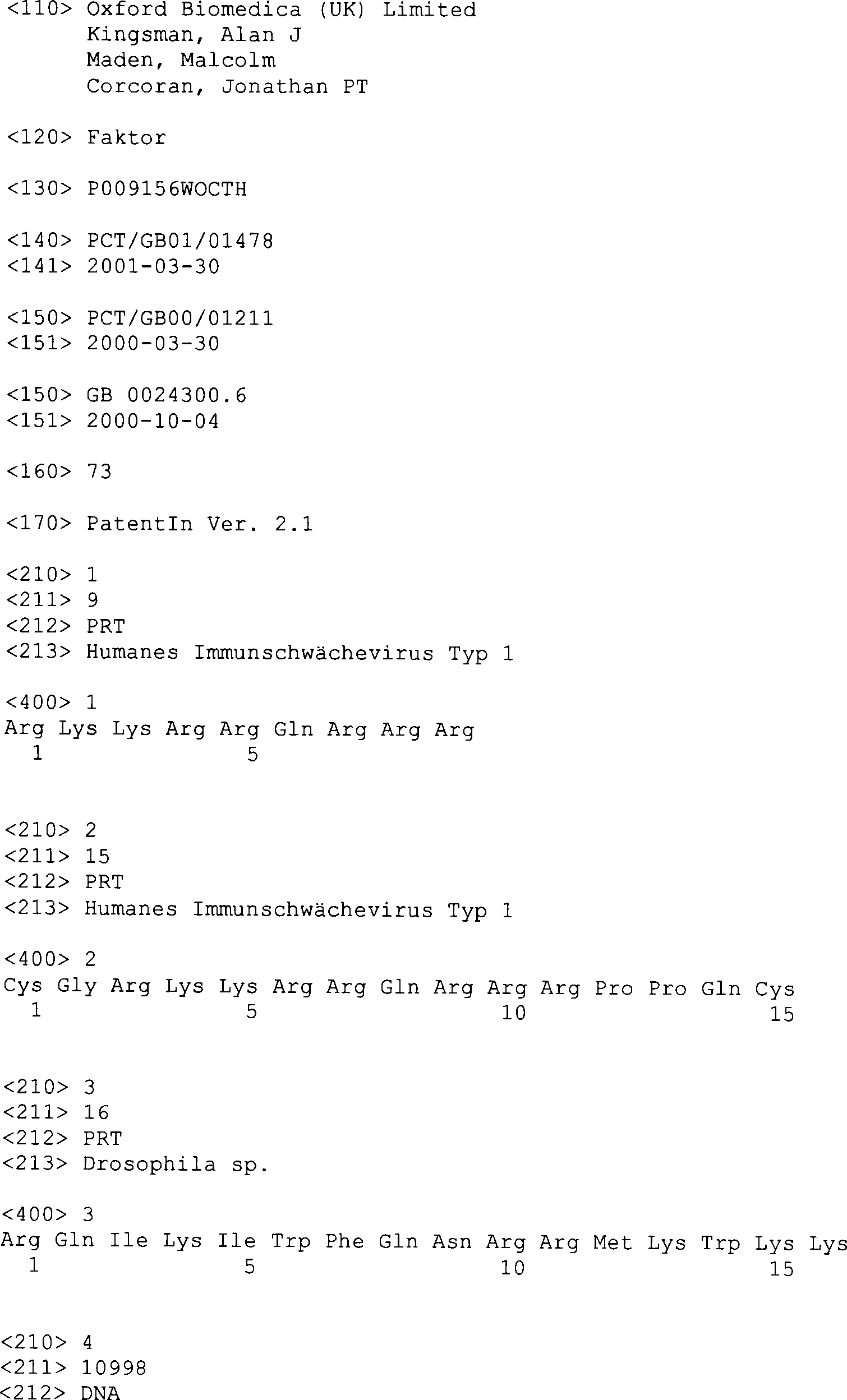
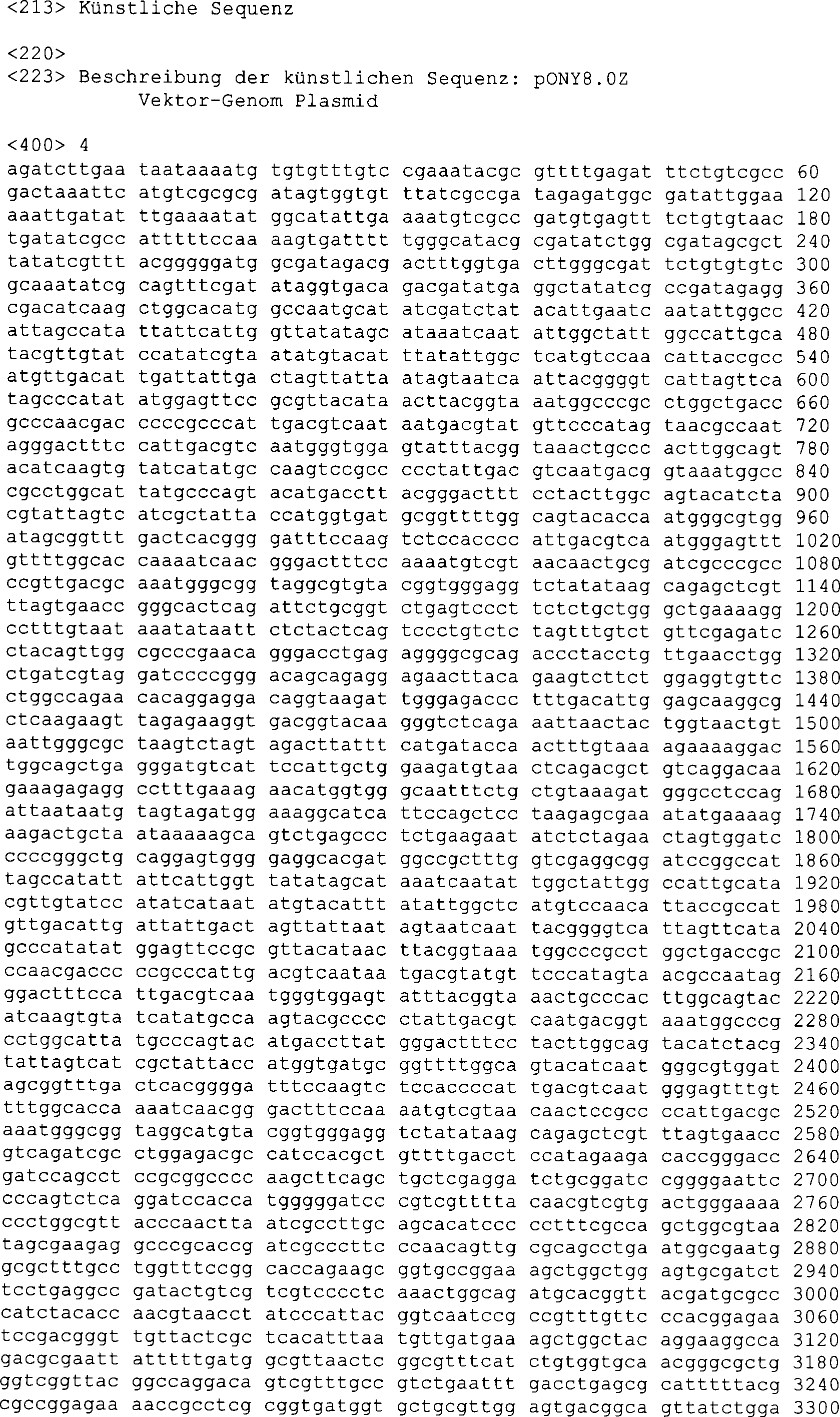

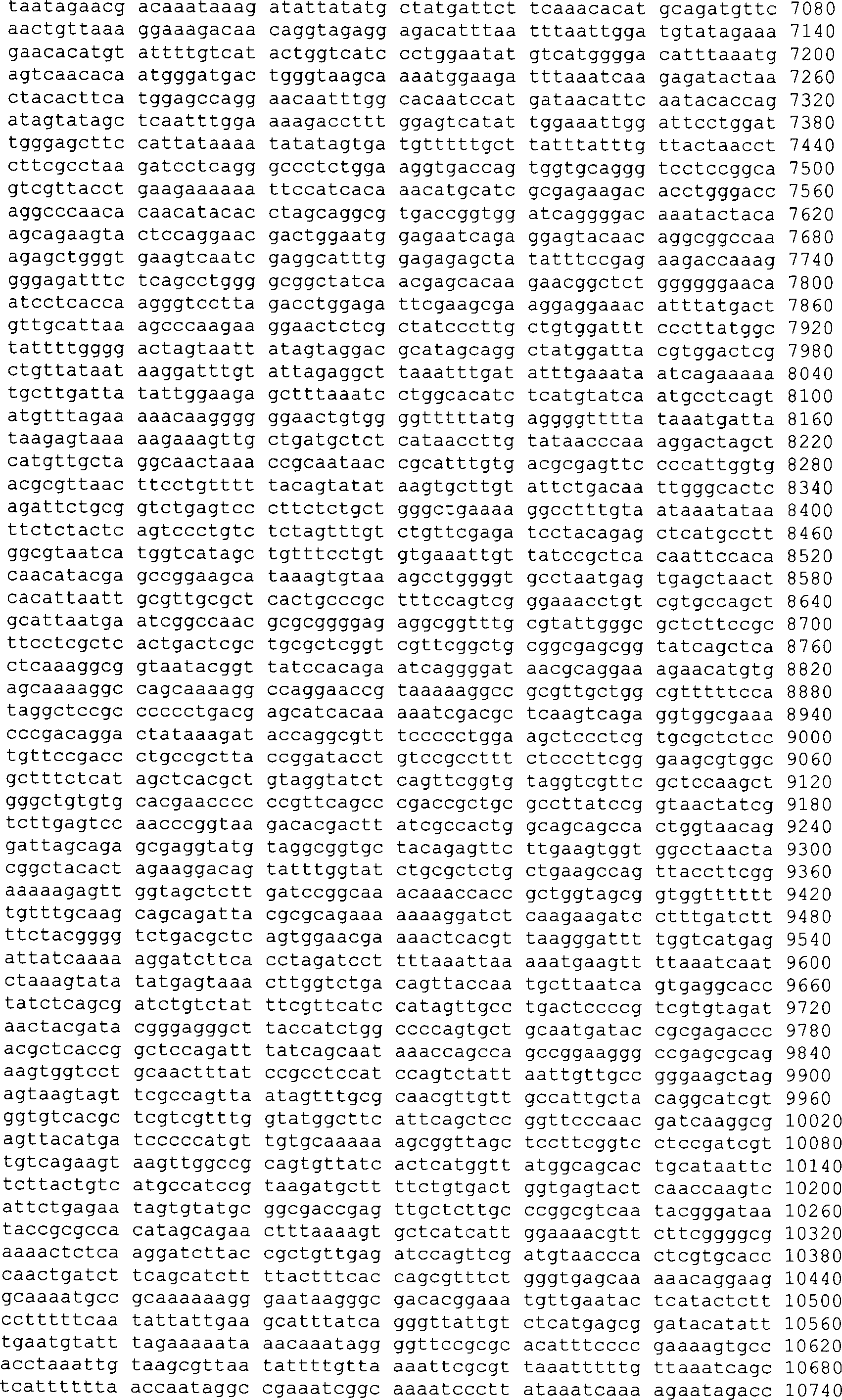
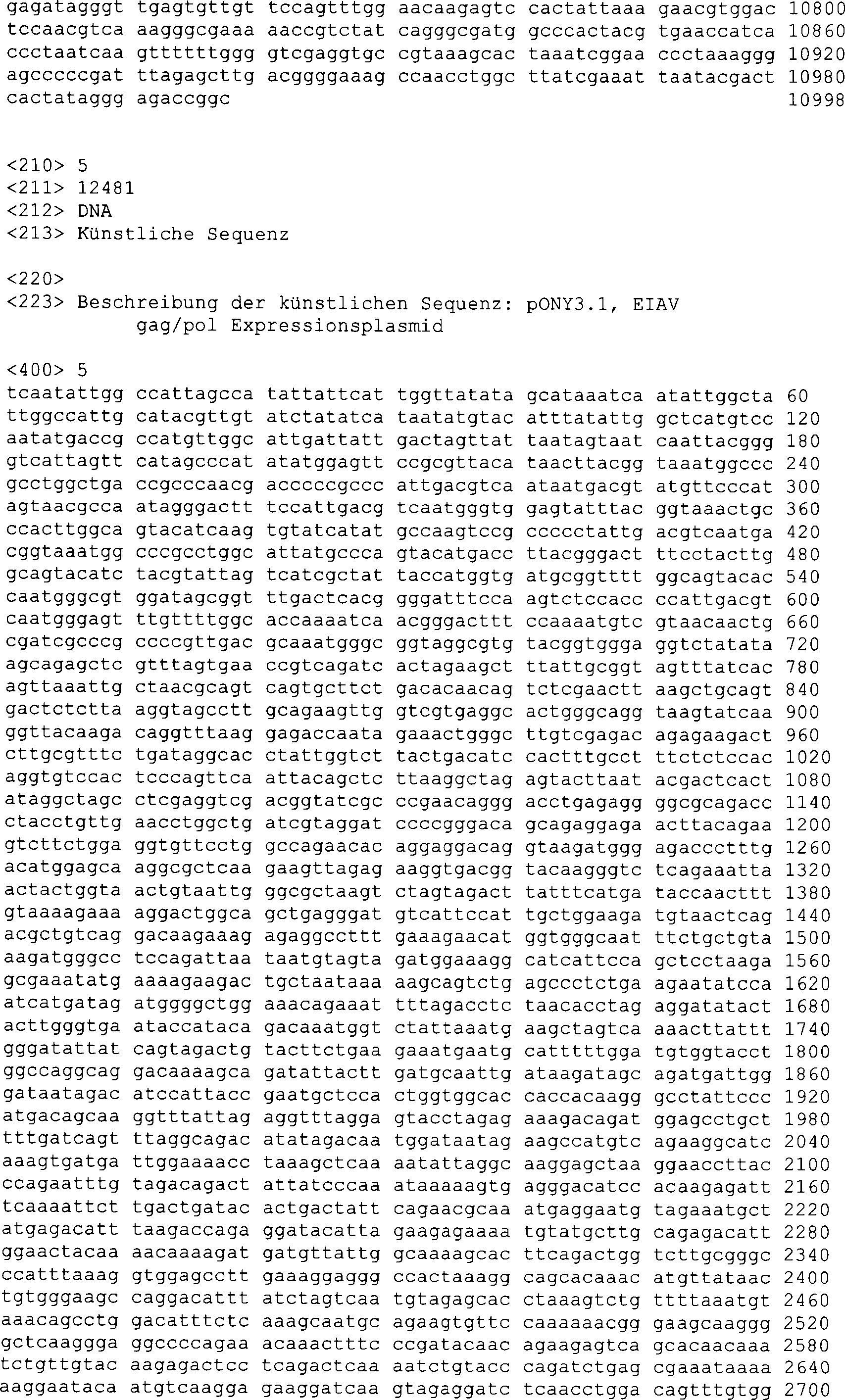
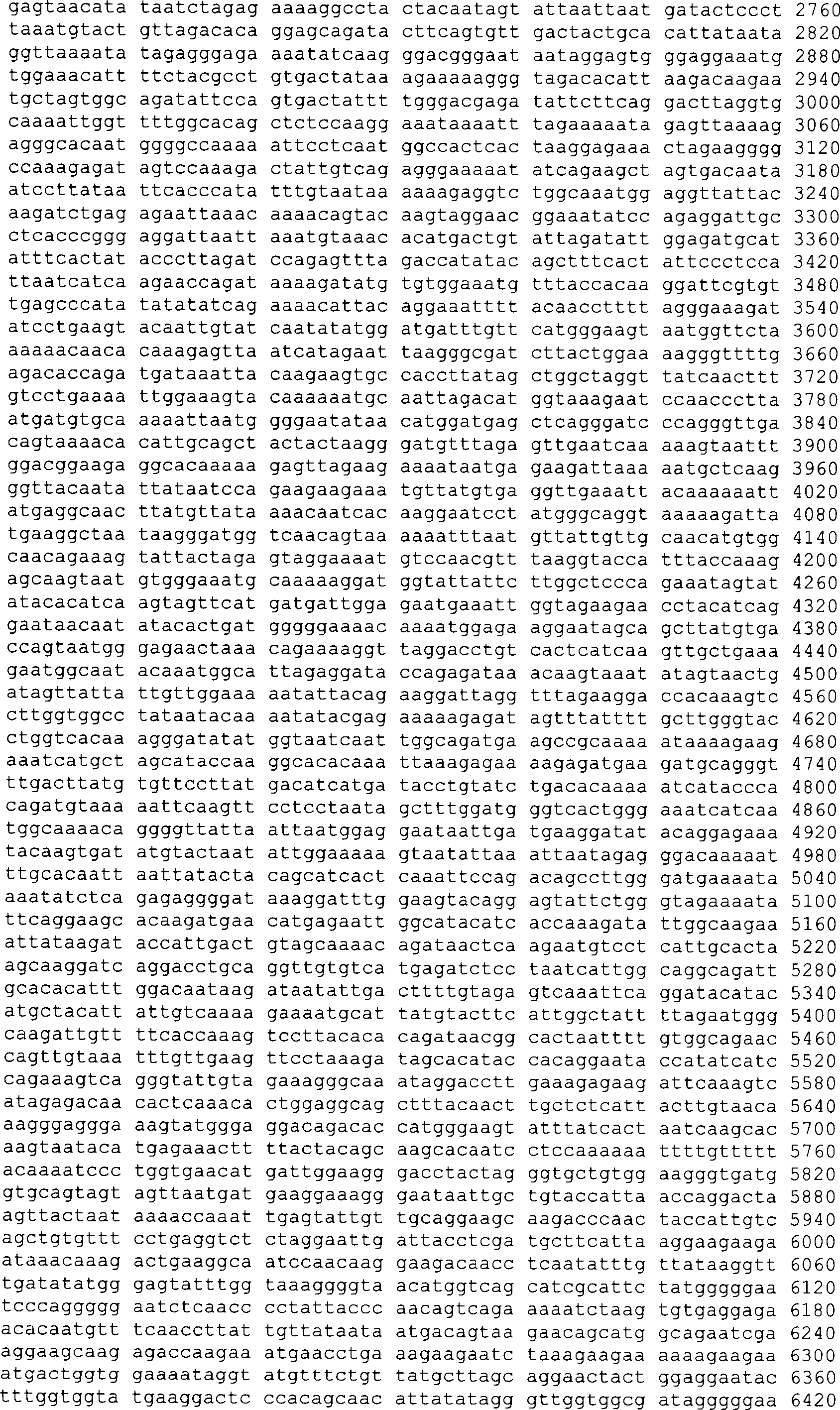

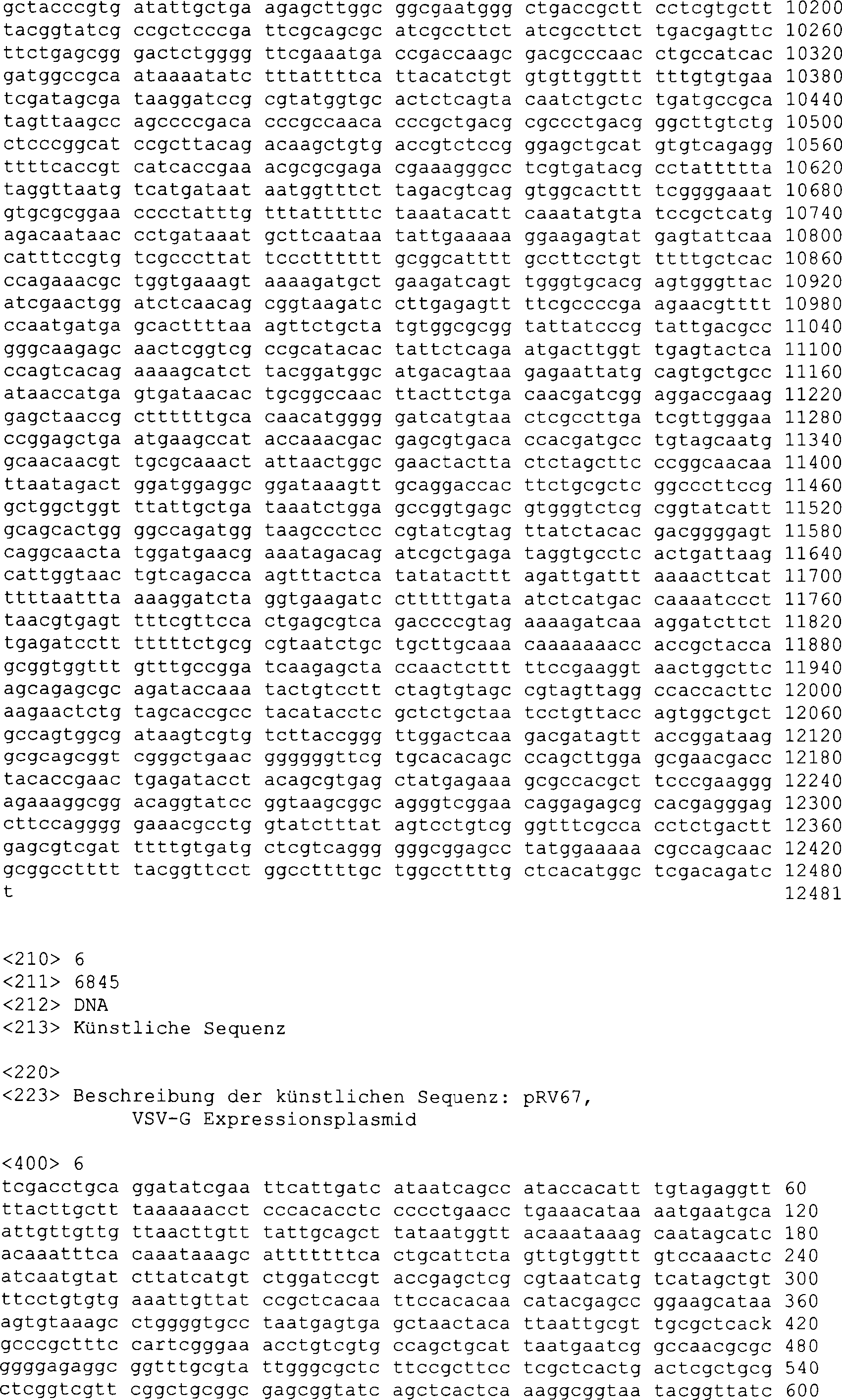


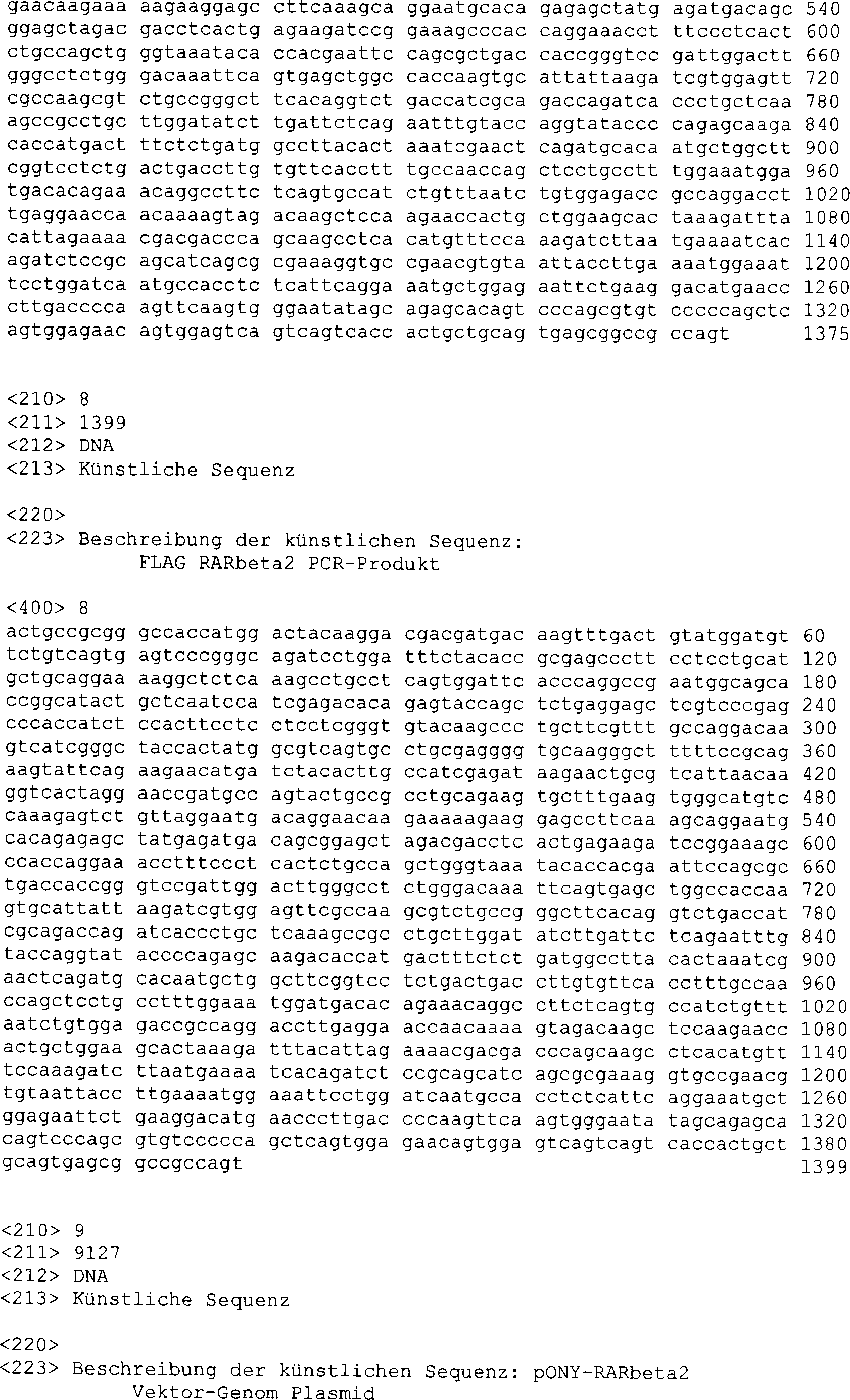
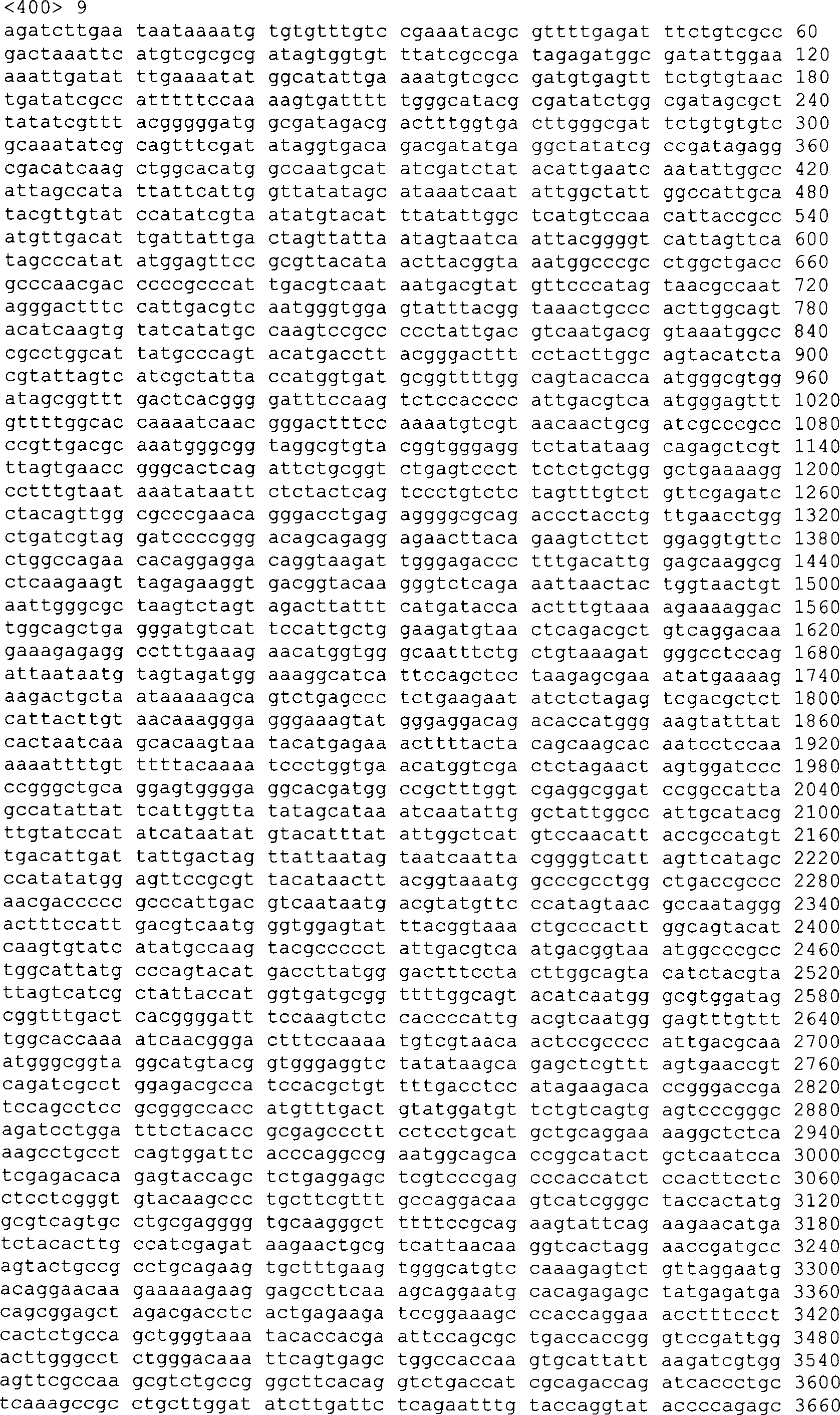
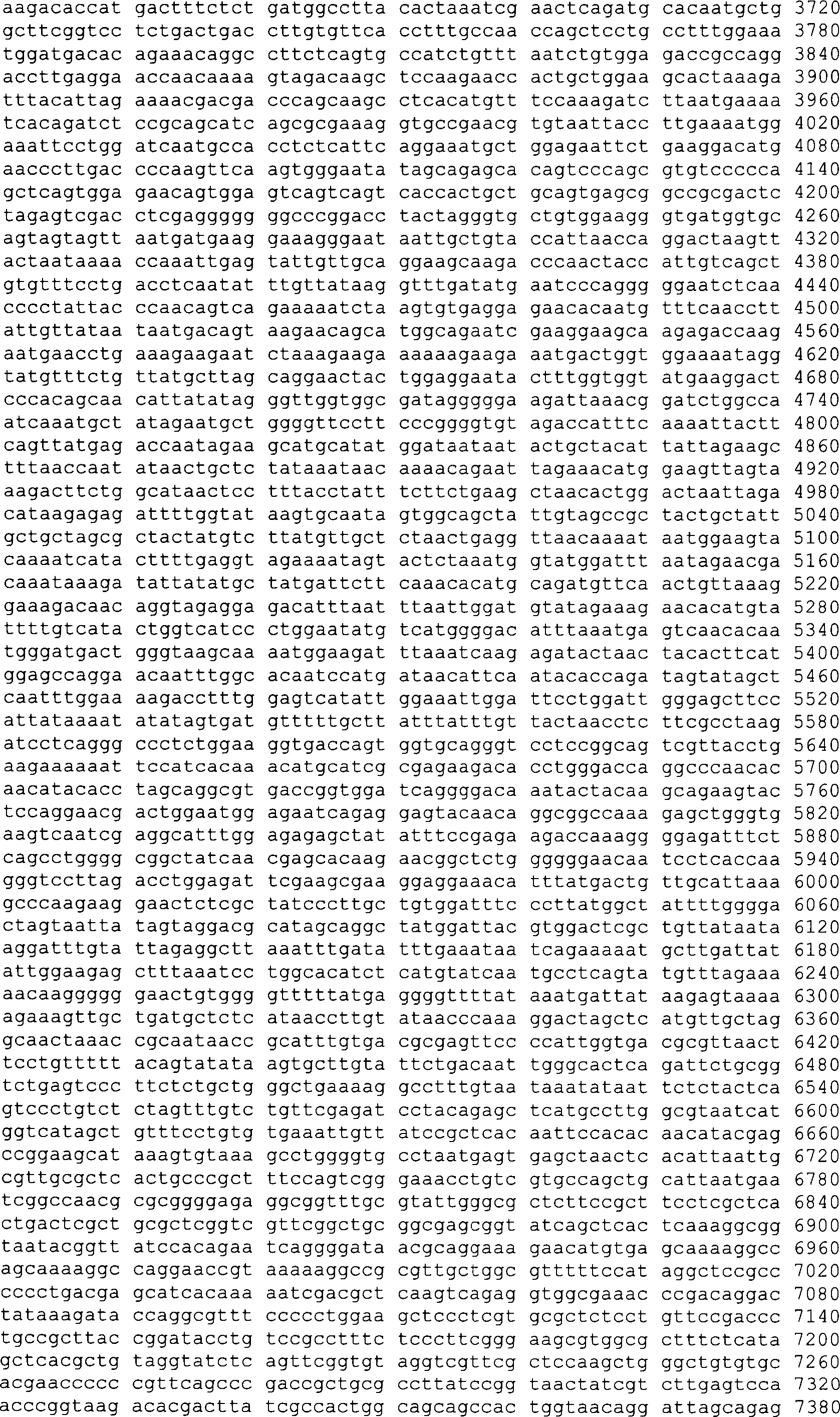
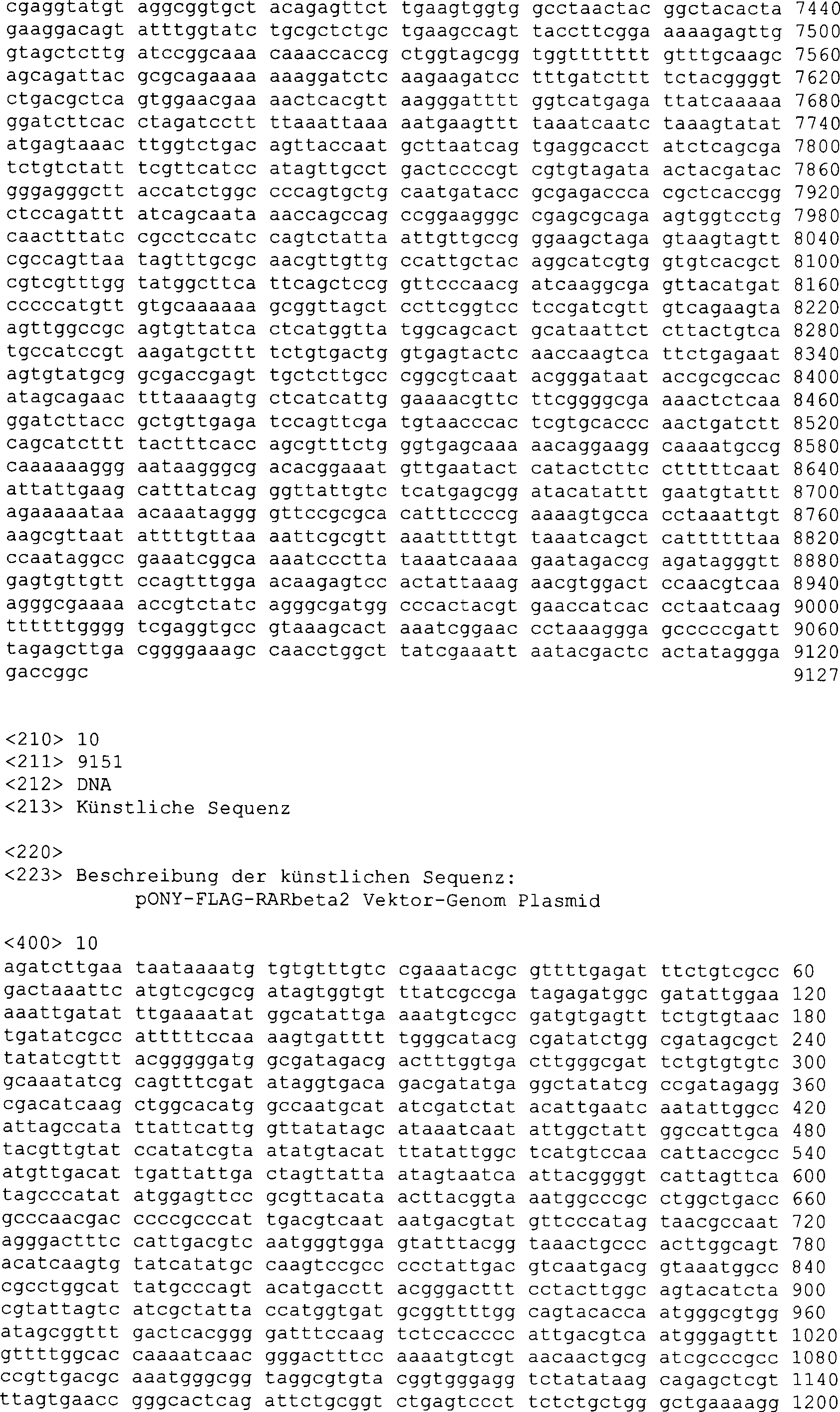





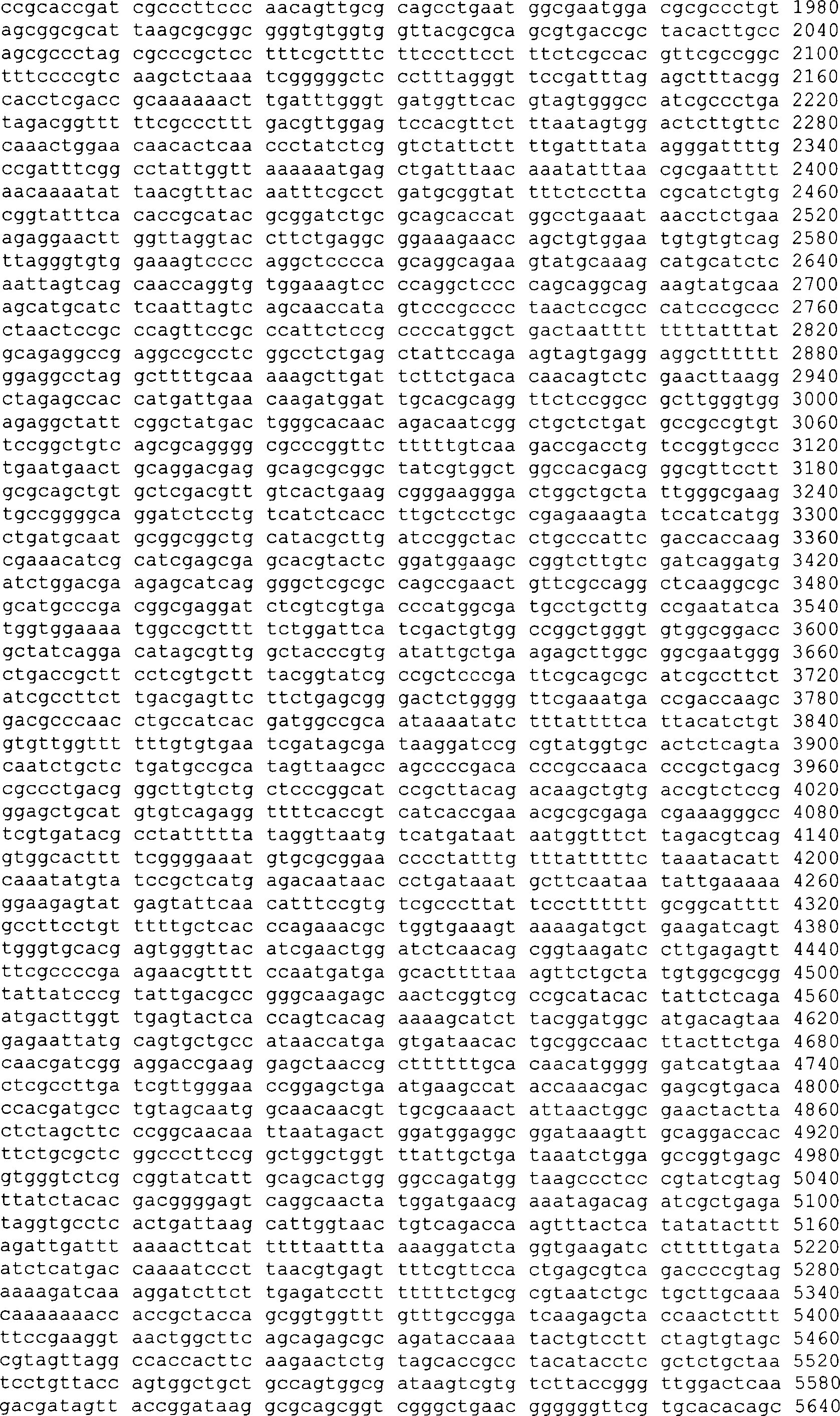


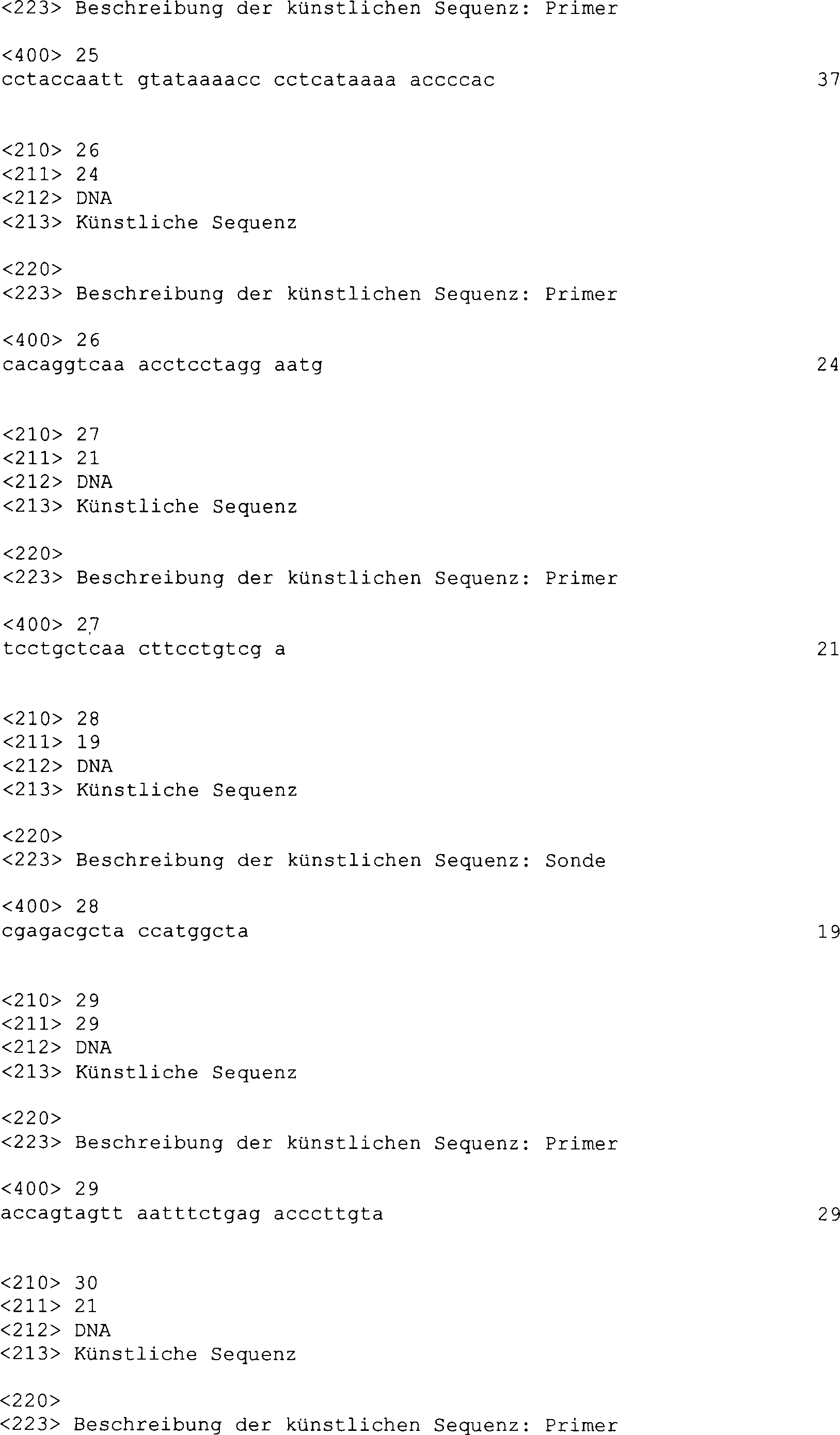

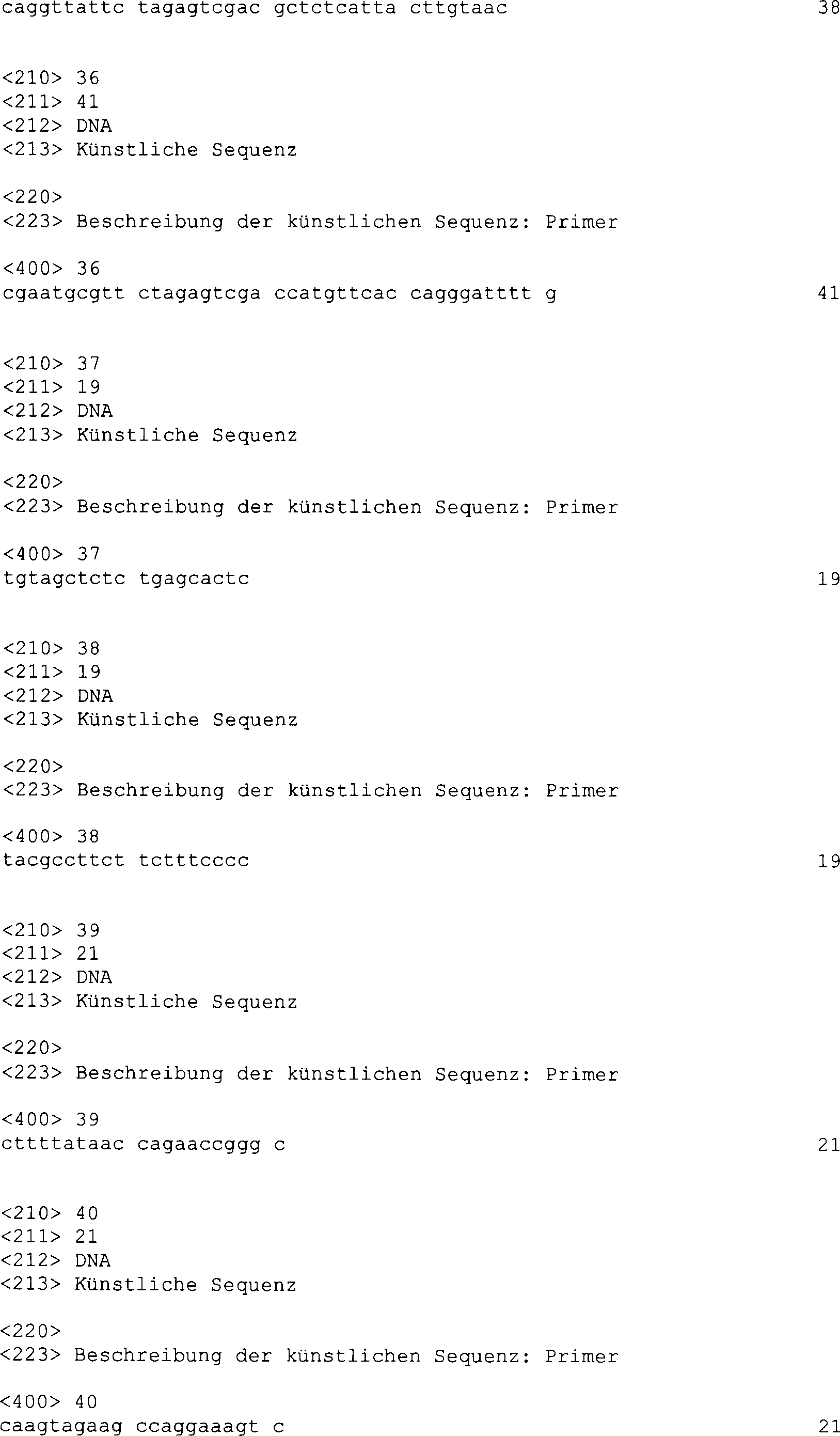
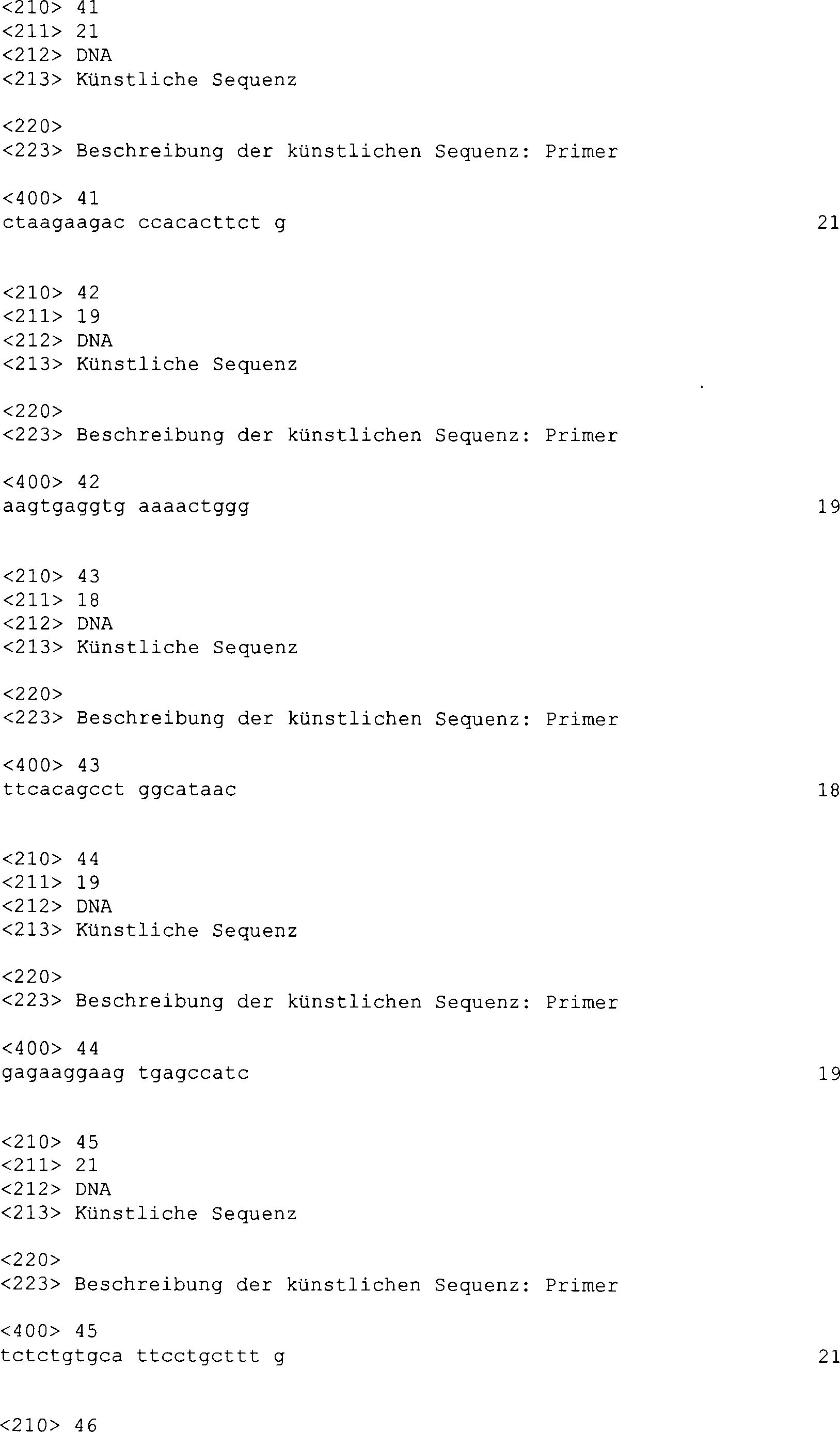
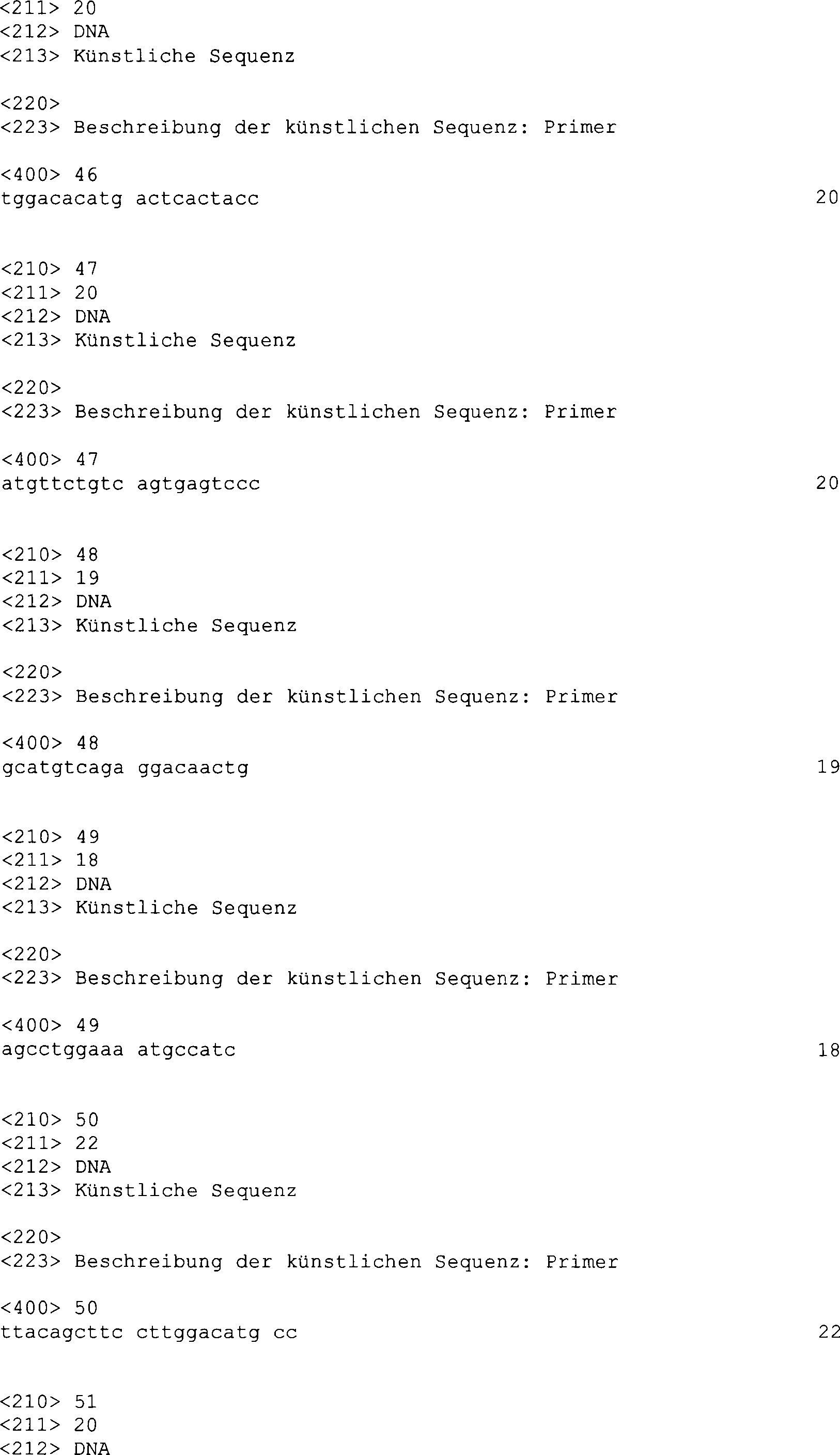
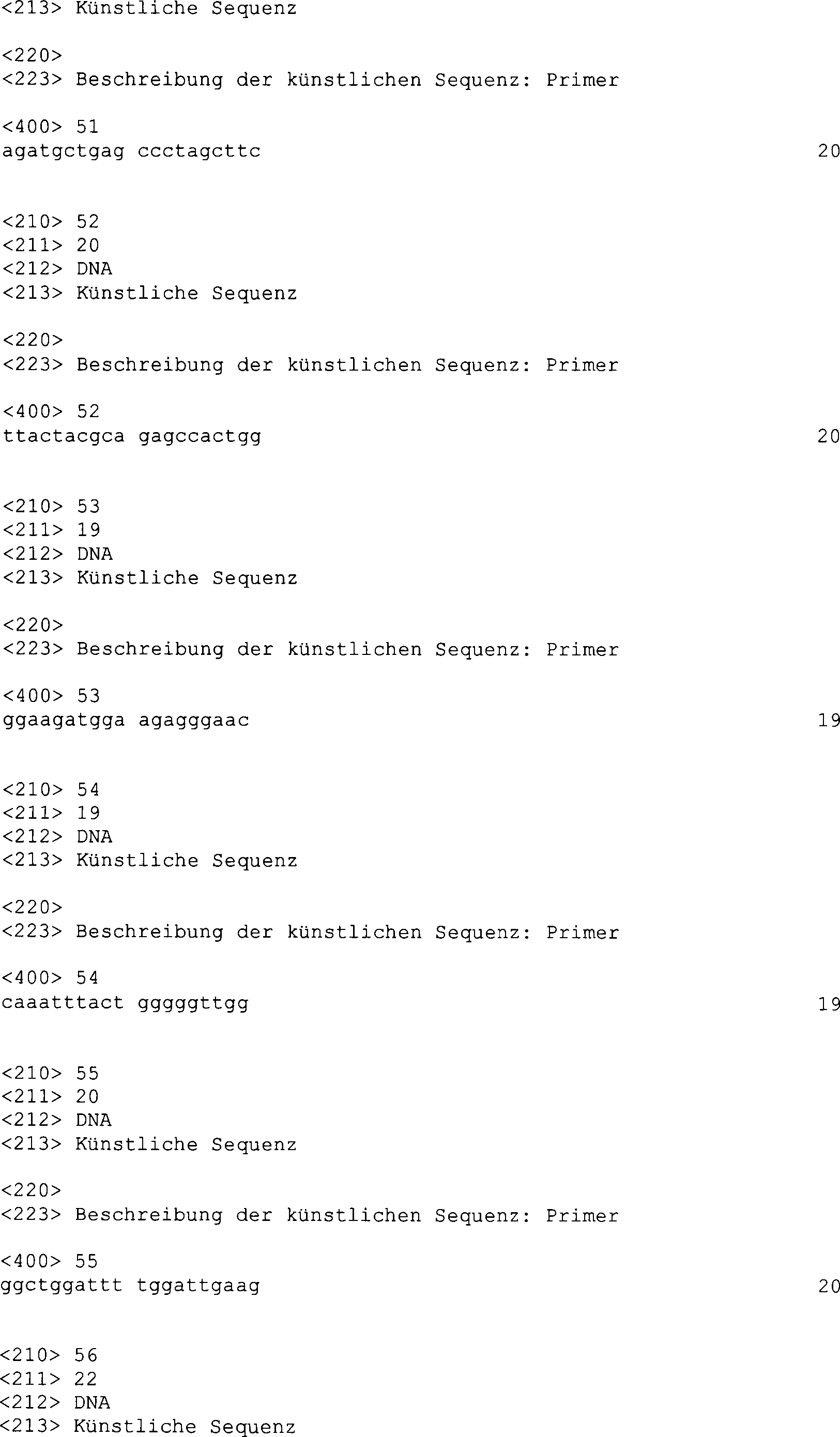

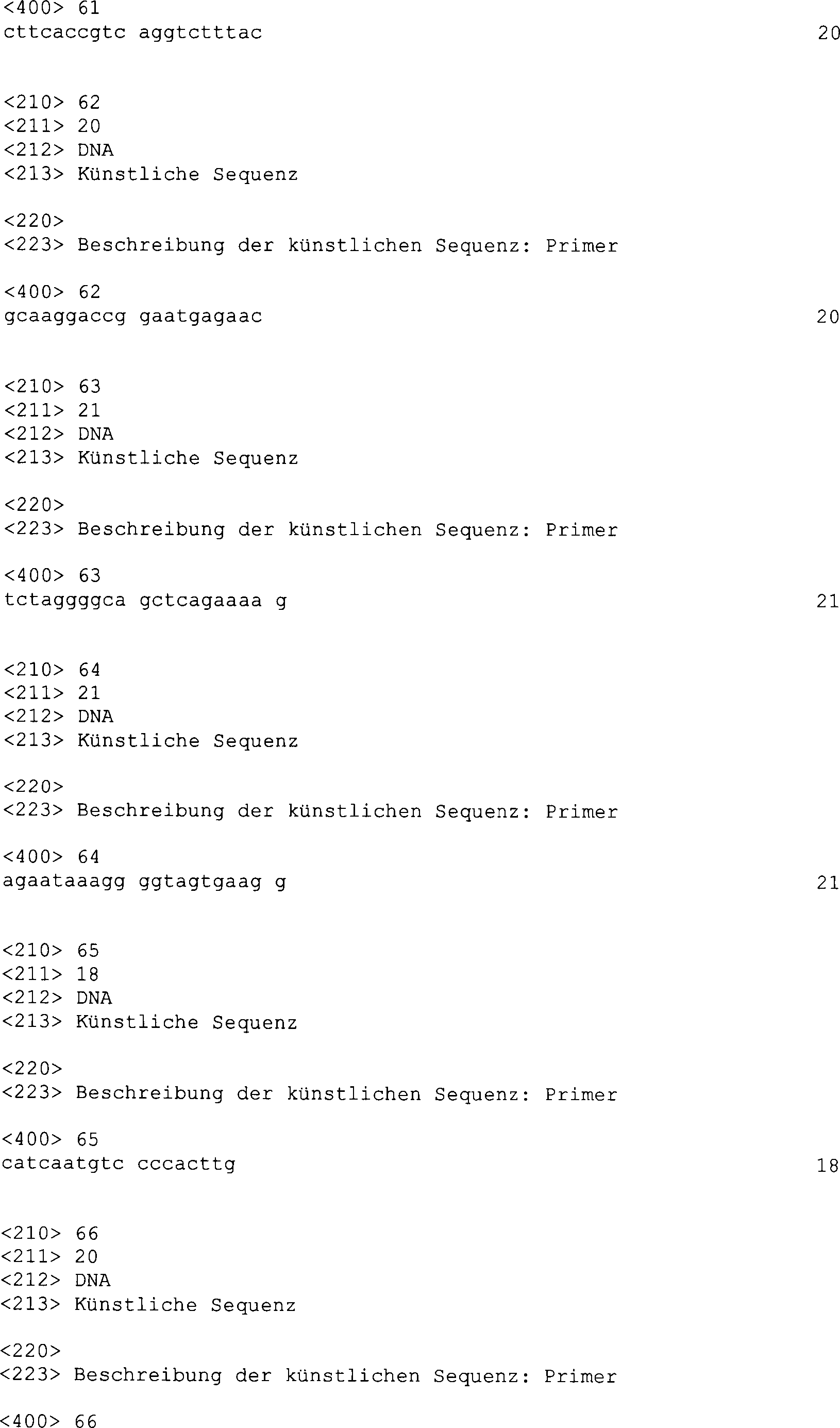

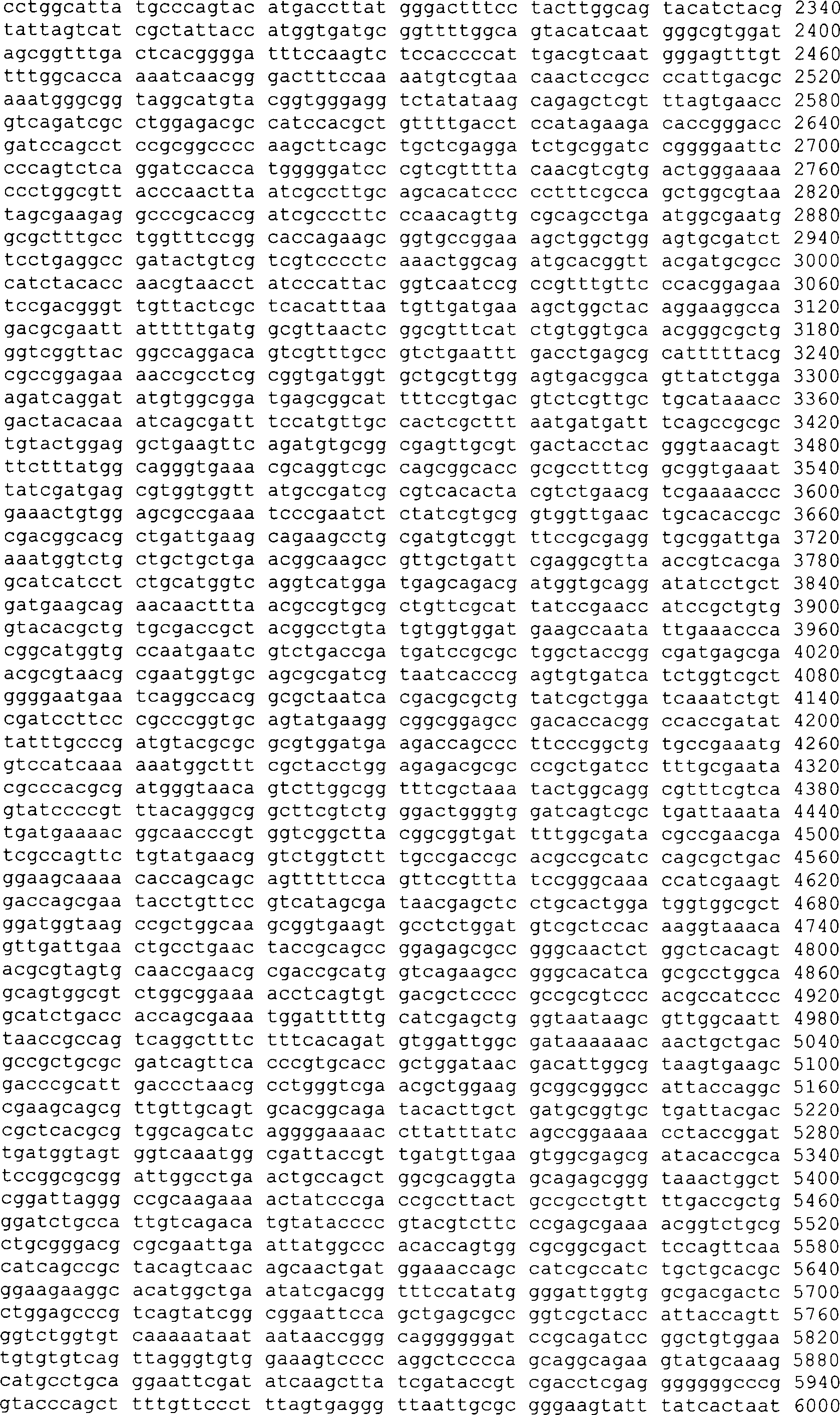







Claims (27)
Applications Claiming Priority (5)
| Application Number | Priority Date | Filing Date | Title |
|---|---|---|---|
| PCT/GB2000/001211 WO2000057900A2 (en) | 1999-03-31 | 2000-03-30 | Factor for regulation of neurite growth |
| WOPCT/GB00/01211 | 2000-03-30 | ||
| GBGB0024300.6A GB0024300D0 (en) | 2000-03-30 | 2000-10-04 | Factor |
| GB0024300 | 2000-10-04 | ||
| PCT/GB2001/001478 WO2001075135A1 (en) | 2000-03-30 | 2001-03-30 | Retinoic acid receptor beta-2, its antagonists, and gene therapy vectors for the treatment of neurological disorders |
Publications (2)
| Publication Number | Publication Date |
|---|---|
| DE60132436D1 DE60132436D1 (en) | 2008-03-06 |
| DE60132436T2 true DE60132436T2 (en) | 2008-04-17 |
Family
ID=26243429
Family Applications (1)
| Application Number | Title | Priority Date | Filing Date |
|---|---|---|---|
| DE60132436T Expired - Fee Related DE60132436T2 (en) | 2000-03-30 | 2001-03-30 | RETINOLIC ACID RECEPTOR BETA-2 AND GENETHERAPY VECTORS FOR THE TREATMENT OF NEUROLOGICAL DISEASES |
Country Status (7)
| Country | Link |
|---|---|
| EP (1) | EP1268835B1 (en) |
| JP (1) | JP2003533184A (en) |
| AT (1) | ATE384133T1 (en) |
| AU (1) | AU2001244354A1 (en) |
| CA (1) | CA2399399A1 (en) |
| DE (1) | DE60132436T2 (en) |
| WO (1) | WO2001075135A1 (en) |
Families Citing this family (8)
| Publication number | Priority date | Publication date | Assignee | Title |
|---|---|---|---|---|
| US20050107320A1 (en) * | 2003-01-30 | 2005-05-19 | Matthew During | Methods and compositions for use in interventional pharmacogenomics |
| WO2005114205A2 (en) * | 2004-05-13 | 2005-12-01 | Bayer Healthcare Ag | Diagnostics and therapeutics for diseases associated with nuclear receptor subfamily 1, group b, member 2 (nr1b2) |
| GB0518674D0 (en) * | 2005-09-13 | 2005-10-19 | Oxford Biomedica Ltd | System |
| RU2375449C2 (en) * | 2007-03-29 | 2009-12-10 | Нейрок Фарма ЛЛС | CODING DNA (cDNA) FOR MAKING VIRUS-LIKE PARTICLES OF HEPATITIS C VIRUS, METHOD FOR MAKING VIRUS-LIKE PARTICLES AND BASED PHARMACEUTICAL COMPOSITION |
| DK3633025T3 (en) | 2009-11-12 | 2022-12-12 | Technion Res & Dev Foundation | CULTURE MEDIA, CELL CULTURES AND METHODS FOR CULTIVATING PLURIPOTENT STEM CELLS IN AN UNDIFFERENTIATED STATE |
| MX2021000308A (en) | 2018-07-09 | 2021-06-08 | Flagship Pioneering Innovations V Inc | FUSOSOME COMPOSITIONS AND THEIR USES. |
| KR20210131991A (en) | 2018-11-14 | 2021-11-03 | 플래그쉽 파이어니어링 이노베이션스 브이, 인크. | Compositions and methods for compartment-specific cargo delivery |
| JP7676305B2 (en) * | 2018-11-14 | 2025-05-14 | フラッグシップ パイオニアリング イノベーションズ ブイ, インコーポレイテッド | Fusosome Compositions for CNS Delivery |
Family Cites Families (8)
| Publication number | Priority date | Publication date | Assignee | Title |
|---|---|---|---|---|
| US4808630A (en) * | 1987-01-16 | 1989-02-28 | United States Of America | Method of treating psychotic illnesses |
| CA2211142A1 (en) * | 1995-01-23 | 1996-08-01 | Ligand Pharmaceuticals Incorporated | Human retinoid x receptor - gamma (hrxr-gamma) |
| IT1276459B1 (en) * | 1995-06-30 | 1997-10-31 | Khodor Ammar | COSMETIC COMPOSITIONS WITH ANTIMICOTIC PROPERTIES, EFFECTIVE AGAINST PSORIASIS AND HAIR LOSS AND COSMETIC METHOD FOR |
| US5965606A (en) * | 1995-12-29 | 1999-10-12 | Allergan Sales, Inc. | Methods of treatment with compounds having RAR.sub.α receptor specific or selective activity |
| GB9907461D0 (en) * | 1999-03-31 | 1999-05-26 | King S College London | Neurite regeneration |
| JP2002506000A (en) * | 1997-10-27 | 2002-02-26 | クリエイティブ バイオモレキュールズ, インコーポレイテッド | Enhanced morphogen activity |
| AU760287B2 (en) * | 1997-12-22 | 2003-05-08 | Oxford Biomedica (Uk) Limited | Equine infectious anaemia virus (EIAV) based |
| EP0943684A3 (en) * | 1998-03-10 | 2002-01-23 | Smithkline Beecham Plc | Frizzled-like polypeptides and polynucleotides |
-
2001
- 2001-03-30 DE DE60132436T patent/DE60132436T2/en not_active Expired - Fee Related
- 2001-03-30 WO PCT/GB2001/001478 patent/WO2001075135A1/en not_active Ceased
- 2001-03-30 JP JP2001573009A patent/JP2003533184A/en not_active Withdrawn
- 2001-03-30 AT AT01917270T patent/ATE384133T1/en not_active IP Right Cessation
- 2001-03-30 EP EP01917270A patent/EP1268835B1/en not_active Expired - Lifetime
- 2001-03-30 AU AU2001244354A patent/AU2001244354A1/en not_active Abandoned
- 2001-03-30 CA CA002399399A patent/CA2399399A1/en not_active Abandoned
Also Published As
| Publication number | Publication date |
|---|---|
| DE60132436D1 (en) | 2008-03-06 |
| EP1268835A1 (en) | 2003-01-02 |
| JP2003533184A (en) | 2003-11-11 |
| ATE384133T1 (en) | 2008-02-15 |
| CA2399399A1 (en) | 2001-10-11 |
| EP1268835B1 (en) | 2008-01-16 |
| WO2001075135A1 (en) | 2001-10-11 |
| AU2001244354A1 (en) | 2001-10-15 |
Similar Documents
| Publication | Publication Date | Title |
|---|---|---|
| DE60031396T2 (en) | PREPARATION FOR THE TREATMENT OF A NEUROLOGICAL DISEASE | |
| Choo et al. | Retrograde BDNF to TrkB signaling promotes synapse elimination in the developing cerebellum | |
| Gonzalez et al. | Disruption of Trkb-mediated signaling induces disassembly of postsynaptic receptor clusters at neuromuscular junctions | |
| Laurenzi et al. | Expression of mRNA encoding neurotrophins and neurotrophin receptors in rat thymus, spleen tissue and immunocompetent cells: Regulation of neurotrophin‐4 mRNA expression by mitogens and leukotriene B4 | |
| US20180264140A1 (en) | Motor neuron-specific expression vectors | |
| JP2019537437A (en) | SynP198, a promoter for specific expression of genes in directionally selective retinal ganglion cells | |
| JP2019500863A (en) | SynP161, a promoter for specific expression of genes in rod photoreceptors | |
| DE60132436T2 (en) | RETINOLIC ACID RECEPTOR BETA-2 AND GENETHERAPY VECTORS FOR THE TREATMENT OF NEUROLOGICAL DISEASES | |
| Robinson et al. | FLRT3 is expressed in sensory neurons after peripheral nerve injury and regulates neurite outgrowth | |
| Uezu et al. | Essential role for InSyn1 in dystroglycan complex integrity and cognitive behaviors in mice | |
| Ago et al. | A non-invasive system to monitor in vivo neural graft activity after spinal cord injury | |
| Miller et al. | Pregnancy-associated plasma protein-aa regulates photoreceptor synaptic development to mediate visually guided behavior | |
| Lu et al. | Cholinergic Grb2-associated-binding protein 1 regulates cognitive function | |
| US20070213290A1 (en) | Neurite regeneration | |
| CN117881692A (en) | Methods and compositions for neuronal reprogramming | |
| Andreassi et al. | Expression of the survival of motor neuron (SMN) gene in primary neurons and increase in SMN levels by activation of the N-methyl-D-aspartate glutamate receptor | |
| US20060063258A1 (en) | Retinoic acid receptor beta-2, its agonists, and gene therapy vectors for the treatment of neurological disorders | |
| EP1425403B1 (en) | Lentiviral vectors for the treatment of pain | |
| DE69837600T2 (en) | FROM A HUMAN GLIAL CELL LINE-DERIVED PROMOTER OF A NEUROTROPHIC FACTOR, THESE VECTORS CONTAINING AND METHODS FOR SCREENING COMPOUNDS THEREWITH | |
| Ago et al. | Novel System to Monitor In Vivo Neural Graft Activity After Spinal Cord Injury | |
| Sudo et al. | Postsynaptic expression of Ca2+-permeable AMPA-type glutamate receptor channels by viral-mediated gene transfer | |
| Duan et al. | Cell-autonomous GABAARs are essential for NMDAR-mediated synaptic transmission, LTP, and spatial memory | |
| Stieglitz | The control of neuronal activity and behavior by members of the HCN and TPC family | |
| EP1331931B1 (en) | Treatment of tinnitus | |
| Narayanan | Chromatin Regulatory Mechanisms of Bdnf expression During Cocaine Abstinence |
Legal Events
| Date | Code | Title | Description |
|---|---|---|---|
| 8364 | No opposition during term of opposition | ||
| 8339 | Ceased/non-payment of the annual fee |