DE60116098T2 - COMPOSITION FOR AN INJECTABLE BONE MINERAL REPLACEMENT - Google Patents
COMPOSITION FOR AN INJECTABLE BONE MINERAL REPLACEMENT Download PDFInfo
- Publication number
- DE60116098T2 DE60116098T2 DE60116098T DE60116098T DE60116098T2 DE 60116098 T2 DE60116098 T2 DE 60116098T2 DE 60116098 T DE60116098 T DE 60116098T DE 60116098 T DE60116098 T DE 60116098T DE 60116098 T2 DE60116098 T2 DE 60116098T2
- Authority
- DE
- Germany
- Prior art keywords
- composition according
- calcium sulfate
- calcium
- phosphate
- bone
- Prior art date
- Legal status (The legal status is an assumption and is not a legal conclusion. Google has not performed a legal analysis and makes no representation as to the accuracy of the status listed.)
- Expired - Lifetime
Links
Classifications
-
- A—HUMAN NECESSITIES
- A61—MEDICAL OR VETERINARY SCIENCE; HYGIENE
- A61L—METHODS OR APPARATUS FOR STERILISING MATERIALS OR OBJECTS IN GENERAL; DISINFECTION, STERILISATION OR DEODORISATION OF AIR; CHEMICAL ASPECTS OF BANDAGES, DRESSINGS, ABSORBENT PADS OR SURGICAL ARTICLES; MATERIALS FOR BANDAGES, DRESSINGS, ABSORBENT PADS OR SURGICAL ARTICLES
- A61L24/00—Surgical adhesives or cements; Adhesives for colostomy devices
- A61L24/0047—Composite materials, i.e. containing one material dispersed in a matrix of the same or different material
- A61L24/0052—Composite materials, i.e. containing one material dispersed in a matrix of the same or different material with an inorganic matrix
- A61L24/0063—Phosphorus containing materials, e.g. apatite
-
- A—HUMAN NECESSITIES
- A61—MEDICAL OR VETERINARY SCIENCE; HYGIENE
- A61L—METHODS OR APPARATUS FOR STERILISING MATERIALS OR OBJECTS IN GENERAL; DISINFECTION, STERILISATION OR DEODORISATION OF AIR; CHEMICAL ASPECTS OF BANDAGES, DRESSINGS, ABSORBENT PADS OR SURGICAL ARTICLES; MATERIALS FOR BANDAGES, DRESSINGS, ABSORBENT PADS OR SURGICAL ARTICLES
- A61L24/00—Surgical adhesives or cements; Adhesives for colostomy devices
- A61L24/02—Surgical adhesives or cements; Adhesives for colostomy devices containing inorganic materials
-
- A—HUMAN NECESSITIES
- A61—MEDICAL OR VETERINARY SCIENCE; HYGIENE
- A61L—METHODS OR APPARATUS FOR STERILISING MATERIALS OR OBJECTS IN GENERAL; DISINFECTION, STERILISATION OR DEODORISATION OF AIR; CHEMICAL ASPECTS OF BANDAGES, DRESSINGS, ABSORBENT PADS OR SURGICAL ARTICLES; MATERIALS FOR BANDAGES, DRESSINGS, ABSORBENT PADS OR SURGICAL ARTICLES
- A61L27/00—Materials for grafts or prostheses or for coating grafts or prostheses
- A61L27/02—Inorganic materials
- A61L27/12—Phosphorus-containing materials, e.g. apatite
-
- A—HUMAN NECESSITIES
- A61—MEDICAL OR VETERINARY SCIENCE; HYGIENE
- A61L—METHODS OR APPARATUS FOR STERILISING MATERIALS OR OBJECTS IN GENERAL; DISINFECTION, STERILISATION OR DEODORISATION OF AIR; CHEMICAL ASPECTS OF BANDAGES, DRESSINGS, ABSORBENT PADS OR SURGICAL ARTICLES; MATERIALS FOR BANDAGES, DRESSINGS, ABSORBENT PADS OR SURGICAL ARTICLES
- A61L27/00—Materials for grafts or prostheses or for coating grafts or prostheses
- A61L27/40—Composite materials, i.e. containing one material dispersed in a matrix of the same or different material
- A61L27/42—Composite materials, i.e. containing one material dispersed in a matrix of the same or different material having an inorganic matrix
- A61L27/425—Composite materials, i.e. containing one material dispersed in a matrix of the same or different material having an inorganic matrix of phosphorus containing material, e.g. apatite
-
- A—HUMAN NECESSITIES
- A61—MEDICAL OR VETERINARY SCIENCE; HYGIENE
- A61P—SPECIFIC THERAPEUTIC ACTIVITY OF CHEMICAL COMPOUNDS OR MEDICINAL PREPARATIONS
- A61P11/00—Drugs for disorders of the respiratory system
-
- A—HUMAN NECESSITIES
- A61—MEDICAL OR VETERINARY SCIENCE; HYGIENE
- A61L—METHODS OR APPARATUS FOR STERILISING MATERIALS OR OBJECTS IN GENERAL; DISINFECTION, STERILISATION OR DEODORISATION OF AIR; CHEMICAL ASPECTS OF BANDAGES, DRESSINGS, ABSORBENT PADS OR SURGICAL ARTICLES; MATERIALS FOR BANDAGES, DRESSINGS, ABSORBENT PADS OR SURGICAL ARTICLES
- A61L2400/00—Materials characterised by their function or physical properties
- A61L2400/06—Flowable or injectable implant compositions
-
- A—HUMAN NECESSITIES
- A61—MEDICAL OR VETERINARY SCIENCE; HYGIENE
- A61L—METHODS OR APPARATUS FOR STERILISING MATERIALS OR OBJECTS IN GENERAL; DISINFECTION, STERILISATION OR DEODORISATION OF AIR; CHEMICAL ASPECTS OF BANDAGES, DRESSINGS, ABSORBENT PADS OR SURGICAL ARTICLES; MATERIALS FOR BANDAGES, DRESSINGS, ABSORBENT PADS OR SURGICAL ARTICLES
- A61L2430/00—Materials or treatment for tissue regeneration
- A61L2430/02—Materials or treatment for tissue regeneration for reconstruction of bones; weight-bearing implants
Landscapes
- Health & Medical Sciences (AREA)
- Chemical & Material Sciences (AREA)
- Life Sciences & Earth Sciences (AREA)
- Veterinary Medicine (AREA)
- Public Health (AREA)
- General Health & Medical Sciences (AREA)
- Animal Behavior & Ethology (AREA)
- Epidemiology (AREA)
- Inorganic Chemistry (AREA)
- Engineering & Computer Science (AREA)
- Medicinal Chemistry (AREA)
- Materials Engineering (AREA)
- Composite Materials (AREA)
- Transplantation (AREA)
- Oral & Maxillofacial Surgery (AREA)
- Dermatology (AREA)
- Surgery (AREA)
- General Chemical & Material Sciences (AREA)
- Pulmonology (AREA)
- Chemical Kinetics & Catalysis (AREA)
- Bioinformatics & Cheminformatics (AREA)
- Pharmacology & Pharmacy (AREA)
- Nuclear Medicine, Radiotherapy & Molecular Imaging (AREA)
- Organic Chemistry (AREA)
- Materials For Medical Uses (AREA)
- Pharmaceuticals Containing Other Organic And Inorganic Compounds (AREA)
- Medicines Containing Material From Animals Or Micro-Organisms (AREA)
Abstract
Description
Technisches Gebiettechnical area
Die vorliegende Erfindung bezieht sich auf eine injizierbare Zusammensetzung für ein Knochenmineral-Ersatzmaterial mit der Fähigkeit in einer Körperflüssigkeit in vivo ausgehärtet zu werden. Ferner bezieht sich die Erfindung auf ein Verfahren zur Herstellung eines derartigen Materials.The The present invention relates to an injectable composition for a Bone mineral substitute material with the ability in a body fluid cured in vivo to become. Furthermore, the invention relates to a method for Production of such material.
Stand der TechnikState of technology
Während der letzten Dekade hat sich die Anzahl der Frakturen in Verbindung mit Osteoporose, d.h. reduzierter Knochenmasse und Änderungen in der Mikrostruktur, die zu einem erhöhten Risiko von Knochenfrakturen führen, nahezu verdoppelt. Aufgrund der kontinuierlichen Erhöhung der durchschnittlichen Lebenszeit wird geschätzt, dass 2020 Menschen über 60 Jahre 25% der europäischen Bevölkerung darstellen, und dass 40% aller Frauen über 50 Jahre an einer osteoporotischen Fraktur leiden werden.During the Last decade, the number of fractures has been linked to Osteoporosis, i. reduced bone mass and changes in the microstructure, which increased to an Risk of bone fractures, almost doubled. Due to the continuous increase in average lifetime is estimated that 2020 people over 60 years 25% of European population represent and that 40% of all women over 50 years of osteoporotic Fracture will suffer.
Mit der Absicht, die Notwendigkeit für Knochentransplantationen zu vermindern oder zu eliminieren wurden Untersuchungen durchgeführt, um einen geeigneten, künstlichen Knochenmineralersatz zu finden. Zur Zeit werden wenigstens die folgenden Knochenmineralersatze für die Heilung von Knochendefekten und Knochenfrakturen verwendet, nämlich Calciumsulfate, wie zum Beispiel gebrannter Gips (Plaster of Paris), Calciumphosphate, zum Beispiel Hydroxylapatit, und Polymere, zum Beispiel Polymethylmethacrylat (PMMA).With the intention, the need for Were to reduce or eliminate bone grafts Investigations carried out a suitable, artificial To find bone mineral replacement. At present, at least the following Bone mineral paw for used the healing of bone defects and bone fractures, namely Calcium sulphates, such as plaster of Paris (Plaster of Paris), calcium phosphates, for example, hydroxyapatite, and polymers, for example, polymethyl methacrylate (PMMA).
Calciumsulfat (gebrannter Gips), CaSO4·1/2H2O war eines der ersten Materialien, die als ein Ersatz für Knochentransplantate untersucht wurde. Studien wurden seit 1892 unternommen, um seine Gewebeakzeptanz und hohe Resorbtionsrate zu zeigen. Es wurde daraus geschlossen, dass in Bereiche des subperiostealen Knochens implantierter gebrannter Gips jeine weitere negative Reaktion in dem Gewebe hervorruft, als die normalerweise in einer Fraktur vorhanden ist. Die Regeneration von Knochen in dem Bereich einer subperiostealen Resektion tritt früher auf, als wenn ein autogenes Transplantat verwendet wird. Gebrannter Gips stimuliert die Osteogenese in Abwesenheit von Knochenperiosteum nicht. Der neue in den gebrannten Gips einwachsende Knochen ist normaler Knochen. Keine Nebenwirkungen aufgrund der Implantation von gebranntem Gips wurde in den benachbarten Geweben oder in entfernt davon liegenden Organen beobachtet. Jedoch hat gebrannter Gips den Nachteil sehr langer Abbindzeiten, was bei der Operation ein Problem darstellt.Calcium sulfate (calcined gypsum), CaSO 4 · 1 / 2H 2 O, was one of the first materials to be investigated as a replacement for bone grafts. Studies have been undertaken since 1892 to show its tissue acceptance and high rate of resorption. It was concluded that calcined gypsum implanted in areas of the subperiosteal bone evokes a further negative reaction in the tissue than is normally present in a fracture. The regeneration of bone in the area of subperiosteal resection occurs earlier than when an autogenous graft is used. Burnt gypsum does not stimulate osteogenesis in the absence of bone periosteum. The new bone growing into the calcined plaster is normal bone. No side effects due to implantation of calcined gypsum were observed in adjacent tissues or in distant organs. However, fired gypsum has the disadvantage of very long setting times, which is a problem in the operation.
Eine weitere Gruppe von Materialien für den Ersatz von Knochengewebe in Frakturstellen und anderen Knochendefekten sind Calciumphosphatzemente. Aufgrund ihrer Bioverträglichkeit und ihrer Osteokonduktivität können sie als Knochenersatz und -vergrößerung verwendet werden.A another group of materials for the replacement of bone tissue in fractures and other bone defects are calcium phosphate cements. Due to their biocompatibility and their osteoconductivity can used as bone replacement and augmentation become.
Hydroxylapatit, eine kristalline Substanz, welche der Primärbestandteil von Knochen ist, wird hauptsächlich als ein Knochenersatz verwendet, aber ist nicht stark genug für die Verwendung unter Bedingungen, bei denen ein Gewicht zu tragen ist. Experimente haben gezeigt, dass Hydroxylapatitzement in Bezug auf Form und Volumen über 12 Monate ein stabiles Implantat bildet, und die gleiche hervorragende Gewebekompatibilität hat, wie sie durch kommerzielle keramische Hydroxylapatitzubereitungen aufgewiesen wird. Die mikroskopische Untersuchung zeigte deutlich, dass über die Zeit neuer Knochen progressiv in den Hydroxylapatitzement von einwächst.hydroxyapatite, a crystalline substance, which is the primary constituent of bone, becomes main used as a bone substitute but is not strong enough for use in conditions where a weight is to be borne. experiments have shown that hydroxyapatite cement in terms of shape and volume over 12 months makes a stable implant, and has the same outstanding tissue compatibility as they were exhibited by commercial ceramic hydroxyapatite preparations becomes. The microscopic examination clearly showed that over the Time new bone progressively grows into the hydroxyapatite cement.
Obwohl es ideal ist Hydroxylapatit zu erzielen, gibt es ebenfalls Apatit-ähnliche Calciumphosphate, welche als potenzielle Knochenersatze verwendet werden können. In der Tabelle 1 werden Calciumphosphate dargestellt, welche durch eine spontane Ausfällung bei Raum- oder Körpertemperatur gebildet werden, als auch der pH-Bereich, in welchem diese Zusammensetzungen stabil sind.Even though it is ideal to achieve hydroxyapatite, there are also apatite-like Calcium phosphates, which are used as potential bone replacement can be. In Table 1, calcium phosphates are represented, which by a spontaneous precipitation at room or body temperature be formed, as well as the pH range, in which these compositions are stable.
Tabelle
1: Calciumphosphate erhalten durch Ausfällung bei Raum- oder Körpertemperatur. 
Andere Calciumphosphate können mittels Sintern bei hohen Temperaturen, oberhalb 1000°C, erhalten werden (Tabelle 2). Diese Calciumphosphate können nicht durch Ausfällung bei Raum- oder Körpertemperatur erhalten werden. Jedoch können sie mit einer wässrigen Lösung allein oder in Kombinationen mit anderen Calciumphosphaten gemischt werden, um eine zementartige Paste zu bilden, welche über die Zeit abbindet.Other Calcium phosphates can obtained by sintering at high temperatures, above 1000 ° C. (Table 2). These calcium phosphates can not be obtained by precipitation Room or body temperature to be obtained. However, you can she with an aqueous solution mixed alone or in combination with other calcium phosphates to form a cementitious paste which over the Time is setting.
Tabelle
2: Bestandteile, die Calciumphosphatzemente bilden 
Knochenmineral-Ersatzmaterialien können für die Herstellung einer Paste verwendet werden, welche direkt in eine Frakturstelle injiziert werden kann. Diese Paste wird in die Fehlstelle im Knochen injiziert und nach Aushärten wird ein Implantat erhalten, welche den Konturen der Lücke entspricht und die Spongiosa stützt. Sowohl Calciumsulfat- als auch Hydroxylapatitmaterialien wurden ausführlich als eine mögliche Alternative für autogene Knochentransplantate untersucht, um knöcherne Defekte von Knochen zu beseitigen und eine Knochenfraktur zu fixieren.Bone mineral substitute materials can for the Making a paste, which directly into a Fracture site can be injected. This paste gets into the defect injected into the bone and after curing, an implant is obtained, which the contours of the gap corresponds and supports the cancellous bone. Both calcium sulfate and hydroxyapatite materials became in detail as a possible alternative for Autogenous bone grafts are being studied to detect bony defects of bone to eliminate and fix a bone fracture.
In diesem Zusammenhang ist es wichtig, dass eine vollständige Stabilität so schnell wie möglich während oder nach der Operation erhalten wird, um Bewegungen an der Heilungsstelle zu vermeiden. Dies gilt insbesondere für Frakturen, aber ebenso, wenn eine Knochenhöhle ausgefüllt wird oder wenn Knochen, der aufgrund einer Tumorentfernung verlorengegangen ist, ersetzt werden muss, wobei die Heilung durch Bewegungen gehemmt und das Einwachsen von neuem Knochen vermieden wird. Daher muss das injizierte Material schnell aushärten und fest an das Knochengewebe anhaften.In In this context, it is important to have complete stability so fast as possible while or after surgery is received to movements at the healing site to avoid. This is especially true for fractures, but also if a bone cavity filled out or if bone is lost due to tumor removal is, must be replaced, with healing inhibited by movement and the ingrowth of new bone is avoided. Therefore, must The injected material will cure quickly and firmly to the bone tissue adhere.
Es ist ebenfalls von Wichtigkeit, dass das ausgehärtete Material so ähnlich zu der Struktur des Knochen ist, dass es schrittweise durch den Körper resorbiert und durch neues Knochenwachstum ersetzt werden kann. Dieser Vorgang kann erleichtert werden, wenn der ausgehärtete Zement mit Poren versehen ist, welche Nährstoffe transportieren können und Wachstumsstellen für die neue Knochenbildung zur Verfügung stellen.It It is also important that the hardened material be so similar to The structure of the bone is that it is gradually absorbed by the body and can be replaced by new bone growth. This process can be facilitated when the cured cement pores is what nutrients can transport and growth sites for the new bone formation available put.
M.
Bohner et al. offenbarten bei den „Sixth World Biomaterials
Congress Transactions (15–20/5
2000)" ein Verfahren
für den
Erhalt eines offenen, makroporösen
Calciumphosphatblocks unter Verwendung einer Emulsion eines hydrophoben
Lipids (Öl)
in einer wässrigen
Calciumphosphatzementpaste oder eine Emulsion einer wässrigen
Calciumphosphatzementpaste in Öl.
Nach Abbinden wurde der Zementblock bei 1250°C für 4 Stunden gesintert. Desgleichen
zeigt
Studien wurden ebenfalls an Mischungen der vorher erwähnten Knochenmineral-Ersatzmaterialien durchgeführt. In US-A-4 619 655 wird ein Knochenmineral-Ersatzmaterial mit einer Mischung aus gebranntem Gips, d.h. Calciumsulfathemidydrat, und Calciumphosphat-Keramikteilchen, bevorzugt bestehend aus Hydroxylapatit oder Tricalciumphosphat, oder Mischungen davon, offenbart. Gemäß US-A-4 619 655 zeigten Untersuchungen, dass wenn alloplastische Materialien bestehend aus 50/50-Mischungen von Hydroxylapatit/gebranntem Gips in experimentell erzeugte Defekte in der Rattenmandibel implantiert wurden, der gebrannte Gips vollständig innerhalb weniger Wochen resorbiert und durch Bindegewebe ersetzt wurde. Das Hydroxylapatit wurde nicht resorbiert und einige Teilchen waren schließlich vollständig durch Knochen umgeben. Es wurde daher geschlossen, dass der gebrannte Gips als ein Gerüst für den Einbau von Hydroxylapatit im Knochen dient.studies were also performed on mixtures of the aforementioned bone mineral replacement materials. In US-A-4 619 655 discloses a bone mineral replacement material having a Mixture of calcined gypsum, i. Calcium sulfate hemidydrate, and Calcium phosphate ceramic, preferably consisting of hydroxyapatite or tricalcium phosphate, or mixtures thereof. According to US-A-4 619 655 investigations have shown when alloplastic materials consisting of 50/50 mixtures of hydroxyapatite / calcined Gypsum implanted in experimentally created defects in the ratmanibel The gypsum was completely burned within a few weeks absorbed and replaced by connective tissue. The hydroxyapatite was not resorbed and some particles were finally completely through Bone surrounded. It was therefore concluded that the burned Plaster as a scaffold for the Incorporation of hydroxyapatite in the bone is used.
Eine jüngere Studie, präsentiert auf den „Combined Orthopaedic Research Societies Meeting", 28–30 September, 1998, Hamamatsu, Japan, zeigt ebenfalls zusätzliche Untersuchungen im Bezug auf Mischungen von gebranntem Gips und Hydroxylapatit. Gemäß dieser Studie hat eine Kombination von Hydroxylapatitteilchen und gebranntem Gips eine Viskosität, welche einen einfachen Ersatz des implantierten Materials erlaubte und die Einwanderung von Hydroxylapatitteilchen in umgebene Gewebe während und nach der Implantation verhinderte. Die Experimente zeigten, dass gebrannter Gips in einer relativ kurzen Zeit absorbiert war und leicht mit Hydroxylapatitteilchen manipuliert wurde und nicht mit dem Vorgang der Knochenheilung interferierte.A recent study, presented at the "Combined Orthopedic Research Societies Meeting", 28-30 September, 1998, Hamamatsu, Japan, also shows additional research on blends of calcined gypsum and hydroxyapatite. According to this study, a combination of hydroxylapatite particles and calcined gypsum has a viscosity that allows for easy replacement of the implanted material and prevented the migration of hydroxyapatite particles into surrounding tissues during and after implantation. The experiments showed that calcined gypsum was absorbed in a relatively short time and was easily manipulated with hydroxyapatite particles and did not interfere with the process of bone healing.
WO 9100252 zeigt eine Zusammensetzung, welche in Blut innerhalb von 10–45 Min. aushärten kann. Die Zusammensetzung umfasst im Wesentlichen Calciumsulfathemihydrat mit geringen Mengen an Calciumsulfatdihydrat. Organische und anorganische Materialien, wie etwa Hydroxylapatit, können ebenfalls in der Zusammensetzung enthalten sein. Nach dem Aushärten werden Hydroxylapatitteilchen innerhalb eines Calciumsulfatzements erhalten. Der Calciumsulfatzement wird durch wässrige Körperflüssigkeiten schnell innerhalb von 4 Wochen gelöst, und lässt feste Teilchen aus Hydroxylapatit zurück.WHERE 9100252 shows a composition which is in blood within 10-45 Min. Cure can. The composition essentially comprises calcium sulfate hemihydrate with small amounts of calcium sulfate dihydrate. Organic and inorganic Materials such as hydroxyapatite may also be included in the composition be included. After curing become hydroxylapatite particles within a calcium sulfate cement receive. The calcium sulfate cement is rapidly absorbed by aqueous body fluids within Solved 4 weeks, and lets solid particles of hydroxyapatite back.
Desgleichen werden derartige Hydroxylapatitteilchen innerhalb eines Calciumsulfatzements durch das Verfahren der WO 9117722 erhalten. Die Zusammensetzung für die Verwendung als ein Implantat für ein Tier umfasst Calciumsulfathemihydrat, Calciumphosphat und Natriumsulfat. Das Calciumsulfat ist Hydroxylapatit und das Natriumsulfat ermöglicht die Verwendung der Zusammensetzung in der Anwesenheit von Blut oder anderen Körperflüssigkeiten.Similarly Such hydroxyapatite particles become within a calcium sulfate cement obtained by the method of WO 9117722. The composition for the Use as an implant for an animal includes calcium sulfate hemihydrate, calcium phosphate and sodium sulfate. The calcium sulfate is hydroxyapatite and the sodium sulfate allows the Use of the composition in the presence of blood or others Body fluids.
Zusammenfassung der ErfindungSummary the invention
Die Aufgabe der Erfindung ist eine injizierbare Zusammensetzung für ein Knochenmineral-Ersatzmaterial zur Verfügung zu stellen, mit der Fähigkeit in einer Körperflüssigkeit in vivo ausgehärtet zu werden, welche während der Operation aushärtet, begleitet von einer früheren Kontrolle der Frakturfragmentbewegung, als auch ein stabiles Implantat mit Dauerhaftigkeit über einem Jahr mit hoher mechanischer Festigkeit vorzusehen, und welches während dieses letzteren Zeitraums eine poröse als auch eine unregelmäßige Struktur für das Knocheneinwachsen zur Verfügung stellt.The The object of the invention is an injectable composition for a bone mineral replacement material to disposal to put, with the ability in a body fluid cured in vivo to become, which during the operation hardens, accompanied by an earlier one Control of fracture fragment movement, as well as a stable implant with permanence over a year with high mechanical strength, and which while This latter period has a porous as well as an irregular structure for the Bone ingrowth available provides.
Eine weitere Aufgabe der vorliegenden Erfindung ist es einen verbesserten injizierbaren Knochenmineral-Ersatz für das Auffüllen von Defekten in osteoporotischen Knochen und für die zusätzliche Frakturfixierung im Wesentlichen in der Spongiosa zur Verfügung zu stellen, welcher nicht die Nachteile einer hohen Viskosität bei der Zuführung und einer geringen Frakturfestigkeit hat.A Another object of the present invention is an improved Injectable bone mineral replacement for filling defects in osteoporotic Bones and for the extra Fracture fixation essentially available in the cancellous bone too which does not have the disadvantages of high viscosity in the feed and has a low fracture resistance.
Noch eine weitere Aufgabe der Erfindung ist eine injizierbare Knochenmineral-Ersatz mit hervorragender Biokompatibilität, vorteilhaften biologischen und rheologischen Eigenschaften zur Verfügung zu stellen. Der Knochenmineral-Ersatz sollte ebenfalls biologisch abbaubar oder durch Strahlung oder Gas sterilisierbar sein, ohne eine signifikante Verschlechterung in den Eigenschaften aufzuweisen.Yet Another object of the invention is an injectable bone mineral replacement with excellent biocompatibility, beneficial biological and rheological properties. The bone mineral replacement should also be biodegradable or by radiation or gas be sterilizable without significant deterioration in to exhibit the properties.
Um diese Aufgaben zu erzielen wurden der erfindungsgemäßen injizierbaren Zusammensetzung die kennzeichnenden Merkmale des Anspruchs 1 gegeben.Around To achieve these objects were the injectable according to the invention Composition given the characterizing features of claim 1.
Erfindungsgemäß wird eine Zusammensetzung zur Verfügung gestellt, welche zwei Sorten von Knochenzementmaterialien enthält, welche beide bei Kontakt mit Wasser einer Härtungsreaktion unterzogen werden.According to the invention is a Composition available which contains two types of bone cement materials which both are subjected to a curing reaction upon contact with water.
Ein Zement aus gehärtetem Calciumsulfat (Gips) wird in einer trockenen Umgebung abgebunden bleiben. In einer feuchten Umgebung, wie etwa in einer Körpersimulationslösung (Body Simulated Solution), wird dieses Material umgehend beginnen zu zerfallen. Folglich wird ein implantiertes Material mit reduzierter Festigkeit im Körper erhalten werden. Das erhaltene feste Material wird letztlich innerhalb von 1–2 Tagen beginnen sich zu zersetzen.One Hardened cement Calcium sulfate (gypsum) is set in a dry environment stay. In a humid environment, such as in a body simulation solution (Body Simulated Solution), this material will begin to decay immediately. Consequently, an implanted material with reduced strength in the body to be obtained. The resulting solid material is ultimately within from 1-2 Days begin to decompose.
Auf der anderen Seite kann Saline verwendet werden, um eine Abbindungs-(Aushärtungs-)Reaktion in einer Körpersimulationslösung oder in einem Körper mit seinem Blut zu induzieren. Unter Verwendung von Saline wird ein Abbinden unmittelbar unter jeder Bedingung erhalten, aber das erhaltende Implantat wird sich nach wie vor schnell zersetzen.On On the other hand, saline can be used to initiate a setting (curing) reaction a body simulation solution or in a body to induce with his blood. Using saline will Obtaining a setting immediately under any condition, but that The preserving implant will continue to decompose rapidly.
Die zweite Reaktion, in welchem ein Calciumphosphat zu einem Calciumphosphatzement in der Anwesenheit von Wasser ausgehärtet (zementiert) wird, wird längere Zeit erfordern – etwa 18 h oder mehr – um ein hochfestes Material abzubilden. Während dieser Zeitspanne wird das bereits abgebundene Sulfat dem Implantat eine anfängliche Festigkeit verleihen, und wenn die Abbindreaktion des Tricalciumphosphats zu einem hochfesten Material abgeschlossen ist, wird eine finale Festigkeit erhalten, welche über Monate oder Jahre anhält.The second reaction, in which a calcium phosphate is cured (cemented) to a calcium phosphate cement in the presence of water, will require a longer time - about 18 hours or more - to image a high strength material. During this period, the already hardened sulfate is the Im implant gives an initial strength, and when the setting reaction of tricalcium phosphate is completed to a high strength material, a final strength is obtained which lasts for months or years.
In diesem Zusammenhang bezieht sich der Begriff „Calciumphosphatzement" auf eine bekannte Definition (S. E. Gruninger, C. Siew, L. C Chow, A. O'Young, N. K. Tsao, W. E. Brown, J. Dent. Res. 63 (1984) 200) eines Reaktionsprodukts eines Pulvers oder einer Mischung von Pulvern, welches – nach Mischen mit Wasser oder einer wässrigen Lösung zu einer Paste – bei einer Temperatur etwa um Raumtemperatur oder Körpertemperatur unter Bildung eines Niederschlags reagiert, welches Kristalle eines oder mehrerer Calciumphosphate enthält, und welches durch Verschlaufung der Kristalle innerhalb des Niederschlags abbindet. Folglich können verschiedene Calciumphosphatprodukte (Calciumphosphatzemente) durch die Abbindreaktion in Abhängigkeit von den Bestandteilen des Pulvers verwendet für die Paste der erfindungsgemäßen injizierbaren Zusammensetzung für ein Knochenmineral-Ersatzmaterial erhalten werden.In In this context, the term "calcium phosphate cement" refers to a known Definition (S.E. Gruninger, C. Siew, L.C. Chow, A. O'Young, N.K. Tsao, W.E. Brown, J. Dent. Res. 63 (1984) 200) of a reaction product a powder or a mixture of powders, which - after mixing with water or an aqueous one solution to a paste - at a temperature about room temperature or body temperature to form a precipitate, which crystals of one or more Contains calcium phosphates, and which by entanglement of the crystals within the precipitate sets. Consequently, you can various calcium phosphate products (calcium phosphate cements) the binding reaction in dependence of the constituents of the powder used for the paste of the injectable composition according to the invention for a Bone mineral substitute material to be obtained.
Ausführliche Beschreibung der ErfindungFull Description of the invention
Die Erfindung wird nun ausführlicher in Bezug auf die beigefügten Zeichnungen erläutert, in welchenThe Invention will now be more detailed in relation to the attached Drawings explained, in which
Um ein injizierbares Knochenmineral-Ersatzmaterial mit verbesserten Eigenschaften zu erreichen, wurden Untersuchungen mit der Aufgabe der Bewertung der Wirkungen der Partikelgröße, des Wassergehalts und eines Beschleunigung auf die Viskosität, die Abbindzeit und die Porosität des injizierbaren Knochenmineral-Ersatzmaterials der Erfindung durchgeführt.Around an injectable bone mineral replacement with improved Achieving properties have been investigations with the task the evaluation of the effects of particle size, water content and a Acceleration on the viscosity, the setting time and the porosity of the injectable bone mineral replacement material carried out the invention.
Die injizierbare Zusammensetzung für ein Knochenmineral-Ersatzmaterial gemäß der Erfindung umfasst ein trockenes Pulver gemischt mit einer wässrigen Flüssigkeit. Ein Haupterfordernis an ein derartiges Material ist die Abbindzeit, welche innerhalb von 5–12 Minuten liegen soll. Zusätzlich sollte die Viskosität des Materials angepasst sein, um es in den Knochen 1–5 Minuten nach Beginn des Mischvorgangs injizierbar zu halten.The injectable composition for a bone mineral replacement material according to the invention comprises a dry powder mixed with an aqueous liquid. A main requirement to such a material is the setting time, which within from 5-12 Minutes should be. additionally should the viscosity be adapted to the material in the bone 1-5 minutes to be injectable after the start of the mixing procedure.
Die bewerteten Materialien umfassen Calciumsulfathemihydrat, ebenfalls bekannt als gebrannter Gips. Es wurde gefunden, dass die Zugabe einer kleinen Menge von feingemahlenem, bereits reagiertem Calciumsulfatdihydrat, CaSO4·2H2O, einen entscheidenden Einfluss auf die Abbindzeit die injizierbare Zeit des Knochenmineral-Ersatzes haben. Aufgrund der Zugabe eines Beschleunigers wurde der Abbindzeitraum beachtlich verkürzt, während die injizierbare Zeit noch lang genug war, um es zu ermöglichen, das Material der Erfindung in, zum Beispiel, eine Knochenhöhle zu injizieren. Es wird angenommen, dass andere Beschleuniger und Mischungen von Beschleunigern ebenfalls verwendet werden können, zum Beispiel Stärke, Mischungen von Calciumsulfatdihydrat und Lignosulfat, Calciumsulfatdihydrate mit Verbundstoffbeschichtungen usw.The evaluated materials include calcium sulfate hemihydrate, also known as burnt gypsum. It has been found that the addition of a small amount of finely ground, already reacted calcium sulfate dihydrate, CaSO 4 .2H 2 O, has a decisive influence on the setting time of the injectable time of bone mineral replacement. Due to the addition of an accelerator, the setting period was considerably shortened while the injectable time was still long enough to allow the material of the invention to be injected into, for example, a bone cavity. It is believed that other accelerators and mixtures of accelerators may also be used, for example, starch, mixtures of calcium sulfate dihydrate and lignosulfate, calcium sulfate dihydrates with composite coatings, etc.
Diejenigen
Reaktionen, welche Hydroxylapatit bilden, zum Beispiel ausgefälltes Hydroxylapatit
(PHA) oder Calcium-defizientes Hydroxylapatit (CDHA) können in
drei Gruppen eingeteilt werden. Die erste Gruppe besteht aus Calciumphosphaten,
welche in Hydroxylapatit durch einen Hydrolysevorgang in einer wässrigen Lösung transformiert
werden (Gleichungen 1 bis 5)
Ausgefälltes Hydroxylapatit ist das bei einem pH über 4,2 am wenigsten lösliche Calciumphosphat. Dies bedeutet, dass jedes andere in einer wässrigen Lösung bei diesem pH-Bereich vorhandene Calciumphosphat dazu neigen wird sich zu lösen, mit der Ausfällung von PHA als ein Produkt. Dieser Hydrolysevorgang (Ca(OH)2-H3PO4-H2O) ist aufgrund einer Abnahme in der Übersättigung bei Voranschreiten der Reaktion sehr langsam.Precipitated hydroxyapatite is the least soluble calcium phosphate at a pH above 4.2. This means that any other calcium phosphate present in an aqueous solution at this pH range will tend to dissolve with the precipitation of PHA as a product. This hydrolysis process (Ca (OH) 2 -H 3 PO 4 -H 2 O) is very slow due to a decrease in supersaturation as the reaction proceeds.
Das
einzige Calciumphosphat, welches über einen Hydrolysevorgang
zu einem Apatit ohne die Bildung von Unterprodukten reagieren kann,
ist α-Tricalciumphosphat
(Gleichung 6), und das in dieser Reaktion gebildete Apatit ist ein
Calcium-defizientes Hydroxylapatit.
Die
zweite Gruppe an Reaktionen zu einem Hydroxylapatit, d.h. ausgefälltem Hydroxylapatit
(PHA) oder Calcium-defizientem Hydroxylapatit (CDHA) ist die Kombination
zwischen TTCP und anderen Calciumphosphaten. TTCP ist das einzige
Calciumphosphat mit einem Ca/P-Verhältnis oberhalb
1,67. Folglich kann diese Substanz mit anderen Calciumphosphaten
in einem geringeren Ca/P-Verhältnis gemischt
werden, um PHA oder CDHA ohne die Bildung von Säuren oder Basen als Nebenprodukte
zu erhalten. Theoretisch kann jedes Calciumphosphat, das saurer
als PHA ist, direkt mit TTCP reagieren, um HA oder CDHA gemäß den folgenden
chemischen Reaktionen zu bilden.
In den Gleichungen (7) und (8) wird DCPD als ein Reaktionszwischenprodukt gebildet, aber mit PHA oder DCHA als das Ende der Reaktion. Die Reaktionen (13), (14) und (15) sind alle sehr langsam. Jedoch ist es unter Verwendung der Formeln (9) bis (12) möglich, einen Zement zu erzeugen, welcher über die Zeit bei Raumtemperatur oder Körpertemperatur bei einem neutralen pH abbindet und aushärtet.In From equations (7) and (8), DCPD is considered to be a reaction intermediate formed, but with PHA or DCHA as the end of the reaction. The Reactions (13), (14) and (15) are all very slow. However it is using the formulas (9) to (12) possible to produce a cement which over the time at room temperature or body temperature at a neutral pH sets and hardens.
Es ist ebenfalls möglich, PHA als das final ausgehärtete Produkt unter Verwendung von Mischungen von Calciumphosphaten mit einem Ca/P-Verhältnis von weniger als 1,67 zu bilden. Dies wird unter Verwendung von zusätzlichen Calciumquellen, wie etwa Ca(OH)2 oder CaCO3 anstelle von TTCP erreicht. Ein Beispiel ist die Reaktion von β-TCP + DCPD + CaCO3 → PHA. Anfänglich gebildete Kristalle von PHA einer Reaktion zwischen CDPD und CaCO3 funktionieren als ein Bindemittel zwischen β-TCP-Teilchen. Wenn DCPD verbraucht ist, schreitet die Reaktion zwischen dem verbleibenden Calciumcarbonat und β-TCP unter Bildung von PHA fort. Jedoch scheint es, dass der letztere Vorgang eine nachteilige Wirkung auf die mechanische Festigkeit des Zements hat.It is also possible to form PHA as the final cured product using mixtures of calcium phosphates with a Ca / P ratio of less than 1.67. This is accomplished using additional calcium sources such as Ca (OH) 2 or CaCO 3 instead of TTCP. An example is the reaction of β-TCP + DCPD + CaCO 3 → PHA. Initially formed crystals of PHA of a reaction between CDPD and CaCO 3 function as a binder between β-TCP particles. When DCPD is consumed, the reaction between the remaining calcium carbonate and β-TCP proceeds to form PHA. However, it seems that the latter process has a detrimental effect on the mechanical strength of the cement.
Es ist bevorzugt, dass das Calciumphosphat, mit der Fähigkeit bei Reaktion mit einer wässrigen Flüssigkeit zu einem Calciumphosphatzement auszuhärten, Tricalciumphosphat (TCP), Tetracalciumphosphat (TTCP), wasserfreies Tricalciumphosphat, Monocalciumphosphatmonohydrat (MCPM), Dicalciumphosphatdihydrat (DCPD) oder Octocalciumphosphat (OCP) ist. Bevorzugt ist das Calciumphosphat-Tricalciumphosphat.It It is preferred that the calcium phosphate, with the ability upon reaction with an aqueous liquid to cure to a calcium phosphate cement, tricalcium phosphate (TCP), Tetracalcium phosphate (TTCP), anhydrous tricalcium phosphate, monocalcium phosphate monohydrate (MCPM), dicalcium phosphate dihydrate (DCPD) or octocalcium phosphate (OCP) is. Preferably, the calcium phosphate tricalcium phosphate.
Um eine anfängliche Festigkeit einem Knochenmineral-Ersatzmaterial zu verleihen, sollte das Calciumsulfathemihydrat in der erfindungsgemäßen Zusammensetzung 2–80 Gew.-%, bevorzugt 10–30 Gew.-% des mit einer wässrigen Flüssigkeit zu mischenden trockenen Pulvers enthalten. Desgleichen sollte das zu einem Calciumphosphat auszuhärtende Calciumphosphat 10–98 Gew.-%, bevorzugt 70–90 Gew.-% des trockenen Pulvers umfassen. In der Zusammensetzung sollte die wässrige Flüssigkeit zwischen 0,1 und 2 ml, bevorzugt zwischen 0,5 und 1 ml pro Gramm Pulver umfassen.To impart initial strength to a bone mineral replacement material, the calcium sulfate hemihydrate in the composition of the present invention should contain 2-80 wt%, preferably 10-30 wt% of the dry powder to be mixed with an aqueous liquid. Likewise, that should be too Calcium phosphate to be hardened into calcium phosphate comprises 10-98% by weight, preferably 70-90% by weight of the dry powder. In the composition, the aqueous liquid should comprise between 0.1 and 2 ml, preferably between 0.5 and 1 ml per gram of powder.
Durch bevorzugtes Verwenden von partikulären Reaktionsbestandteilen in den erfindungsgemäßen Zusammensetzungen wird anfänglich ein Implantationsmaterial mit hoher Festigkeit erhalten. Das schnell abbindende Calciumsulfatmaterial wird in einem Block eines langsam abbindenden Materials, d.h. dem Calciumsulfatzement, gebildet werden. Folglich, wenn die anfängliche Festigkeit abnimmt, wird die sekundäre Festigkeit ansteigen und seine Endfestigkeit wird im Körper erhalten bleiben. Poren, Löcher und Hohlräume werden schrittweise mit dem Abbau des Sulfats gebildet werden, welche wie Lakunen wirken, und das schließlich abgebundene und ausgehärtete Implantat eines hochfesten Materials wird wie ein normaler Knochen aussehen.By preferred use of particulate reaction components in the compositions of the invention will be initial obtained a high-strength implant material. That fast Setting calcium sulfate material is slow in one block setting material, i. the calcium sulfate cement. Consequently, if the initial Strength decreases, the secondary strength will increase and its final strength is in the body remain. Pores, holes and cavities will be formed step by step with the decomposition of the sulphate, which how lacunae work, and finally the set and hardened implant A high strength material will look like a normal bone.
Beide Reaktionen in der erfindungsgemäßen Zusammensetzung können durch Einschließen eines Beschleunigers oder eines Abbindverzögerers gesteuert werden. Unter Verwendung von Saatteilchen kann der Vorgang beschleunigt werden.Both Reactions in the composition of the invention can by inclusion an accelerator or a ligation retarder controlled. Under Use of seed particles can speed up the process.
Wenn ein derartiger Beschleuniger zugesetzt wird, wird das Calciumsulfathemihydrat schnell abbinden, d.h. innerhalb von 10 Minuten. Teilchenförmiges bzw. partikuläres Calciumsulfatdihydrat ist ein geeigneter Beschleuniger für diese Reaktion, wobei die Teilchengröße weniger als 1 mm ist. Eine wirkungsvollere Reaktion wird erhalten, wenn das teilchenförmige Calciumsulfatdihydrat eine Teilchengröße von weniger als 150 μm, bevorzugt weniger als 100 μm und am meisten bevorzugt weniger als 50 μm hat. Das teilchenförmige Calciumsulfatdihydrat sollte zwischen 0,1 und 10 Gew.-%, bevorzugt zwischen 0,1 und 2 Gew.-% des Calciumsulfathemihydrats enthalten, welches mit einer wässrigen Flüssigkeit reagiert. Der Beschleuniger sollte so angepasst sein, dass ein abgebundenes Material innerhalb von 15 Minuten erhalten wird, bevorzugt innerhalb von 8 Minuten, welches in einer klinischen Situation eine Schwellenfestigkeit von etwa 30 MPa hat. Bevorzugt ist das teilchenförmige Calciumsulfatdihydrat ein α-Calciumsulfatdihydrat.If Such an accelerator is added, the calcium sulfate hemihydrate quickly set, i. within 10 minutes. Particulate or particulate Calcium sulfate dihydrate is a suitable accelerator for these Reaction, the particle size being less than 1 mm. A more effective reaction is obtained when the particulate Calcium sulfate dihydrate has a particle size of less than 150 microns, preferably less than 100 μm and most preferably less than 50 microns. The particulate calcium sulfate dihydrate should be between 0.1 and 10% by weight, preferably between 0.1 and 2 Wt .-% of calcium sulfate hemihydrate, which with a aqueous liquid responding. The accelerator should be adjusted so that a hardened Material is obtained within 15 minutes, preferably within of 8 minutes, which in a clinical situation a threshold strength of about 30 MPa. Preferred is the particulate calcium sulfate dihydrate an α-calcium sulfate dihydrate.
Die zweite Reaktion eines Calciumphosphats zu einem Zement bindet langsam ab, aber kann so gesteuert werden, dass innerhalb von 18 h das Knochenmineral-Ersatzmaterial mit einer Festigkeit von etwa 30 MPa abbindet. Dies kann durch Zugabe von gehärtetem teilchenförmigen Calciumphosphatzement zu der Zusammensetzung erzielt werden. Das ausgehärtete Calciumphosphatzement kann Hydroxylapatit (HA), bevorzugt ausgefälltes Hydroxylapatit (PHA), Tricalciumphosphat (TCP) oder eine Mischung davon sein. Es sollte ein Ca/P-Verhältnis zwischen 1,5 und 2 haben. Das teilchenförmige Calciumphosphatzement sollte eine Teilchengröße welche weniger als 20 μm, bevorzugt weniger als 10 μm ist, und zwischen 0,1 und 10 Gew.-%, bevorzugt zwischen 0,5 und 5 Gew.-% des Calciumphosphats umfassen, welches mit einer wässrigen Flüssigkeit reagiert.The second reaction of a calcium phosphate to a cement binds slowly but can be controlled so that within 18 h the bone mineral replacement material with a strength of about 30 MPa sets. This can be done by adding of hardened particulate Calcined calcium phosphate cement to the composition. The cured Calcium phosphate cement may include hydroxyapatite (HA), preferably precipitated hydroxyapatite (PHA), tricalcium phosphate (TCP) or a mixture thereof. It should be a Ca / P ratio between 1.5 and 2 have. The particulate calcium phosphate cement should a particle size which less than 20 μm, preferably less than 10 microns is, and between 0.1 and 10 wt .-%, preferably between 0.5 and 5 wt .-% of calcium phosphate, which with an aqueous Fluid reacts.
Die Reaktion von Calciumphosphat zu einem Calciumphosphatzement kann ebenfalls durch ein Phosphatsalz beschleunigt werden, z.B. Dinatriumhydrogenphosphat (Na2HPO4), welches in der wässrigen Flüssigkeit gelöst wird. In diesem Fall sollte der Beschleuniger in der wässrigen Flüssigkeit bei Konzentrationen von 0,1–10 Gew.-%, bevorzugt 1–5 Gew.-% vorhanden sein.The reaction of calcium phosphate to a calcium phosphate cement may also be accelerated by a phosphate salt, eg disodium hydrogen phosphate (Na 2 HPO 4 ), which is dissolved in the aqueous liquid. In this case, the accelerator should be present in the aqueous liquid at concentrations of 0.1-10 wt%, preferably 1-5 wt%.
Zwei Arten von Beschleuniger für die Reaktion von Calciumphosphat zu Calciumphosphatzement können entweder getrennt oder in Kombination miteinander verwendet werden.Two Types of accelerator for the reaction of calcium phosphate to calcium phosphate cement may be either be used separately or in combination with each other.
In der erfindungsgemäßen Zusammensetzung kann die wässrige Flüssigkeit destilliertes Wasser oder eine ausgewogene Salzlösung, wie etwa PBS, PBSS, GBSS, EBSS, HBSS oder SBF sein.In the composition of the invention can the watery liquid distilled water or a balanced salt solution such as PBS, PBSS, GBSS, EBSS, HBSS or SBF.
Die Injizierbarkeit der erfindungsgemäßen Zusammensetzung kann auf verschiedene Arten verbessert werden. Es wurde überraschend gezeigt, dass ein pH-reduzierender Bestandteil zu der erfindungsgemäßen Zusammensetzung gegeben werden kann, wobei die Injizierbarkeit davon verbessert wurde. Ein derartiger pH-reduzierender Bestandteil ist z.B. Ascorbinsäure oder Zitronensäure. Diese Säuren sind in der sterilen Flüssigkeit oder dem sterilen Pulver der Zusammensetzung in Mengen von 0,1–5 Gew.-%, bevorzugt 0,5–2 Gew.-% enthalten.The Injectability of the composition according to the invention can different types are improved. It was surprisingly shown that a pH-reducing Component of the composition according to the invention can be given, wherein the injectability thereof improves has been. Such a pH reducing ingredient is e.g. Ascorbic acid or Citric acid. These acids are in the sterile liquid or the sterile powder of the composition in amounts of 0.1-5% by weight, preferably 0.5-2% by weight contain.
Eine weitere Art die Injizierbarkeit der Zusammensetzung zu verbessern ist, die Zugabe eines biologisch kompatiblen Öls. Die Konzentration des Öls sollte zwischen 0,1 und 5 Gew.-%, bevorzugt zwischen 0,5 und 2 Gew.-%, sein. Ein geeignetes in der erfindungsgemäßen Zusammensetzung verwendbares Öl ist Vitamin E. Das Öl kann entweder mit dem sterilen Pulver vermischt oder in der sterilen Flüssigkeit der Zusammensetzung enthalten sein.A Another way to improve the injectability of the composition is the addition of a biocompatible oil. The concentration of the oil should be between 0.1 and 5% by weight, preferably between 0.5 and 2% by weight, be. A suitable oil useful in the composition of the invention is vitamin E. The oil can be mixed with either the sterile powder or sterile liquid be included in the composition.
Wie vorher angegeben hat die Zugabe einer kleinen Menge eines bereits reagierten Calciumsulfathydrats eine Wirkung auf die injizierbare Zeit des Knochenmineralersatzes.As previously stated the addition of a small amount of one already Calcium sulphate hydrate reacted to the injectable Time of bone mineral replacement.
Folglich könnte durch Ersatz von etwas des nicht reagierten Calciumsulfathemihydrats mit reagiertem Calciumsulfatdihydrat die Injizierbarkeit der Zusammensetzung verbessert werden. Bis zu 95% des Hemihydrats kann ersetzt werden. Bevorzugt wird 50–90% des Hemihydrats durch das Dihydrat ersetzt, am meisten bevorzugt 80–90%.consequently could by replacing some of the unreacted calcium sulfate hemihydrate with reacted calcium sulfate dihydrate the injectability of the composition be improved. Up to 95% of hemihydrate can be replaced. Preference is given to 50-90% of the hemihydrate replaced by the dihydrate, most preferably 80-90%.
Um das mit der erfindungsgemäßen Zusammensetzung erhaltenen Knochenmineral-Ersatzmaterial weiter zu verbessern, ist es möglich, zusätzliche Substanzen aufzunehmen, z.B. Wachstumsfaktoren, Antikrebsstoffe, Antioxidationsmittel und/oder Antibiotika usw. Antibiotika enthaltener Knochenzement ist bereits bekannt, und es wurde gezeigt, dass die Zugabe von Antibiotika zu synthetischem Hydroxylapatit und Spongiosa die Antibiotika in einer Konzentration ausreichend für die Behandlung von Knocheninfektionen abgeben, wenn diese Substanzen in dem Knochen verabreicht werden.Around that with the composition according to the invention is to further improve bone mineral replacement material obtained it is possible additional To take up substances, e.g. Growth factors, anti-cancer agents, Antioxidants and / or antibiotics, etc. antibiotics contained Bone cement is already known, and it has been shown that the Add antibiotics to synthetic hydroxyapatite and cancellous bone the antibiotics in a concentration sufficient for the treatment of bone infections, when these substances enter the bone be administered.
Ein wirkungsvolles Mischsystem muss erhältlich sein, um die erfindungsgemäßen Zusammensetzungen herzustellen. Das Mischen kann in einem herkömmlichen Zementmischsystem erfolgen und die Zusammensetzung wird mittels eines herkömmlichen Zufuhrsystems injiziert. Der Mischbehälter ist bevorzugt von dem Typ, welcher den wässrigen Bestandteil in den pulverförmigen Bestandteil einsaugen kann (Deutsches Patent 4409610). Dieses PrepackTM-System ist ein geschlossenes Mischsystem für die Zufuhr einer Kombination von vorverpackten Bestandteilen in einem flexiblen Folienbeutel.An effective mixing system must be available to prepare the compositions of the invention. The mixing can be done in a conventional cement mixing system and the composition is injected by means of a conventional delivery system. The mixing container is preferably of the type which can suck the aqueous component into the powdery component (German Patent 4409610). This Prepack TM system is a closed mixing system for feeding a combination of prepackaged ingredients into a flexible foil pouch.
Andere Mischvorrichtungen können natürlich auch verwendet werden, z.B. zwei miteinander verbundene weiche Beutel, welche an einen Zufuhrzylinder angepasst werden können.Other Mixing devices can Naturally also be used, e.g. two interconnected soft bags, which can be adapted to a feed cylinder.
Die Bildung von Luftblasen in der Zusammensetzung, welche mit der Aushärtungsreaktion des Calciumsulfathemihydrats interferieren können und in einer verringerten anfänglichen mechanischen Festigkeit des implantierten Materials während der Operation resultieren können, können durch Mischen der Zusammensetzung unter Bedingungen vom subatmosphärischen Druck, z.B. im Vakuum vermieden werden. Jedoch kann ebenfalls ein atmosphärischer Druck verwendet werden. Bevorzugt wird der Pulverbestandteil der Zusammensetzung durch Bestrahlung sterilisiert, bevor er mit dem sterilen flüssigen Bestandteil gemischt wird.The Formation of air bubbles in the composition associated with the curing reaction of calcium sulfate hemihydrate and can be reduced in a initial mechanical strength of the implanted material during the Operation can result can by mixing the composition under subatmospheric conditions Pressure, e.g. be avoided in a vacuum. However, one can also atmospheric Pressure to be used. Preferably, the powder component of the Composition sterilized by irradiation before coming to the sterile liquid Component is mixed.
BEISPIELEEXAMPLES
Die Erfindung wird nun weiter mit Bezug auf die folgenden Beispiele beschrieben und veranschaulicht. Es sollte jedoch bemerkt werden, dass diese Beispiele nicht als in irgendeiner Art und Weise die Erfindung begrenzend anzusehen sind.The Invention will now be further with reference to the following examples described and illustrated. It should be noted, however that these examples are not considered in any way the To be regarded as limiting the invention.
Vergleichsbeispiel 1.Comparative Example 1.
In einer Kontrolluntersuchung wurde die injizierbare Zeit und die Abbindzeit von reinem Calciumsulfathemihydrat mit mehr als 10 bzw. 20 Minuten bestimmt.In One control study was the injectable time and the setting time of pure calcium sulfate hemihydrate with more than 10 or 20 minutes certainly.
Vergleichsbeispiel 2.Comparative Example 2.
Als eine zweite Kontrolluntersuchung wurde die injizierbare Zeit und die Abbindzeit einer Mischung von Calciumsulfanthemydrat und Hydroxylapatit ebenfalls als mehr als 10 bzw. 20 Minuten bestimmt.When a second control study was the injectable time and the setting time of a mixture of calcium sulphate hemihydrate and hydroxyapatite also determined as more than 10 or 20 minutes.
Vergleichsbeispiel 3.Comparative Example 3.
Die injizierbare Zeit (IT) und die Abbindzeit (SI) wurden für die erste Reaktion eines Calciumsulfathemihydrats zu Calciumsulfatdihydrat in der Anwesenheit eines passives Additivs untersucht. Zwanzig unterschiedliche Mischungen von Calciumsulfathemihydrat, Hydroxylapatit (HA) und einem Beschleuniger (Acc) wurden bewertet, welche unterschiedliche Anteile an Hydroxylapatit und Beschleuniger hatten, siehe Tabelle 3. Die Abbindzeit wurde durch eine mechanische Untersuchung bestimmt. Ein metallischer Stab mit einem Gewicht von 23 g, einem Durchmesser von 10 mm und einer Länge von 35 mm wurde aus einer Höhe von 35 mm fallen gelassen. Die Zeit, wenn der Stab keine Spuren mehr auf der Probe hinterließ, wurde als die Abbindzeit aufgenommen.The injectable time (IT) and setting time (SI) were for the first Reaction of a calcium sulfate hemihydrate to calcium sulfate dihydrate in the presence of a passive additive. Twenty different Mixtures of calcium sulfate hemihydrate, hydroxyapatite (HA) and An accelerator (Acc) was evaluated which different Had proportions of hydroxyapatite and accelerator, see Table 3. The setting time was determined by a mechanical examination. A metallic rod with a weight of 23 g, a diameter of 10 mm and one length of 35 mm was from a height dropped by 35 mm. The time when the rod no traces left more on the test, was recorded as the setting time.
Tabelle
3 
Beispiel 1.Example 1.
Verschiedene zweiphasige, injizierbare Zemente wurden erzeugt, welche auf α-Tricalciumphosphat und α-Calciumsulfanthemihydrat basieren.Various biphasic injectable cements were generated based on α-tricalcium phosphate and α-calcium sulfate hemihydrate based.
Mechanische Festigkeit jedes erzeugten Zements oder über die Zeit bei 10 Stunden, 24 Stunden, 3 Tagen und 14 Tagen nach Mischen des Zements mit Wasser bewertet. Die Bewertung wurden zu den angegebenen Zeitabständen mittels einer zylindrischen Probe (d = 6 mm, h = 12 mm) durchgeführt, die in eine physiologische Kochsalzlösung bei 37°C eingetaucht wurde. Die Ergebnisse werden in der folgenden Tabelle 4 gezeigt.mechanical Strength of each cement produced or over time at 10 hours, 24 hours, 3 days and 14 days after mixing the cement with water rated. The evaluation was carried out at the specified time intervals a cylindrical sample (d = 6 mm, h = 12 mm) performed, the into a physiological saline solution at 37 ° C was immersed. The results are shown in the following table 4.
Tabelle
4 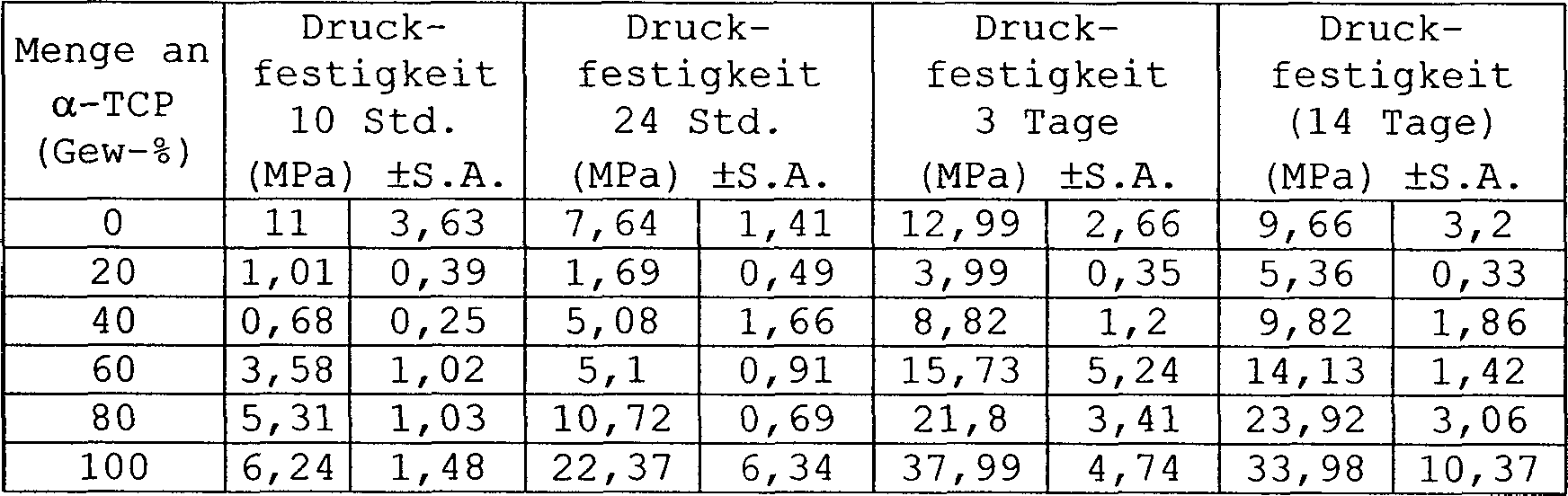
Beispiel 2.Example 2.
Die Druckfestigkeit wurde weiterhin mit Bezug auf α-TCP mit weniger als 20 Gew.-% Calciumsulfathemihydrat (CSH) untersucht. (CSH wurde von Bo Ehrlander AB, Göteborg, Schweden erhalten).The Compressive strength was further determined with respect to α-TCP with less than 20 weight percent calcium sulfate hemihydrate (CSH) examined. (CSH was founded by Bo Ehrlander AB, Gothenburg, Sweden received).
Die zwei Pulver wurden mechanisch miteinander über 5 Minuten gemischt. Dann wurde die Flüssigkeit zu dem Pulver in einem Flüssigkeit zu Pulver (L/P-)Verhältnis von 0,32 ml·g–1 gegeben. Die Flüssigkeit enthielt als ein Beschleuniger 2,5 Gew.-% Na2HPO4.The two powders were mechanically mixed together for 5 minutes. Then, the liquid was added to the powder in a liquid to powder (L / P) ratio of 0.32 ml · g -1 . The liquid contained, as an accelerator, 2.5% by weight of Na 2 HPO 4 .
Formen
wurden dann gefüllt
und in eine Kochsalzlösung
(0,9%) bei 37°C
für 7 Tage
eingetaucht. Die Ergebnisse werden in der folgenden Tabelle 5 und
in der
Wie
aus der
Tabelle
5 
Beispiel 3.Example 3.
Während jeder der zwei Abbindreaktionen wurden Kristalle gebildet, wenn Calciumsulfathemihydrat bzw. Calciumsulfat mit Wasser in den Abbindreaktionen reagierte. Anfänglich wurden Kristallkerne erzeugt und die finale Kristallstruktur wird dann durch Wachstum der Kerne gebildet. Durch Zugabe von bereits gebildeten Kristallen zu dem abgebundenen Material wird der Keimbildungsschritt in dem Abbindvorgang bereits abgeschlossen, was die zur Kristallisierung des Materials zu seiner Härtung erforderliche Zeit verringern wird. Die Kristalle werden direkt aus Teilchen von zugegebenen Calciumsulfatdihydrat bzw. Hydroxylapatit wachsen. Folglich werden diese zugesetzten Teilchen von abgebundenen Material als Beschleuniger in den Abbindreaktionen wirken.While everyone of the two setting reactions, crystals were formed when calcium sulfate hemihydrate or Calcium sulfate reacted with water in the Abbindreaktionen. Were initially Crystal nuclei are generated and the final crystal structure then becomes formed by growth of the nuclei. By addition of already formed crystals to the set material, the nucleation step in the Abbindvorgang already completed, leading to the crystallization of the material for its hardening reduce the time required. The crystals become direct from particles of added calcium sulfate dihydrate or hydroxyapatite to grow. Consequently, these added particles become set Material act as an accelerator in the Abbindreaktionen.
Je kleiner die Größe der zu dem Material gegebenen Beschleunigerteilchen, desto wirkungsvoller ist die Beschleunigungswirkung, die erhalten wird, da die Kristalle von der Oberfläche der Teilchen wachsen werden. Wenn die Beschleunigerteilchen klein sind, wird die Oberfläche der Teilchen pro Gewichtseinheit groß sein.ever smaller the size of the the accelerator particles given to the material, the more effective is the accelerating effect that is obtained as the crystals from the surface the particles will grow. When the accelerator particles are small are, the surface becomes the particles per unit weight be large.
Falls α-CaSO4·2H2O als ein Beschleuniger verwendet wird, wird es wirksamer als β-CaSO4·2H2O sein, wenn α-CaSO4·1/2H2O als der Hauptbestandteil des Materials verwendet wird. Dies könnte durch den Unterschied Kristallform zwischen den zwei Formen des Calciumsulfats erklärt werden. Da die Kristalle direkt von der Teilchenoberfläche des Beschleunigers wachsen schreitet die Reaktion schneller voran, wenn die Beschleunigerkristalle exakt die gleiche Form haben wie die Kristalle, die den Hauptbestandteil des Materials bilden.If α-CaSO 4 .2H 2 O is used as an accelerator, it will be more effective than β-CaSO 4 .2H 2 O when α-CaSO 4 .1 / 2H 2 O is used as the main constituent of the material. This could be explained by the difference in crystal form between the two forms of calcium sulfate. As the crystals grow directly from the particle surface of the accelerator, the reaction progresses faster if the accelerator crystals are exactly the same shape as the crystals that make up the main constituent of the material.
Beispiel 4.Example 4.
Die
Wirkungen des Gehalts an Calciumsulfatdihydrat auf die Injektionszeit
wird in der
Beispiel 5.Example 5.
Die
Wirkungen des Wassergehalts und des Gehalts an Calciumsulfatdihydrat
auf die Abbindzeit wird in der
Beispiel 6.Example 6.
In der erfindungsgemäßen Zusammensetzung ist die Form des Calicumhydratshemihydrats von Wichtigkeit. α-Calciumsulfathemihydrat (α-CaSO4·1/2H2O) ist aufgrund seiner mechanischen Festigkeit bevorzugt zu verwenden. α-CaSO4·1/2H2O hat eine Druckfestigkeit von 40,4 MPa verglichen mit 14 MPa für β-α-CaSO4·1/2H2O.In the composition of the invention, the form of the calic hydrate hemihydrate is of importance. α-calcium sulfate hemihydrate (α-CaSO 4 · 1 / 2H 2 O) is preferable for its mechanical strength. α-CaSO 4 · 1 / 2H 2 O has a compressive strength of 40.4 MPa compared to 14 MPa for β-α-CaSO 4 · 1 / 2H 2 O.
Beispiel 7.Example 7.
Biologischer Abbau von Calciumsulfathydroxylapatit-Knochensubstitut in vitro und in vivo.Biodegradation of Calciumsulfathydroxylapatit-bone substitute in vitro and in vivo.
Die Abbaurate von Calciumsulfat mit 40 Gew.-% Hydroxylapatit wurde untersucht. Das Material wurde in einer simulierten Körperflüssigkeit (Simulated Body Fluid) als auch in Muskeltaschen in Ratten gebracht. Die mechanische Festigkeit und die Größe des erhaltenen Blocks wurde über die Zeit als ein biologischer Abbauindex untersucht.The Degradation rate of calcium sulfate with 40% by weight of hydroxyapatite was investigated. The material was in a simulated body fluid (Simulated Body Fluid) as well as in muscle pockets in rats. The mechanical strength and the size of the obtained Blocks was over examines the time as a biodegradation index.
Mechanische UntersuchungMechanical examination
Die Untersuchung der Druckfestigkeit wurde unter Verwendung einer MTS- und einer Instron 8511.20-Untersuchungsausstattung durchgeführt. Nach Ernten des Materials wurden die Proben direkt zwischen selbsteinstellenden Platten angeordnet und bei 1 mm min–1 bis zum Versagen bei Raumtemperatur komprimiert.Compressive strength testing was performed using MTS and Instron 8511.20 equipment. After harvesting the material, the samples were placed directly between self-adjusting plates and compressed at 1 mm min -1 until failure at room temperature.
Volumenmessungenvolume measurements
Nach Materialernte maß ein Messtaster das Volumen des Materialblocks.To Material crop measured Probe the volume of the material block.
In vitro-StudieIn vitro study
Zemente aus Calciumsulfat oder Calciumsulfat mit Hydroxylapatatit wurden durch Mischen mit destilliertem Wasser bei einem L/P-Verhältnis von 0,25 ml/g hergestellt. Nach Mischen wurde der Zement in eine PFTE-Form injiziert und abgebunden. Die Proben waren 4 mm im Durchmesser und 8 mm in der Länge. Sechs zylindrische Proben wurden in einer simulierten Körperflüssigkeit angeordnet und die Flüssigkeit wurde jeden Tag gewechselt. Nach einer Woche wurden die Proben direkt zwischen zwei selbstausgleichenden Platten (selflevelling platens) angeordnet und einer Druckfestigkeitsuntersuchung bis zum Versagen bei Raumtemperatur unterzogen.cements from calcium sulfate or calcium sulfate with hydroxyapatatite by mixing with distilled water at an L / P ratio of 0.25 ml / g. After mixing, the cement was injected into a PFTE mold and tied. The samples were 4 mm in diameter and 8 mm in diameter Length. Six cylindrical samples were taken in a simulated body fluid arranged and the liquid was changed every day. After a week, the samples became direct between two self-leveling plates (self-leveling plates) arranged and a compressive strength test to failure at room temperature.
In vivo-StudieIn vivo study
Materialherstellungmaterial production
Calciumsulfathemihydrat (CaSO4·1/2H2O) wurde mit 40 Gew.-% Hydroxylapatitpulver (Ca10(PO4)6(OH)2; HA) gemischt. Die Mischung aus POP-HA wurde gesintert und in der Luft abgeschreckt. Ein Beschleuniger (ein Calciumsulfat) wurde zu 0,4 Gew.-% zu dem POP-HA gegeben, und das trockene Pulvermaterial wurde durch Gamma-Bestrahlung sterilisiert.Calcium sulfate hemihydrate (CaSO 4 .1 / 2H 2 O) was mixed with 40% by weight of hydroxyapatite powder (Ca 10 (PO 4 ) 6 (OH) 2 ; HA). The mixture of POP-HA was sintered and quenched in the air. An accelerator (a calcium sulfate) was added to 0.4% by weight to the POP-HA, and the dry powder material was sterilized by gamma irradiation.
Ein Zement wurde durch Mischen des Pulvers mit destilliertem Wasser in einem L/P-Verhältnis von 0,25 ml/g hergestellt. Materialien wurden hergestellt, welche Calciumsulfat oder Calciumsulfat + Hydroxylapatit enthalten. Nach Mischen wurde der Zement in eine PFTE-Form injiziert und abgebunden. Die Proben waren zylindrisch mit einem Durchmesser von 4 mm und einer Höhe von 8 mm. Einmal abgebunden, wurden die Proben in Muskeltaschen von Ratten eingefügt.One Cement was made by mixing the powder with distilled water in a L / P ratio of 0.25 ml / g. Materials were made which Calcium sulfate or calcium sulfate + hydroxyapatite. To Mixing, the cement was injected into a PFTE mold and set. Samples were cylindrical with a diameter of 4 mm and a height of 8 mm. Once set, the samples were placed in muscle pockets of rats inserted.
Tiereanimals
Sprague-Dawley-Ratten mit einem Gewicht von etwa 200 g wurden verwendet und für 1 Woche vor der Verwendung in Tiereinrichtungen gehalten. Die Tiere wurden gemäß einer Standardlabordiät gefüttert. Alle Ratten wurden mit peritonealen Injektionen von 0,5–0,6 ml einer Lösung mit 1 ml Pentobarbital (60 mg/ml), 2 ml Diazepam (5 mg/ml) und ein 1 ml Saline (0,15 M) anästhesiert. Die Implantate wurden in die Muskeln der Ratten eingefügt. Neun Ratten wurden für jeden untersuchten Zeitraum verwendet. Die Ratten wurden durch eine peritoneale Injektion einer Überdosis Pentobarbital 1 oder 4 Wochen nach Implantation getötet.Sprague-Dawley rats Weighing about 200 g were used and for 1 week kept in animal facilities prior to use. The animals were according to a Standard laboratory diet fed. All rats were treated with peritoneal injections of 0.5-0.6 ml a solution with 1 ml of pentobarbital (60 mg / ml), 2 ml of diazepam (5 mg / ml) and one 1 ml saline (0.15 M) anesthetized. The implants were inserted into the muscles of the rats. nine Rats were for used every period studied. The rats were replaced by a peritoneal injection of an overdose Pentobarbital killed 1 or 4 weeks after implantation.
ErgebnisseResults
Nach einer Woche Inkubation wurde die mechanische Festigkeit der in der simulierten Körperflüssigkeit bzw. Muskeltaschen in Ratten angeordneten zylindrischen Proben aufgezeichnet. Die mechanische Festigkeit der Materialien nahm von 35 MPa auf etwa 5 MPa sowohl in vitro als auch in vivo ab. Das Volumen des verbleibenden Blocks war nur 1/3 bis 1/10 des ursprünglichen Blockvolumens (Tabelle 5).To a week's incubation, the mechanical strength was in the simulated body fluid or muscle pockets recorded in rats arranged cylindrical samples. The mechanical strength of the materials increased from 35 MPa to about 5 MPa both in vitro and in vivo. The volume of the remaining Blocks was only 1/3 to 1/10 of the original block volume (Table 5).
Nach 4 Wochen Inkubation war die mechanische Festigkeit der Materialien vollständig verschwunden und die Stäbe aus Calciumsulfat waren nahezu vollständig absorbiert. Das Calciumsulfat mit Hydroxylapatit war noch vorhanden aber vollständig verformt und das Material war von normalem Weichgewebe umgeben. Das Gewebe drang ebenfalls in die Materialen ein. Überdies war die Masse des verbleibenden Materials größer als die des implantierten ursprünglichen Blocks.To 4 weeks incubation was the mechanical strength of the materials Completely disappeared and the bars calcium sulfate was almost completely absorbed. The calcium sulfate with hydroxyapatite was still present but completely deformed and the material was surrounded by normal soft tissue. The tissue also penetrated into the materials. Moreover, the mass of the remaining was Material larger than those of the implanted original Block.
Die folgende Tabelle 6 zeigt das Volumen des verbleibenden Zylindermaterials (Mittelwert ±SE) in Rattenmuskeln nach Inkubation von 1 oder 4 Wochen. Das ursprüngliche Volumen des Zylindermaterials war 100 mm3. Die statistische Analyse wurde unter Verwendung des Einweg-ANOVA-Verfahrens und des t-Tests nach Student durchgeführt. Alle erhaltenden Ergebnisse wiesen eine hohe statistische Signifikanz (p < 0,0001) auf.Table 6 below shows the volume of remaining cylinder material (mean ± SE) in rat muscles after 1 or 4 weeks of incubation. The original volume of the cylinder material was 100 mm 3 . Statistical analysis was performed using the disposable ANOVA procedure and Student's t-test. All results obtained showed a high statistical significance (p <0.0001).
Tabelle
6 
Das implantierte Material mit Calciumsulfat und Hydroxylapatit wurde schnell innerhalb einer Woche sowohl in der simulierten Körperflüssigkeit als auch in Ratten abgebaut. Die Abbaurate war die gleiche in simulierter Körperflüssigkeit oder in Muskeltaschen, was anzeigt, dass nur ein Verfahren notwendig ist, um die Abbaurate nachzuweisen.The implanted material with calcium sulfate and hydroxyapatite was fast within a week both in the simulated body fluid as well degraded in rats. The degradation rate was the same in simulated body fluid or in muscle pockets, indicating that only one procedure is necessary is to prove the degradation rate.
Schließlich ergaben die Untersuchungen des kombinierten Sulfat- und Phosphatmaterials einen biologischen Abbau in vitro und in vivo als auch ein Aushärten beider Bestandteile mit guten Ergebnissen in Bezug auf Injizierbarkeit und Abbinden.Finally revealed the investigations of the combined sulphate and phosphate material a biodegradation in vitro and in vivo as well as a curing of both Ingredients with good results in injectability and bonding.
Claims (33)
Applications Claiming Priority (3)
| Application Number | Priority Date | Filing Date | Title |
|---|---|---|---|
| SE0002676 | 2000-07-17 | ||
| SE0002676A SE517168C2 (en) | 2000-07-17 | 2000-07-17 | A composition for an injectable bone mineral replacement material |
| PCT/SE2001/001627 WO2002005861A1 (en) | 2000-07-17 | 2001-07-16 | A composition for an injectable bone mineral substitute material |
Publications (2)
| Publication Number | Publication Date |
|---|---|
| DE60116098D1 DE60116098D1 (en) | 2006-01-26 |
| DE60116098T2 true DE60116098T2 (en) | 2006-08-17 |
Family
ID=20280508
Family Applications (1)
| Application Number | Title | Priority Date | Filing Date |
|---|---|---|---|
| DE60116098T Expired - Lifetime DE60116098T2 (en) | 2000-07-17 | 2001-07-16 | COMPOSITION FOR AN INJECTABLE BONE MINERAL REPLACEMENT |
Country Status (9)
| Country | Link |
|---|---|
| US (4) | US7417077B2 (en) |
| EP (1) | EP1301219B1 (en) |
| JP (1) | JP5351369B2 (en) |
| AT (1) | ATE313344T1 (en) |
| AU (2) | AU2001271209B2 (en) |
| DE (1) | DE60116098T2 (en) |
| ES (1) | ES2252254T3 (en) |
| SE (1) | SE517168C2 (en) |
| WO (1) | WO2002005861A1 (en) |
Families Citing this family (57)
| Publication number | Priority date | Publication date | Assignee | Title |
|---|---|---|---|---|
| SE520688C2 (en) * | 2000-04-11 | 2003-08-12 | Bone Support Ab | An injectable bone mineral replacement material |
| DE10032220A1 (en) | 2000-07-03 | 2002-01-24 | Sanatis Gmbh | Magnesium ammonium phosphate cements, their manufacture and use |
| SE517168C2 (en) | 2000-07-17 | 2002-04-23 | Bone Support Ab | A composition for an injectable bone mineral replacement material |
| CA2470597C (en) * | 2001-12-20 | 2013-05-28 | Bone Support Ab | Artificial bone mineral substitute material containing a ceramic and a water soluble non-ionic x-ray contrast agent |
| SE522098C2 (en) | 2001-12-20 | 2004-01-13 | Bone Support Ab | Artificial bone mineral substitute material useful as an X-ray contrast medium comprises ceramic and water soluble non-ionic X-ray contrast agent |
| US7273523B2 (en) * | 2002-06-07 | 2007-09-25 | Kyphon Inc. | Strontium-apatite-cement-preparations, cements formed therefrom, and uses thereof |
| NZ537093A (en) * | 2002-06-19 | 2006-01-27 | Dr | Hydraulic cement based on calcium phosphate for surgical use |
| FR2850282B1 (en) | 2003-01-27 | 2007-04-06 | Jerome Asius | INJECTABLE IMPLANT BASED ON CERAMIC FOR THE FILLING OF WRINKLES, CUTANEOUS DEPRESSIONS AND SCARS, AND ITS PREPARATION |
| US7507257B2 (en) * | 2003-02-04 | 2009-03-24 | Wright Medical Technology, Inc. | Injectable resorbable bone graft material, powder for forming same and methods relating thereto for treating bone defects |
| SE0300620D0 (en) * | 2003-03-05 | 2003-03-05 | Bone Support Ab | A new bone substitute composition |
| ES2257131B1 (en) * | 2003-10-01 | 2007-07-01 | Universitat Politecnica De Catalunya | MODIFIED CALCIUM PHOSPHATES WITH IRON. |
| SE0302983D0 (en) * | 2003-11-11 | 2003-11-11 | Bone Support Ab | Apparatus for providing spongy bone with bone replacement and / or bone strengthening material and associated method |
| SE526985C2 (en) * | 2003-11-27 | 2005-11-29 | Doxa Ab | Fixation system for implant elements |
| ES2396133T3 (en) | 2004-04-27 | 2013-02-19 | Kyphon SÀRl | Bone replacement compositions and method of use |
| US7749268B2 (en) * | 2004-05-26 | 2010-07-06 | Warsaw Orthopedic, Inc. | Methods for treating the spine |
| SE527528C2 (en) | 2004-06-22 | 2006-04-04 | Bone Support Ab | Apparatus for the preparation of curable pulp and use of the apparatus |
| US7473678B2 (en) * | 2004-10-14 | 2009-01-06 | Biomimetic Therapeutics, Inc. | Platelet-derived growth factor compositions and methods of use thereof |
| US7250550B2 (en) | 2004-10-22 | 2007-07-31 | Wright Medical Technology, Inc. | Synthetic bone substitute material |
| US7651701B2 (en) * | 2005-08-29 | 2010-01-26 | Sanatis Gmbh | Bone cement composition and method of making the same |
| US8025903B2 (en) | 2005-09-09 | 2011-09-27 | Wright Medical Technology, Inc. | Composite bone graft substitute cement and articles produced therefrom |
| US7754246B2 (en) | 2005-09-09 | 2010-07-13 | Wright Medical Technology, Inc. | Composite bone graft substitute cement and articles produced therefrom |
| US7754005B2 (en) * | 2006-05-02 | 2010-07-13 | Kyphon Sarl | Bone cement compositions comprising an indicator agent and related methods thereof |
| WO2007132026A1 (en) * | 2006-05-12 | 2007-11-22 | Martin-Nieto Camacho Christoba | Bone-regenerating substance composed of semi-hydrated calcium sulphate and calcium phosphate |
| AU2007268175B2 (en) * | 2006-05-26 | 2013-05-23 | Baxter Healthcare S.A. | Injectable fibrin composition for bone augmentation |
| EP2021043B1 (en) * | 2006-05-26 | 2011-01-12 | Baxter International Inc. | Injectable bone void filler |
| US7507286B2 (en) * | 2006-06-08 | 2009-03-24 | Sanatis Gmbh | Self-foaming cement for void filling and/or delivery systems |
| DE102006037362B3 (en) | 2006-08-09 | 2007-09-20 | Heraeus Kulzer Gmbh | Bone-replacement material has calcium carbonate, which is suspended as particulate calcium carbonate in aqueous solution, which contains water soluble haemostatic agent |
| US20080063681A1 (en) * | 2006-09-11 | 2008-03-13 | Ebi, L.P. | Therapeutic bone replacement material |
| ES2389784T3 (en) * | 2006-09-21 | 2012-10-31 | Kyphon SÀRL | Diamonium phosphate and other ammonium salts and their use to prevent blood clotting |
| US20080195223A1 (en) * | 2006-11-03 | 2008-08-14 | Avram Allan Eddin | Materials and Methods and Systems for Delivering Localized Medical Treatments |
| EP1958649A1 (en) * | 2007-02-14 | 2008-08-20 | Graftys | Injectable calcium-phosphate cement releasing a bone resorption inhibitor |
| MX2009010387A (en) | 2007-03-26 | 2009-10-19 | Baxter Int | Injectable void filler for soft tissue augmentation. |
| US8106109B2 (en) * | 2007-07-20 | 2012-01-31 | Coltene Whaledent Ag | Dental filling material |
| US8226719B2 (en) * | 2007-11-14 | 2012-07-24 | Cook Medical Technologies Llc | Method and bone cement substitute kit for stabilizing a collapsed vertebra of a patient |
| US8435343B2 (en) | 2008-02-20 | 2013-05-07 | Augma Biomaterials Ltd. | Bone graft material and uses thereof |
| US7968616B2 (en) * | 2008-04-22 | 2011-06-28 | Kyphon Sarl | Bone cement composition and method |
| WO2011075580A1 (en) | 2009-12-18 | 2011-06-23 | Howmedica Osteonics Corp. | Post irradiation shelf-stable dual paste direct injectable bone cement precursor systems and methods of making same |
| EP2353619A1 (en) | 2010-02-09 | 2011-08-10 | Bone Support AB | Preparation of Bone Cement Compositions |
| US9180137B2 (en) | 2010-02-09 | 2015-11-10 | Bone Support Ab | Preparation of bone cement compositions |
| WO2012054009A1 (en) | 2010-10-19 | 2012-04-26 | Jiin-Huey Chern Lin | Method for preparing a hardened calcium sulfate dihydrate block and use thereof |
| US20120093771A1 (en) * | 2010-10-19 | 2012-04-19 | National Cheng Kung University | Method for preparing a hardened calcium sulfate dihydrate block and use thereof |
| WO2012062360A1 (en) | 2010-11-10 | 2012-05-18 | Stryker Trauma Gmbh | Polymeric bone foam composition and method |
| US8226766B2 (en) * | 2010-12-22 | 2012-07-24 | United States Gypsum Company | Set accelerator for gypsum hydration |
| JP5924636B2 (en) * | 2011-04-26 | 2016-05-25 | 公益財団法人神奈川科学技術アカデミー | Cement material manufacturing method and cement manufacturing method |
| ES2399273B1 (en) * | 2011-09-13 | 2014-01-28 | Universidad Politécnica De Valencia | ESTUCO FOR THE CONSERVATION AND RESTORATION OF BONE MATERIALS. |
| WO2014110284A1 (en) | 2013-01-09 | 2014-07-17 | Bacterin International, Inc. | Bone graft substitute containing a temporary contrast agent and a method of generating such and a method of use thereof |
| CA2901528C (en) | 2013-02-20 | 2022-07-26 | Bone Support Ab | Heat-treated, sintered and micronized hydroxyapatite powder for use in a hardenable bone substitute composition |
| TWI651103B (en) | 2013-12-13 | 2019-02-21 | 萊特醫技股份有限公司 | Multiphase bone graft replacement material |
| KR101423129B1 (en) * | 2014-02-26 | 2014-07-25 | 주식회사 오쎄인 | High strength bone alternative synthetic bone for increasing compressive strength and supplementing blood circulation, and method for producing the same |
| AU2016236326A1 (en) | 2015-03-23 | 2017-10-12 | Bone Support Ab | Biphasic ceramic bone substitute |
| US20170232151A1 (en) * | 2016-02-13 | 2017-08-17 | National Taiwan University | Bioresorbable synthetic bone graft |
| GB201704688D0 (en) * | 2017-03-24 | 2017-05-10 | Biocomposites Ltd | Calcicum based clinical material with antimicrobial properties and method of forming for prevention or treatment of infection |
| KR102209945B1 (en) * | 2018-08-17 | 2021-02-02 | 주식회사 오스테온 | A powder composition for preparing bone cement providing tunnels for moving bone-forming cells |
| CN109701072B (en) * | 2019-01-30 | 2021-09-24 | 中国科学院金属研究所 | Injectable and degradable artificial bone material and preparation method thereof |
| JP7532400B2 (en) * | 2019-03-29 | 2024-08-13 | グッドウィン ピーエルシー | Investment Powder |
| CN112479735A (en) * | 2020-12-08 | 2021-03-12 | 昆明市延安医院 | CaSO-containing food4beta-TCP composite ceramic material, preparation method and application |
| EP4335466A1 (en) | 2022-09-08 | 2024-03-13 | Heraeus Medical GmbH | Composition for the preparation of a bone substitute material, method for the preparation of a pharmaceutical active substance carrier, pharmaceutical active substance carrier and its use |
Family Cites Families (128)
| Publication number | Priority date | Publication date | Assignee | Title |
|---|---|---|---|---|
| US949163A (en) * | 1909-07-07 | 1910-02-15 | Bridgeport Brass Co | Grease-gun. |
| US1644173A (en) * | 1923-02-01 | 1927-10-04 | Bassick Mfg Co | Lubricating apparatus |
| US3367783A (en) * | 1966-03-23 | 1968-02-06 | Gerber Prod | Process of preparing a fruit gel |
| US3475010A (en) * | 1968-04-24 | 1969-10-28 | Prod Res & Chem Corp | Dispensing cartridge for intermixing separate ingredients |
| US3837379A (en) * | 1973-05-14 | 1974-09-24 | East West Med Prod | Irrigator liquid supply system |
| CH608189A5 (en) | 1974-12-13 | 1978-12-29 | Savac Ag | |
| US3965910A (en) * | 1975-04-28 | 1976-06-29 | Walpak Company | Urinary irrigation valve |
| CH626873A5 (en) | 1977-03-28 | 1981-12-15 | Bracco Ind Chimica Spa | |
| IT1207226B (en) | 1979-08-09 | 1989-05-17 | Bracco Ind Chimica Spa | 2,4,6-TRIIODE-ISOPHTHALIC ACID DERIVATIVES, METHOD FOR THEIR PREPARATION AND CONTRAST MEANS THAT CONTAIN THEM. |
| US4338925A (en) * | 1979-12-20 | 1982-07-13 | Jo Miller | Pressure injection of bone cement apparatus and method |
| US4269331A (en) * | 1980-02-15 | 1981-05-26 | Watson John D | Metered dispensing device |
| US4496342A (en) * | 1981-03-20 | 1985-01-29 | Surgical Design Corporation | Surge prevention system for an ophthalmic instrument |
| DE3206911A1 (en) | 1982-02-26 | 1983-09-15 | Lohmann Tierernährung GmbH, 2190 Cuxhaven | BIOCHEMICAL ACTIVE SUBSTANCE, THE PRODUCTION THEREOF AND SUBSTANCE CONTAINING THIS ACTIVE SUBSTANCE |
| US4439420A (en) | 1982-11-16 | 1984-03-27 | Ethicon, Inc. | Absorbable hemostatic composition |
| US4584401A (en) | 1983-10-20 | 1986-04-22 | Biophysica Foundation | Methods and compositions involving polyhydroxylated polyiodo non-ionic contrast media |
| US4619655A (en) | 1984-01-26 | 1986-10-28 | University Of North Carolina | Plaster of Paris as a bioresorbable scaffold in implants for bone repair |
| US4583974A (en) * | 1984-04-04 | 1986-04-22 | Kokernak Denis T | Syringe for balloon dilation catheters |
| JPS6199623A (en) | 1984-10-18 | 1986-05-17 | High Frequency Heattreat Co Ltd | Quenching method controlled numerically |
| SE450545B (en) * | 1984-10-19 | 1987-07-06 | Mit Ab | PROCEDURE AND DEVICE FOR MANUFACTURING BENCEMENT FOR FIXING PROSTHESIS |
| US4676655A (en) * | 1985-11-18 | 1987-06-30 | Isidore Handler | Plunger type cartridge mixer for fluent materials |
| EP0259484A1 (en) * | 1986-03-11 | 1988-03-16 | University Of Medicine And Dentistry Of New Jersey | Moldable bone implant material |
| US4752479A (en) | 1986-05-27 | 1988-06-21 | Ciba-Geigy Corporaton | Multi vitamin and mineral dietary supplement with controlled release bioavailable iron |
| WO1988006023A1 (en) * | 1987-02-20 | 1988-08-25 | Klaus Draenert | Suction drainage-bone screw |
| ES2007350A6 (en) | 1987-05-29 | 1989-06-16 | Ganadera Union Ind Agro | FOOD PRODUCTS ENRICHED WITH NUCLEOSIDES AND NOT NUCLEOTIDES FOR THE NUTRITION OF CHILDREN AND ADULTS, AND PROCEDURE FOR THEIR PREPARATION. |
| DE3731542A1 (en) | 1987-09-17 | 1989-03-30 | Schering Ag | NEW DICARBONIC ACID-BIS (3,5-DICARBAMOYL-2,4,6-TRIIOD-ANILIDE), METHOD FOR THE PRODUCTION THEREOF AND THESE CONTAINING X-RAY AGENTS |
| GB8724897D0 (en) | 1987-10-23 | 1987-11-25 | Downes S | Material |
| JPH0684289B2 (en) | 1987-11-26 | 1994-10-26 | 株式会社トクヤマ | One-paste restoration material |
| US5605885A (en) * | 1988-05-05 | 1997-02-25 | Entremed, Inc. | Method for stimulating the immune system |
| AU5950790A (en) * | 1989-06-30 | 1991-01-17 | United States Gypsum Company | Calcium sulfate hemihydrate composition having utility in the presence of blood |
| GB8919929D0 (en) | 1989-09-04 | 1989-10-18 | Nycomed As | Compositions |
| US5236456A (en) | 1989-11-09 | 1993-08-17 | Osteotech, Inc. | Osteogenic composition and implant containing same |
| US5071040A (en) * | 1990-03-09 | 1991-12-10 | Pfizer Hospital Products Group, Inc. | Surgical adhesives mixing and dispensing implement |
| EP0537180A4 (en) * | 1990-05-11 | 1993-04-28 | Lifecore Medical, Inc. | Rapid setting hydroxylapatite and plaster formulation |
| US5168757A (en) * | 1990-05-15 | 1992-12-08 | Ryder International Corporation | Fluid displacement and pressurizing device |
| US5269785A (en) * | 1990-06-28 | 1993-12-14 | Bonutti Peter M | Apparatus and method for tissue removal |
| US5990382A (en) * | 1990-08-29 | 1999-11-23 | Biomedical Enterprises, Inc. | Method and implant for surgical manipulation of bone |
| US6080801A (en) | 1990-09-13 | 2000-06-27 | Klaus Draenert | Multi-component material and process for its preparation |
| US5149368A (en) * | 1991-01-10 | 1992-09-22 | Liu Sung Tsuen | Resorbable bioactive calcium phosphate cement |
| US5262166A (en) * | 1991-04-17 | 1993-11-16 | Lty Medical Inc | Resorbable bioactive phosphate containing cements |
| US5462722A (en) | 1991-04-17 | 1995-10-31 | Liu; Sung-Tsuen | Calcium phosphate calcium sulfate composite implant material |
| US5232024A (en) * | 1991-05-30 | 1993-08-03 | Eli Williams | Slide-valve manifold |
| DE69205736T2 (en) | 1991-06-26 | 1996-06-13 | Nitta Gelatin Kk | Hardenable calcium phosphate-containing material for repairing living hard tissues. |
| DE4121043A1 (en) * | 1991-06-26 | 1993-01-07 | Merck Patent Gmbh | BONE REPLACEMENT MATERIAL WITH FGF |
| US5281265A (en) * | 1992-02-03 | 1994-01-25 | Liu Sung Tsuen | Resorbable surgical cements |
| SE510490C2 (en) * | 1992-02-07 | 1999-05-31 | Scandimed International Ab | Process for producing bone cement and apparatus for carrying out the process |
| CA2103683C (en) * | 1992-08-17 | 1998-06-16 | George Weeks | Methods of controlling dust and compositions produced thereby |
| IT1256248B (en) | 1992-12-24 | 1995-11-29 | Bracco Spa | WATER INJECTABLE FORMULATIONS FOR RADIODIAGNOSTICS INCLUDING MIXTURES OF IODURATED AROMATIC COMPOUNDS USEFUL AS X-RAY MATTING AGENTS |
| US5403318A (en) * | 1993-01-15 | 1995-04-04 | Boehringer Laboratories, Inc. | Apparatus and method for shaping bone |
| SE510491C2 (en) | 1993-08-18 | 1999-05-31 | Coripharm Gmbh & Co | Cement for medical use and manufacture and use of the cement |
| US5385887A (en) * | 1993-09-10 | 1995-01-31 | Genetics Institute, Inc. | Formulations for delivery of osteogenic proteins |
| US5681873A (en) | 1993-10-14 | 1997-10-28 | Atrix Laboratories, Inc. | Biodegradable polymeric composition |
| US5360823A (en) | 1993-11-02 | 1994-11-01 | Dawe's Inc. | Anionic salt formulation for milk fever |
| US6248110B1 (en) * | 1994-01-26 | 2001-06-19 | Kyphon, Inc. | Systems and methods for treating fractured or diseased bone using expandable bodies |
| US6716216B1 (en) * | 1998-08-14 | 2004-04-06 | Kyphon Inc. | Systems and methods for treating vertebral bodies |
| DE4409610C3 (en) | 1994-03-21 | 2001-09-20 | Scandimed Internat Ab Sjoebo | Mixing device |
| DE4425218A1 (en) * | 1994-07-16 | 1996-01-18 | Merck Patent Gmbh | Device for mixing and discharging bone cement |
| US6075067A (en) | 1994-08-15 | 2000-06-13 | Corpipharm Gmbh & Co | Cement for medical use, method for producing the cement, and use of the cement |
| DE4433201A1 (en) | 1994-09-17 | 1996-03-21 | Merck Patent Gmbh | Process for the production of active ingredient-containing bone cements |
| DE4435680A1 (en) | 1994-10-06 | 1996-04-11 | Merck Patent Gmbh | Porous bone substitute materials |
| US5616120A (en) * | 1995-02-06 | 1997-04-01 | Andrew; Mark S. | Method and apparatus for lenticular liquefaction and aspiration |
| US5614206A (en) | 1995-03-07 | 1997-03-25 | Wright Medical Technology, Inc. | Controlled dissolution pellet containing calcium sulfate |
| AU723740B2 (en) | 1995-06-06 | 2000-09-07 | Howmedica Inc. | Biocompatible hydroxyapatite formulations and uses therefor |
| EP0809519B1 (en) | 1995-12-19 | 2002-09-11 | Bracco Research S.A. | Compositions comprising tricodobenzene polymers for imaging the gastrointestinal tract |
| US6596904B1 (en) | 1996-01-29 | 2003-07-22 | Mallinc Krodt Inc | Process for producing ioversol |
| DE19620117C1 (en) | 1996-05-18 | 1997-07-24 | Corimed Kundenorientierte Medi | Preparation of medicinal composition containing calcium sulphate |
| FR2749756B1 (en) | 1996-06-14 | 1998-09-11 | Bioland | PROCESS FOR THE PREPARATION OF AN IMPLANTABLE COMPOSITE MATERIAL, MATERIAL OBTAINED, IMPLANT COMPRISING SUCH MATERIAL, AND IMPLEMENTATION KIT |
| US5871549A (en) | 1996-12-12 | 1999-02-16 | Johnson & Johnson Professional, Inc. | Femoral stem with reduced coefficient of friction with respect to bone cement |
| US20020076378A1 (en) | 1997-01-29 | 2002-06-20 | Nycomed Imaging As | Polymers |
| US5842786A (en) * | 1997-03-07 | 1998-12-01 | Solomon; Alan | Method and device for mixing medical compositions |
| US5829875A (en) * | 1997-04-02 | 1998-11-03 | Simpson Strong-Tie Co., Inc. | Combined barrier and mixer assembly for a cylindrical container |
| US6071982A (en) | 1997-04-18 | 2000-06-06 | Cambridge Scientific, Inc. | Bioerodible polymeric semi-interpenetrating network alloys for surgical plates and bone cements, and method for making same |
| DE19718648A1 (en) * | 1997-05-02 | 1998-11-05 | Merck Patent Gmbh | Method and device for producing sterile packed bone cement |
| IT1292037B1 (en) | 1997-05-30 | 1999-01-25 | Bracco Spa | PROCESS FOR THE PREPARATION OF 5- (ACETYL 62,3-DIIDROXYPROPYL) - AMINO) -N, N'-BIS (2,3-DIIDROXYPROPYL) -2,4,6-TRIIODE-1,3-BENZEN- |
| US5837752A (en) * | 1997-07-17 | 1998-11-17 | Massachusetts Institute Of Technology | Semi-interpenetrating polymer networks |
| US6048346A (en) * | 1997-08-13 | 2000-04-11 | Kyphon Inc. | Systems and methods for injecting flowable materials into bones |
| ES2170533T3 (en) | 1997-10-07 | 2002-08-01 | Robert Mathys Stiftung | HYDRAULIC SURGICAL CEMENT. |
| US6309420B1 (en) | 1997-10-14 | 2001-10-30 | Parallax Medical, Inc. | Enhanced visibility materials for implantation in hard tissue |
| WO1999020562A1 (en) * | 1997-10-20 | 1999-04-29 | Prc-Desoto International, Inc. | Multiple part manual dispensing syringe |
| US6440138B1 (en) * | 1998-04-06 | 2002-08-27 | Kyphon Inc. | Structures and methods for creating cavities in interior body regions |
| DE19816858A1 (en) | 1998-04-16 | 1999-10-21 | Merck Patent Gmbh | Tricalcium phosphate-containing bio-cement pastes with cohesion promoters |
| SE9801901L (en) | 1998-05-29 | 1999-08-02 | Bone Support Ab | Process for producing powder component for cement for medical use, use of such powder component and such powder component |
| SE9802528D0 (en) | 1998-07-13 | 1998-07-13 | Gs Dev Ab | Bone tissue restoring composition |
| WO2000007639A1 (en) * | 1998-08-07 | 2000-02-17 | Tissue Engineering, Inc. | Bone precursor compositions |
| DE19853832A1 (en) * | 1998-11-21 | 2000-05-25 | Merck Patent Gmbh | Calcium phosphate cements containing polyalkenoic acids |
| US6120174A (en) * | 1999-01-14 | 2000-09-19 | Bristol-Myers Squibb | Apparatus and method for mixing and dispensing bone cement |
| US6642285B1 (en) | 1999-02-02 | 2003-11-04 | Robert Mathys Stiftung | Implant comprising calcium cement and hydrophobic liquid |
| US6447809B1 (en) * | 1999-05-11 | 2002-09-10 | Metagenics, Inc. | Composition for promoting healthy bone structure |
| DE19938704C1 (en) * | 1999-08-14 | 2001-10-31 | Ivoclar Vivadent Ag | Process for the production of reaction systems for implantation in the human and animal body as a bone substitute, which i.a. Contain calcium and phosphorus |
| JP2001104324A (en) * | 1999-10-06 | 2001-04-17 | Ngk Spark Plug Co Ltd | Auxiliary device for drug extrusion and method for extruding drug using the same |
| DE19953771C1 (en) | 1999-11-09 | 2001-06-13 | Coripharm Medizinprodukte Gmbh | Absorbable bone implant material and method for producing the same |
| EP1155704A1 (en) | 2000-01-13 | 2001-11-21 | Chih-I Lin | Orthopedic filling material and method of use thereof |
| US6365218B1 (en) * | 2000-02-04 | 2002-04-02 | Abbott Laboratories | Pediatric formula and methods for providing nutrition and improving tolerance |
| US6740090B1 (en) * | 2000-02-16 | 2004-05-25 | Trans1 Inc. | Methods and apparatus for forming shaped axial bores through spinal vertebrae |
| US6723334B1 (en) | 2000-03-01 | 2004-04-20 | Iowa State University Research Foundation, Inc. | Biologically compatible bone cements and orthopedic methods |
| US6652883B2 (en) | 2000-03-13 | 2003-11-25 | Biocure, Inc. | Tissue bulking and coating compositions |
| SE520688C2 (en) * | 2000-04-11 | 2003-08-12 | Bone Support Ab | An injectable bone mineral replacement material |
| ES2178556B1 (en) | 2000-06-30 | 2004-07-16 | Universitat Politecnica De Catalunya | CEMENT OF CALCIUM SULPHATE WITH CONTROLLED BIODEGRADATION. |
| SE517168C2 (en) | 2000-07-17 | 2002-04-23 | Bone Support Ab | A composition for an injectable bone mineral replacement material |
| US7008433B2 (en) * | 2001-02-15 | 2006-03-07 | Depuy Acromed, Inc. | Vertebroplasty injection device |
| ITMI20010773A1 (en) | 2001-04-11 | 2002-10-11 | Chemi Spa | PROCESS FOR THE PRODUCTION OF HIGH PURITY IOEXOLO |
| GB0110726D0 (en) | 2001-05-02 | 2001-06-27 | Biocomposites Ltd | Bone implant composition |
| JP2002325831A (en) * | 2001-05-02 | 2002-11-12 | Asahi Optical Co Ltd | Biological filler and method for producing biological filler |
| US20030055512A1 (en) | 2001-05-21 | 2003-03-20 | Genin Francois Y. | Calcium based neutral and bioresorbable bone graft |
| US6547432B2 (en) * | 2001-07-16 | 2003-04-15 | Stryker Instruments | Bone cement mixing and delivery device for injection and method thereof |
| US20030028251A1 (en) * | 2001-07-30 | 2003-02-06 | Mathews Hallett H. | Methods and devices for interbody spinal stabilization |
| US6706069B2 (en) | 2001-09-13 | 2004-03-16 | J. Lee Berger | Spinal grooved director with built in balloon |
| EP1443981B1 (en) | 2001-11-14 | 2015-05-20 | Ecole Polytechnique Fédérale de Lausanne (EPFL) | Pasty multiple constituent compositions for injectable calcium phosphate cements |
| JP4499327B2 (en) * | 2001-12-06 | 2010-07-07 | 松崎 浩巳 | Diameter expansion instrument and surgical instrument set |
| SE522098C2 (en) | 2001-12-20 | 2004-01-13 | Bone Support Ab | Artificial bone mineral substitute material useful as an X-ray contrast medium comprises ceramic and water soluble non-ionic X-ray contrast agent |
| CA2470597C (en) | 2001-12-20 | 2013-05-28 | Bone Support Ab | Artificial bone mineral substitute material containing a ceramic and a water soluble non-ionic x-ray contrast agent |
| US6780191B2 (en) * | 2001-12-28 | 2004-08-24 | Yacmur Llc | Cannula system |
| NZ537093A (en) | 2002-06-19 | 2006-01-27 | Dr | Hydraulic cement based on calcium phosphate for surgical use |
| US20050287071A1 (en) | 2002-12-03 | 2005-12-29 | Kyphon Inc. | Formulation for a cement preparation as bone substitute |
| BR0317809A (en) | 2003-02-13 | 2005-11-29 | Synthes Ag | Injectable Bone Replacement Mix |
| US7393493B2 (en) * | 2003-02-27 | 2008-07-01 | A Enterprises, Inc. | Crosslinkable polymeric materials and their applications |
| SE0300620D0 (en) | 2003-03-05 | 2003-03-05 | Bone Support Ab | A new bone substitute composition |
| EP1608734A4 (en) * | 2003-03-31 | 2006-11-22 | Cleveland Clinic Foundation | APPARATUS AND METHOD FOR BONE MARROW CULTURE |
| US20040267272A1 (en) * | 2003-05-12 | 2004-12-30 | Henniges Bruce D | Bone cement mixing and delivery system |
| US7306786B2 (en) | 2003-07-28 | 2007-12-11 | Skeletal Kinetics, Llc | Calcium phosphate cements comprising a water-soluble contrast agent |
| SE0302983D0 (en) | 2003-11-11 | 2003-11-11 | Bone Support Ab | Apparatus for providing spongy bone with bone replacement and / or bone strengthening material and associated method |
| US7524103B2 (en) * | 2003-11-18 | 2009-04-28 | Boston Scientific Scimed, Inc. | Apparatus for mixing and dispensing a multi-component bone cement |
| EP1708654B1 (en) * | 2003-12-01 | 2007-05-09 | Broockeville Corporation N.V. | A two-component mixing and dispensing device |
| ES2396133T3 (en) | 2004-04-27 | 2013-02-19 | Kyphon SÀRl | Bone replacement compositions and method of use |
| US20050257714A1 (en) | 2004-05-20 | 2005-11-24 | Constantz Brent R | Orthopedic cements comprising a barium apatite contrast agent |
| SE527528C2 (en) * | 2004-06-22 | 2006-04-04 | Bone Support Ab | Apparatus for the preparation of curable pulp and use of the apparatus |
| US7776073B2 (en) | 2004-06-30 | 2010-08-17 | Depuy Spine, Inc. | In-situ formed posterolateral fusion system |
| WO2006015302A1 (en) | 2004-07-29 | 2006-02-09 | X-Sten, Corp. | Spinal ligament modification devices |
| US7717918B2 (en) * | 2004-12-06 | 2010-05-18 | Dfine, Inc. | Bone treatment systems and methods |
-
2000
- 2000-07-17 SE SE0002676A patent/SE517168C2/en not_active IP Right Cessation
-
2001
- 2001-07-16 EP EP01950184A patent/EP1301219B1/en not_active Expired - Lifetime
- 2001-07-16 AU AU2001271209A patent/AU2001271209B2/en not_active Ceased
- 2001-07-16 AT AT01950184T patent/ATE313344T1/en not_active IP Right Cessation
- 2001-07-16 WO PCT/SE2001/001627 patent/WO2002005861A1/en not_active Ceased
- 2001-07-16 US US10/333,026 patent/US7417077B2/en not_active Expired - Fee Related
- 2001-07-16 DE DE60116098T patent/DE60116098T2/en not_active Expired - Lifetime
- 2001-07-16 ES ES01950184T patent/ES2252254T3/en not_active Expired - Lifetime
- 2001-07-16 JP JP2002511792A patent/JP5351369B2/en not_active Expired - Fee Related
- 2001-07-16 AU AU7120901A patent/AU7120901A/en active Pending
-
2008
- 2008-05-19 US US12/122,873 patent/US20080286331A1/en not_active Abandoned
- 2008-07-23 US US12/219,542 patent/US20090018667A1/en not_active Abandoned
- 2008-07-23 US US12/219,543 patent/US20090192629A1/en not_active Abandoned
Also Published As
| Publication number | Publication date |
|---|---|
| EP1301219A1 (en) | 2003-04-16 |
| SE517168C2 (en) | 2002-04-23 |
| SE0002676L (en) | 2002-01-18 |
| US20040048947A1 (en) | 2004-03-11 |
| SE0002676D0 (en) | 2000-07-17 |
| EP1301219B1 (en) | 2005-12-21 |
| US20090018667A1 (en) | 2009-01-15 |
| ATE313344T1 (en) | 2006-01-15 |
| US20090192629A1 (en) | 2009-07-30 |
| JP2004503332A (en) | 2004-02-05 |
| AU7120901A (en) | 2002-01-30 |
| AU2001271209B2 (en) | 2005-12-15 |
| WO2002005861A1 (en) | 2002-01-24 |
| US20080286331A1 (en) | 2008-11-20 |
| DE60116098D1 (en) | 2006-01-26 |
| ES2252254T3 (en) | 2006-05-16 |
| US7417077B2 (en) | 2008-08-26 |
| JP5351369B2 (en) | 2013-11-27 |
Similar Documents
| Publication | Publication Date | Title |
|---|---|---|
| DE60116098T2 (en) | COMPOSITION FOR AN INJECTABLE BONE MINERAL REPLACEMENT | |
| DE60305036T2 (en) | HYDRAULIC CEMENT BASED ON CALCIUM PHOSPHATE FOR SURGICAL APPLICATIONS | |
| DE69909850T2 (en) | STABILIZED HYDRAULIC BRUSH HEATING WITH A MAGNESIUM SALT | |
| DE69803398T2 (en) | HYDRAULIC SURGICAL CEMENT | |
| EP2170245B1 (en) | Hydraulic cement-based implant material and use thereof | |
| DE19938704C1 (en) | Process for the production of reaction systems for implantation in the human and animal body as a bone substitute, which i.a. Contain calcium and phosphorus | |
| DE60220949T2 (en) | NEW BONE MINERAL REPLACEMENT | |
| DE69715824T2 (en) | METHOD FOR PRODUCING AN IMPLANTABLE COMPOSITE MATERIAL, MATERIALS PRODUCED THEREOF, AND KIT FOR IMPLEMENTING THE METHOD | |
| DE69729647T2 (en) | Process for the preparation of calcium phosphate of low crystallinity and process for its use | |
| DE69429526T2 (en) | SELF-HARDENING CALCIUM PHOSPHATE CEMENTS AND METHOD FOR THE PRODUCTION AND USE THEREOF | |
| EP1296909B1 (en) | Magnesium-ammonium-phosphate cements, the production of the same and the use thereof | |
| DE60202461T2 (en) | Calcium Phosphate / Sulphate-Based Bone Implants Composition | |
| AU2001271209A1 (en) | A composition for an injectable bone mineral substitute material | |
| WO2003103734A1 (en) | Strontium-apatite-cement-preparations and the use thereof | |
| DE69127447T2 (en) | INNER MIXTURE OF GALCIUM AND PHOSPHATE SOURCES AS HYDROXYAPATITE PRECURSORS | |
| WO1999049906A1 (en) | Biologically degradable cement exhibiting improved properties | |
| EP1732618A1 (en) | Method for producing a bone implant material | |
| Bumgardner et al. | Ceramic composites for bone graft applications |
Legal Events
| Date | Code | Title | Description |
|---|---|---|---|
| 8364 | No opposition during term of opposition | ||
| 8327 | Change in the person/name/address of the patent owner |
Owner name: BONE SUPPORT NYA AB, LUND, SE |
|
| 8327 | Change in the person/name/address of the patent owner |
Owner name: BONE SUPPORT AB, LUND, SE |