DE60112059T2 - THERAPEUTICALLY USEFUL DIPHENYL ETHER COMPOUNDS - Google Patents
THERAPEUTICALLY USEFUL DIPHENYL ETHER COMPOUNDS Download PDFInfo
- Publication number
- DE60112059T2 DE60112059T2 DE60112059T DE60112059T DE60112059T2 DE 60112059 T2 DE60112059 T2 DE 60112059T2 DE 60112059 T DE60112059 T DE 60112059T DE 60112059 T DE60112059 T DE 60112059T DE 60112059 T2 DE60112059 T2 DE 60112059T2
- Authority
- DE
- Germany
- Prior art keywords
- methyl
- phenoxy
- mmol
- methylsulfanyl
- compound
- Prior art date
- Legal status (The legal status is an assumption and is not a legal conclusion. Google has not performed a legal analysis and makes no representation as to the accuracy of the status listed.)
- Expired - Fee Related
Links
- 0 C*(C)Cc(cc(cc1)N=O)c1Oc1cc*(*(C)C)cc1 Chemical compound C*(C)Cc(cc(cc1)N=O)c1Oc1cc*(*(C)C)cc1 0.000 description 8
- KWOLBLVGJJVVOB-UHFFFAOYSA-N Cc(cc1)ccc1Pc1c(CN(C)C)cc(CC#N)cc1 Chemical compound Cc(cc1)ccc1Pc1c(CN(C)C)cc(CC#N)cc1 KWOLBLVGJJVVOB-UHFFFAOYSA-N 0.000 description 1
Classifications
-
- H—ELECTRICITY
- H04—ELECTRIC COMMUNICATION TECHNIQUE
- H04L—TRANSMISSION OF DIGITAL INFORMATION, e.g. TELEGRAPHIC COMMUNICATION
- H04L12/00—Data switching networks
- H04L12/02—Details
- H04L12/14—Charging, metering or billing arrangements for data wireline or wireless communications
-
- A—HUMAN NECESSITIES
- A61—MEDICAL OR VETERINARY SCIENCE; HYGIENE
- A61P—SPECIFIC THERAPEUTIC ACTIVITY OF CHEMICAL COMPOUNDS OR MEDICINAL PREPARATIONS
- A61P15/00—Drugs for genital or sexual disorders; Contraceptives
-
- A—HUMAN NECESSITIES
- A61—MEDICAL OR VETERINARY SCIENCE; HYGIENE
- A61P—SPECIFIC THERAPEUTIC ACTIVITY OF CHEMICAL COMPOUNDS OR MEDICINAL PREPARATIONS
- A61P15/00—Drugs for genital or sexual disorders; Contraceptives
- A61P15/10—Drugs for genital or sexual disorders; Contraceptives for impotence
-
- A—HUMAN NECESSITIES
- A61—MEDICAL OR VETERINARY SCIENCE; HYGIENE
- A61P—SPECIFIC THERAPEUTIC ACTIVITY OF CHEMICAL COMPOUNDS OR MEDICINAL PREPARATIONS
- A61P25/00—Drugs for disorders of the nervous system
-
- A—HUMAN NECESSITIES
- A61—MEDICAL OR VETERINARY SCIENCE; HYGIENE
- A61P—SPECIFIC THERAPEUTIC ACTIVITY OF CHEMICAL COMPOUNDS OR MEDICINAL PREPARATIONS
- A61P25/00—Drugs for disorders of the nervous system
- A61P25/14—Drugs for disorders of the nervous system for treating abnormal movements, e.g. chorea, dyskinesia
-
- A—HUMAN NECESSITIES
- A61—MEDICAL OR VETERINARY SCIENCE; HYGIENE
- A61P—SPECIFIC THERAPEUTIC ACTIVITY OF CHEMICAL COMPOUNDS OR MEDICINAL PREPARATIONS
- A61P25/00—Drugs for disorders of the nervous system
- A61P25/24—Antidepressants
-
- A—HUMAN NECESSITIES
- A61—MEDICAL OR VETERINARY SCIENCE; HYGIENE
- A61P—SPECIFIC THERAPEUTIC ACTIVITY OF CHEMICAL COMPOUNDS OR MEDICINAL PREPARATIONS
- A61P25/00—Drugs for disorders of the nervous system
- A61P25/30—Drugs for disorders of the nervous system for treating abuse or dependence
-
- A—HUMAN NECESSITIES
- A61—MEDICAL OR VETERINARY SCIENCE; HYGIENE
- A61P—SPECIFIC THERAPEUTIC ACTIVITY OF CHEMICAL COMPOUNDS OR MEDICINAL PREPARATIONS
- A61P43/00—Drugs for specific purposes, not provided for in groups A61P1/00-A61P41/00
-
- C—CHEMISTRY; METALLURGY
- C07—ORGANIC CHEMISTRY
- C07C—ACYCLIC OR CARBOCYCLIC COMPOUNDS
- C07C205/00—Compounds containing nitro groups bound to a carbon skeleton
- C07C205/44—Compounds containing nitro groups bound to a carbon skeleton the carbon skeleton being further substituted by —CHO groups
-
- C—CHEMISTRY; METALLURGY
- C07—ORGANIC CHEMISTRY
- C07C—ACYCLIC OR CARBOCYCLIC COMPOUNDS
- C07C217/00—Compounds containing amino and etherified hydroxy groups bound to the same carbon skeleton
- C07C217/54—Compounds containing amino and etherified hydroxy groups bound to the same carbon skeleton having etherified hydroxy groups bound to carbon atoms of at least one six-membered aromatic ring and amino groups bound to acyclic carbon atoms or to carbon atoms of rings other than six-membered aromatic rings of the same carbon skeleton
- C07C217/56—Compounds containing amino and etherified hydroxy groups bound to the same carbon skeleton having etherified hydroxy groups bound to carbon atoms of at least one six-membered aromatic ring and amino groups bound to acyclic carbon atoms or to carbon atoms of rings other than six-membered aromatic rings of the same carbon skeleton with amino groups linked to the six-membered aromatic ring, or to the condensed ring system containing that ring, by carbon chains not further substituted by singly-bound oxygen atoms
- C07C217/58—Compounds containing amino and etherified hydroxy groups bound to the same carbon skeleton having etherified hydroxy groups bound to carbon atoms of at least one six-membered aromatic ring and amino groups bound to acyclic carbon atoms or to carbon atoms of rings other than six-membered aromatic rings of the same carbon skeleton with amino groups linked to the six-membered aromatic ring, or to the condensed ring system containing that ring, by carbon chains not further substituted by singly-bound oxygen atoms with amino groups and the six-membered aromatic ring, or the condensed ring system containing that ring, bound to the same carbon atom of the carbon chain
-
- C—CHEMISTRY; METALLURGY
- C07—ORGANIC CHEMISTRY
- C07C—ACYCLIC OR CARBOCYCLIC COMPOUNDS
- C07C229/00—Compounds containing amino and carboxyl groups bound to the same carbon skeleton
- C07C229/38—Compounds containing amino and carboxyl groups bound to the same carbon skeleton having amino groups bound to acyclic carbon atoms and carboxyl groups bound to carbon atoms of six-membered aromatic rings of the same carbon skeleton
-
- C—CHEMISTRY; METALLURGY
- C07—ORGANIC CHEMISTRY
- C07C—ACYCLIC OR CARBOCYCLIC COMPOUNDS
- C07C237/00—Carboxylic acid amides, the carbon skeleton of the acid part being further substituted by amino groups
- C07C237/28—Carboxylic acid amides, the carbon skeleton of the acid part being further substituted by amino groups having the carbon atom of at least one of the carboxamide groups bound to a carbon atom of a non-condensed six-membered aromatic ring of the carbon skeleton
-
- C—CHEMISTRY; METALLURGY
- C07—ORGANIC CHEMISTRY
- C07C—ACYCLIC OR CARBOCYCLIC COMPOUNDS
- C07C255/00—Carboxylic acid nitriles
- C07C255/01—Carboxylic acid nitriles having cyano groups bound to acyclic carbon atoms
- C07C255/32—Carboxylic acid nitriles having cyano groups bound to acyclic carbon atoms having cyano groups bound to acyclic carbon atoms of a carbon skeleton containing at least one six-membered aromatic ring
- C07C255/42—Carboxylic acid nitriles having cyano groups bound to acyclic carbon atoms having cyano groups bound to acyclic carbon atoms of a carbon skeleton containing at least one six-membered aromatic ring the carbon skeleton being further substituted by singly-bound nitrogen atoms, not being further bound to other hetero atoms
- C07C255/43—Carboxylic acid nitriles having cyano groups bound to acyclic carbon atoms having cyano groups bound to acyclic carbon atoms of a carbon skeleton containing at least one six-membered aromatic ring the carbon skeleton being further substituted by singly-bound nitrogen atoms, not being further bound to other hetero atoms the carbon skeleton being further substituted by singly-bound oxygen atoms
-
- C—CHEMISTRY; METALLURGY
- C07—ORGANIC CHEMISTRY
- C07C—ACYCLIC OR CARBOCYCLIC COMPOUNDS
- C07C255/00—Carboxylic acid nitriles
- C07C255/49—Carboxylic acid nitriles having cyano groups bound to carbon atoms of six-membered aromatic rings of a carbon skeleton
- C07C255/58—Carboxylic acid nitriles having cyano groups bound to carbon atoms of six-membered aromatic rings of a carbon skeleton containing cyano groups and singly-bound nitrogen atoms, not being further bound to other hetero atoms, bound to the carbon skeleton
- C07C255/59—Carboxylic acid nitriles having cyano groups bound to carbon atoms of six-membered aromatic rings of a carbon skeleton containing cyano groups and singly-bound nitrogen atoms, not being further bound to other hetero atoms, bound to the carbon skeleton the carbon skeleton being further substituted by singly-bound oxygen atoms
-
- C—CHEMISTRY; METALLURGY
- C07—ORGANIC CHEMISTRY
- C07C—ACYCLIC OR CARBOCYCLIC COMPOUNDS
- C07C311/00—Amides of sulfonic acids, i.e. compounds having singly-bound oxygen atoms of sulfo groups replaced by nitrogen atoms, not being part of nitro or nitroso groups
- C07C311/01—Sulfonamides having sulfur atoms of sulfonamide groups bound to acyclic carbon atoms
- C07C311/02—Sulfonamides having sulfur atoms of sulfonamide groups bound to acyclic carbon atoms of an acyclic saturated carbon skeleton
- C07C311/03—Sulfonamides having sulfur atoms of sulfonamide groups bound to acyclic carbon atoms of an acyclic saturated carbon skeleton having the nitrogen atoms of the sulfonamide groups bound to hydrogen atoms or to acyclic carbon atoms
- C07C311/05—Sulfonamides having sulfur atoms of sulfonamide groups bound to acyclic carbon atoms of an acyclic saturated carbon skeleton having the nitrogen atoms of the sulfonamide groups bound to hydrogen atoms or to acyclic carbon atoms to acyclic carbon atoms of hydrocarbon radicals substituted by nitrogen atoms, not being part of nitro or nitroso groups
-
- C—CHEMISTRY; METALLURGY
- C07—ORGANIC CHEMISTRY
- C07C—ACYCLIC OR CARBOCYCLIC COMPOUNDS
- C07C311/00—Amides of sulfonic acids, i.e. compounds having singly-bound oxygen atoms of sulfo groups replaced by nitrogen atoms, not being part of nitro or nitroso groups
- C07C311/01—Sulfonamides having sulfur atoms of sulfonamide groups bound to acyclic carbon atoms
- C07C311/02—Sulfonamides having sulfur atoms of sulfonamide groups bound to acyclic carbon atoms of an acyclic saturated carbon skeleton
- C07C311/08—Sulfonamides having sulfur atoms of sulfonamide groups bound to acyclic carbon atoms of an acyclic saturated carbon skeleton having the nitrogen atom of at least one of the sulfonamide groups bound to a carbon atom of a six-membered aromatic ring
-
- C—CHEMISTRY; METALLURGY
- C07—ORGANIC CHEMISTRY
- C07C—ACYCLIC OR CARBOCYCLIC COMPOUNDS
- C07C311/00—Amides of sulfonic acids, i.e. compounds having singly-bound oxygen atoms of sulfo groups replaced by nitrogen atoms, not being part of nitro or nitroso groups
- C07C311/30—Sulfonamides, the carbon skeleton of the acid part being further substituted by singly-bound nitrogen atoms, not being part of nitro or nitroso groups
- C07C311/37—Sulfonamides, the carbon skeleton of the acid part being further substituted by singly-bound nitrogen atoms, not being part of nitro or nitroso groups having the sulfur atom of at least one of the sulfonamide groups bound to a carbon atom of a six-membered aromatic ring
-
- C—CHEMISTRY; METALLURGY
- C07—ORGANIC CHEMISTRY
- C07C—ACYCLIC OR CARBOCYCLIC COMPOUNDS
- C07C317/00—Sulfones; Sulfoxides
- C07C317/26—Sulfones; Sulfoxides having sulfone or sulfoxide groups and nitrogen atoms, not being part of nitro or nitroso groups, bound to the same carbon skeleton
- C07C317/32—Sulfones; Sulfoxides having sulfone or sulfoxide groups and nitrogen atoms, not being part of nitro or nitroso groups, bound to the same carbon skeleton with sulfone or sulfoxide groups bound to carbon atoms of six-membered aromatic rings of the carbon skeleton
-
- C—CHEMISTRY; METALLURGY
- C07—ORGANIC CHEMISTRY
- C07C—ACYCLIC OR CARBOCYCLIC COMPOUNDS
- C07C323/00—Thiols, sulfides, hydropolysulfides or polysulfides substituted by halogen, oxygen or nitrogen atoms, or by sulfur atoms not being part of thio groups
- C07C323/10—Thiols, sulfides, hydropolysulfides or polysulfides substituted by halogen, oxygen or nitrogen atoms, or by sulfur atoms not being part of thio groups containing thio groups and singly-bound oxygen atoms bound to the same carbon skeleton
- C07C323/18—Thiols, sulfides, hydropolysulfides or polysulfides substituted by halogen, oxygen or nitrogen atoms, or by sulfur atoms not being part of thio groups containing thio groups and singly-bound oxygen atoms bound to the same carbon skeleton having the sulfur atom of at least one of the thio groups bound to a carbon atom of a six-membered aromatic ring of the carbon skeleton
- C07C323/20—Thiols, sulfides, hydropolysulfides or polysulfides substituted by halogen, oxygen or nitrogen atoms, or by sulfur atoms not being part of thio groups containing thio groups and singly-bound oxygen atoms bound to the same carbon skeleton having the sulfur atom of at least one of the thio groups bound to a carbon atom of a six-membered aromatic ring of the carbon skeleton with singly-bound oxygen atoms bound to carbon atoms of the same non-condensed six-membered aromatic ring
-
- C—CHEMISTRY; METALLURGY
- C07—ORGANIC CHEMISTRY
- C07C—ACYCLIC OR CARBOCYCLIC COMPOUNDS
- C07C323/00—Thiols, sulfides, hydropolysulfides or polysulfides substituted by halogen, oxygen or nitrogen atoms, or by sulfur atoms not being part of thio groups
- C07C323/23—Thiols, sulfides, hydropolysulfides or polysulfides substituted by halogen, oxygen or nitrogen atoms, or by sulfur atoms not being part of thio groups containing thio groups and nitrogen atoms, not being part of nitro or nitroso groups, bound to the same carbon skeleton
- C07C323/31—Thiols, sulfides, hydropolysulfides or polysulfides substituted by halogen, oxygen or nitrogen atoms, or by sulfur atoms not being part of thio groups containing thio groups and nitrogen atoms, not being part of nitro or nitroso groups, bound to the same carbon skeleton having the sulfur atom of at least one of the thio groups bound to a carbon atom of a six-membered aromatic ring of the carbon skeleton
- C07C323/32—Thiols, sulfides, hydropolysulfides or polysulfides substituted by halogen, oxygen or nitrogen atoms, or by sulfur atoms not being part of thio groups containing thio groups and nitrogen atoms, not being part of nitro or nitroso groups, bound to the same carbon skeleton having the sulfur atom of at least one of the thio groups bound to a carbon atom of a six-membered aromatic ring of the carbon skeleton having at least one of the nitrogen atoms bound to an acyclic carbon atom of the carbon skeleton
-
- C—CHEMISTRY; METALLURGY
- C07—ORGANIC CHEMISTRY
- C07C—ACYCLIC OR CARBOCYCLIC COMPOUNDS
- C07C323/00—Thiols, sulfides, hydropolysulfides or polysulfides substituted by halogen, oxygen or nitrogen atoms, or by sulfur atoms not being part of thio groups
- C07C323/64—Thiols, sulfides, hydropolysulfides or polysulfides substituted by halogen, oxygen or nitrogen atoms, or by sulfur atoms not being part of thio groups containing thio groups and sulfur atoms, not being part of thio groups, bound to the same carbon skeleton
- C07C323/67—Thiols, sulfides, hydropolysulfides or polysulfides substituted by halogen, oxygen or nitrogen atoms, or by sulfur atoms not being part of thio groups containing thio groups and sulfur atoms, not being part of thio groups, bound to the same carbon skeleton containing sulfur atoms of sulfonamide groups, bound to the carbon skeleton
-
- C—CHEMISTRY; METALLURGY
- C07—ORGANIC CHEMISTRY
- C07C—ACYCLIC OR CARBOCYCLIC COMPOUNDS
- C07C45/00—Preparation of compounds having >C = O groups bound only to carbon or hydrogen atoms; Preparation of chelates of such compounds
- C07C45/61—Preparation of compounds having >C = O groups bound only to carbon or hydrogen atoms; Preparation of chelates of such compounds by reactions not involving the formation of >C = O groups
- C07C45/67—Preparation of compounds having >C = O groups bound only to carbon or hydrogen atoms; Preparation of chelates of such compounds by reactions not involving the formation of >C = O groups by isomerisation; by change of size of the carbon skeleton
- C07C45/68—Preparation of compounds having >C = O groups bound only to carbon or hydrogen atoms; Preparation of chelates of such compounds by reactions not involving the formation of >C = O groups by isomerisation; by change of size of the carbon skeleton by increase in the number of carbon atoms
- C07C45/70—Preparation of compounds having >C = O groups bound only to carbon or hydrogen atoms; Preparation of chelates of such compounds by reactions not involving the formation of >C = O groups by isomerisation; by change of size of the carbon skeleton by increase in the number of carbon atoms by reaction with functional groups containing oxygen only in singly bound form
- C07C45/71—Preparation of compounds having >C = O groups bound only to carbon or hydrogen atoms; Preparation of chelates of such compounds by reactions not involving the formation of >C = O groups by isomerisation; by change of size of the carbon skeleton by increase in the number of carbon atoms by reaction with functional groups containing oxygen only in singly bound form being hydroxy groups
-
- C—CHEMISTRY; METALLURGY
- C07—ORGANIC CHEMISTRY
- C07C—ACYCLIC OR CARBOCYCLIC COMPOUNDS
- C07C47/00—Compounds having —CHO groups
- C07C47/52—Compounds having —CHO groups bound to carbon atoms of six—membered aromatic rings
- C07C47/55—Compounds having —CHO groups bound to carbon atoms of six—membered aromatic rings containing halogen
-
- C—CHEMISTRY; METALLURGY
- C07—ORGANIC CHEMISTRY
- C07C—ACYCLIC OR CARBOCYCLIC COMPOUNDS
- C07C47/00—Compounds having —CHO groups
- C07C47/52—Compounds having —CHO groups bound to carbon atoms of six—membered aromatic rings
- C07C47/575—Compounds having —CHO groups bound to carbon atoms of six—membered aromatic rings containing ether groups, groups, groups, or groups
-
- C—CHEMISTRY; METALLURGY
- C07—ORGANIC CHEMISTRY
- C07D—HETEROCYCLIC COMPOUNDS
- C07D231/00—Heterocyclic compounds containing 1,2-diazole or hydrogenated 1,2-diazole rings
- C07D231/02—Heterocyclic compounds containing 1,2-diazole or hydrogenated 1,2-diazole rings not condensed with other rings
- C07D231/10—Heterocyclic compounds containing 1,2-diazole or hydrogenated 1,2-diazole rings not condensed with other rings having two or three double bonds between ring members or between ring members and non-ring members
- C07D231/12—Heterocyclic compounds containing 1,2-diazole or hydrogenated 1,2-diazole rings not condensed with other rings having two or three double bonds between ring members or between ring members and non-ring members with only hydrogen atoms, hydrocarbon or substituted hydrocarbon radicals, directly attached to ring carbon atoms
-
- C—CHEMISTRY; METALLURGY
- C07—ORGANIC CHEMISTRY
- C07D—HETEROCYCLIC COMPOUNDS
- C07D231/00—Heterocyclic compounds containing 1,2-diazole or hydrogenated 1,2-diazole rings
- C07D231/02—Heterocyclic compounds containing 1,2-diazole or hydrogenated 1,2-diazole rings not condensed with other rings
- C07D231/10—Heterocyclic compounds containing 1,2-diazole or hydrogenated 1,2-diazole rings not condensed with other rings having two or three double bonds between ring members or between ring members and non-ring members
- C07D231/14—Heterocyclic compounds containing 1,2-diazole or hydrogenated 1,2-diazole rings not condensed with other rings having two or three double bonds between ring members or between ring members and non-ring members with hetero atoms or with carbon atoms having three bonds to hetero atoms with at the most one bond to halogen, e.g. ester or nitrile radicals, directly attached to ring carbon atoms
- C07D231/38—Nitrogen atoms
-
- C—CHEMISTRY; METALLURGY
- C07—ORGANIC CHEMISTRY
- C07D—HETEROCYCLIC COMPOUNDS
- C07D233/00—Heterocyclic compounds containing 1,3-diazole or hydrogenated 1,3-diazole rings, not condensed with other rings
- C07D233/54—Heterocyclic compounds containing 1,3-diazole or hydrogenated 1,3-diazole rings, not condensed with other rings having two double bonds between ring members or between ring members and non-ring members
- C07D233/56—Heterocyclic compounds containing 1,3-diazole or hydrogenated 1,3-diazole rings, not condensed with other rings having two double bonds between ring members or between ring members and non-ring members with only hydrogen atoms or radicals containing only hydrogen and carbon atoms, attached to ring carbon atoms
-
- C—CHEMISTRY; METALLURGY
- C07—ORGANIC CHEMISTRY
- C07D—HETEROCYCLIC COMPOUNDS
- C07D249/00—Heterocyclic compounds containing five-membered rings having three nitrogen atoms as the only ring hetero atoms
- C07D249/02—Heterocyclic compounds containing five-membered rings having three nitrogen atoms as the only ring hetero atoms not condensed with other rings
- C07D249/04—1,2,3-Triazoles; Hydrogenated 1,2,3-triazoles
- C07D249/06—1,2,3-Triazoles; Hydrogenated 1,2,3-triazoles with aryl radicals directly attached to ring atoms
-
- C—CHEMISTRY; METALLURGY
- C07—ORGANIC CHEMISTRY
- C07D—HETEROCYCLIC COMPOUNDS
- C07D249/00—Heterocyclic compounds containing five-membered rings having three nitrogen atoms as the only ring hetero atoms
- C07D249/02—Heterocyclic compounds containing five-membered rings having three nitrogen atoms as the only ring hetero atoms not condensed with other rings
- C07D249/08—1,2,4-Triazoles; Hydrogenated 1,2,4-triazoles
-
- C—CHEMISTRY; METALLURGY
- C07—ORGANIC CHEMISTRY
- C07D—HETEROCYCLIC COMPOUNDS
- C07D295/00—Heterocyclic compounds containing polymethylene-imine rings with at least five ring members, 3-azabicyclo [3.2.2] nonane, piperazine, morpholine or thiomorpholine rings, having only hydrogen atoms directly attached to the ring carbon atoms
- C07D295/04—Heterocyclic compounds containing polymethylene-imine rings with at least five ring members, 3-azabicyclo [3.2.2] nonane, piperazine, morpholine or thiomorpholine rings, having only hydrogen atoms directly attached to the ring carbon atoms with substituted hydrocarbon radicals attached to ring nitrogen atoms
- C07D295/08—Heterocyclic compounds containing polymethylene-imine rings with at least five ring members, 3-azabicyclo [3.2.2] nonane, piperazine, morpholine or thiomorpholine rings, having only hydrogen atoms directly attached to the ring carbon atoms with substituted hydrocarbon radicals attached to ring nitrogen atoms substituted by singly bound oxygen or sulfur atoms
- C07D295/096—Heterocyclic compounds containing polymethylene-imine rings with at least five ring members, 3-azabicyclo [3.2.2] nonane, piperazine, morpholine or thiomorpholine rings, having only hydrogen atoms directly attached to the ring carbon atoms with substituted hydrocarbon radicals attached to ring nitrogen atoms substituted by singly bound oxygen or sulfur atoms with the ring nitrogen atoms and the oxygen or sulfur atoms separated by carbocyclic rings or by carbon chains interrupted by carbocyclic rings
-
- C—CHEMISTRY; METALLURGY
- C07—ORGANIC CHEMISTRY
- C07D—HETEROCYCLIC COMPOUNDS
- C07D295/00—Heterocyclic compounds containing polymethylene-imine rings with at least five ring members, 3-azabicyclo [3.2.2] nonane, piperazine, morpholine or thiomorpholine rings, having only hydrogen atoms directly attached to the ring carbon atoms
- C07D295/16—Heterocyclic compounds containing polymethylene-imine rings with at least five ring members, 3-azabicyclo [3.2.2] nonane, piperazine, morpholine or thiomorpholine rings, having only hydrogen atoms directly attached to the ring carbon atoms acylated on ring nitrogen atoms
- C07D295/18—Heterocyclic compounds containing polymethylene-imine rings with at least five ring members, 3-azabicyclo [3.2.2] nonane, piperazine, morpholine or thiomorpholine rings, having only hydrogen atoms directly attached to the ring carbon atoms acylated on ring nitrogen atoms by radicals derived from carboxylic acids, or sulfur or nitrogen analogues thereof
- C07D295/182—Radicals derived from carboxylic acids
- C07D295/192—Radicals derived from carboxylic acids from aromatic carboxylic acids
-
- G—PHYSICS
- G06—COMPUTING OR CALCULATING; COUNTING
- G06F—ELECTRIC DIGITAL DATA PROCESSING
- G06F11/00—Error detection; Error correction; Monitoring
- G06F11/07—Responding to the occurrence of a fault, e.g. fault tolerance
- G06F11/16—Error detection or correction of the data by redundancy in hardware
- G06F11/20—Error detection or correction of the data by redundancy in hardware using active fault-masking, e.g. by switching out faulty elements or by switching in spare elements
- G06F11/2097—Error detection or correction of the data by redundancy in hardware using active fault-masking, e.g. by switching out faulty elements or by switching in spare elements maintaining the standby controller/processing unit updated
-
- H—ELECTRICITY
- H04—ELECTRIC COMMUNICATION TECHNIQUE
- H04L—TRANSMISSION OF DIGITAL INFORMATION, e.g. TELEGRAPHIC COMMUNICATION
- H04L12/00—Data switching networks
- H04L12/02—Details
- H04L12/14—Charging, metering or billing arrangements for data wireline or wireless communications
- H04L12/1403—Architecture for metering, charging or billing
-
- C—CHEMISTRY; METALLURGY
- C07—ORGANIC CHEMISTRY
- C07C—ACYCLIC OR CARBOCYCLIC COMPOUNDS
- C07C2601/00—Systems containing only non-condensed rings
- C07C2601/02—Systems containing only non-condensed rings with a three-membered ring
-
- C—CHEMISTRY; METALLURGY
- C07—ORGANIC CHEMISTRY
- C07C—ACYCLIC OR CARBOCYCLIC COMPOUNDS
- C07C2601/00—Systems containing only non-condensed rings
- C07C2601/06—Systems containing only non-condensed rings with a five-membered ring
- C07C2601/08—Systems containing only non-condensed rings with a five-membered ring the ring being saturated
-
- G—PHYSICS
- G06—COMPUTING OR CALCULATING; COUNTING
- G06F—ELECTRIC DIGITAL DATA PROCESSING
- G06F11/00—Error detection; Error correction; Monitoring
- G06F11/07—Responding to the occurrence of a fault, e.g. fault tolerance
- G06F11/16—Error detection or correction of the data by redundancy in hardware
- G06F11/20—Error detection or correction of the data by redundancy in hardware using active fault-masking, e.g. by switching out faulty elements or by switching in spare elements
- G06F11/202—Error detection or correction of the data by redundancy in hardware using active fault-masking, e.g. by switching out faulty elements or by switching in spare elements where processing functionality is redundant
- G06F11/2038—Error detection or correction of the data by redundancy in hardware using active fault-masking, e.g. by switching out faulty elements or by switching in spare elements where processing functionality is redundant with a single idle spare processing component
Landscapes
- Chemical & Material Sciences (AREA)
- Organic Chemistry (AREA)
- Health & Medical Sciences (AREA)
- Engineering & Computer Science (AREA)
- Chemical Kinetics & Catalysis (AREA)
- Medicinal Chemistry (AREA)
- General Chemical & Material Sciences (AREA)
- Nuclear Medicine, Radiotherapy & Molecular Imaging (AREA)
- Bioinformatics & Cheminformatics (AREA)
- Pharmacology & Pharmacy (AREA)
- Life Sciences & Earth Sciences (AREA)
- Animal Behavior & Ethology (AREA)
- General Health & Medical Sciences (AREA)
- Public Health (AREA)
- Veterinary Medicine (AREA)
- Neurosurgery (AREA)
- Theoretical Computer Science (AREA)
- Neurology (AREA)
- Biomedical Technology (AREA)
- Signal Processing (AREA)
- Computer Networks & Wireless Communication (AREA)
- Quality & Reliability (AREA)
- Physics & Mathematics (AREA)
- Endocrinology (AREA)
- Reproductive Health (AREA)
- Psychiatry (AREA)
- General Engineering & Computer Science (AREA)
- General Physics & Mathematics (AREA)
- Psychology (AREA)
- Pain & Pain Management (AREA)
- Gynecology & Obstetrics (AREA)
- Addiction (AREA)
- Pharmaceuticals Containing Other Organic And Inorganic Compounds (AREA)
- Acyclic And Carbocyclic Compounds In Medicinal Compositions (AREA)
- Organic Low-Molecular-Weight Compounds And Preparation Thereof (AREA)
- Pyrrole Compounds (AREA)
Description
Die Erfindung betrifft neue Diphenylether-Verbindungen, die die Monamin-Wiederaufnahme hemmen. Insbesondere weisen erfindungsgemäße Verbindungen eine Aktivität als selektive Serotonin-Wiederaufnahmeinhibitoren (SSRIs) auf und eignen sich in einer Vielzahl von therapeutischen Bereichen. Ganz besonders eignen sich die erfindungsgemäßen Verbindungen bei der Behandlung oder Prophylaxe einer Vielzahl von Störungen, einschließlich solche, bei denen die Rlegulierung der Monoamin-Transporterfunktion beteiligt ist, wie Depressionen, Aufmerksamkeitsdefizit-Hyperaktivitäts-Störungen, obsessiv-kompulsive Störungen, posttraumatische Stress-Störungen, Substanz-Missbrauch-Störungen und sexuelle Dysfunktionen, einschließlich vorzeitige Ejakulation. Ferner betrifft die Erfindung pharmazeutische Formulierungen mit einem Gehalt an derartigen Verbindungen.The The invention relates to novel diphenyl ether compounds which are the monamine reuptake inhibit. In particular, compounds of the invention exhibit activity as selective Serotonin reuptake inhibitors (SSRIs) and are suitable in a variety of therapeutic areas. Especially suitable the compounds of the invention in the treatment or prophylaxis of a variety of disorders, including those involved in the re-regulation of monoamine transporter function, such as depression, Attention deficit hyperactivity disorders, obsessive-compulsive disorders, post-traumatic stress disorders, Substance-abuse disorders and sexual dysfunctions, including premature ejaculation. Furthermore, the invention relates to pharmaceutical formulations with a content of such compounds.
Gemäß einem
ersten Aspekt werden erfindungsgemäß Verbindungen der allgemeinen
Formel (I) oder pharmazeutisch akzeptable Salze, Solvate oder Polymorphe
davon bereitgestellt 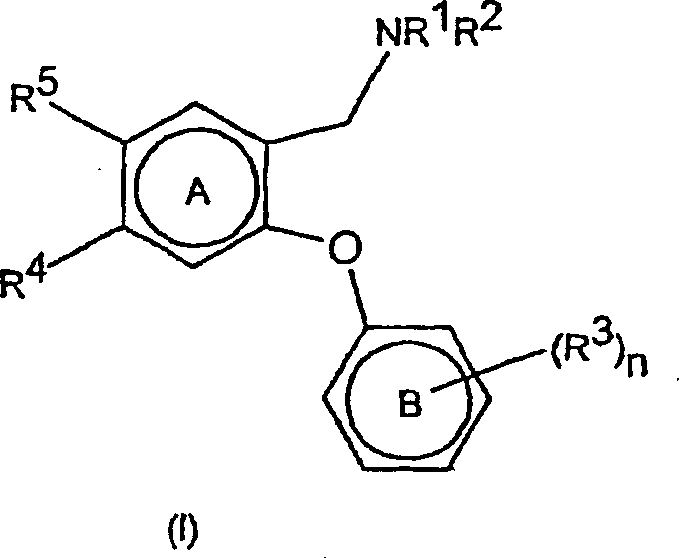
R1 und
R2, welche gleich oder verschieden sein
können,
Wasserstoff, C1-C6-Alkyl,
(CH2)m(C3-C6-Cycloalkyl) sind,
wobei m = 0, 1, 2 oder 3, oder R1 und R2 bilden zusammen mit dem Stickstoff, an
den sie gebunden sind, einen Azetidinring;
jedes R3 unabhängig CF3, OCF3, C1-4-Alkylthio oder C1-C4-Alkoxy
ist;
n 1, 2 oder 3 ist; und
R4 und
R5, welche gleich oder verschieden sein
können,
sind:
A-X, wobei A = -CH=CH- oder -(CH2)p-, wobei p 0, 1 oder 2 ist; X Wasserstoff,
F, Cl, Br, I, CONR6R7,
SO2NR6R7, SO2NHC(=O)R6, OH, C1-4-Alkoxy, NR8SO2R9, NO2,
NR6R11, CN, CO2R10, CHO, SR10, S(O)R9 oder SO2R10 ist; R6, R7, R8 und
R10, welche gleich oder verschieden sein
können,
Wasserstoff oder C1-6-Alkyl sind, welche
gegebenenfalls unabhängig
voneinander mit einem oder mehr R12 substituiert
sind; R9 C1-6-Alkyl
ist, welches gegebenenfalls unabhängig mit einem oder mehr R12 substituiert ist; R11 Wasserstoff,
C1-6-Alkyl, welches gegebenenfalls unabhängig mit
einem oder mehr R12 substituiert ist, C(O)R6, CO2R9,
C(O)NHR6 oder SO2NR6R7 ist; R12 F (vorzugsweise bis zu 3), OH, CO2H, C3-6-Cycloalkyl,
NH2, CONH2, C1-6-Alkoxy, C1-6-Alkoxycarbonyl oder ein
5- oder 6-gliedriger heterocyclischer Ring ist, der 1, 2 oder 3
Heteroatome ausgewählt
aus N, S und O enthält
und gegebenenfalls unabhängig
mit einem oder mehr R13 substituiert ist;
oder R6 und R7 bilden
zusammen mit dem Stickstoff, an den sie gebunden sind, einen 4-,
5- oder 6-gliedrigen heterocyclischen Ring, der gegebenenfalls unabhängig mit
einem oder mehr R13 substituiert ist; oder
ein
5- oder 6-gliedriger heterocyclischer Ring, der 1, 2 oder 3 Heteroatome
ausgewählt
aus N, S und O enthält und
gegebenenfalls unabhängig
mit einem oder mehr R13 substituiert ist;
wobei R13 Hydroxy, C1-4-Alkoxy,
F, C1-6-Alkyl,
Halogenalkyl, Halogenalkoxy, -NH2, -NH(C1-C6-Alkyl) oder
-N(C1-C6-Alkyl)2 ist;
wobei, wenn R1 und
R2 Methyl sind, R4 und
R5 Wasserstoff sind und n 1 ist, R3 nicht eine -SMe-Gruppe para zu der Ether-Verknüpfung ist,
welche Ringe A und B verknüpft.According to a first aspect, compounds of the general formula (I) or pharmaceutically acceptable salts, solvates or polymorphs thereof are provided according to the invention
R 1 and R 2 , which may be identical or different, are hydrogen, C 1 -C 6 -alkyl, (CH 2 ) m (C 3 -C 6 -cycloalkyl), where m = 0, 1, 2 or 3, or R 1 and R 2 together with the nitrogen to which they are attached form an azetidine ring;
each R 3 is independently CF 3 , OCF 3 , C 1-4 alkylthio or C 1 -C 4 alkoxy;
n is 1, 2 or 3; and
R 4 and R 5 , which may be the same or different, are:
AX, wherein A = -CH = CH- or - (CH 2 ) p -, wherein p is 0, 1 or 2; X is hydrogen, F, Cl, Br, I, CONR 6 R 7 , SO 2 NR 6 R 7 , SO 2 NHC (= O) R 6 , OH, C 1-4 alkoxy, NR 8 SO 2 R 9 , NO 2 , NR 6 R 11 , CN, CO 2 R 10 , CHO, SR 10 , S (O) R 9 or SO 2 R 10 ; R 6 , R 7 , R 8 and R 10 , which may be the same or different, are hydrogen or C 1-6 alkyl, which are optionally independently substituted with one or more R 12 ; R 9 is C 1-6 alkyl which is optionally independently substituted with one or more R 12 ; R 11 is hydrogen, C 1-6 alkyl, which is optionally independently substituted with one or more R 12 , C (O) R 6 , CO 2 R 9 , C (O) NHR 6 or SO 2 NR 6 R 7 ; R 12 F (preferably up to 3), OH, CO 2 H, C 3-6 -cycloalkyl, NH 2 , CONH 2 , C 1-6 -alkoxy, C 1-6 -alkoxycarbonyl or a 5- or 6-membered one heterocyclic ring containing 1, 2 or 3 heteroatoms selected from N, S and O and optionally substituted independently with one or more R 13 ; or R 6 and R 7 , together with the nitrogen to which they are attached, form a 4-, 5- or 6-membered heterocyclic ring optionally substituted independently with one or more R 13 ; or
a 5- or 6-membered heterocyclic ring containing 1, 2 or 3 heteroatoms selected from N, S and O and optionally independently substituted with one or more R 13 ; where R 13 is hydroxyl, C 1-4 -alkoxy, F, C 1-6 -alkyl, haloalkyl, haloalkoxy, -NH 2 , -NH (C 1 -C 6 -alkyl) or -N (C 1 -C 6 -) Alkyl) 2 ;
wherein when R 1 and R 2 are methyl, R 4 and R 5 are hydrogen and n is 1, R 3 is not an -SMe group para to the ether linkage linking rings A and B.
Sofern nichts anderes angegeben ist, handelt es sich bei sämtlichen Alkylgruppen um geradkettige oder verzweigte Gruppen mit 1 bis 6 Kohlenstoffatomen, vorzugsweise mit 1 bis 4 und insbesondere mit 1 bis 3 Kohlenstoffatomen.Provided unless otherwise stated, all are Alkyl groups to straight-chain or branched groups having 1 to 6 Carbon atoms, preferably with 1 to 4 and in particular with 1 to 3 carbon atoms.
Sofern nichts anderes angegeben ist, enthalten alle Heterocyclylgruppen 5 bis 7 Ringatome, von denen es sich bei bis zu 4 Atomen um Heteroatome, wie Stickstoff, Sauerstoff und Schwefel handeln kann, wobei diese Gruppen gesättigt, ungesättigt oder aromatisch sein können. Zu Beispielen für Heterocyclylgruppen gehören Furyl, Thienyl, Pyrrolyl, Pyrrolinyl, Pyrrolidinyl, Dioxolanyl, Oxazolyl, Thiazolyl, Imidazolyl, Imidazolinyl, Imidazolidinyl, Pyrazolyl, Pyrazolinyl, Pyrazolidinyl, Isoxazolyl, Isothiazolyl, Oxadiazolyl, Triazolyl, Thiadiazolyl, Pyranyl, Pyridinyl, Piperidinyl, Dioxanyl, Morpholino, Dithianyl, Thiomorpholino, Pyridazinyl, Pyrimidinyl, Pyrazinyl, Piperazinyl, Sulfolanyl, Tetrazolyl, Triazinyl, Azepinyl, Oxazepinyl, Thiazepinyl, Diazepinyl und Thiazolinyl. Ferner umfasst der Ausdruck "Heterocyclyl" kondensierte Heterocyclylgruppen, z. B. Benzimidazolyl, Benzoxazolyl, Imidazopyridinyl, Benzoxazinyl, Benzothiazinyl, Oxazolopyridinyl, Chinolinyl, Chinazolinyl, Chinoxalinyl, Dihydrochinazolinyl, Benzothiazolyl, Phthalimido, Benzofuranyl, Benzodiazepinyl, Indolyl und Isoindolyl. Der Ausdruck "heterocyclisch" ist in entsprechender Weise zu verstehen.Unless otherwise indicated, all heterocyclyl groups contain 5 to 7 ring atoms, of which up to 4 atoms may be heteroatoms such as nitrogen, oxygen and sulfur, which groups may be saturated, unsaturated or aromatic. Examples of heterocyclyl groups include furyl, thienyl, pyrrolyl, pyrrolinyl, pyrrolidinyl, dioxolanyl, oxazolyl, thiazolyl, imidazolyl, imidazolinyl, imidazolidinyl, pyrazolyl, pyrazolinyl, pyrazolidinyl, isoxazolyl, isothiazolyl, oxadiazolyl, triazolyl, thiadiazolyl, pyranyl, pyridinyl, piperidinyl, dioxanyl , Morpholino, dithianyl, thiomorpholino, pyridazinyl, pyrimidinyl, pyra zinyl, piperazinyl, sulfolanyl, tetrazolyl, triazinyl, azepinyl, oxazepinyl, thiazepinyl, diazepinyl and thiazolinyl. Further, the term "heterocyclyl" includes fused heterocyclyl groups, e.g. Benzimidazolyl, benzoxazolyl, imidazopyridinyl, benzoxazinyl, benzothiazinyl, oxazolopyridinyl, quinolinyl, quinazolinyl, quinoxalinyl, dihydroquinazolinyl, benzothiazolyl, phthalimido, benzofuranyl, benzodiazepinyl, indolyl and isoindolyl. The term "heterocyclic" is to be understood accordingly.
Vorzugsweise bedeuten R1 und R2, die gleich oder verschieden sind, Wasserstoff oder C1-C6-Alkyl. Insbesondere bedeuten sie Wasserstoff oder Methyl.Preferably, R 1 and R 2 , which are the same or different, are hydrogen or C 1 -C 6 alkyl. In particular, they are hydrogen or methyl.
Vorzugsweise handelt es sich bei den einzelnen Resten R3 unabhängig voneinander um -CF3, -OCF3, Methylthio, Ethylthio oder Methoxy.The individual radicals R 3 are preferably, independently of one another, -CF 3 , -OCF 3 , methylthio, ethylthio or methoxy.
Vorzugsweise befindet sich mindestens ein Rest R3 in para-Stellung zu der die Ringe A und B verknüpfenden Etherbindung.Preferably, at least one R 3 is para to the ether bond linking rings A and B.
Vorzugsweise bedeutet mindestens einer der Reste R3 Methylthio.Preferably, at least one of R 3 is methylthio.
Vorzugsweise handelt es sich bei R4 und R5, die gleich oder verschieden sein können, um -(CH2)p-X, wobei p 0, 1 oder 2 bedeutet (vorzugsweise 0 oder 1); X Wasserstoff, Hydroxy, CONR6R7, SO2NR6R7, NR8SO2R9, SR10, SOR9 oder SO2R10 bedeutet, wobei R6, R7, R8, R9 und R10 die im ersten Aspekt definierten Bedeutungen haben, oder einen 5- oder 6-gliedrigen heterocyclischen Ring mit einem Gehalt an 1, 2 oder 3 Heteroatomen, die aus N, S und O ausgewählt sind (vorzugsweise Oxadiazolyl, Triazolyl, Imidazolyl, Oxazolyl, Pyrazolyl, Pyridinyl oder Pyrimidinyl).Preferably, R 4 and R 5 , which may be the same or different, are - (CH 2 ) p -X, where p is 0, 1 or 2 (preferably 0 or 1); X is hydrogen, hydroxy, CONR 6 R 7 , SO 2 NR 6 R 7 , NR 8 SO 2 R 9 , SR 10 , SOR 9 or SO 2 R 10 , where R 6 , R 7 , R 8 , R 9 and R 10 have the meanings defined in the first aspect, or a 5- or 6-membered heterocyclic ring containing 1, 2 or 3 heteroatoms selected from N, S and O (preferably oxadiazolyl, triazolyl, imidazolyl, oxazolyl, pyrazolyl , Pyridinyl or pyrimidinyl).
Ganz besonders bedeuten R4 und R5, die gleich oder verschieden sein können, -(CH2)p-X, wobei p den Wert 0 oder 1 hat; X Wasserstoff, Hydroxy, CONR6R7, SO2NR6R7 oder NR8SO2R9 bedeutet; wobei R6 und R7, die gleich oder verschieden sein können, Wasserstoff oder gegebenenfalls mit Hydroxy, -CONH2 oder C1-C3-Alkoxy (vorzugsweise Methoxy) substituiertes C1-C3-Alkyl bedeuten; R8 Wasserstoff, Hydroxyethyl oder Methyl bedeutet; oder R9 Methyl, Ethyl, Isopropyl, Trifluormethyl oder Methoxyethyl bedeutet oder Triazolyl, Imidazolyl oder Pyrazolyl.More particularly, R 4 and R 5 , which may be the same or different, represent - (CH 2 ) p -X, where p is 0 or 1; X is hydrogen, hydroxy, CONR 6 R 7 , SO 2 NR 6 R 7 or NR 8 SO 2 R 9 ; wherein R 6 and R 7, which may be identical or different, are hydrogen or optionally substituted by hydroxy, -CONH 2 or C 1 -C 3 alkoxy (preferably methoxy) substituted C 1 -C 3 alkyl; R 8 is hydrogen, hydroxyethyl or methyl; or R 9 is methyl, ethyl, isopropyl, trifluoromethyl or methoxyethyl or triazolyl, imidazolyl or pyrazolyl.
Ganz besonders bevorzugt ist, dass R4 und R5 nicht beide Wasserstoff bedeuten. Insbesondere bevorzugt ist für R4 die Bedeutung Wasserstoff.It is very particularly preferred that R 4 and R 5 are not both hydrogen. Particularly preferred for R 4 is hydrogen.
Vorzugsweise bedeuten R6 und R7, die gleich oder verschieden sein können, Wasserstoff, gegebenenfalls mit Hydroxy, -CONH2 oder C1-C3-Alkoxy (vorzugsweise Methoxy) substituiertes C1-C3-Alkyl. Insbesondere bedeuten R6 und R7, die gleich oder verschieden sein können, Wasserstoff oder Methyl und ganz besonders Wasserstoff.Preferably R 6 and R 7, which may be the same or different, are hydrogen, optionally substituted by hydroxy, -CONH 2 or C 1 -C 3 alkoxy (preferably methoxy) substituted C 1 -C 3 alkyl. In particular, R 6 and R 7 , which may be the same or different, are hydrogen or methyl and most particularly hydrogen.
Sofern vorhanden, bedeutet R12 vorzugsweise Oxadiazolyl, Triazolyl, Imidazolyl, Oxazolyl, Pyrazolyl, Pyridinyl oder Pyrimidinyl. Besonders bevorzugt sind Triazolyl, Imidazolyl oder Pyrazolyl.If present, R 12 is preferably oxadiazolyl, triazolyl, imidazolyl, oxazolyl, pyrazolyl, pyridinyl or pyrimidinyl. Particularly preferred are triazolyl, imidazolyl or pyrazolyl.
Sofern R6 und R7 zusammen mit dem Stickstoff, an den sie gebunden sind, einen heterocyclischen Ring bilden, handelt es sich bei bevorzugten Ringen um Pyrrolidin- oder Piperidinringe, die jeweils durch OH oder CONH2 substituiert sein können oder um einen Morpholinring, der durch CONH2 substituiert sein kann.When R 6 and R 7 together with the nitrogen to which they are attached form a heterocyclic ring, preferred rings are pyrrolidine or piperidine rings, each of which may be substituted by OH or CONH 2 , or a morpholine ring, the may be substituted by CONH 2 .
Vorzugsweise bedeutet R11 Wasserstoff oder C1-6-Alkyl.Preferably, R 11 is hydrogen or C 1-6 alkyl.
Vorzugsweise bedeutet R8 Wasserstoff, Hydroxyethyl oder Methyl und insbesondere Wasserstoff.Preferably, R 8 is hydrogen, hydroxyethyl or methyl and especially hydrogen.
Vorzugsweise bedeutet R9 Methyl, Ethyl, Isopropyl, Trifluormethyl oder Methoxyethyl und insbesondere Methyl oder Ethyl (ganz besonders Methyl).Preferably, R 9 is methyl, ethyl, isopropyl, trifluoromethyl or methoxyethyl and especially methyl or ethyl (especially methyl).
Vorzugsweise bedeutet R10 Methyl oder Ethyl.Preferably, R 10 is methyl or ethyl.
Vorzugsweise hat p den Wert 1 oder 0 und insbesondere den Wert 0.Preferably p has the value 1 or 0 and in particular the value 0.
Bevorzugt
sind folgende Definitionen:
R1 und
R2, die gleich oder verschieden sein können, bedeuten
Wasserstoff oder Methyl;
mindestens einer der Reste R3 steht in para-Stellung zur Etherbindung
und bedeutet CF3, OCF3,
Methylthio, Ethylthio oder Methoxy; und
R4 und
R5, die gleich oder verschieden sein können, bedeuten
(CH2)p-X, wobei
p den Wert 0 oder 1 hat, X Wasserstoff, Hydroxy, CONR6R7, SO2NR6R7, NR8SO2R9, SR10, SOR9 oder SO2R10, wobei R6 und
R7, die gleich oder verschieden sein können, Wasserstoff
oder gegebenenfalls mit Hydroxy, -CONH2 oder
C1-C3-Alkoxy (vorzugsweise
Methoxy) substituiertes C1-C3-Alkyl
bedeutet); oder R6 und R7 zusammen
mit dem Stickstoffatom an das sie gebunden sind, einen Morpholin-,
Pyrrolidin- oder Piperidinring bilden können, der jeweils durch OH
oder CONH2 substituiert sein kann; R8 Wasserstoff, Hydroxyethyl oder Methyl (vorzugsweise
Wasserstoff) bedeutet; R9 Methyl, Ethyl,
Isopropyl, Trifluormethyl oder Methoxyethyl bedeutet; und R10 Methyl oder Ethyl bedeutet; oder
eine
Oxadiazolyl-, Triazolyl-, Imidazolyl-, Oxazolyl-, Pyrazolyl-, Pridinyl-
oder Pyrimidinylgruppe.The following definitions are preferred:
R 1 and R 2 , which may be the same or different, are hydrogen or methyl;
at least one of the radicals R 3 is in para position to the ether bond and is CF 3 , OCF 3 , methylthio, Ethylthio or methoxy; and
R 4 and R 5 , which may be the same or different, represent (CH 2 ) p -X, where p is 0 or 1, X is hydrogen, hydroxy, CONR 6 R 7 , SO 2 NR 6 R 7 , NR 8 SO 2 R 9 , SR 10 , SOR 9 or SO 2 R 10 , wherein R 6 and R 7 , which may be the same or different, are hydrogen or optionally hydroxy, -CONH 2 or C 1 -C 3 alkoxy (preferably methoxy ) substituted C 1 -C 3 alkyl); or R 6 and R 7 together with the nitrogen atom to which they are attached may form a morpholine, pyrrolidine or piperidine ring, each of which may be substituted by OH or CONH 2 ; R 8 is hydrogen, hydroxyethyl or methyl (preferably hydrogen); R 9 is methyl, ethyl, isopropyl, trifluoromethyl or methoxyethyl; and R 10 is methyl or ethyl; or
an oxadiazolyl, triazolyl, imidazolyl, oxazolyl, pyrazolyl, pridinyl or pyrimidinyl group.
Insbesondere
gelten folgende Definitionen:
R1 und
R2, die gleich oder verschieden sein können, bedeuten
Wasserstoff oder Methyl;
mindestens einer der Reste R3 steht in para-Stellung zur Etherbindung
und bedeutet CF3, OCF3,
Methylthio, Ethylthio oder Methoxy und mindestens einer der Reste
R3 bedeutet Methylthio oder Ethylthio; und
R4 und R5, die gleich
oder verschieden sein können,
bedeuten -(CH2)p-X,
wobei p den Wert 0 oder 1 hat; X Wasserstoff, Hydroxy, CONR6R7, SO2NR6R7 oder NR8SO2R9 bedeutet;
wobei R6 und R7,
die gleich oder verschieden sein können, Wasserstoff oder gegebenenfalls
durch Hydroxy, -CONH2 oder C1-C3-Alkoxy (vorzugsweise Methoxy) substituiertes
C1-C3-Alkyl bedeuten;
R8 Wasserstoff, Hydroxyethyl oder Methyl
bedeutet; R9 Methyl, Ethyl, Isopropyl, Trifluormethyl
oder Methoxyethyl bedeutet;
oder Triazolyl, Imidazolyl oder
Pyrazolyl.In particular, the following definitions apply:
R 1 and R 2 , which may be the same or different, are hydrogen or methyl;
at least one of R 3 is para to the ether linkage and is CF 3 , OCF 3 , methylthio, ethylthio or methoxy and at least one of R 3 is methylthio or ethylthio; and
R 4 and R 5 , which may be the same or different, represent - (CH 2 ) p -X, where p is 0 or 1; X is hydrogen, hydroxy, CONR 6 R 7 , SO 2 NR 6 R 7 or NR 8 SO 2 R 9 ; wherein R 6 and R 7, which may be identical or different, are hydrogen or optionally substituted by hydroxy, -CONH 2 or C 1 -C 3 alkoxy (preferably methoxy) substituted C 1 -C 3 alkyl; R 8 is hydrogen, hydroxyethyl or methyl; R 9 is methyl, ethyl, isopropyl, trifluoromethyl or methoxyethyl;
or triazolyl, imidazolyl or pyrazolyl.
Ganz
besonders bevorzugt sind folgende Definitionen:
R1 und
R2, die gleich oder verschieden sein können, bedeuten
Wasserstoff oder Methyl;
mindestens einer der Reste R3 steht in para-Stellung zur Etherbindung
und bedeutet CF3, OCF3,
Methylthio oder Methoxy und mindestens einer der Reste R3 bedeutet Methylthio;
R4 bedeutet
Wasserstoff; und
R5 bedeutet -(CH2)p-X, wobei p den
Wert 0 oder 1 hat; X Wasserstoff, Hydroxy, CONR6R7, SO2NR6R7 oder NR8SO2R9 bedeutet; wobei
R6 und R7, die gleich
oder verschieden sein können,
Wasserstoff oder gegebenenfalls durch Hydroxy, –CONH2 oder
C1-C3-Alkoxy (vorzugsweise
Methoxy) substituiertes C1-C3-Alkyl
bedeutet; R8 Wasserstoff, Hydroxyethyl oder
Methyl bedeutet; R9 Methyl, Ethyl, Isopropyl,
Trifluormethyl oder Methoxyethyl bedeutet;
oder Triazolyl,
Imidazolyl oder Pyrazolyl.Very particular preference is given to the following definitions:
R 1 and R 2 , which may be the same or different, are hydrogen or methyl;
at least one of R 3 is para to the ether linkage and is CF 3 , OCF 3 , methylthio or methoxy and at least one of R 3 is methylthio;
R 4 is hydrogen; and
R 5 is - (CH 2 ) p -X, where p is 0 or 1; X is hydrogen, hydroxy, CONR 6 R 7 , SO 2 NR 6 R 7 or NR 8 SO 2 R 9 ; wherein R 6 and R 7, which means can be identical or different, are hydrogen or optionally substituted by hydroxy, -CONH 2 or C 1 -C 3 alkoxy (preferably methoxy) substituted C 1 -C 3 alkyl; R 8 is hydrogen, hydroxyethyl or methyl; R 9 is methyl, ethyl, isopropyl, trifluoromethyl or methoxyethyl;
or triazolyl, imidazolyl or pyrazolyl.
Ganz besonders bevorzugt ist, dass R4 und R5 nicht gleichzeitig Wasserstoff bedeuten.It is very particularly preferred that R 4 and R 5 do not simultaneously denote hydrogen.
Um Zweifel zu vermeiden, bedeutet, sofern nichts anderes angegeben ist, der Ausdruck "substituiert" eine Substitution durch eine oder mehrere der definierten Gruppen. Für den Fall, dass Gruppen aus einer Anzahl von alternativen Gruppen ausgewählt sind, können die ausgewählten Gruppen gleich oder verschieden sein.Around To avoid doubt means, unless otherwise stated the term "substituted" is a substitution by one or more of the defined groups. In the case, that groups are selected from a number of alternative groups, can the selected ones Be the same or different groups.
Um Zweifel zu vermeiden, bedeutet der Ausdruck "unabhängig", dass dann, wenn mehr als ein Substituent aus einer Anzahl von möglichen Substituenten ausgewählt ist, diese Substituenten gleich oder verschieden sein können.Around To avoid doubt, the term "independent" means that if more than one substituent out of a number of possible ones Substituents selected is, these substituents may be the same or different.
Zu
bevorzugten Verbindungen der Formel (I) gehören:
3-[(Dimethylamino)-methyl]-4-[4-(methylsulfanyl)-phenoxy]-benzolsulfonamid;
3-[(Dimethylamino)-methyl]-N-methyl-4-[4-(trifluormethyl)-phenoxy]-benzolsulfonamid;
3-[(Dimethylamino)-methyl]-4-[4-(trifluormethoxy)-phenoxy]-benzolsulfonamid;
3-[(Dimethylamino)-methyl]-N-[(2R)-2-hydroxypropyl]-4-[4-(methylsulfanyl)-phenoxy]-benzolsulfonamid;
3-[(Dimethylamino)-methyl]-N-[(1S)-2-hydroxy-l-methylethyl]-4-[4-(methylsulfanyl)-phenoxy]-benzolsulfonamid;
3-[(Dimethylamino)-methyl]-N-(2-hydroxyethyl)-4-[4-(methylsulfanyl)-phenoxy]-benzolsulfonamid;
3-[(Dimethylamino)-methyl]-4-[4-(methylsulfanyl)-phenoxy]-benzonitril;
3-[(Dimethylamino)-methyl]-4-[4-(methylsulfanyl)-phenoxy]-benzamid;
3-[(Dimethylamino)-methyl]-4-[4-(trifluormethoxy)-phenoxy]-benzamid;
3-[(Methylamino)-methyl]-4-[4-(methylsulfanyl)-phenoxy]-benzamid;
N-{3-[(Dimethylamino)-methyl]-4-[4-(trifluormethyl)-phenoxy]-phenyl}-methansulfonamid;
4-[3-Methoxy-4-(methylsulfanyl)-phenoxy]-3-[(methylamino)-methyl]-benzamid;
N-Methyl-3-[(methylamino)-methyl]-4-[4-(methylsulfanyl)-phenoxy]-benzamid;
3-[(Dimethylamino)-methyl]-4-[3-methoxy-4-(methylsulfanyl)-phenoxy]-benzamid;
N-Methyl-N-[2-[4-(methylsulfanyl)-phenoxy]-5-(1H-1,2,3-triazol-1-yl)-benzyl]-amin;
N-Methyl-N-[2-[4-(methylsulfanyl)-phenoxy]-5-(1H-1,2,4-triazol-1-yl)-benzyl]-amin;
N,N-Dimethyl-N-[2-[4-(methylsulfanyl)-phenoxy]-5-(1H-1,2,4-triazol-1-yl)-benzyl]-amin;
N-[2-[4-(Methylsulfanyl)-phenoxy]-5-(4H-1,2,4-triazol-4-yl)-benzyl]-N,N-dimethylamin;
und
N-{5-(3-Amino-1H-pyrazol-1-yl)-2-[4-(methylsulfanyl)-phenoxy]-benzyl}-N-methylamin.Preferred compounds of formula (I) include:
3 - [(Dimethylamino) methyl] -4- [4- (methylsulfanyl) phenoxy] benzenesulfonamide;
3 - [(dimethylamino) methyl] -N-methyl-4- [4- (trifluoromethyl) phenoxy] benzenesulfonamide;
3 - [(Dimethylamino) methyl] -4- [4- (trifluoromethoxy) phenoxy] -benzenesulfonamide;
3 - [(dimethylamino) methyl] -N - [(2R) -2-hydroxypropyl] -4- [4- (methylsulfanyl) phenoxy] benzenesulfonamide;
3 - [(dimethylamino) methyl] -N - [(1S) -2-hydroxy-l-methylethyl] -4- [4- (methylsulfanyl) phenoxy] benzenesulfonamide;
3 - [(Dimethylamino) methyl] -N- (2-hydroxyethyl) -4- [4- (methylsulfanyl) phenoxy] benzenesulfonamide;
3 - [(Dimethylamino) methyl] -4- [4- (methylsulfanyl) phenoxy] benzonitrile;
3 - [(Dimethylamino) methyl] -4- [4- (methylsulfanyl) phenoxy] benzamide;
3 - [(Dimethylamino) methyl] -4- [4- (trifluoromethoxy) phenoxy] benzamide;
3 - [(methylamino) methyl] -4- [4- (methylsulfanyl) phenoxy] benzamide;
N- {3 - [(Dimethylamino) methyl] -4- [4- (trifluoromethyl) phenoxy] phenyl} -methanesulfonamide;
4- [3-methoxy-4- (methylsulfanyl) phenoxy] -3 - [(methylamino) methyl] benzamide;
N-Methyl-3 - [(methylamino) methyl] -4- [4- (methylsulfanyl) phenoxy] benzamide;
3 - [(Dimethylamino) methyl] -4- [3-methoxy-4- (methylsulfanyl) phenoxy] benzamide;
N-methyl-N- [2- [4- (methylsulfanyl) phenoxy] -5- (1H-1,2,3-triazol-1-yl) -benzyl] -amine;
N-methyl-N- [2- [4- (methylsulfanyl) phenoxy] -5- (1H-1,2,4-triazol-1-yl) -benzyl] -amine;
N, N-dimethyl-N- [2- [4- (methylsulfanyl) phenoxy] -5- (1H-1,2,4-triazol-1-yl) -benzyl] -amine;
N- [2- [4- (methylsulfanyl) phenoxy] -5- (4H-1,2,4-triazol-4-yl) -benzyl] -N, N-dimethylamine; and
N- {5- (3-amino-1H-pyrazol-1-yl) -2- [4- (methylsulfanyl) phenoxy] benzyl} -N-methylamine.
Die erfindungsgemäßen Verbindungen weisen den Vorteil auf, dass sie selektive Inhibitoren der Wiederaufnahme von Serotonin (SRIs) darstellen (und somit vermutlich verringerte Nebenwirkungen aufweisen), dass ihre Wirkung rasch einsetzt (was sie für eine Verabreichung kurz vor einer benötigten Wirkung geeignet macht), und dass sie eine erstrebenswerte Wirkungsstärke und damit verbundene Eigenschaften besitzen. Verbindungen, die in selektiver Weise die Wiederaufnahme von Serotonin, jedoch nicht von Noradrenalin oder Dopamin hemmen, werden bevorzugt.The Compounds of the invention have the advantage of being selective inhibitors of reuptake of serotonin (SRIs) (and thus presumably decreased Have side effects) that their effect is rapidly starting (which she for makes administration just before a required effect suitable), and that they have a desirable potency and related properties have. Compounds that selectively reuptake serotonin but not norepinephrine or dopamine, are favored.
Wir haben festgestellt, dass Verbindungen der Formel I, die diese Eigenschaften besitzen, eine relativ polare Gruppe an R4/R5 aufweisen.We have found that compounds of formula I possessing these properties have a relatively polar group on R 4 / R 5 .
Somit werden gemäß einem weiteren Aspekt der Erfindung eine Verbindung der allgemeinen Formel I und pharmazeutisch akzeptable Salze davon bereitgestellt, wobei R1, R2, R3 und n die im ersten Aspekt definierten Bedeutungen haben; und R4 und R5, die gleich oder verschieden sein können, -(CH2)p-A' bedeuten, wobei p den Wert 0, 1 oder 2 hat und A' eine polare Gruppe bedeutet. Gemäß diesem Aspekt lassen sich polare Gruppen als Gruppen mit einem negativen π-Wert definieren (vergl. C. Hansch und A. Leo, "Substituent Constants for Correlation Analysis in Chemistry and Biology", Wiley, New York, 1979). In diesem System weist H beispielsweise einen π-Wert von 0,00 auf, -OCH3 einen π-Wert von –0,02 und -SO2NH2 einen π-Wert von –1,82 (vergl. Tabelle VI-I, "Well-Characterized Aromatic Substituents", S. 49, a.a.O.). Besonders bevorzugt sind polare Gruppen mit einem stärker negativen π-Wert: so werden Gruppen mit π-Werten mit einem negativen Wert unter –0,1, insbesondere mit einem negativen Wert unter –0,5 und ganz besonders mit einem negativen Wert unter –1,0 bevorzugt. Selbst wenn p in der vorstehenden Definition einen von 0 abweichenden Wert hat, beruht die Definition von A' auf der vorstehenden Druckschrift unter der Annahme, dass p den Wert 0 hat.Thus, according to a further aspect of the invention there is provided a compound of general formula I and pharmaceutically acceptable salts thereof, wherein R 1 , R 2 , R 3 and n have the meanings defined in the first aspect; and R 4 and R 5 , which may be the same or different, represent - (CH 2 ) p -A ', where p is 0, 1 or 2 and A' is a polar group. According to this aspect, polar groups can be defined as groups having a negative π value (see C. Hansch and A. Leo, "Substituent Constants for Correlation Analysis in Chemistry and Biology", Wiley, New York, 1979). In this system, H has, for example, a π value of 0.00, -OCH 3 a π value of -0.02 and -SO 2 NH 2 a π value of -1.82 (see Table VI-I , "Well-Characterized Aromatic Substituents", p. 49, supra). Particularly preferred are polar groups with a more negative π value: thus groups with π values with a negative value below -0.1, in particular with a negative value below -0.5 and very particularly with a negative value below -1 , 0 preferred. Even if p in the above definition has a value other than 0, the definition of A 'on the above reference is based on the assumption that p is 0.
Die pharmazeutisch oder veterinärmedizinisch akzeptablen Salze der Verbindungen der Erfindung, die ein basisches Zentrum enthalten, sind beispielsweise nicht-toxische Säureadditionssalze mit anorganischen Säuren, wie Salzsäure, Bromwasserstoffsäure, Iodwasserstoffsäure, Schwefelsäure und Phosphorsäure, mit Carbonsäuren oder mit Organosulfonsäuren. Zu Beispielen gehören HCl-, HBr-, HI-, Sulfat- oder Bisulfat-, Nitrat-, Phosphat- oder Hydrogenphosphat-, Acetat-, Benzoat-, Succinat-, Saccharat-, Fumarat-, Maleat-, Lactat-, Citrat-, Tartrat-, Gluconat-, Camsylat-, Methansulfonat-, Ethansulfonat-, Benzolsulfonat-, p-Toluolsulfonat- und Pamoatsalze. Die Verbindungen der Erfindung können ferner mit Basen pharmazeutisch oder veterinärmedizinisch akzeptable Metallsalze, insbesondere nicht-toxische Alkali- und Erdalkalimetallsalze, ergeben. Zu Beispielen gehören die Natrium-, Kalium-, Aluminium-, Calcium-, Magnesium-, Zink- und Diethanolaminsalze. Bezüglich Übersichtsartikel über geeignete pharmazeutische Salze wird verwiesen auf: Berge et al., J. Pharm. Sci., Bd. 66 (1977), S. 1–19; Bighley et al., International Journal of Pharmaceutics, Bd. 33 (1986), S. 201–217; und P. L. Gould, Encyclopedia of Pharmaceutical Technology, Marcel Dekker Inc., New York (1996), Bd. 13, S. 453–497.The pharmaceutical or veterinary acceptable salts of the compounds of the invention which are a basic For example, non-toxic acid addition salts with inorganic acids, such as Hydrochloric acid, hydrobromic, hydroiodic, sulfuric acid and phosphoric acid, with carboxylic acids or with organosulfonic acids. Examples include HCl, HBr, HI, sulfate or bisulfate, nitrate, phosphate or Hydrogen phosphate, acetate, benzoate, succinate, saccharate, fumarate, Maleate, lactate, citrate, tartrate, gluconate, camsylate, methanesulfonate, Ethanesulfonate, benzenesulfonate, p-toluenesulfonate and pamoate salts. The compounds of the invention can further pharmaceutically or veterinarily acceptable metal salts with bases, especially non-toxic alkali and alkaline earth metal salts. Examples include the sodium, potassium, aluminum, calcium, magnesium, zinc and diethanolamine salts. For reviews on appropriate pharmaceutical salts are referred to: Berge et al., J. Pharm. Sci., Vol. 66 (1977), pp. 1-19; Bighley et al., International Journal of Pharmaceutics, Vol. 33 (1986), Pp. 201-217; and P.L. Gould, Encyclopedia of Pharmaceutical Technology, Marcel Dekker Inc., New York (1996), Vol. 13, pp. 453-497.
Die pharmazeutisch akzeptablen Solvate der erfindungsgemäßen Verbindungen umfassen die Hydrate davon.The pharmaceutically acceptable solvates of the compounds of the invention include the hydrates thereof.
Unter den Umfang der erfindungsgemäßen Verbindungen und verschiedenen Salze davon fallen auch die Polymorphen davon.Under the scope of the compounds of the invention and various salts thereof are also the polymorphs thereof.
Bevorzugte Salze sind die Tartratsalze, insbesondere die L-Tartrat- und die D-Tartratsalze (und auch das razemische D/L-Tartrat); das Phosphatsalz; das Hydrochloridsalz; das Citratsalz und das Sulfatsalz. Ein weiteres bevorzugtes Salz ist das Natriumsalz (vergl. Beispiel 28).preferred Salts are the tartrate salts, especially the L-tartrate and the D-tartrate salts (and also the racemic D / L tartrate); the phosphate salt; the hydrochloride salt; the citrate salt and the sulfate salt. Another one preferred salt is the sodium salt (see Example 28).
Nachstehend werden die Verbindungen, die pharmazeutisch akzeptablen Salze davon, die Solvate oder Polymorphen davon, die in einem beliebigen Aspekt der Erfindung definiert sind (ausgenommen Zwischenprodukte bei chemischen Verfahren) als "erfindungsgemäße Verbindungen" bezeichnet.below the compounds, the pharmaceutically acceptable salts thereof, the solvates or polymorphs thereof, in any aspect of the invention (excluding intermediates in chemical Method) as "compounds of the invention".
Die erfindungsgemäßen Verbindungen können ein oder mehrere chirale Zentren aufweisen und somit in einer Anzahl von stereoisomeren Formen vorliegen. Sämtliche Stereoisomeren und Gemische davon fallen unter den Umfang der vorliegenden Erfindung. Razemische Verbindungen können entweder unter Anwendung von präparativer HPLC und einer Säule mit einer chiralen stationären Phase getrennt oder unter Anwendung von dem Fachmann geläufigen Verfahren in die einzelnen Enantiomeren aufgetrennt werden. Ferner lassen sich chirale Zwischenprodukte auftrennen und zur Herstellung von erfindungsgemäßen chiralen Verbindungen verwenden.The compounds of the invention may have one or more chiral centers and thus be in a number of stereoisomeric forms. All stereoisomers and mixtures thereof are included within the scope of the present invention. Racemic compounds can either be separated using preparative HPLC and a chiral stationary phase column, or separated into the individual enantiomers using techniques well known to those skilled in the art. Furthermore, chiral intermediates can be separated and used for the preparation of chiral compounds according to the invention.
Die erfindungsgemäßen Verbindungen können in einer oder mehreren tautomeren Formen vorliegen. Sämtliche Tautomeren und Gemische davon fallen unter den Umfang der vorliegenden Erfindung. Beispielsweise umfasst der Hinweis auf 2-Hydroxypyridinyl auch die tautomere Form α-Pyridonyl.The Compounds of the invention can in one or more tautomeric forms. All Tautomers and mixtures thereof are within the scope of the present invention Invention. For example, reference to 2-hydroxypyridinyl includes also the tautomeric form α-pyridonyl.
Die Erfindung umfasst auch radioaktiv markierte Verbindungen.The The invention also encompasses radioactively labeled compounds.
Für den Fachmann ist es ersichtlich, dass bestimmte geschützte Derivate von erfindungsgemäßen Verbindungen, die vor der Stufe der endgültigen Schutzgruppenentfernung anfallen, möglicherweise keine pharmakologische Aktivität an sich besitzen, jedoch in einigen Fällen oral oder parenteral verabreicht werden können und anschließend im Körper unter Bildung von erfindungsgemäßen Verbindungen, die pharmakologisch aktiv sind, verstoffwechselt werden können. Derartige Derivate lassen sich daher als "Arzneistoffvorstufen" bezeichnen. Ferner wirken bestimmte Verbindungen der Erfindung als Arzneistoffvorstufen anderer erfindungsgemäßer Verbindungen.For the expert It will be appreciated that certain protected derivatives of compounds of the invention, the before the stage of final Deprotection, possibly not pharmacological activity in itself, but in some cases administered orally or parenterally can be and subsequently in the body with formation of compounds according to the invention, which are pharmacologically active, can be metabolized. such Derivatives can therefore be termed "prodrugs". Further Certain compounds of the invention act as prodrugs other compounds of the invention.
Sämtliche geschützten Derivate und Arzneistoffvorstufen der erfindungsgemäßen Verbindungen fallen unter den Umfang der Erfindung. Beispiele für geeignete Arzneistoffvorstufen für die erfindungsgemäßen Verbindungen sind in Drugs of Today, Bd. 19, Nr. 9 (1983), S. 499–538, und in Topics in Chemistry, Kapitel 31, S. 306–316, und in "Design of Prodrugs", H. Bundgaard, Elsevier, (1985), Kapitel 1, beschrieben (die Offenbarungen dieser Druckschriften werden durch Verweis zum Gegenstand der Beschreibung gemacht).All protected Derivatives and prodrugs of the compounds of the invention fall within the scope of the invention. Examples of suitable Drug precursors for the compounds of the invention are in Drugs of Today, Vol. 19, No. 9 (1983), pp. 499-538, and in Topics in Chemistry, Chapter 31, pp. 306-316, and in "Design of Prodrugs", H. Bundgaard, Elsevier, (1985), Chapter 1 (the disclosures of these references are made the subject of the description by reference).
Für den Fachmann ist es ersichtlich, dass bestimmte Reste, die auf dem Fachgebiet als "Proreste" bekannt sind und beispielsweise von H. Bundgaard in "Design of Prodrugs" (die Offenbarung dieser Druckschrift wird durch Verweis zum Gegenstand der Beschreibung gemacht) an geeigneten funktionellen Gruppen angebracht werden können, wenn derartige funktionelle Gruppen an den erfindungsgemäßen Verbindungen vorhanden sind.For the expert it is apparent that certain residues are in the art known as "proreste" and For example, by H. Bundgaard in "Design of Prodrugs" (the disclosure of this document by reference to the subject matter of the description) at appropriate functional groups can be attached if such functional Groups on the compounds of the invention available.
Zu bevorzugten Arzneistoffvorstufen für die erfindungsgemäßen Verbindungen gehören: Ester, Carbonatester, Halbester, Phosphatester, Nitroester, Sulfatester, Sulfoxide, Amide, Carbamate, Azoverbindungen, Phosphamide, Glycoside, Ether, Acetale und Ketale.To preferred prodrugs for the compounds of the invention belong: Esters, carbonate esters, half esters, phosphate esters, nitro esters, sulfate esters, Sulfoxides, amides, carbamates, azo compounds, phosphamides, glycosides, Ethers, acetals and ketals.
Erfindungsgemäße Verbindungen lassen sich in an sich bekannter Weise auf verschiedenen Wegen herstellen.Compounds of the invention can be prepared in a conventional manner in different ways.
In den nachstehenden Reaktionsschemata und in den anschließenden Ausführungen entsprechen, sofern nichts anderes angegeben ist, R1 bis R13, n, m und p den im ersten Aspekt angegebenen Definitionen. Diese Verfahren stellen weitere Aspekte der Erfindung dar.Unless indicated otherwise, in the reaction schemes below and in the remarks below, R 1 to R 13 , n, m and p correspond to the definitions given in the first aspect. These methods constitute further aspects of the invention.
In der gesamten Beschreibung werden die allgemeinen Formeln mit römischen Ziffern I, II, III, IV und dergl. bezeichnet. Untergruppen dieser allgemeinen Formeln werden als Ia, Ib, Ic und dergl. ... IVa, IVb, IVc und dergl. bezeichnet.In the entire description will be the general formulas with Roman Nos. I, II, III, IV and the like. Subgroups of these general formulas are given as Ia, Ib, Ic and the like... IVa, IVb, IVc and the like.
Verbindungen der allgemeinen Formel (I) lassen sich aus Verbindungen der allgemeinen Formel (II) nach verschiedenen Verfahren herstellen (vergl. Schema 1), worin L eine geeignete austretende Gruppe bedeutet, z. B. ein Halogen (F, Cl, Br oder I) oder einen Sulfonatester, wie Trifluormethansulfonat oder Methansulfonat, wobei L vorzugsweise F oder Cl bedeutet.links of the general formula (I) can be selected from compounds of the general Formula (II) by various methods (see Scheme 1), wherein L represents a suitable leaving group, e.g. B. a Halogen (F, Cl, Br or I) or a sulfonate ester, such as trifluoromethanesulfonate or methanesulfonate, wherein L is preferably F or Cl.
Schema
1 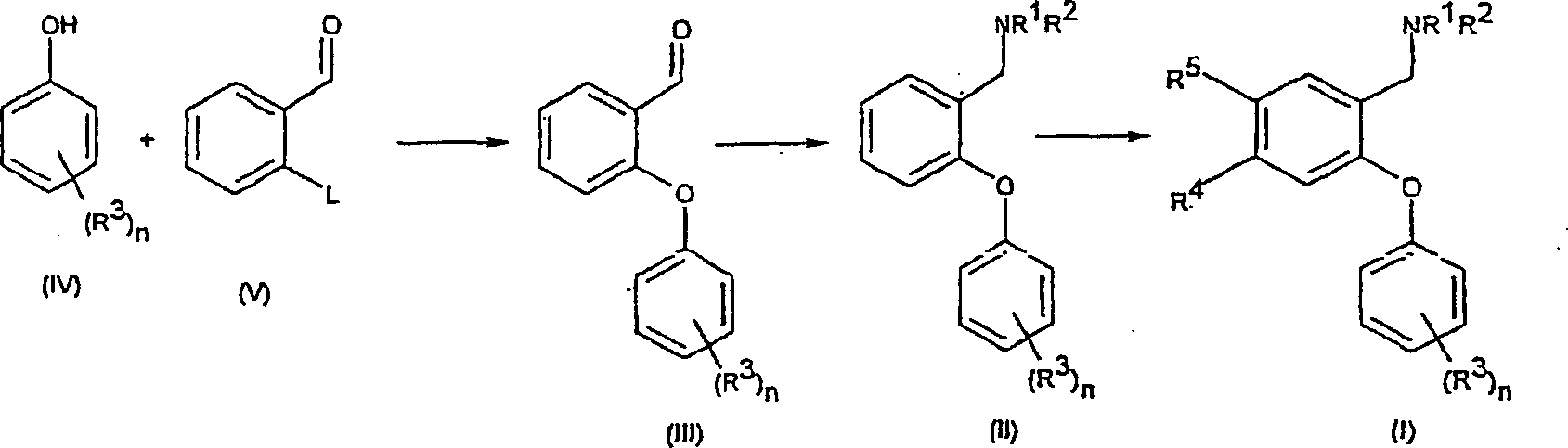
Beispielsweise:
- i) Wenn R4/R5 Halogen bedeuten, durch Umsetzung von (II) mit einem geeigneten Halogenierungsmittel in einem inerten Lösungsmittel, das die Umsetzung nicht beeinträchtigt. Zu geeigneten Halogenierungsmitteln gehören Trifluormethansulfonsäure und N-Iodsuccinimid und zu geeigneten inerten Lösungsmitteln gehören Dichlormethan, wie in Beispiel 16 erläutert.
- ii) Wenn R4/R5 die Bedeutung -NO2 haben, durch Umsetzung von (II) mit einem geeigneten Nitrierungsmittel, z. B. einem Alkalimetallnitrat, in einem inerten Lösungsmittel, das die Umsetzung nicht beeinträchtigt, bei Raumtemperatur oder darunter. Zu geeigneten Nitrierungsmitteln gehören Trifluormethansulfonsäure/Kaliumnitrat und zu geeigneten inerten Lösungsmitteln gehört Trifluoressigsäure, wie im nachstehenden Beispiel 21 erläutert.
- iii) Umwandlung der Verbindungen der Formel I, worin R4/R5 die Bedeutung -SO2NR6R7 haben, durch Umsetzung eines als Zwischenprodukt dienenden Sulfonylchlorids mit dem erforderlichen Amin der Formel HNR6R7 in einem geeigneten Lösungsmittel. Zu geeigneten Lösungsmitteln gehören Ethanol. Die Umsetzungen werden im allgemeinen bei Raumtemperatur oder darunter durchgeführt. Beispielsweise lassen sich Verbindungen der Formel (Ia), worin R5 die Bedeutung -SO2NR6R7 hat, über als Zwischenprodukte dienende Sulfonylchloride (XII) aus Verbindungen der Formel (II) durch Umsetzung von (II) mit Chlorsulfonsäure und anschließende Umsetzung mit HNR6R7 herstellen. Die Reaktionsbedingungen umfassen typischerweise eine niedrige Temperatur. Die Umsetzung kann entweder in Reinsubstanz, d. h. in Abwesenheit eines Lösungsmittels, oder in Gegenwart eines inerten Lösungsmittels, das die Umsetzung nicht beeinträchtigt, stattfinden. Zu geeigneten inerten Lösungsmitteln gehört Dichlormethan und eine typische Reaktionstemperatur beträgt 0°C, wie im nachstehenden Beispiel 28 erläutert. Das als Zwischenprodukt dienende Sulfonylchlorid (XII) kann isoliert, gereinigt und sodann mit HNR6R7 umgesetzt werden. Alternativ kann es in situ erzeugt werden und ohne Isolierung anschließend mit HNR6R7 umgesetzt werden.
- i) when R 4 / R 5 signify halogen by reacting (II) with a suitable halogenating agent in an inert solvent which does not affect the reaction. Suitable halogenating agents include trifluoromethanesulfonic acid and N-iodosuccinimide, and suitable inert solvents include dichloromethane as illustrated in Example 16.
- ii) When R 4 / R 5 have the meaning -NO 2 , by reacting (II) with a suitable nitrating agent, e.g. As an alkali metal nitrate, in an inert solvent which does not affect the reaction, at room temperature or below. Suitable nitrating agents include trifluoromethanesulfonic acid / potassium nitrate and suitable inert solvents include trifluoroacetic acid as illustrated in Example 21 below.
- iii) Conversion of compounds of formula I wherein R 4 / R 5 are -SO 2 NR 6 R 7 by reacting an intermediate sulfonyl chloride with the required amine of formula HNR 6 R 7 in a suitable solvent. Suitable solvents include ethanol. The reactions are generally carried out at room temperature or below. For example, compounds of the formula (Ia) in which R 5 is -SO 2 NR 6 R 7 can be used as intermediates sulfonyl chlorides (XII) of compounds of formula (II) by reacting (II) with chlorosulfonic acid and subsequent reaction with HNR 6 R 7 . The reaction conditions typically include a low temperature. The reaction can take place either in pure substance, ie in the absence of a solvent, or in the presence of an inert solvent which does not affect the reaction. Suitable inert solvents include dichloromethane and a typical reaction temperature is 0 ° C, as illustrated in Example 28 below. The intermediate sulfonyl chloride (XII) can be isolated, purified and then reacted with HNR 6 R 7 . Alternatively, it can be generated in situ and then reacted with HNR 6 R 7 without isolation.
Schema
1a 
Gemäß einem weiteren Aspekt stellt die Erfindung ein Verfahren zur Herstellung von Verbindungen der allgemeinen Formel (I) aus Verbindungen der allgemeinen Formel (II) bereit. In einer bevorzugten Ausführungsform wird ein Verfahren zur Herstellung von Verbindungen der Formel (Ia) bereitgestellt, indem man Verbindungen der Formel (II) in einem geeigneten Lösungsmittel mit Chlorsulfonsäure umsetzt, wodurch man Verbindungen der Formel (XII) erhält. Anschließend erfolgt eine Umsetzung mit HNR6R7 unter Bildung von Verbindungen der Formel (Ia). Bevorzugte Verbindungen der Formel (XII) werden in situ erzeugt und ohne Isolierung mit HNR6R7 umgesetzt.In a further aspect, the invention provides a process for the preparation of compounds of general formula (I) from compounds of general formula (II). In a preferred embodiment, a process for the preparation of compounds of formula (Ia) is provided by reacting compounds of formula (II) in a suitable solvent with chlorosulfonic acid to give compounds of formula (XII). This is followed by reaction with HNR 6 R 7 to form compounds of the formula (Ia). Preferred compounds of formula (XII) are generated in situ and reacted with HNR 6 R 7 without isolation.
Verbindungen der allgemeinen Formel (II) lassen sich ihrerseits aus Verbindungen der Formel (III) durch Umsetzung mit einem Amin der allgemeinen Formel HNR1R2 oder mit einem geeigneten Salz davon zusammen mit einem Hydrid-Reduktionsmittel in einem geeigneten Lösungsmittel herstellen. Wenn entweder R1 oder R2 Wasserstoff bedeuten, gehören zu geeigneten Lösungsmitteln protische Lösungsmittel, wie Ethanol, wobei Natriumborhydrid ein geeignetes Reduktionsmittel darstellt. Wenn weder R1 noch R2 Wasserstoff bedeuten, stellt Tetrahydrofuran/Dichlormethan ein geeignetes Lösungsmittel dar, wobei Natriumtri-(acetoxy)-borhydrid ein geeignetes Reduktionsmittel darstellt. Bei derartigen Reaktionen ist die Verwendung eines Salzes von HNR1R2, z. B. des Hydrochlorids, bevorzugt, wobei gegebenenfalls zur Unterstützung der Löslichkeit des HNR1R2-Salzes eine Hilfsbase, wie Triethylamin, zugesetzt werden kann.Compounds of the general formula (II) can in turn be obtained from compounds of the formula (III) by reaction with an amine of the general formula HNR 1 R 2 or with a suitable salt thereof together with a hydride reducing agent in a suitable solvent. When either R 1 or R 2 is hydrogen, suitable solvents include protic solvents such as ethanol, with sodium borohydride being a suitable reducing agent. When neither R 1 nor R 2 is hydrogen, tetrahydrofuran / dichloromethane is a suitable solvent, with sodium tri (acetoxy) borohydride being a suitable reducing agent. In such reactions, the use of a salt of HNR 1 R 2 , z. As the hydrochloride, preferably, wherein optionally an auxiliary base, such as triethylamine, can be added to support the solubility of the HNR 1 R 2 salt.
Verbindungen der Formel (III) lassen sich ihrerseits durch Kupplung von Verbindungen der allgemeinen Formel (IV) mit Aldehydverbindungen der allgemeinen Formel (V) herstellen. Eine derartige Kupplungsreaktion kann durch aus dem Stand der Technik bekannte Verfahren erreicht werden, z. B. durch Umsetzung mit Kaliumcarbonat in einem geeigneten Lösungsmittel, wie Dimethylformamid, unter geeigneten Reaktionsbedingungen, z. B. bei einer erhöhten Temperatur und in einer inerten Atmosphäre.links of the formula (III) can be in turn by coupling of compounds of the general formula (IV) with aldehyde compounds of the general Produce formula (V). Such a coupling reaction can by From the prior art known methods can be achieved, for. B. by reaction with potassium carbonate in a suitable solvent, such as dimethylformamide, under suitable reaction conditions, eg. B. at an elevated Temperature and in an inert atmosphere.
Alternativ lassen sich Verbindungen der allgemeinen Formel (I) aus Verbindungen der allgemeinen Formel (VII) (vergl. Schema 2) in analoger Weise zur Herstellung von (II) (vergl. Schema 1) herstellen.alternative Compounds of the general formula (I) can be prepared from compounds of the general formula (VII) (compare Scheme 2) in an analogous manner for the preparation of (II) (see Scheme 1).
Schema
2 
Verbindungen der allgemeinen Formel (VII) lassen sich aus (VI) und (IV) in analoger Weise zur Herstellung von (III) (vergl. Schema 1) herstellen.links of general formula (VII) can be from (VI) and (IV) in analog For the preparation of (III) (see Scheme 1).
Alternativ lassen sich Verbindungen der allgemeinen Formel (I) mit einem speziellen R4/R5-Substituenten in andere Verbindungen der Formel (I) umwandeln, wobei man sich bekannter Techniken bedient. Beispielsweise:
- i) Wenn R4/R5 Halogen, wie Chlor, Brom oder Iod, bedeutet, kann dieses über eine Umsetzung mit einem Cyanidsalz in Gegenwart eines Pd(0)- oder Pd(II)-Katalysators in einem hochsiedendem Lösungsmittel bei erhöhten Temperaturen in eine Cyanogruppe umgewandelt werden. Zu geeigneten Pd-Katalysatoren gehören Palladiumtetrakis-(triphenylphosphin), zu geeigneten Cyanidsalzen gehören Zn(CN)2 und zu geeigneten hochsiedenden Lösungsmitteln, die die Umsetzung nicht beeinträchtigen, gehören Dimethylformamid, wie im nachstehenden Beispiel 81 erläutert wird.
- ii) Wenn R4/R5 Halogen, wie Chlor, Brom oder Iod, bedeutet, kann dieses über einen als Zwischenprodukt dienenden Cyanoester in -CH2CN umgewandelt werden. Diese als Zwischenprodukte dienenden Cyanoester werden durch Umsetzung mit einem α-Cyanoacetat in Gegenwart eines Kupfer(I)-salzes und einer Base in einem hochsiedenden Lösungsmittel bei erhöhen Temperaturen gebildet. Zu geeigneten α-Cyanoacetaten gehört Ethyl-α-cyanoacetat, zu geeigneten Kupfer(I)-salzen gehört Kupfer(I)-bromid, zu geeigneten Basen gehört Kaliumcarbonat und zu geeigneten hochsiedenden Lösungsmitteln gehört Dimethylsulfoxid. Die als Zwischenprodukte dienenden Cyanoester können sodann in einer einzigen Stufe hydrolysiert und decarboxyliert werden, indem man sie mit einem Hydroxidsalz in einem hochsiedenden Lösungsmittel bei erhöhten Temperaturen behandelt. Zu geeigneten Hydroxidsalzen gehört Natriumhydroxid und zu geeigneten hochsiedenden Lösungsmitteln gehört wässriges Dioxan, wie im nachstehenden Beispiel 89 erläutert wird.
- iii) Wenn R4/R5 Halogen, wie Chlor, Brom oder Iod, bedeutet, kann dieses durch Behandlung mit einem Alkylthiolatsalz und einem Pd(0)- oder Pd(II)-Katalysator in einem inerten, hochsiedenden Lösungsmittel, das die Umsetzung nicht beeinträchtigt, bei erhöhten Temperaturen in das entsprechende Sulfid -SR umgewandelt werden. Zu geeigneten Alkylthiolatsalzen gehört Natriummethanthiolat, zu geeigneten Pd-Katalysatoren gehört Palladiumtetrakis-(triphenylphosphin) und zu geeigneten inerten, hochsiedenden Lösungsmitteln gehört Dimethylsulfoxid, wie im nachstehenden Beispiel 141 erläutert wird.
- iv) Wenn R4/R5 Halogen, wie Chlor, Brom oder Iod, bedeutet, kann dieses durch Behandlung mit Kohlenmonoxid bei hohem Druck mit einem Pd(0)- oder Pd(II)-Katalysator in einem alkoholischen Lösungsmittel (ROH, wobei R die Bedeutung C1-C4-Alkyl hat) in Gegenwart einer Base bei erhöhten Temperaturen in den entsprechenden Ester -CO2R umgewandelt werden. Beispielsweise kann die Umsetzung bei Drücken im Bereich von etwa 100 psi durchgeführt werden, wobei zu geeigneten Pd-Katalysatoren Palladiumtetrakis-(triphenylphosphin) gehört, zu geeigneten Basen Triethylamin gehört und zu geeigneten alkoholischen Lösungsmitteln Methanol gehört, wie im nachstehenden Beispiel 151 erläutert wird.
- v) Wenn R4/R5 Halogen, wie Iod, bedeutet, kann dieses in das entsprechende Amid -CONR6R7 umgewandelt werden, wobei R6 und R7 die vorstehend definierten Bedeutungen haben, indem man eine Behandlung mit Kohlenmonoxid, dem entsprechenden Amin der Formel HNR6R7 und einem Pd(0)-Katalysator in einem inerten Lösungsmittel, das die Umsetzung nicht beeinträchtigt, durchführt. Zu geeigneten Katalysatoren gehört Palladiumtetrakis-(triphenylphosphin) und zu geeigneten Lösungsmitteln gehört Dimethylformamid. Die Umsetzung wird vorzugsweise bei erhöhten Temperaturen und Drücken durchgeführt, wie im nachstehenden Beispiel 100 erläutert wird.
- vi) Wenn R4/R5 Halogen, wie Chlor, Brom oder Iod, bedeutet, kann dieses durch Umsetzung mit Tributyl- (cyanomethyl)-stannan (gemäß M. Kosugi, M. Ishiguro, Y. Negishi, H. Sano, T. Migita, Chem. Lett., (1984), S. 1511–1512) und einem Pd-Katalysator in einem geeigneten Lösungsmittel bei erhöhten Temperaturen in CH2CN umgewandelt werden. Zu geeigneten Katalysatoren gehört Bis-(acetonitril)-dichlorpalladium(II) und zu geeigneten Lösungsmitteln gehört m-Xylol, wie im nachstehenden Beispiel 88 erläutert wird.
- vii) Wenn R4/R5 Halogen, wie Brom bedeutet, kann dieses durch Behandlung mit Kupferpulver und der erwünschten heterocyclischen Verbindung zusammen mit einer Base in eine heterocyclische Gruppe umgewandelt werden. Geeignete heterocyclische Gruppen sind vorstehend definiert. Sie umfassen 1,2,3-Triazole. Geeignete Basen umfassen Kaliumcarbonat. Die Umsetzung wird vorzugsweise bei erhöhten Temperaturen durchgeführt, wie im nachstehenden Beispiel 181 erläutert wird.
- viii) Wenn R4/R5 Halogen, wie Brom, bedeutet, kann dieses durch Behandlung mit Vinylsulfonamid, einem Pd(0)- oder PdII)-Katalysator und einer geeigneten Base in einem inerten Lösungsmittel, das die Umsetzung nicht beeinträchtigt, bei erhöhten Temperaturen in ein α,β-ungesättigtes Sulfonamid umgewandelt werden. Zu geeigneten Pd-Katalysatoren gehört Palladium(II)-acetat in Gegenwart von Tri-(o-tolyl)-phosphin, zu geeigneten Basen gehört Triethylamin und zu geeigneten inerten Lösungsmitteln gehört Acetonitril, wie im nachstehenden Beispiel 67 erläutert wird.
- ix) Wenn R4/R5 Halogen, wie Brom, bedeutet, kann dieses durch Behandlung mit Acrylamid, einem Pd(0)- oder Pd(II)-Katalysator und einer geeigneten Base in einem inerten Lösungsmittel, das die Umsetzung nicht beeinträchtigt, bei erhöhten Temperaturen in ein α,β-ungesättigtes Amid umgewandelt werden. Zu geeigneten Pd-Katalysatoren gehört Palladium(II)-acetat in Gegenwart von Tri-(o-tolyl)-phosphin, zu geeigneten Basen gehört Triethylamin und zu geeigneten inerten Lösungsmitteln gehört Acetonitril, wie im nachstehenden Beispiel 68 erläutert wird.
- x) Wenn R4/R5 ein α,β-ungesättigtes Sulfonamid bedeutet, kann dieses durch Behandlung mit einem geeigneten Reduktionsmittel bei einer geeigneten Temperatur in einem inerten Lösungsmittel, das die Umsetzung nicht beeinträchtigt, in -CH2CH2SO2NH2 umgewandelt werden. Zu geeigneten Reduktionsmitteln gehört Tosylhydrazid bei erhöhten Temperaturen und zu geeigneten inerten Lösungsmitteln gehört Toluol, wie im nachstehenden Beispiel 71 erläutert wird.
- xi) Wenn R4/R5 Nitro bedeutet, kann dieses durch Behandlung mit einem Reduktionsmittel in einem protischen Lösungsmittel bei Raumtemperatur oder darüber in die entsprechende -NH2-Gruppe umgewandelt werden. Zu geeigneten Reduktionsmitteln gehört Eisenpulver/Calciumchlorid, zu geeigneten protischen Lösungsmitteln gehört wässriges Ethanol und eine typische Reaktionstemperatur beträgt etwa 70 bis etwa 100°C und vorzugsweise etwa 90°C, wie im nachstehenden Beispiel 107 erläutert wird.
- xii) Wenn R4/R5 die Bedeutung -NH2 hat, kann dieses durch Umsetzung mit einem Sulfonylierungsmittel in Gegenwart einer Base in einem inerten Lösungsmittel, das die Umsetzung nicht beeinträchtigt bei Raumtemperatur oder darunter in die entsprechende -NHSO2R9-Gruppe umgewandelt werden. Zu geeigneten Sulfonylierungsmitteln gehört Methansulfonsäureanhydrid, zu geeigneten Basen gehört Triethylamin und zu geeigneten inerten Lösungsmitteln gehört Tetrahydrofuran, wie im nachstehenden Beispiel 114 erläutert wird.
- xiii) Wenn R4/R5 die Bedeutung -NH2 hat, kann dieses durch Behandlung mit N'-[(Dimethylamino)-methyliden]-N,N-dimethylhydrazonoformamid und einer geeigneten Säure in einem inerten Lösungsmittel, das die Umsetzung nicht beeinträchtigt, bei einer erhöhten Temperatur in ein Triazol umgewandelt werden. Zu geeigneten Säuren gehört p-Toluolsulfonsäure und zu geeigneten Lösungsmitteln gehört Toluol, wie im nachstehenden Beispiel 189 erläutert wird.
- xiv) Wenn R4/R5 eine -NHSO2R9-Gruppe bedeutet, kann diese durch Behandlung mit einem Alkylierunsmittel und einer Base in einem geeigneten inerten Lösungsmittel in die entsprechende -NR8SO2R9-Gruppe umgewandelt werden. Zu Beispielen für geeignete Alkylierunsmittel gehört 2-Bromethanol, zu geeigneten Basen gehört Kaliumcarbonat und zu geeigneten inerten Lösungsmitteln gehört Acetonitril, wie im nachstehenden Beispiel 122 erläutert wird.
- xv) Wenn R4/R5 ein Sulfonamid bedeutet, kann dieses durch Behandlung mit einem Acylierungsmittel und einer Base in einem Lösungsmittel, das die Umsetzung nicht beeinträchtigt, in ein Acylsulfonamid umgewandelt werden. Zu geeigneten Acylierungsmitteln gehört Essigsäureanhydrid, zu geeigneten Basen gehört Triethylamin und zu geeigneten Lösungsmitteln gehört Dichlormethan, wie im nachstehenden Beispiel 66 erläutert wird.
- xvi) wenn R4/R5 die Bedeutung -CN hat, kann dieses durch Behandlung mit einem Hydrid-Reduktionsmittel in einem inerten Lösungsmittel, das die Umsetzung nicht beeinträchtigt, in den entsprechenden Aldehyd umgewandelt werden. Zu Beispielen für geeignete Reduktionsmittel gehört Lithiumaluminiumhydrid und zu geeigneten inerten Lösungsmitteln gehört Tetrahydrofuran. Derartige Umsetzungen werden vorzugsweise bei einer niedrigen Temperatur und in einer inerten Atmosphäre durchgeführt, wie im nachstehenden Beispiel 157 erläutert wird.
- xvii) Wenn R4/R5 ein Nitril -CN bedeutet, kann dieses durch Hydrolyse unter basischen, oxidativen oder sauren Bedingungen in die entsprechende -C(O)NH2-Gruppe umgewandelt werden. Eine basische Hydrolyse wird vorzugsweise mit einem Hydroxidsalz, wie Kaliumhydroxid, in einem protischen Lösungsmittel, wie tert.-Butanol, bei erhöhten Temperaturen durchgeführt, wie im nachstehenden Beispiel 91 erläutert wird. Eine oxidative Hydrolyse wird vorzugsweise mit Wasserstoffperoxid in einem polaren Lösungsmittel, wie Dimethylsulfoxid, in Gegenwart einer geeigneten Base, wie Kaliumcarbonat bei Raumtemperatur oder darunter durchgeführt, wie im nachstehenden Beispiel 90 erläutert wird. Eine saure Hydrolyse wird vorzugsweise mit einer starken Säure, wie Polyphosphorsäure, bei erhöhten Temperaturen durchgeführt, wie im nachstehenden Beispiel 92 erläutert wird.
- xviii) Wenn R4/R5 die Bedeutung -CN hat, kann dieses durch Behandlung mit einem Hydrid-Reduktionsmittel, wie Lithiumaluminiumhydrid, in das entsprechende Amin -CH2NH2 umgewandelt werden, wie im nachstehenden Beispiel 110 erläutert wird.
- xix) Wenn R4/R5 die Bedeutung -CHO hat, kann dieses durch Behandlung mit einem Reduktionsmittel in einem geeigneten Lösungsmittel in den entsprechenden Alkohol -CH2OH umgewandelt werden. Zu Beispielen für geeignete Reduktionsmittel gehört Natriumborhydrid und zu Beispielen für geeignete Lösungsmittel gehört Ethanol, wie im nachstehenden Beispiel 157 erläutert wird.
- xx) Wenn R4/R5 die Bedeutung hat, kann dieses durch Behandlung mit einem Oxidationsmittel, wie Oxon (RTM) oder Wasserstoffperoxid in einem protischen Lösungsmittel in das entsprechende Sulfoxid -S(O)R9 umgewandelt werden, wie in den nachstehenden Beispielen 145 oder 149 erläutert wird.
- xxi) Wenn R4/R5 die Bedeutung -SR10 hat, kann dieses durch Behandlung bei niederen Temperaturen mit einem Oxidationsmittel, wie Oxon (RTM) oder Wasserstoffperoxid, in einem protischen Lösungsmittel in das entsprechende Sulfon -SO2R10 umgewandelt werden, wie in den nachstehenden Beispielen 146 und 150 erläutert wird.
- xxii) Wenn R4/R5 einen Ester bedeutet, kann dieser durch Behandlung mit einem Hydrid-Reduktionsmittel, wie Lithiumaluminiumhydrid in die entsprechende Alkoholgruppe -CH2OH umgewandelt werden, wie im nachstehenden Beispiel 154 erläutert wird.
- xxiii) Wenn R4/R5 einen Ester bedeutet, kann dieser durch Behandlung mit einem geeigneten Hydroxidsalz in Gegenwart von Wasser und einem geeigneten Colösungsmittel in die entsprechende Säure -CO2H umgewandelt werden. Zu geeigneten Hydroxidsalzen gehört Lithiumhydroxid und zu geeigneten Colösungsmitteln gehört Tetrahydrofuran, wie im nachstehenden Beispiel 158 erläutert wird.
- xxiv) Wenn R4/R5 eine Carbonsäure bedeutet, kann diese durch Behandlung mit einem Kupplungsmittel, einer Base und einem Amin HNR6R7 in einem geeigneten inerten Lösungsmittel, das die Umsetzung nicht beeinträchtigt, in das entsprechende Amid -CONR6R7 umgewandelt werden. Zu geeigneten Kupplungsmitteln gehört 1-(3-Dimethylaminopropyl)-3-ethylcarbodiimid-hydrochlorid in Gegenwart von 1-Hydroxybenzotriazol, zu geeigneten Basen gehört Triethylamin und zu geeigneten Lösungsmitteln gehört Dichlormethan, wie im nachstehenden Beispiel 159 erläutert wird.
- i) When R 4 / R 5 is halogen, such as chlorine, bromine or iodine, it may be reacted with a cyanide salt in the presence of a Pd (0) or Pd (II) catalyst in a high boiling solvent at elevated temperatures in a cyano group are converted. Suitable Pd catalysts include palladium tetrakis (triphenylphosphine), suitable cyanide salts include Zn (CN) 2, and suitable high boiling solvents that do not interfere with the reaction include dimethylformamide, as illustrated in Example 81 below.
- ii) When R 4 / R 5 is halogen, such as chlorine, bromine or iodine, it may be converted to -CH 2 CN via an intermediate cyanoester. These intermediate cyanoesters are formed by reaction with an α-cyanoacetate in the presence of a copper (I) salt and a base in a high boiling solvent at elevated temperatures. Suitable α-cyanoacetates include ethyl α-cyanoacetate, suitable copper (I) salts include copper (I) bromide, suitable bases include potassium carbonate, and suitable high boiling solvents include dimethylsulfoxide. The intermediate cyanoesters can then be hydrolyzed and decarboxylated in a single step by treating them with a hydroxide salt in a high boiling solvent at elevated temperatures. Suitable hydroxide salts include sodium hydroxide and suitable high boiling solvents include aqueous dioxane, as discussed in Example 89 below.
- iii) When R 4 / R 5 is halogen, such as chlorine, bromine or iodine, it may be prepared by treatment with an alkyl thiolate salt and a Pd (0) or Pd (II) catalyst in an inert, high boiling solvent which is the reaction not be converted at elevated temperatures into the corresponding sulfide -SR. Suitable alkylthiolate salts include sodium methanethiolate, suitable Pd catalysts include palladium tetrakis (triphenylphosphine), and suitable inert, high boiling solvents include dimethylsulfoxide, as illustrated in Example 141 below.
- iv) When R 4 / R 5 is halogen, such as chlorine, bromine or iodine, this may be by treatment with carbon monoxide at high pressure with a Pd (0) or Pd (II) catalyst in an alcoholic solvent (ROH, where R is C 1 -C 4 alkyl) in the presence of a base at elevated temperatures in the corresponding ester, CO 2 R are converted. For example, the reaction may be carried out at pressures in the range of about 100 psi, suitable palladium tetrakis (triphenylphosphine) belongs to suitable Pd catalysts, triethylamine belongs to suitable bases, and methanol is included among suitable alcoholic solvents, as illustrated in Example 151 below.
- v) When R 4 / R 5 is halogen, such as iodo, it may be converted to the corresponding amide -CONR 6 R 7 , wherein R 6 and R 7 are as defined above, by treating with carbon monoxide, the corresponding Amine of the formula HNR 6 R 7 and a Pd (0) catalyst in an inert solvent, which does not affect the reaction carried out. Suitable catalysts include palladium tetrakis (triphenylphosphine) and suitable solvents include dimethylformamide. The reaction is preferably carried out at elevated temperatures and pressures, as illustrated in Example 100 below.
- vi) When R 4 / R 5 is halogen, such as chlorine, bromine or iodine, this may be prepared by reaction with tributyl (cyanomethyl) -stannane (according to M. Kosugi, M. Ishiguro, Y. Negishi, H. Sano, T.W. Migita, Chem. Lett., (1984), pp. 1511-1512) and a Pd catalyst in a suitable solvent at elevated temperatures to CH 2 CN. Suitable catalysts include bis (acetonitrile) dichloropalladium (II) and suitable solvents include m-xylene, as illustrated in Example 88 below.
- vii) When R 4 / R 5 is halogen, such as bromine, it may be converted to a heterocyclic group by treatment with copper powder and the desired heterocyclic compound together with a base. Suitable heterocyclic groups are defined above. They include 1,2,3-triazoles. Suitable bases include potassium carbonate. The reaction is preferably carried out at elevated temperatures, as illustrated in Example 181 below.
- viii) When R 4 / R 5 is halogen, such as bromine, it may be increased by treatment with vinylsulfonamide, a Pd (0) or PdII catalyst and a suitable base in an inert solvent which does not affect the reaction Temperatures are converted into an α, β-unsaturated sulfonamide. Suitable Pd catalysts include palladium (II) acetate in the presence of tri (o-tolyl) phosphine, suitable bases include triethylamine, and suitable inert solvents include acetonitrile as illustrated in Example 67 below.
- ix) When R 4 / R 5 is halogen, such as bromine, this may be by treatment with acrylamide, a Pd (0) or Pd (II) catalyst and a suitable base in an inert solvent which does not affect the reaction, be converted at elevated temperatures into an α, β-unsaturated amide. Suitable Pd catalysts include palladium (II) acetate in the presence of tri (o-tolyl) phosphine, suitable bases include triethylamine, and suitable inert solvents include acetonitrile, as illustrated in Example 68 below.
- x) When R 4 / R 5 is an α, β-unsaturated sulfonamide, it may be converted into -CH 2 CH 2 SO 2 NH 2 by treatment with a suitable reducing agent at a suitable temperature in an inert solvent which does not affect the reaction being transformed. Suitable reducing agents include tosyl hydrazide at elevated temperatures and suitable inert solvents include toluene, as illustrated in Example 71 below.
- xi) When R 4 / R 5 is nitro, it may be converted to the corresponding -NH 2 group by treatment with a reducing agent in a protic solvent at room temperature or above. Suitable reducing agents include iron powder / calcium chloride, suitable protic solvents include aqueous ethanol, and a typical reaction temperature is about 70 to about 100 ° C, and preferably about 90 ° C, as illustrated in Example 107 below.
- xii) When R 4 / R 5 is -NH 2 , this may be converted to the corresponding -NHSO 2 R 9 group by reaction with a sulfonylating agent in the presence of a base in an inert solvent which does not affect the reaction at room temperature or below being transformed. Suitable sulfonylating agents include methanesulfonic anhydride, suitable bases include triethylamine, and suitable inert solvents include tetrahydrofuran, as illustrated in Example 114 below.
- xiii) When R 4 / R 5 has the meaning -NH 2 , this may be accomplished by treatment with N '- [(dimethylamino) -methylidene] -N, N-dimethylhydrazone-formamide and a suitable acid in an inert solvent which does not affect the reaction be converted to a triazole at an elevated temperature. Suitable acids include p-toluenesulfonic acid and suitable solvents include toluene, as illustrated in Example 189 below.
- xiv) When R 4 / R 5 represents a -NHSO 2 R 9 group, it may be converted to the corresponding -NR 8 SO 2 R 9 group by treatment with an alkylating agent and a base in a suitable inert solvent. Examples of suitable alkylating agents include 2-bromoethanol, suitable bases include potassium carbonate, and suitable inert solvents include acetonitrile, as discussed below Example 122 will be explained.
- xv) When R 4 / R 5 is a sulfonamide, it may be converted to an acylsulfonamide by treatment with an acylating agent and a base in a solvent which does not affect the reaction. Suitable acylating agents include acetic anhydride, suitable bases include triethylamine, and suitable solvents include dichloromethane, as illustrated in Example 66 below.
- xvi) when R 4 / R 5 is -CN it may be converted to the corresponding aldehyde by treatment with a hydride reducing agent in an inert solvent which does not affect the reaction. Examples of suitable reducing agents include lithium aluminum hydride and suitable inert solvents include tetrahydrofuran. Such reactions are preferably carried out at a low temperature and in an inert atmosphere, as illustrated in Example 157 below.
- xvii) When R 4 / R 5 is a nitrile -CN it may be converted to the corresponding -C (O) NH 2 group by hydrolysis under basic, oxidative or acidic conditions. Basic hydrolysis is preferably carried out with a hydroxide salt, such as potassium hydroxide, in a protic solvent, such as tertiary butanol, at elevated temperatures, as illustrated in Example 91 below. Oxidative hydrolysis is preferably carried out with hydrogen peroxide in a polar solvent such as dimethyl sulfoxide in the presence of a suitable base such as potassium carbonate at room temperature or below, as illustrated in Example 90 below. Acid hydrolysis is preferably conducted with a strong acid, such as polyphosphoric acid, at elevated temperatures, as illustrated in Example 92 below.
- xviii) When R 4 / R 5 is -CN it may be converted to the corresponding amine -CH 2 NH 2 by treatment with a hydride reducing agent such as lithium aluminum hydride, as illustrated in Example 110 below.
- xix) When R 4 / R 5 has the meaning of -CHO it may be converted to the corresponding alcohol -CH 2 OH by treatment with a reducing agent in a suitable solvent. Examples of suitable reducing agents include sodium borohydride and examples of suitable solvents include ethanol, as illustrated in Example 157 below.
- xx) When R 4 / R 5 is meaningful, it may be converted to the corresponding sulfoxide -S (O) R 9 by treatment with an oxidizing agent such as oxone (RTM) or hydrogen peroxide in a protic solvent, as in the examples below 145 or 149 is explained.
- xxi) When R 4 / R 5 is -SR 10 , it may be converted to the corresponding sulfone -SO 2 R 10 in a protic solvent by treatment at low temperatures with an oxidizing agent such as oxone (RTM) or hydrogen peroxide. as illustrated in Examples 146 and 150 below.
- xxii) When R 4 / R 5 is an ester, it may be converted to the corresponding alcohol group -CH 2 OH by treatment with a hydride reducing agent such as lithium aluminum hydride, as illustrated in Example 154 below.
- xxiii) When R 4 / R 5 is an ester, it may be converted to the corresponding acid -CO 2 H by treatment with a suitable hydroxide salt in the presence of water and a suitable cosolvent. Suitable hydroxide salts include lithium hydroxide and suitable co-solvents include tetrahydrofuran, as illustrated in Example 158 below.
- xxiv) When R 4 / R 5 is a carboxylic acid, it may be converted into the corresponding amide -CONR 6 R 7 by treatment with a coupling agent, a base and an amine HNR 6 R 7 in a suitable inert solvent which does not affect the reaction being transformed. Suitable coupling agents include 1- (3-dimethylaminopropyl) -3-ethylcarbodiimide hydrochloride in the presence of 1-hydroxybenzotriazole, suitable bases include triethylamine, and suitable solvents include dichloromethane, as illustrated in Example 159 below.
Alternativ lassen sich Verbindungen der allgemeinen Formel (I) mit einer speziellen NR1R2-Gruppe in Verbindungen der allgemeinen Formel (I) mit einer davon abweichenden NR1R2-Gruppe umwandeln. Beispielsweise:
- i) Verbindungen der Formel (I), worin entweder R1 oder R2 Wasserstoff bedeutet, lassen sich in andere Verbindungen der Formel (I), in der weder R1 noch R2 Wasserstoff bedeuten, umwandeln, indem man die Verbindung der Formel (I) mit einem Aldehyd und einem Hydrid-Reduktionsmittel umsetzt. Zu geeigneten Aldehyden gehört Formaldehyd und zu geeigneten Reduktionsmitteln gehört Natriumtri-(acetoxy)-borhydrid, wobei die Umsetzung vorzugsweise in einem Lösungsmittel, das die Umsetzung nicht beeinträchtigt, wie Dichlormethan, bei Raumtemperatur oder darunter durchgeführt wird, wie im nachstehenden Beispiel 183 erläutert wird.
- ii) Verbindungen der Formel (I), worin R1 Wasserstoff bedeutet, lassen sich in andere Verbindungen der Formel (I), in der R1 Methyl bedeutet, umwandeln, indem man die Verbindung der Formel (I) in einem geeigneten Lösungsmittel mit einem Formylierungsmittel umsetzt, wonach sich die Reduktion der als Zwischenprodukt gebildeten N-formylverbindung mit einem Hydrid-Reduktionsmittel in einem inerten Lösungsmittel, vorzugsweise bei erhöhter Temperatur, anschließt. Zu geeigneten Formylierungsmitteln gehören Pentafluorphenylformiat (gebildet aus Ameisensäure, Pentafluorphenol und Dicyclohexylcarbodiimid). Zu geeigneten Lösungsmitteln für die Formylierung gehört Dichlormethan. Zu geeigneten Reduktionsmitteln gehört ein Boran-Tetrahydrofuran-Komplex und zu geeigneten inerten Lösungsmitteln für die Reduktion gehört Tetrahydrofuran, wie im nachstehenden Beispiel 128 erläutert wird.
- i) compounds of the formula (I) in which either R 1 or R 2 is hydrogen can be converted into other compounds of the formula (I) in which neither R 1 nor R 2 is hydrogen, by reacting the compound of the formula ( I) with an aldehyde and a hydride reducing agent. Suitable aldehydes include formaldehyde and suitable reducing agents include sodium tri (acetoxy) borohydride, the reaction preferably being carried out in a solvent which does not affect the reaction, such as dichloromethane, at room temperature or below, as illustrated in Example 183 below.
- ii) Compounds of the formula (I) in which R 1 is hydrogen can be converted into other compounds of For mel (I) in which R 1 is methyl, by reacting the compound of formula (I) in a suitable solvent with a formylating agent, followed by reduction of the intermediate N-formyl compound with a hydride reducing agent in a inert solvent, preferably at elevated temperature, followed. Suitable formylating agents include pentafluorophenyl formate (formed from formic acid, pentafluorophenol and dicyclohexylcarbodiimide). Suitable solvents for formylation include dichloromethane. Suitable reducing agents include a borane-tetrahydrofuran complex and suitable inert solvents for the reduction include tetrahydrofuran, as illustrated in Example 128 below.
Alternativ lassen sich Verbindungen der allgemeinen Formel (I) aus Verbindungen der allgemeinen Formel (VIII) (vergl. Schema 3) herstellen, wobei L die Definition von Schema 1 aufweist und T eine Gruppe bedeutet, die in CH2R1R2 umgewandelt werden kann. Zu Beispielen für geeignete T-Substituenten gehören Carboxy, Alkoxycarbonyl, -CN und -C(O)NR1R2.Alternatively, compounds of general formula (I) can be prepared from compounds of general formula (VIII) (see Scheme 3) wherein L has the definition of Scheme 1 and T is a group which is converted to CH 2 R 1 R 2 can. Examples of suitable T substituents include carboxy, alkoxycarbonyl, -CN and -C (O) NR 1 R 2 .
Schema
3 
Zu Verfahren zur Umwandlung von Verbindungen der Formel (VIII) in (I) gehören folgende Verfahren:
- 1) Wenn T Carboxy oder Alkoxycarbonyl bedeutet, durch Umsetzung eines Amins der allgemeinen Formel NHR1R2 unter Bildung eines Amids unter anschließender Reduktion des Amids zur Bildung einer Verbindung der Formel (I). Derartige Verbindungen der allgemeinen Formel (I) können ferner mit einem geeigneten Aldehyd und Hydrid-Reduktionsmittel oder mit einem Formylierungsmittel und anschließend mit einem Hydrid-Reduktionsmittel zur Bildung einer Verbindungen der Formel (I) umgesetzt werden.
- ii) Wenn T die Bedeutung -CN hat, durch Umsetzung in das entsprechende Amin der Formel -CH2NH2. Zur Bereitstellung weiterer Verbindungen der allgemeinen Formel (I), worin R1 und/oder R2 nicht Wasserstoff bedeuten, kann das Amin weiter mit einem geeigneten Aldehyd und einem Hydrid-Reduktionsmittel oder einem Formylierungsmittel und anschließend einem Hydrid-Reduktionsmittel unter Bildung einer Verbindung der Formel (I) umgesetzt werden.
- iii) Wenn T die Bedeutung -C(O)NR1R2 hat, durch Reduktion unter Bereitstellung eines Amins, wonach sich gegebenenfalls eine geeignete Umsetzung von R1 und/oder R2, wenn eines davon Wasserstoff bedeutet, in alternative R1- und/oder R2-Gruppen durch Behandlung mit einem Aldehyd unter anschließender Reduktion oder durch Behandlung mit einem Formylierungsmittel und anschließend mit einem Hydrid-Reduktionsmittel.
- 1) When T is carboxy or alkoxycarbonyl, by reacting an amine of the general formula NHR 1 R 2 to form an amide with subsequent reduction of the amide to form a compound of formula (I). Such compounds of general formula (I) may be further reacted with a suitable aldehyde and hydride reducing agent or with a formylating agent and then with a hydride reducing agent to form a compound of formula (I).
- ii) When T has the meaning -CN, by reaction in the corresponding amine of the formula -CH 2 NH 2 . To provide further compounds of general formula (I) wherein R 1 and / or R 2 are not hydrogen, the amine can be further reacted with a suitable aldehyde and a hydride reducing agent or formylating agent and then a hydride reducing agent to form a compound of Formula (I) are implemented.
- (iii) when T has the meaning -C (O) NR 1 R 2 , by reduction to provide an amine, optionally followed by an appropriate reaction of R 1 and / or R 2 when one of them is hydrogen, in alternative R 1 - and / or R 2 groups by treatment with an aldehyde with subsequent reduction or by treatment with a formylating agent and then with a hydride reducing agent.
Verbindungen der allgemeinen Formel (VIII) lassen sich ihrerseits durch Kupplung der Verbindungen der allgemeinen Formel (IX) und Verbindungen der allgemeinen Formel (IV) herstellen. Die Reagenzien und Bedingungen für derartige Kupplungsreaktionen entsprechen den vorstehenden Angaben für die Kupplung von Verbindungen der allgemeinen Formeln (IV) und (V) in Schema 1.links of the general formula (VIII) can in turn be obtained by coupling the compounds of general formula (IX) and compounds of general formula (IV) produce. The reagents and conditions for such Coupling reactions correspond to the above information for the coupling of Compounds of the general formulas (IV) and (V) in Scheme 1.
Verbindungen der allgemeinen Formel (IX) lassen sich ihrerseits aus Verbindungen der allgemeinen Formel (X) herstellen (vergl. Schema 4).links The general formula (IX) can be in turn compounds of the general formula (X) (see Scheme 4).
Schema
4 
Verbindungen der Formel (IX) lassen sich durch aromatische elektrophile Substitution von Verbindungen der Formel (X) unter direkter Bildung der Verbindungen der Formel IX herstellen. Alternativ lassen sich Verbindungen der Formel (IX) in zwei oder mehr Stufen herstellen, und zwar unter aromatischer elektrophiler Substitution von Verbindungen der Formel (X) zur Bildung von Zwischenprodukten, die sodann einer weiteren Umsetzung unter Bildung von Verbindungen der Formel (IX) unterliegen. Die Zwischenprodukte können isoliert oder ohne Isolierung in situ erzeugt werden. Ein bevorzugter Weg ist in Schema 5 gezeigt.links of the formula (IX) can be obtained by aromatic electrophilic substitution of compounds of formula (X) to form the compounds directly of the formula IX. Alternatively, compounds of the Produce formula (IX) in two or more stages, under aromatic electrophilic substitution of compounds of the formula (X) to form intermediates which then undergo further reaction to form compounds of formula (IX). The Intermediates can isolated or generated without isolation in situ. A preferred one Way is shown in Scheme 5.
Schema
5 
Verbindungen der Formel (X) werden mit Sulfonylchlorid unter Bildung von Verbindungen der Formel (XI) umgesetzt, wonach sich eine Umsetzung mit NHR6R7 unter Bildung von Verbindungen der Formel (IXa) anschließt.Compounds of formula (X) are reacted with sulfonyl chloride to give compounds of formula (XI), followed by reaction with NHR 6 R 7 to form compounds of formula (IXa).
Ein bevorzugter Weg zu den Verbindungen der Formel (Ia) ist in Schema 6 dargelegt. Bevorzugte Reaktionsbedingungen für die letzte Stufe unter Reduktion von Verbindungen der Formel (VIIIa) zu Verbindungen der Formel (Ia) besteht in einer Behandlung mit einem Boran-Tetrahydrofuran-Komplex (vergl. Beispiel 61).One preferred route to the compounds of formula (Ia) is in Scheme 6 set forth. Preferred reaction conditions for the last stage under reduction of compounds of the formula (VIIIa) to compounds of the formula (Ia) consists in a treatment with a borane-tetrahydrofuran complex (see Example 61).
Schema
6 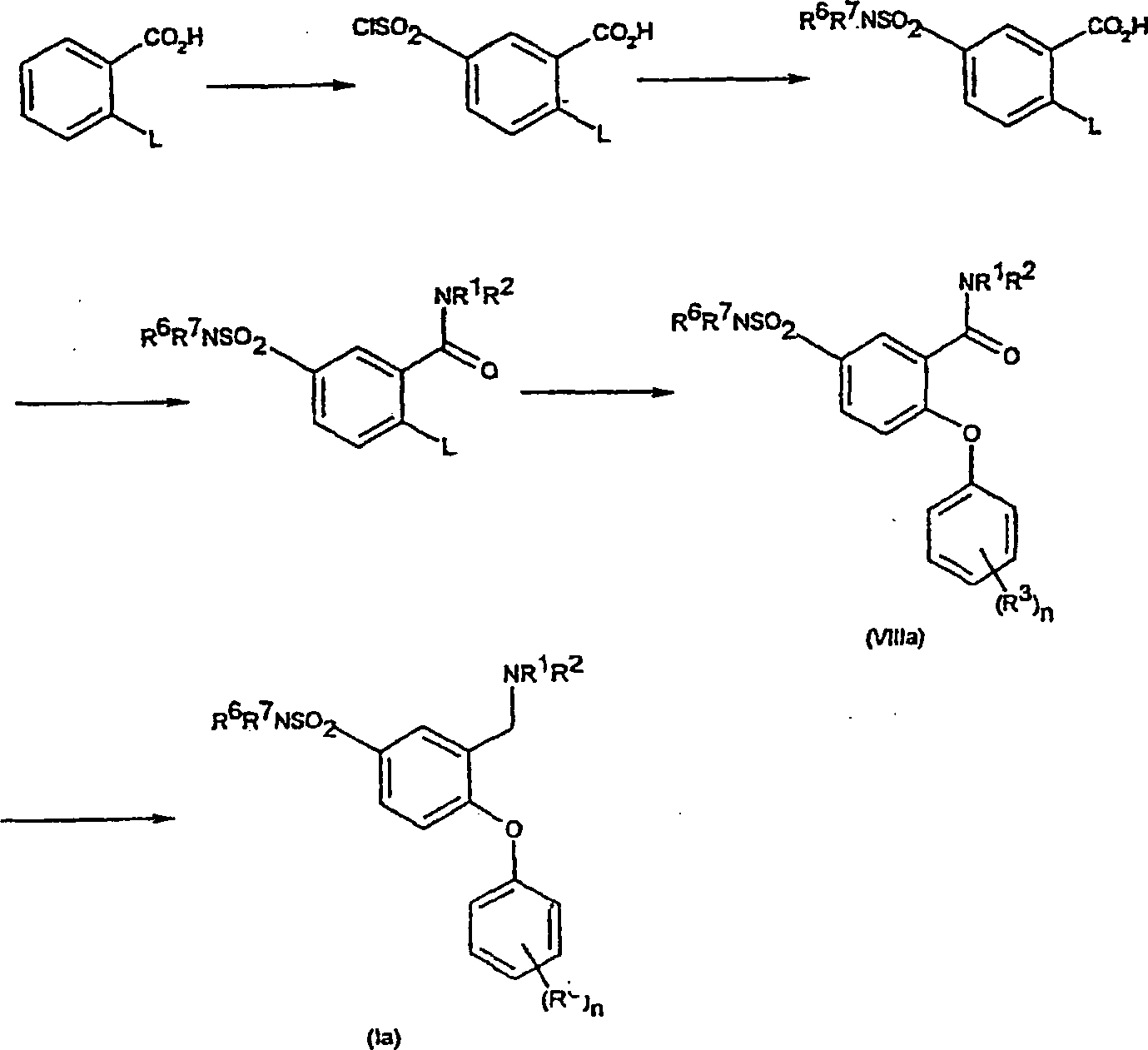
Gemäß weiteren Aspekten werden erfindungsgemäß Verbindungen der Formeln (II), (III), (VII), (VIII), (VIIIa) und (XII) gemäß den vorstehenden Definitionen bereitgestellt. In Verbindungen der allgemeinen Formel (II), bei der R1 und R2 Methyl bedeuten und n den Wert 1 hat, bedeutet R3 keine -SMe-Gruppe in para-Stellung zur Etherbindung, die die Ringe A und B verknüpft.According to further aspects, compounds of the formulas (II), (III), (VII), (VIII), (VIIIa) and (XII) according to the above definitions are provided according to the invention. In compounds of general formula (II) wherein R 1 and R 2 are methyl and n is 1, R 3 is not an -SMe group in para position to the ether bond linking the rings A and B.
Verbindungen der Formeln (IV), (V), (VI) oder (IX) sind entweder bekannt oder handelsüblich oder lassen sich aus handelsüblichen Materialien unter Anwendung bekannter Techniken herstellen.links of the formulas (IV), (V), (VI) or (IX) are either known or commercially or can be made commercially available Produce materials using known techniques.
Für den Fachmann ist es ersichtlich, dass empfindliche funktionelle Gruppen während der Synthese einer Verbindung der Formel (I) geschützt und anschließend einer Schutzgruppenentfernung unterzogen werden müssen. Dies kann durch herkömmliche Techniken erreicht werden; vergl. beispielsweise "Protective Groups in Organic Synthesis", 3. Auflg., T. W. Greene und P. G. M. Wuts, John Wiley and Sons Inc., 1999. Beispiel 121 liefert ein Beispiel für eine Schutzgruppenstrategie, die bei der Synthese einer erfindungsgemäßen Verbindung herangezogen wird.For the expert it can be seen that sensitive functional groups during the Synthesis of a compound of formula (I) protected and then a Must be subjected to deprotection. This can be done by conventional Techniques are achieved; See, for example, "Protective Groups in Organic Synthesis ", 3. Ed., T.W. Greene and P.G.M. Wuts, John Wiley and Sons Inc., 1999. Example 121 provides an example of a protection group strategy, used in the synthesis of a compound of the invention becomes.
Der Chemiker erkennt, dass Diarylether unter Anwendung einer Anzahl von Syntheseverfahren hergestellt werden können. Bezüglich einer Übersicht über die Verfahrensweisen wird auf J. S. Sawyer, Tetrahedron, Bd. 56 (2000), S. 5045–5065 verwiesen. Diese Druckschrift wird durch Verweis zum Gegenstand der Beschreibung gemacht.Of the Chemist recognizes that diaryl ethers using a number can be prepared by synthetic methods. For an overview of the Procedures are described in J.S. Sawyer, Tetrahedron, Vol. 56 (2000), Pp. 5045-5065 directed. This document is the subject of reference the description made.
Die erfindungsgemäßen Verbindungen sind aufgrund ihrer pharmakologischen Aktivität bei Säugetieren, einschließlich des Menschen, wertvoll. Insbesondere eignen sie sich zur Behandlung von Störungen, an denen die Regulierung der Monoamin-Transporterfunktion beteiligt ist. Zu Krankheitszuständen, die sich erwähnen lassen, gehören Hochdruck, Depression (z. B. Depression bei Krebspatienten, Depression bei Parkinson-Patienten, Depression nach Myokardinfarkten, subsyndromale symptomatische Depression, Depression bei unfruchtbaren Frauen, pädiatrische Depressionen, Major-Depression, einzelne Depressionsepisoden, wiederkehrende Depressionen, Depressionen nach Kindsmissbrauch, Depressionen nach der Geburt und das Syndrom "mürrischer alter Männer"), allgemeine Angstzustände, Phobien (z. B. Agoraphobie, soziale Phobien und einfache Phobien), posttraumatisches Stress-Syndrom, Vermeidungs-Persönlichkeitsstörungen, vorzeitige Ejakulation, Essstörungen (z. B. Anorexia nervosa und Bulimia nervosa), Fettleibigkeit, Chemikalienabhängigkeiten (z. B. Abhängigkeit von Alkohol, Kokain, Heroin, Phenobarbital, Nicotin und Benzodiazepinen), Cluster-Kopfschmerzen, Migräne, Schmerzen, Alzheimer-Krankheit, obsessiv-kompulsive Störungen, panische Störungen, Gedächtnisstörungen (z. B. Demenz, Vergesslichkeitsstörungen und altersbedingter Abfall der kognitiven Fähigkeiten (ARCD)), Parkinson-Krankheit (z. B. Demenz bei Parkinson-Krankheit, neuroleptisch induzierter Parkinsonismus und späte Dyskinesie), endokrine Störungen (z. B. Hyperprolactinämie), Vasospasmus, (insbesondere im zerebralen Gefäßsystem), zerebellare Ataxie, Störungen des Magendarmtrakts (unter Veränderungen von Beweglichkeit und Sekretion), negative Symptome von Schizophrenie, prämenstruelles Syndrom, Fibromyalgie-Syndrom, Stress-Inkontinenz, Tourette-Syndrom, Trichotillomanie, Kleptomanie, männliche Impotenz, Aufmerksamkeitsdefizit-Hyperaktivitäts-Störungen (ADHD), chronische paroxysmale Hämikranie, Kopfschmerzen (in Verbindung mit vaskulären Störungen), emotionale Labilität, pathologisches Schreien, Schlafstörungen (Kataplexie) und Schock.The Compounds of the invention are due to their pharmacological activity in mammals, including the People, valuable. In particular, they are suitable for treatment of disturbances, involved in the regulation of monoamine transporter function is. To disease states, to mention each other let belong High pressure, depression (eg depression in cancer patients, depression in Parkinson's patients, depression after myocardial infarction, subsyndromale symptomatic depression, depression in infertile women, pediatric Depression, major depression, single episodes of depression, recurrent Depression, depression after child abuse, depression after the birth and the syndrome "grumpier old men "), general anxiety states, phobias (eg agoraphobia, social phobias and simple phobias), posttraumatic Stress syndrome, avoidance personality disorders, premature ejaculation, eating disorders (eg anorexia nervosa and bulimia nervosa), obesity, chemical dependency (eg dependency of alcohol, cocaine, heroin, phenobarbital, nicotine and benzodiazepines), Cluster headache, migraine, Pain, Alzheimer's disease, obsessive-compulsive disorders, panic disorders, Memory disorders (eg. B. Dementia, forgetfulness disorders and age-related cognitive decline (ARCD)), Parkinson's disease (eg. Dementia in Parkinson's disease, neuroleptic-induced Parkinsonism and late Dyskinesia), endocrine disorders (eg hyperprolactinemia), Vasospasm, (especially in the cerebral vascular system), cerebellar ataxia, disorders of the gastrointestinal tract (under changes of motility and secretion), negative symptoms of schizophrenia, premenstrual syndrome, Fibromyalgia syndrome, stress incontinence, Tourette syndrome, trichotillomania, kleptomania, male Impotence, attention deficit hyperactivity disorder (ADHD), chronic paroxysmal hemicrania, Headache (in connection with vascular disorders), emotional lability, pathological crying, sleep disorders (Cataplexy) and shock.
Zu Störungen von besonderem Interesse gehören Depression, Aufmerksamkeitsdefizit-Hyperaktivitäts-Störungen, obsessiv-kompulsive Störungen, posttraumatische Stress-Störungen, Störungen mit Substanzenmissbrauch und sexuelle Dysfunktionen, einschließlich (insbesondere) vorzeitige Ejakulation. Eine vorzeitige Ejakulation kann als eine anhaltende oder wiederkehrende Ejakulation vor, bei oder kurz nach Penispenetration beim Sexualpartner definiert werden. Sie kann auch als eine Ejakulation definiert werden, die eintritt, bevor das Individuum es wünscht (vergl. "The Merck Manual", 16. Auflg., Merck Research Laboratories, (1992) S. 1576). Somit werden gemäß weiteren Aspekten erfindungsgemäß folgende Gegenstände bereitgestellt:
- i) Eine Verbindung der Formel (I), gemäß der Definition im ersten Aspekt oder pharmazeutisch verträgliche Salze, Solvate oder Polymorphe davon zur Verwendung als Pharmazeutikum.
- ii) Verwendung einer Verbindung der Formel (I) gemäß der Definition im ersten Aspekt oder pharmazeutisch akzeptable Salze, Solvate oder Polymorphe davon bei der Herstellung eines Arzneimittels zur Behandlung oder Prophylaxe einer Störung, an der die Regulation der Monoamin-Transporterfunktion beteiligt ist, z. B. Depression, Aufmerksamkeitsdefizit-Hyperaktivitäts-Störung, obsessiv-kompulsive Störung, posttraumatische Stress-Störung, Substanzenmissbrauch-Störungen oder sexuelle Dysfunktionen, einschließlich vorzeitige Ejakulation.
- iii) Verwendung einer Verbindung der allgemeinen Formel (I) gemäß der Definition im ersten Aspekt oder pharmazeutisch akzeptable Salze, Solvate oder Polymorphe davon bei der Herstellung eines Arzneimittels zur Behandlung oder Prophylaxe von vorzeitiger Ejakulation sowie ferner ein Verfahren zur Behandlung oder Prophylaxe von vorzeitiger Ejakulation unter Verabreichung dieser Verbindung an einen Patienten, der einer derartigen Behandlung oder Prophylaxe bedarf.
- iv) Verfahren zur Behandlung oder Prophylaxe von Depressionen, Aufmerksamkeitsdefizit-Hyperaktivitäts-Störungen, obsessiv-kompulsiven Störungen, posttraumatischen Stress-Störungen, Substanzenmissbrauch-Störungen oder sexuellen Dysfunktionen, einschließlich vorzeitiger Ejakulation, umfassend die Verabreichung einer therapeutisch wirksamen Menge einer Verbindung der Formel (I) gemäß der Definition im ersten Aspekt oder von pharmazeutisch akzeptablen Salzen, Solvaten oder Polymorphen davon an einen Patienten, der einer derartigen Behandlung oder Prophylaxe bedarf.
- v) Verfahren zur Erhöhung der ejakulatorischen Latenzzeit, umfassend die Verabreichung einer wirksamen Menge einer Verbindung der Formel (I) gemäß der Definition im ersten Aspekt oder von pharmazeutisch akzeptablen Salzen, Solvaten oder Polymorphen davon an einen Mann, der eine verlängerte ejakulatorische Latenzzeit wünscht.
- vi) eine Verbindung der Formel (I) gemäß der Definition im ersten Aspekt oder pharmazeutisch akzeptable Salze, Solvate oder Polymorphe davon zur Behandlung oder Prophylaxe einer Störung, bei der die Regulation der Monoamin-Transporterfunktion beteiligt ist, z. B. Depressionen, Aufmerksamkeitsdefizit-Hyperaktivitäts-Störungen, obsessiv-kompulsive Störungen, posttraumatische Stress-Störungen, Substanzenmissbrauch-Störungen oder sexuelle Dysfunktionen, einschließlich vorzeitige Ejakulation.
- i) A compound of formula (I) as defined in the first aspect or pharmaceutically acceptable salts, solvates or polymorphs thereof for use as a pharmaceutical.
- ii) Use of a compound of formula (I) as defined in the first aspect or pharmaceutically acceptable salts, solvates or polymorphs thereof in the manufacture of a medicament for the treatment or prophylaxis of a disorder involving the regulation of monoamine transporter function, e.g. Depression, attention deficit hyperactivity disorder, obsessive-compulsive disorder, post-traumatic stress disorder, substance abuse disorders or sexual dysfunctions, including premature ejaculation.
- iii) Use of a compound of the general formula (I) as defined in the first aspect or pharmaceutically acceptable salts, solvates or polymorphs thereof in the manufacture of a medicament for the treatment or prophylaxis of premature ejaculation and also a method for the treatment or prophylaxis of premature ejaculation Administration of this compound to a patient in need of such treatment or prophylaxis.
- iv) A method for the treatment or prophylaxis of depression, attention deficit hyperactivity disorders, obsessive-compulsive disorders, post-traumatic stress disorders, substance abuse disorders or sexual dysfunctions, including premature ejaculation, comprising administration of a therapeutically effective amount of a compound of the formula (I ) as defined in the first aspect or pharmaceutically acceptable salts, solvates or polymorphs thereof to a patient in need of such treatment or prophylaxis.
- v) A method for increasing ejaculatory latency comprising administering to a male requiring a prolonged ejaculatory latency an effective amount of a compound of formula (I) as defined in the first aspect or of pharmaceutically acceptable salts, solvates or polymorphs thereof.
- vi) a compound of formula (I) as defined in the first aspect or pharmaceutically acceptable salts, solvates or polymorphs thereof for the treatment or prophylaxis of a disorder involving the regulation of monoamine transporter function, e.g. Depression, attention-deficit hyperactivity disorders, obsessive-compulsive disorders, post-traumatic stress disorders, substance abuse disorders or sexual dysfunctions, including premature ejaculation.
Es ist darauf hinzuweisen, dass sämtliche Bezugnahmen auf eine Behandlung eine kurative, palliative und prophylaktische Behandlung umfassen.It It should be noted that all References to treatment include a curative, palliative and prophylactic Include treatment.
Die
Verbindungen der Erfindung können
allein oder als Teil einer Kombinationstherapie verabreicht werden.
Wenn eine Kombination von Wirkstoffen verabreicht wird, so können diese
gleichzeitig, getrennt oder nacheinander verabreicht werden. Insbesondere
können
die erfindungsgemäßen Verbindungen
zur Behandlung von vorzeitiger Ejakulation mit den folgenden Produkten
kombiniert werden:
alpha-Blocker (z. B. Phentolamin, Doxazasim,
Tansulosin, Terazasin, Prazasin und Beispiel 19 von WO-98/30560;
Apomorphin – die Lehre
der Verwendung von Apomorphin als pharmazeutischer Wirkstoff findet
sich in US-A-5945117;
Dopamin D2-Agonisten (z. B. Premiprixal,
Pharmacia Upjohn-Verbindung Nr. PNU95666);
Melanocortin-Rezeptor-Agonisten
(z. B. Melanotan II);
PGE1-Rezeptor-Agonisten (z. B. Alprostadil);
Monoamin-Transport-Inhibitoren,
insbesondere Noradrenalin-Wiederaufnahme-Inhibitoren (NRIs) (z.
B. Reboxetin), andere Serotonin-Wiederaufnahme-Inhibitoren (SRIs)
(z. B. Paroxetin) oder Dopamin-Wiederaufnahme-Inhibitoren (DRIs);
5-HT3-Antagonisten
(z. B. Ondansetron und Granisetron); und
PDE-Inhibitoren, wie
PDE2 (z. B. Erythro-9-(2-hydroxyl-3-nonyl)-adenin)
und Beispiel 100 von EP-0771799 (durch Verweis zum Gegenstand der
Beschreibung gemacht) und insbesondere ein PDE5-Inhibitor (z. B.
Sildenafil, 1-{[3-(3,4-dihydro-5-methyl-4-oxo-7-propylimidazo[5,1-f]-as-triazin-2-yl)-4-ethoxyphenyl]-sulfonyl}-4-ethylpiperazin,
d. h. Vardenafil/Bayer BA 38-9456) und IC351 (vergl. die nachstehende
Strukturformel, Icos Lilly).The compounds of the invention may be administered alone or as part of a combination therapy. When a combination of active ingredients is administered, they may be administered simultaneously, separately or sequentially. In particular, the compounds according to the invention for the treatment of premature ejaculation can be combined with the following products:
alpha-blockers (eg, phentolamine, doxazasim, tansulosin, terazasin, prazasin, and Example 19 of WO 98/30560;
Apomorphine - the teaching of the use of apomorphine as a pharmaceutical agent is found in US-A-5945117;
Dopamine D2 agonists (e.g., Premiprixal, Pharmacia Upjohn Compound No. PNU95666);
Melanocortin receptor agonists (eg melanotan II);
PGE1 receptor agonists (eg, alprostadil);
Monoamine transport inhibitors, particularly norepinephrine reuptake inhibitors (NRIs) (eg, reboxetine), other serotonin reuptake inhibitors (SRIs) (eg, paroxetine), or dopamine reuptake inhibitors (DRIs);
5-HT3 antagonists (eg ondansetron and granisetron); and
PDE inhibitors such as PDE2 (e.g., erythro-9- (2-hydroxyl-3-nonyl) adenine) and Example 100 of EP-0771799 (incorporated herein by reference), and more particularly a PDE5 inhibitor ( eg sildenafil, 1 - {[3- (3,4-dihydro-5-methyl-4-oxo-7-propylimidazo [5,1-f] -azotriazin-2-yl) -4-ethoxyphenyl ] -sulfonyl} -4-ethylpiperazine, ie vardenafil / Bayer BA 38-9456) and IC351 (see the structural formula below, Icos Lilly).
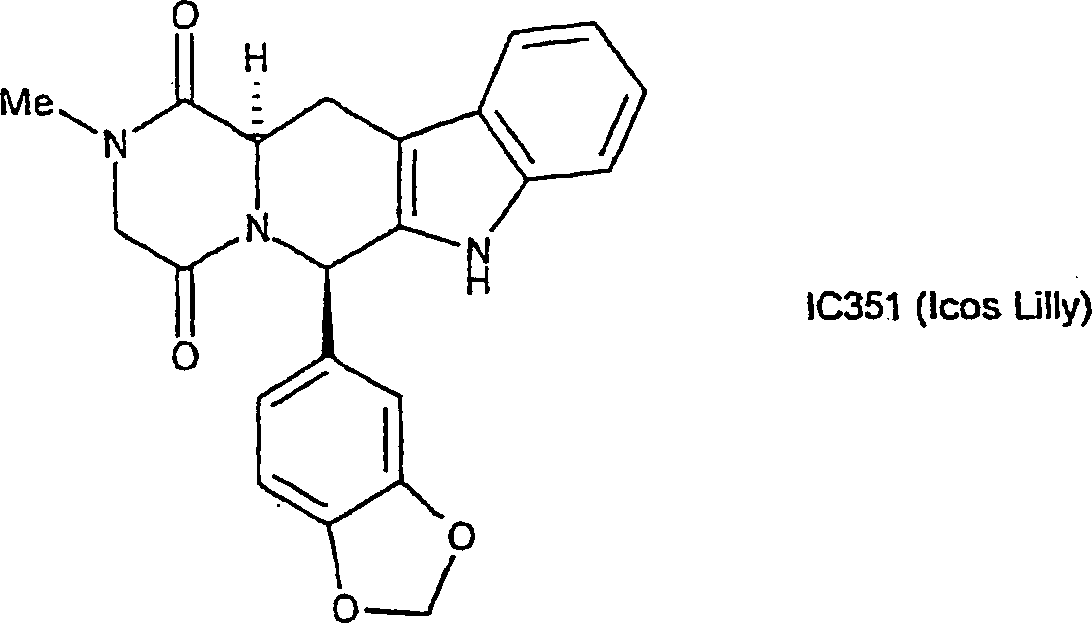
Zur Verwendung beim Menschen können die erfindungsgemäßen Verbindungen allein verabreicht werden, sie werden aber bei der Humantherapie im allgemeinen im Gemisch mit einem geeigneten pharmazeutischen Exzipiens, Verdünnungsmittel oder Trägerstoff, die im Hinblick auf den vorgesehenen Verabreichungsweg und die übliche pharmazeutische Praxis ausgewählt werden, verabreicht.to Use in humans can the compounds of the invention but they will be used in human therapy generally in admixture with a suitable pharmaceutical Excipients, diluents or carrier, with regard to the intended route of administration and the usual pharmaceutical Practice selected be administered.
Beispielsweise können die erfindungsgemäßen Verbindungen oral, bukkal oder sublingual in Form von Tabletten, Kapseln (einschließlich Weichgelatinekapseln), eiförmigen Präparaten, Elixieren, Lösungen oder Suspensionen, verabreicht werden, die Aromastoffe oder farbgebende Mittel enthalten, und zwar für sofortige, verzögerte, modifizierte, lange anhaltende, duale, kontrollierte oder pulsierende Abgabeformen. Die erfindungsgemäßen Verbindungen können auch durch intrakavernosale Injektion verabreicht werden. Die erfindungsgemäßen Verbindungen können auch über sich rasch verteilende oder rasch lösende Dosierungsformen verabreicht werden.For example can the compounds of the invention orally, buccally or sublingually in the form of tablets, capsules (including soft gelatine capsules), ovoid preparations, Elixirs, solutions or suspensions, the flavors or coloring Contain funds, namely for immediate, delayed, modified, long-lasting, dual, controlled or pulsating Output forms. The compounds of the invention can also be administered by intracavernosal injection. The compounds of the invention can also over administered rapidly-spreading or rapidly-dissolving dosage forms become.
Derartige Tabletten können folgende Bestandteile enthalten: Exzipientien, wie mikrokristalline Cellulose, Lactose, Natriumcitrat, Calciumcarbonat, dibasisches Calciumphosphat, Glycin und Stärke (vorzugsweise Mais-, Kartoffel- oder Tapiokastärke), Sprengmittel, wie Natriumstärkeglykolat, Croscarmellose-natrium und bestimmte komplexe Silicate, sowie Granulationsbindemittel, wie Polyvinylpyrrolidon, Hydroxypropylmethylcellulose (HPMC), Hydroxypropylcellulose (HPC), Saccharose, Gelatine und Gummi arabicum. Ferner können Gleitmittel, wie Magnesiumstearat, Stearinsäure, Glycerylbehenat und Talcum, enthalten sein.such Tablets can contain the following components: excipients, such as microcrystalline Cellulose, lactose, sodium citrate, calcium carbonate, dibasic Calcium phosphate, glycine and starch (preferably corn, potato or tapioca starch), disintegrants such as sodium starch glycolate, Croscarmellose sodium and certain complex silicates, as well as granulation binders, such as polyvinylpyrrolidone, hydroxypropylmethylcellulose (HPMC), hydroxypropylcellulose (HPC), sucrose, gelatin and gum arabic. Furthermore, lubricants, such as magnesium stearate, stearic acid, Glyceryl behenate and talcum, may be included.
Feste Zusammensetzungen eines ähnlichen Typs können ferner als Füllstoffe in Gelatinekapseln verwendet werden. Diesbezüglich gehören zu bevorzugten Exzipientien Lactose, Stärke, Cellulose, Milchzucker oder hochmolekulare Polyethylenglykole. Für wässrige Suspensionen und/oder Elixiere können die erfindungsgemäßen Verbindungen und ihre pharmazeutisch akzeptablen Salze mit verschiedenen Süßungsmitteln oder Geschmacksstoffen, farbgebenden Bestandteilen oder Farbstoffen, mit Emulgier- und/oder Suspendiermitteln und mit Verdünnungsmitteln, wie Wasser, Ethanol, Propylenglykol und Glycerin, sowie Kombinationen davon kombiniert werden.firm Compositions of a similar Type can further as fillers used in gelatine capsules. In this regard, preferred excipients Lactose, starch, Cellulose, lactose or high molecular weight polyethylene glycols. For aqueous suspensions and / or elixirs the compounds of the invention and their pharmaceutically acceptable salts with various sweeteners or Flavors, coloring ingredients or dyes, with emulsifying and / or suspending agents and with diluents, such as water, ethanol, propylene glycol and glycerin, as well as combinations thereof be combined.
Dosierungsformen mit modifizierter Freisetzung und pulsierender Freisetzung können Exzipientien enthalten, wie sie ausführlich für Dosierungsformen mit sofortiger Freisetzung beschrieben worden sind, wobei zusätzliche Exzipientien enthalten sind, die als Modifikatoren der Freisetzungsgeschwindigkeit wirken, wobei diese Modifikatoren als Überzüge aufgebracht werden und/oder dem Körper der Vorrichtung zugesetzt werden. Zu Modifikatoren der Freisetzungsgeschwindigkeit gehören (ohne Beschränkung hierauf) Hydroxypropylmethylcellulose, Methylcellulose, Natriumcarboxymethylcellulose, Ethylcellulose, Celluloseacetat, Polyethylenoxid, Xanthangummi, Carbomer, Ammoniummethacrylat-Copolymere, hydriertes Rizinusöl, Carnaubawachs, Paraffinwachs, Celluloseacetatophthalat, Hydroxypropylmethylcellulosephthalat, Methacrylsäure-Copolymere und Gemische davon. Dosierungsformen mit modifizierter und pulsierender Freisetzung können ein Exzipiens oder eine Kombination von Exzipientien, die die Freisetzungsgeschwindigkeit modifizieren, enthalten. Exzipientien zur Modifizierung der Freisetzungsgeschwindigkeit können innerhalb der Dosierungsform, d. h. innerhalb der Matrix, und/oder auf der Dosierungsform, d. h. auf der Oberfläche oder dem Überzug, vorhanden sein.dosage forms with modified release and pulsatile release may contain excipients, as detailed for dosage forms have been described with immediate release, with additional Excipients are included as modifiers of release rate act, these modifiers are applied as coatings and / or the body be added to the device. To modifiers of the release rate belong (without restriction hydroxypropylmethylcellulose, methylcellulose, sodium carboxymethylcellulose, Ethyl cellulose, cellulose acetate, polyethylene oxide, xanthan gum, Carbomer, Ammonium Methacrylate Copolymers, Hydrogenated Castor Oil, Carnauba Wax, Paraffin wax, cellulose acetate phthalate, hydroxypropylmethylcellulose phthalate, Methacrylic acid copolymers and mixtures from that. Modified and pulsatile release dosage forms can an excipient or a combination of excipients that control the rate of release modify. Excipients for modifying the rate of release can within the dosage form, d. H. within the matrix, and / or on the dosage form, d. H. on the surface or the coating, to be available.
Sich rasch verteilende oder lösende Dosierungsformen (FDDFs) können die folgenden Bestandteile enthalten: Aspartam, Acesulfam-kalium, Citronensäure, Croscarmellosenatrium, Crospovidone, Diascorbinsäure, Ethylacrylat, Ethylcellulose, Gelatine, Hydroxypropylmethylcellulose, Magnesiumstearat, Mannit, Methylmethacrylat, Minzaroma, Polyethylenglykol, Quarzstaub, Siliciumdioxid, Natriumstärkeglykolat, Natriumstearylfumarat, Sorbit und Xylit. Die hier verwendeten Ausdrücke Verteilen oder Lösen, die zur Beschreibung von FDDFs verwendet werden, hängen von der Löslichkeit der verwendeten Arzneistoffsubstanz ab, d. h. sofern die Arzneistoffsubstanz unlöslich ist, lässt sich eine sich rasch verteilende Dosierungsform herstellen, sofern die Arzneistoffsubstanz löslich ist, lässt sich eine sich rasch lösende Dosierungsform herstellen.Yourself rapidly dispersing or dissolving Dosage forms (FDDFs) can the following constituents contain aspartame, acesulfame potassium, citric acid, Croscarmellose sodium, crospovidone, diascorbic acid, ethyl acrylate, ethyl cellulose, Gelatin, hydroxypropylmethylcellulose, magnesium stearate, mannitol, Methyl methacrylate, mint flavor, polyethylene glycol, fumed silica, silica, sodium starch, Sodium stearyl fumarate, sorbitol and xylitol. Distribute the terms used here or solving, which are used to describe FDDFs depend on the solubility the drug substance used, d. H. provided the drug substance insoluble is, lets produce a rapidly distributing dosage form, if the drug substance is soluble is, lets a rapidly dissolving one Prepare dosage form.
Die erfindungsgemäßen Verbindungen können ferner parenteral, z. B. intravenös, intraarteriell, intraperitoneal, intrathekal, intraventrikulär, intraurethral, intrasternal, intrakranial, intramuskulär oder subkutan, verabreicht werden oder sie können durch Infusionstechniken verabreicht werden. Für eine derartige parenterale Verabreichung werden sie am besten in Form einer sterilen wässrigen Lösung verwendet, die andere Substanzen enthalten kann, z. B. eine ausreichende Menge an Salzen oder Glucose, um die Lösung mit Blut isotonisch zu machen. Die wässrigen Lösungen sollen in geeigneter Weise gepuffert sein (vorzugsweise auf einen pH-Wert von 3 bis 9), sofern dies erforderlich ist. Die Herstellung von geeigneten parenteralen Zubereitungen unter sterilen Bedingungen erfolgt leicht nach üblichen pharmazeutischen Techniken, die dem Fachmann geläufig sind.The Compounds of the invention can furthermore parenteral, e.g. Intravenous, intraarterial, intraperitoneal, intrathecal, intraventricular, intraurethral, intrasternal, intracranial, intramuscular or subcutaneous administration be or they can be administered by infusion techniques. For such a parenteral Administration they are best in the form of a sterile aqueous solution used, which may contain other substances, for. B. a sufficient Amount of salts or glucose to make the solution isotonic with blood. The watery solutions should be suitably buffered (preferably one pH 3 to 9), if necessary. The production of suitable parenteral preparations under sterile conditions takes place easily according to usual pharmaceutical techniques familiar to those skilled in the art.
Für eine orale und parenterale Verabreichung an humane Patienten beträgt die tägliche Dosierungsmenge der erfindungsgemäßen Verbindungen oder der Salze oder Solvate davon üblicherweise 10 bis 500 mg (in einer einzigen Dosis oder in unterteilten Dosen).For an oral and parenteral administration to human patients is the daily dosage amount the compounds of the invention or the salts or solvates thereof, usually 10 to 500 mg (in a single dose or in divided doses).
Somit können beispielsweise Tabletten oder Kapseln der erfindungsgemäßen Verbindungen oder Salze oder Solvate davon 2,5 bis 250 mg Wirkstoff für eine Verabreichung, bei der je nach Zweckmäßigkeit eine einzige oder zwei oder mehr Tabletten oder Kapseln gegeben werden, enthalten. Der Arzt legt in jedem Fall die tatsächliche Dosis fest, die sich für einen individuellen Patienten am besten eignet und die je nach Alter, Gewicht und Reaktion des speziellen Patienten variiert. Die vorstehenden Dosierungen stellen Beispiele für den Durchschnittsfall dar. Selbstverständlich kann es Einzelfälle geben, bei denen höhere oder niedrigere Bereiche angezeigt sind. Diese fallen ebenfalls unter den Umfang der Erfindung. Für den Fachmann ist es ersichtlich, dass bei der Behandlung bestimmter Zustände (einschließlich PE) die erfindungsgemäßen Verbindungen in Form einer einzelnen Dosis auf Basis des Bedarfs (d. h. je nach Erfordernis oder Wunsch) genommen werden können.Thus, for example, tablets or capsules of the compounds of the invention or salts or solvates thereof may contain from 2.5 to 250 mg of active ingredient for administration which may be given as a single or two or more tablets or capsules as appropriate. In any case, the physician will determine the actual dose that is best for an individual patient and that varies with the age, weight, and response of the particular patient. The above dosages are examples of the average case. Of course, there may be isolated cases where higher or lower ranges are indicated. These are also within the scope of the invention. It will be apparent to those skilled in the art that in the treatment of certain conditions (including PE) the inventive compounds may be taken in the form of a single dose based on need (ie, as needed or desired).
Beispielhafte TablettenzubereitungExemplary tablet preparation
Im
allgemeinen kann eine Tablettenzubereitung typischerweise etwa 0,01
bis 500 mg einer erfindungsgemäßen Verbindung
(oder eines Salzes davon) enthalten, wobei das Tablettenfüllgewicht
im Bereich von 50 bis 1 000 mg liegen kann. Nachstehend wird eine
beispielhafte Zubereitung für
eine 10 mg-Tablette angegeben:
Die erfindungsgemäßen Verbindungen können auch intranasal oder durch Inhalation verabreicht werden und werden zweckmäßigerweise in Form eines Trockenpulver-Inhalationspräparats oder in Form eines Aerosol-Sprühpräparats aus einem Druckbehälter, einer Pumpe, Sprühvorrichtung oder Zerstäubungsgerät unter Verwendung eines geeigneten Treibmittels, wie Dichlordifluormethan, Trichlorfluormethan, Dichlortetrafluorethan, einem Hydrofluoralkan, wie 1,1,1,2-Tetrafluorethan (HFA 134A (Warenbezeichnung)) oder 1,1,1,2,3,3,3-Heptafluorpropan (HFA 227EA (Warenbezeichnung)), Kohlendioxid oder einem anderen geeigneten Gas, abgegeben. Im Fall eines Druckaerosols kann die Dosiseinheit durch Bereitstellen eines Ventils zur Abgabe einer dosierten Menge festgelegt werden. Der Druckbehälter, die Pumpe, die Sprühvorrichtung oder die Zerstäubungsvorrichtung können eine Lösung oder eine Suspension des Wirkstoffes beispielsweise unter Verwendung eines Gemisches aus Ethanol und dem Treibmittel als Lösungsmittel, wobei zusätzlich ein Gleitmittel, wie Sorbitantrioleat, enthalten sein kann, enthalten. Kapseln und Kartuschen (z. B. aus Gelatine) zur Verwendung in einem Inhalationsgerät oder einem Pulverzerstäubungsgerät können so zubereitet werden, dass sie ein Pulvergemisch einer erfindungsgemäßen Verbindung und einer geeigneten Pulvergrundlage, wie Lactose oder Stärke, enthalten.The Compounds of the invention can also be administered intranasally or by inhalation expediently in the form of a dry powder inhalation preparation or in the form of an aerosol spray preparation a pressure vessel, a pump, spray device or atomizer under Use of a suitable propellant, such as dichlorodifluoromethane, Trichlorofluoromethane, dichlorotetrafluoroethane, a hydrofluoroalkane, such as 1,1,1,2-tetrafluoroethane (HFA 134A (trade name)) or 1,1,1,2,3,3,3-heptafluoropropane (HFA 227EA (trade name)), carbon dioxide or another suitable gas delivered. In the case of a pressurized aerosol, the Dose unit by providing a valve for delivering a dosed quantity. The pressure vessel, the pump, the spray device or the sputtering device can a solution or a suspension of the active ingredient, for example, using a mixture of ethanol and the propellant as solvent, in addition a lubricant such as sorbitan trioleate may be contained. Capsules and cartridges (eg of gelatin) for use in one inhaler or a Pulverzerstäubungsgerät so be prepared that they are a powder mixture of a compound of the invention and a suitable powder base such as lactose or starch.
Aerosol- oder Trockenpulver-Zubereitungen werden vorzugsweise so angeordnet, dass jede Dosierungseinheit oder "Schuss" 1 bis 50 mg einer erfindungsgemäßen Verbindung zur Abgabe an den Patienten enthält. Die gesamte Tagesdosis bei einem Aerosol liegt im Bereich von 1 bis 50 mg, wobei die Verabreichung in Form einer einzigen Dosis oder, was üblicher ist, in über den Tag verteilten Dosen erfolgt.aerosol or dry powder preparations are preferably arranged that each dosage unit or "shot" 1 to 50 mg of a compound of the invention for delivery to the patient. The total daily dose of an aerosol is in the range of 1 to 50 mg, the administration being in the form of a single dose or, more usual is over in doses distributed throughout the day.
Die erfindungsgemäßen Verbindungen können auch zur Abgabe über ein Zerstäubungsgerät zubereitet werden. Zubereitungen für Zerstäubervorrichtungen können die nachstehend angegebenen Bestandteile als Lösungsvermittler, Emulgatoren oder Suspendiermittel enthalten: Wasser, Ethanol, Glycerin, Propylenglykol, niedermolekulare Polyethylenglykole, Natriumchlorid, Fluorkohlenstoffe, Polyethylenglykolether, Sorbitantrioleat und Ölsäure.The Compounds of the invention can also for delivery over a Zerstäubungsgerät prepared become. Preparations for atomising can the ingredients listed below as solubilizers, emulsifiers or suspending agents include: water, ethanol, glycerine, propylene glycol, low molecular weight polyethylene glycols, sodium chloride, fluorocarbons, Polyethylene glycol ethers, sorbitan trioleate and oleic acid.
Alternativ können die erfindungsgemäßen Verbindungen in Form eines Suppositoriums oder Pessars verabreicht werden oder sie können topisch in Form eines Gels, Hydrogels, Lotion, Lösung, Creme, Salbe oder Stäubepulver aufgetragen werden. Die erfindungsgemäßen Verbindungen können auch dermal oder transdermal verabreicht werden, z. B. unter Verwendung eines Hautpflasters. Ferner können sie auf okularem, pulmonalem oder rektalem Wege verabreicht werden.alternative can the compounds of the invention be administered in the form of a suppository or pessary or you can topically in the form of a gel, hydrogel, lotion, solution, cream, ointment or dusting powder be applied. The compounds of the invention may also be administered dermally or transdermally, for. B. using a dermal patch. Furthermore, can they are administered by ocular, pulmonary or rectal route.
Zur ophthalmischen Anwendung können die Verbindungen in Form von mikronisierten Suspensionen in isotonischen, pH-eingestellten, sterilen Kochsalzlösungen oder vorzugsweise als Lösungen in isotonischer, pH-eingestellter, steriler Kochsalzlösung, gegebenenfalls in Kombination mit einem Konservierungsmittel, wie einem Benzalkoniumchlorid, zubereitet werden. Alternativ können sie in einer Salbe, wie Petrolatum, zubereitet werden.to ophthalmic application can the compounds in the form of micronised suspensions in isotonic, pH adjusted, sterile saline solutions or preferably as solutions in isotonic, pH-adjusted, sterile saline, optionally in combination with a preservative such as Benzalkonium chloride, to be prepared. Alternatively, they can in an ointment, such as petrolatum.
Zur topischen Anwendung auf die Haut können die erfindungsgemäßen Verbindungen als eine geeignete Salbe zubereitet werden, die den Wirkstoff in Suspension oder Lösung beispielsweise in einem Gemisch aus einem oder mehreren der folgenden Bestandteile enthält: Mineralöl, flüssiges Petrolatum, weißes Petrolatum, Propylenglykol, Polyoxyethylen-Polyoxypropylen-Massen, emulgierendes Wachs und Wasser. Alternativ können sie in Form einer geeigneten Lotion oder Creme zubereitet und beispielsweise in einem Gemisch aus einem oder mehreren der folgenden Bestandteile suspendiert oder gelöst werden: Mineralöl, Sorbitanmonostearat, Polyethylenglykol, flüssiges Paraffin, Polysorbate 60, Cetylester, Wachs, Cetearylalkohol, 2-Octyldodecanol, Benzylalkohol und Wasser.For topical application to the skin, the compounds of the invention may be formulated as a suitable ointment containing the active ingredient in suspension or solution, for example in a mixture of one or more of the following: mineral oil, liquid petrolatum, white petrolatum, propylene glycol, polyoxyethylene-polyoxypropylene - masses, emulsifying wax and water. alternative For example, they may be prepared in the form of a suitable lotion or cream and suspended or dissolved, for example, in a mixture of one or more of the following: mineral oil, sorbitan monostearate, polyethylene glycol, liquid paraffin, polysorbate 60, cetyl ester, wax, cetearyl alcohol, 2-octyldodecanol, benzyl alcohol and water.
Die erfindungsgemäßen Verbindungen können auch in Kombination mit einem Cyclodextrin verwendet werden. Von Cyclodextrinen ist es bekannt, dass sie Einschluss- und Nichteinschluss-Komplexe mit Arzneistoffmolekülen bilden. Die Bildung eines Arzneistoff-Cyclodextrin-Komplexes kann die Löslichkeit, die Auflösungsgeschwindigkeit, die biologische Verfügbarkeit und/oder die Stabilität eines Arzneistoffmoleküls modifizieren. Arzneistoff-Cyclodextrin-Komplexe eignen sich im allgemeinen für die meisten Dosierungsformen und Verabreichungswege. Als eine Alternative zur direkten Komplexbildung mit dem Arzneistoff kann das Cyclodextrin als Hilfsadditiv, z. B. als Trägerstoff, Verdünnungsmittel oder Lösungsvermittler, verwendet werden. α-, β- und γ-Cyclodextrine werden am häufigsten verwendet. Geeignete Beispiele hierfür sind in WO-A-91/11172, WO-A-94/02518 und WO-A-98/55148 beschrieben.The Compounds of the invention can also be used in combination with a cyclodextrin. From Cyclodextrins are known to contain inclusion and non-inclusion complexes with drug molecules form. The formation of a drug-cyclodextrin complex can the solubility, the dissolution rate, the bioavailability and / or stability a drug molecule modify. Drug-cyclodextrin complexes are generally suitable for the most dosage forms and routes of administration. As an alternative For direct complex formation with the drug, the cyclodextrin as an auxiliary additive, eg. B. as a carrier, thinner or solubilizers, be used. α-, β- and γ-cyclodextrins become the most common used. Suitable examples thereof are described in WO-A-91/11172, WO-A-94/02518 and WO-A-98/55148.
Für eine orale oder parenterale Verabreichung an humane Patienten liegen die täglichen Dosierungshöhen der Verbindungen der Formel (I) und ihrer pharmazeutisch akzeptablen Salze im Bereich von 0,01 bis 30 mg/kg (in einzigen oder unterteilten Dosen) und vorzugsweise im Bereich von 0,01 bis 5 mg/kg. Somit enthalten Tabletten 1 mg bis 0,4 g einer Verbindung, von denen bei jeder Verabreichung eine, zwei oder mehr Tabletten je nach Bedarf verabreicht werden. Der Arzt kann in jedem Einzelfall die tatsächliche Dosis festlegen, die sich für den speziellen Patienten am besten eignet. Die Dosis variiert je nach Alter, Gewicht und Reaktion des speziellen Patienten. Die vorstehenden Dosen sind selbstverständlich nur Beispiele für durchschnittliche Fälle. Es kann Fälle geben, bei denen höhere oder geringere Dosen von Vorteil sind. Diese fallen ebenfalls unter den Umfang der Erfindung.For an oral or parenteral administration to human patients are daily dosage levels the compounds of formula (I) and their pharmaceutically acceptable Salts in the range of 0.01 to 30 mg / kg (in single or divided Doses) and preferably in the range of 0.01 to 5 mg / kg. Thus included Tablets 1 mg to 0.4 g of a compound, one of which with each administration one, two or more tablets as needed. The doctor may determine the actual dose in each individual case for best suited to the particular patient. The dose varies according to age, weight and reaction of the particular patient. The above Cans are a matter of course just examples of average cases. It can be cases give, where higher or lower doses are beneficial. These are also covered the scope of the invention.
Eine orale Verabreichung wird bevorzugt. Vorzugsweise findet eine Verabreichung kurz vor dem Zeitpunkt statt, an dem eine Wirkung benötigt wird.A oral administration is preferred. Preferably, administration takes place just before the time when an effect is needed.
Für eine veterinärmedizinische Verwendung wird eine erfindungsgemäße Verbindung oder ein veterinärmedizinisch akzeptables Salz davon oder ein veterinärmedizinisch akzeptables Solvat oder eine Arzneistoffvorstufe davon in Form einer geeigneten, akzeptablen Zubereitung gemäß normaler veterinärmedizinischer Praxis verabreicht. Der Tierarzt legt das Dosierungsschema und den Verabreichungsweg, die sich für ein spezielles Tier am besten eignen, fest.For a veterinary Use is a compound of the invention or a veterinary acceptable salt thereof or a veterinarily acceptable solvate or a prodrug thereof in the form of a suitable, acceptable Preparation according to normal veterinary Practice administered. The vet sets the dosage regimen and the Route of administration, suitable for a special animal best suited, firm.
Somit stellt die Erfindung gemäß einem weiteren Aspekt eine pharmazeutische Zubereitung bereit, die eine Verbindung der Formel (I) gemäß der Definition im ersten Aspekt oder ein pharmazeutisch akzeptables Salz davon und ein pharmazeutisch verträgliches Adjuvans, Verdünnungsmittel oder Trägerstoff enthält.Consequently provides the invention according to a Another aspect of a pharmaceutical preparation, which is a Compound of formula (I) according to the definition in the first aspect or a pharmaceutically acceptable salt thereof and a pharmaceutically acceptable Adjuvant, diluent or carrier contains.
Nachstehend wird die Erfindung durch die folgenden, nicht-beschränkenden Beispiele erläutert, wobei die folgenden Abkürzungen und Definitionen verwendet werden:
- DMAP
- 4-(Dimethylamino)-pyridin
- DMF
- N,N-Dimethylformamid
- br
- breit
- Celite®
- Filterhilfsmittel der Fa. Aldrich Chemical Company
- δ
- chemische Verschiebung
- d
- Dublett
- DCM
- Dichlormethan
- DMPU
- 1,3-Dimethyl-3,4,5,6-tetrahydro-2(1H)-pyrimidinon
- DMSO
- Dimethylsulfoxid
- ES+
- Elektrospray-Ionisation, positive Abtastung
- ES–
- Elektrospray-Ionisation, negative Abtastung
- h
- Stunden
- m/z
- Massenspektrum-Peak
- HPLC
- Hochdruck-Flüssigchromatographie
- min
- Minuten
- MS
- Massenspektrum
- NMR
- kernmagnetische Resonanz
- Oxone®
- Kaliumperoxymonosulfat der Fa. Aldrich Chemical Company
- q
- Quartett
- s
- Singulett
- t
- Triplett
- Tf
- Trifluormethansulfonyl
- TFA
- Trifluoressigsäure
- TFAA
- Trifluoressigsäureanhydrid
- THF
- Tetrahydrofuran
- TLC
- Dünnschichtchromatographie
- TS+
- Thermospray-Ionisation, positive Abtastung
- WSCDI
- 1-(3-Dimethylaminopropyl)-3-ethylcarbodiimid-hydrochlorid
- Δ
- Wärme
- DMAP
- 4- (dimethylamino) pyridine
- DMF
- N, N-dimethylformamide
- br
- wide
- Celite ®
- Filter aid from the company Aldrich Chemical Company
- δ
- chemical shift
- d
- doublet
- DCM
- dichloromethane
- DMPU
- -pyrimidinone 1,3-dimethyl-3,4,5,6-tetrahydro-2 (1H)
- DMSO
- dimethyl sulfoxide
- ES +
- Electrospray ionization, positive sampling
- ES -
- Electrospray ionization, negative sampling
- H
- hours
- m / z
- Mass spectrum peak
- HPLC
- High Pressure Liquid Chromatography
- min
- minutes
- MS
- mass spectrum
- NMR
- nuclear magnetic resonance
- Oxone ®
- Potassium peroxymonosulfate from the company Aldrich Chemical Company
- q
- quartet
- s
- singlet
- t
- Triplett
- tf
- trifluoromethanesulfonyl
- TFA
- trifluoroacetic
- TFAA
- trifluoroacetic
- THF
- tetrahydrofuran
- TLC
- TLC
- TS +
- Thermospray ionization, positive scan
- WSCDI
- 1- (3-dimethylaminopropyl) -3-ethylcarbodiimide hydrochloride
- Δ
- warmth
Sofern angegeben, wurden die Verbindungen als ihre Hydrochloridsalze charakterisiert. Ein typisches Verfahren zur Bildung von Hydrochloridsalzen ist in Präparation 21 angegeben. Das Verfahren kann mit anderen Lösungsmitteln, z. B. Diethylether oder DCM, durchgeführt werden.Provided , the compounds were characterized as their hydrochloride salts. A typical process for the formation of hydrochloride salts is in preparation 21 indicated. The process can be combined with other solvents, e.g. B. diethyl ether or DCM become.
Die Pulver-Röntgenbeugungsmuster (PXRD) wurden unter Verwendung eines Siemens D5000-Pulver-Röntgendiffraktometers bestimmt, der mit einem theta-theta-Goniometer, automatischen Strahldivergenzschlitzen, einem sekundären Monochromator und einem Szintillationszähler ausgerüstet war. Der Prüfkörper wurde unter Bestrahlung mit Kupfer K-alpha1-Röntgenstrahlen (Wellenlänge = 1,5046 Å) die mit einem Graphit-Monochromator (λ = 0,15405 nm) gefiltert wurden, rotiert, wobei die Röntgenröhre mit 40 kV/40 mA betrieben wurde. Die Hauptpeaks (in °2θ) der PXRD-Muster für die verschiedenen Feststoffformen sind aufgeführt.The X-ray powder diffraction pattern (PXRD) were determined using a Siemens D5000 powder X-ray diffractometer, the one with a theta-theta goniometer, automatic beam divergence slots, a secondary monochromator and a scintillation counter equipped was. The test specimen was under irradiation with copper K-alpha1 X-rays (wavelength = 1.5046 Å) with the a graphite monochromator (λ = 0.15405 nm), rotated, with the X-ray tube with 40 kV / 40 mA was operated. The main peaks (in ° 2θ) of the PXRD patterns for the different solid forms are listed.
Schmelzpunkte wurden unter Verwendung eines Perkin Elmer DSC7-Geräts mit einer Aufheizgeschwindigkeit von 20°C/min bestimmt.melting points were using a Perkin Elmer DSC7 device with a Heating rate of 20 ° C / min certainly.
Beispiele 1 bis 15Examples 1 to 15
Die
Herstellung in den Beispielen 1 bis 15 erfolgte gemäß dem in
Präparation
21 beschriebenen Verfahren aus dem angegebenen Aldehyd und dem entsprechenden
Amin. 


- a Azetidin-hydrochlorid wurde anstelle von Me2NH·HCl verwendet.
- b Freies EtNH2 (als 2 M-Lösung in THF) wurde als Aminkomponente verwendet, THF allein wurde als Reaktionslösungsmittel verwendet und Et3N wurde aus dem Reaktionsgemisch weggelassen.
- c MeNH2·HCl wurde anstelle von Me2NH·HCl verwendet. AcOH (1 Äquivalent relativ zu Et3N) stellte eine weitere Komponente des Reaktionsgemisches dar.
- A azetidine hydrochloride was used in place of Me 2 NH · HCl.
- b Free EtNH 2 (as a 2 M solution in THF) was used as the amine component, THF alone was used as the reaction solvent and Et 3 N was omitted from the reaction mixture.
- c MeNH 2 · HCl was used instead of Me 2 NH · HCl. AcOH (1 equivalent relative to Et 3 N) was another component of the reaction mixture.
Beispiel
16 N-{5-Iod-2-[4-(trifluormethoxy)-phenoxy]-benzyl}-N,N-dimethylamin 
Eine gerührte Lösung des Amins von Präparation 23 (4,0 g, 12,9 mmol) in DCM (30 ml) wurde bei 0°C mit Trifluormethansulfonsäure (5,7 ml, 64,5 mmol) versetzt, wonach die portionsweise Zugabe von N-Iodsuccinimid (2,89 g, 12,9 mmol) innerhalb von 15 Minuten folgte. Nach beendeter Zugabe wurde das Gemisch 30 Minuten bei 0°C und sodann 1 Stunde bei 10°C gerührt. Sodann wurde die Umsetzung durch Zugabe von wässrigem Natriumhydroxid (2 M) gestoppt. Nach 3-maliger Extraktion mit Ethylacetat wurden die vereinigten organischen Extrakte mit Natriumthiosulfatlösung gewaschen, getrocknet (MgSO4) und zu einem roten Öl eingedampft, das durch Flash-Chromatographie (SiO2; DCM/MeOH/880 NH3 (95:5:0,5)) gereinigt wurde. Man erhielt die angestrebte Iodidverbindung in Form eines roten Öls (4,16 g, 74%). δH (CDCl3, 400 MHz) 2,24 (6H, s), 3,40 (2H, s), 6,64 (1H, d), 6,92 (2H, m), 7,16 (2H, m), 7,53 (1H, dd), 7,83 (1H, d); MS m/z (TS+) 438 (MH+).To a stirred solution of the amine of Preparation 23 (4.0 g, 12.9 mmol) in DCM (30 mL) was added trifluoromethanesulfonic acid (5.7 mL, 64.5 mmol) at 0 ° C, followed by the portionwise addition of N-iodosuccinimide (2.89 g, 12.9 mmol) within 15 minutes followed. After completion of the addition, the mixture was stirred at 0 ° C for 30 minutes and then at 10 ° C for 1 hour. The reaction was stopped by adding aqueous sodium hydroxide (2 M). After 3 extractions with ethyl acetate, the combined organic extracts were washed with sodium thiosulfate solution, dried (MgSO 4 ) and evaporated to a red oil which was purified by flash chromatography (SiO 2 ; DCM / MeOH / 880 NH 3 (95: 5: 0 , 5)) was cleaned. The desired iodide compound was obtained in the form of a red oil (4.16 g, 74%). δ H (CDCl 3, 400 MHz) 2.24 (6H, s), 3.40 (2H, s), 6.64 (1H, d), 6.92 (2H, m), 7.16 (2H , m), 7.53 (1H, dd), 7.83 (1H, d); MS m / z (TS + ) 438 (MH + ).
Beispiele 17–18Examples 17-18
Die folgenden Iodide wurden in analoger Weise zu der für die Präparation von Beispiel 16 beschriebenen Umsetzung hergestellt.The following iodides were described in an analogous manner to that for the preparation of Example 16 NEN implementation produced.
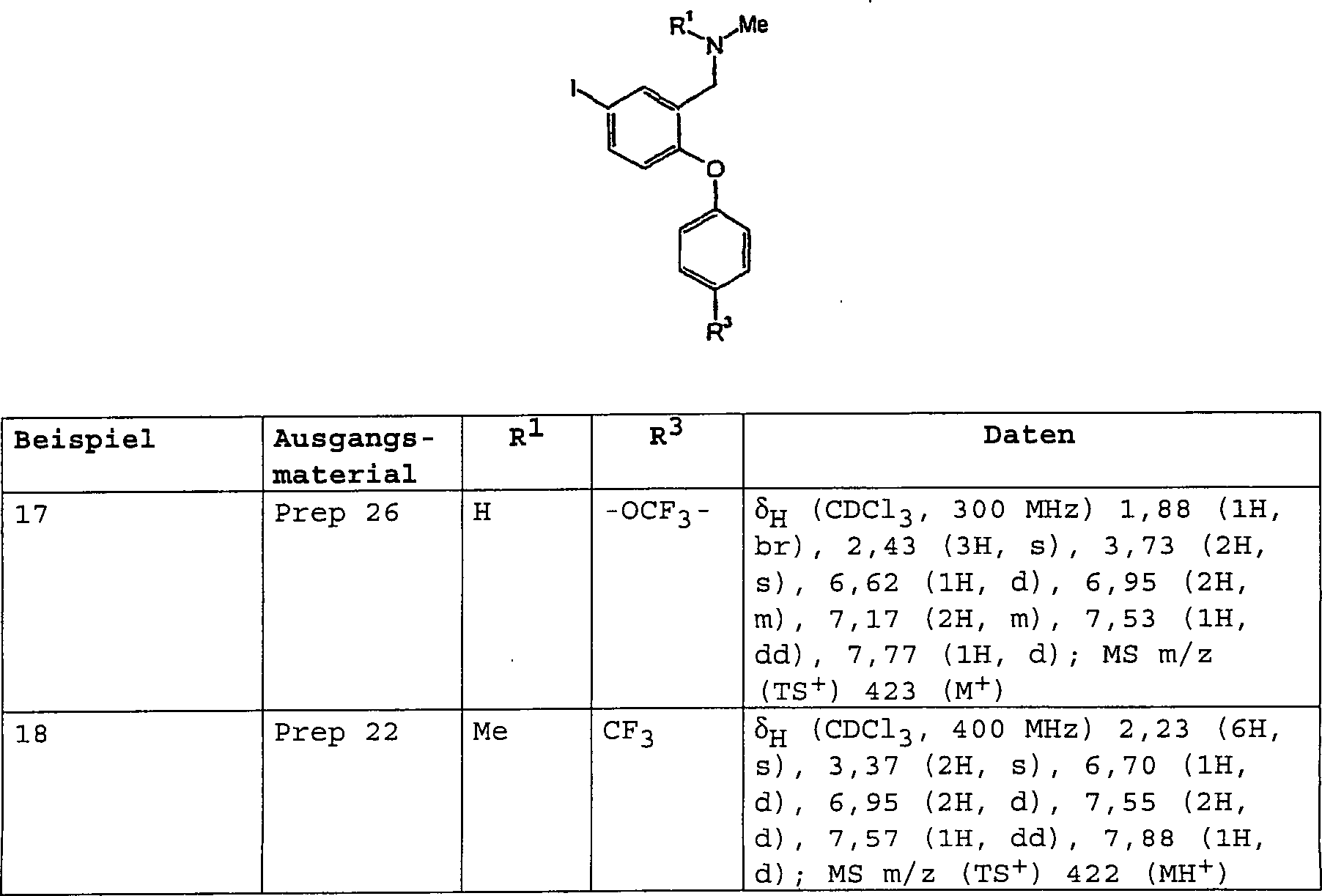
Beispiel
19 N,N-Dimethyl-N-{2-[4-(methylsulfanyl)-phenoxy-]-5-nitrobenzyl}-amin 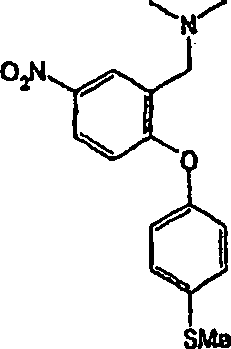
Die Titelverbindung wurde aus dem Aldehyd von Präparation 19 gemäß den für die Präparation 21 eingesetzten Verfahren hergestellt. Essigsäure (1 Äquivalent relativ zu Triethylamin) stellte eine weitere Komponente des Reaktionsgemisches dar. δH (CDCl3, 400 MHz) 2,33 (6H, s), 2,50 (3H, s), 3,60 (2H, s), 6,79 (1H, d), 6,98 (2H, d), 7,29 (2H, d), 8,03 (1H, dd), 8,39 (1H, d); MS m/z (TS+) 319 (MH+).The title compound was prepared from the aldehyde of Preparation 19 according to the procedures used for Preparation 21. Acetic acid (1 equivalent relative to, triethylamine) provided an additional component of the reaction mixture is. Δ H (CDCl 3, 400 MHz) 2.33 (6H, s), 2.50 (3H, s), 3.60 (2H, s ), 6.79 (1H, d), 6.98 (2H, d), 7.29 (2H, d), 8.03 (1H, dd), 8.39 (1H, d); MS m / z (TS + ) 319 (MH + ).
Beispiel
20 N-Methyl-N-{5-nitro-2-[4-(trifluormethyl)-phenoxy]-benzyl}-amin 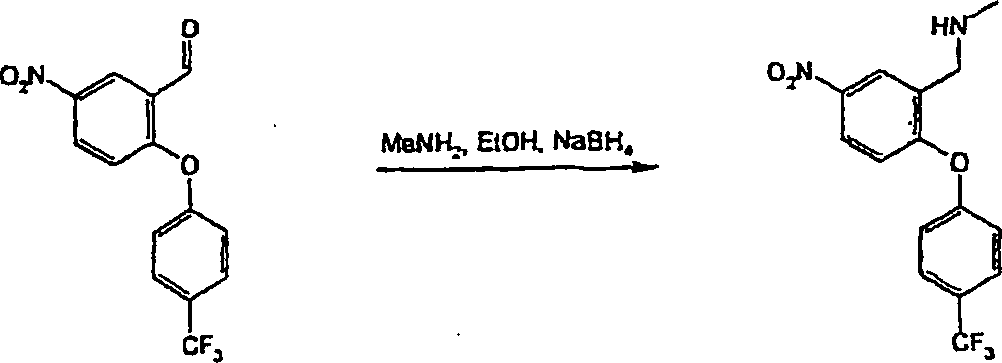
Der Aldehyd von Präparation 20 (5,0 g, 16,07 mmol) wurde in einer Lösung von Monomethylamin in Ethanol (etwa 8 M) (20 ml, 160 mmol) gelöst. Das Gemisch wurde 30 Minuten bei Raumtemperatur unter Bildung einer orangefarbenen Lösung gerührt. Natriumborhydrid (3,0 g, 80 mmol) wurde portionsweise innerhalb von 10 Minuten zugegeben. Nach weiterem 30-minütigem Rühren hatte sich die Lösung dunkelrot gefärbt. Die Reaktion wurde gestoppt, indem das Reaktionsgemisch vorsichtig in Salzsäure (2 M, 100 ml) gegossen wurde. Sodann wurde das Gemisch durch Eingießen dieser Lösung in einem großen Überschuss an Kaliumcarbonat alkalisch gemacht, wodurch man ein Gemisch mit einem pH-Wert von etwa 10 erhielt, das mit Ethylacetat extrahiert wurde (3 × 70 ml). Die vereinigten organischen Fraktionen wurden getrocknet (MgSO4) und zu einem orangefarbenen Öl eingedampft, das durch eine dünne Schicht Siliciumdioxid unter Elution mit DCM/Methanol/880 Ammoniak (93:7:1) filtriert wurde. Nach Eindampfen wurde der Rückstand weiter durch Flash-Chromatographie (SiO2; Pentan/Ethylacetat (2:1) zur Elution von nicht-basischen Materialien und anschließend DCM/Methanol/880 Ammoniak (93:7:1)) gereinigt. Man erhielt das angestrebte Amin in Form eines gelben Öls (3,08 g, 59%). δH (CDCl3, 400 MHz) 2,49 (3H, s), 3,89 (2H, s), 6,89 (1H, d), 7,12 (2H, d), 7,67 (2H, d), 8,10 (1H, dd), 8,40 (1H, d); MS m/z (TS+) 327 (MH+).The aldehyde from Preparation 20 (5.0 g, 16.07 mmol) was dissolved in a solution of monomethylamine in ethanol (about 8 M) (20 mL, 160 mmol). The mixture was stirred for 30 minutes at room temperature to form an orange solution. Sodium borohydride (3.0 g, 80 mmol) was added portionwise of 10 minutes. After stirring for a further 30 minutes, the solution turned dark red. The reaction was stopped by carefully pouring the reaction mixture into hydrochloric acid (2 M, 100 ml). The mixture was made alkaline by pouring this solution in a large excess of potassium carbonate to give a mixture having a pH of about 10, which was extracted with ethyl acetate (3 x 70 ml). The combined organic fractions were dried (MgSO 4 ) and evaporated to an orange oil which was filtered through a thin layer of silica eluting with DCM / methanol / 880 ammonia (93: 7: 1). After evaporation, the residue was further purified by flash chromatography (SiO 2 , pentane / ethyl acetate (2: 1) to elute non-basic materials and then DCM / methanol / 880 ammonia (93: 7: 1)). The desired amine was obtained as a yellow oil (3.08 g, 59%). δ H (CDCl 3, 400 MHz) 2.49 (3H, s), 3.89 (2H, s), 6.89 (1H, d), 7.12 (2H, d), 7.67 (2H , d), 8,10 (1H, dd), 8,40 (1H, d); MS m / z (TS + ) 327 (MH + ).
Beispiel
21 N,N-Dimethyl-N-{5-nitro-2-[4-(trifluormethyl)-phenoxy]-benzyl}-amin 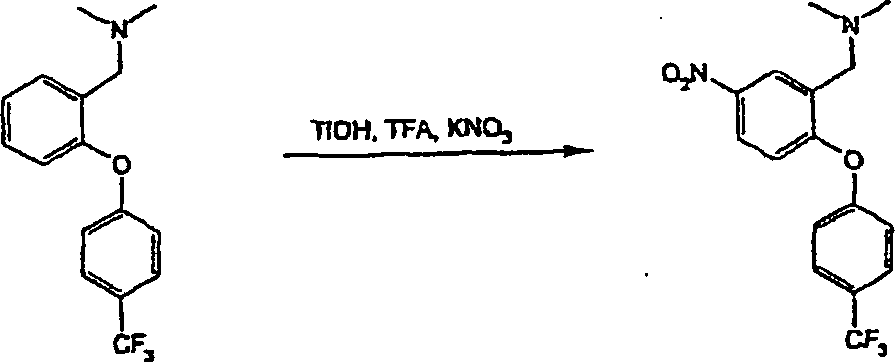
Trifluormethansulfonsäure (500 μl) wurde bei 0°C unter Stickstoff tropfenweise zu einer Lösung des Amins von Präparation 22 (504 mg, 1,71 mmol) in TFA (4,5 ml) gegeben, wonach die Zugabe von Kaliumnitrat (173 mg, 1,71 mmol) folgte. Das Gemisch wurde 75 Minuten bei 0°C gerührt und sodann auf Eis gegossen und mit Natriumhydroxid-Plätzchen alkalisch gemacht. Das wässrige Gemisch wurde mit Ethylacetat extrahiert. Der organische Extrakt wurde mit Kochsalzlösung gewaschen, getrocknet (MgSO4) und unter Vakuum eingeengt. Der Rückstand wurde durch Flash-Chromatographie (SiO2; DCM/Methanol/880 Ammoniak (99:1:0,5)) gereinigt. Man erhielt die angestrebte Nitroverbindung (400 mg, 69%) in Form eines gelben Öls. δH (CDCl3, 300 MHz) 2,30 (6H, s), 3,55 (2H, s), 6,92 (1H, d), 7,08 (2H, d), 7,65 (2H, d), 8,10 (1H, dd), 8,45 (1H, d); MS m/z (TS+) 341 (MH+).Trifluoromethanesulfonic acid (500 μl) was added dropwise at 0 ° C under nitrogen to a solution of the amine of Preparation 22 (504 mg, 1.71 mmol) in TFA (4.5 ml), followed by the addition of potassium nitrate (173 mg, 1 , 71 mmol) followed. The mixture was stirred at 0 ° C for 75 minutes and then poured onto ice and basified with sodium hydroxide pellets. The aqueous mixture was extracted with ethyl acetate. The organic extract was washed with brine, dried (MgSO 4 ) and concentrated in vacuo. The residue was purified by flash chromatography (SiO 2 ; DCM / methanol / 880 ammonia (99: 1: 0.5)). The desired nitro compound (400 mg, 69%) was obtained in the form of a yellow oil. δ H (CDCl 3, 300 MHz) 2.30 (6H, s), 3.55 (2H, s), 6.92 (1H, d), 7.08 (2H, d), 7.65 (2H , d), 8.10 (1H, dd), 8.45 (1H, d); MS m / z (TS + ) 341 (MH + ).
Beispiel
22 N,N-Dimethyl-N-{5-nitro-2-[4-(trifluormethoxy)-phenoxy]-benzyl}-amin 
Die Umsetzung von Beispiel 21 wurde unter ähnlichen Bedingungen und unter Verwendung des Amins von Präparation 23 wiederholt. Man erhielt die Titel-Nitroverbindung. δH (CDCl3, 400 MHz) 2,33 (6H, s), 3,58 (2H, s), 6,83 (1H, d), 7,05 (2H, m), 7, 25 (2H, m), 8,06 (1H, d), 8,41 (1H, s); MS m/z (TS+) 357 (MH+).The reaction of Example 21 was repeated under similar conditions using the amine of Preparation 23. The title nitro compound was obtained. δ H (CDCl 3, 400 MHz) 2.33 (6H, s), 3.58 (2H, s), 6.83 (1H, d), 7.05 (2H, m), 7, 25 (2H , m), 8.06 (1H, d), 8.41 (1H, s); MS m / z (TS + ) 357 (MH + ).
Beispiel
23 N-{5-Brom-2-[4-(methylsulfanyl)-phenoxy]-benzyl}-N-methylamin 
Der Bromaldehyd von Präparation 9 (39,0 g, 120 mmol) wurde in Monomethylamin (7,37 ml, 33% in Ethanol) gelöst. Die Lösung wurde 10 Minuten gerührt, wonach Natriumborhydrid (6,8 g, 180 mmol) zugegeben wurde. Das Reaktionsgemisch wurde 3 Stunden bei Raumtemperatur gerührt und sodann vorsichtig zu 3 M HCl gegeben. Nach beendeter Zugabe wurde das Gemisch 10 Minuten stehengelassen. Anschließend wurde der pH-Wert mit Natriumhydroxid (3 M) auf 14 eingestellt. Die wässrige Phase wurde mit Ethylacetat extrahiert. Die organische Phase wurde mit Kochsalzlösung gewaschen, getrocknet (MgSO4) und eingedampft. Das erhaltene Öl wurde in Diethylether aufgenommen und mit überschüssiger Chlorwasserstoffsäure (1 M in Diethylether) behandelt. Das Salz wurde durch Filtration gewonnen und mit DCM gewaschen. Der gewaschene Feststoff wurde mit Ethylacetat und Natriumhydroxid (3 M) ausgeschüttelt. Die organische Phase wurde abgetrennt, mit Kochsalzlösung gewaschen, getrocknet und zu einem farblosen Öl eingedampft (24,6 g, 61%). δH (CDCl3, 300 MHz) 2,43 (3H, s), 2,47 (3H, s), 3,76 (2H, s), 6,72 (1H, d), 6, 87 (2H, d), 7,24 (2H, d), 7,30 (1H, dd), 7,54 (1H, d); MS m/z (TS+) 338/340 (MH+).The bromoaldehyde from Preparation 9 (39.0 g, 120 mmol) was dissolved in monomethylamine (7.37 mL, 33% in ethanol). The solution was stirred for 10 minutes, after which sodium borohydride (6.8 g, 180 mmol) was added. The reaction mixture was stirred at room temperature for 3 hours and then added cautiously to 3 M HCl. After completion of the addition, the mixture was allowed to stand for 10 minutes. Subsequently, the pH was adjusted to 14 with sodium hydroxide (3 M). The aqueous phase was extracted with ethyl acetate. The organic phase was washed with brine, dried (MgSO 4 ) and evaporated. The resulting oil was taken up in diethyl ether and treated with excess hydrochloric acid (1M in diethyl ether). The salt was collected by filtration and washed with DCM. The washed solid was partitioned between ethyl acetate and sodium hydroxide (3M). The organic phase was separated, washed with brine, dried and evaporated to a colorless oil (24.6 g, 61%). δ H (CDCl 3, 300 MHz) 2.43 (3H, s), 2.47 (3H, s), 3.76 (2H, s), 6.72 (1H, d), 6 87 (2H , d), 7.24 (2H, d), 7.30 (1H, dd), 7.54 (1H, d); MS m / z (TS + ) 338/340 (MH + ).
Beispiele 24–27Examples 24-27
Eine Reihe von sekundären Aminen wurde aus dem erforderlichen Aldehyd unter Anwendung des in Beispiel 23 beschriebenen Verfahrens hergestellt.A Series of secondary Amines were prepared from the required aldehyde using the prepared in Example 23.
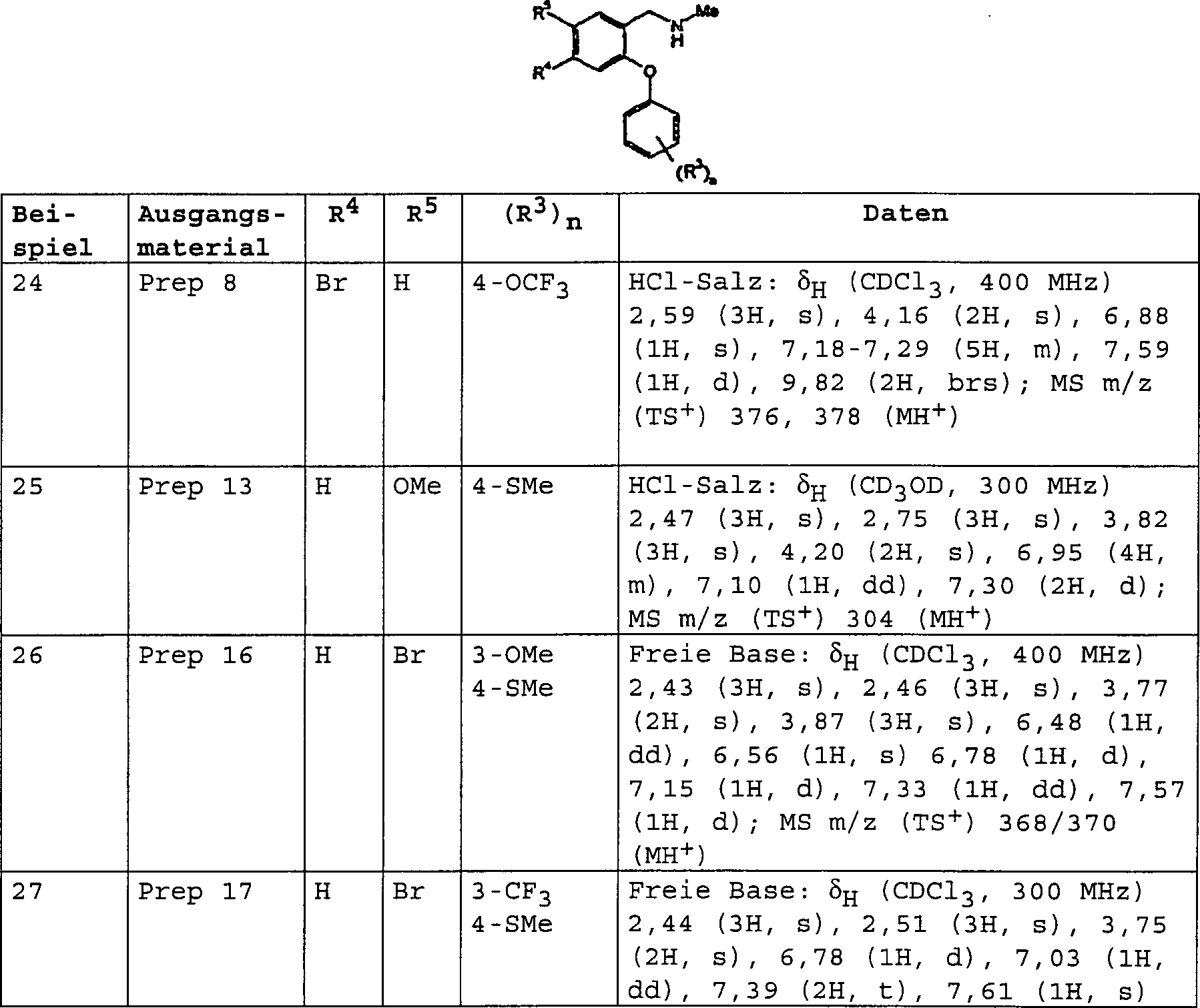
Beispiel
28 3-[(Dimethylamino)-methyl]-4-[4-(methylsulfanyl)-phenoxy]-benzolsulfonamid 
Chlorsulfonsäure (48,1 ml, 724 mmol) wurde vorsichtig zu einer Lösung der Verbindung von Präparation 21 (19,8 g, 72,4 mmol) in DCM (290 ml), die auf 0°C gekühlt worden war, gegeben. Das Gemisch wurde 4 Stunden gerührt und sodann in Eiswasser (1000 ml) gegossen und mit DCM (300 ml) extrahiert. Die rohe Lösung des Sulfonylchlorids wurde in gesättigtem ethanolischem Ammoniak (1160 ml) behandelt und über Nacht bei Raumtemperatur gerührt und sodann unter Vakuum eingeengt. Die Umsetzung wurde weitere 2-mal unter identischen Bedingungen wiederholt. Das Material der drei Ansätze wurde vereinigt. Nach Reinigung der vereinigten Rückstände durch Flash-Chromatographie (SiO2; (MeOH/880 NH3) (9:1) (0–5%) in DCM) erhielt man eine reine Probe des angestrebten Sulfonamids (3,96 g, 5%) sowie ein geringfügig verunreinigtes Sulfonamid (19,73 g, 26%). Für die reine freie Base: δH (CDCl3, 300 MHz) 2,24 (6H, s), 2,48 (3H, s), 3,56 (2H, s), 5,25 (2H, br), 6,81 (1H, d), 6,92 (2H, d), 7,27 (2H, d), 7,70 (1H, dd), 8,04 (1H, d); MS m/z (TS+) 353 (MH+).Chlorosulfonic acid (48.1 mL, 724 mmol) was added cautiously to a solution of the compound of Preparation 21 (19.8 g, 72.4 mmol) in DCM (290 mL) cooled to 0 ° C. The mixture was stirred for 4 hours and then poured into ice-water (1000 ml) and extracted with DCM (300 ml). The crude solution of the sulfonyl chloride was treated with saturated ethanolic ammonia (1160 mL) and stirred at room temperature overnight, then concentrated in vacuo. The reaction was repeated a further 2 times under identical conditions. The material of the three approaches was combined. Purification of the combined residues by flash chromatography (SiO 2 ; (MeOH / 880 NH 3 ) (9: 1) (0-5%) in DCM) gave a pure sample of the desired sulfonamide (3.96 g, 5%). ) and a slightly contaminated sulfonamide (19.73 g, 26%). For pure free base: δ H (CDCl 3, 300 MHz) 2.24 (6H, s), 2.48 (3H, s), 3.56 (2H, s), 5.25 (2H, br) , 6.81 (1H, d), 6.92 (2H, d), 7.27 (2H, d), 7.70 (1H, dd), 8.04 (1H, d); MS m / z (TS + ) 353 (MH + ).
Die einzelnen Proben wurden in das Hydrochloridsalz umgewandelt, indem man eine Suspension in Diethylether mit überschüssiger etherischer Chlorwasserstoffsäure 30 Minuten rührte, den Niederschlag gewann und trocknete. Anschließend wurde eine Umkristallisation aus heißem Ethanol/Ethylacetat (1:1) (F. 193–194°C) vorgenommen. Man erhielt 2,69 g bzw. 15,63 g des Hydrochlorids des angestrebten Sulfonamids aus den einzelnen Ansätzen. δH (d6-DMSO, 400 MHz) 2,48 (3H, s), 2,78 (6H, s), 4,43 (2H, s), 6,86 (1H, d), 7,19 (2H, d), 7,31–7,38 (4H, m), 7,82 (1H, dd), 8,11 (1H, dd), 10,44 (1H, brs); MS m/z (TS+) 353 (MH+).The individual samples were converted to the hydrochloride salt by stirring a suspension in diethyl ether with excess ethereal hydrochloric acid for 30 minutes, recovering the precipitate and drying. Subsequently, a recrystallization from hot ethanol / ethyl acetate (1: 1) (mp 193-194 ° C) was made. This gave 2.69 g and 15.63 g of the hydrochloride of the desired sulfonamide from the individual approaches. δ H (d 6 -DMSO, 400 MHz) 2.48 (3H, s), 2.78 (6H, s), 4.43 (2H, s), 6.86 (1H, d), 7.19 (2H, d), 7.31-7.38 (4H, m), 7.82 (1H, dd), 8.11 (1H, dd), 10.44 (1H, brs); MS m / z (TS + ) 353 (MH + ).
Alternativ lässt sich die Titelverbindung über das sekundäre Amin von Beispiel 42 herstellen, das seinerseits durch Boran-Reduktion des Amids von Präparation 31 unter Anwendung des in Beispiel 61 beschriebenen Verfahrens erhältlich ist.alternative let yourself the title connection over the secondary one Amine of Example 42, which in turn by borane reduction of the amide of preparation 31 is obtainable using the method described in Example 61.

Alternativ
lässt sich
die Titelverbindung auf folgende Weise herstellen:
Eine Lösung des
Hydrochloridsalzes der Titelverbindung von Präparation 21 (113 g) in Dichlormethan
(1130 ml) wurde langsam zu einer Lösung von Chlorsulfonsäure (428
g) in Dichlormethan (230 ml) gegeben, wobei die Temperatur zwischen
0 und 5°C
gehalten wurde. Nach 1 Stunde bei 0–5°C wurde das Reaktionsgemisch langsam
in 5 Trifluoressigsäure
in Wasser (1200 ml) gegeben, wobei die Temperatur zwischen 0 und
10°C gehalten
wurde. Sodann wurden die beiden Phasen getrennt. Die Dichlormethanphase
wurde unter Vakuum entfernt. Man erhielt ein Öl. Nach Zugabe von Acetonitril
(1360 ml) wurde die Lösung
langsam mit POCl3 (140 g) versetzt. Die
erhaltene Aufschlämmung
wurde unter Rückfluss
erwärmt,
wobei eine Lösung
entstand. Nach 1 Stunde wurde das Reaktionsgemisch auf Raumtemperatur
abgekühlt
und in Eis/Wasser (1200 ml) gegeben, wobei die Temperatur unter
20°C gehalten
wurde. Sodann wurde das Gemisch mit Dichlormethan (1 × 1400 ml
und 1 × 400
ml) extrahiert. Die vereinigten Extrakte wurden bei Raumtemperatur
gerührt,
wobei wässriges Ammoniak
(250 ml) zugegeben wurde. Nach 1 Stunde wurden die Phasen getrennt.
Die wässrige
Phase wurde weiter mit Dichlormethan (400 ml) extrahiert. Die vereinigten
Dichlormethanphasen wurden unter Vakuum eingeengt. Nach Zugabe von
Wasser (539 ml) wurde das Gemisch mit einer wässrigen Natriumhydroxidlösung (108
ml, 46–48%
(Gew./Gew.) versetzt. Die Aufschlämmung wurde 1 Stunde bei Raumtemperatur
und 1 weitere Stunde bei 0°C
gerührt.
Der Feststoff wurde abfiltriert und erneut in Wasser (500 ml) aufgeschlämmt. Sodann
wurde der pH-Wert durch Zugabe eines 1:1-Gemisches aus Wasser und
konzentrierter Salzsäure
auf 6–6,5
eingestellt. Die erhaltene Aufschlämmung wurde 1 Stunde bei 10°C oder darunter
gerührt.
Der Feststoff wurde abfiltriert, mit Wasser (107 ml) gewaschen und
in feuchtem Zustand in einem 9:1-Gemisch aus Wasser und Aceton (289
ml:32 ml) 1 Stunde bei einer Temperatur unter 10°C aufgeschlämmt. Diese Aufschlämmung wurde
filtriert und über
Nacht in einem Vakuumtrockenschrank bei 50°C getrocknet. Eine Lösung des
vorstehenden Feststoffes in Aceton (565 ml) wurde mit Kohlenstoff
(Norit SX plus, 50% (Gew./Gew.)) aufgeschlämmt, filtriert und mit einer
weiteren Charge Kohlenstoff (Norit SX plus, 50% (Gew./Gew.)) behandelt.
Nach erneuter Filtration wurde die Lösung eingeengt und das Lösungsmittel
durch Wasser (1130 ml) ersetzt. Die Aufschlämmung wurde granuliert, filtriert
und über
Nacht unter Vakuum getrocknet. Man erhielt das Produkt in Form eines
weißen
Feststoffes (78,6 g, 61%). F. 119°C.Alternatively, the title compound can be prepared in the following manner:
A solution of the hydrochloride salt of the title compound of Preparation 21 (113 g) in dichloromethane (1130 ml) was added slowly to a solution of chlorosulfonic acid (428 g) in dichloromethane (230 ml) keeping the temperature between 0 and 5 ° C. After 1 hour at 0-5 ° C, the reaction mixture was slowly added to 5% trifluoroacetic acid in water (1200 ml) keeping the temperature between 0 and 10 ° C. Then the two phases were separated. The dichloromethane phase was removed under vacuum. An oil was obtained. After addition of acetonitrile (1360 ml), the solution was slowly added with POCl 3 (140 g). The resulting slurry was heated to reflux to give a solution. After 1 h, the reaction mixture was cooled to room temperature and poured into ice / water (1200 mL) keeping the temperature below 20 ° C. The mixture was extracted with dichloromethane (1 x 1400 ml and 1 x 400 ml). The combined extracts were stirred at room temperature, to which aqueous ammonia (250 ml) was added. After 1 hour, the phases were separated. The aqueous phase was further extracted with dichloromethane (400 ml). The combined dichloromethane phases were concentrated in vacuo. Water (539 mL) was added and the mixture was added with aqueous sodium hydroxide solution (108 mL, 46-48% w / w) The slurry was stirred at room temperature for 1 h and at 0 ° C for 1 h Solid was filtered off and reslurried in water (500 ml), then the pH was adjusted to 6-6.5 by addition of a 1: 1 mixture of water and concentrated hydrochloric acid, and the resulting slurry was stirred at 10 ° C for 1 hour or stirred under. The solid was filtered off, washed with water (107 ml) and slurried in a wet state in a 9: 1 mixture of water and acetone (289 ml: 32 ml) for 1 hour at a temperature below 10 ° C. This slurry was filtered and dried at 50 ° C overnight in a vacuum oven. A solution of the above solid in acetone (565 mL) was slurried with carbon (Norit SX plus, 50% (w / w)), filtered and carbonated with another batch of carbon (Norit SX plus, 50% w / w .)). After re-filtration, the solution was concentrated and the solvent was replaced with water (1130 ml). The slurry was granulated, filtered and dried under vacuum overnight. The product was obtained as a white solid (78.6 g, 61%). F. 119 ° C.
Die Hauptpeaks (in °2θ) des PXRD-Musters sind nachstehend angegeben:The Main peaks (in ° 2θ) of the PXRD pattern are given below:

Alternativ
lässt sich
die Titelverbindung auf folgende Weise herstellen:
Chlorsulfonsäure (706
ml) wurde sehr langsam zu einer kalten (–5°C bis 0°C) Lösung der Titelverbindung von Präparation
21 (290 g, 1,06 mol) in Dichlormethan (2,9 Liter) gegeben. Das Reaktionsgemisch
wurde über Nacht
bei 0°C
gerührt.
Sodann wurde das Gemisch langsam zu 3 M HCl (2,9 Liter) gegeben,
wobei die Temperatur zwischen –5°C und 0°C gehalten
wurde. Dichlormethan (2,9 Liter) wurde zugegeben. Die Phasen wurden
getrennt. Wässriges
Ammoniak (580 ml) wurde bei 0°C
zu der Dichlormethanphase gegeben. Nach Rühren über Nacht wurde Wasser (2 Liter)
zugegeben. Nach Trennen der Phasen wurde die wässrige Phase mit Dichlormethan
gewaschen. Die Dichlormethanphasen wurden vereinigt und unter Vakuum
eingeengt. Das erhaltene braune Öl
erstarrte beim Stehenlassen. Der Rückstand wurde durch Flash-Chromatographie
(SiO2, DCM: 0–6% (MeOH:NH3,
9:1)) gereinigt. Der erhaltene blassgelbe Feststoff wurde weiter
durch Rühren
in einem 9:1-Gemisch aus Wasser und Aceton (1,3) gereinigt. Die
Aufschlämmung
wurde filtriert, gewaschen und über
Nacht in einem Vakuumtrockenschrank bei 55°C getrocknet. Man erhielt das
Produkt in Form eines weißen
Feststoffes (57 g, 15%). F. 129°C.Alternatively, the title compound can be prepared in the following manner:
Chlorosulfonic acid (706 ml) was added very slowly to a cold (-5 ° to 0 ° C) solution of the title compound of Preparation 21 (290 g, 1.06 mol) in dichloromethane (2.9 liters). The reaction mixture was stirred at 0 ° C overnight. The mixture was then added slowly to 3M HCl (2.9 liters) keeping the temperature between -5 ° C and 0 ° C. Dichloromethane (2.9 liters) was added. The phases were separated. Aqueous ammonia (580 ml) was added to the dichloromethane phase at 0 ° C. After stirring overnight, water (2 liters) was added. After separation of the phases, the aqueous phase was washed with dichloromethane. The dichloromethane phases were combined and concentrated in vacuo. The resulting brown oil solidified on standing. The residue was purified by flash chromatography (SiO 2 , DCM: 0-6% (MeOH: NH 3 , 9: 1)). The resulting pale yellow solid was further purified by stirring in a 9: 1 mixture of water and acetone (1.3). The slurry was filtered, washed and dried at 55 ° C overnight in a vacuum oven. The product was obtained as a white solid (57 g, 15%). F. 129 ° C.
Die Hauptpeaks (in °2θ) des PXRD-Musters sind nachstehend angegeben:The Main peaks (in ° 2θ) of the PXRD pattern are given below:
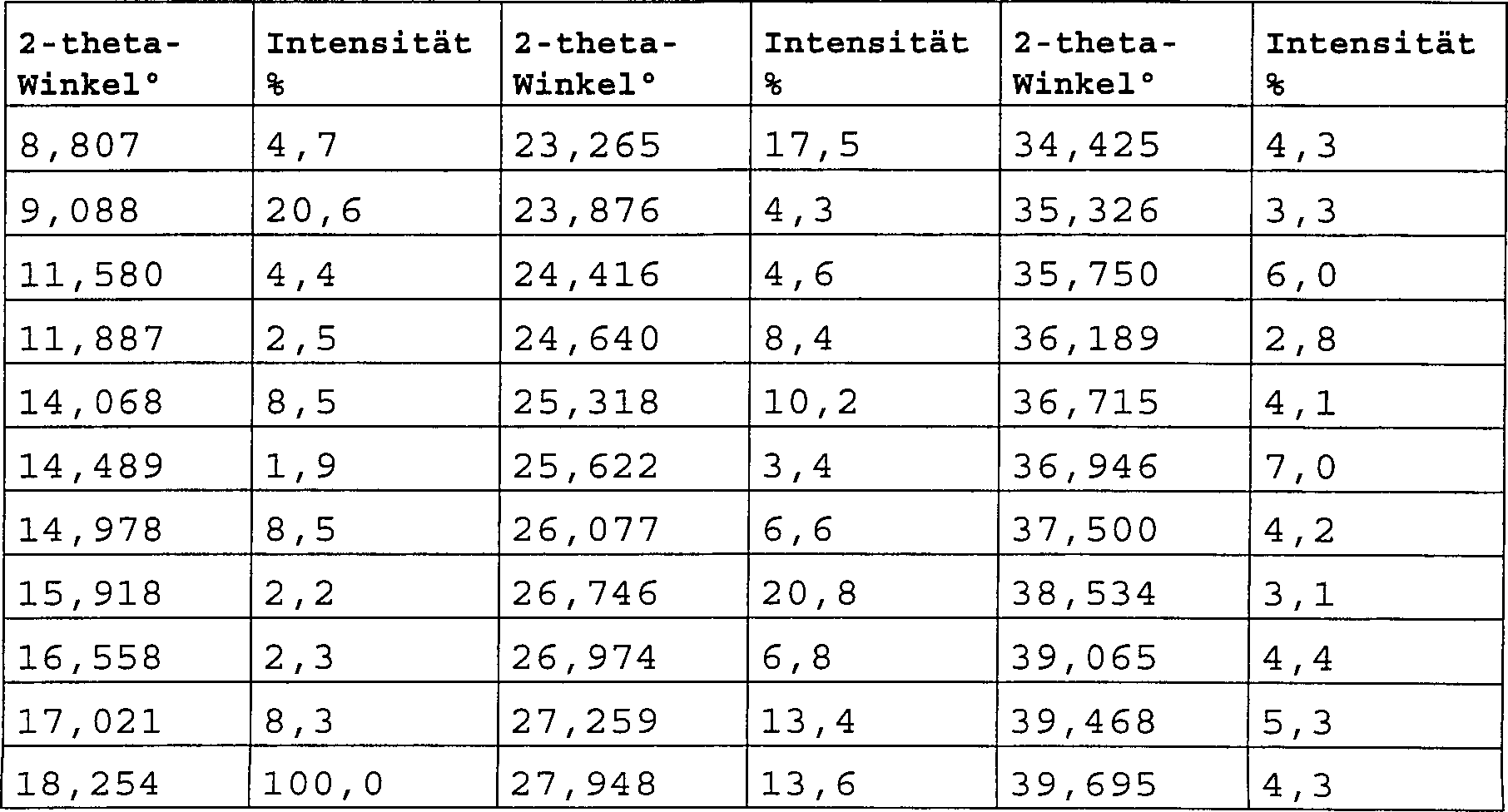

Sulfonylchlorid-ZwischenproduktSulfonyl chloride intermediate
3-[(Dimethylamino)-methyl]-4-[4-(methylsulfanyl)-phenoxy]-benzolsulfonylchlorid3 - [(Dimethylamino) methyl] -4- [4- (methylsulfanyl) phenoxy] benzenesulfonyl chloride
Bei den vorstehenden Verfahren zur Herstellung der Verbindung von Beispiel 28 wurde das als Zwischenprodukt dienende Sulfonylchlorid nicht isoliert, sondern in situ erzeugt. Dies stellt das bevorzugte Verfahren zur Herstellung der Verbindung von Beispiel 28 dar. Jedoch wurde im Verlauf eines Wiederholungsexperiments ein Teil des als Zwischenprodukt dienenden Sulfonylchlorids isoliert. 1H-NMR δH (d6-DMSO, 300 MHz) 3,6 (3H, brs), 4,3 (6H, brs), 8,3 (1H, brs), 8,6 (2H, brs), 8,9 (2H, brs), 9,2 (1H, brs), 9,4 (1H, brs). 1H-NMR δH (d6-DMSO + D2O, 300 MHz) 2,4 (3H, s), 2,8 (6H, s), 6,8 (1H, d), 7,1 (2H, d), 7,4 (2H, d), 7,7 (1H, dd), 7,9 (1H, s).In the above procedures for preparing the compound of Example 28, the intermediate sulfonyl chloride was not isolated but generated in situ. This is the preferred method of preparing the compound of Example 28. However, in the course of a repeat experiment, a portion of the intermediate sulfonyl chloride was isolated. 1 H NMR δ H (d 6 -DMSO, 300 MHz) 3.6 (3H, brs), 4.3 (6H, brs), 8.3 (1H, brs), 8.6 (2H, brs) , 8.9 (2H, brs), 9.2 (1H, brs), 9.4 (1H, brs). 1 H NMR δ H (d 6 -DMSO + D 2 O, 300 MHz) 2.4 (3H, s), 2.8 (6H, s), 6.8 (1H, d), 7.1 ( 2H, d), 7.4 (2H, d), 7.7 (1H, dd), 7.9 (1H, s).
Salzesalts
i) L-Tartratsalzi) L-tartrate salt
Eine Lösung von L-Weinsäure (2,81 g, 18,7 mmol) in Wasser (6 ml) wurde zu einer heißen (40°C) Lösung der Titelverbindung (6,0 g, 17,0 mmol) in Aceton (54 ml) gegeben. Anschließend wurde die Aufschlämmung 30 Minuten auf 60°C erwärmt und sodann auf Raumtemperatur abgekühlt. Nach 1- bis 2-stündigem Rühren bei Raumtemperatur wurde das Gemisch auf 0°C abgekühlt. Nach weiteren 3 Stunden wurde das Gemisch filtriert, mit Aceton (2 × 10 ml) gewaschen und in einem Vakuumtrockenschrank über Nacht bei 55°C getrocknet. Man erhielt das angestrebte Salz in Form eines weißen, kristallinen Feststoffes (8,4 g, 98%). F. 179°C.A solution of L-tartaric acid (2.81 g, 18.7 mmol) in water (6 mL) was added to a hot (40 ° C) solution of Title compound (6.0 g, 17.0 mmol) in acetone (54 ml). Subsequently was the slurry 30 minutes at 60 ° C heated and then cooled to room temperature. After stirring for 1 to 2 hours Room temperature, the mixture was cooled to 0 ° C. After another 3 hours The mixture was filtered, washed with acetone (2 × 10 ml) and concentrated in a Vacuum drying oven over Night at 55 ° C dried. The desired salt was obtained in the form of a white, crystalline Solid (8.4 g, 98%). F. 179 ° C.
Die Hauptpeaks (in °2θ) des PXRD-Musters sind nachstehend angegeben:The Main peaks (in ° 2θ) of the PXRD pattern are given below:
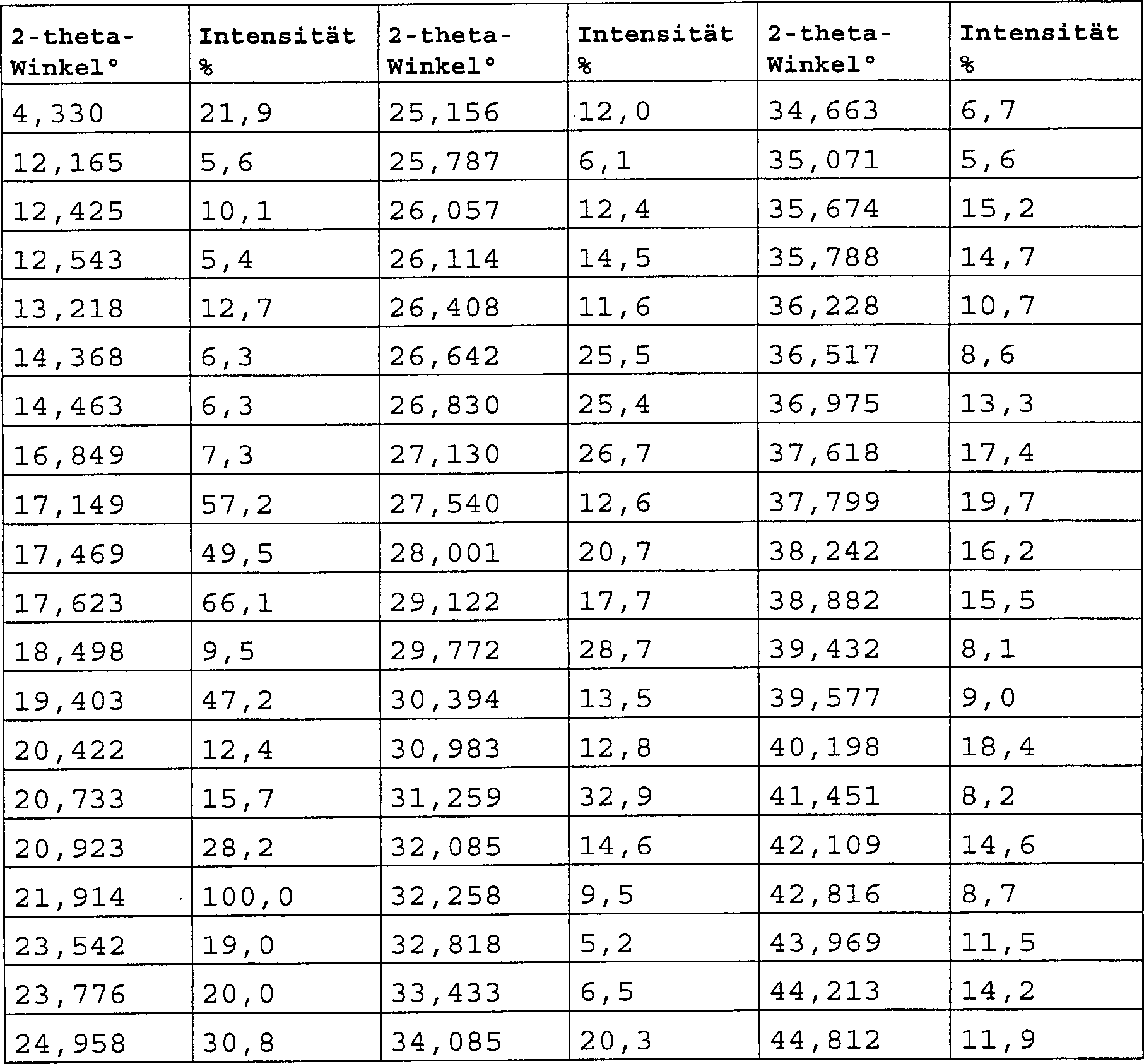
ii) D-Tartratsalzii) D-tartrate salt
Eine Lösung von D-Weinsäure (2,81 g, 18,7 mmol) in Wasser (6 ml) wurde zu einer heißen (40°C) Lösung der Titelverbindung (6,0 g, 17,0 mmol) in Aceton (54 ml) gegeben. Anschließend wurde die Aufschlämmung 30 Minuten auf 60°C erwärmt und sodann auf Raumtemperatur abgekühlt. Nach 1- bis 2-stündigem Rühren bei Raumtemperatur wurde das Gemisch auf 0°C abgekühlt. Nach weiteren 3 Stunden wurde das Gemisch filtriert, mit Aceton (2 × 10 ml) gewaschen und in einem Vakuumtrockenschrank über Nacht bei 55°C getrocknet. Man erhielt das angestrebte Salz in Form eines weißen, kristallinen Feststoffes (8,4 g, 98%). F. 182°C.A solution of D-tartaric acid (2.81 g, 18.7 mmol) in water (6 mL) was added to a hot (40 ° C) solution of Title compound (6.0 g, 17.0 mmol) in acetone (54 ml). Subsequently was the slurry 30 minutes at 60 ° C heated and then cooled to room temperature. After stirring for 1 to 2 hours Room temperature, the mixture was cooled to 0 ° C. After another 3 hours The mixture was filtered, washed with acetone (2 × 10 ml) and concentrated in a Vacuum drying oven over Night at 55 ° C dried. The desired salt was obtained in the form of a white, crystalline Solid (8.4 g, 98%). F. 182 ° C.
Die Hauptpeaks (in °2θ) des PXRD-Musters sind nachstehend angegeben:The Main peaks (in ° 2θ) of the PXRD pattern are given below:

iii) Hydrochloridsalzeiii) hydrochloride salts
a) Form von niedrigerem Schmelzpunkta) form of lower melting point
Eine Lösung von Chlorwasserstoffsäure/Isopropanol (7,02 M, 0,41 ml, 2,86 mmol) wurde zu einer Lösung der Titelverbindung (1,0 g, 2,84 mmol) in Methylethylketon (10 ml) gegeben. Nach 3-stündigem Rühren bei Raumtemperatur wurde das Gemisch filtriert, gewaschen und in einem Vakuumtrockenschrank bei 55°C über Nacht getrocknet. Man erhielt das angestrebte Salz vom F. 176°C.A solution of hydrochloric acid / isopropanol (7.02M, 0.41 mL, 2.86 mmol) was added to a solution of the title compound (1.0 g, 2.84 mmol) in methyl ethyl ketone (10 ml). After 3 hours of stirring at Room temperature, the mixture was filtered, washed and in a Vacuum drying oven at 55 ° C overnight dried. The desired salt of F. 176 ° C was obtained.
Die Hauptpeaks (in °2θ) des PXRD-Musters sind nachstehend angegeben:The Main peaks (in ° 2θ) of the PXRD pattern are given below:

b) Form von höherem Schmelzpunktb) Form of higher melting point
Eine Lösung von Chlorwasserstoffsäure/Isopropanol (7,02 M, 0,41 ml, 2,86 mmol) wurde zu einer Lösung der Titelverbindung (1,0 g, 2,84 mmol) in Methylethylketon (10 ml) gegeben. Nach 7-stündigem Rühren bei Raumtemperatur wurde das Gemisch filtriert, gewaschen und in einem Vakuumtrockenschrank bei 55°C über Nacht getrocknet. Man erhielt das angestrebte Salz vom F. 192°C.A solution of hydrochloric acid / isopropanol (7.02M, 0.41 mL, 2.86 mmol) was added to a solution of the title compound (1.0 g, 2.84 mmol) in methyl ethyl ketone (10 ml). After 7 hours of stirring at Room temperature, the mixture was filtered, washed and in a Vacuum drying oven at 55 ° C overnight dried. The desired salt of mp 192 ° C was obtained.
Die Hauptpeaks (in °2θ) des PXRD-Musters sind nachstehend angegeben:The Main peaks (in ° 2θ) of the PXRD pattern are given below:


iv) Citratsalziv) citrate salt
Citronensäure (0,30 g, 1,56 mmol) wurde zu einer Lösung der Titelverbindung (0,50 g, 1,42 mmol) in Aceton (5 ml) gegeben. Nach 3-stündigem Rühren bei Raumtemperatur wurde das Gemisch filtriert, gewaschen und in einem Vakuumtrockenschrank bei 55°C über Nacht getrocknet. Man erhielt das angestrebte Salz vom F. 110°C.Citric acid (0.30 g, 1.56 mmol) became a solution of the title compound (0.50 g, 1.42 mmol) in acetone (5 mL). After 3 hours stir at room temperature, the mixture was filtered, washed and poured into a vacuum oven at 55 ° C overnight dried. The desired salt of F. 110 ° C was obtained.
Die Hauptpeaks (in °2θ) des PXRD-Musters sind nachstehend angegeben:The Main peaks (in ° 2θ) of the PXRD pattern are given below:
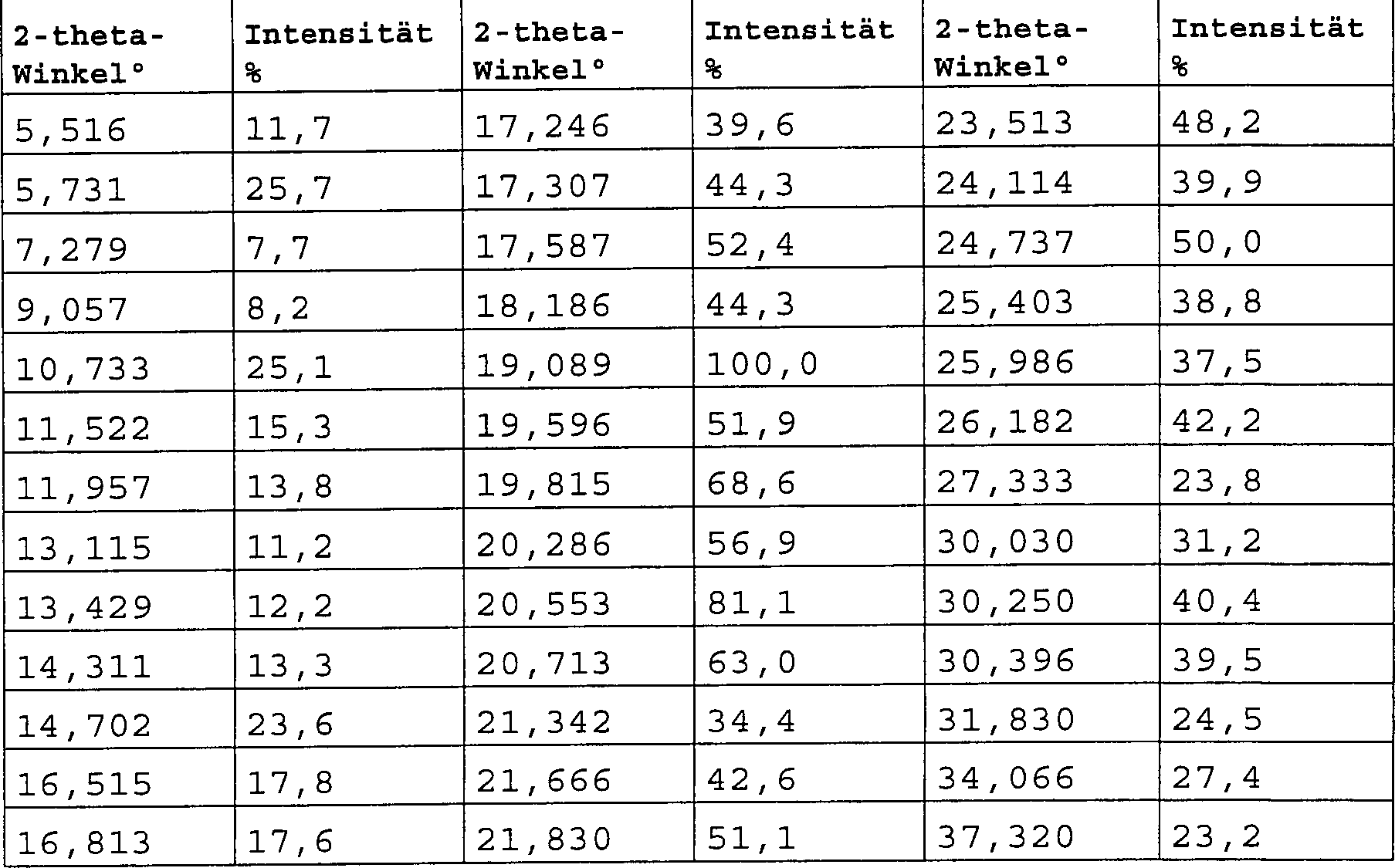
v) Sulfatsalzv) sulfate salt
Konzentrierte Schwefelsäure (0,04 ml) wurde zu einer Lösung der Titelverbindung (0,50 g, 1,42 mmol) in Aceton (5 ml) gegeben. Nach 2-stündigem Rühren bei Raumtemperatur wurde das Gemisch weitere 3 Stunden bei 0°C gerührt. Sodann wurde das Gemisch filtriert, gewaschen und über Nacht in einem Vakuumtrockenschrank bei 55°C getrocknet. Man erhielt das angestrebte Salz in Form eines weißen Feststoffes (0,31 g, 48%) vom F. 233°C.concentrated sulfuric acid (0.04 ml) became a solution of the title compound (0.50 g, 1.42 mmol) in acetone (5 mL). After 2 hours stir at room temperature, the mixture was stirred for a further 3 hours at 0 ° C. thereupon the mixture was filtered, washed and stored overnight in a vacuum oven at 55 ° C dried. The desired salt was obtained in the form of a white solid (0.31 g, 48%), mp 233 ° C.
Die Hauptpeaks (in °2θ) des PXRD-Musters sind nachstehend angegeben:The Main peaks (in ° 2θ) of the PXRD pattern are given below:
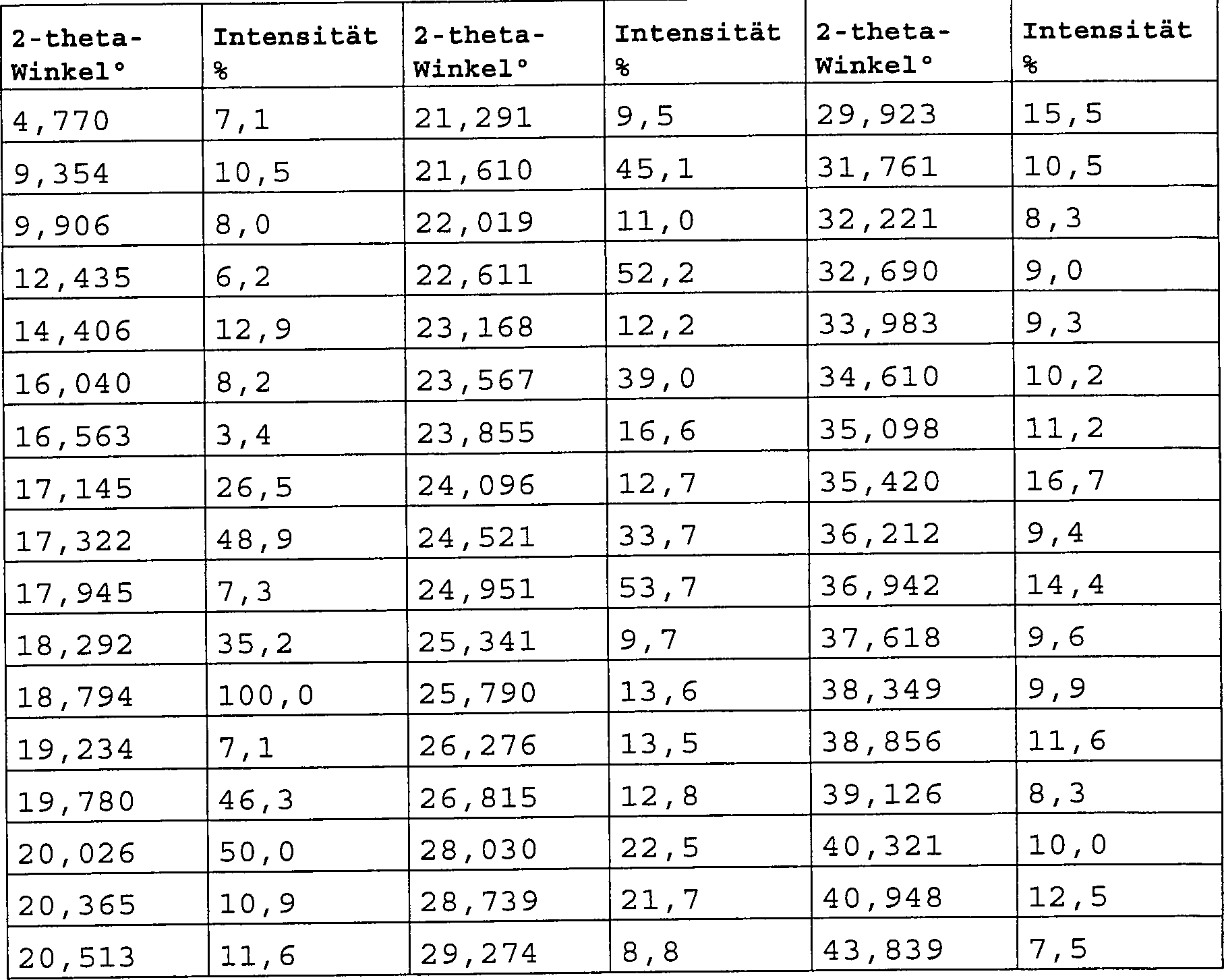
vi) Phosphatsalzvi) phosphate salt
Phosphorsäure (4,63 ml, 67,7 mmol) wurde tropfenweise zu einer Suspension der Titelverbindung (21,7 g, 61,6 mmol) in Wasser (149 ml) gegeben. Anschließend wurde die Aufschlämmung auf einem Dampfbad erwärmt, bis eine klare Lösung entstand. Diese Lösung wurde sodann auf Raumtemperatur abgekühlt und 2 Stunden gerührt. Anschließend wurde das Gemisch auf 0°C abgekühlt und weitere 3 Stunden gerührt. Der Niederschlag wurde abfiltriert, mit Wasser (2 × 50 ml) gewaschen und in einem Vakuumtrockenschrank bei 55°C über Nacht getrocknet. Man erhielt das angestrebte Salz in Form eines weißen kristallinen Feststoffes (23,1 g, 83%) vom F. 196°C.Phosphoric acid (4.63 ml, 67.7 mmol) was added dropwise to a suspension of the title compound (21.7 g, 61.6 mmol) in water (149 ml). Subsequently was the slurry heated on a steam bath, until a clear solution originated. This solution was then cooled to room temperature and stirred for 2 hours. Subsequently was the mixture at 0 ° C chilled and stirred for a further 3 hours. The precipitate was filtered off, with water (2 × 50 ml) washed and in a vacuum oven at 55 ° C overnight dried. The desired salt was obtained in the form of a white crystalline Solid (23.1 g, 83%), mp 196 ° C.
Die Hauptpeaks (in °2θ) des PXRD-Musters sind nachstehend angegeben:The Main peaks (in ° 2θ) of the PXRD pattern are given below:
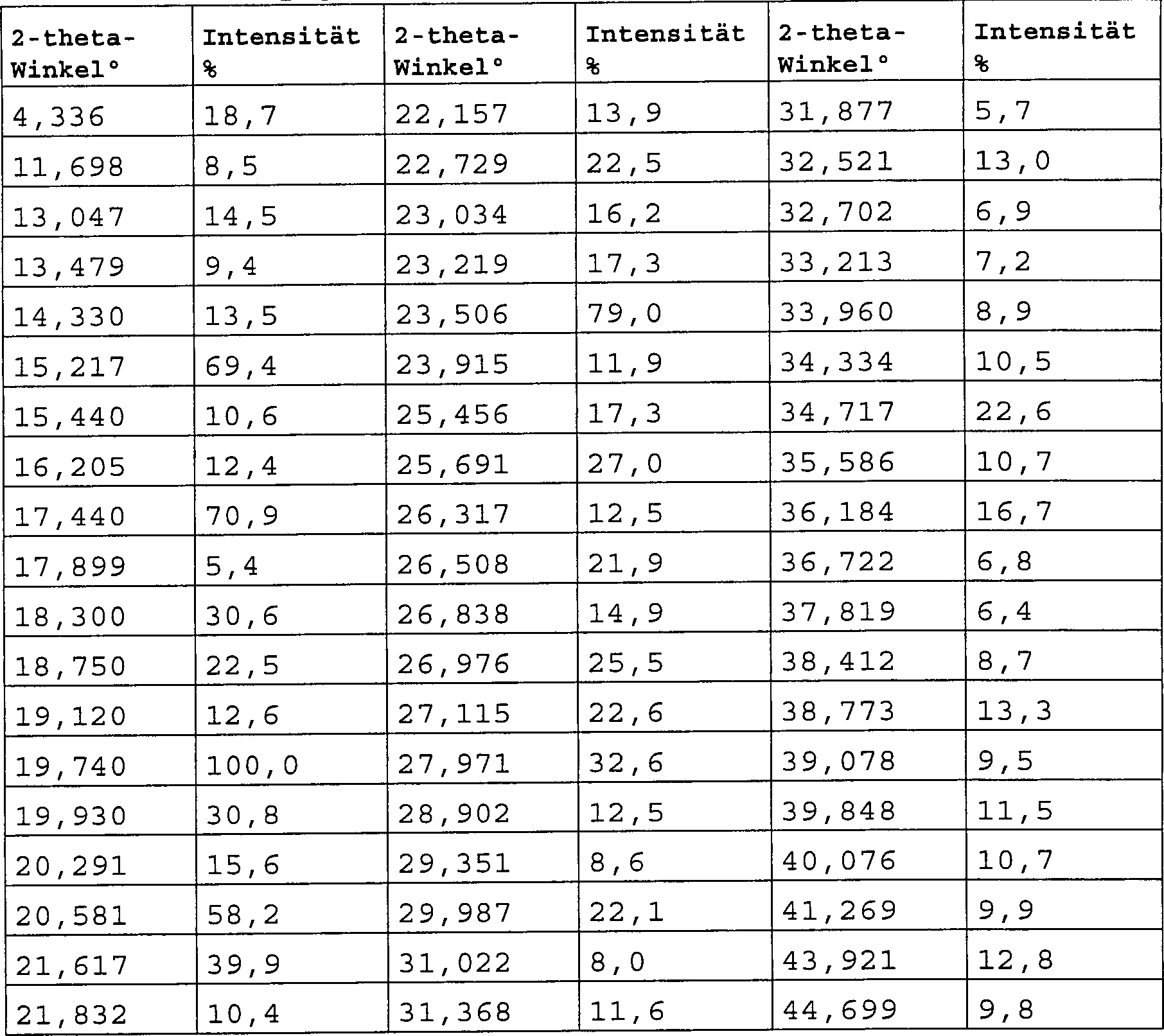
Beispiele 29–60Examples 29-60
Die folgenden Sulfonamide wurden auf analoge Weise wie in Beispiel 28 hergestellt, wobei Ammoniak gegebenenfalls durch das erforderliche Amin ersetzt wurde.The The following sulfonamides were prepared in a similar manner as in Example 28 with ammonia optionally by the required Amin was replaced.

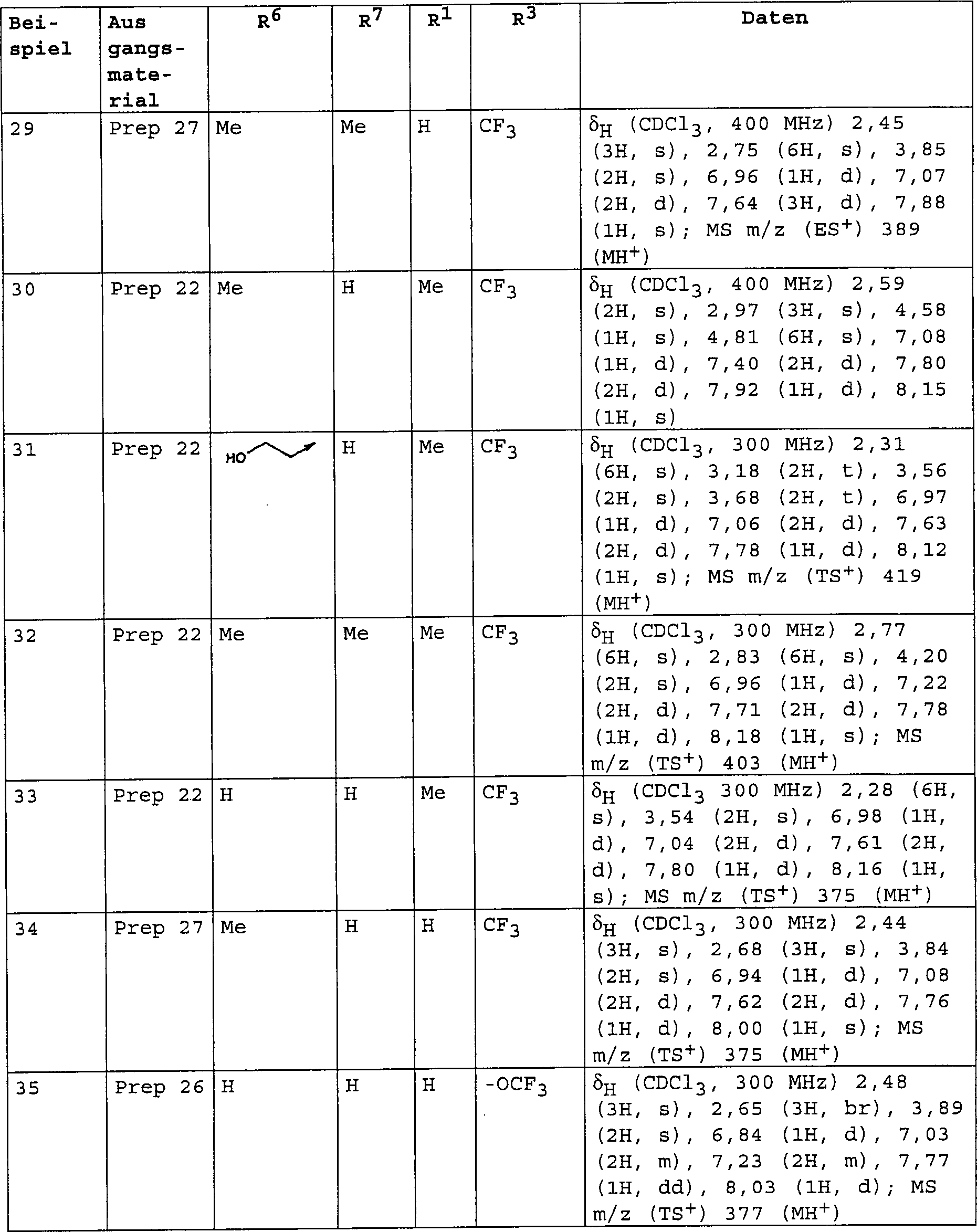
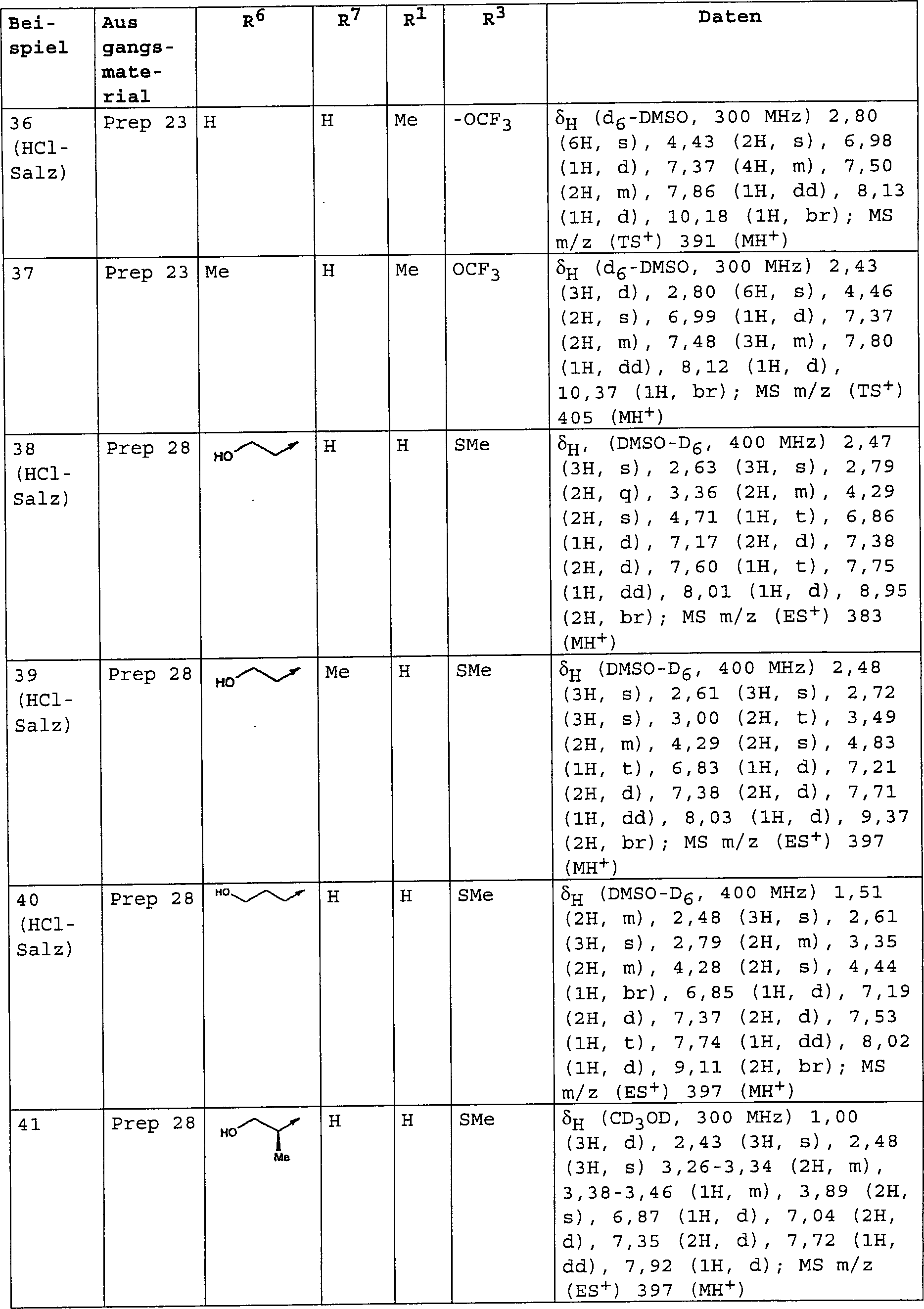

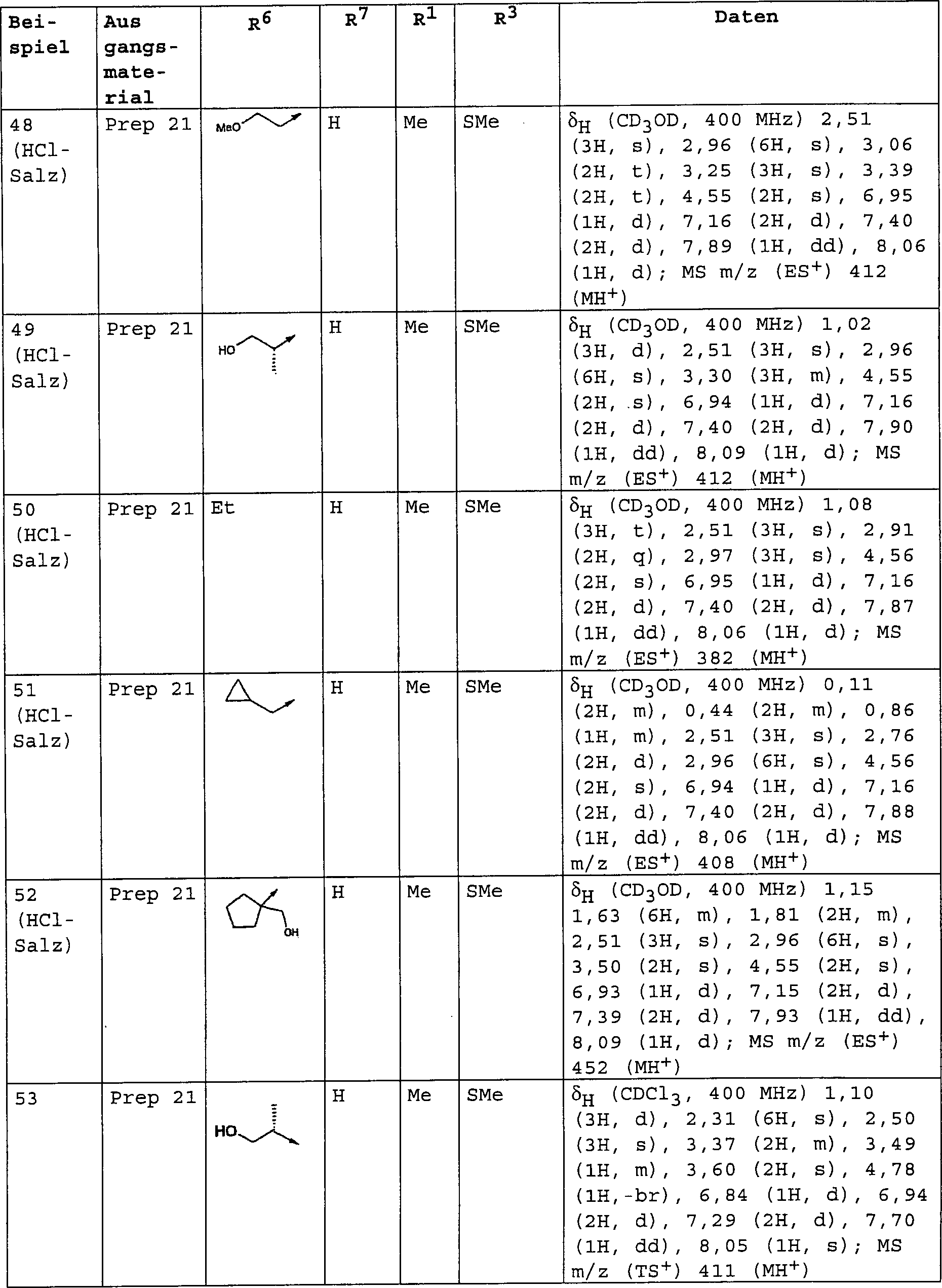

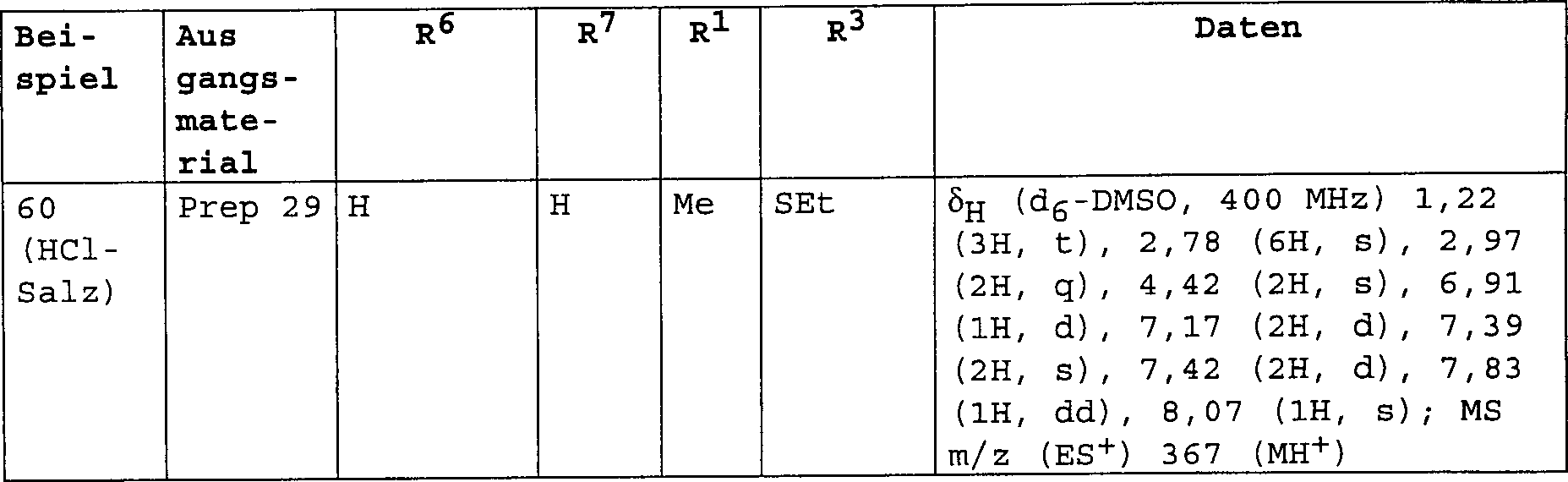
Beispiel
61 4-[4-Methoxy-3-(methylsulfanyl)-phenoxy]-3-[(methylamino)-methyl]-benzolsulfonamid 
Boran-Tetrahydrofuran-Komplex (1 M in THF, 10 ml, 10 mmol) wurde tropfenweise zum Amid von Präparation 32 (450 mg, 1,18 mmol) gegeben. Sodann wurde das Gemisch 4 Stunden unter Rückfluss erwärmt. Nach Abkühlen auf Raumtemperatur wurde die Umsetzung durch Zugabe von Methanol (10 ml) gestoppt und das Gemisch wurde zu einem weißen Schaum eingedampft. Dieser Rückstand wurde mit Salzsäure (6 M, 10 ml) behandelt. Anschließend wurde das Gemisch 1 weitere Stunde unter Rückfluss erwärmt. Nach Abkühlen auf Raumtemperatur wurde das Gemisch durch Behandlung mit überschüssigem Natriumhydroxid (2 M) auf einen pH-Wert von etwa 7 neutralisiert und sodann mit einer gesättigten wässrigen Ammoniumchloridlösung versetzt. Anschließend wurde das Gemisch mit Ethylacetat (3 × 50 ml) und DCM (2 × 50 ml) extrahiert. Die vereinigten organischen Phasen wurden getrocknet (MgSO4) und zu einem farblosen Öl eingedampft. Dieses Öl wurde in Ethylacetat (20 ml) in Lösung gebracht und mit 1 M Chlorwasserstoffsäure in Diethylether (2 ml, 2 mmol) behandelt, um das Hydrochloridsalz zu bilden. Das Salz wurde durch Filtration gewonnen und getrocknet (346 mg, 73%); δH (CD3OD, 400 MHz) 2,34 (3H, s), 2,78 (3H, s), 3,86 (3H, s), 4,39 (2H, s) 6,83 (1H, d), 6,90 (1H, m), 6,98 (2H, m), 7,84 (1H, dd), 8,01 (1H, d); MS m/z (ES+) 369 (MH+).Borane-tetrahydrofuran complex (1 M in THF, 10 mL, 10 mmol) was added dropwise to the amide of Preparation 32 (450 mg, 1.18 mmol). The mixture was then refluxed for 4 hours. After cooling to room temperature, the reaction was stopped by addition of methanol (10 ml) and the mixture was evaporated to a white foam. This residue was treated with hydrochloric acid (6 M, 10 mL). The mixture was then refluxed for an additional 1 hour. After cooling to room temperature, the mixture was neutralized by treatment with excess sodium hydroxide (2 M) to a pH of about 7 and then treated with a saturated aqueous ammonium chloride solution. Subsequently, the mixture was extracted with ethyl acetate (3 × 50 ml) and DCM (2 × 50 ml). The combined organic phases were dried (MgSO 4 ) and evaporated to a colorless oil. This oil was dissolved in ethyl acetate (20 mL) and treated with 1 M hydrochloric acid in diethyl ether (2 mL, 2 mmol) to form the hydrochloride salt. The salt was collected by filtration and dried (346 mg, 73%); δ H (CD 3 OD, 400 MHz) 2.34 (3H, s), 2.78 (3H, s), 3.86 (3H, s), 4.39 (2H, s) 6.83 (1H , d), 6.90 (1H, m), 6.98 (2H, m), 7.84 (1H, dd), 8.01 (1H, d); MS m / z (ES + ) 369 (MH + ).
Beispiele 62–63Examples 62-63
Die folgenden Sulfonamide wurden auf analoge Weise wie in Beispiel 61 unter Verwendung des entsprechenden Amids als Ausgangsprodukt hergestellt.The The following sulfonamides were prepared in a similar manner as in Example 61 prepared using the corresponding amide as starting material.
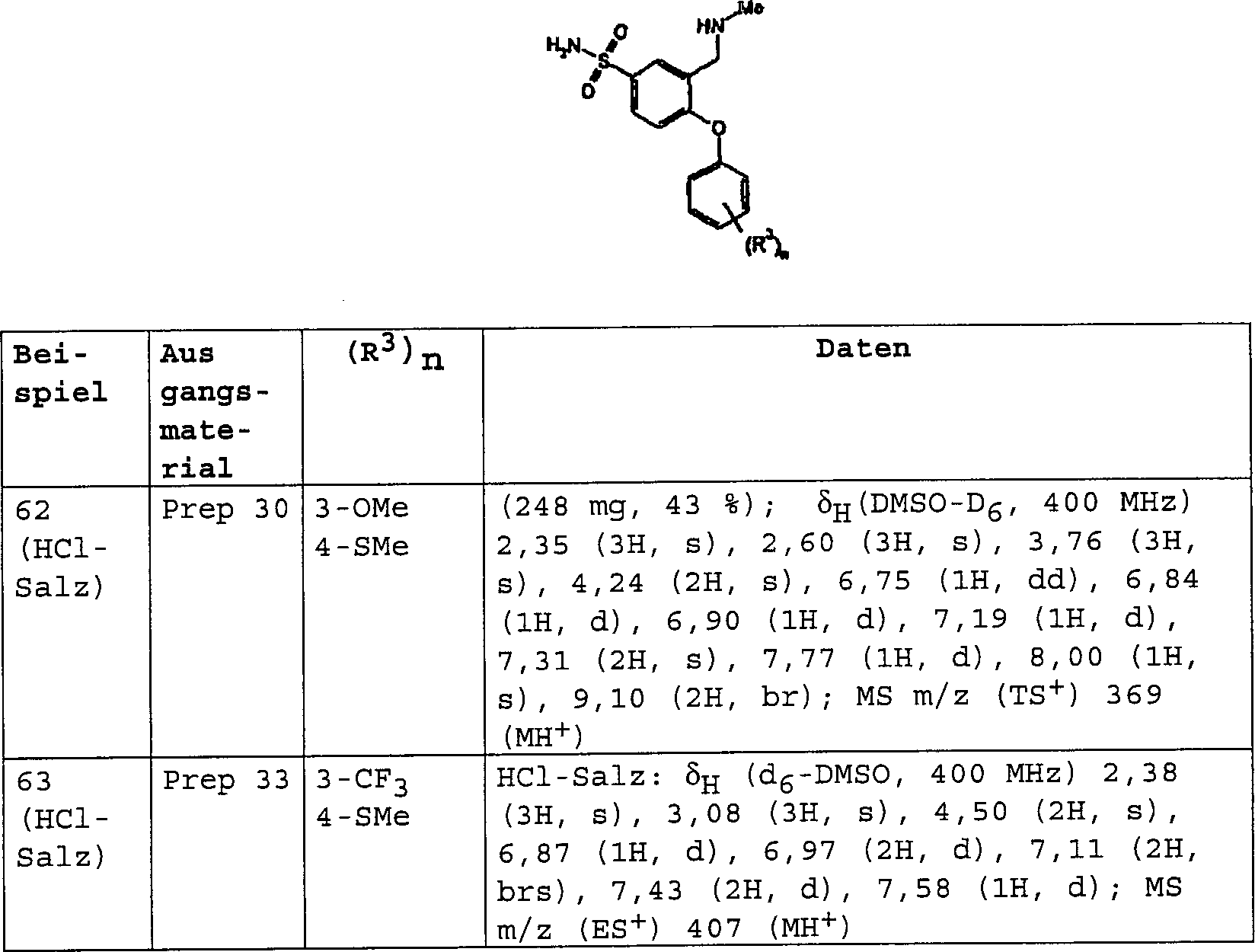
Das Sulfonamid von Beispiel 42 lässt sich auch unter Anwendung dieses Verfahrens unter Verwendung des Amids von Präparation 31 als Ausgangsprodukt herstellen.The Sulfonamide of Example 42 leaves also using this method using the Amides of preparation 31 produce as starting material.
Beispiele 64–65Examples 64-65
sDie folgenden tert.-Aminsulfonamide wurden durch reduktive Methylierung unter Anwendung des Verfahrens von Beispiel 178 und unter Verwendung des entsprechenden sekundären Amins als Ausgangsmaterial hergestellt.sThe Following tert-aminesulfonamides were by reductive methylation using the method of Example 178 and using of the corresponding secondary Amines prepared as starting material.


Das Produkt von Beispiel 28 lässt sich ebenfalls nach diesem Verfahren aus dem sekundären Amin von Beispiel 42 herstellen.The Leaves product of Example 28 also according to this method from the secondary amine of Example 42.
Beispiel
66 N-Acetyl-3-[(dimethylamino)-methyl]-4-[4-(methylsulfanyl)-phenoxy]-benzolsulfonamid 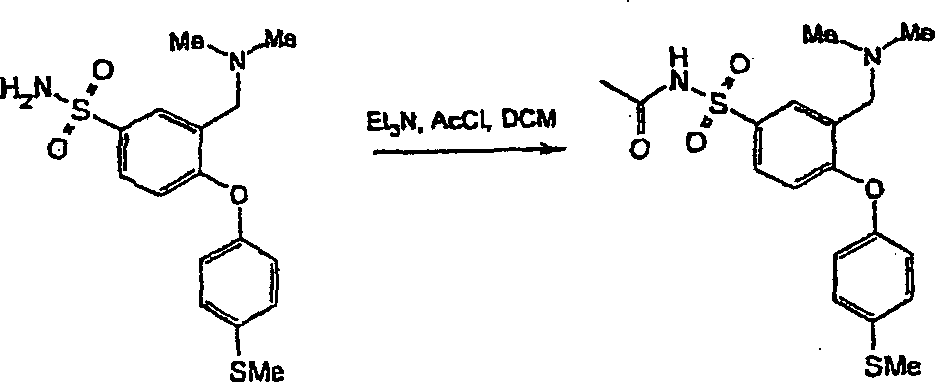
Triethylamin (399 μl, 2,86 mmol) wurde zu einer Lösung des Sulfonamids von Beispiel 28 (500 mg, 1,3 mmol) in DCM (5 ml) gegeben, wonach die Zugabe von Acetylchlorid (102 μl, 1,43 mmol) folgte. Das Gemisch wurde 16 Stunden bei Raumtemperatur gerührt. Anschließend wurde das Lösungsmittel unter Vakuum entfernt. Der Rückstand wurde durch Säulenchromatographie (SiO2; DCM 100%, zunehmende Polarität auf 15% (1:7 NH4OH:MeOH) in DCM) gereinigt. Man erhielt einen kristallinen Feststoff (438 mg, 86%). δH (DMSO-D6, 400 MHz) 1,83 (3H, s), 2,31 (6H, s), 2,46 (3H, s), 3,68 (2H, s), 6,83 (1H, d), 7,03 (2H, d), 7,32 (2H, d), 7,71 (1H, d), 7,99 (1H, s); MS m/z (ES+) 395 (MH+).Triethylamine (399 μL, 2.86 mmol) was added to a solution of the sulfonamide of Example 28 (500 mg, 1.3 mmol) in DCM (5 mL), followed by the addition of acetyl chloride (102 μL, 1.43 mmol). followed. The mixture was stirred at room temperature for 16 hours. Then the solvent was removed under vacuum. The residue was purified by column chromatography (SiO 2 ; DCM 100%, increasing polarity to 15% (1: 7 NH 4 OH: MeOH) in DCM). A crystalline solid was obtained (438 mg, 86%). δ H (DMSO-D 6 , 400 MHz) 1.83 (3H, s), 2.31 (6H, s), 2.46 (3H, s), 3.68 (2H, s), 6.83 (1H, d), 7.03 (2H, d), 7.32 (2H, d), 7.71 (1H, d), 7.99 (1H, s); MS m / z (ES + ) 395 (MH + ).
Beispiel
67 (E)-2-{3-[(Dimethylamino)-methyl]-4-[4-(methylsulfanyl)-phenoxy]-phenyl}-ethensulfonamid 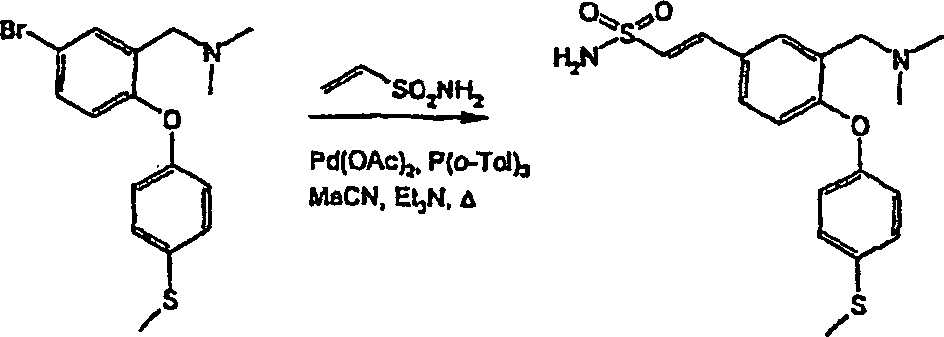
Das Bromid von Beispiel 9 (2,0 g, 5,68 mmol), Vinylsulfonamid (1,22 g, 11,35 mmol), Palladiumacetat (64 mg, 0,28 mmol, 5 mol-%), Tri-(o-tolyl)-phosphin (173 mg, 0,57 mmol, 10 mol-%) und Triethylamin (1,98 ml, 14,19 mmol) wurden in Acetonitril (50 ml) vereinigt und 20 Stunden unter Stickstoff unter Rückfluss erwärmt. Nach Abkühlen auf Raumtemperatur wurde das Reaktionsgemisch auf Kieselgel eingedampft und sodann chromatographiert (SiO2; (EtOAc/MeOH/880 NH3; 100:5:0,5)/Pentan; 3:1 → 1:0). Man erhielt die angestrebte Titelverbindung in Form eines gelben Pulvers (1,26 g, 59%). Freie Base: δH (CDCl3, 300 MHz) 2,28 (6H, s), 2,49 (3H, s), 3,52 (2H, s), 6,80–6,95 (4H, m), 7,25–7,31 (3H, m), 7,48 (1H, d), 7,68 (1H, s); MS m/z (TS+) 379 (MH+).The bromide of Example 9 (2.0 g, 5.68 mmol), vinylsulfonamide (1.22 g, 11.35 mmol), palladium acetate (64 mg, 0.28 mmol, 5 mol%), tri- (o -tolyl) phosphine (173mg, 0.57mmol, 10mol%) and triethylamine (1.98mL, 14.19mmol) were combined in acetonitrile (50mL) and refluxed under nitrogen for 20 hours. After cooling to room temperature, the reaction mixture was evaporated on silica gel and then chromatographed (SiO 2 ; (EtOAc / MeOH / 880 NH 3 ; 100: 5: 0.5) / pentane; 3: 1 → 1: 0). The desired title compound was obtained in the form of a yellow powder (1.26 g, 59%). Free base: δ H (CDCl 3, 300 MHz) 2.28 (6H, s), 2.49 (3H, s), 3.52 (2H, s), 6.80-6.95 (4H, m ), 7.25-7.31 (3H, m), 7.48 (1H, d), 7.68 (1H, s); MS m / z (TS + ) 379 (MH + ).
Beispiele 68–70Examples 68-70
Die in Beispiel 67 beschriebene Umsetzung wurde unter Verwendung der entsprechenden Alken- und Arylbromid-Komponenten zur Bildung der folgenden Alkene wiederholt.The reaction described in Example 67 was carried out using the corresponding alkene and aryl bromide components to form the following Alkenes repeated.
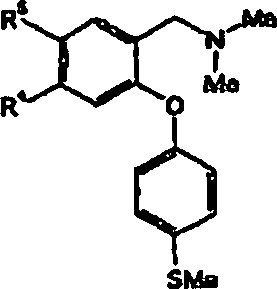

Acrylamid wurde in diesen Beispielen als Alken-Kupplungspartner verwendet.acrylamide was used as alkene coupling partner in these examples.
Beispiel
71 2-{3-[(Dimethylamino)-methyl]-4-[4-(methylsulfanyl)-phenox]-phenyl}-ethansulfonamid 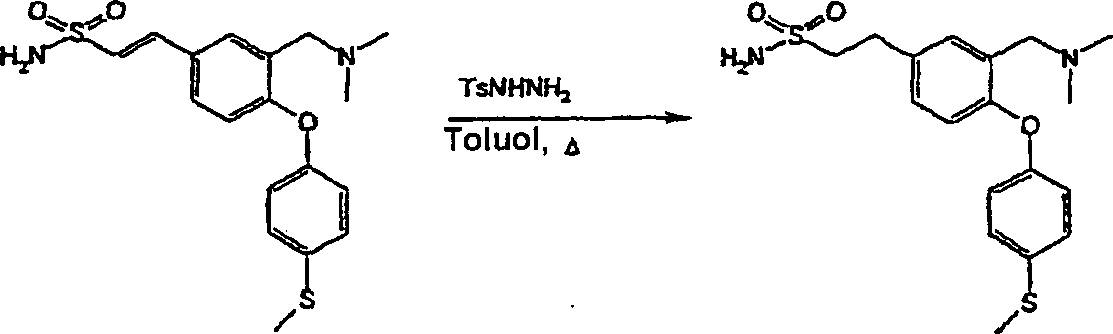
Das Vinylsulfonamid von Beispiel 67 (1,26 g, 3,33 mmol) wurde zusammen mit Tosylhydrazin (6,20 g, 33,3 mmol) in Toluol 5 Stunden unter Rückfluss erwärmt. Nach Abkühlen auf Raumtemperatur wurde das Lösungsmittel abgedampft. Der Rückstand wurde mit EtOAc (50 ml) und gesättigter NaHCO3-Lösung (50 ml) ausgeschüttelt. Die organische Phase wurde abgetrennt, mit Wasser (20 ml) und Kochsalzlösung (20 ml) gewaschen, getrocknet (MgSO4) und eingedampft. Der Rückstand wurde durch Flash-Chromatographie (SiO2; (EtOAc/MeOH/880 NH3; 100:5:0,5)/Pentan; 3:1 → 1:0) gereinigt. Man erhielt das angestrebte Produkt in Form eines cremefarbenen Pulvers (1,055 g, 83%); freie Base: δH (CD3OD, 400 MHz) 2,27 (6H, s), 2,47 (3H, s), 3,09–3,13 (2H, m), 3,30–3,36 (2H, m), 3,50 (2H, m), 6,83 (1H, d), 6,87 (2H, d), 7,19 (1H, d), 7,27 (2H, d), 7,35 (1H, s); MS m/z (TS+) 381 (MH+).The vinylsulfonamide of Example 67 (1.26 g, 3.33 mmol) was refluxed together with tosylhydrazine (6.20 g, 33.3 mmol) in toluene for 5 hours. After cooling to room temperature, the solvent was evaporated. The residue was partitioned between EtOAc (50 mL) and saturated NaHCO 3 (50 mL). The organic phase was separated, washed with water (20 ml) and brine (20 ml), dried (MgSO 4 ) and evaporated. The residue was purified by flash chromatography (SiO 2 ; (EtOAc / MeOH / 880 NH 3 ; 100: 5: 0.5) / pentane; 3: 1 → 1: 0). The desired product was obtained in the form of an off-white powder (1.055 g, 83%); free base: δ H (CD 3 OD, 400 MHz) 2.27 (6H, s), 2.47 (3H, s), 3.09-3.13 (2H, m), 3.30-3, 36 (2H, m), 3.50 (2H, m), 6.83 (1H, d), 6.87 (2H, d), 7.19 (1H, d), 7.27 (2H, d ), 7.35 (1H, s); MS m / z (TS + ) 381 (MH + ).
Beispiel
72 2-{4-[(Dimethylamino)-methyl]-3-[4-(methylsulfanyl)-phenoxy]-phenyl}-ethansulfonamid 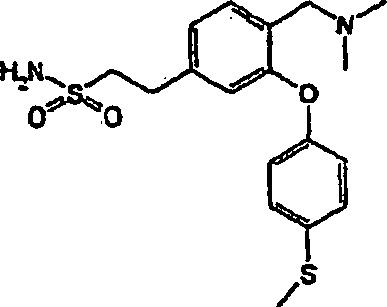
Das Titel-Sulfonamid wurde auf analoge Weise wie in Beispiel 71 aus dem Vinylsulfonamid von Beispiel 70 hergestellt. Freie Base: δH (CDCl3, 300 MHz) 2,25 (6H, s), 2,48 (3H, s), 3,08 (2H, m), 3,33 (2H, m), 3,44 (2H, m), 4,57 (2H, brs), 6,73 (1H, s), 6,86 (2H, d), 6,98 (1H, dd), 7,25 (2H, d), 7,41 (1H, d); MS m/z (TS+) 381 (MH+).The title sulfonamide was prepared from the vinylsulfonamide from Bei in an analogous manner as in Example 71 game 70 made. Free base: δ H (CDCl 3 , 300 MHz) 2.25 (6H, s), 2.48 (3H, s), 3.08 (2H, m), 3.33 (2H, m), 3, 44 (2H, m), 4,57 (2H, brs), 6,73 (1H, s), 6,86 (2H, d), 6,98 (1H, dd), 7,25 (2H, d ), 7.41 (1H, d); MS m / z (TS + ) 381 (MH + ).
Beispiel
73 3-[(Dimethylamino)-methyl]-4-[4-(methylsulfanyl)-phenoxy]-phenol 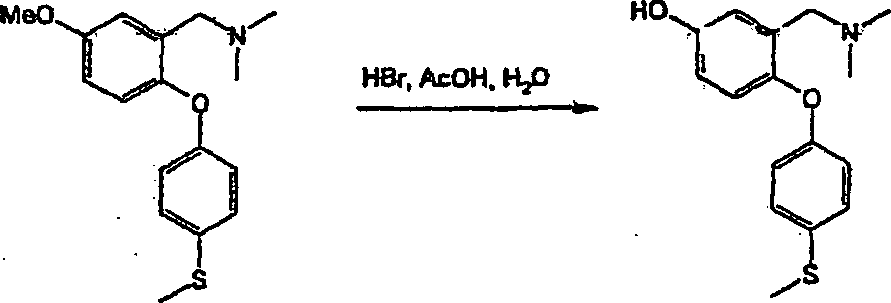
Der Methylether von Beispiel 14 (500 mg, 1,65 mmol) wurde mit Bromwasserstoff in Essigsäure (30%, 3 ml) und wässriger Bromwasserstoffsäure (48%, 200 μl) vermischt. Das Gemisch wurde über Nacht unter einer Stickstoffatmosphäre unter Rückfluss erwärmt. Nach Abkühlen auf Raumtemperatur wurde das Gemisch unter vermindertem Druck eingedampft. Der Rückstand wurde mit gesättigter wässriger Natriumbicarbonatlösung (20 ml) und DCM (30 ml) ausgeschüttelt. Die organische Phase wurde abgetrennt. Die wässrige Phase wurde mit DCM (4 × 30 ml) reextrahiert. Die vereinigten organischen Fraktionen wurden mit Kochsalzlösung gewaschen, getrocknet (MgSO4) und zu einem dunklen Öl eingedampft. Nach Reinigung durch wiederholte Flash-Chromatographie, zunächst mit Siliciumdioxid; DCM/Methanol/880 Ammoniak (95:5:0,5)) und sodann (SiO2; DCM/Methanol/880 Ammoniak (97:3:0,3)) erhielt man ein teilweise gereinigtes Material. Dieses Material wurde in Salzsäure (2 M) gelöst und mit Diethylether (3 × 5 ml) gewaschen. Die wässrige Phase wurde mit einer gesättigten Lösung von NaHCO3 (aq) (10 ml) alkalisch gemacht und mit DCM (4 × 10 ml) reextrahiert. Die organischen Fraktionen wurden vereinigt und eingedampft. Der Rückstand wurde weiter durch Flash-Chromatographie (SiO2; DCM/Methanol/880 Ammoniak (95:5:0,5)) gereinigt. Man erhielt das angestrebte Phenol in Form eines weißen Feststoffes (141 mg, 30%). δH (CDCl3, 400 MHz) 2,25 (6H, s), 2,42 (3H, s), 3,40 (2H, s), 6,71 (1H, m), 6,79 (3H, d), 6,89 (1H, s), 7,25 (2H, d); MS m/z (TS+) 290 (MH+).The methyl ether of Example 14 (500 mg, 1.65 mmol) was mixed with hydrogen bromide in acetic acid (30%, 3 mL) and aqueous hydrobromic acid (48%, 200 μL). The mixture was refluxed overnight under a nitrogen atmosphere. After cooling to room temperature, the mixture was evaporated under reduced pressure. The residue was partitioned between saturated aqueous sodium bicarbonate solution (20 ml) and DCM (30 ml). The organic phase was separated. The aqueous phase was reextracted with DCM (4 x 30 mL). The combined organic fractions were washed with brine, dried (MgSO 4 ) and evaporated to a dark oil. After purification by repeated flash chromatography, first with silica; DCM / methanol / 880 ammonia (95: 5: 0.5)) and then (SiO 2 ; DCM / methanol / 880 ammonia (97: 3: 0.3)) gave a partially purified material. This material was dissolved in hydrochloric acid (2 M) and washed with diethyl ether (3 x 5 mL). The aqueous phase was basified with a saturated solution of NaHCO 3 (aq) (10 mL) and reextracted with DCM (4 x 10 mL). The organic fractions were combined and evaporated. The residue was further purified by flash chromatography (SiO 2 ; DCM / methanol / 880 ammonia (95: 5: 0.5)). The desired phenol was obtained as a white solid (141 mg, 30%). δ H (CDCl 3, 400 MHz) 2.25 (6H, s), 2.42 (3H, s), 3.40 (2H, s), 6.71 (1H, m), 6.79 (3H , d), 6.89 (1H, s), 7.25 (2H, d); MS m / z (TS + ) 290 (MH + ).
Beispiel
74 3-[(Methylamino)-methyl]-4-[4-(methylsulfanyl)-phenoxy]-phenol 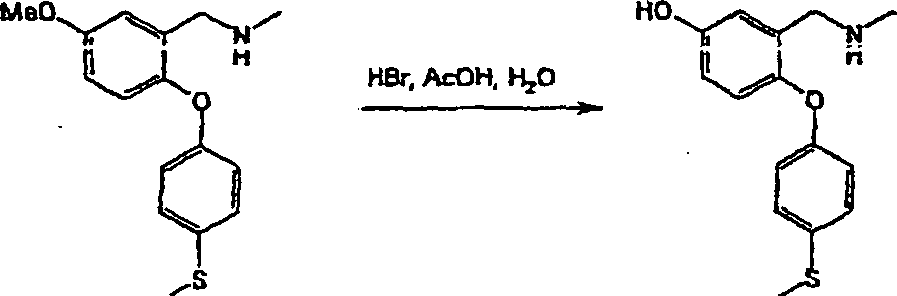
Die Titelverbindung wurde aus dem Methylether von Beispiel 25 nach dem Verfahren von Beispiel 73 hergestellt. δH (CDCl3, 400 MHz) 2,35 (3H, s), 2,43 (3H, s), 3,59 (2H, s), 6,70 (1H, s), 6,80 (2H, m), 6,83 (2H, d), 7,25 (2H, d); MS m/z (TS+) 276 (MH+)The title compound was prepared from the methyl ether of Example 25 by the method of Example 73. δ H (CDCl 3, 400 MHz) 2.35 (3H, s), 2.43 (3H, s), 3.59 (2H, s), 6.70 (1H, s), 6.80 (2H , m), 6.83 (2H, d), 7.25 (2H, d); MS m / z (TS + ) 276 (MH + )
Beispiel
75 3-{3-[(Dimethylamino)-methyl]-4-[4-(methylsulfanyl)-phenoxy]-phenyl}-propanamid 
THF (20 ml) wurde mit NH3 gesättigt und auf –60°C abgekühlt. Das Hydrazid vom Präparation 68 (756 mg, 1,47 mmol) wurde zugegeben, wonach sich die tropfenweise Zugabe von Bleitetraacetat (1,30 g, 2,94 mmol) in DCM (15 ml) anschloss. Das Reaktionsgemisch wurde 3 Stunden bei –60°C unter einer Stickstoffatmosphäre gerührt und sodann über Nacht auf Raumtemperatur erwärmt. Das Lösungsmittel wurde durch Abdampfen entfernt. Der erhaltene orangefarbene Rückstand wurde mit wässriger Natriumhydroxidlösung (2 M) (50 ml) verdünnt und mit Ethylacetat (2 × 50 ml) extrahiert. Die vereinigten organischen Phasen wurden mit Wasser (20 ml) und Kochsalzlösung (30 ml) gewaschen, getrocknet (MgSO4) und zu einem orangefarbenen Öl eingedampft. Nach Reinigung durch HPLC (Phenomonex Luna C18, 150 × 21,2 mm, 5 μM; 0,1% wässriges Diethylamin/Methanol (Gradient)) erhielt man ein Öl, das mit Natriumhydroxid (1 M) und Diethylether (10 ml) ausgeschüttelt wurde. Die organische Phase wurde abgetrennt, mit Wasser (10 ml) gewaschen, getrocknet (MgSO4) und zur Titelverbindung in Form eines klaren Öls eingedampft. Dieses Öl erstarrte nach Trocknen unter Vakuum (264 mg, 52%). Freie Base: δH (CDCl3, 400 MHz) 2,25 (6H, s), 2,48 (3H, s), 2,54 (2H, t), 2,95 (2H, t), 3,42 (2H, s), 5,39 (2H, brs), 6,81 (1H, d), 6,85 (2H, d), 7,07 (1H, d), 7,25 (2H, d), 7,33 (1H, s); MS m/z (TS+) 345 (MH+)THF (20 ml) was saturated with NH 3 and cooled to -60 ° C. The hydrazide from Preparation 68 (756 mg, 1.47 mmol) was added, followed by the dropwise addition of lead tetraacetate (1.30 g, 2.94 g) mmol) in DCM (15 ml). The reaction mixture was stirred for 3 hours at -60 ° C under a nitrogen atmosphere and then warmed to room temperature overnight. The solvent was removed by evaporation. The resulting orange residue was diluted with aqueous sodium hydroxide solution (2 M) (50 mL) and extracted with ethyl acetate (2 x 50 mL). The combined organic phases were washed with water (20 ml) and brine (30 ml), dried (MgSO 4 ) and evaporated to an orange oil. After purification by HPLC (Phenomonex Luna C 18, 150 x 21.2 mm, 5 uM, 0.1% aqueous diethylamine / methanol (gradient)) gave an oil which with sodium hydroxide (1 M) and diethyl ether (10 ml) was shaken out. The organic phase was separated, washed with water (10 ml), dried (MgSO 4 ) and evaporated to the title compound as a clear oil. This oil solidified after drying under vacuum (264 mg, 52%). Free base: δ H (CDCl 3, 400 MHz) 2.25 (6H, s), 2.48 (3H, s), 2.54 (2H, t), 2.95 (2H, t), 3, 42 (2H, s), 5.39 (2H, brs), 6.81 (1H, d), 6.85 (2H, d), 7.07 (1H, d), 7.25 (2H, d ), 7.33 (1H, s); MS m / z (TS + ) 345 (MH + )
Beispiel 76Example 76
3-{4-[(Dimethylamino)-methyl]-3-[4-(methylsulfanyl)-phenxoy]-phenyl}-propanamid3- {4 - [(Dimethylamino) methyl] -3- [4- (methylsulfanyl) -phenxoy] phenyl} propanamide
Das
Titel-Amid wurde aus dem Hydrazid von Präparation 69 nach dem Verfahren
von Beispiel 75 hergestellt. 
Beispiel
77 2-Brom-5-[(methylamino)-methyl]-4-[4-(trifluormethoxy)-phenoxy]-benzolsulfonamid 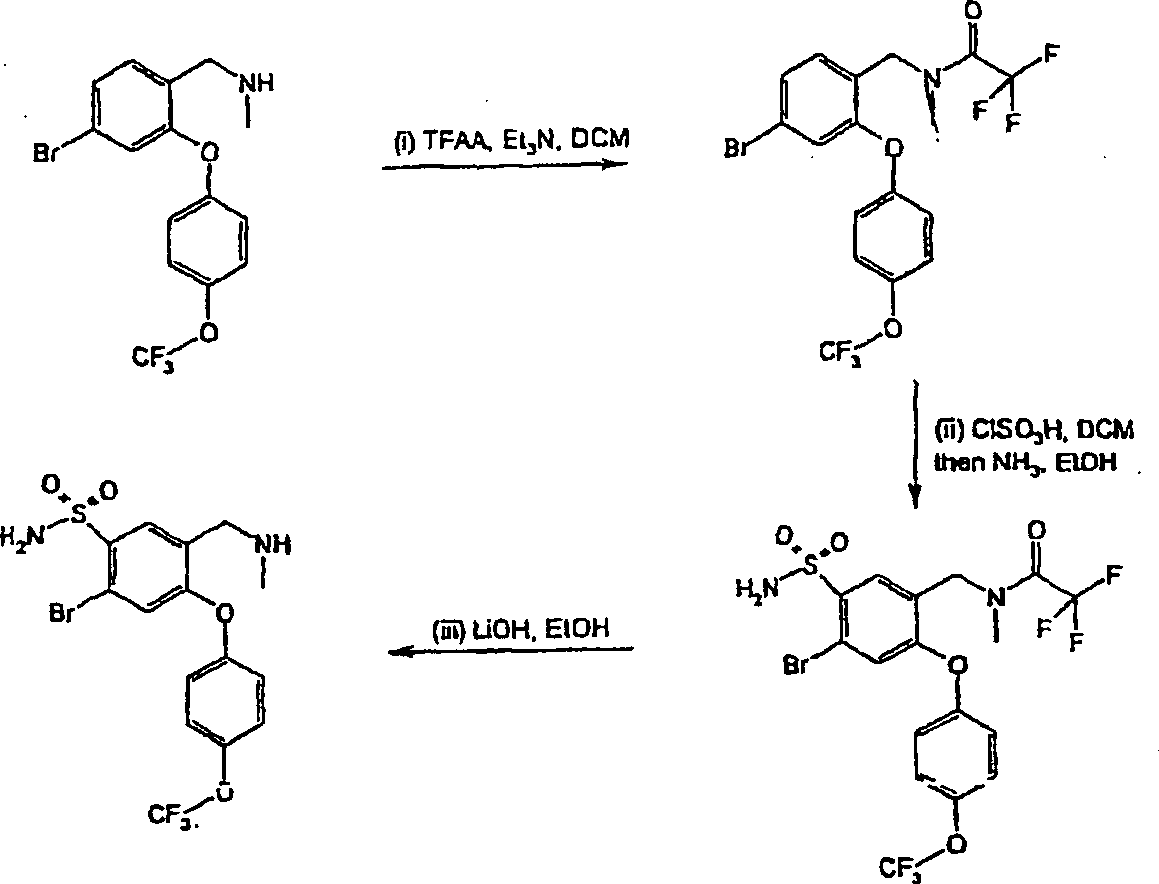
(i) Bildung des Trifluoracetamids: N-{4-Brom-2-[4-(trifluormethoxy)-phenoxy]-benzyl}-2,2,2-trifluor-N-methylacetamid(i) Formation of trifluoroacetamide: N- {4-bromo-2- [4- (trifluoromethoxy) phenoxy] benzyl} -2,2,2-trifluoro-N-methylacetamide
Das Bromidderivat von Beispiel 24 (1,31 g, 3,2 mmol) wurde in DCM (12 ml) gelöst und mit Triethylamin (1,77 ml, 13,9 mmol) behandelt. Die Lösung wurde auf 0°C abgekühlt. Sodann wurde tropfenweise innerhalb von 5 Minuten Trifluoressigsäureanhydrid (897 μl, 6,3 mmol) zugegeben. Der Rührvorgang wurde weitere 30 Minuten fortgesetzt. Sodann wurde die Umsetzung durch Zugabe von Wasser (20 ml) gestoppt. Die organische Phase wurde abgetrennt. Die wässrige Phase wurde mit DCM (20 ml) reextrahiert. Die vereinigen organischen Fraktionen wurden getrocknet (MgSO4) und zu einem klaren Öl eingedampft. δH (CDCl3, 400 MHz, 2 Rotomere sichtbar) 3,00 [3H, s (untergeordnetes Rotomer)], 3,17 (3H, s), 4,66 (2H, s), 4,69 [2H, s (untergeordnetes Rotomer)], 6,97–7,02 (3H, m), 7,22–7,27 (4H, m); MS m/z (TS+) 489, 491 (MNH4 +).The bromide derivative of Example 24 (1.31 g, 3.2 mmol) was dissolved in DCM (12 mL) and treated with triethylamine (1.77 mL, 13.9 mmol). The solution was cooled to 0 ° C. Trifluoroacetic anhydride (897 μL, 6.3 mmol) was added dropwise over 5 minutes. Stirring was continued for another 30 minutes. The reaction was stopped by adding water (20 ml). The organic phase was separated. The aqueous phase was reextracted with DCM (20 mL). The unite or ganic fractions were dried (MgSO 4 ) and evaporated to a clear oil. δ H (CDCl 3 , 400 MHz, 2 rotomers visible) 3.00 [3H, s (subordinate rotomer)], 3.17 (3H, s), 4.66 (2H, s), 4.69 [2H, s (subordinate rotomer)], 6.97-7.02 (3H, m), 7.22-7.27 (4H, m); MS m / z (TS + ) 489, 491 (MNH 4 + ).
(ii) Synthese des Sulfonamids: N-{5-(Aminosulfonyl)-4-brom-2-[4-(trifluormethoxy)-phenoxy]-benzyl}-2,2,2-trifluor-N-methylacetamid(ii) Synthesis of sulfonamide: N- {5- (aminosulfonyl) -4-bromo-2- [4- (trifluoromethoxy) phenoxy] benzyl} -2,2,2-trifluoro-N-methylacetamide
Das Trifluoracetamid von Stufe (i) (ohne weitere Reinigung verwendet) wurde in TFA (6 ml) gelöst und mit Chlorsulfonsäure (2,1 ml, 31,7 mmol) versetzt. Das Gemisch wurde über Nacht bei Raumtemperatur gerührt und sodann durch vorsichtiges Gießen auf Eiswasser abgeschreckt. Der ausgefallene weiße Feststoff wurde durch Filtration gewonnen und sodann in DCM gelöst, getrocknet (MgSO4) filtriert und zu einem gelben Öl eingedampft. Das Öl wurde mit gesättigtem NH3 in Ethanol (30 ml) behandelt. Nach 30 Minuten wurden die Lösungsmittel abgedampft. Nach Reinigung des Rückstands durch Flash-Chromatographie (SiO2; DCM, MeOH, 880 NH3 (93:7:1)) erhielt man das angestrebte Sulfonamid in Form eines weißen Feststoffes (825 mg, 47%). δH (CDCl3, 400 MHz, 2 Rotomere sichtbar) 3,04 (3H, s, untergeordnetes Rotomer), 3,10 (3H, s), 4,72 (2H, s), 4,75 (2H, s, untergeordnetes Rotomer), 5,15 (2H, brs), 7,04–7,09 (3H, m), 7,24–7,35 (2H, m), 8,00 (1H, s, untergeordnetes Rotomer), 8,09 (1H, s); MS m/z (TS+) 568, 570 (MNH4 +).The trifluoroacetamide of step (i) (used without further purification) was dissolved in TFA (6 mL) and added with chlorosulfonic acid (2.1 mL, 31.7 mmol). The mixture was stirred overnight at room temperature and then quenched by gentle pouring onto ice-water. The precipitated white solid was collected by filtration and then dissolved in DCM, dried (MgSO 4 ), filtered and evaporated to a yellow oil. The oil was treated with saturated NH 3 in ethanol (30 ml). After 30 minutes, the solvents were evaporated. Purification of the residue by flash chromatography (SiO 2 , DCM, MeOH, 880 NH 3 (93: 7: 1)) afforded the desired sulfonamide as a white solid (825 mg, 47%). δ H (CDCl 3 , 400 MHz, 2 rotomers visible) 3.04 (3H, s, subordinate rotomer), 3.10 (3H, s), 4.72 (2H, s), 4.75 (2H, s , subordinate rotomer), 5.15 (2H, brs), 7.04-7.09 (3H, m), 7.24-7.35 (2H, m), 8.00 (1H, s, subordinate rotomer ), 8.09 (1H, s); MS m / z (TS + ) 568, 570 (MNH 4 + ).
(iii) Hydrolyse der Trifluoracetamidgruppe: 2-Brom-5-[(methylamino)-methyl]-4-[4-(trifluormethoxy)-phenoxy]-benzolsulfonamid(iii) Hydrolysis of the trifluoroacetamide group: 2-bromo-5 - [(methylamino) methyl] -4- [4- (trifluoromethoxy) phenoxy] -benzenesulfonamide
Das Sulfonamid von Stufe (ii) wurde in Ethanol (10 ml) gelöst und mit 1 M LiOH(aq) (20 ml) behandelt. Das Gemisch wurde 10 Minuten gerührt und sodann zur Entfernung des Großteils des Ethanols eingedampft. Das erhaltene wässrige Gemisch wurde mit Diethylether (2 × 50 ml) extrahiert. Die vereinigten Extrakte wurden mit Kochsalzlösung (100 ml) gewaschen, getrocknet (MgSO4) und zu einem weißen Feststoff eingedampft (550 mg, 81%). δH (CDCl3, 400 MHz) 2,46 (3H, s), 3,84 (3H, s), 7,05 (2H, d), 7,06 (1H, s), 7,27 (2H, d), 8,20 (1H, s); MS m/z (TS+) 455, 457 (MH+).The sulfonamide of step (ii) was dissolved in ethanol (10 ml) and treated with 1 M LiOH (aq) (20 ml). The mixture was stirred for 10 minutes and then evaporated to remove most of the ethanol. The resulting aqueous mixture was extracted with diethyl ether (2 x 50 ml). The combined extracts were washed with brine (100 ml), dried (MgSO 4 ) and evaporated to a white solid (550 mg, 81%). δ H (CDCl 3, 400 MHz) 2.46 (3H, s), 3.84 (3H, s), 7.05 (2H, d), 7.06 (1H, s), 7.27 (2H , d), 8,20 (1H, s); MS m / z (TS + ) 455, 457 (MH + ).
Beispiel
78 5-[(Methylamino)-methyl]-2-(methylsulfanyl)-4-[4-(trifluormethoxy)-phenoxy]-benzolsulfonamid 
Das Sulfonamid von Beispiel 77 (510 mg, 1,1 mmol) wurde in DMSO (3 ml) gelöst und mit Palladium-tetrakis-(triphenylphosphin) (129 mg, 0,11 mmol) und Natriummethanthiolat (157 mg, 2,2 mmol) behandelt. Anschließend wurde das Gemisch 18 Stunden unter einer Stickstoffatmosphäre auf 100°C erwärmt. Nach Abkühlen auf Raumtemperatur wurde das Gemisch mit Wasser und Diethylether (jeweils 50 ml) ausgeschüttelt. Die Etherphase wurde abgetrennt. Die organische Phase wurde mit Diethylether (2 × 25 ml) reextrahiert. Die vereinigten organischen Fraktionen wurden getrocknet (MgSO4) und zu einem orangefarbenen Öl eingedampft. Nach Reinigung durch Flash-Chromatographie (SiO2; DCM/MeOH/880 NH3 (93:7:1)) erhielt man einen weißen Feststoff (286 mg, etwa 60%), bei dem es sich gemäß 1H-NMR um ein 60:40-Gemisch aus dem angestrebten Produkt und dem Ausgangsbromid handelte. Eine Portion dieser Probe wurde weiter durch HPLC gereinigt (Magellen C18 15·21,12 cm-Säule 0,2% Diethylamin(aq)/Acetonitril (50:50), Fließgeschwindigkeit 20 ml/min). Man erhielt die angestrebte Titelverbindung (Retentionszeit 8,2 min) in Form eines weißen Feststoffes (22, 1 mg). δH (CDCl3, 400 MHz) 2,32 (3H, s), 2,37 (3H, s), 3,75 (2H, s), 6,83 (1H, s), 7,12 (2H, d), 7,32 (2H, d), 8,00 (1H, s); MS m/z (TS+) 423 (MH+).The sulfonamide of Example 77 (510 mg, 1.1 mmol) was dissolved in DMSO (3 mL) and treated with palladium tetrakis (triphenylphosphine) (129 mg, 0.11 mmol) and sodium methanethiolate (157 mg, 2.2 mmol ). Subsequently, the mixture was heated at 100 ° C for 18 hours under a nitrogen atmosphere. After cooling to room temperature, the mixture was shaken with water and diethyl ether (50 ml each). The ether phase was separated. The organic phase was reextracted with diethyl ether (2 x 25 mL). The combined organic fractions were dried (MgSO 4 ) and evaporated to an orange oil. Purification by flash chromatography (SiO 2 ; DCM / MeOH / 880 NH 3 (93: 7: 1)) gave a white solid (286 mg, about 60%) which was analyzed by 1 H NMR 60:40 mixture of the desired product and the starting bromide acted. A portion of this sample was further purified by HPLC (Magellen C18 15 x 21.12 cm column 0.2% diethylamine (aq) / acetonitrile (50:50), flow rate 20 ml / min). The desired title compound (retention time 8.2 min) was obtained in the form of a white solid (22.1 mg). δ H (CDCl 3, 400 MHz) 2.32 (3H, s), 2.37 (3H, s), 3.75 (2H, s), 6.83 (1H, s), 7.12 (2H , d), 7.32 (2H, d), 8.00 (1H, s); MS m / z (TS + ) 423 (MH + ).
Beispiele
79–80 2-Brom-5-[(dimethylamino)-methyl]-4-[4-(trifluormethoxy)-phenoxy]-benzolsulfonamid
(Beispiel 79) und 5-[(Dimethylamino)-methyl]-2-(methylsulfanyl)-4-[4-(trifluormethoxy)-phenoxy]-benzolsulfonamid
(Beispiel 80) 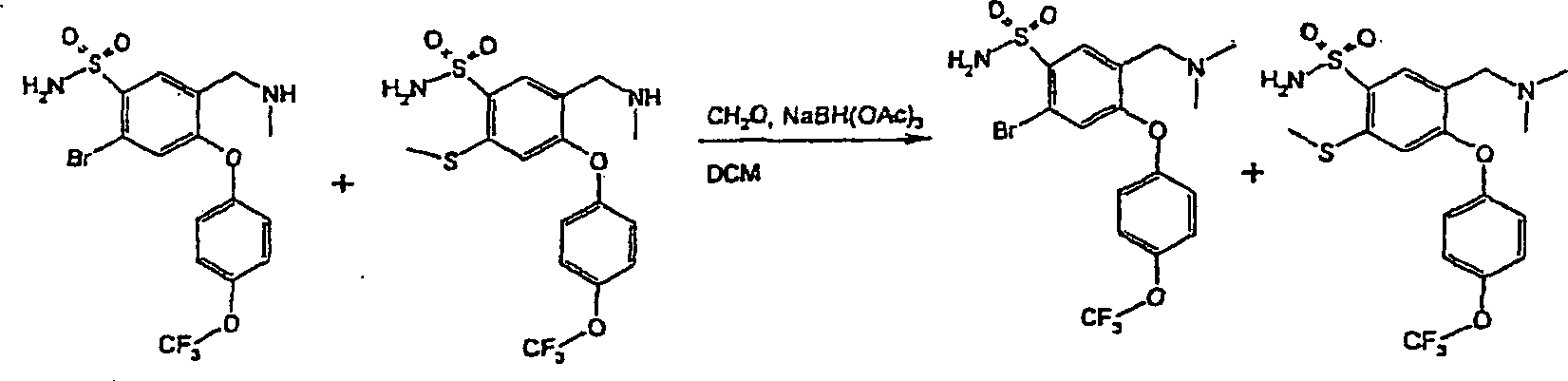
Das
bei der Umsetzung von Beispiel 78 vor der HPLC-Reinigung erhaltene Gemisch aus Brom-
und Methylsulfanylsulfonamiden (136 mg, etwa 0,3 mmol) wurde in
DCM (2 ml) gelöst
und mit Formaldehyd (37% wässrig) (80 μl, 3 Äquivalente)
behandelt. Das Reaktionsgemisch wurde 30 Minuten gerührt, wonach
Natriumtri-(acteoxy)-borhydrid
(273 mg, 1,3 mmol) zugegeben wurde. Nach weiterem 1-stündigem Rühren wurde
das Gemisch eingedampft, durch Zugabe von Salzsäure (2 M) abgeschreckt und
durch Zugabe einer wässrigen Natriumhydroxidlösung (2
M) auf einen leicht alkalischen pH-Wert gebracht. Sodann wurde das
Gemisch mit Ether (2 × 30
ml) extrahiert. Die vereinigten organischen Fraktionen wurden getrocknet
(MgSO4) und zu einem farblosen Öl eingedampft.
Nach Reinigung durch Flash-Chromatographie
(Siliciumdioxid; 97:3:0,3 (DCM/Methanol/880 Ammoniak)) erhielt man
einen weißen
Schaum, der nach Auflösen
in Diethylether und Verdünnung mit
Pentan ein weißes
Pulver ergab. Bei diesem Material handelte es sich gemäß 1H-NMR um ein 50:50-Gemisch der Verbindungen
der Beispiele 79 und 80. Diese Probe wurde weiter durch HPLC gereinigt
(Magellen C18 15·21,12
cm-Säule,
0,2% Diethylamin(aq)/Acetonitril (50:50),
Fließgeschwindigkeit
20 ml/min). Man erhielt die Verbindung von Beispiel 79 (Retentionszeit
12,02 min, 15 mg) und die Verbindung von Beispiel 80 (Retentionszeit
12,56 min, 25,6 mg).
Beispiel 79: 15 mg, freie Base: δH (CDCl3, 400 MHz) 2,26 (6H, s), 3,56 (2H, s), 7,08
(1H, s), 7,13 (1H, d), 7,33 (1H, d), 8,16 (1H, s); MS m/z (TS+) 469, 471 (MH+).
Beispiel
80: 25,6 mg, Hydrochloridsalz: δH (CD3OD, 400 MHz)
2,30 (3H, s), 2,88 (6H, s), 4,40 (2H, brs), 6,80 (1H, s), 7,28 (2H,
d), 7,40 (2H, d), 8,14 (1H, d); MS m/z (TS+)
437 (MH+).The mixture of bromo- and methylsulfanylsulfonamides obtained in the reaction of Example 78 prior to HPLC purification (136 mg, about 0.3 mmol) was dissolved in DCM (2 mL) and washed with formaldehyde (37% aqueous) (80 μL, 3 Equivalents). The reaction mixture was stirred for 30 minutes after which sodium tri (actoxy) borohydride (273 mg, 1.3 mmol) was added. After stirring for an additional 1 h, the mixture was evaporated, quenched by the addition of hydrochloric acid (2 M), and brought to a slightly alkaline pH by the addition of 2M aqueous sodium hydroxide solution. The mixture was extracted with ether (2 x 30 ml). The combined organic fractions were dried (MgSO 4 ) and evaporated to a colorless oil. Purification by flash chromatography (silica, 97: 3: 0.3 (DCM / methanol / 880 ammonia)) gave a white foam which, when dissolved in diethyl ether and diluted with pentane, gave a white powder. This material was a 50:50 mixture of the compounds of Examples 79 and 80 by 1 H NMR. This sample was further purified by HPLC (Magellen C18 15 x 21.12 cm column, 0.2% diethylamine (aq) / acetonitrile (50:50), flow rate 20 ml / min). The compound of Example 79 (retention time 12.02 min, 15 mg) and the compound of Example 80 (retention time 12.56 min, 25.6 mg) were obtained.
Example 79: 15 mg, free base: δ H (CDCl 3, 400 MHz) 2.26 (6H, s), 3.56 (2H, s), 7.08 (1H, s), 7.13 (1H , d), 7.33 (1H, d), 8.16 (1H, s); MS m / z (TS + ) 469, 471 (MH + ).
Example 80: 25.6 mg, hydrochloride salt: δ H (CD 3 OD, 400 MHz) 2.30 (3H, s), 2.88 (6H, s), 4.40 (2H, brs), 6.80 (1H, s), 7.28 (2H, d), 7.40 (2H, d), 8.14 (1H, d); MS m / z (TS + ) 437 (MH + ).
Beispiel
81 3-[(Methylamino)-methyl]-4-[4-(trifluormethoxy)-phenoxy]-benzonitril 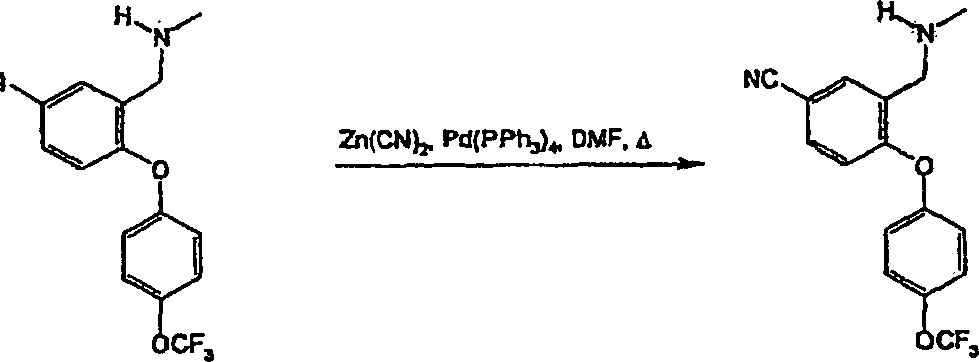
Das Produkt von Beispiel 17 (2,46 g, 5,8 mmol) wurde zusammen mit Palladium-tetrakis-(triphenylphosphin) (0,538 g, 0,47 mmol) und Zink(II)-cyanid (478 mg, 4,1 mmol) in DMF (30 ml) gelöst. Das Reaktionsgemisch wurde 12 Stunden gerührt und auf 100°C erwärmt. Nach Abkühlen auf Raumtemperatur wurde das Reaktionsgemisch in Wasser gegossen und 3-mal mit Ethylacetat extrahiert. Die vereinigten organischen Extrakte wurden getrocknet (MgSO4) und zu einem braunen Öl eingedampft. Der Rückstand wurde durch Flash-Chromatographie (SiO2; DCM/Methanol/880 Ammoniak (95:5:0,5 → 90:10:1)) gereinigt. Das erhaltene Material wurde erneut einer Säulenchromatographie unterzogen (SiO2; Ethylacetat/Methanol/880 Ammoniak (95:5:0,5)), wobei ein weißer Feststoff verblieb. Das Material wurde einer weiteren Reinigung durch Verreiben mit Ethylacetat/Diethylether unterzogen, wonach sich eine Trocknung unter Vakuum anschloss. Man erhielt die angestrebte Nitrilverbindung in Form eines gebrochen weißen Feststoffes (1,2 g, 64%); δH (CDCl3, 400 MHz) 2,67 (3H, s), 4,24 (2H, s), 6,77 (1H, d), 7,32 (4H, m), 7,58 (1H, d), 8,02 (1H, s); MS m/z (TS+) 323 (MH+).The product of Example 17 (2.46 g, 5.8 mmol) was co-extracted with palladium tetrakis (triphenylphosphine) (0.538 g, 0.47 mmol) and zinc (II) cyanide (478 mg, 4.1 mmol ) in DMF (30 ml). The reaction mixture was stirred for 12 hours and heated to 100 ° C. After cooling to room temperature, the reaction mixture was poured into water and extracted with ethyl acetate 3 times. The combined organic extracts were dried (MgSO 4 ) and evaporated to a brown oil. The residue was purified by flash chromatography (SiO 2 ; DCM / methanol / 880 ammonia (95: 5: 0.5 → 90: 10: 1)). The material obtained was again subjected to column chromatography (SiO 2 , ethyl acetate / methanol / 880 ammonia (95: 5: 0.5)) to leave a white solid. The material was subjected to further purification by trituration with ethyl acetate / diethyl ether, followed by drying under vacuum. The desired nitrile compound was obtained in the form of an off-white solid (1.2 g, 64%); δ H (CDCl 3, 400 MHz) 2.67 (3H, s), 4.24 (2H, s), 6.77 (1H, d), 7.32 (4H, m), 7.58 (1 H , d), 8.02 (1H, s); MS m / z (TS + ) 323 (MH + ).
Beispiele 82–86Examples 82-86
Eine Reihe von Nitrilen wurde aus den erforderlichen Arylhalogeniden (Iodiden oder Bromiden) gemäß dem Verfahren von Beispiel 81 hergestellt.A number of nitriles were prepared from the required aryl halides (iodides or bromides) according to prepared by the method of Example 81.
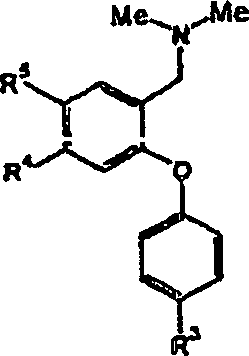
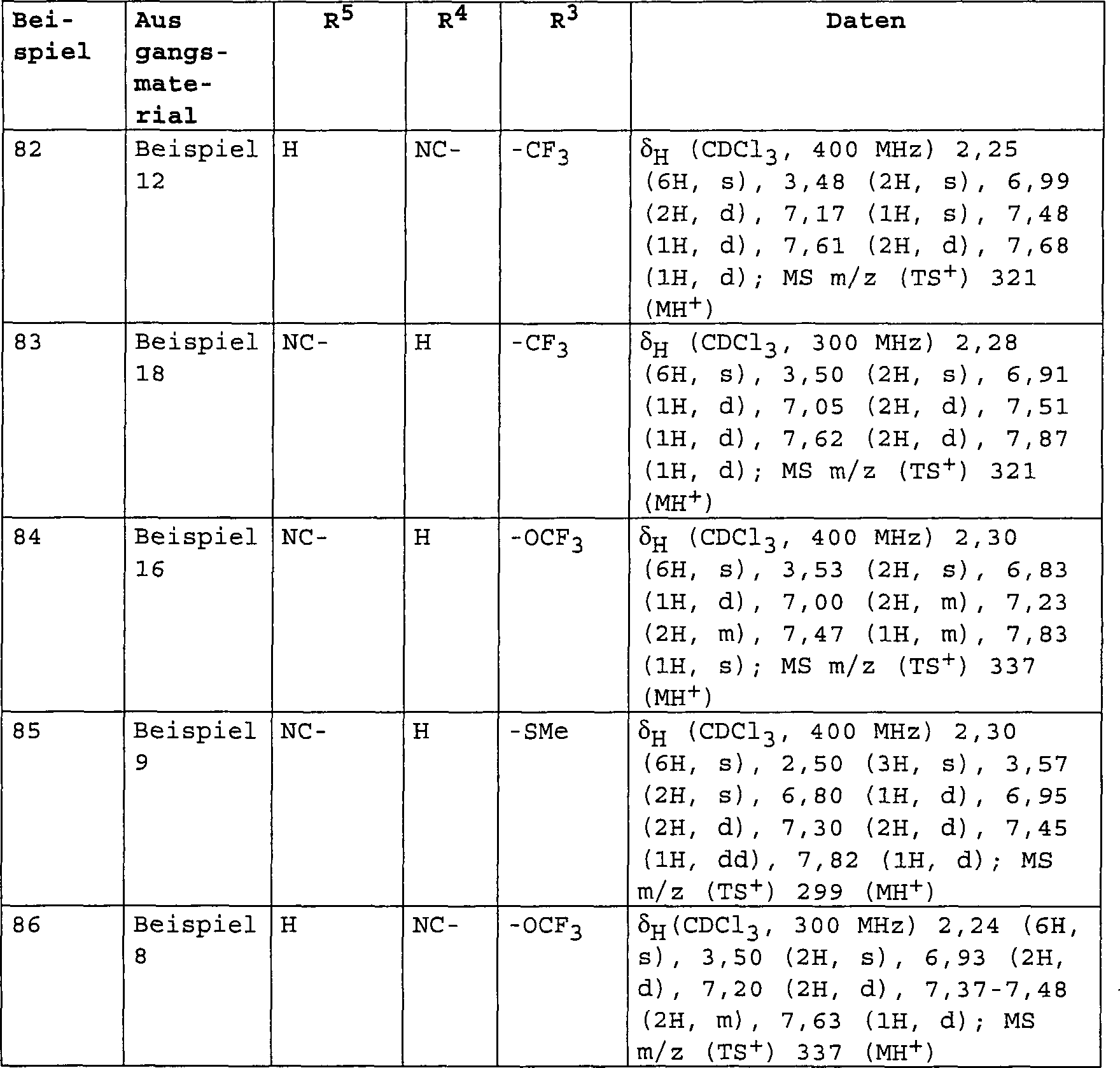
Beispiel
87 3-[(Methylamino)-methyl]-4-[4-(methylsulfanyl)-phenoxy]-benzonitril 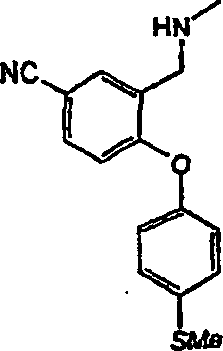
Das Titel-Nitril wurde aus dem Bromid von Beispiel 23 gemäß dem Verfahren von Beispiel 81 hergestellt. δH (DMSO-D6, 300 MHz) 2,47 (3H, s), 2,62 (3H, s), 4,25 (2H, s), 6,81 (1H, d), 7,18 (2H, d), 7,40 (2H, d), 7,81 (1H, dd), 8,06 (1H, d), 9,03 (2H, br); MS m/z (TS+) 285 (MH+).The title nitrile was prepared from the bromide of Example 23 according to the procedure of Example 81. δ H (DMSO-D 6 , 300 MHz) 2.47 (3H, s), 2.62 (3H, s), 4.25 (2H, s), 6.81 (1H, d), 7.18 (2H, d), 7.40 (2H, d), 7.81 (1H, dd), 8.06 (1H, d), 9.03 (2H, br); MS m / z (TS + ) 285 (MH + ).
Beispiel
88 {3-[(Dimethylamino)-methyl]-4-[4-methylsulfanyl)-phenoxy]-phenyl}-acetonitril 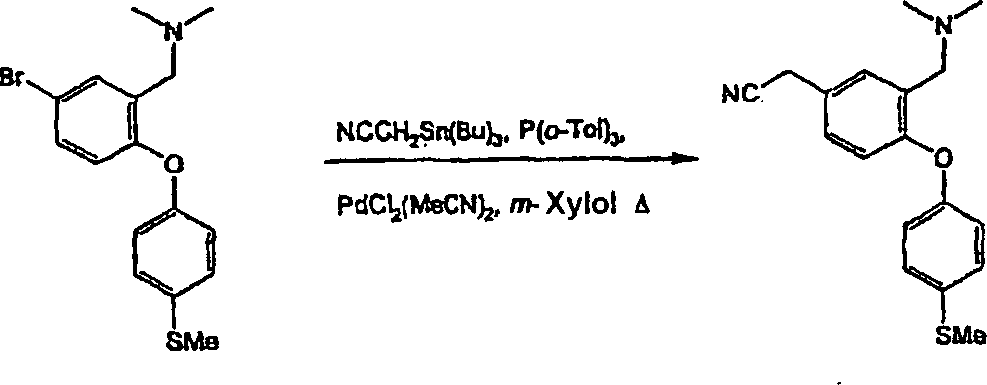
Ein Gemisch aus dem Bromid von Beispiel 9 (1,5 g, 4,26 mmol), von Tributyl-(cyanomethyl)-stannan (hergestellt gemäß M. Kosugi, M. Ishiguro, Y. Negishi, H. Sano, T. Migita, Chem. Lett., (1984), S. 1511–1512) (2,1 g, 6,36 mmol), Tri-o-tolylphosphin (78 mg, 0,26 mmol), Bis-(acetonitril)-dichlorpalladium(II) (33 mg, 0,13 mmol) und m-Xylol (20 ml) wurde 16 Stunden bei 120°C unter Stickstoff gerührt. Nach Abkühlen auf Raumtemperatur wurde das Lösungsmittel unter Vakuum entfernt. Der Rückstand wurde durch Flash-Chromatographie (SiO2; DCM/MeOH/880 NH3 (97:3:0,5)) gereinigt. Man erhielt die angestrebte Verbindung (895 mg, 67%) in Form eines gelben Öls. δH (CDCl3, 400 MHz) 2,27 (6H, s), 2,47 (3H, s), 3,46 (2H, s), 3,74 (2H, s), 6,87 (3H, m), 7,18 (1H, d), 7,25 (2H, d), 7,45 (1H, s); MS m/z (TS+) 313.A mixture of the bromide of Example 9 (1.5 g, 4.26 mmol), tributyl (cyanomethyl) stannane (prepared according to M. Kosugi, M. Ishiguro, Y. Negishi, H. Sano, T. Migita , Chem. Lett., (1984), pp. 1511-1512) (2.1 g, 6.36 mmol), tri-o-tolylphosphine (78 mg, 0.26 mmol), bis (acetonitrile) dichloropalladium (II) (33mg, 0.13mmol) and m-xylene (20ml) was stirred at 120 ° C for 16 hours under nitrogen. After cooling to room temperature, the solvent was removed in vacuo. The residue was purified by flash chromatography (SiO 2 ; DCM / MeOH / 880 NH 3 (97: 3: 0.5)). The desired compound (895 mg, 67%) was obtained in the form of a yellow oil. δ H (CDCl 3, 400 MHz) 2.27 (6H, s), 2.47 (3H, s), 3.46 (2H, s), 3.74 (2H, s), 6.87 (3H , m), 7.18 (1H, d), 7.25 (2H, d), 7.45 (1H, s); MS m / z (TS + ) 313.
Beispiel
89 {3-[(Dimethylamino)-methyl]-4-[4-(trifluormethoxy)-phenoxy]-phenyl}-acetonitril Stufe
1. Herstellung des Cyanoester-Zwischenprodukts 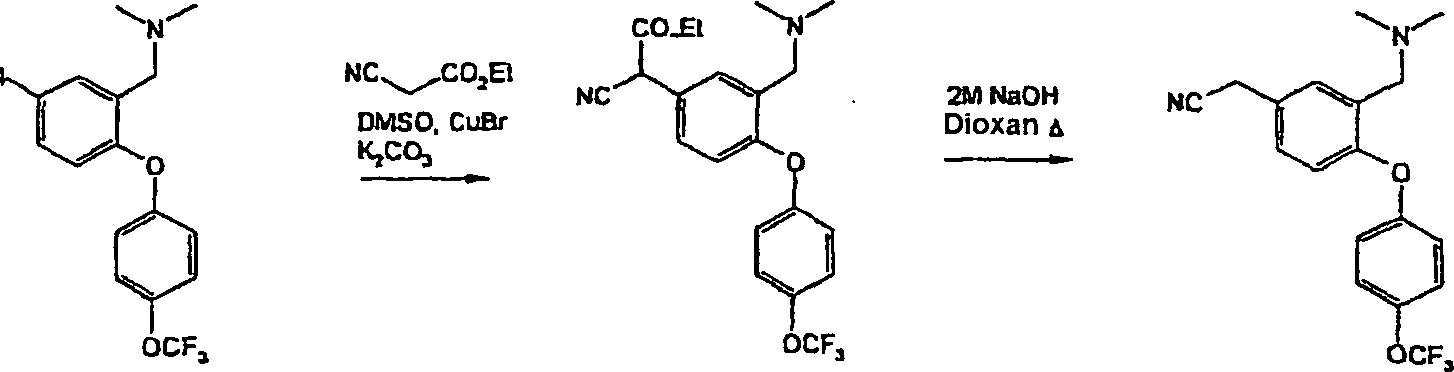
Ein Gemisch aus der Iodidverbindung von Beispiel 16 (1,03 g, 2,37 mmol), CuBr (1,70 g, 11,8 mmol), α-Cyanoethylacetat (1,337 g, 11,83 mmol) und Kaliumcarbonat (3,29 g, 23,7 mmol) in DMSO (30 ml) wurde 2 Stunden unter Stickstoff auf 120°C erwärmt. Nach Abkühlen auf Raumtemperatur wurde das Gemisch mit Ether und gesättigter wässriger Ammoniumchloridlösung ausgeschüttelt. Die organische Phase wurde mit Kochsalzlösung gewaschen, getrocknet (MgSO4) und unter Vakuum eingeengt. Der Rückstand wurde durch Flash-Chromatographie (SiO2; DCM/MeOH (98:2)) gereinigt. Man erhielt das angestrebte Cyanoester-Zwischenprodukt (410 mg, 41%). δH (CDCl3, 400 MHz) 1,27 (3H, t), 2,22 (6H, s), 3,46 (2H, s), 4,23 (2H, q), 4,64 (1H, br), 6,89 (1H, d), 6,92 (2H, d), 7,18 (2H, d), 7,33 (1H, d), 7,60 (1H, s); MS m/z (TS+) 423 (MH+).A mixture of the iodide compound of Example 16 (1.03 g, 2.37 mmol), CuBr (1.70 g, 11.8 mmol), α-cyanoethylacetate (1.337 g, 11.83 mmol) and potassium carbonate (3, 29 g, 23.7 mmol) in DMSO (30 ml) was heated to 120 ° C under nitrogen for 2 hours. After cooling to room temperature, the mixture was extracted by shaking with ether and saturated aqueous ammonium chloride solution. The organic phase was washed with brine, dried (MgSO 4 ) and concentrated in vacuo. The residue was purified by flash chromatography (SiO 2 ; DCM / MeOH (98: 2)). The desired cyanoester intermediate was obtained (410 mg, 41%). δ H (CDCl 3, 400 MHz) 1.27 (3H, t), 2.22 (6H, s), 3.46 (2H, s), 4.23 (2H, q), 4.64 (1 H , br), 6.89 (1H, d), 6.92 (2H, d), 7.18 (2H, d), 7.33 (1H, d), 7.60 (1H, s); MS m / z (TS + ) 423 (MH + ).
Stufe 2. Esterhydrolyse/Decarboxylierung zur Bildung der angestrebten NitrilverbindungStep 2. Ester hydrolysis / decarboxylation to form the desired nitrile compound
{3-[(Dimethylamino)-methyl]-4-[4-(trifluormethoxy)-phenoxy]-phenyl}-acetonitril{3 - [(dimethylamino) methyl] -4- [4- (trifluoromethoxy) phenoxy] phenyl} -acetonitrile
Natriumhydroxid (39 mg, 0,97 mmol) wurde zu einer Lösung des Cyanoester-Zwischenprodukts (410 mg, 0,97 mmol) in Dioxan (40 ml) gegeben. Das Gemisch wurde 2 Stunden unter Rückfluss erwärmt. Nach Abkühlen auf Raumtemperatur wurde das Reaktionsgemisch mit Ether und Wasser ausgeschüttelt. Die organische Phase wurde mit Kochsalzlösung gewaschen, getrocknet (MgSO4) und unter Vakuum eingeengt. Der Rückstand wurde durch Flash-Chromatographie (SiO2; DCM/MeOH (97:3)) gereinigt. Man erhielt die angestrebte Nitrilverbindung (141 mg, 41%); δH (CDCl3, 400 MHz) 2,25 (6H, s), 3,43 (2H, s), 3,75 (2H, s), 6,85–6,97 (3H, m), 7,13–7,24 (3H, m), 7,46 (1H, s); MS m/z (TS+) 351 (MH+).Sodium hydroxide (39 mg, 0.97 mmol) was added to a solution of the cyanoester intermediate (410 mg, 0.97 mmol) in dioxane (40 mL). The mixture was refluxed for 2 hours. After cooling to room temperature, the reaction mixture was extracted by shaking with ether and water. The organic phase was washed with brine, dried (MgSO 4 ) and concentrated in vacuo. The residue was purified by flash chromatography (SiO 2 ; DCM / MeOH (97: 3)). The desired nitrile compound was obtained (141 mg, 41%); δ H (CDCl 3, 400 MHz) 2.25 (6H, s), 3.43 (2H, s), 3.75 (2H, s), 6.85-6.97 (3H, m), 7 , 13-7.24 (3H, m), 7.46 (1H, s); MS m / z (TS + ) 351 (MH + ).
Beispiel
90 4-[(Dimethylamino)-methyl]-3-[4-(trifluormethyl)-phenoxy]-benzamid 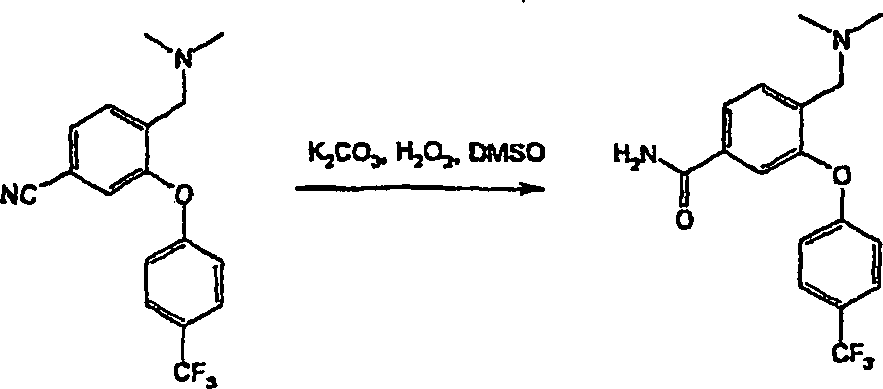
Die Nitrilverbindung von Beispiel 82 (300 mg, 0,94 mmol) wurde in DMSO (2 ml) gelöst und mit Kaliumcarbonat (43 mg, 0,3 mmol) und anschließend mit H2O2 (30%, 0,2 ml) versetzt, Das Reaktionsgemisch wurde 30 Minuten bei Raumtemperatur gerührt, sodann mit Wasser (5 ml) verdünnt und mit Diethylether (2 × 10 ml) extrahiert. Die vereinigten Etherphasen wurden mit MgSO4 getrocknet und zu einem Öl eingedampft. Der Rückstand wurde durch Flash-Chromatographie (SiO2; DCM/MeOH/880 NH3 (93:7:1)) gereinigt. Man erhielt die angestrebte Amidverbindung in Form eines farblosen Feststoffes (258 mg, 78%); δH (CDCl3, 300 MHz) 2,24 (6H, s), 3,45 (2H, s), 5,60–6,00 (2H, 2 × brs), 6,98 (2H, d), 7,44 (1H, s), 7,54–7,64 (4H, m); MS m/z (TS+) 339 (MH+).The nitrile compound of Example 82 (300 mg, 0.94 mmol) was dissolved in DMSO (2 mL) and washed with potassium carbonate (43 mg, 0.3 mmol) followed by H 2 O 2 (30%, 0.2 mL). The reaction mixture was stirred at room temperature for 30 minutes, then diluted with water (5 ml) and extracted with diethyl ether (2 × 10 ml). The combined ether phases were dried with MgSO 4 and evaporated to an oil. The residue was purified by flash chromatography (SiO 2 ; DCM / MeOH / 880 NH 3 (93: 7: 1)). The desired amide compound was obtained in the form of a colorless solid (258 mg, 78%); δ H (CDCl 3 , 300 MHz) 2.24 (6H, s), 3.45 (2H, s), 5.60-6.00 (2H, 2 x brs), 6.98 (2H, d) , 7.44 (1H, s), 7.54-7.64 (4H, m); MS m / z (TS + ) 339 (MH + ).
Beispiel
91 3-[(Dimethylamino)-methyl]-4-[4-(methylsulfanyl)-phenoxy]-benzamid 
Die Nitrilverbindung von Beispiel 85 (60 mg, 0,2 mmol) wurde in tert.-Butanol gelöst. Nach Zugabe von Kaliumhydroxid (45 mg, 0,8 mmol) wurde das Gemisch 1 Stunde unter Stickstoff unter Rückfluss erwärmt. Sodann wurde das Gemisch abgekühlt und mit Wasser und EtOAc verdünnt. Die organische Phase wurde abgetrennt, mit Kochsalzlösung gewaschen, getrocknet (MgSO4) und zu einem blassgelben kautschukartigen Produkt eingedampft. Nach Reinigung durch Flash-Chromatographie (SiO2; DCM/MeOH/880 NH3 (95:5:1)) erhielt man das angestrebte Amid in Form eines weißen Pulvers (39 mg, 61%); δH (CDCl3, 400 MHz) 2,30 (6H, s), 2,50 (3H, s), 3,57 (2H, s), 5,60 (1H, br), 6,00 (1H, br), 6,86 (1H, d), 6,92 (2H, d), 7,27 (2H, d), 7,73 (1H, dd), 7,93 (1H, s); MS m/z (TS+) 317 (MH+).The nitrile compound of Example 85 (60 mg, 0.2 mmol) was dissolved in t-butanol. Potassium hydroxide (45mg, 0.8mmol) was added and the mixture was refluxed under nitrogen for 1 hour. The mixture was cooled and diluted with water and EtOAc. The organic phase was separated, washed with brine, dried (MgSO 4 ) and evaporated to a pale yellow gum-like product. Purification by flash chromatography (SiO 2 ; DCM / MeOH / 880 NH 3 (95: 5: 1)) gave the desired amide as a white powder (39 mg, 61%); δ H (CDCl 3, 400 MHz) 2.30 (6H, s), 2.50 (3H, s), 3.57 (2H, s), 5.60 (1H, br), 6.00 (1H , br), 6.86 (1H, d), 6.92 (2H, d), 7.27 (2H, d), 7.73 (1H, dd), 7.93 (1H, s); MS m / z (TS + ) 317 (MH + ).
Beispiel
92 2-{3-[(Dimethylamino)-methyl]-4-[4-(methylsulfanyl)-phenoxy]-phenyl}-acetamid 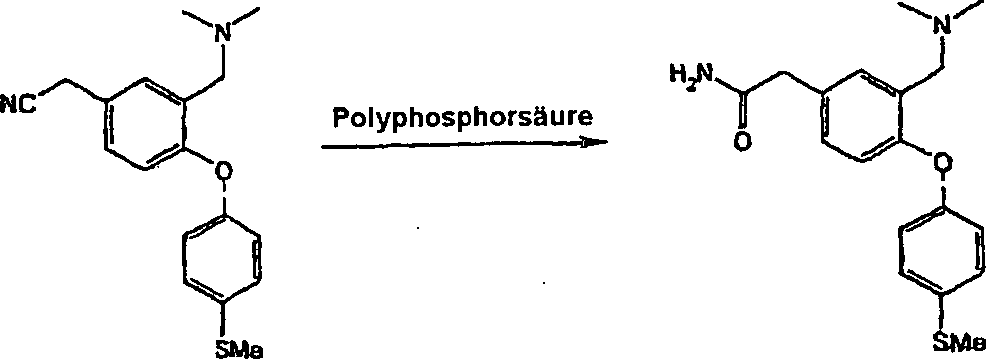
Ein Gemisch aus der Nitrilverbindung von Beispiel 88 (100 mg, 0,32 mmol) und Polyphosphorsäure (750 mg) wurde 75 Minuten unter Stickstoff auf 110°C erwärmt. Nach Abkühlen auf Raumtemperatur wurde Natriumhydroxid (2 M) zugegeben. Das erhaltene Gemisch wurde mit Ethylacetat (3-mal) extrahiert. Die vereinigten organischen Extrakte wurden getrocknet (MgSO4) und unter Vakuum eingeengt. Der Rückstand wurde durch Flash-Chromatographie (DCM/MeOH/880 NH3 (93:7:1 → 90:10:1)) gereinigt. Man erhielt die angestrebte primäre Amidverbindung (58 mg, 55%); δH (CDCl3, 400 MHz) 2,25 (6H, s), 2,45 (3H, s), 3,45 (2H, s), 3,55 (2H, s), 5,63 (1H, br), 5,76 (1H, br), 6,87 (3H, m), 7,15 (1H, d), 7,25 (2H, d), 7,40 (1H, s); MS m/z (TS+) 331 (MH+).A mixture of the nitrile compound of Example 88 (100 mg, 0.32 mmol) and polyphosphoric acid (750 mg) was heated to 110 ° C under nitrogen for 75 minutes. After cooling to room temperature, sodium hydroxide (2 M) was added. The resulting mixture was extracted with ethyl acetate (3 times). The combined organic extracts were dried (MgSO 4 ) and concentrated in vacuo. The residue became purified by flash chromatography (DCM / MeOH / 880 NH 3 (93: 7: 1 → 90: 10: 1)). The desired primary amide compound was obtained (58 mg, 55%); δ H (CDCl 3, 400 MHz) 2.25 (6H, s), 2.45 (3H, s), 3.45 (2H, s), 3.55 (2H, s), 5.63 (1 H , br), 5.76 (1H, br), 6.87 (3H, m), 7.15 (1H, d), 7.25 (2H, d), 7.40 (1H, s); MS m / z (TS + ) 331 (MH + ).
Beispiele 93–97Examples 93-97
Eine Reihe von primären Amiden wurde hergestellt, indem man die erforderlichen Nitrile gemäß den in den Beispielen 90, 91 oder 92 beschriebenen Reaktionen den entsprechenden Hydrolysebedingungen unterwarf.A Series of primary Amides were prepared by adding the required nitriles according to the procedures described in Examples 90, 91 or 92 described the corresponding Subjected to hydrolysis conditions.


Beispiel
98 4-[(Dimethylamino)-methyl]-3-[4-(trifluormethoxy)-phenoxy]-benzamid 
Ein Gemisch aus der Bromidverbindung von Beispiel 8 (500 mg, 1,28 mmol), Palladium(II)-chlorid (7 mg, 0,04 mmol), Triphenylphosphin (20 mg, 0,08 mmol), Hexamethyldisilazan (1,08 ml, 5,12 mmol) und DMPU (5 ml) wurde 16 Stunden unter Kohlenmonoxid (100 psi Druck) auf 120°C erwärmt. Zu diesem Zeitpunkt ergab die TLC-Analyse keine Veränderung, so dass Palladium-tetrakis-(triphenylphosphin) (200 mg, 0,17 mmol) und Natriumamid (500 mg, 12,8 mmol) zugegeben wurden und das Reaktionsgemisch weitere 16 Stunden unter Kohlenmonoxid (100 psi Druck) auf 120°C erwärmt wurde. Nach Zugabe von Methanol wurde das Gemisch unter Vakuum zu einem schwarzen Öl eingeengt. Dieses Öl wurde mit Ethylacetat und einer Natriumhydroxidlösung (1 M) ausgeschüttelt. Die organische Phase wurde mit Wasser (3-mal) und Kochsalzlösung gewaschen, getrocknet (MgSO4) und unter Vakuum eingeengt. Der Rückstand wurde durch wiederholte Flash-Chromatographie an Siliciumdioxid gereinigt. Man erhielt die angestrebte primäre Amidverbindung (33 mg, 7%) in Form eines blassgelben Pulvers. δH (CDCl3, 400 MHz) 2,25 (6H, s), 3,50 (2H, s), 5,50 (1H, br), 5,90 (1H, br), 6,95 (2H, d), 7,17 (2H, d), 7,39 (1H, s), 7,55 (1H, d), 7,58 (1H, d); MS m/z (TS+) 355 (MH+).A mixture of the bromide compound of Example 8 (500 mg, 1.28 mmol), palladium (II) chloride (7 mg, 0.04 mmol), triphenylphosphine (20 mg, 0.08 mmol), hexamethyldisilazane (1.08 ml, 5.12 mmol) and DMPU (5 mL) was heated at 120 ° C for 16 hours under carbon monoxide (100 psi pressure). At this time, TLC analysis showed no change to add palladium tetrakis (triphenylphosphine) (200 mg, 0.17 mmol) and sodium amide (500 mg, 12.8 mmol) and the reaction mixture for a further 16 hours under carbon monoxide (100 psi pressure) was heated to 120 ° C. After addition of methanol, the mixture was concentrated under vacuum to a black oil. This oil was shaken out with ethyl acetate and a sodium hydroxide solution (1 M). The organic phase was washed with water (3 times) and brine, dried (MgSO 4 ) and concentrated in vacuo. The residue was purified by repeated flash chromatography on silica. The desired primary amide compound (33 mg, 7%) was obtained in the form of a pale yellow powder. δ H (CDCl 3, 400 MHz) 2.25 (6H, s), 3.50 (2H, s), 5.50 (1H, br), 5.90 (1H, br), 6.95 (2H , d), 7.17 (2H, d), 7.39 (1H, s), 7.55 (1H, d), 7.58 (1H, d); MS m / z (TS + ) 355 (MH + ).
Beispiele
99–100 4-[(Dimethylamino)-methyl]-N-methyl-3-[4-(trifluormethoxy)-phenoxy]-benzamid
(Beispiel 99) und 4-[(Dimethylamino)-methyl]-N,N-dimethyl-3-[4-(trifluormethoxy)-phenoxy]-benzamid
(Beispiel 100) 
Die
Bromidverbindung von Beispiel 8 (500 mg, 1,28 mmol) wurde zusammen
mit Monomethylamin (2 M in THF, 6,4 ml, 12,8 mmol), Triethylamin
(446 μl,
3,2 mmol) und Palladium-tetrakis-(triphenylphosphin) (75 mg, 0,06
mmol) in DMF (10 ml) gelöst.
Das Reaktionsgemisch wurde in eine Bombe gebracht. Kohlenmonoxid wurde
bis zu einem Druck von 50 psi eingeleitet. Sodann wurde das Gemisch über Nacht
auf 100°C
erwärmt. Anschließend wurde
der Druck abgelassen und weiterer Palladium-Katalysator (100 mg,
0,09 mmol) wurde zusammen mit weiterem Monomethylamin in THF (3
ml, 6 mmol) zugegeben. Sodann wurde Kohlenmonoxid bis zu einem Druck
von 100 psi eingeleitet. Das Gemisch wurde erneut über Nacht
auf 120°C
erwärmt.
Nach Druckentlastung wurde weiterer Palladium-Katalysator (130 mg,
0,1 mmol) zugesetzt. Sodann wurde das Gemisch weitere 4 Stunden
unter 100 psi Kohlenmonoxid auf 120°C erwärmt. Um anschließend die
Reaktion zu Ende zu führen
(gemäß Beurteilung
durch TLC-Analyse) wurden weitere Mengen an Palladium-Katalysator (200
mg, 0,17 mmol) und Methylamin in THF (6,4 ml, 12,8 mmol) zugegeben.
Sodann wurde das Reaktionsgemisch weitere 60 Stunden unter 100 psi
Kohlenmonoxid auf 120°C
erwärmt.
Nach einer letzten Druckentlastung wurden die Lösungsmittel unter vermindertem
Druck abgedampft. Es verblieb ein orangefarbenes Öl. Dieses Öl wurde
mit Natriumhydroxid (1 M) alkalisch gemacht und mit Ethylacetat
extrahiert. Der organische Extrakt wurde mit Wasser (3-mal) und
Kochsalzlösung
gewaschen, über
MgSO4 getrocknet und sodann zu einem orangefarbenen Öl eingedampft.
Nach Reinigung durch wiederholte Flash-Chromatographie (SiO2; MeOH (2,5%–5%) in DCM mit einem Gehalt
an 0,5% 880 NH3) erhielt man die Methylamidverbindung
in Form eines farblosen Öls,
das beim Stehenlassen langsam kristallisierte (105 mg, 23%), und
das entsprechende Dimethylamidmaterial in Form eines farblosen Öls (130
mg, 27%).
Beispiel 99: δH (CDCl3, 400 MHz)
2,26 (6H, s), 2,98 (3H, d), 3,50 (2H, s), 6,00 (1H, br), 6,95 (2H,
d), 7,17 (2H, d), 7,33 (1H, s), 7,50 (1H, d), 7,58 (1H, d); MS m/z
(TS+) 369 (MH+).
Beispiel
100: δH (CDCl3, 400 MHz)
2,27 (6H, s), 2,95 (3H, br), 3,05 (3H, br), 3,47 (2H, s), 6,95 (2H,
d), 6,96 (1H, s), 7,15 (2H, d), 7,20 (1H, d), 7,50 (1H, d); MS m/z
(TS+) 383 (MH+).The bromide compound of Example 8 (500 mg, 1.28 mmol) was co-extracted with monomethylamine (2M in THF, 6.4 mL, 12.8 mmol), triethylamine (446 μL, 3.2 mmol) and palladium tetrakis. (triphenylphosphine) (75 mg, 0.06 mmol) in DMF (10 mL). The reaction mixture was bombed. Carbon monoxide was introduced to a pressure of 50 psi. The mixture was then warmed to 100 ° C overnight. The pressure was then released and further palladium catalyst (100 mg, 0.09 mmol) was added along with further monomethylamine in THF (3 mL, 6 mmol). Carbon monoxide was then introduced to a pressure of 100 psi. The mixture was reheated to 120 ° C overnight. After depressurization, additional palladium catalyst (130 mg, 0.1 mmol) was added. The mixture was then heated at 120 ° C for a further 4 hours under 100 psi carbon monoxide. Subsequently, to complete the reaction (as judged by TLC analysis), additional amounts of palladium catalyst (200 mg, 0.17 mmol) and methylamine in THF (6.4 mL, 12.8 mmol) were added. The reaction was then heated to 120 ° C under 100 psi carbon monoxide for a further 60 hours. After a final depressurization, the solvents were evaporated under reduced pressure. It left an orange oil. This oil was basified with sodium hydroxide (1 M) and extracted with ethyl acetate. The organic extract was washed with water (3 times) and brine, dried over MgSO 4 and then evaporated to an orange oil. Purification by repeated flash chromatography (SiO 2 , MeOH (2.5% -5%) in DCM containing 0.5% 880 NH 3 ) gave the methylamide compound as a colorless oil which slowly crystallized on standing (105 mg, 23%), and the corresponding dimethylamide material as a colorless oil (130 mg, 27%).
Example 99: δ H (CDCl 3, 400 MHz) 2.26 (6H, s), 2.98 (3H, d), 3.50 (2H, s), 6.00 (1H, br), 6, 95 (2H, d), 7,17 (2H, d), 7,33 (1H, s), 7,50 (1H, d), 7,58 (1H, d); MS m / z (TS + ) 369 (MH + ).
Example 100: δ H (CDCl 3, 400 MHz) 2.27 (6H, s), 2.95 (3H, br), 3.05 (3H, br), 3.47 (2H, s), 6 95 (2H, d), 6.96 (1H, s), 7.15 (2H, d), 7.20 (1H, d), 7.50 (1H, d); MS m / z (TS + ) 383 (MH + ).
Beispiele 101–106Examples 101-106
Eine Reihe von Mono- und Dimethylaminen wurde in analoger Weise zu den Umsetzungen der Beispiele 99 und 100 hergestellt, wobei man die entsprechenden Bromide oder Iodide als Ausgangsverbindungen einsetzte. In jedem Fall wurde die Umsetzung bei Temperatur- und Druckbedingungen und mit einer ausreichenden Katalysatormenge durchgeführt, um einen vollständigen Verbrauch der Ausgangsmaterialien zu gewährleisten.A Series of mono- and dimethylamines was prepared analogously to the Reactions of Examples 99 and 100 prepared using the corresponding bromides or iodides used as starting compounds. In each case, the reaction was carried out under conditions of temperature and pressure and with a sufficient amount of catalyst to a complete one To ensure consumption of the starting materials.
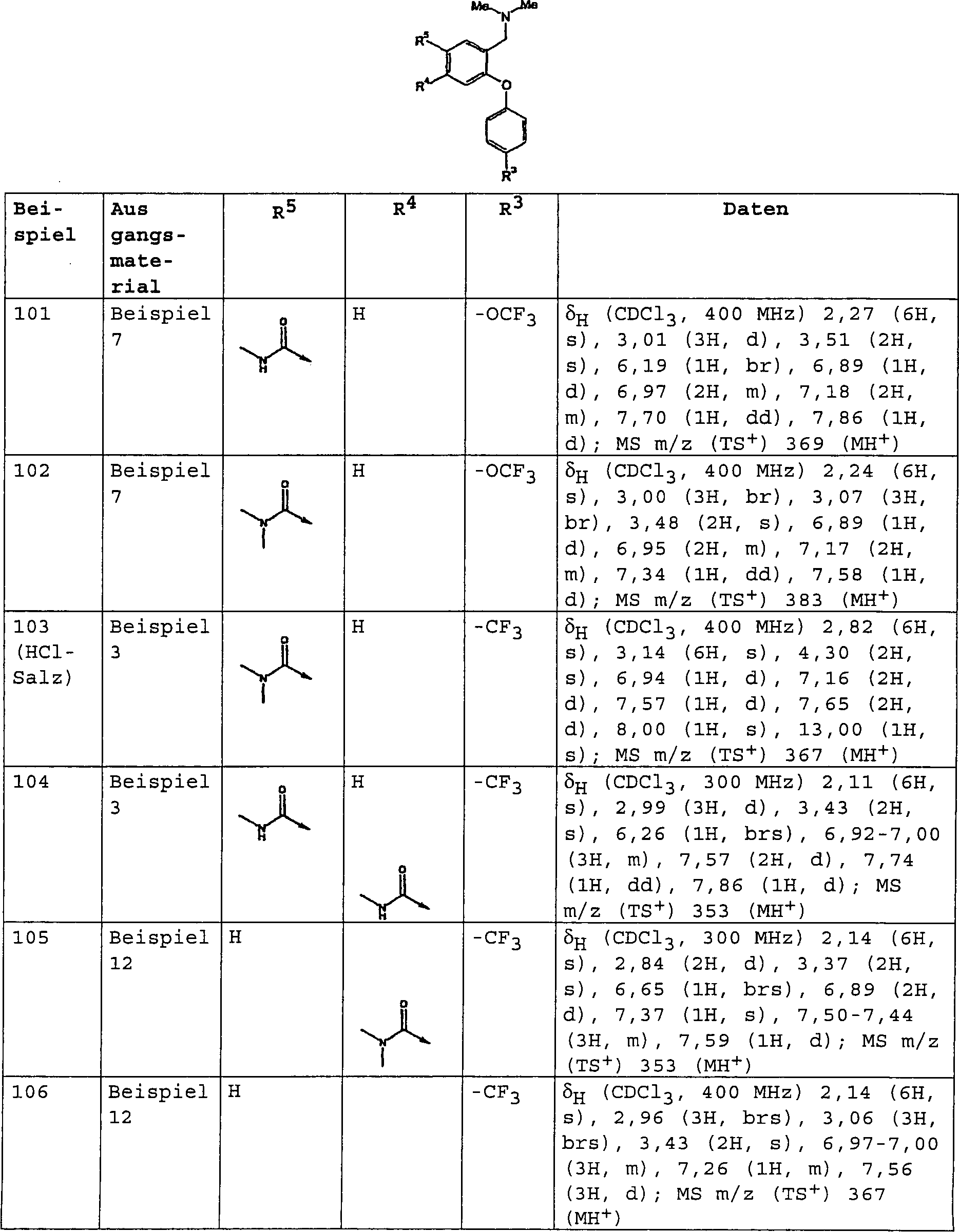
Beispiel
107 N-{5-Amino-2-[4-(trifluormethyl)-phenoxy]-benzyl}-N,N-dimethylamin 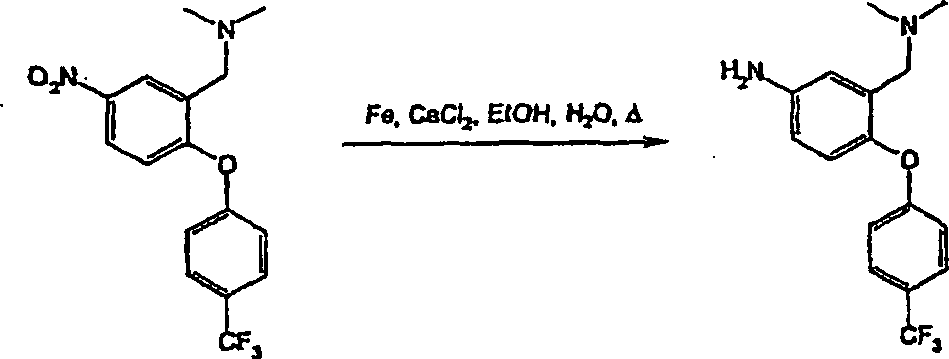
Ein Gemisch aus der Nitroverbindung von Beispiel 21 (400 mg, 1,18 mmol), Eisenpulver (591 mg, 10,6 mmol) und Calciumchlorid (65 mg, 0,59 mmol) in 85%igem wässrigem Ethanol (15 ml) wurde 18 Stunden unter Rückfluss erwärmt. Sodann wurde das Reaktionsgemisch auf Raumtemperatur abgekühlt und durch Celite® filtriert und sodann gründlich mit Ethanol und anschließend mit Ethylacetat gewaschen. Nach Entfernen des Lösungsmittels unter Vakuum wurde der Rückstand durch Flash-Chromatographie (SiO2; DCM/MeOH/880 NH3 (95:5:0,5)) gereinigt. Man erhielt die angestrebte Anilinverbindung (299 mg, 82%) in Form eines beigefarbenen Feststoffes. δH (CDCl3, 300 MHz) 2,20 (6H, s), 3,27 (2H, s), 3,63 (2H, brs), 6,60 (1H, dd), 6,80 (1H, d), 6,87 (1H, d), 6,90 (2H, d), 7,50 (2H, d); MS m/z (TS+) 310 (MH+).A mixture of the nitro compound of Example 21 (400 mg, 1.18 mmol), iron powder (591 mg, 10.6 mmol) and calcium chloride (65 mg, 0.59 mmol) in 85% aqueous ethanol (15 ml) Heated under reflux for 18 hours. Then the reaction mixture was cooled to room temperature and filtered through Celite ® and then washed thoroughly with ethanol and then with ethyl acetate. After removing the solvent under vacuum, the residue was purified by flash chromatography (SiO 2 ; DCM / MeOH / 880 NH 3 (95: 5: 0.5)). The desired aniline compound (299 mg, 82%) was obtained in the form of a beige solid. δ H (CDCl 3, 300 MHz) 2.20 (6H, s), 3.27 (2H, s), 3.63 (2H, brs), 6.60 (1H, dd), 6.80 (1 H , d), 6.87 (1H, d), 6.90 (2H, d), 7.50 (2H, d); MS m / z (TS + ) 310 (MH + ).
Beispiele 108–109Examples 108-109
Eine Reihe von Anilinen wurde unter Anwendung der Bedingungen von Beispiel 107 aus den erforderlichen Nitroverbindungen hergestellt. Die Daten für diese Verbindungen sind nachstehend aufgeführt.A Series of anilines was prepared using the conditions of example 107 made from the required nitro compounds. The data for this Compounds are listed below.

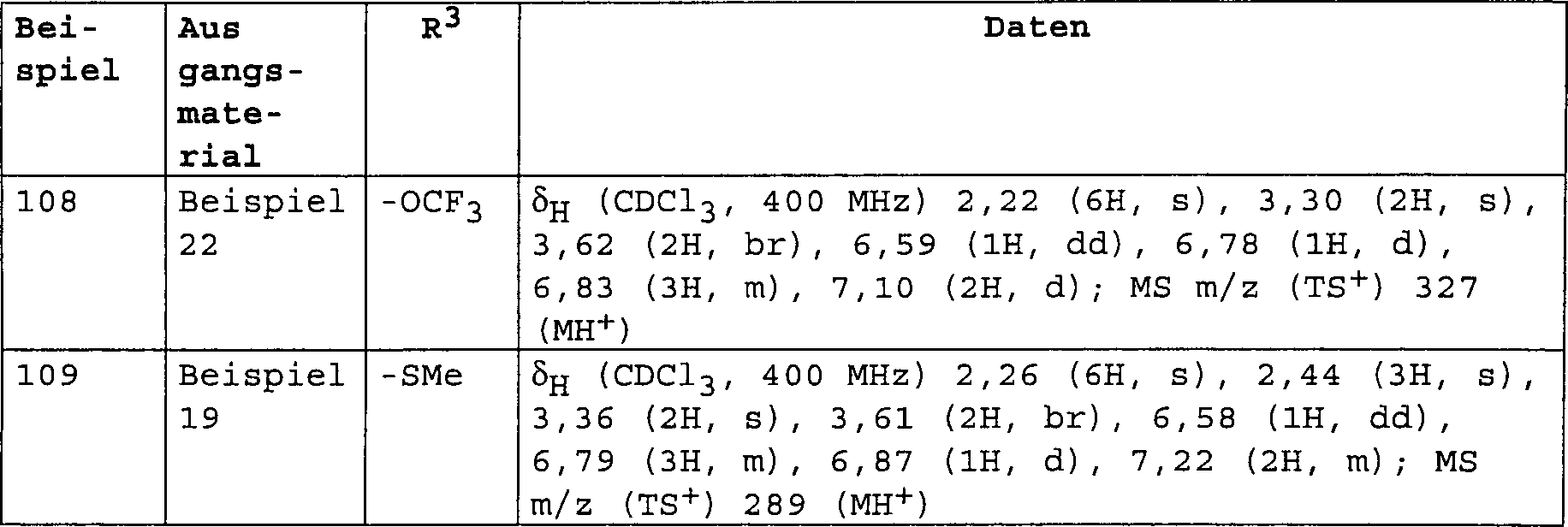
Beispiel
110 N-{5-(Aminomethyl)-2-[4-(trifluormethoxy)-phenoxy]-benzyl}-N,N-dimethylamin 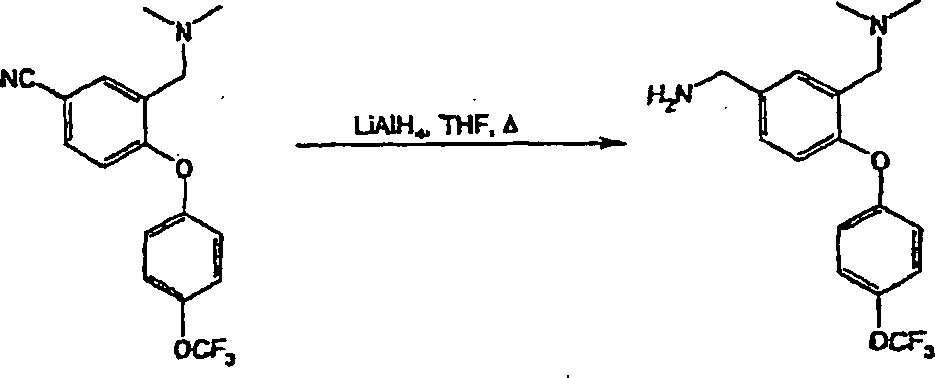
Eine Lösung von Lithiumaluminiumhydrid in THF (1 M, 7,1 ml, 7,1 mmol) wurde bei Raumtemperatur unter Stickstoff zu einer Lösung der Nitrilverbindung von Beispiel 84 (2,40 g, 7,14 mmol) in THF (50 ml) gegeben. Nach Rühren über Nacht wurde weiteres Lithiumaluminiumhydrid in THF (1 M, 7,1 ml, 7,1 mmol) zugesetzt. Das Gemisch wurde 1 Stunde unter Rückfluss erwärmt, sodann auf Raumtemperatur abgekühlt und vorsichtig mit Wasser abgeschreckt. Sodann wurde das Gemisch getrocknet (MgSO4) und filtriert (gründliches Waschen mit THF). Das Filtrat und die Waschflüssigkeiten wurden unter Vakuum eingeengt. Nach Reinigung des Rückstands durch Flash-Chromatographie (SiO2; DCM/MeOH/880 NH3 (90:10:1 → 84:14:2)) erhielt man die angestrebte Aminverbindung (1,95 g, 80%) als rotstichiges Öl. δH (CDCl3, 400 MHz) 1,73, (2H, br), 2,26 (6H, s), 3,43 (2H, s), 3,87 (2H, s), 6,90 (3H, m), 7,13 (2H, d), 7,20 (1H, dd), 7,43 (1H, d); MS m/z (TS+) 341 (MH+).A solution of lithium aluminum hydride in THF (1 M, 7.1 mL, 7.1 mmol) was added at room temperature under nitrogen to a solution of the nitrile compound of Example 84 (2.40 g, 7.14 mmol) in THF (50 mL). given. After stirring overnight, additional lithium aluminum hydride in THF (1M, 7.1 mL, 7.1 mmol) was added. The mixture was refluxed for 1 hour, then cooled to room temperature and quenched gently with water. The mixture was dried (MgSO 4 ) and filtered (THF washing thoroughly). The filtrate and washings were concentrated in vacuo. Purification of the residue by flash chromatography (SiO 2 , DCM / MeOH / 880 NH 3 (90: 10: 1 → 84: 14: 2)) afforded the desired amine compound (1.95 g, 80%) as a reddish oil , δ H (CDCl 3, 400 MHz) 1.73, (2H, br), 2.26 (6H, s), 3.43 (2H, s), 3.87 (2H, s), 6.90 ( 3H, m), 7,13 (2H, d), 7,20 (1H, dd), 7,43 (1H, d); MS m / z (TS + ) 341 (MH + ).
Beispiele 111–113Examples 111-113
Die allgemeine Umsetzung von Beispiel 110 wurde zur Herstellung einer Reihe von Aminen aus den entsprechenden Nitrilvorstufen wiederholt.The general reaction of Example 110 was used to prepare a Repeated series of amines from the corresponding nitrile precursors.

Beispiel
114 N-{3-[(Dimethylamino)-methyl]-4-[4-(trifluormethyl)-phenoxy]-phenyl}-methansulfonamid 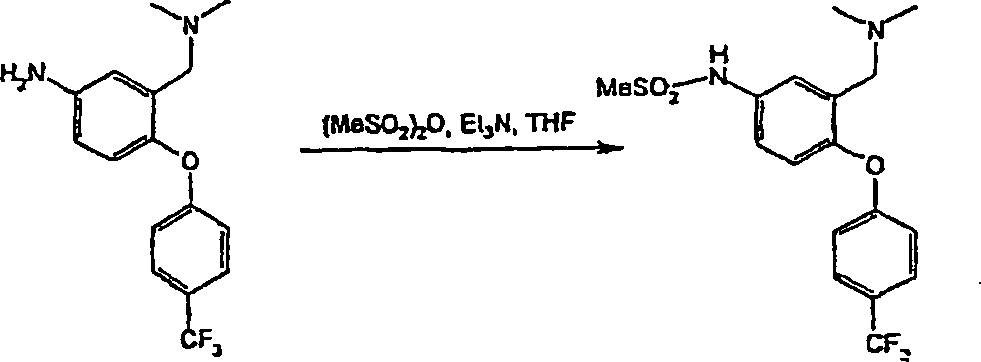
Eine Lösung der Anilinverbindung von Beispiel 107 (295 mg, 0,95 mmol) in THF (10 ml) wurde nacheinander mit Triethylamin (397 μl, 2,85 mmol) und Methansulfonsäureanhydrid (331 mg, 1,9 mmol) behandelt. Das Gemisch wurde 1 Stunde bei Raumtemperatur gerührt. Sodann wurde die Umsetzung durch Zugabe von 1 M Natriumhydroxid gestoppt. Das Gemisch wurde 30 Minuten gerührt und sodann mit Ethylacetat extrahiert. Die organische Phase wurde mit Kochsalzlösung gewaschen, getrocknet (MgSO4) und zu einem braunen Öl eingedampft. Nach Reinigung durch Flash-Chromatographie (SiO2; DCM/MeOH/880 NH3 (95:5:1)) erhielt man die angestrebte Methansulfonamidverbindung in Form eines farblosen Öls, das beim Stehenlassen zu einem weißen Feststoff (291 mg, 79%) kristallisierte. δH (CDCl3, 400 MHz) 2,22 (6H, s), 3,05 (3H, s), 3,39 (2H, s), 6,95 (2H, d), 6,95 (1H, d), 7,21 (1H, dd), 7,37 (1H, d), 7,58 (2H, d); MS m/z (TS+) 389 (MH+).A solution of the aniline compound of Example 107 (295 mg, 0.95 mmol) in THF (10 mL) was treated sequentially with triethylamine (397 μL, 2.85 mmol) and methanesulfonic anhydride (331 mg, 1.9 mmol). The mixture was stirred for 1 hour at room temperature. The reaction was stopped by addition of 1 M sodium hydroxide. The mixture was stirred for 30 minutes and then extracted with ethyl acetate. The organic phase was washed with brine, dried (MgSO 4 ) and evaporated to a brown oil. Purification by flash chromatography (SiO 2 ; DCM / MeOH / 880 NH 3 (95: 5: 1)) afforded the desired methanesulfonamide compound as a colorless oil which on standing left to a white solid (291 mg, 79%). crystallized. δ H (CDCl 3, 400 MHz) 2.22 (6H, s), 3.05 (3H, s), 3.39 (2H, s), 6.95 (2H, d), 6.95 (1H , d), 7.21 (1H, dd), 7.37 (1H, d), 7.58 (2H, d); MS m / z (TS + ) 389 (MH + ).
Beispiele 115–120Examples 115-120
Eine
Reihe von Methansulfonamiden wurde nach ähnlichen Verfahren wie in Beispiel
114 aus dem erforderlichen Anilin oder Amin hergestellt. In einigen
Fällen
wurde Methansulfonylchlorid anstelle des Anhydrids verwendet und/oder
DCM wurde als Lösungsmittel
verwendet. 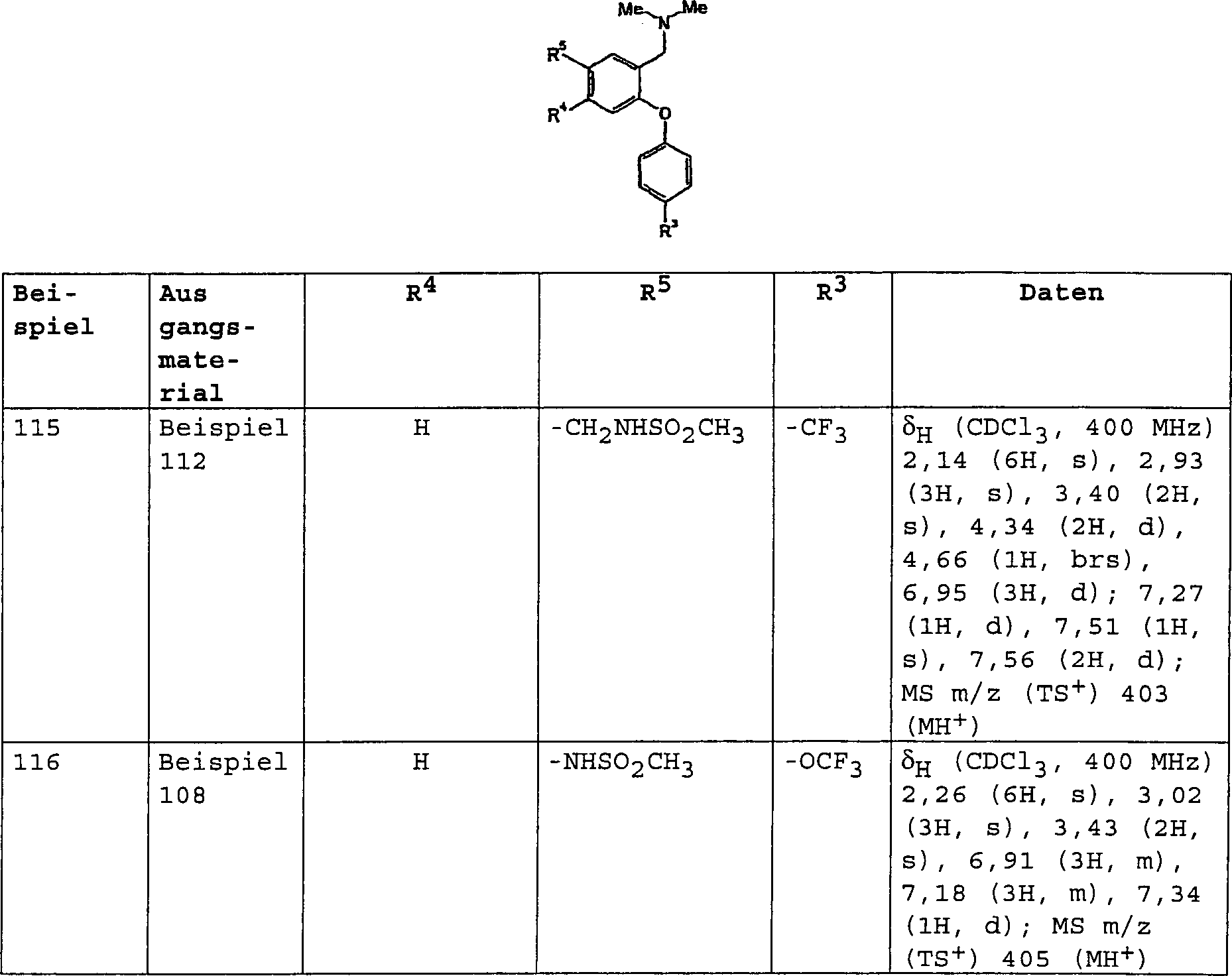
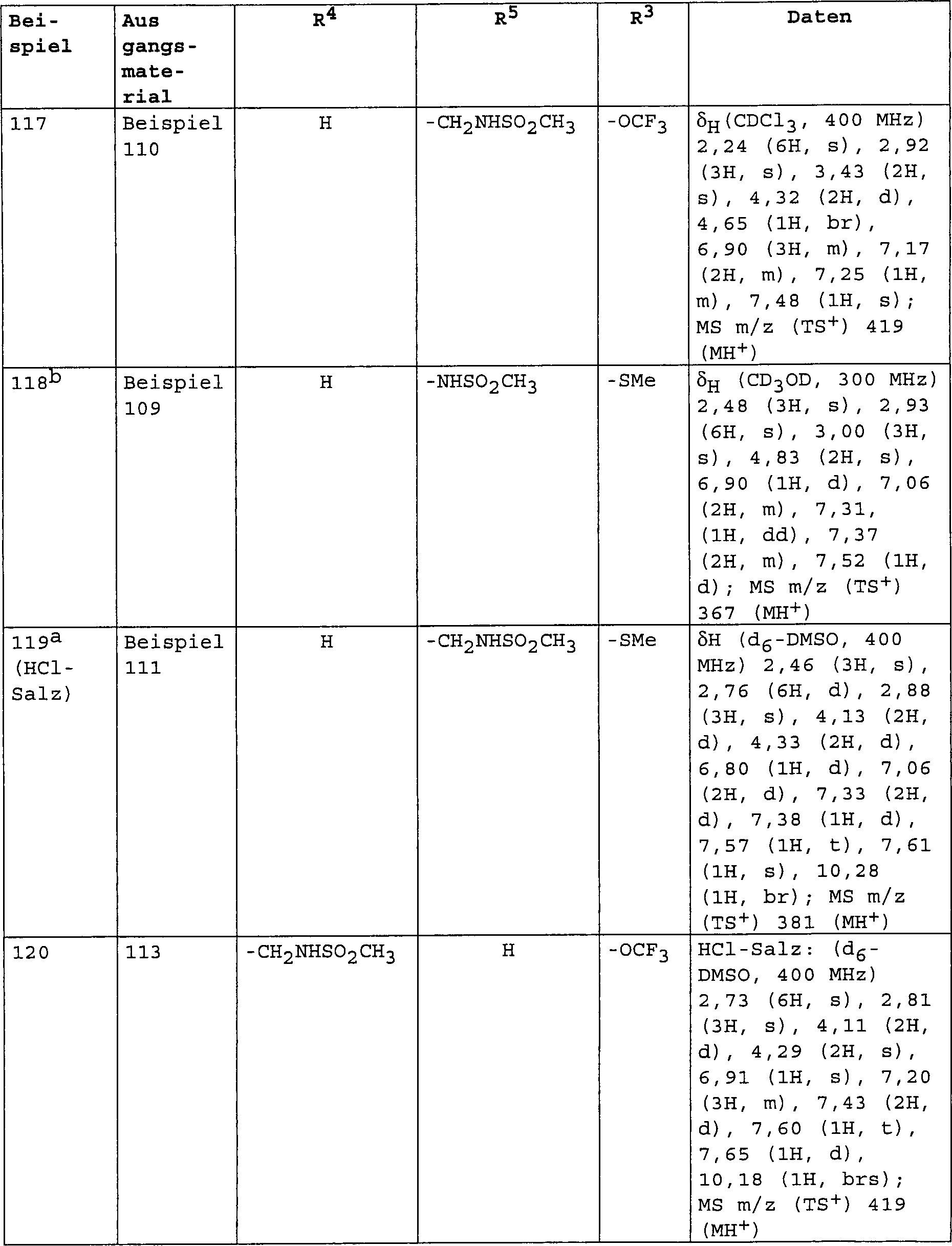
- a MeSO2Cl (1 Äquivalent) wurde anstelle von (MeSO2)2O verwendet und DCM wurde als Lösungsmittel verwendet.
- b Überschüssiges MeSO2Cl wurde anstelle von (MeSO2)2O verwendet und DCM wurde als Lösungsmittel verwendet. Nach Aufarbeiten auf übliche Weise wurde das rohe Produkt (großenteils Bis-mesylat) in 1,4-Dioxan in Lösung gebracht und mit einem Überschuss an 2 M NaOH(aq) behandelt. Nach Rühren über Nacht wurde das Lösungsmittel unter Vakuum entfernt. Der Rückstand wurde mit gesättigter NH4Cl(aq)-Lösung und DCM ausgeschüttelt. Die Extraktion und Reinigung wurde auf übliche Weise durchgeführt.
- a MeSO 2 Cl (1 equivalent) was used in place of (MeSO 2 ) 2 O and DCM was used as the solvent.
- b Excess MeSO 2 Cl was used in place of (MeSO 2 ) 2 O and DCM was used as solvent. After working up in the usual manner, the crude product (largely bis-mesylate) in solution in 1,4-dioxane was dissolved and treated with an excess of 2M NaOH (aq) . After stirring overnight, the solvent was removed in vacuo. The residue was partitioned between saturated NH 4 Cl (aq) solution and DCM. The extraction and purification were carried out in the usual way.
Beispiel
121 N-{3-[(Methylamino)-methyl]-4-[4-(trifluormethyl)-phenoxy]-phenyl}-methansulfonamid 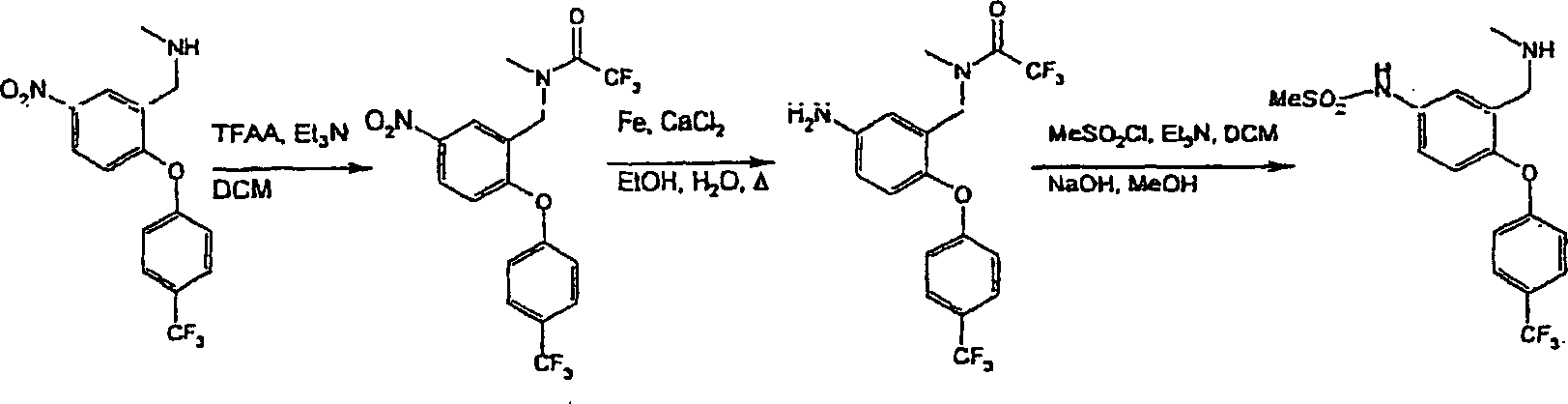
Stufe 1. Schutz des AminsStage 1. Protection of the amine
Die Aminverbindung von Beispiel 20 (3,08 g, 9,44 mmol) wurde in DCM (20 ml) gelöst. Anschließend wurden DMAP (50 mg, 0,41 mmol) und Triethylamin (5,26 ml, 37,8 mmol) zugegeben. Die Lösung wurde auf 0°C abgekühlt und sodann tropfenweise innerhalb von 10 Minuten mit TFAA (2,76 ml, 18,9 mmol) versetzt. Sodann ließ man das Reaktionsgemisch auf Raumtemperatur erwärmen und rührte es weitere 20 Minuten. Nach Stoppen der Umsetzung durch Zugabe von Methanol (3 ml) wurde das Gemisch in 1 M Salzsäure (50 ml) gegossen. Die organische Phase wurde abgetrennt. Die wässrige Phase wurde mit DCM (2 × 30 ml) extrahiert. Die vereinigten organischen Fraktionen wurden getrocknet (MgSO4) und zu einem leicht schmutzig gelben Öl (4,60 g) des angestrebten Trifluoracetamids eingedampft, das nicht weiter gereinigt wurde. Zwei Amid-Rotomere waren im 1H-NMR-Spektrum sichtbar. Nachstehend sind nur die Daten für das Hauptrotomere angegeben. δH (CDCl3, 400 MHz) 3,23 (3H, s), 4,79 (2H, s), 6,92 (1H, d), 7,16 (2H, d), 7,70 (2H, d), 8,16 (1H, dd), 8,23 (1H, d); MS m/z (TS+) 440 (M + NH4 +).The amine compound of Example 20 (3.08 g, 9.44 mmol) was dissolved in DCM (20 mL). Then, DMAP (50 mg, 0.41 mmol) and triethylamine (5.26 mL, 37.8 mmol) were added. The solution was cooled to 0 ° C and then treated dropwise with TFAA (2.76 mL, 18.9 mmol) over 10 minutes. The reaction mixture was allowed to warm to room temperature and stirred for an additional 20 minutes. After stopping the reaction by adding methanol (3 ml), the mixture was poured into 1 M hydrochloric acid (50 ml). The organic phase was separated. The aqueous phase was extracted with DCM (2 × 30 ml). The combined organic fractions were dried (MgSO 4 ) and evaporated to a slightly dirty yellow oil (4.60 g) of the desired trifluoroacetamide, which was not further purified. Two amide rotomers were visible in the 1 H NMR spectrum. Only the data for the main monomer are shown below. δ H (CDCl 3, 400 MHz) 3.23 (3H, s), 4.79 (2H, s), 6.92 (1H, d), 7.16 (2H, d), 7.70 (2H , d), 8.16 (1H, dd), 8.23 (1H, d); MS m / z (TS + ) 440 (M + NH 4 + ).
Stufe 2. Reduktion zum Anilin mit EisenStage 2. Reduction to Aniline with iron
Das rohe Öl von Stufe 1 wurde in 85%igem wässrigem Ethanol (38 ml) zusammen mit Calciumchlorid (471 mg, 4,24 mmol) gelöst und mit Eisenpulver (4,75 g, 85 mmol) versetzt. Das Gemisch wurde 18 Stunden unter Rückfluss erwärmt und sodann auf Raumtemperatur abgekühlt. Anschließend wurde das Gemisch durch eine Schicht Arbocel® (Durchwaschen mit DCM) filtriert und zu einem Öl eingedampft. Das Öl wurde zur Reinigung durch eine Schicht Kieselgel geleitet und mit DCM/Methanol/880 NH3 (93:7:1) eluiert. Nach Eindampfen erhielt man das angestrebte Anilin in Form eines gelben Öls (3,35 g). Zwei Amid-Rotomere waren im 1H-NMR-Spektrum, das zeigte, dass das Material zu etwa 90% rein war, sichtbar. Nachstehend sind Daten nur für das Hauptrotomere angegeben. δH (CDCl3, 400 MHz) 3,04 (3H, s), 4,51 (2H, s), 6,66 (2H, m), 6,84 (1H, dd), 6,92 (2H, d), 7,53 (2H,).The crude oil of Step 1 was dissolved in 85% aqueous ethanol (38 ml) along with calcium chloride (471 mg, 4.24 mmol) and added with iron powder (4.75 g, 85 mmol). The mixture was refluxed for 18 hours and then cooled to room temperature. Subsequently, the mixture was filtered through a pad of Arbocel ® (washing through with DCM) and evaporated to an oil. The oil was passed through a pad of silica gel for purification and eluted with DCM / methanol / 880 NH 3 (93: 7: 1). Evaporation gave the desired aniline as a yellow oil (3.35 g). Two amide rotomers were visible in the 1 H-NMR spectrum, which showed that the material was about 90% pure. The following is data for the main monomer only. δ H (CDCl 3, 400 MHz) 3.04 (3H, s), 4.51 (2H, s), 6.66 (2H, m), 6.84 (1H, dd), 6.92 (2H , d), 7.53 (2H,).
Stufe 3. Sulfonamidbildung-HydrolyseStep 3. Sulfonamide Formation Hydrolysis
Das rohe Öl von Stufe 2 wurde in DCM (34 ml) gelöst. Triethylamin (9,48 ml, 68 mmol) und anschließend Methansulfonylchlorid (2,64 ml, 34 mmol) wurden tropfenweise zugegeben. Das Gemisch wurde weitere 30 Minuten gerührt und sodann durch Zugabe von Natriumhydroxid (2 M, 20 ml) abgeschreckt. Die organische Phase wurde abgetrennt. Die wässrige Phase wurde mit DCM (2 × 30 ml) extrahiert. Die vereinigten organischen Fraktionen wurden getrocknet (MgSO4) und zu einem Öl eingedampft, das durch Flash-Chromatographie (SiO2; MeOH (0 → 10%) in DCM) gereinigt wurde. Das erhaltene Öl wurde in Methanol (50 ml) gelöst und mit Natriumhydroxid (2,5 g) behandelt. Das Gemisch wurde über Nacht bei Raumtemperatur und sodann 1 Stunde unter Rückfluss erwärmt. Nach Abkühlen auf Raumtemperatur wurde das Gemisch durch Zugabe von Essigsäure (4 ml) angesäuert. Anschließend wurde 880-Ammoniak (100 ml) zugegeben. Die organische Phase wurde abgetrennt. Die wässrige Phase wurde mit DCM (2 × 50 ml) extrahiert. Die vereinigten organischen Fraktionen wurden getrocknet (MgSO4) und zu einem orangefarbenen Öl eingedampft. Das Öl wurde in Salzsäure (2 M) (100 ml) extrahiert. Die wässrige Phase wurde mit Diethylether (2 × 50 ml) gewaschen. Die Säure wurde durch vorsichtiges Eingießen in 880-Ammoniak (200 ml) neutralisiert. Das Gemisch wurde mit DCM (3 × 100 ml) extrahiert. Nach Trocknen (MgSO4) und Eindampfen wurde der Rückstand durch Flash-Chromatographie (SiO2; DCM/MeOH/880 NH3 (93:7:1)) gereinigt. Man erhielt die angestrebte Sulfonamidverbindung in Form eines Feststoffes (330 mg, 10%) der weiter durch Verreiben mit Diethylether/Pentan gereinigt wurde. Man erhielt die angestrebte Sulfonamidverbindung in Form eines cremefarbenen Pulvers (250 mg). δ (CDCl3, 400 MHz) 2,43 (3H, s), 3,02 (H, s), 3 71 (2H, s), 6,93 (1H, d), 6,94 (2H, d), 7,18 (1H, dd), 7,31 (1H, d), 7,57 (2H, d); MS m/z (TS+) 375 (MH+).The crude oil from Step 2 was dissolved in DCM (34 mL). Triethylamine (9.48 ml, 68 mmol) followed by methanesulfonyl chloride (2.64 ml, 34 mmol) was added dropwise. The mixture was stirred for a further 30 minutes and then quenched by addition of sodium hydroxide (2M, 20 mL). The organic phase was separated. The aqueous phase was extracted with DCM (2 × 30 ml). The combined organic fractions were dried (MgSO 4 ) and evaporated to an oil which was purified by flash chromatography (SiO 2 ; MeOH (0 → 10%) in DCM). The resulting oil was dissolved in methanol (50 ml) and treated with sodium hydroxide (2.5 g). The mixture was heated at room temperature overnight and then at reflux for 1 hour. After cooling to room temperature, the mixture was acidified by the addition of acetic acid (4 ml). Subsequently, 880 ammonia (100 ml) was added. The organic phase was separated. The aqueous phase was extracted with DCM (2 x 50 ml). The combined organic fractions were dried (MgSO 4 ) and evaporated to an orange oil. The oil was extracted into hydrochloric acid (2 M) (100 ml). The aqueous phase was washed with diethyl ether (2 x 50 ml). The acid was neutralized by gentle pouring into 880 ammonia (200 ml). The mixture was extracted with DCM (3 x 100 ml). After drying (MgSO 4 ) and evaporation, the residue was purified by flash chromatography (SiO 2 ; DCM / MeOH / 880 NH 3 (93: 7: 1)). The desired sulfonamide compound was obtained in the form of a solid (330 mg, 10%) which was further purified by trituration with diethyl ether / pentane. The desired sulfonamide compound was obtained in the form of an off-white powder (250 mg). δ (CDCl 3, 400 MHz) 2.43 (3H, s), 3.02 (H, s), 3 71 (2H, s), 6.93 (1H, d), 6.94 (2H, d ), 7.18 (1H, dd), 7.31 (1H, d), 7.57 (2H, d); MS m / z (TS + ) 375 (MH + ).
Beispiel
122 N-{3-[(Dimethylamino)-methyl]-4-[4-(trifluormethyl)-phenoxy]-phenyl}-N-(2-hydroxyethyl)-methansulfonamid 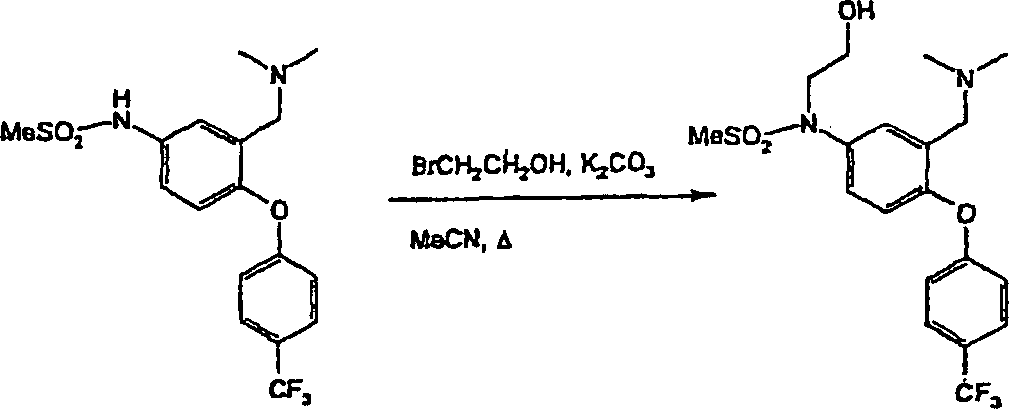
Die Methansulfonamidverbindung von Beispiel 114 (131 mg, 0,34 mmol), 2-Bromethanol (36 μl, 0,51 mmol) und Kaliumcarbonat (70 mg, 0,51 mmol) wurden in Acetonitril (2 ml) unter Rückfluss erwärmt. Nach 1,5 Stunden wurde eine weitere Portion von 2-Bromethanol (20 μl, 0,28 mmol) zugegeben. Das Gemisch wurde weitere 2,5 Stunden unter Rückfluss erwärmt, sodann auf Raumtemperatur abgekühlt und zu einem gelben Öl eingedampft. Nach Reinigung des Gemisches durch Flash-Chromatographie erhielt man die angestrebte Hydroxyethylsulfonamidverbindung in Form eines farblosen Öls (28 mg, 19%) neben Ausgangsmaterial (Methansulfonamid von Beispiel 67) (19,4 mg, 15%) und gemischten Fraktionen (58 mg). Angestrebte Verbindung: δH (CDCl3, 300 MHz) 2,23 (6H, s), 3,00 (3H, s), 3,43 (2H, s), 3,70 (2H, t), 3,85 (2H, t), 6,95 (1H, d), 7,00 (2H, dd), 7,28 (1H, dd), 7,58 (1H, d), 7,59 (2H, d); MS m/z (TS+) 433 (MH+).The methanesulfonamide compound of Example 114 (131 mg, 0.34 mmol), 2-bromoethanol (36 μL, 0.51 mmol) and potassium carbonate (70 mg, 0.51 mmol) were refluxed in acetonitrile (2 mL). After 1.5 hours, another portion of 2-bromoethanol (20 μl, 0.28 mmol) was added. The mixture was refluxed for an additional 2.5 hours, then cooled to room temperature and evaporated to a yellow oil. Purification of the mixture by flash chromatography gave the desired hydroxyethylsulfonamide compound as a colorless oil (28 mg, 19%) besides starting material (methanesulfonamide of Example 67) (19.4 mg, 15%) and mixed fractions (58 mg). Desired compound: δ H (CDCl 3, 300 MHz) 2.23 (6H, s), 3.00 (3H, s), 3.43 (2H, s), 3.70 (2H, t), 3, 85 (2H, t), 6.95 (1H, d), 7.00 (2H, dd), 7.28 (1H, dd), 7.58 (1H, d), 7.59 (2H, d ); MS m / z (TS + ) 433 (MH + ).
Beispiel
123 N-{3-(Aminomethyl)-4-[4-(methylsulfanyl)-phenoxy]-phenyl}-N-(2-hydroxyethyl)-methansulfonamid 
Boran-Tetrahydrofuran-Komplex (1 M Lösung in THF, 7,5 ml, 7,5 mmol) wurde unter N2 zu einer Lösung des Nitrils von Präparation 66 (1,9 g, 5,02 mmol) in THF (40 ml) gegeben. Das Gemisch wurde 20 Stunden unter Rückfluss erwärmt. Die TLC-Analyse ergab verbliebenes Ausgangsmaterial, so dass eine weitere Portion des Boran-Tetrahydrofuran-Komplexes (1 M Lösung in THF, 7,5 ml, 7,5 mmol) zugegeben wurde und das Sieden unter Rückfluss 2 Stunden fortgesetzt wurde. Nach Abkühlen auf Raumtemperatur wurde Salzsäure (6 M, 10 ml) zugegeben. Das Gemisch wurde 1 Stunde unter Rückfluss erwärmt. Sodann wurde das Gemisch erneut abgekühlt, mit Natriumhydroxid (2 M) alkalisch gemacht und mit Ethylacetat (100 ml) extrahiert. Der organische Extrakt wurde mit Kochsalzlösung gewaschen, getrocknet (MgSO4) und eingedampft. Der Rückstand wurde in Ethylacetat (50 ml) aufgenommen und mit Salzsäure (2 M) (50 ml + 2 × 25 ml) extrahiert. Die vereinigten wässrigen Extrakte wurden mit Natriumhydroxid (5 M) (50 ml) alkalisch gemacht und mit DCM (3 × 40 ml) extrahiert. Die organischen Extrakte wurden getrocknet (MgSO4) und eingedampft. Der Rückstand wurde durch Säulenchromatographie (SiO2; DCM/Methanol/880 NH3 (95:5:0,5)) gereinigt. Man erhielt die Titelverbindung. δH (CDCl3, 400 MHz) 2,44 (3H, s), 2,97 (3H, s), 3,67 (2H, t), 3,79 (2H, m), 3,88 (2H, s), 6,78 (1H, d), 6,91 (2H, d), 7,15 (1H, dd), 7,23 (2H, d), 7,39 (1H, d); MS m/z (ES+) 383 (MH+).Borane-tetrahydrofuran complex (1 M solution in THF, 7.5 mL, 7.5 mmol) was added under N 2 to a solution of the nitrile of Preparation 66 (1.9 g, 5.02 mmol) in THF (40 mL ). The mixture was refluxed for 20 hours. TLC analysis revealed residual starting material so that another portion of the borane-tetrahydrofuran complex (1 M solution in THF, 7.5 mL, 7.5 mmol) was added and boiling continued at reflux for 2 h. After cooling to room temperature, hydrochloric acid (6M, 10 ml) was added. The mixture was refluxed for 1 hour. The mixture was cooled again, basified with sodium hydroxide (2 M) and extracted with ethyl acetate (100 ml). The organic extract was washed with brine, dried (MgSO 4 ) and evaporated. The residue was taken up in ethyl acetate (50 ml) and extracted with hydrochloric acid (2 M) (50 ml + 2 x 25 ml). The combined aqueous extracts were basified with sodium hydroxide (5 M) (50 mL) and extracted with DCM (3 x 40 mL). The organic extracts were dried (MgSO 4 ) and evaporated. The residue was purified by column chromatography (SiO 2 ; DCM / methanol / 880 NH 3 (95: 5: 0.5)). The title compound was obtained. δ H (CDCl 3, 400 MHz) 2.44 (3H, s), 2.97 (3H, s), 3.67 (2H, t), 3.79 (2H, m), 3.88 (2H , s), 6.78 (1H, d), 6.91 (2H, d), 7.15 (1H, dd), 7.23 (2H, d), 7.39 (1H, d); MS m / z (ES + ) 383 (MH + ).
Beispiel
124 N-{3-(Aminomethyl)-4-[4-(methylsulfanyl)-3-(trifluormethyl)-phenoxy]-phenyl}-methansulfonamid 
Die Titelverbindung wurde aus dem Nitril von Präparation 64 unter Anwendung des in Beispiel 123 beschriebenen Verfahrens hergestellt. δH (CDCl3, 400 MHz) 2,48 (3H, s), 3,01 (3H, s), 3,87 (2H, s), 6,93 (1H, d), 7,05 (1H, d), 7,17 (1H, d), 7,27 (1H, obs), 7,30 (1H, s), 7,39 (1H, d); MS m/z (TS+) 407 (MH+).The title compound was prepared from the nitrile of Preparation 64 using the procedure described in Example 123. δ H (CDCl 3, 400 MHz) 2.48 (3H, s), 3.01 (3H, s), 3.87 (2H, s), 6.93 (1H, d), 7.05 (1H , d), 7,17 (1H, d), 7,27 (1H, obs), 7,30 (1H, s), 7,39 (1H, d); MS m / z (TS + ) 407 (MH + ).
Beispiel
125 N-{3-(Aminomethyl)-4-[4-(methylsulfanyl)-phenoxy]-phenyl}-methansulfonamid 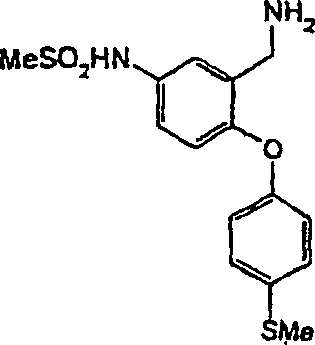
Lithiumaluminiumhydrid (1 M Lösung in THF, 6 ml, 6 mmol) wurde unter Stickstoff zu einer Lösung des Nitrils von Präparation 62 (1,01 g, 3,02 mmol) in THF (30 ml) gegeben. Das Gemisch wurde 3 Stunden unter Rückfluss erwärmt. Nach Abkühlen auf Raumtemperatur wurde die Umsetzung durch vorsichtige Zugabe von Natriumhydroxid (2 M, 2 ml) gestoppt. Das Reaktionsgemisch wurde getrocknet (MgSO4), filtriert und unter Vakuum eingeengt. Der Rückstand wurde durch Säulenchromatographie (SiO2; DCM/MeOH/880 NH3 (93:7:1)) gereinigt. Man erhielt ein gebrochen weißes Pulver (805 mg, 79%). δH (DMSO-d6, 400 MHz) 2,39 (3H, s), 2,47 (3H, s), 2,93 (3H, s), 3,58 (2H, s), 6,82 (3H, m), 7,02 (1H, dd), 7,21 (2H, d), 7,35 (1H, d); MS m/z (TS+) 339 (MH+).Lithium aluminum hydride (1 M solution in THF, 6 mL, 6 mmol) was added under nitrogen to a solution of the nitrile of Preparation 62 (1.01 g, 3.02 mmol) in THF (30 mL). The mixture was refluxed for 3 hours. After cooling to room temperature, the reaction was stopped by careful addition of sodium hydroxide (2 M, 2 mL). The reaction mixture was dried (MgSO 4 ), filtered and concentrated in vacuo. The residue was purified by column chromatography (SiO 2 ; DCM / MeOH / 880 NH 3 (93: 7: 1)). An off-white powder was obtained (805 mg, 79%). δ H (DMSO-d 6 , 400 MHz) 2.39 (3H, s), 2.47 (3H, s), 2.93 (3H, s), 3.58 (2H, s), 6.82 (3H, m), 7.02 (1H, dd), 7.21 (2H, d), 7.35 (1H, d); MS m / z (TS + ) 339 (MH + ).
Beispiel
126 N-{3-(Aminomethyl)-4-[4-(methylsulfanyl)-phenoxy]-phenyl}-N-methylmethansulfonamid 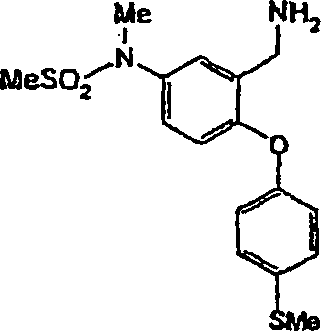
Lithiumaluminiumhydrid (1 M Lösung in THF, 15 ml, 15 mmol) wurde unter N2 zu einer Lösung des Nitrils von Präparation 65 (2,75 g, 7,89 mmol) in THF (50 ml) gegeben. Das Gemisch wurde 2 Stunden unter Rückfluss erwärmt. Nach Abkühlen auf Raumtemperatur wurde die Umsetzung durch vorsichtige Zugabe von Natriumhydroxid (2 M, 3 ml) gestoppt. Nach 10-minütigem Rühren wurde das Reaktionsgemisch getrocknet (MgSO4), filtriert und unter Vakuum eingeengt. Der Rückstand wurde durch mehrfache Säulenchromatographie (SiO2; DCM/(10% 880 Ammoniak in Methanol) 94:6) gereinigt. Als Produkt erhielt man ein Öl (783 mg, 28%). Eine Probe wurde in DCM aufgenommen und durch Zugabe von 1 M ätherischem HCl in das HCl-Salz umgewandelt. Nach Entfernen des Lösungsmittels und Trocknen unter Vakuum erhielt man einen gebrochen weißen Schaum. δH (DMSO-d6, 400 MHz) 2,44 (3H, s), 2,95 (3H, s), 3,16 (3H, s), 4,04 (2H, q), 6,74 (1H, d), 7,04 (2H, d), 7,31 (3H, m), 7,60 (1H, s), 8,30 (3H, br); MS m/z (ES+) 353 (MH+).Lithium aluminum hydride (1 M solution in THF, 15 mL, 15 mmol) was added under N 2 to a solution of the nitrile of Preparation 65 (2.75 g, 7.89 mmol) in THF (50 mL). The mixture was refluxed for 2 hours. After cooling to room temperature, the reaction was stopped by careful addition of sodium hydroxide (2 M, 3 ml). After stirring for 10 minutes, the reaction mixture was dried (MgSO 4 ), filtered and concentrated in vacuo. The residue was purified by multiple column chromatography (SiO 2 ; DCM / (10% 880 ammonia in methanol) 94: 6). The product was an oil (783 mg, 28%). A sample was taken in DCM and converted to the HCl salt by addition of 1 M ethereal HCl. Removal of the solvent and drying under vacuum gave an off-white foam. δ H (DMSO-d 6 , 400 MHz) 2.44 (3H, s), 2.95 (3H, s), 3.16 (3H, s), 4.04 (2H, q), 6.74 (1H, d), 7.04 (2H, d), 7.31 (3H, m), 7.60 (1H, s), 8.30 (3H, br); MS m / z (ES + ) 353 (MH + ).
Beispiel
127 N-{3-(Aminomethyl)-4-[3-methoxy-4-(methylsulfanyl)-phenoxy]-phenyl}-methansulfonamid 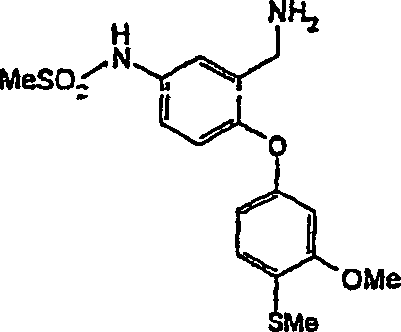
Das Verfahren von Beispiel 126 wurde unter Verwendung des Produkts von Präparation 63 wiederholt. Man erhielt das Titelamin. δH (CDCl3, 400 MHz) 2,33 (3H, s), 2,94 (3H, s), 3 78 (3H, s), 3,93 (2H, s), 6,50 (1H, dd), 6,67 (1H, s), 7,12–7,18 (2H, m), 7,33 (1H, d).The procedure of Example 126 was repeated using the product of Preparation 63. The title amine was obtained. δ H (CDCl 3, 400 MHz) 2.33 (3H, s), 2.94 (3H, s), 3 78 (3H, s), 3.93 (2H, s), 6.50 (1H, dd), 6.67 (1H, s), 7.12-7.18 (2H, m), 7.33 (1H, d).
Beispiel
128 N-{3-[
(Methylamino) -methyl]-4-[4-(methylsulfanyl)-phenoxy]-phenyl}-methansulfonamid 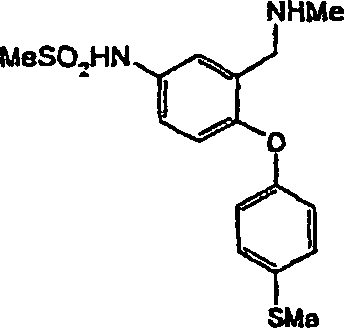
Ameisensäure (55 μl, 1,46 mmol) wurde bei 0°C zu einer Lösung von Pentafluorphenol (240 mg, 1,30 mmol) in Ether (5 ml) gegeben. Nach Zugabe von Dicyclohexylcarbodiimid (270 mg, 1,31 mmol) wurde das Gemisch 15 Minuten bei 0°C und sodann 2 Stunden bei Raumtemperatur gerührt. Nach Filtration wurde der Rückstand mit Ether gewaschen. Die Etherlösung von Pentafluorphenylformiat wurde zu einer Suspension des Amins von Beispiel 125 (221 mg, 0,65 mmol) in DCM (7 ml) gegeben. Das Gemisch wurde 18 Stunden bei Raumtemperatur gerührt und sodann mit DCM (40 ml) verdünnt und mit gesättigter wässriger NaHCO3-Lösung (50 ml) gewaschen. Die organische Phase wurde getrocknet und eingedampft. Man erhielt ein rohes Formamid, das ohne weitere Reinigung verwendet wurde. Das rohe Formamid (0,65 mmol) wurde in trockenem THF (10 ml) aufgenommen und mit Boran-Tetrahydrofuran-Komplex (1 M Lösung in THF, 2 ml, 2 mmol) versetzt. Das Gemisch wurde 1,5 Stunden unter Rückfluss erwärmt. Nach Abkühlen auf Raumtemperatur wurde Salzsäure (6 M, 5 ml) zugegeben. Das Gemisch wurde 15 Minuten gerührt und sodann mit gesättigter, wässriger Natriumbicarbonatlösung (50 ml) neutralisiert. Das wässrige Gemisch wurde mit DCM (2 × 30 ml) extrahiert. Die organischen Extrakte wurden getrocknet (MgSO4) und eingedampft. Nach Reinigung des Rückstands durch Säulenchromatographie (SiO2; EtOAc/MeOH/880 NH3 (95:5:0,5, ansteigende Polarität auf 90:9:1)) erhielt man das Produkt in Form eines farblosen Öls. Dieses Öl wurde in DCM (5 ml) aufgenommen und durch Zugabe von 1 M ätherischem Chlorwasserstoff in das Hydrochloridsalz umgewandelt. Nach Entfernen des Lösungsmittels und Trocknen unter Vakuum erhielt man einen gebrochen weißen Schaum (218 mg, 86%). δH (CD3OD, 300 MHz) 2,48 (3H, s), 2,77 (3H, s), 2,99 (3H, s), 4,28 (2H, s), 6,87 (1H, d), 7,06 (2H, d), 7,25 (1H, dd), 7,35 (2H, d), 7,49 (1H, d); MS m/z (ES+) 353 (MH+).Formic acid (55 μl, 1.46 mmol) was added at 0 ° C to a solution of pentafluorophenol (240 mg, 1.30 mmol) in ether (5 ml). After adding dicyclohexylcarbodiimide (270 mg, 1.31 mmol), the mixture was stirred at 0 ° C for 15 minutes and then at room temperature for 2 hours. After filtration, the residue was washed with ether. The ether solution of pentafluorophenyl formate was added to a suspension of the amine of Example 125 (221 mg, 0.65 mmol) in DCM (7 mL). The mixture was stirred at room temperature for 18 hours and then diluted with DCM (40 ml) and washed with saturated aqueous NaHCO 3 solution (50 ml). The organic phase was dried and evaporated. A crude formamide was obtained which was used without further purification. The crude formamide (0.65 mmol) was taken up in dry THF (10 mL) and treated with borane-tetrahydrofuran complex (1 M solution in THF, 2 mL, 2 mmol). The mixture was refluxed for 1.5 hours. After cooling to room temperature, hydrochloric acid (6M, 5 ml) was added. The mixture was stirred for 15 minutes and then neutralized with saturated aqueous sodium bicarbonate solution (50 ml). The aqueous mixture was extracted with DCM (2 x 30 mL). The organic extracts were dried (MgSO 4 ) and evaporated. Purification of the residue by column chromatography (SiO 2 , EtOAc / MeOH / 880 NH 3 (95: 5: 0.5, increasing polarity to 90: 9: 1) gave the product as a colorless oil. This oil was taken up in DCM (5 mL) and converted to the hydrochloride salt by addition of 1 M ethereal hydrogen chloride. Removal of the solvent and drying under vacuum gave an off-white foam (218 mg, 86%). δ H (CD 3 OD, 300 MHz) 2.48 (3H, s), 2.77 (3H, s), 2.99 (3H, s), 4.28 (2H, s), 6.87 ( 1H, d), 7.06 (2H, d), 7.25 (1H, dd), 7.35 (2H, d), 7.49 (1H, d); MS m / z (ES + ) 353 (MH + ).
Beispiele 129–131Examples 129-131
Die Verbindungen der Beispiele 129–131 wurden aus den erforderlichen primären Aminen gemäß dem in Beispiel 128 beschriebenen Verfahren hergestellt.The Compounds of Examples 129-131 were prepared from the required primary amines according to the in Example 128 was prepared.
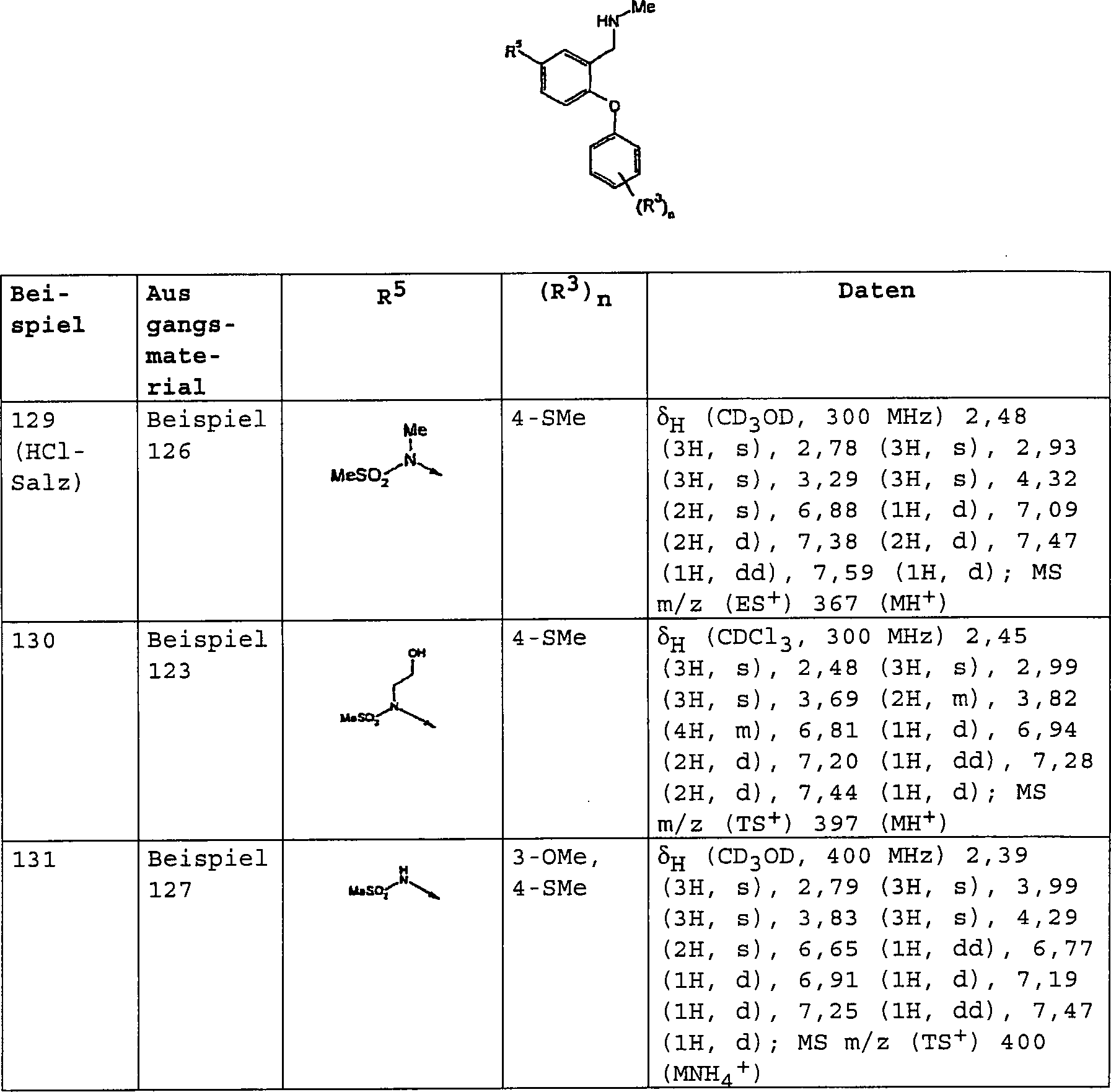
Beispiel
132 N-{3-[(Dimethylamino)-methyl]-4-[4-(methylsulfanyl)-phenoxy]-phenyl}-N-(2-hydroxyethyl)-methansulfonamid 
Formaldehyd (37%ige wässrige Lösung, 600 μl, 7,39 mmol) wurde zu einer Lösung des Amins von Beispiel 123 (450 mg, 1,18 mmol) in DCM (15 ml) und THF (5 ml) gegeben. Das Gemisch wurde 15 Minuten gerührt und sodann portionsweise innerhalb von 15 Minuten mit Natriumtriacetoxyborhydrid (1,0 g, 4,72 mmol) versetzt. Das Gemisch wurde 18 Stunden gerührt und sodann in wässrige Kaliumcarbonatlösung (10%, 50 ml) gegossen und mit DCM (2 × 30 ml) extrahiert. Die organische Phase wurde getrocknet (MgSO4) und eingedampft. Der Rückstand wurde durch Säulenchromatographie (SiO2; DCM/MeOH/880 NH3 (90:9:1)) gereinigt. Man erhielt das Produkt in Form eines Öls. Dieses Öl wurde in DCM aufgenommen und durch Zugabe von 1 M ätherischer Chlorwasserstoffsäure in das Hydrochloridsalz umgewandelt. Nach Entfernen des Lösungsmittels und Trocknen unter Vakuum erhielt man einen gebrochen weißen Schaum (362 mg, 69%). δH (CDCl3, 400 MHz) 2,50 (3H, s), 2,86 (6H, d), 3,12 (3H, s), 3,70 (2H, m), 3,84 (2H, m), 4,31 (2H, d), 6,82 (1H, d), 6,96 (2H, d), 7,30 (2H, d), 7,41 (1H, dd), 8,18 (1H, d), 12,5 (1H, br); MS m/z (ES+) 411 (MH+).Formaldehyde (37% aqueous solution, 600 μl, 7.39 mmol) was added to a solution of the amine of Example 123 (450 mg, 1.18 mmol) in DCM (15 ml) and THF (5 ml). The mixture was stirred for 15 minutes and then sodium triacetoxyborohydride (1.0 g, 4.72 mmol) added portionwise over 15 minutes. The mixture was stirred for 18 hours and then poured into aqueous potassium carbonate solution (10%, 50 ml) and extracted with DCM (2 x 30 ml). The organic phase was dried (MgSO 4 ) and evaporated. The residue was purified by column chromatography (SiO 2 ; DCM / MeOH / 880 NH 3 (90: 9: 1)). The product was obtained in the form of an oil. This oil was taken up in DCM and converted to the hydrochloride salt by addition of 1 M ethereal hydrochloric acid. Removal of the solvent and drying under vacuum gave an off-white foam (362 mg, 69%). δ H (CDCl 3, 400 MHz) 2.50 (3H, s), 2.86 (6H, d), 3.12 (3H, s), 3.70 (2H, m), 3.84 (2H , m), 4.31 (2H, d), 6.82 (1H, d), 6.96 (2H, d), 7.30 (2H, d), 7.41 (1H, dd), 8 , 18 (1H, d), 12.5 (1H, br); MS m / z (ES + ) 411 (MH + ).
Beispiele 133–136Examples 133-136
Die Verbindungen der nachstehenden Beispiele wurden aus dem erforderlichen primären Amin gemäß dem in Beispiel 132 beschriebenen Verfahren hergestellt.The Compounds of the examples below were required primary Amine according to the in Example 132.

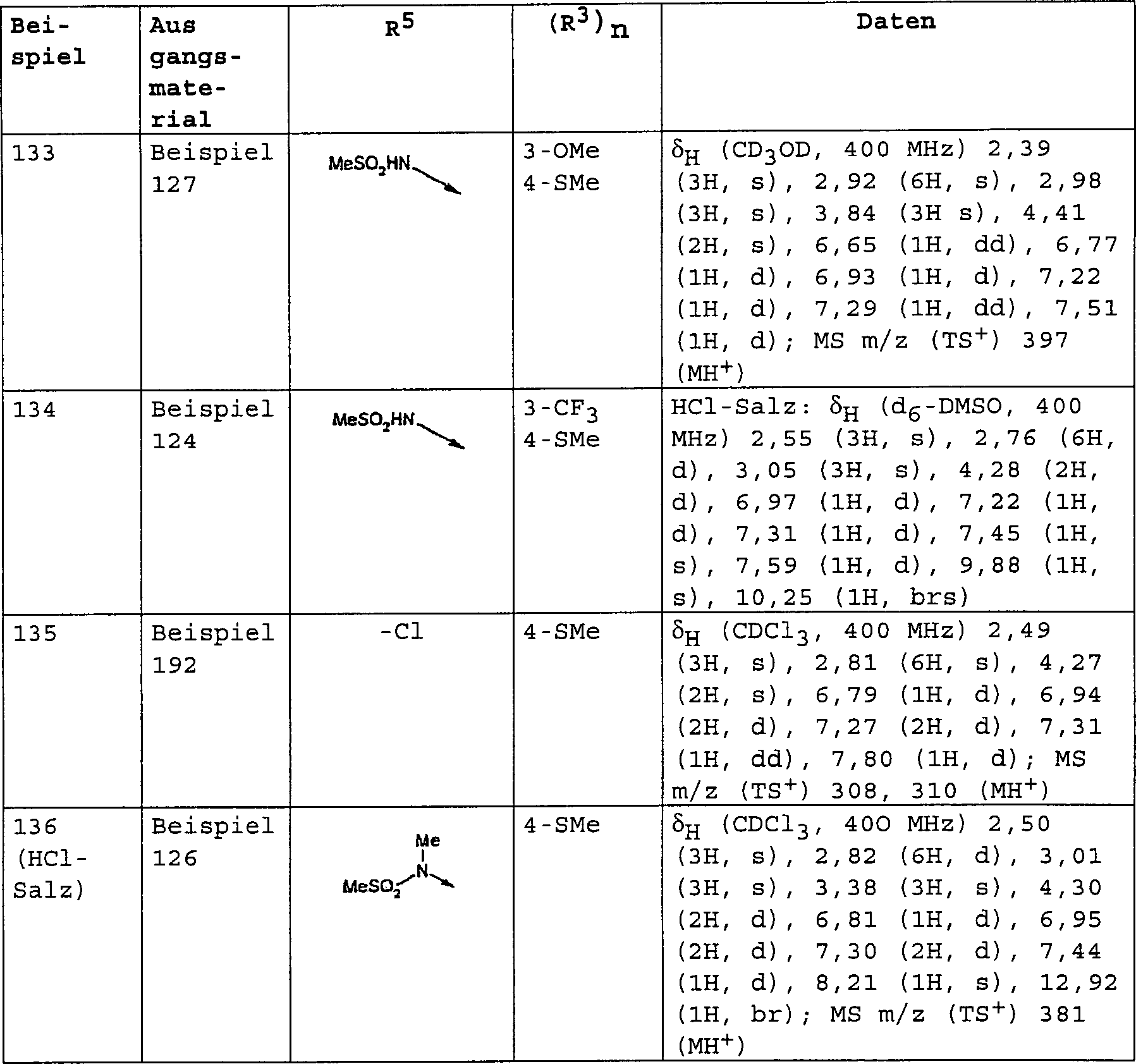
Beispiel
137 N-{3-[(Dimethylamino)-methyl]-4-[4-(methylsulfanyl)-phenoxy]-phenyl}-2-methoxyethansulfonamid 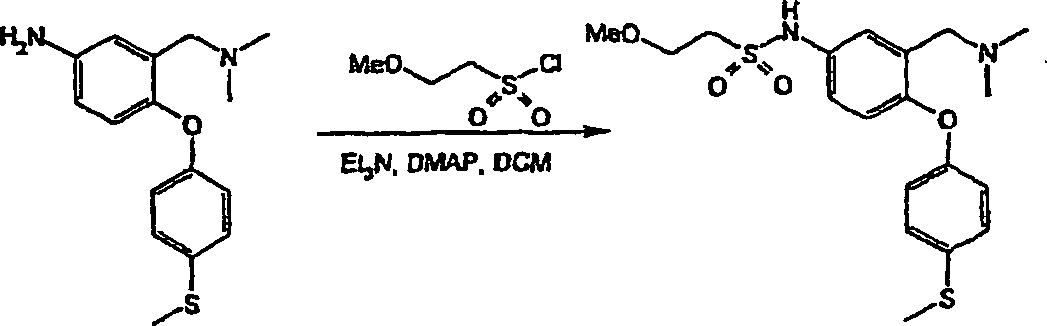
Das Anilin von Beispiel 109 (350 mg, 1,08 mmol) wurde in DCM (10 ml) gelöst und mit 4,4-Dimethylaminopyridin (132 mg, 1,08 mmol), Triethylamin (0,68 ml, 4,86 mmol) und 2-(Methoxy)-ethylsulfonylchlorid (hergestellt gemäß EP-0446845) behandelt. Das Reaktionsgemisch wurde über Nacht bei Raumtemperatur gerührt. Das Gemisch wurde zur Entfernung von flüchtigen Bestandteilen eingedampft. Der Rückstand wurde mit Natriumhydroxid (2 M, 5 ml) und Dioxan (5 ml) behandelt. Das Gemisch wurde 3 Stunden gerührt und sodann zur Entfernung des Großteils des Dioxans 1-mal eingedampft. Der wässrige Rückstand wurde mit Dichlormethan (2 × 30 ml) extrahiert. Die vereinigten Extrakte wurden getrocknet (MgSO4) und eingedampft. Der Rückstand wurde durch Flash-Chromatographie (SiO2; DCM/MeOH (95:5 → 90:10)) gereinigt. Man erhielt die Titelverbindung, die als HCl-Salz (20 mg, 4%) isoliert wurde. HCl-Salz: δH (CD3OD, 400 MHz) 2,44 (3H, s), 2,88 (6H, s), 3,28 (3H, s), 3,30 (2H, t), 3,74 (2H, t), 4,38 (2H, s), 6,85 (1H, d), 7,02 (2H, d), 7,25 (1H, dd), 7,31 (2H, d), 7,48 (1H, d); MS m/z (ES+) 411 (MH+).The aniline of Example 109 (350 mg, 1.08 mmol) was dissolved in DCM (10 mL) and treated with 4,4-dimethyl aminopyridine (132 mg, 1.08 mmol), triethylamine (0.68 ml, 4.86 mmol) and 2- (methoxy) ethylsulfonyl chloride (prepared according to EP-0446845). The reaction mixture was stirred at room temperature overnight. The mixture was evaporated to remove volatiles. The residue was treated with sodium hydroxide (2M, 5ml) and dioxane (5ml). The mixture was stirred for 3 hours and then evaporated 1 time to remove most of the dioxane. The aqueous residue was extracted with dichloromethane (2 × 30 ml). The combined extracts were dried (MgSO 4 ) and evaporated. The residue was purified by flash chromatography (SiO 2 ; DCM / MeOH (95: 5 → 90:10)). The title compound was obtained, which was isolated as HCl salt (20 mg, 4%). HCl salt: δ H (CD 3 OD, 400 MHz) 2.44 (3H, s), 2.88 (6H, s), 3.28 (3H, s), 3.30 (2H, t), 3.74 (2H, t), 4.38 (2H, s), 6.85 (1H, d), 7.02 (2H, d), 7.25 (1H, dd), 7.31 (2H , d), 7.48 (1H, d); MS m / z (ES + ) 411 (MH + ).
Beispiel
138 N-{3-[(Dimethylamino)-methyl]-4-[4-(methylsulfanyl)-phenoxy]-phenyl}-ethansulfonamid 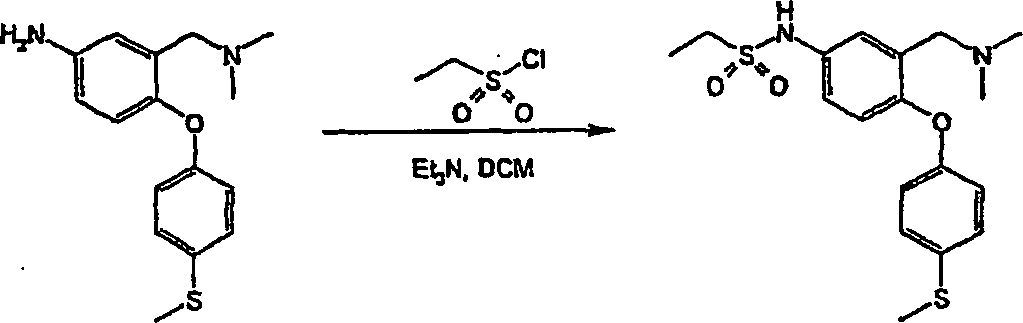
Die
Titelverbindung wurde aus dem Anilin von Beispiel 109 gemäß dem in
Beispiel 114 beschriebenen allgemeinen Verfahren unter Verwendung
von Ethansulfonylchlorid anstelle von Methansulfonylchlorid hergestellt.
HCl-Salz:
δH (d6-DMSO, 300 MHz)
1,20 (3H, t), 2,47 (3H, s), 2,75 (6H, s), 4,30 (1H, brs), 6,85 (1H,
d), 7,06 (2H, d), 7,22 (1H, dt), 7,37 (2H, d), 7,53 (1H, m), 9,84
(1H, s), 10,50 (1H, brs); MS m/z (ES+) 381
(MH+)The title compound was prepared from the aniline of Example 109 according to the general procedure described in Example 114 using ethanesulfonyl chloride instead of methanesulfonyl chloride. HCl salt:
δ H (d 6 -DMSO, 300 MHz) 1.20 (3H, t), 2.47 (3H, s), 2.75 (6H, s), 4.30 (1H, brs), 6.85 (1H, d), 7.06 (2H, d), 7.22 (1H, dt), 7.37 (2H, d), 7.53 (1H, m), 9.84 (1H, s) , 10.50 (1H, brs); MS m / z (ES + ) 381 (MH + )
Beispiel
139 N-{3-[
(Dimethylamino)-methyl]-4-[4-(methylsulfanyl)-phenoxy]-phenyl}-2-propansulfonamid 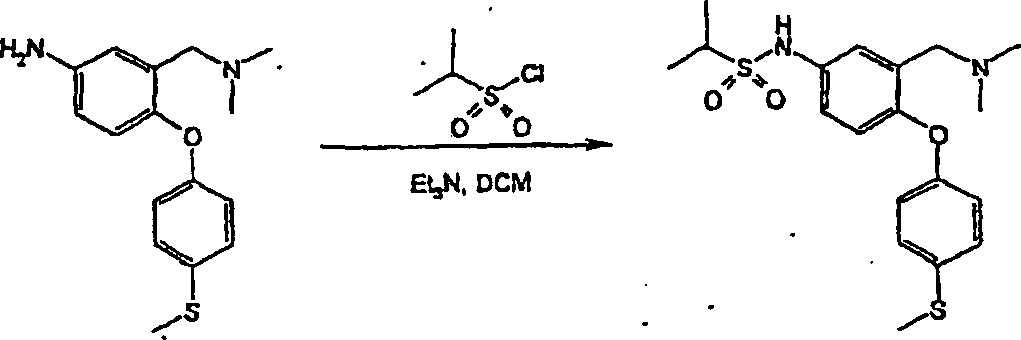
Die Verbindung wurde aus dem Anilin von Beispiel 109 gemäß dem in Beispiel 114 beschriebenen allgemeinen Verfahren unter Verwendung von 2-Propylsulfonylchlorid anstelle von Methansulfonylchlorid hergestellt. HCl-Salz: δH (d6-DMSO, 400 MHz) 1,23 (6H, d), 2,45 (3H, s), 2,73 (6H, d), 3,33 (1H, m), 4,28 (2H, d), 6,87 (1H, d), 7,04 (1H, d), 7,22 (1H, dd), 7,54 (1H, d), 9,83 (1H, s), 10,30 (1H, brs); MS m/z (ES+) 395 (MH+)The compound was prepared from the aniline of Example 109 according to the general procedure described in Example 114 using 2-propylsulfonyl chloride instead of methanesulfonyl chloride. HCl salt: δ H (d 6 -DMSO, 400 MHz) 1.23 (6H, d), 2.45 (3H, s), 2.73 (6H, d), 3.33 (1H, m) , 4.28 (2H, d), 6.87 (1H, d), 7.04 (1H, d), 7.22 (1H, dd), 7.54 (1H, d), 9.83 ( 1H, s), 10.30 (1H, brs); MS m / z (ES + ) 395 (MH + )
Beispiel
140 N-{3-[(Dimethylamino)-methyl]-4-[4-(methylsulfanyl)-phenoxy]-phenyl}-(trifluor)-methansulfonamid 
Das Anilin von Beispiel 109 (300 mg, 0,9 mmol) wurde in DCM (10 ml) gelöst und bei 0°C mit Trifluormethansulfonsäureanhydrid (169 μl, 1,02 mmol) behandelt. Das Gemisch wurde 3 Stunden bei dieser Temperatur gerührt. Sodann wurden die Lösungsmittel durch Abdampfen entfernt. Der Rückstand wurde durch Flash-Chromatographie (SiO2; DCM/MeOH (100:0 → 90:10)) gereinigt. Man erhielt einen gelben Feststoff. Nach Verreiben mit DCM erhielt man die Titelverbindung in Form eines weißen Feststoffes (80 mg, 21%). Freie Base: δH (d6-DMSO; 400 MHz) 2,40 (3H, s), 2,70 (6H, s), 4,10 (2H, s), 6,67 (1H, d), 6,89 (2H, d), 7,00 (1H, dd), 7,09 (1H, s), 7,24 (2H, d), 9,33 (1H, brs); MS m/z (TS+) 421 (MH+).The aniline of Example 109 (300 mg, 0.9 mmol) was dissolved in DCM (10 mL) and treated at 0 ° C with trifluoromethanesulfonic anhydride (169 μL, 1.02 mmol). The mixture was kept at this temperature for 3 hours stirred. The solvents were then removed by evaporation. The residue was purified by flash chromatography (SiO 2 ; DCM / MeOH (100: 0 → 90:10)). A yellow solid was obtained. Trituration with DCM gave the title compound as a white solid (80mg, 21%). Free base: δ H (d 6 -DMSO; 400 MHz) 2.40 (3H, s), 2.70 (6H, s), 4.10 (2H, s), 6.67 (1H, d), 6.89 (2H, d), 7.00 (1H, dd), 7.09 (1H, s), 7.24 (2H, d), 9.33 (1H, brs); MS m / z (TS + ) 421 (MH + ).
Beispiel 141Example 141
N,N-Dimethyl-N-{5-(methylsulfanyl)-2-[4-(trifluormethoxy)-phenoxy]-benzyl}-aminN, N-Dimethyl-N- {5- (methylsulfanyl) -2- [4- (trifluoromethoxy) phenoxy] benzyl} amine
Eine Lösung der Bromidverbindung von Beispiel 7 (1,6 g, 4,1 mmol) und Palladium-tetrakis-(triphenylphosphin) (237 mg, 0,21 mmol) in DMSO (40 ml) wurde 90 Minuten bei 100°C unter Stickstoff gerührt. Natriumthiomethoxid (575 mg, 8,2 mmol) wurde in einer Portion zugegeben. Das Reaktionsgemisch wurde 64 Stunden bei 100°C gerührt. Nach Abkühlen auf Raumtemperatur wurde das Reaktionsgemisch in Wasser gegossen und mit Ethylacetat (4-mal) extrahiert. Die vereinigten organischen Extrakte wurden getrocknet (MgSO4) und unter Vakuum eingeengt. Der Rückstand wurde durch Flash-Chromatographie (SiO2; DCM/MeOH/880 NH3 (97:3:0,5 → 93:7:1)) gereinigt. Die entsprechenden Fraktionen wurden vereinigt und erneut durch Flash-Chromatographie (SiO2; Ethylacetat/Methanol/880 Ammoniak (96:4:0,4)) gereinigt. Man erhielt die angestrebte Sulfidverbindung (930 mg, 63%). δH (CDCl3, 400 MHz) 2,24 (6H, s), 2,49 (3H, s), 3,39 (2H, s), 6,87 (3H, m), 7,14 (3H, m), 7,42 (1H, s); MS m/z (TS+) 358 (MH+).A solution of the bromide compound of Example 7 (1.6 g, 4.1 mmol) and palladium tetrakis (triphenylphosphine) (237 mg, 0.21 mmol) in DMSO (40 mL) was heated at 100 ° C under nitrogen for 90 minutes touched. Sodium thiomethoxide (575 mg, 8.2 mmol) was added in one portion. The reaction mixture was stirred at 100 ° C for 64 hours. After cooling to room temperature, the reaction mixture was poured into water and extracted with ethyl acetate (4 times). The combined organic extracts were dried (MgSO 4 ) and concentrated in vacuo. The residue was purified by flash chromatography (SiO 2 ; DCM / MeOH / 880 NH 3 (97: 3: 0.5 → 93: 7: 1)). The appropriate fractions were combined and again purified by flash chromatography (SiO 2 , ethyl acetate / methanol / 880 ammonia (96: 4: 0.4)). The desired sulfide compound was obtained (930 mg, 63%). δ H (CDCl 3, 400 MHz) 2.24 (6H, s), 2.49 (3H, s), 3.39 (2H, s), 6.87 (3H, m), 7.14 (3H , m), 7.42 (1H, s); MS m / z (TS + ) 358 (MH + ).
Beispiele 142–144Examples 142-144
Die in Beispiel 141 beschriebene Umsetzung wurde unter ähnlichen Bedingungen zur Herstellung einer Reihe von Sulfiden aus dem erforderlichen Bromid oder Iodid wiederholt. Die Daten für diese Verbindungen sind nachstehend zusammengestellt.The reaction described in Example 141 was similar Conditions for producing a range of sulfides from the required Bromide or iodide repeated. The data for these compounds are below compiled.
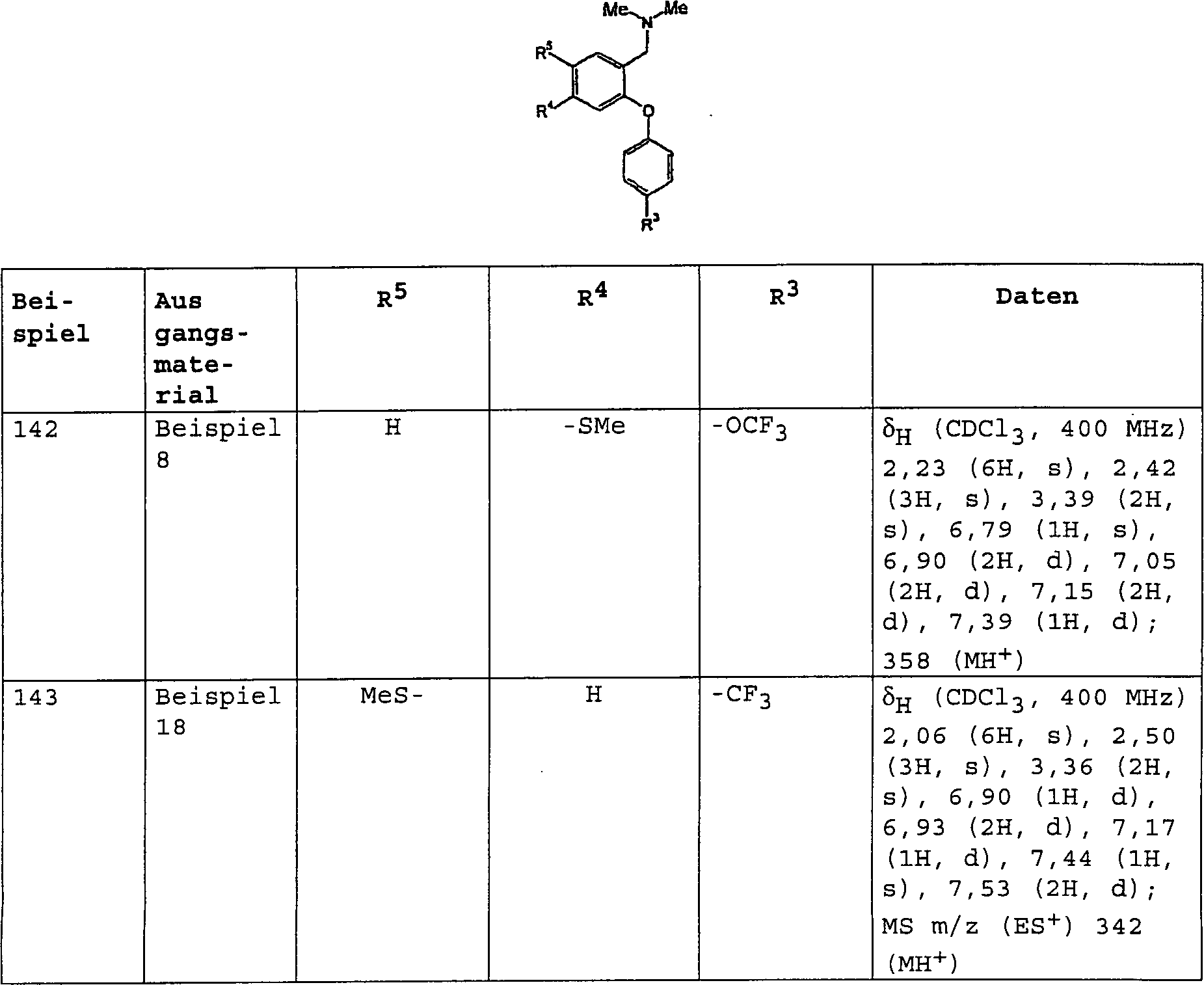

Beispiele
145–146 N,N-Dimethyl-N-{5-(methylsulfonyl)-2-[4-(trifluormethoxy)-phenoxy]-benzyl}-amin
(Beispiel 145) und N,N-Dimethyl-N-{5-(methylsulfinyl)-2-[4-(trifluormethoxy)-phenoxy]-benzyl}-amin
(Beispiel 146) 
Oxone® (1,54 g, 2,50 mmol) wurde bei 0°C zu einer Lösung der Verbindung von Beispiel 141 (900 mg, 2,52 mmol) in THF (4 ml), Isopropylalkohol (20 ml) und Wasser (2 ml) gegeben. Das Gemisch wurde 15 Minuten bei 0–5°C gerührt, sodann innerhalb von 25 Minuten auf Raumtemperatur erwärmt und mit Natriumhydroxid (2 M) abgeschreckt. Das wässrige Gemisch wurde mit Ethylacetat (3-mal) extrahiert. Die vereinigten organischen Extrakte wurden getrocknet (MgSO4) und unter Vakuum eingeengt. Der Rückstand wurde durch Flash-Chromatographie (SiO2; DCM/Methanol/880 Ammoniak (97:3:0,5 → 93:7:1)) gereinigt. Man erhielt zwei Hauptprodukte. Fraktionen mit dem schneller laufenden Produkt wurden vereinigt und erneut durch Flash-Chromatographie (SiO2; Ethylacetat/Methanol/880 Ammoniak (96:4:0,4)) gereinigt. Man erhielt das Sulfon von Beispiel 145 (473 mg, 48%) in Form eines farblosen Feststoffes. δH (CDCl3, 400 MHz) 2,30 (6H, s), 3,07 (3H, s), 3,58 (2H, s), 6,92 (1H, d), 7,02 (2H, m), 7,25 (2H, m), 7,78 (1H, dd}, 8,12 (1H, d); MS m/z (TS+) 390 (MH+).Oxone ® (1.54 g, 2.50 mmol) was added (900 mg, 2.52 mmol) at 0 ° C to a solution of the compound of Example 141 (20 ml) in THF (4 mL), isopropyl alcohol and water ( 2 ml). The mixture was stirred at 0-5 ° C for 15 minutes then warmed to room temperature over 25 minutes and quenched with sodium hydroxide (2 M). The aqueous mixture was extracted with ethyl acetate (3 times). The combined organic extracts were dried (MgSO 4 ) and concentrated in vacuo. The residue was purified by flash chromatography (SiO 2 ; DCM / methanol / 880 ammonia (97: 3: 0.5 → 93: 7: 1)). Two main products were obtained. Fractions containing the faster-moving product were combined and again purified by flash chromatography (SiO 2 , ethyl acetate / methanol / 880 ammonia (96: 4: 0.4)). The sulfone of Example 145 (473 mg, 48%) was obtained as a colorless solid. δ H (CDCl 3, 400 MHz) 2.30 (6H, s), 3.07 (3H, s), 3.58 (2H, s), 6.92 (1 H, d), 7.02 (2H , m), 7.25 (2H, m), 7.78 (1H, dd), 8.12 (1H, d); MS m / z (TS + ) 390 (MH + ).
Fraktionen mit dem langsamer laufenden Produkt wurden vereinigt und erneut durch Flash-Chromatographie (SiO2; EtOAc/MeOH/880 NH3 (95:5:0,5)) gereinigt. Man erhielt das Sulfoxid von Beispiel 146 (64 mg, 7%) in Form eines farblosen Öls. δH (CDCl3, 400 MHz) 2,29 (6H, s), 2,76 (3H, s), 3,56 (2H, s), 6,99 (3H, m), 7, 20 (2H, m), 7,57 (1H, dd), 7,78 (1H, d); MS m/z (TS+) 374 (MH+).Slower product fractions were pooled and again purified by flash chromatography (SiO 2 , EtOAc / MeOH / 880 NH 3 (95: 5: 0.5)). The sulfoxide of Example 146 (64 mg, 7%) was obtained as a colorless oil. δ H (CDCl 3, 400 MHz) 2.29 (6H, s), 2.76 (3H, s), 3.56 (2H, s), 6.99 (3H, m), 7, 20 (2H , m), 7.57 (1H, dd), 7.78 (1H, d); MS m / z (TS + ) 374 (MH + ).
Beispiele 147–148Examples 147-148
Die Umsetzung der Beispiele 145 und 146 wurde zur Herstellung der Sulfoxide der Beispiele 147 und 148 aus den entsprechenden Sulfiden wiederholt.The Implementation of Examples 145 and 146 was used to prepare the sulfoxides Examples 147 and 148 from the corresponding sulfides.
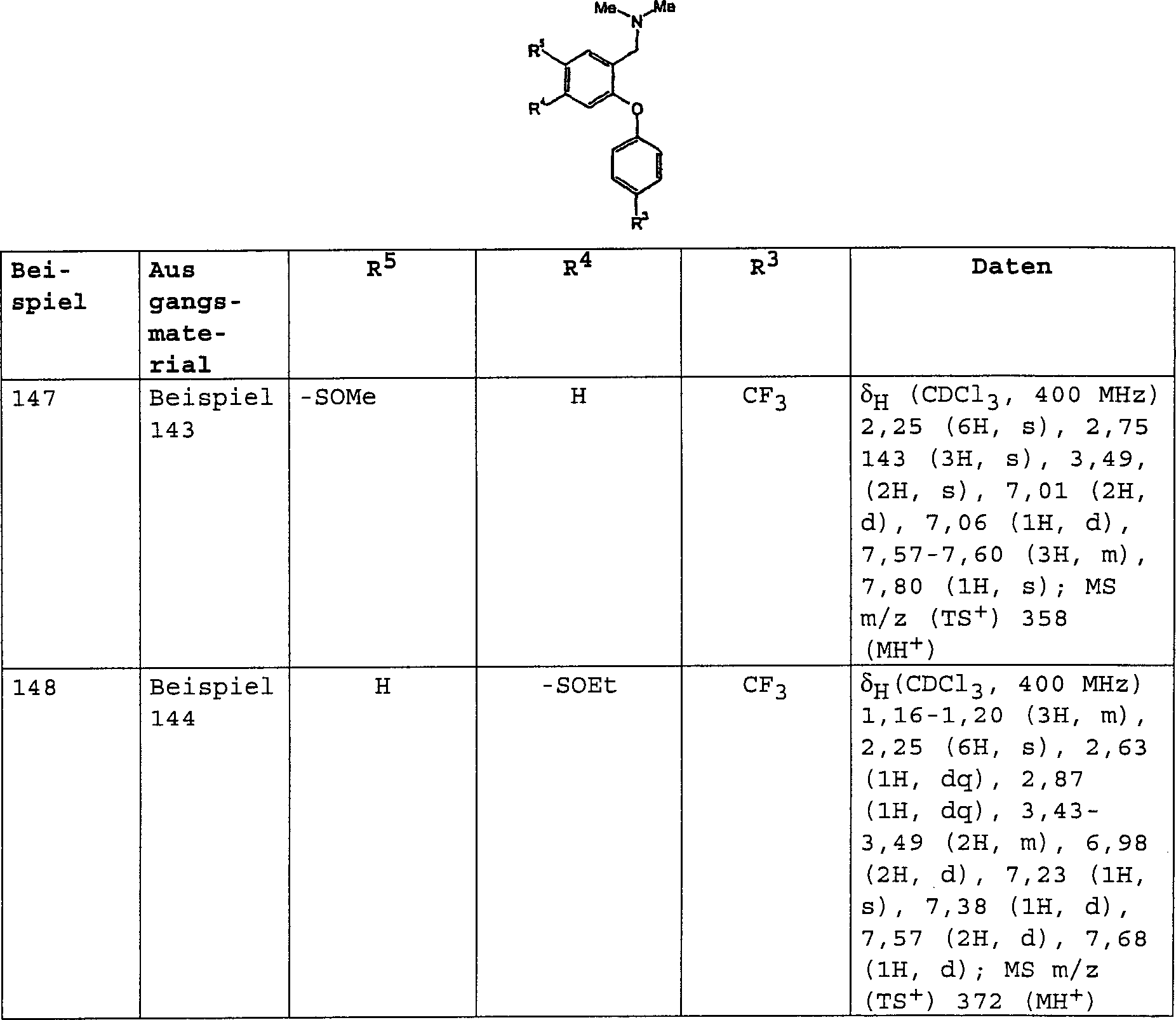
Beispiel
149 N,N-Dimethyl-N-{4-(methylsulfinyl)-2-[4-(trifluormethoxy)-phenoxy]-benzyl}-amin 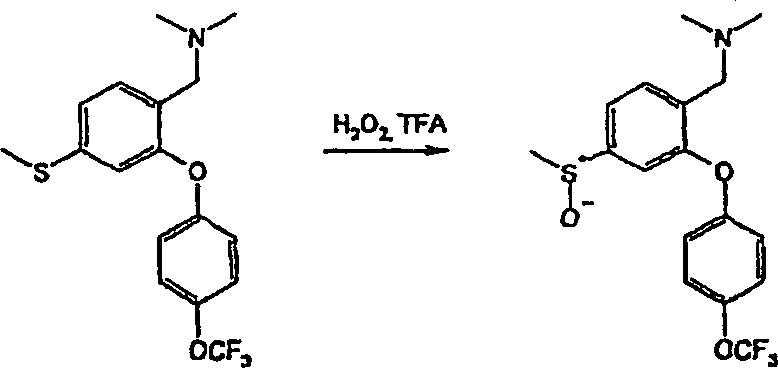
Wasserstoffperoxid (30%, 76 μl, 0,67 mmol) wurde bei 0°C unter Stickstoff tropfenweise zu einer Lösung der Sulfidverbindung von Beispiel 142 (240 mg, 0,67 mmol) in TFA (2 ml) gegeben. Nach 30-minütigem Rühren bei 0°C wurde das Reaktionsgemisch mit Wasser verdünnt und vorsichtig mit Natriumhydroxidplätzchen alkalisch gemacht. Sodann wurde das Gemisch mit Ethylacetat extrahiert. Der organische Extrakt wurde mit Kochsalzlösung gewaschen, getrocknet (MgSO4) und unter Vakuum eingeengt. Der Rückstand wurde durch Flash-Chromatographie (SiO2; DCM/MeOH/880 NH3 (97:2,5:0,5 → 95:5:0,5)) gereinigt. Man erhielt die angestrebte Sulfoxidverbindung (142 mg, 57%) in Form eines farblosen Öls. δH (CDCl3, 400 MHz) 2,27 (6H, s), 2,70 (3H, s), 3,50 (2H, s), 6,95 (2H, d), 7,19 (2H, d), 7,21 (1H, s), 7,37 (1H, d), 7,67 (1H, d); MS m/z (TS+) 374 (MH+).Hydrogen peroxide (30%, 76 μl, 0.67 mmol) was added dropwise at 0 ° C under nitrogen to a solution of the sulfide compound of Example 142 (240 mg, 0.67 mmol) in TFA (2 ml). After stirring at 0 ° C for 30 minutes, the reaction mixture was diluted with water and made alkaline with sodium hydroxide pellets. The mixture was extracted with ethyl acetate. The organic extract was washed with brine, dried (MgSO 4 ) and concentrated in vacuo. The residue was purified by flash chromatography (SiO 2 ; DCM / MeOH / 880 NH 3 (97: 2.5: 0.5 → 95: 5: 0.5)). The desired sulfoxide compound (142 mg, 57%) was obtained in the form of a colorless oil. δ H (CDCl 3, 400 MHz) 2.27 (6H, s), 2.70 (3H, s), 3.50 (2H, s), 6.95 (2H, d), 7.19 (2H , d), 7.21 (1H, s), 7.37 (1H, d), 7.67 (1H, d); MS m / z (TS + ) 374 (MH + ).
Beispiel
150 N,N-Dimethyl-N-{4-(methylsulfonyl)-2-[4-(trifluormethoxy)-phenoxy]-benzyl}-amin 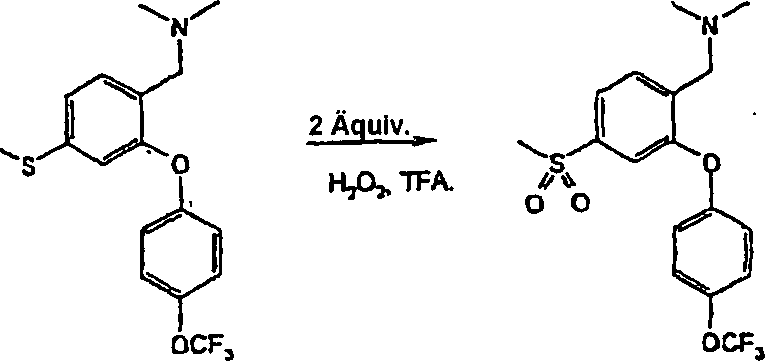
Wasserstoffperoxid (30%, 160 μl, 1,41 mmol) wurde bei 0°C unter Stickstoff tropfenweise zu einer Lösung der Sulfidverbindung von Beispiel 142 (252 mg, 0,71 mmol) in TFA (2 ml) gegeben. Nach 60-minütigem Rühren bei 0°C und weiterem 30-minütigem Rühren bei Raumtemperatur wurde eine weitere Portion von Wasserstoffperoxid (80 ml, 0,71 mmol) zugesetzt. Das Gemisch wurde weitere 6 Stunden bei Raumtemperatur gerührt. Sodann wurde das Reaktionsgemisch mit wässriger Natriumhydroxidlösung (1 M) verdünnt und vorsichtig mit Natriumhydroxidplätzchen alkalisch gemacht. Das Gemisch wurde mit Ethylacetat extrahiert. Der organische Extrakt wurde mit Kochsalzlösung gewaschen, getrocknet (MgSO4) und unter Vakuum eingeengt. Der Rückstand wurde durch Flash-Chromatographie (SiO2; DCM/MeOH/880 NH3 (99:1:0,5 → 98:2:0,5) gereinigt. Man erhielt die angestrebte Sulfonverbindung (183 mg, 67%) in Form eines farblosen Öls. δH (CDCl3, 400 MHz) 2,30 (6H, s), 3,00 (3H, s), 3,55 (2H, s), 6,97 (2H, d), 7,20 (2H, d), 7,42 (1H, s), 7,70 (1H, s), 7,78 (1H, d) 390; (MH+).Hydrogen peroxide (30%, 160 μl, 1.41 mmol) was added dropwise at 0 ° C under nitrogen to a solution of the sulfide compound of Example 142 (252 mg, 0.71 mmol) in TFA (2 ml). After stirring for 60 minutes at 0 ° C and further stirring for 30 minutes at room temperature, an additional portion of hydrogen peroxide (80 ml, 0.71 mmol) was added. The mixture was stirred for a further 6 hours at room temperature. Then, the reaction mixture was diluted with aqueous sodium hydroxide solution (1 M) and carefully made alkaline with sodium hydroxide pellets. The mixture was extracted with ethyl acetate. The organic extract was washed with brine, dried (MgSO 4 ) and concentrated in vacuo. The residue was purified by flash chromatography (SiO 2 ; DCM / MeOH / 880 NH 3 (99: 1: 0.5 → 98: 2: 0.5) to give the desired sulfone compound (183 mg, 67%) in as a colorless oil. δ H (CDCl 3, 400 MHz) 2.30 (6H, s), 3.00 (3H, s), 3.55 (2H, s), 6.97 (2H, d), 7.20 (2H, d), 7.42 (1H, s), 7.70 (1H, s), 7.78 (1H, d) 390, (MH + ).
Beispiel
151 Methyl-3-[(dimethylamino)-methyl]-4-[4-(trifluormethyl)-phenoxy]-benzoat 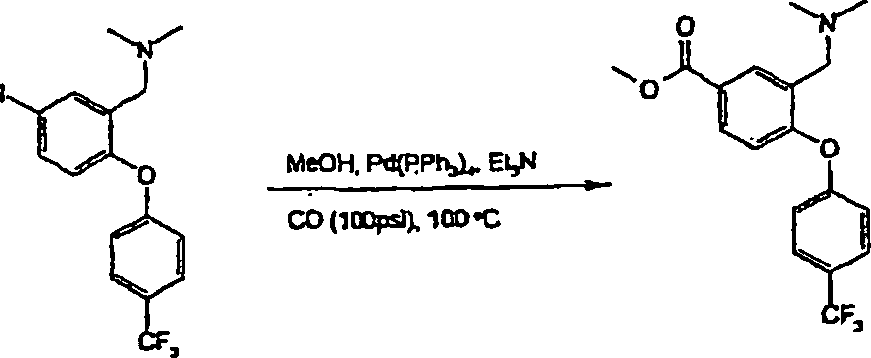
Die Iodidverbindung von Beispiel 18 (2,0 g, 4,75 mmol) wurde in Methanol (30 ml) gelöst und mit Triethylamin (0,98 ml, 7,04 mmol) und Palladium-tetrakis-(triphenylphosphin) (0,28 g, 0,25 mmol) behandelt. Das Reaktionsgemisch wurde unter eine Kohlenmonoxidatmosphäre (100 psi) gebracht und unter Rühren auf 80°C erwärmt. Nach 6 Stunden wurde der Druck weggenommen und das Reaktionsgemisch auf Raumtemperatur abgekühlt. Sodann wurde das Gemisch mit Kochsalzlösung verdünnt und mit Ethylacetat extrahiert. Nach Trocknen mit MgSO4 und Eindampfen erhielt man einen orangefarbenen Feststoff. Nach Reinigung durch Flash-Chromatographie (SiO2; MeOH/880 NH3 (10:1)(1 → 3%) in DCM) erhielt man die angestrebte Esterverbindung in Form eines orangefarbenen Öls (1,66 g, 99%). δH (CDCl3, 400 MHz) 2,27 (6H, s), 3,49 (2H, s), 3,91 (3H, s), 6,83 (1H, d), 7,03 (2H, d), 7,60 (2H, d), 7,93 (1H, dd), 8,19 (1H, d); MS m/z (TS+) 354 (MH+).The iodide compound of Example 18 (2.0 g, 4.75 mmol) was dissolved in methanol (30 mL) and triethylamine (0.98 mL, 7.04 mmol) and palladium tetrakis (triphenylphosphine) (0.28 g, 0.25 mmol). The reaction mixture was placed under a carbon monoxide atmosphere (100 psi) and heated to 80 ° C with stirring. After 6 hours, the pressure was removed and the reaction cooled to room temperature. The mixture was diluted with brine and extracted with ethyl acetate. After drying with MgSO 4 and evaporation, an orange solid was obtained. Purification by flash chromatography (SiO 2 , MeOH / 880 NH 3 (10: 1) (1 → 3%) in DCM) afforded the desired ester compound as an orange oil (1.66 g, 99%). δ H (CDCl 3, 400MHz) 2.27 (6H, s), 3.49 (2H, s), 3.91 (3H, s), 6.83 (1H, d), 7.03 (2H , d), 7.60 (2H, d), 7.93 (1H, dd), 8.19 (1H, d); MS m / z (TS + ) 354 (MH + ).
Beispiel
152 Methyl-3-[(dimethylamino)-methyl]-4-[4-(methylsulfanyl)-phenoxy]-benzoat 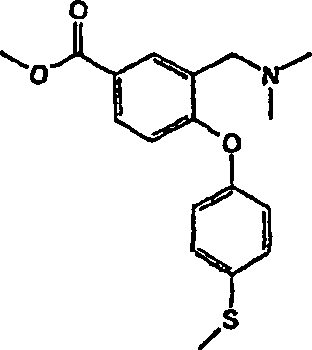
Die Umsetzung von Beispiel 151 wurde auf ähnliche Weise mit dem Bromid von Beispiel 9 wiederholt. Man erhielt den Titelester. Freie Base: δH (CDCl3, 400 MHz) 2,47 (9H, s), 3,78 (2H, s), 3,87 (3H, s), 6,80 (1H, d), 6,95 (2H, d), 7,26 (2H, d), 7,88 (1H, d), 8,17 (1H, d); MS m/z (TS+) 354 (MH+).The reaction of Example 151 was repeated in a similar manner with the bromide of Example 9. One received the title ester. Free base: δ H (CDCl 3, 400 MHz) 2.47 (9H, s), 3.78 (2H, s), 3.87 (3H, s), 6.80 (1H, d), 6.95 (2H, d), 7.26 (2H, d), 7.88 (1H, d), 8.17 (1H, d); MS m / z (TS + ) 354 (MH + ).
Beispiel
153 Methyl-3-[(methylamino)-methyl]-4-[4-(methylsulfanyl)-phenoxy]-benzoat 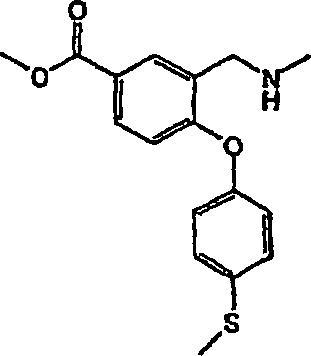
Der Titelester wurde aus dem Bromid von Beispiel 23 unter Anwendung des in Beispiel 151 beschriebenen Verfahrens hergestellt. δH (CDCl3, 400 MHz) 2,46 (3H, s), 2,49 (3H, s), 3,86 (2H, s), 3,89 (3H, s), 6,79 (1H, d), 6,95 (2H, d), 7,29 (2H, d), 7,86 (1H, dd), 8,07 (1H, d); MS m/z (TS+) 318 (MH+).The title ester was prepared from the bromide of Example 23 using the procedure described in Example 151. δ H (CDCl 3, 400 MHz) 2.46 (3H, s), 2.49 (3H, s), 3.86 (2H, s), 3.89 (3H, s), 6.79 (1 H , d), 6.95 (2H, d), 7.29 (2H, d), 7.86 (1H, dd), 8.07 (1H, d); MS m / z (TS + ) 318 (MH + ).
Beispiel
154 {3-[(Dimethylamino)-methyl]-4-[4-(trifluormethyl)-phenoxy]-phenyl}-methanol 
Eine Lösung von Lithiumaluminiumhydrid in THF (1 M, 7 ml, 7 mmol) wurde bei Raumtemperatur unter Stickstoff tropfenweise zu einer gerührten Lösung der Esterverbindung von Beispiel 151 (1,66 g, 4,7 mmol) in THF (25 ml) gegeben. Das Gemisch wurde 3 Stunden gerührt und sodann mit Ether (100 ml) verdünnt und durch vorsichtige Zugabe von Natriumhydroxid (2 M) (etwa 1 ml) abgeschreckt. Das Gemisch wurde 10 Minuten gerührt, getrocknet (MgSO4), filtriert und unter Vakuum eingeengt. Nach Reinigung des Rückstands durch Flash-Chromatographie (SiO2; ((MeOH/880 NH3) 9:1) in DCM (2% → 4%) erhielt man die angestrebte Alkoholverbindung (0,7 g, 48%). Beispiel 90: δH (CDCl3, 400 MHz) 2,13 (6H, s), 3,39 (2H, s), 4,70 (2H, s), 6,93–6,98 (3H, m), 7,30 (1H, d), 7,52–7,56 (3H, m); MS m/z (TS+) 326 (MH+).A solution of lithium aluminum hydride in THF (1M, 7 mL, 7 mmol) was added dropwise at room temperature under nitrogen to a stirred solution of the ester compound of Example 151 (1.66 g, 4.7 mmol) in THF (25 mL). The mixture was stirred for 3 hours and then diluted with ether (100 ml) and quenched by careful addition of sodium hydroxide (2 M) (about 1 ml). The mixture was stirred for 10 minutes, dried (MgSO 4 ), filtered and concentrated in vacuo. Purification of the residue by flash chromatography (SiO 2 ; ((MeOH / 880 NH 3 ) 9: 1) in DCM (2% → 4%) gave the desired alcohol compound (0.7 g, 48%) : δ H (CDCl 3, 400 MHz) 2.13 (6H, s), 3.39 (2H, s), 4.70 (2H, s), 6.93-6.98 (3H, m), 7.30 (1H, d), 7.52-7.56 (3H, m); MS m / z (TS + ) 326 (MH + ).
Beispiel 155Example 155
{3-[(Dimethylamino)-methyl]-4-[4-(methylsulfanyl)-phenoxy]-phenyl}-methanol{3 - [(dimethylamino) methyl] -4- [4- (methylsulfanyl) phenoxy] phenyl} methanol
Die
Umsetzung von Beispiel 154 wurde unter Verwendung der Esterverbindung
von Beispiel 152 wiederholt. Man erhielt den Titelalkohol. 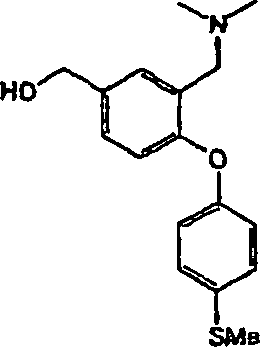
Beispiel
156 {3-[(Methylamino)-methyl]-4-[4-(methylsulfanyl)-phenoxy]-phenyl}-methanol 
Der Titelalkohol wurde aus dem Ester von Beispiel 153 unter Anwendung des Verfahrens von Beispiel 154 hergestellt. δH (DMSO-D6, 400 MHz) 2,45 (3H, s), 2,57 (3H, s), 4,15 (2H, s), 4,47 (2H, s), 5,26 (1H, br), 6,78 (1H, d), 7,01 (2H, d), 7,33 (3H, m), 7,54 (1H, s), 8,86 (2H, br); MS m/z (ES+) 290 (MH+).The title alcohol was prepared from the ester of Example 153 using the procedure of Example 154. δ H (DMSO-D 6 , 400 MHz) 2.45 (3H, s), 2.57 (3H, s), 4.15 (2H, s), 4.47 (2H, s), 5.26 (1H, br), 6.78 (1H, d), 7.01 (2H, d), 7.33 (3H, m), 7.54 (1H, s), 8.86 (2H, br) ; MS m / z (ES + ) 290 (MH + ).
Beispiel
157 {3-[(Dimethylamino)-methyl]-4-[4-(trifluormethoxy)-phenoxy]-phenyl}-methanol 
Stufe 1. Herstellung des AldehydsStage 1. Preparation of the aldehyde
Eine gerührte Aufschlämmung von Lithiumaluminiumhydrid (745 mg, 19,6 mmol) in THF (100 ml) wurde bei 0°C unter Stickstoff tropfenweise mit einer Lösung der Verbindung von Beispiel 84 (2,2 g, 6,54 mmol) in THF (50 ml) versetzt. Anschließend wurde das Gemisch 2 Stünden bei 0°C gerührt, sodann auf Raumtemperatur erwärmt und durch Zugabe von wässriger Natriumhydroxidlösung (2 M) abgeschreckt. Das erhaltene Gemisch wurde getrocknet (MgSO4) filtriert und unter Vakuum eingeengt. Der Rückstand wurde durch Flash-Chromatographie (SiO2; DCM/MeOH/880 NH3 (95:5:1 → 93:7:1)) gereinigt. Man erhielt den angestrebten Aldehyd (730 mg, 33%) in Form eines gelben Öls. δH (CDCl3, 400 MHz) 2,30 (6H, s), 3,57 (2H, s), 6,88 (1H, d), 7,02 (2H, m), 7,21 (2H, m), 7,73 (1H, dd), 8,01 (1H, d), 9,95 (1H, s); MS m/z (TS+) 340 (MH+).A stirred slurry of lithium aluminum hydride (745 mg, 19.6 mmol) in THF (100 mL) was added dropwise at 0 ° C under nitrogen with a solution of the compound of Example 84 (2.2 g, 6.54 mmol) in THF ( 50 ml). The mixture was then stirred for 2 hours at 0 ° C, then warmed to room temperature and quenched by the addition of aqueous sodium hydroxide solution (2 M). The resulting mixture was dried (MgSO 4 ), filtered and concentrated in vacuo. The residue was purified by flash chromatography (SiO 2 ; DCM / MeOH / 880 NH 3 (95: 5: 1 → 93: 7: 1)). The desired aldehyde (730 mg, 33%) was obtained in the form of a yellow oil. δ H (CDCl 3, 400 MHz) 2,30 (6H, s), 3.57 (2H, s), 6.88 (1H, d), 7.02 (2H, m), 7.21 (2H , m), 7.73 (1H, dd), 8.01 (1H, d), 9.95 (1H, s); MS m / z (TS + ) 340 (MH + ).
Stufe 2. Reduktion des Aldehyd-Zwischenprodukts zum angestrebten AlkoholStage 2. Reduction of the Aldehyde intermediate to the desired alcohol
Natriumborhydrid (80 mg, 2,11 mmol) wurde zu einer Lösung des Aldehyd-Zwischenprodukts (720 mg, 2,12 mmol) in MeOH (20 ml) und Wasser (1 ml) gegeben. Das Gemisch wurde 4 Stunden bei Raumtemperatur gerührt. Sodann wurde das Reaktionsgemisch durch Zugabe von Salzsäure (2 M) abgeschreckt und mit Ethylacetat extrahiert. Der organische Extrakt wurde getrocknet (MgSO4) und unter Vakuum eingeengt. Der Rückstand wurde durch Flash-Chromatographie (SiO2; DCM/MeOH/880 NH3 (95:5:1 → 93:7:1)) gereinigt. Man erhielt die angestrebte Alkoholverbindung in Form eines Öls (140 mg, 19%). δH (CDCl3, 400 MHz) 2,08 (1H, br), 2,29 (6H, s), 3,49 (2H, s), 4,70 (2H, s), 6,91 (3H, m), 7,16 (2H, m), 7,27 (1H, m), 7,52 (1H, s); m/z 342 (MH+).Sodium borohydride (80 mg, 2.11 mmol) was added to a solution of the aldehyde intermediate (720 mg, 2.12 mmol) in MeOH (20 mL) and water (1 mL). The mixture was stirred for 4 hours at room temperature. The reaction was quenched by addition of hydrochloric acid (2M) and extracted with ethyl acetate. The organic extract was dried (MgSO 4 ) and concentrated in vacuo. The residue was purified by flash chromatography (SiO 2 ; DCM / MeOH / 880 NH 3 (95: 5: 1 → 93: 7: 1)). The desired alcohol compound was obtained in the form of an oil (140 mg, 19%). δ H (CDCl 3, 400 MHz) 2.08 (1H, br), 2.29 (6H, s), 3.49 (2H, s), 4.70 (2H, s), 6.91 (3H , m), 7.16 (2H, m), 7.27 (1H, m), 7.52 (1H, s); m / z 342 (MH + ).
Beispiel
158 3-[(Dimethylamino)-methyl]-4-[4-(methylsulfanyl)-phenoxy]-benzoesäure 
Der Ester von Beispiel 152 (5,22 g, 15,8 mmol) wurde in THF (60 ml) gelöst, mit einer wässrigen Lithiumhydroxidlösung (1 M, 63,1 mmol) behandelt und über Nacht unter Rückfluss erwärmt. Sodann wurde das Reaktionsgemisch mit Salzsäure (2 M) neutralisiert und mit DCM extrahiert. Die organischen Extrakte wurden getrocknet (MgSO4) und zur Titel-Carbonsäure in Form eines weißen Schaums (4,80 g, 95%) eingedampft. δH (CD3OD, 400 MHz) 2,48 (3H, s), 2,56 (6H, s), 3,94 (2H, s), 6,80 (1H, d), 7,00 (2H, d), 7,33 (2H, d), 7,94 (1H, d), 8,09 (1H, s); MS m/z (ES+) 318 (MH+).The ester of Example 152 (5.22g, 15.8mmol) was dissolved in THF (60ml), treated with a lithium hydroxide aqueous solution (1M, 63.1mmol) and heated at reflux overnight. The reaction mixture was then neutralized with hydrochloric acid (2 M) and extracted with DCM. The organic extracts were dried (MgSO 4 ) and evaporated to the title carboxylic acid as a white foam (4.80 g, 95%). δ H (CD 3 OD, 400 MHz) 2.48 (3H, s), 2.56 (6H, s), 3.94 (2H, s), 6.80 (1H, d), 7.00 ( 2H, d), 7.33 (2H, d), 7.94 (1H, d), 8.09 (1H, s); MS m / z (ES + ) 318 (MH + ).
Beispiel
159 3-[(Dimethylamino)-methyl]-N-methyl-4-[4-(methylsulfanyl)-phenoxy]-benzamid 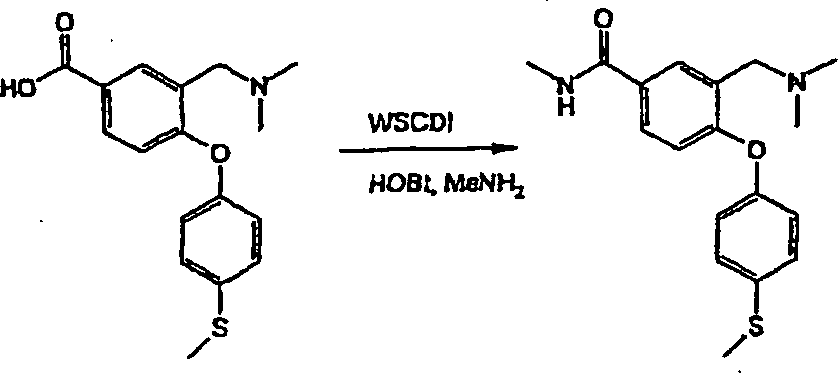
Das Produkt von Beispiel 158 (480 mg, 1,51 mmol), WSCDI (377 mg, 2 mmol), HOBt·H2O (255 mg, 1,66 mmol) und Triethylamin (0,53 ml, 3,78 mmol) wurden in DCM (0,03 M) gelöst. Nach 30-minütigem Rühren wurde MeNH2 (kondensiert, 2 ml) zugegeben und das Gemisch wurde weitere 12 Stunden gerührt. Sodann wurde das Gemisch eingedampft. Der Rückstand wurde mit Ethylacetat und Wasser ausgeschüttelt.The product of Example 158 (480 mg, 1.51 mmol), WSCDI (377 mg, 2 mmol), HOBt · H 2 O (255 mg, 1.66 mmol) and triethylamine (0.53 mL, 3.78 mmol ) were dissolved in DCM (0.03 M). After stirring for 30 minutes, MeNH 2 (condensed, 2 ml) was added and the mixture was stirred for a further 12 hours. The mixture was then evaporated. The residue was partitioned between ethyl acetate and water.
Die organische Phase wurde abgetrennt. Die wässrige Phase wurde mit Ethylacetat (3-mal) reextrahiert. Die vereinigten organischen Phasen wurden getrocknet (MgSO4) und zu einem gelben Öl eingedampft. Dieses Öl wurde durch Flash-Chromatographie (SiO2; DCM/MeOH/880 NH3 (93:7:1)) gereinigt. Die angestrebte Titelverbindung wurde in Form ihres Hydrochloridsalzes isoliert (285 mg, 63%; freie Base: δH (CDCl3, 400 MHz) 2,12 (6H, s), 2,41 (3H, s), 2,92 (3H, d), 3,46 (3H, s), 6,78 (1H, brd), 6,84 (2H, d), 7,20 (2H, d), 7,63 (1H, dd), 7,82 (1H, d); MS m/z (ES+) 331 (MH+).The organic phase was separated. The aqueous phase was reextracted with ethyl acetate (3 times). The combined organic phases were dried (MgSO 4 ) and evaporated to a yellow oil. This oil was purified by flash chromatography (SiO 2 ; DCM / MeOH / 880 NH 3 (93: 7: 1)). The desired title compound was isolated as its hydrochloride salt (285 mg, 63%; free base: δ H (CDCl 3, 400 MHz) 2.12 (6H, s), 2.41 (3H, s), 2.92 ( 3H, d), 3.46 (3H, s), 6.78 (1H, brd), 6.84 (2H, d), 7.20 (2H, d), 7.63 (1H, dd), 7.82 (1H, d); MS m / z (ES + ) 331 (MH + ).
Beispiele 160–168Examples 160-168
Die folgenden Amide wurden auf analoge Weise wie in Beispiel 159 aus der Carbonsäure von Beispiel 158 und dem entsprechenden Amin hergestellt.The The following amides were prepared in a manner analogous to Example 159 the carboxylic acid of Example 158 and the corresponding amine.

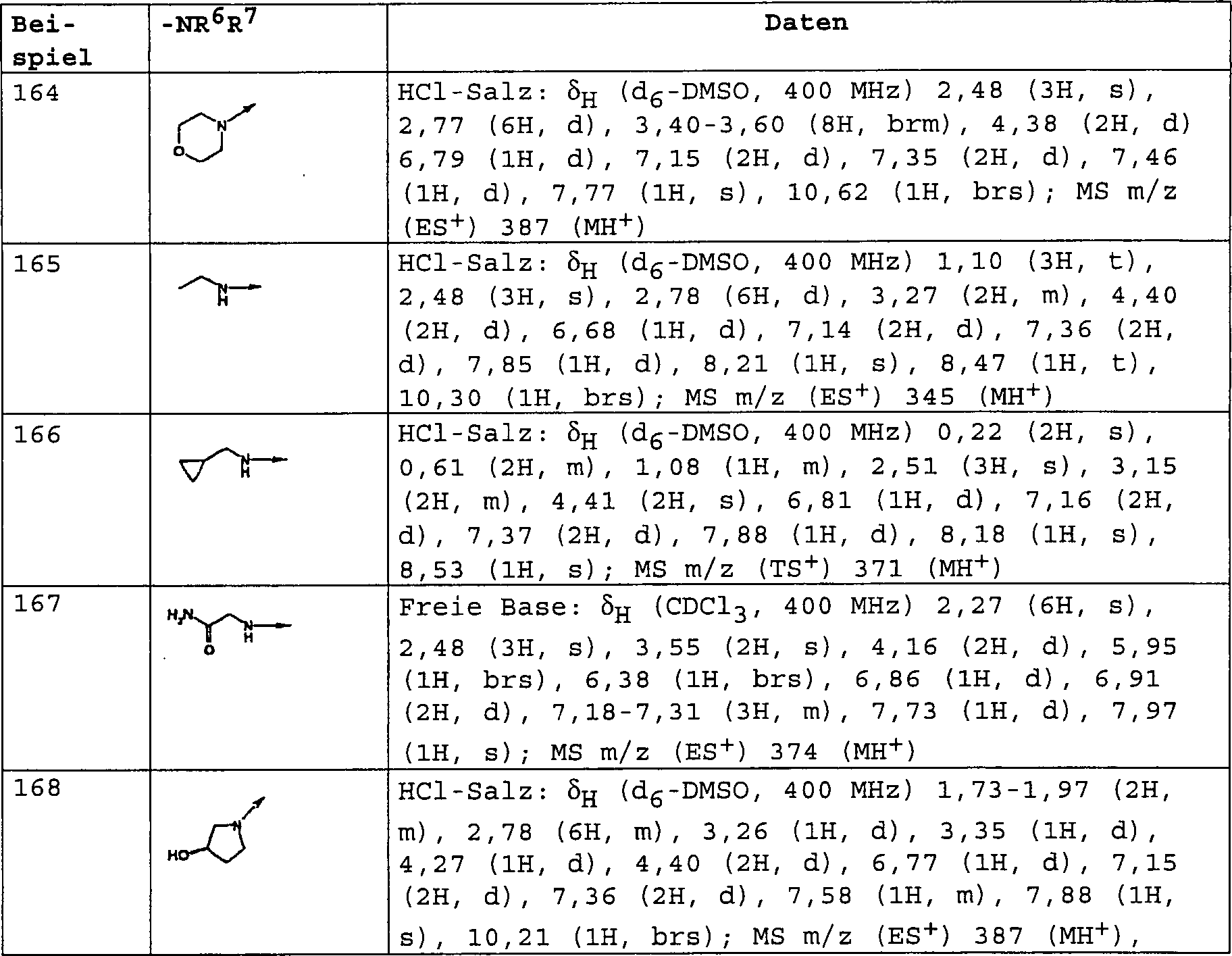
Beispiel
169 4-[3-Methoxy-4-(methylsulfanyl)-phenoxy]-3-[(methylamino)-methyl]-benzamid 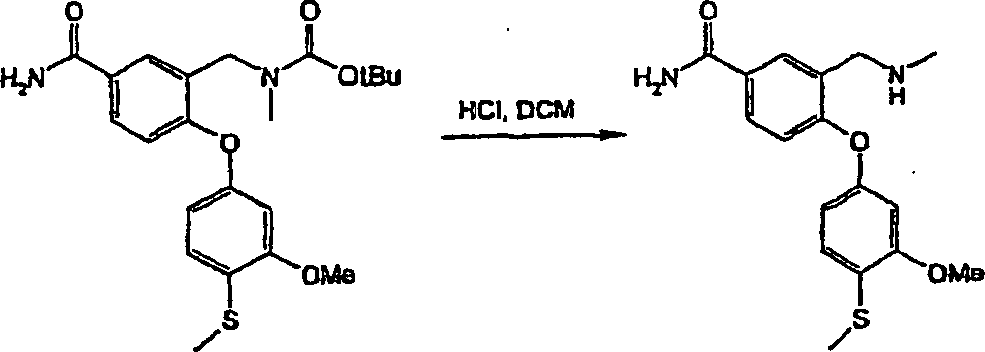
Das Boc-geschützte Amin von Präparation 53 (280 mg, 0,65 mmol) wurde in DCM (10 ml) gelöst. Die Lösung wurde auf 0°C abgekühlt. Sodann wurde 15 Minuten Chlorwasserstoffgas durch die Lösung geleitet. Anschließend wurde die Lösung zur Trockne eingedampft. Der Rückstand wurde mehrmals zusammen mit DCM/Ethylacetat (1:1) und anschließend mit Diethylether eingedampft. Das in Form eines weißen Feststoffes erhaltene Produkt wurde unter Vakuum getrocknet (240 mg, etwa 100%). HCl-Salz: δH (CD3OD, 400 MHz) 2,37 (3H, s), 2,77 (3H, s), 3,82 (3H, s), 4,35 (2H, s), 6,73 (1H, dd), 6,80 (1H, d), 6,84 (1H, d), 7,36 (1H, d), 7,86 (1H, dd), 8,03 (1H, d); MS m/z (TS+) 333 (MH+).The Boc-protected amine of Preparation 53 (280 mg, 0.65 mmol) was dissolved in DCM (10 mL). The solution was cooled to 0 ° C. Hydrogen chloride gas was then passed through the solution for 15 minutes. The solution was then evaporated to dryness. The residue was coevaporated several times with DCM / ethyl acetate (1: 1) followed by diethyl ether. The product obtained as a white solid was dried under vacuum (240 mg, about 100%). HCl salt: δ H (CD 3 OD, 400 MHz) 2.37 (3H, s), 2.77 (3H, s), 3.82 (3H, s), 4.35 (2H, s), 6.73 (1H, dd), 6.80 (1H, d), 6.84 (1H, d), 7.36 (1H, d), 7.86 (1H, dd), 8.03 (1H , d); MS m / z (TS + ) 333 (MH + ).
Beispiele 170–176Examples 170-176
Eine Reihe von Amiden wurde auf analoge Weise wie in Beispiel 169 aus den erforderlichen Boc-geschützten Aminen hergestellt.A A series of amides was prepared in a manner analogous to Example 169 the required Boc-protected Amines produced.

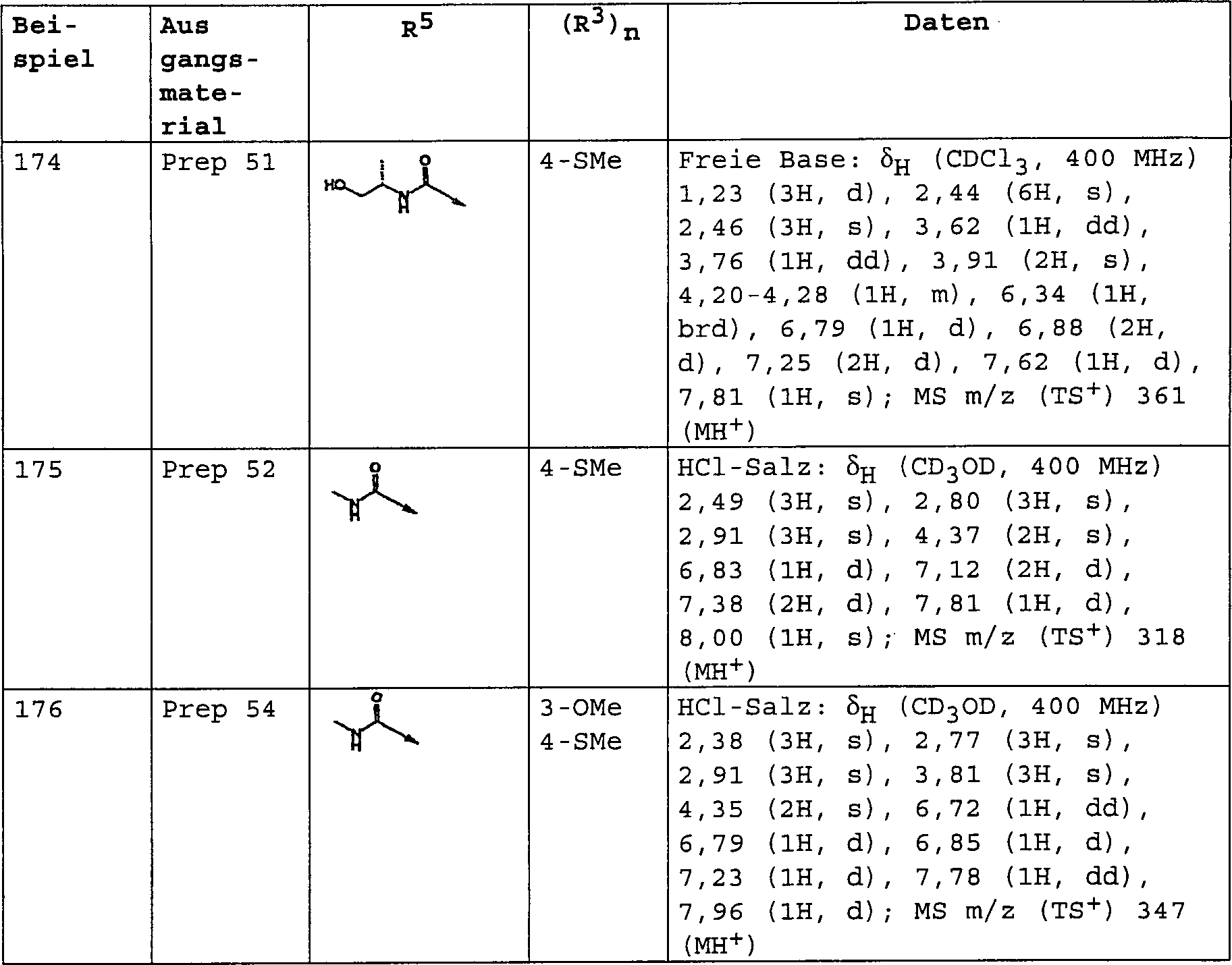
Beispiel
177 3-[(Methylamino)-methyl]-4-[4-(methylsulfanyl)-3-(trifluormethyl)-phenoxy]-benzamid 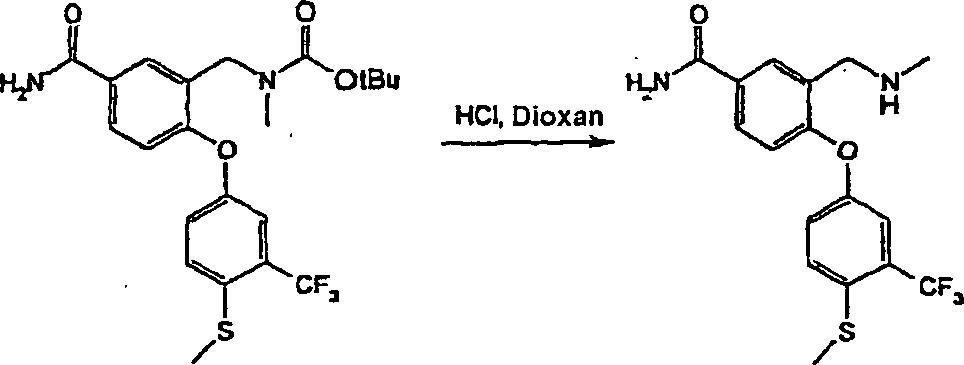
Das Boc-geschützte Amin von Präparation 46 (396 mg, 0,842 mmol) wurde mit Salzsäure (4 M) in Dioxan (5 ml) behandelt und 1,5 Stunden gerührt. Das Lösungsmittel wurde durch Abdampfen entfernt. Der Rückstand wurde durch Zugabe einer gesättigten wässrigen Natriumbicarbonatlösung alkalisch gemacht und sodann mit DCM (4 × 10 ml) extrahiert. Die vereinigten organischen Extrakte wurden mit Kochsalzlösung (10 ml) gewaschen, getrocknet (MgSO4) und zu einem gelben Öl eingedampft. Dieses Öl wurde durch Flash-Chromatographie (SiO2; DCM/MeOH/880 NH3 (93:7:1)) gereinigt. Man erhielt das Titelamid in Form eines weißen Schaums (208 mg, 66%). Freie Base: δH (CDCl3, 400 MHz) 2,45 (3H, s), 2,51 (3H, s), 3,82 (2H, s), 6,84 (1H, d), 7,10 (1H, d), 7,31 (1H, s), 7,40 (1H, d), 7,72 (1H, dd), 7,91 (1H, s); MS m/z (TS+) 371 (MH+).The Boc-protected amine of Preparation 46 (396 mg, 0.842 mmol) was treated with hydrochloric acid (4 M) in dioxane (5 mL) and stirred for 1.5 h. The solvent was removed by evaporation. The residue was made alkaline by addition of a saturated aqueous sodium bicarbonate solution and then extracted with DCM (4 x 10 mL). The combined organic extracts were washed with brine (10 ml), dried (MgSO 4 ) and evaporated to a yellow oil. This oil was purified by flash chromatography (SiO 2 ; DCM / MeOH / 880 NH 3 (93: 7: 1)). The title amide was obtained as a white foam (208 mg, 66%). Free base: δ H (CDCl 3, 400 MHz) 2.45 (3H, s), 2.51 (3H, s), 3.82 (2H, s), 6.84 (1H, d), 7, 10 (1H, d), 7.31 (1H, s), 7.40 (1H, d), 7.72 (1H, dd), 7.91 (1H, s); MS m / z (TS + ) 371 (MH + ).
Beispiel
178 3-[(Dimethylamino)-methyl-[4-[4-(methylsulfanyl)-3-(trifluormethyl)-phenoxy]-benzamid 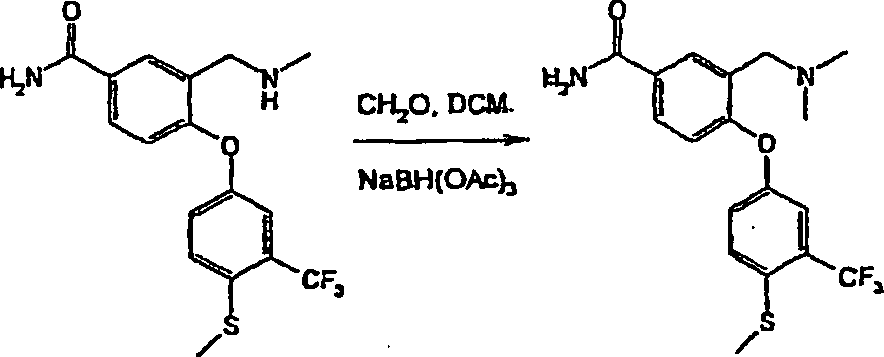
Das Amid von Beispiel 177 (105 mg, 0,28 mmol) wurde in DCM (3 ml) suspendiert und mit Formaldehyd (37% wässrig, 35 μl, 0,425 mmol) behandelt. Das Gemisch wurde 30 Minuten gerührt (in diesem Stadium war eine Lösung entstanden) und sodann mit Natrium-tri-(acetoxy)-borhydrid (120 mg, 0,567 mmol) behandelt. Das Reaktionsgemisch wurde über Nacht gerührt und sodann mit Wasser (5 ml) verdünnt, mit 880-Ammoniak (1 ml) alkalisch gemacht und mit DCM (3 × 10 ml) extrahiert. Die vereinigten organischen Extrakte wurden mit Kochsalzlösung (5 ml) gewaschen, getrocknet (MgSO4) und zu einem weißen Feststoff eingedampft. Nach Reinigung durch Flash-Chromatographie (SiO2; DCM, MeOH, 880 NH3 (95:5:0,5)) erhielt man das Titelamid in Form eines weißen Pulvers (85 mg, 78%). Freie Base: δH (CDCl3, 400 MHz) 2,24 (6H, s), 2,46 (3H, s), 3,50 (2H, s), 5,47–6,15 (2H, brm), 6,85 (1H, d), 7,03 (1H, d), 7,23 (1H, s), 7,35 (1H, d), 7,71 (1H, d), 7,90 (1H, s); MS m/z (TS+) 385 (MH+).The amide of Example 177 (105 mg, 0.28 mmol) was suspended in DCM (3 mL) and treated with formaldehyde (37% aqueous, 35 μL, 0.425 mmol). The mixture was stirred for 30 minutes (at which stage a solution was formed) and then treated with sodium tri (acetoxy) borohydride (120 mg, 0.567 mmol). The reaction mixture was stirred overnight and then diluted with water (5 ml), basified with 880 ammonia (1 ml) and extracted with DCM (3 x 10 ml). The combined organic extracts were washed with brine (5 ml), dried (MgSO 4 ) and evaporated to a white solid. Purification by flash chromatography (SiO 2 ; DCM, MeOH, 880 NH 3 (95: 5: 0.5) gave the title amide as a white powder (85 mg, 78%). Free base: δ H (CDCl 3, 400 MHz) 2.24 (6H, s), 2.46 (3H, s), 3.50 (2H, S), 5.47 to 6.15 (2H, brm ), 6.85 (1H, d), 7.03 (1H, d), 7.23 (1H, s), 7.35 (1H, d), 7.71 (1H, d), 7.90 (1H, s); MS m / z (TS + ) 385 (MH + ).
Beispiele 179–180Examples 179-180
Die folgenden Amide wurden auf analoge Weise wie in Beispiel 178 aus dem erforderlichen sekundären Amin hergestellt.The The following amides were prepared in a manner analogous to Example 178 the required secondary Amine produced.

Beispiele
181 und 182 N-Methyl-N-[2-[4-(methylsulfanyl)-phenoxy]-5-(1H-1,2,3-triazol-1-yl)-benzyl]-amin
(Beispiel 181) und N-Methyl-N-[2-[4-(methylsulfanyl)-phenoxy]-5-(2H-1,2,3-triazol-2-yl)-benzyl]-amin
(Beispiel 182) 
Das
Bromid von Beispiel 23 (2,0 g, 6 mmol) wurde mit Kupferpulver (378
mg, 6 mmol), 1,2,3-Triazol (etwa 5 g, Überschuss) und Kaliumcarbonat
(828 mg, 6 mmol) vermischt und 48 Stunden auf 160°C erwärmt. Nach
Abkühlen
auf Raumtemperatur wurde das Reaktionsgemisch mit Natriumhydroxid
(3 M) und Ethylacetat ausgeschüttelt.
Die organische Phase wurde abgetrennt und mit Natriumhydroxid (3
M) (3×),
Wasser und Kochsalzlösung
gewaschen, sodann getrocknet (MgSO4) und
eingedampft. Der erhaltene Rückstand
wurde durch Flash-Chromatographie (SiO2;
DCM/MeOH/880 NH3 (97,5:2,5:0,25)) gereinigt.
Man erhielt in getrennter Form das 1-substituierte Triazolderivat
der Verbindung von Beispiel 181 und das 2-substituierte Isomere
der Verbindung von Beispiel 182. Das Hydrochloridsalz der Verbindungen
wurde jeweils durch Behandlung mit ätherischem Chlorwasserstoff
(1 M Lösung, Überschuss)
ausgefällt.
Beispiel
181 (Monohydrochloridsalz) (270 mg, 13%): δH (d6-DMSO, 400 MHz) 2,50 (3H, s (obsc.)), 2,64
(3H, t), 4,27 (2H, t), 6,97 (1H, d), 7,14 (2H, d), 7,36 (2H, d),
7,87 (1H, dd), 7,99 (1H, s), 8,26 (1H, d), 8,76 (1H, s), 9,16 (2H,
brs); MS m/z (TS+) 327 (MH+).
Beispiel
182 (Bishydrochloridsalz) (400 mg, 17%): δH (CDCl3, 400 MHz) 2,50 (3H, s), 2,67 (3H, brs),
4,18 (2H, brs), 6,95 (1H, d), 7,15 (2H, d), 7,27 (2H, d), 7,74 (2H,
s), 7,96 (1H, dd), 8,35 (1H, d), 9,92 (2H, brs); MS m/z (TS+) 327 (MH+).The bromide of Example 23 (2.0 g, 6 mmol) was mixed with copper powder (378 mg, 6 mmol), 1,2,3-triazole (about 5 g, excess) and potassium carbonate (828 mg, 6 mmol) and Heated to 160 ° C for 48 hours. After cooling to room temperature, the reaction mixture was partitioned between sodium hydroxide (3 M) and ethyl acetate. The organic phase was separated and washed with sodium hydroxide (3M) (3x), water and brine, then dried (MgSO 4 ) and evaporated. The resulting residue was purified by flash chromatography (SiO 2 ; DCM / MeOH / 880 NH 3 (97.5: 2.5: 0.25)). Separately, the 1-substituted triazole derivative of the compound of Example 181 and the 2-substituted isomer of the compound of Example 182 were obtained. The hydrochloride salt of the compounds was each precipitated by treatment with ethereal hydrogen chloride (1 M solution, excess).
Example 181 (monohydrochloride salt) (270 mg, 13%): δ H (d 6 -DMSO, 400 MHz) 2.50 (3H, s (obsc.)), 2.64 (3H, t), 4.27 ( 2H, t), 6.97 (1H, d), 7.14 (2H, d), 7.36 (2H, d), 7.87 (1H, dd), 7.99 (1H, s), 8.26 (1H, d), 8.76 (1H, s), 9.16 (2H, brs); MS m / z (TS + ) 327 (MH + ).
Example 182 (bis-hydrochloride salt) (400 mg, 17%): δ H (CDCl 3, 400 MHz) 2.50 (3H, s), 2.67 (3H, brs), 4.18 (2H, brs), 6 , 95 (1H, d), 7,15 (2H, d), 7,27 (2H, d), 7,74 (2H, s), 7,96 (1H, dd), 8,35 (1H, d), 9.92 (2H, brs); MS m / z (TS + ) 327 (MH + ).
Beispiel
183 N,N-Dimethyl-N-[2-[4-(methylsulfanyl)-phenoxy]-5-(2H-1,2,3-triazol-2-yl)-benzyl]-amin 
Das Triazolderivat-hydrochloridsalz von Beispiel 182 (400 mg, 1,1 mmol) wurde in DCM (30 ml) suspendiert und mit Formaldehyd (37%, wässrig) (etwa 0,2 ml, etwa 5,5 mmol) sowie anschließend mit Natrium-tris-(acetoxy)-borhydrid (1,16 g, 5,5 mmol) versetzt. Das Reaktionsgemisch wurde 1 Stunde bei Raumtemperatur gerührt und sodann mit Natriumhydroxid (3 M) und DCM ausgeschüttelt. Die organische Phase wurde abgetrennt. Die wässrige Phase wurde zusätzlich mit DCM extrahiert (4×). Die vereinigten organischen Fraktionen wurden mit Kochsalzlösung gewaschen, getrocknet (MgSO4) und zur Titelverbindung in Form eines farblosen Öls eingedampft (290 mg, 70%). δH (CDCl3, 400 MHz), 2,44 (3H, s), 2,49 (6H, s), 3,75 (2H, brs), 6,93 (2H, d), 6,98 (1H, d), 7,26 (2H, d), 7,80 (2H, s), 7,85 (1H, dd), 8,26 (1H, d); MS m/z (TS+) 341 (MH+).The triazole derivative hydrochloride salt of Example 182 (400 mg, 1.1 mmol) was suspended in DCM (30 mL) and washed with formaldehyde (37%, aqueous) (about 0.2 mL, about 5.5 mmol) and then with sodium tris (acetoxy) borohydride (1.16 g, 5.5 mmol). The reaction mixture was stirred at room temperature for 1 hour and then partitioned between sodium hydroxide (3 M) and DCM. The organic phase was separated. The aqueous phase was additionally extracted with DCM (4 ×). The combined organic fractions were washed with brine, dried (MgSO 4 ) and evaporated to the title compound as a colorless oil (290 mg, 70%). δ H (CDCl 3, 400 MHz), 2.44 (3H, s), 2.49 (6H, s), 3.75 (2H, brs), 6.93 (2H, d), 6.98 ( 1H, d), 7.26 (2H, d), 7.80 (2H, s), 7.85 (1H, dd), 8.26 (1H, d); MS m / z (TS + ) 341 (MH + ).
Beispiel
184 N,N-Dimethyl-N-[2-[4-(methylsulfanyl)-phenoxy]-5-(1H-1,2,3-triazol-1-yl)-benzyl]-amin 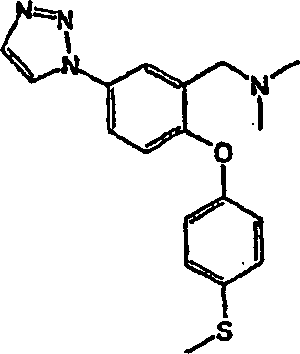
Die Titelverbindung wurde aus dem Produkt von Beispiel 181 auf analoge Weise wie bei der Herstellung der Verbindung von Beispiel 183 hergestellt (108 mg, 52%). δH (CDCl3, 400 MHz) 2,18 (6H, s), 2,44 (3H, s), 3,48 (2H, brs), 6,97 (2H, d), 7,06 (1H, d), 7,29 (2H, d), 7,76 (1H, d), 7,97 (2H, d), 8,80 (1H, s); MS m/z (TS+) 341 (MH+).The title compound was prepared from the product of Example 181 in an analogous manner as in the preparation of the compound of Example 183 (108 mg, 52%). δ H (CDCl 3, 400 MHz) 2.18 (6H, s), 2.44 (3H, s), 3.48 (2H, brs), 6.97 (2H, d), 7.06 (1H , d), 7.29 (2H, d), 7.76 (1H, d), 7.97 (2H, d), 8.80 (1H, s); MS m / z (TS + ) 341 (MH + ).
Beispiel
185 N-[2-[4-(Methylsulfanyl)-phenoxy]-5-(1H-imidazol-1-yl)-benzyl]-N-methylamin 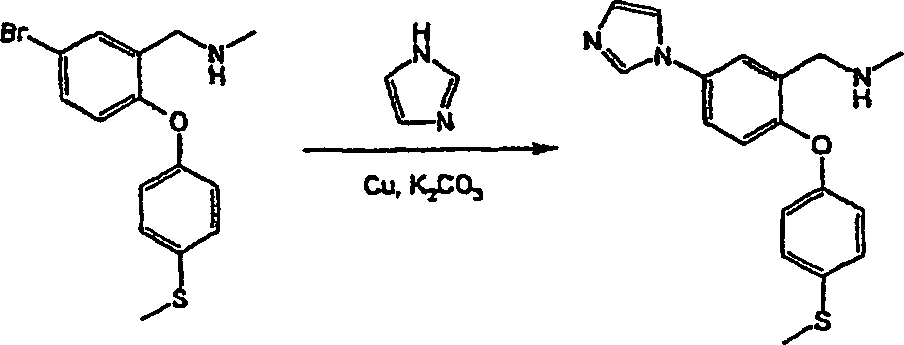
Das Arylbromidderivat von Beispiel 23 (2 g, 6 mmol) wurde mit Imidazol (5 g, 73,5 mmol), Kupferpulver (381 mg, 6 mmol) und Kaliumcarbonat (828 mg, 6 mmol) vereinigt. Das Gemisch wurde 3 Stunden auf 160°C erwärmt. Nach Abkühlen auf Raumtemperatur wurde das Gemisch mit wässriger Natriumhydroxidlösung (3 M) und Ethylacetat ausgeschüttelt. Die organische Phase wurde abgetrennt, mit wässriger Natriumhydroxidlösung (3 M) (3-mal), Wasser (3-mal) und Kochsalzlösung gewaschen und sodann getrocknet (MgSO4) und eingedampft. Der Rückstand wurde durch Flash-Chromatographie (SiO2; DCM/MeOH/880 NH3 (95:5:0,5)) gereinigt. Man erhielt die Titelverbindung, die in Form ihres HCl-Salzes nach dem üblichen Verfahren isoliert wurde (57 mg, 2%). Bis-HCl-Salz: δH (d6-DMSO, 400 MHz) 2,49 (3H, s), 2,61 (3H, s), 4,26 (2H, s), 6,96 (1H, d), 7,14 (2H, d), 7,36 (1H, dd), 7,84 (1H, s), 8,21 (1H, s), 8,28 (1H, s), 9,56 (3H, brs); MS m/z (TS+) 326 (MH+).The aryl bromide derivative of Example 23 (2 g, 6 mmol) was combined with imidazole (5 g, 73.5 mmol), copper powder (381 mg, 6 mmol) and potassium carbonate (828 mg, 6 mmol). The mixture was heated at 160 ° C for 3 hours. After cooling to room temperature, the mixture was partitioned between aqueous sodium hydroxide solution (3 M) and ethyl acetate. The organic phase was separated, washed with aqueous sodium hydroxide solution (3 M) (3 times), water (3 times) and brine, then dried (MgSO 4 ) and evaporated. The residue was purified by flash chromatography (SiO 2 ; DCM / MeOH / 880 NH 3 (95: 5: 0.5)). The title compound was obtained, which was isolated in the form of its HCl salt by the usual method (57 mg, 2%). Bis-HCl salt: δ H (d 6 -DMSO, 400 MHz) 2.49 (3H, s), 2.61 (3H, s), 4.26 (2H, s), 6.96 (1H, d), 7,14 (2H, d), 7,36 (1H, dd), 7,84 (1H, s), 8,21 (1H, s), 8,28 (1H, s), 9, 56 (3H, brs); MS m / z (TS + ) 326 (MH + ).
Beispiel
186 N-[2-[4-(Methylsulfanyl)-phenoxy]-5-(1H-imidazol-1-yl)-benzyl]-N,N-dimethylamin 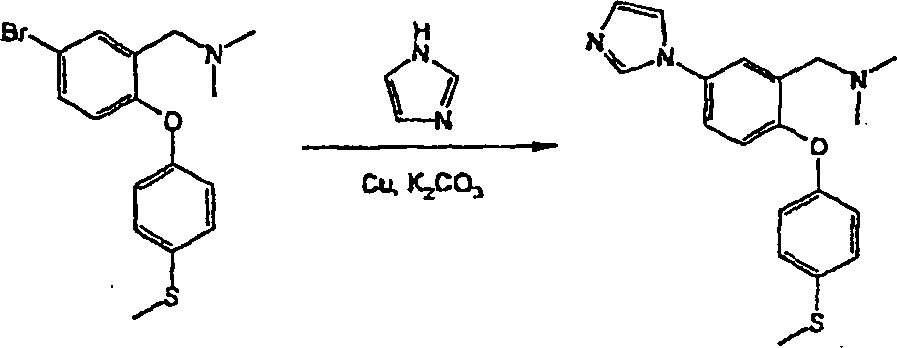
Die Titelverbindung wurde aus dem Arylbromid von Beispiel 9 unter Anwendung des in Beispiel 185 beschriebenen Verfahrens hergestellt. Bis-HCl-Salz: δH (CD3OD, 400 MHz) 2,51 (3H, s), 3,00 (6H, s), 4,60 (2H, s), 7,06 (1H, d), 7,17 (2H, d), 7,41 (2H, d), 7,77 (3H, m), 8,11 (2H, d), 9,47 (1H, s); MS m/z (TS+) 340 (MH+).The title compound was prepared from the aryl bromide of Example 9 using the procedure described in Example 185. Bis-HCl salt: δ H (CD 3 OD, 400 MHz) 2.51 (3H, s), 3.00 (6H, s), 4.60 (2H, s), 7.06 (1H, d ), 7,17 (2H, d), 7,41 (2H, d), 7,77 (3H, m), 8,11 (2H, d), 9,47 (1H, s); MS m / z (TS + ) 340 (MH + ).
Beispiel
187 N-Methyl-N-[2-[4-(methylsulfanyl)-phenoxy]-5-(1H-1,2,4-triazol-1-yl)-benzyl]-amin 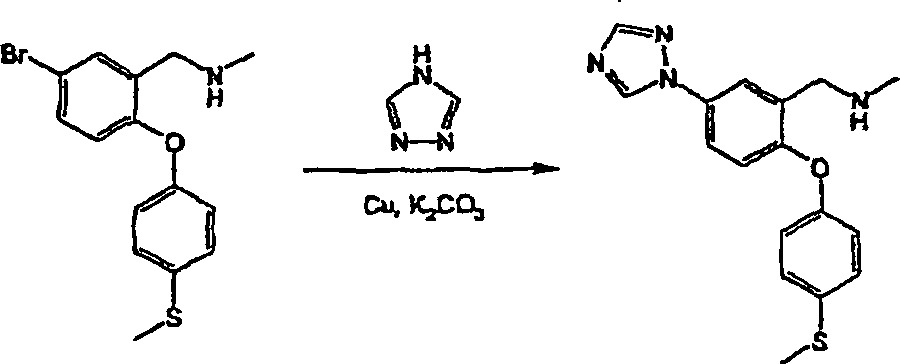
Die Titelverbindung wurde aus dem Arylbromid von Beispiel 23 unter Anwendung des in den Beispielen 181/182 beschriebenen Verfahrens hergestellt. Bis-HCl-Salz: δH (d6-DMSO, 400 MHz) 2,50 (3H, s), 2,62 (3H, s), 4,27 (2H, s), 6,95 (1H, d), 7,14 (2H, d), 7,36 (2H, d), 7,85 (1H, d), 8,21 (1H, s), 8,27 (1H, s), 9,26 (3H, brs); MS m/z (TS+) 327 (MH+).The title compound was prepared from the aryl bromide of Example 23 using the procedure described in Examples 181/182. Bis-HCl salt: δ H (d 6 -DMSO, 400 MHz) 2.50 (3H, s), 2.62 (3H, s), 4.27 (2H, s), 6.95 (1H, d), 7,14 (2H, d), 7,36 (2H, d), 7,85 (1H, d), 8,21 (1H, s), 8,27 (1H, s), 9, 26 (3H, brs); MS m / z (TS + ) 327 (MH + ).
Beispiel
188 N,N-Dimethyl-N-[2-[4-(methylsulfanyl)-phenoxy]-5-(1H-1,2,4-triazol-1-yl)-benzyl]-amin 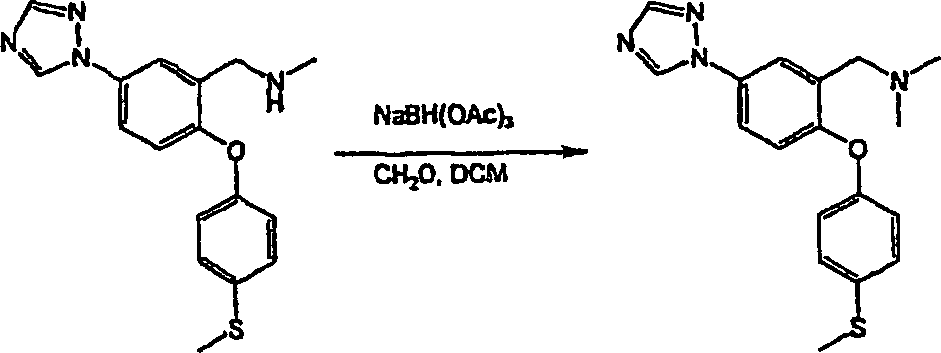
Die Titelverbindung wurde aus dem sekundären Amin von Beispiel 187 unter Anwendung des in Beispiel 183 beschriebenen reduktiven Methylierungsverfahrens hergestellt. Freie Base: δH (CDCl3, 400 MHz) 2,30 (6H, s), 2,48 (3H, s), 3,54 (2H, s), 6,91 (2H, d), 6,97 (1H, d), 7,27 (2H, d), 7,52 (1H, dd), 7,82 (1H, d), 8,10 (1H, s), 8,54 (1H, s); MS m/z (TS+) 341 (MH+).The title compound was prepared from the secondary amine of Example 187 using the reductive methylation method described in Example 183. Free base: δ H (CDCl 3, 400 MHz) 2.30 (6H, s), 2.48 (3H, s), 3.54 (2H, s), 6.91 (2H, d), 6, 97 (1H, d), 7.27 (2H, d), 7.52 (1H, dd), 7.82 (1H, d), 8.10 (1H, s), 8.54 (1H, s ); MS m / z (TS + ) 341 (MH + ).
Beispiel
189 N-[2-[4-(Methylsulfanyl)-phenoxy]-5-(4H-1,2,4-triazol-4-yl)-benzyl]-N,N-dimethylamin 
Das Anilin von Beispiel 109 (500 mg, 1,7 mmol), N'-[(Dimethylamino)-methyliden]-N,N-dimethylhydrazonoformamid (590 mg, 4,15 mmol) (hergestellt gemäß Bartlett et al., J. Chem. Soc. (C), (1967), S. 1664) und p-Toluolsulfonsäure (394 mg, 2 mmol) wurden in Toluol (10 ml) vermischt und 2 Tage unter Rückfluss erwärmt. Sodann wurde das Gemisch auf Raumtemperatur abgekühlt und mit einer gesättigten wässrigen Natriumbicarbonatlösung behandelt und mit Ethylacetat verdünnt. Die organische Phase wurde abgetrennt, mit Kochsalzlösung gewaschen, getrocknet (MgSO4) und eingedampft. Der Rückstand wurde durch Flash-Chromatographie (SiO2; DCM/MeOH/880 NH3 (90:10:1)) gereinigt. Man erhielt das angestrebte Triazolderivat (100 mg, 17%). δH (CDCl3, 400 MHz) 2,29 (6H, s), 2,48 (3H, s), 3,54 (2H, s), 6,92 (2H, d), 6,95 (1H, d), 7,19 (1H, dd), 7,29 (2H, d), 7,46 (2H, s); MS m/z (TS+) 341 (MH+).The aniline of Example 109 (500 mg, 1.7 mmol), N '- [(dimethylamino) -methylidene] -N, N-dimethylhydrazone-formamide (590 mg, 4.15 mmol) (prepared according to Bartlett et al., J. Biol. Chem. Soc. (C), (1967), p. 1664) and p-toluenesulfonic acid (394 mg, 2 mmol) were mixed in toluene (10 mL) and heated at reflux for 2 days. The mixture was cooled to room temperature and treated with a saturated aqueous sodium bicarbonate solution and diluted with ethyl acetate. The organic phase was separated, washed with brine, dried (MgSO 4 ) and evaporated. The residue was purified by flash chromatography (SiO 2 ; DCM / MeOH / 880 NH 3 (90: 10: 1)). The desired triazole derivative was obtained (100 mg, 17%). δ H (CDCl 3, 400 MHz) 2.29 (6H, s), 2.48 (3H, s), 3.54 (2H, s), 6.92 (2H, d), 6.95 (1H , d), 7.19 (1H, dd), 7.29 (2H, d), 7.46 (2H, s); MS m / z (TS + ) 341 (MH + ).
Beispiel
190 N-{5-(3-Amino-1H-pyrazol-1-yl)-2-[4-(methylsulfanyl)-phenoxy]-benzyl}-N-methylamin 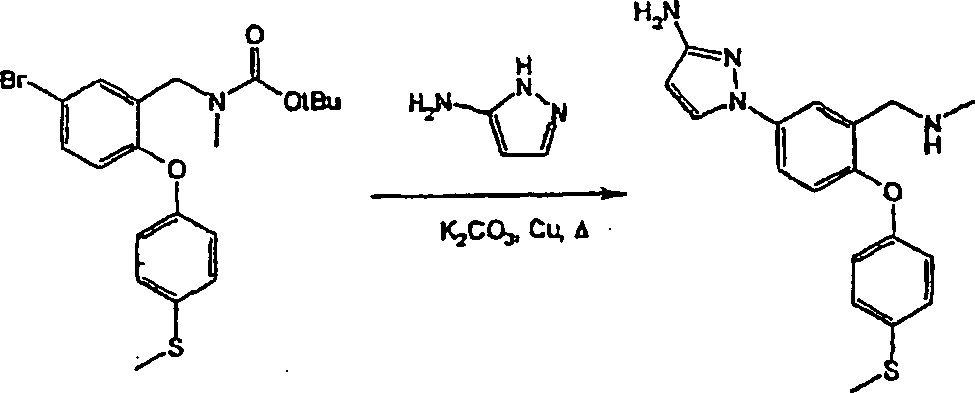
Kupferpulver (1,53 g, 24 mmol), Kaliumcarbonat (6,08 g, mmol) und 3-Aminopyrazol wurden vermischt und zur Bildung einer Schmelze auf 50°C erwärmt. Nach Zugabe von Iod (51 mg, 0,2 mmol) wurde das Gemisch 20 Minuten gerührt und sodann mit dem Arylbromid von Präparation 39 (8,77 g, 20 mmol) versetzt. Nach weiteren 10 Minuten wurde das Reaktionsgemisch 9 Stunden auf 140°C erwärmt. Nach Abkühlen auf Raumtemperatur wurde das Gemisch mit einer gesättigten wässrigen Lösung von Ethylendiamintetraessigsäure (EDTA) und Ethylacetat (jeweils 70 ml) ausgeschüttelt. Das Gemisch wurde 4 Stunden gerührt. Sodann wurde das Gemisch weiter mit gesättigter wässriger EDTA-Lösung und Ethylacetat (jeweils 1000 ml) verdünnt. Die Ethylacetatphase wurde abgetrennt, mit Kochsalzlösung gewaschen, getrocknet und eingedampft. Der Rückstand wurde durch Flash-Chromatographie (SiO2; (MeOH 880 NH3 (1:9) in DCM (1 → 10%)) gereinigt. Man erhielt die Titelverbindung in Form eines braunen Öls, das beim Stehenlassen unter Vakuum erstarrte (1,52 g, 22%). δH (CDCl3, 400 MHz) 2,44 (3H, s), 2,52 (3H, s), 3,77 (4H, brs), 5,80 (1H, s), 6,86 (3H, m), 7,25 (2H, d), 7,39 (1H, dd), 7,58 (1H, d), 7,63 (1H, s).Copper powder (1.53 g, 24 mmol), potassium carbonate (6.08 g, mmol) and 3-aminopyrazole were mixed and heated to 50 ° C to form a melt. After addition of iodine (51 mg, 0.2 mmol), the mixture was stirred for 20 minutes and then the aryl bromide from Preparation 39 (8.77 g, 20 mmol) was added. After a further 10 minutes, the reaction mixture was heated to 140 ° C for 9 hours. After cooling to room temperature, the mixture was partitioned between a saturated aqueous solution of ethylenediaminetetraacetic acid (EDTA) and ethyl acetate (70 ml each). The mixture was stirred for 4 hours. The mixture was further diluted with saturated aqueous EDTA solution and ethyl acetate (1000 ml each). The ethyl acetate layer was separated, washed with brine, dried and evaporated. The residue was purified by flash chromatography (SiO 2 ) (MeOH 880 NH 3 (1: 9) in DCM (1 → 10%)) to give the title compound as a brown oil which solidified on standing under vacuum (1 , 52 g, 22%). δ H (CDCl 3, 400 MHz) 2.44 (3H, s), 2.52 (3H, s), 3.77 (4H, brs), 5.80 (1H, s), 6.86 (3H, m), 7.25 (2H, d), 7.39 (1H, dd), 7.58 (1H, d), 7.63 (1H, s).
Beispiel
191 N-{5-(3-Amino-1H-pyrazol-1-yl)-2-[4-(methylsulfanyl)-phenoxy]-benzyl}-N,N-dimethylamin 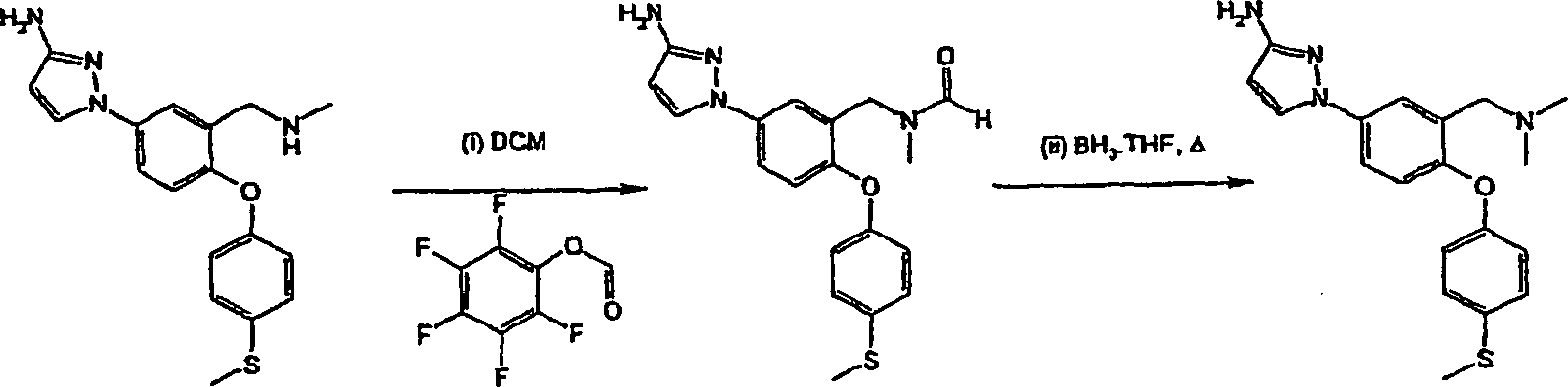
(i) Herstellung des Formamids(i) Preparation of formamide
Ameisensäure (145 μl, 3,84 mmol) wurde bei 0°C zu einer Lösung von Pentafluorphenol (642 mg, 3,49 mmol) in Ether (5 ml) gegeben. Anschließend wurde Dicyclohexylcarbodiimid (722 mg, 3,49 mmol) zugesetzt. Das Gemisch wurde 15 Minuten bei 0°C und 1 Stunde bei Raumtemperatur gerührt und sodann filtriert. Der Rückstand wurde mit Ether gewaschen. Die Etherlösung von Pentafluorphenylformiat wurde zur Trockne eingedampft, in DCM (8 ml) in Lösung gebracht und zu einer Lösung des Aminopyrazols von Beispiel 190 (1,08 g, 3,17 mmol) in DCM (8 ml) gegeben. Das Reaktionsgemisch wurde 1,5 Stunden bei Raumtemperatur gerührt. Sodann wurde das Reaktionsgemisch mit DCM und wässrigem Kaliumcarbonat (10%, jeweils 50 ml) verdünnt. Die organische Phase wurde abgetrennt und getrocknet (MgSO4) und sodann zur Trockne eingedampft. Der Rückstand wurde durch Flash-Chromatographie (SiO2; (MeOH/880 NH3 (9:1)) in DCM (1 → 1,5%)) gereinigt. Man erhielt das Formamid-Zwischenprodukt (770 mg, 66%). δH (CDCl3, 400 MHz, 2 Rotomere sichtbar) 2,47 (3H, s), 2,80 (3H, s), 2,88 (3H, s (untergeordnetes Rotomer)), 4,41 (2H, s), 4,56 (2H, s (untergeordnetes Rotomer)), 5,79 (1H, d (untergeordnetes Rotomer)), 5,81 (1H, d), 6,83–6,92 (4H, m), 7,36–7,46 (1H, m), 7,46 (1H, s), 7,59 (1H, d), 8, 11 (1H, s (untergeordnetes Rotomer)), 8,22 (1H, s); MS m/z (TS+) 369 (MH+).Formic acid (145 μl, 3.84 mmol) was added at 0 ° C to a solution of pentafluorophenol (642 mg, 3.49 mmol) in ether (5 ml). Then dicyclohexylcarbodiimide (722 mg, 3.49 mmol) was added. The mixture was stirred at 0 ° C for 15 minutes and at room temperature for 1 hour and then filtered. The residue was washed with ether. The ether solution of pentafluorophenyl formate was evaporated to dryness, solubilized in DCM (8 mL) and added to a solution of the aminopyrazole of Example 190 (1.08 g, 3.17 mmol) in DCM (8 mL). The reaction mixture was stirred for 1.5 hours at room temperature. The reaction mixture was diluted with DCM and aqueous potassium carbonate (10%, 50 ml each). The organic phase was separated and dried (MgSO 4 ) and then evaporated to dryness. The residue was purified by flash chromatography (SiO 2 ; (MeOH / 880 NH 3 (9: 1)) in DCM (1 → 1.5%). The formamide intermediate was obtained (770 mg, 66%). δ H (CDCl 3 , 400 MHz, 2 rotomers visible) 2.47 (3H, s), 2.80 (3H, s), 2.88 (3H, s (subordinate rotomer)), 4.41 (2H, s), 4.56 (2H, s (subordinate rotomer)), 5.79 (1H, d (subordinate rotomer)), 5.81 (1H, d), 6.83-6.92 (4H, m) , 7.36-7.46 (1H, m), 7.46 (1H, s), 7.59 (1H, d), 8, 11 (1H, s (subordinate rotomer)), 8.22 (1H , s); MS m / z (TS + ) 369 (MH + ).
(ii) Reduktion des tertiären Amins(ii) reduction of the tertiary amine
Das Formamid von Stufe (i) (770 mg, 2,09 mmol) wurde in THF (21 ml) gelöst und bei Raumtemperatur mit Boran-Tetrahydrofuran-Komplex (1 M in THF, 6,27 ml, 6,27 mmol) behandelt. Sodann wurde das Reaktionsgemisch 2 Stunden unter Rückfluss erwärmt, auf Raumtemperatur abgekühlt und durch vorsichtige Zugabe von Salzsäure (6 M, 15 ml) abgeschreckt. Anschließend wurde das Gemisch 30 Minuten auf 80°C erwärmt und erneut auf Raumtemperatur abgekühlt. Sodann wurde das Gemisch durch Zugabe einer Natriumhydroxidlösung (2 M, 50 ml) alkalisch gemacht und mit DCM (70 ml) extrahiert. Die organische Phase wurde abgetrennt, getrocknet (MgSO4) und eingedampft. Der Rückstand wurde durch Flash-Chromatographie (SiO2; MeOH/880 NH3 (9:1)) in DCM (1 → 5%)) gereinigt. Man erhielt die Titelverbindung in Form eines Feststoffes (100 mg, Ausbeute 13%). δH (CDCl3, 400 MHz) 2,22 (6H, s), 2,42 (3H, s), 2,42 (2H, s), 3,76 (2H, brs), 5,80 (1H, d), 6,82 (2H, d), 6,91 (1H, d), 7,21 (2H, d), 7,41 (1H, dd), 7,63 (1H, d); MS m/z (TS+) 355 (MH+).The formamide from step (i) (770 mg, 2.09 mmol) was dissolved in THF (21 mL) and treated at room temperature with borane-tetrahydrofuran complex (1 M in THF, 6.27 mL, 6.27 mmol) , The reaction mixture was refluxed for 2 hours, cooled to room temperature and cautiously added quenched with hydrochloric acid (6M, 15ml). Subsequently, the mixture was heated at 80 ° C for 30 minutes and cooled again to room temperature. The mixture was made alkaline by addition of a sodium hydroxide solution (2M, 50ml) and extracted with DCM (70ml). The organic phase was separated, dried (MgSO 4 ) and evaporated. The residue was purified by flash chromatography (SiO 2 , MeOH / 880 NH 3 (9: 1)) in DCM (1 → 5%). The title compound was obtained as a solid (100 mg, yield 13%). δ H (CDCl 3, 400 MHz) 2.22 (6H, s), 2.42 (3H, s), 2.42 (2H, s), 3.76 (2H, brs), 5.80 (1H , d), 6.82 (2H, d), 6.91 (1H, d), 7.21 (2H, d), 7.41 (1H, dd), 7.63 (1H, d); MS m / z (TS + ) 355 (MH + ).
Beispiel
192 5-Chlor-2-[4-(methylsulfanyl)-phenoxy]-benzylamin 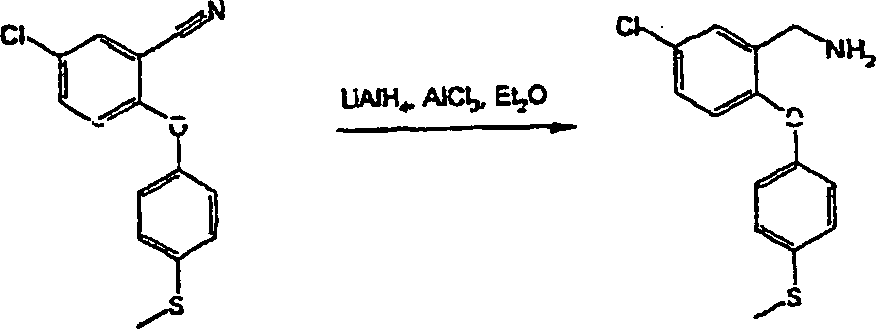
Eine Suspension von Lithiumaluminiumhydrid (745 mg, 19,6 mmol) in Diethylether (30 ml) wurde mit Aluminiumchlorid (872 mg, 6,54 mmol) in Diethylether (10 ml) versetzt. Nach beendeter Zugabe wurde das Gemisch 15 Minuten bei Raumtemperatur gerührt. Anschließend wurde das Nitril von Präparation 58 (2,44 g, 8,7 mmol) in Diethylether (10 ml) zugetropft. Sodann wurde das Gemisch 2 Stunden bei Raumtemperatur gerührt und durch Zugabe einer Natriumhydroxidlösung (1 M, 5 ml) abgeschreckt und mit Diethylether (20 ml) verdünnt. Nach 5-minütigem Rühren wurde die flüssige Phase dekantiert. Der Rückstand wurde 2-mal mit Diethylether (2 × 20 ml) gewaschen. Die vereinigten organischen Phasen wurden mit einer gesättigten wässrigen Natriumbicarbonatlösung (20 ml) und Kochsalzlösung (20 ml) gewaschen, getrocknet (MgSO4) und zu einem gelben Öl eingedampft (2,35 g, 96%). δH (CDCl3, 400 MHz) 2,47 (3H, s), 3,84 (2H, s), 6,75–6,79 (2H, m), 6,87–6,90 (2H, m), 7,15–7,29 (2H, m), 7,38–7,41 (1H, m); MS m/z (TS+) 280, 282 (MH+).To a suspension of lithium aluminum hydride (745 mg, 19.6 mmol) in diethyl ether (30 ml) was added aluminum chloride (872 mg, 6.54 mmol) in diethyl ether (10 ml). After completion of the addition, the mixture was stirred for 15 minutes at room temperature. Subsequently, the nitrile from Preparation 58 (2.44 g, 8.7 mmol) in diethyl ether (10 ml) was added dropwise. The mixture was stirred for 2 hours at room temperature and quenched by the addition of a sodium hydroxide solution (1M, 5ml) and diluted with diethyl ether (20ml). After stirring for 5 minutes, the liquid phase was decanted. The residue was washed twice with diethyl ether (2 x 20 ml). The combined organic phases were washed with a saturated aqueous sodium bicarbonate solution (20 ml) and brine (20 ml), dried (MgSO 4 ) and evaporated to a yellow oil (2.35 g, 96%). δ H (CDCl 3, 400 MHz) 2.47 (3H, s), 3.84 (2H, s), 6.75 to 6.79 (2H, m), 6.87-6.90 (2H, m), 7.15-7.29 (2H, m), 7.38-7.41 (1H, m); MS m / z (TS + ) 280, 282 (MH + ).
Präparationen Präparation
1 2-[4-Methylsulfanyl)-phenoxy]-benzaldehyd 
2-Fluorbenzaldehyd (31,6 ml, 300 mmol) und 4-(Methylmercapto)-phenol (46,27 g, 330 mmol) wurden in DMF (500 ml) gelöst und sodann mit Kaliumcarbonat (62,2 g, 450 mmol) versetzt. Das Gemisch wurde 12 Stunden unter einer Stickstoffatmosphäre auf 100°C erwärmt. Nach Abkühlen auf Raumtemperatur wurde das Gemisch zur Trockne eingedampft, zusammen mit Toluol eingedampft und sodann mit Ethylacetat und Wasser ausgeschüttelt. Die organische Phase wurde abgetrennt, mit Wasser gewaschen, getrocknet (MgSO4) und zum angestrebten Aldehydmaterial in Form eines braunen Öls (84,4 g) eingedampft, das mit 15% Phenolausgangsprodukt verunreinigt war, jedoch eine ausreichende Reinheit zur Verwendung in der nächsten Stufe besaß. δH (CDCl3, 400 MHz) 2,47 (3H, s), 6,87 (1H, d), 6,99 (2H, m), 7,17 (1H, m), 7,29 (2H, m), 7,49 (1H, m), 7,92 (1H, d), 10,49 (1H, s). Gegebenenfalls kann das rohe Gemisch durch Flash-Chromatographie (SiO2; Ethylacetat/Hexane (2 → 10%)) gereinigt werden, um eine reine Probe der angestrebten Aldehydverbindung zu erhalten.2-Fluorobenzaldehyde (31.6 mL, 300 mmol) and 4- (methylmercapto) phenol (46.27 g, 330 mmol) were dissolved in DMF (500 mL) and then treated with potassium carbonate (62.2 g, 450 mmol). added. The mixture was heated at 100 ° C for 12 hours under a nitrogen atmosphere. After cooling to room temperature, the mixture was evaporated to dryness, coevaporated with toluene and then partitioned between ethyl acetate and water. The organic phase was separated, washed with water, dried (MgSO 4 ) and evaporated to the desired aldehyde material as a brown oil (84.4 g) contaminated with 15% phenol starting product but sufficient purity for use in the next step possessed. δ H (CDCl 3, 400 MHz) 2.47 (3H, s), 6.87 (1H, d), 6.99 (2H, m), 7.17 (1H, m), 7.29 (2H , m), 7.49 (1H, m), 7.92 (1H, d), 10.49 (1H, s). Optionally, the crude mixture can be purified by flash chromatography (SiO 2 , ethyl acetate / hexanes (2 → 10%)) to give a pure sample of the desired aldehyde compound.
Alternativ
lässt sich
die Titelverbindung auf folgende Weise herstellen:
Kaliumcarbonat
(538,7 g, 3,89 mol) und 4-(Methylmercapto)-phenol
(400 g, 2,85 mmol) wurden nacheinander zu DMF (3 Liter) gegeben.
Sodann wurde 2-Fluorbenzaldehyd
(322 g, 2,59 mol) zu der Aufschlämmung
gegeben. Das Gemisch wurde auf den Bereich von 92 bis 100°C erwärmt. Nach
19 Stunden ließ man
das Reaktionsgemisch auf Raumtemperatur erwärmen und versetzte es mit Wasser
(2 Liter). Die Lösung
wurde unter 10°C
abgekühlt.
Der pH-Wert wurde mit 2,5 M HCl (1,5 Liter) auf 2 eingestellt, wobei
die Temperatur unter 10°C gehalten
wurde. Nach Zugabe von Wasser (2,6 Liter) wurde die Aufschlämmung 2
Stunden bei einer Temperatur unter 5°C gerührt. Sodann wurde die Aufschlämmung filtriert.
Der Filterkuchen wurde mit Wasser (4 × 1 Liter) gewaschen. Das rohe
Produkt wurde in Dichlormethan gelöst. Das Lösungsmittel wurde unter azeotropen
Bedingungen zur Entfernung des Wassers abdestilliert. Frisches Dichlormethan
wurde nach Bedarf zugegeben. Die trockene Dichlormethanlösung wurde
sodann unter Vakuum eingeengt. Man erhielt das rohe Produkt in Form
eines Öls
(634 g, 100%).Alternatively, the title compound can be prepared in the following manner:
Potassium carbonate (538.7 g, 3.89 mol) and 4- (methylmercapto) phenol (400 g, 2.85 mmol) were added sequentially to DMF (3 liters). Then, 2-fluorobenzaldehyde (322 g, 2.59 mol) was added to the slurry. The mixture was heated to the range of 92 to 100 ° C. After 19 hours, the reaction was left warm to room temperature and add water (2 liters). The solution was cooled below 10 ° C. The pH was adjusted to 2 with 2.5 M HCl (1.5 liters) keeping the temperature below 10 ° C. After adding water (2.6 liters), the slurry was stirred for 2 hours at a temperature below 5 ° C. The slurry was then filtered. The filter cake was washed with water (4 x 1 liter). The crude product was dissolved in dichloromethane. The solvent was distilled off under azeotropic conditions to remove the water. Fresh dichloromethane was added as needed. The dry dichloromethane solution was then concentrated in vacuo. The crude product was obtained as an oil (634 g, 100%).
Präparationen 2–18Preparations 2-18
Die
Umsetzung von Präparation
1 wurde unter ähnlichen
Bedingungen unter Verwendung einer Reihe von handelsüblichen
Phenolen und 2-Fluorbenzaldehyden wiederholt, um die Verbindungen
der Präparationen
2 bis 18 bereitzustellen. Die einzelnen Reaktionen wurden sorgfältig durch
Dünnschichtchromatographie überwacht
und so lange fortgeführt,
bis sie als vollständig
angesehen wurden. Die Daten für
die Verbindungen sind in der nachstehenden Tabelle aufgeführt. 

- a Es wurde das Phenol von Präparation 35 verwendet.
- b Es wurde das Phenol von Präparation 34 verwendet.
- a The phenol from Preparation 35 was used.
- b The phenol from Preparation 34 was used.
Präparationen 19–20Preparations 19-20
Die folgenden Diphenylether wurden auf ähnliche Weise wie bei der für die Präparation 1 beschriebenen Umsetzung unter Verwendung von 2-Chlor-5-nitrobenzaldehyd mit dem entsprechenden handelsüblichen Phenol hergestellt. Kürzere Reaktionszeiten (etwa 3 Stunden) reichten in diesen Fällen aus, um gute Umwandlungsraten zu erzielen.The The following diphenyl ethers were prepared in a similar manner as for the preparation 1 implementation using 2-chloro-5-nitrobenzaldehyde with the appropriate commercial phenol produced. short Response times (about 3 hours) were sufficient in these cases, to achieve good conversion rates.
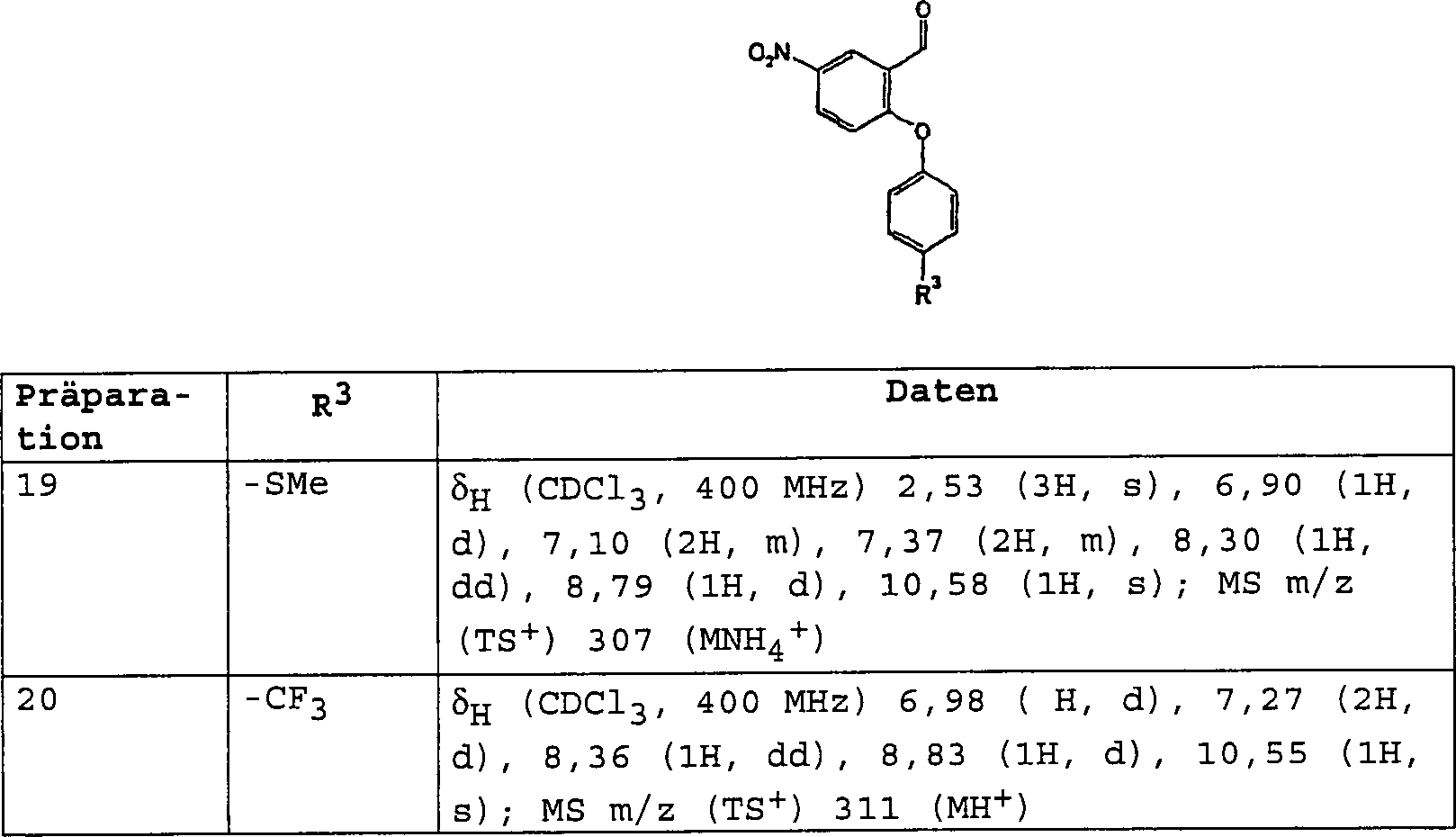
Präparation
21 N,N-Dimethyl-N-{2-[4-(methylsulfanyl)-phenoxy]-benzyl}-amin 
Der Aldehyd von Präparation 1 (21,23 g, 87 mmol) wurde in einem 1:1-Gemisch aus THF und DCM (jeweils 180 ml) zusammen mit Dimethylamin-hydrochlorid (7,81 g, 95,8 mmol) und Triethylamin (36,4 ml, 261 mmol) gelöst. Sodann wurde das Reaktionsgemisch mit Natriumtriacetoxyborhydrid (27,7 g, 130,7 mmol) versetzt und bei Raumtemperatur unter einer Stickstoffatmosphäre über Nacht gerührt. Das Reaktionsgemisch wurde abgedampft und sodann mit DCM und Wasser (jeweils 1000 ml) ausgeschüttelt. Die organische Phase wurde abgetrennt, getrocknet (MgSO4) und zu einem braunen Öl eingedampft. Der Rückstand konnte durch Flash-Chromatographie (SiO2; ((MeOH/880 NH3) (9:1) (0–5%) in DCM) gereinigt werden. Man erhielt das angestrebte Amin in Form der freien Base als braunes Öl. δH (CDCl3, 400 MHz) 2,26 (6H, s), 2,46 (6H, s), 3,45 (2H, s), 6,84–6,90 (3H, m), 7,13 (1H, t), 7,20–7,26 (3H, m), 7,46 (1H, d); MS m/z (TS+) 274 (MH+).The aldehyde from Preparation 1 (21.23 g, 87 mmol) was dissolved in a 1: 1 mixture of THF and DCM (180 ml each) together with dimethylamine hydrochloride (7.81 g, 95.8 mmol) and triethylamine ( 36.4 ml, 261 mmol). Then, the reaction mixture was added with sodium triacetoxyborohydride (27.7 g, 130.7 mmol) and stirred at room temperature under a nitrogen atmosphere overnight. The reaction mixture was evaporated and then extracted by shaking with DCM and water (1000 ml each). The organic phase was separated, dried (MgSO 4 ) and evaporated to a brown oil. The residue was purified by flash chromatography (SiO 2 ; ((MeOH / 880 NH 3 ) (9: 1) (0-5%) in DCM) to give the desired amine as the free base as a brown oil. δ H (CDCl 3, 400 MHz) 2.26 (6H, s), 2.46 (6H, s), 3.45 (2H, s), 6.84-6.90 (3H, m), 7 , 13 (1H, t), 7.20-7.26 (3H, m), 7.46 (1H, d); MS m / z (TS + ) 274 (MH + ).
Alternativ ließ sich das rohe Reaktionsprodukt durch Bildung und Kristallisation des Hydrochloridsalzes reinigen, indem man es in Diethylether (150 ml) löste und anschließend Chlorwasserstoffsäure (1 M) in Diethylether (150 ml) zu der gerührten Lösung gab. Das Hydrochloridsalz der angestrebten Dimethylaminverbindung wurde in Form eines weißen Feststoffes gewonnen (22,58 g, 84%). δH (CDCl3, 400 MHz) 2,43 (3H, s), 2,80 (6H, d), 4,32 (2H, s), 6,86 (1H, d), 6,93 (2H, d), 7,20 (1H, t), 7,25 (2H, m), 7,36 (1H, dt) 7,85 (1H, dd), 12, 47 (1H, br).Alternatively, the crude reaction product was purified by formation and crystallization of the hydrochloride salt by dissolving it in diethyl ether (150 mL) and then adding hydrochloric acid (1 M) in diethyl ether (150 mL) to the stirred solution. The hydrochloride salt of the desired dimethylamine compound was recovered as a white solid (22.58 g, 84%). δ H (CDCl 3, 400 MHz) 2.43 (3H, s), 2.80 (6H, d), 4.32 (2H, s), 6.86 (1H, d), 6.93 (2H , d), 7.20 (1H, t), 7.25 (2H, m), 7.36 (1H, dt) 7.85 (1H, dd), 12, 47 (1H, br).
Alternativ
lässt sich
das Hydrochloridsalz der Titelverbindung auf folgende Weise herstellen:
Eine
Lösung
des Produkts von Präparation
1 (390 g, 1,59 mol) in DCM (2,73 Liter) wurde zu THF (2,73 Liter) gegeben.
Sodann wurden nacheinander Dimethylaminhydrochlorid (143 g, 1,75
mol) und Triethylamin (485 g, 4,80 mol) zugegeben. Die Temperatur
wurde auf 20°C
eingestellt. Nach 1 Stunde wurde Natriumtriacetoxyborhydrid (508
g, 2,93 mol) zugegeben. Nach 20 Stunden wurde Dichlormethan (3,9
Liter) zugegeben. Eine Lösung
von 8% Natriumbicarbonat (3,9 Liter) wurde innerhalb von 0,5 Stunden
zugesetzt. Die Phasen wurden getrennt. Die organische Phase wurde
mit Wasser (2,5 Liter) gewaschen. Sodann wurden die Phasen erneut getrennt
und die organische Phase auf ein Volumen von 1,65 Liter eingeengt.
Ethylacetat (2,89 Liter) wurde zugegeben und das Lösungsmittel
wurde entfernt und durch frisches Ethylacetat unter Erzielung eines
Endvolumens von 2,92 Liter ersetzt. Sodann wurde die Lösung unter
5°C gekühlt und
mit 6,75 M Chlorwasserstoffsäure
in Isopropanol (0,25 Liter, 1,69 mol) versetzt, wobei die Temperatur
unter 10°C
gehalten wurde. Nach 1-stündigem
Rühren
bei einer Temperatur unter 5°C
wurde die Aufschlämmung
filtriert, mit Ethylacetat (2 × 0,39
Liter) gewaschen und in einem Vakuumtrockenschrank bei 50°C über Nacht
getrocknet. Man erhielt das angestrebte Produkt in Form eines pulverförmigen Feststoffes
(308,3 g, 63%).Alternatively, the hydrochloride salt of the title compound can be prepared in the following manner:
A solution of the product of Preparation 1 (390 g, 1.59 mol) in DCM (2.73 L) was added to THF (2.73 L). Then, dimethylamine hydrochloride (143 g, 1.75 mol) and triethylamine (485 g, 4.80 mol) were successively added. The temperature was adjusted to 20 ° C. After 1 hour, sodium triacetoxyboron became hydride (508 g, 2.93 mol). After 20 hours, dichloromethane (3.9 liters) was added. A solution of 8% sodium bicarbonate (3.9 liters) was added over 0.5 hours. The phases were separated. The organic phase was washed with water (2.5 liters). The phases were again separated and the organic phase concentrated to a volume of 1.65 liters. Ethyl acetate (2.89 liters) was added and the solvent was removed and replaced with fresh ethyl acetate to give a final volume of 2.92 liters. The solution was cooled to below 5 ° C and 6.75M hydrochloric acid in isopropanol (0.25L, 1.69mol) was added keeping the temperature below 10 ° C. After stirring for 1 hour at a temperature below 5 ° C, the slurry was filtered, washed with ethyl acetate (2 x 0.39 liters) and dried in a vacuum oven at 50 ° C overnight. The desired product was obtained in the form of a pulverulent solid (308.3 g, 63%).
Präparationen 22–25Preparations 22-25
Die Amine der Präparationen 22 bis 25 wurden gemäß dem für die Präparation 21 beschriebenen Verfahren hergestellt.The Amines of the preparations 22 to 25 were used according to the preparation 21 described method produced.
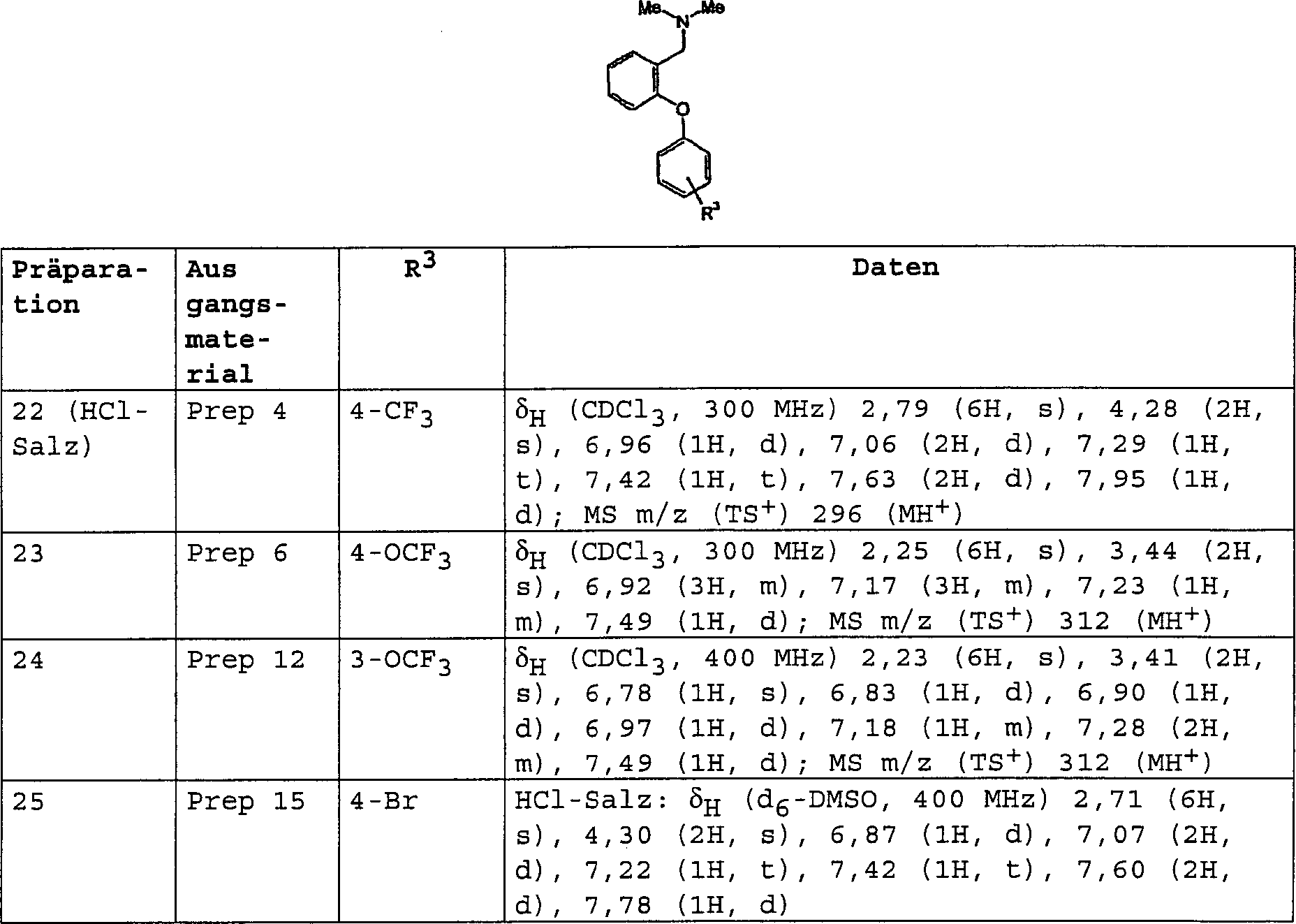
Präparation
26 N-Methyl-N-{2-[4-(trifluormethoxy)-phenoxy]-benzyl}-amin 
Die Aldehydverbindung von Präparation 6 (2,5 g, 8,86 mmol) wurde in einer Lösung von Monomethylamin in Ethanol (etwa 8 M) (11 ml, 88 mmol) gelöst. Das Gemisch wurde über Nacht bei Raumtemperatur gerührt. Sodann wurde das Gemisch mit THF/Ethanol (1:1) versetzt, um die Auflösung zu unterstützen. Nach Zugabe von Natriumborhydrid (3,35 g, 88,6 mmol) wurde weitere 4 Stunden gerührt. Anschließend wurde die Umsetzung durch vorsichtige Zugabe von Salzsäure (1 M) (bis zur Beendigung der Gasentwicklung) gestoppt. Sodann wurde das Gemisch mit wässriger Natriumhydroxidlösung (2 M) alkalisch gemacht und anschließend mit Ethylacetat (3-mal) extrahiert. Die vereinigten organischen Fraktionen wurden getrocknet (MgSO4) und zu einem Öl eingedampft. Das Öl wurde durch Flash-Chromatographie (SiO2; DCM/MeOH/880 NH3 (93:7:1)) gereinigt. Man erhielt die angestrebte Aminverbindung in Form eines farblosen Öls (2,23 g, 84%). δH (CDCl3, 300 MHz) 1,72 (1H, br), 2,42 (3H, s), 3,77 (2H, s), 6,92 (3H, m), 7,16 (3H, m), 7,23 (1H, m), 7,41 (1H, d); MS m/z (TS+) 298 (MH+).The aldehyde compound from Preparation 6 (2.5 g, 8.86 mmol) was dissolved in a solution of monomethylamine in ethanol (about 8 M) (11 mL, 88 mmol). The mixture was stirred at room temperature overnight. THF / ethanol (1: 1) was added to the mixture to aid in dissolution. After addition of sodium borohydride (3.35 g, 88.6 mmol) stirring was continued for 4 hours. Subsequently, the reaction was stopped by careful addition of hydrochloric acid (1 M) (until completion of gas evolution). So then the mixture was made alkaline with aqueous sodium hydroxide solution (2 M) and then extracted with ethyl acetate (3 times). The combined organic fractions were dried (MgSO 4 ) and evaporated to an oil. The oil was purified by flash chromatography (SiO 2 ; DCM / MeOH / 880 NH 3 (93: 7: 1)). The desired amine compound was obtained in the form of a colorless oil (2.23 g, 84%). δ H (CDCl 3, 300 MHz) 1.72 (1H, br), 2.42 (3H, s), 3.77 (2H, s), 6.92 (3H, m), 7.16 (3H , m), 7.23 (1H, m), 7.41 (1H, d); MS m / z (TS + ) 298 (MH + ).
Präparation
27 N-Methyl-N-{2-[4-(trifluormethyl)-phenoxy]-benzyl}-amin 
Das Titelamin wurde unter den für die Präparation 26 beschriebenen Bedingungen unter Verwendung der Aldehydverbindung von Präparation 4 als Ausgangsprodukt synthetisiert. δH (CDCl3, 300 MHz) 2,57 (3H, s), 4,14 (2H, s), 5,50 (2H, brs), 6,88 (1H, d), 7,18 (3H, m) 7,34 (1H, t), 7,61 (2H, d), 7,70 (1H, d); MS m/z (TS+) 282 (MH+).The title amine was synthesized under the conditions described for Preparation 26 using the aldehyde compound of Preparation 4 as the starting material. δ H (CDCl 3, 300 MHz) 2.57 (3H, s), 4.14 (2H, s), 5.50 (2H, brs), 6.88 (1H, d), 7.18 (3H , m) 7.34 (1H, t), 7.61 (2H, d), 7.70 (1H, d); MS m / z (TS + ) 282 (MH + ).
Präparation
28 N-Methyl-N-{2-[(4-(methylsulfanyl)-phenoxy]-benzyl}-amin 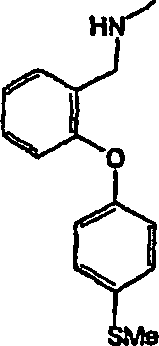
Das Titelamin wurde aus dem Aldehyd von Präparation 1 gemäß dem für die Präparation 26 beschriebenen Verfahren hergestellt. δH (CD3OD, 300 MHz) 2,41 (3H, s), 2,45 (3H, s), 3,80 (2H, s), 6,84 (1H, d), 6,94 (2H, d), 7,15 (1H, m), 7,28 (3H, m), 7,43 (1H, d); MS m/z (TS+) 260 (MH+).The title amine was prepared from the aldehyde of Preparation 1 according to the procedure described for Preparation 26. δ H (CD 3 OD, 300 MHz) 2.41 (3H, s), 2.45 (3H, s), 3.80 (2H, s), 6.84 (1H, d), 6.94 ( 2H, d), 7.15 (1H, m), 7.28 (3H, m), 7.43 (1H, d); MS m / z (TS + ) 260 (MH + ).
Präparation
29 N-{2-[4-(Ethylsulfanyl)-phenoxy]-benzyl}-N,N-dimethylamin 
Das Produkt von Präparation 25 (1,09 g, 3,18 mmol) wurde in DMSO (3,2 ml) gelöst und mit Natriumethanthiolat (535 mg, 6,36 mmol) und Palladium-tetrakis-(triphenylphosphin) (367 mg, 1155,57) behandelt. Das Gemisch wurde über Nacht gerührt und auf 100°C erwärmt. Nach Abkühlen auf Raumtemperatur wurde das Gemisch mit Wasser und Diethylether (jeweils 100 ml) ausgeschüttelt. Die organische Phase wurde abgetrennt. Die wässrige Phase wurde mit Diethylether (100 ml) reextrahiert. Die vereinigten Etherphasen wurden mit Kochsalzlösung (100 ml) gewaschen, getrocknet (MgSO4) und zu einem hellroten Öl eingedampft. Nach Reinigung durch Flash-Chromatographie (SiO2; DCM/MeOH/880 NH3 (93:7:1)) erhielt man ein orangefarbenes Öl, das in Ethylacetat (10 ml) gelöst und mit Salzsäure (1 M) in Diethylether (5 ml) behandelt wurde. Nach Abdampfen der Lösungsmittel erhielt man einen beigefarbenen Feststoff, der aus siedendem Ethylacetat umkristallisiert wurde. Man erhielt ein cremefarbenes Pulver (491 mg, 54%). 1,30 (3H, t), 2,80 (6H, d), 2,92 (2H, q), 4,31 (2H, d), 6,88 (1H, d), 6,94 (2H, d), 7,23 (1H, t), 7,38 (2H, d), 7,87 (1H, d); MS m/z (ES+) 288 (MH+).The product of Preparation 25 (1.09 g, 3.18 mmol) was dissolved in DMSO (3.2 mL) and treated with sodium ethanethiolate (535 mg, 6.36 mmol) and palladium tetrakis- (triphenylphosphine) (367 mg, 1155.57). The mixture was stirred overnight and heated to 100 ° C. After cooling to room temperature, the mixture was shaken with water and diethyl ether (100 ml each). The organic phase was separated. The aqueous phase was reextracted with diethyl ether (100 ml). The combined ether layers were washed with brine (100 ml), dried (MgSO 4 ) and evaporated to a light red oil. Purification by flash chromatography (SiO 2 ; DCM / MeOH / 880 NH 3 (93: 7: 1)) gave an orange oil which was dissolved in ethyl acetate (10 ml) and acidified with hydrochloric acid (1 M) in diethyl ether (5 ml). After evaporation of the solvents gave a beige solid, which umkris from boiling ethyl acetate was tallisiert. A cream-colored powder (491 mg, 54%) was obtained. 1.30 (3H, t), 2.80 (6H, d), 2.92 (2H, q), 4.31 (2H, d), 6.88 (1H, d), 6.94 (2H , d), 7.23 (1H, t), 7.38 (2H, d), 7.87 (1H, d); MS m / z (ES + ) 288 (MH + ).
Präparation
30 5-(Aminosulfonyl)-2-[3-methoxy-4-(methylsulfanyl)-phenoxy]-N-methylbenzamid 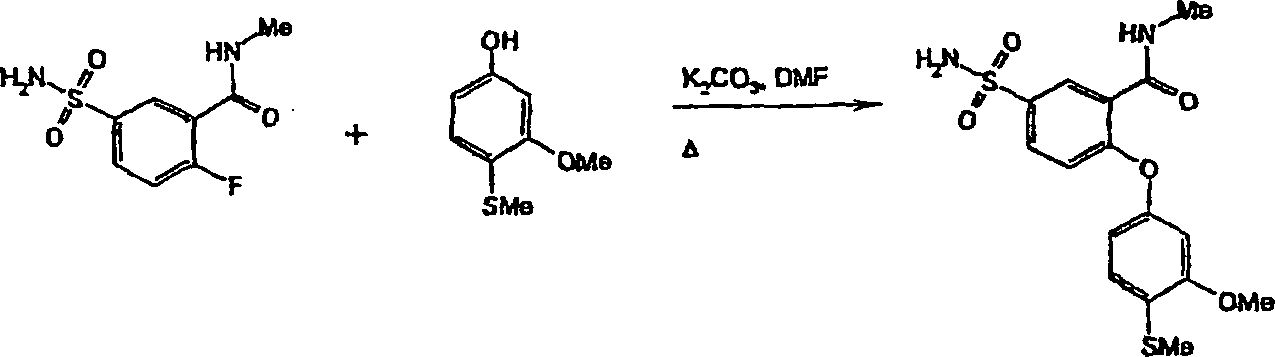
Das Sulfonamid von Präparation 67 (405 mg, 1,7 mmol) wurde mit dem Phenol von Präparation 35 (297 mg, 1,7 mmol), Kaliumcarbonat (362 mg, 2,6 mmol) und DMF (10 ml) vereinigt. Sodann wurde das Gemisch 18 Stunden auf 110°C erwärmt. Nach Abkühlen auf Raumtemperatur wurde das Reaktionsgemisch mit Wasser verdünnt, mit Salzsäure (2 M) auf den pH-Wert 3 angesäuert und mit Ethylacetat (2 × 75 ml) extrahiert. Die organischen Phasen wurden vereinigt, getrocknet (MgSO4) und zur Trockne eingedampft. Der Rückstand wurde durch Flash-Chromatographie (SiO2; DCM/MeOH/880 NH3 (93:7:1 → 90:10:1)) gereinigt. Man erhielt das Titelamid in Form eines braunen Öls (600 mg, 90%). δH (DMSO-d6, 400 MHz) 2,33 (3H, s), 2,75 (3H, d), 3,75 (3H, s), 6,69 (1H, d), 6,82 (1H, s), 6,86 (1H, d), 7,16 (1H, d), 7,30 (2H, s), 7,75 (1H, d), 8,07 (1H, s), 8,25 (1H, m); MS m/z (TS+) 383 (MH+).The sulfonamide of Preparation 67 (405 mg, 1.7 mmol) was combined with the phenol from Preparation 35 (297 mg, 1.7 mmol), potassium carbonate (362 mg, 2.6 mmol) and DMF (10 mL). The mixture was then heated to 110 ° C for 18 hours. After cooling to room temperature, the reaction mixture was diluted with water, acidified to pH 3 with hydrochloric acid (2 M) and extracted with ethyl acetate (2 x 75 mL). The organic phases were combined, dried (MgSO 4 ) and evaporated to dryness. The residue was purified by flash chromatography (SiO 2 ; DCM / MeOH / 880 NH 3 (93: 7: 1 → 90: 10: 1)). The title amide was obtained as a brown oil (600 mg, 90%). δ H (DMSO-d 6 , 400 MHz) 2.33 (3H, s), 2.75 (3H, d), 3.75 (3H, s), 6.69 (1H, d), 6.82 (1H, s), 6.86 (1H, d), 7.16 (1H, d), 7.30 (2H, s), 7.75 (1H, d), 8.07 (1H, s) , 8.25 (1H, m); MS m / z (TS + ) 383 (MH + ).
Präparationen 31–33Preparations 31-33
Die folgenden Amide wurden gemäß dem für die Präparation 30 beschriebenen Verfahren unter Verwendung des Sulfonamids vom Präparation 67 und des entsprechenden angegebenen Phenols hergestellt.The following amides were prepared according to the preparation 30 described method using the sulfonamide of preparation 67 and the corresponding indicated phenol.
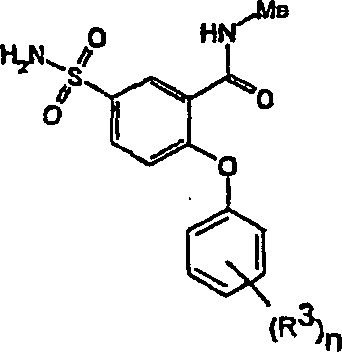

Präparation
34 4-(Methylsulfanyl)-3-(trifluormethyl)-phenol 
(i) Sulfidbildung: 1-(Methylsulfanyl)-4-nitro-2-(trifluormethyl)-benzol(i) Sulfide formation: 1- (methylsulfanyl) -4-nitro-2- (trifluoromethyl) benzene
2-Fluor-5-nitrobenzotrifluorid (30 ml, 218,4 mmol) wurde in DMF (218 ml) gelöst und mit 4,4'-Thiobis-(6-tert.-butyl-m-cresol) (150 mg, 0,4 mmol) und anschließend mit Natriummethanthiolat (15 g, 214 mmol) behandelt. Sodann wurde das Reaktionsgemisch über Nacht bei Raumtemperatur gerührt und anschließend auf ein geringes Volumen eingedampft. Der Rückstand wurde mit Diethylether und Wasser (jeweils 1000 ml) ausgeschüttelt. Die organische Fraktion wurde nacheinander mit Wasser und Kochsalzlösung (jeweils 750 ml) gewaschen, getrocknet (MgSO4) und zu einem gelben Öl eingedampft. Nach Reinigung durch Flash-Chromatographie (SiO2; Ethylacetat/Pentan (5:95 → 10:90)) erhielt man ein Gemisch aus zwei Verbindungen, das weiter durch Flash-Chromatographie (SiO2; DCM/Pentan (10:90 → 40:60)) gereinigt wurde. Man erhielt das Titelsulfid (7,96 g, 15%). δH (CDCl3, 400 MHz) 2,58 (3H, s), 7,39 (1H, d), 8,28 (1H, dd), 8,46 (1H, d).2-Fluoro-5-nitrobenzotrifluoride (30 mL, 218.4 mmol) was dissolved in DMF (218 mL) and washed with 4,4'-thiobis- (6-tert-butyl-m-cresol) (150 mg, 0 , 4 mmol) and then treated with sodium methanethiolate (15 g, 214 mmol). The reaction mixture was stirred overnight at room temperature and then evaporated to a small volume. The residue was shaken out with diethyl ether and water (1000 ml each time). The organic fraction was washed successively with water and brine (750 ml each time), dried (MgSO 4 ) and evaporated to a yellow oil. After purification by flash chromatography (SiO 2 ; ethyl acetate / pentane (5:95 → 10:90)), a mixture of two compounds was obtained, which was further purified by flash chromatography (SiO 2 ; DCM / pentane (10:90 → 40 : 60)). The title sulfide was obtained (7.96 g, 15%). δ H (CDCl 3, 400 MHz) 2.58 (3H, s), 7.39 (1H, d), 8.28 (1H, dd), 8.46 (1H, d).
(ii) Nitroreduktion: 4-(Methylsulfanyl)-3-(trifluormethyl)-anilin(ii) Nitro reduction: 4- (methylsulfanyl) -3- (trifluoromethyl) aniline
Eine Suspension des Sulfids von Stufe (i) in Essigsäure (168 ml) und Wasser (25 ml) wurde mit Eisenpulver (11,25 g, 201 mmol) behandelt. Das Gemisch wurde 2 Stunden bei Raumtemperatur gerührt und sodann auf ein geringes Volumen eingedampft. Der Rückstand wurde mit einer gesättigten Lösung von NaHCO3(aq.) und Ethylacetat (jeweils 200 ml) ausgeschüttelt und anschließend durch eine Schicht Arbocel® filtriert. Die organische Phase wurde abgetrennt. Die wässrige Phase wurde mit Ethylacetat (2 × 100 ml) reextrahiert. Die vereinigten organischen Phasen wurden getrocknet (MgSO4) und zum Titelanilin in Form eines braunen Öls, das geringfügig mit Essigsäure verunreinigt war, eingedampft (8 g, etwa 100%). δH (CDCl3, 400 MHz) 2,40 (3H, s), 6,77 (1H, dd), 6,95 (1H, d), 7,32 (1H, d).A suspension of the sulfide of step (i) in acetic acid (168 ml) and water (25 ml) was treated with iron powder (11.25 g, 201 mmol). The mixture was stirred for 2 hours at room temperature and then evaporated to a small volume. The residue was (aq.) With a saturated solution of NaHCO 3 and partitioned between ethyl acetate (200 mL each) and then filtered through a pad of Arbocel ®. The organic phase was separated. The aqueous phase was reextracted with ethyl acetate (2 × 100 ml). The combined organic phases were dried (MgSO 4 ) and evaporated to the title aniline as a brown oil, slightly contaminated with acetic acid (8 g, about 100%). δ H (CDCl 3, 400 MHz) 2.40 (3H, s), 6.77 (1H, dd), 6.95 (1H, d), 7.32 (1H, d).
(iii) Bildung des Diazoniumsalzes/Hydrolyse: 4-(Methylsulfanyl)-3-(trifluormethyl)-phenol(iii) Diazonium salt formation / hydrolysis: 4- (methylsulfanyl) -3- (trifluoromethyl) phenol
Eine Suspension des Anilins von Stufe (ii) (8,00 g, 38,2 mmol) in Wasser wurde mit konzentrierter Schwefelsäure (20 ml) behandelt und unter heftigem Rühren auf 0°C abgekühlt. Eine Lösung von Natriumnitrit (2,9 g, 42,1 mmol) in Wasser (15 ml) wurde tropfenweise zugegeben. Nach Beendigung der Zugabe wurde das Gemisch weitere 30 Minuten bei dieser Temperatur gerührt, wobei eine Lösung entstand. Eine Lösung von Kupfer(II)-nitrat-hämipentahydrat (120 g, 516 mmol) in Wasser (900 ml) wurde zugegeben, wonach sich die Zugabe von festem Kupfer(I)-oxid (4,9 g, 34,4 mmol) anschloss. Das heftige Rühren wurde fortgesetzt, bis die Stickstoffentwicklung nachließ (10–15 Minuten). Sodann wurde das Reaktionsgemisch mit Diethylether (2 × 400 ml) extrahiert. Die vereinigten organischen Bestandteile wurden mit wässriger Natriumhydroxidlösung (1 M) (3 × 100 ml) extrahiert. Die vereinigten NaOH-Fraktionen wurden mit konzentrierter Salzsäure auf den pH-Wert 2 angesäuert und mit Diethylether (2 × 150 ml) extrahiert. Die vereinigten organischen Fraktionen wurden mit Kochsalzlösung gewaschen, getrocknet (MgSO4) und zu einem braunen Öl eingedampft (3,5 g, 44%). δH (CDCl3, 400 MHz) 2,44 (3H, s), 5,50 (1H, brs), 6,97 (1H, dd), 7,16 (1H, d), 7,38 (1H, d); MS m/z (ES–) 207 (M – H+).A suspension of the aniline of step (ii) (8.00 g, 38.2 mmol) in water was treated with concentrated sulfuric acid (20 mL) and cooled to 0 ° C with vigorous stirring. A solution of sodium nitrite (2.9 g, 42.1 mmol) in water (15 ml) was added dropwise. After completion of the addition, the mixture was stirred for a further 30 minutes at this temperature, forming a solution. A solution of copper (II) nitrate hemiacetate (120 g, 516 mmol) in water (900 mL) was added, followed by addition of solid copper (I) oxide (4.9 g, 34.4 mmol). joined. The vigorous stirring was continued until the evolution of nitrogen subsided (10-15 minutes). The reaction mixture was extracted with diethyl ether (2 × 400 ml). The combined organics were extracted with aqueous sodium hydroxide solution (1 M) (3 x 100 mL). The combined NaOH fractions were acidified to pH 2 with concentrated hydrochloric acid and extracted with diethyl ether (2 x 150 ml). The combined organic fractions were washed with brine, dried (MgSO 4 ) and evaporated to a brown oil (3.5 g, 44%). δ H (CDCl 3, 400 MHz) 2.44 (3H, s), 5.50 (1H, brs), 6.97 (1H, dd), 7.16 (1H, d), 7.38 (1H , d); MS m / z (ES - ) 207 (M - H + ).
Präparation
35 3-Methoxy-4-(methylsulfanyl)-phenol 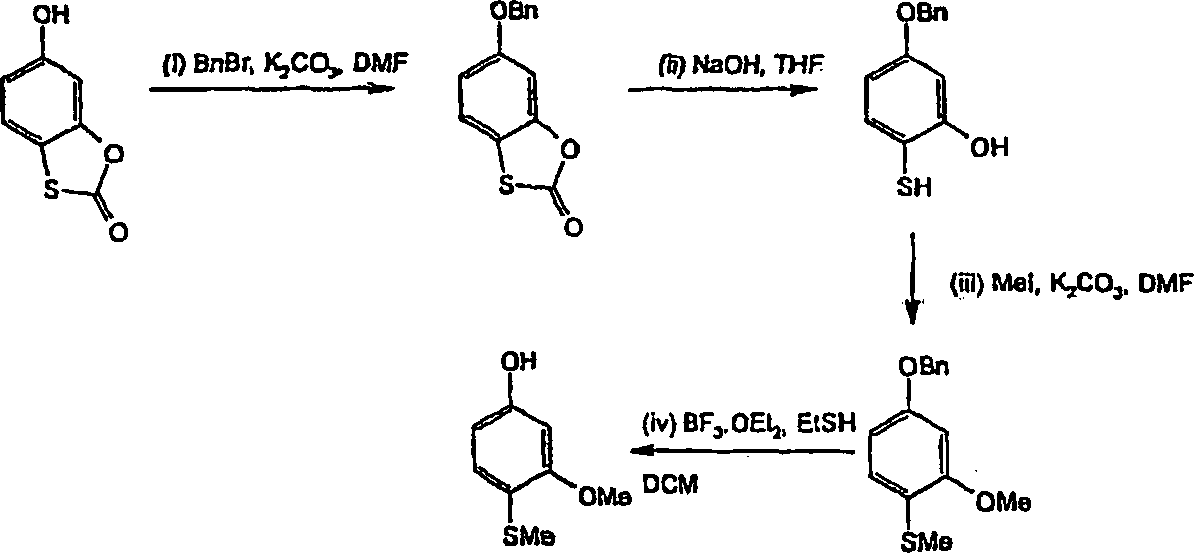
(i) Bildung des Benzylethers: 6-(Benzyloxy)-1,3-benzoxathiol-2-on(i) Formation of benzyl ether: 6- (benzyloxy) -1,3-benzoxathiol-2-one
6-Hydroxy-1,3-benzoxathiol-2-on (50 g, 297 mmol) wurde in DMF (500 ml) gelöst und mit Benzylbromid (53 ml, 446 mmol) und Kaliumcarbonat (82 g, 595 mmol) behandelt. Das Gemisch wurde über Nacht unter einer Stickstoffatmosphäre auf 60°C erwärmt und sodann zur Trockne eingedampft. Der Rückstand wurde mit Diethylether (700 ml) und Wasser (400 ml) ausgeschüttelt. Die organische Phase wurde abgetrennt. Die wässrige Phase wurde mit Diethylether (2 × 800 ml) extrahiert. Die vereinigten organischen Fraktionen wurden mit Wasser (2 × 500 ml) gewaschen, getrocknet (MgSO4) und zu einem gelben Öl eingedampft. Nach Reinigung durch Flash-Chromatographie (SiO2; Ethylacetat/Pentan (1:19 → 1:9)) erhielt man einen kautschukartigen, weißen Feststoff, der mit Et2O/Pentan verrieben wurde. Man erhielt den angestrebten Benzylester in Form eines weißen Feststoffes (17,65 g, 23%). δH (CDCl3, 300 MHz) 5,10 (2H, s), 6,92 (1H, d), 6,98 (1H, s), 7,28 (1H, d), 7,35–7,45 (5H, m); MS m/z (TS+) 276 (MNH4 +).6-Hydroxy-1,3-benzoxathiol-2-one (50 g, 297 mmol) was dissolved in DMF (500 mL) and treated with benzyl bromide (53 mL, 446 mmol) and potassium carbonate (82 g, 595 mmol). The mixture was heated to 60 ° C overnight under a nitrogen atmosphere and then evaporated to dryness. The residue was partitioned between diethyl ether (700 ml) and water (400 ml). The organic phase was separated. The aqueous phase was extracted with diethyl ether (2 × 800 ml). The combined organic fractions were washed with water (2 x 500 ml), dried (MgSO 4 ) and evaporated to a yellow oil. Purification by flash chromatography (SiO 2 , ethyl acetate / pentane (1:19 → 1: 9)) afforded a gummy, white solid which was triturated with Et 2 O / pentane. The desired benzyl ester was obtained as a white solid (17.65 g, 23%). δ H (CDCl 3, 300 MHz) 5.10 (2H, s), 6.92 (1H, d), 6.98 (1H, s), 7.28 (1H, d), 7.35 to 7 , 45 (5H, m); MS m / z (TS + ) 276 (MNH 4 + ).
(ii) Hydrolyse des Thioxolonrings: 5-(Benzyloxy)-2-sulfanylphenol(ii) Hydrolysis of the thioxolone ring: 5- (benzyloxy) -2-sulfanylphenol
Der Benzylether von Stufe (i) (17,55 g, 67,9 mmol) wurde in THF (125 ml) gelöst und mit einer wässrigen Natriumhydroxidlösung (2 M, 125 ml) behandelt. Nach 2-stündigem Rühren bei Raumtemperatur wurde das Gemisch zur Entfernung von THF eingedampft. Die verbleibende wässrige Lösung wurde mit Diethylether (3 × 100 ml) gewaschen. Die wässrige Phase wurde sodann mit konzentrierter Salzsäure auf den pH-Wert 1 angesäuert, was ein Aufschäumen des Gemisches bewirkte. Sodann wurde das Gemisch mit Diethylether (3 × 100 ml) extrahiert. Die vereinigten Extrakte wurden mit Kochsalzlösung (100 ml) gewaschen, getrocknet (MgSO4) und zu einem gelben Öl eingedampft (13,65 g, 86%). δH (CDCl3, 300 MHz) 5,08 (2H, s), 6,40 (1H, s), 6,55 (1H, d), 6,63 (1H, s), 7,30–7,45 (5H, m); MS m/z (TS+) 250 (MNH4 +).The benzyl ether of step (i) (17.55 g, 67.9 mmol) was dissolved in THF (125 mL) and treated with aqueous sodium hydroxide solution (2 M, 125 mL). After stirring for 2 h at room temperature, the mixture was evaporated to remove THF. The remaining aqueous solution was washed with diethyl ether (3 × 100 ml). The aqueous phase was then acidified to pH 1 with concentrated hydrochloric acid, causing foaming of the mixture. The mixture was extracted with diethyl ether (3 x 100 ml). The combined extracts were washed with brine (100 ml), dried (MgSO 4 ) and evaporated to a yellow oil (13.65 g, 86%). δ H (CDCl 3, 300 MHz) 5.08 (2H, s), 6.40 (1H, s), 6.55 (1H, d), 6.63 (1H, s), 7.30 to 7 , 45 (5H, m); MS m / z (TS + ) 250 (MNH 4 + ).
(iii) Methylierung des Phenols und Thiophenols: 4-(Benzyloxy)-2-methoxy-1-(methylsulfanyl)-benzol(iii) Methylation of the Phenols and thiophenols: 4- (benzyloxy) -2-methoxy-1- (methylsulfanyl) benzene
Ein Gemisch aus dem Thiophenol-phenol von Stufe (ii) (13,5 g, 58,1 mmol) und Kaliumcarbonat (9,64 g, 69,7 mmol) in DMF (150 ml) wurde bei 0°C mit Methyliodid (7,97 ml, 128 mmol) behandelt. Sodann wurde das Gemisch auf Raumtemperatur erwärmt und 3 Tage gerührt. Anschließend wurde das Reaktionsgemisch zur Trockne eingedampft. Der Rückstand wurde mit Wasser (150 ml) und Diethylether (150 ml) ausgeschüttelt. Die wässrige Phase wurde entfernt und mit Diethylether extrahiert (2 × 75 ml). Die vereinigten organischen Phasen wurden mit Wasser (2 × 50 ml) und Kochsalzlösung (50 ml) gewaschen, getrocknet (MgSO4) und zu einem gelben Öl eingedampft. Nach Reinigung durch Flash-Chromatographie (SiO2; Ethylacetat in Pentan (2% → 4%)) erhielt man ein Öl, das nach Trocknen unter Vakuum zu einem weißen Feststoff erstarrte (11,5 g, 65%). δH (CDCl3, 300 MHz) 2,40 (3H, s), 3,90 (3H, s), 5,08 (2H, s), 6,57 (2H, s), 7,20 (1H, dd), 7,35–7,45 (5H, m); MS m/z (TS+) 261 (MH+).A mixture of the thiophenol-phenol of step (ii) (13.5 g, 58.1 mmol) and potassium carbonate (9.64 g, 69.7 mmol) in DMF (150 mL) was treated at 0 ° C with methyl iodide ( 7.97 ml, 128 mmol). The mixture was warmed to room temperature and stirred for 3 days. Subsequently, the reaction mixture was evaporated to dryness. The residue was partitioned between water (150 ml) and diethyl ether (150 ml). The aqueous phase was removed and extracted with diethyl ether (2 x 75 ml). The combined organic phases were washed with water (2 × 50 ml) and brine (50 ml), dried (MgSO 4 ) and evaporated to a yellow oil. Purification by flash chromatography (SiO 2 , ethyl acetate in pentane (2% → 4%) gave an oil which, after drying under vacuum, solidified to a white solid (11.5 g, 65%). δ H (CDCl 3, 300 MHz) 2.40 (3H, s), 3.90 (3H, s), 5.08 (2H, s), 6.57 (2H, s), 7.20 (1H , dd), 7.35-7.45 (5H, m); MS m / z (TS + ) 261 (MH + ).
(iv) Spaltung des Benzylethers: 3-Methoxy-4-(methylsulfanyl)-phenol(iv) Cleavage of the benzyl ether: 3-Methoxy-4- (methylsulfanyl) phenol
Der Benzylether von Stufe (iii) (9,27 g, 39,5 mmol) wurde in DCM (5 ml) gelöst. Sodann wurden Ethanthiol (5 ml) und BF3·OEt2 (5 ml, 39,5 mol) bei Raumtemperatur unter einer Stickstoffatmosphäre zugegeben. Das Gemisch wurde über Nacht gerührt, bevor die Umsetzung mit Salzsäure (2 M) gestoppt wurde. Nach weiteren 30-minütigem Rühren wurde das Gemisch durch Zugabe einer Natriumhydroxidlösung (2 M) alkalisch gemacht, bis ein pH-Wert von 10 erreicht war. Sodann wurde das Gemisch mit Ethylacetat (3 × 50 ml) gewaschen. Die wässrige Phase wurde erneut durch Zugabe von Salzsäure (2 M) auf den pH-Wert 1 angesäuert und mit Ethylacetat (4 × 50 ml) extrahiert. Die Extrakte wurden vereinigt, getrocknet (MgSO4) und zu einem Öl eingedampft. Nach Reinigung durch Flash-Chromatographie (SiO2; EtOAc/Pentan (1:9 → 1:4)) erhielt man die angestrebte Phenolverbindung in Form eines farblosen Feststoffes (1,73 g, 28%). δH (CDCl3, 400 MHz) 2,21 (3H, s), 3,70 (3H, s), 6,30 (1H, d), 6,35 (1H, s), 6,96 (1H, d), 9,39 (1H, brs).The benzyl ether of step (iii) (9.27 g, 39.5 mmol) was dissolved in DCM (5 mL). Then, ethanethiol (5 ml) and BF 3 .OEt 2 (5 ml, 39.5 mol) were added at room temperature under a nitrogen atmosphere. The mixture was stirred overnight before stopping the reaction with hydrochloric acid (2M). After stirring for a further 30 minutes, the mixture was made alkaline by addition of a 2M sodium hydroxide solution until a pH of 10 was achieved. The mixture was then washed with ethyl acetate (3 x 50 ml) rule. The aqueous phase was acidified again to pH 1 by the addition of hydrochloric acid (2 M) and extracted with ethyl acetate (4 × 50 ml). The extracts were combined, dried (MgSO 4 ) and evaporated to an oil. Purification by flash chromatography (SiO 2 , EtOAc / pentane (1: 9 → 1: 4)) afforded the desired phenol compound as a colorless solid (1.73 g, 28%). δ H (CDCl 3, 400 MHz) 2.21 (3H, s), 3.70 (3H, s), 6.30 (1H, d), 6.35 (1H, s), 6.96 (1 H , d), 9.39 (1H, brs).
Präparation
36 4-Methoxy-3-(methylsulfanyl)-phenol 
(i) Bildung des Allylethers: 5-(Allyloxy)-1,3-benzoxathiol-2-on(i) Formation of allyl ether: 5- (allyloxy) -1,3-benzoxathiol-2-one
5-Hydroxy-1,3-benzoxathiol-2-on (2 g, 11,9 mmol) (hergestellt gemäß J. Org. Chem., Bd. 55 (1990), S. 2736) wurde in Aceton (13 ml) gelöst und mit Kaliumcarbonat (3,29 g, 23,8 mmol) und anschließend mit Allylbromid (1,13 ml, 13,1 mmol) behandelt. Sodann wurde das Gemisch 24 Stunden unter einer Stickstoffatmosphäre gerührt. Anschließend wurde das Reaktionsgemisch zur Trockne eingedampft. Der Rückstand wurde mit Wasser und Diethylether (jeweils 50 ml) ausgeschüttelt. Die organische Fraktion wurde abgetrennt. Die wässrige Phase wurde mit Diethylether (50 ml) reextrahiert. Die vereinigten organischen Fraktionen wurden getrocknet (MgSO4) und zu einem braunen Öl eingedampft. Nach Reinigung durch Flash-Chromatographie (SiO2; Pentan/Ethylacetat (95:5 → 90:10)) erhielt man die angestrebte Verbindung in Form eines farblosen Öls (1,9 g, 77%), δH (CDCl3, 400 MHz) 4,50 (2H, d), 5,28 (1H, d), 5,38 (1H, d), 6,00 (1H, ddt), 6,83 (1H, dd), 6,91 (1H, d), 7,15 (1H, d).5-Hydroxy-1,3-benzoxathiol-2-one (2 g, 11.9 mmol) (prepared according to J. Org. Chem., Vol. 55 (1990), p. 2736) was dissolved in acetone (13 ml). and treated with potassium carbonate (3.29 g, 23.8 mmol) followed by allyl bromide (1.13 mL, 13.1 mmol). Then, the mixture was stirred for 24 hours under a nitrogen atmosphere. Subsequently, the reaction mixture was evaporated to dryness. The residue was shaken with water and diethyl ether (50 ml each). The organic fraction was separated. The aqueous phase was reextracted with diethyl ether (50 ml). The combined organic fractions were dried (MgSO 4 ) and evaporated to a brown oil. After purification by flash chromatography (SiO 2 , pentane / ethyl acetate (95: 5 → 90:10)), the desired compound was obtained in the form of a colorless oil (1.9 g, 77%), δ H (CDCl 3 , 400 MHz) 4.50 (2H, d), 5.28 (1H, d), 5.38 (1H, d), 6.00 (1H, ddt), 6.83 (1H, dd), 6.91 (1H, d), 7.15 (1H, d).
(ii) Hydrolyse des Thiocarbonats: 4-(Allyloxy)-2-sulfanylphenol(ii) Hydrolysis of the thiocarbonate: 4- (allyloxy) -2-sulfanylphenol
Der Allylether von Stufe (i) (834 mg) wurde in entgastem THF (5 ml) gelöst und mit einer entgasten wässrigen Natriumhydroxidlösung (2 M, 5 ml, 10 mmol) behandelt. Nach 30-minütigem Rühren wurde die Lösung mit Salzsäure (2 M) auf den pH-Wert 1 angesäuert, was ein Aufschäumen des Gemisches bewirkte. Das Gemisch wurde mit Diethylether (2 × 30 ml) extrahiert. Die vereinigten Extrakte wurden getrocknet (MgSO4) und zu einem klaren Öl eingedampft, das direkt in der nächsten Stufe eingesetzt wurde. δH (CDCl3, 300 MHz) 3,13 (1H, s), 4,49 (2H, d), 5,30 (1H, d), 5,44 (1H, dt), 5,76 (1H, s), 5,97–6,12 (1H, m), 6,79–6,96 (2H, m), 7,16–7,25 (1H, m).The allyl ether of step (i) (834 mg) was dissolved in degassed THF (5 mL) and treated with a degassed aqueous sodium hydroxide solution (2 M, 5 mL, 10 mmol). After stirring for 30 minutes, the solution was acidified to pH 1 with hydrochloric acid (2 M), causing the mixture to foam. The mixture was extracted with diethyl ether (2 x 30 ml). The combined extracts were dried (MgSO 4 ) and evaporated to a clear oil, which was used directly in the next step. δ H (CDCl 3, 300 MHz) 3.13 (1H, s), 4.49 (2H, d), 5.30 (1H, d), 5.44 (1H, dt), 5.76 (1 H , s), 5.97-6.12 (1H, m), 6.79-6.96 (2H, m), 7.16-7.25 (1H, m).
(iii) Methylierung des Phenols und Thiophenols: 4-(Allyloxy)-1-methoxy-2-(methylsulfanyl)-benzol(iii) Methylation of the Phenols and thiophenols: 4- (allyloxy) -1-methoxy-2- (methylsulfanyl) benzene
Das Thiophenol von Stufe (ii) wurde in Form einer Lösung in Aceton (4 ml) zu einer Aufschlämmung von Kaliumcarbonat (1,66 g, 12 mmol) in Aceton (4 ml) und Methyliodid (623 μl, 10 mmol) gegeben. Das Gemisch wurde über Nacht bei Raumtemperatur gerührt und sodann zu einem kautschukartigen Feststoff eingedampft. Dieser Rückstand wurde mit Diethylether und Wasser (jeweils 50 ml) ausgeschüttelt. Die organische Phase wurde abgetrennt. Die wässrige Phase wurde mit Diethylether (50 ml) reextrahiert. Die vereinigten organischen Fraktionen wurden getrocknet (MgSO4) und zu einem Öl eingedampft. Nach Reinigung durch Flash-Chromatographie (SiO2; Pentan/Ethylacetat (19:1 → 10:1) erhielt man den Titel-Allylether in Form eines Öls (556 mg, 66%). δH (CDCl3, 400 MHz) 2,38 (3H, s), 3,81 (3H, s), 4,44 (2H, d), 5,23 (1H, d), 5,36 (1H, d), 6,00 (1H, ddt), 6,61 (1H, d), 6,69–6,72 (2H, m).The thiophenol of step (ii) was added as a solution in acetone (4 ml) to a slurry of potassium carbonate (1.66 g, 12 mmol) in acetone (4 ml) and methyl iodide (623 μl, 10 mmol). The mixture was stirred overnight at room temperature and then evaporated to a gummy solid. This residue was shaken with diethyl ether and water (50 ml each). The organic phase was separated. The aqueous phase was reextracted with diethyl ether (50 ml). The combined organic fractions were dried (MgSO 4 ) and evaporated to an oil. Purification by flash chromatography (SiO 2 , pentane / ethyl acetate (19: 1 → 10: 1) gave the title allyl ether as an oil (556 mg, 66%). Δ H (CDCl 3 , 400 MHz) 2 , 38 (3H, s), 3.81 (3H, s), 4.44 (2H, d), 5.23 (1H, d), 5.36 (1H, d), 6.00 (1H, ddt), 6.61 (1H, d), 6.69-6.72 (2H, m).
(iv) Deallylierung des Allylethers: 4-Methoxy-3-(methylsulfanyl)-phenol(iv) deallylation of the Allyl ether: 4-methoxy-3- (methylsulfanyl) phenol
Der Allylether von Stufe (iii) (556 mg, 2,64 mmol) wurde zusammen mit Palladium-tetrakis-(triphenylphosphin) (153 mg, 0,13 mmol) in trockenem THF (26 ml) gelöst. Das Gemisch wurde auf 0°C abgekühlt und mit Natriumborhydrid (600 mg, 15,9 mmol) versetzt. Sodann wurde das Gemisch auf Raumtemperatur erwärmt und über Nacht gerührt. Eine dünnschichtchromatographische Analyse ergab eine 50%ige Umwandlung, so dass eine weitere Charge von Palladiumtetrakis-(triphenylphosphin) (153 mg, 0,13 mmol) zugegeben wurde und das Gemisch auf 45°C erwärmt und weitere 12 Stunden gerührt wurde. Sodann wurde die Umsetzung durch vorsichtige Zugabe von gesättigter NH4Cl(aq)-Lösung gestoppt (bis das Aufschäumen nachließ). Das erhaltene Gemisch wurde mit Ethylacetat (3 × 50 ml) extrahiert. Die vereinigten Extrakte wurden getrocknet (MgSO4) und zu einem gelb-orangefarbenen Öl eingedampft. Nach Reinigung durch Flash-Chromatographie (SiO2; DCM/MeOH/880 NH3 (93:7:1)) erhielt man das angestrebte Titelphenol in Form eines farblosen Öls (425 mg, 90%). δH (CDCl3, 400 MHz) 2,39 (3H, s), 3,83 (3H, s), 4,97 (1H, s), 6,57 (1H, dd), 6,67 (1H, S), 6,68 (1H, d).The allyl ether of step (iii) (556 mg, 2.64 mmol) was dissolved along with palladium tetrakis (triphenylphosphine) (153 mg, 0.13 mmol) in dry THF (26 mL). The mixture was cooled to 0 ° C and sodium borohydride (600 mg, 15.9 mmol) was added. The mixture was warmed to room temperature and stirred overnight. TLC analysis indicated a 50% conversion to add another batch of palladium tetrakis (triphenylphosphine) (153 mg, 0.13 mmol) and heat the mixture to 45 ° C and stir for an additional 12 hours. The reaction was then quenched by careful addition of saturated NH 4 Cl (aq) solution (until foaming subsided). The resulting mixture was extracted with ethyl acetate (3 × 50 ml). The combined extracts were dried (MgSO 4 ) and evaporated to a yellow-orange oil. Purification by flash chromatography (SiO 2 ; DCM / MeOH / 880 NH 3 (93: 7: 1)) afforded the desired title phenol as a colorless oil (425 mg, 90%). δ H (CDCl 3, 400 MHz) 2.39 (3H, s), 3.83 (3H, s), 4.97 (1H, s), 6.57 (1H, dd), 6.67 (1 H , S), 6.68 (1H, d).
Präparation
37 tert.-Butyl-5-brom-2-[4-(methylsulfanyl)-3-(trifluormethyl)-phenoxy]-benzyl-(methyl)-carbamat 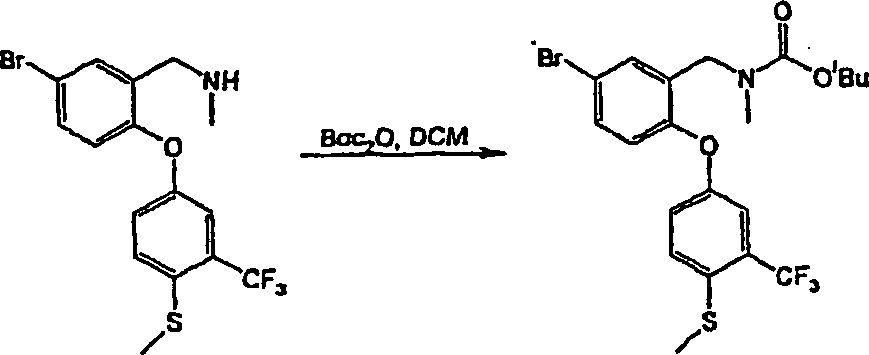
Eine Lösung des Amins von Beispiel 127 (822 mg, 2,02 mmol) in DCM (10 ml) wurde bei Raumtemperatur mit Di-(tert.-butyl)-dicarbonat (530 mg, 2,43 mmol) behandelt. Nach 1-stündigem Rühren wurde das Reaktionsgemisch mit Salzsäure (2 M) (5 ml) und gesättigter wässriger Natriumbicarbonatlösung (5 ml) gewaschen, getrocknet (MgSO4) und zu einem blassgelben Öl eingedampft (1,17 g, etwa 100%). δH (CDCl3, 300 MHz) 1,57 (9H, brs), 2,50 (3H, brd), 2,87 (3H, brs), 4,43 (2H, brs), 6,78 (1H, brt), 7,04 (1H, brs), 7,27 (1H, obs), 7,33–7,50 (3H, brm); MS m/z (TS+) 508 (MH+).A solution of the amine from Example 127 (822 mg, 2.02 mmol) in DCM (10 mL) was treated at room temperature with di (tert-butyl) dicarbonate (530 mg, 2.43 mmol). After stirring for 1 h, the reaction mixture was washed with hydrochloric acid (2 M) (5 mL) and saturated aqueous sodium bicarbonate solution (5 mL), dried (MgSO 4 ) and evaporated to a pale yellow oil (1.17 g, about 100%). δ H (CDCl 3, 300 MHz) 1.57 (9H, brs), 2.50 (3H, brd), 2.87 (3H, brs), 4.43 (2H, brs), 6.78 (1 H , brt), 7.04 (1H, brs), 7.27 (1H, obs), 7.33-7.50 (3H, brm); MS m / z (TS + ) 508 (MH + ).
Präparationen
38–39 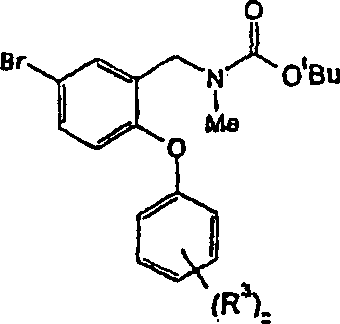
Die folgenden Boc-geschützten Arylbromide wurden nach dem Verfahren von Präparation 37 aus dem entsprechenden sekundären Amin hergestellt.The following Boc-protected Aryl bromides were prepared according to the procedure of Preparation 37 from the corresponding secondary Amine produced.
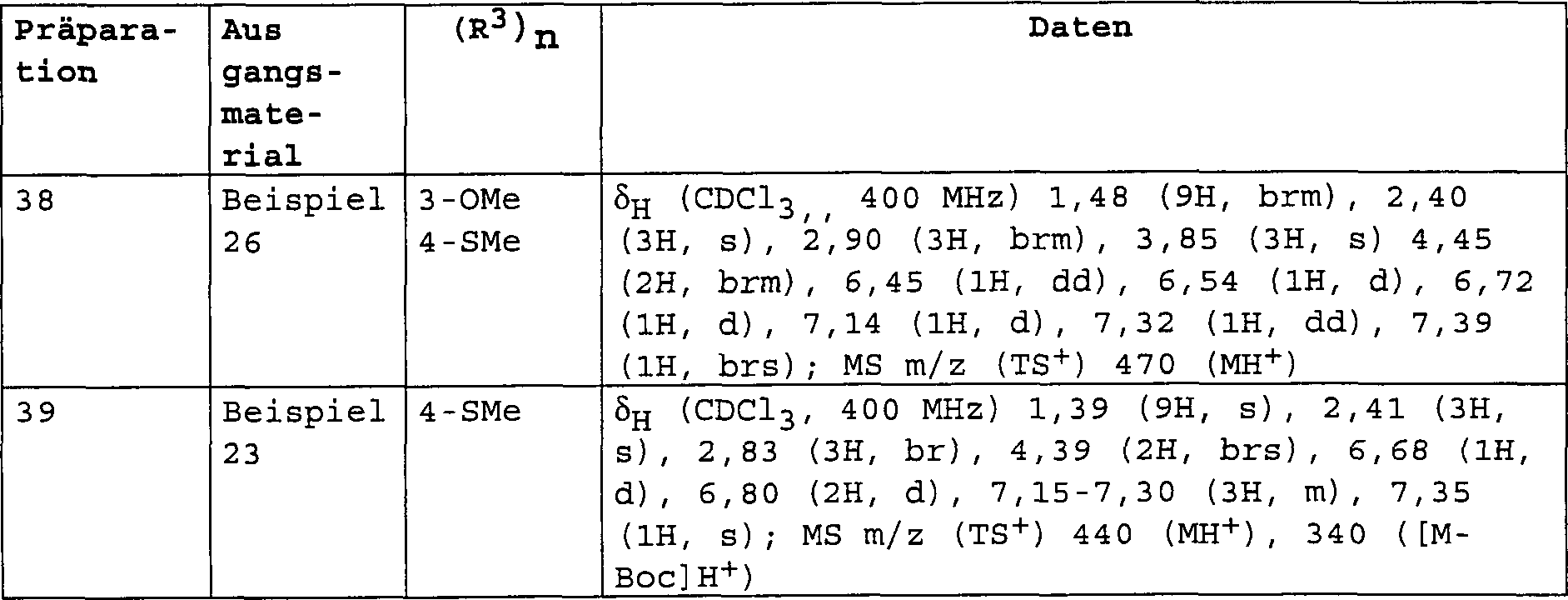
Präparation
40 Methyl-3-{[(tert.-butoxycarbonyl)-(methyl)-amino]-methyl}-4-[4-(methylsulfanyl)-3-(trifluormethyl)-phenoxy]-benzoat 
Das Arylbromid von Präparation 37 (1,02 g, 2,02 mmol) wurde in Methanol (15 ml) gelöst und in einem Gefäß aus rostfreiem Stahl mit Triethylamin (0,85 ml, 6,60 mmol), Palladium(II)-acetat (45 mg, 0,202 mmol) und Triphenylphosphin (106 mg, 0,404 mmol) behandelt. Das Gemisch wurde unter einen Kohlenmonoxiddruck von 100 psi gebracht und 24 Stunden auf 100°C erwärmt. Sodann wurde die Lösung zur Trockne eingedampft. Der Rückstand wurde durch Flash-Chromatographie (SiO2; Ethylacetat/Pentan (1:9 → 1:3)) gereinigt. Man erhielt den Titelester in Form eines gelben Öls (412 mg, 42%). δH (CDCl3, 400 MHz) 1,41 (9H, s), 2,46 (3H, s), 2,85 (3H, brs), 3,87 (3H, s), 4,50 (2H, brs), 6,79 (1H, d), 7,07 (1H, d), 7,28 (1H, s), 7,38 (1H, d), 7,87 (1H, d), 7,97 (1H, brs); MS m/z 397 (M-(OMe)-(t-Bu)).The aryl bromide from Preparation 37 (1.02g, 2.02mmol) was dissolved in methanol (15ml) and placed in a stainless steel vessel with triethylamine (0.85ml, 6.60mmol), palladium (II). acetate (45 mg, 0.202 mmol) and triphenylphosphine (106 mg, 0.404 mmol). The mixture was placed under a carbon monoxide pressure of 100 psi and heated to 100 ° C for 24 hours. The solution was then evaporated to dryness. The residue was purified by flash chromatography (SiO 2 , ethyl acetate / pentane (1: 9 → 1: 3)). The title ester was obtained as a yellow oil (412 mg, 42%). δ H (CDCl 3, 400 MHz) 1.41 (9H, s), 2.46 (3H, s), 2.85 (3H, brs), 3.87 (3H, s), 4.50 (2H , brs), 6.79 (1H, d), 7.07 (1H, d), 7.28 (1H, s), 7.38 (1H, d), 7.87 (1H, d), 7 , 97 (1H, brs); MS m / z 397 (M- (OMe) - (t-Bu)).
Präparationen 41–42Preparations 41-42
Die folgenden Ester wurden nach dem Verfahren von Präparation 40 aus dem erforderlichen Arylbromid hergestellt.The The following esters were prepared according to the procedure of Preparation 40 Arylbromide produced.

Präparation
43 3-{[(tert.-Butoxycarbonyl)-(methyl)-amino]-methyl}-4-[4-(methylsulfanyl)-3-(trifluormethyl)-phenoxy]-benzoesäure 
Der Ester von Präparation 40 (400 mg, 0,82 mmol) wurde in Methanol (5 ml) und Wasser (2 ml) gelöst. Kaliumcarbonat (114 mg, 0,82 mmol) wurde zugegeben. Sodann wurde das Reaktionsgemisch 18 Stunden unter Rückfluss erwärmt. Nach Abkühlen auf Raumtemperatur wurde das Gemisch zur Trockne eingedampft. Der Rückstand wurde mit Ethylacetat (10 ml) und Wasser (5 ml) verdünnt und mit Salzsäure (2 M) (2–3 ml) angesäuert. Die organische Phase wurde abgetrennt. Die wässrige Phase wurde mit Ethylacetat (5 ml) reextrahiert. Die vereinigten organischen Fraktionen wurden mit Kochsalzlösung (5 ml) gewaschen, getrocknet (MgSO4) und zu einem gelben Öl eingedampft (388 mg, 100%). δH (CDCl3, 300 MHz) 1,47 (9H, s), 2,54 (3H, s), 2,95 (3H, brs), 4,57 (2H, brs), 6,83 (1H, d), 7,15 (1H, dd), 7,35 (1H, s), 7,42 (1H, d), 7,99 (1H, d), 8,07 (1H, brs); MS m/z (TS+) 489 (MNH4 +).The ester of Preparation 40 (400 mg, 0.82 mmol) was dissolved in methanol (5 mL) and water (2 mL). Potassium carbonate (114 mg, 0.82 mmol) was added. The reaction mixture was refluxed for 18 hours. After cooling to room temperature, the mixture was evaporated to dryness. The residue was diluted with ethyl acetate (10 ml) and water (5 ml) and acidified with hydrochloric acid (2 M) (2-3 ml). The organic phase was separated. The aqueous phase was reextracted with ethyl acetate (5 ml). The combined organic fractions were washed with brine (5 ml), dried (MgSO 4 ) and evaporated to a yellow oil (388 mg, 100%). δ H (CDCl 3, 300 MHz) 1.47 (9H, s), 2.54 (3H, s), 2.95 (3H, brs), 4.57 (2H, brs), 6.83 (1 H , d), 7.15 (1H, dd), 7.35 (1H, s), 7.42 (1H, d), 7.99 (1H, d), 8.07 (1H, brs); MS m / z (TS + ) 489 (MNH 4 + ).
Präparation
44 3-{[(tert.-Butoxycarbonyl)-(methyl)-amino]-methyl}-4-[4-(methylsulfanyl)-phenoxybenzoesäure 
Der Ester von Präparation 42 (2,31 g, 5,39 mmol) wurde in THF gelöst und mit einer wässrigen Lithiumhydroxidlösung (1 M) behandelt. Das Gemisch wurde 16 Stunden unter Rückfluss erwärmt. Nach Abkühlen auf Raumtemperatur und Abdampfen des Großteils des THF wurde das Gemisch mit einer gesättigten wässrigen Ammoniumchloridlösung angesäuert und mit DCM (50 ml) verdünnt. Sodann wurde das Gemisch filtriert. Die organische Phase wurde abgetrennt. Die wässrige Phase wurde sodann mit DCM (50 ml) reextrahiert. Die vereinigten organischen Extrakte wurden getrocknet (MgSO4) und zu einem weißen Schaum eingedampft (2,3 g, etwa 100%), der nicht weiter gereinigt wurde. δH (CDCl3, 300 MHz) 1,45 (9H, s), 2,51 (3H, s), 2,91 (3H, brs), 4,55 (2H, brd), 6,80 (1H, d), 6,98 (2H, d), 7,29 (2H, d), 7,92 (1H, d), 8,03 (1H, brd); MS m/z (TS+) 404 (MH+).The ester of Preparation 42 (2.31 g, 5.39 mmol) was dissolved in THF and treated with an aqueous lithium hydroxide solution (1 M). The mixture was refluxed for 16 hours. After cooling to room temperature and evaporating most of the THF, the mixture was acidified with a saturated aqueous solution of ammonium chloride and diluted with DCM (50 ml). The mixture was filtered. The organic phase was separated. The aqueous phase was then reextracted with DCM (50 mL). The combined organic extracts were dried (MgSO 4 ) and evaporated to a white foam (2.3 g, about 100%) which was not further purified. δ H (CDCl 3, 300 MHz) 1.45 (9H, s), 2.51 (3H, s), 2.91 (3H, brs), 4.55 (2H, brd), 6.80 (1 H , d), 6.98 (2H, d), 7.29 (2H, d), 7.92 (1H, d), 8.03 (1H, brd); MS m / z (TS + ) 404 (MH + ).
Präparation
45 3-{[(tert.-Butoxycarbonyl)-(methyl)-amino]-methyl}-4-[3-methoxy-4-(methylsulfanyl)-phenoxy]-benzoesäure 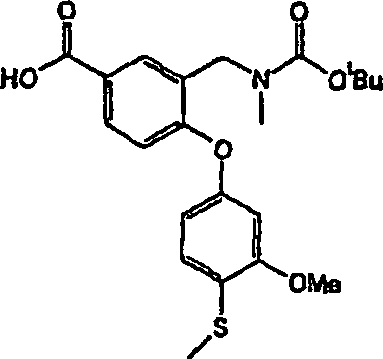
Die Titelcarbonsäure wurde aus dem Ester von Präparation 41 unter Anwendung des vorstehend für Präparation 44 beschriebenen Verfahrens hergestellt. δH (CDCl3, 400 MHz) 1,43 (9H, s), 2,39 (3H, s), 2,87 (3H, brs), 3,81 (3H, s), 4,52 (2H, brm), 6,54 (2H, m), 6,79 (2H, d), 7,13 (1H, d), 7,90 (1H, d), 8,00 (1H, brm); MS m/z (ES–) 432 (M – H+).The title carboxylic acid was prepared from the ester of Preparation 41 using the procedure described above for Preparation 44. δ H (CDCl 3, 400 MHz) 1.43 (9H, s), 2.39 (3H, s), 2.87 (3H, brs), 3.81 (3H, s), 4.52 (2H , brm), 6.54 (2H, m), 6.79 (2H, d), 7.13 (1H, d), 7.90 (1H, d), 8.00 (1H, brm); MS m / z (ES - ) 432 (M - H + ).
Präparation
46 tert.-Butyl-5-(aminocarbonyl)-2-[4-(methylsulfanyl)-3-(trifluormethyl)-phenoxy]-benzyl-(methyl)-carbamat 
Die Carbonsäure von Beispiel 43 (388 mg, 0,82 mmol) wurde in DCM (10 ml) gelöst und mit Triethylamin (287 μl, 2,06 mmol), 1-Hydroxybenzotriazol (139 mg, 1,03 mmol) und WSCDI (205 mg, 1,07 mmol) behandelt. Die Lösung wurde 1 Stunde bei Raumtemperatur gerührt, sodann mit gesättigtem Ammoniak in THF (2 ml, Überschuss) versetzt und über Nacht gerührt. Sodann wurde das Gemisch mit Salzsäure (2 M, 5 ml) angesäuert. Die organische Phase wurde abgetrennt. Die wässrige Phase wurde mit DCM (10 ml mit Spuren an zugesetztem Methanol) reextrahiert. Die vereinigten Extrakte wurden mit Kochsalzlösung (10 ml) gewaschen, getrocknet (MgSO4) und zu einem weißen Feststoff eingedampft (396 mg, 100%). δH (CD3OD, 300 MHz) 1,41 (9H, s), 2,54 (3H, s), 2,90 (3H, s), 4,58 (2H, s), 6,95 (1H, d), 7,21 (1H, d), 7,30 (1H, s), 7,60 (1H, d), 7,83 (1H, d), 7,91 (1H, s); MS m/z (TS+) 488 (MNH4 +).The carboxylic acid of Example 43 (388 mg, 0.82 mmol) was dissolved in DCM (10 ml) and triethylamine (287 μl, 2.06 mmol), 1-hydroxybenzotriazole (139 mg, 1.03 mmol) and WSCDI ( 205 mg, 1.07 mmol). The solution was stirred for 1 hour at room temperature, then saturated ammonia in THF (2 mL, excess) was added and stirred overnight. The mixture was acidified with hydrochloric acid (2M, 5ml). The organic phase was separated. The aqueous phase was reextracted with DCM (10 mL with traces of added methanol). The combined extracts were washed with brine (10 ml), dried (MgSO 4 ) and evaporated to a white solid (396 mg, 100%). δ H (CD 3 OD, 300 MHz) 1.41 (9H, s), 2.54 (3H, s), 2.90 (3H, s), 4.58 (2H, s), 6.95 ( 1H, d), 7.21 (1H, d), 7.30 (1H, s), 7.60 (1H, d), 7.83 (1H, d), 7.91 (1H, s); MS m / z (TS + ) 488 (MNH 4 + ).
Präparationen 47–54Preparations 47-54
Die nachstehende Reihe von Amiden wurde aus der entsprechenden Carbonsäure unter Anwendung des bei Präparation 46 beschriebenen Verfahrens hergestellt.The The following series of amides was obtained from the corresponding carboxylic acid Use of in preparation 46 described method produced.
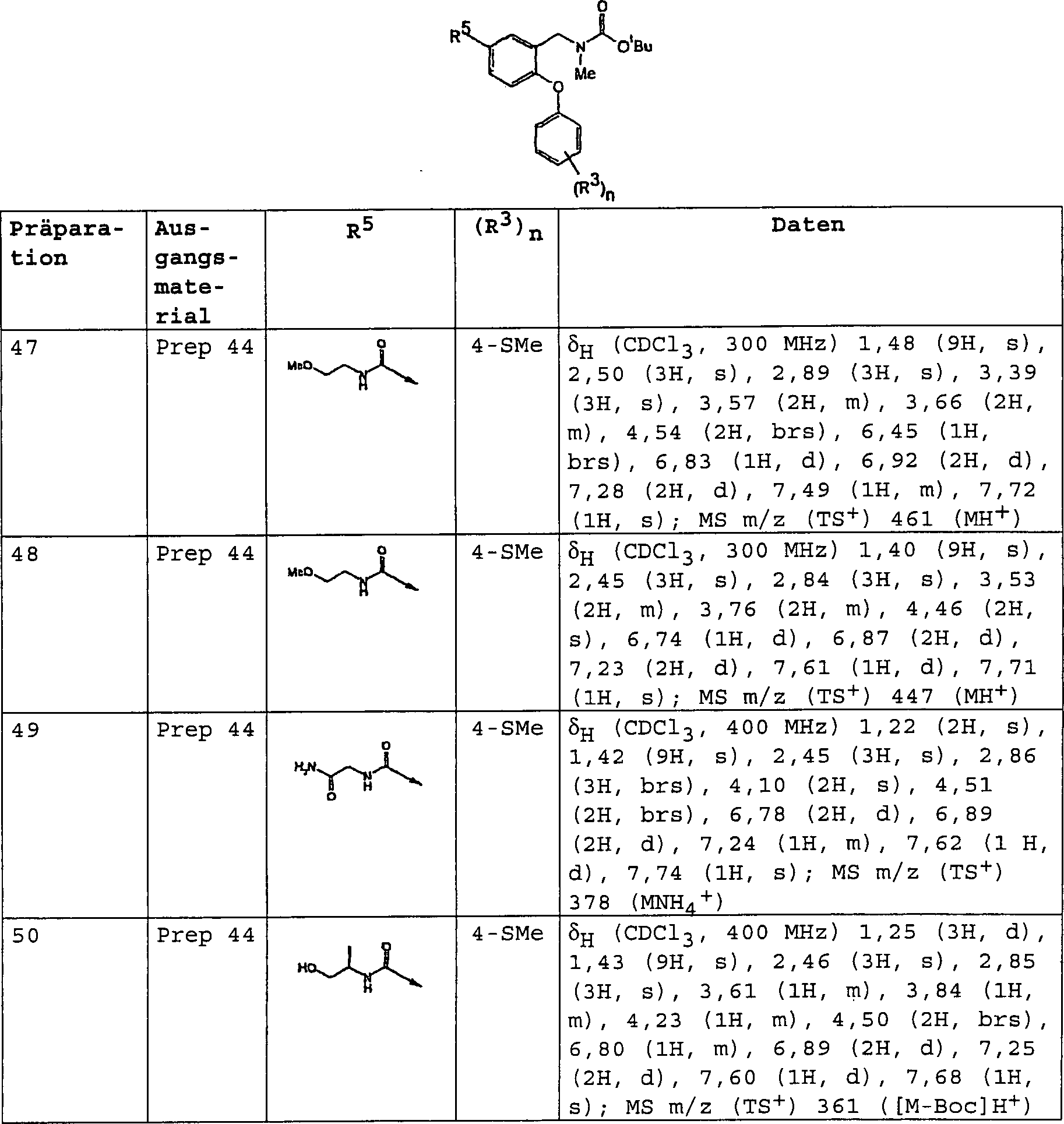

Präparation
55 2-[4-(Methylsulfanyl)-phenoxy]-5-nitrobenzonitril 
Ein Gemisch aus 2-Chlor-5-nitrobenzonitril (3,75 g, 20,5 mmol), 4-(Methylsulfanyl)-phenol (3 g, 21,4 mmol) und Kaliumcarbonat (3,4 g, 24,6 mmol) in DMF (50 ml) wurde 2,5 Stunden auf 100°C erwärmt. Nach Abkühlen auf Raumtemperatur wurde das Lösungsmittel unter Vakuum entfernt. Der Rückstand wurde mit DCM (200 ml) und Wasser (200 ml) ausgeschüttelt. Die organische Phase wurde mit Wasser (100 ml) gewaschen, getrocknet (MgSO4) und eingedampft. Man erhielt das Produkt mit Spurenverunreinigungen von 4-(Methylsulfanyl)-phenol und DMF (6,08 g, quantitative Ausbeute). δH (CDCl3, 400 MHz) 2,53 (3H, s), 6,90 (1H, d), 7,08 (2H, d), 7,36 (2H, d), 8,30 (1H, dd), 8,57 (1H, d); MS m/z (TS+) 304 (MNH4 +).A mixture of 2-chloro-5-nitrobenzonitrile (3.75 g, 20.5 mmol), 4- (methylsulfanyl) -phenol (3 g, 21.4 mmol) and potassium carbonate (3.4 g, 24.6 mmol ) in DMF (50 ml) was heated to 100 ° C for 2.5 hours. After cooling to room temperature, the solvent was removed in vacuo. The residue was partitioned between DCM (200 ml) and water (200 ml). The organic phase was washed with water (100 ml), dried (MgSO 4 ) and evaporated. The product was obtained with trace impurities of 4- (methylsulfanyl) phenol and DMF (6.08 g, quantitative yield). δ H (CDCl 3, 400 MHz) 2.53 (3H, s), 6.90 (1H, d), 7.08 (2H, d), 7.36 (2H, d), 8.30 (1 H , dd), 8.57 (1H, d); MS m / z (TS + ) 304 (MNH 4 + ).
Präparationen
56–58 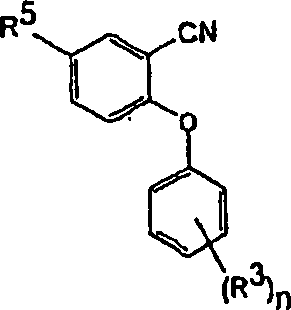
Die folgenden Diphenylether wurden auf analoge Weise wie bei Präparation 55 aus dem entsprechenden o-Chlorbenzonitril (handelsüblich) und den angegebenen Phenolkomponenten hergestellt.The The following diphenyl ethers were prepared in an analogous manner as in the preparation 55 from the corresponding o-chlorobenzonitrile (Commercially available) and the specified phenolic components.
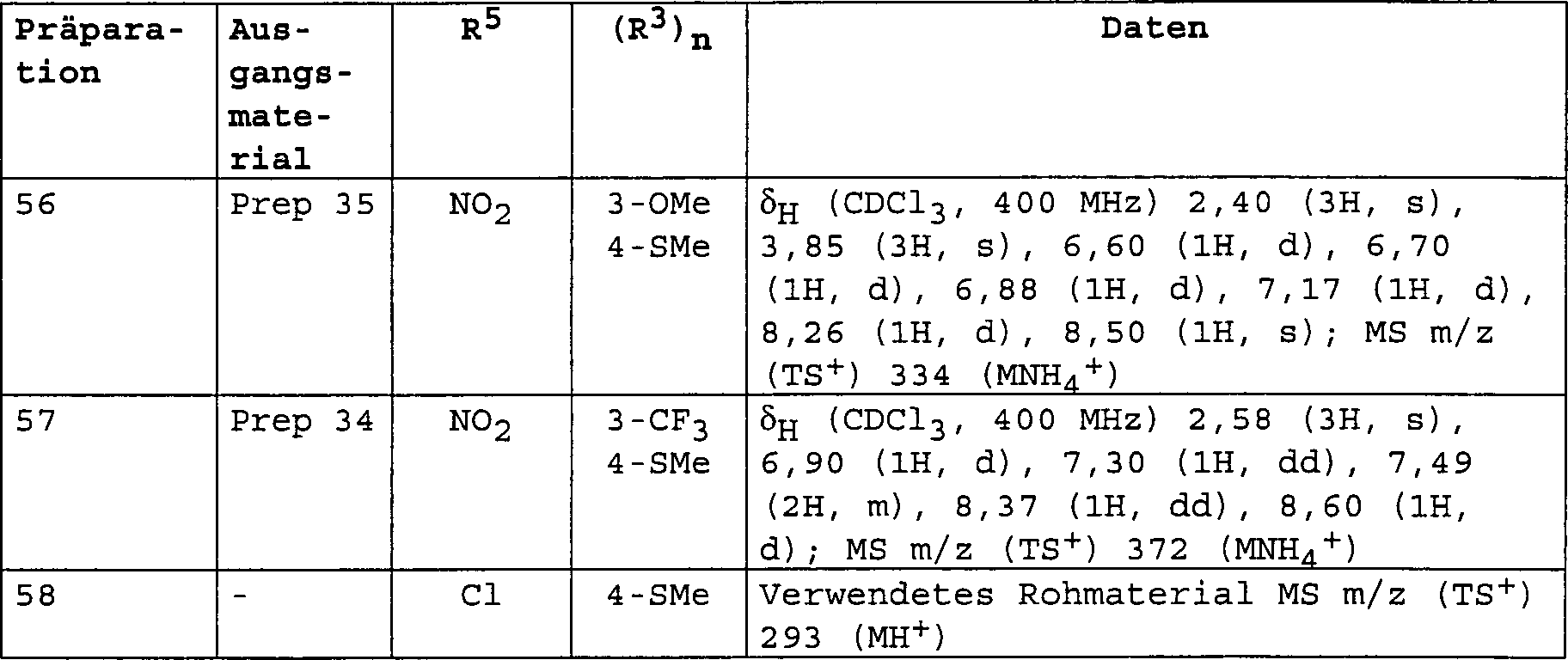
Präparation
59 5-Amino-2-[4-(methylsulfanyl)-phenoxy]-benzonitril 
Eisenpulver (8,0 g, 143 mmol) wurde portionsweise innerhalb von 10 Minuten zu einer Suspension des Nitrils von Präparation 55 (20,5 mmol) in Essigsäure (100 ml) und Wasser (15 ml) gegeben. Das erhaltene Gemisch wurde 2 Stunden bei Raumtemperatur gerührt. Nach Entfernen des Lösungsmittels unter Vakuum wurde der Rückstand mit DCM (250 ml) und wässrigem Kaliumcarbonat (10%, 300 ml) ausgeschüttelt. Die wässrige Phase wurde mit DCM (100 ml) extrahiert. Die vereinigten organischen Phasen wurden getrocknet (MgSO4) und zu einem blassbraunen Feststoff eingedampft (5,01 g, 95%). δH (CDCl3, 400 MHz) 2,47 (3H, s), 3,71 (2H, br), 6,81 (2H, s), 6,92 (3H, m), 7,25 (2H, m); MS m/z (TS+) 274 (MNH4 +).Iron powder (8.0 g, 143 mmol) was added portionwise over 10 minutes to a suspension of the nitrile of Preparation 55 (20.5 mmol) in acetic acid (100 mL) and water (15 mL). The resulting mixture was stirred for 2 hours at room temperature. After removing the solvent under vacuum, the residue was partitioned between DCM (250 mL) and aqueous potassium carbonate (10%, 300 mL). The aqueous phase was extracted with DCM (100 ml). The combined organic phases were dried (MgSO 4 ) and evaporated to a pale brown solid (5.01 g, 95%). δ H (CDCl 3, 400 MHz) 2.47 (3H, s), 3.71 (2H, br), 6.81 (2H, s), 6.92 (3H, m), 7.25 (2H , m); MS m / z (TS + ) 274 (MNH 4 + ).
Präparationen 60–61Preparations 60-61
Die folgenden Aniline wurden auf analoge Weise wie bei Präparation 59 aus der entsprechenden Nitroverbindung hergestellt.The The following anilines were prepared in a similar manner as in the preparation 59 prepared from the corresponding nitro compound.
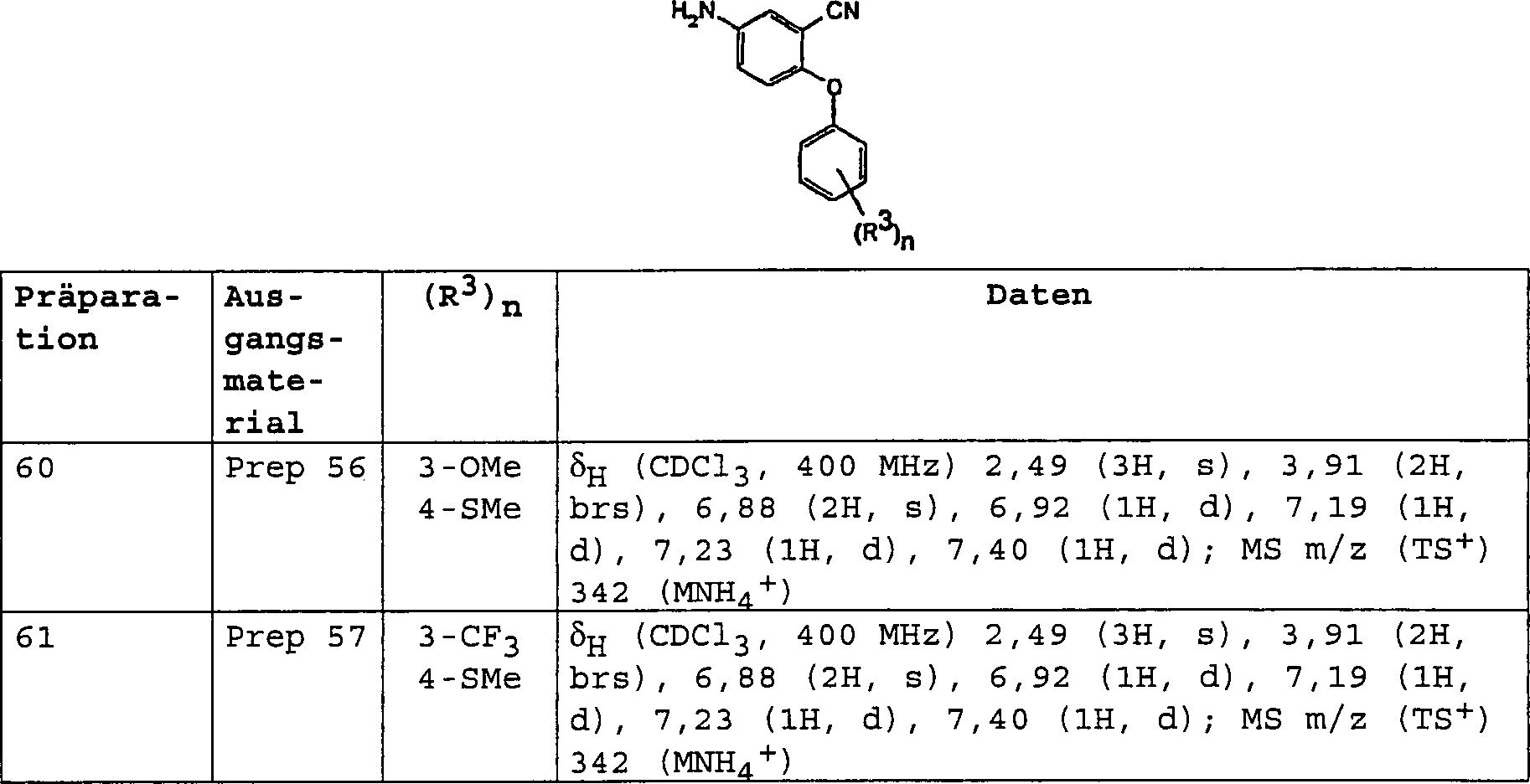
Präparation
62 N-{3-Cyano-4-[4-(methylsulfanyl)-phenoxy]-phenyl}-methansulfonamid 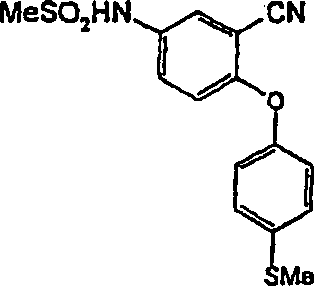
Methansulfonylchlorid (3 ml, 38,8 mmol) wurde zu einer Lösung des Nitrils von Präparation 59 (5 g, 19,5 mmol) und Triethylamin (5,6 mmol) in DCM (50 ml) gegeben. Das Gemisch wurde 2 Stunden bei Raumtemperatur gerührt. Der nach Abdampfen des Lösungsmittels unter Vakuum erhaltene Rückstand wurde mit DCM (50 ml) und Salzsäure (2 M, 50 ml) ausgeschüttelt. Die wässrige Phase wurde mit DCM (50 ml) extrahiert. Die vereinigten organischen Extrakte wurden unter Vakuum eingeengt. Der Rückstand wurde in THF (15 ml) aufgenommen und mit einer Natriumhydroxidlösung (2 M, 50 ml) versetzt. Das Gemisch wurde 3 Stunden gerührt. Sodann wurde das Reaktionsgemisch mit Salzsäure (2 M, 55 ml) angesäuert und mit DCM (2 × 100 ml) extrahiert. Die vereinigten organischen Extrakte wurden getrocknet (MgSO4) und zu einem blassgelben kristallinen Feststoff eingedampft (6,45 g, 99%). δH (CDCl3, 400 MHz) 2,50 (3H, s), 3,03 (3H, s), 6,47 (1H, br), 6,86 (1H, d), 7,02 (2H, d), 7,32 (2H, d), 7,37 (1H, dd), 7,54 (1H, d); MS m/z (ES+) 357 (MNa+).Methanesulfonyl chloride (3 mL, 38.8 mmol) was added to a solution of the nitrile from Preparation 59 (5 g, 19.5 mmol) and triethylamine (5.6 mmol) in DCM (50 mL). The mixture was stirred for 2 hours at room temperature. The solvent was evaporated under vacuum and the residue was partitioned between DCM (50 ml) and hydrochloric acid (2 M, 50 ml). The aqueous phase was extracted with DCM (50 ml). The combined organic extracts were concentrated in vacuo. The residue was taken up in THF (15 ml) and added with a sodium hydroxide solution (2 M, 50 ml). The mixture was stirred for 3 hours. The reaction mixture was acidified with hydrochloric acid (2M, 55 ml) and extracted with DCM (2 × 100 ml). The combined organic extracts were dried (MgSO 4 ) and evaporated to a pale yellow crystalline solid (6.45 g, 99%). δ H (CDCl 3, 400 MHz) 2.50 (3H, s), 3.03 (3H, s), 6.47 (1H, br), 6.86 (1H, d), 7.02 (2H , d), 7.32 (2H, d), 7.37 (1H, dd), 7.54 (1H, d); MS m / z (ES + ) 357 (MNa + ).
Präparationen 63–64Preparations 63-64
Die folgenden Methansulfonamide wurden aus dem erforderlichen Anilin nach dem in Präparation 62 beschriebenen Verfahren hergestellt.The The following methanesulfonamides were obtained from the required aniline after in preparation 62 described method produced.
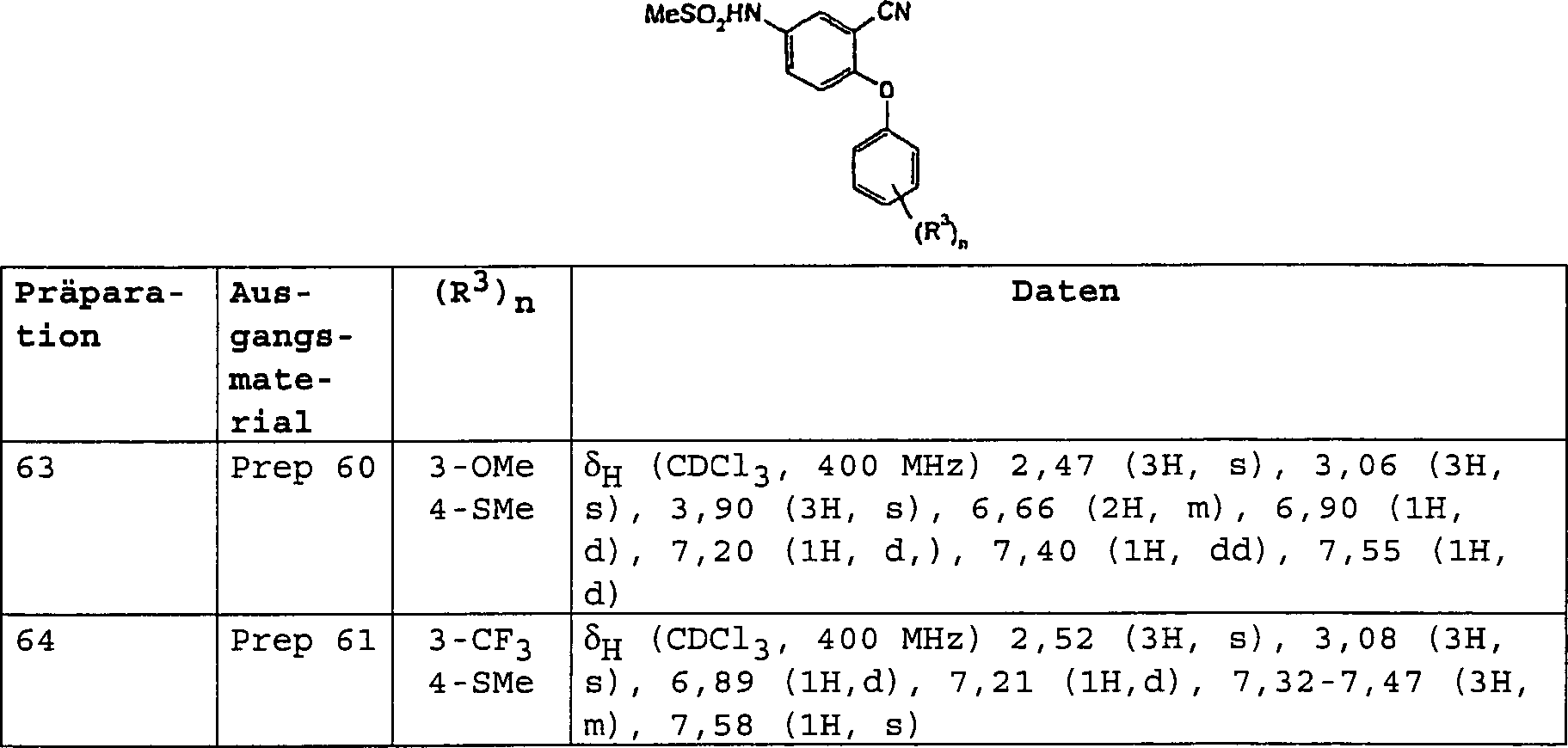
Präparation
65 N-{3-Cyano-4-[4-(methylsulfanyl)-phenoxy]-phenyl}-N-methylmethansulfonamid 
Methyliodid (2,5 ml, 40,2 mmol) und Kaliumcarbonat (1,25 g, 9,04 mmol) wurden zu einer Lösung des Sulfonamids von Präparation 62 (2,7 g, 8,07 mmol) in Acetonitril (40 ml) gegeben. Das Gemisch wurde 68 Stunden bei Raumtemperatur gerührt. Sodann wurde das Reaktionsgemisch in Natriumhydroxid (2 M, 50 ml) gegossen und mit Ethylacetat (50 ml) extrahiert. Die organische Phase wurde mit Kochsalzlösung gewaschen, getrocknet (MgSO4) und eingedampft. Man erhielt die Titelverbindung (2,75 g, 98%). δH (CDCl3, 300 MHz) 2, 50 (3H, s), 2,87 (3H, s), 3,30 (3H, s), 6,82 (1H, d), 7,03 (2H, d), 7,32 (2H, d), 7,49 (1H, dd), 7,62 (1H, d); MS m/z (TS+) 366 (MNH4 +).Methyl iodide (2.5 mL, 40.2 mmol) and potassium carbonate (1.25 g, 9.04 mmol) were added to a solution of the sulfonamide of Preparation 62 (2.7 g, 8.07 mmol) in acetonitrile (40 mL ). The mixture was stirred at room temperature for 68 hours. The reaction mixture was poured into sodium hydroxide (2 M, 50 ml) and extracted with ethyl acetate (50 ml). The organic phase was washed with brine, dried (MgSO 4 ) and evaporated. The title compound was obtained (2.75 g, 98%). δ H (CDCl 3, 300 MHz) 2, 50 (3H, s), 2.87 (3H, s), 3.30 (3H, s), 6.82 (1H, d), 7.03 (2H , d), 7.32 (2H, d), 7.49 (1H, dd), 7.62 (1H, d); MS m / z (TS + ) 366 (MNH 4 + ).
Präparation
66 N-{3-Cyano-4-[4-(methylsulfanyl)-phenoxy]-phenyl}-N-(2-hydroxyethyl)-methansulfonamid 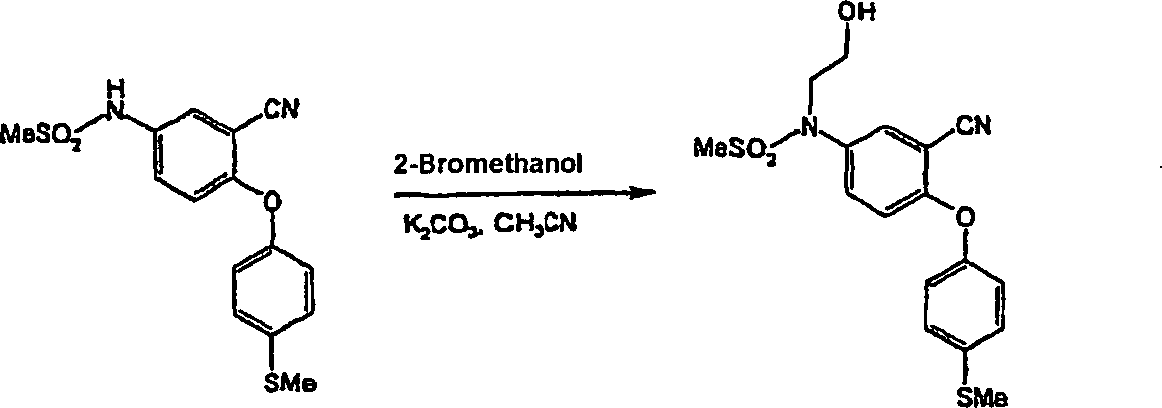
2-Bromethanol (2,5 ml, 35,3 mmol) und Kaliumcarbonat (4,9 g, 35,5 mmol) wurden zu einer Lösung des Sulfonamids von Präparation 62 (2,7 g, 8,07 mmol) in Acetonitril (40 ml) gegeben. Das Gemisch wurde 68 Stunden bei Raumtemperatur gerührt. Eine dünnschichtchromatographische Analyse ergab verbleibendes Ausgangsmaterial, so dass das Gemisch 20 Stunden unter Rückfluss erwärmt wurde. Nach Abkühlen wurde das Reaktionsgemisch in eine Natriumhydroxidlösung (2 M, 50 ml) gegossen und mit Ethylacetat (50 ml) extrahiert. Die organische Phase wurde mit Kochsalzlösung gewaschen, getrocknet (MgSO4) und eingedampft. Nach Reinigung des Rückstands durch mehrfache Säulenchromatographie (SiO2) erhielt man die Titelverbindung (1,90 g, 62%). δH (CDCl3, 300 MHz) 2,50 (3H, s), 3,00 (3H, s), 3,77 (2H, m), 3,80 (2H, m), 6,83 (1H, d), 7,04 (2H, d), 7,33 (2H, d), 7,50 (1H, dd), 7,67 (1H, d); MS m/z (TS+) 396 (MNH4 +).2-Bromoethanol (2.5 mL, 35.3 mmol) and potassium carbonate (4.9 g, 35.5 mmol) were added to a solution of the sulfonamide of Preparation 62 (2.7 g, 8.07 mmol) in acetonitrile ( 40 ml). The mixture was stirred at room temperature for 68 hours. TLC analysis gave residual starting material so that the mixture was refluxed for 20 hours. After cooling, the reaction mixture was poured into a sodium hydroxide solution (2 M, 50 ml) and extracted with ethyl acetate (50 ml). The organic phase was washed with brine, dried (MgSO 4 ) and evaporated. Purification of the residue by multiple column chromatography (SiO 2 ) gave the title compound (1.90 g, 62%). δ H (CDCl 3, 300 MHz) 2.50 (3H, s), 3.00 (3H, s), 3.77 (2H, m), 3.80 (2H, m), 6.83 (1H , d), 7.04 (2H, d), 7.33 (2H, d), 7.50 (1H, dd), 7.67 (1H, d); MS m / z (TS + ) 396 (MNH 4 + ).
Präparation
67 5-(Aminosulfonyl)-2-fluor-N-methylbenzamid 
Eine Suspension von 5-(Aminosulfonyl)-2-fluorbenzoesäure (hergestellt gemäß Chem. Pharm. Bull., Bd. 43 (4) (1995), S. 582–587) (3,0 g, 13,7 mmol) in Dichlormethan (100 ml) wurde bei Raumtemperatur unter Stickstoff mit 1-(3-Dimethylaminopropyl)-3-ethylcarbodiimid-hydrochlorid (WSCDI) (2,89 g, 15,06 mmol) und anschließend tropfenweise mit einer Lösung von Methylaminin in Tetrahydrofuran (2 M, 8,21 ml, 16,42 mmol) versetzt. Das Reaktionsgemisch wurde 16 Stunden gerührt. Sodann wurde das rohe Reaktionsgemisch zur Trockne eingedampft. Der Rückstand wurde an Kieselgel unter Elution mit Dichlormethan:Methanol:Ammoniak (84:14:2) als Lösungsmittel eluiert. Man erhielt das Amid (732 mg, 23%) in Form eines weißen Pulvers. 1H-NMR (300 MHz, d4-MeOH): δ = 2,97 (3H, s), 7,40 (1H, t), 8,05 (1H, m), 8,29 (1H, d), MS m/z 250 (MNH4)+.A suspension of 5- (aminosulfonyl) -2-fluorobenzoic acid (prepared according to Chem. Pharm. Bull., Vol. 43 (4) (1995), pp. 582-587) (3.0 g, 13.7 mmol) in Dichloromethane (100ml) was added at room temperature under nitrogen to 1- (3-dimethylaminopropyl) -3-ethylcarbodiimide hydrochloride (WSCDI) (2.89g, 15.06mmol) followed by dropwise addition of a solution of methylamine in tetrahydrofuran (2 M, 8.21 ml, 16.42 mmol). The reaction mixture was stirred for 16 hours. The crude reaction mixture was then evaporated to dryness. The residue was eluted on silica gel eluting with dichloromethane: methanol: ammonia (84: 14: 2) as solvent. The amide (732 mg, 23%) was obtained in the form of a white powder. 1 H-NMR (300 MHz, d 4 -MeOH): δ = 2.97 (3H, s), 7.40 (1H, t), 8.05 (1H, m), 8.29 (1H, d ), MS m / z 250 (MNH 4 ) + .
Präparation
68 N'-(3-{3-[(Dimethylamino)-methyl]-4-[4-(methylsulfanyl)-phenoxy]-phenyl}-propanoyl)-4-methylbenzolsulfonhydrazid 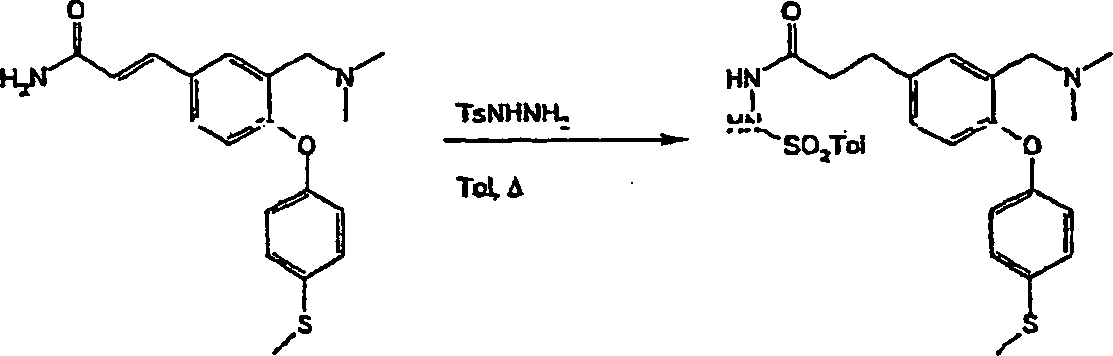
Durch Behandlung des in Beispiel 68 gebildeten ungesättigten Amids unter den in Beispiel 71 angewandten Reduktionsbedingungen erhielt man die Titelverbindung. Freie Base: δH (CDCl3, 400 MHz) 2,28 (6H, s), 2,36 (2H, t), 2,41 (3H, s), 2,46 (3H, s), 2,48–2,67 (2H, brm), 2,77 (2H, t), 3,48 (2H, s), 6,74 (1H, d), 6,84 (2H, d), 6,91 (1H, dd), 7,23–7,30 (5H, m), 7,75 (2H, d); MS m/z (TS+) 514, 516 (MH+)Treatment of the unsaturated amide formed in Example 68 under the reducing conditions employed in Example 71 gave the title compound. Free base: δ H (CDCl 3, 400 MHz) 2.28 (6H, s), 2.36 (2H, t), 2.41 (3H, s), 2.46 (3H, s), 2, 48-2.67 (2H, brm), 2.77 (2H, t), 3.48 (2H, s), 6.74 (1H, d), 6.84 (2H, d), 6.91 (1H, dd), 7.23-7.30 (5H, m), 7.75 (2H, d); MS m / z (TS + ) 514, 516 (MH + )
Präparation
69 N'-(3-{4-[(Dimethylamino)-methyl]-3-[4-(methylsulfanyl)-phenoxy]-phenyl}-propanoyl)-4-methylbenzolsulfonhydrazid 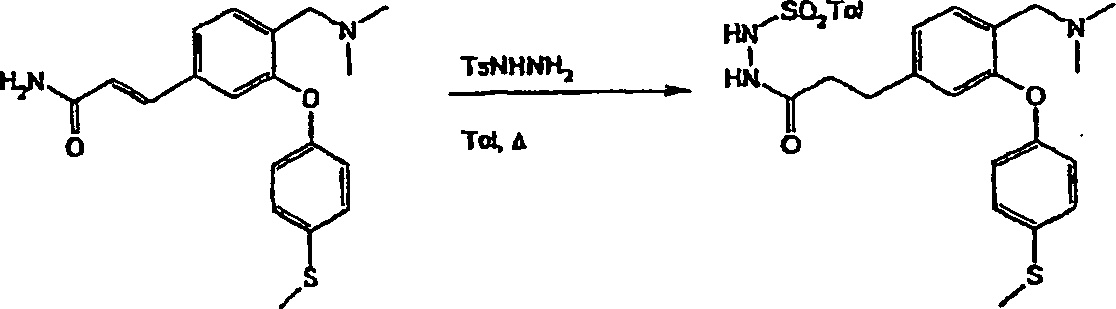
Durch Behandlung des in Beispiel 69 gebildeten ungesättigten Amids unter den für Beispiel 71 angewandten Reduktionsbedingungen erhielt man die Titelverbindung. Freie Base: δH (CDCl3, 300 MHz) 2,23 (2H, t), 2,38 (3H, s), 2,48 (3H, s), 2,62 (2H, t), 4,27 (2H, s), 6,68 (1H, s), 6,97 (1H, d), 7,04 (2H, d), 7,30–7,34 (4H, m), 7,58 (1H, d), 7,62 (1H, d), 9,64 (1H, s), 9,91 (1H, s), 10,34 (1H, brs); MS m/z (ES+) 514 (MH+).Treatment of the unsaturated amide formed in Example 69 under the reducing conditions used for Example 71 gave the title compound. Free base: δ H (CDCl 3, 300 MHz) 2.23 (2H, t), 2.38 (3H, s), 2.48 (3H, s), 2.62 (2H, t), 4, 27 (2H, s), 6.68 (1H, s), 6.97 (1H, d), 7.04 (2H, d), 7.30-7.34 (4H, m), 7.58 (1H, d), 7.62 (1H, d), 9.64 (1H, s), 9.91 (1H, s), 10.34 (1H, brs); MS m / z (ES + ) 514 (MH + ).
Biologische AktivitätBiological activity
Eine Anzahl von Verbindungen wurden auf ihre biologische Aktivität aufgrund ihrer Fähigkeit zur Hemmung der Aufnahme von Serotonin durch humane Serotonin-Transporter auf folgende Weise getestet.A Number of compounds were due to their biological activity their ability for inhibiting the uptake of serotonin by human serotonin transporters to the following Way tested.
(i) Zellkultur(i) cell culture
Humane embryonale Nierenzellen (HEK-293), die in stabiler Weise mit dem humanen Serotonin-Transporter (hSERT), Noradrenalin-Transporter (hNET) oder Dopamin-Transporter (hDAT) transfiziert waren, wurden nach üblichen Zellkulturtechniken gezüchtet (die Zellen wurden bei 37°C und 5% CO2 in DMEM-Kulturmedium (ergänzt mit 10% dialysiertem fötalen Kälberserum (FCS), 2 mM I-Glutamin und 250 μg/ml Geneticin) gezüchtet). Die Zellen wurden für den Test unter Bildung einer Zellsuspension von 750 000 Zellen/ml geerntet.Human embryonic kidney cells (HEK-293) stably transfected with the human serotonin transporter (hSERT), norepinephrine transporter (hNET) or dopamine transporter (hDAT) were cultured by standard cell culture techniques (the cells were transfected into 37 ° C and 5% CO 2 in DMEM culture medium (supplemented with 10% dialyzed fetal calf serum (FCS), 2 mM I-glutamine and 250 μg / ml Geneticin)). Cells were harvested for assay to form a cell suspension of 750,000 cells / ml.
(i) Bestimmung der Inhibitorstärke(i) Determination of inhibitor strength
Sämtliche Testverbindungen wurden in 100% DMSO gelöst und in Testpuffer zur Bildung geeigneter Testkonzentrationen verdünnt. Tests wurden in Filterbodenplatten mit 96 Vertiefungen durchgeführt. Zellen (7 500 Zellen/Testvertiefung) wurden in Standardtestpuffer, der entweder die Testverbindung, den Standardinhibitor oder den Verbindungsträger (1% DMSO) enthielt, 5 Minuten inkubiert. Die Reaktionen wurden durch Zugabe von 3H-Serotonin, 3H-Noradrenalin oder 3H-Dopaminsubstraten gestartet. Sämtliche Reaktionen wurden bei Raumtemperatur in einem Schüttelinkubator durchgeführt. Die Inkubationszeiten betrugen 5 Minuten für die hSERT- und hDAT-Tests und 15 Minuten für den hNET-Test. Die Reaktionen wurden durch Entfernung des Reaktionsgemisches unter Verwendung eines Vakuumrohrverteilers und anschließendes rasches Waschen mit eiskaltem Testpuffer beendet. Die Menge des in die Zellen eingebauten 3H-Substrats wurde sodann quantitativ bestimmt.All test compounds were dissolved in 100% DMSO and diluted in assay buffer to form suitable test concentrations. Tests were carried out in 96-well filter bottom plates. Cells (7,500 cells / assay well) were incubated in standard assay buffer containing either the test compound, the standard inhibitor or the compound support (1% DMSO) for 5 minutes. The reactions were started by addition of 3 H-serotonin, 3 H-noradrenaline or 3 H-dopamine substrates. All reactions were carried out at room temperature in a shaking incubator. Incubation times were 5 minutes for the hSERT and hDAT tests and 15 minutes for the hNET test. The reactions were terminated by removal of the reaction mixture using a vacuum manifold and subsequent rapid washing with ice-cold assay buffer. The amount of 3 H substrate incorporated into the cells was then quantified.
Die Testplatten wurden in einem Mikrowellenofen getrocknet, mit Szintillationsflüssigkeit versetzt und einer Messung der Radioaktivität unterzogen. Die Wirkungsstärke der Testverbindungen wurde quantitativ als IC50-Wert angegeben (Konzentration der Testverbindung, die zur Hemmung der spezifischen Aufnahme von radioaktiv markiertem Substrat in die Zellen um 50% erforderlich war).The test plates were dried in a microwave oven, added with scintillation fluid and subjected to measurement of radioactivity. The potency of the test compounds was quantified as the IC 50 value (concentration of test compound required to inhibit the specific uptake of radioactively labeled substrate into the cells by 50%).
(iii) Zusammensetzung des Standardtestpuffers(iii) composition the standard test buffer
- Trizma-hydrochlorid (26 mM)Trizma hydrochloride (26 mM)
- NaCl (124 mM)NaCl (124 mM)
- KCl (4,5 mM)KCl (4.5 mM)
- KH2PO4 (1,2 mM)KH 2 PO 4 (1.2 mM)
- MgCl2·6H2O (1,3 mM)MgCl 2 .6H 2 O (1.3mM)
- Ascorbinsäure (1,136 mM)ascorbic acid (1.136 mM)
- Glucose (5,55 mM)Glucose (5.55 mM)
- pH-Wert 7,40pH 7.40
- CaCl2 (2,8 mM)CaCl 2 (2.8 mM)
- Pargylin (100 μM)Pargyline (100 μM)
Anmerkung: Der pH-Wert des Puffers wurde vor Zugabe von CaCl2 und Pargylin mit 1 M NaOH auf 7,40 eingestellt.Note: The pH of the buffer was adjusted to 7.40 with 1M NaOH before addition of CaCl 2 and pargyline.
(iv)
Zusammenfassende Darstellung der Testparameter 
Verbindungen mit einem IC50-Wert der Hemmung der Serotonin-Wiederaufnahme (SRI) von 100 nM oder weniger sind die Titelverbindungen der Beispiele 1–4, 6, 9–12, 14, 23, 25, 28–33, 35–53, 55–62, 64, 65, 71–80, 84, 85, 87, 90–92, 94–99, 101–106, 110, 112, 114–122, 125, 128–142, 145–149 und 154–191.Compounds with an IC 50 value of inhibiting serotonin reuptake (SRI) of 100 nM or less are the title compounds of Examples 1-4, 6, 9-12, 14, 23, 25, 28-33, 35-53, 55-62, 64, 65, 71-80, 84, 85, 87, 90-92, 94-99, 101-106, 110, 112, 114-122, 125, 128-142, 145-149 and 154- 191st
Verbindungen mit einem IC50-Wert der Hemmung der Wiederaufnahme von Serotonin (SRI) von 100 nM oder weniger, die bei der Hemmung der Serotonin-Wiederaufnahme 10-fach stärker wirken als bei der Hemmung der Dopamin-Wiederaufnahme oder der Noradrenalin-Wiederaufnahme sind die Titelverbindungen der Beispiele 3, 4, 6, 9–12, 14, 23, 25, 28–33, 35–40, 45–53, 55, 56, 58, 62, 64, 65, 71, 73–76, 84, 85, 87, 90–92, 94–98, 101–104, 106, 110, 112, 114–122, 128–131, 134–141, 145–148, 155–159, 161, 162, 165, 167–179 und 181–191.Compounds with an IC 50 value of serotonin reuptake inhibition (SRI) of 100 nM or less which are 10-fold more potent in inhibiting serotonin reuptake than inhibiting dopamine reuptake or noradrenaline reuptake Title compounds of Examples 3, 4, 6, 9-12, 14, 23, 25, 28-33, 35-40, 45-53, 55, 56, 58, 62, 64, 65, 71, 73-76, 84 , 85, 87, 90-92, 94-98, 101-104, 106, 110, 112, 114-122, 128-131, 134-141, 145-148, 155-159, 161, 162, 165, 167 -179 and 181-191.
Verbindungen mit einem IC50-Wert der Hemmung der Wiederaufnahme von Serotonin (SRI) von 100 nM oder weniger, die bei der Hemmung der Serotonin-Wiederaufnahme mehr als 100-fach stärker wirken als bei der Hemmung der Dopamin-Wiederaufnahme oder der Noradrenalin-Wiederaufnahme sind die Titelverbindungen der Beispiele 3, 4, 6, 9–12, 14, 23, 25, 28–32, 35–40, 46–51, 53, 55, 58, 62, 64, 71, 73–76, 84, 85, 87, 90, 91, 94–98, 101–104, 106, 110, 112, 114, 116–118, 120, 121, 128–131, 135, 137, 139–141, 145–148, 155–159, 161, 162, 169–179 und 181–190.Compounds with an IC 50 value of serotonin reuptake inhibition (SRI) of 100 nM or less which are more than 100-fold more potent in inhibiting serotonin reuptake than inhibiting dopamine reuptake or norepinephrine reuptake are the title compounds of Examples 3, 4, 6, 9-12, 14, 23, 25, 28-32, 35-40, 46-51, 53, 55, 58, 62, 64, 71, 73-76, 84 , 85, 87, 90, 91, 94-98, 101-104, 106, 110, 112, 114, 116-118, 120, 121, 128-131, 135, 137, 139-141, 145-148, 155 -159, 161, 162, 169-179 and 181-190.
Verbindungen mit einem IC50-Wert der Hemmung der Wiederaufnahme von Serotonin (SRI) von 100 nM oder weniger, die bei der Hemmung der Serotonin-Wiederaufnahme mehr als 100-fach stärker wirken als bei der Hemmung der Dopamin- Wiederaufnahme und der Noradrenalin-Wiederaufnahme sind die Titelverbindungen der Beispiele 3, 4, 9, 14, 23, 25, 28–30, 35, 36, 38–40, 46, 53, 58, 74, 84, 85, 87, 90, 91, 94–98, 101, 104, 110, 114, 116, 117, 120, 121, 128, 130, 135, 140, 141, 145–148, 156, 157, 169, 170, 174–176, 181–185 und 187–190.Compounds with an IC 50 value of serotonin reuptake inhibition (SRI) of 100 nM or less, which are more than 100-fold more potent in inhibiting serotonin reuptake than inhibiting dopamine reuptake and norepinephrine reuptake are the title compounds of Examples 3, 4, 9, 14, 23, 25, 28-30, 35, 36, 38-40, 46, 53, 58, 74, 84, 85, 87, 90, 91, 94-98 , 101, 104, 110, 114, 116, 117, 120, 121, 128, 130, 135, 140, 141, 145-148, 156, 157, 169, 170, 174-176, 181-185 and 187-190 ,
Verbindungen mit einem IC50-Wert der Hemmung der Wiederaufnahme von Serotonin (SRI) von 50 nM oder weniger, die bei der Hemmung der Serotinin-Wiederaufnahme 100-fach stärker wirken als bei der Hemmung der Dopamin-Wiederaufnahme und der Noradrenalin-Wiederaufnahme sind die Titelverbindungen der Beispiele 3, 4, 9, 14, 23, 25, 28, 30, 36, 38–40, 46, 53, 58, 74, 84, 85, 87, 90, 91, 94–98, 101, 104, 110, 114, 116, 117, 120, 121, 128, 130, 135, 140, 141, 145, 147, 148, 156, 157, 169, 170, 174–176, 181–185 und 187–190.Compounds with an IC 50 value of inhibiting serotonin reuptake (SRI) of 50 nM or less which are 100-fold more potent in inhibiting serotonin reuptake than inhibiting dopamine reuptake and norepinephrine reuptake Title compounds of Examples 3, 4, 9, 14, 23, 25, 28, 30, 36, 38-40, 46, 53, 58, 74, 84, 85, 87, 90, 91, 94-98, 101, 104 , 110, 114, 116, 117, 120, 121, 128, 130, 135, 140, 141, 145, 147, 148, 156, 157, 169, 170, 174-176, 181-185 and 187-190.
Claims (27)

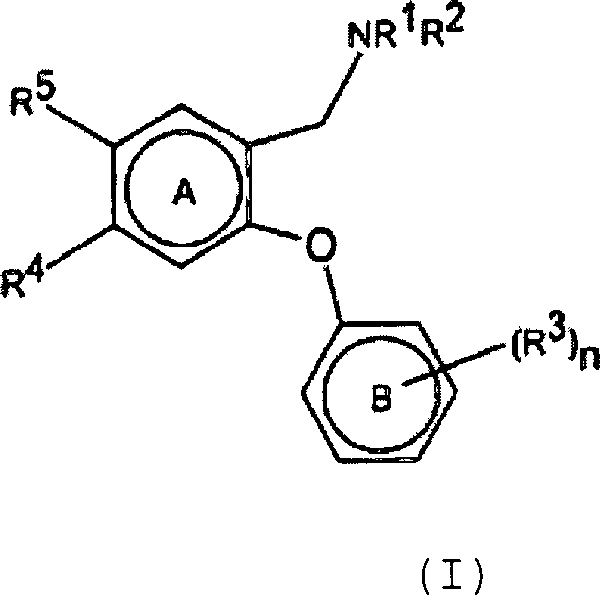

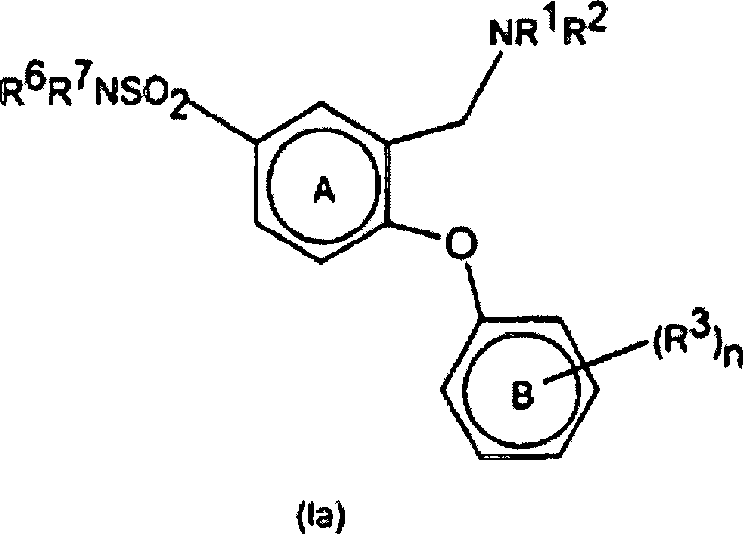
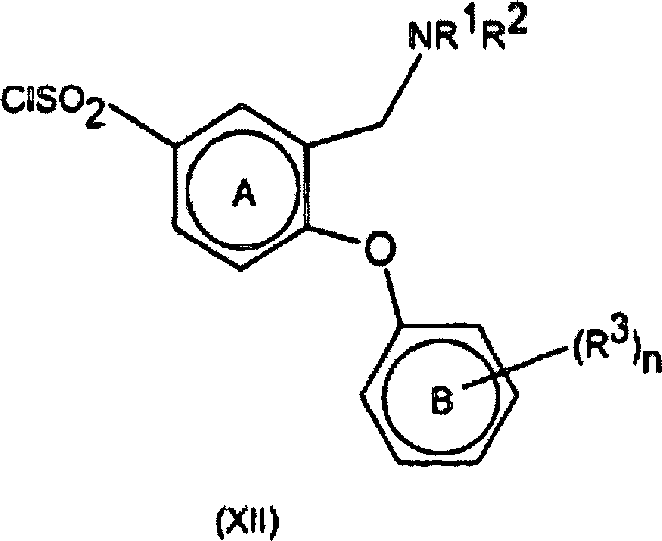


Applications Claiming Priority (3)
| Application Number | Priority Date | Filing Date | Title |
|---|---|---|---|
| GBGB0007884.0A GB0007884D0 (en) | 2000-03-31 | 2000-03-31 | Diphenyl ether compounds useful in therapy |
| GB0007884 | 2000-03-31 | ||
| PCT/IB2001/000428 WO2001072687A1 (en) | 2000-03-31 | 2001-03-19 | Diphenyl ether compounds useful in therapy |
Publications (2)
| Publication Number | Publication Date |
|---|---|
| DE60112059D1 DE60112059D1 (en) | 2005-08-25 |
| DE60112059T2 true DE60112059T2 (en) | 2006-04-13 |
Family
ID=9888884
Family Applications (1)
| Application Number | Title | Priority Date | Filing Date |
|---|---|---|---|
| DE60112059T Expired - Fee Related DE60112059T2 (en) | 2000-03-31 | 2001-03-19 | THERAPEUTICALLY USEFUL DIPHENYL ETHER COMPOUNDS |
Country Status (44)
Families Citing this family (21)
| Publication number | Priority date | Publication date | Assignee | Title |
|---|---|---|---|---|
| US6410736B1 (en) | 1999-11-29 | 2002-06-25 | Pfizer Inc. | Biaryl ether derivatives useful as monoamine reuptake inhibitors |
| OA12372A (en) * | 2000-08-31 | 2006-04-17 | Pfizer | Phenoxybenzylamine derivatives as selective seotonin re-uptake inhibitors. |
| US6610747B2 (en) | 2000-08-31 | 2003-08-26 | Pfizer Inc. | Phenoxybenzylamine derivatives as SSRIs |
| US6436938B1 (en) * | 2001-01-22 | 2002-08-20 | Pfizer Inc. | Combination treatment for depression |
| US20020107244A1 (en) * | 2001-02-02 | 2002-08-08 | Howard Harry R. | Combination treatment for depression |
| US20020183306A1 (en) * | 2001-05-30 | 2002-12-05 | Pfizer Inc. | Combination treatment for sleep disorders including sleep apnea |
| GB0202282D0 (en) | 2002-01-31 | 2002-03-20 | Pfizer Ltd | Treatment of male sexual dysfunction |
| GB0219154D0 (en) * | 2002-08-16 | 2002-09-25 | Pfizer Ltd | Diaryl compounds |
| US6800652B2 (en) | 2002-08-16 | 2004-10-05 | Pfizer Inc. | Diaryl compounds |
| CA2451267A1 (en) * | 2002-12-13 | 2004-06-13 | Warner-Lambert Company Llc | Pharmaceutical uses for alpha2delta ligands |
| GB0318706D0 (en) * | 2003-08-08 | 2003-09-10 | Pfizer Ltd | Selective serotonin reuptake inhibitors in the treatment of disease |
| BRPI0414637A (en) * | 2003-09-22 | 2006-11-14 | Pfizer | process for the preparation of a diphenyl ether compound |
| EP2049473A2 (en) * | 2006-06-29 | 2009-04-22 | Janssen Pharmaceutica N.V. | Substituted benzyl amine compounds |
| CN101511790A (en) * | 2006-06-29 | 2009-08-19 | 詹森药业有限公司 | Substituted aminomethyl benzamide compounds |
| EP2049466A1 (en) * | 2006-06-29 | 2009-04-22 | Janssen Pharmaceutica N.V. | Butyl and butynyl benzyl amine compounds |
| EP2755939A4 (en) | 2011-07-14 | 2015-04-15 | Keith R Latham | Halogenated phenols for diagnostics, antioxidant protection and drug delivery |
| US10220100B2 (en) | 2011-07-14 | 2019-03-05 | Keith R. Latham | Halogenated phenols for diagnostics, antioxidant protection and drug delivery |
| US20140206667A1 (en) | 2012-11-14 | 2014-07-24 | Michela Gallagher | Methods and compositions for treating schizophrenia |
| BR112017000160A2 (en) * | 2014-08-27 | 2017-10-31 | Hoffmann La Roche | azetidine derivatives substituted as taar binders |
| AU2019323712A1 (en) * | 2018-08-24 | 2021-02-25 | Xeniopro GmbH | Aromatic molecules for use in the treatment of pathological conditions |
| TW202100526A (en) | 2019-03-06 | 2021-01-01 | 日商第一三共股份有限公司 | Pyrrolopyrazole derivatives |
Family Cites Families (4)
| Publication number | Priority date | Publication date | Assignee | Title |
|---|---|---|---|---|
| GB2210041B (en) * | 1987-09-09 | 1992-07-01 | Ici Plc | Fungicidal derivatives of propenoic acid |
| US4940731A (en) * | 1989-08-30 | 1990-07-10 | Pfizer Inc. | Method of treating premature ejaculation using sertraline |
| ZA923283B (en) * | 1991-05-29 | 1993-01-27 | Akzo Nv | Phenoxyphenyl derivatives |
| EE200100441A (en) * | 1999-02-23 | 2002-12-16 | Pfizer Products Inc. | Monoamine reuptake inhibitors for the treatment of central nervous system disorders |
-
2000
- 2000-03-31 GB GBGB0007884.0A patent/GB0007884D0/en not_active Ceased
-
2001
- 2001-03-19 IL IL15063101A patent/IL150631A0/en unknown
- 2001-03-19 ES ES01917347T patent/ES2243469T3/en not_active Expired - Lifetime
- 2001-03-19 NZ NZ519972A patent/NZ519972A/en unknown
- 2001-03-19 YU YU72102A patent/YU72102A/en unknown
- 2001-03-19 CZ CZ20023191A patent/CZ20023191A3/en unknown
- 2001-03-19 MX MXPA02009697A patent/MXPA02009697A/en active IP Right Grant
- 2001-03-19 EE EEP200200568A patent/EE200200568A/en unknown
- 2001-03-19 PT PT01917347T patent/PT1268396E/en unknown
- 2001-03-19 PL PL01358622A patent/PL358622A1/en not_active Application Discontinuation
- 2001-03-19 DE DE60112059T patent/DE60112059T2/en not_active Expired - Fee Related
- 2001-03-19 SK SK1375-2002A patent/SK13752002A3/en unknown
- 2001-03-19 EP EP01917347A patent/EP1268396B1/en not_active Expired - Lifetime
- 2001-03-19 WO PCT/IB2001/000428 patent/WO2001072687A1/en not_active Ceased
- 2001-03-19 EA EA200200916A patent/EA005519B1/en unknown
- 2001-03-19 DK DK01917347T patent/DK1268396T3/en active
- 2001-03-19 AP APAP/P/2002/002633A patent/AP1308A/en active
- 2001-03-19 DZ DZ013405A patent/DZ3405A1/fr active
- 2001-03-19 AT AT01917347T patent/ATE299859T1/en not_active IP Right Cessation
- 2001-03-19 CA CA002404439A patent/CA2404439A1/en not_active Abandoned
- 2001-03-19 GE GE4939A patent/GEP20053505B/en unknown
- 2001-03-19 AU AU44429/01A patent/AU784934B2/en not_active Ceased
- 2001-03-19 BR BR0109547-1A patent/BR0109547A/en not_active IP Right Cessation
- 2001-03-19 UA UA2002097628A patent/UA75067C2/en unknown
- 2001-03-19 OA OA1200200300A patent/OA12238A/en unknown
- 2001-03-19 KR KR1020027012965A patent/KR100570238B1/en not_active Expired - Fee Related
- 2001-03-19 JP JP2001570602A patent/JP3936866B2/en not_active Expired - Fee Related
- 2001-03-19 CN CNB018073174A patent/CN1221524C/en not_active Expired - Fee Related
- 2001-03-19 HR HR20020764A patent/HRP20020764A2/en not_active Application Discontinuation
- 2001-03-19 SI SI200130389T patent/SI1268396T1/en unknown
- 2001-03-19 HU HU0301075A patent/HUP0301075A3/en unknown
- 2001-03-27 PE PE2001000285A patent/PE20011138A1/en not_active Application Discontinuation
- 2001-03-28 MY MYPI20011465A patent/MY128442A/en unknown
- 2001-03-29 AR ARP010101508A patent/AR027744A1/en active IP Right Grant
- 2001-03-30 TN TNTNSN01046A patent/TNSN01046A1/en unknown
- 2001-03-30 PA PA8514520018514501A patent/PA8514501A1/en unknown
- 2001-03-30 SV SV2001000363A patent/SV2002000363A/en not_active Application Discontinuation
- 2001-12-06 TW TWDIPHENYLA patent/TWI281909B/en not_active IP Right Cessation
-
2002
- 2002-07-05 IS IS6457A patent/IS6457A/en unknown
- 2002-07-09 BG BG106912A patent/BG65369B1/en unknown
- 2002-08-27 CR CR6741A patent/CR6741A/en not_active Application Discontinuation
- 2002-09-24 MA MA26836A patent/MA26885A1/en unknown
- 2002-09-26 ZA ZA200207738A patent/ZA200207738B/en unknown
- 2002-09-27 NO NO20024663A patent/NO20024663D0/en not_active Application Discontinuation
Also Published As
Similar Documents
| Publication | Publication Date | Title |
|---|---|---|
| DE60112059T2 (en) | THERAPEUTICALLY USEFUL DIPHENYL ETHER COMPOUNDS | |
| DE69321835T2 (en) | 7- (2-AMINOETHYL) -BENZOTHIAZOLONE | |
| JP4137159B2 (en) | N-pyrrolidin-3-yl-amide derivatives as serotonin and noradrenaline reuptake inhibitors | |
| US6914160B1 (en) | Oxytocin inhibitors | |
| SK2012003A3 (en) | Phenoxybenzylamine derivatives as selective re-uptake inhibitors | |
| US6448293B1 (en) | Diphenyl ether compounds useful in therapy | |
| DE69930397T2 (en) | INDAZONE DERIVATIVES WITH 5-HT2 RECEPTOR ACTIVITY | |
| DE60201819T2 (en) | PHENYL-HETEROCYCLYL ETHER DERIVATIVES AS SEROTONIN RE-UPTAKE INHIBITORS | |
| US6630504B2 (en) | Phenoxyphenylheterocyclyl derivatives as SSRIs | |
| US20020022638A1 (en) | Heterocyclic Beta-3 adrenergic receptor agonists | |
| DE69132689T2 (en) | BIOLOGICALLY ACTIVE AMINE | |
| DE60013418T2 (en) | MORPHOLINE DERIVATIVES, METHOD FOR THE PRODUCTION THEREOF AND PHARMACEUTICAL COMPOSITIONS CONTAINING THEM | |
| DE69501791T2 (en) | INDOL DERIVATIVES AS 5-HT1 LIKE AGONISTS | |
| CA2356065C (en) | Phenoxyphenylheterocycle derivatives as ssris | |
| JPS5955873A (en) | benzamide derivative | |
| DE60021859T2 (en) | 1, 2, 3, 4-TETRAHYDRO-1-NAPHTHALENAMINE COMPOUNDS FOR THERAPEUTIC USE | |
| US6610747B2 (en) | Phenoxybenzylamine derivatives as SSRIs | |
| JP2005539029A (en) | Diaryl compounds as monoamine reuptake inhibitors | |
| JPWO1999048880A1 (en) | Benzothiazolone-7-sulfonamide derivatives |
Legal Events
| Date | Code | Title | Description |
|---|---|---|---|
| 8364 | No opposition during term of opposition | ||
| 8339 | Ceased/non-payment of the annual fee |