DE60110413T3 - POLYACRYLAMIDE HYDROGEL AND ITS USE AS ENDOPROTHESIS - Google Patents
POLYACRYLAMIDE HYDROGEL AND ITS USE AS ENDOPROTHESIS Download PDFInfo
- Publication number
- DE60110413T3 DE60110413T3 DE60110413T DE60110413T DE60110413T3 DE 60110413 T3 DE60110413 T3 DE 60110413T3 DE 60110413 T DE60110413 T DE 60110413T DE 60110413 T DE60110413 T DE 60110413T DE 60110413 T3 DE60110413 T3 DE 60110413T3
- Authority
- DE
- Germany
- Prior art keywords
- hydrogel
- polyacrylamide
- acrylamide
- weight
- bis
- Prior art date
- Legal status (The legal status is an assumption and is not a legal conclusion. Google has not performed a legal analysis and makes no representation as to the accuracy of the status listed.)
- Expired - Lifetime
Links
- 239000000017 hydrogel Substances 0.000 title claims abstract description 251
- 229920002401 polyacrylamide Polymers 0.000 title claims abstract description 105
- XLYOFNOQVPJJNP-UHFFFAOYSA-N water Substances O XLYOFNOQVPJJNP-UHFFFAOYSA-N 0.000 claims abstract description 66
- HRPVXLWXLXDGHG-UHFFFAOYSA-N Acrylamide Chemical compound NC(=O)C=C HRPVXLWXLXDGHG-UHFFFAOYSA-N 0.000 claims abstract description 64
- FAPWRFPIFSIZLT-UHFFFAOYSA-M Sodium chloride Chemical compound [Na+].[Cl-] FAPWRFPIFSIZLT-UHFFFAOYSA-M 0.000 claims abstract description 64
- ZIUHHBKFKCYYJD-UHFFFAOYSA-N n,n'-methylenebisacrylamide Chemical compound C=CC(=O)NCNC(=O)C=C ZIUHHBKFKCYYJD-UHFFFAOYSA-N 0.000 claims abstract description 45
- 238000005406 washing Methods 0.000 claims abstract description 44
- 238000011282 treatment Methods 0.000 claims abstract description 37
- 230000000977 initiatory effect Effects 0.000 claims abstract description 21
- 238000002347 injection Methods 0.000 claims abstract description 18
- 239000007924 injection Substances 0.000 claims abstract description 18
- 238000002360 preparation method Methods 0.000 claims description 24
- 206010047370 Vesicoureteric reflux Diseases 0.000 claims description 21
- 201000008618 vesicoureteral reflux Diseases 0.000 claims description 20
- 208000031355 vesicoureteral reflux 1 Diseases 0.000 claims description 20
- 206010046543 Urinary incontinence Diseases 0.000 claims description 19
- 229920000642 polymer Polymers 0.000 claims description 19
- 230000002265 prevention Effects 0.000 claims description 12
- 208000034347 Faecal incontinence Diseases 0.000 claims description 11
- 210000004027 cell Anatomy 0.000 claims description 8
- 230000001413 cellular effect Effects 0.000 claims description 5
- 241000124008 Mammalia Species 0.000 claims description 3
- 210000000130 stem cell Anatomy 0.000 claims description 3
- 206010003246 arthritis Diseases 0.000 abstract 1
- 239000000499 gel Substances 0.000 description 39
- 239000011780 sodium chloride Substances 0.000 description 29
- 238000000034 method Methods 0.000 description 28
- ROOXNKNUYICQNP-UHFFFAOYSA-N ammonium persulfate Chemical compound [NH4+].[NH4+].[O-]S(=O)(=O)OOS([O-])(=O)=O ROOXNKNUYICQNP-UHFFFAOYSA-N 0.000 description 24
- 238000004132 cross linking Methods 0.000 description 24
- 210000003708 urethra Anatomy 0.000 description 23
- 239000000178 monomer Substances 0.000 description 19
- 150000003254 radicals Chemical class 0.000 description 19
- 239000000243 solution Substances 0.000 description 18
- 206010021639 Incontinence Diseases 0.000 description 14
- 239000000203 mixture Substances 0.000 description 13
- 210000000626 ureter Anatomy 0.000 description 13
- 229910001870 ammonium persulfate Inorganic materials 0.000 description 12
- 239000003999 initiator Substances 0.000 description 12
- 230000000704 physical effect Effects 0.000 description 12
- 239000000463 material Substances 0.000 description 11
- 230000008569 process Effects 0.000 description 11
- 210000001519 tissue Anatomy 0.000 description 10
- 210000001072 colon Anatomy 0.000 description 9
- 229920001296 polysiloxane Polymers 0.000 description 9
- 210000000664 rectum Anatomy 0.000 description 9
- 239000007787 solid Substances 0.000 description 9
- 239000000126 substance Substances 0.000 description 9
- 230000008961 swelling Effects 0.000 description 9
- 238000009472 formulation Methods 0.000 description 8
- 238000006116 polymerization reaction Methods 0.000 description 8
- 238000004519 manufacturing process Methods 0.000 description 7
- 210000005070 sphincter Anatomy 0.000 description 7
- IJGRMHOSHXDMSA-UHFFFAOYSA-N Atomic nitrogen Chemical compound N#N IJGRMHOSHXDMSA-UHFFFAOYSA-N 0.000 description 6
- 229910052757 nitrogen Inorganic materials 0.000 description 6
- 239000000047 product Substances 0.000 description 6
- 102000008186 Collagen Human genes 0.000 description 4
- 108010035532 Collagen Proteins 0.000 description 4
- WCUXLLCKKVVCTQ-UHFFFAOYSA-M Potassium chloride Chemical compound [Cl-].[K+] WCUXLLCKKVVCTQ-UHFFFAOYSA-M 0.000 description 4
- 210000002255 anal canal Anatomy 0.000 description 4
- 230000010261 cell growth Effects 0.000 description 4
- 239000003153 chemical reaction reagent Substances 0.000 description 4
- 229920001436 collagen Polymers 0.000 description 4
- 210000002808 connective tissue Anatomy 0.000 description 4
- 238000002316 cosmetic surgery Methods 0.000 description 4
- 239000003431 cross linking reagent Substances 0.000 description 4
- 210000003722 extracellular fluid Anatomy 0.000 description 4
- 208000014674 injury Diseases 0.000 description 4
- 239000007788 liquid Substances 0.000 description 4
- 231100000252 nontoxic Toxicity 0.000 description 4
- 230000003000 nontoxic effect Effects 0.000 description 4
- 238000002278 reconstructive surgery Methods 0.000 description 4
- 210000004876 tela submucosa Anatomy 0.000 description 4
- 238000002560 therapeutic procedure Methods 0.000 description 4
- 239000004809 Teflon Substances 0.000 description 3
- 229920006362 Teflon® Polymers 0.000 description 3
- 208000027418 Wounds and injury Diseases 0.000 description 3
- 230000002009 allergenic effect Effects 0.000 description 3
- 238000006065 biodegradation reaction Methods 0.000 description 3
- 230000015556 catabolic process Effects 0.000 description 3
- 230000006378 damage Effects 0.000 description 3
- 238000006731 degradation reaction Methods 0.000 description 3
- 238000010586 diagram Methods 0.000 description 3
- 238000010790 dilution Methods 0.000 description 3
- 239000012895 dilution Substances 0.000 description 3
- 230000002255 enzymatic effect Effects 0.000 description 3
- 210000003238 esophagus Anatomy 0.000 description 3
- 210000002950 fibroblast Anatomy 0.000 description 3
- 238000011049 filling Methods 0.000 description 3
- FIKFOOMAUXPBJM-UHFFFAOYSA-N hepta-2,5-dienediamide Chemical compound NC(=O)C=CCC=CC(N)=O FIKFOOMAUXPBJM-UHFFFAOYSA-N 0.000 description 3
- 239000012528 membrane Substances 0.000 description 3
- 230000000813 microbial effect Effects 0.000 description 3
- 230000003278 mimic effect Effects 0.000 description 3
- 231100001223 noncarcinogenic Toxicity 0.000 description 3
- 231100000065 noncytotoxic Toxicity 0.000 description 3
- 230000002352 nonmutagenic effect Effects 0.000 description 3
- 230000011514 reflex Effects 0.000 description 3
- 239000012266 salt solution Substances 0.000 description 3
- 210000002784 stomach Anatomy 0.000 description 3
- 231100000331 toxic Toxicity 0.000 description 3
- 230000002588 toxic effect Effects 0.000 description 3
- 230000002485 urinary effect Effects 0.000 description 3
- KIUKXJAPPMFGSW-DNGZLQJQSA-N (2S,3S,4S,5R,6R)-6-[(2S,3R,4R,5S,6R)-3-Acetamido-2-[(2S,3S,4R,5R,6R)-6-[(2R,3R,4R,5S,6R)-3-acetamido-2,5-dihydroxy-6-(hydroxymethyl)oxan-4-yl]oxy-2-carboxy-4,5-dihydroxyoxan-3-yl]oxy-5-hydroxy-6-(hydroxymethyl)oxan-4-yl]oxy-3,4,5-trihydroxyoxane-2-carboxylic acid Chemical compound CC(=O)N[C@H]1[C@H](O)O[C@H](CO)[C@@H](O)[C@@H]1O[C@H]1[C@H](O)[C@@H](O)[C@H](O[C@H]2[C@@H]([C@@H](O[C@H]3[C@@H]([C@@H](O)[C@H](O)[C@H](O3)C(O)=O)O)[C@H](O)[C@@H](CO)O2)NC(C)=O)[C@@H](C(O)=O)O1 KIUKXJAPPMFGSW-DNGZLQJQSA-N 0.000 description 2
- UXVMQQNJUSDDNG-UHFFFAOYSA-L Calcium chloride Chemical compound [Cl-].[Cl-].[Ca+2] UXVMQQNJUSDDNG-UHFFFAOYSA-L 0.000 description 2
- 206010011224 Cough Diseases 0.000 description 2
- WQZGKKKJIJFFOK-GASJEMHNSA-N Glucose Natural products OC[C@H]1OC(O)[C@H](O)[C@@H](O)[C@@H]1O WQZGKKKJIJFFOK-GASJEMHNSA-N 0.000 description 2
- PEDCQBHIVMGVHV-UHFFFAOYSA-N Glycerine Chemical compound OCC(O)CO PEDCQBHIVMGVHV-UHFFFAOYSA-N 0.000 description 2
- 239000012981 Hank's balanced salt solution Substances 0.000 description 2
- KWYHDKDOAIKMQN-UHFFFAOYSA-N N,N,N',N'-tetramethylethylenediamine Chemical compound CN(C)CCN(C)C KWYHDKDOAIKMQN-UHFFFAOYSA-N 0.000 description 2
- 241000699700 Ondatra zibethicus Species 0.000 description 2
- 235000010443 alginic acid Nutrition 0.000 description 2
- 229920000615 alginic acid Polymers 0.000 description 2
- 239000003242 anti bacterial agent Substances 0.000 description 2
- 239000002131 composite material Substances 0.000 description 2
- 230000008602 contraction Effects 0.000 description 2
- 239000002537 cosmetic Substances 0.000 description 2
- 230000007547 defect Effects 0.000 description 2
- 208000037265 diseases, disorders, signs and symptoms Diseases 0.000 description 2
- 208000035475 disorder Diseases 0.000 description 2
- 230000000694 effects Effects 0.000 description 2
- UYMKPFRHYYNDTL-UHFFFAOYSA-N ethenamine Chemical compound NC=C UYMKPFRHYYNDTL-UHFFFAOYSA-N 0.000 description 2
- 230000007849 functional defect Effects 0.000 description 2
- 208000021302 gastroesophageal reflux disease Diseases 0.000 description 2
- -1 gellan gum Chemical class 0.000 description 2
- 239000008103 glucose Substances 0.000 description 2
- 150000004676 glycans Chemical class 0.000 description 2
- 229920002674 hyaluronan Polymers 0.000 description 2
- 229960003160 hyaluronic acid Drugs 0.000 description 2
- 238000002513 implantation Methods 0.000 description 2
- 210000003734 kidney Anatomy 0.000 description 2
- 239000011159 matrix material Substances 0.000 description 2
- 238000002156 mixing Methods 0.000 description 2
- 210000004877 mucosa Anatomy 0.000 description 2
- 210000003205 muscle Anatomy 0.000 description 2
- 230000004118 muscle contraction Effects 0.000 description 2
- 208000000689 peptic esophagitis Diseases 0.000 description 2
- 229920001282 polysaccharide Polymers 0.000 description 2
- 239000005017 polysaccharide Substances 0.000 description 2
- 239000001103 potassium chloride Substances 0.000 description 2
- 235000011164 potassium chloride Nutrition 0.000 description 2
- 239000002510 pyrogen Substances 0.000 description 2
- 239000000523 sample Substances 0.000 description 2
- 210000004872 soft tissue Anatomy 0.000 description 2
- 239000000725 suspension Substances 0.000 description 2
- 210000002700 urine Anatomy 0.000 description 2
- WRXNJTBODVGDRY-UHFFFAOYSA-N 2-pyrrolidin-1-ylethanamine Chemical compound NCCN1CCCC1 WRXNJTBODVGDRY-UHFFFAOYSA-N 0.000 description 1
- IRLPACMLTUPBCL-KQYNXXCUSA-N 5'-adenylyl sulfate Chemical compound C1=NC=2C(N)=NC=NC=2N1[C@@H]1O[C@H](COP(O)(=O)OS(O)(=O)=O)[C@@H](O)[C@H]1O IRLPACMLTUPBCL-KQYNXXCUSA-N 0.000 description 1
- 241000894006 Bacteria Species 0.000 description 1
- OKTJSMMVPCPJKN-UHFFFAOYSA-N Carbon Chemical compound [C] OKTJSMMVPCPJKN-UHFFFAOYSA-N 0.000 description 1
- 229920001661 Chitosan Polymers 0.000 description 1
- 208000032544 Cicatrix Diseases 0.000 description 1
- 208000032170 Congenital Abnormalities Diseases 0.000 description 1
- 206010010356 Congenital anomaly Diseases 0.000 description 1
- 102000009123 Fibrin Human genes 0.000 description 1
- 108010073385 Fibrin Proteins 0.000 description 1
- BWGVNKXGVNDBDI-UHFFFAOYSA-N Fibrin monomer Chemical compound CNC(=O)CNC(=O)CN BWGVNKXGVNDBDI-UHFFFAOYSA-N 0.000 description 1
- 108010010803 Gelatin Proteins 0.000 description 1
- 229920002148 Gellan gum Polymers 0.000 description 1
- 206010028980 Neoplasm Diseases 0.000 description 1
- 206010033892 Paraplegia Diseases 0.000 description 1
- 229920003171 Poly (ethylene oxide) Polymers 0.000 description 1
- 239000004698 Polyethylene Substances 0.000 description 1
- 229920002873 Polyethylenimine Polymers 0.000 description 1
- 108010039918 Polylysine Proteins 0.000 description 1
- ZLMJMSJWJFRBEC-UHFFFAOYSA-N Potassium Chemical compound [K] ZLMJMSJWJFRBEC-UHFFFAOYSA-N 0.000 description 1
- 229910052774 Proactinium Inorganic materials 0.000 description 1
- 206010037596 Pyelonephritis Diseases 0.000 description 1
- 208000001647 Renal Insufficiency Diseases 0.000 description 1
- 229920002125 Sokalan® Polymers 0.000 description 1
- 229910000831 Steel Inorganic materials 0.000 description 1
- 208000033809 Suppuration Diseases 0.000 description 1
- 208000000921 Urge Urinary Incontinence Diseases 0.000 description 1
- 230000003187 abdominal effect Effects 0.000 description 1
- 150000001252 acrylic acid derivatives Chemical class 0.000 description 1
- 238000004458 analytical method Methods 0.000 description 1
- 210000003484 anatomy Anatomy 0.000 description 1
- 230000002421 anti-septic effect Effects 0.000 description 1
- 229940088710 antibiotic agent Drugs 0.000 description 1
- 239000007864 aqueous solution Substances 0.000 description 1
- 230000001580 bacterial effect Effects 0.000 description 1
- 230000008901 benefit Effects 0.000 description 1
- 230000003115 biocidal effect Effects 0.000 description 1
- 239000000560 biocompatible material Substances 0.000 description 1
- 229920000249 biocompatible polymer Polymers 0.000 description 1
- 229920002988 biodegradable polymer Polymers 0.000 description 1
- 239000004621 biodegradable polymer Substances 0.000 description 1
- 229920001400 block copolymer Polymers 0.000 description 1
- 210000000746 body region Anatomy 0.000 description 1
- 239000012267 brine Substances 0.000 description 1
- 239000008364 bulk solution Substances 0.000 description 1
- 229910052799 carbon Inorganic materials 0.000 description 1
- 235000010418 carrageenan Nutrition 0.000 description 1
- 229920001525 carrageenan Polymers 0.000 description 1
- 239000000679 carrageenan Substances 0.000 description 1
- 229940113118 carrageenan Drugs 0.000 description 1
- 238000005266 casting Methods 0.000 description 1
- 239000006285 cell suspension Substances 0.000 description 1
- 238000006243 chemical reaction Methods 0.000 description 1
- 238000012937 correction Methods 0.000 description 1
- 230000003247 decreasing effect Effects 0.000 description 1
- 230000006735 deficit Effects 0.000 description 1
- 238000007872 degassing Methods 0.000 description 1
- 238000000151 deposition Methods 0.000 description 1
- 230000003292 diminished effect Effects 0.000 description 1
- 239000003814 drug Substances 0.000 description 1
- 238000001962 electrophoresis Methods 0.000 description 1
- 238000011067 equilibration Methods 0.000 description 1
- 238000000605 extraction Methods 0.000 description 1
- 238000001125 extrusion Methods 0.000 description 1
- 230000001815 facial effect Effects 0.000 description 1
- 229950003499 fibrin Drugs 0.000 description 1
- 239000012467 final product Substances 0.000 description 1
- 239000012530 fluid Substances 0.000 description 1
- 239000007789 gas Substances 0.000 description 1
- 239000008273 gelatin Substances 0.000 description 1
- 229920000159 gelatin Polymers 0.000 description 1
- 235000019322 gelatine Nutrition 0.000 description 1
- 235000011852 gelatine desserts Nutrition 0.000 description 1
- 235000010492 gellan gum Nutrition 0.000 description 1
- 239000000216 gellan gum Substances 0.000 description 1
- 235000011187 glycerol Nutrition 0.000 description 1
- 238000000227 grinding Methods 0.000 description 1
- 238000009499 grossing Methods 0.000 description 1
- 230000036541 health Effects 0.000 description 1
- 229910001385 heavy metal Inorganic materials 0.000 description 1
- 230000028993 immune response Effects 0.000 description 1
- 208000015181 infectious disease Diseases 0.000 description 1
- 239000004615 ingredient Substances 0.000 description 1
- 229940102213 injectable suspension Drugs 0.000 description 1
- 201000006370 kidney failure Diseases 0.000 description 1
- 239000003589 local anesthetic agent Substances 0.000 description 1
- 230000007774 longterm Effects 0.000 description 1
- 230000014759 maintenance of location Effects 0.000 description 1
- 238000000691 measurement method Methods 0.000 description 1
- 125000002496 methyl group Chemical group [H]C([H])([H])* 0.000 description 1
- OINMATXWPCYGSR-UHFFFAOYSA-N n-methylidenebuta-2,3-dienamide Chemical compound C=NC(=O)C=C=C OINMATXWPCYGSR-UHFFFAOYSA-N 0.000 description 1
- 239000005445 natural material Substances 0.000 description 1
- 229920005615 natural polymer Polymers 0.000 description 1
- 229940127285 new chemical entity Drugs 0.000 description 1
- 210000000056 organ Anatomy 0.000 description 1
- 239000002245 particle Substances 0.000 description 1
- 229920003023 plastic Polymers 0.000 description 1
- 239000004033 plastic Substances 0.000 description 1
- 229920000083 poly(allylamine) Polymers 0.000 description 1
- 239000004584 polyacrylic acid Substances 0.000 description 1
- 229920000573 polyethylene Polymers 0.000 description 1
- 229920001223 polyethylene glycol Polymers 0.000 description 1
- 229920000656 polylysine Polymers 0.000 description 1
- 238000012667 polymer degradation Methods 0.000 description 1
- 230000000379 polymerizing effect Effects 0.000 description 1
- 229920001451 polypropylene glycol Polymers 0.000 description 1
- 229920001343 polytetrafluoroethylene Polymers 0.000 description 1
- 239000004810 polytetrafluoroethylene Substances 0.000 description 1
- 229910052700 potassium Inorganic materials 0.000 description 1
- 239000011591 potassium Substances 0.000 description 1
- 108090000623 proteins and genes Proteins 0.000 description 1
- 102000004169 proteins and genes Human genes 0.000 description 1
- 230000001698 pyrogenic effect Effects 0.000 description 1
- 239000011541 reaction mixture Substances 0.000 description 1
- 230000000306 recurrent effect Effects 0.000 description 1
- 239000002265 redox agent Substances 0.000 description 1
- 230000009467 reduction Effects 0.000 description 1
- 230000001105 regulatory effect Effects 0.000 description 1
- 231100000241 scar Toxicity 0.000 description 1
- 230000037387 scars Effects 0.000 description 1
- 229910052710 silicon Inorganic materials 0.000 description 1
- 239000010703 silicon Substances 0.000 description 1
- HPALAKNZSZLMCH-UHFFFAOYSA-M sodium;chloride;hydrate Chemical compound O.[Na+].[Cl-] HPALAKNZSZLMCH-UHFFFAOYSA-M 0.000 description 1
- 230000003068 static effect Effects 0.000 description 1
- 239000010959 steel Substances 0.000 description 1
- 238000001356 surgical procedure Methods 0.000 description 1
- 229920001059 synthetic polymer Polymers 0.000 description 1
- 230000008467 tissue growth Effects 0.000 description 1
- 230000008733 trauma Effects 0.000 description 1
- 230000004584 weight gain Effects 0.000 description 1
- 235000019786 weight gain Nutrition 0.000 description 1
- 230000004580 weight loss Effects 0.000 description 1
- 230000037303 wrinkles Effects 0.000 description 1
- UHVMMEOXYDMDKI-JKYCWFKZSA-L zinc;1-(5-cyanopyridin-2-yl)-3-[(1s,2s)-2-(6-fluoro-2-hydroxy-3-propanoylphenyl)cyclopropyl]urea;diacetate Chemical compound [Zn+2].CC([O-])=O.CC([O-])=O.CCC(=O)C1=CC=C(F)C([C@H]2[C@H](C2)NC(=O)NC=2N=CC(=CC=2)C#N)=C1O UHVMMEOXYDMDKI-JKYCWFKZSA-L 0.000 description 1
Classifications
-
- A—HUMAN NECESSITIES
- A61—MEDICAL OR VETERINARY SCIENCE; HYGIENE
- A61L—METHODS OR APPARATUS FOR STERILISING MATERIALS OR OBJECTS IN GENERAL; DISINFECTION, STERILISATION OR DEODORISATION OF AIR; CHEMICAL ASPECTS OF BANDAGES, DRESSINGS, ABSORBENT PADS OR SURGICAL ARTICLES; MATERIALS FOR BANDAGES, DRESSINGS, ABSORBENT PADS OR SURGICAL ARTICLES
- A61L27/00—Materials for grafts or prostheses or for coating grafts or prostheses
- A61L27/14—Macromolecular materials
- A61L27/16—Macromolecular materials obtained by reactions only involving carbon-to-carbon unsaturated bonds
-
- A—HUMAN NECESSITIES
- A61—MEDICAL OR VETERINARY SCIENCE; HYGIENE
- A61L—METHODS OR APPARATUS FOR STERILISING MATERIALS OR OBJECTS IN GENERAL; DISINFECTION, STERILISATION OR DEODORISATION OF AIR; CHEMICAL ASPECTS OF BANDAGES, DRESSINGS, ABSORBENT PADS OR SURGICAL ARTICLES; MATERIALS FOR BANDAGES, DRESSINGS, ABSORBENT PADS OR SURGICAL ARTICLES
- A61L27/00—Materials for grafts or prostheses or for coating grafts or prostheses
- A61L27/50—Materials characterised by their function or physical properties, e.g. injectable or lubricating compositions, shape-memory materials, surface modified materials
- A61L27/52—Hydrogels or hydrocolloids
-
- C—CHEMISTRY; METALLURGY
- C08—ORGANIC MACROMOLECULAR COMPOUNDS; THEIR PREPARATION OR CHEMICAL WORKING-UP; COMPOSITIONS BASED THEREON
- C08F—MACROMOLECULAR COMPOUNDS OBTAINED BY REACTIONS ONLY INVOLVING CARBON-TO-CARBON UNSATURATED BONDS
- C08F220/00—Copolymers of compounds having one or more unsaturated aliphatic radicals, each having only one carbon-to-carbon double bond, and only one being terminated by only one carboxyl radical or a salt, anhydride ester, amide, imide or nitrile thereof
- C08F220/02—Monocarboxylic acids having less than ten carbon atoms; Derivatives thereof
- C08F220/52—Amides or imides
- C08F220/54—Amides, e.g. N,N-dimethylacrylamide or N-isopropylacrylamide
- C08F220/56—Acrylamide; Methacrylamide
-
- C—CHEMISTRY; METALLURGY
- C08—ORGANIC MACROMOLECULAR COMPOUNDS; THEIR PREPARATION OR CHEMICAL WORKING-UP; COMPOSITIONS BASED THEREON
- C08F—MACROMOLECULAR COMPOUNDS OBTAINED BY REACTIONS ONLY INVOLVING CARBON-TO-CARBON UNSATURATED BONDS
- C08F6/00—Post-polymerisation treatments
- C08F6/001—Removal of residual monomers by physical means
-
- C—CHEMISTRY; METALLURGY
- C08—ORGANIC MACROMOLECULAR COMPOUNDS; THEIR PREPARATION OR CHEMICAL WORKING-UP; COMPOSITIONS BASED THEREON
- C08F—MACROMOLECULAR COMPOUNDS OBTAINED BY REACTIONS ONLY INVOLVING CARBON-TO-CARBON UNSATURATED BONDS
- C08F6/00—Post-polymerisation treatments
- C08F6/001—Removal of residual monomers by physical means
- C08F6/003—Removal of residual monomers by physical means from polymer solutions, suspensions, dispersions or emulsions without recovery of the polymer therefrom
-
- C—CHEMISTRY; METALLURGY
- C08—ORGANIC MACROMOLECULAR COMPOUNDS; THEIR PREPARATION OR CHEMICAL WORKING-UP; COMPOSITIONS BASED THEREON
- C08F—MACROMOLECULAR COMPOUNDS OBTAINED BY REACTIONS ONLY INVOLVING CARBON-TO-CARBON UNSATURATED BONDS
- C08F6/00—Post-polymerisation treatments
- C08F6/02—Neutralisation of the polymerisation mass, e.g. killing the catalyst also removal of catalyst residues
-
- A—HUMAN NECESSITIES
- A61—MEDICAL OR VETERINARY SCIENCE; HYGIENE
- A61L—METHODS OR APPARATUS FOR STERILISING MATERIALS OR OBJECTS IN GENERAL; DISINFECTION, STERILISATION OR DEODORISATION OF AIR; CHEMICAL ASPECTS OF BANDAGES, DRESSINGS, ABSORBENT PADS OR SURGICAL ARTICLES; MATERIALS FOR BANDAGES, DRESSINGS, ABSORBENT PADS OR SURGICAL ARTICLES
- A61L2400/00—Materials characterised by their function or physical properties
- A61L2400/06—Flowable or injectable implant compositions
-
- C—CHEMISTRY; METALLURGY
- C08—ORGANIC MACROMOLECULAR COMPOUNDS; THEIR PREPARATION OR CHEMICAL WORKING-UP; COMPOSITIONS BASED THEREON
- C08L—COMPOSITIONS OF MACROMOLECULAR COMPOUNDS
- C08L33/00—Compositions of homopolymers or copolymers of compounds having one or more unsaturated aliphatic radicals, each having only one carbon-to-carbon double bond, and only one being terminated by only one carboxyl radical, or of salts, anhydrides, esters, amides, imides or nitriles thereof; Compositions of derivatives of such polymers
- C08L33/24—Homopolymers or copolymers of amides or imides
- C08L33/26—Homopolymers or copolymers of acrylamide or methacrylamide
Landscapes
- Chemical & Material Sciences (AREA)
- Health & Medical Sciences (AREA)
- Medicinal Chemistry (AREA)
- Chemical Kinetics & Catalysis (AREA)
- Polymers & Plastics (AREA)
- Organic Chemistry (AREA)
- Epidemiology (AREA)
- Veterinary Medicine (AREA)
- Oral & Maxillofacial Surgery (AREA)
- Transplantation (AREA)
- Dispersion Chemistry (AREA)
- Life Sciences & Earth Sciences (AREA)
- Animal Behavior & Ethology (AREA)
- General Health & Medical Sciences (AREA)
- Public Health (AREA)
- Dermatology (AREA)
- Materials For Medical Uses (AREA)
- Medicinal Preparation (AREA)
- Compositions Of Macromolecular Compounds (AREA)
- Addition Polymer Or Copolymer, Post-Treatments, Or Chemical Modifications (AREA)
- Fire-Extinguishing Compositions (AREA)
- Thermotherapy And Cooling Therapy Devices (AREA)
- Prostheses (AREA)
Abstract
Description
GEBIET DER ERFINDUNGFIELD OF THE INVENTION
Die vorliegende Erfindung betrifft ein neues Polyacrylamidhydrogel vernetztes Polyacrylamid. Das Hydrogel ist durch Kombinieren von Acrylamid und Methylen-bis-acrylamid in einem spezifischen Verhältnis erhältlich, so dass dem Hydrogel physikalische Eigenschaften verliehen werden. Die vorliegende Erfindung betrifft weiter die Verwendung des Hydrogels zur Herstellung einer Endoprothese zur Behandlung von Inkontinenz und zur Behandlung von vesikoureteralem Reflux.The The present invention relates to a novel polyacrylamide hydrogel crosslinked Polyacrylamide. The hydrogel is by combining acrylamide and methylene-bis-acrylamide available in a specific ratio, so that physical properties are imparted to the hydrogel. The present invention further relates to the use of the hydrogel for the preparation of an endoprosthesis for the treatment of incontinence and for the treatment of vesicoureteral reflux.
HINTERGRUND DER ERFINDUNGBACKGROUND OF THE INVENTION
Natürliche und synthetische Polymere wie Collagen, Soja, Glycerin, Silicon, Polyvinylpyrolidon und Hyaluronsäure sind als Endoprothesen verwendet worden. Die für Endoprothesen verwendeten Materialien versuchen im Allgemeinen, die natürlichen Weichteile nachzuahmen und sollten für die Gesundheit des Patienten ungefährlich sein.Natural and synthetic polymers such as collagen, soy, glycerin, silicone, polyvinylpyrolidone and hyaluronic acid have been used as endoprostheses. The ones used for endoprostheses Materials generally try to mimic the natural soft tissues and should be for the patient's health is safe.
Polyacrylamidgele
sind auch offenbart worden.
Formacryl® Polyacrylamid ist eine Weichteilendoprothese, bestehend aus einem 5%-igen vernetzten Polyacrylamidpolymer und 95% apyrogenem Wasser, das als eine injizierbare Vorrichtung für die medizinische und zahnärztliche Verwendung vermarktet wird, um angeborene oder erworbene Defizite wie Falten, Linien und Narben zu korrigieren. Es soll mit einer Spritze in die Hypodermis implantiert werden.Formacryl ® polyacrylamide is a Weichteilendoprothese consisting of a 5% cross-linked polyacrylamide polymer and 95% which is marketed as an injectable device for medical and dental use apyrogenic water, to correct congenital or acquired deficits such as wrinkles, lines and scars. It is to be implanted with a syringe in the hypodermis.
ZUSAMMENFASSUNG DER ERFINDUNGSUMMARY OF THE INVENTION
Die Erfindung im Allgemeinen betrifft das biostabile Hydrogel, das durch Kombinieren von Acrylamid und Methylen-bis-acrylamid in solchen Mengen, dass sich etwa 0,5 bis 25 Gew.-% Polyacrylamid, bezogen auf das Gesamtgewicht des Hydrogels ergeben; Radikalinitiierung; und Waschen mit pyrogenfreiem Wasser oder Salzlösung erhältlich ist. Das biostabile Hydrogel weist typischerweise ein Molekulargewicht zwischen 0,01 × 10⁶ und 20 × 106 auf. Das Polymer ist gegenüber biologischem Abbau beständig und dringt nicht durch biologische Membranen. Das Polyacrylamidhydrogel der Erfindung ist völlig biokompatibel (gemäß ISO Standardtest ISO10993). Das Polyacrylamid Hydrogel weist keine zytotoxische Wirkung auf menschliche Fibroblasten auf, ist nicht toxisch, nicht karzinogen, kein Allergen, nicht mutagen und gegenüber enzymatischem und mikrobiologischem Abbau beständig. Weiter ist das Polymer nicht wasserlöslich. Das Hydrogel ist als eine endoprosthetische Menge nützlich, das Gel wird auf den Defekt, den es zu korrigieren versucht, abgestimmt.The invention generally relates to the biostable hydrogel obtained by combining acrylamide and methylene-bis-acrylamide in amounts such that about 0.5 to 25 weight percent polyacrylamide based on the total weight of the hydrogel results; Radical initiation; and washing with pyrogen-free water or saline. The biostable hydrogel typically has a molecular weight between 0.01 x 10 6 and 20 x 10 6 . The polymer is resistant to biodegradation and does not penetrate biological membranes. The polyacrylamide hydrogel of the invention is fully biocompatible (according to ISO standard test ISO10993). The polyacrylamide hydrogel has no cytotoxic effect on human fibroblasts, is non-toxic, non-carcinogenic, non-allergenic, non-mutagenic and resistant to enzymatic and microbial degradation. Further, the polymer is not water soluble. The hydrogel is useful as an endoprosthetic amount, the gel is tuned to the defect it is trying to correct.
Die vorliegende Erfindung betrifft in einer Ausführungsform ein biokompatibles Hydrogel, umfassend i) weniger als 3,5% (Gew./Gew.) Polyacrylamid vernetzt mit Methylen-bis-acrylamid und ii) pyrogenfreies Wasser. Konkret betrifft sie ein Hydrogel, umfassend weniger als 3,5 Gew.-% Polyacrylamid, erhältlich durch Kombinieren von Acrylamid und Methylen-bis-acrylamid, Radikalinitiierung und Waschen mit pyrogenfreiem Wasser, wobei das Kombinieren in einem molaren Verhältnis von 150:1 bis 1000:1 geschieht.The The present invention relates in one embodiment to a biocompatible one Hydrogel comprising i) less than 3.5% (w / w) polyacrylamide crosslinked with methylene-bis-acrylamide and ii) pyrogen-free water. Specifically, it relates to a hydrogel comprising less than 3.5% by weight. Polyacrylamide, available by combining acrylamide and methylene-bis-acrylamide, radical initiation and washing with pyrogen-free water, combining in a molar relationship from 150: 1 to 1000: 1 happens.
Eine Aufgabe der Erfindung ist, ein Hydrogel für die Verwendung als injizierbare oder implantierbare Endoprothese bereitzustellen, umfassend i) weniger als 3,5% (Gew./Gew.) Polyacrylamid vernetzt mit Methylen-bis-acrylamid und ii) pyrogenfreies Wasser oder Salzlösung.An object of the invention is to provide a hydrogel for use as an injectable or implantable endoprosthesis, comprising i) less than 3.5% (w / w) polyacrylamide crosslinked with methyl len-bis-acrylamide and ii) pyrogen-free water or saline.
Eine wichtige Ausführungsform der Erfindung betrifft ein biostabiles Hydrogel für die Verwendung bei der Behandlung und Vorbeugung von Inkontinenz und vesikoureteralem Reflux, wobei das Hydrogel durch Kombinieren von Acrylamid und Methylen-bis-acrylamid in solchen Mengen, dass sich 0,5 bis 25 Gew.-% Polyacrylamid, bezogen auf das Gesamtgewicht des Hydrogels ergeben; Radikalinitiierung; und Waschen mit pyrogenfreiem Wasser oder Salzlösung erhältlich ist.A important embodiment The invention relates to a biostable hydrogel for use in the treatment and prevention of incontinence and vesicoureteral Reflux wherein the hydrogel is by combining acrylamide and methylene-bis-acrylamide in amounts such that from 0.5 to 25 wt .-% polyacrylamide, based on the total weight of the hydrogel result; Radical initiation; and washing with pyrogen-free water or saline.
Eine weitere Ausführungsform der Erfindung betrifft die Verwendung eines biostabilen Hydrogels, umfassend 0,5 bis 25 Gew.-% Polyacrylamid, bezogen auf das Gesamtgewicht des Hydrogels, zur Herstellung einer Endoprothese zur Behandlung und Vorbeugung von Inkontinenz und vesikoureteralem Reflux und ein Verfahren zur Behandlung und Vorbeugung von Inkontinenz oder vesikoureteralem Reflux, umfassend das Verabreichen eines Hydrogels an einen Säuger, wobei das Hydrogel 0,5 bis 25 Gew.-% Polyacrylamid, bezogen auf das Gesamtgewicht des Hydrogels, umfasst.A another embodiment The invention relates to the use of a biostable hydrogel, comprising from 0.5 to 25% by weight of polyacrylamide, based on the total weight of the hydrogel, for the preparation of an endoprosthesis for treatment and prevention of incontinence and vesicoureteral reflux and a procedure for the treatment and prevention of incontinence or vesicoureteral Reflux, comprising administering a hydrogel to a mammal, wherein the hydrogel 0.5 to 25 wt .-% polyacrylamide, based on the total weight of the hydrogel.
Ein wichtiger Gegenstand der Erfindung ist eine prothetische Vorrichtung zur Steigerung des Widerstands der Conduits, ausgewählt aus der Gruppe bestehend aus der Harnröhre; dem Rektum oder Kolon; und dem Harnleiter zur Behandlung von Harninkontinenz, Stuhlinkontinenz beziehungsweise vesikoureteralem Reflux bereitzustellen, wobei die Vorrichtung injizierbar ist und das biostabile Hydrogel der Erfindung umfasst.One important subject of the invention is a prosthetic device to increase the resistance of the conduits, selected from the group consisting of the urethra; the rectum or colon; and the ureter for the treatment of urinary incontinence, faecal incontinence or vesicoureteral reflux, wherein the Device is injectable and the biostable hydrogel of the invention includes.
DETAILLIERTE BESCHREIBUNG DER ERFINDUNGDETAILED DESCRIPTION THE INVENTION
Hydrogele und deren HerstellungHydrogels and their preparation
Der Erfolg der plastischen oder rekonstruktiven Chirurgie hängt zu einem großen Maß von den physikalischen Eigenschaften der verwendeten Materialien ab. Sie müssen zweifellos biokompatibel, stabil und nicht toxisch sein, aber sie müssen auch physikalische Eigenschaften aufweisen, die das körperliche Gewebe, das sie ersetzen, nachahmen wie in der rekonstruktiven Chirurgie oder das körperliche Gewebe in der Nähe der Endoprothese nachahmen, wie in der kosmetischen Chirurgie.Of the Success of plastic or reconstructive surgery depends on one huge Measure of the physical properties of the materials used. You need to undoubtedly be biocompatible, stable and non-toxic, but they have to also have physical properties that are the physical Tissues that they replace mimic as in reconstructive surgery or the physical Tissue near the Imitate endoprosthesis, as in cosmetic surgery.
Materialien wie Collagen werden innerhalb kurzer Zeiträume in den Körper resorbiert. Silicon und Soja haben zu ernsten Sicherheitsproblemen geführt. Es gibt gegenwärtig einen Bedarf für ein sicheres, stabiles, biokompatibles Material, das die physikalischen Eigenschaften aufweist, um die Weichteile nachzuahmen.materials Collagen is absorbed into the body within a short period of time. Silicon and soy have led to serious safety issues. It currently available a need for a safe, stable, biocompatible material that supports the physical Has properties to mimic the soft tissues.
Die
vorliegenden Erfinder haben überraschenderweise
festgestellt, dass ein Polyacrylamidhydrogel, umfassend weniger
als 3,5% Polyacrylamid, bezogen auf das Gesamtgewicht des Hydrogels,
eine wirksame Endoprothese mit vorteilhaften physikalischen Eigenschaften
ist. Im Gegensatz zu
Dieser Vernetzungsgrad trägt kritisch zu seinen physikalischen Eigenschaften bei.This Degree of crosslinking contributes critical to its physical properties.
Die vorliegenden Forscher haben ein biostabiles Hydrogel bereitgestellt, erhältlich durch Kombinieren von Acrylamid und Methylen-bis-acrylamid in solchen Mengen, dass sich etwa 0,5 bis 25 Gew.-% Polyacrylamid, bezogen auf das Gesamtgewicht des Hydrogels ergeben; Radikalinitiierung; und Waschen mit pyrogenfreiem Wasser oder Salzlösung. Das biostabile Hydrogel weist typischerweise ein Molekulargewicht zwischen 0,01 × 10⁶ und 20 × 106 auf. Das Polymer ist gegenüber biologischem Abbau beständig und dringt nicht durch biologische Membranen. Das Polyacrylamidhydrogel der Erfindung ist völlig biokompatibel (gemäß ISO Standardtest ISO10993). Das Polyacrylamid Hydrogel weist keine zytotoxische Wirkung auf menschliche Fibroblasten auf, ist nicht toxisch, nicht karzinogen, kein Allergen, nicht mutagen und gegenüber enzymatischem und mikrobiologischem Abbau beständig. Weiter ist das Polymer nicht wasserlöslich.The present researchers have provided a biostable hydrogel obtainable by combining acrylamide and methylene-bis-acrylamide in amounts such that about 0.5 to 25 weight percent polyacrylamide based on the total weight of the hydrogel results; Radical initiation; and washing with pyrogen-free water or saline. The biostable hydrogel typically has a molecular weight between 0.01 x 10 6 and 20 x 10 6 . The polymer is resistant to biodegradation and does not penetrate biological membranes. The polyacrylamide hydrogel of the invention is fully biocompatible (according to ISO standard test ISO10993). The polyacrylamide hydrogel has no cytotoxic effect on human fibroblasts, is non-toxic, non-carcinogenic, non-allergenic, non-mutagenic and resistant to enzymatic and microbial degradation. Further, the polymer is not water soluble.
Eine grundlegende Aufgabe der Erfindung ist es, ein Hydrogel bereitzustellen, umfassend weniger als 3,5 Gew.-% Polyacrylamid, bezogen auf das Gesamtgewicht des Hydrogels, wobei das Hydrogel durch Kombinieren von Acrylamid und Methylen-bis-acrylamid, Radikalinitiierung und Waschen mit pyrogenfreiem Wasser oder Salzlösung erhältlich ist; und wobei das Hydrogel biokompatibel ist, und das Kombinieren in einem molaren Verhältnis von 150:1 bis 1000:1 geschieht.A basic object of the invention is to provide a hydrogel comprising less than 3.5% by weight of polyacrylamide based on the total weight of the hydrogel, the hydrogel being by combining acrylamide and methylene-bis-acrylamide, free radical initiation and pyrogen-free washing Water or saline solution is available; and wherein the hydrogel is biocompatible and combining in one molar ratio of 150: 1 to 1000: 1 happens.
Eine grundlegende Aufgabe der Erfindung ist es, ein Hydrogel bereitzustellen, umfassend weniger als 3,5 Gew.-% Polyacrylamid, bezogen auf das Gesamtgewicht des Hydrogels, wobei das Hydrogel durch Kombinieren von Acrylamid und Methylen-bis-acrylamid, Radikalinitiierung und Waschen mit pyrogenfreiem Wasser oder Salzlösung erhältlich ist; und wobei das Hydrogel biokompatibel ist, und das Kombinieren in einem molaren Verhältnis von 150:1 bis 1000:1 geschieht.A basic object of the invention is to provide a hydrogel comprising less than 3.5% by weight of polyacrylamide, based on the Total weight of the hydrogel, wherein the hydrogel by combining of acrylamide and methylene-bis-acrylamide, radical initiation and Washing with pyrogen-free water or saline solution is available; and wherein the hydrogel is biocompatible, and combining in a molar ratio of 150: 1 to 1000: 1 happens.
Anders definiert betrifft eine Ausführungsform der Erfindung ein Hydrogel umfassend i) weniger als 3,5 Gew.-% Polyacrylamid, bezogen auf das Gesamtgewicht des Hydrogels, vernetzt mit Methylen-bis-acrylamid und ii) mindestens 95% pyrogenfreies Wasser oder Salzlösung.Different Defined concerns an embodiment the invention comprises a hydrogel comprising i) less than 3.5% by weight of polyacrylamide, based on the total weight of the hydrogel, crosslinked with methylene-bis-acrylamide and ii) at least 95% pyrogen-free water or saline.
Eine weitere Ausführungsform der Erfindung betrifft ein Hydrogel zur Verwendung als injizierbare oder implantierbare Endoprothese, wobei das Hydrogel i) weniger als 3,5 Gew.-% Polyacrylamid, bezogen auf das Gesamtgewicht des Hydrogels, vernetzt mit Methylen-bis-acrylamid und ii) mindestens 95% pyrogenfreies Wasser oder Salzlösung umfasst.A another embodiment The invention relates to a hydrogel for use as injectable or implantable endoprosthesis, wherein the hydrogel i) less as 3.5% by weight polyacrylamide, based on the total weight of the Hydrogels cross-linked with methylene-bis-acrylamide and ii) at least 95% pyrogen-free water or saline solution includes.
In allen Ausführungsformen, in denen das Hydrogel weniger als 3,5 Gew.-% Polyacrylamid, bezogen auf das Gesamtgewicht des Hydrogels, umfasst, umfasst das Hydrogel typischerweise weiterhin mindestens 95% pyrogenfreies Wasser oder Salzlösung.In all embodiments, in which the hydrogel less than 3.5 wt .-% polyacrylamide, based on comprising the total weight of the hydrogel, the hydrogel typically comprises at least 95% pyrogen-free water or saline.
Das Hydrogel umfasst weniger als 3,5% Polyacrylamid, vorzugsweise umfassend mindestens 0,5%, wie z. B. mindestens 1%, vorzugsweise mindestens 1,5% Polyacrylamid, wie z. B. mindestens 1,6 Gew.-% Polyacrylamid, bezogen auf das Gesamtgewicht des Hydrogels.The Hydrogel comprises less than 3.5% polyacrylamide, preferably comprising at least 0.5%, such as. B. at least 1%, preferably at least 1.5% polyacrylamide, such as. At least 1.6% by weight of polyacrylamide, based on the total weight of the hydrogel.
Die Hydrogele, umfassend weniger als 3,5% Polyacrylamid, sind chemisch stabil und biostabil, aber können sehr fluide sein, so dass sie dadurch gekennzeichnet sein können, dass sie eine komplexe Viskosität von nicht weniger als 2 Pa·s, wie nicht weniger als 3, 4 oder 5 Pa·s aufweisen. In einer geeigneten Ausführungsform ist das Hydrogel, umfassend weniger als 3,5% Polyacrylamid, dadurch gekennzeichnet, dass es eine komplexe Viskosität von 2 bis 90, wie z. B. 5 bis 80 Pa·s, vorzugsweise von 6 bis 76, wie z. B. von 6 bis 60, 6 bis 40, 6 bis 20, wie z. B. 6 bis 15 Pa·s aufweist.The Hydrogels comprising less than 3.5% polyacrylamide are chemical stable and biostable, but can be very fluid, so that they can be characterized in that they have a complex viscosity of not less than 2 Pa · s, as not less than 3, 4 or 5 Pa · s. In a suitable embodiment is the hydrogel comprising less than 3.5% polyacrylamide by characterized in that it has a complex viscosity of 2 to 90, such as. B. 5 up to 80 Pa · s, preferably from 6 to 76, such as. From 6 to 60, 6 to 40, 6 to 20, such. B. 6 to 15 Pa · s having.
Das Hydrogel, umfassend weniger als 3,5% Polyacrylamid, weist dadurch elastische Eigenschaften auf, so dass das Hydrogel dadurch gekennzeichnet sein kann, dass es einen Elastizitätsmodul von nicht weniger als 10 Pa, wie z. B. nicht weniger als 20, 25, 30, 31, 32, 33, 34 oder 35 Pa, wie z. B. nicht weniger als 38 Pa aufweist.The Hydrogel comprising less than 3.5% polyacrylamide has thereby elastic properties on, so that the hydrogel characterized It can be that it has a modulus of elasticity of not less than 10 Pa, such as. B. not less than 20, 25, 30, 31, 32, 33, 34 or 35 Pa, such as. B. not less than 38 Pa has.
Typischerweise weist das Hydrogel einen Elastizitätsmodul von 10 bis 700 Pa, wie z. B. 35 bis 480 Pa auf.typically, the hydrogel has a modulus of elasticity of 10 to 700 Pa, such as B. 35 to 480 Pa on.
Diese rheologischen Merkmale sind teilweise auf den Vernetzungsgrad und auf den Grad der Quellung des Hydrogels zurückzuführen. Das Hydrogel, umfassend weniger als 3,5% Polyacrylamid, kann dadurch gekennzeichnet sein, dass das Polyacrylamid in einem solchen Grad vernetzt ist, dass es eine wirksame Vernetzungsdichte von 0,2 bis 0,5%, vorzugsweise etwa 0,25 bis 0,4% aufweist.These rheological features are partly due to the degree of cross-linking and due to the degree of swelling of the hydrogel. The hydrogel comprising less than 3.5% polyacrylamide, may be characterized that the polyacrylamide is crosslinked to such an extent that it has an effective crosslinking density of 0.2 to 0.5%, preferably about 0.25 to 0.4%.
Die Vernetzungsdichte wiederum ist teilweise auf das molare Verhältnis zwischen dem Acrylamid und Methylen-bis-acrylamid zurückzuführen. Typischerweise liegt das Verhältnis im Bereich von 175:1 bis 800:1, wie z. B. von 225:1 bis 600:1, vorzugsweise von 250:1 bis 550:1, am stärksten bevorzugt von 250:1 bis 500:1.The In turn, crosslink density is partly due to the molar ratio between attributed to the acrylamide and methylene-bis-acrylamide. Typically lies The relationship in the range of 175: 1 to 800: 1, such as. From 225: 1 to 600: 1, preferably from 250: 1 to 550: 1, strongest preferably from 250: 1 to 500: 1.
Die absolute und relative Menge an Redoxmittel (TEMED) und an Initiator beeinflusst auch den Vernetzungsgrad. Wie anhand von Tabellen 1, 2, 3, 4 ersichtlich ist, haben die vorliegenden Forscher diese Parameter eingestellt, um die rheologischen Eigenschaften des Hydrogels zu beeinflussen.The absolute and relative amount of redox agent (TEMED) and of initiator also influences the degree of crosslinking. As shown in Tables 1, 2, 3, 4, the present researchers have these parameters adjusted to the rheological properties of the hydrogel influence.
Die biokompatiblen Hydrogele der Erfindung, umfassend weniger als 3,5% Polyacrylamid, können geeignet, zumindest teilweise, durch eines oder mehrere der nachstehenden Merkmale charakterisiert werden: i) eine Vernetzungsdichte von 0,2% bis 0,5%; ii) einen Elastizitätsmodul (G') von 10 bis 700 Pa; iii) eine komplexe Viskosität von 2 bis 90 Pa·s; iv) einen Trockensubstanzgehalt von weniger als 3,5%, wie z. B. weniger als 3,4, wie z. B. weniger als 3,3, wie z. B. weniger als 3,2, wie z. B. weniger als 3,1, wie z. B. weniger als 3,0, wie z. B. weniger als 2,9, wie z. B. weniger als 2,8, wie z. B. weniger als 2,7, wie z. B. weniger als 2,6 Pa·s; v) einen Brechungsindex zwischen 1,33 und 1,34.The biocompatible hydrogels of the invention comprising less than 3.5% Polyacrylamide, can suitable, at least in part, by one or more of the following Characteristics are characterized: i) a crosslink density of 0.2% up to 0.5%; ii) a modulus of elasticity (G ') from 10 to 700 Pa; iii) a complex viscosity of 2 to 90 Pa · s; iv) a dry matter content of less than 3.5%, such as. B. less than 3,4, such. B. less than 3.3, such. B. less than 3.2, such. B. less than 3.1, such. B. less than 3.0, such as. Less than 2.9, such. B. less than 2.8, such. B. less than 2.7, as z. B. less than 2.6 Pa · s; v) a refractive index between 1.33 and 1.34.
Wie angegeben, umfasst das Hydrogel in allen Ausführungsformen der Erfindung, in denen das Hydrogel weniger als 3,5 Gew.-% Polyacrylamid, bezogen auf das Gesamtgewicht des Hydrogels umfasst, weiterhin mindestens 95% pyrogenfreies Wasser oder Salzlösung. In allen Ausführungsformen, in denen das Hydrogel weiterhin Salzlösung umfasst, umfasst das Hydrogel vorzugsweise weniger als 3 Gew.-% Polyacrylamid, bezogen auf das Gesamtgewicht des Hydrogels.As in all embodiments of the invention, the hydrogel comprises in which the hydrogel less than 3.5 wt .-% polyacrylamide, based on the total weight of the hydrogel, at least further 95% pyrogen-free water or saline solution. In all embodiments, wherein the hydrogel further comprises saline, the hydrogel comprises preferably less than 3 wt .-% polyacrylamide, based on the Total weight of the hydrogel.
Das Hydrogel ist im Wesentlichen frei von jedem anderen Polymergehalt. Das Hydrogel umfasst weiterhin mindestens 75 Gew.-% pyrogenfreies Wasser oder Salzlösung, vorzugsweise pyrogenfreies Wasser. In einer geeigneten Ausführungsform der Erfindung umfasst das Hydrogel mindestens 80 Gew.-% pyrogenfreies Wasser oder Salzlösung, vorzugsweise mindestens 85%, stärker bevorzugt mindestens 90%, noch stärker bevorzugt mindestens 95 Gew.-% pyrogenfreies Wasser oder Salzlösung.The Hydrogel is essentially free of any other polymer content. The hydrogel further comprises at least 75 wt% pyrogen-free Water or saline, preferably pyrogen-free water. In a suitable embodiment According to the invention, the hydrogel comprises at least 80% by weight of pyrogen-free water or saline solution, preferably at least 85%, stronger preferably at least 90%, even more preferably at least 95% % By weight pyrogen-free water or saline.
Das Hydrogel umfasst pyrogenfreies Wasser oder Salzlösung. Das Kombinieren der Reagenzien und das Gießen des Gels können deshalb in pyrogenfreiem Wasser oder Salzlösung durchgeführt werden. Die Verwendung von Salzlösung wird den gesamten Gehalt an Feststoff des Hydrogels deutlich erhöhen, wird aber den Gehalt an Polyacrylamid während der Polymerisationsreaktion nicht wesentlich beeinflussen.The Hydrogel includes pyrogen-free water or saline. Combining the reagents and the casting of the gel Therefore, be carried out in pyrogen-free water or saline. The use of saline will significantly increase the total solids content of the hydrogel but the content of polyacrylamide during the polymerization reaction do not significantly affect.
Eine geeignete Salzlösung weist eine Osmolarität ähnlich zu der einer interstitiellen Flüssigkeit auf. Geeignete Salzlösungen schließen ein, aber sind nicht beschränkt auf, die Gruppe, ausgewählt aus 0,25–1% wässrigem Natriumchlorid, einer Ringer-Lockart Lösung, einer Earle Lösung, einer Hanks Lösung, einem Eaglemedium, einer 0,25–1% Glukoselösung, einer Kaliumchloridlösung und einer Calciumchloridlösung. In einer bevorzugten Ausführungsform ist die Salzlösung eine 0,8–1% wässrige Natriumchloridlösung, wie z. B. eine 0,8, 0,9 oder 1% wässrige Natriumchloridlösung.A suitable saline solution indicates a similar osmolarity that of an interstitial fluid on. Suitable salt solutions shut down but not limited on, the group, selected from 0.25-1% aqueous Sodium chloride, a Ringer-Lockart solution, an Earle solution, a Hank's solution, an Eagle medium, 0.25-1% Glucose solution, a potassium chloride solution and a calcium chloride solution. In a preferred embodiment is the saline solution a 0.8-1% aqueous Sodium chloride solution, such as B. a 0.8, 0.9 or 1% aqueous sodium chloride solution.
Wie angegeben wird pyrogenfreies Wasser oder Salzlösung für das Waschverfahren verwendet. Das Waschverfahren dient teilweise dazu, alle Acrylamid und N,N'-Methylen-bis-acrylamidmonomere außer Spurenmengen zu entfernen. Diese Monomere sind für den Patienten toxisch wie auch für die Stabilität des Hydrogels nachteilig. Das Waschverfahren wird vorzugsweise so durchgeführt, dass die Konzentrationen der Acrylamid- und N,N'-Methylen-bis-acrylamidmonomere unter 50 ppm, stärker bevorzugt unter 40 ppm, wie z. B. unter 30 ppm, am stärksten bevorzugt unter 20 ppm, typischerweise unter 10 ppm, typischerweise unter 5 ppm liegen. In dem erfindungsmäßigen Verfahren umfasst der Waschschritt das Quellen des Produkts für 50 bis 250 Stunden, noch typischer für 70 bis 200 Stunden.As indicated pyrogen-free water or saline solution used for the washing process. The washing process partially serves all acrylamide and N, N'-methylene-bis-acrylamide monomers except Remove trace amounts. These monomers are toxic to the patient also for the stability of the hydrogel disadvantageous. The washing process is preferably so carried out, the concentrations of the acrylamide and N, N'-methylene-bis-acrylamide monomers are below 50 ppm, stronger preferably below 40 ppm, such as. Below 30 ppm, most preferably below 20 ppm, typically below 10 ppm, typically below 5 ppm lie. In the inventive method For example, the washing step includes swelling the product for 50 to 250 hours, more typical for 70 to 200 hours.
Es
wurde überraschenderweise
festgestellt, dass das Hydrogel, umfassend weniger als 3,5% Polyacrylamid,
bei einem sehr geringen Gehalt an Feststoff stabil ist, im Gegensatz
zu der Lehre der
Polyacrylamidhydrogele mit einem Gehalt an Feststoff von 0,5% sind von den vorliegenden Forschern hergestellt worden. Bevorzugte Ausführungsformen des Hydrogels der Erfindung umfassen mindestens 0,5%, wie z. B. mindestens 1%, vorzugsweise mindestens 1,5% Polyacrylamid, wie z. B. mindestens 1,6 Gew.-% Polyacrylamid, bezogen auf das Gesamtgewicht des Hydrogels.Polyacrylamide with a solids content of 0.5% are of the present Been made to researchers. Preferred embodiments of the hydrogel of the invention comprise at least 0.5%, such as. At least 1%, preferably at least 1.5% polyacrylamide, such as. At least 1.6 wt .-% polyacrylamide, based on the total weight of the hydrogel.
Das Hydrogel ist geeigneterweise ein Verbundstoff von vernetzten Polyacrylamidketten und pyrogenfreiem Wasser. Wasser, das in dem Hydrogel als Teil eines Verbundstoffs enthalten ist, ist lose mit den Polymerketten verbunden. Wenn in einem Körper vorhanden, bewegen sich einige der Wassermoleküle durch Osmose in das Gewebe, was zu einer Glättung der betroffenen Hautoberfläche führt. In der Ausführungsform, in der das Hydrogel eine Salzlösung umfasst, minimiert die Isoosmolarität der Salzlösung mit der interstitiellen Flüssigkeit die Immunantwort.The Hydrogel is suitably a composite of crosslinked polyacrylamide chains and pyrogen-free water. Water that is in the hydrogel as part of a Composite is loosely connected to the polymer chains. When in a body present, some of the water molecules move into the tissue through osmosis, what a smoothing the affected skin surface leads. In the embodiment, in which the hydrogel is a saline solution minimizes the iso-osmolarity of the saline solution with the interstitial fluid the immune response.
Wie erwähnt werden die physikalischen Eigenschaften des Hydrogels teilweise durch den Vernetzungsgrad beeinflusst. Der Vernetzungsgrad kann teilweise durch das molare Verhältnis des Vernetzungsmittels, Methylen-bis-acrylamid, zu Acrylamid gesteuert werden.As mentioned the physical properties of the hydrogel become partial influenced by the degree of crosslinking. The degree of crosslinking can partly by the molar ratio of the crosslinking agent, methylene-bis-acrylamide, to acrylamide become.
Deshalb ist eine weitere Aufgabe der Erfindung ein Verfahren zur Herstellung eines Hydrogels, umfassend die Schritte des Kombinierens von Acrylamid und Methylen-bis-acrylamid, Radikalinitiierung und Waschen mit pyrogenfreiem Wasser oder Salzlösung, so dass sich weniger als 3,5 Gew.-% Polyacrylamid, bezogen auf das Gesamtgewicht des Polyacrylamids ergeben. Das Verfahren ist vorzugsweise so, dass das Hydrogel mindestens 0,5%, wie z. B. mindestens 1%, vorzugsweise mindestens 1,5% Polyacrylamid, wie z. B. mindestens 1,6 Gew.-% Polyacrylamid, bezogen auf das Gesamtgewicht des Hydrogels umfasst.Therefore Another object of the invention is a process for the preparation a hydrogel comprising the steps of combining acrylamide and methylene-bis-acrylamide, radical initiation and pyrogen-free washing Water or saline, so that less than 3.5 wt .-% polyacrylamide, based on the Total weight of the polyacrylamide result. The method is preferred such that the hydrogel is at least 0.5%, such as. At least 1%, preferably at least 1.5% polyacrylamide, such as. At least 1.6 wt .-% polyacrylamide, based on the total weight of the hydrogel includes.
In einer besonders bevorzugten Ausführungsform der Erfindung ist das Hydrogel durch Kombinieren von Acrylamid und Methylen-bis-acrylamid in solchen Mengen, dass sich 1,6 bis 3,5 Gew.-% Polyacrylamid ergeben, und in einem molaren Verhältnis von 150:1 bis 1000:1, Radikalinitiierung und Waschen mit pyrogenfreiem Wasser oder Salzlösung erhältlich.In a particularly preferred embodiment of the invention, the hydrogel is by combining of acrylamide and methylene-bis-acrylamide in amounts ranging from 1.6 to 3.5% by weight of polyacrylamide and in a molar ratio of 150: 1 to 1000: 1, radical initiation and washing with pyrogen-free water or brine available.
Das Kombinieren von Acrylamid und Methylen-bis-acrylamid wird vorzugsweise in einem molaren Verhältnis zwischen Acrylamid und Methylen-bis-acrylamid von 175:1 bis 800:1, wie z. B. von 225:1 bis 600:1, vorzugsweise von 250:1 bis 550:1, am stärksten bevorzugt von 250:1 bis 500:1 durchgeführt.The Combination of acrylamide and methylene-bis-acrylamide is preferred in a molar ratio between acrylamide and methylene-bis-acrylamide of 175: 1 to 800: 1, such as From 225: 1 to 600: 1, preferably from 250: 1 to 550: 1, the strongest preferably from 250: 1 to 500: 1.
Eine veranschaulichende Herstellung des Hydrogels nach der vorliegenden Erfindung wird in Beispiel 1 beschrieben. Das Hydrogel mit den gewünschten physikalischen Eigenschaften ist durch Kombinieren von Acrylamid und Methylen-bis-acrylamid in einem Verhältnis von 250:1, wie z. B. 252:1, 254:1, 256:1, 258:1 und 260:1, wie auch durch Kombinieren von Acrylamid und Methylen-bis-acrylamid in einem Verhältnis von 500:1, wie z. B. 498:1, 496:1, 494:1, 492:1 oder 490:1 erhalten worden. Das Hydrogel gemäß der vorliegenden Erfindung weist vorzugsweise eine komplexe Viskosität von 2 bis 90, wie z. B. 5 bis 80 Pa·s, typischerweise von etwa 6 bis 76, wie z. B. von 6 bis 60, 6 bis 40, 6 bis 20, wie z. B. 6 bis 15 Pa·s auf. In einer geeigneten Ausführungsform umfasst der Waschschritt das Quellen des Produkts des Radikalinitiierungsschrittes bis die Komplexviskosität 6 bis 100 Pa·s beträgt.A Illustrative preparation of the hydrogel according to the present invention Invention is described in Example 1. The hydrogel with the desired physical properties is by combining acrylamide and methylene-bis-acrylamide in a ratio of 250: 1, such as. B. 252: 1, 254: 1, 256: 1, 258: 1 and 260: 1, as well as by combining of acrylamide and methylene-bis-acrylamide in a ratio of 500: 1, such as 498: 1, 496: 1, 494: 1, 492: 1 or 490: 1 Service. The hydrogel according to the present invention Invention preferably has a complex viscosity of 2 to 90, such as B. 5 to 80 Pa · s, typically from about 6 to 76, such as. From 6 to 60, 6 to 40, 6 to 20, such as. B. 6 to 15 Pa · s. In a suitable embodiment The washing step comprises swelling the product of the radical-initiating step until the complex viscosity 6 to 100 Pa · s is.
In einer geeigneten Ausführungsform der Erfindung weist das Hydrogel einen solchen Vernetzungsgrad auf, dass es eine komplexe Viskosität von nicht weniger als 2 Pa·s, wie z. B. nicht weniger als 3, 4 oder 5 Pa·s, wie z. B. nicht weniger als 5,5 Pa·s, wie z. B. nicht weniger als 6 Pa·s, vorzugsweise nicht weniger als 6,2 Pa·s aufweist.In a suitable embodiment invention, the hydrogel has such a degree of crosslinking, that it has a complex viscosity of not less than 2 Pa · s, such as B. not less than 3, 4 or 5 Pa · s, such as. Not less as 5.5 Pa · s, such as Not less than 6 Pa · s, preferably not less as 6.2 Pa · s having.
Der Elastizitätsmodul ist ein anderes physikalisches Kennzeichen des Hydrogels, der teilweise auf den Vernetzungsgrad des Hydrogels gemäß der vorliegenden Erfindung hinweist.Of the modulus of elasticity is another physical characteristic of the hydrogel, partially on the degree of crosslinking of the hydrogel according to the present invention points.
Typischerweise ist der Vernetzungsgrad so, dass das Hydrogel einen Elastizitätsmodul von nicht weniger als 10 Pa, wie z. B. nicht weniger als 25, 30, 31, 32, 33, 34 oder 35 Pa, wie z. B. nicht weniger als 38 Pa aufweist. Das Gel kann dadurch gekennzeichnet sein, dass es einen Elastizitätsmodul von 10 bis 700 Pa, wie z. B. 35 bis 480 Pa aufweist.typically, the degree of crosslinking is such that the hydrogel has a modulus of elasticity of not less than 10 Pa, such as. Not less than 25, 30, 31, 32, 33, 34 or 35 Pa, such as. B. not less than 38 Pa has. The gel may be characterized as having a modulus of elasticity from 10 to 700 Pa, such as. B. 35 to 480 Pa.
Wie angegeben, ist das Hydrogel in einer am stärksten bevorzugten Ausführungsform durch Kombinieren von Acrylamid und Methylen-bis-acrylamid in solchen Mengen, dass sich 1,6 bis 3,5 Gew.-% Polyacrylamid ergeben und in einem molaren Verhältnis von 150:1 bis 1000:1, Radikalinitiierung und Waschen mit pyrogenfreiem Wasser oder Salzlösung erhältlich. Der Schritt der Radikalinitiierung ergibt ein Hydrogel, das immer noch toxische Reagenzien umfasst und noch nicht die nützlichen physikalischen Eigenschaften des Hydrogels der vorliegenden Erfindung besitzt. Der Waschschritt umfasst das Quellen des durch den Radikalinitiierungsschritt hergestellten Hydrogels bis die Komplexviskosität 2 bis 90 Pa·s beträgt.As As indicated, the hydrogel is in a most preferred embodiment by combining acrylamide and methylene-bis-acrylamide in such Amounts that result in 1.6 to 3.5 wt .-% polyacrylamide and in a molar ratio from 150: 1 to 1000: 1, radical initiation and pyrogen-free washing Water or saline available. The step of radical initiation gives a hydrogel that always still includes toxic reagents and not yet the most useful ones physical properties of the hydrogel of the present invention has. The washing step includes swelling of the radical initiating step prepared hydrogels until the complex viscosity is 2 to 90 Pa · s.
Auf andere Art gemessen, kann der Waschschritt die Quellung des Produkts des Radikalinitiierungsschritts, bis der Elastizitätsmodul einem Elastizitätsmodul von 10 bis 700 Pa, wie z. B. von 35 bis 480 Pa entspricht, umfassen.On measured differently, the washing step may be the swelling of the product of the radical initiation step until the modulus of elasticity a modulus of elasticity from 10 to 700 Pa, such as. B. from 35 to 480 Pa, include.
Naturgemäß führt ein niedriger Vernetzungsgrad typischerweise zu einer höheren Quellrate daher zu einer Herabsetzung des Trockensubstanzgehalts (Prozentsatz Acrylamid), wie auch zur Herabsetzung des Elastizitätsmoduls und der Viskosität. Zusätzlich zu dem Vernetzungsgrad beeinflusst so die Zeit, in der das Hydrogel dem Waschschritt ausgesetzt ist, bis zu einem gewissen Maß die physikalischen Eigenschaften des Gels.Naturally introduces low degree of crosslinking, typically to a higher swelling rate therefore a reduction of the dry matter content (percentage Acrylamide), as well as to reduce the modulus of elasticity and the viscosity. additionally the degree of cross-linking thus influences the time in which the hydrogel exposed to the washing step, to a certain extent the physical Properties of the gel.
Der Waschschritt umfasst typischerweise die Produktquellung für 80 bis 100 Stunden, wie z. B. 90–95 Stunden. Dies führt gewöhnlich zu einer Gewichtszunahme des Hydrogels von 75 bis 150%, gewöhnlich ungefähr 100% Zunahme.Of the Washing step typically involves product swelling for 80 to 100 hours, such as For example 90-95 hours. this leads to usually to a hydrogel weight gain of 75 to 150%, usually about 100% Increase.
Weiter beeinflussen die Mengen an Radikalinitiator in dem Radikalinitiierungsschritt und die Menge an Co-Initiator die Kettenlänge und so die physikalischen Eigenschaften des Hydrogels. In einer typischen Herstellung des Hydrogels wird N,N,N,N-Tetramethylethylendiamin (TMED) als Co-Initiator verwendet und Ammoniumpersulfat (APS) wird als Radikalinitiator (Redoxsystem) verwendet. Angemessene Mengen an Initiator und Co-Initiator werden benötigt, um das Hydrogel gemäß der Erfindung zu erhalten. Als Veranschaulichung wird eine ungenügende Menge dieser Reagenzien zu kürzeren Kettenlängen führen und folglich den Vernetzungsgrad und daher die physikalischen Eigenschaften des Hydrogels beeinflussen. Andere Reaktionsbedingungen, wie Temperatur, beeinflussen auch die Kettenlänge.Further, the amounts of radical initiator in the radical initiation step and the amount of co-initiator affect the chain length and thus the physical properties of the hydrogel. In a typical preparation of the hydrogel, N, N, N, N-tetramethylethylenediamine (TMED) is used as the co-initiator, and ammonium persulfate (APS) is used as the radical initiator (redox system). Appropriate amounts of initiator and co-initiator are needed to obtain the hydrogel of the invention. By way of illustration, an insufficient amount of these reagents will result in shorter chain lengths and thus affect the degree of crosslinking and therefore the physical properties of the hydrogel. Other reaction conditions conditions, such as temperature, also affect the chain length.
Wie angegeben beeinflusst der Vernetzungsgrad die physikalischen Eigenschaften des Hydrogels. Der Vernetzungsgrad des Hydrogels der vorliegenden Erfindung kann, wie vorstehend beschrieben, indirekt durch den Elastizitätsmodul und/oder durch die komplexe Viskosität gemessen werden.As As indicated, the degree of crosslinking affects the physical properties of the hydrogel. The degree of crosslinking of the hydrogel of the present As described above, this invention can be indirectly controlled by the Young's modulus and / or measured by the complex viscosity.
Ein alternatives Maß für den Vernetzungsgrad des Hydrogels ist seine wirksame Vernetzungsdichte. Das Hydrogel der vorliegenden Erfindung umfasst vorzugsweise 1,6 bis 3,5% (Gew.-%) Polyacrylamid vernetzt mit Methylen-bis-acrylamid und ii) pyrogenfreies Wasser oder Salzlösung, vorzugsweise in einem solchen Verhältnis, dass der durch seine wirksame Vernetzungsdichte gemessene Vernetzungsgrad so ist, dass die wirksame Vernetzungsdichte 0,2 bis 0,5%, vorzugsweise 0,25 bis 0,4% beträgt.One alternative measure of the degree of crosslinking the hydrogel is its effective crosslink density. The hydrogel of the present invention preferably comprises 1.6 to 3.5% (wt%) Polyacrylamide crosslinked with methylene-bis-acrylamide and ii) pyrogen-free Water or saline, preferably in such a relationship that by his effective crosslink density measured degree of crosslinking is such that the effective crosslink density is 0.2 to 0.5%, preferably 0.25 to 0.4%.
In einer geeigneten Ausführungsform der vorliegenden Erfindung kann das Hydrogel 1,6 bis 3,25% (Gew.-%) Polyacrylamid, wie z. B. 1,8 bis 3,1, 2,0 bis 3,0, 2,0 bis 2,9, vorzugsweise 2,0 bis 2,8 (Gew.-%) Polyacrylamid umfassen.In a suitable embodiment According to the present invention, the hydrogel can be 1.6 to 3.25% (wt%) Polyacrylamide, such as. 1.8 to 3.1, 2.0 to 3.0, 2.0 to 2.9, preferably 2.0 to 2.8 (wt.%) polyacrylamide.
Medizinische Verwendung der PolyacrylamidhydrogeleMedical use of Polyacrylamide
Die Hydrogele der Erfindung sind für Verwendung als endoprothetische Vorrichtungen vorgesehen. Die endoprothetischen Vorrichtungen der Erfindung und Verfahren der hier beschriebenen Behandlung können das Hydrogel in jeder der oben beschriebenen Ausführungsformen verwenden.The Hydrogels of the invention are for Use intended as endoprosthetic devices. The endoprosthetic Devices of the invention and methods described herein Treatment can do that Use hydrogels in any of the embodiments described above.
Die endoprothetische Vorrichtung kann dem Körper eines Individuums durch Injektion, z. B. durch eine Spritze oder Katheter oder durch chirurgische Implantation verabreicht werden. In der Ausführungsform, bei der das Hydrogel für die Verwendung als implantierbare Endoprothese vorgesehen ist, kann das Hydrogel gegebenenfalls als Füllmaterial in einer Hülle dienen, welche als Ganzes in den Körper implantiert wird. So kann das Hydrogel oder die Endoprothese eine Hülle auf Siliconbasis, die das Hydrogel aufnimmt, umfassen.The Endoprosthetic device can pass through the body of an individual Injection, e.g. By syringe or catheter or by surgical Implantation be administered. In the embodiment in which the hydrogel for the Use as an implantable endoprosthesis is provided the hydrogel optionally serve as a filling material in a shell, which as a whole in the body is implanted. Thus, the hydrogel or endoprosthesis a Shell on Silicone base which accommodates the hydrogel include.
Wie angegeben, ist eine Aufgabe der Erfindung ein Verfahren zur Behandlung eines kosmetischen oder funktionellen Defekts mit einer injizierbaren biokompatiblen Endoprothese umfassend:
- a) Herstellung eines 1,6 bis 3,5 Gew.-% Polyacrylamid Hydrogel, wobei das Polyacrylamid wird unter Verwendung von Methylen-bis-acrylamid vernetzt ist,
- b) Injektion einer ausreichenden Menge an Hydrogel in eine Körperregion, die durch einen kosmetischen oder funktionellen Defekt beeinträchtigt ist. Das in einen beeinträchtigten Bereich injizierte Hydrogel ist durch Kombinieren von Acrylamid und Methylen-bis-acrylamid in solchen Mengen, dass sich 1,6 bis 3,5 Gew.-% Polyacrylamid ergeben und in einem molaren Verhältnis von 150:1 bis 1000:1, Radikalinitiierung und Waschen mit pyrogenfreiem Wasser oder Salzlösung erhältlich. Das Verhältnis von Acrylamid zu Methylen-bis-acrylamid ist vorzugsweise so, dass die komplexe Viskosität 2 bis 90, wie z. B. 5 bis 80 Pa·s, vorzugsweise 6 bis 76 Pa·s beträgt oder so, dass der Elastizitätsmodul 10 bis 700 Pa, wie z. B. 35 bis 480 Pa beträgt. Der Waschschritt kann bis zu einem solchem Grad durchgeführt werden, dass die komplexe Viskosität 6 bis 80 Pa·s beträgt oder so, dass der Elastizitätsmodul 10 bis 700 Pa, wie z. B. 35 bis 480 Pa beträgt.
- a) preparation of a 1.6 to 3.5% by weight polyacrylamide hydrogel, wherein the polyacrylamide is crosslinked using methylene-bis-acrylamide,
- b) Injecting a sufficient amount of hydrogel into a body region affected by a cosmetic or functional defect. The hydrogel injected into an affected area is by combining acrylamide and methylene-bis-acrylamide in such amounts as to give from 1.6 to 3.5% by weight of polyacrylamide and in a molar ratio of 150: 1 to 1000: 1 , Radical initiation and washing with pyrogen-free water or saline. The ratio of acrylamide to methylene-bis-acrylamide is preferably such that the complex viscosity is 2 to 90, such as. B. 5 to 80 Pa · s, preferably 6 to 76 Pa · s or so that the elastic modulus 10 to 700 Pa, such as. B. 35 to 480 Pa. The washing step may be carried out to such an extent that the complex viscosity is 6 to 80 Pa · s or so that the elastic modulus is 10 to 700 Pa, such as 10-20 Pa · s. B. 35 to 480 Pa.
Die endoprothetische Vorrichtung kann jede der Ausführungsformen der hier erörterten Hydrogele umfassen und kann entweder implantierbar oder injizierbar sein. So ist eine wichtige Ausführungsform der vorliegenden Erfindung die Verwendung eines Hydrogels umfassend i) weniger als 3,5 Gew.-% Polyacrylamid vernetzt mit Methylen-bis-acrylamid und ii) mindestens 95% pyrogenfreies Wasser oder Salzlösung zur Herstellung einer Endoprothese für die kosmetische Chirurgie, rekonstruktive Chirurgie und Therapie. In besonders interessanten Ausführungsformen der Erfindung ist die Endoprothese injizierbar.The Endoprosthetic device may be any of the embodiments discussed herein Hydrogels include and may be either implantable or injectable be. Such is an important embodiment of the present invention comprises the use of a hydrogel i) less than 3.5 wt .-% polyacrylamide crosslinked with methylene-bis-acrylamide and ii) at least 95% pyrogen-free water or saline solution Preparation of an endoprosthesis for cosmetic surgery, reconstructive surgery and therapy. In particularly interesting embodiments According to the invention, the endoprosthesis is injectable.
Eine weitere Aufgabe der Erfindung ist ein wie oben beschriebenes Hydrogel für die Verwendung bei der Herstellung einer Endoprothese. Konkret ist eine Aufgabe der Erfindung die Verwendung eines Hydrogels umfassend i) 1,6 bis 3,5 Gew.-% Polyacrylamid vernetzt unter Verwendung von Methylen-bis-acrylamid und ii) pyrogenfreies Wasser oder Salzlösung zur Herstellung einer Endoprothese für die kosmetische Chirurgie, rekonstruktive Chirurgie und Therapie. Die Endoprothese gemäß der vorliegenden Erfindung kann implantierbar oder injizierbar sein.A Another object of the invention is a hydrogel as described above for the Use in the manufacture of an endoprosthesis. Specifically, one is The object of the invention comprises the use of a hydrogel comprising i) 1.6 to 3.5 wt .-% polyacrylamide crosslinked using methylene-bis-acrylamide and ii) pyrogen-free water or saline solution to produce a Endoprosthesis for cosmetic surgery, reconstructive surgery and therapy. The endoprosthesis according to the present The invention may be implantable or injectable.
Ein wie oben beschriebenes Hydrogel kann zur Herstellung einer Endoprothese verwendet werden.One hydrogel as described above may be used to make an endoprosthesis be used.
So ist eine weitere Aufgabe der vorliegenden Erfindung eine injizierbare Endoprothese umfassend i) 1,6 bis 3,5 Gew.-% Polyacrylamid vernetzt mit Methylen-bis-acrylamid und ii) pyrogenfreies Wasser oder Salzlösung. Eine injizierbare Endoprothese gemäß der vorliegenden Erfindung weist vorzugsweise einen Vikositätskomplex von 2 bis 90, wie z. B. 5 bis 80 Pa·s, vorzugsweise von 6 bis 76, wie z. B. von 6 bis 60, 6 bis 40, 6 bis 20, wie z. B. 6 bis 15 Pa·s auf.Thus, another object of the present invention is an injectable endoprosthesis comprising i) 1.6 to 3.5 wt .-% polyacrylamide crosslinked with methylene-bis-acrylamide and ii) pyrogen-free water or salt solution. An injectable endoprosthesis according to the present invention preferably has a vicosity complex of 2 to 90, such as. B. 5 to 80 Pa · s, preferably from 6 to 76, such as. B. from 6 to 60, 6 to 40, 6 to 20, such as. B. 6 to 15 Pa · s.
Worin die Endoprothese auch injiziert wird, das Hydrogel ist im Allgemeinen in Natura ein wenig flüssig.Wherein The endoprosthesis is also injected, the hydrogel is in general a bit liquid in Natura.
Viele Störungen betreffen einen Verlust der effektiven Wirkung des Gewebes an einer funktionellen Schnittstelle zwischen zwei Organen. Zum Beispiel betrifft Harninkontinenz einen unzureichenden Schließmuskel zwischen der Harnblase und der Harnröhre. Durch Injizieren oder Implantieren einer aus dem Hydrogel gemäß der vorliegenden Erfindung hergestellten Endoprothese in die proximale Submukosa der Harnröhre, wodurch die Harnröhre verengt wird, kann die Störung wirksam kontrolliert werden. Auf ähnliche Weise betrifft Reflux-Ösophagitis einen unzureichenden Widerstand zwischen der Speiseröhre und dem Magen. Durch Injizieren oder Implantieren einer aus dem Hydrogel gemäß der vorliegenden Erfindung hergestellten Endoprothese entlang dem Schließmuskel zwischen der Speiseröhre und dem Magen kann der Kontakt zwischen den Inhalten des Magens und der Speiseröhre verringert werden. So wird das Hydrogel in geeigneten Ausführungsformen zur Herstellung einer Endoprothese verwendet, um Harninkontinenz oder Reflux-Ösophagitis zu behandeln. Die Endoprothese kann im Allgemeinen verwendet werden, um Störungen, die einen unzureichenden Widerstand an einer funktionellen Schnittstelle zwischen zwei Organen oder zwischen Segmenten eines Organs betreffen, zu behandeln.Lots disorders concern a loss of the effective effect of the tissue on a functional interface between two organs. For example Urinary incontinence affects an insufficient sphincter between the bladder and the urethra. By injecting or Implanting one of the hydrogel according to the present invention made endoprosthesis into the proximal submucosal lining of the urethra, thereby the urethra is narrowed, the disorder can be controlled effectively. Similarly, reflux esophagitis affects insufficient resistance between the esophagus and the stomach. By injecting or implanting one out of the hydrogel according to the present Invention produced endoprosthesis along the sphincter between the esophagus and the stomach can be the contact between the contents of the stomach and the esophagus be reduced. Thus, the hydrogel becomes suitable embodiments used to make an endoprosthesis for urinary incontinence or reflux esophagitis to treat. The endoprosthesis can generally be used to disturbances, which has insufficient resistance at a functional interface between two institutions or between segments of an institution, to treat.
Der Gehalt an Feststoff des Gewichtsprozentsatzes Acrylamid, gemessen nach dem Waschschritt, wie auch der Vernetzungsgrad wird je nach Verwendung der aus dem Hydrogel hergestellten Endoprothese angepasst. In bevorzugten Ausführungsformen wird die Endoprothese vorzugsweise aus einem Hydrogel hergestellt, umfassend 1,6 bis 3,25% (Gew.-%) Polyacrylamid, wie z. B. 1,8 bis 3,1, 2,0 bis 3,0, 2,0 bis 2,9, vorzugsweise 2,0 bis 2,8 (Gew.-%) Polyacrylamid. Anders definiert kann der Vernetzungsgrad des Hydrogels für die Verwendung als eine Endoprothese vorzugsweise so sein, dass die komplexe Viskosität des Hydrogels von 2,0 bis 15 Pa·s, wie z. B. von 5,5 bis 15 Pa·s, wie z. B. von 6 bis 12 Pa·s beträgt.Of the Content of solid of the weight percentage of acrylamide measured after the washing step, as well as the degree of crosslinking will depending on Use adapted from the hydrogel endoprosthesis adapted. In preferred embodiments the endoprosthesis is preferably made of a hydrogel, comprising 1.6 to 3.25% (wt .-%) polyacrylamide, such as. B. 1.8 to 3.1, 2.0 to 3.0, 2.0 to 2.9, preferably 2.0 to 2.8 (% by weight) Polyacrylamide. Defined differently, the degree of crosslinking of the hydrogel for the use as an endoprosthesis, preferably be such that the complex viscosity of the hydrogel from 2.0 to 15 Pa · s, such as From 5.5 to 15 Pa · s, such as From 6 to 12 Pa · s is.
Auf andere Art gemessen, ist für Gesichtskorrekturen der Vernetzungsgrad des Hydrogels vorzugsweise so, dass der Elastizitätsmodul von 10 bis 100 Pa, wie z. B. 35 bis 75, besonders 35 bis 60 Pa, wie z. B. 35 bis 50 Pa beträgt.On other type is measured for Facial corrections the degree of crosslinking of the hydrogel preferably such that the modulus of elasticity from 10 to 100 Pa, such as. B. 35 to 75, especially 35 to 60 Pa, such as B. 35 to 50 Pa.
Die Endoprothese kann verwendet werden, um einen Defekt zu korrigieren, welcher das Ergebnis einer Verletzung, z. B. Tumoren oder einer physischen Verletzung oder auch von angeborenen Defekten, ist.The Endoprosthesis can be used to correct a defect which is the result of an injury, e.g. As tumors or one physical injury or congenital defects.
In einer geeigneten Ausführungsform der vorliegenden Erfindung wird das oben beschriebene Hydrogel als Füllmaterial verwendet, um ein Reservoir auf Siliconbasis oder eine Hülle zu füllen oder teilweise zu füllen, zur Herstellung einer implantierbaren Endoprothese. So ist eine weitere Aufgabe der vorliegenden Erfindung eine implantierbare Endoprothese, umfassend i) ein Hydrogel, umfassend 1,6 bis 3,5% (Gew.-%) Polyacrylamid vernetzt mit Methylen-bis-acrylamid und pyrogenfreies Wasser oder Salzlösung ii) eine Hülle auf Siliconbasis, die für die Aufnahme des Hydrogels angepasst wird. Das Hydrogel, das verwendet wird, um die Hülle auf Siliconbasis zu füllen oder teilweise zu füllen, kann ein Hydrogel sein, das durch Kombinieren von Acrylamid und Methylen-bis-acryalmid in solchen Mengen, dass sich 1,6 bis 3,5 Gew.-% Polyacrylamid ergeben und in einem molaren Verhältnis von 150:1 bis 1000:1, Radikalinitiierung und Waschen mit pyrogenfreiem Wasser oder Salzlösung erhältlich ist. In Ausführungsformen, in denen die Endoprothese implantierbar ist, umfasst die Herstellung der Endoprothese aus einem Hydrogel gegebenenfalls weiter den Schritt des Einbringens des Hydrogels in eine Hülle auf Siliconbasis.In a suitable embodiment In the present invention, the hydrogel described above is used as filling material used to fill a silicone based reservoir or sheath or partly to fill, for the manufacture of an implantable endoprosthesis. That's one Another object of the present invention is an implantable endoprosthesis. comprising i) a hydrogel comprising 1.6 to 3.5% (wt.%) polyacrylamide crosslinked with methylene-bis-acrylamide and pyrogen-free water or saline solution ii) a silicone-based shell, the for the intake of the hydrogel is adjusted. The hydrogel that uses will be to the sheath to fill silicone-based or to fill in part, can be a hydrogel that is made by combining acrylamide and Methylene-bis-acryalmide in amounts such that 1.6 to 3.5 % By weight of polyacrylamide and in a molar ratio of 150: 1 to 1000: 1, radical initiation and washing with pyrogen-free water or saline solution available is. In embodiments, in which the endoprosthesis is implantable, the preparation includes the endoprosthesis from a hydrogel optionally further the step introducing the hydrogel into a silicone based shell.
Nachdem das Hydrogel in die Hülle auf Siliconbasis gegeben worden ist, kann sie vorzugsweise auf chemischem, mechanischem oder thermischem Weg oder durch Laser oder Licht verschlossen werden. Typischerweise wird die äußere Oberfläche der Hülle chemisch oder physikalisch so modifiziert, dass sie biokompatibel ist und einen solchen Reibungskoeffizient aufweist, dass ihre Bewegung oder ein Verrutschen von der Position, an die sie platziert wurde, minimiert wird.After this the hydrogel in the shell silicone-based, it may preferably be based on chemical, mechanical or thermal path or closed by laser or light become. Typically, the outer surface of the Shell chemically or physically modified to be biocompatible and has such a coefficient of friction that their movement or slipping from the position to which it was placed minimized becomes.
In einer alternativen Ausführungsform der Erfindung kann die Endoprothese ein Medikament zur Verwendung in der Therapie umfassen.In an alternative embodiment According to the invention, the endoprosthesis may be a medicament for use in therapy.
Polyacrylamidhydrogel zur Behandlung von Inkontinenz und vesikoureteralem RefluxPolyacrylamide hydrogel for Treatment of incontinence and vesicoureteral reflux
Der Verlust der willkürlichen Kontrolle von Schließmuskeln liegt der Harn- und Stuhlinkontinenz zu Grunde. Harninkontinenz, das Unvermögen seinen Urin willkürlich in seiner Blase zu halten, tritt häufig bei Älteren auf. Die Detrusormuskelkontraktion der Blase kann willkürlich sein, zustande gebracht durch Stress, Reflex oder Drang. Die Detrusormuskelkontraktion, die durch Stress zustande kommt, führt zu einer unwillkürlichen Blasenentleerung, wenn der Blasenschließmuskel nicht willkürlich kontrahiert ist. Im Falle, dass jemand die Kontrolle über den Blasenschließmuskel verloren hat, kann eine Blasenentleerung durch geringfügigen Stress, wie leichte abdominelle Kontraktionen während der täglichen Aktivitäten Niesen, Husten, Lachen, Gasretention, Überraschungen und zahllose andere Stimuli zustande kommen, welche zur Kontraktion des Detrusormuskels führen können. Ein ähnliches Prinzip liegt der Stuhlinkontinenz zu Grunde, wobei man eine verminderte Kontrolle des analen Schließmuskels hat. Harn- und Stuhlinkontinenz kann durch Alter, Trauma (wie in Paraplegikern) verursacht werden oder angeboren sein.Of the Loss of arbitrary Control of sphincter muscles is based on urinary and fecal incontinence. urinary incontinence, the inability his urine arbitrary to hold in his bladder, often occurs in the elderly. The detrusor muscle contraction the bladder can be arbitrary be brought about by stress, reflex or urge. The detrusor muscle contraction, The result of stress leads to an involuntary Bladder emptying if the bladder sphincter does not contract at will is. In the event that someone takes control of the bladder sphincter may have lost a bladder emptying due to slight stress, how light abdominal contractions sneeze during daily activities, Cough, laughter, gas retention, surprises and countless other stimuli come about, leading to contraction of the detrusor muscle can. A similar Principle is based on the fecal incontinence, where one diminished one Control of the anal sphincter Has. Urinary and fecal incontinence may be due to age, trauma (as in Paraplegics) or be innate.
Vesikoureteraler Reflux ist das Ergebnis von vermindertem Widerstand des Harnleiters, wobei Harn von der Blase zurück in die Niere refluxiert. Dies kann zum Transport von Bakterien von der Blase zurück durch den Harnleiter, Kalikodilatation, den Pyramides renales und den Nieren führen und kann sowohl zu Infektionen und wieder auftretender Pyelonephritis führen als auch eine physiologische Verletzung an dem Nierenparenchym verursachen. Dies kann zu einem Nierenversagen führen.vesicoureteral Reflux is the result of decreased resistance of the ureter, taking urine back from the bladder refluxed into the kidney. This can be used to transport bacteria from the bubble back through the ureter, potassium dilatation, the pyramids renales and lead to the kidneys and can cause both infection and recurrent pyelonephritis to lead as well as cause a physiological injury to the renal parenchyma. This can lead to kidney failure.
Harninkontinenz, Stuhlinkontinenz und vesikoureteraler Reflux können durch Steigerung der Durchgangswiderstands durch die Harnröhre, das Kolon oder den Enddarm (oder Canalis analis) beziehungsweise den Harnleiter, bekannt als Bulkingverfahren, behandelt werden.urinary incontinence, Fecal incontinence and vesicoureteric reflux can be increased by increasing the volume resistance through the urethra, the colon or rectum (or canalis analis) or the Ureter, known as Bulkingverfahren, treated.
An
Versuchen, Harninkontinenz zu behandeln, waren hydraulische Geräte wie in
Stuhlinkontinenz
ist auch über
kontrollierbare und betriebene Vorrichtungen wie in
Eine prinzipielle Aufgabe dieser Ausführungsform der Erfindung ist es, ein Polyacrylamidhydrogel bereitzustellen, um den Widerstand in den relevanten Conduits bei der Behandlung von Inkontinenz und vesikoureteralem Reflux zu erhöhen.A principal task of this embodiment the invention is to provide a polyacrylamide hydrogel, to the resistance in the relevant conduits in the treatment incontinence and vesicoureteral reflux increase.
Die bisher für eine Injektion verwendeten Substanzen sind synthetische Substanzen (Teflon, Silicon, Kohleteilchen) und natürliche Substanzen (Bindegewebeextrakt, Fett). Die Langzeitwirkung war relativ schlecht, mit Inkontinenzrückfällen bei annähernd der Hälfte der Behandlungen nach einem Jahr der Beobachtung. So besteht Bedarf, eine Substanz zu finden, welche mit dem Gewebe biokompatibel ist, aber zur selben Zeit vom Körper nicht absorbiert oder ausgeschieden wird (biostabil). Außerdem muss die Substanz angemessene rheologische Eigenschaften aufweisen, um tatsächlich zu wirken.The substances used to date for injection are synthetic substances (Teflon, silicone, carbon particles) and natural substances (connective tissue extract, fat). The long-term effect was relative poor, with incontinence reoccurrence in nearly half of the treatments after one year of observation. Thus, there is a need to find a substance that is biocompatible with the tissue but is not absorbed or excreted by the body at the same time (biostable). In addition, the substance must have adequate rheological properties to actually work.
Eine Aufgabe dieser Ausführungsform der Erfindung ist es, ein biokompatibles und biostabiles Polyacrylamid Hydrogel zur Erhöhung des Widerstands von Conduits zur Behandlung von Inkontinenz und vesikoureteralem Reflux bereitzustellen.A Task of this embodiment The invention is a biocompatible and biostable polyacrylamide Hydrogel to increase Resistance of Conduits for the Treatment of Incontinence and to provide vesicoureteral reflux.
Der Begriff „biostabil" soll bedeuten, dass sich die Substanz in einer interstitiellen Flüssigkeit oder Körpergewebe nicht in wesentlichem Umfang abbaut.Of the The term "biostable" should mean that the substance is in an interstitial fluid or body tissue not degraded to any significant extent.
Eine erste Ausführungsform dieses Aspekts der Erfindung betrifft das biostabile Hydrogel, das durch Kombinieren von Acrylamid und Methylen-bis-acrylamid in solchen Mengen, dass sich 0,5 bis 25 Gew.-% Polyacrylamid, bezogen auf das Gesamtgewicht des Hydrogels ergeben; Radikalinitiierung und Waschen mit pyrogenfreiem Wasser oder Salzlösung erhältlich ist, für die Verwendung zur Behandlung und Vorbeugung von Inkontinenz und vesikoureteralem Reflux. Das biostabile Hydrogel weist typischerweise ein Molekulargewicht zwischen 0,01 × 10⁶ und 20 × 106 auf. Das Polymer ist gegenüber biologischem Abbau beständig und dringt nicht durch biologische Membranen. Das Polyacrylamidhydrogel der Erfindung ist vollständig biokompatibel (gemäß ISO Standardtest ISO-10993). Das Polyacrylamidhydrogel weist keine zytotoxische Wirkung auf menschliche Fibroblasten auf, ist nicht toxisch, nicht karzinogen, kein Allergen, nicht mutagen und gegenüber enzymatischem und mikrobiologischem Abbau beständig. Weiter ist das Polymer nicht wasserlöslich.A first embodiment of this aspect of the invention relates to the biostable hydrogel obtained by combining acrylamide and methylene-bis-acrylamide in amounts such that from 0.5 to 25% by weight of polyacrylamide, based on the total weight of the hydrogel; Radical initiation and washing with pyrogen-free water or saline solution is available for use in the treatment and prevention of incontinence and vesicoureteral reflux. The biostable hydrogel typically has a molecular weight between 0.01 x 10 6 and 20 x 10 6 . The polymer is resistant to biodegradation and does not penetrate biological membranes. The polyacrylamide hydrogel of the invention is fully biocompatible (according to ISO standard test ISO-10993). The polyacrylamide hydrogel has no cytotoxic effect on human fibroblasts, is non-toxic, non-carcinogenic, non-allergenic, non-mutagenic and resistant to enzymatic and microbial degradation. Further, the polymer is not water soluble.
Die vorliegenden Forscher haben festgestellt, dass das biostabile Gel als ein Massebilder nützlich und zur Behandlung von Inkontinenz und vesikoureteralem Reflux geeignet ist, vorausgesetzt das Gel ist biokompatibel, nicht bioabbaubar und wandert von der Anwendungsstelle nicht in den Conduit.The present researchers have found that the biostable gel useful as a mass picture and suitable for the treatment of incontinence and vesicoureteral reflux is biocompatible, provided that the gel is not biodegradable and does not migrate from the application site to the conduit.
Das biostabile Hydrogel dieser Ausführungsform der Erfindung wird typischerweise durch Kombinieren von Acrylamid und Methylen-bis-acrylamid in einem molaren Verhältnis von 150:1 bis 1000:1 erhalten. In einer bevorzugten Ausführungsform umfasst das Hydrogel weniger als 15 Gew.-% Polyacrylamid, bezogen auf das Gesamtgewicht des Hydrogels, vorzugsweise weniger als 10%, stärker bevorzugt weniger als 7,5%, noch stärker bevorzugt weniger als 5%, am stärksten bevorzugt weniger als 3,5 Gew.-% Polyacrylamid, bezogen auf das Gesamtgewicht des Hydrogels.The biostable hydrogel of this embodiment The invention is typically accomplished by combining acrylamide and methylene-bis-acrylamide in a molar ratio of 150: 1 to 1000: 1 receive. In a preferred embodiment, the hydrogel comprises less than 15 wt .-% polyacrylamide, based on the total weight of the hydrogel, preferably less than 10%, more preferably less than 7.5%, even stronger preferably less than 5%, the strongest preferably less than 3.5% by weight of polyacrylamide, based on the Total weight of the hydrogel.
Sofern das Hydrogel dieser Ausführungsform der Erfindung für die Verwendung als dauerhafte Endoprothese bestimmt ist, muss es stabil sein. Sofern das Hydrogel der Erfindung weiter für die Verwendung als Endoprothese für ausgewählte Teile der menschlichen Anatomie bestimmt ist, umfasst das Hydrogel mindestens 0,5 Gew.-% Polyacrylamid, bezogen auf das Gesamtgewicht des Hydrogels, vorzugsweise mindestens 1,0 Gew.-% Polyacrylamid, stärker bevorzugt mindestens 1,5 Gew.-% Polyacrylamid, wie z. B. mindestens 1,6 Gew.-% Polyacrylamid, bezogen auf das Gesamtgewicht des Hydrogels. Typischerweise kann das Hydrogel der vorliegenden Erfindung einen Gehalt an Feststoff von 1,5, 1,6, 1,7, 1,8, 1,9, 2,0, 2,1, 2,2, 2,3, 2,4, 2,5, 2,6, 2,7, 2,8, 2,9, 3,0, 3,1, 3,2, 3,3, 3,4 oder 3,5% Polyacrylamid, bezogen auf das Gesamtgewicht des Hydrogels aufweisen.Provided the hydrogel of this embodiment the invention for The use is intended as a permanent endoprosthesis, it must be stable. Provided the hydrogel of the invention continues to be used as an endoprosthesis for selected Parts of the human anatomy is determined to include the hydrogel at least 0.5 wt .-% polyacrylamide, based on the total weight of the hydrogel, preferably at least 1.0% by weight of polyacrylamide, stronger preferably at least 1.5 wt .-% polyacrylamide, such as. At least 1.6 wt .-% polyacrylamide, based on the total weight of the hydrogel. Typically, the hydrogel of the present invention can provide a Solids content of 1.5, 1.6, 1.7, 1.8, 1.9, 2.0, 2.1, 2.2, 2,3, 2,4, 2,5, 2,6, 2,7, 2,8, 2,9, 3,0, 3,1, 3,2, 3,3, 3,4 or Have 3.5% polyacrylamide, based on the total weight of the hydrogel.
Zur Behandlung von vesikoureteralem Reflux umfasst das Hydrogel weniger als 3,5 Gew.-% Polyacrylamid, bezogen auf das Gesamtgewicht des Hydrogels und etwa 96,5% pyrogenfreies Wasser einer Salzlösung, wie z. B. 97,5% pyrogenfreies Wasser einer Salzlösung.to Treatment of vesicoureteral reflux involves less hydrogel as 3.5% by weight polyacrylamide, based on the total weight of the Hydrogels and about 96.5% pyrogen-free water of a saline solution, such as z. B. 97.5% pyrogen-free water of a saline solution.
Die Viskosität des biostabilen Hydrogels ist typischerweise so, dass es injiziert werden kann. In einer geeigneten Ausführungsform weist das Hydrogel eine komplexe Viskosität von 2 bis 50 Pa·s, wie z. B. 2 bis 40 Pa·s, vorzugsweise 2 bis 30 Pa·s, stärker bevorzugt 2 bis 20 Pa·s auf.The viscosity The biostable hydrogel is typically such that it injects can be. In a suitable embodiment, the hydrogel a complex viscosity from 2 to 50 Pa · s, such as 2 to 40 Pa · s, preferably 2 to 30 Pa · s, stronger preferably 2 to 20 Pa · s on.
Die Vorrichtung kann eine solche Viskosität aufweisen, dass sie injiziert werden kann. In einer Ausführungsform, in der das Hydrogel injiziert wird, weist das Hydrogel eine komplexe Viskosität von 2 bis 30 Pa·s, wie z. B. etwa 2 bis 20 Pa·s, vorzugsweise etwa 3 bis 18 Pa·s, am stärksten bevorzugt etwa 3 bis 15 Pa·s, wie z. B. 3, 4, 5, 6, 7, 8, 9, 10, 11, 12, 13, 14 und 15 Pa·s auf.The The device may have a viscosity such that it injects can be. In one embodiment, in which the hydrogel is injected, the hydrogel has a complex viscosity from 2 to 30 Pa · s, like z. B. about 2 to 20 Pa · s, preferably about 3 to 18 Pa · s, the strongest preferably about 3 to 15 Pa · s, such as B. 3, 4, 5, 6, 7, 8, 9, 10, 11, 12, 13, 14 and 15 Pa · s.
Die Vorrichtung weist auch elastische Eigenschaften zumindest teilweise wegen des hohen Wasserbindevermögens des Hydrogels gegenüber Wasser auf. Dies ist zumindest im Sinne von Haltbarkeit und der Fähigkeit, den Widerstand durch den Conduit bereitzustellen von großer Bedeutung. In einer bevorzugten Ausführungsform weist das Hydrogel der Erfindung einen Elastizitätsmodul von 1 bis 200 Pa, wie z. B. 2 bis 175 Pa, typischerweise 5 bis 150 Pa, wie z. B. 10 bis 100 Pa auf.The device also has elastic properties at least in part because of the high water-binding capacity of the hydrogel to water. This is of great importance, at least in terms of durability and the ability to provide resistance through the conduit. In a preferred off guide shape, the hydrogel of the invention has a modulus of elasticity of 1 to 200 Pa, such as. B. 2 to 175 Pa, typically 5 to 150 Pa, such as. B. 10 to 100 Pa on.
Der Elastizitätsmodul der prothetischen Vorrichtung und die komplexe Viskosität stehen typischerweise über einen Faktor von 5,8 bis 6,4 in Zusammenhang. Die vorliegende Erfindung stellt so ein Hydrogel mit den vorteilhaft vereinigten Merkmalen einer Viskosität, die für die Injektion geeignet ist und einer Elastizität, die einen erhöhten Widerstand liefert, bereit. In einer Kombination von bevorzugten Ausführungsformen weist das Hydrogel eine komplexe Viskosität von weniger als 25 Pa·s und einen Elastizitätsmodul von weniger als 200 Pa auf, vorzugsweise mit einer komplexen Viskosität von weniger als 15 Pa·s und einer Elastizität von weniger als 100.Of the modulus of elasticity the prosthetic device and the complex viscosity stand typically over a factor of 5.8 to 6.4 in context. The present invention provides Such a hydrogel with the advantageous united features of a Viscosity, the for The injection is suitable and has an elasticity that increases resistance delivers, ready. In a combination of preferred embodiments For example, the hydrogel has a complex viscosity of less than 25 Pa · s and a modulus of elasticity of less than 200 Pa, preferably with a complex viscosity of less as 15 Pa · s and an elasticity less than 100.
Beispiel 1 und die Tabellen 1, 2, 3 und 4 veranschaulichen angemessene Bedingungen zur Herstellung der erläuternden Beispiele der Hydrogele. Wie festzustellen ist, kann das Hydrogel innerhalb der bevorzugten kombinierten Ausführungsform einer Viskosität von weniger als 25 Pa·s und eines Elastizitätsmoduls von weniger als 200 Pa eine Reihe von Prozentsätzen an Trockengehalt aufweisen.example 1 and Tables 1, 2, 3 and 4 illustrate appropriate conditions for the preparation of the explanatory Examples of hydrogels. As you can tell, the hydrogel can within the preferred combined embodiment, a viscosity of less as 25 Pa · s and a modulus of elasticity less than 200 Pa have a number of dry content percentages.
Ferner ist das Hydrogel immer noch in der bevorzugten kombinierten Ausführungsform einer Viskosität von weniger als 25 Pa·s und einer Elastizität von weniger als 200 Pa, wie mit einer komplexen Viskosität von weniger als 15 Pa·s und einer Elastizität von weniger als 100 durch Kombinieren von Acrylamid und Methylen-bis-acrylamid in einem molaren Verhältnis von 275 bis 1000, typischerweise 300 bis 800, vorzugsweise in einem Verhältnis von 300 bis 500, erhältlich.Further the hydrogel is still in the preferred combined embodiment a viscosity of less than 25 Pa · s and an elasticity less than 200 Pa, as with a complex viscosity of less as 15 Pa · s and an elasticity less than 100 by combining acrylamide and methylene-bis-acrylamide in a molar ratio from 275 to 1000, typically 300 to 800, preferably in one relationship from 300 to 500, available.
Das Hydrogel ist im Wesentlichen frei von jedem anderen Polymergehalt. Das Hydrogel umfasst weiterhin mindestens 75 Gew.-% pyrogenfreies Wasser oder Salzlösung, vorzugsweise pyrogenfreies Wasser. In einer geeigneten Ausführungsform der Erfindung umfasst das Hydrogel mindestens 80 Gew.-% pyrogenfreies Wasser oder Salzlösung, vorzugsweise mindestens 85%, stärker bevorzugt mindestens 90%, noch stärker bevorzugt mindestens 95 Gew.-% pyrogenfreies Wasser oder Salzlösung.The Hydrogel is essentially free of any other polymer content. The hydrogel further comprises at least 75 wt% pyrogen-free Water or saline, preferably pyrogen-free water. In a suitable embodiment According to the invention, the hydrogel comprises at least 80% by weight of pyrogen-free water or saline solution, preferably at least 85%, stronger preferably at least 90%, even more preferably at least 95% % By weight pyrogen-free water or saline.
Eine geeignete Salzlösung weist eine Osmolarität ähnlich der einer interstitiellen Flüssigkeit auf. Geeignete Salzlösungen schließen ein, aber sind nicht beschränkt auf, die Gruppe ausgewählt aus 0,25–1% wässrigem Natriumchlorid, einer Ringer-Lockart Lösung, einer Earle Lösung, einer Hanks Lösung, einem Eaglemedium, einer 0,25–1% Glukoselösung, einer Kaliumchloridlösung und einer Calciumchloridlösung. In einer bevorzugten Ausführungsform entspricht die Salzlösung einer 0,8–1% wässrigen Natriumchloridlösung, wie z. B. einer 0,8, 0,9 oder 1% wässrigen Natriumchloridlösung.A suitable saline solution has an osmolarity similar to an interstitial fluid on. Suitable salt solutions shut down but not limited on, the group selected from 0.25-1% aqueous Sodium chloride, a Ringer-Lockart solution, an Earle solution, a Hank's solution, an Eagle medium, 0.25-1% Glucose solution, a potassium chloride solution and a calcium chloride solution. In a preferred embodiment corresponds to the saline solution a 0.8-1% aqueous Sodium chloride solution, such as B. a 0.8, 0.9 or 1% aqueous sodium chloride solution.
In einer besonders geeigneten Ausführungsform dieses Aspekts der Erfindung umfasst das Hydrogel etwa 2,5 Gew.-% Polyacrylamid, bezogen auf das Gesamtgewicht des Hydrogels und etwa 97,5% pyrogenfreies Wasser.In a particularly suitable embodiment In this aspect of the invention, the hydrogel comprises about 2.5% by weight. Polyacrylamide, based on the total weight of the hydrogel and about 97.5% pyrogen-free water.
Pyrogenfreies Wasser oder Salzlösung wird für das Waschverfahren verwendet. Das Waschverfahren dient teilweise dazu, um alle Acrylamid und N,N'-Methylen-bis-acrylamidmonomere außer Spurenmengen zu entfernen. Diese Monomere sind für den Patienten toxisch wie auch für die Stabilität des Hydrogels nachteilig. Das Waschverfahren wird vorzugsweise so durchgeführt, dass die Konzentrationen der Acrylamid- und N,N'-Methylen-bis-acrylamidmonomere unter 50 ppm, stärker bevorzugt unter 40 ppm, wie z. B. unter 30 ppm, am stärksten bevorzugt unter 20 ppm, typischerweise unter 10 ppm, typischerweise unter 5 ppm liegen.pyrogen Water or saline is for used the washing process. The washing process partially serves to all acrylamide and N, N'-methylene-bis-acrylamide monomers except Remove trace amounts. These monomers are toxic to the patient also for the stability of the hydrogel disadvantageous. The washing process is preferably so carried out, the concentrations of the acrylamide and N, N'-methylene-bis-acrylamide monomers are below 50 ppm, stronger preferably below 40 ppm, such as. Below 30 ppm, most preferably below 20 ppm, typically below 10 ppm, typically below 5 ppm lie.
Das Waschverfahren kann in geeigneter Weise für 15 bis 250 Stunden, wie z. B. für 20 bis 225 Stunden durchgeführt werden. Aus Tabelle 2 und 3 lässt sich erkennen, dass das Waschverfahren typischerweise für 50 bis 100 Stunden, noch typischer für 70 bis 100 Stunden durchgeführt wird.The Washing process may be suitably for 15 to 250 hours, such as. For example 20 to 225 hours become. From Table 2 and 3 leaves recognize that the washing process typically for 50 to 100 hours, more typical for 70 to 100 hours becomes.
In einer weiteren Ausführungsform dieses Aspekts der Erfindung umfasst die prothetische Vorrichtung Zellen, wie Stammzellen. Polyacrylamid liefert ein ausgezeichnetes Templat und eine Matrix für das Zellwachstum. Die Verwendung von Zellen mit dem Hydrogel der Erfindung zur Herstellung der Vorrichtung würde die zelluläre Einpflanzung in das umliegende Gewebe in Harnleiter, Harnröhre oder Canalis analis ermöglichen. Eine Vorrichtung, umfassend das Hydrogel der Erfindung und die passenden Zellen gewährleistet einen größeren Widerstand und größere Leistungsfähigkeit bei der Bereitstellung von Widerstand.In a further embodiment In this aspect of the invention, the prosthetic device comprises cells, like stem cells. Polyacrylamide provides an excellent template and a matrix for cell growth. The use of cells with the hydrogel of Invention for making the device would be cellular engraftment in the surrounding tissue in the ureter, urethra or canal analis allow. A Apparatus comprising the hydrogel of the invention and the appropriate ones Ensures cells a greater resistance and greater efficiency in the provision of resistance.
In einer bevorzugten Ausführungsform dieses Aspekts der Erfindung dient das Hydrogel der Erfindung zur Behandlung von Harn- und Stuhlinkontinenz, stärker bevorzugt Harninkontinenz.In a preferred embodiment This aspect of the invention serves the hydrogel of the invention for Treatment of urinary and fecal incontinence, more preferably urinary incontinence.
Harninkontinenz kann Stress- oder Reflexharninkontinenz oder Drangharninkontinenz sein. Typischerweise ist das Hydrogel der Erfindung zur Behandlung von Stress- oder Reflexharninkontinenz geeignet.urinary incontinence can be stress or reflex urinary incontinence or urge urinary incontinence be. Typically, the hydrogel of the invention is for treatment of stress or reflex urinary incontinence.
In einer weiteren Aufgabe dieser Ausführungsform der Erfindung wird das vorliegende Hydrogel bei der Herstellung einer Endoprothese verwendet. So ist eine weitere Aufgabe der Erfindung die Verwendung eines wie oben beschriebenen Hydrogels, umfassend 0,5 bis 25 Gew.-% Polyacrylamid, bezogen auf das Gesamtgewicht des Hydrogels, zur Herstellung einer Endoprothese zur Behandlung und Vorbeugung von Inkontinenz und vesikoureteralem Reflux.In Another object of this embodiment of the invention is the present hydrogel in the manufacture of an endoprosthesis used. Thus, another object of the invention is the use a hydrogel as described above comprising 0.5 to 25% by weight Polyacrylamide, based on the total weight of the hydrogel, to Preparation of an endoprosthesis for the treatment and prevention of Incontinence and vesicoureteral reflux.
Die Endoprothese wird geeignet als injizierbare Suspension formuliert. Die Suspension umfasst eine homogenisierte Formulierung des Hydrogels. Typischerweise wird eine Spritze mit der Suspension gefüllt.The Endoprosthesis is suitably formulated as an injectable suspension. The suspension comprises a homogenized formulation of the hydrogel. Typically, a syringe is filled with the suspension.
Eine weitere Aufgabe dieser Ausführungsform der Erfindung betrifft ein Verfahren zur Behandlung oder Vorbeugung von Inkontinenz oder vesikoureteralem Reflux, umfassend das Verabreichen eines Hydrogels an einen Säuger, wobei das Hydrogel 0,5 bis 25 Gew.-% Polyacrylamid umfasst, bezogen auf das Gesamtgewicht des Hydrogels. Das Hydrogel ist in jeder der vorstehend beschriebenen Ausführungsformen für das erfindungsmäßige Verfahren geeignet.A Another object of this embodiment The invention relates to a method for treatment or prevention incontinence or vesicoureteral reflux, comprising administering a hydrogel to a mammal, wherein the hydrogel comprises from 0.5 to 25% by weight of polyacrylamide on the total weight of the hydrogel. The hydrogel is in each of the Embodiments described above for the inventive method suitable.
Nach Verabreichung des Hydrogels umgibt eine dünne Schicht an Bindegewebe die Endoprothese und ermöglicht der Endoprothese, ein stabiler Teil des Bindegewebes zu werden. Wegen der Stabilität des Hydrogels und der dünnen Schicht an Bindegewebe, kann die Endoprothese aus dem Patienten entnommen werden. Dieser Vorteil ist zumindest teilweise auf die Stabilität des Hydrogels zurückzuführen, welche wiederum zumindest teilweise auf das Waschverfahren zurückzuführen ist.To Administration of the hydrogel surrounds a thin layer of connective tissue the endoprosthesis and allows the endoprosthesis to become a stable part of the connective tissue. Because of the stability hydrogel and thin Layer of connective tissue, the endoprosthesis may be removed from the patient be removed. This advantage is at least partly due to the stability attributed to the hydrogel, which again at least partly due to the washing process.
Mehrere Faktoren beeinflussen die rheologischen Eigenschaften des Hydrogels, wie die relative Menge an verwendetem Monomer, die relative Menge an Initiator, die Temperatur und andere Parameter des Polymerisationsverfahren und das Waschverfahren. So kann das Polymerisationsverfahren ein Hydrogel mit einer Reihe an Viskositäten liefern. Die Erfindung ist auf eine Endoprothese typischerweise für die Harnröhre, den Enddarm oder das Kolon (oder Canalis analis) oder den Harnleiter gerichtet und kann so nach Anforderungen des Conduits angepasst werden.Several Factors influence the rheological properties of the hydrogel, such as the relative amount of monomer used, the relative amount at initiator, the temperature and other parameters of the polymerization process and the washing process. So the polymerization process can To provide hydrogels with a range of viscosities. The invention is an endoprosthesis typically for the urethra, the rectum or the colon (or canalis analis) or the ureter and can be so adapted to the requirements of the conduit.
Eine wichtige Aufgabe der Erfindung ist es, eine prothetische Vorrichtung zur Erhöhung des Widerstands des Conduits, ausgewählt aus der Gruppe bestehend aus der Harnröhre; dem Enddarm oder dem Kolon (oder Canalis analis); und dem Harnleiter, zur Behandlung von Harninkontinenz, Stuhlinkontinenz, beziehungsweise vesikoureteralem Reflux bereitzustellen; wobei die Vorrichtung injizierbar ist und das hier beschriebene Hydrogel umfasst.A important object of the invention is a prosthetic device to increase the resistance of the conduit, selected from the group from the urethra; the rectum or the colon (or canalis analis); and the ureter, for the treatment of urinary incontinence, faecal incontinence, respectively to provide vesicoureteral reflux; the device being injectable and includes the hydrogel described herein.
Das Verfahren dieser Ausführungsform der Erfindung schließt vorzugsweise das Verabreichen des Hydrogels durch Injizieren des Hydrogels in den passenden Conduit ein. Zur Behandlung von Harninkontinenz wird das Hydrogel typischerweise in die Harnröhre, konkret unter die Submukosa der Harnröhre, injiziert. Die Injektion erfolgt über die äußere Oberfläche der Harnröhre und in Richtung der Submukosa.The Method of this embodiment the invention concludes preferably administering the hydrogel by injecting the hydrogel Hydrogels in the appropriate conduit. For the treatment of urinary incontinence is the hydrogel is typically in the urethra, specifically under the submucosa the urethra, injected. The injection takes place via the outer surface of the urethra and in the direction of the submucosa.
Die vorliegenden Forscher haben festgestellt, dass typischerweise 2 bis 5 mL des Hydrogels geeignet sind, um angemessenen Widerstand in der Harnröhre durch Aufquellen der Harnröhre bereitzustellen. Typischerweise werden 3 mL an Hydrogel injiziert und vorzugsweise werden die 2–5 mL durch Deponieren des Gels an mehr als einer Querschnittsposition entlang einer einzelnen longitudinalen Position der Harnröhre verteilt.The present researchers have found that typically 2 to 5 mL of the hydrogel are appropriate to adequate resistance in the urethra by swelling of the urethra provide. Typically, 3 mL of hydrogel are injected and preferably, the 2-5 mL by depositing the gel at more than one cross-sectional position distributed along a single longitudinal position of the urethra.
In einer besonders geeigneten Ausführungsform werden 3 oder mehrere Depots entlang einer einzelnen longitudinalen Position der Harnröhre angelegt. Die vorliegenden Forscher haben festgestellt, dass Depots 0,5 cm distal vom Blasenhals besonders geeignet sind.In a particularly suitable embodiment be 3 or more depots along a single longitudinal Position of the urethra created. The present researchers have found that depots 0.5 cm distal to the bladder neck are particularly suitable.
Die Forscher haben festgestellt, dass submuköse Injektionen an den Positionen 10, 2 und 6 Uhr der Querschnittsachse der Harnröhre besonders zur Behandlung von Harninkontinenz geeignet sind.The Researchers have found that submucosal injections at the positions 10, 2 and 6 o'clock of the cross-sectional axis of the urethra especially for treatment of urinary incontinence are suitable.
Die Depots werden typischerweise durch eine Spritze oder durch Verwendung eines Zystoskops oder Katheters angelegt. Geeignet wird eine 21 bis 27 G Nadel für die Injektion verwendet.The Depots are typically taken by syringe or by use of a cystoscope or catheter. Suitable is a 21st to 27 G needle for used the injection.
Zur Behandlung von Stuhlinkontinenz wird das Hydrogel typischerweise in das Kolon oder den Enddarm (Canalis analis) konkret unter die Submukosa des Kolons oder Enddarms injiziert. Injektionen von 2 bis 6 ml sind geeignet. Das Hydrogel wird vorzugsweise an mehr als einer Querschnittsposition entlang einer einzelnen longitudinalen Position des Kolons oder Enddarms verteilt. In einer besonders geeigneten Ausführungsform werden 3 oder mehrere Depots entlang einer einzelnen longitudinalen Position des Kolons oder Enddarms, vorzugsweise an den Positionen 10, 2 und 6 Uhr der Querschnittsachse des Kolons oder Enddarms angelegt.For the treatment of fecal incontinence, the hydrogel is typically injected into the colon or rectum (anal canal) under the submucosa of the colon or rectum. Injections from 2 to 6 ml are suitable. The hydrogel is preferably distributed at more than one cross-sectional position along a single longitudinal position of the colon or rectum. In a particularly suitable embodiment, 3 or more depots are applied along a single longitudinal position of the colon or rectum, preferably at the 10, 2 and 6 o'clock positions of the transverse axis of the colon or rectum.
Zur Behandlung von vesikoureteralem Reflux werden submuköse Injektionen in den Harnleiter des Patienten benötigt. Injektionen von 2 bis 5 ml sind geeignet. Das Hydrogel wird vorzugsweise an mehr als einer Querschnittsposition entlang einer einzelnen longitudinalen Position des Harnleiters verteilt. In einer besonders geeigneten Ausführungsform werden 3 oder mehrere Depots entlang einer einzelnen longitudinalen Position des Harnleiters, vorzugsweise an den Positionen 10, 2 und 6 Uhr der Querschnittsachse des Harnleiters angelegt.to Treatment of vesicoureteral reflux will be submucosal injections needed in the ureter of the patient. Injections from 2 to 5 ml are suitable. The hydrogel is preferably at more than one cross-sectional position along a single longitudinal position of the ureter distributed. In a particularly suitable embodiment, 3 or more Depots along a single longitudinal position of the ureter, preferably at the positions 10, 2 and 6 o'clock of the cross-sectional axis of the ureter.
In einer alternativen Ausführungsform dieses Aspekts der Erfindung umfasst das Verfahren die Verwendung einer prothetischen Vorrichtung, umfassend Zellen, wie Stammzellen. Polyacrylamid liefert ein ausgezeichnetes Templat und eine Matrix für das Zellwachstum. Die Verwendung von Zellen in Kombination mit dem Hydrogel der Erfindung zur Herstellung der Vorrichtung würde die zelluläre Einpflanzung in das umliegende Gewebe in Harnleiter, Harnröhre oder Canalis analis ermöglichen. Ein Verfahren, umfassend das Hydrogel der Erfindung und die passenden Zellen, gewährleistet einen größeren Widerstand und größere Leistungsfähigkeit bei der Bereitstellung von Widerstand.In an alternative embodiment In this aspect of the invention, the method comprises use a prosthetic device comprising cells, such as stem cells. Polyacrylamide provides an excellent template and matrix for the Cell growth. The use of cells in combination with the hydrogel The invention for the preparation of the device would be the cellular implantation in the surrounding tissue in the ureter, urethra or canal analis allow. A method comprising the hydrogel of the invention and the appropriate ones Cells guaranteed a greater resistance and greater efficiency in the provision of resistance.
BEISPIELEEXAMPLES
Beispiel 1example 1
Herstellung des HydrogelsPreparation of the hydrogel
Das Gel wird durch eine Polymerisation der Acrylamid- und N,N'-Methylen-bis-acrylamidmonomere hergestellt. Das fertige Produkt kann verschiedene Viskositäten aufweisen.The Gel is made by polymerizing the acrylamide and N, N'-methylene-bis-acrylamide monomers. The finished product can have different viscosities.
Das Hydrogel enthält typischerweise ungefähr 95% Wasser. Es hat sich gezeigt, dass die Konzentration der Acrylamid- und N,N'-Methylen-bis-acrylamidmonomere weniger als 10 ppm beträgt und entsprechend der gewünschten Stabilität des endgültigen Produkts oftmals weniger als 5 ppm beträgt.The Hydrogel contains typically about 95% water. It has been shown that the concentration of acrylamide and N, N'-methylene-bis-acrylamide monomers less than 10 ppm and according to the desired stability of the final Product is often less than 5 ppm.
Das fertige Produkt muss, was pH-Wert, Abwesenheit von Schwermetallen, Brechungsindex, Stabilität, Abwesenheit von Pyrogenen angelangt, angepasst sein und muss steril, praktisch inert und im Wesentlichen frei von Monomeren sein.The finished product must, whatever pH, absence of heavy metals, Refractive index, stability, Absence of pyrogens, must be adapted and must be sterile, be virtually inert and substantially free of monomers.
Herstellung 1.1Production 1.1
Die synthetische Herstellung umfasst in geeigneter Weise die nachstehenden Operationen:
- 1. Zwei Gemische, A1 und A2, werden hergestellt. A1 umfasst Wasser, Acrylamid, N,N'-Methylen-bis-acrylamid, N,N,N',N'-Tetramethylenethylendiamin (TEMED). A2 umfasst Wasser und Ammoniumpersulfat;
- 2. Die zwei Gemische werden in dem folgenden Verhältnis: 1990 mL an A1 und 10 mL an A2 vereinigt und auf 45°C gehalten und mit Stickstoff für 20 Sekunden entgast;
- 3. Das Reaktionsgemisch wird in mehrere 100 mL Bechergläser gegossen;
- 4. Das Auftreten der Polymerisation wird für 0,5 bis 1,5 Stunden ermöglicht;
- 5. Das Gel wird aus der Form herausgenommen;
- 6. Restmonomere werden unter Äquilibrierung in WFI Wasser für 92 Stunden, unter mehrmaligem Wechseln des Wassers, typischerweise 8-mal während der 92 Stunden, extrahiert;
- 7. Die gereinigten Gele werden durch Mahlen mit einem vertikal oszillierenden Gitter homogenisiert;
- 8. Die Spritze wird mit dem homogenisierten Gelmaterial gefüllt;
- 9. Autoklavieren der Spritze
- 1. Two mixtures, A1 and A2, are prepared. Al comprises water, acrylamide, N, N'-methylene-bis-acrylamide, N, N, N ', N'-tetramethyleneethylenediamine (TEMED). A2 includes water and ammonium persulfate;
- 2. The two mixtures are combined in the following proportions: 1990 mL of A1 and 10 mL of A2 and held at 45 ° C and degassed with nitrogen for 20 seconds;
- 3. The reaction mixture is poured into several 100 mL beakers;
- 4. The polymerization is allowed to take place for 0.5 to 1.5 hours;
- 5. The gel is taken out of the mold;
- 6. Residual monomers are extracted by equilibration in WFI water for 92 hours, with repeated changes of water, typically 8 times during the 92 hours;
- 7. The purified gels are homogenized by grinding with a vertically oscillating grid;
- 8. The syringe is filled with the homogenized gel material;
- 9. Autoclave the syringe
Ein typisches Verfahren zur Herstellung des Hydrogels kann so zusammengefasst werden:One typical process for the preparation of the hydrogel can thus be summarized become:
Herstellung 1.2Production 1.2
Zusammenfassung des Verfahren: Das Gel wird durch Mischen einer wässrigen Lösung von Acrylamid- (AM) und N,N'-Methylen-bis-acrylamidmonomer (BISAM) als Vernetzungsmittel mit N,N,N',N'-Tetramethylenethylendiamin (TMED) als Co-Initiator und Ammoniumpersulfat (APS) als Radikalinitiator (Redoxsystem) hergestellt. Durch Entgasen einer Bulk-Lösung mit Stickstoff startet die Polymerisation. Nach dem Ende der Polymerisation wird das Gel in einen Waschtank mit Gitterplatten, auf welchen das Gel gelegt wird, überführt. Während dem Waschen mit Wasser quillt das Gel und die Monomerrückstände werden extrahiert. Das aufgequollene Gel wird einer Abfülleinheit zugeführt und entlüftet, welche das Gel in eine Spritze abgibt, welche im Autoklaven behandelt wird.Summary of the Procedure: The gel is prepared by mixing an aqueous solution of acrylamide (AM) and N, N'-methylene bis-acrylamide monomer (BISAM) as crosslinking agent with N, N, N ', N'-tetrame Thylenethylenediamine (TMED) as a co-initiator and ammonium persulfate (APS) as a radical initiator (redox system). By degassing a bulk solution with nitrogen, the polymerization starts. After the end of the polymerization, the gel is transferred to a wash tank with grid plates on which the gel is placed. During washing with water, the gel swells and the monomer residues are extracted. The swollen gel is fed to a filling unit and deaerated, which delivers the gel into a syringe which is autoclaved.
Zwei
alternative Formulierungen sind hergestellt worden, eine mit geringerer
und eine mit höherer Endviskosität. Beide
Formulierungen weisen einen Gehalt an Feststoff von weniger als
3,5% und eine komplexe Viskosität
im Bereich von 2 bis 50 Pa·s,
typischerweise zwischen 3 und 20 Pa·s auf. Tabelle 1
Die Vorstehenden sind typische Herstellungen des Hydrogels und können innerhalb gewisser Bereiche angepasst werden.The The above are typical preparations of the hydrogel and can be used within certain areas.
Herstellung 1.3Production 1.3
Polyacrylamidformulierungen von einem Inline VernetzungsverfahrenPolyacrylamide formulations of one Inline crosslinking process
En besonders interessantes Verfahren zur Herstellung der Hydrogele der Erfindung umfasst ein Inline Vernetzungsverfahren. Zwei einzelne und endlich entgaste Ströme, der eine ist eine Vormischung von acrylischem Amid, bis-Methylenacrylamid (dem Vernetzungsmittel) und TEMED, der andere ist die AMPS Initiatorlösung, werden in einen statischen Mischer zum Mischen, die chemische Initiierung und spätere Extrusion stromabwärts in einen Röhrenreaktor aus Teflon oder Stahl gepumpt, in welchem die Polymerisation stattfindet. Das Waschen des Gels wird wegen der hohen Oberfläche des Gels aus dem Reaktor vereinfacht.s particularly interesting process for the preparation of the hydrogels The invention includes an in-line crosslinking process. Two individual and finally degassed streams, one is a premix of acrylic amide, bis-methyleneacrylamide (the cross-linking agent) and TEMED, the other is the AMPS initiator solution in a static mixer for mixing, the chemical initiation and later Extrusion downstream in a tube reactor pumped from Teflon or steel, in which the polymerization takes place. The washing of the gel is due to the high surface area of the gel from the reactor simplified.
Durch Auswahl der Konzentrationen an Monomer, Vernetzungsmittel und Initiator und deren relativen molaren Verhältnisse und durch Regulieren der zwei Fließgeschwindigkeiten und der Polymerisationstemperaturen ist es möglich, Gele herzustellen, die sich im Vernetzungsgrad und in den Feststoffgehalten unterscheiden.By Selection of concentrations of monomer, crosslinking agent and initiator and their relative molar ratios and by regulating the two flow rates and Polymerization temperatures, it is possible to produce gels, the differ in the degree of crosslinking and in the solids content.
Herstellung 1.4Production 1.4
Die
Reagenzien wurden in dem in Tabellen 2, 3 und 4 beschriebenen Verhältnis vereinigt
und wie in den Tabellen beschrieben, gewaschen (wenn nicht anders
angegeben mit pyrogenfreiem Wasser), um nieder-, mittel-, und hochviskose
Formulierungen zu ergeben. Hydrogele mit Feststoffgehalten zwischen
0,5 und 25% Polyacrylamid wurden hergestellt. Tabelle 2: Verfahrenparameter und Merkmale
des so erhaltenen Gels: niederviskose Formulierungen
- a) das Material war flüssig, so war das Waschen ein Verdünnen
- b) unendlich
- c) weil das Waschen keine Extraktion, sondern ein Verdünnen war, wurde das Restmonomer nur um den Verdünnungsfaktor (508 ppm bis 254 ppm) verringert.
- d) Gießen und Waschen unter Verwendung von 0,9% wässriger NaCl Lösung
- e) Gießen mit Wasser; Waschen unter Verwendung von 0,9% wässriger NaCl Lösung
- f) Vorwaschwerte-Waschen reduziert typischerweise den Wert um 30–55%
- g) Vorwaschwerte-Waschen reduziert typischerweise den Wert um 20–40%
- h) hoch kerbempfindlich
- i) Abweichungen der Werte kann auf die Leistung der Messtechniken oder auf die Stelle in dem Batch, von welcher die Probe genommen wurde, zurückgeführt werden
- a) the material was liquid, so the washing was a dilution
- b) infinite
- c) because the washing was not an extraction but a dilution, the residual monomer was only reduced by the dilution factor (508 ppm to 254 ppm).
- d) Pour and wash using 0.9% aqueous NaCl solution
- e) pouring with water; Wash using 0.9% aqueous NaCl solution
- f) Prewash wash typically reduces the value by 30-55%
- g) pre-wash washing typically reduces the value by 20-40%
- h) high notch sensitive
- i) Deviations of the values can be attributed to the performance of the measurement techniques or to the location in the batch from which the sample was taken
Beispiel 2Example 2
Analyse des HydrogelsAnalysis of the hydrogel
Kennzeichen des GelsMark of the gel
Die
gewaschenen Hydrogele werden die nachstehend skizzieren, typischen
Eigenschaften aufweisen Tabelle 5
Beispiel 3Example 3
Quellen
tritt während
des Waschverfahren auf und wird typischerweise ein wie in den nachstehenden Diagrammen
2 und 3 gezeigtes Quellprofil aufweisen. 
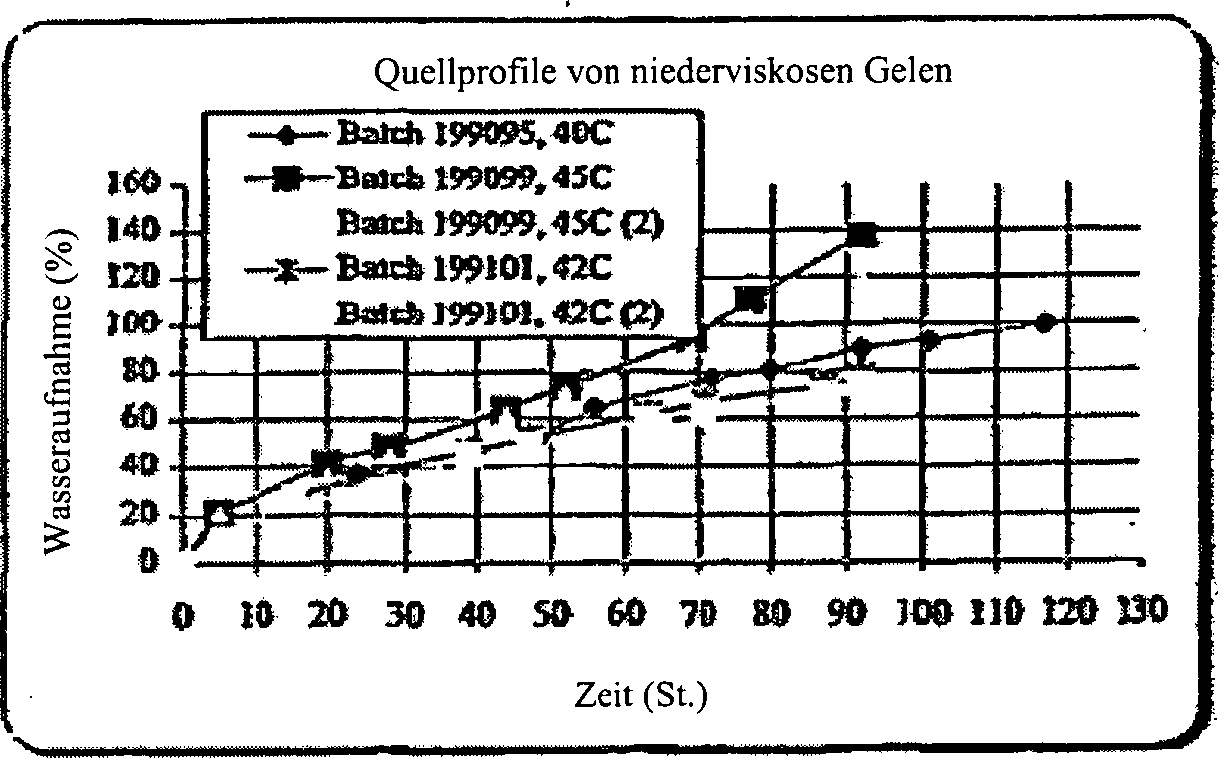
Beispiel 4Example 4
Verabreichungsverfahren und klinische Ergebnisse zur Behandlung von InkontinenzAdministration method and clinical Results for the treatment of incontinence
Behandlung durch InjektionTreatment by injection
Das Polyacrylamidhydrogel (Festgewichtgehalt 2,5% und ca. 97,5% pyrogenfreies Wasser) wird unter die Mukosa der Harnröhre so injiziert, dass sich eine erhöhte Dichtheit der Harnröhre ergibt, dies wird während einem kurzem Verfahren, das wenige Komplikationen zur Folge hat, durchgeführt.The Polyacrylamide hydrogel (solids content 2.5% and about 97.5% pyrogenfreies Water) is injected under the mucosa of the urethra so that an increased Tightness of the urethra This will be during a short procedure, which results in few complications.
Das medizinische Verfahren umfasst eine Injektion des Polyacrylamidgels unter die Mukosa der Harnröhre von Frauen, die an Inkontinenz leiden. Die Injektion erfolgt über die äußere Oberfläche der Harnröhre und in Richtung der Submukosa.The Medical procedure comprises an injection of the polyacrylamide gel under the mucosa of the urethra of women who suffer from incontinence. The injection takes place over the outer surface of the Urethra and in the direction of the submucosa.
3 mL werden an drei Depotstellen, die entlang einer einzelnen longitudinalen Position der Harnröhre angelegt werden, injiziert. Die Depots wurden 0,5 cm distal vom Blasenhals angelegt.3 mL are deposited at three depot sites along a single longitudinal Position of the urethra created be injected. The depots were 0.5 cm distal to the bladder neck created.
Die Injektionen werden mit einem lokalen Betäubungsmittel durchgeführt, dies ermöglicht es der Blase, sich anschließend zu füllen, und dem Patienten zu husten, um sofort nachzuprüfen, ob eine ausreichende Dichtheit für Harninkontinenz erreicht worden ist. Bei Wirkungslosigkeit kann die Injektion wiederholt werden, was in Verbindung mit einer Injektionsbehandlung einfach ist.The Injections are made with a local anesthetic, this allows it's the bubble, then to fill, and to cough the patient to immediately check for adequate tightness for urinary incontinence has been achieved. In case of inefficiency, the injection can be repeated What is easy in connection with an injection treatment is.
Es wurde durch eine Untersuchung der Frau festgestellt, dass die Behandlung durch Injektion nach den Standards und Therapien der Gynäkologie-Obstetrik Abteilung des Kopenhagener Amstsygehus (Bezirkskrankenhaus) in Glostrup geeignet ist. Ergebnisse und etwaige Komplikationen werden durch Nachuntersuchungen alle drei Monate für ein Jahr nach der Behandlung überwacht.It was determined by an examination of the woman that treatment by injection according to the standards and therapies of gynecological obstetrics Department of the Copenhagen Amstsygehus (district hospital) in Glostrup suitable is. Results and any complications are going through Follow-up visits are monitored every three months for one year after treatment.
Claims (14)
Applications Claiming Priority (3)
| Application Number | Priority Date | Filing Date | Title |
|---|---|---|---|
| DKPA200001262 | 2000-08-25 | ||
| DK200001262 | 2000-08-25 | ||
| PCT/DK2001/000565 WO2002016453A1 (en) | 2000-08-25 | 2001-08-25 | Polyacrylamide hydrogel and its use as an endoprosthesis |
Publications (3)
| Publication Number | Publication Date |
|---|---|
| DE60110413D1 DE60110413D1 (en) | 2005-06-02 |
| DE60110413T2 DE60110413T2 (en) | 2006-03-02 |
| DE60110413T3 true DE60110413T3 (en) | 2008-11-13 |
Family
ID=8159676
Family Applications (3)
| Application Number | Title | Priority Date | Filing Date |
|---|---|---|---|
| DE60110413T Expired - Lifetime DE60110413T3 (en) | 2000-08-25 | 2001-08-25 | POLYACRYLAMIDE HYDROGEL AND ITS USE AS ENDOPROTHESIS |
| DE60140489T Expired - Lifetime DE60140489D1 (en) | 2000-08-25 | 2001-08-25 | Polyacrylamide hydrogel and its use as an endoprosthesis |
| DE60144200T Expired - Lifetime DE60144200D1 (en) | 2000-08-25 | 2001-08-25 | Polyacrylamide hydrogel and its use as an endoprosthesis |
Family Applications After (2)
| Application Number | Title | Priority Date | Filing Date |
|---|---|---|---|
| DE60140489T Expired - Lifetime DE60140489D1 (en) | 2000-08-25 | 2001-08-25 | Polyacrylamide hydrogel and its use as an endoprosthesis |
| DE60144200T Expired - Lifetime DE60144200D1 (en) | 2000-08-25 | 2001-08-25 | Polyacrylamide hydrogel and its use as an endoprosthesis |
Country Status (15)
| Country | Link |
|---|---|
| EP (4) | EP1287048B2 (en) |
| AT (3) | ATE501188T1 (en) |
| AU (2) | AU8176301A (en) |
| BG (1) | BG66025B1 (en) |
| DE (3) | DE60110413T3 (en) |
| DK (3) | DK1564230T3 (en) |
| EE (1) | EE05367B1 (en) |
| ES (3) | ES2214988T3 (en) |
| HU (1) | HUP0302054A3 (en) |
| IL (4) | IL152803A0 (en) |
| NO (1) | NO20025198L (en) |
| PT (1) | PT1287048E (en) |
| RU (1) | RU2301814C2 (en) |
| WO (1) | WO2002016453A1 (en) |
| ZA (1) | ZA200208717B (en) |
Families Citing this family (19)
| Publication number | Priority date | Publication date | Assignee | Title |
|---|---|---|---|---|
| JP2005522473A (en) * | 2002-04-10 | 2005-07-28 | オブシェストヴォ ス オグラニシェノイ オトヴェトストベノスチユ《ヴィタゲル》 | Multifunctional biocompatible hydrogel and method for producing the same |
| GB0303798D0 (en) * | 2003-02-19 | 2003-03-26 | Bioartem Ltd | Gel |
| US8663225B2 (en) * | 2004-11-12 | 2014-03-04 | Medtronic, Inc. | Hydrogel bone void filler |
| FR2918476B1 (en) * | 2007-07-02 | 2012-08-03 | Experts Enlargement Quality Exeq | DATA CONFORMITY CONTROL. |
| EP2497468A1 (en) | 2011-03-11 | 2012-09-12 | Contura A/S | Polyacrylamide hydrogel for use in the treatment and/or prevention of joint swelling and/or bone oedema in a mammal suffering from arthritis |
| UA67354U (en) | 2011-11-24 | 2012-02-10 | Людмила Дмитрівна Желдак | Water-soluble linear hetero-chain dipolymer |
| RU2499003C1 (en) * | 2012-03-22 | 2013-11-20 | Федеральное государственное бюджетное учреждение науки Ордена Трудового Красного Знамени Институт нефтехимического синтеза им. А.В. Топчиева Российской академии наук (ИНХС РАН) | Method of producing polyacrylamide hydrogel |
| RU2493173C1 (en) * | 2012-03-22 | 2013-09-20 | Федеральное государственное бюджетное учреждение науки Ордена Трудового Красного Знамени Институт нефтехимического синтеза им. А.В. Топчиева Российской академии наук (ИНХС РАН) | Method to produce polyacrylamide hydrogel |
| US10072161B2 (en) | 2014-01-23 | 2018-09-11 | Bar Ilan University | Polyamide nanoparticles and uses thereof |
| RU2612703C1 (en) * | 2015-11-03 | 2017-03-13 | Федеральное государственное бюджетное учреждение науки Ордена Трудового Красного Знамени Институт нефтехимического синтеза им. А.В. Топчиева Российской академии наук (ИНХС РАН) | Method for polymeric hydrogel preparation |
| EA036712B1 (en) | 2016-03-31 | 2020-12-10 | Контура Интернешнл А/С | Polyacrylamide hydrogel for use in the prevention and/or treatment of synovitis in a mammal |
| AU2018203714A1 (en) * | 2017-03-09 | 2018-09-27 | Colin Campbell Marshall Moore | Improved Phalloplasty Method |
| WO2018196934A1 (en) | 2017-04-24 | 2018-11-01 | Contura International A/S | Stem cell composition |
| CN108329422B (en) * | 2018-02-07 | 2020-12-29 | 山东诺尔生物科技有限公司 | A kind of water-in-water microsphere profile control agent and preparation method thereof |
| KR102129986B1 (en) * | 2018-08-30 | 2020-07-03 | 포항공과대학교 산학협력단 | A pharmaceutical composition for preventing or treating inflammatory diseases comprising an acrylamide-based polymer having nitric oxide sensitivity |
| EP4659773A2 (en) | 2019-09-05 | 2025-12-10 | Texas Heart Institute | Apparatus for delivery of a hydrogel into the vasculasture |
| CN111848877A (en) * | 2020-07-09 | 2020-10-30 | 沈阳工大蓝金环保产业技术研究院有限公司 | Physical hydrogel and preparation method and application thereof |
| IL311561A (en) | 2021-09-20 | 2024-05-01 | Contura Int A/S | Polyacrylamide hydrogel for use in the treatment and/or prevention of osteoarthritis |
| CN114292483B (en) * | 2021-11-24 | 2023-02-03 | 四川大学 | A kind of polyacrylamide/silicone blended hydrogel and preparation method thereof |
Family Cites Families (24)
| Publication number | Priority date | Publication date | Assignee | Title |
|---|---|---|---|---|
| WO1981001290A1 (en) | 1979-11-06 | 1981-05-14 | Ki Med I | Polyacrylamide gel for medical and biological application and method of its preparation |
| US4344193A (en) | 1980-11-28 | 1982-08-17 | Kenny Charles H | Meniscus prosthesis |
| US4502161A (en) | 1981-09-21 | 1985-03-05 | Wall W H | Prosthetic meniscus for the repair of joints |
| US4571749A (en) | 1982-09-21 | 1986-02-25 | The Johns Hopkins University | Manually actuated hydraulic sphincter |
| US4540568A (en) * | 1982-10-14 | 1985-09-10 | Trager Seymour F | Injectionable viscoelastic ophthalmic gel |
| US4969474A (en) | 1988-10-11 | 1990-11-13 | Schwarz Gerald R | Incontinence bladder control method and apparatus |
| US4919667A (en) | 1988-12-02 | 1990-04-24 | Stryker Corporation | Implant |
| US5171322A (en) | 1990-02-13 | 1992-12-15 | Kenny Charles H | Stabilized meniscus prosthesis |
| US5344459A (en) | 1991-12-03 | 1994-09-06 | Swartz Stephen J | Arthroscopically implantable prosthesis |
| JP3071926B2 (en) | 1992-01-28 | 2000-07-31 | 第一化学薬品株式会社 | Method for producing polyacrylamide gel plate for electrophoresis |
| RU2034465C1 (en) * | 1992-08-05 | 1995-05-10 | Малое Внедренческое Предприятие "Интерфалл" | Composition for injection at endoprosthesis |
| UA10911C2 (en) * | 1994-08-10 | 1996-12-25 | Мале Впроваджувальне Підприємство "Іhтерфалл" | BIOSMIX HYDROGEL |
| US5668928A (en) | 1995-01-31 | 1997-09-16 | Kor Team International, Inc. | Speech recognition system and method with automatic syntax generation |
| US5658329A (en) * | 1995-02-14 | 1997-08-19 | Mentor Corporation | Filling material for soft tissue implant prostheses and implants made therewith |
| US6129761A (en) | 1995-06-07 | 2000-10-10 | Reprogenesis, Inc. | Injectable hydrogel compositions |
| RU2127129C1 (en) * | 1996-05-28 | 1999-03-10 | Владислав Викторович Лопатин | Method of preparing gel-like material for plastics of soft tissues |
| BG102375A (en) * | 1997-08-26 | 1999-11-30 | Пегас Оод | Inoculation biocompatible hydrophilic gel, method for its preparation and application |
| RU2148957C1 (en) | 1998-02-10 | 2000-05-20 | Скнар Александр Антонович | Method for treating the cases of vesicoureteral reflux |
| JP4202608B2 (en) | 1999-04-02 | 2008-12-24 | バリー エム フェル | Surgical implantable knee prosthesis |
| US6288043B1 (en) | 1999-06-18 | 2001-09-11 | Orquest, Inc. | Injectable hyaluronate-sulfated polysaccharide conjugates |
| US6464628B1 (en) | 1999-08-12 | 2002-10-15 | Obtech Medical Ag | Mechanical anal incontinence |
| AU2001900A (en) * | 1999-12-29 | 2001-07-16 | Progen S.R.L. | Biocompatible hydrogel and method of its production |
| CA2695722C (en) | 2000-02-10 | 2015-04-21 | Urologica Ag | Controlled urinary incontinence treatment |
| DE60110392T2 (en) | 2000-02-14 | 2006-03-09 | Potencia Medical Ag | HYDRAULIC DEVICE FOR THE TREATMENT OF HARNINE CONTINENCE |
-
2001
- 2001-08-25 DE DE60110413T patent/DE60110413T3/en not_active Expired - Lifetime
- 2001-08-25 DK DK05009167.7T patent/DK1564230T3/en active
- 2001-08-25 EP EP01960207A patent/EP1287048B2/en not_active Expired - Lifetime
- 2001-08-25 DK DK04002645.2T patent/DK1418188T3/en active
- 2001-08-25 EP EP05009167A patent/EP1564230B1/en not_active Expired - Lifetime
- 2001-08-25 ES ES04002645T patent/ES2214988T3/en not_active Expired - Lifetime
- 2001-08-25 EP EP04002645A patent/EP1418188B1/en not_active Expired - Lifetime
- 2001-08-25 AT AT05009167T patent/ATE501188T1/en not_active IP Right Cessation
- 2001-08-25 PT PT01960207T patent/PT1287048E/en unknown
- 2001-08-25 WO PCT/DK2001/000565 patent/WO2002016453A1/en not_active Ceased
- 2001-08-25 IL IL15280301A patent/IL152803A0/en unknown
- 2001-08-25 DE DE60140489T patent/DE60140489D1/en not_active Expired - Lifetime
- 2001-08-25 EP EP10182169A patent/EP2272881A2/en not_active Withdrawn
- 2001-08-25 DK DK01960207T patent/DK1287048T4/en active
- 2001-08-25 AU AU8176301A patent/AU8176301A/en active Pending
- 2001-08-25 HU HU0302054A patent/HUP0302054A3/en unknown
- 2001-08-25 ES ES05009167T patent/ES2362583T3/en not_active Expired - Lifetime
- 2001-08-25 AU AU2001281763A patent/AU2001281763B2/en not_active Ceased
- 2001-08-25 AT AT04002645T patent/ATE447987T1/en not_active IP Right Cessation
- 2001-08-25 AT AT01960207T patent/ATE294198T1/en active
- 2001-08-25 RU RU2003107927/04A patent/RU2301814C2/en active
- 2001-08-25 DE DE60144200T patent/DE60144200D1/en not_active Expired - Lifetime
- 2001-08-25 EE EEP200200692A patent/EE05367B1/en not_active IP Right Cessation
- 2001-08-25 ES ES01960207T patent/ES2237588T5/en not_active Expired - Lifetime
-
2002
- 2002-10-28 ZA ZA200208717A patent/ZA200208717B/en unknown
- 2002-10-30 NO NO20025198A patent/NO20025198L/en not_active Application Discontinuation
- 2002-11-12 IL IL152803A patent/IL152803A/en not_active IP Right Cessation
- 2002-12-17 BG BG107397A patent/BG66025B1/en unknown
-
2009
- 2009-01-28 IL IL196770A patent/IL196770A/en not_active IP Right Cessation
-
2010
- 2010-12-16 IL IL210064A patent/IL210064A/en not_active IP Right Cessation
Also Published As
Similar Documents
| Publication | Publication Date | Title |
|---|---|---|
| DE60110413T3 (en) | POLYACRYLAMIDE HYDROGEL AND ITS USE AS ENDOPROTHESIS | |
| US8216561B2 (en) | Polyacrylamide hydrogel for the treatment of incontinence and vesicouretal reflex | |
| DE69327110T2 (en) | Polymer compositions and apparatus for sealing channels in living mammals | |
| DE69318835T2 (en) | TREATMENT OF REFLUX DISORDER BY INJECTION OF MICROPARTICLES | |
| DE60105884T2 (en) | Means and method for deforming soft tissue | |
| DE69818373T2 (en) | Filling material for implantable soft tissue prostheses and implants made of them | |
| EP1735020A1 (en) | Injectable crosslinked and uncrosslinked alginates and the use thereof in medicine and in cosmetic surgery | |
| DE2706135A1 (en) | Thickening agent for excreted bowel contents and urine | |
| AU2001281763A1 (en) | Polyacrylamide hydrogel and its use as an endoprosthesis | |
| EP2523700B1 (en) | Composition for producing a temporary intestinal occlusion | |
| CN119258281B (en) | Injectable high-strength hydrogel for bone tissue repair and preparation method thereof | |
| AU2006220922B2 (en) | Polyacrylamide hydrogel and its use as an endoprosthesis | |
| HK1054396B (en) | Polyacrylamide hydrogel and its use as an endoprosthesis | |
| EP1874834B1 (en) | Hydrogel polymer | |
| KR20040044018A (en) | Polyacrylamide hydrogel and its use as an endoprosthesis | |
| BRPI0204593B1 (en) | Prosthetic device for increasing soft tissue, bio-stable polymer hydrogel for use as an endoprosthesis as well as use of said hydrogel |
Legal Events
| Date | Code | Title | Description |
|---|---|---|---|
| 8363 | Opposition against the patent | ||
| 8366 | Restricted maintained after opposition proceedings | ||
| 8327 | Change in the person/name/address of the patent owner |
Owner name: CONTURA A/S, SOBORG, DK |