DE60110057T2 - LIPOSOMES INCLUDED AN INCLUDED CONNECTION IN OUTSTANDING SOLUTION - Google Patents
LIPOSOMES INCLUDED AN INCLUDED CONNECTION IN OUTSTANDING SOLUTION Download PDFInfo
- Publication number
- DE60110057T2 DE60110057T2 DE60110057T DE60110057T DE60110057T2 DE 60110057 T2 DE60110057 T2 DE 60110057T2 DE 60110057 T DE60110057 T DE 60110057T DE 60110057 T DE60110057 T DE 60110057T DE 60110057 T2 DE60110057 T2 DE 60110057T2
- Authority
- DE
- Germany
- Prior art keywords
- liposomes
- cisplatin
- drug
- solution
- compound
- Prior art date
- Legal status (The legal status is an assumption and is not a legal conclusion. Google has not performed a legal analysis and makes no representation as to the accuracy of the status listed.)
- Expired - Lifetime
Links
Classifications
-
- A—HUMAN NECESSITIES
- A61—MEDICAL OR VETERINARY SCIENCE; HYGIENE
- A61K—PREPARATIONS FOR MEDICAL, DENTAL OR TOILETRY PURPOSES
- A61K33/00—Medicinal preparations containing inorganic active ingredients
- A61K33/24—Heavy metals; Compounds thereof
- A61K33/243—Platinum; Compounds thereof
-
- A—HUMAN NECESSITIES
- A61—MEDICAL OR VETERINARY SCIENCE; HYGIENE
- A61K—PREPARATIONS FOR MEDICAL, DENTAL OR TOILETRY PURPOSES
- A61K47/00—Medicinal preparations characterised by the non-active ingredients used, e.g. carriers or inert additives; Targeting or modifying agents chemically bound to the active ingredient
- A61K47/06—Organic compounds, e.g. natural or synthetic hydrocarbons, polyolefins, mineral oil, petrolatum or ozokerite
- A61K47/08—Organic compounds, e.g. natural or synthetic hydrocarbons, polyolefins, mineral oil, petrolatum or ozokerite containing oxygen, e.g. ethers, acetals, ketones, quinones, aldehydes, peroxides
- A61K47/10—Alcohols; Phenols; Salts thereof, e.g. glycerol; Polyethylene glycols [PEG]; Poloxamers; PEG/POE alkyl ethers
-
- A—HUMAN NECESSITIES
- A61—MEDICAL OR VETERINARY SCIENCE; HYGIENE
- A61K—PREPARATIONS FOR MEDICAL, DENTAL OR TOILETRY PURPOSES
- A61K9/00—Medicinal preparations characterised by special physical form
- A61K9/10—Dispersions; Emulsions
- A61K9/127—Synthetic bilayered vehicles, e.g. liposomes or liposomes with cholesterol as the only non-phosphatidyl surfactant
- A61K9/1271—Non-conventional liposomes, e.g. PEGylated liposomes or liposomes coated or grafted with polymers
-
- A—HUMAN NECESSITIES
- A61—MEDICAL OR VETERINARY SCIENCE; HYGIENE
- A61K—PREPARATIONS FOR MEDICAL, DENTAL OR TOILETRY PURPOSES
- A61K9/00—Medicinal preparations characterised by special physical form
- A61K9/10—Dispersions; Emulsions
- A61K9/127—Synthetic bilayered vehicles, e.g. liposomes or liposomes with cholesterol as the only non-phosphatidyl surfactant
- A61K9/1277—Preparation processes; Proliposomes
-
- A—HUMAN NECESSITIES
- A61—MEDICAL OR VETERINARY SCIENCE; HYGIENE
- A61P—SPECIFIC THERAPEUTIC ACTIVITY OF CHEMICAL COMPOUNDS OR MEDICINAL PREPARATIONS
- A61P35/00—Antineoplastic agents
Landscapes
- Health & Medical Sciences (AREA)
- Chemical & Material Sciences (AREA)
- Public Health (AREA)
- Veterinary Medicine (AREA)
- Medicinal Chemistry (AREA)
- Pharmacology & Pharmacy (AREA)
- Life Sciences & Earth Sciences (AREA)
- Animal Behavior & Ethology (AREA)
- General Health & Medical Sciences (AREA)
- Epidemiology (AREA)
- Dispersion Chemistry (AREA)
- Inorganic Chemistry (AREA)
- Chemical Kinetics & Catalysis (AREA)
- General Chemical & Material Sciences (AREA)
- Nuclear Medicine, Radiotherapy & Molecular Imaging (AREA)
- Organic Chemistry (AREA)
- Engineering & Computer Science (AREA)
- Oil, Petroleum & Natural Gas (AREA)
- Medicinal Preparation (AREA)
- Pharmaceuticals Containing Other Organic And Inorganic Compounds (AREA)
- Manufacturing Of Micro-Capsules (AREA)
Abstract
Description
Gebiet der ErfindungField of the invention
Die vorliegende Erfindung betrifft eine Liposomzusammensetzung und ein Verfahren zur Herstellung von Liposomen. Die erfindungsgemäßen Liposome besitzen in ihrem wässrigen Liposomkern ein Medikament in übersättigter Lösung, die den Liposomen ein hohes Medikament-zu-Lipid-Verhältnis verleiht.The The present invention relates to a liposome composition and a Process for the preparation of liposomes. The liposomes according to the invention own in their watery Liposomkern a drug in supersaturated Solution, which gives the liposomes a high drug-to-lipid ratio.
Hintergrund der ErfindungBackground of the invention
Liposome sind vollständig geschlossene Lipiddoppelschichtmembranen, die ein eingeschlossenes wässriges Volumen enthalten. Die Liposome können unilamellare Vesikel (die eine einzelne Membrandoppelschicht besitzen) oder multilamellare Vesikel sein (zwiebelartige Strukturen, gekennzeichnet durch mehrere Membrandoppelschichten, wobei jede durch eine wässrige Schicht von der nächsten getrennt ist). Die Doppelschicht besteht aus zwei Lipidmonoschichten mit einer hydrophoben "Schwanz"-Region und einer hydrophilen "Kopf"-Region. Die Struktur der Membrandoppelschicht ist derart, dass sich die hydrophoben (unpolaren) "Schwänze" der Lipidmonoschichten zum Zentrum der Doppelschicht ausrichten, während die hydrophilen "Köpfe" zur wässrigen Phase zeigen.liposomes are complete closed lipid bilayer membranes containing an enclosed aqueous Volume included. The liposomes can be unilamellar vesicles (the have a single membrane bilayer) or multilamellar Be vesicles (onion-like structures characterized by multiple membrane bilayers, each one by an aqueous one Shift from the next is separated). The bilayer consists of two lipid monolayers with a hydrophobic "tail" region and a hydrophilic "head" region. The structure the membrane bilayer is such that the hydrophobic (non-polar) "tails" of the lipid monolayers align to the center of the bilayer, while the hydrophilic "heads" point to the aqueous phase.
Liposome werden hauptsächlich verwendet, um als Träger für eine Vielzahl von Materialien zu dienen, wie beispielsweise Medikamente, Kosmetika, Diagnosereagenzien, bioaktive Verbindungen und ähnliche. Wenn hydrophile Mittel in den Liposomen eingeschlossen sind, verbinden sie sich mit den wässrigen Räumen in der Liposomstruktur, vorzugsweise in der inneren zentralen Kammer und den Zwischenräumen zwischen den Lipiddoppelschichten. Lipophile Medikamente verbinden sich üblicherweise mit der Lipiddoppelschicht.liposomes become mainly used to as a carrier for one Variety of materials to serve, such as medicines, Cosmetics, diagnostic reagents, bioactive compounds and the like. If hydrophilic agents are entrapped in the liposomes she deals with the watery Rooms in the liposome structure, preferably in the inner central chamber and the gaps between the lipid bilayers. Connect lipophilic drugs usually with the lipid bilayer.
Liposom-Medikamentenformulierungen können die Behandlungswirkung verbessern, verlängerte Medikamentenfreisetzung und therapeutische Wirksamkeit zur Verfügung stellen, das therapeutische Verhältnis erhöhen und möglicherweise die Gesamtmenge an Medikamenten verringern, die zur Behandlung einer gegebenen Art von Leiden oder Krankheit erforderlich sind. Ein Überblick befindet sich in Liposomes as Drug Carriers von G. Gregoriadis, Wiley & Sons, New York 1988).Liposome-drug formulations can improve the treatment effect, prolonged drug release and provide therapeutic efficacy, therapeutic Increase ratio and possibly reduce the total amount of medication needed to treat a given type of suffering or illness are required. An overview is in Liposomes as Drug Carriers by G. Gregoriadis, Wiley & Sons, New York 1988).
Es gibt viele Verfahren zur Herstellung von Liposomen und zur Beladung von Liposomen mit therapeutischen Verbindungen. Das einfachste Verfahren zur Medikamentenbeladung ist das passive Einschließen, wobei ein getrockneter Lipidfilm mit einer wässrigen Lösung hydratisiert wird, die das wasserlösliche Medikament enthält, um Liposome zu bilden. Andere passive Einschlussverfahren umfassen ein Dehydratisierungs-Rehydratisierungsverfahren, wobei vorgeformte Liposome zu einer wässrigen Lösung des Medikaments zugegeben werden und das Gemisch entweder durch Lyophilisieren, Verdampfen oder durch ein Gefrierentwässerungsverfahren dehydratisiert wird, das wiederholtes Einfrieren und Auftauen der multilamellaren Vesikel umfasst, was die Hydratation verbessert und damit die Beladung erhöht.It There are many methods for liposome preparation and loading of liposomes with therapeutic compounds. The simplest method for drug loading is passive entrapment, wherein a dried lipid film is hydrated with an aqueous solution containing the water-soluble Contains drug, to form liposomes. Other passive inclusion methods include a dehydration rehydration process, wherein preformed Liposomes to an aqueous solution be added to the drug and the mixture either by Lyophilize, evaporate or through a freeze-dehydration procedure dehydrated, the repeated freezing and thawing of the includes multilamellar vesicles, which improves hydration and thus increases the load.
Im Allgemeinen hat das passive Einschließen jedoch eine geringe Wirksamkeit beim Einschluss von Medikamenten. Ein niedriges Medikament-zu-Lipid-Verhältnis kann ein wesentlicher Nachteil sein, wenn eine wirksame Therapie mit einer Liposomformulierung erzielt werden soll. Zur Behandlung von Tumorgewebe benötigt man beispielweise Liposome mit einer Größe von ungefähr 80–140 nm zum Flüssigkeitsdurchgang in das Tumorgewebe. Die kleine Größe schränkt die Medikamentenbeladung ein, insbesondere wenn das Medikament passiv eingeschlossen wird und/oder wenn das Medikament eine begrenzte Löslichkeit hat und/oder das Medikament gegenüber den Lipiden eine geringe Affinität hat. Ein niedriges Medikament- zu-Lipid-Verhältnis macht die Verabreichung einer hohen Lipiddosis erforderlich, um die erforderliche Medikamentendosis zu erzielen.in the However, in general, passive entrapment has low potency in the inclusion of drugs. A low drug-to-lipid ratio can a major disadvantage when using effective therapy a liposome formulation is to be achieved. For the treatment of Tumor tissue needed For example, liposomes with a size of about 80-140 nm to the fluid passage into the tumor tissue. The small size limits the drug load especially if the drug is passively trapped and / or if the drug has limited solubility and / or that Drug over the lipids a low affinity Has. A low drug to lipid ratio makes the administration of a high lipid dose required to achieve the required To achieve drug dose.
Die Medikamenteneinschlusswirksamkeit kann teilweise verbessert werden, indem eine hohe Lipidkonzentration verwendet wird, oder durch eine spezielle Kombination von Lipidkomponenten. Beispielsweise kann ein amphiphatisches Amin, wie beispielsweise Doxorubicin, wirksamer in Liposommembranen eingekapselt werden, die eine negative Ladung enthalten (Cancer Res. 42: 4734–4739, (1982)). Diese oberflächliche elektrostatische Medikamentenverbindung mit den Liposomen ist zwar sehr stabil im Reagenzglas, führt aber bei systemischer Verabreichung zu sehr schneller, praktisch sofortiger Freisetzung.The Drug entrapment efficiency can be partially improved by using a high lipid concentration, or by one special combination of lipid components. For example, can an amphiphatic amine such as doxorubicin is more effective encapsulated in liposome membranes that have a negative charge contain (Cancer Res. 42: 4734-4739, (1982)). This superficial electrostatic Medication compound with the liposomes is indeed very stable in the Test tube, leads but at systemic administration too fast, convenient immediate release.
WO 98/07409A beschreibt ein Verfahren zur Herstellung von Liposomen, die Cisplatin enthalten, das die Herstellung einer wässrigen Lösung von Cisplatin bei erhöhter Temperatur umfasst, um eine Erhöhung der Löslichkeit von Cisplatin im Vergleich zu seiner Löslichkeit bei Raumtemperatur zu erzielen. Die Liposome werden durch Extrusion auf Größen zwischen 100 und 120 nm gebracht.WO 98/07409A describes a process for the preparation of liposomes containing cisplatin comprising the preparation of an aqueous solution of cisplatin at elevated temperature to achieve an increase in the solubility of cisplatin as compared to its solubility at room temperature. The liposomes who brought by extrusion to sizes between 100 and 120 nm.
EP 0551169A beschreibt ein Verfahren zur Herstellung von Liposomen, die ein Medikament enthalten, und das die Herstellung einer wässrigen Lösung des Medikaments bei erhöhter Temperatur umfasst. Die Lösung wird dann auf Raumtemperatur abgekühlt, um uneingekapseltes Medikament zurückzugewinnen. Die Liposomgröße wird durch das Verfahren der Liposombildung kontrolliert, bei dem große, unilamellare Vesikel (LUV) durch Reversphasen-Verdampfung (REV) gebildet werden, oder kleinere Vesikel durch Ultraschallbehandlung gebildet werden.EP 0551169A describes a process for the preparation of liposomes, which contain a drug, and that the production of an aqueous solution of the drug at elevated levels Temperature includes. The solution is then cooled to room temperature to unencapsulated drug recover. The liposome size becomes controlled by the method of liposome formation, in which large, unilamellar Vesicles (LUV) are formed by reverse-phase evaporation (REV), or smaller vesicles are formed by sonication.
Die Beladung mit ungeladenen und nicht-lipophilen Medikamenten, und insbesondere mit Medikamenten mit geringer Löslichkeit in wässriger Phase, mit einem ausreichend hohen Medikament-zu-Lipid-Verhältnis zur wirksamen Therapie bleibt somit problematisch.The Loading with uncharged and non-lipophilic drugs, and especially with drugs with low solubility in aqueous Phase, with a sufficiently high drug-to-lipid ratio to Effective therapy thus remains problematic.
Zusammenfassung der ErfindungSummary of the invention
Die
Erfindung betrifft Liposome, bei denen eine hydrophile Verbindung
mit einem hohen Medikament-zu-Lipid-Verhältnis in den Liposomen eingeschlossen
ist. Das hohe Medikament-zu-Lipid-Verhältnis wird dadurch erreicht,
dass das Medikament im übersättigten
Zustand in den Liposomen eingeschlossen ist. Die Erfindung betrifft
auch ein Verfahren zur Herstellung von Liposomen mit einer hydrophilen
Verbindung, bei denen eine hydrophile Verbindung im übersättigten
Zustand in den Liposomen eingeschlossen ist. Gemäß der vorliegenden Erfindung
wird ein Verfahren zur Herstellung von Liposomen mit einer eingeschlossenen
Verbindung in Form einer übersättigten
Lösung
zur Verfügung
gestellt, das die Auswahl einer Verbindung umfasst, die als Reaktion
auf eine Bedingung in der Lage ist, ihre Wasserlöslichkeit bei Raumtemperatur
auf mindestens das Zweifache zu erhöhen;
Herstellung von Liposomen
verschiedener Größenbereiche
aus einer wässrigen
Lösung
mit einer Konzentration der Verbindung, die oberhalb der Sättigungskonzentration
der Verbindung in Wasser bei Raumtemperatur liegt;
Ändern der
Bedingung, welche die erhöhte
Wasserlöslichkeit
der Verbindung aufrechterhält;
Analyse
der Liposome auf das Vorliegen oder die Abwesenheit von eingeschlossener,
ausgefallener Verbindung; und
auf Grundlage der Analyse Auswahl
von Liposomen mit einer Größe, die
Liposomen ohne eingeschlossene, ausgefallene Verbindung entspricht.
Die Zunahme der Wasserlöslichkeit
kann als Reaktion auf eine Bedingung auftreten, die ausgewählt ist
aus der Gruppe, die aus (i) Erhöhen
der Lösungsmitteltemperatur,
(ii) Zugabe eines Hilfslösungsmittels
und (iii) Verändern
des pH-Werts des Lösungsmittels
besteht.The invention relates to liposomes in which a hydrophilic compound having a high drug to lipid ratio is entrapped in the liposomes. The high drug to lipid ratio is achieved by trapping the drug in the supersaturated state in the liposomes. The invention also relates to a process for the preparation of liposomes with a hydrophilic compound in which a hydrophilic compound is included in the supersaturated state in the liposomes. According to the present invention there is provided a process for the preparation of liposomes with an incorporated compound in the form of a supersaturated solution, which comprises selecting a compound capable, in response to a condition, of at least two times its water solubility at room temperature to increase;
Preparing liposomes of various size ranges from an aqueous solution having a concentration of the compound which is above the saturation concentration of the compound in water at room temperature;
Changing the condition which maintains the increased water solubility of the compound;
Analysis of the liposomes for the presence or absence of entrapped precipitated compound; and
based on analysis Selection of liposomes of a size corresponding to liposomes without trapped, failed compound. The increase in water solubility may occur in response to a condition selected from the group consisting of (i) increasing the solvent temperature, (ii) adding a co-solvent, and (iii) changing the pH of the solvent.
In einer Ausführungsform haben die Liposome einen Durchmesser von etwa 60 bis 1000 nm. In einer anderen Ausführungsform wird die Liposomgröße erzielt durch Herstellung von Liposomen mit einer eingeschlossenen Verbindung bei ausgewählten Größenbereichen von etwa 60 bis 1000 nm. Die hergestellten Liposome können mikroskopisch oder, alternativ, spektroskopisch oder mittels Streuungstechniken, wie beispielsweise "Extended X-ray Absorption Fine Structure" auf das Vorliegen oder die Abwesenheit von ausgefällter Verbindung analysiert werden.In an embodiment the liposomes have a diameter of about 60 to 1000 nm. In another embodiment the liposome size is achieved by preparing liposomes with an entrapped compound at selected size ranges from about 60 to 1000 nm. The liposomes produced can be microscopic or, alternatively, spectroscopically or by means of scattering techniques, such as "Extended X-ray Absorption Fine Structure "on analyzed the presence or absence of precipitated compound become.
Eine ausgewählte Verbindung kann durch Hydratisieren einer Lösung von Lipiden mit der Medikamentenlösung in den Liposomen eingekapselt werden.A selected Compounding can be achieved by hydrating a solution of lipids with the drug solution encapsulated in the liposomes.
Alternativ kann die ausgewählte Verbindung durch Hydratisieren eines getrockneten Lipidfilms mit der konzentrierten Medikamentenlösung eingeschlossen werden.alternative can the selected Compound by hydrating a dried lipid film with the concentrated drug solution be included.
In weiteren Ausführungsformen können die Liposome weiterhin ein Lipid enthalten, das mit einem hydrophilen Polymer, wie beispielsweise Polyethylenglycol (PEG), derivatisiert ist. In einer anderen Ausführungsform sind die Lipide, die zur Bildung der Lipiddoppelschicht ausgewählt sind, wirksam, um eine starre Lipiddoppelschicht zu bilden.In further embodiments can the liposomes further contain a lipid that is hydrophilic Polymer, such as polyethylene glycol (PEG), derivatized is. In another embodiment are the lipids selected to form the lipid bilayer, effective to form a rigid lipid bilayer.
In einer anderen Ausführungsform des Verfahrens der Erfindung wird die Bedingung, die ausgewählt wird, um das Medikament oberhalb seiner Löslichkeit bei Raumtemperatur in Wasser zu halten, in einem äußeren Liposom-Suspensionsmedium geändert.In another embodiment of the method of the invention, the condition selected is around the drug above its solubility at room temperature in water, in an external liposome suspension medium changed.
Diese und andere Ausführungsformen der Erfindung werden mit Blick auf die folgende genaue Beschreibung der Erfindung noch offensichtlicher.These and other embodiments The invention will become apparent in view of the following detailed description the invention even more obvious.
Kurze Beschreibung der ZeichnungenShort description of drawings
Die
die
die
Genaue Beschreibung der ErfindungDetailed description of invention
I. Herstellung von LiposomenI. Preparation of liposomes
In einem Aspekt umfasst die Erfindung ein Verfahren zur Herstellung einer Liposomzusammensetzung mit einer in den Liposomen eingeschlossenen Verbindung in einem übersättigten Zustand. Wie hier verwendet, umfasst "übersättigt" eine Bedingung, bei der eine Lösung mehr gelösten Stoff enthält, als normalerweise notwendig ist, um unter den gleichen Bedingungen Sättigung zu erzielen. D. h., die Lösung enthält mehr gelösten Stoff, als erforderlich ist, um ein Gleichgewicht mit dem ungelösten Stoff zu erzeugen.In In one aspect, the invention includes a method of manufacture a liposome composition having one enclosed in the liposomes Compound in a supersaturated Status. As used herein, "supersaturated" includes a condition at the one solution more solved Contains substance, than is normally necessary to work under the same conditions saturation to achieve. That is, the solution contains more solute, as needed to balance with the undissolved substance to create.
Die Bildung der Liposome erfolgt durch Auswahl einer Verbindung, die eingeschlossen werden soll, und Herstellen einer Lösung mit einer Konzentration der Verbindung, die oberhalb der Sättigungskonzentration der Verbindung in Wasser bei Raumtemperatur liegt. Eine Lösung der Verbindung mit einer Konzentration oberhalb der Sättigungskonzentration in Wasser bei Raumtemperatur kann nach irgendeiner von vielen Methoden hergestellt werden. Beispielsweise durch Erwärmen der Lösung, um die Löslichkeit der Verbindung im Lösungsmittel zu erhöhen, durch Zugabe eines Hilfslösungsmittels zum wässrigen Lösungsmittel oder durch Ändern des pH-Werts des wässrigen Lösungsmittels. Diese Lösung wird hier als "die konzentrierte Lösung" bezeichnet. In einer bevorzugten Ausführungsform ist das Verfahren zur Herstellung der konzentrierten Lösung wirksam, um die Löslichkeit der Verbindung im wässrigen Lösungsmittel um etwa das Zweifache, vorzugsweise etwa das Dreifache, und noch bevorzugter etwa das Vierfache gegenüber der Löslichkeit der Verbindung im wässrigen Lösungsmittel bei Raumtemperatur zu erhöhen. Demgemäss umfassen Verbindungen zur Verwendung in den Zusammensetzungen und Verfahren der Erfindung Verbindungen, die zu einem mindestens etwa zweifachen, vorzugsweise mindestens etwa dreifachen und noch bevorzugter mindestens etwa vierfachen Anstieg der Wasserlöslichkeit bei Raumtemperatur (20–25°C) in der Lage sind, durch: (i) Erhöhen der Temperatur des Lösungsmittels, (ii) Zugeben eines Hilfslösungsmittels, oder (iii) Verändern des pH-Werts des Lösungsmittels. Bevorzugte Verbindungen sind solche mit begrenzter Löslichkeit in Wasser bei Raumtemperatur, die mit zunehmender Temperatur eine wesentliche Zunahme der Löslichkeit erfahren. In den Untersuchungen, die zur Unterstützung dieser Erfindung durchgeführt wurden, wurde Cisplatin als Modellverbindung verwendet. Cisplatin hat bei Raumtemperatur eine Löslichkeit von 1–2 mg/ml in Wasser oder Kochsalzlösung. Bei etwa 60–65°C steigt die Löslichkeit auf etwa 8–10 mg/ml an. Somit wurde die Temperatur verwendet, um eine konzentrierte Lösung des Medikaments zur Herstellung von Liposomen herzustellen.The formation of the liposomes occurs by selecting a compound to be included and preparing a solution having a concentration of the compound that is above the saturation concentration of the compound in water at room temperature. A solution of the compound having a concentration above the saturation concentration in water at room temperature may be after any one of many Me methods are produced. For example, by heating the solution to increase the solubility of the compound in the solvent by adding an auxiliary solvent to the aqueous solvent or by changing the pH of the aqueous solvent. This solution is referred to herein as the "concentrated solution". In a preferred embodiment, the method of preparing the concentrated solution is effective to increase the solubility of the compound in the aqueous solvent by about two times, preferably about three times, and more preferably about four times, the solubility of the compound in the aqueous solvent at room temperature , Accordingly, compounds for use in the compositions and methods of the invention include compounds capable of at least about two-fold, preferably at least about three and more preferably at least about four-fold increase in water solubility at room temperature (20-25 ° C) by: (i) raising the temperature of the solvent, (ii) adding an auxiliary solvent, or (iii) changing the pH of the solvent. Preferred compounds are those with limited solubility in water at room temperature which experience a significant increase in solubility with increasing temperature. In the studies conducted in support of this invention, cisplatin was used as a model compound. Cisplatin has a solubility of 1-2 mg / ml in water or saline at room temperature. At about 60-65 ° C the solubility increases to about 8-10 mg / ml. Thus, the temperature was used to prepare a concentrated solution of the medicament for the preparation of liposomes.
Andere Verbindungen zur Verwendung in der Erfindung umfassen therapeutische Medikamente, wie beispielsweise Acyclovir, Gancyclovir, Taxol, Carboplatin und andere Platinverbindungen, und Anthrachinone, wie beispielsweise Doxorubicin, Epirubicin, Daunorubicin und Idarubicin, sowie schlecht wasserlösliche Antibiotika, Proteine und Peptide.Other Compounds for use in the invention include therapeutic ones Medicines such as acyclovir, gancyclovir, taxol, carboplatin and other platinum compounds, and anthraquinones such as Doxorubicin, epirubicin, daunorubicin and idarubicin, as well as bad water-soluble Antibiotics, proteins and peptides.
Um mit der Beschreibung eines Verfahrens zur Herstellung von Lipidvesikeln fortzufahren, können Lipide in einem separaten Behälter ausgewählt werden, um eine gewünschte Lipidvesikelzusammensetzung zu ergeben, und in einem geeigneten Lösungsmittel aufgelöst werden. Lipide, die zur Bildung von Lipidvesikeln geeignet sind, sind Fachleuten auf dem Gebiet bekannt. Siehe beispielsweise US-Patent Nr. 5 013 556, Sp. 9, Zeilen 34–62, und US-Patent Nr. 5 891 468, Sp. 7, Zeile 5 bis Sp. 8, Zeile 48. Lipidkomponenten, die zur Bildung der Liposome verwendet werden, werden ausgewählt aus einer Vielzahl von vesikelbildenden Lipiden, und üblicherweise sind es Phospholipide und Sterole. Die Lipide können so ausgewählt werden, dass sie eine mehr flüssige Lipiddoppelschicht ergeben, indem Lipide mit Acylketten ausgewählt werden, die relativ ungesättigt sind, um so eine Lipiddoppelschicht zu ergeben, die eine relativ höhere Permeabilität gegenüber eingeschlossener Verbindung hat als eine mehr steife Doppelschicht. Steifere Lipiddoppelschichten werden gebildet unter Verwendung von hoch gesättigten Phospholipiden, um Lipiddoppelschichten mit einer niedrigeren Permeabilität gegenüber eingeschlossener Verbindung zu bilden. In einer anderen Ausführungsform der Erfindung verwendet man Liposome, die ein Lipid enthalten, das mit einer hydrophilen Polymerkette derivatisiert ist, wie beispielsweise Polyethylenglycol oder anderen Polymeren, wie beschrieben z. B. in den US-Patenten Nrn. 5 013 556 und 5 631 018.Around with the description of a method for producing lipid vesicles can continue Lipids in a separate container selected be to a desired one To give lipid vesicle composition, and in a suitable solvent disbanded become. Lipids that are suitable for the formation of lipid vesicles are known to those skilled in the art. See for example US patent No. 5 013 556, division 9, lines 34-62, and U.S. Patent No. 5,891,468, Sp. 7, line 5 through Sp. 8, line 48. Lipid components used to form the liposomes are selected from a variety of vesicle-forming lipids, and commonly they are phospholipids and sterols. The lipids can be selected so that she a more fluid Lipid bilayer by selecting lipids with acyl chains, the relatively unsaturated are so as to give a lipid bilayer which is a relative higher permeability across from included compound has as a more rigid bilayer. Stiffer lipid bilayers are formed using highly saturated Phospholipids to lipid bilayers with a lower permeability to trapped To form a connection. Used in another embodiment of the invention liposomes that contain a lipid that is hydrophilic Polymer chain is derivatized, such as polyethylene glycol or other polymers as described e.g. In US Pat. 5,013,556 and 5,631,018.
Die Zusammensetzung für die Lipiddoppelschicht wird je nach dem ausgewählten Medikament zum Einschluss selektiv variiert. Medikamente mit einer höheren Permeabilität in Lipiddoppelschichten werden in den Liposomen besser zurückgehalten, indem sie eine Lipiddoppelschicht mit gesättigten oder lipidversteifenden Komponenten bilden. Medikamente, die nicht leicht durch Lipidkomponenten in Lipiddoppelschichten durchlässig sind, können in Liposomen eingeschlossen werden, die mit flüssigen Lipidkomponenten gebildet werden.The Composition for the lipid bilayer will be included depending on the drug selected selectively varies. Drugs with a higher permeability in lipid bilayers are better retained in the liposomes by a Lipid bilayer with saturated or lipid-stiffening components. Medicines that are not easily permeable by lipid components in lipid bilayers, can be entrapped in liposomes formed with liquid lipid components.
Wie oben beschrieben, können die ausgewählten Lipidkomponenten in einem geeigneten Lösungsmittel aufgelöst werden. Die Lipide werden mit der konzentrierten Medikamentenlösung hydratisiert, um Liposome zu bilden. In eingehenden Untersuchungen, die in der Beschreibung beschrieben sind, wurde eine konzentrierte Lösung von Cisplatin verwendet, um eine ethanolische Lipidlösung zu hydratisieren (Beispiel 1). Fachleuten auf dem Gebiet wird klar sein, dass die konzentrierte Medikamentenlösung auch verwendet werden kann, um einen getrockneten Lipidfilm zu hydratisieren, wobei das Lösungsmittel, das die Lipide löslich macht, abgetrennt wird, um einen getrockneten Lipidfilm zur Hydratation zurückzulassen (siehe beispielsweise US-Patent Nr. 5 013 556, Sp. 10, Zeilen 60–65). Nach der Hydratation wird das Lipid-Medikamenten-Gemisch eine Zeit lang gemischt, die zur Liposombildung ausreichend ist.As described above the selected ones Lipid components are dissolved in a suitable solvent. The lipids are hydrated with the concentrated drug solution, to form liposomes. In detailed investigations, which in the Described was a concentrated solution of Cisplatin is used to hydrate an ethanolic lipid solution (example 1). Professionals in the field will be clear that the concentrated drug solution can also be used to hydrate a dried lipid film, where the solvent, that makes the lipids soluble, is separated to a dried lipid film for hydration leave (see, for example, U.S. Patent No. 5,013,556, Sp. 10, lines 60-65). To hydration becomes the lipid-drug mixture for a time mixed, which is sufficient for liposome formation.
Die Liposome werden nach verschiedenen Verfahren aus dem Stand der Technik, wie beispielsweise Ultraschallbehandlung, Homogenisierung oder Extrusion auf eine bestimmte Größe gebracht. Eine Liposomgröße wird ausgewählt, um die Bildung eines Niederschlags in den zentralen Kammern der Liposome zu vermeiden, wenn Bedingungen der Liposomzusammensetzung verändert werden, um die Lös lichkeit des Medikaments in der konzentrierten Lösung zu verringern. Diese Größe wird bestimmt durch Herstellung verschiedener Liposomzusammensetzungen mit unterschiedlichen Größen, Verändern einer Bedingung, die die erhöhte Medikamentenkonzentration aufrechterhält, und Analyse der Liposome auf das Vorliegen von ausgefallenem Medikament. Wie hier verwendet, soll "Niederschlag" oder "Fällung" ein Medikament in irgendeiner Form umfassen, wie beispielsweise ein Medikament in kristalliner, halbfester oder amorpher Form. Durch das Verfahren der Erfindung werden Liposome mit einer solchen Größe zur Verfügung gestellt, dass kein Medikamentenniederschlag vorhanden ist.The liposomes are brought to a certain size by various methods known in the art such as sonication, homogenization or extrusion. A liposome size is selected to avoid the formation of a precipitate in the central chambers of the liposomes when conditions of the liposome composition are altered to increase the solubility of the drug reduce kaments in the concentrated solution. This size is determined by preparing different liposomal compositions of different sizes, changing a condition that maintains the increased drug concentration, and analyzing the liposomes for the presence of failed drug. As used herein, "precipitate" or "precipitate" is intended to include any medicament, such as a drug in crystalline, semi-solid or amorphous form. The method of the invention provides liposomes of such size that no drug precipitate is present.
Üblicherweise sind Liposome mit einer Größe von etwa 60–1000 nm geeignet, vorzugsweise mit einer Größe von etwa 70–500 nm. Die Analyse der Liposome auf das Vorliegen eines Medikamentenniederschlags kann beispielsweise durch Beobachtung mittels Mikroskopie (Elektronenmikroskopie oder hochauflösende Kryoelektronenmikroskopie) oder mit verschiedenen spektroskopischen Techniken, einschließlich beispielsweise IR, Raman, NMR oder Streuungstechniken, wie beispielsweise Extended X-ray Absorption Fine Structure (EXAFS), durchgeführt werden.Usually are liposomes with a size of about 60-1000 nm, preferably with a size of about 70-500 nm. The analysis of the liposomes for the presence of a drug precipitate can for example, by observation by microscopy (electron microscopy or high-resolution cryo-electron microscopy) or with various spectroscopic techniques, including, for example IR, Raman, NMR or scattering techniques, such as Extended X-ray absorption Fine Structure (EXAFS).
Die Liposome werden auf eine ausgewählte Größe gebracht, um die Bildung von ausgefallenem Medikament zu verhindern. Dies tritt üblicherweise auf, wenn die Bedingung, die das Medikament in einer Konzentration oberhalb der Löslichkeit des Medikaments in Wasser bei Raumtemperatur erhält, in der äußeren Phase der Liposomsuspension geändert wird. Wenn beispielsweise ein Temperaturanstieg verwendet wurde, um die Löslichkeit des Medikaments zur Herstellung der konzentrierten Medikamentenlösung zu erhöhen, wird die Temperatur der Liposomsuspension erniedrigt. Wenn eine Vergrößerung oder Abnahme des pH-Werts verwendet wurde, um die Medikamentenlöslichkeit zu erhöhen, wird der pH-Wert auf den endgültigen, gewünschten pH-Wert eingestellt. Wenn ein Hilfslösungsmittel zur konzentrierten Medikamentenlösung zugegeben wurde, um die Medikamentenlöslichkeit zu erhöhen, wird das Hilfslösungsmittel aus der äußeren Liposomphase nach einem ausgewählten Verfahren abgetrennt, wie beispielsweise Diafiltration, Dichtegradientenzentrifugieren, Dialyse, Destillation, Vakuumabtrennung und ähnliche.The Liposomes are selected on a Brought greatness, to prevent the formation of failed medication. This usually occurs on when the condition that the drug is in a concentration above the solubility of the drug in water at room temperature, in the outer phase of the liposome suspension changed becomes. For example, if a temperature increase was used to the solubility of the drug for preparing the concentrated drug solution increase, the temperature of the liposome suspension is lowered. When a Magnification or Decrease in pH has been used to increase drug solubility to increase, will the pH be at the final, desired pH adjusted. If a co-solvent to concentrate drug solution was added to increase drug solubility is the auxiliary solvent from the outer liposome phase a selected one Separated method, such as diafiltration, density gradient centrifuging, Dialysis, distillation, vacuum separation and the like.
II. Charakterisierung der LiposomeII. Characterization the liposomes
Wie oben beschrieben, stellt die Erfindung eine wirksame und stabile Einkapselung von Medikamenten mit begrenzter Wasserlöslichkeit bei Raumtemperatur zur Verfügung. Von diesen Verbindungen weiß man, dass sie nur schwer in einem Medikament-zu-Lipid-Verhältnis in Liposomen eingeschlossen werden können, das für die Therapie nützlich ist. In den durchgeführten Untersuchungen zur Unterstützung der Erfindung wurde das Anti-Krebsmittel Cisplatin als Beispielmedikament verwendet. Es sollte jedoch klar sein, dass das Verfahren der Erfindung mit einer Vielzahl an Verbindungen verwendet werden kann, die eine begrenzte Wasserlöslichkeit bei Raumtemperatur haben, und andere beispielhafte Medikamente sind oben beschrieben.As As described above, the invention provides an effective and stable Encapsulation of drugs with limited water solubility available at room temperature. From these compounds one knows that they are difficult to enclose in liposomes in a drug-to-lipid ratio that can be for the Therapy useful is. In the performed Investigations to support The invention has been the anticancer agent cisplatin as an example drug used. It should be understood, however, that the method of the invention can be used with a variety of connections, the one limited water solubility at room temperature, and others are exemplary medicines described above.
Cisplatin (cis-Diammindichloroplatin(II)) ist ein Schwermetallkomplex, der Platin als Zentralatom enthält, das von zwei Chloridatomen und zwei Ammoniakmolekülen in der cis-Position umgeben ist. Cisplatin findet weite Verwendung zur Behandlung einer Vielzahl von festen Tumoren, einschließlich Hoden-, Kopf-, Nacken- und Lungentumoren. Ebenso wie andere chemotherapeutische Mittel gegen Krebs ist Cisplatin ein hochtoxisches Medikament. Die Hauptnachteile von Cisplatin sind seine extreme Nierenschädlichkeit, die der hauptsächliche dosislimitierende Faktor ist, seine rasche Ausscheidung über die Nieren mit einer Zirkulationshalbwertszeit von nur einigen Minuten, und seine starke Affinität für Plasmaproteine (Freise, J., et al., Arch. Int. Pharmacodyn., 258: 180–192 (1982)). Die Einkapselung von Cisplatin in Liposome als eine Möglichkeit, die Toxizität zu überwinden, wurde beispielsweise beschrieben in Abra, et al., US-Patent Nr. 5 945 122; Gondal, J. A., et al., Eur. J. Cancer, 29A (11): 1536–1542 (1993); Sur, B., et al., Oncology, 40: 372–376 (1983); Weiss, R. B., et al., Drugs, 46 (3): 360–377 (1993). Es ist jedoch normalerweise schwierig, Cisplatin wirksam in Liposome einzuschließen, wegen der geringen Löslichkeit des Medikaments in Wasser, ungefähr 1–2 mg/ml bei Raumtemperatur, und wegen der niedrigen Lipophilie, was beides zu einem niedrigen Medikament/Lipidverhältnis beiträgt.cisplatin (cis-Diammindichloroplatin (II)) is a heavy metal complex, the Contains platinum as a central atom, that of two chloride atoms and two ammonia molecules in the surrounded cis position. Cisplatin is widely used Treatment of a variety of solid tumors, including testicular, Head, neck and lung tumors. Just like other chemotherapeutic Cisplatin is a highly toxic drug against cancer. The Main disadvantages of cisplatin are its extreme kidney damage, the main one Dose-limiting factor is its rapid elimination over the Kidneys with a circulation half-life of only a few minutes, and his strong affinity for plasma proteins (Freise, J., et al., Arch. Int. Pharmacodyn., 258: 180-192 (1982)). The encapsulation of cisplatin in liposomes as a way the toxicity to overcome, has been described, for example, in Abra, et al., US Pat. 5,945,122; Gondal, J.A., et al., Eur. J. Cancer, 29A (11): 1536-1542 (1993); Sur, B., et al., Oncology, 40: 372-376 (1983); Weiss, R. B., et al., Drugs, 46 (3): 360-377 (1993). However, cisplatin is usually effective to enclose in liposomes, because of the low solubility of the drug in water, about 1-2 mg / ml at room temperature, and because of the low lipophilicity, both contributes to a low drug / lipid ratio.
Gemäß der Erfindung wurde liposomhaltiges Cisplatin in einem übersättigten Zustand hergestellt, wie in Beispiel 1 beschrieben. Kurz gesagt, wurde eine wässrige Lösung des Medikaments hergestellt, mit dem Medikament bei einer Konzentration oberhalb seiner Löslichkeitsgrenze in der Lösung bei Raumtemperatur, etwa 20–25°C, bei pH = 7. In diesem Fall wurde die Löslichkeit des Medikaments durch Aufheizen der Temperatur der Lösung erhöht. Andere Verfahren zum Erhöhen der Lös lichkeit eines Medikaments in einer wässrigen Lösung bei Raumtemperatur, wie oben beschrieben, sind auch geeignet. Die hergestellte Lösung wird nachfolgend verwendet, um Lipide, die zur Bildung der Liposom-Lipiddoppelschicht ausgewählt wurden, zu hydratisieren, wodurch Liposome gebildet wurden, die die übersättigte Medikamentenlösung in der zentralen Kernkammer der Liposome enthielten. Noch genauer, und im besonderen Fall der Verwendung von Cisplatin, enthielten die Liposome eingeschlossenes Cisplatin in einer Konzentration von etwa 8 mg/ml, etwa vierfach über der Löslichkeit von Cisplatin bei Raumtemperatur (1–2 mg/ml). Die Liposome wurden durch Extrusion auf einen mittleren Teilchendurchmesser von 106 nm gebracht.According to the invention, liposome-containing cisplatin was prepared in a supersaturated state as described in Example 1. Briefly, an aqueous solution of the drug was prepared, with the drug at a concentration above its solubility limit in the solution at room temperature, about 20-25 ° C, at pH = 7. In this case, the solubility of the drug by heating the temperature the solution increases. Other methods for increasing the solubility of a drug in an aqueous solution at room temperature, as described above, are also suitable. The prepared solution is subsequently used to hydrate lipids selected to form the liposome-lipid bilayer, thereby forming liposomes containing the supersaturated drug solution in the central nucleus contained chamber of the liposomes. More particularly, and in the particular case of using cisplatin, the liposomes contained cisplatin entrapped at a concentration of about 8 mg / ml, about four-fold above the solubility of cisplatin at room temperature (1-2 mg / ml). The liposomes were brought by extrusion to a mean particle diameter of 106 nm.
Die Liposome, die 8 mg/ml Cisplatin enthielten, wurden mittels NMR und Extended X-ray Absorption Fine Structure (EXAFS) charakterisiert, was nachstehend beschrieben wird.The Liposomes containing 8 mg / ml cisplatin were analyzed by NMR and Extended X-ray Absorption Fine Structure (EXAFS) characterizes which will be described below.
A. Charakterisierung durch NMRA. Characterization by NMR
NMR ist eine leistungsfähige Methode zur Untersuchung von Liposomformulierungen, da mit Hilfe dieser Technik die anisotrope Natur der Molekülbewegung innerhalb der Lipiddoppelschichten und die Anisotropie der Membranstruktur untersucht werden können [Fenske, P. B., Chem. Phys. Lipids 64: 143, (1993); Tilcock, C. P. S., Chem. Phys. Lipids, 40: 109, (1986)]. Für Cisplatin-beladene Liposome liefert das NMR Informationen sowohl über die Liposomphospholipide (physikalischer Zustand, Bewegungsrate) und den Platinkomplex (Oxidationsstufe und Koordinationssphäre). Die Kombination aus NMR und Atomabsorptionsspektrometrie kann verwendet werden, um den Gehalt an löslichem Platin in den Liposomformulierungen quantitativ zu bestimmen.NMR is a powerful Method for the investigation of liposome formulations, as with help In this technique, the anisotropic nature of molecular motion within the lipid bilayers and the anisotropy of the membrane structure can be investigated [Fenske, P. B., Chem. Phys. Lipids 64: 143, (1993); Tilcock, C.P.S., Chem. Phys. Lipids, 40: 109, (1986)]. For cisplatin-loaded liposomes NMR provides information about both the liposome phospholipids (physical state, rate of movement) and the platinum complex (oxidation state and coordination sphere). The combination of NMR and atomic absorption spectrometry can be used be to the content of soluble To quantify platinum in the liposome formulations.
Liposome, die 15N-markiertes Cisplatin enthielten, wurden hergestellt, wie in Beispiel 2 beschrieben. Die Medikamentenbeladung wurde bei einer Temperatur von 60–65°C durchgeführt, um die Löslichkeit des Cisplatins auf etwa 8 mg/ml zu erhöhen. Nach der Bildung von großen, unilamellaren Vesikeln wurde die Temperatur der Liposomsuspension auf 4°C gesenkt, wo die Medikamentenlöslichkeit etwa 1–2 mg/ml beträgt.Liposomes containing 15 N-labeled cisplatin were prepared as described in Example 2. The drug loading was performed at a temperature of 60-65 ° C to increase the solubility of cisplatin to about 8 mg / ml. After the formation of large, unilamellar vesicles, the temperature of the liposome suspension was lowered to 4 ° C, where the drug solubility is about 1-2 mg / ml.
1. Analyse mittels 195Pt-NMR1. Analysis by means of 195 Pt NMR
195Pt-NMR-Spektroskopie liefert Informationen über die Oxidationsstufe des Metalls und über die Natur der vier Liganden in der ersten Koordinationssphäre des Platins. Dies ist darauf zurückzuführen, dass der Bereich der chemischen Verschiebungen von Pt-Komplexen einige Tausend ppm überstreicht, und dass die chemische Verschiebung sowohl von der Oxidationsstufe des Pt (II und IV) und der Natur des Atoms, das an das Pt gebunden ist, abhängt. 195 Pt NMR spectroscopy provides information on the oxidation state of the metal and the nature of the four ligands in the first coordination sphere of platinum. This is because the range of chemical shifts of Pt complexes exceeds several thousand ppm, and the chemical shift depends on both the oxidation state of Pt (II and IV) and the nature of the atom bonded to Pt ,
Das
cis-Pt(15NH3)2Cl2, hergestellt
wie in Beispiel 2A beschrieben, wurde mittels 195Pt-NMR-Spektroskopie
charakterisiert, und das Spektrum ist in den
195Pt-NMR-Messungen von Cisplatin-haltigen
Liposomen zeigen deutlich eine chemische Verschiebung (Bereich –1350 bis –2700 ppm)
bei –2139,7
ppm, wie in
2. Analyse mittels 31P-NMR2. Analysis by means of 31 P-NMR
31P-NMR wurde verwendet, um den Zustand der
Phospholipide in den Lipidvesikeln nachzuweisen, und auch um die
Homogenität
der Liposompräparate
hinsichtlich Größenverteilung
und Anzahl der Lamellen nachzuweisen. Die 31P-NMR-Spektren
der Proben von Liposomformulierungen, von denen auch die 195Pt-NMR-Spektren gemessen worden waren,
sind in Tabelle 1 beschrieben. Sie zeigten die leicht asymmetrischen
Peaks, die für
Phospholipidvesikel typisch sind. Die gleichen Proben wurden mittels 195Pt-NMR vermessen, um ihren Platingehalt
festzustellen. Bei Raumtemperatur war der beobachtete 31P-Peak
sehr breit. Dies steht in Übereinstimmung
mit früheren
Daten von Vesikeln, die sich zusammensetzten aus gesättigten Phospholipiden
und Cholesterin unterhalb der Übergangstemperatur
der Gel/flüssigkristallinen
Phase (TM) der Matrixlipide (Tm = 52,5°C für hydriertes Phosphatidylcholin)
(Lichtenberg D., et al., METHODS OF BIOCHEMICAL ANALYSIS, D. Glick,
Herausg., Bd. 23, Wiley, New York, S. 337 (1998)). Wie in den
Tabelle
1
Liposomformulierungen für
die 31P- und 195Pt-Spektroskopie 
3. Analyse durch Heterokern-Einzelquantenkohärenz (HSQC)3. Analysis by Heterocore Single Quantum Coherence (HSQC)
Während die 195Pt-NMR-Spektroskopie Informationen über die Oxidationsstufe des Platinkomplexes und die Natur der Atome in der ersten Koordinationssphäre liefert, kann sie nicht zwischen einem Wasserliganden, einem Carboxyliganden oder einem Phosphatliganden unterscheiden, da diese alle über ein Sauerstoffatom an das Platin binden. Um die fehlende Information zu liefern, wurde 15N-NMR-Spektroskopie in Kombination mit 195Pt-NMR-Spektroskopie angewendet: Barnham, K. J., PLATINUM AND OTHER METAL COORDINATION COMPOUNDS IN CANCER CHEMOTHERAPY 2, Pinedo, H. M., et al. (Herausg.), Plenum Press, New York, S. 1–16 (1996); Berners-Price, S. J., J. Am. Chem. Soc. 115: 8649 (1993). Die 15N-chemische Verschiebung und die 15N-195Pt-Kopplungskonstanten reagieren empfindlich auf den Liganden, der zum 15N trans-ständig ist [Appleton, T. G., et al., Inorg. Chem. 24: 4685 (1985)]. Durch das Fehlen von 14N werden die 195Pt-Resonanzen scharf, und die Kopplungskonstanten (195Pt-15N, 195Pt-1H) können erhalten werden. 15N-markiertes Cisplatin [cis-Pt(15NH3)2Cl2] ist leicht erhältlich, wie in Beispiel 2 beschrieben, doch die geringe Empfindlichkeit des 15N-NMR verhindert seine Verwendung zur Messung der Pt-Komplexe in diesen Experimenten. Inverse Nachweisexperimente weisen die Protonen nach, die mit 15N koppeln, und liefern somit Informationen über die chemischen Verschiebungen und die Kopplungskonstanten des 15N, die von den Liganden in der ersten Koordinationssphäre des Pt und dessen Oxidationsstufe abhängen. Der Hauptvorteil der Verwendung von 15N-markiertem Cisplatin ist die Möglichkeit der Anwendung von Heterokern-Einzel- oder -Mehrquanten-Kohärenz (HSQC bzw. HMQC)-NMR-Techniken. HSQC und HMQC sind zweidimensionale, inverse Nachweisexperimente, mit den protonenchemischen Verschiebungen auf einer Achse und den 15N-chemischen Verschiebungen auf der zweiten Achse. HSQC und HMQC von 15N-markierten Pt-Komplexen wurden erfolgreich angewendet, um mikromolare Konzentrationen von Pt-Komplexen nachzuweisen. In den Untersuchungen, die zur Unterstützung der Erfindung durchgeführt wurden, wurde HSQC verwendet, da es schmalere Linien und eine bessere Auflösung als HMQC liefert. In einem typischen HSQC-Experiment wurden mikromolare Konzentrationen von Cisplatin in ungefähr 20 Minuten beobachtet. Zusätzlich zur enormen Zunahme der Empfindlichkeit weist HSQC selektiv nur die Protonen nach, die mit dem 15N kop peln, und ignoriert somit alle anderen Protonen in der Lösung (von den Liposomen) und vereinfacht die Interpretation der Daten.While 195 Pt NMR spectroscopy provides information on the oxidation state of the platinum complex and the nature of the atoms in the first coordination sphere, it can not distinguish between a water ligand, a carboxyl ligand, or a phosphate ligand, since they all bind to platinum via an oxygen atom. To provide the missing information, 15 N NMR spectroscopy was used in combination with 195 Pt NMR spectroscopy: Barnham, KJ, PLATINUM AND OTHER METAL COORDINATION COMPOUNDS IN CANCER CHEMOTHERAPY 2, Pinedo, HM, et al. (Eds.), Plenum Press, New York, pp. 1-16 (1996); Berners-Price, SJ, J. Am. Chem. Soc. 115: 8649 (1993). The 15 N-chemical shift and the 15 N- 195 Pt coupling constants are sensitive to the ligand which is trans to the 15 N [Appleton, TG, et al., Inorg. Chem. 24: 4685 (1985)]. Due to the absence of 14 N, the 195 Pt resonances become sharp, and the coupling constants ( 195 Pt- 15 N, 195 Pt- 1 H) can be obtained. 15 N-labeled cisplatin [cis-Pt ( 15 NH 3 ) 2 Cl 2 ] is readily available as described in Example 2, but the low sensitivity of 15 N-NMR prevents its use for the measurement of Pt complexes in these experiments. Inverse detection experiments reveal the protons that couple with 15 N, thus providing information on the chemical shifts and coupling constants of 15 N, which depend on the ligands in the first coordination sphere of the Pt and its oxidation state. The main advantage of using 15 N-labeled cisplatin is the possibility of using heterokerate single or multi-quantum coherence (HSQC or HMQC) NMR techniques. HSQC and HMQC are two-dimensional inverse detection experiments, showing the proton chemical shifts on one axis and the 15 N chemical shifts on the second axis. HSQC and HMQC of 15 N-labeled Pt complexes have been successfully used to detect micromolar concentrations of Pt complexes. In the studies conducted in support of the invention, HSQC was used because it provides narrower lines and better resolution than HMQC. In a typical HSQC experiment, micromolar concentrations of cisplatin were observed in about 20 minutes. In addition to the enormous increase in sensitivity, HSQC selectively detects only the protons that couple with the 15 N, thus ignoring all other protons in the solution (from the liposomes) and simplifying the interpretation of the data.
Das
HSQC von cis-Pt(15NH3)2Cl2 in Wasser ist
in den
HSQC-Spektren
von cis-Pt(15NH3)2Cl2, das passiv
in der wässrigen
Phase von ~100 nm LUV eingekapselt war, erscheinen praktisch identisch
mit dem Spektrum des ursprünglichen
Medikaments. Es gibt jedoch einen kleinen Unterschied: Der Abstand
zwischen den Satellitenpeaks ist etwas kleiner als in der Stammverbindung.
Dies kann auf die Wechselwirkung des cis-Pt(15NH3)2Cl2 mit
den Lipiden zurückzuführen sein,
oder auf die ziemlich niedrige "Aktivität" des Wassers im Inneren
der Liposome. Letzteres wird unterstützt durch das Fehlen von Peaks,
die den Aquaspezies zugeordnet werden können, die aber im Spektrum
des ursprünglichen Medikaments
klar erkennbar sind. Wie aus
Die
endgültigen
Formulierungen mit dem Cisplatin enthielten einen Histidinpuffer. 1H-15N-HSQC-NMR ist
empfindlich genug, um sogar die kleinsten Verunreinigungen in der
Probe nachzuweisen. Solche Verunreinigungen wurden beobachtet, wenn
Histidinpuffer vorhanden war, während
eines Verfahrens, das identisch war mit der Liposomherstellung,
aber in Abwesenheit von Lipiden (keine Einkapselung), oder wenn
der Histidin-Puffer im Verfahren der Platin-Einkapselung in die
Liposome vorhanden war. Wie in
4. Quantitative Bestimmung des Platingehalts mittels 195Pt-NMR4. Quantitative determination of the platinum content by means of 195 Pt NMR
Andere zu bestimmende Parameter hinsichtlich des in den Liposomen eingekapselten Platins umfassen das Medikament-zu-Lipid-Verhältnis, und wieviel des liposomalen Medikaments sich wie wasserlösliches Cisplatin verhält. Im Falle von Cisplatin ist zu erwarten, dass nur der lösliche Anteil des Platins in den Liposomen abgegeben wird und in der Lage ist, mit zellulärer DNA zu wechselwirken; der gesamte Platinniederschlag ist als unverfügbares Medikament zu betrachten. Eine unter Verwendung von K2PtCl4 als internem Standard durchgeführte Vergleichsuntersuchung zeigte, dass es anders als bei der Atomabsorptionsspektroskopie möglich war, 195Pt-NMR-Messungen zu verwenden, um selektiv nur das lösliche Cisplatin quantitativ zu bestimmen, und so einen deutlichen Hinweis auf den physikalischen Zustand des in den Liposomen enthaltenen Platins zu erhalten. Das gesamte Platin im festen Zustand (d. h. in einem Niederschlag oder sogar in einer Suspension aus sehr feinen Teilchen) würde sich nicht nachweisen lassen; seine T2 wäre sehr kurz, wodurch die Linien in einem solchen Ausmaß verbreitert würden, dass sie in der Grundlinie verschwinden würden.Other parameters to be determined regarding platinum encapsulated in the liposomes include the drug-to-lipid ratio, and how much of the liposomal drug behaves like water-soluble cisplatin. In the case of cisplatin, it is expected that only the soluble portion of platinum will be released into the liposomes and be able to interact with cellular DNA; The entire platinum precipitate is to be regarded as an unavailable drug. A comparative study conducted using K 2 PtCl 4 as an internal standard showed that, unlike atomic absorption spectroscopy, it was possible to use 195 Pt NMR measurements to selectively quantitate only the soluble cisplatin, thus providing a clear indication to obtain the physical state of the platinum contained in the liposomes. All platinum in the solid state (ie in a precipitate or even in a suspension from very fine particles) would not be detectable; his T 2 would be very short, which would broaden the lines to such an extent that they would disappear in the baseline.
Die Liposomproben wurden sowohl bei 37°C als auch bei 60°C gemessen, um den Effekt der Temperaturerhöhung auf die Löslichkeit des Platins in den Liposomen zu beobachten. Der Temperaturanstieg führte nicht zu einer Vergrößerung der beobachteten Peakflächen; bei 60°C wurden jedoch sehr kleine Peaks der Aquaspezies nachgewiesen. Dies ist in Übereinstimmung mit den oben diskutierten Daten aus den HSQC-NMR-Messungen.The Liposome samples were measured both at 37 ° C and 60 ° C, to the effect of temperature increase on the solubility of the platinum in the liposomes. The temperature rise did not lead to an enlargement of the observed peak areas; at 60 ° C however, very small peaks of the aqua species were detected. This is in agreement with the data discussed above from the HSQC NMR measurements.
Die in diesem Teil der Untersuchung verwendeten vier Liposomproben sind in Tabelle 2 beschrieben und unterscheiden sich etwas in der Größe und der Lipidkonzentration. Diese Faktoren können die Viskosität der Probe beeinflussen und tragen daher zu größeren Linienbreiten im NMR-Spektrum bei. Es wurde kein signifikanter Unterschied zwischen den Proben von löslichem Cisplatin in Wasser und den Liposom-Cisplatin-Proben beobachtet. Bei der Messung bei 60°C waren die Linien breiter, was in Übereinstimmung ist mit einer kürzeren T2 und einem rasch abklingenden Signal. Es wurde ein direkter Zusammenhang zwischen der Liposomgröße und der Linienbreite des Cisplatin-Peaks festgestellt; in dem Maße wie die Liposomgröße zunahm, nahm auch die Breite des Cisplatin-Peaks zu. Es gab eine umgekehrte Beziehung zwischen der Lipidkonzentration und der Breite des Cisplatin-Peaks: Die Linienbreite nahm in dem Maße zu, wie die Lipidkonzentration abnahm.The four liposome samples used in this part of the study are described in Table 2 and differ somewhat in size and lipid concentration. These factors can influence the viscosity of the sample and therefore contribute to larger linewidths in the NMR spectrum. No significant difference was observed between the samples of soluble cisplatin in water and the liposome cisplatin samples. When measured at 60 ° C, the lines were wider, consistent with a shorter T 2 and a rapidly decaying signal. There was a direct correlation between the liposome size and the linewidth of the cisplatin peak; as the liposome size increased, the width of the cisplatin peak also increased. There was an inverse relationship between the lipid concentration and the width of the cisplatin peak: the linewidth increased as the lipid concentration decreased.
Tabelle
2
Liposomale Formulierungen für die [1H, 15N]-HSQC-NMR-Spektroskopie 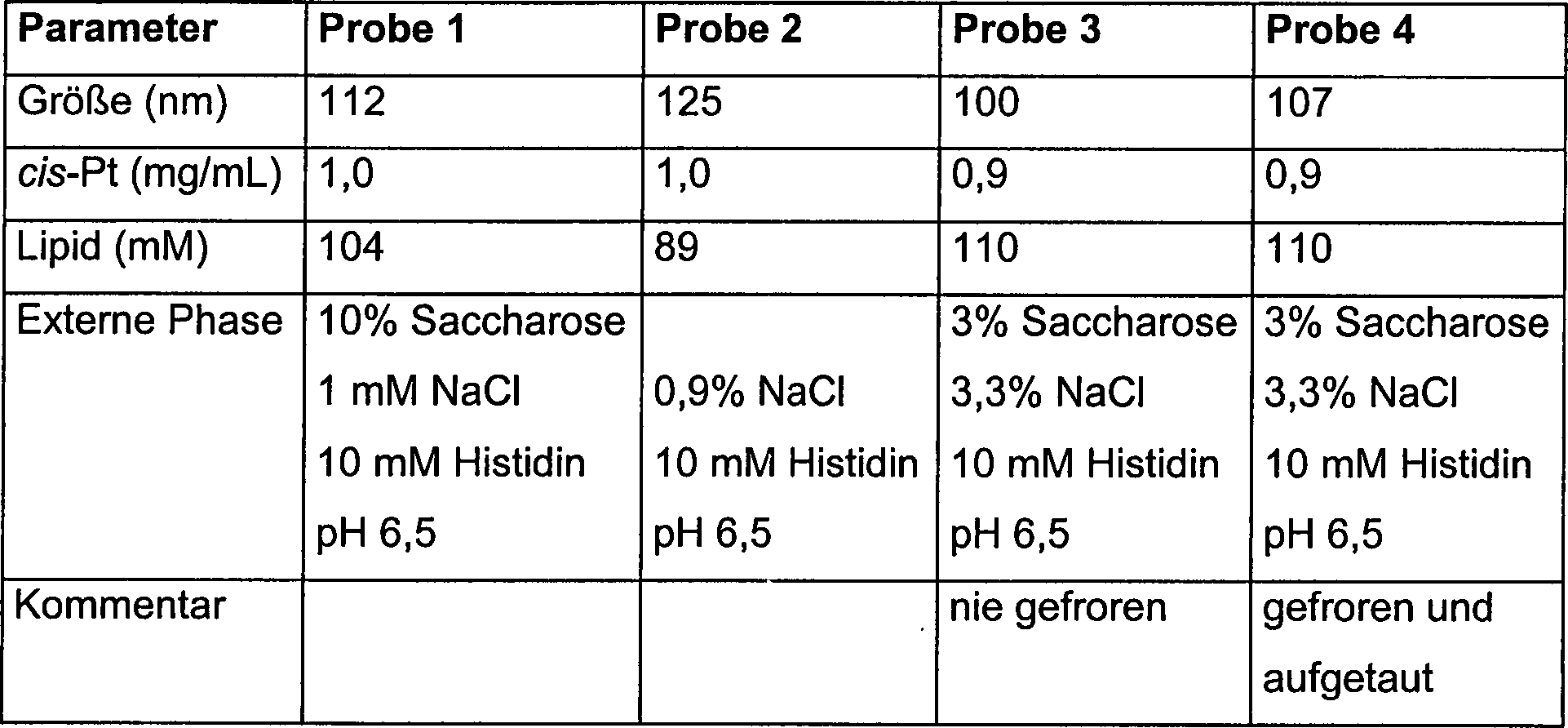
Die Liposome zur Verwendung in dieser Untersuchung wurden in Gegenwart von Ethanol während der ersten Stufen der Liposomformulierung hergestellt, und es wurde eine Untersuchung durchgeführt, um die Wirkung von Ethanol auf Cisplatin zu bestimmen. Dazu wurde die Löslichkeit von Cisplatin bei 1 und 8 mg/ml bei Raumtemperatur und bei 65°C in 0,9% NaCl und in 20% Ethanol in 0,9%-igem NaCl untersucht. Bei 1 mg/ml war Cisplatin unter allen Bedingungen löslich, während bei 8 mg/ml das meiste Cisplatin bei Raumtemperatur ausfiel, aber bei 65°C überwiegend löslich war. Erneutes Erniedrigen der Temperatur auf Raumtemperatur führte zur Ausfällung der Hauptmenge der 8 mg/ml Cisplatin, sowohl in Abwesenheit als auch in Gegenwart von 20% Ethanol. Es kann somit gefolgert werden, dass die Gegenwart von 20% Ethanol die Löslichkeit von Cisplatin nicht verbesserte. NMR-Messungen zeigen, dass die Löslichkeit von freiem Cisplatin in der wässrigen Phase auf ~2 mg/ml begrenzt ist, und bei Temperaturerhöhung auf 60°C ansteigt. Die NMR-Experimente zeigen den Nachweis eines Peaks, dessen Integration proportional zu ungefähr 2 mg/ml ist, während der unlösliche Platinniederschlag tatsächlich nicht nachweisbar ist. Im Falle der Liposome ist nahezu alles Cisplatin, das durch Atomabsorption nachgewiesen wurde, in der intraliposomalen wässrigen Phase löslich, was nahelegt, dass die intraliposomale Konzentration höher ist als 2 mg/ml, was die Löslichkeit bei Raumtemperatur ist. Es wurde festgestellt, dass sich trotz der Tatsache, dass die Konzentration von Cisplatin während der Liposomherstellung oberhalb der Löslichkeit der Raumtemperatur (oder 4°C) lag, praktisch alles Cisplatin in den Liposomen so verhielt, als wäre es in der intraliposomalen wässrigen Phase löslich. Aus den Löslichkeitsuntersuchungen wird deutlich, dass Ethanol nicht für das höher als erwartete Medikament-zu-Lipid-Verhältnis verantwortlich ist. Die NMR-Untersuchungen haben gezeigt, dass Cisplatin während der Beladung in die Liposome intakt bleibt, und dass das eingekapselte Cisplatin mit kleinen Unterschieden der Stammverbindung gleicht, die in der wässrigen Phase gelöst ist. Alles Cisplatin in den Liposomen verhält sich wie ein wasserlösliches Medikament, und es gibt kein Anzeichen für ein unlösliches Medikament. Das Medikament in den Liposomen bildet keinen Niederschlag. Dieser Befund wird durch die nachstehend beschriebene EXAFS-Untersuchung weiter bestätigt.The liposomes for use in this study were prepared in the presence of ethanol during the first stages of the liposome formulation, and a study was conducted to determine the effect of ethanol on cisplatin. For this purpose, the solubility of cisplatin at 1 and 8 mg / ml at room temperature and at 65 ° C in 0.9% NaCl and in 20% ethanol in 0.9% NaCl was investigated. At 1 mg / ml, cisplatin was soluble under all conditions, while at 8 mg / ml most cisplatin precipitated at room temperature but was predominantly soluble at 65 ° C. Reducing the temperature to room temperature resulted in the precipitation of the bulk of the 8 mg / ml cisplatin, both in the absence and in the presence of 20% ethanol. It can thus be concluded that the presence of 20% ethanol did not improve the solubility of cisplatin. NMR measurements show that the solubility of free cisplatin in the aqueous phase is limited to ~ 2 mg / ml, and increases to 60 ° C when the temperature increases. The NMR experiments show the detection of a peak whose integration is proportional to about 2 mg / ml, while the insoluble platinum precipitate is actually undetectable. In the case of the liposomes, almost all cisplatin detected by atomic absorption is soluble in the intraliposomal aqueous phase, suggesting that the intraliposomal concentration is higher than 2 mg / ml, which is room temperature solubility. Despite the fact that the concentration of cisplatin during liposome preparation was above room temperature (or 4 ° C) solubility, virtually all cisplatin in the liposomes was found to be soluble in the intraliposomal aqueous phase. It is clear from the solubility studies that ethanol does not respond to the higher than expected drug to lipid ratio is literal. The NMR studies have shown that cisplatin remains intact during loading into the liposomes and that the encapsulated cisplatin resembles small differences in the parent compound dissolved in the aqueous phase. All cisplatin in the liposomes behaves like a water-soluble drug, and there is no indication of an insoluble drug. The drug in the liposomes does not precipitate. This finding is further confirmed by the EXAFS study described below.
B. Charakterisierung durch Extended X-ray Absorption Fine Structure (EXAFS)B. Characterization by Extended X-ray Absorption Fine Structure (EXAFS)
Extended X-ray Absorption Fine Structure (EXAFS) liefert Informationen über die lokale Struktur ausgewählter Atome in einer Probe. Bei diesem Verfahren wird die Streuung eines Fotoelektrons, emittiert beim Prozess des Röntgen-Fotoeffekts, ausgenutzt, um die unmittelbare atomare Nachbarschaft abzutasten. Das Interferenzmuster, das aus der Streuung resultiert, wird als kleine Oszillation des Röntgen-Absorptionskoeffizienten auf der Skala der Energie oder der Fotoelektronenwellen zahl aufgelöst. Der Effekt wird nur bei langsamen Fotoelektronen aufgelöst, d. h. unmittelbar oberhalb einer der Röntgen-Absorptionskanten. Daraus resultiert die Selektivität des Verfahrens hinsichtlich des Zielatoms. Aus der Amplitude, der Phase und der Periode der Oszillationen, die ganz leicht durch Fourier-Transformation der Daten gewonnen werden können, kann die Anzahl, die Art und der Abstand der Nachbaratome abgeleitet werden. Die weitere Analyse kann auch den Grad der thermischen und/oder strukturellen Fehlordnung liefern, so dass Materialien in kristallinem sowie auch in verschiedenen amorphen Zuständen untersucht werden können. Bei Platin fällt die L3-Absorptionskante in den Energiebereich, wo die beste Auflösung von Monochromatoren für Synchrotronstrahlung erwartet werden kann. Deshalb wurden Pt-L3-Kanten-EXAFS-Spektren am Liposom-eingekapselten Cisplatin gemessen, um die lokale Struktur um die Platinatome in der Probe zu bestimmen. Das System wurde im flüssigen, gefrorenen und gefriergetrockneten Zustand untersucht. Zum Vergleich wurden auch Pt-L3-Kanten-EXAFS-Spektren des freien Medikaments in fester und gelöster Form gemessen.Extended X-ray Absorption Fine Structure (EXAFS) provides information about the local structure selected Atoms in a sample. In this method, the scattering of a Photoelectron, emitted during the process of the X-ray photo effect, exploited, to scan the immediate atomic neighborhood. The interference pattern, which results from the scattering is called a small oscillation of the X-ray absorption coefficient resolved on the scale of energy or photoelectron wave number. Of the Effect is resolved only with slow photoelectrons, d. H. immediately above one of the X-ray absorption edges. This results in the selectivity of the method with respect to the target atom. From the amplitude, the Phase and the period of oscillations, which are quite easy due to Fourier transformation the data can be obtained The number, type and distance of neighboring atoms can be derived become. The further analysis can also determine the degree of thermal and / or provide structural disorder, leaving materials in crystalline as well as in different amorphous states can be examined. at Platinum falls the L3 absorption edge in the energy range where the best resolution of Monochromators for Synchrotron radiation can be expected. Therefore, Pt-L3 edge EXAFS spectra became at the liposome-encapsulated cisplatin measured the local structure to determine the platinum atoms in the sample. The system was in the liquid, frozen and freeze-dried condition. For comparison were Also, Pt-L3-edge EXAFS spectra of the free drug in solid and dissolved Measured shape.
Standard-k2-gewichtete
EXAFS-Spektren χ(k)
an der Pt-L3-Kante für
kristallines und gelöstes
Cisplatin und für
drei Liposom-eingekapselte Cisplatin-Proben (flüssig, gefroren und gefriergetrocknet),
hergestellt wie in Beispiel 3 beschrieben, sind in
Die
Im ersten Schritt wird das Signal der kristallinen Cisplatin-Probe analysiert. Obgleich es für die Untersuchung der Einkapselungseffekte nicht direkt relevant ist, dient dessen Signal mit hoher Qualität als Ausgangspunkt für die erreichbare Auflösung. Besonders wichtig ist, dass kristallographische Daten verwendet werden, um ein Modell der Nachbarschaft des Pt-Atoms zu konstruieren (Milburn, G. H. W., et al., J. Chem. Soc. A. JCSIA, S. 1609 (1966)). Tatsächlich wurde eine perfekte Übereinstimmung für das Signal der N- und C1-Nachbarn der ersten Schale bei 2,05 Å bzw. 2,33 Å gefunden. Zusammen mit ihrer Besetzungszahl von 2 werden beide Spezies eindeutig identifiziert.in the The first step is the signal of the crystalline cisplatin sample analyzed. Although it is for the investigation of the encapsulation effects is not directly relevant is its high quality signal serves as a starting point for the achievable Resolution. Of particular importance is the use of crystallographic data to construct a model of the neighborhood of the Pt atom (Milburn, G.H.W., et al., J. Chem. Soc. A. JCSIA, p. 1609 (1966)). Actually became a perfect match for the Signal of N and C1 neighbors of the first shell found at 2.05 Å and 2.33 Å, respectively. Together with their occupation number of 2, both species become unique identified.
Die weitere Struktur des FT-Spektrums zwischen 2,4 und 4,0 Å kann durch den Beitrag der Streuung höherer Ordnung an den Nachbarn der ersten Schale vollständig erklärt werden, sowie der Streuung an Nachbarn der zweiten Schale, die zwei Pt bei 3,37 Å umfasst, was durch die kristallographischen Daten nahegelegt wird (Milburn, G. H. W., et al., J. Chem. Soc. A. JCSIA, S. 1609 (1966)). Die Beiträge weiterer C1- und N-Nachbarn in etwa dem gleichen Abstand, vorhergesagt durch das kristallographische Modell, können nicht angepasst werden.The further structure of the FT spectrum between 2.4 and 4.0 Å can be achieved by the contribution of the dispersion higher Order to be fully explained to the neighbors of the first shell, as well as the scatter to neighbors of the second shell comprising two Pt at 3.37 Å, what is suggested by the crystallographic data (Milburn, G.H.W., et al., J. Chem. Soc. A. JCSIA, p. 1609 (1966)). The contributions of others C1 and N neighbors at about the same distance, predicted by the crystallographic model can not be adapted.
Offensichtlich beziehen sich die Messung und das Modell auf unterschiedliche Kristallmodifikationen. Auf diese Weise würde man die nächsten Nachbarn, die N- und C1-Atome des Cisplatin-Moleküls selbst und die nächsten Pt-Atome von angrenzenden Molekülen, in ihren vorhergesagten Positionen finden, während dies nicht für weitere Nachbarn gilt, die durch die spezielle Stapelung der Moleküle im Kristall in die Nähe des Pt-Atoms gebracht werden. Die Parameter für die Nachbarschaft, die auf diese Weise konstruiert und mit dem Best Fit der Daten in der k-Region von 3 Å–1 bis 12 Å–1 und in der R-Region von 1,1 Å bis 4,1 Å verfeinert wurden, sind in Tabelle 3 aufgeführt.Obviously, the measurement and the model relate to different crystal modifications. In this way, one would find the nearest neighbors, the N and C1 atoms of the cisplatin molecule itself and the nearest Pt atoms of adjacent molecules, in their predicted positions, while not for other neighbors, by the particular stacking the molecules in the crystal are brought close to the Pt atom. The parameters for the neighborhood constructed in this way and refined with the best fit of the data in the k region from 3 Å -1 to 12 Å -1 and in the R region from 1.1 Å to 4.1 Å are listed in Table 3.
Tabelle
3
Parameter der nächsten
Koordinationsschalen um das Pt in kristallinem Cisplatin, einer
gesättigten
wässrigen Lösung von
Cisplatin, und in flüssigen,
gefrorenen und gefriergetrockneten Proben von Liposom-eingekapseltem
Cisplatin 
Die kristalline Probe mit ihren wohldefinierten nächsten Nachbarn kann auch verwendet werden, um andere Parameter zu bestimmen, nämlich den Amplitudenreduktionsfaktor S0 2 des EXAFS-Signals für das Pt-Atom. Diese Zahl ist innerhalb unterschiedlicher Proben übertragbar, bei denen sich das Zentralatom in einem ähnlichen chemischen Zustand (Valenz, Koordination) befindet. Das Ergebnis (S0 2 = 0,77 ± 0,03) steht in guter Übereinstimmung mit theoretischen Abschätzungen [Roy, M., et al., J. Phys. IV France 7: C2-151–C2-152 (1997)] und wird in der Analyse der nachfolgenden Cisplatin-Proben verwendet.The crystalline sample with its well-defined nearest neighbors can also be used to determine other parameters, namely the amplitude reduction factor S 0 2 of the EXAFS signal for the Pt atom. This number is transferable within different samples where the central atom is in a similar chemical state (valence, coordination). The result (S 0 2 = 0.77 ± 0.03) is in good agreement with theoretical estimates [Roy, M., et al., J. Phys. IV France 7: C2-151-C2-152 (1997)] and is used in the analysis of the following cisplatin samples.
Das
FT-Spektrum der gesättigten,
wässrigen
Lösung
von Cisplatin, das in
Die
Spektren der drei Proben von eingekapseltem Cisplatin, die in den
Die Bestimmung der Kristallstrukturen in der Nachbarschaft des Pt-Atoms hilft nicht nur bei der Bestimmung des Aggregationszustands, sondern wirft auch Licht auf dessen chemische Struktur und folglich chemische Stabilität. Die ersten Nachbarn des Pt-Atoms, die direkt gebundenen C1- und N-Atome, werden in allen Proben im unveränderten Abstand und Koordinationszahl gefunden, was zeigt, dass das Cisplatin-Molekül durch den physikalischen Zustand des Systems nicht nennenswert beeinflusst wird.The Determination of the crystal structures in the vicinity of the Pt atom helps not only in determining the aggregation state, but also sheds light on its chemical structure and consequently chemical Stability. The first neighbors of the Pt atom, the directly bound C1 and N atoms, are in all samples in the same distance and coordination number found, which shows that the cisplatin molecule by the physical State of the system is not significantly affected.
Die Beobachtung von zwei N- und zwei C1-Atomen in der ersten Koordinationsschale zeigt, dass die eingekapselten Cisplatin-Moleküle chemisch stabil sind und nicht hydrolysieren, d. h. Austausch von einem oder zwei C1-Atomen mit Wasser. Dies ist eine wichtige Beobachtung, da sie direkt aus der ungestörten Probe erhalten werden kann, während andere Analysen solcher Komplexe und schwieriger Systeme zu chemischen und physikalischen Veränderungen während der Probenherstellung führen können.The Observation of two N and two C1 atoms in the first coordination shell shows that the encapsulated cisplatin molecules are chemically stable and do not hydrolyze, d. H. Exchange of one or two C1 atoms with water. This is an important observation as they jump right out the undisturbed Sample can be obtained while other analyzes of such complexes and difficult systems to chemical and physical changes while lead the sample preparation can.
Das Fehlen von Pt-Nachbarn bei 3,37 Å vom Pt-Atom zeigt klar, dass die Cisplatin-Lösung im Inneren der Liposome nicht kristallisiert. Genauer gesagt, es kristallisiert nicht in der Modifikation der kristallinen Probe [Milburn, G. H. W., et al., J. Chem. Soc. A. JCSIA, S. 1609 (1966)]; Moeller, M., et al., Curr. Op. Cooo. Interf. Sci. 2: 177–187 (1997)]. Es ist jedoch eine andere Kristallmodifikation von Cisplatin bekannt [Milburn, G. H. W., et al., J. Chem. Soc. A. JCSIA, S. 1609 (1966)]. Es ist ein hydratisiertes Cisplatin, in dem die nächsten Pt-Nachbarn bis zu einem Abstand von über 4 Å entfernt sind, aufgrund von eingeschobenen Wassermolekülen, die jedem Pt-Atom im Abstand von 2,03 Å zwei O-Nachbarn zur Verfügung stellen [Kuroda, R., et al., Inorganic Chemistry 22: 3620 (1983); Faggiani, R., of al., Canadian Journal of Chemistry 60: 529 (1982)]. Weder die eingekapselten Proben noch selbst die einfache Lösung zeigten O-Atome so nahe am zentralen Pt. Somit kann auch die Bildung von Liposomen mit hydratisierter Kristallstruktur ausgeschlossen werden.The The absence of Pt neighbors at 3.37 Å from the Pt atom clearly indicates that the cisplatin solution not crystallized inside the liposomes. More precisely, it does not crystallize in the modification of the crystalline sample [Milburn, G.H.W., et al., J. Chem. Soc. A. JCSIA, p. 1609 (1966)]; Moeller, M., et al., Curr. Op. COOO. Interf. Sci. 2: 177-187 (1997)]. However, it is another crystal modification of cisplatin is known [Milburn, G.H.W., et al., J. Chem. Soc. A. JCSIA, p. 1609 (1966)]. It is a hydrated cisplatin in which the nearest Pt neighbors reach up to one Distance from above 4 Å away are due to inserted water molecules, each Pt atom in the distance of 2.03 Å two O neighbors available [Kuroda, R., et al., Inorganic Chemistry 22: 3620 (1983); Faggiani, R., et al., Canadian Journal of Chemistry 60: 529 (1982)]. Neither the encapsulated samples nor even the simple solution showed O atoms so close to the central Pt. Thus, the formation of Liposomes with hydrated crystal structure are excluded.
Die EXAFS-Ergebnisse werden auch durch ausgedehnte Absorptionsuntersuchungen der Medikament-Lipid-Doppelschichten unterstützt, die zeigen, dass Cisplatin nicht auf Phosphatidylcholindoppelschichten absorbiert [Speelmans, G., et al., Biochem. Biophys. Acta 1283: 60 (1996)]. Weiterhin zeigten 195Pt-NMR-Untersuchungen des gleichen Systems keine Linienverbreiterung, und das gesamte Pt-Signal konnte dem schmalen, isotropen Signal des schnell rotierenden Medikaments zugeordnet werden, wie es auch in der Lösung des freien Medikaments charakterisiert wurde.The EXAFS results are also supported by extensive absorption studies of the drug-lipid bilayers, which show that cisplatin does not absorb on phosphatidylcholine bilayers [Speelmans, G., et al., Biochem. Biophys. Acta 1283: 60 (1996)]. Furthermore, 195 Pt NMR studies of the same system showed no line broadening, and the entire Pt signal could be assigned to the narrow, isotropic signal of the rapidly rotating drug, as was also characterized in the solution of the free drug.
Gefrorene und gefriergetrocknete liposomale Proben sind der flüssigen Probe ähnlich. Die Daten in Tabelle 3 zeigen, dass weder Gefrieren noch Gefriertrocknen die Kristallisation des Medikaments induzieren. Dies ist in Übereinstimmung mit der Tatsache, dass sich Wasser in Poren (< 200 nm) mit vergleichbarer Größe wie das Liposominnere nicht wie eine größere Menge Wasser enthält. Eigenschaften wie Gefrieren und Schmelzen werden durch das große Oberflächen-zu-Volumen-Verhältnis von eingekapselten Wassermolekülen beeinflusst, und es kann einfach zu einem glasartigen Zustand gefrieren, ohne dass gelöste Stoffe auskristallisieren [Holly, R., et al., J. Chem. Phys. 108: 4183 (1998)].frozen and lyophilized liposomal samples are similar to the liquid sample. The data in Table 3 show that neither freezing nor freeze drying induce the crystallization of the drug. This is in agreement with the fact that water is in pores (<200 nm) of comparable size as the Liposominnere not like a larger amount Contains water. Properties such as freezing and melting are due to the large surface-to-volume ratio of encapsulated water molecules influenced, and it can easily freeze to a glassy state, without being solved Crystals crystallize [Holly, R., et al., J. Chem. Phys. 108: 4183 (1998)].
Die oben gezeigten Daten zeigen ebenso wie die NMR-Beobachtungen, dass das Cisplatin im Inneren der Liposome eine übersättigte Lösung bildet. In Abhängigkeit von der Liposomgröße werden üblicherweise 1000–3000 Medikamentmoleküle eingeschlossen. Aus der Liposomgröße und der Lipid- und Medikamentenkonzentration lässt sich abschätzen, dass jedes Liposom im Mittel etwa 3000 Cisplatin-Moleküle enthält. Nimmt man ein Molekülvolumen von 60 Å3 für jedes Cisplatin-Molekül an, kann die Größe eines hypothetischen Kristalls dieser Moleküle berechnet werden, der sich bei Bildung eines Niederschlags bilden würde. Wenn sich alle Moleküle zu einem festen Würfel zusammenlagern würden, würde dessen Kante 55–60 Å lang sein.The data shown above, as well as the NMR observations, show that the cisplatin forms a supersaturated solution inside the liposomes. Depending on the liposome size, usually 1000-3000 drug molecules are included. From the liposome size and the lipid and drug concentration it can be estimated that each liposome contains on average about 3000 cisplatin molecules. Assuming a molecular volume of 60 Å 3 for each cisplatin molecule, the size of a hypothetical crystal of these molecules can be calculated, which would form when a precipitate forms. If all molecules were to assemble into a solid cube, its edge would be 55-60 Å long.
Obgleich nicht beabsichtigt ist, einer bestimmten Theorie zu folgen, ist eine Erklärung für die oben genannten Beobachtungen die, dass die Zahl der eingekammerten Moleküle einfach zu klein sein kann, um die Energiebarriere vom Kristallkeim zum realen Kristall zu überwinden. Somit lagern sich die eingekapselten Cisplatin- Moleküle konstant zu Kristallisationskeimen zusammen, und die Aggregate dissoziieren konstant, da es nicht genug Moleküle gibt, um die Barriere zum Start der Kristallisation zu überwinden. Dies wäre ein Beispiel eines "frustrierten" Systems, da die Einkammerung der Moleküle und ihre geringe Anzahl und "kleine Größe" sie daran hindert, ein stabiles thermodynamisches Gleichgewicht zu erreichen.Although it is not intended to follow a particular theory, an explanation for the above is Observations have suggested that the number of molecules contained in the molecule can simply be too small to overcome the energy barrier from the nucleus to the real crystal. Thus, the encapsulated cisplatin molecules constantly accumulate into nuclei, and the aggregates dissociate constantly because there are not enough molecules to overcome the crystallization initiation barrier. This would be an example of a "frustrated" system because the encapsulation of the molecules and their small number and "small size" prevents them from achieving a stable thermodynamic equilibrium.
Es ist klar, dass das Phänomen einer übersättigten Verbindung in einem Liposom auch auf anderen Gebieten als der Medikamentenabgabe Verwendung finden wird. Beispielsweise würden Anwendungen, wo eine hohe Konzentration eines Mittels auf Abruf erforderlich ist, wie beispielsweise Reaktionskinetiken von einem Verfahren zum Beibehalten einer sofort verwendbaren hohen Konzentration einer Verbindung profitieren. Andere Anwendungsgebiete umfassen Diagnosekits oder Lagerformen von Proteinen und Peptiden.It it is clear that the phenomenon a supersaturated Compounding in a liposome also in areas other than drug delivery Will be used. For example, applications where high Concentration of an agent on call is required, such as Reaction kinetics of a procedure for maintaining an immediate useful high concentration of a compound benefit. Other Areas of application include diagnostic kits or storage forms of proteins and peptides.
III. BeispieleIII. Examples
Die folgenden Beispiele veranschaulichen die hier beschriebene Erfindung weiter und sollen den Umfang der Erfindung in keiner Weise einschränken.The The following examples illustrate the invention described herein further and are not intended to limit the scope of the invention in any way.
Beispiel 1example 1
Herstellung von Cisplatin-haltigen LiposomenPreparation of cisplatin-containing liposomes
A. Schritt 1: Herstellung der MedikamentenlösungA. Step 1: Production the drug solution
In einem Teflon-ausgekleideten Druckbehälter wurde steriles Wasser auf 63–67°C erhitzt, und Natriumchlorid (0,9%) wurde zugegen. Cisplatin wurde in einer Konzentration von 8,5 mg/ml zugegeben und bis zur Auflösung vermischt, was etwa 15–25 Minuten dauerte.In A Teflon-lined pressure vessel became sterile water heated to 63-67 ° C, and sodium chloride (0.9%) was present. Cisplatin was in a Concentration of 8.5 mg / ml was added and mixed until dissolved, which is about 15-25 Minutes lasted.
B. Schritt 2: LipidauflösungB. Step 2: Lipid Dissolution
257,0 g PEG-DSPE, 719,4 g HSPC und 308,4 g Cholesterin (Molverhältnis 50,6/44,3/5,1) wurden bei 60–65°C zu 900 ml wasserfreiem Ethanol gegeben und ungefähr 2 Stunden lang bis zur Auflösung vermischt. Die aufgelösten Lipide wurden zu 7670 g Medikamentenlösung zugegeben, um eine Gesamt-Lipidkonzentration von etwa 150 mg/ml zu ergeben.257.0 g PEG-DSPE, 719.4 g HSPC and 308.4 g cholesterol (molar ratio 50.6 / 44.3 / 5.1) became 900 at 60-65 ° C ml of anhydrous ethanol and mixed for about 2 hours until dissolved. The resolved Lipids were added to 7670 g of drug solution to give a total lipid concentration of about 150 mg / ml.
C. Schritt 3: Lipidhydratisierung/MedikamentenbeladungC. Step 3: Lipid hydration / drug loading
Die warme Lipidlösung wurde unter Mischen schnell zur warmen (63–67°C) Medikamentenlösung zugegeben, um eine Suspension von Liposomen mit hetero genen Abmessungen zu bilden. Die Suspension wurde eine Stunde lang bei 63–67°C vermischt. Die Cisplatin-Konzentration im Hydratisierungsgemisch betrug 7,2 mg/ml, und zu diesem Zeitpunkt waren etwa 30% des Medikaments in den Liposomen eingekapselt. 10% des Gesamt-Lösungsvolumens waren Ethanol, und die Gesamt-Lipidkonzentration betrug 150 mg Lipid/ml.The warm lipid solution was rapidly added to the warm (63-67 ° C) drug solution with mixing, to a suspension of liposomes with hetero geneous dimensions form. The suspension was mixed for one hour at 63-67 ° C. The cisplatin concentration in the hydration mixture was 7.2 mg / ml, and at that time about 30% of the drug was in the liposomes encapsulated. 10% of the total solution volume were ethanol, and the total lipid concentration was 150 mg lipid / ml.
D. Schritt 4: ExtrusionD. Step 4: Extrusion
Durch kontrollierte Extrusion durch Polycarbonat-Filterkartuschen in Teflonausgekleideten Behältern aus rostfreiem Stahl wurden die Liposome auf den gewünschten mittleren Partikeldurchmesser gebracht. Während des ganzen Extrusionsverfahrens von 6–8 Stunden wurde die Liposomsuspension auf 63–65°C gehalten.By controlled extrusion through Teflon lined polycarbonate filter cartridges Containers off stainless steel, the liposomes became the desired mean particle diameter brought. While of the whole extrusion process of 6-8 hours, the liposome suspension became kept at 63-65 ° C.
E. Schritt 5: Einfache FiltrationE. Step 5: Simple filtration
Nach der Größensortierung wurde die Liposomsuspension auf Raumtemperatur (20–25°C) abgekühlt und durch ein 1,2 μm–142 mm-Gelman Versapor-Filter (Acrylcopolymer auf einem Nylon 66-Träger) filtriert, um ausgefälltes Medikament abzutrennen. Zu diesem Zeitpunkt waren etwa 50% des Medikaments eingekapselt.To the size sorting The liposome suspension was cooled to room temperature (20-25 ° C) and through a 1.2 μm-142 mm Gelman Versapor filter (acrylic copolymer on a nylon 66 support) filtered, around precipitated Separate drug. At this time, about 50% of the drug was encapsulated.
F. Schritt 6: DiafiltrationF. Step 6: Diafiltration
Eine Saccharose/Natriumchlorid-Lösung wurde durch Auflösen von Saccharose (100 mg/ml) und Natriumchlorid (0,058 mg/ml) in sterilem Wasser hergestellt. Der pH-Wert der Lösung wurde mit 2 N HCl oder NaOH auf etwa 5,5 eingestellt. Die Lösung wurde durch ein 0,22 μm-Durapore-Filter filtriert.A sucrose / sodium chloride solution was prepared by dissolving sucrose (100 mg / ml) and sodium chloride (0.058 mg / ml) in sterile water. The pH of the solution was washed with 2N HCl or NaOH adjusted to about 5.5. The solution was filtered through a 0.22 μm Durapore filter.
Die Liposomsuspension wurde im ungefähren Verhältnis 1 : 1 (v/v) mit der Saccharose/Natriumchlorid-Lösung verdünnt und durch ein Polysulfon-Hohlfaser-Ultrafilter diafiltriert. Acht Volumenaustausche wurden gegen die Saccharose-/Natriumchlorid-Lösung durchgeführt, um das Ethanol und uneingekapseltes Medikament abzutrennen. Die Prozessflüssigkeitstemperatur wurde auf etwa 20–30°C gehalten. Die gesamte Diafiltrationszeit betrug ungefähr 4,5 Stunden.The Liposome suspension was approximate relationship Diluted 1: 1 (v / v) with the sucrose / sodium chloride solution and diafiltered through a polysulfone hollow fiber ultrafilter. Eight volume changes were made against the sucrose / sodium chloride solution to give to separate the ethanol and unencapsulated drug. The process fluid temperature was kept at about 20-30 ° C. The total diafiltration time was about 4.5 hours.
Die Liposomsuspension wurde dann durch Ultrafiltration auf ungefähr 1,2 mg Cisplatin/ml konzentriert. Die Prozessflüssigkeit nach der Diafiltration wurde mittels HPLC auf ihren Cisplatin-Gehalt analysiert. Die Liposome hatten eine innere Phase aus 8,5 mg/ml Cisplatin in 0,9%-igem Natriumchlorid und eine äußere Phase aus Saccharose/Natriumchlorid-Lösung.The Liposome suspension was then reduced to about 1.2 mg by ultrafiltration Cisplatin / ml concentrated. The process fluid after diafiltration was analyzed by HPLC for cisplatin content. The liposomes had an internal phase of 8.5 mg / ml cisplatin in 0.9% sodium chloride and an outer phase Sucrose / sodium chloride solution.
G. Schritt 7: VerdünnungG. Step 7: Dilution
Ein Verdünnungsmittel wurde hergestellt durch Auflösen von Histidin (10 mM) in einer Saccharose/Natriumchlorid-Lösung (10% Saccharose/1 mM NaCl) bis zu einer Zielkonzentration an Histidin von 1,55 mg/ml im endgültigen Gemisch. Die Liposomsuspension wurde mit dem Histidinverdünnungsmittel auf eine Zielkonzentration an Cisplatin von 1,05 mg/ml verdünnt. Der pH-Wert der Suspension wurde mit 2 N NaOH oder HCl auf 6,5 eingestellt.One thinner was prepared by dissolving of histidine (10mM) in a sucrose / sodium chloride solution (10%). Sucrose / 1mM NaCl) to a target concentration of histidine of 1.55 mg / ml in the final Mixture. The liposome suspension was washed with the histidine diluent to a target concentration of cisplatin of 1.05 mg / ml. Of the pH of the suspension was adjusted to 6.5 with 2N NaOH or HCl.
H. Schritt 8: Sterile FiltrationH. Step 8: Sterile filtration
Die Liposomsuspension wurde auf 33–38°C erwärmt und durch ein 0,2 μm-Gelman Supor-Polyethersulfonfilter filtriert. Die gesamte Filtrationszeit betrug ungefähr 10 Minuten.The Liposome suspension was heated to 33-38 ° C and through a 0.2 μm Gelman Supor polyethersulfone filter filtered. The total filtration time was about 10 minutes.
Beispiel 2Example 2
NMR-AnalyseNMR analysis
A. Herstellung und Charakterisierung von 15N-markiertem Cisplatin [cis-Pt(15NH3)2Cl2]A. Preparation and Characterization of 15 N-labeled Cisplatin [cis-Pt ( 15 NH 3 ) 2 Cl 2 ]
cis-15N-Diammindichloroplatin(II) (Cisplatin) wurde nach dem von Boreham, et al., Aust. J. Chem. 34: 659 (1981) beschriebenen Verfahren synthetisiert. Das Produkt wurde sowohl mittels 195Pt-NMR-Spektroskopie als auch durch den Thioharnstofftest charakterisiert. Thioharnstoff wurde zu einer wässrigen Lösung des 15N-markierten Cisplatins zugegeben, und die Lösung wurde auf 40–50°C erwärmt. Das Auftreten einer gelben Farbe zeigte, dass das Produkt in der cis-Konfiguration vorlag, während das Auftreten einer farblosen Lösung das Vorliegen des trans-Isomers anzeigte. Das cis-15N-DDP wurde in DMF gelöst und mittels 195Pt-NMR analysiert.cis- 15 N-diamminedichloroplatinum (II) (cisplatin) was prepared according to the method described by Boreham, et al., Aust. J. Chem. 34: 659 (1981). The product was characterized by both 195 Pt NMR spectroscopy and the thiourea test. Thiourea was added to an aqueous solution of the 15 N-labeled cisplatin, and the solution was heated to 40-50 ° C. The appearance of a yellow color indicated that the product was in the cis configuration while the appearance of a colorless solution indicated the presence of the trans isomer. The cis- 15 N-DDP was dissolved in DMF and analyzed by 195 Pt NMR.
B. Herstellung von Cisplatin-haltigen LiposomenB. Preparation of cisplatin-containing liposomes
Erste 195Pt-NMR-Messungen wurden unter Verwendung von großen, unilamellaren 2000PEG-DSPE[Polyethylenglycol (Molmasse ungefähr 2000)-derivatisiertes Distearoylphosphatidyl-Ethanolamin]-Cholesterin-Liposomen durchgeführt, mit 99 mg/ml Gesamtlipiden, 78 mM = 2,40 mg/ml P; die 1,64 mg/ml Pt enthielten.First 195 Pt NMR measurements were performed using large, unilamellar 2000 PEG-DSPE [polyethylene glycol (molecular weight approximately 2000) -derivatized distearoylphosphatidyl-ethanolamine] -cholesterol liposomes, with 99 mg / ml total lipids, 78 mM = 2.40 mg / ml P; containing 1.64 mg / ml Pt.
1. Herstellung von 15N-Cisplatin, eingekapselt in sterisch stabilisierten Liposomen1. Preparation of 15 N-cisplatin encapsulated in sterically stabilized liposomes
8,5 mg/ml 15N-markiertes Cisplatin wurden bei 65°C in 0,9% NaCl gelöst und 1 Stunde lang bei dieser Temperatur belassen. Lipide (HSPC/Cholesterin/2000PEG-DSPE 51 : 44 : 5) wurden in Ethanol gelöst. Die Lipide wurden durch Zugabe dieser ethanolischen Lösung zum Medikamentengemisch hydratisiert. Die endgültige Lipidkozentration bei 65°C betrug 150 mg/ml (15%) in 10% Ethanol. Das Gemisch wurde 1 Stunde lang bei 60°C gerührt und dann bei 65°C durch Polycarbonatfilter von 100 nm und 200 nm Porengröße unter Verwendung des Lipofast-Spritzenextruders extrudiert. Man ließ die nach Größen sortierten Liposome (100 nm) auf Raumtemperatur abkühlen. Während des Abkühlens bildete sich ein schwerer, gelber Niederschlag. Die überstehende Lösung wurde gesammelt und noch länger bei Raumtemperatur stehengelassen. Es trat weiterer Niederschlag auf, und die überstehende Lösung wurde wieder gesammelt. Die Probe wurde zweifach verdünnt und 5 mal gegen 100 Volumen 10%-iger Saccharoselösung, die 1 mM NaCl enthielt, bei Raumtemperatur dialysiert. Unter diesen Bedingungen sollte eine vollständige Äquilibrierung mit der 10%-igen Saccharoselösung, die 1 mM NaCl enthielt, auftreten. Schließlich wurde Histidinpuffer (pH 6,5) bis zu einer endgültigen Konzentration von 10 mM zugegeben. Die endgültige Liposomdispersion war durchscheinend weiß. Aliquots der Liposome und beider Niederschläge wurden mittels Heterokern-Einzelquanten-Kohärenz (HSQC) bei 30°C analysiert.8.5 mg / ml of 15 N-labeled cisplatin were dissolved at 65 ° C in 0.9% NaCl and left at this temperature for 1 hour. Lipids (HSPC / cholesterol / 2000 PEG-DSPE 51: 44: 5) were dissolved in ethanol. The lipids were hydrated by adding this ethanolic solution to the drug mixture. The final lipid concentration at 65 ° C was 150 mg / ml (15%) in 10% ethanol. The mixture was stirred for 1 hour at 60 ° C and then extruded at 65 ° C through polycarbonate filters of 100 nm and 200 nm pore size using the Lipofast syringe extruder. The sized liposomes (100 nm) were allowed to cool to room temperature. During cooling, a heavy, yellow precipitate formed. The supernatant solution was collected and allowed to stand at room temperature for even longer. Further precipitation occurred and the supernatant solution was collected again. The sample was diluted 2-fold and dialysed 5 times against 100 volumes of 10% sucrose solution containing 1 mM NaCl at room temperature. Under these conditions, complete equilibration with the 10% sucrose solution containing 1 mM NaCl should occur. Finally, histidine buffer (pH 6.5) was added to a final concentration ration of 10 mM. The final liposome dispersion was translucent white. Aliquots of the liposomes and both precipitates were analyzed by heterocore single quantum coherence (HSQC) at 30 ° C.
2. Probenherstellung für die HSQC-Experimente2. Sample preparation for the HSQC experiments
Das 15N-Cisplatin wurde entweder in 0,9%-iger NaCl- oder in 10%-iger Saccharose-Lösung (8,5 mg/ml) bei 65°C gelöst. Kontrollproben ohne Cisplatin wurden hergestellt und nach den gleichen Verfahren verarbeitet. Nach dem Abkühlen wurde Histidinpuffer (10 mM, pH = 6,5) zugegeben. Die behandelten Proben wurden bei 4°C oder bei –20°C gelagert.The 15 N-cisplatin was dissolved in either 0.9% NaCl or 10% sucrose solution (8.5 mg / ml) at 65 ° C. Control samples without cisplatin were prepared and processed according to the same procedures. After cooling, histidine buffer (10 mM, pH = 6.5) was added. The treated samples were stored at 4 ° C or at -20 ° C.
C. NMR-MessungenC. NMR measurements
1. 195Pt-NMR1. 195 Pt NMR
Die 195Pt-NMR-Messungen wurden an einem Varian VXR-300S-Spektrometer mit einem 7,05 T-Magneten, ausgestattet mit einer computerschaltbaren 5 mm-Sonde, durchgeführt. Die Platin-chemischen Verschiebungen wurden relativ zum externen Standardsignal von K2PtCl4 bei –1624 ppm gemessen. Die Daten wurden mit und ohne Breitbandentkopplung der Protonen unter Verwendung von 100,0 kHz Spektralweite und einer Speicherzeit von 0,010 s gesammelt. Üblicherweise wurden 350000 Pulse oder mehr benötigt, und eine Linienverbreiterung von 300 Hz wurde angewendet. Die Proben wurden ohne Rotation bei 37°C und 60°C gemessen. Eine Kapillare mit 2 mg/ml (4,82 × 10⁻³ M) K2PtCl4 wurde als interner Standard mit bekannter Konzentration in die NMR-Röhrchen eingesetzt. Zur Bearbeitung und Integration wurden die Daten mit Hilfe einer Linienverbreiterung gleich der natürlichen Linienbreite (in Hz) apodisiert. 195 Pt NMR measurements were taken on a Varian VXR-300S spectrometer with a 7.05 T magnet equipped with a 5 mm computer-switchable probe. The platinum chemical shifts were measured relative to the external standard signal of K 2 PtCl 4 at -1624 ppm. The data was collected with and without broadband decoupling of the protons using 100.0 kHz spectral width and a storage time of 0.010 sec. Usually 350,000 pulses or more were needed and a line broadening of 300 Hz was used. The samples were measured without rotation at 37 ° C and 60 ° C. A capillary with 2 mg / ml (4.82 × 10 -3 M) of K 2 PtCl 4 was used as an internal standard of known concentration in the NMR tubes. For processing and integration, the data were apodized by means of a line broadening equal to the natural line width (in Hz).
2. 31P-NMR2. 31 P NMR
31P-Messungen wurden bei Raumtemperatur und bei 60°C unter Verwendung einer computerschaltbaren 5 mm-Sonde durchgeführt. Die 31P-chemischen Verschiebungen wurden relativ zu Phosphorsäure bei 0 ppm gemessen. Die Daten wurden mit Breitbandentkopplung der Protonen bei 10000 Hz Spektralweite und einer Speicherzeit von 1,6 s gesammelt. Üblicherweise wurden 250 Pulse oder mehr benötigt, und eine Linienverbreiterung von 20,0 Hz wurde angewendet. Placebo(Kontroll-) und Cisplatin-beladene Liposome wurden mittels 31P-NMR untersucht. Die Liposome enthielten große, unilamellare Vesikel (LUV) und bestanden aus hydriertem Phosphatidylcholin (HPC), Cholesterin und 2000PEG-DSPE im Molverhältnis 55 : 40 : 5. Proben wurden hergestellt durch Vermischen von 700 μl der Original-Liposomprobe mit 70 μl D2O. 31 P measurements were performed at room temperature and at 60 ° C using a 5 mm computer-switched probe. The 31 P chemical shifts were measured relative to phosphoric acid at 0 ppm. The data were collected with broadband decoupling of the protons at 10000 Hz spectral width and a storage time of 1.6 s. Usually 250 pulses or more were needed and a line broadening of 20.0 Hz was used. Placebo (control) and cisplatin-loaded liposomes were analyzed by 31 P-NMR. The liposomes contained large, unilamellar vesicles (LUV) and consisted of hydrogenated phosphatidylcholine (HPC), cholesterol and 2000 PEG-DSPE in the molar ratio 55: 40: 5. Samples were prepared by mixing 700 μl of the original liposome sample with 70 μl of D 2 O.
3. HSQC-NMR-Messungen3. HSQC NMR measurements
Alle [1H, 15N]-HSQC-Daten wurden mit einem Bruker DXR 400 MHz-NMR-Spektrometer, ausgestattet mit einer 5 mm Multikern-Inversnachweissonde, erhalten. Die 2D-Daten wurden unter Verwendung der Bruker-Sequenz INVIGSTP (Inversnachweis-2D-1H-X-Korrelation mittels Doppel-INEPT-Transfer, phasenempfindlich unter Verwendung von TPPI mit Entkopplung während der Erfassung) aufgezeichnet. Während der Erfassungszeit wurden 15N-Spins unter Verwendung der GARP-1-Sequenz eingestrahlt. Die 15N-chemischen Verschiebungen wurden auf 1,5 M NH4Cl in 1 M HCl als externem Standard bezogen. 1H-chemische Verschiebungen wurden auf TSP (Me3Si(CD2)2CO2Na) als externem Standard bezogen. 2–8 Durchgänge wurden erfasst, unter Verwendung einer Erfassungszeit von 0,251 s, mit Spektralweiten von 2 KHz in den f2- und f1-Dimensionen und 256 Inkrementen von t1. Alle Spektren wurden bei 300°K (27°C) aufgenommen. Die Spektren wurden in etwa 20 Minuten gemessen, und die Daten wurden unter Verwendung von Bruker-Software ohne Linienverbreiterung bearbeitet.All [ 1 H, 15 N] HSQC data were obtained on a Bruker DXR 400 MHz NMR spectrometer equipped with a 5 mm multinuclear inverse detection probe. The 2D data was recorded using the Bruker sequence INVIGSTP (inverse detection 2D 1 HX correlation by double INEPT transfer, phase sensitive using TPPI with decoupling during acquisition). During the acquisition time, 15 N spins were irradiated using the GARP-1 sequence. The 15 N chemical shifts were based on 1.5 M NH 4 Cl in 1 M HCl as an external standard. 1 H chemical shifts were obtained on TSP (Me 3 Si (CD 2 ) 2 CO 2 Na) as an external standard. 2-8 passes were detected using a detection time of 0.251 sec, with spectral widths of 2 KHz in the f 2 and f 1 dimensions and 256 increments of t 1 . All spectra were recorded at 300 ° K (27 ° C). The spectra were measured in about 20 minutes and the data were processed using Bruker software without line broadening.
4. Quantifizierung des Platingehalts mittels 195Pt-NMR4. Quantification of the platinum content by means of 195 Pt NMR
K2PtCl4 wurde als interner Standard gewählt, da es eine stabile Verbindung ist, deren chemische Verschiebung (–1624 ppm) nahe der von Cisplatin (–2100 ppm) ist, aber weit genug entfernt, um Überlappung zu vermeiden. Das K2PtCl4 (2 mg/ml, 4,82 mM) wurde in eine Kapillare eingeschlossen, und konzentrierte Salzsäure wurde zugegeben, um Hydrolyse zu vermeiden. Die Kapillare wurde in das 5 mm-NMR-Röhrchen, das die Probe enthielt, eingesetzt, und das 195Pt-NMR-Spektrum wurde wie oben beschrieben gemessen.K 2 PtCl 4 was chosen as the internal standard because it is a stable compound whose chemical shift (-1624 ppm) is close to that of cisplatin (-2100 ppm), but far enough away to avoid overlap. The K 2 PtCl 4 (2 mg / ml, 4.82 mM) was enclosed in a capillary and concentrated hydrochloric acid was added to avoid hydrolysis. The capillary was inserted into the 5 mm NMR tube containing the sample and the 195 Pt NMR spectrum was measured as described above.
Um die Genauigkeit der Methode zu testen, wurden drei Cisplatin-Proben unterschiedlicher Konzentrationen (1,54, 2,0 und 2,31 mg/ml) in Gegenwart der Kapillare bei 37°C gemessen. Die Flächen unter den Kurven wurden relativ zur Fläche unter dem Referenzpeak integriert, und die Konzentration an elementarem Platin wurde berechnet. Um die berechneten Zahlen zu bestätigen, wurden Atomabsorptions(AA)-Messungen durchgeführt.To test the accuracy of the method, three cisplatin samples of different concentrations (1.54, 2.0 and 2.31 mg / ml) were measured in the presence of the capillary at 37 ° C. The areas under the Curves were integrated relative to the area under the reference peak, and the concentration of elemental platinum was calculated. To confirm the calculated numbers, atomic absorption (AA) measurements were made.
5. Atomabsorptionsspektroskopie5. Atomic absorption spectroscopy
Atomabsorptionsmessungen wurden an einem Varian SpektrAA Zeeman 300-Spektrometer durchgeführt. Die Platinkonzentration wurde aus einer Kalibrierungskurve einer bekannten Konzentration einer K2PtCl4-Vorratslösung (250 ng/ml, 6,02 × 10⁻⁷ M) berechnet.Atomic absorption measurements were taken on a Varian SpektrAA Zeeman 300 spectrometer. The platinum concentration was calculated from a calibration curve of a known concentration of a K 2 PtCl 4 stock solution (250 ng / ml, 6.02 × 10 -7 M).
Beispiel 3Example 3
EXAFS-AnalyseEXAFS analysis
A. LiposomherstellungA. Liposome production
1. Materialien1. Materials
Cholesterin (CH) von Croda, Fullerton, CA; hydriertes Soja-Phosphatidylcholin (HSPC) von Lipoid, Ludwigshafen, Deutschland; N-Carbonyl-methoxypolyethylenglycol 2000)-1,2-distearoyl-sn-glycerophosphoethanolamin-Natriumsalz (MPEG-DSPE) von Sygena, Liestal, Schweiz. Cisplatin (USP-Qualität, nicht weniger als 98% rein) von Heraeus GmbH, Hanau, Deutschland.cholesterol (CH) from Croda, Fullerton, CA; hydrogenated soy phosphatidylcholine (HSPC) from Lipoid, Ludwigshafen, Germany; N-carbonyl-methoxypolyethylene 2000) -1,2-distearoyl-sn-glycerophosphoethanolamine sodium salt (MPEG-DSPE) from Sygena, Liestal, Switzerland. Cisplatin (USP quality, not less than 98% pure) from Heraeus GmbH, Hanau, Germany.
2. Liposomherstellung2. Liposome production
Liposom-eingekapseltes Cisplatin wurde wie in Beispiel 1 beschrieben hergestellt, wobei multilamellare Vesikel durch Injektion der ethanolischen Lipidlösung in die Medikamentenlösung bei 65°C, gefolgt von Abkühlen und Dialyse, gebildet wurden. Die liposomale Lipidzusammensetzung war HSPC/CH/MPEG-DSPE im Molverhältnis 51 : 44 : 5. Die Cisplatin-Konzentration betrug 1,1 mg/ml, und die Medikamenteneinkapselung betrug 98%, bestimmt durch Gelausschlußchromatographie. Die gesamte Lipidkonzentration betrug 118 mM, und der mittlere Partikeldurchmesser betrug 106 nm, bestimmt mittels dynamischer Laser-Lichtstreuung (Coulter Modell N4MB, Miami, FI). Das eingekapselte Cisplatin wurde in 0,9%-iger (w/v) NaCl-Lösung gelöst, und die Liposome wurden in einer wässrigen Phase aus 0,9%-iger NaCl-Lösung mit 10 mM Histidin bei pH 6,5 suspendiert.Liposome-encapsulated Cisplatin was prepared as described in Example 1, wherein multilamellar vesicles by injection of the ethanolic lipid solution in the drug solution at 65 ° C, followed by cooling and dialysis, were formed. The liposomal lipid composition was HSPC / CH / MPEG-DSPE in molar ratio 51: 44: 5. The cisplatin concentration was 1.1 mg / ml, and the Drug encapsulation was 98% as determined by gel exclusion chromatography. The total lipid concentration was 118 mM, and the mean particle diameter was 106 nm as determined by dynamic laser light scattering (Coulter Model N4MB, Miami, FI). The encapsulated cisplatin was dissolved in 0.9% (w / v) NaCl solution, and the Liposomes were in an aqueous Phase from 0.9% NaCl solution with 10 mM histidine at pH 6.5.
Placebo-Liposome wurden in gleicher Weise wie die Cisplatin-Liposome hergestellt, enthielten aber kein Medikament. Die Placebo-Liposome hatten einen mittleren Partikeldurchmesser von 101 nm und eine Gesamt-Lipidkonzentration von 73 mM.Placebo liposomes were prepared in the same way as the cisplatin liposomes, but did not contain any medication. The placebo liposomes had one mean particle diameter of 101 nm and a total lipid concentration of 73 mM.
Gefriergetrocknete Cisplatin-Liposome wurden folgendermaßen hergestellt. Eine Probe von Cisplatin-haltigen Liposomen wurde unter Verwendung von Dialyserohren mit einem Molmassenschnitt von 14000 und vier zwanzigfachen Austauschen mit 10%-iger (w/v) Saccharoselösung zwölf Stunden lang bei Raumtemperatur dialysiert. Die erhaltene Liposomsuspension in 10%-iger Saccharoselösung wurde dann schnell unter Verwendung eines Trockeneis/Isopropanol-Gemisches gefroren und über Nacht im Hochvakuum (100 mTorr) lyophilisiert.freeze-dried Cisplatin liposomes were prepared as follows. A sample of cisplatin-containing liposomes was measured using dialysis tubes with a molecular weight cut of 14,000 and four twenty-fold exchanges with 10% (w / v) sucrose solution twelve hours long dialyzed at room temperature. The resulting liposome suspension in 10% sucrose solution was then rapidly using a dry ice / isopropanol mixture frozen and over Night in high vacuum (100 mTorr) lyophilized.
B. EXAFS-MessungenB. EXAFS measurements
Platin-L3-Kanten-EXAFS-Spektren der Proben wurden im Transmissionsmodus an der Röntgenlinie ROEMO2 (X1.1) im Hamburger Synchrotronstrahlungslabor HASYLAB am Deutschen Elektronen Synchrotron DESY (Hamburg, Deutschland) gemessen. Ein Si(311)-Festausgangs-Doppelkristall-Monochromator wurde mit 2 eV-Auflösung bei 12 keV verwendet. Oberstimmen wurden durch Verstimmen des Monochromatorkristalls unter Verwendung eines Stabilisationsreglers wirksam eliminiert. Ionisationszellen, die mit Argon bei 1 bar gefüllt waren, wurden verwendet, um den einfallenden und transmittierten Fluss der monochromatischen Röntgenstrahlung durch die Probe nachzuweisen. Die Absorptionsspektren wurden als Funktion der Röntgen-Photonenenergie mit einer Integrationszeit von 1 s/Punkt aufgezeichnet. Eine Standard-Schrittprogression innerhalb einer 1000 eV-Region oberhalb der Kante wurde angewendet.Platinum-L 3 edge EXAFS spectra of the samples were measured in the transmission mode on the ROEMO2 X1.1 X-ray line in the Hamburg Synchrotron Radiation Laboratory HASYLAB at the Deutsches Elektronen Synchrotron DESY (Hamburg, Germany). An Si (311) solid-state dual crystal monochromator was used with 2 eV resolution at 12 keV. Upper voices were effectively eliminated by detuning the monochromator crystal using a stabilizer. Ionization cells filled with argon at 1 bar were used to detect the incident and transmitted flow of monochromatic X-rays through the sample. The absorption spectra were recorded as a function of the X-ray photon energy with an integration time of 1 s / dot. A standard step progression within a 1000 eV region above the edge was applied.
Flüssige, gefrorene und gefriergetrocknete Liposom-eingekapselte Cisplatinproben und eine wässrige Lösung von Cisplatin wurden in einer Flüssigkeits-Absorptionszelle mit KAPTONTM-Fenstern und variabler Länge hergestellt. Aufgrund der sehr niedrigen Konzentration an Pt in den Proben stellte sich heraus, dass die optimale Absorptionsdicke eine 5 mm dicke Schicht bei den flüssigen Proben und eine 2 mm-Schicht bei der gefriergetrockneten Probe war. Der erhaltene Pt-L3-Kantensprung betrug nur 0,04 und 0,1 für die Liposom-eingekapselten Proben bzw. die wässrige Lösung bei der Gesamt-Absorptionsdicke von 2. Zehn experimentelle Durchgänge wurden überlagert, um das Signal-zu-Rausch-Verhältnis zu verbessern. Ein Referenzspektrum wurde mit einer 5 mm dicken Schicht einer wässrigen Lösung von leeren Liposomen aufgenommen. Eine gepulverte, kristalline Probe wurde auf mehrfachen Schichten und Klebestreifen hergestellt, wobei der Kantensprung etwa 1 betrug. Ein Referenzspektrum wurde mit leeren Klebestreifen gemessen.Liquid, frozen and freeze-dried liposome-encapsulated cisplatin samples and an aqueous solution of cisplatin were suspended in a liquid absorption cell with KAPTON ™ windows and variable Length produced. Due to the very low concentration of Pt in the samples, it was found that the optimum absorption thickness was a 5 mm thick layer in the liquid samples and a 2 mm layer in the freeze dried sample. The Pt-L 3 edge jump obtained was only 0.04 and 0.1 for the liposome-encapsulated samples and the aqueous solution, respectively, at the total absorption thickness of 2. Ten experimental runs were superimposed to reduce the signal-to-noise ratio. Improve ratio. A reference spectrum was taken with a 5 mm thick layer of an aqueous solution of empty liposomes. A powdered, crystalline sample was prepared on multiple layers and tape, with the edge jump being about 1. A reference spectrum was measured with blank tape.
Claims (9)
Applications Claiming Priority (3)
| Application Number | Priority Date | Filing Date | Title |
|---|---|---|---|
| US17865000P | 2000-01-28 | 2000-01-28 | |
| US178650P | 2000-01-28 | ||
| PCT/US2001/003063 WO2001054666A1 (en) | 2000-01-28 | 2001-01-26 | Liposomes containing an entrapped compound in supersaturated solution |
Publications (2)
| Publication Number | Publication Date |
|---|---|
| DE60110057D1 DE60110057D1 (en) | 2005-05-19 |
| DE60110057T2 true DE60110057T2 (en) | 2005-09-08 |
Family
ID=22653355
Family Applications (1)
| Application Number | Title | Priority Date | Filing Date |
|---|---|---|---|
| DE60110057T Expired - Lifetime DE60110057T2 (en) | 2000-01-28 | 2001-01-26 | LIPOSOMES INCLUDED AN INCLUDED CONNECTION IN OUTSTANDING SOLUTION |
Country Status (19)
| Country | Link |
|---|---|
| US (2) | US20010033861A1 (en) |
| EP (1) | EP1274399B1 (en) |
| JP (1) | JP2003521366A (en) |
| KR (2) | KR20070089761A (en) |
| CN (1) | CN1236760C (en) |
| AT (1) | ATE292957T1 (en) |
| AU (2) | AU2001234670B2 (en) |
| CA (1) | CA2398514A1 (en) |
| DE (1) | DE60110057T2 (en) |
| DK (1) | DK1274399T3 (en) |
| ES (1) | ES2236181T3 (en) |
| HU (1) | HUP0400628A3 (en) |
| IL (2) | IL150483A0 (en) |
| MX (1) | MXPA02007320A (en) |
| NO (1) | NO20023139L (en) |
| NZ (1) | NZ519856A (en) |
| PT (1) | PT1274399E (en) |
| WO (1) | WO2001054666A1 (en) |
| ZA (1) | ZA200205468B (en) |
Cited By (1)
| Publication number | Priority date | Publication date | Assignee | Title |
|---|---|---|---|---|
| DE102017210700A1 (en) * | 2017-06-26 | 2018-12-27 | Robert Bosch Gmbh | Method for automated quantification of an analyte and NMR measuring device for carrying out the method |
Families Citing this family (19)
| Publication number | Priority date | Publication date | Assignee | Title |
|---|---|---|---|---|
| AU2002336867A1 (en) * | 2001-11-02 | 2003-05-12 | Qlt Inc. | Micelle compositions containing pegylated phospholipids and a photosensitizer |
| WO2003075889A1 (en) * | 2002-03-05 | 2003-09-18 | Transave, Inc. | An inhalation system for prevention and treatment of intracellular infections |
| EP1587506B1 (en) * | 2002-12-18 | 2008-07-23 | Algorx | Administration of capsaicinoids |
| JP2006513267A (en) * | 2002-12-18 | 2006-04-20 | アルゴルクス ファーマスーティカルズ,インク | Capsaicinoid administration |
| US8980310B2 (en) * | 2002-12-31 | 2015-03-17 | Bharat Serums and Vaccines, Ltd. | Non-pegylated long-circulating liposomes |
| CA2523413A1 (en) | 2003-04-25 | 2004-11-11 | The Penn State Research Foundation | Method and system for systemic delivery of growth arresting, lipid-derived bioactive compounds |
| EP2090305A4 (en) * | 2006-12-08 | 2012-12-26 | Katayama Chemical Ind Co Ltd | Liposome encapsulating ammine-platinum complex at high concentration, and method for production of the liposome |
| US8158682B2 (en) * | 2008-09-12 | 2012-04-17 | Vallinex, Inc. | Instillation administration of capsaicinoids for the treatment of pain |
| US20140161876A1 (en) * | 2011-07-15 | 2014-06-12 | Konica Minolta, Inc. | Liposome-containing preparation utilizing dissolution aid, and method for producing same |
| WO2013070872A1 (en) * | 2011-11-08 | 2013-05-16 | The Board Of Trustees Of The University Of Arkansas | Methods and compositions for x-ray induced release from ph sensitive liposomes |
| KR102161271B1 (en) * | 2012-02-17 | 2020-09-29 | 셀젼 코퍼레이션 | Thermosensitive nanoparticle formulations and method of making the same |
| BR112015022415A2 (en) * | 2013-03-13 | 2017-07-18 | Mallinckrodt Llc | Liposomal cisplatin compositions for cancer therapy |
| KR20160144404A (en) * | 2014-04-08 | 2016-12-16 | 아라다임 코포레이션 | Liposomes that form drug nanocrystals after freeze-thaw |
| US20160120806A1 (en) * | 2014-04-08 | 2016-05-05 | Aradigm Corporation | Nanocrystals formed in a microenvironment |
| WO2015157038A1 (en) | 2014-04-08 | 2015-10-15 | Aradigm Corporation | Liposomal ciprofloxacin formulations with activity against non-tuberculous mycobacteria |
| PL3137126T3 (en) | 2014-04-30 | 2020-03-31 | Encapson B.V. | Medical devices with non-uniform coatings for enhanced echogenicity |
| CA2997286A1 (en) | 2015-09-14 | 2017-03-23 | Vgsk Technologies, Inc. | A sterically stabilized carrier for subcutaneous, sublingual and oral therapeutics, compositions and methods for treating a mammal |
| US10925831B2 (en) * | 2017-08-28 | 2021-02-23 | Wake Forest University | Liposomal formulations of platinum-acridine anticancer agents and methods thereof |
| AU2022270670A1 (en) | 2021-05-05 | 2023-11-30 | Nejat Duzgunes | Liposome-encapsulated corticosteriods inhibit sars-cov-2 replication and reduces lung inflammation |
Family Cites Families (11)
| Publication number | Priority date | Publication date | Assignee | Title |
|---|---|---|---|---|
| DE3576117D1 (en) | 1984-09-24 | 1990-04-05 | Michael Mezei | MULTI-PHASE PHARMACEUTICAL COMPOSITION. |
| US5013556A (en) * | 1989-10-20 | 1991-05-07 | Liposome Technology, Inc. | Liposomes with enhanced circulation time |
| WO1991016040A1 (en) * | 1990-04-18 | 1991-10-31 | Takeda Chemical Industries, Ltd. | Liposome composition |
| EP0551169A1 (en) * | 1992-01-10 | 1993-07-14 | Takeda Chemical Industries, Ltd. | Liposome composition and production thereof |
| US5395619A (en) | 1993-03-03 | 1995-03-07 | Liposome Technology, Inc. | Lipid-polymer conjugates and liposomes |
| BR9612720A (en) * | 1996-08-21 | 1999-08-24 | Procter & Gamble | Composition to lighten skin |
| JP2001501173A (en) * | 1996-08-23 | 2001-01-30 | アルザ コーポレイション | Liposomes containing cisplatin compounds |
| TW520297B (en) | 1996-10-11 | 2003-02-11 | Sequus Pharm Inc | Fusogenic liposome composition and method |
| WO1998017256A1 (en) * | 1996-10-22 | 1998-04-30 | Dmitri Kirpotin | Compound-loaded liposomes and methods for their preparation |
| WO2001025223A1 (en) * | 1999-10-06 | 2001-04-12 | The Research Foundation Of State University Of New York | Stabilization of taxane-containing dispersed systems |
| TR200201880T2 (en) * | 2000-01-31 | 2002-11-21 | Pfizer Products Inc. | Nicotinamide benzo linked-heterocyclyl derivatives useful as selective inhibitors of PDE4 isozymes |
-
2001
- 2001-01-26 DE DE60110057T patent/DE60110057T2/en not_active Expired - Lifetime
- 2001-01-26 AT AT01906803T patent/ATE292957T1/en not_active IP Right Cessation
- 2001-01-26 EP EP01906803A patent/EP1274399B1/en not_active Expired - Lifetime
- 2001-01-26 AU AU2001234670A patent/AU2001234670B2/en not_active Ceased
- 2001-01-26 CA CA002398514A patent/CA2398514A1/en not_active Abandoned
- 2001-01-26 HU HU0400628A patent/HUP0400628A3/en unknown
- 2001-01-26 ES ES01906803T patent/ES2236181T3/en not_active Expired - Lifetime
- 2001-01-26 IL IL15048301A patent/IL150483A0/en unknown
- 2001-01-26 JP JP2001555645A patent/JP2003521366A/en active Pending
- 2001-01-26 KR KR1020077018871A patent/KR20070089761A/en not_active Withdrawn
- 2001-01-26 NZ NZ519856A patent/NZ519856A/en not_active IP Right Cessation
- 2001-01-26 MX MXPA02007320A patent/MXPA02007320A/en active IP Right Grant
- 2001-01-26 AU AU3467001A patent/AU3467001A/en active Pending
- 2001-01-26 WO PCT/US2001/003063 patent/WO2001054666A1/en not_active Ceased
- 2001-01-26 US US09/771,151 patent/US20010033861A1/en not_active Abandoned
- 2001-01-26 PT PT01906803T patent/PT1274399E/en unknown
- 2001-01-26 KR KR1020027009563A patent/KR100782891B1/en not_active Expired - Fee Related
- 2001-01-26 DK DK01906803T patent/DK1274399T3/en active
- 2001-01-26 CN CNB01804154XA patent/CN1236760C/en not_active Expired - Fee Related
-
2002
- 2002-06-27 IL IL150483A patent/IL150483A/en not_active IP Right Cessation
- 2002-06-28 NO NO20023139A patent/NO20023139L/en not_active Application Discontinuation
- 2002-07-09 ZA ZA200205468A patent/ZA200205468B/en unknown
-
2006
- 2006-03-16 US US11/377,537 patent/US8062662B2/en not_active Expired - Fee Related
Cited By (2)
| Publication number | Priority date | Publication date | Assignee | Title |
|---|---|---|---|---|
| DE102017210700A1 (en) * | 2017-06-26 | 2018-12-27 | Robert Bosch Gmbh | Method for automated quantification of an analyte and NMR measuring device for carrying out the method |
| US11415533B2 (en) | 2017-06-26 | 2022-08-16 | Robert Bosch Gmbh | Method for automatically quantifying an analyte, and NMR measuring device for carrying out the method |
Also Published As
| Publication number | Publication date |
|---|---|
| NO20023139D0 (en) | 2002-06-28 |
| NO20023139L (en) | 2002-09-23 |
| IL150483A0 (en) | 2002-12-01 |
| MXPA02007320A (en) | 2004-07-30 |
| US20060159739A1 (en) | 2006-07-20 |
| DE60110057D1 (en) | 2005-05-19 |
| KR100782891B1 (en) | 2007-12-06 |
| US8062662B2 (en) | 2011-11-22 |
| HUP0400628A2 (en) | 2004-06-28 |
| PT1274399E (en) | 2005-07-29 |
| ATE292957T1 (en) | 2005-04-15 |
| AU3467001A (en) | 2001-08-07 |
| JP2003521366A (en) | 2003-07-15 |
| ZA200205468B (en) | 2004-09-29 |
| AU2001234670B2 (en) | 2005-05-19 |
| EP1274399B1 (en) | 2005-04-13 |
| WO2001054666A1 (en) | 2001-08-02 |
| EP1274399A1 (en) | 2003-01-15 |
| NZ519856A (en) | 2004-03-26 |
| KR20070089761A (en) | 2007-08-31 |
| CN1396822A (en) | 2003-02-12 |
| CN1236760C (en) | 2006-01-18 |
| CA2398514A1 (en) | 2001-08-02 |
| DK1274399T3 (en) | 2005-08-08 |
| ES2236181T3 (en) | 2005-07-16 |
| HUP0400628A3 (en) | 2006-07-28 |
| IL150483A (en) | 2008-07-08 |
| KR20030011767A (en) | 2003-02-11 |
| US20010033861A1 (en) | 2001-10-25 |
Similar Documents
| Publication | Publication Date | Title |
|---|---|---|
| DE60110057T2 (en) | LIPOSOMES INCLUDED AN INCLUDED CONNECTION IN OUTSTANDING SOLUTION | |
| DE3587640T2 (en) | CAPSULE ANTINEOPLASTIC AGENT IN LIPOSOMES. | |
| DE69713615T2 (en) | IONOPHORIC MEDIATED CHARGING OF LIPOSOMES WITH LOW BASIC MEDICINAL PRODUCTS | |
| DE69431750T2 (en) | MULTIVESICULAR LIPOSOMES WITH ENCLOSED CYCLODEXTRIN AND PHARMACOLOGICALLY EFFECTIVE COMPOUNDS AND METHOD FOR THE USE THEREOF | |
| DE3751871T2 (en) | Liposomes containing guanidine aminoglycoside | |
| DE3689769T2 (en) | MULTILAMELLAR LIPOSOME WITH IMPROVED INCLUDING EFFECT. | |
| DE69531701T2 (en) | SPHINGOSOME WITH IMPROVED DRUG RELEASE | |
| DE69218241T2 (en) | MEDICINE FORMULATION FOR PARENTERAL USE | |
| DE69616523T2 (en) | METHOD FOR LOADING LIPID VESICLES | |
| DE69725747T2 (en) | LIPOSOME CONTAINING CISPLATIN | |
| DE69426884T2 (en) | METHOD FOR CONTROLLING LIPOSOME SIZE | |
| DE69923315T2 (en) | PROCESS FOR THE PREPARATION OF LIPOSOMES | |
| DE69530368T2 (en) | VINCA ALKALOID VESICLE WITH INCREASED EFFECTIVENESS AND TUMOR TARGETING | |
| DE69432320T2 (en) | FUSOGENIC LIPOSOMES AND METHOD FOR THE PRODUCTION AND USE THEREOF | |
| DE69026820T2 (en) | PREPARATION OF LIPOSOME AND LIPID COMPLEX COMPOSITIONS | |
| AU2001234670A1 (en) | Liposomes containing an entrapped compound in supersaturated solution | |
| DE60222580T2 (en) | LIPID CARRIER COMPOSITIONS AND METHOD FOR IMPROVED ACTIVE INGREDIENT PREVENTION | |
| DE602004011982T2 (en) | A method of loading therapeutic agents into preformed liposomes and the resulting product | |
| DE3852409T2 (en) | Dosage form consisting of phospholipids for water-insoluble active substances. | |
| DE69122810T2 (en) | Liposomes | |
| WO2001082892A2 (en) | Liposomes containing active substances | |
| DE3825374C2 (en) | ||
| DE68915490T2 (en) | Platinum complexes with individual isomers of neoalkyl acids. | |
| DE69209830T2 (en) | INHIBITION OF AGGREGATON MEDICINAL PARTICLES | |
| EP4190312A1 (en) | Synergistic transport of lipophilic and hydrophilic active agents into nanoparticles |
Legal Events
| Date | Code | Title | Description |
|---|---|---|---|
| 8364 | No opposition during term of opposition |