DE60034874T2 - INTERNAL RIBOSOM TERMINAL (IRES), VECTOR OF THESE INCLUDED AND ITS THERAPEUTIC USE - Google Patents
INTERNAL RIBOSOM TERMINAL (IRES), VECTOR OF THESE INCLUDED AND ITS THERAPEUTIC USE Download PDFInfo
- Publication number
- DE60034874T2 DE60034874T2 DE60034874T DE60034874T DE60034874T2 DE 60034874 T2 DE60034874 T2 DE 60034874T2 DE 60034874 T DE60034874 T DE 60034874T DE 60034874 T DE60034874 T DE 60034874T DE 60034874 T2 DE60034874 T2 DE 60034874T2
- Authority
- DE
- Germany
- Prior art keywords
- sequence
- nucleic acid
- mrna
- translation
- ires
- Prior art date
- Legal status (The legal status is an assumption and is not a legal conclusion. Google has not performed a legal analysis and makes no representation as to the accuracy of the status listed.)
- Expired - Fee Related
Links
- 239000013598 vector Substances 0.000 title claims description 28
- 210000003705 ribosome Anatomy 0.000 title description 10
- 230000001225 therapeutic effect Effects 0.000 title 1
- 108020004999 messenger RNA Proteins 0.000 claims abstract description 60
- 108090000623 proteins and genes Proteins 0.000 claims abstract description 48
- 230000022131 cell cycle Effects 0.000 claims abstract description 38
- 102000004169 proteins and genes Human genes 0.000 claims abstract description 32
- 238000013519 translation Methods 0.000 claims abstract description 32
- 238000000034 method Methods 0.000 claims abstract description 17
- 230000014509 gene expression Effects 0.000 claims description 44
- 102000039446 nucleic acids Human genes 0.000 claims description 39
- 108020004707 nucleic acids Proteins 0.000 claims description 39
- 150000007523 nucleic acids Chemical class 0.000 claims description 39
- 239000002773 nucleotide Substances 0.000 claims description 17
- 125000003729 nucleotide group Chemical group 0.000 claims description 17
- 230000001419 dependent effect Effects 0.000 claims description 13
- 230000000977 initiatory effect Effects 0.000 claims description 9
- 239000013604 expression vector Substances 0.000 claims description 8
- 108091033319 polynucleotide Proteins 0.000 claims description 8
- 102000040430 polynucleotide Human genes 0.000 claims description 8
- 239000002157 polynucleotide Substances 0.000 claims description 8
- 238000001415 gene therapy Methods 0.000 claims description 7
- 230000012010 growth Effects 0.000 claims description 6
- 206010028980 Neoplasm Diseases 0.000 claims description 5
- 208000037803 restenosis Diseases 0.000 claims description 5
- 230000002062 proliferating effect Effects 0.000 claims description 4
- 238000011282 treatment Methods 0.000 claims description 4
- 230000010261 cell growth Effects 0.000 claims description 3
- 230000000295 complement effect Effects 0.000 claims description 3
- 238000002360 preparation method Methods 0.000 claims description 3
- 230000002159 abnormal effect Effects 0.000 claims description 2
- 201000011510 cancer Diseases 0.000 claims description 2
- 201000010099 disease Diseases 0.000 claims description 2
- 208000037265 diseases, disorders, signs and symptoms Diseases 0.000 claims description 2
- 230000002401 inhibitory effect Effects 0.000 claims description 2
- 239000008194 pharmaceutical composition Substances 0.000 claims description 2
- 230000002265 prevention Effects 0.000 claims description 2
- 231100000331 toxic Toxicity 0.000 claims description 2
- 230000002588 toxic effect Effects 0.000 claims description 2
- 239000003814 drug Substances 0.000 claims 1
- 229940079593 drug Drugs 0.000 claims 1
- 102100037912 Cyclin-dependent kinase 11A Human genes 0.000 abstract description 67
- 101000738403 Homo sapiens Cyclin-dependent kinase 11A Proteins 0.000 abstract description 67
- 108010029485 Protein Isoforms Proteins 0.000 abstract description 24
- 102000001708 Protein Isoforms Human genes 0.000 abstract description 24
- 108091026890 Coding region Proteins 0.000 abstract description 14
- 230000006870 function Effects 0.000 abstract description 10
- 230000001413 cellular effect Effects 0.000 abstract description 7
- 230000001105 regulatory effect Effects 0.000 abstract description 5
- 230000008569 process Effects 0.000 abstract description 3
- 125000001433 C-terminal amino-acid group Chemical group 0.000 abstract description 2
- 108091000080 Phosphotransferase Proteins 0.000 abstract description 2
- 102000020233 phosphotransferase Human genes 0.000 abstract description 2
- 210000004027 cell Anatomy 0.000 description 60
- 108020004684 Internal Ribosome Entry Sites Proteins 0.000 description 58
- 101001024630 Drosophila melanogaster RNA cytidine acetyltransferase Proteins 0.000 description 37
- 101000652705 Drosophila melanogaster Transcription initiation factor TFIID subunit 4 Proteins 0.000 description 37
- 101000873927 Homo sapiens Squamous cell carcinoma antigen recognized by T-cells 3 Proteins 0.000 description 37
- 101000996915 Saccharomyces cerevisiae (strain ATCC 204508 / S288c) Nucleoporin NSP1 Proteins 0.000 description 37
- 102100035748 Squamous cell carcinoma antigen recognized by T-cells 3 Human genes 0.000 description 37
- 102100040795 DNA primase large subunit Human genes 0.000 description 31
- 101710157220 DNA primase large subunit Proteins 0.000 description 31
- 101710173608 Protein ERGIC-53 Proteins 0.000 description 31
- 101710106224 Protein disulfide-isomerase A3 Proteins 0.000 description 31
- 101710204645 UV excision repair protein RAD23 homolog B Proteins 0.000 description 31
- 230000014616 translation Effects 0.000 description 28
- 230000000694 effects Effects 0.000 description 27
- 239000012634 fragment Substances 0.000 description 26
- 235000018102 proteins Nutrition 0.000 description 21
- 239000013612 plasmid Substances 0.000 description 20
- 239000000047 product Substances 0.000 description 16
- 108020004414 DNA Proteins 0.000 description 14
- 239000005089 Luciferase Substances 0.000 description 14
- 108060001084 Luciferase Proteins 0.000 description 13
- 235000001014 amino acid Nutrition 0.000 description 12
- 108091032973 (ribonucleotides)n+m Proteins 0.000 description 11
- 150000001413 amino acids Chemical class 0.000 description 11
- 239000002299 complementary DNA Substances 0.000 description 11
- 108090000765 processed proteins & peptides Proteins 0.000 description 11
- 230000014621 translational initiation Effects 0.000 description 11
- 108010002386 Interleukin-3 Proteins 0.000 description 10
- 238000012217 deletion Methods 0.000 description 10
- 230000037430 deletion Effects 0.000 description 10
- 102000004196 processed proteins & peptides Human genes 0.000 description 10
- 238000001262 western blot Methods 0.000 description 10
- 238000004458 analytical method Methods 0.000 description 9
- 101150066555 lacZ gene Proteins 0.000 description 9
- 238000011144 upstream manufacturing Methods 0.000 description 9
- 230000035772 mutation Effects 0.000 description 8
- 229920001184 polypeptide Polymers 0.000 description 8
- 108091081024 Start codon Proteins 0.000 description 7
- 230000000692 anti-sense effect Effects 0.000 description 7
- 239000013615 primer Substances 0.000 description 7
- 239000000523 sample Substances 0.000 description 7
- 238000001890 transfection Methods 0.000 description 7
- WSFSSNUMVMOOMR-UHFFFAOYSA-N Formaldehyde Chemical compound O=C WSFSSNUMVMOOMR-UHFFFAOYSA-N 0.000 description 6
- PEDCQBHIVMGVHV-UHFFFAOYSA-N Glycerine Chemical compound OCC(O)CO PEDCQBHIVMGVHV-UHFFFAOYSA-N 0.000 description 6
- 238000000636 Northern blotting Methods 0.000 description 6
- 239000013592 cell lysate Substances 0.000 description 6
- 230000001404 mediated effect Effects 0.000 description 6
- 238000003752 polymerase chain reaction Methods 0.000 description 6
- 108020004705 Codon Proteins 0.000 description 5
- 108091028043 Nucleic acid sequence Proteins 0.000 description 5
- 108700026244 Open Reading Frames Proteins 0.000 description 5
- KDCGOANMDULRCW-UHFFFAOYSA-N Purine Natural products N1=CNC2=NC=NC2=C1 KDCGOANMDULRCW-UHFFFAOYSA-N 0.000 description 5
- 238000002399 angioplasty Methods 0.000 description 5
- 238000010790 dilution Methods 0.000 description 5
- 239000012895 dilution Substances 0.000 description 5
- 238000009396 hybridization Methods 0.000 description 5
- 230000007246 mechanism Effects 0.000 description 5
- 230000004048 modification Effects 0.000 description 5
- 238000012986 modification Methods 0.000 description 5
- 230000000638 stimulation Effects 0.000 description 5
- 230000001360 synchronised effect Effects 0.000 description 5
- 238000013518 transcription Methods 0.000 description 5
- 230000035897 transcription Effects 0.000 description 5
- 239000006144 Dulbecco’s modified Eagle's medium Substances 0.000 description 4
- 108090000331 Firefly luciferases Proteins 0.000 description 4
- 238000012413 Fluorescence activated cell sorting analysis Methods 0.000 description 4
- 230000010337 G2 phase Effects 0.000 description 4
- MIFGOLAMNLSLGH-QOKNQOGYSA-N Z-Val-Ala-Asp(OMe)-CH2F Chemical compound COC(=O)C[C@@H](C(=O)CF)NC(=O)[C@H](C)NC(=O)[C@H](C(C)C)NC(=O)OCC1=CC=CC=C1 MIFGOLAMNLSLGH-QOKNQOGYSA-N 0.000 description 4
- 230000027455 binding Effects 0.000 description 4
- 230000000903 blocking effect Effects 0.000 description 4
- 238000002474 experimental method Methods 0.000 description 4
- RXWNCPJZOCPEPQ-NVWDDTSBSA-N puromycin Chemical compound C1=CC(OC)=CC=C1C[C@H](N)C(=O)N[C@H]1[C@@H](O)[C@H](N2C3=NC=NC(=C3N=C2)N(C)C)O[C@@H]1CO RXWNCPJZOCPEPQ-NVWDDTSBSA-N 0.000 description 4
- 101100297347 Caenorhabditis elegans pgl-3 gene Proteins 0.000 description 3
- 108010076667 Caspases Proteins 0.000 description 3
- 102000011727 Caspases Human genes 0.000 description 3
- 102000053602 DNA Human genes 0.000 description 3
- 241000283973 Oryctolagus cuniculus Species 0.000 description 3
- 108700008625 Reporter Genes Proteins 0.000 description 3
- 125000003275 alpha amino acid group Chemical group 0.000 description 3
- 230000003321 amplification Effects 0.000 description 3
- 230000033228 biological regulation Effects 0.000 description 3
- 210000004899 c-terminal region Anatomy 0.000 description 3
- 230000030833 cell death Effects 0.000 description 3
- 238000006243 chemical reaction Methods 0.000 description 3
- 238000003776 cleavage reaction Methods 0.000 description 3
- 108010030074 endodeoxyribonuclease MluI Proteins 0.000 description 3
- 210000003527 eukaryotic cell Anatomy 0.000 description 3
- 230000004927 fusion Effects 0.000 description 3
- 238000003119 immunoblot Methods 0.000 description 3
- 239000002609 medium Substances 0.000 description 3
- 230000011278 mitosis Effects 0.000 description 3
- 230000000394 mitotic effect Effects 0.000 description 3
- 238000010369 molecular cloning Methods 0.000 description 3
- 238000003199 nucleic acid amplification method Methods 0.000 description 3
- 230000035755 proliferation Effects 0.000 description 3
- 238000001243 protein synthesis Methods 0.000 description 3
- 230000007017 scission Effects 0.000 description 3
- 210000000329 smooth muscle myocyte Anatomy 0.000 description 3
- 125000006850 spacer group Chemical group 0.000 description 3
- 241000894007 species Species 0.000 description 3
- 230000003612 virological effect Effects 0.000 description 3
- 102100029855 Caspase-3 Human genes 0.000 description 2
- 108020004635 Complementary DNA Proteins 0.000 description 2
- 108091035707 Consensus sequence Proteins 0.000 description 2
- 230000006820 DNA synthesis Effects 0.000 description 2
- KCXVZYZYPLLWCC-UHFFFAOYSA-N EDTA Chemical compound OC(=O)CN(CC(O)=O)CCN(CC(O)=O)CC(O)=O KCXVZYZYPLLWCC-UHFFFAOYSA-N 0.000 description 2
- ZHNUHDYFZUAESO-UHFFFAOYSA-N Formamide Chemical compound NC=O ZHNUHDYFZUAESO-UHFFFAOYSA-N 0.000 description 2
- WHUUTDBJXJRKMK-UHFFFAOYSA-N Glutamic acid Natural products OC(=O)C(N)CCC(O)=O WHUUTDBJXJRKMK-UHFFFAOYSA-N 0.000 description 2
- SEQKRHFRPICQDD-UHFFFAOYSA-N N-tris(hydroxymethyl)methylglycine Chemical compound OCC(CO)(CO)[NH2+]CC([O-])=O SEQKRHFRPICQDD-UHFFFAOYSA-N 0.000 description 2
- 108091034117 Oligonucleotide Proteins 0.000 description 2
- 238000012408 PCR amplification Methods 0.000 description 2
- 241001144416 Picornavirales Species 0.000 description 2
- 102000006382 Ribonucleases Human genes 0.000 description 2
- 108010083644 Ribonucleases Proteins 0.000 description 2
- 108091081021 Sense strand Proteins 0.000 description 2
- FAPWRFPIFSIZLT-UHFFFAOYSA-M Sodium chloride Chemical compound [Na+].[Cl-] FAPWRFPIFSIZLT-UHFFFAOYSA-M 0.000 description 2
- 108091023040 Transcription factor Proteins 0.000 description 2
- 210000001367 artery Anatomy 0.000 description 2
- 238000003556 assay Methods 0.000 description 2
- 210000003719 b-lymphocyte Anatomy 0.000 description 2
- 230000009286 beneficial effect Effects 0.000 description 2
- 230000008901 benefit Effects 0.000 description 2
- 102000005936 beta-Galactosidase Human genes 0.000 description 2
- 108010005774 beta-Galactosidase Proteins 0.000 description 2
- 230000008827 biological function Effects 0.000 description 2
- 210000004204 blood vessel Anatomy 0.000 description 2
- 239000000872 buffer Substances 0.000 description 2
- 230000018486 cell cycle phase Effects 0.000 description 2
- 230000004663 cell proliferation Effects 0.000 description 2
- 108091092328 cellular RNA Proteins 0.000 description 2
- WIIZWVCIJKGZOK-RKDXNWHRSA-N chloramphenicol Chemical compound ClC(Cl)C(=O)N[C@H](CO)[C@H](O)C1=CC=C([N+]([O-])=O)C=C1 WIIZWVCIJKGZOK-RKDXNWHRSA-N 0.000 description 2
- 229960005091 chloramphenicol Drugs 0.000 description 2
- 210000000349 chromosome Anatomy 0.000 description 2
- 208000029078 coronary artery disease Diseases 0.000 description 2
- 238000004520 electroporation Methods 0.000 description 2
- 238000001952 enzyme assay Methods 0.000 description 2
- 230000037433 frameshift Effects 0.000 description 2
- 108020001507 fusion proteins Proteins 0.000 description 2
- 102000037865 fusion proteins Human genes 0.000 description 2
- 235000013922 glutamic acid Nutrition 0.000 description 2
- 239000004220 glutamic acid Substances 0.000 description 2
- 125000000291 glutamic acid group Chemical group N[C@@H](CCC(O)=O)C(=O)* 0.000 description 2
- 239000004615 ingredient Substances 0.000 description 2
- 239000006166 lysate Substances 0.000 description 2
- 239000000463 material Substances 0.000 description 2
- 239000012528 membrane Substances 0.000 description 2
- 238000002703 mutagenesis Methods 0.000 description 2
- 231100000350 mutagenesis Toxicity 0.000 description 2
- 230000002018 overexpression Effects 0.000 description 2
- 239000013641 positive control Substances 0.000 description 2
- 230000004481 post-translational protein modification Effects 0.000 description 2
- 230000001124 posttranscriptional effect Effects 0.000 description 2
- XJMOSONTPMZWPB-UHFFFAOYSA-M propidium iodide Chemical compound [I-].[I-].C12=CC(N)=CC=C2C2=CC=C(N)C=C2[N+](CCC[N+](C)(CC)CC)=C1C1=CC=CC=C1 XJMOSONTPMZWPB-UHFFFAOYSA-M 0.000 description 2
- 230000002797 proteolythic effect Effects 0.000 description 2
- 230000006337 proteolytic cleavage Effects 0.000 description 2
- 229950010131 puromycin Drugs 0.000 description 2
- 230000002829 reductive effect Effects 0.000 description 2
- 238000003571 reporter gene assay Methods 0.000 description 2
- 108091008146 restriction endonucleases Proteins 0.000 description 2
- 239000000758 substrate Substances 0.000 description 2
- 238000012360 testing method Methods 0.000 description 2
- 238000012546 transfer Methods 0.000 description 2
- 230000002792 vascular Effects 0.000 description 2
- 102000040650 (ribonucleotides)n+m Human genes 0.000 description 1
- QKNYBSVHEMOAJP-UHFFFAOYSA-N 2-amino-2-(hydroxymethyl)propane-1,3-diol;hydron;chloride Chemical compound Cl.OCC(N)(CO)CO QKNYBSVHEMOAJP-UHFFFAOYSA-N 0.000 description 1
- ISPYQTSUDJAMAB-UHFFFAOYSA-N 2-chlorophenol Chemical compound OC1=CC=CC=C1Cl ISPYQTSUDJAMAB-UHFFFAOYSA-N 0.000 description 1
- 101710159080 Aconitate hydratase A Proteins 0.000 description 1
- 101710159078 Aconitate hydratase B Proteins 0.000 description 1
- 108010039627 Aprotinin Proteins 0.000 description 1
- 241000894006 Bacteria Species 0.000 description 1
- 102000009728 CDC2 Protein Kinase Human genes 0.000 description 1
- 108010034798 CDC2 Protein Kinase Proteins 0.000 description 1
- 208000005623 Carcinogenesis Diseases 0.000 description 1
- 108090000397 Caspase 3 Proteins 0.000 description 1
- 102100035904 Caspase-1 Human genes 0.000 description 1
- 108090000426 Caspase-1 Proteins 0.000 description 1
- 102000008178 Cyclin B1 Human genes 0.000 description 1
- 108010060385 Cyclin B1 Proteins 0.000 description 1
- FCKYPQBAHLOOJQ-UHFFFAOYSA-N Cyclohexane-1,2-diaminetetraacetic acid Chemical compound OC(=O)CN(CC(O)=O)C1CCCCC1N(CC(O)=O)CC(O)=O FCKYPQBAHLOOJQ-UHFFFAOYSA-N 0.000 description 1
- IGXWBGJHJZYPQS-SSDOTTSWSA-N D-Luciferin Chemical compound OC(=O)[C@H]1CSC(C=2SC3=CC=C(O)C=C3N=2)=N1 IGXWBGJHJZYPQS-SSDOTTSWSA-N 0.000 description 1
- 239000003155 DNA primer Substances 0.000 description 1
- 230000004543 DNA replication Effects 0.000 description 1
- 108010014303 DNA-directed DNA polymerase Proteins 0.000 description 1
- 102000016928 DNA-directed DNA polymerase Human genes 0.000 description 1
- 241000255581 Drosophila <fruit fly, genus> Species 0.000 description 1
- 101000945286 Drosophila melanogaster Serine/threonine-protein kinase PITSLRE Proteins 0.000 description 1
- 241000206602 Eukaryota Species 0.000 description 1
- 108700024394 Exon Proteins 0.000 description 1
- NYHBQMYGNKIUIF-UUOKFMHZSA-N Guanosine Chemical group C1=NC=2C(=O)NC(N)=NC=2N1[C@@H]1O[C@H](CO)[C@@H](O)[C@H]1O NYHBQMYGNKIUIF-UUOKFMHZSA-N 0.000 description 1
- 101000793880 Homo sapiens Caspase-3 Proteins 0.000 description 1
- 101000687323 Homo sapiens Rabenosyn-5 Proteins 0.000 description 1
- 108020005350 Initiator Codon Proteins 0.000 description 1
- 102100034343 Integrase Human genes 0.000 description 1
- 108091092195 Intron Proteins 0.000 description 1
- QNAYBMKLOCPYGJ-REOHCLBHSA-N L-alanine Chemical compound C[C@H](N)C(O)=O QNAYBMKLOCPYGJ-REOHCLBHSA-N 0.000 description 1
- FFEARJCKVFRZRR-BYPYZUCNSA-N L-methionine Chemical compound CSCC[C@H](N)C(O)=O FFEARJCKVFRZRR-BYPYZUCNSA-N 0.000 description 1
- GDBQQVLCIARPGH-UHFFFAOYSA-N Leupeptin Natural products CC(C)CC(NC(C)=O)C(=O)NC(CC(C)C)C(=O)NC(C=O)CCCN=C(N)N GDBQQVLCIARPGH-UHFFFAOYSA-N 0.000 description 1
- 241001529936 Murinae Species 0.000 description 1
- 102100038895 Myc proto-oncogene protein Human genes 0.000 description 1
- 101710135898 Myc proto-oncogene protein Proteins 0.000 description 1
- 206010029260 Neuroblastoma Diseases 0.000 description 1
- 239000000020 Nitrocellulose Substances 0.000 description 1
- 239000004677 Nylon Substances 0.000 description 1
- 108010038807 Oligopeptides Proteins 0.000 description 1
- 102000015636 Oligopeptides Human genes 0.000 description 1
- 102000001253 Protein Kinase Human genes 0.000 description 1
- 239000013614 RNA sample Substances 0.000 description 1
- 102000044126 RNA-Binding Proteins Human genes 0.000 description 1
- 101710105008 RNA-binding protein Proteins 0.000 description 1
- 108010092799 RNA-directed DNA polymerase Proteins 0.000 description 1
- 238000012180 RNAeasy kit Methods 0.000 description 1
- 102100024910 Rabenosyn-5 Human genes 0.000 description 1
- 206010038563 Reocclusion Diseases 0.000 description 1
- 108091028664 Ribonucleotide Proteins 0.000 description 1
- 230000018199 S phase Effects 0.000 description 1
- 108020004682 Single-Stranded DNA Proteins 0.000 description 1
- 238000002105 Southern blotting Methods 0.000 description 1
- UZMAPBJVXOGOFT-UHFFFAOYSA-N Syringetin Natural products COC1=C(O)C(OC)=CC(C2=C(C(=O)C3=C(O)C=C(O)C=C3O2)O)=C1 UZMAPBJVXOGOFT-UHFFFAOYSA-N 0.000 description 1
- 108020005038 Terminator Codon Proteins 0.000 description 1
- 102000006601 Thymidine Kinase Human genes 0.000 description 1
- 108020004440 Thymidine kinase Proteins 0.000 description 1
- 102000040945 Transcription factor Human genes 0.000 description 1
- 101710150448 Transcriptional regulator Myc Proteins 0.000 description 1
- 239000007997 Tricine buffer Substances 0.000 description 1
- 229920004890 Triton X-100 Polymers 0.000 description 1
- 239000013504 Triton X-100 Substances 0.000 description 1
- 108060008682 Tumor Necrosis Factor Proteins 0.000 description 1
- 108700025716 Tumor Suppressor Genes Proteins 0.000 description 1
- 102000044209 Tumor Suppressor Genes Human genes 0.000 description 1
- 102100040247 Tumor necrosis factor Human genes 0.000 description 1
- 102100031988 Tumor necrosis factor ligand superfamily member 6 Human genes 0.000 description 1
- 108050002568 Tumor necrosis factor ligand superfamily member 6 Proteins 0.000 description 1
- 241000700605 Viruses Species 0.000 description 1
- 230000021736 acetylation Effects 0.000 description 1
- 238000006640 acetylation reaction Methods 0.000 description 1
- 230000002411 adverse Effects 0.000 description 1
- 239000011543 agarose gel Substances 0.000 description 1
- 235000004279 alanine Nutrition 0.000 description 1
- 230000031016 anaphase Effects 0.000 description 1
- 238000010171 animal model Methods 0.000 description 1
- 238000000137 annealing Methods 0.000 description 1
- 230000006907 apoptotic process Effects 0.000 description 1
- 238000013459 approach Methods 0.000 description 1
- 229960004405 aprotinin Drugs 0.000 description 1
- 230000015572 biosynthetic process Effects 0.000 description 1
- 229910000389 calcium phosphate Inorganic materials 0.000 description 1
- 239000001506 calcium phosphate Substances 0.000 description 1
- 235000011010 calcium phosphates Nutrition 0.000 description 1
- 230000036952 cancer formation Effects 0.000 description 1
- 235000014633 carbohydrates Nutrition 0.000 description 1
- 150000001720 carbohydrates Chemical class 0.000 description 1
- 231100000504 carcinogenesis Toxicity 0.000 description 1
- 230000006369 cell cycle progression Effects 0.000 description 1
- 230000032823 cell division Effects 0.000 description 1
- 239000006285 cell suspension Substances 0.000 description 1
- 210000004671 cell-free system Anatomy 0.000 description 1
- 238000005119 centrifugation Methods 0.000 description 1
- 230000008859 change Effects 0.000 description 1
- 238000012512 characterization method Methods 0.000 description 1
- 238000010367 cloning Methods 0.000 description 1
- 150000001875 compounds Chemical class 0.000 description 1
- 238000004590 computer program Methods 0.000 description 1
- 230000001143 conditioned effect Effects 0.000 description 1
- 210000004351 coronary vessel Anatomy 0.000 description 1
- 125000004122 cyclic group Chemical group 0.000 description 1
- 230000021953 cytokinesis Effects 0.000 description 1
- 230000003247 decreasing effect Effects 0.000 description 1
- 239000005547 deoxyribonucleotide Substances 0.000 description 1
- 125000002637 deoxyribonucleotide group Chemical group 0.000 description 1
- 238000001514 detection method Methods 0.000 description 1
- 229910003460 diamond Inorganic materials 0.000 description 1
- 239000010432 diamond Substances 0.000 description 1
- KCFYHBSOLOXZIF-UHFFFAOYSA-N dihydrochrysin Natural products COC1=C(O)C(OC)=CC(C2OC3=CC(O)=CC(O)=C3C(=O)C2)=C1 KCFYHBSOLOXZIF-UHFFFAOYSA-N 0.000 description 1
- 230000002526 effect on cardiovascular system Effects 0.000 description 1
- 230000013020 embryo development Effects 0.000 description 1
- 238000005516 engineering process Methods 0.000 description 1
- 239000003623 enhancer Substances 0.000 description 1
- 230000002255 enzymatic effect Effects 0.000 description 1
- 239000013613 expression plasmid Substances 0.000 description 1
- 230000002349 favourable effect Effects 0.000 description 1
- 210000002950 fibroblast Anatomy 0.000 description 1
- 230000008014 freezing Effects 0.000 description 1
- 238000007710 freezing Methods 0.000 description 1
- 239000012737 fresh medium Substances 0.000 description 1
- 238000001476 gene delivery Methods 0.000 description 1
- 230000002068 genetic effect Effects 0.000 description 1
- 238000010353 genetic engineering Methods 0.000 description 1
- 230000013595 glycosylation Effects 0.000 description 1
- 238000006206 glycosylation reaction Methods 0.000 description 1
- 239000003102 growth factor Substances 0.000 description 1
- 239000001963 growth medium Substances 0.000 description 1
- 230000035876 healing Effects 0.000 description 1
- 210000003917 human chromosome Anatomy 0.000 description 1
- 230000001900 immune effect Effects 0.000 description 1
- 238000001727 in vivo Methods 0.000 description 1
- 239000003112 inhibitor Substances 0.000 description 1
- ZPNFWUPYTFPOJU-LPYSRVMUSA-N iniprol Chemical compound C([C@H]1C(=O)NCC(=O)NCC(=O)N[C@H]2CSSC[C@H]3C(=O)N[C@@H](CCCCN)C(=O)N[C@@H](C)C(=O)N[C@@H](CCCNC(N)=N)C(=O)N[C@H](C(N[C@H](C(=O)N[C@@H](CCCNC(N)=N)C(=O)N[C@@H](CC=4C=CC(O)=CC=4)C(=O)N[C@@H](CC=4C=CC=CC=4)C(=O)N[C@@H](CC=4C=CC(O)=CC=4)C(=O)N[C@@H](CC(N)=O)C(=O)N[C@@H](C)C(=O)N[C@@H](CCCCN)C(=O)N[C@@H](C)C(=O)NCC(=O)N[C@@H](CC(C)C)C(=O)N[C@@H](CSSC[C@H](NC(=O)[C@H](CC(O)=O)NC(=O)[C@H](CCC(O)=O)NC(=O)[C@H](C)NC(=O)[C@H](CO)NC(=O)[C@H](CCCCN)NC(=O)[C@H](CC=4C=CC=CC=4)NC(=O)[C@H](CC(N)=O)NC(=O)[C@H](CC(N)=O)NC(=O)[C@H](CCCNC(N)=N)NC(=O)[C@H](CCCCN)NC(=O)[C@H](C)NC(=O)[C@H](CCCNC(N)=N)NC2=O)C(=O)N[C@@H](CCSC)C(=O)N[C@@H](CCCNC(N)=N)C(=O)N[C@@H]([C@@H](C)O)C(=O)N[C@@H](CSSC[C@H](NC(=O)[C@H](CC=2C=CC=CC=2)NC(=O)[C@H](CC(O)=O)NC(=O)[C@H]2N(CCC2)C(=O)[C@@H](N)CCCNC(N)=N)C(=O)N[C@@H](CC(C)C)C(=O)N[C@@H](CCC(O)=O)C(=O)N2[C@@H](CCC2)C(=O)N2[C@@H](CCC2)C(=O)N[C@@H](CC=2C=CC(O)=CC=2)C(=O)N[C@@H]([C@@H](C)O)C(=O)NCC(=O)N2[C@@H](CCC2)C(=O)N3)C(=O)NCC(=O)NCC(=O)N[C@@H](C)C(O)=O)C(=O)N[C@@H](CCC(N)=O)C(=O)N[C@H](C(=O)N[C@@H](CC=2C=CC=CC=2)C(=O)N[C@H](C(=O)N1)C(C)C)[C@@H](C)O)[C@@H](C)CC)=O)[C@@H](C)CC)C1=CC=C(O)C=C1 ZPNFWUPYTFPOJU-LPYSRVMUSA-N 0.000 description 1
- 239000003999 initiator Substances 0.000 description 1
- 230000010354 integration Effects 0.000 description 1
- 230000003993 interaction Effects 0.000 description 1
- 210000003292 kidney cell Anatomy 0.000 description 1
- GDBQQVLCIARPGH-ULQDDVLXSA-N leupeptin Chemical compound CC(C)C[C@H](NC(C)=O)C(=O)N[C@@H](CC(C)C)C(=O)N[C@H](C=O)CCCN=C(N)N GDBQQVLCIARPGH-ULQDDVLXSA-N 0.000 description 1
- 108010052968 leupeptin Proteins 0.000 description 1
- 230000000670 limiting effect Effects 0.000 description 1
- 239000002502 liposome Substances 0.000 description 1
- 238000003670 luciferase enzyme activity assay Methods 0.000 description 1
- 239000012139 lysis buffer Substances 0.000 description 1
- 238000004519 manufacturing process Methods 0.000 description 1
- 238000013507 mapping Methods 0.000 description 1
- 239000003550 marker Substances 0.000 description 1
- 238000005259 measurement Methods 0.000 description 1
- 229930182817 methionine Natural products 0.000 description 1
- 230000011987 methylation Effects 0.000 description 1
- 238000007069 methylation reaction Methods 0.000 description 1
- 208000010125 myocardial infarction Diseases 0.000 description 1
- 229920001220 nitrocellulos Polymers 0.000 description 1
- 230000030648 nucleus localization Effects 0.000 description 1
- 229920001778 nylon Polymers 0.000 description 1
- 230000036961 partial effect Effects 0.000 description 1
- 239000000816 peptidomimetic Substances 0.000 description 1
- 230000002093 peripheral effect Effects 0.000 description 1
- 230000026731 phosphorylation Effects 0.000 description 1
- 238000006366 phosphorylation reaction Methods 0.000 description 1
- 239000013600 plasmid vector Substances 0.000 description 1
- 229920000642 polymer Polymers 0.000 description 1
- 230000002980 postoperative effect Effects 0.000 description 1
- 238000001556 precipitation Methods 0.000 description 1
- 238000012545 processing Methods 0.000 description 1
- 108060006633 protein kinase Proteins 0.000 description 1
- 238000000746 purification Methods 0.000 description 1
- 125000000561 purinyl group Chemical group N1=C(N=C2N=CNC2=C1)* 0.000 description 1
- 230000009467 reduction Effects 0.000 description 1
- 230000022983 regulation of cell cycle Effects 0.000 description 1
- 230000010076 replication Effects 0.000 description 1
- 238000010839 reverse transcription Methods 0.000 description 1
- 239000002336 ribonucleotide Substances 0.000 description 1
- 125000002652 ribonucleotide group Chemical group 0.000 description 1
- 210000004708 ribosome subunit Anatomy 0.000 description 1
- 238000005070 sampling Methods 0.000 description 1
- 231100000241 scar Toxicity 0.000 description 1
- 238000010187 selection method Methods 0.000 description 1
- 238000002741 site-directed mutagenesis Methods 0.000 description 1
- 210000001812 small ribosome subunit Anatomy 0.000 description 1
- 239000011780 sodium chloride Substances 0.000 description 1
- 238000002415 sodium dodecyl sulfate polyacrylamide gel electrophoresis Methods 0.000 description 1
- 239000000243 solution Substances 0.000 description 1
- 238000010186 staining Methods 0.000 description 1
- 239000000126 substance Substances 0.000 description 1
- 238000006467 substitution reaction Methods 0.000 description 1
- 239000006228 supernatant Substances 0.000 description 1
- 238000003786 synthesis reaction Methods 0.000 description 1
- 230000016853 telophase Effects 0.000 description 1
- 210000001519 tissue Anatomy 0.000 description 1
- 230000000451 tissue damage Effects 0.000 description 1
- 231100000827 tissue damage Toxicity 0.000 description 1
- 230000002103 transcriptional effect Effects 0.000 description 1
- 230000009466 transformation Effects 0.000 description 1
- 238000011426 transformation method Methods 0.000 description 1
- QORWJWZARLRLPR-UHFFFAOYSA-H tricalcium bis(phosphate) Chemical compound [Ca+2].[Ca+2].[Ca+2].[O-]P([O-])([O-])=O.[O-]P([O-])([O-])=O QORWJWZARLRLPR-UHFFFAOYSA-H 0.000 description 1
- JLEXUIVKURIPFI-UHFFFAOYSA-N tris phosphate Chemical compound OP(O)(O)=O.OCC(N)(CO)CO JLEXUIVKURIPFI-UHFFFAOYSA-N 0.000 description 1
- 210000004881 tumor cell Anatomy 0.000 description 1
- 230000004565 tumor cell growth Effects 0.000 description 1
- 230000004614 tumor growth Effects 0.000 description 1
- 102000003390 tumor necrosis factor Human genes 0.000 description 1
- 241000701161 unidentified adenovirus Species 0.000 description 1
- 241001515965 unidentified phage Species 0.000 description 1
- 230000003827 upregulation Effects 0.000 description 1
- 210000005167 vascular cell Anatomy 0.000 description 1
- 238000001086 yeast two-hybrid system Methods 0.000 description 1
Classifications
-
- C—CHEMISTRY; METALLURGY
- C12—BIOCHEMISTRY; BEER; SPIRITS; WINE; VINEGAR; MICROBIOLOGY; ENZYMOLOGY; MUTATION OR GENETIC ENGINEERING
- C12N—MICROORGANISMS OR ENZYMES; COMPOSITIONS THEREOF; PROPAGATING, PRESERVING, OR MAINTAINING MICROORGANISMS; MUTATION OR GENETIC ENGINEERING; CULTURE MEDIA
- C12N15/00—Mutation or genetic engineering; DNA or RNA concerning genetic engineering, vectors, e.g. plasmids, or their isolation, preparation or purification; Use of hosts therefor
- C12N15/09—Recombinant DNA-technology
- C12N15/63—Introduction of foreign genetic material using vectors; Vectors; Use of hosts therefor; Regulation of expression
- C12N15/67—General methods for enhancing the expression
-
- A—HUMAN NECESSITIES
- A61—MEDICAL OR VETERINARY SCIENCE; HYGIENE
- A61K—PREPARATIONS FOR MEDICAL, DENTAL OR TOILETRY PURPOSES
- A61K48/00—Medicinal preparations containing genetic material which is inserted into cells of the living body to treat genetic diseases; Gene therapy
Landscapes
- Genetics & Genomics (AREA)
- Health & Medical Sciences (AREA)
- Engineering & Computer Science (AREA)
- Life Sciences & Earth Sciences (AREA)
- Chemical & Material Sciences (AREA)
- Wood Science & Technology (AREA)
- Organic Chemistry (AREA)
- Biotechnology (AREA)
- General Engineering & Computer Science (AREA)
- Biomedical Technology (AREA)
- Zoology (AREA)
- Bioinformatics & Cheminformatics (AREA)
- Molecular Biology (AREA)
- Microbiology (AREA)
- Plant Pathology (AREA)
- Physics & Mathematics (AREA)
- Biochemistry (AREA)
- General Health & Medical Sciences (AREA)
- Biophysics (AREA)
- Micro-Organisms Or Cultivation Processes Thereof (AREA)
- Medicines Containing Material From Animals Or Micro-Organisms (AREA)
- Medicines That Contain Protein Lipid Enzymes And Other Medicines (AREA)
- Enzymes And Modification Thereof (AREA)
Abstract
Description
Die vorliegende Erfindung betrifft ein isoliertes und/oder rekombinantes Nukleinsäuremolekül, vorzugsweise ein kloniertes DNA-Sequenzelement, das in Expressionsvektoren eingebaut werden kann, um die Translation einer gegebenen mRNA zu verbessern und um diese Translation der mRNA in einer Cap-abhängigen, aber auch, und noch wichtiger, in einer Cap-unabhängigen Weise in eukaryotischen Zellen zu ermöglichen. Das DNA-Sequenzelement umfasst die so genannte interne Ribosomen-Eintrittsstelle, die als IRES abgekürzt und im Folgenden auch so genannt wird.The The present invention relates to an isolated and / or recombinant Nucleic acid molecule, preferably a cloned DNA sequence element incorporated into expression vectors can be used to improve the translation of a given mRNA and this translation of the mRNA in a cap-dependent, but also, and more importantly, in a cap-independent way in eukaryotic cells. The DNA sequence element comprises the so-called internal ribosome entry site, abbreviated as IRES and in the following also so called.
In der vorliegenden Erfindung wurde herausgefunden, dass zwei Isoformen, p110 und p58, der PITSLRE-Proteinkinase von derselben PITSLRE mittels eines internen Ribosomen-Eintrittsvorgangs translatiert werden können. Dies bedeutet, dass p110 und p58, zwei Proteine mit mutmaßlich unterschiedlichen Funktionen, von einer einzigen mRNA-Spezies unter Verwendung zweier AUGs innerhalb desselben Leserasters translatiert werden. Diesen beiden Proteinen sind die 439 C-terminalen Aminosäuren gemeinsam, welche die Kinasedomäne beinhalten. Die IRES in der polycistronischen PITSLRE ist die erste IRES, die sich vollständig in dem kodierenden Bereich einer zellulären mRNA befindet. Darüber hinaus wurde überraschend herausgefunden, dass das IRES-Element Zellzyklus-reguliert ist. Die Translation von p58 tritt im G2/M-Stadium des Zellzyklus auf.In In the present invention, it has been found that two isoforms, p110 and p58, the PITSLRE protein kinase from the same PITSLRE an internal ribosome entry process can be translated. This means that p110 and p58, two proteins with presumably different Functions of a single mRNA species using two AUGs are translated within the same reading frame. this both proteins share the 439 C-terminal amino acids, which the kinase domain include. The IRES in the polycistronic PITSLRE is the first IRES completely in the coding region of a cellular mRNA. Furthermore was surprising found that the IRES element is cell cycle regulated. The translation of p58 occurs at the G2 / M stage of the cell cycle.
Die PITSLRE-Proteinkinase-Familie ist eine große Supergen-Familie, die mit der mitotischen Haupt-Proteinkinase p34cdc2 verwandt ist. PITSLRE-Proteinkinasen werden von den duplizierten Genen cell division cycle 2-like 1 (Cdc2L1) und Cdc2L2 kodiert, die etwa 140 kb auf dem humanen Chromosom 1p36.3 umspannen (Gururajan et al., 1998). Diese Gene exprimieren beinahe identische Proteinkinasen von 110 kDa, die an ihrem C-terminalen Ende das offene Leseraster einer kleineren Isoform von 58 kDa enthalten: p58PITSLRE . Zurzeit liegt die Funktion der PITSLRE-Kinasen noch im Dunklen. Der Grund für die große Anzahl verschiedener Isoformen ist ebenfalls nicht klar. Nur die Isoformen p110 und p90 enthalten einen 30 Aminosäuren langen Bereich, der hauptsächlich aus Glutaminsäure (83 %) besteht (Xiang et al., 1994). Kürzere Glutaminsäuresequenzen können in allen Isoformen unmittelbar nach der ersten translationalen Startstelle für die β1-Isoform gefunden werden. Mehrere hochgradig basische Bereiche, die als zweiteilige Kernlokalisierungssequenzen dienen könnten, werden nur in den p110-Isoformen gefunden (Xiang et al., 1994). Das Hefe-Zwei-Hybrid- System deckte eine direkte Wechselwirkung zwischen dem RNA-Bindeprotein hRNPS1 und den p110-Isoformen auf, jedoch keine mit den kleineren Isoformen (Loyer et al., 1998).The PITSLRE protein kinase family is a large supergene family related to the major mitotic protein kinase p34cdc2. PITSLRE protein kinases are encoded by the duplicated genes cell division cycle 2-like 1 (Cdc2L1) and Cdc2L2, which span about 140 kb on the human chromosome 1p36.3 (Gururajan et al., 1998). These genes express nearly identical 110 kDa protein kinases, which contain at their C-terminal end the open reading frame of a smaller isoform of 58 kDa: p58 PITSLRE . At the moment, the function of PITSLRE kinases is still in the dark. The reason for the large number of different isoforms is also not clear. Only the isoforms p110 and p90 contain a 30 amino acid region consisting mainly of glutamic acid (83%) (Xiang et al., 1994). Shorter glutamic acid sequences can be found in all isoforms immediately after the first translational start site for the β1 isoform. Several highly basic regions that could serve as two-part nuclear localization sequences are found only in the p110 isoforms (Xiang et al., 1994). The yeast two-hybrid system revealed a direct interaction between the RNA-binding protein hRNPS1 and the p110 isoforms, but none with the smaller isoforms (Loyer et al., 1998).
Die starke Variation der Expressionsmuster der verschiedenen Isoformen und ihre Expressionsniveaus deuten auf Isoform-spezifische Funktionen hin. Während p110-Isoformen ubiquitär in asynchronen Zellpopulationen exprimiert werden, führt eine Überexpression von p58 in eukaryotischen Zellen zu einer späten mitotischen Verzögerung auf Grund eines offensichtlichen Versagens der Zytokinese. Die Zellen sammeln sich in der späten Telophase für einen längeren Zeitraum (Bunnell et al., 1990). Die Zellwachstumsrate in diesen Zellen ist stark vermindert. Im Gegensatz dazu sind verringerte p58-mRNA-Niveaus in CHO-Fibroblasten mit einem verstärkten Zellwachstum assoziiert, wie durch erhöhte DNA-Replikationsraten gemessen wurde (Meyerson et al., 1992). Diese Beobachtungen legen nahe, dass p58 möglicherweise an der normalen Regulation des Zellzyklus oder des Zelltodes teilnimmt. Darüber hinaus ist der Chromosomenbereich 1p36.3 häufig in Fällen von Neuroblastom und vielen anderen Tumoren deletiert. Die Deletion dieses Chromosomenbereichs tritt in der Onkogenese spät auf und korreliert mit einem aggressiven Tumorwachstum, was nahe legt, dass sich dort ein oder mehrere Tumorsupressorgen(e) befinden könnte(n) (Eipers et al., 1991). Eine weitere Beobachtung, welche auf eine Rolle der PITSLRE-Kinasen während des Voranschreitens des Zellzyklus hindeutet, ist, dass während der frühen Embryogenese in Drosophila, wenn die exponentielle Proliferation stattfindet, das Expressionsniveau von PITSLRE-spezifischen Transkripten, die das p110-Homolog kodieren, maximal ist. In einem späteren Stadium, wenn sich die Zellproliferation verlangsamt, fällt die PITSLRE-Expression dramatisch (Sauer et al. 1996).The strong variation of the expression patterns of the different isoforms and their expression levels indicate isoform-specific functions out. While p110 isoforms ubiquitous expressed in asynchronous cell populations results in overexpression of p58 in eukaryotic cells to a late mitotic delay Reason for an obvious failure of cytokinesis. The cells accumulate in the late Telophase for a longer one Period (Bunnell et al., 1990). The cell growth rate in these cells is greatly reduced. In contrast, decreased p58 mRNA levels associated with increased cell growth in CHO fibroblasts, as increased by DNA replication rates was measured (Meyerson et al., 1992). These Observations suggest that p58 may be at the normal level Regulation of the cell cycle or cell death. Furthermore For example, the 1p36.3 chromosome region is common in cases of neuroblastoma and many other tumors deleted. The deletion of this chromosome area occurs late in oncogenesis and correlates with aggressive tumor growth, which is close specifies that there are one or more tumor suppressor genes (s) (s) could (Eipers et al., 1991). Another observation, which on one Role of PITSLRE kinases during suggesting the progression of the cell cycle is that during the early Embryogenesis in Drosophila when the exponential proliferation takes place, the level of expression of PITSLRE-specific transcripts, which encode the p110 homolog is maximal. At a later stage, as cell proliferation slows down, PITSLRE expression falls dramatic (Sauer et al., 1996).
Polycistronische Botenmoleküle als solche treten in prokaryotischen Systemen häufig auf. Es ist ein seit langem bestehendes Missverständnis, dass die polycistronischen Botenmoleküle in eukaryotischen Systemen wegen des Vorliegens der so genannten "Cap"-Struktur am Anfang der mRNA nicht auftreten. In der Tat resultiert die Translationsinitiation bei der Mehrheit eukaryotischer zellulärer und viraler mRNAs aus der Anheftung von Ribosomen an die m7G-Cap-Struktur am 5'-Ende der mRNA, der eine lineare Abtastung bis zum Initiations-Kodon folgt. Allerdings ist die Translationsinitiation einer geringeren Anzahl eukaryotischer mRNAs 5'-Ende- und Cap-Struktur-unabhängig, und resultiert stattdessen aus der direkten Anheftung von Ribosomen an eine interne Ribosomen-Eintrittsstelle (IRES) innerhalb des nicht translatierten 5'-Bereichs (5'-NTR) der mRNA.As such, polycistronic messenger molecules are common in prokaryotic systems. It is a long-standing misconception that the polycistronic messenger molecules do not occur in eukaryotic systems because of the presence of the so-called "cap" structure at the beginning of the mRNA. In fact, translation initiation in the majority of eukaryotic cellular and viral mRNAs results from the attachment of ribosomes to the m 7 G-cap structure at the 5 'end of the mRNA, followed by a linear scan to the initiation codon. However, translation initiation of a smaller number of eukaryotic mRNAs is 5 'end and cap structure independent, and results instead from the direct attachment of ribosomes to an internal ribosome entry site (IRES) within the untranslated 5' region (5 '). -NTR) of the mRNA.
Von IRES-Elementen wurde zuerst in picornaviralen mRNAs berichtet, die natürlicherweise ohne Cap-Struktur vorliegen, aber nichtsdestoweniger effizient translatiert werden (Jang et al., 1998, J. Virol., 62: 2636–43). Im Allgemeinen können IRES nicht mittels Sequenzhomologie identifiziert werden; bekannte IRES wurden funktionell identifiziert und definiert (Mountford und Smith, 1995, TIG, 11 (5): 179–184). Es scheint, dass die Konformation der IRES-Sequenz die Bindung an das Ribosom ermöglicht.From IRES elements were first reported in picornaviral mRNAs, which naturally without cap structure, but nevertheless efficiently translated (Jang et al., 1998, J. Virol., 62: 2636-43). In general, IRES not identified by sequence homology; became known IRES functionally identified and defined (Mountford and Smith, 1995, TIG, 11 (5): 179-184). It seems that the conformation of the IRES sequence binding to allows the ribosome.
Es wäre nützlich, ein Sequenzelement zu identifizieren, das jedes gewünschte Gen mit der Fähigkeit ausstattet, effizient translatiert zu werden und insbesondere auf eine Capunabhängige Weise translatiert zu werden. Darüber hinaus wäre es äußerst vorteilhaft, ein Sequenzelement zu isolieren, das Zellzyklus-reguliert ist. Weiter wäre es äußerst nützlich, IRES-Sequenzelemente, vorzugsweise mit einer hohen Translationseffizienz, zu haben, um sie in Expressionsvektoren sowie in Gentherapievektoren zu verwenden, um die mRNA-Translation und damit die Proteinsynthese zu kontrollieren.It would be useful to identify a sequence element containing any desired gene equipped with the ability to be translated efficiently, and in particular in a cap independent manner to be translated. About that would be out it is extremely beneficial to isolate a sequence element that is cell cycle regulated. Further it would be extremely useful IRES sequence elements preferably having a high translational efficiency, in order to to use them in expression vectors as well as gene therapy vectors, to control mRNA translation and thus protein synthesis.
Die vorliegende Erfindung betrifft unter anderem das Merkmal, dass p58 von der PITSLRE-mRNA durch einen Mechanismus einer internen Translationsinitiation während des G2/M-Stadiums des Zellzyklus produziert wird. Eine Ausführungsform dieser Erfindung ist im Folgenden offenbart.The The present invention relates inter alia to the feature that p58 from the PITSLRE mRNA by a mechanism of internal translation initiation while of the G2 / M stage of the cell cycle is produced. An embodiment This invention is disclosed below.
Es
wurde eine p110PITSLRE-Isoform (α2-2) konstruiert,
die an ihrem C-terminalen Ende mit einem E-Tag fusioniert ist und
von dem frühen
SV40-Promotor angetrieben wird. Dieses Plasmid wurde stabil in die
IL-3-abhängige
Pro-B-Zelllinie Ba/F3 transfiziert. Dieses System besitzt den Vorteil,
dass die Zellen im G1-Stadium durch die Abreicherung von Wachstumsfaktoren
synchronisiert werden können.
Eine nachfolgende Stimulierung mit IL-3 treibt die Zellen simultan
durch die weiteren Stadien des Zellzyklus. Das Expressionsmuster
des transfizierten PITSLRE-Konstrukts wurde während des Verlaufs des Zellzyklus
in den Ba/F3-p110PITSLRE-Transfektanden mittels Immunoblots
unter Verwendung eines Anti-E-Tag untersucht. Die p110-Isoform war
während der
verschiedenen Stadien des Zellzyklus konstitutiv vorhanden. Allerdings
wurde nur während
des G2/M-Stadiums eine 58 kDa-Form koexprimiert (
Es wurde auch eine schwächere Bande von etwa 100 bis 105 kDa nachgewiesen. Es wurde bereits früher beschrieben, dass die p110-Isoformen zwei potenzielle Translationsstarts in der Nähe des Starts des 5'-NTR-Bereichs haben. Sie sind durch 174 bp getrennt und liegen in zwei benachbarten Exons. Ein möglicher Mechanismus wurde allerdings bislang noch nicht vorgeschlagen. Vielleicht ist diese alternative Translationsinitiation eine Konsequenz einer undichten (leaky) Ribosomenabtastung. Das alternative AUG (an Position 283) befindet sich im Vergleich zum ersten AUG (Position 112) in einem Bereich, der für die Translationsinitiation günstiger ist (Tabelle 1).It was also a weaker Band of about 100 to 105 kDa detected. It has already been described earlier that the p110 isoforms have two potential translational starts in the Near the Starts the 5 'NTR area to have. They are separated by 174 bp and are located in two adjacent ones Exons. A possible mechanism has not yet been proposed. Maybe it is this alternative translation initiation is a consequence of a leaky one (leaky) ribosome scan. The alternative AUG (at position 283) is in one compared to the first AUG (position 112) Area that for the translation initiation more favorable is (Table 1).
Anfänglich wurde
gedacht, dass der Ursprung des p58-Produkts das Ergebnis eines proteolytischen Vorgangs
ist. Es wurde vorgeschlagen, dass Glutaminsäure-Bereiche, die in der p110-Isoform
vorkommen, mögliche
Angriffspunkte für
eine spezifische proteolytische Spaltung sind. Kürzlich wurde eine mögliche Rolle für eine durch
eine Kaspase prozessierte PITSLRE-Isoform auf Grund von Untersuchungen
von Fas- und TNF-induziertem Zelltod nahe gelegt (Lahti et al.,
1995, Beyaert et al., 1997, Tang et al., 1998). Transfektanden wurden
mit dem Breitspektruminhibitor für
Kaspasen, zVAD.fmk, inkubiert, und das PITSLRE-Expressionsmuster wurde analysiert.
Wie
Die
p110-Isoform enthält
an ihrem C-terminalen Ende den ORF der Isoform p58. Daher wurde
das G2/M-spezifische p58-Protein wahrscheinlich unter Verwendung
des internen AUG als ein Initiations-Kodon translatiert. Um die
letztere Hypothese zu verifizieren, wurde das interne Methionin
zu Alanin mutiert und die mutierte cDNA in die Ba/F3-Zelllinie transfiziert.
Interessanterweise wurde im Vergleich mit dem Wildtyp (
Die
Expression von Zyklin B1 als ein Marker für das G2/M-Stadium des Zellzyklus
wurde als Kontrolle verwendet. Zyklin B1 wird während der späten S-Phase
synthetisiert, maximal während
der G2/M-Phase exprimiert und letztlich während der Anaphase degradiert
(
Um
die Möglichkeit
auszuschließen,
dass wir eine potenzielle proteolytische Spaltungsstelle in p110PITSLRE mutiert haben, die in der Lage ist,
ein 58 kDa großes
Produkt zu erzeugen, führten
wir in die p110PITSLRE-cDNA durch die Deletion
zweier Guanosinnukleotide an den Positionen 926 und 927 stromaufwärts des
internen AUG (fsp110PITSLRE) eine Leserasterverschiebung
ein. Diese Mutation führte
zu einem kurzen offenen Leseraster von 867 Nukleotiden (
Da die Expression des transfizierten Gens durch einen konstitutiven frühen SV40-Promotor kontrolliert wurde, wurde die Regulation der p58-Expression auf Transkriptionsebene ausgeschlossen.There the expression of the transfected gene by a constitutive early SV40 promoter was controlled, was the regulation of p58 expression at the transcriptional level locked out.
Als nächstes wurde bestimmt, ob p58 und p110 beide von einer mRNA abstammten. Es ist möglich, dass p58 von einem anderen, zweiten, Botenmolekül translatiert wird, das von der anfänglich transfizierten cDNA abstammt. Dieses zweite Botenmolekül könnte durch Spaltung des transfizierten Botenmoleküls durch eine spezifische Ribonuklease produziert worden sein, oder es könnte durch ein kryptisches Promotorelement induziert worden sein, das in der stromaufwärts gelegenen Sequenz vorliegt. Das Muster der exogenen mRNA wurde während des Verlaufs des Zellzyklus mittels Northernblot-Analyse mit einer E-Tag spezifischen Sonde in den Ba/F3-Transfektanden verfolgt. Es wurde in allen Stadien des Zellzyklus ein einziges Botenmolekül von 2,4 kb Länge mit einem konstanten Expressionsniveau gefunden. Die 2,4 kb-Bande fehlte in nicht transfizierten Zellen. Es wurde kein zusätzliches Botenmolekül in den G2/M-spezifischen Zelllysaten nachgewiesen. Dies zeigt, dass die p110-(α2-2) mRNA, die p110PITSLRE (α2-2) kodiert, zu einer zweiten PITSLRE-Proteinkinase der Größe 58 kDa führt.Next, it was determined whether p58 and p110 were both derived from an mRNA. It is possible that p58 is translated from another, second, messenger molecule derived from the initially transfected cDNA. This second messenger molecule could have been produced by cleavage of the transfected messenger molecule by a specific ribonuclease, or it could have been induced by a cryptic promoter element present in the upstream sequence. The pattern of exogenous mRNA was monitored during the course of the cell cycle by Northern blot analysis with an E-tag specific probe in the Ba / F3 transfectants. A single messenger molecule of 2.4 kb in length with a constant expression level was found at all stages of the cell cycle. The 2.4 kb band was absent in untransfected cells. No additional messenger molecule was detected in the G2 / M-specific cell lysates. This indicates that the p110 (α2-2) mRNA encoding p110 PITSLRE (α2-2) results in a second 58 kDa PITSLRE protein kinase.
Es
wurde auch die Expression der endogenen PITSLRE-Proteinkinase während des
Verlaufs des Zellzyklus untersucht. Wie in
Wir
haben weiter die Zellzyklusabhängigkeit
der p58PITSLRE-Expression mittels Northernblot-Analyse untersucht,
wobei wir ein Fragment als Sonde verwendet haben, das dem 3'-Ende des kodierenden
Bereichs von p110PITSLRE der Maus entspricht
(Malek und Desiderio, 1994). Basierend auf der hohen Konservierung
in diesem Bereich zwischen den unterschiedlichen humanen Isoformen
nahmen wir an, dass diese Sonde alle PITSLRE-Transkripte der Maus erkennen würde. Diese
Analyse zeigte ein einzelnes Transkript von etwa 3,2 kb Länge in allen
Phasen des Zellzyklus (
Zusammengefasst betrifft die vorliegende Erfindung daher eine Nukleotidsequenz, welche eine Zellzyklus-abhängige Initiation der Translation von mRNA ermöglicht. Vorzugsweise ist die Sequenz eine IRES-Sequenz, und sogar noch mehr bevorzugt ist die Zellzyklusabhängigkeit eine G2/M-Zellzyklusabhängigkeit. Genauer gesagt betrifft die vorliegende Erfindung ein isoliertes und/oder rekombinantes Nukleinsäuremolekül, vorzugsweise DNA, das wenigstens einen funktionellen Teil einer eukaryotischen internen Ribosomen-Eintrittsstelle kodiert, wobei die Stelle im Gen für die mitotische PITSLRE-Proteinkinase die Sequenz, wie sie in SEQ ID NR: 1 dargestellt ist, oder einen funktionellen Teil davon umfasst. Die vorliegende Erfindung betrifft auch ein Nukleinsäuremolekül, das wenigstens einen Teil der Sequenz, wie sie in SEQ ID NR: 1 dargestellt ist oder eine Sequenz, die wenigstens im Wesentlichen dazu homolog ist, umfasst.Summarized Therefore, the present invention relates to a nucleotide sequence which is a cell cycle dependent Initiation of translation of mRNA allows. Preferably, the Sequence an IRES sequence, and even more preferred is the Cell cycle dependence a G2 / M cell cycle dependence. More specifically, the present invention relates to an isolated and / or recombinant nucleic acid molecule, preferably DNA containing at least one functional part of a eukaryotic encoded internal ribosome entry site, the site in the Gene for the mitotic PITSLRE protein kinase the sequence as shown in SEQ ID NO: 1, or a functional part thereof. The present invention relates also a nucleic acid molecule which is at least a part of the sequence as shown in SEQ ID NO: 1 or a sequence that is at least substantially homologous to it, includes.
In einer weiteren Ausführungsform betrifft das Nukleinsäuremolekül gemäß der Erfindung wenigstens einen Teil der Sequenz, wie sie in SEQ ID NR: 1 dargestellt ist, oder eine Sequenz, die unter konventionellen Bedingungen mit wenigstens einem Teil der Sequenz oder ihrer komplementären Sequenz hybridisiert.In a further embodiment relates to the nucleic acid molecule according to the invention at least part of the sequence as shown in SEQ ID NO: 1 is, or a sequence that under conventional conditions with at least part of the sequence or its complementary sequence hybridized.
Unerwartet wurde herausgefunden, dass SEQ ID NR: 4, die eine überlappende Sequenz von SEQ ID NR: 5 und SEQ ID NR: 1 darstellt, eine entsprechende IRES-Funktionalität gemäß der vorliegenden Erfindung aufweist. Daher ist Teil der Erfindung ein isoliertes und/oder rekombinantes Nukleinsäuremolekül, vorzugsweise DNA, das wenigstens die Sequenz, wie sie in SEQ ID NR: 4 dargestellt ist, umfasst, aber auch ein isoliertes und/oder rekombinantes Nukleinsäuremolekül, vorzugsweise DNA, das wenigstens die Sequenz, wie sie in SEQ ID NR: 5 dargestellt ist, umfasst, und darüber hinaus ein isoliertes und/oder rekombinantes Nukleinsäuremolekül, vorzugsweise DNA, das wenigstens die Sequenz, wie sie in SEQ ID NR: 6 dargestellt ist, umfasst.Unexpectedly It was found that SEQ ID NO: 4, which is an overlapping Sequence of SEQ ID NO: 5 and SEQ ID NO: 1, a corresponding IRES functionality according to the present Invention. Therefore, part of the invention is an isolated one and / or recombinant nucleic acid molecule, preferably DNA containing at least the sequence as shown in SEQ ID NO: 4 is, but also an isolated and / or recombinant nucleic acid molecule, preferably DNA containing at least the sequence as shown in SEQ ID NO: 5 is, includes, and about an isolated and / or recombinant nucleic acid molecule, preferably DNA containing at least the sequence as shown in SEQ ID NO: 6 is included.
Sogar noch überraschender resultierte eine Deletion der Sequenz mit der SEQ ID NR: 7 in der IRES-Sequenz in einem Verlust der IRES-Funktionalität, was anzeigt, dass diese Sequenz eine essenzielle Rolle bei der IRES-Funktionalität spielen kann. Daher ist Teil der Erfindung ein isoliertes und/oder rekombinantes Nukleinsäuremolekül, vorzugsweise DNA, das wenigstens die Sequenz, wie sie in SEQ ID NR: 7 dargestellt ist, umfasst.Even even more surprising resulted in a deletion of the sequence of SEQ ID NO: 7 in the IRES sequence in a loss of IRES functionality, indicating that this Sequence play an essential role in the IRES functionality can. Therefore, part of the invention is an isolated and / or recombinant Nucleic acid molecule, preferably DNA having at least the sequence as shown in SEQ ID NO: 7, includes.
Die Erfindung betrifft auch ein chimäres Gen, das die folgenden operativ verbundenen Polynukleotide umfasst:
- a) ein Nukleinsäuremolekül gemäß der Erfindung und
- b) eine oder mehrere Kontrollsequenz(en).
- a) a nucleic acid molecule according to the invention and
- b) one or more control sequences.
Teil der vorliegenden Erfindung ist auch ein Vektor, der wenigstens das Nukleinsäuremolekül umfasst oder der das chimäre Gen, das oben genannt ist, umfasst, und eine eukaryotische Wirtszelle, die das Nukleinsäuremolekül umfasst oder die das chimäre Gen gemäß der Erfindung umfasst.part The present invention is also a vector which is at least the Nucleic acid molecule comprises or the chimera Gen, mentioned above, and a eukaryotic host cell, which comprises the nucleic acid molecule or the chimera Gene according to the invention includes.
Der Vektor kann vorteilhafterweise ein Expressionsvektor sein, der wenigstens einen einzigen Promotor enthält. Ein abgeleitetes Expressionssystem, das eine eukaryotische Wirtszelle gemäß der Erfindung umfasst, stellt ebenfalls einen Teil der Erfindung dar.Of the Vector may advantageously be an expression vector which is at least contains a single promoter. A derived expression system that is a eukaryotic host cell according to the invention also forms part of the invention.
Ein weiterer Aspekt der Erfindung ist ein Verfahren zur Cap-unabhängigen Translation von mRNA, indem ein Translationskontrollelement oder Analoga davon mit dem Nukleinsäuremolekül, wie es in SEQ ID NR: 1 und/oder SEQ ID NR: 4 dargestellt ist, in einen Expressionsvektor eingebunden werden.One Another aspect of the invention is a method for cap-independent translation of mRNA by using a translation control element or analogs thereof with the nucleic acid molecule, as it is in SEQ ID NO: 1 and / or SEQ ID NO: 4, in a Be integrated expression vector.
Die Sequenzen der Erfindung können verwendet werden, um eine vom Zellzyklus abhängige Initiation der Translation in eukaryotischen Zellen zu induzieren. Insbesondere können die Sequenzen verwendet werden, wobei die Sequenz eine vom Zellzyklus abhängige IRES-Sequenz ist, vorzugsweise eine G2/M-abhängige IRES-Sequenz.The Sequences of the invention can used to initiate a cell cycle-dependent initiation of translation to induce in eukaryotic cells. In particular, the Sequences are used, the sequence being one from the cell cycle dependent IRES sequence, preferably a G2 / M dependent IRES sequence.
Darüber hinaus können der Vektor oder jede der Sequenzen gemäß der Erfindung für die Zubereitung einer pharmazeutischen Zusammensetzung für die Behandlung und/oder Prävention einer Erkrankung durch Gentherapie verwendet werden. In dieser Hinsicht betrifft die vorliegende Erfindung die Verwendung jedes beliebigen rekombinanten Gens, das mit einer IRES-Sequenz ausgestattet ist, die es mit der Fähigkeit ausstattet, spezifisch in Zellen translatiert zu werden, die sich in der G2/M-Phase des Zellzyklus befinden. Diese Konstrukte sind daher außerordentlich nützlich bei Gentherapieansätzen, die auf proliferierende Zellen abzielen. In solchen Fällen treibt die IRES die Translation einer mRNA an, die ein Protein kodiert, das für die Zellen, in denen es exprimiert wird, toxisch oder wachstumshemmend ist (z. B. RB, FAS-Ligand, Thymidinkinase, Kaspasen; zusammengefasst in Tio et al., 1998), oder das die Expression von Proteinen wiederherstellt, die beschädigt sind oder fehlen. Die G2/M-spezifische Aktivität der IRES resultiert in einer spezifischen Expression des Proteins in proliferierenden Zellen, wobei die anderen Zellen intakt bleiben. Eine Ausführungsform der Erfindung ist die Verwendung der IRES bei der Gentherapie von Krebs, indem das Tumorzellwachstum blockiert oder der Tumorzelltod induziert wird. Darüber hinaus kann die Blockierung des Wachstums von Blutgefäßen des Tumors, die für das Wachstum des Tumors benötigt werden, erreicht werden.Furthermore can the vector or any of the sequences according to the invention for the preparation of a pharmaceutical composition for treatment and / or prevention a disease can be used by gene therapy. In this regard The present invention relates to the use of any recombinant gene equipped with an IRES sequence, it with the ability to specifically translate into cells that are in the G2 / M phase of the cell cycle. These constructs are therefore extraordinary useful in gene therapy approaches, aimed at proliferating cells. In such cases, drives the IRES the translation of a mRNA encoding a protein, that for the cells in which it is expressed are toxic or growth inhibiting is (eg RB, FAS ligand, Thymidine kinase, caspases; summarized in Tio et al., 1998), or that restores the expression of proteins that are damaged or missing. The G2 / M-specific activity of the IRES results in a specific expression of the protein in proliferating cells, the other cells remain intact. An embodiment The invention relates to the use of IRES in gene therapy of Cancer by blocking tumor cell growth or tumor cell death is induced. About that In addition, blocking the growth of blood vessels of the Tumors for the growth of the tumor is needed will be achieved.
Eine weitere Ausführungsform dieser Erfindung ist die Verwendung der IRES bei der Behandlung von Restenose, die aus dem anomalen Wachstum glatter Muskelzellen von Blutgefäßen nach einer Angioplastie bei arteriellen Koronarerkrankungen und Erkrankungen des peripheren Gefäßsystems resultiert. Eine Gefäßerweiterungstechnik, Ballon-Angioplastie genannt, ist eine der am meisten verbreiteten Behandlungen von kardiovaskulären Blockaden, die üblicherweise zu Herzinfarkten führen. Allerdings führt bei vielen Patienten wegen des minimalen Gewebeschadens an der Operationsstelle eine überschießende postoperative Heilungsreaktion auf, wobei die Gefäßzellen proliferieren, so dass eine Narbe ausgebildet wird, welche die Arterie wieder verstopft. Dieser Wiederverschluss der Arterie wird Restenose benannt und betrifft bis zu 50 % der Patienten, die eine primäre Ballon-Angioplastie erhalten (Schwartz et al., 1992). Die Wirksamkeit von Adenovirus als Gentherapievektor in Tiermodellen der Restenose ist gut dokumentiert (Gerard und Collen, 1997). Daher werden rekombinante adenovirale Vektoren konstruiert, in denen die IRES die Expression eines Genprodukts antreibt, das die Proliferation glatter Muskelzellen beeinflusst, um die Proliferation glatter Muskelzellen in Kultur und in dem Restenosemodell für Ballon-Angioplastie koronarer Arterien im Schwein zu inhibieren. Die IRES-vermittelte Gentherapie kann lokal in einem integrierten Angioplastieverfahren unter Verwendung Katheter-basierter Genzufuhr (Varenne et al., 1999) oder mit anderen Verfahren, die dem Fachmann bekannt sind, zugeführt werden.A another embodiment This invention is the use of IRES in the treatment of restenosis resulting from the abnormal growth of smooth muscle cells from blood vessels to angioplasty in coronary artery disease and disease of the peripheral vascular system results. A vascular extension technique, Balloon angioplasty is one of the most common Treatments of cardiovascular Blockages, usually lead to heart attacks. However leads in many patients because of the minimal tissue damage at the surgical site an excessive postoperative Healing reaction, whereby the vascular cells proliferate, so that a scar is formed, which clogs the artery again. This reocclusion of the artery is called restenosis and affects up to 50% of patients receiving primary balloon angioplasty (Schwartz et al., 1992). The effectiveness of adenovirus as a gene therapy vector in animal models of restenosis is well documented (Gerard and Collen, 1997). Therefore, recombinant adenoviral vectors are constructed, in which the IRES drives the expression of a gene product, the proliferation of smooth muscle cells affects proliferation smooth muscle cells in culture and in the restenosis model for balloon angioplasty to inhibit coronary arteries in the pig. The IRES-mediated Gene therapy can be done locally in an integrated angioplasty procedure using catheter-based gene delivery (Varenne et al., 1999) or by other methods known to those skilled in the art.
Die vorliegende Erfindung betrifft auch die Verwendung von IRES-Sequenzen, um die Rolle von Proteinen in der Mitose zu untersuchen oder um Screens nach neuartigen Regulatoren der Zellproliferation auszuführen. Solche Regulatoren können jede beliebige chemische oder biologische Verbindung sein, einschließlich einfacher oder komplexer anorganischer Moleküle, Peptide, Peptido-Mimetika, Proteine, Antikörper, Kohlenhydrate, Nukleinsäuren oder Derivate davon. Eine Veränderung der Expression des Reportergens zeigt eine Rolle für den vermeintlichen Regulator in der Zellzyklusregulation an. Im Fall, dass der Regulator ein Protein, Peptid, Antikörper oder eine Nukleinsäure ist, kann er in einem bicistronischen oder polycistronischen Vektor exprimiert werden, der die G2/M-spezifische IRES als eine intercistronische Sequenz vor dem Reportergen-Cistron trägt.The The present invention also relates to the use of IRES sequences, to investigate or discuss the role of proteins in mitosis Perform screens according to novel regulators of cell proliferation. Such Regulators can be any chemical or biological compound, including simpler or complex inorganic molecules, peptides, peptido-mimetics, Proteins, antibodies, Carbohydrates, nucleic acids or derivatives thereof. A change The expression of the reporter gene shows a role for the supposed Regulator in cell cycle regulation. In the case of the regulator a protein, peptide, antibody or a nucleic acid is, it can be in a bicistronic or polycistronic vector expressing the G2 / M-specific IRES as an intercistronic Sequence before the reporter gene cistron carries.
Um
zu klären,
was in dieser Beschreibung mit einigen Begriffen gemeint ist, ist
im Folgenden eine Erklärung
gegeben:
Die Begriffe "Gen(e)", "Polynukleotid", "Nukleinsäuresequenz", "Nukleotidsequenz", "Sequenz" oder "Nukleinsäuremolekül(e)", wie sie hierin
verwendet werden, bezeichnen eine polymere Form von Nukleotiden
beliebiger Länge,
entweder Ribonukleotide oder Desoxyribonukleotide. Dieser Begriff
betrifft nur die Primärstruktur des
Moleküls.
Daher beinhaltet dieser Begriff doppel- und einzelsträngige DNA
und RNA. Er beinhaltet auch bekannte Modifikationsarten, z. B. Methylierung, "Caps", Substitution eines
oder mehrerer der natürlich
vorkommenden Nukleotide mit einem Analogon. "Rekombinantes Nukleinsäuremolekül", wie es hierin verwendet wird,
bezeichnet ein Polynukleotid genomischen, cDNA-, semisynthetischen
oder synthetischen Ursprungs, das auf Grund seines Ursprungs oder
seiner Manipulation
- – mit einem Polynukleotid verknüpft ist, das ein anderes ist, mit dem es natürlicherweise verknüpft ist, oder
- – nicht in der Natur vorkommt.
The terms "gene (s)", "polynucleotide", "nucleic acid sequence", "nucleotide sequence", "sequence" or "nucleic acid molecule (s)" as used herein refer to a polymeric form of nucleotides of any length, either ribonucleotides or deoxyribonucleotides. This term only concerns the primary structure of the molecule. Therefore, this term includes double and single stranded DNA and RNA. It also includes known modification types, e.g. Methylation, "caps", substitution of one or more of the naturally occurring nucleotides with an analog. "Recombinant nucleic acid molecule" as used herein refers to a polynucleotide of genomic, cDNA, semisynthetic or synthetic origin, by reason of its origin or its manipulation
- - is linked to a polynucleotide that is another, to which it is naturally linked, or
- - does not occur in nature.
Ein "Expressionsvektor" ist ein Konstrukt, das verwendet werden kann, um eine ausgewählte Wirtszelle zu transformieren, und er stellt die Expression einer Sequenz oder die Expression eines Gens in dem ausgewählten Wirt bereit. Expressionsvektoren können z. B. Klonierungsvektoren, binäre Vektoren oder Integrationsvektoren sein.An "expression vector" is a construct which can be used to transform a selected host cell, and it represents the expression of a sequence or the expression of a Gene in the selected one Host ready. Expression vectors can, for. B. cloning vectors, binary Be vectors or integration vectors.
"Expression einer Sequenz" oder "Expression eines Gens" bedeutet die Transkription der Sequenz oder des Gens in RNA, und wo dies möglich ist, die Translation der kodierenden Sequenz in Protein."Expression of a Sequence "or" Expression of a Gens "means the Transcription of the sequence or gene into RNA, and where possible the translation of the coding sequence into protein.
Eine "exprimierte Sequenz" ist eine Nukleotidsequenz, die in mRNA transkribiert und/oder in ein Polypeptid translatiert wird, wenn sie unter die Kontrolle geeigneter regulatorischer Sequenzen gestellt wird, und sie besteht aus der Sequenz zwischen dem Start der Transkription und dem Stopp der Transkription. Die translatierte Sequenz wird kodierende Sequenz genannt. Die Grenzen der kodierenden Sequenz werden durch ein Startkodon der Translation am 5'-Terminus und ein Stoppkodon der Translation am 3'-Terminus bestimmt. Eine exprimierte Sequenz kann, ohne darauf beschränkt zu sein, mRNA, cDNA, rekombinante Nukleotidsequenzen oder genomische DNA beinhalten, während unter bestimmten Umständen auch Introns vorliegen können.An "expressed sequence" is a nucleotide sequence which transcribes into mRNA and / or translates into a polypeptide if it is under the control of appropriate regulatory sequences is made, and it consists of the sequence between the start the transcription and the stop of transcription. The translated Sequence is called coding sequence. The limits of coding Sequence will be translated by a start codon at the 5'-terminus and Stop codon of translation at the 3'-terminus certainly. An expressed sequence may include, but is not limited to, mRNA, cDNA, recombinant nucleotide sequences or genomic DNA involve while under certain circumstances may also be introns.
"Expression eines Proteins" bedeutet die Produktion eines Proteins oder eine Nukleotidsequenz in der Zelle selbst oder in einem zellfreien System. Sie beinhaltet die Transkription in ein RNA-Produkt, post-transkriptionelle Modifikation und/oder die Translation in ein Proteinprodukt oder ein Polypeptid ausgehend von einer DNA, die das Produkt kodiert, sowie mögliche post-translationale Modifikationen."Expression of a Protein "means the production of a protein or a nucleotide sequence in the cell yourself or in a cell-free system. It contains the transcription in an RNA product, post-transcriptional modification and / or translation into a protein product or a polypeptide from a DNA encoding the product, as well as possible post-translational Modifications.
"Kontrollsequenz" betrifft regulatorische DNA-Sequenzen, die notwendig sind, um die Expression exprimierter Sequenzen zu beeinflussen, mit denen sie ligiert sind, und Sequenzen, die für die Translation kodierender Sequenzen notwendig sind. Die Art solcher Kontrollsequenzen unterscheidet sich in Abhängigkeit von dem Wirtsorganismus. In Prokaryoten beinhalten Kontrollsequenzen im Allgemeinen einen Promotor, eine ribosomale Bindungsstelle und Terminatoren. In Eukaryoten beinhalten Kontrollsequenzen im Allgemeinen Promotoren, Terminatoren und, in einigen Fällen, Enhancer, Transaktivatoren oder Transkriptionsfaktoren. Der Begriff "Kontrollsequenz" soll zumindest alle Bestandteile beinhalten, deren Anwesenheit für die Expression und Translation notwendig sind, und er kann auch zusätzliche vorteilhafte Bestandteile beinhalten."Control sequence" refers to regulatory DNA sequences necessary to express the expression To influence sequences with which they are ligated, and sequences, the for the translation of coding sequences are necessary. The kind of such Control sequences differs depending on the host organism. In prokaryotes, control sequences generally include one Promoter, a ribosomal binding site and terminators. In eukaryotes In general, control sequences include promoters, terminators and, in some cases, Enhancers, transactivators or transcription factors. The term "control sequence" should at least all Ingredients include their presence for expression and translation necessary, and he can also provide additional beneficial ingredients include.
"Operativ verknüpft" betrifft eine Nebeneinanderpositionierung, wobei die so beschriebenen Bestandteile in einer Beziehung zueinander stehen, welche es ihnen erlaubt, so zu funktionieren, wie sie gedacht sind. Eine Kontrollsequenz, die "operativ verknüpft ist" mit einer exprimierten Sequenz und/oder einer kodierenden Sequenz wird auf eine solche Weise ligiert, dass die Expression der exprimierten Sequenz und/oder die Translation der kodierenden Sequenz unter Bedingungen erreicht wird, die mit den Kontrollsequenzen kompatibel sind. Für den Fall, dass die Kontrollsequenz ein Promotor ist, ist es für den Fachmann offensichtlich, dass doppelsträngige Nukleinsäure verwendet wird."Operatively linked" refers to juxtaposition, the components thus described being related to each other which allows them to function as they thought are. A control sequence that is "operational connected is "expressed with an Sequence and / or a coding sequence is based on such Species that express the expression of the expressed sequence and / or achieved the translation of the coding sequence under conditions which are compatible with the control sequences. In the case, that the control sequence is a promoter, it is for the expert obviously, that is double-stranded nucleic acid is used.
Die Begriffe "Protein" und "Polypeptid", die in dieser Anmeldung verwendet werden, sind miteinander austauschbar. "Polypeptid" betrifft ein Polymer von Aminosäuren (Aminosäuresequenz) und betrifft nicht eine spezifische Länge des Moleküls. Daher sind Peptide und Oligopeptide in dieser Definition eines Polypeptids mit beinhaltet. Dieser Begriff betrifft oder beinhaltet auch post-translationale Modifikationen des Polypeptids, z. B. Glykosylierungen, Acetylierungen, Phosphorylierungen und dergleichen. In der Definition sind z. B. Polypeptide mit beinhaltet, die ein oder mehrere Analoga einer Aminosäure enthalten (einschließlich z. B. nicht natürliche Aminosäuren, etc.), Polypeptide mit substituierten Bindungen sowie andere Modifikationen, die im Stand der Technik bekannt sind, sowohl natürlicherweise auftretende als auch nicht natürlicherweise auftretende.The Terms "protein" and "polypeptide" used in this application used are interchangeable. "Polypeptide" refers to a polymer of amino acids (Amino acid sequence) and does not affect a specific length of the molecule. Therefore are peptides and oligopeptides in this definition of a polypeptide with includes. This term also refers to or includes post-translational Modifications of the polypeptide, e.g. B. glycosylations, acetylations, Phosphorylations and the like. In the definition z. B. Contains polypeptides containing one or more analogs of an amino acid (including z. B. not natural Amino acids, etc.), polypeptides with substituted bonds as well as other modifications, which are known in the art, both naturally occurring as well as not natural occurring.
"Fragment einer Sequenz" oder "Teil einer Sequenz" bedeutet eine verkürzte Sequenz der Ursprungssequenz, auf die sie sich bezieht. Die verkürzte Sequenz (Nukleinsäure- oder Proteinsequenz) kann stark in ihrer Länge variieren; die Minimalsequenz ist eine Sequenz, die eine ausreichende Größe aufweist, um eine Sequenz mit wenigstens einer vergleichbaren Funktion und/oder Aktivität der Ursprungssequenz bereitzustellen, auf die sie sich bezieht, während die Maximalgröße nicht kritisch ist. Bei einigen Anwendungen ist die Maximalgröße üblicherweise nicht wesentlich größer als diejenige, die benötigt wird, um die erwünschte Aktivität und/oder Funktion(en) der Ursprungssequenz bereitzustellen. Üblicherweise wird die verkürzte Aminosäuresequenz in ihrer Länge von etwa 5 bis etwa 60 Aminosäuren reichen. Noch üblicher wird die Sequenz allerdings eine Maximallänge von etwa 50 Aminosäuren, vorzugsweise eine Maximallänge von etwa 30 Aminosäuren aufweisen. Es ist üblicherweise wünschenswert, Sequenzen von wenigstens etwa 10, 12 oder 15 Aminosäuren bis zu einem Maximalwert von etwa 20 oder 25 Aminosäuren auszuwählen."Fragment of a sequence" or "part of a sequence" means a truncated sequence the sequence of origin to which it refers. The shortened sequence (Nucleic acid- or protein sequence) can vary widely in length; the minimal sequence is a sequence that is of sufficient size to contain a sequence with at least one comparable function and / or activity of the source sequence to which it refers, while the maximum size is not is critical. For some applications, the maximum size is common not much bigger than the one who needs becomes the desired one Activity and / or Provide function (s) of the source sequence. Usually becomes the shortened amino acid sequence in their length from about 5 to about 60 amino acids pass. More usual however, the sequence will be a maximum length of about 50 amino acids, preferably a maximum length of about 30 amino acids exhibit. It is usually desirable Sequences of at least about 10, 12 or 15 amino acids to to select a maximum value of about 20 or 25 amino acids.
"Transformation", wie sie hierin verwendet wird, bezeichnet den Transfer eines exogenen Polynukleotids in eine Wirtszelle, wobei das für den Transfer verwendete Verfahren unbeachtlich ist. Das Polynukleotid kann transient oder stabil in die Wirtszelle eingeführt werden, und es kann in nicht integrierter Form aufrechterhalten werden, z. B. als ein Plasmid, oder es kann alternativ in das Wirtsgenom integriert werden. Es können viele Arten von Vektoren verwendet werden, um Zellen zu transformieren. Diese Transformationsverfahren sind dem Fachmann wohlbekannt."Transformation," as used herein is used, refers to the transfer of an exogenous polynucleotide in a host cell, with the for method used is irrelevant. The polynucleotide can transiently or stably introduced into the host cell, and it can be found in not integrated form are maintained, for. As a plasmid, or alternatively it can be integrated into the host genome. It can many Types of vectors used to transform cells. These transformation methods are well known to those skilled in the art.
"Funktionaler Teil von" bedeutet, dass der Teil des Ganzen, auf das er sich bezieht, im Wesentlichen dieselbe Aktivität wie das Ganze aufweist, obwohl die Form, Länge oder Struktur variieren kann."Functional part of "means that the part of the whole to which he refers is essentially the same activity as the whole thing, although the shape, length or structure vary can.
Der Begriff "im Wesentlichen homolog" betrifft ein Subjekt, z. B. eine Nukleinsäure, die in ihrer Sequenz mindestens zu 50 % identisch ist zu der Referenzsequenz, wenn der gesamte ORF (offenes Leseraster) verglichen wird, wo die Sequenzidentität vorzugsweise mindestens 70 %, noch mehr bevorzugt mindestens 80 % und sogar noch mehr bevorzugt mindestens 85 %, insbesondere mehr als etwa 90 %, am meisten bevorzugt 95 % oder mehr, insbesondere 98 % oder mehr, beträgt. Daher gilt z. B. ein neues Nukleinsäure-Isolat, das zu 80 % mit der Referenzsequenz identisch ist, als im Wesentlichen homolog zu der Referenzsequenz.Of the Term "essentially homologous " a subject, e.g. A nucleic acid, which is at least 50% identical in sequence to the reference sequence, if the entire ORF (open reading frame) is compared, where the sequence identity preferably at least 70%, even more preferably at least 80% and even more preferably at least 85%, especially more as about 90%, most preferably 95% or more, in particular 98% or more. Therefore, z. B. a new nucleic acid isolate that 80% with is identical to the reference sequence, as being substantially homologous to the reference sequence.
Sequenzen, die im Wesentlichen homolog sind, können identifiziert werden, indem die Sequenzen unter Verwendung von Standardsoftware, die in Sequenzdatenbanken erhältlich ist, verglichen werden, oder indem ein Southern-Hybridisierungsexperiment unter beispielsweise konventionellen oder vorzugsweise stringenten Bedingungen, die für das besondere System definiert sind, ausgeführt wird.sequences which are essentially homologous can be identified by using the standard software in the sequences Sequence databases available is to be compared, or by a Southern hybridization experiment for example, conventional or preferably stringent Conditions for the particular system are defined is executed.
In ähnlicher Weise sind in einer besonderen Ausführungsform zwei Aminosäuresequenzen, wenn sie auf eine korrekte Art, die dem Fachmann bekannt ist, aneinander ausgerichtet werden, "im Wesentlichen homolog", wenn mehr als 40 % der Aminosäuren identisch oder ähnlich sind, oder wenn vorzugsweise mehr als etwa 60 % und am meisten bevorzugt mehr als 69 % der Aminosäuren identisch oder ähnlich (funktionell identisch) sind.In similar Way in a particular embodiment are two amino acid sequences, if they are in a correct manner known to those skilled in the art be aligned, "im Essentially homologous ", if more than 40% of the amino acids identical or similar are, or preferably more than about 60%, and most preferred more than 69% of the amino acids identical or similar (functionally identical).
"Sense-Strang" bezeichnet den Strang eines doppelsträngigen DNA-Moleküls, der zu einem davon gebildeten mRNA-Transkript homolog ist. Der "Antisense-Strang" enthält eine invertierte Sequenz, die zu der des "Sense-Strangs" komplementär ist."Sense strand" is the strand a double-stranded one DNA molecule, which is homologous to a mRNA transcript formed therefrom. The "antisense strand" contains one inverted sequence complementary to that of the "sense strand".
"Zellzyklus" oder "Zellteilung" bedeutet die zyklischen biochemischen und strukturellen Ereignisse, die mit dem Wachstum und mit der Teilung von Zellen, und insbesondere mit der Regulation der Replikation von DNA und der Mitose assoziiert sind. Der Zyklus wird in die folgenden Perioden eingeteilt: G0, Gap1 (G1), DNA-Synthese (S), Gap2 (G2) und Mitose (M)."Cell cycle" or "cell division" means the cyclic biochemical and structural events associated with the growth and division of cells, and in particular with the regulation of replication of DNA and mitosis. The cycle is divided into the following periods: G 0 , Gap 1 (G 1 ), DNA synthesis (S), Gap 2 (G 2 ) and mitosis (M).
Die vorliegende Erfindung betrifft auch Nukleinsäuremoleküle, die mit den oben beschriebenen Nukleinsäuremolekülen hybridisieren und sich in einer oder mehreren Position(en) im Vergleich mit diesen unterscheiden, solange sie ein vergleichbares Protein kodieren. Mit "Hybridisieren" ist gemeint, dass solche Nukleinsäuremoleküle unter konventionellen Hybridisierungsbedingungen, vorzugsweise unter stringenten Bedingungen, wie sie z. B. in Sambrook (Molecular Cloning: A Laboratory Manual, 2. Ausgabe, Cold Spring Harbor Laboratory Press, Cold Spring Harbor, NY (1989)) beschrieben sind, hybridisieren. Ein Beispiel solch einer stringenten Hybridisierungsbedingung ist eine Hybridisierung bei 4 x SSC bei 65°C, gefolgt von einem Waschschritt in 0,1 x SSC bei 65°C für eine Stunde. Alternativ ist eine beispielhafte stringente Hybridisierung bei 50 % Formamid, 4 x SSC bei 42°C. Die Erfindung betrifft auch Nukleinsäuremoleküle, deren Sequenz von der Nukleotidsequenz der oben beschriebenen Nukleinsäuremoleküle auf Grund der Degenerierung des genetischen Codes abweicht.The present invention also relates to nucleic acid molecules, which with the Nuk Leinsäuremolekülen hybridize and differ in one or more position (s) compared with these, as long as they encode a comparable protein. By "hybridizing" is meant that such nucleic acid molecules are subject to conventional hybridization conditions, preferably under stringent conditions, such as those described in U.S. Pat. As described in Sambrook (Molecular Cloning: A Laboratory Manual, 2nd Edition, Cold Spring Harbor Laboratory Press, Cold Spring Harbor, NY (1989)). An example of such a stringent hybridization condition is hybridization at 4 x SSC at 65 ° C, followed by a wash in 0.1 x SSC at 65 ° C for one hour. Alternatively, an exemplary stringent hybridization is 50% formamide, 4 x SSC at 42 ° C. The invention also relates to nucleic acid molecules whose sequence differs from the nucleotide sequence of the nucleic acid molecules described above due to the degeneracy of the genetic code.
"Homologie" bedeutet weiter, dass die entsprechenden Nukleinsäuremoleküle oder kodierten Proteine funktionell und/oder strukturell äquivalent sind. Die Nukleinsäuremoleküle, die zu den oben beschriebenen Nukleinsäuremolekülen homolog sind und die Derivate dieser Nukleinsäuremoleküle sind, sind z. B. Variationen dieser Nukleinsäuremoleküle, die Modifikationen mit derselben biologischen Funktion darstellen, insbesondere die Proteine mit derselben oder im Wesentlichen derselben biologischen Funktion kodieren. Sie können natürlicherweise auftretende Variationen sein, beispielsweise Sequenzen von anderen Variationen oder Arten oder Mutationen. Diese Mutationen können natürlicherweise auftreten, oder sie können mittels Mutagenesetechniken erhalten werden. Die allelischen Variationen können möglicherweise auftretende allelische Varianten sein sowie synthetisch hergestellte oder gentechnisch erzeugte Varianten."Homology" means further that the corresponding nucleic acid molecules or encoded proteins functionally and / or structurally equivalent are. The nucleic acid molecules that homologous to the nucleic acid molecules described above and the derivatives these nucleic acid molecules are, are z. B. Variations of these nucleic acid molecules, the modifications with represent the same biological function, in particular the proteins with the same or substantially the same biological function encode. You can naturally occurring variations, for example, sequences of others Variations or species or mutations. These mutations can be natural occur, or they can be obtained by means of mutagenesis techniques. The allelic variations can possibly occurring allelic variants as well as synthetically produced or genetically engineered variants.
Die vorliegende Erfindung betrifft auch "Vektoren", insbesondere Plasmide, Cosmide, Viren, Bakteriophagen und andere Vektoren, die üblicherweise in der Gentechnologie verwendet werden, die ein Nukleinsäuremolekül gemäß der Erfindung beinhalten. Verfahren, die dem Fachmann auf dem Gebiet wohlbekannt sind, können verwendet werden, um verschiedene Plasmide und Vektoren zu konstruieren; siehe z. B. die Techniken, die in Sambrook, Molecular Cloning A Laboratory Manual, Cold Spring Harbor Laboratory (1989) N.Y. und Ausubel, Current Protocols in Molecular Biology, Green Publishing Associates und Wiley Interscience, N.Y. (1989) beschrieben sind. Alternativ können die Nukleinsäuremoleküle und Vektoren der Erfindung in Liposome für die Zufuhr an die Zielzellen eingebaut werden.The present invention also relates to "vectors", in particular plasmids, cosmids, viruses, Bacteriophages and other vectors commonly used in genetic engineering used, which include a nucleic acid molecule according to the invention. Methods well known to those skilled in the art can be used to construct various plasmids and vectors; please refer z. For example, the techniques described in Sambrook, Molecular Cloning A Laboratory Manual, Cold Spring Harbor Laboratory (1989) N.Y. and Ausubel, Current Protocols in Molecular Biology, Green Publishing Associates and Wiley Interscience, N.Y. (1989). Alternatively, the Nucleic acid molecules and vectors of the invention in liposomes for the feed to the target cells are incorporated.
(A) Westernblot-Analyse mit Anti-E-Tag-Antikörpern von synchronisierten Ba/F3-p110PITSLRE-Zellen, die in Anwesenheit (zVAD+) oder Abwesenheit (zVAD–) von 100 μmolar zVAD-fmk kultiviert und die zu unterschiedlichen Zeitpunkten nach einer IL-3-Stimulierung präpariert wurden. Die entsprechenden Zellzyklusphasen sind angezeigt. (B) Der Prozentsatz an Zellen, die sich in einer spezifischen Phase des Zellzyklus befinden, wurden mittels FACS-Analyse des DNA-Gehalts nach Färbung mit Propidiumjodid bestimmt (Raute: G1; Quadrat: S; Dreieck: G2/M). Die FACS-Analyse wurde wie folgt ausgeführt: in Ba/F3-Zellen wurde IL-3 14 h lang abgereichert, um die Zellen im G1 zu arretieren. Der DNA-Gehalt wurde gemessen, indem die Zellen in Anwesenheit von Propidiumjodid eingefroren wurden und anschließend die FACS-Analyse ausgeführt wurde. Die Ergebnisse sind für einen repräsentativen Zellklon gezeigt.(A) Western blot analysis with anti-E-tag antibodies of synchronized Ba / F3-p110 PITSLRE cells cultured in the presence (zVAD +) or absence (zVAD -) of 100 μmolar zVAD-fmk cultured and at different time points after IL-3 stimulation. The corresponding cell cycle phases are indicated. (B) The percentage of cells that are in a specific phase of the cell cycle was determined by FACS analysis of DNA content after staining with propidium iodide (diamond: G1; square: S; triangle: G2 / M). FACS analysis was performed as follows: in Ba / F3 cells, IL-3 was depleted for 14 hours to arrest cells in G1. The DNA content was measured by freezing the cells in the presence of propidium iodide and then performing the FACS analysis. The results are shown for a representative cell clone.
Westernblot-Analyse mit Anti-E-Tag-Antikörpern (A, B, D) oder Anti-Zyklin B1-Antikörpern (C) von Ba/F3-p110PITSLRE-Zellen (A), Ba/F3-mut-p110PITSLRE-Zellen (B, C) oder Ba/F3-fsp-110PITSLRE-Zellen (D), die zu verschiedenen Zeitpunkten während des Voranschreitens des Zellzyklus präpariert wurden. Die Zellen wurden durch IL-3-Abreicherung in G1 synchronisiert und durch nachfolgende Stimulierung mit IL-3 zu den angegebenen Zeiten aus dieser G1-Blockierung entlassen. In (D) zeigt "c" das Kontrollexperiment mit Ba/F3-p110PITSLRE in der G2/M-Phase an.Western blot analysis with anti-E-tag antibodies (A, B, D) or anti-cyclin B1 antibodies (C) from Ba / F3-p110 PITSLRE cells (A), Ba / F3-mut-p110 PITSLRE - Cells (B, C) or Ba / F3-fsp-110 PITSLRE cells (D) prepared at various times during the progression of the cell cycle. The cells were synchronized by IL-3 depletion in G1 and released from this G1 blocking by subsequent stimulation with IL-3 at the indicated times. In (D), "c" indicates the control experiment with Ba / F3-p110 PITSLRE in the G2 / M phase.
(A, B) Westernblot-Analyse mit Anti-PITSLRE-Antikörpern (A) oder mit Anti-Zyklin B1-Antikörpern (B) von Ba/F3-Zellen. Die Zellen wurden zunächst in G1 durch IL-3-Abreicherung synchronisiert und aus dieser G1-Blockierung durch nachfolgende Stimulierung mit IL-3 zu den angegebenen Zeiten entlassen. Die entsprechenden Zellzyklusphasen sind angezeigt. (C) Northernblot-Analyse von Gesamt-RNA-Präparationen (30 μg) von Ba/F3-Zellen. Die RNA-Proben wurden zu denselben Zeitpunkten präpariert wie die Proben, die für die Westernblot-Analyse verwendet wurden. Ein PstI-Restriktionsfragment (1072 bp) der p110PITSLRE-cDNA der Maus wurde als Sonde verwendet. Die Nummern auf der linken Seite zeigen die Länge des RNA-Markers (kb) an.(A, B) Western blot analysis with anti-PITSLRE antibodies (A) or with anti-cyclin B1 antibodies (B) from Ba / F3 cells. The cells were first synchronized in G1 by IL-3 depletion and released from this G1 blocking by subsequent stimulation with IL-3 at the indicated times. The corresponding cell cycle phases are indicated. (C) Northern blot analysis of total RNA preparations (30 μg) of Ba / F3 cells. The RNA samples were prepared at the same time as the samples used for Western blot analysis. A PstI restriction fragment (1072 bp) of the p110 PITSLRE cDNA of Mouse was used as a probe. The numbers on the left indicate the length of the RNA label (kb).
(A) Schematische Darstellung einer dicistronischen mRNA und von unterschiedlichen p110PITSLRE-spezifischen Sequenzelementen, die als ein ICS zwischen den kodierenden Bereichen für LUC und LACZ kloniert wurden. Die Nukleotidnummern zeigen die Positionen basierend auf der p110PITSLRE-cDNA an. (B, C) Die dicistronischen Plasmide (Di-1–Di-6), die in der Teilabbildung A dargestellt sind, und das dicistronische Plasmid Δppt wurden transient in 293T-Zellen transfiziert, und die Expression von LUC und LACZ wurde mittels Messung ihrer enzymatischen Aktivität (Balken repräsentierten vier unabhängige Transfektionen) und mittels Westernblot-Analyse analysiert. Im letzteren Fall dienten 293T-Zellen, die mit pSV-Sport-LUC (LUC) oder pSV-Sport-LACZ (LACZ) transfiziert wurden, als Positivkontrolle. Die oberen und die unteren Teilabbildungen zeigen den Nachweis mit Anti-Luciferase- bzw. Anti-β-Galaktosidase-Antikörpern. (D) Vergleich der LUC- und LACZ-Expression in 293T-Zellen, die transient mit Di-1 oder HPDi-1, das eine zusätzliche Haarnadelstruktur stromabwärts des frühen SV40-Promotors trägt, transfiziert wurden. (E) Northernblot-Analyse der dicistronischen mRNA-Expression in 293T-Zellen, die mit den dicistronischen Konstrukten, die am Anfang jeder Spur (5 μg Gesamt-RNA/Spur) angezeigt sind, transfiziert wurden, wie dies mit LUC-(links)- und LACZ-(rechts)-spezifischen Sonden aufgedeckt wurde. Der Nachweis von LUC und LACZ, die durch eine Überexpression von pSV-Sport-LUC und pSV-Sport-LACZ induziert wurden, diente als eine Positivkontrolle.(A) Schematic representation of dicistronic mRNA and different p110 PITSLRE- specific sequence elements cloned as an ICS between the LUC and LACZ coding regions. The nucleotide numbers indicate the positions based on the p110 PITSLRE cDNA. (B, C) The dicistronic plasmids (Di-1-Di-6) shown in panel A and the dicistronic plasmid Δppt were transiently transfected into 293T cells and expression of LUC and LACZ was determined by measuring their enzymatic activity (bars represented four independent transfections) and analyzed by Western blot analysis. In the latter case, 293T cells transfected with pSV-Sport-LUC (LUC) or pSV-Sport-LACZ (LACZ) served as a positive control. The upper and lower panels show evidence with anti-luciferase and anti-β-galactosidase antibodies, respectively. (D) Comparison of LUC and LACZ expression in 293T cells transiently transfected with Di-1 or HPDi-1 carrying an additional hairpin structure downstream of the SV40 early promoter. (E) Northern blot analysis of dicistronic mRNA expression in 293T cells transfected with the dicistronic constructs displayed at the beginning of each lane (5 μg total RNA / lane), as with LUC (left) and LACZ (right) specific probes. The detection of LUC and LACZ induced by overexpression of pSV-Sport-LUC and pSV-Sport-LACZ served as a positive control.
Ba/F3-Zellen wurden stabil mit dem dicistronischen Expressionsplasmid Di-1 transfiziert, und die Expression von LUC (obere Teilabbildung) und LACZ (untere Teilabbildung) wurde in zwei repräsentativen nichtsynchronisierten Klonen analysiert. (B) Vier unterschiedliche Ba/F3-Di-1-Klone wurden in G1 (offene Balken) und G2/M (gefüllte Balken) durch IL3-Abreicherung (14 h) bzw. Restimulierung (24 h) mit IL-3 synchronisiert. Die spezifische Aktivität von LACZ und LUC wurde analysiert und als das Verhältnis zwischen den LACZ- und LUC-Aktivitäten ausgedrückt. Die Daten stellen den Mittelwert ±SD von Dreifachexperimenten dar.Ba / F3 cells were stably transfected with the dicistronic expression plasmid Di-1, and the expression of LUC (upper panel) and LACZ (lower panel) Subpicture) was unsynchronized in two representative ones Clones analyzed. (B) Four different Ba / F3-Di-1 clones were identified in G1 (open bars) and G2 / M (filled bars) Bars) by IL3 depletion (14 h) or restimulation (24 h) synchronized with IL-3. The specific activity of LACZ and LUC was analyzed and as the ratio between the LACZ and LUC activities. The data represent the Mean ± SD of triple experiments.
Die vorliegende Erfindung wird durch die folgenden nicht beschränkenden Beispiele weiter beschrieben und erklärt. Es ist auch ein Abschnitt beinhaltet, der die in den Beispielen verwendeten Materialien und Verfahren offenbart.The The present invention is not limited by the following Examples further described and explained. It is also a section includes the materials and methods used in the examples disclosed.
BEISPIELEEXAMPLES
Beispiel 1example 1
Die interne Translationsinitiation auf der PITSLRE p110-(α2-2-)mRNA wird durch ein IRES-Element vermittelt, das in dem kodierenden Bereich vorliegt.The internal translation initiation on the PITSLRE p110 (α2-2) mRNA is mediated by an IRES element in the coding region is present.
Ein möglicher Mechanismus, der für die Synthese von p58 verantwortlich sein könnte, ist eine undichte Ribosomenabtastung (Kozak, 1989, 1991). Gemäß diesem Modell, das von Kozak und Mitarbeitern vorgeschlagen wurde, erkennt die kleine Ribosomenuntereinheit zuerst die 5'-terminale Cap-Struktur einer mRNA und tastet anschließend die mRNA-Sequenz in 5'- nach 3'-Richtung nach potenziellen AUG-Initiations-Kodons ab. Oft, aber nicht immer, wird das erste AUG verwendet. Ob dieses AUG ausgewählt oder ignoriert wird, hängt größtenteils von dem Sequenz-Kontext ab, der es umgibt. Eine optimale neun Nukleotide lange Konsensus-Sequenz, 5'-CC(A/G)CCAUGG-3', wurde auf der Basis extensiver Mutageneseexperimente abgeleitet (Kozak, 1986). Das Vorliegen eines Purins in der Position –3 ist für eine effiziente AUG-Verwendung am wichtigsten. Beim Fehlen eines -3-Purins ist das Vorliegen eines Guanosins an Position +4 essenziell. Ribosomale Untereinheiten, die nicht in der Lage sind, am ersten AUG zu initiieren, setzen ihre Suche nach einem AUG in einem vorteilhafteren Sequenzkontext fort.One potential Mechanism for the synthesis of p58 might be responsible is a leaky ribosome scan (Kozak, 1989, 1991). According to this Model, which was proposed by Kozak and co-workers, recognizes the small ribosome subunit first the 5'-terminal ones Cap structure of an mRNA and then scans the mRNA sequence in 5 'to 3' direction for potential AUG initiation codons. Often, but not always, the first AUG is used. Whether this AUG selected or ignored largely depends from the sequence context surrounding it. An optimal nine nucleotides long consensus sequence, 5'-CC (A / G) CCAUGG-3 ', was based on derived from extensive mutagenesis experiments (Kozak, 1986). The presence of a purine in position -3 is for an efficient AUG use most importantly. In the absence of a -3-purine, the presence of a Guanosins at position +4 essential. Ribosomal subunits, who are unable to initiate on the first AUG their search for an AUG in a more advantageous sequence context continued.
Die
Untersuchung der PITSLRE-mRNA-Sequenz zeigt eine schwache bis mittelmäßige Übereinstimmung
um das erste AUG herum und eine sehr schwache Übereinstimmung für die Nukleotide,
die das AUG von p58 flankieren (Tabelle 1). Wenn der Abtastmechanismus
für die
translationale Initiation von p58 verwendet werden würde, würde der
ribosomale 43S-Ternärkomplex
an das 5'-Ende der
mRNA binden und 1011 Nukleotide abtasten, wobei er siebzehn AUG-Kodons
passieren würde,
um die Proteinsynthese am achtzehnten AUG-Kodon zu initiieren. Mehrere
der stromaufwärts
liegenden AUG-Kodons befinden sich in einem vorteilhafteren Kontext,
um die Proteinsynthese zu initiieren, als das achtzehnte AUG (Tabelle
1). Weil die Beobachtungen gemäß der vorliegenden
Erfindung mit einem undichten Abtastungsmodell nicht in Übereinstimmung zu
bringen sind, wurde die Möglichkeit
des Vorliegens einer IRES-Sequenz in der kodierenden Region der PITSLRE-mRNA
untersucht. Bicistronische mRNAs wurden in vivo wirkungsvoll verwendet,
um die Existenz von IRES-Sequenzen
sowohl in viralen als auch zellulären mRNAs zu zeigen. Ein Plasmidvektor,
in dem der SV40-Promotor die Transkription eines mit einem Cap versehenen
bicistronischen Transkripts antreibt, wurde in der vorliegenden
Erfindung konstruiert (
Der
Bereich, der bei Position 121 beginnt und am internen Initiations-Kodon
ATG (p58) (Position 1126) endet, wurde mittels PCR-Amplifizierung
zuerst subkloniert (di-1,
Um
die Möglichkeit
auszuschließen,
dass die Funktion des potenziellen IRES-Elements darin liegt, den
Transfer von initiationskompetenten Ribosomen von dem Terminations-Kodon
des stromaufwärts
liegenden Cistrons zu dem Initiations-Kodon des stromabwärts liegenden
Cistrons zu fördern,
wurde in der Nähe
des 5'-Endes eine
Haarnadelstruktur inseriert (HPDi-1).
Zusätzlich wurden zwei Konstrukte hergestellt, in denen der p58-kodierende Bereich in p110 PITSLRE im Leseraster gegen den kodierenden Bereich von Luciferase ausgetauscht wurde. In einem von diesen wurde eine Leserasterverschiebung in dem PITSLRE-spezifischen Bereich induziert, indem zwei Nukleotide (926/927) deletiert wurden. Beide cDNAs wurden transient in 293T-Zellen transfiziert. Die entsprechenden Translationsprodukte der im Leseraster fusionierten mRNA und derjenigen der Fusions-mRNA mit der Leserasterverschiebung wurden mittels Immunoblot mit Anti-Luc-Antikörpern analysiert. In Übereinstimmung mit p110PITSLRE wurden in den Zelllysaten der im Leseraster fusionierten mRNA zwei Translationsprodukte nachgewiesen: ein Fusionsprodukt von 130 kDa (p110-IUC) und Luciferase. In den Zelllysaten der Fusions-mRNA mit der Leserasterverschiebung wurde nur ein Translationsprodukt, Luciferase, nachgewiesen. Die Leserasterverschiebung hebt die Translation des Fusionsproteins von 130 kDa auf, während die interne Translation von Luciferase, die durch das PITSLRE IRES-Element vermittelt wird, unbetroffen bleibt.In addition, two constructs were prepared in which the p58 coding region in p110 PITSLRE was in frame replaced with the coding region of luciferase. In one of these, frameshifting was induced in the PITSLRE-specific region by deleting two nucleotides (926/927). Both cDNAs were transiently transfected into 293T cells. The corresponding translation products of the in-frame fused mRNA and that of the frame-scan fusion mRNA were analyzed by immunoblot with anti-Luc antibodies. Consistent with p110 PITSLRE , two translation products were detected in cell lysates of mRNA fused in reading frame: a 130 kDa (p110-IUC) fusion product and luciferase. Only one translation product, luciferase, was detected in the cell lysates of the frame-scan fusion mRNA. The frame shift abolishes translation of the fusion protein of 130 kDa while leaving the internal translation of luciferase mediated by the PITSLRE IRES element unaffected.
Um
die Möglichkeit
auszuschließen,
dass LacZ von einer monocistronischen mRNA aus exprimiert wurde,
die möglicherweise
erzeugt wird, wenn das IRES-Element Spaltungsstellen für eine spezifische
Ribonuklease hätte,
oder wenn die IRES ein kryptisches Promotorelement hätte, wurde
eine Northernblot-Analyse ausgeführt.
Dieselbe mRNA wurde sowohl mit Luciferase- als auch LacZ-Sonden
nachgewiesen. Diese Beobachtung zeigte, dass die beiden Cistrons
von einer intakten dicistronischen Form der mRNA aus translatiert wurden
(
Um
zu bestimmen, ob das zelluläre
Milieu im G2/M-Stadium des Zellzyklus für eine von dem PITSLRE IRES-Element
vermittelte interne Translationsinitiation förderlicher ist, wurde der dicistronische
Vektor stabil in die Ba/F3-Zelllinie transfiziert. Es wurden mehrere
Klone erhalten und während
des Verlaufs des Zellzyklus analysiert (
Die
Tatsache, dass die LacZ-Aktivität
im G1-Stadium des Zellzyklus immer noch nachgewiesen werden kann,
könnte
eine Konsequenz der höheren
Stabilität
des Proteins im Vergleich zur Stabilität von p58 sein (
Beispiel 2Example 2
Charakterisierung des PITSLRE IRES-ElementsCharacterization of the PITSLRE IRES element
Das
klonierte Fragment in der ICS in dem dicistronischen Vektor, di-1,
enthält
1005 Nukleotide. Bereiche, von denen beschrieben wurde, dass sie
IRES-Aktivität
aufweisen, sind maximal 450 bp lang. Um den Bereich mit IRES-Aktivität in der
PITSLRE-mRNA zu kartieren, wurde eine Serie dicistronischer Plasmide
erzeugt, die kürzer
werdende Längen
der Sequenz enthalten, die für
p110PITSLRE kodiert. Es wurden unterschiedliche
Fragmente (
Die Fähigkeit der verkürzten Sequenzen, den internen Ribosomeneintritt auf der dicistronischen mRNA zu fördern, wurde mit di-1 verglichen.The ability the shortened Sequences, internal ribosome entry on the dicistronic mRNA to promote, was compared with di-1.
Die
Konstrukte, welche Fragmente vom 5'-Ende des analysierten Bereichs enthielten,
wiesen im LacZ-Aktivitätstest
keine Werte auf (
Interessanterweise
hatte eine Deletion von 347 nt am 5'-Ende einen geringen Einfluss auf die
Aktivität des
stromabwärts
liegenden Cistrons (di-4), obwohl es in einem LacZ-Produkt resultierte,
das ein wenig größer ist
(
Die
Analyse der Translationsprodukte der unterschiedlichen dicistronischen
mRNAs mittels Westernblot-Analyse, gezeigt in
Das PITSLRE IRES-Element enthält eine purinreiche Region (93 % A/G) von 90 Nukleotiden, die sich 60 Nukleotide stromaufwärts des AUG (p58) befindet. Ein ähnliches Polypurinmotiv wurde auch in einer tobamoviralen IRES gefunden (Ivanov et al., 1997). Die funktionale Signifikanz dieses Motivs ist immer noch unklar. Möglicherweise spielt es eine funktionale Rolle in Analogie zu dem Oligopyrimidinmotiv, das für die picornavirale IRES beschrieben worden ist (Pilipenko et al., 1992; Jackson et al., 1994).The PITSLRE contains IRES element a purine-rich region (93% A / G) of 90 nucleotides that is 60 Nucleotides upstream AUG (p58). A similar Polypurine motif was also found in a tobamoviral IRES (Ivanov et al., 1997). The functional significance of this motif is always still unclear. possibly does it play a functional role in analogy to the oligopyrimidine motif, that for the picornaviral IRES has been described (Pilipenko et al., 1992; Jackson et al., 1994).
Das klonierte Fragment in der ICS in dem dicistronischen Vektor, Δppt, ähnelt dem entsprechenden Bereich in Di-1, aber enthält eine Deletion der purinreichen Region, die bei Position 978 beginnt und bei Position 1065 endet.The cloned fragment in the ICS in the dicistronic vector, Δppt, resembles the corresponding area in Di-1, but contains a deletion of purine-rich Region starting at position 978 and ending at position 1065.
In
Beispiel 3Example 3
Strukturelle Merkmale des PITSLRE IRES-ElementsStructural features of the PITSLRE IRES element
Die Wichtigkeit der Sekundär- und Tertiärstruktur der RNA für die IRES-Funktion wird aus einem Vergleich der Sequenzen und Sekundärstrukturen verschiedener IRES ersichtlich. Ein gemeinsames strukturelles RNA-Motiv, das an der internen Initiation zellulärer mRNAs beteiligt ist, wurde von Le und Mitarbeitern vorgeschlagen (Le und Maizel, 1997). Ein gemeinsames strukturelles RNA-Motiv, das eine Stamm-Schleife vom Y-Typ gefolgt von einer Stamm-Schleife beinhaltet, ist eine konservierte Eigenschaft, die in zellulären IRES-Elementen gefunden wird. Eine bemerkenswerte Eigenschaft der Stamm-Schleife besteht darin, dass diese Struktur gerade stromaufwärts vom eigentlichen Initiator liegt (Le und Maizel, 1997). Von der Sekundärstruktur eines Fragments von 491 bp (nt 637 bis 1128) der p110PITSLRE-mRNA wurde gezeigt, dass sie eine IRES-Aktivität enthält. Diese Sekundärstruktur wird von dem Zuker-Verfahren (Computerprogramm: mfold) vorhergesagt.The importance of the secondary and tertiary structure of the RNA for the IRES function is evident from a comparison of the sequences and secondary structures of various IRES. A common structural RNA motif involved in the internal initiation of cellular mRNAs has been proposed by Le and coworkers (Le and Maizel, 1997). A common structural RNA motif that includes a Y-type stem-loop followed by a stem-loop is a conserved property found in cellular IRES elements. A noteworthy feature of the parent loop is that this structure is just upstream of the actual initiator (Le and Maizel, 1997). The secondary structure of a fragment of 491 bp (nt 637 to 1128) of the p110 PITSLRE mRNA was shown to contain IRES activity. This secondary structure is predicted by the Zuker method (computer program: mfold).
Zwei strukturelle Domänen scheinen mit der IRES-Aktivität zu korrelieren. Eine Stamm-Schleife vom Y-Typ (689–823) und eine Stamm-Schleife (1069–1105). Δ G = –128,2 kcal/mol.Two structural domains appear with the IRES activity to correlate. A trunk loop Y-type (689-823) and a trunk loop (1069-1105). Δ G = -128.2 kcal / mol.
MATERIAL UND VERFAHRENMATERIAL AND METHOD
PlasmidkonstruktionenPlasmid
Die p110PITSLRE-cDNA wurde mittels reverser Transkription und Polymerase-Kettenreaktion (PCR)-Amplifikation von Gesamt-mRNA aus humanen HL-60-Zellen unter Verwendung der reversen Transkriptase Superscript (Life Technologies, Inc.) und der High Fidelity DNA Polymerase (Boehringer) erhalten. Die für diese Amplifikation verwendeten 5'- und 3'-Primer, 5'-TGACCGGAATTCATGGGTGATGAAAAGGACTCTTGG-3' (SEQ ID 8) bzw. 5'-TGACCGGAATTCTGACCTTCAGAACTTGAGGCTGAAGCC-3' (SEQ ID 9), ergaben ein cDNA-Fragment von 2400 bp. Das PCR-Fragment wurde mit dem Restriktionsenzym EcoRI verdaut und in das Plasmid pMA58 kloniert. Dieses Konstrukt wurde verwendet, um eine ortsgerichtete Mutagenese durch ein Chloramphenicol-Selektionsverfahren unter Verwendung eines kommerziell erhältlichen Kits (Transformer, Clontech) auszuführen. Kurz gesagt beinhaltet dieses Verfahren die gleichzeitige Anlagerung zweier Oligonukleotidprimer an einen Strang des denaturierten doppelsträngigen Plasmids (pMA-p110PITSLRE). Ein Primer führt die erwünschte Mutation ein. Der zweite Primer führt eine gain of function-Mutation zum Zwecke der Selektion in das Gen ein, welches die Chloramphenicol-Resistenz kodiert.The p110 PITSLRE cDNA was amplified by reverse transcription and polymerase chain reaction (PCR) amplification of total mRNA from human HL-60 cells using reverse transcriptase Superscript (Life Technologies, Inc.) and High Fidelity DNA Polymerase (Boehringer ) receive. The 5 'and 3' primers used for this amplification, 5'-TGACCGGAATTCATGGGTGATGAAAAGGACTCTTGG-3 '(SEQ ID 8) and 5'-TGACCGGAATTCTGACCTTCAGAACTTGAGGCTGAAGCC-3' (SEQ ID 9) respectively, gave a cDNA fragment of 2400 bp. The PCR fragment was digested with the restriction enzyme EcoRI and cloned into the plasmid pMA58. This construct was used to perform site-directed mutagenesis by a chloramphenicol selection method using a commercially available kit (Transformer, Clontech). Briefly, this method involves the simultaneous annealing of two oligonucleotide primers to a strand of denatured double-stranded plasmid (pMA-p110 PITSLRE ). A primer introduces the desired mutation. The second primer introduces a gain of function mutation into the gene encoding chloramphenicol resistance for the purpose of selection.
Um einen E-Tag an das 3'-Ende der p110PITSLRE-cDNA zu fusionieren, wurde im Leseraster eine NotI-Restriktionsstelle am Stoppkodon eingeführt, indem der Mutationsprimer 5'-AGCCTCAAGTTCGCGGCCGCAGAGTGGACC-3' (SEQ ID 10) verwendet wurde. Die p110PITSLRE-cDNA wurde als ein EcoRI/NotI-Fragment in das mit EcoRI/NotI geöffnete pSV-Sport-E-Tag-Plasmid eingesetzt. Das letztere wurde mittels Insertion des E-Tags als ein NotI/XbaI-Fragment in das mit NotI/XbaI geöffnete pSV-Sport-Plasmid erhalten.To fuse an E-tag to the 3 'end of the p110 PITSLRE cDNA, a NotI restriction site was introduced in-frame at the stop codon, using the mutation primer 5'-AGCCTCAAGTTCGCGGCCG CAGAGTGGACC-3 '(SEQ ID 10) was used. The p110 PITSLRE cDNA was inserted as an EcoRI / NotI fragment into the EcoRI / NotI opened pSV Sport E-Tag plasmid. The latter was obtained by inserting the E-tag as a NotI / XbaI fragment into the NotI / XbaI-opened pSV-Sport plasmid.
Die folgenden Primer wurden für die Mutation des internen Initiations-Kodons bzw. für die Einführung der Leserasterverschiebung verwendet: 5'-GAGGAAGAAGCGAGTGAAGAT-3' (SEQ ID 11) und 5'-GACAGCGAGAAAGACCAGCTCG-3' (SEQ ID 12).The following primers were used for the mutation of the internal initiation codon or for the introduction of the Frame shift uses: 5'-GAGGAAGAAGCGAGTGAAGAT-3 '(SEQ ID 11) and 5'-GACAGCGAGAAAGACCAGCTCG-3' (SEQ ID 12).
Die dicistronischen Vektoren wurden erzeugt, indem zuerst die PCR-Fragmente und das LacZ-Gen in das pUC19-Plasmid kloniert wurden, indem eine Dreipunktligation ausgeführt wurde. In einer nachfolgenden Dreipunktligation wurde das mit dem LacZ-Gen fusionierte PCR-Fragment zusammen mit dem Luciferasegen des Glühwürmchens in das pSV-Sport-Plasmid eingeführt.The Dicistronic vectors were generated by first PCR fragments and the LacZ gene were cloned into the pUC19 plasmid by a Three-point ligation was performed. In a subsequent three-point ligation, this was done with the LacZ gene fused PCR fragment along with the firefly luciferase gene into the pSV-Sport plasmid introduced.
Die 5'-Ende- und 3'-Ende-Primer, die für die Amplifikation der unterschiedlichen Fragmente verwendet wurden, die in die intercistronischen Spacer der unterschiedlichen dicistronischen Vektoren kloniert wurden: di-1: Sense: 5'-CTAGTCTAGAAAAGTGAAAACTTTAGATGAAATTC-3' (SEQ ID 13); Antisense: 5'-TTCTTCATCTTCACCCATGGCTTCCTCACTTAC-3' (SEQ ID 14); di-2: Sense: idem di-1; Antisense: 5'-TGCATGCCATGGTCCTCTCTCATCGTTCGGTGATG-3' (SEQ ID 15). Di-3: Sense: idem di-1; Antisense: 5'-TGCATGCCATGGATGTCGTTTCCGACGTTCGTGCG-3' (SEQ ID 16). Di-4: Sense: 5'-CTAGTCTAGAGCACGAACGTCGGAAACGACAG-3' (SEQ ID 17); Antisense: 5'-CATGCCATGGTCTTCCTCTCGCTGTCGCTGATGTC-3' (SEQ ID 18).The 5'-end and 3'-end primers, the for the Amplification of the different fragments were used in the intercistronic spacers of different dicistronic Vectors were cloned: di-1: sense: 5'-CTAGTCTAGAAAAGTGAAAACTTTAGATGAAATTC-3 '(SEQ ID 13); Antisense: 5'-TTCTTCATCTTCACCCATGGCTTCCTCACTTAC-3 '(SEQ ID 14); di-2: Sense: idem di-1; Antisense: 5'-TGCATGCCATGGTCCTCTCTCATCGTTCGGTGATG-3 '(SEQ ID 15). Di-3: Sense: idem di-1; Antisense: 5'-TGCATGCCATGGATGTCGTTTCCGACGTTCGTGCG-3 '(SEQ ID 16). Di-4: Sense: 5'-CTAGTCTAGAGCACGAACGTCGGAAACGACAG-3 '(SEQ ID 17); Antisense: 5'-CATGCCATGGTCTTCCTCTCGCTGTCGCTGATGTC-3 '(SEQ ID 18).
di-5: Sense: 5'-CTAGTCTAGACATCACCGAACGATGAGAGAGG-3' (SEQ ID 19), Antisense: idem di-1.di-5: Sense: 5'-CTAGTCTAGACATCACCGAACGATGAGAGAGG-3 '(SEQ ID 19), antisense: idem di-1.
di-6: Sense: 5'-CTAGTCTAGAGACATCAGCGACAGCGAGAGGAAGACCAGC-3' (SEQ ID 20), Antisense: idem di-1. Die PITSLRE-spezifische ICS in Δppt wurde mittels PCR-Amplifikation erhalten. Zwei Fragmente wurden mit den folgenden Primern amplifiziert: 5'-CTAGTCTAGAAAAGTGAAAACTTTAGATGAAATTC-3' (SEQ ID 21); 5'-CCATCGATAGAACCTGAGCCTGATTCTGCTGACGA-3' (SEQ ID 22) und 5'-CCATCGATACCGGCAGCAACTCTGAGGAGGCATC-3' (SEQ ID 23); 5'-TTCTTCATCTTCACCCATGGCTTCCTCACTTAC-3' (SEQ ID 24).di-6: Sense: 5'-CTAGTCTAGAGACATCAGCGACAGCGAGAGGAAGACCAGC-3 '(SEQ ID 20), antisense: idem di-1. The PITSLRE-specific ICS in Δppt was obtained by PCR amplification. Two fragments were amplified with the following primers: 5'-CTAGTCTAGAAAAGTGAAAACTTTAGATGAAATTC-3 '(SEQ ID 21); 5'-CCATCGATAGAACCTGAGCCTGATTCTGCTGACGA-3 '(SEQ ID 22) and 5'-CCATCGATACCGGCAGCAACTCTGAGGAGGCATC-3' (SEQ ID 23); 5'-TTCTTCATCTTCACCCATGGCTTCCTCACTTAC-3 '(SEQ ID 24).
Die sich daraus ergebenden PCR-Fragmente wurden mit den Restriktionsenzymen XbaI und NcoI verdaut. Diese Fragmente wurden zusammen mit dem LacZ-Gen als ein NcoI/SalI-Fragment (aus pIRES-lacZ) in ein mit XbaI/SalI geöffnetes pUC19-Plasmid kloniert. Für das Δppt wurden die erhaltenen Fragmente mit XbaI/ClaI bzw. ClaI/NcoI verdaut und mit einem NcoI/SalI-LacZ-enthaltenden Fragment in den mit XbaI/SalI geöffneten pUC19 kloniert. Daraufhin wurde das komplette Insert als ein XbaI/SalI-Fragment in das mit KpnI/SalI geöffnete pSV-Sport-Plasmid zusammen mit dem Luciferasegen des Glühwürmchens kloniert, das als ein KpnI/XbaI-Fragment (aus dem pGL3-Basisvektor (Clontech)) kloniert wurde.The Resulting PCR fragments were digested with the restriction enzymes XbaI and NcoI digested. These fragments were co-located with the LacZ gene as an NcoI / SalI fragment (from pIRES-lacZ) into an XbaI / SalI opened pUC19 plasmid. For the Δppt were the fragments obtained are digested with XbaI / ClaI or ClaI / NcoI and with a NcoI / SalI-LacZ-containing fragment in the XbaI / SalI open pUC19 cloned. The complete insert then became an XbaI / SalI fragment in the opened with KpnI / SalI pSV Sport plasmid together with the firefly luciferase gene cloned as a KpnI / XbaI fragment (from the pGL3 base vector (Clontech)) was cloned.
Eine stabile Haarnadelstruktur (Δ G = –40 kcal/mol) wurde durch Einführung eines doppelsträngigen Oligonukleotids (5'-CGCGTGGCGAGATTTTCAGGAGTCAC-3' (SEQ ID 25) und 5'-TCGAGTGACTCCTGAAAATCTCGCCA-3' (SEQ ID 26)) zwischen die MluI- und XhoI-Stellen des pGL3-Basisvektors stromaufwärts des Luciferasegens erzeugt. Dies wurde mittels Ligation des doppelsträngigen Oligonukleotids (mit MluI- und XhoI-Enden) mit dem mit MluI/XhoI geöffneten pGL3-Basisvektor erreicht.A stable hairpin structure (Δ G = -40 kcal / mol) was by introduction a double-stranded oligonucleotide (5'-CGCGTGGCGAGATTTTCAGGAGTCAC-3 '(SEQ ID 25) and 5'-TCGAGTGACTCCTGAAAATCTCGCCA-3 '(SEQ ID 26)) the MluI and XhoI sites of the pGL3 base vector upstream of the Luciferase gene produced. This was done by ligation of the double-stranded oligonucleotide (with MluI and XhoI ends) with that opened with MluI / XhoI reached pGL3 base vector.
Zellen und DNA-TransfektionCells and DNA transfection
Humane embryonale 293T-Nierenzellen wurden in Dulbecco's modifiziertem Eagle's Medium (DMEM) kultiviert, das mit 10 % (v/v) hitzeinaktiviertem FCS supplementiert war.humane 293T embryonic kidney cells were cultured in Dulbecco's modified Eagle's medium (DMEM), supplemented with 10% (v / v) heat-inactivated FCS.
Die IL-3-abhängige Pro-B-Zelllinie Ba/F3 der Maus (Palacios und Steinmetz, 1985) wurde in Dulbecco's modifiziertem Eagle's Medium (DMEM) kultiviert, das mit 10 % (v/v) hitzeinaktiviertem FCS und 20 % (v/v) konditioniertem Medium von WEHI-3B-Zellen als mIL-3-Quelle supplementiert war.The IL-3-dependent Pro B cell line Ba / F3 of the mouse (Palacios and Steinmetz, 1985) in Dulbecco's modified Eagle's Medium (DMEM) cultured, conditioned with 10% (v / v) heat-inactivated FCS and 20% (v / v) Medium supplemented by WEHI-3B cells as a mIL-3 source.
293T-Zellen wurden transient mit einem Calciumphosphat-Präzipitationsverfahren transfiziert (O'Makoney und Adams, 1994). Die Zellen wurden wenigstem 4 h lang mit der Transfektionslösung inkubiert, gefolgt von der Zugabe von frischem Medium. Die Zellen wurden mittels Zentrifugation bei 48 nach der Transfektion gesammelt und weiter analysiert.293T cells were transiently transfected with a calcium phosphate precipitation method (O'Makoney and Adams, 1994). The cells were incubated with the transfection solution for at least 4 h, followed by the addition of fresh medium. The cells were Centrifugation was collected at 48 after transfection and continued analyzed.
Ba/F3-Zellen wurden mittels Elektroporation stabil transfiziert. Vor der Transfektion wurden die Zellen gesammelt und in einer Konzentration von 1 × 10⁷ Zellen pro ml in Medium resuspendiert. 20 μg p110PITSLRE-plasmid und 5 μg, das ein Puromycinresistenzgen trägt (pBSpacdeltap) (De 1a Luna, S. et al., 1988) wurden zu 0,8 ml der Zellsuspension hinzugefügt. Die Elektroporation wurde unter Verwendung des Easy Ject Apparats (Eurogentec) bei 1500 μF und 300 V ausgeführt. Danach wurden die Zellen in Wachstumsmedium resuspendiert, das mit WEHI-3B-Überstand supplementiert war. Die Selektion wurde 48 h nach der Transfektion in Medium initiiert, das 1 mg/ml Puromycin (Sigma) enthielt. Nach einer Woche wurden die überlebenden Zellen mittels limitierender Verdünnung kloniert. Positive Transfektanden wurden auf der Grundlage von Immunoblots oder der Reportergenexpression ausgewählt, die mit Enzymassays gemessen wurde.Ba / F3 cells were stably transfected by electroporation. Prior to transfection, the cells were collected and resuspended in medium at a concentration of 1 x 10 7 cells per ml. 20 μg p110 PITSLRE plasmid and 5 μg carrying a puromycin resistance gene (pBSpacdeltap) (De 1a Luna, S. et al., 1988) were added to 0.8 ml of the cell suspension. Electroporation was performed using the Easy Ject apparatus (Eurogentec) at 1500 μF and 300V. Thereafter, the cells were resuspended in growth medium supplemented with WEHI-3B supernatant. Selection was initiated 48 h after transfection in medium containing 1 mg / ml puromycin (Sigma). After one week, the surviving cells were cloned by limiting dilution. Positive transfectants were selected based on immunoblots or reporter gene expression as measured by enzyme assays.
Westerblot-AnalyseWestern blot analysis
Für die Westerblot-Analyse wurden die Zellen in einem 1 % NP40-Lysepuffer (20 mM Tris-HCl pH 8,0, 137 mM NaCl, 10 % Glyzerin, 1 mM Pefablock (Merck), 200 u/ml Aprotinin, 10 mM EDTA, 10 μg/ml Leupeptin) lysiert.For the Westerblot analysis cells were incubated in a 1% NP40 lysis buffer (20 mM Tris-HCl pH 8.0, 137 mM NaCl, 10% glycerol, 1 mM Pefablock (Merck), 200 u / ml Aprotinin, 10mM EDTA, 10μg / ml Leupeptin) lysed.
Das Gesamtprotein wurde in den vorgeklärten Zelllysaten mit dem Biorad-Assay (A295) quantifiziert, und 50 μg Protein wurde einer SDS-PAGE unterworfen und mittels Elektroblots auf eine Nitrozellulosemembran übertragen. E-Tag-fusionierte Proteine wurden immunologisch mit dem monoklonalen Anti-E-Tag-Antikörper aus der Maus nachgewiesen (1/1000-Verdünnung) (Pharmacia). LacZ und Luciferase des Glühwürmchens wurden immunologisch mit dem monoklonalen Anti-LacZ-Antikörper aus der Maus (1/1000-Verdünnung) (Boehringer) bzw. dem polyklonalen Anti-Luciferase-Antikörper aus dem Kaninchen (1/2000-Verdünnung) (Promega) nachgewiesen.The Total protein was in the precleared cell lysates with the Biorad assay (A295) and 50 μg Protein was subjected to SDS-PAGE and electroblotted transferred to a nitrocellulose membrane. E-tag fused proteins were immunologically immunized with the monoclonal Anti-E-tag antibody detected from the mouse (1/1000 dilution) (Pharmacia). LacZ and firefly luciferase became immunological with mouse monoclonal anti-LacZ antibody (1/1000 dilution) (Boehringer) or rabbit polyclonal anti-luciferase antibody (1/2000 dilution) (Promega) demonstrated.
PITSLRE-Proteinkinasen und Zyklin B1 wurden immunologisch mit dem polyklonalen Anti-PITSLRE-Antikörper aus dem Kaninchen (1/1000) (Santa Cruz) bzw. dem polyklonalen Anti-Zyklin B1-Antikörper aus dem Kaninchen (Verdünnung 1/1000) (Santa Cruz) nachgewiesen.PITSLRE protein kinases and Zyklin B1 were immunologically immunized with the polyclonal anti-PITSLRE antibody the rabbit (1/1000) (Santa Cruz) or the polyclonal anti-cyclin B1 antibody from the Rabbit (dilution 1/1000) (Santa Cruz).
Antikörper wurden mit einem Verstärker-Chemilumineszenz-Kit (Amersham) nachgewiesen.Antibodies were with an amplifier chemiluminescence kit (Amersham).
Reportergen-AssaysReporter gene assays
Für die Reportergen-Assays wurden Zellen in 25 mM Tris-Phosphat pH 8, 2 mM DTT, 2 mM CDTA, 10 % Glyzerin, 1 % Triton-X-100 lysiert.For the reporter gene assays cells were incubated in 25 mM Tris-phosphate pH 8, 2 mM DTT, 2 mM CDTA, 10% glycerol, 1% Triton-X-100 lysed.
Die Glühwürmchen-Luciferase wurde in einem Volumen von 30 μl untersucht. Die Reaktionen wurden initiiert, indem zu 15 μl Zelllysat 15 μl Luciferase-Assay/Substratpuffer (40 mM Tricin, 2 mM (MgCO3) 4 Mg(OH)2H2O, 5 mM MgSO4, 66 mM DTT, 0,2 mM EDTA, 0,5 mM CoA, 1 mM ATP, 1 mM D-Luciferin) hinzugefügt wurden. Das Lichtsignal wurde unter Verwendung eines Top-Count (Packard) gemessen.The firefly luciferase was examined in a volume of 30 μl. Reactions were initiated by adding 15 μl of luciferase assay / substrate buffer (40 mM Tricine, 2 mM (MgCO 3 ) 4 Mg (OH) 2 H 2 O, 5 mM MgSO 4 , 66 mM DTT, 0.2 μl to 15 μl cell lysate mM EDTA, 0.5mM CoA, 1mM ATP, 1mM D-luciferin). The light signal was measured using a Top-Count (Packard).
Die β-Galaktosidase wurde in einem Volumen von 200 μl gemessen. Zwanzig μl Lysat wurden zu 160 μl Substratpuffer (60 mM Na2HPO4, 10 mM KCl, 1 mM β-ME) hinzugefügt. Die Reaktion wurde initiiert, indem 20 μl 50 mM Chlorphenolrot-β-D-Galaktopyranosid (CPRG) hinzugefügt wurden. Das colorimetrische Signal wurde bei 595 nm gemessen.The β-galactosidase was measured in a volume of 200 μl. Twenty μl of lysate was added to 160 μl of substrate buffer (60 mM Na 2 HPO 4 , 10 mM KCl, 1 mM β-ME). The reaction was initiated by the addition of 20 μl of 50 mM chlorophenol red-β-D-galactopyranoside (CPRG). The colorimetric signal was measured at 595 nm.
Reinigung zellulärer RNA und NorthernblotPurification of cellular RNA and Northern blot
Die Gesamt-RNA wurde unter Verwendung des RNAeasy-Kits (Qiagen) gemäß den Anweisungen des Herstellers isoliert. Die zelluläre Gesamt-RNA (10 μg/Spur) wurde in Formaldehyd denaturiert und einer Elektrophorese durch ein 1,2 %-iges Formaldehyd-Agarosegel unterzogen. Die RNAs wurden mit einem Kapillarblot-Verfahren auf eine Nylonmembran (Amersham) übertragen. Die Filter wurden unter Verwendung eines UV-Stratalinker-Apparats (Stratagene) mit UV quervernetzt und mit den angegebenen cDNAs hybridisiert, die mit 32P mittels zufallsgeprimter DNA-Synthese markiert wurden. Die Hybridisierungssonden waren Luciferase (ein 1700 bp langes cDNA-NcoI/XbaI-Restriktionsfragment), LacZ (ein 800 bp langes cDNA-NcoI/ClaI-Restriktionsfragment), PITSLRE (ein 650 bp langes PvuII-Restriktionsfragment und eine E-Tag-Sonde (5'-ACGCGGTTCCAGCGGATCCGGATACGGCTCCGGCGCACCT-3' (SEQ ID 27).Total RNA was isolated using the RNAeasy kit (Qiagen) according to the manufacturer's instructions. The total cellular RNA (10 μg / lane) was denatured in formaldehyde and electrophoresed through a 1.2% formaldehyde agarose gel. The RNAs were transferred to a nylon membrane (Amersham) by capillary blotting. The filters were UV cross-linked using a UV Stratalinker apparatus (Stratagene) and hybridized with the indicated cDNAs labeled with 32 P by random primed DNA synthesis. The hybridization probes were luciferase (a 1700 bp cDNA-NcoI / XbaI restriction fragment), LacZ (an 800 bp cDNA-NcoI / ClaI restriction fragment), PITSLRE (a 650 bp PvuII restriction fragment and an E-tag probe ( 5'-ACGCGGTTCCAGCGGATCCGGATACGGCTCCGGCGCACCT-3 '(SEQ ID 27).
LITERATURLITERATURE
Beyaert, R., Kidd, V.J., Comelis, S., Van de Craen, M., Denecker, G., Lahti, J.M., Gururajan, R., Vandenabeele, P. and Fiers, W. (1997). Cleavage of PITSLRE kinases by ICE/CASP-1 and CPP32/CASP-3 during apoptosis induced by tumour necrosis factor. J. Biol. Chem. 272, 11694–11697.Beyaert, R., Kidd, VJ, Comelis, S., Van de Craen, M., Denecker, G., Lahti, JM, Gururajan, R., Van denabeele, P. and Fiers, W. (1997). Cleavage of PITSLRE kinases by ICE / CASP-1 and CPP32 / CASP-3 during apoptosis induced by tumor necrosis factor. J. Biol. Chem. 272, 11694-11697.
Bunnell, BA., Heath, L.S., Adams, D.E., Lahti, J.M. and Kidd, V.J. (1990). Increased expression of a 58-kDa protein kinase leads to changes in the CHO cell cycle. Proc. Natl. Acad. USA, 87, 7467–7471.Bunnell, BA., Heath, L.S., Adams, D.E., Lahti, J.M. and Kidd, V.J. (1990). Increased expression of a 58-kDa protein kinase leads to changes in the CHO cell cycle. Proc. Natl. Acad. USA, 87, 7467-7471.
De la Luna, S., Inmaculada, S., Pulido, D., Ortin, J., and Jimenez, A. (1988). Efficient transformation of mammalian cells with constructs containing a puromycin-resistance marker. Gene 62, 121.de la Luna, S., Inmaculada, S., Pulido, D., Ortin, J., and Jimenez, A. (1988). Efficient transformation of mammalian cells with constructs containing a puromycin-resistance marker. Gene 62, 121.
Eipers, P.G., Bamoski, B.L, Han, J., Caroll, A.J. and Kidd, V.J. (1991). Localization of the expressed p58 protein kinase chromosomal gene to chromosome 1p36 and a highly related sequence to chromosome 15. Genomics 11, 621–629.Eipers, P.G., Bamoski, B.L., Han, J., Caroll, A.J. and Kidd, V.J. (1991). Localization of the expressed p58 protein kinase chromosomal gene to chromosomes 1p36 and a highly related sequence to chromosomes 15. Genomics 11, 621-629.
Gererd, R.D., Collen, D. (1997). Adenovirus gene therapy for hypercholesterolemia, thrombosis and restenosis. Cardiovasc. Res. 35:451-8.Gererd, R.D., Collen, D. (1997). Adenovirus gene therapy for hypercholesterolemia, thrombosis and restenosis. Cardiovasc. Res. 35: 451-8.
Ivanov, P.A, Karpova, O.V., Skulachev, M.V., Tomashevskaya, O.L., Rodionova, N.P., Dorokhov, Y.L. and Atabekov, J.G. (1997). A tobamovirus genome that contains an internal ribosome entry site functional in vitro. Virology 232,32–43.Ivanov, P.A, Karpova, O.V., Skulachev, M.V., Tomashevskaya, O.L., Rodionova, N.P., Dorokhov, Y.L. and Atabekov, J.G. (1997). A tobamovirus genome that contains an internal ribosome entry site functional in vitro. Virology 232,32-43.
Jang SK, Krausslich HG, Nicklin MJ, Duke GM, Palmenberg AC, Wimmer E (1988). A segment of the 5' nontranslated region of encephalomyocarditis virus RNA directs internal entry of ribosomes during in vitro translation. J Virol 62 (8):2636–43.Jang SK, Krausslich HG, Nicklin MJ, Duke GM, Palmenberg AC, Wimmer E (1988). A segment of the 5 'nontranslated region of encephalomyocarditis virus RNA directs internal entry of ribosomes during in vitro translation. J Virol 62 (8): 2636-43.
Jackson, R.J., Hunt, S.L., Gibbs, C.L. and Kaminski, A. (1994). Internal initiation of picomavirvs RNAs. Mol. Biol. Rep 19, 147–159.Jackson, R.J., Hunt, S.L., Gibbs, C.L. and Kaminsky, A. (1994). Internal initiation of picomavirvs RNAs. Mol. Biol. Rep 19, 147-159.
Kozak, M. (1986). Point mutations define a sequence flanking the AUG Initiator codon that modulates translation by eukaryotic ribosomes. Cell 44, 283–292.Kozak, M. (1986). Point mutations define a sequence flanking the AUG initiator codon that modulates translation by eukaryotic ribosomes. Cell 44, 283-292.
Kozak, M., (1989). The scanning model for translation: An update. J. Cell. Biol. 108, 229–241.Kozak, M., (1989). The scanning model for translation: An update. J. Cell. Biol. 108, 229-241.
Kozak, M. (1991). An analysis of vertebrate mRNA sequences: Intimations of translational control. J. Cell. Biol. 115, 887–903.Kozak, M. (1991). An analysis of vertebrate mRNA sequences: intimations of translational control. J. Cell. Biol. 115, 887-903.
Lahti, J.M., Valentine, M., Xiang, J., Jones, B., Amann, J., Grenet, J., Richmond, A., Look, T. and Kidd, V.J. (1994). Alterations in the PITSLRE protein kinase gene complex on chromosome 1p36 in childhood neuroblastoma. Nat Genet. 7, 370–375.Lahti, J.M., Valentine, M., Xiang, J., Jones, B., Amann, J., Grenet, J., Richmond, A., Look, T. and Kidd, V.J. (1994). Alterations in the PITSLRE protein kinase gene complex on chromosome 1p36 in childhood neuroblastoma. Nat Genet. 7, 370-375.
Lahti, J.M., Xiang, J., Heath, L.S., Campana, D. and Kidd, V.J. (1995). PITSLRE protein kinase activity is associated with apoptosis. Mol. Cell. Biol. 15, 1–11.Lahti, J.M., Xiang, J., Heath, L.S., Campana, D. and Kidd, V.J. (1995). PITSLRE protein kinase activity is associated with apoptosis. Mol. Cell. Biol. 15, 1-11.
Le, S-Y and Maizel, J.V. (1997). A common RNA structural motif involved in the internal initiation of translation of cellular mRNAs. NAR, 25, 362–369.Le, S-Y and Maizel, J.V. (1997). A common RNA structural motif involved in the internal initiation of translation of cellular mRNAs. NAR, 25, 362-369.
Loyer, P., Trembley, J., Lahti, J.M. and Kidd, V.J. (1998). The RNP protein, RNPS1, associates with specific isoforms of the p34cdc2-related PITSLRE protein kinase in vivo. J. Cell Science 111, 1495–1506.loyer, P., Trembley, J., Lahti, J.M. and Kidd, V.J. (1998). The RNP protein, RNPS1, associates with specific isoforms of the p34cdc2-related PITSLRE protein kinase in vivo. J. Cell Science 111, 1495-1506.
Meyerson, M. A family of human cdc2-related kinases EMBO J., 11, 2909–2917.Meyerson, M. A family of human cdc2-related kinases EMBO J., 11, 2909-2917.
Molla, A., Paul, A.V. and Wimmer, E. (1991). Cell-free, de novo synthesis of poliovirus. Science, 254,1647–1655.Molla, A., Paul, A.V. and Wimmer, E. (1991). Cell-free, de novo synthesis of poliovirus. Science, 254, 1647-1655.
O'Mahoney, J.V. and Adams, T.E. (1994). Optimization of experimental variables influencing receptor gene expression in hepatoma cells following calcium phosphate transfection. DNA Cell Biol. 13, 1227–1232.O'Mahoney, J.V. and Adams, T.E. (1994). Optimization of experimental variable influencing receptor gene expression in hepatoma cells following calcium phosphate transfection. DNA Cell Biol. 13, 1227-1232.
Palacios, R., and Steinmetz, M. (1985). IL-3-dependent mouse clones that express B-220 surface antigen, contain Ig genes in germ-line configuration, and generate B lymphocytes in vivo. Cell 41, 727.Palacios, R., and Steinmetz, M. (1985). IL-3-dependent mouse clones that express B-220 surface antigen, containing Ig genes in germ-line configuration, and generate B lymphocytes in vivo. Cell 41, 727.
Pilipenko, E.V., Gmyl, A.P., Maslova, S.V., Svitkin, Y.V., Sinyakov, A.N. and Agol, V.I. (1992). Prokaryotic-like cis-elements in the cap-independent internal initiation of translation on picomavirus RNA. Cell 68, 119–131.Pilipenko, EV, Gmyl, AP, Maslova, SV, Svitkin, YV, Sinyakov, AN and Agol, VI (1992). Prokary otic-like cis-elements in the cap-independent internal initiation of translation on picomavirus RNA. Cell 68, 119-131.
Sauer, K., Weigmann, K, Sigrist, S. and Lehner, C.F. (1996). Novel members of the cdc2-related kinase family in Drosophila: cdk4/8, cdk5, PFTAIRE and PITSLRE kinases. Mol. Biol. Cell, 7, 1759–1769.Angry, K., Weigmann, K, Sigrist, S. and Lehner, C.F. (1996). Novel members of the cdc2-related kinase family in Drosophila: cdk4 / 8, cdk5, PFTAIRE and PITSLRE kinases. Mol. Biol. Cell, 7, 1759-1769.
Schwartz, R.S., Holmes, D.R. Jr., Topol, E.J. (1998). The restenosis paradigm revisited: an alternative proposal for cellular mechanisms. J. Am. Coll. Cardiol. 20:1284–93.Schwartz, R.S., Holmes, D.R. Jr., Topol, E.J. (1998). The restenosis paradigm revisited: an alternative proposal for cellular mechanisms. J. Am. Coll. Cardiol. 20: 1284-93.
Stoneley, M.F., Paulin, F.E., Le Quesne, J.P., Chappell, S.A., and Willis, A.E. (1998). C-Myc 5' untranslated region contains an internal ribosome entry segment. Oncogene 16, 423–428.Stoneley, M.F., Paulin, F.E., Le Quesne, J.P., Chappell, S.A., and Willis, A.E. (1998). C-myc 5 'untranslated region contains an internal ribosome entry segment. Oncogene 16, 423-428.
Tang, D., Gururajan, R., and Kidd, V.J. (1998). Phosphorylation of PITSLRE p110 isoforms accompagnies their processing by caspases during Fas-mediated cell-death. J. Biol. Chem. 273, 16601–16607.Tang, D., Gururajan, R., and Kidd, V.J. (1998). Phosphorylation of PITSLRE p110 isoforms accompagnies their processing by caspases during Fas-mediated cell-death. J. Biol. Chem. 273, 16601-16607.
Tio, R.A., Isner, J.M., Walsh, K. (1998). Gene therapy to prevent restenosis, the Boston experience. Semin. Interv. Cardiol. 3:205–10.Tio, R.A., Isner, J.M., Walsh, K. (1998). Gene therapy to prevent restenosis, the Boston experience. Semin. Interv. Cardiol. 3: 205-10.
Varenne, O., Gerard, R.D., Sinnaeve, P., Gillijns, H., Colien, D., Janssens, S. (1999) Percutaneous adenoviral gene transfer into porcine coronary arteries: is catheter-based gene delivery adapted to coronary circulation? Hum. Gene Ther. 10:1105–15.Varenne, O., Gerard, R.D., Sinnaeve, P., Gillijns, H., Colien, D., Janssens, S. (1999) Percutaneous adenoviral gene transfer into porcine coronary arteries: is catheter-based gene delivery adapted to coronary circulation? Hum. Gene Ther. 10: 1105-15.
Xiang,
J., Lahti, J.M., Grenet, J., Easton, J. and Kidd, V.J. (1994). Molecular
cloning and expression of alternative spliced PITSLRE protein kinase
isoforms. J. Biol. Chem. 269, 15786–15794. Sequengzprotokoll 

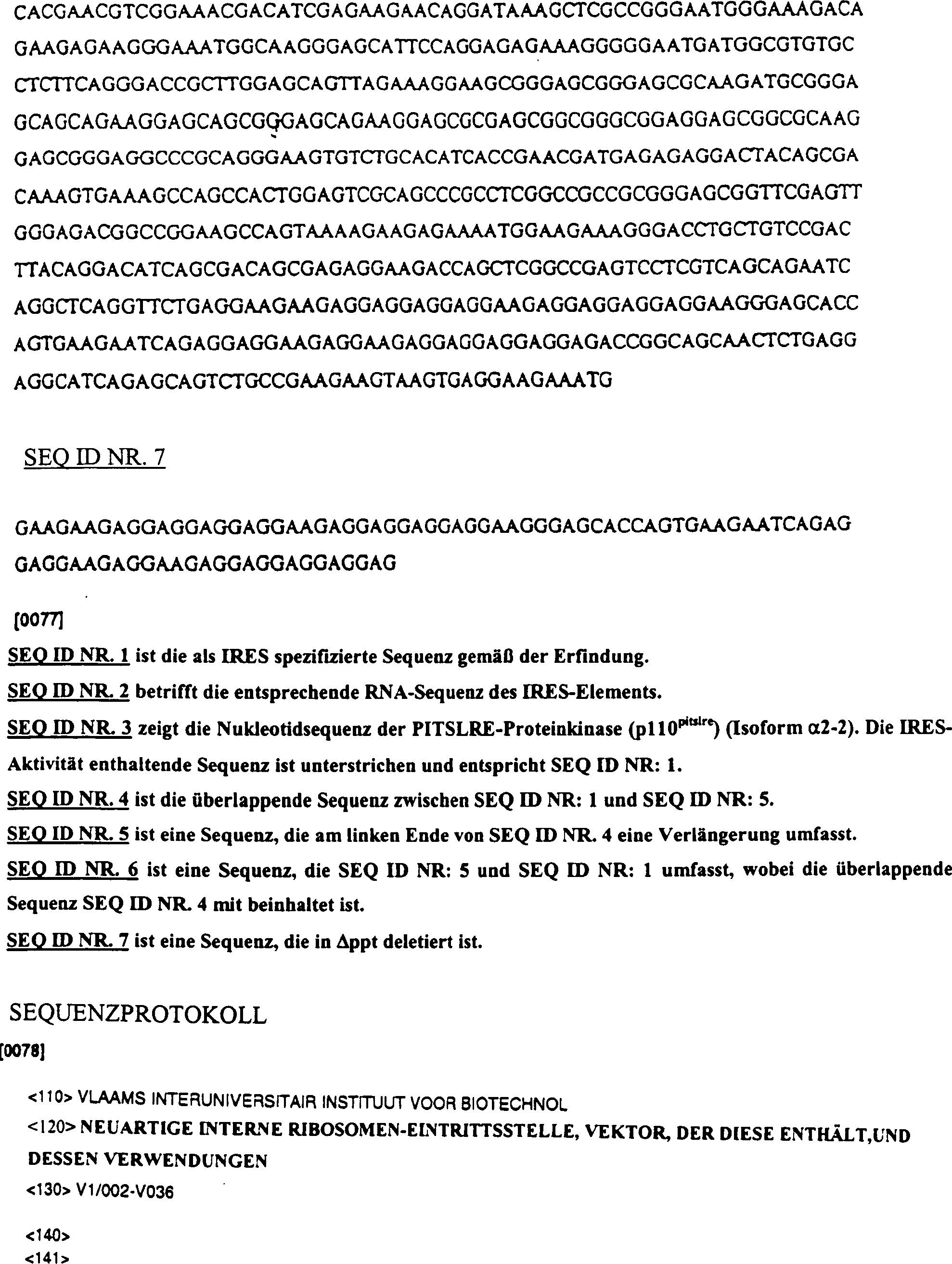
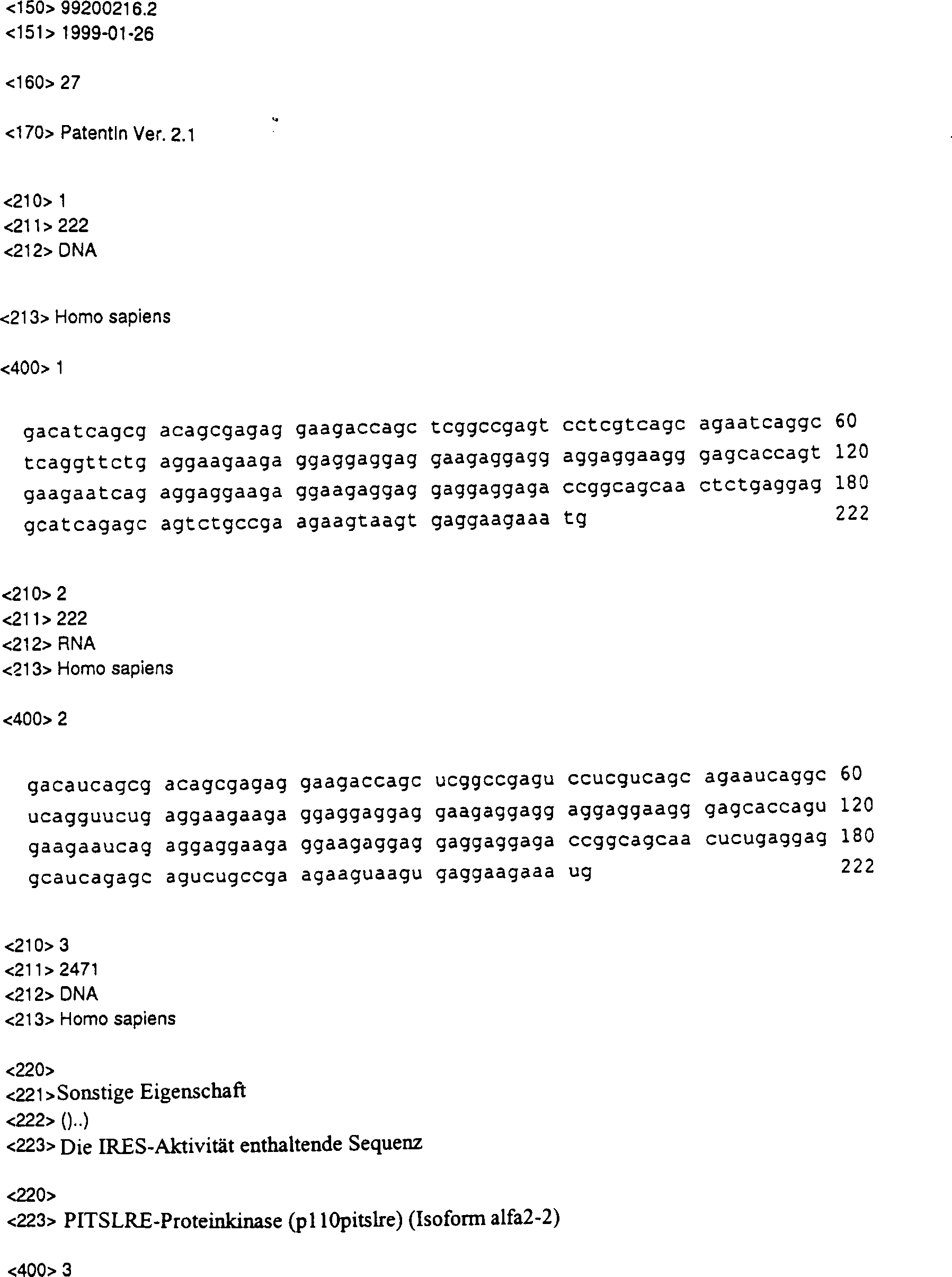

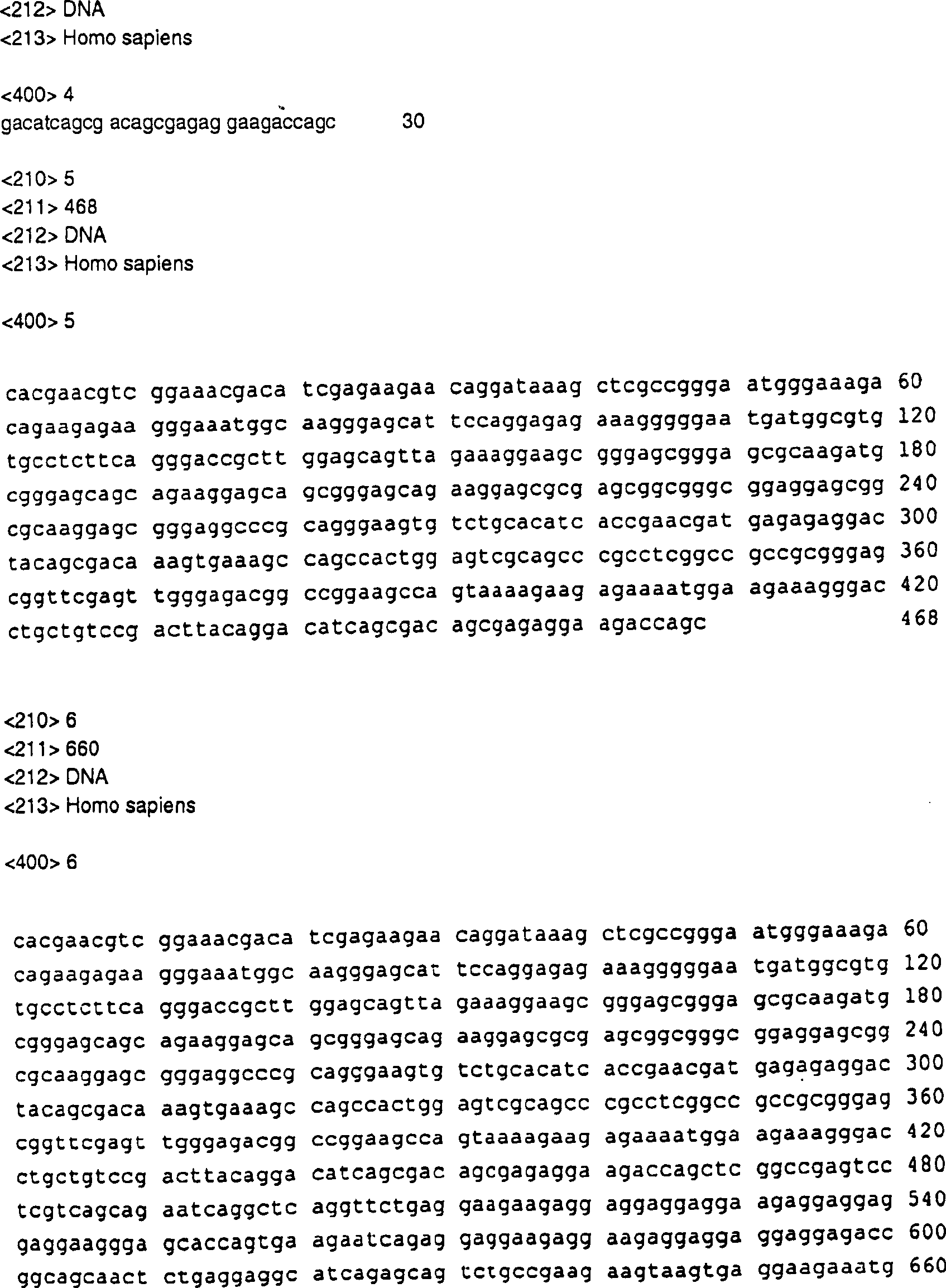
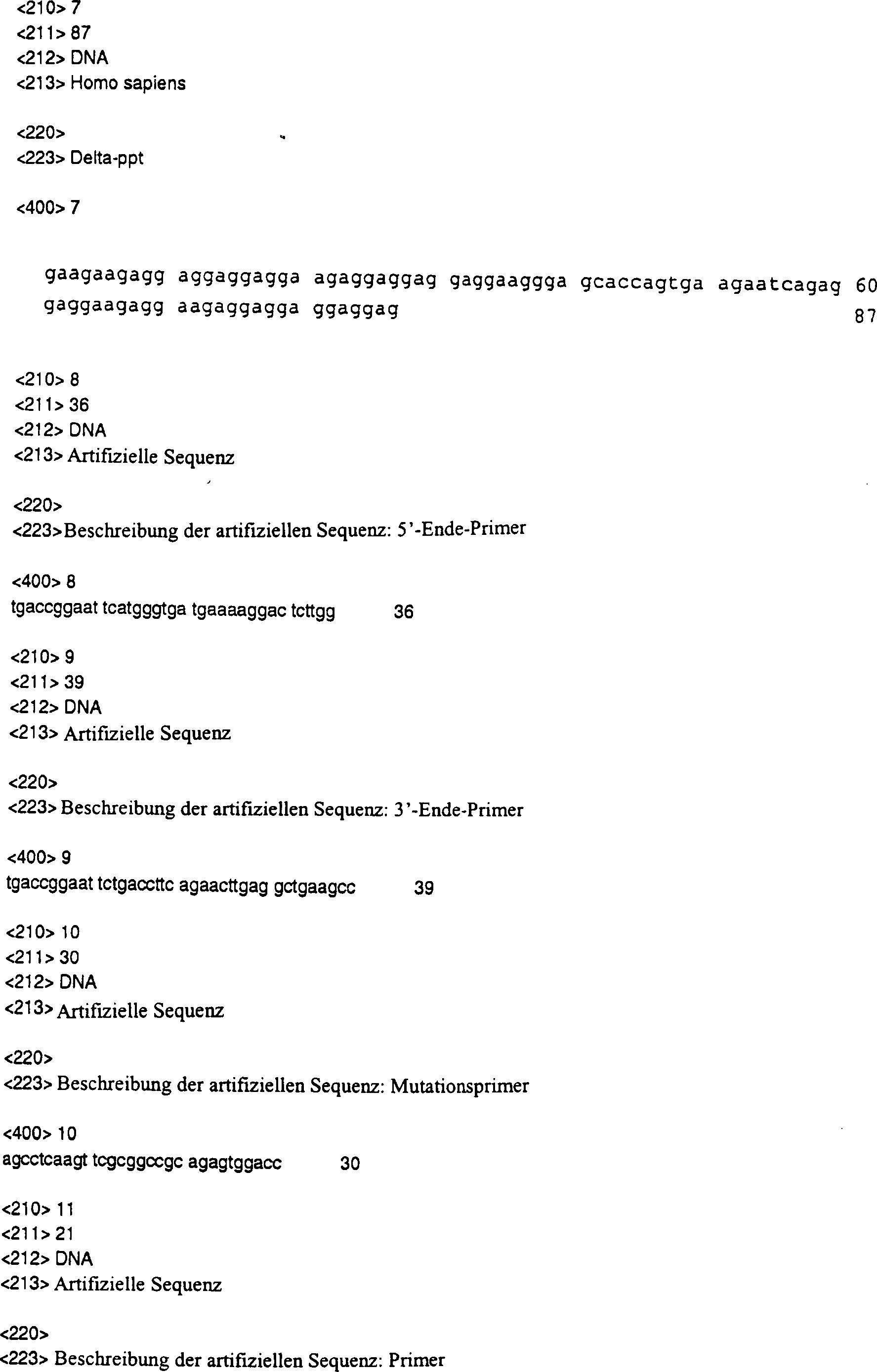


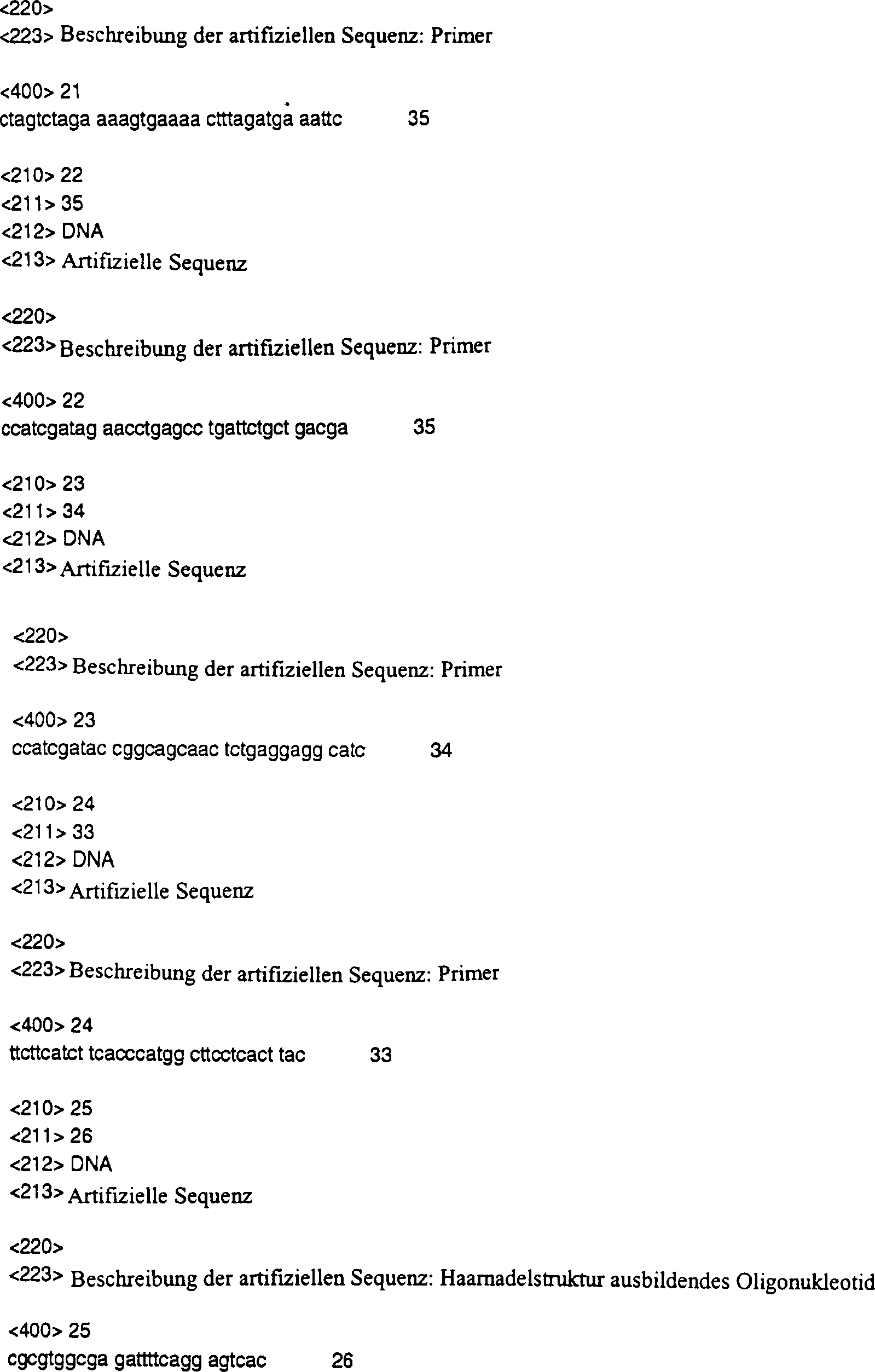
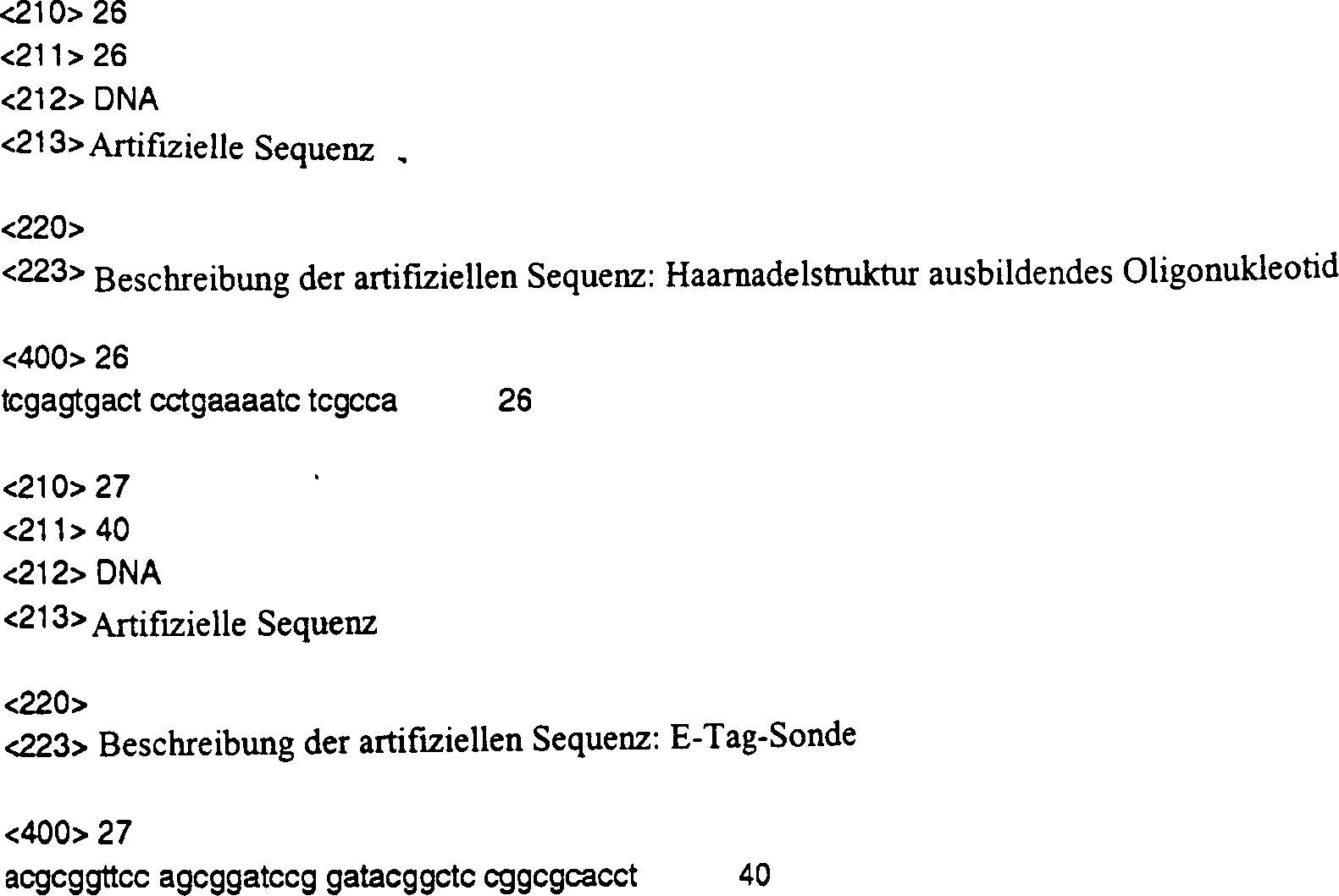
Claims (13)
Applications Claiming Priority (3)
| Application Number | Priority Date | Filing Date | Title |
|---|---|---|---|
| EP99200216 | 1999-01-26 | ||
| EP99200216 | 1999-01-26 | ||
| PCT/EP2000/000643 WO2000044896A1 (en) | 1999-01-26 | 2000-01-26 | Internal ribosome entry site (ires), vector containing same and uses thereof |
Publications (2)
| Publication Number | Publication Date |
|---|---|
| DE60034874D1 DE60034874D1 (en) | 2007-06-28 |
| DE60034874T2 true DE60034874T2 (en) | 2008-01-24 |
Family
ID=8239831
Family Applications (1)
| Application Number | Title | Priority Date | Filing Date |
|---|---|---|---|
| DE60034874T Expired - Fee Related DE60034874T2 (en) | 1999-01-26 | 2000-01-26 | INTERNAL RIBOSOM TERMINAL (IRES), VECTOR OF THESE INCLUDED AND ITS THERAPEUTIC USE |
Country Status (6)
| Country | Link |
|---|---|
| EP (1) | EP1147188B1 (en) |
| AT (1) | ATE362531T1 (en) |
| AU (1) | AU775750B2 (en) |
| CA (1) | CA2357709A1 (en) |
| DE (1) | DE60034874T2 (en) |
| WO (1) | WO2000044896A1 (en) |
Families Citing this family (4)
| Publication number | Priority date | Publication date | Assignee | Title |
|---|---|---|---|---|
| US20020086007A1 (en) * | 2000-10-13 | 2002-07-04 | Sim Kim Lee | Angiogenesis-inhibiting peptides and proteins and methods of use |
| AU2013201458B2 (en) * | 2007-12-11 | 2014-10-02 | The Scripps Research Institute | COMPOSITIONS AND METHODS RELATED TO mRNA TRANSLATIONAL ENHANCER ELEMENTS |
| CN101939428B (en) * | 2007-12-11 | 2014-05-07 | 斯克利普斯研究所 | Compositions and methods involving mRNA translation enhancers |
| WO2012056441A1 (en) * | 2010-10-28 | 2012-05-03 | Nanodoc Ltd. | Compositions and methods for specific cleavage of exogenous rna in a cell |
Family Cites Families (1)
| Publication number | Priority date | Publication date | Assignee | Title |
|---|---|---|---|---|
| WO1998021321A1 (en) * | 1996-11-12 | 1998-05-22 | Qbi Enterprises Ltd. | Method for identifying translationally regulated genes |
-
2000
- 2000-01-26 AT AT00906237T patent/ATE362531T1/en not_active IP Right Cessation
- 2000-01-26 EP EP00906237A patent/EP1147188B1/en not_active Expired - Lifetime
- 2000-01-26 AU AU27992/00A patent/AU775750B2/en not_active Ceased
- 2000-01-26 WO PCT/EP2000/000643 patent/WO2000044896A1/en not_active Ceased
- 2000-01-26 DE DE60034874T patent/DE60034874T2/en not_active Expired - Fee Related
- 2000-01-26 CA CA002357709A patent/CA2357709A1/en not_active Abandoned
Also Published As
| Publication number | Publication date |
|---|---|
| CA2357709A1 (en) | 2000-08-03 |
| ATE362531T1 (en) | 2007-06-15 |
| EP1147188B1 (en) | 2007-05-16 |
| DE60034874D1 (en) | 2007-06-28 |
| WO2000044896A1 (en) | 2000-08-03 |
| AU2799200A (en) | 2000-08-18 |
| AU775750B2 (en) | 2004-08-12 |
| EP1147188A1 (en) | 2001-10-24 |
Similar Documents
| Publication | Publication Date | Title |
|---|---|---|
| EP1776460B1 (en) | Method for modulating gene expression by modifying the cpg content | |
| DE69529174T2 (en) | CELL CYCLE REGULATED REPRESSOR AND DNA ELEMENT | |
| DE69738370T2 (en) | MODULATORS OF THE TNF RECEPTOR ASSOCIATED FACTOR, THEIR PREPARATION AND USES | |
| DE69836139T2 (en) | METHOD FOR THE TREATMENT OF VASCULAR PROLIFERATIVE DISEASES WITH P27 AND FUSIONS THEREOF | |
| US6653132B1 (en) | IRES sequences with high translational efficiency and expression vectors containing the sequence | |
| Bartholomew et al. | The Evi-1 proto-oncogene encodes a transcriptional repressor activity associated with transformation | |
| WO1998037189A9 (en) | Ires sequences with high translational efficiency and expression vectors containing the sequence | |
| AU5494699A (en) | Episomally relicating vector, its preparation and use | |
| Kim et al. | Identification of a protein-binding site in the promoter of the human thymidine kinase gene required for the G1-S-regulated transcription. | |
| DE60034874T2 (en) | INTERNAL RIBOSOM TERMINAL (IRES), VECTOR OF THESE INCLUDED AND ITS THERAPEUTIC USE | |
| WO2000032765A2 (en) | Ribozyme therapy for the treatment and/or prevention of restenosis | |
| US6608037B2 (en) | TCF responsive element | |
| DE69831231T2 (en) | MODULATORS OF INTRA-CELLULAR INFLAMMATORY, CELL-DATE, AND CELL-LIFE PATHS THAT CONTAIN CARD AND KINASE DOMAINS | |
| US6764852B2 (en) | Internal ribosome entry site, vector containing same and uses thereof | |
| DE69637123T2 (en) | THE EXPRESSION OF CYCLIN G1 IN TUMORS | |
| DE60023891T2 (en) | PEPTIDE COMPOUND DERIVED FROM A DELAYED OPEN READING OF THE ICE GENE | |
| EP0857781A2 (en) | Human endoglingene promoter and use thereof | |
| EP0846761A1 (en) | A novel transcription factor expressed in cycling cells, nucleic acid molecules encoding said transcription factor and its promoter region and uses thereof | |
| EP1097234B1 (en) | Method for improving the gene transfer of genetic material in mammalian cells through the use of p21 (waf-1) | |
| US20070275918A1 (en) | Induction of Cellular Senescence by Cdk4 Disruption for Tumor Suppression and Regression | |
| DE4233782A1 (en) | Human embryonal kinase 2-receptor protein - useful in tumour diagnosis and therapy | |
| DE69933382T2 (en) | PREPARATION OF SSDNA INSIDE THE CELL | |
| DE69928960T2 (en) | PREPARATION OF A RETROVIRUS CONTAINING THE MEL LOCUS OF STREPTOMYCES AND ITS EXPRESSION IN MAMMALIAN CELLS | |
| DE102004037652B4 (en) | Method for modulating gene expression by changing the CpG content | |
| DE19816894C1 (en) | SREBP-2 deficient cell lines |
Legal Events
| Date | Code | Title | Description |
|---|---|---|---|
| 8364 | No opposition during term of opposition | ||
| 8339 | Ceased/non-payment of the annual fee |