DE60032123T2 - FORMING PROCESS OF POLYMER POWDER - Google Patents
FORMING PROCESS OF POLYMER POWDER Download PDFInfo
- Publication number
- DE60032123T2 DE60032123T2 DE60032123T DE60032123T DE60032123T2 DE 60032123 T2 DE60032123 T2 DE 60032123T2 DE 60032123 T DE60032123 T DE 60032123T DE 60032123 T DE60032123 T DE 60032123T DE 60032123 T2 DE60032123 T2 DE 60032123T2
- Authority
- DE
- Germany
- Prior art keywords
- temperature
- polymer
- molecular weight
- time
- reptation
- Prior art date
- Legal status (The legal status is an assumption and is not a legal conclusion. Google has not performed a legal analysis and makes no representation as to the accuracy of the status listed.)
- Expired - Fee Related
Links
- 229920000642 polymer Polymers 0.000 title claims abstract description 69
- 238000000034 method Methods 0.000 title claims abstract description 37
- 239000000843 powder Substances 0.000 title claims abstract description 34
- 230000008569 process Effects 0.000 title abstract description 13
- 238000002844 melting Methods 0.000 claims abstract description 16
- 230000008018 melting Effects 0.000 claims abstract description 16
- 238000002425 crystallisation Methods 0.000 claims abstract description 10
- 238000000748 compression moulding Methods 0.000 claims abstract description 8
- 238000001816 cooling Methods 0.000 claims abstract description 7
- 239000004699 Ultra-high molecular weight polyethylene Substances 0.000 claims description 28
- 229920000785 ultra high molecular weight polyethylene Polymers 0.000 claims description 28
- 238000009792 diffusion process Methods 0.000 claims description 22
- -1 Polypropylene Polymers 0.000 claims description 10
- 238000004364 calculation method Methods 0.000 claims description 9
- 230000008025 crystallization Effects 0.000 claims description 9
- 230000004913 activation Effects 0.000 claims description 3
- 229920006158 high molecular weight polymer Polymers 0.000 claims description 3
- 239000004743 Polypropylene Substances 0.000 claims description 2
- 229920001155 polypropylene Polymers 0.000 claims description 2
- 229920001343 polytetrafluoroethylene Polymers 0.000 claims description 2
- 239000004810 polytetrafluoroethylene Substances 0.000 claims description 2
- 238000003825 pressing Methods 0.000 claims description 2
- 238000007906 compression Methods 0.000 abstract description 8
- 230000006835 compression Effects 0.000 abstract description 8
- 210000001145 finger joint Anatomy 0.000 abstract description 2
- 210000000629 knee joint Anatomy 0.000 abstract description 2
- 210000001226 toe joint Anatomy 0.000 abstract description 2
- 210000000544 articulatio talocruralis Anatomy 0.000 abstract 1
- 210000002310 elbow joint Anatomy 0.000 abstract 1
- 210000004394 hip joint Anatomy 0.000 abstract 1
- 210000000323 shoulder joint Anatomy 0.000 abstract 1
- 210000003857 wrist joint Anatomy 0.000 abstract 1
- 239000002245 particle Substances 0.000 description 25
- 238000000465 moulding Methods 0.000 description 17
- 239000000463 material Substances 0.000 description 10
- 238000000265 homogenisation Methods 0.000 description 9
- 230000007547 defect Effects 0.000 description 7
- 239000007787 solid Substances 0.000 description 7
- 239000004698 Polyethylene Substances 0.000 description 6
- 229920000573 polyethylene Polymers 0.000 description 6
- 238000012545 processing Methods 0.000 description 6
- 238000007493 shaping process Methods 0.000 description 6
- 238000013461 design Methods 0.000 description 5
- 230000000694 effects Effects 0.000 description 5
- 230000008030 elimination Effects 0.000 description 5
- 238000003379 elimination reaction Methods 0.000 description 5
- 230000004927 fusion Effects 0.000 description 5
- 210000003127 knee Anatomy 0.000 description 5
- 239000000155 melt Substances 0.000 description 5
- 239000008188 pellet Substances 0.000 description 5
- 238000005336 cracking Methods 0.000 description 4
- 230000006870 function Effects 0.000 description 4
- 230000035945 sensitivity Effects 0.000 description 4
- 238000004088 simulation Methods 0.000 description 4
- 238000012360 testing method Methods 0.000 description 4
- 238000012546 transfer Methods 0.000 description 4
- 238000007596 consolidation process Methods 0.000 description 3
- 238000004519 manufacturing process Methods 0.000 description 3
- 238000005259 measurement Methods 0.000 description 3
- 230000000399 orthopedic effect Effects 0.000 description 3
- 230000008901 benefit Effects 0.000 description 2
- 238000006243 chemical reaction Methods 0.000 description 2
- 238000010438 heat treatment Methods 0.000 description 2
- 238000011065 in-situ storage Methods 0.000 description 2
- 229920003023 plastic Polymers 0.000 description 2
- 239000004033 plastic Substances 0.000 description 2
- 239000000047 product Substances 0.000 description 2
- 238000009790 rate-determining step (RDS) Methods 0.000 description 2
- 238000001878 scanning electron micrograph Methods 0.000 description 2
- 208000003076 Osteolysis Diseases 0.000 description 1
- 229910001252 Pd alloy Inorganic materials 0.000 description 1
- 229920010741 Ultra High Molecular Weight Polyethylene (UHMWPE) Polymers 0.000 description 1
- 238000013459 approach Methods 0.000 description 1
- 206010003246 arthritis Diseases 0.000 description 1
- 230000003542 behavioural effect Effects 0.000 description 1
- 239000012620 biological material Substances 0.000 description 1
- 230000015572 biosynthetic process Effects 0.000 description 1
- 210000000988 bone and bone Anatomy 0.000 description 1
- 210000002449 bone cell Anatomy 0.000 description 1
- 210000004556 brain Anatomy 0.000 description 1
- CJZGTCYPCWQAJB-UHFFFAOYSA-L calcium stearate Chemical compound [Ca+2].CCCCCCCCCCCCCCCCCC([O-])=O.CCCCCCCCCCCCCCCCCC([O-])=O CJZGTCYPCWQAJB-UHFFFAOYSA-L 0.000 description 1
- 235000013539 calcium stearate Nutrition 0.000 description 1
- 239000008116 calcium stearate Substances 0.000 description 1
- 239000003054 catalyst Substances 0.000 description 1
- 230000001413 cellular effect Effects 0.000 description 1
- 230000008859 change Effects 0.000 description 1
- 239000011248 coating agent Substances 0.000 description 1
- 238000000576 coating method Methods 0.000 description 1
- 239000002131 composite material Substances 0.000 description 1
- 230000007123 defense Effects 0.000 description 1
- 230000032798 delamination Effects 0.000 description 1
- 238000011161 development Methods 0.000 description 1
- 238000000113 differential scanning calorimetry Methods 0.000 description 1
- 238000007907 direct compression Methods 0.000 description 1
- 230000007613 environmental effect Effects 0.000 description 1
- 239000012467 final product Substances 0.000 description 1
- 230000004907 flux Effects 0.000 description 1
- 210000003108 foot joint Anatomy 0.000 description 1
- PCHJSUWPFVWCPO-UHFFFAOYSA-N gold Chemical compound [Au] PCHJSUWPFVWCPO-UHFFFAOYSA-N 0.000 description 1
- 239000010931 gold Substances 0.000 description 1
- 229910052737 gold Inorganic materials 0.000 description 1
- BBKFSSMUWOMYPI-UHFFFAOYSA-N gold palladium Chemical compound [Pd].[Au] BBKFSSMUWOMYPI-UHFFFAOYSA-N 0.000 description 1
- 239000008187 granular material Substances 0.000 description 1
- 238000011540 hip replacement Methods 0.000 description 1
- 238000013150 knee replacement Methods 0.000 description 1
- 208000029791 lytic metastatic bone lesion Diseases 0.000 description 1
- 238000003754 machining Methods 0.000 description 1
- 229910052751 metal Inorganic materials 0.000 description 1
- 239000002184 metal Substances 0.000 description 1
- 238000010327 methods by industry Methods 0.000 description 1
- 238000001000 micrograph Methods 0.000 description 1
- 208000015122 neurodegenerative disease Diseases 0.000 description 1
- 238000005457 optimization Methods 0.000 description 1
- 210000000963 osteoblast Anatomy 0.000 description 1
- 230000003647 oxidation Effects 0.000 description 1
- 238000007254 oxidation reaction Methods 0.000 description 1
- 230000037361 pathway Effects 0.000 description 1
- 238000007747 plating Methods 0.000 description 1
- 238000006116 polymerization reaction Methods 0.000 description 1
- 238000011084 recovery Methods 0.000 description 1
- 230000009467 reduction Effects 0.000 description 1
- 238000011160 research Methods 0.000 description 1
- 230000004044 response Effects 0.000 description 1
- 238000004626 scanning electron microscopy Methods 0.000 description 1
- 238000001356 surgical procedure Methods 0.000 description 1
- 238000009864 tensile test Methods 0.000 description 1
- 229920001169 thermoplastic Polymers 0.000 description 1
- 239000004416 thermosoftening plastic Substances 0.000 description 1
- 230000007704 transition Effects 0.000 description 1
- 238000003466 welding Methods 0.000 description 1
- 238000009736 wetting Methods 0.000 description 1
Classifications
-
- B—PERFORMING OPERATIONS; TRANSPORTING
- B29—WORKING OF PLASTICS; WORKING OF SUBSTANCES IN A PLASTIC STATE IN GENERAL
- B29C—SHAPING OR JOINING OF PLASTICS; SHAPING OF MATERIAL IN A PLASTIC STATE, NOT OTHERWISE PROVIDED FOR; AFTER-TREATMENT OF THE SHAPED PRODUCTS, e.g. REPAIRING
- B29C43/00—Compression moulding, i.e. applying external pressure to flow the moulding material; Apparatus therefor
- B29C43/003—Compression moulding, i.e. applying external pressure to flow the moulding material; Apparatus therefor characterised by the choice of material
-
- B—PERFORMING OPERATIONS; TRANSPORTING
- B29—WORKING OF PLASTICS; WORKING OF SUBSTANCES IN A PLASTIC STATE IN GENERAL
- B29C—SHAPING OR JOINING OF PLASTICS; SHAPING OF MATERIAL IN A PLASTIC STATE, NOT OTHERWISE PROVIDED FOR; AFTER-TREATMENT OF THE SHAPED PRODUCTS, e.g. REPAIRING
- B29C43/00—Compression moulding, i.e. applying external pressure to flow the moulding material; Apparatus therefor
- B29C43/006—Pressing and sintering powders, granules or fibres
-
- A—HUMAN NECESSITIES
- A61—MEDICAL OR VETERINARY SCIENCE; HYGIENE
- A61F—FILTERS IMPLANTABLE INTO BLOOD VESSELS; PROSTHESES; DEVICES PROVIDING PATENCY TO, OR PREVENTING COLLAPSING OF, TUBULAR STRUCTURES OF THE BODY, e.g. STENTS; ORTHOPAEDIC, NURSING OR CONTRACEPTIVE DEVICES; FOMENTATION; TREATMENT OR PROTECTION OF EYES OR EARS; BANDAGES, DRESSINGS OR ABSORBENT PADS; FIRST-AID KITS
- A61F2/00—Filters implantable into blood vessels; Prostheses, i.e. artificial substitutes or replacements for parts of the body; Appliances for connecting them with the body; Devices providing patency to, or preventing collapsing of, tubular structures of the body, e.g. stents
- A61F2/02—Prostheses implantable into the body
- A61F2/30—Joints
- A61F2/32—Joints for the hip
-
- A—HUMAN NECESSITIES
- A61—MEDICAL OR VETERINARY SCIENCE; HYGIENE
- A61F—FILTERS IMPLANTABLE INTO BLOOD VESSELS; PROSTHESES; DEVICES PROVIDING PATENCY TO, OR PREVENTING COLLAPSING OF, TUBULAR STRUCTURES OF THE BODY, e.g. STENTS; ORTHOPAEDIC, NURSING OR CONTRACEPTIVE DEVICES; FOMENTATION; TREATMENT OR PROTECTION OF EYES OR EARS; BANDAGES, DRESSINGS OR ABSORBENT PADS; FIRST-AID KITS
- A61F2/00—Filters implantable into blood vessels; Prostheses, i.e. artificial substitutes or replacements for parts of the body; Appliances for connecting them with the body; Devices providing patency to, or preventing collapsing of, tubular structures of the body, e.g. stents
- A61F2/02—Prostheses implantable into the body
- A61F2/30—Joints
- A61F2/38—Joints for elbows or knees
-
- A—HUMAN NECESSITIES
- A61—MEDICAL OR VETERINARY SCIENCE; HYGIENE
- A61F—FILTERS IMPLANTABLE INTO BLOOD VESSELS; PROSTHESES; DEVICES PROVIDING PATENCY TO, OR PREVENTING COLLAPSING OF, TUBULAR STRUCTURES OF THE BODY, e.g. STENTS; ORTHOPAEDIC, NURSING OR CONTRACEPTIVE DEVICES; FOMENTATION; TREATMENT OR PROTECTION OF EYES OR EARS; BANDAGES, DRESSINGS OR ABSORBENT PADS; FIRST-AID KITS
- A61F2/00—Filters implantable into blood vessels; Prostheses, i.e. artificial substitutes or replacements for parts of the body; Appliances for connecting them with the body; Devices providing patency to, or preventing collapsing of, tubular structures of the body, e.g. stents
- A61F2/02—Prostheses implantable into the body
- A61F2/30—Joints
- A61F2/38—Joints for elbows or knees
- A61F2/3804—Joints for elbows or knees for elbows
-
- A—HUMAN NECESSITIES
- A61—MEDICAL OR VETERINARY SCIENCE; HYGIENE
- A61F—FILTERS IMPLANTABLE INTO BLOOD VESSELS; PROSTHESES; DEVICES PROVIDING PATENCY TO, OR PREVENTING COLLAPSING OF, TUBULAR STRUCTURES OF THE BODY, e.g. STENTS; ORTHOPAEDIC, NURSING OR CONTRACEPTIVE DEVICES; FOMENTATION; TREATMENT OR PROTECTION OF EYES OR EARS; BANDAGES, DRESSINGS OR ABSORBENT PADS; FIRST-AID KITS
- A61F2/00—Filters implantable into blood vessels; Prostheses, i.e. artificial substitutes or replacements for parts of the body; Appliances for connecting them with the body; Devices providing patency to, or preventing collapsing of, tubular structures of the body, e.g. stents
- A61F2/02—Prostheses implantable into the body
- A61F2/30—Joints
- A61F2/40—Joints for shoulders
-
- A—HUMAN NECESSITIES
- A61—MEDICAL OR VETERINARY SCIENCE; HYGIENE
- A61F—FILTERS IMPLANTABLE INTO BLOOD VESSELS; PROSTHESES; DEVICES PROVIDING PATENCY TO, OR PREVENTING COLLAPSING OF, TUBULAR STRUCTURES OF THE BODY, e.g. STENTS; ORTHOPAEDIC, NURSING OR CONTRACEPTIVE DEVICES; FOMENTATION; TREATMENT OR PROTECTION OF EYES OR EARS; BANDAGES, DRESSINGS OR ABSORBENT PADS; FIRST-AID KITS
- A61F2/00—Filters implantable into blood vessels; Prostheses, i.e. artificial substitutes or replacements for parts of the body; Appliances for connecting them with the body; Devices providing patency to, or preventing collapsing of, tubular structures of the body, e.g. stents
- A61F2/02—Prostheses implantable into the body
- A61F2/30—Joints
- A61F2/42—Joints for wrists or ankles; for hands, e.g. fingers; for feet, e.g. toes
- A61F2/4202—Joints for wrists or ankles; for hands, e.g. fingers; for feet, e.g. toes for ankles
-
- A—HUMAN NECESSITIES
- A61—MEDICAL OR VETERINARY SCIENCE; HYGIENE
- A61F—FILTERS IMPLANTABLE INTO BLOOD VESSELS; PROSTHESES; DEVICES PROVIDING PATENCY TO, OR PREVENTING COLLAPSING OF, TUBULAR STRUCTURES OF THE BODY, e.g. STENTS; ORTHOPAEDIC, NURSING OR CONTRACEPTIVE DEVICES; FOMENTATION; TREATMENT OR PROTECTION OF EYES OR EARS; BANDAGES, DRESSINGS OR ABSORBENT PADS; FIRST-AID KITS
- A61F2/00—Filters implantable into blood vessels; Prostheses, i.e. artificial substitutes or replacements for parts of the body; Appliances for connecting them with the body; Devices providing patency to, or preventing collapsing of, tubular structures of the body, e.g. stents
- A61F2/02—Prostheses implantable into the body
- A61F2/30—Joints
- A61F2/42—Joints for wrists or ankles; for hands, e.g. fingers; for feet, e.g. toes
- A61F2/4225—Joints for wrists or ankles; for hands, e.g. fingers; for feet, e.g. toes for feet, e.g. toes
-
- A—HUMAN NECESSITIES
- A61—MEDICAL OR VETERINARY SCIENCE; HYGIENE
- A61F—FILTERS IMPLANTABLE INTO BLOOD VESSELS; PROSTHESES; DEVICES PROVIDING PATENCY TO, OR PREVENTING COLLAPSING OF, TUBULAR STRUCTURES OF THE BODY, e.g. STENTS; ORTHOPAEDIC, NURSING OR CONTRACEPTIVE DEVICES; FOMENTATION; TREATMENT OR PROTECTION OF EYES OR EARS; BANDAGES, DRESSINGS OR ABSORBENT PADS; FIRST-AID KITS
- A61F2/00—Filters implantable into blood vessels; Prostheses, i.e. artificial substitutes or replacements for parts of the body; Appliances for connecting them with the body; Devices providing patency to, or preventing collapsing of, tubular structures of the body, e.g. stents
- A61F2/02—Prostheses implantable into the body
- A61F2/30—Joints
- A61F2/42—Joints for wrists or ankles; for hands, e.g. fingers; for feet, e.g. toes
- A61F2/4241—Joints for wrists or ankles; for hands, e.g. fingers; for feet, e.g. toes for hands, e.g. fingers
-
- A—HUMAN NECESSITIES
- A61—MEDICAL OR VETERINARY SCIENCE; HYGIENE
- A61F—FILTERS IMPLANTABLE INTO BLOOD VESSELS; PROSTHESES; DEVICES PROVIDING PATENCY TO, OR PREVENTING COLLAPSING OF, TUBULAR STRUCTURES OF THE BODY, e.g. STENTS; ORTHOPAEDIC, NURSING OR CONTRACEPTIVE DEVICES; FOMENTATION; TREATMENT OR PROTECTION OF EYES OR EARS; BANDAGES, DRESSINGS OR ABSORBENT PADS; FIRST-AID KITS
- A61F2/00—Filters implantable into blood vessels; Prostheses, i.e. artificial substitutes or replacements for parts of the body; Appliances for connecting them with the body; Devices providing patency to, or preventing collapsing of, tubular structures of the body, e.g. stents
- A61F2/02—Prostheses implantable into the body
- A61F2/30—Joints
- A61F2/42—Joints for wrists or ankles; for hands, e.g. fingers; for feet, e.g. toes
- A61F2/4261—Joints for wrists or ankles; for hands, e.g. fingers; for feet, e.g. toes for wrists
-
- A—HUMAN NECESSITIES
- A61—MEDICAL OR VETERINARY SCIENCE; HYGIENE
- A61F—FILTERS IMPLANTABLE INTO BLOOD VESSELS; PROSTHESES; DEVICES PROVIDING PATENCY TO, OR PREVENTING COLLAPSING OF, TUBULAR STRUCTURES OF THE BODY, e.g. STENTS; ORTHOPAEDIC, NURSING OR CONTRACEPTIVE DEVICES; FOMENTATION; TREATMENT OR PROTECTION OF EYES OR EARS; BANDAGES, DRESSINGS OR ABSORBENT PADS; FIRST-AID KITS
- A61F2/00—Filters implantable into blood vessels; Prostheses, i.e. artificial substitutes or replacements for parts of the body; Appliances for connecting them with the body; Devices providing patency to, or preventing collapsing of, tubular structures of the body, e.g. stents
- A61F2/02—Prostheses implantable into the body
- A61F2/30—Joints
- A61F2/3094—Designing or manufacturing processes
- A61F2/30942—Designing or manufacturing processes for designing or making customized prostheses, e.g. using templates, CT or NMR scans, finite-element analysis or CAD-CAM techniques
- A61F2002/30957—Designing or manufacturing processes for designing or making customized prostheses, e.g. using templates, CT or NMR scans, finite-element analysis or CAD-CAM techniques using a positive or a negative model, e.g. moulds
-
- B—PERFORMING OPERATIONS; TRANSPORTING
- B29—WORKING OF PLASTICS; WORKING OF SUBSTANCES IN A PLASTIC STATE IN GENERAL
- B29C—SHAPING OR JOINING OF PLASTICS; SHAPING OF MATERIAL IN A PLASTIC STATE, NOT OTHERWISE PROVIDED FOR; AFTER-TREATMENT OF THE SHAPED PRODUCTS, e.g. REPAIRING
- B29C43/00—Compression moulding, i.e. applying external pressure to flow the moulding material; Apparatus therefor
- B29C43/32—Component parts, details or accessories; Auxiliary operations
- B29C43/58—Measuring, controlling or regulating
- B29C2043/5816—Measuring, controlling or regulating temperature
-
- B—PERFORMING OPERATIONS; TRANSPORTING
- B29—WORKING OF PLASTICS; WORKING OF SUBSTANCES IN A PLASTIC STATE IN GENERAL
- B29K—INDEXING SCHEME ASSOCIATED WITH SUBCLASSES B29B, B29C OR B29D, RELATING TO MOULDING MATERIALS OR TO MATERIALS FOR MOULDS, REINFORCEMENTS, FILLERS OR PREFORMED PARTS, e.g. INSERTS
- B29K2023/00—Use of polyalkenes or derivatives thereof as moulding material
- B29K2023/04—Polymers of ethylene
- B29K2023/06—PE, i.e. polyethylene
- B29K2023/0658—PE, i.e. polyethylene characterised by its molecular weight
- B29K2023/0683—UHMWPE, i.e. ultra high molecular weight polyethylene
-
- B—PERFORMING OPERATIONS; TRANSPORTING
- B29—WORKING OF PLASTICS; WORKING OF SUBSTANCES IN A PLASTIC STATE IN GENERAL
- B29L—INDEXING SCHEME ASSOCIATED WITH SUBCLASS B29C, RELATING TO PARTICULAR ARTICLES
- B29L2031/00—Other particular articles
- B29L2031/753—Medical equipment; Accessories therefor
- B29L2031/7532—Artificial members, protheses
Landscapes
- Engineering & Computer Science (AREA)
- Mechanical Engineering (AREA)
- Casting Or Compression Moulding Of Plastics Or The Like (AREA)
- Prostheses (AREA)
- Compressor (AREA)
- Mechanical Operated Clutches (AREA)
- Addition Polymer Or Copolymer, Post-Treatments, Or Chemical Modifications (AREA)
Abstract
Description
Die vorliegende Erfindung betrifft das Formpressen von Polymeren mit hohem Molekulargewicht.The The present invention relates to molding of polymers with high molecular weight.
Die Verarbeitung von Polymeren mit ultrahohem Molekulargewicht zu tragfähigen Komponenten unter Verwendung von Techniken, welche für Thermoplaste gebräuchlich sind, ist aufgrund der außergewöhnlich hohen Viskosität derartiger Materialien nicht praktikabel. Der Polymerhersteller erzeugt ein polymerisiertes Pulver, welches anschließend zu einem kontinuierlichen Feststoff komprimiert werden muss. Ein Komprimierungsverfahren besteht darin, große Platten oder Stangen durch Schmelzen des Pulvers und Komprimieren oder Extrudieren der Schmelze, gefolgt von einem Abkühlen zur Bildung des Feststoffes, zu erzeugen. Anschließend werden aus diesem Massenvorrat durch maschinelle Verarbeitung einzelne Komponenten hergestellt.The Processing ultra-high molecular weight polymers into viable components using techniques which are common for thermoplastics are because of the exceptionally high viscosity of such materials impractical. The polymer manufacturer produces a polymerized powder, which is subsequently added a continuous solid must be compressed. A compression method is great Plates or bars by melting the powder and compressing or Extruding the melt, followed by cooling to form the solid, to create. Subsequently from this mass supply by machine processing individual Components made.
Eine Alternative stellt das direkte Endformpressen des Pulvers in erhitzten Pressformen mit geeigneter Gestalt dar. Eine eingewogene Charge des Pulvers wird in den fixierten Teil der Pressform eingefüllt, und es wird über den beweglichen Teil der Pressform Druck ausgeübt. Komponenten, welche hinsichtlich des Grundrisses gleiche Dimensionen besitzen, jedoch eine unterschiedliche Dicke aufweisen, können durch Variation des Gewichts der Charge hergestellt werden.A Alternative represents the direct final molding of the powder in heated Molds of suitable shape. A weighed batch of the powder is filled in the fixed part of the mold, and it will be over the pressure applied to the moving part of the mold. Components, which regard of the ground plan have the same dimensions but a different one Have thickness can be made by varying the weight of the batch.
Um die mechanische Integrität von Komponenten sicherzustellen und deren Festigkeit und Verschleißfestigkeit zu maximieren, ist es von entscheidender Bedeutung, dass das Pulver vollständig komprimiert ist. Darüber hinaus muss der Formgebungsprozess eine vollständige Homogenisierung des Polymers erzielen, damit keine Schwächeebenen an den ursprünglichen Partikelgrenzen zurückbleiben (welche zu bevorzugten Stellen für Ermüdungsrisswachstum führen). Der Homogenisierungsprozess des Polymers kann ferner mittels der Begriffe Verschweißung, Diffusion, Selbstdiffusion, Konsolidierung, und/oder Verschmelzung beschrieben werden. Eine vollständige Homogenisierung erfordert zwei abgeschlossene Schritte, welche durch erhöhten Druck und erhöhte Temperatur gefördert werden. Erstens muss das Pulver vollständig komprimiert sein, wobei die Partikel deformiert und auf molekularer Ebene in einen engen Kontakt gezwungen werden (vollständig benetzt), wobei alle Hohlräume eliminiert werden. Zweitens müssen die Polymerketten über die Partikelgrenzflächen hinweg diffundieren, bis die Verhakungen auf beiden Seiten der Grenzflächen vollständig miteinander verknüpft sind und kein Erinnerungsvermögen an die ursprünglichen Grenzflächen verbleibt.Around the mechanical integrity of components and their strength and wear resistance To maximize, it is crucial that the powder Completely is compressed. About that In addition, the molding process requires complete homogenization of the polymer achieve, so no weakness levels at the original Particle boundaries remain (which to preferred places for Fatigue crack growth to lead). The homogenization process of the polymer can also be carried out by means of Terms welding, Diffusion, self-diffusion, consolidation, and / or merging to be discribed. A complete Homogenization requires two completed steps, through increased pressure and increased Temperature promoted become. First, the powder must be completely compressed, with the Particles deformed and in close contact at the molecular level be forced (completely wetted), all cavities be eliminated. Second, must the polymer chains over the particle interfaces diffuse until the entanglements on both sides of the interfaces are completely interlinked and no memory to the original ones interfaces remains.
Damit diese beiden Prozesse stattfinden, wird ausreichend Zeit für den Wärmeübergang von den erhitzten Oberflächen der Pressform benötigt, um eine Erhöhung der Temperatur im Zentrum der Pressform auf die für die Homogenisierung erforderliche Temperatur zu bewirken. Darüber hinaus muss diese Temperatur für einen ausreichend langen Zeitraum aufrechterhalten werden, dass die Homogenisierung stattfindet. Hersteller legen nicht offen, welche Druck-, Zeit- und Temperaturzyklen zur Herstellung ihrer Komponenten verwendet werden, und diese variieren zweifelsohne von Hersteller zu Hersteller.In order to These two processes take place, there will be enough time for the heat transfer from the heated surfaces the mold needed, an increase the temperature in the center of the mold to that for homogenization effect required temperature. In addition, this temperature needs for one be maintained sufficiently long period of time that homogenization takes place. Manufacturers do not disclose which pressure, time and temperature cycles used to make their components, and these vary no doubt from manufacturer to manufacturer.
Formpresstechniken finden insbesondere bei der Herstellung von Gelenkersatzprothesen, wie beispielsweise künstlichen Hüft- und Kniegelenken, Anwendung.Molding techniques especially in the production of joint replacement prostheses, such as artificial Hip and hip Knee joints, application.
Über 1 Million Gelenkersatzkörper werden jährlich weltweit implantiert. Praktisch alle hiervon umfassen Elemente aus Polyethylen mit ultrahohem Molekulargewicht (UHMWPE), welche Gelenkplastiken mit geringer Reibung bereitstellen, wenn diese mit polierten Metalloberflächen Gelenke bilden.Over 1 million Joint replacement body be yearly implanted worldwide. Virtually all of these include elements Ultra-high molecular weight polyethylene (UHMWPE), which is articular plastic provide low friction when using joints with polished metal surfaces form.
Das direkte Formpressen besitzt im Vergleich zum Formpressen größerer Platten oder Stangen, welchem ein maschinelle Verarbeitung folgt, bestimmte Vorteile. Die einzigen äußeren maschinellen Verarbeitungsmerkmale sind jene der Pressform, und es ist möglich, ein hochglattes und glänzendes Oberflächenfinish zu erzielen.The direct compression molding has larger plates compared to compression molding or bars followed by machine processing Advantages. The only external machine Processing characteristics are those of the mold, and it is possible to use a smooth and shiny Surface finish too achieve.
Darüber hinaus kann das Polymer um metallische Einsätze herum formgepresst werden, um Verbundkomponenten herzustellen.Furthermore the polymer can be molded around metallic inserts, to produce composite components.
UHMWPE stellt aufgrund seiner Biokompatibilität, hohen Schlagzähigkeit, geringen Reibung und hohen Verschleißfestigkeit als passende Eigenschaften das am häufigsten verwendete Material für tragende Oberflächen betreffend die Gesamtzahl an Knie- und Hüftgelenksersatzprothesen seit den 70er Jahren des 20. Jahrhunderts dar (Li, S. und Burstein, A.H., The Journal of Bone and Joint Surgery, Incorporated, 76-A, 1080 (1994)). Neueste Untersuchungen betreffend die Mikrostruktur des Materials haben jedoch gezeigt, dass eine unvollständige Konsolidierung des UHMWPE-Pulvers, welche zu „Schmelzdefekten" führt, Materialdefekte aufgrund von Ermüdung zur Folge hat (Mayor, M.D., Wrona, M., Collier, J.P. und Jensen, R.E., Clinical Orthopaedics and Related Research, 299, 92 (1994)). Rissbildung und Delaminierung, welche insbesondere mit Ermüdungsbrüchen assoziiert sind, wurde bei zurückerlangten Kniekomponenten festgestellt. Es wurde eine große Menge an Literatur geschaffen, welche die Morphologie der Verschleißpartikel charakterisiert, die zellulären Reaktionen der Partikel beschreibt, die Effekte von Oxidation und Bestrahlung auf die mechanischen Eigenschaften des Polymers definiert, die Ergebnisse von Verschleißversuchen in Hüft- und Kniesimulatoren im Labor sowie in Wiederfindungsstudien von Komponenten, welche Patienten im Rahmen einer Revision entfernt worden waren, beschreiben. Um das Auftreten von Verschleiß, Rissbildung und Deformation zu minimieren, besteht ein dringendes Bedürfnis, das Verständnis bezüglich der die Homogenisierung bestimmenden Faktoren sowie der Beseitigung von Schmelzdefekten zu verbessern, und durch geeignete Technik des Herstellungsprozesses verlässliche Mittel zur Sicherstellung von deren Abwesenheit zu entwickeln. In der Praxis findet ein Sortiment an Prothesenausgestaltungen Verwendung, wobei jede Ausgestaltung einer Komponente in einer Vielzahl von Größen produziert wird, um den Bedürfnissen unterschiedlicher Patienten gerecht zu werden. Es ist erforderlich, ideale Formgebungsbedingungen für jede Komponentengröße zu entwickeln.Due to its biocompatibility, high impact resistance, low friction, and high wear resistance, UHMWPE is the most commonly used material for structural surfaces in terms of the total number of knee and hip replacement prostheses since the 1970s (Li, S., and Burstein). AH, The Journal of Bone and Joint Surgery, Incorporated, 76-A, 1080 (1994)). Recent studies on the microstructure of the material have shown, however, that incomplete consolidation of the UHMWPE powder, which leads to "melt defects", leads to material defects from fatigue (Mayor, MD, Wrona, M., Collier, JP and Jensen, RE, Clinical Orthopedics and Related Research, 299, 92 (1994)). Cracking and delamination, particularly associated with fatigue fractures, was noted with recaptured knee components. A large body of literature has been created which characterizes the morphology of the wear particles, which describes cellular reactions of the particles, defines the effects of oxidation and irradiation on the mechanical properties of the polymer, the results of wear tests in hip and knee simulators in the laboratory and in the field Describe recovery studies of components removed from patients during revision. In order to minimize the occurrence of wear, cracking and deformation, there is an urgent need to improve the understanding of the homogenization determining factors and the elimination of melt defects, and to develop reliable means of ensuring their absence by appropriate manufacturing technique techniques. In practice, an assortment of prosthetic designs is used, with each embodiment of a component being produced in a variety of sizes to suit the needs of different patients. It is necessary to develop ideal forming conditions for each component size.
Folglich besteht ein Bedürfnis hinsichtlich einer flexiblen, computergestützten Verfahrenstechnik, welche auf der Stufe der Konzipierung von Produkten verwendet werden kann, um den Formgebungsprozess für jede einzelne Komponente zu optimieren. Hinsichtlich einer Optimierung des Formgebungs-/Herstellungsprozesses gab es im Gegensatz zu der Darlegung, dass die von unterschiedlichen Herstellern produzierten Komponenten unterschiedliche Verschleißgeschwindigkeiten sowie unterschiedliche Molekulargewichte aufweisen, in der wissenschaftlichen Gemeinschaft praktisch keinerlei Debatte.consequently there is a need in terms of a flexible, computer-aided process engineering, which can be used at the stage of product design to the molding process for each optimize individual component. Regarding an optimization of the molding / manufacturing process was in contrast to the Disclosure that produced by different manufacturers Components different wear rates and different Have molecular weights in the scientific community virtually no debate.
Beim Formpressen von Pulvern mit hohem Molekulargewicht, wie beispielsweise UHMWPE, erfordert eine Homogenisierung, sobald sich die Oberflächen der Pulverpartikel in engem Kontakt befinden, eine Interdiffusion der Polymerketten über die Grenzflächen hinweg. Dies erfolgt durch eine Bewegung der verhakten Polymerketten entlang gewundener Bahnen, welche von Nachbarmolekülen definiert werden: ein Prozess, welcher als Reptation bekannt ist. Haben Moleküle mit vorgegebenem Molekulargewicht eine Reptation in dem Ausmaß vollzogen, dass ihre neue Gestalt keine Korrelation mit ihrer ursprünglichen Gestalt aufweist, sagt man, dass sie eine vollständige Reptation vollzogen haben. Die Zeit, welche die Polymerketten für die Reptation benötigen, erhöht sich in starkem Maße mit dem Molekulargewicht, wobei normalerweise angenommen wird, dass eine typische UHMWPE-Probe ein breites Spektrum an Molekulargewichten enthält. Folglich ist es hinsichtlich einer Maximierung der Homogenisierung erforderlich, Artikel dort zu formen, wo ein möglichst großer Anteil des Polymers die Reptation vollzogen hat, weshalb das bei maximaler Reptation vorliegende Molekulargewicht möglichst hoch ist.At the Compression molding of high molecular weight powders, such as UHMWPE, requires homogenization as soon as the surfaces of the Powder particles are in close contact, an interdiffusion of Polymer chains over the interfaces time. This is done by a movement of the entangled polymer chains along tortuous pathways that define neighbor molecules become: a process known as reptation. Have molecules with predetermined Molecule reptation to the extent that their new Shape has no correlation with its original shape, it is said that they are complete Reptation. The time the polymer chains for the reptation need, elevated to a great extent with the molecular weight, it is usually assumed that a typical UHMWPE sample has a wide range of molecular weights contains. Consequently, it is in terms of maximizing homogenization required to form articles where as large a proportion of the polymer as possible Reptation, which is why it is at maximum reptation Molecular weight as possible is high.
Das in der Praxis auftretende Problem bei UHMWPE und bei der Formgebung von Prothesen aus UHMWPE ist jenes, dass Homogenisierung, Benetzung und molekulare Diffusion in UHMWPE selbst in geschmolzenem Zustand außerordentlich langsam erfolgt. Darüber hinaus weisen sie bezüglich der Temperatur-Zeit-Geschichte eine hohe Empfindlichkeit auf, weshalb dies bei einer typischen Formgebung in unterschiedlichen Teilen eines Presslings in unterschiedlichem Ausmaß stattfindet. Das Problem wird durch das Bedürfnis, formgepresste Komponenten entsprechend den Bedürfnissen des Patienten in unterschiedlichen Größen bereitzustellen, erschwert.The in practice occurring problem with UHMWPE and in the shaping of UHMWPE prostheses is that homogenization, wetting and molecular diffusion in UHMWPE even in the molten state extraordinarily slowly. About that They also have respect the temperature-time story a high sensitivity, which is why in a typical Shaping in different parts of a compact in different Extent takes place. The problem is due to the need molded components according to the needs of the patient in different To provide sizes, difficult.
WO 97/29895 offenbart Formartikel, welche aus geformtem Polyethylen mit ultrahohem Molekulargewicht (UHMWPE), das einen geringen Elastizitätsmodul aufweist, bestehen. Diese Artikel werden durch Befüllen einer Form mit gepulvertem UHMWPE, Bedecken der Form mit einem Kolben, Erhöhen der Temperatur der Form auf zwischen 140° und 225°C bei gleichzeitigem Ausüben eines Drucks von zwischen 2.5 und etwa 15 MPa auf die Form und dessen Inhalt, Aufrechterhalten des Drucks und der Temperatur für zwischen 5 und 25 Minuten, und anschließendes Absenken der Temperatur des formgepressten Teils mit einer Geschwindigkeit von zwischen 4° und 175°C/Minute.WHERE 97/29895 discloses molded articles made of molded polyethylene with ultra-high molecular weight (UHMWPE), which has a low elastic modulus has exist. These articles are made by filling one Mold with powdered UHMWPE, covering the mold with a piston, Increase the temperature of the mold to between 140 ° and 225 ° C while exerting a Pressure of between 2.5 and about 15 MPa on the mold and its Content, maintaining the pressure and temperature for between 5 and 25 minutes, and subsequent Lowering the temperature of the molded part at a speed from between 4 ° and 175 ° C / minute.
Die vorliegende Erfindung stellt ein Verfahren bereit, mittels welchem das Verbinden bereits komprimierter Partikel eines Polymers in einem Pressling beliebiger Größe und Gestalt kontrolliert werden kann. Es wird ein Finite-Elemente-Modell der Komponente gebildet, wobei der kontinuierliche Feststoff durch ein Netzwerk tetraedrischer, ziegelförmiger oder anderer Elemente dargestellt wird, welche an ihren Spitzen zusammengefügt sind. Die Temperatur an der Oberfläche der Modellkomponente wird durch einen Zyklus von erhöhter Temperatur gefolgt von einem Abfall der Temperatur geführt. Zur numerischen Berechnung der Zeit/Temperatur-Geschichte innerhalb der Komponente wird die herkömmliche Wärmeleitungstheorie verwendet. Für diese Berechnungen können Finite-Elemente-Standardpakete verwendet werden.The The present invention provides a method by which connecting already compressed particles of a polymer in one Pressling of any size and shape can be controlled. It will be a finite element model of Component formed, wherein the continuous solid by a Network tetrahedral, brick-shaped or other elements which are at their tips together are. The temperature at the surface of the model component becomes through a cycle of heightened Temperature followed by a drop in temperature. to numerical calculation of time / temperature history within the component becomes the conventional one Heat conduction theory used. For this Calculations can Finite element standard packages be used.
Das bei maximaler Reptation vorliegende Molekulargewicht kann gemäß den nachstehenden Gleichungen als Funktion des Ortes und der Zeit innerhalb des Presslings berechnet werden. Der kontrollierte Zyklus von Zeit/Temperatur an der Oberfläche und/oder die Ausgestaltung der Komponente wird modifiziert, bis die Berechnung des nach Reptation vorliegenden Molekulargewichts zeigt, dass ein zufrieden stellendes, bei maximaler Reptation vorliegendes Molekulargewicht innerhalb des Presslings erzielt wird.The at maximum reptation present molecular weight can according to the following Equations as a function of location and time within the compact be calculated. The controlled cycle of time / temperature the surface and / or the design of the component is modified until the Calculation of the present after reptation molecular weight shows that is a satisfactory, at maximum reptation Molecular weight is achieved within the compact.
Gemäß der vorliegenden Erfindung wird ein Verfahren zum Kontrollieren des Formpressens eines Artikels aus einem Polymerpulver mit hohem Molekulargewicht bereitgestellt, wobei das Verfahren umfasst:
- a) Berechnen des bei maximaler Reptation vorliegenden Molekulargewichts des zu formpressenden Artikels als Funktion der Zeit und des Ortes innerhalb des Artikels,
- b) Einbringen eines Polymerpulvers in eine Pressform,
- c) Komprimieren des Polymerpulvers durch Anwenden eines Drucks P,
- d) Erhöhen der Temperatur TM der Oberfläche der Pressform auf einen Wert oberhalb der Schmelztemperatur des Polymerpulvers, und anschließend Abkühlen auf eine Temperatur unterhalb der Kristallisationstemperatur des Polymers,
- a) calculating the maximum reptation molecular weight of the article to be molded as a function of time and location within the article,
- b) introducing a polymer powder into a mold,
- c) compressing the polymer powder by applying a pressure P,
- d) raising the temperature T M of the surface of the mold to a value above the melting temperature of the polymer powder, and then cooling it to a temperature below the crystallization temperature of the polymer,
Bevorzugt
wird Tx derart kontrolliert, um einen formgepressten
Artikel herzustellen, umfassend ein Polymer, in welchem das bei
maximaler Reptation vorliegende Endmolekulargewicht 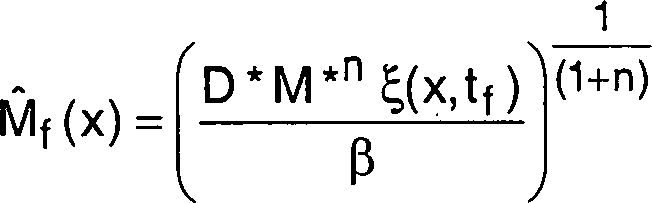


Wie
vorstehend erläutert,
steht n mit dem Selbstdiffusionskoeffizienten D eines monodispersen
Polymers mit dem Molekulargewicht M über die Gleichung 
Bevorzugt
handelt es sich bei dem Polymer um Polyethylen wie beispielsweise
UHMWPE, wobei TM und tM derart
gewählt
werden, dass sie ein
Bevorzugt liegt der Druck P im Bereich von 9 MPa bis etwa 30 MPa.Prefers the pressure P is in the range of 9 MPa to about 30 MPa.
Bevorzugt umfasst das Verfahren einen Kühlungsschritt, in welchem die Pressform gekühlt wird. Die Geschwindigkeit kann im Bereich von 5–10 Grad Kelvin/min liegen.Prefers the method comprises a cooling step, in which the mold cooled becomes. The speed can be in the range of 5-10 degrees Kelvin / min.
Der formgepresste Polymerartikel, welcher unter Verwendung des erfindungsgemäßen Verfahrens hergestellt wird, kann eine othopädische Prothese sein. Der Artikel kann eine Komponente eines Gelenkersatzes zur Behandlung von Arthritis und anderen degenerativen Erkrankungen der Gelenke, insbesondere der Knie-, Hüft-, Schulter-, Ellbogen-, Hand-, Fuß-, Finger- und Zehengelenke, sein.Of the molded polymer article prepared using the method of the invention can, is an othopädische Be a prosthesis. The article may be a component of a joint replacement for the treatment of arthritis and other degenerative diseases of the joints, especially the knee, hip, shoulder, elbow, Hand foot-, Finger and toe joints, be.
Bevorzugt
wird TM kontrolliert, um einen Formartikel,
umfassend ein Polymer, in welchem das bei maximaler Reptation vorliegende
Endmolekulargewicht 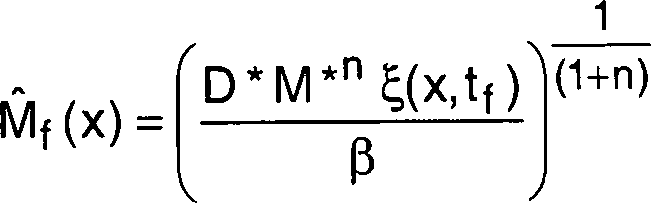
Die Temperatur TM, sowie die Zeit tM, für welche diese Temperatur an der Oberfläche der Pressform aufrechterhalten wird, können kontrolliert werden, um einen formgepressten Artikel mit einem bei maximaler Reptation vorbestimmten Molekulargewicht zu ergeben.The temperature T M , as well as the time t M for which this temperature is maintained at the surface of the mold, can be controlled to yield a molded article having a molecular weight predetermined at maximum reptation.
Es werden Berechnungen durchgeführt, um die spezifische Zeit/Temperatur-Oberflächengeschichte zu bestimmen, welche für jede einzelne Form und Größe der Komponente erforderlich ist. Diese Berechnungen führen zu einem Verfahren, welches einen formgepressten Artikel aus einem Polymer mit einem bei maximaler Reptation vorliegenden Molekulargewicht, das zumindest einem spezifizierten Minimalwert innerhalb der Komponente entspricht, bereitstellt.It calculations are carried out to determine the specific time / temperature surface history which for every single shape and size of the component is required. These calculations lead to a procedure which a molded article of a polymer with one at maximum Reptation present molecular weight, at least one specified Minimum value within the component corresponds to provides.
So deuten Berechnungen beispielsweise darauf hin, dass, wenn die Oberflächentemperatur der Pressform für 10 Minuten auf 165°C erhöht wird, das Zentrum eines einfachen zylindrischen Presslings von UHMWPE, Dicke 15 mm, bis zu 45 Minuten benötigen kann, um sein bei maximaler Reptation vorliegendes Molekulargewicht von 4.25 × 10⁶ g/mol zu erreichen, während die Oberfläche des Presslings dies in 30 Minuten erreicht.For example, calculations suggest that if the surface temperature of the mold is increased to 165 ° C for 10 minutes, the center of a simple cylindrical compact of UHMWPE, thickness 15 mm, may take up to 45 minutes to be at maximum reptation To reach molecular weight of 4.25 × 10 6 g / mol, while the surface of the compact reaches this in 30 minutes.
Die formgepressten Artikel weisen eine hohe Festigkeit und Verschleißfestigkeit auf. Beispielsweise können die Artikel Artikel aus UHMWPE sein, welche für eine Verwendung als orthopädische Prothesen vorgesehen sind. Eine hohe Festigkeit und Verschleißfestigkeit ist insbesondere für diese Anwendung von Bedeutung, nachdem Defekte des UHMWPE-Elements einer Prothese durch Rissbildung oder übermäßiges Kaltfließen zur unmittelbaren Notwendigkeit einer Revision führen können. Eine stetige Abnutzung des UHMWPE-Elements ist heimtückischer, wobei die freigesetzten kleinen Verschleißpartikel allerdings von den Knochenzellen aufgenommen werden können, was zu einer Abwehrreaktion, zur Bildung von Osteoblasten, zur Entwicklung von Osteolyse und zur Lockerung der Prothese führt.The Molded articles exhibit high strength and wear resistance on. For example, you can The articles will be articles from UHMWPE which are intended for use as orthopedic prostheses are provided. High strength and wear resistance is especially for This application matters after defects of the UHMWPE element a prosthesis by cracking or excessive cold flow to immediate need for revision. A steady wear the UHMWPE element is more insidious, However, the released small wear particles of the Bone cells can be absorbed, resulting in a defense reaction, for the formation of osteoblasts, for the development of osteolysis and leads to loosening of the prosthesis.
Die Masse der derzeit verwendeten orthopädischen Komponenten wird durch maschinelle Bearbeitung von Segmenten hergestellt, welche aus formgepressten Platten oder aus kolbenextrudierten Stangen herausgeschnitten werden. Einzelne formgepresste Komponenten werden in zunehmendem Maße verwendet. In jedem Fall bedarf es der Sicherstellung einer ausreichenden Reptationszeit und eines zufrieden stellenden, bei maximaler Reptation vorliegenden Molekulargewichts, um die Folgen einer unzureichenden Verschmelzung der Polymerpulverpartikel zu einem Feststoff, in welchem ein Erinnerungsvermögen an die Interpartikelgrenzflächen als Stellen potenzieller Rissbildung zurückbleibt, zu vermeiden.The mass of currently used orthopedic components is made by machining segments made of compression molded or extruded rods be cut out. Individual molded components are increasingly being used. In either case, it is necessary to ensure a sufficient reptation time and satisfactory molecular weight at maximum reptation to avoid the consequences of inadequate fusion of the polymer powder particles to a solid in which memory of the interparticle interfaces as sites of potential cracking remains.
Die vorliegende Erfindung wird weiterhin unter Bezugnahme auf die begleitenden Zeichnungen beschrieben, in welchen:The The present invention will be further appreciated with reference to the accompanying drawings Drawings in which:
Das Polymermaterial, welches zur Erlangung der beschriebenen Ergebnisse unter Bezugnahme auf die begleitenden Figuren verwendet wurde, war Hifax 1900H UHMWPE-Pulver in medizinischem Reinheitsgrad, welches im ursprünglich polymerisierten Zustand vorliegt und keinerlei Überzug von Calciumstearat aufweist. Die Bestimmung des Molekulargewichts dieses Materials bereitet notorisch Schwierigkeiten, wird von den Herstellern jedoch mit in der Nähe von 5.3 × 10⁶ g/mol angegeben, wie aus der intrinsischen Viskosität bestimmt (ASTM-Verfahren D4020-96).The polymeric material used to obtain the results described with reference to the accompanying figures was Hifax 1900H UHMWPE medical grade powder which is in its initial polymerized state and has no coating of calcium stearate. The determination of the molecular weight of this material is notoriously difficult, but is reported by the manufacturers as close to 5.3 x 10 6 g / mol, as determined from intrinsic viscosity (ASTM method D4020-96).
Das
Pulver im ursprünglich
erhaltenen Zustand wurde mittels Rasterelektronenmikroskopie (REM)
untersucht: die Partikel wurden direkt auf einer REM-Probenplatte
(REM-Stub) befestigt und mit einer dünnen Schicht einer Gold-Palladium-Legierung überzogen.
Die thermischen Eigenschaften des Pulvers wurden mittels Differential-Scanning-Kalorimetrie unter Verwendung eines Perkin-Elmer DSC-7-Kalorimeters bei Probenmengen von 3.6–3.7 mg und einer Abtastgeschwindigkeit von 5 K/min bestimmt. Die spezifische Schmelztemperatur des zuvor beschriebenen Pulvers wurde als Temperatur des maximalen Schmelzflusses während des Erwärmens bestimmt. Die Schmelzwärmen wurden durch Berechnen der Fläche unter dem endothermen Schmelzpeak bei der spezifischen Wärme erhalten. Der kristalline Massenanteil wurde anschließend durch Vergleichen der Schmelzwärme mit jener eines vollständig kristallinen Polyethylens (292.8 kJ/kg) bestimmt. Für das Pulver im ursprünglich erhaltenen Zustand wurde festgestellt, dass die maximale Schmelztemperatur 141.7°C beträgt und die Kristallinität hoch ist: 76%. Wird das Pulver allerdings über seinen Schmelzpunkt hinaus erwärmt und anschließend mit gleicher Geschwindigkeit abgekühlt, war die Endkristallinität geringer: 44%. Die spezifizierte Kristallisationstemperatur des zuvor beschriebenen Polymers wurde als Temperatur des maximalen Wärmeflusses während des Kühlens bestimmt.The Thermal properties of the powder were determined by differential scanning calorimetry of a Perkin-Elmer DSC-7 calorimeter at sample levels of 3.6-3.7 mg and a scanning speed of 5 K / min. The specific one Melting temperature of the powder described above was used as the temperature of the maximum melt flow during of heating certainly. The heat of fusion were calculated by calculating the area under the endothermic melting peak at the specific heat. The crystalline mass fraction was then determined by comparing the heat of fusion with a complete one crystalline polyethylene (292.8 kJ / kg). For the powder in the original Condition obtained was found to be the maximum melting temperature 141.7 ° C is and the crystallinity is high: 76%. However, the powder is beyond its melting point heated and subsequently cooled at the same rate, the final crystallinity was lower: 44%. The specified crystallization temperature of the previously described Polymer was used as the temperature of maximum heat flow during the cooling certainly.
Zylindrische Proben von UHMWPE (Durchmesser = 30 mm, Länge = 15 mm) wurden aus Pulver in ursprünglich polymerisiertem Zustand unter Verwendung einer messtechnisch ausgestalteten Pressform, welche eine gleichzeitige Messung der Temperatur in der Pressformwand und (gegebenenfalls) im Polymer sowie des Drucks im Polymer an der Pressformwand gestattet, einem Formpressen unterzogen. Der Formgebungsablauf war wie folgt: (1) Komprimieren in den festen Zustand durch Ausüben von Druck, (2) Erhöhen der Temperatur der Pressform auf einen Wert oberhalb der Schmelztemperatur des Polymers, (3) Verweilen für 10 Minuten oder 60 Minuten bei konstanter Temperatur, (4) Abkühlen der Pressform mit 7 K/min. Die Werte des Maximaldrucks lagen im Bereich von 9 bis 30 MPa. Die Daten betreffend Temperatur und Druck wurden unter Verwendung eines PC über eine Biodaten-Mikroverbindungsmodulschnittstelle aufgezeichnet. Die Integrität der resultierenden Presslinge wurde anschließend mittels mechanischer Tests und REM untersucht.cylindrical Samples of UHMWPE (diameter = 30 mm, length = 15 mm) were made from powder in original polymerized state using a metrologically designed Press mold, which is a simultaneous measurement of the temperature in the Press molding wall and (optionally) in the polymer and the pressure in Polymer allowed on the mold wall, subjected to compression molding. The molding process was as follows: (1) Compress in the solid Condition by exercise of pressure, (2) increasing the temperature of the mold to a value above the melting temperature of the polymer, (3) stay for 10 minutes or 60 minutes at constant temperature, (4) cooling the Press mold with 7 K / min. The values of the maximum pressure were in the range from 9 to 30 MPa. The data concerning temperature and pressure were using a PC over recorded a biodata microconnect module interface. The integrity The resulting pellets were then subjected to mechanical testing and REM examined.
Um den Temperatur-Zeit-Effekt auf die mechanischen Eigenschaften zu untersuchen, wurden die formgepressten Spezies unter Verwendung einer Instron 4204-Prüfmaschine mit Umweltkammer untersucht. Miniaturisierte, hantelförmige Prüfkörperspezies wurden maschinell aus den Presslingen hergestellt und bei konstanter Nenndehnungsgeschwindigkeit (10–3s–1) und bei 37°C Zugfestigkeitsversuchen unterzogen.To investigate the temperature-time effect on mechanical properties, the molded species were tested using an Instron 4204 environmental chamber testing machine. Miniaturized dumbbell specimens were machined from the compacts and subjected to tensile strength tests at constant nominal strain rate (10 -3 s -1 ) and at 37 ° C.
Presslinge,
welche bei unterschiedlichen Maximaltemperaturen und mit unterschiedlichen
Verweilzeiten hergestellt wurden, ergaben allesamt Spannungs-Dehnungs-Kurven mit ähnlicher
Gestalt. Siehe hierzu die
Sie
zeichneten sich allesamt durch die für dieses Material übliche Ausbeute
und den für
dieses Material üblichen
pseudoplastischen Fluss aus, wobei hinsichtlich des Spannungsgrades
geringe Schwankungen zwischen den Kurven auftraten. Allerdings trat
eine dramatische Verringerung der Reißdehnung sowie der äußersten
Zugspannung bei der niedrigsten Formgebungstemperatur und -zeit
auf: ein Beweis für
schwache Interpartikelgrenzen. Zusätzlich war dies bei kürzeren Formgebungstemperaturen
(10 Minuten) im Zentrum der Presslinge stärker ausgeprägt als an
der Oberfläche
(vergleiche
Dieses
Verhaltensmuster kann auch
Die
gebrochenen, zugbelastbaren Spezies wurden entlang der Zeichnungsrichtung
unter Verwendung eines Mikrotoms geschnitten, und wurden anschließend zur
Untersuchung der freien Oberflächen – wie sie
maschinell bearbeitet und bis zum Defekt gedehnt wurden – ohne Goldüberzug direkt
auf REM-Probenplatten (REM-Stubs)
befestigt. Es wurde ein Jeol-Mikroskop (Typ JSM-6300) verwendet,
welches zur Minimierung von Aufladevorgängen bei niedriger Spannung
(1 kV) betrieben wurde. Stellvertretende Mikrofotografien sind in
Für eine Formgebungstemperatur
von 145°C
und eine Verweilzeit von 60 Minuten zeigten die REM-Mikrofotografien
eine schlechte Konsolidierung (
Bei
einer Formgebungstemperatur von 165°C und längerer Verweilzeit, sowie für höhere Temperaturen,
wurde eine andere Situation vorgefunden: es gab vernachlässigbare
Anzeichen für
Hohlraumbildung: die Partikel waren gut konsolidiert. Vor dem Dehnen
wiesen die Oberflächen
derartiger Spezies bei diesem Vergrößerungsgrad keinerlei Merkmale
auf. Gleichwohl wurden nach Dehnen bis zum Brechen neue Merkmale vorgefunden:
lineare Oberflächenmerkmale
in einem Längenmaßstab, welcher
auf die ursprünglichen
Partikelgrenzen hindeutet, die durch das Dehnen um ca. 450% gestreckt
wurden (siehe beispielsweise
Diese Anmeldung beschreibt ein Verfahren, welches unter Verwendung computergestützter Technik des Formgebungsprozesses zur Optimierung der Bedingungen betreffend Zeit und Temperatur für das Formpressen von Komponenten mit unterschiedlicher Gestalt und Größe verwendet werden kann, um sicherzustellen, dass Interpartikelgrenzen eliminiert werden. Das Verfahren bedient sich der Reptationstheorie, welche die molekulare Selbstdiffusion regelt, durch die eine molekulare Konnektivität zwischen den ursprünglichen Partikeln erzielt wird.These Application describes a method using computer-aided technique of Shaping process for optimizing conditions Time and temperature for the molding of components with different shapes and Size used can be used to ensure that interparticle boundaries are eliminated become. The method uses the Reptationstheorie, which The molecular self-diffusion regulates, through which a molecular connectivity between the original ones Particles is achieved.
Der
lange Zeitraum, welcher gemäß
Aus
Es ist bekannt, dass, wenn zwei Polymeroberflächen in engen Kontakt gebracht werden, die Zeit, welche erforderlich ist, um eine Unterscheidung der Grenze von der Hauptmasse, was ihre mechanischen Eigenschaften anbetrifft, unmöglich zu machen, die Reptationszeit tR zu sein scheint (Wool, R.P., Yuan, B.-L., und McGarel, O.J., Polym. Eng. and Sci., 29, 1340 (1989)). Dies ist wie erwartet, da tR gemäß Definition die zum Verlust der Korrelation zwischen den neuen molekularen Konformationen und den ursprünglichen molekularen Konformationen erforderliche Zeit ist (Doi, M. und Edwards, S.F., The Theory of Polymer Dynamics, Oxford University Press, Oxford (1986)). Nur wenn dies für jene Moleküle zutrifft, welche sich in der Nähe der Grenzfläche befinden, wird deren Identität eliminiert.It is known that when two polymer surfaces are brought into close contact, the time required to make it impossible to distinguish the boundary from the bulk for their mechanical properties seems to be the reformation time t R (Wool , RP, Yuan, B.-L., and McGarel, OJ, Polym. Eng. And Sci., 29, 1340 (1989)). As expected, t R is by definition the time required to lose the correlation between the new molecular conformations and the original molecular conformations (Doi, M. and Edwards, SF, Theory of Polymer Dynamics, Oxford University Press, Oxford ( 1986)). Only if this is true for those molecules that are near the interface will their identity be eliminated.
Homogener, isothermer FallHomogeneous, isothermal case
Für ein Polymer
mit Molekulargewicht M kann die Reptationszeit aus M und dem Selbstdiffusionskoeffizienten
D berechnet werden 
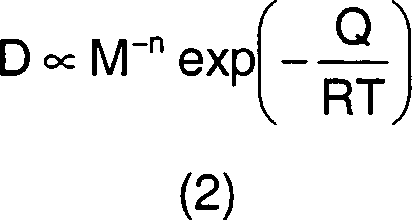
Daher
kann, sofern D bei einigen Referenzmolekulargewichten M* und -temperaturen
T* bekannt ist, dessen Wert anschließend für ein Molekulargewicht M und
eine Temperatur T aus 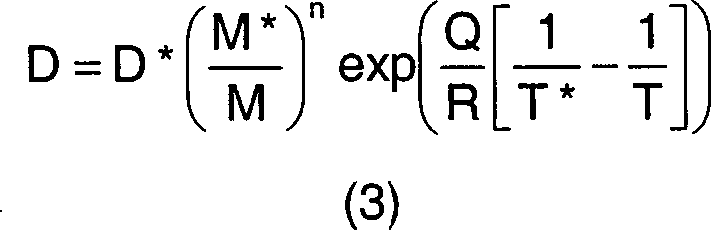
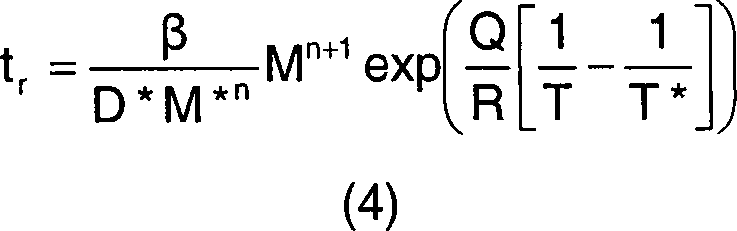
Eine
alternative Auslegung ist jene, dass innerhalb einer Zeit t bei
einer Temperatur T annahmegemäß lediglich
Moleküle
bis zu einem Molekulargewicht M eine Reptation vollzogen haben,
wobei 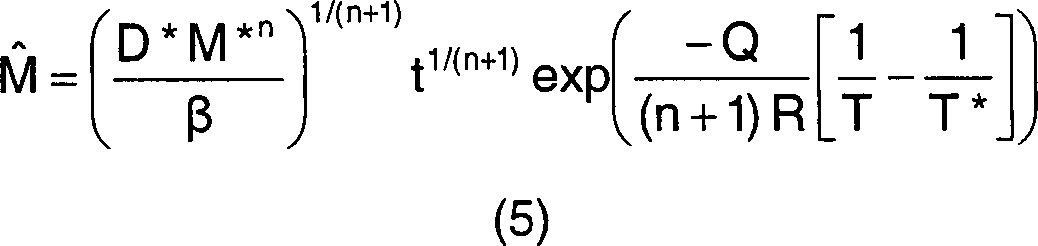
Im
Falle von Polyethylen sind die Werte der in β einfließenden Parameter wohlbekannt,
wobei die von Klein, J., Nature, 271, 143 (1978) durchgeführten Selbstdiffusionsmessungen
die anderen erforderlichen Konstanten bereitstellen. Folglich kann
das bei maximaler Reptation vorliegende Molekulargewicht
Inhomogener, nicht-isothermer FallInhomogeneous, non-isothermal case
Aus
dem oben Gesagten folgt, dass ein dringendes Bedürfnis besteht, räumliche
Veränderungen
betreffend die Interpartikelbindung innerhalb von formgepressten
Komponenten interpretieren und vorhersagen zu können, wobei die vorstehende
Behandlung zu diesem Zweck auf inhomogene, nicht-isotherme Temperaturgeschichten
ausgedehnt werden muss. Wir führen
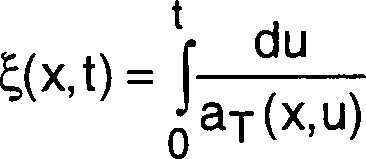
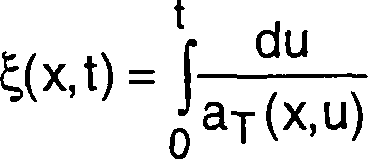
daher das Konzept einer „reptationsäquivalenten" Zeit ξ ein, welche
das gleiche Ausmaß an
Reptation – d.
h. das gleiche 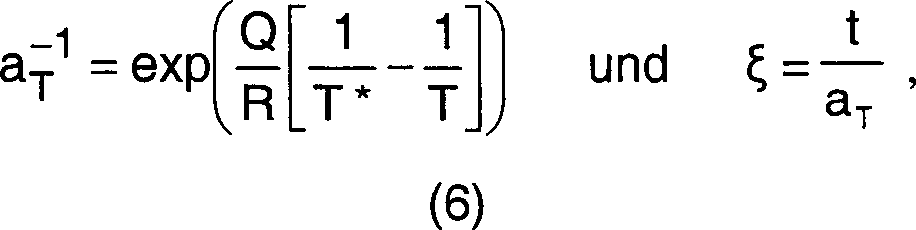

Das
bei maximaler Reptation vorliegende Molekulargewicht wird anschließend als
Funktion des Ortes und der Zeit innerhalb des Presslings berechnet 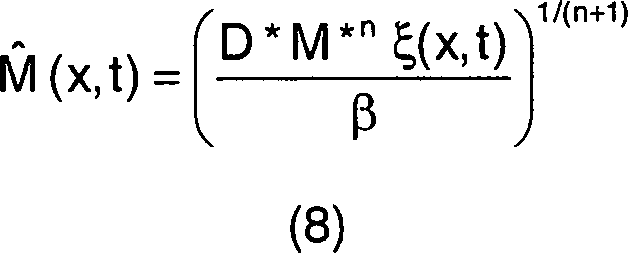
Dieser
Ansatz wurde verwendet, um die Entwicklung der Interpartikelreptation
während
der Formgebung dreidimensionaler Komponenten zu berechnen. Die Evolution
des Temperaturfeldes wurde unter Verwendung des ABAQUS Finite-Elemente-Programms
numerisch berechnet, und ξ(x,
t) wurde in der Berechnung als Zustandsvariable geführt. Es
wurde die Annahme getroffen, dass Reptation lediglich im geschmolzenen
Zustand stattfindet: d. h. die Reptationsgeschwindigkeit (und somit
aT–1)
beträgt
bis zum Schmelzen null, und kehrt bei der Kristallisation auf null
zurück.
Auf diese Weise wurde der Endwert des bei maximaler Reptation vorliegenden
Molekulargewichts
Diese Tatsache, zusammen mit Schwankungen im Komprimierungsgrad, welche ebenfalls mit Schwankungen der Temperaturgeschichte assoziiert sind, ist für die Unterschiede im mechanischen Ansprechverhalten zwischen Spezies, welche aus den Oberflächen und Zentren von Presslingen herausgeschnitten wurden, verantwortlich.These Fact, along with variations in the degree of compression, which are also associated with variations in temperature history, is for the differences in mechanical response between species, which from the surfaces and centers of pellets were cut out, responsible.
Wir haben dargelegt, dass die mechanische Integrität von formgepresstem UHMWPE in geschmolzenem Zustand während der Formgebung eine Empfindlichkeit gegenüber der Temperatur-Zeit-Geschichte aufweist. Selbst bei Schmelztemperaturen von 165°C und 185°C in diesem Polymer und nach vollständiger Komprimierung verbleiben strukturelle Schwächen an den Grenzen der ursprünglichen Pulverpartikel. Dies wurde mittels REM der freien Oberflächen von Presslingen nach ausgedehnter Deformation bei den für Einsatz von Prothesen gebräuchlichen Temperaturen gezeigt. Bei noch niedrigeren Schmelztemperaturen und den im Rahmen dieser Arbeit verwendeten Drücken bringen aufgrund von unvollständiger Komprimierung verbliebene Hohlräume die Interpartikelschwäche zur Geltung und bewirken eine starke Abnahme der Reißdehnung.We have demonstrated that the mechanical integrity of compression molded UHMWPE in molten state during shaping a sensitivity to the temperature-time history having. Even at melt temperatures of 165 ° C and 185 ° C in this polymer and after complete compression remain structural weaknesses on the borders of the original Powder particles. This was done by SEM of the free surfaces of Pressings after extensive deformation at the for use of prostheses in use Temperatures shown. At even lower melting temperatures and The pressures used in this work are due to incomplete compression remaining cavities the interparticle weakness to advantage and cause a strong decrease in the elongation at break.
Bei dem in der Praxis angewendeten Formpressen von UHMWPE kann folglich ein hoher Komprimierungsgrad des Pulvers und die Eliminierung von Hohlräumen auf einfache Art und Weise durch höhere Formgebungstemperaturen und -zeiten sichergestellt werden. Allerdings variiert das Ausmaß der Eliminierung von Grenzflächen durch Interpartikeldiffusion innerhalb von formgepressten Komponenten in der Praxis und weist eine Empfindlichkeit gegenüber Einzelheiten des Formgebungsablaufs und der Gestalt der Komponente auf. In dieser Situation ist es von Nutzen, ein Mittel zur Quantifizierung des Fortschritts der Grenzflächendiffusion zur Verfügung zu haben, wobei das vorstehend beschriebene nicht-isotherme Modell dies möglich macht.at Consequently, UHMWPE compression molding can be used in practice a high degree of compression of the powder and the elimination of cavities in a simple way by higher forming temperatures and times are ensured. However, the extent of elimination varies of interfaces by interparticle diffusion within molded components in practice and has a sensitivity to details the shaping process and the shape of the component. In this Situation, it is useful, a means of quantifying the Progress of interfacial diffusion to disposal having the non-isothermal model described above this possible power.
Claims (8)



Applications Claiming Priority (3)
| Application Number | Priority Date | Filing Date | Title |
|---|---|---|---|
| GB9907843 | 1999-04-06 | ||
| GBGB9907843.8A GB9907843D0 (en) | 1999-04-06 | 1999-04-06 | Compression moulding |
| PCT/GB2000/001281 WO2000059701A1 (en) | 1999-04-06 | 2000-04-06 | Method of compression moulding of polymer powder |
Publications (2)
| Publication Number | Publication Date |
|---|---|
| DE60032123D1 DE60032123D1 (en) | 2007-01-11 |
| DE60032123T2 true DE60032123T2 (en) | 2007-10-25 |
Family
ID=10851027
Family Applications (1)
| Application Number | Title | Priority Date | Filing Date |
|---|---|---|---|
| DE60032123T Expired - Fee Related DE60032123T2 (en) | 1999-04-06 | 2000-04-06 | FORMING PROCESS OF POLYMER POWDER |
Country Status (6)
| Country | Link |
|---|---|
| US (1) | US6677415B1 (en) |
| EP (1) | EP1165300B1 (en) |
| AT (1) | ATE346733T1 (en) |
| DE (1) | DE60032123T2 (en) |
| GB (1) | GB9907843D0 (en) |
| WO (1) | WO2000059701A1 (en) |
Families Citing this family (6)
| Publication number | Priority date | Publication date | Assignee | Title |
|---|---|---|---|---|
| US20050146070A1 (en) * | 2002-06-21 | 2005-07-07 | Massachusetts General Hospital | Meta lback or mesh crosslinking |
| US7799084B2 (en) * | 2002-10-23 | 2010-09-21 | Mako Surgical Corp. | Modular femoral component for a total knee joint replacement for minimally invasive implantation |
| ATE454110T1 (en) | 2003-06-27 | 2010-01-15 | Abs Corp | SYSTEM FOR ANKLE JOINT ARTHROPLASTY |
| EP1890864B1 (en) * | 2005-06-14 | 2015-12-30 | OMNIlife science, Inc. | Crosslinked polyethylene article |
| US9475217B2 (en) | 2013-01-31 | 2016-10-25 | Saudi Basic Industries Corporation | Process for making highly crystalline shaped part from pet or pen |
| CN114145887B (en) * | 2021-11-04 | 2025-09-16 | 苏州微创关节医疗科技有限公司 | Polyethylene joint implant, method for producing the same, and joint prosthesis |
Family Cites Families (4)
| Publication number | Priority date | Publication date | Assignee | Title |
|---|---|---|---|---|
| US5030402A (en) * | 1989-03-17 | 1991-07-09 | Zachariades Anagnostis E | Process for producing a new class of ultra-high-molecular-weight polyethylene orthopaedic prostheses with enhanced mechanical properties |
| US5316711A (en) * | 1993-04-20 | 1994-05-31 | Throne James L | Process for producing articles from polymers containing aromatic imide linkages |
| US5721334A (en) * | 1996-02-16 | 1998-02-24 | Newyork Society For The Ruptured And Crippled Maintaining The Hospital For Special Surgery | Process for producing ultra-high molecular weight low modulus polyethylene shaped articles via controlled pressure and temperature and compositions and articles produced therefrom |
| IT1289610B1 (en) * | 1997-02-06 | 1998-10-15 | Enichem Spa | PROCEDURE FOR THE PREPARATION OF PRODUCTS BASED ON VINYLAROMATIC POLYMERS WITH A PREDOMINALLY SYNDIOTACTIC STRUCTURE |
-
1999
- 1999-04-06 GB GBGB9907843.8A patent/GB9907843D0/en not_active Ceased
-
2000
- 2000-04-06 AT AT00919015T patent/ATE346733T1/en not_active IP Right Cessation
- 2000-04-06 WO PCT/GB2000/001281 patent/WO2000059701A1/en not_active Ceased
- 2000-04-06 US US09/926,291 patent/US6677415B1/en not_active Expired - Fee Related
- 2000-04-06 EP EP00919015A patent/EP1165300B1/en not_active Expired - Lifetime
- 2000-04-06 DE DE60032123T patent/DE60032123T2/en not_active Expired - Fee Related
Also Published As
| Publication number | Publication date |
|---|---|
| EP1165300B1 (en) | 2006-11-29 |
| GB9907843D0 (en) | 1999-06-02 |
| US6677415B1 (en) | 2004-01-13 |
| EP1165300A1 (en) | 2002-01-02 |
| ATE346733T1 (en) | 2006-12-15 |
| DE60032123D1 (en) | 2007-01-11 |
| WO2000059701A1 (en) | 2000-10-12 |
Similar Documents
| Publication | Publication Date | Title |
|---|---|---|
| DE69716881T2 (en) | METHOD FOR PRODUCING OBJECTS OF LOW ELASTICITY MODULES FROM ULTRA-HIGH MOLECULAR WEIGHT POLYETHYLENE | |
| DE60305989T2 (en) | Prosthetic composite bearing and manufacturing process | |
| DE69525924T2 (en) | POLYETHYLENE CASTING WITH ULTRA-HIGH MOLECULAR WEIGHT FOR ARTIFICIAL CONNECTIONS AND METHOD FOR THE PRODUCTION THEREOF | |
| DE60315366T2 (en) | Production method of a composite prosthesis bearing element with a networked joint surface | |
| DE69512304T2 (en) | Composite polymer implant and method of making the same | |
| Jauffres et al. | Microstructural origin of physical and mechanical properties of ultra high molecular weight polyethylene processed by high velocity compaction | |
| DE69733879T2 (en) | IRRADIATED AND MELT-TREATED ULTRAHOLE MOLECULAR POLYETHYLENE PROSTHESIS | |
| Hao et al. | Selective laser melting of a stainless steel and hydroxyapatite composite for load-bearing implant development | |
| DE60300277T2 (en) | Laser generated porous surface | |
| Esfahani et al. | Independent tuning of stiffness and toughness of additively manufactured titanium-polymer composites: Simulation, fabrication, and experimental studies | |
| DE69220963T2 (en) | ULTRA HIGH MOLECULAR LINEAR POLYAETHYLENE AND METHOD FOR PRODUCING THE SAME | |
| DE2816072A1 (en) | PROSTHETIC MEANS AND METHOD OF MANUFACTURING THEREOF | |
| DE2501683A1 (en) | BIOACTIVE COMPOSITE MATERIAL FOR PROSTHETIC PURPOSES AND METHOD FOR ITS MANUFACTURING | |
| WO1985003901A1 (en) | The preparation of ultra high molecular weight polyethylene morphologies of totally fused particles with superior mechanical performance | |
| DE60032123T2 (en) | FORMING PROCESS OF POLYMER POWDER | |
| WO2018046739A1 (en) | Powder-based additive manufacturing process at low temperatures | |
| Oladapo et al. | RETRACTED ARTICLE: 3D printing of surface characterisation and finite element analysis improvement of PEEK-HAP-GO in bone implant | |
| DE3005265A1 (en) | PROSTHESIS | |
| Santos et al. | Mechanical properties of pure titanium models processed by selective laser melting | |
| DE68922863T2 (en) | METHOD FOR PRODUCING OBJECTS FROM POLYETHYLENE WITH ULTRA-HIGH MOLECULAR WEIGHT. | |
| DE69625876T2 (en) | Prosthesis bearing element and implant with this element | |
| DE60123837T2 (en) | SELECTIVE AND CONTROLLED MANIPULATION OF POLYMERS | |
| JPH08501259A (en) | Method for producing plastic material parts by controlled molding-thermoforming and apparatus for implementing same | |
| JP2005504659A (en) | Method for sintering ultra-high molecular weight polyethylene | |
| DE69824151T2 (en) | PROCESS FOR PROCESSING POLYETHYLENE AT A MOLECULAR WEIGHT OF AT LEAST 400,000 BY HEATING AT HIGH PRESSURE |
Legal Events
| Date | Code | Title | Description |
|---|---|---|---|
| 8364 | No opposition during term of opposition | ||
| 8339 | Ceased/non-payment of the annual fee |