DE60031577T2 - INHIBITORS OF CELL ADHESION - Google Patents
INHIBITORS OF CELL ADHESION Download PDFInfo
- Publication number
- DE60031577T2 DE60031577T2 DE60031577T DE60031577T DE60031577T2 DE 60031577 T2 DE60031577 T2 DE 60031577T2 DE 60031577 T DE60031577 T DE 60031577T DE 60031577 T DE60031577 T DE 60031577T DE 60031577 T2 DE60031577 T2 DE 60031577T2
- Authority
- DE
- Germany
- Prior art keywords
- amino
- methyl
- phenyl
- carbonyl
- acetyl
- Prior art date
- Legal status (The legal status is an assumption and is not a legal conclusion. Google has not performed a legal analysis and makes no representation as to the accuracy of the status listed.)
- Expired - Lifetime
Links
Classifications
-
- C—CHEMISTRY; METALLURGY
- C07—ORGANIC CHEMISTRY
- C07D—HETEROCYCLIC COMPOUNDS
- C07D401/00—Heterocyclic compounds containing two or more hetero rings, having nitrogen atoms as the only ring hetero atoms, at least one ring being a six-membered ring with only one nitrogen atom
- C07D401/02—Heterocyclic compounds containing two or more hetero rings, having nitrogen atoms as the only ring hetero atoms, at least one ring being a six-membered ring with only one nitrogen atom containing two hetero rings
- C07D401/06—Heterocyclic compounds containing two or more hetero rings, having nitrogen atoms as the only ring hetero atoms, at least one ring being a six-membered ring with only one nitrogen atom containing two hetero rings linked by a carbon chain containing only aliphatic carbon atoms
-
- A—HUMAN NECESSITIES
- A61—MEDICAL OR VETERINARY SCIENCE; HYGIENE
- A61P—SPECIFIC THERAPEUTIC ACTIVITY OF CHEMICAL COMPOUNDS OR MEDICINAL PREPARATIONS
- A61P1/00—Drugs for disorders of the alimentary tract or the digestive system
- A61P1/04—Drugs for disorders of the alimentary tract or the digestive system for ulcers, gastritis or reflux esophagitis, e.g. antacids, inhibitors of acid secretion, mucosal protectants
-
- A—HUMAN NECESSITIES
- A61—MEDICAL OR VETERINARY SCIENCE; HYGIENE
- A61P—SPECIFIC THERAPEUTIC ACTIVITY OF CHEMICAL COMPOUNDS OR MEDICINAL PREPARATIONS
- A61P11/00—Drugs for disorders of the respiratory system
-
- A—HUMAN NECESSITIES
- A61—MEDICAL OR VETERINARY SCIENCE; HYGIENE
- A61P—SPECIFIC THERAPEUTIC ACTIVITY OF CHEMICAL COMPOUNDS OR MEDICINAL PREPARATIONS
- A61P11/00—Drugs for disorders of the respiratory system
- A61P11/02—Nasal agents, e.g. decongestants
-
- A—HUMAN NECESSITIES
- A61—MEDICAL OR VETERINARY SCIENCE; HYGIENE
- A61P—SPECIFIC THERAPEUTIC ACTIVITY OF CHEMICAL COMPOUNDS OR MEDICINAL PREPARATIONS
- A61P11/00—Drugs for disorders of the respiratory system
- A61P11/06—Antiasthmatics
-
- A—HUMAN NECESSITIES
- A61—MEDICAL OR VETERINARY SCIENCE; HYGIENE
- A61P—SPECIFIC THERAPEUTIC ACTIVITY OF CHEMICAL COMPOUNDS OR MEDICINAL PREPARATIONS
- A61P17/00—Drugs for dermatological disorders
- A61P17/06—Antipsoriatics
-
- A—HUMAN NECESSITIES
- A61—MEDICAL OR VETERINARY SCIENCE; HYGIENE
- A61P—SPECIFIC THERAPEUTIC ACTIVITY OF CHEMICAL COMPOUNDS OR MEDICINAL PREPARATIONS
- A61P19/00—Drugs for skeletal disorders
- A61P19/02—Drugs for skeletal disorders for joint disorders, e.g. arthritis, arthrosis
-
- A—HUMAN NECESSITIES
- A61—MEDICAL OR VETERINARY SCIENCE; HYGIENE
- A61P—SPECIFIC THERAPEUTIC ACTIVITY OF CHEMICAL COMPOUNDS OR MEDICINAL PREPARATIONS
- A61P25/00—Drugs for disorders of the nervous system
- A61P25/28—Drugs for disorders of the nervous system for treating neurodegenerative disorders of the central nervous system, e.g. nootropic agents, cognition enhancers, drugs for treating Alzheimer's disease or other forms of dementia
-
- A—HUMAN NECESSITIES
- A61—MEDICAL OR VETERINARY SCIENCE; HYGIENE
- A61P—SPECIFIC THERAPEUTIC ACTIVITY OF CHEMICAL COMPOUNDS OR MEDICINAL PREPARATIONS
- A61P27/00—Drugs for disorders of the senses
- A61P27/02—Ophthalmic agents
- A61P27/14—Decongestants or antiallergics
-
- A—HUMAN NECESSITIES
- A61—MEDICAL OR VETERINARY SCIENCE; HYGIENE
- A61P—SPECIFIC THERAPEUTIC ACTIVITY OF CHEMICAL COMPOUNDS OR MEDICINAL PREPARATIONS
- A61P29/00—Non-central analgesic, antipyretic or antiinflammatory agents, e.g. antirheumatic agents; Non-steroidal antiinflammatory drugs [NSAID]
-
- A—HUMAN NECESSITIES
- A61—MEDICAL OR VETERINARY SCIENCE; HYGIENE
- A61P—SPECIFIC THERAPEUTIC ACTIVITY OF CHEMICAL COMPOUNDS OR MEDICINAL PREPARATIONS
- A61P3/00—Drugs for disorders of the metabolism
- A61P3/08—Drugs for disorders of the metabolism for glucose homeostasis
- A61P3/10—Drugs for disorders of the metabolism for glucose homeostasis for hyperglycaemia, e.g. antidiabetics
-
- A—HUMAN NECESSITIES
- A61—MEDICAL OR VETERINARY SCIENCE; HYGIENE
- A61P—SPECIFIC THERAPEUTIC ACTIVITY OF CHEMICAL COMPOUNDS OR MEDICINAL PREPARATIONS
- A61P31/00—Antiinfectives, i.e. antibiotics, antiseptics, chemotherapeutics
- A61P31/04—Antibacterial agents
-
- A—HUMAN NECESSITIES
- A61—MEDICAL OR VETERINARY SCIENCE; HYGIENE
- A61P—SPECIFIC THERAPEUTIC ACTIVITY OF CHEMICAL COMPOUNDS OR MEDICINAL PREPARATIONS
- A61P37/00—Drugs for immunological or allergic disorders
-
- A—HUMAN NECESSITIES
- A61—MEDICAL OR VETERINARY SCIENCE; HYGIENE
- A61P—SPECIFIC THERAPEUTIC ACTIVITY OF CHEMICAL COMPOUNDS OR MEDICINAL PREPARATIONS
- A61P37/00—Drugs for immunological or allergic disorders
- A61P37/02—Immunomodulators
-
- A—HUMAN NECESSITIES
- A61—MEDICAL OR VETERINARY SCIENCE; HYGIENE
- A61P—SPECIFIC THERAPEUTIC ACTIVITY OF CHEMICAL COMPOUNDS OR MEDICINAL PREPARATIONS
- A61P37/00—Drugs for immunological or allergic disorders
- A61P37/08—Antiallergic agents
-
- A—HUMAN NECESSITIES
- A61—MEDICAL OR VETERINARY SCIENCE; HYGIENE
- A61P—SPECIFIC THERAPEUTIC ACTIVITY OF CHEMICAL COMPOUNDS OR MEDICINAL PREPARATIONS
- A61P43/00—Drugs for specific purposes, not provided for in groups A61P1/00-A61P41/00
-
- C—CHEMISTRY; METALLURGY
- C07—ORGANIC CHEMISTRY
- C07D—HETEROCYCLIC COMPOUNDS
- C07D205/00—Heterocyclic compounds containing four-membered rings with one nitrogen atom as the only ring hetero atom
- C07D205/02—Heterocyclic compounds containing four-membered rings with one nitrogen atom as the only ring hetero atom not condensed with other rings
- C07D205/04—Heterocyclic compounds containing four-membered rings with one nitrogen atom as the only ring hetero atom not condensed with other rings having no double bonds between ring members or between ring members and non-ring members
-
- C—CHEMISTRY; METALLURGY
- C07—ORGANIC CHEMISTRY
- C07D—HETEROCYCLIC COMPOUNDS
- C07D207/00—Heterocyclic compounds containing five-membered rings not condensed with other rings, with one nitrogen atom as the only ring hetero atom
- C07D207/02—Heterocyclic compounds containing five-membered rings not condensed with other rings, with one nitrogen atom as the only ring hetero atom with only hydrogen or carbon atoms directly attached to the ring nitrogen atom
- C07D207/04—Heterocyclic compounds containing five-membered rings not condensed with other rings, with one nitrogen atom as the only ring hetero atom with only hydrogen or carbon atoms directly attached to the ring nitrogen atom having no double bonds between ring members or between ring members and non-ring members
- C07D207/10—Heterocyclic compounds containing five-membered rings not condensed with other rings, with one nitrogen atom as the only ring hetero atom with only hydrogen or carbon atoms directly attached to the ring nitrogen atom having no double bonds between ring members or between ring members and non-ring members with hetero atoms or with carbon atoms having three bonds to hetero atoms with at the most one bond to halogen, e.g. ester or nitrile radicals, directly attached to ring carbon atoms
- C07D207/16—Carbon atoms having three bonds to hetero atoms with at the most one bond to halogen, e.g. ester or nitrile radicals
-
- C—CHEMISTRY; METALLURGY
- C07—ORGANIC CHEMISTRY
- C07D—HETEROCYCLIC COMPOUNDS
- C07D207/00—Heterocyclic compounds containing five-membered rings not condensed with other rings, with one nitrogen atom as the only ring hetero atom
- C07D207/46—Heterocyclic compounds containing five-membered rings not condensed with other rings, with one nitrogen atom as the only ring hetero atom with hetero atoms directly attached to the ring nitrogen atom
- C07D207/48—Sulfur atoms
-
- C—CHEMISTRY; METALLURGY
- C07—ORGANIC CHEMISTRY
- C07D—HETEROCYCLIC COMPOUNDS
- C07D209/00—Heterocyclic compounds containing five-membered rings, condensed with other rings, with one nitrogen atom as the only ring hetero atom
- C07D209/02—Heterocyclic compounds containing five-membered rings, condensed with other rings, with one nitrogen atom as the only ring hetero atom condensed with one carbocyclic ring
- C07D209/04—Indoles; Hydrogenated indoles
- C07D209/30—Indoles; Hydrogenated indoles with hetero atoms or with carbon atoms having three bonds to hetero atoms with at the most one bond to halogen, directly attached to carbon atoms of the hetero ring
- C07D209/42—Carbon atoms having three bonds to hetero atoms with at the most one bond to halogen, e.g. ester or nitrile radicals
-
- C—CHEMISTRY; METALLURGY
- C07—ORGANIC CHEMISTRY
- C07D—HETEROCYCLIC COMPOUNDS
- C07D211/00—Heterocyclic compounds containing hydrogenated pyridine rings, not condensed with other rings
- C07D211/04—Heterocyclic compounds containing hydrogenated pyridine rings, not condensed with other rings with only hydrogen or carbon atoms directly attached to the ring nitrogen atom
- C07D211/06—Heterocyclic compounds containing hydrogenated pyridine rings, not condensed with other rings with only hydrogen or carbon atoms directly attached to the ring nitrogen atom having no double bonds between ring members or between ring members and non-ring members
- C07D211/08—Heterocyclic compounds containing hydrogenated pyridine rings, not condensed with other rings with only hydrogen or carbon atoms directly attached to the ring nitrogen atom having no double bonds between ring members or between ring members and non-ring members with hydrocarbon or substituted hydrocarbon radicals directly attached to ring carbon atoms
- C07D211/18—Heterocyclic compounds containing hydrogenated pyridine rings, not condensed with other rings with only hydrogen or carbon atoms directly attached to the ring nitrogen atom having no double bonds between ring members or between ring members and non-ring members with hydrocarbon or substituted hydrocarbon radicals directly attached to ring carbon atoms with substituted hydrocarbon radicals attached to ring carbon atoms
- C07D211/30—Heterocyclic compounds containing hydrogenated pyridine rings, not condensed with other rings with only hydrogen or carbon atoms directly attached to the ring nitrogen atom having no double bonds between ring members or between ring members and non-ring members with hydrocarbon or substituted hydrocarbon radicals directly attached to ring carbon atoms with substituted hydrocarbon radicals attached to ring carbon atoms with hydrocarbon radicals, substituted by doubly bound oxygen or sulfur atoms or by two oxygen or sulfur atoms singly bound to the same carbon atom
- C07D211/32—Heterocyclic compounds containing hydrogenated pyridine rings, not condensed with other rings with only hydrogen or carbon atoms directly attached to the ring nitrogen atom having no double bonds between ring members or between ring members and non-ring members with hydrocarbon or substituted hydrocarbon radicals directly attached to ring carbon atoms with substituted hydrocarbon radicals attached to ring carbon atoms with hydrocarbon radicals, substituted by doubly bound oxygen or sulfur atoms or by two oxygen or sulfur atoms singly bound to the same carbon atom by oxygen atoms
-
- C—CHEMISTRY; METALLURGY
- C07—ORGANIC CHEMISTRY
- C07D—HETEROCYCLIC COMPOUNDS
- C07D265/00—Heterocyclic compounds containing six-membered rings having one nitrogen atom and one oxygen atom as the only ring hetero atoms
- C07D265/28—1,4-Oxazines; Hydrogenated 1,4-oxazines
- C07D265/30—1,4-Oxazines; Hydrogenated 1,4-oxazines not condensed with other rings
-
- C—CHEMISTRY; METALLURGY
- C07—ORGANIC CHEMISTRY
- C07D—HETEROCYCLIC COMPOUNDS
- C07D401/00—Heterocyclic compounds containing two or more hetero rings, having nitrogen atoms as the only ring hetero atoms, at least one ring being a six-membered ring with only one nitrogen atom
- C07D401/02—Heterocyclic compounds containing two or more hetero rings, having nitrogen atoms as the only ring hetero atoms, at least one ring being a six-membered ring with only one nitrogen atom containing two hetero rings
- C07D401/12—Heterocyclic compounds containing two or more hetero rings, having nitrogen atoms as the only ring hetero atoms, at least one ring being a six-membered ring with only one nitrogen atom containing two hetero rings linked by a chain containing hetero atoms as chain links
-
- C—CHEMISTRY; METALLURGY
- C07—ORGANIC CHEMISTRY
- C07D—HETEROCYCLIC COMPOUNDS
- C07D401/00—Heterocyclic compounds containing two or more hetero rings, having nitrogen atoms as the only ring hetero atoms, at least one ring being a six-membered ring with only one nitrogen atom
- C07D401/14—Heterocyclic compounds containing two or more hetero rings, having nitrogen atoms as the only ring hetero atoms, at least one ring being a six-membered ring with only one nitrogen atom containing three or more hetero rings
-
- C—CHEMISTRY; METALLURGY
- C07—ORGANIC CHEMISTRY
- C07D—HETEROCYCLIC COMPOUNDS
- C07D403/00—Heterocyclic compounds containing two or more hetero rings, having nitrogen atoms as the only ring hetero atoms, not provided for by group C07D401/00
- C07D403/02—Heterocyclic compounds containing two or more hetero rings, having nitrogen atoms as the only ring hetero atoms, not provided for by group C07D401/00 containing two hetero rings
- C07D403/12—Heterocyclic compounds containing two or more hetero rings, having nitrogen atoms as the only ring hetero atoms, not provided for by group C07D401/00 containing two hetero rings linked by a chain containing hetero atoms as chain links
-
- C—CHEMISTRY; METALLURGY
- C07—ORGANIC CHEMISTRY
- C07D—HETEROCYCLIC COMPOUNDS
- C07D405/00—Heterocyclic compounds containing both one or more hetero rings having oxygen atoms as the only ring hetero atoms, and one or more rings having nitrogen as the only ring hetero atom
- C07D405/02—Heterocyclic compounds containing both one or more hetero rings having oxygen atoms as the only ring hetero atoms, and one or more rings having nitrogen as the only ring hetero atom containing two hetero rings
- C07D405/12—Heterocyclic compounds containing both one or more hetero rings having oxygen atoms as the only ring hetero atoms, and one or more rings having nitrogen as the only ring hetero atom containing two hetero rings linked by a chain containing hetero atoms as chain links
-
- C—CHEMISTRY; METALLURGY
- C07—ORGANIC CHEMISTRY
- C07D—HETEROCYCLIC COMPOUNDS
- C07D405/00—Heterocyclic compounds containing both one or more hetero rings having oxygen atoms as the only ring hetero atoms, and one or more rings having nitrogen as the only ring hetero atom
- C07D405/14—Heterocyclic compounds containing both one or more hetero rings having oxygen atoms as the only ring hetero atoms, and one or more rings having nitrogen as the only ring hetero atom containing three or more hetero rings
-
- C—CHEMISTRY; METALLURGY
- C07—ORGANIC CHEMISTRY
- C07K—PEPTIDES
- C07K5/00—Peptides containing up to four amino acids in a fully defined sequence; Derivatives thereof
- C07K5/02—Peptides containing up to four amino acids in a fully defined sequence; Derivatives thereof containing at least one abnormal peptide link
- C07K5/0215—Peptides containing up to four amino acids in a fully defined sequence; Derivatives thereof containing at least one abnormal peptide link containing natural amino acids, forming a peptide bond via their side chain functional group, e.g. epsilon-Lys, gamma-Glu
-
- C—CHEMISTRY; METALLURGY
- C07—ORGANIC CHEMISTRY
- C07K—PEPTIDES
- C07K5/00—Peptides containing up to four amino acids in a fully defined sequence; Derivatives thereof
- C07K5/04—Peptides containing up to four amino acids in a fully defined sequence; Derivatives thereof containing only normal peptide links
- C07K5/06—Dipeptides
- C07K5/06139—Dipeptides with the first amino acid being heterocyclic
- C07K5/06165—Dipeptides with the first amino acid being heterocyclic and Pro-amino acid; Derivatives thereof
-
- C—CHEMISTRY; METALLURGY
- C07—ORGANIC CHEMISTRY
- C07K—PEPTIDES
- C07K5/00—Peptides containing up to four amino acids in a fully defined sequence; Derivatives thereof
- C07K5/04—Peptides containing up to four amino acids in a fully defined sequence; Derivatives thereof containing only normal peptide links
- C07K5/06—Dipeptides
- C07K5/06191—Dipeptides containing heteroatoms different from O, S, or N
-
- A—HUMAN NECESSITIES
- A61—MEDICAL OR VETERINARY SCIENCE; HYGIENE
- A61K—PREPARATIONS FOR MEDICAL, DENTAL OR TOILETRY PURPOSES
- A61K38/00—Medicinal preparations containing peptides
Landscapes
- Chemical & Material Sciences (AREA)
- Organic Chemistry (AREA)
- Health & Medical Sciences (AREA)
- Medicinal Chemistry (AREA)
- General Health & Medical Sciences (AREA)
- Life Sciences & Earth Sciences (AREA)
- Chemical Kinetics & Catalysis (AREA)
- Public Health (AREA)
- General Chemical & Material Sciences (AREA)
- Nuclear Medicine, Radiotherapy & Molecular Imaging (AREA)
- Veterinary Medicine (AREA)
- Pharmacology & Pharmacy (AREA)
- Animal Behavior & Ethology (AREA)
- Bioinformatics & Cheminformatics (AREA)
- Engineering & Computer Science (AREA)
- Biochemistry (AREA)
- Proteomics, Peptides & Aminoacids (AREA)
- Molecular Biology (AREA)
- Genetics & Genomics (AREA)
- Biophysics (AREA)
- Immunology (AREA)
- Pulmonology (AREA)
- Diabetes (AREA)
- Neurosurgery (AREA)
- Rheumatology (AREA)
- Biomedical Technology (AREA)
- Neurology (AREA)
- Psychiatry (AREA)
- Hospice & Palliative Care (AREA)
- Pain & Pain Management (AREA)
- Oncology (AREA)
- Ophthalmology & Optometry (AREA)
- Orthopedic Medicine & Surgery (AREA)
- Physical Education & Sports Medicine (AREA)
- Otolaryngology (AREA)
- Dermatology (AREA)
- Communicable Diseases (AREA)
- Obesity (AREA)
- Hematology (AREA)
- Endocrinology (AREA)
Abstract
Description
HINTERGRUNDBACKGROUND
Zelladhäsion ist ein Vorgang, durch den sich den Zellen miteinander verbinden, sich in Richtung auf einen spezifischen Zielort bewegen oder innerhalb der extrazellulären Matrix lokalisieren. Als solche begründet Zelladhäsion einen der fundamentalen Mechanismen, welche die Grundlage für zahlreiche biologische Phänomene bilden. Zum Beispiel ist Zelladhäsion für die Adhäsion von hämopoetischen Zellen an endotheliale Zellen und für die anschließende Bewegung jener hämopoetischen Zellen aus den Blutgefäßen heraus und zu dem Ort der Verletzung verantwortlich. Als solche spielt Zelladhäsion eine Rolle bei Krankheitsbildern wie etwa Entzündung und Immunreaktionen bei Säugern.Cell adhesion is a process by which the cells connect to each other move towards a specific destination or within the extracellular Locate matrix. As such, cell adhesion establishes one the fundamental mechanisms that are the basis for many biological phenomena form. For example, cell adhesion for the adhesion of hematopoetic Cells to endothelial cells and for subsequent movement those hematopoetic ones Cells out of the blood vessels and responsible for the location of the injury. As such plays Cell adhesion a role in conditions such as inflammation and immune reactions Mammals.
Untersuchungen der molekularen Basis für Zelladhäsion haben offen gelegt, dass verschiedene Makromoleküle auf der Zelloberfläche – zusammengenommen bekannt als Zelladhäsionsmoleküle oder -rezeptoren – Zelle-Zelle- und Zelle-Matrix-Wechselwirkungen vermitteln. Zum Beispiel sind Proteine der Superfamilie, die „Integrine" genannt wird, Schlüsselmediatoren bei adhäsiven Wechselwirkungen zwischen hämopoetischen Zellen und ihrer Mikro-Umgebung (M. E. Hemler, „VLA Proteins in the Integrin Family: Structures, Functions, and Their Role on Leukocytes.", Ann. Rev. Immunol., 8, S. 365 (1990)). Integrine sind nicht-kovalente heterodimere Komplexe, die aus zwei Untereinheiten bestehen, die α und β genannt werden. Es gibt mindestens 12 verschiedene α-Untereinheiten (α1–α6, α-L, α-M, α-X, α-IIB, α-V und α-E) und mindestens 9 unterschiedliche β-Untereinheiten (β1–β9). Basierend auf dem Typ der Komponenten seiner α- und β-Untereinheit wird jedes Integrinmolekül in eine Unterfamilie eingeordnet.investigations the molecular basis for Cell adhesion have revealed that different macromolecules on the cell surface - taken together known as cell adhesion molecules or receptors - cell-cell and mediate cell-matrix interactions. For example Superfamily proteins called "integrins", key mediators of adhesive interactions between hemopoietic Cells and their microenvironment (M.E. Hemler, "VLA Proteins in the Integrin Family: Structures, Functions, and Their Role on Leukocytes. ", Ann. Rev. Immunol., 8, p. 365 (1990)). Integrins are noncovalent heterodimeric complexes, consisting of two subunits called α and β. There are at least 12 different α subunits (α1-α6, α-L, α-M, α-X, α-IIB, α-V and α-E) and at least 9 different β subunits (Β1-β9). Based On the type of the components of its α- and β-subunit, each integrin molecule becomes one Subfamily arranged.
α4β1-Integrin, auch bekannt als sehr spätes Antigen-4 („very late antigen-4") („VLA-4"), CD49d/CD29, ist ein Rezeptor auf der Zelloberfläche von Leukocyten, der an einer großen Vielzahl adhäsiver sowohl Zelle-Zelle- als auch Zelle-Matrix-Wechselwirkungen teilnimmt (M. E. Hemler, Ann. Rev. Immunol., 8, S. 365 (1990)). Er dient als Rezeptor für das durch Cytokin induzierbare Endothelzellen-Oberflächenprotein, das Gefäßzellen-Adhäsionmolekül-1 („vascular cell adhesion molecule-1") („VCAM-1") ebenso wie für das extrazelluläre Matrixprotein Fibronektin („FN") (Ruegg et al., J. Cell Biol., 177, S. 179 (1991); Wayner et al., J. Cell Biol., 105, S. 1873 (1987); Kramer et al., J. Biol. Chem., 264, S. 4684 (1989); Gehlsen et al., Science, 24, S. 1228 (1988)). Es ist gezeigt worden, dass monoclonale Antikörper („MAK") gegen VLA-4 VLA-4-abhängige adhäsive Wechselwirkungen sowohl in vitro als auch in vivo hemmen (Ferguson et al., Proc. Natl. Acad. Sci., 88, S. 8072 (1991); Ferguson et al., J. Immunol., 150, S. 1172 (1993)). Ergebnisse von in vivo-Experimenten legen nahe, dass diese Hemmung von VLA-4-abhängiger Zelladhäsion mehreren Entzündungs- und Autoimmun-Kranheitsbildern vorbeugen oder sie hemmen kann (R. L. Lobb et al., „The Pathophysiologic Role of α4 Integrins In Vivo", J. Clin. Invest., 94, S. 1722–28 (1994)).α4β1 integrin, also known as very late Antigen-4 ("very late antigen-4 ") ("VLA-4"), CD49d / CD29 a receptor on the cell surface of leukocytes attached to a large variety of adhesive both Cell-cell as well as cell-matrix interactions (M. E. Hemler, Ann. Rev. Immunol., 8, p. 365 (1990)). He serves as a receptor for the cytokine inducible endothelial cell surface protein, vascular cell adhesion molecule-1 ("vascular cell adhesion molecule-1 ") ("VCAM-1") as well as the extracellular matrix protein fibronectin ("FN") (Ruegg et al., J. Cell Biol., 177, p. 179 (1991); Wayner et al., J. Cell Biol., 105, P. 1873 (1987); Kramer et al., J. Biol. Chem., 264, p. 4684 (1989); Gehlsen et al., Science, 24, p. 1228 (1988)). It has been shown that monoclonal antibody ("MAK") Against VLA-4 VLA-4 Dependent Adhesive Interactions both in vitro and in vivo (Ferguson et al., Proc. Natl. Acad. Sci., 88, p. 8072 (1991); Ferguson et al., J. Immunol. 150, p. 1172 (1993)). Set results of in vivo experiments suggest that this inhibition of VLA-4-dependent cell adhesion has multiple inflammatory and prevent or inhibit autoimmune diseases (R. L. Lobb et al., "The Pathophysiologic Role of α4 Integrins In Vivo ", J. Clin. Invest., 94, p. 1722-28 (1994)).
Trotz dieser Fortschritte bleibt ein Bedarf an kleinen, spezifischen Hemmern von VLA-4-abhängiger Zelladhäsion. Idealerweise können solche Hemmer oral verabreicht werden. Solche Verbindungen würden nützliche Mittel zur Behandlung, Vorbeugung oder Unterdrückung von verschiedenen Krankheitsbildern, die durch Zelladhäsion und das Binden an VLA-4 vermittelt werden, zur Verfügung stellen.In spite of This progress leaves a need for small, specific inhibitors VLA-4 dependent cell adhesion. Ideally can such inhibitors are administered orally. Such connections would be useful Means for the treatment, prevention or suppression of various diseases, by cell adhesion and binding to VLA-4.
ZUSAMMENFASSUNGSUMMARY
Die vorliegende Erfindung betrifft neue nicht-peptidische Verbindungen, die spezifisch das Binden von Liganden an VLA-4 hemmen. Diese Verbindungen sind nützlich zur Hemmung, Vorbeugung und Unterdrückung von durch VLA-4 vermittelter Zelladhäsion und von Krankheitsbildern, die mit jener Adhäsion verbundenen sind, wie etwa Entzündung und Immunreaktionen. Die Verbindungen dieser Erfindung können alleine oder in Kombination mit anderen therapeutischen oder prophylaktischen Mitteln verwendet werden, um Zelladhäsion zu hemmen, ihr vorzubeugen oder sie zu unterdrücken. Die Erfindung stellt auch Arzneimittel, umfassend die Verbindungen dieser Erfindung, zur Verfügung. Die Verbindungen und Zusammensetzungen der Erfindung können zur Hemmung von Zelladhäsion verwendet werden.The present invention relates to novel non-peptidic compounds, specifically inhibiting the binding of ligands to VLA-4. These connections are useful for the inhibition, prevention and suppression of VLA-4 mediated Cell adhesion and of diseases associated with that adhesion, such as about inflammation and immune reactions. The compounds of this invention may be alone or in combination with other therapeutic or prophylactic Agents used to inhibit cell adhesion, to prevent it or to suppress it. The invention also provides pharmaceutical compositions comprising the compounds of this invention. The compounds and compositions of the invention may be used for Inhibition of cell adhesion be used.
Die neuen Verbindungen und Zusammensetzungen der Erfindung werden vorteilhafterweise verwendet, um Entzündungs- und Immunstörungen zu behandeln. Die Beschreibung stellt auch Verfahren zum Herstellen der Verbindungen dieser Erfindung und von Zwischenstufen dafür zur Verfügung.The novel compounds and compositions of the invention will be advantageous used to fight inflammation and immune disorders to treat. The description also provides methods of manufacture the compounds of this invention and intermediates therefor.
Diese
Erfindung betrifft Zelladhäsionshemmer
der Formel (I):
R1 gegebenenfalls substituiertes Pyrrolidinyl-SO2-phenyl ist, wobei der fakultative Substituent
Alkyl oder Halogen ist;
L' der
Formel (iv) entspricht 
L der Formel (v) entspricht 
R3 der Formel R4-Y5-N(R5)-CH(R6)- entspricht, wobei R6 die
Seitenkette von Leucin oder Isoleucin ist; R5 für Wasserstoff
oder Methyl steht; Y5 für C(=O)- steht und R4 für
o-Methylphenylureidophenyl-CH2 steht;
oder
ein pharmazeutisch verträgliches
Salz davon.This invention relates to cell adhesion inhibitors of formula (I):
R 1 is optionally substituted pyrrolidinyl-SO 2 -phenyl, the optional substituent being alkyl or halogen;
L 'corresponds to formula (iv)
L corresponds to the formula (v)
R 3 is of the formula R 4 -Y 5 -N (R 5 ) -CH (R 6 ) - where R 6 is the side chain of leucine or isoleucine; R 5 is hydrogen or methyl; Y 5 is C (= O) - and R 4 is o-methylphenylureidophenyl-CH 2 ;
or a pharmaceutically acceptable salt thereof.
In einer Ausführungsform weisen die Verbindungen der Erfindung eine IC50 von 5 nM oder weniger, von 2 nM oder weniger, von 1 nM oder weniger oder von 0,5 nM oder weniger auf. IC50-Werte können durch Bindungstests, wie sie nachstehend beschrieben sind, bestimmt werden oder durch andere bekannte konventionelle Verfahren. In einer Ausführungsform weisen die Verbindungen der Erfindung einen Prozentanteil, der an die Mn-aktivierte Form von VLA-4-Molekülen gebunden ist, von 50% oder höher, von 75% oder höher, von 90% oder höher oder von 95% oder höher auf. In einer Ausführungsform weisen die Verbindungen der Erfindung einen Prozentanteil, der an die Ca/Mg-aktivierte Form von VLA-4-Molekülen gebunden ist, von 50% oder höher, von 75% oder höher, von 90% oder höher oder von 95% oder höher auf. Der Prozentanteil, der an die VLA-4-Moleküle gebunden ist, kann durch biologische Tests, wie sie nachstehend beschrieben sind, bestimmt werden.In one embodiment, the compounds of the invention have an IC 50 of 5 nM or less, 2 nM or less, 1 nM or less, or 0.5 nM or less. IC 50 values may be determined by binding assays as described below or by other known conventional methods. In one embodiment, the compounds of the invention have a percentage bound to the Mn-activated form of VLA-4 molecules of 50% or higher, 75% or higher, 90% or higher, or 95% or higher on. In one embodiment, the compounds of the invention have a percentage bound to the Ca / Mg activated form of VLA-4 molecules of 50% or higher, 75% or higher, 90% or higher, or 95%. or higher. The percentage bound to the VLA-4 molecules can be determined by biological assays as described below.
Nachstehend dargelegt sind einige Beispiele einer Verbindung dieser Erfindung. Zur Erleichterung stellen das Stickstoffatom und das Kohlenstoffatom in der Spalte „N(R5)-CH(R6)" die α-Stickstoff- und die α-Kohlenstoffatome der Aminosäure, wie angegeben, dar. Zum Beispiel gibt ein Eintrag „Leu" an, dass R5 für H steht und R6 für Isobutyl steht.Listed below are some examples of a compound of this invention. For convenience, the nitrogen atom and the carbon atom in the column "N (R 5 ) -CH (R 6 )" represent the α-nitrogen and α-carbon atoms of the amino acid as indicated. For example, an entry "Leu" indicates that R 5 is H and R 6 is isobutyl.

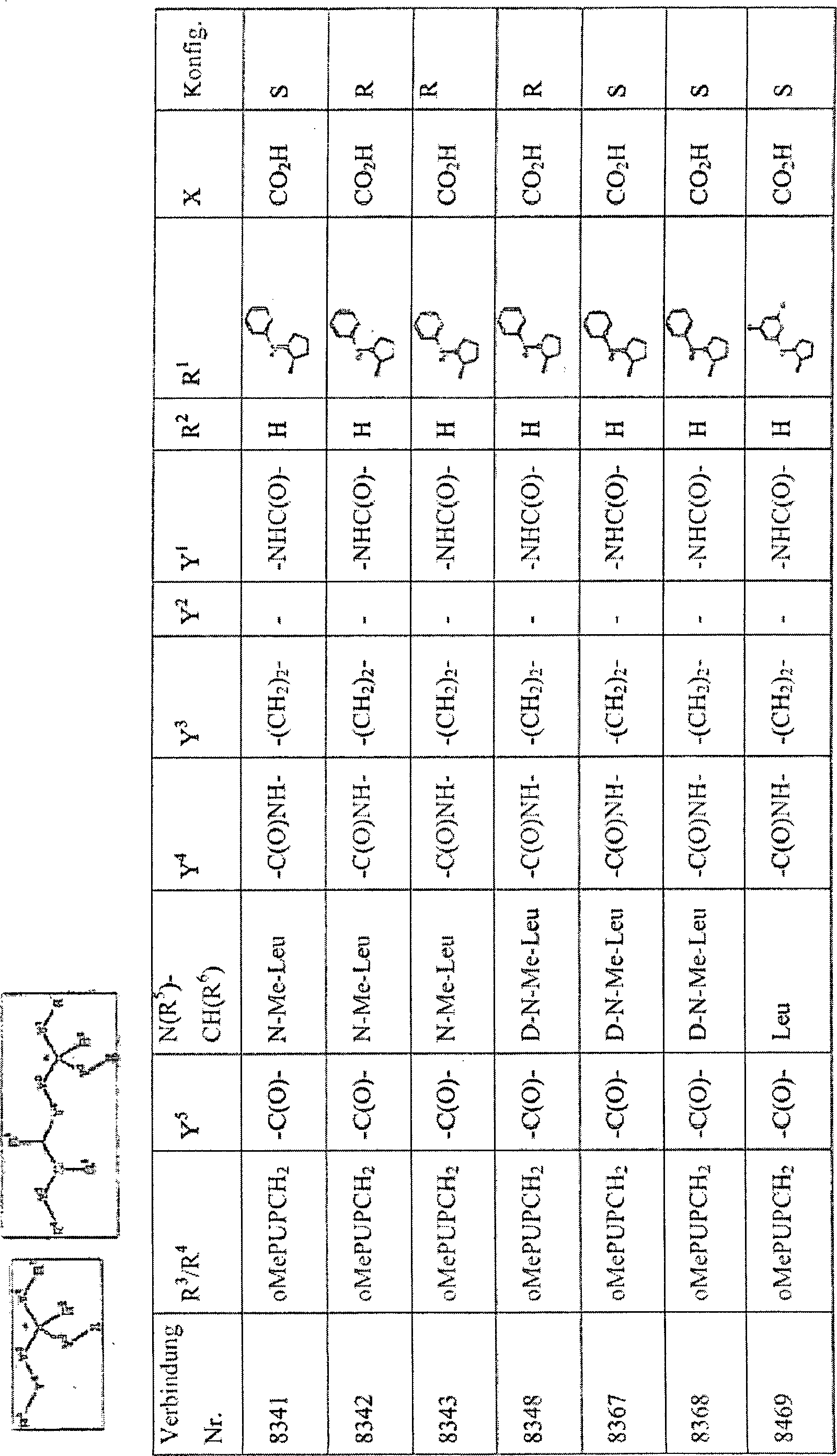


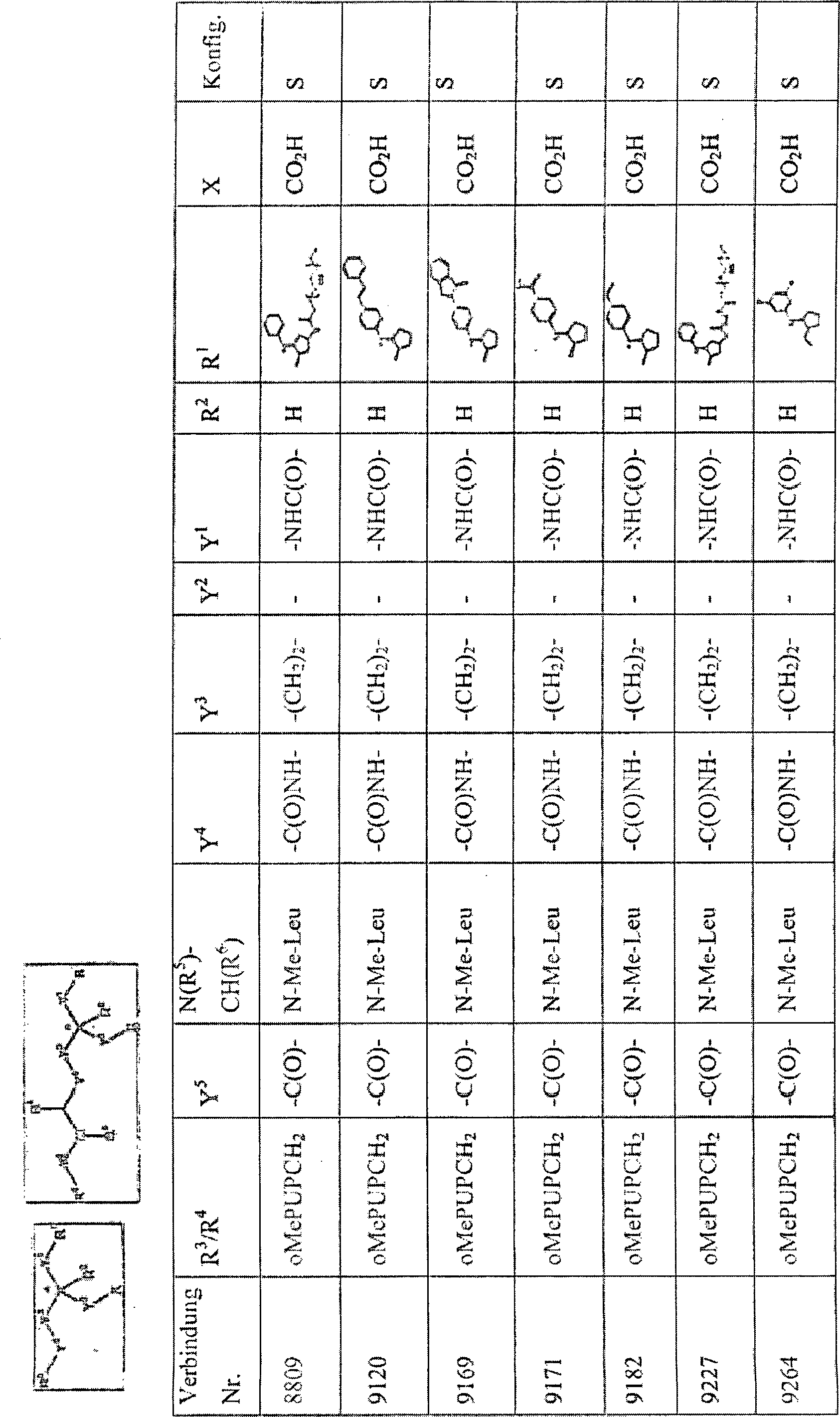

Ein oder mehrere der Hemmer, die vorstehend beschrieben sind, oder ein Salz davon können zur Herstellung eines Medikaments zum Behandeln der vorstehend erwähnten Störungen verwendet werden.One or more of the inhibitors described above, or a Salt of it can used for the manufacture of a medicament for treating the aforementioned disorders become.
Eine weitere Ausführungsform dieser Erfindung betrifft eine Zusammensetzung, umfassend einen pharmazeutischen Träger und eine wirksame Menge einer Verbindung der Formel (I), supra.Another embodiment of this invention relates to a composition comprising a pharmaceutical carrier and an effective amount of a compound of formula (I), supra.
Eine Verbindung der Formel (I), supra, kann bei einem Verfahren des Hemmens der VLA-4-abhängigen Zelladhäsion verwendet werden, wobei sie an einen Patienten, der dessen bedarf, in einer wirksamen Menge zu verabreichen ist.A Compound of formula (I), supra, can be used in a method of inhibiting used the VLA-4-dependent cell adhesion be in a patient who needs it effective amount is to be administered.
Das Vermögen der Verbindungen dieser Erfindung, den Wirkungen von VLA-4 entgegen zu wirken, macht sie nützlich zum Vorbeugen, Behandeln oder Rückgängigmachen der Symptome, Störungen oder Erkrankungen, welche durch das Binden von VLA-4 an seine Liganden induziert wird. So werden diese Antagonisten Zelladhäsionsprozesse einschließlich Zellaktivierung, -migration, -proliferation und -differentiation hemmen. Sie können daher bei Verfahren zur Behandlung, Vorbeugung, Linderung oder Unterdrückung von Erkrankungen oder Störungen, die über den VLA-4-Weg vermittelt werden, verwendet werden. Solche Erkrankungen und Störungen schließen zum Beispiel Asthma, Multiple Sklerose, allergische Rhinitis, allergische Konjunktivitis, entzündliches Lungenleiden, rheumatoide Arthritis, eitrige Arthritis, Typ-I-Diabetes, Organtransplantatabstoßung, entzündliche Darmerkrankung und andere ein.The capital of the compounds of this invention oppose the effects of VLA-4 to work makes them useful to prevent, treat or undo the symptoms, disorders or diseases resulting from the binding of VLA-4 to its ligands is induced. Thus, these antagonists become cell adhesion processes including Cell activation, migration, proliferation and differentiation inhibit. You can therefore in methods of treatment, prevention, alleviation or suppression of Diseases or disorders, the above the VLA-4 pathway can be used. Such diseases and disorders shut down for example asthma, multiple sclerosis, allergic rhinitis, allergic conjunctivitis, inflammatory Lung disease, rheumatoid arthritis, purulent arthritis, type I diabetes, organ transplant rejection, inflammatory Intestinal disease and others.
Verbindungen der Erfindung enthalten ein oder mehrere asymmetrische Zentren und können so als Racemate und racemische Gemische, als einzelne Enantiomere, als diastereomere Gemische und einzelne Diastereomere vorkommen. Die vorliegende Erfindung ist dazu gedacht, alle solche isomeren Formen der Verbindungen der Erfindung zu umfassen.links of the invention contain one or more asymmetric centers and can as racemates and racemic mixtures, as single enantiomers, occur as diastereomeric mixtures and individual diastereomers. The present invention is intended to include all such isomers To include forms of the compounds of the invention.
Die beanspruchte Erfindung ist auch darauf ausgelegt, pharmazeutisch verträgliche Salze der Formel I einzuschließen. Der Begriff „pharmazeutisch verträgliche Salze" bezieht sich auf Salze, die aus pharmazeutisch verträglichen, nicht-toxischen Basen oder Säuren einschließlich anorganischen oder organischen Basen und anorganischen oder organischen Säuren hergestellt werden. Salze, die aus anorganischen Basen abgeleitet sind, schließen Aluminium-, Ammonium-, Calcium-, Kupfer-, Eisen(III)-, Eisen(II)-, Lithium-, Magnesium-, Mangan(III)-, Mangan(II)-, Kalium-, Natrium-, Zinksalze und dergleichen ein. Besonders bevorzugt sind die Ammonium-, Calcium-, Magnesium-, Kalium- und Natriumsalze.The claimed invention is also designed to be pharmaceutical compatible Include salts of the formula I. The term "pharmaceutical compatible Salts "refers salts derived from pharmaceutically acceptable, non-toxic bases or acids including inorganic or organic bases and inorganic or organic acids getting produced. Salts derived from inorganic bases are close Aluminum, ammonium, calcium, copper, iron (III), iron (II) -, Lithium, magnesium, manganese (III), manganese (II), potassium, sodium, Zinc salts and the like. Particularly preferred are the ammonium, Calcium, magnesium, potassium and sodium salts.
Salze, die aus pharmazeutisch verträglichen, organischen, nicht-toxischen Basen abgeleitet sind, schließen Salze von primären, sekundären und tertiären Aminen, substituierten Aminen einschließlich natürlich vorkommenden substituierten Aminen, cyclischen Aminen und basischen Ionenaustauscherharzen wie etwa Arginin, Betain, Koffein, Cholin, N,N'-Dibenzylethylendiamin, Diethylamin, 2-Diethylaminoethanol, 2-Dimethylaminoethanol, Ethanolamin, Ethylendiamin, N-Ethylmorpholin, N-Ethylpiperidin, Glucamin, Glucosamin, Histidin, Hydrabamin, Isopropylamin, Lysin, Methylglucamin, Morpholin, Piperazin, Piperidin, Polyaminharzen, Procain, Purinen, Theobromin, Triethylamin, Trimethylamin, Tripropylamin, Tromethamin und dergleichen ein.salts made from pharmaceutically acceptable, derived from organic, non-toxic bases include salts from primary, secondary and tertiary Amines, substituted amines including naturally occurring substituted ones Amines, cyclic amines and basic ion exchange resins such as Arginine, betaine, caffeine, choline, N, N'-dibenzylethylenediamine, Diethylamine, 2-diethylaminoethanol, 2-dimethylaminoethanol, ethanolamine, Ethylenediamine, N-ethylmorpholine, N-ethylpiperidine, glucamine, glucosamine, histidine, Hydrabamine, isopropylamine, lysine, methylglucamine, morpholine, piperazine, Piperidine, polyamine resins, procaine, purines, theobromine, triethylamine, Trimethylamine, tripropylamine, tromethamine and the like.
Wenn die Verbindung der vorliegenden Erfindung basisch ist, können Salze aus pharmazeutisch verträglichen, nicht-toxischen Säuren einschließlich anorganischen und organischen Säuren hergestellt werden. Solche Säuren schließen Essig-, Benzolsulfon-, Benzoe-, Kampfersulfon-, Zitronen-, Ethansulfon-, Fumar-, Glucon-, Glutamin-, Bromwasserstoff-, Salz-, Isethion-, Milch-, Malein-, Äpfel-, Mandel-, Methansulfon-, Schleim-, Salpeter-, Pamoin-, Pantothen-, Phosphor-, Bernstein-, Schwefel-, Wein-, p-Toluolsulfonsäure und dergleichen ein. Besonders bevorzugt sind Zitronen-, Bromwasserstoff-, Salz-, Malein-, Phosphor-, Schwefel- und Weinsäure.If The compound of the present invention is basic, salts from pharmaceutically acceptable, non-toxic acids including inorganic and organic acids getting produced. Such acids shut down Acetic, benzenesulfonic, benzoic, camphorsulfonic, citric, ethanesulfonic, Fumaric, gluconic, glutamic, hydrobromic, hydrochloric, isethionic, Milk, Malein, Apples, Almond, methanesulfone, mucus, saltpetre, pamoin, pantothene, Phosphoric, succinic, sulfuric, tartaric, p-toluenesulfonic acid and the like one. Particularly preferred are citric, hydrobromic, salt, Malic, phosphoric, sulfuric and tartaric acid.
Wie er hier verwendet wird, bezieht sich der Begriff „Alkyl", allein oder in Kombination, auf einen unverzweigten oder verzweigten Alkylrest, der 1 bis 10, bevorzugt 1 bis 6 und stärker bevorzugt 1 bis 4 Kohlenstoffatome enthält. Beispiele für solche Reste schließen Methyl, Ethyl, n-Propyl, Isopropyl, n-Butyl, Isobutyl, sek-Butyl, tert-Butyl, Pentyl, Isoamyl, Hexyl, Decyl und dergleichen ein, sind aber nicht darauf beschränkt.As as used herein, the term "alkyl" refers to alone or in Combination, to an unbranched or branched alkyl radical, from 1 to 10, preferably from 1 to 6 and more preferably from 1 to 4 carbon atoms contains. examples for close such radicals Methyl, ethyl, n-propyl, isopropyl, n-butyl, isobutyl, sec-butyl, tert-butyl, pentyl, isoamyl, hexyl, decyl and the like but not limited to that.
Der Begriff „Halogen" bedeutet Fluor, Chlor, Brom und Iod.Of the Term "halogen" means fluorine, Chlorine, bromine and iodine.
Wie er in dieser gesamten Anmeldung verwendet wird, bezieht sich der Begriff „Patient" auf Säuger einschließlich Menschen. Und der Begriff „Zelle" bezieht sich auf Säugerzellen einschließlich menschlichen Zellen.As It is used throughout this application Term "patient" to mammals including humans. And the term "cell" refers to mammalian cells including human cells.
Im Hinblick auf die vorstehenden Definitionen können andere chemische Begriffe, die in dieser gesamten Anmeldung verwendet werden, von Fachleuten leicht verstanden werden. Die Begriffe können allein oder in jeglicher Kombination davon verwendet werden. Die bevorzugten und stärker bevorzugten Kettenlängen der Reste gelten für alle solche Kombinationen.in the In view of the above definitions, other chemical terms, used in this entire application, by persons skilled in the art be easily understood. The terms can be alone or in any Combination of it used. The preferred and more preferred chain lengths the radicals are valid for all such combinations.
Andere Merkmale oder Vorteile der vorliegenden Erfindung werden aus der nachstehenden detaillierten Beschreibung einiger Ausführungsformen und auch aus den anhängenden Ansprüchen ersichtlich sein.Other Features or advantages of the present invention will become apparent from the following detailed description of some embodiments and also from the attached claims be clear.
DETAILLIERTE BESCHREIBUNGDETAILED DESCRIPTION
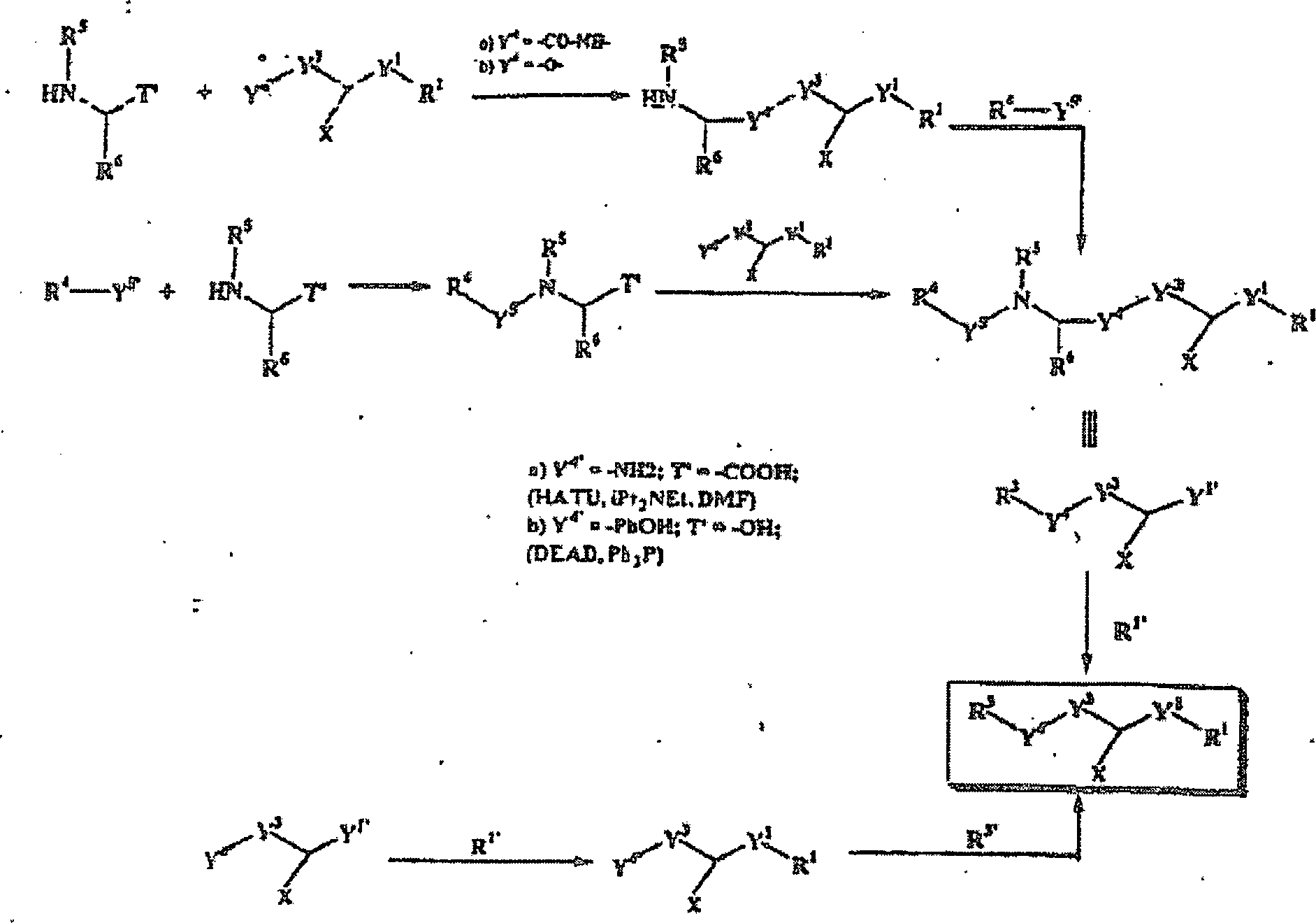
Die Verbindungen dieser Erfindung können unter Verwendung eines jeglichen konventionellen Verfahrens, von denen einige hier beispielhaft aufgeführt sind, synthetisiert werden. Bevorzugt werden diese Verbindungen chemisch aus ohne weiteres verfügbaren Ausgangsmaterialien wie etwa α-Aminosäuren und ihren funktionellen Äquivalenten synthetisiert. Modulare und konvergente Verfahren zur Synthese dieser Verbindungen werden auch bevorzugt. Auf einem konvergenten Weg werden zum Beispiel große Teile des Endprodukts in den letzten Schritten der Synthese zusammengebracht und nicht durch inkrementales Hinzufügen von kleinen Stücken an eine wachsenden Molekülkette.The Compounds of this invention can using any conventional method, from some of which are exemplified herein are synthesized. Preferably, these compounds are chemically prepared from readily available starting materials such as α-amino acids and their functional equivalents synthesized. Modular and convergent methods for the synthesis of these Compounds are also preferred. Be on a convergent path for example big Portions of the final product brought together in the final steps of the synthesis and not by incrementally adding small pieces a growing molecular chain.
Die Verbindungen der Erfindung, R3-L-L'-R1, gemäß einer Ausführungsform, können dargestellt werden als R3-Y4-Y3-CH(X)-Y1-R1. Diese Verbindung kann als ein Dipeptidderivat angesehen werden: mit R1 als ein Aminosäurerest oder einem Derivat davon; Y1 als eine Amidbrücke oder ein Derivat davon zwischen den zwei Resten; X als einem Carboxylat oder ein Derivat davon; C als das α-Kohlenstoffatom des zweiten Rests und R3-Y4-Y3- als die Seitenkette des zweiten Rests.The compounds of the invention, R 3 -L-L'-R 1 , according to one embodiment, can be represented as R 3 -Y 4 -Y 3 -CH (X) -Y 1 -R 1 . This compound can be considered as a dipeptide derivative: with R 1 as an amino acid residue or a derivative thereof; Y 1 as an amide bridge or a derivative thereof between the two radicals; X as a carboxylate or a derivative thereof; C as the α-carbon atom of the second residue and R 3 -Y 4 -Y 3 - as the side chain of the second residue.
In dem allgemeinen Verfahren, das nachstehend veranschaulicht ist, wird die Verbindung R3-Y4-Y3-CH(X)-Y1-R1 hergestellt, indem zunächst eine geeignet geschützte Einheit Y4'-Y3-CH(X)-Y1' mit einem geeignet geschützten R3' gekoppelt wird. Y3 und X sind vorstehend definiert worden. Y4',Y1' und R3' sind Vorstufen von Y4, Y1 beziehungsweise R3.In the general procedure illustrated below, the compound R 3 -Y 4 -Y 3 -CH (X) -Y 1 -R 1 is prepared by first adding a suitably protected moiety Y 4 ' -Y 3 -CH (X. ) -Y 1 'is coupled to a suitably protected R 3' . Y 3 and X have been defined above. Y 4 ' , Y 1' and R 3 ' are precursors of Y 4 , Y 1 and R 3, respectively.
Die Verbindungen der Formel Y4'-Y3-CH(X)-Y1' sind kommerziell verfügbar oder können gemäß Verfahren, die Durchschnittsfachleuten bekannt sind, hergestellt werden. Zum Beispiel ist, wenn Y1' für eine Aminogruppe steht; X für Carboxylat steht und Y4'-Y3- für NH2-(CH2)3- steht, die Verbindung Y4'-Y3-CH(X)-Y1' Ornithin. Als ein anderes Beispiel ist, wenn Y1' für eine Aminogruppe steht; X für Carboxylat steht und Y4'-Y3- für 4-NH2-Cyclohexyl-CH2- steht, die Verbindung Y4'-Y3-CH(X)-Y1' 4-Aminophenylalanin, verfügbar durch Reduktion von kommerziell verfügbarem 4-Nitrophenylalanin. Die weitere Reduktion der Phenyleinheit führt zu einer Verbindung, in der Y1' für eine Aminogruppe steht; X für Carboxylat steht und Y4'-Y3- für 4-NH2-Cyclohexyl-CH2- oder 4-Aminocyclohexylalanin steht, kommerziell verfügbar als ein Gemisch von cis- und trans-Isomeren. Wie vorstehend erwähnt, sind geeignete Schutzgruppen erforderlich, um bestimmte Funktionalitäten daran zu hindern, unerwünschte Reaktionen zu durchlaufen. Um Ornithin als ein Beispiel zu verwenden: Y1' und X sind Funktionalitäten, die nicht bei der ersten Kopplungsreaktion beteiligt sind, und sollten mit üblichen Aminoschutzgruppe wie etwa mit Carbamaten (z.B. t-Butylcarbamat (BOC) und Benzylcarbamat (CBZ)) und üblichen Carboxylschutzgruppen wie etwa substituierten Estern (z.B. Ethylester und Methoxymethylester) geschützt werden. Für geeignetere Schutzgruppen siehe T. W. Greene, Protecting Groups in Organic Synthesis, John Wiley und Sons, New York, 1981, und Literaturstellen, die darin zitiert werden.The compounds of formula Y 4 '-Y 3 -CH (X) -Y 1' are available commercially or can be prepared according to methods that are known to those skilled. For example, when Y 1 'is an amino group; X is carboxylate and Y 4 ' - Y 3 - is NH 2 - (CH 2 ) 3 -, the compound Y 4' - Y 3 -CH (X) -Y 1 ' ornithine. As another example, when Y 1 'is an amino group; X is carboxylate and Y 4 ' - Y 3 - is 4-NH 2 cyclohexyl-CH 2 -, the compound Y 4' - Y 3 -CH (X) -Y 1 ' 4-aminophenylalanine, available by reduction of commercially available 4-nitrophenylalanine. Further reduction of the phenyl moiety results in a compound in which Y 1 'is an amino group; X is carboxylate and Y 4 ' - Y 3 - is 4-NH 2 -cyclohexyl-CH 2 - or 4-aminocyclohexylalanine, commercially available as a mixture of cis and trans isomers. As mentioned above, suitable protecting groups are required to prevent certain functionalities from undergoing undesirable reactions. To use ornithine as an example: Y 1 ' and X are functionalities that are not involved in the first coupling reaction and should be compatible with common amino protecting groups such as carbamates (eg t-butylcarbamate (BOC) and benzylcarbamate (CBZ)) and conventional ones Carboxyl protecting groups such as substituted esters (eg, ethyl esters and methoxymethyl esters). For more suitable protecting groups, see TW Greene, Protecting Groups in Organic Synthesis, John Wiley and Sons, New York, 1981, and references cited therein.
Die Verbindung R3' kann durch die Formel Z3-Lb-Z4-T oder R4-Y5-N(R5)-CH(R6)-T' dargestellt werden. Ein jedes von T und T' steht für eine Funktionalität, die sich mit Y4' verbindet, um Y4 zu bilden. Zum Beispiel kann das gewünschte Y4, wenn es eine Amidbrücke ist, gebildet werden, indem eine Aminogruppe (Y4') mit einer Carboxylgruppe (T oder T') in Anwesenheit eines gewöhnlichen Kopplungsreagens wie etwa Benzotriazol-1-yloxytris(dimethylamino)-phosphoniumhexafluorphosphat (BOP) oder O-Benzotriazol-1-yl-N,N,N',N'-tetramethyluroniumhexafluorphosphat (HBTU) umgesetzt wird. Als ein anderes Beispiel kann das gewünschte Y4, wenn es ein Arylether ist, gebildet werden, indem ein Phenol mit einem Alkohol in Anwesenheit von Diethylazodicarboxylat (DEAD) und Triphenylphosphin umgesetzt wird.The compound R 3 ' can be represented by the formula Z 3 -L b -Z 4 -T or R 4 -Y 5 -N (R 5 ) -CH (R 6 ) -T ' . Each of T and T ' represents a functionality that connects to Y 4' to form Y 4 . For example, the desired Y 4 , if it is an amide bridge, can be formed by reacting an amino group (Y 4 ' ) with a carboxyl group (T or T ' ) in the presence of a common coupling reagent such as benzotriazol-1-yloxytris (dimethylamino) - phosphonium hexafluorophosphate (BOP) or O-benzotriazol-1-yl-N, N, N ', N'-tetramethyluronium hexafluorophosphate (HBTU). As another example, when the yl is an aryl ether, the desired Y 4 may be formed by reacting a phenol with an alcohol in the presence of diethyl azodicarboxylate (DEAD) and triphenylphosphine.
Wenn R3' der Formel Z3-Lb-Z4-T entspricht, ist die Verbindung kommerziell verfügbar oder kann gemäß Verfahren, die Durchschnittsfachleuten bekannt sind, hergestellt werden. Zum Beispiel steht, wenn Z3 für 2-Methylphenyl steht; Z4 für Phenylmethyl steht; Lb für -NH-CO-NH- steht und T für -COOH steht, R3' für o-Methylphenylureidophenylessigsäure und kann erhalten werden, indem 4-Aminophenylessigsäure mit 2-Methylphenylisocyanat umgesetzt wird. Als ein anderes Beispiel steht, wenn Z3 für 3-Indol steht; Z4 für Phenylmethyl steht; Lb für -CO- NH- steht und T für -COOH steht, R3' für 3-Indolcarboxamidophenylessigsäure und kann erhalten werden, indem 4-Aminophenylessigsäure mit Indol-3-carbonylchlorid umgesetzt wird.When R 3 'is of the formula Z 3 -L b -Z 4 -T, the compound is commercially available or can be prepared according to methods known to those of ordinary skill in the art. For example, when Z 3 is 2-methylphenyl; Z 4 is phenylmethyl; L b is -NH-CO-NH- and T is -COOH, R 3 'is o-methylphenylureidophenylacetic acid and can be obtained by reacting 4-aminophenylacetic acid with 2-methylphenyl isocyanate. As another example, when Z 3 is 3-indole; Z 4 is phenylmethyl; L b is -CO-NH- and T is -COOH, R 3 'is 3-indolecarboxamidophenylacetic acid and can be obtained by reacting 4-aminophenylacetic acid with indole-3-carbonyl chloride.
Wenn R3' der Formel R4-Y5-N(R5)-CH(R6)-T' entspricht, kann Y4'-Y3-CH(X)-Y1' an NH(R5)-CH(R6)-T' koppeln, um die Zwischenstufe NH(R5)-CH(R6)-Y4-Y3-CH(X)-Y1' zu bilden, vor weiterem Koppeln an R4-Y5', um R4-Y5-N(R5)-CH(R6)-Y4-Y3-CH(X)-Y1' zu bilden. Y5' steht für eine Funktionalität, die, nachdem sie weitere Kopplungsreaktionen durchlaufen hat, die Funktionalität Y5 ergibt. Man beachte, dass die Verbindung NH(R5)-CH(R6)-T' ein Amiosäurederivat sein kann, das kommerziell verfügbar ist und unter Verwendung konventioneller Verfahren von einem Durchschnittsfachmann hergestellt werden kann. Zum Beispiel ist, wenn T' für Carboxyl steht; R6 für Isobutyl steht und R5 für Methyl steht, die Verbindung NH(R5)-CH(R6)-T' N-Methylleucin. R4-Y5' können durch gewöhnlich verwendete synthetische Verfahren an NH(R5)-CH(R6)-Y4-Y3-CH(X)-Y1' gekoppelt werden. Zum Beispiel ist, wenn Y5' für Carboxyl steht, das resultierende Y5 eine Amidbrücke und kann unter Verwendung gewöhnlicher Peptidsynthesereagenzien, wie vorstehend erwähnt, hergestellt werden. Als ein anderes Beispiel ist, wenn Y5' für ein Halogen oder Sulfonat steht, das resultierende Y5 ein sekundäres oder tertiäres Amin, das aus einer Alkylierung des Ausgangs-Amins resultiert. Alternativ kann, um die Verbindung R4-Y5-NH(R5)-CH(R6)-Y4-Y3-CH(X)-Y1' zu bilden, NH(R5)-CH(R6)-T' zuerst an R4-Y5' koppeln, um die Zwischenstufe R4-Y5-N(R5)-CH(R6)-T' zu bilden, vor weiterem Koppeln an Y4'-Y3-CH(X)-Y1'. Das nachstehende Beispiel 1 stellt eine detaillierte Vorgehensweise zur Verfügung, wobei R3 der Formel R4-Y5-N(R5)-CH(R6)- entspricht.When R 3 'is of the formula R 4 -Y 5 -N (R 5 ) -CH (R 6 ) -T ' , Y 4 ' -Y 3 -CH (X) -Y 1' can be attached to NH (R 5 ) -CH (R 6 ) -T ' to form the intermediate NH (R 5 ) -CH (R 6 ) -Y 4 -Y 3 -CH (X) -Y 1' , before further coupling to R 4 - Y 5 ' to form R 4 -Y 5 -N (R 5 ) -CH (R 6 ) -Y 4 -Y 3 -CH (X) -Y 1' . Y 5 ' represents a functionality that, after being more Kopp has undergone reaction reactions, the functionality Y 5 results. Note that the compound NH (R 5 ) -CH (R 6 ) -T 'may be an amino acid derivative which is commercially available and can be prepared using conventional methods by one of ordinary skill in the art. For example, when T 'is carboxyl; R 6 is isobutyl and R 5 is methyl, the compound NH (R 5 ) -CH (R 6 ) -T 'N -methylleucine. R 4 -Y 5 ' may be coupled to NH (R 5 ) -CH (R 6 ) -Y 4 -Y 3 -CH (X) -Y 1' by commonly used synthetic methods. For example, when Y 5 'is carboxyl, the resulting Y 5 is an amide bridge and can be prepared using common peptide synthesis reagents as mentioned above. As another example, when Y 5 'is a halogen or sulfonate, the resulting Y 5 is a secondary or tertiary amine resulting from alkylation of the starting amine. Alternatively, to form the compound R 4 -Y 5 -NH (R 5 ) -CH (R 6 ) -Y 4 -Y 3 -CH (X) -Y 1 ' , NH (R 5 ) -CH (R 6 ) -T 'first to R 4 -Y 5' to form the intermediate R 4 -Y 5 -N (R 5 ) -CH (R 6 ) -T ' , before further coupling to Y 4' -Y 3 -CH (X) -Y 1 ' . Example 1 below provides a detailed procedure wherein R 3 is of the formula R 4 -Y 5 -N (R 5 ) -CH (R 6 ) -.
Alternativ kann R3', wenn es der Formel Z3-Lb-Z4-T entspricht, mit Y4'-Y3-CH(X)-Y1' reagieren, um Z3-Lb-Z4-Y4-Y3-CH(X)-Y1 zu bilden. Siehe Beispiel 2.Alternatively, R 3 ' , when it corresponds to the formula Z 3 -L b -Z 4 -T, may react with Y 4' -Y 3 -CH (X) -Y 1 ' to form Z 3 -L b -Z 4 - Y 4 -Y 3 -CH (X) -Y 1 . See example 2.
Das Endprodukt R3-Y4-Y3-CH(X)-Y1 kann dann durch Umsetzen entweder von R4-Y5-N(R5)-CH(R6)-Y4-Y3-CH(X)-Y1' oder von Z3-Lb-Z4-Y4-Y3-CH(X)-Y1' mit R1' (dem Vorläufer von R1) gebildet werden. Die Einheit Y1 kann in einer ähnlichen Art und Weise wie Y4 gebildet werden.The final product R 3 -Y 4 -Y 3 -CH (X) -Y 1 can then be prepared by reacting either of R 4 -Y 5 -N (R 5 ) -CH (R 6 ) -Y 4 -Y 3 -CH ( X) -Y 1 ' or Z 3 -L b -Z 4 -Y 4 -Y 3 -CH (X) -Y 1' with R 1 ' (the precursor of R 1 ). The unit Y 1 may be formed in a similar manner as Y 4 .
Ein Zelladhäsionshemmer der Erfindung kann durch konventionelle Verfahren wie etwa Chromatographie oder Kristallisation gereinigt werden.One Zelladhäsionshemmer The invention may be prepared by conventional methods such as chromatography or crystallization.
Nachstehend dargelegt sind fünf allgemeine Verfahren zum Herstellen einer Verbindung dieser Erfindung.below set out are five general methods for preparing a compound of this invention.
Allgemeines
Verfahren A – Festphasen-Herstellung
von Diaminopropionatderivaten: 
Orthogonal Fmoc/Dde-geschütztes Wang-Harz (II): S-N-α-Fmoc-N-β-Dde-Diaminopropionsäure, I (4,95 g, 10,1 mmol), wurde durch Umsetzung mit 2,6-Dichlorbenzoylchlorid (1,45 ml, 10,1 mmol) und trockenem Pyridin (1,35 ml) in 40 ml trockenem DMF an Wang-Harz (7,88 g, 0,64 mmol/g, 100–200 Mesh) gebunden. Das Gemisch wurde 16 h bei Raumtemperatur geschüttelt. Das Harz wurde durch Filtration isoliert und wurde dreimal jeweils mit DMF und Dichlormethan gewaschen. Das Harz wurde durch 2-stündige Umsetzung mit Dichlorbenzoylchlorid und Pyridin (jeweils 2 ml) übedeckt, gefolgt von Waschen wie vorstehend. Das resultierende Harz enthielt 0,64 mmol/g Fmoc, wie durch Piperidinbehandlung und Messung der A290 bestimmt.Orthogonal Fmoc / Dde-protected Wang resin (II): SN-α-Fmoc-N-β-Dde-diaminopropionic acid, I (4.95 g, 10.1 mmol), was prepared by reaction with 2,6-dichlorobenzoyl chloride ( 1.45 ml, 10.1 mmol) and dry pyridine (1.35 ml) in 40 ml of dry DMF were attached to Wang resin (7.88 g, 0.64 mmol / g, 100-200 mesh). The mixture was shaken for 16 h at room temperature. The resin was isolated by filtration and was washed three times each with DMF and dichloromethane. The resin was covered by reaction with dichlorobenzoyl chloride and pyridine (2 ml each) for 2 hours, followed by washing as above. The resulting resin contained 0.64 mmol / g Fmoc as determined by piperidine treatment and measurement of A 290 .
Schutzgruppenentfernung und Acylierung von N-α: Das Diaminopropionatharz, II, wurde mit 20% Piperidin in DMF 15 Minuten behandelt, wonach es filtriert und mit DMF und Dichlormethan gewaschen wurde. Das Harz mit entfernter Schutzgruppe wurde sogleich durch Behandlung mit R1CO2H (2 Äquivalente), HATU (2 Äquivalente) und Diisopropylethylamin (4 Äquivalente) acyliert. Die Umsetzungen wurden 2 h geschüttelt, und die Acylierung wurde wiederholt. Die Vervollständigung der Acylierung wurde durch einen negativen Kaiser-Test bestimmt. Das Harz wurde filtriert und mit DMF und Dichlormethan gewaschen. Wenn R1CO2H eine Fmoc-geschützte Aminosäure ist, werden die Schutzgruppenentfernung und Acylierung, wie vorstehend beschrieben, wiederholt.Deprotection and acylation of N-α: The diaminopropionate resin, II, was treated with 20% piperidine in DMF for 15 minutes, after which it was filtered and washed with DMF and dichloromethane. The deprotected resin was readily acylated by treatment with R 1 CO 2 H (2 equivalents), HATU (2 equivalents) and diisopropylethylamine (4 equivalents). The reactions were shaken for 2 h and the acylation was repeated. The completion of the acylation was determined by a negative Kaiser test. The resin was filtered and washed with DMF and dichloromethane. When R 1 CO 2 H is an Fmoc-protected amino acid, deprotection and acylation are repeated as described above.
Schutzgruppenentfernung und Acylierung von N-β: Das acylierte Diaminopropionatharz, III, wurde mit 2% Hydrazin in DMF 1 h behandelt, wonach es filtriert und mit DMF und Dichlormethan gewaschen wurde. Das Harz mit entfernter Schutzgruppe wurde sogleich durch Behandlung mit R3CO2H (2 Äquivalente), HATU (2 Äquivalente) und Diisopropylethylamin (4 Äquivalente) acyliert. Die Umsetzungen wurden 2 h geschüttelt, und die Acylierung wurde wiederholt. Das Harz wurde filtriert und mit DMF und Dichlormethan gewaschen.Deprotection and Acylation of N-β: The acylated diaminopropionate resin, III, was used with 2% hydrazine in DMF for 1 h after which it was filtered and washed with DMF and dichloromethane. The deprotected resin was readily acylated by treatment with R 3 CO 2 H (2 equivalents), HATU (2 equivalents) and diisopropylethylamine (4 equivalents). The reactions were shaken for 2 h and the acylation was repeated. The resin was filtered and washed with DMF and dichloromethane.
Abspaltung des Endprodukts von dem Harz: Das Diacyldiaminopropionatharz, IV, wurde mit 95% TFA/5% Wasser 1 h behandelt. Das Lösungsmittel wurde durch Filtration entfernt, und das Harz wurde mit zwei kleinen Portionen TFA gewaschen. Die vereinigten TFA-Lösungen wurden unter Vakuum aufkonzentriert, und der resultierende Rückstand wurde durch Umkehrphasen-HPLC gereinigt, was reine Diacyldiaminopropionatderivate ergab.secession of the final product of the resin: the diacyldiaminopropionate resin, IV, was treated with 95% TFA / 5% water for 1 h. The solvent was removed by filtration and the resin was washed with two small portions of TFA. The combined TFA solutions were concentrated under vacuum and the resulting residue was purified by reverse phase HPLC, which was pure diacyldiaminopropionate derivatives revealed.
Allgemeines
Verfahren B – Herstellung
von β-Lysinderivaten: 
Omega-N-Cbz-beta-N-BOC-beta-homolysinmethylester (II): Omeaga-N-Cbz-beta-N-BOC-beta-homolysin, I, wurde in N,N-Dimethylformamid gelöst. Zu dieser Lösung wurde Natriumbicarbonat (10 Äquivalente) und dann Jodmethan (6 Äquivalente) unter Rühren zugegeben. Nach Rühren über Nacht bei Raumtemperatur wurde das Reaktionsgemisch zwischen Wasser und Ethylacetat ausgeschüttelt. Die organische Phase wurde mit gesättigter Natriumchloridlösung gewaschen, dann über Natriumsulfat getrocknet. Filtrieren und Verdampfung des Lösungsmittels wurden gefolgt von Kieselgelchromatographie (Hexan/Ethylacetat), um den Ester II zu gewinnen.Omega-N-Cbz-beta-N-BOC-beta-homolysinmethylester (II): Omeaga-N-Cbz-beta-N-BOC-beta-homolysin, I, was converted into N, N-dimethylformamide solved. To this solution was sodium bicarbonate (10 equivalents) and then iodomethane (6 equivalents) with stirring added. After stirring overnight at room temperature, the reaction mixture was between water and Shaken out ethyl acetate. The organic phase was washed with saturated sodium chloride solution, then over Dried sodium sulfate. Filter and evaporate the solvent were followed by silica gel chromatography (hexane / ethyl acetate), to win the ester II.
Beta-N-BOC-beta-homolysinmethylester (III): Das N-Cbz-carbamat II wurde in Methanol gelöst. Zu diesem wurde 10% Palladium auf Kohlenstoff gegeben. Das Gemisch wurde mit Stickstoff gespült, dann wurde Wasserstoff (50 psi) zugegeben. Nach Rühren über Nacht wurde der Katalysator unter Verwendung eines Whatman PTFE-Filters entfernt, und die Lösung wurde aufkonzentriert, um rohes Amin III zu gewinnen.Beta-N-BOC-beta-homolysinmethylester (III): The N-Cbz-carbamate II was dissolved in methanol. To this 10% palladium on carbon was added. The mixture was washed with Flushed with nitrogen, then hydrogen (50 psi) was added. After stirring overnight The catalyst was made using a Whatman PTFE filter removed, and the solution was concentrated to recover crude amine III.
N-omega-Acylierung: Das Amin III (111 mg), 2-(1H-Benzotriazol-1-yl)-1,1,3,3-tetramethyluroniumhexafluorophosphat (HBTU, 1,1 Äquivalente) und R1CO2H (1,1 Äquivalente) wurden in N,N-Dimethylformamid gelöst. Zu dieser Lösung wurde N,N-Diisopropylethylamin (2,5 Äquivalente) zugegeben. Nach Rühren über Nacht wurde die Umsetzung mit 5% wässriger Zitronensäurelösung gequencht, dann mit Ethylacetat extrahiert. Die organischen Stoffe wurden mit gesättigter Natriumchloridlösung gewaschen, dann über Natriumsulfat getrocknet. Filtration und Entfernung des Lösungsmittels durch Rotationsverdampfung ergaben rohes Amid IV, das ohne weitere Reinigung verwendet wurde.N-omega acylation: The amine III (111 mg), 2- (1H-benzotriazol-1-yl) -1,1,3,3-tetramethyluronium hexafluorophosphate (HBTU, 1.1 equivalents) and R 1 CO 2 H ( 1.1 equivalents) were dissolved in N, N-dimethylformamide. To this solution was added N, N-diisopropylethylamine (2.5 equivalents). After stirring overnight, the reaction was quenched with 5% aqueous citric acid solution, then extracted with ethyl acetate. The organics were washed with saturated sodium chloride solution, then dried over sodium sulfate. Filtration and removal of the solvent by rotary evaporation gave crude amide IV, which was used without further purification.
N-beta-Schutzgruppenentfernung und Acylierung: Rohes N-BOC-carbamat IV wurde mit gesättigter Salzsäure in Ethylacetat behandelt, die durch 30-minütiges Durchperlen von Chlorwasserstoffgas durch kalte (Null Grad) Ethylacetatlösung hergestellt wurde. Die Umsetzung wurde eine Stunde gerührt, dann zur Trockene aufkonzentriert, um rohes Amin V zu gewinnen, das ohne weitere Reinigung verwendet wurde. Das rohe Amin V wurde in N,N-Dimethylformamid zusammen mit R3CO2H (1 Äquivalent) und HBTU (1,1 Äquivalente) gelöst. Unter Rühren wurde N,N-Diisopropylethylamin (7,5 Äquivalente) zugegeben. Nach Rühren über Nacht wurde die Umsetzung zwischen 5% wässriger Zitronensäure und Ethylacetat ausgeschüttelt. Die organische Phase wurde mit gesättigter Natriumchloridlösung gewaschen, dann über Natriumsulfat getrocknet. Filtration des Trocknungsmittels und Verdampfung des Lösungsmittels ergaben rohes Amin VI, das ohne weitere Reinigung verwendet wurde.N-beta-deprotection and acylation: Crude N-BOC-carbamate IV was treated with saturated Hydrochloric acid in ethyl acetate, which was prepared by bubbling hydrogen chloride gas through cold (zero degrees) ethyl acetate solution for 30 minutes. The reaction was stirred for one hour, then concentrated to dryness to yield crude amine V, which was used without further purification. The crude amine V was dissolved in N, N-dimethylformamide together with R 3 CO 2 H (1 equivalent) and HBTU (1.1 equivalents). With stirring, N, N-diisopropylethylamine (7.5 equivalents) was added. After stirring overnight, the reaction was partitioned between 5% aqueous citric acid and ethyl acetate. The organic phase was washed with saturated sodium chloride solution, then dried over sodium sulfate. Filtration of the drying agent and evaporation of the solvent gave crude amine VI, which was used without further purification.
Endgültige Schutzgruppenentfernung: Der Methylester VI wurde in 1:1 Tetrahydrofuran und Methanol gelöst. Unter Rühren wurde wässriges Lithiumhydroxid (2 N) zugegeben. Nach einer Stunde Rühren wurde das Reaktionsgemisch zur Trockene aufkonzentriert. Der Rückstand wurde zwischen 1 N wässriger Salzsäure und Ethylacetat ausgeschüttelt, und die organische Phase wurde mit gesättigter Natriumchloridlösung gewaschen. Trocknen über Natriumsulfat, Filtrieren und Verdampfen ergab rohe Säure. Die Reinigung durch präparative Umkehrphasen-Hochleistungsflüssigkeitschromatographie ergab reine Säure.Final deprotection: The methyl ester VI was dissolved in 1: 1 tetrahydrofuran and methanol. Under stir became watery Lithium hydroxide (2N) added. After stirring for one hour, it became Concentrated reaction mixture to dryness. The residue was between 1 N aqueous Hydrochloric acid and Shaken out ethyl acetate, and the organic phase was washed with saturated sodium chloride solution. Dry over Sodium sulfate, filtration and evaporation gave crude acid. The Purification by preparative Reverse phase high performance liquid chromatography gave pure acid.
Allgemeines
Verfahren C – Festphasen-Herstellung
von Lysinderivaten: 
Fmoc/Dde-Lysin-Wang-Harz (II): N-α-Fmoc-N-β-Dde-Lysin, I (5,0 g, 9,39 mmol), wurde durch Umsetzung mit 2,6-Dichlorbenzoylchlorid (1,33 ml, 10,1 mmol) und trockenem Pyridin (1,27 ml) in 50 ml trockenem DMF an Wang-Harz (7,34 g, 0,64 mmol/g, 100–200 Mesh) gebunden. Das Gemisch wurde 16 h bei Raumtemperatur geschüttelt. Das Harz wurde durch Filtration isoliert und wurde dreimal jeweils mit DMF und Dichlormethan gewaschen. Das Harz wurde durch 2-stündige Umsetzung mit Dichlorbenzoylchlorid und Pyridin (jeweils 2 ml) überdeckt, gefolgt von Waschen wie vorstehend. Das resultierende Harz enthielt 0,56 mmol/g Fmoc, wie durch Piperidinbehandlung und Messung der A290 bestimmt.Fmoc / Dde-lysine Wang resin (II): N-α-Fmoc-N-β-Dde-lysine, I (5.0 g, 9.39 mmol), was prepared by reaction with 2,6-dichlorobenzoyl chloride ( 1.33 ml, 10.1 mmol) and dry pyridine (1.27 ml) in 50 ml of dry DMF were attached to Wang resin (7.34 g, 0.64 mmol / g, 100-200 mesh). The mixture was shaken for 16 h at room temperature. The resin was isolated by filtration and was washed three times each with DMF and dichloromethane. The resin was overlaid by reaction with dichlorobenzoyl chloride and pyridine (2 ml each) for 2 hours, followed by washing as above. The resulting resin contained 0.56 mmol / g Fmoc as determined by piperidine treatment and measurement of A 290 .
Schutzgruppenentfernung und Acylierung von N-α: Das Diaminopropionatharz, II, wurde mit 20% Piperidin in DMF 15 Minuten behandelt, wonach es filtriert und mit DMF und Dichlormethan gewaschen wurde. Das Harz mit entfernter Schutzgruppe wurde sogleich durch Behandlung mit R1CO2H (2 Äquivalente), HATU (2 Äquivalente) und Diisopropylethylamin (4 Äquivalente) acyliert. Die Umsetzungen wurden 2 h geschüttelt, und die Acylierung wurde wiederholt. Die Vervollständigung der Acylierung wurde durch einen negativen Kaiser-Test bestimmt. Das Harz wurde filtriert und mit DMF und Dichlormethan gewaschen. Wenn R1CO2H eine Fmoc-geschützte Aminosäure ist, werden die Schutzgruppenentfernung und Acylierung, wie vorstehend beschrieben, wiederholt.Deprotection and acylation of N-α: The diaminopropionate resin, II, was treated with 20% piperidine in DMF for 15 minutes, after which it was filtered and washed with DMF and dichloromethane. The deprotected resin was readily acylated by treatment with R 1 CO 2 H (2 equivalents), HATU (2 equivalents) and diisopropylethylamine (4 equivalents). The reactions were shaken for 2 h and the acylation was repeated. The completion of the acylation was determined by a negative Kaiser test. The resin was filtered and washed with DMF and dichloromethane. When R 1 CO 2 H is an Fmoc-protected amino acid, deprotection and acylation are repeated as described above.
Schutzgruppenentfernung und Acylierung von N-ε: Das acylierte Lysinharz, III, wurde mit 2% Hydrazin in DMF 1 h behandelt, wonach es filtriert und mit DMF und Dichlormethan gewaschen wurde. Das Harz mit entfernter Schutzgruppe wurde sogleich durch Behandlung mit R3CO2H (2 Äquivalente), HATU (2 Äquivalente) und Diisopropylethylamin (4 Äquivalente) acyliert. Die Umsetzungen wurden 2 h geschüttelt filtriert, und die Acylierung wurde wiederholt. Das Harz wurde filtriert und mit DMF und Dichlormethan gewaschen.Deprotection and acylation of N-ε: The acylated lysine resin, III, was treated with 2% hydrazine in DMF for 1 h after which it was filtered and washed with DMF and dichloromethane. The deprotected resin was readily acylated by treatment with R 3 CO 2 H (2 equivalents), HATU (2 equivalents) and diisopropylethylamine (4 equivalents). The reactions were shaken for 2 h, filtered, and the acylation was repeated. The resin was filtered and washed with DMF and dichloromethane.
Abspaltung des Endprodukts von dem Harz: Das Diacyllysinharz, IV, wurde mit 95% TFA/5% Wasser 1 h behandelt. Das Lösungsmittel wurde durch Filtration entfernt, und das Harz wurde mit zwei kleinen Portionen TFA gewaschen. Die vereinigten TFA-Lösungen wurden unter Vakuum aufkonzentriert, und der resultierende Rückstand wurde durch Umkehrphasen-HPLC gereinigt, was reine Diacyllysinderivate ergab.secession of the final product of the resin: The diacyl lysine resin, IV, was used with 95% TFA / 5% water treated for 1 h. The solvent was removed by filtration and the resin was washed with two small portions of TFA. The combined TFA solutions were concentrated under vacuum and the resulting residue was purified by reverse phase HPLC to give pure diacyl lysine derivatives revealed.
Allgemeines
Verfahren D: Herstellung von oMePUPA-N-MeLeu-α,γ-diaminobuttersäurederivaten: 
N-α-CBZ-2,4-Diaminobuttersäuremethylesterhydrochlorid (I): In einem 500-ml-RB-Kolben wurden 8,4 g (33,3 mmol) N-α-CBZ-2,4-Diaminobuttersäure in 200 ml Methanol unter Rühren suspendiert. Dies wurde auf 0°C gekühlt (Eisbad), und dann wurden 14,6 ml (200 mmol) SOCl2 tropfenweise über 15 Minuten zugegeben, um eine farblose Lösung zu ergeben. Diese Lösung ließ man sich auf RT erwärmen und es wurde über Nacht gerührt. Die Lösung wurde aufkonzentriert, in MeOH wieder gelöst und zweimal aufkonzentriert, dann in CH2Cl2 gelöst, aufkonzentriert und 16 Stunden unter Hochvakuum gesetzt, um Verbindung I als einen leicht gelben Schaum zu ergeben, der eine Masse von 10,33 g (34,2 mmol, 103%) aufwies. M/z = 267,1 (M + H+).N-α-CBZ-2,4-diaminobutyric acid methyl ester hydrochloride (I): In a 500 ml RB flask, 8.4 g (33.3 mmol) of N-α-CBZ-2,4-diaminobutyric acid in 200 ml of methanol suspended with stirring. This was cooled to 0 ° C (ice bath) and then 14.6 mL (200 mmol) of SOCl 2 was added dropwise over 15 minutes to give a colorless solution. This solution was allowed to warm to rt and stirred overnight. The solution was concentrated, redissolved in MeOH and concentrated twice, then dissolved in CH 2 Cl 2 , concentrated and placed under high vacuum for 16 hours to give compound I as a light yellow foam, which had a mass of 10.33 g (34 , 2 mmol, 103%). M / z = 267.1 (M + H + ).
BOC-N-methylleucinyl-(N-α-CBZ)-GABA-methylester (II): In einem 500-ml-RB-Kolben wurden 10,33 g (33,3 mmol) I (Molgewicht = 302) in 100 ml trockenem Dimethylformamid (DMF) unter Rühren gelöst, um eine farblose Lösung zu ergeben. Zu dieser wurden 17,4 ml (100 mmol) Diisopropylethylamin (DIEA) zugegeben, dann 7,96 g (32,5 mmol) BOC-N-Me-leucin und schließlich 14,83 g (39,0 mmol) O-(7-Azabenzotriazol-1-yl)-1,1,3,3-tetramethyluroniumhexafluorphosphat (HATU), um eine gelbe Lösung zu ergeben. Diese wurde über Nacht gerührt, wonach die HPLC kein Ausgangsmaterial zeigte. Die Lösung wurde mit Ethylacetat (EtOAc, 500 ml) verdünnt und mit 1 N HCl (zweimal), 1 N NaOH (zweimal) und Salzlösung (einmal) gewaschen. Die organische Phase wurde über wasserfreiem MgSO4 getrocknet, filtriert und zu einem roten Öl aufkonzentriert. Die Chromatographie mit 2:1 Hexanen/EtOAc über Kieselgel gab 12,56 g (25,5 mmol, 78%) II (Rf = 0,46 mit 1:1 Hex/EtOAc über Kieselgel) als einen gelben Sirup (HPLC, > 99%). M/z = 494,3 (MH).BOC-N-methylleucinyl- (N-α-CBZ) -GABA methyl ester (II): In a 500 ml RB flask, 10.33 g (33.3 mmol) of I (molecular weight = 302) in 100 ml dissolved dry dimethylformamide (DMF) with stirring to give a colorless solution. To this was added 17.4 ml (100 mmol) of diisopropylethylamine (DIEA), then 7.96 g (32.5 mmol) of BOC-N-Me-leucine and finally 14.83 g (39.0 mmol) of O- ( 7-Azabenzotriazol-1-yl) -1,1,3,3-tetramethyluronium hexafluorophosphate (HATU) to give a yellow solution. This was stirred overnight, after which HPLC showed no starting material. The solution was diluted with ethyl acetate (EtOAc, 500 ml) and washed with 1N HCl (twice), 1N NaOH (twice) and brine (once). The organic phase was dried over anhydrous MgSO 4 , filtered and concentrated to a red oil. Chromatography on silica gel with 2: 1 hexanes / EtOAc gave 12.56 g (25.5 mmol, 78%) II (R f = 0.46 with 1: 1 hex / EtOAc over silica gel) as a yellow syrup (HPLC grade). > 99%). M / z = 494.3 (MH).
H-N-Methylleucinyl-(N-α-CBZ)-GABA-methylestertrifluoracetatsalz (III): In einem 50-ml-RB-Kolben wurden 0,50 g (1,01 mmol) II (Molgewicht = 493) in 10 ml CH2Cl2 unter Rühren gelöst, um eine farblose Lösung zu ergeben. Zu dieser wurden 2 ml (26 mmol, großer Überschuss) Trifluoressigsäure zugegeben, und die resultierende Lösung wurde vier Stunden gerührt, wonach die HPLC kein Ausgangsmaterial zeigte. Die Lösung wurde aufkonzentriert, wieder in CH2Cl2 gelöst und aufkonzentriert (zweimal), dann über Nacht unter Hochvakuum gesetzt, um 0,52 g (~ quantitativ) III als ein sehr blassgelbes Öl zu ergeben. M/z = 394,4 (M + H+). Material zur weiteren Durchführung verwendet.HN-methylleucinyl- (N-α-CBZ) -GABA-methylestertrifluoroacetate salt (III): In a 50 ml RB flask, 0.50 g (1.01 mmol) of II (molecular weight = 493) in 10 ml of CH 2 Cl 2 is dissolved with stirring to give a colorless solution. To this was added 2 ml (26 mmol, large excess) of trifluoroacetic acid, and the resulting solution was stirred for four hours, at which time HPLC showed no starting material. The solution was concentrated, redissolved in CH 2 Cl 2 and concentrated (twice), then placed under high vacuum overnight to give 0.52 g (~ quantitative) of III as a very pale yellow oil. M / z = 394.4 (M + H + ). Material used for further implementation.
oMePUPA-N-methylleucinyl-(N-α-CBZ)-GABA-methylester (IV): In einem 10-ml-Fläschchen wurden 0,52 g (1,01 mmol) III (Molgewicht = 507) in 5 ml DMF unter Rühren gelöst, um eine blassegelbe Lösung zu ergeben. Zu dieser wurden 525 μl (3,0 mmol) DIEA zugegeben, dann 284 mg (1,0 mmol) oMePUPA in Form der freien Säure (Ricerca; MW = 284) und schließlich 0,42 g (1,1 mmol) HATU, um eine gelbe Lösung zu ergeben. Diese wurde über Nacht gerührt, wonach die HPLC kein verbleibendes Ausgangsmaterial zeigte. Die Lösung wurde mit EtOAc (75 ml) verdünnt und mit 1 N HCl (dreimal), 1 N NaOH (dreimal) und Salzlösung (einmal) gewaschen. Die organische Phase wurde mit MgSO4 getrocknet, filtriert und das Filtrat zu einem gelben Öl/Feststoff-Gemisch aufkonzentriert. Die Chromatographie mit 1:2 Acetonitril/CH2Cl2 über Kieselgel ergab 0,49 g (0,74 mmol, 74%) VI (Rf = 0,56 mit 1:1 Acetonitril/CH2Cl2 über Kieselgel) als einen leuchtendweißen, schaumigen Feststoff (HPLC, > 99%). M/z = 660,1 (M + H+).oMePUPA-N-methyl-leucinyl- (N-α-CBZ) -GABA-methyl ester (IV): In a 10 ml vial, 0.52 g (1.01 mmol) of III (molecular weight = 507) in 5 ml of DMF was submerged Stirred to give a pale yellow solution. To this was added 525 μl (3.0 mmol) DIEA, then 284 mg (1.0 mmol) oMePUPA in the form of the free acid (Ricerca, MW = 284) and finally 0.42 g (1.1 mmol) HATU, to give a yellow solution. This was stirred overnight, after which the HPLC showed no remaining starting material. The solution was diluted with EtOAc (75 mL) and washed with 1N HCl (3 times), 1N NaOH (3 times), and brine (1 time). The organic phase was dried with MgSO 4 , filtered and the filtrate concentrated to a yellow oil / solid mixture. Chromatography on silica gel with 1: 2 acetonitrile / CH 2 Cl 2 gave 0.49 g (0.74 mmol, 74%) of VI (R f = 0.56 with 1: 1 acetonitrile / CH 2 Cl 2 over silica gel) as a bright white, foamy solid (HPLC,> 99%). M / z = 660.1 (M + H + ).
oMePUPA-N-methylleucinyl-(N-α-H)-GABA-methylesterhydrochlorid (V): In einem 85-ml-Hochdruckgefäß wurden 400 mg (0,61 mmol) IV (Molgewicht = 659) in 10 ml MeOH unter Rühren gelöst, um eine farblose Lösung zu ergeben. Das Gefäß wurde mit Stickstoff gespült, und ~50 mg (katalytisch) 10% Palladium auf Kohlenstoff wurden zugegeben. Die Seiten des Gefäßes wurden mit zusätzlichem MeOH gewaschen und das Gefäß mit einem Hydrierungsaufsatz verschlossen. Das Gefäß wurde mit 60 psi H2 beschickt und das Gemisch über Nacht gerührt, wonach das Gefäß auf Umgebungsatmosphäre entgast wurde. Das Gemisch wurde durch Celite 545 filtriert, die Filter-Einlage mit zusätzlichem (10 ml) MeOH gewaschen und das Filtrat aufkonzentriert. Der Rückstand wurde in der Minimalmenge (2 ml) MeOH gelöst und in eiskalte 1,0 M HCl in Diethylether getropft, um einen weißen Niederschlag zu ergeben. Der Feststoff wurde in dem HCl/Ether 20 Minuten verrieben, dann filtriert, der Feststoff mit Ether gewaschen und eine Stunde luftgetrocknet. Der weiße Feststoff wurde dann mit einem Spatel zu einem Pulver zerstoßen, mit zusätzlichem Ether gewaschen und über Nacht luftgetrocknet, um 336 mg (0,50 mmol, 98%) V als ein weißes Pulver (HPLC, > 99%) zu ergeben. ESMS m/z = 526,6 (M + H+).oMePUPA-N-methylleucinyl- (N-α-H) -GABA methyl ester hydrochloride (V): In an 85 ml high-pressure vessel, 400 mg (0.61 mmol) IV (molecular weight = 659) was dissolved in 10 ml MeOH with stirring to give a colorless solution. The vessel was purged with nitrogen and ~ 50 mg (catalytic) of 10% palladium on carbon was added. The sides of the vessel were washed with additional MeOH and the vessel sealed with a hydrogenation attachment. The vessel was charged with 60 psi H 2 and the mixture was stirred overnight, after which the vessel was degassed to ambient atmosphere. The mixture was filtered through Celite 545, the filter pad washed with additional (10 mL) MeOH, and the filtrate concentrated. The residue was dissolved in the minimum amount (2 ml) of MeOH and dropped into ice-cold 1.0 M HCl in diethyl ether to give a white precipitate. The solid was triturated in the HCl / ether for 20 minutes, then filtered, the solid washed with ether and air dried for 1 hour. The white solid was then ground to a powder with a spatula, washed with additional ether and air dried overnight to give 336 mg (0.50 mmol, 98%) V as a white powder (HPLC,> 99%). ESMS m / z = 526.6 (M + H + ).
Acylierung und endgültige Hydrolyse: Rohes Amin V wurde in N,N-Dimethylformamid zusammen mit R3CO2H (1 Äquivalent) und HBTU (1,1 Äquivalente) gelöst. Unter Rühren wurde N,N-Diisopropylethylamin (4 Äquivalente) zugegeben. Nach Rühren über Nacht wurde die Umsetzung zwischen 5% wässriger Zitronensäure und Ethylacetat ausgeschüttelt. Die organische Phase wurde mit gesättigter Natriumchloridlösung gewaschen, dann über Natriumsulfat getrocknet. Die Filtration des Trocknungsmittels und Verdampfung des Lösungsmittels ergab rohes Amid, das durch Umkehrphasen-HPLC gereinigt werden konnte. Der Methylester wurde in 1:1 Tetrahydrofuran und Methanol gelöst. Unter Rühren wurde wässriges Lithiumhydroxid (2 N) zugegeben. Nach einer Stunde Rühren wurde das Reaktionsgemisch zur Trockene aufkonzentriert. Der Rückstand wurde zwischen 1 N wässriger Salzsäure und Ethylacetat ausgeschüttelt, und die organische Phase wurde mit gesättigtem Natriumchlorid gewaschen. Trocknen über Natriumsulfat, Filtrieren und Verdampfen ergaben rohe Säure. Die Reinigung durch präparative Umkehrphasen-Hochleistungsflüssigkeitschromatographie ergab reines Produkt.Acylation and Final Hydrolysis: Crude amine V was dissolved in N, N-dimethylformamide together with R 3 CO 2 H (1 equivalent) and HBTU (1.1 equivalents). With stirring, N, N-diisopropylethylamine (4 equivalents) was added. After stirring overnight, the reaction was partitioned between 5% aqueous citric acid and ethyl acetate. The organic phase was washed with saturated sodium chloride solution, then dried over sodium sulfate. Filtration of the drying agent and evaporation of the solvent gave crude amide, which could be purified by reverse phase HPLC. The methyl ester was dissolved in 1: 1 tetrahydrofuran and methanol. While stirring, aqueous lithium hydroxide (2N) was added. After stirring for an hour, the reaction mixture was concentrated to dryness. The return The mixture was partitioned between 1 N aqueous hydrochloric acid and ethyl acetate, and the organic phase was washed with saturated sodium chloride. Drying over sodium sulfate, filtration and evaporation gave crude acid. Purification by preparative reverse phase high performance liquid chromatography gave pure product.
Allgemeines
Verfahren E – Lösungs-Phasen-Synthese
aus Diaminosäuren: 
Das orthogonal N-alpha-BOC/CBZ-geschützte Diamin, I, wurde zu dem Methylester II durch Umsetzung mit Methylodid (5 Äquivalente) und Kaliumcarbonat (5 Äquivalente) in Aceton bei Raumtemperatur über 16 Stunden umgewandelt. Das Reaktionsgemisch wurde mit Wasser verdünnt und mit Ethylacetat extrahiert. Die organischen Phasen wurden mit Wasser, gesättigtem Natriumbicarbonat und Salzlösung gewaschen, über Natriumsulfat getrocknet und filtriert. Das Produkt wurde durch Kieselgel in Ethylacetat und Hexanen eluiert.The orthogonal N-alpha-BOC / CBZ-protected Diamine, I, became the methyl ester II by reaction with methyl-iodide (5 equivalents) and potassium carbonate (5 equivalents) in acetone at room temperature over 16 Converted hours. The reaction mixture was diluted with water and extracted with ethyl acetate. The organic phases were washed with water, saturated Sodium bicarbonate and saline washed, over sodium sulfate dried and filtered. The product was passed through silica gel in ethyl acetate and hexanes eluted.
N-alpha-Schutzgruppenentfernung und Acylierung: Das vollkommen geschützte Diamin, II, wurde in 3 N HCl in EtOAc gelöst und wurde 1 h bei Raumtemperatur gerührt. Die Lösung wurde unter vermindertem Druck aufkonzentriert. Der resultierende Feststoff wurde in Diethylether suspendiert, durch Filtration isoliert, mit Ether gewaschen und unter Vakuum getrocknet. Das Hydrochlorid, III, das auf diese Weise isoliert wurde, wurde mit HATU (1,25 Äquivalente), Diisopropylethylamin (4 Äquivalente) und R1CO2H (1,25 Äquivalente) in trockenem DMF behandelt und wurde unter Stickstoff 16 h gerührt. Das Reaktionsgemisch wurde mit 5% Zitronensäure verdünnt und wurde mit EtOAC extrahiert. Die organischen Phasen wurden mit Wasser, gesättigtem Natriumbicarbonat und Salzlösung gewaschen, über Natriumsulfat getrocknet und filtriert. Die Lösung wurde unter vermindertem Druck aufkonzentriert, und der Rückstand wurde durch Elution durch Kieselgel in EtOAc und Hexan gereinigt, was rohes Produkt, IV, zur Verfügung stellte.N-alpha Deprotection and Acylation: The fully protected diamine, II, was dissolved in 3N HCl in EtOAc and stirred at room temperature for 1 h. The solution was concentrated under reduced pressure. The resulting solid was suspended in diethyl ether, isolated by filtration, washed with ether and dried under vacuum. The hydrochloride, III, thus isolated was treated with HATU (1.25 equivalents), diisopropylethylamine (4 equivalents) and R 1 CO 2 H (1.25 equivalents) in dry DMF and stirred under nitrogen for 16 h , The reaction mixture was diluted with 5% citric acid and extracted with EtOAc. The organic phases were washed with water, saturated sodium bicarbonate and brine, dried over sodium sulfate and filtered. The solution was concentrated under reduced pressure and the residue was purified by elution through silica gel in EtOAc and hexane to provide crude product, IV.
Entfernung der distalen Stickstoff-Schutzgruppe und Acylierung: Die CBZ-geschützte Zwischenstufe, IV, wurde in Methanol gelöst und wurde entgast. 10% Pd auf aktiviertem Kohlenstoff wurden zugegeben, und das Gemisch wurde unter 60 psi Wasserstoff 3 bis 16 h gerührt. Die Umsetzung wurde filtriert und aufkonzentriert. Das resultierende freie Amin wurde sogleich durch Umsetzen mit HATU (1,25 Äquivalente), Diisopropylethylamin (4 Äquivalente) und R3CO2H (1,25 Äquivalente) in trockenem DMF 16 h unter Rühren unter Stickstoff acyliert. Das Reaktionsgemisch wurde mit 5% Zitronensäure verdünnt und wurde mit EtOAC extrahiert. Die organischen Stoffe wurden mit Wasser, gesättigtem Natriumbicarbonat und Salzlösung gewaschen, über Natriumsulfat getrocknet und filtriert. Das Produkt, IV, wurde durch Elution durch Kieselgel in Ethylacetat und Hexan gereinigt.Removal of the distal nitrogen protecting group and acylation: The CBZ-protected intermediate, IV, was dissolved in methanol and was degassed. 10% Pd on activated carbon was added and the mixture was stirred under 60 psi of hydrogen for 3 to 16 hours. The reaction was filtered and concentrated. The resulting free amine was readily acylated by reacting with HATU (1.25 equivalents), diisopropylethylamine (4 equivalents) and R 3 CO 2 H (1.25 equivalents) in dry DMF with stirring under nitrogen. The reaction mixture was diluted with 5% citric acid and extracted with EtOAc. The organics were washed with water, saturated sodium bicarbonate and brine, dried over sodium sulfate and filtered. The product, IV, was purified by elution through silica gel in ethyl acetate and hexane.
Hydrolyse zu dem Endprodukt: Der Methylester IV wurde in 1:1 Tetrahydrofuran und Methanol gelöst. Unter Rühren wurde wässriges Lithiumhydroxid (2 N) zugegeben. Nach einer Stunde Rühren wurde das Reaktionsgemisch zur Trockene aufkonzentriert. Der Rückstand wurde zwischen 1 N wässriger Salzsäure und Ethylacetat ausgeschüttelt, und die organische Phase wurde mit gesättigtem Natriumchlorid gewaschen. Trocknen über Natriumsulfat, Filtrieren und Verdampfen ergab rohe Säure. Die Reinigung durch präparative Umkehrphasen-Hochleistungsflüssigkeitschromatographie ergab reine Säure VII.hydrolysis to the final product: The methyl ester IV was dissolved in 1: 1 tetrahydrofuran and methanol dissolved. Under stir became watery Lithium hydroxide (2N) added. After stirring for an hour the reaction mixture concentrated to dryness. The residue was between 1 N aqueous hydrochloric acid and extracted with ethyl acetate, and the organic phase was washed with saturated sodium chloride. Drying over sodium sulfate, Filtration and evaporation gave crude acid. Purification by preparative reverse phase high performance liquid chromatography gave pure acid VII.
Die Verbindungen dieser Erfindung können auch durch Anhängen angemessener Funktionalitäten modifiziert werden, um die selektiven biologischen Eigenschaften zu verbessern. Solche Modifikationen sind im Fachgebiet bekannt und schließen jene ein, welche die biologische Penetration in ein gegebenes biologisches System (z.B. Blut, lymphatisches System, Zentralnervensystem) steigern, die orale Verfügbarkeit steigern, die Löslichkeit steigern, um eine Verabreichung durch Injektion zu erlauben, den Metabolismus ändern und die Geschwindigkeit der Ausscheidung verändern.The Compounds of this invention can also by attaching appropriate functionalities modified to improve the selective biological properties. Such modifications are known in the art and include those one which the biological penetration into a given biological System (e.g., blood, lymphatic system, central nervous system), the oral availability increase the solubility to allow administration by injection Change metabolism and change the speed of excretion.
Beispiele dieser Modifikationen sind Veresterungen mit Polyethylenglykolen.Examples These modifications are esterifications with polyethylene glycols.
Einmal synthetisiert, können die Wirkungen und VLA-Spezifitäten der Verbindungen gemäß dieser Erfindung unter Verwendung von in vitro- und in vivo-Tests bestimmt werden.once synthesized, can the effects and VLA specificities the compounds according to this Invention using in vitro and in vivo tests become.
Zum Beispiel kann die hemmende Wirkung dieser Verbindungen auf die Zelladhäsion durch Bestimmen der Konzentration des Hemmers, welche erforderlich ist, um das Binden von VLA-4 exprimierenden Zellen an mit Fibronektin oder CS-1 beschichtete Platten zu blockieren, gemessen werden. In diesem Test werden Mikrotiterplatten-Vertiefungen entweder mit Fibronektin (welches die CS-1-Sequenz enthält) oder mit CS-1 beschichtet. Wenn CS-1 verwendet wird, muss es an ein Trägerprotein wie etwa Rinderserumalbumin konjugiert sein, um an die Vertiefungen zu binden. Sind die Vertiefungen beschichtet, werden variierende Konzentrationen der Testverbindung zusammen mit angemessen markierten, VLA-4 exprimierenden Zellen zugegeben. Alternativ kann man die Testverbindung zuerst zugeben und mit den beschichteten Vertiefungen inkubieren lassen, vor der Zugabe der Zellen. Man lässt die Zellen in den Vertiefungen mindestens 30 Minuten inkubieren. Im Anschluss an die Inkubation werden die Vertiefungen geleert und gewaschen. Die Hemmung des Bindens wird durch Quantifizieren der Fluoreszenz oder der Radioaktivität, die an die Platte gebunden sind, für jede der verschiedenen Konzentrationen der Testverbindung ebenso wie für die Kontrollen, die keine Testverbindung enthalten, gemessen.To the An example is the inhibitory effect of these compounds on cell adhesion Determining the concentration of inhibitor that is required to bind VLA-4 expressing cells to fibronectin or to block CS-1 coated plates. In In this test, microtiter plate wells are treated with either fibronectin (which contains the CS-1 sequence) or coated with CS-1. If CS-1 is used, it must be on a carrier protein such as bovine serum albumin may be conjugated to the wells to bind. If the wells are coated, they will vary Concentrations of the test compound together with appropriately labeled, VLA-4 expressing cells were added. Alternatively, one can use the test compound Add first and incubate with the coated wells let, before adding the cells. Leave the cells in the wells incubate for at least 30 minutes. Following the incubation the wells are emptied and washed. The inhibition of binding will by quantifying the fluorescence or radioactivity involved the plate are tied for each of the different concentrations of the test compound as well as for controls that do not contain a test compound are measured.
VLA-4 exprimierende Zellen, die bei diesem Test benützt werden können, schließen Ramos-Zellen, Jurkat-Zellen, A375-Melanom-Zellen ebenso ein wie menschliche periphere Blutlymphocyten (PBLs). Die Zellen, die bei diesem Test verwendet werden, können fluoreszenz- oder radioaktiv markiert sein.VLA-4 expressing cells that can be used in this assay include Ramos cells, Jurkat cells, A375 melanoma cells as well as human peripheral blood lymphocytes (PBLs). The cells used in this test can be fluorescently or radioactively labeled.
Ein direkter Bindungstest kann auch eingesetzt werden, um die hemmende Wirkung der Verbindungen dieser Erfindung zu quantifizieren. Bei diesem Test wird ein VCAM-IgG-Fusionsprotein, das die ersten beiden Immunglobulindomänen von VCAM (D1D2) gebunden über die Gelenkregion eines IgG1-Moleküls („VCAM 2D-IgG") enthält, an ein Markerenzym wie etwa alkalische Phosphatase („AP") konjugiert. Die Synthese dieser VCAM-IgG-Fusion wird in der PCT-Veröffentlichung WO 90/13300 beschrieben, deren Offenbarung hier durch Bezugnahme eingeschlossen ist. Die Konjugation dieser Fusion an ein Markerenzym wird durch quervernetzende Verfahren erreicht, die im Fachgebiet wohlbekannt sind.One direct binding test can also be used to inhibit Effect of the compounds of this invention to quantify. at this test is a VCAM-IgG fusion protein, which bound the first two immunoglobulin domains of VCAM (D1D2) via the Joint region of an IgG1 molecule ("VCAM 2D IgG") to a Marker enzyme such as alkaline phosphatase ("AP") conjugated to the synthesis of this VCAM-IgG fusion becomes in the PCT publication WO 90/13300, the disclosure of which is hereby incorporated by reference is included. The conjugation of this fusion to a marker enzyme is achieved by cross-linking methods known in the art well known.
Das VCAM-IgG-Enzym-Konjugat wird dann in die Vertiefungen einer Filtrationsplatte mit mehreren Vertiefungen, wie etwa der, welche in dem Millipore Multiscreen Test System (Millipore Corp, Bedford, MA) enthalten ist, platziert. Variierende Konzentrationen der hemmenden Testverbindung werden dann zu den Vertiefungen zugegeben, gefolgt von der Zugabe von VLA-4 exprimierenden Zellen. Die Zellen, die Verbindung und das VCAM-IgG-Enzym-Konjugat werden, zusammengemischt und bei Raumtemperatur inkubieren gelassen.The VCAM-IgG enzyme conjugate is then added to the wells of a filtration plate multi-well, such as those found in the Millipore Multiscreen Test System (Millipore Corp, Bedford, MA) is placed. Varying concentrations of the inhibitory test compound are then added to the wells, followed by the addition of VLA-4 expressing cells. The cells, the connection and the VCAM-IgG enzyme conjugate be mixed together and allowed to incubate at room temperature.
Im Anschluss an die Inkubation werden die Vertiefungen mittels Vakuum trockengelegt, wobei die Zellen und jegliches gebundene VCAM übrig blieben. Die Quantifizierung des gebundenen VCAM wird durch Zugeben eines angemessenen kolorimetrischen Substrats für das Enzym, das an VCAM-IgG konjugiert ist, und Bestimmen der Menge des Reaktionsprodukts bestimmt. Ein verringertes Reaktionsprodukt zeigt eine gesteigerte hemmende Wirkung auf die Bindung an.in the Following the incubation, the wells are vacuumed drained, leaving cells and any bound VCAM. The quantification of the bound VCAM is done by adding a appropriate colorimetric substrate for the enzyme attached to VCAM-IgG is conjugated, and determining the amount of the reaction product is determined. A reduced reaction product shows an increased inhibitory Effect on the binding to.
Um die VLA-4 hemmende Spezifität der Verbindungen dieser Erfindung abzuschätzen, werden Tests für andere Hauptgruppen von Integrinen, d.h. für β2 und β3 ebenso wie für andere β1-Integrine wie etwa für VLA-5, VLA-6 und α4β7 durchgeführt. Diese Tests können ähnlich sein wie die Adhäsions-Hemmungs- und Direktbindungstests, die vorstehend beschrieben sind, wobei die angemessene Integrin exprimierende Zelle und der entsprechende Ligand ersetzt werden. Zum Beispiel exprimieren polymorphkernige Zellen (PMNs) β2-Integrine auf ihrer Oberfläche und binden an ICAM. β3-Integrine sind an der Aggregation der Blutplättchen beteiligt, und die Hemmung kann in einem Standard-Blutplättchen-Aggregations-Test gemessen werden. VLA-5 bindet spezifisch an Arg-Gly-Asp-Sequenzen, während VLA-6 an Laminin bindet. α4β7 ist ein kürzlich entdecktes Homologes von VLA-4, das auch an Fibronektin und VCAM bindet. Die Spezifität mit Bezug auf α4β7 wird in einem Bindungstest bestimmt, der das vorstehend beschriebene VCAM-IgG-Enzymmarker-Konjugat und eine Zelllinie, die α4β7, aber nicht VLA-4 exprimiert, wie etwa RPMI-8866-Zellen, benützt.Around the VLA-4 inhibitory specificity To assess the compounds of this invention will be tests for others Major groups of integrins, i. for β2 and β3 as well as for other β1 integrins such as for VLA-5, VLA-6 and α4β7 performed. These Tests can be similar like the adhesion inhibition and direct binding tests described above, wherein the appropriate integrin expressing cell and the corresponding Ligand to be replaced. For example, polymorphonuclear express Cells (PMNs) β2 integrins on its surface and bind to ICAM. β3 integrins are involved in aggregation of platelets, and inhibition can in a standard platelet aggregation test be measured. VLA-5 binds specifically to Arg-Gly-Asp sequences, while VLA-6 binds to laminin. α4β7 is a recently discovered Homologues of VLA-4 that also bind to fibronectin and VCAM. The specificity with respect to α4β7 is in a binding assay containing the VCAM-IgG enzyme label conjugate described above and a cell line, the α4β7, but not VLA-4 expressed such as RPMI-8866 cells.
Sind die VLA-4-spezifischen Hemmer identifiziert, können sie in in vivo-Tests weiter charakterisiert werden. Ein solcher Test testet die Hemmung der Kontakthypersensitivität bei einem Tier, wie es durch P. L. Chisholm et al., „Monoclonal Antibodies to the Integrin α-4 Subunit Inhibit the Murine Contact Hypersensitivity Response", Eur. J. Immunol., 23, S. 682–688 (1993) und in „Current Protocols in Immunology", J. E. Coligan et al., Hrsg., John Wiley & Sons, New York, 1, S. 4.2.1–4.2.5 (1991) beschrieben wurde, dessen Offenbarungen hier durch Bezugnahme eingeschlossen sind. In diesem Test wird die Haut des Tiers durch Einwirkung eines Reizmittels wie etwa Dinitrofluorbenzol sensibilisiert, gefolgt von leichter physikalischer Reizung wie etwa leichtem Kratzen der Haut mit einer scharfen Schneide. Im Anschluss an eine Erholungszeit werden die Tiere wiederum sensibilisiert, wobei derselben Vorgehensweise gefolgt wird. Einige Tage nach der Sensibilisierung wird ein Ohr des Tiers dem chemischen Reizmittel ausgesetzt, während das andere Ohr mit einer nicht reizenden Kontrolllösung behandelt wird. Kurz nach dem Behandeln der Ohren werden den Tieren verschiedene Dosen des VLA-4-Hemmers durch subkutane Injektion gegeben. Die in vivo-Hemmung von mit Zelladhäsion verbundener Entzündung wird durch Messen der Ohrenschwellungs-Antwort des Tiers bei dem behandelten gegen das unbehandelte Ohr beurteilt. Das Anschwellen wird unter Verwendung von Tastzirkeln oder einem anderen geeigneten Instrument, um die Dicke des Ohrs zu messen, gemessen. Auf diese Art und Weise lassen sich jene Hemmer dieser Erfindung identifizieren, die am besten zum Hemmen einer Entzündung geeignet sind.are Having identified the VLA-4 specific inhibitors, they can continue in in vivo testing be characterized. Such a test tests the inhibition of Contact hypersensitivity in an animal as described by P.L. Chisholm et al., "Monoclonal Antibodies to the integrin α-4 Subunit Inhibit the Murine Contact Hypersensitivity Response ", Eur. J. Immunol. 23, pp. 682-688 (1993) and in "Current Protocols in Immunology ", J. E. Coligan et al., Eds., John Wiley & Sons, New York, 1, pp. 4.2.1-4.2.5 (1991) , the disclosures of which are incorporated herein by reference are. In this test, the skin of the animal is affected by the action of an irritant such as dinitrofluorobenzene sensitized, followed by lighter physical irritation such as slight scratching of the skin with one sharp edge. After a recovery time, the Animals in turn sensitized, following the same course of action becomes. A few days after the sensitization becomes an ear of the animal exposed to the chemical irritant, while the other ear with a non-irritant control solution is treated. Shortly after treating the ears become the animals given different doses of the VLA-4 inhibitor by subcutaneous injection. The in vivo inhibition from with cell adhesion associated inflammation is determined by measuring the ear swelling response of the animal at the treated against the untreated ear. The swelling is made using calipers or another suitable Instrument to measure the thickness of the ear, measured. To this Way, those inhibitors of this invention can be identified which are best suited for inhibiting inflammation.
Ein anderer in vivo-Test, der eingesetzt werden kann, um die Hemmer dieser Erfindung zu testen, ist der Schaf-Asthma-Test. Dieser Test wird im Wesentlichen durchgeführt, wie es in W. M. Abraham et al., „α-Integrins Mediate Antigen-induced Late Bronchial Responses and Prolonged Airway Hyperresponsiveness in Sheep", J. Clin. Invest., 93, S. 776–87 (1994) beschrieben ist, dessen Offenbarung hier durch Bezugnahme eingeschlossen ist. Dieser Test misst die Hemmung von durch Ascaris-Antigen induzierten Spätphasen-Atemwegs-Antworten und Atemwegs-Überansprechbarkeit bei asthmatischen Schafen.One another in vivo test that can be used to test the inhibitors of this invention is the sheep asthma test. This test is essentially carried out as described in W.M. Abraham et al., "α-Integrins Mediate Antigen-induced Late Bronchial Responses and Prolonged Airway Hyperresponsiveness in Sheep, J. Clin. Invest., 93, pp. 776-87 (1994), the disclosure of which is incorporated herein by reference is. This test measures the inhibition of Ascaris antigen-induced Late phase airway responses and respiratory over-responsiveness in asthmatic sheep.
Die Verbindungen der vorliegenden Erfindung können auch in der Form von pharmazeutisch verträglichen Salzen, die von anorganischen oder organischen Säuren und Basen abgeleitet sind, verwendet werden. Unter solchen Säuresalzen eingeschlossen sind die folgenden: Acetat, Adipat, Alginat, Aspartat, Benzoat, Benzolsulfonat, Bisulfat, Butyrat, Citrat, Kampferat, Kampfersulfonat, Cyclopentanpropionat, Digluconat, Dodecylsulfat, Ethansulfonat, Fumarat, Glucoheptanoat, Glycerophosphat, Hemisulfat, Heptanoat, Hexanoat, Hydrochlorid, Hydrobromid, Hydrojodid, 2-Hydroxyethansulfonat, Lactat, Maleat, Methansulfonat, 2-Naphthalinsulfonat, Nicotinat, Oxalat, Pamoat, Pectinat, Persulfat, 3-Phenylpropionat, Pikrat, Pivalat, Propionat, Succinat, Tartrat, Thiocyanat, Tosylat und Undecanoat. Basensalze schließen Ammoniumsalze, Alkalimetallsalze wie etwa Natrium- und Kaliumsalze, Erdalkalimetallsalze, wie etwa Calcium- und Magnesiumsalze, Salze mit organischen Basen wie etwa Dicyclohexylaminsalze, N-Methyl-D-glucamin und Salze mit Aminosäuren wie etwa Arginin, Lysin und so weiter ein. Auch die basischen stickstoffhaltigen Gruppen können mit solchen Mitteln wie Niederalkylhalogeniden wie etwa Methyl-, Ethyl-, Propyl- und Butylchloriden, -bromiden und -jodiden; Dialkylsulfaten wie etwa Dimethyl-, Diethyl-, Dibutyl und Diamylsulfaten, langkettigen Halogeniden wie etwa Decyl-, Lauryl-, Myristyl- und Stearylchloriden, -bromiden und -jodiden, Aralkylhalogeniden wie etwa Benzyl- und Phenethylbromiden und anderen quarternisiert werden. In Wasser oder Öl lösliche oder dispergierbare Produkte werden dadurch erhalten.The Compounds of the present invention may also be in the form of pharmaceutically acceptable Salts derived from inorganic or organic acids and bases, be used. Included among such acid salts the following: acetate, adipate, alginate, aspartate, benzoate, benzenesulfonate, Bisulfate, butyrate, citrate, camphorate, camphorsulfonate, cyclopentanepropionate, Digluconate, dodecylsulfate, ethanesulfonate, fumarate, glucoheptanoate, Glycerophosphate, hemisulfate, heptanoate, hexanoate, hydrochloride, Hydrobromide, hydroiodide, 2-hydroxyethanesulfonate, lactate, maleate, Methanesulfonate, 2-naphthalenesulfonate, Nicotinate, oxalate, pamoate, pectinate, persulfate, 3-phenylpropionate, Picrate, pivalate, propionate, succinate, tartrate, thiocyanate, tosylate and undecanoate. Base salts include ammonium salts, alkali metal salts such as such as sodium and potassium salts, alkaline earth metal salts, such as calcium and magnesium salts, salts with organic bases such as dicyclohexylamine salts, N-methyl-D-glucamine and salts with amino acids such as arginine, lysine and so on. Also the basic nitrogenous groups can with such agents as lower alkyl halides such as methyl, Ethyl, propyl and butyl chlorides, bromides and iodides; dialkyl such as dimethyl, diethyl, dibutyl and diamyl sulfates, long chain Halides such as decyl, lauryl, myristyl and stearyl chlorides, bromides and iodides, aralkyl halides such as benzyl and Phenethylbromiden and other quaternized. In water or oil soluble or dispersible products are thereby obtained.
Die Verbindungen der vorliegenden Erfindung können in Arzneimitteln formuliert sein, die oral, parenteral, durch Spray-Inhalation, topisch, rektal, nasal, buccal, vaginal oder über ein implantiertes Reservoir verabreicht werden können. Der Begriff „parenteral", wie er hier verwendet wird, schließt subkutane, intravenöse, intramuskuläre, intraartikuläre, intrasynoviale, intrasternale, intrathekale, intrahepatische, intraläsionale und intracraniale Injektions- oder Infusionsverfahren ein.The Compounds of the present invention may be formulated in pharmaceutical compositions be the oral, parenteral, by spray-inhalation, topically, rectally, nasal, buccal, vaginal or over an implanted reservoir can be administered. The term "parenteral" as used herein will close subcutaneous, intravenous, intramuscular, intra-articular, intrasynovial, intrasternal, intrathecal, intrahepatic, intralesional and intracranial injection or infusion techniques.
Die Arzneimittel dieser Erfindung umfassen eine der Verbindungen der vorliegenden Erfindung oder pharmazeutisch verträgliche Derivate davon zusammen mit einem pharmazeutisch verträglichen Träger. Der Begriff „Träger", wie er hier verwendet wird, schließt verträgliche Hilfsstoffe und Vehikel ein. Pharmazeutisch verträgliche Träger, die bei den Arzneimitteln dieser Erfindung eingesetzt werden können, schließen Ionaustauscher, Aluminiumoxid, Aluminumstearat, Lecithin, Serumproteine wie etwa menschliches Serumalbumin, Puffersubstanzen wie etwa Phosphate, Glycin, Sorbinsäure, Kaliumsorbat, partielle Glyceridgemische von gesättigten Pflanzenfettsäuren, Wasser, Salze oder Elektrolyte wie etwa Protaminsulfat, Dinatriumhydrogenphosphat, Kaliumhydrogenphosphat, Natriumchlorid, Zinksalze, kolloidales Siliziumoxid, Magnesiumtrisilikat, Polyvinylpyrrolidon, Cellulose-basierte Substanzen, Polyethylenglykol, Natriumcarboxymethylcellulose, Polyacrylate, Wachse, Polyethylen-Polyoxypropylen-Blockpolymere, Polyethylenglykol und Wollfett ein, sind aber nicht darauf beschränkt.The Medicaments of this invention comprise one of the compounds of present invention or pharmaceutically acceptable derivatives thereof with a pharmaceutically acceptable Carrier. The term "carrier" as used herein will close compatible Excipients and vehicle. Pharmaceutically acceptable carriers which may be used in the medicaments of this invention include ion exchangers, Alumina, aluminum stearate, lecithin, serum proteins such as human serum albumin, buffer substances such as phosphates, Glycine, sorbic acid, Potassium sorbate, partial glyceride mixtures of saturated vegetable fatty acids, water, Salts or electrolytes such as protamine sulfate, disodium hydrogen phosphate, Potassium hydrogen phosphate, sodium chloride, zinc salts, colloidal silica, Magnesium trisilicate, polyvinylpyrrolidone, cellulose-based substances, Polyethylene glycol, sodium carboxymethyl cellulose, polyacrylates, Waxes, polyethylene-polyoxypropylene block polymers, polyethylene glycol and wool fat, but are not limited thereto.
Gemäß dieser Erfindung können die Arzneimittel in der Form eines sterilen injizierbaren Präparats, zum Beispiel einer sterilen injizierbaren wässrigen oder ölhaltigen Suspension vorliegen. Diese Suspension kann gemäß Verfahren, die im Fachgebiet bekannt sind, unter Verwendung geeigneter Dispergierungs- oder Netzmittel und Suspendierungsmittel formuliert sein. Das sterile injizierbare Präparat kann auch eine sterile injizierbare Lösung oder Suspension in einem nicht-toxischen parenteral verträglichen Verordnungs- oder Lösungsmittel sein, zum Beispiel als eine Lösung in 1,3-Butandiol. Unter den verträglichen Vehikeln und Lösungsmitteln, die eingesetzt werden können, befinden sich Wasser, Ringer-Lösung und isotonische Natriumchloridlösung. Außerdem werden konventionell sterile Fettöle als ein Lösungsmittel oder Suspendierungsmedium eingesetzt. Zu diesem Zweck kann jegliches milde Fettöl eingesetzt werden, einschließlich synthetischer Mono- oder Diglyceride. Fettsäuren wie etwa Ölsäure und ihre Glyceridderivative sind nützlich bei der Herstellung von Injektionsmitteln, wie es auch natürliche pharmazeutisch verträgliche Öle sind, wie etwa Olivenöl oder Rhizinusöl, besonders in ihren polyoxyethylierten Versionen. These Öl-Lösungen oder -Suspensionen können auch ein langkettiges Alkohol-Verdünnungs- oder -Dispergierungsmittel enthalten, wie etwa Ph. Helv. oder einen ähnlichen Alkohol.According to this Invention can the drugs in the form of a sterile injectable preparation, for Example of a sterile injectable aqueous or oily Suspension present. This suspension may be prepared according to methods known in the art using suitable dispersing or wetting agents and suspending agents. The sterile injectable preparation may also be a sterile injectable solution or suspension in one non-toxic parenterally acceptable Prescription or solvent be, for example as a solution in 1,3-butanediol. Among the compatible vehicles and solvents, which can be used are water, wrestler solution and isotonic sodium chloride solution. Furthermore Conventionally, sterile fatty oils are used as a solvent or suspending medium used. For this purpose, any mild fatty oil be used, including synthetic mono- or diglycerides. Fatty acids such as oleic acid and their glyceride derivatives are useful in the preparation of injectables, as well as natural pharmaceutical are compatible oils, like olive oil or castor oil, especially in their polyoxyethylated versions. These oil solutions or Suspensions can also a long-chain alcohol dilution or dispersants, such as Ph. Helv. or the like Alcohol.
Die Arzneimittel dieser Erfindung können in jeglicher oral verträglichen Dosierungsform oral verabreicht werden, einschließlich Kapseln, Tabletten, wässriger Suspensionen oder Lösungen, aber nicht darauf beschränkt.The Medicaments of this invention can in any oral compatible Be administered orally, including capsules, Tablets, aqueous Suspensions or solutions, but not limited to that.
Im Falle von Tabletten zur oralen Verwendung schließen Träger, die gewöhnlich verwendet werden, Lactose und Maisstärke ein. Gleitmittel wie etwa Magnesiumstearat werden auch typischerweise zugegeben. Zur oralen Verabreichung in einer Kapsel-Form schließen nützliche Verdünnungsmittel Lactose und getrocknete Maisstärke ein. Wenn wässrige Suspensionen zur oralen Verwendung erforderlich sind, wird der wirksame Bestendteil mit Emulgierungs- und Suspendierungsmitteln kombiniert. Falls gewünscht können auch bestimmte Süßungs-, Aromatisierungs- oder Färbemittel zugegeben werden.in the Traps of tablets for oral use include carriers that are commonly used be, lactose and cornstarch one. Lubricants such as magnesium stearate also typically become added. For oral administration in a capsule form, useful thinner Lactose and dried corn starch one. When watery Suspensions for oral use are required to be effective Bestendteil combined with emulsifying and suspending agents. if desired can also certain sweetening, Flavoring or coloring agent be added.
Alternativ können die Arzneimittel dieser Erfindung in der Form von Suppositorien zur rektalen Verabreichung verabreicht werden. Diese können durch Mischen des Mittels mit einem geeigneten, nicht-reizenden Exzipienten, der bei Raumtemperatur fest, aber flüssig bei Rektaltemperatur ist und daher im Rektum schmelzen wird, um den Arzneistoff freizusetzen, hergestellt werden. Solche Materialien schließen Kakaobutter, Bienenwachs und Polyethylenglykole ein.alternative can the drugs of this invention in the form of suppositories for rectal administration. These can be through Mixing the agent with a suitable non-irritating excipient, which is solid at room temperature but liquid at rectal temperature and therefore will melt in the rectum to release the drug, getting produced. Such materials include cocoa butter, beeswax and polyethylene glycols.
Die Arzneimittel dieser Erfindung können auch topisch verabreicht werden, insbesondere wenn der Zielort der Behandlung Regionen oder Organe einschließt, die ohne weiteres durch eine topische Anwendung zugänglich sind, einschließlich Störungen des Auges, der Haut oder des unteren Darmtrakts. Geeignete topische Formulierungen werden ohne weiteres für jede(s) dieser Regionen oder Organe hergestellt.The Medicaments of this invention can also be administered topically, especially if the destination of the Treatment includes regions or organs, which are readily available a topical application accessible are inclusive disorders of the eye, the skin or the lower intestinal tract. Suitable topical Formulations will be readily available to any of these regions or regions Organs produced.
Eine topische Anwendung für den unteren Darmtrakt kann in einer rektalen Suppositorien-Formulierung (siehe vorstehend) oder in einer geeigneten Einlauf-Formulierung verwirklicht werden. Topisch-transdermale Pflaster können auch verwendet werden.A topical application for The lower intestinal tract may be in a rectal suppository formulation (see supra) or in a suitable enema formulation become. Topical transdermal patches may also be used.
Für topische Anwendungen können die Arzneimittel in einer geeigneten Salbe formuliert werden, welche die wirksame Komponente in einem oder mehreren Trägern suspendiert oder gelöst enthält. Träger für die topische Verabreichung der Verbindungen dieser Erfindung schließen eine Mineralöl-, flüssige Vaseline-, weiße Vaseline-, Propylenglykol-, Polyoxyethylen-, Polyoxypropylen-Verbindung, emulgierendes Wachs und Wasser ein, sind aber nicht darauf beschränkt. Alternativ können die Arzneimittel in einer geeigneten Lotion oder Creme formuliert sein, welche die wirksamen Komponenten in einem oder mehreren pharmazeutisch verträglichen Trägern suspendiert oder gelöst enthält. Geeignete Träger schließen Mineralöl, Sorbitanmonostearat, Polysorbat 60, Cetylesterwachs, Cetearylalkohol, 2-Octyldodecanol, Benzylalkohol und Wasser ein, sind aber nicht darauf beschränkt.For topical applications, the drugs can be formulated in a suitable ointment, wel the active component is suspended or dissolved in one or more carriers. Carriers for topical administration of the compounds of this invention include, but are not limited to, mineral oil, liquid petrolatum, white petrolatum, propylene glycol, polyoxyethylene, polyoxypropylene compound, emulsifying wax and water. Alternatively, the pharmaceutical compositions may be formulated in a suitable lotion or cream containing the active components suspended or dissolved in one or more pharmaceutically acceptable carriers. Suitable carriers include, but are not limited to, mineral oil, sorbitan monostearate, polysorbate 60, cetyl ester wax, cetearyl alcohol, 2-octyl dodecanol, benzyl alcohol, and water.
Zur ophthalmischen Verwendung können die Arzneimittel als mikronisierte Suspensionen in isotonischer, pH-eingestellter, steriler Salzlösung oder bevorzugt als Lösungen in isotonischer, pH-eingestellter, steriler Salzlösung, entweder mit der ohne ein Konservierungsmittel wie etwa Benzylalkoniumchlorid, formuliert sein. Alternativ können die Arzneimittel zur ophthalmischen Verwendung in einer Salbe wie etwa Vaseline formuliert sein.to ophthalmic use the drugs as micronized suspensions in isotonic, pH-adjusted, sterile saline solution or preferably as solutions in isotonic, pH adjusted, sterile saline, either with the without a preservative such as benzylalkonium chloride, be formulated. Alternatively you can the medicines for ophthalmic use in an ointment like be formulated about Vaseline.
Die Arzneimittel dieser Erfindung können auch durch ein nasales Aerosol oder durch Inhalation unter Verwendung eines Zerstäubers, Trockenpulverinhalators oder eines Inhalators mit festgelegter Dosierung verabreicht werden. Solche Zusammensetzungen werden gemäß Verfahren, die im Fachgebiet der pharmazeutischen Formulierung wohlbekannt sind, hergestellt und können als Lösungen in Salzlösung hergestellt werden, wobei Benzylalkohol oder andere geeignete Konservierungsmittel, die Absorption fördernde Mittel, um die Bioverfügbarkeit zu erhöhen, Fluorkohlenstoffe und/oder andere konventionelle löslich machende oder Dispergierungsmittel eingesetzt werden.The Medicaments of this invention can also by a nasal aerosol or by inhalation using a nebulizer, Dry powder inhaler or a metered dose inhaler be administered. Such compositions are prepared according to methods those well known in the art of pharmaceutical formulation are, manufactured and can as solutions in saline benzyl alcohol or other suitable preservatives, promoting absorption Means to bioavailability to increase, Fluorocarbons and / or other conventional solubilizing agents or dispersants are used.
Die Menge des wirksamen Inhaltsstoffs, der mit den Trägermaterialien kombiniert werden kann, um eine Einzeldosierungsform herzustellen, wird in Abhängigkeit von dem behandelten Patienten und der speziellen Art der Verabreichung variieren. Es sollte jedoch selbstverständlich sein, dass ein spezifisches Dosierungs- und Behandlungsschema für einen speziellen Patienten von einer Vielzahl von Faktoren abhängen wird, einschließlich der Wirkung der spezifischen Verbindung, die eingesetzt wird, des Alters, des Körpergewichts, des allgemeinen Gesundheitszustands, des Geschlechts, der Ernährung, des Zeitpunkts der Verabreichung, der Geschwindigkeit der Ausscheidung, der Arzneistoffkombination und des Urteils des behandelnden Arztes und der Schwere der speziellen Störung, die behandelt wird. Die Menge des wirksamen Inhaltsstoffs kann auch von dem therapeutischen oder prophylaktischen Mittel, falls vorhanden, abhängen, mit welchem zusammen der Inhaltsstoff verabreicht wird.The Amount of the active ingredient associated with the carrier materials can be combined to make a single dosage form, becomes dependent of the patient being treated and the particular mode of administration vary. However, it should be understood that a specific Dosing and treatment regimen for a specific patient will depend on a variety of factors, including the Effect of the specific compound used, of age, of body weight, general health, sex, nutrition, diet Time of administration, the rate of excretion, the drug combination and the judgment of the treating physician and the severity of the specific disorder being treated. The Amount of the active ingredient may also be of the therapeutic or prophylactic agents, if any, with which together the ingredient is administered.
Wie vorstehend erwähnt, befindet sich eine wirksame Menge eines Arzneimittels, das eine wirksame Menge einer Verbindung dieser Erfindung enthält, auch innerhalb des Umfangs dieser Erfindung. Eine wirksame Menge ist definiert als die Menge, die erforderlich ist, um eine therapeutische Wirkung bei dem behandelten Patienten zu erzielen, und wird von einer Vielzahl von Faktoren abhängen, wie etwa von der Art des Hemmers, der Größe des Patienten, dem Ziel der Behandlung, der Art des Krankheitsbildes, das zu behandeln ist, dem spezifischen verwendeten Arzneimittel, das verwendet wird, und von dem Urteil des behandelnden Arztes. Zur Unterrichtung siehe Freireich et al., Cancer Chemother. Rep. (1966), 50, 219 und Scientific Tables, Geigy Pharmaceuticals, Ardley, New York, 1970, 537. Dosierungsniveaus der wirksamen Inhaltsverbindung zwischen etwa 0,001 und etwa 100 mg/kg Körpergewicht pro Tag, bevorzugt zwischen etwa 0,1 und etwa 10 mg/kg Körpergewicht pro Tag sind nützlich.As mentioned above, There is an effective amount of a drug that has a contains effective amount of a compound of this invention, too within the scope of this invention. An effective amount is Defined as the amount required to be a therapeutic To achieve effect in the treated patient, and is of depend on a variety of factors such as the type of inhibitor, the size of the patient, the target the treatment, the nature of the condition to be treated, the specific drug used, and from the judgment of the attending physician. For information see Freireich et al., Cancer Chemother. Rep. (1966), 50, 219 and Scientific Tables, Geigy Pharmaceuticals, Ardley, New York, 1970, 537. Dosage Levels the effective content compound is between about 0.001 and about 100 mg / kg body weight per day, preferably between about 0.1 and about 10 mg / kg of body weight a day are useful.
Die Zusammensetzungen, die eine Verbindung dieser Erfindung enthalten, können auch ein zusätzliches Mittel umfassen, das ausgewählt ist aus Kortikosteroiden, Bronchodilatoren, Antiasthmatika (Mastzellenstabilisatoren), entzündungshemmenden Mitteln, Antirheumatika, Immunsuppressiva, Antimetaboliten, Immunmodulatoren, antipsoriatischen und antidiabetischen Mitteln. Spezifische Verbindungen innerhalb jeder dieser Klassen können aus jeglichen von jenen ausgewählt werden, die unter den entsprechenden Gruppenüberschriften in „Comprehensive Medicinal Chemistry", Pergamon Press, Oxford, England, S. 970–986 (1990) aufgelistet sind, dessen Offenbarung hier durch Bezugnahme eingeschlossen ist. Auch innerhalb dieser Gruppe eingeschlossen sind Verbindungen wie etwa Theophyllin, Sulfasalazin und Aminosalicylate (entzündungshemmende Mittel); Cyclosporin, FK-506 und Rapamycin (Immunsuppressiva); Cyclophosphamid und Methotrexat (Antimetabolite) und Interferone (Immunmodulatoren).The Compositions containing a compound of this invention can also an additional one Include means selected is made of corticosteroids, bronchodilators, antiasthmatics (mast cell stabilizers), anti-inflammatory Antirheumatics, immunosuppressants, antimetabolites, immunomodulators, antipsoriatic and antidiabetic agents. Specific compounds within each of these classes selected from any of those which are listed under the corresponding group headings in "Comprehensive Medicinal Chemistry ", Pergamon Press, Oxford, England, pp. 970-986 (1990), the disclosure of which is incorporated herein by reference. Also Included within this group are compounds such as Theophylline, sulfasalazine and aminosalicylates (anti-inflammatory Medium); Cyclosporin, FK-506 and rapamycin (immunosuppressants); cyclophosphamide and methotrexate (antimetabolites) and interferons (immunomodulators).
Die Zusammensetzungen der Erfindung können in Verfahren zum Vorbeugen, Hemmen oder Unterdrücken von mit Zelladhäsion verbundener Entzündung und von mit Zelladhäsion verbundenen Immun- oder Autoimmunantworten verwendet werden. Mit VLA-4 verbundene Zelladhäsion spielt eine zentrale Rolle bei einer Vielzahl von Entzündungs-, Immun- und Autoimmunstörungen. So kann die Hemmung der Zelladhäsion durch die Verbindungen dieser Erfindung bei Verfahren des Behandelns oder Vorbeugens von Entzündungs-, Immun- und Autoimmunstörungen benützt werden. Bevorzugt sind die Störungen, die zu behandeln sind, ausgewählt aus Asthma, Arthritis, Psoriasis, Transplantatabstoßung, Multipler Sklerose, Diabetes und entzündlicher Darmstörung.The compositions of the invention can be used in methods of preventing, inhibiting or suppressing cell adhesion-associated inflammation and cell adhesion-associated immune or autoimmune responses. Cell adhesion associated with VLA-4 plays a central role in a variety of inflammatory, immune and autoimmune disorders. So can the inhibition of cell adhesion by the compounds of this invention in methods of treating or preventing inflammatory, immune and autoimmune disorders. Preferred are the disorders to be treated selected from asthma, arthritis, psoriasis, graft rejection, multiple sclerosis, diabetes and inflammatory bowel disorder.
Diese Verfahren können die Verbindungen dieser Erfindung in einer Monotherapie oder in Kombination mit einem entzündungshemmenden oder immunsuppressiven Mittel einsetzen. Solche Kombinationstherapien schließen die Verabreichung der Mittel in einer einzeldosierten Form oder in mehrfachdosierten Formen, die zum selben Zeitpunkt oder zu verschiedenen Zeitpunkten verabreicht werden, ein.These Procedures can the compounds of this invention in monotherapy or in Combination with an anti-inflammatory or immunosuppressive agents. Such combination therapies shut down administration of the agents in a unit dose form or in multiply-dosed forms, at the same time or at different times Times are administered.
Damit diese Erfindung vollständiger verstanden werden kann, werden die nachstehenden Beispiele dargelegt. Diese Beispiele sind nur zum Zweck der Veranschaulichung und sind nicht so auszulegen, als begrenzten sie den Umfang der Erfindung in irgendeiner Weise.In order to this invention more complete can be understood, the following examples are presented. These examples are for illustrative purposes only and are not to be construed as limiting the scope of the invention in some way.
Zwischenstufe 1:Intermediate 1:
4-(2-Methylphenylaminocarbonylamino)phenylessigsäure (oMePUPA-OH): Zu einer Suspension von p-Aminophenylessigsäure (56,8 g, 376 mmol) in DMF (150 ml) wurde o-Tolylisocyanat (50 g, 376 mmol) tropfenweise zugegeben. Das Reaktionsgemisch wurde 1 h rühren gelassen und wurde unter Rühren in EtOAc (1,75 1) gegossen. Der Niederschlag wurde gesammelt und mit EtOAc (400 ml) und MeCN (400 ml) gewaschen, um oMePUPA (80 g, 75%) zur Verfügung zu stellen. ESMS m/z (M + H+) 285,1.4- (2-Methylphenylaminocarbonylamino) phenylacetic acid (oMePUPA-OH) To a suspension of p-aminophenylacetic acid (56.8 g, 376 mmol) in DMF (150 mL) was added o -tolyl isocyanate (50 g, 376 mmol) dropwise. The reaction mixture was allowed to stir for 1 h and poured into EtOAc (1.75 L) with stirring. The precipitate was collected and washed with EtOAc (400 mL) and MeCN (400 mL) to provide oMePUPA (80 g, 75%). ESMS m / z (M + H + ) 285.1.
Zwischenstufe 2:Intermediate level 2:
oMePUPA-Leu-OH: oMePUPA-OH (0,78 g) wurde mit Leucinmethylesterhydrochlorid (0,50 g, 1,0 Äquivalent) und Diisopropylethylamin (1,9 ml, 4 Äquivalente) in 10 ml trockenem DMF kombiniert. Die Umsetzung wurde 16 h bei Raumtemperatur gerührt, wonach sie mit 50 ml EtOAc verdünnt wurde, was mit 5% Zitronensäure, Wasser, gesättigtem Natriumbicarbonat und Salzlösung gewaschen wurde. Die resultierende organische Lösung wurde über Natriumsulfat getrocknet, filtriert und aufkonzentriert, um 1,13 g eines weißen Feststoffs zu gewinnen. Dieses Produkt wurde in 10 ml THF gelöst, 5 ml 2 N LiOH wurde zugegeben, und die Umsetzung wurde 16 h gerührt. Das THF wurde unter vermindertem Druck entfernt, und die Lösung wurde mit 40 ml Wasser verdünnt und mit EtOAc gewaschen. Die wässrige Phase wurde mit 1 N HCl angesäuert und wurde mit EtOAc extrahiert. Die organischen Extrakte wurden mit verdünnter HCl und Salzlösung gewaschen, wurden über Natriumsulfat getrocknet, filtriert und unter vermindertem Druck aufkonzentriert, wobei sie 0,77 g eines weißen Feststoffs ergaben. ESMS m/z (M + H+) 398,5.oMePUPA-Leu-OH: oMePUPA-OH (0.78 g) was combined with leucine methyl ester hydrochloride (0.50 g, 1.0 eq) and diisopropylethylamine (1.9 mL, 4 eq) in 10 mL of dry DMF. The reaction was stirred at room temperature for 16 h at which time it was diluted with 50 mL EtOAc, which was washed with 5% citric acid, water, saturated sodium bicarbonate and brine. The resulting organic solution was dried over sodium sulfate, filtered, and concentrated to afford 1.13 g of a white solid. This product was dissolved in 10 mL THF, 5 mL 2N LiOH was added, and the reaction was stirred for 16 h. The THF was removed under reduced pressure and the solution was diluted with 40 ml of water and washed with EtOAc. The aqueous phase was acidified with 1N HCl and was extracted with EtOAc. The organic extracts were washed with dilute HCl and brine, dried over sodium sulfate, filtered and concentrated under reduced pressure to give 0.77 g of a white solid. ESMS m / z (M + H + ) 398.5.
Zwischenstufe 3:Intermediate level 3:
N-(3,5-Dichlorbenzolsulfonyl)prolinmethylester: Zu einer Lösung von 24,8 g (0,15 mol) L-Prolinmethylesterhydrochlorid in 500 ml CH2Cl2 wurden 70 ml (0,5 mol) Triethylamin unter Rühren zugegeben, um in Mengen weißen Niederschlag zu ergeben. Das Gemisch wurde filtriert und das Filtrat unter Rühren auf 0°C (Eisbad) gekühlt. Zu der gekühlten Lösung wurde eine Lösung von 36,8 g (0,15 mol) 3,5-Dichlorbenzolsulfonylchlorid in 70 ml CH2Cl2 tropfenweise schnell über fünf Minuten zugegeben. Der Zugabetrichter wurde mit zusätzlichen 30 ml CH2Cl2 gespült, und man ließ das wolkige gelbe Gemisch sich unter Rühren über Nacht auf Raumtemperatur erwärmen. Das Gemisch wurde 2-mal mit 400 ml 1 N HCl, 2-mal mit 400 ml 1 N NaOH, dann mit Salzlösung gewaschen, dann getrocknet (MgSO4), filtriert und zu einem gelben Öl aufkonzentriert, das beim Stehen kristallisierte. Das Material wurde dreimal aus Ethylacetat/Hexanen rekristallisiert, um 39,3 g (0,116 mol, 77%) N-(3,5-Dichlorbenzolsulfonyl)prolinmethylester (Molgewicht = 338) als weiße Nadeln zu ergeben (Dünnschichtchromatographie über Kieselgel mit 2:1 Hexanen/Ethylacetat, Rf = 0,51). m/z = 339,3 (M + H+).N- (3,5-dichlorobenzenesulfonyl) proline methyl ester: To a solution of 24.8 g (0.15 mol) of L-proline methyl ester hydrochloride in 500 mL of CH 2 Cl 2 was added 70 mL (0.5 mol) of triethylamine with stirring to give to give white precipitate in quantities. The mixture was filtered and the filtrate cooled to 0 ° C (ice bath) with stirring. To the cooled solution, a solution of 36.8 g (0.15 mol) of 3,5-dichlorobenzenesulfonyl chloride in 70 ml of CH 2 Cl 2 was added dropwise rapidly over five minutes. The addition funnel was rinsed with an additional 30 mL of CH 2 Cl 2 and the cloudy yellow mixture allowed to warm to room temperature overnight with stirring. The mixture was washed twice with 400 ml of 1N HCl, twice with 400 ml of 1N NaOH, then with brine, then dried (MgSO 4 ), filtered and concentrated to a yellow oil which crystallized on standing. The material was recrystallized three times from ethyl acetate / hexanes to give 39.3 g (0.116 mol, 77%) of N- (3,5-dichlorobenzenesulfonyl) proline methyl ester (molecular weight = 338) as white needles (2: 1 silica gel thin layer chromatography Hexanes / ethyl acetate, R f = 0.51). m / z = 339.3 (M + H + ).
N-(3,5-Dichlorbenzolsulfonyl)prolin: Zu einer Lösung von 39,3 g (0,116 mol) des vorstehenden Methylesters in 250 ml Methanol wurden 115 ml (0,23 mol) eines frisch hergestelltes 2 M wässrigen LiOH unter Rühren zugegeben, um eine farblose Lösung zu ergeben. Diese wurde drei Stunden gerührt, wonach HPLC kein Ausgangsmaterial zeigte. Die Lösung wurde um 50% im Vakuum vermindert und zwischen 1 N HCl und CH2Cl2 (jeweils ~200 ml) ausgeschüttelt. Die Phasen wurden getrennt, und die wässrige Phase wurde wieder mit CH2Cl2 gewaschen. Die organischen Phasen wurden vereinigt, getrocknet (MgSO4) und zu einem weißen schaumigen Feststoff aufkonzentriert. Dieser wurde zweimal aus Ethylacetat/Hexanen rekristallisiert, um 33,8 g (0,104 mol, 90%) der in der Überschrift genannten Verbindung als farblose, breite, flache Nadeln zu ergeben. m/z = 325,2 (M + H+).N- (3,5-dichlorobenzenesulfonyl) proline: To a solution of 39.3 g (0.116 mol) of the above methyl ester in 250 ml of methanol was added 115 ml (0.23 mol) of a freshly prepared 2 M aqueous LiOH with stirring, to give a colorless solution. This was stirred for three hours at which time HPLC showed no starting material. The solution was reduced by 50% in vacuo and partitioned between 1N HCl and CH 2 Cl 2 (~ 200 mL each). The phases were separated and the aqueous phase was washed again with CH 2 Cl 2 . The organics were combined, dried (MgSO 4 ) and concentrated to a white foamy solid. This was recrystallized twice from ethyl acetate / hexanes to give 33.8 g (0.104 mol, 90%) of the title compound as colorless, broad, flat needles. m / z = 325.2 (M + H + ).
Zwischenstufe 4:Intermediate level 4:
N-(Benzolsulfonyl)prolinmethylester: Zu einer Lösung von 25 g (0,15 mol) L-Prolinmethylesterhydrochlorid in 500 ml CH2Cl2 wurden 70 ml (0,5 mol) Triethylamin unter Rühren zugegeben, um in Mengen weißen Niederschlag zu ergeben. Dieses Gemisch wurde filtriert und das Filtrat unter Rühren auf 0°C (Eisbad) gekühlt. Zu der gekühlten Lösung wurde eine Lösung von 20 ml (0,15 mol) Benzolsulfonylchlorid in 50 ml CH2Cl2 tropfenweise über fünfzehn Minuten zugegeben. Der Zugabetrichter wurde mit zusätzlichen 25 ml CH2Cl2 gespült, und man ließ das wolkige farblose Gemisch sich unter Rühren über Nacht auf Raumtemperatur erwärmen. Die Lösung wurde 2-mal mit 400 ml 1 N HCl, 2-mal mit 400 ml 1 N NaOH, 1-mal mit Salzlösung gewaschen, dann getrocknet (MgSO4), filtriert und zu einem blassen gelben Feststoff aukonzentriert. Dieses Material wurde dreimal aus Ethylacetat/Hexanen rekristallisiert, um 38,2 g (0,142 mol, 95%) N-(Benzolsulfonyl)prolinmethylester (Molgewicht = 269) als breite weiße Nadeln zu ergeben (Dünnschichtchromatographie mit 2:1 Hexanen/Ethylacetat, Rf = 0,35). m/z = 270,2 (M + H+).N- (benzenesulfonyl) proline methyl ester: To a solution of 25 g (0.15 mol) of L-proline methyl ester hydrochloride in 500 mL of CH 2 Cl 2 was added 70 mL (0.5 mol) of triethylamine with stirring to give white precipitates in quantities , This mixture was filtered and the filtrate cooled to 0 ° C (ice bath) with stirring. To the cooled solution was added a solution of 20 ml (0.15 mol) of benzenesulfonyl chloride in 50 ml of CH 2 Cl 2 dropwise over fifteen minutes. The addition funnel was rinsed with an additional 25 mL of CH 2 Cl 2 and the cloudy colorless mixture allowed to warm to room temperature with stirring overnight. The solution was washed twice with 400 ml of 1N HCl, twice with 400 ml of 1 N NaOH, once with brine, then dried (MgSO 4 ), filtered and concentrated to a pale yellow solid. This material was recrystallized three times from ethyl acetate / hexanes to give 38.2 g (0.142 mol, 95%) of N- (benzenesulfonyl) proline methyl ester (molecular weight = 269) as broad white needles (thin layer chromatography with 2: 1 hexanes / ethyl acetate, R f = 0.35). m / z = 270.2 (M + H + ).
N-(Benzolsulfonyl)prolin: Zu einer Lösung von 38,2 g (0,142 mol) des vorstehenden Methylesters in 500 ml Methanol wurden 140 ml (0,28 mol) eines frisch hergestelltes 2 M wässrigen LiOH unter Rühren zugegeben, um eine farblose Lösung zu ergeben. Diese wurde über Nacht gerührt, wonach HPLC kein Ausgangsmaterial zeigte. Die Lösung wurde um 50% im Vakuum vermindert und zwischen 1 N HCl und CH2Cl2 (jeweils ~200 ml) ausgeschüttelt. Die Phasen wurden getrennt, und die wässrige Phase wurde wieder mit CH2Cl2 gewaschen. Die organischen Phasen wurden vereinigt, getrocknet (MgSO4) und zu einem weißen Feststoff aufkonzentriert. Dieser wurde zweimal aus Ethylacetat/Hexanen rekristallisiert, um 34,7 g (0,136 mol, 96%) der in der Überschrift genannten Verbindung als feine weiße Nadeln zu ergeben. m/z = 256,2 (M + H+).N- (Benzenesulfonyl) proline: To a solution of 38.2 g (0.142 mol) of the above methyl ester in 500 mL of methanol was added 140 mL (0.28 mol) of a freshly made 2 M aqueous LiOH with stirring to give a colorless solution to surrender. This was stirred overnight whereupon HPLC showed no starting material. The solution was reduced by 50% in vacuo and partitioned between 1N HCl and CH 2 Cl 2 (~ 200 mL each). The phases were separated and the aqueous phase was washed again with CH 2 Cl 2 . The organic phases were combined, dried (MgSO 4 ) and concentrated to a white solid. This was recrystallized twice from ethyl acetate / hexanes to give 34.7 g (0.136 mol, 96%) of the title compound as fine white needles. m / z = 256.2 (M + H + ).
Beispiel
1 Synthese
von Verbindung IX 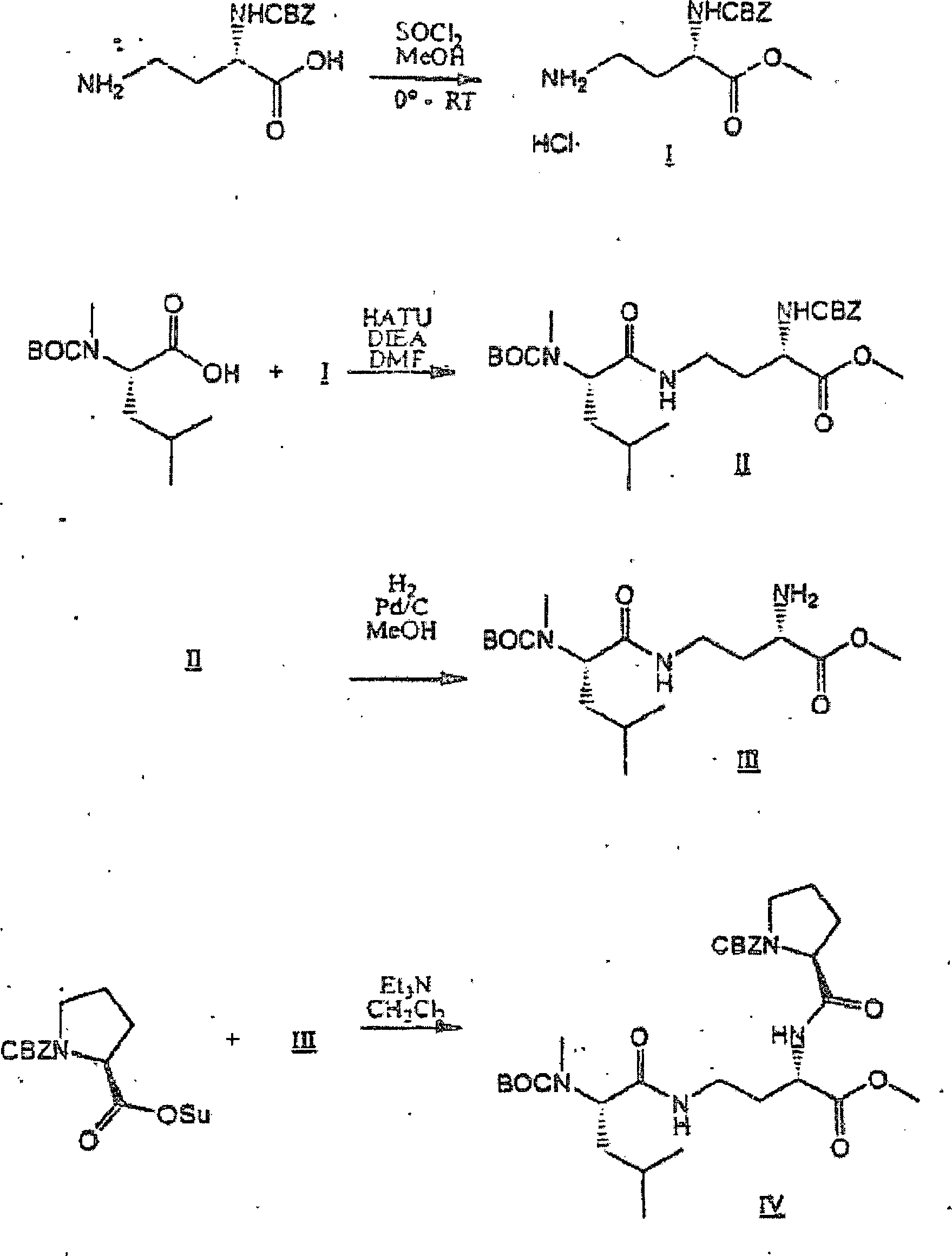
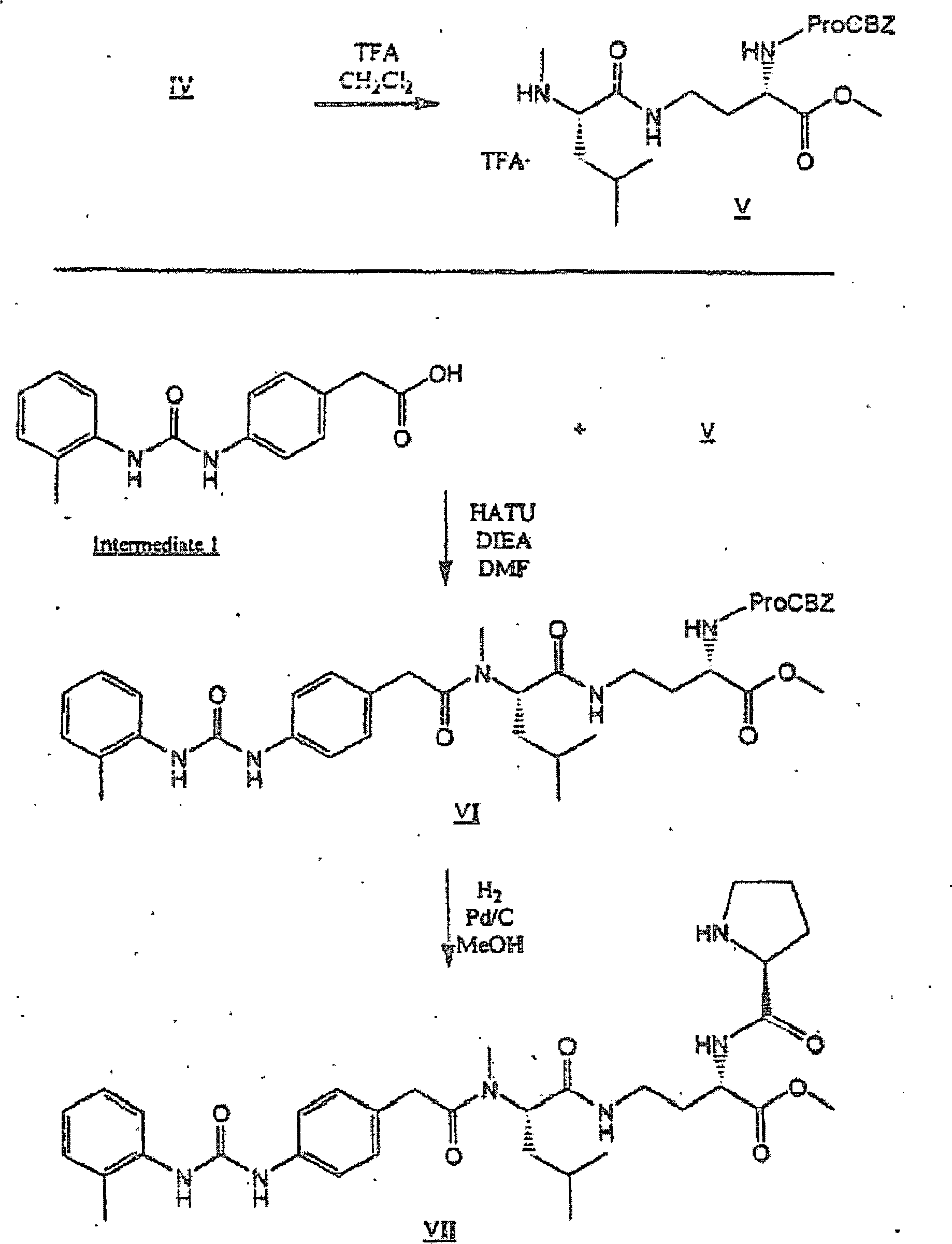
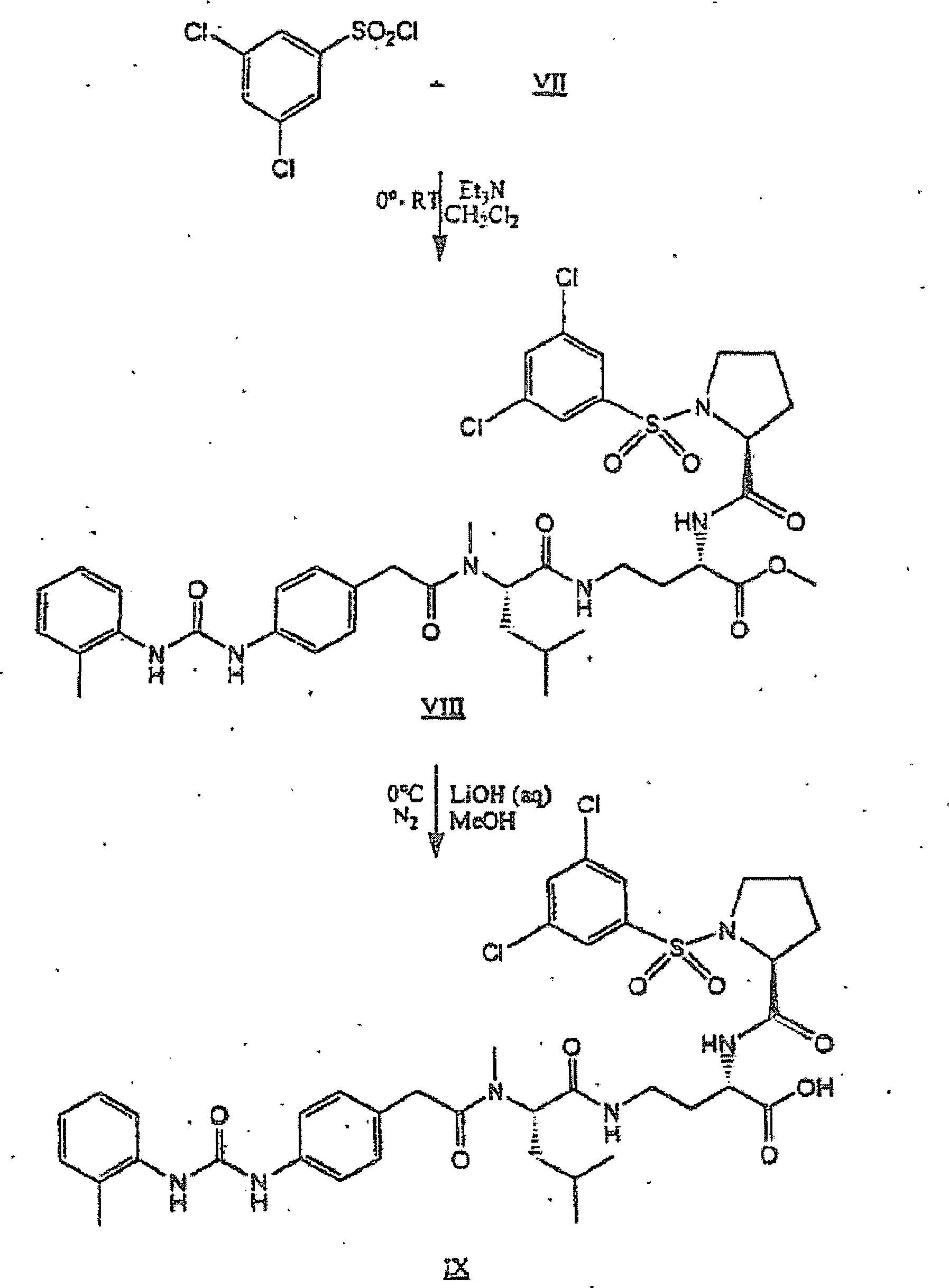
Methylester-Hydrochlorid I: In einem 500-ml-Rundkolben wurden 8,4 g (33,3 mmol) 2-N-CBZ-L-2,4-Diaminobutyrsäure in 200 ml Methanol (MeOH) unter Rühren suspendiert. Dieses wurde auf 0 Grad C (Eisbad) gekühlt, und dann wurden 14,6 ml (200 mmol) SOCl2 tropfenweise über 15 Minuten zugegeben, um eine farblose Lösung zu ergeben. Man ließ die Lösung sich auf Raumtemperatur erwärmen und über Nacht rühren, wonach ein Protonen-NMR-Spektrum eines Aliquots anzeigte, dass die Umsetzung abgeschlossen war. Die Lösung wurde aufkonzentriert, wieder in MeOH gelöst und 2-mal aufkonzentriert, dann in CH2Cl2, konz., gelöst und 16 Stunden unter Hochvakuum gesetzt, um Verbindung I als einen leicht gelben Schaum zu ergeben, der eine Masse von 10,33 g (34,2 mmol, 103%) aufwies. MS m/z 267 (M + H+).Methyl Ester Hydrochloride I: In a 500 ml round bottom flask, 8.4 g (33.3 mmol) of 2-N-CBZ-L-2,4-diaminobutyrate in 200 ml of methanol (MeOH) was suspended with stirring. This was cooled to 0 degrees C (ice bath) and then 14.6 mL (200 mmol) of SOCl 2 was added dropwise over 15 minutes to give a colorless solution. The solution was allowed to warm to room temperature and stirred overnight, after which a proton NMR spectrum of an aliquot indicated that the reaction was complete. The solution was concentrated, redissolved in MeOH and concentrated 2 times, then dissolved in CH 2 Cl 2 , conc., And placed under high vacuum for 16 hours to give compound I as a light yellow foam having a mass of 10, 33 g (34.2 mmol, 103%). MS m / z 267 (M + H + ).
tert-Butoxycarbonylmethylester II: In einem 500-ml-Rundkolben wurden 10,33 g (33,3 mmol) I in trockenem Dimethylformamid (DMF) unter Rühren gelöst, um eine farblose Lösung zu ergeben. Zu dieser wurden 17,4 ml (100 mmol) Diisopropylethylamin (DIEA) gegeben, dann 7,96 g (32,5 mmol) BOC-N-Methyl-Leucin und schließlich 14,83 g (39,0 mmol) O-(7-Azabenzotriazol-1-yl)-1,1,3,3,-tetramethyluroniumhexafluorophosphat (HATU), um eine gelbe Lösung zu ergeben. Diese wurde über Nacht gerührt, wonach HPLC kein Ausgangsmaterial zeigte. Die Lösung wurde mit Ethylacetat (EtOAc, 500 ml) verdünnt und mit 1 N HCl (2-mal), 1 N NaOH (2-mal) und Salzlösung (1-mal) gewaschen. Die organische Phase wurde über wasserfreiem MgSO4 getrocknet, filtriert und zu einem roten Öl aufkonzentriert. Die Chromatographie mit 2:1 Hexanen/EtOAc über Kieselgel ergab 12,56 g (25,5 mmol, 78%) II als einen gelben Sirup (HPLC, > 99%). MS: m/z = 393 (M – BOC)+, 494 (M + H+).tert-butoxycarbonylmethyl ester II: In a 500 ml round bottom flask, 10.33 g (33.3 mmol) of I in dry dimethylformamide (DMF) was dissolved with stirring to give a colorless solution. To this were Add 17.4 ml (100 mmol) of diisopropylethylamine (DIEA), then 7.96 g (32.5 mmol) of BOC-N-methyl-leucine and finally 14.83 g (39.0 mmol) of O- (7-azabenzotriazole -1-yl) -1,1,3,3-tetramethyluronium hexafluorophosphate (HATU) to give a yellow solution. This was stirred overnight whereupon HPLC showed no starting material. The solution was diluted with ethyl acetate (EtOAc, 500 ml) and washed with 1N HCl (2 times), 1N NaOH (2 times) and brine (1 time). The organic phase was dried over anhydrous MgSO 4 , filtered and concentrated to a red oil. Chromatography on silica gel with 2: 1 hexanes / EtOAc gave 12.56 g (25.5 mmol, 78%) II as a yellow syrup (HPLC,> 99%). MS: m / z = 393 (M - BOC) + , 494 (M + H + ).
Aminoester III: In einem 280-ml-Hochdruck-Gefäß wurden 11,38 g (23,08 mmol) II in 75 ml MeOH unter Rühren gelöst, um eine orange Lösung zu ergeben. Das Gefäß wurde mit Stickstoff gespült, und ~200 mg (katalytisch) 10% Palladium auf Kohlenstoff wurden zugegeben. Die Seiten des Gefäßes wurden mit zusätzlichem MeOH gewaschen und das Gefäß mit einem Hydrierungsaufsatz verschlossen. Das Gemisch wurde unter Rühren über Nacht unter 60 psi H2 gesetzt, wonach HPLC kein Ausgangsmaterial zeigte. Das Gemisch wurde durch Celite 545 filtriert, die Filter-Einlage mit zusätzlichem MeOH gewaschen und das Filtrat zu einem farblosen Öl aufkonzentriert, das eine Masse von 8,29 g (~ quantitativ) aufwies. Material zur weiteren Durchführung verwendet. MS: m/z = 360 (M + H+).Aminoester III: In a 280 ml high-pressure vessel, 11.38 g (23.08 mmol) of II was dissolved in 75 ml of MeOH with stirring to give an orange solution. The vessel was purged with nitrogen and ~200 mg (catalytic) of 10% palladium on carbon was added. The sides of the vessel were washed with additional MeOH and the vessel sealed with a hydrogenation attachment. The mixture was placed under 60 psi H 2 with stirring overnight, at which point HPLC showed no starting material. The mixture was filtered through Celite 545, the filter pad washed with additional MeOH and the filtrate concentrated to a colorless oil which had a mass of 8.29 g (~ quantitative). Material used for further implementation. MS: m / z = 360 (M + H + ).
Benzylcarbamatmethylester IV: In einem 500-ml-Rundkolben wurden 8,29 g (23,08 mmol) III in 100 ml CH2Cl2 unter Rühren gelöst, um eine farblose Lösung zu ergeben. Zu dieser wurden 7,0 ml (50 mmol) Triethylamin (Et3N) zugegeben, dann 7,96 g (23,0 mmol) CBZ-Prolinhydroxysuccinimidester (CBZ-Pro-Osu), um eine farblose Lösung zu ergeben. Diese wurde über Nacht gerührt, wonach HPLC kein Ausgangsmaterial zeigte. Die Lösung wurde mit zusätzlichem CH2Cl2 verdünnt, mit 1 N HCl (2-mal), 1 N NaOH (2-mal) gewaschen und die organische Phase über wasserfreiem MgSO4 getrocknet, filtriert und das Filtrat zu einem farblosen Öl aukonzentriert. Die Chromatographie mit 3:1 EtOAc/Hexanen über Kieselgel ergab 12,22 g (20,7 mmol, 90%) IV als ein schaumiges, farbloses Glas (HPLC, > 99%). MS: m/z 490 (M – BOC)+, 591 (M + H+).Benzylcarbamate methyl ester IV: In a 500 ml round bottom flask, 8.29 g (23.08 mmol) of III in 100 ml of CH 2 Cl 2 was dissolved with stirring to give a colorless solution. To this was added 7.0 mL (50 mmol) of triethylamine (Et 3 N), then 7.96 g (23.0 mmol) of CBZ-proline hydroxysuccinimide ester (CBZ-Pro-Osu) to give a colorless solution. This was stirred overnight whereupon HPLC showed no starting material. The solution was diluted with additional CH 2 Cl 2 , washed with 1N HCl (2 times), 1N NaOH (2 times) and the organic phase dried over anhydrous MgSO 4 , filtered and the filtrate concentrated to a colorless oil. Chromatography on silica gel with 3: 1 EtOAc / hexanes gave 12.22 g (20.7 mmol, 90%) of IV as a foamy, colorless glass (HPLC,> 99%). MS: m / z 490 (M-BOC) + , 591 (M + H + ).
Amintrifluoracetatsalz V: In einem 500-ml-Rundkolben wurden 11,80 g (20,0 mmol) IV in 120 ml CH2Cl2 unter Rühren gelöst, um eine farblose Lösung zu ergeben. Zu dieser wurden 20 ml (260 mmol, großer Überschuss) Trifluoressigsäure (TFA) gegeben, und die resultierende Lösung wurde vier Stunden gerührt, wonach HPLC kein Ausgangsmaterial zeigte. Die Lösung wurde aufkonzentriert, in CH2Cl2 wieder gelöst und aukonzentriert (2-mal), dann unter Hochvakuum gesetzt, um 12,1 g (~ quantitativ) V als ein blasses gelbes Öl zu geben. Material zur weiteren Durchführung verwendet. MS: m/z 491 (M + H+).Amine trifluoroacetate salt V: In a 500 ml round bottomed flask, 11.80 g (20.0 mmol) of IV in 120 ml of CH 2 Cl 2 were dissolved with stirring to give a colorless solution. To this was added 20 mL (260 mmol, large excess) of trifluoroacetic acid (TFA) and the resulting solution was stirred for four hours after which time HPLC showed no starting material. The solution was concentrated, redissolved in CH 2 Cl 2 and concentrated (twice), then placed under high vacuum to give 12.1 g (~ quantitative) of V as a pale yellow oil. Material used for further implementation. MS: m / z 491 (M + H + ).
Diarylharnstoffmethylester VI: In einem 500-ml-Rundkolben wurden 12,1 g (20,0 mmol) V in 100 ml DMF unter Rühren gelöst, um eine blasse gelbe Lösung zu ergeben. Zu dieser wurden 17,4 ml (100 mmol) DIEA gegeben, dann 5,68 g (20,0 mmol) Zwischenstufe 1 (oMePUPA-OH) und schließlich 9,12 g (24 mmol) HATU, um eine gelbe Lösung zu ergeben. Diese wurde über Nacht gerührt, wonach HPLC kein Ausgangsmaterial zeigte. Die Lösung wurde mit EtOAc (500 ml) verdünnt und mit 1 N HCl (2-mal), 1 N NaOH (2-mal) und Salzlösung (1-mal) gewaschen. Die organische Phase wurde mit MgSO4 getrocknet, filtriert und zu einem gelben Öl/Feststoff-Gemisch aufkonzentriert. Die Chromatographie mit 2:1 Acetonitril/CH2Cl2 über Kieselgel ergab 11,35 g (15,0 mmol, 75%) VI als einen leicht gelben, schaumigen Feststoff (HPLC, > 99%). MS: m/z 757 (M + H+), 779 (M + Na+).Diaryl urea methyl ester VI: In a 500 ml round bottom flask, 12.1 g (20.0 mmol) of V in 100 ml of DMF were dissolved with stirring to give a pale yellow solution. To this was added 17.4 ml (100 mmol) DIEA, then 5.68 g (20.0 mmol) Intermediate 1 (oMePUPA-OH) and finally 9.12 g (24 mmol) HATU to give a yellow solution , This was stirred overnight whereupon HPLC showed no starting material. The solution was diluted with EtOAc (500 mL) and washed with 1N HCl (2 times), 1 N NaOH (2 times), and brine (1 time). The organic phase was dried with MgSO 4 , filtered and concentrated to a yellow oil / solid mixture. Chromatography on silica gel with 2: 1 acetonitrile / CH 2 Cl 2 gave 11.35 g (15.0 mmol, 75%) of VI as a light yellow, foamy solid (HPLC,> 99%). MS: m / z 757 (M + H + ), 779 (M + Na + ).
Aminomethylester VII: In einem 280-ml-Hochdruck-Gefäß wurden 8,0 g (10,6 mmol) VI in 50 ml MeOH unter Rühren gelöst, um eine leicht gelbe Lösung zu ergeben. Das Gefäß wurde mit Stickstoff gespült, und ~ 200 mg (katalytisch) 10% Pd/C wurden zugegeben. Die Seiten des Gefäßes wurden mit zusätzlichem MeOH gewaschen und das Gefäß mit einem Hydrierungsaufsatz verschlossen. Das Gemisch wurde unter Rühren über Nacht unter 60 psi H2 gesetzt, wonach HPLC kein Ausgangsmaterial zeigte. Das Gemisch wurde durch Celite 545 filtriert, die Filter-Einlage mit zusätzlichem MeOH gewaschen und das Filtrat aufkonzentriert, um 6,6 g VII (~ quantitativ) als einen weißen Feststoff zu geben. Material zur weiteren Durchführung verwendet. MS: m/z = 623 (M + H+).Aminomethyl Ester VII: In a 280 ml high pressure vessel, 8.0 g (10.6 mmol) of VI was dissolved in 50 ml of MeOH with stirring to give a light yellow solution. The vessel was purged with nitrogen and ~200 mg (catalytic) 10% Pd / C was added. The sides of the vessel were washed with additional MeOH and the vessel sealed with a hydrogenation attachment. The mixture was placed under 60 psi H 2 with stirring overnight, at which point HPLC showed no starting material. The mixture was filtered through Celite 545, the filter pad washed with additional MeOH, and the filtrate concentrated to give 6.6 g of VII (~ quantitative) as a white solid. Material used for further implementation. MS: m / z = 623 (M + H + ).
Sulfonamidmethylester VIII: In einem 500-ml-Rundkolben wurden 6,6 g (10,6 mmol) VII in 100 ml trockenem CH2Cl2 unter Rühren gelöst, um eine farblose Lösung zu ergeben. Diese wurde auf 0 Grad C (Eisbad) gekühlt, und 4,2 ml (30 mmol) Et3N wurden zugegeben, gefolgt von einer Lösung von 3,68 g (15 mmol) 3,5-Dichlorbenzolsulfonylchlorid in 25 ml trockenem CH2Cl2, das tropfenweise über 10 Minuten zugegeben wurde. Man ließ die resultierende Lösung sich auf Raumtemperatur erwärmen und 2 Stunden rühren, wonach HPLC kein Ausgangsmaterial zeigte. Die Lösung wurde mit wurde mit zusätzlichem CH2Cl2 verdünnt und mit 1 N HCl (2-mal) und 1 N NaOH (2-mal) gewaschen, darin über MgSO4 getrocknet, filtriert und das Filtrat zu einem gelben Feststoff aufkonzentriert. Die Chromatographie mit 2:1 CH2Cl2/Acetonitril über Kieselgel ergab 6,68 g (8,0 mmol, 75%) VIII als einen weißen Feststoff (HPLC, > 99%). MS: m/z 832/833 (M + H+).Sulfonamide methyl ester VIII: In a 500 ml round bottomed flask, 6.6 g (10.6 mmol) of VII in 100 ml of dry CH 2 Cl 2 was dissolved with stirring to give a colorless solution. This was cooled to 0 ° C (ice bath) and 4.2 mL (30 mmol) of Et 3 N was added, followed by a solution of 3.68 g (15 mmol) of 3,5-dichlorobenzenesulfonyl chloride in 25 mL of dry CH 2 Cl 2 , which was added dropwise over 10 minutes. The resulting solution was allowed to warm to room temperature and stirred for 2 hours at which time HPLC showed no starting material. The solution was diluted with additional CH 2 Cl 2 and washed with 1N HCl (2 times) and 1N NaOH (2 times), dried therein over MgSO 4 , filtered and the filtrate turned to gel ben solid concentrated. Chromatography on silica gel with 2: 1 CH 2 Cl 2 / acetonitrile gave 6.68 g (8.0 mmol, 75%) of VIII as a white solid (HPLC,> 99%). MS: m / z 832/833 (M + H + ).
Carbonsäure IX: In einem 500-ml-Rundkolben wurden 6,26 g (7,53 mmol) VIII in 150 ml MeOH unter Rühren gelöst, um eine farblose Lösung zu ergeben. Diese wurde auf 0 Grad C (Eisbad) gekühlt, und Stickstoff wurde 30 Minuten durch die rührende Lösung geperlt. Dazu wurden 19 ml (38 mmol) einer frisch hergestellten 2 M LiOH-Lösung tropfenweise über 10 Minuten zugegeben, wonach die Lösung bei 0 Grad C unter Stickstoff gerührt wurde, während der Fortgang der Umsetzung kleinschrittig durch HPLC überwacht wurde. Nach drei Stunden zeigte HPLC kein übrig gebliebenes Ausgangsmaterial. Die Lösung wurde unter minimalem Erhitzen aukonzentriert (Volumen vermindert um ~50%) und langsam, in Portionen, in eiskalte 1 N HCl gegossen, um in Mengen einen brillant-weißen Niederschlag zu ergeben. Der Feststoff wurde über Filtration isoliert, mit kaltem destillierten Wasser gewaschen und über Nacht luftgetrocknet. Der resultierende feine, weiße Feststoff wurde in ein Glasgefäß überführt und 72 Stunden unter Hochvakuum gesetzt. Die Endmasse betrug 6,02 g (7,36 mmol, 98%) IX als ein weißes Pulver (HPLC > 98%). MS: m/z 818/819 (M + H)+, 841 (M + Na+).Carboxylic acid IX: In a 500 ml round bottom flask, 6.26 g (7.53 mmol) of VIII in 150 ml of MeOH were dissolved with stirring to give a colorless solution. This was cooled to 0 degrees C (ice bath) and nitrogen was bubbled through the stirring solution for 30 minutes. To this was added 19 ml (38 mmol) of a freshly prepared 2M LiOH solution dropwise over 10 minutes, after which the solution was stirred at 0 ° C under nitrogen while the progress of the reaction was monitored in small steps by HPLC. After three hours, HPLC showed no residual starting material. The solution was concentrated with minimal heating (volume reduced by ~50%) and poured slowly, in portions, into ice-cold 1N HCl to give brilliant white precipitate in quantities. The solid was isolated by filtration, washed with cold distilled water and air dried overnight. The resulting fine, white solid was transferred to a glass jar and placed under high vacuum for 72 hours. The final mass was 6.02 g (7.36 mmol, 98%) IX as a white powder (HPLC> 98%). MS: m / z 818/819 (M + H) + , 841 (M + Na + ).
Beispiel
2: Synthese
von Verbindung XVI 
Homoserin-4-nitrophenyletherbenzylester: Zu einer Lösung von N-BOC-Homoserinbenzylester I (1,2 g, 3,89 mmol), 4-Nitrophenol (485 mg, 4,08 mmol) und Triphenylphosphin (1,2 g, 4,66 mmol) in THF (10 ml) wurde Diethylazodicarboxylat (DEAD) (0,74 ml, 4,66 mmol) tropfenweise zugegeben, und die Umsetzung wurde bei Raumtemperatur 12 bis 24 h gerührt. Nach Abschluss, wie durch Flüssigkeitschromatographie beurteilt, wurden die Lösungsmittel entfernt, um einen viskosen Sirup zu gewinnen. 4 N HCl in Dioxan (10 ml) wurde rasch zugegeben, und die Lösung wurde bei Raumtemperatur 3 bis 6 h, oder bis durch Flüssigkeitschromatographie als abgeschlossen beurteilt, gerührt. Die Umsetzung wurde zu ¼ des Volumens aufkonzentriert, und das Produkt wurde aus Ethylacetat präzipitiert, um das Hydrochloridsalz II (96% rein, Flüssigkeitschromatographie) als einen weißen Feststoff zu gewinnen (867 mg, 2,36 mmol, 61%). ESMS: (M – Cl) = 331.Homoserine 4-nitrophenyletherbenzylester: To a solution of N-BOC homoserine benzyl ester I (1.2 g, 3.89 mmol), 4-nitrophenol (485 mg, 4.08 mmol) and triphenylphosphine (1.2 g, 4.66 mmol) in THF (10 mL) was diethyl azodicarboxylate (DEAD) (0.74 mL, 4.66 mmol). added dropwise and the reaction was at room temperature Stirred for 12 to 24 h. Upon completion, as by liquid chromatography judged were the solvents removed to get a viscous syrup. 4N HCl in dioxane (10 ml) was added rapidly and the solution became at room temperature 3 to 6 h, or until by liquid chromatography judged complete, stirred. The conversion was to ¼ of the Volume and the product was made from ethyl acetate precipitated hydrochloride salt II (96% pure, liquid chromatography) as a white one To recover solid (867 mg, 2.36 mmol, 61%). ESMS: (M - Cl) = 331st
Zu einer Lösung von Zwischenstufe 4 (117 mg, 0,46 mmol) in DMF (3 ml) wurde DIEA (0,27 mg, 0,48 mmol) zugegeben, nacheinander gefolgt von dem Hydrochloridsalz II (160 mg, 0,48 mmol) und HATU (239 mg, 0,63 mmol). Die Lösung wurde bei Raumtemperatur 2 bis 4 h gerührt, bis durch Flüssigkeitschromatographie als abgeschlossen beurteilt. Die Umsetzung wurde mit Ethylacetat (30 ml) verdünnt und mit 5% Bicarbonat (10 ml), Wasser (10 ml), Zitronensäure (10 ml), Salzlösung (2-mal 10 ml) gewaschen und über Natriumsulfat getrocknet, um das rohe Produkt III als einen bräunlichen Schaum (213 mg, 0,37 mmol, 82%) zu gewinnen, der direkt verwendet wurde. ESMS: (M + H) = 568.To a solution of Intermediate 4 (117 mg, 0.46 mmol) in DMF (3 mL) became DIEA (0.27 mg, 0.48 mmol), followed successively by the hydrochloride salt II (160 mg, 0.48 mmol) and HATU (239 mg, 0.63 mmol). The solution was stirred at room temperature for 2 to 4 h, up to by liquid chromatography as completed judged. The reaction was treated with ethyl acetate (30 ml) and with 5% bicarbonate (10 ml), water (10 ml), citric acid (10 ml), saline (2 times 10 ml) and washed over Dried sodium sulfate to give the crude product III as a brownish To recover foam (213 mg, 0.37 mmol, 82%) which is used directly has been. ESMS: (M + H) = 568.
Das vorstehende Material wurde in Ethylacetat (15 ml) gelöst, 10% Pd/C (200 mg) wurden zugegeben, und die Umsetzung wurde einer Hydrogenolyse bei 50 psi 4 bis 6 h, oder bis durch Flüssigkeitschromatographie als abgeschlossen beurteilt, unterworfen. Filtration durch Celite und Aufkonzentrierung lieferte das rohe Anilin IV (144 mg, 0,32 mmol, 87%) als einen bräunlichen Schaum, der direkt verwendet wurde. ESMS: (M + H) = 448.The The above material was dissolved in ethyl acetate (15 ml), 10% Pd / C (200 mg) was added and the reaction was hydrogenolysed at 50 psi for 4 to 6 h, or until by liquid chromatography as completed, assessed. Filtration through Celite and Concentration afforded the crude aniline IV (144 mg, 0.32 mmol, 87%) than a brownish one Foam that was used directly. ESMS: (M + H) = 448.
Das vorstehend erhaltene Anilin (74 mg, 0,17 mmol) wurde in DMF (3 ml) gelöst, und oMePUPA (52 mg, 0,18 mmol) wurde zugegeben, gefolgt von DIEA (0,08 ml, 0,43 mmol) und HATU (69 mg, 0,18 mmol), und die Umsetzung wurde bei Raumtemperatur 3 bis 4 h gerührt, bis durch Flüssigkeitschromatographie als vollständig beurteilt. Reinigung durch HPLC lieferte Bio-8355 (39 mg, 0,054 mmol, 30%) als einen weißen Feststoff. ESMS: (M + H) = 714, (M – H) = 712.The Aniline obtained above (74 mg, 0.17 mmol) was dissolved in DMF (3 mL). solved, and oMePUPA (52 mg, 0.18 mmol) was added, followed by DIEA (0.08 ml, 0.43 mmol) and HATU (69 mg, 0.18 mmol) and the reaction was stirred at room temperature for 3-4 hours, by liquid chromatography as complete assessed. Purification by HPLC provided Bio-8355 (39 mg, 0.054 mmol, 30%) as a white Solid. ESMS: (M + H) = 714, (M - H) = 712.
Die Verbindungen dieser Erfindung, wurden, wie in den nachstehenden Tabellen gezeigt, gemäß dem Verfahren, das vorstehend beschrieben ist, hergestellt.The Compounds of this invention were as in the following Tables shown according to the method, which has been described above.
Verbindungen,
die gemäß dem allgemeinen
Verfahren A hergestellt wurden, schließen ein: 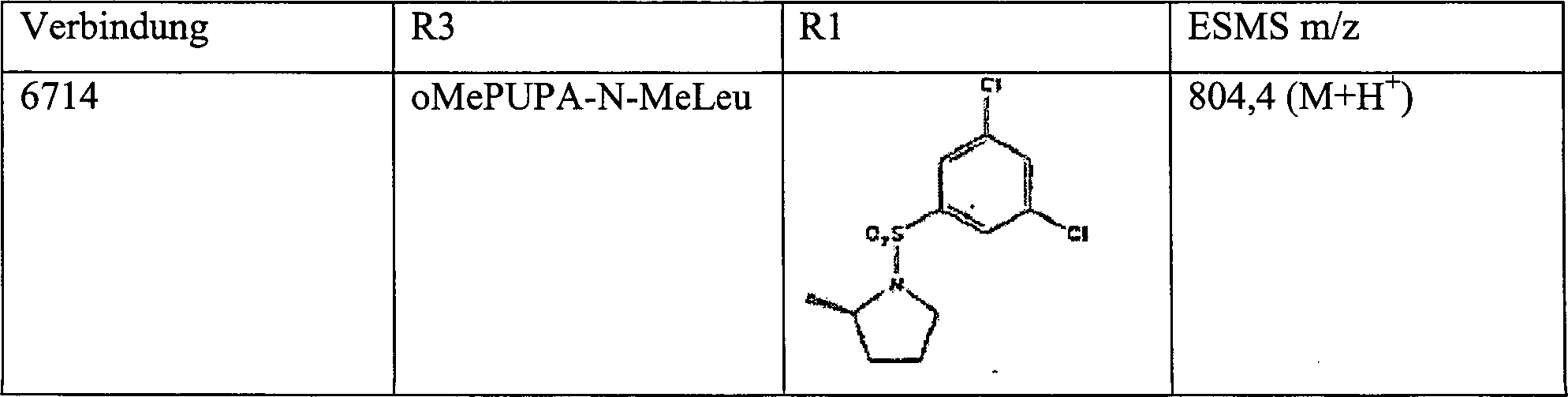
Verbindungen,
die gemäß dem allgemeinen
Verfahren C hergestellt wurden, schließen ein: 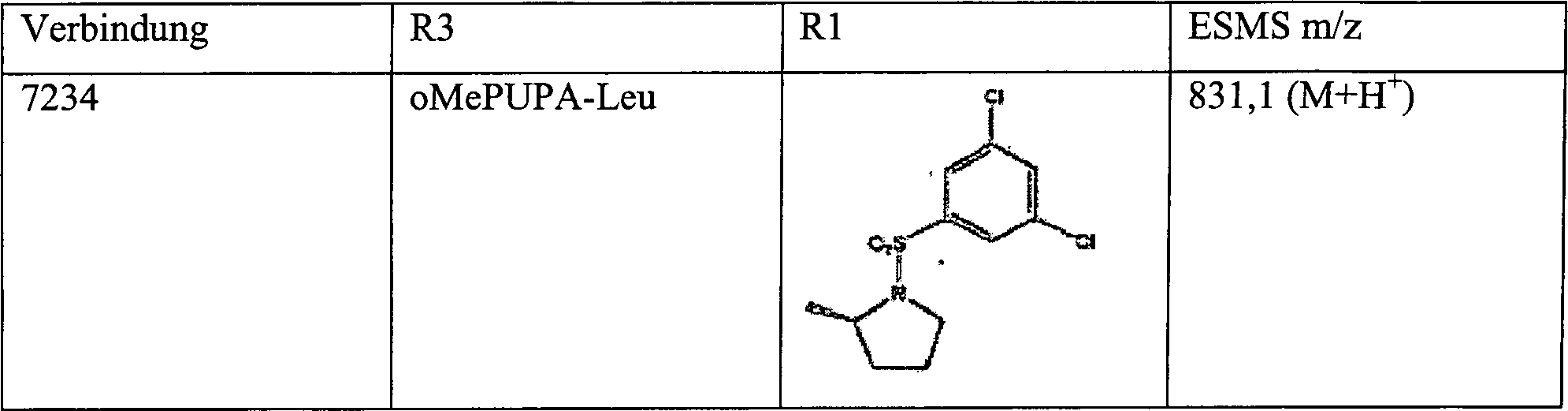
Verbindungen,
die gemäß dem allgemeinen
Verfahren D hergestellt wurden, schließen ein: 


Claims (10)


Applications Claiming Priority (3)
| Application Number | Priority Date | Filing Date | Title |
|---|---|---|---|
| US14884599P | 1999-08-13 | 1999-08-13 | |
| US148845P | 1999-08-13 | ||
| PCT/US2000/022285 WO2001012186A1 (en) | 1999-08-13 | 2000-08-14 | Cell adhesion inhibitors |
Publications (2)
| Publication Number | Publication Date |
|---|---|
| DE60031577D1 DE60031577D1 (en) | 2006-12-07 |
| DE60031577T2 true DE60031577T2 (en) | 2007-08-23 |
Family
ID=22527673
Family Applications (1)
| Application Number | Title | Priority Date | Filing Date |
|---|---|---|---|
| DE60031577T Expired - Lifetime DE60031577T2 (en) | 1999-08-13 | 2000-08-14 | INHIBITORS OF CELL ADHESION |
Country Status (31)
| Country | Link |
|---|---|
| US (3) | US6630503B1 (en) |
| EP (2) | EP1741428A3 (en) |
| JP (1) | JP2003506491A (en) |
| KR (1) | KR100720907B1 (en) |
| CN (1) | CN1377268A (en) |
| AT (1) | ATE343383T1 (en) |
| AU (1) | AU780610B2 (en) |
| BG (1) | BG65755B1 (en) |
| BR (1) | BR0013248A (en) |
| CA (1) | CA2380817A1 (en) |
| CY (1) | CY1105912T1 (en) |
| CZ (1) | CZ2002518A3 (en) |
| DE (1) | DE60031577T2 (en) |
| DK (1) | DK1265606T3 (en) |
| EA (1) | EA005578B1 (en) |
| EE (1) | EE200200070A (en) |
| ES (1) | ES2270868T3 (en) |
| GE (2) | GEP20053477B (en) |
| HU (1) | HUP0202469A3 (en) |
| IL (2) | IL148014A0 (en) |
| IS (1) | IS6257A (en) |
| MX (1) | MXPA02001449A (en) |
| NO (1) | NO324044B1 (en) |
| NZ (1) | NZ517011A (en) |
| PL (1) | PL354063A1 (en) |
| PT (1) | PT1265606E (en) |
| RS (1) | RS50470B (en) |
| SK (1) | SK287075B6 (en) |
| UA (1) | UA75581C2 (en) |
| WO (1) | WO2001012186A1 (en) |
| ZA (1) | ZA200201158B (en) |
Families Citing this family (35)
| Publication number | Priority date | Publication date | Assignee | Title |
|---|---|---|---|---|
| US7618630B2 (en) | 1998-09-14 | 2009-11-17 | Board Of Regents, The University Of Texas System | Methods of treating multiple myeloma and myeloma-induced bone resorption using integrin antagonists |
| PT1265606E (en) * | 1999-08-13 | 2007-01-31 | Biogen Idec Inc | Cell adhesion inhibitors |
| DE10006453A1 (en) * | 2000-02-14 | 2001-08-16 | Bayer Ag | New piperidylcarboxylic acid derivatives, are integrin antagonists useful for treating inflammatory, autoimmune or immunological diseases, e.g. atherosclerosis, asthma, diabetes, rheumatoid arthritis or transplant rejection |
| JP2002201168A (en) * | 2000-12-28 | 2002-07-16 | Kaken Pharmaceut Co Ltd | Cyclohexane derivative |
| CA2430978C (en) | 2000-12-28 | 2012-05-15 | Daiichi Pharmaceutical Co., Ltd. | Vla-4 inhibitors |
| JP2004526733A (en) * | 2001-03-20 | 2004-09-02 | メルク エンド カムパニー インコーポレーテッド | Substituted N-arylsulfonyl-proline derivatives as potent cell adhesion inhibitors |
| US6663489B2 (en) | 2001-08-24 | 2003-12-16 | Igt | Gaming device having an award distributor and an award accumulator bonus game |
| ES2197003B1 (en) * | 2002-04-08 | 2005-03-16 | J. URIACH & CIA S.A. | NEW ANTAGONIST COMPOUNDS OF INTEGRINAS ALFA. |
| CA2528586A1 (en) | 2003-07-24 | 2005-02-03 | Daiichi Pharmaceutical Co., Ltd. | Cyclohexanecarboxylic acid compound |
| US7595318B2 (en) * | 2004-01-23 | 2009-09-29 | Elan Pharmaceuticals, Inc. | Polyethylene glycol conjugates of heterocycloalkyl carboxamido propanoic acids |
| AU2005265316B2 (en) * | 2004-07-08 | 2012-02-02 | Elan Pharmaceuticals, Inc. | Multivalent VLA-4 antagonists comprising polymer moieties |
| US7196112B2 (en) * | 2004-07-16 | 2007-03-27 | Biogen Idec Ma Inc. | Cell adhesion inhibitors |
| US7915316B2 (en) * | 2005-08-22 | 2011-03-29 | Allergan, Inc | Sulfonamides |
| ES2625378T3 (en) | 2005-09-27 | 2017-07-19 | Shionogi & Co., Ltd. | Sulfonamide derivative that has PGD2 receptor antagonist activity |
| ES2628620T3 (en) * | 2005-11-09 | 2017-08-03 | Onyx Therapeutics, Inc. | Enzyme inhibition compound |
| CA2659463A1 (en) * | 2006-08-02 | 2008-02-07 | Genzyme Corporation | Combination therapy |
| TW200817319A (en) | 2006-08-10 | 2008-04-16 | Astellas Pharma Inc | Sulfonamide compound or salt thereof |
| EP2510941A3 (en) | 2007-02-20 | 2013-01-23 | Merrimack Pharmaceuticals, Inc. | Methods of treating multiple sclerosis by administration of alpha-fetoprotein in combination with an integrin antagonist |
| PL2288715T3 (en) | 2008-04-11 | 2015-03-31 | Merrimack Pharmaceuticals Inc | Human serum albumin linkers and conjugates thereof |
| JP5677972B2 (en) | 2008-11-18 | 2015-02-25 | メリマック ファーマシューティカルズ インコーポレーティッド | Human serum albumin linker and its conjugates |
| WO2014036520A1 (en) | 2012-08-30 | 2014-03-06 | Merrimack Pharmaceuticals, Inc. | Combination therapies comprising anti-erbb3 agents |
| US9896441B2 (en) | 2014-05-05 | 2018-02-20 | Lycera Corporation | Tetrahydroquinoline sulfonamide and related compounds for use as agonists of RORγ and the treatment of disease |
| US10189777B2 (en) | 2014-05-05 | 2019-01-29 | Lycera Corporation | Benzenesulfonamido and related compounds for use as agonists of RORγ and the treatment of disease |
| US10421751B2 (en) | 2015-05-05 | 2019-09-24 | Lycera Corporation | Dihydro-2H-benzo[b][1,4]oxazine sulfonamide and related compounds for use as agonists of RORγ and the treatment of disease |
| WO2016201225A1 (en) | 2015-06-11 | 2016-12-15 | Lycera Corporation | Aryl dihydro-2h-benzo[b][1,4]oxazine sulfonamide and related compounds for use as agonists of rory and the treatment of disease |
| WO2017173302A2 (en) | 2016-04-01 | 2017-10-05 | The Regents Of The University Of California | Inhibitors of integrin alpha 5 beta 1 and methods of use |
| CN109721605B (en) * | 2017-10-31 | 2022-03-11 | 维眸生物科技(上海)有限公司 | Immune cell migration inhibitor |
| WO2019168874A1 (en) | 2018-02-27 | 2019-09-06 | The Research Foundation For The State University Of New York | Difluoromethoxylation and trifluoromethoxylation compositions and methods for synthesizing same |
| CA3115830C (en) | 2018-10-30 | 2023-09-12 | Gilead Sciences, Inc. | Compounds for inhibition of .alpha.4.beta.7 integrin |
| IL282545B2 (en) | 2018-10-30 | 2025-04-01 | Gilead Sciences Inc | Quinoline derivatives as alpha4beta7 integrin inhibitors |
| WO2020092383A1 (en) | 2018-10-30 | 2020-05-07 | Gilead Sciences, Inc. | Compounds for inhibition of alpha 4 beta 7 integrin |
| KR102641718B1 (en) | 2018-10-30 | 2024-02-29 | 길리애드 사이언시즈, 인코포레이티드 | Imidazopyridine derivatives as alpha4beta7 integrin inhibitors |
| KR102908219B1 (en) | 2019-08-14 | 2026-01-08 | 길리애드 사이언시즈, 인코포레이티드 | Compounds that inhibit alpha 4 beta 7 integrins |
| IL309732A (en) | 2021-07-09 | 2024-02-01 | Aligos Therapeutics Inc | Anti-viral compounds |
| WO2023043816A1 (en) | 2021-09-17 | 2023-03-23 | Aligos Therapeutics, Inc. | Anti-viral compounds for treating coronavirus, picornavirus, and norovirus infections |
Family Cites Families (71)
| Publication number | Priority date | Publication date | Assignee | Title |
|---|---|---|---|---|
| IT1149971B (en) | 1979-06-11 | 1986-12-10 | Syntex Inc | NONAPEPTIDE AND DECAPEPTIDE DERIVATIVES OF THE HORMONE THAT RELEASES THE LUTEINIZING HORMONE |
| US4725583A (en) | 1985-01-23 | 1988-02-16 | Abbott Laboratories | Functionalized peptidylaminoalcohols |
| US4826815A (en) | 1985-05-17 | 1989-05-02 | Abbott Laboratories | Renin inhibiting compounds |
| GB2218102B (en) | 1988-04-08 | 1992-09-16 | Sandoz Ltd | Calcitonin peptide derivatives |
| ES2030974T3 (en) | 1988-07-21 | 1992-11-16 | Pfizer Inc. | GUANILTIOUREAS SUBSTITUTE PREPARATION PROCESS. |
| US4908360A (en) | 1988-11-14 | 1990-03-13 | Hoechst-Roussel Pharmaceuticals Inc. | 1-aminoalkyl-3-oxysubstituted-4-aryl-1,3,4,5-tetrahydro-2H-1,3-benzodiazepine-2-ones |
| US5272263A (en) | 1989-04-28 | 1993-12-21 | Biogen, Inc. | DNA sequences encoding vascular cell adhesion molecules (VCAMS) |
| US5196404B1 (en) | 1989-08-18 | 1996-09-10 | Biogen Inc | Inhibitors of thrombin |
| ES2084150T3 (en) | 1989-12-22 | 1996-05-01 | Commw Scient Ind Res Org | AMINO ACIDS, PEPTIDES OR THEIR DERIVATIVES ASSOCIATED WITH FATS. |
| CA2043741C (en) | 1990-06-07 | 2003-04-01 | Kiyofumi Ishikawa | Endothelin antagonistic peptide derivatives |
| US5192746A (en) | 1990-07-09 | 1993-03-09 | Tanabe Seiyaku Co., Ltd. | Cyclic cell adhesion modulation compounds |
| US5260277A (en) | 1990-09-10 | 1993-11-09 | Tanabe Seiyaku Co., Ltd. | Guanidinyl and related cell adhesion modulation compounds |
| WO1992008464A1 (en) | 1990-11-15 | 1992-05-29 | Tanabe Seiyaku Co. Ltd. | Substituted urea and related cell adhesion modulation compounds |
| JP3288042B2 (en) | 1991-06-11 | 2002-06-04 | センター フォア ブラッド リサーチ インコーポレイテッド | Intercellular adhesion molecule-3 and its binding ligand |
| EP0519748B1 (en) | 1991-06-21 | 1998-09-02 | Merck & Co. Inc. | Peptidyl derivatives as inhibitors of interleukin-1B converting enzyme |
| US5250679A (en) | 1991-10-18 | 1993-10-05 | Genentech, Inc. | Nonpeptidyl platelet aggregation inhibitors having specificity for the GPIIb III.sub. receptor |
| WO1993008823A1 (en) | 1991-11-06 | 1993-05-13 | Tanabe Seiyaku Co., Ltd. | Guanidinyl and related cell adhesion modulation compounds |
| AU3141693A (en) | 1991-11-22 | 1993-06-15 | Friedman, Mark M. | Non-peptidic surrogates of the arg-gly-asp sequence and pharmaceutical compositions comprising them |
| AU3420693A (en) | 1991-12-24 | 1993-07-28 | Fred Hutchinson Cancer Research Center | Competitive inhibition of high-avidity alpha4-beta1 receptor using tripeptide ldv |
| DE4212304A1 (en) | 1992-04-13 | 1993-10-14 | Cassella Ag | Aspartic acid derivatives, their preparation and use |
| IL102646A (en) | 1992-07-26 | 1996-05-14 | Yeda Res & Dev | Non-peptidic surrogates of the ldv sequence and pharmaceutical compositions comprising them |
| CA2153228A1 (en) | 1993-01-08 | 1994-07-21 | Shiu-Lan Ng Chiang | Peptide inhibitors of cell adhesion |
| US5314902A (en) | 1993-01-27 | 1994-05-24 | Monsanto Company | Urea derivatives useful as platelet aggregation inhibitors |
| DE4309867A1 (en) | 1993-03-26 | 1994-09-29 | Cassella Ag | New urea derivatives, their production and use |
| ATE203904T1 (en) | 1993-04-09 | 2001-08-15 | Toyama Chemical Co Ltd | IMMUNOMODULATOR, CELL ADHESION INHIBITOR AND AGENT FOR TREATING AND PREVENTING AUTOIMMUNE DISEASES |
| WO1995015973A1 (en) | 1993-12-06 | 1995-06-15 | Cytel Corporation | Cs-1 peptidomimetics, compositions and methods of using the same |
| US5770573A (en) | 1993-12-06 | 1998-06-23 | Cytel Corporation | CS-1 peptidomimetics, compositions and methods of using the same |
| US5434188A (en) | 1994-03-07 | 1995-07-18 | Warner-Lambert Company | 1-ether and 1-thioether-naphthalene-2-carboxamides as inhibitors of cell adhesion and as inhibitors of the activation of HIV |
| US6306840B1 (en) | 1995-01-23 | 2001-10-23 | Biogen, Inc. | Cell adhesion inhibitors |
| US6248713B1 (en) * | 1995-07-11 | 2001-06-19 | Biogen, Inc. | Cell adhesion inhibitors |
| CA2240439A1 (en) * | 1995-12-22 | 1997-07-03 | The Dupont Merck Pharmaceutical Company | Novel integrin receptor antagonists |
| US5760028A (en) * | 1995-12-22 | 1998-06-02 | The Dupont Merck Pharmaceutical Company | Integrin receptor antagonists |
| AU3640997A (en) * | 1996-06-19 | 1998-01-07 | Du Pont Pharmaceuticals Company | Iontophoretic delivery of integrin inhibitors |
| BR9710570A (en) | 1996-07-25 | 2005-06-28 | Biogen Inc | Cell Adhesion Inhibitor |
| DE19647380A1 (en) | 1996-11-15 | 1998-05-20 | Hoechst Ag | 5-ring heterocycles as inhibitors of leukocyte adhesion and VLA-4 antagonists |
| DE19647381A1 (en) | 1996-11-15 | 1998-05-20 | Hoechst Ag | New heterocycles as leukocyte adhesion inhibitors and VLA-4 antagonists |
| WO1998043962A1 (en) * | 1997-03-28 | 1998-10-08 | Du Pont Pharmaceuticals Company | Heterocyclic integrin inhibitor prodrugs |
| EP1001764A4 (en) | 1997-05-29 | 2005-08-24 | Merck & Co Inc | Heterocyclic amides as cell adhesion inhibitors |
| JP2001517245A (en) | 1997-05-29 | 2001-10-02 | メルク エンド カンパニー インコーポレーテッド | Biarylalkanoic acids as cell adhesion inhibitors |
| WO1998053818A1 (en) | 1997-05-29 | 1998-12-03 | Merck & Co., Inc. | Sulfonamides as cell adhesion inhibitors |
| ATE249421T1 (en) * | 1997-06-23 | 2003-09-15 | Tanabe Seiyaku Co | INHIBITORS OF ALPHA4-BETA1-MEDIATED CELL ADHESION |
| PL338506A1 (en) | 1997-07-31 | 2000-11-06 | Elan Pharm Inc | Compounds inhibiting adhesion of leucocytes occuring through the mediation of vla-4 |
| AU8661298A (en) * | 1997-07-31 | 1999-02-22 | American Home Products Corporation | Dipeptide compounds which inhibit leukocyte adhesion mediated by VLA-4 |
| HUP0003921A3 (en) * | 1997-07-31 | 2001-03-28 | Wyeth Corp | Sulfonylated dipeptide compounds which inhibit leukocyte adhesion mediated by vla-4, pharmaceutical compositions comprising thereof and their use |
| HUP0002495A3 (en) * | 1997-07-31 | 2001-01-29 | American Home Prod | Dipeptide and related compounds which inhibit leukocyte adhesion mediated by vla-4, pharmaceutical compositions comprising thereof and their use |
| CA2290747A1 (en) * | 1997-07-31 | 1999-02-11 | Elan Pharmaceuticals, Inc. | Substituted phenylalanine type compounds which inhibit leukocyte adhesion mediated by vla-4 |
| PL338413A1 (en) * | 1997-07-31 | 2000-11-06 | Elan Pharm Inc | Compound of 4-amino phenylalanine type inhibiting adhesion of leucocytes through the meditation of vla-4 |
| BR9811988A (en) * | 1997-08-22 | 2000-09-05 | Hoffmann La Roche | N-alkanoylphenylalanine derivatives |
| DE69824183T2 (en) * | 1997-08-22 | 2005-04-21 | Hoffmann La Roche | N-ALKANOYLPHENYLALANINDERIVATE |
| DE19741235A1 (en) * | 1997-09-18 | 1999-03-25 | Hoechst Marion Roussel De Gmbh | Novel imidazolidine derivatives, their preparation, their use and pharmaceutical compositions containing them |
| AR013693A1 (en) * | 1997-10-23 | 2001-01-10 | Uriach & Cia Sa J | NEW PIPERIDINES AND PIPERAZINAS AS INHIBITORS OF THE PLAQUETARY AGREGATION |
| PL340261A1 (en) * | 1997-10-31 | 2001-01-29 | Aventis Pharma Ltd | Substituted amilides |
| AU1411499A (en) | 1997-11-20 | 1999-06-15 | Merck & Co., Inc. | Para-aminomethylaryl carboxamide derivatives |
| AU1463499A (en) | 1997-11-21 | 1999-06-15 | Merck & Co., Inc. | Substituted pyrrole derivatives as cell adhesion inhibitors |
| WO1999026921A1 (en) | 1997-11-24 | 1999-06-03 | Merck & Co., Inc. | SUBSTITUTED β-ALANINE DERIVATIVES AS CELL ADHESION INHIBITORS |
| US6645939B1 (en) * | 1997-11-24 | 2003-11-11 | Merck & Co., Inc. | Substituted β-alanine derivatives as cell adhesion inhibitors |
| WO1999026945A1 (en) * | 1997-11-26 | 1999-06-03 | Du Pont Pharmaceuticals Company | 1,3,4-THIADIAZOLES AND 1,3,4-OXADIAZOLES AS αvβ3 ANTAGONISTS |
| US6197794B1 (en) * | 1998-01-08 | 2001-03-06 | Celltech Therapeutics Limited | Phenylalanine derivatives |
| US6329372B1 (en) * | 1998-01-27 | 2001-12-11 | Celltech Therapeutics Limited | Phenylalanine derivatives |
| ATE273273T1 (en) * | 1998-02-26 | 2004-08-15 | Celltech Therapeutics Ltd | PHENYLALANINE DERIVATIVES AS INHIBITORS OF ALPHA4 INTEGRINS |
| EP1063982B1 (en) * | 1998-03-27 | 2007-02-14 | Genentech, Inc. | Antagonists for treatment of cd11/cd18 adhesion receptor mediated disorders |
| ES2211096T3 (en) | 1998-05-28 | 2004-07-01 | Biogen, Inc. | A VLA-4 INHIBITOR: OMEPUPA-V. |
| TW591026B (en) * | 1998-06-23 | 2004-06-11 | Upjohn Co | Inhibitors of alpha4beta1 mediated cell adhesion |
| US6303625B1 (en) * | 1998-07-27 | 2001-10-16 | Ortho-Mcneil Pharmaceutical, Inc. | Triazolopyridines for the treatment of thrombosis disorders |
| US6331640B1 (en) * | 1998-10-13 | 2001-12-18 | Hoffmann-La Roche Inc. | Diaminopropionic acid derivatives |
| JP2003524614A (en) * | 1998-12-22 | 2003-08-19 | 田辺製薬株式会社 | Inhibitors of α4β1-mediated cell adhesion |
| EP1028114A1 (en) | 1999-02-13 | 2000-08-16 | Aventis Pharma Deutschland GmbH | Novel guanidine derivatives as inhibitors of cell adhesion |
| CZ20012984A3 (en) * | 1999-02-18 | 2002-02-13 | F. Hoffmann-La Roche Ag | Phenylalaninol derivatives |
| PT1265606E (en) * | 1999-08-13 | 2007-01-31 | Biogen Idec Inc | Cell adhesion inhibitors |
| JP2001089448A (en) * | 1999-09-24 | 2001-04-03 | Yamanouchi Pharmaceut Co Ltd | Amide derivative |
| US7196112B2 (en) * | 2004-07-16 | 2007-03-27 | Biogen Idec Ma Inc. | Cell adhesion inhibitors |
-
2000
- 2000-08-14 PT PT00959232T patent/PT1265606E/en unknown
- 2000-08-14 NZ NZ517011A patent/NZ517011A/en unknown
- 2000-08-14 US US09/638,652 patent/US6630503B1/en not_active Expired - Fee Related
- 2000-08-14 CN CN00813728A patent/CN1377268A/en active Pending
- 2000-08-14 GE GE4744A patent/GEP20053477B/en unknown
- 2000-08-14 ES ES00959232T patent/ES2270868T3/en not_active Expired - Lifetime
- 2000-08-14 WO PCT/US2000/022285 patent/WO2001012186A1/en not_active Ceased
- 2000-08-14 CZ CZ2002518A patent/CZ2002518A3/en unknown
- 2000-08-14 RS YUP-98/02A patent/RS50470B/en unknown
- 2000-08-14 SK SK215-2002A patent/SK287075B6/en not_active IP Right Cessation
- 2000-08-14 DK DK00959232T patent/DK1265606T3/en active
- 2000-08-14 EP EP06021333A patent/EP1741428A3/en not_active Withdrawn
- 2000-08-14 CA CA002380817A patent/CA2380817A1/en not_active Abandoned
- 2000-08-14 IL IL14801400A patent/IL148014A0/en unknown
- 2000-08-14 EP EP00959232A patent/EP1265606B9/en not_active Expired - Lifetime
- 2000-08-14 MX MXPA02001449A patent/MXPA02001449A/en active IP Right Grant
- 2000-08-14 AT AT00959232T patent/ATE343383T1/en not_active IP Right Cessation
- 2000-08-14 AU AU70586/00A patent/AU780610B2/en not_active Ceased
- 2000-08-14 PL PL00354063A patent/PL354063A1/en not_active Application Discontinuation
- 2000-08-14 HU HU0202469A patent/HUP0202469A3/en unknown
- 2000-08-14 GE GE5468A patent/GEP20063956B/en unknown
- 2000-08-14 EA EA200200253A patent/EA005578B1/en not_active IP Right Cessation
- 2000-08-14 JP JP2001516532A patent/JP2003506491A/en active Pending
- 2000-08-14 EE EEP200200070A patent/EE200200070A/en unknown
- 2000-08-14 UA UA2002032010A patent/UA75581C2/en unknown
- 2000-08-14 BR BR0013248-9A patent/BR0013248A/en not_active Application Discontinuation
- 2000-08-14 KR KR1020027001850A patent/KR100720907B1/en not_active Expired - Fee Related
- 2000-08-14 DE DE60031577T patent/DE60031577T2/en not_active Expired - Lifetime
-
2002
- 2002-01-31 IS IS6257A patent/IS6257A/en unknown
- 2002-02-05 IL IL148014A patent/IL148014A/en not_active IP Right Cessation
- 2002-02-11 ZA ZA200201158A patent/ZA200201158B/en unknown
- 2002-02-13 NO NO20020725A patent/NO324044B1/en not_active IP Right Cessation
- 2002-03-11 BG BG106510A patent/BG65755B1/en unknown
-
2003
- 2003-10-03 US US10/677,756 patent/US7034043B2/en not_active Expired - Fee Related
-
2006
- 2006-02-27 US US11/362,043 patent/US20060166961A1/en not_active Abandoned
-
2007
- 2007-01-09 CY CY20071100027T patent/CY1105912T1/en unknown
Also Published As
Similar Documents
| Publication | Publication Date | Title |
|---|---|---|
| DE60031577T2 (en) | INHIBITORS OF CELL ADHESION | |
| DE69736669T2 (en) | Cell adhesion inhibitors | |
| DE69637328T2 (en) | Cell adhesion inhibitors | |
| DE69834642T2 (en) | COMPOUNDS WITH A 4-AMINO-PHENYL ALANOLYR GROUP THAT INHIBIT THE VLA-4-MEDIATED ADHERENCE OF LEUKOCYTES | |
| DE69824007T2 (en) | CARBAMYLOXY COMPOUNDS FOR INHIBITING VLA-4-MEDIATED LEUKOCYTE ADHESION | |
| DE69025952T2 (en) | ANTITHROMBOTIC PEPTIDES AND PSEUDOPEPTIDES | |
| DE60112079T2 (en) | CONNECTIONS FOR MODULATING THE RAGE RECEPTOR | |
| DE69919397T2 (en) | Thrombin Inhibitors | |
| DE69833654T2 (en) | BIARYL ALKANIC ACIDS IN USE AS CELL ADHESION INHIBITORS | |
| DE69830410T2 (en) | META BENZAMIDINE DERIVATIVES AS SERINE PROTEASE INHIBITORS | |
| DE69818049T2 (en) | INHIBITORS OF ALPHA4-BETA1 MEDIATED CELL ADHESION | |
| EP0505868B1 (en) | N-Acyl-alpha-aminoacids derivatives | |
| EP0445796A2 (en) | Derivatives of acetic acid | |
| EP0641779A1 (en) | Novel 1-amidinopiperdines and 4-amidinomorpholines as aggregation inhibitions | |
| DE4234295A1 (en) | Carboxylic acid derivatives, medicaments containing these compounds and process for their preparation | |
| DE3643977A1 (en) | UREA DERIVATIVES WITH RENINE INHIBITING EFFECT | |
| EP0416373A2 (en) | Amino acid derivatives | |
| EP0796271B1 (en) | Dipeptide p-amidinobenzylamides with n-terminal sulfonyl or aminosulfonyl radicals | |
| CZ298413B6 (en) | Beta-alanine derivative, pharmaceutical composition in which the derivative is comprised and use of the derivative for the preparation of a medicament | |
| DD236522A5 (en) | METHOD FOR PRODUCING MEDICALLY VALUABLE COMPOUNDS AND INTERCONNECTIONS | |
| DE60009883T2 (en) | ALPHA AMINO ACETIC ACID DERIVATIVES THAN ALPHA 4 BETA 7-RECEPTOR ANTAGONISTS | |
| DE69829215T2 (en) | SUBSTITUTED BETA ALANINES | |
| DE69426897T2 (en) | ANTITHROMBOTICALLY ACTIVE AZACYCLOALKYL-ALKANOYL PEPTIDES AND PSEUDOPEPTIDES | |
| DE60027268T2 (en) | PYROGLUTAMINE ACID DERIVATIVES AND ASSOCIATED COMPOUNDS THAT REDUCE THE LEUKOCYTE ADHESION MEDIATED BY VLA-4 | |
| DE69826881T2 (en) | NEW INDOLCARBOXAMIDES, PHARMACEUTICAL COMPOSITIONS AND METHODS OF INHIBITING CALPAIN |
Legal Events
| Date | Code | Title | Description |
|---|---|---|---|
| 8364 | No opposition during term of opposition |