DE60030449T2 - Medical material and method of making the same - Google Patents
Medical material and method of making the same Download PDFInfo
- Publication number
- DE60030449T2 DE60030449T2 DE2000630449 DE60030449T DE60030449T2 DE 60030449 T2 DE60030449 T2 DE 60030449T2 DE 2000630449 DE2000630449 DE 2000630449 DE 60030449 T DE60030449 T DE 60030449T DE 60030449 T2 DE60030449 T2 DE 60030449T2
- Authority
- DE
- Germany
- Prior art keywords
- copolymer
- solution
- medical material
- hydrophilic
- group
- Prior art date
- Legal status (The legal status is an assumption and is not a legal conclusion. Google has not performed a legal analysis and makes no representation as to the accuracy of the status listed.)
- Expired - Lifetime
Links
- 239000012567 medical material Substances 0.000 title claims abstract description 62
- 238000004519 manufacturing process Methods 0.000 title abstract description 8
- 125000000623 heterocyclic group Chemical group 0.000 claims abstract description 71
- 239000000126 substance Substances 0.000 claims abstract description 59
- 239000000463 material Substances 0.000 claims abstract description 44
- 239000011248 coating agent Substances 0.000 claims abstract description 39
- 238000000576 coating method Methods 0.000 claims abstract description 37
- 239000011247 coating layer Substances 0.000 claims abstract description 36
- 150000001875 compounds Chemical class 0.000 claims abstract description 33
- 238000007142 ring opening reaction Methods 0.000 claims abstract description 32
- 230000000269 nucleophilic effect Effects 0.000 claims abstract description 18
- 229910052717 sulfur Inorganic materials 0.000 claims abstract description 15
- 229910052760 oxygen Inorganic materials 0.000 claims abstract description 4
- 238000000034 method Methods 0.000 claims description 107
- 239000000178 monomer Substances 0.000 claims description 99
- 229920001577 copolymer Polymers 0.000 claims description 89
- 229920001480 hydrophilic copolymer Polymers 0.000 claims description 41
- -1 methacryloyloxy Chemical group 0.000 claims description 37
- AKHNMLFCWUSKQB-UHFFFAOYSA-L sodium thiosulfate Chemical compound [Na+].[Na+].[O-]S([O-])(=O)=S AKHNMLFCWUSKQB-UHFFFAOYSA-L 0.000 claims description 35
- 235000019345 sodium thiosulphate Nutrition 0.000 claims description 35
- 125000000524 functional group Chemical group 0.000 claims description 29
- 239000000203 mixture Substances 0.000 claims description 29
- 238000010438 heat treatment Methods 0.000 claims description 13
- 238000002360 preparation method Methods 0.000 claims description 10
- 230000008569 process Effects 0.000 claims description 9
- 239000010410 layer Substances 0.000 claims description 7
- 238000006116 polymerization reaction Methods 0.000 claims description 7
- GEHJYWRUCIMESM-UHFFFAOYSA-L sodium sulfite Chemical compound [Na+].[Na+].[O-]S([O-])=O GEHJYWRUCIMESM-UHFFFAOYSA-L 0.000 claims description 6
- DWAQJAXMDSEUJJ-UHFFFAOYSA-M Sodium bisulfite Chemical compound [Na+].OS([O-])=O DWAQJAXMDSEUJJ-UHFFFAOYSA-M 0.000 claims description 3
- 125000004432 carbon atom Chemical group C* 0.000 claims description 3
- 235000010267 sodium hydrogen sulphite Nutrition 0.000 claims description 3
- 235000010265 sodium sulphite Nutrition 0.000 claims description 3
- 229920005989 resin Polymers 0.000 claims description 2
- 239000011347 resin Substances 0.000 claims description 2
- 125000001183 hydrocarbyl group Chemical group 0.000 claims 2
- 125000004435 hydrogen atom Chemical group [H]* 0.000 claims 2
- 210000004369 blood Anatomy 0.000 abstract description 32
- 239000008280 blood Substances 0.000 abstract description 32
- 230000005923 long-lasting effect Effects 0.000 abstract description 2
- 239000000243 solution Substances 0.000 description 113
- 125000003700 epoxy group Chemical group 0.000 description 51
- 239000002585 base Substances 0.000 description 32
- 229920000642 polymer Polymers 0.000 description 32
- NIXOWILDQLNWCW-UHFFFAOYSA-M Acrylate Chemical compound [O-]C(=O)C=C NIXOWILDQLNWCW-UHFFFAOYSA-M 0.000 description 30
- 230000015572 biosynthetic process Effects 0.000 description 30
- 238000003786 synthesis reaction Methods 0.000 description 27
- 230000000052 comparative effect Effects 0.000 description 26
- 239000002904 solvent Substances 0.000 description 22
- 239000004677 Nylon Substances 0.000 description 19
- 229920001778 nylon Polymers 0.000 description 19
- 238000005211 surface analysis Methods 0.000 description 19
- XLYOFNOQVPJJNP-UHFFFAOYSA-N water Substances O XLYOFNOQVPJJNP-UHFFFAOYSA-N 0.000 description 19
- 125000003277 amino group Chemical group 0.000 description 17
- 150000003254 radicals Chemical class 0.000 description 17
- LFQSCWFLJHTTHZ-UHFFFAOYSA-N Ethanol Chemical compound CCO LFQSCWFLJHTTHZ-UHFFFAOYSA-N 0.000 description 16
- 238000006243 chemical reaction Methods 0.000 description 15
- KFZMGEQAYNKOFK-UHFFFAOYSA-N Isopropanol Chemical compound CC(C)O KFZMGEQAYNKOFK-UHFFFAOYSA-N 0.000 description 14
- HEMHJVSKTPXQMS-UHFFFAOYSA-M Sodium hydroxide Chemical compound [OH-].[Na+] HEMHJVSKTPXQMS-UHFFFAOYSA-M 0.000 description 12
- WYURNTSHIVDZCO-UHFFFAOYSA-N Tetrahydrofuran Chemical compound C1CCOC1 WYURNTSHIVDZCO-UHFFFAOYSA-N 0.000 description 12
- 238000004833 X-ray photoelectron spectroscopy Methods 0.000 description 12
- 238000004132 cross linking Methods 0.000 description 12
- 229920001477 hydrophilic polymer Polymers 0.000 description 11
- 125000004434 sulfur atom Chemical group 0.000 description 11
- OZAIFHULBGXAKX-UHFFFAOYSA-N 2-(2-cyanopropan-2-yldiazenyl)-2-methylpropanenitrile Chemical compound N#CC(C)(C)N=NC(C)(C)C#N OZAIFHULBGXAKX-UHFFFAOYSA-N 0.000 description 10
- 230000008034 disappearance Effects 0.000 description 10
- 229920002635 polyurethane Polymers 0.000 description 10
- 239000004814 polyurethane Substances 0.000 description 10
- 230000002829 reductive effect Effects 0.000 description 10
- 238000012360 testing method Methods 0.000 description 10
- YMWUJEATGCHHMB-UHFFFAOYSA-N Dichloromethane Chemical compound ClCCl YMWUJEATGCHHMB-UHFFFAOYSA-N 0.000 description 9
- ZMANZCXQSJIPKH-UHFFFAOYSA-N Triethylamine Chemical compound CCN(CC)CC ZMANZCXQSJIPKH-UHFFFAOYSA-N 0.000 description 9
- 125000003178 carboxy group Chemical group [H]OC(*)=O 0.000 description 9
- VOZRXNHHFUQHIL-UHFFFAOYSA-N glycidyl methacrylate Chemical compound CC(=C)C(=O)OCC1CO1 VOZRXNHHFUQHIL-UHFFFAOYSA-N 0.000 description 9
- VVJKKWFAADXIJK-UHFFFAOYSA-N Allylamine Chemical compound NCC=C VVJKKWFAADXIJK-UHFFFAOYSA-N 0.000 description 8
- IJGRMHOSHXDMSA-UHFFFAOYSA-N Atomic nitrogen Chemical compound N#N IJGRMHOSHXDMSA-UHFFFAOYSA-N 0.000 description 8
- 239000012298 atmosphere Substances 0.000 description 7
- 239000012046 mixed solvent Substances 0.000 description 7
- ZWEHNKRNPOVVGH-UHFFFAOYSA-N 2-Butanone Chemical compound CCC(C)=O ZWEHNKRNPOVVGH-UHFFFAOYSA-N 0.000 description 6
- QTBSBXVTEAMEQO-UHFFFAOYSA-N Acetic acid Chemical compound CC(O)=O QTBSBXVTEAMEQO-UHFFFAOYSA-N 0.000 description 6
- HEDRZPFGACZZDS-UHFFFAOYSA-N Chloroform Chemical compound ClC(Cl)Cl HEDRZPFGACZZDS-UHFFFAOYSA-N 0.000 description 6
- IAZDPXIOMUYVGZ-UHFFFAOYSA-N Dimethylsulphoxide Chemical compound CS(C)=O IAZDPXIOMUYVGZ-UHFFFAOYSA-N 0.000 description 6
- OKKJLVBELUTLKV-UHFFFAOYSA-N Methanol Chemical compound OC OKKJLVBELUTLKV-UHFFFAOYSA-N 0.000 description 6
- 238000004458 analytical method Methods 0.000 description 6
- 239000007853 buffer solution Substances 0.000 description 6
- 239000003054 catalyst Substances 0.000 description 6
- 229910001873 dinitrogen Inorganic materials 0.000 description 6
- 239000012153 distilled water Substances 0.000 description 6
- YLQBMQCUIZJEEH-UHFFFAOYSA-N tetrahydrofuran Natural products C=1C=COC=1 YLQBMQCUIZJEEH-UHFFFAOYSA-N 0.000 description 6
- XUIMIQQOPSSXEZ-UHFFFAOYSA-N Silicon Chemical compound [Si] XUIMIQQOPSSXEZ-UHFFFAOYSA-N 0.000 description 5
- 239000003513 alkali Substances 0.000 description 5
- 238000001816 cooling Methods 0.000 description 5
- 238000005227 gel permeation chromatography Methods 0.000 description 5
- 125000002887 hydroxy group Chemical group [H]O* 0.000 description 5
- 239000003505 polymerization initiator Substances 0.000 description 5
- 229910052710 silicon Inorganic materials 0.000 description 5
- 239000010703 silicon Substances 0.000 description 5
- GNWBLLYJQXKPIP-ZOGIJGBBSA-N (1s,3as,3bs,5ar,9ar,9bs,11as)-n,n-diethyl-6,9a,11a-trimethyl-7-oxo-2,3,3a,3b,4,5,5a,8,9,9b,10,11-dodecahydro-1h-indeno[5,4-f]quinoline-1-carboxamide Chemical compound CN([C@@H]1CC2)C(=O)CC[C@]1(C)[C@@H]1[C@@H]2[C@@H]2CC[C@H](C(=O)N(CC)CC)[C@@]2(C)CC1 GNWBLLYJQXKPIP-ZOGIJGBBSA-N 0.000 description 4
- CONKBQPVFMXDOV-QHCPKHFHSA-N 6-[(5S)-5-[[4-[2-(2,3-dihydro-1H-inden-2-ylamino)pyrimidin-5-yl]piperazin-1-yl]methyl]-2-oxo-1,3-oxazolidin-3-yl]-3H-1,3-benzoxazol-2-one Chemical compound C1C(CC2=CC=CC=C12)NC1=NC=C(C=N1)N1CCN(CC1)C[C@H]1CN(C(O1)=O)C1=CC2=C(NC(O2)=O)C=C1 CONKBQPVFMXDOV-QHCPKHFHSA-N 0.000 description 4
- LYCAIKOWRPUZTN-UHFFFAOYSA-N Ethylene glycol Chemical compound OCCO LYCAIKOWRPUZTN-UHFFFAOYSA-N 0.000 description 4
- CERQOIWHTDAKMF-UHFFFAOYSA-N Methacrylic acid Chemical compound CC(=C)C(O)=O CERQOIWHTDAKMF-UHFFFAOYSA-N 0.000 description 4
- NBIIXXVUZAFLBC-UHFFFAOYSA-N Phosphoric acid Chemical compound OP(O)(O)=O NBIIXXVUZAFLBC-UHFFFAOYSA-N 0.000 description 4
- JUJWROOIHBZHMG-UHFFFAOYSA-N Pyridine Chemical compound C1=CC=NC=C1 JUJWROOIHBZHMG-UHFFFAOYSA-N 0.000 description 4
- FAPWRFPIFSIZLT-UHFFFAOYSA-M Sodium chloride Chemical compound [Na+].[Cl-] FAPWRFPIFSIZLT-UHFFFAOYSA-M 0.000 description 4
- LXEKPEMOWBOYRF-UHFFFAOYSA-N [2-[(1-azaniumyl-1-imino-2-methylpropan-2-yl)diazenyl]-2-methylpropanimidoyl]azanium;dichloride Chemical compound Cl.Cl.NC(=N)C(C)(C)N=NC(C)(C)C(N)=N LXEKPEMOWBOYRF-UHFFFAOYSA-N 0.000 description 4
- 230000000694 effects Effects 0.000 description 4
- 125000001495 ethyl group Chemical group [H]C([H])([H])C([H])([H])* 0.000 description 4
- AMXOYNBUYSYVKV-UHFFFAOYSA-M lithium bromide Chemical compound [Li+].[Br-] AMXOYNBUYSYVKV-UHFFFAOYSA-M 0.000 description 4
- 229920000098 polyolefin Polymers 0.000 description 4
- SSOLNOMRVKKSON-UHFFFAOYSA-N proguanil Chemical compound CC(C)\N=C(/N)N=C(N)NC1=CC=C(Cl)C=C1 SSOLNOMRVKKSON-UHFFFAOYSA-N 0.000 description 4
- MHZDONKZSXBOGL-UHFFFAOYSA-N propyl dihydrogen phosphate Chemical compound CCCOP(O)(O)=O MHZDONKZSXBOGL-UHFFFAOYSA-N 0.000 description 4
- 230000009467 reduction Effects 0.000 description 4
- 239000000523 sample Substances 0.000 description 4
- 229920002379 silicone rubber Polymers 0.000 description 4
- QAOWNCQODCNURD-UHFFFAOYSA-N sulfuric acid Substances OS(O)(=O)=O QAOWNCQODCNURD-UHFFFAOYSA-N 0.000 description 4
- YJLUBHOZZTYQIP-UHFFFAOYSA-N 2-[5-[2-(2,3-dihydro-1H-inden-2-ylamino)pyrimidin-5-yl]-1,3,4-oxadiazol-2-yl]-1-(2,4,6,7-tetrahydrotriazolo[4,5-c]pyridin-5-yl)ethanone Chemical compound C1C(CC2=CC=CC=C12)NC1=NC=C(C=N1)C1=NN=C(O1)CC(=O)N1CC2=C(CC1)NN=N2 YJLUBHOZZTYQIP-UHFFFAOYSA-N 0.000 description 3
- RTZKZFJDLAIYFH-UHFFFAOYSA-N Diethyl ether Chemical compound CCOCC RTZKZFJDLAIYFH-UHFFFAOYSA-N 0.000 description 3
- PEDCQBHIVMGVHV-UHFFFAOYSA-N Glycerine Chemical compound OCC(O)CO PEDCQBHIVMGVHV-UHFFFAOYSA-N 0.000 description 3
- 239000004698 Polyethylene Substances 0.000 description 3
- 239000002202 Polyethylene glycol Substances 0.000 description 3
- PPBRXRYQALVLMV-UHFFFAOYSA-N Styrene Chemical compound C=CC1=CC=CC=C1 PPBRXRYQALVLMV-UHFFFAOYSA-N 0.000 description 3
- YXFVVABEGXRONW-UHFFFAOYSA-N Toluene Chemical compound CC1=CC=CC=C1 YXFVVABEGXRONW-UHFFFAOYSA-N 0.000 description 3
- 230000002965 anti-thrombogenic effect Effects 0.000 description 3
- 210000004204 blood vessel Anatomy 0.000 description 3
- 210000001124 body fluid Anatomy 0.000 description 3
- 239000010839 body fluid Substances 0.000 description 3
- MTHSVFCYNBDYFN-UHFFFAOYSA-N diethylene glycol Chemical compound OCCOCCO MTHSVFCYNBDYFN-UHFFFAOYSA-N 0.000 description 3
- 238000001035 drying Methods 0.000 description 3
- 239000011521 glass Substances 0.000 description 3
- 238000011835 investigation Methods 0.000 description 3
- FPYJFEHAWHCUMM-UHFFFAOYSA-N maleic anhydride Chemical compound O=C1OC(=O)C=C1 FPYJFEHAWHCUMM-UHFFFAOYSA-N 0.000 description 3
- 238000005259 measurement Methods 0.000 description 3
- 239000011259 mixed solution Substances 0.000 description 3
- 238000002156 mixing Methods 0.000 description 3
- 210000004623 platelet-rich plasma Anatomy 0.000 description 3
- 229920000573 polyethylene Polymers 0.000 description 3
- 229920001223 polyethylene glycol Polymers 0.000 description 3
- 239000004800 polyvinyl chloride Substances 0.000 description 3
- 229920000915 polyvinyl chloride Polymers 0.000 description 3
- 238000010526 radical polymerization reaction Methods 0.000 description 3
- 239000011734 sodium Substances 0.000 description 3
- 239000011780 sodium chloride Substances 0.000 description 3
- LMDZBCPBFSXMTL-UHFFFAOYSA-N 1-ethyl-3-(3-dimethylaminopropyl)carbodiimide Chemical compound CCN=C=NCCCN(C)C LMDZBCPBFSXMTL-UHFFFAOYSA-N 0.000 description 2
- 125000000954 2-hydroxyethyl group Chemical group [H]C([*])([H])C([H])([H])O[H] 0.000 description 2
- HRPVXLWXLXDGHG-UHFFFAOYSA-N Acrylamide Chemical compound NC(=O)C=C HRPVXLWXLXDGHG-UHFFFAOYSA-N 0.000 description 2
- CURLTUGMZLYLDI-UHFFFAOYSA-N Carbon dioxide Chemical compound O=C=O CURLTUGMZLYLDI-UHFFFAOYSA-N 0.000 description 2
- SXRSQZLOMIGNAQ-UHFFFAOYSA-N Glutaraldehyde Chemical compound O=CCCCC=O SXRSQZLOMIGNAQ-UHFFFAOYSA-N 0.000 description 2
- WHNWPMSKXPGLAX-UHFFFAOYSA-N N-Vinyl-2-pyrrolidone Chemical compound C=CN1CCCC1=O WHNWPMSKXPGLAX-UHFFFAOYSA-N 0.000 description 2
- 239000004642 Polyimide Substances 0.000 description 2
- 239000004372 Polyvinyl alcohol Substances 0.000 description 2
- UIIMBOGNXHQVGW-UHFFFAOYSA-M Sodium bicarbonate Chemical compound [Na+].OC([O-])=O UIIMBOGNXHQVGW-UHFFFAOYSA-M 0.000 description 2
- 208000007536 Thrombosis Diseases 0.000 description 2
- 239000002253 acid Substances 0.000 description 2
- 150000008065 acid anhydrides Chemical class 0.000 description 2
- NIXOWILDQLNWCW-UHFFFAOYSA-N acrylic acid group Chemical group C(C=C)(=O)O NIXOWILDQLNWCW-UHFFFAOYSA-N 0.000 description 2
- 239000002390 adhesive tape Substances 0.000 description 2
- 238000007605 air drying Methods 0.000 description 2
- XXROGKLTLUQVRX-UHFFFAOYSA-N allyl alcohol Chemical compound OCC=C XXROGKLTLUQVRX-UHFFFAOYSA-N 0.000 description 2
- 229910000147 aluminium phosphate Inorganic materials 0.000 description 2
- 239000007864 aqueous solution Substances 0.000 description 2
- 229920002301 cellulose acetate Polymers 0.000 description 2
- 230000006866 deterioration Effects 0.000 description 2
- 238000000502 dialysis Methods 0.000 description 2
- 238000004090 dissolution Methods 0.000 description 2
- 239000012156 elution solvent Substances 0.000 description 2
- FJKIXWOMBXYWOQ-UHFFFAOYSA-N ethenoxyethane Chemical compound CCOC=C FJKIXWOMBXYWOQ-UHFFFAOYSA-N 0.000 description 2
- ZJXZSIYSNXKHEA-UHFFFAOYSA-N ethyl dihydrogen phosphate Chemical compound CCOP(O)(O)=O ZJXZSIYSNXKHEA-UHFFFAOYSA-N 0.000 description 2
- 230000007062 hydrolysis Effects 0.000 description 2
- 238000006460 hydrolysis reaction Methods 0.000 description 2
- WGCNASOHLSPBMP-UHFFFAOYSA-N hydroxyacetaldehyde Natural products OCC=O WGCNASOHLSPBMP-UHFFFAOYSA-N 0.000 description 2
- 230000002045 lasting effect Effects 0.000 description 2
- 238000005461 lubrication Methods 0.000 description 2
- 239000011159 matrix material Substances 0.000 description 2
- 239000002609 medium Substances 0.000 description 2
- 239000012528 membrane Substances 0.000 description 2
- JRKICGRDRMAZLK-UHFFFAOYSA-L persulfate group Chemical group S(=O)(=O)([O-])OOS(=O)(=O)[O-] JRKICGRDRMAZLK-UHFFFAOYSA-L 0.000 description 2
- KJFMBFZCATUALV-UHFFFAOYSA-N phenolphthalein Chemical compound C1=CC(O)=CC=C1C1(C=2C=CC(O)=CC=2)C2=CC=CC=C2C(=O)O1 KJFMBFZCATUALV-UHFFFAOYSA-N 0.000 description 2
- 230000000704 physical effect Effects 0.000 description 2
- 229920002401 polyacrylamide Polymers 0.000 description 2
- 229920001721 polyimide Polymers 0.000 description 2
- 229920001228 polyisocyanate Polymers 0.000 description 2
- 239000005056 polyisocyanate Substances 0.000 description 2
- 229920001451 polypropylene glycol Polymers 0.000 description 2
- 229920001282 polysaccharide Polymers 0.000 description 2
- 239000005017 polysaccharide Substances 0.000 description 2
- 150000004804 polysaccharides Chemical class 0.000 description 2
- 229920002451 polyvinyl alcohol Polymers 0.000 description 2
- 229920000036 polyvinylpyrrolidone Polymers 0.000 description 2
- 239000001267 polyvinylpyrrolidone Substances 0.000 description 2
- 235000013855 polyvinylpyrrolidone Nutrition 0.000 description 2
- 235000018102 proteins Nutrition 0.000 description 2
- 108090000623 proteins and genes Proteins 0.000 description 2
- 102000004169 proteins and genes Human genes 0.000 description 2
- 238000000746 purification Methods 0.000 description 2
- UMJSCPRVCHMLSP-UHFFFAOYSA-N pyridine Natural products COC1=CC=CN=C1 UMJSCPRVCHMLSP-UHFFFAOYSA-N 0.000 description 2
- 230000009257 reactivity Effects 0.000 description 2
- 239000012488 sample solution Substances 0.000 description 2
- 230000002459 sustained effect Effects 0.000 description 2
- 230000008961 swelling Effects 0.000 description 2
- 229920001059 synthetic polymer Polymers 0.000 description 2
- OPQYOFWUFGEMRZ-UHFFFAOYSA-N tert-butyl 2,2-dimethylpropaneperoxoate Chemical compound CC(C)(C)OOC(=O)C(C)(C)C OPQYOFWUFGEMRZ-UHFFFAOYSA-N 0.000 description 2
- 125000003396 thiol group Chemical group [H]S* 0.000 description 2
- 231100000331 toxic Toxicity 0.000 description 2
- 230000002588 toxic effect Effects 0.000 description 2
- 229930195735 unsaturated hydrocarbon Natural products 0.000 description 2
- 238000001291 vacuum drying Methods 0.000 description 2
- 125000000391 vinyl group Chemical group [H]C([*])=C([H])[H] 0.000 description 2
- 229920002554 vinyl polymer Polymers 0.000 description 2
- FVQMJJQUGGVLEP-UHFFFAOYSA-N (2-methylpropan-2-yl)oxy 2-ethylhexaneperoxoate Chemical compound CCCCC(CC)C(=O)OOOC(C)(C)C FVQMJJQUGGVLEP-UHFFFAOYSA-N 0.000 description 1
- KIUKXJAPPMFGSW-DNGZLQJQSA-N (2S,3S,4S,5R,6R)-6-[(2S,3R,4R,5S,6R)-3-Acetamido-2-[(2S,3S,4R,5R,6R)-6-[(2R,3R,4R,5S,6R)-3-acetamido-2,5-dihydroxy-6-(hydroxymethyl)oxan-4-yl]oxy-2-carboxy-4,5-dihydroxyoxan-3-yl]oxy-5-hydroxy-6-(hydroxymethyl)oxan-4-yl]oxy-3,4,5-trihydroxyoxane-2-carboxylic acid Chemical compound CC(=O)N[C@H]1[C@H](O)O[C@H](CO)[C@@H](O)[C@@H]1O[C@H]1[C@H](O)[C@@H](O)[C@H](O[C@H]2[C@@H]([C@@H](O[C@H]3[C@@H]([C@@H](O)[C@H](O)[C@H](O3)C(O)=O)O)[C@H](O)[C@@H](CO)O2)NC(C)=O)[C@@H](C(O)=O)O1 KIUKXJAPPMFGSW-DNGZLQJQSA-N 0.000 description 1
- LNAZSHAWQACDHT-XIYTZBAFSA-N (2r,3r,4s,5r,6s)-4,5-dimethoxy-2-(methoxymethyl)-3-[(2s,3r,4s,5r,6r)-3,4,5-trimethoxy-6-(methoxymethyl)oxan-2-yl]oxy-6-[(2r,3r,4s,5r,6r)-4,5,6-trimethoxy-2-(methoxymethyl)oxan-3-yl]oxyoxane Chemical compound CO[C@@H]1[C@@H](OC)[C@H](OC)[C@@H](COC)O[C@H]1O[C@H]1[C@H](OC)[C@@H](OC)[C@H](O[C@H]2[C@@H]([C@@H](OC)[C@H](OC)O[C@@H]2COC)OC)O[C@@H]1COC LNAZSHAWQACDHT-XIYTZBAFSA-N 0.000 description 1
- KZEVSDGEBAJOTK-UHFFFAOYSA-N 1-(2,4,6,7-tetrahydrotriazolo[4,5-c]pyridin-5-yl)-2-[5-[2-[[3-(trifluoromethoxy)phenyl]methylamino]pyrimidin-5-yl]-1,3,4-oxadiazol-2-yl]ethanone Chemical compound N1N=NC=2CN(CCC=21)C(CC=1OC(=NN=1)C=1C=NC(=NC=1)NCC1=CC(=CC=C1)OC(F)(F)F)=O KZEVSDGEBAJOTK-UHFFFAOYSA-N 0.000 description 1
- DZSVIVLGBJKQAP-UHFFFAOYSA-N 1-(2-methyl-5-propan-2-ylcyclohex-2-en-1-yl)propan-1-one Chemical compound CCC(=O)C1CC(C(C)C)CC=C1C DZSVIVLGBJKQAP-UHFFFAOYSA-N 0.000 description 1
- DPGYCJUCJYUHTM-UHFFFAOYSA-N 2,4,4-trimethylpentan-2-yloxy 2-ethylhexaneperoxoate Chemical compound CCCCC(CC)C(=O)OOOC(C)(C)CC(C)(C)C DPGYCJUCJYUHTM-UHFFFAOYSA-N 0.000 description 1
- NHJVRSWLHSJWIN-UHFFFAOYSA-N 2,4,6-trinitrobenzenesulfonic acid Chemical compound OS(=O)(=O)C1=C([N+]([O-])=O)C=C([N+]([O-])=O)C=C1[N+]([O-])=O NHJVRSWLHSJWIN-UHFFFAOYSA-N 0.000 description 1
- LCPVQAHEFVXVKT-UHFFFAOYSA-N 2-(2,4-difluorophenoxy)pyridin-3-amine Chemical compound NC1=CC=CN=C1OC1=CC=C(F)C=C1F LCPVQAHEFVXVKT-UHFFFAOYSA-N 0.000 description 1
- STMDPCBYJCIZOD-UHFFFAOYSA-N 2-(2,4-dinitroanilino)-4-methylpentanoic acid Chemical compound CC(C)CC(C(O)=O)NC1=CC=C([N+]([O-])=O)C=C1[N+]([O-])=O STMDPCBYJCIZOD-UHFFFAOYSA-N 0.000 description 1
- SMZOUWXMTYCWNB-UHFFFAOYSA-N 2-(2-methoxy-5-methylphenyl)ethanamine Chemical compound COC1=CC=C(C)C=C1CCN SMZOUWXMTYCWNB-UHFFFAOYSA-N 0.000 description 1
- OEPOKWHJYJXUGD-UHFFFAOYSA-N 2-(3-phenylmethoxyphenyl)-1,3-thiazole-4-carbaldehyde Chemical compound O=CC1=CSC(C=2C=C(OCC=3C=CC=CC=3)C=CC=2)=N1 OEPOKWHJYJXUGD-UHFFFAOYSA-N 0.000 description 1
- OZDGMOYKSFPLSE-UHFFFAOYSA-N 2-Methylaziridine Chemical group CC1CN1 OZDGMOYKSFPLSE-UHFFFAOYSA-N 0.000 description 1
- WYGWHHGCAGTUCH-UHFFFAOYSA-N 2-[(2-cyano-4-methylpentan-2-yl)diazenyl]-2,4-dimethylpentanenitrile Chemical compound CC(C)CC(C)(C#N)N=NC(C)(C#N)CC(C)C WYGWHHGCAGTUCH-UHFFFAOYSA-N 0.000 description 1
- JQMFQLVAJGZSQS-UHFFFAOYSA-N 2-[4-[2-(2,3-dihydro-1H-inden-2-ylamino)pyrimidin-5-yl]piperazin-1-yl]-N-(2-oxo-3H-1,3-benzoxazol-6-yl)acetamide Chemical compound C1C(CC2=CC=CC=C12)NC1=NC=C(C=N1)N1CCN(CC1)CC(=O)NC1=CC2=C(NC(O2)=O)C=C1 JQMFQLVAJGZSQS-UHFFFAOYSA-N 0.000 description 1
- QIRNGVVZBINFMX-UHFFFAOYSA-N 2-allylphenol Chemical compound OC1=CC=CC=C1CC=C QIRNGVVZBINFMX-UHFFFAOYSA-N 0.000 description 1
- 125000000022 2-aminoethyl group Chemical group [H]C([*])([H])C([H])([H])N([H])[H] 0.000 description 1
- QLIBJPGWWSHWBF-UHFFFAOYSA-N 2-aminoethyl methacrylate Chemical compound CC(=C)C(=O)OCCN QLIBJPGWWSHWBF-UHFFFAOYSA-N 0.000 description 1
- VXDHQYLFEYUMFY-UHFFFAOYSA-N 2-methylprop-2-en-1-amine Chemical compound CC(=C)CN VXDHQYLFEYUMFY-UHFFFAOYSA-N 0.000 description 1
- MBNVSWHUJDDZRH-UHFFFAOYSA-N 2-methylthiirane Chemical group CC1CS1 MBNVSWHUJDDZRH-UHFFFAOYSA-N 0.000 description 1
- GCYHRYNSUGLLMA-UHFFFAOYSA-N 2-prop-2-enoxyethanol Chemical compound OCCOCC=C GCYHRYNSUGLLMA-UHFFFAOYSA-N 0.000 description 1
- KGIGUEBEKRSTEW-UHFFFAOYSA-N 2-vinylpyridine Chemical compound C=CC1=CC=CC=N1 KGIGUEBEKRSTEW-UHFFFAOYSA-N 0.000 description 1
- KFGFVPMRLOQXNB-UHFFFAOYSA-N 3,5,5-trimethylhexanoyl 3,5,5-trimethylhexaneperoxoate Chemical compound CC(C)(C)CC(C)CC(=O)OOC(=O)CC(C)CC(C)(C)C KFGFVPMRLOQXNB-UHFFFAOYSA-N 0.000 description 1
- PAKCOSURAUIXFG-UHFFFAOYSA-N 3-prop-2-enoxypropane-1,2-diol Chemical compound OCC(O)COCC=C PAKCOSURAUIXFG-UHFFFAOYSA-N 0.000 description 1
- LBJZZFXUVYHXPH-UHFFFAOYSA-N 3-prop-2-enoxypropanoic acid Chemical compound OC(=O)CCOCC=C LBJZZFXUVYHXPH-UHFFFAOYSA-N 0.000 description 1
- JLBJTVDPSNHSKJ-UHFFFAOYSA-N 4-Methylstyrene Chemical compound CC1=CC=C(C=C)C=C1 JLBJTVDPSNHSKJ-UHFFFAOYSA-N 0.000 description 1
- LBSXSAXOLABXMF-UHFFFAOYSA-N 4-Vinylaniline Chemical compound NC1=CC=C(C=C)C=C1 LBSXSAXOLABXMF-UHFFFAOYSA-N 0.000 description 1
- UZDMJPAQQFSMMV-UHFFFAOYSA-N 4-oxo-4-(2-prop-2-enoyloxyethoxy)butanoic acid Chemical compound OC(=O)CCC(=O)OCCOC(=O)C=C UZDMJPAQQFSMMV-UHFFFAOYSA-N 0.000 description 1
- DFGKGUXTPFWHIX-UHFFFAOYSA-N 6-[2-[4-[2-(2,3-dihydro-1H-inden-2-ylamino)pyrimidin-5-yl]piperazin-1-yl]acetyl]-3H-1,3-benzoxazol-2-one Chemical compound C1C(CC2=CC=CC=C12)NC1=NC=C(C=N1)N1CCN(CC1)CC(=O)C1=CC2=C(NC(O2)=O)C=C1 DFGKGUXTPFWHIX-UHFFFAOYSA-N 0.000 description 1
- 244000215068 Acacia senegal Species 0.000 description 1
- 239000004925 Acrylic resin Substances 0.000 description 1
- 229920000178 Acrylic resin Polymers 0.000 description 1
- NLHHRLWOUZZQLW-UHFFFAOYSA-N Acrylonitrile Chemical compound C=CC#N NLHHRLWOUZZQLW-UHFFFAOYSA-N 0.000 description 1
- 229920000945 Amylopectin Polymers 0.000 description 1
- 229920000856 Amylose Polymers 0.000 description 1
- NOWKCMXCCJGMRR-UHFFFAOYSA-N Aziridine Chemical group C1CN1 NOWKCMXCCJGMRR-UHFFFAOYSA-N 0.000 description 1
- 239000004342 Benzoyl peroxide Substances 0.000 description 1
- OMPJBNCRMGITSC-UHFFFAOYSA-N Benzoylperoxide Chemical compound C=1C=CC=CC=1C(=O)OOC(=O)C1=CC=CC=C1 OMPJBNCRMGITSC-UHFFFAOYSA-N 0.000 description 1
- LSNNMFCWUKXFEE-UHFFFAOYSA-M Bisulfite Chemical compound OS([O-])=O LSNNMFCWUKXFEE-UHFFFAOYSA-M 0.000 description 1
- AONVXLCGKZRAOE-UHFFFAOYSA-N C(C=CC(=O)OCC=P(=O)CC[N+](C)(C)C)(=O)OCC Chemical compound C(C=CC(=O)OCC=P(=O)CC[N+](C)(C)C)(=O)OCC AONVXLCGKZRAOE-UHFFFAOYSA-N 0.000 description 1
- NJIYJQPIWFDXDW-UHFFFAOYSA-N C(C=CC(=O)OCC=P(=O)CC[N+](C)(C)C)(=O)OCCCC Chemical compound C(C=CC(=O)OCC=P(=O)CC[N+](C)(C)C)(=O)OCCCC NJIYJQPIWFDXDW-UHFFFAOYSA-N 0.000 description 1
- KXPXMGILCHMPTF-UHFFFAOYSA-N C(C=CC(=O)OCC=P(=O)CC[N+](C)(C)C)(=O)OCCO Chemical compound C(C=CC(=O)OCC=P(=O)CC[N+](C)(C)C)(=O)OCCO KXPXMGILCHMPTF-UHFFFAOYSA-N 0.000 description 1
- 229920002134 Carboxymethyl cellulose Polymers 0.000 description 1
- 108010076119 Caseins Proteins 0.000 description 1
- 229920002101 Chitin Polymers 0.000 description 1
- 229920001661 Chitosan Polymers 0.000 description 1
- 102000008186 Collagen Human genes 0.000 description 1
- 108010035532 Collagen Proteins 0.000 description 1
- 229920002307 Dextran Polymers 0.000 description 1
- 229920002085 Dialdehyde starch Polymers 0.000 description 1
- 239000004593 Epoxy Substances 0.000 description 1
- 229920000896 Ethulose Polymers 0.000 description 1
- 239000001856 Ethyl cellulose Substances 0.000 description 1
- ZZSNKZQZMQGXPY-UHFFFAOYSA-N Ethyl cellulose Chemical compound CCOCC1OC(OC)C(OCC)C(OCC)C1OC1C(O)C(O)C(OC)C(CO)O1 ZZSNKZQZMQGXPY-UHFFFAOYSA-N 0.000 description 1
- 239000001859 Ethyl hydroxyethyl cellulose Substances 0.000 description 1
- JOYRKODLDBILNP-UHFFFAOYSA-N Ethyl urethane Chemical compound CCOC(N)=O JOYRKODLDBILNP-UHFFFAOYSA-N 0.000 description 1
- IAYPIBMASNFSPL-UHFFFAOYSA-N Ethylene oxide Chemical group C1CO1 IAYPIBMASNFSPL-UHFFFAOYSA-N 0.000 description 1
- 238000005033 Fourier transform infrared spectroscopy Methods 0.000 description 1
- 108010010803 Gelatin Proteins 0.000 description 1
- 229920002907 Guar gum Polymers 0.000 description 1
- 229920000084 Gum arabic Polymers 0.000 description 1
- HTTJABKRGRZYRN-UHFFFAOYSA-N Heparin Chemical compound OC1C(NC(=O)C)C(O)OC(COS(O)(=O)=O)C1OC1C(OS(O)(=O)=O)C(O)C(OC2C(C(OS(O)(=O)=O)C(OC3C(C(O)C(O)C(O3)C(O)=O)OS(O)(=O)=O)C(CO)O2)NS(O)(=O)=O)C(C(O)=O)O1 HTTJABKRGRZYRN-UHFFFAOYSA-N 0.000 description 1
- 241000271915 Hydrophis Species 0.000 description 1
- 229920000663 Hydroxyethyl cellulose Polymers 0.000 description 1
- 239000004354 Hydroxyethyl cellulose Substances 0.000 description 1
- 229920002153 Hydroxypropyl cellulose Polymers 0.000 description 1
- 229920001202 Inulin Polymers 0.000 description 1
- VQTUBCCKSQIDNK-UHFFFAOYSA-N Isobutene Chemical group CC(C)=C VQTUBCCKSQIDNK-UHFFFAOYSA-N 0.000 description 1
- YIVJZNGAASQVEM-UHFFFAOYSA-N Lauroyl peroxide Chemical compound CCCCCCCCCCCC(=O)OOC(=O)CCCCCCCCCCC YIVJZNGAASQVEM-UHFFFAOYSA-N 0.000 description 1
- 229920000057 Mannan Polymers 0.000 description 1
- HSHXDCVZWHOWCS-UHFFFAOYSA-N N'-hexadecylthiophene-2-carbohydrazide Chemical compound CCCCCCCCCCCCCCCCNNC(=O)c1cccs1 HSHXDCVZWHOWCS-UHFFFAOYSA-N 0.000 description 1
- CNCOEDDPFOAUMB-UHFFFAOYSA-N N-Methylolacrylamide Chemical compound OCNC(=O)C=C CNCOEDDPFOAUMB-UHFFFAOYSA-N 0.000 description 1
- 239000000020 Nitrocellulose Substances 0.000 description 1
- 241000283973 Oryctolagus cuniculus Species 0.000 description 1
- 229920003171 Poly (ethylene oxide) Polymers 0.000 description 1
- 229920002845 Poly(methacrylic acid) Polymers 0.000 description 1
- 239000004952 Polyamide Substances 0.000 description 1
- 229920002873 Polyethylenimine Polymers 0.000 description 1
- 239000004743 Polypropylene Substances 0.000 description 1
- 239000004793 Polystyrene Substances 0.000 description 1
- GOOHAUXETOMSMM-UHFFFAOYSA-N Propylene oxide Chemical group CC1CO1 GOOHAUXETOMSMM-UHFFFAOYSA-N 0.000 description 1
- 239000004373 Pullulan Substances 0.000 description 1
- 229920001218 Pullulan Polymers 0.000 description 1
- PMZURENOXWZQFD-UHFFFAOYSA-L Sodium Sulfate Chemical compound [Na+].[Na+].[O-]S([O-])(=O)=O PMZURENOXWZQFD-UHFFFAOYSA-L 0.000 description 1
- 229920002472 Starch Polymers 0.000 description 1
- KDYFGRWQOYBRFD-UHFFFAOYSA-N Succinic acid Natural products OC(=O)CCC(O)=O KDYFGRWQOYBRFD-UHFFFAOYSA-N 0.000 description 1
- XTXRWKRVRITETP-UHFFFAOYSA-N Vinyl acetate Chemical compound CC(=O)OC=C XTXRWKRVRITETP-UHFFFAOYSA-N 0.000 description 1
- BZHJMEDXRYGGRV-UHFFFAOYSA-N Vinyl chloride Chemical compound ClC=C BZHJMEDXRYGGRV-UHFFFAOYSA-N 0.000 description 1
- QYKIQEUNHZKYBP-UHFFFAOYSA-N Vinyl ether Chemical class C=COC=C QYKIQEUNHZKYBP-UHFFFAOYSA-N 0.000 description 1
- 229920002000 Xyloglucan Polymers 0.000 description 1
- MZVQCMJNVPIDEA-UHFFFAOYSA-N [CH2]CN(CC)CC Chemical group [CH2]CN(CC)CC MZVQCMJNVPIDEA-UHFFFAOYSA-N 0.000 description 1
- KYIKRXIYLAGAKQ-UHFFFAOYSA-N abcn Chemical compound C1CCCCC1(C#N)N=NC1(C#N)CCCCC1 KYIKRXIYLAGAKQ-UHFFFAOYSA-N 0.000 description 1
- 238000010521 absorption reaction Methods 0.000 description 1
- 235000010489 acacia gum Nutrition 0.000 description 1
- 239000000205 acacia gum Substances 0.000 description 1
- 150000001252 acrylic acid derivatives Chemical class 0.000 description 1
- 230000004913 activation Effects 0.000 description 1
- 230000001464 adherent effect Effects 0.000 description 1
- 239000004840 adhesive resin Substances 0.000 description 1
- 229920006223 adhesive resin Polymers 0.000 description 1
- 230000002411 adverse Effects 0.000 description 1
- 235000010443 alginic acid Nutrition 0.000 description 1
- 239000000783 alginic acid Substances 0.000 description 1
- 229920000615 alginic acid Polymers 0.000 description 1
- 229960001126 alginic acid Drugs 0.000 description 1
- 150000004781 alginic acids Chemical class 0.000 description 1
- 239000012670 alkaline solution Substances 0.000 description 1
- 125000000217 alkyl group Chemical group 0.000 description 1
- 150000001350 alkyl halides Chemical class 0.000 description 1
- 125000005336 allyloxy group Chemical group 0.000 description 1
- 150000001408 amides Chemical class 0.000 description 1
- ROOXNKNUYICQNP-UHFFFAOYSA-N ammonium peroxydisulfate Substances [NH4+].[NH4+].[O-]S(=O)(=O)OOS([O-])(=O)=O ROOXNKNUYICQNP-UHFFFAOYSA-N 0.000 description 1
- VAZSKTXWXKYQJF-UHFFFAOYSA-N ammonium persulfate Chemical compound [NH4+].[NH4+].[O-]S(=O)OOS([O-])=O VAZSKTXWXKYQJF-UHFFFAOYSA-N 0.000 description 1
- 229910001870 ammonium persulfate Inorganic materials 0.000 description 1
- 239000003146 anticoagulant agent Substances 0.000 description 1
- 229960004676 antithrombotic agent Drugs 0.000 description 1
- 239000012736 aqueous medium Substances 0.000 description 1
- 238000005102 attenuated total reflection Methods 0.000 description 1
- 235000019400 benzoyl peroxide Nutrition 0.000 description 1
- 229910021538 borax Inorganic materials 0.000 description 1
- KDYFGRWQOYBRFD-NUQCWPJISA-N butanedioic acid Chemical compound O[14C](=O)CC[14C](O)=O KDYFGRWQOYBRFD-NUQCWPJISA-N 0.000 description 1
- 125000000484 butyl group Chemical group [H]C([*])([H])C([H])([H])C([H])([H])C([H])([H])[H] 0.000 description 1
- 238000011088 calibration curve Methods 0.000 description 1
- 239000001569 carbon dioxide Substances 0.000 description 1
- 229910002092 carbon dioxide Inorganic materials 0.000 description 1
- 239000001768 carboxy methyl cellulose Substances 0.000 description 1
- 235000010948 carboxy methyl cellulose Nutrition 0.000 description 1
- 125000002057 carboxymethyl group Chemical group [H]OC(=O)C([H])([H])[*] 0.000 description 1
- 239000008112 carboxymethyl-cellulose Substances 0.000 description 1
- 239000005018 casein Substances 0.000 description 1
- BECPQYXYKAMYBN-UHFFFAOYSA-N casein, tech. Chemical compound NCCCCC(C(O)=O)N=C(O)C(CC(O)=O)N=C(O)C(CCC(O)=N)N=C(O)C(CC(C)C)N=C(O)C(CCC(O)=O)N=C(O)C(CC(O)=O)N=C(O)C(CCC(O)=O)N=C(O)C(C(C)O)N=C(O)C(CCC(O)=N)N=C(O)C(CCC(O)=N)N=C(O)C(CCC(O)=N)N=C(O)C(CCC(O)=O)N=C(O)C(CCC(O)=O)N=C(O)C(COP(O)(O)=O)N=C(O)C(CCC(O)=N)N=C(O)C(N)CC1=CC=CC=C1 BECPQYXYKAMYBN-UHFFFAOYSA-N 0.000 description 1
- 235000021240 caseins Nutrition 0.000 description 1
- 229920002678 cellulose Polymers 0.000 description 1
- 239000001913 cellulose Substances 0.000 description 1
- 239000000919 ceramic Substances 0.000 description 1
- 230000008859 change Effects 0.000 description 1
- 239000003795 chemical substances by application Substances 0.000 description 1
- 238000004140 cleaning Methods 0.000 description 1
- 229920001436 collagen Polymers 0.000 description 1
- 238000003851 corona treatment Methods 0.000 description 1
- 238000005859 coupling reaction Methods 0.000 description 1
- 239000006059 cover glass Substances 0.000 description 1
- 230000001419 dependent effect Effects 0.000 description 1
- 238000001514 detection method Methods 0.000 description 1
- 238000007598 dipping method Methods 0.000 description 1
- 125000003438 dodecyl group Chemical group [H]C([H])([H])C([H])([H])C([H])([H])C([H])([H])C([H])([H])C([H])([H])C([H])([H])C([H])([H])C([H])([H])C([H])([H])C([H])([H])C([H])([H])* 0.000 description 1
- 150000002148 esters Chemical class 0.000 description 1
- 229920001249 ethyl cellulose Polymers 0.000 description 1
- 235000019325 ethyl cellulose Nutrition 0.000 description 1
- 235000019326 ethyl hydroxyethyl cellulose Nutrition 0.000 description 1
- 238000011156 evaluation Methods 0.000 description 1
- 238000001704 evaporation Methods 0.000 description 1
- 239000004744 fabric Substances 0.000 description 1
- 238000001914 filtration Methods 0.000 description 1
- 238000004108 freeze drying Methods 0.000 description 1
- 239000008273 gelatin Substances 0.000 description 1
- 229920000159 gelatin Polymers 0.000 description 1
- 235000019322 gelatine Nutrition 0.000 description 1
- 235000011852 gelatine desserts Nutrition 0.000 description 1
- 239000003292 glue Substances 0.000 description 1
- PCHJSUWPFVWCPO-UHFFFAOYSA-N gold Chemical compound [Au] PCHJSUWPFVWCPO-UHFFFAOYSA-N 0.000 description 1
- 239000010931 gold Substances 0.000 description 1
- 229910052737 gold Inorganic materials 0.000 description 1
- 239000000665 guar gum Substances 0.000 description 1
- 235000010417 guar gum Nutrition 0.000 description 1
- 229960002154 guar gum Drugs 0.000 description 1
- 229920000591 gum Polymers 0.000 description 1
- 238000001631 haemodialysis Methods 0.000 description 1
- 239000001307 helium Substances 0.000 description 1
- 229910052734 helium Inorganic materials 0.000 description 1
- SWQJXJOGLNCZEY-UHFFFAOYSA-N helium atom Chemical compound [He] SWQJXJOGLNCZEY-UHFFFAOYSA-N 0.000 description 1
- 230000000322 hemodialysis Effects 0.000 description 1
- 229920000669 heparin Polymers 0.000 description 1
- 229960002897 heparin Drugs 0.000 description 1
- 125000004051 hexyl group Chemical group [H]C([H])([H])C([H])([H])C([H])([H])C([H])([H])C([H])([H])C([H])([H])* 0.000 description 1
- 229920002674 hyaluronan Polymers 0.000 description 1
- 229960003160 hyaluronic acid Drugs 0.000 description 1
- 150000002430 hydrocarbons Chemical group 0.000 description 1
- 239000000017 hydrogel Substances 0.000 description 1
- 239000001257 hydrogen Substances 0.000 description 1
- 229910052739 hydrogen Inorganic materials 0.000 description 1
- 125000002768 hydroxyalkyl group Chemical group 0.000 description 1
- 235000019447 hydroxyethyl cellulose Nutrition 0.000 description 1
- 239000001863 hydroxypropyl cellulose Substances 0.000 description 1
- 235000010977 hydroxypropyl cellulose Nutrition 0.000 description 1
- 239000001866 hydroxypropyl methyl cellulose Substances 0.000 description 1
- 229920003088 hydroxypropyl methyl cellulose Polymers 0.000 description 1
- 235000010979 hydroxypropyl methyl cellulose Nutrition 0.000 description 1
- 238000007654 immersion Methods 0.000 description 1
- 230000006872 improvement Effects 0.000 description 1
- 239000011261 inert gas Substances 0.000 description 1
- 239000003999 initiator Substances 0.000 description 1
- 229940029339 inulin Drugs 0.000 description 1
- JYJIGFIDKWBXDU-MNNPPOADSA-N inulin Chemical compound O[C@H]1[C@H](O)[C@@H](CO)O[C@@]1(CO)OC[C@]1(OC[C@]2(OC[C@]3(OC[C@]4(OC[C@]5(OC[C@]6(OC[C@]7(OC[C@]8(OC[C@]9(OC[C@]%10(OC[C@]%11(OC[C@]%12(OC[C@]%13(OC[C@]%14(OC[C@]%15(OC[C@]%16(OC[C@]%17(OC[C@]%18(OC[C@]%19(OC[C@]%20(OC[C@]%21(OC[C@]%22(OC[C@]%23(OC[C@]%24(OC[C@]%25(OC[C@]%26(OC[C@]%27(OC[C@]%28(OC[C@]%29(OC[C@]%30(OC[C@]%31(OC[C@]%32(OC[C@]%33(OC[C@]%34(OC[C@]%35(OC[C@]%36(O[C@@H]%37[C@@H]([C@@H](O)[C@H](O)[C@@H](CO)O%37)O)[C@H]([C@H](O)[C@@H](CO)O%36)O)[C@H]([C@H](O)[C@@H](CO)O%35)O)[C@H]([C@H](O)[C@@H](CO)O%34)O)[C@H]([C@H](O)[C@@H](CO)O%33)O)[C@H]([C@H](O)[C@@H](CO)O%32)O)[C@H]([C@H](O)[C@@H](CO)O%31)O)[C@H]([C@H](O)[C@@H](CO)O%30)O)[C@H]([C@H](O)[C@@H](CO)O%29)O)[C@H]([C@H](O)[C@@H](CO)O%28)O)[C@H]([C@H](O)[C@@H](CO)O%27)O)[C@H]([C@H](O)[C@@H](CO)O%26)O)[C@H]([C@H](O)[C@@H](CO)O%25)O)[C@H]([C@H](O)[C@@H](CO)O%24)O)[C@H]([C@H](O)[C@@H](CO)O%23)O)[C@H]([C@H](O)[C@@H](CO)O%22)O)[C@H]([C@H](O)[C@@H](CO)O%21)O)[C@H]([C@H](O)[C@@H](CO)O%20)O)[C@H]([C@H](O)[C@@H](CO)O%19)O)[C@H]([C@H](O)[C@@H](CO)O%18)O)[C@H]([C@H](O)[C@@H](CO)O%17)O)[C@H]([C@H](O)[C@@H](CO)O%16)O)[C@H]([C@H](O)[C@@H](CO)O%15)O)[C@H]([C@H](O)[C@@H](CO)O%14)O)[C@H]([C@H](O)[C@@H](CO)O%13)O)[C@H]([C@H](O)[C@@H](CO)O%12)O)[C@H]([C@H](O)[C@@H](CO)O%11)O)[C@H]([C@H](O)[C@@H](CO)O%10)O)[C@H]([C@H](O)[C@@H](CO)O9)O)[C@H]([C@H](O)[C@@H](CO)O8)O)[C@H]([C@H](O)[C@@H](CO)O7)O)[C@H]([C@H](O)[C@@H](CO)O6)O)[C@H]([C@H](O)[C@@H](CO)O5)O)[C@H]([C@H](O)[C@@H](CO)O4)O)[C@H]([C@H](O)[C@@H](CO)O3)O)[C@H]([C@H](O)[C@@H](CO)O2)O)[C@@H](O)[C@H](O)[C@@H](CO)O1 JYJIGFIDKWBXDU-MNNPPOADSA-N 0.000 description 1
- 239000012948 isocyanate Substances 0.000 description 1
- 150000002513 isocyanates Chemical class 0.000 description 1
- AIHDCSAXVMAMJH-GFBKWZILSA-N levan Chemical compound O[C@H]1[C@H](O)[C@@H](CO)O[C@@]1(CO)OC[C@@H]1[C@@H](O)[C@H](O)[C@](CO)(CO[C@@H]2[C@H]([C@H](O)[C@@](O)(CO)O2)O)O1 AIHDCSAXVMAMJH-GFBKWZILSA-N 0.000 description 1
- 229920001684 low density polyethylene Polymers 0.000 description 1
- 239000004702 low-density polyethylene Substances 0.000 description 1
- 229910052751 metal Inorganic materials 0.000 description 1
- 239000002184 metal Substances 0.000 description 1
- 150000002739 metals Chemical class 0.000 description 1
- ZQMHJBXHRFJKOT-UHFFFAOYSA-N methyl 2-[(1-methoxy-2-methyl-1-oxopropan-2-yl)diazenyl]-2-methylpropanoate Chemical compound COC(=O)C(C)(C)N=NC(C)(C)C(=O)OC ZQMHJBXHRFJKOT-UHFFFAOYSA-N 0.000 description 1
- 229920000609 methyl cellulose Polymers 0.000 description 1
- 125000002496 methyl group Chemical group [H]C([H])([H])* 0.000 description 1
- 239000001923 methylcellulose Substances 0.000 description 1
- 230000004048 modification Effects 0.000 description 1
- 238000012986 modification Methods 0.000 description 1
- 238000002715 modification method Methods 0.000 description 1
- 229940088644 n,n-dimethylacrylamide Drugs 0.000 description 1
- YLGYACDQVQQZSW-UHFFFAOYSA-N n,n-dimethylprop-2-enamide Chemical compound CN(C)C(=O)C=C YLGYACDQVQQZSW-UHFFFAOYSA-N 0.000 description 1
- WTNTZFRNCHEDOS-UHFFFAOYSA-N n-(2-hydroxyethyl)-2-methylpropanamide Chemical compound CC(C)C(=O)NCCO WTNTZFRNCHEDOS-UHFFFAOYSA-N 0.000 description 1
- QYZFTMMPKCOTAN-UHFFFAOYSA-N n-[2-(2-hydroxyethylamino)ethyl]-2-[[1-[2-(2-hydroxyethylamino)ethylamino]-2-methyl-1-oxopropan-2-yl]diazenyl]-2-methylpropanamide Chemical compound OCCNCCNC(=O)C(C)(C)N=NC(C)(C)C(=O)NCCNCCO QYZFTMMPKCOTAN-UHFFFAOYSA-N 0.000 description 1
- 229920005615 natural polymer Polymers 0.000 description 1
- 238000006386 neutralization reaction Methods 0.000 description 1
- 229910001000 nickel titanium Inorganic materials 0.000 description 1
- 229920001220 nitrocellulos Polymers 0.000 description 1
- 229910052757 nitrogen Inorganic materials 0.000 description 1
- 229920006113 non-polar polymer Polymers 0.000 description 1
- 210000000056 organ Anatomy 0.000 description 1
- 150000001451 organic peroxides Chemical class 0.000 description 1
- RPQRDASANLAFCM-UHFFFAOYSA-N oxiran-2-ylmethyl prop-2-enoate Chemical compound C=CC(=O)OCC1CO1 RPQRDASANLAFCM-UHFFFAOYSA-N 0.000 description 1
- 125000001820 oxy group Chemical group [*:1]O[*:2] 0.000 description 1
- 230000036961 partial effect Effects 0.000 description 1
- HVAMZGADVCBITI-UHFFFAOYSA-N pent-4-enoic acid Chemical compound OC(=O)CCC=C HVAMZGADVCBITI-UHFFFAOYSA-N 0.000 description 1
- 150000002978 peroxides Chemical class 0.000 description 1
- 210000002381 plasma Anatomy 0.000 description 1
- 229920003229 poly(methyl methacrylate) Polymers 0.000 description 1
- 229920001495 poly(sodium acrylate) polymer Polymers 0.000 description 1
- 229920001467 poly(styrenesulfonates) Polymers 0.000 description 1
- 229920002492 poly(sulfone) Polymers 0.000 description 1
- 229920002239 polyacrylonitrile Polymers 0.000 description 1
- 229920001515 polyalkylene glycol Polymers 0.000 description 1
- 229920002647 polyamide Polymers 0.000 description 1
- 229920000515 polycarbonate Polymers 0.000 description 1
- 239000004417 polycarbonate Substances 0.000 description 1
- 229920000728 polyester Polymers 0.000 description 1
- 239000004926 polymethyl methacrylate Substances 0.000 description 1
- 229920001155 polypropylene Polymers 0.000 description 1
- 229920002223 polystyrene Polymers 0.000 description 1
- 229920002689 polyvinyl acetate Polymers 0.000 description 1
- 239000011118 polyvinyl acetate Substances 0.000 description 1
- USHAGKDGDHPEEY-UHFFFAOYSA-L potassium persulfate Chemical compound [K+].[K+].[O-]S(=O)(=O)OOS([O-])(=O)=O USHAGKDGDHPEEY-UHFFFAOYSA-L 0.000 description 1
- 238000003672 processing method Methods 0.000 description 1
- VPJDULFXCAQHRC-UHFFFAOYSA-N prop-2-enylurea Chemical compound NC(=O)NCC=C VPJDULFXCAQHRC-UHFFFAOYSA-N 0.000 description 1
- 125000001436 propyl group Chemical group [H]C([*])([H])C([H])([H])C([H])([H])[H] 0.000 description 1
- 235000019423 pullulan Nutrition 0.000 description 1
- 238000001226 reprecipitation Methods 0.000 description 1
- 238000007761 roller coating Methods 0.000 description 1
- 230000035945 sensitivity Effects 0.000 description 1
- 238000000926 separation method Methods 0.000 description 1
- 229920002050 silicone resin Polymers 0.000 description 1
- 229910000030 sodium bicarbonate Inorganic materials 0.000 description 1
- 235000017557 sodium bicarbonate Nutrition 0.000 description 1
- 229940079827 sodium hydrogen sulfite Drugs 0.000 description 1
- CHQMHPLRPQMAMX-UHFFFAOYSA-L sodium persulfate Substances [Na+].[Na+].[O-]S(=O)(=O)OOS([O-])(=O)=O CHQMHPLRPQMAMX-UHFFFAOYSA-L 0.000 description 1
- NNMHYFLPFNGQFZ-UHFFFAOYSA-M sodium polyacrylate Chemical compound [Na+].[O-]C(=O)C=C NNMHYFLPFNGQFZ-UHFFFAOYSA-M 0.000 description 1
- 229940006186 sodium polystyrene sulfonate Drugs 0.000 description 1
- 229910052938 sodium sulfate Inorganic materials 0.000 description 1
- 235000011152 sodium sulphate Nutrition 0.000 description 1
- 235000010339 sodium tetraborate Nutrition 0.000 description 1
- 239000002689 soil Substances 0.000 description 1
- 238000001228 spectrum Methods 0.000 description 1
- 238000004528 spin coating Methods 0.000 description 1
- 238000005507 spraying Methods 0.000 description 1
- 229910001220 stainless steel Inorganic materials 0.000 description 1
- 239000010935 stainless steel Substances 0.000 description 1
- 239000008107 starch Substances 0.000 description 1
- 235000019698 starch Nutrition 0.000 description 1
- 125000004079 stearyl group Chemical group [H]C([*])([H])C([H])([H])C([H])([H])C([H])([H])C([H])([H])C([H])([H])C([H])([H])C([H])([H])C([H])([H])C([H])([H])C([H])([H])C([H])([H])C([H])([H])C([H])([H])C([H])([H])C([H])([H])C([H])([H])C([H])([H])[H] 0.000 description 1
- 150000003440 styrenes Chemical class 0.000 description 1
- 238000004381 surface treatment Methods 0.000 description 1
- NMOALOSNPWTWRH-UHFFFAOYSA-N tert-butyl 7,7-dimethyloctaneperoxoate Chemical compound CC(C)(C)CCCCCC(=O)OOC(C)(C)C NMOALOSNPWTWRH-UHFFFAOYSA-N 0.000 description 1
- SWAXTRYEYUTSAP-UHFFFAOYSA-N tert-butyl ethaneperoxoate Chemical compound CC(=O)OOC(C)(C)C SWAXTRYEYUTSAP-UHFFFAOYSA-N 0.000 description 1
- PGAPATLGJSQQBU-UHFFFAOYSA-M thallium(i) bromide Chemical compound [Tl]Br PGAPATLGJSQQBU-UHFFFAOYSA-M 0.000 description 1
- VOVUARRWDCVURC-UHFFFAOYSA-N thiirane Chemical group C1CS1 VOVUARRWDCVURC-UHFFFAOYSA-N 0.000 description 1
- 230000036962 time dependent Effects 0.000 description 1
- 210000001519 tissue Anatomy 0.000 description 1
- 238000004448 titration Methods 0.000 description 1
- UIUWNILCHFBLEQ-NSCUHMNNSA-N trans-pent-3-enoic acid Chemical compound C\C=C\CC(O)=O UIUWNILCHFBLEQ-NSCUHMNNSA-N 0.000 description 1
- BSVBQGMMJUBVOD-UHFFFAOYSA-N trisodium borate Chemical compound [Na+].[Na+].[Na+].[O-]B([O-])[O-] BSVBQGMMJUBVOD-UHFFFAOYSA-N 0.000 description 1
- 238000000108 ultra-filtration Methods 0.000 description 1
- 229920001567 vinyl ester resin Polymers 0.000 description 1
- 238000005406 washing Methods 0.000 description 1
Classifications
-
- A—HUMAN NECESSITIES
- A61—MEDICAL OR VETERINARY SCIENCE; HYGIENE
- A61L—METHODS OR APPARATUS FOR STERILISING MATERIALS OR OBJECTS IN GENERAL; DISINFECTION, STERILISATION OR DEODORISATION OF AIR; CHEMICAL ASPECTS OF BANDAGES, DRESSINGS, ABSORBENT PADS OR SURGICAL ARTICLES; MATERIALS FOR BANDAGES, DRESSINGS, ABSORBENT PADS OR SURGICAL ARTICLES
- A61L29/00—Materials for catheters, medical tubing, cannulae, or endoscopes or for coating catheters
- A61L29/08—Materials for coatings
- A61L29/085—Macromolecular materials
-
- A—HUMAN NECESSITIES
- A61—MEDICAL OR VETERINARY SCIENCE; HYGIENE
- A61L—METHODS OR APPARATUS FOR STERILISING MATERIALS OR OBJECTS IN GENERAL; DISINFECTION, STERILISATION OR DEODORISATION OF AIR; CHEMICAL ASPECTS OF BANDAGES, DRESSINGS, ABSORBENT PADS OR SURGICAL ARTICLES; MATERIALS FOR BANDAGES, DRESSINGS, ABSORBENT PADS OR SURGICAL ARTICLES
- A61L27/00—Materials for grafts or prostheses or for coating grafts or prostheses
- A61L27/28—Materials for coating prostheses
- A61L27/34—Macromolecular materials
-
- A—HUMAN NECESSITIES
- A61—MEDICAL OR VETERINARY SCIENCE; HYGIENE
- A61L—METHODS OR APPARATUS FOR STERILISING MATERIALS OR OBJECTS IN GENERAL; DISINFECTION, STERILISATION OR DEODORISATION OF AIR; CHEMICAL ASPECTS OF BANDAGES, DRESSINGS, ABSORBENT PADS OR SURGICAL ARTICLES; MATERIALS FOR BANDAGES, DRESSINGS, ABSORBENT PADS OR SURGICAL ARTICLES
- A61L31/00—Materials for other surgical articles, e.g. stents, stent-grafts, shunts, surgical drapes, guide wires, materials for adhesion prevention, occluding devices, surgical gloves, tissue fixation devices
- A61L31/08—Materials for coatings
- A61L31/10—Macromolecular materials
-
- A—HUMAN NECESSITIES
- A61—MEDICAL OR VETERINARY SCIENCE; HYGIENE
- A61L—METHODS OR APPARATUS FOR STERILISING MATERIALS OR OBJECTS IN GENERAL; DISINFECTION, STERILISATION OR DEODORISATION OF AIR; CHEMICAL ASPECTS OF BANDAGES, DRESSINGS, ABSORBENT PADS OR SURGICAL ARTICLES; MATERIALS FOR BANDAGES, DRESSINGS, ABSORBENT PADS OR SURGICAL ARTICLES
- A61L33/00—Antithrombogenic treatment of surgical articles, e.g. sutures, catheters, prostheses, or of articles for the manipulation or conditioning of blood; Materials for such treatment
- A61L33/06—Use of macromolecular materials
-
- Y—GENERAL TAGGING OF NEW TECHNOLOGICAL DEVELOPMENTS; GENERAL TAGGING OF CROSS-SECTIONAL TECHNOLOGIES SPANNING OVER SEVERAL SECTIONS OF THE IPC; TECHNICAL SUBJECTS COVERED BY FORMER USPC CROSS-REFERENCE ART COLLECTIONS [XRACs] AND DIGESTS
- Y10—TECHNICAL SUBJECTS COVERED BY FORMER USPC
- Y10T—TECHNICAL SUBJECTS COVERED BY FORMER US CLASSIFICATION
- Y10T428/00—Stock material or miscellaneous articles
- Y10T428/31504—Composite [nonstructural laminate]
- Y10T428/31511—Of epoxy ether
-
- Y—GENERAL TAGGING OF NEW TECHNOLOGICAL DEVELOPMENTS; GENERAL TAGGING OF CROSS-SECTIONAL TECHNOLOGIES SPANNING OVER SEVERAL SECTIONS OF THE IPC; TECHNICAL SUBJECTS COVERED BY FORMER USPC CROSS-REFERENCE ART COLLECTIONS [XRACs] AND DIGESTS
- Y10—TECHNICAL SUBJECTS COVERED BY FORMER USPC
- Y10T—TECHNICAL SUBJECTS COVERED BY FORMER US CLASSIFICATION
- Y10T428/00—Stock material or miscellaneous articles
- Y10T428/31504—Composite [nonstructural laminate]
- Y10T428/31511—Of epoxy ether
- Y10T428/31515—As intermediate layer
Landscapes
- Health & Medical Sciences (AREA)
- Public Health (AREA)
- Epidemiology (AREA)
- Life Sciences & Earth Sciences (AREA)
- Animal Behavior & Ethology (AREA)
- General Health & Medical Sciences (AREA)
- Veterinary Medicine (AREA)
- Surgery (AREA)
- Chemical & Material Sciences (AREA)
- Dermatology (AREA)
- Heart & Thoracic Surgery (AREA)
- Vascular Medicine (AREA)
- Medicinal Chemistry (AREA)
- Oral & Maxillofacial Surgery (AREA)
- Transplantation (AREA)
- Engineering & Computer Science (AREA)
- Materials Engineering (AREA)
- Hematology (AREA)
- Materials For Medical Uses (AREA)
Abstract
Description
Die vorliegende Erfindung betrifft ein medizinisches Material, das sowohl eine Oberflächenlubrizität bzw. -gleitfähigkeit als auch eine Verträglichkeit mit Blut aufweist, und das eine Überzugsschicht hat, die sicher ist und eine ausgezeichnete Stabilität im Verlauf der Zeit aufweist. Die Erfindung betrifft auch ein Verfahren zur Herstellung desselben.The The present invention relates to a medical material that both a surface lubricity as well as a compatibility having blood and the one coating layer that's safe and has excellent stability over time the time has. The invention also relates to a process for the preparation thereof.
Bislang sind schon verschiedene Untersuchungen hinsichtlich Oberflächenbehandlungsverfahren zur Modifizierung und Verbesserung der Oberflächenfunktion eines Materials, aus dem medizinische Instrumente bestehen, durchgeführt worden. Es ist insbesondere von Wichtigkeit, dass ein medizinisches Instrument, das in direktem Kontakt mit Blut verwendet wird, eine Oberfläche mit verbesserter Verträglichkeit gegenüber Blut aufweist, damit eine Verschlechterung der Eigenschaften des medizinischen Instruments aufgrund einer Thrombusbildung und das Auftreten von schwerwiegenden Komplikationen, die auf die Abtrennung des Thrombus von der Oberfläche des Basismaterials zurückzuführen sind, zu minimieren. Zusätzlich zu der Verträglichkeit gegenüber Blut ist es erforderlich, dass medizinische Instrumente, z.B. Katheter, die direkt von der Außenseite des Körpers in ein Blutgefäß eingesetzt werden, und Führungdrähte zur Führung des Katheters zu der Zielstelle in dem Blutgefäß eine Oberflächenschmierwirkung haben im Hinblick auf eine Verbesserung der Betriebsfähigkeit sowie einer Verringerung der Schäden von Geweben, wie Blutgefäßen.So far are already various investigations regarding surface treatment methods for modifying and improving the surface function of a material, from which medical instruments have been made. It is of particular importance that a medical instrument, which is used in direct contact with blood, having a surface with improved compatibility across from Has blood, thereby worsening the properties of the medical instrument due to thrombus formation and the Occurrence of serious complications on the separation thrombus from the surface of the base material, to minimize. additionally to the compatibility across from Blood requires that medical instruments, e.g. Catheter, directly from the outside of the body used in a blood vessel be, and leadership wires to guide the catheter to the target site in the blood vessel a surface lubrication effect have in view of improving the operability as well as a reduction of damages of tissues, such as blood vessels.
Was das für die Praxis am besten geeignete Verfahren zur Verleihung dieser Funktionen der Oberfläche eines medizinischen Instruments betrifft, so sind bereits verschiedene Untersuchungen hinsichtlich von Oberflächenmodifizierungsverfahren unter Verwendung eines hydrophilen Polymeren durchgeführt worden. Die Oberflächenmodifizierung des medizinischen Instruments mit einem hydrophilen Polymeren kann vorzugsweise eine chemische Fixierung des hydrophilen Polymeren auf der Oberfläche des Basismaterials anstelle eines einfachen Beschichtens sein, im Hinblick auf die Sicherheit und die Dauerhaftigkeit des Effekts. Bislang wurden bereits sehr viele Untersuchungen hinsichtlich eines Verfahrens zur Fixierung des hydrophilen Polymeren auf der Oberfläche des Basismaterials durchgeführt. Unter diesen wurde schon ein Verfahren vorgeschlagen, bei dem eine Oberflächenkupplungsreaktion unter Verwendung einer Epoxygruppe verwendet wird.What that for the practice most appropriate method of awarding these functions the surface of a medical instrument, there are already several Investigations regarding surface modification methods carried out using a hydrophilic polymer. The surface modification of the medical instrument with a hydrophilic polymer preferably a chemical fixation of the hydrophilic polymer on the surface of the base material instead of a simple coating in the In terms of safety and durability of the effect. So far, many studies have been carried out regarding one Process for fixing the hydrophilic polymer on the surface of the Base material performed. Among them, a method has already been proposed in which a Surface coupling reaction using an epoxy group.
Als ein Beispiel für die Verbesserung der Verträglichkeit gegenüber Blut eines medizinischen Instruments durch Fixierung eines hydrophilen Polymeren auf dem Wege über Epoxygruppen ist schon in der offengelegten japanischen Patentveröffentlichung Nr. JP-A-7-184989 ein Verfahren beschrieben worden, bei dem auf die Oberfläche eines medizinischen Materials (i) ein polymeres Material, erhalten durch Vernetzung eines Copolymeren von 2-(Methacryloyloxy)ethyl-2'-(trimethylammonio)ethylphosphat (untenstehend als MPC abgekürzt) und eines Epoxygruppe-enthaltenden Monomeren mit einer Verbindung mit zwei oder mehreren Gruppen, wobei mindestens eine eine Aminogruppe oder eine Carboxylgruppe ist; oder (ii) ein po lymeres Material, erhalten durch Vernetzung eines Copolymeren von MPC und mindestens einem Monomeren eines Aminogruppe-enthaltenden Monomeren und eines Carboxylgruppe-enthaltenden Monomeren mit einer Verbindung mit zwei oder mehr Epoxygruppen, angeheftet wird. Die offengelegte japanische Patentveröffentlichung Nr. JP-A-7-184990 beschreibt ein Verfahren, bei dem ein Copolymeres aus MPC, einem Epoxygruppe-enthaltenden Monomeren und mindestens einem Monomeren aus der Gruppe Hydroxylgruppe-enthaltendem Monomeren, einem Aminogruppe-enthaltendem Monomeren und einem Carboxylgruppe-enthaltendem Monomeren auf der Oberfläche eines Basismaterials fixiert ist.When an example for the improvement of the compatibility across from Blood of a medical instrument by fixation of a hydrophilic Polymers on the way over Epoxy groups is already in the Japanese Laid-Open Patent Publication No. JP-A-7-184989 a method has been described in which the surface a medical material (i) a polymeric material by crosslinking a copolymer of 2- (methacryloyloxy) ethyl 2 '- (trimethylammonio) ethyl phosphate (abbreviated as MPC below) and an epoxy group-containing monomer with a compound with two or more groups, at least one of which is an amino group or a carboxyl group; or (ii) a polymeric material, obtained by crosslinking a copolymer of MPC and at least a monomer of an amino group-containing monomer and a Carboxyl group-containing Monomers with a compound having two or more epoxy groups, is attached. Japanese Laid-Open Patent Publication No. Hei. JP-A-7-184990 describes a process in which a copolymer of MPC, an epoxy group-containing monomer and at least a monomer from the group of hydroxyl group-containing monomers, an amino group-containing monomer and a carboxyl group-containing one Monomers on the surface a base material is fixed.
Jedoch besteht bei dem resultierenden vernetzten Film eines MPC-Copolymeren nach der Hitzebehandlung nach einem der vorstehend genannten Verfahren eine hohe Möglichkeit, dass das Material hoch toxische restliche Epoxygruppen enthält, die einen schädlichen Effekt auf den menschlichen Körper ausüben können, wenn der Film in dem Körper vorliegt.however consists in the resulting crosslinked film of an MPC copolymer after the heat treatment according to one of the above-mentioned methods a high possibility that the material contains highly toxic residual epoxy groups, the a harmful one Effect on the human body can exercise, if the movie in the body is present.
Die nationale Phase der japanischen offengelegten PCT-Publikation Nr. JP-A-7-502053 (WO93/01221) beschreibt ein MPC-Polymer mit daran anhängenden Gruppen zur stabilen Bindung des Polymeren an eine Oberfläche, ein Herstellungsverfahren für dieses Material sowie ein Verfahren, um einer Oberfläche eine Bioverträglichkeit zu verleihen, indem das Polymere an ein Basismaterial gebunden wird.The National phase of Japanese published PCT publication no. JP-A-7-502053 (WO93 / 01221) describes an MPC polymer having thereon pendant Groups for stably bonding the polymer to a surface Manufacturing process for This material as well as a method to a surface biocompatibility by bonding the polymer to a base material.
Dieses Verfahren ist jedoch mit Sicherheitsproblemen behaftet, wenn die daran hängenden Gruppen Epoxygruppen sind. Weiterhin wurden noch keine Untersuchungen hinsichtlich der Gleitfähigkeit der Oberfläche bei irgendeinem der vorgenannten Materialien, an die MPC-Polymere gebunden worden sind, durchgeführt. Daher ist eine derartige Funktion bislang noch nicht beschrieben worden.This However, the method is subject to security problems when the hanging from it Groups are epoxy groups. Furthermore, no investigations have been carried out yet in terms of lubricity the surface in any of the foregoing materials, bonded to the MPC polymers have been carried out. Therefore, such a function has not yet been described Service.
Was die Oberflächenschmierung von medizinischen Instrumenten unter Verwendung eines hydrophilen Polymeren betrifft, so sind z.B. schon die folgenden Verfahren beschrieben worden: ein Verfahren, bei dem eine Oberfläche eines Basismaterials, das protonenabgebende Gruppen aufweist, die dazu imstande sind, sich mit den reaktiven funktionellen Gruppen umzusetzen, mit einem in Wasser quellbaren Polymeren, das im Molekül eine reaktive funktionelle Gruppe hat, beschichtet wird (offengelegte japanische Patentpublikation Nr. JP-A-6-285152); ein Verfahren, bei dem auf die Oberfläche eines medizinischen Instruments, hergestellt aus einem Basismaterial eines synthetisierten Polymeren, das ein Säureanhydrid in seinem Molekül hat, ein in Wasser quellbares Polymeres, das funktionelle Gruppen hat, die dazu imstande sind, sich mit Säureanhydrid umzusetzen, fixiert wird (offengelegte japanische Patentpublikation Nr. JP-A-7-204262); ein Verfahren, bei dem ein unlöslich gemachtes Produkt eines Gemisches aus einem hydrophilen Polymeren, das eine reaktive funktionelle Gruppe in seinem Molekül hat, und eines Polymeren, das eine funktionelle Gruppe hat, die dazu imstande ist, sich mit der reaktiven funktionellen Gruppe umzusetzen, auf der Oberfläche eines Basismaterials eines medizinischen Instruments gebildet wird (offengelegte japanische Patentpublikation Nr. JP-A-8-24327); ein Verfahren, bei dem auf die Grundoberfläche eines medizinischen Instruments, das aus einem Polyolefin oder einem modifizierten Polyolefin hergestellt worden ist, ein Gemisch eines Harzes, das eine Klebfähigkeit gegenüber dem Polyolefin oder gegenüber dem modifizierten Polyolefin aufweist, und eines unlöslich gemachten Produkts eines hydrophilen Polymeren, das eine reaktive funktionelle Gruppe in seinem Molekül hat, gebunden wird, oder ein Verfahren, bei dem ein hydrophiles Polymeres auf die Basisoberfläche durch ein Klebstoffharz gebunden wird (offengelegte japanische Patentpublikation Nr. JP-A-8-24328); ein Verfahren, bei dem ein in Wasser lösliches oder in Wasser quellbares Polymeres dadurch immobilisiert wird, dass eine ineinander eindringende Netzwerkstruktur („interpenetrating network structure") (IPN) mit der Basis des medizinischen Instruments gebildet wird (offengelegte japanische Patentpublikation Nr. JP-A-8-33704); ein Verfahren, bei dem ein Hydrogel, hergestellt aus einem unlöslich gemachten Produkt eines in Wasser löslichen oder in Wasser quellbaren Polymeren mit einer reaktiven funktionellen Gruppe in dem Molekül und einem antithrombotischen Mittel auf der Oberfläche des medizinischen Instruments gebildet wird (offengelegte japanische Patentpublikation Nr. JP-A-8-19599); ein Verfahren, bei dem ein hydrophiles Polymeres mit einer reaktiven heterozyklischen Gruppe auf der Basisoberfläche eines medizinischen Instruments, in die vorab eine funktionelle Gruppe, die gegenüber der reaktiven heterozyklischen Gruppe reaktiv ist, eingeführt worden ist (WO90/01344); und ein Verfahren, bei dem ein Copolymeres, enthaltend ein ω-Carboxy(meth)acrylat und ein Epoxygruppe-enthaltendes Vinylmonomeres, auf der Basisoberfläche eines medizinischen Instruments, auf die vorab ein Polymeres mit einer protonenabgebenden Gruppe, die gegenüber einer Epoxygruppe reaktiv ist, aufgebracht worden ist (offengelegte japanische Patentpublikation Nr. JP-A-10-20180).As for the surface lubrication of medical instruments using a hydrophi For example, the following methods have been described: a method in which a surface of a base material having proton donating groups capable of reacting with the reactive functional groups is reacted with a water-swellable polymer in the molecule has a reactive functional group is coated (Japanese Patent Laid-open Publication No. JP-A-6-285152); a method of fixing to the surface of a medical instrument made of a base material of a synthesized polymer having an acid anhydride in its molecule a water-swellable polymer having functional groups capable of reacting with acid anhydride (Japanese Laid-Open Patent Publication No. JP-A-7-204262); a method in which an insolubilized product of a mixture of a hydrophilic polymer having a reactive functional group in its molecule and a polymer having a functional group capable of reacting with the reactive functional group has the surface of a base material of a medical instrument is formed (Japanese Patent Laid-Open Publication No. JP-A-8-24327); a method of applying to the base surface of a medical instrument made of a polyolefin or a modified polyolefin, a mixture of a resin having adhesiveness to the polyolefin or to the modified polyolefin and an insolubilized product of a hydrophilic polymer having a reactive functional group in its molecule, or a method in which a hydrophilic polymer is bonded to the base surface by an adhesive resin (Japanese Patent Laid-Open Publication No. JP-A-8-24328); a method in which a water-soluble or water-swellable polymer is immobilized by forming an interpenetrating network structure (IPN) with the base of the medical instrument (Japanese Patent Laid-Open Publication No. JP-A A method in which a hydrogel prepared from an insolubilized product of a water-soluble or water-swellable polymer having a reactive functional group in the molecule and an antithrombotic agent is formed on the surface of the medical instrument ( Japanese Patent Laid-Open Publication No. JP-A-8-19599); a method in which a hydrophilic polymer having a reactive heterocyclic group on the base surface of a medical instrument into which a functional group reactive with the reactive heterocyclic group is preliminarily incorporated, has been introduced (WO90 / 01344) and a A method in which a copolymer containing an ω-carboxy (meth) acrylate and an epoxy group-containing vinyl monomer is coated on the base surface of a medical instrument to which a polymer having a proton-donating group reactive with an epoxy group is preliminarily applied (Japanese Patent Laid-Open Publication No. JP-A-10-20180).
Bei allen diesen Verfahren ist es so, dass, wenn das Polymere, das bei der Erzielung der Gleitfähigkeit beteiligt ist, ein hydrophiles Polymeres mit einer Epoxygruppe in seinem Molekül ist, eine Vernetzung in dem Überzugsfilm im Verlauf der Zeit erfolgen kann, was zu einer Verringerung der Wasserhaltekapazität des Films und zu einem Verlust der Nassoberfläche-Gleitfähigkeit des Films führt. Zusätzlich zu einem solchen Problem der zeitabhängigen Verschlechterung der Produkteigenschaften besteht auch ein Sicherheitsproblem. Schließlich haben alle oben beschriebenen verschiedenen, mit einer Gleitfähigkeit versehenen, Oberflächen eine ungenügende Verträglichkeit gegenüber Blut.at In all these processes it is such that when the polymer is at involved in achieving the lubricity is a hydrophilic polymer having an epoxy group in its molecule, one Crosslinking in the coating film over time, resulting in a reduction of Water holding capacity of the film and leads to a loss of wet surface lubricity of the film. In addition to Such a problem of the time - dependent deterioration of Product features also pose a security problem. Finally have all the different ones described above, with a lubricity provided, surfaces one inadequate compatibility across from Blood.
Patent Abstracts of Japan, Bd. 1988, Nr. 09 und JP 10-110134-A beschreiben ein Beschichtungsmittel, umfassend eine Copolymerzusammensetzung, die aus einer (Meth)acrylsäure, einem omega-Carboxylacrylat, einem (Meth)acrylsäure-Derivat und einem Epoxygruppe-enthaltenden Vinylmonomeren zusammengesetzt ist. Das Beschichtungsmittel wird dazu verwendet, um wirksam eine leicht gleitfähige medizinische Vorrichtung, wie einen Katheter, zu erhalten.patent Abstracts of Japan, Vol. 1988, No. 09 and JP 10-110134-A a coating agent comprising a copolymer composition, consisting of a (meth) acrylic acid, an omega-carboxyl acrylate, a (meth) acrylic acid derivative and an epoxy group-containing vinyl monomer is composed. The coating agent is used to be effective a slightly slippery medical device, such as a catheter.
Es
ist eine Aufgabe der vorliegenden Erfindung, ein medizinisches Material
zur Verfügung
zu stellen, das eine Oberfläche
hat, die sicher ist, und die eine ausgezeichnete Stabilität im Verlauf
der Zeit hat. Es soll weiterhin sowohl eine hohe Dauerhaftigkeit,
die für
die Ausbildung einer lang andauernden Oberflächen-Gleitfähigkeit im feuchten Zustand
erforderlich ist, sowie eine ausgezeichnete Verträglichkeit
mit Blut haben. Weiterhin soll ein Herstellungsverfahren hierfür zur Verfügung gestellt
werden. 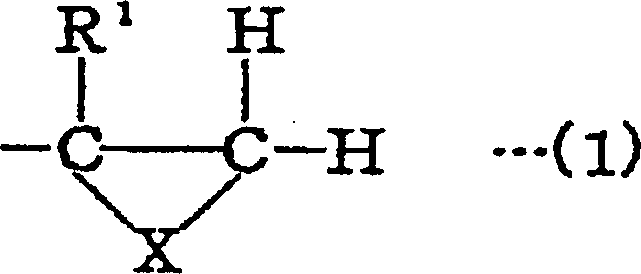
Erfindungsgemäß wird ein medizinisches Material, erhältlich durch Herstellen einer Überzugsschicht mit einem Überzugsmaterial, enthaltend eine polymere Substanz (A) mit einer heterozyklischen Gruppe der zuvor genannten Formel (1) auf mindestens einem Teil einer Oberfläche einer Grundlage aus einem medizinischen Überzugsfilm, welcher mit einem hydrophilen Copolymeren (B) konfiguriert ist, das eine reaktive funktionelle Gruppe aufweist, die in der Lage ist, mit der heterozyklischen Gruppe zu reagieren, und Ringöffnung der in der Überzugsschicht verbleibenden heterozyklischen Gruppe durch eine nucleophile Verbindung (N) zur Verfügung gestellt.According to the invention is a medical material, available by producing a coating layer with a coating material, containing a polymeric substance (A) having a heterocyclic Group of the aforementioned formula (1) on at least one part a surface a basis of a medical coating film, which with a hydrophilic copolymer (B) is configured, which is a reactive has functional group that is capable of heterocyclic Group react and ring opening in the overcoat layer remaining heterocyclic group through a nucleophilic compound (N) available posed.
Weiterhin wird erfindungsgemäß ein Verfahren zur Herstellung des medizinischen Materials, umfassend die Stufe des Aufbringens eines Überzugsmaterials, enthaltend eine polymere Substanz (A) mit einer heterozyklischen Gruppe der zuvor genannten Formel (1) auf mindestens einem Teil einer Oberfläche eines medizinischen Materials als Grundlage, gefolgt von Erhitzen zur Herstellung einer Überzugsschicht, die Stufe des Aufbringens einer Lösung eines hydrophilen Copolymeren (B) mit einer reaktiven funktionellen Gruppe, die mit der heterozyklischen Gruppe reagieren kann, auf die Überzugsschicht, gefolgt von Erhitzen zur Herstellung eines mit dem hydrophilen Copolymeren (B) konfigurierten Überzugsfilms, und die Stufe des In-Kontakt-Bringens der Überzugsschicht mit einer Lösung, enthaltend eine nucleophile Verbindung (N) zur Ringöffnung der in der Überzugsschicht verbleibenden heterozyklischen Gruppe, zur Verfügung gestellt.Farther is a method according to the invention for the preparation of the medical material comprising the step the application of a coating material, containing a polymeric substance (A) having a heterocyclic Group of the aforementioned formula (1) on at least one part a surface a medical material as a basis, followed by heating for producing a coating layer, the step of applying a solution of a hydrophilic copolymer (B) having a reactive functional group with the heterocyclic Can react to the coating layer, followed by heating to produce a hydrophilic copolymer (B) configured coating film, and the level of contacting the coating layer with a solution, containing a nucleophilic compound (N) for ring opening of in the coating layer remaining heterocyclic group, provided.
Das erfindungsgemäße medizinische Material ist ein solches, das durch Bildung einer Überzugsschicht aus einem Überzugsmaterial, enthaltend die polymere Substanz (A) auf mindestens einem Teil der Oberfläche einer Grundlage für das medizinische Material, Versehen der Überzugsschicht mit einem Überzugsfilm, welcher mit einem hydrophilen Copolymeren (B) konfiguriert ist, das eine reaktive Gruppe aufweist, die in der Lage ist, mit der heterozyklischen Gruppe zu reagieren, und Ringöffnung der in der Überzugsschicht verbleibenden heterozyklischen Gruppe durch eine nucleophile Verbindung (N), erhalten wird.The according to the invention medical Material is one by forming a coating layer from a coating material, containing the polymeric substance (A) on at least a part of the surface of a basis for the medical material, coating the coating layer with a coating film, which is configured with a hydrophilic copolymer (B), which has a reactive group capable of reacting with the heterocyclic group to react, and ring opening remaining in the coating layer heterocyclic group through a nucleophilic compound (N) becomes.
Die durch die Formel (1) angegebenen heterozyklischen Gruppen, die in einem Molekül der polymeren Substanz (A) vorhanden sind, können gleiche oder unterschiedliche Gruppen sein. Die heterozyklischen Gruppen können eine Ethylenoxidgruppe, eine Propylenoxidgruppe, eine Ethylenimingruppe, eine Propylenimingruppe, eine Ethylensulfidgruppe und eine Propylensulfidgruppe einschließen.The heterocyclic groups represented by the formula (1) and described in a molecule of the polymeric substance (A) may be the same or different Be groups. The heterocyclic groups may be an ethylene oxide group, a propylene oxide group, an ethylenimine group, a propylenimine group, an ethylene sulfide group and a propylene sulfide group.
Hinsichtlich der polymeren Substanz (A) bestehen, solange sie eine heterozyklische Gruppe aufweist, keine Einschränkungen. So wird zweckmäßig eine polymere Substanz mit der physikalischen Eigenschaft einer Hydrophilie oder einer Quellfähigkeit in Wasser eingesetzt, um der resultierenden Überzugsschicht auf der Oberfläche der Grundlage des medizinischen Materials die Funktionen, wie antithrombogene Eigenschaften und Oberflächengleitfähigkeit, zu verleihen. Beispiele für Verfahren zur Herstellung der hydrophilen polymeren Substanz mit heterozyklischen Gruppen können (A-1) ein Verfahren, bei dem eine Verbindung, die eine heterozyklische Gruppe hat, sich mit einer hydrophilen polymeren Substanz umsetzen gelassen wird, um die heterozyklischen Gruppe einzuführen; und (A-2) ein Verfahren, bei dem ein durch ein hydrophiles durch Radikale polymerisierbares Monomeres (a1) und ein heterozyklische Gruppe-enthaltendes Monomeres (a2) copolymerisiert werden, einschließen.Regarding of the polymeric substance (A), as long as they are heterocyclic Group has no restrictions. So is appropriate one polymeric substance having the physical property of hydrophilicity or a swelling capability used in water to the resulting coating layer on the surface of Basis of the medical material's functions, such as antithrombogenic Properties and surface lubricity, to rent. examples for Process for the preparation of the hydrophilic polymeric substance with heterocyclic groups can (A-1) a method in which a compound having a heterocyclic Group has to react with a hydrophilic polymeric substance is allowed to introduce the heterocyclic group; and (A-2) A method in which a radical polymerizable by a hydrophilic Monomer (a1) and a heterocyclic group-containing monomer (a2) copolymerized will include.
Die bei dem Verfahren (A-1) zu verwendende hydrophile polymere Substanz kann entweder ein natürliches Polymeres oder ein synthetisches Polymeres sein. Beispiele für natürliche Polymere können Polysaccharide und Proteine einschließen.The hydrophilic polymeric substance to be used in the method (A-1) can either be a natural one Polymer or a synthetic polymer. Examples of natural polymers can Include polysaccharides and proteins.
Beispiele für die Polysaccharide können Carboxymethylstärke, Dialdehydstärke, Pullulan, Mannan, Amylopectin, Amylose, Dextran, Hydroxyethyldextran, Levan, Inulin, Chitin, Chitosan, Xyloglucan, Alginsäure, Gummi arabicum, Guargummi, Gummi traganth, Hyaluronsäure, Heparin, Methylcellulose, Ethylcellulose, Celluloseacetat, Nitrocellulose, Carboxymethylcellulose, Carboxymethylethylcellulose, Hydroxyethylcellulose, Hydroxypropylcellulose, Ethylhydroxyethylcellulose und Hydroxypropylmethylcellulose einschließen.Examples for the Polysaccharides can carboxymethyl starch, dialdehyde starch, Pullulan, mannan, amylopectin, amylose, dextran, hydroxyethyldextran, Levan, inulin, chitin, chitosan, xyloglucan, alginic acid, gum arabic, guar gum, gum traganth, hyaluronic acid, heparin, methylcellulose, Ethylcellulose, cellulose acetate, nitrocellulose, carboxymethylcellulose, Carboxymethylethylcellulose, hydroxyethylcellulose, hydroxypropylcellulose, Ethylhydroxyethylcellulose and hydroxypropylmethylcellulose.
Beispiele für die Proteine können Leim, Gelatine, Casein und Collagen einschließen.Examples for the Proteins can Glue, gelatin, casein and collagen.
Beispiele für die synthetischen Polymere können Polyvinylalkohol, Natriumpolyacrylat, Polyethylenoxid, Polyacrylamid, Polyethylenimin, Natriumpolystyrolsulfonat, ein Methylvinylether-Malensäureanhydrid-Copolymeres und Alkyl-Halbester von Methylvinylether-Maleinsäureanhydrid-Copolymeren einschließen.Examples for the synthetic polymers can Polyvinyl alcohol, sodium polyacrylate, polyethylene oxide, polyacrylamide, Polyethyleneimine, sodium polystyrenesulfonate, a methyl vinyl ether-maleic anhydride copolymer and alkyl half esters of methyl vinyl ether-maleic anhydride copolymers.
Beispiele
für Verbindungen,
die eine heterozyklische Gruppe haben, können ein Alkylhalogenid einschließen, das
eine heterozyklische Gruppe, angegeben durch die folgende Formel
(3), hat: 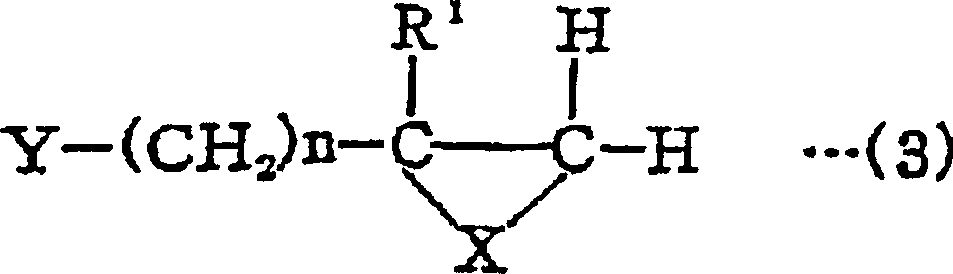
In der Formel (3) steht X für O, NH oder S, Y steht für Cl, Br oder I, R1 steht für H oder CH3 und n bedeutet eine ganze Zahl von 1 bis 20.In the formula (3), X is O, NH or S, Y is Cl, Br or I, R 1 is H or CH 3, and n is an integer of 1 to 20.
Das Verfahren (A-1) kann beispielsweise als ein bekanntes Verfahren durchgeführt werden, bei dem eine hydrophile polymere Substanz und eine Verbindung, die eine heterozyklische Gruppe hat, in Gegenwart eines basischen Katalysators, wie Triethylamin oder Pyridin, in einem geeigneten aprotischen organischen Medium für die Auflösung oder Quellung der hydrophilen polymeren Substanz dehydrohalogeniert werden, um die angestrebte hydrophile polymere Substanz zu erhalten, die heterozyklische Gruppen hat (nachstehend als HC-Polymer bezeichnet).The For example, method (A-1) may be used as a known method carried out in which a hydrophilic polymeric substance and a compound, which has a heterocyclic group in the presence of a basic Catalyst, such as triethylamine or pyridine, in a suitable aprotic organic medium for the resolution or swelling of the hydrophilic polymeric substance dehydrohalogenated to obtain the desired hydrophilic polymeric substance, which has heterocyclic groups (hereinafter referred to as HC polymer).
Obgleich bei dem Verfahren (A-1) die Menge der Verbindung, die eine einzuführende heterozyklische Gruppe hat, in geeigneter Weise entsprechend den gewünschten Eigenschaften ausgewählt werden kann, beträgt sie doch vorzugsweise 0,01 bis 70 Gew.-% und besonders bevorzugt 0,1 bis 50 Gew.-%, bezogen auf die Menge der hydrophilen polymeren Substanz. Die Einführung der Verbindung, die eine heterozyklische Gruppe hat, in einer Menge von weniger als 0,01 Gew.-%, kann zu einer Verringerung der Reaktionseffizienz der reaktiven funktionellen Gruppe mit der heterozyklischen Gruppe, die auf der Formel des Basismaterials des medizinischen Materials vorhanden ist, und zu einer Verringerung der Vernetzungseffizienz zwischen den HC-Polymeren führen, was zu unerwünschten Schwierigkeiten bei der Bildung eines stabilen Überzugsfilms führen kann. Andererseits kann die Einführung einer Verbindung, die eine heterozyklische Gruppe aufweist, in einer Menge von mehr als 70 Gew.-%, die Funktion der hydrophilen polymeren Substanz verringern, so dass eine derartige Menge nicht zu bevorzugen ist. Bei der Herstellung des erfindungsgemäßen medizinischen Materials kann nur eine Sorte des Polymeren oder ein Gemisch von zwei oder mehreren der Polymeren als HC-Polymere verwendet werden.Although in the method (A-1), the amount of the compound which is a heterocyclic group to be introduced has to be suitably selected according to the desired properties can, is It is preferably 0.01 to 70% by weight and more preferably 0.1 to 50 wt .-%, based on the amount of hydrophilic polymers Substance. The introduction the compound having a heterocyclic group in an amount less than 0.01% by weight, may lower the reaction efficiency the reactive functional group with the heterocyclic group, that on the formula of the base material of the medical material is present, and a reduction in crosslinking efficiency between the HC polymers, which is undesirable Difficulty in forming a stable coating film. On the other hand, the introduction a compound having a heterocyclic group in an amount greater than 70% by weight, the function of the hydrophilic polymeric substance so that such an amount is not preferable. In the manufacture of the medical material according to the invention only one type of polymer or a mixture of two or more the polymers are used as HC polymers.
Beispiele
für hydrophile,
durch Radikale polymerisierbare Monomere (a1), die bei dem Verfahren
(A-2) einzusetzen sind, können
ein radikalisch polymerisierbares Monomeres mit einer Gruppe, angegeben
durch die folgende Formel (2): 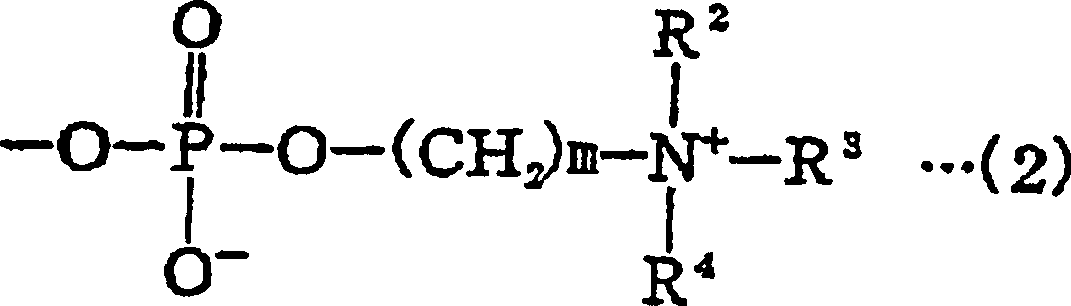
In der Formel (2) können R2, R3 und R4 gleiche oder unterschiedliche Gruppen sein und für H oder eine einwertige Kohlenwasserstoffgruppe mit 1 bis 4 Kohlenstoffatomen stehen; und m ist eine ganze Zahl von 2 bis 4.In the formula (2), R 2 , R 3 and R 4 may be the same or different groups and may be H or a monovalent hydrocarbon group having 1 to 4 carbon atoms; and m is an integer from 2 to 4.
Beispiele für ein durch Radikale polymerisierbares Monomeres (a1) mit einer durch die Formel (2) angegebenen Gruppe können 2-(Meth)acryloyloxyethyl-2'-(trimethylammonio)ethylphosphat (einschließlich MPC), 3-(Meth)acryloyloxypropyl-2'-(trimethylammonio)ethylphosphat, 4-(Meth)acryloyloxyeutyl-2'-(trimethylammonio)ethylphosphat, 5-(Meth)acryloyloxypentyl-2'-(trimethylammonio)ethylphosphat, 6-(Meth)acryloyloxyhexyl-2'-(trimethylammonio)ethylphosphat, 2-(Meth)acryloyloxyethyl-2'-(triethylammonio)ethylphosphat, 2-(Meth)acryloyloxyethyl-2'-(tripropylammonio)ethylphosphat, 2-(Meth)acryloyloxyethyl-2'-(tributylammo nio)ethylphosphat, 2-(Meth)acryloyloxypropyl-2'-(trimethylammonio)ethylphosphat, 2-(Meth)acryloyloxybutyl-2'-(trimethylammonio)ethylphosphat, 2-(Meth)acryloyloxypentyl-2'-(trimethylammonio)ethylphosphat, 2-(Meth)acryloyloxyhexyl-2'-(trimethylammonio)ethylphosphat, 2-(Meth)acryloyloxyethyl-3'-(trimethylammonio)propylphosphat, 3-(Meth)acryloyloxypropyl-3'-(trimethylammonio)propylphosphat, 4-(Meth)acryloyloxybutyl-3'-(trimethylammonio)propylphosphat, 5-(Meth)acryloyloxypentyl-3'-(trimethylammonio)propylphosphat, 6-(Meth)acryloyloxyhexyl-3'-(trimethylammonio)propylphosphat, 2-(Meth)acryloyloxyethyl-4'-(trimethylammonio)butylphosphat, 3-(Meth)acryloyloxypropyl-4'-(trimethylammonio)butylphosphat, 4-(Meth)acryloyloxybutyl-4'-(trimethylammonio)butylphosphat, 5-(Meth)acryloyloxypentyl-4'-(trimethylammonio)butylphosphat, 6-(Meth)acryloyloxyhexyl-4'-(trimethylammonio)butylphosphat, 2-(Vinyloxy)ethyl-2'-(trimethylammonio)ethylphosphat, 2-(Allyloxy)ethyl-2'-(trimethylammonio)ethylphosphat, 2-(p-Vinylbenzyloxy)ethyl-2'-(trimethylammonio)ethylphosphat, 2-(p-Vinylbenzoyloxy)ethyl-2'-(trimethylammonio)ethylphosphat, 2-(Styryloxy)ethyl-2'-(trmethylammonio)ethylphosphat, 2-(p-Vinylbenzyl)ethyl-2'-(trimethylammonio)ethylphosphat, 2-(Vinyloxycarbonyl)ethyl-2'-(trimethylammonio)ethylphosphat, 2-(Allyloxycarbonyl)ethyl-2'-(trimethylammonio)ethylphosphat, 2-(Acryloylamino)ethyl-2'-(trimethylammonio)ethylphosphat, 2-(Vinylcarbonylamino)ethyl-2'-(trimethylammonio)ethylphosphat, 2-(Allyloxycarbonylamino)ethyl-2'-(trimethylammonio)ethylphosphat, 2-(Butyroyloxy)ethyl-2'-(trimethylammonio)ethylphosphat, 2-(Crotonoyloxy)ethyl-2'-(trimethylammonio)ethylphosphat, Ethyl-(2'-trimethylammonioethylphosphorylethyl)fumarat, Butyl-(2'-trimethylammonioethylphosphorylethyl)fumarat und Hydroxyethyl-(2'-trimethylammonioethylphosphorylethyl)fumarat einschließen.Examples of a radical-polymerizable monomer (a1) having a group represented by the formula (2) may be 2- (meth) acryloyloxyethyl-2 '- (trimethylammonio) ethyl phosphate (including MPC), 3- (meth) acryloyloxypropyl-2'- (trimethylammonio) ethyl phosphate, 4- (meth) acryloyloxy-2-yl- (trimethylammonio) -ethyl phosphate, 5- (meth) acryloyloxypentyl-2 '- (trimethylammonio) -ethyl phosphate, 6- (meth) -acryloyloxyhexyl-2' - (trimethylammonio) -ethyl phosphate, 2- (Meth) acryloyloxyethyl 2 '- (triethylammonio) ethyl phosphate, 2- (meth) acryloyloxyethyl 2' - (tripropylammonio) ethyl phosphate, 2- (meth) acryloyloxyethyl 2 '- (tributylammino) ethyl phosphate, 2- (meth ) acryloyloxypropyl 2 '- (trimethylammonio) ethyl phosphate, 2- (meth) acryloyloxybutyl 2' - (trimethylammonio) ethyl phosphate, 2- (meth) acryloyloxypentyl 2 '- (trimethylammonio) ethyl phosphate, 2- (meth) acryloyloxyhexyl-2' - (trimethylammonio) ethyl phosphate, 2- (meth) acryloyloxyethyl 3 '- (trimethylammonio) propylphosphate, 3- (meth) acryloyloxypropyl-3' - (trimethylammonio) propylphosphine sphat, 4- (meth) acryloyloxybutyl-3 '- (trimethylammonio) propylphosphate, 5- (meth) acryloyloxypentyl-3' - (trimethylammonio) propylphosphate, 6- (meth) acryloyloxyhexyl-3 '- (trimethylammonio) propylphosphate, 2- (meth) Meth) acryloyloxyethyl 4 '- (trimethylammonio) butyl phosphate, 3- (meth) acryloyloxypropyl 4' - (trimethylammonio) butyl phosphate, 4- (meth) acryloyloxybu tyl-4 '- (trimethylammonio) butyl phosphate, 5- (meth) acryloyloxypentyl-4' - (trimethylammonio) butyl phosphate, 6- (meth) acryloyloxyhexyl-4 '- (trimethylammonio) -butyl phosphate, 2- (vinyloxy) ethyl-2'- (Trimethylammonio) ethyl phosphate, 2- (allyloxy) ethyl 2 '- (trimethylammonio) ethyl phosphate, 2- (p-vinylbenzyloxy) ethyl 2' - (trimethylammonio) ethyl phosphate, 2- (p -vinylbenzoyloxy) ethyl-2 '- ( trimethylammonio) ethyl phosphate, 2- (styryloxy) ethyl 2 '- (trmethylammonio) ethyl phosphate, 2- (p-vinylbenzyl) ethyl 2' - (trimethylammonio) ethyl phosphate, 2- (vinyloxycarbonyl) ethyl 2 '- (trimethylammonio) ethyl phosphate , 2- (Allyloxycarbonyl) ethyl 2 '- (trimethylammonio) ethyl phosphate, 2- (acryloylamino) ethyl 2' - (trimethylammonio) ethyl phosphate, 2- (vinylcarbonylamino) ethyl 2 '- (trimethylammonio) ethyl phosphate, 2- (allyloxycarbonylamino ) Ethyl 2 '- (trimethylammonio) ethyl phosphate, 2- (Butyroyloxy) ethyl 2' - (trimethylammonio) ethyl phosphate, 2- (Crotonoyloxy) ethyl 2 '- (trimethylammonio) ethyl phosphate, ethyl (2'-trimethylammonioethylphosphorylethyl) fumarate , Butyl (2'-trimethylammonioethylphosphorylethyl) fumarate and hydroxyethyl (2'-trimethylammonioethylphosphorylethyl) fumarate.
Das
MPC wird durch die folgende Formel (4) angegeben: 
Das durch hydrophile Radikale polymerisierbare Monomere (a1) kann auch ein solches sein, das keine Gruppe hat, die durch die Formel (2) angegeben wird. Beispiele für solche, durch Radikale polymerisierbare Monomere (a1), können Hydroxyalkyl(meth)acrylat-Monomere, wie 2-Hydroxyethyl(meth)acrylat und 2-Hydroxypropyl(meth)acrylat; Polyalkylenglykol(meth)acrylat-Monomere, wie Diethylenglykolmono(meth)acrylat, Polyethylenglykolmono(meth)acrylat, Polypropylenglykolmono(meth)acrylat, Methoxydiethylenglykol(meth)acrylat, Methoxypolyethylenglykol(meth)acrylat und Methoxypolypropylenglykol(meth)acrylat; ω-Carboxy(meth)acrylate, wie Phthalsäuremonohydroxyethyl(meth)acrylat, Hexahydrophthalsäuremonohydroxyethyl(meth)acrylat, ω-Carboxypolycaprolacton(n = 2 bis 5)mono(meth)acrylat und (Meth)acryloyloxyethylsuccinat; N-Vinyl-2-pyrrolidon, Vinylpyridin, (Meth)acrylamid, (Meth)acrylsäure, 2-Acrylamid-2-methylpropansulfonsäure, Dimethylaminoethyl(meth)acrylat, Diethylaminoethyl(meth)acrylat, Maleinsäureanhydrid und Glyco-2-hydroxyethylmonomethacrylat (GEMA) einschließen. Diese Monomeren können entweder einzeln oder als Gemisch davon eingesetzt werden.The Hydrophilic radical polymerizable monomers (a1) may also be used be one that does not have a group represented by the formula (2) is specified. examples for such radical-polymerizable monomers (a1) may include hydroxyalkyl (meth) acrylate monomers, such as 2-hydroxyethyl (meth) acrylate and 2-hydroxypropyl (meth) acrylate; Polyalkylene glycol (meth) acrylate monomers, such as diethylene glycol mono (meth) acrylate, Polyethylene glycol mono (meth) acrylate, polypropylene glycol mono (meth) acrylate, Methoxydiethylenglykol (meth) acrylate, methoxypolyethylene glycol (meth) acrylate and methoxypolypropylene glycol (meth) acrylate; ω-carboxy (meth) acrylates, such as Phthalsäuremonohydroxyethyl (meth) acrylate, Hexahydrophthalic acid monohydroxyethyl (meth) acrylate, ω-carboxypolycaprolactone (n = 2 to 5) mono (meth) acrylate and (meth) acryloyloxyethyl succinate; N-vinyl-2-pyrrolidone, vinylpyridine, (meth) acrylamide, (meth) acrylic acid, 2-acrylamide-2-methylpropanesulfonic acid, dimethylaminoethyl (meth) acrylate, Diethylaminoethyl (meth) acrylate, maleic anhydride and glyco-2-hydroxyethyl monomethacrylate (GEMA). These monomers can either individually or as a mixture thereof.
Das heterozyklische Gruppe-enthaltende Monomer (a2), das bei dem Verfahren (A-2) zu verwenden ist, ist ein Monomeres mit einer polymerisierbaren Doppelbindung und einer heterozyklischen Gruppe in seinem Molekül. Beispiele hierfür können Glycidylacrylat (nachstehend als GA abgekürzt), Glycidylmethacrylat (nachstehend als GMA abgekürzt), Methylglycidylmethacrylat und Allylglycidylether einschließen. Diese heterozyklische Gruppe-enthaltenden Monomeren (a2) können einzeln oder als Gemisch davon verwendet werden.The heterocyclic group-containing monomer (a2) used in the process (A-2) is a monomer having a polymerizable one Double bond and a heterocyclic group in its molecule. Examples therefor can Glycidyl acrylate (hereinafter abbreviated to GA), glycidyl methacrylate (hereinafter abbreviated as GMA), Methyl glycidyl methacrylate and allyl glycidyl ether. These Heterocyclic group-containing monomers (a2) may be used individually or used as a mixture thereof.
In dem Copolymeren, das durch das Verfahren (A-2) erhältlich ist (nachstehend als HC-Copolymer abgekürzt), kann ein weiteres bzw. anderes durch Radikale polymerisierbares Monomeres (a3) als dritte Komponente copolymerisiert sein, um die physikalischen Eigenschaften eines Überzugsfilms zu kontrollieren, der durch Aufbringung des Copolymeren auf die Oberfläche eines medizinischen Materials gebildet worden ist.In the copolymer obtainable by the method (A-2) (hereinafter referred to as HC copolymer abbreviated) may be another or other radical polymerizable Monomer (a3) may be copolymerized as a third component to the control physical properties of a coating film, by applying the copolymer to the surface of a medical material has been formed.
Das andere bzw. weitere Monomere (a3) ist keinen besonderen Beschränkungen unterworfen. Beispiele hierfür können (Meth)acrylsäureester-Monomere, wie Methyl(meth)acrylat, Ethyl(meth)acrylat, Propyl(meth)acrylat, Butyl(meth)acrylat, Hexyl(meth)acrylat, Lauryl(meth)acrylat und Stearyl(meth)acrylat; Styrolmonomere, wie Styrol, Methylstyrol und substituiertes Styrol; Vinylethermonomere, wie Ethylvinylether und N-Propylvinylether; Vinylestermonomere, wie Vinylacetat; ungesättigte Kohlenwasserstoffmonomere oder substituierte ungesättigte Kohlenwasserstoffmonomere, wie Vinylchlorid, Vinylidenchlorid, Ethylen, Propylen und Isobutylen; und Acrylnitril einschließen. Die weiteren bzw. anderen Monomeren können einzeln oder als Gemisch davon zum Einsatz kommen.The Other or further monomers (a3) is not particularly limited subjected. Examples of this can (Meth) acrylate monomers, such as methyl (meth) acrylate, ethyl (meth) acrylate, propyl (meth) acrylate, Butyl (meth) acrylate, hexyl (meth) acrylate, lauryl (meth) acrylate and Stearyl (meth) acrylate; Styrenic monomers such as styrene, methylstyrene and substituted styrene; Vinyl ether monomers such as ethyl vinyl ether and N-propyl vinyl ether; Vinyl ester monomers, such as vinyl acetate; unsaturated hydrocarbon monomers or substituted unsaturated Hydrocarbon monomers, such as vinyl chloride, vinylidene chloride, ethylene, Propylene and isobutylene; and acrylonitrile. The other or other monomers can be used individually or as a mixture to be used.
Obgleich der Verhältnisanteil der sich von dem Monomeren (a1) ableitenden Einheiten in dem HC-Copolymeren keinen besonderen Beschränkungen unterworfen ist, beträgt er doch vorzugsweise 5 bis 99,9 Mol-%, besonders bevorzugt 20 bis 95 Mol-%, bezogen auf das gesamte HC-Copolymere. Wenn der Verhältnisanteil der sich von dem Monomeren (a1) ableitenden Einheiten kleiner als 5 Mol-% ist, dann kann es sein, dass in unerwünschter Weise die Eigenschaften des Monomeren (a1) nicht in zufrieden stellender Weise in das HC-Copolymere eingearbeitet worden sind. Wenn der Anteil andererseits über 99,9 Mol-% hinausgeht, dann wird der Verhältnisanteil der von dem Monomeren (a2) abgeleiteten Einheiten in dem HC-Copolymeren unvermeidbar geringer als 0,1 Mol-%, so dass die nachstehend beschriebenen Probleme in unerwünschter Weise auftreten können.Although the ratio of the units derived from the monomer (a1) in the HC copolymer is not particularly limited, it is preferably 5 to 99.9 mol%, more preferably 20 to 95 mol%, based on the whole HC copolymer. If the ratio of the units derived from the monomer (a1) is less than 5 mol%, then it may be that undesirably the properties of the monomer (a1) have not been satisfactorily incorporated into the HC copolymer. On the other hand, if the content exceeds 99.9 mol%, then the ratio of the units derived from the monomer (a2) in the HC copolymer inevitably becomes less than 0.1 mol%, so that the problems described below undesirably may occur.
Obgleich der Verhältnisanteil der von dem Monomeren (a2) abgeleiteten Einheiten in dem HC-Copolymeren keinen besonderen Beschränkungen unterworfen ist, beträgt er doch vorzugsweise 0,1 bis 95 Mol-%, und insbesondere bevorzugt 5 bis 70 Mol-%, bezogen auf das ge samte HC-Copolymere. Wenn der Verhältnisanteil der von dem Monomeren (a2) abgeleiteten Einheiten kleiner als 0,1 Mol-% ist, dann kann es sein, dass die Einführungseffizienz in die Basisoberfläche des medizinischen Materials und die Effizienz der Vernetzungsreaktion zwischen den HC-Copolymeren verringert werden kann, was zu unerwünschten Schwierigkeiten bei der Bildung eines stabilen Überzugsfilms führen kann. Wenn er andererseits über 95 Mol-% hinausgeht, dann ist der Verhältnisanteil der von dem Monomeren (a1) abgeleiteten Einheiten in dem HC-Copolymeren relativ verringert, so dass die vorstehend beschriebenen Probleme in unerwünschter Weise auftreten können.Although the ratio share the units derived from the monomer (a2) in the HC copolymer no special restrictions subject is It is preferably 0.1 to 95 mol%, and more preferably 5 to 70 mol%, based on the ge entire HC copolymers. If the proportion the units derived from the monomer (a2) are less than 0.1 Mol%, then it may be that the introduction efficiency into the base surface of the medical material and the efficiency of the crosslinking reaction between the HC copolymers can be reduced, resulting in undesirable Difficulty in forming a stable coating film. On the other hand, if he over 95 mol%, then the ratio of that of the monomer (a1) relatively reduced units in the HC copolymer, so that the problems described above are undesirable Way can occur.
Der Verhältnisanteil der von dem anderen bzw. weiteren Monomeren (a3) abgeleiteten Einheiten beträgt zweckmäßig weniger als 70 Mol-%, bezogen auf das gesamte HC-Copolymere, damit die Eigenschaften des HC-Copolymeren nicht beeinträchtigt werden.Of the proportion the units derived from the other or further monomers (a3) is appropriately less than 70 mol%, based on the total HC copolymer, so that the properties of the HC copolymers are not affected become.
Die charakteristischen Eigenschaften des HC-Copolymeren können in geeigneter Weise erhalten werden, indem das einzusetzende, durch hydrophile Radikale polymerisierbare Monomere (a1), in geeigneter Weise ausgewählt wird. Insbesondere hat ein HC-Copolymeres, enthaltend ein durch Radikale polymerisierbares Monomeres mit der durch die Formel (2) angegebenen Gruppe als Seitenkette, vorzugsweise ein HC-Copolymeres, enthaltend MPC als seine Struktureinheit, eine ausgezeichnete Verträglichkeit gegenüber Blut.The Characteristic properties of the HC copolymer can be found in be obtained suitably by the hydrophilic radical polymerizable monomers (a1), suitably selected becomes. In particular, an HC copolymer containing a through Radical polymerizable monomer having the formula (2) specified group as a side chain, preferably a HC copolymer, containing MPC as its structural unit, excellent compatibility to blood.
Daher ist es durch Vorsehen eines Überzugsfilms, hergestellt aus dem Copolymeren auf der Oberfläche des Grundmaterials, möglich, ein medizinisches Material zu erhalten, das den Anforderungen sowohl hinsichtlich der Oberflächengleitfähigkeit als auch der anti-thrombogenen Eigenschaften genügt.Therefore it is by providing a coating film, prepared from the copolymer on the surface of the base material, possible to obtain medical material that meets the requirements of both in terms of surface lubricity as well as the anti-thrombogenic Properties are enough.
Das HC-Copolymere kann beispielsweise dadurch erhalten werden, dass eine radikalische Polymerisation einer Monomerzusammensetzung, enthaltend das Monomere (a1), das Monomere (a2) und das optionale weitere bzw. andere Monomere (a3), in einem Lösungsmittel und in Gegenwart eines Polymerisationsinitiators durchgeführt wird. Die radikalische Polymerisation kann in einem System durchgeführt werden, in dem die Atmosphäre durch ein inertes Gas, wie Stickstoff, Kohlendioxid oder Helium, ersetzt worden ist.The HC copolymers can be obtained, for example, by: a radical polymerization of a monomer composition containing the monomer (a1), the monomers (a2) and the optional further or other monomers (a3), in a solvent and in the presence of a polymerization initiator. The radical polymerization can be carried out in a system in which the atmosphere by an inert gas, such as nitrogen, carbon dioxide or helium, has been replaced.
Hinsichtlich des Polymerisationsinitiators bestehen keine Beschränkungen. Es können herkömmliche Polymerisationsinitiatoren für die radikalische Polymerisation zum Einsatz kommen. Beispiele für die Initiatoren können organische Peroxide, wie t-Butylperoxypivalat, t-Butylperoxyneodecanoat, t-Butylperoxy-2-ethylhexanoat, t-Butylperoxyacetat, 1,1,3,3-Tetramethylbutylperoxy-2-ethylhexanoat, Bernsteinsäureperoxid, Benzoylperoxid, 3,5,5-Trimethylhexanoylperoxid und Lauroylperoxid; Azoverbindungen, wie 2,2'-Azobisisobutyronitril, 2,2'-Azobis-(2-amidinopropan)dihydrochlorid, Dimethyl-2,2'-azobisisobutyrat, 2,2'-Azobis-(2,4-dimethylvaleronitril), 1,1'-Azobis(cyclohexan-1-carbonitril) und 2,2'-Azobis-(2-methyl-N-(2-hydroxyethyl)propionamid; Persulfate, wie Kaliumpersulfat, Natriumpersulfat und Ammoniumpersulfat; und Persulfat-Hydrogensulfit-Systeme, verwendet werden. Diese Polymerisationsinitiatoren können einzeln oder als Gemisch davon eingesetzt werden.Regarding of the polymerization initiator are not limited. It can conventional polymerization initiators for the radical polymerization are used. Examples of the initiators can organic peroxides, such as t-butyl peroxypivalate, t-butyl peroxyneodecanoate, t-butylperoxy-2-ethylhexanoate, t-butylperoxyacetate, 1,1,3,3-tetramethylbutylperoxy-2-ethylhexanoate, succinic acid, Benzoyl peroxide, 3,5,5-trimethylhexanoyl peroxide and lauroyl peroxide; Azo compounds, such as 2,2'-azobisisobutyronitrile, 2,2'-azobis (2-amidinopropane) dihydrochloride, Dimethyl-2,2'-azobisisobutyrate, 2,2'-azobis- (2,4-dimethylvaleronitrile), 1,1'-azobis (cyclohexane-1-carbonitrile) and 2,2'-azobis (2-methyl-N- (2-hydroxyethyl) propionamide; persulfates, such as potassium persulfate, sodium persulfate and ammonium persulfate; and Persulfate bisulfite systems. These polymerization initiators can used singly or as a mixture thereof.
Die Menge des zu verwendenden Polymerisationsinitiators beträgt zweckmäßig 0,001 Gew.-Teile bis 10 Gew.-Teile, mehr bevorzugt 0,01 Gew.-Teile bis 5 Gew.-Teile, pro 100 Gew.-Teile der Gesamtmenge der Monomeren.The The amount of the polymerization initiator to be used is suitably 0.001 Parts by weight to 10 parts by weight, more preferably 0.01 parts by weight to 5 parts by weight, per 100 parts by weight the total amount of monomers.
Hinsichtlich des Lösungsmittels zur Herstellung des HC-Copolymeren bestehen keine besonderen Einschränkungen, solange es ein Lösungsmittel ist, das die Monomeren, die als Struktureinheiten des Copolymeren wirken, auflöst und sich nicht mit den heterozyklischen Gruppen umsetzt. Das Lösungsmittel kann ein gemischtes Lösungsmittel sein.Regarding of the solvent There are no particular restrictions on the preparation of the HC copolymer. as long as it's a solvent is that the monomers, as structural units of the copolymer act, dissolve and does not react with the heterocyclic groups. The solvent can be a mixed solvent be.
Das HC-Copolymere kann durch allgemeine Reinigungsverfahren, wie Umfällung, Dialyse oder Ultrafiltration, gereinigt werden.The HC copolymers can be prepared by general purification methods, such as reprecipitation, dialysis or ultrafiltration.
In der erfindungsgemäß zu verwendenden polymeren Substanz (A) beträgt das bevorzugte gewichtsmittlere Molekulargewicht des HC-Copolymeren 5000 bis 5.000.000 und insbesondere 10.000 bis 2.000.000. Wenn das Molekulargewicht kleiner als 5000 ist, dann wird in unvermeidbarer Weise die Anzahl der heterozyklischen Gruppen, die pro Molekül enthalten sind, verringert. Als Ergebnis kann es sein, dass die Einführungseffizienz des Copolymeren in die Grundoberfläche verringert wird. Weiterhin kann auch in diesem Fall die Vernetzungseffizienz zwischen den Copolymeren verringert sein. Demgemäß kann eine Verringerung der Festigkeit des Überzugsfilms, die daraus resultiert, in unerwünschter Weise auftreten. Wenn das Molekulargewicht über 5.000.000 hinausgeht, dann kann die Lösungsviskosität der aus dem Copolymeren hergestellten Zusammensetzung erhöht werden, so dass es schwierig werden kann, das Material zu handhaben, und es kann weiterhin möglich sein, dass beim Aufbringen auf das Grundmaterial eine Unebenheit bzw. Ungleichmäßigkeit des Überzugs bewirkt wird. Die Struktur des HC-Copolymeren als erfindungsgemäß zu verwendende polymere Substanz (A) kann eine beliebige Struktur aus der Gruppe Randomstruktur, Blockstruktur und Pfropfstruktur sein. In der polymeren Substanz (A) können die HC-Copolymeren entweder einzeln oder als Gemisch von zwei oder mehreren Copolymeren zum Einsatz kommen.In the invention to be used polymeric substance (A) is the preferred weight average molecular weight of the HC copolymer 5000 to 5,000,000 and especially 10,000 to 2,000,000. If that Molecular weight is less than 5000, then becomes unavoidable Way the number of heterocyclic groups contained per molecule are reduced. As a result, it may be that the introduction efficiency of the copolymer in the base surface is reduced. Farther can also in this case the crosslinking efficiency between the copolymers be reduced. Accordingly, a Reduction of the strength of the coating film, which results in unwanted Way occur. If the molecular weight exceeds 5,000,000, then the solution viscosity of the increased in the copolymer composition, so it can be difficult to handle the material, and It may still be possible be that when applied to the base material a bump or unevenness of the coating is effected. The structure of the HC copolymer is to be used as the invention polymeric substance (A) can be any structure from the group Randomstruktur, block structure and graft structure be. In the polymeric Substance (A) can the HC copolymers either individually or as a mixture of two or several copolymers are used.
Das erfindungsgemäß zu verwendende hydrophile Copolymere (B) ist eine polymere Verbindung, die funktionelle Gruppen aufweist, die dazu imstande sind, sich mit den heterozyklischen Gruppen in der polymeren Substanz (A) umzusetzen. Es absorbiert Wasser beim Kontakt mit einem wässrigen Medium, wie Körperflüssigkeiten und Blut, unter Erhalt einer Gleitfähigkeit.The to be used according to the invention Hydrophilic copolymers (B) is a polymeric compound that is functional Having groups that are capable of dealing with the heterocyclic To implement groups in the polymeric substance (A). It absorbs Water on contact with an aqueous Medium, like body fluids and blood, while maintaining lubricity.
Das hydrophile Copolymere (B) kann beispielsweise dadurch hergestellt werden, dass ein durch hydrophile Radikale polymerisierbares Monomeres (b1) und ein durch Radikale polymerisierbares Monomeres (b2) mit einer funktionellen Gruppe, die mit einer heterozyklischen Gruppe reaktiv ist und dazu imstande ist, den Ring der heterozyklischen Gruppe zu öffnen, copolymerisiert wird.The For example, hydrophilic copolymers (B) can be produced thereby be that a hydrophilic radical polymerizable monomer (b1) and a radical polymerizable monomer (b2) with a functional group that interacts with a heterocyclic group is reactive and capable of ringing the heterocyclic To open group, is copolymerized.
Bevorzugte Beispiele für die Monomeren (b1) können durch hydrophile Radikale polymerisierbare Monomere (a1), wie oben beschrieben, und Gemische davon einschließen.preferred examples for the monomers (b1) can hydrophilic radical polymerizable monomers (a1) as above and mixtures thereof.
Das Monomere (b2) kann ein durch Radikale polymerisierbares Monomeres mit einer funktionellen Gruppe, die dazu imstande ist, sich mit einer heterozyklischen Gruppe umzusetzen, wie eine Hydroxylgruppe, eine Carboxylgruppe, eine Aminogruppe und eine Thiolgruppe, im Molekül sein. Beispiele für solche Verbindungen können Hydroxylgruppe-enthaltende Monomere, wie 2-Hydroxyethyl(meth)acrylat, 2-Hydroxypropyl(meth)acrylat, Polyethylenglykolmono(meth)acrylat, Polypropylenglykolmono(meth)acrylat, Glycerin-α-mono(meth)acrylat, Allylalkohol, 2-Allylphenol, Glycerin-α-monoallylether, Ethylenglykolmonoallylether und N-(Hydroxymethyl)acrylamid; Carboxylgruppe-enthaltende Monomere, wie (Meth)acrylsäure, 3-Pentensäure, 4-Pentensäure, 3-Allyloxypropionsäure und 2-(Meth)acyloyloxyethylphthalat; und Aminogruppe-enthaltende Monomere, wie Allylamin, Allylamin(hydrochlorid), Allylharnstoff 1-Allyl-2-thiourethan, 2-Methylallylamin(hydrochlorid), 2-Aminoethyl(meth)acrylat(hydrochlorid), 4-Aminostyrol und Acrylamid, einschließen. Die Verwendung von Allylamin(hydrochlorid) wird im Hinblick auf die hohe Reaktivität mit der heterozyklischen Gruppe und die gute Erhältlichkeit bevorzugt. Diese Monomere können, wenn verwendet, entweder einzeln oder als Gemisch davon zum Einsatz kommen.The Monomers (b2) may be a radical polymerizable monomer with a functional group that is able to interact with a heterocyclic group, such as a hydroxyl group, a Carboxyl group, an amino group and a thiol group, in the molecule. examples for such compounds can Hydroxyl group-containing monomers such as 2-hydroxyethyl (meth) acrylate, 2-hydroxypropyl (meth) acrylate, polyethylene glycol mono (meth) acrylate, Polypropylene glycol mono (meth) acrylate, glycerol α-mono (meth) acrylate, allyl alcohol, 2-allylphenol, glycerol α-monoallyl ether, Ethylene glycol monoallyl ether and N- (hydroxymethyl) acrylamide; Carboxyl group-containing Monomers, such as (meth) acrylic acid, 3-pentenoic acid, 4-pentenoic acid, 3-allyloxypropionic acid and 2- (meth) acyloyloxyethylphthalat; and amino group-containing monomers, such as allylamine, allylamine (hydrochloride), allyl urea 1-allyl-2-thiourethane, 2-methylallylamine (hydrochloride), 2-aminoethyl (meth) acrylate (hydrochloride), 4-aminostyrene and acrylamide. The use of allylamine (hydrochloride) is in view of the high reactivity with the heterocyclic Group and the good availability prefers. These monomers can, when used, either singly or as a mixture thereof come.
Bei der Herstellung des hydrophilen Copolymeren (B) kann ein durch Radikale polymerisierbares Monomeres (b3), das ein anderes ist als die oben genannten durch Radikale polymerisierbaren Monomeren, mit den Monomeren (b1) und (b2) copolymerisiert werden. Beispiele für Monomere (b3) können die oben genannten anderen bzw. weiteren durch Radikale polymerisierbaren Monomeren (a3) und Gemische davon einschließen.at the preparation of the hydrophilic copolymer (B) may be a radical polymerizable monomer (b3) other than the above mentioned by radical polymerizable monomers, with the monomers (b1) and (b2) are copolymerized. Examples of monomers (b3) can the above-mentioned others are further radical-polymerizable ones Monomers (a3) and mixtures thereof.
Der Verhältnisanteil der von dem Monomeren (b1) abgeleiteten Einheiten in dem hydrophilen Copolymeren (B) beträgt vorzugsweise 20 bis 99,9 Mol-% und besonders bevorzugt 50 bis 99 Mol-%, bezogen auf das gesamte hydrophile Copolymere (B). Wenn der Verhältnisanteil der von dem Monomeren (b1) abgeleiteten Einheiten kleiner als 20 Mol-% ist, dann kann es sein, dass die Fähigkeit für die Wasserabsorbierung des hydrophilen Copolymeren (B) verringert wird, was zu einer nicht ausreichenden Gleitfähigkeit des feuchten Copolymeren führen kann sowie zu einer nicht ausreichenden Verträglichkeit gegenüber Blut. Wenn er andererseits über 99,9 Mol-% hinausgeht, dann wird der Verhältnisanteil der von dem Monomeren (b2) abgeleiteten Einheiten, die an der Bindung mit der heterozyklischen Gruppe beteiligt sind, relativ verringert, so dass das untenstehend beschriebene Problem in unerwünschter Weise auftreten kann.Of the proportion the units derived from the monomer (b1) in the hydrophilic Copolymer (B) is preferably 20 to 99.9 mol% and more preferably 50 to 99 Mol%, based on the total hydrophilic copolymer (B). If the proportion the units derived from the monomer (b1) are less than 20 Mol%, then it may be that the ability to absorb the water hydrophilic copolymer (B) is reduced, resulting in a not sufficient lubricity of the wet copolymer as well as inadequate compatibility with blood. On the other hand, if he over 99.9 mol%, then the ratio of that of the monomer (b2) derived units that bind to the heterocyclic Group involved are relatively reduced, so the below described problem in unwanted Way can occur.
Der bevorzugte Verhältnisanteil der von dem Monomeren (b2) abgeleiteten Einheiten in dem hydrophilen Copolymeren (B) ist 0,1 bis 80 Mol-%, insbesondere 1 bis 50 Mol-%. Wenn der Verhältnisanteil der von dem Monomeren (b2) abgeleiteten Einheiten kleiner als 0,1 Mol-% ist, dann kann es sein, dass die Reaktionseffizienz mit der heterozyklischen Gruppe in der polymeren Substanz (A) verringert wird, was zu einer fehlenden Menge des hydrophilen Copolymeren (B) für die Ausübung der Funktion führen kann. Selbst dann, wenn das hydrophile Copolymere (B) immobilisiert worden ist, kann es sein, dass die Anzahl der Bindungspunkte mit der polymeren Substanz (A) klein ist, so dass hinsichtlich der Dauerhaftigkeit unerwünschte Prob leme auftreten können. Wenn die Menge andererseits über 80 Mol-% hinausgeht, dann kann es in unerwünschter Weise sein, dass die charakteristischen Eigenschaften des Monomeren (b1) nicht in genügender Weise in das hydrophile Copolymere (B), wie oben beschrieben, eingearbeitet worden sind.The preferred ratio of the units derived from the monomer (b2) in the hydrophilic copolymer (B) is 0.1 to 80 mol%, especially 1 to 50 mol%. If the ratio of the of units derived from the monomer (b2) is smaller than 0.1 mol%, the reaction efficiency with the heterocyclic group in the polymeric substance (A) may be lowered, resulting in a lack of the hydrophilic copolymer (B). can lead to the exercise of the function. Even if the hydrophilic copolymer (B) has been immobilized, the number of bonding points with the polymeric substance (A) may be small, so that undesirable problems may arise in terms of durability. On the other hand, if the amount exceeds 80 mol%, it may undesirably be that the characteristic properties of the monomer (b1) have not been sufficiently incorporated into the hydrophilic copolymer (B) as described above.
Der Verhältnisanteil der von dem anderen bzw. weiteren Monomeren (b3) abgeleiteten Einheiten beträgt zweckmäßig weniger als 50 Mol-%, bezogen auf die gesamte Menge der Struktureinheiten des hydrophilen Copolymeren (B), damit die gewünschten Eigenschaften des hydrophilen Copolymeren (B) aufrechterhalten werden können.Of the proportion the units derived from the other or further monomers (b3) is appropriately less as 50 mol%, based on the total amount of the structural units of the hydrophilic copolymer (B), so that the desired properties of the hydrophilic Copolymers (B) can be maintained.
Die charakteristischen Eigenschaften des erfindungsgemäß zu verwendenden hydrophilen Copolymeren (B) können so eingestellt werden, wie es gewünscht wird, indem in geeigneter Weise das zu verwendende Monomere (b1) ausgewählt wird. Insbesondere hat ein hydrophiles Copolymeres (B), enthaltend ein durch Radikale polymerisierbares Monomeres mit einer durch die Formel (2) angegebenen Gruppe, vorzugsweise ein hydrophiles Copolymeres (B), enthaltend Struktureinheiten auf der Basis von MPC, eine ausgezeichnete Verträglichkeit gegenüber Blut. Daher ist es durch Vorsehen eines Überzugsfilms, der aus dem Copolymeren hergestellt worden ist, auf der Oberfläche der Grundlage möglich, ein medizinisches Material zu erhalten, das sowohl den Anforderungen der Oberflächengleitfähigkeit als auch der anti-thrombogenen Eigenschaften genügt.The characteristic properties of the invention to be used hydrophilic copolymers (B) can be set as desired by adding appropriate Way the monomers to be used (b1) is selected. In particular a hydrophilic copolymer (B) containing a radical polymerizable Monomer having a group represented by the formula (2), preferably a hydrophilic copolymer (B) containing structural units the basis of MPC, excellent blood compatibility. Therefore, it is by providing a coating film composed of the copolymer has been made possible on the surface of the base to obtain medical material that meets both the requirements the surface lubricity as well as the anti-thrombogenic properties is sufficient.
Das hydrophile Copolymere (B) kann in der gleichen Art und Weise hergestellt werden, wie es oben im Zusammenhang mit der Herstellung des HC-Copolymeren beschrieben wurde. Als Lösungsmittel, die hierfür verwendet werden sollen, können alle Lösungsmittel eingesetzt werden, solange es sich um Lösungsmittel handelt, die die Monomeren, die als Struktureinheiten des hydrophilen Copolymeren (B) wirken, auflösen. Auch Mischlösungsmittel sind annehmbar.The Hydrophilic copolymers (B) can be prepared in the same manner be as above related to the preparation of the HC copolymer has been described. As a solvent, the one for this can be used all solvents be used as long as they are solvents that the Monomers, as structural units of the hydrophilic copolymer (B) act, dissolve. Also Mixed solvent are acceptable.
Das gewichtsmittlere Molekulargewicht des hydrophilen Copolymeren (B) beträgt vorzugsweise 5000 bis 5.000.000 und besonders bevorzugt 10.000 bis 2.000.000. Wenn das Molekulargewicht kleiner als 5000 ist, dann wird in unvermeidbarer Weise die Anzahl der funktionellen Gruppen, die dazu imstande sind, mit den heterozyklischen Gruppen zu reagieren, die pro Molekül enthalten sind, verringert. Als Ergebnis kann die Einführungseffizienz auf die polymere Substanz (A), die zuvor auf der Matrixoberfläche immobilisiert worden ist, in unerwünschter Weise verringert werden. Wenn andererseits das Molekulargewicht über 5.000.000 hinausgeht, dann können in unerwünschter Weise Probleme hinsichtlich der Handhabung der Polymerlösung und der Unebenheit des Überzugs, wie oben beschrieben, auftreten. Das hydrophile Copolymere (B) kann in einer beliebigen Random-, Block- und Pfropf-Form vorliegen. Die hydrophilen Copolymeren (B) können entweder einzeln oder als Gemisch von zwei oder mehreren davon zum Einsatz kommen.The weight average molecular weight of the hydrophilic copolymer (B) is preferably 5000 to 5,000,000, and more preferably 10,000 to 2,000,000. If the molecular weight is less than 5000, then inevitably becomes the number of functional groups, who are able to react with the heterocyclic groups, the per molecule are reduced. As a result, the introduction efficiency on the polymeric substance (A), previously immobilized on the matrix surface has been in unwanted Be reduced. On the other hand, if the molecular weight is over 5,000,000 goes out, then you can in unwanted There are problems with the handling of the polymer solution and the unevenness of the coating, as described above occur. The hydrophilic copolymer (B) can in any random, block and graft form. The hydrophilic copolymers (B) can either singly or as a mixture of two or more thereof Use come.
Als Grundlage bzw. Basis für das medizinische Material (nachstehend als Grundlage (M) bezeichnet), die erfindungsgemäß verwendet werden soll, können alle beliebigen üblichen Materialien für medizinische Instrumente verwendet werden. Es ist zweckmäßig, dass die Grundlage (M) funktionelle Gruppen, wie Aminogruppen, Hydroxylgruppen oder Carboxylgruppen, aufweist, die mit den heterozyklischen Gruppen auf ihrer Oberfläche reagieren können. Ein Material ohne funktionelle Gruppen, die dazu imstande sind, sich an die heterozyklischen Gruppen zu binden, kann vorzugsweise zum Einsatz kommen, nachdem auf der Oberfläche der Grundlage (M) durch ein bekanntes Verfahren zur Modifizierung der Oberfläche funktionelle Gruppen gebildet worden sind.When Basis or basis for the medical material (hereinafter referred to as the basis (M)) which used according to the invention should be able to any usual Materials for medical instruments are used. It is appropriate that the basis (M) functional groups, such as amino groups, hydroxyl groups or carboxyl groups that are linked to the heterocyclic groups on its surface can react. A material without functional groups that are capable of to bind to the heterocyclic groups may preferably are used after passing through on the surface of the foundation (M) a known method for modifying the surface functional Groups have been formed.
Das Verfahren zur Modifizierung der Oberfläche kann in geeigneter Weise, entsprechend der verwendeten Grundlage (M), ausgewählt werden. Das Verfahren kann Plasma-Bearbeitungsverfahren, wie eine Corona-Entladung und eine Glühentladung, eine chemische Behandlung mit einer konzentrierten Schwefelsäurelösung, enthaltend Dichromsäure (verwendbar für nichtpolare Polymere), eine partielle Hydrolyse einer Amidverknüpfung oder einer Urethanverknüpfung durch eine Säure oder eine alkalische Lösung (verwendbar für Polyamide und Polyurethane) und die Anwendung oder Vermengung einer Verbindung mit einer funktionelle Gruppen einschließen.The Method of modifying the surface may suitably according to the used basis (M). The method may include plasma processing methods, such as a corona discharge and a glow discharge, a chemical treatment with a concentrated sulfuric acid solution containing dichromic (usable for non-polar polymers), a partial hydrolysis of an amide linkage or a urethane linkage through an acid or an alkaline solution (usable for Polyamides and polyurethanes) and the application or blending of a Include a compound with a functional group.
Aus den vorstehenden Gründen ist die für die Zwecke der vorliegenden Erfindung geeignete Grundlage (M) sehr begrenzten Einschränkungen unterworfen. Beispiele für die Grundlage (M) können, jedoch ohne Einschränkung darauf, Polyethylen, Polypropylen, Polystyrol, Polyvinylchlorid, Nylon, Polyurethan, Polyharnstoff, Poly(meth)acrylsäure, Poly(meth)acrylsäureester, Polyester, Polyacrylnitril, Polyacrylamid, Polyvinylacetat, Polycarbonat, Polysulfon, Polyvinylalkohol, Cellulose, Celluloseacetat, Silikonharz, Glas, Keramiken, Metalle und Edelstahl einschließen. Weiterhin können diese Grundmaterialien einzeln eingesetzt werden oder sie können in Kombinationen davon als Grundlage (M) zum Einsatz kommen.For the above reasons, the basis (M) suitable for the purposes of the present invention is subject to very limited limitations. Examples of the base (M) may include, but are not limited to, polyethylene, polypropylene, polystyrene, polyvinyl chloride, nylon, polyurethane, polyharn cloth, poly (meth) acrylic acid, poly (meth) acrylic esters, polyesters, polyacrylonitrile, polyacrylamide, polyvinyl acetate, polycarbonate, polysulfone, polyvinyl alcohol, cellulose, cellulose acetate, silicone resin, glass, ceramics, metals and stainless steel. Furthermore, these base materials may be used singly or may be used in combinations thereof as a base (M).
Nachfolgend wird das erfindungsgemäße medizinische Material hinsichtlich seines Herstellungsverfahrens beschrieben.following becomes the medical invention Material described in terms of its manufacturing process.
Bei der Herstellung des erfindungsgemäßen medizinischen Materials wird mindestens ein Teil der Oberfläche der Grundlage (M) mit einem Überzugsmaterial, das die polymere Substanz (A) enthält, beschichtet, um eine Überzugsschicht zu bilden. Die Überzugsschicht kann beispielsweise in der Weise gebildet werden, dass das Überzugsmaterial in einem geeigneten Lösungsmittel aufgelöst wird, die resultierende Lösung auf die Oberfläche der Grundlage (M) aufgebracht wird, und dass dann das Material getrocknet und erhitzt wird, wodurch die Überzugsschicht auf die Oberfläche der Grundlage (M) gebunden wird.at the production of the medical material according to the invention is at least a part of the surface of the base (M) with a coating material, containing the polymeric substance (A) coated to form a coating layer to build. The coating layer can be formed, for example, in such a way that the coating material in a suitable solvent disbanded is, the resulting solution the surface the base (M) is applied, and then dried the material and heated, whereby the coating layer on the surface the basis (M) is bound.
Als Lösungsmittel können alle beliebigen Lösungsmittel, die die polymere Substanz (A) auflösen, verwendet werden. Auch Mischlösungsmittel sind annehmbar.When solvent can any solvents, which dissolve the polymeric substance (A) can be used. Also Mixed solvent are acceptable.
Bei der Lösung des Überzugsmaterials in dem Lösungsmittel beträgt die bevorzugte Konzentration der polymeren Substanz (A) 0,01 bis 30 Gew.-% und insbesondere 0,1 bis 20 Gew.-%. Wenn die Konzentration kleiner als 0,01 Gew.-% ist, dann kann es sein, dass die Menge der polymeren Substanz (A), die auf der Oberfläche der Grundlage (M) nach der Aufbringung zurückbleibt, nicht ausreichend ist, was in unerwünschter Weise zu nicht zufrieden stellenden Eigenschaften führen kann. Wenn andererseits die Konzentration über 30 Gew.-% hinausgeht, dann kann es sein, dass die Viskosität der Lösung erhöht wird, was in unerwünschter Weise zu einer schlechten Verarbeitbarkeit beim Aufschichten und zu einer Unebenheit des Überzugsfilms führen kann.at the solution of the coating material in the solvent is the preferred concentration of the polymeric substance (A) is 0.01 to 30 wt .-% and in particular 0.1 to 20 wt .-%. If the concentration is smaller than 0.01% by weight, then it may be that the amount of the polymeric Substance (A) on the surface the basis (M) after application remains insufficient is what is undesirable Can lead to unsatisfactory characteristics. On the other hand, if the concentration exceeds 30% by weight, then It may be that the viscosity the solution elevated becomes, what in unwanted Way to poor processability when layering and to a roughness of the coating film can lead.
Gemäß einer Ausführungsform, die kein Teil der vorliegenden Erfindung ist, kann eine Mischlösung hergestellt werden, indem die einzelnen polymeren Substanzen (A) und das hydrophile Copolymere (B) in getrennten Lösungsmitteln aufgelöst werden und die Lösungen unmittelbar vor dem Gebrauch miteinander vermischt werden. Als Lösungsmittel können alle beliebigen Lösungsmittel, die dazu imstande sind, sowohl die polymere Substanz (A) als auch das hydrophile Copolymere (B) aufzulösen, verwendet werden. Auch ein Mischlösungsmittel ist annehmbar.According to one embodiment, which is not part of the present invention, a mixed solution can be prepared be by the individual polymeric substances (A) and the hydrophilic Copolymers (B) in separate solvents disbanded become and the solutions are mixed together immediately before use. As a solvent can any solvents, which are capable of both the polymeric substance (A) and to dissolve the hydrophilic copolymer (B). Also a mixed solvent is acceptable.
Die bevorzugte Konzentration der polymeren Substanz (A) oder des hydrophilen Copolymeren (B) in der Lösung vor dem Mischen beträgt 0,01 bis 15 Gew.-% und insbesondere 0,1 bis 10 Gew.-%. Wenn die Konzentration kleiner als 0,01 Gew.-% ist, dann kann es sein, dass das Aufbringen der Mischlösung der polymeren Substanz (A) und des hydrophilen Copolymeren (B) zu einer nicht ausreichenden Anwesenheit jeder Komponente auf der Oberfläche der Grundlage führen kann, was in unerwünschter Weise zu einer ungenügenden Lösung der erfindungsgemäßen Aufgabe führen kann. Wenn andererseits die Konzentration über 15 Gew.-% hinausgeht, dann kann bei der Herstellung der Mischlösung die Viskosität der Lösung erhöht werden, was zu einer in unerwünschter Weise schlechten Verarbeitbarkeit des Überzugs und einer Unebenheit des Überzugsfilms führen kann.The preferred concentration of the polymeric substance (A) or hydrophilic Copolymers (B) in the solution before mixing 0.01 to 15 wt .-% and in particular 0.1 to 10 wt .-%. If the Concentration is less than 0.01 wt .-%, then it may be that the application of the mixed solution the polymeric substance (A) and the hydrophilic copolymer (B) an insufficient presence of each component on the surface of the Basis can, what in unwanted Way to an insufficient solution of inventive task to lead can. On the other hand, if the concentration exceeds 15% by weight, then In the preparation of the mixed solution, the viscosity of the solution can be increased, resulting in an undesirable one Way poor processability of the coating and a rub of the coating film to lead can.
Das Mischverhältnis der Lösung der polymeren Substanz (A) zu der Lösung des hydrophilen Copolymeren (B) kann in geeigneter Weise in Abhängigkeit von den zu verwendenden Konzentrationen der Lösungen, der Molekulargewichte, des Gehalts der heterozyklischen Gruppe in der polymeren Substanz (A) und des Gehalts der funktionellen Gruppen, die mit den heterozyklischen Gruppen des hydrophilen Copolymeren (B) reagieren können, ausgewählt werden. Ein bevorzugter Bereich des Verhältnisses von polymerer Substanz (A) in der Lösung:hydrophiles Copolymeres (B) in der Lösung kann 1:0,01 bis 1:100 betragen.The mixing ratio the solution the polymeric substance (A) to the solution of the hydrophilic copolymer (B) may be suitably changed depending on the ones to be used Concentrations of solutions, molecular weights, content of heterocyclic group in the polymeric substance (A) and the content of the functional groups, those with the heterocyclic groups of the hydrophilic copolymer (B) can react, selected become. A preferred range of the ratio of polymeric substance (A) in the solution: hydrophilic Copolymer (B) in the solution can be 1: 0.01 to 1: 100.
Beispiele für Verfahren zur Aufbringung der Lösung des Überzugsmaterials können bekannte Verfahren, wie ein Tauchverfahren, ein Sprühverfahren, ein Walzenbeschichtungsverfahren und ein Spin-Beschichtungsverfahren einschließen.Examples for procedures to apply the solution of the coating material can known methods, such as a dipping method, a spraying method, a roller coating method and a spin coating method lock in.
Das Trocknen kann gemäß herkömmlichen Verfahren durchgeführt werden, beispielsweise durch Zwangsumluft-Trocknen oder Trocknen bei vermindertem Druck zum Zwecke des Abdampfens des Lösungsmittels.The Drying can be done according to conventional Procedure performed For example, by forced air drying or drying at reduced pressure for the purpose of evaporating off the solvent.
Die bevorzugten Erhitzungsbedingungen sind so, dass sich die heterozyklischen Gruppen in der polymeren Substanz (A) mit den funktionellen Gruppen umsetzen, die auf der Oberfläche der Grundlage (M) vorhanden sind, um die polymere Substanz (A) auf der Oberfläche der Grundlage (M) chemisch zu immobilisieren, und auch so, dass simultan die durch Ringöffnung der heterozyklischen Gruppen gebildeten protonenabgebenden Gruppen sich mit den heterozyklischen Gruppen umsetzen, um einen bestimmten Grad einer dreidimensionalen Netzwerkstruktur zu bilden, oder die Bedingungen sind so, dass sich die heterozyklischen Gruppen in der polymeren Substanz (A) mit den funktionellen Gruppen umsetzen, die auf der Oberfläche der Grundlage (M) vorhanden sind, um die polymere Substanz (A) auf der Oberfläche der Grundlage (M) chemisch zu immobilisieren, und dass gleichzeitig die Vernetzungsreaktion zwischen den polymeren Substanzen (A) und die Vernetzungsreaktion zwischen der polymeren Substanz (A) und dem hydrophilen Copolymeren (B) gefördert wird, so dass eine Überzugsschicht mit ausgezeichneter Beständigkeit erhalten wird. Die Erhitzungstemperatur liegt vorzugsweise im Bereich von Raumtemperatur bis 200°C und die Behandlungszeit liegt vorzugsweise im Bereich von 1 Minute bis 48 Stunden.The preferred heating conditions are such that the heterocyclic groups in the poly reacting substance (A) with the functional groups present on the surface of the base (M) to chemically immobilize the polymeric substance (A) on the surface of the base (M), and also so that simultaneously Ring opening of the heterocyclic groups formed proton donating groups to react with the heterocyclic groups to form a certain degree of a three-dimensional network structure, or the conditions are such that the heterocyclic groups in the polymeric substance (A) react with the functional groups on the the surface of the base (M) is present to chemically immobilize the polymeric substance (A) on the surface of the base (M), and at the same time the crosslinking reaction between the polymeric substances (A) and the crosslinking reaction between the polymeric substance (A ) and the hydrophilic copolymer (B), so that a coating layer excellent in Bes is obtained. The heating temperature is preferably in the range of room temperature to 200 ° C, and the treatment time is preferably in the range of 1 minute to 48 hours.
Bei dem erfindungsgemäßen Verfahren wird die Beschichtung mit dem Überzugsmaterial zur Herstellung des erfindungsgemäßen medizinischen Materials in der Weise durchgeführt, dass eine Überzugsschicht mit einem Überzugsmaterial, enthaltend die polymere Substanz (A), auf mindestens einem Teil der Oberfläche der Grundlage (M) gebildet wird, und dass ein Überzugsfilm, umfassend das hydrophile Copolymere (B), auf der Überzugsschicht erhalten wird.at the method according to the invention becomes the coating with the coating material for the preparation of the medical material according to the invention done in the way that a coating layer with a coating material, containing the polymeric substance (A) on at least one part the surface of the Basis (M) is formed, and that a coating film comprising the hydrophilic copolymers (B) obtained on the overcoat layer.
Die Überzugsschicht mit einem Überzugsmaterial, das die polymere Substanz (A) enthält, kann in der gleichen Art und Weise gebildet werden, wie es im Zusammenhang mit dem vorstehend beschriebenen Verfahren beschrieben wurde. Der Überzugsfilm, umfassend das hydrophile Copolymere (B), kann auf der Überzugsschicht in Übereinstimmung mit dem Verfahren zur Bildung der Überzugsschicht bereitgestellt werden.The coating layer with a coating material, which contains the polymeric substance (A), can in the same way and manner, as related to the above described method has been described. The coating film comprising the Hydrophilic copolymers (B) can be used on the coating layer in accordance provided with the method of forming the coating layer become.
Durch Bildung des Überzugsfilms auf der Überzugsschicht auf die beschriebene Weise können die heterozyklischen Gruppen, die in der polymeren Substanz (A), die auf der Oberfläche der Grundlage (M) eingeführt worden ist, zurückgeblieben sind, eine Vernetzungsreaktion mit den reaktiven funktionellen Gruppen in dem hydrophilen Copolymeren (B) eingehen, so dass eine starke Überzugsschicht gebildet werden kann.By Formation of the coating film on the coating layer in the manner described the heterocyclic groups present in the polymeric substance (A), the on the surface the basis (M) introduced has been left behind are a crosslinking reaction with the reactive functional groups in the hydrophilic copolymer (B), so that a strong coating layer can be formed.
Die Dicke der Überzugsschicht kann in geeigneter Weise, je nach der jeweiligen Aufgabenstellung, ausgewählt werden. Jedoch ist es im Allgemeinen so, dass die Dicke der gesamten Überzugsschicht vorzugsweise im Bereich von 0,001 bis 100 μm liegt.The Thickness of the coating layer can be suitably selected according to the task at hand. However, it is generally the case that the thickness of the entire coating layer preferably in the range of 0.001 to 100 microns.
Das erfindungsgemäße medizinische Material kann dadurch erhalten werden, dass die Überzugsschicht gebildet wird, und dann durch Ringöffnung der nicht umgesetzten heterozyklischen Gruppen, die in der Überzugsschicht zurückgeblieben sind, durch eine nucleophile Verbindung (N).The according to the invention medical Material can be obtained by forming the coating layer, and then by ring opening the unreacted heterocyclic groups present in the overcoat layer retarded are, by a nucleophilic compound (N).
Die nucleophile Verbindung (N) ist keinen besonderen Beschränkungen unterworfen, solange es sich um eine Verbindung handelt, die eine funktionelle Gruppe hat, die dazu imstande ist, sich mit den heterozyklischen Gruppen umzusetzen. Beispiele hierfür sind Wasser, saures oder alkalisches Wasser, Halogenwasserstoffe, Hydroxylgruppe-enthaltende Verbindungen, Aminogruppe-enthaltende Verbindungen, Carboxylgruppe-enthaltende Verbindungen und Mer captogruppe-enthaltende Verbindungen oder Verbindungen mit zwei oder mehreren unterschiedlichen derartigen funktionellen Gruppen im Molekül, wie Natriumsulfit, Natriumhydrogensulfit und Natriumthiosulfat. Diese Verbindungen können einzeln oder als Gemisch davon eingesetzt werden. Mehr bevorzugt sind Natriumsulfat, Natriumhydrogensulfit und Natriumthiosulfat.The nucleophilic compound (N) is not particularly limited subject as long as it is a connection that has a functional group that is capable of dealing with the heterocyclic Implement groups. Examples are water, acid or alkaline water, hydrogen halides, hydroxyl group-containing Compounds, amino group-containing compounds, carboxyl group-containing Compounds and Mer capto group-containing compounds or compounds with two or more different such functional Groups in the molecule, such as sodium sulfite, sodium bisulfite and sodium thiosulfate. These connections can used singly or as a mixture thereof. More preferred are sodium sulfate, sodium hydrogen sulfite and sodium thiosulfate.
Das Natriumthiosulfat als nucleophile Verbindung (N) wird besonders bevorzugt, weil es (i) billig ist und eine hohe Sicherheit aufweist (LD20 (Ratte, i.v.) > 2,5 g/kg), (ii) eine hohe Reaktivität gegenüber den heterozyklischen Gruppen besitzt und (iii) die Hydroxysulfonsäure-Gruppe, die durch Zugabe von Natriumthiosulfat zu der heterozyklischen Gruppe gebildet worden ist, eine funktionelle Gruppe darstellt, die den lebenden Körper nicht in nachteiliger Weise beeinflusst.The sodium thiosulfate as a nucleophilic compound (N) is particularly preferred because it is cheap (i) and high safety has (LD 20 (rat, iv)> 2.5 g / kg), (ii) high reactivity with the heterocyclic And (iii) the hydroxysulfonic acid group formed by adding sodium thiosulfate to the heterocyclic group is a functional group that does not adversely affect the living body.
Die Ringöffnung der zurückgebliebenen heterozyklischen Gruppen mit der nucleophilen Verbindung (N) kann durch ein Verfahren bewirkt werden, bei dem eine Lösung, erhalten durch Auflösung der nucleophilen Verbindung (N) in einem Lösungsmittel, mit der Uberzugsschicht in Kontakt gebracht wird. Die In-Kontaktbringung kann durch ein Verfahren bewirkt werden, bei dem eine Grundlage (M), auf der die Überzugsschicht gebildet worden ist, in die Lösung eingetaucht wird.The ring opening the backward one heterocyclic groups with the nucleophilic compound (N) can be effected by a method in which a solution is obtained through dissolution the nucleophilic compound (N) in a solvent, with the coating layer is brought into contact. The contact can be through a Process are effected in which a basis (M) on which the coating layer has been formed into the solution is immersed.
Als Lösungsmittel für die Auflösung der nucleophilen Verbindung (N) können alle Lösungsmittel verwendet werden, solange jedes Lösungsmittel davon die nucleophile Verbindung (N) auflöst und die Überzugsschicht nicht modifiziert. Auch Mischlösungsmittel sind annehmbar.As solvents for the dissolution of the nucleophilic compound (N), all solvents can be used as long as each solvent thereof dissolves the nucleophilic compound (N) and the coating Layer not modified. Mixed solvents are also acceptable.
Die Konzentration der nucleophilen Verbindung (N) in der Lösung kann in Abhängigkeit von den Eigenschaften der polymeren Substanz (A) mit den heterozyklischen Gruppen in der Überzugsschicht und dem Gehalt der heterozyklischen Gruppen variieren. Jedoch kann im Allgemeinen die Konzentration vorzugsweise im Bereich von 0,01 bis 30 Gew.-% und mehr bevorzugt von 0,1 bis 20 Gew.-% liegen.The Concentration of the nucleophilic compound (N) in the solution can dependent on from the properties of the polymeric substance (A) with the heterocyclic ones Groups in the coating layer and the content of the heterocyclic groups vary. However, you can in general, the concentration is preferably in the range of 0.01 to 30% by weight, and more preferably from 0.1 to 20% by weight.
Weiterhin kann zu der Lösung, in der die nucleophile Verbindung (N) aufgelöst worden ist, gegebenenfalls ein Katalysator gegeben werden, um die Ringöffnungsreaktion der heterozyklischen Gruppen zu fördern. Als Katalysator werden z.B. tertiäre Aminverbindungen, wie Triethylamin und Pyridin, vorzugsweise verwendet.Farther can lead to the solution in which the nucleophilic compound (N) has been dissolved, optionally a catalyst is added to the ring-opening reaction of the heterocyclic To promote groups. When Catalysts are e.g. tertiary Amine compounds such as triethylamine and pyridine are preferably used.
Die Bedingungen der Ringöffnungsbehandlung für die heterozyklischen Gruppen durch die nucleophile Verbindung (N) können in geeigneter Weise in Abhängigkeit von den charakteristischen Eigenschaften der gebildeten polymeren Substanz (A), des Gehalts der heterozyklischen Gruppen, dem Typ und der Konzentration der zu verwendenden nucleophilen Verbindung (N) und dem Vorhandensein oder der Abwesenheit eines Katalysators ausgewählt werden. Die Behandlungstemperatur kann vorzugsweise im Bereich von 10 bis 100°C liegen und die Behandlungszeit kann vorzugsweise im Bereich von 1 Minute bis 1 Woche liegen.The Conditions of Ring Opening Treatment for the heterocyclic groups by the nucleophilic compound (N) can be found in appropriately depending on from the characteristic properties of the formed polymers Substance (A), content of heterocyclic groups, type and the concentration of the nucleophilic compound to be used (N) and the presence or absence of a catalyst selected become. The treatment temperature may preferably be in the range of 10 to 100 ° C lie and the treatment time may preferably be in the range of 1 minute to 1 week.
Nach der vorstehend beschriebenen Behandlung kann das erfindungsgemäße medizinische Material dadurch fertiggestellt werden, dass ein genügendes Waschen mit einem Lösungs mittel durchgeführt wird, das mit dem oben beschriebenen Lösungsmittel identisch ist, und indem eine darauf folgende Entfernung des Lösungsmittels durch ein herkömmliches Verfahren, wie ein Vakuumtrocknen, ein Zwangsumlufttrocknen oder ein Trocknen mit Heißluft, durchgeführt wird.To The treatment described above can be the medical Material to be completed by a sufficient washing with a solvent carried out which is identical to the solvent described above, and by a subsequent removal of the solvent by a conventional Processes such as vacuum drying, forced air drying or a Drying with hot air, carried out becomes.
Das erfindungsgemäße medizinische Material kann für allgemeine medizinische Instrumente, wie für solche, die im Handel erhältlich sind, ohne Einschränkungen eingesetzt werden. So kann beispielsweise das erfindungsgemäße medizinische Material vorzugsweise für medizinische Instrumente verwendet werden, die in direkten Kontakt mit einer Körperflüssigkeit oder Blut verwendet werden sollen. Beispiele hierfür sind Blutkreisläufe, Blutbeutel, Membranen für die Hämodialyse, künstliche Gefäße, künstliche Organe, intravaskulär verbleibende Sensoren und Blutfilter, sowie medizinische Instrumente, die sowohl eine Verträglichkeit gegenüber Blut als auch eine Oberflächengleitfähigkeit haben müssen, beispielsweise wie im Körper verbleibende Nadeln, Führungsdrähte, Katheter und Applikatoren für intraokulare Linsen.The according to the invention medical Material can for general medical instruments, such as those that are commercially available, without restrictions be used. For example, the inventive medical Material preferably for Medical instruments are used in direct contact with a body fluid or blood should be used. Examples include bloodstreams, blood bags, Membranes for hemodialysis, artificial Vessels, artificial Organs remaining intravascular Sensors and blood filters, as well as medical instruments, both a compatibility across from Blood as well as a surface lubricity need to have, for example, as in the body remaining needles, guide wires, catheters and applicators for intraocular lenses.
Das erfindungsgemäße medizinische Material hat ausgezeichnete Eigenschaften hinsichtlich der Sicherheit, weil keine hoch toxischen heterozyklischen Gruppen darin zurückbleiben. Weiterhin erfolgt keine Verschlechterung der Eigenschaften des Produkts aufgrund einer Vernetzung zwischen polymeren Substanzen, die durch restliche heterozyklische Gruppen im Verlauf der Zeit bedingt sein könnte. Daher werden die Funktionen der Überzugsschicht in dauerhafter Weise aufrechterhalten. Weiterhin bildet, wenn die polymere Substanz (A) mit den heterozyklischen Gruppen hydrophil ist oder in Wasser quellbar ist, die polymere Substanz (A) oder ein vernetztes Produkt, hergestellt aus der polymeren Substanz (A) und dem hydrophilen Copolymeren (B), das auf der Oberfläche der Grundlage chemisch immobilisiert worden ist, eine hydrogelierte Schicht. Wenn daher diese Schicht mit einem Medium auf Wasserbasis, wie einer Körperflüssigkeit oder Blut, in Kontakt kommt, dann zeigt das Material eine ausgezeichnete Oberflächengleitfähigkeit und ebenfalls eine hohe Verträglichkeit gegenüber Blut. Insbesondere ist bei einem medizinischen Material mit einer Überzugsschicht, gebildet durch Verwendung von sowohl der polymeren Substanz (A) als auch dem hydrophilen Copolymeren (B), die Reaktion nicht nur zwischen den polymeren Substanzen (A) bewirkt worden, sondern auch zwischen den zwei Typen von Polymeren, um eine starke vernetzte Struktur zu bilden. Daher kann selbst dann, wenn das Material wiederholt Spannungen ausgesetzt wird, ein Abblättern bzw. Abschälen oder ein Abfallen des Polymeren von der Oberfläche der Matrix verhindert werden, so dass die Eigenschaften in dauerhafter Weise aufrechterhalten werden können.The according to the invention medical Material has excellent safety features because no highly toxic heterocyclic groups remain in it. Furthermore, there is no deterioration of the properties of the product due to cross-linking between polymeric substances by residual heterocyclic groups may be conditional over time could. Therefore, the functions of the overcoat layer become sustained in a lasting way. Furthermore, if the forms polymeric substance (A) having the heterocyclic groups hydrophilic is or is swellable in water, the polymeric substance (A) or a crosslinked product made from the polymeric substance (A) and the hydrophilic copolymer (B) formed on the surface of the Base has been chemically immobilized, a hydrogelierte Layer. Therefore, if this layer is coated with a water-based medium, like a body fluid or blood, comes in contact, then the material shows an excellent surface lubricity and also a high compatibility across from Blood. In particular, in a medical material having a coating layer, formed by using both the polymeric substance (A) as well as the hydrophilic copolymer (B), the reaction not only between the polymeric substances (A) has been effected, but also between the two types of polymers to form a strong networked Structure to form. Therefore, even if the material repeats Tension is exposed, peeling or peeling or a fall of the polymer from the surface of the matrix can be prevented so that the properties are sustained in a lasting way can be.
Die vorliegende Erfindung wird nachstehend genauer anhand der Synthesebeispiele, der Beispiele und der Vergleichsbeispiele beschrieben werden. Jedoch soll die vorliegende Erfindung nicht durch diese Beispiele eingeschränkt sein.The The present invention will be explained in more detail below with reference to the Synthesis Examples, of Examples and Comparative Examples. however the present invention should not be limited by these examples.
Das Verfahren zur Bestimmung der Gehalte der Epoxygruppe-enthaltenden Monomereinheiten und der Aminogruppe-enthaltenden Monomereinheiten, die in den Copolymeren enthalten sind, das Verfahren zur Bestimmung der einzelnen Molekulargewichte, die Messbedin gungen für die ESCA-Analyse, die Messbedingungen für die ATR-IR-Analyse, das Bestimmungsverfahren der Gleitfähigkeit und die Bestimmung der Verträglichkeit gegenüber Blut, die in den Beispielen durchgeführt wurden, sind wie folgt:The method for determining the contents of the epoxy group-containing monomer units and the amino group-containing monomer units contained in the copolymers, the method for determining the individual molecular weights, the measurement conditions for the ESCA analysis, the measurement conditions for the ATR-IR Analysis, the method of determination of slipperiness and the determination of Ver Blood compatibility, which was carried out in the examples, are as follows:
1. Gehalt an Epoxygruppe-enthaltenden Monomereinheiten1st salary epoxy group-containing monomer units
3 g einer 5 Gew.-%igen Lösung eines Copolymeren wurden zu 15 g einer zuvor neutralisierten wässrigen 50 Vol.-%igen Isopropanollösung, enthaltend 0,2 M Natriumthiosulfat und Phenolphthalein, gegeben. Das Gemisch wurde unter Rühren mit einem Rührer erhitzt, wodurch eine rot-purpurfarbene Lösung erhalten wurde. Zu der so erhaltenen rot-purpurfarbenen Lösung wurde sukzessiv eine wässrige 0,2 N Essigsäurelösung zur Neutralisation gegeben. Die Rücktitration wurde dann mit einer wässrigen 0,2 N Natriumhydroxidlösung durchgeführt. Der Gehalt der Epoxygruppen wurde aus der verbrauchten Menge von Essigsäure errechnet. Der Gehalt (Mol-%) der Einheiten, bezogen auf die Menge des Epoxygruppe-enthaltenden Monomeren in dem Copolymeren, wurde aus diesem Wert errechnet.3 g of a 5 wt .-% solution of a copolymer were added to 15 g of a previously neutralized aqueous 50% by volume isopropanol solution, containing 0.2 M sodium thiosulfate and phenolphthalein. The Mixture was stirred with a stirrer heated, whereby a red-purple solution was obtained. To the thus obtained red-purple solution was successively an aqueous 0.2 N acetic acid solution for Neutralization given. The back titration was then with an aqueous 0.2N sodium hydroxide solution carried out. The content of the epoxy groups was calculated from the consumed amount of acetic acid calculated. The content (mol%) of the units, based on the amount of the epoxy group-containing monomer in the copolymer calculated from this value.
2. Gehalt der Aminogruppe-enthaltenden Monomereinheiten2nd salary the amino group-containing monomer units
Zu 0,5 ml einer 1 Gew.-%igen Lösung des Copolymeren wurden 2,0 ml einer 0,15 M Natriumboratpufferlösung, 0,5 ml einer wässrigen 0,01 M Natriumsulfitlösung und 0,5 ml einer 0,1 Gew.-%igen wässrigen Lösung von Trinitrobenzolsulfonsäure nacheinander gegeben. Das Gemisch wurde 1 Stunde lang bei einer Temperatur von 37°C umgesetzt. Die Absorption der so erhaltenen Reaktionslösung bei 420 nm wurde durch ein Spektrophotometer (Ultraviolett- und sichtbares Licht) gemessen. Der Gehalt an Aminogruppen wurde dann in der Weise bestimmt, dass der Messwert auf eine Kalibrierkurve aufgetragen wurde, die zuvor mit Allylaminhydrochlorid gebildet worden war. Der Gehalt (Mol-%) der Einheiten, bezogen auf die Menge des Aminogruppe-enthaltenden Monomeren in dem Copolymeren, wurde aus diesem Wert errechnet.To 0.5 ml of a 1 wt .-% solution of the copolymer was added 2.0 ml of a 0.15 M sodium borate buffer solution, 0.5 ml of an aqueous 0.01 M sodium sulfite solution and 0.5 ml of a 0.1% by weight aqueous solution of trinitrobenzene sulfonic acid in succession given. The mixture was stirred for 1 hour at a temperature of 37 ° C implemented. The absorption of the reaction solution thus obtained at 420 nm was carried out a spectrophotometer (ultraviolet and visible light) was measured. The content of amino groups was then determined in such a way that the reading was plotted on a calibration curve previously was formed with allylamine hydrochloride. The content (mol%) the units, based on the amount of the amino group-containing Monomers in the copolymer was calculated from this value.
3. Bestimmung des Molekulargewichts3. Determination of the molecular weight
Die Molekulargewichte der Materialien in den Synthesebeispielen 1 und 2 wurden bei den folgenden Bedingungen der GPC (Gelpermeationschromatographie)-Analyse bestimmt.The Molecular weights of the materials in Synthesis Examples 1 and 2 were subjected to GPC (gel permeation chromatography) analysis under the following conditions certainly.
<Bedingungen für die GPC-Analyse><Conditions for GPC analysis>
Eine Polymerprobe wurde in einem Chloroform/Methanol (= 6/4, Vol./Vol.)-Mischlösungsmittel, enthaltend 0,5 Gew.-% Lithiumbromid, aufgelöst, um eine 0,5 Gew.-%ige Polymerlösung herzustellen. Säule: PLgel 5 μm MIXED-C, zwei Säulen in Reihe (hergestellt von der Firma Polymer Laboratories Limited). Elutionslösungsmittel: Chloroform/Methanol (= 6/4, Vol./Vol.)-Mischlösungsmittel, enthaltend 0,5 Gew.-% Lithiumbromid. Erfassung: durch ein Differentialrefraktometer. Standardsubstanz für die Bestimmung des gewichtsmittleren Molekulargewichts (Mw): PMMA (hergestellt von der Firma Polymer Laboratories Limited). Fließgeschwindigkeit: 1,0 ml/Minute. Verwendete Menge der Probelösung: 20 μl. Säulentemperatur: 40°C. Ein eingebautes Berechnungsprogramm des Molekulargewichts (GPC-Programm für SC-8020) in einem Integrator, hergestellt von der Firma Tosoh Corporation, wurde verwendet. Das Molekulargewicht des Materials in Synthesebeispiel 7 wurde bei den folgenden GPC-Bedingungen bestimmt.A Polymer sample was dissolved in a chloroform / methanol (= 6/4, v / v) mixed solvent, containing 0.5% by weight of lithium bromide dissolved to prepare a 0.5% by weight polymer solution. Pillar: PLgel 5 μm MIXED-C, two columns in series (manufactured by Polymer Laboratories Limited). elution solvent: Chloroform / methanol (= 6/4, v / v) mixed solvent containing 0.5 Wt .-% lithium bromide. Detection: by a differential refractometer. Standard substance for the determination of the weight-average molecular weight (Mw): PMMA (manufactured by Polymer Laboratories Limited). Flow rate: 1.0 ml / minute. Amount of sample solution used: 20 μl. Column temperature: 40 ° C. A built-in Molecular weight calculation program (GPC program for SC-8020) in an integrator, manufactured by Tosoh Corporation was used. The molecular weight of the material in Synthetic Example 7 was determined at the following GPC conditions.
<Bedingungen der GPC-Analyse><Conditions of GPC analysis>
Eine Polymerprobe wurde in einer Phosphorsäurepufferlösung (14,4 mM – Na2HPO4, 5,6 mM – NaH2PO4) aufgelöst, um eine 0,5 Gew.-%ige Polymerlösung herzustellen. Säule: zwei Säulen von G3000PWXL und G5000PWXL in Reihe (hergestellt von der Firma Tosoh Corporation). Elutionslösungsmittel: die vorgenannte Phosphorsäurepufferlösung. Erfassung: Differentialrefraktometer. Standardsubstanz für die Bestimmung des gewichtsmittleren Molekulargewichts (Mw): Polyethylenglykol (hergestellt von der Firma Polymer Laboratories Limited). Fließgeschwindigkeit: 0,5 ml/Minute. Menge der verwendeten Probelösung: 10 μl. Säulentemperatur: 45°C. Ein eingebautes Berechnungsprogramm des Molekulargewichts (GPC-Programm für SC-8020) in einem Integrator, hergestellt von der Firma Tosoh Corporation, wurde verwendet.A polymer sample was dissolved in a phosphoric acid buffer solution (14.4 mM - Na 2 HPO 4 , 5.6 mM - NaH 2 PO 4 ) to prepare a 0.5 wt% polymer solution. Column: two columns of G3000PWXL and G5000PWXL in series (manufactured by Tosoh Corporation). Elution solvent: the aforementioned phosphoric acid buffer solution. Capture: differential refractometer. Standard substance for the determination of the weight-average molecular weight (Mw): Polyethylene glycol (manufactured by Polymer Laboratories Limited). Flow rate: 0.5 ml / minute. Quantity of sample solution used: 10 μl. Column temperature: 45 ° C. A built-in molecular weight calculation program (GPC program for SC-8020) in an integrator manufactured by Tosoh Corporation was used.
4. Identifizierung des Schwefelatoms durch ESCA4. Identification of the sulfur atom by ESCA
Die Identifizierung wurde in der Weise durchgeführt, dass ein Röntgenstrahlen-Photoelektronen-Spektrometer (ESCA-3300 (hergestellt von der Firma Shimadzu Co., Ltd.)) bei Bestimmungsbedingungen, bei denen der Winkel der Photoelektronenemission 90° betrug, verwendet wurde.The Identification was performed in the manner that an X-ray photoelectron spectrometer (ESCA-3300 (manufactured by Shimadzu Co., Ltd.)) under conditions of determination, where the angle of photoelectron emission was 90 °, has been used.
5. Identifizierung des Epoxyrings durch ATR-IR-Analyse5. Identification of the epoxy ring by ATR-IR analysis
Die Messung wurde in der Weise durchgeführt, dass ein Fourier-Transform-Infrarot-Spektrometer (FT/IR-7300 (hergestellt von der Firma JASCO Corporation Ltd.)) und ein abgeschwächtes Gesamtreflexions-Messgerät (ATR-500/M (hergestellt von der Firma JASCO Corporation Ltd.)) bei Bestimmungsbedingungen, bei denen der Einfallswinkel eines Prisma (KRS-5) 45° betrug, verwendet wurde.The Measurement was performed by using a Fourier transform infrared spectrometer (FT / IR-7300 (manufactured by JASCO Corporation Ltd.)) and an attenuated total reflection meter (ATR-500 / M (manufactured by JASCO Corporation Ltd.)) under conditions of determination, where the angle of incidence of a prism (KRS-5) was 45 °, has been used.
6. Bestimmung der Gleitfähigkeit6. Determination of lubricity
<Verfahren zur Bestimmung der Stabilität der Gleitfähigkeit im Verlauf der Zeit><Method for determining the stability of lubricity over time>
Röhrchen, die aus dem Material der Beispiele und der Vergleichsbeispiele erhalten worden waren, wurden 1 Woche lang oder 1 Monat lang bei Raumtemperatur unter Atmosphärenbedingungen gelagert. Ein Paar der Röhrchen wurde parallel auf der Bodenoberfläche einer Petrischale aus Glas mittels eines doppelseitigen Klebbandes befestigt. Eine vorbestimmte Menge von Kochsalzlösung wurde sodann hierzu gegeben. Der Reibungskoeffizient μ wurde dann gemessen, wobei ein Reibungssensitivitäts- bzw. -empfindlichkeits-Testgerät (KES-SE, hergestellt von der Firma KATO TECH Co., Ltd.) verwendet wurde. Als Reibungselement wurde ein Sensor vom Siliciumtyp verwendet.Tube, obtained from the material of Examples and Comparative Examples were for 1 week or 1 month at room temperature under atmospheric conditions stored. A pair of tubes was parallel to the soil surface of a glass Petri dish attached by means of a double-sided adhesive tape. A predetermined one Amount of saline was then added to this. The friction coefficient μ then became using a friction sensitivity tester (KES-SE, manufactured by KATO TECH Co., Ltd.). As the friction member, a silicon type sensor was used.
<Verfahren zur Bestimmung der Dauerhaftigkeit der Gleitfähigkeit><Method for determining the durability lubricity>
Der folgende Dauerhaftigkeitstest wurde durchgeführt, um die Dauerhaftigkeit der Gleitfähigkeit der einzelnen Röhrchen, die in den Beispielen 5-1 bis 5-3 und 6-1 bis 6-3 und den Vergleichsbeispielen 5 bis 7 erhalten waren, und der Führungsdrähte des Vergleichsbeispiels 8 sowie eines unbehandelten Nylonröhrchens zu bestimmen.Of the The following durability test was performed to determine the durability the lubricity the single tube, those in Examples 5-1 to 5-3 and 6-1 to 6-3 and the comparative examples 5-7, and the guide wires of the comparative example 8 and an untreated nylon tube.
Ein Siliciumplättchen („silicon plate") (Durchmesser 2,0 cm, Dicke 0,5 cm) wurde an das Ende eines Röhrchens (äußerer Durchmesser 2,1 cm, innerer Durchmesser 1,8 cm, Höhe 3,5 cm), hergestellt aus Acrylharz, angepasst. Dann wurde eine Öffnung im Mittelteil des Siliciumplättchens („silicon plate") mit einer 0,55 mm-Nadel gemacht. Die Röhrchen oder die Führungsdrähte, die zuvor durch Eintauchen in Kochsalzlösung befeuchtet worden waren, wurden in die Öffnung eingesetzt und in Kochsalzlösung eingetaucht. Sie wurden 100 mal wiederholt gleiten gelassen. Der Reibungskoeffizient μ der einzelnen erhaltenen Proben und von Siliciumkautschuk („silicon rubber") wurde dann gemäß der vorstehend beschriebenen Methode bestimmt.One silicon wafer ( "Silicon plate ") (diameter 2.0 cm, thickness 0.5 cm) was attached to the end of a tube (outer diameter 2.1 cm, inner Diameter 1.8 cm, height 3.5 cm) made of acrylic resin. Then an opening was made Middle part of the silicon wafer ( "Silicon plate ") with a Made of 0.55 mm needle. The tubes or the guide wires, the previously moistened by immersion in saline, were in the opening used and in saline immersed. They were allowed to slide repeatedly 100 times. Of the Friction coefficient μ of individual samples obtained and of silicon rubber ("silicon rubber ") was then according to the above determined method determined.
7. Bestimmung der Verträglichkeit gegenüber Blut7. Determination of compatibility across from blood
Die in den Beispielen 5-1 bis 5-3 und 6-1 bis 6-3 und den Vergleichsbeispielen 5-7 erhaltenen Röhrchen, die Führungsdrähte des Vergleichsbeispiels 8 und ein unbehandeltes Nylonröhrchen wurden zu Stücken mit einer Länge von etwa 1,3 cm zugeschnitten. Fünf Stücke der einzelnen Proben wurden auf einem Mikrodeckglas (MATSUTNAMI GLASS IND., LTD., 15 mmø) fixiert, wobei ein doppelseitiges Klebeband verwendet wurde. Sie wurden in die einzelnen Vertiefungen einer Mikroplatte mit 24 Vertiefungen eingebracht und mittels eines O-Rings (innerer Durchmesser 12 mm, äußerer Durchmesser 16 mm, Dicke 2 bis 3 mm), hergestellt aus Siliciumkautschuk („silicon rubber"), fixiert. Es wurden 700 μl Hanks-Pufferlösung zugesetzt und die Lösung wurde über Nacht sich ins Gleichgewicht setzen gelassen. Am folgenden Tag wurde die Hanks-Pufferlösung davon entfernt und es wurden 700 μl von plättchenreichem Plasma (PRP), gesammelt von einem Kaninchen, zu jeder Vertiefung gegeben und das Ganze wurde 1 Stunde lang bei Raumtemperatur stehengelassen. Sodann wurde das PRP davon entfernt, gefolgt von einem 3-maligem Waschen mit 1 ml Hanks-Pufferlösung. Hierauf wurden 1 ml einer 2,5 Gew.-%igen wässrigen Glutaraldehydlösung zu jeder Vertiefung gegeben und das Ganze wurde 2 Stunden lang stehengelassen, um die Plättchen zu fixieren. Nach einer vorbestimmten Zeitperiode wurde die wässrige Glutaraldehydlösung davon entfernt, gefolgt von einem 3-maligem Waschen mit destilliertem Wasser. Die jeweils so erhaltenen Proben wurden gefriergetrocknet. Dann wurde auf das Material Gold aufgestäubt, um die Oberflächen des Röhrchens und der Führungsdrähte durch ein Abtastelektronenmikroskop zu inspizieren. Die Bewertung erfolgt anhand der Anzahl der haftenden Plättchen: VS: sehr klein; S: klein; L: groß; und VL: sehr groß.The in Examples 5-1 to 5-3 and 6-1 to 6-3 and the comparative examples 5-7 preserved tubes, the guide wires of the Comparative Example 8 and an untreated nylon tube to pieces with a length cut to about 1.3 cm. five pieces the individual samples were placed on a micro cover-glass (MATSUTNAMI GLASS IND., LTD., 15 mmø) fixed using a double-sided adhesive tape. she were added to the individual wells of a 24-well microplate introduced and by means of an O-ring (inner diameter 12 mm, outer diameter 16 mm, thickness 2 to 3 mm), made of silicon rubber ("silicon rubber "), fixed. There were 700 ul Hanks buffer solution added and the solution was overnight to be balanced. The following day the Hanks buffer solution thereof removed and there were 700 .mu.l of platelet-rich Plasma (PRP), collected from a rabbit, to each well and allowed to stand at room temperature for 1 hour. The PRP was then removed, followed by a 3-fold Wash with 1 ml of Hanks buffer solution. hereupon 1 ml of a 2.5% by weight aqueous glutaraldehyde solution was added given to each well and allowed to stand for 2 hours, around the tiles to fix. After a predetermined period of time, the aqueous glutaraldehyde solution thereof became removed, followed by a 3 times Wash with distilled water. The samples thus obtained were freeze-dried. Then the material was dusted on gold to the surfaces of the tube and the guide wires through to inspect a scanning electron microscope. The evaluation is done based on the number of adherent platelets: VS: very small; S: small; L: big; and VL: very big.
<Synthese von verschiedenen Copolymeren><Synthesis of various copolymers>
Synthesebeispiel 1Synthetic Example 1
37,97 g (90 Mol-%) MPC und 2,03 g (10 Mol-%) GMA wurden in 358 g Isopropanol aufgelöst und die Atmosphäre in dem Reaktionsgefäß wurde in genügender Weise durch Stickstoffgas ersetzt. Zu dieser Lösung wurden 2,18 g einer Lösung von 20 Gew.-% t-Butylperoxypivalat (Anzahl der darin enthaltenen Mol Peroxid: 2,5 mmol) in Toluol zugegeben. Die Lösung wurde sodann 5 Stunden lang in ein Wärmebad mit 60°C eingetaucht, um eine Hitzepolymerisation durchzuführen. Nach dem Abkühlen wurde die Reaktionslösung tropfenweise in Diethylether eingegeben. Das gebildete Copolymere wurde durch Filtration gewonnen und anschließend wurde ein Vakuumtrocknen durchgeführt. Das so erhaltene Copolymere (untenstehend als (P-1) abgekürzt) wurde in Isopropanol so aufgelöst, dass eine Lösung mit 5 Gew.-% erhalten wurde. Diese Lösung wurde als Copolymerlösung, die in den folgenden Beispielen beschrieben wird, verwendet. Weiterhin wurde unter Verwendung dieser Lösung das Zusammensetzungsverhältnis (Mol-%) von MPC und GMA gemäß der Methode zur Bestimmung des Gehalts der Epoxygruppe-enthaltenden Monomereinheiten bestimmt. Die Ergebnisse sind in Tabelle 1 zusammengestellt. Weiterhin betrug das Molekulargewicht von (P-1) 53.000.37.97 g (90 mol%) of MPC and 2.03 g (10 mol%) of GMA were dissolved in 358 g of isopropanol and the Atmosphere in the reaction vessel was sufficiently replaced by nitrogen gas. To this solution was added 2.18 g of a solution of 20% by weight of t-butyl peroxypivalate (number of moles of peroxide contained therein: 2.5 mmol) in toluene. The solution was then immersed in a heat bath at 60 ° C for 5 hours to conduct heat polymerization. After cooling, the reaction solution was added dropwise into diethyl ether. The resulting copolymer was recovered by filtration, followed by vacuum drying. The thus-obtained copolymer (abbreviated as (P-1) below) was dissolved in isopropanol to obtain a 5 wt% solution. This solution was used as the copolymer solution described in the following examples. Further, using this solution, the composition ratio (mol%) of MPC and GMA was determined according to the method of determining the content of the epoxy group-containing monomer units. The results are summarized in Table 1. Furthermore, the molecular weight of (P-1) was 53,000.
In Tabelle 1 bedeutet (a1) das hydrophile durch Radikale polymerisierbare Monomere (a1). (a2) bedeutet das eine heterozyklische Gruppe enthaltende Monomere (a2). (b1) bedeutet das hydrophile durch Radikale polymerisierbare Monomere und (b2) bedeutet das durch Radikale polymerisierbare Monomere (b2), das eine funktionelle Gruppe zur Ringöffnung der heterozyklischen Gruppe aufweist.In Table 1 represents (a1) the hydrophilic polymerizable radical Monomers (a1). (a2) means that containing a heterocyclic group Monomers (a2). (b1) means the hydrophilic polymerizable radical Monomers and (b2) means the radical polymerizable monomers (b2), which is a functional group for ring opening of the heterocyclic Group has.
Synthesebeispiel 2Synthesis Example 2
Ein Copolymeres (nachstehend als (P-2) abgekürzt) wurde in der gleichen Weise wie in Synthesebeispiel 1 mit der Ausnahme erhalten, dass das Verhältnis der Monomeren MPC und GMA zu 33,17 g (70 Mol-%) bzw. 6,83 g (30 Mol-%) abgeändert wurde. Das so erhaltene Produkt (P-2) wurde in Isopropanol aufgelöst, um eine 5 Gew.-%ige Lösung zu erhalten. Diese Lösung wurde als die in den folgenden Beispielen beschriebene Copolymerlösung eingesetzt. Weiterhin wurde unter Verwendung dieser Lösung das Zusammensetzungsverhältnis (Mol-%) von MPC und GMA gemäß der Methode zur Bestimmung des Gehalts der Epoxygruppe-enthaltenden Monomereinheiten bestimmt. Die Ergebnisse sind in Tabelle 1 zusammengestellt. Weiterhin betrug das Molekulargewicht von (P-2) 64.000.One Copolymer (abbreviated as (P-2) below) was in the same The procedure as in Synthesis Example 1 except that The relationship the monomers MPC and GMA to 33.17 g (70 mol%) and 6.83 g (30 Mol%) changed has been. The product (P-2) thus obtained was dissolved in isopropanol to obtain a 5% by weight solution to obtain. This solution was used as the copolymer solution described in the following examples. Further, by using this solution, the composition ratio (mol%) of MPC and GMA according to the method for determining the content of the epoxy group-containing monomer units. The results are summarized in Table 1. Furthermore, that was Molecular weight of (P-2) 64,000.
Synthesebeispiel 3Synthesis Example 3
34,93 g (90 Mol-%) Maleinsäureanhydrid (nachstehend als MA abgekürzt) und 5,07 g (10 Mol-%) GA wurden in 360 g Dimethylsulfoxid aufgelöst und die Atmosphäre in dem Reaktionsgefäß wurde in genügender Weise durch Stickstoffgas ersetzt. Zu dieser Lösung wurden 0,20 g 2,2'-Azobisisobutyronitril gegeben. Die Lösung wurde dann 18 Stunden lang in ein Wärmebad mit 80°C eingetaucht, um die Hitzepolymerisation durchzuführen. Nach dem Abkühlen wurde die Lösung gemäß dem Verfahren des Synthesebeispiels 1 gereinigt. Das so erhaltene Copolymere (nachstehend als (P-3) abgekürzt) wurde in Tetrahydrofuran aufgelöst, um eine 5 Gew.-%ige Lösung zu erhalten. Diese Lösung wurde als die in den folgenden Beispielen beschriebene Copolymerlösung eingesetzt. Weiterhin wurde unter Verwendung dieser Lösung das Zusammensetzungsverhältnis (Mol-%) von MA und GA gemäß der Methode zur Bestimmung des Gehalts der Epoxygruppe-enthaltenden Monomereinheiten bestimmt. Die Ergebnisse sind in Tabelle 1 zusammengestellt.34.93 g (90 mol%) maleic anhydride (hereinafter abbreviated to MA) and 5.07 g (10 mol%) of GA were dissolved in 360 g of dimethyl sulfoxide and the the atmosphere in the reaction vessel in a satisfactory way replaced by nitrogen gas. To this solution was added 0.20 g of 2,2'-azobisisobutyronitrile given. The solution was then immersed in a heat bath at 80 ° C for 18 hours, to carry out the heat polymerization. After cooling it was the solution according to the method of Synthesis Example 1. The thus-obtained copolymer (hereinafter abbreviated as (P-3)) was dissolved in tetrahydrofuran, to a 5 wt .-% solution to obtain. This solution was used as the copolymer solution described in the following examples. Further, by using this solution, the composition ratio (mol%) of MA and GA according to the method for determining the content of the epoxy group-containing monomer units certainly. The results are summarized in Table 1.
Synthesebeispiel 4Synthesis Example 4
29,45 g (80 Mol-%) N,N-Dimethylacrylamid (nachstehend als DMAA abgekürzt) und 10,55 g (20 Mol-%) GMA wurden in 360 g Dimethylsulfoxid aufgelöst und die Atmosphäre in dem Reaktionsgefäß wurde in genügender Weise durch Stickstoffgas ersetzt. Zu dieser Lösung wurden 0,20 g 2,2'-Azobisisobutyronitril zugesetzt. Die Lösung wurde dann 18 Stunden lang in ein Wärmebad mit 80°C eingetaucht, um die Hitzepolymerisation durchzuführen. Nach dem Abkühlen wurde die Lösung gemäß dem Verfahren des Synthesebeispiels 1 gereinigt. Das so erhaltene Copolymere (nachstehend als (P-4) abgekürzt) wurde in Tetrahydrofuran aufgelöst, um eine 5 Gew.-%ige Lösung zu erhalten. Diese Lösung wurde als die in den folgenden Beispielen beschriebene Copolymerlösung eingesetzt. Weiterhin wurde unter Verwendung dieser Lösung das Zusammensetzungsverhältnis (Mol-%) von DMAA und GMA gemäß der Methode zur Bestimmung des Gehalts der Epoxygruppe-enthaltenden Monomereinheiten bestimmt. Die Ergebnisse sind in Tabelle 1 zusammengestellt.29,45 g (80 mol%) of N, N-dimethylacrylamide (hereinafter abbreviated as DMAA) and 10.55 g (20 mol%) of GMA were dissolved in 360 g of dimethylsulfoxide and the the atmosphere in the reaction vessel was in enough Manner replaced by nitrogen gas. To this solution was added 0.20 g of 2,2'-azobisisobutyronitrile. The solution was then immersed in a heat bath at 80 ° C for 18 hours, to carry out the heat polymerization. After cooling it was the solution according to the method of Synthesis Example 1. The thus-obtained copolymer (hereinafter abbreviated as (P-4)) was dissolved in tetrahydrofuran, to a 5 wt .-% solution to obtain. This solution was used as the copolymer solution described in the following examples. Further, by using this solution, the composition ratio (mol%) from DMAA and GMA according to the method for determining the content of the epoxy group-containing monomer units certainly. The results are summarized in Table 1.
Synthesebeispiel 5synthesis example 5
31,06 g (80 Mol-%) von N-Vinyl-2-pyrrolidon (nachstehend als VP abgekürzt) und 8,94 g (20 Mol-%) GA wurden in 360 g Dimethylsulfoxid aufgelöst und die Atmosphäre in dem Reaktionsgefäß wurde in genügender Weise durch Stickstoffgas ersetzt. Zu dieser Lösung wurden 0,20 g 2,2'-Azobisisobutyronitril gegeben. Die Lösung wurde dann 18 Stunden lang in ein Wärmebad mit 80°C eingetaucht, um die Hitzepolymerisation durchzuführen. Nach dem Abkühlen wurde die Lösung gemäß dem Verfahren des Synthesebeispiels 1 gereinigt. Das erhaltene Copolymere (nachstehend als (P-5) abgekürzt) wurde in Dichlormethan aufgelöst, um einer 5 Gew.-%ige Lösung zu erhalten. Diese Lösung wurde als die in den folgenden Beispielen beschriebene Copolymerlösung eingesetzt. Weiterhin wurde unter Verwendung dieser Lösung das Zusammensetzungsverhältnis (Mol-%) von VP und GA gemäß der Methode zur Bestimmung des Gehalts der Epoxygruppe-enthaltenden Monomereinheiten bestimmt. Die Ergebnisse sind in Tabelle 1 zusammengestellt.31.06 g (80 mol%) of N-vinyl-2-pyrrolidone (hereinafter abbreviated as VP) and 8.94 g (20 mol%) of GA were dissolved in 360 g of dimethylsulfoxide, and the atmosphere in the reaction vessel was poured into sufficiently replaced by nitrogen gas. To this solution was added 0.20 g of 2,2'-azobisisobutyronitrile. The solution was then immersed in a heat bath at 80 ° C for 18 hours to effect heat polymerization perform. After cooling, the solution was purified according to the procedure of Synthesis Example 1. The obtained copolymer (abbreviated as (P-5) hereinafter) was dissolved in dichloromethane to obtain a 5 wt% solution. This solution was used as the copolymer solution described in the following examples. Further, using this solution, the composition ratio (mol%) of VP and GA was determined according to the method of determining the content of the epoxy group-containing monomer units. The results are summarized in Table 1.
Synthesebeispiel 6Synthetic Example 6
35,78 g (80 Mol-%) ω-Carboxydicaprolactonmonoacrylat (nachstehend als ωCDCA abgekürzt) und 4,22 g (20 Mol-%) GMA wurden in 160 g Methylethylketon aufgelöst und die Atmosphäre in dem Reaktionsgefäß wurde in genügender Weise durch Stickstoffgas ersetzt. Zu dieser Lösung wurden 0,01 g 2,2'-Azobisisobutyronitril gegeben. Die Lösung wurde 10 Stunden lang in ein Wärmebad mit 70°C eingetaucht, um die Hitzepolymerisation durchzuführen. Das so erhaltene Copolymere (nachstehend als (P-6) abgekürzt) wurde abgekühlt und hierauf mit Methylethylketon verdünnt, wodurch eine 5 Gew.-%ige Lösung erhalten wurde. Diese Lösung wurde als die in den folgenden Beispielen beschriebene Copolymerlösung eingesetzt.35.78 g (80 mol%) of ω-carboxydicaprolactone monoacrylate (hereinafter referred to as ωCDCA abbreviated) and 4.22 g (20 mol%) of GMA were dissolved in 160 g of methyl ethyl ketone and the the atmosphere in the reaction vessel in sufficient Manner replaced by nitrogen gas. To this solution was added 0.01 g of 2,2'-azobisisobutyronitrile given. The solution was in a heat bath for 10 hours with 70 ° C dipped to perform the heat polymerization. The copolymer thus obtained (abbreviated as (P-6) below) was cooled and then diluted with methyl ethyl ketone, whereby a 5 wt .-% pure solution was obtained. This solution was used as the copolymer solution described in the following examples.
Synthesebeispiel 7Synthesis Example 7
50,0 g (169,3 mmol, 70 Mol-%) MPC und 6,79 g (72,6 mmol, 30 Mol-%) Allylaminhydrochlorid (nachstehend als AAHCl abgekürzt) wurden in 370 g destilliertem Wasser aufge löst und die Atmosphäre in dem Reaktionsgefäß wurde in genügender Weise durch Stickstoffgas ersetzt. Zu dieser Lösung wurden 0,317 g (1,17 mmol) 2,2'-Azobis-(2-amidinopropan)dihydrochlorid (Warenbezeichnung: V-50) gegeben. Die resultierende Lösung wurde dann 6 Stunden lang in ein Wärmebad mit 60°C eingetaucht, um die Hitzepolymerisation durchzuführen. Nach dem Abkühlen wurde die erhaltene Polymerlösung in eine Dialysemembran (Spectra/Por, Molekulargewicht-Cutoff = 3500) eingebracht und 1 Woche lang zur Reinigung gegen Wasser dialysiert, gefolgt von einem Gefriertrocknen. Ein Teil des so erhaltenen MPC-AAHCl-Copolymeren (nachstehend als (P-7) abgekürzt) wurde in destilliertem Wasser aufgelöst, um eine 1 Gew.-%ige Lösung zu erhalten. Unter Verwendung dieser Lösung wurde das Zusammensetzungsverhältnis (Mol-%) von MPC und AAHCl gemäß der Methode zur Bestimmung des Gehalts der Aminogruppe-enthaltenden Monomereinheiten bestimmt. Die Ergebnisse sind in Tabelle 1 zusammengestellt. Weiterhin betrug das Molekulargewicht (Mw) von (P-7) 730.000.50.0 g (169.3 mmol, 70 mol%) MPC and 6.79 g (72.6 mmol, 30 mol%) of allylamine hydrochloride (hereinafter abbreviated as AAHCl) were dissolved in 370 g of distilled water and the atmosphere in the Reaction vessel was in sufficient Manner replaced by nitrogen gas. To this solution was added 0.317 g (1.17 mmol) 2,2'-azobis (2-amidinopropane) dihydrochloride (Trade name: V-50). The resulting solution was then in a heat bath for 6 hours with 60 ° C dipped to perform the heat polymerization. After cooling it was the resulting polymer solution into a dialysis membrane (Spectra / Por, molecular weight cutoff = 3500) and dialyzed for 1 week against water for purification, followed by a freeze-drying. Part of the MPC-AAHCl copolymer thus obtained (hereinafter abbreviated as (P-7)) was dissolved in distilled water to give a 1% by weight solution receive. By using this solution, the composition ratio (mol%) became of MPC and AAHCl according to the method of Determination of content of amino group-containing monomer units certainly. The results are summarized in Table 1. Farther the molecular weight (Mw) of (P-7) was 730,000.
Synthesebeispiel 8Synthesis Example 8
Ein Copolymer wurde in der gleichen Weise wie in Synthesebeispiel 7 mit der Ausnahme erhalten, dass DMAA anstelle von MPC verwendet wurde. Ein Teil des so erhaltenen DMAA-AAHCl-Copolymeren (nachstehend als (P-8) abgekürzt) wurde in destilliertem Wasser aufgelöst, wodurch eine 1 Gew.-%ige Lösung erhalten wurde. Unter Verwendung dieser Lösung wurde das Zusammensetzungsverhältnis (Mol-%) von DMAA und AAHCl gemäß der Methode zur Bestimmung des Gehalts der Aminogruppe-enthaltenden Monomereinheiten bestimmt. Die Ergebnisse sind in Tabelle 1 zusammengestellt.One Copolymer was in the same manner as in Synthesis Example 7 except that DMAA used instead of MPC has been. A part of the DMAA-AAHCl copolymer thus obtained (hereinafter abbreviated as (P-8)) was dissolved in distilled water, whereby a 1 wt .-% pure Solution received has been. Using this solution became the composition ratio (Mol%) of DMAA and AAHCl according to the method for determining the content of the amino group-containing monomer units certainly. The results are summarized in Table 1.
Synthesebeispiel 9Synthetic Example 9
Ein Copolymer wurde in der gleichen Weise wie in Synthesebeispiel 7 mit der Ausnahme erhalten, dass VP anstelle von MPC verwendet wurde. Ein Teil des so erhaltenen VP-AAHCl-Copolymeren (nachstehend als (P-9) abgekürzt) wurde in destilliertem Wasser aufgelöst, wodurch eine 1 Gew.-%ige Lösung erhalten wurde. Unter Verwendung dieser Lösung wurde das Zusammensetzungsverhältnis (Mol-%) von VP und AAHCl gemäß der Methode zur Bestimmung des Gehalts der Aminogruppe-enthaltenden Monomereinheiten bestimmt. Die Ergebnisse sind in Tabelle 1 zusammengestellt.One Copolymer was in the same manner as in Synthesis Example 7 with the exception that VP was used instead of MPC. Part of the VP-AAHCl copolymer thus obtained (hereinafter abbreviated as (P-9)) was dissolved in distilled water, whereby a 1 wt .-% pure solution was obtained. By using this solution, the composition ratio (mol%) became VP and AAHCl according to the method for determining the content of the amino group-containing monomer units certainly. The results are summarized in Table 1.
Synthesebeispiel 10Synthetic Example 10
Gemäß dem Verfahren,
das in der offengelegten PCT-Publikation der japanischen nationalen
Phase Nr. JP-A-7-502053 (WO93/01221) beschrieben worden war, wurden
MPC und 2-Aminoethylmethacrylat
(nachstehend als AEMA abgekürzt)
in Lösung
polymerisiert, um ein Copolymeres zu erhalten. Ein Teil des so erhaltenen
MPC-AEMA-Copolymeren (nachstehend als (P-10) abgekürzt) wurde
in destilliertem Wasser aufgelöst, um
eine 1 Gew.-%ige Lösung
zu erhalten. Unter Verwendung dieser Lösung wurde das Zusammensetzungsverhältnis (Mol-%)
von MPC und AEMA gemäß der Methode
zur Bestimmung des Gehalts der Aminogruppe-enthaltenden Monomereinheiten bestimmt.
Die Ergebnisse sind in Tabelle 1 zusammengestellt. Tabelle
1 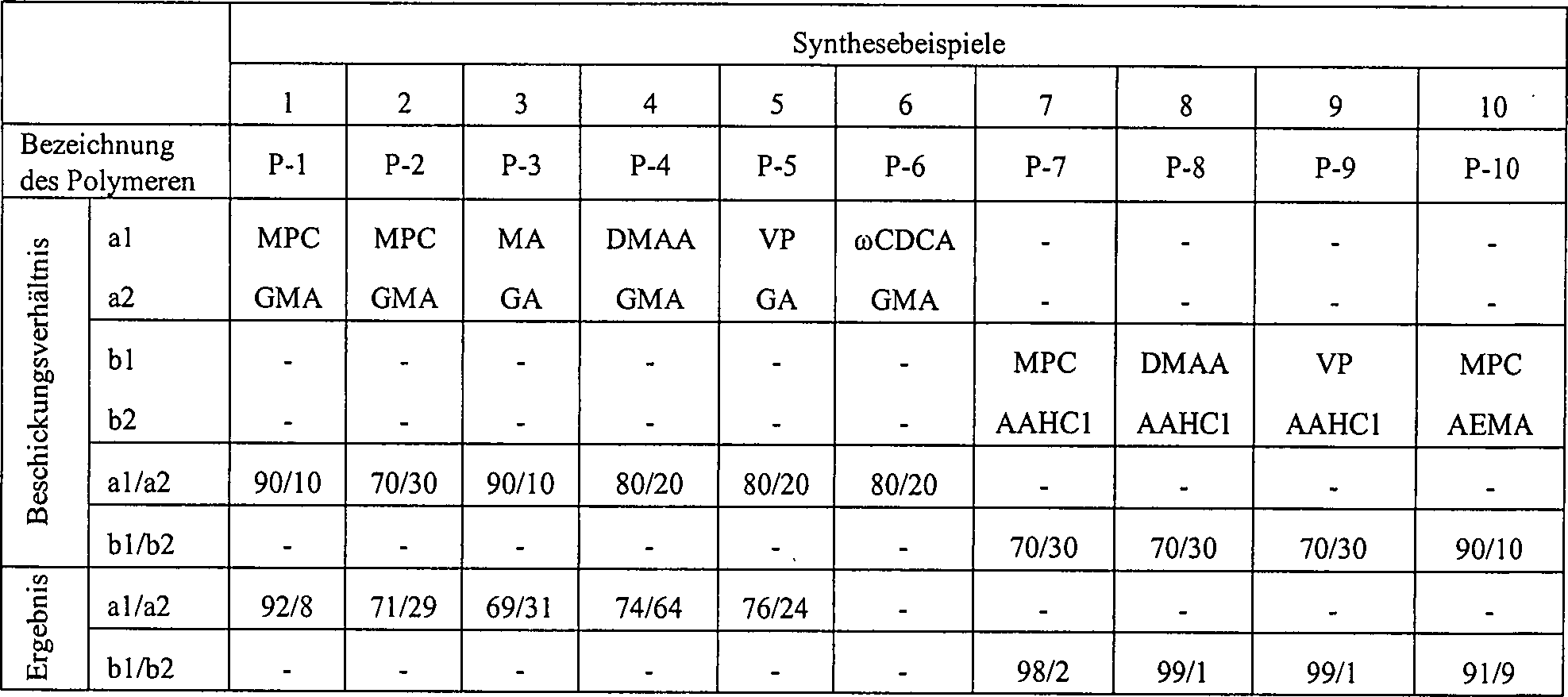
- a1/a2 und b1/b2 sind auf das Molverhältnis bezogen.
- a1 / a2 and b1 / b2 are related to the molar ratio.
Referenzbeispiele 1-1 bis 1-6Reference Examples 1-1 to 1-6
Ein Röhrchen (äußerer Durchmesser 1 mm, gesamte Länge 10 cm), hergestellt aus Nylon, wurde als Grundlage (M) verwendet. Dieses Röhrchen wurde in eine wässrige 3N Natriumhydroxidlösung, enthaltend 10 Vol.-% Isopropanol bei 80°C 30 Minuten lang eingetaucht, um eine Alkalibehandlung durchzuführen. Sodann wurde es genügend mit Wasser gewaschen, wodurch ein Röhrchen erhalten wurde, das Aminogruppen und Carboxylgruppen auf seiner Oberfläche hatte. Das Röhrchen wurde eine Minute lang in einer 5 Gew.-%ige Lösung der jeweiligen Copolymeren (P-1) bis (P-6), erhalten in den Synthesebeispielen 1 bis 6, eingetaucht und dann wieder herausgezogen. Dann wurde das Röhrchen 2 Stunden lang bei Raumtemperatur getrocknet. Danach wurden die so erhaltenen Röhrchen 3 bis 24 Stunden lang einer Hitzebehandlung bei 90°C unterworfen, um Röhrchen mit den jeweiligen, auf ihrer Oberfläche immobilisierten Copolymeren herzustellen. Nachfolgend wurden die Röhrchen in eine wässrige 0,2 M Natriumthiosulfatlösung eingetaucht und 24 Stunden lang bei Raumtemperatur stehengelassen. Hierauf wurden die Röhrchen herausgenommen und genügend mit Wasser gewaschen, um die Ringöffnung der zurückgebliebenen Epoxygruppen zu vervollständigen. Die Röhrchen mit dem darauf immobilisierten MA-GA-Copolymeren wurden weiterhin in Ethanol, enthaltend Schwefelsäure als Katalysator, eingetaucht, um das MA einer Ringöffnung zu unterwerfen, und dann einer Alkalireinigung unterworfen, wobei eine Salzlösung von Natriumhydrogencarbonat verwendet wurde. Auf diese Weise wurde ein medizinisches Material hergestellt.One tube (outer diameter 1 mm, entire length 10 cm) made of nylon was used as a base (M). This tube was in a watery 3N sodium hydroxide solution, containing 10% by volume of isopropanol at 80 ° C. for 30 minutes, to carry out an alkali treatment. Then it was enough with Washed water, creating a tube was obtained, the amino groups and carboxyl groups on his surface would have. The tube was in a 5 wt .-% solution of the respective copolymers for one minute (P-1) to (P-6) obtained in Synthesis Examples 1 to 6 are immersed and then pulled out again. Then, the tube became 2 hours at room temperature dried. Thereafter, the tubes thus obtained became for 3 to 24 hours a heat treatment at 90 ° C subjected to tubes with the respective copolymers immobilized on their surface manufacture. Subsequently, the tubes were poured into an aqueous 0.2 M sodium thiosulfate solution immersed and allowed to stand for 24 hours at room temperature. Then the tubes became taken out and enough washed with water to the ring opening of the lagged Complete epoxy groups. The tubes with the MA-GA copolymer immobilized thereon were continued in ethanol containing sulfuric acid as a catalyst, immersed to open the MA of a ring opening subject, and then subjected to alkali cleaning, wherein a saline solution of sodium bicarbonate was used. This way was a medical material made.
Das Röhrchen, das darauf immobilisiert das Produkt (P-6) des Synthesebeispiels 6 hatte, wurden weiterhin 1 Minute lang in eine wässrige 10 Gew.-%ige Natriumhydroxidlösung von Raumtemperatur eingetaucht, um eine Probe zu erhalten. Bei den medizinischen Materialien, d.h. den so erhaltenen Nylonröhrchen mit dem darauf immobilisierten Copolymeren, wurde eine Oberflächenanalyse durch ESCA, wie in den Beispielen 1-1 bis 1-6, durchgeführt. Als Er gebnis wurde bei allen Proben ein Signal beobachtet, das von dem Schwefelatom in dem Natriumthiosulfat herrührte.The Tube, which immobilized thereon the product (P-6) of the Synthesis Example 6, continued to be in a watery 10 for 1 minute Wt .-% sodium hydroxide solution immersed from room temperature to obtain a sample. Both medical materials, i. with the nylon tube thus obtained the copolymer immobilized thereon was surface analyzed by ESCA as in Examples 1-1 to 1-6. When As a result, a signal was observed from all samples that was obtained from the Sulfur atom in the sodium thiosulfate.
Bei der Oberflächenanalyse durch ATR-IR wurde das Verschwinden des Peaks der Epoxygruppe bei allen Proben bestätigt. Aus diesen Ergebnissen wird ersichtlich, dass sich die nicht-umgesetzten Epoxygruppen mit dem Natriumthiosulfat umgesetzt hatten und dass eine vollständige Ringöffnung erfolgt war.at the surface analysis by ATR-IR, the disappearance of the peak of the epoxy group at all Samples confirmed. From these results it becomes apparent that the unreacted Epoxy groups had reacted with the sodium thiosulfate and that a complete ring opening was done.
Bei den so erhaltenen medizinischen Materialien wurde die Stabilität der Gleitfähigkeit im Verlauf der Zeit gemäß der oben beschriebenen Methode bestimmt. Die Ergebnisse sind in Tabelle 2 zusammengestellt.at The medical materials thus obtained have the stability of lubricity over time according to the above determined method determined. The results are in Table 2 compiled.
Tabelle
2 
Vergleichsbeispiele 1-1 bis 1-6Comparative Examples 1-1 to 1-6
Röhrchen mit den darauf immobilisierten verschiedenen Copolymeren, die in den Synthesebeispielen 1 bis 6 erhalten worden waren, wurden gemäß dem in den Beispielen 1-1 bis 1-6 beschriebenen Verfahren mit der Ausnahme hergestellt, dass keine Ringöffnungsbehandlung der Epoxygruppen durch die wässrige 0,2 M Natriumthiosulfatlösung durchgeführt wurde. Bei den Nylonröhrchen mit den darauf immobilisierten Copolymeren, die so erhalten worden waren, wurde eine Oberflächenanalyse durch ATR-IR, wie in den Vergleichsbeispielen 1-1 bis 1-6, durchgeführt. Als Ergebnis wurde bei allen Proben ein von der Epoxygruppe herrührender Peak beobachtet.Tubes with immobilized thereon various copolymers which are incorporated in the Synthesis Examples 1 to 6 were obtained according to the method described in with the exception of Examples 1-1 to 1-6 made that no ring opening treatment of the epoxy groups by the aqueous 0.2 M sodium thiosulfate solution carried out has been. With the nylon tubes with the copolymers immobilized thereon, thus obtained were, was a surface analysis by ATR-IR as in Comparative Examples 1-1 to 1-6. When The result was a peak derived from the epoxy group in all samples observed.
Bei den so erhaltenen medizinischen Materialien wurde die Stabilität der Gleitfähigkeit im Verlauf der Zeit gemäß dem vorstehend beschriebenen Verfahren bestimmt. Die Ergebnisse sind in Tabelle 3 zusammengestellt.at The medical materials thus obtained have the stability of lubricity over time according to the above determined method described. The results are in table 3 compiled.
Tabelle
3 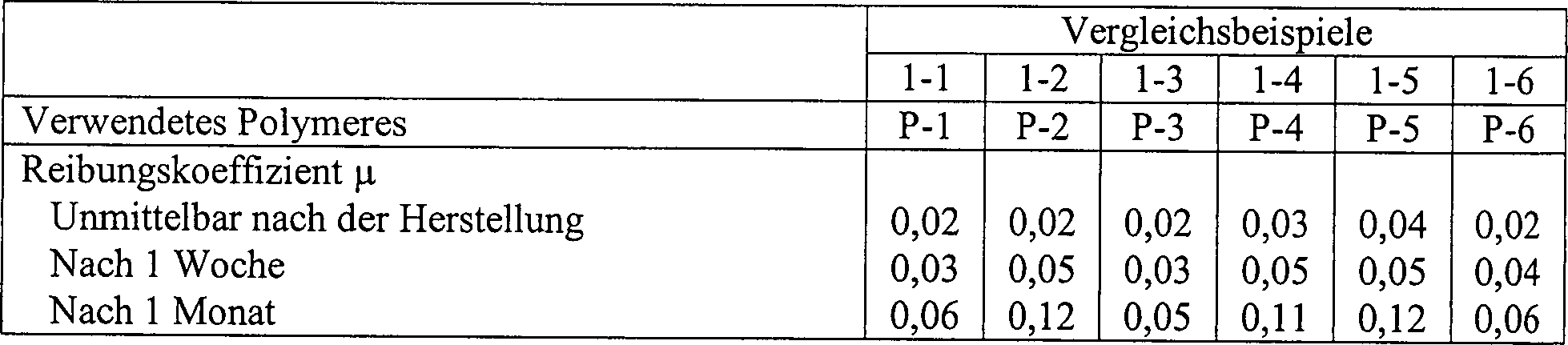
Referenzbeispiele 2-1 bis 2-6Reference Examples 2-1 until 2-6
Röhrchen (äußerer Durchmesser 1 mm, gesamte Länge 10 cm), hergestellt aus Polyurethan, wurde in eine 5 Gew.-%ige Lösung von Polyisocyanat (Warenbezeichnung: CORONATE L, hergestellt von der Firma Nippon Polyurethane Industry Co., Ltd.) in Tetra hydrofuran 1 Minute lang eingetaucht und dann herausgezogen und 2 Stunden lang bei 50°C getrocknet. Danach wurden die so erhaltenen Röhrchen in eine wässrige 10 Gew.-%ige Natriumhydroxidlösung eingetaucht und 30 Minuten lang bei Raumtemperatur zur Hydrolyse des Isocyanats stehengelassen, um eine Aminogruppe auf der Oberfläche der Grundlage zu bilden. Auf den Röhrchen wurden jeweils die verschiedenen Copolymeren, die in den Synthesebeispielen 1 bis 6 erhalten worden waren, gemäß dem in den Beispielen 1-1 bis 1-6 beschriebenen Verfahren immobilisiert. Bei den medizinischen Materialien aus den Copolymer-immobilisierten Polyurethanröhrchen, die so erhalten worden waren, wurde eine Oberflächenanalyse durch ESCA, wie in den Beispielen 2-1 bis 2-6, durchgeführt. Als Ergebnis wurde ein von dem Schwefelatom in Natriumthiosulfat herrührendes Signal bei allen Proben beobachtet. Weiterhin wurde bei der Oberflächenanalyse durch ATR-IR das Verschwinden der Peaks der Epoxygruppen bei allen Proben bestätigt. Aus diesen Ergebnissen ist ersichtlich, dass sich die nicht-umgesetzten Epoxygruppen mit dem Natriumthiosulfat umgesetzt hatten und dass eine vollständige Ringöffnung erfolgte.Tube (outer diameter 1 mm, entire length 10 cm), made of polyurethane, was poured into a 5% by weight solution of Polyisocyanate (trade name: CORONATE L, manufactured by Nippon Polyurethane Industry Co., Ltd.) in tetrahydrofuran Dipped for 1 minute and then pulled out and for 2 hours at 50 ° C dried. Thereafter, the thus obtained tubes were poured into an aqueous 10% by weight sodium hydroxide immersed and for 30 minutes at room temperature for hydrolysis of the isocyanate to leave an amino group on the surface of the Basis to form. On the tube were each the different copolymers that in the Synthesis Examples 1 to 6 according to that in Examples 1-1 immobilized to 1-6 methods. At the medical Materials from the copolymer immobilized polyurethane tubes, Thus, a surface analysis by ESCA, such as in Examples 2-1 to 2-6. As a result, a signal derived from the sulfur atom in sodium thiosulfate in all samples observed. Furthermore, in surface analysis by ATR-IR, the Disappearance of the peaks of the epoxy groups confirmed for all samples. Out From these results it can be seen that the unreacted epoxy groups with had reacted to the sodium thiosulfate and that a complete ring opening was made.
Bei den so erhaltenen medizinischen Materialien wurde die Stabilität der Gleitfähigkeit im Verlauf der Zeit gemäß der oben beschriebenen Methode bestimmt. Die Ergebnisse sind in Tabelle 4 zusammengestellt.at The medical materials thus obtained have the stability of lubricity over time according to the above determined method determined. The results are in Table 4 compiled.
Tabelle
4 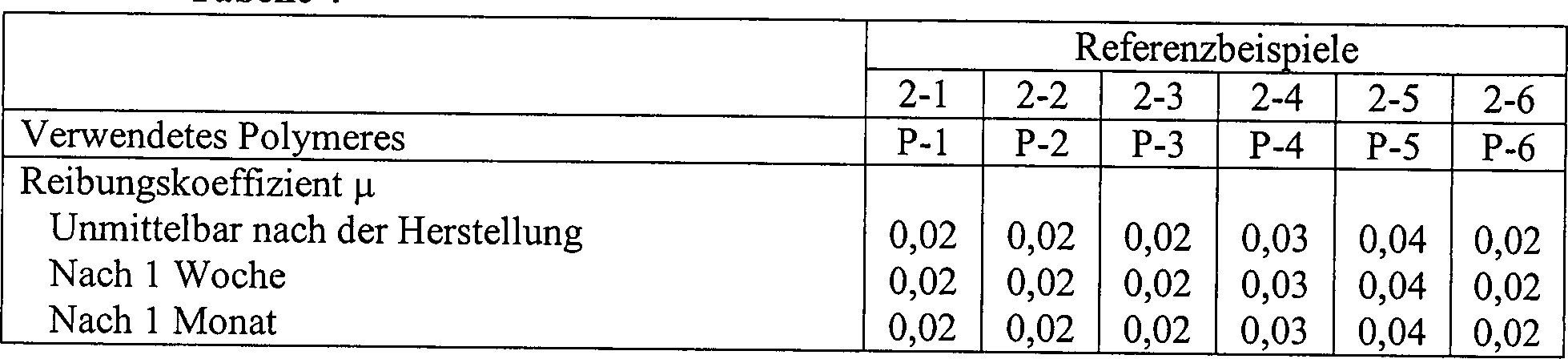
Vergleichsbeispiele 2-1 bis 2-6Comparative Examples 2-1 until 2-6
Röhrchen mit den darauf immobilisierten verschiedenen Copolymeren, die in den Synthesebeispielen 1 bis 6 erhalten worden waren, wurden gemäß dem in den Beispielen 2-1 bis 2-6 beschriebenen Verfahren mit der Ausnahme hergestellt, dass keine Ringöffnungsbehandlung der Epoxygruppen durch die wässrige 0,2 M-Natriumthiosulfatlösung durchgeführt wurde. Bei den so erhaltenen Polyurethanröhrchen mit dem immobilisierten Copolymeren wurde eine Oberflächenanalyse durch ATR-IR, wie in den Vergleichsbeispielen 2-1 bis 2-6, durchgeführt. Als Ergebnis wurde bei allen Proben ein Peak beobachtet, der von der Epoxygruppe herrührte.Tubes with immobilized thereon various copolymers which are incorporated in the Synthesis Examples 1 to 6 were obtained according to the method described in The methods described in Examples 2-1 to 2-6 except made that no ring opening treatment of the epoxy groups by the aqueous 0.2 M sodium thiosulfate solution carried out has been. In the polyurethane tubes thus obtained with the immobilized Copolymers became a surface analysis by ATR-IR as in Comparative Examples 2-1 to 2-6. When As a result, a peak was observed for all samples, which was obtained from the Epoxy group derived.
Bei den so erhaltenen medizinischen Materialien wurde die Stabilität der Gleitfähigkeit im Verlauf der Zeit gemäß der oben beschriebenen Methode bestimmt. Die Ergebnisse sind in Tabelle 5 zusammengestellt.at The medical materials thus obtained have the stability of lubricity over time according to the above determined method determined. The results are in Table 5 compiled.
Tabelle
5 
Referenzbeispiele 3-1 bis 3-6Reference Examples 3-1 to 3-6
Röhrchen mit den darauf immobilisierten verschiedenen Copolymeren, erhalten in den Synthesebeispielen 1 bis 6, wurden gemäß dem in den Beispielen 2-1 bis 2-6 beschriebenen Verfahren mit der Ausnahme hergestellt, dass ein Röhrchen (äußerer Durchmesser 1 mm, gesamte Länge 10 cm), hergestellt aus Polyvinylchlorid, als Grundlage (M) verwendet wurde. Bei den medizinischen Materialien, d.h. den so erhaltenen Polyvinylchloridröhrchen mit dem darauf immobilisierten Copolymeren, wurde eine Oberflächenanalyse durch ESCA, wie in den Beispielen 3-1 bis 3-6, durchgeführt. Als Ergebnis wurde bei allen Proben ein Signal beobachtet, das von dem Schwefelatom in Natriumthiosulfat herrührte. Weiterhin wurde bei der Oberflächenanalyse durch ATR-IR das Verschwinden des Epoxygruppenpeaks bei allen Proben bestätigt. Aus diesem Ergebnis wird ersichtlich, dass sich die nicht-umgesetzten Epoxygruppen mit Natriumthiosulfat umgesetzt hatten, und dass eine vollständige Ringöffnung erfolgt war.Tubes with immobilized thereon various copolymers obtained in Synthesis Examples 1 to 6 were used according to the in Examples 2-1 to 2-6 described procedures except that a tube (outer diameter 1 mm, entire length 10 cm) made of polyvinyl chloride used as a base (M) has been. With the medical materials, i. the so obtained Polyvinylchloridröhrchen with the copolymer immobilized thereon, a surface analysis was performed by ESCA as in Examples 3-1 to 3-6. When As a result, a signal was observed in all samples, which was detected by the Sulfur atom in sodium thiosulfate resulted. Furthermore, at the Surface analysis by ATR-IR confirmed the disappearance of the epoxy group peak in all samples. Out This result shows that the unreacted Had reacted with sodium thiosulfate, and that one full ring opening was done.
Bei den so erhaltenen medizinischen Materialien wurde die Stabilität der Gleitfähigkeit im Verlauf der Zeit gemäß der oben beschriebenen Methode bestimmt. Die Ergebnisse sind in Tabelle 6 zusammengestellt.at The medical materials thus obtained have the stability of lubricity over time according to the above determined method determined. The results are in Table 6 compiled.
Tabelle
6 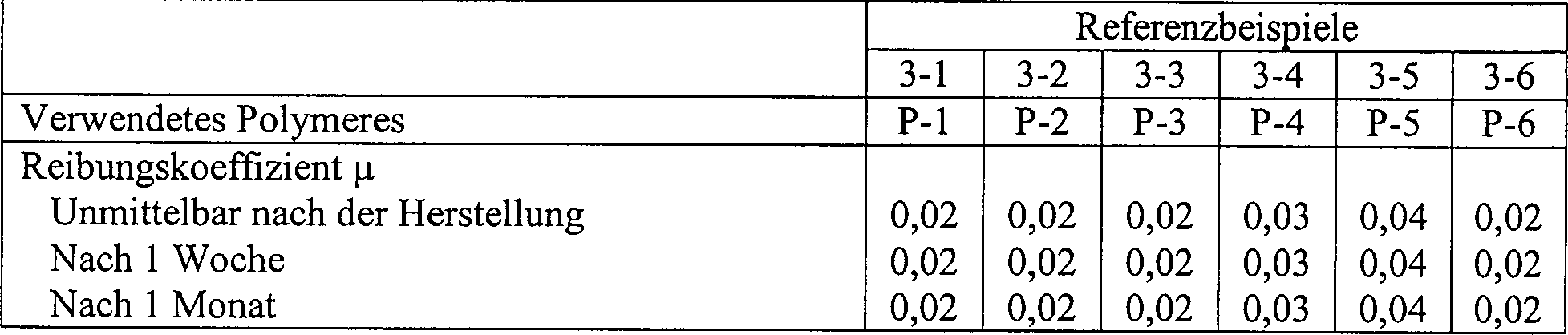
HVergleichsbeispiele 3-1 bis 3-6Comparative Examples 3-1 to 3-6
Röhrchen mit den darauf immobilisierten verschiedenen Copolymeren, erhalten in den Synthesebeispielen 1 bis 6, wurden gemäß dem in den Beispielen 3-1 bis 3-6 beschrieben Verfahren mit der Ausnahme hergestellt, dass keine Ringöffnungsbehandlung der Epoxygruppe durch die wässrige 0,2 M Natriumthiosulfatlösung durchgeführt wurde. Bei den so erhaltenen Polyvinylchloridröhrchen mit dem immobilisierten Copolymeren wurde eine Oberflächenanalyse durch ATR-IR, wie in den Vergleichsbeispielen 3-1 bis 3-6, durchgeführt. Als Ergebnis wurde bei allen Proben ein Peak beobachtet, der von der Epoxygruppe herrührte.Tubes with immobilized thereon various copolymers obtained in Synthesis Examples 1 to 6, according to the in Examples 3-1 to 3-6 described procedures except that no ring opening treatment the epoxy group through the aqueous 0.2 M sodium thiosulfate solution carried out has been. In the thus obtained polyvinyl chloride tubes with the immobilized Copolymers became a surface analysis by ATR-IR as in Comparative Examples 3-1 to 3-6. When As a result, a peak was observed for all samples, which was obtained from the Epoxy group derived.
Bei den so erhaltenen medizinischen Materialien wurde die Stabilität der Gleitfähigkeit im Verlauf der Zeit gemäß der oben beschriebenen Methode bestimmt. Die Ergebnisse sind in Tabelle 7 zusammengestellt.at The medical materials thus obtained have the stability of lubricity over time according to the above determined method determined. The results are in Table 7 compiled.
Tabelle
7 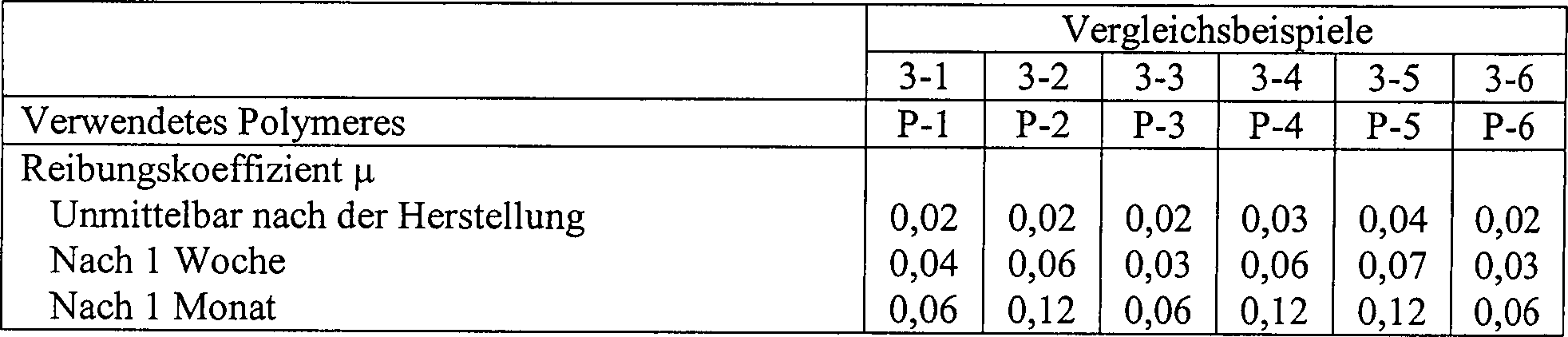
Referenzbeispiele 4-1 bis 4-6Reference Examples 4-1 until 4-6
Röhrchen (äußerer Durchmesser 1 mm, gesamte Länge 10 cm), hergestellt aus Polyethylen mit niedriger Dichte, wurden einer Corona-Behandlung (Strahlungsenergie: 1 J/cm2) unterworfen, um auf der Oberfläche der Grundlage Carboxylgruppen zu bilden. Auf den Röhrchen wurden die verschiedenen, in den Synthesebeispielen 1 bis 6 erhaltenen Copolymeren gemäß dem in den Beispielen 1-1 bis 1-6 beschriebenen Verfahren immobilisiert (mit der Ausnahme, dass Triethylamin zu der Copolymerlösung als Katalysator in einer Menge von 0,1 Gew.-% zugegeben wurde). Bei den medizinischen Materialien, d.h. den so erhaltenen Polyethylenröhrchen mit dem immobilisiert Copolymeren, wurde eine Oberflächenanalyse durch ESCA, wie in den Beispielen 4-1 bis 4-6, durchgeführt. Als Ergebnis wurde bei allen Proben ein Signal beobachtet, das von dem Schwefelatom in dem Natriumthiosulfat herrührte. Weiterhin wurde bei der Oberflächenanalyse durch ATR-IR das Verschwinden des Peaks der Epoxygruppe bei allen Proben bestätigt. Aus diesen Ergebnissen wird ersichtlich, dass sich die nicht-umgesetzten Epoxygruppen mit dem Natriumthiosulfat umgesetzt hatten und dass eine vollständige Ringöffnung erfolgt war.Tubes (outer diameter 1 mm, total length 10 cm) made of low-density polyethylene were subjected to corona treatment (radiant energy: 1 J / cm 2 ) to form carboxyl groups on the surface of the base. On the tubes, the various copolymers obtained in Synthetic Examples 1 to 6 were immobilized according to the method described in Examples 1-1 to 1-6 (except that triethylamine was added to the copolymer solution as a catalyst in an amount of 0.1 wt .-% was added). In the medical materials, ie, the thus obtained polyethylene tube with the copolymer immobilized, a surface analysis by ESCA was performed as in Examples 4-1 to 4-6. As a result, a signal derived from the sulfur atom in the sodium thiosulfate was observed in all samples. Further, in the surface analysis by ATR-IR, the disappearance of the peak of the epoxy group was confirmed in all samples. From these results, it can be seen that the unreacted epoxy groups reacted with the sodium thiosulfate and that complete ring opening had occurred.
Bei den so erhaltenen medizinischen Materialien wurde die Stabilität der Gleitfähigkeit im Verlauf der Zeit gemäß der oben beschriebenen Methode bestimmt. Die Ergebnisse sind in Tabelle 8 zusammengestellt.at The medical materials thus obtained have the stability of lubricity over time according to the above determined method determined. The results are in Table 8 compiled.
Tabelle
8 
Vergleichsbeispiele 4-1 bis 4-6Comparative Examples 4-1 until 4-6
Röhrchen mit den verschiedenen darauf. immobilisierten Copolymeren, erhalten in den Synthesebeispielen 1 bis 6, wurden gemäß dem in den Beispielen 4-1 bis 4-6 beschriebenen Verfahren mit der Ausnahme hergestellt, dass keine Ringöffnungsbehandlung der Epoxygruppe durch die wässrige 0,2 M Natriumthiosulfatlösung durchgeführt wurde. Bei den so erhaltenen Polyethylenröhrchen mit dem immobilisierten Copolymeren wurde eine Oberflächenanalyse durch ATR-IR, wie in den Vergleichsbeispielen 4-1 bis 4-6, durchgeführt. Als Ergebnis wurde bei allen Proben ein Peak beobachtet, der von der Epoxygruppe herrührte.Tubes with the different ones on it. immobilized copolymer in Synthesis Examples 1 to 6, according to that in Examples 4-1 to 4-6 described procedures except that no ring opening treatment the epoxy group through the aqueous 0.2 M sodium thiosulfate solution carried out has been. In the polyethylene tubes thus obtained with the immobilized Copolymers became a surface analysis by ATR-IR as in Comparative Examples 4-1 to 4-6. As a result For all samples, a peak was observed from the epoxy group stemmed.
Bei den so erhaltenen medizinischen Materialien wurde die Stabilität der Gleitfähigkeit im Verlauf der Zeit gemäß der oben beschriebenen Methode bestimmt. Die Ergebnisse sind in Tabelle 9 zusammengestellt.at The medical materials thus obtained have the stability of lubricity over time according to the above determined method determined. The results are in Table 9 compiled.
Tabelle
9 
Beispiele 5-1Examples 5-1
Ein Röhrchen (äußerer Durchmesser 1 mm, gesamte Länge 10 cm), hergestellt aus Nylon, das einer Alkalibehandlung gemäß dem Verfahren der Beispiele 1-1 bis 1-6 unterworfen worden war, wurde in eine Isopropanollösung, enthaltend 5 Gew.-% (P-2), hergestellt im Synthesebeispiel 2, 1 Minute lang eingetaucht, herausgezogen und 2 Stunden lang bei Raumtemperatur getrocknet. Danach wurde das so erhaltene Röhrchen 3 bis 24 Stunden lang einer Hitzebehandlung bei 90°C unterworfen, um ein Röhrchen mit darauf immobilisiertem (P-2) zu erhalten. Danach wurde das Röhrchen in eine Ethanollösung, enthaltend 2 Gew.-% (P-7), hergestellt im Synthesebeispiel 7, 1 Minute lang eingetaucht, dann herausgezogen und 2 Stunden lang bei Raumtemperatur getrocknet. Das Röhrchen wurde weiterhin 3 bis 24 Stunden lang einer Hitzebehandlung bei 90°C unterworfen. Das so erhaltene Röhrchen, das darauf immobilisiert sowohl (P-2) als auch (P-7) aufwies, wurde in eine wässrige 0,2 M Natriumthiosulfatlösung eingetaucht und 24 Stunden lang bei Raumtemperatur stehengelassen. Das Röhrchen wurde dann herausgenommen und genügend mit Wasser gewaschen, um die Ringöffnung der restlichen Epoxygruppen zu vervollständigen. Der auf der Oberfläche der Grundlage durch die oben beschriebenen Maßnahmen gebildete vernetzende immobilisierte Film wird als MPC-AAHCl/MPC-GMA-SO3Na bezeichnet.A tube (outer diameter 1 mm, total length 10 cm) made of nylon, which had been subjected to alkali treatment according to the method of Examples 1-1 to 1-6, was poured into an isopropanol solution containing 5% by weight (P -2) prepared in Synthetic Example 2 was immersed for 1 minute, withdrawn and dried at room temperature for 2 hours. Thereafter, the tube thus obtained was subjected to heat treatment at 90 ° C for 3 to 24 hours to obtain a tube having (P-2) immobilized thereon. Thereafter, the tube was dipped in an ethanol solution containing 2% by weight (P-7) prepared in Synthesis Example 7 for 1 minute, then withdrawn and dried at room temperature for 2 hours. The tube was further subjected to heat treatment at 90 ° C for 3 to 24 hours. The thus-obtained tube having both (P-2) and (P-7) immobilized thereon was immersed in an aqueous 0.2 M sodium thiosulfate solution and allowed to stand at room temperature for 24 hours. The tube was then taken out and washed sufficiently with water to complete the ring opening of the residual epoxy groups. The crosslinking immobilized film formed on the surface of the base by the above-described measures is referred to as MPC-AAHCl / MPC-GMA-SO 3 Na.
Das hergestellte MPC-AAHCl/MPC-GMA-SO3Na-immobilisierte Nylonröhrchen wurde einer Oberflächenanalyse durch ESCA unterworfen. Als Ergebnis wurde ein Signal beobachtet, das von dem Schwefelatom in Natriumthiosulfat herrührte. Weiterhin wurde bei der Oberflächenanalyse durch ATR-IR das Verschwinden des Peaks der Epoxygruppe bestätigt. Aus diesem Ergebnis wird ersichtlich, dass sich die nicht-umgesetzten Epoxygruppen mit dem Natriumthiosulfat umgesetzt hatten und dass eine vollständige Ringöffnung erfolgt war.The prepared MPC-AAHCl / MPC-GMA-SO 3 Na-immobilized nylon tube was subjected to surface analysis by ESCA. As a result, a signal resulting from the sulfur atom in sodium thiosulfate was observed. Furthermore, in the surface analysis by ATR-IR, the disappearance of the peak of the epoxy group was confirmed. From this result, it can be seen that the unreacted epoxy groups had reacted with the sodium thiosulfate and that complete ring opening had occurred.
Bei dem so erhaltenen medizinischen Material wurden Untersuchungen gemäß dem vorstehend beschriebenen Verfahren zur Bestimmung der Stabilität der Gleitfähigkeit im Verlauf der Zeit, der Methode zur Bestimmung der Dauerhaftigkeit der Gleitfähigkeit und der Bestimmung der Verträglichkeit gegenüber Blut durchgeführt. Die Ergebnisse sind in Tabelle 10 zusammengestellt.In the thus-obtained medical material, studies according to the above-described method for determining the stability of slidability with time, the method of Determination of the durability of lubricity and the determination of blood compatibility. The results are summarized in Table 10.
Beispiel 5-2Example 5-2
Ein DMAA-AAHCl/MPC-GMA-SO3Na-immobilisiertes Nylonröhrchen wurde gemäß dem in Beispiel 5-1 beschriebenen Verfahren mit der Ausnahme hergestellt, dass die Tetrahydrofuranlösung, enthaltend 2 Gew.-% (P-8), hergestellt in Synthesebeispiel 8, anstelle der Ethanollösung, enthaltend 2 Gew.-% (P-7), verwendet wurde. Bei dem Röhrchen wurde eine Oberflächenanalyse durch ESCA durchgeführt. Als Ergebnis wurde ein Signal beobachtet, das von dem Schwefelatom in Natriumthiosulfat herrührte. Weiterhin wurde bei der Oberflächenanalyse durch ATR-IR das Verschwinden des Peaks der Epoxygruppe bestätigt. Aus diesem Ergebnis wird ersichtlich, dass sich die nicht-umgesetzten Epoxygruppen mit dem Natriumthiosulfatumgesetzt hatten und dass eine vollständige Ringöffnung erfolgt war.A DMAA-AAHCl / MPC-GMA-SO 3 Na-immobilized nylon tube was prepared according to the procedure described in Example 5-1 except that the tetrahydrofuran solution containing 2% by weight of (P-8) prepared in Synthetic Example 8 was used in place of the ethanol solution containing 2% by weight (P-7). The tube was surface analyzed by ESCA. As a result, a signal resulting from the sulfur atom in sodium thiosulfate was observed. Furthermore, in the surface analysis by ATR-IR, the disappearance of the peak of the epoxy group was confirmed. From this result, it can be seen that the unreacted epoxy groups had reacted with the sodium thiosulfate ion and that complete ring opening had occurred.
Bei dem so erhaltenen medizinischen Material wurden Untersuchungen gemäß dem vorstehend beschriebenen Verfahren zur Bestimmung der Stabilität der Gleitfähigkeit im Verlauf der Zeit, der Methode zur Bestimmung der Dauerhaftigkeit der Gleitfähigkeit und der Bestimmung der Verträglichkeit gegenüber Blut durchgeführt. Die Ergebnisse sind in Tabelle 10 zusammengestellt.at The medical material thus obtained was examined according to the above described method for determining the stability of the lubricity over time, the method for determining the durability the lubricity and the determination of compatibility across from Blood done. The results are summarized in Table 10.
Beispiel 5-3Example 5-3
Ein VP-AAHCl/MPC-GMA-SO3Na-immobilisiertes Nylonröhrchen wurde gemäß dem in Beispiel 5-1 beschriebenen Verfahren mit der Ausnahme hergestellt, dass die Dichlormethanlösung, enthaltend 2 Gew.-% (P-9), hergestellt in Synthesebeispiel 9, anstelle der Ethanollösung, enthaltend 2 Gew.-% (P-7), verwendet wurde. Bei dem Röhrchen wurde eine Oberflächenanalyse durch ESCA durchgeführt. Als Ergebnis wurde ein Signal beobachtet, das von dem Schwefelatom in Natriumthiosulfat herrührte. Weiterhin wurde bei der Oberflächenanalyse durch ATR-IR das Verschwinden des Peaks der Epoxygruppe bestätigt. Aus diesem Ergebnis wird ersichtlich, dass sich die nicht-umgesetzten Epoxygruppen mit dem Natriumthiosulfat umgesetzt hatten und dass eine vollständige Ringöffnung erfolgt war.A VP-AAHCl / MPC-GMA-SO 3 Na-immobilized nylon tube was prepared according to the procedure described in Example 5-1 except that the dichloromethane solution containing 2% by weight (P-9) prepared in Synthetic Example 9 was used in place of the ethanol solution containing 2% by weight (P-7). The tube was surface analyzed by ESCA. As a result, a signal resulting from the sulfur atom in sodium thiosulfate was observed. Furthermore, in the surface analysis by ATR-IR, the disappearance of the peak of the epoxy group was confirmed. From this result, it can be seen that the unreacted epoxy groups had reacted with the sodium thiosulfate and that complete ring opening had occurred.
Bei dem so erhaltenen medizinischen Material wurden Untersuchungen gemäß dem vorstehend beschriebenen Verfahren zur Bestimmung der Stabilität der Gleitfähigkeit im Verlauf der Zeit, der Methode zur Bestimmung der Dauerhaftigkeit der Gleitfähigkeit und der Bestimmung der Verträglichkeit gegenüber Blut durchgeführt. Die Ergebnisse sind in Tabelle 10 zusammengestellt.at The medical material thus obtained was examined according to the above described method for determining the stability of the lubricity over time, the method for determining the durability the lubricity and the determination of compatibility across from Blood done. The results are summarized in Table 10.
Referenzbeispiel 6-1Reference Example 6-1
Eine Isopropanollösung, enthaltend 5 Gew.-% (P-2), hergestellt in Synthesebeispiel 2, und eine Ethanollösung, enthaltend 2 Gew.-% (P-7), hergestellt in Synthesebeispiel 7, wurden miteinander im Gewichtsverhältnis von 1:1 vermischt. In die so erhaltene Mischpolymerlösung wurde ein Röhrchen (äußerer Durchmesser 1 mm, gesamte Länge 10 cm), hergestellt aus Nylon, das einer Alkalibehandlung gemäß dem Verfahren der Beispiele 1-1 bis 1-6 unterworfen worden war, 1 Minute lang eingetaucht, dann herausgezogen und 2 Stunden lang bei Raumtemperatur getrocknet. Danach wurde das so erhaltene Röhrchen 3 bis 24 Stunden lang einer Hitzebehandlung bei 90°C unterworfen. Das so erhaltene Röhrchen, auf dem sowohl (P-2) als auch (P-7) immobilisiert waren, wurde in eine wässrige 0,2 M Natriumthiosulfatlösung eingetaucht und bei Raumtemperatur 24 Stunden stehengelassen. Dann wurde das Röhrchen herausgenommen und genügend mit Wasser gewaschen, um die Ringöffnung der restlichen Epoxygruppen zu vervollständigen. Der auf der Oberfläche der Grundlage durch die vorstehenden Maßnahmen gebildete vernetzende immobilisierte Film wird als MPC-AAHCl + MPC-GMA-SO3Na bezeichnet.An isopropanol solution containing 5% by weight of (P-2) prepared in Synthesis Example 2 and an ethanol solution containing 2% by weight of (P-7) prepared in Synthetic Example 7 were mixed together in a weight ratio of 1: 1 , Into the mixed polymer solution thus obtained was immersed a tube (outer diameter 1 mm, total length 10 cm) made of nylon, which had been subjected to alkali treatment according to the method of Examples 1-1 to 1-6, for 1 minute, then pulled out and dried for 2 hours at room temperature. Thereafter, the tube thus obtained was subjected to heat treatment at 90 ° C for 3 to 24 hours. The thus obtained tube, on which both (P-2) and (P-7) were immobilized, was immersed in a 0.2 M sodium thiosulfate aqueous solution and allowed to stand at room temperature for 24 hours. Then the tube was taken out and washed sufficiently with water to complete the ring opening of the residual epoxy groups. The crosslinking immobilized film formed on the surface of the base by the above measures is referred to as MPC-AAHCl + MPC-GMA-SO 3 Na.
Bei dem so hergestellten MPC-AAHCl + MPC-GMA-SO3Na-immobilisierten Nylonröhrchen wurde eine Oberflächenanalyse durch ESCA durchgeführt. Als Ergebnis wurde ein Signal beobachtet, das von dem Schwefelatom in Natriumthiosulfat herrührte. Weiterhin wurde bei der Oberflächenanalyse durch ATR-IR das Verschwinden des Peaks der Epoxygruppe bestätigt. Aus diesem Ergebnis wird ersichtlich, dass sich die nicht-umgesetzten Epoxygruppen mit dem Natriumthiosulfatumgesetzt hatten und dass eine vollständige Ringöffnung erfolgt war.The MPC-AAHCl + MPC-GMA-SO 3 Na-immobilized nylon tube thus prepared was subjected to surface analysis by ESCA. As a result, a signal resulting from the sulfur atom in sodium thiosulfate was observed. Furthermore, in the surface analysis by ATR-IR, the disappearance of the peak of the epoxy group was confirmed. From this result, it can be seen that the unreacted epoxy groups had reacted with the sodium thiosulfate ion and that complete ring opening had occurred.
Bei dem so erhaltenen medizinischen Material wurden Untersuchungen gemäß dem vorstehend beschriebenen Verfahren zur Bestimmung der Stabilität der Gleitfähigkeit im Verlauf der Zeit, der Methode zur Bestimmung der Dauerhaftigkeit der Gleitfähigkeit und der Bestimmung der Verträglichkeit gegenüber Blut durchgeführt. Die Ergebnisse sind in Tabelle 10 zusammengestellt.The medical material thus obtained was examined according to the above-described method for determining the stability of lubricity with time, the method for determining the durability of lubricity, and the determination of compatibility with blood carried out. The results are summarized in Table 10.
Referenzbeispiel 6-2Reference Example 6-2
Ein DMAA-AAHCl + MPC-GMA-SO3Na-immobilisiertes Nylonröhrchen wurde gemäß dem in Beispiel 6-1 beschriebenen Verfahren mit der Ausnahme hergestellt, dass die Tetrahydrofuranlösung, enthaltend 2 Gew.-% (P-8), hergestellt in Synthesebeispiel 8, anstelle der Ethanollösung, enthaltend 2 Gew.-% (P-7), verwendet wurde. Bei dem Röhrchen wurde eine Oberflächenanalyse durch ESCA durchgeführt. Als Ergebnis wurde ein Signal beobachtet, das von dem Schwefelatom in Natriumthiosulfat herrührte. Weiterhin wurde bei der Oberflächenanalyse durch ATR-IR das Verschwinden des Peaks der Epoxygruppe bestätigt. Aus diesem Ergebnis wird ersichtlich, dass sich die nicht-umgesetzten Epoxygruppen mit dem Natriumthiosulfat umgesetzt hatten und dass eine vollständige Ringöffnung erfolgt war.A DMAA-AAHCl + MPC-GMA-SO 3 Na-immobilized nylon tube was prepared according to the procedure described in Example 6-1 except that the tetrahydrofuran solution containing 2% by weight of (P-8) prepared in Synthetic Example 8 was used in place of the ethanol solution containing 2% by weight (P-7). The tube was surface analyzed by ESCA. As a result, a signal resulting from the sulfur atom in sodium thiosulfate was observed. Furthermore, in the surface analysis by ATR-IR, the disappearance of the peak of the epoxy group was confirmed. From this result, it can be seen that the unreacted epoxy groups had reacted with the sodium thiosulfate and that complete ring opening had occurred.
Bei dem so erhaltenen medizinischen Material wurden Untersuchungen gemäß dem vorstehend beschriebenen Verfahren zur Bestimmung der Stabilität der Gleitfähigkeit im Verlauf der Zeit, der Methode zur Bestimmung der Dauerhaftigkeit der Gleitfähigkeit und der Bestim mung der Verträglichkeit gegenüber Blut durchgeführt. Die Ergebnisse sind in Tabelle 10 zusammengestellt.at The medical material thus obtained was examined according to the above described method for determining the stability of the lubricity over time, the method for determining the durability the lubricity and the determination of compatibility across from Blood done. The results are summarized in Table 10.
Referenzbeispiel 6-3Reference Example 6-3
Ein VP-AAHCl + MPC-GMA-SO3Na-inmobilisiertes Nylonröhrchen wurde gemäß dem in Beispiel 6-1 beschriebenen Verfahren mit der Ausnahme hergestellt, dass die Dichlormethanlösung, enthaltend 2 Gew.-% (P-9), hergestellt in Synthesebeispiel 9, anstelle der Ethanollösung, enthaltend 2 Gew.-% (P-7), verwendet wurde. Bei dem Röhrchen wurde eine Oberflächenanalyse durch ESCA durchgeführt. Als Ergebnis wurde ein Signal beobachtet, das von dem Schwefelatom in Natriumthiosulfat herrührte. Weiterhin wurde bei der Oberflächenanalyse durch ATR-IR das Verschwinden des Peaks der Epoxygruppe bestätigt. Aus diesem Ergebnis wird ersichtlich, dass sich die nicht-umgesetzten Epoxygruppen mit dem Natriumthiosulfat umgesetzt hatten und dass eine vollständige Ringöffnung erfolgt war.A VP-AAHCl + MPC-GMA-SO 3 Na-immobilized nylon tube was prepared according to the procedure described in Example 6-1 except that the dichloromethane solution containing 2% by weight (P-9) prepared in Synthetic Example 9 was used in place of the ethanol solution containing 2% by weight (P-7). The tube was surface analyzed by ESCA. As a result, a signal resulting from the sulfur atom in sodium thiosulfate was observed. Furthermore, in the surface analysis by ATR-IR, the disappearance of the peak of the epoxy group was confirmed. From this result, it can be seen that the unreacted epoxy groups had reacted with the sodium thiosulfate and that complete ring opening had occurred.
Bei dem so erhaltenen medizinischen Material wurden Untersuchungen gemäß dem vorstehend beschriebenen Verfahren zur Bestimmung der Stabilität der Gleitfähigkeit im Verlauf der Zeit, der Methode zur Bestimmung der Dauerhaftigkeit der Gleitfähigkeit und der Bestimmung der Verträglichkeit gegenüber Blut durchgeführt. Die Ergebnisse sind in Tabelle 10 zusammengestellt.at The medical material thus obtained was examined according to the above described method for determining the stability of the lubricity over time, the method for determining the durability the lubricity and the determination of compatibility across from Blood done. The results are summarized in Table 10.
Vergleichsbeispiel 5Comparative example 5
Ein Röhrchen (äußerer Durchmesser 1 mm, gesamte Länge 10 cm), hergestellt aus Nylon, das einer Alkalibehandlung gemäß dem Verfahren der Beispiele 1-1 bis 1-6 unterworfen worden war, wurde in die Ethanollösung, enthaltend 2 Gew.-% (P-7), hergestellt in Synthesebeispiel 7, 1 Minute lang eingetaucht, dann daraus herausgezogen und 2 Stunden bei Raumtemperatur getrocknet. Danach wurde das so erhaltene Röhrchen 3 bis 24 Stunden einer Hitzebehandlung bei 90°C unterworfen, wodurch ein Nylonröhrchen hergestellt wurde, das mit dem Copolymeren beschichtet war.One tube (outer diameter 1 mm, entire length 10 cm) made of nylon that undergoes alkali treatment according to the method Examples 1-1 to 1-6 were added to the ethanol solution containing 2 wt% (P-7) prepared in Synthesis Example 7 for 1 minute dipped, then pulled out and 2 hours at room temperature dried. Thereafter, the tube thus obtained became 3 to 24 hours Heat treatment at 90 ° C subjected to a nylon tube which was coated with the copolymer.
Bei dem so erhaltenen medizinischen Materialien wurden Untersuchungen gemäß der vorstehend beschriebenen Methode zur Bestimmung der Dauerhaftigkeit der Gleitfähigkeit und der Bestimmung der Verträglichkeit gegenüber Blut durchgeführt. Die Ergebnisse sind in Tabelle 10 zusammengestellt.at the medical materials thus obtained were examined according to the above described method for determining the durability of the lubricity and the determination of compatibility across from Blood done. The results are summarized in Table 10.
Vergleichsbeispiel 6Comparative Example 6
Ein Röhrchen (äußerer Durchmesser 1 mm, gesamte Länge 10 cm), hergestellt aus Polyurethan, wurde in eine Tetrahydrofuranlösung, enthaltend 5 Gew.-% Polyisocyanat (Warenbezeichnung: CORONATE L, hergestellt von der Firma Nippon Polyurethane Industry Co., Ltd.), 1 Minute lang eingetaucht, dann daraus herausgezogen und 2 Stunden lang bei 50°C getrocknet. Danach wurde das so erhaltene Röhrchen in eine Chloroformlösung, enthaltend 4 Gew.-% Polyvinylpyrrolidon, 1 Minute lang eingetaucht, dann herausgezogen und 2 Stunden lang bei Raumtemperatur getrocknet. Danach wurde das Röhrchen 5 Stunden lang einer Hitzebehandlung bei 80°C unterworfen, wodurch ein Polyurethanröhrchen hergestellt wurde, an das Polyvinylpyrrolidon gebunden war.One tube (outer diameter 1 mm, entire length 10 cm) made of polyurethane was poured into a tetrahydrofuran solution containing 5 wt .-% polyisocyanate (trade name: CORONATE L, prepared from Nippon Polyurethane Industry Co., Ltd.), 1 minute dipped for a long time, then pulled out of it and for 2 hours at Dried 50 ° C. Thereafter, the tube thus obtained was in a chloroform solution, containing 4% by weight of polyvinylpyrrolidone immersed for 1 minute, then pulled out and dried for 2 hours at room temperature. After that, the tube became Subjected to a heat treatment at 80 ° C for 5 hours, thereby producing a polyurethane tube was bound to the polyvinylpyrrolidone.
Bei dem so erhaltenen medizinischen Material wurden Untersuchungen gemäß der vorstehend beschriebenen Methode zur Bestimmung der Dauerhaftigkeit der Gleitfähigkeit und der Bestimmung der Verträglichkeit gegenüber Blut durchgeführt. Die Ergebnisse sind in Tabelle 10 zusammengestellt.In the medical material thus obtained, tests were conducted according to the method described above for determining the durability of lubricity and the determination of the contract carried out on blood. The results are summarized in Table 10.
Vergleichsbeispiel 7Comparative Example 7
Ein Polyimidröhrchen mit darauf aufgepfropfter Acrylsäure wurde mit dem Produkt (P-10), hergestellt in Synthesebeispiel 10, umsetzen gelassen, wobei 1-Ethyl-3-(3-dimethylaminopropyl)carbodiimid als Kondensationsmittel eingesetzt wurde. Danach wurde ein Polyimidröhrchen mit dem darauf immobilisierten MPC-AEMA-Copolymeren, beschrieben in der offengelegten PCT-Publikation der japanischen nationalen Phase Nr. JP-A-7-502053 (WO93/01221), hergestellt.One polyimide tube with grafted acrylic acid was with the product (P-10), prepared in Synthesis Example 10, allowing 1-ethyl-3- (3-dimethylaminopropyl) carbodiimide was used as a condensing agent. Thereafter, a polyimide tube was with the MPC-AEMA copolymer immobilized thereon, described in US Patent Nos. 4,135,746; the published PCT publication of the Japanese national phase No. JP-A-7-502053 (WO93 / 01221).
Bei dem so erhaltenen medizinischen Material wurden Untersuchungen gemäß dem vorstehend beschriebenen Verfahren zur Bestimmung der Dauerhaftigkeit der Gleitfähigkeit und der Bestimmung der Verträglichkeit gegenüber Blut durchgeführt. Die Ergebnisse sind in Tabelle 10 zusammengestellt.at The medical material thus obtained was examined according to the above described method for determining the durability of the lubricity and the determination of compatibility across from Blood done. The results are summarized in Table 10.
Vergleichsbeispiel 8Comparative Example 8
Ein hydrophiler Führungsdraht (äußerer Durchmesser 0,89 mm, hergestellt von der Firma Terumo Corp.) wurde erhalten. Der Führungsdraht wurde in der Weise hergestellt, dass ein Kerndraht aus einer Nickel-Titan-Legierung mit Polyurethan beschichtet wurde, und dass weiterhin der Draht mit einer polymeren Maleinsäureanhydridsubstanz beschichtet wurde.One hydrophilic guidewire (outer diameter 0.89 mm, manufactured by Terumo Corp.) was obtained. The guidewire was made in such a way that a core wire made of a nickel-titanium alloy was coated with polyurethane, and that continues the wire with a polymeric maleic anhydride substance was coated.
Bei dem Führungsdraht wurden Untersuchungen gemäß dem vorstehend beschriebenen Verfahren zur Bestimmung der Dauerhaftigkeit der Gleitfähigkeit und der Bestimmung der Verträglichkeit gegenüber Blut durchgeführt. Die Ergebnisse sind in Tabelle 10 zusammengestellt.at the guidewire were examined according to the above described method for determining the durability of the lubricity and the determination of compatibility across from Blood done. The results are summarized in Table 10.
Tabelle
10 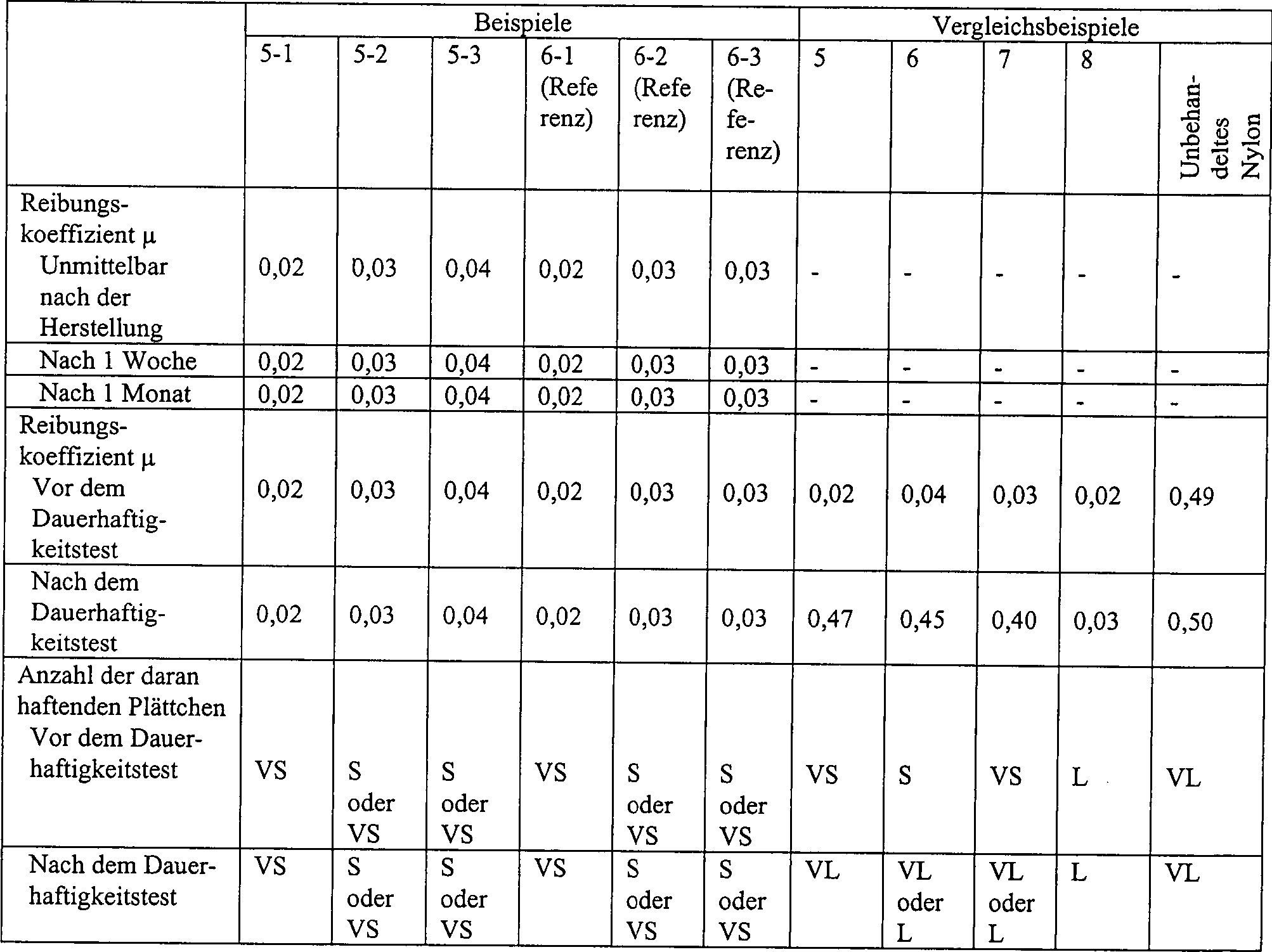
Aus den Ergebnissen der Tabellen 2, 4, 6, 8 und 10 wird ersichtlich, dass die erfindungsgemäßen Röhrchen mit den darauf immobilisierten Copolymeren, die einer Ringöffnungsbehandlung der restlichen Epoxygruppen mit Natriumthiosulfat unterworfen worden waren, keine Veränderung des Reibungskoeffizienten μim Verlauf der Zeit zeigten. D.h. sie zeigten eine ausgezeichnete Stabilität im Verlauf der Zeit. Andererseits resultierte bei den Röhrchen, erhalten in den Vergleichsbeispielen 1-1 bis 1-6, den Vergleichsbeispielen 2-1 bis 2-6, den Vergleichsbeispielen 3-1 bis 3-6 und den Vergleichsbeispielen 4-1 bis 4-6, die keiner Ringöffnungsbehandlung der restlichen Epoxygruppen mit Natriumthiosulfat unterworfen worden waren, eine Erhöhung des Reibungskoeffizienten μ im Verlauf der Zeit und einen Verlust der anfänglichen Gleitfähigkeit.From the results of Tables 2, 4, 6, 8 and 10 it can be seen that the tubes according to the invention with the copolymers immobilized thereon, which were subjected to a ring-opening treatment of the remaining Ep Oxy groups were subjected to sodium thiosulfate showed no change in the coefficient of friction μim with the passage of time. That is, they showed excellent stability over time. On the other hand, in the tubes obtained in Comparative Examples 1-1 to 1-6, Comparative Examples 2-1 to 2-6, Comparative Examples 3-1 to 3-6 and Comparative Examples 4-1 to 4-6, none resulted Ring opening treatment of the residual epoxy groups were subjected to sodium thiosulfate, an increase in the coefficient of friction μ over time and a loss of initial lubricity.
Wie weiterhin aus den Ergebnissen der Tabelle 10 ersichtlich ist, zeigten die erfindungsgemäßen Röhrchen eine gute Oberflächengleitfähigkeit, die sogar nach dem Dauerhaftigkeitstest beibehalten wurde. Unter diesen zeigte das MPC-AAHCl/MPC-GMA-SO3Na-immobilisierte Nylonröhrchen, das in Beispiel 5-1 erhalten worden war, eine besonders gute Gleitfähigkeit. Obgleich die Nylonröhrchen, hergestellt in den Vergleichsbeispielen 5 bis 7, und der Führungsdraht des Vergleichsbeispiels 8 einen kleinen Wert des Reibungswiderstands vor dem Dauerhaf tigkeitstest zeigten, zeigten diese Materialien doch einen erhöhten Wert des Reibungswiderstands nach dem Dauerhaftigkeitstest.Further, as can be seen from the results of Table 10, the tubes of the present invention showed a good surface lubricity, which was maintained even after the durability test. Among them, the MPC-AAHCl / MPC-GMA-SO 3 Na-immobilized nylon tube obtained in Example 5-1 showed particularly good slidability. Although the nylon tubes prepared in Comparative Examples 5 to 7 and the guide wire of Comparative Example 8 showed a small value of the frictional resistance before the durability test, these materials showed an increased value of frictional resistance after the durability test.
In den vorstehenden Ausführungen wurde gezeigt, dass das erfindungsgemäße medizinische Material eine ausgezeichnete Oberflächengleitfähigkeit sowie eine Dauerhaftigkeit dieser Eigenschaften zeigt. Weiterhin ist bei beliebigen der Röhrchen der erfindungsgemäßen Beispiele die Anzahl der darauf haftenden Plättchen kleiner im Vergleich zu den unbehandelten Proben. Weiterhin wurde die Tendenz davon selbst nach dem Dauerhaftigkeitstest beibehalten. Unter diesen zeigte das in Beispiel 5-1 erhaltene MPC-AAHCl/MPC-GMA-SO3Na-immobilisierte Nylonröhrchen keine Adhäsion mit Plättchen und es zeigte eine ausgezeichnete Verträglichkeit gegenüber Blut. Obgleich die Röhrchen der Vergleichsbeispiele 5 bis 7 fast keine Anhaftung der Plättchen vor dem Dauerhaftigkeitstest zeigten, zeigten sie jedoch eine Anhaftung einer großen Anzahl von Plättchen nach dem Dauerhaftigkeitstest. Was den Führungsdraht des Vergleichsbeispiels 8 betrifft, so ist es so, dass, obgleich die Anzahl der daran haftenden Plättchen kleiner als im Falle der unbehandelten Probe war, doch eine Anhaftung von Plättchen sogar vor dem Dauerhaftigkeitstest beobachtet wurde. Die daran haftenden Plättchen wurden durch Aktivieren deformiert und sie dehnten ihre Pseudopodie aus.In the foregoing, it has been shown that the medical material of the present invention exhibits excellent surface lubricity as well as durability of these properties. Furthermore, in any of the tubes of the inventive examples, the number of platelets adhered thereto is smaller compared to the untreated samples. Furthermore, the tendency thereof was maintained even after the durability test. Among them, the MPC-AAHCl / MPC-GMA-SO 3 Na-immobilized nylon tube obtained in Example 5-1 showed no adhesion to platelets and showed excellent compatibility with blood. However, although the tubes of Comparative Examples 5 to 7 showed almost no adhesion of the platelets before the durability test, they showed adhesion of a large number of platelets after the durability test. As for the guidewire of Comparative Example 8, although the number of platelets adhered thereto was smaller than that of the untreated sample, platelet adhesion was observed even before the durability test. The adhered platelets were deformed by activation and they expanded their pseudopod.
Aus dem Vorstehenden wird ersichtlich, dass das erfindungsgemäße medizinische Material eine ausgezeichnete Verträglichkeit gegenüber Blut hat und dass es seine Funktionen stabil, selbst nach dem Dauerhaftigkeitstest, beibehält.Out From the foregoing it will be seen that the medical Material an excellent compatibility with blood has and that it keeps its functions stable, even after the durability test, maintains.
Claims (9)


Applications Claiming Priority (5)
| Application Number | Priority Date | Filing Date | Title |
|---|---|---|---|
| JP21419199 | 1999-07-28 | ||
| JP21419199 | 1999-07-28 | ||
| JP22958899 | 1999-08-16 | ||
| JP22958899 | 1999-08-16 | ||
| PCT/JP2000/004921 WO2001007097A1 (en) | 1999-07-28 | 2000-07-24 | Medical materials and process for producing the same |
Publications (2)
| Publication Number | Publication Date |
|---|---|
| DE60030449D1 DE60030449D1 (en) | 2006-10-12 |
| DE60030449T2 true DE60030449T2 (en) | 2007-02-22 |
Family
ID=26520184
Family Applications (1)
| Application Number | Title | Priority Date | Filing Date |
|---|---|---|---|
| DE2000630449 Expired - Lifetime DE60030449T2 (en) | 1999-07-28 | 2000-07-24 | Medical material and method of making the same |
Country Status (5)
| Country | Link |
|---|---|
| US (1) | US6828028B1 (en) |
| EP (1) | EP1206946B1 (en) |
| AT (1) | ATE337805T1 (en) |
| DE (1) | DE60030449T2 (en) |
| WO (1) | WO2001007097A1 (en) |
Families Citing this family (22)
| Publication number | Priority date | Publication date | Assignee | Title |
|---|---|---|---|---|
| WO2002085425A1 (en) * | 2001-04-20 | 2002-10-31 | Medtronic, Inc. | Enhanced chronic lead removal |
| EP1391519B1 (en) * | 2001-04-26 | 2006-10-25 | Nof Corporation | Nonspecific hybridization inhibitors, clinical diagnostic reagents, and method of clinical analysis |
| JP2003070902A (en) * | 2001-09-04 | 2003-03-11 | Toyobo Co Ltd | Medical tube |
| CN100566762C (en) * | 2002-02-19 | 2009-12-09 | 株式会社神户制钢所 | Artificial joint component made of high polymer material |
| RU2266307C1 (en) * | 2004-08-23 | 2005-12-20 | Федеральное государственное унитарное предприятие Каменский химический комбинат | Protective coat for metal surfaces |
| HUE032364T2 (en) | 2006-02-01 | 2017-09-28 | Hollister Inc | Methods of applying a hydrophilic coating to a substrate, and substrates having a hydrophilic coating |
| WO2007091521A1 (en) * | 2006-02-06 | 2007-08-16 | Japan Medical Materials Corporation | Low-wear sliding member and artificial joint making use of the same |
| KR100808116B1 (en) * | 2006-08-22 | 2008-03-03 | 전남대학교산학협력단 | Copolymer resin coating material for preventing microbial adhesion |
| US8049061B2 (en) | 2008-09-25 | 2011-11-01 | Abbott Cardiovascular Systems, Inc. | Expandable member formed of a fibrous matrix having hydrogel polymer for intraluminal drug delivery |
| US8076529B2 (en) | 2008-09-26 | 2011-12-13 | Abbott Cardiovascular Systems, Inc. | Expandable member formed of a fibrous matrix for intraluminal drug delivery |
| US8226603B2 (en) | 2008-09-25 | 2012-07-24 | Abbott Cardiovascular Systems Inc. | Expandable member having a covering formed of a fibrous matrix for intraluminal drug delivery |
| CN102264403B (en) * | 2009-01-28 | 2015-06-03 | 泰尔茂株式会社 | Medical devices with lubricious surfaces when wet |
| EP2392362B1 (en) * | 2009-01-28 | 2015-07-01 | Terumo Kabushiki Kaisha | Medical device which has lubricating surface when wet |
| JPWO2010122817A1 (en) * | 2009-04-24 | 2012-10-25 | 株式会社ネクスト21 | Medical plastic products and breathing assistance tubes |
| WO2011119536A1 (en) | 2010-03-22 | 2011-09-29 | Abbott Cardiovascular Systems Inc. | Stent delivery system having a fibrous matrix covering with improved stent retention |
| JP2012000240A (en) * | 2010-06-16 | 2012-01-05 | Terumo Corp | Medical tool having surface lubricity in wetting |
| EP2725042B1 (en) * | 2011-06-27 | 2018-08-29 | NOF Corporation | Polymer and method for producing same |
| WO2013031459A1 (en) * | 2011-08-31 | 2013-03-07 | テルモ株式会社 | Medical instrument |
| JP6680208B2 (en) | 2014-06-30 | 2020-04-15 | Agc株式会社 | Protein attachment inhibitor |
| JP6273186B2 (en) * | 2014-10-02 | 2018-01-31 | 住友ゴム工業株式会社 | Surface treatment agent and medical device |
| CN108463493B (en) | 2015-11-16 | 2021-10-15 | Sio2医药产品公司 | Polymeric substrates having surfaces with reduced adhesion of biomolecules and thermoplastic articles of such substrates |
| JP2018153441A (en) * | 2017-03-17 | 2018-10-04 | 株式会社日本触媒 | Artificial joint material |
Family Cites Families (6)
| Publication number | Priority date | Publication date | Assignee | Title |
|---|---|---|---|---|
| US5280084A (en) * | 1988-04-12 | 1994-01-18 | Pp Polymer Ab | Process for improving the hydrophilic properties on polymer surfaces |
| NL9100578A (en) * | 1991-04-03 | 1992-11-02 | Stahl Holland Bv | MULTI-FUNCTIONAL WATER-DISPERSIBLE CROSS-CONTAINERS. |
| RU2167886C2 (en) | 1991-07-05 | 2001-05-27 | Биокомпэтиблз Лимитед. | Polymer, method of preparation thereof, coated surface, and method for coating surface |
| CA2114697C (en) | 1993-02-08 | 2006-06-13 | Kenichi Shimura | Medical tool having lubricious surface in a wetted state and method for production thereof |
| JPH0966098A (en) | 1995-08-31 | 1997-03-11 | Toyobo Co Ltd | Easily slippable medical treatment implement and its production and coating material |
| JPH10110134A (en) * | 1996-10-07 | 1998-04-28 | Toyobo Co Ltd | Coating agent, readily slidable medical device and its production |
-
2000
- 2000-07-24 US US10/048,367 patent/US6828028B1/en not_active Expired - Lifetime
- 2000-07-24 AT AT00946465T patent/ATE337805T1/en not_active IP Right Cessation
- 2000-07-24 WO PCT/JP2000/004921 patent/WO2001007097A1/en not_active Ceased
- 2000-07-24 DE DE2000630449 patent/DE60030449T2/en not_active Expired - Lifetime
- 2000-07-24 EP EP00946465A patent/EP1206946B1/en not_active Expired - Lifetime
Also Published As
| Publication number | Publication date |
|---|---|
| EP1206946B1 (en) | 2006-08-30 |
| WO2001007097A1 (en) | 2001-02-01 |
| EP1206946A1 (en) | 2002-05-22 |
| DE60030449D1 (en) | 2006-10-12 |
| US6828028B1 (en) | 2004-12-07 |
| ATE337805T1 (en) | 2006-09-15 |
| EP1206946A4 (en) | 2005-01-05 |
Similar Documents
| Publication | Publication Date | Title |
|---|---|---|
| DE60030449T2 (en) | Medical material and method of making the same | |
| DE60025427T2 (en) | Method for surface modification of materials | |
| US4279795A (en) | Hydrophilic-hydrophobic graft copolymers for self-reinforcing hydrogels | |
| DE60016449T2 (en) | COATING PROCESS | |
| DE60007934T2 (en) | Process for the surface coating of materials | |
| DE69809420T2 (en) | HYDROPHILIC COATING AND METHOD FOR THEIR PRODUCTION | |
| DE69701140T2 (en) | NON-THROMBOGEN AND ANTI-THROMBOGENE POLYMERS | |
| DE60018010T2 (en) | Method for modifying a material surface | |
| DE60103278T2 (en) | COATED ITEMS | |
| DE69328523T2 (en) | IMMOBILIZATION OF A CHEMICAL SPECIES IN A NETWORKED MATRIX | |
| DE69905487T2 (en) | METHOD FOR STERILIZING MEDICAL DEVICES WITH HYDROPHILIC COATING | |
| DE3856430T2 (en) | MANUFACTURE OF POLYMER SURFACES | |
| DE69811666T2 (en) | TREATMENT OF METALLIC SURFACES TO IMPROVE YOUR BIO-COMPATIBILITY AND / OR YOUR PHYSICAL PROPERTIES | |
| DE60106491T2 (en) | PROCESS FOR SURFACE COATING OF MATERIALS | |
| JP5587612B2 (en) | Hydrophilic coating | |
| DE69801438T2 (en) | HYDROPHILE COATING AND METHOD FOR THEIR PRODUCTION | |
| JP5587611B2 (en) | Hydrophilic coating | |
| DE69711913T2 (en) | ANION REPLACEMENT MATERIALS AND METHOD | |
| DE69530028T2 (en) | Medical instruments with surface sliding properties when wet | |
| DE60311584T2 (en) | PROCESS FOR THE LAYERAL COATING OF A MEDICAL OBJECT | |
| Shantha et al. | Synthesis and evaluation of sucrose‐containing polymeric hydrogels for oral drug delivery | |
| US6146771A (en) | Process for modifying surfaces using the reaction product of a water-insoluble polymer and a polyalkylene imine | |
| DE60032154T2 (en) | STATISTICAL COPOLYMER, METHOD FOR ITS MANUFACTURE AND MEDICAL MATERIAL | |
| CZ2003523A3 (en) | Surface modification process of substrates and modified substrates obtained in such a manner | |
| JP2006523755A (en) | Biomedical device coating |
Legal Events
| Date | Code | Title | Description |
|---|---|---|---|
| 8364 | No opposition during term of opposition |