DE60014939T2 - PROCESS FOR THE PREPARATION OF OXO-OXAZOLINE OR ALLOAMINO ACIDS - Google Patents
PROCESS FOR THE PREPARATION OF OXO-OXAZOLINE OR ALLOAMINO ACIDS Download PDFInfo
- Publication number
- DE60014939T2 DE60014939T2 DE60014939T DE60014939T DE60014939T2 DE 60014939 T2 DE60014939 T2 DE 60014939T2 DE 60014939 T DE60014939 T DE 60014939T DE 60014939 T DE60014939 T DE 60014939T DE 60014939 T2 DE60014939 T2 DE 60014939T2
- Authority
- DE
- Germany
- Prior art keywords
- general formula
- compound represented
- iii
- process according
- equivalents
- Prior art date
- Legal status (The legal status is an assumption and is not a legal conclusion. Google has not performed a legal analysis and makes no representation as to the accuracy of the status listed.)
- Expired - Lifetime
Links
- 238000000034 method Methods 0.000 title claims description 60
- KCOPAESEGCGTKM-UHFFFAOYSA-N 1,3-oxazol-4-one Chemical compound O=C1COC=N1 KCOPAESEGCGTKM-UHFFFAOYSA-N 0.000 title description 10
- 238000002360 preparation method Methods 0.000 title description 5
- 239000002253 acid Substances 0.000 title description 4
- 150000007513 acids Chemical class 0.000 title 1
- 150000001875 compounds Chemical class 0.000 claims abstract description 69
- FYSNRJHAOHDILO-UHFFFAOYSA-N thionyl chloride Chemical compound ClS(Cl)=O FYSNRJHAOHDILO-UHFFFAOYSA-N 0.000 claims abstract description 40
- 238000004519 manufacturing process Methods 0.000 claims abstract description 22
- 125000000217 alkyl group Chemical group 0.000 claims abstract description 20
- 125000003710 aryl alkyl group Chemical group 0.000 claims abstract description 8
- -1 5-imidazolyl Chemical group 0.000 claims description 83
- YXFVVABEGXRONW-UHFFFAOYSA-N Toluene Chemical compound CC1=CC=CC=C1 YXFVVABEGXRONW-UHFFFAOYSA-N 0.000 claims description 53
- XEKOWRVHYACXOJ-UHFFFAOYSA-N Ethyl acetate Chemical compound CCOC(C)=O XEKOWRVHYACXOJ-UHFFFAOYSA-N 0.000 claims description 28
- 239000002904 solvent Substances 0.000 claims description 20
- 125000001072 heteroaryl group Chemical group 0.000 claims description 16
- 125000002496 methyl group Chemical group [H]C([H])([H])* 0.000 claims description 15
- 125000003118 aryl group Chemical group 0.000 claims description 10
- 125000003277 amino group Chemical group 0.000 claims description 9
- 230000015572 biosynthetic process Effects 0.000 claims description 8
- 125000001797 benzyl group Chemical group [H]C1=C([H])C([H])=C(C([H])=C1[H])C([H])([H])* 0.000 claims description 7
- 125000000304 alkynyl group Chemical group 0.000 claims description 6
- 125000001997 phenyl group Chemical group [H]C1=C([H])C([H])=C(*)C([H])=C1[H] 0.000 claims description 6
- 125000002534 ethynyl group Chemical group [H]C#C* 0.000 claims description 5
- 230000007062 hydrolysis Effects 0.000 claims description 5
- 238000006460 hydrolysis reaction Methods 0.000 claims description 5
- 125000001449 isopropyl group Chemical group [H]C([H])([H])C([H])(*)C([H])([H])[H] 0.000 claims description 5
- 125000000547 substituted alkyl group Chemical group 0.000 claims description 5
- 125000000530 1-propynyl group Chemical group [H]C([H])([H])C#C* 0.000 claims description 4
- HSFWRNGVRCDJHI-UHFFFAOYSA-N alpha-acetylene Natural products C#C HSFWRNGVRCDJHI-UHFFFAOYSA-N 0.000 claims description 3
- 125000004446 heteroarylalkyl group Chemical group 0.000 claims description 3
- 125000002915 carbonyl group Chemical group [*:2]C([*:1])=O 0.000 claims description 2
- 238000010992 reflux Methods 0.000 claims description 2
- 239000000243 solution Substances 0.000 description 27
- OKKJLVBELUTLKV-UHFFFAOYSA-N Methanol Chemical compound OC OKKJLVBELUTLKV-UHFFFAOYSA-N 0.000 description 21
- WEVYAHXRMPXWCK-UHFFFAOYSA-N Acetonitrile Chemical compound CC#N WEVYAHXRMPXWCK-UHFFFAOYSA-N 0.000 description 18
- XLYOFNOQVPJJNP-UHFFFAOYSA-N water Substances O XLYOFNOQVPJJNP-UHFFFAOYSA-N 0.000 description 18
- 239000007858 starting material Substances 0.000 description 14
- 238000006243 chemical reaction Methods 0.000 description 13
- VEXZGXHMUGYJMC-UHFFFAOYSA-N Hydrochloric acid Chemical compound Cl VEXZGXHMUGYJMC-UHFFFAOYSA-N 0.000 description 12
- 239000008346 aqueous phase Substances 0.000 description 11
- KWYUFKZDYYNOTN-UHFFFAOYSA-M Potassium hydroxide Chemical compound [OH-].[K+] KWYUFKZDYYNOTN-UHFFFAOYSA-M 0.000 description 9
- 125000006239 protecting group Chemical group 0.000 description 9
- 238000007363 ring formation reaction Methods 0.000 description 9
- 229910052736 halogen Inorganic materials 0.000 description 8
- 150000002367 halogens Chemical class 0.000 description 8
- 125000001424 substituent group Chemical group 0.000 description 8
- 125000003178 carboxy group Chemical group [H]OC(*)=O 0.000 description 7
- LFQSCWFLJHTTHZ-UHFFFAOYSA-N Ethanol Chemical compound CCO LFQSCWFLJHTTHZ-UHFFFAOYSA-N 0.000 description 6
- AYFVYJQAPQTCCC-GBXIJSLDSA-N L-threonine Chemical compound C[C@@H](O)[C@H](N)C(O)=O AYFVYJQAPQTCCC-GBXIJSLDSA-N 0.000 description 6
- ZMXDDKWLCZADIW-UHFFFAOYSA-N N,N-Dimethylformamide Chemical compound CN(C)C=O ZMXDDKWLCZADIW-UHFFFAOYSA-N 0.000 description 6
- HEMHJVSKTPXQMS-UHFFFAOYSA-M Sodium hydroxide Chemical compound [OH-].[Na+] HEMHJVSKTPXQMS-UHFFFAOYSA-M 0.000 description 6
- QAOWNCQODCNURD-UHFFFAOYSA-N Sulfuric acid Chemical compound OS(O)(=O)=O QAOWNCQODCNURD-UHFFFAOYSA-N 0.000 description 6
- WYURNTSHIVDZCO-UHFFFAOYSA-N Tetrahydrofuran Chemical compound C1CCOC1 WYURNTSHIVDZCO-UHFFFAOYSA-N 0.000 description 6
- ZMANZCXQSJIPKH-UHFFFAOYSA-N Triethylamine Chemical compound CCN(CC)CC ZMANZCXQSJIPKH-UHFFFAOYSA-N 0.000 description 6
- BWHMMNNQKKPAPP-UHFFFAOYSA-L potassium carbonate Chemical compound [K+].[K+].[O-]C([O-])=O BWHMMNNQKKPAPP-UHFFFAOYSA-L 0.000 description 6
- 238000003756 stirring Methods 0.000 description 6
- 125000003545 alkoxy group Chemical group 0.000 description 5
- 125000004453 alkoxycarbonyl group Chemical group 0.000 description 5
- 239000000047 product Substances 0.000 description 5
- 238000003786 synthesis reaction Methods 0.000 description 5
- YTQQIHUQLOZOJI-UHFFFAOYSA-N 2,3-dihydro-1,2-thiazole Chemical compound C1NSC=C1 YTQQIHUQLOZOJI-UHFFFAOYSA-N 0.000 description 4
- WKBOTKDWSSQWDR-UHFFFAOYSA-N Bromine atom Chemical compound [Br] WKBOTKDWSSQWDR-UHFFFAOYSA-N 0.000 description 4
- ZAMOUSCENKQFHK-UHFFFAOYSA-N Chlorine atom Chemical compound [Cl] ZAMOUSCENKQFHK-UHFFFAOYSA-N 0.000 description 4
- QNAYBMKLOCPYGJ-REOHCLBHSA-N L-alanine Chemical compound C[C@H](N)C(O)=O QNAYBMKLOCPYGJ-REOHCLBHSA-N 0.000 description 4
- UIIMBOGNXHQVGW-UHFFFAOYSA-M Sodium bicarbonate Chemical compound [Na+].OC([O-])=O UIIMBOGNXHQVGW-UHFFFAOYSA-M 0.000 description 4
- 235000004279 alanine Nutrition 0.000 description 4
- 238000006664 bond formation reaction Methods 0.000 description 4
- GDTBXPJZTBHREO-UHFFFAOYSA-N bromine Substances BrBr GDTBXPJZTBHREO-UHFFFAOYSA-N 0.000 description 4
- 229910052794 bromium Inorganic materials 0.000 description 4
- 239000000460 chlorine Substances 0.000 description 4
- 229910052801 chlorine Inorganic materials 0.000 description 4
- 238000009833 condensation Methods 0.000 description 4
- 230000005494 condensation Effects 0.000 description 4
- 239000013078 crystal Substances 0.000 description 4
- 125000000753 cycloalkyl group Chemical group 0.000 description 4
- 125000000113 cyclohexyl group Chemical group [H]C1([H])C([H])([H])C([H])([H])C([H])(*)C([H])([H])C1([H])[H] 0.000 description 4
- 125000001511 cyclopentyl group Chemical group [H]C1([H])C([H])([H])C([H])([H])C([H])(*)C1([H])[H] 0.000 description 4
- 125000001559 cyclopropyl group Chemical group [H]C1([H])C([H])([H])C1([H])* 0.000 description 4
- 125000001495 ethyl group Chemical group [H]C([H])([H])C([H])([H])* 0.000 description 4
- 238000001914 filtration Methods 0.000 description 4
- 125000002887 hydroxy group Chemical group [H]O* 0.000 description 4
- 239000000203 mixture Substances 0.000 description 4
- 239000011541 reaction mixture Substances 0.000 description 4
- 125000003107 substituted aryl group Chemical group 0.000 description 4
- 239000000725 suspension Substances 0.000 description 4
- QAEDZJGFFMLHHQ-UHFFFAOYSA-N trifluoroacetic anhydride Chemical compound FC(F)(F)C(=O)OC(=O)C(F)(F)F QAEDZJGFFMLHHQ-UHFFFAOYSA-N 0.000 description 4
- RYHBNJHYFVUHQT-UHFFFAOYSA-N 1,4-Dioxane Chemical compound C1COCCO1 RYHBNJHYFVUHQT-UHFFFAOYSA-N 0.000 description 3
- ZCYVEMRRCGMTRW-UHFFFAOYSA-N 7553-56-2 Chemical compound [I] ZCYVEMRRCGMTRW-UHFFFAOYSA-N 0.000 description 3
- QOSSAOTZNIDXMA-UHFFFAOYSA-N Dicylcohexylcarbodiimide Chemical compound C1CCCCC1N=C=NC1CCCCC1 QOSSAOTZNIDXMA-UHFFFAOYSA-N 0.000 description 3
- PXGOKWXKJXAPGV-UHFFFAOYSA-N Fluorine Chemical compound FF PXGOKWXKJXAPGV-UHFFFAOYSA-N 0.000 description 3
- KFZMGEQAYNKOFK-UHFFFAOYSA-N Isopropanol Chemical compound CC(C)O KFZMGEQAYNKOFK-UHFFFAOYSA-N 0.000 description 3
- AYFVYJQAPQTCCC-HRFVKAFMSA-N L-allothreonine Chemical compound C[C@H](O)[C@H](N)C(O)=O AYFVYJQAPQTCCC-HRFVKAFMSA-N 0.000 description 3
- WMFOQBRAJBCJND-UHFFFAOYSA-M Lithium hydroxide Chemical compound [Li+].[OH-] WMFOQBRAJBCJND-UHFFFAOYSA-M 0.000 description 3
- AYFVYJQAPQTCCC-UHFFFAOYSA-N THREONINE Chemical compound CC(O)C(N)C(O)=O AYFVYJQAPQTCCC-UHFFFAOYSA-N 0.000 description 3
- 239000004473 Threonine Substances 0.000 description 3
- 125000004423 acyloxy group Chemical group 0.000 description 3
- 125000004448 alkyl carbonyl group Chemical group 0.000 description 3
- 125000004414 alkyl thio group Chemical group 0.000 description 3
- 125000005161 aryl oxy carbonyl group Chemical group 0.000 description 3
- 125000004104 aryloxy group Chemical group 0.000 description 3
- 125000001584 benzyloxycarbonyl group Chemical group C(=O)(OCC1=CC=CC=C1)* 0.000 description 3
- 244000309464 bull Species 0.000 description 3
- 125000004093 cyano group Chemical group *C#N 0.000 description 3
- 125000001995 cyclobutyl group Chemical group [H]C1([H])C([H])([H])C([H])(*)C1([H])[H] 0.000 description 3
- 125000001301 ethoxy group Chemical group [H]C([H])([H])C([H])([H])O* 0.000 description 3
- 239000011737 fluorine Substances 0.000 description 3
- 229910052731 fluorine Inorganic materials 0.000 description 3
- 239000011630 iodine Substances 0.000 description 3
- 229910052740 iodine Inorganic materials 0.000 description 3
- 239000000463 material Substances 0.000 description 3
- 125000000956 methoxy group Chemical group [H]C([H])([H])O* 0.000 description 3
- 125000002816 methylsulfanyl group Chemical group [H]C([H])([H])S[*] 0.000 description 3
- 125000000449 nitro group Chemical group [O-][N+](*)=O 0.000 description 3
- 239000012071 phase Substances 0.000 description 3
- UYWQUFXKFGHYNT-UHFFFAOYSA-N phenylmethyl ester of formic acid Natural products O=COCC1=CC=CC=C1 UYWQUFXKFGHYNT-UHFFFAOYSA-N 0.000 description 3
- 229910000027 potassium carbonate Inorganic materials 0.000 description 3
- 235000011181 potassium carbonates Nutrition 0.000 description 3
- 230000001681 protective effect Effects 0.000 description 3
- 230000000707 stereoselective effect Effects 0.000 description 3
- PXQLVRUNWNTZOS-UHFFFAOYSA-N sulfanyl Chemical class [SH] PXQLVRUNWNTZOS-UHFFFAOYSA-N 0.000 description 3
- 125000000999 tert-butyl group Chemical group [H]C([H])([H])C(*)(C([H])([H])[H])C([H])([H])[H] 0.000 description 3
- YLQBMQCUIZJEEH-UHFFFAOYSA-N tetrahydrofuran Natural products C=1C=COC=1 YLQBMQCUIZJEEH-UHFFFAOYSA-N 0.000 description 3
- 229960002898 threonine Drugs 0.000 description 3
- YYROPELSRYBVMQ-UHFFFAOYSA-N 4-toluenesulfonyl chloride Chemical compound CC1=CC=C(S(Cl)(=O)=O)C=C1 YYROPELSRYBVMQ-UHFFFAOYSA-N 0.000 description 2
- AYFVYJQAPQTCCC-STHAYSLISA-N D-threonine Chemical compound C[C@H](O)[C@@H](N)C(O)=O AYFVYJQAPQTCCC-STHAYSLISA-N 0.000 description 2
- 229930182822 D-threonine Natural products 0.000 description 2
- YGYAWVDWMABLBF-UHFFFAOYSA-N Phosgene Chemical compound ClC(Cl)=O YGYAWVDWMABLBF-UHFFFAOYSA-N 0.000 description 2
- CDBYLPFSWZWCQE-UHFFFAOYSA-L Sodium Carbonate Chemical compound [Na+].[Na+].[O-]C([O-])=O CDBYLPFSWZWCQE-UHFFFAOYSA-L 0.000 description 2
- PMZURENOXWZQFD-UHFFFAOYSA-L Sodium Sulfate Chemical compound [Na+].[Na+].[O-]S([O-])(=O)=O PMZURENOXWZQFD-UHFFFAOYSA-L 0.000 description 2
- DTQVDTLACAAQTR-UHFFFAOYSA-N Trifluoroacetic acid Chemical compound OC(=O)C(F)(F)F DTQVDTLACAAQTR-UHFFFAOYSA-N 0.000 description 2
- FKCMADOPPWWGNZ-YUMQZZPRSA-N [(2r)-1-[(2s)-2-amino-3-methylbutanoyl]pyrrolidin-2-yl]boronic acid Chemical compound CC(C)[C@H](N)C(=O)N1CCC[C@H]1B(O)O FKCMADOPPWWGNZ-YUMQZZPRSA-N 0.000 description 2
- ZVQOOHYFBIDMTQ-UHFFFAOYSA-N [methyl(oxido){1-[6-(trifluoromethyl)pyridin-3-yl]ethyl}-lambda(6)-sulfanylidene]cyanamide Chemical compound N#CN=S(C)(=O)C(C)C1=CC=C(C(F)(F)F)N=C1 ZVQOOHYFBIDMTQ-UHFFFAOYSA-N 0.000 description 2
- 150000003862 amino acid derivatives Chemical class 0.000 description 2
- RDOXTESZEPMUJZ-UHFFFAOYSA-N anisole Chemical compound COC1=CC=CC=C1 RDOXTESZEPMUJZ-UHFFFAOYSA-N 0.000 description 2
- 239000003795 chemical substances by application Substances 0.000 description 2
- 238000010511 deprotection reaction Methods 0.000 description 2
- 230000032050 esterification Effects 0.000 description 2
- 238000005886 esterification reaction Methods 0.000 description 2
- 150000002148 esters Chemical class 0.000 description 2
- 238000001704 evaporation Methods 0.000 description 2
- 230000008020 evaporation Effects 0.000 description 2
- 239000000706 filtrate Substances 0.000 description 2
- 125000002883 imidazolyl group Chemical group 0.000 description 2
- 125000001041 indolyl group Chemical group 0.000 description 2
- 239000000543 intermediate Substances 0.000 description 2
- 125000000959 isobutyl group Chemical group [H]C([H])([H])C([H])(C([H])([H])[H])C([H])([H])* 0.000 description 2
- 230000008018 melting Effects 0.000 description 2
- 238000002844 melting Methods 0.000 description 2
- 239000012046 mixed solvent Substances 0.000 description 2
- 125000002950 monocyclic group Chemical group 0.000 description 2
- 125000004108 n-butyl group Chemical group [H]C([H])([H])C([H])([H])C([H])([H])C([H])([H])* 0.000 description 2
- 125000004123 n-propyl group Chemical group [H]C([H])([H])C([H])([H])C([H])([H])* 0.000 description 2
- 239000012074 organic phase Substances 0.000 description 2
- XHXFXVLFKHQFAL-UHFFFAOYSA-N phosphoryl trichloride Chemical compound ClP(Cl)(Cl)=O XHXFXVLFKHQFAL-UHFFFAOYSA-N 0.000 description 2
- XNSAINXGIQZQOO-SRVKXCTJSA-N protirelin Chemical compound NC(=O)[C@@H]1CCCN1C(=O)[C@@H](NC(=O)[C@H]1NC(=O)CC1)CC1=CN=CN1 XNSAINXGIQZQOO-SRVKXCTJSA-N 0.000 description 2
- 125000002914 sec-butyl group Chemical group [H]C([H])([H])C([H])([H])C([H])(*)C([H])([H])[H] 0.000 description 2
- 229910000030 sodium bicarbonate Inorganic materials 0.000 description 2
- 235000017557 sodium bicarbonate Nutrition 0.000 description 2
- 239000000126 substance Substances 0.000 description 2
- 238000006467 substitution reaction Methods 0.000 description 2
- 125000001781 1,3,4-oxadiazolyl group Chemical group 0.000 description 1
- 125000004520 1,3,4-thiadiazolyl group Chemical group 0.000 description 1
- RNHDAKUGFHSZEV-UHFFFAOYSA-N 1,4-dioxane;hydrate Chemical compound O.C1COCCO1 RNHDAKUGFHSZEV-UHFFFAOYSA-N 0.000 description 1
- ASOKPJOREAFHNY-UHFFFAOYSA-N 1-Hydroxybenzotriazole Chemical compound C1=CC=C2N(O)N=NC2=C1 ASOKPJOREAFHNY-UHFFFAOYSA-N 0.000 description 1
- 125000001637 1-naphthyl group Chemical group [H]C1=C([H])C([H])=C2C(*)=C([H])C([H])=C([H])C2=C1[H] 0.000 description 1
- 125000001462 1-pyrrolyl group Chemical group [*]N1C([H])=C([H])C([H])=C1[H] 0.000 description 1
- MEKOFIRRDATTAG-UHFFFAOYSA-N 2,2,5,8-tetramethyl-3,4-dihydrochromen-6-ol Chemical compound C1CC(C)(C)OC2=C1C(C)=C(O)C=C2C MEKOFIRRDATTAG-UHFFFAOYSA-N 0.000 description 1
- NGNBDVOYPDDBFK-UHFFFAOYSA-N 2-[2,4-di(pentan-2-yl)phenoxy]acetyl chloride Chemical compound CCCC(C)C1=CC=C(OCC(Cl)=O)C(C(C)CCC)=C1 NGNBDVOYPDDBFK-UHFFFAOYSA-N 0.000 description 1
- 125000004174 2-benzimidazolyl group Chemical group [H]N1C(*)=NC2=C([H])C([H])=C([H])C([H])=C12 0.000 description 1
- 125000004182 2-chlorophenyl group Chemical group [H]C1=C([H])C(Cl)=C(*)C([H])=C1[H] 0.000 description 1
- 125000002941 2-furyl group Chemical group O1C([*])=C([H])C([H])=C1[H] 0.000 description 1
- 125000001622 2-naphthyl group Chemical group [H]C1=C([H])C([H])=C2C([H])=C(*)C([H])=C([H])C2=C1[H] 0.000 description 1
- 125000000094 2-phenylethyl group Chemical group [H]C1=C([H])C([H])=C(C([H])=C1[H])C([H])([H])C([H])([H])* 0.000 description 1
- 125000001494 2-propynyl group Chemical group [H]C#CC([H])([H])* 0.000 description 1
- 125000004105 2-pyridyl group Chemical group N1=C([*])C([H])=C([H])C([H])=C1[H] 0.000 description 1
- 125000000389 2-pyrrolyl group Chemical group [H]N1C([*])=C([H])C([H])=C1[H] 0.000 description 1
- 125000000175 2-thienyl group Chemical group S1C([*])=C([H])C([H])=C1[H] 0.000 description 1
- 125000004179 3-chlorophenyl group Chemical group [H]C1=C([H])C(*)=C([H])C(Cl)=C1[H] 0.000 description 1
- 125000003682 3-furyl group Chemical group O1C([H])=C([*])C([H])=C1[H] 0.000 description 1
- 125000006201 3-phenylpropyl group Chemical group [H]C1=C([H])C([H])=C(C([H])=C1[H])C([H])([H])C([H])([H])C([H])([H])* 0.000 description 1
- 125000003349 3-pyridyl group Chemical group N1=C([H])C([*])=C([H])C([H])=C1[H] 0.000 description 1
- 125000001397 3-pyrrolyl group Chemical group [H]N1C([H])=C([*])C([H])=C1[H] 0.000 description 1
- 125000001541 3-thienyl group Chemical group S1C([H])=C([*])C([H])=C1[H] 0.000 description 1
- 125000000339 4-pyridyl group Chemical group N1=C([H])C([H])=C([*])C([H])=C1[H] 0.000 description 1
- KYNKAUUXUQOZSQ-UHFFFAOYSA-N CC(C(C(O)=O)N1)OC1=O Chemical compound CC(C(C(O)=O)N1)OC1=O KYNKAUUXUQOZSQ-UHFFFAOYSA-N 0.000 description 1
- QAXQVZRALVIYPU-BKLSDQPFSA-N CC([C@@H](C(O)=O)N1)O/C1=[O]\C Chemical compound CC([C@@H](C(O)=O)N1)O/C1=[O]\C QAXQVZRALVIYPU-BKLSDQPFSA-N 0.000 description 1
- 0 CC([C@](*)N1)OC1=O Chemical compound CC([C@](*)N1)OC1=O 0.000 description 1
- FXHSOGQCVNXPBS-WHFBIAKZSA-N CC[C@@H]([C@H](C)N1)OC1=O Chemical compound CC[C@@H]([C@H](C)N1)OC1=O FXHSOGQCVNXPBS-WHFBIAKZSA-N 0.000 description 1
- FAMQVVFSPWSHIP-CMPLNLGQSA-N CC[C@H]([C@H](C)NC(OCc1ccccc1)=O)O Chemical compound CC[C@H]([C@H](C)NC(OCc1ccccc1)=O)O FAMQVVFSPWSHIP-CMPLNLGQSA-N 0.000 description 1
- UFHFLCQGNIYNRP-UHFFFAOYSA-N Hydrogen Chemical compound [H][H] UFHFLCQGNIYNRP-UHFFFAOYSA-N 0.000 description 1
- XNSAINXGIQZQOO-UHFFFAOYSA-N L-pyroglutamyl-L-histidyl-L-proline amide Natural products NC(=O)C1CCCN1C(=O)C(NC(=O)C1NC(=O)CC1)CC1=CN=CN1 XNSAINXGIQZQOO-UHFFFAOYSA-N 0.000 description 1
- 102100032251 Pro-thyrotropin-releasing hormone Human genes 0.000 description 1
- 239000000627 Thyrotropin-Releasing Hormone Substances 0.000 description 1
- 101800004623 Thyrotropin-releasing hormone Proteins 0.000 description 1
- ITLHXEGAYQFOHJ-UHFFFAOYSA-N [diazo(phenyl)methyl]benzene Chemical compound C=1C=CC=CC=1C(=[N+]=[N-])C1=CC=CC=C1 ITLHXEGAYQFOHJ-UHFFFAOYSA-N 0.000 description 1
- 125000000641 acridinyl group Chemical group C1(=CC=CC2=NC3=CC=CC=C3C=C12)* 0.000 description 1
- 239000013543 active substance Substances 0.000 description 1
- 125000005428 anthryl group Chemical group [H]C1=C([H])C([H])=C2C([H])=C3C(*)=C([H])C([H])=C([H])C3=C([H])C2=C1[H] 0.000 description 1
- 125000006615 aromatic heterocyclic group Chemical group 0.000 description 1
- 125000002029 aromatic hydrocarbon group Chemical group 0.000 description 1
- 125000004429 atom Chemical group 0.000 description 1
- 150000001540 azides Chemical class 0.000 description 1
- 125000003785 benzimidazolyl group Chemical group N1=C(NC2=C1C=CC=C2)* 0.000 description 1
- 125000004604 benzisothiazolyl group Chemical group S1N=C(C2=C1C=CC=C2)* 0.000 description 1
- 125000004603 benzisoxazolyl group Chemical group O1N=C(C2=C1C=CC=C2)* 0.000 description 1
- 125000004618 benzofuryl group Chemical group O1C(=CC2=C1C=CC=C2)* 0.000 description 1
- 125000001164 benzothiazolyl group Chemical group S1C(=NC2=C1C=CC=C2)* 0.000 description 1
- 125000004196 benzothienyl group Chemical group S1C(=CC2=C1C=CC=C2)* 0.000 description 1
- 125000004541 benzoxazolyl group Chemical group O1C(=NC2=C1C=CC=C2)* 0.000 description 1
- HSDAJNMJOMSNEV-UHFFFAOYSA-N benzyl chloroformate Chemical compound ClC(=O)OCC1=CC=CC=C1 HSDAJNMJOMSNEV-UHFFFAOYSA-N 0.000 description 1
- 239000012267 brine Substances 0.000 description 1
- 125000001246 bromo group Chemical group Br* 0.000 description 1
- 125000001951 carbamoylamino group Chemical group C(N)(=O)N* 0.000 description 1
- 125000000609 carbazolyl group Chemical group C1(=CC=CC=2C3=CC=CC=C3NC12)* 0.000 description 1
- 150000001732 carboxylic acid derivatives Chemical class 0.000 description 1
- 125000001309 chloro group Chemical group Cl* 0.000 description 1
- 125000000259 cinnolinyl group Chemical group N1=NC(=CC2=CC=CC=C12)* 0.000 description 1
- 125000005982 diphenylmethyl group Chemical group [H]C1=C([H])C([H])=C(C([H])=C1[H])C([H])(*)C1=C([H])C([H])=C([H])C([H])=C1[H] 0.000 description 1
- 239000003814 drug Substances 0.000 description 1
- 238000001035 drying Methods 0.000 description 1
- 229940082150 encore Drugs 0.000 description 1
- 125000003754 ethoxycarbonyl group Chemical group C(=O)(OCC)* 0.000 description 1
- MVEAAGBEUOMFRX-UHFFFAOYSA-N ethyl acetate;hydrochloride Chemical compound Cl.CCOC(C)=O MVEAAGBEUOMFRX-UHFFFAOYSA-N 0.000 description 1
- 238000000605 extraction Methods 0.000 description 1
- 125000001153 fluoro group Chemical group F* 0.000 description 1
- 125000002485 formyl group Chemical group [H]C(*)=O 0.000 description 1
- 125000002541 furyl group Chemical group 0.000 description 1
- 230000002140 halogenating effect Effects 0.000 description 1
- 150000004678 hydrides Chemical class 0.000 description 1
- 150000002430 hydrocarbons Chemical group 0.000 description 1
- 229910052739 hydrogen Inorganic materials 0.000 description 1
- 239000001257 hydrogen Substances 0.000 description 1
- 125000004435 hydrogen atom Chemical group [H]* 0.000 description 1
- 125000003453 indazolyl group Chemical group N1N=C(C2=C1C=CC=C2)* 0.000 description 1
- 125000003406 indolizinyl group Chemical group C=1(C=CN2C=CC=CC12)* 0.000 description 1
- 150000007529 inorganic bases Chemical class 0.000 description 1
- 125000002346 iodo group Chemical group I* 0.000 description 1
- 125000000904 isoindolyl group Chemical group C=1(NC=C2C=CC=CC12)* 0.000 description 1
- 125000005956 isoquinolyl group Chemical group 0.000 description 1
- 125000001786 isothiazolyl group Chemical group 0.000 description 1
- 125000000842 isoxazolyl group Chemical group 0.000 description 1
- UZKWTJUDCOPSNM-UHFFFAOYSA-N methoxybenzene Substances CCCCOC=C UZKWTJUDCOPSNM-UHFFFAOYSA-N 0.000 description 1
- 125000001160 methoxycarbonyl group Chemical group [H]C([H])([H])OC(*)=O 0.000 description 1
- 150000004702 methyl esters Chemical class 0.000 description 1
- 125000001064 morpholinomethyl group Chemical group [H]C([H])(*)N1C([H])([H])C([H])([H])OC([H])([H])C1([H])[H] 0.000 description 1
- 125000004923 naphthylmethyl group Chemical group C1(=CC=CC2=CC=CC=C12)C* 0.000 description 1
- 125000004593 naphthyridinyl group Chemical group N1=C(C=CC2=CC=CN=C12)* 0.000 description 1
- 229910052757 nitrogen Inorganic materials 0.000 description 1
- 125000004433 nitrogen atom Chemical group N* 0.000 description 1
- 150000007530 organic bases Chemical class 0.000 description 1
- 239000012044 organic layer Substances 0.000 description 1
- 125000001715 oxadiazolyl group Chemical group 0.000 description 1
- 125000002971 oxazolyl group Chemical group 0.000 description 1
- 125000004430 oxygen atom Chemical group O* 0.000 description 1
- 125000003854 p-chlorophenyl group Chemical group [H]C1=C([H])C(*)=C([H])C([H])=C1Cl 0.000 description 1
- 238000010647 peptide synthesis reaction Methods 0.000 description 1
- 125000004934 phenanthridinyl group Chemical group C1(=CC=CC2=NC=C3C=CC=CC3=C12)* 0.000 description 1
- 125000000286 phenylethyl group Chemical group [H]C1=C([H])C([H])=C(C([H])=C1[H])C([H])([H])C([H])([H])* 0.000 description 1
- 125000004344 phenylpropyl group Chemical group 0.000 description 1
- 125000004592 phthalazinyl group Chemical group C1(=NN=CC2=CC=CC=C12)* 0.000 description 1
- 125000000612 phthaloyl group Chemical group C(C=1C(C(=O)*)=CC=CC1)(=O)* 0.000 description 1
- 239000011736 potassium bicarbonate Substances 0.000 description 1
- 229910000028 potassium bicarbonate Inorganic materials 0.000 description 1
- 235000015497 potassium bicarbonate Nutrition 0.000 description 1
- TYJJADVDDVDEDZ-UHFFFAOYSA-M potassium hydrogencarbonate Chemical compound [K+].OC([O-])=O TYJJADVDDVDEDZ-UHFFFAOYSA-M 0.000 description 1
- 229940086066 potassium hydrogencarbonate Drugs 0.000 description 1
- 235000011118 potassium hydroxide Nutrition 0.000 description 1
- 125000002924 primary amino group Chemical group [H]N([H])* 0.000 description 1
- 108090000765 processed proteins & peptides Proteins 0.000 description 1
- OVARTBFNCCXQKS-UHFFFAOYSA-N propan-2-one;hydrate Chemical compound O.CC(C)=O OVARTBFNCCXQKS-UHFFFAOYSA-N 0.000 description 1
- 125000001042 pteridinyl group Chemical group N1=C(N=CC2=NC=CN=C12)* 0.000 description 1
- 125000000561 purinyl group Chemical group N1=C(N=C2N=CNC2=C1)* 0.000 description 1
- 125000004307 pyrazin-2-yl group Chemical group [H]C1=C([H])N=C(*)C([H])=N1 0.000 description 1
- 125000003373 pyrazinyl group Chemical group 0.000 description 1
- 125000003226 pyrazolyl group Chemical group 0.000 description 1
- 125000002206 pyridazin-3-yl group Chemical group [H]C1=C([H])C([H])=C(*)N=N1 0.000 description 1
- 125000002098 pyridazinyl group Chemical group 0.000 description 1
- 125000004076 pyridyl group Chemical group 0.000 description 1
- 125000000246 pyrimidin-2-yl group Chemical group [H]C1=NC(*)=NC([H])=C1[H] 0.000 description 1
- 125000004527 pyrimidin-4-yl group Chemical group N1=CN=C(C=C1)* 0.000 description 1
- 125000000714 pyrimidinyl group Chemical group 0.000 description 1
- 125000000168 pyrrolyl group Chemical group 0.000 description 1
- 125000002294 quinazolinyl group Chemical group N1=C(N=CC2=CC=CC=C12)* 0.000 description 1
- 125000005493 quinolyl group Chemical group 0.000 description 1
- 230000000717 retained effect Effects 0.000 description 1
- 229910000029 sodium carbonate Inorganic materials 0.000 description 1
- 235000017550 sodium carbonate Nutrition 0.000 description 1
- 235000011121 sodium hydroxide Nutrition 0.000 description 1
- 229910052938 sodium sulfate Inorganic materials 0.000 description 1
- 235000011152 sodium sulphate Nutrition 0.000 description 1
- HPALAKNZSZLMCH-UHFFFAOYSA-M sodium;chloride;hydrate Chemical compound O.[Na+].[Cl-] HPALAKNZSZLMCH-UHFFFAOYSA-M 0.000 description 1
- 239000007787 solid Substances 0.000 description 1
- 229910052717 sulfur Inorganic materials 0.000 description 1
- 125000004434 sulfur atom Chemical group 0.000 description 1
- 125000003831 tetrazolyl group Chemical group 0.000 description 1
- 125000001113 thiadiazolyl group Chemical group 0.000 description 1
- 125000000335 thiazolyl group Chemical group 0.000 description 1
- 125000001544 thienyl group Chemical group 0.000 description 1
- 229940034199 thyrotropin-releasing hormone Drugs 0.000 description 1
- CMQCNTNASCDNGR-UHFFFAOYSA-N toluene;hydrate Chemical compound O.CC1=CC=CC=C1 CMQCNTNASCDNGR-UHFFFAOYSA-N 0.000 description 1
- 125000003944 tolyl group Chemical group 0.000 description 1
- 231100000331 toxic Toxicity 0.000 description 1
- 230000002588 toxic effect Effects 0.000 description 1
- 125000004044 trifluoroacetyl group Chemical group FC(C(=O)*)(F)F 0.000 description 1
Classifications
-
- C—CHEMISTRY; METALLURGY
- C07—ORGANIC CHEMISTRY
- C07D—HETEROCYCLIC COMPOUNDS
- C07D263/00—Heterocyclic compounds containing 1,3-oxazole or hydrogenated 1,3-oxazole rings
- C07D263/02—Heterocyclic compounds containing 1,3-oxazole or hydrogenated 1,3-oxazole rings not condensed with other rings
- C07D263/08—Heterocyclic compounds containing 1,3-oxazole or hydrogenated 1,3-oxazole rings not condensed with other rings having one double bond between ring members or between a ring member and a non-ring member
- C07D263/16—Heterocyclic compounds containing 1,3-oxazole or hydrogenated 1,3-oxazole rings not condensed with other rings having one double bond between ring members or between a ring member and a non-ring member with hetero atoms or with carbon atoms having three bonds to hetero atoms with at the most one bond to halogen, e.g. ester or nitrile radicals, directly attached to ring carbon atoms
- C07D263/18—Oxygen atoms
- C07D263/20—Oxygen atoms attached in position 2
-
- C—CHEMISTRY; METALLURGY
- C07—ORGANIC CHEMISTRY
- C07C—ACYCLIC OR CARBOCYCLIC COMPOUNDS
- C07C227/00—Preparation of compounds containing amino and carboxyl groups bound to the same carbon skeleton
- C07C227/30—Preparation of optical isomers
- C07C227/32—Preparation of optical isomers by stereospecific synthesis
-
- C—CHEMISTRY; METALLURGY
- C07—ORGANIC CHEMISTRY
- C07D—HETEROCYCLIC COMPOUNDS
- C07D263/00—Heterocyclic compounds containing 1,3-oxazole or hydrogenated 1,3-oxazole rings
- C07D263/02—Heterocyclic compounds containing 1,3-oxazole or hydrogenated 1,3-oxazole rings not condensed with other rings
- C07D263/08—Heterocyclic compounds containing 1,3-oxazole or hydrogenated 1,3-oxazole rings not condensed with other rings having one double bond between ring members or between a ring member and a non-ring member
- C07D263/16—Heterocyclic compounds containing 1,3-oxazole or hydrogenated 1,3-oxazole rings not condensed with other rings having one double bond between ring members or between a ring member and a non-ring member with hetero atoms or with carbon atoms having three bonds to hetero atoms with at the most one bond to halogen, e.g. ester or nitrile radicals, directly attached to ring carbon atoms
- C07D263/18—Oxygen atoms
- C07D263/20—Oxygen atoms attached in position 2
- C07D263/26—Oxygen atoms attached in position 2 with hetero atoms or acyl radicals directly attached to the ring nitrogen atom
-
- C—CHEMISTRY; METALLURGY
- C07—ORGANIC CHEMISTRY
- C07K—PEPTIDES
- C07K5/00—Peptides containing up to four amino acids in a fully defined sequence; Derivatives thereof
- C07K5/04—Peptides containing up to four amino acids in a fully defined sequence; Derivatives thereof containing only normal peptide links
- C07K5/06—Dipeptides
- C07K5/06139—Dipeptides with the first amino acid being heterocyclic
- C07K5/06173—Dipeptides with the first amino acid being heterocyclic and Glp-amino acid; Derivatives thereof
-
- C—CHEMISTRY; METALLURGY
- C07—ORGANIC CHEMISTRY
- C07K—PEPTIDES
- C07K5/00—Peptides containing up to four amino acids in a fully defined sequence; Derivatives thereof
- C07K5/04—Peptides containing up to four amino acids in a fully defined sequence; Derivatives thereof containing only normal peptide links
- C07K5/08—Tripeptides
- C07K5/0821—Tripeptides with the first amino acid being heterocyclic, e.g. His, Pro, Trp
- C07K5/0825—Tripeptides with the first amino acid being heterocyclic, e.g. His, Pro, Trp and Glp-amino acid; Derivatives thereof
Landscapes
- Chemical & Material Sciences (AREA)
- Organic Chemistry (AREA)
- Genetics & Genomics (AREA)
- Biochemistry (AREA)
- Biophysics (AREA)
- General Health & Medical Sciences (AREA)
- Health & Medical Sciences (AREA)
- Medicinal Chemistry (AREA)
- Molecular Biology (AREA)
- Proteomics, Peptides & Aminoacids (AREA)
- Life Sciences & Earth Sciences (AREA)
- Heterocyclic Carbon Compounds Containing A Hetero Ring Having Nitrogen And Oxygen As The Only Ring Hetero Atoms (AREA)
- Plural Heterocyclic Compounds (AREA)
- Peptides Or Proteins (AREA)
Abstract
Description
TECHNISCHER BEREICHTECHNICAL PART
Die vorliegende Erfindung betrifft ein Verfahren für die Herstellung von Oxo-Oxazolinderivaten unter Verwendung eines einfachen und billigen Verfahrens.The The present invention relates to a process for the preparation of oxo-oxazoline derivatives using a simple and cheap procedure.
HINTERGRUNDWISSENBACKGROUND KNOWLEDGE
Oxo-Oxazolinderivate
sind kritische Zwischenstufen für
Verbindungen (WO98/08867), die TRH-(Thyrotropin freisetzende Hormone)-Derivate
sind, dargestellt durch die folgende allgemeine Formel (VIII): 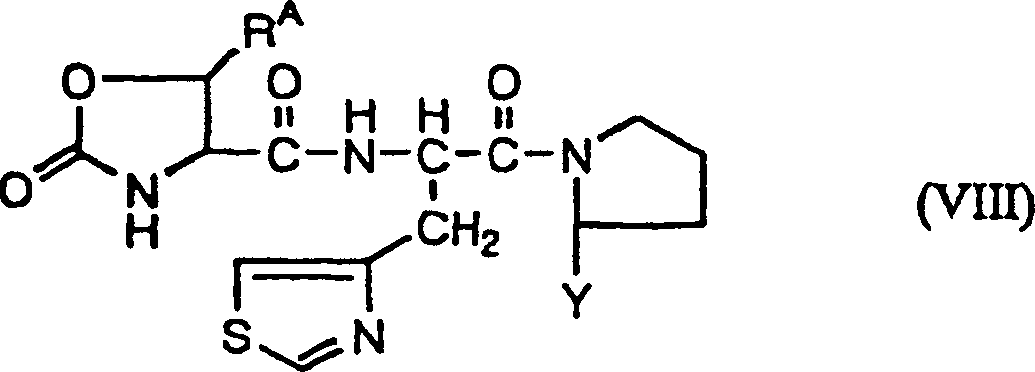
Des
Weiteren sind Verbindungen, dargestellt durch die folgenden allgemeinen
Formeln (III-A), (III-B), (IV-A) oder (IV-B): 
Herkömmlicherweise sind als ein Verfahren zur Herstellung von Oxo-Oxazolinderivaten mit einer niedrigeren Alkoxycarbonylgruppe oder einer Carboxylgruppe, ein Verfahren zur Cyclisierung eines Ausgangsmaterials unter Beibehaltung seiner Stereochemie und ein Verfahren unter Verwendung einer Cyclisierungsreaktion ohne Bezug zur Stereoselektivität bekannt.traditionally, are as a process for the preparation of oxo-oxazoline derivatives with a lower alkoxycarbonyl group or a carboxyl group, a process for cyclization of a starting material while maintaining its stereochemistry and a method using a cyclization reaction unrelated to stereoselectivity known.
Ein
Beispiel für
das Verfahren zur Cyclisierung eines Ausgangsmaterials unter Beibehaltung
seiner Stereochemie ist das Folgende: 
Ein
Beispiel des Cyclisierungsverfahrens ohne Bezug zur Stereoselektivität ist das
Folgende: 
Obwohl
ein resultierendes cyclisiertes Produkt ein Oxo-Oxazolinderivat
ist, das keine niedere Alkoxycarbonylgruppe oder eine Carboxylgruppe
aufweist, ist das folgende Verfahren bekannt: 
Ähnlich zum
Verfahren der vorliegenden Erfindung ist eine Cyclisierungsumsetzung
mit Inversion bekannt: 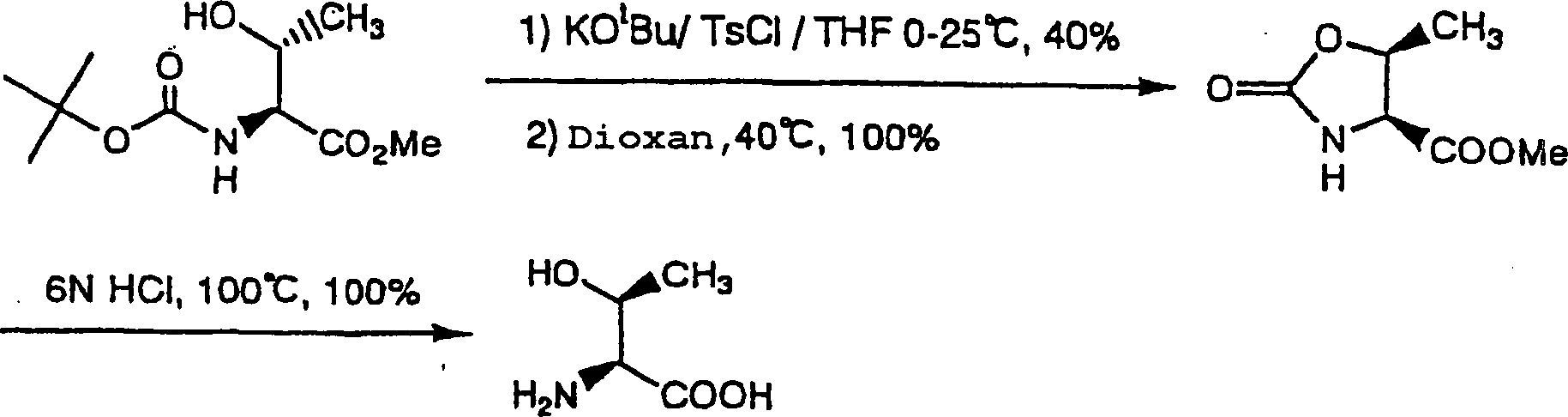
Ähnlich dem Verfahren der vorliegenden Erfindung ist eine Cyclisierungsumsetzung mit Inversion bekannt, worin Thionylchlorid verwendet wird (Tetrahedron Asymmetry, Band 8, Nr. 2, S. 231–243, 1997). Die Ausbeute der Cyclisierungsreaktion liegt bei niedrigen 38 %.Similar to Process of the present invention is a cyclization reaction with inversion, in which thionyl chloride is used (Tetrahedron Asymmetry, Vol. 8, No. 2, pp. 231-243, 1997). The yield of Cyclization reaction is low 38%.
OFFENBARUNG DER ERFINDUNGEPIPHANY THE INVENTION
Das Ziel der vorliegenden Erfindung ist es, ein Verfahren für die Herstellung von Oxo-oxazolinderivaten in einer einfachen, billigen und stereoselektiven Weise bereitzustellen. Die Oxo-oxazolinderivate sind als Intermediate für Pharmaka und als Werkzeuge für die kombinatorische Chemie geeignet. Außerdem sind die Oxo-oxazolinderivate in einer Offen-Ring-Form ebenfalls als Werkzeuge für die kombinatorische Chemie geeignet.The The aim of the present invention is to provide a process for the production of oxo-oxazoline derivatives in a simple, cheap and stereoselective way. The oxo-oxazoline derivatives are used as intermediates for pharmaceuticals and as tools for the combinatorial chemistry suitable. In addition, the oxo-oxazoline derivatives in an open-ring form also as tools for the combinatorial Chemistry suitable.
Die Erfinder haben ein Verfahren zur Herstellung von Oxo-oxazolinderivaten in stereoselektiver Weise gefunden, das für Synthesen im großem Maßstab geeignet ist.The Inventors have a process for the preparation of oxo-oxazoline derivatives found in a stereoselective manner, which is suitable for large scale synthesis is.
Das
heißt,
die vorliegende Erfindung bezieht sich auf I) ein Verfahren zur
Produktion einer Verbindung, repräsentiert durch die allgemeine
Formel (I-A) oder die allgemeinen Formel (I-B), umfassend den Schritt
des Behandelns einer Verbindung, repräsentiert durch die allgemeine
Formel (II-A) oder der allgemeinen Formel (II-B), mit 1,0 bis 5,0 Äquivalenten
Thionylchlorid in einem Lösungsmittel
aus Toluol oder Ethylacetat, wie folgt: 
Insbesondere betrifft die vorliegende Erfindung II) bis X).
- II) Produktionsverfahren nach I, worin man die durch die allgemeine Formel (II-A) oder die allgemeine Formel (II-B) repräsentierte Verbindung bei 30 °C bis Refluxtemperatur reagieren lässt.
- III) Produktionsverfahren nach I, worin man die durch die allgemeine Formel (II-A) oder die allgemeine Formel (II-B) repräsentierte Verbindung mit 1,0 bis 3,0 Äquivalenten Thionylchlorid bei 60 °C bis 80 °C reagieren lässt.
- IV) Produktionsverfahren einer Verbindung, repräsentiert
durch die allgemeine Formel (III-A) oder die allgemeine Formel (III-B),
umfassend den Schritt des Erhalts einer Verbindung, repräsentiert
durch die allgemeine Formel (I-A) oder die allgemeine Formel (I-B), über ein
Verfahren gemäß I) bis
III), und Unterwerfen der erhaltenen Verbindung, rep räsentiert
durch die allgemeine Formel (I-A) oder die allgemeine Formel (I-B), unter
eine Hydrolyse wie folgt: worin R1 und R3 wie in I oben beschrieben sind.

- V) Produktionsverfahren für
eine Verbindung, repräsentiert
durch die allgemeine Formel (IV-A) oder die allgemeine Formel (IV-B),
umfassend den Schritt des Erhalts einer Verbindung, repräsentiert
durch die allgemeine Formel (III-A) oder die allgemeine Formel (III-B), über ein
Verfahren gemäß IV) und
Unterwerfen der erhaltenen Verbindung, repräsentiert durch die allgemeine
Formel (III-A) oder die allgemein Formel (III-B), unter eine Hydrolyse
wie folgt: VI) Produktionsverfahren für eine Verbindung, repräsentiert durch die allgemeine Formel (I-A) oder die allgemeine Formel (I-B), umfassend den Schritt des Schützens der Aminogruppe einer Verbindung, repräsentiert durch die allgemeine Formel (V-A) oder die allgemeine Formel (V-B), mit R2 -OC(=O)-, worin R2 wie in I) oben beschrieben ist, Verestern der Carbonylgruppe derselben und Behandeln mit 1,0 bis 5,0 Äquivalenten an Thionylchlorid in einem Lösungsmittel von Toluol oder Ethylacetat wie folgt:
 worin R1 und R3 wie in (I) oben beschrieben sind.
- VII) Produktionsverfahren für
eine Verbindung, repräsentiert
durch die allgemeine Formel (VI): worin R1 wie in (I) oben beschrieben ist und worin Y ein wahlweise substituiertes Alkyl darstellt, das Verfahren umfassend den Schritt des Erhalts einer Verbindung, repräsentiert durch die allgemeine Formel (III-A) oder die allgemeine Formel (III-B), über ein Verfahren gemäß IV) und Unterwerfen der erhaltenen Verbindung, repräsentiert durch die allge meine Formel (III-A) oder die allgemeine Formel (III-B), unter die Bildung einer Peptidbindung.

- VIII) Produktionsverfahren gemäß IV), worin R1 Phenyl, 5-Imidazolyl, Methyl, Isopropyl, Ethinyl oder 1-Propinyl ist.
- IX) Produktionsverfahren gemäß IV), worin R2 ein Aralkyl ist.
- X) Produktionsverfahren gemäß IV), worin R1 Methyl und R2 Benzyl ist.
- II) Production method according to I, wherein the compound represented by the general formula (II-A) or the general formula (II-B) is allowed to react at 30 ° C to the reflux temperature.
- III) Production method according to I, wherein the compound represented by the general formula (II-A) or the general formula (II-B) is allowed to react with 1.0 to 3.0 equivalents of thionyl chloride at 60 ° C to 80 ° C.
- IV) Production method of a compound represented by the general formula (III-A) or the general formula (III-B) comprising the step of obtaining a compound represented by the general formula (IA) or the general formula (IB) by a process according to I) to III), and subjecting the obtained compound represented by the general formula (IA) or the general formula (IB) to hydrolysis as follows: wherein R 1 and R 3 are as described in I above.
- V) Production method of a compound represented by the general formula (IV-A) or the general formula (IV-B) comprising the step of obtaining a compound represented by the general formula (III-A) or the general formula ( III-B), a process according to IV) and subjecting the obtained compound represented by the general formula (III-A) or the general formula (III-B) to hydrolysis as follows: VI) A production method of a compound represented by the general formula (IA) or the general formula (IB), comprising the step of protecting the amino group of a compound represented by the general formula (VA) or the general formula (VB) R 2 -OC (= O) -, wherein R 2 is as described in I) above, esterifying the carbonyl group thereof and treating with 1.0 to 5.0 equivalents of thionyl chloride in a solvent of toluene or ethyl acetate as follows:wherein R 1 and R 3 are as described in (I) above.
- VII) Production method of a compound represented by the general formula (VI): wherein R 1 is as described in (I) above and Y is an optionally substituted alkyl, the process comprising the step of obtaining a compound represented by the general formula (III-A) or the general formula (III-B) via a method according to IV) and subjecting the obtained compound represented by the general formula (III-A) or the general formula (III-B) to the formation of a peptide bond.
- VIII) production method according to IV), wherein R 1 is phenyl, 5-imidazolyl, methyl, isopropyl, ethynyl or 1-propynyl.
- IX) production method according to IV), wherein R 2 is an aralkyl.
- X) production method according to IV), wherein R 1 is methyl and R 2 is benzyl.
"Halogen", wie hier verwendet, bezieht sich auf Fluor, Chlor, Brom und Jod. Chlor und Brom werden bevorzugt."Halogen" as used here refers to fluorine, chlorine, bromine and iodine. Chlorine and bromine are preferred.
Der Ausdruck "Niederalkyl", wie er hier alleine oder in Kombination mit anderen Worten verwendet wird, umfasst ein geradkettiges oder verzweigtes C1-C6-Alkyl. Beispiele des Niederalkyls schließen Methyl, Ethyl, n-Propyl, Isopropyl, n-Butyl, sec-Butyl, Isobutyl, und t-Butyl und dergleichen ein. Methyl und Ethyl werden bevorzugt.The term "lower alkyl" as used herein alone or in combination with other words includes a straight or branched C 1 -C 6 alkyl. Examples of the lower alkyl include methyl, ethyl, n-propyl, isopropyl, n-butyl, sec-butyl, isobutyl, and t-butyl, and the like. Methyl and ethyl are preferred.
"Alkinyl", wie hier verwendet, umfasst eine gerad- oder verzweigtkettige, monovalente C2-C8-Kohlenwasserstoffgruppe, mit einer oder zwei oder mehr Dreifachbindungen. Das Alkinyl kann eine Doppelbindung aufweisen. Beispiele des Alkinyls schließen Ethinyl, 1-Propinyl, 2-Propinyl, 6-Heptinyl, 7-Octinyl und 8-Noninyl und dergleichen ein. Ethinyl and 1-Propinyl sind bevorzugt."Alkynyl" as used herein includes a straight or branched chain monovalent C 2 -C 8 hydrocarbon group having one or two or more triple bonds. The alkynyl may have a double bond. Examples of the alkynyl include ethynyl, 1-propynyl, 2-propynyl, 6-heptynyl, 7-octynyl and 8-nonynyl and the like. Ethinyl and 1-propynyl are preferred.
Der Ausdruck "Aryl", wie hier alleine oder in Kombination mit anderen Worten verwendet, umfasst einen monocyclischen oder kondensierten, aromatischen Kohlenwasserstoffring. Beispiele des Aryls schließen Phenyl, 1-Naphthyl, 2-Naphthyl, Anthryl und dergleichen ein.Of the Expression "aryl", as here alone or used in combination with other words, includes one monocyclic or fused aromatic hydrocarbon ring. Examples of the aryl include phenyl, 1-naphthyl, 2-naphthyl, anthryl and the like.
"Aralkyl", wie hier verwendet, umfasst das oben beschriebene "Niederalkyl", substituiert mit dem oben beschriebenen "Aryl", wobei die Substitution an jeder möglichen Position durchgeführt werden kann. Beispiele des Aralkyls schließen Benzyl, Phenylethyl (z.B. 2-Phenylethyl und dergleichen), Phenylpropyl (z.B. 3-Phenylpropyl und dergleichen), Naphthylmethyl (z.B. 1-Naphthylmethyl, 2-Naphthylmethyl und dergleichen) und Anthrylmethyl (z.B. 9-Anthrylmethyl und dergleichen) und dergleichen ein. Benzyl und dergleichen werden bevorzugt."Aralkyl" as used herein includes the above-described "lower alkyl" substituted with the above-described "aryl", wherein the substitution at every possible Position performed can be. Examples of the aralkyl include benzyl, phenylethyl (e.g. 2-phenylethyl and the like), phenylpropyl (e.g., 3-phenylpropyl and the like), naphthylmethyl (e.g., 1-naphthylmethyl, 2-naphthylmethyl, and the like) and anthrylmethyl (e.g., 9-anthrylmethyl and the like) and the like. benzyl and the like are preferred.
"Heteroaryl", wie hier verwendet, umfasst einen 5- bis 6-gliedrigen aromatischen Ring, enthaltend ein oder mehrere Atome, willkürlich ausgewählt aus Sauerstoffatom, Schwefelatom oder Stickstoffatom, innerhalb des Rings. Das Heteroaryl kann mit einem Cycloalkyl, Aryl oder einem anderen Heteroaryl an jeder möglichen Position verschmolzen sein. Unabhängig davon, ob das Heteroaryl monocyclisch oder verschmolzen-cyclisch ist, kann sich das Heteroaryl an jeder möglichen Stelle verbinden."Heteroaryl" as used herein comprises a 5- to 6-membered aromatic ring containing one or more atoms, arbitrarily selected from oxygen atom, sulfur atom or nitrogen atom, within the Ring. The heteroaryl may be substituted by a cycloalkyl, aryl or a other heteroaryl at every possible position be merged. Independently whether the heteroaryl is monocyclic or fused-cyclic, The heteroaryl can combine at every possible point.
Beispiele des Heteroaryls schließen Pyrrolyl (z.B. 1-Pyrrolyl, 2-Pyrrolyl, 3-Pyrrolyl), Furyl (z.B. 2-Furyl, 3-Furyl), Thienyl (z.B. 2-Thienyl, 3-Thienyl), Imidazolyl (z.B. 4-Imidazolyl, 5-Imidazolyl), Pyrazolyl (z.B. 1-Pyrazolyl, 3-Pyrazolyl), Isothiazolyl (z.B. 3-Isothiazolyl), Isoxazolyl (z.B. 3-Isoxazolyl), Oxazolyl (z.B. 2-Oxazolyl), Thiazolyl (z.B. 2-Thiazolyl), Pyridyl (z.B. 2-Pyridyl, 3-Pyridyl, 4-Pyridyl), Pyrazinyl (z.B. 2-Pyrazinyl), Pyrimidinyl (z.B. 2-Pyrimidinyl, 4-Pyrimidinyl), Pyridazinyl (z.B. 3-Pyridazinyl), Tetrazolyl (z.B. 1H-Tetrazolyl), Oxadiazolyl (z.B. 1,3,4-Oxadiazolyl), Thiadiazolyl (z.B. 1,3,4-Thiadiazolyl), Indolizinyl (z.B. 2-Indolizinyl, 6-Indolizinyl), Isoindolyl (z.B. 2-Isoindolyl), Indolyl (z.B. 1-Indolyl, 2-Indolyl, 3-Indolyl), Indazolyl (e.g. 3-Indazolyl), Purinyl (z.B. 8-Purinyl), Chinolizinyl (z.B. 2-Chinolizinyl), Isochinolyl (z.B. 3-Isochinolyl), Chinolyl (z.B. 2-Chinolyl, 5-Chinolyl), Phthalazinyl (z.B. 1-Phthalazinyl), Naphthyridinyl (z.B. 2-Naphthyridinyl), Chinolanyl (z.B. 2-Chinolanyl), Chinazolinyl (z.B. 2-Chinazolinyl), Cinnolinyl (z.B. 3-Cinnolinyl), Pteridinyl (z.B. 2-Pteridinyl), Carbazolyl (z.B. 2-Carbazolyl, 4-Carbazolyl), Phenanthridinyl (z.B. 2-Phenanthridinyl, 3-Phenanthridinyl), Acridinyl (z.B. 1-Acridinyl, 2-Acridinyl), Dibenzofuranyl (z.B. 1-Dibenzofuranyl, 2-Dibenzofuranyl), Benzimidazolyl (z.B. 2-Benzimidazolyl), Benzisoxazolyl (z.B. 3-Benzisoxazolyl), Benzoxazolyl (z.B. 2-Benzoxazolyl), Benzoxadiazolyl (z.B. 4-Benzoxadiazolyl), Benzisothiazolyl (z.B. 3-Benzisothiazolyl), Benzothiazolyl (z.B. 2-Benzothiazolyl), Benzofuryl (z.B. 3-Benzofuryl) und Benzothienyl (z.B. 2-Benzothienyl) ein. Als "Heteroaryl" R1 sind Imidazolyl und dergleichen bevorzugt.Examples of the heteroaryl include pyrrolyl (eg, 1-pyrrolyl, 2-pyrrolyl, 3-pyrrolyl), furyl (eg, 2-furyl, 3-furyl), thienyl (eg, 2-thienyl, 3-thienyl), imidazolyl (eg, 4-imidazolyl , 5-imidazolyl), pyrazolyl (for example 1-pyrazolyl, 3-pyrazolyl), isothiazolyl (for example 3-isothiazolyl), isoxazolyl (for example 3-isoxazolyl), oxazolyl (for example 2-oxazolyl), thiazolyl (for example 2-thiazolyl), Pyridyl (eg 2-pyridyl, 3-pyridyl, 4-pyridyl), pyrazinyl (eg 2-pyrazinyl), pyrimidinyl (eg 2-pyrimidinyl, 4-pyrimidinyl), pyridazinyl (eg 3-pyridazinyl), tetrazolyl (eg 1H-tetrazolyl ), Oxadiazolyl (eg 1,3,4-oxadiazolyl), thiadiazolyl (eg 1,3,4-thiadiazolyl), indolizinyl (eg 2-indolizinyl, 6-indolizinyl), isoindolyl (eg 2-isoindolyl), indolyl (eg 1 Indolyl, 2-indolyl, 3-indolyl), indazolyl (eg 3-indazolyl), purinyl (eg 8-purinyl), quinolizinyl (eg 2-quinolizinyl), isoquinolyl (eg 3-isoquinolyl), quinolyl (eg 2-quinolyl , 5-quinolyl), phthalazinyl (eg 1-phthalazinyl), naphthyridinyl (eg 2-naphthyridinyl), quinolanyl (eg 2-quinolanyl), quinazo linyl (eg 2-quinazolinyl), cinnolinyl (eg 3-cinnolinyl), pteridinyl (eg 2-pteridinyl), carbazolyl (eg 2-carbazolyl, 4-carbazolyl), phenanthridinyl (eg 2-phenanthridinyl, 3-phenanthridinyl), acridinyl ( eg 1-acridinyl, 2-acridinyl), dibenzofuranyl (eg 1-dibenzofuranyl, 2-dibenzofuranyl), benzimidazolyl (eg 2-benzimidazolyl), benzisoxazolyl (eg 3-benzisoxazolyl), benzoxazolyl (eg 2-benzoxazolyl), benzoxadiazolyl (eg 4 Benzoxadiazolyl), benzisothiazolyl (eg 3-benzisothiazolyl), benzothiazolyl (eg 2-benzothiazolyl), benzofuryl (eg 3-benzofuryl) and benzothienyl (eg 2-benzothienyl). As "heteroaryl" R 1 , imidazolyl and the like are preferable.
"Heteroarylalkyl", wie hier verwendet, umfasst das oben beschriebene "Niederalkyl", substituiert mit dem oben beschriebenen "Heteroaryl", wobei solch eine Substitution an jeder möglichen Position ausgeführt werden kann."Heteroarylalkyl" as used herein includes the above-described "lower alkyl" substituted with above described "heteroaryl", such a Substitution at every possible Position to be executed can.
"Optional substituiertes Alkyl" an Y, wie hier verwendet, umfasst das oben beschriebene "Alkyl", das einen oder mehrere Substituenten an allen möglichen Stellen aufweist, wie Hydroxy, Alkyloxy (z.B. Methoxy und Ethoxy), Mercapto, Alkylthio (z.B. Methylthio), Cycloalkyl (z.B. Cyclopropyl, Cyclobutyl, Cyclopentyl und Cyclohexyl), Halogen (z.B. Fluor, Chlor, Brom und Jod), Carboxy, Carbamoyl, Alkyloxycarbonyl (z.B. Methoxycarbonyl und Ethoxycarbonyl), Aryloxycarbonyl (z.B. Phenyloxycarbonyl), Nitro, Cyano, SOpRA (p ist eine ganze Zahl von 1 bis 3, RA ist Wasserstoff oder Alkyl), PO(OH)2 oder P(O)OH, das mit einem Alkyl substituiert sein kann, substitutiertes oder unsubstituiertes Amino (z.B. Methylamino, Dimethylamino und Carbamoylamino), wahlweise substituiertes Aryl (z.B. Phenyl und Tolyl), wahlweise substituiertes Heteroaryl, eine wahlweise substituierte, nicht aromatische heterocyclische Gruppe, Aryloxy, Acyloxy, Acyloxycarbonyl, Alkylcarbonyl, nicht aromatisches heterocyclisches Carbonyl, heterocyclisches Imino, Hydrazino, Hydroxyamino, Alkyloxyamino, Formyl und dergleichen. Beispiele des „wahlweise substituierten Alkyls" schließen ein Methyl, Ethyl, n-Propyl, Isopropyl, n-Butyl, Isobutyl, sec-Butyl, tert-Butyl, Cyclopropyl, Cyclopentyl, Cyclohexyl, Benzyl, Hydroxymethyl, tert-Butylcarbonyloxymethyl, Morpholinomethyl, Piperidinomethyl, N-Methyl-1-piperazinylmethyl, Ethylcarbonylmethyl und Morpholinocarbonylmethyl, Acetyloxymethyl und dergleichen. Ein unsubstituiertes Alkyl ist bevorzugt, insbesondere Methyl."Optionally substituted alkyl" on Y as used herein includes the above-described "alkyl" having one or more substituents in all possible positions, such as hydroxy, alkyloxy (eg, methoxy and ethoxy), mercapto, alkylthio (eg, methylthio), cycloalkyl (for example cyclopropyl, cyclobutyl, cyclopentyl and cyclohexyl), halogen (eg fluorine, chlorine, bromine and iodine), carboxy, carbamoyl, alkyloxycarbonyl (eg, methoxycarbonyl and ethoxycarbonyl), aryloxycarbonyl (for example, phenyloxycarbonyl), nitro, cyano, SO p R A (p is an integer of 1 to 3, R A is hydrogen or alkyl), PO (OH) 2 or P (O) OH, which may be substituted with an alkyl, substituted or unsubstituted amino (eg, methylamino, dimethylamino and carbamoylamino ), optionally substituted aryl (eg, phenyl and tolyl), optionally substituted heteroaryl, an optionally substituted, non-aromatic heterocyclic group, aryloxy, acyloxy, acyloxycarbonyl, alkylcarbonyl, non-aromatic heterocycliccarbonyl, hete rocyclic imino, hydrazino, hydroxyamino, alkyloxyamino, formyl and the like. Examples of "optionally substituted alkyl" include methyl, ethyl, n-propyl, isopropyl, n-butyl, isobutyl, sec-butyl, tert-butyl, cyclopropyl, cyclopentyl, cyclohexyl, benzyl, hydroxyme methyl, tert-butylcarbonyloxymethyl, morpholinomethyl, piperidinomethyl, N-methyl-1-piperazinylmethyl, ethylcarbonylmethyl and morpholinocarbonylmethyl, acetyloxymethyl and the like. An unsubstituted alkyl is preferred, especially methyl.
"Optional substituiertes Aryl", wie hier verwendet, umfasst das oben beschriebene "Aryl", das eines oder mehrere Substituenten an allen möglichen Stellen aufweist, wie Hydroxy, Alkyloxy (z.B. Methoxy and Ethoxy), Mercapto, Alkylthio (z.B. Methylthio), Cycloalkyl (z.B. Cyclopropyl, Cyclobutyl, Cyclopentyl und Cyclohexyl), Halogen (z.B. Fluor, Chlor, Brom und Jod), Alkyloxycarbonyl (z.B. Methyloxycarbonyl und Ethyloxycarbonyl), Aryloxycarbonyl (z.B. Phenyloxycarbonyl), Nitro, Cyano, Aryloxy, Acyloxy, Acyloxycarbonyl, Alkylcarbonyl und dergleichen. Bevorzugte Beispiele des Substituenten schließen niederes Alkoxy und Halogen und dergleichen ein. Beispiele des „wahlweise substituierten Aryls" schließen ein Phenyl, 2-Chlorophenyl, 3-Chlorophenyl, 4-Chlorophenyl und dergleichen. Ein unsubstituiertes Aryl ist bevorzugt."Optionally substituted Aryl ", like here includes the "aryl" described above, having one or more substituents in all possible places, such as Hydroxy, alkyloxy (e.g., methoxy and ethoxy), mercapto, alkylthio (e.g., methylthio), cycloalkyl (e.g., cyclopropyl, cyclobutyl, cyclopentyl and cyclohexyl), halogen (e.g., fluoro, chloro, bromo and iodo), alkyloxycarbonyl (e.g., methyloxycarbonyl and ethyloxycarbonyl), aryloxycarbonyl (e.g. Phenyloxycarbonyl), nitro, cyano, aryloxy, acyloxy, acyloxycarbonyl, Alkylcarbonyl and the like. Preferred examples of the substituent shut down lower alkoxy and halogen and the like. Examples of the "optional substituted aryls " Phenyl, 2-chlorophenyl, 3-chlorophenyl, 4-chlorophenyl and the like. An unsubstituted aryl is preferred.
"Optional substituiertes Heteroaryl", wie hier verwendet, umfasst das oben beschriebene "Heteroaryl", das einen oder mehrere Substituenten an allen möglichen Stellen aufweisen kann, wie Hydroxy, Alkyloxy (z.B. Methoxy und Ethoxy), Mercapto, Alkylthio (z.B. Methylthio), Cycloalkyl (z.B. Cyclopropyl, Cyclobutyl, Cyclopentyl, Cyclohexyl), Halogen (z.B. Fluor, Chlor, Brom und Jod), Alkyloxycarbonyl (z.B. Methyloxycarbonyl und Ethyloxycarbonyl), Aryloxycarbonyl (z.B. Phenyloxycarbonyl), Nitro, Cyano, Aryloxy, Acyloxy, Acyloxycarbonyl, Alkylcarbonyl und dergleichen. Bevorzugte Beispiele der Substituenten schließen niederes Alkoxy, Halogen und dergleichen ein. Beispiele des "optional substituierten Heteroaryls" schließen 2-Chlorimidazol-5-yl, 4-Chlorimidazol-5-yl und dergleichen ein. Ein unsubstituiertes Heteroaryl ist bevorzugt."Optionally substituted Heteroaryl ", like As used herein, the "heteroaryl" described above includes one or more substituents at all possible Such as hydroxy, alkyloxy (e.g., methoxy and Ethoxy), mercapto, alkylthio (e.g., methylthio), cycloalkyl (e.g. Cyclopropyl, cyclobutyl, cyclopentyl, cyclohexyl), halogen (e.g. Fluorine, chlorine, bromine and iodine), alkyloxycarbonyl (e.g., methyloxycarbonyl and ethyloxycarbonyl), aryloxycarbonyl (e.g., phenyloxycarbonyl), Nitro, cyano, aryloxy, acyloxy, acyloxycarbonyl, alkylcarbonyl and like. Preferred examples of the substituents include lower one Alkoxy, halogen and the like. Examples of the "optionally substituted Heteroaryls include 2-chloroimidazol-5-yl, 4-chloroimidazol-5-yl and the like. An unsubstituted heteroaryl is preferred.
DIE BESTE AUSFÜHRUNGSFORM DER ERFINDUNGTHE BEST Embodiment THE INVENTION
Das
Herstellungsverfahren der vorliegenden Erfindung wird im Detail
beschrieben, wobei ein Ausgangsmaterial eine optisch aktive Substanz
ist. Wenn das andere Material verwendet wird, können ähnliche Reaktionen ausgeführt werden.
Wenn ein Ausgangsmaterial einen Substituenten aufweist, der ein
Hindernis für
eine Reaktion im ersten bis sechsten, unten gezeigten Schritt ist,
kann das Ausgangsmaterial vorher gemäß eines Verfahrens, beschrieben
in Protective Groups in Organic Synthesis, Theodora W. Green (John
Wiley & Sons),
und dergleichen, geschützt
werden und in einer geeigneten Stufe wieder entschützt werden. 
Erster SchrittFirst step
Im ersten Schritt werden R2OC(=O)-Hal, worin Hal ein Halogen ist, [R2OC(=O)]2O und dergleichen mit einer Verbindung umgesetzt, dargestellt durch die allgemeine Formel (V-A), um eine Verbindung (VII-A) zu erhalten, in der eine Aminogruppe durch R2OC(=O)-geschützt ist. Dieser Schritt kann gemäß einem in Protective Groups in Organic Synthesis, Theodora W. Green (John Wiley & Sons) und dergleichen beschriebene Verfahren durchgeführt werden.In the first step, R 2 OC (= O) -Hal, wherein Hal is a halogen, [R 2 OC (= O)] 2 O, and the like are reacted with a compound represented by the general formula (VA) to be a compound (VII-A) in which an amino group is protected by R 2 OC (= O). This step may be done in accordance with a Protective Groups in Organic Synthesis, Theodora W. Green (John Wiley & Sons) and the like.
Zum Beispiel wird eine Verbindung, dargestellt durch eine allgemeine Formel (V-A), mit 1,0 Äquivalent bis 3,0 Äquivalenten, vorzugsweise 1,0 Äquivalenten bis 1,5 Äquivalenten R2OC(=O)-Hal, worin Hal ein Halogen ist, und 2,0 Äquivalenten bis 6,0 Äquivalenten, vorzugsweise 2,0 Äquivalenten bis 3,0 Äquivalenten einer organischen Base (z.B. Triethylamin und dergleichen) oder einer anorganischen Base (z.B. Natriumhydroxid, Kaliumhydroxid, Natriumcarbonat, Kaliumcarbonat, Natriumhydrogencarbonat, Kaliumhydrogen carbonat und dergleichen) in einem gemischten Lösungsmittel wie Wasser-Toluol, Wasser-Dioxan, Wasser-Aceton und dergleichen oder einem Lösungsmittel wie Wasser, Dioxan und dergleichen bei –20 °C bis 50 °C, vorzugsweise 0 °C bis 20 °C für 0,5 bis 3 Stunden umgesetzt, um eine durch eine allgemeine Formel (VII-A) dargestellte Verbindung zu erhalten.For example, a compound represented by a general formula (VA) is from 1.0 equivalent to 3.0 equivalents, preferably 1.0 equivalent to 1.5 equivalents of R 2 OC (= O) -hal, where Hal is a halogen and 2.0 equivalents to 6.0 equivalents, preferably 2.0 equivalents to 3.0 equivalents of an organic base (eg, triethylamine and the like) or an inorganic base (eg, sodium hydroxide, potassium hydroxide, sodium carbonate, potassium carbonate, sodium hydrogencarbonate, potassium hydrogencarbonate and the like) in a mixed solvent such as water-toluene, water-dioxane, water-acetone and the like or a solvent such as water, dioxane and the like at -20 ° C to 50 ° C, preferably 0 ° C to 20 ° C for 0 5 to 3 hours to obtain a compound represented by a general formula (VII-A).
In der oben beschriebenen Ziffer (VI) bezieht sich "Schritt zum Schützen einer Aminogruppe mit R2OC(=O)-" auf diesen ersten Schritt.In the above-described (VI), "step for protecting an amino group with R 2 OC (= O) -" refers to this first step.
Zweiter SchrittSecond step
Im zweiten Schritt wird die Carboxylgruppe einer durch die allgemeine Formel (VII-A) dargestellten Verbindung verestert, um eine Verbindung zu erhalten, dargestellt durch die allgemeine Formel (II-A). Dies kann durch eine üblicherweise verwendete Veresterung durchgeführt werden.in the second step, the carboxyl group becomes one through the general Esterified compound of formula (VII-A) to give a compound to obtain represented by the general formula (II-A). This can by a usual used esterification carried out become.
Zum Beispiel wird eine Verbindung, dargestellt durch die allgemeine Formel (VII-A) in einem Lösungsmittel wie Methanol, Ethanol, Isopropylalkohol und dergleichen gelöst und mit 1 Äquivalent bis 5 Äquivalenten, vorzugsweise 1 Äquivalent bis 2 Äquivalenten eines Halogenierungsmittels wie Thionylchlorid, Salzsäure, Phosphoroxychlorid und dergleichen bei –20 °C bis 50 °C, vorzugsweise 0 °C bis 25 °C, für 1 Stunde bis 24 Stunden, vorzugsweise 1 Stunde bis 3 Stunden, umgesetzt, um eine Verbindung zu erhalten, dargestellt durch eine allgemeine Formel (II-A).To the Example is a compound represented by the general Formula (VII-A) in a solvent such as methanol, ethanol, isopropyl alcohol and the like dissolved and with 1 equivalent to 5 equivalents, preferably 1 equivalent up to 2 equivalents a halogenating agent such as thionyl chloride, hydrochloric acid, phosphorus oxychloride and the like at -20 ° C to 50 ° C, preferably 0 ° C to 25 ° C, for 1 hour up to 24 hours, preferably 1 hour to 3 hours, reacted, to get connected, represented by a general Formula (II-A).
In der oben beschriebenen Ziffer (VI) bezieht sich "Schritt zur Veresterung einer Carboxylgruppe" auf diesen zweiten Schritt.In the above-described item (VI) refers to "esterification of a carboxyl group" to this second one Step.
Dritter SchrittThird step
Der dritte Schritt ist eine Cyclisierungsreaktion, in der die Stereochemie von R1 invertiert wird.The third step is a cyclization reaction in which the stereochemistry of R 1 is inverted.
Zum Beispiel kann eine Verbindung, dargestellt durch eine allgemeine Formel (I-A) ge mäß 1) bis 3), unten beschrieben, erhalten werden. 1) eine Verbindung, dargestellt durch eine allgemeine Formel (II-A) wird in einem Lösungsmittel aus Toluol oder Ethylacetat, vorzugsweise Toluol, gelöst. Die Lösungsmittelmenge beträgt vorzugsweise 1 V bis 50 V, insbesondere 1 V bis 10 V, wobei die Verwendung von 1 ml eines Lösungsmittels, bezogen auf 1 g Ausgangsmaterial, als ein 1 V bezeichnet wird. 2) 1,0 Äquivalent bis 5 Äquivalente, vorzugsweise 1,0 Äquivalent bis 2,0 Äquivalente Thionylchlorid werden bei 25 °C bis 80 °C, vorzugsweise 25 °C bis 50 °C, zugegeben. Thionylchlorid kann als Lösungsmittel verwendet werden. 3) Die Reaktionslösung wird bei 25 °C bis 80 °C, vorzugsweise 60 °C bis 80 °C für 5 Stunden bis 48 Stunden, vorzugsweise 6 bis 12 Stunden, gerührt.To the Example may be a compound represented by a general Formula (I-A) according to 1) to 3), described below. 1) a connection shown by a general formula (II-A) is in a solvent from toluene or ethyl acetate, preferably toluene. The Amount of solvent is preferably 1 V to 50 V, in particular 1 V to 10 V, wherein the Using 1 ml of a solvent, based on 1 g of starting material, is referred to as a 1 V. 2) 1.0 equivalent to 5 equivalents, preferably 1.0 equivalent to 2.0 equivalents Thionyl chloride are at 25 ° C up to 80 ° C, preferably 25 ° C up to 50 ° C, added. Thionyl chloride can be used as a solvent. 3) The reaction solution is at 25 ° C up to 80 ° C, preferably 60 ° C up to 80 ° C for 5 hours to 48 hours, preferably 6 to 12 hours, stirred.
In dieser Reaktion wurde der Anteil der cis-Form der gewünschten Verbindung erhöht (der Anteil der trans-Form wurde erniedrigt), umso näher der Wert der Thionylchlorid-Äquivalente an 1,0 ist und umso höher der "V"-Wert der Menge des Lösungsmittels ist.In This reaction was the proportion of the desired cis form Connection increased (the proportion of the trans-form was lowered), the closer the Value of thionyl chloride equivalents at 1.0 and the higher the "V" value of the amount of the solvent is.
Die Ausbeute der Gesamtverbindungen der cis-Form und trans-Form wird nicht wesentlich durch den Äquivalentwert an Thionylchlorid und der Lösungsmittelmenge beeinflusst.The Yield of the total compounds of the cis-form and trans-form becomes not significantly by the equivalent value of thionyl chloride and the amount of solvent affected.
In der oben beschriebenen Ziffer (VI) bezieht sich "Schritt zur Behandlung mit Thionylchlorid" auf diesen dritten Schritt.In the above-described item (VI) refers to "step for treatment with thionyl chloride" to this third Step.
Vierter Schrittfourth step
Im vierten Schritt wird eine Esterverbindung, dargestellt durch die allgemeine Formel (I-A), zur Carbonsäure hydrolysiert. Dieser Schritt kann durch eine üblicherweise verwendete Hydrolyse durchgeführt werden.In the fourth step, an ester compound represented by the general formula (IA) is hydrolyzed to the carboxylic acid. This step may be carried out by a commonly used hydrolysis the.
Zum Beispiel wird eine Verbindung, dargestellt durch die allgemeine Formel (I-A), in einem Lösungsmittel wie Wasser und dergleichen gelöst; und 0,1 Äquivalent bis 10 Äquivalenten, vorzugsweise 1 Äquivalent bis 5 Äquivalenten Säure (z.B. Salzsäure, Schwefelsäure und dergleichen) werden zur Lösung bei 0 °C bis 100 °C, vorzugsweise 25 °C bis 80 °C zugegeben. Die resultierende Lösung lässt man bei 25 °C bis 100 °C, vorzugsweise 50 °C bis 80 °C, für 1 Stunde bis 5 Stunden reagieren, um eine Verbindung zu erhalten, dargestellt durch eine allgemeine Formel (III-A). Dieser Schritt kann unter basischen Bedingun gen durchgeführt werden.To the Example is a compound represented by the general Formula (I-A), in a solvent such as water and the like dissolved; and 0.1 equivalent up to 10 equivalents, preferably 1 equivalent to 5 equivalents Acid (e.g. Hydrochloric acid, sulfuric acid and the like) become the solution at 0 ° C up to 100 ° C, preferably 25 ° C up to 80 ° C added. The resulting solution you leave at 25 ° C up to 100 ° C, preferably 50 ° C up to 80 ° C, for 1 hour React to 5 hours to get a connection shown by a general formula (III-A). This step may be under basic Conditions performed become.
Fünfter SchrittFifth step
Im fünften Schritt wird eine Verbindung, dargestellt durch die allgemeine Formel (III-A), hydrolysiert, um Allo-aminosäurederivate zu erhalten, dargestellt durch die allgemeine Formel (IV-A).in the fifth Step is a connection represented by the general formula (III-A), hydrolyzed to obtain allo-amino acid derivatives by the general formula (IV-A).
Zum Beispiel wird eine Verbindung, dargestellt durch die allgemeine Formel (III-A), in einem Lösungsmittel wie Wasser gelöst, und 0,1 Äquivalent bis 20 Äquivalenten, vorzugsweise 1 Äquivalent bis 10 Äquivalenten Säure (z.B. Salzsäure, Schwefelsäure und dergleichen) werden zur Lösung bei 0 °C bis 100 °C, vorzugsweise 25 °C bis 80 °C zugegeben. Die resultierende Lösung lässt man bei 25 °C bis 100 °C, vorzugsweise 80 °C bis 100 °C für 1 Stunde bis 48 Stunden reagieren, um eine Verbindung zu erhalten, dargestellt durch die allgemeine Formel (IV-A).To the Example is a compound represented by the general Formula (III-A), in a solvent dissolved like water, and 0.1 equivalent up to 20 equivalents, preferably 1 equivalent to 10 equivalents Acid (e.g. Hydrochloric acid, sulfuric acid and the like) become the solution at 0 ° C up to 100 ° C, preferably 25 ° C up to 80 ° C added. The resulting solution you leave at 25 ° C up to 100 ° C, preferably 80 ° C up to 100 ° C for 1 hour React to 48 hours to get a connection shown by the general formula (IV-A).
Sechster Schritt (Bildung der Peptidbindung)Sixth step (education the peptide bond)
Drei
Aminosäurederivate
werden zwei Peptidbindungsbildungen unterworfen, um eine Verbindung (VI)
(WO98/08867) zu synthetisieren. Eine Verbindung, dargestellt durch
die allgemeine Formel (I-A), erhalten durch das oben beschriebene
Verfahren, wird dazu verwendet, die Verbindung (VI) zu synthetisieren,
in den folgenden zwei Verfahren (Verfahren A und Verfahren B). Verfahren
A 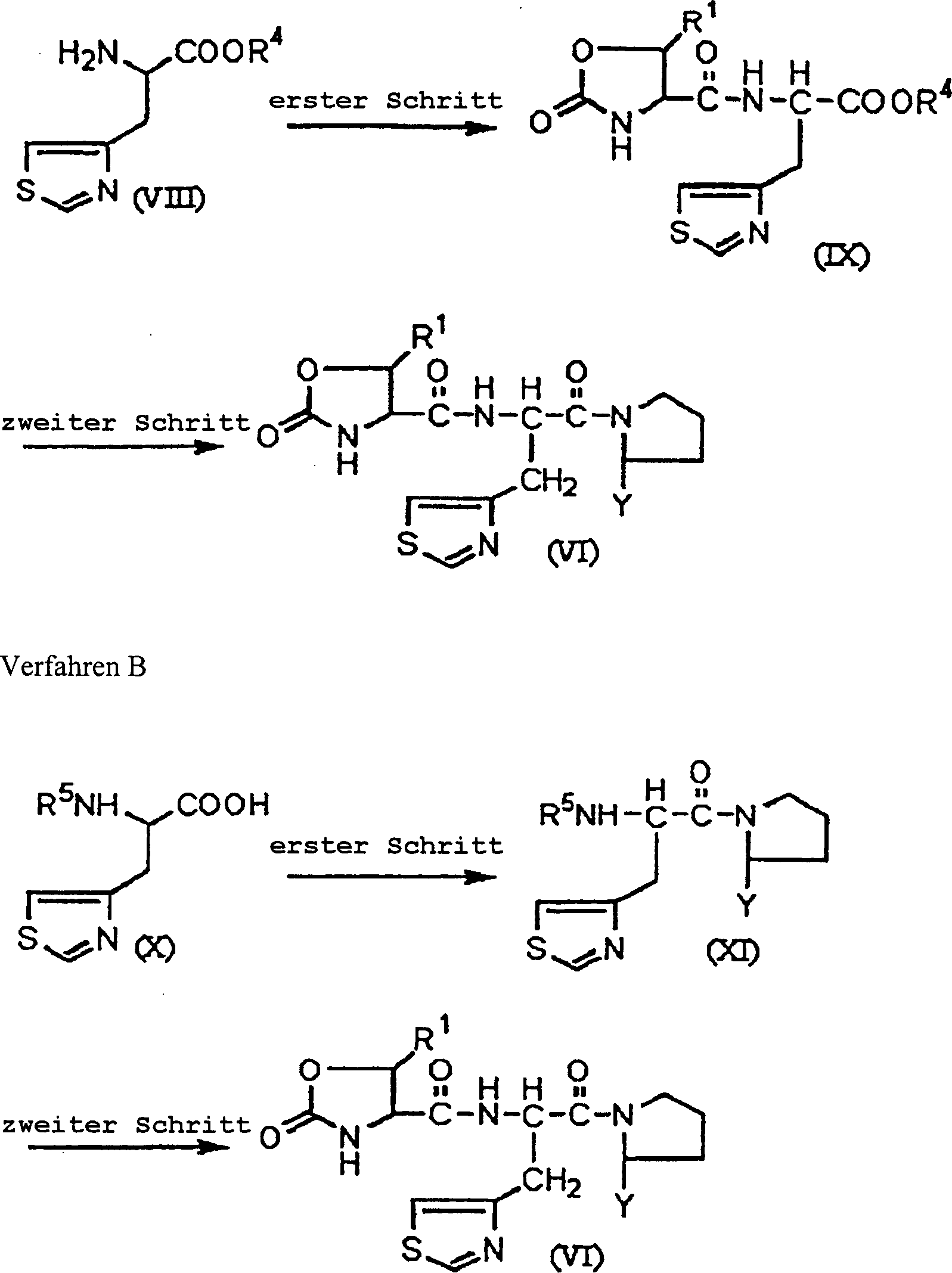
Verfahren A – Erster Schrittmethod A - first step
Die Carboxylgruppe des 3-(4-Thiazol)alanins, synthetisiert gemäß einem Verfahren, beschrieben in Synth. Commun., 20,22, 3507 (1990), und Chem. Pharm. Bull., 38, 1, 103 (1990), wird als Ester wie Methylester, Benzylester, t-Butylester, Diphenylmethylester und dergleichen geschützt, resultierend in einer Verbindung, dargestellt durch eine allgemeine Formel (VIII). Diese Verbindung und eine Verbindung, dargestellt durch die allgemeine Formel (III-A), werden einer Peptidbindungsbildung unterworfen.The Carboxyl group of 3- (4-thiazole) alanine synthesized according to one Method described in Synth. Commun., 20, 22, 3507 (1990), and Chem. Pharm. Bull., 38, 1, 103 (1990), is used as ester such as methyl ester, Benzyl ester, t-butyl ester, diphenylmethyl ester and the like protected, resulting in a compound represented by a general formula (VIII). This compound and a compound represented by the general Formula (III-A) are subjected to peptide bond formation.
Wenn die Carboxylgruppe als Diphenylmethylester geschützt wird, kann die Schutzreaktion wie folgt durchgeführt werden. 3-(4-Thiazol)alanin wird in einem gemischten Lösungsmittel eines Alkohollösungsmittels wie Methanol, Ethanol und dergleichen und einem Lösungsmittel wie Tetrahydrofuran, Dioxan und dergleichen aufgelöst. 1 bis 3 Äquivalente, vorzugsweise 1 bis 2 Äquivalente Diphenyldiazomethan werden zur Lösung bei 0 bis 50 °C, vorzugsweise 20 bis 40 °C für 10 Minuten bis 1 Stunde, vorzugsweise 20 bis 40 Minuten, gegeben. Die resultierende Lösung lässt man bei derselben Temperatur für 30 Minuten bis 3 Stunden, vorzugsweise 1 bis 2 Stunden, unter Rühren reagieren.When the carboxyl group is protected as a diphenylmethyl ester, the protective reaction can be carried out as follows. 3- (4-thiazole) alanine is dissolved in a mixed solvent of an alcohol solvent such as methanol, ethanol and the like and a solvent such as tetrahydrofuran, dioxane and the like. 1 to 3 equivalents, preferably 1 to 2 equivalents of diphenyldiazomethane are added to the solution 0 to 50 ° C, preferably 20 to 40 ° C for 10 minutes to 1 hour, preferably 20 to 40 minutes given. The resulting solution is allowed to react at the same temperature for 30 minutes to 3 hours, preferably 1 to 2 hours with stirring.
Die Bildung der Peptidbindung ist in "Peputido Gosei [Peptide Synthesis]" (Nobuo Izumiya, Maruzen), und dergleichen beschrieben und kann durch solch ein üblicherweise verwendetes Verfahren zur Bildung von Peptidbindungen durchgeführt werden.The Formation of the peptide bond is described in "Peputido Gosei [Peptide Synthesis]" (Nobuo Izumiya, Maruzen), and the like, and can by such a commonly method used to form peptide bonds.
Üblicherweise verwendete Verfahren zur Bildung von Peptidbindungsbildung sind ein Verfahren, das ein Kondensationsmittel wie N,N-Dicyclohexylcarbodiimid (DCC) und dergleichen nutzt, ein Azidverfahren, ein Säurechloridverfahren, ein Säuranhydridverfahren, ein Aktivesterverfahren und dergleichen. Wenn ein Ausgangsmaterial einen Substituenten (Amino, Carboxy, Hydroxyl und dergleichen) aufweist, der ein Hindernis für die Peptidbildung ist, kann der Substituent vorher gemäß einem Verfahren, das in Protective Groups in Organic Synthesis, Theodora W. Green (John Wiley & Sons), und dergleichen beschrieben ist geschützt werden, und die Schutzgruppe wird in einem gewünschten Verfahrensschritt entfernt.Usually used methods for forming peptide bond formation a method comprising a condensing agent such as N, N-dicyclohexylcarbodiimide (DCC) and the like, an azide process, an acid chloride process, an acid hydride process, an active ester method and the like. If a starting material has a substituent (amino, carboxy, hydroxyl and the like), the one obstacle for the Peptide formation, the substituent may be previously in accordance with a Method described in Protective Groups in Organic Synthesis, Theodora W. Green (John Wiley & Sons), and the like described, and the protecting group will be in a desired Removed process step.
Eine Verbindung, dargestellt durch die allgemeine Formel (VIII), und eine Verbindung, dargestellt durch die allgemeine Formel (III-A), werden in einem Lösungsmittel wie N,N-Dimethylformamid, Tetrahydrofuran, Acetonitril und dergleichen aufgelöst. Eine N,N-Dimethylformamidlösung einer Base wie Triethylamin und dergleichen und Dicyclohexylcarbodiimid (DCC) werden zu dieser Lösung bei –10 bis 10 °C gegeben, vorzugsweise in einem Eisbad. 1-Hydroxybenzotriazol kann zugegeben werden. Die resultierende Lösung wird bei 10 bis 50 °C, vorzugsweise 20 bis 30 °C, für eine Stunde bis zu einem Tag, vorzugsweise 5 bis 10 Stunden, gerührt, gefolgt von typischen Folgeverfahren. So kann eine Verbindung, dargestellt durch die allgemeine Formel (IX), erhalten werden.A Compound represented by the general formula (VIII), and a compound represented by the general formula (III-A), be in a solvent such as N, N-dimethylformamide, Tetrahydrofuran, acetonitrile and the like dissolved. A N, N-dimethylformamide solution of Base such as triethylamine and the like and dicyclohexylcarbodiimide (DCC) become this solution at 10 up to 10 ° C given, preferably in an ice bath. 1-hydroxybenzotriazole can be added. The resulting solution is at 10 to 50 ° C, preferably 20 to 30 ° C, for one Hour to one day, preferably 5 to 10 hours, stirred, followed of typical follow-up procedures. This is how a connection can be displayed by the general formula (IX).
Verfahren A – Zweiter Schrittmethod A - second step
Eine Entschützungsreaktion kann durch eine üblicherweise verwendete Entschützungsreaktion (Protective Groups in Organic Synthesis, Theodora W. Green (John Wiley & Sons)) durchgeführt werden. Zum Beispiel kann, wenn R4 Diphenylmethyl ist, eine Verbindung, dargestellt durch eine allgemeine Formel (IX), zu Anisol und Trifluoressigsäure bei –10 bis 10 °C, vorzugsweise in einem Eisbad, zugegeben werden. Die Mischung wird bei derselben Temperatur für 5 bis 30 Minuten gerührt, vorzugsweise 10 bis 20 Minuten. Nachdem die Mischung auf 20 bis 40 °C aufgewärmt ist, kann die Mischung für 1 bis 4 Stunden, vorzugsweise 2 bis 3 Stunden, gerührt werden.A deprotection reaction can be carried out by a commonly used protective reaction (Protective Groups in Organic Synthesis, Theodora W. Green (John Wiley & Sons)). For example, when R 4 is diphenylmethyl, a compound represented by a general formula (IX) may be added to anisole and trifluoroacetic acid at -10 to 10 ° C, preferably in an ice bath. The mixture is stirred at the same temperature for 5 to 30 minutes, preferably 10 to 20 minutes. After the mixture is warmed to 20 to 40 ° C, the mixture for 1 to 4 hours, preferably 2 to 3 hours, stirred.
Die resultierende entschützte Substanz kann mit einem Pyrrolidinderivat, synthetisiert durch ein Verfahren, beschrieben in Tetrahedron, 27, 2599 (1971), durch eine Peptidbindungsbildung ähnlich der aus Verfahren A – erster Schritt, umgesetzt werden, wobei eine Verbindung, die durch die allgemeine Formel (VI) dargestellt wird, erhalten wird.The resulting deprotected Substance can be synthesized by a pyrrolidine derivative A method described in Tetrahedron, 27, 2599 (1971), by a Similar to peptide bond formation from method A - first Step, be implemented, taking a connection through the general formula (VI) is obtained.
Verfahren B – erster Schrittmethod B - first step
Die Aminogruppe des 3-(4-Thiazol)alanins, synthetisiert gemäß einem Verfahren, beschrieben in Synth. Commun., 20, 22, 3507 (1990), und Chem. Pharm. Bull., 38, 1, 103 (1990), wird durch eine Schutzgruppe für eine Aminogruppe wie t-Butyloxycarbonyl, Benzyloxycarbonyl, 9-Fluorenylmethoxycarbonyl, Phthaloyl, Trifluoroacetyl und dergleichen geschützt, um eine Verbindung, dargestellt durch die allgemeine Formel (X), zu er halten. Diese Verbindung und ein Pyrrolidinderviat, hergestellt durch ein Verfahren, beschrieben in Tetrahedron, 27, 2599 (1971), werden der Bildung einer Peptidbindung unterworfen.The Amino group of 3- (4-thiazole) alanine synthesized according to one Method described in Synth. Commun., 20, 22, 3507 (1990), and Chem. Pharm. Bull., 38, 1, 103 (1990), is protected by a protecting group for one Amino group such as t-butyloxycarbonyl, benzyloxycarbonyl, 9-fluorenylmethoxycarbonyl, Phthaloyl, trifluoroacetyl and the like protected to form a compound by the general formula (X), to keep it. This connection and a pyrrolidine derivative prepared by a method in Tetrahedron, 27, 2599 (1971), the formation of a peptide bond subjected.
Wenn t-Butyloxycarbonyl zum Schützen verwendet wird, kann die Schutzreaktion wie folgt durchgeführt werden. 3-(4-Thiazol)alanin wird in einem Lösungsmittel wie Dioxan, Tetrahydrofuran, Acetonitril und dergleichen gelöst. Boc2O wird zur Lösung bei 0 bis 50 °C zugegeben, vorzugsweise bei 10 bis 30 °C, und für 1 bis 5 Stunden, vorzugsweise 2 bis 4 Stunden, gerührt.When t-butyloxycarbonyl is used for protection, the protective reaction can be carried out as follows. 3- (4-thiazole) alanine is dissolved in a solvent such as dioxane, tetrahydrofuran, acetonitrile and the like. Boc 2 O is added to the solution at 0 to 50 ° C, preferably at 10 to 30 ° C, and stirred for 1 to 5 hours, preferably 2 to 4 hours.
Die Bildung einer Peptidbindung kann in einer ähnlichen Weise zu der des oben beschriebenen Verfahrens A – erster Schritt durchgeführt werden.The Formation of a peptide bond can be similar to that of the above in a similar manner described method A - first Step performed become.
Verfahren B – zweiter Schrittmethod B - second step
Eine Entschützungsreaktion für eine Aminogruppe kann wie folgt durchgeführt werden. Wenn die Schutzgruppe t-Butyloxycarbonyl ist, wird eine Verbindung, dargestellt durch eine allgemeine Formel (XI), in einem Lösungsmittel wie Ethylacetat und dergleichen aufgelöst. 1 bis 4 N Salzsäure-Ethylacetat-Lösung wird zur Lösung bei –10 bis 30 °C, vorzugsweise in Eis, zugegeben. Die resultierende Mischung wird bei derselben Temperatur 1 bis 5 Stunden, vorzugsweise 2 bis 3 Stunden, gerührt.A deprotection reaction for an amino group can be carried out as follows. If the Protecting group is t-butyloxycarbonyl, a compound represented by a general formula (XI) is dissolved in a solvent such as ethyl acetate and the like. 1 to 4 N hydrochloric acid-ethyl acetate solution is added to the solution at -10 to 30 ° C, preferably in ice. The resulting mixture is stirred at the same temperature for 1 to 5 hours, preferably 2 to 3 hours.
Die resultierende entschützte Substanz kann der Bildung einer Peptidbindung, ähnlich der aus Verfahren A – erster Schritt, unterworfen werden, wobei eine Verbindung, dargestellt durch die allgemeine Formel (VI), erhalten wird.The resulting deprotected Substance may be the formation of a peptide bond, similar to that of method A - first Step, being subjected to a connection, shown is obtained by the general formula (VI).
Im Herstellungsverfahren ist eine Verbindung, dargestellt durch die allgemeine Formel (V-A) oder (V-B), vorzugsweise L-Threonin oder D-Threonin (R1 = Methyl). Des Weiteren sind Verbindungen, dargestellt durch die allgemeinen Formeln (VII-A), (VII-B), (II-A), (II-B), (I-A), (I-B), (III-A), (III-B), (IV-A), (IV-B) und (VI), ebenfalls bevorzugt Verbindungen, abgeleitet von L-Threonin oder D-Threonin.In the preparation process, a compound represented by the general formula (VA) or (VB) is preferably L-threonine or D-threonine (R 1 = methyl). Further, compounds represented by the general formulas (VII-A), (VII-B), (II-A), (II-B), (IA), (IB), (III-A), (III -B), (IV-A), (IV-B) and (VI), also preferably compounds derived from L-threonine or D-threonine.
Als R2 ist Benzyl bevorzugt. Als R3 und Y ist Methyl bevorzugt.Benzyl is preferred as R 2 . As R 3 and Y, methyl is preferred.
In den Beispielen werden die folgenden Abkürzungen verwendet:
- Me: Methyl
- Z: Benzyloxycarbonyl
- Me: methyl
- Z: benzyloxycarbonyl
Beispiele Beispiel
1 
Kaliumhydroxid
(54,77 g) und eine Verbindung (1) (L-Threonin) (100,0 g) wurden
in Wasser (1000 ml) aufgelöst.
Zur Lösung
wurde Kaliumcarbonat (139,23 g) gegeben. Die resultierende Lösung wurde
auf unter 10 °C
gekühlt.
Eine Z-Cl (157,5 g) Toluollösung
wurde in die Lösung
bei 10 ± 5 °C während etwa
1 Stunde zugetropft, während
die Lösung
energisch gerührt
wurde. Das Rühren
wurde weiterhin für
etwa 1,5 Stunden bei der selben Temperatur fortgeführt. Danach
wurde die resultierende Reaktionsmischung mit Toluol extrahiert
(120 ml). Die wässrige
Phase wurde mit Toluol(200 ml) gewaschen. Jede Toluolphase wurde
nochmals mit Wasser (50 ml) extrahiert. Die wässrigen Phasen wurden vereinigt.
Zur resultierenden wässrige
Phase wurden 25 % Salzsäure
(etwa 294 g) gegeben, um den pH auf 2,0 ± 0,5 einzustellen, gefolgt
von Extraktion mit Ethylacetat (800 ml). Die organische Schicht
wurde mit 10 % Lake (400 ml) gewaschen. Jede wässrige Phase wurde mit Ethylacetat
(200 ml) nochmals extrahiert. Danach wurden die organischen Phasen
vereinigt. Die organische Phase wurde verdampft. Ethylacetatzugabe
(1000 ml) zum Rückstand
und Kondensation wurden zweimal wiederholt. Weiterhin wurde Methanol
(500 ml) zugegeben, gefolgt von Verdampfung. Danach wurde Methanol
zugegeben, um das Volumen auf etwa 440 ml einzustellen. Zur resultierenden
Methanollösung
der Verbindung (2) wurde Thionylchlorid (109,9 g) bei 10 ± 10 °C zugetropft,
gefolgt von Rühren
bei 20 ± 10 °C für 2,5 Stunden.
Die Reaktionsmischung wurde in eine Natriumhydrogencarbonat suspension
(211,6 g) in Wasser (1320 ml) während
etwa 30 Minuten geschüttet.
Die resultierende Suspension wurde bei 5 °C für eine Stunde gerührt. Danach
wurden Kristalle durch Filtration gesammelt und getrocknet, um 206,3
g Verbindung (3) zu erhalten (Ausbeute 92 %).
Schmelzpunkt:
91 °C
1H(CD3OD) δ 1.19 (d,
J=6.38, 3H), 3.73(s, 3H), 4.21–4.31
(m, 2H), 5.11 (s, 2H), 7.30–7.38
(m, 5H)Potassium hydroxide (54.77 g) and a compound (1) (L-threonine) (100.0 g) were dissolved in water (1000 ml). To the solution was added potassium carbonate (139.23 g). The resulting solution was cooled to below 10 ° C. A Z-Cl (157.5 g) toluene solution was dropped into the solution at 10 ± 5 ° C for about 1 hour while vigorously stirring the solution. Stirring was continued for about 1.5 hours at the same temperature. Thereafter, the resulting reaction mixture was extracted with toluene (120 ml). The aqueous phase was washed with toluene (200 ml). Each toluene phase was extracted again with water (50 ml). The aqueous phases were combined. To the resulting aqueous phase, 25% hydrochloric acid (about 294 g) was added to adjust the pH to 2.0 ± 0.5, followed by extraction with ethyl acetate (800 ml). The organic layer was washed with 10% brine (400 ml). Each aqueous phase was re-extracted with ethyl acetate (200 ml). Thereafter, the organic phases were combined. The organic phase was evaporated. Ethyl acetate addition (1000 mL) to the residue and condensation were repeated twice. Further, methanol (500 ml) was added, followed by evaporation. Thereafter, methanol was added to adjust the volume to about 440 ml. To the resulting methanol solution of the compound (2), thionyl chloride (109.9 g) was added dropwise at 10 ± 10 ° C, followed by stirring at 20 ± 10 ° C for 2.5 hours. The reaction mixture was poured into a sodium bicarbonate suspension (211.6 g) in water (1320 ml) for about 30 minutes. The resulting suspension was stirred at 5 ° C for one hour. Thereafter, crystals were collected by filtration and dried to obtain 206.3 g of Compound (3) (yield 92%).
Melting point: 91 ° C
1 H (CD 3 OD) δ 1.19 (d, J = 6.38, 3H), 3.73 (s, 3H), 4.21-4.31 (m, 2H), 5.11 (s, 2H), 7.30-7.38 (m, 5H)
Beispiel
2 
Eine
Lösung
einer Verbindung (3) (50,0 g) und Thionylchlorid (24,48 g) in Toluol
(250 ml) wurde bei 80 °C
für 8 Stunden
gerührt
und wurde anschließend
auf Raumtemperatur gekühlt.
Die Reaktionsmischung wurde mit Wasser (150 ml) extrahiert. Die
wässrige
Phase wurde mit Toluol(25 ml) gewaschen. Jede Toluolphase wurde
mit Wasser (50 ml) nochmals extrahiert. Danach wurden die wässrigen
Phasen vereinigt. 36 % Salzsäure (18,94
g) wurde zur resultierenden wässrigen
Phase gegeben. Die wässrige
Phase wurde bei 80 °C
für eine Stunde
gerührt,
und anschließend
wurde das Wasser verdampft. Wasser (100 ml) wurde zum Rückstand
gegeben, gefolgt von Kondensation. Zugabe von Acetonitril (200 ml)
zum Rückstand
und Kondensation wurden dreimal wiederholt. Acetonitril wurde zugegeben,
um das Volumen auf etwa 50 ml einzustellen. Die resultierende Suspension
wurde bei 0 ± 5 °C für eine Stunde
gerührt.
Danach wurden Kristalle durch Filtration gesammelt und getrocknet.
So wurden 17,4 g Verbindung (5) erhalten (Ausbeute 64 %).
Schmelzpunkt:
165 °C
1H NMR (CD3OD) 6
1.38 (d, J=6.52, 3H) , 4.40 (d, J=8.64, 1H), 4.96 (dq, J=6.54, J=8.66,
1H)
[α] D 20 –19.5° (C=1.0,
H2O)A solution of a compound (3) (50.0 g) and thionyl chloride (24.48 g) in toluene (250 ml) was stirred at 80 ° C for 8 hours and then cooled to room temperature. The reaction mixture was extracted with water (150 ml). The aqueous phase was washed with toluene (25 ml). Each toluene phase was re-extracted with water (50 ml). Thereafter, the aqueous phases were combined. 36% hydrochloric acid (18.94 g) was added to the resulting aqueous phase. The aqueous phase was stirred at 80 ° C for one hour and then the water was evaporated. Water (100 ml) was added to the residue followed by condensation. Addition of acetonitrile (200 ml) to the residue and condensation were repeated three times. Acetonitrile was added to adjust the volume to about 50 ml. The resulting suspension was stirred at 0 ± 5 ° C for one hour. Thereafter, crystals were collected by filtration and dried. Thus, 17.4 g of compound (5) were obtained (yield 64%).
Melting point: 165 ° C
1 H NMR (CD 3 OD) 6 1.38 (d, J = 6.52, 3H), 4.40 (d, J = 8.64, 1H), 4.96 (dq, J = 6.54, J = 8.66, 1H)
[α] D 20 -19.5 ° (C = 1.0, H 2 O)
Beispiel
3 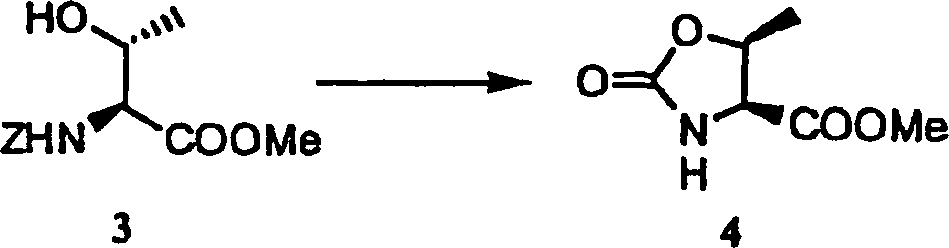
Eine
Lösung
einer Verbindung (3) (3,0 g) und Thionylchlorid (1,47 g) in Toluol
(15 ml) wurde bei 80 °C für 8 Stunden
gerührt
und anschließend
auf Raumtemperatur abgekühlt.
Die Reaktionsmischung wurde mit Wasser extrahiert (9 ml). Die wässrige Phase
wurde mit Toluol(1,5 ml) gewaschen. Jede Toluolphase wurde mit Wasser
(3 ml) und Wasser (1,5 ml) extrahiert. Die wässrigen Phasen wurden vereinigt.
Die resultierende wässrige
Phase wurde kondensiert, wobei 1,48 g Verbindung (4) als Öl (Ausbeute
83 %) erhalten wurden.
1H NMR (CD3OD) δ 1.31(d,
J=6.48, 3H), 3.79(s, 3H), 4.46(d, J=8.52, 1H), 4.96(dq, J=6.48,
J=8.52, 1H)A solution of a compound (3) (3.0 g) and thionyl chloride (1.47 g) in toluene (15 ml) was stirred at 80 ° C for 8 hours and then cooled to room temperature. The reaction mixture was extracted with water (9 ml). The aqueous phase was washed with toluene (1.5 ml). Each toluene phase was extracted with water (3 ml) and water (1.5 ml). The aqueous phases were combined. The resulting aqueous phase was condensed to give 1.48 g of Compound (4) as an oil (yield 83%).
1 H NMR (CD 3 OD) δ 1.31 (d, J = 6.48, 3H), 3.79 (s, 3H), 4.46 (d, J = 8.52, 1H), 4.96 (dq, J = 6.48, J = 8.52, 1H)
Beispiel
4 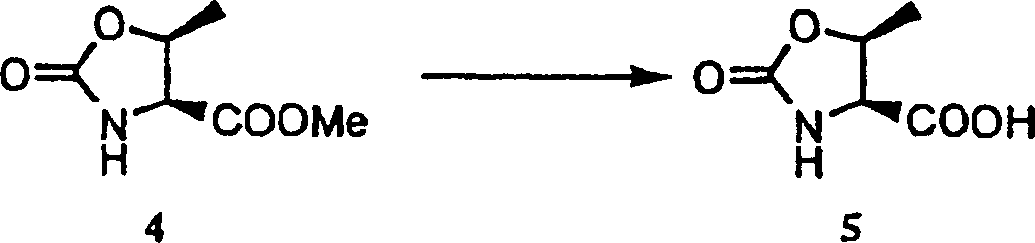
Methanol (5 ml) wurde zu Verbindung (4) (1,0 g) gegeben und in Eis gekühlt. 20 % wässrige Natriumhydroxidlösung (2,5 g) wurden zur Lösung gegeben, die wiederum in einem Eisbad für 30 Minuten gerührt wurde. 98 % Schwefelsäure (0,62 g) wurden zur Lösung gegeben. Danach wurden präzipitierte Kristalle herausfiltriert, und das Filtrat wurde kon densiert. Zugabe von Acetonitril (5 ml) zum Rückstand und Kondensation wurden viermal wiederholt. Acetonitril (8 ml) wurden zum resultierenden Rückstand gegeben. Die Lösung wurde über wasserfreiem Natriumsulfat (2,2 g) getrocknet. Das Natriumsulfat wurde abfiltriert, und das Filtrat wurde kondensiert. Die resultierende Suspension wurde in einem Eisbad für 30 Minuten gerührt. Anschließend wurden Kristalle durch Filtration gesammelt und getrocknet, somit wurden 0,5 g Verbindung (5) (Ausbeute 55 %) erhalten.methanol (5 ml) was added to compound (4) (1.0 g) and cooled in ice. 20 % aqueous sodium hydroxide (2.5 g) became the solution which in turn was stirred in an ice bath for 30 minutes. 98% sulfuric acid (0.62 g) became the solution given. After that were precipitated Crystals filtered out, and the filtrate was condensed. encore of acetonitrile (5 ml) to the residue and condensation were repeated four times. Acetonitrile (8 ml) to the resulting residue given. The solution was over anhydrous sodium sulfate (2.2 g). The sodium sulfate was filtered off and the filtrate was condensed. The resulting Suspension was stirred in an ice bath for 30 minutes. Subsequently were Crystals were collected by filtration and dried, thus were 0.5 g of compound (5) (yield 55%).
Beispiel
5 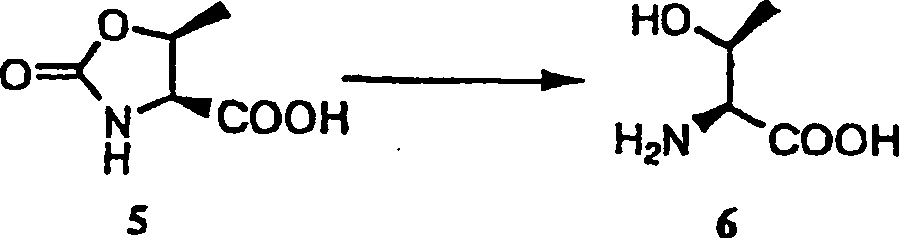
36
% Salzsäure
(10,5 g) wurden zu Verbindung (5) (3,00 g) gegeben. Die Lösung wurde
unter Rühren für 15 Stunden
refluxiert. Anschließend
wurde Wasser verdampft und Wasser (10 ml) wurde zum Rückstand gegeben,
der anschließend
kondensierte. Das verbleibende Ölmaterial
wurde in Wasser (10 ml) aufgelöst. Wässrige Lithiumhydroxidlösung wurde
zur Lösung
gegeben, um diese auf pH 6 einzustellen, gefolgt von Wasserverdampfung.
Methanol (8 ml) wurden zum resultierenden Feststoff gegeben, gefolgt
von Rühren
bei Raumtemperatur für
eine Stunde, danach Filtration und Trocknen. So wurden 2,25 g Verbindung
(6) (L-Allo-Threonin) erhalten (Ausbeute 91 %).
1H
NMR (D2O) 6 1.20 (d, J=6.30, 3H), 3.83 (d,
J=3.90, 1H), 4.36 (dq, J=3.90, J=6.60, 1H)
[α] D 20 +9.07° (C=2.0,
H2O)36% hydrochloric acid (10.5 g) was added to compound (5) (3.00 g). The solution was refluxed with stirring for 15 hours. Then, water was evaporated and water (10 ml) was added to the residue, which was then condensed. The remaining oil material was dissolved in water (10 ml). Aqueous lithium hydroxide solution was added to the solution to adjust to pH 6, followed by water evaporation. Methanol (8 ml) was added to the resulting solid, followed by stirring Room temperature for one hour, then filtration and drying. Thus, 2.25 g of compound (6) (L-allo-threonine) was obtained (yield 91%).
1 H NMR (D 2 O) 6 1.20 (d, J = 6.30, 3H), 3.83 (d, J = 3.90, 1H), 4.36 (dq, J = 3.90, J = 6.60, 1H)
[α] D 20 + 9.07 ° (C = 2.0, H 2 O)
INDUSTRIELLE ANWENDBARKEITINDUSTRIAL APPLICABILITY
Gemäß dem Herstellungsverfahren der vorliegenden Erfindung können Oxo-oxazolinderivate und Allo-aminosäurederivate in einer stereoselektiven und billigen Weise hergestellt werden.According to the manufacturing process of the present invention Oxo-oxazoline derivatives and allo-amino acid derivatives in a stereoselective and cheap way.
Claims (10)
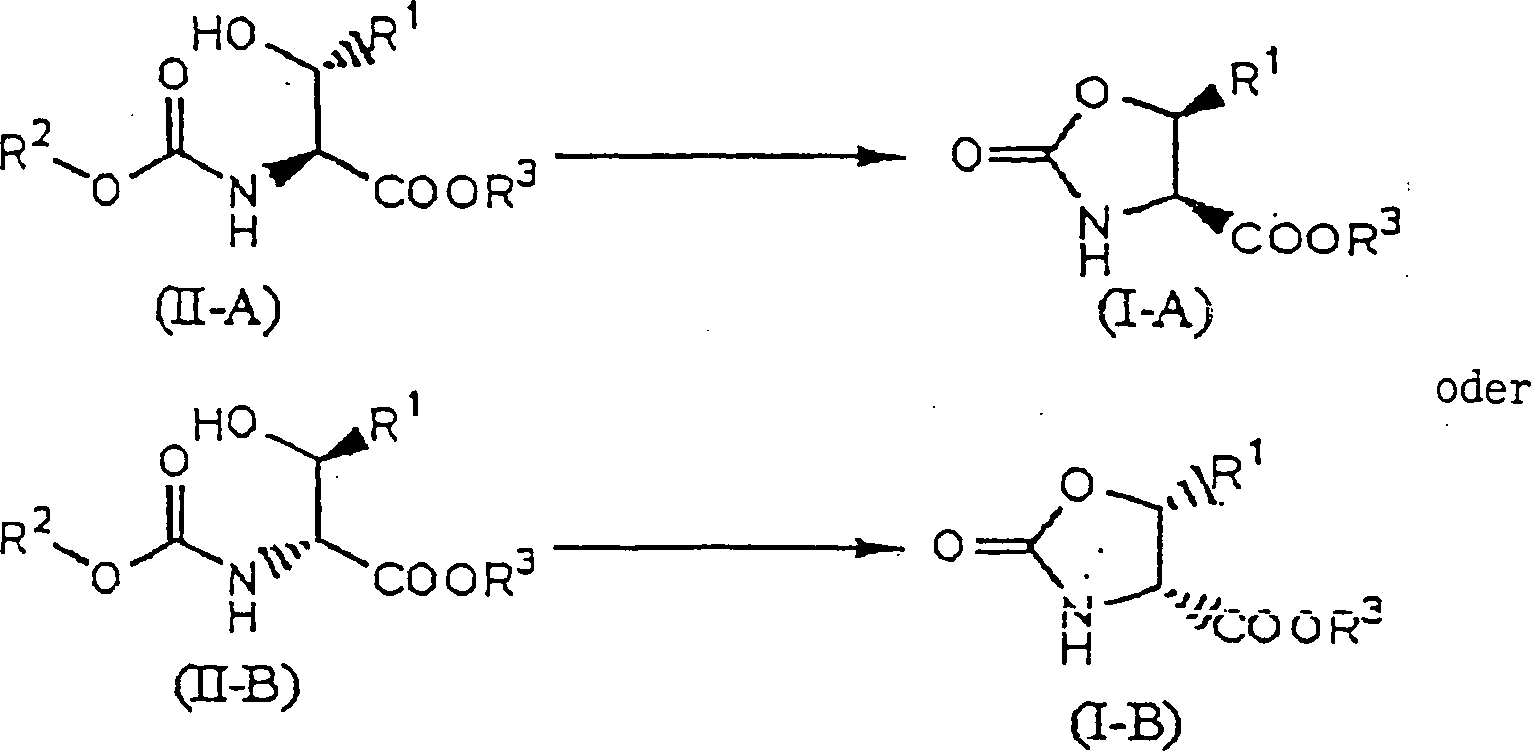
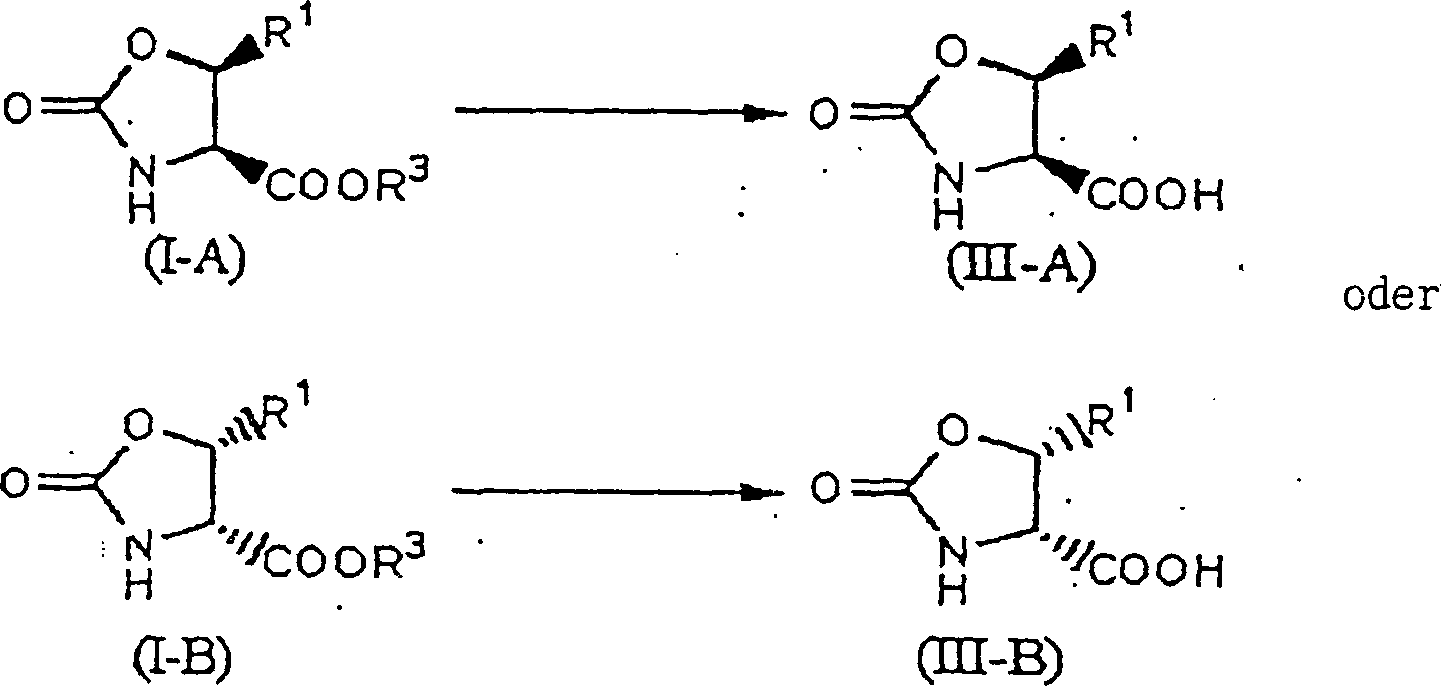
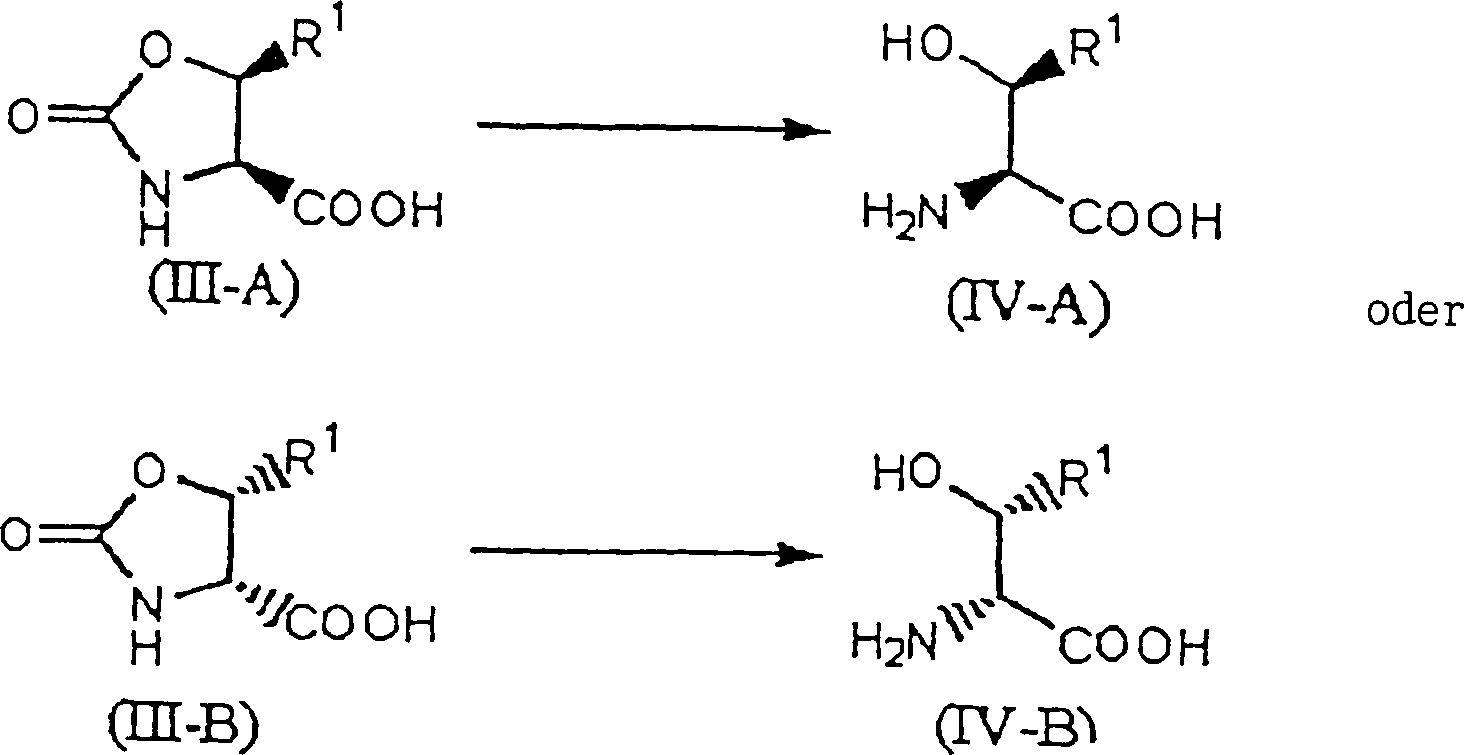
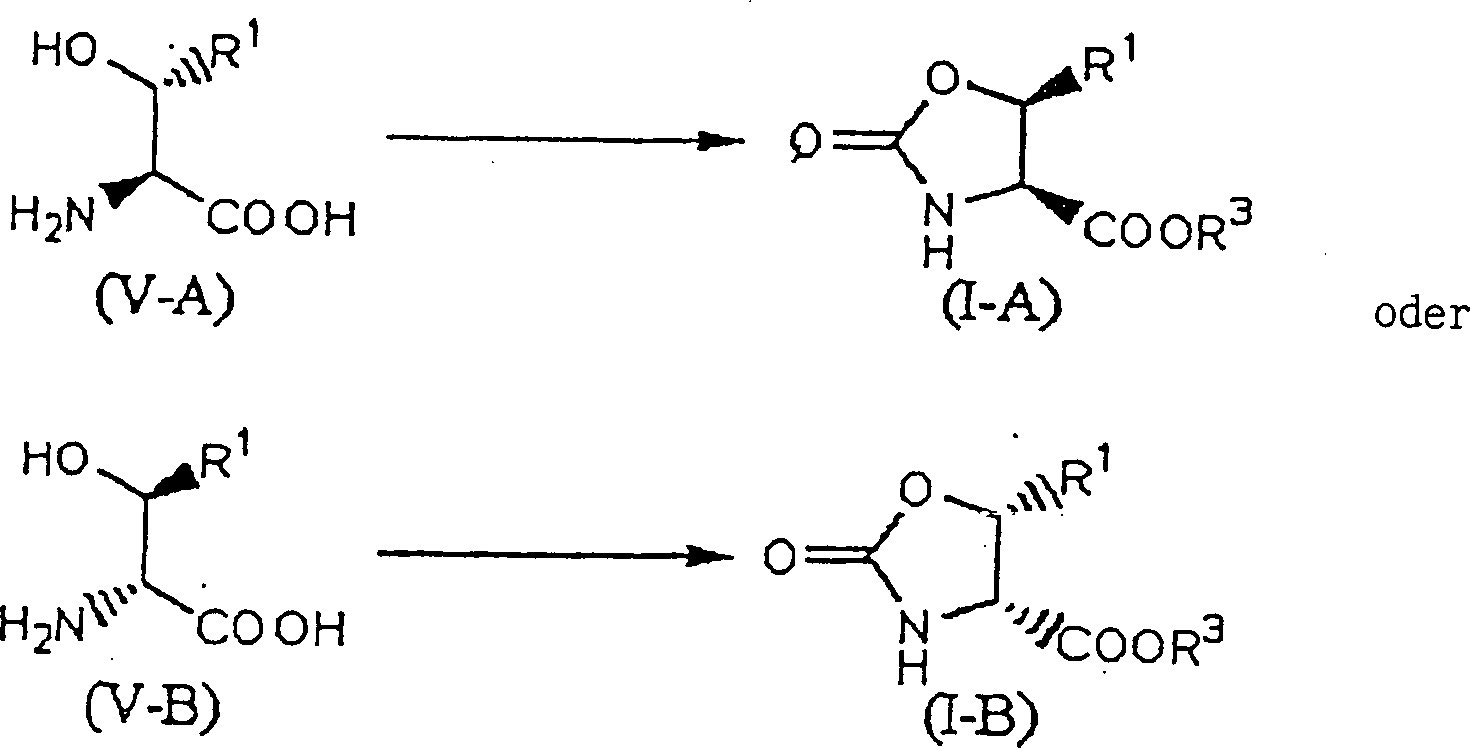

Applications Claiming Priority (3)
| Application Number | Priority Date | Filing Date | Title |
|---|---|---|---|
| JP24264799 | 1999-08-30 | ||
| JP24264799 | 1999-08-30 | ||
| PCT/JP2000/005753 WO2001016117A1 (en) | 1999-08-30 | 2000-08-25 | Processes for the preparation of oxo-oxazoline or alloamino acid derivatives |
Publications (2)
| Publication Number | Publication Date |
|---|---|
| DE60014939D1 DE60014939D1 (en) | 2004-11-18 |
| DE60014939T2 true DE60014939T2 (en) | 2006-03-09 |
Family
ID=17092165
Family Applications (1)
| Application Number | Title | Priority Date | Filing Date |
|---|---|---|---|
| DE60014939T Expired - Lifetime DE60014939T2 (en) | 1999-08-30 | 2000-08-25 | PROCESS FOR THE PREPARATION OF OXO-OXAZOLINE OR ALLOAMINO ACIDS |
Country Status (12)
| Country | Link |
|---|---|
| US (4) | US6541641B1 (en) |
| EP (1) | EP1213284B1 (en) |
| JP (1) | JP4646175B2 (en) |
| KR (1) | KR100676095B1 (en) |
| CN (2) | CN1138766C (en) |
| AT (1) | ATE279436T1 (en) |
| AU (1) | AU780621B2 (en) |
| CA (1) | CA2383300C (en) |
| DE (1) | DE60014939T2 (en) |
| ES (1) | ES2233425T3 (en) |
| TW (1) | TW593289B (en) |
| WO (1) | WO2001016117A1 (en) |
Families Citing this family (3)
| Publication number | Priority date | Publication date | Assignee | Title |
|---|---|---|---|---|
| WO2006096994A1 (en) * | 2005-03-16 | 2006-09-21 | The University Of Manitoba | Fluorous oxazolidinone chiral auxiliary compounds and methods of manufacture |
| JP5188389B2 (en) * | 2005-05-05 | 2013-04-24 | ボストン サイエンティフィック リミテッド | Pre-shaped localization catheter and system for reconstructing the pulmonary vein port as an image |
| CN104327007B (en) * | 2014-10-20 | 2016-07-27 | 安徽师范大学 | 3,4,5-tri-substituted (oxazolidinon-5-yl-methyl)-2-thiophene-carboxamides compound and preparation method thereof |
Family Cites Families (4)
| Publication number | Priority date | Publication date | Assignee | Title |
|---|---|---|---|---|
| JPS6034955A (en) | 1983-08-05 | 1985-02-22 | Showa Denko Kk | Production of 2-oxooxazolidine-4-carboxylic acids |
| DE69735543T2 (en) * | 1996-08-28 | 2007-03-08 | Shionogi & Co., Ltd. | Novel peptide derivatives with thiazole-alanine residues |
| US6319902B1 (en) * | 1997-08-22 | 2001-11-20 | Shionogi & Co., Ltd. | Peptide derivatives having thiazolyl-alanine residue |
| JP3811885B2 (en) * | 1998-03-02 | 2006-08-23 | 塩野義製薬株式会社 | Method for producing 4-thiazolylmethyl derivative |
-
2000
- 2000-08-25 DE DE60014939T patent/DE60014939T2/en not_active Expired - Lifetime
- 2000-08-25 CN CNB008150842A patent/CN1138766C/en not_active Expired - Fee Related
- 2000-08-25 WO PCT/JP2000/005753 patent/WO2001016117A1/en not_active Ceased
- 2000-08-25 CA CA2383300A patent/CA2383300C/en not_active Expired - Fee Related
- 2000-08-25 JP JP2001519685A patent/JP4646175B2/en not_active Expired - Fee Related
- 2000-08-25 EP EP00955029A patent/EP1213284B1/en not_active Expired - Lifetime
- 2000-08-25 US US10/070,974 patent/US6541641B1/en not_active Expired - Fee Related
- 2000-08-25 AU AU67310/00A patent/AU780621B2/en not_active Ceased
- 2000-08-25 KR KR1020027002691A patent/KR100676095B1/en not_active Expired - Fee Related
- 2000-08-25 ES ES00955029T patent/ES2233425T3/en not_active Expired - Lifetime
- 2000-08-25 AT AT00955029T patent/ATE279436T1/en not_active IP Right Cessation
- 2000-08-25 CN CNB03152639XA patent/CN1250532C/en not_active Expired - Fee Related
- 2000-08-28 TW TW089117369A patent/TW593289B/en not_active IP Right Cessation
-
2002
- 2002-08-27 US US10/229,819 patent/US6747157B2/en not_active Expired - Fee Related
-
2003
- 2003-11-25 US US10/723,679 patent/US6875874B2/en not_active Expired - Fee Related
- 2003-11-25 US US10/723,136 patent/US7189857B2/en not_active Expired - Fee Related
Also Published As
| Publication number | Publication date |
|---|---|
| WO2001016117A1 (en) | 2001-03-08 |
| ES2233425T3 (en) | 2005-06-16 |
| AU6731000A (en) | 2001-03-26 |
| US20040077876A1 (en) | 2004-04-22 |
| CN1483728A (en) | 2004-03-24 |
| EP1213284A4 (en) | 2002-11-20 |
| CA2383300A1 (en) | 2001-03-08 |
| CA2383300C (en) | 2012-01-24 |
| US6541641B1 (en) | 2003-04-01 |
| US6875874B2 (en) | 2005-04-05 |
| DE60014939D1 (en) | 2004-11-18 |
| US20030055264A1 (en) | 2003-03-20 |
| US6747157B2 (en) | 2004-06-08 |
| CN1250532C (en) | 2006-04-12 |
| EP1213284B1 (en) | 2004-10-13 |
| AU780621B2 (en) | 2005-04-07 |
| KR20020023431A (en) | 2002-03-28 |
| CN1138766C (en) | 2004-02-18 |
| KR100676095B1 (en) | 2007-01-31 |
| CN1384823A (en) | 2002-12-11 |
| JP4646175B2 (en) | 2011-03-09 |
| EP1213284A1 (en) | 2002-06-12 |
| US20040106820A1 (en) | 2004-06-03 |
| TW593289B (en) | 2004-06-21 |
| US7189857B2 (en) | 2007-03-13 |
| ATE279436T1 (en) | 2004-10-15 |
Similar Documents
| Publication | Publication Date | Title |
|---|---|---|
| JPS58150547A (en) | Amino acid derivative and application to medical treatment | |
| JPH0363556B2 (en) | ||
| FR2460291A1 (en) | NOVEL TRIPEPTIDES ACTING ON THE CENTRAL NERVOUS SYSTEM AND THEIR PREPARATION PROCESS | |
| Bishop et al. | Diastereoselective synthesis of phycocyanobilin-cysteine adducts | |
| DE1445450A1 (en) | Process for the production of peptides | |
| CH635571A5 (en) | TETRAPEPTIDES AND THERAPEUTIC COMPOSITION CONTAINING THEM. | |
| DE60014939T2 (en) | PROCESS FOR THE PREPARATION OF OXO-OXAZOLINE OR ALLOAMINO ACIDS | |
| FR2460292A1 (en) | NOVEL ACTIVE TRIPEPTIDAMIDES ON THE CENTRAL NERVOUS SYSTEM AND PROCESS FOR PREPARING THE SAME | |
| EP0228625B1 (en) | Peptide derivatives inhibitors of hydroxyling enzymes, their process of preparation, the agents thereof and their use | |
| JPWO2001016117A1 (en) | Methods for producing oxoxazoline and alloamino acid derivatives | |
| CA1125743A (en) | Process for the preparation of amino-3-cardenolide derivatives and pharmaceutical products thereof | |
| CH497384A (en) | Decapeptide | |
| DE2443109A1 (en) | BREAKDOWN OF ALKYLESTERS OF DL-PHENYLALANINE | |
| AT394726B (en) | METHOD FOR PRODUCING L-ALANYL-L-PROLIN DERIVATIVES | |
| DE1793789A1 (en) | PROCESS FOR THE PREPARATION OF PEPTIDES CONTAINING A CYSTEIN RESIDUE | |
| DE2813287A1 (en) | PROCESS FOR THE MANUFACTURING OF 2-BENZOYL-3,3-DIMETHYL-7-OXO-ALPHA- (4-BENZYLOXYPHENYL) -4-THIA-2,6-DIAZABICYCLO-SQUARE CLAMP ON 3.2.0 SQUARE CLAMP FOR HEPTANE-6-VACUINE ACID BENZYLE | |
| DE1114200B (en) | Process for the preparation of N-acyl peptides from activated esters of N-acyl amino acids and free amino acids | |
| JPH0259545A (en) | 3-amino-2-hydroxy-1-nitrobutane derivative and production of alpha-hydroxy-beta-amino acid | |
| DE1793827A1 (en) | NEW AMINO PROTECTIVE GROUPS, THEIR USE IN PEPTIDE SYNTHESIS AND PROCESS FOR THE PRODUCTION OF THE CORRESPONDINGLY PROTECTED AMINO ACIDS AND PEPTIDES | |
| DD284028A5 (en) | Process for the preparation of L-alanyl-L-proline derivatives | |
| JPS5842863B2 (en) | S,S'-biscyclotetrapeptide and method for producing the same | |
| JPH07304746A (en) | New benzoazepinecarboxylic acid derivative | |
| BE859026A (en) | ANALGESIC COMPOUNDS | |
| DE1013656B (en) | Process for the production of peptides |
Legal Events
| Date | Code | Title | Description |
|---|---|---|---|
| 8364 | No opposition during term of opposition |