DE19957594B4 - Method for synchronizing threads of a computer program - Google Patents
Method for synchronizing threads of a computer program Download PDFInfo
- Publication number
- DE19957594B4 DE19957594B4 DE19957594A DE19957594A DE19957594B4 DE 19957594 B4 DE19957594 B4 DE 19957594B4 DE 19957594 A DE19957594 A DE 19957594A DE 19957594 A DE19957594 A DE 19957594A DE 19957594 B4 DE19957594 B4 DE 19957594B4
- Authority
- DE
- Germany
- Prior art keywords
- buffer
- data
- read
- section
- threads
- Prior art date
- Legal status (The legal status is an assumption and is not a legal conclusion. Google has not performed a legal analysis and makes no representation as to the accuracy of the status listed.)
- Expired - Fee Related
Links
Classifications
-
- G—PHYSICS
- G06—COMPUTING OR CALCULATING; COUNTING
- G06F—ELECTRIC DIGITAL DATA PROCESSING
- G06F8/00—Arrangements for software engineering
- G06F8/40—Transformation of program code
- G06F8/41—Compilation
- G06F8/45—Exploiting coarse grain parallelism in compilation, i.e. parallelism between groups of instructions
- G06F8/458—Synchronisation, e.g. post-wait, barriers, locks
Landscapes
- Engineering & Computer Science (AREA)
- General Engineering & Computer Science (AREA)
- Theoretical Computer Science (AREA)
- Software Systems (AREA)
- Physics & Mathematics (AREA)
- General Physics & Mathematics (AREA)
- Multi Processors (AREA)
- Information Retrieval, Db Structures And Fs Structures Therefor (AREA)
- Memory System Of A Hierarchy Structure (AREA)
Abstract
Verfahren zum Synchronisieren von threads (PO, P1, P3) eines Computerprogramms (Co-Pr), wobei
(a) in dem in threads aufgeteilten Computerprogramm (Co-Pr) Erzeuger-threads (P1, P2), die Daten für einen anderen thread erzeugen, diese Daten jeweils in Pufferabschnitte (PA1 – PA6) flexibler Größe eines Puffers (Pu) schreiben, wobei der letzte physikalische Pufferabschnitt (PA6) nicht beschrieben wird und nach dem Beschreiben des vorletzten Pufferabschnitts (PA5) wieder am Anfang des physikalischen Puffers mit dem Schreiben begonnen wird und wobei Lese-threads (P2, P3) die erzeugten Daten aus dem Puffer (Pu) auslesen,
(b) zum Freigeben und Sperren der Schreibvorgänge und der Lesevorgänge Puffer-Dienstprogramme (S5, S7, S14) verwendet werden,
(c) während dem Zugriff eines ersten Puffer-Dienstprogrammes auf den Puffer (Pu) ein gleichzeitiger Zugriff auf den Puffer (Pu) für ein zweites Puffer-Dienstprogramm verhindert wird,
(d) die Pufferabschnitte (PA1 – PA6) von den Puffer-Dienstprogrammen (S5, S7, S14) mit jeweils einem Flag versehen werden, durch das ein...Method for synchronizing threads (PO, P1, P3) of a computer program (Co-Pr), whereby
(a) in the computer program (Co-Pr) divided into threads, producer threads (P1, P2), which generate data for another thread, each write this data into buffer sections (PA1 - PA6) of flexible size of a buffer (Pu), wherein the last physical buffer section (PA6) is not written and after writing to the penultimate buffer section (PA5) writing is started again at the beginning of the physical buffer and read threads (P2, P3) the data generated from the buffer (Pu ) read out,
(b) buffer utilities (S5, S7, S14) are used to enable and disable the writes and reads,
(c) simultaneous access to the buffer (Pu) for a second buffer utility is prevented while a first buffer utility program is accessing the buffer (Pu),
(d) the buffer sections (PA1 - PA6) are each provided with a flag by the buffer utilities (S5, S7, S14), by which a ...
Description
Die Erfindung betrifft ein Verfahren zum Synchronisieren von threads eines Computerprogramms, dessen threads parallel auf unterschiedlichen Prozessoren eines Computers ablaufen können.The invention relates to a method for synchronizing threads of a computer program whose threads in parallel on different processors of a computer can expire.
In „Win 32 Multithreaded Programming, Aaron Cohen und Mike Woodring, O'Reilly & Associates Inc., ISBN 1-56592-296-4" ist insbesondere auf den Seiten 258 bis 269 und 301 bis 303 die Programmierung und Synchronisierung von threads erläutert.In "Win 32 Multithreaded Programming, Aaron Cohen and Mike Woodring, O'Reilly & Associates Inc., ISBN 1-56592-296-4 "is programming on pages 258 to 269 and 301 to 303 in particular and thread synchronization explained.
Threads, die Daten für einen anderen thread erzeugen, werden als Erzeuger oder Schreiber und threads, die derartige Daten verarbeiten, als Verbraucher oder Leser bezeichnet. Um beim Aufteilen der Arbeit zwischen den einzelnen threads die Rechenleistung eines Computers mit mehreren Prozessoren optimal auszunutzen ist es notwendig, dass die einzelnen threads asynchron betrieben werden. Dies bedeutet, dass der Erzeuger-thread soviel Daten erzeugen kann, wie er wünscht, und der Lese-thread soviel Daten lesen kann, wie zur Verfügung stehen, ohne dass hierbei Rücksicht auf den anderen thread genommen werden muss. Die Daten eines Erzeuger-threads werden von diesen in Pakete (Messages) gepackt und in eine Reihe (Queue) eingereiht, aus der der Lese-thread die Pakete aufnehmen und weiterverarbeiten kann.Threads that data for one other threads are created or written and threads, who process such data, referred to as consumers or readers. To help split the work between threads Computing power of a computer with multiple processors optimal To exploit it is necessary that the individual threads are asynchronous operate. This means that the producer thread has so much Can generate data as he wishes and the read thread can read as much data as is available without it that respect here must be taken on the other thread. The data of a producer thread are packed into packages (messages) and in a row (Queue) from which the read thread takes the packages and can process it further.
Die einzelnen threads sind mit Funktionen versehen, die warten, bis sie ein entsprechendes Paket in einer Reihe ablegen können, oder bis ein entsprechendes Paket zum Lesen angekommen ist, damit immer die korrekte Zuordnung der Daten zu den sie verarbei tenden Funktionen sichergestellt ist. Hierdurch wird der Transport der Daten synchronisiert.The individual threads are provided with functions, who wait until they drop a corresponding package in a row can, or until a corresponding package for reading has arrived with it always the correct assignment of the data to which they are processed Functions is ensured. This will transport the Data synchronized.
Die Synchronisation des Datentransfers zwischen einzelnen threads kann intern oder extern ausgeführt werden. Unter einer internen Synchronisation versteht man eine Synchronisation, bei der die einzelnen Synchronisationsvorgänge von den threads ausgeführt werden, wohingegen eine externe Synchronisation mittels außerhalb der threads gebildeter Programme ausgeführt wird. Eine externe Synchronisation wird vorzugsweise für Datenstrukturen verwendet, welche von mehreren threads gleichzeitig benutzt werden. Für den Datentransfer zwischen einzelnen threads ist es üblich, diese intern zu synchronisieren. Es wird davon ausgegangen, dass hier eine interne Synchronisation einfacher zu realisieren ist und die entsprechenden Programme kürzer sind.The synchronization of data transfer between individual threads can be executed internally or externally. An internal synchronization is a synchronization, where the individual synchronization processes are carried out by the threads, whereas an external synchronization by means of outside the threads of formed programs is executed. An external synchronization is preferred for Data structures used, which are used by several threads at the same time become. For The data transfer between individual threads is common to this sync internally. It is assumed that here internal synchronization is easier to implement and the corresponding programs shorter are.
Ein Ziel derartiger Synchronisationsmechanismen ist es, dass sie möglichst vielfältig eingesetzt werden können, das heißt, dass sie von unterschiedlichsten threads verwendet werden können. Die oben erläuterten Reihen (Queues) sind ein Beispiel für sehr vielfältig einsetzbare Kommunikationsmechanismen. Sie erzeugen jedoch einen erheblichen Verwaltungsaufwand, da die Daten in entsprechende Pakete gepackt, diese Pakete mit entsprechenden Informationen versehen, von den Erzeuger-threads entsprechend versandt, von der Queue aufgenommen und vom Lesethread wieder aufgenommen, ausgelesen und zusammengesetzt werden müssen. Diese allgemeine Einsatzfähigkeit der Reihen wird durch einen hohen Verwaltungsaufwand erkauft.A goal of such synchronization mechanisms it is that they are as possible diverse can be used this means, that they can be used by different threads. The explained above Rows (queues) are an example of very versatile uses Communication mechanisms. However, they produce a substantial one Administrative effort, since the data is packed in appropriate packages, provide these packages with appropriate information from the Producer threads sent accordingly, picked up by the queue and resumed, read and assembled by the reading thread Need to become. This general usability the series is bought through a high administrative effort.
Am schnellsten laufen threads auf unterschiedlichen Prozessoren ab, wenn sie mit einem asynchronen Datentransfer programmiert sind. Bei einem derartigen asynchronen Datentransfer kann z.B. ein thread eine Anfrage nach Daten ausgeben und während er auf den Empfang der Daten wartet, bereits eine andere Verarbeitung von Daten aufnehmen. Ein derart asynchroner Datentransfer ist hoch effizient, aber sehr schwer zu programmieren.The fastest way to run threads different processors when using an asynchronous Data transfer are programmed. With such an asynchronous Data transfer can e.g. a thread issue a request for data and while he is waiting for the receipt of the data, another processing of data. Such an asynchronous data transfer is highly efficient, but very difficult to program.
Ein Problem dieser auf mehrere threads verteilten Computerprogramme ist, dass ein Test, bei welchem die threads auf mehreren Prozessoren gleichzeitig laufen, schwer durchführbar ist, da je nachdem, wie sich die Verarbeitungsvorgänge der einzelnen threads zeitlich überlappen unterschiedliche Fehler einstellen können. Hierdurch kann es sein, dass ein Computerprogramm tausende Male richtig funktioniert und dann wieder ein nicht ohne weiteres vorhersehbarer Fehler auftritt. Für einen zuverlässigen Praxistest ist es deshalb notwendige Voraussetzung, derartige Synchronisationsverfahren mit einem Multi-CPU-Computer zu testen. Das sind Computer, die mehrere Prozessoren aufweisen, die gleichzeitig unterschiedliche threads abarbeiten können.A problem of this on multiple threads distributed computer programs is a test in which the threads run on several processors at the same time, is difficult to carry out, since depending on how the processing processes of the individual threads overlap in time can set different errors. This can mean that a computer program works properly thousands of times and then an error that cannot be readily predicted occurs again. For one reliable In practice, it is therefore a necessary prerequisite to use such synchronization methods to test a multi-CPU computer. These are computers, several Processors that have different threads at the same time can work through.
Ein Verfahren zum Synchronisieren von threads muß deshalb nicht nur einen effizienten Datentransfer und vielseitig einsetzbar sein, sondern möglichst einfach ausgebildet sein, damit kein. unverhältnismäßig großer Einsatz beim Testen des Computerprogramms notwendig ist.A method of synchronizing of threads must therefore not just efficient data transfer and versatile be, but if possible just be trained so no. disproportionate use in testing the computer program necessary is.
Der Erfindung liegt deshalb die Aufgabe zugrunde, ein Verfahren zum Synchronisieren von threads eines Computerprogrammes zu schaffen, das vielfältig einsetzbar ist, einen sehr effizienten Datentransfer zwischen den threads erlaubt und zudem einfach ausgebildet ist.The object of the invention is therefore based on a method for synchronizing threads of a computer program to create that diverse is a very efficient data transfer between the threads allowed and is also simple.
Die Aufgabe wird durch ein Verfahren mit den Merkmalen des Anspruchs 1 gelöst. Vorteilhafte Ausgestaltungen der Erfindung sind in den Unteransprüchen angegeben.The task is accomplished through a process solved with the features of claim 1. Advantageous configurations the invention are specified in the subclaims.
In dem erfindungsgemäßen Verfahren werden threads eines Computerprogramms synchronisiert. Das Computerprogramm ist derart aufgebaut, daß die threads parallel auf unterschiedlichen Prozessoren eines Computers ablaufen können. Erzeuger-threads, die Daten für einen anderen thread erzeugen, schreiben diese jeweils in Pufferabschnitte flexibler Größe eines Puffers, wobei der letzte physikalische Pufferabschnitt nicht beschrieben wird und nach dem Beschreiben des vorletzten Pufferabschnitts wieder am Anfang des physikalischen Puffers mit dem Schreiben begonnen wird. Lese-threads, die Daten von einem anderen thread lesen, lesen die Daten aus dem Puffer aus. Zum Freigeben und Sperren der Schreibvorgänge und der Lesevorgänge werden Puffer-Dienstprogramme verwendet, wobei während dem Zugriff eines ersten Puffer-Dienstprogrammes auf den Puffer ein gleichzeitiger Zugriff auf den Puffer für ein zweites Puffer-Dienstprogramm verhindert wird. Die Pufferabschnitte des Puffers werden von den Puffer-Dienstprogrammen mit jeweils einem Flag versehen, durch das ein durchgehender, mit Daten belegbarer Speicherbereich erzeugt wird und mit dem jeweils Schreib- und Lesevorgänge der entsprechenden Pufferabschnitte steuerbar sind. Zusammen mit dem Flag wird eine Angabe über die Größe des jeweiligen Pufferabschnitts abgespeichert, so dass die einzelnen Pufferabschnitte unterschiedlich groß sein können. Beim Auslesen der Pufferabschnitte wird beim Erreichen des Endes des letzten beschriebenen Pufferabschnitts geprüft, ob am Anfang des Pufferspeichers gültige Daten stehen und gegebenenfalls diese Daten in den letzten physikalischen Pufferabschnitt derart kopiert werden, dass eine durchgehende Datenmenge gele sen werden kann. Das einem Pufferabschnitt zugeordnete Flag kann drei Zustände einnehmen, die anzeigen, ob Daten in den Pufferabschnitt geschrieben werden können, Daten aus dem Pufferabschnitt gelesen werden können oder die in den Pufferabschnitt geschriebenen Daten noch nicht zum Lesen freigegeben sind.In the method according to the invention, threads of a computer program are synchronized. The computer program is constructed in such a way that the threads can run in parallel on different processors of a computer. Creator threads that create data for another thread write them in buffer sections Flexible size of a buffer, whereby the last physical buffer section is not written and after writing the penultimate buffer section writing is started again at the beginning of the physical buffer. Read threads that read data from another thread read the data from the buffer. Buffer utilities are used to enable and disable the write operations and the read operations, with simultaneous access to the buffer for a second buffer utility program being prevented while a buffer utility program is accessing the buffer. The buffer sections of the buffer are each provided with a flag by the buffer utility programs, by means of which a continuous memory area which can be occupied by data is generated and with which the respective writing and reading processes of the corresponding buffer sections can be controlled. An indication of the size of the respective buffer section is stored together with the flag, so that the individual buffer sections can be of different sizes. When the buffer sections are read out, when the end of the last buffer section described is reached, a check is carried out to determine whether there is valid data at the beginning of the buffer memory and, if appropriate, this data is copied into the last physical buffer section in such a way that a continuous amount of data can be read. The flag assigned to a buffer section can assume three states, which indicate whether data can be written to the buffer section, data can be read from the buffer section or the data written to the buffer section has not yet been released for reading.
Das erfindungsgemäße Verfahren zum Synchronisieren von threads sieht somit einen Puffer vor, bei dem das Lesen und Schreiben mittels Flags gesteuert wird. Die erfindungsgemäße Programmstruktur ist sehr einfach ausgebildet, weshalb es auch auf Computern mit mehreren Prozessoren mit einem relativ geringen Aufwand getestet werden kann. Das erfindungsgemäße Verfahren ist sehr effizient, denn die Daten können von einem Erzeuger-thread. direkt in den Puffer geschrieben bzw. von einem Lese-thread direkt aus diesem gelesen werden. Eine Vor- bzw. Nachverarbeitung der geschriebenen bzw. gelesenen Daten ist nicht notwendig. Das erfindungsgemäße Verfahren ist zudem sehr effizient, da nur ein geringer Verwaltungsaufwand mit dem Setzen bzw. Löschen des Flags anfällt, so daß die Prozessorleistung eines Computers auf die wesentlichen Arbeiten des Datentransfers bzw. der Ausführung der threads konzentriert wird.The synchronization method according to the invention threads therefore provides a buffer in which reading and Writing is controlled by means of flags. The program structure according to the invention is very simple, which is why it is also used on computers tested multiple processors with relatively little effort can be. The method according to the invention is very efficient because the data can be from a producer thread. written directly into the buffer or directly from a read thread can be read from this. A preprocessing or postprocessing of the written or read data is not necessary. The method according to the invention is also very efficient because it requires little administrative effort with setting or deleting of the flag So that the Processor performance of a computer on the essential work of data transfer or execution the threads are concentrated.
Nach einer bevorzugten Ausführungsform der Erfindung sind die einzelnen Pufferabschnitte im Speicherbereich des Computers unmittelbar hintereinander liegend angeordnet und zu den jeweili gen Pufferabschnitten sind zugeordnete Verwaltungsdaten, wie z.B. das Flag, die Größe des Pufferabschnittes oder der Datentyp in einem davon unabhängigen Speicherbereich gespeichert. Hierdurch wird ein durchgehender mit Daten belegter Speicherbereich geschaffen, der schnell und einfach ausgelesen bzw. mit neuen Daten beschrieben werden kann. Zudem erlaubt diese Ausbildung des Puffers, daß dieser mit Blöcken einer bestimmten Größe beschrieben und Blöcken einer anderen Größe gelesen werden kann. Hierdurch kann die Datentransferrate, die durch die Größe der Blöcke beeinflußt wird, an die entsprechenden Anforderungen, die sowohl auf der Seite der Erzeuger-threads als auch auf der Seite der Lese-threads hoch oder niedrig sein kann, entsprechend angepaßt werden.According to a preferred embodiment of the Invention are the individual buffer sections in the memory area of the computer arranged one behind the other and assigned administrative data for the respective buffer sections, such as. the flag, the size of the buffer section or the data type is stored in an independent memory area. This creates a continuous memory area occupied by data, which can be read out quickly and easily or written with new data can be. In addition, this design of the buffer allows this with blocks of a certain size and blocks read another size can be. As a result, the data transfer rate, which is influenced by the size of the blocks, to the corresponding requirements, both on the producer thread side as well as being high or low on the reading thread side adjusted accordingly become.
Die Erfindung wird nachfolgend beispielhaft anhand der beiliegenden Zeichnungen näher erläutert. In den Zeichnungen zeigen:The invention is illustrated below by way of example the accompanying drawings explained. The drawings show:
In
Aus Sicht des threads „Daten
verarbeiten" P2
ist der Puffer PU1 ein Eingabepuffer, der Daten in den thread P2
eingibt, und der Puffer PU2 ein Ausgabepuffer, der Daten des threads
P2 aufnimmt. Mit dem erfindungsgemäßen Verfahren wird der Datentransfer
DT von einem thread zu einem Puffer – z.B. von P1 zu PU1 oder von
P2 zu PU2 – bzw.
von einem Puffer zu einem thread – z.B. von PU1 zu P2 – lediglich
durch eine Kommunikation zwischen dem jeweiligen Puffer und dem
jeweiligen thread gesteuert. Dies ist in
Die Grundprinzipien der erfindungsgemäßen Steuerung
des Datentransfers DT zwischen den threads und den Puffern werden
nachfolgend anhand der
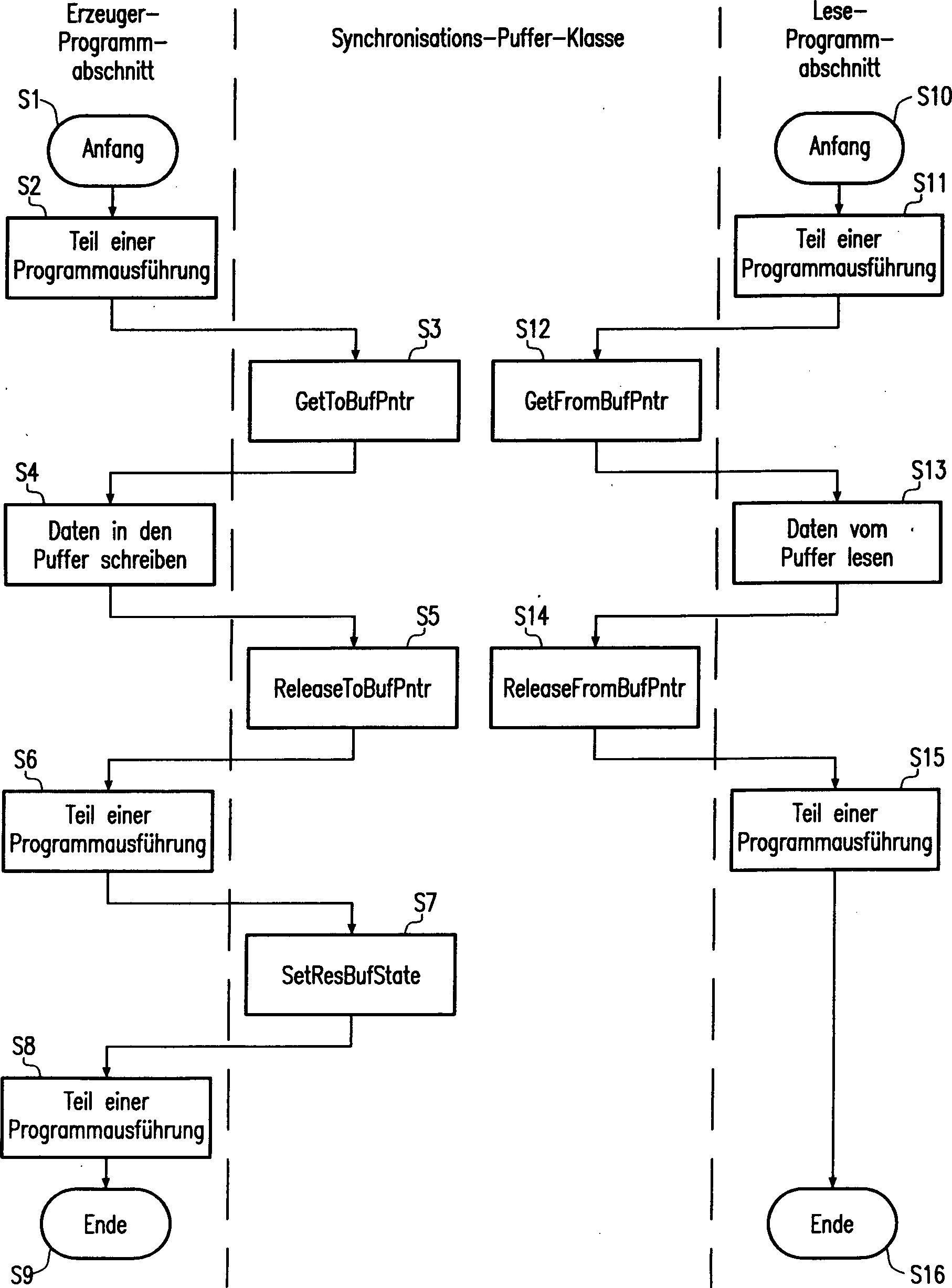
Diese Steuerung bzw. Synchronisation
des Datentransfers DT erfolgt mit einer Synchronisations-Puffer-Klasse.
Der Begriff der „Klasse" ist in der objektorientierten
Programmierung geprägt
worden und bedeutet im Sinne der vorliegenden Patentanmeldung eine
geschlossene Einheit, die in Feldern und Variablen gespeicherte
Daten sowie Programme umfaßt.
Die Synchronisations-Puffer-Klasse
weist einen Speicherbereich, den Puffer, in dem ein oder mehrere
Pufferabschnitte gespeichert sind, einen weiteren Speicherbereich,
das Kontrollfeld, in dem Verwaltungsdaten für den Puffer gespeichert sind, und
Puffer-Dienstprogramme auf. Die Puffer-Dienstprogramme sind Funktionen,
d.h. ausführbare
Programmteile. Beim erfindungsgemäßen Verfahren sind jedem Pufferabschnitt
jeweils eine Gruppe von Verwaltungsdaten zugeordnet, die ein Flag
(
Ist das Flag „ungültig", so bedeutet dies, daß in dem zugehörigen Pufferabschnitt keine zum Lesen durch den Erzeuger-thread vorgesehene Daten enthalten sind. Ist das Flag „gültig" sind Daten in den zugehörigen Pufferabschnitt geschrieben worden, die vom Lese-thread gelesen werden können. Ist das Flag „reserviert", so bedeutet dies, daß der Erzeuger-thread bereits Daten in den zugehörigen Pufferabschnitt geschrieben hat, aber diese Daten noch nicht zum Lesen durch den Lese-thread freigegeben sind. Hierzu muß das Flag auf „gültig" gesetzt werden.If the flag is "invalid", this means that in the associated Buffer section none intended for reading by the producer thread Data are included. If the flag is "valid", data is in the associated buffer section that can be read by the read thread. is the flag "reserved", it means that the The producer thread has already written data to the associated buffer section has, but has not yet read this data through the read thread are released. To do this, the Flag set to "valid".
Die Synchronisations-Puffer-Klasse umfaßt ferner einige Puffer-Dienstprogramme wie z.B. GetToBufPntr, GetFromBufPntr, Release-ToBufPntr und ReleaseFromBufPntr.The synchronization buffer class also includes some buffer utilities such as. GetToBufPntr, GetFromBufPntr, Release-ToBufPntr and ReleaseFromBufPntr.
Mit der Anfangsadresse des zur Verfügung stehenden Speicherbereichs und dem maximal zur Verfügung stehenden Speicherbereich kann der Erzeuger-thread im Schritt S4 Daten direkt in den zur Verfügung stehenden Speicherbereich schreiben.With the starting address of the available Storage area and the maximum available storage area can the producer thread in step S4 data directly in the available Write memory area.
Wenn alle Daten in den Speicherbereich geschrieben sind, stellt dieser Speicherbereich einen Pufferabschnitt dar und wird im Schritt S5 das Puffer-Dienstprogramm ReleaseToBufPntr aufgerufen, mit dem das Flag des geschriebenen Pufferabschnittes entweder auf „gültig" oder auf „reserviert" gesetzt wird, je nachdem, ob die Daten zum Lesen durch den Lese-thread freigegeben sind oder nicht.When all the data has been written into the memory area, this memory area represents a buffer section and the buffer utility program ReleaseToBufPntr is called in step S5, with which the flag of the written buffer section is either set to "valid" or to "reserved" depending on whether the data is released for reading by the reading thread or not.
Mit den Schritten S6 und S8 sind weitere Verarbeitungsvorgänge des Erzeuger-threads symbolisch dargestellt. Mit dem dazwischen liegenden Schritt S7 wird das Puffer-Dienstprogramm SetResBuf-State (<Flagtyp>) aufgerufen, mit dem der im Schritt S5 beschriebene aber noch nicht freigegebene Pufferabschnitt entweder zum Lesen freigegeben wird, in dem das entsprechende Flag von „reserviert" auf „gültig" gesetzt wird, oder für den Lesethread „gelöscht" wird, indem das entsprechende Flag von „reserviert" auf „ungültig" gesetzt wird, wodurch dieser Speicherbereich erneut vom Erzeuger-thread beschrieben werden kann. Mit dem Schritt S9 wird der Programmablauf des Erzeuger-threads beendet.With steps S6 and S8 are further processing operations of the producer thread shown symbolically. With the in between Step S7 calls the buffer utility SetResBuf-State (<flag type>) with which the buffer section described but not yet released in step S5 is either released for reading, in which the corresponding flag is set from "reserved" to "valid", or for the Reading thread is "deleted" by the corresponding flag is set from "reserved" to "invalid", whereby this memory area can be written to again by the producer thread can. With step S9 the program flow of the producer thread completed.
Der Programmablauf des Lese-threads
ist in
Anhand dieses Lese-Zeigers und der Größe des zum Lesen freigegebenen Pufferabschnittes kann der Lese-thread im Schritt S13 die Daten unmittelbar aus dem Puffer auslesen.Based on this read pointer and the Size of the for Read shared buffer section can read thread in step S13 read the data directly from the buffer.
Ist der Lesevorgang abgeschlossen, so ruft der Lese-thread das Puffer-Dienstprogramm ReleaseFromBufPntr S4 auf, mit dem der vom Lese-thread ausgelesene Pufferabschnitt zum erneuten Beschreiben freigegeben wird, das heißt, daß das entsprechende Flag von „gültig" auf „ungültig" gesetzt wird.When the reading process is complete, so the read thread calls the ReleaseFromBufPntr buffer utility S4 with which the buffer section read out by the read thread is released for rewriting, that is, the corresponding Flag is set from "valid" to "invalid".
Der weitere vom Lese-thread ausgeführte Programmablauf ist schematisch mit S15 dargestellt. Mit dem Schritt S16 endet der Programmablauf des Lese-threads.The further program flow executed by the read thread is shown schematically with S15. The step S16 ends Program flow of the read thread.
Nachfolgend werden anhand der
In
Im Schritt S20 wird abgefragt, ob im Puffer ein Pufferabschnitt zum Beschreiben zur Verfügung steht. Ergibt die Abfrage im Schritt S20, dass grundsätzlich ein Pufferabschnitt zum Beschreiben frei ist, so geht der Programmablauf auf den Schritt S21 über, mit dem die Größe des freien Speicherplatzes im beschreibbaren Pufferabschnitt berechnet wird.In step S20, a query is made as to whether a buffer section for writing is available in the buffer. If the query in step S20 shows that there is basically a buffer section is free to write, the program flow goes to step S21 about, with which the size of the free Storage space in the writable buffer section is calculated.
Im Schritt S22 wird abgefragt, ob der berechnete freie Speicherplatz M2 größer als oder gleich dem angefragten Speicherplatz M1 ist.In step S22, a query is made as to whether the calculated free storage space M2 is greater than or equal to the requested one Storage space is M1.
Ergibt diese Abfrage im Schritt S22, dass genügend freier Speicherplatz zur Verfügung steht, so wird im Schritt S23 an den Erzeuger-thread die erste Adresse des Pufferabschnittes als Schreib-Zeiger sowie die ermittelte Größe an freien Speicherplatz M2 ausgegeben.If this query results in step S22, that enough free space available stands, the first address is sent to the producer thread in step S23 of the buffer section as a write pointer and the determined size of free Storage space M2 output.
Danach wird im Schritt S24 die Puffer-Synchronisation beendet, wodurch auch andere Puffer-Dienstprogramme wieder auf den Puffer und die internen Variablen der Synchronisations-Puffer-Klasse zugreifen können. Mit dem Schritt S25 wird das Puffer-Dienstprogramm GetToBufPntr beendet.Then in step S24 the buffer synchronization exits, causing other buffering utilities to return to the Buffers and the internal variables of the synchronization buffer class can access. The buffer utility program GetToBufPntr is ended with step S25.
Ergibt die Abfrage im Schritt S20, dass grundsätzlich kein Pufferabschnitt zum Beschreiben frei ist, oder die Abfrage im Schritt S22, dass der zur Verfügung stehende freie Speicherplatz kleiner als der benötigte Speicherplatz ist, so geht der Programmablauf auf den Schritt S26 über, in dem abgefragt wird, ob der Schreib-Zeiger, das heißt, die erste Adresse des zu beschreibenden Pufferabschnittes, plus der angefragte Speicherplatz M1 das physikalische Ende des Puffers erreicht oder überschritten haben.If the query in step S20, that basically no buffer section is free for writing, or the query in step S22, that the available free space smaller than the required Is storage space, the program flow goes to step S26 in which is queried whether the write pointer, that is, the first address of the buffer section to be written, plus the Requested memory location M1 reaches the physical end of the buffer or exceeded to have.
Falls das physikalische Ende erreicht ist, geht der Programmablauf auf den Schritt S27 über, in dem der Schreib-Zeiger auf den physikalischen Anfang des Puffers, das heißt, dass die erste Adresse des Puffers als physikalischer Anfang gespeichert wird. Im darauffolgenden Schritt S28 wird die Puffer-Synchronisation beendet und der Programmablauf geht zurück auf den Schritt S18, wodurch das Puffer-Dienstprogramm GetToBufPntr erneut begonnen wird.If the physical end is reached , the program flow goes to step S27, in which the write pointer to the physical beginning of the buffer, the is called, that the first address of the buffer is saved as a physical start. In the subsequent step S28, the buffer synchronization is ended and the program flow go back to step S18, whereby the buffer utility GetToBufPntr is started again.
Ergibt die Abfrage im Schritt S26, dass die Summe der Adresse des Schreib-Zeigers und des angefragten Speicherplatzes M1 nicht auf das physikalische Ende des Puffers oder darüber hinaus zeigt, so geht der Programmablauf auf den Schritt S29 über, mit dem die Puffer-Synchronisation beendet wird, da im Schritt S20 oder S22 bereits festgestellt worden ist, daß kein ausreichender Speicherplatz vorhanden ist. Im Schritt S30 wird ein Warteprogramm durchlaufen, das auf vorbestimmte Ereignisse (events) der weiteren Puffer-Dienstprogramme wartet und so lange den Programmablauf des Puffer-Dienstprogramms GetToBufPntr anhält. Im vorliegenden Fall wartet das Warteprogramm bis das Puffer-Dienstprogramm ReleaseToBufPntr einen Pufferabschnitt wieder freigibt. Beim Warten wird das Puffer-Dienstprogramm GetToBufPntr eingeschläfert (angehalten). Das Puffer-Dienstprogramm ReleaseToBufPntr erzeugt ein Signal (event), das das Puffer-Dienstprogramm GetToBufPntr wieder weckt (fortsetzt). Somit wird durch das Warten die Rechenleistung der CPU nicht beansprucht.If the query in step S26 shows that the sum of the address of the write pointer and the requested storage location M1 does not point to the physical end of the buffer or beyond, the program flow goes to step S29, with which the buffer synchronization ends , since it has already been determined in step S20 or S22 that there is insufficient storage space. In step S30, a waiting program is run through which is based on a predetermined event se (events) of the other buffer utilities waits and stops the program run of the buffer utility GetToBufPntr. In the present case, the waiting program waits until the ReleaseToBufPntr buffer utility releases a buffer section again. When waiting, the buffer utility GetToBufPntr is put to sleep (stopped). The ReleaseToBufPntr buffer utility generates a signal (event) that the GetToBufPntr buffer utility wakes up (continues). This means that the CPU's computing power is not used by the maintenance.
Da im Schritt S29 die Puffer-Synchronisation beendet worden ist, kann während des Warteprogramms ein anderer thread, insbesondere der Lese-thread auf den Puffer und die internen Variablen der Synchronisations-Puffer-Klasse zugreifen und im Puffer gespeicherte Daten auslesen. Hierdurch kann beschreibbarer Speicherplatz im Puffer geschaffen werden. Am Ende des Warteprogramms geht der Programmablauf wieder auf den Schritt S18 über, mit dem das Puffer-Dienstprogramm GetToBufPntr von Neuem beginnt. Der Programmablauf ist identisch zu dem oben erläuterten Programmablauf, weshalb eine erneute Beschreibung nicht notwendig ist.Since the buffer synchronization ends in step S29 may have been during another thread, especially the read thread the buffer and the internal variables of the synchronization buffer class access and read out data stored in the buffer. This makes it writable Storage space can be created in the buffer. At the end of the waiting program the program flow goes back to step S18 with which the buffer utility GetToBufPntr starts again. The program flow is identical to that explained above Program sequence, which is why a new description is not necessary is.
Mit dem Dienstprogramm GetToBufPntr werden der Schreib-Zeiger und die zum Beschreiben zur Verfügung stehende Menge an Speicherplatz dem Erzeuger-thread mitgeteilt. Dieser kann dann direkt in diesen Speicherbereich die Daten schreiben (S4).With the utility GetToBufPntr become the write pointer and the one available for writing Amount of space communicated to the producer thread. This can then write the data directly into this memory area (S4).
Mit dem Puffer-Dienstprogramm ReleaseToBufPntr(M3,<Datentyp>, <Flagtyp>) wird der Schreibvorgang beendet (
Im Schritt S36 wird der Schreib-Zeiger aktualisiert, indem zu dem bisherigen Schreib-Zeiger der Wert des beschriebenen Speicherplatzes addiert wird. Diese im Schreib-Zeiger abgespeicherte Adresse ist nun die erste freie Adresse nach dem beschriebenen Pufferabschnitt.In step S36, the write pointer updated by adding the value of the to the previous write pointer described storage space is added. This in the write pointer saved address is now the first free address after described buffer section.
Im Schritt S37 wird die Puffer-Synchronisation beendet und daraufhin wird im Schritt S38 das Puffer-Dienstprogramm ReleaseTo-BufPntr beendet.In step S37, the buffer synchronization is terminated, and then the buffer utility is exited in step S38 ReleaseTo-BufPntr completed.
Mit dem Puffer-Dienstprogramm ReleaseToBufPntr wird somit der zuvor beschriebene Pufferabschnitt durch Setzen des Flags auf „gültig" oder „reserviert" entweder zum Lesen durch den Lesethread freigegeben oder zunächst reserviert, um dann später festzulegen, ob die Daten für das Lesen freigegeben werden oder verworfen werden.With the ReleaseToBufPntr buffer utility is thus the buffer section described above by setting the Flags on "valid" or "reserved" for either reading released by the reading thread or initially reserved and then later determined whether the data for reading is released or discarded.
Mit dem Puffer-Dienstprogramm SetResBufState
kann ein oder mehrere reservierte Pufferabschnitte für das Lesen
freigegeben oder verworfen werden (
Mit den drei oben erläuterten Puffer-Dienstprogrammen GetTo-BufPntr, ReleaseToBufPntr, SetResBufState kann ein Erzeugerthread, die von ihm erzeugten Daten in die Synchronisations-Puffer-Klasse schreiben und zum Lesen durch einen Lese-thread freigeben.With the three explained above Buffer utilities GetTo-BufPntr, ReleaseToBufPntr, SetResBufState can be a thread created by write data generated to it into the synchronization buffer class and for reading share through a read thread.
Das Lesen von Daten beginnt der Lese-thread
durch Aufrufen des Puffer-Dienstprogramms GetFromBufPntr (
Das Dienstprogramm GetFromBufPntr beginnt mit dem Schritt S45 und startet im Schritt S46 die Puffer-Synchronisation, so dass kein anderer thread auf den Puffer und die internen Variablen der Synchronisations-Puffer-Klasse zugreifen kann.The GetFromBufPntr utility begins with step S45 and starts buffer synchronization in step S46, so no other thread on the buffer and the internal variables of the synchronization buffer class.
Mit dem Schritt S47 wird überprüft, ob der Lese-Zeiger auf das Ende des physikalischen Puffers zeigt. Hierbei ist zu berück sichtigen, dass am Ende des physikalischen Puffers immer ein Pufferabschnitt ohne Daten steht, dem als Datentyp ein „end of buffer" zugeordnet ist. Dies bedeutet, dass die Abfrage im Schritt S47 lediglich abfragt, ob der Pufferabschnitt, auf dem der Lese-Zeiger zeigt, den Datentyp „end of buffer" enthält. Ist dies der Fall, so geht der Programmablauf auf den Anfang des Puffers über, das heißt, der Lese-Zeiger wird auf die erste Adresse des Puffers und somit den ersten Pufferabschnitt gesetzt S48. Danach geht der Programmablauf auf den Schritt S49 über. Falls sich bei der Abfrage aus S47 ergeben hat, dass der Lese-Zeiger nicht auf das Ende des Puffers zeigt, so geht der Programmablauf direkt auf den Schritt S49 über.Step S47 checks whether the read pointer points to the end of the physical buffer. Here it must be taken into account that at the end of the physical buffer there is always a buffer section without Data is available, to which an "end of buffer" is assigned as the data type. This means that the query in step S47 only queries whether the buffer section to which the read pointer points has the data type "end of buffer ". Is if this is the case, the program flow goes to the beginning of the buffer, the is called, the read pointer goes to the first address of the buffer and thus set the first buffer section S48. Then the program runs to step S49. If the query from S47 has shown that the read pointer does not point to the end of the buffer, the program flow goes directly to step S49.
Im Schritt S49 wird abgefragt, ob das Flag des Pufferabschnittes, auf den der Lese-Zeiger zeigt, den Wert „gültig" besitzt. Falls dies der Fall ist, bedeutet dies, dass die in diesem Pufferabschnitt gespeicherten Daten zum Lesen freigegeben sind. In diesem Fall geht der Programmablauf auf den Schritt S50 über, mit dem der Lese-Zeiger, die Größe des Pufferabschnittes und der Datentyp an den Lese-thread übergeben wird. Dies erfolgt durch schreiben der entsprechenden Werte in drei Variablen, die beim Aufrufen von GetFromBufPntr vom Lese-thread an die Synchronisations-Puffer-Klasse übergeben werden.In step S49, a query is made as to whether the flag of the buffer section pointed to by the read pointer has the value “valid”. If this is the case, this means that the data stored in this buffer section is released for reading In this case, the program flow goes to step S50, with which the read pointer, the size of the buffer section and the data type are passed to the read thread by writing the corresponding values in three variables which are called when reading GetFromBufPntr -thread passed to the synchronization buffer class.
Im darauffolgenden Schritt S51 wird die Puffer-Synchronisation und danach das Puffer-Dienstprogramm GetFromBufPntr beendet S52.In the subsequent step S51 the buffer synchronization and then the buffer utility GetFromBufPntr ends S52.
Sollte die Abfrage im Schritt S49 ergeben, dass die im Pufferabschnitt gespeicherten Daten nicht gültig sind, so geht der Programmablauf auf den Schritt S53 über, mit dem die Puffer-Synchronisation beendet wird. Im darauffolgenden Schritt S54 wird ein Warteprogramm ausgeführt. Da im vorhergegangenen Schritt S53 die Puffer-Synchronisation beendet worden ist, kann während der Ausführung des Warteprogramms der Erzeuger-thread Daten in den Puffer schreiben bzw. Daten zum Lesen freigeben, so dass es möglich ist, dass während des Warteprogramms für den Lese-thread lesbare Daten im Puffer erzeugt werden. Dieses Warteprogramm arbeitet genauso wie das des Puffer-Dienstprogramms GetToBufPntr, wobei es jedoch auf die Freigabe eines Pufferabschnittes durch das Puffer-Dienstprogramm ReleaseFromBufPntr wartet.If the query in step S49 indicate that the data stored in the buffer section is not valid, the program flow then goes to step S53, with which the buffer synchronization ends becomes. In the subsequent step S54, a waiting program is executed. There in the previous step S53, the buffer synchronization ended may have been during the execution of the wait program of the producer thread write data into the buffer or release data for reading, so that it is possible that during the Waiting program for readable data are generated in the buffer. This waiting program works exactly like that of the buffer utility GetToBufPntr, however, it relies on the release of a buffer section by the ReleaseFromBufPntr buffer utility is waiting.
Nach Beendigung des Warteprogramms geht der Programmablauf zurück auf den Schritt S46, womit dieses Puffer-Dienstprogramm erneut begonnen wird. Der Ablauf ist der gleiche, wie er oben beschrieben ist, weshalb eine erneute Beschreibung nicht notwendig ist. Der Lese-Zeiger zeigt auf die zuerst eingeschriebenen Daten, die dementsprechend als erstes ausgelesen werden (FIFO-Puffer).After the waiting program ends the program flow back to step S46, which starts this buffer utility again becomes. The procedure is the same as that described above, which is why a new description is not necessary. The read pointer shows on the data that was written first, and accordingly the first be read out (FIFO buffer).
Mit dem Puffer-Dienstprogramm GetFromBufPntr wird somit vom Lese-thread die zum Lesen der Daten notwendigen Parameter, wie der Lese-Zeiger, die Größe des Pufferabschnittes und der Datentyp abgefragt. Anhand dieser Parameter kann der Lese-thread die Daten aus dem Puffer lesen.With the buffer utility GetFromBufPntr the read thread thus provides the parameters necessary for reading the data, like the read pointer, the size of the buffer section and queried the data type. The read thread can use these parameters read the data from the buffer.
Der Lesevorgang wird vom Lese-thread durch
Aufrufen des Puffer-Dienstprogramms
ReleaseFromBufPntr (
Im Schritt S58 wird der Lese-Zeiger aktualisiert, das heißt, dass zu der Adresse des bisherigen Lese-Zeigers der Betrag der gelesenen Datenmenge addiert wird. Der Lese-Zeiger zeigt somit auf die erste Adresse des nächsten, noch nicht gelesenen Pufferabschnittes.In step S58, the read pointer updated, that is, that the amount of the read to the address of the previous read pointer Amount of data is added. The read pointer thus points to the first address the next, buffer section not yet read.
Im Schritt S59 wird die Puffer-Synchronisation und im Schritt S60 das Puffer-Dienstprogramm ReleaseFromBufPntr beendet.In step S59, the buffer synchronization and in step S60 the ReleaseFromBufPntr buffer utility completed.
In
Das Puffer-Dienstprogramm GetFromBufPntr startet mit dem Schritt S61 und beginnt im Schritt S62 die Puffer-Synchronisation. Im Schritt S63 wird vom Lese-thread der Parameter einer relativen Position eingelesen. Im folgenden Schritt S64 wird abgefragt, ob die Daten des Pufferabschnittes (auf den der Lese-Zeiger zeigt) gültig sind und ob das Ende des Puffers erreicht ist. Falls beides zutrifft geht der Programmablauf auf den Schritt S65 über, mit dem der Programmzeiger auf den physikalischen Anfang des Puffers gesetzt wird. Danach geht der Programmablauf auf den Schritt S66 über.The GetFromBufPntr buffer utility starts with step S61 and starts the buffer synchronization in step S62. In step S63, the parameter of the read thread is a relative one Position read. In the following step S64 it is queried whether the data of the buffer section (to which the read pointer points) valid and whether the end of the buffer has been reached. If both apply the program flow goes to step S65 with which the program pointer is set to the physical beginning of the buffer. After that goes the program flow goes to step S66.
Ergibt die Abfrage im Schritt S64 hingegen, dass entweder die Daten ungültig sind oder das Ende vom Puffer erreicht ist, so geht der Programmablauf direkt auf den Schritt S66 über.Results in the query in step S64 however, that either the data is invalid or the end of Buffer is reached, the program flow goes directly to the step S66 over.
Im Schritt S66 wird abgefragt, ob die Daten gültig sind und ob die relative Position größer als oder gleich zu diesem Pufferabschnitt ist. Die relative Position ist eine relative Adresse bzw. Sprungadresse, die den Adresssprung vom Lese-Zeiger zum Beginn des jeweils auszulesenden Bereichs angibt. Diese relative Adresse entspricht einer Datenmenge, die in diesem Adressbereich gespeichert werden kann. Im Schritt S66 wird diese Datenmenge mit der Datenmenge des Pufferabschnittes verglichen. Ergibt die Abfrage im Schritt S66, dass die Daten gültig sind und die relative Position größer als oder gleich zum Pufferabschnitt ist, so bedeutet dies, dass der Lesevorgang die Grenze von einem zu einem anderen Pufferabschnitt überschritten hat, und dass Daten eines weiteren Pufferabschnittes ausgelesen werden sollen. Da das Flag dieses weiteren Pufferabschnittes bisher nicht geprüft worden ist, wird der Lese-Zeiger auf den Anfang des nächsten Pufferabschnittes gesetzt und die relative Position angepaßt S67 und die Puffer-Synchronisation beendet S68. Der Programmablauf geht dann vom Schritt S68 wieder auf den Schritt S62, so daß die oben erläuterten Verfahrensschritte von neuem ausgeführt und die Daten des weiteren Pufferabschnittes auf ihre Gültigkeit überprüft werden.In step S66 it is queried whether the dates are valid and whether the relative position is greater than or equal to this Is buffer section. The relative position is a relative address or jump address that jumps the address from the read pointer to the start of the indicates the area to be read in each case. This relative address corresponds an amount of data that is stored in this address range can. In step S66, this amount of data is compared with the amount of data Buffer section compared. If the query in step S66, that the data is valid and the relative position is greater than or equal to the buffer section , it means that the reading is the limit of one to another buffer section, and that Data from another buffer section are to be read out. Since the flag of this further buffer section has not yet been checked the read pointer is set to the beginning of the next buffer section and adjusted the relative position S67 and buffer synchronization ends S68. The program flow then goes from step S68 again to step S62 so that the explained above Process steps carried out again and the data further Buffer section are checked for their validity.
Ergibt die Abfrage im Schritt S66, dass die Daten nicht gültig sind, oder dass die relative Position kleiner als die Größe des Pufferabschnitts ist, so geht der Programmablauf auf den Schritt S69 über, in dem erneut die Gültigkeit der Daten überprüft wird. Sind die Daten nicht gültig, so geht der Programmablauf auf die Schritte S70 und S71 über, mit welchen die Puffer-Synchronisation beendet und ein Warteprogramm ausgeführt wird, das die Freigabe des Pufferabschnittes durch das Puffer-Dienstprogramm ReleaseToBufPntr abwartet. Die Schritte S69 bis S71 entsprechen den Schritten S43, S53, S54 der ersten Ausführungsform des Puffer-Dienstprogrammes GetFromBufPntr.If the query in step S66, that the data is not valid are, or that the relative position is smaller than the size of the buffer section is, the program flow goes to step S69 in the validity again the data is checked. If the data is not valid, the program flow goes to steps S70 and S71 with which ends the buffer synchronization and a waiting program accomplished is that the release of the buffer section by the buffer utility ReleaseToBufPntr waits. Steps S69 to S71 correspond to steps S43, S53, S54 of the first embodiment of the buffer utility GetFromBufPntr.
Ergibt die Abfrage im Schritt S69, dass die Daten gültig sind, so geht der Programmablauf auf den Schritt S72 über, in dem abgefragt wird, ob die Datenmenge des auszulesenden Datenblocks größer als der Pufferabschnitt ist. Ergibt die Abfrage im Schritt S72, dass die Datenmenge des auszulesenden Datenblocks nicht größer als der auszulesende Pufferabschnitt ist, so geht der Programmablauf auf den Schritt S73 über, mit dem die Parameter der Größe des auszulesenden Datenblocks und der Datentyp an den Lese-thread ausgegeben werden. Danach wird im Schritt S74 die Puffer-Synchronisation und im Schritt S75 das Puffer-Dienstprogramm GetFromBufPntr beendet.If the query in step S69 shows that the data is valid, the program flow goes to step S72, in which it is queried whether the amount of data of the data block to be read is large is larger than the buffer section. If the query in step S72 shows that the amount of data in the data block to be read out is not greater than the buffer section to be read out, the program flow goes to step S73, with which the parameters of the size of the data block to be read out and the data type are output to the read thread , Thereafter, the buffer synchronization is ended in step S74 and the buffer utility GetFromBufPntr is ended in step S75.
Ergibt die Abfrage im Schritt S72, dass der auszulesende Datenblock größer als der Pufferabschnitt ist, so bedeutet dies, dass mit einem einzigen Datenblock Daten eines Pufferabschnittes und Daten eines weiteren Pufferabschnittes ausgelesen werden. Es wird deshalb im Schritt S76 abgefragt, ob die Daten des nächsten Pufferabschnittes gültig sind. Ergibt die Abfrage, dass die Daten nicht gültig sind, so geht der Programmablauf auf den Schritt S70 über, ansonsten geht der Programmablauf auf den Schritt S77 über, mit dem abgefragt wird, ob das Ende des Puffers erreicht ist. Ist das Ende des Puffers noch nicht erreicht, so können die Daten unmittelbar ausgelesen werden und der Programmablauf geht auf den Schritt S73 über. Ansonsten geht der Programmablauf auf den Schritt S78 über, mit dem geprüft wird, ob die Daten am Anfang des Puffers gültig sind. Sind diese Daten nicht gültig, so geht der Programmablauf wieder auf den Schritt S70 über, der zur Warteschlange im Schritt S71 führt. Ansonsten geht der Programmablauf auf den Schritt S79 über, mit dem die Daten vom Anfang des Puffers in den letzten an sich leeren Pufferabschnitt kopiert werden, der das Ende des Puffers bildet und mit einem „end of buffer" markiert ist.If the query in step S72, that the data block to be read is larger than the buffer section is, it means that with a single block of data of a buffer section and data of another buffer section be read out. It is therefore queried in step S76 whether the data of the next Buffer section valid are. If the query shows that the data are not valid, the program flow is successful over to step S70, otherwise the program flow goes to step S77, with which the query is made, whether the end of the buffer has been reached. Isn't the end of the buffer yet reached, so can the data are read out immediately and the program runs to step S73. Otherwise, the program flow goes to step S78 with the checked whether the data at the beginning of the buffer is valid. Are these dates not valid, the program flow then goes back to step S70, which leads to the queue in step S71. Otherwise the program runs to step S79, with which the data from the beginning of the buffer in the last itself empty buffer section are copied, which is the end of the buffer forms and with an “end of buffer "is marked.
Hierdurch kann über das Ende des letzten Puffers hinaus ein vollständiger Datenblock ausgelesen werden, weshalb der Programmablauf wieder auf den Schritt S73 übergeht, mit dem die entsprechenden Parameter an den Lese-thread ausgegeben werden.This can over the end of the last buffer beyond a complete Data block are read out, which is why the program flow back on goes to step S73, with which the corresponding parameters are output to the read thread.
Nach dem Ausführen von GetFromBufPntr kann der Lese-thread einen Block aus dem Puffer lesen.After running GetFromBufPntr you can the read thread reads a block from the buffer.
Nach dem Lesen eines Blockes wird
das Puffer-Dienstprogramm ReleaseFromBufPntr (
Im darauffolgenden Schritt S85 werden der Lese-Zeiger und die relative Position aktualisiert, wobei in den Lese-Zeiger die erste Adresse des auf den ausgelesenen Pufferabschnitt folgenden Pufferabschnitts eingesetzt wird und als relative Position die Differenz zwischen der auf den aus dem Puffer ausgelesenen Pufferabschnitt folgenden Adresse und dem neuen Lese-Zeiger gespeichert wird. Die Summe des neuen Lese-Zeigers und den relativen Position zeigen somit auf die erste Adresse des auf den ausgelesenen Pufferabschnitts folgenden Speicherbereiches im Puffer.In the subsequent step S85 the read pointer and relative position are updated, with in the read pointer the first address of the read to the buffer section following buffer section is used and as a relative position the difference between that on the buffer section read from the buffer following address and the new read pointer is stored. The The sum of the new read pointer and the relative position thus show to the first address of the buffer section read out following memory area in the buffer.
Im Schritt S86 wird die Puffer-Synchronisation und im Schritt S87 das Puffer-Dienstprogramm beendet.In step S86, the buffer synchronization and in step S87 the buffer utility ends.
Ergibt die Abfrage im Schritt S83, dass die Summe aus der relativen Position und der Größe des ausgelesenen Blockes kleiner als oder gleich zum Pufferabschnitt ist, so bedeutet dies, dass der Pufferabschnitt, aus dem ein Block gelesen worden ist, noch nicht vollständig ausgelesen ist. Deshalb kann das Flag des Pufferabschnittes noch nicht auf „ungültig" gesetzt werden, wodurch der Pufferabschnitt zur weiteren Beschreibung freigegeben werden würde und nicht mehr vollständig ausgelesen werden könnte.If the query in step S83, that the sum of the relative position and the size of the read Block is less than or equal to the buffer section, means this is the buffer section from which a block has been read is not yet complete is selected. Therefore the flag of the buffer section can still not be set to "invalid", thereby releasing the buffer section for further description would be and not complete anymore could be read out.
Mit den in
Der Pufferabschnitt PA6 enthält zunächst keine Daten und ist mit einem „end of buffer" markiert, das heißt, dass er das physikalische Ende des Puffers darstellt.The buffer section PA6 initially contains none Data and has an “end of buffer ", this means, that it represents the physical end of the buffer.
Zu Beginn des Lesevorgangs durch den Lese-thread steht der Lese-Zeiger auf der ersten Adresse des Pufferabschnittes PA4, der die ersten eingeschriebenen Daten enthält.At the beginning of the reading process The read pointer is at the first address of the read thread Buffer section PA4, which contains the first written data.
In
Das obige Ausführungsbeispiel zeigt Blöcke, die kleiner als die Pufferabschnitte sind. Grundsätzlich ist es jedoch auch möglich, mit Blöcken auszulesen, die größer als die Pufferabschnitte sind. Die Blöcke können am obigen Ausführungsbeispiel die doppelte Größe der Pufferabschnitte besitzen.The above embodiment shows blocks that are smaller than the buffer sections. In principle, however, it is also possible to use blocks read out the bigger than are the buffer sections. The blocks can in the above embodiment twice the size of the buffer sections have.
Anhand der oben erläuterten Ausführungsbeispiele kann man gut erkennen, dass die Steuerung des Datentransfers zwischen zwei threads alleine durch die Synchronisations-Puffer-Klasse, das heißt dem Puffer, den dem Puffer zugeordneten Verwaltungsdaten, wie dem Flag, und den Puffer-Dienstprogrammen ausgeführt wird. Die threads müssen zur Gewährleistung eines fehlerfreien Daten transfers zum Schreiben und zum Lesen lediglich die Puffer-Dienstprogramme aufrufen, mit welchen in den threads die zum Lesen und Schreiben notwendigen Parameter übergeben werden und die einen unerlaubten Zugriff auf den Puffer verhindern.Based on the above embodiments you can clearly see that the control of the data transfer between two threads through the sync buffer class alone, that is, the buffer, the management data associated with the buffer, such as the flag, and the buffer utilities are running. The threads need to warranty error-free data transfer for writing and reading only the buffer utilities call with which in the threads for reading and writing pass the necessary parameters and prevent unauthorized access to the buffer.
Ein weiterer Vorteil des erfindungsgemäßen Verfahrens
ist, dass durch die separate Datenschnittstelle zwischen jedem Puffer
und dem thread das gesamte Computerprogramm schnell umstrukturiert werden
kann, indem lediglich ein thread die Daten in einen anderen Puffer
schreibt oder aus einem anderen Puffer liest. Dies lässt sich
einfach und schnell durch Ändern
eines entsprechenden Klassen-Zeigers bewerkstelligen.
Die Erfindung ist oben anhand von Ausführungsbeispielen näher erläutert worden, bei welchen jeweils ein Puffer zwischen zwei threads angeordnet ist, wobei jeweils ein Erzeuger-thread in dem Puffer Daten schreiben und ein Lese-thread aus dem Puffer Daten lesen kann. Im Rahmen der Erfindung ist es jedoch möglich, dass beispielsweise mehrere threads in einen Puffer schreiben bzw. aus einem Puffer lesen. Hierzu müssen die einzelnen Puffer-Dienstprogramme lediglich dahingehend abgewandelt werden, dass die threads nicht gleichzeitig auf den Puffer zugreifen können. Gegebenenfalls kann es zweckmäßig sein, mit dem Flag anzugeben, welche Daten für welchen thread vorgesehen sind.The invention is based on embodiments have been explained in more detail where a buffer is arranged between two threads, one producer thread each writing data to the buffer and a read thread can read data from the buffer. As part of the Invention, however, it is possible that, for example, multiple threads write to a buffer or read from a buffer. To do this the individual buffer utilities only modified in this regard that the threads do not access the buffer at the same time can. If necessary, it can be useful with the flag indicate which data is intended for which thread are.
Das erfindungsgemäße Verfahren ist zum Synchronisieren von threads vorgesehen, die auf einen Computer mit mehreren Prozessoren auf den einzelnen Prozessoren parallel ablaufen können. Das erfindungsgemäße Verfahren kann selbstverständlich auch auf einem Computer mit einem einzigen Prozessor ausgeführt werden.The method according to the invention is for synchronization of threads provided on a computer with multiple processors can run in parallel on the individual processors. The inventive method can of course also run on a single processor computer.
Die Erfindung ist oben anhand eines Ausführungsbeispiels beschrieben, bei welchem Daten reserviert werden können. Im Rahmen der Erfindung ist es selbstverständlich auch möglich, daß das Flag lediglich auf die beiden Zustände „gültig" oder „ungültig" gesetzt werden kann. Bei einer solchen vereinfachten Ausführungsform entfällt das Puffer-Dienstprogramm SetResBuf-State.The invention is based on a embodiment which data can be reserved. in the Within the scope of the invention it is of course also possible for the flag can only be set to the two states "valid" or "invalid". In such a simplified embodiment, this is not necessary Buffer utility SetResBuf-State.
Zum Initialisieren des Puffers ist ein entsprechendes Initialisationsprogramm vorgesehen. Mit diesem Initialisationsprogramm wird der Speicherbereich festgelegt, den der Puffer in Anspruch nimmt. Er kann je nach Bedarf eingestellt werden. Die Anzahl der Pufferabschnitte kann dementsprechend variieren, zumal die Länge der einzelnen Pufferabschnitte unterschiedlich sein kann.To initialize the buffer is an appropriate initialization program is provided. With this Initialization program determines the memory area that the buffer takes up. It can be adjusted as needed become. The number of buffer sections can vary accordingly, especially the length of the individual buffer sections can be different.
Das erfindungsgemäße Verfahren kann als Bestandteil eines Betriebssystems eines Computers realisiert sein. Es kann daher als auf einem Datenträger speicherbares oder über ein Datennetz übertragbares Computerprogramm ausgebildet sein. Die Puffereinrichtung kann insbesondere als Speicherbaustein ausgebildet sein. Es ist jedoch auch möglich, eine Puffereinrichtung mit einer Hardwareschaltung vorzusehen, z.B. einen anwenderspezifischen integrierten Schaltkreis (ASIC) mit entsprechend integrierten Pufferspeichern, die das erfindungsgemäße Verfahren ausführt.The method according to the invention can be a component an operating system of a computer. It can therefore than on a disk storable or over a data network transferable Computer program to be trained. The buffer device can in particular be designed as a memory chip. However, it is also possible to use one To provide a buffer device with a hardware circuit, e.g. one user-specific integrated circuit (ASIC) with corresponding integrated buffer memories that the inventive method performs.
In den
Bevor einer der beiden Computer gestartet wird, ist das Betriebssystem BS und das vollständige Computerprogramm Co-Pr im Permanentspeicher P-Sp gespeichert. Beim Starten des Computers Co und beim Aufrufen des Computerprogramms Co-Pr durch einen Benutzer werden die zur Ausführung benötigten Teile des Betriebssystems BS und des Computerprogramms Co-Pr in den Arbeitsspeicher RAM geladen, auf den der bzw. die Prozessoren CPU, CPU1, CPU2 zum Ausführen derselben zugreifen.Before one of the two computers is started, is the operating system BS and the complete computer program Co-Pr stored in the permanent memory P-Sp. When you start the computer Co and when a user calls the computer program Co-Pr become the one to execute required Parts of the operating system BS and the computer program Co-Pr in loaded the RAM to which the processor or processors CPU, CPU1, CPU2 to run access them.
Das Betriebssystem umfaßt Puffer-Programme Pu-Pr, wie z.B. ein Initialisationsprogramm und die Puffer-Dienstprogramme. Das Initialisationsprogramm wird z.B. nach dem Starten des Computers aufgerufen, wodurch im Arbeitsspeicher ein Abschnitt für den Puffer Pu reserviert wird. In den dargestellten Ausführungsformen ist der Puffer Pu im Bereich des Betriebssystems BS angeordnet. Es ist jedoch auch möglich, den Puffer in einem vom Betriebssystem BS unabhängigen Speicherabschnitt des Arbeitsspeichers auszubilden.The operating system includes buffer programs Pu-Pr, such as an initialization program and the buffer utilities. The initialization program is called, for example, after the computer is started, whereby a section is reserved in the working memory for the buffer Pu. In the illustrated embodiments, the buffer Pu is arranged in the area of the operating system BS. However, it is also possible to design the buffer in a memory section of the main memory that is independent of the operating system BS.
Bei dem Computer Co nach
Die Software (Betriebssystem BS und
Computer-Programm Co-PR) der beiden in
Geeignete Betriebssysteme, in die das erfindungsgemäße Verfahren integriert werden kann bzw. unter denen threads zur Durchführung des erfindungsgemäßen Verfahrens ablaufen können, sind Windows NT und Mehrprozessor-Versionen von UNIX.Suitable operating systems in which the inventive method can be integrated or under which threads to carry out the inventive method can run out are Windows NT and multiprocessor versions of UNIX.
Verfahrensschritte
- S1
- Anfang
- S2
- Teil einer Programmausführung
- S3
- GetToBufPntr
- S4
- Daten in den Puffer schreiben
- S5
- ReleaseToBufPntr
- S6
- Teil einer Programmausführung
- S7
- SetResBufState
- S8
- Teil einer Programmausführung
- S9
- Ende
- S10
- Anfang
- S11
- Teil einer Programmausführung
- S12
- GetFromBufPntr
- S13
- Daten vom Puffer lesen
- S14
- ReleaseFromBufPntr
- S15
- Teil einer Programmausführung
- S16
- Ende
- S17
- Anfang
- S18
- Beginn der Puffer-Synchronisation
- S19
- Parameterübergabe
- S20
- Abfrage: Steht ein Pufferabschnitt zum Beschreiben zur Verfügung?
- S21
- Berechnung der Größe des zur Verfügung stehenden Speicherplatzes
- S22
- Abfrage: Zur Verfügung stehender Speicherplatz > = angefragter Speicherplatz?
- S23
- Ausgabe von Parametern
- S24
- Ende der Puffer-Synchronisation
- S25
- Ende
- S26
- Abfrage: Ende vom Puffer?
- S27
- Gehe zum Anfang vom Puffer
- S28
- Ende der Puffer-Synchronisation
- S29
- Ende der Puffer-Synchronisation
- S30
- Warteprogramm
- S31
- Anfang
- S32
- Beginn der Puffer-Synchronisation
- S33
- Einlesen von Parameter
- S34
- Setze Flag (gültig/reserviert)
- S35
- Speicherdatentyp
- S36
- Aktualiesiere Schreib-Zeiger
- S37
- Ende Puffer-Synchronisation
- S38
- Ende
- S39
- Anfang
- S40
- Beginn der Puffer-Synchronisation
- S41
- Einlesen von Parametern
- S42
- Setze Flag (gültig/ungültig)
- S43
- Ende der Puffer-Synchronisation
- S44
- Ende
- S45
- Anfang
- S46
- Beginn der Puffer-Synchronisation
- 547
- Abfrage: Ende vom Puffer?
- S48
- Gehe zum Anfang vom Puffer
- S49
- Abfrage: Daten gültig?
- S50
- Parameter ausgeben
- S51
- Ende der Puffer-Synchronisation
- S52
- Ende
- S53
- Ende der Puffer-Synchronisation
- S54
- Warteprogramm
- S55
- Anfang
- S56
- Beginn der Puffer-Synchronisation
- S57
- Setze Flag auf „ungültig"
- S58
- Aktualisiere Lese-Zeiger
- S59
- Ende der Puffer-Synchronisation
- S60
- Ende
- S61
- Anfang
- S62
- Beginn der Puffer-Synchronisation
- S63
- Parameter einlesen
- S64
- Abfrage: Daten gültig & Ende von Puffer?
- S65
- Gehe zum Anfang vom Puffer
- S66
- Daten gültig & relative Position > = Pufferabschnitt?
- S67
- Aktualisiere Schreib-Zeiger
- S68
- Ende der Puffer-Synchronisation
- S69
- Abfrage: Daten gültig?
- S70
- Ende der Puffer-Synchronisation
- S71
- Warteprogramm
- S72
- Abfrage: Größe des auszulesenden Datenblocks > Pufferabschnitt?
- S73
- Übergabe von Parametern
- S74
- Ende der Puffer-Synchronisation
- S75
- Ende
- S76
- Abfrage: Sind die Daten des nächsten Pufferabschnittes gültig?
- S77
- Abfrage: Ende vom Puffer?
- S78
- Abfrage: Sind die Daten am Anfang des Puffers gültig?
- S79
- Kopiere Daten vom Anfang des Puffers zum Ende
- S80
- Anfang
- S81
- Beginn der Puffer-Synchronisation
- S82
- Einlesen von Parametern
- S83
- Abfrage: Relative Position & Blockgröße > Pufferabschnitt?
- S84
- Setze Flag auf "ungültig"
- S85
- Aktualisiere Lese-Zeiger und relative Position
- S86
- Ende der Puffer-Synchronisation
- S87
- Ende
- S1
- Beginning
- S2
- Part of a program execution
- S3
- GetToBufPntr
- S4
- Write data to the buffer
- S5
- ReleaseToBufPntr
- S6
- Part of a program execution
- S7
- SetResBufState
- S8
- Part of a program execution
- S9
- The End
- S10
- Beginning
- S11
- Part of a program execution
- S12
- GetFromBufPntr
- S13
- Read data from the buffer
- S14
- ReleaseFromBufPntr
- S15
- Part of a program execution
- S16
- The End
- S17
- Beginning
- S18
- Start of buffer synchronization
- S19
- Parameter Passing
- S20
- Query: Is a buffer section available for writing?
- S21
- Calculation of the size of the available storage space
- S22
- Query: Available storage space> = requested storage space?
- S23
- Output of parameters
- S24
- End of buffer synchronization
- S25
- The End
- S26
- Query: end of buffer?
- S27
- Go to the beginning of the buffer
- S28
- End of buffer synchronization
- S29
- End of buffer synchronization
- S30
- wait program
- S31
- Beginning
- S32
- Start of buffer synchronization
- S33
- Reading parameters
- S34
- Set flag (valid / reserved)
- S35
- Memory data type
- S36
- Update write pointers
- S37
- End of buffer synchronization
- S38
- The End
- S39
- Beginning
- S40
- Start of buffer synchronization
- S41
- Reading parameters
- S42
- Set flag (valid / invalid)
- S43
- End of buffer synchronization
- S44
- The End
- S45
- Beginning
- S46
- Start of buffer synchronization
- 547
- Query: end of buffer?
- S48
- Go to the beginning of the buffer
- S49
- Query: data valid?
- S50
- Output parameters
- S51
- End of buffer synchronization
- S52
- The End
- S53
- End of buffer synchronization
- S54
- wait program
- S55
- Beginning
- P.56
- Start of buffer synchronization
- S57
- Set flag to "invalid"
- S58
- Update read pointers
- S59
- End of buffer synchronization
- S60
- The End
- S61
- Beginning
- S62
- Start of buffer synchronization
- S63
- Read parameters
- S64
- Query: data valid & end of buffer?
- S65
- Go to the beginning of the buffer
- S66
- Data valid & relative position> = buffer section?
- S67
- Update write pointers
- S68
- End of buffer synchronization
- S69
- Query: data valid?
- S70
- End of buffer synchronization
- S71
- wait program
- S72
- Query: Size of the data block to be read> buffer section?
- S73
- Passing parameters
- S74
- End of buffer synchronization
- S75
- The End
- S76
- Query: Is the data of the next buffer section valid?
- S77
- Query: end of buffer?
- S78
- Query: Is the data valid at the beginning of the buffer?
- S79
- Copy data from the beginning of the buffer to the end
- S80
- Beginning
- S81
- Start of buffer synchronization
- S82
- Reading parameters
- S83
- Query: Relative position & block size> buffer section?
- S84
- Set flag to "invalid"
- S85
- Update read pointer and relative position
- S86
- End of buffer synchronization
- S87
- The End
Claims (20)
Priority Applications (3)
| Application Number | Priority Date | Filing Date | Title |
|---|---|---|---|
| DE19957594A DE19957594B4 (en) | 1999-11-30 | 1999-11-30 | Method for synchronizing threads of a computer program |
| US10/148,376 US7266825B2 (en) | 1999-11-30 | 2000-11-30 | Method for synchronizing program sections of a computer program |
| PCT/EP2000/012048 WO2001040931A2 (en) | 1999-11-30 | 2000-11-30 | Method for synchronising program sections of a computer program |
Applications Claiming Priority (1)
| Application Number | Priority Date | Filing Date | Title |
|---|---|---|---|
| DE19957594A DE19957594B4 (en) | 1999-11-30 | 1999-11-30 | Method for synchronizing threads of a computer program |
Publications (2)
| Publication Number | Publication Date |
|---|---|
| DE19957594A1 DE19957594A1 (en) | 2001-06-07 |
| DE19957594B4 true DE19957594B4 (en) | 2004-08-26 |
Family
ID=7930854
Family Applications (1)
| Application Number | Title | Priority Date | Filing Date |
|---|---|---|---|
| DE19957594A Expired - Fee Related DE19957594B4 (en) | 1999-11-30 | 1999-11-30 | Method for synchronizing threads of a computer program |
Country Status (3)
| Country | Link |
|---|---|
| US (1) | US7266825B2 (en) |
| DE (1) | DE19957594B4 (en) |
| WO (1) | WO2001040931A2 (en) |
Families Citing this family (15)
| Publication number | Priority date | Publication date | Assignee | Title |
|---|---|---|---|---|
| DE10123377B4 (en) * | 2001-05-14 | 2011-07-14 | Océ Printing Systems GmbH, 85586 | Method for reading data and reading device stored on a data tape |
| US7321997B2 (en) * | 2004-03-30 | 2008-01-22 | Intel Corporation | Memory channel self test |
| ES2401112T3 (en) * | 2004-06-30 | 2013-04-17 | Vodafone Group Plc | Link operation procedure and mobile communications terminal device |
| DE102005026256A1 (en) * | 2005-06-08 | 2006-12-14 | OCé PRINTING SYSTEMS GMBH | Method for carrying out the data transfer between program elements of a process, buffer object for carrying out the data transfer, and printing system |
| US8373872B2 (en) * | 2006-09-22 | 2013-02-12 | OCé PRINTING SYSTEMS GMBH | Method and system for the automatic transmission of printing data and particularly for mirroring printing orders |
| EP4342517A3 (en) * | 2008-01-29 | 2024-06-12 | Implantica Patent Ltd. | Apparatus for treating reflux disease (gerd) and obesity |
| DE102008037651B4 (en) | 2008-08-14 | 2010-08-19 | OCé PRINTING SYSTEMS GMBH | Method for communication between two unchangeable application programs and computer programs |
| WO2010055818A1 (en) * | 2008-11-14 | 2010-05-20 | 株式会社 日立メディコ | Ultrasonographic device and method for executing signal processing by the ultrasonographic device |
| US8528001B2 (en) * | 2008-12-15 | 2013-09-03 | Oracle America, Inc. | Controlling and dynamically varying automatic parallelization |
| US9411568B2 (en) * | 2010-04-15 | 2016-08-09 | Microsoft Technology Licensing, Llc | Asynchronous workflows |
| JP2012128778A (en) * | 2010-12-17 | 2012-07-05 | Sony Corp | Data transfer device, memory control device, and memory system |
| US10203934B2 (en) | 2012-07-11 | 2019-02-12 | Intel Corporation | Parallell processing of a single data buffer |
| US9425953B2 (en) | 2013-10-09 | 2016-08-23 | Intel Corporation | Generating multiple secure hashes from a single data buffer |
| TWI594245B (en) * | 2016-02-02 | 2017-08-01 | 慧榮科技股份有限公司 | Methods for scheduling data-programming tasks and apparatuses using the same |
| US10976965B1 (en) * | 2020-10-14 | 2021-04-13 | First Capitol Consulting, Inc. | Optimization of in-memory processing of data represented by an acyclic graph so that the removal and re-materialization of data in selected nodes is minimized |
Citations (1)
| Publication number | Priority date | Publication date | Assignee | Title |
|---|---|---|---|---|
| DE19857332C1 (en) * | 1998-12-11 | 2000-06-15 | Siemens Ag | Procedure to synchronize processes, editing of data, creating of program |
Family Cites Families (15)
| Publication number | Priority date | Publication date | Assignee | Title |
|---|---|---|---|---|
| AU501600B2 (en) * | 1973-11-30 | 1979-06-28 | Compagnie Internationale Pour L'informatique Cii | Multiprogramming computer system |
| JPS5971562A (en) * | 1982-10-18 | 1984-04-23 | Hitachi Ltd | Control method for time-sharing computer system |
| NL8501143A (en) * | 1985-04-19 | 1986-11-17 | Philips Nv | COMMUNICATION SYSTEM EQUIPPED WITH A FIRST-IN-FIRST-OUT BUFFER. |
| JP2594979B2 (en) | 1987-10-23 | 1997-03-26 | 株式会社日立製作所 | Multi-processor system |
| US5410654A (en) * | 1991-07-22 | 1995-04-25 | International Business Machines Corporation | Interface with address decoder for selectively generating first and second address and control signals respectively in response to received address and control signals |
| US5293613A (en) * | 1991-08-29 | 1994-03-08 | International Business Machines Corporation | Recovery control register |
| CA2107299C (en) | 1993-09-29 | 1997-02-25 | Mehrad Yasrebi | High performance machine for switched communications in a heterogenous data processing network gateway |
| US5742806A (en) * | 1994-01-31 | 1998-04-21 | Sun Microsystems, Inc. | Apparatus and method for decomposing database queries for database management system including multiprocessor digital data processing system |
| US5758149A (en) * | 1995-03-17 | 1998-05-26 | Unisys Corporation | System for optimally processing a transaction and a query to the same database concurrently |
| US5710923A (en) | 1995-04-25 | 1998-01-20 | Unisys Corporation | Methods and apparatus for exchanging active messages in a parallel processing computer system |
| WO1997025672A2 (en) * | 1996-01-09 | 1997-07-17 | Philips Electronics N.V. | A method and system for synchronizing concurrent sequential processes by means of intra-process update operations and inter-process adapt operations |
| JP3532037B2 (en) | 1996-07-31 | 2004-05-31 | 富士通株式会社 | Parallel computer |
| US6385658B2 (en) * | 1997-06-27 | 2002-05-07 | Compaq Information Technologies Group, L.P. | Method and apparatus for synchronized message passing using shared resources |
| US6047391A (en) * | 1997-09-29 | 2000-04-04 | Honeywell International Inc. | Method for strong partitioning of a multi-processor VME backplane bus |
| US6188699B1 (en) * | 1997-12-11 | 2001-02-13 | Pmc-Sierra Ltd. | Multi-channel encoder/decoder |
-
1999
- 1999-11-30 DE DE19957594A patent/DE19957594B4/en not_active Expired - Fee Related
-
2000
- 2000-11-30 US US10/148,376 patent/US7266825B2/en not_active Expired - Fee Related
- 2000-11-30 WO PCT/EP2000/012048 patent/WO2001040931A2/en not_active Ceased
Patent Citations (1)
| Publication number | Priority date | Publication date | Assignee | Title |
|---|---|---|---|---|
| DE19857332C1 (en) * | 1998-12-11 | 2000-06-15 | Siemens Ag | Procedure to synchronize processes, editing of data, creating of program |
Non-Patent Citations (3)
| Title |
|---|
| NIERATSCHKER, Karl: Vom Echtzeitkern zum kompletten Betriebssystem, In: Design & Elektronik, Ausgabe 26 vom 22.12.1989, S. 44-47 * |
| TANENBAUM, Andrew: Moderne Betriebssysteme, Carl Hanser Verlag München Wien, 1994, ISBN 3-446-17472-9, S. 40-54 * |
| ZILKER: Praxis des Multitasking, Franzis-Verlag GmbH, München, 1987, ISBN 3-7723-8561-3, S. 45-61 * |
Also Published As
| Publication number | Publication date |
|---|---|
| US20030041086A1 (en) | 2003-02-27 |
| WO2001040931A2 (en) | 2001-06-07 |
| DE19957594A1 (en) | 2001-06-07 |
| US7266825B2 (en) | 2007-09-04 |
| WO2001040931A3 (en) | 2002-11-07 |
Similar Documents
| Publication | Publication Date | Title |
|---|---|---|
| DE19957594B4 (en) | Method for synchronizing threads of a computer program | |
| DE2645537C2 (en) | ||
| DE68926775T2 (en) | System and method for a general interface for application programs | |
| DE69130630T2 (en) | Synchronous process and device for processors | |
| DE69514444T2 (en) | Procedure for scheduling sequential tasks with time constraints | |
| DE2455803C2 (en) | Multiprocessor data processing system | |
| DE3852115T2 (en) | Simulation process for programs. | |
| DE3882772T2 (en) | Vector processor adapted for sorting vector data. | |
| DE3638572C2 (en) | ||
| DE3508291A1 (en) | REAL-TIME DATA PROCESSING SYSTEM | |
| DE2317417A1 (en) | CLOCK AND CONTROL LOGIC CIRCUIT | |
| DE19654593A1 (en) | Reconfiguration procedure for programmable blocks at runtime | |
| DE3113195A1 (en) | "STORAGE ADDRESSING DEVICE" | |
| DE1499182B2 (en) | Data storage system | |
| DE68929080T2 (en) | Arrangement for storing information for a data provider processor | |
| DE2755616A1 (en) | ASYMMETRIC MULTIPROCESSOR | |
| DE2101949A1 (en) | Method for protecting data groups in a multiprocessing data processing system | |
| DE69128908T2 (en) | Method for executing mandatory commands in a computer | |
| DE2912073A1 (en) | STACKED STORAGE ARRANGEMENT FOR THE SHORT-TERM STORAGE OF INFORMATION IN THE EVENT OF NON-SEGPARABLE INFORMATION IN A DATA PROCESSING SYSTEM | |
| DE2144051A1 (en) | Program interrupt arrangement for a data processing system | |
| DE2458286A1 (en) | DATA PROCESSING SYSTEM FOR MOVING DATA FIELDS WITH DIFFERENT STRUCTURES | |
| DE69031361T2 (en) | Clock signal generator system | |
| DE2519195C2 (en) | Associative memory | |
| DE69032835T2 (en) | Procedure state descriptor system for digital data processors | |
| DE69523554T2 (en) | DATA PROCESSING DEVICE FOR MODELING PRODUCTION CONTROL SYSTEMS |
Legal Events
| Date | Code | Title | Description |
|---|---|---|---|
| OP8 | Request for examination as to paragraph 44 patent law | ||
| 8364 | No opposition during term of opposition | ||
| R082 | Change of representative |
Representative=s name: PATENTANWAELTE SCHAUMBURG, THOENES, THURN, LAN, DE |
|
| R081 | Change of applicant/patentee |
Owner name: OCE PRINTING SYSTEMS GMBH & CO. KG, DE Free format text: FORMER OWNER: OCE PRINTING SYSTEMS GMBH, 85586 POING, DE Effective date: 20130820 |
|
| R082 | Change of representative |
Representative=s name: PATENTANWAELTE SCHAUMBURG, THOENES, THURN, LAN, DE Effective date: 20130820 Representative=s name: SCHAUMBURG UND PARTNER PATENTANWAELTE MBB, DE Effective date: 20130820 Representative=s name: SCHAUMBURG & PARTNER PATENTANWAELTE GBR, DE Effective date: 20130820 Representative=s name: SCHAUMBURG & PARTNER PATENTANWAELTE MBB, DE Effective date: 20130820 |
|
| R082 | Change of representative |
Representative=s name: SCHAUMBURG UND PARTNER PATENTANWAELTE MBB, DE Representative=s name: SCHAUMBURG & PARTNER PATENTANWAELTE GBR, DE Representative=s name: SCHAUMBURG & PARTNER PATENTANWAELTE MBB, DE |
|
| R119 | Application deemed withdrawn, or ip right lapsed, due to non-payment of renewal fee |