DE19853242B4 - Derivatization of carrier surfaces - Google Patents
Derivatization of carrier surfaces Download PDFInfo
- Publication number
- DE19853242B4 DE19853242B4 DE19853242A DE19853242A DE19853242B4 DE 19853242 B4 DE19853242 B4 DE 19853242B4 DE 19853242 A DE19853242 A DE 19853242A DE 19853242 A DE19853242 A DE 19853242A DE 19853242 B4 DE19853242 B4 DE 19853242B4
- Authority
- DE
- Germany
- Prior art keywords
- carbon atoms
- mono
- amine
- carrier
- biopolymers
- Prior art date
- Legal status (The legal status is an assumption and is not a legal conclusion. Google has not performed a legal analysis and makes no representation as to the accuracy of the status listed.)
- Expired - Fee Related
Links
- 0 C*C*C(N(*)*)=O Chemical compound C*C*C(N(*)*)=O 0.000 description 1
Classifications
-
- B—PERFORMING OPERATIONS; TRANSPORTING
- B01—PHYSICAL OR CHEMICAL PROCESSES OR APPARATUS IN GENERAL
- B01J—CHEMICAL OR PHYSICAL PROCESSES, e.g. CATALYSIS OR COLLOID CHEMISTRY; THEIR RELEVANT APPARATUS
- B01J20/00—Solid sorbent compositions or filter aid compositions; Sorbents for chromatography; Processes for preparing, regenerating or reactivating thereof
- B01J20/30—Processes for preparing, regenerating, or reactivating
- B01J20/32—Impregnating or coating ; Solid sorbent compositions obtained from processes involving impregnating or coating
- B01J20/3231—Impregnating or coating ; Solid sorbent compositions obtained from processes involving impregnating or coating characterised by the coating or impregnating layer
- B01J20/3242—Layers with a functional group, e.g. an affinity material, a ligand, a reactant or a complexing group
- B01J20/3244—Non-macromolecular compounds
- B01J20/3246—Non-macromolecular compounds having a well defined chemical structure
- B01J20/3248—Non-macromolecular compounds having a well defined chemical structure the functional group or the linking, spacer or anchoring group as a whole comprising at least one type of heteroatom selected from a nitrogen, oxygen or sulfur, these atoms not being part of the carrier as such
- B01J20/3255—Non-macromolecular compounds having a well defined chemical structure the functional group or the linking, spacer or anchoring group as a whole comprising at least one type of heteroatom selected from a nitrogen, oxygen or sulfur, these atoms not being part of the carrier as such comprising a cyclic structure containing at least one of the heteroatoms nitrogen, oxygen or sulfur, e.g. heterocyclic or heteroaromatic structures
-
- B—PERFORMING OPERATIONS; TRANSPORTING
- B01—PHYSICAL OR CHEMICAL PROCESSES OR APPARATUS IN GENERAL
- B01J—CHEMICAL OR PHYSICAL PROCESSES, e.g. CATALYSIS OR COLLOID CHEMISTRY; THEIR RELEVANT APPARATUS
- B01J20/00—Solid sorbent compositions or filter aid compositions; Sorbents for chromatography; Processes for preparing, regenerating or reactivating thereof
- B01J20/30—Processes for preparing, regenerating, or reactivating
- B01J20/32—Impregnating or coating ; Solid sorbent compositions obtained from processes involving impregnating or coating
- B01J20/3202—Impregnating or coating ; Solid sorbent compositions obtained from processes involving impregnating or coating characterised by the carrier, support or substrate used for impregnation or coating
- B01J20/3204—Inorganic carriers, supports or substrates
-
- B—PERFORMING OPERATIONS; TRANSPORTING
- B01—PHYSICAL OR CHEMICAL PROCESSES OR APPARATUS IN GENERAL
- B01J—CHEMICAL OR PHYSICAL PROCESSES, e.g. CATALYSIS OR COLLOID CHEMISTRY; THEIR RELEVANT APPARATUS
- B01J20/00—Solid sorbent compositions or filter aid compositions; Sorbents for chromatography; Processes for preparing, regenerating or reactivating thereof
- B01J20/30—Processes for preparing, regenerating, or reactivating
- B01J20/32—Impregnating or coating ; Solid sorbent compositions obtained from processes involving impregnating or coating
- B01J20/3202—Impregnating or coating ; Solid sorbent compositions obtained from processes involving impregnating or coating characterised by the carrier, support or substrate used for impregnation or coating
- B01J20/3206—Organic carriers, supports or substrates
- B01J20/3208—Polymeric carriers, supports or substrates
- B01J20/321—Polymeric carriers, supports or substrates consisting of a polymer obtained by reactions involving only carbon to carbon unsaturated bonds
-
- B—PERFORMING OPERATIONS; TRANSPORTING
- B01—PHYSICAL OR CHEMICAL PROCESSES OR APPARATUS IN GENERAL
- B01J—CHEMICAL OR PHYSICAL PROCESSES, e.g. CATALYSIS OR COLLOID CHEMISTRY; THEIR RELEVANT APPARATUS
- B01J20/00—Solid sorbent compositions or filter aid compositions; Sorbents for chromatography; Processes for preparing, regenerating or reactivating thereof
- B01J20/30—Processes for preparing, regenerating, or reactivating
- B01J20/32—Impregnating or coating ; Solid sorbent compositions obtained from processes involving impregnating or coating
- B01J20/3202—Impregnating or coating ; Solid sorbent compositions obtained from processes involving impregnating or coating characterised by the carrier, support or substrate used for impregnation or coating
- B01J20/3206—Organic carriers, supports or substrates
- B01J20/3208—Polymeric carriers, supports or substrates
- B01J20/3212—Polymeric carriers, supports or substrates consisting of a polymer obtained by reactions otherwise than involving only carbon to carbon unsaturated bonds
-
- B—PERFORMING OPERATIONS; TRANSPORTING
- B01—PHYSICAL OR CHEMICAL PROCESSES OR APPARATUS IN GENERAL
- B01J—CHEMICAL OR PHYSICAL PROCESSES, e.g. CATALYSIS OR COLLOID CHEMISTRY; THEIR RELEVANT APPARATUS
- B01J20/00—Solid sorbent compositions or filter aid compositions; Sorbents for chromatography; Processes for preparing, regenerating or reactivating thereof
- B01J20/30—Processes for preparing, regenerating, or reactivating
- B01J20/32—Impregnating or coating ; Solid sorbent compositions obtained from processes involving impregnating or coating
- B01J20/3231—Impregnating or coating ; Solid sorbent compositions obtained from processes involving impregnating or coating characterised by the coating or impregnating layer
- B01J20/3242—Layers with a functional group, e.g. an affinity material, a ligand, a reactant or a complexing group
- B01J20/3244—Non-macromolecular compounds
- B01J20/3246—Non-macromolecular compounds having a well defined chemical structure
- B01J20/3248—Non-macromolecular compounds having a well defined chemical structure the functional group or the linking, spacer or anchoring group as a whole comprising at least one type of heteroatom selected from a nitrogen, oxygen or sulfur, these atoms not being part of the carrier as such
-
- B—PERFORMING OPERATIONS; TRANSPORTING
- B01—PHYSICAL OR CHEMICAL PROCESSES OR APPARATUS IN GENERAL
- B01J—CHEMICAL OR PHYSICAL PROCESSES, e.g. CATALYSIS OR COLLOID CHEMISTRY; THEIR RELEVANT APPARATUS
- B01J20/00—Solid sorbent compositions or filter aid compositions; Sorbents for chromatography; Processes for preparing, regenerating or reactivating thereof
- B01J20/30—Processes for preparing, regenerating, or reactivating
- B01J20/32—Impregnating or coating ; Solid sorbent compositions obtained from processes involving impregnating or coating
- B01J20/3231—Impregnating or coating ; Solid sorbent compositions obtained from processes involving impregnating or coating characterised by the coating or impregnating layer
- B01J20/3242—Layers with a functional group, e.g. an affinity material, a ligand, a reactant or a complexing group
- B01J20/3244—Non-macromolecular compounds
- B01J20/3246—Non-macromolecular compounds having a well defined chemical structure
- B01J20/3248—Non-macromolecular compounds having a well defined chemical structure the functional group or the linking, spacer or anchoring group as a whole comprising at least one type of heteroatom selected from a nitrogen, oxygen or sulfur, these atoms not being part of the carrier as such
- B01J20/3251—Non-macromolecular compounds having a well defined chemical structure the functional group or the linking, spacer or anchoring group as a whole comprising at least one type of heteroatom selected from a nitrogen, oxygen or sulfur, these atoms not being part of the carrier as such comprising at least two different types of heteroatoms selected from nitrogen, oxygen or sulphur
-
- B—PERFORMING OPERATIONS; TRANSPORTING
- B01—PHYSICAL OR CHEMICAL PROCESSES OR APPARATUS IN GENERAL
- B01J—CHEMICAL OR PHYSICAL PROCESSES, e.g. CATALYSIS OR COLLOID CHEMISTRY; THEIR RELEVANT APPARATUS
- B01J20/00—Solid sorbent compositions or filter aid compositions; Sorbents for chromatography; Processes for preparing, regenerating or reactivating thereof
- B01J20/30—Processes for preparing, regenerating, or reactivating
- B01J20/32—Impregnating or coating ; Solid sorbent compositions obtained from processes involving impregnating or coating
- B01J20/3231—Impregnating or coating ; Solid sorbent compositions obtained from processes involving impregnating or coating characterised by the coating or impregnating layer
- B01J20/3242—Layers with a functional group, e.g. an affinity material, a ligand, a reactant or a complexing group
- B01J20/3244—Non-macromolecular compounds
- B01J20/3246—Non-macromolecular compounds having a well defined chemical structure
- B01J20/3248—Non-macromolecular compounds having a well defined chemical structure the functional group or the linking, spacer or anchoring group as a whole comprising at least one type of heteroatom selected from a nitrogen, oxygen or sulfur, these atoms not being part of the carrier as such
- B01J20/3253—Non-macromolecular compounds having a well defined chemical structure the functional group or the linking, spacer or anchoring group as a whole comprising at least one type of heteroatom selected from a nitrogen, oxygen or sulfur, these atoms not being part of the carrier as such comprising a cyclic structure not containing any of the heteroatoms nitrogen, oxygen or sulfur, e.g. aromatic structures
Landscapes
- Chemical & Material Sciences (AREA)
- Analytical Chemistry (AREA)
- Organic Chemistry (AREA)
- Chemical Kinetics & Catalysis (AREA)
- Inorganic Chemistry (AREA)
- Addition Polymer Or Copolymer, Post-Treatments, Or Chemical Modifications (AREA)
- Materials For Medical Uses (AREA)
- Peptides Or Proteins (AREA)
- External Artificial Organs (AREA)
- Developing Agents For Electrophotography (AREA)
- Immobilizing And Processing Of Enzymes And Microorganisms (AREA)
Abstract
Verfahren
zum Aufbau von dendrimeren Strukturen auf einer Trägeroberfläche, wobei
die Abfolge der Schritte
(a) Aktivierung einer funktionellen
Gruppe auf einer Trägeroberfläche durch
Umsetzung mit einem Aktivierungsreagenz,
(b) Umsetzung der
aktivierten funktionellen Gruppe mit einer organischen, mindestens
bifunktionellen, Aminkomponente
mehrmals wiederholt wird.A method for building dendrimeric structures on a support surface, wherein the sequence of steps
(a) activation of a functional group on a support surface by reaction with an activating reagent,
(b) reaction of the activated functional group with an organic, at least bifunctional, amine component
is repeated several times.

Description
Die vorliegende Erfindung betrifft ein Verfahren zur Derivatisierung von Trägeroberflächen sowie dadurch derivatisierte Trägeroberflächen.The The present invention relates to a method for derivatization of support surfaces as well thereby derivatized carrier surfaces.
Die Anbindung von Biopolymeren, insbesondere Nukleinsäuren, an feste Trägeroberflächen wird bis heute im allgemeinen durch folgende Alternativen erreicht:
- 1) Aufbringen von Biopolymeren (z.B. Nukleinsäuren) auf Oberflächen: Hier finden vor allem poly-L-Lysin gecoatete Glasträger und Nylon-Membranen Verwendung. Dabei werden die Biopolymere durch Ladung an den Träger gebunden. Nachteilig bei der Verwendung poly-L-Lysin gecoateter Glasträger ist, daß keine kovalente Anknüpfung zwischen der beschichteten Oberfläche und dem Biopolymer stattfindet. Der Träger kann nur einmalig verwendet werden. Weiter gibt es so gut wie keine Möglichkeiten zur Optimierung des Abstandes zwischen Biopolymer und Träger. Nachteilig bei der Verwendung von Nylonmembranen ist, daß die Biopolymere größtenteils auch nur durch Ladung gebunden werden. Der Träger kann zwar mehrmalig verwendet werden, aber es ist auch keine Optimierung des Abstandes zwischen Biopolymer und Träger möglich.
- 2) In-situ Aufbau von Biopolymere (z.B. Nukleinsäuren) auf Oberflächen: Hier finden gebräuchliche Linkersysteme, die von der Biopolymersynthese an porösen CPG-Materialien herrühren, Verwendung. Bei den verwendeten Linker-Molekülen handelt es sich meist um Polyethylenglykol, insbesondere Tetra- oder Hexaethylenglykol. Die Linkermoleküle werden üblicherweise durch kostenintensive Reagenzien analog der Phosphoramidit-Chemie aufgebracht. Es kann leider keine Massenherstellung stattfinden und das Aufbringen von Ladungen ist nicht möglich.
- 1) Application of Biopolymers (eg Nucleic Acids) on Surfaces: Poly-L-lysine-coated glass slides and nylon membranes are mainly used here. The biopolymers are bound by charge to the carrier. A disadvantage of using poly-L-lysine-coated glass supports is that no covalent attachment takes place between the coated surface and the biopolymer. The carrier can only be used once. Furthermore, there are virtually no possibilities for optimizing the distance between biopolymer and carrier. A disadvantage of the use of nylon membranes is that the biopolymers are for the most part bound only by charge. Although the carrier can be used several times, it is also possible to optimize the distance between biopolymer and carrier.
- 2) In situ Construction of Biopolymers (eg, Nucleic Acids) on Surfaces: Here common linker systems derived from biopolymer synthesis on porous CPG materials find use. The linker molecules used are usually polyethylene glycol, in particular tetra- or hexaethylene glycol. The linker molecules are usually applied by costly reagents analogous to phosphoramidite chemistry. Unfortunately, there can be no mass production and the application of charges is not possible.
Weiter haben diese Verfahren alle den Nachteil, daß es ihnen an Flexibilität mangelt, und die Biopolymere können auf der Oberfläche nur in einer sehr begrenzten Anzahl aufgebracht werden.Further all of these methods have the disadvantage of lacking flexibility, and the biopolymers can on the surface be applied only in a very limited number.
Die Aufgabe der vorliegenden Erfindung besteht nun darin, ein Verfahren bereitzstellen, das eine optimale Anbindung von einer großen Anzahl Biopolymeren an Trägeroberflächen erlaubt. Die Aufgabe besteht weiter darin, eine Trägeroberfläche bereitzustellen, deren Bindungskapazität auf ein Vielfaches durch Durchführen einer Oberflächenmodifikation gesteigert worden ist.The The object of the present invention is now a method Provide an optimal connection of a large number Biopolymers allowed on carrier surfaces. The object is further to provide a carrier surface whose binding capacity by a multiple by performing a surface modification has been increased.
Diese Aufgaben werden durch die Gegenstände der Patentansprüche gelöst.These Tasks are solved by the subject matters of the claims.
Insbesondere wird diese Aufgabe durch ein Verfahren gelöst, bei dem eine funktionelle Gruppe auf einer Trägeroberfläche durch ein Aktivierungsreagenz aktiviert und nachfolgend mit einer Amin-Komponente umgesetzt wird.Especially This object is achieved by a method in which a functional Group on a vehicle surface through activated an activating reagent and subsequently reacted with an amine component becomes.
Dem
erfindungsgemäßen Verfahren
liegen bevorzugt folgende Synthese-Prinzipien zugrunde: 
Es kann jeder beliebige gerade oder verzweigte C1-30 Alkylrest verwendet werden. Beispiele hierfür sind Methyl-, Ethyl-, Propyl-, Isopropyl-, Butyl-, Isobutyl-, tert.-Butyl-, n-Butyl-, n-Hexyl-, 2-Methylpentyl-, 2,3-Dimethylbutyl-, n-Heptyl-, 2-Methylhexyl-, 2,2-Dimethylpentyl-, 3,3-Dimethylpentyl-, 3-Ethylpentyl-, n-Octyl-, 2,2-Dimethylhexyl-, 3,3-Dimethylhexyl-, 3-Methyl-3-ethylpentylgruppen. Bevorzugt sind kurze Alkylketten, wie Methyl-, Ethyl-, Propyl- und Isopropyl-.Any straight or branched C 1-30 alkyl radical can be used. Examples of these are methyl, ethyl, propyl, isopropyl, butyl, isobutyl, tert-butyl, n-butyl, n-hexyl, 2-methylpentyl, 2,3-dimethylbutyl, n Heptyl, 2-methylhexyl, 2,2-dimethylpentyl, 3,3-dimethylpentyl, 3-ethylpentyl, n-octyl, 2,2-dimethylhexyl, 3,3-dimethylhexyl, 3-methyl -3-ethylpentylgruppen. Preferred are short alkyl chains, such as methyl, ethyl, propyl and isopropyl.
Es kann jeder beliebige gerade oder verzweigte C2-30-Alkenylrest verwendet werden. Beispiele hierfür sind Vinyl-, Propenyl-, Isopropenyl-, Allyl-, 2-Methylal-lyl-, Butenyl- oder Isobutenyl-, Hexenyl- oder Isohexenyl-, heptenyl- oder Isoheptenyl-, Octenyl- oder Isooctenylgruppen. Bevorzugt sind Vinyl-, Propenyl- und Isopropenyl-.Any straight or branched C 2-30 alkenyl radical can be used. Examples of these are vinyl, propenyl, isopropenyl, allyl, 2-methylal-lyl, butenyl or isobutenyl, hexenyl or isohexenyl, heptenyl or isoheptenyl, octenyl or isooctenyl groups. Preference is given to vinyl, propenyl and isopropenyl.
Der Cycloalkylrest mit 3 bis 30 Kohlenstoffatomen kann jeder beliebige Cycloalkylrest sein. Beispiele hierfür sind eine Cyclopropyl-, Cyclobutyl-, Cyclopentyl- oder Cyclohexyl-, Cycloheptyl-, Cxclooctyl-, Cyclononyl- oder Cyclodecylgruppen. Bevorzugt sind Cyclopropyl-, Cyclobutyl-, Cyclopentyl- und Cyclohexyl-.Of the Cycloalkyl of 3 to 30 carbon atoms may be any Be cycloalkyl. Examples include a cyclopropyl, cyclobutyl, Cyclopentyl or Cyclohexyl, cycloheptyl, Cxclooctyl-, cyclononyl or cyclodecyl. Preferred are cyclopropyl, cyclobutyl, cyclopentyl and cyclohexyl.
Der Cycloalkenylrest mit 4 bis 30 Kohlenstoffatomen kann jeder beliebige Cycloalkenylrest sein. Beispiele hierfür sind eine Cyclobutenyt-, Cyclopentenyl- oder Cyclohexenyl-, Cycloheptenyl-, Cxclooctenyl-, Cyclononenyl- oder Cyclodecenylgruppen. Bevorzugt sind Cyclobutenyl-, Cyclopentenyl- oder Cyclohexenyl.Of the Cycloalkenyl of 4 to 30 carbon atoms may be any Cycloalkenylrest be. Examples include a cyclobutenyl, Cyclopentenyl or Cyclohexenyl, Cycloheptenyl, Cxclooctenyl-, Cyclononenyl- or Cyclodecenylgruppen. Preference is given to cyclobutenyl, cyclopentenyl or cyclohexenyl.
Beispiele für polyzyklische Alkyl- bzw. Alkenylreste umfassen Norbornan, Adamantan oder Benzvalen.Examples for polycyclic Alkyl or alkenyl radicals include norbornane, adamantane or benzvalen.
R1 und R2 können ferner beliebige mono- oder polycyclische C6-30- Arylreste sein. Beispiele hierfür sind ein carbocyclischer, monocyclischer Rest, beispielsweise die Phenylgruppe, ein heterocyclischer, monocyclischer Rest, beispielsweise die Gruppen Thienyl, Furyl, Pyranyl, Pyrrolyl, Imidazolyl, Pyrazolyl, Pyridyl, Pyrazinyl, Pyrimidinyl, Pyrazinyl, Thiazolyl, Oxazolyl, Furazannyl, Pyrrolinyl, Imidazolinyl, Pyrazolinyl, Thiazolinyl, Triazolyl, Tetrazolyl, sowie die Positionsisomeren des oder der Heteroatome, die diese Gruppen umfassen können.R 1 and R 2 may also be any mono- or polycyclic C 6-30 aryl radicals. Examples of these are a carbocyclic, monocyclic radical, for example the phenyl group, a heterocyclic, monocyclic radical, for example the groups thienyl, furyl, pyranyl, pyrrolyl, imidazolyl, pyrazolyl, pyridyl, pyrazinyl, pyrimidinyl, pyrazinyl, thiazolyl, oxazolyl, furazannyl, pyrrolinyl, Imidazolinyl, pyrazolinyl, thiazolinyl, triazolyl, tetrazolyl, and the positional isomers of the heteroatom (s) that may comprise these groups.
Durch das erfindungsgemäße Verfahren entstehen an der Trägeroberfläche mehr oder weniger vernetzte Linkersysteme, die die Anbindung einer ggf. großen Anzahl von Biopolymeren an die Trägeroberfläche erlauben. Bevorzugte Biopolymere sind DNA, RNA, Nucleinsäureanaloga, Peptide, Proteine, Antikörper etc.By the inventive method arise more on the support surface or less cross-linked linker systems that facilitate the attachment of any huge Allow number of biopolymers to the support surface. Preferred biopolymers are DNA, RNA, nucleic acid analogues, Peptides, proteins, antibodies Etc.
Erfindungsgemäß soll unter einer funktionellen Gruppe eine auf einer Trägeroberfläche befindliche chemische Gruppierung, wie z.B. eine Amino-Gruppe, Hydroxyl-Gruppe, Carboxyl-Gruppe, Carbonyl-Gruppe, Thiol-, Amid- oder Phosphat-Gruppe verstanden werden.According to the invention is under a functional group a chemical grouping located on a carrier surface, such as. an amino group, hydroxyl group, carboxyl group, carbonyl group, thiol, Amide or phosphate group be understood.
Erfindungsgemäß ist jegliche(r) auf diesem Gebiet übliche Träger bzw. Matrix einsetzbar. Dies sind insbesondere Glas, Folien bzw. Membranen aus Polypropylen, Nylon, Cellulose, Cellulosederivate (z.B. Celluloseacetat, Cellulose-Mischester), Polyethersulfonen, Polyamiden, Polyvinylchlorid, Polyvinylidenfluorid, Polyester, Teflon oder Polyethylen.According to the invention, any usual in this field carrier or matrix can be used. These are in particular glass, films or Membranes made of polypropylene, nylon, cellulose, cellulose derivatives (e.g., cellulose acetate, mixed cellulose esters), polyethersulfones, Polyamides, polyvinyl chloride, polyvinylidene fluoride, polyester, Teflon or polyethylene.
Erfindungsgemäß soll unter einem Aktivierungsreagenz ein Reagenz verstanden werden, das auf der Trägeroberfläche befindliche funktionelle Gruppen in einen ankopplungsbereiten Zustand versetzt. Bevorzugte Aktivierungsreagenzien sind 4-Nitrophenyl-Chloroformiat (= Chlorameisensäure-4-nitrophenylester), Carbonyldiimidazol, Acryloylchlorid (Acrylsäurechlorid), Phenylchloroformiat, Phosgen, Diphosgen, Triphosgen, EDC (N-(3-dimethylaminopropyl)-N'-ethyl-carbodiimidhydrochlorid), N,N'-Diisopropyl-carbodiimid, Dicylohexyl-carbodiimid, Disuccinimidyl-carbonat, Disuccinimidyl-oxalat, Dimethylsuberimidatdihydrochlorid oder Phenylendiisothiocyanat, wobei die drei erstgenannten am bevorzugtesten sind.According to the invention is under an activating reagent is understood to be a reagent which the carrier surface located functional groups placed in a ready for coupling state. Preferred activating reagents are 4-nitrophenyl chloroformate (= 4-nitrophenyl chloroformate), Carbonyldiimidazole, acryloyl chloride (acrylic acid chloride), phenyl chloroformate, Phosgene, diphosgene, triphosgene, EDC (N- (3-dimethylaminopropyl) -N'-ethyl-carbodiimide hydrochloride), N, N'-diisopropylcarbodiimide, Dicyclohexylcarbodiimide, disuccinimidyl carbonate, disuccinimidyl oxalate, Dimethylsuberimidate dihydrochloride or phenylene diisothiocyanate, the first three being most preferred.
Erfindungsgemäß sollen
unter einer Amin-Komponente Monoamine, Bis-Amine oder Polyamine
verstanden werden. Bevorzugte Monoamine sind 2-Aminoethanol, 6-Amino-1-hexanol,
2-(4-Aminophenyl)-ethanol, 5-Amino-n-valeriansäure, 2-(2-Aminoethoxylethanol, 3-Amino-1,2-propandiol;
bevorzugte Bis-Amine sind 1,4-Bis(3-aminopropoxy)butan, O,O'-Bis(2-aminopropyl)polyethylenglykol
500 (= Jeffamin 500), O,O'-Bis(2-aminopropyl)polyethylenglykol
130 (= Jeffamin 130), 4,7,10-Trioxa-1.13-tridecanamin, Ethylendiamin,
N-Methylimidazol, Diisopropylethylamin; und bevorzugte Polyamine
sind Tetraethylenpentamin, Spermin, Spermidin, 4,7,10-Trioxa-1.13-tridecandiamin,
4-Aminomethyl-1,8-octandiamin.
Durch den Einbau von Aminen können
bevorzugt positive Ladungen in das Linkersystem implementiert werden,
da diese im physiologischen Bereich protoniert vorliegen. Durch
die Wahl des entsprechenden Amins läßt sich der Grad der Ladung der
Oberfläche
steuern. Postive Ladungen ihrerseits bewirken eine leichtere Annäherung von
negativ geladenen Biopolymeren (z.B. Nukleinsäuren) und erleichtern dadurch
Hybridisierungen auf den erfindungsgemäß behandelten Trägeroberflächen. Bei
der Verwendung von Bis-Aminen oder Polyaminen kann die Kettenlänge, d.h.
die Länge
des Linker-Systems, durch die Länge
des Amins und die Anzahl des wiederholten Durchlaufens der nachfolgend
angegebenen Synthese-Prinzipien gesteuert werden. Durch die Wahl
des Amins kann der inviduelle Charakter des Linker-Systems gesteuert
werden, d.h. ob es eher hydrophob oder hydrophil ist. Durch die
Wahl des Amins können
neben Amingrupperierungen natürlich
auch andere funktionelle Gruppen (z.B. Hydroxyl-Phosphat-, Carboxyl-, Carbonyl-) auf
der Oberfläche
präsentiert
werden. So ist es beispielsweise für die Einführung eines OH-Gruppen tragenden
Linkers vor teilhaft die Umsetzung mit einem Aminalkohol durchzuführen. Bei
Verwendung eines bifunktionellen Amins erfolgt eine lineare Verlängerung
der Kette. Durch polyfunktionelle Amin-Reagentien werden in das
Linkersystem Verzweigungen eingebaut. Dadurch werden sogenannte
Dendrimer-Strukturen aufgebaut (s.
Rechenbeispiel: Tetraethylenpentamin (m = 5), 3 Runden (n = 3), Acryloylchlorid als Aktivierungsmittel ----> 53 = 125, d.h. 125-fache Beladungskapazität des TrägersCalculation example: tetraethylene pentamine (m = 5), 3 rounds (n = 3), acryloyl chloride as activating agent ----> 5 3 = 125, ie 125 times the loading capacity of the carrier
Um auf der Trägeroberfläche zu einem mehr oder weniger vernetzten Linkersystem zu kommen, werden die obigen Reaktionen gezielt wiederholt. Hierdurch wird der Abstand zwischen Trägermaterial und dem anzubindenden Biopolymer gesteuert und auch die physikalischen Eigenschaften des Linkers bestimmt. Durch das erfindungsgemäße Verfahren wird ein flexibles Linkersystem geschaffen. Flexibel insofern, daß für jegliche Anwendung (z.B. Anbindung von DNA, RNA, Proteine, Antikörper) ideal vorbereitete Trägeroberflächen zur Verfügung gestellt werden. Insbesondere eignet sich das erfindungsgemäße Verfahren dazu, für die DNA-/Bio-Chip-Technologie geeignete Oberflächen (Träger) bereit zustellen. Der Grad der positiven Ladung auf der Oberfläche läßt sich durch die Anzahl der protonierbaren Amin-Funktionen, vor allem durch den Einbau von Polyaminen, steuern. So wird das Ziel der Erhöhung der Beladungsdichte vorzugsweise durch den Einbau von Verzweigungsstellen (z.B. Polyaminen) realisiert; die Erhöhung der positiven Oberflächenladung kann beispielsweise durch den Einbau protonierbarer Amino-Funktionen geschehen; die Variation der Distanz zwischen Biomolekül und Oberfläche kann durch die Verwendung Amine verschiedener Kettenlänge gesteuert werden.Around on the vehicle surface to a To come more or less networked linker system, the The above reactions are specifically repeated. This will cause the distance between carrier material and the biopolymer to be bound and also the physical Properties of the linker determined. By the method according to the invention a flexible linker system is created. Flexible in that for any application (e.g., attachment of DNA, RNA, proteins, antibodies) to ideally prepared support surfaces become. In particular, the method according to the invention is suitable to, for the DNA / Bio-Chip technology to provide suitable surfaces (carriers). The degree The positive charge on the surface can be determined by the number of protonatable amine functions, especially through the incorporation of polyamines, Taxes. Thus, the goal of increasing the loading density becomes preferable realized by the incorporation of branching points (e.g., polyamines); the increase the positive surface charge For example, by incorporating protonatable amino functions happen; the variation of the distance between biomolecule and surface can be controlled by using amines of different chain length.
Das erfindungsgemäße Verfahren zur Oberflächenmodifizierung zeichnet sich durch folgende Schritte aus. Die zu derivatisierenden Trägermaterialien werden in einem Reaktionsgefäß mit 5-100 ml (je nach Größe), bevorzugt 10-30 ml, ganz bevorzugt 20 ml, wasserfreiem Lösungsmittel (z.B. Dichlorethan, Tetrachlorkohlenstoff, THF, DMF, DMSO, HMPT (= HMPA), Dichlorethan, Acetonitril) mit ca. 0,5 bis 5 mmol, bevorzugt 1-3 mmol, ganz bevorzugt 1 mmol, Aktivierungsreagenz (z.B. Acryloylchlorid, 4-Nitrophenylchloroformiat, Carbonyldiimidazol) versetzt. Die Umsetzung wird im Falle von Acryloylchlorid und 4-Nitrophenyl-chloroformiat durch Zugabe von ca. 0,5 bis 5 mmol, bevorzugt 1-3 mmol, ganz bevorzugt 1 mmol, Diisopropylethylamin (oder einer anderen nicht nukleophilen Base, wie Triethylamin, Pyridin, Collidin, Lutidin oder Triisopropylamin) gestartet. Nach 1 bis 4 Stunden, bevorzugt 2 Stunden, Schwenken auf einem Schüttler werden die Träger gründlich mit einem wasserfreien Lösungsmittel (z.B. Dichlorethan, Tetrachlorkohlenstoff, etc.) gewaschen und trocknen gelassen, vorzugsweise mit Stickstoff trockengeblasen. Zur Überprüfung der Reaktion wird eine Qualitätskontrolle durchgeführt. Beispielsweise wird das oben erwähnte aminierte PP-Kontrollstück dem nachfolgend beschriebenen Bromphenolblau-Test unterzogen. Ist keine Blaufärbung im Vergleich zu einer nicht umgesetzten Probe zu erkennen, ist die Aktivierung erfolgreich verlaufen. Tritt eine Blaufärbung auf, wird die Umsetzung wiederholt. Die nun aktivierten Trägermaterialien werden in ca. 5-100 ml (je nach Größe), bevorzugt 10-50 ml, ganz bevorzugt 20 ml eines amin- und wasserfreien Lösungsmittels (z.B. DMF, Acetonitril, THF, DMSO, HMPT (HMPA) oder Dichlormethan) mit ca. 0,5-5 mmol, bevorzugt 1-3 mmol, bevorzugt 1 mmol, Amin-Komponente versetzt und ca. 5-20 Stunden, bevorzugt über Nacht, geschwenkt. Man wäscht gründlich, z.B. nacheinander mit DMF, Methanol und Dichlorethan, und läßt die nun derivatisierten Träger trocknen bzw. bläst vorzugsweise mit Stickstoff trocken. Im Falle von mit Acryloylchlorid aktivierten Trägern empfiehlt sich eine auf 1,5 bis 2,5 Tage, bevorzugt 2 Tage, verlängerte Reaktionszeit. Zur Überprüfung der Reaktion wird eine Qualitätskontrolle durchgeführt, beispielsweise wird das oben erwähnte PP-Kontrollstück dem nachfolgend beschriebenen Bromophenolblau-Test unterzogen. Ist die Blaufärbung im Vergleich zu einer aktivierten Probe des letzten Schritts zu erkennen, ist die Umsetzung erfolgreich verlaufen. Bei keiner oder sehr schwacher Blaufärbung wird die Umsetzung wiederholt. Die nun einmal derivatisierten Träger können bereits so verwendet werden oder noch ein- oder mehrmals dem beschriebenen Zyklus unterzogen werden.The surface modification method according to the invention is characterized by the following steps. The support materials to be derivatized are in a reaction vessel with 5-100 ml (depending on size), preferably 10-30 ml, most preferably 20 ml, anhydrous solvent (eg dichloroethane, carbon tetrachloride, THF, DMF, DMSO, HMPT (= HMPA), Dichloroethane, acetonitrile) with about 0.5 to 5 mmol, preferably 1-3 mmol, most preferably 1 mmol, activating reagent (eg acryloyl chloride, 4-Nitrophenylchloroformiat, carbonyldiimidazole). The reaction is in the case of acryloyl chloride and 4-nitrophenyl chloroformate by addition of about 0.5 to 5 mmol, preferably 1-3 mmol, most preferably 1 mmol, diisopropylethylamine (or other non-nucleophilic base, such as triethylamine, pyridine, Collidine, lutidine or triisopropylamine). After 1 to 4 hours, preferably 2 hours, panning on a shaker, the carriers are thoroughly washed with an anhydrous solvent (eg, dichloroethane, carbon tetrachloride, etc.) and allowed to dry, preferably, blown dry with nitrogen. To check the reaction, a quality control is carried out. For example, the above-mentioned aminated PP control piece is subjected to the bromophenol blue test described below. If no blue coloration is seen compared to an unreacted sample, the activation has been successful. If a blue color appears, the reaction is repeated. The now activated support materials are in about 5-100 ml (depending on the size), preferably 10-50 ml, most preferably 20 ml of an amine and anhydrous solvent (eg DMF, acetonitrile, THF, DMSO, HMPT (HMPA) or dichloromethane ) with about 0.5-5 mmol, preferably 1-3 mmol, preferably 1 mmol, amine component staggered and about 5-20 hours, preferably overnight, panned. It is thoroughly washed, for example, successively with DMF, methanol and dichloroethane, and allowed to dry the now derivatized carrier or preferably blown dry with nitrogen. In the case of carriers activated with acryloyl chloride, a reaction time of 1.5 to 2.5 days, preferably 2 days, is recommended. To check the reaction, a quality control is carried out, for example, the above-mentioned PP control piece is subjected to the bromophenol blue test described below. If the blue coloration is recognizable compared to an activated sample of the last step, the reaction has been successful. With no or very weak blue color, the reaction is repeated. The once derivatized carriers can already be used in this way or subjected to the described cycle one or more times.
Zur Qualitätsüberprüfung der Trägerderivatisierung eignet sich beispielsweise ein Verfahren basierend auf der Blaufärbung von Aminofunktionen durch Bromphenolblau, d.h. die Detektion erfolgt über das Verschwinden bzw. Vorhandensein der Blaufärbung bei Aktivierung bzw. Umsetzung mit Aminen. Dazu wird jedem Reaktionsgefäß zusätzlich zu den zu derivatisierenden Trägermaterialien ein Stück aminierte Polypropylen-Folie (PP-Kontrollstück) beigefügt, an der stellvertretend für alle in dem Reaktionsgefäß befindlichen Trägermatierialien der Erfolg des jeweiligen Reaktionsschritts überprüft wird. Hierzu wird nach jeder Reaktion ein Stück des Kontrollstreifens entnommen und 2 Minuten in einer 1 % Bromphenolblau-Lösung in aminfreiem DMF geschwenkt und dann mit Ethanol gewaschen. Amino-Funktionen und andere basische Gruppen ergeben hierbei eine intensive adsorptive Blaufärbung. Nach der Durchführung der Aktivierungsreaktionen (z.B. mit Acryloylchlorid, 4-Nitrophenylchloroformiat, Carbonyldiimidazol) wird auf Verschwinden der Blaufärbung detektiert. Eine Quantifizierung der Oberflächenbeladung ist über UV-Spektroskopie möglich. Hierbei wird die adsorptive Blaufärbung z.B. mit einer 10%-igen Piperidin-Lösung in DMF von Träger abgelöst und UV-spektroskopisch vermessen.to Quality check of the Trägerderivatisierung For example, a method based on the blue color of Amino functions by bromophenol blue, i. the detection is done via the Disappearance or presence of the blue coloration upon activation or Reaction with amines. For this purpose, each reaction vessel in addition to the substrates to be derivatized one piece aminated polypropylene film (PP control piece) attached to the representative for all located in the reaction vessel Trägermatierialien the success of the respective reaction step is checked. This is done after each Reaction a piece of the control strip and 2 minutes in a 1% bromophenol blue solution in pivoted amine-free DMF and then washed with ethanol. Amino functions and other basic groups result in an intense adsorptive Blue coloring. After the execution the activation reactions (e.g., with acryloyl chloride, 4-nitrophenyl chloroformate, Carbonyldiimidazole) is detected on disappearance of the blue coloration. A quantification of surface loading is over UV spectroscopy possible. Here, the adsorptive blue coloration becomes e.g. with a 10% Piperidine solution in DMF from carrier superseded and measured by UV spectroscopy.
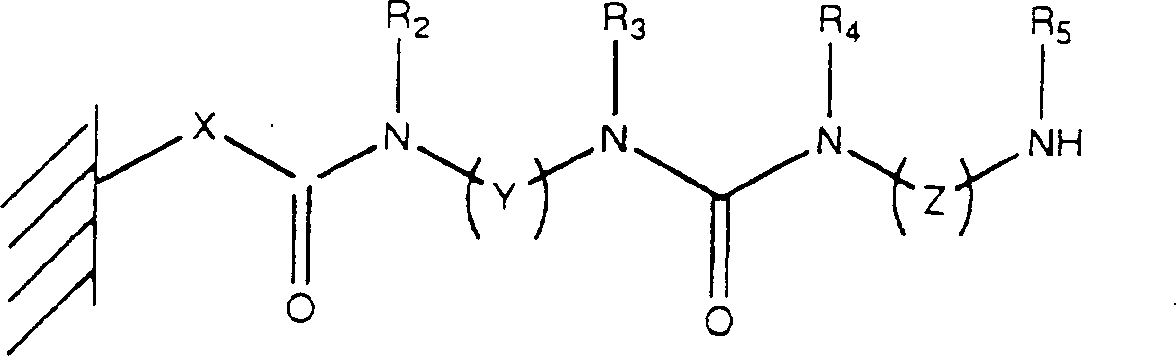
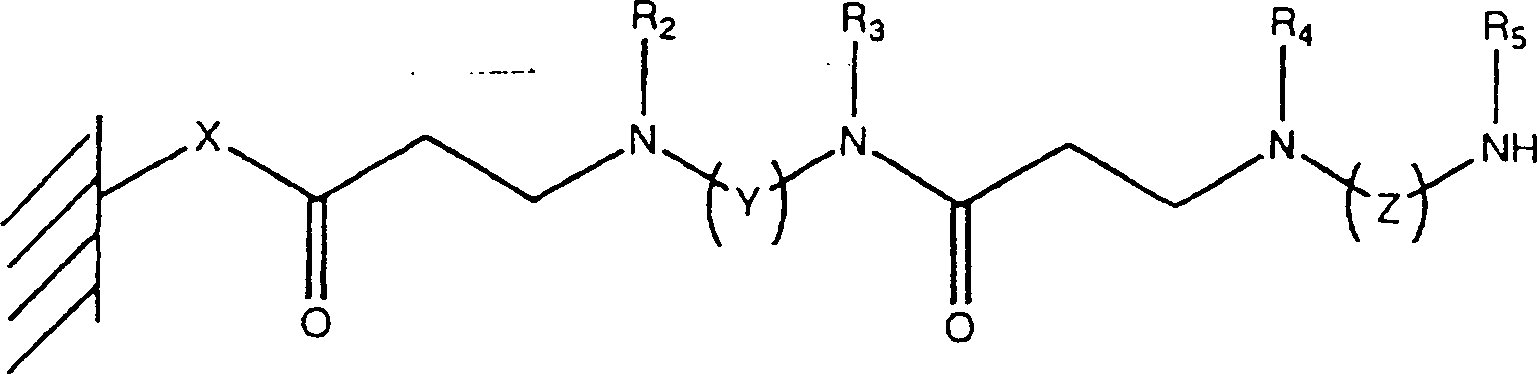
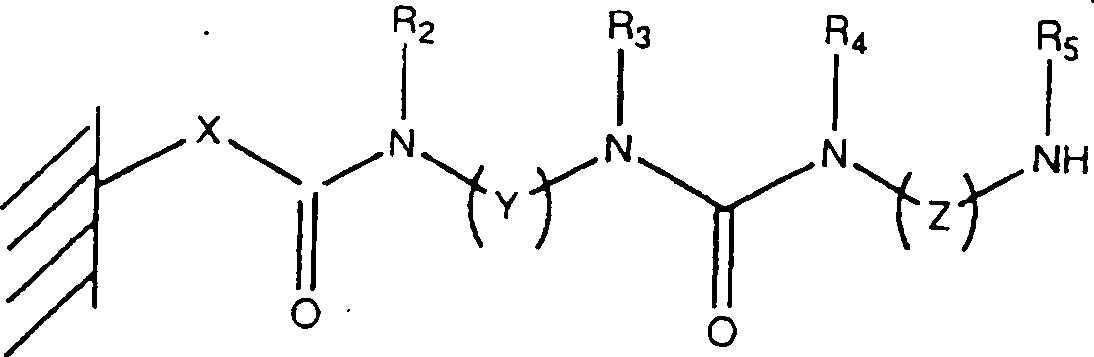
Die Linker an der Trägeroberfläche weisen lineare Strukturen oder Dendrimer-Strukturen auf. Die Strukturen haben folgenden Aufbau:
- – bevorzugte Struktur nach
Aktivierung mit Acryloylchlorid X = O, NHR1 Y, Z = können gleich oder verschieden sein und können ausgewählt sein aus -(CH2)n- -(CH2CH2O)n-CH2CH2 -(CH2CH2CH2O)n-CH2CH2CH2- usw. R1-R5 = können gleich oder verschieden sein analog R1 und R2 vorstehend n = 1-50, bevorzugt 1-20, ganz bevorzugt 1-10 oder
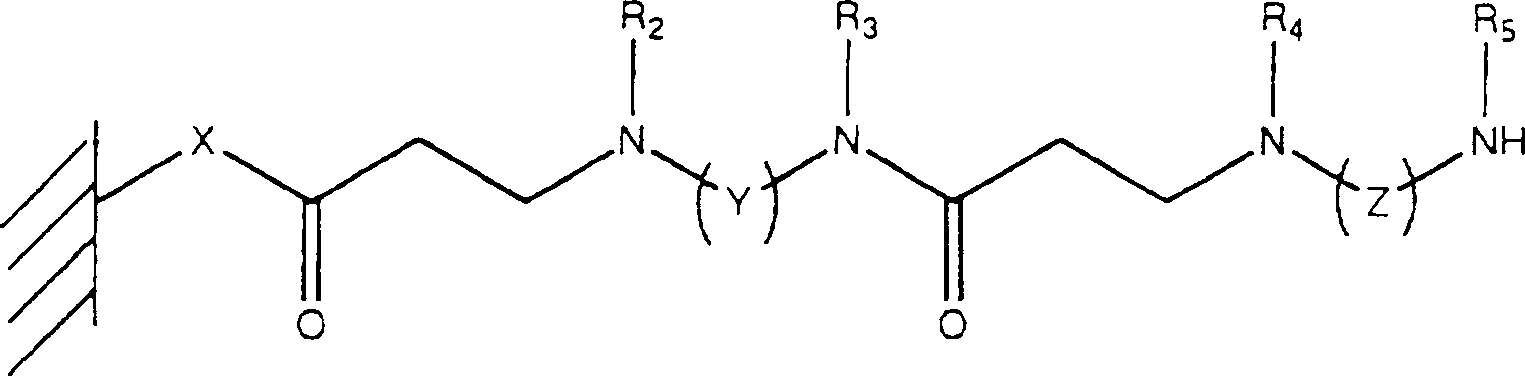
- – bevorzugte
Struktur nach Aktivierung mit Chlorameisensäure-nitrophenylester bzw. Carbonyldiimidazol X = O, NHR1 Y, Z = können gleich oder verschieden sein und können ausgewählt sein aus -(CH2)n- -(CH2CH2O)n-CH2CH2 -(CH2CH2CH2O)n-CH2CH2CH2- usw. R1-R5 = können gleich oder verschieden sein analog R1 und R2 vorstehend n = 1-50, bevorzugt 1-20, ganz bevorzugt 1-10
- Preferred structure after activation with acryloyl chloride X = O, NHR 1 Y, Z = may be the same or different and may be selected from - (CH 2 ) n - - (CH 2 CH 2 O) n -CH 2 CH 2 - (CH 2 CH 2 CH 2 O ) n -CH 2 CH 2 CH 2 - etc. R 1 -R 5 = may be the same or different analogously R 1 and R 2 above n = 1-50, preferably 1-20, most preferably 1-10 or
- - Preferred structure after activation with nitrophenyl chloroformate or carbonyldiimidazole X = O, NHR 1 Y, Z = may be the same or different and may be selected from - (CH 2 ) n - - (CH 2 CH 2 O) n -CH 2 CH 2 - (CH 2 CH 2 CH 2 O ) n -CH 2 CH 2 CH 2 - etc. R 1 -R 5 = may be the same or different analogously R 1 and R 2 above n = 1-50, preferably 1-20, most preferably 1-10
Bei der Fixierung von Biopolymeren an die mit dem Linkersystem derivatisierten Trägeroberfläche können prinzipiell 2 Fälle (a) und (b) unterschieden werdenat the fixation of biopolymers to those derivatized with the linker system Carrier surface can in principle 2 cases (a) and (b) are distinguished
(a) In situ-Synthese von Biopolymeren (am Beispiel der Oligonukleotidsynthese):(a) In situ synthesis of Biopolymers (using the example of oligonucleotide synthesis):
Die
derivatisierten Träger-Oberflächen mit
endständigen
Amino- oder Hydroxyl-Funktionen
bedürfen keiner
weiteren Modifizierung zur Anbindung des 1. Oligonucleotidbausteins
nach der Phosphoramidit- oder auch Phosphortriester-Methode. Es
werden nach der Reaktion des 1. Nucleotid-Reagenzes mit der aminierten Oberfläche Bindungen
vom Phosphoramidat-Typ erzeugt. Hydroxylierte Oberflächen führen zu
Bindungen vom Phosphodiester-Typ. Phosphoramidit-Methode 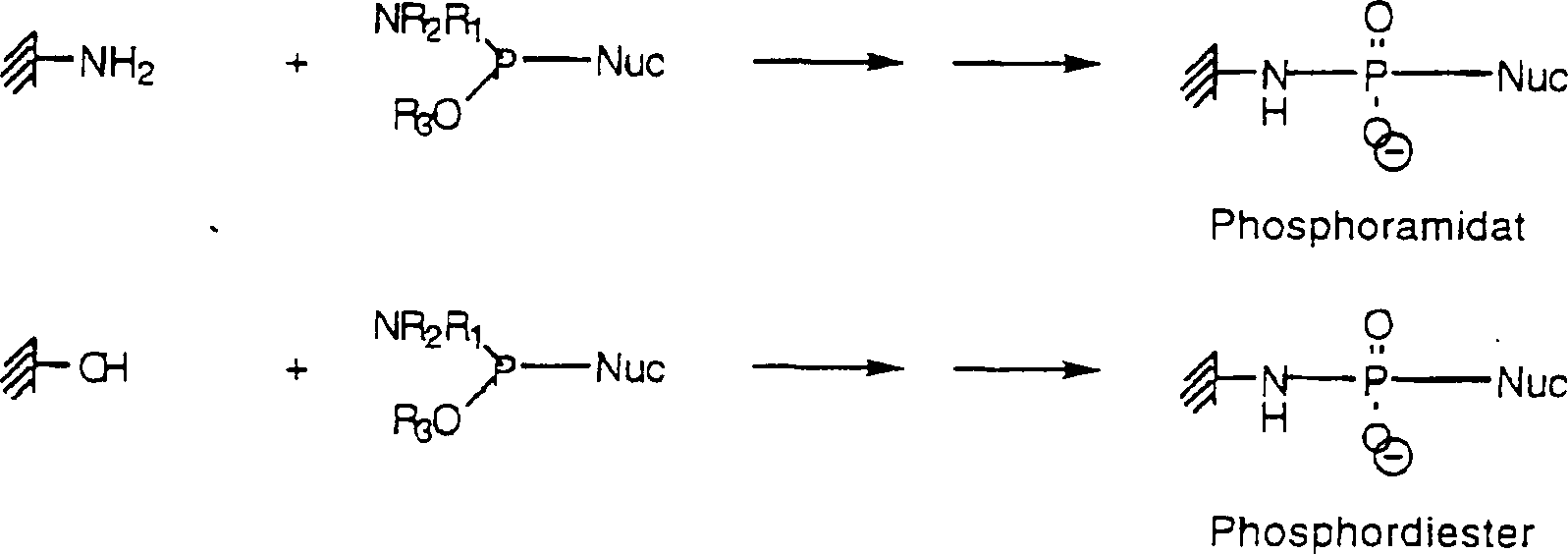

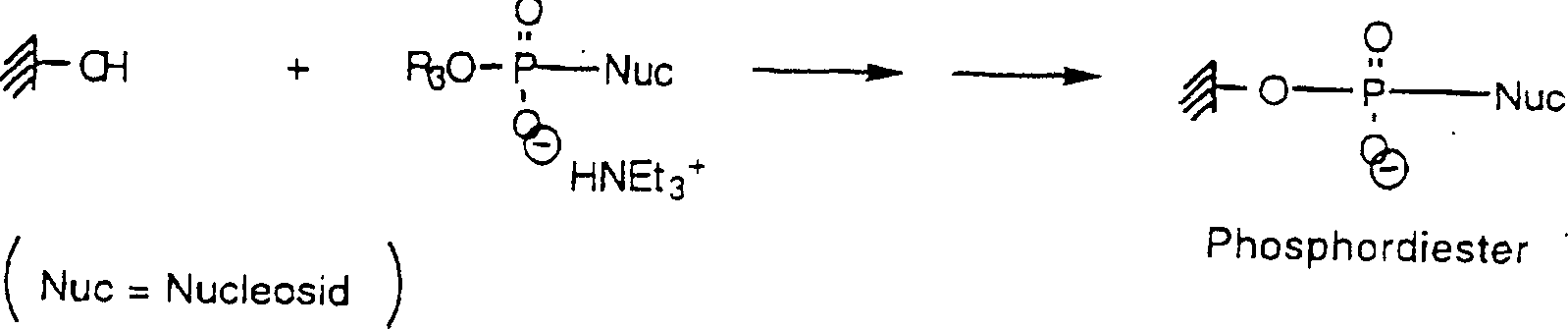
Werden Bindungen vom Phosphodiester-Typ angestrebt, genügt es beim letzten Schritt innerhalb der Linker-System-Synthese kein Bis-Amin, sondern einen Amino-Alkohol zur Reaktion zu bringen.Become For phosphodiester-type bonds, it is sufficient in the last step within the linker system synthesis, no bis-amine, but one Amino alcohol to react.
(b) Anbindung von "vorgefertigten" Biopolymeren:(b) Connection of "prefabricated" biopolymers:
Die Anbindung des Biopolymeren sieht die Generierung einer kovalenten (dauerhaften) chemischen Verknüpfung des Biomoleküls mit der Trägeroberfläche vor. Hierzu muß eine chemische Bindung zwischen dem Biomolekül und der Oberfläche erzeugt werden. Um diese Bindung zu erzeugen, kommt beispielsweise folgendes Vorgehen in Frage:
- – (A) Zugabe eines Förderungsmittels
- – (B) Aktivierung einer der beiden Reaktanden (Biomolekül oder Oberfläche). Allerdings ist eine Aktivierung der Trägeroberfläche gegenüber einer Aktivierung des Biomoleküls vorzuziehen, da bei der Aktivierung des Biomoleküls selbst unerwünschte Kreuzreaktionen zwischen den aktivierten Biomolekülen – aufgrund des meist poly-funktionellen Charakters des Biomoleküls – nicht auszuschliessen sind. Diese Aktivierung der Oberfläche erfolgt vorzugsweise mittels Crosslinker.
- - (A) Addition of a subsidy
- - (B) activation of one of the two reactants (biomolecule or surface). However, activation of the carrier surface is preferable to activating the biomolecule, since in the activation of the biomolecule even unwanted cross-reactions between the activated biomolecules - due to the mostly poly-functional nature of the biomolecule - can not be ruled out. This activation of the surface is preferably carried out by means of crosslinkers.
(A) Anbindung des Biopolymeren unter Zuhilfenahme eines Förderungsmittels(A) Binding of the biopolymer with the aid of a grant
Die
Möglichkeit
ein Förderungsmittel
(Katalysator) zur Erzeugung der kovalenten Bindung zwischen Oberfläche und
Biomolekül
zu benutzen, stellt im wesentlichen eine 3-Komponenten-Reaktion
dar. Werden wie in der vorliegenden Erfindung Möglichkeiten angestrebt, die
es erlauben sollen, hochparallel eine grosse Anzahl von Biopolymeren
an exakt vorbestimmten Positionen auf einem Träger zu fixieren, kann dies
aufgrund von Kreuz-Kontamination nur erschwert mit einem 3-Komponenten-System
an ebenen Oberflächen
(Folien, Glas o.ä.)
gelingen. Daher stellt die Förderungsmittel-Methode
einen Spezial-Fall zur kovalenten Anknüpfung von Biopolymeren auf
Oberflächen
vom Membran-Typ dar. Einzig hier kann das Förderungsmittel in den Poren der
Membran lokal dem zu bindenden Biomolekül zur Verfügung gestellt werden, ohne
daß mit
Kreuz-Kontamination zu rechnen ist (vgl. Beispiel 4). Als Förderungsmittelmittel
eignen sich beispielsweise Reagentien vom Carbodiimid-Typ, wie Diisopropylcarbodiimid,
EDC oder DCC (Dicyclohexylcarbodiimid). Desweiteren sollten die
endständigen
Gruppen auf dem Träger
und am Biomolekül
bevorzugt orthogonal zueinander sein, d.h. diese sollten sinnvoll
eine chemische Bindung eingehen können. Hierbei ergeben sich
vorzugsweise folgende Kombinationen der zu reagierenden Endgruppen: 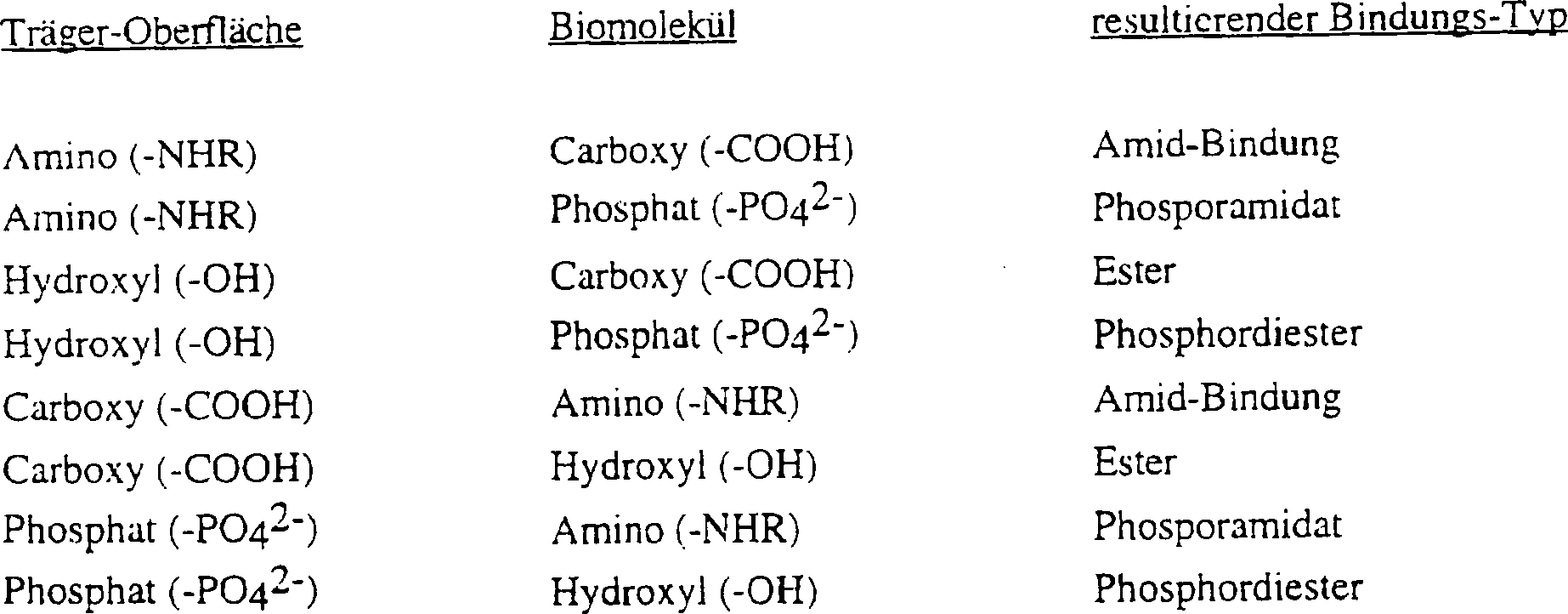
Da
die reaktiven Gruppen (Amin-, Hydroxyl-, Phosphat- oder Carboxyl-)
mehr oder weniger vom Biomolekül
vorgegeben sind, empfiehlt es sich daher für jeden Biomolekül-Typ einen
entsprechenden orthogonalen Oberflächen-Typ zur Verfügung zu
haben. Um die Träger-Oberflächen-Derivatisierung
mit dem Linkersystem für
alle oben aufgeführten
Kombination von Endgruppen verfüg bar
zu machen, wurden Methoden zur Um-Derivatisierung der Oberfläche von
endständigen
Amino-Funktionen (oder auch Hydroxyl) auf endständige Hydroxyl-, Carboxyl-
und Phosphat-Gruppen entwickelt (vgl. Beispiele 5, 6, 7). Um-Derivatisierung
auf End-Hydroxyl: 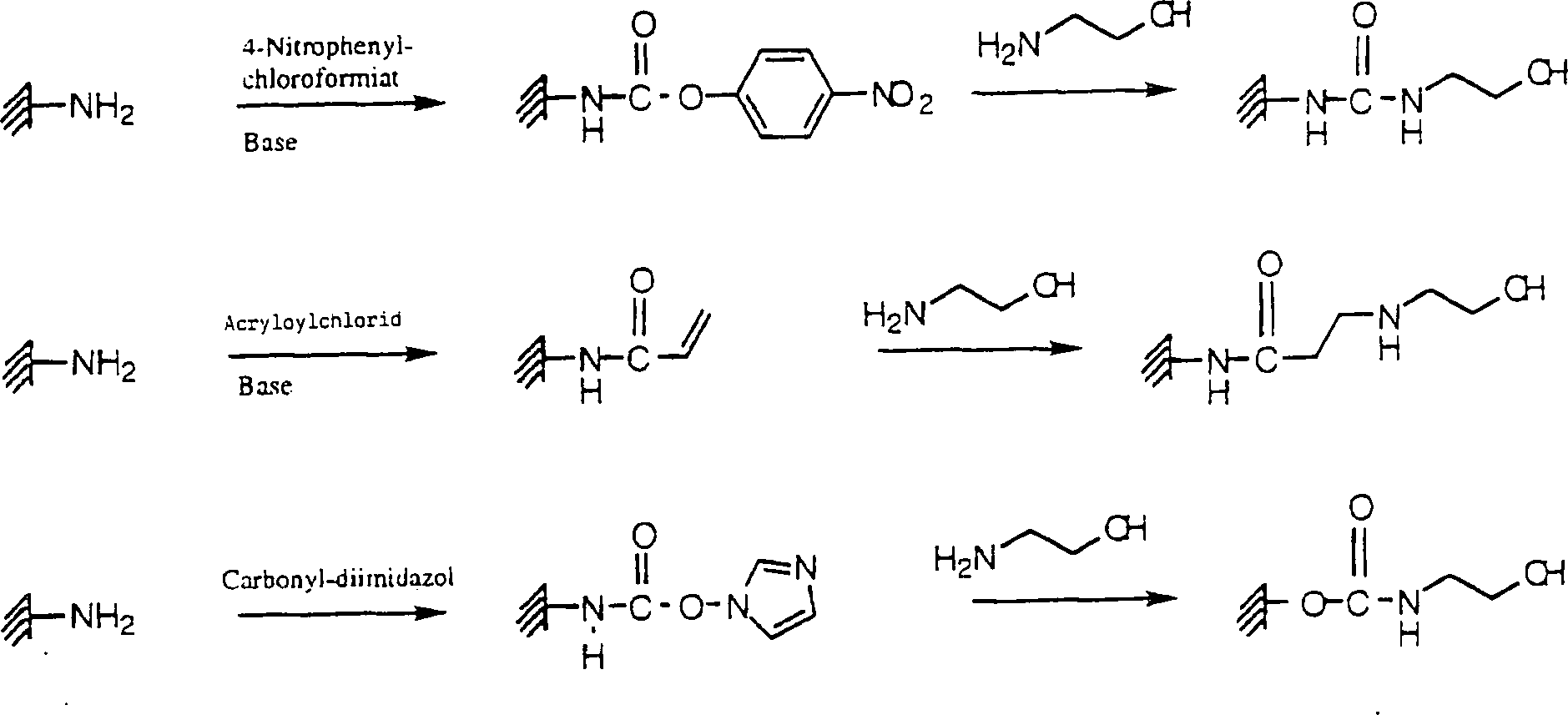

Um-Derivatisierung
auf End-Phosphat: 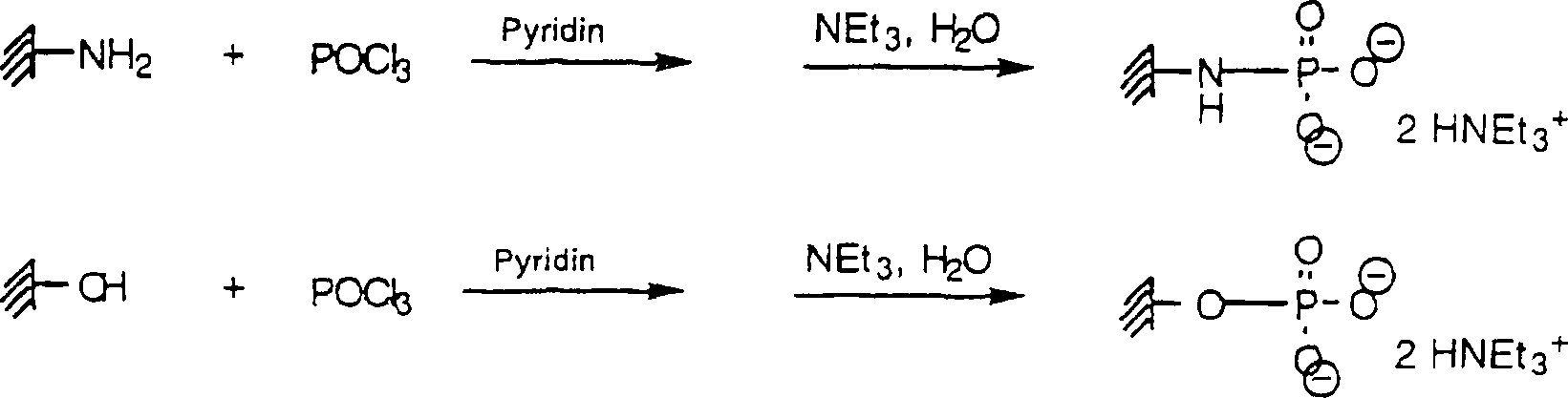
(B) Anbindung des Biopolymeren mittels Crosslinker(B) Binding of the biopolymer by means of Crosslinker
Unter einer kovalenten Oberflächen-Aktivierung ist eine solche zu verstehen, bei der Crosslinker quasi als End-Gruppe auf das erfindungsgemäß vorher aufgebaute Linker-System (Flexible Linker-System) aufgepropft wurden. Bei diesen handelt es sich vor allem um aktivierte Ester-, Aldehyd-, Imidoester- oder Isothiocyanat-Funktionen, die in der Lage sind, ohne weitere chemische Eingriffe, mit in wässrigen Systemen gelösten Biopolymeren eine kovalente Bindung einzugehen. Als Reagentien der Wahl sind hier v.a. Dissuccinimidylcarbonat, Dissuccinimidyl-oxalat, Glutaraldehyd, Dimethylsuberimidat-Dihydrochlorid oder Phenylendiisothiocyanat zu nennen. Die Umsetzung erfolgt bevorzugt unter basischen Bedingungen, d.h. unter Zusatz von Diisopropylethylamin oder NaCO3.A covalent surface activation is to be understood as one in which crosslinkers were grafted on, as it were, as an end group onto the previously constructed linker system (flexible linker system). These are, in particular, activated ester, aldehyde, imidoester or isothiocyanate functions, which are able to covalently bond with biopolymers dissolved in aqueous systems without further chemical interventions. The reagents of choice here are, in particular, dissocidinimidyl carbonate, dissuccinimidyl oxalate, glutaraldehyde, dimethylsuberimidate dihydrochloride or phenylene diisothiocyanate. The reaction is preferably carried out under basic conditions, ie with the addition of diisopropylethylamine or NaCO 3 .
Prinzip: 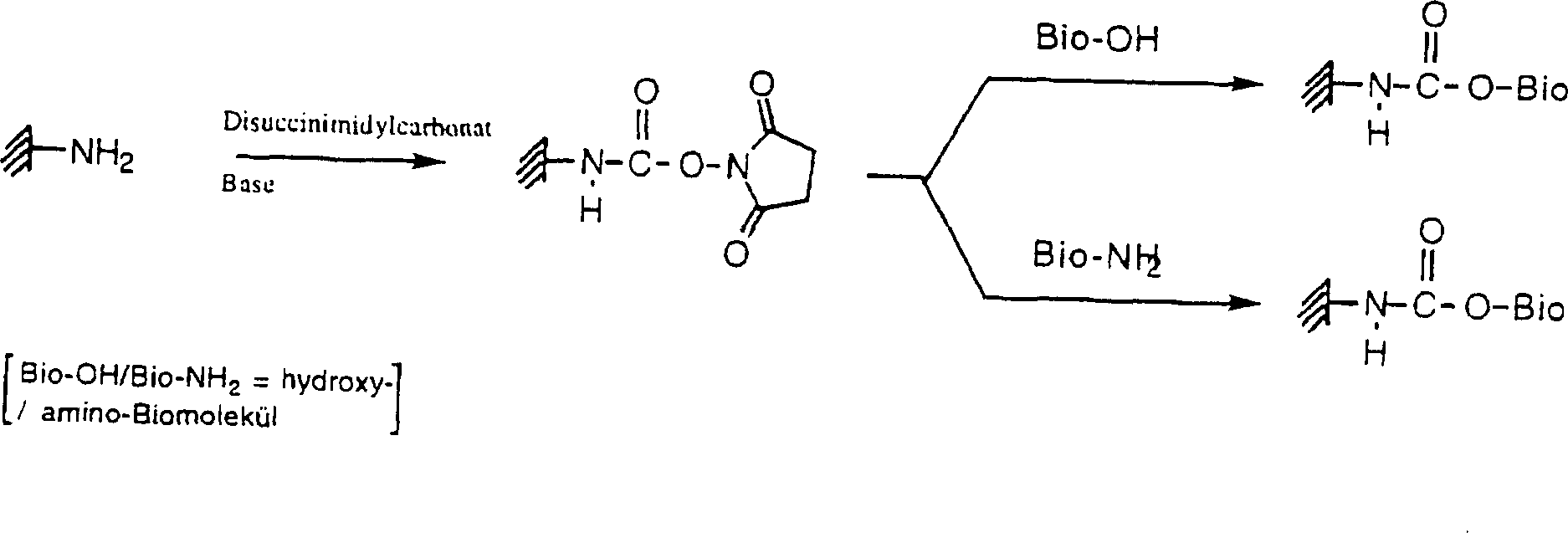
Die Erfindung wird weiter anhand der Figuren beschrieben, welche zeigen:The The invention will be further described with reference to the figures, which show:
Die Erfindung wird weiter anhand der Beispiele beschrieben.The Invention will be further described by way of examples.
Beispiel 1: Derivatisierung eines GlasträgersExample 1: Derivatization a glass carrier
Ausgegangen wird von aminierten Glasträgern (40 × 48 mm), der entweder kommerziell erhältlich ist oder nach den üblichen Methoden der Silanisierung darstellbar ist. Zur Aktivierung der Aminofunktionen werden die aminierten Glasträger in 20 ml wasserfreies Dichlorethan mit 200 mg 4-Nitrophenyl-chloroformiat (1 mmol) und 171 μl Diisopropylethylamin (1 mmol) gelegt und für 2 Stunden auf dem Schüttler geschwenkt. Der BPB-Kontrolltest zeigt keine Blaufärbung. Die Glasträger werden über Nacht in 20 ml amin-freiem DMF mit 223 μl Tetraethylenpentamin (1 mmol) umgesetzt. Der BPB-Kontrolltest zeigt eine Blaufärbung. Zum Starten eines neuen Zyklus' werden die Glasträger in 20 ml wasserfreies Dichlorethan mit 200 mg 4-Nitrophenyl-chloroformiat (1 mmol) und 171 μl Diisopropylethylamin (1 mmol) gelegt und für 2 Stunden auf dem Schüttler geschwenkt. Der BPB-Kontrolltest zeigt keine Blaufärbung. Die Glasträger werden über Nacht in 20 ml amin-freiem DMF mit 140 μl 1,4-Bis(3-aminopropyloxy)-butan (1 mmol) umgesetzt. Der BPB-Test zeigt eine Blaufärbung.Went out is made by aminated glass slides (40 × 48 mm), which is either commercially available or after the usual Methods of silanization can be represented. To activate the Amino functions are the aminated glass slides in 20 ml of anhydrous dichloroethane with 200 mg of 4-nitrophenyl chloroformate (1 mmol) and 171 μl diisopropylethylamine (1 mmol) and for 2 hours on the shaker pivoted. The BPB control test shows no blue coloration. The glass slides be over Night in 20 ml of amine-free DMF with 223 μl of tetraethylenepentamine (1 mmol) implemented. The BPB control test shows a blue coloration. To start a new one Cycle 'will be the glass slides in 20 ml of anhydrous dichloroethane with 200 mg of 4-nitrophenyl chloroformate (1 mmol) and 171 μl Diisopropylethylamine (1 mmol) and swirled for 2 hours on the shaker. The BPB control test shows no blue coloration. The glass slides are overnight in 20 ml of amine-free DMF with 140 μl Reacted 1,4-bis (3-aminopropyloxy) -butane (1 mmol). The BPB test shows a blue color.
Die so derivatisierten Glasträger verfügen an ihrer Oberfläche jetzt über Linker an die Biopolymere (z.B. Nukleinsäuren) gekoppelt werden können.The so derivatized glass carrier feature on their surface now over Linker to the biopolymers (e.g., nucleic acids) can be coupled.
Beispiel 2: Derivatisierung eines GlasträgersExample 2: Derivatization a glass carrier
Ausgegangen wird von einem aminierten Glasträger (40 × 48 mm), der entweder kommerziell erhältlich oder nach den üblichen Methoden über Silanisierung darstellbar ist. Zur Aktivierung der Aminofunktionen werden die aminierten Glasträger in 20 ml wasserfreies Dichlorethan mit 81 μl Acryloylchlorid (1 mmol) und 171 μl Diisopropylethylamin (1 mmol) gelegt und für 2 Stunden auf dem Schüttler geschwenkt. Der BPB-Kontrolltest zeigt keine Blaufärbung. Die Glasträger werden über 2 Nächte in 20 ml amin-freiem DMF mit 223 μl Tetraethylenpentamin (1 mmol) umgesetzt. Der BPB-Kontrolltest zeigt eine Blaufärbung. Zum Starten eines neuen Zyklus' werden die Glasträger in 20 ml wasserfreies Dichlorethan mit 81 μl Acryloylchlorid (1 mmol) und 171 μl Diisopropylethylamin (1 mmol) gelegt und für 2 Stunden auf dem Schüttler geschwenkt. Der BPB-Kontrolltest zeigt keine Blaufärbung. Die Glasträger werden über 2 Nächte in 20 ml amin-freiem DMF mit 140 μl 1,4-Bis(3-aminopropoxy)-butan (1 mmol) umgesetzt. Der BPB-Test zeigt eine Blaufärbung.Went out is from an aminated glass carrier (40 × 48 mm), either commercially available or after the usual Methods over Silanization is presentable. To activate the amino functions the aminated glass carrier in 20 ml of anhydrous dichloroethane with 81 ul acryloyl chloride (1 mmol) and 171 ul diisopropylethylamine (1 mmol) and for 2 hours on the shaker pivoted. The BPB control test shows no blue coloration. The glass slides be over 2 nights in 20 ml of amine-free DMF with 223 μl of tetraethylenepentamine (1 mmol) reacted. The BPB control test shows a blue coloration. To the Starting a new cycle the glass carriers in 20 ml of anhydrous dichloroethane with 81 ul acryloyl chloride (1 mmol) and 171 ul diisopropylethylamine (1 mmol) and for 2 hours on the shaker pivoted. The BPB control test shows no blue coloration. The glass slides be over 2 nights in 20 ml of amine-free DMF with 140 μl of 1,4-bis (3-aminopropoxy) butane (1 mmol) reacted. The BPB test shows a blue coloration.
Die so derivatisierten Glasträger verfügen an ihrer Oberfläche jetzt über Linker an die Biopolymere (z.B. Nukleinsäuren) gekoppelt werden können.The so derivatized glass carrier feature on their surface now over Linker to the biopolymers (e.g., nucleic acids) can be coupled.
Beispiel 3: Derivatisierung von PolypropylenmembranenExample 3: Derivatization of polypropylene membranes
Ausgegangen wird von einer käuflichen hydrophilisierten Polypropylenmembran (8 × 12 cm). Zur Aktivierung wird die Membran mit 324 μl Acryloylchlorid (4 mmol) und 684 μl Diisopropylethylamin (4 mmol) in 30 ml wasserfreiem Dichlorethan auf dem Rüttler zur Reaktion gebracht. Nach 2 Std. wird von der Reaktionslösung abdekantiert und mehrmals sorgfältig mit Dichlorethan gewaschen und getrocknet. Der Bromphenolblau-Test (BPB-Test) zeigt keine Blaufärbung. Nachfolgend wird die aktivierte Membran 2 Tage mit 892 μl Tetraethylenpentamin (4 mmol) in 30 ml aminfreiem DMF auf dem Rüttler geschwenkt. Dann wird die Reaktionslösung abdekantiert und die Membran mehrmals sorgfältig mit DMF und dann mit Dichlorethan gewaschen und getrocknet. Der Bromphenolblau-Test zeigt Blaufärbung. Zur weiteren Aktivierung wird die nun aminierte Membran erneut mit 324 μl Acryloylchlorid (4 mmol) und 684 μl Diisopropylethylamin (4 mmol) in 30 ml wasserfreiem Dichlorethan auf dem Rüttler zur Reaktion gebracht. Nach 2 Std. wird von der Reaktionslösung dekantiert und mehrmals sorgfältig mit Dichlorethan gewaschen und getrocknet. Der Bromphenolblau-Test (BPB-Test) zeigt keine Blaufärbung. Nachfolgend wird die aktivierte Membran 2 Tage mit 560 μl 1,6-Bis(3-aminopropyloxy)-butan (4 mmol) in 30 mol aminfreiem DMF auf dem Rüttler geschwenkt. Dann wird die Reaktionslösung abdekantiert und die Membran mehrmals sorgfältig mit DMF und dann mit Dichlorethan gewaschen und getrocknet. Der Bromphenolblau-Test (BPB-Test) zeigt Blaufärbung.Went out is from a commercial one hydrophilized polypropylene membrane (8 x 12 cm). To activate becomes the membrane with 324 μl Acryloyl chloride (4 mmol) and 684 μl Diisopropylethylamine (4 mmol) in 30 ml of anhydrous dichloroethane on the jogger reacted. After 2 hours, it is decanted from the reaction solution and several times carefully washed with dichloroethane and dried. The bromophenol blue test (BPB test) shows no blue coloration. Subsequently, the activated membrane is 2 days with 892 ul tetraethylenepentamine (4 mmol) in 30 ml of amine-free DMF on the vibrator. Then it will be the reaction solution decanted off and the membrane carefully several times with DMF and then with dichloroethane washed and dried. The bromophenol blue test shows blue coloration. to Further activation, the now aminated membrane again with 324 ul acryloyl chloride (4 mmol) and 684 μl Diisopropylethylamine (4 mmol) in 30 ml of anhydrous dichloroethane on the jogger reacted. After 2 hours, it is decanted from the reaction solution and several times carefully washed with dichloroethane and dried. The bromophenol blue test (BPB test) shows no blue coloration. Subsequently, the activated membrane is 2 days with 560 ul of 1,6-bis (3-aminopropyloxy) butane (4 mmol) in 30 mol of amine-free DMF on the vibrator. Then it will be the reaction solution decanted off and the membrane carefully several times with DMF and then with dichloroethane washed and dried. The bromophenol blue test (BPB test) shows blue coloration.
Beispiel 4: Anbindung von Nukleinsäuren auf PolypropylenmembranenExample 4: Connection of nucleic acids on polypropylene membranes
Eine gemäß Beispiel 3 derivatisierte Polypropylenmembran (8 × 12 cm) wird auf einem Whatman-Filterpapier 5 Min. mit einer Lösung aus 54 mg N-(3-Dimethylaminopropyl)-N'-ethyl-carbodiimidhydrochlorid und 24 ml N-Methylimidazol in 10 ml Wasser inkubiert. Die Reaktionslösung wird abdekantiert. Die so aktivierte, noch feuchte Polypropylen-Membran kann nun zum kovalenten Aufbringen von Biopolymeren verwendet werden. Nach dem Aufbringen der Biopolymere (z.B. durch Spotting-Robotter oder Nano-Plotter) werden die Proben durch 2 hr Inkubieren bei 65 °C auf der Membran fixiert; anschliessend wird die Membran sorgfältig mit Wasser gewaschen.A according to example 3 derivatized polypropylene membrane (8 x 12 cm) is placed on Whatman filter paper 5 min. With a solution from 54 mg N- (3-dimethylaminopropyl) -N'-ethyl-carbodiimide hydrochloride and 24 ml of N-methylimidazole in 10 ml of water. The reaction solution is decanted. The thus activated, still moist polypropylene membrane can now be used for the covalent application of biopolymers. After application of the biopolymers (e.g., by spotting robots or nano plotter), incubate the samples by incubating at 65 ° C for 2 hr Membrane fixed; then the membrane is carefully washed with water washed.
Beispiel 5: Synthese endständiger Hydroxyl-GruppenExample 5: Synthesis of terminal hydroxyl groups
a) Aktivierung mit Chlorameisensäure-4-nitrophenylester:a) Activation with 4-nitrophenyl chloroformate:
Eine amino-funktionalisierte Polypropylen-Membran (Omnitray-Grösse) gemäß Beispiel 3 wird in 30 ml wasserfreiem Dichlorethan mit 400 mg Chlorameisen säure-4-nitrophenylester (2 mmol) und 342 μl Diisopropylethylamin (2 mmol) für 2 hr auf dem Schüttler geschwenkt. Man wäscht 2 × je 5 min mit 50 ml Dichlormethan und trocknet im Stickstoffstrom. Die so aktivierte PP-Membran wird nun mit 200 ml 2-(2-Aminoethoxy)ethanol (2 mmol) in 30 ml aminfreiem DMF 30 min auf dem Schüttler geschwenkt, worauf die Reaktionslösung abdekantiert wird. Nach kurzem Waschem mit DMF wird die PP-Membran erneut mit 200 μl 2-(2-Aminoethoxy)ethanol (2 mmol) in 30 ml aminfreiem DMF versetzt und über Nacht auf dem Schüttler geschwenkt. Von der Reaktionslösung wird abdekantiert, und die PP-Membran 2 × je 5 min mit 50 ml DMF und dann 2 × mit 50 ml Aceton gewaschen und getrocknet.A Amino-functionalized polypropylene membrane (omnitray size) according to example 3 is in 30 ml of anhydrous dichloroethane with 400 mg of 4-nitrophenyl chloroformate (2 mmol) and 342 μl Diisopropylethylamine (2 mmol) for 2 hrs on the shaker pivoted. You wash 2 × each 5 min with 50 ml of dichloromethane and dried in a stream of nitrogen. The so activated PP membrane is now filled with 200 ml of 2- (2-aminoethoxy) ethanol (2 mmol) in 30 ml of amine-free DMF for 30 min on the shaker, whereupon the reaction solution is decanted off. After a short wash with DMF, the PP membrane becomes again with 200 μl Added 2- (2-aminoethoxy) ethanol (2 mmol) in 30 ml of amine-free DMF and over Night on the shaker pivoted. From the reaction solution is decanted off, and the PP membrane 2 × 5 min each with 50 ml of DMF and then 2 times with Washed 50 ml of acetone and dried.
b) Aktivierung mit Acryloylchlorid:b) Activation with acryloyl chloride:
Eine amino-funktionalisierte Polypropylen-Membran (Omnitray-Grösse) gemäß Beispiel 3 wird in 30 ml wasserfreiem Dichlorethan mit 162 μl Acryloylchlorid (2 mmol) und 342 μl Diisopropylethylamin (2 mmol) für 2 hr auf dem Schüttler geschwenkt. Man wäscht 2 × je 5 min mit 50 ml Dichlormethan und trocknet im Stickstoffstrom. Die so aktivierte PP-Membran wird nun mit 200 μl 2-12-Aminoethoxy)ethanol (2 mmol) in 30 ml aminfreiem DMF 30 min auf dem Schüttler geschwenkt, worauf die Reaktionslösung abdekantiert wird. Nach kurzem Waschem mit DMF wird die PP-Membran erneut mit 200 μl 2-(2-Aminoethoxy)ethanol (2 mmol) in 30 ml aminfreiem DMF versetzt und über Nacht auf dem Schüttler geschwenkt. Von der Reaktionslösung wird abdekantiert, und die PP-Membran 2 × je 5 min mit 50 ml DMF und dann 2 × mit 50 ml Aceton gewaschen und getrocknet.A Amino-functionalized polypropylene membrane (omnitray size) according to example 3 is dissolved in 30 ml of anhydrous dichloroethane with 162 μl of acryloyl chloride (2 mmol) and 342 μl Diisopropylethylamine (2 mmol) for 2 hr on the shaker pivoted. You wash 2 × each 5 min with 50 ml of dichloromethane and dried in a stream of nitrogen. The so activated PP membrane is now with 200 ul 2-12-aminoethoxy) ethanol (2 mmol) in 30 ml of amine-free DMF for 30 min on a shaker, whereupon the reaction solution is decanted off. After a short wash with DMF, the PP membrane becomes again with 200 μl Added 2- (2-aminoethoxy) ethanol (2 mmol) in 30 ml of amine-free DMF and over Night on the shaker pivoted. From the reaction solution is decanted off, and the PP membrane 2 × 5 min each with 50 ml of DMF and then 2 times with Washed 50 ml of acetone and dried.
Beispiel 6: Synthese endständiger Carboxyl-GruppenExample 6: Synthesis of terminal carboxyl groups
Eine amino-funktionalisierte Polypropylen-Membran (Omnitray-Grösse) gemäß Beispiel 3 wird in 30 ml trockenem Dichlorethan mit 400 mg Bernsteinsäureanhydrid (4 mmol), 1 ml Pyridin (24 mmol) und 488 mg DMAP (4 mmol) über Nacht auf dem Schüttler zur Reaktion gebracht. Nachfolgend wird die Reaktions lösung abdekantiert und die PP-Membran nacheinander mit 30 ml Dichlormethan, 30 ml Aceton, 30 ml 1 % HCl, 2 × 30 ml Wasser und 2 × mit 30 ml Aceton jeweils 5 min. gewaschen und getrocknet.A Amino-functionalized polypropylene membrane (omnitray size) according to example 3 is dissolved in 30 ml of dry dichloroethane with 400 mg of succinic anhydride (4 mmol), 1 ml pyridine (24 mmol) and 488 mg DMAP (4 mmol) overnight on the shaker reacted. Subsequently, the reaction solution is decanted off and the PP membrane in succession with 30 ml of dichloromethane, 30 ml of acetone, 30 ml of 1% HCl, 2 × 30 ml of water and 2 times with 30 ml of acetone for 5 min. washed and dried.
Beispiel 7: Synthese endständiger Phosphat-GruppenExample 7: Synthesis of terminal phosphate groups
Unter Eisbadkühlung werden 0.42 ml POCl3 (4 mmol) in 40 ml trockenem Pyridin gelöst. Nachfolgend werden 828 mg 1,2,4-Triazol (12 mmol) zugefügt. Nach 10 min wird die hydroxyl-funtionalisierte Polypropylen-Membran gemäß Beispiel 4 zugefügt und weitere 10 min unter Eisbadkühlung auf dem Rüttler geschwenkt. Anschliessend wird das Eisbad entfernt und noch 45 min geschwenkt. Die Reaktionslösung wird abdekantiert und vorsichtig mit 50 ml eines Gemisch aus Triethylamin/Dioxan/Wasser hydrolisiert. Man wäscht sorgfältig nacheinander 2 × mit 50 ml Wasser, kurz mit 50 ml 1 % HCl, 2 × mit 50 ml Wasser und 2 × 5 min mit 50 ml Aceton und trocknet im Stickstoff-Strom.With ice-bath cooling, 0.42 ml of POCl 3 (4 mmol) are dissolved in 40 ml of dry pyridine. Subsequently, 828 mg of 1,2,4-triazole (12 mmol) are added. After 10 minutes, the hydroxyl-functionalized polypropylene membrane according to Example 4 is added and the mixture is agitated for a further 10 minutes while cooling with an ice bath on the shaker. Then the ice bath is removed and swirled for another 45 minutes. The reaction solution is decanted off and carefully hydrolyzed with 50 ml of a mixture of triethylamine / dioxane / water. It is carefully washed twice in succession with 50 ml of water, briefly with 50 ml of 1% HCl, twice with 50 ml of water and 2 × 5 minutes with 50 ml of acetone and dried in a nitrogen stream.
Beispiel 8: Oberflächen-Aktivierung mit DisuccinimidylcarbonatExample 8: Surface activation with disuccinimidyl carbonate
7 amino-funktionalisierte Glas-Objektträger werden in 30 ml wasserfreiem Acetonitril mit 256 mg Disuccinimidylcarbonat (2 mmol) und 513 μl Diisopropylethylamin (3 mmol) für 4 hr auf dem Schüttler geschwenkt. Man wäscht mit 50 ml Acetonitril, dann mit 50 ml Dichlorethan und trocknet im Stickstoffstrom.7 Amino-functionalized glass slides are anhydrous in 30 ml Acetonitrile with 256 mg disuccinimidyl carbonate (2 mmol) and 513 μl diisopropylethylamine (3 mmol) for 4 hrs on the shaker pivoted. You wash with 50 ml of acetonitrile, then with 50 ml of dichloroethane and dried in nitrogen flow.
Claims (13)
Priority Applications (7)
| Application Number | Priority Date | Filing Date | Title |
|---|---|---|---|
| DE19853242A DE19853242B4 (en) | 1998-11-18 | 1998-11-18 | Derivatization of carrier surfaces |
| PCT/DE1999/003692 WO2000029373A2 (en) | 1998-11-18 | 1999-11-17 | Derivatisation of support surfaces |
| AU18563/00A AU1856300A (en) | 1998-11-18 | 1999-11-17 | Derivatisation of support surfaces |
| AT99962063T ATE300516T1 (en) | 1998-11-18 | 1999-11-17 | DERIVATIZATION OF SUPPORT SURFACES |
| US09/856,341 US6905724B1 (en) | 1998-11-18 | 1999-11-17 | Derivatization of support surfaces |
| DE59912342T DE59912342D1 (en) | 1998-11-18 | 1999-11-17 | DERIVATIZATION OF CARRIER SURFACES |
| EP99962063A EP1131281B1 (en) | 1998-11-18 | 1999-11-17 | Derivatisation of support surfaces |
Applications Claiming Priority (1)
| Application Number | Priority Date | Filing Date | Title |
|---|---|---|---|
| DE19853242A DE19853242B4 (en) | 1998-11-18 | 1998-11-18 | Derivatization of carrier surfaces |
Publications (2)
| Publication Number | Publication Date |
|---|---|
| DE19853242A1 DE19853242A1 (en) | 2000-05-25 |
| DE19853242B4 true DE19853242B4 (en) | 2006-06-29 |
Family
ID=7888252
Family Applications (2)
| Application Number | Title | Priority Date | Filing Date |
|---|---|---|---|
| DE19853242A Expired - Fee Related DE19853242B4 (en) | 1998-11-18 | 1998-11-18 | Derivatization of carrier surfaces |
| DE59912342T Expired - Fee Related DE59912342D1 (en) | 1998-11-18 | 1999-11-17 | DERIVATIZATION OF CARRIER SURFACES |
Family Applications After (1)
| Application Number | Title | Priority Date | Filing Date |
|---|---|---|---|
| DE59912342T Expired - Fee Related DE59912342D1 (en) | 1998-11-18 | 1999-11-17 | DERIVATIZATION OF CARRIER SURFACES |
Country Status (6)
| Country | Link |
|---|---|
| US (1) | US6905724B1 (en) |
| EP (1) | EP1131281B1 (en) |
| AT (1) | ATE300516T1 (en) |
| AU (1) | AU1856300A (en) |
| DE (2) | DE19853242B4 (en) |
| WO (1) | WO2000029373A2 (en) |
Families Citing this family (11)
| Publication number | Priority date | Publication date | Assignee | Title |
|---|---|---|---|---|
| AU5059800A (en) | 1999-04-08 | 2000-11-14 | Deutsches Krebsforschungszentrum Stiftung Des Offentlichen Rechts | Nucleoside derivatives with photo-unstable protective groups |
| DE60033851T2 (en) | 2000-01-11 | 2007-11-08 | Nanogen Recognomics Gmbh | BIOMOLECULES WITH MULTIPLE CONNECTION SECTIONS FOR BONDING TO A SUBSTRATE SURFACE |
| US7129229B2 (en) | 2000-08-11 | 2006-10-31 | Nanogen Recognomics Gmbh | Hydrazide building blocks and hydrazide modified biomolecules |
| AU2001295005A1 (en) * | 2000-08-11 | 2002-02-25 | Nanogen, Inc. | Macromolecules having hydrazide attachment moieties and reagents for their production |
| KR100383080B1 (en) * | 2000-09-05 | 2003-05-12 | 주식회사 포스코 | Substrate with controlled amine density and regular spacing and method for preparing the same |
| KR100379720B1 (en) * | 2000-10-14 | 2003-04-11 | 주식회사 마크로젠 | Supporter containing drimer monolayer and manufacturing method of same |
| WO2003033705A1 (en) | 2001-10-16 | 2003-04-24 | Posco | Transgenic organism expressing fungal mrp-like abc transporters |
| EP2301428B1 (en) | 2003-12-09 | 2016-11-30 | Dexcom, Inc. | Signal processing for continuous analyte sensor |
| CA2563168A1 (en) * | 2004-04-14 | 2005-11-17 | President And Fellows Of Harvard College | Nucleic-acid programmable protein arrays |
| US7556858B2 (en) | 2004-09-30 | 2009-07-07 | 3M Innovative Properties Company | Substrate with attached dendrimers |
| US8178316B2 (en) * | 2006-06-29 | 2012-05-15 | President And Fellows Of Harvard College | Evaluating proteins |
Citations (2)
| Publication number | Priority date | Publication date | Assignee | Title |
|---|---|---|---|---|
| EP0280840A1 (en) * | 1984-08-21 | 1988-09-07 | Pall Corporation | Methods of preparing biologically active membranes and uses thereof |
| EP0110409B1 (en) * | 1982-12-02 | 1989-04-19 | Kanegafuchi Kagaku Kogyo Kabushiki Kaisha | Adsorbent and process for preparing the same |
Family Cites Families (6)
| Publication number | Priority date | Publication date | Assignee | Title |
|---|---|---|---|---|
| US4837348A (en) * | 1986-04-30 | 1989-06-06 | Varian Associates, Inc. | Bonded phase chromatographic supports |
| US5624711A (en) | 1995-04-27 | 1997-04-29 | Affymax Technologies, N.V. | Derivatization of solid supports and methods for oligomer synthesis |
| US5672638A (en) * | 1995-08-22 | 1997-09-30 | Medtronic, Inc. | Biocompatability for solid surfaces |
| US5607475A (en) * | 1995-08-22 | 1997-03-04 | Medtronic, Inc. | Biocompatible medical article and method |
| CA2336911A1 (en) | 1998-07-10 | 2000-01-20 | Leo E. Manzer | Supported dendrimer catalyst |
| US6326083B1 (en) * | 1999-03-08 | 2001-12-04 | Calipher Technologies Corp. | Surface coating for microfluidic devices that incorporate a biopolymer resistant moiety |
-
1998
- 1998-11-18 DE DE19853242A patent/DE19853242B4/en not_active Expired - Fee Related
-
1999
- 1999-11-17 DE DE59912342T patent/DE59912342D1/en not_active Expired - Fee Related
- 1999-11-17 AT AT99962063T patent/ATE300516T1/en not_active IP Right Cessation
- 1999-11-17 AU AU18563/00A patent/AU1856300A/en not_active Abandoned
- 1999-11-17 EP EP99962063A patent/EP1131281B1/en not_active Expired - Lifetime
- 1999-11-17 WO PCT/DE1999/003692 patent/WO2000029373A2/en not_active Ceased
- 1999-11-17 US US09/856,341 patent/US6905724B1/en not_active Expired - Fee Related
Patent Citations (2)
| Publication number | Priority date | Publication date | Assignee | Title |
|---|---|---|---|---|
| EP0110409B1 (en) * | 1982-12-02 | 1989-04-19 | Kanegafuchi Kagaku Kogyo Kabushiki Kaisha | Adsorbent and process for preparing the same |
| EP0280840A1 (en) * | 1984-08-21 | 1988-09-07 | Pall Corporation | Methods of preparing biologically active membranes and uses thereof |
Also Published As
| Publication number | Publication date |
|---|---|
| US6905724B1 (en) | 2005-06-14 |
| ATE300516T1 (en) | 2005-08-15 |
| WO2000029373A2 (en) | 2000-05-25 |
| DE19853242A1 (en) | 2000-05-25 |
| WO2000029373A3 (en) | 2000-12-28 |
| EP1131281B1 (en) | 2005-07-27 |
| EP1131281A2 (en) | 2001-09-12 |
| DE59912342D1 (en) | 2005-09-01 |
| AU1856300A (en) | 2000-06-05 |
Similar Documents
| Publication | Publication Date | Title |
|---|---|---|
| DE19853242B4 (en) | Derivatization of carrier surfaces | |
| DE69133235T2 (en) | Process for the preparation of resins for solid peptide synthesis | |
| DE3855191T2 (en) | Membranes with bound oligonucleotides or peptides | |
| DE2313073C2 (en) | Process for the chemical modification of surfaces of inorganic solids and their use | |
| EP1027379A1 (en) | Method for producing polymeric solid phase supporting materials | |
| DE60224685T2 (en) | MANUFACTURE OF ION EXCHANGER MEDIA | |
| DE60124637T2 (en) | New reagent for labeling nucleic acids | |
| DE3789812T2 (en) | POROUS WAFER FOR THE SEGMENTED PRODUCTION OF BIPOLYMERS. | |
| DE102013005184A1 (en) | Method for functionalizing a surface | |
| EP0260634A2 (en) | Process for the simultaneous synthesis of several peptides in the solid phase | |
| EP1141038A1 (en) | Method of producing a polymer network | |
| AT413102B (en) | METHOD FOR PRODUCING POLYMERIC SUPPORT MATERIALS BASED ON CARBOHYDRATE BIS (METH) ACRYLAMIDES | |
| DE19855173A1 (en) | Process for the production of derivatized polymers | |
| DE602005001414T2 (en) | Photolabile protecting groups | |
| EP1230213A1 (en) | Articles having an activated surface for immobilizing macromolecules and method for producing such articles | |
| DE3886110T4 (en) | HYDROPHILIC PRODUCT AND PRODUCTION METHOD. | |
| WO2003074510A1 (en) | Dithiolane derivatives for immobilizing biomolecules on noble metals and semiconductors | |
| DE69832502T2 (en) | COATED POLYMERARTICLE AND ITS USE | |
| DE602004009436T2 (en) | NETWORKED POLYIMINE AND ITS USE IN IMMOBILIZING ACID OR ELECTROPHILIC COMPOUNDS IN A SOLUTION | |
| DE102009029173B4 (en) | Immobilized rhodium (III), ruthenium (II) or iridium (III) catalysts for asymmetric hydrogenation reactions | |
| EP0928311B1 (en) | Shaping object with reactive functions | |
| EP1313755B1 (en) | Method and functional particles for carrying out chemical or biological reactions or syntheses | |
| WO2003033547A1 (en) | Method for producing polymer-bound isonitriles | |
| DD237843A1 (en) | METHOD FOR THE PRODUCTION OF ANION-ACTIVE TRAIGERMATERIALS | |
| DE10251229A1 (en) | Dithiolane derivatives for the immobilization of biomolecules on precious metals and semiconductors |
Legal Events
| Date | Code | Title | Description |
|---|---|---|---|
| OP8 | Request for examination as to paragraph 44 patent law | ||
| 8125 | Change of the main classification |
Ipc: C07B 6100 |
|
| 8339 | Ceased/non-payment of the annual fee |