DE19700303B4 - Radio transmission method for digital multimedia signals between subscriber stations in a local area network - Google Patents
Radio transmission method for digital multimedia signals between subscriber stations in a local area network Download PDFInfo
- Publication number
- DE19700303B4 DE19700303B4 DE19700303A DE19700303A DE19700303B4 DE 19700303 B4 DE19700303 B4 DE 19700303B4 DE 19700303 A DE19700303 A DE 19700303A DE 19700303 A DE19700303 A DE 19700303A DE 19700303 B4 DE19700303 B4 DE 19700303B4
- Authority
- DE
- Germany
- Prior art keywords
- transmission method
- radio transmission
- subscriber station
- channel
- cluster
- Prior art date
- Legal status (The legal status is an assumption and is not a legal conclusion. Google has not performed a legal analysis and makes no representation as to the accuracy of the status listed.)
- Expired - Lifetime
Links
Classifications
-
- H—ELECTRICITY
- H04—ELECTRIC COMMUNICATION TECHNIQUE
- H04J—MULTIPLEX COMMUNICATION
- H04J4/00—Combined time-division and frequency-division multiplex systems
-
- H—ELECTRICITY
- H04—ELECTRIC COMMUNICATION TECHNIQUE
- H04W—WIRELESS COMMUNICATION NETWORKS
- H04W56/00—Synchronisation arrangements
- H04W56/003—Arrangements to increase tolerance to errors in transmission or reception timing
-
- H—ELECTRICITY
- H04—ELECTRIC COMMUNICATION TECHNIQUE
- H04W—WIRELESS COMMUNICATION NETWORKS
- H04W56/00—Synchronisation arrangements
- H04W56/0055—Synchronisation arrangements determining timing error of reception due to propagation delay
- H04W56/0065—Synchronisation arrangements determining timing error of reception due to propagation delay using measurement of signal travel time
- H04W56/007—Open loop measurement
- H04W56/0075—Open loop measurement based on arrival time vs. expected arrival time
- H04W56/0085—Open loop measurement based on arrival time vs. expected arrival time detecting a given structure in the signal
Landscapes
- Engineering & Computer Science (AREA)
- Computer Networks & Wireless Communication (AREA)
- Signal Processing (AREA)
- Mobile Radio Communication Systems (AREA)
- Small-Scale Networks (AREA)
- Noise Elimination (AREA)
- Time-Division Multiplex Systems (AREA)
Abstract
Funkübertragungsverfahren für digitale Multimediadatensignale zwischen mehreren jeweils einen Sender und einen Empfänger aufweisenden Teilnehmerstationen in einem lokalen Netz, insbesondere einem Inhaus -Netz, bei dem die Übertragung mit einem gemischten Frequenz- und Zeitmultiplexverfahren FDMA/TDMA erfolgt, wobei ein breiteres Frequenzband nach dem FDMA-Verfahren in mehrere Trägerfrequenzbereiche, nämlich die sogenannten Hauptkanäle aufgeteilt ist und auf jeder Trägerfrequenzebene nach dem TDMA-Verfahren mehrere in einer Rahmenstruktur verteilte Zeitschlitze, nämlich die sogenannten Unterkanäle, gebildet werden, dadurch gekennzeichnet, dass einem Verband, also einem sogenannten Cluster, von Teilnehmerstationen eine Teilmenge der zur Verfügung stehenden Hauptkanäle, aber mindestens einer zugeteilt wird, dass ein Hauptkanalsignal auf ein oder mehrere zu einem Cluster gehörende Unterkanalsignale aufgeteilt wird, die im TDMA-Verfahren ausgesendet werden, dass jeder Sender einer aktivierten Teilnehmerstation ein detektierbares Kontrollsignal aussendet und dass andere, neu aktivierte Teilnehmerstationen aufgrund der Detektion dieses Kontrollsignals im jeweiligen Empfänger die Anwesenheit von vorhandenen Sendesignalen innerhalb eines bestimmten räumlich begrenzten Bereiches, nämlich des jeweiligen eigenen...Radio transmission method for digital Multimedia data signals between several each a transmitter and a receiver having subscriber stations in a local area network, in particular an in-house network, where the transfer with a mixed frequency and time multiplex method FDMA / TDMA takes place, wherein a wider frequency band according to the FDMA method into several carrier frequency ranges, namely the so-called main channels is split and at each carrier frequency level according to the TDMA method several distributed in a frame structure Timeslots, namely the so-called subchannels, be formed, characterized in that a bandage, ie a so-called cluster, of subscriber stations a subset the available standing main channels, but at least one is assigned that one main channel signal divided into one or more belonging to a cluster sub-channel signals In the TDMA procedure, each transmitter is transmitted an activated subscriber station a detectable control signal and that other, newly activated subscriber stations due to the detection of this control signal in each receiver's presence of existing transmission signals within a certain spatially limited Area, namely the respective own ...
Description
Die Erfindung bezieht sich auf ein Funkübertragungsverfahren für digitale Multimediadatensignale zwischen Teilnehmerstationen in einem lokalen Netz sowie eine zugehörige Teilnehmerstation.The The invention relates to a radio transmission method for digital Multimedia data signals between subscriber stations in a local Network as well as an associated one Subscriber station.
Die Informationsübermittlung zwischen der stark ansteigenden Zahl von Multimedia-Endgeräten, beispielsweise Fernsehempfänger (tragbare oder stationäre TV-Empfänger) Videorecorder, Rechner (ortsfeste Personalcomputer oder tragbare Lap-Tops), persönliche Digital-Assistenten PDA = Personal Digital-Assistants), Schnurlostelefone, Alarmsysteme usw., in einem lokalen Netz (LAN, Local Area Network), z.B. in einem Inhausnetz (Indoor-Network), und deren Durchführung sowie Organisation haben neuartige lokale Netze zur Folge.The information transfer between the rapidly increasing number of multimedia terminals, for example TV receiver (portable or stationary TV receiver) VCR, calculator (fixed personal computer or portable Lap tops), personal Digital Assistant PDA = Personal Digital Assistants), cordless telephones, Alarm systems, etc., in a local area network (LAN), e.g. in a local area network (indoor network), and their implementation as well Organization results in novel local networks.
Darüber hinaus ist es zur Vermeidung einer eigenen Verkabelung wünschenswert, dass diese lokalen Netze drahtlos über Hochfrequenz (HF)-Funkverbindungen arbeiten. Außerdem empfängt jedes dieser Endgeräte noch unterschiedliche Arten von Signalen, die wiederum aus verschiedenen Netzen stammen. Dadurch ergibt sich die Tatsache, dass ein lokales Netz mit unterschiedlichsten Datenraten umzugehen hat. So kann beispielsweise beim digitalen Fernsehen (DVB, Digital Video Broadcasting) die Datenrate pro Programm bis zu 6 MBit/s oder im Falle des hochauflösenden Fernsehens HDTV (High Definition Television) sogar bis zu 24 MBit/s betragen. Demgegenüber beläuft sich die Datenrate des über eine Telefonleitung ablaufenden ISDN-Dienstes nur auf 128 kBit/s. Für einen Datentransfer zwischen zwei Rechnern werden z.B. 2 MBit/s benötigt.Furthermore is it desirable to avoid wiring of your own, that these local networks are wireless over radio frequency (RF) radio links work. Furthermore receives each of these terminals still different types of signals, in turn, from different ones Networks originate. This results in the fact that a local network has to deal with a variety of data rates. So, for example in digital television (DVB, Digital Video Broadcasting) the data rate per program up to 6 Mbps or in the case of high-definition television HDTV (High Definition Television) even up to 24 Mbps. In contrast, amounts the data rate of over a telephone line running ISDN service only to 128 kBit / s. For one Data transfer between two computers is e.g. 2 Mbps required.
Ein Beispiel für digitale Dienste mit verschiedenen Datenraten innerhalb eines Hauses oder innerhalb einer Wohnung, also einem Verband (sogenanntes Cluster) verschiedenartigster Teilnehmerstationen, ist in Tabelle 1 angegeben. Die insgesamt zu bewältigende Datenrate, die sich aus den verschiedenen Datenraten mehrerer digitaler Dienste mit unterschiedlichen Datenraten zusammensetzt, ist ebenfalls in der nachfolgenden Tabelle 1 angegeben.One example for digital services with different data rates within a house or within an apartment, so an association (so-called cluster) most diverse subscriber stations, is given in Table 1. The total to be mastered Data rate resulting from the different data rates of several digital Services composed with different data rates is also in Table 1 below.
Tabelle
1 
Die gesamte Datenrate innerhalb eines Clusters kann also etwa 25 MBit/s betragen. Ein künftiges lokales Inhaus (Indoor)-Funknetz-System sollte also in der Lage sein, innerhalb eines Clusters solche hohe Datenraten zu übertragen.The total data rate within a cluster may be about 25 Mbps be. A future one local indoor (indoor) radio network system should therefore be able be within a cluster to transfer such high data rates.
Als HF-Verbindung kommen beispielsweise die sogenannten ISM(Industrial Scientific and Medical)-Bänder in Betracht, die bei Frequenzen in den 2,4/5,8 GHz-Bereichen liegen. Die ISM-Bänder mit einer Trägerfrequenz 2,4 bis 2,4835 GHz (bzw. 5,725 bis 5,875 GHz) haben eine Bandbreite von 83,5 MHz (bzw. 150 MHz). Ihr Hauptvorteil ist darin zu sehen, daß ein ausreichender Indoor-Überdeckungsbereich mit geringem Aufwand an HF-Teilen der Sender/Empfänger erreicht werden kann. Bei den ISM-Bändern läßt sich auch jede Art von Modulationstechnik und jedes beliebige Vielfachzugriffsschema anwenden. Es gibt auch keine spezifischen Empfehlungen oder Vorschriften hinsichtlich der einzuhaltenden Kanalabstände. Die Sendeantenne kann integriert ausgeführt werden; soll an einem festgelegten Ort empfangen werden, so kann aber ebenso eine Richtantenne zum Senden eingesetzt werden.When HF connection come, for example, the so-called ISM (Industrial Scientific and Medical) tapes which are at frequencies in the 2.4 / 5.8 GHz ranges. The ISM bands with a carrier frequency 2.4 to 2.4835 GHz (or 5.725 to 5.875 GHz) have a bandwidth of 83.5 MHz (or 150 MHz). Their main advantage is to be seen in the existence sufficient indoor coverage area achieved with little effort on RF parts of the transmitter / receiver can be. For the ISM bands let yourself also any kind of modulation technique and any multiple access scheme apply. There are also no specific recommendations or regulations with regard to the channel distances to be maintained. The transmitting antenna can integrated running become; should be received at a specified location, so can but also a directional antenna can be used for sending.
Die für Indoor-Kommunikation verwendeten ISM-Bänder leiden aber genauso wie andere ähnliche Frequenzen an Mehrwegeausbreitungen (aufgrund von Reflexionen, Streuungen und Beugungen), an Dopplerverschiebungen und an Störungen. Der untere Bereich des ersten Bandes bei 2,4 GHz wird auch für Funkamateurzwecke benutzt, was eine starke Störung in einem lokalen Indoor-Netz hervorrufen kann. Darüber hinaus können auch Mikrowellenherde eine zusätzliche Störung im Übertragungskanal verursachen.However, the ISM bands used for indoor communication, like other similar frequencies, suffer from multipath propagation (due to reflections, scatters, and diffractions), Doppler shifts, and noise. The lower portion of the first band at 2.4 GHz is also used for radio amateur purposes, which can cause a strong interference in a local indoor network. Above it hi In addition, microwave ovens can also cause an additional disturbance in the transmission channel.
Die Laufzeitspanne von Inhaus(Indoor)-Kanälen in mittelgroßen Räumen liegt zwischen 20 und 65 ns. Aufgrund von Umgebungsbewegungen treten Dopplerverschiebungen auf, die bei den verschiedenen Funkfrequenzen unterschiedlich groß ausfallen (z.B. ca. 10 bis 17 Hz bei 2,4 GHz und ca. 20 bis 35 Hz bei 5,8 GHz). Außer Mehrwegeausbreitungen und Schwunderscheinungen (Fading) können in den in Betracht kommenden Frequenzbändern auch starke Störungen auftreten. Diese Störungen entstammen – wie bereits erwähnt wurde – hauptsächlich dem Amateurfunk bis etwa 50 dBm Sendeleistung und Mikrowellengeräten (Mikrowellenherde). Außerdem können aus benachbarten, im gleichen Frequenzband arbeitenden Netzen stammende Gleichkanal-Störungen (CCI, Co-channel Interference) ebenfalls die Systemleistungsfähigkeit herabsetzen.The Runtime span of indoor (indoor) channels in medium sized rooms between 20 and 65 ns. Environmental movements cause Doppler shifts on, which vary in size at the different radio frequencies (e.g., about 10 to 17 Hz at 2.4 GHz and about 20 to 35 Hz at 5.8 GHz). Except Multipath propagation and fading can occur in the relevant frequency bands also strong interference occur. These disorders come from - like already mentioned was - mainly the Amateur radio up to about 50 dBm transmission power and microwave ovens (microwave ovens). Furthermore can from adjacent networks operating in the same frequency band Co-channel interference (CCI, Co-channel Interference) also system performance decrease.
Zur Bekämpfung der erwähnten Kanalstörungen lassen sich in lokalen Netzen, z.B. Indoor-Netzen, Breitband-Systeme mit Bandspreiztechnik (Spread-Spectrum) und Rake-Receiver oder aber Schmalband-Systeme mit Entzerrer verwenden. Ein Breitband-System mit Spread-Spectrum erfordert eine sehr große Bandbreite. Jedes Informationssymbol wird mit einem PN(Pseudonoise)-Code gespreizt. Das Spread-Spectrum kann in bekannter Weise entweder auf dem Direkt-Sequenz-Verfahren (DS-SS, Direct Sequence-Spread Spectrum) oder auf dem Frequenzsprung-Verfahren (FH-SS, Frequency Hopping-Spread Spectrum) beruhen.to fight the mentioned channel interference can be used in local networks, e.g. Indoor networks, broadband systems with spread spectrum and rake receiver or else Use narrow band systems with equalizer. A broadband system with spread spectrum requires a very large bandwidth. Each information symbol is spread with a PN (pseudonoise) code. The spread spectrum can be performed in known manner either on the direct sequence method (DS-SS, Direct Sequence Spread Spectrum) or frequency hopping (FH-SS, frequency hopping spread spectrum).
Im Falle des Direkt-Sequenz-Verfahrens muß der Empfänger alle empfangenen Signalpfade über einen Rake-Empfänger auflösen. Der Vielfachzugriff läßt sich auch durch Verwendung verschiedener, jeweils einem Teilnehmer im Netz zugeordneter Spreizcodes ausführen. Bei der bekannten US-Norm IEEE.802.11 wird ein Spread-Spectrum mit DS-SS oder FH-SS eingesetzt.in the In the case of the direct sequence method, the receiver must transmit all received signal paths over one Rake receiver dissolve. The multiple access can be also by using different ones, in each case one participant in the Network assigned spreading codes. In the known US standard IEEE.802.11 uses a spread spectrum with DS-SS or FH-SS.
Im Falle von DS-SS wird die verfügbare ISM-Bandbreite zunächst in äquidistante Kanäle von 10 MHz Bandbreite aufgeteilt. Jedes Informationsbit wird durch einen PN-Code mit einem Spreizfaktor von 10 gespreizt. Zur Modulation werden die differentielle BPSK(Binäre Phasenumtastung, Binary Phase Shift Keying)-Modulation oder die differentielle QPSK(Vierphasenumtastung, Quadrature Phase Shift Keying)-Modulation verwendet.in the Case of DS-SS becomes the available ISM bandwidth first in equidistant channels divided by 10 MHz bandwidth. Each information bit is through a PN code spread with a spreading factor of 10. For modulation The differential BPSK (Binary Phase Shift Keying, Binary Phase shift keying) modulation or the differential QPSK (four-phase shift keying, Quadrature phase shift keying) modulation.
Im Falle von FH-SS werden aber 79 Frequenzen jeweils mit einer Bandbreite von 1 MHz benutzt. Die minimale Frequenzsprungrate (Frequenzwechsel) beträgt 2,5 Sprünge/s. Insgesamt existieren 22 PN-Codes zum Wechseln. Die Modulation beruht auf 2- oder 4-Zustands-GFSK(Gaussian Frequency Shift Keying). Die maximale Datenrate beträgt für beide Systeme nur 2 MBit/s. Weder DS-SS- noch FH-SS-Systeme verwenden eine Kanalcodierung in der physikalischen Schicht der US-Norm IEEE.802.11.in the However, FH-SS cases are 79 frequencies each with a bandwidth used by 1 MHz. The minimum frequency hopping rate (frequency change) is 2.5 jumps / s. In total there are 22 PN codes to change. The modulation is based on 2- or 4-state GFSK (Gaussian Frequency Shift Keying). The maximal Data rate is for both Systems only 2 Mbps. Neither DS-SS nor FH-SS systems use one Channel coding in the physical layer of the US standard IEEE.802.11.
Die zweite bekannte Möglichkeit zur Bekämpfung von Störungen eines Indoor-Kanals besteht in der Benutzung von Schmalband-Kanälen mit optionaler Entzerrung. Die Bandbreite jedes Kanals ist dabei proportional zu der zu übertragenden Datenrate zu halten. Der Vielfachzugriff kann auf FDMA (Frequency Division Multiple Access, Frequenzmultiplex), TDMA (Time Division Multiple Access, Zeitmultiplex) oder einer Kombination von TDMA und FDMA beruhen.The second known possibility for fighting of disorders an indoor channel involves the use of narrowband channels optional equalization. The bandwidth of each channel is proportional to be transferred To keep data rate. The multiple access can be set to FDMA (Frequency Division Multiple Access, Frequency Division Multiplexing), TDMA (Time Division Multiple Access, Time Division Multiplexing) or a combination of TDMA and FDMA are based.
Ein solches Konzept wird beim sogenannten DECT(Digital European Cordless Telecommunication)-Standard und auch beim Hiperlan-Standard (ETS 300 652) benutzt. Das DECT-System verwendet Trägerfrequenzen von 1,88 bis 1,9 GHz mit einem Kanalabstand von 1,728 MHz unter Einsatz der TDMA-Multiplextechnik. Eine Kombination von FDMA/TDMA wird als Vielfachzugriffsverfahren verwendet, wobei das Zeitduplexsystem zwischen dem Schnurlosempfänger und der Basisstation benutzt wird. Zur Kanalcodierung wird nur der CRC-Code verwendet. Der Audiokanal mit ADPCM (Adaptive Differential Pulse Code Modulation)-Kompression hat eine Datenrate von 32 kBit/s (Sprachcodierung). Die Modulation beruht auf der sogenannten GFSK-Modulationsweise, was eine Gesamtdatenrate von 1,152 MBit/s ergibt. Aufgrund der Übertragung mit niedriger Datenrate ist für das DECT-System eine Entzerrung optional.One Such concept is the so-called DECT (Digital European Cordless Telecommunication) standard and also the Hiperlan standard (ETS 300 652). The DECT system uses carrier frequencies from 1.88 to 1.9 GHz with a channel spacing of 1.728 MHz using the TDMA multiplex technique. A combination of FDMA / TDMA is called a multiple access method used, the time duplex between the cordless receiver and the base station is used. For channel coding, only the CRC code is used used. The audio channel with ADPCM (Adaptive Differential Pulse Code Modulation) compression has a data rate of 32 kbps (speech coding). The modulation is based on the so-called GFSK modulation method, which gives a total data rate of 1.152 Mbps. Because of the transfer with low data rate is for the DECT system an equalization optional.
Beim Hiperlan-Sytem werden Trägerfrequenzen von 5,15 bis 5,29 GHz verwendet. Die verfügbare Bandbreite wird in fünf Bänder von etwa 23.5 MHz aufgeteilt. In diesem System wird eine Übertragung mit hoher Datenrate (23,5 MBit/s) und mit mittlerer Datenrate (1,47 MBit/s) angeboten. Der Vielfachzugriff beruht auf dem TDMA-Verfahren. Als Modulationsverfahren wird bei Übertragung mit hoher Datenrate GMSK (Gaussian Minimum Shift Keying) und bei Übertragung mit mittlerer Datenrate FSK (Frequency Shift Keying) benutzt. Für die Kanalcodierung wird der BCH(31,26,3)-Code mit Zeitverschachtelung benutzt, was die Korrektur eines Einzelbits (oder die Detektion von zwei Bitfehlern) ermöglicht. Wegen der hohen Datenrate wird bei diesem System ein Entzerrer verwendet, um die Auswirkungen von Intersymbolinterferenzen (ISI, Intersymbol Interference) zu minimieren.The Hiperlan system uses carrier frequencies of 5.15 to 5.29 GHz. The available bandwidth is divided into five bands of about 23.5 MHz. This system offers high data rate (23.5 Mbps) and medium data rate (1.47 Mbps) transmission. The multiple access is based on the TDMA method. As a modulation method, GMSK (Gaussian Minimum Shift Keying) is used for high data rate transmission and FSK (Frequency Shift Keying) for medium data rate transmission. For channel coding, the BCH (31,26,3) code with time interleaving is used, which allows the correction of a single bit (or the detection of two bit errors). Because of the high data rate is at this Sys an equalizer is used to minimize the effects of Intersymbol Interference (ISI).
Mit Ausnahme des DECT-Standards sind die vorhandenen Standards grundsätzlich zur Datenübertragung vorgesehen. Da die Laufzeit bei der Datenübertragung kein kritischer Punkt ist, werden zur Erzielung einer zuverlässigen Übertragung gewöhnlich die ARQ(Automatic Request, Automatische Rückfrage)-Protokolle benutzt. Deswegen werden für diese Standards üblicherweise nur eine Fehlerdetektion oder ein sehr einfacher Fehlerkorrekturcode verwendet.With Exceptions to the DECT standard are the existing standards in principle for data transfer intended. Since the runtime during data transfer is not critical Point is, to achieve a reliable transmission usually the ARQ (Automatic Request) protocols. That's why for these standards usually just an error detection or a very simple error correction code used.
Das im bereits erwähnten US-Standard IEEE.802.11 angewandte Konzept erlaubt keine höhere Datenrate als 2 MBit/s pro Kanal. Werden beispielsweise alle verfügbaren Kanäle benutzt, so überschreitet die gesamte Datenrate nicht 14 MBit/s. Darüber hinaus ist es mit diesem Konzept schwierig, eine variable Datenrate zu erreichen. Wenn die von Funkamateurgeräten oder Mikrowellenherden ausgehende Störleistung sehr hoch ist, können ein oder mehrere Kanäle von 10 MHz Bandbreite (im Falle von DS-SS-Systemen) für die Datenübertragung nicht benutzt werden, was zu einer starken Verringerung der vorhandenen Ressourcen führt.The in the already mentioned US standard IEEE.802.11 applied concept does not allow a higher data rate than 2 Mbps per channel. For example, if all available channels are used, so exceeds the total data rate is not 14 Mbps. In addition, it is with this Concept difficult to achieve a variable data rate. If the from radio amateur equipment or microwave ovens outgoing interference power is very high, you can or more channels of 10 MHz bandwidth (in the case of DS-SS systems) for data transmission not be used, resulting in a strong reduction of existing ones Resources leads.
Das grundsätzlich für den Telefondienst ausgelegte DECT-System gestattet weder die Übertragung hoher Datenraten noch die Übertragung variabler Datenraten. Die maximale Datenrate pro 1,728 MHz-Kanal ist auf 1,152 MBit/s begrenzt, was einer Anwendung bei den hier in Betracht kommenden Indoor-Übertragungssystemen entgegensteht. Darüber hinaus ist die beim DECT-System verwendete Netztopologie eine Zentraltopologie, d.h. es wird eine Basisstation zur Koordinierung aller aktiven Teilnehmer innerhalb des Netzes benötigt. Die Kommunikation zwischen zwei Teilnehmern innerhalb des Netzes verläuft über eine Basisstation, was bei einem Einsatz in einem hier in Betracht kommenden Indoor-Übertragungssystem eine sehr niedrige spektrale Effizienz (geringe Gesamtdatenraten aller aktiven Teilnehmerstationen) ergibt. Das Vorhandensein einer Basisstation ist auch aus wirtschaftlichen Gründen ungünstig.The in principle for the Telephone service designed DECT system does not allow the transmission of high Data rates still transfer variable data rates. The maximum data rate per 1.728 MHz channel is limited to 1.152 MBit / s, which is an application in consideration here upcoming indoor transmission systems opposes. About that In addition, the network topology used in the DECT system is a central topology, i. it becomes a base station for coordinating all active participants needed within the network. The communication between two participants within the network runs over one Base station, what a use in a here in consideration Indoor communication system a very low spectral efficiency (low overall data rates all active subscriber stations) results. The presence of a Base station is also unfavorable for economic reasons.
Außerdem ist das Bitfehlerratenziel beim DECT-System erheblich höher als dies bei einer Videoübertragung erforderlich ist. Die beim DECT-System vorhandene hohe Flexibilität läßt sich bei Diensten mit hoher Datenrate nur sehr schwer lenken. Ein Sprachkanal benötigt nur 32 kBit/s. Insgesamt gibt es 120 für Sprachkanäle verfügbare Frequenz- und Zeitschlitze. Deswegen ist die Wahrscheinlichkeit, daß alle Frequenzen in den Nachbarhäusern oder -wohnungen benutzt werden, sehr gering.Besides that is the bit error rate target for the DECT system is considerably higher than this with a video transmission is required. The existing in the DECT system high flexibility can be Steer very hard for high data rate services. A voice channel needed only 32 kbps. There are a total of 120 frequency and time slots available for voice channels. Because of this, the probability that all frequencies in the neighboring houses or Apartments are used, very low.
Somit werden keine vorher zugeteilten Frequenz- oder Zeitschlitze benötigt. Es ist jedoch schwierig, diese Strategie für Anwendungen mit hohen Datenraten (mehr als 25 MBit/s), wie bei den hier in Betracht kommenden Indoor-Systemen, zu übernehmen, da die Anzahl solcher Kanäle in der ISM-Bandbreite oder in ähnlichen Bändern viel niedriger sein wird.Consequently No previously allocated frequency or time slots are needed. It However, this strategy is difficult for high data rate applications (more than 25 MBit / s), as in the case of the indoor systems considered here, to take over, because the number of such channels in the ISM bandwidth or similar bands will be much lower.
Das Hiperlan-System läßt zwar eine Übertragung mit hoher Datenrate zu, jedoch nicht eine Übertragung mit einer Datenrate, die niedriger als 1,47 MBit/s ist, was für den ISDN-Übertragungsfall beispielsweise bedeutet, daß ISDN-Signale nicht effizient übertragen werden können, da dort eine weitaus niedrigere Übertragungsdatenrate, nämlich von 128 kBit/s besteht. Die beim Hiperlan-System benutzte niedrige Fehlerkorrektur-Kapazität der Kanalcodierung ist für eine Video-Übertragung nicht angemessen.The Hiperlan system does indeed a transmission with a high data rate, but not a transmission with a data rate, which is lower than 1.47 Mbps, which is for the ISDN transmission case for example, means that ISDN signals not transmitted efficiently can be because there is a much lower transmission data rate, namely of 128 kbps. The low used in the Hiperlan system Error correction capacity the channel coding is for a video transmission not appropriate.
Darüber hinaus müssen im Falle von Hochleistungsstörungen ein oder mehrere Kanäle jeweils mit einer Bandbreite von 23,5 MHz ausgeschieden werden, was die spektrale Effizienz des Gesamtsystems drastisch reduziert. Das Hiperlan-System benutzt eine Zeitverschachtelung, was an sich den Vorteil hat, dass die Statistiken von Fehlern am Eingang des Kanal-Decodierers dekorreliert werden. Der Nachteil jeglicher Verschachtelung besteht jedoch in ihrer zusätzlichen Laufzeit, die für interaktive Dienste wie Videophonie, Telefon usw. ungeeignet ist.Furthermore have to in the case of high performance interference one or more channels each with a bandwidth of 23.5 MHz are eliminated, which drastically reduces the spectral efficiency of the overall system. The Hiperlan system uses time interleaving, which in itself has the advantage that the statistics of errors at the entrance of the Channel decoder be decorrelated. The disadvantage of any nesting exists however in their additional Runtime for interactive services such as videophone, telephone, etc. is inappropriate.
In T.S. Rappaport, Wireless Communications, Prentice Hall PTR, 1996, ISBN 0-13-375536-3, Seite 500–519 sind die grundlegenden Prinzipien des GSM-Mobilfunk Standards erläutert. Bei dem GSM-System wird ein kombiniertes TDMA- und FDMA-Übertragungsverfahren verwendet.In T. S. Rappaport, Wireless Communications, Prentice Hall PTR, 1996, ISBN 0-13-375536-3, page 500-519 The basic principles of the GSM mobile radio standard are explained. at The GSM system uses a combined TDMA and FDMA transmission method.
Aus
der Gebrauchsmusterschrift
Der Erfindung liegt die Aufgabe zugrunde, ein Funkübertragungsverfahren für breitbandige digitale Multimediadatendienste, z.B. Digitalfernsehen, Sprache, Daten, zwischen Teilnehmerstationen in einem lokalen Netz, insbesondere in einem Inhaus(Indoor)-Funknetz, unter Einsatz einer völlig dezentralisierten, verteilten Systemtopologie zu schaffen, bei der jede Teilnehmerstation direkt mit jeder beliebigen anderen Teilnehmerstation im Netz kommunizieren kann, wobei die große Spannweite der unterschiedlichen Übertragungsdatenraten (von einigen kBit/s bis zu mehreren MBit/s) der verschiedenen Dienste vollständig erfasst wird und ein geeignetes Vielfachzugriffsverfahren mit robuster Kanalcodierung, Modulation und Synchronisierungseinrichtung gewählt wird. Die Qualitätsanforderungen (Bitfehlerrate geringer als 10-10 im Falle einer Videoübertragung und weniger als 10-3 für Sprache sowie niedrige Laufzeit von etwa 10 ms), die an die verschiedenen Dienste gestellt werden, sollen auch bei der Übertragung im lokalen Netz voll erhalten bleiben. Dabei soll der Einsatz von Sendern/Empfängern mit niedrigem Aufwand und geringer Komplexität möglich sein. Darüber hinaus soll eine hohe Flexibilitat bezüglich der Frequenzplanung und beim Funkressourcen-Management erreicht werden. Eine entsprechend ausgelegte Teilnehmerstation, für das Funkübertragungsverfahren soll ebenfalls angegeben werden.The invention has for its object to provide a radio transmission method for broadband digital multimedia data services, such as digital television, voice, data, between subscriber stations in a local area network, especially in an in-home (indoor) wireless network, using a completely decentralized, distributed system topology each subscriber station being able to communicate directly with any other subscriber station in the network, fully detecting the wide range of different transmission data rates (from a few kbit / s to several Mbit / s) of the various services, and a suitable multiple access scheme with robust channel coding, modulation and Synchronization device is selected. The quality requirements (bit error rate less than 10 -10 in the case of a video transmission and less than 10 -3 for speech and low running time of about 10 ms), which are made to the various services should be fully preserved even in the transmission on the local network. The use of transmitters / receivers with low effort and low complexity should be possible. In addition, a high degree of flexibility in terms of frequency planning and radio resource management is to be achieved. A correspondingly designed subscriber station for the radio transmission method should also be specified.
Diese Aufgabe wird bei einem Funkübertragungsverfahren durch die im kennzeichnenden Teil des Patentanspruchs 1 angegebenen Merkmale gelöst. Hinsichtlich der Lösung der Aufgabe für die entsprechend ausgelegte Teilnehmerstation sind die Lösungsmerkmale in Anspruch 60 angegeben.These Task becomes in a radio transmission procedure by the specified in the characterizing part of claim 1 Characteristics solved. As for the solution the task for the appropriately designed subscriber station are the solution features specified in claim 60.
Zweckmäßige Weiterbildungen des Funkübertragungsverfahrens nach der Erfindung sind in den Unteransprüchen angegeben.Appropriate further education the radio transmission method according to the invention are specified in the subclaims.
Nachfolgend wird das Funkübertragungsverfahren gemäß der Erfindung im einzelnen erläutert. Es zeigen:following becomes the radio transmission method according to the invention explained in detail. Show it:
Ein
allgemeines Konzept für
ein System zur Durchführung
des Funkübertragungsverfahrens
nach Anspruch 1 ist in
Das
Blockschaltbild des Senders TX der Teilnehmerstation Ui im
System nach
Das
Blockschaltbild des Empfängers
RX der Teilnehmerstation Ui im System nach
Beim Funkübertragungsverfahren nach der Erfindung wird eine Kombination von FDMA mit TDMA verwendet. Die gesamte verfügbare Bandbreite wird entsprechend einer FDMA-Einstellung in mehrere äquidistante Bänder aufgeteilt. Jedem Cluster wird der Gebrauch nur eines oder zwei dieser Bänder gestattet. Somit sind die Cluster nur durch verschiedene Frequenzen getrennt. Dann wird schließlich die TDMA-Technik bei jedem dieser Bänder eingesetzt, um das Spektrum zwischen verschiedenen Teilnehmerstationen aufzuteilen.At the Radio transmission method According to the invention, a combination of FDMA with TDMA is used. The entire available Bandwidth becomes several equidistant according to a FDMA setting bands divided up. Each cluster will only use one or two of these bands allowed. Thus, the clusters are only through different frequencies separated. Then finally will The TDMA technique used on each of these bands is the spectrum split between different subscriber stations.
Der Zugriff auf das Netz ist zufällig. Jedoch hat jede der Teilnehmerstationen ihre spezifische Adresse innerhalb des aus mehreren Zeitschlitzen bestehenden TDMA-Rahmens. Entsprechend der Datenrate ist jede Teilnehmerstation einem oder mehreren Zeitschlitzen zugeteilt. Die Möglichkeit einer Übertragung mit variabler Datenrate ist somit einfach.Of the Access to the network is random. However, each of the subscriber stations has their specific address within the multi-timeslot TDMA frame. Corresponding In the data rate, each subscriber station is one or more timeslots allocated. The possibility a transmission with variable data rate is thus easy.
Die
freien Zeitschlitze der verschiedenen Frequenzen werden aufgrund
der Informationen bezüglich des
Carrier Sensing (der Trägerabtastung
(wie später
noch ausgeführt
wird)) und dem Steuersignal in der Einrichtung
Ein
in
Die Kommunikationen im lokalen Netz betreffen verschiedene Dienste, z.B. Audio/Sprache, Daten und Video. Die geforderte Bitfehlerraten für diese Dienste sind ganz unterschiedlich. Beispielsweise beträgt die Bitfehlerrate (BER) für Sprachdienste etwa BER≤10-3. Die Bitfehlerrate für Datenübertragung liegt in der Größenordnung von BER≤10-6. Die Bitfehlerrate für Videoübertragung erfordert dagegen eine sehr niedrige Bitfehlerrate BER≤10-10. Darüber hinaus wäre zur Maximierung der Kompatibilität mit den DVB-Standards für die Kanalcodierung der Gebrauch eines einfachen, aber wirksamen Reed-Solomon-Codes RS (204,188,17) eine gute Wahl. Reed-Solomon-Codes sind bei der Korrektur von Fehlerbursts sehr wirkungsvoll. Darüber hinaus ist die Indoor-Kanalzustandsänderung sehr langsam, weswegen die Zeitverschachtelung nicht sehr wirksam ist.The communications on the local network involve various services, such as audio / voice, data and video. The required bit error rates for these services are quite different. For example, the bit error rate (BER) for voice services is about BER≤10 -3 . The bit error rate for data transmission is on the order of BER≤10 -6 . By contrast, the bit error rate for video transmission requires a very low bit error rate BER≤10 -10 . In addition, to maximize compatibility with the DVB standards for channel coding, the use of a simple but effective Reed-Solomon code RS (204,188,17) would be a good choice. Reed-Solomon codes are very effective in correcting for error bursts. In addition, the indoor channel state change is very slow, so the time interleaving is not very effective.
Außerdem wird im dargestellten Ausführungsbeispiel die Zeitverschachtelung aufgrund des Laufzeitzwangs (nicht mehr als 10 ms) nicht mehr weiter betrachtet. Für laufzeitunempfindliche Anwendungen, wie z.B. Datentransfer, kann der Einsatz einer Zeitverschachtelung jedoch optional sein. Aus einem späteren Teil der Beschreibung im Zusammenhang mit der Rahmenstruktur wird noch ersichtlich, daß im Falle der QPSK-Modulation (bzw. 16-QAM) ein Reed-Solomon-Codewort exakt einem Zeitschlitz (bzw. einem Viertel (1/4) eines Zeitschlitzes) entspricht. Diese Tatsache stellt die Kompatibilität mit dem MPEG(Moving Picture Expert Group)-Transport-Paket-Format für digitale Videosignale sicher.In addition, will in the illustrated embodiment the time interleaving due to the Laufzeitzwangs (not more than 10 ms) are no longer considered. For run-time insensitive applications, such as. Data transfer, can be the use of a time interleaving however, be optional. From a later part of the description in the context of the framework it will be seen that in the case of QPSK modulation (or 16-QAM) a Reed-Solomon codeword exactly a time slot (or a quarter (1/4) of a timeslot) equivalent. This fact provides compatibility with the MPEG (Moving Picture Expert Group) transport package format for digital Secure video signals.
In einer Indoor-Umgebung ist die Tatsache zu berücksichtigen, daß benachbarte Häuser/Wohnungen oder Cluster am gleichen Gesamtspektrum teilhaben. Deswegen ist auf Störungen zwischen solchen benachbarten Einheiten Rücksicht zu nehmen oder es muß versucht werden, sie zu vermeiden. Darüber hin aus leiden die ISM-Bänder oder vergleichbare Bänder, wie bereits ausgeführt worden ist, unter dem Vorhandensein von Hochleistungs-Schmalband-Störungen, die von Funkamateurdiensten hervorgerufen werden. Um diesen Schwierigkeiten zu begegnen, wird beim Funkübertragungsverfahren nach der Erfindung eine Kombination von FDMA mit TDMA benutzt. Die gesamte Bandbreite wird gemäß einer FDMA-Einstellung in mehrere äquidistante Bandbreiten von 10,4375 MHz aufgeteilt. In jedem Cluster darf (dürfen) nur eine einzige (oder zwei) dieser Bandbreiten benutzt werden. Somit sind die Cluster durch verschiedene Frequenzen getrennt. Schließlich wird bei jedem dieser Bänder, jedoch nur innerhalb eines Clusters, die TDMA-Vielfachzugriffstechnik angewandt.In an indoor environment is the fact to be taken into account that neighboring houses / apartments or clusters participate in the same overall spectrum. For this reason, consideration should be given to disturbances between such neighboring units or it must be attempted to avoid them. In addition, as has already been stated, the ISM bands or similar bands suffer from the presence of high power narrowband interference caused by radio amateur services. To overcome these difficulties, the radio transmission method according to the invention uses a combination of FDMA with TDMA. The entire bandwidth is divided into several equidistant bandwidths of 10.4375 MHz according to an FDMA setting. In each cluster, only a single (or two) of these bandwidths may be used. Thus, the clusters are separated by different frequencies. Finally, in each of these bands, but only within one cluster, the TDMA multiple access technique is used.
Mit einem sehr einfachen TDMA/FDMA-Schema läßt sich jedem Haus/jeder Wohnung ein unterschiedliches Trägerband und Re-Use-Frequenzen zuteilen. Beispielsweise können acht verschiedene Frequenzbänder genügen, um eine ausreichende Trennung zu erreichen.With a very simple TDMA / FDMA scheme can be any house / each apartment a different carrier tape and re-use frequencies to share. For example, you can eight different frequency bands sufficient to achieve a sufficient separation.
Die
FDMA-Technik erlaubt viele Cluster zur Teilhabe an der gesamten
ISM-Übertragungsbandbreite. Die
gesamte 83.5 MHz-Bandbreite
beim 2,4 GHz-ISM-Band (bzw. beim 5,8 GHz-ISM-Band aus 150 MHz 146,125
MHz-Bandbreite) wird in 8 (bzw. 14) Bänder aufgeteilt. Diese Bandaufteilung
ist für
den Fall des 2,4 GHz-ISM-Bandes in
Zeitmultiplex (TDMA) wird als Vielfachzugriffstechnik innerhalb jedes Clusters und Bands verwendet. Es gestattet vielen Teilnehmerstationen die Teilnahme innerhalb eines Clusters, wobei jede Teilnehmerstation das Medium für eine Zeitperiode benutzen darf. Längere Nachrichten werden in Paketen organi siert, die in spezifischen Zeitschlitzen gesendet werden. Die Grundvoraussetzung besteht darin, daß jede Teilnehmerstation mit jeder anderen Teilnehmerstation innerhalb eines Clusters ohne Benutzung einer Basisstation kommunizieren kann.time division (TDMA) becomes a multiple access technique within each cluster and bands used. It allows many subscriber stations the Participation within a cluster, where each participant station the Medium for to use a period of time. Longer messages are in Organizes packets sent in specific time slots become. The basic requirement is that each subscriber station with any other subscriber station within a cluster without use a base station can communicate.
Es kann eine Punkt-zu-Punkt- oder eine Punkt-zu-Mehrpunkt(Rundfunk)-Kommunikation bestehen, wobei auch das ARQ-Protokoll bei ersterer angewandt werden kann (optional). Jedes Paket liegt hierbei in einem Zeitschlitz. Die Zeitschlitzpositionen sind dem Empfänger und dem Sender bekannt. Der Zeitschlitztakt läßt sich von jeder der aktiven Teilnehmerstationen steuern und zwar in Abhängigkeit davon, welche Teilnehmerstation zuerst auf dem Clear-Kanal zu senden begonnen hat, d.h. die Zeitschlitzstruktur wird von der ersten den Kanal benutzenden Teilnehmerstation bestimmt und von jeder beliebigen anderen Teilnehmerstation, die dazukommen möchte, befolgt.It can be point-to-point or point-to-multipoint (broadcast) communication where also the ARQ protocol can be applied to the former (optional). Every package is located here in a time slot. The timeslot positions are the receiver and the transmitter known. The time slot clock can be from any of the active Subscriber stations, depending on which subscriber station first to send on the clear channel, i. the time slot structure is determined by the first subscriber station using the channel and from any other subscriber station that comes to it would like to, followed.
In
Wie
In
Jeder Zeitschlitz besteht aus drei verschiedenen Teilen, nämlich den Daten, der Mittambel und der informationsfreien Schutz(Guard)-Zeit Tg. Sämtliche 816 Datensymbole (oder ein Paket) werden in 2 × 408 (jeweilige Dauer 48,96 μs) Symbole aufgeteilt und vor sowie nach der Mittambel innerhalb eines Zeitschlitzes gesendet. Die Mittambel besteht aus 20 Symbolen von der Dauer 2,4 μs. Jeder Zeitschlitz wird mit einer Schutz(Guard)-Zeit Tg von der Dauer 2,88 μs (oder 24 Symbolen) abgeschlossen. Die Dauer der Schutz-Zeit Tg hängt von der maximalen Echolänge und sowohl von der Ein/Ausschaltzeit des Oszillators als auch von den Taktgenauigkeiten ab.Each time slot consists of three distinct parts, namely the data, the midamble, and the guard-time guard Tg. All 816 data symbols (or a packet) are divided into 2 × 408 (respective 48.96 μs duration) symbols and present as well as after the midamble within a time slot. The midamble consists of 20 symbols of duration 2.4 μs. Each time slot is terminated with a guard time Tg of 2.88 μs duration (or 24 symbols). The duration of the protection time Tg depends on the maximum echo length and on the on / off time of the oscillator as well as on the timing accuracy.
Es können bis zu acht verschiedene Sequenzen als Mittambel gewählt werden, wobei jeweils eine der sogenannten Trainingssequenzen jeweils einer Frequenz zugeteilt wird. Jede Trainingssequenz besteht aus 20 Symbolen. Aus diesen 20 Symbolen werden lediglich die 16 mittleren zur Kanalschätzung benutzt. Die verbleibenden 4 Symbole (zwei am Anfang, zwei am Ende) werden zur Echoauflösung verwendet. Diese 16 Symbole haben sehr gute Kreuz- und Autokorrelationseigenschaften. Im folgenden sind in einer Tabelle 2 die verschiedenen als Mittambel verwendeten Trainingssequenzen dargestellt.It can up to eight different sequences can be chosen as the midamble, each one of the so-called training sequences each one Frequency is allocated. Each training sequence consists of 20 symbols. From these 20 symbols, only the 16 middle ones are used for channel estimation. The remaining 4 symbols (two at the beginning, two at the end) will be for echo cancellation used. These 16 symbols have very good cross and autocorrelation properties. In the following, in a table 2, the different ones are the middle amble used training sequences shown.
Tabelle
2 
Die Übertragung mit variabler Datenrate wird durch Zuteilung einer unterschiedlichen Anzahl von Zeitschlitzen pro Dienst unterstützt. Für Anwendungen mit niedriger Datenrate werden ein oder zwei Schlitze pro Rahmen benutzt. Für Anwendungen mit höherer Datenrate jedoch wird eine größere Anzahl von Zeitschlitzen pro Rahmen zugeteilt. Die nachfolgende Tabelle 3 zeigt die sich ergebende Datenrate in bezug auf die Anzahl von Zeitschlitzen pro Rahmen im Falle der Verwendung einer QPSK- und 16-QAM(Quadratur Amplitudenmodulation)-Modulation mit einem Roll-off-Faktor von α = 0,2. Wie Tabelle 3 zeigt, beträgt die niedrigste Datenrate (1 Zeitschlitz pro Rahmen) etwa 145 kBit/s, wogegen sich die maximale Datenrate auf etwa 28 MBit/s beläuft (alle Zeitschlitze pro Rahmen).The transfer variable data rate is allocated by allocating a different Number of time slots per service supported. For applications with lower Data rate is used one or two slots per frame. For applications with higher Data rate, however, will be a larger number allocated by time slots per frame. The following table FIG. 3 shows the resulting data rate with respect to the number of Time slots per frame in case of using a QPSK and 16-QAM (Quadrature Amplitude Modulation) modulation with a roll-off factor of α = 0.2. As Table 3 shows, is the lowest data rate (1 timeslot per frame) is about 145 kbps, whereas the maximum data rate is about 28 Mbps (all Time slots per frame).
Tabelle
3 
Die Kontrollsignale werden zusammen mit der Technik des Carrier Sensing zur Detektion freier Zeitschlitze und Frequenzen benutzt. Darüber hinaus werden sie zur Auflösung von Kollisionskonflikten und zur Initialisierung einer Kommunikationsverbindung verwendet. Die in diesen Signalen enthaltenen Informationen bestehen aus der Clusteridentitätsnummer, welcher die aktive Teilnehmerstation angehört, der Paketzieladresse, dem ersten für alle weiteren Sendungen zu benutzenden Zeitschlitz und noch aus anderen Anweisungen. Insgesamt stehen 16 Kontrollsignale zur Verfügung. Jede aktive Teilnehmerstation muß in der Lage sein, die Kontrollsignale des benachbarten Clusters zu detektieren, um Frequenzkollisionen zu vermeiden.The Control signals are combined with the technique of carrier sensing used for the detection of free time slots and frequencies. Furthermore they become dissolution of collision conflicts and for the initialization of a communication connection used. The information contained in these signals exist from the cluster identity number, to which the active subscriber station belongs, the packet destination, the first for all other programs to be used time slot and still off other instructions. A total of 16 control signals are available. each active subscriber station must be in to be able to control the signals from the neighboring cluster detect to avoid frequency collisions.
Ein Beispiel für eine Organisation der Kontrollsignale wird nachfolgend angegeben:
- – Clusteridentität: 32 Bits
- – Terminalidentitätsnummer: 6 Bits
- – Zieladressenendgeräteidentität: 6 Bits
- – Senden/Empfangen/Rundfunk: 2 Bits
- – Nummer des ersten Schlitzes: 7 Bits
- – Rückmeldung: 4 Bits
- – Andere Zwecke: 25 Bits.
- - Cluster identity: 32 bits
- - Terminal identity number: 6 bits
- Destination address terminal identity: 6 bits
- - send / receive / broadcast: 2 bits
- Number of the first slot: 7 bits
- - Feedback: 4 bits
- - Other purposes: 25 bits.
Da die Informationen, welche die Kontrollsignale enthalten, die wichtigsten sind, müssen sie stark geschützt werden. In vorteilhafter Weise kann man deswegen den Kontrollkanal so auslegen, daß die Kontrollsignale effektiv um mehrere dB angehoben und damit leistungseffektiver sind als die eigentlichen Daten.There the information that contains the control signals, the most important are, must they are strongly protected become. Advantageously, one can therefore the control channel so interpret that the Control signals effectively increased by several dB and thus more effective are considered the actual data.
Die hier vorgeschlagene Lösung beruht auf einer leistungsfähigen Kanalcodierung. Die gesamten 82 Kontroll-Informationsbits pro Zeitschlitz jeder Teilnehmerstation werden mit einem Rate 1/4-Faltungscode mit 8 Zuständen codiert. Für die Trellis-Terminierung werden 3 Bits benötigt. Die 340 codierten Bits werden mit einer QPSK-Modulation moduliert, was 170 modulierte Symbole ergibt. Diese modulierten Symbole werden einem Unter-Zeitschlitz (Sub-Slot) der Dauer 25,8 μs zugewiesen.The here proposed solution is based on a powerful Channel coding. The total of 82 control information bits per timeslot each subscriber station will be using a rate 1/4 convolutional code with 8 states coded. For trellis termination requires 3 bits. The 340 coded bits are modulated with QPSK modulation, which is 170 modulated symbols results. These modulated symbols become a sub-timeslot (Sub-slot) of duration 25.8 μs assigned.
Die
Struktur eines solchen Unter-Zeitschlitzes ist in einem Diagramm
in
Nach
der Kanalcodierung wird der codierte Datenstrom im Sender moduliert.
Die Aufgabe des Modulators in der Modulations- und Filtereinrichtung
Als Modulationsverfahren läßt sich vorteilhaft eine QPSK-Modulation ausführen. Für eine Übertragung mit hoher Datenrate, z.B. für die Übertragung digitaler Videosignale, könnte eine Modulationsform von höherer Ordnung, z.B. 16-QAM, nötig werden. Die Informationsabbildung (Mapping) beruht z.B. auf dem Gray-Mapping. Darüber hinaus hängt die Wahl dieser Modulationen vom Überdeckungsraum ab. Für einen mäßig großen Überdeckungsraum (1 Wand mit 30 m Abstand oder zwei Wände mit 10 m Abstand) wird beispielsweise die 16-QAM-Modulation verwendet.When Modulation can be advantageously perform a QPSK modulation. For a high data rate transmission, e.g. For the transfer digital video signals, could a modulation form of higher order, e.g. 16-QAM, necessary become. The information mapping is based e.g. on the Gray mapping. About that hangs out the choice of these modulations from the coverage space. For one moderately large coverage space (1 wall with 30 m distance or two walls with 10 m distance) becomes For example, the 16-QAM modulation used.
Für größere Überdeckungsräume (zwei Wände mit 30 m Abstand) wird dagegen die QPSK-Modulation benutzt. Die Entscheidung bezüglich der Wahl von QPSK- oder 16-QAM-Modulation wird in zweckmäßiger Weise bei der ersten Verbindungserstellung zwischen zwei Endgeräten getroffen. Die 16-QAM-Modulation wird zuerst gewählt. Wenn der Sender eine Quittung vom Empfänger empfängt, kann die 16-QAM-Modulation fortgeführt werden. Andernfalls wird für die weitere Sendung die QPSK-Modulation gewählt.For larger coverage areas (two Walls with 30 m distance), the QPSK modulation is used. The decision in terms of The choice of QPSK or 16-QAM modulation will be useful hit at the first connection between two terminals. 16-QAM modulation is selected first. If the sender has a receipt from the recipient receives the 16-QAM modulation can be continued. Otherwise it will for the further broadcast selected the QPSK modulation.
Die
Filter zur Impulsformung in der Modulations- und Filtereinrichtung 
Im Falle der QPSK-Modulation beträgt die maximale Datenrate pro Haus/Wohnung im lokalen Netz etwa 14 MBit/s.in the Case of QPSK modulation the maximum data rate per house / apartment in the local network is about 14 MBit / s.
Der Zugang zum Netz beruht sowohl auf Carrier-Sensing als auch auf der Benutzung der gesendeten Kontrollsignale. Carrier-Sensing-Vielfachzugriff (CSMA = Carrier Sensing Multiple Access) bedeutet, daß Teilnehmerstationen den Kanal abhören und ihn nur verwenden, wenn ein Zeitschlitz frei ist. Dies hat zur Folge, daß jeder Sender (bzw. Empfänger) einen Empfänger (bzw. Sender) zum Carrier-Sensing aufweist.Of the Access to the network is based both on carrier sensing and on the Use of the transmitted control signals. Carrier Sensing Multiple Access (CSMA = Carrier Sensing Multiple Access) means that subscriber stations listen to the channel and use it only when a timeslot is free. This has to Follow that everyone Sender (or receiver) a receiver (or transmitter) for carrier sensing.
Dies läßt sich durch Ausführung einer Korrelation mit den innerhalb jedes Zeitschlitzes ausgesendeten Mittambeln erreichen. Es wird eine Belegungstechnik benötigt, die so arbeitet, daß Teilnehmerstationen nicht die Entscheidung treffen, gleichzeitig zu senden. Es wird vorausgesetzt, daß jede Teilnehmerstation das Vorhandensein eines Signals innerhalb eines Zeitschlitzes detektieren kann. Dies bedeutet, daß alle Teilnehmerstationen in der Lage sind, sich gegenseitig zu hören.This let yourself by execution a correlation with the midambles sent out within each timeslot to reach. An assignment technique is needed that operates to allow subscriber stations do not make the decision to send at the same time. It will provided that each Subscriber station the presence of a signal within one Time slot can detect. This means that all subscriber stations are able to hear each other.
In
den
Wenn das Netz verfügbar ist, werden die freien Zeitschlitze wieder durch Korrelation mit den Mittambeln und Gebrauch der Kontrollkanalinformationen detektiert. Über die Kontrollkanäle führt dieses neue Endgerät eine Belegung des ersten Zeitschlitzes durch Anrufen derjenigen Teilnehmerstation, mit der es sprechen möchte, und durch Anzeigen des ersten Zeitschlitzes, der für die Sendung benutzt wird, durch. Der annehmende Empfänger antwortet auf dem Rückmeldekanal und hört während des ernannten Zeitschlitzes. Bei Abwesenheit des Netzes erstellt die Teilnehmerstation ihre eigene Rahmenstruktur.If the network available is, the free slots again by correlation with detected the midambles and use of the control channel information. About the control channels leads this new terminal an occupancy of the first time slot by calling those Subscriber station with whom it would like to speak, and by displaying the first time slot for the broadcast is being used. The accepting recipient replies on the feedback channel and hear while of the appointed timeslot. Created in the absence of the network the subscriber station has its own frame structure.
Das
Endgerät,
das Daten empfangen möchte,
sucht auch nach dem verfügbaren
Netz durch Vergleichen seiner eigenen Cluster-Identifikationsnummer
mit allen verfügbaren
Rahmenstrukturen (vgl.
Wie bereits erwähnt worden ist, sind 16 Kontrollkanäle verfügbar. Die Belegung des Kontrollkanals wird in chronologischer Weise durchgeführt. Der erste Kontrollkanal wird durch die erste aktive Teilnehmerstation im Netz benutzt, der zweite Kontrollkanal durch die zweite aktive Teilnehmerstation im Netz usw.. Somit können bis zu 16 aktive Teilnehmerstationen Kontrollkanäle benutzen.As already mentioned have been 16 control channels available. The assignment of the control channel is carried out in chronological order. Of the first control channel is through the first active subscriber station used in the network, the second control channel through the second active Subscriber station in the network, etc. Thus, up to 16 active subscriber stations control channels to use.
Teilnehmerstationen, die aktiv werden möchten, wenn bereits 16 Teilnehmerstationen aktiv sind, haben einen Netzzugang ohne den Gebrauch von Kontrollkanälen. Wenn zwei Teilnehmerstationen zugleich die gleichen Anfangszeitschlitze belegen möchten, wird der ersten Station davon der Vorrang gegeben. Dies wird durch die Anforderung erreicht, daß Teilnehmerstationen ihre Wahl des Anfangszeitschlitzes modifizieren, wenn eine andere Teilnehmerstation auf dem Kontrollkanal bereits gesendet hat, daß sie diesen Zeitschlitz benutzen möchte.Subscriber stations, who want to become active If 16 subscriber stations are already active, they have network access without the use of control channels. If two subscriber stations at the same time want to occupy the same starting time slots the first station of this given priority. This is done by the Requirement reaches subscriber stations modify their choice of start time slot, if another Subscriber station on the control channel has already sent that they Would like to use time slot.
Der Empfänger führt im wesentlichen – wie bereits erwähnt worden ist – die inversen Operationen des Senders aus. Darüber hinaus müssen aber noch viele Synchronisationsaufgaben bewältigt werden, ausgehend von der Zeitschlitzsynchronisation zwischen Sender und Empfänger, sowie Einzelpaketsynchronisationen (Position, Symbol, Träger).Of the receiver leads in the essential - like already mentioned has been - the inverse operations of the transmitter. In addition, but need still many synchronization tasks are handled, starting from the time slot synchronization between transmitter and receiver, as well Single packet synchronizations (position, symbol, carrier).
Die Symbolzeitablauf-Wiedererstellung läßt sich durch Benutzung der periodisch während jedes Zeitschlitzes gesendeten Mittambelsymbole ausführen. Durch Detektion der Position von anderen Paketen kann das Zeitschlitzraster durch Verwendung eines sehr schmalen Schleifenfilters bestimmt werden.The Symbol time-lapse re-creation can be achieved by using the periodically during each time slot sent midambles symbols. By Detection of the position of other packets may be the timeslot grid be determined by using a very narrow loop filter.
Eine Frequenzsynchronisation wird benötigt, um die Frequenzablage zwischen dem lokalen Senderoszillator und dem lokalen Empfängeroszillator zu bestimmen. Eine Anzahl von pilotunterstützten/nichtunterstützten Algorithmen, z.B. blockweise Viterbi&Viterbi (oder Crozier-Technik), sind für diesen Zweck vorhanden. Sie sollten auf einige wenige hundertstel Grad pro Symboldauer genau sein und einen Haltebereich haben, der die Benutzung billiger und einfacher Oszillatoren erlaubt.A Frequency synchronization is needed to the frequency offset between the local station oscillator and the local receiver oscillator to determine. A number of pilot-assisted / non-assisted algorithms, e.g. blockwise Viterbi & Viterbi (or crozier technique), are for this purpose exists. They should be on a few hundredths Precisely be a degree per symbol duration and have a holding range that the use of cheaper and simpler oscillators allowed.
Die
Demodulation erfolgt kohärent
unter Benutzung der Kanalzustandsinformation. Es wurde dargestellt,
daß jede
Teilnehmerstation ein Nutzband von
Die Kanalschätzung läßt sich durch Benutzung der Mittambelinformation durchführen. Die empfangene Mittambel wird mit den bekannten Symbolen korreliert, was die Kanalzustandsinformation ergibt. Die 16 mittleren Symbole der Trainingssequenz werden für die Bildung der Korrelationen verwendet. Nach der Entzerrung wird die Demapping-Operation ausgeführt, die harte Entscheidungen zur Folge hat. Die Wahl des Demappings (QPSK oder 16-QAM) erfolgt auf empirisch-praktische Weise. Erst wird das 16-QAM-Demapping ausgeführt. Wenn die Fehleranzeige nach der Kanaldecodierung bei 1 liegt, dann wird das QPSK-Demapping ausgeführt.The channel estimation let yourself by using the midamble information. The received midamble is correlated with the known symbols, which is the channel state information results. The 16 middle symbols of the training sequence are used for education the correlations used. After the equalization becomes the demapping operation executed which results in hard decisions. The choice of demappings (QPSK or 16-QAM) is done in an empirical-practical way. First 16-QAM demapping is performed. If the error indication after channel decoding is 1, then the QPSK demapping is executed.
Nach der Demodulation und der Entzerrung wird der Inhalt jedes Pakets aus dem empfangenen Zeitschlitz extrahiert. Im Falle der QPSK-Modulation entspricht dies einem Reed-Solomon-Rausch-Codewort. Im Falle einer 16-QRM-Modulation entspricht dagegen ein Paket vier Reed-Solomom-Codewörtern. Diese empfangenen Wörter werden schließlich einer Reed-Solomon-Decodierung unterzogen. Die Reed-Solomon-Decodierung ergibt das beste Codewort und korrigiert aufgetretene Bündelfehler. Bis zu 64 aufeinanderfolgende Bitfehler lassen sich durch die Reed-Solomom-Decodierung korrigieren. Wenn die Reed-Solomon-Decodierung nicht in der Lage ist, ein Codewort zu finden, dann gibt sie ein Signalisierungszeichen für das Vorhandensein von nicht korrigierbaren Fehlern. Diese Fehlerdetektionsfähigkeit der Reed-Solomon-Decodierung läßt sich für ARQ-Protokolle oder für weitere Prozeduren wie z.B. Fehlerverbergung benutzen.To demodulation and equalization becomes the content of each packet extracted from the received time slot. In the case of QPSK modulation this corresponds to a Reed-Solomon noise codeword. In case of a 16-QRM modulation, on the other hand, corresponds to a packet of four Reed Solomom codewords. These received words finally become subjected to Reed-Solomon decoding. The Reed-Solomon decoding gives the best codeword and corrects bunch errors that have occurred. Up to 64 consecutive bit errors can be achieved by the Reed Solomom decoding correct. If the Reed-Solomon decoding is not able is to find a codeword, then it gives a signaling signal for the Presence of uncorrectable errors. This error detection capability the Reed-Solomon decoding can be for ARQ protocols or for further procedures, e.g. Use error concealment.
In
der
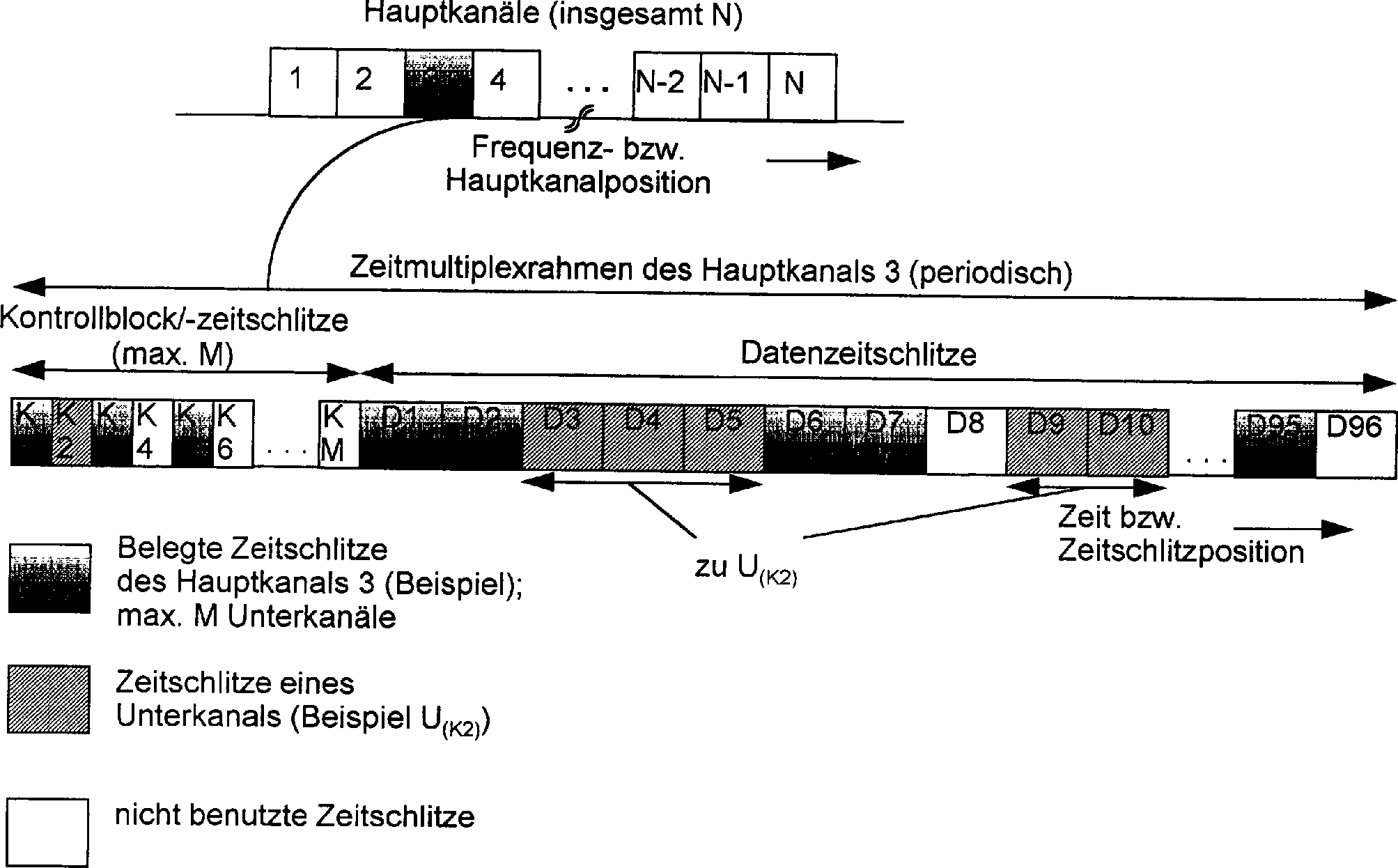
Die
auszusendenden Kontrollsignale nutzen jeweils einen Teil der pro
Hauptkanalsignal-Zeitschlitzrahmen vorgesehenen Zeitschlitze. Die Übertragung
der Kontrollsignale wird in einem Kontrollblock im TDMA-Zeitschlitzrahmen
vorgenommen. Der Kontrollblocks liegt im unten in
Claims (68)
Priority Applications (6)
| Application Number | Priority Date | Filing Date | Title |
|---|---|---|---|
| DE19700303A DE19700303B4 (en) | 1997-01-08 | 1997-01-08 | Radio transmission method for digital multimedia signals between subscriber stations in a local area network |
| EP97122513A EP0853400B1 (en) | 1997-01-08 | 1997-12-19 | Radio transmission method for digital multimedia data signals between subscriber stations in a local network |
| DE69739755T DE69739755D1 (en) | 1997-01-08 | 1997-12-19 | Radio transmission method for digital multimedia data signals between subscriber stations in a local network |
| JP00162998A JP4083270B2 (en) | 1997-01-08 | 1998-01-07 | Wireless transmission method for digital multimedia data signals between subscriber stations in a local network |
| US09/003,741 US6275506B1 (en) | 1997-01-08 | 1998-01-07 | Radio transmission method for digital multimedia data signals between subscriber stations in a local network |
| CN98104219A CN1115823C (en) | 1997-01-08 | 1998-01-08 | Radio transmission method for digital multimedia data signals between subscriber station in local network |
Applications Claiming Priority (1)
| Application Number | Priority Date | Filing Date | Title |
|---|---|---|---|
| DE19700303A DE19700303B4 (en) | 1997-01-08 | 1997-01-08 | Radio transmission method for digital multimedia signals between subscriber stations in a local area network |
Publications (2)
| Publication Number | Publication Date |
|---|---|
| DE19700303A1 DE19700303A1 (en) | 1998-07-16 |
| DE19700303B4 true DE19700303B4 (en) | 2005-11-03 |
Family
ID=7816915
Family Applications (2)
| Application Number | Title | Priority Date | Filing Date |
|---|---|---|---|
| DE19700303A Expired - Lifetime DE19700303B4 (en) | 1997-01-08 | 1997-01-08 | Radio transmission method for digital multimedia signals between subscriber stations in a local area network |
| DE69739755T Expired - Lifetime DE69739755D1 (en) | 1997-01-08 | 1997-12-19 | Radio transmission method for digital multimedia data signals between subscriber stations in a local network |
Family Applications After (1)
| Application Number | Title | Priority Date | Filing Date |
|---|---|---|---|
| DE69739755T Expired - Lifetime DE69739755D1 (en) | 1997-01-08 | 1997-12-19 | Radio transmission method for digital multimedia data signals between subscriber stations in a local network |
Country Status (5)
| Country | Link |
|---|---|
| US (1) | US6275506B1 (en) |
| EP (1) | EP0853400B1 (en) |
| JP (1) | JP4083270B2 (en) |
| CN (1) | CN1115823C (en) |
| DE (2) | DE19700303B4 (en) |
Families Citing this family (79)
| Publication number | Priority date | Publication date | Assignee | Title |
|---|---|---|---|---|
| DE59812356D1 (en) * | 1997-09-08 | 2005-01-13 | Infineon Technologies Ag | Digital telecommunication device with handset and TDMA method |
| JP2914446B1 (en) * | 1998-02-09 | 1999-06-28 | 日本電気株式会社 | Channel allocation method, transmission / reception device, and communication system |
| DE69838807T2 (en) * | 1998-02-18 | 2008-10-30 | Sony Deutschland Gmbh | Mapping of multicarrier signals in GSM time slots |
| JP3414244B2 (en) * | 1998-02-27 | 2003-06-09 | ソニー株式会社 | Communication control method and transmission device |
| DE19813183C2 (en) * | 1998-03-25 | 2002-09-26 | Siemens Ag | Method and arrangement for channel assignment in a radio communication system |
| DE69932007T2 (en) * | 1998-03-26 | 2007-07-12 | Koninklijke Philips Electronics N.V. | Communication network with improved access protocol |
| DE19819213A1 (en) * | 1998-04-29 | 1999-11-11 | Siemens Ag | Digital multi-user radio communication system |
| CA2242857A1 (en) * | 1998-07-09 | 2000-01-09 | Erik H. Boch | Combining qam and qpsk to optimize license capacity in cellular, multipoint wireless access systems |
| FI110732B (en) * | 1998-09-15 | 2003-03-14 | Domiras Oy | Wireless telecommunication system, transmitter and terminal equipment |
| JP2000101511A (en) | 1998-09-24 | 2000-04-07 | Fujitsu Ltd | Transmission level control method and transmission / reception apparatus in subscriber wireless access system |
| US6170390B1 (en) | 1998-12-21 | 2001-01-09 | Alan L. Backus | Enclosed rotisserie with added convenience |
| BR0008530B1 (en) * | 1999-02-25 | 2014-02-04 | DIGITAL DIFFUSION APPARATUS | |
| US6775260B1 (en) * | 1999-02-25 | 2004-08-10 | Texas Instruments Incorporated | Space time transmit diversity for TDD/WCDMA systems |
| USRE47895E1 (en) * | 1999-03-08 | 2020-03-03 | Ipcom Gmbh & Co. Kg | Method of allocating access rights to a telecommunications channel to subscriber stations of a telecommunications network and subscriber station |
| DE19910239B4 (en) * | 1999-03-08 | 2011-01-05 | Ipcom Gmbh & Co. Kg | Method for assigning access rights to a telecommunications channel to subscriber stations of a telecommunications network and subscriber station |
| FI107306B (en) * | 1999-04-13 | 2001-06-29 | Nokia Mobile Phones Ltd | Procedure in a wireless data transfer system as well as a wireless data transfer system |
| GB9910449D0 (en) * | 1999-05-07 | 1999-07-07 | Koninkl Philips Electronics Nv | Radio communication system |
| EP1063785B1 (en) * | 1999-06-23 | 2007-02-14 | Sony Deutschland GmbH | Transmit power control for network devices in a wireless network |
| EP1517477B1 (en) | 1999-06-23 | 2007-01-24 | Sony Deutschland GmbH | Transmission power control for wireless networks with direct mode traffic |
| US6711177B1 (en) * | 1999-06-28 | 2004-03-23 | Rockwell Collins, Inc. | Method and apparatus for managing communication resources using frame fitting |
| US6765894B1 (en) * | 1999-07-05 | 2004-07-20 | Matsushita Electric Industrial Co, Ltd. | Communication terminal apparatus and base station apparatus |
| US7372825B1 (en) * | 1999-07-13 | 2008-05-13 | Texas Instruments Incorporated | Wireless communications system with cycling of unique cell bit sequences in station communications |
| US6748005B1 (en) * | 1999-08-02 | 2004-06-08 | Lucent Technologies Inc. | Methods and apparatus for providing a direct frequency hopping wireless interface with a personal computer |
| DE19937142A1 (en) * | 1999-08-06 | 2001-03-15 | Vtq Vidiotronik Gmbh | Radio transmission apparatus for digitally compressed video, audio and other information, uses Reed-Solomon encoding and interleaving prior to spread spectrum stage |
| JP3651340B2 (en) * | 1999-12-28 | 2005-05-25 | ソニー株式会社 | Wireless transmission method and wireless transmission device |
| US7177287B1 (en) | 2000-01-05 | 2007-02-13 | Advanded Micro Devices, Inc. | System and method for concurrent wireless voice and data communications |
| US6958987B1 (en) * | 2000-01-05 | 2005-10-25 | Advanced Micro Devices, Inc. | DECT-like system and method of transceiving information over the industrial-scientific-medical spectrum |
| AU2001233237A1 (en) * | 2000-02-04 | 2001-08-14 | Interdigital Technology Corporation | Support of multiuser detection in the downlink |
| EP1137201B1 (en) * | 2000-03-20 | 2004-05-06 | Mitsubishi Electric Information Technology Centre Europe B.V. | Method for transmitting a word representative of transmission parameters respectively allocated to the mobile stations in communication with a base station |
| DE60009262T2 (en) * | 2000-04-04 | 2004-08-05 | Mitsubishi Electric Information Technology Centre Europe B.V. | Method for transmitting a word representing the number of spreading codes allocated to the mobile stations when communicating with a base station of a radio telecommunication system |
| US6791994B1 (en) | 2000-04-19 | 2004-09-14 | Rockwell Collins, Inc. | Method and apparatus for assigning receive slots in a dynamic assignment environment |
| EP1148750A1 (en) * | 2000-04-22 | 2001-10-24 | Deutsche Thomson-Brandt Gmbh | Channel preselection method for a RF communication system |
| US7934232B1 (en) | 2000-05-04 | 2011-04-26 | Jerding Dean F | Navigation paradigm for access to television services |
| JP3545682B2 (en) * | 2000-07-04 | 2004-07-21 | 松下電器産業株式会社 | High-speed packet transmission system |
| US6810022B1 (en) | 2000-08-29 | 2004-10-26 | Rockwell Collins | Full duplex communication slot assignment |
| US6781967B1 (en) | 2000-08-29 | 2004-08-24 | Rockwell Collins, Inc. | Scheduling techniques for receiver directed broadcast applications |
| US6885651B1 (en) | 2000-08-29 | 2005-04-26 | Rockwell Collins | Maintaining an adaptive broadcast channel using both transmitter directed and receiver directed broadcasts |
| GB2369964B (en) * | 2000-12-11 | 2004-07-07 | Ubinetics Ltd | Communications device |
| US7164669B2 (en) * | 2001-01-19 | 2007-01-16 | Adaptix, Inc. | Multi-carrier communication with time division multiplexing and carrier-selective loading |
| US20030027579A1 (en) * | 2001-08-03 | 2003-02-06 | Uwe Sydon | System for and method of providing an air interface with variable data rate by switching the bit time |
| US7194563B2 (en) | 2001-12-05 | 2007-03-20 | Scientific-Atlanta, Inc. | Disk driver cluster management of time shift buffer with file allocation table structure |
| US8565578B2 (en) | 2001-12-06 | 2013-10-22 | Harold J. Plourde, Jr. | Dividing and managing time-shift buffering into program specific segments based on defined durations |
| US7962011B2 (en) | 2001-12-06 | 2011-06-14 | Plourde Jr Harold J | Controlling substantially constant buffer capacity for personal video recording with consistent user interface of available disk space |
| US6879811B1 (en) * | 2001-12-31 | 2005-04-12 | Bellsouth Intellectual Property Corp. | System and method for providing cellular telephone service during cluster testing |
| US7120782B2 (en) * | 2002-01-16 | 2006-10-10 | Telefonaktiebolaget Lm Ericsson (Publ) | Methods, systems and computer program products for accessing descriptive information associated with a TDMA/GSM switch |
| KR100463786B1 (en) * | 2002-09-16 | 2004-12-29 | 주식회사 오픈솔루션 | Apparatus and method for transmitting a wireless data through an adaptive selection of frequency |
| US8181205B2 (en) | 2002-09-24 | 2012-05-15 | Russ Samuel H | PVR channel and PVR IPG information |
| US7961759B2 (en) * | 2002-12-31 | 2011-06-14 | Vixs Systems, Inc. | Method and apparatus for synchronized channel transmission |
| US7174494B2 (en) | 2003-07-01 | 2007-02-06 | Thomson Licensing | Method and system for coded null packet-aided synchronization |
| DE10329878B4 (en) * | 2003-07-02 | 2005-05-25 | Siemens Ag | Method for transmitting packet data in a radio telecommunication system |
| RU2320086C2 (en) * | 2003-08-13 | 2008-03-20 | Квэлкомм Флэрион Текнолоджиз, Инк. | Methods and device for transmitting user data using an information channel |
| US7406058B2 (en) * | 2003-08-13 | 2008-07-29 | Qualcomm, Incorporated | Methods and apparatus of transmitting user data using traffic channels |
| NZ545246A (en) * | 2003-08-13 | 2007-08-31 | Qualcomm Flarion Tech | Methods and apparatus of transmitting user data using traffic channels |
| US7385999B1 (en) | 2003-10-20 | 2008-06-10 | Rockwell Collins, Inc. | Heuristics for combining inter-channel and intra-channel communications in a wireless communications environment |
| US8161388B2 (en) | 2004-01-21 | 2012-04-17 | Rodriguez Arturo A | Interactive discovery of display device characteristics |
| US7403780B2 (en) * | 2004-02-19 | 2008-07-22 | Rockwell Collins, Inc. | Hybrid open/closed loop filtering for link quality estimation |
| US7826372B1 (en) | 2004-03-26 | 2010-11-02 | Rockwell Collins, Inc. | Network routing process for regulating traffic through advantaged and disadvantaged nodes |
| US7382799B1 (en) | 2004-05-18 | 2008-06-03 | Rockwell Collins, Inc. | On-demand broadcast protocol |
| US7310380B1 (en) | 2004-05-28 | 2007-12-18 | Rockwell Collins, Inc. | Generic transmission parameter configuration |
| US7397810B1 (en) | 2004-06-14 | 2008-07-08 | Rockwell Collins, Inc. | Artery nodes |
| US7239624B2 (en) * | 2004-10-26 | 2007-07-03 | Motorola, Inc. | Method and apparatus for allowing communication units to utilize non-licensed title spectrum |
| US7574175B2 (en) * | 2004-11-01 | 2009-08-11 | Broadcom Corporation | Method and system for selective equalization enablement based on modulation type |
| CN1783861B (en) * | 2004-12-01 | 2011-04-13 | 华为技术有限公司 | Method for realizing frequency soft multiplexing in radio communication system |
| DE102005032080A1 (en) * | 2005-07-08 | 2007-01-11 | Siemens Ag | A method for transmitting a media data stream and a method for receiving and creating a reconstructed media data stream, and associated transmitting device and receiving device |
| US7606171B1 (en) | 2005-07-28 | 2009-10-20 | Rockwell Collins, Inc. | Skeletal node rules for connected dominating set in ad-hoc networks |
| CN100455068C (en) * | 2005-09-28 | 2009-01-21 | 中兴通讯股份有限公司 | A method for sending forward media stream in a communication system |
| US20080310379A1 (en) * | 2005-10-20 | 2008-12-18 | Open Solution Co., Ltd. | Short-Distance Wireless Data Transmitting Apparatus and Method |
| JP4711819B2 (en) | 2005-12-14 | 2011-06-29 | 株式会社エヌ・ティ・ティ・ドコモ | Communication apparatus and communication method |
| CN1870481B (en) * | 2006-04-20 | 2011-04-27 | 华东师范大学 | F_TDM multi-channel reception method |
| CN1960328B (en) * | 2006-08-14 | 2010-05-12 | 中兴通讯股份有限公司 | A method for encapsulating real-time streaming of mobile multimedia broadcasting |
| KR101523100B1 (en) * | 2007-12-05 | 2015-05-27 | 엘지전자 주식회사 | Method for allocating resources in a wireless communication system |
| US9768904B2 (en) * | 2011-09-16 | 2017-09-19 | Telefonaktiebolaget Lm Ericsson (Publ) | Method and apparatus for allocating slots for transmission of data |
| JP6003514B2 (en) * | 2012-03-01 | 2016-10-05 | ソニー株式会社 | Information processing apparatus, communication system, and channel setting method |
| CN103684623B (en) * | 2013-12-24 | 2015-06-17 | 三峡大学 | Method and device for inhibiting secondary radiation of medium-wave frequency band ultra-high voltage transmission line loop |
| EP2897313A1 (en) | 2014-01-16 | 2015-07-22 | NWave Technologies Ltd | Method of transmitting a data packet, with spreading / de-spreading by using a combination of TDMA and FDMA |
| US10396948B2 (en) | 2015-01-07 | 2019-08-27 | Northeastern University | Ultrasonic multiplexing network for implantable medical devices |
| CN105991202A (en) * | 2015-02-13 | 2016-10-05 | 北京南瑞智芯微电子科技有限公司 | Frequency-spectrum-detection-based transceiver and frequency spectrum switching method |
| DE102016220886B3 (en) * | 2016-10-24 | 2018-03-08 | Fraunhofer-Gesellschaft zur Förderung der angewandten Forschung e.V. | Interleaving for the transmission of telegrams with variable subpacket number and successive decoding |
| CN113596259B (en) * | 2021-07-09 | 2023-03-21 | 厦门亿联网络技术股份有限公司 | Communication method and device based on DECT |
Citations (3)
| Publication number | Priority date | Publication date | Assignee | Title |
|---|---|---|---|---|
| DE3511430A1 (en) * | 1985-03-29 | 1986-10-02 | Philips Patentverwaltung Gmbh, 2000 Hamburg | METHOD FOR SYNCHRONIZING THE RECEIVING DEVICES IN A DIGITAL MULTIPLEX TRANSMISSION SYSTEM |
| DE3527331A1 (en) * | 1985-07-31 | 1987-02-05 | Philips Patentverwaltung | DIGITAL RADIO TRANSMISSION SYSTEM |
| DE9214885U1 (en) * | 1992-11-02 | 1994-03-03 | Siemens AG, 80333 München | Arrangement for controlling a transceiver from base stations or mobile parts of a cordless telephone system |
Family Cites Families (6)
| Publication number | Priority date | Publication date | Assignee | Title |
|---|---|---|---|---|
| US4736371A (en) * | 1985-12-30 | 1988-04-05 | Nec Corporation | Satellite communications system with random multiple access and time slot reservation |
| US5134615A (en) * | 1990-10-05 | 1992-07-28 | Motorola, Inc. | Frequency agile tdma communications system |
| US5283811A (en) * | 1991-09-03 | 1994-02-01 | General Electric Company | Decision feedback equalization for digital cellular radio |
| US5742593A (en) * | 1995-08-29 | 1998-04-21 | Hazeltine Corporation | On-line distributed TDMA/FDMA/CDMA link assignment in mobile radio networks with flexible directivity |
| US5652751A (en) * | 1996-03-26 | 1997-07-29 | Hazeltine Corporation | Architecture for mobile radio networks with dynamically changing topology using virtual subnets |
| DE19735527C2 (en) * | 1997-08-16 | 2003-02-06 | Philips Corp Intellectual Pty | Communication system with several radio systems |
-
1997
- 1997-01-08 DE DE19700303A patent/DE19700303B4/en not_active Expired - Lifetime
- 1997-12-19 DE DE69739755T patent/DE69739755D1/en not_active Expired - Lifetime
- 1997-12-19 EP EP97122513A patent/EP0853400B1/en not_active Expired - Lifetime
-
1998
- 1998-01-07 US US09/003,741 patent/US6275506B1/en not_active Expired - Lifetime
- 1998-01-07 JP JP00162998A patent/JP4083270B2/en not_active Expired - Lifetime
- 1998-01-08 CN CN98104219A patent/CN1115823C/en not_active Expired - Lifetime
Patent Citations (3)
| Publication number | Priority date | Publication date | Assignee | Title |
|---|---|---|---|---|
| DE3511430A1 (en) * | 1985-03-29 | 1986-10-02 | Philips Patentverwaltung Gmbh, 2000 Hamburg | METHOD FOR SYNCHRONIZING THE RECEIVING DEVICES IN A DIGITAL MULTIPLEX TRANSMISSION SYSTEM |
| DE3527331A1 (en) * | 1985-07-31 | 1987-02-05 | Philips Patentverwaltung | DIGITAL RADIO TRANSMISSION SYSTEM |
| DE9214885U1 (en) * | 1992-11-02 | 1994-03-03 | Siemens AG, 80333 München | Arrangement for controlling a transceiver from base stations or mobile parts of a cordless telephone system |
Non-Patent Citations (1)
| Title |
|---|
| T.S.Rappaport, Wireless Communications, Prentice Hall PTR, 1995 ISBN 0-13-375536-3, S. 500-509 * |
Also Published As
| Publication number | Publication date |
|---|---|
| US6275506B1 (en) | 2001-08-14 |
| EP0853400A3 (en) | 2005-07-13 |
| DE19700303A1 (en) | 1998-07-16 |
| EP0853400B1 (en) | 2010-02-10 |
| CN1189727A (en) | 1998-08-05 |
| EP0853400A2 (en) | 1998-07-15 |
| JPH10242931A (en) | 1998-09-11 |
| DE69739755D1 (en) | 2010-03-25 |
| CN1115823C (en) | 2003-07-23 |
| JP4083270B2 (en) | 2008-04-30 |
Similar Documents
| Publication | Publication Date | Title |
|---|---|---|
| DE19700303B4 (en) | Radio transmission method for digital multimedia signals between subscriber stations in a local area network | |
| DE69431091T2 (en) | Radio system with multiple access | |
| EP0211460B1 (en) | Digital radio transmission method | |
| DE69925800T2 (en) | METHOD AND DEVICE FOR MAXIMIZING THE REST PERIOD USING A QUICK RUN CHANNEL | |
| DE19800953C1 (en) | Resource allocation in radio interface of radio communications system | |
| EP0210698B1 (en) | Radio transmission system with a variable time slot duration in a time division multiplex frame | |
| DE60037823T2 (en) | STATIONARY WIRELESS MAN WITH PARTNER EQUIPMENT WITH BUILT-IN ANTENNA | |
| DE69730107T2 (en) | System and method for generating a spread spectrum phase modulated waveform | |
| DE69226114T2 (en) | TDMA transmission arrangement with time slots of different durations | |
| DE69911998T2 (en) | HANDSET TIME SYNCHRONIZATION TO A BASE STATION OF A MOBILE PHONE | |
| DE69727291T2 (en) | DYNAMIC CHANNEL ALLOCATION | |
| DE69936788T2 (en) | SIGNALING METHOD AND TELECOMMUNICATION SYSTEM. | |
| DE19808371C2 (en) | Method and radio communication system for the transmission of information between a base station and further radio stations | |
| DE69935271T2 (en) | Method, device, and wireless communication controller | |
| DE3337646A1 (en) | Radio network with a multiplicity of mobile stations | |
| EP0612460B1 (en) | Method for radio transmission using a fixed base station and a plurality of independent fixed subscriber stations | |
| DE19825536B4 (en) | Method and apparatus for a full-duplex radio transmission system with CDMA access | |
| DE19805546C2 (en) | Method and radio station for data transmission | |
| DE19808948C2 (en) | Method, radio communication system and mobile station for information transmission | |
| DE69936302T2 (en) | Method and system for cordless data communication | |
| WO1999020011A1 (en) | Method and radio station for transmitting data | |
| DE3337647C1 (en) | Microwave mobile radio network for digital communications has each mobile station used for coupling different subscribers and for acting as relay station between adjacent mobile stations | |
| DE3337644C1 (en) | Microwave radio network for speech and data communication between mobile radio stations | |
| DE19747366C2 (en) | Method, base station, receiving device and mobile station for transmitting useful information and signaling information for a mobile communication system | |
| DE102005008053B4 (en) | Communication in an OFDMA system with division of subbands into signaling and payload subbands |
Legal Events
| Date | Code | Title | Description |
|---|---|---|---|
| OP8 | Request for examination as to paragraph 44 patent law | ||
| 8364 | No opposition during term of opposition | ||
| 8327 | Change in the person/name/address of the patent owner |
Owner name: DEUTSCHE THOMSON-BRANDT GMBH, DE Owner name: DEUTSCHES ZENTRUM F. LUFT- UND RAUMFAHRT E.V., DE |
|
| R071 | Expiry of right |