DE112019001009T5 - COMPOUND, POLYMER AND ORGANIC MATERIAL - Google Patents
COMPOUND, POLYMER AND ORGANIC MATERIAL Download PDFInfo
- Publication number
- DE112019001009T5 DE112019001009T5 DE112019001009.3T DE112019001009T DE112019001009T5 DE 112019001009 T5 DE112019001009 T5 DE 112019001009T5 DE 112019001009 T DE112019001009 T DE 112019001009T DE 112019001009 T5 DE112019001009 T5 DE 112019001009T5
- Authority
- DE
- Germany
- Prior art keywords
- compound
- group
- carbon
- aromatic group
- general formula
- Prior art date
- Legal status (The legal status is an assumption and is not a legal conclusion. Google has not performed a legal analysis and makes no representation as to the accuracy of the status listed.)
- Withdrawn
Links
- 0 C*(C(Oc1c(CCc(cc(cccc2)c2c23)c2[s]c2c3c(cccc3)c3cc2)cccc1)=O)=C Chemical compound C*(C(Oc1c(CCc(cc(cccc2)c2c23)c2[s]c2c3c(cccc3)c3cc2)cccc1)=O)=C 0.000 description 2
- PAYRBTQHHZNZFC-UHFFFAOYSA-N CC(C(Oc1cccc(CCc2cc3ccccc3c3c2[s]c2ccc(cccc4)c4c32)c1)=O)=C Chemical compound CC(C(Oc1cccc(CCc2cc3ccccc3c3c2[s]c2ccc(cccc4)c4c32)c1)=O)=C PAYRBTQHHZNZFC-UHFFFAOYSA-N 0.000 description 1
- ZZJQFOREOCOSSF-UHFFFAOYSA-N COC(C(Oc1c(CCc2cc(cccc3)c3c3c2[s]c2c3c(cccc3)c3cc2)cccc1)=O)=C Chemical compound COC(C(Oc1c(CCc2cc(cccc3)c3c3c2[s]c2c3c(cccc3)c3cc2)cccc1)=O)=C ZZJQFOREOCOSSF-UHFFFAOYSA-N 0.000 description 1
- FEKCWQTXDVMDJS-UHFFFAOYSA-N CSC(C(O)Oc1c(CCc2c3[s]c4ccc(cccc5)c5c4c3c(cccc3)c3c2)cccc1)=C Chemical compound CSC(C(O)Oc1c(CCc2c3[s]c4ccc(cccc5)c5c4c3c(cccc3)c3c2)cccc1)=C FEKCWQTXDVMDJS-UHFFFAOYSA-N 0.000 description 1
Classifications
-
- C—CHEMISTRY; METALLURGY
- C07—ORGANIC CHEMISTRY
- C07D—HETEROCYCLIC COMPOUNDS
- C07D333/00—Heterocyclic compounds containing five-membered rings having one sulfur atom as the only ring hetero atom
- C07D333/50—Heterocyclic compounds containing five-membered rings having one sulfur atom as the only ring hetero atom condensed with carbocyclic rings or ring systems
-
- C—CHEMISTRY; METALLURGY
- C08—ORGANIC MACROMOLECULAR COMPOUNDS; THEIR PREPARATION OR CHEMICAL WORKING-UP; COMPOSITIONS BASED THEREON
- C08F—MACROMOLECULAR COMPOUNDS OBTAINED BY REACTIONS ONLY INVOLVING CARBON-TO-CARBON UNSATURATED BONDS
- C08F2/00—Processes of polymerisation
- C08F2/46—Polymerisation initiated by wave energy or particle radiation
- C08F2/48—Polymerisation initiated by wave energy or particle radiation by ultraviolet or visible light
- C08F2/50—Polymerisation initiated by wave energy or particle radiation by ultraviolet or visible light with sensitising agents
-
- C—CHEMISTRY; METALLURGY
- C08—ORGANIC MACROMOLECULAR COMPOUNDS; THEIR PREPARATION OR CHEMICAL WORKING-UP; COMPOSITIONS BASED THEREON
- C08F—MACROMOLECULAR COMPOUNDS OBTAINED BY REACTIONS ONLY INVOLVING CARBON-TO-CARBON UNSATURATED BONDS
- C08F20/00—Homopolymers and copolymers of compounds having one or more unsaturated aliphatic radicals, each having only one carbon-to-carbon double bond, and only one being terminated by only one carboxyl radical or a salt, anhydride, ester, amide, imide or nitrile thereof
- C08F20/02—Monocarboxylic acids having less than ten carbon atoms, Derivatives thereof
- C08F20/10—Esters
- C08F20/38—Esters containing sulfur
-
- C—CHEMISTRY; METALLURGY
- C08—ORGANIC MACROMOLECULAR COMPOUNDS; THEIR PREPARATION OR CHEMICAL WORKING-UP; COMPOSITIONS BASED THEREON
- C08F—MACROMOLECULAR COMPOUNDS OBTAINED BY REACTIONS ONLY INVOLVING CARBON-TO-CARBON UNSATURATED BONDS
- C08F220/00—Copolymers of compounds having one or more unsaturated aliphatic radicals, each having only one carbon-to-carbon double bond, and only one being terminated by only one carboxyl radical or a salt, anhydride ester, amide, imide or nitrile thereof
- C08F220/02—Monocarboxylic acids having less than ten carbon atoms; Derivatives thereof
- C08F220/10—Esters
- C08F220/38—Esters containing sulfur
-
- C—CHEMISTRY; METALLURGY
- C08—ORGANIC MACROMOLECULAR COMPOUNDS; THEIR PREPARATION OR CHEMICAL WORKING-UP; COMPOSITIONS BASED THEREON
- C08F—MACROMOLECULAR COMPOUNDS OBTAINED BY REACTIONS ONLY INVOLVING CARBON-TO-CARBON UNSATURATED BONDS
- C08F222/00—Copolymers of compounds having one or more unsaturated aliphatic radicals, each having only one carbon-to-carbon double bond, and at least one being terminated by a carboxyl radical and containing at least one other carboxyl radical in the molecule; Salts, anhydrides, esters, amides, imides, or nitriles thereof
- C08F222/10—Esters
- C08F222/1006—Esters of polyhydric alcohols or polyhydric phenols
- C08F222/102—Esters of polyhydric alcohols or polyhydric phenols of dialcohols, e.g. ethylene glycol di(meth)acrylate or 1,4-butanediol dimethacrylate
- C08F222/1025—Esters of polyhydric alcohols or polyhydric phenols of dialcohols, e.g. ethylene glycol di(meth)acrylate or 1,4-butanediol dimethacrylate of aromatic dialcohols
-
- C—CHEMISTRY; METALLURGY
- C08—ORGANIC MACROMOLECULAR COMPOUNDS; THEIR PREPARATION OR CHEMICAL WORKING-UP; COMPOSITIONS BASED THEREON
- C08F—MACROMOLECULAR COMPOUNDS OBTAINED BY REACTIONS ONLY INVOLVING CARBON-TO-CARBON UNSATURATED BONDS
- C08F263/00—Macromolecular compounds obtained by polymerising monomers on to polymers of esters of unsaturated alcohols with saturated acids as defined in group C08F18/00
- C08F263/02—Macromolecular compounds obtained by polymerising monomers on to polymers of esters of unsaturated alcohols with saturated acids as defined in group C08F18/00 on to polymers of vinyl esters with monocarboxylic acids
- C08F263/04—Macromolecular compounds obtained by polymerising monomers on to polymers of esters of unsaturated alcohols with saturated acids as defined in group C08F18/00 on to polymers of vinyl esters with monocarboxylic acids on to polymers of vinyl acetate
-
- G—PHYSICS
- G02—OPTICS
- G02B—OPTICAL ELEMENTS, SYSTEMS OR APPARATUS
- G02B1/00—Optical elements characterised by the material of which they are made; Optical coatings for optical elements
- G02B1/04—Optical elements characterised by the material of which they are made; Optical coatings for optical elements made of organic materials, e.g. plastics
- G02B1/041—Lenses
-
- G—PHYSICS
- G03—PHOTOGRAPHY; CINEMATOGRAPHY; ANALOGOUS TECHNIQUES USING WAVES OTHER THAN OPTICAL WAVES; ELECTROGRAPHY; HOLOGRAPHY
- G03H—HOLOGRAPHIC PROCESSES OR APPARATUS
- G03H1/00—Holographic processes or apparatus using light, infrared or ultraviolet waves for obtaining holograms or for obtaining an image from them; Details peculiar thereto
- G03H1/02—Details of features involved during the holographic process; Replication of holograms without interference recording
-
- G—PHYSICS
- G11—INFORMATION STORAGE
- G11B—INFORMATION STORAGE BASED ON RELATIVE MOVEMENT BETWEEN RECORD CARRIER AND TRANSDUCER
- G11B7/00—Recording or reproducing by optical means, e.g. recording using a thermal beam of optical radiation by modifying optical properties or the physical structure, reproducing using an optical beam at lower power by sensing optical properties; Record carriers therefor
- G11B7/24—Record carriers characterised by shape, structure or physical properties, or by the selection of the material
- G11B7/2403—Layers; Shape, structure or physical properties thereof
- G11B7/24035—Recording layers
- G11B7/24044—Recording layers for storing optical interference patterns, e.g. holograms; for storing data in three dimensions, e.g. volume storage
-
- G—PHYSICS
- G11—INFORMATION STORAGE
- G11B—INFORMATION STORAGE BASED ON RELATIVE MOVEMENT BETWEEN RECORD CARRIER AND TRANSDUCER
- G11B7/00—Recording or reproducing by optical means, e.g. recording using a thermal beam of optical radiation by modifying optical properties or the physical structure, reproducing using an optical beam at lower power by sensing optical properties; Record carriers therefor
- G11B7/24—Record carriers characterised by shape, structure or physical properties, or by the selection of the material
- G11B7/241—Record carriers characterised by shape, structure or physical properties, or by the selection of the material characterised by the selection of the material
- G11B7/242—Record carriers characterised by shape, structure or physical properties, or by the selection of the material characterised by the selection of the material of recording layers
- G11B7/244—Record carriers characterised by shape, structure or physical properties, or by the selection of the material characterised by the selection of the material of recording layers comprising organic materials only
- G11B7/245—Record carriers characterised by shape, structure or physical properties, or by the selection of the material characterised by the selection of the material of recording layers comprising organic materials only containing a polymeric component
-
- G—PHYSICS
- G03—PHOTOGRAPHY; CINEMATOGRAPHY; ANALOGOUS TECHNIQUES USING WAVES OTHER THAN OPTICAL WAVES; ELECTROGRAPHY; HOLOGRAPHY
- G03H—HOLOGRAPHIC PROCESSES OR APPARATUS
- G03H1/00—Holographic processes or apparatus using light, infrared or ultraviolet waves for obtaining holograms or for obtaining an image from them; Details peculiar thereto
- G03H1/02—Details of features involved during the holographic process; Replication of holograms without interference recording
- G03H2001/026—Recording materials or recording processes
- G03H2001/0264—Organic recording material
-
- G—PHYSICS
- G03—PHOTOGRAPHY; CINEMATOGRAPHY; ANALOGOUS TECHNIQUES USING WAVES OTHER THAN OPTICAL WAVES; ELECTROGRAPHY; HOLOGRAPHY
- G03H—HOLOGRAPHIC PROCESSES OR APPARATUS
- G03H2260/00—Recording materials or recording processes
- G03H2260/12—Photopolymer
Landscapes
- Chemical & Material Sciences (AREA)
- Organic Chemistry (AREA)
- Physics & Mathematics (AREA)
- Health & Medical Sciences (AREA)
- Chemical Kinetics & Catalysis (AREA)
- Medicinal Chemistry (AREA)
- Polymers & Plastics (AREA)
- General Physics & Mathematics (AREA)
- Optics & Photonics (AREA)
- Organic Low-Molecular-Weight Compounds And Preparation Thereof (AREA)
- Holo Graphy (AREA)
- Addition Polymer Or Copolymer, Post-Treatments, Or Chemical Modifications (AREA)
Abstract
Zweck der vorliegenden Erfindung ist die Bereitstellung einer Verbindung, mit der organische Materialien mit höherer Funktionalität hergestellt werden können. Bereitgestellt werden Verbindungen, die durch die allgemeine Formel (1) wiedergegeben werden: (In der allgemeinen Formel (1) stehen R101bis R104jeweils unabhängig für einen einwertigen Substituenten, der durch die allgemeine Formel (2-1) wiedergegeben wird; stehen i, j, k und 1 jeweils unabhängig für eine ganze Zahl mit einem Wert von 0 oder 1 und stehen i, j, k und 1 nicht gleichzeitig für 0), (in der allgemeinen Formel (2-1) stehen R203und R204jeweils unabhängig für eine Einfachbindung oder eine geradkettige oder verzweigte, substituierte oder unsubstituierte Alkylengruppe, die durch CnH2nwiedergegeben wird (n steht für eine ganze Zahl gleich oder größer als 1) und steht R205für Wasserstoff oder eine geradkettige oder verzweigte substituierte oder unsubstituierte Alkylgruppe, die durch CnH2n+1wiedergegeben wird (n steht für eine ganze Zahl gleich oder größer als 1). k steht für eine ganze Zahl gleich oder größer als 1, und X steht für eine zweiwertige oder höherwertige aromatische Gruppe. Jeder Kohlenstoff in der zweiwertigen oder höherwertigen aromatischen Gruppe, der nicht an R203und R204gebunden ist, ist unsubstituiert oder weist mindestens einen Substituenten auf. Eine Bindungsstelle an R203und mindestens eine Bindungsstelle an R204, die die zweiwertige oder höherwertige aromatische Gruppe besitzt, kann ein beliebiger bindungsfähiger Kohlenstoff in der aromatischen Gruppe sein. Das * für R101und R102steht für eine Bindungsstelle an einen bindungsfähigen Kohlenstoff in einem mit einem Thiophenring kondensierten Benzolring in der allgemeinen Formel (1). Das * für R103und R104steht für eine Bindungsstelle an einen bindungsfähigen Kohlenstoff in einem nicht mit dem Thiophenring kondensierten Benzolring in der allgemeinen Formel (1)).The purpose of the present invention is to provide a compound with which organic materials with higher functionality can be produced. Compounds represented by the general formula (1) are provided: (In the general formula (1), R101 to R104 each independently represent a monovalent substituent represented by the general formula (2-1); i, j, k and 1 each independently represent an integer with a value of 0 or 1 and i, j, k and 1 do not simultaneously represent 0), (in the general formula (2-1) R203 and R204 each independently represent a single bond or a straight-chain or branched, substituted or unsubstituted alkylene group, which is represented by CnH2n (n stands for an integer equal to or greater than 1) and R205 stands for hydrogen or a straight-chain or branched substituted or unsubstituted alkyl group, which is represented by CnH2n + 1 (n stands for an integer equal to or greater than 1), k stands for an integer equal to or greater than 1, and X stands for a divalent or higher aromatic group oop. Any carbon in the divalent or higher valent aromatic group that is not bonded to R203 and R204 is unsubstituted or has at least one substituent. A binding site at R203 and at least one binding site at R204 which has the divalent or higher valent aromatic group can be any bondable carbon in the aromatic group. The * for R101 and R102 stands for a binding site to a bondable carbon in a benzene ring condensed with a thiophene ring in the general formula (1). The * for R103 and R104 stands for a binding site to a bondable carbon in a benzene ring which is not condensed with the thiophene ring in the general formula (1)).
Description
[Technisches Gebiet][Technical area]
Die vorliegende Technologie bezieht sich auf eine Verbindung, ein Polymer und ein organisches Material.The present technology relates to a compound, a polymer and an organic material.
[Stand der Technik][State of the art]
Hochfunktionelle organische Materialien haben eine hervorragende Designfreiheit und Schockbeständigkeit und ein geringes Gewicht im Vergleich zu anorganischen Materialien. Daher gab es intensive Untersuchungen zur Anwendung der hochfunktionellen organischen Materialien auf optische Materialien wie organische Dünnfilme, organische Linsen und Hologramme.Highly functional organic materials have excellent freedom of design and shock resistance and are light in weight compared to inorganic materials. Therefore, there have been intensive studies on the application of the highly functional organic materials to optical materials such as organic thin films, organic lenses and holograms.
Beispielsweise ist eine härtbare Zusammensetzung mit Härtungsschrumpfbeständigkeit vorgeschlagen worden, die eine polymerisierbare Verbindung, in der eine polymerisierbare Substituentengruppe in ein 1,1'-Binaphthylgerüst eingeführt ist, wobei die 2,2'-Positionen über eine zweiwertige Substituentengruppe oder ein Atom miteinander verbunden sind, und einen Polymerisationsinitiator, der eine Polymerisationsreaktion der polymerisierbaren Substituentengruppe verursachen kann, enthält (siehe PTL 1) .For example, a curable composition having cure shrinkage resistance has been proposed which comprises a polymerizable compound in which a polymerizable substituent group is introduced into a 1,1'-binaphthyl skeleton with the 2,2'-positions connected to each other through a divalent substituent group or an atom, and a polymerization initiator capable of causing a polymerization reaction of the polymerizable substituent group (see PTL 1).
Außerdem ist beispielsweise ein Brechungsindexverbesserer, der eine Verbindung mit einem Dinaphthothiophengerüst enthält, vorgeschlagen worden (siehe PTL 2). Ferner ist beispielsweise ein Verfahren zum Versehen eines Artikels mit einem Brechungsindex durch Verwendung einer Verbindung mit einem Dibenzothiophengerüst vorgeschlagen worden (siehe PTL 3).In addition, for example, a refractive index improver containing a compound having a dinaphthothiophene skeleton has been proposed (see PTL 2). Further, for example, a method of providing an article with a refractive index by using a compound having a dibenzothiophene skeleton has been proposed (see PTL 3).
[Literaturliste][Literature list]
[Patentliteratur][Patent literature]
-
[PTL 1]
JP 2012-136576A JP 2012-136576A -
[PTL 2]
JP 2011-178985A JP 2011-178985A -
[PTL 3]
JP 2011-162584A JP 2011-162584A
[Kurzdarstellung][Summary]
[Technisches Problem][Technical problem]
Gemäß den von PTL 1 bis PTL 3 vorgeschlagenen Technologien kann es jedoch unmöglich sein, die Funktionen von organischen Materialien weiter zu verbessern.However, according to the technologies proposed by PTL 1 to PTL 3, it may be impossible to further improve the functions of organic materials.
Die vorliegende Technologie wurde unter Berücksichtigung der oben erwähnten Umstände entwickelt. Eine Hauptaufgabe der vorliegenden Technologie besteht in der Bereitstellung einer Verbindung und eines Polymers, mit denen Funktionen eines organischen Materials weiter verbessert werden können, und eines hochfunktionellen organischen Materials.The present technology was developed in consideration of the above-mentioned circumstances. A main object of the present technology is to provide a compound and a polymer capable of further improving functions of an organic material and a highly functional organic material.
[Lösung des Problems][The solution of the problem]
Als Ergebnis ausgiebiger und intensiver Forschungsarbeiten zur Lösung des oben erwähnten Problems gelang im Zuge der vorliegenden Erfindung überraschenderweise die Entwicklung einer Verbindung und eines Polymers, mit denen eine Verbesserung von Funktionen möglich ist, und eines hochfunktionellen organischen Materials, und die vorliegende Technologie wurde vollendet.As a result of extensive and intensive research to solve the above-mentioned problem, the present invention surprisingly succeeded in developing a compound and a polymer capable of improving functions and a highly functional organic material, and the present technology was accomplished.
Die vorliegende Technologie stellt eine Verbindung bereit, die durch die folgende allgemeine Formel (1) wiedergegeben wird.


In der Verbindung gemäß der vorliegenden Technologie kann mindestens ein Kohlenstoffatom mindestens eines Kohlenstoffgerüsts der Kohlenstoffgerüste, aus denen die Alkylengruppen von R203 und R204 und die Alkylgruppe von R205 aufgebaut ist, durch ein Heteroatom substituiert sein.In the compound according to the present technology, at least one carbon atom of at least one carbon skeleton of the carbon skeletons constituting the alkylene groups of R 203 and R 204 and the alkyl group of R 205 may be substituted with a hetero atom.
In der Verbindung gemäß der vorliegenden Technologie kann mindestens ein Wasserstoffatom der Wasserstoffatome, aus denen die Alkylengruppe von R203 aufgebaut ist, der Wasserstoffatome, aus denen die Alkylengruppe von R204 aufgebaut ist, und der Wasserstoffatome, aus denen die Alkylgruppe von R205 aufgebaut ist, durch ein Halogenatom substituiert sein.In the compound according to the present technology, at least one hydrogen atom can Hydrogen atoms from which the alkylene group of R 203 is built up, the hydrogen atoms from which the alkylene group of R 204 is built up, and the hydrogen atoms from which the alkyl group of R 205 is built up can be substituted by a halogen atom.
In der Verbindung gemäß der vorliegenden Technologie können R203 und R204 für Einfachbindungen oder geradkettige oder verzweigte substituierte oder unsubstituierte Alkylengruppen, die durch CnH2n (n ist eine ganze Zahl von 1 ≤ n ≤ 10) wiedergegeben werden, stehen, ferner kann R205 für Wasserstoff oder eine geradkettige oder verzweigte substituierte oder unsubstituierte Alkylgruppe, die durch CnH2n+1 (n ist eine ganze Zahl von 1 ≤ n ≤ 10) wiedergegeben wird, stehen, und in diesem Fall kann mindestens ein Kohlenstoffatom mindestens eines Kohlenstoffgerüsts der Kohlenstoffgerüste, aus denen die Alkylengruppen von R203 und R204 und die Alkylgruppe von R205 aufgebaut sind, durch ein Heteroatom substituiert sein und mindestens ein Wasserstoffatom der Wasserstoffatome, aus denen die Alkylengruppe von R203 aufgebaut ist, der Wasserstoffatome, aus denen die Alkylengruppe von R204 aufgebaut ist, und der Wasserstoffatome, aus denen die Alkylgruppe von R205 aufgebaut ist, durch ein Halogenatom substituiert sein.In the compound according to the present technology, R 203 and R 204 may represent single bonds or straight-chain or branched substituted or unsubstituted alkylene groups represented by C n H 2n (n is an integer of 1 n 10) R 205 represents hydrogen or a straight-chain or branched substituted or unsubstituted alkyl group represented by C n H 2n + 1 (n is an integer of 1 ≤ n ≤ 10), and in this case at least one carbon atom can be at least one Carbon skeleton of the carbon skeletons from which the alkylene groups of R 203 and R 204 and the alkyl group of R 205 are built up, be substituted by a hetero atom and at least one hydrogen atom of the hydrogen atoms from which the alkylene group of R 203 is built up, the hydrogen atoms from which the alkylene group of R 204 is built up, and the hydrogen atoms from which the alkyl group of R 205 is built up by a Be substituted halogen atom.
X kann für eine zweiwertige oder mehrwertige aromatische Gruppe stehen, die durch die folgenden allgemeinen Formeln (3-1) bis (3-8) wiedergegeben wird.


In der Verbindung gemäß der vorliegenden Technologie kann k für 1 stehen und x für eine zweiwertige aromatische Gruppe stehen.In the compound according to the present technology, k can stand for 1 and x stand for a divalent aromatic group.
Bei der zweiwertigen aromatischen Gruppe kann es sich um eine monocyclische Arylengruppe handeln, und zwei Teile zur Bindung an R203 und R204, die die monocyclische Arylengruppe besitzt, können in einer Beziehung von ortho-Positionen, meta-Positionen oder para-Positionen vorliegen.The divalent aromatic group may be a monocyclic arylene group, and two parts to bond to R 203 and R 204 which the monocyclic arylene group has may be in a relationship of ortho positions, meta positions or para positions.
Bei der zweiwertigen aromatischen Gruppe kann es sich um eine polycyclische Arylengruppe handeln, und zwei Teile zur Bindung an R203 und R204, die die polycyclische Arylengruppe besitzt, können zwei beliebige bindungsfähige Kohlenstoffatome in der polycyclischen Arylengruppe sein.The divalent aromatic group may be a polycyclic arylene group, and two portions to bond to R 203 and R 204 which the polycyclic arylene group has may be any two bondable carbon atoms in the polycyclic arylene group.
In der Verbindung gemäß der vorliegenden Technologie kann k für 2 stehen und X für eine dreiwertige aromatische Gruppe stehen.In the compound according to the present technology, k can be 2 and X can be a trivalent aromatic group.
Bei der dreiwertigen aromatischen Gruppe kann es sich um eine monocyclische dreiwertige aromatische Gruppe handeln, und zwei Teile zur Bindung an R204, die die monocyclische dreiwertige aromatische Gruppe besitzt, können in einer Beziehung von ortho-Positionen, meta-Positionen oder para-Positionen vorliegen.The trivalent aromatic group may be a monocyclic trivalent aromatic group, and two parts for bonding to R 204 which the monocyclic trivalent aromatic group has may be in a relation of ortho positions, meta positions or para positions .
In der Verbindung gemäß der vorliegenden Technologie kann mindestens eines von R101 oder R102 einem Kohlenstoffatom, das einem Schwefelatom in der allgemeinen Formel (1) benachbart ist, benachbart sein und an ein bindungsfähiges Kohlenstoffatom in dem mit dem Thiophenring kondensierten Benzolring in der allgemeinen Formel (1) gebunden sein.In the compound according to the present technology, at least one of R 101 or R 102 may be adjacent to a carbon atom adjacent to a sulfur atom in the general formula (1) and to a bondable carbon atom in the benzene ring condensed with the thiophene ring in the general formula (1) be bound.
In der Verbindung gemäß der vorliegenden Technologie kann mindestens eines von R101 oder R102 einem Kohlenstoffatom, das dem Schwefelatom in der allgemeinen Formel (1) benachbart ist, benachbart sein und an ein bindungsfähiges Kohlenstoffatom in dem mit dem Thiophenring kondensierten Benzolring in der allgemeinen Formel (1) gebunden sein.In the compound according to the present technology, at least one of R 101 or R 102 may be adjacent to a carbon atom adjacent to the sulfur atom in the general formula (1) and to a bondable carbon atom in the benzene ring condensed with the thiophene ring in the general formula (1) be bound.
Außerdem stellt die vorliegende Technologie ein organisches Material bereit, das die Verbindung gemäß der vorliegenden Technologie enthält, und bei dem organischen Material, das die Verbindung gemäß der vorliegenden Technologie enthält, kann es sich um einen organischen Dünnfilm, eine organische Linse oder ein Hologramm oder eine Zusammensetzung für einen organischen Dünnfilm, eine Zusammensetzung für eine organische Linse oder eine lichtempfindliche Hologrammaufzeichnungszusammensetzung handeln.In addition, the present technology provides an organic material containing the compound according to the present technology, and the organic material containing the compound according to the present technology may be an organic thin film, an organic lens or a hologram or a An organic thin film composition, an organic lens composition or a photosensitive hologram recording composition.
Ferner stellt die vorliegende Technologie ein durch Polymerisieren der Verbindung gemäß der vorliegenden Technologie erhaltenes Polymer bereit.Furthermore, the present technology provides a polymer obtained by polymerizing the compound according to the present technology.
Des Weiteren stellt die vorliegende Technologie ein organisches Material, das das Polymer gemäß der vorliegenden Technologie enthält, bereit. Bei dem organischen Material, das das Polymer gemäß der vorliegenden Technologie enthält, kann es sich um einen organischen Dünnfilm, eine organische Linse oder ein Hologramm oder eine Zusammensetzung für einen organischen Dünnfilm, eine Zusammensetzung für eine organische Linse oder eine lichtempfindliche Hologrammaufzeichnungszusammensetzung handeln.Furthermore, the present technology provides an organic material containing the polymer according to the present technology. The organic material containing the polymer according to the present technology may be an organic thin film, an organic lens or a hologram, or a composition for an organic thin film, a composition for an organic lens or a photosensitive hologram recording composition.
Gemäß der vorliegenden Technologie kann eine Verbesserung von Funktionen eines organischen Materials erreicht werden. Man beachte, dass die hier beschriebenen Effekte nicht einschränkend sind und beliebige der hier beschriebenen Effekte genannt werden können.According to the present technology, an improvement in functions of an organic material can be achieved. It should be noted that the effects described here are not restrictive and any of the effects described here can be named.
[Beschreibung von Ausführungsformen][Description of embodiments]
Nachstehend werden bevorzugte Ausführungsformen zur Durchführung der vorliegenden Technologie beschrieben. Die nachstehend beschriebenen Ausführungsformen sind Beispiele für typische Ausführungsformen der vorliegenden Technologie, und der Umfang der vorliegenden Technologie soll durch derartige Ausführungsformen nicht beschränkt werden.Preferred embodiments for practicing the present technology are described below. The embodiments described below are examples of typical embodiments of the present technology, and the scope of the present technology is not intended to be limited by such embodiments.
Man beachte, dass die Beschreibung in der folgenden Reihenfolge erfolgt.
- 1. Überblick über die vorliegende Technologie
- 2. Erste Ausführungsform (Beispiele für Verbindung)
- 3. Zweite Ausführungsform (Beispiele für Polymer)
- 4. Dritte Ausführungsform (Beispiele für organisches Material)
- 4-1. Organischer Dünnfilm und Zusammensetzung für einen organischen Dünnfilm
- 4-2. Organische Linse und Zusammensetzung für eine organische Linse
- 4-3. Lichtempfindliche Hologrammaufzeichnungszusammensetzung und Hologramm
- 5. Vierte Ausführungsform (Beispiel für Bildanzeigevorrichtung)
- 6. Fünfte Ausführungsform (Beispiel für optisches Teil)
- 7. Sechste Ausführungsform (Beispiel für optische Vorrichtung)
- 1. Overview of the present technology
- 2. First embodiment (examples of connection)
- 3. Second embodiment (examples of polymer)
- 4. Third embodiment (examples of organic material)
- 4-1. Organic thin film and composition for an organic thin film
- 4-2. Organic lens and composition for an organic lens
- 4-3. Photosensitive hologram recording composition and hologram
- 5. Fourth embodiment (example of image display device)
- 6. Fifth embodiment (example of optical part)
- 7. Sixth embodiment (example of optical device)
<Überblick über die vorliegende Technologie ><Overview of the Present Technology>
Zuerst wird ein Überblick über die vorliegende Technologie beschrieben.
Die vorliegende Technologie bezieht sich auf eine Verbindung, ein Polymer und ein organisches Material.First, an overview of the present technology is described.
The present technology relates to a compound, a polymer and an organic material.
Beispielsweise werden eine organische Verbindung und ein Polymer mit hohem Brechungsvermögen als Material mit hohem Brechungsindex betrachtet, wenn der Brechungsindex über 1,5 liegt. Die Herstellung eines organischen Polymers mit einem derart hohen Brechungsindex kann beispielsweise durch Verwendung eines polymerisierbaren Monomers, in das eine polymerisierbare Substituentengruppe in Dinaphthothiophen mit einem Brechungsindex von 1,8 eingeführt ist, erreicht werden. Im Fall der Anwendung dieser Verbindungen auf optische Materialien liegen jedoch die folgenden Fakten vor.For example, an organic compound and a polymer having a high refractive index are considered to be a high refractive index material when the refractive index is over 1.5. Production of an organic polymer having such a high refractive index can be achieved, for example, by using a polymerizable monomer into which a polymerizable substituent group in dinaphthothiophene having a refractive index of 1.8 is introduced. However, in the case of applying these compounds to optical materials, the following facts exist.
- • Die Verbindungen sind in organischen Lösungsmitteln schlecht löslich und es ist schwierig, unter Verwendung von Lösungen Filme davon zu bilden.• The compounds are poorly soluble in organic solvents and it is difficult to form films therefrom using solutions.
- • Die Verbindungen weisen eine schlechte Kompatibilität mit Harzen auf und ist es unmöglich, die Verbindungskonzentrationen in Mischungen zu erhöhen.• The compounds have poor compatibility with resins and it is impossible to increase compound concentrations in mixtures.
- • Einige der Verbindungen sind farbig und eignen sich nicht für die Anwendung auf transparente Dünnfilme und Linsen.• Some of the compounds are colored and are not suitable for use on transparent thin films and lenses.
Beispielsweise ist es möglich,For example it is possible
Dinaphthothiophenderivate mit verschiedenen polymerisierbaren Substituentengruppen zu synthetisieren und den Brechungsindex und die Transparenz der Derivate zu messen. Einer der Vorteile der Verwendung von organischen Verbindungen und Polymeren mit hohem Brechungsindex besteht darin, dass die Verbindungen in organischen Lösungsmitteln gelöst werden können und Dünnfilme der Verbindungen unter Verwendung eines Beschichtungsschritts leicht hergestellt werden können. Es hat sich jedoch bestätigt, dass mit zunehmendem Brechungsindex einer Verbindung die Löslichkeit der Verbindung in organischen Lösungsmitteln im Allgemeinen abnimmt, was auch für Dinaphthothiophenderivate gilt. Zur Verwendung einer Verbindung mit hohem Brechungsindex durch Lösen der Verbindung in einem organischen Lösungsmittel ist es wünschenswert, dass die Verbindung sowohl einen Brechungsindex von 1,7 oder mehr als auch eine Löslichkeit von 20 Gew.-% oder mehr aufweist. Dann ist nicht nur der Freiheitsgrad der Filmdicke zum Zeitpunkt der Herstellung eines Films durch Beschichtung erhöht, da die Löslichkeit höher ist, sondern es kann auch die Konzentration der Verbindung mit hohem Brechungsindex bei der Verwendung der Verbindung infolge von Kompatibilität mit anderen organischen Verbindungen erhöht werden, so dass der durchschnittliche Brechungsindex der Mischung als Ganzes erhöht werden kann.To synthesize dinaphthophene derivatives having various polymerizable substituent groups and to measure the refractive index and the transparency of the derivatives. One of the advantages of using organic compounds and high refractive index polymers is that the compounds can be dissolved in organic solvents and thin films of the compounds can be easily made using a coating step. It has been confirmed, however, that as the refractive index of a compound increases, the solubility of the compound in organic solvents generally decreases, which also applies to dinaphthothiophene derivatives. In order to use a high refractive index compound by dissolving the compound in an organic solvent, it is desirable that the compound has both a refractive index of 1.7 or more and a solubility of 20% by weight or more. Then, not only is the degree of freedom of film thickness at the time of making a film by coating increased because the solubility is higher, but also the concentration of the high refractive index compound can be increased when the compound is used due to compatibility with other organic compounds. so that the average refractive index of the mixture as a whole can be increased.
Unter Berücksichtigung der obigen Ausführungen ist noch kein Dinaphthothiophenderivat mit hoher Funktionalität gefunden werden, das beispielsweise gleichzeitig einen hohen Brechungsindex, eine hohe Löslichkeit und eine hohe Transparenz aufweist. Als Ergebnis ausgiebiger und intensiver Untersuchungen gelang es im Zuge der vorliegenden Erfindung, durch Einführung einer polymerisierbaren Substituentengruppe mit einer spezifischen Struktur in Dinaphthothiophen unter Beibehaltung eines hohen Brechungsindex die Löslichkeit zu erhöhen.Taking into account the above, no dinaphthothiophene derivative with high functionality has yet been found which, for example, simultaneously has a high refractive index, high solubility and high transparency. As a result of extensive and intensive investigations, it was possible in the course of the present invention to increase the solubility by introducing a polymerizable substituent group with a specific structure in dinaphthothiophene while maintaining a high refractive index.
Es gibt eine Technologie der Einführung einer Alkylkette zur Erhöhung der Löslichkeit einer schlecht löslichen organischen Verbindung. Beispielsweise kann Pentacen als organischer Halbleiter verwendet werden, aber wegen der extrem schlechten Löslichkeit von Pentacen in organischen Lösungsmitteln erfolgt die Bildung eines Dünnfilms von Pentacen hauptsächlich durch Dampfabscheidung. Es gibt ein Beispiel für die Einführung einer Alkylgruppe in das Pentacengerüst zur Erhöhung der Löslichkeit, wodurch die Löslichkeit von Pentacen in universellen organischen Lösungsmitteln wie Toluol erhöht wird.There is a technology of introducing an alkyl chain to increase the solubility of a poorly soluble organic compound. For example, pentacene can be used as an organic semiconductor, but because of the extremely poor solubility of pentacene in organic solvents, a thin film of pentacene is mainly formed by vapor deposition. There is an example of introducing an alkyl group into the pentacene backbone to increase solubility, thereby increasing the solubility of pentacene in universal organic solvents such as toluene.
Wenngleich es somit ein Beispiel für die Einführung einer Alkylgruppe, insbesondere einer langkettigen Alkylgruppe, in eine schlecht lösliche organische Verbindung gibt, um dadurch die Löslichkeit der Verbindung in organischen Lösungsmitteln zu verbessern, ist leicht ersichtlich, dass durch die Einführung einer Alkylgruppe, insbesondere einer langkettigen Alkylgruppe, der Abstand zwischen Grundgerüsten vergrößert wird.Thus, although there is an example of introducing an alkyl group, particularly a long-chain alkyl group, into a poorly soluble organic compound to thereby improve the solubility of the compound in organic solvents, it is readily apparent that by introducing an alkyl group, particularly a long-chain Alkyl group, the distance between the backbones is increased.
Im Fall der Einführung einer Alkylgruppe in ein Grundgerüst einer organischen Verbindung mit hohem Brechungsindex kann die Löslichkeit der Verbindung erhöht werden, aber da der Brechungsindex der Alkylgruppe selbst gering ist und der Abstand zwischen den Grundgerüsten, die den hohen Brechungsindex aufweisen, verlängert ist, würde sich eine Abnahme des Brechungsindex ergeben, so dass es schwierig ist, den hohen Brechungsindex (einen Brechungsindex von 1,7 oder mehr) beizubehalten. Daher ist es sehr schwierig, unter Beibehaltung des Brechungsindex einer Verbindung mit hohem Brechungsindex eine hohe Löslichkeit zu erhalten.In the case of introducing an alkyl group into a skeleton of an organic compound having the high refractive index, the solubility of the compound can be increased, but since the refractive index of the alkyl group itself is low and the distance between the skeletons having the high refractive index is elongated, it would be increased result in a decrease in the refractive index, so that it is difficult to obtain the maintain a high refractive index (a refractive index of 1.7 or more). Therefore, it is very difficult to obtain high solubility while maintaining the refractive index of a compound having a high refractive index.
Unter Berücksichtigung der oben erwähnten Umstände wurde im Zuge der vorliegenden Erfindung gefunden, dass durch Einführung einer Substituentengruppe mit einer spezifischen Struktur eine hohe Löslichkeit und ein hoher Brechungsindex und eine hohe Transparenz selbst im Hinblick auf eine Verbindung mit einem Dinaphthothiophengerüst erhalten werden können. In view of the above-mentioned circumstances, the present invention has found that by introducing a substituent group having a specific structure, high solubility and a high refractive index and high transparency can be obtained even with respect to a compound having a dinaphthothiophene skeleton.
<Erste Ausführungsform (Beispiele für Verbindung)><First embodiment (examples of connection)>
Eine Verbindung der ersten Ausführungsform (Beispiele für Verbindung) gemäß der vorliegenden Technologie ist eine Verbindung, die durch die folgende allgemeine Formel (1) wiedergegeben wird.A compound of the first embodiment (compound examples) according to the present technology is a compound represented by the following general formula (1).
Mit der Verbindung der ersten Ausführungsform gemäß der vorliegenden Technologie kann eine weitere Verbesserung von Funktionen von organischen Materialien erhalten werden. Mit anderen Worten weist die Verbindung der ersten Ausführungsform gemäß der vorliegenden Technologie gleichzeitig eine hohe Löslichkeit und eine hohe Transparenz und einen hohen Brechungsindex auf und kann daher eine weitere Verbesserung von Funktionen von organischen Materialien bewirken. Die Verbindung der ersten Ausführungsform gemäß der vorliegenden Technologie kann durch Einführung einer Substituentengruppe, die ein Alkylacrylat und eine monocyclische oder polycyclische aromatische Struktur enthält, in Dinaphthothiophen unter Beibehaltung eines für das Dinaphthothiophen-Stammgerüst intrinsischen Brechungsindex die Löslichkeit erhöhen.


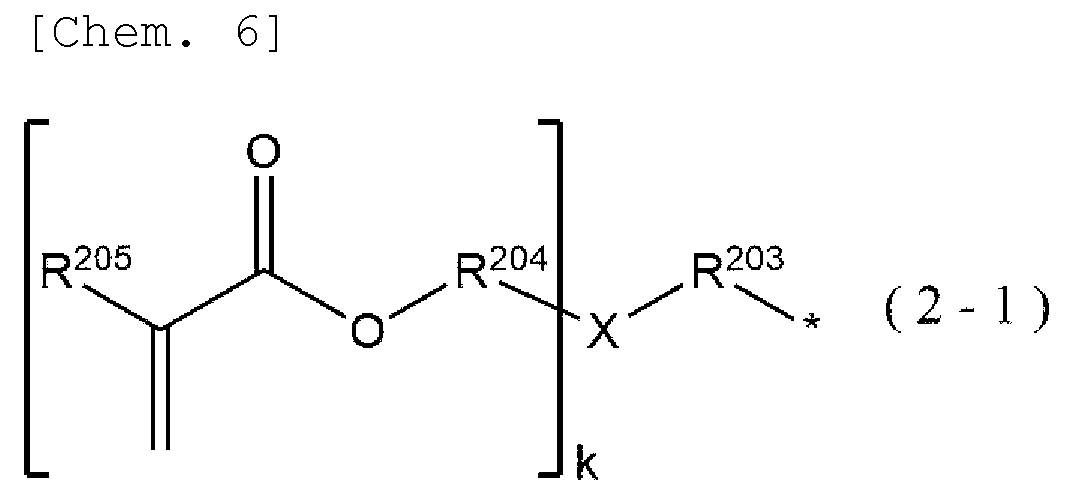
In der allgemeinen Formel (2-1) stehen R203 und R204 jeweils unabhängig für eine Einfachbindung oder eine geradkettige oder verzweigte substituierte oder unsubstituierte Alkylengruppe, die durch CnH2n wiedergegeben wird (n steht für eine ganze Zahl gleich oder größer als 1) und steht R205 für Wasserstoff oder eine geradkettige oder verzweigte substituierte oder unsubstituierte Alkylgruppe, die durch CnH2n+1 wiedergegeben wird (n steht für eine ganze Zahl gleich oder größer als 1). k steht für eine ganze Zahl gleich oder größer als 1, und X steht für eine zweiwertige oder mehrwertige aromatische Gruppe. Wenn in der zweiwertigen oder mehrwertigen aromatischen Gruppe nicht an R203 und R204 gebundener Kohlenstoff vorliegt, ist der Kohlenstoff unsubstituiert oder weist mindestens eine Substituentengruppe auf. Außerdem können ein Teil zur Bindung an R203 und mindestens ein Teil zur Bindung an R204, die die zweiwertige oder mehrwertige aromatische Gruppe besitzt, ein beliebiger bindungsfähiger Kohlenstoff in der aromatischen Gruppe sein. * steht in R101 bis R102 für einen Teil zur Bindung mit Kohlenstoff, der in einem mit dem Thiophenring kondensierten Benzolring in der allgemeinen Formel (1) bindungsfähig ist. * steht in R103 bis R104 für einen Teil zur Bindung mit Kohlenstoff, der in dem nicht mit dem Thiophenring kondensierten Benzolring in der allgemeinen Formel (1) bindungsfähig ist.In the general formula (2-1), R 203 and R 204 each independently represent a single bond or a straight-chain or branched substituted or unsubstituted alkylene group which is represented by C n H 2n is represented (n stands for an integer equal to or greater than 1) and R 205 stands for hydrogen or a straight-chain or branched substituted or unsubstituted alkyl group, which is represented by C n H 2n + 1 (n stands for an integer equal to or greater than 1). k represents an integer equal to or greater than 1, and X represents a divalent or polyvalent aromatic group. When carbon not bonded to R 203 and R 204 is present in the divalent or polyvalent aromatic group, the carbon is unsubstituted or has at least one substituent group. In addition, a part to bond to R 203 and at least a part to bond to R 204 which has the divalent or polyvalent aromatic group may be any bondable carbon in the aromatic group. * in R 101 to R 102 stands for a part to bond with carbon which is capable of binding in a benzene ring condensed with the thiophene ring in the general formula (1). * in R 103 to R 104 stands for a part of the bond with carbon which is capable of binding in the benzene ring in the general formula (1) that is not condensed with the thiophene ring.
Mindestens ein Kohlenstoffatom, das die jeweiligen Kohlenstoffgerüste von R203 bis R205 besitzen, kann durch ein Heteroatom (beispielsweise O, S, N, P) ersetzt sein, und mindestens ein Wasserstoffatom, das R203 bis R205 besitzen, kann durch ein Halogenatom (F, Cl, Br, I) substituiert sein.At least one carbon atom which the respective carbon skeletons of R 203 to R 205 have can be replaced by a hetero atom (e.g. O, S, N, P), and at least one hydrogen atom which R 203 to R 205 have can be replaced by a halogen atom (F, Cl, Br, I) may be substituted.
R203 in der allgemeinen Formel (2) steht vorzugsweise für eine Einfachbindung oder eine geradkettige oder verzweigte substituierte oder unsubstituierte Alkylengruppe, die durch CnH2n (n steht für eine ganze Zahl von 1 ≤ n ≤ 10) wiedergegeben wird, und weiter bevorzugt für eine Einfachbindung oder eine geradkettige oder verzweigte substituierte oder unsubstituierte Alkylengruppe, die durch CnH2n (n steht für eine ganze Zahl von 1 ≤ n ≤ 3) wiedergegeben wird. In dem Fall, dass R203 für eine geradkettige oder verzweigte Alkylengruppe mit 1 bis 10 Kohlenstoffatomen steht, sind Beispiele hierfür eine Methylengruppe, eine Ethylengruppe, eine Propylengruppe, eine Isopropylengruppe, eine Butylengruppe und eine Isobutylengruppe. Mindestens ein Kohlenstoffatom, das das Kohlenstoffgerüst der geradkettigen oder verzweigten Alkylengruppe mit 1 bis 10 Kohlenstoffatomen besitzt, kann durch ein Heteroatom (beispielsweise O, S, N, P) substituiert sein. Außerdem kann mindestens ein Wasserstoffatom, das die geradkettige oder verzweigte Alkylengruppe mit 1 bis 10 Kohlenstoffatomen besitzt, durch ein Halogenatom (F, Cl, Br, I) substituiert sein.R 203 in the general formula (2) preferably represents a single bond or a straight-chain or branched substituted or unsubstituted alkylene group represented by C n H 2n (n represents an integer of 1 n 10), and more preferably for a single bond or a straight-chain or branched substituted or unsubstituted alkylene group, which is represented by C n H 2n (n stands for an integer of 1 n 3). In the case where R 203 represents a straight-chain or branched alkylene group having 1 to 10 carbon atoms, examples thereof are a methylene group, an ethylene group, a propylene group, an isopropylene group, a butylene group and an isobutylene group. At least one carbon atom which has the carbon skeleton of the straight-chain or branched alkylene group having 1 to 10 carbon atoms can be substituted by a hetero atom (for example O, S, N, P). In addition, at least one hydrogen atom possessed by the straight-chain or branched alkylene group having 1 to 10 carbon atoms can be substituted by a halogen atom (F, Cl, Br, I).
R204 in der allgemeinen Formel (2) steht vorzugsweise für eine Einfachbindung oder eine geradkettige oder verzweigte substituierte oder unsubstituierte Alkylengruppe, die durch CnH2n (n steht für eine ganze Zahl von 1 ≤ n ≤ 10) wiedergegeben wird. In dem Fall, dass R204 für eine geradkettige oder verzweigte Alkylengruppe mit 1 bis 10 Kohlenstoffatomen steht, sind Beispiele hierfür eine Methylengruppe, eine Ethylengruppe, eine Propylengruppe, eine Isopropylengruppe, eine Butylengruppe und eine Isobutylengruppe. Mindestens ein Kohlenstoffatom, das das Kohlenstoffgerüst der geradkettigen oder verzweigten Alkylengruppe mit 1 bis 10 Kohlenstoffatomen besitzt, kann durch ein Heteroatom (beispielsweise O, S, N, P) substituiert sein. Außerdem kann mindestens ein Wasserstoffatom, das die geradkettige oder verzweigte Alkylengruppe mit 1 bis 10 Kohlenstoffatomen besitzt, durch ein Halogenatom (F, Cl, Br, I) substituiert sein.R 204 in the general formula (2) preferably stands for a single bond or a straight-chain or branched substituted or unsubstituted alkylene group which is represented by C n H 2n (n stands for an integer of 1 ≤ n 10). In the case where R 204 represents a straight-chain or branched alkylene group having 1 to 10 carbon atoms, examples thereof are a methylene group, an ethylene group, a propylene group, an isopropylene group, a butylene group and an isobutylene group. At least one carbon atom which has the carbon skeleton of the straight-chain or branched alkylene group having 1 to 10 carbon atoms can be substituted by a hetero atom (for example O, S, N, P). In addition, at least one hydrogen atom possessed by the straight-chain or branched alkylene group having 1 to 10 carbon atoms can be substituted by a halogen atom (F, Cl, Br, I).
R205 in der allgemeinen Formel (2) steht vorzugsweise für Wasserstoff oder eine geradkettige oder verzweigte substituierte oder unsubstituierte Alkylgruppe, die durch CnH2n+1 (n steht für eine ganze Zahl von 0 ≤ n ≤ 10) wiedergegeben wird. In dem Fall, dass R205 eine geradkettige oder verzweigte Alkylgruppe mit 1 bis 10 Kohlenstoffatomen steht, sind Beispiele hierfür eine Methylgruppe, eine Ethylgruppe, eine Propylgruppe, eine Isopropylgruppe, eine Butylgruppe und eine Isobutylgruppe. Mindestens ein Kohlenstoffatom, das das Kohlenstoffgerüst der geradkettigen oder verzweigten Alkylgruppe mit 1 bis 10 Kohlenstoffatomen besitzt, kann durch ein Heteroatom (beispielsweise O, S, N, P) substituiert sein. Außerdem kann mindestens ein Wasserstoffatom, das die geradkettige oder verzweigte Alkylgruppe mit 1 bis 10 Kohlenstoffatomen besitzt, durch ein Halogenatom (F, Cl, Br, I) substituiert sein.R 205 in the general formula (2) preferably represents hydrogen or a straight-chain or branched substituted or unsubstituted alkyl group which is represented by C n H 2n + 1 (n stands for an integer of 0 n 10). In the case where R 205 represents a straight-chain or branched alkyl group having 1 to 10 carbon atoms, examples thereof are a methyl group, an ethyl group, a propyl group, an isopropyl group, a butyl group and an isobutyl group. At least one carbon atom having the carbon skeleton of the straight-chain or branched alkyl group having 1 to 10 carbon atoms may be substituted by a hetero atom (for example O, S, N, P). In addition, at least one hydrogen atom possessed by the straight-chain or branched alkyl group having 1 to 10 carbon atoms can be substituted by a halogen atom (F, Cl, Br, I).
X in der allgemeinen Formel (2) steht vorzugsweise für eine zweiwertige oder mehrwertige aromatische Gruppe, die durch die folgenden chemischen Formeln (3-1) bis (3-8) wiedergegeben wird.X in the general formula (2) preferably represents a divalent or polyvalent aromatic group represented by the following chemical formulas (3-1) to (3-8).


Wo die zweiwertige oder mehrwertige aromatische Gruppe mindestens eine Substituentengruppe aufweist, handelt es sich bei der Substituentengruppe vorzugsweise um eine geradkettige oder verzweigte Alkylgruppe mit 1 bis 10 Kohlenstoffatomen, eine aromatische Gruppe oder ein Halogenatom. Beispiele für die geradkettige oder verzweigte Alkylgruppe mit 1 bis 10 Kohlenstoffatomen sind eine Methylgruppe, eine Ethylgruppe, eine Propylgruppe, eine Isopropylgruppe, eine Butylgruppe und eine Isobutylgruppe. Außerdem kann mindestens ein Kohlenstoffatom, das das Kohlenstoffgerüst der geradkettigen oder verzweigten Alkylgruppe mit 1 bis 10 Kohlenstoffatomen besitzt, durch ein Heteroatom (beispielsweise O, S, N, P) substituiert sein. Daneben kann mindestens ein Wasserstoffatom, das die geradkettige oder verzweigte Alkylgruppe mit 1 bis 10 Kohlenstoffatomen besitzt, durch ein Halogenatom (F, Cl, Br, I) substituiert sein. Außerdem handelt es sich bei der aromatischen Gruppe vorzugsweise um eine einwertige oder mehrwertige aromatische Gruppe, die durch (3-1) bis (3-8) wiedergegeben wird, die unsubstituiert sein oder mindestens eine Substituentengruppe aufweisen kann. Wenn die einwertige oder mehrwertige aromatische Gruppe mindestens eine Substituentengruppe aufweist, handelt es sich bei der Substituentengruppe wie bei der Substituentengruppe von X vorzugsweise um eine geradkettige oder verzweigte Alkylgruppe mit 1 bis 10 Kohlenstoffatomen (Mindestens ein Kohlenstoffatom im Kohlenstoffgerüst der Alkylgruppe kann durch ein Heteroatom (beispielsweise O, S, N, P) substituiert sein. Daneben kann mindestens ein Wasserstoffatom, das die Alkylgruppe besitzt, durch ein Halogenatom (F, Cl, Br, I).), eine aromatische Gruppe oder ein Halogenatom substituiert sein.Where the divalent or polyvalent aromatic group has at least one substituent group, the substituent group is preferably a straight or branched chain alkyl group having 1 to 10 carbon atoms, an aromatic group or a halogen atom. Examples of the straight or branched chain alkyl group having 1 to 10 carbon atoms are a methyl group, an ethyl group, a propyl group, an isopropyl group, a butyl group and an isobutyl group. In addition, at least one carbon atom having the carbon skeleton of the straight-chain or branched alkyl group having 1 to 10 carbon atoms may be substituted by a hetero atom (for example, O, S, N, P). In addition, at least one hydrogen atom which the straight-chain or branched alkyl group with 1 to 10 carbon atoms possesses can be substituted by a halogen atom (F, Cl, Br, I). In addition, the aromatic group is preferably a monovalent or polyvalent aromatic group represented by (3-1) to (3-8) which may be unsubstituted or have at least one substituent group. When the monovalent or polyvalent aromatic group has at least one substituent group, like the substituent group of X, the substituent group is preferably a straight-chain or branched alkyl group having 1 to 10 carbon atoms (at least one carbon atom in the carbon skeleton of the alkyl group can be substituted by a hetero atom (e.g. O, S, N, P) In addition, at least one hydrogen atom which the alkyl group possesses can be substituted by a halogen atom (F, Cl, Br, I).), An aromatic group or a halogen atom.
Wenn es sich bei der aromatischen Gruppe um eine zweiwertige aromatische Gruppe handelt (k = 1), kann es sich bei der zweiwertigen aromatischen Gruppe um eine monocyclische Arylengruppe handeln, und die zwei Teile zur Bindung an R203 und R204, die die monocyclische Arylengruppe besitzt, können in der Beziehung von ortho-Positionen, meta-Positionen oder para-Positionen vorliegen. Außerdem kann es sich bei der zweiwertigen aromatischen Gruppe um eine polycyclische Arylengruppe handeln, und die zwei Teile zur Bindung an R203 und R204, die die polycyclische Arylengruppe besitzt, können zwei beliebige bindungsfähige Kohlenstoffatome in der polycyclischen Arylengruppe sein.If the aromatic group is a divalent aromatic group (k = 1), it can be of the divalent aromatic group is a monocyclic arylene group, and the two parts for bonding to R 203 and R 204 which the monocyclic arylene group has may be in the relation of ortho positions, meta positions or para positions. In addition, the divalent aromatic group can be a polycyclic arylene group, and the two portions to bond to R 203 and R 204 that the polycyclic arylene group possesses can be any two bondable carbon atoms in the polycyclic arylene group.
Wenn es sich bei der aromatischen Gruppe um eine dreiwertige aromatische Gruppe handelt (k = 2), kann es sich bei der dreiwertigen aromatischen Gruppe um eine monocyclische dreiwertige aromatische Gruppe handeln, und die zwei Teile zur Bindung an R204, die die monocyclische dreiwertige aromatische Gruppe besitzt, können in der Beziehung von ortho-Positionen, meta-Positionen oder para-Positionen vorliegen. Außerdem kann es sich bei der dreiwertigen aromatischen Gruppe um eine monocyclische dreiwertige aromatische Gruppe handeln, und der Teil zur Bindung an R203 und ein Teil der zwei Teile zur Bindung an die beiden R204-Gruppen, die die monocyclische dreiwertige aromatische Gruppe besitzt, können in der Beziehung von ortho-Positionen, meta-Positionen oder para-Positionen vorliegen.When the aromatic group is a trivalent aromatic group (k = 2), the trivalent aromatic group can be a monocyclic trivalent aromatic group, and the two parts for bonding to R 204 that are the monocyclic trivalent aromatic Group may be in the relationship of ortho positions, meta positions, or para positions. In addition, the trivalent aromatic group may be a monocyclic trivalent aromatic group, and the portion to bond to R 203 and a portion of the two portions to bond to the two R 204 groups possessed by the monocyclic trivalent aromatic group exist in the relationship of ortho positions, meta positions or para positions.
Ferner kann es sich bei der dreiwertigen aromatischen Gruppe um eine polycyclische dreiwertige aromatische Gruppe handeln, und der Teil zur Bindung an R203 und ein Teil der zwei Teile zur Bindung an die beiden R204-Gruppen, die die polycyclische dreiwertige aromatische Gruppe besitzt, können zwei beliebige bindungsfähige Kohlenstoffatome in der polycyclischen dreiwertigen aromatischen Gruppe sein. Des Weiteren kann es sich bei der dreiwertigen aromatischen Gruppe um eine polycyclische dreiwertige aromatische Gruppe handeln, und die zwei Teile zur Bindung an R204, die die polycyclische dreiwertige aromatische Gruppe besitzt, können zwei beliebige bindungsfähige Kohlenstoffatome in der polycyclischen dreiwertigen aromatischen Gruppe sein.Further, the trivalent aromatic group may be a polycyclic trivalent aromatic group and the portion to bond to R 203 and a portion of the two portions to bond to the two R 204 groups possessed by the polycyclic trivalent aromatic group be any two bondable carbon atoms in the polycyclic trivalent aromatic group. Further, the trivalent aromatic group can be a polycyclic trivalent aromatic group, and the two parts to bond to R 204 which the polycyclic trivalent aromatic group has can be any two bondable carbon atoms in the polycyclic trivalent aromatic group.
Die chemischen Strukturen der oben als bevorzugte monofunktionelle Beispiele für die durch die obige allgemeine Formel (1) wiedergegebene Verbindung aufgeführten Verbindungen 4-1 bis 4-9 und 11-1 sind wie folgt.The chemical structures of the compounds 4-1 to 4-9 and 11-1 listed above as preferred monofunctional examples of the compound represented by the above general formula (1) are as follows.




Die chemischen Strukturformeln der oben als bevorzugte bifunktionelle Beispiele für die durch die obige allgemeine Formel (1) wiedergegebene Verbindung aufgeführten Verbindungen 5-1 bis 5-9 und 10-1 bis 10-2 sind wie folgt.The chemical structural formulas of the compounds 5-1 to 5-9 and 10-1 to 10-2 listed above as preferred bifunctional examples of the compound represented by the above general formula (1) are as follows.

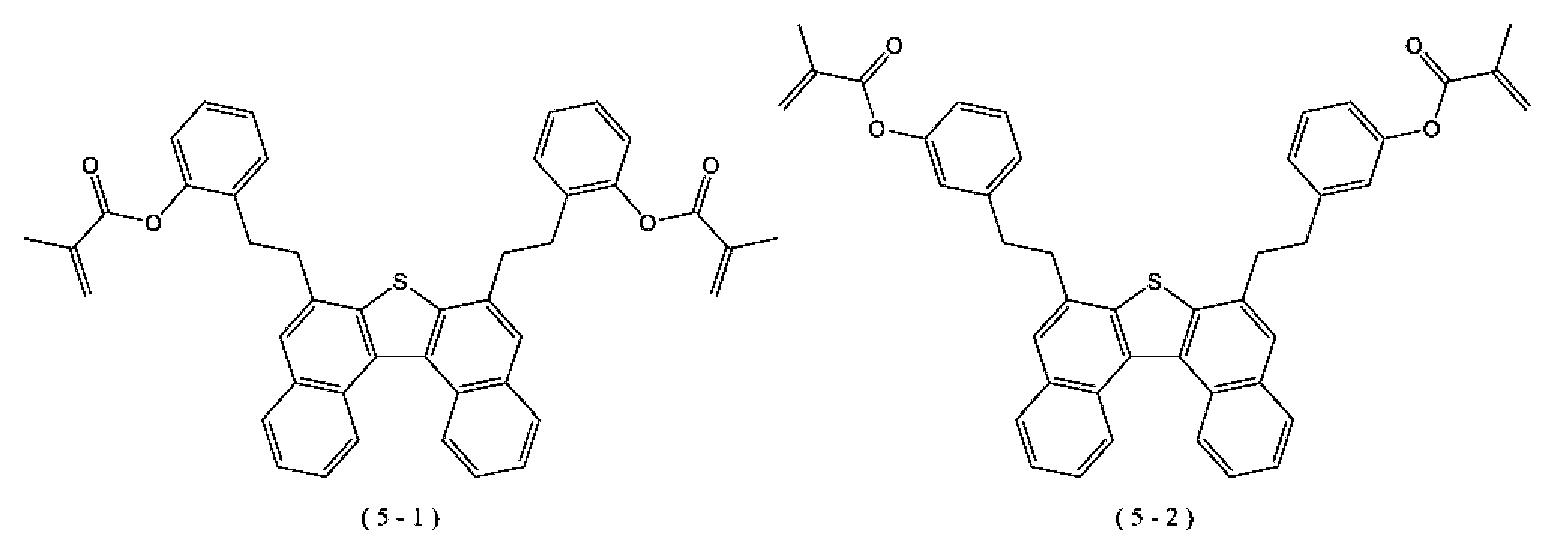


Als bevorzugte Beispiele für die durch die obige allgemeine Formel (1) wiedergegebene Verbindung aufgeführte Verbindungen 300-1 bis 300-4, wobei ein Kohlenstoffatom des Kohlenstoffgerüsts, aus dem die Alkylengruppe von R203 aufgebaut ist, in der durch die obige allgemeine Formel (1) wiedergegebenen Verbindung durch ein Heteroatom (Sauerstoff (O), Schwefel (S), Stickstoff (N) und Phosphor (P)) substituiert ist, sind nachstehend aufgeführt.As preferred examples of the compound represented by the above general formula (1), compounds 300-1 to 300-4, wherein a carbon atom of the carbon skeleton constituting the alkylene group of R 203 is represented by the above general formula (1 ) is substituted by a hetero atom (oxygen (O), sulfur (S), nitrogen (N) and phosphorus (P)) are shown below.


Als bevorzugte Beispiele für die durch die obige allgemeine Formel (1) wiedergegebene Verbindung aufgeführte Verbindungen 300-5 bis 300-8, wobei eine Alkylengruppe von R203 in der durch die obige allgemeine Formel (1) wiedergegebenen Verbindung durch ein Halogenatom (Fluor (F), Chlor (Cl), Brom (Br) und Iod (I)) substituiert ist, sind nachstehend aufgeführt.As preferred examples of the compound represented by the above general formula (1), compounds 300-5 to 300-8, wherein an alkylene group of R 203 in the compound represented by the above general formula (1) is replaced by a halogen atom (fluorine (F ), Chlorine (Cl), bromine (Br) and iodine (I)) are listed below.


Als bevorzugte Beispiele für die durch die obige allgemeine Formel (1) wiedergegebene Verbindung aufgeführte Verbindungen 400-1 bis 400-4, wobei ein Kohlenstoffatom des Kohlenstoffgerüsts, aus demdie Alkylengruppe von R204 aufgebaut ist, in der durch die obige allgemeine Formel (1) wiedergegebenen Verbindung durch ein Heteroatom (Sauerstoff (O), Schwefel (S), Stickstoff (N) und Phosphor (P)) substituiert ist, sind nachstehend aufgeführt.As preferred examples of the compound represented by the above general formula (1), compounds 400-1 to 400-4, wherein a carbon atom of the carbon skeleton constituting the alkylene group of R 204 is represented by the above general formula (1) represented compound is substituted by a hetero atom (oxygen (O), sulfur (S), nitrogen (N) and phosphorus (P)) are shown below.


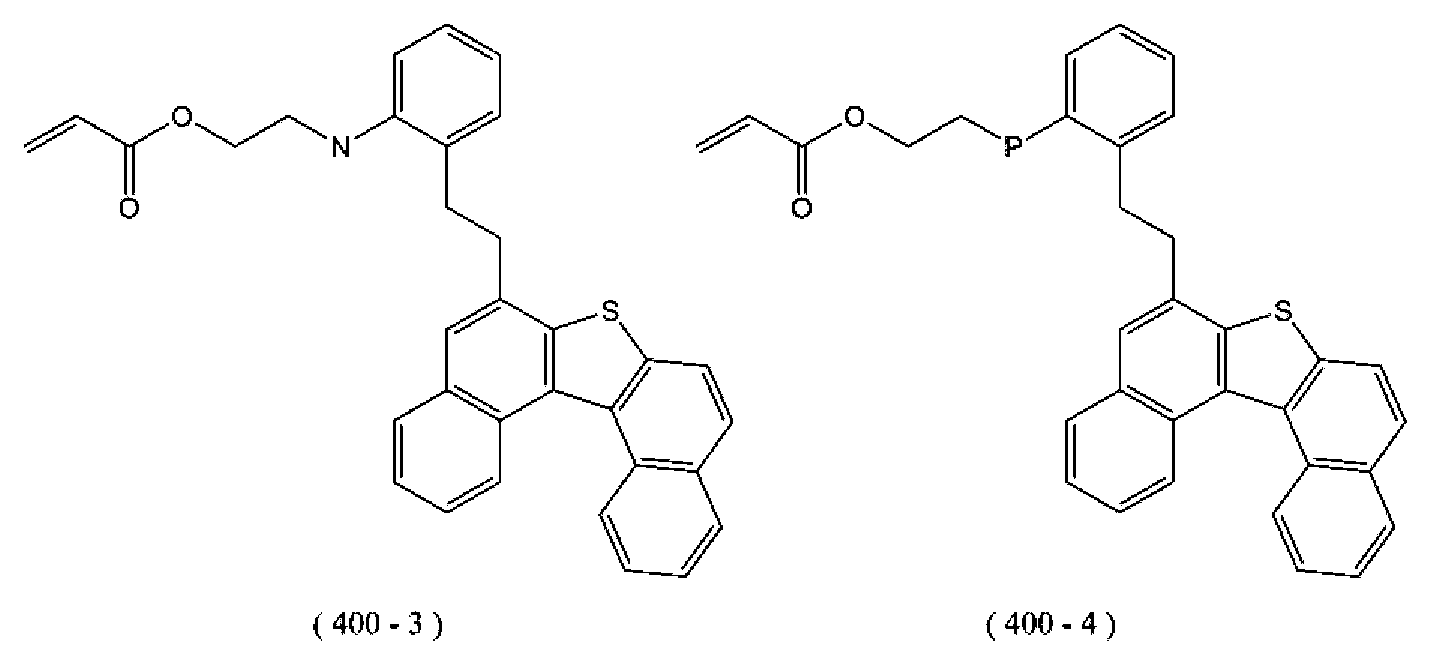
Als bevorzugte Beispiele für die durch die obige allgemeine Formel (1) wiedergegebene Verbindung aufgeführte Verbindungen 400-5 bis 400-8, wobei die Alkylengruppe von R204 in der durch die obige allgemeine Formel (1) wiedergegebenen Verbindung durch ein Halogenatom (Fluor (F), Chlor (Cl), Brom (Br) und Iod (I)) substituiert ist, sind nachstehend aufgeführt.As preferred examples of the compound represented by the above general formula (1), compounds 400-5 to 400-8, wherein the alkylene group of R 204 in the compound represented by the above general formula (1) is represented by a halogen atom (fluorine (F ), Chlorine (Cl), bromine (Br) and iodine (I)) are listed below.


Als bevorzugte Beispiele für die durch die obige allgemeine Formel (1) wiedergegebene Verbindung aufgeführte Verbindungen 500-1 bis 500-4, wobei ein Kohlenstoffatom des Kohlenstoffgerüsts, aus dem die Alkylgruppe von R205 aufgebaut ist, in der durch die obige allgemeine Formel (1) wiedergegebenen Verbindung durch ein Heteroatom (Sauerstoff (O), Schwefel (S), Stickstoff (N) und Phosphor (P)) substituiert ist, sind nachstehend aufgeführt.As preferred examples of the compound represented by the above general formula (1), compounds 500-1 to 500-4, wherein a carbon atom of the carbon skeleton constituting the alkyl group of R 205 is represented by the above general formula (1 ) is substituted by a hetero atom (oxygen (O), sulfur (S), nitrogen (N) and phosphorus (P)) are shown below.



Als bevorzugte Beispiele für die durch die obige allgemeine Formel (1) wiedergegebene Verbindung aufgeführte Verbindungen 500-5 bis 500-8, wobei die Alkylgruppe von R205 in der durch die obige allgemeine Formel (1) wiedergegebenen Verbindung durch ein Halogenatom (Fluor (F), Chlor (Cl), Brom (Br) und Iod (I)) substituiert ist, sind nachstehend aufgeführt.As preferred examples of the compound represented by the above general formula (1), compounds 500-5 to 500-8, wherein the alkyl group of R 205 in the compound represented by the above general formula (1) is represented by a halogen atom (fluorine (F ), Chlorine (Cl), bromine (Br) and iodine (I)) are listed below.


<Zweite Ausführungsform (Beispiele für Polymer)><Second embodiment (examples of polymer)>
Ein Polymer einer zweiten Ausführungsform (Beispiele für Polymer) gemäß der vorliegenden Technologie ist ein durch Polymerisation der Verbindung der ersten Ausführungsform der vorliegenden Technologie erhaltenes Polymer.A polymer of a second embodiment (examples of polymer) according to the present technology is a polymer obtained by polymerizing the compound of the first embodiment of the present technology.
Da die Verbindung der ersten Ausführungsform der vorliegenden Technologie ein monofunktionelles Monomer oder ein multifunktionales (bifunktionelles) Monomer ist, kann das Polymer der zweiten Ausführungsform gemäß der vorliegenden Technologie durch Polymerisation der Verbindung der ersten Ausführungsform der vorliegenden Technologie hergestellt werden.Since the compound of the first embodiment of the present technology is a monofunctional monomer or a multifunctional (bifunctional) monomer, the polymer of the second embodiment according to the present technology can be produced by polymerizing the compound of the first embodiment of the present technology.
Mit dem Polymer der zweiten Ausführungsform gemäß der vorliegenden Technologie kann eine weitere Verbesserung von Funktionen von organischen Materialien erhalten werden. Mit anderen Worten weist das Polymer der zweiten Ausführungsform gemäß der vorliegenden Technologie gleichzeitig eine hohe Löslichkeit und eine hohe Transparenz und einen hohen Brechungsindex auf und kann daher eine weitere Verbesserung von Funktionen von organischen Materialien bewirken.With the polymer of the second embodiment according to the present technology, further improvement of functions of organic materials can be obtained. In other words, the polymer of the second embodiment according to the present technology has a high solubility and a high transparency and a high refractive index at the same time, and therefore can bring about further improvement in functions of organic materials.
<Dritte Ausführungsform (Beispiele für organisches Material)><Third embodiment (examples of organic material)>
Ein organisches Material einer dritten Ausführungsform (Beispiele für organisches Material) gemäß der vorliegenden Technologie ist ein Material, das die Verbindung der ersten Ausführungsform gemäß der vorliegenden Technologie enthält oder das Polymer der zweiten Ausführungsform der vorliegenden Technologie enthält.An organic material of a third embodiment (examples of organic material) according to the present technology is a material containing the compound of the first embodiment according to the present technology or containing the polymer of the second embodiment of the present technology.
Beispiele für das organische Material der dritten Ausführungsform gemäß der vorliegenden Technologie sind ein organischer Dünnfilm, eine organische Linse, ein Hologramm, eine Zusammensetzung für einen organischen Dünnfilm, eine Zusammensetzung für eine organische Linse und eine lichtempfindliche Hologrammaufzeichnungszusammensetzung. Der organische Dünnfilm und die Zusammensetzung für einen organischen Dünnfilm, die organische Linse und die Zusammensetzung für eine organische Linse und das Hologramm und die lichtempfindliche Hologrammaufzeichnungszusammensetzung werden nachstehend im Detail beschrieben.Examples of the organic material of the third embodiment according to the present technology are an organic thin film, an organic lens, a hologram, a composition for an organic thin film, a composition for an organic lens, and a photosensitive hologram recording composition. The organic thin film and the composition for an organic thin film, the organic lens and the composition for an organic lens and the hologram, and the photosensitive hologram recording composition will be described in detail below.
[Organischer Dünnfilm und Zusammensetzung für einen organischen Dünnfilm][Organic Thin Film and Composition for Organic Thin Film]
Die Zusammensetzung für einen organischen Dünnfilm enthält mindestens die Verbindung der ersten Ausführungsform gemäß der vorliegenden Technologie, und der organische Dünnfilm kann erhalten werden, indem man die Zusammensetzung für einen organischen Dünnfilm einer Polymerisationsbehandlung wie Bestrahlung mit Licht oder Erhitzen unterwirft. Mit anderen Worten enthält der organische Dünnfilm das Polymer der zweiten Ausführungsform der vorliegenden Technologie. Der organische Dünnfilm kann auch als Polymerfilm bezeichnet werden, und eine oder mehrere Schichten von Polymerfilmen sind normalerweise in einem Flachbildschirm einer Flüssigkristallanzeigevorrichtung (die nachstehend auch als LCD (Liquid Crystal Display) bezeichnet wird) enthalten.The composition for an organic thin film contains at least the compound of the first embodiment according to the present technology, and the organic thin film can be obtained by subjecting the composition for an organic thin film to a polymerization treatment such as irradiation with light or heating. In other words, the organic thin film contains the polymer of the second embodiment of the present technology. The organic thin film may also be referred to as a polymer film, and one or more layers of polymer films are usually contained in a flat panel display of a liquid crystal display device (which is also referred to as an LCD (Liquid Crystal Display) hereinafter).
Der organische Dünnfilm wird beispielsweise als einen Schutzfilm oder einen Antireflexionsfilm darstellende Schicht in einen Flachbildschirm in einer LCD eingearbeitet. Daneben finden die organischen Dünnfilme außer in Flachbildschirmen auf verschiedenen Gebieten, bei denen Oberflächenschutz, Antireflexion oder dergleichen gefordert ist, breite Anwendung.The organic thin film is incorporated, for example, as a protective film or an anti-reflective film in a flat panel display in an LCD. In addition, the organic thin films are widely used except in flat panel displays in various fields in which surface protection, anti-reflection or the like is required.
Die Verbindung der ersten Ausführungsform gemäß der vorliegenden Technologie weist eine hohe Löslichkeit und einen hohen Brechungsindex und eine hohe Transparenz auf und wird daher für einen organischen Dünnfilm (beispielsweise einen Brechungsindexgradientenfilm) mit einer Oberfläche mit hohem Brechungsindex verwendet. Zum Erhalt eines organischen Dünnfilms (beispielsweise eines Brechungsindexgradientenfilms) mit einer Oberfläche mit hohem Brechungsindex liegt das Polymer der Verbindung der ersten Ausführungsform mit einem Brechungsindex von 1,60 oder mehr vorzugsweise lokal in einem Oberflächenschichtteil auf einer einseitigen Oberflächenseite (Oberflächenseite mit hohem Brechungsindex) des organischen Dünnfilms (Polymerfilms) vor. Der Brechungsindex der Verbindung der ersten Ausführungsform beträgt weiter bevorzugt 1,65 oder mehr und weiter bevorzugt 1,70 oder mehr. Andererseits beträgt der Brechungsindex der Verbindung der ersten Ausführungsform beispielsweise 1,80 oder weniger, kann aber auch über 1,80 liegen. Außerdem können als Verbindung der ersten Ausführungsform zwei oder mehr verschiedene Arten von Verbindungen durch Mischen in beliebigen Verhältnissen verwendet werden.The compound of the first embodiment according to the present technology has high solubility and a high refractive index and high transparency, and therefore is used for an organic thin film (e.g., a refractive index gradient film) having a surface with a high refractive index. To obtain an organic thin film (for example, a refractive index gradient film) with a surface with a high refractive index, the polymer of the compound of the first embodiment with a refractive index of 1.60 or more is preferably locally in a surface layer part on a one-sided surface side (surface side with high refractive index) of the organic Thin films (polymer films). The refractive index of the compound of the first embodiment is more preferably 1.65 or more, and more preferably 1.70 or more. On the other hand, the refractive index of the compound of the first embodiment is, for example, 1.80 or less, but it can also be more than 1.80. In addition, as the compound of the first embodiment, two or more different kinds of compounds can be used by mixing in any proportions.
[Organische Linse und Zusammensetzung für eine organische Linse][Organic lens and composition for an organic lens]
Eine Zusammensetzung für eine organische Linse enthält mindestens die Verbindung der ersten Ausführungsform gemäß der vorliegenden Technologie, und eine organische Linse kann erhalten werden, indem man die Zusammensetzung für eine organische Linse einer Polymerisationsbehandlung wie Bestrahlung mit Licht oder Erhitzen unterwirft. Mit anderen Worten enthält die organische Linse das Polymer der zweiten Ausführungsform gemäß der vorliegenden Technologie.A composition for an organic lens contains at least the compound of the first embodiment according to the present technology, and an organic lens can be obtained by subjecting the composition for an organic lens to a polymerization treatment such as irradiation with light or heating. In other words, the organic lens contains the polymer of the second embodiment according to the present technology.
Die organische Linse weist die Vorteile auf, dass sie ein geringes Gewicht aufweist, weniger rissanfällig ist und leichter zu verarbeiten ist als anorganische Materialien, und die organische Linse wird für Brillen und Fotoapparate verwendet. Da die Verbindung der ersten Ausführungsform gemäß der vorliegenden Technologie eine hohe Löslichkeit und einen hohen Brechungsindex und eine hohe Transparenz aufweist, weist sie die Vorteile auf, dass sie bei optischen Verwendungen sehr zweckmäßig ist, wie, im Fall der Verwendung als organische Linse, zu einer dünnen Linse im Vergleich zu Glas formbar ist.The organic lens has the advantages of being light in weight, less susceptible to cracking, and easier to process than inorganic materials, and the organic lens is used for glasses and cameras. Since the compound of the first embodiment according to the present technology has high solubility and a high refractive index and high transparency, it has the advantages of being very useful in optical uses such as, in the case of use as an organic lens, in a thin lens compared to glass is malleable.
[Hologramm und lichtempfindliche[Hologram and photosensitive
Hologrammaufzeichnungszusammensetzung]Hologram recording composition]
(Lichtempfindliche Hologrammaufzeichnungszusammensetzung)(Photosensitive hologram recording composition)
Eine lichtempfindliche Hologrammaufzeichnungszusammensetzung ist eine Zusammensetzung, die mindestens zwei Arten von polymerisierbaren Monomeren, einen Photopolymerisationsinitiator, ein Bindemittelharz und einen Polymerisationsinhibitor enthält, wobei es sich bei den mindestens zwei Arten von photopolymerisierbaren Monomeren um ein monofunktionelles Monomer und ein multifunktionales Monomer handelt. Bei den mindestens zwei Arten von photopolymerisierbaren Monomeren kann es sich ausnahmslos um die Verbindungen der ersten Ausführungsform gemäß der vorliegenden Technologie handeln, oder es kann sich bei mindestens einer Art der mindestens zwei Arten von photopolymerisierbaren Monomeren um die Verbindung der ersten Ausführungsform gemäß der vorliegenden Technologie handeln.A photosensitive hologram recording composition is a composition containing at least two kinds of polymerizable monomers, a photopolymerization initiator, a binder resin and a polymerization inhibitor, the at least two kinds of photopolymerizable monomers being a monofunctional monomer and a multifunctional monomer. The at least two kinds of photopolymerizable monomers may all be the compounds of the first embodiment according to the present technology, or at least one kind of the at least two kinds of photopolymerizable monomers may be the compound of the first embodiment according to the present technology .
Die lichtempfindliche Hologrammaufzeichnungszusammensetzung hat eine hohe Funktionalität, beispielsweise einen hohen Brechungsindexmodulationsbetrag (Δn), und ergibt einen Effekt hervorragender Beugungseigenschaften.The photosensitive hologram recording composition has a high functionality such as a large amount of refractive index modulation (Δn), and gives an effect of excellent diffraction properties.
In dem Fall, dass von den Verbindungen der ersten Ausführungsform gemäß der vorliegenden Technologie verschiedene Monomere als die mindestens zwei Arten von photopolymerisierbaren Monomeren verwendet werden, können beliebige Monomere verwendet werden. Beispiele für ein monofunktionelles oder multifunktionelles Monomer sind auf Dinaphthothiophen basierende Monomere, in denen eine Gruppe mit einer polymerisierbaren ungesättigten Verbindung eine Substituentengruppe an einem Benzolring, der nicht mit dem Thiophenring kondensiert ist, ist, und auf Dinaphthothiophen basierende Monomere, in denen eine Gruppe mit einer polymerisierbaren ungesättigten Bindung eine Substituentengruppe an einem Benzolring, der mit dem Thiophenring kondensiert ist, ist; Beispiele für ein multifunktionelles Monomer sind auf Triphenylethinylbenzol basierende Monomere und auf Trinaphthylethinylbenzol basierende Monomere; und Beispiele für ein monofunktionelles Monomer oder ein multifunktionelles Monomer sind auf Carbazol basierende Monomere und auf Fluoren basierende Monomere.In the case that monomers different from the compounds of the first embodiment according to the present technology are used as the at least two kinds of photopolymerizable monomers, any monomers can be used. Examples of a monofunctional or multifunctional monomer are dinaphthothiophene-based monomers in which a group having a polymerizable unsaturated compound is a substituent group on a benzene ring which is not condensed with the thiophene ring, and dinaphthophene-based monomers in which a group having a polymerizable unsaturated bond is a substituent group on a benzene ring condensed with the thiophene ring; Examples of a multifunctional monomer are triphenylethynylbenzene-based monomers and trinaphthylethynylbenzene-based monomers; and examples of a monofunctional monomer or a multifunctional monomer are carbazole-based monomers and fluorene-based monomers.
Die lichtempfindliche Hologrammaufzeichnungszusammensetzung kann ein Bindemittelharz enthalten. Das Bindemittelharz unterliegt keinen besonderen Einschränkungen und kann ein beliebiges Bindemittelharz sein; vorzugsweise handelt es sich bei dem Bindemittelharz jedoch um ein Harz auf Vinylacetat-Basis, und insbesondere wird Polyvinylacetat oder ein Hydrolysat davon bevorzugt verwendet. Außerdem sind Acrylharze bevorzugt, und insbesondere werden Poly(meth)acrylsäureester und Partialhydrolysate davon bevorzugt verwendet.The hologram recording photosensitive composition may contain a binder resin. The binder resin is not particularly limited and can be any binder resin; however, the binder resin is preferably a vinyl acetate-based resin, and in particular, polyvinyl acetate or a hydrolyzate thereof is preferably used. In addition, acrylic resins are preferred, and in particular poly (meth) acrylic acid esters and partial hydrolyzates thereof are preferably used.
Die lichtempfindliche Hologrammaufzeichnungszusammensetzung kann einen Photopolymerisationsinitiator enthalten. Der Photopolymerisationsinitiator unterliegt keinen besonderen Einschränkungen und kann ein beliebiger Photopolymerisationsinitiator sein; bevorzugte Beispiele für den Photopolymerisationsinitiator schließen jedoch radikalische Polymerisationsinitiatoren (radikalbildende Mittel) oder kationische Polymerisationsinitiatoren (säurebildende Mittel) auf Basis von Imidazol, Bisimidazol, N-Arylglycin, organischr Azidverbindung, Titanocen, Aluminatkomplex, organischem Peroxid, N-Alkoxypyridiniumsalz, Thioxanthonderivat, Sulfonsäureester, Imidosulfonat, Dialkyl-4-hydroxysulfoniumsalz, p-Nitrobenzylarylsulfonatester, Silanolaluminiumkomplex, (η6-Benzol) (η5-Cyclopentadienyl)eisen(II), Keton, Diaryliodoniumsalz, organischem Diaryliodoniumborkomplex, aromatischem Sulfoniumsalz, aromatischem Diazoniumsalz, aromatischem Phosphoniumsalz, Triazinverbindung und Eisenarenkomplex oder Polymerisationsinitiatoren mit beiden der Funktionen ein. Man beachte, dass der in der lichtempfindlichen Hologrammaufzeichnungszusammensetzung der ersten Ausführungsform gemäß der vorliegenden Technologie enthaltene Photopolymerisationsinitiator ein anionischer Polymerisationsinitiator (basenbildendes Mittel) sein kann.The photosensitive hologram recording composition may contain a photopolymerization initiator. The photopolymerization initiator is not particularly limited and can be any photopolymerization initiator; however, preferred examples of the photopolymerization initiator include radical polymerization initiators (radical-generating agents) or cationic polymerization initiators (acid-generating agents) based on imidazole, bisimidazole, N-arylglycine, organic azide compound, titanocene, aluminate complex, organic peroxide sulfate, N-alkoxypyridinium acid salt , Dialkyl-4-hydroxysulfonium salt, p-nitrobenzylarylsulfonate ester, silanol aluminum complex, (η6-benzene) (η5-cyclopentadienyl) iron (II), ketone, diaryliodonium salt, organic diaryliodonium boron complex, aromatic sulfonium complex and aromatic sulfonium complex with, and aromatic sulfonium phosphonium salt, triazonium phosphonium salt and aromatic sulfonium salt, aromatic sulfonium complex, iron aromatic phosphonium salt both of the functions. Note that the photopolymerization initiator contained in the photosensitive hologram recording composition of the first embodiment according to the present technology may be an anionic polymerization initiator (base-forming agent).
Die lichtempfindliche Hologrammaufzeichnungszusammensetzung kann einen Polymerisationsinhibitor enthalten. Der Polymerisationsinhibitor unterliegt keinen besonderen Einschränkungen und kann ein beliebiger Polymerisationsinhibitor sein; bevorzugte spezifische Beispiele für den Polymerisationsinitiator schließen jedoch auf Chinon basierende Verbindungen, auf gehindertem Phenol basierende Verbindungen, auf Benzotriazol basierende Verbindungen und auf Thiazin basierende Verbindungen ein. Zu den Beispielen für die auf Chinon basierende Verbindung gehört Hydrochinon, das als eine Art von auf Phenol basierender Verbindung betrachtet werden kann. Zu den Beispielen für die auf Thiazin basierenden Verbindungen gehört Phenothiazin.The photosensitive hologram recording composition may contain a polymerization inhibitor. The polymerization inhibitor is not particularly limited and can be any polymerization inhibitor; however, preferred specific examples of the polymerization initiator include quinone-based compounds, hindered phenol-based compounds, benzotriazole-based compounds, and thiazine-based compounds. Examples of the quinone-based compound include hydroquinone, which can be regarded as a kind of phenol-based compound. Examples of the thiazine-based compounds include phenothiazine.
Die lichtempfindliche Hologrammaufzeichnungszusammensetzung kann ferner anorganische feine Teilchen, einen Weichmacher, einen Sensibilisierungsfarbstoff, ein Kettenübertragungsmittel und ein Lösungsmittel enthalten. Man beachte, dass das Lösungsmittel zur Verbesserung der Filmbildungseigenschaft und dergleichen sowie zur Viskositätseinstellung und Kompatibilitätssteuerung effektiv ist.The photosensitive hologram recording composition may further contain inorganic fine particles, a plasticizer, a sensitizing dye, a chain transfer agent and a solvent. Note that the solvent is effective for improving film-forming property and the like, as well as viscosity adjustment and compatibility control.
(Verfahren zur Herstellung von lichtempfindlicher Hologrammaufzeichnungszusammensetzung)(Method for producing photosensitive hologram recording composition)
Die lichtempfindliche Hologrammaufzeichnungszusammensetzung der ersten Ausführungsform gemäß der vorliegenden Technologie kann beispielsweise durch Zugeben von vorbestimmten Mengen der mindestens zwei Arten von photopolymerisierbaren Monomeren, des Photopolymerisationsinitiators, des Bindemittelharzes und des Polymerisationsinhibitors zu dem oben erwähnten Lösungsmittel bei Raumtemperatur oder dergleichen und anschließendes Lösen und Mischen hergestellt werden. Außerdem können je nach Verwendung, Zweck und dergleichen die anorganischen feinen Teilchen, der Weichmacher, der Sensibilisierungsfarbstoff, das Kettenübertragungsmittel und dergleichen, wie oben erwähnt, zugegeben werden. Wenn die lichtempfindliche Hologrammaufzeichnungszusammensetzung der ersten Ausführungsform gemäß der vorliegenden Technologie auf einem in einem später zu beschreibenden Hologrammaufzeichnungsmedium enthaltenen transparenten Substrat gebildet wird, kann die lichtempfindliche Hologrammaufzeichnungszusammensetzung als Beschichtungsflüssigkeit verwendet werden.The photosensitive hologram recording composition of the first embodiment according to the present technology can be prepared, for example, by adding predetermined amounts of the at least two kinds of photopolymerizable monomers, the photopolymerization initiator, the binder resin and the polymerization inhibitor to the above-mentioned solvent at room temperature or the like, and then dissolving and mixing. In addition, the inorganic fine particles, the plasticizer, the sensitizing dye, the chain transfer agent and the like mentioned above may be added according to the use, purpose and the like. When the photosensitive hologram recording composition of the first embodiment is formed according to the present technology on a transparent substrate contained in a hologram recording medium to be described later, the photosensitive hologram recording composition can be used as a coating liquid.
(Hologrammaufzeichnungsmedium)(Hologram recording medium)
Bei dem Hologrammaufzeichnungsmedium handelt es sich um ein Hologrammaufzeichnungsmedium, das mindestens eine lichtempfindliche Schicht, die die lichtempfindliche Hologrammaufzeichnungszusammensetzung enthält, und mindestens ein transparentes Substrat enthält, wobei die lichtempfindliche Schicht auf dem mindestens einen transparenten Substrat ausgebildet ist. Das Hologrammaufzeichnungsmedium kann eine dreischichtige Struktur aufweisen, in der die lichtempfindliche Schicht auf einem ersten transparenten Substrat ausgebildet ist und ferner ein zweites transparentes Substrat auf derjenigen Hauptoberfläche der lichtempfindlichen Schicht, auf der das erste transparente Substrat nicht ausgebildet ist, ausgebildet ist.The hologram recording medium is a hologram recording medium containing at least one photosensitive layer containing the photosensitive hologram recording composition and at least one transparent substrate, the photosensitive layer being formed on the at least one transparent substrate. The hologram recording medium may have a three-layer structure in which the photosensitive layer is formed on a first transparent substrate and a second transparent substrate is further formed on the main surface of the photosensitive layer on which the first transparent substrate is not formed.
Das Hologrammaufzeichnungsmedium hat eine hohe Funktionalität, beispielsweise einen hohen Brechungsindexmodulationsbetrag (Δn), und ergibt einen Effekt hervorragender Beugungseigenschaften.The hologram recording medium has a high functionality such as a large amount of refractive index modulation (Δn), and gives an effect of excellent diffraction properties.
(Verfahren zur Herstellung von Hologrammaufzeichnungsmedium)(Method for producing hologram recording medium)
Das Hologrammaufzeichnungsmedium kann beispielsweise erhalten werden, indem man eine Beschichtungsflüssigkeit, die eine lichtempfindliche Hologrammaufzeichnungszusammensetzung gemäß obiger Beschreibung enthält, mit einer Schleuderbeschichtungsvorrichtung, einer Gravurbeschichtungsvorrichtung, einer Kommabeschichtungsvorrichtung, einer Rakelbeschichtungsvorrichtung oder dergleichen aufbringt und anschließend trocknet, um eine lichtempfindliche Schicht zu bilden.The hologram recording medium can be obtained, for example, by applying a coating liquid containing a photosensitive hologram recording composition as described above with a spin coater, a gravure coater, a comma coater, a doctor blade coater or the like, and then drying it to form a photosensitive layer.
(Hologramm)(Hologram)
Das Hologramm ist ein Hologramm mit hoher Funktionalität, beispielsweise einem Brechungsindexmodulationsbetrag von 0,06 oder mehr, und weist hervorragende Beugungseigenschaften auf, und für das Hologramm wird das oben erwähnte Hologrammaufzeichnungsmedium verwendet.The hologram is a hologram with high functionality, for example, a refractive index modulation amount of 0.06 or more, and has excellent diffraction properties, and the above-mentioned hologram recording medium is used for the hologram.
(Verfahren zur Herstellung von Hologramm)(Method of making hologram)
Das Hologramm ist beispielsweise erhältlich, indem man das Hologrammaufzeichnungsmedium einer Belichtung mit zwei Lichtgeschwindigkeiten unter Verwendung eines Halbleiterlasers im Bereich des sichtbaren Lichts oder dergleichen unterwirft und anschließend die gesamte Oberfläche des Mediums mit UV-Licht bestrahlt, um ein ungehärtetes photopolymerisierbares Monomer zu härten, wodurch eine Brechungsindexverteilung in dem Hologrammaufzeichnungsmedium fixiert wird. Bei den Bedingungen der Belichtung mit zwei Lichtgeschwindigkeiten kann es sich um beliebige Bedingungen gemäß der Verwendung und dem Zweck handeln; es ist jedoch wünschenswert, eine Interferenzbelichtung durchzuführen, indem man die Lichtintensität eines Stroms auf dem Aufzeichnungsmedium auf 0,1 bis 100 mW/cm2 einstellt und über einen Zeitraum von 1 bis 1000 Sekunden so belichtet, dass der zwischen den beiden Strömen gebildete Winkel 0,1° bis 179,9° beträgt.The hologram is obtainable, for example, by subjecting the hologram recording medium to exposure at two speeds of light using a semiconductor laser in the range of visible light or the like, and then irradiating the entire surface of the medium with UV light to cure an uncured photopolymerizable monomer, whereby a Refractive index distribution is fixed in the hologram recording medium. The conditions of exposure to two speeds of light may be any condition according to the use and purpose; however, it is desirable to conduct interference exposure by adjusting the light intensity of a current on the recording medium to 0.1 to 100 mW / cm 2 and exposing for a period of 1 to 1000 seconds so that the angle formed between the two currents is 0 , 1 ° to 179.9 °.
<Vierte Ausführungsform (Beispiel für Bildanzeigevorrichtung)><Fourth embodiment (example of image display device)>
Eine Bildanzeigevorrichtung einer vierten Ausführungsform (Beispiel für Bildanzeigevorrichtung) gemäß der vorliegenden Technologie ist eine Vorrichtung, die das organische Material der dritten Ausführungsform der vorliegenden Technologie enthält. Die Bildanzeigevorrichtung der vierten Ausführungsform gemäß der vorliegenden Technologie enthält das organische Material der dritten Ausführungsform gemäß der vorliegenden Technologie und ergibt daher einen Effekt hervorragender Bildanzeigeleistung.An image display device of a fourth embodiment (example of image display device) according to the present technology is a device containing the organic material of the third embodiment of the present technology. The image display device of the fourth embodiment according to the present technology contains the organic material of the third embodiment according to the present technology, and therefore gives an effect of excellent image display performance.
Beispiele für die Bildanzeigevorrichtung der vierten Ausführungsform gemäß der vorliegenden Technologie sind Bildanzeigevorrichtungen wie ein Brillenerzeugnis, ein holographischer Bildschirm, eine transparente Anzeige, eine am Kopf befestigte Anzeige und eine Blickfeldanzeige.Examples of the image display device of the fourth embodiment according to the present technology are image display devices such as an eyeglass product, a holographic screen, a transparent display, a head-mounted display, and a head-up display.
<Fünfte Ausführungsform (Beispiel für optisches Teil) und 7. Sechste Ausführungsform (Beispiel für optische Vorrichtung)><Fifth embodiment (example of optical part) and 7. Sixth embodiment (example of optical device)>
Ein optisches Teil einer fünften Ausführungsform (Beispiel für optisches Teil) gemäß der vorliegenden Technologie ist ein Teil, das das organische Material der dritten Ausführungsform gemäß der vorliegenden Technologie enthält. Das optische Teil der fünften Ausführungsform gemäß der vorliegenden Technologie enthält das organische Material der dritten Ausführungsform gemäß der vorliegenden Technologie und ergibt daher Effekte hervorragender optischer Eigenschaften und hervorragender optischer Stabilität.An optical part of a fifth embodiment (example of optical part) according to the present technology is a part containing the organic material of the third embodiment according to the present technology. The optical part of the fifth embodiment according to the present technology contains the organic material of the third embodiment according to the present technology, and therefore gives effects of excellent optical properties and excellent optical stability.
Außerdem ist eine optische Vorrichtung einer sechsten Ausführungsform (Beispiel für optische Vorrichtung) gemäß der vorliegenden Technologie eine optische Vorrichtung, die das organische Material der dritten Ausführungsform gemäß der vorliegenden Technologie enthält. Die optische Vorrichtung der sechsten Ausführungsform gemäß der vorliegenden Technologie enthält das organische Material der dritten Ausführungsform gemäß der vorliegenden Technologie und ergibt daher Effekte hervorragender optischer Eigenschaften und hervorragender optischer Stabilität.In addition, an optical device of a sixth embodiment (example of optical device) according to the present technology is an optical device containing the organic material of the third embodiment according to the present technology. The optical device of the sixth embodiment according to the present technology contains the organic material of the third embodiment according to the present technology, and therefore gives effects of excellent optical properties and excellent optical stability.
Beispiele für das optische Teil der fünften Ausführungsform gemäß der vorliegenden Technologie und Beispiele für die optische Vorrichtung der sechsten Ausführungsform gemäß der vorliegenden Technologie sind eine Bildgebungsvorrichtung, ein Bildgebungselement, ein Farbfilter, eine Beugungslinse, eine leitfähige Platte, ein spektroskopisches Element, ein Hologrammblatt, ein Informationsaufzeichnungsmedium wie eine optische Speicherplatte und eine magneto-optische Speicherplatte, eine optische Aufnahmevorrichtung, ein Polarisationsmikroskop und ein Sensor.Examples of the optical part of the fifth embodiment according to the present technology and examples of the optical device of the sixth embodiment according to the present technology are an imaging device, an imaging element, a color filter, a diffraction lens, a conductive plate, a spectroscopic element, a hologram sheet, a Information recording medium such as an optical disk and a magneto-optical disk, an optical pickup device, a polarizing microscope, and a sensor.
[BEISPIELE][EXAMPLES]
Die Effekte der vorliegenden Technologie werden nachstehend anhand von Beispielen im Einzelnen beschrieben. Man beachte, dass der Umfang der vorliegenden Technologie nicht auf oder durch die Beispiele beschränkt ist.The effects of the present technology are described below in detail by way of examples. Note that the scope of the present technology is not limited to or by the examples.
<Beispiel 1><Example 1>
[Herstellung der durch die chemische Formel (4-1) wiedergegebenen Verbindung][Preparation of the compound represented by the chemical formula (4-1)]
Es wurde eine durch die folgende chemische Formel (4-1) wiedergegebene Verbindung synthetisiert, und die durch die folgende chemische Formel (4-1) wiedergegebene Verbindung wurde als eine Verbindung von Beispiel 1 genommen.A compound represented by the following chemical formula (4-1) was synthesized, and the compound represented by the following chemical formula (4-1) was taken as a compound of Example 1.


[Synthesemethode für die durch die chemische Formel (4-1) wiedergegebene Verbindung][Synthesis method for the compound represented by the chemical formula (4-1)]
Eine Synthesemethode (Syntheseroute) für die durch die chemische Formel (4-1) wiedergegebene Verbindung ist wie folgt.A synthetic method (synthetic route) for the compound represented by the chemical formula (4-1) is as follows.


(Schritt A)(Step A)
Nun wird Schritt A in der oben dargestellten Syntheseroute beschrieben.Step A in the above synthesis route will now be described.
Unter Ar-Atmosphäre wurden 6,60 g (21,3 mmol) Verbindung 1, 3,25 ml (25,0 mmol) 2-Iodanisol und 10,6 g (76,8 mmol) Kaliumcarbonat abgewogen, wonach 170 ml desoxygeniertes DMF zugegeben wurden und anschließend 15 Minuten Ar durchgeleitet wurde. Als Nächstes wurden 6,76 g (21,0 mmol) TBAB und 0,263 g (1,17 mmol, 0,55 Äq.) Pd(OAc)2 zugegeben, wonach die Mischung 4 Stunden auf 110 °C erhitzt wurde. Nach Abkühlenlassen auf Raumtemperatur wurde die Reaktionsflüssigkeit in 200 ml Eiswasser gegossen. Nach Zugabe von 500 ml Essigsäureethylester zur Flüssigkeitstrennung wurde die wässrige Schicht mit 300 ml Essigsäureethylester extrahiert. Nach Waschen der organischen Schicht mit Wasser wurde die organische Schicht über Magnesiumsulfat getrocknet und das Filtrat aufkonzentriert, getrocknet und unter vermindertem Druck gehärtet. Das Produkt wurde an einer Säule gereinigt, was 7,44 g (17,9 mmol) Verbindung 2 in Form eines gelben Kristalls ergab.Under an Ar atmosphere, 6.60 g (21.3 mmol) of compound 1, 3.25 ml (25.0 mmol) of 2-iodoanisole and 10.6 g (76.8 mmol) of potassium carbonate were weighed, after which 170 ml of deoxygenated DMF were added and then Ar was passed through for 15 minutes. Next, 6.76 g (21.0 mmol) TBAB and 0.263 g (1.17 mmol, 0.55 eq.) Pd (OAc) 2 were added and the mixture was heated to 110 ° C for 4 hours. After allowing to cool to room temperature, the reaction liquid was poured into 200 ml of ice water. After adding 500 ml of ethyl acetate to separate the liquid, the aqueous layer was extracted with 300 ml of ethyl acetate. After washing the organic layer with water, the organic layer was dried over magnesium sulfate, and the filtrate was concentrated, dried and cured under reduced pressure. The product was purified on a column to give 7.44 g (17.9 mmol) of compound 2 as a yellow crystal.
(Schritt B)(Step B)
Nun wird Schritt b in der oben dargestellten Syntheseroute beschrieben.Step b in the synthesis route presented above will now be described.
Unter Ar-Atmosphäre wurden 65,0 ml superentwässertes Dichlormethan zu 3,08 g (7,40 mmol) Verbindung 2 gegeben und anschließend im Eisbad auf 0 °C abgekühlt. Die Reaktionsflüssigkeit wurde tropfenweise mit 16,0 ml (16,0 mmol) einer 1,0 M Lösung von BBr3 in Dichlormethan versetzt, und nach Rühren der Reaktionsflüssigkeit über Nacht auf dem Eisbad wurde die Reaktionsflüssigkeit zum Quenchen in 200 ml Eiswasser gegossen. Nach Flüssigkeitstrennung wurde die wässrige Schicht mit 100 ml Dichlormethan extrahiert, während die organische Schicht kollektiv über Magnesiumsulfat getrocknet und das Filtrat aufkonzentriert, getrocknet und unter vermindertem Druck gehärtet wurde. Der Rückstand wurde an einer Säule gereinigt, was 915 mg (2,27 mmol) Verbindung 3 in Form eines hellgelben Feststoffs ergab.Under an Ar atmosphere, 65.0 ml of super-dehydrated dichloromethane were added to 3.08 g (7.40 mmol) of compound 2 and the mixture was then cooled to 0 ° C. in an ice bath. To the reaction liquid was added dropwise 16.0 ml (16.0 mmol) of a 1.0 M solution of BBr 3 in dichloromethane, and after stirring the reaction liquid overnight on the ice bath, the reaction liquid was poured into 200 ml of ice water to quench. After liquid separation, the aqueous layer was extracted with 100 ml of dichloromethane while the organic layer was collectively dried over magnesium sulfate, and the filtrate was concentrated, dried and hardened under reduced pressure. The residue was purified on a column, which gave 915 mg (2.27 mmol) of compound 3 as a light yellow solid.
(Schritt C)(Step C)
Nun wird Schritt C in der oben dargestellten Syntheseroute beschrieben.Step C in the above synthesis route will now be described.
Unter Ar-Atmosphäre wurden 45,0 ml Essigsäureethylester und 13,0 ml THF zu 873 mg (2,17 mmol) Verbindung 3 gegeben, und nach weiterer Zugabe von 150 mg (0,063 mmol) 10 % Pd/C (55 % Wasser) wurde das Innere der Apparatur durch Wasserstoffgas ersetzt und die Reaktionsflüssigkeit über Nacht gerührt. Nach Filtration der Reaktionsflüssigkeit über Celite wurde das Filtrat aufkonzentriert, getrocknet und unter vermindertem Druck gehärtet, was 826 mg (2,04 mmol) Verbindung 4 in Form eines hellbraunen Feststoffs ergab.Under an Ar atmosphere, 45.0 ml of ethyl acetate and 13.0 ml of THF were added to 873 mg (2.17 mmol) of compound 3, and after a further addition of 150 mg (0.063 mmol) of 10% Pd / C (55% water) the inside of the apparatus was replaced with hydrogen gas, and the reaction liquid was stirred overnight. After the reaction liquid was filtered through Celite, the filtrate was concentrated, dried and hardened under reduced pressure to give 826 mg (2.04 mmol) of Compound 4 as a light brown solid.
(Schritt D)(Step D)
Nun wird Schritt D in der oben dargestellten Syntheseroute beschrieben.Step D in the synthesis route presented above will now be described.
Unter Ar-Atmosphäre wurden 15,0 ml superentwässertes Dichlormethan und 0,370 ml (2,66 mmol) Triethylamin zu 489 mg (1,21 mmol) Verbindung 4 gegeben und anschließend durch Kühlen mit einem Eisbad auf eine Innentemperatur von 0 °C abgekühlt. Die Reaktionsflüssigkeit wurde tropfenweise mit 0,175 ml (1,85 mmol, 1,53 Äq.) Methacryloylchlorid versetzt, wonach 1,5 Stunden auf dem Eisbad gerührt und die Reaktionsflüssigkeit zum Quenchen in Eiswasser gegossen wurde. Nach Flüssigkeitstrennung wurde die organische Schicht über Magnesiumsulfat getrocknet und das Filtrat aufkonzentriert, getrocknet und unter vermindertem Druck gehärtet. Der Rückstand wurde an einer Säule gereinigt, was 461 mg (0,43 mmol) der Verbindung von Beispiel 1 (der durch die chemische Formel (4-1) wiedergegebenen Verbindung) in Form einer öligen hellgelben Substanz ergab.Under an Ar atmosphere, 15.0 ml of super-dehydrated dichloromethane and 0.370 ml (2.66 mmol) of triethylamine were added to 489 mg (1.21 mmol) of compound 4 and the mixture was then cooled to an internal temperature of 0 ° C. by cooling with an ice bath. The reaction liquid was added dropwise with 0.175 ml (1.85 mmol, 1.53 eq.) Of methacryloyl chloride, after which it was stirred on the ice bath for 1.5 hours and the reaction liquid was poured into ice water to quench. After liquid separation, the organic layer was dried over magnesium sulfate, and the filtrate was concentrated, dried and hardened under reduced pressure. The residue was purified on a column, giving 461 mg (0.43 mmol) of the compound of Example 1 (the compound represented by the chemical formula (4-1)) as an oily pale yellow substance.
Dann wurde die Struktur der Verbindung von Beispiel 1 (der durch die chemische Formel (4-1) wiedergegebenen Verbindung) mittels NMR identifiziert. Die NMR-Ergebnisse sind wie folgt.Then, the structure of the compound of Example 1 (the compound represented by the chemical formula (4-1)) was identified by means of NMR. The NMR results are as follows.
1H-NMR (CDCl3) : 2,05 (s, 3H), 3,17 (t, 2H), 3,32 (t, 2H), 5,67 (s, 1H), 6,32 (s, 1H), 7,12 (d, 1H), 7,26 (m, 3H), 7,58 (m, 4H), 7,63 (s, 1H), 7,95 (m, 3H), 8,05 (m, 1H), 8,85 (m, 2H)1 H-NMR (CDCl 3 ): 2.05 (s, 3H), 3.17 (t, 2H), 3.32 (t, 2H), 5.67 (s, 1H), 6.32 (s, 1H), 7.12 (d, 1H), 7.26 (m, 3H), 7.58 (m, 4H), 7.63 (s, 1H), 7.95 (m, 3H), 8, 05 (m, 1H), 8.85 (m, 2H)
<Beispiel 2><Example 2>
[Herstellung der durch die chemische Formel (4-2) wiedergegebenen Verbindung][Preparation of the compound represented by the chemical formula (4-2)]
Es wurde eine durch die folgende chemische Formel (4-2) wiedergegebene Verbindung synthetisiert, und die durch die folgende chemische Formel (4-2) wiedergegebene Verbindung wurde als eine Verbindung von Beispiel 2 genommen.A compound represented by the following chemical formula (4-2) was synthesized, and the compound represented by the following chemical formula (4-2) was taken as a compound of Example 2.


[Synthesemethode für die durch die chemische Formel (4-2) wiedergegebene Verbindung][Synthesis method for the compound represented by the chemical formula (4-2)]
Eine Synthesemethode (Syntheseroute) für die durch die chemische Formel (4-2) wiedergegebene Verbindung ist analog zu der Synthesemethode für die durch die chemische Formel (4-1) wiedergegebene Verbindung, außer dass in Schritt A bei der Synthesemethode (Syntheseroute) für die durch die chemische Formel (4-1) wiedergegebene Verbindung verwendetes 2-Iodanisol durch 3-Iodanisol ersetzt wird, und die durch die chemische Formel (4-2) wiedergegebene Verbindung wurde durch die Verwendung der Synthesemethode synthetisiert.A synthesis method (synthesis route) for the compound represented by the chemical formula (4-2) is analogous to the synthesis method for the compound represented by the chemical formula (4-1), except that in step A in the synthesis method (synthesis route) for the 2-iodoanisole used by the compound represented by the chemical formula (4-1) is replaced with 3-iodoanisole, and the compound represented by the chemical formula (4-2) was synthesized by the use of the synthetic method.
<Beispiel 3><Example 3>
[Herstellung der durch die chemische Formel (4-3) wiedergegebenen Verbindung][Preparation of the compound represented by the chemical formula (4-3)]
Es wurde eine durch die folgende chemische Formel (4-3) wiedergegebene Verbindung synthetisiert, und die durch die folgende chemische Formel (4-3) wiedergegebene Verbindung wurde als eine Verbindung von Beispiel 3 genommen.A compound represented by the following chemical formula (4-3) was synthesized, and the compound represented by the following chemical formula (4-3) was taken as a compound of Example 3.

[Synthesemethode für die durch die chemische Formel (4-3) wiedergegebene Verbindung][Synthesis method for the compound represented by the chemical formula (4-3)]
Eine Synthesemethode (Syntheseroute) für die durch die chemische Formel (4-3) wiedergegebene Verbindung ist analog zu der Synthesemethode für die durch die chemische Formel (4-1) wiedergegebene Verbindung, außer dass in Schritt A bei der Synthesemethode (Syntheseroute) für die durch die chemische Formel (4-1) wiedergegebene Verbindung verwendetes 2-Iodanisol durch 4-Iodanisol ersetzt wird, und die durch die chemische Formel (4-2) wiedergegebene Verbindung wurde durch die Verwendung der Synthesemethode synthetisiert.A synthesis method (synthesis route) for the compound represented by the chemical formula (4-3) is analogous to the synthesis method for the compound represented by the chemical formula (4-1), except that in step A in the synthesis method (synthesis route) for the 2-iodoanisole used by the compound represented by the chemical formula (4-1) is replaced with 4-iodoanisole, and the compound represented by the chemical formula (4-2) was synthesized by the use of the synthetic method.
<Beispiel 4><Example 4>
[Herstellung der durch die chemische Formel (4-4) wiedergegebenen Verbindung][Preparation of the compound represented by the chemical formula (4-4)]
Es wurde eine durch die folgende chemische Formel (4-4) wiedergegebene Verbindung synthetisiert, und die durch die folgende chemische Formel (4-4) wiedergegebene Verbindung wurde als eine Verbindung von Beispiel 4 genommen.A compound represented by the following chemical formula (4-4) was synthesized, and the compound represented by the following chemical formula (4-4) was taken as a compound of Example 4.


[Synthesemethode für die durch die chemische Formel (4-4) wiedergegebene Verbindung][Synthesis method for the compound represented by the chemical formula (4-4)]
Eine Synthesemethode (Syntheseroute) für die durch die chemische Formel (4-4) wiedergegebene Verbindung ist analog zu der Synthesemethode für die durch die chemische Formel (4-1) wiedergegebene Verbindung, außer dass das in Schritt D bei der Synthesemethode (Syntheseroute) für die durch die chemische Formel (4-1) wiedergegebene Verbindung verwendete Methacrylsäurechlorid durch eine durch die folgende chemische Formel (4-4-1) wiedergegebene Verbindung ersetzt wird, und die durch die chemische Formel (4-4) wiedergegebene Verbindung wurde durch die Verwendung der Synthesemethode synthetisiert.A synthesis method (synthesis route) for the compound represented by the chemical formula (4-4) is analogous to the synthesis method for the compound represented by the chemical formula (4-1), except that the step D in the synthesis method (synthesis route) for the compound represented by the chemical formula (4-1) is replaced with a compound represented by the following chemical formula (4-4-1), and the compound represented by the chemical formula (4-4) has been replaced by the use synthesized by the synthetic method.

<Beispiel 5><Example 5>
[Herstellung der durch die chemische Formel (4-5) wiedergegebenen Verbindung][Preparation of the compound represented by the chemical formula (4-5)]
Es wurde eine durch die folgende chemische Formel (4-5) wiedergegebene Verbindung synthetisiert, und die durch die folgende chemische Formel (4-5) wiedergegebene Verbindung wurde als eine Verbindung von Beispiel 5 genommen.A compound represented by the following chemical formula (4-5) was synthesized, and the compound represented by the following chemical formula (4-5) was taken as a compound of Example 5.


[Synthesemethode für die durch die chemische Formel (4-5) wiedergegebene Verbindung][Synthesis method for the compound represented by the chemical formula (4-5)]
Eine Synthesemethode (Syntheseroute) für die durch die chemische Formel (4-5) wiedergegebene Verbindung ist analog zu der Synthesemethode für die durch die chemische Formel (4-1) wiedergegebene Verbindung, außer dass in Schritt A bei der Synthesemethode (Syntheseroute) für die durch die chemische Formel (4-1) wiedergegebene Verbindung verwendetes 2-Iodanisol durch eine durch die folgende chemische Formel (4-5-1) wiedergegebene Verbindung ersetzt wird, und die durch die chemische Formel (4-5) wiedergegebene Verbindung wurde durch die Verwendung der Synthesemethode synthetisiert.A synthesis method (synthesis route) for the compound represented by the chemical formula (4-5) is analogous to the synthesis method for the compound represented by the chemical formula (4-1), except that in step A in the synthesis method (synthesis route) for the 2-iodoanisole used by the compound represented by the chemical formula (4-1) is replaced by a compound represented by the following chemical formula (4-5-1), and the compound represented by the chemical formula (4-5) has been replaced by the Using the synthetic method synthesized.

<Beispiel 6><Example 6>
[Herstellung der durch die chemische Formel (4-6) wiedergegebenen Verbindung][Preparation of the compound represented by the chemical formula (4-6)]
Es wurde eine durch die folgende chemische Formel (4-6) wiedergegebene Verbindung synthetisiert, und die durch die folgende chemische Formel (4-6) wiedergegebene Verbindung wurde als eine Verbindung von Beispiel 6 genommen.A compound represented by the following chemical formula (4-6) was synthesized, and the compound represented by the following chemical formula (4-6) was taken as a compound of Example 6.


[Synthesemethode für die durch die chemische Formel (4-6) wiedergegebene Verbindung][Synthesis method for the compound represented by the chemical formula (4-6)]
Eine Synthesemethode (Syntheseroute) für die durch die chemische Formel (4-6) wiedergegebene Verbindung ist analog zu der Synthesemethode für die durch die chemische Formel (4-1) wiedergegebene Verbindung, außer dass in Schritt A bei der Synthesemethode (Syntheseroute) für die durch die chemische Formel (4-1) wiedergegebene Verbindung verwendetes 2-Iodanisol durch 1-Iod-2-methoxynaphthalin ersetzt wird, und die durch die chemische Formel (4-6) wiedergegebene Verbindung wurde durch die Verwendung der Synthesemethode synthetisiert.A synthesis method (synthesis route) for the compound represented by the chemical formula (4-6) is analogous to the synthesis method for the compound represented by the chemical formula (4-1), except that in step A in the synthesis method (synthesis route) for the 2-iodoanisole used by the compound represented by the chemical formula (4-1) is replaced with 1-iodo-2-methoxynaphthalene, and the compound represented by the chemical formula (4-6) was synthesized by the use of the synthetic method.
<Beispiel 13><Example 13>
[Herstellung der durch die chemische Formel (10-1) wiedergegebenen Verbindung][Preparation of the compound represented by the chemical formula (10-1)]
Es wurde eine durch die folgende chemische Formel (10-1) wiedergegebene Verbindung synthetisiert, und die durch die folgende chemische Formel (10-1) wiedergegebene Verbindung wurde als eine Verbindung von Beispiel 13 genommen.A compound represented by the following chemical formula (10-1) was synthesized, and the compound represented by the following chemical formula (10-1) was taken as a compound of Example 13.
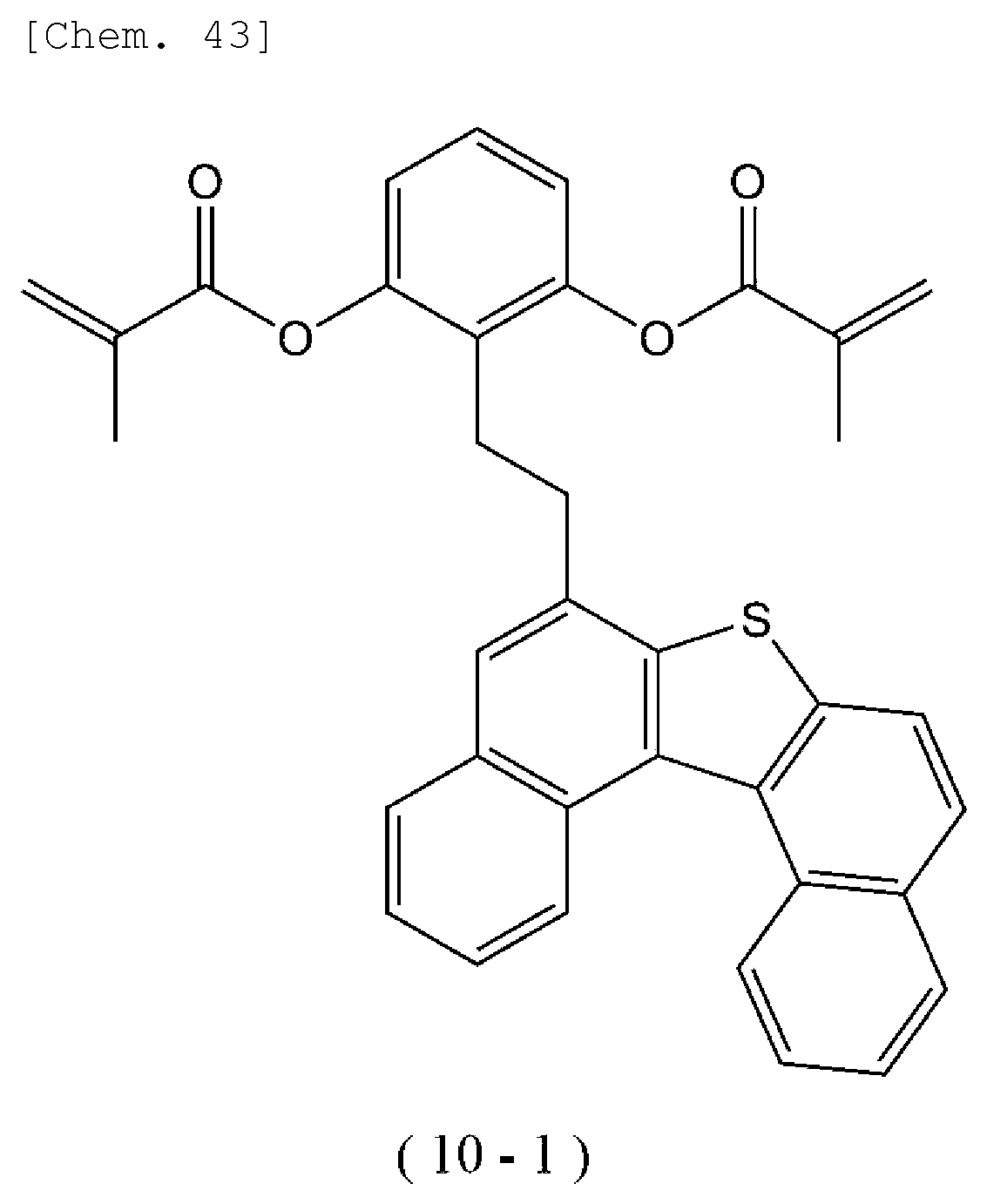
[Synthesemethode für die durch die chemische Formel (10-1) wiedergegebene Verbindung][Synthesis method for the compound represented by the chemical formula (10-1)]
Eine Synthesemethode (Syntheseroute) für die durch die chemische Formel (10-1) wiedergegebene Verbindung ist wie folgt.


(Schritt A1)(Step A1)
Nun wird Schritt A1 in der oben dargestellten Syntheseroute beschrieben. Schritt A1 umfasst die folgenden Arbeitsgänge 1 bis 14.Step A1 in the above synthesis route will now be described. Step A1 comprises the following operations 1 to 14.
- 1. Unter Ar-Atmosphäre wurden 24,1 g (77,0 mmol, 1,00 Äq.) Verbindung 1, 23,7 g (90,0 mmol, 1,16 Äq.) 1-Iod-2,6-dimethoxybenzol, 38,7 g (280 mmol, 3,6 Äq.) Kaliumcarbonat und 577 g desoxygeniertes DMF in ein Reagenzglas gegeben.1. Under an Ar atmosphere, 24.1 g (77.0 mmol, 1.00 eq.) Of compound 1, 23.7 g (90.0 mmol, 1.16 eq.) Of 1-iodo-2,6- Put dimethoxybenzene, 38.7 g (280 mmol, 3.6 eq.) potassium carbonate and 577 g deoxygenated DMF in a test tube.
- 2. Es wurde 30 Minuten Ar durchgeleitet.2. Ar was passed through for 30 minutes.
- 3. 24,5 g (76,0 mmol, 0,981 Äq.) TBAB und 982 mg (4,38 mmol, 0,056 Äq.) Pd(OAc)2 wurden in das Reagenzglas gegeben.3. 24.5 g (76.0 mmol, 0.981 eq.) TBAB and 982 mg (4.38 mmol, 0.056 eq.) Pd (OAc) 2 were added to the test tube.
- 4. Es wurde 2,5 Stunden auf 110 °C erhitzt.4. It was heated to 110 ° C for 2.5 hours.
- 5. Nach Abkühlenlassen auf Raumtemperatur wurde die Reaktionsflüssigkeit in 1,2 l Eiswasser gegossen, wonach 1,0 l Essigsäureethylester zugegeben und anschließend Flüssigkeitstrennung durchgeführt wurde.5. After allowing to cool to room temperature, the reaction liquid was poured into 1.2 L of ice water, after which 1.0 L of ethyl acetate was added, followed by liquid separation.
- 6. Die organische Schicht wurde mit 1,0 l Wasser gewaschen und dann filtriert.6. The organic layer was washed with 1.0 L of water and then filtered.
- 7. Es wurden 24,2 g eines schwarzen Rückstands erhalten.7. 24.2 g of a black residue were obtained.
- 8. Der schwarze Rückstand wurde in 1,0 l Chloroform gelöst und mit 16,4 g Si-Thiol versetzt, wonach 30 Minuten bei Raumtemperatur gerührt wurde.8. The black residue was dissolved in 1.0 l of chloroform and treated with 16.4 g of Si thiol, which was followed by stirring at room temperature for 30 minutes.
- 9. Es wurde über Celite filtriert.9. It was filtered through Celite.
- 10. Das Filtrat wurde unter vermindertem Druck aufkonzentriert und mit Heptan versetzt, wonach Aufschlämmungsfiltration durchgeführt wurde.10. The filtrate was concentrated under reduced pressure, added with heptane, followed by slurry filtration.
- 11. Der Rückstand wurde 30 Minuten bei 60 °C unter Vakuum getrocknet.11. The residue was dried under vacuum at 60 ° C for 30 minutes.
- 12. Es wurde ein cremefarbener Feststoff in einer Menge von 21,6 g (48,4 mmol, Ausbeute 62,4 %, Verbindung 5) erhalten.12. An off-white solid was obtained in an amount of 21.6 g (48.4 mmol, yield 62.4%, compound 5).
- 13. Das in Arbeitsgang 10 erhaltene Filtrat wurde unter vermindertem Druck aufkonzentriert, wonach Aufschlämmungsfiltration durchgeführt wurde.13. The filtrate obtained in Operation 10 was concentrated under reduced pressure, followed by slurry filtration.
- 14. Verbindung 5 wurde als cremefarbener Feststoff in einer zusätzlichen Menge von 0,803 g (1,80 mmol, Ausbeute 2,3 %) erhalten.14. Compound 5 was obtained as an off-white solid in an additional amount of 0.803 g (1.80 mmol, yield 2.3%).
(Schritt B1)(Step B1)
Nun wird Schritt B1 in der oben dargestellten Syntheseroute beschrieben. Schritt B1 umfasst die folgenden Arbeitsgänge 1 bis 12.Step B1 in the above synthesis route will now be described. Step B1 comprises the following operations 1 to 12.
- 1. Unter Ar-Atmosphäre wurde ein 1-1-Vierhalskolben mit 21,1 g (47,2 mmol, 1,00 Äq.) Verbindung 5 und 420 ml THF beschickt.1. Under an Ar atmosphere, a 1-1 four-necked flask was charged with 21.1 g (47.2 mmol, 1.00 eq.) Of compound 5 and 420 ml of THF.
- 2. 3,35 g (1,42 mmol, 0,30 Äq.) 10 % Pd/C (55 % Wasser) wurden in den Kolben gegeben, wonach das Innere der Apparatur durch Wasserstoffgas ersetzt wurde.2. 3.35 g (1.42 mmol, 0.30 eq.) 10% Pd / C (55% water) was added to the flask, after which the inside of the apparatus was replaced with hydrogen gas.
- 3. Es wurde ein Wasserstoffgasballon angebracht, wonach unter leichtem Überdruck 6,5 Stunden gerührt wurde.3. A hydrogen gas balloon was attached and stirring was carried out under slightly positive pressure for 6.5 hours.
- 4. Es wurden 4,53 g (1,92 mmol, 0,041 Äq.) 10 % Pd/C (55 % Wasser) zugegeben, wonach das Innere der Apparatur durch Wasserstoffgas ersetzt wurde.4. 4.53 g (1.92 mmol, 0.041 eq.) 10% Pd / C (55% water) was added and the interior of the apparatus was replaced with hydrogen gas.
- 5. Es wurde ein Wasserstoffgasballon angebracht, wonach unter leichtem Überdruck 1,5 Stunden gerührt wurde.5. A hydrogen gas balloon was attached and stirring was carried out under slightly positive pressure for 1.5 hours.
- 6. Die Reaktionsflüssigkeit wurde über Celite filtriert.6. The reaction liquid was filtered through Celite.
- 7. Das Filtrat wurde mit 5,20 g Si-Thiol versetzt, wonach 30 Minuten bei Raumtemperatur gerührt wurde.7. 5.20 g of Si-thiol were added to the filtrate, which was then stirred for 30 minutes at room temperature.
- 8. Nach Zugabe von weiteren 5,23 g Si-Thiol wurde 30 Minuten bei Raumtemperatur gerührt.8. After adding a further 5.23 g of Si thiol, the mixture was stirred at room temperature for 30 minutes.
- 9. Nach Filtration wurde das Filtrat unter vermindertem Druck aufkonzentriert und mit Heptan versetzt, wonach Aufschlämmungsfiltration durchgeführt wurde.9. After filtration, the filtrate was concentrated under reduced pressure and added with heptane, followed by slurry filtration.
- 10. Es wurde ein cremefarbener Feststoff in einer Menge von 12,5 g (27,9 mmol, Ausbeute 59,2 %, Verbindung 6) erhalten.10. An off-white solid was obtained in an amount of 12.5 g (27.9 mmol, yield 59.2%, compound 6).
- 11. Das in Arbeitsgang 9 erhaltene Filtrat wurde unter vermindertem Druck aufkonzentriert und mit Heptan versetzt, wonach Aufschlämmungsfiltration durchgeführt wurde.11. The filtrate obtained in Operation 9 was concentrated under reduced pressure and treated with heptane, followed by slurry filtration.
- 12. Verbindung 6 wurde als cremefarbener Feststoff in einer Menge von 5,33 g (11,9 mmol, Ausbeute 11,3 %) erhalten.12. Compound 6 was obtained as an off-white solid in an amount of 5.33 g (11.9 mmol, yield 11.3%).
(Schritt C1)(Step C1)
Nun wird Schritt C1 in der oben dargestellten Syntheseroute beschrieben. Schritt C1 umfasst die folgenden Arbeitsgänge 1 bis 22.Step C1 in the above synthesis route will now be described. Step C1 comprises the following operations 1 to 22.
- 1. Unter Ar-Atmosphäre wurde ein 1-1-Vierhalskolben mit 16,0 g (35,7 mmol, 1,00 Äq.) Verbindung 6 und 450 ml superentwässertem Dichlormethan versetzt.1. Under an Ar atmosphere, 16.0 g (35.7 mmol, 1.00 eq.) Of compound 6 and 450 ml of super-dehydrated dichloromethane were added to a 1-1 four-necked flask.
- 2. Es wurde auf einem Eisbad auf eine Innentemperatur von 0 °C oder darunter abgekühlt.2. It was cooled to an internal temperature of 0 ° C or below on an ice bath.
- 3. 150 ml (150 mmol, 4,20 Äq.) 1,0 M Lösung von BBr3 in Dichlormethan wurde über einen Zeitraum von 40 Minuten zugetropft.3. 150 ml (150 mmol, 4.20 eq.) 1.0 M solution of BBr 3 in dichloromethane was added dropwise over a period of 40 minutes.
- 4. Es wurde 1,5 Stunden bei 5 °C oder darunter gerührt.4. Stirred for 1.5 hours at 5 ° C or below.
- 5. Das Eisbad wurde entfernt, und nach Erwärmen auf Raumtemperatur wurde 3,5 Stunden gerührt.5. The ice bath was removed and after warming to room temperature the mixture was stirred for 3.5 hours.
- 6. Die Reaktionsflüssigkeit wurde zum Quenchen in 1 l Eiswasser gegossen.6. The reaction liquid was poured into 1 liter of ice water to be quenched.
- 7. Die gequenchte Reaktionsflüssigkeit wurde filtriert und durch Aufgießen von Methanol mit Methanol gewaschen.7. The quenched reaction liquid was filtered and washed with methanol by pouring methanol on it.
- 8. Es wurde ein cremefarbener Feststoff in einer Menge von 3,55 g (Verbindung 6'-1) erhalten.8. An off-white solid was obtained in an amount of 3.55 g (compound 6'-1).
- 9. Unter Ar-Atmosphäre wurde ein 200-ml-Vierhalskolben mit 1,52 g (3,38 mmol, 1,00 Äq.) Verbindung 6 und 45,0 ml superentwässertem Dichlormethan beschickt.9. Under an Ar atmosphere, a 200 ml four-necked flask was charged with 1.52 g (3.38 mmol, 1.00 eq.) Of Compound 6 and 45.0 ml of super-dehydrated dichloromethane.
- 10. Es wurde auf einem Eisbad auf eine Innentemperatur von 0 °C oder darunter abgekühlt.10. It was cooled to an internal temperature of 0 ° C or below on an ice bath.
- 11. Über einen Zeitraum von 10 Minuten wurden 15,0 ml (15,0 mmol, 4,44 Äq.) 1,0 M Lösung von BBr3 in Dichlormethan zugetropft.11. 15.0 ml (15.0 mmol, 4.44 eq.) 1.0 M solution of BBr 3 in dichloromethane were added dropwise over a period of 10 minutes.
- 12. Es wurde 3 Stunden bei 0 °C oder darunter gerührt.12. It was stirred for 3 hours at 0 ° C or below.
- 13. Das Eisbad wurde entfernt, und nach Erwärmen auf Raumtemperatur wurde 3 Stunden gerührt.13. The ice bath was removed and after warming to room temperature the mixture was stirred for 3 hours.
- 14. Die Reaktionsflüssigkeit wurde zum Quenchen in 50 ml Wasser gegossen.14. The reaction liquid was poured into 50 ml of water to be quenched.
- 15. Das in Arbeitsgang 8 erhaltene Filtrat und die Reaktionsflüssigkeit nach dem Quenchen in Arbeitsgang 14 wurden vereinigt, wonach Flüssigkeitstrennung durchgeführt wurde.15. The filtrate obtained in Operation 8 and the reaction liquid after quenching in Operation 14 were combined, followed by liquid separation.
- 16. Die wässrige Schicht wurde mit 200 ml Chloroform extrahiert.16. The aqueous layer was extracted with 200 ml of chloroform.
- 17. Die organische Schicht wurde damit vereinigt, wonach die Flüssigkeit über einen Phasenseparator geführt und das Filtrat unter vermindertem Druck aufkonzentriert wurde.17. The organic layer was combined therewith, the liquid was passed through a phase separator and the filtrate was concentrated under reduced pressure.
- 18. Es wurde Heptan zugegeben, wonach Aufschlämmungsfiltration durchgeführt wurde.18. Heptane was added and slurry filtration was performed.
- 19. Der erhaltene Rückstand wurde 30 Minuten bei 60 °C unter Vakuum getrocknet.19. The residue obtained was dried under vacuum at 60 ° C. for 30 minutes.
- 20. Es wurde ein cremefarbener Feststoff (Verbindung 6'-2) in einer Menge von 10,7 g erhalten.20. An off-white solid (Compound 6'-2) was obtained in an amount of 10.7 g.
- 21. Verbindung 6'-1 und Verbindung 6'-2 wurden zusammengegeben und dann 30 Minuten bei 80 °C unter Vakuum getrocknet.21. Compound 6'-1 and compound 6'-2 were combined and then dried under vacuum at 80 ° C. for 30 minutes.
- 22. Es wurde ein cremefarbener Feststoff in einer Menge von 14,0 g (33,4 mmol, Verbindung 7) erhalten.22. An off-white solid was obtained in an amount of 14.0 g (33.4 mmol, Compound 7).
(Schritt D1)(Step D1)
Nun wird Schritt D1 in der oben dargestellten Syntheseroute beschrieben. Schritt D1 umfasst die folgenden Arbeitsgänge 1 bis 17.Step D1 in the above synthesis route will now be described. Step D1 includes the following operations 1 to 17.
- 1. Unter Ar-Atmosphäre wurde ein 100-ml-Birnenkolben mit 500 mg (1,20 mmol, 1,00 Äq.) Verbindung 7, 30,0 ml superentwässertem Dichlormethan und 0,750 ml (5,38 mmol, 4,52 Äq.) Triethylamin beschickt.1. Under an Ar atmosphere, a 100 ml pear flask was filled with 500 mg (1.20 mmol, 1.00 eq.) Of compound 7, 30.0 ml of super-drained dichloromethane and 0.750 ml (5.38 mmol, 4.52 eq.) .) Triethylamine charged.
- 2. Es wurde auf einem Eisbad auf eine Innentemperatur von 0 °C abgekühlt.2. It was cooled to an internal temperature of 0 ° C. on an ice bath.
- 3. Es wurden 0,350 ml (3,70 mmol, 3,11 Äq.) Methacryloylchlorid zugetropft.3. 0.350 ml (3.70 mmol, 3.11 eq.) Of methacryloyl chloride were added dropwise.
- 4. Es wurde 2 Stunden auf dem Eisbad gerührt.4. It was stirred for 2 hours on the ice bath.
- 5. Die Reaktionsflüssigkeit wurde zum Quenchen in Eiswasser gegossen.5. The reaction liquid was poured into ice water to be quenched.
- 6. Unter Ar-Atmosphäre wurde ein 1-1-Vierhalskolben mit 6,50 g (15,5 mmol, 1,00 Äq.) Verbindung 7, 390 ml superentwässertem Dichlormethan und 9,80 ml (70,3 mmol, 4,55 Äq.) Triethylamin beschickt.6. A 1-1 four-necked flask was filled with 6.50 g (15.5 mmol, 1.00 eq.) Of compound 7, 390 ml of super-dehydrated dichloromethane and 9.80 ml (70.3 mmol, 4, 55 eq.) Triethylamine charged.
- 7. Es wurde auf einem Eisbad auf eine Innentemperatur von 0 °C abgekühlt.7. It was cooled to an internal temperature of 0 ° C. on an ice bath.
- 8. Über einen Zeitraum von 10 Minuten wurden 4,60 ml (48,6 mmol, 3,14 Äq.) Methacryloylchlorid zugetropft.8. 4.60 ml (48.6 mmol, 3.14 eq.) Of methacryloyl chloride were added dropwise over a period of 10 minutes.
- 9. Es wurde 2,5 Stunden auf dem Eisbad gerührt.9. It was stirred for 2.5 hours on the ice bath.
- 10. Die Reaktionsflüssigkeit wurde zum Quenchen in Eiswasser gegossen.10. The reaction liquid was poured into ice water to be quenched.
- 11. Die Reaktionsflüssigkeiten nach dem Quenchen in Arbeitsgang 5 und Arbeitsgang 10 wurden vereinigt, und nach Flüssigkeitstrennung wurde die wässrige Schicht mit 100 ml Chloroform extrahiert.11. The reaction liquids after quenching in Operation 5 and Operation 10 were combined, and after liquid separation, the aqueous layer was extracted with 100 ml of chloroform.
- 12. Die organische Schicht wurde damit vereinigt, wonach die Flüssigkeit mit Wasser (500 ml × 4-mal) gewaschen wurde.12. The organic layer was combined therewith, after which the liquid was washed with water (500 ml x 4 times).
- 13. Die organische Schicht wurde über einen Phasenseparator geführt, wonach das Filtrat aufkonzentriert, getrocknet und unter vermindertem Druck gehärtet wurde.13. The organic layer was passed through a phase separator, after which the filtrate was concentrated, dried and hardened under reduced pressure.
- 14. Das Filtrat wurde aufkonzentriert, getrocknet und unter vermindertem Druck gehärtet.14. The filtrate was concentrated, dried and cured under reduced pressure.
- 15. Der Rückstand wurde einer Säulenreinigung (Säule: Biotage SNAP Ultra 340 g × 2 (in Reihe), Lösungsmittel: Heptan/Essigsäureethylester = 9/1 (Volumenverhältnis)) unterworfen.15. The residue was subjected to column purification (column: Biotage SNAP Ultra 340 g × 2 (in series), solvent: heptane / ethyl acetate = 9/1 (volume ratio)).
- 16. Eine nur die Zielverbindung enthaltende Fraktion wurde gewonnen und aufkonzentriert, getrocknet und unter vermindertem Druck gehärtet.16. A fraction containing only the target compound was collected and concentrated, dried and cured under reduced pressure.
- 17. Eine durch die chemische Formel (10-1) wiedergegebene Verbindung wurde als weißer Feststoff in einer Menge von 5,97 g (10,7 mmol, Ausbeute 64,4 %) erhalten.17. A compound represented by the chemical formula (10-1) was obtained as a white solid in an amount of 5.97 g (10.7 mmol, yield 64.4%).
Dann wurde die Struktur der Verbindung von Beispiel 13 (der durch die chemische Formel (10-1) wiedergegebenen Verbindung) mittels NMR identifiziert. Die NMR-Ergebnisse sind wie folgt.Then, the structure of the compound of Example 13 (the compound represented by Chemical Formula (10-1)) was identified by means of NMR. The NMR results are as follows.
1H-NMR (CDCl3) : 2,01 (s, 6H), 3,12 (t, 2H), 3,24 (t, 2H), 5,65 (s, 2H), 6,26 (s, 2H), 7,04 (d, 2H), 7,30 (m, 1H), 7,55 (m, 5H), 7,92 (m, 3H), 8,05 (m, 1H), 8,83 (m, 2H)1 H NMR (CDCl3): 2.01 (s, 6H), 3.12 (t, 2H), 3.24 (t, 2H), 5.65 (s, 2H), 6.26 (s, 2H ), 7.04 (d, 2H), 7.30 (m, 1H), 7.55 (m, 5H), 7.92 (m, 3H), 8.05 (m, 1H), 8.83 (m, 2H)
<Beispiel 14><Example 14>
[Herstellung der durch die chemische Formel (10-2) wiedergegebenen Verbindung][Preparation of the compound represented by the chemical formula (10-2)]
Es wurde eine durch die folgende chemische Formel (10-2) wiedergegebene Verbindung synthetisiert, und die durch die folgende chemische Formel (10-2) wiedergegebene Verbindung wurde als eine Verbindung von Beispiel 14 genommen.A compound represented by the following chemical formula (10-2) was synthesized, and the compound represented by the following chemical formula (10-2) was taken as a compound of Example 14.


[Synthesemethode für die durch die chemische Formel (10-2) wiedergegebene Verbindung][Synthesis method for the compound represented by the chemical formula (10-2)]
Eine Synthesemethode (Syntheseroute) für die durch die chemische Formel (10-2) wiedergegebene Verbindung ist wie folgt.


In Schritt A2 bis Schritt C2 wurde Verbindung 7 nach der gleichen Methode wie in der in Bezug auf die chemische Formel (10-1) dargestellten Syntheseroute synthetisiert.In step A2 to step C2, compound 7 was synthesized by the same method as in the synthetic route shown in relation to chemical formula (10-1).
(Schritt D2)(Step D2)
Nun wird Schritt D2 in der oben dargestellten Syntheseroute beschrieben. Schritt D2 umfasst die folgenden Arbeitsgänge 1 bis 14.Step D2 in the above synthesis route will now be described. Step D2 includes the following operations 1 to 14.
- 1. Unter Ar-Atmosphäre wurde ein 500-ml-Vierhalskolben mit 4,04 g (9,61 mmol, 1,00 Äq.) Verbindung 7, 240 ml superentwässertem Chloroform (mit Amylen-Zusatz) und 6,00 ml (43,0 mmol, 4,48 Äq.) Triethylamin beschickt.1. Under an Ar atmosphere, a 500 ml four-necked flask was filled with 4.04 g (9.61 mmol, 1.00 eq.) Of compound 7, 240 ml of super-dehydrated chloroform (with added amylene) and 6.00 ml (43 , 0 mmol, 4.48 eq.) Triethylamine charged.
- 2. Es wurde auf einem Eisbad auf eine Innentemperatur von 0 °C abgekühlt.2. It was cooled to an internal temperature of 0 ° C. on an ice bath.
- 3. Über einen Zeitraum von 10 Minuten wurden 2,5 ml (30,08 mmol, 3,20 Äq.) Acryloylchlorid zugetropft.3. 2.5 ml (30.08 mmol, 3.20 eq.) Acryloyl chloride were added dropwise over a period of 10 minutes.
- 4. Es wurde 2,5 Stunden auf einem Eisbad gerührt.4. Stir on an ice bath for 2.5 hours.
- 5. Die Reaktionsflüssigkeit wurde zum Quenchen in Eiswasser gegossen.5. The reaction liquid was poured into ice water to be quenched.
- 6. Die wässrige Schicht wurde mit 100 ml Chloroform extrahiert.6. The aqueous layer was extracted with 100 ml of chloroform.
- 7. Die organische Schicht wurde damit vereinigt, wonach mit Wasser (500 ml × dreimal) gewaschen wurde.7. The organic layer was combined therewith, followed by washing with water (500 ml x three times).
- 8. Die organische Schicht wurde über einen Phasenseparator geführt, wonach das Filtrat aufkonzentriert, getrocknet und unter vermindertem Druck gehärtet wurde.8. The organic layer was passed through a phase separator, after which the filtrate was concentrated, dried and hardened under reduced pressure.
- 9. Der Rückstand wurde in 50 ml Chloroform gelöst, wonach die Lösung über 31,2 g Kieselgel (Kanto Chemical, 60N) geführt wurde.9. The residue was dissolved in 50 ml of chloroform, after which the solution was passed over 31.2 g of silica gel (Kanto Chemical, 60N).
- 10. Es wurde mit 200 ml Chloroform gewaschen.10. It was washed with 200 ml of chloroform.
- 11. Das Filtrat wurde damit vereinigt, wonach Heptan zugegeben und anschließend unter vermindertem Druck aufkonzentriert wurde.11. The filtrate was combined therewith, after which heptane was added and then concentrated under reduced pressure.
- 12. Der aufkonzentrierte Rückstand wurde Aufschlämmungfiltration unterworfen.12. The concentrated residue was subjected to slurry filtration.
- 13. Der Filtrationsrückstand wurde 1 Stunde bei 50 °C unter Vakuum getrocknet.13. The filtration residue was dried under vacuum at 50 ° C. for 1 hour.
- 14. Eine durch die chemische Formel (10-2) wiedergegebene Verbindung wurde in Form eines hellhautfarbenen Feststoffs in einer Menge von 3,98 g (7,51 mmol, Ausbeute 78 %) erhalten.14. A compound represented by the chemical formula (10-2) was obtained in the form of a light skin-colored solid in an amount of 3.98 g (7.51 mmol, yield 78%).
Dann wurde die Struktur der Verbindung von Beispiel 14 (der durch die chemische Formel (10-2) wiedergegebenen Verbindung) mittels NMR identifiziert. Die NMR-Ergebnisse sind wie folgt.Then, the structure of the compound of Example 14 (the compound represented by Chemical Formula (10-2)) was identified by means of NMR. The NMR results are as follows.
1H-NMR (CDCl3) : 3,12 (m, 2H), 3,25 (m, 2H), 5,85 (d, 2H), 6,25 (m, 2H), 6,50 (d, 2H), 7,04 (d, 2H), 7,30 (m, 1H), 7,53 (m, 5H), 7,88 (m, 3H), 8,05 (m, 1H), 8,83 (m, 2H)1 H NMR (CDCl3): 3.12 (m, 2H), 3.25 (m, 2H), 5.85 (d, 2H), 6.25 (m, 2H), 6.50 (d, 2H ), 7.04 (d, 2H), 7.30 (m, 1H), 7.53 (m, 5H), 7.88 (m, 3H), 8.05 (m, 1H), 8.83 (m, 2H)
<Beispiel 15><Example 15>
[Herstellung der durch die chemische Formel (11-1) wiedergegebenen Verbindung][Preparation of the compound represented by the chemical formula (11-1)]
Es wurde eine durch die folgende chemische Formel (11-1) wiedergegebene Verbindung synthetisiert, und die durch die folgende chemische Formel (11-1) wiedergegebene Verbindung wurde als eine Verbindung von Beispiel 15 genommen.A compound represented by the following chemical formula (11-1) was synthesized, and the compound represented by the following chemical formula (11-1) was taken as a compound of Example 15.


[Synthesemethode für die durch die chemische Formel (11-1) wiedergegebene Verbindung][Synthesis method for the compound represented by the chemical formula (11-1)]
Eine Synthesemethode (Syntheseroute) für die durch die chemische Formel (11-1) wiedergegebene Verbindung ist wie folgt.A synthetic method (synthetic route) for the compound represented by the chemical formula (11-1) is as follows.

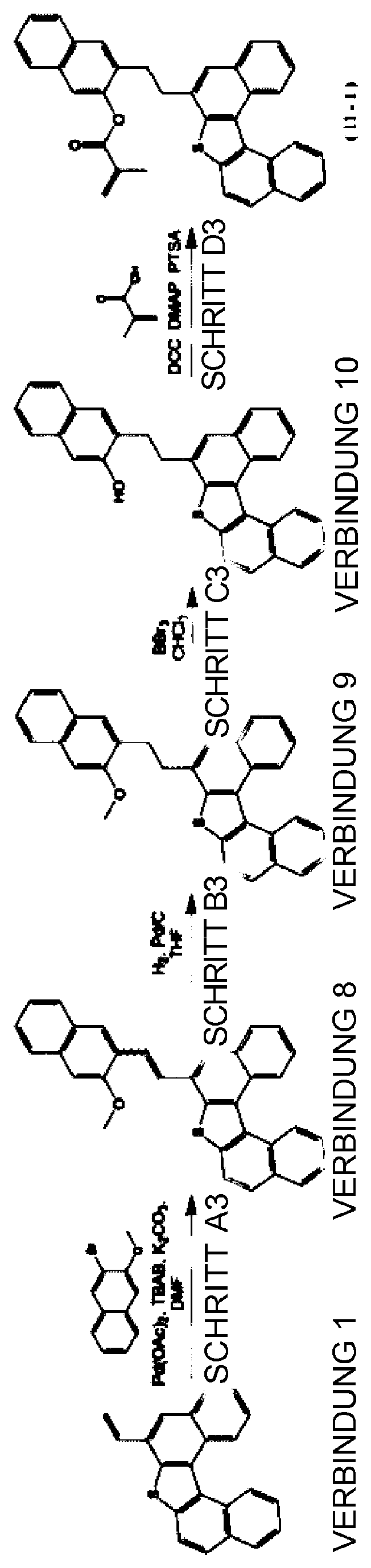
(Schritt A3)(Step A3)
Nun wird Schritt A3 in der oben dargestellten Syntheseroute beschrieben. Schritt A3 umfasst die folgenden Arbeitsgänge 1 bis 10.
- 1. Unter Ar-Atmosphäre wurde ein 200-ml-Vierhalskolben mit 10,9 g (35,2 mmol, 1,00 Äq.) Verbindung 1, 19,2 g (81,2 mmol, 2,30 Äq.) 2-Brom-3-methoxynaphthalin, 479 g (6557 mmol, 186 Äq.) desoxygeniertem DMF und 22,9 g (166 mmol, 4,71 Äq.) Kaliumcarbonat beschickt.
- 2. Es wurde 28 Minuten Ar durchgeleitet.
- 3. Es wurden 12,1 g (37,8 mmol, 1,07 Äq.) TBAB und 1,15 g (5,12 mmol, 0,146 Äq.) Pd(OAc)2 in den Kolben gegeben.
- 4. Es wurde 26 Stunden unter Rückfluss gerührt.
- 5. Nach Abkühlenlassen auf Raumtemperatur wurde die Reaktionsflüssigkeit zum Quenchen in 1 l Wasser gegossen.
- 6. Die Reaktionsflüssigkeit wurde über ein Saugfilter filtriert, wonach mit 200 ml Essigsäureethylester gewaschen wurde.
- 7. Der Kristall wurde in 1,2 l THF gelöst und mit 19,3 g Si-Thiol versetzt, wonach 35 Minuten gerührt wurde.
- 8. Die Reaktionsflüssigkeit wurde über Celite filtriert, wonach mit 800 ml THF gewaschen wurde.
- 9. Nach Aufkonzentrieren des Filtrats wurden 88,8 g Heptan zugegeben.
- 10. Durch Filtration und Trocknen wurde Verbindung 8 in Form eines ockerfarbenen Feststoffs in einer Menge von 8,43 g (18,0 mmol, Ausbeute 33,0 %) erhalten.
- 1. Under an Ar atmosphere, a 200 ml four-necked flask containing 10.9 g (35.2 mmol, 1.00 eq.) Of Compound 1, 19.2 g (81.2 mmol, 2.30 eq.) 2 -Bromo-3-methoxynaphthalene, 479 g (6557 mmol, 186 eq.) Deoxygenated DMF and 22.9 g (166 mmol, 4.71 eq.) Potassium carbonate.
- 2. Ar was passed through for 28 minutes.
- 3. 12.1 g (37.8 mmol, 1.07 eq.) TBAB and 1.15 g (5.12 mmol, 0.146 eq.) Pd (OAc) 2 were added to the flask.
- 4. The mixture was stirred under reflux for 26 hours.
- 5. After allowing to cool to room temperature, the reaction liquid was poured into 1 liter of water for quenching.
- 6. The reaction liquid was filtered through a suction filter, followed by washing with 200 ml of ethyl acetate.
- 7. The crystal was dissolved in 1.2 l of THF and 19.3 g of Si thiol were added, followed by stirring for 35 minutes.
- 8. The reaction liquid was filtered through Celite, followed by washing with 800 ml of THF.
- 9. After the filtrate was concentrated, 88.8 g of heptane were added.
- 10. Filtration and drying gave Compound 8 in the form of an ocher solid in an amount of 8.43 g (18.0 mmol, yield 33.0%).
(Schritt B3)(Step B3)
Nun wird Schritt B3 in der oben dargestellten Syntheseroute beschrieben. Schritt B3 umfasst die folgenden Arbeitsgänge 1 bis 7.
- 1. Unter Ar-Atmosphäre wurde ein 2-1-Vierhalskolben mit 7,96 g (17,0 mmol, 1,00 Äq.) Verbindung 8 und 1145 ml (14 mol, 819 Äq.) THF beschickt.
- 2. Es wurde 1 Stunde bei 30 °C gerührt.
- 3. Es wurden 2,26 g (0,956 mmol, 0,0560 Äq.) 10 % Pd-C (55% Wasser) in den Kolben gegeben.
- 4. Das Innere des Behälters wurde durch Wasserstoff ersetzt.
- 5. Es wurde mit 30,7 g Si-Thiol und 29,3 g Celite filtriert.
- 6. Das in Arbeitsgang 5 erhaltene Filtrat wurde unter vermindertem Druck aufkonzentriert, wonach Aufschlämmungsfiltration durchgeführt wurde.
- 7. Verbindung 9 wurde als cremefarbener Feststoff in einer Menge von 5,22 g (11,1 mmol, Ausbeute 65,4 %) erhalten.
- 1. Under an Ar atmosphere, 7.96 g (17.0 mmol, 1.00 eq.) Of compound 8 and 1145 ml (14 mol, 819 eq.) Of THF were charged to a 2-1 four-necked flask.
- 2. The mixture was stirred at 30 ° C. for 1 hour.
- 3. 2.26 g (0.956 mmol, 0.0560 eq.) Of 10% Pd-C (55% water) was added to the flask.
- 4. The inside of the container was replaced with hydrogen.
- 5. It was filtered with 30.7 g of Si thiol and 29.3 g of Celite.
- 6. The filtrate obtained in Operation 5 was concentrated under reduced pressure, followed by slurry filtration.
- 7. Compound 9 was obtained as an off-white solid in an amount of 5.22 g (11.1 mmol, yield 65.4%).
(Schritt C3)(Step C3)
Nun wird Schritt C3 in der oben dargestellten Syntheseroute beschrieben. Schritt C3 umfasst die folgenden Arbeitsgänge 1 bis 9.
- 1. Unter Ar-Atmosphäre wurde ein 300-ml-Vierhalskolben mit 5,103 g (10,8 mmol, 1,00 Äq.) Verbindung 9 und 82 ml (1012 mmol, 92,9 Äq.) superentwässertem Chloroform beschickt.
- 2. Es wurde auf einem Eisbad auf eine Innentemperatur von 5 °C oder darunter abgekühlt.
- 3. Über einen Zeitraum von 5 Minuten wurden 25,0 ml (25,0 mmol, 2,29 Äq.) 1,0 M Lösung von BBr3 in Dichlormethan zugetropft.
- 4. Das Eisbad wurde entfernt, und nach Erwärmen auf Raumtemperatur wurde 6 Stunden gerührt.
- 5. Die Reaktionsflüssigkeit wurde mit 200 ml Eiswasser gequencht, wonach 100 ml Heptan zugegeben wurden, was 10,9 g eines cremefarbenen Feststoffs ergab.
- 6. Der Feststoff wurde durch Zugabe von 200 ml THF gelöst.
- 7. Es wurde über Magnesiumsulfat entwässert, wonach filtriert wurde.
- 8. Das in Arbeitsgang 7 erhaltene Filtrat wurde unter vermindertem Druck aufkonzentriert, wonach Aufschlämmungsfiltration durchgeführt wurde, was 4,58 g eines cremefarbenen Feststoffs ergab.
- 9. Der Feststoff wurde 40 Minuten bei 40 °C unter vermindertem Druck getrocknet, was 4,49 g (9,89 mmol, Ausbeute 90,8 %) Verbindung 10 in Form eines cremefarbenen Feststoffs ergab.
- 1. Under an Ar atmosphere, a 300 ml four-necked flask was charged with 5.103 g (10.8 mmol, 1.00 eq.) Of Compound 9 and 82 ml (1012 mmol, 92.9 eq.) Of super-dehydrated chloroform.
- 2. It was cooled to an internal temperature of 5 ° C or below on an ice bath.
- 3. 25.0 ml (25.0 mmol, 2.29 eq.) 1.0 M solution of BBr 3 in dichloromethane were added dropwise over a period of 5 minutes.
- 4. The ice bath was removed and after warming to room temperature the mixture was stirred for 6 hours.
- 5. The reaction liquid was quenched with 200 ml of ice water, after which 100 ml of heptane was added to give 10.9 g of an off-white solid.
- 6. The solid was dissolved by adding 200 ml of THF.
- 7. It was dehydrated over magnesium sulfate and filtered.
- 8. The filtrate obtained in Operation 7 was concentrated under reduced pressure and slurry filtration was carried out to give 4.58 g of an off-white solid.
- 9. The solid was dried under reduced pressure at 40 ° C. for 40 minutes, which gave 4.49 g (9.89 mmol, yield 90.8%) of compound 10 as an off-white solid.
(Schritt D3)(Step D3)
Nun wird Schritt D3 in der oben dargestellten Syntheseroute beschrieben. Schritt D3 umfasst die folgenden Arbeitsgänge 1 bis 15.
- 1. Unter Ar-Atmosphäre wurde ein Reagenzglas mit 3,85 g (8,46 mmol, 1,00 Äq.) Verbindung 10, 135 ml desoxygeniertem Toluol, 5,20 g (25,2 mmol, 2,98 Äq.) N,N'-Dicyclohexylcarbodiimid (DCC), 3,11 g (25,5 mmol, 3,01 Äq.) 4-Dimethylaminopyridin (DMAP) und 0,650 g (3,42 mmol, 0,404 Äq.) p-Toluolsulfonsäure (PTSA) beschickt.
- 2. Über einen Zeitraum von 5 Minuten wurden 0,895 g (10,4 mmol, 1,23 Äq.) Methacrylsäure zugetropft.
- 3. Es wurde 2 Stunden bei Raumtemperatur gerührt.
- 4. Die Reaktionsflüssigkeit wurde mit 100 ml Wasser versetzt und dann 30 Minuten bei Raumtemperatur gerührt.
- 5. Es wurde filtriert, wonach das Filtrat Flüssigkeitstrennung unterworfen wurde und die organische Schicht zweimal mit 200 ml Wasser gewaschen wurde.
- 6. Die organische Schicht wurde über wasserfreiem Magnesiumsulfat getrocknet, und nach Filtration wurde das Filtrat unter vermindertem Druck aufkonzentriert und mit Heptan versetzt, wonach Aufschlämmungsfiltration durchgeführt wurde.
- 7. Eine durch die chemische Formel (11-1) wiedergegebene Verbindung wurde in Form eines hellockerfarbenen Feststoffs in einer Menge von 2,42 g erhalten.
- 8. Der in Arbeitsgang 5 erhaltene Filtrationsrückstand wurde in 30 ml Chloroform suspendiert, wonach filtriert wurde.
- 9. Die in Arbeitsgang 6 und Arbeitsgang 8 erhaltenen Filtrate wurden vereinigt und dann unter vermindertem Druck aufkonzentriert und mit Heptan versetzt, wonach Aufschlämmungsfiltration durchgeführt wurde.
- 10. Die durch chemische Formel (11-1) wiedergegebene Verbindung wurde in Form eines ockerfarbenen Feststoffs in einer Menge von 1,01 g erhalten.
- 11. Die durch die chemische Formel (11-1) wiedergegebene Verbindung, die in Arbeitsgang 7 erhalten wurde, wurde in 110 ml Chloroform gelöst, wonach die Lösung über 13,1 g Kieselgel (Kanto Chemical, 60N) geführt und dann mit 100 ml Chloroform gewaschen wurde.
- 12. Die durch chemische Formel (11-1) wiedergegebene Verbindung, die in Arbeitsgang 10 erhalten wurde, wurde in 40 ml Chloroform gelöst, wonach die Lösung über 13,1 g Kieselgel (Kanto Chemical, 60N) geführt und dann mit 30 ml Chloroform gewaschen wurde.
- 13. Die in Arbeitsgang 11 und Arbeitsgang 12 erhaltenen Filtrate wurden vereinigt, wonach das erhaltene Filtrat aufkonzentriert, getrocknet und unter vermindertem Druck gehärtet wurde.
- 14. Der aufkonzentrierte Rückstand wurde in 30 ml Chloroform gelöst und mit 30 ml Ethanol versetzt, wonach unter vermindertem Druck aufkonzentriert und Aufschlämmungsfiltration durchgeführt wurde.
- 15. Die durch die chemische Formel (11-1) wiedergegebene Verbindung wurde in Form eines hellockerfarbenen Feststoffs in einer Menge von 2,81 g (5,38 mmol, Ausbeute 63,6 %) erhalten.
- 1. Under an Ar atmosphere, a test tube was filled with 3.85 g (8.46 mmol, 1.00 eq.) Of compound 10, 135 ml of deoxygenated toluene, 5.20 g (25.2 mmol, 2.98 eq.) N, N'-dicyclohexylcarbodiimide (DCC), 3.11 g (25.5 mmol, 3.01 eq.) 4-dimethylaminopyridine (DMAP) and 0.650 g (3.42 mmol, 0.404 eq.) P-toluenesulfonic acid (PTSA ) loaded.
- 2. 0.895 g (10.4 mmol, 1.23 eq.) Of methacrylic acid were added dropwise over a period of 5 minutes.
- 3. It was stirred for 2 hours at room temperature.
- 4. The reaction liquid was added with 100 ml of water and then stirred at room temperature for 30 minutes.
- 5. It was filtered, the filtrate was subjected to liquid separation and the organic layer was washed twice with 200 ml of water.
- 6. The organic layer was dried over anhydrous magnesium sulfate, and after filtration, the filtrate was concentrated under reduced pressure and added with heptane, followed by slurry filtration.
- 7. A compound represented by the chemical formula (11-1) was obtained in the form of a light-colored solid in an amount of 2.42 g.
- 8. The filtration residue obtained in operation 5 was suspended in 30 ml of chloroform, followed by filtration.
- 9. The filtrates obtained in Operation 6 and Operation 8 were combined and then concentrated under reduced pressure and added with heptane, followed by slurry filtration.
- 10. The compound represented by Chemical Formula (11-1) was obtained in the form of an ocher solid in an amount of 1.01 g.
- 11. The compound represented by Chemical Formula (11-1) obtained in Operation 7 was dissolved in 110 ml of chloroform, after which the solution was passed over 13.1 g of silica gel (Kanto Chemical, 60N) and then with 100 ml Chloroform was washed.
- 12. The compound represented by Chemical Formula (11-1) obtained in Operation 10 was dissolved in 40 ml of chloroform, after which the solution was passed over 13.1 g of silica gel (Kanto Chemical, 60N) and then with 30 ml of chloroform was washed.
- 13. The filtrates obtained in Operation 11 and Operation 12 were combined, and the resulting filtrate was concentrated, dried and hardened under reduced pressure.
- 14. The concentrated residue was dissolved in 30 ml of chloroform, added with 30 ml of ethanol, followed by concentration under reduced pressure and slurry filtration.
- 15. The compound represented by the chemical formula (11-1) was obtained in the form of a light-colored solid in an amount of 2.81 g (5.38 mmol, yield 63.6%).
Dann wurde die Struktur der Verbindung von Beispiel 15 (der durch die chemische Formel (11-1) wiedergegebenen Verbindung) mittels NMR identifiziert. Die NMR-Ergebnisse sind wie folgt.Then, the structure of the compound of Example 15 (the compound represented by the chemical formula (11-1)) was identified by means of NMR. The NMR results are as follows.
1H-NMR (CDCl3) : 2,09 (s, 3H), 3,33 (m, 2H), 3,44 (m, 2H), 5,74 (s, 1H), 6,39 (s, 1H), 7,25 to 8,06 (m, 15H), 8,85 (m, 2H).1 H NMR (CDCl3): 2.09 (s, 3H), 3.33 (m, 2H), 3.44 (m, 2H), 5.74 (s, 1H), 6.39 (s, 1H ), 7.25 to 8.06 (m, 15H), 8.85 (m, 2H).
<Vergleichsbeispiel 1><Comparative Example 1>
Durch die folgende chemische Formel (40-1) wiedergegebenes DNTMA (ein Handelsprodukt von SUGAI CHEMICAL INDUSTRY CO., LTD.) wurde als eine Verbindung von Vergleichsbeispiel 1 genommen.DNTMA (a commercial product of SUGAI CHEMICAL INDUSTRY CO., LTD.) Represented by the following chemical formula (40-1) was taken as a compound of Comparative Example 1.

< Vergleichsbeispiel 2><Comparative Example 2>
Durch die folgende chemische Formel (40-2) wiedergegebenes EDNTMA (ein Handelsprodukt von SUGAI CHEMICAL INDUSTRY CO., LTD wurde als eine Verbindung von Vergleichsbeispiel 2 genommen.EDNTMA (a commercial product of SUGAI CHEMICAL INDUSTRY CO., LTD) represented by the following chemical formula (40-2) was taken as a compound of Comparative Example 2.

< Vergleichsbeispiel 3><Comparative Example 3>
Durch die folgende chemische Formel (40-3) wiedergegebenes 6VDNpTh (ein Handelsprodukt von SUGAI CHEMICAL INDUSTRY CO., LTD.) wurde als eine Verbindung von Vergleichsbeispiel 3 genommen.6VDNpTh (a commercial product of SUGAI CHEMICAL INDUSTRY CO., LTD.) Represented by the following chemical formula (40-3) was taken as a compound of Comparative Example 3.

< Vergleichsbeispiel 4]<Comparative Example 4]
Durch die folgende chemische Formel (40-4) wiedergegebenes DNpTh (ein Handelsprodukt von SUGAI CHEMICAL INDUSTRY CO., LTD.) wurde als eine Verbindung von Vergleichsbeispiel 4 genommen.DNpTh (a commercial product of SUGAI CHEMICAL INDUSTRY CO., LTD.) Represented by the following chemical formula (40-4) was taken as a compound of Comparative Example 4.


[Methode zur Messung des Brechungsindex und Ergebnisse][Refractive Index Measurement Method and Results]
Nachstehend wird eine Methode zur Messung des Brechungsindex beschrieben.A method of measuring the refractive index is described below.
Es wurden Acetonlösungen der jeweiligen Verbindungen der Beispiele 1 bis 6 und Vergleichsbeispiele 1 bis 4 hergestellt. Durchschnittliche Brechungsindizes der jeweiligen Verbindungen für Licht mit einer Wellenlänge von 589 nm bei Raumtemperatur 25±1 °C wurden mit einem Abbe-Refraktometer (ER-1, hergestellt von Erma, Inc.) gemessen und gegen den Volumenanteil jeder Verbindung aufgetragen, um analytische Kurven zu erstellen (die Dichten der Verbindungen betrugen alle 1,00 g/cm3). Die analytischen Kurven wurden extrapoliert, und der Brechungsindex bei einem Volumenanteil jeder Verbindung von 1 wurde als Brechungsindex jeder Verbindung genommen. Die Ergebnisse sind in nachstehender Tabelle 1 aufgeführt.Acetone solutions of the respective compounds of Examples 1 to 6 and Comparative Examples 1 to 4 were prepared. Average refractive indexes of the respective compounds for light having a wavelength of 589 nm at room temperature 25 ± 1 ° C were measured with an Abbe refractometer (ER-1, manufactured by Erma, Inc.) and plotted against the volume fraction of each compound to make analytical curves to create (the densities of the connections were all 1.00 g / cm 3 ). The analytical curves were extrapolated, and the refractive index at a volume fraction of each compound of 1 was taken as the refractive index of each compound. The results are shown in Table 1 below.
[Methode zur Messung der Transparenz und Ergebnisse][Method of measuring transparency and results]
Die jeweiligen Verbindungen, 10 mg, der Beispiele 1 bis 6 und Vergleichsbeispiele 1 bis 4 wurden jeweils mit 10 mg Polyvinylacetat (PVAc, durchschnittlicher Polymerisationsgrad 5500) gemischt und dann zum Lösen mit Aceton versetzt, wodurch Harzzusammensetzungen hergestellt wurden. Einige Tropfen jeder dieser Harzzusammensetzungen wurden auf ein 2 cm großes quadratisches Glassubstrat getropft, wonach mit einer Schleuderbeschichtungsvorrichtung ein Film gebildet wurde und Aceton als Lösungsmittel abgedampft wurde, was einen harzkompatiblen Film (Dicke 3 µm) jeder Verbindung ergab. Die Transparenz dieser Filme wurde durch visuelle Inspektion bestätigt, wonach die Filme einer Transparenzbeurteilung unterworfen wurden. Die Ergebnisse sind in nachstehender Tabelle 1 aufgeführt.The respective compounds, 10 mg, of Examples 1 to 6 and Comparative Examples 1 to 4 were each mixed with 10 mg of polyvinyl acetate (PVAc, average degree of polymerization 5500) and then added with acetone to dissolve, whereby resin compositions were prepared. A few drops of each of these Resin compositions were dropped on a 2 cm square glass substrate, after which a film was formed with a spin coater and acetone as a solvent was evaporated off to give a resin-compatible film (3 µm thick) of each compound. The transparency of these films was confirmed by visual inspection, after which the films were subjected to transparency evaluation. The results are shown in Table 1 below.
Das Kriterium für die Transparenzbeurteilung ist wie folgt.
- Gut ··· Transparenz ist gut.
- Schlecht ··· Es liegt Färbung vor.
- Good ··· Transparency is good.
- Bad ··· There is color.
[Methode zur Messung der Löslichkeit und Ergebnisse][Method of measuring solubility and results]
Die jeweiligen Verbindungen, 20 mg, der Beispiele 1 bis 6 und Vergleichsbeispiele 1 bis 4 wurden jeweils in ein Vial eingewogen, wonach Aceton zugegeben und die Gesamtmenge auf 10 mg eingestellt wurde und anschließend 30 Sekunden mit Ultraschallwellen gerührt wurde. Wenn kein ungelöster Teil der Verbindung beobachtet wurde, wurde angenommen, dass die Löslichkeit 20 Gew.-% oder mehr betrug. Wenn ein ungelöster Teil der Verbindung vorlag, wurde eine kleine Menge Aceton zugegeben und dann 30 Sekunden weitergerührt. Die obige Arbeitsweise wurde wiederholt, und nach Auflösung der gesamten Verbindung wurde die Löslichkeit aus der Gesamtmenge des verwendeten Lösungsmittels berechnet. Die Ergebnisse sind in nachstehender Tabelle 1 aufgeführt.
[Tabelle 1]
Beispielsweise ist es im Fall der Verwendung der Verbindung als Monomermaterial für Hologramme wünschenswert, dass die Löslichkeit der Verbindung mehr als 20 Gew.-% beträgt. Daher werden die Verbindungen der Testbeispiele 1 bis 6 (die Verbindungen der Beispiele 1 bis 6) und Testbeispiele 11 bis 13 (die Verbindungen der Beispiele 13 bis 15) vorzugsweise als Monomermaterial für Hologramme verwendet.For example, in the case of using the compound as a monomer material for holograms, it is desirable that the solubility of the compound is more than 20% by weight. Therefore, the compounds of Test Examples 1 to 6 (the compounds of Examples 1 to 6) and Test Examples 11 to 13 (the compounds of Examples 13 to 15) are preferably used as the monomer material for holograms.
Die Beurteilung der Transparenz der Testbeispiele 1 bis 6 (Beispiele 1 bis 6) und Testbeispiele 11 bis 13 (Beispiele 13 bis 15) ergab, dass die Transparenz gut ist (als Gut beurteilt). Andererseits ergab die Beurteilung der Transparenz von Testbeispiel 8 (der Verbindung von Vergleichsbeispiel 2) und Testbeispiel 9 (der Verbindung von Vergleichsbeispiel 3), dass Färbung vorlag (als Schlecht beurteilt), und die in Testbeispiel 8 und Testbeispiel 9 gebildeten harzkompatiblen Filme waren beide hellgelb gefärbt.The assessment of the transparency of test examples 1 to 6 (examples 1 to 6) and test examples 11 to 13 (examples 13 to 15) showed that the transparency is good (assessed as good). On the other hand, the evaluation of transparency of Test Example 8 (the compound of Comparative Example 2) and Test Example 9 (the compound of Comparative Example 3) revealed that there was coloration (judged as Poor), and the resin-compatible films formed in Test Example 8 and Test Example 9 were both light yellow colored.
[Herstellung von lichtempfindlicher Hologrammaufzeichnungszusammensetzung und Hologramm und Beurteilung von Hologramm][Preparation of photosensitive hologram recording composition and hologram and evaluation of hologram]
Unter Verwendung der in den Beispielen 1 bis 6 hergestellten Verbindungen 4-1 bis 4-6, der in den Beispielen 13 bis 15 hergestellten Verbindungen 10-1 bis 10-2 und 11-1 und der Verbindungen 40-1 bis 40-3 der Vergleichsbeispiele 1 bis 3 wurden lichtempfindliche Hologrammaufzeichnungszusammensetzungen und Hologramme hergestellt, und es wurde eine Beurteilung der hergestellten Hologramme durchgeführt.Using compounds 4-1 to 4-6 prepared in Examples 1 to 6, compounds 10-1 to 10-2 and 11-1 prepared in Examples 13 to 15, and compounds 40-1 to 40-3 of FIG Comparative Examples 1 to 3 were prepared light-sensitive hologram recording compositions and holograms, and evaluation of the prepared holograms was made.
Zuerst wird eine Beurteilungstechnik für Beugungseigenschaften beschrieben.First, a technique for judging diffraction characteristics will be described.
<Beurteilungstechnik für Beugungseigenschaften><Judging Technique for Diffraction Characteristics>
(Berechnungsmethode für Brechungsindexmodulationsbetrag)(Calculation method for refractive index modulation amount)
Ein Brechungsindexmodulationsbetrag (im Folgenden auch als Δn bezeichnet) wurde auf der Basis der theoretischen Formel von Kogelnik berechnet.A refractive index modulation amount (hereinafter also referred to as Δn) was calculated based on Kogelnik's theoretical formula.
Die theoretische Formel von Kogelnik bezieht sich auf die folgende, in Bell Syst. Tech. J., 48, 2909 (1969) beschriebene Formel.Kogelnik's theoretical formula refers to the following, in Bell Syst. Tech. J., 48, 2909 (1969).
Theoretische Formel von Kogelnik:

Hier ist η eine Beugungseffizienz, d eine Filmdicke einer lichtempfindlichen Schicht (Photopolymer), λ eine Aufzeichnungslaserwellenlänge und θ ein Einfallswinkel von Aufzeichnungslaserlicht in ein lichtempfindliches Material.Here, η is a diffraction efficiency, d is a film thickness of a photosensitive layer (photopolymer), λ is a recording laser wavelength, and θ is an incident angle of recording laser light into a photosensitive material.
<Beispiel 7><Example 7>
(Herstellung von lichtempfindlicher Hologrammaufzeichnungszusammensetzung 7)(Preparation of Photosensitive Hologram Recording Composition 7)
0,3 g Bisphenoxyethanolfluorendimethacrylat („EA-0200“, hergestellt von Osaka Gas Chemicals Co., Ltd.) als multifunktionelles (difunktionelles) photopolymerisierbares Monomer, 1,4 g Verbindung 4-1 (die Verbindung von Beispiel 1) als monofunktionelles photopolymerisierbares Monomer, 0,5 g Polyvinylacetat („SN-55T“, hergestellt von Denki Kagaku Kogyo Kabushiki Kaisha) als Bindemittelharz, 0,09 g 4-Isopropyl-4'-methyldiphenyliodoniumtetrakis(pentafluorphenyl)borat („D1“, hergestellt von Tokyo Chemical Industry Co., Ltd.) als Photopolymerisationsinitiator, 0,003 g Hydrochinon („HQ“, hergestellt von FUJIFILM Wako Pure Chemical Corporation) als Polymerisationsinhibitor, 1 g Sebacinsäurediethylether („SDE“, hergestellt von FUJIFILM Wako Pure Chemical Corporation) als Weichmacher, 0,08 g Bengalrosa („RB“, hergestellt von SIGMA ALDRICH) als Sensibilisierungsfarbstoff, 0,02 g 2-Mercaptobenzooxazol („2-MBO“, hergestellt von Tokyo Chemical Industry Co., Ltd.) als Kettenübertragungsmittel und 8 g Aceton als Lösungsmittel wurden bei normaler Temperatur miteinander gemischt, um die lichtempfindliche Hologrammaufzeichnungszusammensetzung 7 herzustellen.0.3 g of bisphenoxyethanol fluorene dimethacrylate ("EA-0200", manufactured by Osaka Gas Chemicals Co., Ltd.) as a multifunctional (difunctional) photopolymerizable monomer, 1.4 g of compound 4-1 (the compound of Example 1) as a monofunctional photopolymerizable monomer , 0.5 g of polyvinyl acetate ("SN-55T", manufactured by Denki Kagaku Kogyo Kabushiki Kaisha) as a binder resin, 0.09 g of 4-isopropyl-4'-methyldiphenyliodonium tetrakis (pentafluorophenyl) borate ("D1", manufactured by Tokyo Chemical Industry Co., Ltd.) as a photopolymerization initiator, 0.003 g of hydroquinone ("HQ", manufactured by FUJIFILM Wako Pure Chemical Corporation) as a polymerization inhibitor, 1 g of sebacic acid diethyl ether ("SDE", manufactured by FUJIFILM Wako Pure Chemical Corporation) as a plasticizer, 0.08 g Rose Bengal ("RB", manufactured by SIGMA ALDRICH) as a sensitizing dye, 0.02 g of 2-mercaptobenzooxazole ("2-MBO", manufactured by Tokyo Chemical Industry Co., Ltd.) as a chain transfer agent, and 8 g of A Cetone as a solvent were mixed with each other at normal temperature to prepare the photosensitive hologram recording composition 7.
(Herstellung von Hologrammaufzeichnungsmedium 7)(Manufacture of hologram recording medium 7)
Die lichtempfindliche Hologrammaufzeichnungszusammensetzung 7 wurde mit einer Rakelbeschichtungsvorrichtung so auf einen 2,5 µm dicken Polyvinylalkoholfilm aufgebracht, dass sich eine Trockenfilmdicke von 3 µm ergibt, wonach eine Dünnfilmoberfläche von lichtempfindlicher Schicht 7, die das lichtempfindliche Hologrammaufzeichnungszusammensetzungsharz 7 enthielt, auf einem 1,0 mm dicken Glassubstrat pressverbunden wurde, um das Hologrammaufzeichnungsmedium 7 herzustellen.The hologram photosensitive recording composition 7 was coated on a 2.5 µm thick polyvinyl alcohol film with a knife coater so as to have a dry film thickness of 3 µm, after which a thin film surface of the photosensitive layer 7 containing the hologram recording photosensitive composition resin 7 was coated on a 1.0 mm thick Glass substrate was press-bonded to make the hologram recording medium 7.
(Herstellung von Hologramm 7)(Production of hologram 7)
Das Hologrammaufzeichnungsmedium 7 wurde einer Belichtung mit zwei Lichtgeschwindigkeiten unter Verwendung eines Halbleiterlasers mit einer Belichtungswellenlänge von 532 nm unterworfen, wonach die gesamte Oberfläche des Hologrammaufzeichnungsmediums 7 zur Härtung eines ungehärteten Monomers mit UV-Licht bestrahlt wurde, wodurch eine Brechungsindexverteilung in Medium 7 fixiert wurde. Bei den Bedingungen der Belichtung mit zwei Lichtgeschwindigkeiten handelte es sich um 30 Sekunden Interferenzbelichtung durch Einstellen der Lichtintensität eines Lichtstroms auf dem Aufzeichnungsmedium auf 2,6 mW/cm2 derart, dass der zwischen den beiden Lichtströmen gebildete Winkel 7° betrug. Dadurch wurde das Hologrammaufzeichnungsmedium 7 mit der Brechungsindexverteilung gebildet, wodurch Hologramm 7 hergestellt wurde.The hologram recording medium 7 was subjected to exposure at two speeds of light using a semiconductor laser with an exposure wavelength of 532 nm, after which the entire surface of the hologram recording medium 7 was irradiated with ultraviolet light to harden an uncured monomer, whereby a refractive index distribution in the medium 7 was fixed. The conditions of exposure with two speeds of light were 30 seconds Interference exposure by setting the light intensity of a luminous flux on the recording medium to 2.6 mW / cm 2 so that the angle formed between the two luminous fluxes was 7 °. Thereby, the hologram recording medium 7 having the refractive index distribution was formed, whereby hologram 7 was manufactured.
(Beurteilung von Hologramm 7)(Assessment of hologram 7)
Der Brechungsindexmodulationsbetrag (Δn) des so hergestellten Hologramms 7 wurde anhand der theoretischen Formel von Kogelnik berechnet. Der Brechungsindexmodulationsbetrag (Δn) belief sich auf 0,09.The refractive index modulation amount (Δn) of the hologram 7 thus produced was calculated from the theoretical formula of Kogelnik. The refractive index modulation amount (Δn) was 0.09.
<Beispiel 8><Example 8>
(Herstellung von lichtempfindlicher Hologrammaufzeichnungszusammensetzung 8)(Preparation of Photosensitive Hologram Recording Composition 8)
In Beispiel 8 wurde die lichtempfindliche Hologrammaufzeichnungszusammensetzung 8 nach der gleichen Methode wie in Beispiel 7 durch Verwendung der gleichen Materialien in den gleichen Mengen wie in Beispiel 7 hergestellt, außer dass 1,4 g Verbindung 4-2 (die Verbindung von Beispiel 2) als monofunktionelles photopolymerisierbares Monomer verwendet wurden.In Example 8, the hologram photosensitive recording composition 8 was prepared by the same method as in Example 7 by using the same materials in the same amounts as in Example 7, except that 1.4 g of Compound 4-2 (the compound of Example 2) as a monofunctional photopolymerizable monomer were used.
(Herstellung von Hologrammaufzeichnungsmedium 8)(Manufacture of hologram recording medium 8)
Unter Verwendung der so hergestellten lichtempfindlichen Hologrammaufzeichnungszusammensetzung 8 wurde das Hologrammaufzeichnungsmedium 8 nach der gleichen Methode wie in Beispiel 7 hergestellt.Using the hologram recording photosensitive composition 8 thus prepared, the hologram recording medium 8 was prepared by the same method as in Example 7.
(Herstellung von Hologramm 8)(Manufacture of hologram 8)
Unter Verwendung des so hergestellten Hologrammaufzeichnungsmediums 8 wurde das Hologramm 8 nach der gleichen Methode wie in Beispiel 7 hergestellt.Using the hologram recording medium 8 thus produced, the hologram 8 was produced by the same method as in Example 7.
(Beurteilung von Hologramm 8)(Assessment of hologram 8)
Der Brechungsindexmodulationsbetrag (Δn) des so hergestellten Hologramms 8 wurde nach der gleichen Methode wie in Beispiel 7 bestimmt. Δn von Hologramm 8 betrug 0,092.The refractive index modulation amount (Δn) of the hologram 8 thus produced was determined by the same method as in Example 7. The Δn of hologram 8 was 0.092.
<Beispiel 9><Example 9>
(Herstellung von lichtempfindlicher Hologrammaufzeichnungszusammensetzung 9)(Production of Photosensitive Hologram Recording Composition 9)
In Beispiel 9 wurde die lichtempfindliche Hologrammaufzeichnungszusammensetzung 9 nach der gleichen Methode wie in Beispiel 7 durch Verwendung der gleichen Materialien in den gleichen Mengen wie in Beispiel 7 hergestellt, außer dass 1,4 g Verbindung 4-3 (die Verbindung von Beispiel 3) als monofunktionelles photopolymerisierbares Monomer verwendet wurden.In Example 9, the hologram photosensitive recording composition 9 was prepared by the same method as in Example 7 by using the same materials in the same amounts as in Example 7, except that 1.4 g of Compound 4-3 (the compound of Example 3) as a monofunctional photopolymerizable monomer were used.
(Herstellung von Hologrammaufzeichnungsmedium 9)(Manufacture of hologram recording medium 9)
Unter Verwendung der so hergestellten lichtempfindlichen Hologrammaufzeichnungszusammensetzung 9 wurde das Hologrammaufzeichnungsmedium 9 nach der gleichen Methode wie in Beispiel 7 hergestellt.Using the hologram recording photosensitive composition 9 thus prepared, the hologram recording medium 9 was prepared by the same method as in Example 7.
(Herstellung von Hologramm 9)(Manufacture of hologram 9)
Unter Verwendung des so hergestellten Hologrammaufzeichnungsmediums 9 wurde das Hologramm 9 nach der gleichen Methode wie in Beispiel 7 hergestellt.Using the hologram recording medium 9 thus produced, the hologram 9 was produced by the same method as in Example 7.
(Beurteilung von Hologramm 9)(Assessment of hologram 9)
Der Brechungsindexmodulationsbetrag (Δn) des so hergestellten Hologramms 9 wurde nach der gleichen Methode wie in Beispiel 7 bestimmt. Δn von Hologramm 9 betrug 0,091.The refractive index modulation amount (Δn) of the hologram 9 thus produced was determined by the same method as in Example 7. The Δn of hologram 9 was 0.091.
<Beispiel 10><Example 10>
(Herstellung von lichtempfindlicher Hologrammaufzeichnungszusammensetzung 10)(Preparation of Photosensitive Hologram Recording Composition 10)
In Beispiel 10 wurde die lichtempfindliche Hologrammaufzeichnungszusammensetzung 10 nach der gleichen Methode wie in Beispiel 7 durch Verwendung der gleichen Materialien in den gleichen Mengen wie in Beispiel 7 hergestellt, außer dass 1,4 g Verbindung 4-4 (die Verbindung von Beispiel 4) als monofunktionelles photopolymerisierbares Monomer verwendet wurden.In Example 10, the hologram photosensitive recording composition 10 was prepared by the same method as in Example 7 by using the same materials in the same amounts as in Example 7, except that 1.4 g of Compound 4-4 (the compound of Example 4) was used as a monofunctional photopolymerizable monomer were used.
(Herstellung von Hologrammaufzeichnungsmedium 10)(Manufacture of hologram recording medium 10)
Unter Verwendung der so hergestellten lichtempfindlichen Hologrammaufzeichnungszusammensetzung 10 wurde das Hologrammaufzeichnungsmedium 10 nach der gleichen Methode wie in Beispiel 7 hergestellt.Using the hologram recording photosensitive composition 10 thus prepared, the hologram recording medium 10 was prepared by the same method as in Example 7.
(Herstellung von Hologramm 10)(Manufacture of hologram 10)
Unter Verwendung des so hergestellten Hologrammaufzeichnungsmediums 10 wurde das Hologramm 10 nach der gleichen Methode wie in Beispiel 7 hergestellt.Using the hologram recording medium 10 thus prepared, the hologram 10 was prepared by the same method as in Example 7.
(Beurteilung von Hologramm 10)(Assessment of hologram 10)
Der Brechungsindexmodulationsbetrag (Δn) des so hergestellten Hologramms 10 wurde nach der gleichen Methode wie in Beispiel 7 bestimmt. Δn von Hologramm 10 betrug 0,068.The refractive index modulation amount (Δn) of the hologram 10 thus produced was determined by the same method as in Example 7. The Δn of hologram 10 was 0.068.
<Beispiel 11><Example 11>
(Herstellung von lichtempfindlicher Hologrammaufzeichnungszusammensetzung 11)(Preparation of Photosensitive Hologram Recording Composition 11)
In Beispiel 11 wurde die lichtempfindliche Hologrammaufzeichnungszusammensetzung 11 nach der gleichen Methode wie in Beispiel 7 durch Verwendung der gleichen Materialien in den gleichen Mengen wie in Beispiel 7 hergestellt, außer dass 1,4 g Verbindung 4-5 (die Verbindung von Beispiel 5) als monofunktionelles photopolymerisierbares Monomer verwendet wurden.In Example 11, the hologram photosensitive recording composition 11 was prepared by the same method as in Example 7 by using the same materials in the same amounts as in Example 7, except that 1.4 g of Compound 4-5 (the compound of Example 5) as a monofunctional photopolymerizable monomer were used.
(Herstellung von Hologrammaufzeichnungsmedium 11)(Manufacture of Hologram Recording Medium 11)
Unter Verwendung der so hergestellten lichtempfindlichen Hologrammaufzeichnungszusammensetzung 11 wurde das Hologrammaufzeichnungsmedium 11 nach der gleichen Methode wie in Beispiel 7 hergestellt.Using the hologram recording photosensitive composition 11 thus prepared, the hologram recording medium 11 was prepared by the same method as in Example 7.
(Herstellung von Hologramm 11)(Manufacture of hologram 11)
Unter Verwendung des so hergestellten Hologrammaufzeichnungsmediums 11 wurde das Hologramm 11 nach der gleichen Methode wie in Beispiel 7 hergestellt.Using the hologram recording medium 11 thus produced, the hologram 11 was produced by the same method as in Example 7.
(Beurteilung von Hologramm 11)(Assessment of hologram 11)
Der Brechungsindexmodulationsbetrag (Δn) des so hergestellten Hologramms 11 wurde nach der gleichen Methode wie in Beispiel 7 bestimmt. Δn von Hologramm 11 betrug 0,068.The refractive index modulation amount (Δn) of the hologram 11 thus produced was determined by the same method as in Example 7. The Δn of hologram 11 was 0.068.
<Beispiel 12><Example 12>
(Herstellung von lichtempfindlicher Hologrammaufzeichnungszusammensetzung 12)(Preparation of Photosensitive Hologram Recording Composition 12)
In Beispiel 12 wurde die lichtempfindliche Hologrammaufzeichnungszusammensetzung 12 nach der gleichen Methode wie in Beispiel 7 durch Verwendung der gleichen Materialien in den gleichen Mengen wie in Beispiel 7 hergestellt, außer dass 1,4 g Verbindung 4-6 (die Verbindung von Beispiel 6) als monofunktionelles photopolymerisierbares Monomer verwendet wurden.In Example 12, the hologram photosensitive recording composition 12 was prepared by the same method as in Example 7 by using the same materials in the same amounts as in Example 7, except that 1.4 g of Compound 4-6 (the compound of Example 6) as a monofunctional photopolymerizable monomer were used.
(Herstellung von Hologrammaufzeichnungsmedium 12)(Manufacture of hologram recording medium 12)
Unter Verwendung der so hergestellten lichtempfindlichen Hologrammaufzeichnungszusammensetzung 12 wurde das Hologrammaufzeichnungsmedium 12 nach der gleichen Methode wie in Beispiel 7 hergestellt.Using the hologram recording photosensitive composition 12 thus prepared, the hologram recording medium 12 was prepared by the same method as in Example 7.
(Herstellung von Hologramm 12)(Manufacture of hologram 12)
Unter Verwendung des so hergestellten Hologrammaufzeichnungsmediums 12 wurde das Hologramm 12 nach der gleichen Methode wie in Beispiel 7 hergestellt.Using the hologram recording medium 12 thus prepared, the hologram 12 was prepared by the same method as in Example 7.
(Beurteilung von Hologramm 12)(Assessment of hologram 12)
Der Brechungsindexmodulationsbetrag (Δn) des so hergestellten Hologramms 12 wurde nach der gleichen Methode wie in Beispiel 7 bestimmt. Δn von Hologramm 12 betrug 0,092.The refractive index modulation amount (Δn) of the hologram 12 thus produced was determined by the same method as in Example 7. The Δn of hologram 12 was 0.092.
<Beispiel 16><Example 16>
(Herstellung von lichtempfindlicher Hologrammaufzeichnungszusammensetzung 16)(Preparation of Photosensitive Hologram Recording Composition 16)
In Beispiel 16 wurde die lichtempfindliche Hologrammaufzeichnungszusammensetzung 16 nach der gleichen Methode wie in Beispiel 7 durch Verwendung der gleichen Materialien in den gleichen Mengen wie in Beispiel 7 hergestellt, außer dass 1,4 g Verbindung 10-1 (die Verbindung von Beispiel 13) als monofunktionelles photopolymerisierbares Monomer verwendet wurden.In Example 16, the hologram photosensitive recording composition 16 was prepared by the same method as in Example 7 by using the same materials in the same amounts as in Example 7 except that 1.4 g of Compound 10-1 (the compound of Example 13) as a monofunctional photopolymerizable monomer were used.
(Herstellung von Hologrammaufzeichnungsmedium 16)(Manufacture of Hologram Recording Medium 16)
Unter Verwendung der so hergestellten lichtempfindlichen Hologrammaufzeichnungszusammensetzung 13 wurde das Hologrammaufzeichnungsmedium 13 nach der gleichen Methode wie in Beispiel 7 hergestellt.Using the hologram recording photosensitive composition 13 thus prepared, the hologram recording medium 13 was prepared by the same method as in Example 7.
(Herstellung von Hologramm 16)(Manufacture of hologram 16)
Unter Verwendung des so hergestellten Hologrammaufzeichnungsmediums 16 wurde das Hologramm 16 nach der gleichen Methode wie in Beispiel 7 hergestellt.Using the hologram recording medium 16 thus prepared, the hologram 16 was prepared by the same method as in Example 7.
(Beurteilung von Hologramm 16)(Assessment of hologram 16)
Der Brechungsindexmodulationsbetrag (Δn) des so hergestellten Hologramms 13 wurde nach der gleichen Methode wie in Beispiel 7 bestimmt. Δn von Hologramm 13 betrug 0,072.The refractive index modulation amount (Δn) of the hologram 13 thus produced was determined by the same method as in Example 7. The Δn of hologram 13 was 0.072.
<Beispiel 17><Example 17>
(Herstellung von lichtempfindlicher Hologrammaufzeichnungszusammensetzung 17)(Preparation of Photosensitive Hologram Recording Composition 17)
In Beispiel 17 wurde die lichtempfindliche Hologrammaufzeichnungszusammensetzung 17 nach der gleichen Methode wie in Beispiel 7 durch Verwendung der gleichen Materialien in den gleichen Mengen wie in Beispiel 7 hergestellt, außer dass 1,4 g Verbindung 10-2 (die Verbindung von Beispiel 14) als monofunktionelles photopolymerisierbares Monomer verwendet wurden.In Example 17, the hologram photosensitive recording composition 17 was prepared by the same method as in Example 7 by using the same materials in the same amounts as in Example 7, except that 1.4 g of Compound 10-2 (the compound of Example 14) as a monofunctional photopolymerizable monomer were used.
(Herstellung von Hologrammaufzeichnungsmedium 17)(Manufacture of Hologram Recording Medium 17)
Unter Verwendung der so hergestellten lichtempfindlichen Hologrammaufzeichnungszusammensetzung 17 wurde das Hologrammaufzeichnungsmedium 17 nach der gleichen Methode wie in Beispiel 7 hergestellt.Using the hologram recording photosensitive composition 17 thus prepared, the hologram recording medium 17 was prepared by the same method as in Example 7.
(Herstellung von Hologramm 17)(Production of hologram 17)
Unter Verwendung des so hergestellten Hologrammaufzeichnungsmediums 17 wurde das Hologramm 17 nach der gleichen Methode wie in Beispiel 7 hergestellt.Using the hologram recording medium 17 thus prepared, the hologram 17 was prepared by the same method as in Example 7.
(Beurteilung von Hologramm 17)(Assessment of hologram 17)
Der Brechungsindexmodulationsbetrag (Δn) des so hergestellten Hologramms 17 wurde nach der gleichen Methode wie in Beispiel 7 bestimmt. Δn von Hologramm 14 betrug 0,074.The refractive index modulation amount (Δn) of the hologram 17 thus produced was determined by the same method as in Example 7. The Δn of hologram 14 was 0.074.
<Beispiel 18><Example 18>
(Herstellung von lichtempfindlicher Hologrammaufzeichnungszusammensetzung 18)(Preparation of Photosensitive Hologram Recording Composition 18)
In Beispiel 18 wurde die lichtempfindliche Hologrammaufzeichnungszusammensetzung 18 nach der gleichen Methode wie in Beispiel 7 durch Verwendung der gleichen Materialien in den gleichen Mengen wie in Beispiel 7 hergestellt, außer dass 1,4 g Verbindung 11-1 (die Verbindung von Beispiel 15) als monofunktionelles photopolymerisierbares Monomer verwendet wurden.In Example 18, the hologram photosensitive recording composition 18 was prepared by the same method as in Example 7 by using the same materials in the same amounts as in Example 7, except that 1.4 g of Compound 11-1 (the compound of Example 15) as a monofunctional photopolymerizable monomer were used.
(Herstellung von Hologrammaufzeichnungsmedium 18)(Manufacture of hologram recording medium 18)
Unter Verwendung der so hergestellten lichtempfindlichen Hologrammaufzeichnungszusammensetzung 18 wurde das Hologrammaufzeichnungsmedium 18 nach der gleichen Methode wie in Beispiel 7 hergestellt.Using the hologram recording photosensitive composition 18 thus prepared, the hologram recording medium 18 was prepared by the same method as in Example 7.
(Herstellung von Hologramm 18)(Manufacture of hologram 18)
Unter Verwendung des so hergestellten Hologrammaufzeichnungsmediums 18 wurde das Hologramm 18 nach der gleichen Methode wie in Beispiel 7 hergestellt.Using the hologram recording medium 18 thus prepared, the hologram 18 was prepared by the same method as in Example 7.
(Beurteilung von Hologramm 18)(Assessment of hologram 18)
Der Brechungsindexmodulationsbetrag (Δn) des so hergestellten Hologramms 18 wurde nach der gleichen Methode wie in Beispiel 7 bestimmt. Δn von Hologramm 15 betrug 0,092.The refractive index modulation amount (Δn) of the hologram 18 thus produced was determined by the same method as in Example 7. Δn of hologram 15 was 0.092.
< Vergleichsbeispiel 5><Comparative Example 5>
(Herstellung von lichtempfindlicher Hologrammaufzeichnungszusammensetzung 50)(Preparation of Photosensitive Hologram Recording Composition 50)
In Vergleichsbeispiel 5 wurde die lichtempfindliche Hologrammaufzeichnungszusammensetzung 50 nach der gleichen Methode wie in Beispiel 7 durch Verwendung der gleichen Materialien in den gleichen Mengen wie in Beispiel 7 hergestellt, außer dass 0,88 g Verbindung 40-1 (die Verbindung von Vergleichsbeispiel 1) als monofunktionelles photopolymerisierbares Monomer verwendet wurden. Die Menge, in der Verbindung 40-1 verwendet wurde (0,88 g), war kleiner als die Menge, in der die in den Beispielen 7 bis 12 verwendeten Verbindungen 4-1 bis 4-6, die in den Beispielen 16 bis 17 verwendeten Verbindungen 10-1 bis 10-2 und die in Beispiel 18 verwendete Verbindung 11-1 verwendet wurden (1,4 g), da die Menge, in der Verbindung 40-1 in einem Lösungsmittel gelöst ist, kleiner ist als die Mengen, in denen die Verbindungen 4-1 bis 4-6, die Verbindungen 10-1 bis 10-2 und die Verbindung 11-1 in dem Lösungsmittel gelöst sind, das heißt, die Löslichkeit von Verbindung 40-1 ist geringer als diejenige jeder der Verbindungen 4-1 bis 4-6, 10-1 bis 10-2 und 11-1 (siehe Tabelle 1). Man beachte, dass die Menge (0,88 g), in der Verbindung 40-1 verwendet wurde, einen Grenzwert (Sättigungsmenge) der Auflösung der Verbindung in einem Lösungsmittel darstellt.In Comparative Example 5, the hologram photosensitive recording composition 50 was prepared by the same method as in Example 7 by using the same materials in the same amounts as in Example 7, except that 0.88 g of Compound 40-1 (the compound of Comparative Example 1) as a monofunctional photopolymerizable monomer were used. The amount in which Compound 40-1 was used (0.88 g) was smaller than the amount in which Compounds 4-1 to 4-6 used in Examples 7 to 12, which were used in Examples 16 to 17 Compounds 10-1 to 10-2 used and compound 11-1 used in Example 18 were used (1.4 g), since the amount in which compound 40-1 is dissolved in a solvent is smaller than the amounts in which the compounds 4-1 to 4-6, the compounds 10-1 to 10-2 and the compound 11-1 are dissolved in the solvent, that is, the solubility of the compound 40-1 is lower than that of any of the compounds 4-1 to 4-6, 10-1 to 10-2 and 11-1 (see Table 1). Note that the amount (0.88 g) in which Compound 40-1 was used represents a limit (saturation amount) of dissolution of the compound in a solvent.
(Herstellung von Hologrammaufzeichnungsmedium 50)(Manufacture of Hologram Recording Medium 50)
Unter Verwendung der so hergestellten lichtempfindlichen Hologrammaufzeichnungszusammensetzung 50 wurde das Hologrammaufzeichnungsmedium 50 nach der gleichen Methode wie in Beispiel 7 hergestellt.Using the hologram recording photosensitive composition 50 thus prepared, the hologram recording medium 50 was prepared by the same method as in Example 7.
(Herstellung von Hologramm 50)(Manufacture of hologram 50)
Unter Verwendung des so hergestellten Hologrammaufzeichnungsmediums 50 wurde das Hologramm 50 nach der gleichen Methode wie in Beispiel 7 hergestellt.Using the hologram recording medium 50 thus prepared, the hologram 50 was prepared by the same method as in Example 7.
(Beurteilung von Hologramm 50)(Assessment of hologram 50)
Der Brechungsindexmodulationsbetrag (Δn) des so hergestellten Hologramms 50 wurde nach der gleichen Methode wie in Beispiel 7 bestimmt. Δn von Hologramm 50 betrug 0,055.The refractive index modulation amount (Δn) of the hologram 50 thus prepared was determined by the same method as in Example 7. Δn of hologram 50 was 0.055.
<Vergleichsbeispiel 6><Comparative Example 6>
(Herstellung von lichtempfindlicher Hologrammaufzeichnungszusammensetzung 60)(Production of Photosensitive Hologram Recording Composition 60)
In Vergleichsbeispiel 6 wurde die lichtempfindliche Hologrammaufzeichnungszusammensetzung 60 nach der gleichen Methode wie in Beispiel 7 durch Verwendung der gleichen Materialien in den gleichen Mengen wie in Beispiel 7 hergestellt, außer dass 1 g Verbindung 40-2 (die Verbindung von Vergleichsbeispiel 2) als monofunktionelles photopolymerisierbares Monomer verwendet wurde. Die Menge, in der Verbindung 40-2 verwendet wurde (1 g), war kleiner als die Menge, in der die in den Beispielen 7 bis 12 verwendeten Verbindungen 4-1 bis 4-6, die in den Beispielen 16 bis 17 verwendeten Verbindungen 10-1 bis 10-2 und die in Beispiel 18 verwendete Verbindung 11-1 verwendet wurden (1,4 g), da die Menge, in der Verbindung 40-2 in einem Lösungsmittel gelöst ist, kleiner ist als die Mengen, in denen die Verbindungen 4-1 bis 4-6, die Verbindungen 10-1 bis 10-2 und die Verbindung 11-1 in dem Lösungsmittel gelöst sind, das heißt, die Löslichkeit von Verbindung 40-2 ist geringer als diejenige jeder der Verbindungen 4-1 bis 4-6, 10-1 bis 10-2 und 11-1 (siehe Tabelle 1). Man beachte, dass die Menge (1 g), in der Verbindung 40-2 verwendet wurde, einen Grenzwert (Sättigungsmenge) der Auflösung der Verbindung in einem Lösungsmittel darstellt.In Comparative Example 6, the hologram photosensitive recording composition 60 was prepared by the same method as in Example 7 by using the same materials in the same amounts as in Example 7, except that 1 g of Compound 40-2 (the compound of Comparative Example 2) was used as the monofunctional photopolymerizable monomer was used. The amount in which Compound 40-2 was used (1 g) was smaller than the amount in which Compounds 4-1 to 4-6 used in Examples 7 to 12 and the compounds used in Examples 16 to 17 were used 10-1 to 10-2 and Compound 11-1 used in Example 18 were used (1.4 g) because the amount in which Compound 40-2 is dissolved in a solvent is smaller than the amounts in which the compounds 4-1 to 4-6, the compounds 10-1 to 10-2 and the compound 11-1 are dissolved in the solvent, that is, the solubility of the compound 40-2 is lower than that of each of the compounds 4- 1 to 4-6, 10-1 to 10-2 and 11-1 (see Table 1). Note that the amount (1 g) in which Compound 40-2 was used represents a limit (saturation amount) of dissolution of the compound in a solvent.
(Herstellung von Hologrammaufzeichnungsmedium 60)(Manufacture of Hologram Recording Medium 60)
Unter Verwendung der so hergestellten lichtempfindlichen Hologrammaufzeichnungszusammensetzung 60 wurde das Hologrammaufzeichnungsmedium 60 nach der gleichen Methode wie in Beispiel 7 hergestellt.Using the hologram recording photosensitive composition 60 thus prepared, the hologram recording medium 60 was prepared by the same method as in Example 7.
(Herstellung von Hologramm 60)(Manufacture of hologram 60)
Unter Verwendung des so hergestellten Hologrammaufzeichnungsmediums 60 wurde das Hologramm 60 nach der gleichen Methode wie in Beispiel 7 hergestellt.Using the hologram recording medium 60 thus prepared, the hologram 60 was prepared by the same method as in Example 7.
(Beurteilung von Hologramm 60)(Assessment of hologram 60)
Der Brechungsindexmodulationsbetrag (Δn) des so hergestellten Hologramms 60 wurde nach der gleichen Methode wie in Beispiel 7 bestimmt. Δn von Hologramm 60 betrug 0,055.The refractive index modulation amount (Δn) of the hologram 60 thus produced was determined by the same method as in Example 7. The Δn of hologram 60 was 0.055.
< Vergleichsbeispiel 7><Comparative Example 7>
(Herstellung von lichtempfindlicher Hologrammaufzeichnungszusammensetzung 70)(Production of Photosensitive Hologram Recording Composition 70)
In Vergleichsbeispiel 7 wurde die lichtempfindliche Hologrammaufzeichnungszusammensetzung 70 nach der gleichen Methode wie in Beispiel 7 durch Verwendung der gleichen Materialien in den gleichen Mengen wie in Beispiel 7 hergestellt, außer dass 0,1 g Verbindung 40-3 (die Verbindung von Vergleichsbeispiel 3) als monofunktionelles photopolymerisierbares Monomer verwendet wurde. Die Menge, in der Verbindung 40-3 verwendet wurde (0,1 g), war kleiner als die Menge, in der die in den Beispielen 7 bis 12 verwendeten Verbindungen 4-1 bis 4-6, die in den Beispielen 16 bis 17 verwendeten Verbindungen 10-1 bis 10-2 und die in Beispiel 18 verwendete Verbindung 11-1 verwendet wurden (1,4 g), da die Menge, in der Verbindung 40-3 in einem Lösungsmittel gelöst ist, kleiner ist als die Mengen, in denen die Verbindungen 4-1 bis 4-6, die Verbindungen 10-1 bis 10-2 und die Verbindung 11-1 in dem Lösungsmittel gelöst sind, das heißt, die Löslichkeit von Verbindung 40-3 ist geringer als diejenige jeder der Verbindungen 4-1 bis 4-6, 10-1 bis 10-2 und 11-1 (siehe Tabelle 1). Man beachte, dass die Menge (0,1 g), in der Verbindung 40-3 verwendet wurde, einen Grenzwert (Sättigungsmenge) der Auflösung der Verbindung in einem Lösungsmittel darstellt.In Comparative Example 7, the hologram photosensitive recording composition 70 was prepared by the same method as in Example 7 by using the same materials in the same amounts as in Example 7 except that 0.1 g of Compound 40-3 (the compound of Comparative Example 3) was used as a monofunctional photopolymerizable monomer was used. The amount in which Compound 40-3 was used (0.1 g) was smaller than the amount in which Compounds 4-1 to 4-6 used in Examples 7 to 12, which were used in Examples 16 to 17 Compounds 10-1 to 10-2 used and compound 11-1 used in Example 18 were used (1.4 g), since the amount in which compound 40-3 is dissolved in a solvent is smaller than the amounts in which the compounds 4-1 to 4-6, the compounds 10-1 to 10-2 and the compound 11-1 are dissolved in the solvent, that is, the solubility of the compound 40-3 is lower than that of any of the compounds 4-1 to 4-6, 10-1 to 10-2 and 11-1 (see Table 1). Note that the amount (0.1 g) in which Compound 40-3 was used represents a limit (saturation amount) of dissolution of the compound in a solvent.
(Herstellung von Hologrammaufzeichnungsmedium 70)(Manufacture of Hologram Recording Medium 70)
Unter Verwendung der so hergestellten lichtempfindlichen Hologrammaufzeichnungszusammensetzung 70 wurde das Hologrammaufzeichnungsmedium 70 nach der gleichen Methode wie in Beispiel 7 hergestellt.Using the hologram recording photosensitive composition 70 thus prepared, the hologram recording medium 70 was prepared by the same method as in Example 7.
(Herstellung von Hologramm 70)(Manufacture of hologram 70)
Unter Verwendung des so hergestellten Hologrammaufzeichnungsmediums 70 wurde das Hologramm 70 nach der gleichen Methode wie in Beispiel 7 hergestellt.Using the hologram recording medium 70 thus prepared, the hologram 70 was prepared by the same method as in Example 7.
(Beurteilung von Hologramm 70)(Assessment of hologram 70)
Der Brechungsindexmodulationsbetrag (Δn) des so hergestellten Hologramms 70 wurde nach der gleichen Methode wie in Beispiel 7 bestimmt. Δn von Hologramm 70 betrug 0,025.The refractive index modulation amount (Δn) of the hologram 70 thus produced was determined by the same method as in Example 7. The Δn of hologram 70 was 0.025.
Die Zusammensetzungen (die verwendeten Materialien und Mengen), Hologrammbelichtungsbedingungen und die Ergebnisse von Beugungseigenschaften (Brechungsindexmodulationsbetrag (Δn)) im Hinblick auf die Beispiele 7 bis 12 sind nachstehend zusammen in Tabelle 2 aufgeführt.The compositions (the materials and amounts used), hologram exposure conditions, and the results of diffraction properties (refractive index modulation amount (Δn)) with respect to Examples 7 to 12 are shown collectively in Table 2 below.
Die Zusammensetzungen (die verwendeten Materialien und Mengen), Hologrammbelichtungsbedingungen und die Ergebnisse von Beugungseigenschaften (Brechungsindexmodulationsbetrag (Δn)) im Hinblick auf die Vergleichsbeispiele 5 bis 7 sind nachstehend zusammen in Tabelle 3 aufgeführt.
[Tabelle 2]
Man beachte, dass die vorliegende Technologie nicht auf oder durch die oben beschriebenen Ausführungsformen und Beispiele beschränkt ist und innerhalb solcher Bereiche, die nicht vom Gedanken der vorliegenden Technologie abweichen, verschiedene Modifikationen möglich sind. Note that the present technology is not limited to or by the above-described embodiments and examples, and various modifications are possible within such ranges that do not depart from the gist of the present technology.
Außerdem sind die hier beschriebenen Effekte lediglich veranschaulichend und nicht einschränkend, und es können andere Effekte vorliegen.In addition, the effects described herein are only illustrative and not restrictive, and other effects may be present.
Daneben kann die vorliegende Technologie auch die folgenden Ausgestaltungen annehmen.
- [1]
Eine Verbindung, die durch die folgende allgemeine Formel (1) wiedergegeben wird.


- [2] Die Verbindung nach [1], wobei R203 für eine Einfachbindung oder eine geradkettige oder verzweigte substituierte oder unsubstituierte Alkylengruppe, die durch CnH2n (n ist eine ganze Zahl von 1 ≤ n ≤ 10) wiedergegeben wird, steht.
- [3] Die Verbindung nach [1], wobei R203 für eine Einfachbindung oder eine geradkettige oder verzweigte substituierte oder unsubstituierte Alkylengruppe, die durch CnH2n (n ist eine ganze Zahl von 1 ≤ n ≤ 3) wiedergegeben wird, steht.
- [4] Die Verbindung nach einem von [1] bis [3], wobei R204 für eine Einfachbindung oder eine geradkettige oder verzweigte substituierte oder unsubstituierte Alkylengruppe, die durch CnH2n (n ist eine ganze Zahl von 1 ≤ n ≤ 10) wiedergegeben wird, steht.
- [5] Die Verbindung nach einem von [1] bis [4], wobei R205 für Wasserstoff oder eine geradkettige oder verzweigte substituierte oder unsubstituierte Alkylgruppe, die durch CnH2n+1 (n ist eine ganze Zahl von 1 ≤ n ≤ 10) wiedergegeben wird, steht.
- [6] Die Verbindung nach einem von [1] bis [5], wobei X für eine zweiwertige aromatische Gruppe, die durch die folgenden chemischen Formeln (3-1) bis (3-8) wiedergegeben wird, steht.
- [7]
Die Verbindung nach einem von [1] bis [5], wobei es


- [8] Die Verbindung nach einem von [1] bis [7], wobei mindestens eines von R101 oder R102 einem Kohlenstoffatom, das einem Schwefelatom in der allgemeinen Formel (1) benachbart ist, benachbart ist und an ein bindungsfähiges Kohlenstoffatom in dem mit dem Thiophenring kondensierten Benzolring in der allgemeinen Formel (1) gebunden ist.
- [9] Ein organisches Material, enthaltend die Verbindung nach einem von [1] bis [8].
- [10] Das organische Material nach [9], bei dem es sich um einen organischen Dünnfilm, eine organische Linse oder ein Hologramm handelt.
- [11] Das organische Material nach [9], bei dem es sich um eine Zusammensetzung für einen organischen Dünnfilm, eine Zusammensetzung für eine organische Linse oder eine lichtempfindliche Hologrammaufzeichnungszusammensetzung handelt.
- [12] Ein Polymer, erhalten durch Polymerisieren der Verbindung nach einem von [1] bis [8].
- [13] Ein organisches Material, enthaltend das Polymer nach [12].
- [14] Das organische Material nach [13], bei dem es sich um einen organischen Dünnfilm, eine organische Linse oder ein Hologramm handelt.
- [15] Das organische Material nach [13], bei dem es sich um eine Zusammensetzung für einen organischen Dünnfilm, eine Zusammensetzung für eine organische Linse oder eine lichtempfindliche Hologrammaufzeichnungszusammensetzung handelt.
- [1] A compound represented by the following general formula (1).
- [2] The compound of [1], wherein R 203 represents a single bond or a straight or branched chain substituted or unsubstituted alkylene group represented by C n H 2n (n is an integer of 1 n 10).
- [3] The compound according to [1], wherein R 203 represents a single bond or a straight or branched chain substituted or unsubstituted alkylene group represented by C n H 2n (n is an integer of 1 n 3).
- [4] The compound according to any one of [1] to [3], wherein R 204 represents a single bond or a straight or branched chain substituted or unsubstituted alkylene group represented by C n H 2n (n is an integer of 1 ≤ n 10 ) is being played.
- [5] The compound according to any one of [1] to [4], wherein R 205 is hydrogen or a straight or branched chain substituted or unsubstituted alkyl group represented by C n H 2n + 1 (n is an integer of 1 ≤ n 10) is displayed.
- [6] The compound according to any one of [1] to [5], wherein X represents a divalent aromatic group represented by the following chemical formulas (3-1) to (3-8).
- [7] The compound according to any one of [1] to [5], being it
- [8] The compound according to any one of [1] to [7], wherein at least one of R 101 or R 102 is adjacent to a carbon atom adjacent to a sulfur atom in the general formula (1) and to a bondable carbon atom in the benzene ring condensed with the thiophene ring in the general formula (1) is bonded.
- [9] An organic material containing the compound according to any one of [1] to [8].
- [10] The organic material according to [9], which is an organic thin film, an organic lens or a hologram.
- [11] The organic material according to [9], which is a composition for an organic thin film, a composition for an organic lens, or a photosensitive hologram recording composition.
- [12] A polymer obtained by polymerizing the compound according to any one of [1] to [8].
- [13] An organic material containing the polymer according to [12].
- [14] The organic material according to [13], which is an organic thin film, an organic lens or a hologram.
- [15] The organic material according to [13], which is a composition for an organic thin film, a composition for an organic lens, or a photosensitive hologram recording composition.
Ferner kann die vorliegende Technologie auch die folgenden Ausgestaltungen annehmen.
- [16]
Eine Verbindung, die durch die folgende allgemeine Formel (1) wiedergegeben wird.

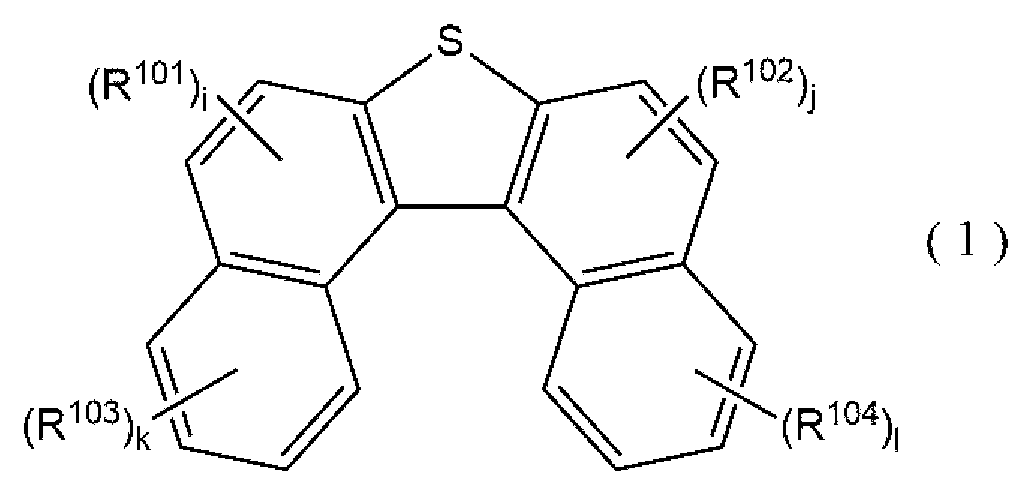

- [17] Die Verbindung nach [16], wobei mindestens ein Kohlenstoffatom mindestens eines Kohlenstoffgerüsts der Kohlenstoffgerüste, aus denen die Alkylengruppen von R203 und R204 und die Alkylgruppe von R205 aufgebaut sind, durch ein Heteroatom substituiert ist.
- [18] Die Verbindung nach [16] oder [17], wobei mindestens ein Wasserstoffatom der Wasserstoffatome, aus denen die Alkylengruppe von R203 aufgebaut ist, der Wasserstoffatome, aus denen die Alkylengruppe von R204 aufgebaut ist, und der Wasserstoffatome, aus denen die Alkylgruppe von R205 aufgebaut ist, durch ein Halogenatom substituiert ist.
- [19] Die Verbindung nach einem von [16] bis [18], wobei R203 für eine Einfachbindung oder eine geradkettige oder verzweigte substituierte oder unsubstituierte Alkylengruppe, die durch CnH2n (n ist eine ganze Zahl von 1 ≤ n ≤ 10) wiedergegeben wird, steht.
- [20] Die Verbindung nach [19], wobei mindestens ein Kohlenstoffatom eines Kohlenstoffgerüsts, aus dem die Alkylengruppe von R203 aufgebaut ist, durch ein Heteroatom substituiert ist.
- [21] Die Verbindung nach [19] oder [20], wobei mindestens ein Wasserstoffatom der Wasserstoffatome, aus denen die Alkylengruppe von R203 aufgebaut ist, durch ein Halogenatom substituiert ist.
- [22] Die Verbindung nach einem von [16] bis [18], wobei R203 für eine Einfachbindung oder eine geradkettige oder verzweigte substituierte oder unsubstituierte Alkylengruppe, die durch CnH2n (n ist eine ganze Zahl von 1 ≤ n ≤ 3) wiedergegeben wird, steht.
- [23] Die Verbindung nach [22], wobei mindestens ein Kohlenstoffatom eines Kohlenstoffgerüsts, aus dem die Alkylengruppe von R203 aufgebaut ist, durch ein Heteroatom substituiert ist.
- [24] Die Verbindung nach [22] oder [23], wobei mindestens ein Wasserstoffatom der Wasserstoffatome, aus denen die Alkylengruppe von R203 aufgebaut ist, durch ein Halogenatom substituiert ist.
- [25] Die Verbindung nach einem von [16] bis [18], wobei R204 für eine Einfachbindung oder eine geradkettige oder verzweigte substituierte oder unsubstituierte Alkylengruppe, die durch CnH2n (n ist eine ganze Zahl von 1 ≤ n ≤ 10) wiedergegeben wird, steht.
- [26] Die Verbindung nach [25], wobei mindestens ein Kohlenstoffatom eines Kohlenstoffgerüsts, aus dem die Alkylengruppe von R204 aufgebaut ist, durch ein Heteroatom substituiert ist.
- [27] Verbindung nach [25] oder [26], wobei mindestens ein Wasserstoffatom der Wasserstoffatome, aus denen die Alkylengruppe von R204 aufgebaut ist, durch ein Halogenatom substituiert ist.
- [28] Die Verbindung nach einem von [16] bis [18], wobei R205 für Wasserstoff oder eine geradkettige oder verzweigte substituierte oder unsubstituierte Alkylgruppe, die durch CnH2n+1 (n ist eine ganze Zahl von 1 ≤ n ≤ 10) wiedergegeben wird, steht.
- [29] Die Verbindung nach [28], wobei mindestens ein Kohlenstoffatom eines Kohlenstoffgerüsts, aus dem die Alkylgruppe von R205 aufgebaut ist, durch ein Heteroatom substituiert ist.
- [30] Die Verbindung nach [28] oder [29], wobei mindestens ein Wasserstoffatom der Wasserstoffatome, aus denen die Alkylgruppe von R205 aufgebaut ist, durch ein Halogenatom substituiert ist.
- [31]
Die Verbindung nach einem von [16] bis [30], wobei X für eine zweiwertige oder mehrwertige aromatische Gruppe steht, die durch die folgenden chemischen Formeln (3-1) bis (3-8) wiedergegeben wird.


- [32] Die Verbindung nach einem von [16] bis [31], wobei k für eine ganze Zahl mit einem Wert von 1 steht und X für eine zweiwertige aromatische Gruppe steht.
- [33] Die Verbindung nach [32], wobei es sich bei der zweiwertigen aromatischen Gruppe um eine monocyclische Arylengruppe handelt und zwei Teile zur Bindung an R203 und R204, die die monocyclische Arylengruppe besitzt, in einer Beziehung von ortho-Positionen, meta-Positionen oder para-Positionen vorliegen.
- [34] Die Verbindung nach [32], wobei es sich bei der zweiwertigen aromatischen Gruppe um eine polycyclische Arylengruppe handelt und zwei Teile zur Bindung an R203 und R204, die die polycyclische Arylengruppe besitzt, zwei beliebige bindungsfähige Kohlenstoffatome in der polycyclischen Arylengruppe sind.
- [35] Die Verbindung nach einem von [16] bis [31], wobei k für 2 steht und X für eine dreiwertige aromatische Gruppe steht.
- [36] Die Verbindung nach [35], wobei es sich bei der dreiwertigen aromatischen Gruppe um eine monocyclische dreiwertige aromatische Gruppe handelt und ein Teil zur Bindung an R203 und ein Teil von zwei Teilen zur Bindung an die beiden R204-Gruppen, die die monocyclische dreiwertige aromatische Gruppe besitzt, in einer Beziehung von ortho-Positionen, meta-Positionen oder para-Positionen vorliegen.
- [37] Die Verbindung nach [35] oder [36], wobei es sich bei der dreiwertigen aromatischen Gruppe um eine monocyclische dreiwertige aromatische Gruppe handelt und zwei Teile zur Bindung an R204, die die monocyclische dreiwertige aromatische Gruppe besitzt, in einer Beziehung von ortho-Positionen, meta-Positionen oder para-Positionen vorliegen.
- [38] Die Verbindung nach [35], wobei es sich bei der dreiwertigen aromatischen Gruppe um eine polyclische dreiwertige aromatische Gruppe handelt und ein Teil zur Bindung an R203 und ein Teil von zwei Teilen zur Bindung an die beiden R204-Gruppen, die die monocyclische dreiwertige aromatische Gruppe besitzt, zwei beliebige bindungsfähige Kohlenstoffatome in der polycyclischen dreiwertigen aromatischen Gruppe sind.
- [39] Die Verbindung nach [35] oder [38], wobei es sich bei der dreiwertigen aromatischen Gruppe um eine polycyclische dreiwertige aromatische Gruppe handelt und zwei Teile zur Bindung an R204, die die polycyclische dreiwertige aromatische Gruppe besitzt, zwei beliebige bindungsfähige Kohlenstoffatome in der polycyclischen dreiwertigen aromatischen Gruppe sind.
- [40] Die Verbindung nach einem von [16] bis [39], wobei mindestens eines von R101 oder R102 einem Kohlenstoffatom, das einem Schwefelatom in der allgemeinen Formel (1) benachbart ist, benachbart ist und an ein bindungsfähiges Kohlenstoffatom in dem mit dem Thiophenring kondensierten Benzolring in der allgemeinen Formel (1) gebunden ist.
- [41] Ein organisches Material, enthaltend die Verbindung nach einem von [16] bis [40].
- [42] Das organische Material nach [41], bei dem es sich um einen organischen Dünnfilm, eine organische Linse oder ein Hologramm handelt.
- [43] Das organische Material nach [41], bei dem es sich um eine Zusammensetzung für einen organischen Dünnfilm, eine Zusammensetzung für eine organische Linse oder eine lichtempfindliche Hologrammaufzeichnungszusammensetzung handelt.
- [44] Ein Polymer, erhalten durch Polymerisieren der Verbindung nach einem von [16] bis [40].
- [45] Ein organisches Material, enthaltend das Polymer nach [44].
- [46] Das organische Material nach [45], bei dem es sich um einen organischen Dünnfilm, eine organische Linse oder ein Hologramm handelt.
- [47] Das organische Material nach [45], bei dem es sich um eine Zusammensetzung für einen organischen Dünnfilm, eine Zusammensetzung für eine organische Linse oder eine lichtempfindliche Hologrammaufzeichnungszusammensetzung handelt.
- [48] Eine Bildanzeigevorrichtung, enthaltend das organische Material nach [41].
- [49] Ein optisches Teil, enthaltend das organische Material nach [41].
- [50] Eine optische Vorrichtung, enthaltend das organische Material nach [41].
- [51] Eine Bildanzeigevorrichtung, enthaltend das organische Material nach [45].
- [52] Ein optisches Teil, enthaltend das organische Material nach [45].
- [53] Eine optische Vorrichtung, enthaltend das organische Material nach [45].
- [16] A compound represented by the following general formula (1).
- [17] The compound according to [16], wherein at least one carbon atom of at least one carbon skeleton of the carbon skeletons constituting the alkylene groups of R 203 and R 204 and the alkyl group of R 205 is substituted by a hetero atom.
- [18] The compound according to [16] or [17], wherein at least one hydrogen atom of the hydrogen atoms from which the alkylene group of R 203 is built up, the hydrogen atoms from which the alkylene group of R 204 is built up, and the hydrogen atoms from which the alkyl group of R 205 is constructed is substituted by a halogen atom.
- [19] The compound according to any one of [16] to [18], wherein R 203 represents a single bond or a straight-chain or branched substituted or unsubstituted alkylene group represented by C n H 2n (n is an integer of 1 n 10 ) is being played.
- [20] The compound according to [19], wherein at least one carbon atom of a carbon skeleton composing the alkylene group of R 203 is substituted by a hetero atom.
- [21] The compound according to [19] or [20], wherein at least one hydrogen atom of the hydrogen atoms constituting the alkylene group of R 203 is substituted by a halogen atom.
- [22] The compound according to any one of [16] to [18], wherein R 203 represents a single bond or a straight-chain or branched substituted or unsubstituted alkylene group represented by C n H 2n (n is an integer of 1 n 3 ) is being played.
- [23] The compound according to [22], wherein at least one carbon atom of a carbon skeleton constituting the alkylene group of R 203 is substituted by a hetero atom.
- [24] The compound according to [22] or [23], wherein at least one hydrogen atom of the hydrogen atoms constituting the alkylene group of R 203 is substituted by a halogen atom.
- [25] The compound according to any one of [16] to [18], wherein R 204 represents a single bond or a straight-chain or branched substituted or unsubstituted alkylene group represented by C n H 2n (n is an integer of 1 n 10 ) is being played.
- [26] The compound according to [25], wherein at least one carbon atom of a carbon skeleton composing the alkylene group of R 204 is substituted by a hetero atom.
- [27] The compound according to [25] or [26], wherein at least one hydrogen atom of the hydrogen atoms from which the alkylene group of R 204 is built up is substituted by a halogen atom.
- [28] The compound according to any one of [16] to [18], wherein R 205 is hydrogen or a straight-chain or branched substituted or unsubstituted alkyl group represented by C n H 2n + 1 (n is an integer of 1 n 10) is displayed.
- [29] The compound according to [28], wherein at least one carbon atom of a carbon skeleton from which the alkyl group of R 205 is built up is substituted by a hetero atom.
- [30] The compound according to [28] or [29], wherein at least one hydrogen atom of the hydrogen atoms constituting the alkyl group of R 205 is substituted by a halogen atom.
- [31] The compound according to any one of [16] to [30], wherein X represents a divalent or polyvalent aromatic group represented by the following chemical formulas (3-1) to (3-8).
- [32] The compound according to any one of [16] to [31], wherein k represents an integer having a value of 1, and X represents a divalent aromatic group.
- [33] The compound according to [32], wherein the divalent aromatic group is a monocyclic arylene group and two parts for bonding to R 203 and R 204 which the monocyclic arylene group has in a relationship of ortho positions, meta positions or para positions exist.
- [34] The compound according to [32], wherein the divalent aromatic group is a polycyclic arylene group and two parts for bonding to R 203 and R 204 having the polycyclic arylene group are any two bondable carbon atoms in the polycyclic arylene group .
- [35] The compound according to any one of [16] to [31], wherein k is 2 and X is a trivalent aromatic group.
- [36] The compound according to [35], wherein the trivalent aromatic group is a monocyclic trivalent aromatic group and a part to bond to R 203 and a part of two parts to bond to the two R 204 groups, the the monocyclic trivalent aromatic group has a relationship of ortho-positions, meta-positions or para-positions.
- [37] The compound according to [35] or [36], wherein the trivalent aromatic group is a monocyclic trivalent aromatic group and two parts to bond to R 204 which the monocyclic trivalent aromatic group has in a relationship of ortho positions, meta positions or para positions are present.
- [38] The compound according to [35], wherein the trivalent aromatic group is a polyclic trivalent aromatic group and one part for bonding to R 203 and part of two parts for bonding to the two R 204 groups, the having the monocyclic trivalent aromatic group are any two bondable carbon atoms in the polycyclic trivalent aromatic group.
- [39] The compound according to [35] or [38], wherein the trivalent aromatic group is a polycyclic trivalent aromatic group and two parts to bond to R 204 which the polycyclic trivalent aromatic group has, any two carbon atoms capable of bonding are in the polycyclic trivalent aromatic group.
- [40] The compound according to any one of [16] to [39], wherein at least one of R 101 or R 102 is adjacent to a carbon atom adjacent to a sulfur atom in the general formula (1) and to a bondable carbon atom in the benzene ring condensed with the thiophene ring in the general formula (1) is bonded.
- [41] An organic material containing the compound according to any one of [16] to [40].
- [42] The organic material according to [41], which is an organic thin film, an organic lens or a hologram.
- [43] The organic material according to [41], which is a composition for an organic thin film, a composition for an organic lens, or a photosensitive hologram recording composition.
- [44] A polymer obtained by polymerizing the compound according to any one of [16] to [40].
- [45] An organic material containing the polymer according to [44].
- [46] The organic material according to [45], which is an organic thin film, an organic lens or a hologram.
- [47] The organic material according to [45], which is a composition for an organic thin film, a composition for an organic lens, or a photosensitive hologram recording composition.
- [48] An image display device containing the organic material according to [41].
- [49] An optical part containing the organic material according to [41].
- [50] An optical device containing the organic material according to [41].
- [51] An image display device containing the organic material according to [45].
- [52] An optical part containing the organic material according to [45].
- [53] An optical device containing the organic material according to [45].
ZITATE ENTHALTEN IN DER BESCHREIBUNGQUOTES INCLUDED IN THE DESCRIPTION
Diese Liste der vom Anmelder aufgeführten Dokumente wurde automatisiert erzeugt und ist ausschließlich zur besseren Information des Lesers aufgenommen. Die Liste ist nicht Bestandteil der deutschen Patent- bzw. Gebrauchsmusteranmeldung. Das DPMA übernimmt keinerlei Haftung für etwaige Fehler oder Auslassungen.This list of the documents listed by the applicant was generated automatically and is included solely for the better information of the reader. The list is not part of the German patent or utility model application. The DPMA assumes no liability for any errors or omissions.
Zitierte PatentliteraturPatent literature cited
- JP 2012136576 A [0004]JP 2012136576 A [0004]
- JP 2011178985 A [0004]JP 2011178985 A [0004]
- JP 2011162584 A [0004]JP 2011162584 A [0004]
Claims (20)
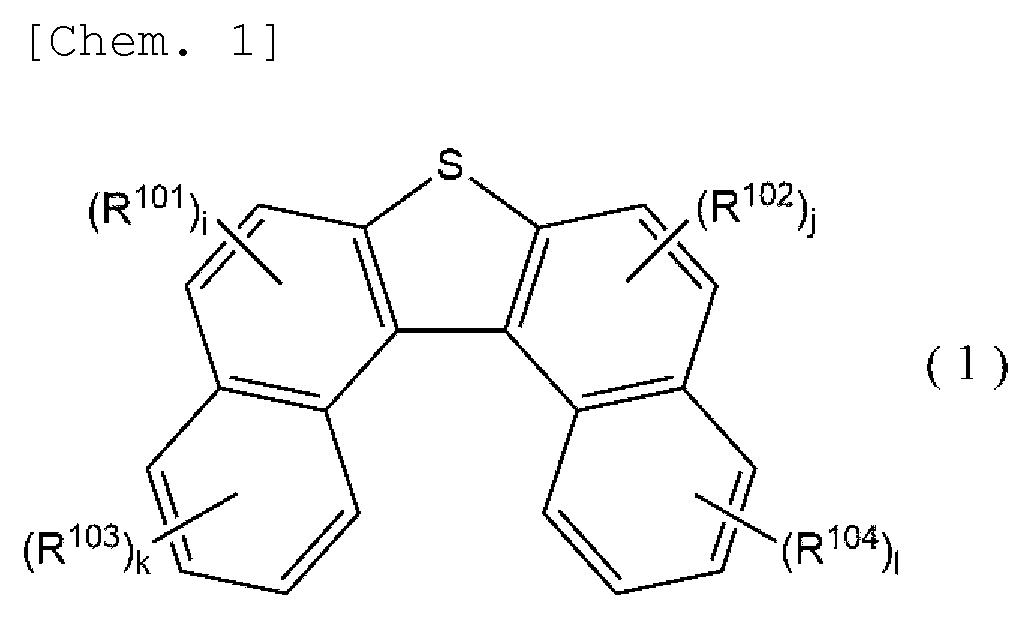


Applications Claiming Priority (3)
| Application Number | Priority Date | Filing Date | Title |
|---|---|---|---|
| JP2018033835 | 2018-02-27 | ||
| JP2018-033835 | 2018-02-27 | ||
| PCT/JP2019/007330 WO2019167947A1 (en) | 2018-02-27 | 2019-02-26 | Compound, polymer, and organic material |
Publications (1)
| Publication Number | Publication Date |
|---|---|
| DE112019001009T5 true DE112019001009T5 (en) | 2020-11-12 |
Family
ID=67805775
Family Applications (1)
| Application Number | Title | Priority Date | Filing Date |
|---|---|---|---|
| DE112019001009.3T Withdrawn DE112019001009T5 (en) | 2018-02-27 | 2019-02-26 | COMPOUND, POLYMER AND ORGANIC MATERIAL |
Country Status (5)
| Country | Link |
|---|---|
| US (1) | US20210040061A1 (en) |
| JP (1) | JPWO2019167947A1 (en) |
| CN (1) | CN111741985B (en) |
| DE (1) | DE112019001009T5 (en) |
| WO (1) | WO2019167947A1 (en) |
Families Citing this family (2)
| Publication number | Priority date | Publication date | Assignee | Title |
|---|---|---|---|---|
| CN116003693B (en) * | 2021-10-21 | 2025-09-12 | 华为技术有限公司 | Holographic photopolymer material, holographic optical element, and optical device |
| EP4693286A1 (en) * | 2023-03-29 | 2026-02-11 | Mitsubishi Chemical Corporation | Photosensitive composition for hologram recording, hologram recording medium, polymer, large capacity memory, optical element, ar light guide plate, and ar glasses |
Family Cites Families (8)
| Publication number | Priority date | Publication date | Assignee | Title |
|---|---|---|---|---|
| JP5402266B2 (en) * | 2008-06-10 | 2014-01-29 | 三菱化学株式会社 | Photoreactive composition, optical material, hologram recording layer forming composition, hologram recording material, and hologram recording medium |
| JP5493088B2 (en) * | 2010-02-04 | 2014-05-14 | 学校法人神奈川大学 | Method for increasing refractive index imparting effect in a compound having a dibenzothiophene skeleton |
| JP5240798B2 (en) * | 2010-02-04 | 2013-07-17 | 学校法人神奈川大学 | Refractive index improver, and resin composition, polymerization or curable composition and optical material containing the same |
| CN104350111B (en) * | 2012-06-06 | 2017-10-10 | 电化株式会社 | Resin composition for covering material |
| JP6089867B2 (en) * | 2013-03-27 | 2017-03-08 | 三菱化学株式会社 | Composition for hologram recording medium, hologram recording medium using the same, and polymerizable compound |
| EP3508924B1 (en) * | 2016-08-30 | 2022-05-04 | Sony Group Corporation | Photosensitive composition for hologram recording, hologram recording medium, and hologram |
| WO2018062557A1 (en) * | 2016-09-30 | 2018-04-05 | 積水化学株式会社 | Latex particles for measurement reagent, sensitized latex particles, and measurement reagent for immunonephelometry |
| KR102329621B1 (en) * | 2017-07-19 | 2021-11-23 | 덕산네오룩스 주식회사 | Compound for encapsulating organic light emitting diode and organic light emitting display device comprising the same |
-
2019
- 2019-02-26 JP JP2020503526A patent/JPWO2019167947A1/en active Pending
- 2019-02-26 US US16/976,301 patent/US20210040061A1/en not_active Abandoned
- 2019-02-26 WO PCT/JP2019/007330 patent/WO2019167947A1/en not_active Ceased
- 2019-02-26 DE DE112019001009.3T patent/DE112019001009T5/en not_active Withdrawn
- 2019-02-26 CN CN201980014555.2A patent/CN111741985B/en active Active
Also Published As
| Publication number | Publication date |
|---|---|
| US20210040061A1 (en) | 2021-02-11 |
| WO2019167947A1 (en) | 2019-09-06 |
| CN111741985A (en) | 2020-10-02 |
| JPWO2019167947A1 (en) | 2021-03-04 |
| CN111741985B (en) | 2022-12-16 |
Similar Documents
| Publication | Publication Date | Title |
|---|---|---|
| DE19758244B4 (en) | Based on bicycloalkenes photoresist copolymer, process for its preparation and its use | |
| DE112020000633T5 (en) | HOLOGRAM RECORDING COMPOSITION, HOLOGRAM RECORDING MEDIUM, HOLOGRAM AND OPTICAL DEVICE AND AN OPTICAL COMPONENT USING THESE | |
| TWI704413B (en) | Colored composition, colored cured film and display element | |
| CH694673A5 (en) | The photosensitive resin composition. | |
| JP7271504B2 (en) | Bismuth compound, curable composition, and cured body | |
| DE19962663A1 (en) | Organic, non-reflective coating material and its production | |
| DE1795089B2 (en) | Photopolymerizable material | |
| DE112016005633T5 (en) | New compound, photopolymerization initiator comprising this compound, and photosensitive resin composition containing the photopolymerization initiator | |
| JP6634753B2 (en) | Photosensitive coloring composition for color filter, method for producing photosensitive coloring composition, and color filter | |
| DE69209827T2 (en) | Polymeric nitrones with an acrylic main chain | |
| EP0242330B1 (en) | Liquid blend of photoinitiators | |
| DE112019001009T5 (en) | COMPOUND, POLYMER AND ORGANIC MATERIAL | |
| DE19860782A1 (en) | 5-beta-cholan-24-yl-3-(meth)acrylate compounds useful for preparing copolymers resins for photoresists | |
| JP2020050854A (en) | Coloring composition, photosensitive coloring composition, color filter, color liquid crystal display | |
| JP2012088423A (en) | Blue photosensitive resin composition for color filter, color filter and liquid crystal display device | |
| DE2058345A1 (en) | Photosensitive polymeric material containing azide groups | |
| JP2015028587A (en) | Coloring composition for color filter, and color filter | |
| EP0269568B1 (en) | Polymerisable compositions | |
| DE3234045A1 (en) | 2-METHYL PROPYLENE GLYCOL MONOACRYLATE OR DIACRYLATE AND THE DIACRYLATE CONTAINING LIGHT SENSITIVE COMPOSITION | |
| DE69712580T2 (en) | Photosensitive resin composition | |
| TWI862737B (en) | Acylphosphine composition, polymerization initiator, polymerizable composition, cured material, and method of manufacturing cured material | |
| DE602004006722T2 (en) | POLYMERIZABLE MASSES WITH HIGH BREAKING INDEX | |
| JP2020034843A (en) | Photosensitive coloring composition for color filter, color filter, and liquid crystal display device | |
| EP0126029A2 (en) | Image-forming process | |
| JP7299211B2 (en) | Methods of preparing photo-aligned polymeric materials and compositions |
Legal Events
| Date | Code | Title | Description |
|---|---|---|---|
| R119 | Application deemed withdrawn, or ip right lapsed, due to non-payment of renewal fee |