[go: up one dir, main page]

DE112018002879T5 - METHOD FOR FORMING A POLYMER BRUSH LAYER - Google Patents

METHOD FOR FORMING A POLYMER BRUSH LAYER Download PDF

Info

Publication number
DE112018002879T5
DE112018002879T5 DE112018002879.8T DE112018002879T DE112018002879T5 DE 112018002879 T5 DE112018002879 T5 DE 112018002879T5 DE 112018002879 T DE112018002879 T DE 112018002879T DE 112018002879 T5 DE112018002879 T5 DE 112018002879T5
Authority
DE
Germany
Prior art keywords
polymer brush
brush layer
substrate
monomer
polymer
Prior art date
Legal status (The legal status is an assumption and is not a legal conclusion. Google has not performed a legal analysis and makes no representation as to the accuracy of the status listed.)
Pending
Application number
DE112018002879.8T
Other languages
German (de)
Inventor
Takaya Sato
Hiroyuki ARAFUNE
Toshio KAMIJO
Takashi Morinaga
Saika HONMA
Ken Nakano
Yoshinobu Tsujii
Current Assignee (The listed assignees may be inaccurate. Google has not performed a legal analysis and makes no representation or warranty as to the accuracy of the list.)
Yokohama National University NUC
National Institute of Technology Japan
Kyoto University NUC
Original Assignee
Yokohama National University NUC
National Institute of Technology Japan
Kyoto University NUC
Priority date (The priority date is an assumption and is not a legal conclusion. Google has not performed a legal analysis and makes no representation as to the accuracy of the date listed.)
Filing date
Publication date
Application filed by Yokohama National University NUC, National Institute of Technology Japan, Kyoto University NUC filed Critical Yokohama National University NUC
Publication of DE112018002879T5 publication Critical patent/DE112018002879T5/en
Pending legal-status Critical Current

Links

Images

Classifications

    • BPERFORMING OPERATIONS; TRANSPORTING
    • B05SPRAYING OR ATOMISING IN GENERAL; APPLYING FLUENT MATERIALS TO SURFACES, IN GENERAL
    • B05DPROCESSES FOR APPLYING FLUENT MATERIALS TO SURFACES, IN GENERAL
    • B05D1/00Processes for applying liquids or other fluent materials
    • B05D1/02Processes for applying liquids or other fluent materials performed by spraying
    • B05D1/12Applying particulate materials
    • B05D1/14Flocking
    • BPERFORMING OPERATIONS; TRANSPORTING
    • B05SPRAYING OR ATOMISING IN GENERAL; APPLYING FLUENT MATERIALS TO SURFACES, IN GENERAL
    • B05DPROCESSES FOR APPLYING FLUENT MATERIALS TO SURFACES, IN GENERAL
    • B05D1/00Processes for applying liquids or other fluent materials
    • B05D1/18Processes for applying liquids or other fluent materials performed by dipping
    • BPERFORMING OPERATIONS; TRANSPORTING
    • B05SPRAYING OR ATOMISING IN GENERAL; APPLYING FLUENT MATERIALS TO SURFACES, IN GENERAL
    • B05DPROCESSES FOR APPLYING FLUENT MATERIALS TO SURFACES, IN GENERAL
    • B05D3/00Pretreatment of surfaces to which liquids or other fluent materials are to be applied; After-treatment of applied coatings, e.g. intermediate treating of an applied coating preparatory to subsequent applications of liquids or other fluent materials
    • B05D3/02Pretreatment of surfaces to which liquids or other fluent materials are to be applied; After-treatment of applied coatings, e.g. intermediate treating of an applied coating preparatory to subsequent applications of liquids or other fluent materials by baking
    • B05D3/0254After-treatment
    • BPERFORMING OPERATIONS; TRANSPORTING
    • B05SPRAYING OR ATOMISING IN GENERAL; APPLYING FLUENT MATERIALS TO SURFACES, IN GENERAL
    • B05DPROCESSES FOR APPLYING FLUENT MATERIALS TO SURFACES, IN GENERAL
    • B05D5/00Processes for applying liquids or other fluent materials to surfaces to obtain special surface effects, finishes or structures
    • B05D5/08Processes for applying liquids or other fluent materials to surfaces to obtain special surface effects, finishes or structures to obtain an anti-friction or anti-adhesive surface
    • CCHEMISTRY; METALLURGY
    • C08ORGANIC MACROMOLECULAR COMPOUNDS; THEIR PREPARATION OR CHEMICAL WORKING-UP; COMPOSITIONS BASED THEREON
    • C08FMACROMOLECULAR COMPOUNDS OBTAINED BY REACTIONS ONLY INVOLVING CARBON-TO-CARBON UNSATURATED BONDS
    • C08F2/00Processes of polymerisation
    • FMECHANICAL ENGINEERING; LIGHTING; HEATING; WEAPONS; BLASTING
    • F16ENGINEERING ELEMENTS AND UNITS; GENERAL MEASURES FOR PRODUCING AND MAINTAINING EFFECTIVE FUNCTIONING OF MACHINES OR INSTALLATIONS; THERMAL INSULATION IN GENERAL
    • F16CSHAFTS; FLEXIBLE SHAFTS; ELEMENTS OR CRANKSHAFT MECHANISMS; ROTARY BODIES OTHER THAN GEARING ELEMENTS; BEARINGS
    • F16C33/00Parts of bearings; Special methods for making bearings or parts thereof
    • F16C33/02Parts of sliding-contact bearings
    • F16C33/04Brasses; Bushes; Linings
    • F16C33/06Sliding surface mainly made of metal
    • F16C33/12Structural composition; Use of special materials or surface treatments, e.g. for rust-proofing
    • BPERFORMING OPERATIONS; TRANSPORTING
    • B05SPRAYING OR ATOMISING IN GENERAL; APPLYING FLUENT MATERIALS TO SURFACES, IN GENERAL
    • B05DPROCESSES FOR APPLYING FLUENT MATERIALS TO SURFACES, IN GENERAL
    • B05D2203/00Other substrates
    • B05D2203/30Other inorganic substrates, e.g. ceramics, silicon
    • B05D2203/35Glass
    • BPERFORMING OPERATIONS; TRANSPORTING
    • B05SPRAYING OR ATOMISING IN GENERAL; APPLYING FLUENT MATERIALS TO SURFACES, IN GENERAL
    • B05DPROCESSES FOR APPLYING FLUENT MATERIALS TO SURFACES, IN GENERAL
    • B05D2401/00Form of the coating product, e.g. solution, water dispersion, powders or the like
    • B05D2401/10Organic solvent
    • BPERFORMING OPERATIONS; TRANSPORTING
    • B05SPRAYING OR ATOMISING IN GENERAL; APPLYING FLUENT MATERIALS TO SURFACES, IN GENERAL
    • B05DPROCESSES FOR APPLYING FLUENT MATERIALS TO SURFACES, IN GENERAL
    • B05D2518/00Other type of polymers
    • B05D2518/10Silicon-containing polymers

Landscapes

  • Engineering & Computer Science (AREA)
  • General Engineering & Computer Science (AREA)
  • Chemical & Material Sciences (AREA)
  • Mechanical Engineering (AREA)
  • Health & Medical Sciences (AREA)
  • Chemical Kinetics & Catalysis (AREA)
  • Medicinal Chemistry (AREA)
  • Polymers & Plastics (AREA)
  • Organic Chemistry (AREA)
  • Polymerisation Methods In General (AREA)
  • Application Of Or Painting With Fluid Materials (AREA)
  • Treatments Of Macromolecular Shaped Articles (AREA)

Abstract

Die vorliegende Erfindung stellt ein Verfahren zum Bilden einer Polymerbürstenschicht auf einer Oberfläche eines Substrats bereit, wobei das Verfahren die Schritte umfasst: Bilden einer Schicht auf dem Substrat, wobei die Schicht aus einer Lösung oder Dispersion eines Monomers, das in einem nichtflüchtigen Lösungsmittel gemischt oder dispergiert ist, gebildet wird; und Polymerisieren des in der Lösung oder der Dispersion enthaltenen Monomers in dem nichtflüchtigen Lösungsmittel, um eine Polymerbürstenschicht mit einer Dicke von 20 µm oder weniger auf mindestens einem Teil der Oberfläche des Substrats zu bilden.The present invention provides a method of forming a polymer brush layer on a surface of a substrate, the method comprising the steps of: forming a layer on the substrate, the layer comprising a solution or dispersion of a monomer mixed or dispersed in a non-volatile solvent is, is formed; and polymerizing the monomer contained in the solution or the dispersion in the non-volatile solvent to form a polymer brush layer having a thickness of 20 µm or less on at least a part of the surface of the substrate.

Description

TECHNISCHES GEBIETTECHNICAL AREA

Die vorliegende Erfindung bezieht sich auf ein Bildungsverfahren für eine Polymerbürstenschicht, mit dem eine Polymerbürstenschicht mit einem niedrigen dynamischen Reibungskoeffizienten erfolgreich gebildet werden kann.The present invention relates to a method of forming a polymer brush layer by which a polymer brush layer having a low dynamic friction coefficient can be successfully formed.

STAND DER TECHNIKSTATE OF THE ART

Es ist allgemein bekannt, dass Gleitflächen mit einer Polymerbürstenschicht einen niedrigen Reibungskoeffizienten aufweisen. Zum Beispiel offenbart Patentdokument 1 eine Gleitstruktur, die einen Block mit einer Polymerbürstenbeschichtung auf einer DLC-Si-Beschichtung und einen Ring mit einer ähnlichen Polymerbürstenbeschichtung umfasst.It is well known that sliding surfaces with a polymer brush layer have a low coefficient of friction. For example, Patent Document 1 discloses a sliding structure that includes a block with a polymer brush coating on a DLC-Si coating and a ring with a similar polymer brush coating.

In Patentdokument 2 wird eine detaillierte Untersuchung eines Gleitmechanismus zwischen Polymerbürstenschichten unter Verwendung eines Rasterkraftmikroskops durchgeführt, und die darin offenbarte Technik ermöglicht ein Gleiten im Mikrometerbereich zwischen solchen Polymerbürstenschichten, das ein Rasterkraftmikroskop messen kann.In Patent Document 2, a detailed study of a sliding mechanism between polymer brush layers is performed using an atomic force microscope, and the technique disclosed therein enables micrometer sliding between such polymer brush layers that an atomic force microscope can measure.

VERWANDTE DOKUMENTE DES STANDS DER TECHNIKRELATED DOCUMENTS OF THE PRIOR ART

PATENTDOKUMENTPatent Document

  • Patentdokument 1: JP-A 2012-56165 Patent document 1: JP-A 2012-56165
  • Patentdokument 2: JP-A 2006-316169 Patent document 2: JP-A 2006-316169

ZUSAMMENFASSUNG DER ERFINDUNGSUMMARY OF THE INVENTION

DURCH DIE ERFINDUNG ZU LÖSENDE PROBLEMEPROBLEMS TO BE SOLVED BY THE INVENTION

Leider sind die Techniken der Patentdokumente 1 und 2 aufgrund der begrenzten Materialien, die als Substrate, auf denen Polymerbürstenschichten gebildet werden sollen, verwendbar sind, und den erheblich hohen Installationskosten nicht praktikabel. Ein weiteres Problem dieser Techniken ist die Schwierigkeit, eine Polymerbürstenschicht mit einer Fläche, die groß genug für den praktischen Einsatz als Gleitmechanismus ist, zu bilden.Unfortunately, the techniques of the patent documents 1 and 2 due to the limited materials that can be used as substrates on which polymer brush layers are to be formed and the considerably high installation costs, this is not practical. Another problem with these techniques is the difficulty in forming a polymer brush layer with an area large enough for practical use as a sliding mechanism.

Als Reaktion auf die oben genannten Probleme ist es eine Aufgabe der vorliegenden Erfindung, ein Bildungsverfahren für eine Polymerbürstenschicht bereitzustellen, mit dem eine Polymerbürstenschicht mit einem niedrigen dynamischen Reibungskoeffizienten erfolgreich gebildet werden kann.In response to the above-mentioned problems, it is an object of the present invention to provide a polymer brush layer forming method by which a polymer brush layer having a low dynamic friction coefficient can be successfully formed.

MITTEL ZUR LÖSUNG DER PROBLEMEMEANS TO SOLVE THE PROBLEMS

Als ein Ergebnis intensiver Studien, um die obige Aufgabe zu erreichen, haben die Erfinder der vorliegenden Erfindung festgestellt, dass eine Polymerbürstenschicht mit einem niedrigen dynamischen Reibungskoeffizienten erfolgreich gebildet werden kann, indem eine Lösung oder Dispersion eines Monomers, das in einem nichtflüchtigen Lösungsmittel gemischt oder dispergiert ist, verwendet wird, und das in der Lösung oder der Dispersion enthaltene Monomer in dem nichtflüchtigen Lösungsmittel auf einem Substrat polymerisiert wird. Diese Feststellung hat zur Fertigstellung der vorliegenden Erfindung geführt.As a result of intensive studies to achieve the above object, the inventors of the present invention have found that a polymer brush layer having a low dynamic coefficient of friction can be successfully formed by a solution or dispersion of a monomer mixed or dispersed in a non-volatile solvent is used, and the monomer contained in the solution or the dispersion is polymerized in the non-volatile solvent on a substrate. This finding has led to the completion of the present invention.

Insbesondere stellt der erste Aspekt der vorliegenden Erfindung ein Verfahren zum Bilden einer Polymerbürstenschicht auf einer Oberfläche eines Substrats bereit, wobei das Verfahren die folgenden Schritte umfasst:

  • Bilden einer Schicht auf dem Substrat, wobei die Schicht aus einer Lösung oder Dispersion eines Monomers, das in einem nichtflüchtigen Lösungsmittel gemischt oder dispergiert ist, gebildet wird;
  • und Polymerisieren des in der Lösung oder der Dispersion enthaltenen Monomers in dem nichtflüchtigen Lösungsmittel, um eine Polymerbürstenschicht mit einer Dicke von 20 µm oder weniger auf mindestens einem Teil der Oberfläche des Substrats zu bilden.
In particular, the first aspect of the present invention provides a method of forming a polymer brush layer on a surface of a substrate, the method comprising the following steps:
  • Forming a layer on the substrate, the layer being formed from a solution or dispersion of a monomer mixed or dispersed in a non-volatile solvent;
  • and polymerizing the monomer contained in the solution or the dispersion in the non-volatile solvent to form a polymer brush layer having a thickness of 20 µm or less on at least a part of the surface of the substrate.

Der zweite Aspekt der vorliegenden Erfindung stellt ein Verfahren zum Bilden einer Polymerbürstenschicht auf den Innenflächen von Poren eines kontinuierlichen porösen Körpers oder ein Verfahren zum Bilden einer Polymerbürstenschicht auf der Innenfläche eines röhrenförmigen Körpers bereit, wobei die Verfahren die folgenden Schritte umfassen:

  • Ermöglichen, dass eine Lösung oder Dispersion eines Monomers, das in einem nichtflüchtigen Lösungsmittel gemischt oder dispergiert ist, in den kontinuierlichen porösen Körper oder den röhrenförmigen Körper eindringt; und
  • Polymerisieren des Monomers, das in der Lösung oder Dispersion enthalten ist, in dem nichtflüchtigen Lösungsmittel, um eine Polymerbürstenschicht auf mindestens einem Teil der Innenflächen der Poren des kontinuierlichen porösen Körpers zu bilden, oder um eine Polymerbürstenschicht auf mindestens einem Teil der Innenfläche des röhrenförmigen Körpers zu bilden.
The second aspect of the present invention provides a method of forming a polymer brush layer on the inner surfaces of pores of a continuous porous body or a method of forming a polymer brush layer on the inner surface of a tubular body, the methods comprising the steps of:
  • Allowing a solution or dispersion of a monomer mixed or dispersed in a non-volatile solvent to enter the continuous porous body or the tubular body; and
  • Polymerizing the monomer contained in the solution or dispersion in the non-volatile solvent to form a polymer brush layer on at least a portion of the inner surfaces of the pores of the continuous porous body or a polymer brush layer on at least a portion of the inner surface of the tubular body form.

WIRKUNGEN DER ERFINDUNGEFFECTS OF THE INVENTION

Der erste Aspekt der vorliegenden Erfindung kann ein Bildungsverfahren für eine Polymerbürstenschicht bereitstellen, mit dem eine Polymerbürstenschicht mit einem niedrigen dynamischen Reibungskoeffizienten erfolgreich gebildet werden kann.The first aspect of the present invention can provide a polymer brush layer forming method by which a polymer brush layer having a low dynamic coefficient of friction can be successfully formed.

Gemäß dem zweiten Aspekt der vorliegenden Erfindung kann eine Polymerbürstenschicht mit einem niedrigen dynamischen Reibungskoeffizienten erfolgreich innerhalb eines kontinuierlichen porösen Körpers oder eines röhrenförmigen Körpers gebildet werden, und als ein Ergebnis kann der Innenseite des kontinuierlichen porösen Körpers oder der Innenseite des röhrenförmigen Körpers eine gewünschte Funktion verliehen werden.According to the second aspect of the present invention, a polymer brush layer having a low dynamic friction coefficient can be successfully formed inside a continuous porous body or a tubular body, and as a result, a desired function can be given to the inside of the continuous porous body or the inside of the tubular body ,

Figurenlistelist of figures

  • 1 ist eine schematische Ansicht, die eine Polymerbürstenschicht, die durch ein Verfahren gemäß der ersten Ausführungsform der vorliegenden Erfindung gebildet wurde, veranschaulicht. 1 12 is a schematic view illustrating a polymer brush layer formed by a method according to the first embodiment of the present invention.
  • 2 ist eine schematische Ansicht, die eine Polymerbürstenschicht, die durch ein Verfahren gemäß der zweiten Ausführungsform der vorliegenden Erfindung gebildet wurde, veranschaulicht. 2 12 is a schematic view illustrating a polymer brush layer formed by a method according to the second embodiment of the present invention.

BESCHREIBUNG VON AUSFÜHRUNGSFORMENDESCRIPTION OF EMBODIMENTS

<Erste Ausführungsform><First embodiment>

Die folgende Beschreibung beschreibt die erste Ausführungsform mit Bezug auf diese Figuren.The following description describes the first embodiment with reference to these figures.

1 ist eine schematische Ansicht, die eine Polymerbürstenschicht, die durch ein Verfahren gemäß der ersten Ausführungsform der vorliegenden Erfindung gebildet wurde, veranschaulicht. In 1 ist eine Polymerbürstenschicht 20 gemäß der ersten Ausführungsform der vorliegenden Erfindung auf einem Substrat 10 gebildet. 1 12 is a schematic view illustrating a polymer brush layer formed by a method according to the first embodiment of the present invention. In 1 is a polymer brush layer 20 according to the first embodiment of the present invention on a substrate 10 educated.

Das Substrat 10 ist nicht besonders beschränkt. Eisen- oder Eisenlegierungssubstrate, wie Gusseisensubstrate, Stahlsubstrate, Edelstahlsubstrate und dergleichen, Nicht-Eisen- oder Nicht-Eisenlegierungssubstrate, wie Aluminiumsubstrate, Kupfersubstrate und dergleichen, und Nicht-Metall-Substrate wie Siliciumwafersubstrate, Glassubstrate, Quarzsubstrate und dergleichen, können verwendet werden. Weitere bevorzugte Beispiele umfassen spaltbare Mineralien wie Glimmerflocken und dergleichen, flache Substrate, die eine dünne Polymerbeschichtung mit einer reaktiven Substituentengruppe (z.B. Hydroxylgruppe) an der Oberfläche umfassen, und dergleichen.The substrate 10 is not particularly limited. Iron or iron alloy substrates such as cast iron substrates, steel substrates, stainless steel substrates and the like, non-iron or non-iron alloy substrates such as aluminum substrates, copper substrates and the like, and non-metal substrates such as silicon wafer substrates, glass substrates, quartz substrates and the like can be used. Other preferred examples include cleavable minerals such as mica flakes and the like, flat substrates comprising a thin polymer coating with a reactive substituent group (e.g. hydroxyl group) on the surface, and the like.

Die Polymerbürstenschicht 20 wird durch das Bildungsverfahren gemäß der ersten Ausführungsform gebildet, und wird spezifisch aus mehreren Polymerpfropfketten, die kovalent auf dem Substrat 10 immobilisiert und mit einer flüssigen Substanz gequollen sind, wie in 1 dargestellt, gebildet.The polymer brush layer 20 is formed by the formation method according to the first embodiment, and is specifically composed of a plurality of polymer graft chains that are covalent on the substrate 10 immobilized and swollen with a liquid substance, as in 1 shown, formed.

Das Verfahren zum Bilden einer Polymerbürstenschicht gemäß der ersten Ausführungsform ist ein Verfahren zum Bilden der Polymerbürstenschicht 20 auf der Oberfläche 10, wie in 1 dargestellt, und umfasst die folgenden Schritte:

  • Bilden einer Schicht auf dem Substrat 10, wobei die Schicht aus einer Lösung oder Dispersion eines Monomers, das in einem nichtflüchtigen Lösungsmittel gemischt oder dispergiert ist, gebildet wird; und
  • Polymerisieren des in der Lösung oder der Dispersion enthaltenen Monomers in dem nichtflüchtigen Lösungsmittel auf dem Substrat 10, um die Polymerbürstenschicht 20 mit einer Dicke von 20 um oder weniger auf mindestens einem Teil der Oberfläche des Substrats 10 zu bilden.
The method of forming a polymer brush layer according to the first embodiment is a method of forming the polymer brush layer 20 on the surface 10 , as in 1 and includes the following steps:
  • Form a layer on the substrate 10 the layer being formed from a solution or dispersion of a monomer mixed or dispersed in a non-volatile solvent; and
  • Polymerizing the monomer contained in the solution or the dispersion in the non-volatile solvent on the substrate 10 to the polymer brush layer 20 with a thickness of 20 µm or less on at least a part of the surface of the substrate 10 to build.

In der ersten Ausführungsform wird, um die Polymerbürstenschicht 20 zu bilden, das Monomer zur Bildung der Polymerpfropfketten, die die Polymerbürstenschicht 20 ausmachen, in dem nichtflüchtigen Lösungsmittel polymerisiert, während das Monomer in dem nichtflüchtigen Lösungsmittel gemischt oder dispergiert ist. Dies ermöglicht es, dass das Monomer stabiler polymerisiert wird, was zu längeren Polymerbürstenlängen der Polymerpfropfketten (anders ausgedrückt, einem höheren absoluten durchschnittlichen Molekulargewicht der Polymerpfropfketten) in der Polymerbürstenschicht 20 führt. Aufgrund der längeren Polymerbürstenlängen der Polymerpfropfketten weist die Polymerbürstenschicht 20, die aus den Polymerpfropfketten besteht, einen niedrigen dynamischen Reibungskoeffizienten auf. Insbesondere wenn die Polymerbürstenschicht 20 als eine Gleitfläche verwendet wird, stellen die längeren Polymerbürstenlängen der Polymerpfropfketten eine höhere Pufferwirkung auf ein Gleitgegenstück bereit, was zu geringen Reibungseigenschaften und hoher Reibungsbeständigkeit führt. Dieser Effekt ist besonders vorteilhaft, wenn das Gleitgegenstück eine geringe Oberflächenglätte aufweist.In the first embodiment, the polymer brush layer 20 to form the monomer to form the polymer graft chains that make up the polymer brush layer 20 constitute, polymerized in the non-volatile solvent, while the monomer is mixed or dispersed in the non-volatile solvent. This allows the monomer to polymerize more stably, resulting in longer polymer brush lengths of the polymer graft chains (in other words, a higher absolute average molecular weight of the polymer graft chains) in the polymer brush layer 20 leads. Due to the longer polymer brush lengths of the polymer graft chains, the polymer brush layer has 20 , which consists of the polymer graft chains, has a low dynamic coefficient of friction. Especially when the polymer brush layer 20 When a sliding surface is used, the longer polymer brush lengths of the polymer graft chains provide a higher buffering effect on a sliding counterpart, which leads to low friction properties and high friction resistance. This effect is particularly advantageous if the sliding counterpart has a low surface smoothness.
Gemäß der ersten Ausführungsform, da das Monomer in dem nichtflüchtigen Lösungsmittel polymerisiert wird, kann die Dicke der resultierenden Polymerbürstenschicht 20 durch Einstellen des Gehalts des Monomers, das in der Lösung oder der Dispersion vor der Polymerisation enthalten ist, der Dicke der Schicht des Lösungsmittels oder der Dispersion, die auf dem Substrat 10 vor der Polymerisation gebildet wird, und der Polymerisationsbedingungen gesteuert werden. Insbesondere kann die dünne Polymerbürstenschicht 20 erfolgreich gebildet werden, indem diese Faktoren eingestellt werden. Insbesondere kann die Polymerbürstenschicht 20 so dünn wie 20 µm oder weniger, vorzugsweise 15 µm oder weniger, bevorzugter 10 µm oder weniger, noch bevorzugter 1 µm oder weniger, gebildet werden. Die untere Grenze davon beträgt typischerweise 10 nm oder mehr.According to the first embodiment, since the monomer is polymerized in the non-volatile solvent, the thickness of the resulting polymer brush layer can be 20 by adjusting the content of the monomer contained in the solution or the dispersion before the polymerization, the thickness of the layer of the solvent or the dispersion which is on the substrate 10 is formed before the polymerization, and the polymerization conditions are controlled. In particular, the thin polymer brush layer 20 be successfully formed by adjusting these factors. In particular, the polymer brush layer 20 as thin as 20 µm or less, preferably 15 µm or less, more preferably 10 µm or less, more preferably 1 µm or less. The lower limit thereof is typically 10 nm or more.

Wenn das Monomer in einem flüchtigen Lösungsmittel anstelle des nichtflüchtigen Lösungsmittels polymerisiert wird, wird eine Lösung hergestellt, indem das Monomer in dem flüchtigen Lösungsmittel gelöst wird, und eine große Menge der Lösung muss verwendet werden, damit die Polymerisationsreaktion fortgesetzt werden kann, während das Substrat 10 in die Lösung eingetaucht wird. In einem solchen Verfahren ist es schwierig, die Polymerisationsreaktion zu steuern, was zu Schwierigkeiten bei der genauen Steuerung der Dicke der resultierenden Polymerbürstenschicht 20 führt. Darüber hinaus kann im Falle der Polymerisation des Monomers in dem flüchtigen Lösungsmittel während der Polymerisationsreaktion eine Konvektionsströmung entstehen, da die Polymerisation in einer großen Menge der Lösung durchgeführt wird. Dementsprechend können, wenn Polymerpfropfketten mit langen Polymerbürstenlängen (einem hohen Molekulargewicht) gebildet werden, die gebildeten Polymerpfropfketten eine breite Polymerbürstenlängenverteilung (eine breite Molekulargewichtsverteilung) aufweisen. Daher könnten die gewünschten Reibungseigenschaften nicht erreicht werden.When the monomer is polymerized in a volatile solvent instead of the non-volatile solvent, a solution is prepared by dissolving the monomer in the volatile solvent, and a large amount of the solution must be used so that the polymerization reaction can continue while the substrate 10 is immersed in the solution. In such a process, it is difficult to control the polymerization reaction, resulting in difficulty in precisely controlling the thickness of the resulting polymer brush layer 20 leads. In addition, in the case of polymerization of the monomer in the volatile solvent, a convection flow may arise during the polymerization reaction because the polymerization is carried out in a large amount of the solution. Accordingly, when polymer graft chains with long polymer brush lengths (high molecular weight) are formed, the polymer graft chains formed can have a wide polymer brush length distribution (wide molecular weight distribution). Therefore the desired friction properties could not be achieved.

Im Gegensatz dazu kann das Bildungsverfahren gemäß der ersten Ausführungsform die oben genannten Probleme effektiv lösen, und ermöglicht daher die Bildung von Polymerpfropfketten mit einem hohen Molekulargewicht und einer engen Molekulargewichtsverteilung. Da die Polymerpfropfketten mit einem hohen Molekulargewicht und einer engen Molekulargewichtsverteilung gebildet werden können, weist die resultierende Polymerbürstenschicht 20 einen weiter reduzierten dynamischen Reibungskoeffizienten während des Gleitens auf. Insbesondere die enge Molekulargewichtsverteilung der Polymerpfropfketten zeigt, dass die Polymerpfropfketten im Wesentlichen die gleiche Polymerbürstenlänge aufweisen. Dieses Merkmal ist effektiver bei der Reduzierung des dynamischen Reibungskoeffizienten. Das andere Problem der Polymerisation des Monomers in dem flüchtigen Lösungsmittel besteht darin, dass die Dicke der resultierenden Polymerbürstenschicht 20 schwierig zu kontrollieren ist, da die Polymerisation in einer großen Menge an Lösung durchgeführt werden sollte, und daher kann die dünne Polymerbürstenschicht 20 nicht erfolgreich gebildet werden. Das Bildungsverfahren gemäß der ersten Ausführungsform kann dieses Problem angemessen lösen und ermöglicht erfolgreich die präzise Bildung der dünnen Polymerbürstenschicht 20 mit einer Dicke von 20 µm oder weniger.In contrast, the formation method according to the first embodiment can effectively solve the above problems, and therefore enables formation of polymer graft chains with a high molecular weight and a narrow molecular weight distribution. Since the polymer graft chains can be formed with a high molecular weight and a narrow molecular weight distribution, the resulting polymer brush layer has 20 a further reduced dynamic coefficient of friction during sliding. In particular, the narrow molecular weight distribution of the polymer graft chains shows that the polymer graft chains have essentially the same polymer brush length. This feature is more effective in reducing the dynamic coefficient of friction. The other problem of polymerizing the monomer in the volatile solvent is that the thickness of the resulting polymer brush layer 20 is difficult to control because the polymerization should be carried out in a large amount of solution, and therefore the thin polymer brush layer 20 cannot be successfully formed. The formation method according to the first embodiment can adequately solve this problem and successfully enables the thin polymer brush layer to be formed precisely 20 with a thickness of 20 µm or less.

Im Hinblick auf eine weitere Reduzierung des dynamischen Reibungskoeffizienten während des Gleitens beträgt das zahlenmittlere Molekulargewicht (Mn) der Polymerpfropfketten, die die Polymerbürstenschicht 20 ausmachen, vorzugsweise 500 bis 10.000.000, bevorzugter 200.000 bis 10.000.000. Im Hinblick auf eine weitere Reduzierung des dynamischen Reibungskoeffizienten während des Gleitens beträgt das gewichtsmittlere Molekulargewicht (Mw) der Polymerpfropfketten, die die Polymerbürstenschicht 20 ausmachen, vorzugsweise 500 bis 10.000.000, bevorzugter 200.000 bis 10.000.000. Im Hinblick auf eine weitere Reduzierung des dynamischen Reibungskoeffizienten während des Gleitens liegt außerdem die Molekulargewichtsverteilung (Mw/Mn) der Polymerpfropfketten, die die Polymerbürstenschicht 20 ausmachen, vorzugsweise nahe bei 1, wünschenswert 1,5 oder weniger, bevorzugter 1,3 oder weniger, noch bevorzugter 1,2 oder weniger, besonders bevorzugt 1,01 bis 1,15.With a view to further reducing the dynamic coefficient of friction during sliding, the number average molecular weight (Mn) of the polymer graft chains comprising the polymer brush layer is 20 constitute, preferably 500 to 10,000,000, more preferably 200,000 to 10,000,000. With a view to further reducing the dynamic coefficient of friction during sliding, this is weight average molecular weight (Mw) of the polymer graft chains forming the polymer brush layer 20 constitute, preferably 500 to 10,000,000, more preferably 200,000 to 10,000,000. With a view to further reducing the dynamic coefficient of friction during sliding, there is also the molecular weight distribution (Mw / Mn) of the polymer graft chains that make up the polymer brush layer 20 , preferably close to 1, desirably 1.5 or less, more preferably 1.3 or less, more preferably 1.2 or less, particularly preferably 1.01 to 1.15.

Das zahlenmittlere Molekulargewicht (Mn), das gewichtsmittlere Molekulargewicht (Mw) und die Molekulargewichtsverteilung (Mw/Mn) der Polymerpfropfketten, die die Polymerbürstenschicht 20 ausmachen, können beispielsweise durch ein Verfahren bestimmt werden, das Folgendes beinhaltet: Ausschneiden einiger Polymerpfropfketten aus dem Substrat 10 durch eine Flusssäurebehandlung; Messen der ausgeschnittenen Polymerpfropfketten durch Gelpermeationschromatographie; und Berechnen des zahlenmittleren Molekulargewichts (Mn), des gewichtsmittleren Molekulargewichts (Mw) und der Molekulargewichtsverteilung (Mw/Mn) unter Verwendung einer Polyethylenoxid-Kalibrierkurve. Ein weiteres Verfahren kann verwendet werden, bei dem unter der Annahme, dass das Molekulargewicht der während der Polymerisation hergestellten freien Polymere das gleiche Molekulargewicht wie das Molekulargewicht der in das Substrat 10 eingebrachten Polymerpfropfketten aufweist, die freien Polymere mittels Gelpermeationschromatographie gemessen werden, und das zahlenmittlere Molekulargewicht (Mn), das gewichtsmittlere Molekulargewicht (Mw) und die Molekulargewichtsverteilung (Mw/Mn) davon unter Verwendung einer Polyethylenoxid-Kalibrierkurve berechnet werden, und ohne weitere Berechnung als diejenigen der Polymerpfropfketten betrachtet werden.The number average molecular weight (Mn), the weight average molecular weight (Mw) and the molecular weight distribution (Mw / Mn) of the polymer graft chains comprising the polymer brush layer 20 can be determined, for example, by a method that includes: cutting out some polymer graft chains from the substrate 10 by hydrofluoric acid treatment; Measuring the cut polymer graft chains by gel permeation chromatography; and calculating the number average molecular weight (Mn), the weight average molecular weight (Mw) and the molecular weight distribution (Mw / Mn) using a polyethylene oxide calibration curve. Another method can be used in which, assuming that the molecular weight of the free polymers produced during the polymerization is the same molecular weight as the molecular weight of those in the substrate 10 introduced polymer graft chains, the free polymers are measured by gel permeation chromatography, and the number average molecular weight (Mn), weight average molecular weight (Mw) and molecular weight distribution (Mw / Mn) thereof are calculated using a polyethylene oxide calibration curve, and without further calculation as those of the polymer graft chains can be considered.

Die Flächenbelegung relativ zu der Fläche der Oberfläche des Substrats 10 (die Belegung in der Querschnittsfläche des Polymers) oder, anders ausgedrückt, die Pfropfdichte der Polymerpfropfketten, beträgt vorzugsweise 10% oder mehr, bevorzugter 15% oder mehr, noch bevorzugter 20% oder mehr. Die Pfropfdichte kann aus dem Absolutwert des gewichtsmittleren Molekulargewichts (Mw) der Pfropfketten, der Menge des gepfropften Polymers und der Oberfläche des Substrats 10 berechnet werden. Die Flächenbelegung in der Polymerbürstenschicht 20 kann berechnet werden, indem die Querschnittsfläche aus der Länge der Wiederholungseinheiten des Polymers im vollständig gestreckten Zustand und der Schüttdichte des Polymers bestimmt wird und die Querschnittsfläche mit der Pfropfdichte multipliziert wird. Die Flächenbelegung gibt den Prozentsatz der Pfropfpunkte (erste Monomere), die die Oberfläche des Substrats 10 belegen, an (die Ketten können nicht über die maximale Fülldichte von 100% hinaus gepfropft werden).The area coverage relative to the area of the surface of the substrate 10 (the occupancy in the cross-sectional area of the polymer) or, in other words, the graft density of the polymer graft chains is preferably 10% or more, more preferably 15% or more, even more preferably 20% or more. The graft density can be determined from the absolute value of the weight average molecular weight (Mw) of the graft chains, the amount of the grafted polymer and the surface of the substrate 10 be calculated. The surface coverage in the polymer brush layer 20 can be calculated by determining the cross-sectional area from the length of the repeating units of the polymer in the fully stretched state and the bulk density of the polymer and multiplying the cross-sectional area by the graft density. The area coverage gives the percentage of grafting points (first monomers) that make up the surface of the substrate 10 on (the chains cannot be grafted beyond the maximum fill density of 100%).

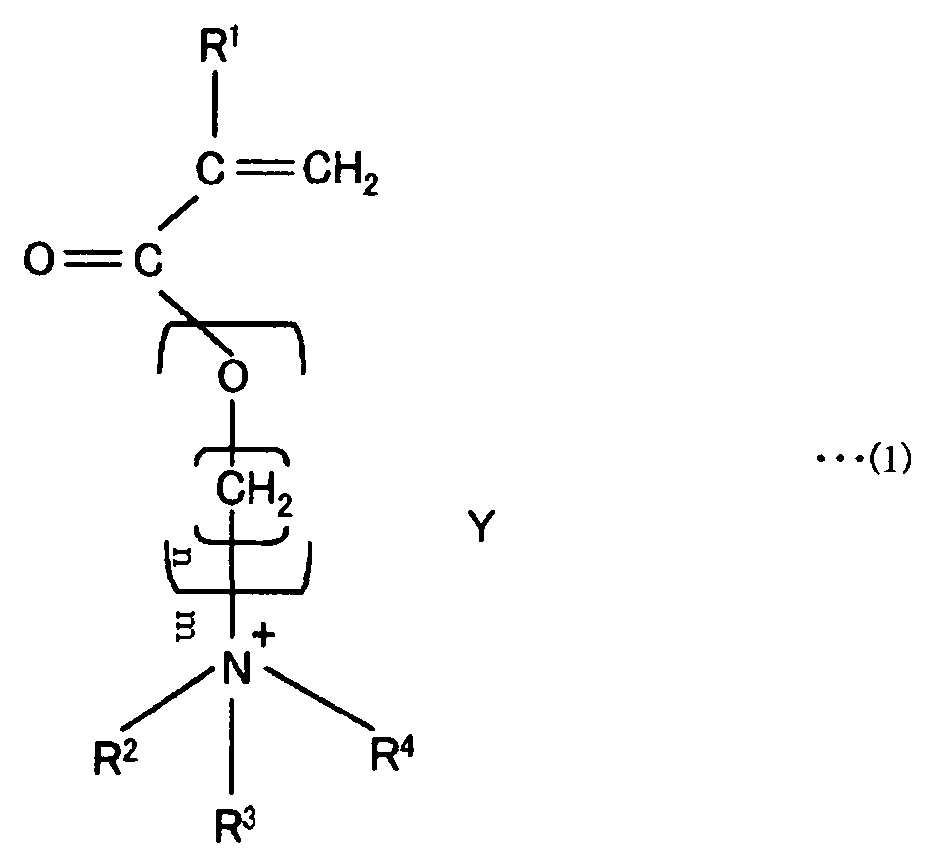
Das Monomer zur Bildung der Polymerpfropfketten, die die Polymerbürstenschicht 20 ausmachen, ist nicht besonders beschränkt. Vorzugsweise wird mindestens ein Monomer mit einer ionischen dissoziierbaren Gruppe (insbesondere ein Monomer mit einer ionischen dissoziierbaren Gruppe und einer reaktiven Doppelbindungsgruppe) verwendet, da ein solches Monomer den Reibungskoeffizienten der Oberfläche der Polymerbürstenschicht 20 weiter reduzieren kann, und weniger flüchtig ist und daher Schwankungen in der Zusammensetzung während der Bildung der Polymerbürstenschicht verhindern kann, wodurch sichergestellt wird, dass die resultierende Polymerbürstenschicht 20 eine gewünschte Zusammensetzung aufweist. Als ein Ergebnis der Verwendung des Monomers mit einer ionischen dissoziierbaren Gruppe weisen die durch die Polymerisation erzeugten Polymerpfropfketten die ionische dissoziierbare Gruppe auf. Zusätzlich zu dem Monomer mit einer ionischen dissoziierbaren Gruppe kann ein Monomer, das mit dem vorherigen Monomer copolymerisierbar ist, als das Monomer zur Bildung der Polymerpfropfketten verwendet werden. Das Monomer mit einer ionischen dissoziierbaren Gruppe ist nicht besonders beschränkt. Beispiele dafür umfassen Verbindungen, die durch die folgende allgemeine Formel (1) dargestellt sind, und dergleichen.

Figure DE112018002879T5_0001
The monomer used to form the polymer graft chains that make up the polymer brush layer 20 are not particularly limited. Preferably at least one monomer with an ionic dissociable group (in particular a monomer with an ionic dissociable group and a reactive double bond group) is used, since such a monomer affects the coefficient of friction of the surface of the polymer brush layer 20 can further reduce, and is less volatile, and therefore can prevent compositional variations during the formation of the polymer brush layer, thereby ensuring that the resulting polymer brush layer 20 has a desired composition. As a result of using the monomer having an ionic dissociable group, the polymer graft chains generated by the polymerization have the ionic dissociable group. In addition to the monomer having an ionic dissociable group, a monomer copolymerizable with the previous monomer can be used as the monomer to form the polymer graft chains. The monomer having an ionic dissociable group is not particularly limited. Examples thereof include compounds represented by the following general formula (1) and the like.
Figure DE112018002879T5_0001

[In der allgemeinen Formel (1) stellt m eine ganze Zahl von 1 bis 10 dar, stellt n eine ganze Zahl von 1 bis 5 dar, stellt R1 ein Wasserstoffatom oder eine C1 bis C3-Alkylgruppe dar und stellen R2, R3 und R4 eine C1 bis C5-Alkylgruppe dar. R2, R3 und R4 können ein oder mehrere Heteroatom(e), ausgewählt aus einem Sauerstoffatom, einem Schwefelatom und einem Fluoratom, enthalten, und zwei oder mehr von R2, R3 und R4 können unter Bildung einer Ringstruktur verknüpft sein. Y stellt ein einwertiges Anion dar.][In the general formula (1), m represents an integer from 1 to 10, n represents an integer from 1 to 5, R 1 represents a hydrogen atom or a C 1 to C 3 alkyl group, and R 2 represents R 3 and R 4 represent a C 1 to C 5 alkyl group. R 2 , R 3 and R 4 may contain one or more heteroatoms selected from an oxygen atom, a sulfur atom and a fluorine atom, and two or more of R 2 , R 3 and R 4 can be linked to form a ring structure. Y represents a monovalent anion.]

Das einwertige Anion Y in der allgemeinen Formel (1) ist nicht besonders beschränkt, und es kann jedes der folgenden Anionen verwendet werden: BF4 -, PF6 -, AsF6 -, SbF6 -, AlCl4 -, NbF6 -, HSO4 -, ClO4 -, CH3SO3 -, CF3SO3 -, CF3CO2 -, (CF3SO2)2N-, Cl-, Br-, I-und dergleichen. In Bezug auf den Dissoziationsgrad in einer flüssigen Substanz, der durch das Quellen des Pfropfpolymers mit der flüssigen Substanz verursacht wird, die Sicherheit, die Beweglichkeit und dergleichen sind BF4 -, PF6 -, (CF3SO2) 2N-, CF3SO3 - und CF3CO2 - besonders geeignet.The monovalent anion Y in the general formula (1) is not particularly limited, and any of the following anions can be used: BF 4 - , PF 6 - , AsF 6 - , SbF 6 - , AlCl 4 - , NbF 6 - , HSO 4 - , ClO 4 - , CH 3 SO 3 - , CF 3 SO 3 - , CF 3 CO 2 - , (CF 3 SO 2 ) 2 N - , Cl - , Br - , I - and the like. Regarding the degree of dissociation in a liquid substance caused by swelling of the graft polymer with the liquid substance, safety, mobility and the like are BF 4 - , PF 6 - , (CF 3 SO 2 ) 2 N - , CF 3 SO 3 - and CF 3 CO 2 - particularly suitable.

Unter den Verbindungen, die durch die allgemeine Formel (1) dargestellt sind, werden in Bezug auf eine größere Wirkung bei der Verringerung des Reibungskoeffizienten der Gleitfläche die Verbindungen, die durch die allgemeinen Formeln (2) bis (9) dargestellt sind, besonders geeignet verwendet. Jede dieser Verbindungen kann einzeln oder in Kombination verwendet werden.

Figure DE112018002879T5_0002
Figure DE112018002879T5_0003
Figure DE112018002879T5_0004
Figure DE112018002879T5_0005
Among the compounds represented by the general formula (1), the compounds represented by the general formulas (2) to (9) are particularly suitably used for a greater effect in reducing the coefficient of friction of the sliding surface , Each of these compounds can be used individually or in combination.
Figure DE112018002879T5_0002
Figure DE112018002879T5_0003
Figure DE112018002879T5_0004
Figure DE112018002879T5_0005

[In den allgemeinen Formeln (2) bis (9) sind m, R1, R2 und Y die gleichen wie diejenigen, die in der allgemeinen Formel (1) definiert sind.][In the general formulas (2) to (9) are m, R 1 , R 2 and Y the same as those defined in the general formula (1).]

Das nichtflüchtige Lösungsmittel kann jedes Lösungsmittel mit einem Dampfdruck bei 25°C von weniger als 10 Pa sein. Bevorzugt sind Lösungsmittel mit einem Dampfdruck bei 25°C von weniger als 1 Pa. Im Hinblick auf die ausgezeichnete Nichtflüchtigkeit und die hohe Fähigkeit, verschiedene Monomere zu lösen, ist eine ionische Flüssigkeit bevorzugt.The non-volatile solvent can be any solvent with a vapor pressure at 25 ° C of less than 10 Pa. Solvents with a vapor pressure at 25 ° C. of less than 1 Pa are preferred. An ionic liquid is preferred in view of the excellent non-volatility and high ability to dissolve various monomers.

In der ersten Ausführungsform ist es besonders bevorzugt, dass das Monomer mit einer ionischen dissoziierbaren Gruppe als das Monomer zur Bildung der Polymerbürstenschicht 20 verwendet wird und die ionische Flüssigkeit als das nichtflüchtige Lösungsmittel verwendet wird (die Kombination des Monomers mit einer ionischen dissoziierbaren Gruppe und der ionischen Flüssigkeit ist nämlich besonders vorteilhaft). Die Verwendung der ionischen Flüssigkeit im Polymerisationssystem kann die Viskosität der Lösung auf einer Anfangsstufe der Polymerisation relativ erhöhen. Dies kann zu Schwierigkeiten bei der Bildung der gewünschten Polymerpfropfketten führen. Aufgrund ihrer hohen Kompatibilität ermöglicht die Kombination des Monomers mit einer ionischen dissoziierbaren Gruppe und der ionischen Flüssigkeit jedoch, dass die Polymerisationsreaktion des Monomers mit einer ionischen dissoziierbaren Gruppe erfolgreich abläuft. Dementsprechend können die gewünschten Polymerpfropfketten relativ einfach gebildet werden. Als Ergebnis kann die Polymerbürstenschicht mit einem niedrigen dynamischen Reibungskoeffizienten mit hoher Produktivität in geeigneter Weise gebildet werden.In the first embodiment, it is particularly preferred that the monomer having an ionic dissociable group as the monomer for forming the polymer brush layer 20 is used and the ionic liquid is used as the non-volatile solvent (namely, the combination of the monomer with an ionic dissociable group and the ionic liquid is particularly advantageous). The use of the ionic liquid in the polymerization system can relatively increase the viscosity of the solution at an initial stage of the polymerization. This can lead to difficulties in forming the desired polymer graft chains. However, due to their high compatibility, the combination of the monomer with an ionic dissociable group and the ionic liquid enables the polymerization reaction of the monomer with an ionic dissociable group to proceed successfully. Accordingly, the desired polymer graft chains can be formed relatively easily. As a result, the polymer brush layer having a low dynamic friction coefficient can be suitably formed with high productivity.

In der ersten Ausführungsform wird das Monomer zur Bildung der Polymerpfropfketten in dem nichtflüchtigen Lösungsmittel polymerisiert, während das Monomer in dem nichtflüchtigen Lösungsmittel gemischt oder dispergiert ist. Das bei der Polymerisation verwendete nichtflüchtige Lösungsmittel wird vorzugsweise dagelassen, ohne entfernt zu werden. In diesem Fall werden in der schließlich erhaltenen Polymerbürstenschicht 20 die Polymerpfropfketten mit dem bei der Polymerisation verwendeten nichtflüchtigen Lösungsmittel gequollen. Insbesondere kann bei einem solchen Verfahren, indem ein nichtflüchtiges Lösungsmittel ausgewählt wird, das mit dem Monomer zum Bilden der Polymerpfropfketten und den polymerisierten Polymerpfropfketten sehr gut kompatibel ist, die Menge des zu verwendenden nichtflüchtigen Lösungsmittels auf die Menge reduziert werden, die zum Bilden der Polymerbürstenschicht 20 erforderlich ist. Als Ergebnis kann auf den Schritt zum Entfernen des Lösungsmittels verzichtet werden, wodurch die Produktivität verbessert wird. Unter diesem Gesichtspunkt wird, wenn das Monomer mit einer ionischen dissoziierbaren Gruppe als das Monomer zum Bilden der Polymerpfropfketten verwendet wird, die ionische Flüssigkeit unter Berücksichtigung der gegenseitigen Kompatibilität vorzugsweise als das nichtflüchtige Lösungsmittel verwendet.In the first embodiment, the monomer is polymerized to form the polymer graft chains in the non-volatile solvent while the monomer is mixed or dispersed in the non-volatile solvent. The non-volatile solvent used in the polymerization is preferably left without being removed. In this case, in the polymer brush layer ultimately obtained 20 the polymer graft chains are swollen with the non-volatile solvent used in the polymerization. In particular, in such a process, by selecting a non-volatile solvent that is very compatible with the monomer to form the polymer graft chains and the polymerized polymer graft chains, the amount of the non-volatile solvent to be used can be reduced to the amount required to form the polymer brush layer 20 is required. As a result, the solvent removal step can be omitted, thereby improving productivity. From this point of view, when the monomer having an ionic dissociable group is used as the monomer for forming the polymer graft chains, the ionic liquid is preferably used as the non-volatile solvent in consideration of mutual compatibility.

So ist beispielsweise die ionische Flüssigkeit vorzugsweise eine ionische Flüssigkeit, die durch die nachstehende allgemeine Formel (10) dargestellt ist und einen Schmelzpunkt von 50°C oder weniger, vorzugsweise 25°C oder weniger, aufweist.
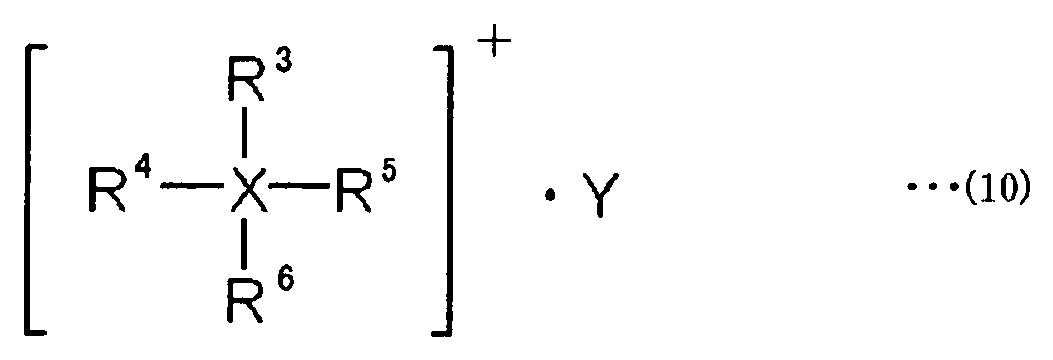
Figure DE112018002879T5_0006
For example, the ionic liquid is preferably an ionic liquid represented by the general formula (10) below and has a melting point of 50 ° C or less, preferably 25 ° C or less.
Figure DE112018002879T5_0006

[In der allgemeinen Formel (10) stellen R3 bis R6, die gleich oder verschieden sein können, eine C1 bis Cs-Alkylgruppe oder eine Alkoxyalkylgruppe, die durch R'-O-(CH2)n- dargestellt ist (worin R' eine Methylgruppe oder eine Ethylgruppe darstellt und n eine ganze Zahl von 1 bis 4 ist) dar, und können zwei beliebige von R3, R9, R5 und R6 einen Ring bilden, vorausgesetzt, dass mindestens eines von R3 bis R6 die Alkoxyalkylgruppe ist. X ist ein Stickstoffatom oder ein Phosphoratom und Y ist ein einwertiges Anion.][In the general formula (10), R 3 to R 6 , which may be the same or different, represent a C 1 to Cs alkyl group or an alkoxyalkyl group represented by R'-O- (CH 2 ) n - (wherein R 'represents a methyl group or an ethyl group and n is an integer from 1 to 4), and any two of R 3 , R 9 , R 5 and R 6 may form a ring, provided that at least one of R 3 to R 6 is the alkoxyalkyl group. X is a nitrogen atom or a phosphorus atom and Y is a monovalent anion.]

Beispiele der C1- bis Cs-Alkylgruppe umfassen eine Methylgruppe, eine Ethylgruppe, eine Propylgruppe, eine 2-Propylgruppe, eine Butylgruppe, eine Pentylgruppe und dergleichen. Beispiele für die durch R'-O-(CH2)n- dargestellte Alkoxyalkylgruppe umfassen eine Methoxymethyl- oder Ethoxymethylgruppe, eine Methoxyethyl- oder Ethoxyethylgruppe, eine Methoxypropyl- oder Ethoxypropylgruppe, eine Methoxybutyl- oder Ethoxybutylgruppe und dergleichen.Examples of the C 1 to Cs alkyl group include a methyl group, an ethyl group, a propyl group, a 2-propyl group, a butyl group, a pentyl group and the like. Examples of the alkoxyalkyl group represented by R'-O- (CH 2 ) n - include a methoxymethyl or ethoxymethyl group, a methoxyethyl or ethoxyethyl group, a methoxypropyl or ethoxypropyl group, a methoxybutyl or ethoxybutyl group and the like.

Beispiele für Verbindungen, in denen zwei von R3, R4, R5 und R6 einen Ring bilden, umfassen quaternäre Ammoniumsalze mit einem Aziridinring, einem Azetidinring, einem Pyrrolidinring, einem Piperidinring oder dergleichen (wobei X ein Stickstoffatom ist); und quaternäre Phosphoniumsalze mit einem Pentamethylenphosphin (Phosphorinan) oder dergleichen (wobei X ein Phosphoratom ist).Examples of compounds in which two of R 3 , R 4 , R 5 and R 6 form a ring include quaternary ammonium salts with an aziridine ring, an azetidine ring, a pyrrolidine ring, a piperidine ring or the like (where X is a nitrogen atom); and quaternary phosphonium salts with a pentamethylene phosphine (phosphorinane) or the like (where X is a phosphorus atom).

Besonders geeignet sind quaternäre Ammoniumsalze, die als mindestens einen Substituenten eine Methoxyethylgruppe aufweisen, wobei R' eine Methylgruppe ist und n 2 ist.Quaternary ammonium salts which have a methoxyethyl group as at least one substituent are particularly suitable, where R 'is a methyl group and n is 2.

Quaternäre Ammoniumsalze, die durch die allgemeine Formel (11) dargestellt sind und eine Methylgruppe, zwei Ethylgruppen und eine Alkoxyethylgruppe als Substituenten aufweisen, werden ebenfalls in geeigneter Weise verwendet.

Figure DE112018002879T5_0007
Quaternary ammonium salts represented by the general formula (11) and having a methyl group, two ethyl groups and an alkoxyethyl group are also suitably used.
Figure DE112018002879T5_0007

[In der allgemeinen Formel (11) stellt R' eine Methylgruppe oder eine Ethylgruppe dar, ist X ein Stickstoffatom oder ein Phosphoratom und stellt Y ein einwertiges Anion dar. Me stellt eine Methylgruppe dar und Et stellt eine Ethylgruppe dar.][In the general formula (11), R 'represents a methyl group or an ethyl group, X is a nitrogen atom or a phosphorus atom, and Y represents a monovalent anion. Me represents a methyl group and Et represents an ethyl group.]

Das einwertige Anion Y in den allgemeinen Formeln (10) und (11) ist nicht besonders begrenzt, und jedes der folgenden Anionen kann verwendet werden: BF4 -, PF6 -, AsF6 -, SbF6 -, AlCl4 -, NbF6 -, HSO4 -, ClO4 -, CH3SO3 -, CF3SO3 -, CF3CO2 -, (CF3SO2)2N-, Cl-, Br-, I- und dergleichen. In Bezug auf den Dissoziationsgrad in einem nichtwässrigen organischen Lösungsmittel, die Sicherheit, die Beweglichkeit und dergleichen sind BF4 -, PF6 -, (CF3SO2)2N-, CF3SO3 - und CF3CO2 - besonders geeignet.The monovalent anion Y in general formulas (10) and (11) is not particularly limited, and any of the following anions can be used: BF 4 - , PF 6 - , AsF 6 - , SbF 6 - , AlCl 4 - , NbF 6 - , HSO 4 - , ClO 4 - , CH 3 SO 3 - , CF 3 SO 3 - , CF 3 CO 2 - , (CF 3 SO 2 ) 2 N - , Cl - , Br - , I - and the like. BF 4 - , PF 6 - , (CF 3 SO 2 ) 2 N - , CF 3 SO 3 - and CF 3 CO 2 - are particularly suitable with regard to the degree of dissociation in a non-aqueous organic solvent, the safety, mobility and the like ,

Spezifische Beispiele für quaternäre Ammoniumsalze und quaternäre Phosphoniumsalze, die vorzugsweise unter den quaternären Salzen, die durch die allgemeinen Formeln (10) und (11) dargestellt sind, verwendet werden, umfassen die unten dargestellten Verbindungen (12) bis (20) (wobei Me eine Methylgruppe darstellt und Et eine Ethylgruppe darstellt). Insbesondere werden die quartären Ammoniumsalze der Formeln (12) und (17) bevorzugter verwendet, um eine Energiespeichervorrichtung mit hervorragenden Eigenschaften bei niedrigen Temperaturen und dergleichen zu erhalten. Insbesondere das quaternäre Ammoniumsalz der Formel (17) ist bevorzugt, da es eine niedrige Viskosität aufweist und somit den dynamischen Reibungskoeffizienten während des Gleitens weiter reduzieren kann.

Figure DE112018002879T5_0008
Figure DE112018002879T5_0009
Figure DE112018002879T5_0010
Figure DE112018002879T5_0011
Figure DE112018002879T5_0012
Specific examples of quaternary ammonium salts and quaternary phosphonium salts which are preferably used among the quaternary salts represented by the general formulas (10) and (11) include the compounds shown below ( 12 ) to (20) (where Me represents a methyl group and Et represents an ethyl group). In particular, the quaternary ammonium salts of formulas (12) and (17) are more preferably used to obtain an energy storage device with excellent properties at low temperatures and the like. In particular, the quaternary ammonium salt of the formula (17) is preferred because it has a low viscosity and can therefore further reduce the dynamic coefficient of friction during sliding.
Figure DE112018002879T5_0008
Figure DE112018002879T5_0009
Figure DE112018002879T5_0010
Figure DE112018002879T5_0011
Figure DE112018002879T5_0012

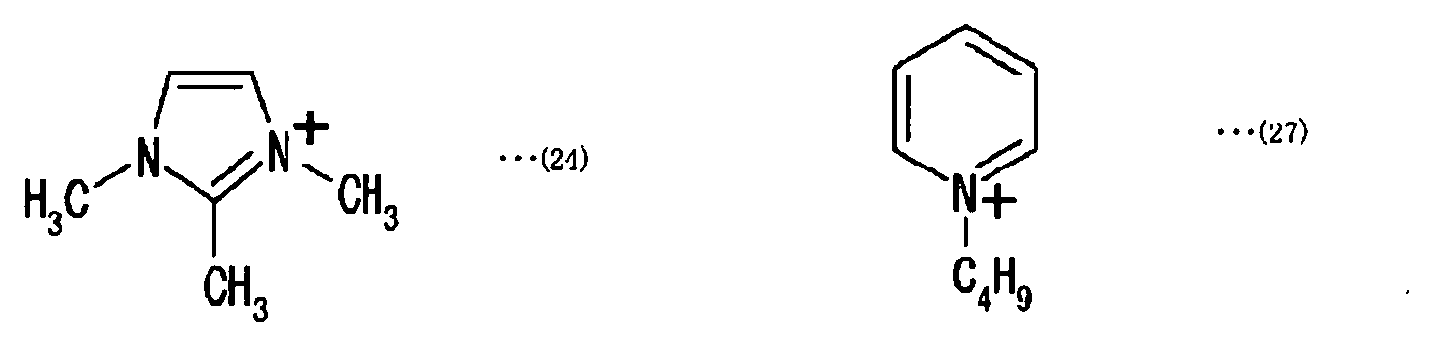
Andere ionische Flüssigkeiten als die durch die allgemeine Formel (10) dargestellten Verbindungen können verwendet werden. Beispiele für solche ionischen Flüssigkeiten umfassen ionische Flüssigkeiten, die ein Imidazoliumion, dass durch die allgemeine Formel (21) dargestellt ist, enthalten, ionische Flüssigkeiten, die andere aromatische Kationen, die durch die Formeln (22) bis (27) dargestellt sind, enthalten, und dergleichen. Beispiele für Gegenanionen für die ionischen Flüssigkeiten, die ein Imidazoliumion enthalten, und für die ionischen Flüssigkeiten, die andere aromatische Kationen enthalten, umfassen die gleichen einwertigen Anionen wie die der Verbindungen, die durch die allgemeinen Formeln (10) und (11) dargestellt sind.
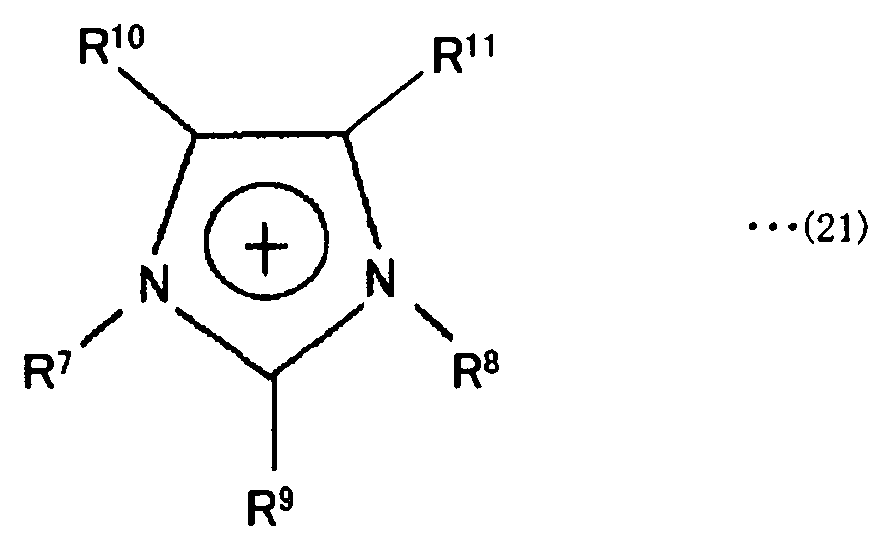
Figure DE112018002879T5_0013
Ionic liquids other than the compounds represented by the general formula (10) can be used. Examples of such ionic liquids include ionic liquids containing an imidazolium ion represented by the general formula (21), ionic liquids containing other aromatic cations represented by the formulas (22) to (27), and the same. Examples of counter anions for the ionic liquids containing an imidazolium ion and for the ionic liquids containing other aromatic cations include the same monovalent anions as those of the compounds represented by the general formulas (10) and (11).
Figure DE112018002879T5_0013

[In der allgemeinen Formel (21) stellt R7 eine C1-C4-Alkylgruppe oder ein Wasserstoffatom dar, und ist vorzugsweise eine Methylgruppe mit einem Kohlenstoffatom. R8 stellt eine Alkylgruppe mit C10 oder weniger dar (die gegebenenfalls eine Etherbindung enthält) und ist beispielsweise vorzugsweise eine Ethylgruppe. R9, R10 und R11 stellen unabhängig voneinander eine C1-C20-Alkylgruppe dar, die gegebenenfalls ein Sauerstoffatom aufweist. R9, R10 und R11 können ein Wasserstoffatom sein.]
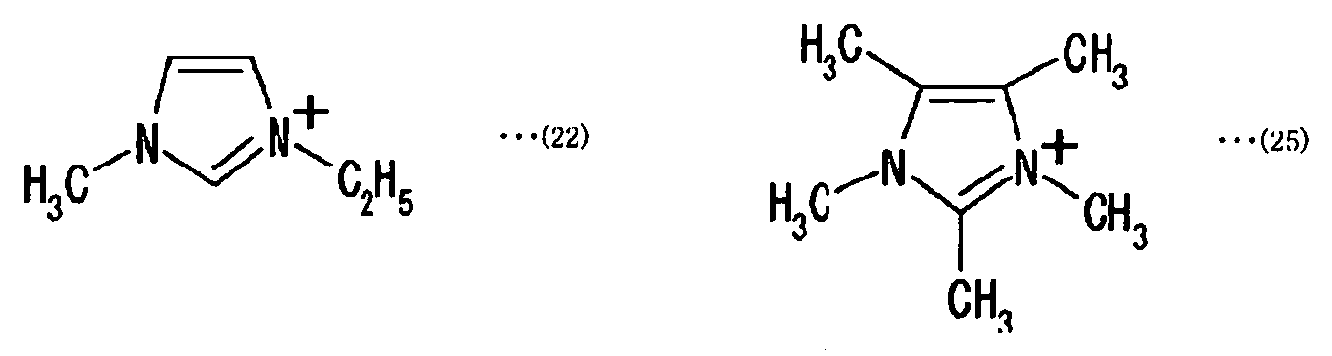
Figure DE112018002879T5_0014
Figure DE112018002879T5_0015
Figure DE112018002879T5_0016
[In the general formula (21), R 7 represents a C 1 -C 4 alkyl group or a hydrogen atom, and is preferably a methyl group having a carbon atom. R 8 represents an alkyl group with C 10 or less (which may contain an ether bond) and is preferably, for example, an ethyl group. R 9 , R 10 and R 11 independently represent a C 1 -C 20 alkyl group which may have an oxygen atom. R 9 , R 10 and R 11 may be a hydrogen atom.]
Figure DE112018002879T5_0014
Figure DE112018002879T5_0015
Figure DE112018002879T5_0016

In der ersten Ausführungsform kann jedes Verfahren verwendet werden, um die Schicht der Lösung oder Dispersion des Monomers, das in dem nichtflüchtigen Lösungsmittel gemischt oder dispergiert ist, auf dem Substrat 10 zu bilden. Beispiele hierfür umfassen ein Verfahren des Auftragens der Lösung oder der Dispersion auf das Substrat 10 durch ein Rakelverfahren oder ein Schleuderbeschichtungsverfahren (Spin-Coating-Verfahren); ein Verfahren des Auftropfens der Lösung oder der Dispersion auf das Substrat 10; ein Verfahren des Eintauchens des Substrats 10 in die Lösung oder Dispersion des Monomers, dass in dem nichtflüchtigen Lösungsmittel gemischt oder dispergiert ist; und dergleichen.In the first embodiment, any method can be used to coat the solution or dispersion of the monomer mixed or dispersed in the non-volatile solvent on the substrate 10 to build. Examples include a method of applying the solution or dispersion to the substrate 10 by a doctor blade process or a spin coating process (spin coating process); a method of dropping the solution or dispersion onto the substrate 10 ; a method of immersing the substrate 10 in the solution or dispersion of the monomer that is mixed or dispersed in the non-volatile solvent; and the same.

Jedes Verfahren kann verwendet werden, um das in der Lösung oder der Dispersion enthaltene Monomer in dem nichtflüchtigen Lösungsmittel auf dem Substrat 10 zu polymerisieren. Beispiele hierfür umfassen ein Verfahren der oberflächeninitiierten, lebenden Radikalpolymerisation und dergleichen.Any method can be used to remove the monomer contained in the solution or dispersion in the non-volatile solvent on the substrate 10 to polymerize. Examples include a method of surface initiated living radical polymerization and the like.

Das Verfahren der oberflächeninitiierten, lebenden Radikalpolymerisation ist eine Technik, bei der Polymerisationsinitiationsgruppen vor der Bildung der Schicht der Lösung oder Dispersion des Monomers, das in dem nichtflüchtigen Lösungsmittel gemischt oder dispergiert ist, in die Oberfläche des Substrats 10 eingebracht werden, und dann Polymerpfropfketten durch lebende Radikalpolymerisation aus den Polymerisationsinitiationsgruppen als Initiationspunkte gebildet werden. So können beispielsweise die in JP-A 2009-59659 und JP-A 2010 - 218984 offenbarten Verfahren und dergleichen verwendet werden.The method of surface initiated living radical polymerization is a technique in which polymerization initiation groups are formed in the surface of the substrate before the formation of the layer of solution or dispersion of the monomer mixed or dispersed in the non-volatile solvent 10 are introduced, and then polymer graft chains are formed by living radical polymerization from the polymerization initiation groups as initiation points. For example, the in JP-A 2009-59659 and JP-A 2010 - 218984 disclosed methods and the like can be used.

Jedes Verfahren kann verwendet werden, um die Polymerisationsinitiationsgruppen vor der Polymerisation durch das Verfahren der oberflächeninitiierten, lebenden Radikalpolymerisation in die Oberfläche des Substrats 10 einzubringen. Beispiele hierfür umfassen ein Verfahren, das das Auflösen oder Dispergieren eines Polymerisationsinitiators in einem Lösungsmittel zur Herstellung einer Polymerisationsinitiatorlösung, und das Eintauchen des Substrats 10 in die hergestellte Polymerisationsinitiatorlösung umfasst, und dergleichen.Any method can be used to add the polymerization initiation groups to the surface of the substrate prior to polymerization by the method of surface-initiated, living radical polymerization 10 bring. Examples include a method that involves dissolving or dispersing a polymerization initiator in a solvent to prepare a polymerization initiator solution, and immersing the substrate 10 into the prepared polymerization initiator solution, and the like.

Der Polymerisationsinitiator ist nicht besonders beschränkt, aber ist vorzugsweise eine Verbindung mit einer Gruppe, die in der Lage ist, an das Substrat 10 zu binden, und einer Gruppe zur Radikalbildung. So können beispielsweise die in JP-A 2010-218984 offenbarten Polymerisationsinitiatoren, insbesondere TEMPO-basierte, ATRP-basierte, RAFT-basierte und RTCP-basierte Polymerisationsinitiatoren verwendet werden. Unter diesen sind die TEMPO-basierten, RAFT-basierten und RTCPbasierten Polymerisationsinitiatoren bevorzugter. Unter den TEMPO-basierten Polymerisationsinitiatoren sind DEPN-basierte Polymerisationsinitiatoren besonders bevorzugt. Beispiele für die Gruppe, die in der Lage ist, an das Substrat 10 zu binden, umfassen -SiCl3, -Si(CH3)Cl2, -Si(CH3)2Cl, -Si(OR)3 (wobei R Methyl, Ethyl, Propyl oder Butyl darstellt) und dergleichen.The polymerization initiator is not particularly limited, but is preferably a compound having a group capable of being attached to the substrate 10 bind, and a radical formation group. For example, the in JP-A 2010-218984 disclosed polymerization initiators, in particular TEMPO-based, ATRP-based, RAFT-based and RTCP-based polymerization initiators can be used. Among these, the TEMPO-based, RAFT-based and RTCP-based polymerization initiators are more preferred. Among the TEMPO-based polymerization initiators, DEPN-based polymerization initiators are particularly preferred. Examples of the group that is able to attach to the substrate 10 to bind include -SiCl 3 , -Si (CH 3 ) Cl 2 , -Si (CH 3 ) 2 Cl, -Si (OR) 3 (where R is methyl, ethyl, propyl or butyl) and the like.

Wenn die Polymerisation durch das Verfahren der oberflächeninitiierten, lebenden Radikalpolymerisation durchgeführt wird, wird der vorstehend beschriebene Polymerisationsinitiator verwendet und auf der Oberfläche 10 immobilisiert, um die Polymerisationsinitiationsgruppen in die Oberfläche des Substrats 10 einzubringen. Anschließend wird die Schicht der Lösung oder Dispersion des in dem nichtflüchtigen Lösungsmittel gemischten oder dispergierten Monomers auf dem Substrat 10, das die darin eingebrachten Polymerisationsinitiationsgruppen aufweist, gebildet, und wird in einer nicht oxidierenden Gasatmosphäre erhitzt oder Ultraviolett-, Elektronenstrahl- oder γ-Strahlung ausgesetzt, um zu ermöglichen, dass die Polymerisation des Monomers in dem nichtflüchtigen Lösungsmittel fortgesetzt wird, wodurch die Polymerpfropfketten auf der Oberfläche des Substrats 10 gebildet werden. Folglich kann die Polymerbürstenschicht 20, die aus den Polymerpfropfketten, die mit dem bei der Polymerisation verwendeten nichtflüchtigen Lösungsmittel gequollen sind, besteht, auf der Oberfläche des Substrats 10 gebildet werden. Die Polymerisationsreaktion kann unter einer Druckbedingung (unter einer Druckbedingung von 50 bis 500 MPa) durchgeführt werden, um das Molekulargewicht (anders ausgedrückt, die Polymerbürstenlängen) der Polymerpfropfketten weiter zu erhöhen. When the polymerization is carried out by the method of surface-initiated living radical polymerization, the polymerization initiator described above is used and on the surface 10 immobilized to the polymerization initiation groups in the surface of the substrate 10 bring. Then the layer of the solution or dispersion of the monomer mixed or dispersed in the non-volatile solvent on the substrate 10 , which has the polymerization initiation groups incorporated therein, and is heated in a non-oxidizing gas atmosphere or exposed to ultraviolet, electron beam or γ radiation to allow the polymerization of the monomer in the non-volatile solvent to continue, thereby causing the polymer graft chains to open the surface of the substrate 10 be formed. Consequently, the polymer brush layer can 20 consisting of the polymer graft chains swollen with the non-volatile solvent used in the polymerization on the surface of the substrate 10 be formed. The polymerization reaction can be carried out under a pressure condition (under a pressure condition of 50 to 500 MPa) to further increase the molecular weight (in other words, the polymer brush lengths) of the polymer graft chains.

Die Dicke der in der ersten Ausführungsform gebildeten Polymerbürstenschicht 20 beträgt typischerweise 20 µm oder weniger, vorzugsweise 5 µm oder weniger, bevorzugter 1 µm oder weniger. Die untere Grenze davon beträgt typischerweise 10 nm oder mehr.The thickness of the polymer brush layer formed in the first embodiment 20 is typically 20 µm or less, preferably 5 µm or less, more preferably 1 µm or less. The lower limit thereof is typically 10 nm or more.

Die Lösung des Monomers, das in dem nichtflüchtigen Lösungsmittel gemischt oder dispergiert ist, für die Polymerisation kann andere Komponenten enthalten, die für die Polymerisationsreaktion erforderlich sind, wie beispielsweise eine beliebige Art an Radikalinitiator und dergleichen.The solution of the monomer mixed or dispersed in the non-volatile solvent for the polymerization may contain other components necessary for the polymerization reaction, such as any kind of radical initiator and the like.

Die durch das Bildungsverfahren gemäß der ersten Ausführungsform gebildete Polymerbürstenschicht 20 weist einen niedrigen dynamischen Reibungskoeffizienten auf, und kann daher beispielsweise in geeigneter Weise als ein Gleitelement oder als eine Gleitstruktur eingesetzt werden, wobei die Polymerbürstenschicht als eine Gleitfläche dient.The polymer brush layer formed by the formation method according to the first embodiment 20 has a low dynamic coefficient of friction and can therefore be suitably used, for example, as a sliding element or as a sliding structure, the polymer brush layer serving as a sliding surface.

<Zweite Ausführungsform><Second embodiment>

Folgend wird die zweite Ausführungsform der vorliegenden Erfindung beschrieben.The second embodiment of the present invention will now be described.

2 ist eine schematische Ansicht, die eine Polymerbürstenschicht, die durch das Verfahren gemäß der zweiten Ausführungsform der vorliegenden Erfindung gebildet wurde, veranschaulicht. In 2 ist eine Polymerbürstenschicht 20a gemäß der zweiten Ausführungsform der vorliegenden Erfindung in dem Raum zwischen einem Substrat 10a und einem zweiten Substrat 10b gebildet. 2 FIG. 11 is a schematic view illustrating a polymer brush layer formed by the method according to the second embodiment of the present invention. In 2 is a polymer brush layer 20a according to the second embodiment of the present invention in the space between a substrate 10a and a second substrate 10b educated.

Das erste Substrat 10a und das zweite Substrat 10b sind nicht besonders beschränkt und können die gleichen Substrate wie das der ersten Ausführungsform sein.The first substrate 10a and the second substrate 10b are not particularly limited and may be the same substrates as that of the first embodiment.

Die Polymerbürstenschicht 20a ist eine Schicht, die durch das Bildungsverfahren gemäß der zweiten Ausführungsform gebildet wurde, und ist aus mehreren Polymerpfropfketten, die kovalent auf dem ersten Substrat 10a immobilisiert sind und mit einer flüssigen Substanz gequollen sind, gebildet, wie die Polymerbürstenschicht 20 gemäß der ersten Ausführungsform.The polymer brush layer 20a is a layer formed by the formation method according to the second embodiment, and is made of multiple polymer graft chains that are covalent on the first substrate 10a are immobilized and swollen with a liquid substance, formed like the polymer brush layer 20 according to the first embodiment.

Das Bildungsverfahren für eine Polymerbürstenschicht gemäß der zweiten Ausführungsform ist ein Verfahren zum Bilden der Polymerbürstenschicht 20a in dem engen Raum, der sich über einen Abstand d von 500 µm oder weniger zwischen dem ersten Substrat 10a und dem zweiten Substrat 10b erstreckt, wie in 2 dargestellt. Gemäß der zweiten Ausführungsform kann die Polymerbürstenschicht 20a mit einem niedrigen dynamischen Reibungskoeffizienten in einem solchen engen Raum erfolgreich gebildet werden.The polymer brush layer forming method according to the second embodiment is a method of forming the polymer brush layer 20a in the narrow space that extends over a distance d of 500 µm or less between the first substrate 10a and the second substrate 10b extends as in 2 shown. According to the second embodiment, the polymer brush layer can 20a with a low dynamic coefficient of friction in such a narrow space.

Insbesondere umfasst das Bildungsverfahren für eine Polymerbürstenschicht gemäß der zweiten Ausführungsform die folgenden Schritte:

  • Ermöglichen, dass eine Lösung oder Dispersion eines Monomers, das in einem nichtflüchtigen Lösungsmittel gemischt oder dispergiert ist, in den engen Raum eindringt, der sich über einen Abstand d von 500 µm oder weniger zwischen dem ersten Substrat 10a und dem zweiten Substrat 10b erstreckt; und
  • Polymerisieren des Monomers, das in der eingedrungenen Lösung oder Dispersion enthalten ist, in dem nichtflüchtigen Lösungsmittel, um die Polymerbürstenschicht 20a auf mindestens einem Teil der Oberflächen des ersten Substrats 10a und des zweiten Substrats 10b, die den Raum definieren, zu bilden.
In particular, the method for forming a polymer brush layer according to the second embodiment comprises the following steps:
  • Allow a solution or dispersion of a monomer mixed or dispersed in a non-volatile solvent to enter the narrow space that is a distance d of 500 µm or less between the first substrate 10a and the second substrate 10b extends; and
  • Polymerizing the monomer contained in the penetrated solution or dispersion in the non-volatile solvent around the polymer brush layer 20a on at least part of the surfaces of the first substrate 10a and the second substrate 10b that define the space to form.

Gemäß dem Bildungsverfahren für eine Polymerbürste gemäß der zweiten Ausführungsform kann die Polymerbürstenschicht 20a mit einem niedrigen dynamischen Reibungskoeffizienten erfolgreich gebildet werden, selbst wenn der Abstand d des winzigen Raumes zwischen dem ersten Substrat 10a und dem zweiten Substrat 10b vorzugsweise 500 µm oder weniger, bevorzugter 100 µm oder weniger, beträgt. According to the method of forming a polymer brush according to the second embodiment, the polymer brush layer can 20a with a low dynamic coefficient of friction can be successfully formed even if the distance d of the minute space between the first substrate 10a and the second substrate 10b preferably 500 µm or less, more preferably 100 µm or less.

In der zweiten Ausführungsform wird, um die Polymerbürstenschicht 20a zu bilden, ermöglicht, dass die Lösung oder Dispersion, in der das Monomer zur Bildung der Polymerpfropfketten, die die Polymerbürstenschicht 20a ausmachen, in dem nichtflüchtigen Lösungsmittel gemischt oder dispergiert ist, in den Raum zwischen dem ersten Substrat 10a und dem zweiten Substrat 10b eindringt, und dann wird das Monomer zur Bildung der Polymerpfropfketten in dem nichtflüchtigen Lösungsmittel in dem Raum polymerisiert. Dementsprechend kann die Polymerbürstenschicht 20a selbst in einem solchen winzigen Raum erfolgreich gebildet werden.In the second embodiment, the polymer brush layer 20a to form allows the solution or dispersion in which the monomer to form the polymer graft chains that the polymer brush layer 20a make up in the non-volatile solvent mixed or dispersed in the space between the first substrate 10a and the second substrate 10b penetrates, and then the monomer is polymerized to form the polymer graft chains in the non-volatile solvent in the room. Accordingly, the polymer brush layer 20a be successfully formed even in such a tiny space.

Insbesondere wird gemäß der zweiten Ausführungsform ermöglicht, dass die Lösung oder Dispersion des in dem nichtflüchtigen Lösungsmittel gemischten oder dispergierten Monomers in einen solchen engen Raum eindringt, und das Monomer wird in dem engen Raum polymerisiert. Als ein Vorteil des engen Reaktionsraums kann die Erzeugung von Konvektionsströmungen während der Polymerisationsreaktion stark unterdrückt werden, wodurch eine Zunahme der Breite der Verteilung der resultierenden Polymerbürstenlängen (eine Zunahme der Breite der Molekulargewichtsverteilung) wirksam verhindert wird. Als Ergebnis können die Polymerpfropfketten mit einem hohen Molekulargewicht und einer engen Molekulargewichtsverteilung gebildet werden. Da die Polymerpfropfketten mit einem hohen Molekulargewicht und einer engen Molekulargewichtsverteilung gebildet werden können, weist die resultierende Polymerbürstenschicht 20a einen weiter reduzierten dynamischen Reibungskoeffizienten während des Gleitens auf. Insbesondere die enge Molekulargewichtsverteilung der Polymerpfropfketten zeigt, dass die Polymerpfropfketten im Wesentlichen die gleiche Polymerbürstenlänge aufweisen. Dieses Merkmal ist effektiver bei der Reduzierung des dynamischen Reibungskoeffizienten.In particular, according to the second embodiment, the solution or dispersion of the monomer mixed or dispersed in the nonvolatile solvent is allowed to enter such a narrow space, and the monomer is polymerized in the narrow space. As an advantage of the narrow reaction space, the generation of convection currents during the polymerization reaction can be largely suppressed, thereby effectively preventing an increase in the width of the distribution of the resulting polymer brush lengths (an increase in the width of the molecular weight distribution). As a result, the polymer graft chains with a high molecular weight and a narrow molecular weight distribution can be formed. Since the polymer graft chains can be formed with a high molecular weight and a narrow molecular weight distribution, the resulting polymer brush layer has 20a a further reduced dynamic coefficient of friction during sliding. In particular, the narrow molecular weight distribution of the polymer graft chains shows that the polymer graft chains have essentially the same polymer brush length. This feature is more effective in reducing the dynamic coefficient of friction.

Im Hinblick auf eine weitere Reduzierung des dynamischen Reibungskoeffizienten während des Gleitens beträgt das zahlenmittlere Molekulargewicht (Mn) der Polymerpfropfketten, die die Polymerbürstenschicht 20a ausmachen, vorzugsweise 500 bis 10.000.000, bevorzugter 200.000 bis 10.000.000. Im Hinblick auf eine weitere Reduzierung des dynamischen Reibungskoeffizienten während des Gleitens beträgt das gewichtsmittlere Molekulargewicht (Mw) der Polymerpfropfketten, die die Polymerbürstenschicht 20 ausmachen, vorzugsweise 500 bis 10.000.000, bevorzugter 200.000 bis 10.000.000. Im Hinblick auf eine weitere Reduzierung des dynamischen Reibungskoeffizienten während des Gleitens liegt die Molekulargewichtsverteilung (Mw/Mn) der Polymerpfropfketten, die die Polymerbürstenschicht 20a ausmachen, vorzugsweise nahe bei 1, wünschenswert 1,5 oder weniger, bevorzugter 1,3 oder weniger, weiter bevorzugt 1,2 oder weniger, besonders bevorzugt 1,01 bis 1,15. Die Dicke der Polymerbürstenschicht 20a ist nicht besonders beschränkt, aber entspricht vorzugsweise dem Abstand d zwischen dem ersten Substrat 10a und dem zweiten Substrat 10b oder, anders ausgedrückt, ist vorzugsweise im Wesentlichen gleich dem Abstand d, vorzugsweise 500 µm oder weniger, bevorzugter 100 µm oder weniger.With a view to further reducing the dynamic coefficient of friction during sliding, the number average molecular weight (Mn) of the polymer graft chains comprising the polymer brush layer is 20a constitute, preferably 500 to 10,000,000, more preferably 200,000 to 10,000,000. With a view to further reducing the dynamic coefficient of friction during sliding, the weight average molecular weight (Mw) of the polymer graft chains comprising the polymer brush layer 20 constitute, preferably 500 to 10,000,000, more preferably 200,000 to 10,000,000. With a view to further reducing the dynamic coefficient of friction during sliding, the molecular weight distribution (Mw / Mn) of the polymer graft chains that make up the polymer brush layer 20a make up, preferably close to 1, desirably 1.5 or less, more preferably 1.3 or less, more preferably 1.2 or less, particularly preferably 1.01 to 1.15. The thickness of the polymer brush layer 20a is not particularly limited, but preferably corresponds to the distance d between the first substrate 10a and the second substrate 10b or, in other words, is preferably substantially equal to the distance d, preferably 500 µm or less, more preferably 100 µm or less.

In der zweiten Ausführungsform wird das Monomer zur Bildung der Polymerpfropfketten in dem nichtflüchtigen Lösungsmittel in dem Raum zwischen dem ersten Substrat 10a und dem zweiten Substrat 10b polymerisiert, während das Monomer in dem nichtflüchtigen Lösungsmittel gemischt oder dispergiert ist. In dem Fall, in dem das bei der Polymerisation verwendete nichtflüchtige Lösungsmittel dagelassen wird, ohne entfernt zu werden, kann die schließlich erhaltene Polymerbürstenschicht 20a die Polymerpfropfketten, die mit dem bei der Polymerisation verwendeten nichtflüchtigen Lösungsmittel gequollen sind, aufweisen.In the second embodiment, the monomer used to form the polymer graft chains in the non-volatile solvent in the space between the first substrate 10a and the second substrate 10b polymerizes while the monomer is mixed or dispersed in the non-volatile solvent. In the case where the non-volatile solvent used in the polymerization is left without being removed, the polymer brush layer finally obtained can 20a have the polymer graft chains swollen with the non-volatile solvent used in the polymerization.

Insbesondere wird gemäß der zweiten Ausführungsform, da das Monomer in dem nichtflüchtigen Lösungsmittel polymerisiert wird, in dem Verfahren der Bildung der Polymerbürstenschicht 20a in dem engen Raum zwischen dem ersten Substrat 10a und dem zweiten Substrat 10b nur die zum Bilden der Polymerbürstenschicht 20a erforderliche Menge für das Eindringen der Lösung oder der Dispersion vor der Polymerisation verwendet. Darüber hinaus reflektiert die gebildete Polymerbürstenschicht 20a die Menge des eingedrungenen Lösungsmittels oder der eingedrungenen Dispersion vor der Polymerisation (anders ausgedrückt, die Polymerbürstenschicht 20a wird an einer Stelle gebildet, die dem Ort entspricht, an dem die Lösung oder die Dispersion vor der Polymerisation eingedrungen ist, und weist einen Bereich auf, der dem entspricht, an dem die Lösung oder die Dispersion vor der Polymerisation eingedrungen ist). Somit kann die Polymerbürstenschicht 20a erfolgreich in einem solchen engen Raum gebildet werden.In particular, according to the second embodiment, since the monomer is polymerized in the non-volatile solvent, in the process of forming the polymer brush layer 20a in the narrow space between the first substrate 10a and the second substrate 10b only that to form the polymer brush layer 20a required amount for the penetration of the solution or the dispersion used before the polymerization. In addition, the polymer brush layer formed reflects 20a the amount of solvent or dispersion that has penetrated prior to polymerization (in other words, the polymer brush layer 20a is formed at a position corresponding to the place where the solution or the dispersion has penetrated before the polymerization, and has an area corresponding to that where the solution or the dispersion has penetrated before the polymerization). Thus, the polymer brush layer 20a be successfully formed in such a confined space.

Gemäß der zweiten Ausführungsform ist es bei der Bildung der Polymerbürstenschicht 20a in dem durch das erste Substrat 10a und das zweite Substrat 10b gebildeten engen Raum nicht nötig, das folgende Verfahren zu verwenden, bei dem einmal das erste Substrat 10a und das zweite Substrat 10b, die sich gegenüberstehen, demontiert werden, eine Polymerbürstenschicht auf der Oberfläche jedes Substrats gebildet wird, und dann das erste Substrat 10a und das zweite Substrat 10b nach der Bildung der Polymerbürstenschicht wieder so angeordnet werden, dass sie sich gegenüberstehen; dadurch kann die Produktivität deutlich verbessert werden. Wenn das erste Substrat 10a und das zweite Substrat 10b so angeordnet werden, dass sie sich gegenüberstehen, nachdem Polymerbürstenschichten getrennt auf der Oberfläche des ersten Substrats 10a und der Oberfläche des zweiten Substrats 10b gebildet wurden, stimmen die gebildeten Polymerbürstenschichten nicht immer mit der Größe des Raumes zwischen dem ersten Substrat 10a und dem zweiten Substrat 10b überein (beispielsweise können die Polymerbürstenschichten für den Raum zwischen dem ersten Substrat 10a und dem zweiten Substrat 10b zu dick oder zu dünn sein). Dies kann leider zu ungenügenden Gleiteigenschaften führen. Obwohl die Polymerbürstenschicht in dem Raum gebildet wird, der durch die beiden Oberflächen des ersten Substrats 10a und des zweiten Substrats 10b gebildet wird, beispielsweise in dem in 2 dargestellten Aspekt, ist ein solches Problem in dem Fall, in dem die Polymerbürstenschicht in einem Raum mit einer gekrümmten Oberfläche, einem Raum, der durch eine abgeschabte Oberfläche gebildet wird, oder einem Raum mit einer komplexeren Form gebildet wird, deutlicher sichtbar. According to the second embodiment, it is in the formation of the polymer brush layer 20a in that through the first substrate 10a and the second substrate 10b formed narrow space is not necessary to use the following procedure, where once the first substrate 10a and the second substrate 10b facing each other, disassembled, a polymer brush layer is formed on the surface of each substrate, and then the first substrate 10a and the second substrate 10b after the formation of the polymer brush layer, be arranged so that they face each other; this can significantly improve productivity. If the first substrate 10a and the second substrate 10b be arranged so that they face each other after polymer brush layers are separated on the surface of the first substrate 10a and the surface of the second substrate 10b The polymer brush layers formed do not always match the size of the space between the first substrate 10a and the second substrate 10b match (for example, the polymer brush layers for the space between the first substrate 10a and the second substrate 10b too thick or too thin). Unfortunately, this can lead to insufficient sliding properties. Although the polymer brush layer is formed in the space defined by the two surfaces of the first substrate 10a and the second substrate 10b is formed, for example in the 2 aspect, such a problem is more clearly visible in the case where the polymer brush layer is more clearly visible in a space with a curved surface, a space formed by a scraped surface, or a space with a more complex shape.

Im Gegensatz dazu kann die zweite Ausführungsform ein solches Problem effektiv lösen.In contrast, the second embodiment can effectively solve such a problem.

Das Monomer zur Bildung der Polymerpfropfketten, die die Polymerbürstenschicht 20a ausmachen, ist nicht besonders beschränkt, und es können die gleichen Monomere wie diejenigen, die in der ersten Ausführungsform beschrieben sind, verwendet werden. Vorzugsweise wird mindestens ein Monomer mit einer ionischen dissoziierbaren Gruppe (insbesondere ein Monomer mit einer ionischen dissoziierbaren Gruppe und einer reaktiven Doppelbindungsgruppe) verwendet. Zusätzlich zu dem Monomer mit einer ionischen dissoziierbaren Gruppe kann ein mit dem vorherigen Monomer copolymerisierbares Monomer verwendet werden. Als das Monomer mit einer ionischen dissoziierbaren Gruppe, können diejenigen, die in der ersten Ausführungsform beschrieben sind, verwendet werden. Insbesondere das Monomer mit einer ionischen dissoziierbaren Gruppe zeigt eine ausgezeichnete Fähigkeit, in einen engen Raum einzudringen. Unter diesem Gesichtspunkt wird das Monomer mit einer ionisch dissoziierbaren Gruppe vorzugsweise verwendet.The monomer used to form the polymer graft chains that make up the polymer brush layer 20a is not particularly limited, and the same monomers as those described in the first embodiment can be used. At least one monomer with an ionic dissociable group (in particular a monomer with an ionic dissociable group and a reactive double bond group) is preferably used. In addition to the monomer having an ionic dissociable group, a monomer copolymerizable with the previous monomer can be used. As the monomer having an ionic dissociable group, those described in the first embodiment can be used. In particular, the monomer with an ionic dissociable group shows an excellent ability to enter a narrow space. From this point of view, the monomer having an ionically dissociable group is preferably used.

Das nichtflüchtige Lösungsmittel ist nicht besonders beschränkt, und es können dieselben Lösungsmittel wie diejenigen, die in der ersten Ausführungsform oben beschrieben sind, verwendet werden. In Bezug auf eine ausgezeichnete Nichtflüchtigkeit, eine hohe Fähigkeit, verschiedene Monomere zu lösen, und eine hohe Fähigkeit, in einen engen Raum einzudringen, sind ionische Flüssigkeiten bevorzugt. Es können dieselben ionischen Flüssigkeiten verwendet werden wie diejenigen, die oben in der ersten Ausführungsform beschrieben sind.The non-volatile solvent is not particularly limited, and the same solvents as those described in the first embodiment above can be used. Ionic liquids are preferred in terms of excellent non-volatility, high ability to dissolve various monomers, and high ability to enter a narrow space. The same ionic liquids as those described above in the first embodiment can be used.

Insbesondere ist es in der zweiten Ausführungsform besonders bevorzugt, dass das Monomer mit einer ionischen dissoziierbaren Gruppe als das Monomer zur Bildung der Polymerbürstenschicht 20a verwendet wird, und die ionische Flüssigkeit als das nichtflüchtige Lösungsmittel verwendet wird (die Kombination des Monomers mit einer ionischen dissoziierbaren Gruppe und der ionischen Flüssigkeit ist nämlich besonders vorteilhaft). Die Verwendung der ionischen Flüssigkeit im Polymerisationssystem kann die Viskosität der Lösung auf einer Anfangsstufe der Polymerisation relativ erhöhen. Dies kann zu Schwierigkeiten bei der Bildung der gewünschten Polymerpfropfketten führen. Aufgrund ihrer hohen Kompatibilität und der Polymerisationsumgebung in dem engen Raum ermöglicht die Kombination des Monomers mit einer ionischen dissoziierbaren Gruppe und der ionischen Flüssigkeit jedoch, dass die Polymerisationsreaktion des Monomers mit einer ionischen dissoziierbaren Gruppe erfolgreich abläuft. Dementsprechend können die gewünschten Polymerpfropfketten relativ einfach gebildet werden. Als Ergebnis kann die Polymerbürstenschicht mit einem niedrigen dynamischen Reibungskoeffizienten mit hoher Produktivität in geeigneter Weise gebildet werden.In particular, in the second embodiment, it is particularly preferred that the monomer having an ionic dissociable group as the monomer for forming the polymer brush layer 20a is used, and the ionic liquid is used as the non-volatile solvent (namely, the combination of the monomer with an ionic dissociable group and the ionic liquid is particularly advantageous). The use of the ionic liquid in the polymerization system can relatively increase the viscosity of the solution at an initial stage of the polymerization. This can lead to difficulties in forming the desired polymer graft chains. However, due to their high compatibility and the polymerization environment in the narrow space, the combination of the monomer with an ionic dissociable group and the ionic liquid enables the polymerization reaction of the monomer with an ionic dissociable group to proceed successfully. Accordingly, the desired polymer graft chains can be formed relatively easily. As a result, the polymer brush layer having a low dynamic friction coefficient can be suitably formed with high productivity.

In der zweiten Ausführungsform kann jedes Verfahren verwendet werden, um zu ermöglichen, dass die Lösung oder Dispersion, in der das Monomer zur Bildung der Polymerpfropfketten, die die Polymerbürstenschicht 20a ausmachen, in dem nichtflüchtigen Lösungsmittel gemischt oder dispergiert ist, in den Raum zwischen dem ersten Substrat 10a und dem zweiten Substrat 10b eindringt. Beispiele hierfür umfassen ein Verfahren des Auftropfens der Lösung oder der Dispersion in die Nähe einer Öffnung des Raumes, um zu ermöglichen, dass die Lösung oder die Dispersion durch Kapillarwirkung darin eindringen kann, und dergleichen.In the second embodiment, any method can be used to allow the solution or dispersion in which the monomer to form the polymer graft chains to form the polymer brush layer 20a make up in the non-volatile solvent mixed or dispersed in the space between the first substrate 10a and the second substrate 10b penetrates. Examples include a method of spotting the solution or the dispersion near an opening of the space to allow the solution or the dispersion to enter therein by capillary action, and the like.

In der zweiten Ausführungsform kann das in der Lösung oder Dispersion enthaltene Monomer, das in einen solchen Raum eingedrungen ist, in dem nichtflüchtigen Lösungsmittel durch ein beliebiges Verfahren polymerisiert werden. Beispiele hierfür umfassen das oben in der ersten Ausführungsform beschriebene Verfahren der oberflächeninitiierten lebenden Radikalpolymerisation und dergleichen.In the second embodiment, the monomer contained in the solution or dispersion which has entered such a space can be in the non-volatile solvent by any method be polymerized. Examples of this include the surface-initiated living radical polymerization method and the like described above in the first embodiment.

Insbesondere werden in der zweiten Ausführungsform Polymerisationsinitiationsgruppen vor dem Eindringen der Lösung oder Dispersion des Monomers, das in dem nichtflüchtigen Lösungsmittel gemischt oder dispergiert ist, in die Oberflächen des ersten Substrats 10a und des zweiten Substrats 10b eingebracht, und dann werden die Polymerpfropfketten, die kovalent auf der Oberfläche des ersten Substrats 10a immobilisiert sind, und die Polymerpfropfketten, die kovalent auf der Oberfläche des zweiten Substrats 10b immobilisiert sind, durch lebende Radikalpolymerisation aus den Polymerisationsinitiationsgruppen als Initiationspunkte gebildet.In particular, in the second embodiment, polymerization initiation groups are formed before the solution or dispersion of the monomer mixed or dispersed in the nonvolatile solvent penetrates into the surfaces of the first substrate 10a and the second substrate 10b inserted, and then the polymer graft chains, which are covalent on the surface of the first substrate 10a are immobilized, and the polymer graft chains, which are covalent on the surface of the second substrate 10b are immobilized, formed by living radical polymerization from the polymerization initiation groups as initiation points.

Jedes Verfahren kann verwendet werden, um die Polymerisationsinitiationsgruppen in die Oberfläche des ersten Substrats 10a und die Oberfläche des zweiten Substrats 10b im Verfahren der Polymerisation durch das Verfahren der oberflächeninitiierten lebenden Radikalpolymerisation einzubringen. Beispiele hierfür umfassen ein Verfahren, das Auflösen oder Dispergieren eines Polymerisationsinitiators in einem Lösungsmittel zum Herstellen einer Polymerisationsinitiatorlösung, Ermöglichen, dass die hergestellte Polymerisationsinitiatorlösung in den Raum zwischen dem ersten Substrat 10a und dem zweiten Substrat 10b eindringt, und Entfernen des Lösungsmittels umfasst und dergleichen.Any method can be used to get the polymerization initiation groups into the surface of the first substrate 10a and the surface of the second substrate 10b in the process of polymerization by the process of surface-initiated living radical polymerization. Examples of this include a method of dissolving or dispersing a polymerization initiator in a solvent to prepare a polymerization initiator solution, allowing the manufactured polymerization initiator solution to enter the space between the first substrate 10a and the second substrate 10b penetrates, and includes removal of the solvent and the like.

Der Polymerisationsinitiator ist nicht besonders beschränkt, und es können beispielsweise die gleichen Polymerisationsinitiatoren wie diejenigen, die in der ersten Ausführungsform beschrieben sind, verwendet werden.The polymerization initiator is not particularly limited, and for example, the same polymerization initiators as those described in the first embodiment can be used.

Wenn die Polymerisation mit dem Verfahren der oberflächeninitiierten lebenden Radikalpolymerisation durchgeführt wird, wird der vorstehend beschriebene Polymerisationsinitiator verwendet, um die Polymerisationsinitiationsgruppen in die Oberflächen des ersten Substrats 10a und des zweiten Substrats 10b einzubringen. Anschließend wird die Lösung oder Dispersion des in dem nichtflüchtigen Lösungsmittel gemischten oder dispergierten Monomers in den Raum zwischen dem ersten Substrat 10a und dem zweiten Substrat 10b eindringen gelassen und wird in einer nicht oxidierenden Gasatmosphäre erwärmt oder einer Ultraviolett-, Elektronenstrahl- oder γ-Strahlung ausgesetzt, um zu ermöglichen, dass die Polymerisation des Monomers in dem nichtflüchtigen Lösungsmittel fortgesetzt wird, wodurch mehrere Polymerpfropfketten auf jeder der Oberflächen des ersten Substrats 10a und des zweiten Substrats 10b gebildet werden. Somit kann die Polymerbürstenschicht 20a, die aus den mehreren Polymerpfropfketten, die mit dem bei der Polymerisation verwendeten nichtflüchtigen Lösungsmittel gequollen sind, besteht, in dem winzigen Raum zwischen dem ersten Substrat 10a und dem zweiten Substrat 10b gebildet werden.When the polymerization is carried out by the method of surface-initiated living radical polymerization, the polymerization initiator described above is used to break the polymerization initiation groups into the surfaces of the first substrate 10a and the second substrate 10b bring. Then the solution or dispersion of the monomer mixed or dispersed in the non-volatile solvent in the space between the first substrate 10a and the second substrate 10b and is heated in a non-oxidizing gas atmosphere or exposed to ultraviolet, electron beam or γ radiation to allow the polymerization of the monomer in the non-volatile solvent to continue, thereby placing multiple polymer graft chains on each of the surfaces of the first substrate 10a and the second substrate 10b be formed. Thus, the polymer brush layer 20a composed of the plurality of polymer graft chains swollen with the non-volatile solvent used in the polymerization in the minute space between the first substrate 10a and the second substrate 10b be formed.

In der wie vorstehend beschrieben gebildeten Polymerbürstenschicht 20a stehen sich die auf dem ersten Substrat 10a kovalent immobilisierten mehreren Polymerpfropfketten und die auf dem zweiten Substrat 10b kovalent immobilisierten mehreren Polymerpfropfketten gegenüber, während die mehreren Polymerpfropfketten mit dem nichtflüchtigen Lösungsmittel gequollen sind. Somit kann gemäß der zweiten Ausführungsform die Polymerbürstenschicht 20a mit einem niedrigen dynamischen Reibungskoeffizienten in dem winzigen Raum erfolgreich gebildet werden.In the polymer brush layer formed as described above 20a they stand on the first substrate 10a covalently immobilized several polymer graft chains and those on the second substrate 10b opposite covalently immobilized multiple polymer graft chains while the multiple polymer graft chains are swollen with the non-volatile solvent. Thus, according to the second embodiment, the polymer brush layer 20a with a low dynamic coefficient of friction can be successfully formed in the tiny space.

Die Lösung des Monomers, das in dem bei der Polymerisation verwendeten nichtflüchtigen Lösungsmittel gemischt oder dispergiert ist, kann andere für die Polymerisationsreaktion notwendige Komponenten enthalten, wie beispielsweise eine beliebige Art von Radikalinitiator und dergleichen.The solution of the monomer mixed or dispersed in the non-volatile solvent used in the polymerization may contain other components necessary for the polymerization reaction, such as any kind of radical initiator and the like.

Im Aspekt der zweiten Ausführungsform, die vorstehend als ein Beispiel beschrieben ist, werden mehrere Polymerpfropfketten auf jeder der Oberflächen des ersten Substrats 10a und des zweiten Substrats 10b gebildet. In einem weiteren Aspekt können mehrere Polymerpfropfketten nur auf einer der Oberflächen des ersten Substrats 10a und des zweiten Substrats 10b gebildet werden.In the aspect of the second embodiment described above as an example, multiple polymer graft chains are on each of the surfaces of the first substrate 10a and the second substrate 10b educated. In another aspect, multiple polymer graft chains can only be on one of the surfaces of the first substrate 10a and the second substrate 10b be formed.

Die Polymerbürstenschicht, die gemäß dem Bildungsverfahren gemäß der zweiten Ausführungsform gebildet ist, weist einen niedrigen dynamischen Reibungskoeffizienten auf und kann daher beispielsweise in geeigneter Weise als ein Gleitelement oder als eine Gleitstruktur, die als Gleitmechanismus wirkt, verwendet werden, indem das erste Substrat 10a und das zweite Substrat 10b unter Verwendung der Polymerbürstenschicht 20a als eine Gleitfläche relativ zueinander gleiten gelassen werden.The polymer brush layer formed according to the formation method according to the second embodiment has a low dynamic coefficient of friction, and therefore can be suitably used, for example, as a sliding member or as a sliding structure acting as a sliding mechanism by the first substrate 10a and the second substrate 10b using the polymer brush layer 20a be slid as a sliding surface relative to each other.

<Andere Ausführungsformen> <Other Embodiments>

Obwohl in dem Aspekt der zweiten Ausführungsform, die vorstehend als Beispiel beschrieben ist, die Polymerbürstenschicht 20a in dem Raum zwischen dem ersten Substrat 10a und dem zweiten Substrat 10b gebildet wird, ist das Verfahren zur Bildung einer Polymerbürstenschicht gemäß der vorliegenden Erfindung nicht auf diesen Aspekt beschränkt und kann für verschiedene Arten von Räumen verwendet werden.Although in the aspect of the second embodiment described above as an example, the polymer brush layer 20a in the space between the first substrate 10a and the second substrate 10b is formed, the method for forming a polymer brush layer according to the present invention is not limited to this aspect and can be used for various types of rooms.

In dem Aspekt der zweiten Ausführungsform, die vorstehend als Beispiel beschrieben ist, wird die Polymerbürstenschicht 20a in dem Raum gebildet, der zwischen den beiden Oberflächen des ersten Substrats 10a und des zweiten Substrats 10b gebildet wird, wie in 2 gezeigt. Gemäß der vorstehend beschriebenen zweiten Ausführungsform kann die Polymerbürstenschicht 20a mit einem niedrigen dynamischen Reibungskoeffizienten nicht nur in geeigneter Weise in einem Raum, der durch ebene Oberflächen gebildet wird, sondern zum Beispiel auch in einem Raum mit einer gekrümmten Oberfläche, einem Raum, der durch eine abgeschabte Oberfläche gebildet wird, oder einem Raum mit einer komplexeren Form gebildet werden.In the aspect of the second embodiment described above as an example, the polymer brush layer 20a formed in the space between the two surfaces of the first substrate 10a and the second substrate 10b is formed as in 2 shown. According to the second embodiment described above, the polymer brush layer can 20a with a low dynamic coefficient of friction not only suitably in a space formed by flat surfaces, but also, for example, in a space with a curved surface, a space formed by a scraped surface, or a space with a more complex one Form are formed.

Die vorliegende Erfindung kann auch ein Verfahren zum Bilden einer Polymerbürstenschicht auf den Innenflächen von Poren eines kontinuierlichen porösen Körpers bereitstellen, wobei das Verfahren die folgenden Schritte umfasst:

  • Ermöglichen, dass eine Lösung oder Dispersion eines Monomers, das in einem nichtflüchtigen Lösungsmittel gemischt oder dispergiert ist, in den kontinuierlichen porösen Körper eindringt; und
  • Polymerisieren des Monomers, das in der Lösung oder der Dispersion enthalten ist, in dem nichtflüchtigen Lösungsmittel, um eine Polymerbürstenschicht auf mindestens einem Teil der Innenflächen der Poren des kontinuierlichen porösen Körpers zu bilden.
The present invention can also provide a method of forming a polymer brush layer on the inner surfaces of pores of a continuous porous body, the method comprising the steps of:
  • Allowing a solution or dispersion of a monomer mixed or dispersed in a non-volatile solvent to enter the continuous porous body; and
  • Polymerizing the monomer contained in the solution or the dispersion in the non-volatile solvent to form a polymer brush layer on at least a part of the inner surfaces of the pores of the continuous porous body.

Der kontinuierliche poröse Körper ist nicht besonders beschränkt. Beispiele davon umfassen poröse Körper mit einem kontinuierlichen dreidimensionalen, netzartigen Gerüst und Hohlräumen oder, anders ausgedrückt, solche mit einer Monolith-Struktur und dergleichen. Gemäß dem Verfahren der vorliegenden Erfindung kann die Polymerbürstenschicht auf den Innenflächen der Poren eines solchen kontinuierlichen porösen Körpers gebildet werden, wodurch es möglich wird, die innere Porengröße der Poren des kontinuierlichen porösen Körpers einzustellen (die Porengröße kann durch Einstellen der Dicke der zu bildenden Polymerbürstenschicht eingestellt werden). Durch die Bildung der Polymerbürstenschicht auf den Innenflächen der Poren des kontinuierlichen porösen Körpers können den Innenflächen der Poren verschiedene Funktionen verliehen werden. Insbesondere kann durch das Einbringen einer funktionellen Gruppe, die einer gewünschten Funktion entspricht, in das Monomer zum Bilden der Polymerbürstenschicht die gewünschte Funktion den Innenflächen der Poren verliehen werden, wodurch es ermöglicht wird, dass der kontinuierliche poröse Körper für ein breites Anwendungsspektrum genutzt werden kann.The continuous porous body is not particularly limited. Examples thereof include porous bodies with a continuous three-dimensional, mesh-like framework and cavities or, in other words, those with a monolith structure and the like. According to the method of the present invention, the polymer brush layer can be formed on the inner surfaces of the pores of such a continuous porous body, thereby making it possible to adjust the inner pore size of the pores of the continuous porous body (the pore size can be adjusted by adjusting the thickness of the polymer brush layer to be formed become). By forming the polymer brush layer on the inner surfaces of the pores of the continuous porous body, various functions can be given to the inner surfaces of the pores. In particular, by introducing a functional group corresponding to a desired function into the monomer for forming the polymer brush layer, the desired function can be given to the inner surfaces of the pores, thereby enabling the continuous porous body to be used for a wide range of applications.

Darüber hinaus kann die vorliegende Erfindung ein Verfahren zum Bilden einer Polymerbürstenschicht auf der Innenfläche eines röhrenförmigen Körpers bereitstellen, wobei das Verfahren die folgenden Schritte umfasst:

  • Ermöglichen, dass eine Lösung oder Dispersion eines Monomers, das in einem nichtflüchtigen Lösungsmittel gemischt oder dispergiert ist, in den röhrenförmigen Körper eindringt; und
  • Polymerisieren des Monomers, das in der Lösung oder der Dispersion enthalten ist, in dem nichtflüchtigen Lösungsmittel, um eine Polymerbürstenschicht auf mindestens einem Teil der Innenfläche des röhrenförmigen Körpers zu bilden.
In addition, the present invention can provide a method of forming a polymer brush layer on the inner surface of a tubular body, the method comprising the steps of:
  • Allowing a solution or dispersion of a monomer mixed or dispersed in a non-volatile solvent to enter the tubular body; and
  • Polymerizing the monomer contained in the solution or dispersion in the non-volatile solvent to form a polymer brush layer on at least a portion of the inner surface of the tubular body.

Der röhrenförmige Körper ist nicht besonders beschränkt. Beispiele dafür umfassen Kapillarröhren, Mikroströmungskanäle und dergleichen. Gemäß dem Verfahren gemäß der vorliegenden Erfindung kann die Polymerbürstenschicht auf der Innenfläche eines solchen röhrenförmigen Körpers gebildet werden, um der Innenfläche des röhrenförmigen Körpers verschiedene Funktionen zu verleihen. Insbesondere kann durch das Einbringen einer funktionellen Gruppe, die einer gewünschten Funktion entspricht, in das Monomer zum Bilden der Polymerbürstenschicht die gewünschte Funktion der Innenfläche des röhrenförmigen Körpers verliehen werden, wodurch es ermöglicht wird, dass der röhrenförmige Körper für ein breites Anwendungsspektrum genutzt werden kann.The tubular body is not particularly limited. Examples include capillary tubes, microflow channels, and the like. According to the method according to the present invention, the polymer brush layer can be formed on the inner surface of such a tubular body to give various functions to the inner surface of the tubular body. In particular, by introducing a functional group corresponding to a desired function into the monomer for forming the polymer brush layer, the desired function of the inner surface of the tubular body can be imparted, thereby enabling the tubular body to be used for a wide range of applications.

Sowohl beim Verfahren zum Bilden einer Polymerbürstenschicht auf den Innenflächen von Poren eines kontinuierlichen porösen Körpers als auch beim Verfahren zum Bilden einer Polymerbürstenschicht auf der Innenfläche eines röhrenförmigen Körpers können dieselben Materialien und Faktoren wie diejenigen der ersten Ausführungsform und der zweiten Ausführungsform uneingeschränkt verwendet werden (zum Beispiel können dasselbe Monomer und nichtflüchtige Lösungsmittel wie die vorstehend beschriebenen verwendet werden, und das Polymerisationsverfahren und die Polymerisationsbedingung können die gleichen wie diejenigen in diesen Ausführungsformen sein).Both the method of forming a polymer brush layer on the inner surfaces of pores of a continuous porous body and the method of forming a polymer brush layer on the inner surface of a tubular body can use the same materials and factors as those of the first Embodiment and the second embodiment can be used without restriction (for example, the same monomer and non-volatile solvent as those described above can be used, and the polymerization method and the polymerization condition can be the same as those in these embodiments).

BEISPIELEEXAMPLES

Die folgende Beschreibung veranschaulicht die vorliegende Erfindung anhand von Beispielen genauer. Diese Beispiele sollten nicht als Einschränkung der vorliegenden Erfindung ausgelegt werden.The following description illustrates the present invention in more detail by way of examples. These examples should not be construed as limiting the present invention.

<Beispiel 1><Example 1>

Eine Menge von 0,4 g 3-((3-(Triethoxysilyl)propyl)thio)propyl-2-brom-2-methylpropanoat (BPTPE) als Polymerisationsinitiator und 20 ml Ethanol wurden gemischt, und 20 ml Ethanol, das 1,8 g Ammoniumhydroxid enthielt, wurden zu der resultierenden Lösung gegeben, um eine Lösung, die Immobilisierungsinitiator enthält, herzustellen. Ein Siliciumsubstrat wurde 18 Stunden lang in die vorbereitete Lösung, die Immobilisierungsinitiator enthält, eingetaucht, um das Siliciumsubstrat, das in die Oberfläche eingebrachte Polymerisationsinitiationsgruppen aufweist, herzustellen.An amount of 0.4 g of 3 - ((3- (triethoxysilyl) propyl) thio) propyl-2-bromo-2-methylpropanoate (BPTPE) as the polymerization initiator and 20 ml of ethanol were mixed, and 20 ml of ethanol containing 1.8 g containing ammonium hydroxide was added to the resulting solution to prepare a solution containing immobilization initiator. A silicon substrate was immersed in the prepared solution containing immobilization initiator for 18 hours to prepare the silicon substrate having surface-mounted polymerization initiation groups.

Getrennt von dem obigen wurden 16 g N,N-Diethyl-N-(2-methacryloylethyl)-N-methylammonium-bis(trifluormethylsulfonyl)imid (DEMM-TFSI) als ein Monomer mit einer ionischen dissoziierbaren Gruppe (Monomer aus ionischer Flüssigkeit), 0,013 g Ethyl-2-brom-2-methylpropionat (EBIB) als ein Radikalinitiator, 0,033 g 2,2-Dipyridyl als ein Ligand und 0,132 g CuCl und 0,0448 g CuCl2 als Kupferkatalysatoren in 3,95 g N,N-Diethyl-N-methyl-N-(2-methoxyethyl)ammonium-bis(trifluormethylsulfonyl)imid (DEME-TFSI) als ein nichtflüchtiges Lösungsmittel (ionische Flüssigkeit) gelöst, um eine Monomerlösung herzustellen.Separately from the above, 16 g of N, N-diethyl-N- (2-methacryloylethyl) -N-methylammonium bis (trifluoromethylsulfonyl) imide (DEMM-TFSI) as a monomer having an ionic dissociable group (ionic liquid monomer), 0.013 g of ethyl 2-bromo-2-methylpropionate ( EBIB ) as a radical initiator, 0.033 g of 2,2-dipyridyl as a ligand and 0.132 g of CuCl and 0.0448 g of CuCl 2 as copper catalysts in 3.95 g of N, N-diethyl-N-methyl-N- (2-methoxyethyl) ammonium bis (trifluoromethylsulfonyl) imide (DEME-TFSI) dissolved as a non-volatile solvent (ionic liquid) to produce a monomer solution.

Die resultierende Monomerlösung wurde auf die Oberfläche des vorstehend hergestellten Siliciumsubstrats, das die darin eingeführten Polymerisationsinitiationsgruppen aufweist, aufgebracht, und dann wurde das Substrat 32 Stunden lang in einer Argonatmosphäre in einem Inkubator auf 70°C erwärmt, um zu ermöglichen, dass die Atomtransferradikalpolymerisation (ATRP) fortgesetzt wird, wodurch Polymerpfropfketten auf der Oberfläche des Siliciumsubstrats gebildet wurden. Somit wurde eine Polymerbürstenschicht mit einer Dicke von 0,5 µm (eine Polymerbürstenschicht aus Poly(DEMM-TFSI), die mit DEME-TFSI gequollen ist) gebildet. Das zahlenmittlere Molekulargewicht (Mn), das gewichtsmittlere Molekulargewicht (Mw) und die Molekulargewichtsverteilung (Mw/Mn) von freien Polymeren, die in diesem Verfahren gleichzeitig in dem Synthesesystem erzeugt wurden, wurden gemessen, um festzustellen, dass Mn = 6,68 × 10⁵, Mw = 7,93 × 10⁵ und Mw/Mn = 1,18. Darauf basierend kann davon ausgegangen werden, dass die in die Oberfläche des Siliciumsubstrats eingebrachten Polymerpfropfketten ein ähnliches zahlenmittleres Molekulargewicht und eine ähnliche Molekulargewichtsverteilung aufweisen.The resulting monomer solution was applied to the surface of the silicon substrate prepared above having the polymerization initiation groups introduced therein, and then the substrate 32 Heated to 70 ° C in an argon atmosphere in an incubator for hours to allow atom transfer radical polymerization (ATRP) to continue, thereby forming polymer graft chains on the surface of the silicon substrate. Thus, a polymer brush layer with a thickness of 0.5 µm (a polymer brush layer made of poly (DEMM-TFSI) swollen with DEME-TFSI) was formed. The number average molecular weight (Mn), weight average molecular weight (Mw) and molecular weight distribution (Mw / Mn) of free polymers produced simultaneously in the synthesis system in this process were measured to determine that Mn = 6.68 x 10 5 , Mw = 7.93 x 10 5 and Mw / Mn = 1.18. Based on this, it can be assumed that the polymer graft chains introduced into the surface of the silicon substrate have a similar number-average molecular weight and a similar molecular weight distribution.

Das zahlenmittlere Molekulargewicht (Mn) und die Molekulargewichtsverteilung (Mw/Mn) der freien Polymere wurden durch Gelpermeationschromatographie (GPC) bestimmt. In der Messung wurde „Shodex GPC-101“ (erhältlich bei SHOWA DENKO K.K.) (mit zwei Säulen („Shodex OHpak SB-806M HQ“ erhältlich bei SHOWA DENKO K.K.) in Reihe geschaltet) als Messgerät verwendet, und eine 1:1 (Volumenverhältnis) Mischung aus 0,2 M Natriumnitrat in Wasser und 0,5 M Essigsäure in Acetonitril wurde als Elutionsmittel verwendet. Die Messung wurde bei 40°C durchgeführt und die Durchflussrate wurde auf 1,0 ml/min geregelt. Basierend auf den Messergebnissen wurden das zahlenmittlere Molekulargewicht (Mn) und die Molekulargewichtsverteilung (Mw/Mn) der freien Polymere unter Verwendung einer Polyethylenoxid-Kalibrierkurve, die unter Verwendung von Shodex 480II erhalten wurde, bestimmt.The number average molecular weight (Mn) and the molecular weight distribution (Mw / Mn) of the free polymers were determined by gel permeation chromatography (GPC). In the measurement, "Shodex GPC-101" (available from SHOWA DENKO KK) (with two columns ("Shodex OHpak SB-806M HQ" available from SHOWA DENKO KK) connected in series) was used as the measuring device, and a 1: 1 ( Volume ratio) Mixture of 0.2 M sodium nitrate in water and 0.5 M acetic acid in acetonitrile was used as the eluent. The measurement was carried out at 40 ° C and the flow rate was controlled at 1.0 ml / min. Based on the measurement results, the number average molecular weight (Mn) and the molecular weight distribution (Mw / Mn) of the free polymers were determined using a polyethylene oxide calibration curve obtained using Shodex 480II.

Das oben hergestellte Siliciumsubstrat mit der darauf gebildeten Polymerbürstenschicht wurde gleiten gelassen, während eine Silicakugel mit einem dünnen Silicafilm (eine Silicakugel, die durch Verbinden eines 3 µm dicken Silicadünnfilms mit einer unbehandelten Oberfläche der Silicakugel mit einem Klebstoff hergestellt wurde) mit einer unten gezeigten Belastung gegen die Oberfläche mit der darauf gebildeten Polymerbürstenschicht gedrückt wurde. Der dynamische Reibungskoeffizient wurde aus der von einer Kraftmesszelle erfassten Reibungskraft bestimmt. Die Messbedingungen waren wie im Folgenden dargestellt. Aus den Ergebnissen wurde festgestellt, dass der dynamische Reibungskoeffizient des vorliegenden Beispiels so reduziert wie 0,004 ist.

  • - Messgerät: Oberflächeneigenschaftsmessgerät „TRIBOGEAR, TYP 38“ (erhältlich bei Shinto Scientific Co., Ltd.)
  • - Belastung: 500 g (Oberflächendruck: 301 MPa)
  • - Bewegungsgeschwindigkeit: 600 mm/min (10 mm/sec)
  • - Testtemperatur: 24,0°C
  • - Testfeuchtigkeit: 25%.
The silicon substrate prepared above with the polymer brush layer formed thereon was slid while a silica ball with a thin silica film (a silica ball made by bonding a 3 µm thick silica thin film to an untreated surface of the silica ball with an adhesive) was subjected to a load shown below the surface with the polymer brush layer formed thereon was pressed. The dynamic coefficient of friction was determined from the frictional force recorded by a load cell. The measurement conditions were as shown below. From the results, it was found that the dynamic friction coefficient of the present example is reduced to 0.004.
  • - Measuring device: surface property measuring device "TRIBOGEAR, TYPE 38" (available from Shinto Scientific Co., Ltd.)
  • - load: 500 g (surface pressure: 301 MPa)
  • - Movement speed: 600 mm / min (10 mm / sec)
  • - Test temperature: 24.0 ° C
  • - Test moisture: 25%.

<Beispiel 2><Example 2>

Zwei Gleitgläser wurden vorbereitet, und ein 0,1 mm dicker Silikonkautschuk-Abstandhalter wurde zwischen die beiden Gleitgläser eingesetzt, um einen engen Raum zu bilden. Anschließend wurde auf die gleiche Weise wie in Beispiel 1 eine Lösung, die einen Immobilisationsinitiator enthält, hergestellt, und die beiden Gleitgläser mit dem dazwischen beibehaltenen engen Raum wurden auf die gleiche Weise wie in Beispiel 1 18 Stunden lang in die hergestellte Lösung, die einen Immobilisationsinitiator enthält, eingetaucht, um Polymerisationsinitiationsgruppen in die Oberflächen der beiden Gleitgläser einzuführen.Two sliding glasses were prepared and a 0.1 mm thick silicone rubber spacer was inserted between the two sliding glasses to form a narrow space. Then, a solution containing an immobilization initiator was prepared in the same manner as in Example 1, and the two sliding glasses with the narrow space maintained therebetween were immersed in the prepared solution containing an immobilization initiator for 18 hours in the same manner as in Example 1 contains, immersed to introduce polymerization initiation groups into the surfaces of the two sliding glasses.

Eine Monomerlösung wurde auf die gleiche Weise wie in Beispiel 1 hergestellt. Die hergestellte Monomerlösung wurde in der Nähe einer Öffnung des Raumes zwischen den beiden Gleitgläsern mit den darin eingeführten Polymerisationsinitiationsgruppen tropfen gelassen, wodurch das Eindringen der Monomerlösung in den Raum durch Kapillarwirkung bewirkt wurde. Anschließend wurden die beiden Gleitgläser 32 Stunden lang in einer Argonatmosphäre in einem Inkubator auf 70°C erwärmt, um zu ermöglichen, dass die Atomtransferradikalpolymerisation (ATRP) fortgesetzt wird, wodurch Polymerpfropfketten auf den Oberflächen der beiden Gleitgläser gebildet wurden. Somit wurde eine Polymerbürstenschicht (eine Polymerbürstenschicht aus Poly(DEMM-TFSI), die mit DEME-TFSI gequollen ist) in dem engen Raum zwischen den beiden Gleitgläsern gebildet.A monomer solution was prepared in the same manner as in Example 1. The monomer solution prepared was dropped near an opening of the space between the two sliding glasses with the polymerization initiation groups inserted therein, causing the monomer solution to enter the space by capillary action. Then the two sliding glasses 32 Heated to 70 ° C in an argon atmosphere in an incubator for hours to allow the atom transfer radical polymerization ( ATRP ) is continued, whereby polymer graft chains were formed on the surfaces of the two sliding glasses. Thus, a polymer brush layer (a polymer brush layer made of poly (DEMM-TFSI) swollen with DEME-TFSI) was formed in the narrow space between the two sliding glasses.

Das zahlenmittlere Molekulargewicht (Mn), das gewichtsmittlere Molekulargewicht (Mw) und die Molekulargewichtsverteilung (Mw/Mn) der oben erhaltenen Polymerbürstenschicht (Poly(DEMM-TFSI)) wurden auf die gleiche Weise wie in Beispiel 1 gemessen und es wurde herausgefunden, dass sie im Wesentlichen gleich sind wie die von Beispiel 1. Der dynamische Reibungskoeffizient der oben erhaltenen Polymerbürstenschicht wurde gemessen und es wurde herausgefunden, dass er auf ein ähnliches Niveau wie das von Beispiel 1 reduziert war.The number average molecular weight (Mn), the weight average molecular weight (Mw) and the molecular weight distribution (Mw / Mn) of the polymer brush layer (Poly (DEMM-TFSI)) obtained above were measured in the same manner as in Example 1 and were found to be are substantially the same as that of Example 1. The dynamic coefficient of friction of the polymer brush layer obtained above was measured and found to be reduced to a similar level to that of Example 1.

<Beispiel 3><Example 3>

Eine Lösung, die einen Immobilisationsinitiator enthält, wurde auf die gleiche Weise wie in Beispiel 1 hergestellt, und ein Silica-Monolith (Größe der feinen Poren: etwa 2 µm) als ein poröses Substrat wurde in die hergestellte Lösung, die einen Immobilisationsinitiator enthält, eingetaucht, um Polymerisationsinitiationsgruppen in die Innenflächen der Poren des Silica-Monolithen einzubringen.A solution containing an immobilization initiator was prepared in the same manner as in Example 1, and a silica monolith (fine pore size: about 2 µm) as a porous substrate was immersed in the prepared solution containing an immobilization initiator to introduce polymerization initiation groups into the inner surfaces of the pores of the silica monolith.

Anschließend wurde eine Monomerlösung auf die gleiche Weise wie in Beispiel 1 hergestellt. Der vorstehend hergestellte Silica-Monolith mit den darin eingebrachten Polymerinitiationsgruppen wurde in die Monomerlösung eingetaucht und aus der Monomerlösung herausgezogen. Somit wurde ermöglicht, dass die Monomerlösung in die feinen Poren des Monolithen eindringen konnte. Der Monolith wurde dann 32 Stunden lang in einer Argonatmosphäre in einem Inkubator auf 70°C erwärmt, um zu ermöglichen, dass die Atomtransferradikalpolymerisation (ATRP) fortgesetzt wird, wodurch Polymerpfropfketten an den Innenflächen der feinen Poren im Silica-Monolithen gebildet wurden. So wurde eine Polymerbürstenschicht (eine Polymerbürstenschicht aus Poly(DEMM-TFSI), die mit DEME-TFSI gequollen ist) innerhalb der feinen Poren in dem Monolithen gebildet.Then a monomer solution was prepared in the same manner as in Example 1. The silica monolith prepared above with the polymer initiation groups incorporated therein was immersed in the monomer solution and pulled out of the monomer solution. This allowed the monomer solution to penetrate into the fine pores of the monolith. The monolith was then heated to 70 ° C in an argon atmosphere in an incubator for 32 hours to allow atom transfer radical polymerization (ATRP) to continue, thereby forming polymer graft chains on the inner surfaces of the fine pores in the silica monolith. Thus, a polymer brush layer (a polymer brush layer made of poly (DEMM-TFSI) swollen with DEME-TFSI) was formed within the fine pores in the monolith.

Das zahlenmittlere Molekulargewicht (Mn), das gewichtsmittlere Molekulargewicht (Mw) und die Molekulargewichtsverteilung (Mw/Mn) der oben erhaltenen Polymerbürstenschicht (Poly(DEMM-TFSI)) wurden auf die gleiche Weise wie in Beispiel 1 gemessen und es wurde herausgefunden, dass sie im Wesentlichen gleich sind wie die von Beispiel 1. Der dynamische Reibungskoeffizient der oben erhaltenen Polymerbürstenschicht wurde gemessen und es wurde herausgefunden, dass er auf ein ähnliches Niveau wie das von Beispiel 1 reduziert war.The number average molecular weight (Mn), the weight average molecular weight (Mw) and the molecular weight distribution (Mw / Mn) of the polymer brush layer (Poly (DEMM-TFSI)) obtained above were measured in the same manner as in Example 1 and were found to be are substantially the same as that of Example 1. The dynamic coefficient of friction of the polymer brush layer obtained above was measured and found to be reduced to a similar level to that of Example 1.

<Beispiel 4> <Example 4>

Eine Monomerlösung wurde auf die gleiche Weise wie in Beispiel 1 hergestellt. Die hergestellte Monomerlösung wurde auf die Oberfläche eines Siliciumsubstrats aufgetragen, das darin eingeführte Polymerisationsinitiationsgruppen aufwies und das auf die gleiche Weise wie in Beispiel 1 hergestellt worden war, und das Substrat wurde innerhalb eines Teflonbehälters (eingetragene Marke) in einer Argonatmosphäre versiegelt. Der Behälter wurde in einem Polymerisationsbehälter mit mittlerem Druck bei 100 MPa 5 Stunden lang bei 70°C erwärmt (Polymerisationsbedingung bei mittlerem Druck), um zu ermöglichen, dass die Atomtransferradikalpolymerisation (ATRP) fortgesetzt wird, wodurch Polymerpfropfketten auf der Oberfläche des Siliciumsubstrats gebildet wurden. Somit wurde eine 0,2 µm dicke Polymerbürstenschicht (eine Polymerbürstenschicht aus Poly(DEMM-TFSI), die mit DEME-TFSI gequollen ist) (die Dicke wurde basierend auf dem Molekulargewicht abgeschätzt) auf der Oberfläche des Siliciumsubstrats gebildet. Das zahlenmittlere Molekulargewicht (Mn), das gewichtsmittlere Molekulargewicht (Mw) und die Molekulargewichtsverteilung (Mw/Mn) von freien Polymeren, die in diesem Verfahren gleichzeitig in dem Synthesesystem erzeugt wurden, wurden gemessen. Für die Polymerisationsbedingung bei mittlerem Druck wurden folgende Ergebnisse erzielt: Polymerisationsgrad = 2215, Mn = 3,01 × 10⁵, Mw = 3,88 × 10⁵ und Mw/Mn = 1,29. Bei Verwendung eines Inkubators bei Umgebungsdruck unter den gleichen Bedingungen wurden folgende Ergebnisse erzielt: Polymerisationsgrad = 805, Mn = 9, 65 × 105, Mw = 1,12 × 10⁵ und Mw/Mn = 1,16. Im Vergleich zu der Bedingung bei Umgebungsdruck wurde durch den Einsatz der Polymerisation bei mittlerem Druck ein etwa 2,8-fach höherer Polymerisationsgrad erreicht.A monomer solution was prepared in the same manner as in Example 1. The monomer solution prepared was applied to the surface of a silicon substrate having polymerization initiation groups introduced therein and prepared in the same manner as in Example 1, and the substrate was sealed inside a Teflon container (registered trademark) in an argon atmosphere. The container was heated in a medium pressure polymerization tank at 100 MPa for 5 hours at 70 ° C (polymerization condition at medium pressure) to allow atom transfer radical polymerization (ATRP) to continue, thereby forming polymer graft chains on the surface of the silicon substrate. Thus, a 0.2 µm thick polymer brush layer (a polymer brush layer made of poly (DEMM-TFSI) swollen with DEME-TFSI) (the thickness was estimated based on the molecular weight) was formed on the surface of the silicon substrate. The number average molecular weight (Mn), the weight average molecular weight (Mw) and the molecular weight distribution (Mw / Mn) of free polymers produced simultaneously in the synthesis system in this process were measured. The following results were obtained for the polymerization condition at medium pressure: degree of polymerization = 2215, Mn = 3.01 × 10 5 , Mw = 3.88 × 10 5 and Mw / Mn = 1.29. When using an ambient pressure incubator under the same conditions, the following results were obtained: degree of polymerization = 805, Mn = 9, 65 × 10 5 , Mw = 1.12 × 10 5 and Mw / Mn = 1.16. In comparison to the condition at ambient pressure, the use of polymerization at medium pressure achieved a degree of polymerization which was about 2.8 times higher.

Der dynamische Reibungskoeffizient der oben erhaltenen Polymerbürstenschicht (Poly(DEMM-TFSI)) wurde gemessen und es wurde herausgefunden, dass er auf ein ähnliches Niveau wie das von Beispiel 1 reduziert war.The dynamic coefficient of friction of the polymer brush layer (Poly (DEMM-TFSI)) obtained above was measured and found to be reduced to a level similar to that of Example 1.

ZITATE ENTHALTEN IN DER BESCHREIBUNG QUOTES INCLUDE IN THE DESCRIPTION

Diese Liste der vom Anmelder aufgeführten Dokumente wurde automatisiert erzeugt und ist ausschließlich zur besseren Information des Lesers aufgenommen. Die Liste ist nicht Bestandteil der deutschen Patent- bzw. Gebrauchsmusteranmeldung. Das DPMA übernimmt keinerlei Haftung für etwaige Fehler oder Auslassungen.This list of documents listed by the applicant has been generated automatically and is only included for the better information of the reader. The list is not part of the German patent or utility model application. The DPMA assumes no liability for any errors or omissions.

Zitierte PatentliteraturPatent literature cited

  • JP 2012056165 A [0003]JP 2012056165 A [0003]
  • JP 2006316169 A [0003]JP 2006316169 A [0003]
  • JP 2009059659 A [0044]JP 2009059659 A [0044]
  • JP 2010 A [0044]JP 2010 A [0044]
  • JP 218984 [0044]JP 218984 [0044]
  • JP 2010218984 A [0046]JP 2010218984 A [0046]

Claims (9)

Verfahren zum Bilden einer Polymerbürstenschicht auf einer Oberfläche eines Substrats, wobei das Verfahren die folgenden Schritte umfasst: Bilden einer Schicht auf dem Substrat, wobei die Schicht aus einer Lösung oder Dispersion eines Monomers, das in einem nichtflüchtigen Lösungsmittel gemischt oder dispergiert ist, gebildet wird; und Polymerisieren des in der Lösung oder der Dispersion enthaltenen Monomers in dem nichtflüchtigen Lösungsmittel, um eine Polymerbürstenschicht mit einer Dicke von 20 µm oder weniger auf mindestens einem Teil der Oberfläche des Substrats zu bilden.A method of forming a polymer brush layer on a surface of a substrate, the method comprising the steps of: Forming a layer on the substrate, the layer being formed from a solution or dispersion of a monomer mixed or dispersed in a non-volatile solvent; and Polymerizing the monomer contained in the solution or the dispersion in the non-volatile solvent to form a polymer brush layer having a thickness of 20 µm or less on at least a part of the surface of the substrate. Verfahren zum Bilden einer Polymerbürstenschicht, wobei das Verfahren die folgenden Schritte umfasst: Ermöglichen, dass eine Lösung oder Dispersion eines Monomers, das in einem nichtflüchtigen Lösungsmittel gemischt oder dispergiert ist, in einen Raum eindringt, der zwischen einem ersten Substrat und einem zweiten Substrat, die einander gegenüberliegen und durch einen Abstand von 500 µm oder weniger voneinander beabstandet sind, gebildet wird; und Polymerisieren des Monomers, das in der eingedrungenen Lösung oder Dispersion enthalten ist, in dem nichtflüchtigen Lösungsmittel, um eine Polymerbürstenschicht auf mindestens einem Teil einer Oberfläche von mindestens einem des ersten Substrats und des zweiten Substrats, die den Raum definieren, zu bilden.A method of forming a polymer brush layer, the method comprising the steps of: Allow a solution or dispersion of a monomer mixed or dispersed in a non-volatile solvent to enter a space that is between a first substrate and a second substrate that are opposite to each other and spaced apart by a distance of 500 µm or less , is formed; and Polymerizing the monomer contained in the permeated solution or dispersion in the non-volatile solvent to form a polymer brush layer on at least a portion of a surface of at least one of the first substrate and the second substrate defining the space. Verfahren zum Bilden einer Polymerbürstenschicht auf Innenflächen von Poren eines kontinuierlichen porösen Körpers oder zum Bilden einer Polymerbürstenschicht auf einer Innenfläche eines röhrenförmigen Körpers, wobei das Verfahren die folgenden Schritte umfasst: Ermöglichen, dass eine Lösung oder Dispersion eines Monomers, das in einem nichtflüchtigen Lösungsmittel gemischt oder dispergiert ist, in den kontinuierlichen porösen Körper oder den röhrenförmigen Körper eindringt; und Polymerisieren des Monomers, das in der Lösung oder Dispersion enthalten ist, in dem nichtflüchtigen Lösungsmittel, um eine Polymerbürstenschicht auf mindestens einem Teil der Innenflächen der Poren des kontinuierlichen porösen Körpers zu bilden, oder um eine Polymerbürstenschicht auf mindestens einem Teil der Innenfläche des röhrenförmigen Körpers zu bilden.A method for forming a polymer brush layer on inner surfaces of pores of a continuous porous body or for forming a polymer brush layer on an inner surface of a tubular body, the method comprising the following steps: Allowing a solution or dispersion of a monomer mixed or dispersed in a non-volatile solvent to enter the continuous porous body or the tubular body; and Polymerizing the monomer contained in the solution or dispersion in the non-volatile solvent to form a polymer brush layer on at least a portion of the inner surfaces of the pores of the continuous porous body or a polymer brush layer on at least a portion of the inner surface of the tubular body form. Verfahren zum Bilden einer Polymerbürstenschicht nach einem der Ansprüche 1 bis 3, wobei das nichtflüchtige Lösungsmittel einen Dampfdruck von weniger als 10 Pa bei einer Temperatur von 25°C oder niedriger aufweist.A method of forming a polymer brush layer according to one of the Claims 1 to 3 wherein the non-volatile solvent has a vapor pressure of less than 10 Pa at a temperature of 25 ° C or lower. Verfahren zum Bilden einer Polymerbürstenschicht nach einem der Ansprüche 1 bis 4, wobei das nichtflüchtige Lösungsmittel eine ionische Flüssigkeit ist.A method of forming a polymer brush layer according to one of the Claims 1 to 4 , the non-volatile solvent being an ionic liquid. Verfahren zum Bilden einer Polymerbürstenschicht nach einem der Ansprüche 1 bis 5, wobei das Monomer durch ein Verfahren der oberflächeninitiierten, lebenden Radikalpolymerisation auf der Oberfläche des Substrats polymerisiert wird.A method of forming a polymer brush layer according to one of the Claims 1 to 5 wherein the monomer is polymerized by a method of surface initiated living radical polymerization on the surface of the substrate. Verfahren zum Bilden einer Polymerbürstenschicht nach Anspruch 6, wobei eine Verbindung mit einer Gruppe, die in der Lage ist, an die Oberfläche des Substrats zu binden, ausgewählt aus der Gruppe, bestehend aus -SiCl3, -Si(CH3)Cl2, -Si(CH3)2Cl und -Si(OR)3 (worin R Methyl, Ethyl, Propyl oder Butyl darstellt), und einer Gruppe zur Radikalerzeugung als ein Polymerisationsinitiator verwendet wird.A method of forming a polymer brush layer according to Claim 6 , wherein a compound having a group capable of binding to the surface of the substrate is selected from the group consisting of -SiCl 3 , -Si (CH 3 ) Cl 2 , -Si (CH 3 ) 2 Cl and -Si (OR) 3 (wherein R is methyl, ethyl, propyl or butyl), and a radical generation group is used as a polymerization initiator. Verfahren zum Bilden einer Polymerbürstenschicht nach Anspruch 6 oder 7, wobei die Polymerisation durch das Verfahren der oberflächeninitiierten, lebenden Radikalpolymerisation unter einer Druckbedingung von 50 bis 500 MPa durchgeführt wird.A method of forming a polymer brush layer according to Claim 6 or 7 , wherein the polymerization is carried out by the process of surface-initiated, living radical polymerization under a pressure condition of 50 to 500 MPa. Verfahren zum Bilden einer Polymerbürstenschicht nach einem der Ansprüche 1 bis 8, wobei mindestens eine Verbindung mit einer ionischen dissoziierbaren Gruppe als das Monomer verwendet wird.A method of forming a polymer brush layer according to one of the Claims 1 to 8th wherein at least one compound having an ionic dissociable group is used as the monomer.
DE112018002879.8T 2017-06-06 2018-06-04 METHOD FOR FORMING A POLYMER BRUSH LAYER Pending DE112018002879T5 (en)

Applications Claiming Priority (3)

Application Number Priority Date Filing Date Title
JP2017111986 2017-06-06
JP2017-111986 2017-06-06
PCT/JP2018/021399 WO2018225693A1 (en) 2017-06-06 2018-06-04 Method for forming polymer brush layer

Publications (1)

Publication Number Publication Date
DE112018002879T5 true DE112018002879T5 (en) 2020-02-27

Family

ID=64565971

Family Applications (1)

Application Number Title Priority Date Filing Date
DE112018002879.8T Pending DE112018002879T5 (en) 2017-06-06 2018-06-04 METHOD FOR FORMING A POLYMER BRUSH LAYER

Country Status (3)

Country Link
JP (1) JP7223375B2 (en)
DE (1) DE112018002879T5 (en)
WO (1) WO2018225693A1 (en)

Families Citing this family (6)

* Cited by examiner, † Cited by third party
Publication number Priority date Publication date Assignee Title
JP7527006B2 (en) * 2019-01-25 2024-08-02 国立大学法人京都大学 SLIDING MEMBER, MANUFACTURING METHOD OF SLIDING MEMBER, AND SLIDING SYSTEM
JP7333239B2 (en) 2019-09-30 2023-08-24 日清紡ホールディングス株式会社 Composite material
US11912952B2 (en) 2019-12-09 2024-02-27 Kyoto University Material and sliding system
US20230133542A1 (en) * 2020-03-27 2023-05-04 Nitto Denko Corporation Method for producing porous base material having pore with surface modified and porous base material having pore with surface modified
JP7500046B2 (en) * 2020-04-03 2024-06-17 国立大学法人京都大学 Sealing device
WO2024214601A1 (en) * 2023-04-12 2024-10-17 東京エレクトロン株式会社 Film deposition method

Family Cites Families (5)

* Cited by examiner, † Cited by third party
Publication number Priority date Publication date Assignee Title
JP5436988B2 (en) * 2009-09-07 2014-03-05 国立大学法人九州大学 Sliding member
JP6369826B2 (en) * 2013-02-07 2018-08-08 独立行政法人国立高等専門学校機構 Sliding mechanism and sliding member
JP6598256B2 (en) * 2014-05-08 2019-10-30 国立研究開発法人科学技術振興機構 Polymer brush
JP2015213871A (en) * 2014-05-09 2015-12-03 旭化成株式会社 Permeation membrane, method for producing permeation membrane, and method for separating salt
US20190119596A1 (en) * 2016-03-31 2019-04-25 Kyoto University Lubricant and srt material

Also Published As

Publication number Publication date
WO2018225693A1 (en) 2018-12-13
JP7223375B2 (en) 2023-02-16
JPWO2018225693A1 (en) 2020-07-16

Similar Documents

Publication Publication Date Title
DE112018002879T5 (en) METHOD FOR FORMING A POLYMER BRUSH LAYER
EP3729067B1 (en) Reference electrode for potentiometric measurement of ion concentrations
DE68918856T2 (en) ELECTROCHROME ARRANGEMENT AND METHOD FOR THE PRODUCTION.
DE69019202T2 (en) Process for the production of a highly oriented ultra-long conjugated polymer.
DE3621474C1 (en) Process for forming a film structure of a fluorinated, aliphatic compound on a solid support surface
EP2943269A1 (en) Method for producing a plastic article with a hydrophobic graft coating and plastic article
DE2158546B2 (en) Process for the production of electrically conductive copolymers
EP1294785A1 (en) Block copolymers for optical data storage
DE112018000044B4 (en) light transmission control film
EP2191309A1 (en) Photonic crystals consisting of polymer particles with interparticulate interaction
DE3882881T2 (en) Process for producing a polyacetylene or polydiacetylene film.
DE102019102653B4 (en) Proton-conductive membrane and fuel cell
DE69104519T2 (en) Composition of a UV-curable antifog agent and method of making an antifog film.
DE69613414T2 (en) Conductive polymer composition and process for making the same
DE69221236T2 (en) Highly transparent composite material and process for its production
DE69425104T2 (en) Polymerizable macromolecular compound with an electrolytic polymerizable group
EP0761701B1 (en) Cured aqueous soluble polymer dispersions
EP3523364A1 (en) Highly fluorinated nanostructured polymer foams for producing super-repellent surfaces
DE3918016A1 (en) (METH) ARCRYLATE COPOLYMERISATE AND ITS USE IN NON-LINEAR OPTICS AND FOR THE PRODUCTION OF LANGMUIR BLODGETT LAYERS
DE68909840T2 (en) Selective permeable film and process for its manufacture.
DE102011102438B4 (en) Polymeric solid electrolyte, process for its preparation and use of a solid polymer electrolyte in an electrical component
DE102004004262B3 (en) Method for producing microtubes from polymer materials
EP1956369B1 (en) Nano hybrid gels as polymer electrolytes based on transesterified organosiloxanes
DE102009029488A1 (en) Arylazide polymerization initiator and surface modification process of a cyclic olefin copolymer using the same
DE112004000611T5 (en) Polyaniline-containing composition

Legal Events

Date Code Title Description
R012 Request for examination validly filed
R016 Response to examination communication