DE112015003268T5 - Photoelectric conversion device - Google Patents
Photoelectric conversion device Download PDFInfo
- Publication number
- DE112015003268T5 DE112015003268T5 DE112015003268.1T DE112015003268T DE112015003268T5 DE 112015003268 T5 DE112015003268 T5 DE 112015003268T5 DE 112015003268 T DE112015003268 T DE 112015003268T DE 112015003268 T5 DE112015003268 T5 DE 112015003268T5
- Authority
- DE
- Germany
- Prior art keywords
- group
- layer
- photoelectric conversion
- conversion device
- formula
- Prior art date
- Legal status (The legal status is an assumption and is not a legal conclusion. Google has not performed a legal analysis and makes no representation as to the accuracy of the status listed.)
- Withdrawn
Links
- 0 COC(CCCC(C1C2C(C3=C4C5=C6C7=C/C(/C8)=C(/CC9C=C%10C%11)\C%12)=C%13C4=C4C6=C%12C9C4=C%10C%13=C%11C=C2)(C11C3=C2C5=C7C8=CC2C1)c1ccccc1)=* Chemical compound COC(CCCC(C1C2C(C3=C4C5=C6C7=C/C(/C8)=C(/CC9C=C%10C%11)\C%12)=C%13C4=C4C6=C%12C9C4=C%10C%13=C%11C=C2)(C11C3=C2C5=C7C8=CC2C1)c1ccccc1)=* 0.000 description 2
- WWYXZNCSFAKNKC-PVOVUMCXSA-N CC(C1(C2(C3)C4=C/C5=C/CCC6=CC(CC(CC7=C8)C9C7=C7C%10=C%11C%12C%13=C%14C%10=C99)C9C%14=C6CC%13=C5C%12C242)C22C%11=C7C8=CC12)N3c(cc1)ccc1O Chemical compound CC(C1(C2(C3)C4=C/C5=C/CCC6=CC(CC(CC7=C8)C9C7=C7C%10=C%11C%12C%13=C%14C%10=C99)C9C%14=C6CC%13=C5C%12C242)C22C%11=C7C8=CC12)N3c(cc1)ccc1O WWYXZNCSFAKNKC-PVOVUMCXSA-N 0.000 description 1
Images


Classifications
-
- C—CHEMISTRY; METALLURGY
- C08—ORGANIC MACROMOLECULAR COMPOUNDS; THEIR PREPARATION OR CHEMICAL WORKING-UP; COMPOSITIONS BASED THEREON
- C08G—MACROMOLECULAR COMPOUNDS OBTAINED OTHERWISE THAN BY REACTIONS ONLY INVOLVING UNSATURATED CARBON-TO-CARBON BONDS
- C08G61/00—Macromolecular compounds obtained by reactions forming a carbon-to-carbon link in the main chain of the macromolecule
- C08G61/12—Macromolecular compounds containing atoms other than carbon in the main chain of the macromolecule
- C08G61/122—Macromolecular compounds containing atoms other than carbon in the main chain of the macromolecule derived from five- or six-membered heterocyclic compounds, other than imides
- C08G61/123—Macromolecular compounds containing atoms other than carbon in the main chain of the macromolecule derived from five- or six-membered heterocyclic compounds, other than imides derived from five-membered heterocyclic compounds
- C08G61/126—Macromolecular compounds containing atoms other than carbon in the main chain of the macromolecule derived from five- or six-membered heterocyclic compounds, other than imides derived from five-membered heterocyclic compounds with a five-membered ring containing one sulfur atom in the ring
-
- H—ELECTRICITY
- H10—SEMICONDUCTOR DEVICES; ELECTRIC SOLID-STATE DEVICES NOT OTHERWISE PROVIDED FOR
- H10K—ORGANIC ELECTRIC SOLID-STATE DEVICES
- H10K30/00—Organic devices sensitive to infrared radiation, light, electromagnetic radiation of shorter wavelength or corpuscular radiation
- H10K30/10—Organic devices sensitive to infrared radiation, light, electromagnetic radiation of shorter wavelength or corpuscular radiation comprising heterojunctions between organic semiconductors and inorganic semiconductors
- H10K30/15—Sensitised wide-bandgap semiconductor devices, e.g. dye-sensitised TiO2
- H10K30/152—Sensitised wide-bandgap semiconductor devices, e.g. dye-sensitised TiO2 the wide bandgap semiconductor comprising zinc oxide, e.g. ZnO
-
- H—ELECTRICITY
- H10—SEMICONDUCTOR DEVICES; ELECTRIC SOLID-STATE DEVICES NOT OTHERWISE PROVIDED FOR
- H10K—ORGANIC ELECTRIC SOLID-STATE DEVICES
- H10K30/00—Organic devices sensitive to infrared radiation, light, electromagnetic radiation of shorter wavelength or corpuscular radiation
- H10K30/30—Organic devices sensitive to infrared radiation, light, electromagnetic radiation of shorter wavelength or corpuscular radiation comprising bulk heterojunctions, e.g. interpenetrating networks of donor and acceptor material domains
- H10K30/353—Organic devices sensitive to infrared radiation, light, electromagnetic radiation of shorter wavelength or corpuscular radiation comprising bulk heterojunctions, e.g. interpenetrating networks of donor and acceptor material domains comprising blocking layers, e.g. exciton blocking layers
-
- H—ELECTRICITY
- H10—SEMICONDUCTOR DEVICES; ELECTRIC SOLID-STATE DEVICES NOT OTHERWISE PROVIDED FOR
- H10K—ORGANIC ELECTRIC SOLID-STATE DEVICES
- H10K30/00—Organic devices sensitive to infrared radiation, light, electromagnetic radiation of shorter wavelength or corpuscular radiation
- H10K30/50—Photovoltaic [PV] devices
- H10K30/57—Photovoltaic [PV] devices comprising multiple junctions, e.g. tandem PV cells
-
- H—ELECTRICITY
- H10—SEMICONDUCTOR DEVICES; ELECTRIC SOLID-STATE DEVICES NOT OTHERWISE PROVIDED FOR
- H10K—ORGANIC ELECTRIC SOLID-STATE DEVICES
- H10K30/00—Organic devices sensitive to infrared radiation, light, electromagnetic radiation of shorter wavelength or corpuscular radiation
- H10K30/80—Constructional details
- H10K30/81—Electrodes
- H10K30/82—Transparent electrodes, e.g. indium tin oxide [ITO] electrodes
-
- H—ELECTRICITY
- H10—SEMICONDUCTOR DEVICES; ELECTRIC SOLID-STATE DEVICES NOT OTHERWISE PROVIDED FOR
- H10K—ORGANIC ELECTRIC SOLID-STATE DEVICES
- H10K30/00—Organic devices sensitive to infrared radiation, light, electromagnetic radiation of shorter wavelength or corpuscular radiation
- H10K30/80—Constructional details
- H10K30/88—Passivation; Containers; Encapsulations
-
- H—ELECTRICITY
- H10—SEMICONDUCTOR DEVICES; ELECTRIC SOLID-STATE DEVICES NOT OTHERWISE PROVIDED FOR
- H10K—ORGANIC ELECTRIC SOLID-STATE DEVICES
- H10K85/00—Organic materials used in the body or electrodes of devices covered by this subclass
- H10K85/10—Organic polymers or oligomers
- H10K85/111—Organic polymers or oligomers comprising aromatic, heteroaromatic, or aryl chains, e.g. polyaniline, polyphenylene or polyphenylene vinylene
-
- H—ELECTRICITY
- H10—SEMICONDUCTOR DEVICES; ELECTRIC SOLID-STATE DEVICES NOT OTHERWISE PROVIDED FOR
- H10K—ORGANIC ELECTRIC SOLID-STATE DEVICES
- H10K85/00—Organic materials used in the body or electrodes of devices covered by this subclass
- H10K85/10—Organic polymers or oligomers
- H10K85/111—Organic polymers or oligomers comprising aromatic, heteroaromatic, or aryl chains, e.g. polyaniline, polyphenylene or polyphenylene vinylene
- H10K85/113—Heteroaromatic compounds comprising sulfur or selene, e.g. polythiophene
-
- H—ELECTRICITY
- H10—SEMICONDUCTOR DEVICES; ELECTRIC SOLID-STATE DEVICES NOT OTHERWISE PROVIDED FOR
- H10K—ORGANIC ELECTRIC SOLID-STATE DEVICES
- H10K85/00—Organic materials used in the body or electrodes of devices covered by this subclass
- H10K85/10—Organic polymers or oligomers
- H10K85/151—Copolymers
-
- C—CHEMISTRY; METALLURGY
- C08—ORGANIC MACROMOLECULAR COMPOUNDS; THEIR PREPARATION OR CHEMICAL WORKING-UP; COMPOSITIONS BASED THEREON
- C08G—MACROMOLECULAR COMPOUNDS OBTAINED OTHERWISE THAN BY REACTIONS ONLY INVOLVING UNSATURATED CARBON-TO-CARBON BONDS
- C08G2261/00—Macromolecular compounds obtained by reactions forming a carbon-to-carbon link in the main chain of the macromolecule
- C08G2261/10—Definition of the polymer structure
- C08G2261/12—Copolymers
- C08G2261/124—Copolymers alternating
-
- C—CHEMISTRY; METALLURGY
- C08—ORGANIC MACROMOLECULAR COMPOUNDS; THEIR PREPARATION OR CHEMICAL WORKING-UP; COMPOSITIONS BASED THEREON
- C08G—MACROMOLECULAR COMPOUNDS OBTAINED OTHERWISE THAN BY REACTIONS ONLY INVOLVING UNSATURATED CARBON-TO-CARBON BONDS
- C08G2261/00—Macromolecular compounds obtained by reactions forming a carbon-to-carbon link in the main chain of the macromolecule
- C08G2261/10—Definition of the polymer structure
- C08G2261/14—Side-groups
- C08G2261/141—Side-chains having aliphatic units
- C08G2261/1412—Saturated aliphatic units
-
- C—CHEMISTRY; METALLURGY
- C08—ORGANIC MACROMOLECULAR COMPOUNDS; THEIR PREPARATION OR CHEMICAL WORKING-UP; COMPOSITIONS BASED THEREON
- C08G—MACROMOLECULAR COMPOUNDS OBTAINED OTHERWISE THAN BY REACTIONS ONLY INVOLVING UNSATURATED CARBON-TO-CARBON BONDS
- C08G2261/00—Macromolecular compounds obtained by reactions forming a carbon-to-carbon link in the main chain of the macromolecule
- C08G2261/10—Definition of the polymer structure
- C08G2261/14—Side-groups
- C08G2261/146—Side-chains containing halogens
-
- C—CHEMISTRY; METALLURGY
- C08—ORGANIC MACROMOLECULAR COMPOUNDS; THEIR PREPARATION OR CHEMICAL WORKING-UP; COMPOSITIONS BASED THEREON
- C08G—MACROMOLECULAR COMPOUNDS OBTAINED OTHERWISE THAN BY REACTIONS ONLY INVOLVING UNSATURATED CARBON-TO-CARBON BONDS
- C08G2261/00—Macromolecular compounds obtained by reactions forming a carbon-to-carbon link in the main chain of the macromolecule
- C08G2261/10—Definition of the polymer structure
- C08G2261/22—Molecular weight
- C08G2261/228—Polymers, i.e. more than 10 repeat units
-
- C—CHEMISTRY; METALLURGY
- C08—ORGANIC MACROMOLECULAR COMPOUNDS; THEIR PREPARATION OR CHEMICAL WORKING-UP; COMPOSITIONS BASED THEREON
- C08G—MACROMOLECULAR COMPOUNDS OBTAINED OTHERWISE THAN BY REACTIONS ONLY INVOLVING UNSATURATED CARBON-TO-CARBON BONDS
- C08G2261/00—Macromolecular compounds obtained by reactions forming a carbon-to-carbon link in the main chain of the macromolecule
- C08G2261/30—Monomer units or repeat units incorporating structural elements in the main chain
- C08G2261/32—Monomer units or repeat units incorporating structural elements in the main chain incorporating heteroaromatic structural elements in the main chain
- C08G2261/324—Monomer units or repeat units incorporating structural elements in the main chain incorporating heteroaromatic structural elements in the main chain condensed
- C08G2261/3243—Monomer units or repeat units incorporating structural elements in the main chain incorporating heteroaromatic structural elements in the main chain condensed containing one or more sulfur atoms as the only heteroatom, e.g. benzothiophene
-
- C—CHEMISTRY; METALLURGY
- C08—ORGANIC MACROMOLECULAR COMPOUNDS; THEIR PREPARATION OR CHEMICAL WORKING-UP; COMPOSITIONS BASED THEREON
- C08G—MACROMOLECULAR COMPOUNDS OBTAINED OTHERWISE THAN BY REACTIONS ONLY INVOLVING UNSATURATED CARBON-TO-CARBON BONDS
- C08G2261/00—Macromolecular compounds obtained by reactions forming a carbon-to-carbon link in the main chain of the macromolecule
- C08G2261/30—Monomer units or repeat units incorporating structural elements in the main chain
- C08G2261/32—Monomer units or repeat units incorporating structural elements in the main chain incorporating heteroaromatic structural elements in the main chain
- C08G2261/324—Monomer units or repeat units incorporating structural elements in the main chain incorporating heteroaromatic structural elements in the main chain condensed
- C08G2261/3245—Monomer units or repeat units incorporating structural elements in the main chain incorporating heteroaromatic structural elements in the main chain condensed containing nitrogen and oxygen as heteroatoms
-
- C—CHEMISTRY; METALLURGY
- C08—ORGANIC MACROMOLECULAR COMPOUNDS; THEIR PREPARATION OR CHEMICAL WORKING-UP; COMPOSITIONS BASED THEREON
- C08G—MACROMOLECULAR COMPOUNDS OBTAINED OTHERWISE THAN BY REACTIONS ONLY INVOLVING UNSATURATED CARBON-TO-CARBON BONDS
- C08G2261/00—Macromolecular compounds obtained by reactions forming a carbon-to-carbon link in the main chain of the macromolecule
- C08G2261/30—Monomer units or repeat units incorporating structural elements in the main chain
- C08G2261/32—Monomer units or repeat units incorporating structural elements in the main chain incorporating heteroaromatic structural elements in the main chain
- C08G2261/324—Monomer units or repeat units incorporating structural elements in the main chain incorporating heteroaromatic structural elements in the main chain condensed
- C08G2261/3246—Monomer units or repeat units incorporating structural elements in the main chain incorporating heteroaromatic structural elements in the main chain condensed containing nitrogen and sulfur as heteroatoms
-
- C—CHEMISTRY; METALLURGY
- C08—ORGANIC MACROMOLECULAR COMPOUNDS; THEIR PREPARATION OR CHEMICAL WORKING-UP; COMPOSITIONS BASED THEREON
- C08G—MACROMOLECULAR COMPOUNDS OBTAINED OTHERWISE THAN BY REACTIONS ONLY INVOLVING UNSATURATED CARBON-TO-CARBON BONDS
- C08G2261/00—Macromolecular compounds obtained by reactions forming a carbon-to-carbon link in the main chain of the macromolecule
- C08G2261/30—Monomer units or repeat units incorporating structural elements in the main chain
- C08G2261/32—Monomer units or repeat units incorporating structural elements in the main chain incorporating heteroaromatic structural elements in the main chain
- C08G2261/324—Monomer units or repeat units incorporating structural elements in the main chain incorporating heteroaromatic structural elements in the main chain condensed
- C08G2261/3247—Monomer units or repeat units incorporating structural elements in the main chain incorporating heteroaromatic structural elements in the main chain condensed containing combinations of different heteroatoms other than nitrogen and oxygen or nitrogen and sulfur
-
- C—CHEMISTRY; METALLURGY
- C08—ORGANIC MACROMOLECULAR COMPOUNDS; THEIR PREPARATION OR CHEMICAL WORKING-UP; COMPOSITIONS BASED THEREON
- C08G—MACROMOLECULAR COMPOUNDS OBTAINED OTHERWISE THAN BY REACTIONS ONLY INVOLVING UNSATURATED CARBON-TO-CARBON BONDS
- C08G2261/00—Macromolecular compounds obtained by reactions forming a carbon-to-carbon link in the main chain of the macromolecule
- C08G2261/30—Monomer units or repeat units incorporating structural elements in the main chain
- C08G2261/34—Monomer units or repeat units incorporating structural elements in the main chain incorporating partially-aromatic structural elements in the main chain
- C08G2261/344—Monomer units or repeat units incorporating structural elements in the main chain incorporating partially-aromatic structural elements in the main chain containing heteroatoms
-
- C—CHEMISTRY; METALLURGY
- C08—ORGANIC MACROMOLECULAR COMPOUNDS; THEIR PREPARATION OR CHEMICAL WORKING-UP; COMPOSITIONS BASED THEREON
- C08G—MACROMOLECULAR COMPOUNDS OBTAINED OTHERWISE THAN BY REACTIONS ONLY INVOLVING UNSATURATED CARBON-TO-CARBON BONDS
- C08G2261/00—Macromolecular compounds obtained by reactions forming a carbon-to-carbon link in the main chain of the macromolecule
- C08G2261/90—Applications
- C08G2261/91—Photovoltaic applications
-
- H—ELECTRICITY
- H10—SEMICONDUCTOR DEVICES; ELECTRIC SOLID-STATE DEVICES NOT OTHERWISE PROVIDED FOR
- H10K—ORGANIC ELECTRIC SOLID-STATE DEVICES
- H10K2102/00—Constructional details relating to the organic devices covered by this subclass
- H10K2102/10—Transparent electrodes, e.g. using graphene
- H10K2102/101—Transparent electrodes, e.g. using graphene comprising transparent conductive oxides [TCO]
- H10K2102/103—Transparent electrodes, e.g. using graphene comprising transparent conductive oxides [TCO] comprising indium oxides, e.g. ITO
-
- H—ELECTRICITY
- H10—SEMICONDUCTOR DEVICES; ELECTRIC SOLID-STATE DEVICES NOT OTHERWISE PROVIDED FOR
- H10K—ORGANIC ELECTRIC SOLID-STATE DEVICES
- H10K30/00—Organic devices sensitive to infrared radiation, light, electromagnetic radiation of shorter wavelength or corpuscular radiation
- H10K30/20—Organic devices sensitive to infrared radiation, light, electromagnetic radiation of shorter wavelength or corpuscular radiation comprising organic-organic junctions, e.g. donor-acceptor junctions
- H10K30/211—Organic devices sensitive to infrared radiation, light, electromagnetic radiation of shorter wavelength or corpuscular radiation comprising organic-organic junctions, e.g. donor-acceptor junctions comprising multiple junctions, e.g. double heterojunctions
-
- H—ELECTRICITY
- H10—SEMICONDUCTOR DEVICES; ELECTRIC SOLID-STATE DEVICES NOT OTHERWISE PROVIDED FOR
- H10K—ORGANIC ELECTRIC SOLID-STATE DEVICES
- H10K30/00—Organic devices sensitive to infrared radiation, light, electromagnetic radiation of shorter wavelength or corpuscular radiation
- H10K30/50—Photovoltaic [PV] devices
-
- H—ELECTRICITY
- H10—SEMICONDUCTOR DEVICES; ELECTRIC SOLID-STATE DEVICES NOT OTHERWISE PROVIDED FOR
- H10K—ORGANIC ELECTRIC SOLID-STATE DEVICES
- H10K85/00—Organic materials used in the body or electrodes of devices covered by this subclass
- H10K85/10—Organic polymers or oligomers
- H10K85/111—Organic polymers or oligomers comprising aromatic, heteroaromatic, or aryl chains, e.g. polyaniline, polyphenylene or polyphenylene vinylene
- H10K85/113—Heteroaromatic compounds comprising sulfur or selene, e.g. polythiophene
- H10K85/1135—Polyethylene dioxythiophene [PEDOT]; Derivatives thereof
-
- Y—GENERAL TAGGING OF NEW TECHNOLOGICAL DEVELOPMENTS; GENERAL TAGGING OF CROSS-SECTIONAL TECHNOLOGIES SPANNING OVER SEVERAL SECTIONS OF THE IPC; TECHNICAL SUBJECTS COVERED BY FORMER USPC CROSS-REFERENCE ART COLLECTIONS [XRACs] AND DIGESTS
- Y02—TECHNOLOGIES OR APPLICATIONS FOR MITIGATION OR ADAPTATION AGAINST CLIMATE CHANGE
- Y02E—REDUCTION OF GREENHOUSE GAS [GHG] EMISSIONS, RELATED TO ENERGY GENERATION, TRANSMISSION OR DISTRIBUTION
- Y02E10/00—Energy generation through renewable energy sources
- Y02E10/50—Photovoltaic [PV] energy
- Y02E10/549—Organic PV cells
Landscapes
- Chemical & Material Sciences (AREA)
- Physics & Mathematics (AREA)
- Electromagnetism (AREA)
- Engineering & Computer Science (AREA)
- Materials Engineering (AREA)
- Health & Medical Sciences (AREA)
- Chemical Kinetics & Catalysis (AREA)
- Medicinal Chemistry (AREA)
- Polymers & Plastics (AREA)
- Organic Chemistry (AREA)
- Inorganic Chemistry (AREA)
- Photovoltaic Devices (AREA)
Abstract
Eine photoelektrische Umwandlungsvorrichtung, umfassend eine Schicht A mit einem Farbtonwert h1 in dem L*C*h Farbsystem, berechnet aus dem Transmissionsspektrum und einer Schicht B mit einem Farbtonwert h2 in dem L*C*h Farbsystem, berechnet aus dem Transmissionsspektrum, wobei vorstehend beschriebenes h1 und vorstehend beschriebenes h2 die Bedingung h1 + 100 ≤ h2 ≤ h1 + 260 erfüllen.A photoelectric conversion device comprising a layer A having a hue value h1 in the L * C * h color system calculated from the transmission spectrum and a layer B having a hue value h2 in the L * C * h color system calculated from the transmission spectrum, as described above h1 and h2 described above satisfy the condition h1 + 100 ≦ h2 ≦ h1 + 260.
Description
Technisches FachgebietTechnical field
Die vorliegende Erfindung betrifft eine photoelektrische Umwandlungsvorrichtung.The present invention relates to a photoelectric conversion device.
Stand der TechnikState of the art
Eine Reihe von Verwendungen, wie Anbringen einer transparenten oder halb-transparenten photoelektrischen Umwandlungsvorrichtung an Fenstern und dgl. wird erwartet, da die Vorrichtung Elektrizität erzeugen kann, während Lichtdurchlässigkeit ermöglicht wird.A number of uses, such as attaching a transparent or semi-transparent photoelectric conversion device to windows and the like, are expected because the device can generate electricity while permitting light transmission.
Zum Beispiel offenbart die Nicht-Patentdruckschrift 1 eine transparente oder halb-transparente photoelektrische Umwandlungsvorrichtung mit mehreren transparenten Elektroden und mehreren organischen Schichten.For example, Non-Patent Document 1 discloses a transparent or semi-transparent photoelectric conversion device having a plurality of transparent electrodes and a plurality of organic layers.
[Druckschrift des Stands der Technik][Document of the Related Art]
[Nicht-Patentdruckschrift][Non-Patent Document]
- Nicht-Patentdruckschrift 1: Energy & Environmental Science, 2013, Nr. 6, S. 2714–2720Non-Patent Document 1: Energy & Environmental Science, 2013, No. 6, pp. 2714-2720
Zusammenfassung der ErfindungSummary of the invention
Bei Verwendung an Fenstern ist erwünscht, dass die Chromatizität, die die Klarheit der Farbe einer photoelektrischen Umwandlungsvorrichtung angibt, gering ist. Die vorstehend beschriebene photoelektrische Umwandlungsvorrichtung, die in der Nicht-Patentdruckschrift 1 offenbart ist, zeigt Färbung und weist hohe Chromatizität auf.When used on windows, it is desired that the chromaticity indicating the color clarity of a photoelectric conversion device is small. The above-described photoelectric conversion device disclosed in Non-Patent Document 1 shows coloring and has high chromaticity.
Eine Aufgabe der vorliegenden Erfindung ist, eine photoelektrische Umwandlungsvorrichtung mit geringer Chromatizität als Ganzes bereitzustellen.An object of the present invention is to provide a photoelectric conversion device having low chromaticity as a whole.
Die vorliegende Erfindung ist wie nachstehend beschrieben.
- [1] Eine photoelektrische Umwandlungsvorrichtung, umfassend eine Schicht A mit einem Farbtonwert h1 in dem L*C*h Farbsystem, berechnet aus dem Transmissionsspektrum, und eine Schicht B mit einem Farbtonwert h2 in dem L*C*h Farbsystem, berechnet aus dem Transmissionsspektrum, wobei h1 und h2 die Bedingung h1 + 100 ≤ h2 ≤ h1 + 260 erfüllen.
- [2] Die photoelektrische Umwandlungsvorrichtung gemäß [1], wobei die Vorrichtung eine organische photoelektrische Umwandlungsvorrichtung ist.
- [3] Die photoelektrische Umwandlungsvorrichtung gemäß [1] oder [2], wobei die Chromatizität C* in dem L*C*h Farbsystem, berechnet aus dem Transmissionsspektrum, 12 oder weniger beträgt.
- [4] Die photoelektrische Umwandlungsvorrichtung gemäß einem von [1] bis [3], wobei mindestens eine der Schicht A und der Schicht B eine Halbleiterschicht ist.
- [5] Die photoelektrische Umwandlungsvorrichtung gemäß [4], wobei sowohl die Schicht A als auch die Schicht B Halbleiterschichten sind.
- [6] Die photoelektrische Umwandlungsvorrichtung gemäß [4] oder [5], wobei die Halbleiterschicht eine aktive Schicht ist.
- [7] Die photoelektrische Umwandlungsvorrichtung gemäß einem von [1] und [4] oder [6], wobei entweder die Schicht A oder die Schicht B eine Tönungsschicht ist.
- [8] Die photoelektrische Umwandlungsvorrichtung gemäß einem von [1] bis [7], wobei mindestens eine der Schicht A und der Schicht B eine Chromatizität C* von 12 oder mehr in dem L*C*h Farbsystem aufweist, berechnet aus dem Transmissionsspektrum nur der jeweiligen Schicht.
- [9] Die photoelektrische Umwandlungsvorrichtung gemäß einem von [1] bis [7], wobei sowohl die Schicht A als auch die Schicht B eine Chromatizität C* von 12 oder mehr in dem L*C*h Farbsystem aufweisen, berechnet aus dem Transmissionsspektrum nur der jeweiligen Schicht.
- [1] A photoelectric conversion device comprising a layer A having a hue value h 1 in the L * C * h color system calculated from the transmission spectrum, and a layer B having a hue value h 2 in the L * C * h color system calculated from the transmission spectrum, wherein h 1 and h 2 satisfy the condition h 1 + 100 ≤ h 2 ≤ h 1 + 260.
- [2] The photoelectric conversion device according to [1], wherein the device is an organic photoelectric conversion device.
- [3] The photoelectric conversion device according to [1] or [2], wherein the chromaticity C * in the L * C * h color system calculated from the transmission spectrum is 12 or less.
- [4] The photoelectric conversion device according to any one of [1] to [3], wherein at least one of the layer A and the layer B is a semiconductor layer.
- [5] The photoelectric conversion device according to [4], wherein both the layer A and the layer B are semiconductor layers.
- [6] The photoelectric conversion device according to [4] or [5], wherein the semiconductor layer is an active layer.
- [7] The photoelectric conversion device according to any one of [1] and [4] or [6], wherein either the layer A or the layer B is a tinting layer.
- [8] The photoelectric conversion device according to any one of [1] to [7], wherein at least one of the layer A and the layer B has a chromaticity C * of 12 or more in the L * C * h color system calculated from the transmission spectrum only the respective layer.
- [9] The photoelectric conversion device according to any one of [1] to [7], wherein both the layer A and the layer B have chromaticity C * of 12 or more in the L * C * h color system calculated from the transmission spectrum only the respective layer.
Kurze Erklärung der Zeichnungen Brief explanation of the drawings
Ausführungsweisen der ErfindungEmbodiments of the invention
Die vorliegende Erfindung wird nachstehend im Einzelnen veranschaulicht.The present invention will be illustrated below in detail.
Die photoelektrische Umwandlungsvorrichtung der vorliegenden Erfindung ist eine photoelektrische Umwandlungsvorrichtung, umfassend eine Schicht A mit einem Farbtonwert h1 in dem L*C*h Farbsystem, berechnet aus dem Transmissionsspektrum, und eine Schicht B mit einem Farbtonwert h2 in dem L*C*h Farbsystem, berechnet aus dem Transmissionsspektrum, wobei h1 und h2 die Bedingung h1 + 100 ≤ h2 ≤ h1 + 260 (Bedingung 1) erfüllen.The photoelectric conversion device of the present invention is a photoelectric conversion device comprising a layer A having a hue value h 1 in the L * C * h color system calculated from the transmission spectrum, and a layer B having a hue value h 2 in the L * C * h Color system calculated from the transmission spectrum, wherein h 1 and h 2 satisfy the condition h 1 + 100 ≦ h 2 ≦ h 1 + 260 (condition 1).
Es ist bevorzugt, dass h1 + 100 ≤ h2 ≤ h1 + 250 erfüllt ist (Bedingung 1-1), es ist stärker bevorzugt, dass h1 + 120 ≤ h2 ≤ h1 + 240 erfüllt ist (Bedingung 1-2), im Hinblick auf die weitere Verringerung der Chromatizität der photoelektrischen Umwandlungsvorrichtung der vorliegenden Erfindung.It is preferable that h 1 + 100 ≦ h 2 ≦ h 1 + 250 is satisfied (Condition 1-1), it is more preferable that h 1 + 120 ≦ h 2 ≦ h 1 + 240 is satisfied (Condition 1) 2), with a view to further reducing the chromaticity of the photoelectric conversion device of the present invention.
Unter diesen Bedingungen ist der Farbtonwert h (h1) in dem L*C*h Farbsystem der Schicht A geringer als der Farbtonwert h (h2) der Schicht. Weiter erfüllen h1 und h2 0 ≤ h1, h2 ≤ 360.Under these conditions, the hue value h (h 1 ) in the L * C * h color system of layer A is less than the hue h (h 2 ) of the layer. Further, h 1 and h 2 satisfy 0 ≦ h 1 , h 2 ≦ 360.
Die photoelektrische Umwandlungsvorrichtung der vorliegenden Erfindung weist geringe Chromatizität als Ganzes durch Laminieren der zwei Schichten A und B auf, die in einer Beziehung von zueinander komplementären Farben sind, das heißt, die zwei Schichten A und B erfüllen (Bedingung 1), vorzugsweise (Bedingung 1-1), stärker bevorzugt (Bedingung 1-2).The photoelectric conversion device of the present invention has low chromaticity as a whole by laminating the two layers A and B which are in a relationship of mutually complementary colors, that is, two layers A and B satisfy (Condition 1), preferably (Condition 1) -1), more preferred (condition 1-2).
Jede der Schicht A und der Schicht B ist eine Schicht, die eine photoelektrische Umwandlungsvorrichtung bildet. Die Schicht A und die Schicht B schließen eine Elektrode als eine elektrisch leitende Schicht; eine Halbleiterschicht, die sich zwischen Elektroden befindet; eine Abdichtschicht; ein Trägersubstrat; eine Schutzschicht; eine Tönungsschicht und dgl. ein. Die Halbleiterschicht kann aus jeder einer organischen Verbindung und einer anorganischen Verbindung aufgebaut sein und kann auch ein Gemisch von diesen sein. Die Halbleiterschicht schließt eine aktive Schicht; und eine ladungstransportierende Schicht, ausgewählt aus einer lochtransportierenden Schicht und einer elektronentransportierenden Schicht, ein. Es ist bevorzugt, dass eine der Schicht A und der Schicht B eine Halbleiterschicht ist, es ist stärker bevorzugt, dass eine eine Halbleiterschicht ist und die andere eine Halbleiterschicht oder eine Tönungsschicht ist, es ist weiter bevorzugt, dass beide Halbleiterschichten sind. Es ist bevorzugt, dass eine oder beide der vorstehend beschriebenen Halbleiterschichten aktive Schichten sind.Each of the layer A and the layer B is a layer forming a photoelectric conversion device. The layer A and the layer B include an electrode as an electrically conductive layer; a semiconductor layer located between electrodes; a sealing layer; a carrier substrate; a protective layer; a tinting layer and the like. The semiconductor layer may be composed of any of an organic compound and an inorganic compound, and may also be a mixture of them. The semiconductor layer includes an active layer; and a charge transporting layer selected from a hole transporting layer and an electron transporting layer. It is preferable that one of the layer A and the layer B is a semiconductor layer, it is more preferable that one is a semiconductor layer and the other is a semiconductor layer or a tinting layer, it is further preferable that both are semiconductor layers. It is preferable that one or both of the above-described semiconductor layers be active layers.
Die Struktur des Laminierens der Schicht A und der Schicht B kann eine Mehrverbindungsstruktur sein, in der die Schicht A und die Schicht B (zum Beispiel zwei Halbleiterschichten) zwischen Elektroden laminiert sind, oder kann eine Struktur sein, in der zwei photoelektrische Umwandlungsvorrichtungen, die jeweils die Schicht A und die Schicht B aufweisen, einfach übereinandergelegt werden und eine Verdrahtung angebracht wird.The structure of laminating the layer A and the layer B may be a multi-junction structure in which the layer A and the layer B (for example, two semiconductor layers) are laminated between electrodes, or may be a structure in which two photoelectric conversion devices, respectively have the layer A and the layer B, simply superimposed and a wiring is attached.
In der photoelektrischen Umwandlungsvorrichtung der vorliegenden Erfindung zeigen alle Schichten und Elektroden, die die Vorrichtung bilden, Lichtdurchlässigkeit. In der vorliegenden Beschreibung bezeichnet „zeigt Lichtdurchlässigkeit” „transparent oder halbtransparent”. Nachstehend wird „zeigt Lichtdurchlässigkeit” einfach als „transparent”, einschließlich transparent oder halbtransparent, in einigen Fällen beschrieben.In the photoelectric conversion device of the present invention, all layers and electrodes constituting the device show light transmittance. In the present specification, "indicates transparency" "transparent or semitransparent". Hereinafter, "show light transmission" is simply described as "transparent", including transparent or semitransparent, in some cases.
Als die photoelektrische Umwandlungsvorrichtung der vorliegenden Erfindung ist eine organische photoelektrische Umwandlungsvorrichtung unter Verwendung eines organischen Materials als eine Halbleiterschicht insbesondere bevorzugt, da sie dünn ist und leichtes Gewicht aufweist.As the photoelectric conversion device of the present invention, an organic photoelectric conversion device using an organic material as a semiconductor layer is particularly preferable because it is thin and light in weight.
Die Chromatizität C* in dem L*C*h Farbsystem kann gemäß der Gleichung: C* = √(a*^2 + b*^2) unter Verwendung von a* und b*, bestimmt durch Berechnen der L*a*b* Chromatizitätskoordinaten in dem L*a*b* Farbsystem aus dem Transmissionsspektrum, berechnet werden. Der Farbton h (Wert) in dem L*C*h Farbsystem kann gemäß der Gleichung: h = arctan(b*/a*) unter Verwendung von a* und b*, bestimmt durch Berechnen aus dem Transmissionsspektrum, berechnet werden. Farben, die sich in zueinander gegenüberliegenden Farbtonwinkeln befinden, sind in einer Beziehung von komplementären Farben. In Bezug auf zum Beispiel bestimmte Farben sind „rot/blau-grün”, „rot-purpur/grün” und „gelb/blau-purpur” in einer Beziehung von zueinander komplementären Farben.The chromaticity C * in the L * C * h color system can be calculated according to the equation: C * = √ (a * ^ 2 + b * ^ 2) using a * and b *, determined by calculating the L * a * b Chromaticity coordinates in the L * a * b * color system can be calculated from the transmission spectrum. The hue h (value) in the L * C * h Color system can be calculated according to the equation: h = arctan (b * / a *) using a * and b *, determined by calculating from the transmission spectrum. Colors that are in opposite hue angles are in a relationship of complementary colors. For example, with respect to certain colors, "red / blue-green", "red-purple / green", and "yellow / blue-purple" are in a relationship of complementary colors.
Zur Verwendung auf Fenstern ist bevorzugt, dass die Chromatizität einer photoelektrischen Umwandlungsvorrichtung geringer ist. Geringe Chromatizität insgesamt in der photoelektrischen Umwandlungsvorrichtung der vorliegenden Erfindung bezeichnet üblicherweise, dass die Chromatizität C* in dem L*C*h Farbsystem, berechnet aus dem Transmissionsspektrum einer photoelektrischen Umwandlungsvorrichtung, 12 oder weniger beträgt. Die Chromatizität C* ist stärker bevorzugt 10 oder weniger, weiter bevorzugt 8 oder weniger.For use on windows, it is preferable that the chromaticity of a photoelectric conversion device is lower. Low overall chromaticity in the photoelectric conversion device of the present invention usually means that the chromaticity C * in the L * C * h color system calculated from the transmission spectrum of a photoelectric conversion device is 12 or less. The chromaticity C * is more preferably 10 or less, more preferably 8 or less.
Zum Verringern der Chromatizität insgesamt der photoelektrischen Umwandlungsvorrichtung der vorliegenden Erfindung müssen alle Schichten (einschließlich Elektroden), die zu der Schicht A und der Schicht B der photoelektrischen Umwandlungsvorrichtung der vorliegenden Erfindung verschieden sind, eine Transmission von sichtbarem Licht von vorzugsweise 70% oder mehr, stärker bevorzugt 80% oder mehr, aufweisen. Diese Transmission von sichtbarem Licht ist die Transmission von sichtbarem Licht, definiert als ein Beurteilungspunkt der optischen Leistung von JIS A5759.For reducing the overall chromaticity of the photoelectric conversion device of the present invention, all layers (including electrodes) other than the layer A and the layer B of the photoelectric conversion device of the present invention must have a visible light transmittance of preferably 70% or more preferably 80% or more. This transmission of visible light is the transmission of visible light defined as a judgment point of the optical performance of JIS A5759.
Zum Verringern der Chromatizität insgesamt der photoelektrischen Umwandlungsvorrichtung der vorliegenden Erfindung ist bevorzugt, dass alle Schichten (einschließlich Elektroden), die zu der Schicht A und der Schicht B der photoelektrischen Umwandlungsvorrichtung der vorliegenden Erfindung verschieden sind, geringere Chromatizität als die Chromatizität von einer der Schicht A und der Schicht B aufweisen.For reducing the overall chromaticity of the photoelectric conversion device of the present invention, it is preferable that all the layers (including electrodes) other than the layer A and the layer B of the photoelectric conversion device of the present invention have lower chromaticity than the chromaticity of one of the layer A. and the layer B have.
In der vorliegenden Erfindung können die Chromatizität C* und der Farbton h in dem L*C*h Farbsystem der photoelektrischen Umwandlungsvorrichtung durch Messen des Transmissionsspektrums in der Laminierrichtung der photoelektrischen Umwandlungsvorrichtung mit einem Spektrophotometer und Berechnen der L*a*b* Chromatizitätskoordinaten aus dem Transmissionsspektrum in Bereich von 380 nm bis 780 nm bestimmt werden. Auf ähnliche Weise können auch die Chromatizität C* und der Farbton h in dem L*C*h Farbsystem der Schicht A oder der Schicht B durch Messen des Transmissionsspektrum in der Dickerichtung nur der Schicht A oder des Transmissionsspektrums in der Dickerichtung nur der Schicht B mit einem Spektrophotometer und Berechnen der L*a*b* Chromatizitätskoordinaten aus dem Transmissionsspektrum im Bereich von 380 nm bis 780 nm bestimmt werden.In the present invention, chromaticity C * and hue h in the L * C * h color system of the photoelectric conversion device can be measured by measuring the transmission spectrum in the lamination direction of the photoelectric conversion device with a spectrophotometer and calculating the L * a * b * chromaticity coordinates from the transmission spectrum be determined in the range of 380 nm to 780 nm. Similarly, the chromaticity C * and the h h in the L * C * h color system of the A layer or the B layer can also be measured by measuring the transmission spectrum in the thickness direction of only the A layer or the transmission spectrum in the thickness direction of only the B layer a spectrophotometer and calculate the L * a * b * Chromatizitätskoordinaten from the transmission spectrum in the range of 380 nm to 780 nm.
Der photoelektrischen Umwandlungsvorrichtung der vorliegenden Erfindung wird geringe Chromatizität als Ganzes verliehen, indem sie die Schicht A und die Schicht B aufweist, die (Bedingung 1), vorzugsweise (Bedingung 1-1), stärker bevorzugt (Bedingung 1-2) erfüllen. Jede der Schicht A und der Schicht B zeigt Färbung und kann hohe Chromatizität aufweisen. Zum Beispiel kann eine aktive Schicht, die Färbung zeigt und relativ hohe Chromatizität aufweist, obwohl sie hohen Wirkungsgrad aufweist, als die Schicht A und/oder die Schicht B verwendet werden. Das heißt, die photoelektrische Umwandlungsvorrichtung der vorliegenden Erfindung kann geeigneterweise verwendet werden, auch wenn entweder die Chromatizität C* in dem L*C*h Farbsystem nur der Schicht A oder die Chromatizität C* in dem L*C*h Farbsystem nur der Schicht B 12 oder mehr ist, und kann geeigneterweise verwendet werden, auch wenn beide davon 12 oder mehr sind.The photoelectric conversion device of the present invention is imparted with little chromaticity as a whole by having the layer A and the layer B satisfying (condition 1), preferably (condition 1-1), more preferably (condition 1-2). Each of the layer A and the layer B shows coloring and can have high chromaticity. For example, an active layer which shows coloration and has relatively high chromaticity, although having high efficiency, can be used as the layer A and / or the layer B. That is, the photoelectric conversion device of the present invention can be suitably used even if either the chromaticity C * in the L * C * h color system only of the layer A or the chromaticity C * in the L * C * h color system only of the layer B Is 12 or more, and can be suitably used even if both of them are 12 or more.
Die organische photoelektrische Umwandlungsvorrichtung, die eine Ausführungsform der photoelektrischen Umwandlungsvorrichtung der vorliegenden Erfindung ist, wird insbesondere veranschaulicht.The organic photoelectric conversion device which is an embodiment of the photoelectric conversion device of the present invention is specifically illustrated.
<1> Aufbau der organischen photoelektrischen Umwandlungsvorrichtung<1> Construction of organic photoelectric conversion device
Die organische photoelektrische Umwandlungsvorrichtung der vorliegenden Erfindung ist eine photoelektrische Umwandlungsvorrichtung mit einer Anode und einer Kathode und enthält eine oder mehrere Halbleiterschichten zwischen der Anode und der Kathode.The organic photoelectric conversion device of the present invention is a photoelectric conversion device having an anode and a cathode and includes one or more semiconductor layers between the anode and the cathode.
Die Halbleiterschicht schließt eine aktive Schicht; eine Zwischenschicht; eine ladungstransportierende Schicht, ausgewählt aus einer lochtransportierenden Schicht und einer elektronentransportierenden Schicht; und dgl. ein. Die organische photoelektrische Umwandlungsvorrichtung der vorliegenden Erfindung kann eine Abdichtschicht, eine Trägerschicht, eine Schutzschicht, eine Tönungsschicht und dgl. enthalten. Alle Schichten (einschließlich Elektroden), die die organische photoelektrische Umwandlungsschicht der vorliegenden Erfindung bilden, zeigen Lichtdurchlässigkeit.The semiconductor layer includes an active layer; an intermediate layer; a charge transporting layer selected from a hole transporting layer and an electron transporting layer; and the like. The organic photoelectric conversion device of the present invention may include a sealant layer, a support layer, a protective layer, a tint layer and the like. All layers (including electrodes) constituting the organic photoelectric conversion layer of the present invention show light transmittance.
Eine Ausführungsform der organischen photoelektrischen Umwandlungsvorrichtung der vorliegenden Erfindung ist eine organische photoelektrische Umwandlungsvorrichtung mit einem Aufbau, in dem eine Anode und eine Kathode auf einem Trägersubstrat aufgebracht sind, eine Halbleiterschicht zwischen der Anode und der Kathode laminiert ist und die Vorrichtung mit einer Dichtschicht abgedichtet wird. An embodiment of the organic photoelectric conversion device of the present invention is an organic photoelectric conversion device having a structure in which an anode and a cathode are mounted on a supporting substrate, a semiconductor layer is laminated between the anode and the cathode, and the device is sealed with a sealing layer.
Die organische photoelektrische Umwandlungsvorrichtung der vorliegenden Erfindung enthält die Schicht A und die Schicht B, die (Bedingung 1), vorzugsweise (Bedingung 1-1), stärker bevorzugt (Bedingung 1-2) erfüllen.The organic photoelectric conversion device of the present invention contains the layer A and the layer B satisfying (condition 1), preferably (condition 1-1), more preferably (condition 1-2).
Die Schicht A und die Schicht B können jede Schicht sei, die eine organische photoelektrische Umwandlungsschicht bilden, und schließen eine Elektrode (Anode und Kathode) als eine elektrisch leitende Schicht oder eine zwischen den Halbleiterschichten befindliche Halbleiterschicht, eine Dichtschicht, ein Trägersubstrat, eine Schutzschicht, eine Tönungsschicht und dgl. ein. Es ist bevorzugt, dass eine der Schicht A und der Schicht B eine Halbleiterschicht ist, es ist stärker bevorzugt, dass eine eine Halbleiterschicht ist und die andere eine Halbleiterschicht oder eine Tönungsschicht ist, es ist weiter bevorzugt, dass beide Halbleiterschichten sind. Außerdem ist bevorzugt, dass eine oder beide der vorstehend beschriebenen Halbleiterschichten aktive Schichten sind.The layer A and the layer B may be any layer forming an organic photoelectric conversion layer, and include an electrode (anode and cathode) as an electrically conductive layer or a semiconductor layer located between the semiconductor layers, a sealing layer, a supporting substrate, a protective layer, a tinting layer and the like. It is preferable that one of the layer A and the layer B is a semiconductor layer, it is more preferable that one is a semiconductor layer and the other is a semiconductor layer or a tinting layer, it is further preferable that both are semiconductor layers. In addition, it is preferable that one or both of the above-described semiconductor layers be active layers.
Eine bevorzugte Ausführungsform der organischen photoelektrischen Umwandlungsvorrichtung der vorliegenden Erfindung ist eine organische photoelektrische Umwandlungsvorrichtung, die eine Struktur mit zwei Halbleiterschichten zwischen transparenten Elektroden aufweist, in der eine der zwei Halbleiterschichten die Schicht A ist und die andere die Schicht B ist. Es ist bevorzugt, dass irgendeine der Halbleiterschichten eine aktive Schicht ist, es ist stärker bevorzugt, dass beide aktive Schichten sind.A preferred embodiment of the organic photoelectric conversion device of the present invention is an organic photoelectric conversion device having a structure with two semiconductor layers between transparent electrodes in which one of the two semiconductor layers is the layer A and the other is the layer B. It is preferable that any of the semiconductor layers is an active layer, it is more preferable that both are active layers.
Eine andere bevorzugte Ausführungsform der organischen photoelektrischen Umwandlungsvorrichtung der vorliegenden Erfindung ist eine organische photoelektrische Umwandlungsvorrichtung, die eine Struktur mit einer Tönungsschicht und einer Halbleiterschicht zwischen transparenten Elektroden enthält, wobei eine der Tönungsschicht und der Halbleiterschicht die Schicht A ist und die andere die Schicht B ist. Es ist stärker bevorzugt, dass die Halbleiterschicht eine aktive Schicht ist.Another preferred embodiment of the organic photoelectric conversion device of the present invention is an organic photoelectric conversion device including a structure having a tint layer and a semiconductor layer between transparent electrodes, wherein one of the tint layer and the semiconductor layer is the layer A and the other is the layer B. It is more preferable that the semiconductor layer is an active layer.
Sowohl eine Anode als auch eine Kathode sind aus einer transparenten oder halbtransparenten Elektrode (transparente Elektrode) aufgebaut. Aus der transparenten oder halbtransparenten Elektrode einfallendes Licht wird durch eine Elektronenakzeptorverbindung und/oder eine Elektronendonorverbindung, die später beschrieben werden, in einer aktiven Schicht absorbiert, wobei eine Exziton gebildet wird, das aus einem Elektron und einem gebundenen Loch besteht. Wenn dieses Exziton zu der aktiven Schicht wandert und die Heteroverbindungsgrenzfläche erreicht, in der die Elektronenakzeptorverbindung und die Elektronendonorverbindung benachbart sind, trennen sich Elektronen und Löcher durch die Unterschiede der jeweiligen HOMO Energien und LUMO Energien an der Grenzfläche und unabhängig bewegliche Ladungen (Elektronen und Löcher) werden gebildet. Die gebildeten Ladungen bewegen sich zu den jeweiligen Elektroden und werden als elektrische Energie (elektrischer Strom) entnommen.Both an anode and a cathode are constructed of a transparent or semitransparent electrode (transparent electrode). Light incident from the transparent or semi-transparent electrode is absorbed in an active layer by an electron acceptor compound and / or an electron donor compound, which will be described later, forming an exciton composed of an electron and a bonded hole. When this exciton migrates to the active layer and reaches the heterojunction interface in which the electron acceptor compound and the electron donor compound are adjacent, electrons and holes separate due to the differences in the respective HOMO energies and LUMO energies at the interface and independently mobile charges (electrons and holes) are formed. The charges formed move to the respective electrodes and are taken out as electrical energy (electric current).
(Trägersubstrat)(Support substrate)
Die organische photoelektrische Umwandlungsvorrichtung der vorliegenden Erfindung enthält üblicherweise ein Trägersubstrat. Als das Trägersubstrat wird eines, das sich beim Herstellen einer organischen photoelektrischen Umwandlungsvorrichtung nicht chemisch ändert, geeigneterweise verwendet. In der vorliegenden Erfindung schließt das Trägersubstrat transparente Substrate, wie zum Beispiel ein Glassubstrat, ein Kunststoffsubstrat, einen Polymerfilm und dgl., wegen der erforderlichen Transparenz ein.The organic photoelectric conversion device of the present invention usually contains a support substrate. As the supporting substrate, one which does not chemically change in producing an organic photoelectric conversion device is suitably used. In the present invention, the supporting substrate includes transparent substrates such as a glass substrate, a plastic substrate, a polymer film and the like because of the required transparency.
(Elektrode (transparente Elektrode))(Electrode (transparent electrode))
Als die Anode oder Kathode (transparente Anode oder transparente Kathode) werden transparente oder halbtransparente elektrisch leitende Metalloxidfilme, Metallfilme, elektrisch leitende Filme, die eine organische Substanz enthalten, und dgl. verwendet. Insbesondere werden die Filme aus Indiumoxid, Zinkoxid, Zinnoxid, Indium-Zinn-Oxid (Indium-Zinn-Oxid: als ITO abgekürzt), Indium-Zink-Oxid (Indium-Zink-Oxid: als IZO abgekürzt), Gold, Platin, Silber, Kupfer, Aluminium, Polyanilin und Derivaten davon, Polythiophen und Derivate davon und dgl. verwendet. Von ihnen werden Filme von ITO, IZO und Zinnoxid geeigneterweise als die transparente Elektrode verwendet. Zum Beispiel wird eine transparente oder halbtransparente Elektrode, in der die Dicke eines Films, der die vorstehend beschriebene transparente Elektrode bildet, so eingestellt wird, dass eine Durchdringung von Licht ermöglicht wird, als die transparente Elektrode verwendet.As the anode or cathode (transparent anode or transparent cathode), transparent or semitransparent electroconductive metal oxide films, metal films, electroconductive films containing an organic substance, and the like are used. In particular, the films are indium oxide, zinc oxide, tin oxide, indium tin oxide (indium tin oxide: abbreviated as ITO), indium zinc oxide (indium zinc oxide: abbreviated as IZO), gold, platinum, silver , Copper, aluminum, polyaniline and derivatives thereof, polythiophene and derivatives thereof, and the like. Of them, films of ITO, IZO and tin oxide are suitably used as the transparent electrode. For example, a transparent or semitransparent electrode in which the thickness of a film constituting the above-described transparent electrode is adjusted so as to allow penetration of light is used as the transparent electrode.
Die transparente oder halbtransparente Elektrode kann mit einem Aufbringungsverfahren unter Verwendung einer Emulsion (emulgierte Flüssigkeit) oder einer Suspension (suspendierte Flüssigkeit), die Nanoteilchen einer elektrisch leitenden Substanz, Nanodrähte einer elektrisch leitenden Substanz oder Nanoröhrchen einer elektrisch leitenden Substanz, Dispersionsflüssigkeiten, wie eine Metallpaste und dgl., eines niedrig schmelzenden Metalls im geschmolzenen Zustand und dgl. enthält, gebildet werden. Die elektrisch leitende Substanz schließt Metalle, wie Gold, Silber und dgl., Oxide, wie ITO (Indium-Zinn-Oxid) und dgl., Kohlenstoffnanoröhrchen und dgl. ein. Die Elektrode kann einzeln aus Nanoteilchen oder Nanofasern einer elektrisch leitenden Substanz aufgebaut sein, jedoch kann die Elektrode auch den Aufbau aufweisen, in dem Nanoteilchen oder Nanofasern einer elektrisch leitenden Substanz dispergiert und in einem festen Medium eingebracht sind, wie ein elektrisch leitendes Polymer und dgl., wie in der
Die transparente Elektrode kann die Form einer einzelnen Schicht oder die Form eines Laminats mit mehreren Schichten annehmen.The transparent electrode may take the form of a single layer or the form of a multilayer laminate.
(Dichtschicht)(Sealing layer)
Die Dichtschicht ist auf der Seite gegenüberliegend zu der Trägersubstratschicht einer Elektrode bereitgestellt, die nicht in Kontakt mit dem Trägersubstrat ist, und blockt die Halbleiterschicht und die Elektrode von externer Luft ab. Als die Dichtschicht wird eine, die sich beim Herstellen einer organischen photoelektrischen Umwandlungsvorrichtung nicht chemisch ändert, geeigneterweise verwendet. In der vorliegenden Erfindung werden transparente Dichtschichten, wie zum Beispiel eine Glasplatte, eine Kunststoffplatte, ein Polymerfilm und dgl. wegen der erforderlichen Transparenz als die Dichtschicht verwendet.The sealing layer is provided on the side opposite to the supporting substrate layer of an electrode which is not in contact with the supporting substrate, and blocks the semiconductor layer and the electrode from external air. As the sealing layer, one that does not chemically change when preparing an organic photoelectric conversion device is suitably used. In the present invention, transparent sealing layers such as a glass plate, a plastic plate, a polymer film and the like are used as the sealing layer because of the required transparency.
(Schutzschicht)(Protective layer)
Die Schutzschicht (d. h. Passivierungsschicht) ist eine Schicht mit einer Funktion, eine Halbleiterschicht und eine Elektrode mechanisch oder chemisch zu schützen. Die Schutzschicht wird zum Beispiel in Kontakt mit einer Elektrode, die nicht mit einem Trägersubstrat in Kontakt ist, zwischen der Elektrode und einer Dichtschicht bereitgestellt. In der vorliegenden Erfindung schließt die Schutzschicht zum Beispiel transparente isolierende organische Filme aus SiO2, Al2O3 und dgl.; transparente isolierende Polymerfilme wegen der erforderlichen Transparenz und elektrischen Isolierung ein.The protective layer (ie, passivation layer) is a layer having a function of mechanically or chemically protecting a semiconductor layer and an electrode. The protective layer is provided, for example, in contact with an electrode which is not in contact with a supporting substrate, between the electrode and a sealing layer. In the present invention, the protective layer includes, for example, transparent insulating organic films of SiO 2 , Al 2 O 3 and the like; transparent insulating polymer films because of the required transparency and electrical insulation.
(Tönungsschicht)(Tint layer)
Die organische photoelektrische Umwandlungsvorrichtung der vorliegenden Erfindung kann eine gefärbte halbtransparente Tönungsschicht mit einer Beziehung von zueinander komplementären Farben mit einer anderen Schicht zum Anpassen zur Verringerung der Chromatizität der organischen photoelektrischen Umwandlungsvorrichtung aufweisen. Die Tönungsschicht wird üblicherweise auf einer Dichtschicht oder der Oberfläche eines Trägersubstrats bereitgestellt. Die Tönungsschicht schließt zum Beispiel einen Film, gebildet durch Aufbringen eines eine Tönungsschicht bildenden Materials direkt auf eine Dichtschicht oder ein Trägersubstrat, eine Glasplatte, getönt durch Aufbringen einer tönenden Substanz und dgl., einen gefärbten halbtransparenten Film und dgl. ein.The organic photoelectric conversion device of the present invention may have a colored semitransparent tint layer having a relationship of complementary colors with another layer for adjusting to reduce the chromaticity of the organic photoelectric conversion device. The tinting layer is usually provided on a sealing layer or the surface of a supporting substrate. The tinting layer includes, for example, a film formed by applying a tinting layer forming material directly to a sealing layer or a supporting substrate, a glass plate tinted by applying a tinting substance and the like, a colored semitransparent film and the like.
(Aktive Schicht)(Active layer)
Die aktive Schicht kann die Form einer einzelnen Schicht oder die Form eines Laminats von mehreren Schichten annehmen. Die aktive Schicht mit einem Aufbau einer einzelnen Schicht ist aus einer Schicht aufgebaut, die eine Elektronenakzeptorverbindung und eine Elektronendonorverbindung enthält.The active layer may take the form of a single layer or the form of a laminate of multiple layers. The single layer structure active layer is composed of a layer containing an electron acceptor compound and an electron donor compound.
Die aktive Schicht mit einem Aufbau eines Laminats aus mehreren Schichten ist zum Beispiel aus einem Laminat aufgebaut, das durch Laminieren einer ersten aktiven Schicht, die eine Elektronendonorverbindung enthält, und einer zweiten aktiven Schicht, die eine Elektronenakzeptorverbindung enthält, erhalten wird. In diesem Fall befindet sich die erste aktive Schicht näher zu einer Anode als die zweite aktive Schicht.The active layer having a multilayer laminate structure is constructed of, for example, a laminate formed by laminating a laminate first active layer containing an electron donor compound and a second active layer containing an electron acceptor compound is obtained. In this case, the first active layer is closer to an anode than the second active layer.
Die organische photoelektrische Umwandlungsvorrichtung kann einen Aufbau aufweisen, bei dem mehrere aktive Schichten über eine Zwischenschicht laminiert sind. In einem solchen Fall wird eine Vorrichtung vom Mehrverbindungstyp (Vorrichtung vom Tandemtyp) erhalten. In diesem Fall kann jede aktive Schicht eine einzelne Schicht sein, die eine Elektronenakzeptorverbindung und eine Elektronendonorverbindung enthält, oder kann ein laminierter Typ sein, der aus einem Laminat aufgebaut ist, erhalten durch Laminieren einer ersten aktiven Schicht, die eine Elektronendonorverbindung enthält, und einer zweiten aktiven Schicht, die eine Elektronenakzeptorverbindung enthält.The organic photoelectric conversion device may have a structure in which a plurality of active layers are laminated via an intermediate layer. In such a case, a multi-compound type device (tandem-type device) is obtained. In this case, each active layer may be a single layer containing an electron acceptor compound and an electron donor compound, or may be a laminated type composed of a laminate obtained by laminating a first active layer containing an electron donor compound and a second one active layer containing an electron acceptor compound.
Die Zwischenschicht kann die Form einer einzelnen Schicht oder die Form eines Laminats von mehreren Schichten annehmen. Die Zwischenschicht ist aus einer sogenannten Ladungseinspeisungsschicht oder einer ladungstransportierenden Schicht aufgebaut. Als die Zwischenschicht kann zum Beispiel eine funktionale Schicht, die ein später beschriebenes elektronentransportierbares Material enthält, verwendet werden.The intermediate layer may take the form of a single layer or the form of a laminate of multiple layers. The intermediate layer is composed of a so-called charge injection layer or a charge-transporting layer. As the intermediate layer, for example, a functional layer containing an electron-transportable material described later can be used.
Es ist bevorzugt, dass die aktive Schicht mit einem Aufbringungsverfahren gebildet wird. Es ist bevorzugt, dass die aktive Schicht eine Polymerverbindung enthält, und eine Polymerverbindung kann einzeln enthalten sein, oder zwei oder mehrere Polymere können in Kombination enthalten sein. Zum Verbessern der Ladungstransportierbarkeit der aktiven Schicht kann eine Elektronendonorverbindung und/oder eine Elektronenakzeptorverbindung in die vorstehend beschriebene aktive Schicht gemischt werden.It is preferable that the active layer is formed by an application method. It is preferable that the active layer contains a polymer compound, and a polymer compound may be contained singly, or two or more polymers may be contained in combination. For improving the charge transportability of the active layer, an electron donor compound and / or an electron acceptor compound may be mixed in the above-described active layer.
Die in einer organischen photoelektrischen Umwandlungsvorrichtung verwendete Elektronenakzeptorverbindung besteht aus einer Verbindung, die höhere HOMO-Energie als die HOMO-Energie einer Elektronendonorverbindung aufweist und die höhere LUMO-Energie als die LUMO-Energie der Elektronendonorverbindung aufweist.The electron acceptor compound used in an organic photoelectric conversion device is composed of a compound having higher HOMO energy than the HOMO energy of an electron donor compound and having higher LUMO energy than the LUMO energy of the electron donor compound.
Die vorstehend beschriebene Elektronendonorverbindung kann eine Verbindung mit niedrigem Molekulargewicht oder eine Polymerverbindung sein. Die Elektronendonorverbindung mit niedrigem Molekulargewicht schließt Phthalocyanin, Metallophthalocyanin, Porphyrin, Metalloporphyrin, Oligothiophen, Tetracen, Pentacen, Rubren und dgl. ein.The electron donor compound described above may be a low molecular weight compound or a polymer compound. The low molecular weight electron donor compound includes phthalocyanine, metallophthalocyanine, porphyrin, metalloporphyrin, oligothiophene, tetracene, pentacene, rubrene and the like.
Die polymere Elektronendonorverbindung schließt Polyvinylcarbazol und Derivate davon, Polysilan und Derivate davon, Polysiloxanderivate mit einem aromatischen Amin in der Seitenkette oder Hauptkette, Polyanilin und Derivate davon, Polythiophen und Derivate davon, Polypyrrol und Derivate davon, Polyphenylenvinylen und Derivate davon, Polythienylenvinylen und Derivate davon, Polyfluoren und Derivate davon und dgl. ein.The polymeric electron donating compound includes polyvinylcarbazole and derivatives thereof, polysilane and derivatives thereof, side chain or main chain aromatic amine-containing polysiloxane derivatives, polyaniline and derivatives thereof, polythiophene and derivatives thereof, polypyrrole and derivatives thereof, polyphenylenevinylene and derivatives thereof, polythienylenevinylene and derivatives thereof, Polyfluorene and derivatives thereof and the like.
Die vorstehend beschriebene Elektronenakzeptorverbindung kann eine Verbindung mit niedrigem Molekulargewicht oder eine Polymerverbindung sein. Die Elektronendonorverbindung mit niedrigem Molekulargewicht schließt Oxadiazolderivate, Anthrachinodimethan und Derivate davon, Benzochinon und Derivate davon, Naphthochinon und Derivate davon, Anthrachinon und Derivate davon, Tetracyanoanthrachinodimethan und Derivate davon, Fluorenonderivate, Diphenyldicyanoethylen und Derivate davon, Diphenochinonderivate, Metallkomplexe von 8-Hydroxychinolin und Derivate davon, Polychinolin und Derivate davon, Polychinoxalin und Derivate davon, Polyfluoren und Derivate davon, Fullerene, wie C60 und dgl., und Derivate davon, Phenanthrenderivate, wie Bathocuproin und dgl., usw. ein. Die polymere Elektronenakzeptorverbindung schließt Polyvinylcarbazol und Derivate davon, Polysilan und Derivate davon, Polysiloxanderivate mit einem aromatischen Amin in der Seitenkette oder Hauptkette, Polyanilin und Derivate davon, Polythiophen und Derivate davon, Polypyrrol und Derivate davon, Polyphenylenvinylen und Derivate davon, Polythienylenvinylen und Derivate davon, Polyfluoren und Derivate davon und dgl. ein. Unter ihnen sind Fullerene und Derivate davon insbesondere bevorzugt.The above-described electron acceptor compound may be a low molecular weight compound or a polymer compound. The low molecular weight electron donor compound includes oxadiazole derivatives, anthraquinodimethane and derivatives thereof, benzoquinone and derivatives thereof, naphthoquinone and derivatives thereof, anthraquinone and derivatives thereof, tetracyanoanthraquinodimethane and derivatives thereof, fluorenone derivatives, diphenyldicyanoethylene and derivatives thereof, diphenoquinone derivatives, metal complexes of 8-hydroxyquinoline and derivatives thereof , Polyquinoline and derivatives thereof, polyquinoxaline and derivatives thereof, polyfluorene and derivatives thereof, fullerenes such as C 60 and the like, and derivatives thereof, phenanthrene derivatives such as bathocuproin and the like, etc. The polymer electron acceptor compound includes polyvinylcarbazole and derivatives thereof, polysilane and derivatives thereof, side chain or main chain aromatic amine-containing polysiloxane derivatives, polyaniline and derivatives thereof, polythiophene and derivatives thereof, polypyrrole and derivatives thereof, polyphenylenevinylene and derivatives thereof, polythienylenevinylene and derivatives thereof, Polyfluorene and derivatives thereof and the like. Among them, fullerenes and derivatives thereof are particularly preferred.
Die Fullerene schließen C60, C70, Kohlenstoffnanoröhrchen und Derivate davon ein. Bestimmte Strukturen der C60 Fullerenderivate schließen die wie nachstehend gezeigten ein.The fullerenes include C 60 , C 70 , carbon nanotubes and derivatives thereof. Certain structures of the C 60 fullerene derivatives include those shown below.
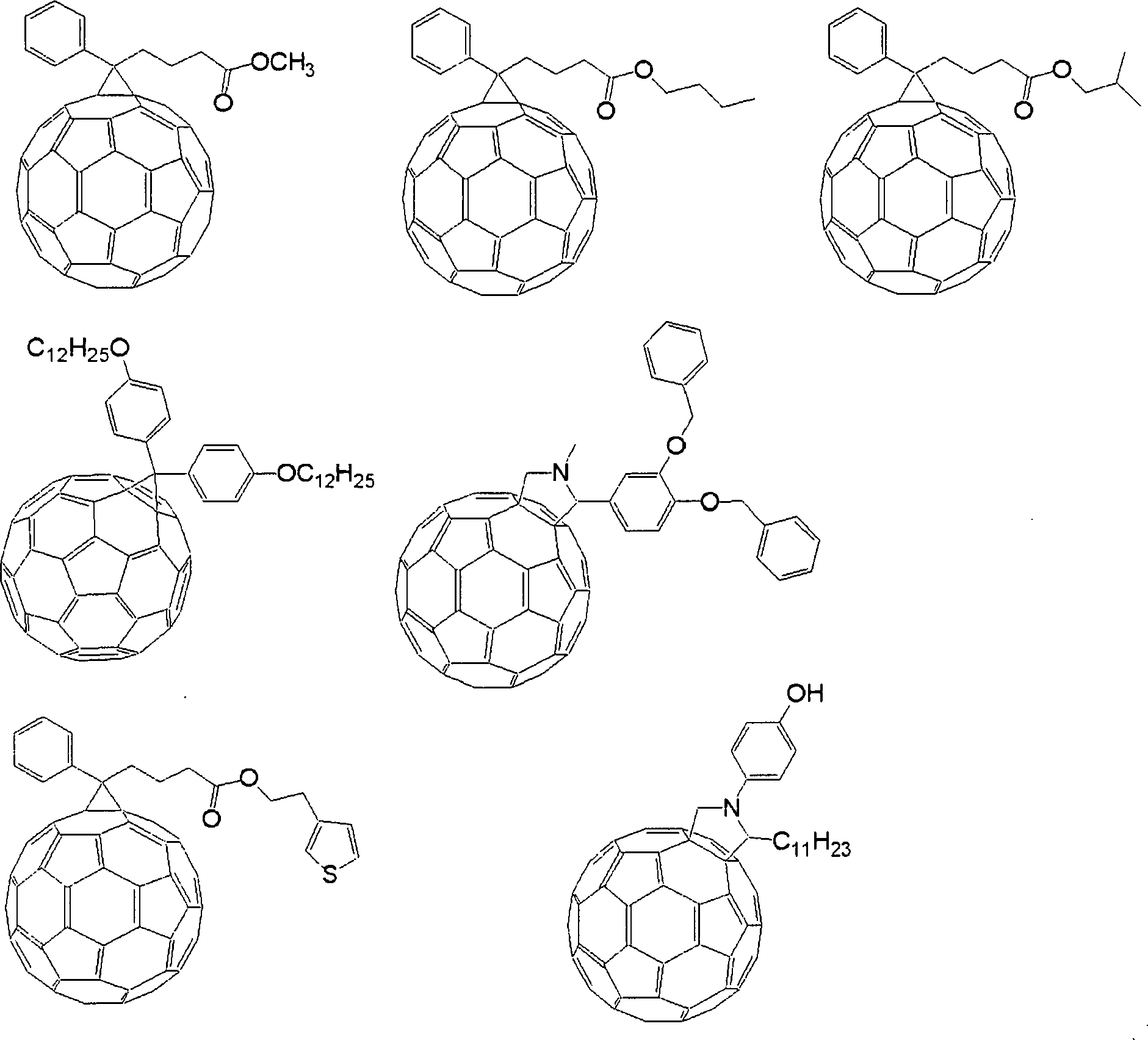
In einem Aufbau, in dem die aktive Schicht eine Elektronenakzeptorverbindung, bestehend aus Fullerenen und/oder Derivaten von Fullerenen und einer Elektronendonorverbindung, enthält, beträgt der Anteil der Fullerene und Derivate von Fullerenen vorzugsweise 10 bis 1000 Gewichtsteile, stärker bevorzugt 50 bis 500 Gewichtsteile in Bezug auf 100 Gewichtsteile der Elektronendonorverbindung. Die organische photoelektrische Umwandlungsvorrichtung weist vorzugsweise eine aktive Schicht aus einem vorstehend beschriebenen Einzelschichtaufbau auf, und weist im Hinblick auf viel Einschluss der Heteroverbindungsgrenzfläche stärker bevorzugt eine aktive Schicht eines Einschichtaufbaus auf, der eine Elektronenakzeptorverbindung, bestehend aus Fullerenen und/oder Derivaten von Fullerenen, und eine Elektronendonorverbindung enthält.In a constitution in which the active layer contains an electron acceptor compound consisting of fullerenes and / or derivatives of fullerenes and an electron donor compound, the proportion of fullerenes and derivatives of fullerenes is preferably 10 to 1000 parts by weight, more preferably 50 to 500 parts by weight to 100 parts by weight of the electron donor compound. The organic photoelectric conversion device preferably has an active layer of a single-layer structure as described above, and more preferably has an active layer of a single-layer structure comprising an electron-accepting compound consisting of fullerenes and / or derivatives of fullerenes, in view of much inclusion of the heterojunction interface Contains electron donor compound.
Die aktive Schicht enthält vorzugsweise eine konjugierte Polymerverbindung, enthält stärker bevorzugt eine konjugierte Polymerverbindung und Fullerene und/oder Derivate von Fullerenen. Die in der aktiven Schicht verwendete konjugierte Polymerverbindung schließt Polythiophen und Derivate davon, Polyphenylenvinylen und Derivate davon, Polyfluoren und Derivate davon und dgl. ein.The active layer preferably contains a conjugated polymer compound, more preferably contains a conjugated polymer compound and fullerenes and / or derivatives of fullerenes. The conjugated polymer compound used in the active layer includes polythiophene and derivatives thereof, polyphenylenevinylene and derivatives thereof, polyfluorene and derivatives thereof and the like.
Die in der aktiven Schicht enthaltene konjugierte Polymerverbindung ist vorzugsweise eine konjugierte Polymerverbindung mit einer aufbauenden Einheit, dargestellt durch Formel (1).The conjugated polymer compound contained in the active layer is preferably a conjugated polymer compound having a constituent unit represented by formula (1).
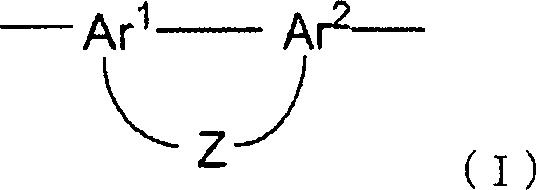
In der Formel (I) stellt Z eine Gruppe, dargestellt durch eine der nachstehend beschriebenen Formel (Z-1) bis Formel (Z-7) dar. Ar1 und Ar2 können gleich oder verschieden sein und stellen einen dreiwertigen aromatischen heterocyclischen Rest dar.In the formula (I), Z represents a group represented by one of the below-described formula (Z-1) to formula (Z-7). Ar 1 and Ar 2 may be the same or different and represent a trivalent aromatic heterocyclic group ,

In der Formel (Z-1) bis Formel (Z-7) stellt R ein Wasserstoffatom, ein Halogenatom, eine Aminogruppe, eine Cyanogruppe oder einen einwertigen organischen Rest dar. Der einwertige organische Rest schließt zum Beispiel einen gegebenenfalls substituierten Alkylrest, einen gegebenenfalls substituierten Alkoxyrest, einen gegebenenfalls substituierten Alkylthiorest, einen Arylrest, einen Aryloxyrest, einen Arylthiorest, einen gegebenenfalls substituierten Arylalkylrest, einen gegebenenfalls substituierten Arylalkoxyrest, einen gegebenenfalls substituierten Arylalkylthiorest, einen gegebenenfalls substituierten Acylrest, einen gegebenenfalls substituierten Acyloxyrest, eine gegebenenfalls substituierte Amidgruppe, eine gegebenenfalls substituierte Säureimidgruppe, eine substituierte Aminogruppe, eine substituierte Silylgruppe, eine substituierte Silyloxygruppe, eine substituierte Silylthiogruppe, eine substituierte Silylaminogruppe, einen einwertigen heterocyclischen Rest, eine heterocyclische Oxygruppe, eine heterocyclische Thiogruppe, einen Arylalkenylrest, einen Arylalkinylrest und eine Carboxylgruppe ein. In jeder der Formel (Z-1) bis Formel (Z-7) können, wenn zwei Reste R vorhanden sind, sie gleich oder zueinander verschieden sein.In the formula (Z-1) to Formula (Z-7), R represents a hydrogen atom, a halogen atom, an amino group, a cyano group or a monovalent organic group. The monovalent organic group includes, for example, an optionally substituted alkyl group, an optionally substituted one Alkoxy, optionally substituted alkylthio, aryl, aryloxy, arylthio, optionally substituted arylalkyl, optionally substituted arylalkoxy, optionally substituted arylalkylthio, optionally substituted acyl, optionally substituted acyloxy, optionally substituted amide, optionally substituted acidimide , a substituted amino group, a substituted silyl group, a substituted silyloxy group, a substituted silylthio group, a substituted silylamino group, a monovalent heterocyclic group, a heterocyclis che oxy group, a heterocyclic thio group, an arylalkenyl group, an arylalkynyl group and a carboxyl group. In each of the formula (Z-1) to formula (Z-7), when two R's are present, they may be the same or different from each other.
Das durch R darstellte Halogenatom schließt ein Fluoratom, ein Chloratom, ein Bromatom und ein Iodatom, vorzugsweise ein Fluoratom, ein.The halogen atom represented by R includes a fluorine atom, a chlorine atom, a bromine atom and an iodine atom, preferably a fluorine atom.
Der gegebenenfalls substituierte Alkylrest kann linear oder verzweigt sein und kann auch ein Cycloalkylrest sein. Der Alkylrest weist eine Zahl an Kohlenstoffatomen von üblicherweise 1 bis 30 auf. Der Substituent, den der Alkylrest gegebenenfalls aufweist, schließt zum Beispiel ein Halogenatom ein. Bestimmte Beispiele des Halogenatoms sind die gleichen wie bestimmte Beispiele des durch R dargestellten Halogenatoms. Bestimmte Beispiele des gegebenenfalls substituierten Alkylrests schließen lineare Alkylreste, wie eine Methylgruppe, eine Ethylgruppe, eine Propylgruppe, eine Isopropylgruppe, eine Butylgruppe, eine Isobutylgruppe, eine sec-Butylgruppe, eine tert-Butylgruppe, eine Pentylgruppe, eine Isopentylgruppe, eine 2-Methylbutylgruppe, eine 1-Methylbutylgruppe, eine Hexylgruppe, eine Isohexylgruppe, eine 3-Methylpentylgruppe, eine 2-Methylpentylgruppe, eine 1-Methylpentylgruppe, eine Heptylgruppe, eine Octylgruppe, eine Isooctylgruppe, eine 2-Ethylhexylgruppe, eine 3,7-Dimethyloctylgruppe, eine Nonylgruppe, eine Decylgruppe, eine Undecylgruppe, eine Dodecylgruppe, eine Tetradecylgruppe, eine Hexadecylgruppe, eine Octadecylgruppe, eine Eicosylgruppe und dgl., und Cycloalkylreste, wie eine Cyclopentylgruppe, eine Cyclohexylgruppe, eine Adamantylgruppe und dgl. ein.The optionally substituted alkyl radical may be linear or branched and may also be a cycloalkyl radical. The alkyl group has a number of carbon atoms of usually 1 to 30. The substituent which the alkyl group optionally has includes, for example, a halogen atom. Specific examples of the halogen atom are the same as specific examples of the halogen atom represented by R. Specific examples of the optionally substituted alkyl group include linear alkyl groups such as methyl group, ethyl group, propyl group, isopropyl group, butyl group, isobutyl group, sec-butyl group, tert-butyl group, pentyl group, isopentyl group, 2-methylbutyl group, 1-methylbutyl, hexyl, isohexyl, 3-methylpentyl, 2-methylpentyl, 1-methylpentyl, heptyl, octyl, isooctyl, 2-ethylhexyl, 3,7-dimethyloctyl, nonyl, a decyl group, an undecyl group, a dodecyl group, a tetradecyl group, a hexadecyl group, an octadecyl group, an eicosyl group and the like, and cycloalkyl groups such as a cyclopentyl group, a cyclohexyl group, an adamantyl group and the like.
Der gegebenenfalls substituierte Alkoxyrest kann linear oder verzweigt sein und kann auch ein Cycloalkoxyrest sein. Der Substituent, den der Alkoxyrest gegebenenfalls aufweist, schließt zum Beispiel ein Halogenatom ein. Bestimmte Beispiele des Halogenatoms sind die gleichen wie bestimmte Beispiele des durch R dargestellten Halogenatoms. Der Alkoxyrest weist eine Zahl an Kohlenstoffatomen von üblicherweise etwa 1 bis 20 auf. Bestimmte Beispiele des gegebenenfalls substituierten Alkoxyrests schließen eine Methoxygruppe, eine Etoxygruppe, eine Propoxygruppe, eine Isopropoxygruppe, eine Butoxygruppe, eine Isobutoxygruppe, eine tert-Butoxygruppe, eine Pentyloxygruppe, eine Hexyloxygruppe, eine Cyclohexyloxygruppe, eine Heptyloxygruppe, eine Octyloxygruppe, eine 2-Ethylhexyloxygruppe, eine Nonyloxygruppe, eine Decyloxygruppe, eine 3,7-Dimethyloctyloxygruppe, eine Lauryloxygruppe, eine Trifluormethoxygruppe, eine Pentafluorethoxygruppe, eine Perfluorbutoxygruppe, eine Perfluorhexyloxygruppe, eine Perfluoroctyloxygruppe, eine Methoxymethyloxygruppe und eine 2-Methoxyethyloxygruppe ein.The optionally substituted alkoxy radical may be linear or branched and may also be a cycloalkoxy radical. The substituent which the alkoxy group optionally has includes, for example, a halogen atom. Specific examples of the halogen atom are the same as specific examples of the halogen atom represented by R. The alkoxy group has a number of carbon atoms of usually about 1 to 20. Specific examples of the optionally substituted alkoxy group include methoxy group, ethoxy group, propoxy group, isopropoxy group, butoxy group, isobutoxy group, tert-butoxy group, pentyloxy group, hexyloxy group, cyclohexyloxy group, heptyloxy group, octyloxy group, 2-ethylhexyloxy group, a nonyloxy group, a decyloxy group, a 3,7-dimethyloctyloxy group, a lauryloxy group, a trifluoromethoxy group, a pentafluoroethoxy group, a perfluorobutoxy group, a perfluorohexyloxy group, a perfluorooctyloxy group, a methoxymethyloxy group and a 2-methoxyethyloxy group.
Der gegebenenfalls substituierte Alkylthiorest kann linear oder verzweigt sein und kann auch ein Cycloalkylthiorest sein. Der Substituent, den der Alkylthiorest aufweist, schließt zum Beispiel ein Halogenatom ein. Bestimmte Beispiele des Halogenatoms sind die gleichen wie bestimmte Beispiele des durch R dargestellten Halogenatoms. Der Alkylthiorest weist eine Zahl an Kohlenstoffatomen von üblicherweise etwa 1 bis 20 auf. Bestimmte Beispiele des gegebenenfalls substituierten Alkylthiorests schließen eine Methylthiogruppe, eine Ethylthiogruppe, eine Propylthiogruppe, eine Isopropylthiogruppe, eine Butylthiogruppe, eine Isobutylthiogruppe, eine tert-Butylthiogruppe, eine Pentylthiogruppe, eine Hexylthiogruppe, eine Cyclohexylthiogruppe, eine Heptylthiogruppe, eine Octylthiogruppe, eine 2-Ethylhexylthiogruppe, eine Nonylthiogruppe, eine Decylthiogruppe, eine 3,7-Dimethyloctylthiogruppe, eine Laurylthiogruppe und eine Trifluormethylthiogruppe ein.The optionally substituted alkylthio radical may be linear or branched and may also be a cycloalkylthio radical. The substituent having the alkylthio group includes, for example, a halogen atom. Specific examples of the halogen atom are the same as specific examples of the halogen atom represented by R. The alkylthio group has a number of carbon atoms of usually about 1 to 20. Specific examples of the optionally substituted alkylthio group include methylthio, ethylthio, propylthio, isopropylthio, butylthio, isobutylthio, tert-butylthio, pentylthio, hexylthio, cyclohexylthio, heptylthio, octylthio, 2-ethylhexylthio, a nonylthio group, a decylthio group, a 3,7-dimethyloctylthio group, a laurylthio group, and a trifluoromethylthio group.
Der Arylrest ist ein atomarer Rest, erhalten durch Abspalten eines Wasserstoffatoms an dem aromatischen Ring von einem gegebenenfalls substituierten aromatischen Kohlenwasserstoff und weist eine Zahl an Kohlenstoffatomen von üblicherweise 6 bis 60 auf. Der Substituent schließt zum Beispiel ein Halogenatom, einen gegebenenfalls substituierten Alkoxyrest und einen gegebenenfalls substituierten Alkylthiorest ein. Bestimmte Beispiele des Halogenatoms, des gegebenenfalls substituierten Alkoxyrests und des gegebenenfalls substituierten Alkylthiorests sind die gleichen wie bestimmte Beispiele des Halogenatoms, des gegebenenfalls substituierten Alkylrests, des gegebenenfalls substituierten Alkoxyrests und des gegebenenfalls substituierten Alkylthiorests, dargestellt durch R. Bestimmte Beispiele des Arylrests schließen eine Phenylgruppe, eine C1 bis C12 Alkoxyphenylgruppe (Das C1 bis C12 Alkyl bezeichnet ein Alkyl mit einer Zahl an Kohlenstoffatomen von 1 bis 12. Das C1 bis C12 Alkyl ist vorzugsweise ein C1 bis C8 Alkyl, stärker bevorzugt ein C1 bis C6 Alkyl. Das C1 bis C8 Alkyl bezeichnet ein Alkyl mit einer Zahl an Kohlenstoffatomen von 1 bis 8, und das C1 bis C6 Alkyl bezeichnet ein Alkyl mit einer Zahl an Kohlenstoffatomen von 1 bis 6. Bestimmte Beispiele des C1 bis C12 Alkyl, des C1 bis C8 Alkyl und des C1 bis C6 Alkyl schließen die für den vorstehend beschriebenen Alkylrest erklärten und veranschaulichten ein. Das Gleiche gilt nachstehend.), eine C1 bis C12 Alkylphenylgruppe, eine 1-Naphthylgruppe, eine 2-Naphthylgruppe und eine Pentafluorphenylgruppe ein.The aryl group is an atomic group obtained by cleaving a hydrogen atom on the aromatic ring from an optionally substituted aromatic hydrocarbon and has a number Carbon atoms of usually 6 to 60 on. The substituent includes, for example, a halogen atom, an optionally substituted alkoxy group and an optionally substituted alkylthio group. Specific examples of the halogen atom, the optionally substituted alkoxy group and the optionally substituted alkylthio group are the same as specific examples of the halogen atom, the optionally substituted alkyl group, the optionally substituted alkoxy group and the optionally substituted alkylthio group represented by R. Specific examples of the aryl group include a phenyl group. a C1 to C12 alkoxyphenyl group (The C1 to C12 alkyl refers to an alkyl having a number of carbon atoms of 1 to 12. The C1 to C12 alkyl is preferably a C1 to C8 alkyl, more preferably a C1 to C6 alkyl. The C1 to C8 alkyl denotes an alkyl having a number of carbon atoms of 1 to 8, and the C1 to C6 alkyl denotes an alkyl having a number of carbon atoms of 1 to 6. Specific examples of the C1 to C12 alkyl, the C1 to C8 alkyl and the C1 to C6 Alkyl include those explained for the alkyl moiety described above and v illustrated. The same applies hereinafter.), A C1 to C12 alkylphenyl group, a 1-naphthyl group, a 2-naphthyl group and a pentafluorophenyl group.
Der Aryloxyrest weist eine Zahl an Kohlenstoffatomen von üblicherweise etwa 6 bis 60 auf. Bestimmte Beispiele des Aryloxyrests schließen eine Phenoxygruppe, einen C1 bis C12 Alkyloxyphenoxyrest, einen C1 bis C12 Alkylphenoxyrest, eine 1-Naphthyloxygruppe, eine 2-Naphthyloxygrupe und eine Pentafluorphenyloxygruppe ein.The aryloxy group has a number of carbon atoms of usually about 6 to 60. Specific examples of the aryloxy group include a phenoxy group, a C1 to C12 alkyloxyphenoxy group, a C1 to C12 alkylphenoxy group, a 1-naphthyloxy group, a 2-naphthyloxy group, and a pentafluorophenyloxy group.
Der Arylthiorest weist eine Zahl an Kohlenstoffatomen von üblicherweise etwa 6 bis 60 auf. Bestimmte Beispiele des Arylthiorests schließen eine Phenylthiogruppe, einen C1 bis C12 Alkyloxyphenylthiorest, einen C1 bis C12 Alkylphenylthiorest, eine 1-Naphthylthiogruppe, eine 2-Naphthylthiogruppe und eine Pentafluorphenylthiogruppe ein.The arylthio group has a number of carbon atoms of usually about 6 to 60. Specific examples of the arylthio group include phenylthio, C1 to C12 alkyloxyphenylthio, C1 to C12 alkylphenylthio, 1-naphthylthio, 2-naphthylthio and pentafluorophenylthio.
Der gegebenenfalls substituierte Arylalkylrest weist eine Zahl an Kohlenstoffatomen von üblicherweise etwa 7 bis 60 auf, und der Alkylteil weist gegebenenfalls einen Substituenten auf. Der Substituent schließt zum Beispiel ein Halogenatom ein. Bestimmte Beispiele des Halogenatoms sind die gleichen wie die bestimmten Beispiele des durch R dargestellten Halogenatoms. Bestimmte Beispiele des gegebenenfalls substituierten Arylalkylrests schließen einen Phenyl-C1 bis C12 alkylrest, einen C1 bis 12 Alkyloxyphenyl-C1 bis C12 alkylrest, einen C1 bis C12 Alkylphenyl-C1 bis C12 alkylrest, einen 1-Naphthyl-C1 bis C12 alkylrest und einen 2-Naphthyl-C1 bis C12 alkylrest ein.The optionally substituted arylalkyl group has a number of carbon atoms of usually about 7 to 60, and the alkyl portion optionally has a substituent. The substituent includes, for example, a halogen atom. Specific examples of the halogen atom are the same as the specific examples of the halogen atom represented by R. Specific examples of the optionally substituted arylalkyl group include a phenyl C1 to C12 alkyl group, a C1 to 12 alkyloxyphenyl C1 to C12 alkyl group, a C1 to C12 alkylphenyl C1 to C12 alkyl group, a 1-naphthyl C1 to C12 alkyl group and a 2- Naphthyl-C1 to C12 alkyl radical.
Der gegebenenfalls substituierte Arylalkoxyrest weist eine Zahl an Kohlenstoffatomen von üblicherweise etwa 7 bis 60 auf, und der Alkoxyteil weist gegebenenfalls einen Substituenten auf. Der Substituent schließt zum Beispiel ein Halogenatom ein. Bestimmte Beispiele des Halogenatoms sind die gleichen wie bestimmte Beispiele des durch R dargestellten Halogenatoms. Bestimmte Beispiele des gegebenenfalls substituierten Arylalkyloxyrests schließen einen Phenyl-C1 bis C12 alkyloxyrest, einen C1 bis C12 Alkyloxyphenyl-C1 bis C12 alkyloxyrest, einen C1 bis C12 Alkylphenyl-C1 bis C12 alkyloxyrest, einen 1-Naphthyl-C1 bis C12 alkyloxyrest und einen 2-Naphthyl-C1 bis C12 alkyloxyrest ein.The optionally substituted arylalkoxy group has a number of carbon atoms of usually about 7 to 60, and the alkoxy part optionally has a substituent. The substituent includes, for example, a halogen atom. Specific examples of the halogen atom are the same as specific examples of the halogen atom represented by R. Specific examples of the optionally substituted arylalkyloxy group include a phenyl C1 to C12 alkyloxy group, a C1 to C12 alkyloxyphenyl C1 to C12 alkyloxy group, a C1 to C12 alkylphenyl C1 to C12 alkyloxy group, a 1-naphthyl C1 to C12 alkyloxy group, and a 2- Naphthyl-C1 to C12 alkyloxy.
Der gegebenenfalls substituierte Arylalkylthiorest weist eine Zahl an Kohlenstoffatomen von üblicherweise etwa 7 bis 60 auf, und der Alkylthioteil weist gegebenenfalls einen Substituenten auf. Der Substituent schließt zum Beispiel ein Halogenatom ein. Bestimmte Beispiele des Halogenatoms sind die gleichen wie bestimmte Beispiele des durch R dargestellten Halogenatoms. Bestimmte Beispiele des gegebenenfalls substituierten Arylalkylthiorests schließen einen Phenyl-C1 bis C12 alkylthiorest, einen C1 bis C12 Alkyloxyphenyl-C1 bis C12 alkylthiorest, einen C1 bis C12 Alkylphenyl-C1 bis C12 alkylthiorest, einen 1-Naphthyl-C1 bis C12 alkylthiorest und einen 2-Naphthyl-C1 bis C12 alkylthiorest ein.The optionally substituted arylalkylthio group has a number of carbon atoms of usually about 7 to 60, and the alkylthio part optionally has a substituent. The substituent includes, for example, a halogen atom. Specific examples of the halogen atom are the same as specific examples of the halogen atom represented by R. Specific examples of the optionally substituted arylalkylthio group include a phenyl C1 to C12 alkylthio group, a C1 to C12 alkyloxyphenyl C1 to C12 alkylthio group, a C1 to C12 alkylphenyl C1 to C12 alkylthio group, a 1-naphthyl C1 to C12 alkylthio group and a 2- Naphthyl-C1 to C12 alkylthio.
Der gegebenenfalls substituierte Acylrest weist eine Zahl an Kohlenstoffatomen von üblicherweise etwa 2 bis 20 auf. Der Substituent, den der Acylrest gegebenenfalls aufweist, schließt zum Beispiel ein Halogenatom ein. Bestimmte Beispiele des Halogenatoms sind die gleichen wie bestimmte Beispiele des durch R dargestellten Halogenatoms. Bestimmte Beispiele des gegebenenfalls substituierten Acylrests schließen eine Acetylgruppe, eine Propionylgruppe, eine Butyrylgruppe, eine Isobutyrylgruppe, eine Pivaloylgruppe, eine Benzoylgruppe, eine Trifluoracetylgruppe und eine Pentafluorbenzoylgruppe ein.The optionally substituted acyl group has a number of carbon atoms of usually about 2 to 20. The substituent which the acyl group optionally has includes, for example, a halogen atom. Specific examples of the halogen atom are the same as specific examples of the halogen atom represented by R. Specific examples of the optionally substituted acyl group include an acetyl group, a propionyl group, a butyryl group, an isobutyryl group, a pivaloyl group, a benzoyl group, a trifluoroacetyl group and a pentafluorobenzoyl group.
Der gegebenenfalls substituierte Acyloxyrest weist eine Zahl an Kohlenstoffatomen von üblicherweise etwa 2 bis 20 auf. Der Substituent, den der Acyloxyrest gegebenenfalls aufweist, schließt zum Beispiel ein Halogenatom ein. Bestimmte Beispiele des Halogenatoms sind die gleichen wie bestimmte Beispiele des durch R dargestellten Halogenatoms. Bestimmte Beispiele der gegebenenfalls substituierten Acyloxygruppe schließen eine Acetoxygruppe, eine Propionyloxygruppe, eine Butyryloxygruppe, eine Isobutyryloxygruppe, eine Pivaloyloxygruppe, eine Benzoyloxygruppe, eine Trifluoracetyloxygruppe und eine Pentafluorbenzoyloxygruppe ein.The optionally substituted acyloxy group has a number of carbon atoms of usually about 2 to 20. The substituent which the acyloxy group optionally has includes, for example, a halogen atom. Specific examples of the halogen atom are the same as specific examples of the halogen atom represented by R. Specific examples of the optionally substituted acyloxy group include an acetoxy group, a propionyloxy group, a butyryloxy group, an isobutyryloxy group, a Pivaloyloxy group, a benzoyloxy group, a trifluoroacetyloxy group and a pentafluorobenzoyloxy group.
Die gegebenenfalls substituierte Amidgruppe weist eine Zahl an Kohlenstoffatomen von üblicherweise etwa 1 bis 20 auf. Die Amidgruppe bezeichnet eine Gruppe, erhalten durch Abspalten eines Wasserstoffatoms von einem Amid, das an sein Stickstoffatom gebunden ist. Der Substituent, den die Amidgruppe gegebenenfalls aufweist, schließt zum Beispiel ein Halogenatom ein. Bestimmte Beispiele des Halogenatoms sind die gleichen wie bestimmte Beispiele des durch R dargestellten Halogenatoms. Bestimmte Beispiele der gegebenenfalls substituierten Amidgruppe schließen eine Formamidgruppe, eine Acetamidgruppe, eine Propioamidgruppe, eine Butyroamidgruppe, eine Benzamidgruppe, eine Trifluoracetamidgruppe, eine Pentafluorbenzamidgruppe, eine Diformamidgruppe, eine Diacetamidgruppe, eine Dipropioamidgruppe, eine Dibutyroamidgruppe, eine Dibenzamidgruppe, eine Ditrifluoracetamidgruppe und eine Dipentafluorbenzamidgruppe ein.The optionally substituted amide group has a number of carbon atoms of usually about 1 to 20. The amide group means a group obtained by cleaving a hydrogen atom from an amide bonded to its nitrogen atom. The substituent which the amide group optionally has includes, for example, a halogen atom. Specific examples of the halogen atom are the same as specific examples of the halogen atom represented by R. Specific examples of the optionally substituted amide group include a formamide group, an acetamide group, a propioamide group, a butyroamide group, a benzamide group, a trifluoroacetamide group, a pentafluorobenzamide group, a diformamide group, a diacetamide group, a dipropioamide group, a dibutyroamide group, a dibenzamide group, a ditrifluoroacetamide group and a dipentafluorobenzamide group.
Die gegebenenfalls substituierte Säureimidgruppe weist eine Zahl an Kohlenstoffatomen von üblicherweise etwa 2 bis 20 auf. Die Säureimidgruppe bezeichnet eine Gruppe, erhalten durch Abspalten eines Wasserstoffatoms, gebunden an sein Stickstoffatom, von einem Säureimid. Der Substituent, den die Säureimidgruppe gegebenenfalls aufweist, schließt zum Beispiel ein Halogenatom ein. Bestimmte Beispiele des Halogenatoms sind die gleichen wie bestimmte Beispiele des durch R dargestellten Halogenatoms. Bestimmte Beispiele der gegebenenfalls substituierten Säureimidgruppe schließen eine Succinimidgruppe und eine Phthalimidgruppe ein.The optionally substituted acidimide group has a number of carbon atoms of usually about 2 to 20. The acidimide group means a group obtained by cleaving a hydrogen atom bonded to its nitrogen atom from an acid imide. The substituent optionally possessed by the acidimide group includes, for example, a halogen atom. Specific examples of the halogen atom are the same as specific examples of the halogen atom represented by R. Specific examples of the optionally substituted acidimide group include a succinimide group and a phthalimido group.
Die substituierte Aminogruppe weist eine Zahl an Kohlenstoffatomen von üblicherweise etwa 1 bis 40 auf. Der Substituent, den die substituierte Aminogruppe aufweist, schließt zum Beispiel einen gegebenenfalls substituierten Alkylrest und einen Arylrest ein. Bestimmte Beispiele des gegebenenfalls substituierten Alkylrests und des Arylrests sind die gleichen wie bestimmte Beispiele des gegebenenfalls substituierten Alkylrests und des Arylrests, dargestellt durch R. Bestimmte Beispiele der substituierten Aminogruppe schließen eine Methylaminogruppe, eine Dimethylaminogruppe, eine Ethylaminogruppe, eine Diethylaminogruppe, eine Propylaminogruppe, eine Dipropylaminogruppe, eine Isopropylaminogruppe, eine Diisopropylaminogruppe, eine Butylaminogruppe, eine Isobutylaminogruppe, eine tert-Butylaminogruppe, eine Pentylaminogruppe, eine Hexylaminogruppe, eine Cyclohexylaminogruppe, eine Heptylaminogruppe, eine Octylaminogruppe, eine 2-Ethylhexylaminogruppe, eine Nonylaminogruppe, eine Decylaminogruppe, eine 3,7-Dimethyloctylaminogruppe, eine Laurylaminogruppe, eine Cyclopentylaminogruppe, eine Dicyclopentylaminogruppe, eine Cyclohexylaminogruppe, eine Dicyclohexylaminogruppe, eine Pyrrolidylgruppe, eine Piperidylgruppe, eine Ditrifluormethylaminogruppe, eine Phenylaminogruppe, eine Diphenylaminogruppe, einen C1 bis C12 Alkyloxyphenylaminorest, einen Di(C1 bis C12 alkyloxyphenyl)aminorest, einen Di(C1 bis C12 alkylphenyl)aminorest, eine 1-Naphthylaminogruppe, eine 2-Naphthylaminogruppe, eine Pentafluorphenylaminogruppe, eine Pyridylaminogruppe, eine Pyridazinylaminogruppe, eine Pyrimidylaminogruppe, eine Pyrazylaminogruppe, eine Triazylaminogruppe, eine Phenyl-C1 bis C12 alkylaminogruppe, einen C1 bis C12 Alkyloxyphenyl-C1 bis C12 alkylaminorest, einen C1 bis C12 Alkylphenyl-C1 bis C12 alkylaminorest, einen Di(C1 bis C12 alkyloxyphenyl-C1 bis C12 alkyl)aminorest, einen Di(C1 bis C12 alkylphenyl-C1 bis C12 alkyl)aminorest, einen 1-Naphthyl-C1 bis C12 alkylaminorest und einen 2-Naphthyl-C1 bis C12 alkylaminorest ein.The substituted amino group has a number of carbon atoms of usually about 1 to 40. The substituent having the substituted amino group includes, for example, an optionally substituted alkyl group and an aryl group. Specific examples of the optionally substituted alkyl group and the aryl group are the same as specific examples of the optionally substituted alkyl group and the aryl group represented by R. Specific examples of the substituted amino group include a methylamino group, a dimethylamino group, an ethylamino group, a diethylamino group, a propylamino group, a dipropylamino group an isopropylamino, diisopropylamino, butylamino, isobutylamino, tert-butylamino, pentylamino, hexylamino, cyclohexylamino, heptylamino, octylamino, 2-ethylhexylamino, nonylamino, decylamino, 3,7-dimethyloctylamino group , a laurylamino group, a cyclopentylamino group, a dicyclopentylamino group, a cyclohexylamino group, a dicyclohexylamino group, a pyrrolidyl group, a piperidyl group, a ditrifluoromethylaminog a phenylamino group, a diphenylamino group, a C1 to C12 alkyloxyphenylamino group, a di (C1 to C12 alkyloxyphenyl) amino group, a di (C1 to C12 alkylphenyl) amino group, a 1-naphthylamino group, a 2-naphthylamino group, a pentafluorophenylamino group, a pyridylamino group, a pyridazinylamino group, a pyrimidylamino group, a pyrazylamino group, a triazylamino group, a phenyl-C1 to C12 alkylamino group, a C1 to C12 alkyloxyphenyl C1 to C12 alkylamino radical, a C1 to C12 alkylphenyl C1 to C12 alkylamino radical, a di (C1 to C12 alkyloxyphenyl) C1 to C12 alkyl) amino, di (C1 to C12 alkylphenyl C1 to C12 alkyl) amino, 1-naphthyl C1 to C12 alkylamino and 2-naphthyl C1 to C12 alkylamino.
Die substituierte Silylgruppe weist eine Zahl an Kohlenstoffatomen von üblicherweise etwa 3 bis 40 auf. Der Substituent, den die substituierte Silylgruppe aufweist, schließt zum Beispiel einen gegebenenfalls substituierten Alkylrest und einen Arylrest ein. Bestimmte Beispiele des gegebenenfalls substituierten Alkylrests und des Arylrests sind die gleichen wie bestimmte Beispiele des gegebenenfalls substituierten Alkylrests und des Arylrests, dargestellt durch R. Bestimmte Beispiele der substituierten Silylgruppe schließen eine Trimethylsilylgruppe, eine Triethylsilylgruppe, eine Tripropylsilylgruppe, eine Triisopropylsilylgruppe, eine tert-Butyldimethylsilylgruppe, eine Triphenylsilylgruppe, eine Tri-p-xylylsilylgruppe, eine Tribenzylsilylgruppe, eine Diphenylmethylsilylgruppe, eine tert-Butyldiphenylsilylgruppe und eine Dimethylphenylsilylgruppe ein.The substituted silyl group has a number of carbon atoms of usually about 3 to 40. The substituent having the substituted silyl group includes, for example, an optionally substituted alkyl group and an aryl group. Specific examples of the optionally substituted alkyl group and the aryl group are the same as specific examples of the optionally substituted alkyl group and the aryl group represented by R. Specific examples of the substituted silyl group include a trimethylsilyl group, a triethylsilyl group, a tripropylsilyl group, a triisopropylsilyl group, a tert-butyldimethylsilyl group, a triphenylsilyl group, a tri-p-xylylsilyl group, a tribenzylsilyl group, a diphenylmethylsilyl group, a tert-butyldiphenylsilyl group and a dimethylphenylsilyl group.
Die substituierte Silyloxygruppe weist eine Zahl an Kohlenstoffatomen von üblicherweise etwa 3 bis 40 auf. Der Substituent, den die substituierte Silyloxygruppe aufweist, schließt zum Beispiel einen gegebenenfalls substituierten Alkylrest und einen Arylrest ein. Bestimmte Beispiele des gegebenenfalls substituierten Alkylrests und des Arylrests sind die gleichen wie bestimmte Beispiele des gegebenenfalls substituierten Alkylrests und des Arylrests, dargestellt durch R. Bestimmte Beispiele der substituierten Silyloxygruppe schließen eine Trimethylsilyloxygruppe, eine Triethylsilyloxygruppe, eine Tripropylsilyloxygruppe, eine Triisopropylsilyloxygruppe, eine tert-Butyldimethylsilyloxygruppe, eine Triphenylsilyloxygruppe, eine Tri-p-xylylsilyloxygruppe, eine Tribenzylsilyloxygruppe, eine Diphenylmethylsilyloxygruppe, eine tert-Butyldiphenylsilyloxygruppe und eine Dimethylphenylsilyloxygruppe ein.The substituted silyloxy group has a number of carbon atoms of usually about 3 to 40. The substituent having the substituted silyloxy group includes, for example, an optionally substituted alkyl group and an aryl group. Specific examples of the optionally substituted alkyl group and the aryl group are the same as specific examples of the optionally substituted alkyl group and the aryl group represented by R. Specific examples of the substituted silyloxy group include a trimethylsilyloxy group, a triethylsilyloxy group, a tripropylsilyloxy group, a triisopropylsilyloxy group, a tert-butyldimethylsilyloxy group, a triphenylsilyloxy group, a tri-p-xylylsilyloxy group, a tribenzylsilyloxy group, a diphenylmethylsilyloxy group, a tert-butyldiphenylsilyloxy group and a dimethylphenylsilyloxy group.
Die substituierte Silylthiogruppe weist eine Zahl an Kohlenstoffatomen von üblicherweise etwa 3 bis 40 auf. Der Substituent, den die substituierte Silylthiogruppe aufweist, schließt zum Beispiel einen gegebenenfalls substituierten Alkylrest und einen Arylrest ein. Bestimmte Beispiele des gegebenenfalls substituierten Alkylrests und des Arylrests sind die gleichen wie bestimmte Beispiele des gegebenenfalls substituierten Alkylrests und des Arylrests, dargestellt durch R. Bestimmte Beispiele der substituierten Silylthiogruppe schließen eine Trimethylsilylthiogruppe, eine Triethylsilylthiogruppe, eine Tripropylsilylthiogruppe, eine Triisopropylsilylthiogruppe, eine tert-Butyldimethylsilylthiogruppe, eine Triphenylsilylthiogruppe, eine Tri-p-xylylsilylthiogruppe, eine Tribenzylsilylthiogruppe, eine Diphenylmethylsilylthiogruppe, eine tert-Butyldiphenylsilylthiogruppe und eine Dimethylphenylsilylthiogruppe ein. The substituted silylthio group has a number of carbon atoms of usually about 3 to 40. The substituent having the substituted silylthio group includes, for example, an optionally substituted alkyl group and an aryl group. Specific examples of the optionally substituted alkyl group and the aryl group are the same as specific examples of the optionally substituted alkyl group and the aryl group represented by R. Specific examples of the substituted silylthio group include a trimethylsilylthio group, a triethylsilylthio group, a tripropylsilylthio group, a triisopropylsilylthio group, a tert-butyldimethylsilylthio group, a triphenylsilylthio group, a tri-p-xylylsilylthio group, a tribenzylsilylthio group, a diphenylmethylsilylthio group, a tert-butyldiphenylsilylthio group, and a dimethylphenylsilylthio group.
Die substituierte Silylaminogruppe weist eine Zahl an Kohlenstoffatomen von üblicherweise etwa 3 bis 80 auf. Der Substituent, den die substituierte Silylaminogruppe aufweist, schließt zum Beispiel einen gegebenenfalls substituierten Alkylrest und einen Arylrest ein. Bestimmte Beispiele des gegebenenfalls substituierten Alkylrests und des Arylrests sind die gleichen wie bestimmte Beispiele des gegebenenfalls substituierten Alkylrests und des Arylrests, dargestellt durch R. Bestimmte Beispiele der substituierten Silylaminogruppe schließen eine Trimethylsilylaminogruppe, eine Triethylsilylaminogruppe, eine Tripropylsilylaminogruppe, eine Triisopropylsilylaminogruppe, eine tert-Butyldimethylsilylaminogruppe, eine Tri-phenylsilylaminogruppe, eine Tri-p-xylylsilylaminogruppe, eine Tribenzylsilylaminogruppe, eine Diphenylmethylsilylaminogruppe, eine tert-Butyldiphenylsilylaminogruppe, eine Dimethylphenylsilylaminogruppe, eine Di(trimethylsilyl)aminogruppe, eine Di(triethylsilyl)aminogruppe, eine Di(tripropylsilyl)aminogruppe, eine Di(triisopropylsilyl)aminogruppe, eine Di(tert-butyldimethylsilyl)aminogruppe, eine Di(tri-phenylsilyl)aminogruppe, eine Di(tri-p-xylylsilyl)aminogruppe, eine Di(tribenzylsilyl)aminogruppe, eine Di(diphenylmethylsilyl)aminogruppe, eine Di(tert-butyldiphenylsilyl)aminogruppe und eine Di(dimethylphenylsilyl)aminogruppe ein.The substituted silylamino group has a number of carbon atoms of usually about 3 to 80. The substituent having the substituted silylamino group includes, for example, an optionally substituted alkyl group and an aryl group. Specific examples of the optionally substituted alkyl group and the aryl group are the same as specific examples of the optionally substituted alkyl group and the aryl group represented by R. Specific examples of the substituted silylamino group include a trimethylsilylamino group, a triethylsilylamino group, a tripropylsilylamino group, a triisopropylsilylamino group, a tert-butyldimethylsilylamino group, a tri-phenylsilylamino group, a tri-p-xylylsilylamino group, a tribenzylsilylamino group, a diphenylmethylsilylamino group, a tert-butyldiphenylsilylamino group, a dimethylphenylsilylamino group, a di (trimethylsilyl) amino group, a di (triethylsilyl) amino group, a di (tripropylsilyl) amino group, a di ( triisopropylsilyl) amino group, a di (tert-butyldimethylsilyl) amino group, a di (tri-phenylsilyl) amino group, a di (tri-p-xylylsilyl) amino group, a di (tribenzylsilyl) amino group, a di (diphenylmethylsilyl) aminogru ppe, a di (tert-butyldiphenylsilyl) amino group and a di (dimethylphenylsilyl) amino group.
Der einwertige heterocyclische Rest ist ein atomarer Rest, erhalten durch Abspalten eines Wasserstoffatoms an dem Heteroring von einer gegebenenfalls substituierten heterocyclischen Verbindung. Der einwertige heterocyclische Rest weist eine Zahl an Kohlenstoffatomen von üblicherweise 4 bis 20 auf. Die heterocyclische Verbindung schließt zum Beispiel Furan, Thiophen, Pyrrol, Pyrrolin, Pyrrolidin, Oxazol, Isooxazol, Thiazol, Isothiazol, Imidazol, Imidazolin, Imidazolidin, Pyrazol, Pyrazolin, Pyrazolidin, Furazan, Triazol, Thiadiazol, Oxadiazol, Tetrazol, Pyran, Pyridin, Piperidin, Thiopyran, Pyridazin, Pyrimidin, Pyrazin, Piperazin, Morpholin, Triazin, Benzofuran, Isobenzofuran, Benzothiophen, Indol, Isoindol, Indolizin, Indolin, Isoindolin, Chromen, Chroman, Isochroman, Benzopyran, Chinolin, Isochinolin, Chinolizin, Benzimidazol, Benzthiazol, Indazol, Naphthyridin, Chinoxalin, Chinazolin, Chinazolidin, Cinnolin, Phthalazin, Purin, Pteridin, Carbazol, Xanthen, Phenanthridin, Acridin, β-Carbolin, Perimidin, Phenanthrolin, Thianthren, Phenoxathiin, Phenoxazin, Phenothiazin und Phenazin ein. Der Substituent, den die heterocyclische Verbindung gegebenenfalls aufweist, schließt zum Beispiel ein Halogenatom, einen gegebenenfalls substituierten Alkylrest, einen gegebenenfalls substituierten Alkoxyrest und einen gegebenenfalls substituierten Alkylthiorest ein. Bestimmte Beispiele des Halogenatoms, des gegebenenfalls substituierten Alkylrests, des gegebenenfalls substituierten Alkoxyrests und substituierten und des gegebenenfalls substituierten Alkylthiorests sind die gleichen wie bestimmte Beispiele des Halogenatoms, des gegebenenfalls substituierten Alkylrests, des gegebenenfalls substituierten Alkoxyrests und des gegebenenfalls substituierten Alkylthiorests, dargestellt durch R. Der heterocyclische Rest ist vorzugsweise ein aromatischer heterocyclischer Rest.The monovalent heterocyclic group is an atomic group obtained by cleaving a hydrogen atom on the hetero ring of an optionally substituted heterocyclic compound. The monovalent heterocyclic radical has a number of carbon atoms of usually 4 to 20. The heterocyclic compound includes, for example, furan, thiophene, pyrrole, pyrroline, pyrrolidine, oxazole, isooxazole, thiazole, isothiazole, imidazole, imidazoline, imidazolidine, pyrazole, pyrazoline, pyrazolidine, furazane, triazole, thiadiazole, oxadiazole, tetrazole, pyran, pyridine, Piperidine, thiopyran, pyridazine, pyrimidine, pyrazine, piperazine, morpholine, triazine, benzofuran, isobenzofuran, benzothiophene, indole, isoindole, indolizine, indoline, isoindoline, chromene, chroman, isochroman, benzopyran, quinoline, isoquinoline, quinolizine, benzimidazole, benzthiazole, Indazole, naphthyridine, quinoxaline, quinazoline, quinazolidine, cinnoline, phthalazine, purine, pteridine, carbazole, xanthene, phenanthridine, acridine, β-carboline, perimidine, phenanthroline, thianthrene, phenoxathiin, phenoxazine, phenothiazine and phenazine. The substituent optionally possessed by the heterocyclic compound includes, for example, a halogen atom, an optionally substituted alkyl group, an optionally substituted alkoxy group and an optionally substituted alkylthio group. Specific examples of the halogen atom, the optionally substituted alkyl group, the optionally substituted alkoxy group and the substituted and optionally substituted alkylthio group are the same as specific examples of the halogen atom, the optionally substituted alkyl group, the optionally substituted alkoxy group and the optionally substituted alkylthio group represented by R. Der heterocyclic radical is preferably an aromatic heterocyclic radical.
Die heterocyclische Oxygruppe schließt eine Gruppe, dargestellt durch die Formel (A-1), erhalten durch Binden eines Sauerstoffatoms an den vorstehend beschriebenen einwertigen heterocyclischen Rest, ein.The heterocyclic oxy group includes a group represented by the formula (A-1) obtained by bonding an oxygen atom to the above-described monovalent heterocyclic group.
Die heterocyclische Thiogruppe schließt eine Gruppe, dargestellt durch die Formel (A-2), erhalten durch Binden eines Schwefelatoms an die vorstehend beschriebene einwertige heterocyclische Gruppe, ein. 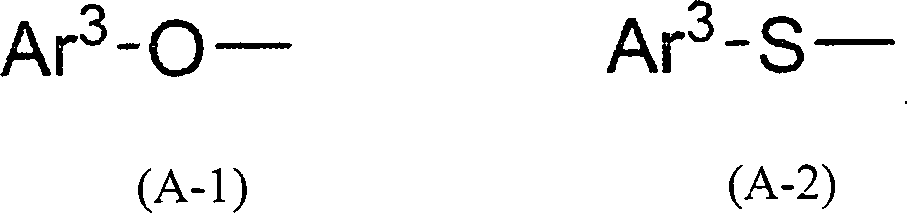
Bestimmte Beispiele der heterocyclischen Oxygruppe schließen eine Thienyloxygruppe, einen C1 bis C12 Alkylthienyloxyrest, eine Pyrrolyloxygruppe, eine Furyloxygruppe, eine Pyridyloxygruppe, einen C1 bis C12 Alkylpyridyloxyrest, eine Imidazolyloxygruppe, eine Pyrazolyloxygruppe, eine Triazolyloxygruppe, eine Oxazolyloxygruppe, eine Thiazoloxygruppe und eine Thiadiazoloxygruppe ein.Specific examples of the heterocyclic oxy group include a thienyloxy group, a C1 to C12 alkylthienyloxy group, a pyrrolyloxy group, a furyloxy group, a pyridyloxy group, a C1 to C12 alkylpyridyloxy group, an imidazolyloxy group, a pyrazolyloxy group, a triazolyloxy group, an oxazolyloxy group, a thiazoloxy group, and a thiadiazoloxy group.
Bestimmte Beispiele der heterocyclischen Thiogruppe schließen eine Thienylmercaptogruppe, einen C1 bis C12 Alkylthienylmercaptorest, eine Pyrrolylmercaptogruppe, eine Furylmercaptogruppe, eine Pyridylmercaptogruppe, einen C1 bis C12 Alkylpyridylmercaptorest, eine Imidazolylmercaptogruppe, eine Pyrazolylmercaptogruppe, eine Triazolylmercaptogruppe, eine Oxazolylmercaptogruppe, eine Thiazolmercaptogruppe und eine Thiadiazolmercaptogruppe ein. Specific examples of the heterocyclic thio group include a Thienylmercaptogruppe, a C1 to C12 Alkylthienylmercaptorest, a Pyrrolylmercaptogruppe, a Furylmercaptogruppe, a Pyridylmercaptogruppe, a C1 to C12 Alkylpyridylmercaptorest, a Imidazolylmercaptogruppe, a Pyrazolylmercaptogruppe, a Triazolylmercaptogruppe, a Oxazolylmercaptogruppe, a Thiazolmercaptogruppe and a Thiadiazolmercaptogruppe.
Der Arylalkenylrest weist üblicherweise eine Zahl an Kohlenstoffatomen von 8 bis 20 auf. Bestimmte Beispiele des Arylalkenylrests schließen eine Styrylgruppe ein.The arylalkenyl radical usually has a number of carbon atoms of 8 to 20. Specific examples of the arylalkenyl group include a styryl group.
Der Arylalkinylrest weist üblicherweise eine Zahl an Kohlenstoffatomen von 8 bis 20 auf. Bestimmte Beispiele des Arylalkinylrests schließen eine Phenylacetylenylgruppe ein.The arylalkynyl radical usually has a number of carbon atoms of 8 to 20. Specific examples of the arylalkynyl group include a phenylacetylenyl group.
Der dreiwertige aromatische heterocyclische Rest, der durch Ar1 und Ar2 dargestellt wird, bezeichnet einen atomaren Rest, der nach Abspalten von einer gegebenenfalls substituierten heterocyclischen Verbindung mit Aromatizität von drei Wasserstoffatomen am aromatischen Ring verbleibt.The trivalent aromatic heterocyclic radical represented by Ar 1 and Ar 2 denotes an atomic residue remaining on the aromatic ring after cleavage of an optionally substituted heterocyclic compound having aromaticity of three hydrogen atoms.
Der dreiwertige aromatische heterocyclische Rest weist eine Zahl an Kohlenstoffatomen von üblicherweise 2 bis 60, vorzugsweise 4 bis 60, stärker bevorzugt 4 bis 20, auf.The trivalent aromatic heterocyclic group has a number of carbon atoms of usually 2 to 60, preferably 4 to 60, more preferably 4 to 20.
Der Substituent, den die heterocyclische Verbindung mit Aromatizität gegebenenfalls aufweist, schließt zum Beispiel ein Halogenatom, eine Aminogruppe, eine Cyanogruppe und einen einwertigen organischen Rest ein. Die Definition und bestimmte Beispiele des Halogenatoms und des einwertigen organischen Rests sind die gleichen wie die Definition und bestimmte Beispiele des Halogenatoms und des einwertigen organischen Rests, dargestellt durch R.The substituent optionally possessed by the heterocyclic compound having aromaticity includes, for example, a halogen atom, an amino group, a cyano group and a monovalent organic group. The definition and specific examples of the halogen atom and the monovalent organic group are the same as the definition and specific examples of the halogen atom and the monovalent organic group represented by R.
Bestimmte Beispiele des dreiwertigen aromatischen heterocyclischen Rests, der durch Art und Ar2 dargestellt wird, schließen die Formel (201) bis Formel (301), nachstehend gezeigt, ein. 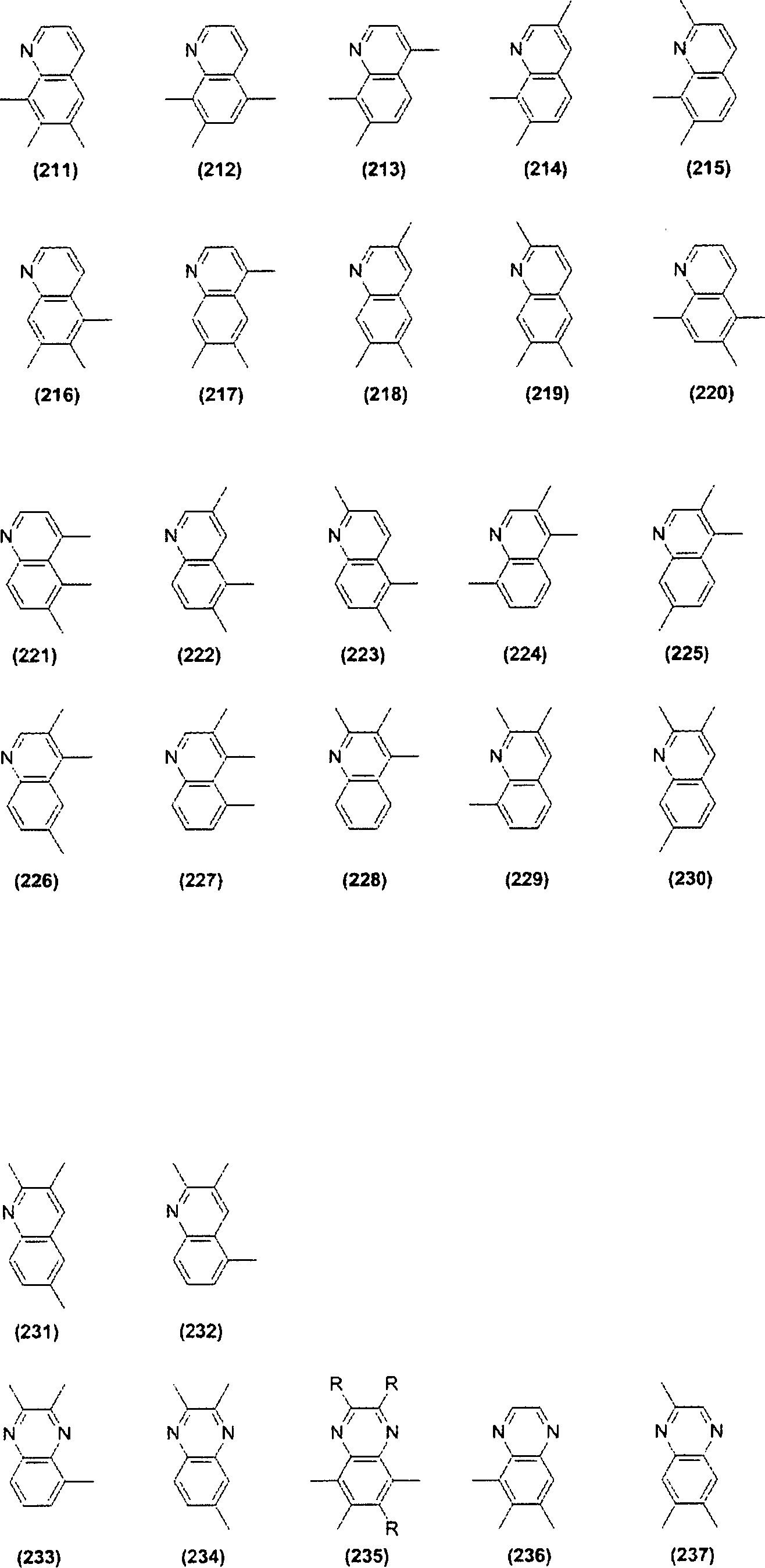
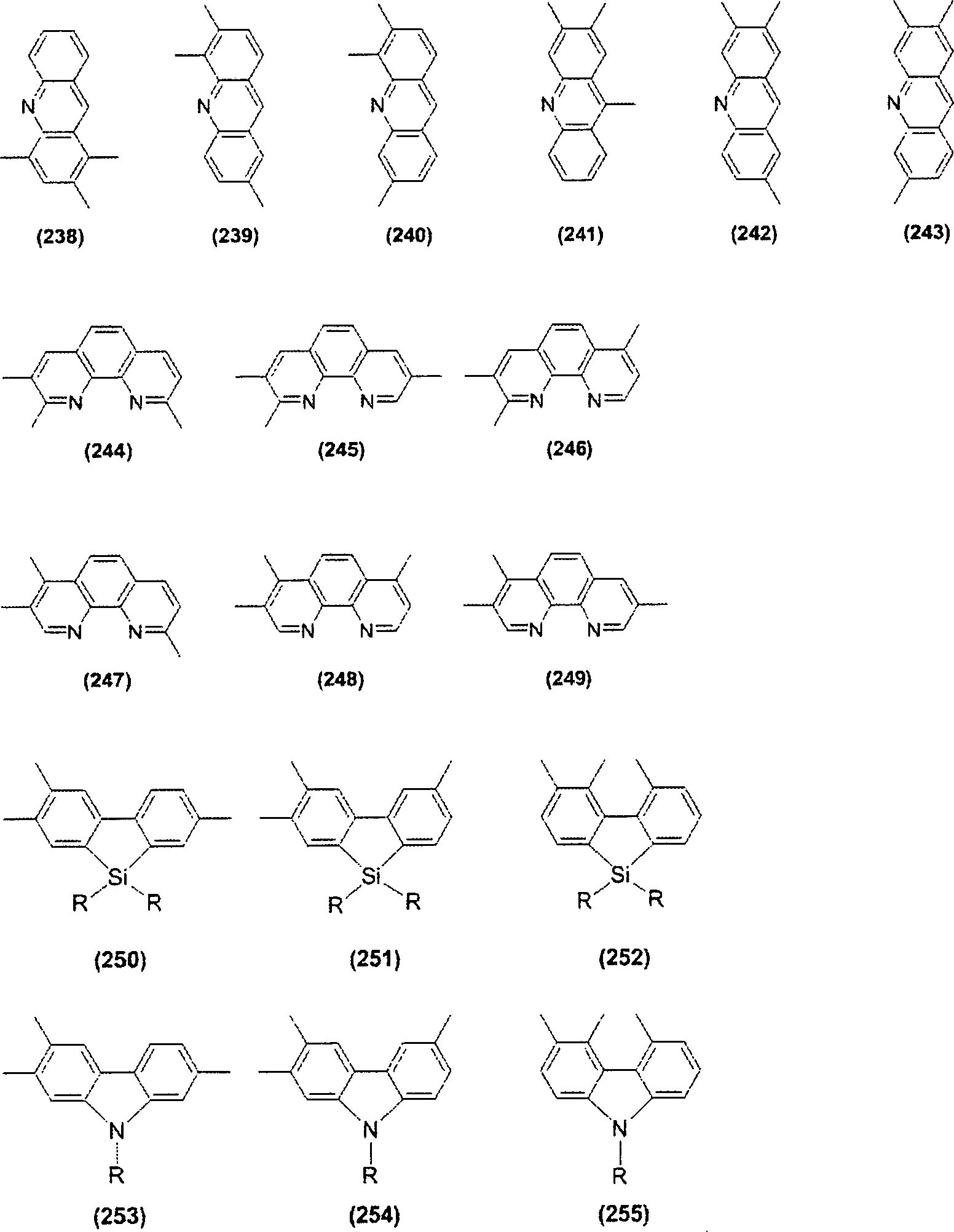
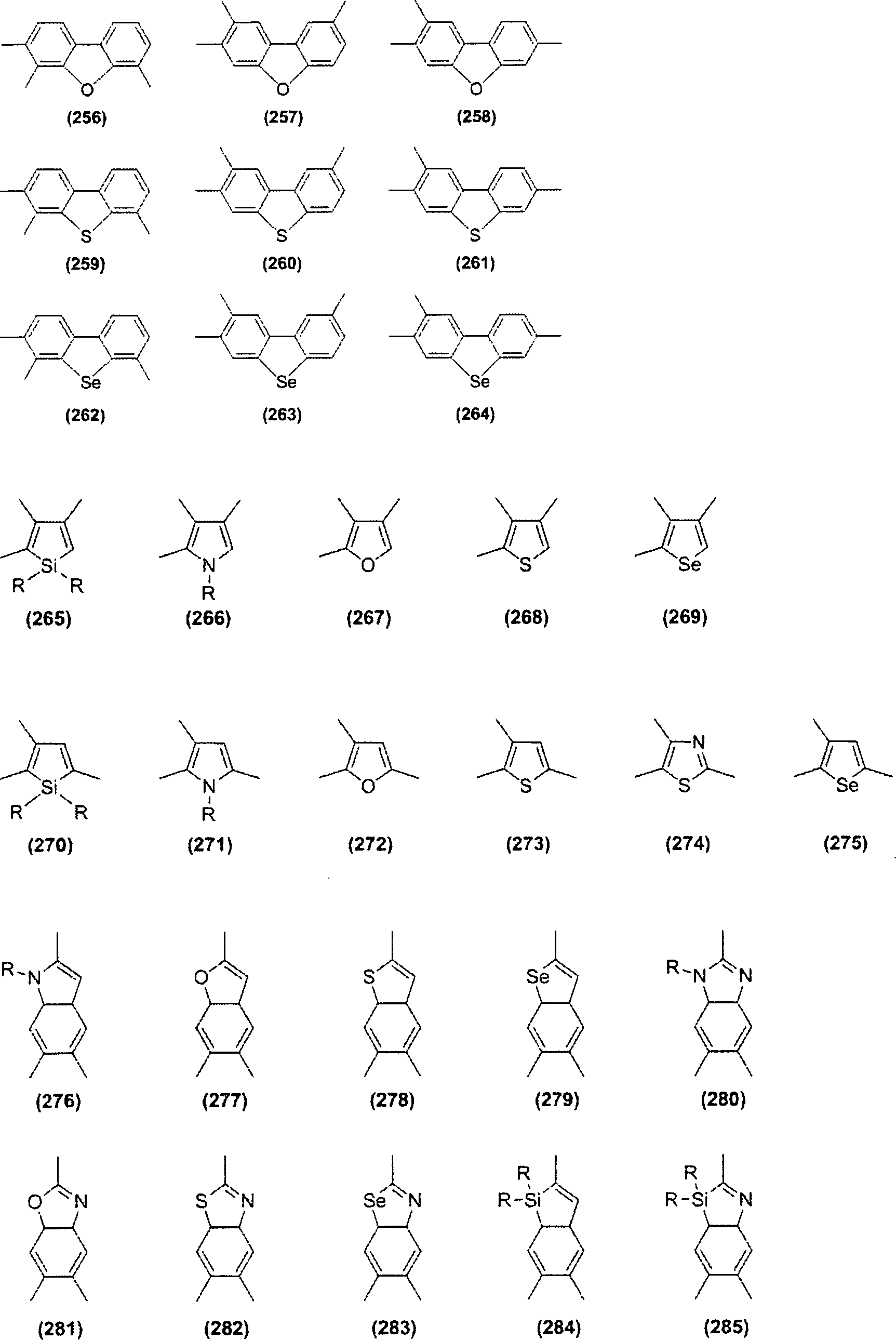

Von den Resten, dargestellt durch die Formel (201) bis die Formel (301) sind die Reste, dargestellt durch die Formel (202), die Formel (205), die Formel (206), die Formel (207), die Formel (210), die Formel (212), die Formel (220), die Formel (235), die Formel (238), die Formel (270), die Formel (271), die Formel (272), die Formel (273), die Formel (274), die Formel (275), die Formel (286), die Formel (287), die Formel (288), die Formel (291), die Formel (292), die Formel (293), die Formel (296) und die Formel (301) bevorzugt, Reste, dargestellt durch die Formel (235), die Formel (271), die Formel (272), die Formel (273), die Formel (274), die Formel (286), die Formel (291), die Formel (296) und die Formel (301) sind stärker bevorzugt, Reste, dargestellt durch die Formel (271), die Formel (272), die Formel (273) und die Formel (274) sind weiter bevorzugt, ein Rest, dargestellt durch die Formel (273), ist im Hinblick auf den Erhalt einer hocheffizienten photoelektrischen Umwandlungsvorrichtung insbesondere bevorzugt.Of the radicals represented by the formula (201) to the formula (301), the radicals represented by the formula (202), the formula (205), the formula (206), the formula (207), the formula ( 210), the formula (212), the formula (220), the formula (235), the formula (238), the formula (270), the formula (271), the formula (272), the formula (273) , the formula (274), the formula (275), the formula (286), the formula (287), the formula (288), the formula (291), the formula (292), the formula (293), Formula (296) and the formula (301) are preferably groups represented by the formula (235), the formula (271), the formula (272), the formula (273), the formula (274), the formula (286 ), Formula (291), Formula (296) and Formula (301) are more preferred, groups represented by Formula (271), Formula (272), Formula (273) and Formula (274) Further, a group represented by the formula (273) is preferable in terms of obtaining a high-efficiency photoelectric conversion direction particularly preferred.
Die vorstehend beschriebene aufbauende Einheit, dargestellt durch die Formel (1) ist vorzugsweise eine aufbauende Einheit, dargestellt durch die folgende Formel (2). 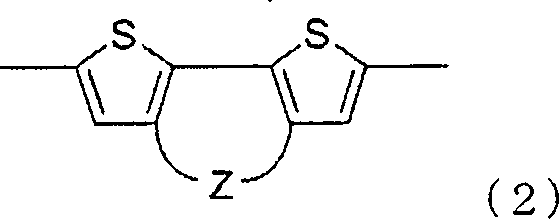
Die durch die Formel (2) dargestellte aufbauende Einheit schließt zum Beispiel aufbauende Einheiten, dargestellt durch die Formel (501) bis Formel (505), ein. 
Von den durch die vorstehend beschriebene Formel (501) bis Forme] (505) dargestellten aufbauenden Einheiten sind aufbauende Einheiten, dargestellt durch die Formel (501), die Formel (502), die Formel (503) und die Formel (504) bevorzugt, aufbauende Einheiten, dargestellt durch die Formel (501) und die Formel (504) sind stärker bevorzugt, eine aufbauende Einheit, dargestellt durch die Formel (501) im Hinblick auf den Erhalten einer hocheffizienten photoelektrischen Umwandlungsvorrichtung insbesondere bevorzugt. Of the constituent units represented by the above-described formula (501) to formula (505), constituent units represented by the formula (501), the formula (502), the formula (503) and the formula (504) are preferable. Constituent units represented by the formula (501) and the formula (504) are more preferable, an constituent unit represented by the formula (501) is particularly preferable from the viewpoint of obtaining a high-efficiency photoelectric conversion device.
Die konjugierte Polymerverbindung mit einer aufbauenden Einheit, dargestellt durch Formel (1), kann andere aufbauende Einheiten aufweisen. Die andere aufbauende Einheit schließt zum Beispiel eine aufbauende Einheit, dargestellt durch Formel (3), ein. 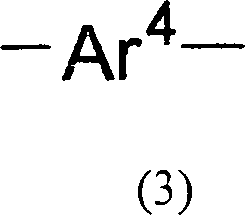
In dem Arylenrest, der gegebenenfalls einen Substituenten aufweist, dargestellt durch Ar4, ist der Arylenrest ein Rest, erhalten durch Abspalten von zwei Wasserstoffatomen von einem aromatischen Kohlenwasserstoff. Der Arylenrest weist eine Zahl an Kohlenstoffatomen von üblicherweise 6 bis 60 auf. Der Substituent schließt ein Halogenatom, einen Alkylrest (zum Beispiel mit einer Zahl an Kohlenstoffatomen von 1 bis 20), einen Cycloalkylrest (zum Beispiel mit einer Zahl an Kohlenstoffatomen von 3 bis 20), einen Alkoxyrest (zum Beispiel mit einer Zahl an Kohlenstoffatomen von 1 bis 20) und einen Cycloalkoxyrest (zum Beispiel mit einer Zahl an Kohlenstoffatomen von 3 bis 20) ein. Als das Halogenatom ist ein Fluoratom bevorzugt.In the arylene group optionally having a substituent represented by Ar 4 , the arylene group is a group obtained by cleaving two hydrogen atoms from an aromatic hydrocarbon. The arylene group has a number of carbon atoms of usually 6 to 60. The substituent includes a halogen atom, an alkyl group (for example, having a number of carbon atoms of 1 to 20), a cycloalkyl group (for example, having a number of carbon atoms of 3 to 20), an alkoxy group (for example, having a number of carbon atoms of 1 to 20) and a cycloalkoxy group (for example, having a number of carbon atoms of 3 to 20). As the halogen atom, a fluorine atom is preferable.
Bestimmte Beispiele des Arylenrests, der gegebenenfalls einen Substituenten aufweist, schließen eine Phenylengruppe, die gegebenenfalls einen Substituenten aufweist, eine Naphthalindiylgruppe, die gegebenenfalls einen Substituenten aufweist, eine Anthracendiylgruppe, die gegebenenfalls einen Substituenten aufweist, eine Biphenyldiylgruppe, die gegebenenfalls einen Substituenten aufweist, eine Terphenyldiylgruppe, die gegebenenfalls einen Substituenten aufweist, und eine kondensierte Ringverbindung, die gegebenenfalls einen Substituenten aufweist, ein. Die kondensierte Ringverbindung schließt eine Fluorendiylgruppe ein.Specific examples of the arylene group optionally having a substituent include a phenylene group optionally having a substituent, a naphthalenediyl group optionally having a substituent, an anthracenediyl group optionally having a substituent, a biphenyldiyl group optionally having a substituent, a terphenyldiyl group optionally having a substituent, and a fused ring compound optionally having a substituent. The condensed ring compound includes a fluorenediyl group.
Der zweiwertige heterocyclische Rest, der gegebenenfalls einen Substituenten aufweist, dargestellt durch Ar4, weist eine Zahl an Kohlenstoffatomen von üblicherweise 2 bis 60, vorzugsweise 4 bis 60, stärker bevorzugt 4 bis 20, auf. Der Heteroring des zweiwertigen heterocyclischen Rest schließt zum Beispiel Gruppen, erhalten durch Abspalten von zwei Wasserstoffatomen von einer heterocyclischen Verbindung, ausgewählt aus der Gruppe bestehend aus Furan, Thiophen, Pyrrol, Pyrrolin, Pyrrolidin, Oxazol, Isooxazol, Thiazol, Isothiazol, Imidazol, Imidazolin, Imidazolidin, Pyrazol, Pyrazolin, Pyrazolidin, Furazan, Triazol, Thiadiazol, Oxadiazol, Tetrazol, Pyran, Pyridin, Piperidin, Thiopyran, Pyridazin, Pyrimidin, Pyrazin, Piperazin, Morpholin, Triazin, Benzofuran, Isobenzofuran, Benzothiophen, Indol, Isoindol, Indolizin, Indolin, Isoindolin, Chromen, Chroman, Isochroman, Benzopyran, Chinolin, Isochinolin, Chinolizin, Benzimidazol, Benzthiazol, Indazol, Naphthyridin, Chinoxalin, Chinazolin, Chinazolidin, Cinnolin, Phthalazin, Purin, Pteridin, Carbazol, Xanthen, Phenanthridin, Acridin, β-Carbolin, Perimidin, Phenanthrolin, Thianthren, Phenoxathiin, Phenoxazin, Phenothiazin und Phenazin, ein. Der Substituent schließt zum Beispiel ein Halogenatom, einen Alkylrest, der gegebenenfalls einen Substituenten aufweist, einen Cycloalkylrest, der gegebenenfalls einen Substituenten aufweist, einen Alkoxyrest, der gegebenenfalls einen Substituenten aufweist, einen Cycloalkoxyrest, der gegebenenfalls einen Substituenten aufweist, einen Alkylthiorest, der gegebenenfalls einen Substituenten aufweist, einen Cycloalkylthiorest, der gegebenenfalls einen Substituenten aufweist, und einen Arylrest, der gegebenenfalls einen Substituenten aufweist, ein. Die Definition und bestimmte Beispiele des Halogenatoms, des Alkylrests, der gegebenenfalls einen Substituenten aufweist, des Cycloalkylrests, der gegebenenfalls einen Substituenten aufweist, des Alkoxyrests, der gegebenenfalls einen Substituenten aufweist, des Cycloalkoxyrests, der gegebenenfalls einen Substituenten aufweist, des Alkylthiorests, der gegebenenfalls einen Substituenten aufweist, des Cycloalkylthiorests, der gegebenenfalls einen Substituenten aufweist, und des Arylrests, der gegebenenfalls einen Substituenten aufweist, sind die gleichen wie die Definition und bestimmte Beispiele des Halogenatoms, des Alkylrests, der gegebenenfalls einen Substituenten aufweist, des Cycloalkylrests, der gegebenenfalls einen Substituenten aufweist, des Alkoxyrests, der gegebenenfalls einen Substituenten aufweist, des Cycloalkoxyrests, der gegebenenfalls einen Substituenten aufweist, des Alkylthiorests, der gegebenenfalls einen Substituenten aufweist, des Cycloalkylthiorests, der gegebenenfalls einen Substituenten aufweist, und des Arylrests, der gegebenenfalls einen Substituenten aufweist, dargestellt durch R1 und R2. Der zweiwertige heterocyclische Rest ist vorzugsweise ein zweiwertiger aromatischer heterocyclischer Rest.The divalent heterocyclic radical, which optionally has a substituent represented by Ar 4 , has a number of carbon atoms of usually 2 to 60, preferably 4 to 60, more preferably 4 to 20 on. The hetero ring of the divalent heterocyclic group includes, for example, groups obtained by eliminating two hydrogen atoms from a heterocyclic compound selected from the group consisting of furan, thiophene, pyrrole, pyrroline, pyrrolidine, oxazole, isooxazole, thiazole, isothiazole, imidazole, imidazoline, Imidazolidine, pyrazole, pyrazoline, pyrazolidine, furazane, triazole, thiadiazole, oxadiazole, tetrazole, pyran, pyridine, piperidine, thiopyran, pyridazine, pyrimidine, pyrazine, piperazine, morpholine, triazine, benzofuran, isobenzofuran, benzothiophene, indole, isoindole, indolizine, Indoline, isoindoline, chromene, chroman, isochroman, benzopyran, quinoline, isoquinoline, quinolizine, benzimidazole, benzothiazole, indazole, naphthyridine, quinoxaline, quinazoline, quinazolidine, cinnoline, phthalazine, purine, pteridine, carbazole, xanthene, phenanthridine, acridine, β- Carboline, perimidine, phenanthroline, thianthrene, phenoxathiin, phenoxazine, phenothiazine and phenazine. The substituent includes, for example, a halogen atom, an alkyl group optionally having a substituent, a cycloalkyl group optionally having a substituent, an alkoxy group optionally having a substituent, a cycloalkoxy group optionally having a substituent, an alkylthio group optionally having a substituent Substituent, a cycloalkylthio group optionally having a substituent, and an aryl group optionally having a substituent. The definition and certain examples of the halogen atom, the alkyl group optionally having a substituent, of the cycloalkyl group optionally having a substituent of the alkoxy group optionally having a substituent of the cycloalkoxy group optionally having a substituent of the alkylthio group optionally having a substituent Substituents of the cycloalkylthio group optionally having a substituent and the aryl group optionally having a substituent are the same as the definition and specific examples of the halogen atom, the alkyl group optionally having a substituent, the cycloalkyl group optionally having a substituent of the alkoxy group optionally having a substituent of the cycloalkoxy group optionally having a substituent, the alkylthio group optionally having a substituent, the cycloalkylthio group ester optionally substituted lls has a substituent, and the aryl group optionally having a substituent represented by R 1 and R 2 . The divalent heterocyclic group is preferably a divalent aromatic heterocyclic group.
Bestimmte Beispiele des zweiwertigen heterocyclischen Rests schließen die folgenden Reste ein: eine Pyridindiylgruppe, die gegebenenfalls einen Substituenten aufweist, eine Diazaphenylengruppe, die gegebenenfalls einen Substituenten aufweist, eine Chinolindiylgruppe, die gegebenenfalls einen Substituenten aufweist, eine Chinoxalindiylgruppe, die gegebenenfalls einen Substituenten aufweist, eine Acridindiylgruppe, die gegebenenfalls einen Substituenten aufweist, eine Bipyridyldiylgruppe, die gegebenenfalls einen Substituenten aufweist, eine Phenanthrolindiylgruppe, die gegebenenfalls einen Substituenten aufweist, eine Gruppe, enthaltend Silicium, Stickstoff, Schwefel, Selen und dgl. als ein Heteroatom und mit einer Fluorenstruktur, eine heterocyclische Gruppe mit 5-gliedrigem Ring, die Silicium, Stickstoff, Schwefel, Selen und dgl. als ein Heteroatom enthält, eine kondensierte Heterogruppe mit 5-gliedrigem Ring, die Silicium, Stickstoff, Schwefel, Selen und dgl. als ein Heteroatom enthält, eine heterocyclische Gruppe mit 5-gliedrigem Ring, die Silicium, Stickstoff, Schwefel, Selen und dgl. als ein Heteroatom enthält, Gruppen, die in der α-Stellung eines Heteroatoms binden, wobei ein Dimer oder ein Oligomer gebildet wird, eine Gruppe, die in der α-Stellung eines Heteroatoms an eine Phenylgruppe bindet, und eine Gruppe, erhalten durch Kondensation eines Benzolrings und eines Thiophenrings.Specific examples of the divalent heterocyclic group include the following groups: a pyridinediyl group optionally having a substituent, a diazaphenylene group optionally having a substituent, a quinolinediyl group optionally having a substituent, a quinoxalinediyl group optionally having a substituent, an acridinediyl group optionally having a substituent, a bipyridyldiyl group optionally having a substituent, a phenanthrolinediyl group optionally having a substituent, a group containing silicon, nitrogen, sulfur, selenium and the like as a heteroatom and having a fluorene structure, a heterocyclic group 5-membered ring containing silicon, nitrogen, sulfur, selenium and the like as a hetero atom, a 5-membered-ring condensed hetero group containing silicon, nitrogen, sulfur, selenium and the like as a hetero atom holds, a 5-membered-ring heterocyclic group containing silicon, nitrogen, sulfur, selenium and the like as a hetero atom, groups which bond in the α-position of a heteroatom to form a dimer or an oligomer, a group which binds to a phenyl group in the α-position of a heteroatom, and a group obtained by condensation of a benzene ring and a thiophene ring.
Es ist im Hinblick auf die Verbesserung des Wirkungsgrads der photoelektrischen Umwandlung einer organischen photoelektrischen Umwandlungsvorrichtung bevorzugt, dass die konjugierte Polymerverbindung mit einer durch die Formel (1) dargestellten aufbauenden Einheit weiter eine aufbauende Einheit, dargestellt durch die Formel (3), aufweist.It is preferable in view of improving the photoelectric conversion efficiency of an organic photoelectric conversion device that the conjugated polymer compound having a constituent unit represented by the formula (1) further has an constituting unit represented by the formula (3).
Die aufbauende Einheit, dargestellt durch die Formel (3), ist vorzugsweise eine aufrauende Einheit, dargestellt durch die Formel (3-1), die Formel (3-2), die Formel (3-3), die Formel (3-4), die Formel (3-5), die Formel (3-6), die Formel (3-7) oder die Formel (3-8), stärker bevorzugt eine aufbauende Einheit, dargestellt durch die Formel (3-2).The constituent unit represented by the formula (3) is preferably a roughening unit represented by the formula (3-1), the formula (3-2), the formula (3-3), the formula (3-4 ), the formula (3-5), the formula (3-6), the formula (3-7) or the formula (3-8), more preferably an constituting unit represented by the formula (3-2).
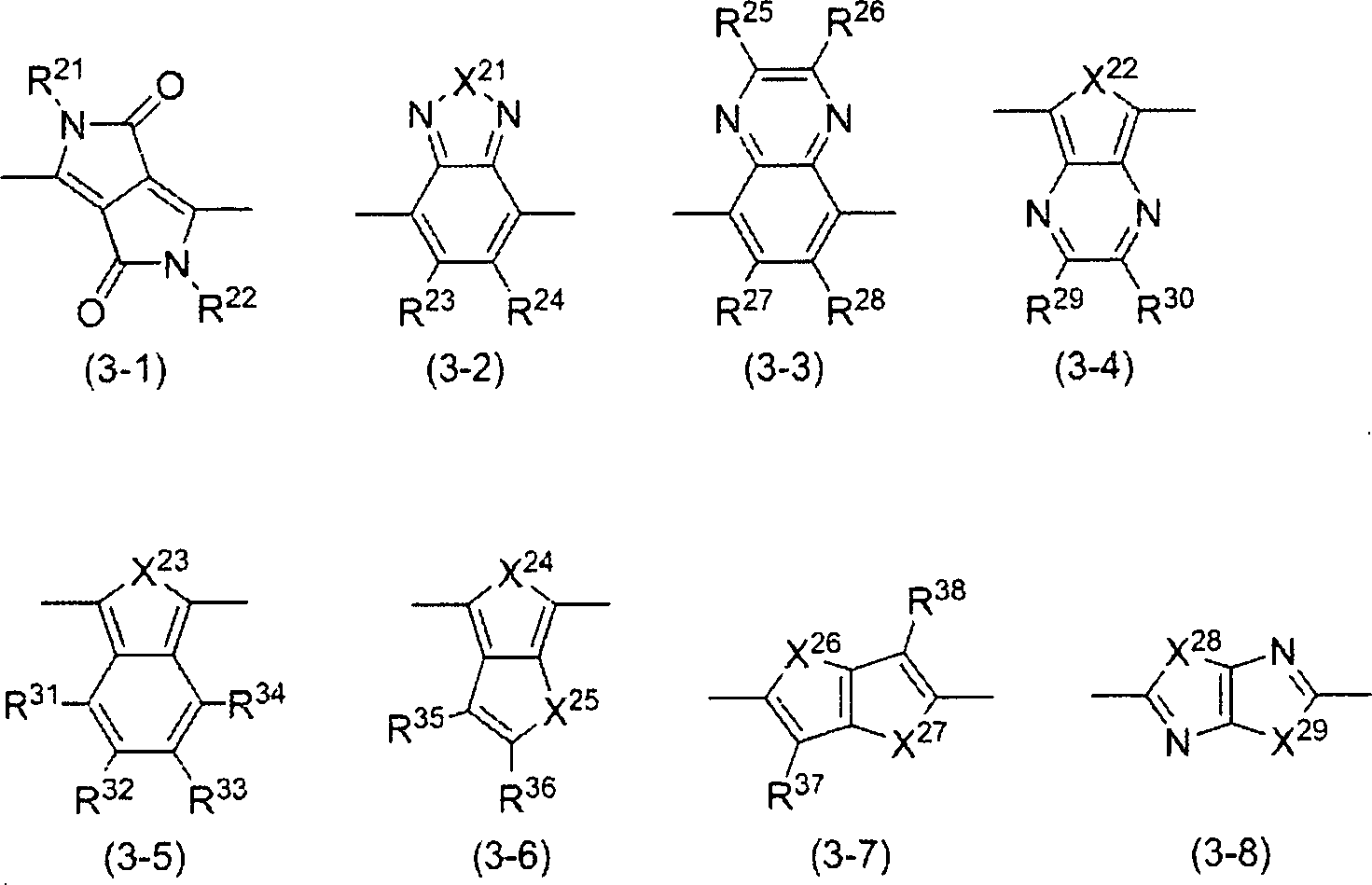
In der Formel (3-1) bis der Formel (3-8) stellen R21 bis R38 jeweils unabhängig ein Wasserstoffatom, ein Halogenatom, eine Aminogruppe, eine Cyanogruppe, eine Nitrogruppe oder einen einwertigen organischen Rest dar. Die Definition und bestimmte Beispiele des Halogenatoms und des einwertigen organischen Rests, der durch R21 bis R38 dargestellt wird, sind die gleichen wie die Definition und bestimmte Beispiele des Halogenatoms und des einwertigen organischen Rests, dargestellt durch R.In the formula (3-1) to the formula (3-8), R 21 to R 38 each independently represent a hydrogen atom, a halogen atom, an amino group, a cyano group, a nitro group or a monovalent organic group. The definition and specific examples the halogen atom and the monovalent organic group represented by R 21 to R 38 are the same as the definition and specific examples of the halogen atom and the monovalent organic group represented by R.
Als R21, R22 und R35 sind ein Alkylrest, der gegebenenfalls einen Substituenten aufweist, ein Cycloalkylrest, der gegebenenfalls einen Substituenten aufweist, ein Alkoxyrest, der gegebenenfalls einen Substituenten aufweist, ein Cycloalkoxyrest, der gegebenenfalls einen Substituenten aufweist, ein Arylrest, der gegebenenfalls einen Substituenten aufweist, ein Aryloxyrest, der gegebenenfalls einen Substituenten aufweist, ein Arylalkylrest, der gegebenenfalls einen Substituenten aufweist, und ein Arylalkoxyrest, der gegebenenfalls einen Substituenten aufweist, bevorzugt, ein Alkylrest, der gegebenenfalls einen Substituenten aufweist, ein Cycloalkylrest, der gegebenenfalls einen Substituenten aufweist, ein Arylrest, der gegebenenfalls einen Substituenten aufweist, und ein Aralkylrest, der gegebenenfalls einen Substituenten aufweist, sind stärker bevorzugt, ein Alkylrest, der gegebenenfalls einen Substituenten aufweist, und ein Cycloalkylrest, der gegebenenfalls einen Substituenten aufweist, sind weiter bevorzugt.As R 21 , R 22 and R 35 are an alkyl group optionally having a substituent Cycloalkyl group optionally having a substituent, an alkoxy group optionally having a substituent, a cycloalkoxy group optionally having a substituent, an aryl group optionally having a substituent, an aryloxy group optionally having a substituent, an arylalkyl group optionally having a substituent Substituent, and an arylalkoxy group optionally having a substituent, preferably, an alkyl group optionally having a substituent, a cycloalkyl group optionally having a substituent, an aryl group optionally having a substituent, and an aralkyl group optionally having a substituent More preferably, an alkyl group optionally having a substituent, and a cycloalkyl group optionally having a substituent are more preferable.
Als R23, R24, R27, R28, R31, R32, R33, R34, R37 und R38 sind ein Halogenatom und ein Wasserstoffatom bevorzugt, ein Fluoratom und ein Wasserstoffatom sind stärker bevorzugt.As R 23 , R 24 , R 27 , R 28 , R 31 , R 32 , R 33 , R 34 , R 37 and R 38 , a halogen atom and a hydrogen atom are preferable, a fluorine atom and a hydrogen atom are more preferable.
Als R25, R26, R29 und R30 sind ein Wasserstoffatom, ein Halogenatom, ein Alkylrest, der gegebenenfalls einen Substituenten aufweist, ein Cycloalkylrest, der gegebenenfalls einen Substituenten aufweist, ein Arylrest, der gegebenenfalls einen Substituenten aufweist, und ein Aralkylrest, der gegebenenfalls einen Substituenten aufweist, bevorzugt, ein Wasserstoffatom und ein Arylalkylrest, der gegebenenfalls einen Substituenten aufweist, sind stärker bevorzugt.R 25 , R 26 , R 29 and R 30 are a hydrogen atom, a halogen atom, an alkyl group optionally having a substituent, a cycloalkyl group optionally having a substituent, an aryl group optionally having a substituent, and an aralkyl group; which optionally has a substituent, preferably, a hydrogen atom and an arylalkyl group optionally having a substituent are more preferable.
Als R36 sind ein Wasserstoffatom, ein Halogenatom, ein Acylrest und ein Acyloxyrest bevorzugt, ein Acrylrest und ein Acyloxyrest sind stärker bevorzugt.As R 36 , a hydrogen atom, a halogen atom, an acyl group and an acyloxy group are preferable, an acrylic group and an acyloxy group are more preferable.
In der Formel (3-1) bis der Formel (3-8) stellen X21 bis X29 jeweils unabhängig ein Schwefelatom, ein Sauerstoffatom oder ein Selenatom dar. Als X21 bis X29 sind ein Schwefelatom und ein Sauerstoffatom bevorzugt, ein Schwefelatom ist stärker bevorzugt.In the formula (3-1) to the formula (3-8), each of X 21 to X 29 independently represents a sulfur atom, an oxygen atom or a selenium atom. As X 21 to X 29 , a sulfur atom and an oxygen atom are preferable, a sulfur atom is more preferable.
Wenn die konjugierte Polymerverbindung eine aufbauende Einheit, dargestellt durch die Formel (1), und eine aufbauende Einheit, dargestellt durch die Formel (3), aufweist, beträgt der Anteil der aufbauenden Einheit, dargestellt durch Formel (1), die in der konjugierten Polymerverbindung enthalten ist, vorzugsweise 30 mol-% bis 70 mol-% in Bezug auf die Summe der aufbauenden Einheit, dargestellt durch Formel (1), und der aufbauenden Einheit, dargestellt durch Formel (3).When the conjugated polymer compound has an constituting unit represented by the formula (1) and an constituent unit represented by the formula (3), the proportion of the constituent unit represented by formula (1) is that in the conjugated polymer compound is preferably 30 mol% to 70 mol% with respect to the sum of the constituent unit represented by formula (1) and the constituent unit represented by formula (3).
Wenn die organische photoelektrische Umwandlungsvorrichtung der vorliegenden Erfindung zwei oder mehrere aktive Schichten aufweist, ist bevorzugt, dass mindestens eine der zwei aktiven Schichten eine konjugierte Polymerverbindung mit einer aufbauenden Einheit, dargestellt durch die Formel (1), aufweist, oder wenn sowohl die Schicht A als auch die Schicht B aktive Schichten sind, ist bevorzugt, dass entweder die Schicht A oder die Schicht B eine konjugierte Polymerverbindung mit einer aufbauenden Einheit, dargestellt durch die Formel (1), enthält.When the organic photoelectric conversion device of the present invention has two or more active layers, it is preferable that at least one of the two active layers has a conjugated polymer compound having a constituent unit represented by the formula (1), or both layer A and Also, when layer B is active layers, it is preferable that either layer A or layer B contains a conjugated polymer compound having a constituent unit represented by formula (1).
Die konjugierte Polymerverbindung mit einer aufbauenden Einheit, dargestellt durch die Formel (1), und einer aufbauenden Einheit, dargestellt durch die Formel (3), können gemäß einem Verfahren, beschrieben in der internationalen Veröffentlichung
In der vorliegenden Erfindung bezeichnet die Polymerverbindung eine Verbindung mit einem Gewichtsmittel des Molekulargewichts von 3000 oder mehr. Das Gewichtsmittel des Molekulargewichts der Polymerverbindung beträgt vorzugsweise 3000 bis 10000000, stärker bevorzugt 8000 oder 5000000, weiter bevorzugt 10000 bis 1000000.In the present invention, the polymer compound means a compound having a weight-average molecular weight of 3,000 or more. The weight-average molecular weight of the polymer compound is preferably 3,000 to 10,000,000, more preferably 8,000 or 5,000,000, still more preferably 10,000 to 1,000,000.
Wenn das Gewichtsmittel des Molekulargewichts der Polymerverbindung kleiner als 3000 ist, verringert sich in einigen Fällen die Beschichtbarkeit bei Verwendung zur Herstellung einer Vorrichtung. Wenn das Gewichtsmittel des Molekulargewichts größer als 10000000 ist, verringern sich die Löslichkeit in einem Lösungsmittel und Beschichtbarkeit bei Verwendung zur Herstellung einer Vorrichtung.When the weight-average molecular weight of the polymer compound is less than 3,000, coatability in some cases lowers when used to manufacture a device. When the weight average molecular weight is larger than 10,000,000, the solubility in a solvent and coatability when used to make a device are lowered.
Das Gewichtsmittel des Molekulargewichts der Polymerverbindung bezeichnet ein auf Polystyrol umgerechnetes Gewichtsmittel des Molekulargewichts, gemessen mit Gelpermeationschromatographie (GPC).The weight-average molecular weight of the polymer compound means a polystyrene-reduced weight-average molecular weight measured by gel permeation chromatography (GPC).
Das auf Polystyrol umgerechnete Zahlenmittel des Molekulargewichts der Polymerverbindung beträgt vorzugsweise 1000 bis 100000000. Wenn das auf Polystyrol umgerechnete Zahlenmittel des Molekulargewichts der Polymerverbindung 1000 oder mehr beträgt, wird ein zäher Film leicht erhalten. Wenn das auf Polystyrol umgerechnete Zahlenmittel des Molekulargewichts der Polymerverbindung 100000000 oder weniger beträgt, ist die Löslichkeit der Polymerverbindung hoch und die Herstellung eines Films leicht. Das auf Polystyrol umgerechnete Zahlenmittel des Molekulargewichts der Polymerverbindung beträgt vorzugsweise 3000 oder mehr.The polystyrene-reduced number average molecular weight of the polymer compound is preferably 1,000 to 100,000,000. When the polystyrene-reduced number average molecular weight of the polymer compound is 1,000 or more, a tough film is easily obtained. When the polystyrene-reduced number average molecular weight of the polymer compound is 100,000,000 or less, the solubility of the polymer compound is high and the production of a film is easy. The polystyrene reduced number average molecular weight of the polymer compound is preferably 3,000 or more.
Die Dicke der aktiven Schicht beträgt üblicherweise 1 nm bis 100 μm, vorzugsweise 2 nm bis 1000 nm, stärker bevorzugt 5 nm bis 500 nm, weiter bevorzugt 20 nm bis 200 nm. The thickness of the active layer is usually 1 nm to 100 μm, preferably 2 nm to 1000 nm, more preferably 5 nm to 500 nm, further preferably 20 nm to 200 nm.
Die organische photoelektrische Umwandlungsvorrichtung ist nicht auf den vorstehend beschriebenen Aufbau der Vorrichtung beschränkt, und eine zusätzliche Schicht kann weiter zwischen einer Anode und einer Kathode bereitgestellt werden. Die zusätzliche Schicht schließt zum Beispiel eine ladungstransportierende Schicht ein, und die ladungstransportierende Schicht schließt eine lochtransportierende Schicht, die Löcher transportiert, und eine elektronentransportierende Schicht, die Elektronen transportiert, ein. Zum Beispiel wird eine lochtransportierende Schicht zwischen einer Anode und einer aktiven Schicht bereitgestellt, und eine elektronentransportierende Schicht wird zwischen einer Kathode und einer aktiven Schicht bereitgestellt, so können ein Ebnen der Oberfläche und eine Ladungseinspeisung gefördert werden.The organic photoelectric conversion device is not limited to the above-described structure of the device, and an additional layer may be further provided between an anode and a cathode. For example, the additional layer includes a charge-transporting layer, and the charge-transporting layer includes a hole-transporting layer that carries holes and an electron-transporting layer that carries electrons. For example, a hole transporting layer is provided between an anode and an active layer, and an electron transporting layer is provided between a cathode and an active layer, so surface flattening and charge injection can be promoted.
Als das in einer lochtransportierenden Schicht oder einer elektronentransportierenden Schicht als die vorstehend beschriebene zusätzliche Schicht verwendete Material können vorstehend beschriebene Elektronendonorverbindungen bzw. Elektronenakzeptorverbindungen verwendet werden, und Halogenide, Oxide und dgl. von Alkalimetallen und Erdalkalimetallen, wie Lithiumfluorid und dgl., können ebenfalls verwendet werden.As the material used in a hole-transporting layer or an electron-transporting layer as the above-described additional layer, electron donor compounds and electron acceptor compounds described above can be used, and halides, oxides and the like of alkali metals and alkaline earth metals such as lithium fluoride and the like can also be used ,
Die ladungstransportierende Schicht kann auch unter Verwendung von feinen Teilchen eines anorganischen Halbleiters, wie Titanoxid und dgl., gebildet werden.The charge-transporting layer may also be formed by using fine particles of an inorganic semiconductor such as titanium oxide and the like.
Zum Beispiel kann eine elektronentransportierende Schicht durch Bilden eines Films einer Titandioxidlösung mit einem Aufbringungsverfahren auf einer Grundierungsschicht, auf der die elektronentransportierende Schicht zu bilden ist, und weiter durch Trocknen des Films gebildet werden.For example, an electron-transporting layer may be formed by forming a film of a titania solution with an application method on a primer layer on which the electron-transporting layer is to be formed, and further by drying the film.
Die lochtransportierende Schicht und die elektronentransportierende Schicht als die zusätzliche Schicht werden im Einzelnen veranschaulicht.The hole transporting layer and the electron transporting layer as the additional layer will be illustrated in detail.
(Elektronentransportierende Schicht)(Electron-transporting layer)
Für die organische photoelektrische Umwandlungsvorrichtung ist bevorzugt, dass sie eine elektronentransportierende Schicht aufweist, die ein elektronentransportierbares Material zwischen einer aktiven Schicht und einer Kathode aufweist.It is preferable for the organic photoelectric conversion device to have an electron-transporting layer comprising an electron-transportable material between an active layer and a cathode.
Die elektronentransportierende Schicht wird vorzugsweise mit einem Aufbringungsverfahren gebildet, zum Beispiel vorzugsweise durch Aufbringen einer Aufbringungsflüssigkeit, die ein elektronentransportierbares Material und ein Lösungsmittel enthält, auf die Oberfläche einer Schicht, auf der die elektronentransportierende Schicht zu bilden ist. In der vorliegenden Erfindung schließt die Aufbringungsflüssigkeit auch Dispersionsflüssigkeiten, wie eine Emulsion (emulgierte Flüssigkeit), eine Suspension (suspendierte Flüssigkeit) und dgl. ein.The electron-transporting layer is preferably formed by an application method, for example, preferably, by applying an application liquid containing an electron-transportable material and a solvent to the surface of a layer on which the electron-transporting layer is to be formed. In the present invention, the application liquid also includes dispersion liquids such as an emulsion (emulsified liquid), a suspension (suspended liquid) and the like.
Das elektronentransportierbare Material schließt zum Beispiel Zinkoxid, Titanoxid, Zirkoniumoxid, Zinnoxid, Indiumoxid, ITO (Indium-Zinn-Oxid), FTO (mit Fluor dotiertes Zinnoxid), GZO (mit Gallium dotiertes Zinkoxid), ATO (mit Antimon dotiertes Zinnoxid) und AZO (mit Aluminium dotiertes Zinkoxid) ein, und unter ihnen ist Zinkoxid bevorzugt. Bei Bilden einer elektronentransportierenden Schicht ist bevorzugt, dass eine Aufbringungsflüssigkeit, die teilchenförmiges Zinkoxid enthält, aufgetragen wird, wobei die elektronentransportierende Schicht gebildet wird. Als ein solches elektronentransportierendes Material werden sogenannte Zinkoxidnanoteilchen vorzugsweise verwendet, und es ist stärker bevorzugt, eine elektronentransportierende Schicht unter Verwendung eines elektronentransportierbares Material zu bilden, das nur aus Zinkoxidnanoteilchen besteht. Die kugeläquivalente mittlere Teilchengröße des Zinkoxids beträgt vorzugsweise 1 nm bis 1000 nm, vorzugsweise 10 nm bis 100 nm. Die mittlere Teilchengröße wird mit einem Streuverfahren mit Laserlicht und einem Röntgenstreuverfahren gemessen.The electron transportable material includes, for example, zinc oxide, titanium oxide, zirconium oxide, tin oxide, indium oxide, ITO (indium tin oxide), FTO (fluorine doped tin oxide), GZO (gallium doped zinc oxide), ATO (antimony doped tin oxide), and AZO (zinc oxide doped with aluminum), and among them, zinc oxide is preferable. When forming an electron-transporting layer, it is preferable that an application liquid containing particulate zinc oxide is coated to form the electron-transporting layer. As such an electron-transporting material, so-called zinc oxide nanoparticles are preferably used, and it is more preferable to form an electron-transporting layer using an electron-transportable material consisting only of zinc oxide nanoparticles. The spherical equivalent mean particle size of the zinc oxide is preferably 1 nm to 1000 nm, preferably 10 nm to 100 nm. The average particle size is measured by a scattering method with laser light and an X-ray scattering method.
Durch Bereitstellen einer elektronentransportierenden Schicht, die ein elektronentransportierbares Material enthält, zwischen einer Kathode und einer aktiven Schicht kann ein Ablösen einer Kathode verhindert werden und die Effizienz der Elektroneneinspeisung aus einer aktiven Schicht in eine Kathode kann verbessert werden. Es ist bevorzugt, dass eine elektronentransportierende Schicht in Kontakt mit einer aktiven Schicht bereitgestellt wird, und weiter ist bevorzugt, dass eine elektronentransportierende Schicht in Kontakt auch mit einer Kathode bereitgestellt wird. Durch Bereitstellen einer elektronentransportierenden Schicht, die ein elektronentransportierbares Material wie vorstehend beschrieben enthält, kann ein Ablösen einer Kathode verhindert werden, und die Effizienz der Elektroneneinspeisung aus einer aktiven Schicht in eine Kathode kann weiter verbessert werden. Durch Bereitstellen einer solchen elektronentransportierenden Schicht kann eine organische photoelektrische Umwandlungsvorrichtung realisiert werden, die hohe Zuverlässigkeit aufweist und hohen Wirkungsgrad der photoelektrischen Umwandlung zeigt.By providing an electron-transporting layer containing an electron-transportable material between a cathode and an active layer, peeling of a cathode can be prevented and the efficiency of electron injection from an active layer into a cathode can be improved. It is preferable that an electron-transporting layer is provided in contact with an active layer, and further it is preferable that an electron-transporting layer be provided in contact also with a cathode. By providing an electron-transporting layer containing an electron-transportable material as described above, peeling of a cathode can be prevented, and the efficiency of electron injection from an active layer into a cathode can be further improved. By providing such an electron transporting layer, a Organic photoelectric conversion device can be realized, which has high reliability and high photoelectric conversion efficiency.
Durch Bereitstellen einer elektronentransportierenden Schicht, die ein elektronentransportierbares Material enthält, kann die Effizienz der Einspeisung von Elektronen in eine Kathode verbessert werden, die Einspeisung von Löchern aus einer aktiven Schicht kann verhindert werden, die Eigenschaft des Transportierens von Elektronen kann verbessert werden, eine aktive Schicht kann vor Erosion durch eine Aufbringungsflüssigkeit, die bei Bilden einer Kathode mit einem Aufbringungsverfahren nach Bilden einer aktiven Schicht verwendet wird, geschützt werden, eine Verschlechterung einer aktiven Schicht kann unterdrückt werden.By providing an electron-transporting layer containing an electron-transportable material, the efficiency of supplying electrons to a cathode can be improved, the injection of holes from an active layer can be prevented, the property of transporting electrons can be improved, an active layer can be protected from erosion by an application liquid used in forming a cathode with an application method after forming an active layer, deterioration of an active layer can be suppressed.
Es ist bevorzugt, dass die elektronentransportierende Schicht, die ein elektronentransportierbares Material enthält, aus einem Material mit hoher Benetzbarkeit gegenüber einer Aufbringungsflüssigkeit, die zum Bilden einer Kathode oder einer aktiven Schicht durch Aufbringung nach Bilden einer elektronentransportierenden Schicht verwendet wird, aufgebaut wird. Insbesondere ist bevorzugt, dass die elektronentransportierende Schicht, die ein elektronentransportierbares Material enthält, hohe Benetzbarkeit gegenüber einer Aufbringungsflüssigkeit aufweist, die zum Bilden einer Kathode oder einer aktiven Schicht durch Aufbringung verwendet wird. Durch Bilden einer Kathode oder einer aktiven Schicht auf einer solchen elektronentransportierenden Schicht durch Aufbringen benetzt und verbreitet sich die Aufbringungsflüssigkeit erfolgreich auf der Oberfläche einer elektronentransportierenden Schicht beim Bilden einer Kathode oder einer aktiven Schicht, und eine Kathode oder eine aktive Schicht mit gleichförmiger Dicke kann gebildet werden.It is preferable that the electron-transporting layer containing an electron-transportable material is constructed of a material having high wettability to an application liquid used for forming a cathode or an active layer by deposition after forming an electron-transporting layer. In particular, it is preferable that the electron transporting layer containing an electron transportable material has high wettability to an application liquid used for forming a cathode or an active layer by deposition. By forming a cathode or an active layer on such an electron transporting layer by deposition, the application liquid wets and spreads successfully on the surface of an electron transporting layer to form a cathode or an active layer, and a cathode or an active layer of uniform thickness can be formed ,
Das Verfahren des Bildens eines Films einer Aufbringungsflüssigkeit schließt das gleiche Verfahren wie für die vorstehend beschriebene aktive Schicht ein.The method of forming a film of an application liquid includes the same method as the above-described active layer.
(Lochtransportierende Schicht)(Hole transporting layer)
Es ist bevorzugt, dass die organische photoelektrische Umwandlungsvorrichtung eine lochtransportierende Schicht aufweist, die ein lochtransportierbares Material zwischen einer aktiven Schicht und einer Anode enthält.It is preferable that the organic photoelectric conversion device has a hole transporting layer containing a hole-transportable material between an active layer and an anode.
Die lochtransportierende Schicht wird vorzugsweise mit einem Aufbringungsverfahren gebildet und zum Beispiel vorzugsweise durch Aufbringen einer Aufbringungsflüssigkeit, die ein lochtransportierbares Material und ein Lösungsmittel enthält, auf die Oberfläche einer Schicht gebildet, auf der die lochtransportierende Schicht bereitzustellen ist. In der vorliegenden Erfindung schließt das Aufbringungsverfahren auch Dispersionsflüssigkeiten, wie eine Emulsion (emulgierte Flüssigkeit), eine Suspension (suspendierte Flüssigkeit) und dgl. ein.The hole transporting layer is preferably formed by an application method, for example, preferably formed by applying an application liquid containing a hole-transportable material and a solvent to the surface of a layer on which the hole-transporting layer is to be provided. In the present invention, the application method also includes dispersion liquids such as an emulsion (emulsified liquid), a suspension (suspended liquid) and the like.
Die Funktion der lochtransportierenden Schicht schließt eine Funktion der Verbesserung des Wirkungsgrads der Einspeisung von Löchern in eine aktive Schicht, eine Funktion des Verhinderns der Einspeisung von Elektronen aus einer aktiven Schicht, eine Funktion der Verbesserung der Eigenschaft des Transportes von Löchern, eine Funktion der Verbesserung der Flachheit, eine Funktion, eine aktive Schicht vor Erosion durch eine Aufbringungsflüssigkeit zum Bilden eines Films einer Anode zu schützen, wenn die Anode mit einem Aufbringungsverfahren nach Bilden der aktiven Schicht hergestellt wird, eine Funktion des Unterdrückens der Verschlechterung einer aktiven Schicht und dgl. ein.The function of the hole transporting layer includes a function of improving the efficiency of injecting holes into an active layer, a function of preventing the injection of electrons from an active layer, a function of improving the hole transporting property, a function of improving the Flatness, a function of protecting an active layer from erosion by an application liquid for forming a film of an anode when the anode is formed by a deposition method after forming the active layer, a function of suppressing deterioration of an active layer, and the like.
Das lochtransportierbare Material schließt zum Beispiel eine Polymerverbindung ein, die eine Funktion des Transports von Löchern zeigt. Beispiele der Polymerverbindung, die eine Funktion des Transports von Löchern zeigt, schließen eine Polymerverbindung, die eine Thiophendiylgruppe enthält, eine Polymerverbindung, die eine Anilindiylgruppe enthält, und eine Polymerverbindung, die eine Pyrroldiylgruppe enthält, ein. Von den Polymerverbindungen, die eine Funktion des Transports von Löchern zeigt, sind in hohem Maße elektrisch leitende Polymerverbindungen bevorzugt. Die Leitfähigkeit der in hohem Maße elektrisch leitenden Polymerverbindung beträgt üblicherweise 10–5 bis 105 S/cm, vorzugsweise 10–3 bis 104 S/cm.The hole-transportable material includes, for example, a polymer compound that exhibits a function of transporting holes. Examples of the polymer compound showing a function of transporting holes include a polymer compound containing a thiophenediyl group, a polymer compound containing an anilinediyl group, and a polymer compound containing a pyrrolidinyl group. Of the polymer compounds showing a function of transporting holes, highly electrically conductive polymer compounds are preferred. The conductivity of the highly electrically conductive polymer compound is usually 10 -5 to 10 5 S / cm, preferably 10 -3 to 10 4 S / cm.
Die Polymerverbindung, die eine Funktion des Transports von Löchern aufweist, kann eine Säuregruppe, wie eine Sulfonatgruppe und dgl., aufweisen. Beispiele der Polymerverbindung mit einer Säuregruppe schließen Poly(thiophen) mit einer Säuregruppe und Polyanilin) mit einer Säuregruppe ein. Das Po1y(thiophen) mit einer Säuregruppe und das Poly(anilin) mit einer Säuregruppe kann weiter einen anderen Substituenten als die Säuregruppe aufweisen.The polymer compound having a function of transporting holes may have an acid group such as a sulfonate group and the like. Examples of the polymer compound having an acid group include poly (thiophene) having an acid group and polyaniline having an acid group. The acid group-containing poly (thiophene) and the poly (aniline) having an acid group may further have a substituent other than the acid group.
Die lochtransportierende Schicht kann andere Polymerverbindungen als ein Bindemittel zusätzlich zu der vorstehend beschriebenen Polymerverbindung enthalten, die eine Funktion des Transports von Löchern zeigen. Das Bindemittel schließt zum Beispiel Polystyrolsulfonsäure, Polyvinylphenol, Novolakharze und Polyvinylalkohol ein. The hole transporting layer may contain polymer compounds other than a binder in addition to the above-described polymer compound, which exhibit a function of transporting holes. The binder includes, for example, polystyrenesulfonic acid, polyvinylphenol, novolak resins and polyvinyl alcohol.
Das Verfahrens des Bildens eines Films einer Aufbringungsflüssigkeit schließt das gleiche Verfahren wie für eine später beschriebene aktive Schicht ein.The method of forming a film of an application liquid includes the same method as that for an active layer described later.
Eine Ausführungsform der organischen photoelektrischen Umwandlungsvorrichtung der vorliegenden Erfindung ist eine organische photoelektrische Umwandlungsvorrichtung, die eine transparente Anode, eine erste aktive Schicht, eine Zwischenschicht, eine zweite aktive Schicht und eine transparente Kathode in dieser Reihenfolge enthält, in der eine der ersten aktiven Schicht und der zweiten aktiven Schicht die Schicht A ist und die andere die Schicht B ist.An embodiment of the organic photoelectric conversion device of the present invention is an organic photoelectric conversion device including a transparent anode, a first active layer, an intermediate layer, a second active layer, and a transparent cathode in this order in which one of the first active layer and the first active layer second active layer is layer A and the other is layer B.
Die Schicht A und die Schicht B erfüllen (Bedingung 1), vorzugsweise (Bedingung 1-1), stärker bevorzugt (Bedingung 1-2).The layer A and the layer B satisfy (Condition 1), preferably (Condition 1-1), more preferably (Condition 1-2).
Die organische photoelektrische Umwandlungsvorrichtung der vorliegenden Erfindung weist üblicherweise ein transparentes Substrat und/oder eine Dichtschicht auf.The organic photoelectric conversion device of the present invention usually has a transparent substrate and / or a sealing layer.
Eine Ausführungsform der organischen photoelektrischen Umwandlungsvorrichtung der vorliegenden Erfindung ist eine organische photoelektrische Umwandlungsvorrichtung, die ein transparentes Substrat, eine transparente Anode, eine erste aktive Schicht, eine Zwischenschicht, eine zweite aktive Schicht, eine transparente Kathode und eine transparente Dichtschicht in dieser Reihenfolge enthält, in der eine der ersten aktiven Schicht und der zweiten aktiven Schicht die Schicht A ist und die andere die Schicht B ist.An embodiment of the organic photoelectric conversion device of the present invention is an organic photoelectric conversion device containing a transparent substrate, a transparent anode, a first active layer, an intermediate layer, a second active layer, a transparent cathode and a transparent sealing layer in this order one of the first active layer and the second active layer is layer A and the other is layer B.
Eine Ausführungsform der organischen photoelektrischen Umwandlungsvorrichtung der vorliegenden Erfindung ist eine organische photoelektrische Umwandlungsvorrichtung, die eine transparente Dichtschicht, eine transparente Anode, eine erste aktive Schicht, eine Zwischenschicht, eine zweite aktive Schicht, eine transparente Kathode und ein transparentes Substrat in dieser Reihenfolge enthält, in der eine der ersten aktiven Schicht und der zweiten aktiven Schicht die Schicht A ist und die andere die Schicht B ist.An embodiment of the organic photoelectric conversion device of the present invention is an organic photoelectric conversion device including a transparent seal layer, a transparent anode, a first active layer, an intermediate layer, a second active layer, a transparent cathode and a transparent substrate in this order one of the first active layer and the second active layer is layer A and the other is layer B.
Die organische photoelektrische Umwandlungsvorrichtung der vorliegenden Erfindung kann eine zusätzliche Schicht, wie eine lochtransportierende Schicht und dgl. zwischen einer transparenten Anode und einer ersten aktiven Schicht aufweisen und kann eine zusätzliche Schicht, wie eine elektronentransportierende Schicht und dgl., zwischen einer ersten aktiven Schicht und einer transparenten Kathode aufweisen. Die Zwischenschicht kann die Form einer einzelnen Schicht oder die Form eines Laminats aus mehreren Schichten annehmen.The organic photoelectric conversion device of the present invention may have an additional layer such as a hole transporting layer and the like between a transparent anode and a first active layer, and may include an additional layer such as an electron transporting layer and the like between a first active layer and a first active layer have transparent cathode. The intermediate layer may take the form of a single layer or the form of a multi-layer laminate.
Die die Zwischenschicht bildende Schicht schließt eine Schicht, die ein elektronentransportierbares Material enthält, und eine Schicht, die ein lochtransportierbares Material enthält, ein. Die Zwischenschicht mit der Form eines Laminats schließt eine Zwischenschicht mit der Form eines Laminats einer Schicht, die ein elektronentransportierbares Material enthält, und einer Schicht, die ein lochtransportierbares Material enthält, ein. Die Schicht, die ein elektronentransportierbares Material enthält, dieser Zwischenschicht mit der Form eines Laminats befindet sich vorzugsweise auf der Seite der transparenten Kathode.The intermediate layer forming layer includes a layer containing an electron transportable material and a layer containing a hole transportable material. The intermediate layer in the form of a laminate includes an intermediate layer in the form of a laminate of a layer containing an electron-transportable material and a layer containing a hole-transportable material. The layer containing an electron-transportable material, this intermediate layer in the form of a laminate is preferably located on the side of the transparent cathode.
Eine Ausführungsform der organischen photoelektrischen Umwandlungsvorrichtung der vorliegenden Erfindung ist eine organische photoelektrische Umwandlungsvorrichtung vom laminierten Typ, bestehend aus einem Laminat einer ersten photoelektrischen Umwandlungsvorrichtung mit einer ersten aktiven Schicht zwischen einem Paar von Elektroden und einer zweiten photoelektrischen Umwandlungsvorrichtung mit einer zweiten aktiven Schicht zwischen einem Paar von Elektroden, wobei eine der ersten aktiven Schicht und der zweiten aktiven Schicht die Schicht A ist und die andere die Schicht B ist.An embodiment of the organic photoelectric conversion device of the present invention is a laminated type organic photoelectric conversion device consisting of a laminate of a first photoelectric conversion device having a first active layer between a pair of electrodes and a second photoelectric conversion device having a second active layer between a pair of Electrodes, wherein one of the first active layer and the second active layer is the layer A and the other is the layer B.
Diese organische photoelektrische Umwandlungsvorrichtung vom laminierten Typ wird durch Übereinanderlegen einer ersten organischen photoelektrischen Umwandlungsvorrichtung und einer zweiten organischen photoelektrischen Umwandlungsvorrichtung und Anbringen einer Verdrahtung, um so die festgelegten Elektroden zu verbinden, erhalten.This laminated type organic photoelectric conversion device is obtained by superposing a first organic photoelectric conversion device and a second organic photoelectric conversion device and attaching a wiring so as to connect the fixed electrodes.
Die erste organische photoelektrische Umwandlungsvorrichtung ist eine organische photoelektrische Umwandlungsvorrichtung, die eine transparente Anode, eine erste aktive Schicht und eine transparente Kathode in dieser Reihenfolge enthält. Die erste organische photoelektrische Umwandlungsvorrichtung kann eine zusätzliche Schicht, wie eine lochtransportierende Schicht und dgl., zwischen einer transparenten Anode und einer ersten aktiven Schicht aufweisen und kann eine zusätzliche Schicht, wie eine elektronentransportierende Schicht und dgl., zwischen einer ersten aktiven Schicht und einer transparenten Kathode aufweisen. Die erste organische photoelektrische Umwandlungsvorrichtung weist üblicherweise ein transparentes Substrat und eine transparente Dichtschicht auf.The first organic photoelectric conversion device is an organic photoelectric conversion device comprising a transparent anode, a first active layer, and a transparent one Contains cathode in this order. The first organic photoelectric conversion device may have an additional layer such as a hole transporting layer and the like between a transparent anode and a first active layer and may include an additional layer such as an electron transporting layer and the like between a first active layer and a transparent one Have cathode. The first organic photoelectric conversion device usually has a transparent substrate and a transparent sealing layer.
Die zweite organische photoelektrische Umwandlungsvorrichtung ist eine organische photoelektrische Umwandlungsvorrichtung, die eine transparente Anode, eine zweite aktive Schicht und eine transparente Kathode in dieser Reihenfolge enthält. Die zweite organische photoelektrische Umwandlungsvorrichtung weist üblicherweise ein transparentes Substrat und eine transparente Dichtschicht auf.The second organic photoelectric conversion device is an organic photoelectric conversion device containing a transparent anode, a second active layer, and a transparent cathode in this order. The second organic photoelectric conversion device usually has a transparent substrate and a transparent sealing layer.
Wenn Anoden der ersten und zweiten organischen photoelektrischen Umwandlungsvorrichtungen gegenseitig verbunden sind und Kathoden davon gegenseitig verbunden sind, wird eine parallele Verbindung gebildet, und die Stromwerte der photoelektrischen Umwandlungsvorrichtungen mit einem organischen Film werden addiert. Wenn zum Beispiel eine Kathode und eine Anode von photoelektrischen Umwandlungsvorrichtungen mit einem organischen Film mit benachbarten Zahlen verbunden sind, und der Strom zwischen einer Anode der ersten photoelektrischen Umwandlungsvorrichtung mit einem organischen Film und einer Kathode der zweiten photoelektrischen Umwandlungsvorrichtung mit einem organischen Film entnommen wird, wird eine serielle Verbindung gebildet, und die Spannungswerte der photoelektrischen Umwandlungsvorrichtungen mit einem organischen Film werden addiert. Als Ergebnis kann Jsc (Stromdichte der kurzen Verbindung) oder Voc (Spannung des offenen Endes), die, verglichen mit einer einzelnen photoelektrischen Umwandlungsvorrichtung, höher ist, erhalten werden, und letztendlich kann hoher Wirkungsgrad der photoelektrischen Umwandlung erhalten werden.When anodes of the first and second organic photoelectric conversion devices are mutually connected and cathodes thereof are mutually connected, a parallel connection is formed, and the current values of the organic film photoelectric conversion devices are added. For example, when a cathode and an anode of organic film photoelectric conversion devices are connected to adjacent numbers, and the current is drawn between an anode of the first organic film photoelectric conversion device and a cathode of the second organic film photoelectric conversion device a serial connection is formed, and the voltage values of the organic film photoelectric conversion devices are added. As a result, Jsc (short-circuit current density) or Voc (open-end voltage), which is higher as compared with a single photoelectric conversion device, can be obtained, and finally, high photoelectric conversion efficiency can be obtained.
<2> Herstellungsverfahren der organischen photoelektrischen Umwandlungsvorrichtung<2> Production method of the organic photoelectric conversion device
Die organische photoelektrische Umwandlungsvorrichtung der vorliegenden Erfindung kann durch nacheinander Laminieren der die Vorrichtung bildenden Schichten hergestellt werden.The organic photoelectric conversion device of the present invention can be prepared by sequentially laminating the layers constituting the device.
Die die organische photoelektrische Umwandlungsvorrichtung der vorliegenden Erfindung bildende Schicht schließt Elektroden (transparente oder halbtransparente Anode und Kathode); Halbleiterschichten, wie eine aktive Schicht, eine elektronentransportierende Schicht, eine lochtransportierende Schicht, eine Zwischenschicht und dgl., gebildet zwischen einer transparenten oder halbtransparenten Anode und Kathode; eine Dichtschicht, gebildet auf einer Elektrode, falls erforderlich; eine Tönungsschicht, gebildet in Kontakt mit einer Dichtschicht oder einem Trägersubstrat, falls erforderlich; ein Trägersubstrat; eine Schutzschicht und dgl. ein.The layer constituting the organic photoelectric conversion device of the present invention includes electrodes (transparent or semi-transparent anode and cathode); Semiconductor layers such as an active layer, an electron transporting layer, a hole transporting layer, an intermediate layer and the like formed between a transparent or semitransparent anode and cathode; a sealing layer formed on an electrode, if necessary; a tinting layer formed in contact with a sealing layer or a supporting substrate, if necessary; a carrier substrate; a protective layer and the like.
Die Halbleiterschicht, die zu einer aktiven Schicht verschieden ist, kann gemäß der aktiven Schicht gebildet werden.The semiconductor layer different from an active layer may be formed according to the active layer.
Bildungsschritte einer Elektrode, einer aktiven Schicht, einer Dichtschicht und einer Tönungsschicht sind nachstehend beschrieben.Forming steps of an electrode, an active layer, a sealing layer and a tinting layer are described below.
<Elektrodenbildungsschritt><Electrode forming step>
Die Elektrode wird durch Bilden eines Films des veranschaulichten Elektrodenmaterials auf einem vorstehend beschriebenen Trägersubstrat mit einem Vakuumaufdampfungsverfahren, einem Sputterverfahren, einem Ionenplattierungsverfahren, einem Plattierungsverfahren und dgl. gebildet. Die Elektrode kann auch mit einem Aufbringungsverfahren unter Verwendung einer Aufbringungsflüssigkeit, die ein organisches Material, wie Polyanilin und Derivate davon, Polythiophen und Derivate davon und dgl., enthält, einer Tinte von Nanoteilchen eines Metalloxids, einer Tinte einer Metalloxidvorstufe, Metallnanodrähten, einer Metalltinte, einer Metallpaste, eines niedrig schmelzenden Metalls in geschmolzenem Zustand und dgl. gebildet werden.The electrode is formed by forming a film of the illustrated electrode material on a support substrate described above by a vacuum evaporation method, a sputtering method, an ion plating method, a plating method and the like. The electrode may also be provided with an application method using an application liquid containing an organic material such as polyaniline and derivatives thereof, polythiophene and derivatives thereof and the like, an ink of nanoparticles of a metal oxide, a metal oxide precursor, metal nanowires, a metal ink; a metal paste, a low-melting metal in a molten state and the like are formed.
<Bildungsschritt der aktiven Schicht><Active Layer Forming Step>
Das Verfahren des Bildens einer aktiven Schicht ist nicht besonders beschränkt, und es ist bevorzugt, eine aktive Schicht mit einem Auftragungsverfahren im Hinblick auf die Vereinfachung des Herstellungsschritts zu bilden. Die aktive Schicht kann zum Beispiel mit einem Aufbringungsverfahren unter Verwendung einer Aufbringungsflüssigkeit, die das vorstehend beschriebene die aktive Schicht aufbauende Material und ein Lösungsmittel enthält, gebildet werden und kann zum Beispiel mit einem Aufbringungsverfahren unter Verwendung einer Aufbringungsflüssigkeit gebildet werden, die eine konjugierte Polymerverbindung und Fullerene und/oder Derivate von Fullerenen und ein Lösungsmittel enthält.The method of forming an active layer is not particularly limited, and it is preferable to form an active layer with a deposition method with a view to simplifying the manufacturing step. The active layer may be formed, for example, by an application method using an application liquid containing the above-described active layer-constituting material and a solvent, and may be carried out, for example, by an application method Use of an application liquid can be formed which contains a conjugated polymer compound and fullerenes and / or derivatives of fullerenes and a solvent.
Das Lösungsmittel schließt zum Beispiel Kohlenwasserstofflösungsmittel, wie Toluol, Xylol, Mesitylen, Tetralin, Decalin, Bicyclohexyl, n-Butylbenzol, s-Butylbenzol, t-Butylbenzol und dgl., halogenierte gesättigte Kohlenwasserstofflösungsmittel, wie Tetrachlorkohlenstoff, Chloroform, Dichlormethan, Dichlorethan, Chlorbutan, Brombutan, Chlorpentan, Brompentan, Chlorhexan, Bromhexan, Chlorcyclohexan, Bromcyclohexan und dgl., halogenierte ungesättigte Kohlenwasserstofflösungsmittel, wie Chlorbenzol, Dichlorbenzol, Trichlorbenzol und dgl., Etherlösungsmittel, wie Tetrahydrofuran, Tetrahydropyran und dgl. usw. ein.The solvent includes, for example, hydrocarbon solvents such as toluene, xylene, mesitylene, tetralin, decalin, bicyclohexyl, n-butylbenzene, s-butylbenzene, t-butylbenzene and the like, halogenated saturated hydrocarbon solvents such as carbon tetrachloride, chloroform, dichloromethane, dichloroethane, chlorobutane, Bromobutane, chloropentane, bromopentane, chlorohexane, bromohexane, chlorocyclohexane, bromocyclohexane and the like, halogenated unsaturated hydrocarbon solvents such as chlorobenzene, dichlorobenzene, trichlorobenzene and the like, ethereal solvents such as tetrahydrofuran, tetrahydropyran and the like, etc.
Die in der vorliegenden Erfindung verwendete Aufbringungsflüssigkeit kann zwei oder mehr Lösungsmittel enthalten und kann zwei oder mehr der vorstehend veranschaulichten Lösungsmittel enthalten.The application liquid used in the present invention may contain two or more solvents, and may contain two or more of the above-exemplified solvents.
Das Verfahren des Aufbringens einer Aufbringungsflüssigkeit, die ein die vorstehend beschriebene aktive Schicht aufbauendes Material enthält, schließt Aufbringungsverfahren, wie ein Schleuderbeschichtungsverfahren, ein Gießverfahren, ein Mikrogravurbeschichtungsverfahren, ein Gravurbeschichtungsverfahren, ein Rakelbeschichtungsverfahren, ein Walzenbeschichtungsverfahren, ein Drahtrakelbeschichtungsverfahren, ein Tauchbeschichtungsverfahren, ein Sprühbeschichtungsverfahren, ein Siebdruckverfahren, ein Flexodruckverfahren, ein Offsetdruckverfahren, ein Tintenstrahldruckverfahren, ein Spenderdruckverfahren, ein Düsenbeschichtungsverfahren, ein Kapillarbeschichtungsverfahren und dgl. ein, und von ihnen sind ein Schleuderbeschichtungsverfahren, ein Flexodruckverfahren, ein Tintenstrahldruckverfahren und ein Spenderdruckverfahren bevorzugt.The method of applying an application liquid containing a material constituting the above-described active layer includes application methods such as a spin coating method, a casting method, a microgravure coating method, a gravure coating method, a doctor blade coating method, a roll coating method, a wire bar coating method, a dip coating method, a spray coating method A screen coating method, a flexographic printing method, an offset printing method, an ink jet printing method, a donor printing method, a die coating method, a capillary coating method and the like, and of them, a spin coating method, a flexographic printing method, an ink jet printing method and a donor printing method are preferable.
<Schritt der Bildung der Dichtschicht><Step of forming the sealing layer>
Die Dichtschicht wird durch Fixieren einer Glasplatte, einer Kunststoffplatte, einem Polymerfilm und dgl. mit einem Dichtmittel, bestehend aus einem UV-härtenden Harz, einer Glasfritte und dgl. auf einer Elektrode gegenüberliegend einer Elektrode in Kontakt mit dem Trägersubstrat gebildet.The sealing layer is formed by fixing a glass plate, a plastic plate, a polymer film and the like with a sealant consisting of a UV-curing resin, a glass frit and the like on an electrode opposite to an electrode in contact with the supporting substrate.
<Schritt der Bildung einer Tönungsschicht><Step of forming a tint layer>
Die Tönungsschicht kann durch direktes Aufbringen oder Vakuumabscheiden eines eine Tönungsschicht bildenden Materials auf einer Dichtschicht oder der Oberfläche eines Trägersubstrats gebildet werden und kann auch durch Bekleben einer Tönungsschicht, bestehend aus einer Glasplatte oder einem gefärbten halbtransparenten Film, die durch Aufbringen eines tönenden Materials oder dgl. getönt ist, auf eine Dichtschicht oder die Oberfläche eines Trägersubstrats mit einem Klebstoff oder dgl. bereitgestellt werden.The tinting layer may be formed by directly depositing or vacuum depositing a tinting layer-forming material on a sealing layer or the surface of a supporting substrate, and also by adhering a tinting layer consisting of a glass plate or a colored semitransparent film formed by applying a tinting material or the like. is provided on a sealing layer or the surface of a support substrate with an adhesive or the like.
In der organischen photoelektrischen Umwandlungsvorrichtung der vorliegenden Erfindung wird, wenn eine transparente oder halbtransparente Elektrode mit Licht, wie Solarlicht und dgl., bestrahlt wird, photovoltaische Kraft zwischen den Elektroden gebildet, und die Vorrichtung kann als eine Solarbatterie mit einem organischen Film betrieben werden.In the organic photoelectric conversion device of the present invention, when a transparent or semitransparent electrode is irradiated with light such as solar light and the like, photovoltaic force is formed between the electrodes, and the device can be operated as a solar battery with an organic film.
Durch Integrieren mehreren Solarbatterien mit einem organischen Film wird die Verwendung als ein Solarbatteriemodul mit einem organischen Film ebenfalls ermöglicht.By integrating a plurality of solar batteries with an organic film, use as a solar battery module with an organic film is also made possible.
In der organischen photoelektrischen Umwandlungsvorrichtung der vorliegenden Erfindung fließt, wenn eine transparente oder halbtransparente Elektrode mit Licht unter Bedingungen des Anlegens von Spannung zwischen Elektroden bestrahlt wird, Photostrom, und die Vorrichtung kann als ein organischer optischer Sensor betrieben werden. Durch Integrieren mehrerer organischer optischer Sensoren wird die Verwendung eines organischen Bildsensors ebenfalls ermöglicht.In the organic photoelectric conversion device of the present invention, when a transparent or semitransparent electrode is irradiated with light under conditions of applying voltage between electrodes, photocurrent flows and the device can be operated as an organic optical sensor. By integrating multiple organic optical sensors, the use of an organic image sensor is also made possible.
BEISPIELEEXAMPLES
Beispiele sind nachstehend zur Veranschaulichung der vorliegenden Erfindung weiter im Einzelnen gezeigt, aber die vorliegende Erfindung ist nicht auf sie beschränkt.Examples are further shown below in order to illustrate the present invention, but the present invention is not limited to them.
In den folgenden Beispielen wurden das auf Polystyrol umgerechnete Zahlenmittel des Molekulargewichts und Gewichtsmittel des Molekulargewichts unter Verwendung von GPC (PL-GPC2000), hergestellt von GPC Laboratory CO. LTD., als das Molekulargewicht eines Polymers bestimmt. Ein Polymer wurde in o-Dichlorbenzol gelöst, so dass die Konzentration des Polymers etwa 1 Gew.-% betrug. o-Dichlorbenzol wurde als eine mobile Phase von GPC verwendet, und man ließ es bei einer Fließgeschwindigkeit von 1 ml/min bei einer Messtemperatur von 140°C fließen. Drei Säulen von PLGEL 10 μm MIXED-B (hergestellt von PL Laboratory) wurden seriell verbunden.In the following examples, the polystyrene-reduced number average molecular weight and weight average molecular weight were measured by using GPC (PL-GPC2000) manufactured by GPC Laboratory CO. LTD., As the molecular weight of a polymer. A polymer was dissolved in o-dichlorobenzene so that the concentration of the polymer was about 1% by weight. o-dichlorobenzene was used as used a mobile phase of GPC and allowed to flow at a flow rate of 1 ml / min at a measurement temperature of 140 ° C. Three columns of PLGEL 10 μm MIXED-B (manufactured by PL Laboratory) were connected in series.
Synthesebeispiel 1Synthetic Example 1
(Synthese von Verbindung 2) 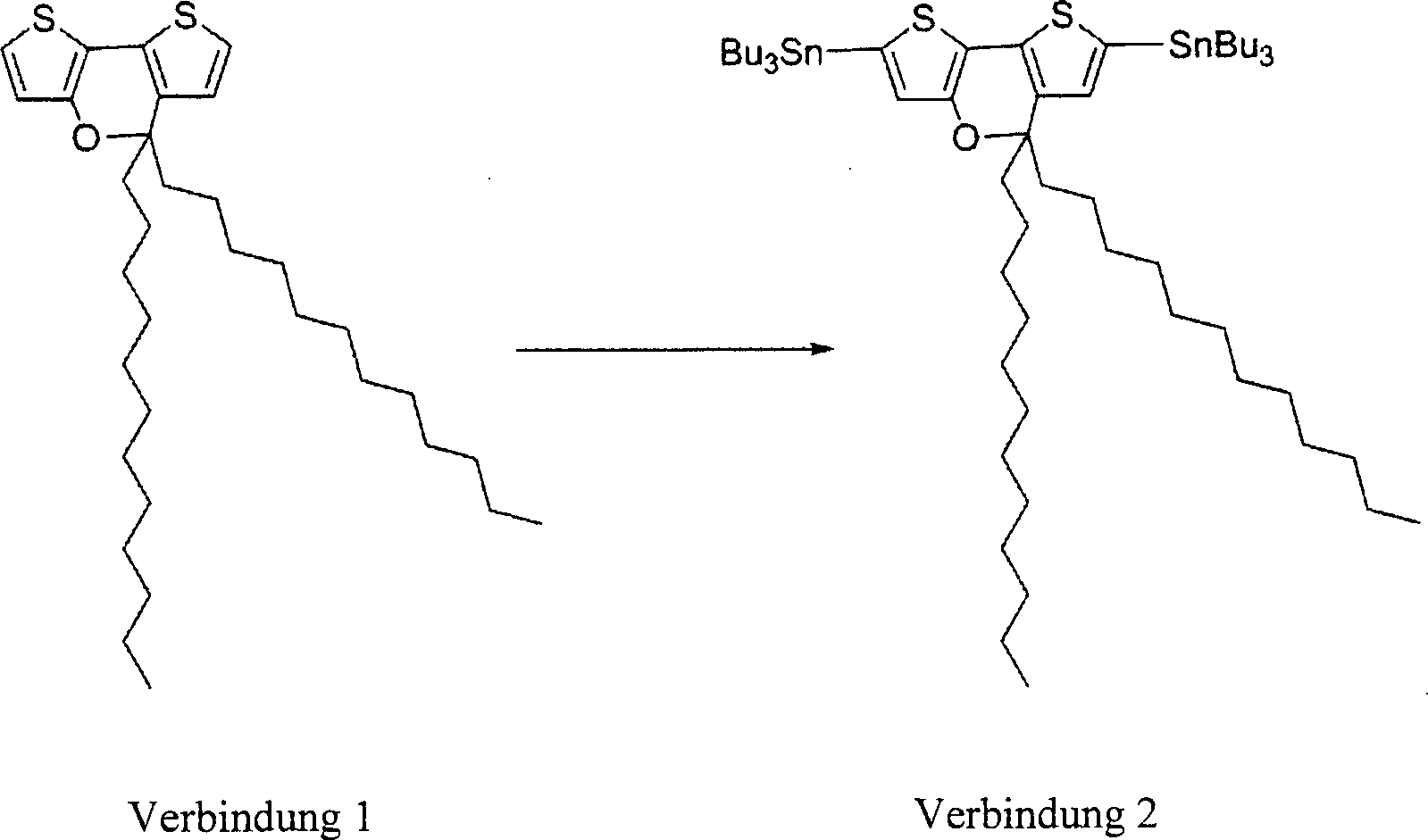
In einen 200 ml-Kolben, von dem das Gas in dem Kolben mit Argon gespült worden war, wurden 2,00 g (3,77 mmol) einer Verbindung 1, synthetisiert gemäß einer Beschreibung der Internationalen Veröffentlichung
Synthesebeispiel 2Synthesis Example 2
(Synthese der Polymerverbindung 1) 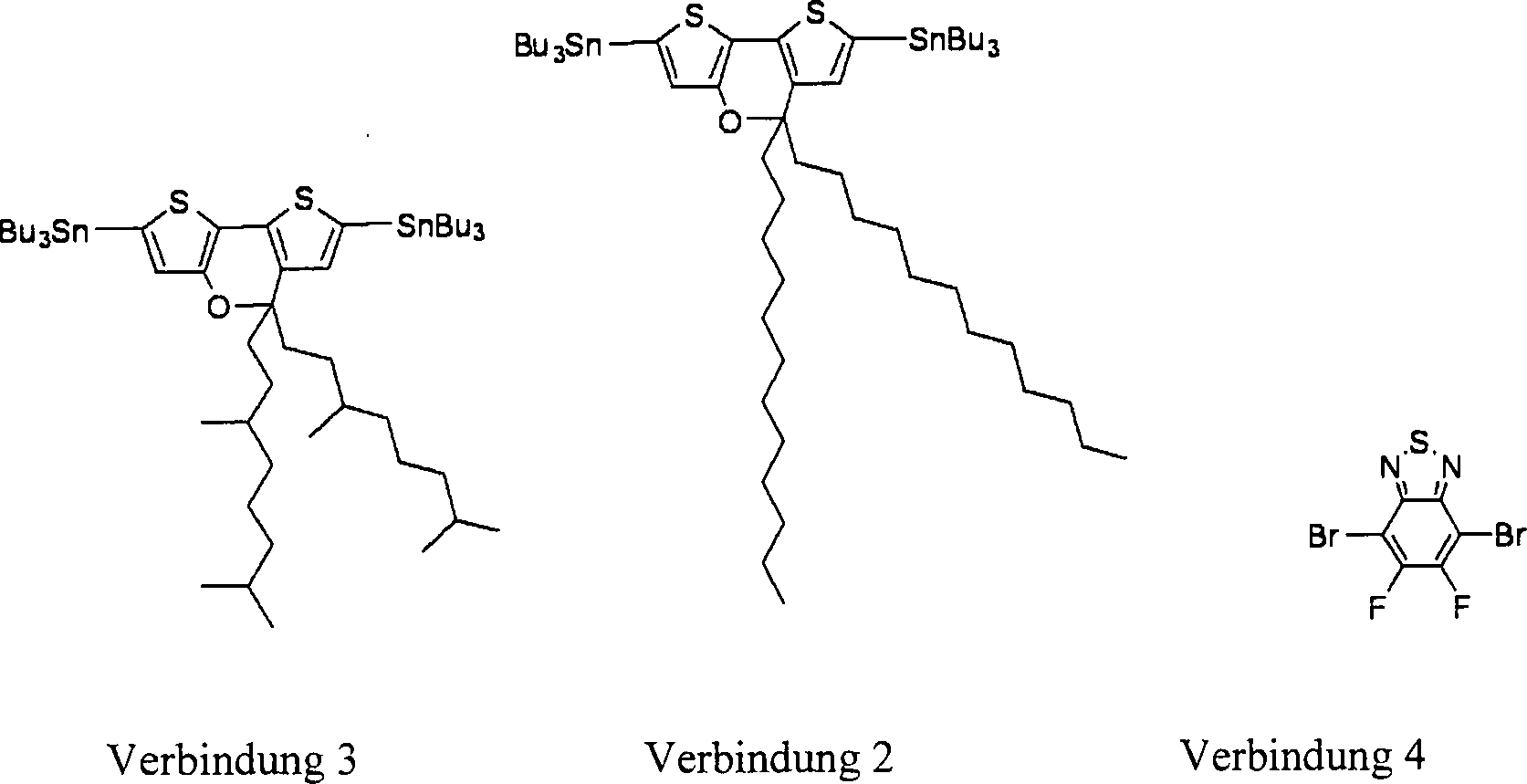
In einen 300 ml Kolben, von dem das Gas in dem Kolben mit Argon gespült worden war, wurden 800 mg (0,760 mmol) einer Verbindung 3, die gemäß einer Beschreibung der Internationalen Veröffentlichung
Synthesebeispiel 3Synthesis Example 3
(Synthese der Polymerverbindung 2) 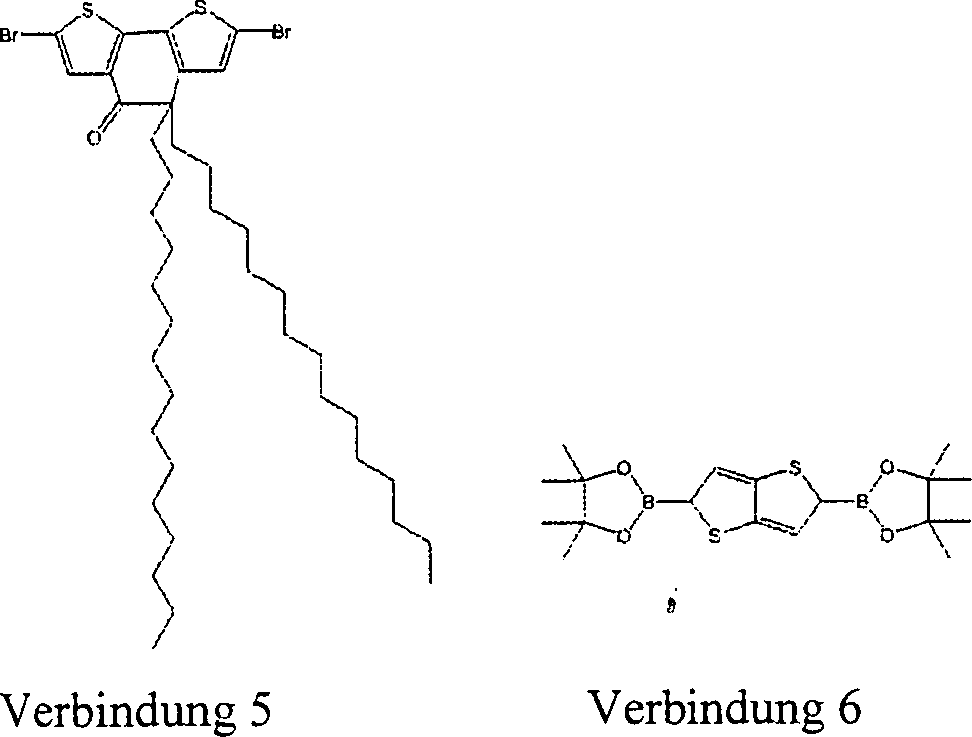
Eine Stickstoffgasatmosphäre wurde in einem 100 ml Vierhalskolben hergestellt, dann wurden eine Verbindung 5 (157 mg, 0,20 mmol) und trockenes THF (5 ml) zugegeben, und die Lösung wurde unter Durchblasen mit Argongas für 30 Minuten entlüftet. Danach wurden Pd2(dba)3 (9,16 mg, 1 μmol), Tri-tert-butylphosphoniumtetrafluorborat (11,6 mg, 4 μmol) und eine 3 M wässrige Kaliumphosphatlösung (1 ml) zugegeben, und das Gemisch wurde bei 80°C gerührt. Eine trockene THF (5 ml) Lösung einer Verbindung 6 (78,4 mg, 0,20 mmol), die unter Durchblasen mit Argongas für 30 Minuten entlüftet worden war, wurde bei 80°C in diese Reaktionslösung während eines Zeitraums von 5 Minuten getropft, und das Gemisch wurde 3 Stunden bei 80°C gerührt. Eine trockene THF (7 ml) Lösung von Phenylborsäure (122 mg, 0,45 mmol), die unter Durchblasen von Argongas für 30 Minuten entlüftet worden war, Pd2(dba)3 (9,16 mg, 1 μmol) und Tri-tert-butylphosphoniumtetrafluorborat (11,6 mg, 4 μmol) wurden bei 80°C zu dieser Reaktionslösung gegeben, und das Gemisch wurde 2 Stunden bei 80°C gerührt, Natrium-N,N-diethyldithiocarbamat-Trihydrat (1,7 g) und Wasser (15 g) wurden zugegeben, und das Gemisch wurde weiter 2 Stunden bei 80°C gerührt. Die wässrige Schicht in der erhaltenen Reaktionslösung wurde entfernt, dann wurde die organische Schicht einmal mit Wasser (20 g), zweimal mit einer 10 gew.-%igen wässrigen Essigsäurelösung (20 g), einmal mit Wasser (20 g) gewaschen, dann wurde ein Wiederausfällen unter Verwendung von Aceton (136 ml) bewirkt. Der erhaltene Feststoff wurde durch Säulenchromatographie (SiO2) gereinigt, und ein Wiederausfällen wurde unter Verwendung von Methanol bewirkt, wobei 120 g einer Polymerverbindung 2 erhalten wurden. Die Polymerverbindung C wies ein auf Polystyrol umgerechnetes Zahlenmittel des Molekulargewichts von 5,6 × 10⁴ und ein auf Polystyrol umgerechnetes Gewichtsmittel des Molekulargewichts von 1,1 × 10⁵ auf. Die Verbindung 5 kann mit einem Verfahren, beschrieben in
(Herstellung der Zusammensetzung 1)(Preparation of Composition 1)
Zehn (10) Gewichtsteile [6,6]-Phenyl C61-buttersäuremethylester (C60PCBM) (E100, hergestellt von Frontier Carbon Corporation) als ein Derivat von Fullerenen, 5 Gewichtsteile der Polymerverbindung 1 als eine Elektronendonorverbindung und 1000 Gewichtsteile o-Dichlorbenzol als ein Lösungsmittel wurden gemischt. Als Nächstes wurde die gemischte Lösung durch ein Teflon (eingetragene Marke) Filter mit einem Porendurchmesser von 5,0 μm filtriert, um eine Zusammensetzung 1 herzustellen.Ten (10) parts by weight of [6,6] -phenyl C61-butyric acid methyl ester (C60PCBM) (E100, manufactured by Frontier Carbon Corporation) as a derivative of fullerenes, 5 parts by weight of Polymer Compound 1 as an electron donor compound and 1000 parts by weight of o-dichlorobenzene as a solvent were mixed. Next, the mixed solution was filtered through a Teflon (Registered Trade Mark) filter having a pore diameter of 5.0 μm to prepare Composition 1. *** "
(Herstellung von Zusammensetzung 2)(Preparation of Composition 2)
Zehn (10) Gewichtsteile [6,6]-Phenyl C61-buttersäuremethylester (C60PCBM) (E100, hergestellt von Frontier Carbon Corporation) als ein Derivat von Fullerenen, 5 Gewichtsteile der Polymerverbindung 2 als eine Elektronendonorverbindung und 1000 Gewichtsteile o-Dichlorbenzol als ein Lösungsmittel wurden gemischt. Als Nächstes wurde die gemischte Lösung durch ein Teflon(eingetragene Marke)-Filter mit einem Porendurchmesser von 5,0 μm filtriert, um eine Zusammensetzung 2 herzustellen.Ten (10) parts by weight of [6,6] -phenyl C61-butyric acid methyl ester (C60PCBM) (E100, manufactured by Frontier Carbon Corporation) as a derivative of fullerenes, 5 parts by weight of Polymer Compound 2 as an electron donor compound and 1000 parts by weight of o-dichlorobenzene as a solvent were mixed. Next, the mixed solution was filtered through a Teflon (Registered Trade Mark) filter having a pore diameter of 5.0 μm to prepare Composition 2.
Beispiel 1 example 1
(Herstellung und Beurteilung der organischen photoelektrischen Umwandlungsvorrichtung)(Preparation and Evaluation of Organic Photoelectric Conversion Device)
Ein Glassubstrat, auf das ein als eine Anode einer Solarbatterie dienender ITO-Film gebildet worden war, wurde hergestellt. Der ITO-Film wurde mit einem Sputterverfahren gebildet, und seine Dicke betrug 150 nm. Das Glassubstrat wurde mit Ozon und UV behandelt, wobei der ITO-Film oberflächenbehandelt wurde. Als Nächstes wurde eine PEDOT:PSS Lösung (hergestellt von Heraeus, CleviosP VP AI4083) auf dem ITO-Film durch Schleuderbeschichten aufgetragen und 10 Minuten in Atmosphärenluft auf 120°C erwärmt, um eine Locheinspeisungsschicht (entspricht einer lochtransportierenden Schicht) mit einer Dicke von 30 nm zu bilden. Auf dieser Locheinspeisungsschicht wurde die vorstehend beschriebene Zusammensetzung 1 durch Schleuderbeschichten aufgetragen, um eine erste aktive Schicht (Dicke: etwa 100 nm) zu bilden.A glass substrate on which an ITO film serving as an anode of a solar battery was formed was prepared. The ITO film was formed by a sputtering method and its thickness was 150 nm. The glass substrate was treated with ozone and UV, whereby the ITO film was surface-treated. Next, a PEDOT: PSS solution (manufactured by Heraeus, CleviosP VP AI4083) was spin coated on the ITO film and heated at 120 ° C for 10 minutes in atmospheric air to form a hole feed layer (equivalent to a hole transporting layer) having a thickness of 30 nm to form. On this hole feed layer, the above-described composition 1 was spin-coated to form a first active layer (thickness: about 100 nm).
Als Nächstes wurde eine 45 gew.-%ige Isopropanoldispersionsflüssigkeit (HTD-711Z, hergestellt von TAYCA) aus Zinkoxidnanoteilchen (Teilchengröße: 20 nm bis 30 nm) mit 3-Pentanol in einer Menge von 2,5fach den Gewichtsteilen der Dispersionsflüssigkeit verdünnt, um eine Aufbringungsflüssigkeit herzustellen. Diese Aufbringungsflüssigkeit wurde auf die aktive Schicht durch Schleuderbeschichten mit einer Filmdicke von 200 nm aufgetragen, wobei eine funktionelle Schicht gebildet wurde, die in einem Wasserlösungsmittel unlöslich ist. Danach wurde eine neutrale PEDOT:PSS Dispersionsflüssigkeit (hergestellt von H. C. Starck, Clevios PN) mit pH = 6 bis 7 auf die funktionelle Schicht durch Schleuderbeschichten mit einer Filmdicke von 30 nm aufgetragen.Next, a 45 wt% isopropanol dispersion liquid (HTD-711Z, manufactured by TAYCA) of zinc oxide nanoparticles (particle size: 20 nm to 30 nm) was diluted with 3-pentanol in an amount of 2.5 times the parts by weight of the dispersion liquid to obtain a Make application liquid. This application liquid was spin-coated on the active layer at a film thickness of 200 nm to form a functional layer which is insoluble in a water solvent. Thereafter, a neutral PEDOT: PSS dispersion liquid (manufactured by H.C. Starck, Clevios PN) of pH = 6 to 7 was applied to the functional layer by spin coating at a film thickness of 30 nm.
Als Nächstes wurde die vorstehend beschriebene Zusammensetzung 2 durch Schleuderbeschichten aufgetragen, wobei eine zweite aktive Schicht (Dicke: etwa 100 nm) gebildet wurde.Next, the composition 2 described above was spin-coated to form a second active layer (thickness: about 100 nm).
Als Nächstes wurde eine 45 gew.-%ige Isopropanoldispersionsflüssigkeit (HTD-711Z, hergestellt von TAYCA) von Zinkoxidnanoteilchen (Teilchengröße: 20 nm bis 30 nm) mit 3-Pentanol in einer Menge der 2,5fachen Gewichtsteile der Dispersionsflüssigkeit verdünnt, um eine Aufbringungsflüssigkeit herzustellen. Diese Aufbringungsflüssigkeit wurde durch Schleuderbeschichten mit einer Filmdicke von 200 nm auf die aktive Schicht aufgetragen, wobei eine funktionelle Schicht gebildet wurde, die in Wasserlösungsmittel unlöslich ist.Next, a 45 wt% isopropanol dispersion liquid (HTD-711Z, manufactured by TAYCA) of zinc oxide nanoparticles (particle size: 20 nm to 30 nm) was diluted with 3-pentanol in an amount of 2.5-fold parts by weight of the dispersion liquid to obtain an application liquid manufacture. This application liquid was spin coated at a film thickness of 200 nm on the active layer to form a functional layer which is insoluble in water solvent.
Als Nächstes wurde eine drahtförmige Leiterdispersionsflüssigkeit unter Verwendung eines Wasserlösungsmittels (ClearOhm (eingetragene Marke) Ink-N AQ: hergestellt von Cambrios Technologies Corporation) mit einer Schleuderbeschichtungsvorrichtung aufgetragen und getrocknet, wobei eine Kathode, bestehend aus einer elektrisch leitenden Drahtschicht mit einer Dicke von 120 nm gebildet wurde. Danach wurde eine halbtransparente organische photoelektrische Umwandlungsvorrichtung durch Fixieren einer Glasplatte auf der Kathode mit einem UV-härtenden Dichtmittel, wobei eine Dichtschicht gebildet wurde, erhalten. Diese halbtransparente organische photoelektrische Umwandlungsvorrichtung zeigte graue Transmissionsfarbe, und die Chromatizität C* in dem L*C*h Farbsystem, berechnet aus dem Transmissionsspektrum, betrug 5,5.Next, a wire-shaped conductor dispersion liquid was applied by using a water solvent (ClearOhm (registered trademark) Ink-N AQ: manufactured by Cambrios Technologies Corporation) with a spin coater and dried using a cathode consisting of an electrically conductive wire layer having a thickness of 120 nm was formed. Thereafter, a semi-transparent organic photoelectric conversion device was obtained by fixing a glass plate on the cathode with a UV-curable sealant to form a sealant layer. This semi-transparent organic photoelectric conversion device showed gray transmission color, and the chromaticity C * in the L * C * h color system calculated from the transmission spectrum was 5.5.
Vergleichsbeispiel 1Comparative Example 1
(Herstellung und Beurteilung der organischen photoelektrischen Umwandlungsvorrichtung)(Preparation and Evaluation of Organic Photoelectric Conversion Device)
Ein Glassubstrat, auf dem ein ITO Film, der als eine Anode einer Solarbatterie dient, gebildet worden war, wurde hergestellt. Der ITO-Film wurde mit einem Sputterverfahren gebildet, und seine Dicke betrug 150 nm. Das Glassubstrat wurde mit Ozon und UV behandelt, wobei der ITO-Film oberflächenbehandelt wurde. Als Nächstes wurde eine PEDOT:PSS Lösung (hergestellt von Heraeus, CleviosP VP AI4083) auf den ITO-Film durch Schleuderbeschichten aufgetragen und 10 Minuten in Atmosphärenluft auf 120°C erwärmt, um eine Locheinspeisungsschicht mit einer Dicke von 30 nm zu bilden. Auf dieser Locheinspeisungsschicht wurde die vorstehend beschriebene Zusammensetzung 1 durch Schleuderbeschichten aufgetragen, um eine erste aktive Schicht (Dicke: etwa 100 nm) zu bilden.A glass substrate on which an ITO film serving as an anode of a solar battery was formed was prepared. The ITO film was formed by a sputtering method and its thickness was 150 nm. The glass substrate was treated with ozone and UV, whereby the ITO film was surface-treated. Next, a PEDOT: PSS solution (manufactured by Heraeus, CleviosP VP AI4083) was spin-coated on the ITO film and heated at 120 ° C in atmospheric air for 10 minutes to form a hole feed layer having a thickness of 30 nm. On this hole feed layer, the above-described composition 1 was spin-coated to form a first active layer (thickness: about 100 nm).
Als Nächstes wurde eine 45 gew.-%ige Isopropanoldispersionsflüssigkeit (HTD-711Z, hergestellt von TAYCA) von Zinkoxidnanoteilchen (Teilchengröße: 20 nm bis 30 nm) mit 3-Pentanol in einer Menge der 2,5fachen Gewichtsteile der Dispersionsflüssigkeit verdünnt, um eine Aufbringungsflüssigkeit herzustellen. Diese Aufbringungsflüssigkeit wurde durch Schleuderbeschichten mit einer Filmdicke von 200 nm auf die aktive Schicht aufgetragen, wobei eine funktionelle Schicht gebildet wurde, die in einem Wasserlösungsmittel unlöslich ist.Next, a 45 wt% isopropanol dispersion liquid (HTD-711Z, manufactured by TAYCA) of zinc oxide nanoparticles (particle size: 20 nm to 30 nm) was diluted with 3-pentanol in an amount of 2.5-fold parts by weight of the dispersion liquid to obtain an application liquid manufacture. This application liquid was spin-coated at a film thickness of 200 nm on the active layer to form a functional layer which is insoluble in a water solvent.
Als Nächstes wurde eine drahtförmige Leiterdispersionsflüssigkeit unter Verwendung eines Wasserlösungsmittels (ClearOhm (eingetragene Marke) Ink-N AQ: hergestellt von Cambrios Technologies Corporation) mit einer Schleuderbeschichtungsvorrichtung aufgetragen und getrocknet, wobei eine Kathode, bestehend aus einer elektrisch leitenden Drahtschicht mit einer Dicke von 120 nm gebildet wurde. Danach wurde eine halbtransparente organische photoelektrische Umwandlungsvorrichtung durch Fixieren einer Glasplatte auf der Kathode mit einem UV-härtenden Dichtmittel, wobei eine Dichtschicht gebildet wurde, erhalten. Diese halbtransparente organische photoelektrische Umwandlungsvorrichtung zeigte grüne Transmissionsfarbe, und die Chromatizität C* in dem L*C*h Farbsystem, berechnet aus dem Transmissionsspektrum, betrug 25,9. Next, a wire-shaped conductor dispersion liquid was applied by using a water solvent (ClearOhm (registered trademark) Ink-N AQ: manufactured by Cambrios Technologies Corporation) with a spin coater and dried using a cathode consisting of an electrically conductive wire layer having a thickness of 120 nm was formed. Thereafter, a semi-transparent organic photoelectric conversion device was obtained by fixing a glass plate on the cathode with a UV-curable sealant to form a sealant layer. This semi-transparent organic photoelectric conversion device showed green transmission color, and the chromaticity C * in the L * C * h color system calculated from the transmission spectrum was 25.9.
Vergleichsbeispiel 2Comparative Example 2
(Herstellung und Beurteilung der organischen photoelektrischen Umwandlungsvorrichtung)(Preparation and Evaluation of Organic Photoelectric Conversion Device)
Ein Glassubstrat, auf dem ein ITO Film, der als eine Anode einer Solarbatterie dient, gebildet worden war, wurde hergestellt. Der ITO-Film wurde mit einem Sputterverfahren gebildet, und seine Dicke betrug 150 nm. Das Glassubstrat wurde mit Ozon und UV behandelt, wobei der ITO-Film oberflächenbehandelt wurde. Als Nächstes wurde eine PEDOT-PSS Lösung (hergestellt von Heraeus, CleviosP VP AI4083) auf den ITO-Film durch Schleuderbeschichten aufgetragen und 10 Minuten in Atmosphärenluft auf 120°C erwärmt, um eine Locheinspeisungsschicht mit einer Dicke von 30 nm zu bilden. Auf dieser Locheinspeisungsschicht wurde die vorstehend beschriebene Zusammensetzung 2 durch Schleuderbeschichten aufgetragen, um eine zweite aktive Schicht (Dicke: etwa 100 nm) zu bilden.A glass substrate on which an ITO film serving as an anode of a solar battery was formed was prepared. The ITO film was formed by a sputtering method and its thickness was 150 nm. The glass substrate was treated with ozone and UV, whereby the ITO film was surface-treated. Next, a PEDOT-PSS solution (manufactured by Heraeus, CleviosP VP AI4083) was spin-coated on the ITO film and heated at 120 ° C for 10 minutes in atmospheric air to form a hole feed layer having a thickness of 30 nm. On this hole feed layer, the above-described Composition 2 was spin-coated to form a second active layer (thickness: about 100 nm).
Als Nächstes wurde eine 45 gew.-%ige Isopropanoldispersionsflüssigkeit (HTD-711Z, hergestellt von TAYCA) von Zinkoxidnanoteilchen (Teilchengröße: 20 nm bis 30 nm) mit 3-Pentanol in einer Menge der 2,5fachen Gewichtsteile der Dispersionsflüssigkeit verdünnt, um eine Aufbringungsflüssigkeit herzustellen. Diese Aufbringungsflüssigkeit wurde durch Schleuderbeschichten mit einer Filmdicke von 200 nm auf die aktive Schicht aufgetragen, wobei eine funktionelle Schicht gebildet wurde, die in Wasserlösungsmittel unlöslich ist.Next, a 45 wt% isopropanol dispersion liquid (HTD-711Z, manufactured by TAYCA) of zinc oxide nanoparticles (particle size: 20 nm to 30 nm) was diluted with 3-pentanol in an amount of 2.5-fold parts by weight of the dispersion liquid to obtain an application liquid manufacture. This application liquid was spin coated at a film thickness of 200 nm on the active layer to form a functional layer which is insoluble in water solvent.
Als Nächstes wurde eine drahtförmige Leiterdispersionsflüssigkeit unter Verwendung eines Wasserlösungsmittels (ClearOhm (eingetragene Marke) Ink-N AQ: hergestellt von Cambrios Technologies Corporation) mit einer Schleuderbeschichtungsvorrichtung aufgetragen und getrocknet, wobei eine Kathode, bestehend aus einer elektrisch leitenden Drahtschicht mit einer Dicke von 120 nm gebildet wurde. Danach wurde eine halbtransparente organische photoelektrische Umwandlungsvorrichtung durch Fixieren einer Glasplatte auf der Kathode mit einem UV-härtenden Dichtmittel, wobei eine Dichtschicht gebildet wurde, erhalten. Diese halbtransparente organische photoelektrische Umwandlungsvorrichtung zeigte purpurfarbene Transmissionsfarbe, und die Chromatizität C* in dem L*C*h Farbsystem, berechnet aus dem Transmissionsspektrum, betrug 13,0.Next, a wire-shaped conductor dispersion liquid was applied by using a water solvent (ClearOhm (registered trademark) Ink-N AQ: manufactured by Cambrios Technologies Corporation) with a spin coater and dried using a cathode consisting of an electrically conductive wire layer having a thickness of 120 nm was formed. Thereafter, a semi-transparent organic photoelectric conversion device was obtained by fixing a glass plate on the cathode with a UV-curable sealant to form a sealant layer. This semi-transparent organic photoelectric conversion device showed a magenta transmission color, and the chromaticity C * in the L * C * h color system calculated from the transmission spectrum was 13.0.
Beispiel 2Example 2
(Herstellung und Beurteilung der organischen photoelektrischen Umwandlungsvorrichtung)(Preparation and Evaluation of Organic Photoelectric Conversion Device)
Die organische photoelektrische Umwandlungsvorrichtung, erhalten in Vergleichsbeispiel 1, und die organische photoelektrische Umwandlungsvorrichtung, erhalten in Vergleichsbeispiel 2, wurden übereinandergelegt und seriell mit leitenden Drähten verbunden, um eine halbtransparente organische photoelektrische Umwandlungsvorrichtung herzustellen. Diese halbtransparente organische photoelektrische Umwandlungsvorrichtung zeigte graue Farbe, und die Chromatizität C* in dem L*C*h Farbsystem, berechnet aus dem Transmissionsspektrum, betrug 9,4.The organic photoelectric conversion device obtained in Comparative Example 1 and the organic photoelectric conversion device obtained in Comparative Example 2 were overlaid and serially connected with conductive wires to prepare a semi-transparent organic photoelectric conversion device. This semi-transparent organic photoelectric conversion device showed gray color, and the chromaticity C * in the L * C * h color system calculated from the transmission spectrum was 9.4.
Beispiel 3Example 3
(Herstellung und Beurteilung der organischen photoelektrischen Umwandlungsvorrichtung)(Preparation and Evaluation of Organic Photoelectric Conversion Device)
Die organische photoelektrische Umwandlungsvorrichtung, erhalten in Vergleichsbeispiel 1, und die organische photoelektrische Umwandlungsvorrichtung, erhalten in Vergleichsbeispiel 2, wurden übereinandergelegt und parallel mit leitenden Drähten verbunden, um eine halbtransparente organische photoelektrische Umwandlungsvorrichtung herzustellen. Diese halbtransparente organische photoelektrische Umwandlungsvorrichtung zeigte graue Farbe, und die Chromatizität C* in dem L*C*h Farbsystem, berechnet aus dem Transmissionsspektrum, betrug 9,4.The organic photoelectric conversion device obtained in Comparative Example 1 and the organic photoelectric conversion device obtained in Comparative Example 2 were superposed and connected in parallel with conductive wires to prepare a semi-transparent organic photoelectric conversion device. This semi-transparent organic photoelectric conversion device showed gray color, and the chromaticity C * in the L * C * h color system calculated from the transmission spectrum was 9.4.
Eine 1 cm × 1 cm rechtwinkelig-tetragonale Abschirmmaske wurde auf diesen halbtransparenten organischen photoelektrischen Umwandlungsvorrichtungen abgedeckt um den lichtaufnehmenden Bereich festzulegen, und die erhaltenen organischen photoelektrischen Umwandlungsvorrichtungen wurden mit konstantem Licht unter Verwendung eines Solarsimulators (hergestellt von Bunkoukeiki Co., Ltd., Handelsname: OTENTO-SUNII: AM 1.5G Filter, Strahlungsintensität: 100 mW/cm2) bestrahlt, und die Erzeugung von Strom und Spannung wurden gemessen, so wurde der Wirkungsgrad der photoelektrischen Umwandlung gemessen. Die erhaltenen Ergebnisse sind in Tabelle 1 gezeigt. A 1 cm × 1 cm rectangular-tetragonal shielding mask was covered on these semi-transparent organic photoelectric conversion devices to set the light-receiving area, and the obtained organic photoelectric conversion devices were irradiated with constant light using a solar simulator (manufactured by Bunkoukeiki Co., Ltd., trade name: OTENTO-SUNII: at 1.5G filter, irradiation intensity: 100 mW / cm 2 ) and the generation of current and voltage were measured, the photoelectric conversion efficiency was measured. The results obtained are shown in Table 1.
Die Transmissionsspektren dieser halbtransparenten organischen photoelektrischen Umwandlungsvorrichtungen wurden mit einem Spektrophotometer (hergestellt von JASCO Corporation, Handelsname: V-670) gemessen. Die Transmissionsspektren der organischen photoelektrischen Umwandlungsvorrichtungen, hergestellt in den Beispielen 1, 2 und 3 und Vergleichsbeispielen 1 und 2 sind in
Wie vorstehend beschrieben, weisen die organischen photoelektrischen Umwandlungsvorrichtungen der Beispiele 1, 2 und 3, die durch Übereinanderlegen von grünen und purpurfarbenen aktiven Schichten erhalten wurden, die in einer Beziehung von zueinander komplementären Farben sind, eine Chromatizität C* in dem L*C*h Farbsystem von nur 12 oder weniger auf, zeigen graue Transmissionsfarbe und sind so für eine Anwendung an Fenstern geeignet.As described above, the organic photoelectric conversion devices of Examples 1, 2 and 3 obtained by superposing green and magenta active layers which are in a mutually complementary color relationship have chromaticity C * in the L * C * h Color system of only 12 or less, show gray transmission color and are thus suitable for use on windows.
Industrielle AnwendbarkeitIndustrial applicability
Gemäß der vorliegenden Erfindung wird eine photoelektrische Umwandlungsvorrichtung mit geringer Chromatizität bereitgestellt.According to the present invention, there is provided a low chromaticity photoelectric conversion device.
Claims (9)
Applications Claiming Priority (3)
| Application Number | Priority Date | Filing Date | Title |
|---|---|---|---|
| JP2014143986 | 2014-07-14 | ||
| JP2014-143986 | 2014-07-14 | ||
| PCT/JP2015/068756 WO2016009822A1 (en) | 2014-07-14 | 2015-06-30 | Photoelectric conversion element |
Publications (1)
| Publication Number | Publication Date |
|---|---|
| DE112015003268T5 true DE112015003268T5 (en) | 2017-04-13 |
Family
ID=55078320
Family Applications (1)
| Application Number | Title | Priority Date | Filing Date |
|---|---|---|---|
| DE112015003268.1T Withdrawn DE112015003268T5 (en) | 2014-07-14 | 2015-06-30 | Photoelectric conversion device |
Country Status (4)
| Country | Link |
|---|---|
| US (1) | US20170162808A1 (en) |
| JP (1) | JPWO2016009822A1 (en) |
| DE (1) | DE112015003268T5 (en) |
| WO (1) | WO2016009822A1 (en) |
Families Citing this family (1)
| Publication number | Priority date | Publication date | Assignee | Title |
|---|---|---|---|---|
| JP7080133B2 (en) * | 2018-08-01 | 2022-06-03 | 住友化学株式会社 | Photodetection and fingerprint authentication device |
Family Cites Families (2)
| Publication number | Priority date | Publication date | Assignee | Title |
|---|---|---|---|---|
| US20100096011A1 (en) * | 2008-10-16 | 2010-04-22 | Qualcomm Mems Technologies, Inc. | High efficiency interferometric color filters for photovoltaic modules |
| JP2013179297A (en) * | 2012-02-10 | 2013-09-09 | Tokyo Institute Of Technology | Solar cell having optical control layer |
-
2015
- 2015-06-30 DE DE112015003268.1T patent/DE112015003268T5/en not_active Withdrawn
- 2015-06-30 US US15/325,815 patent/US20170162808A1/en not_active Abandoned
- 2015-06-30 JP JP2016534353A patent/JPWO2016009822A1/en active Pending
- 2015-06-30 WO PCT/JP2015/068756 patent/WO2016009822A1/en not_active Ceased
Also Published As
| Publication number | Publication date |
|---|---|
| US20170162808A1 (en) | 2017-06-08 |
| WO2016009822A1 (en) | 2016-01-21 |
| JPWO2016009822A1 (en) | 2017-04-27 |
Similar Documents
| Publication | Publication Date | Title |
|---|---|---|
| Wong | Luminescent organometallic poly (aryleneethynylene) s: functional properties towards implications in molecular optoelectronics | |
| DE102013110693B4 (en) | Photoactive organic material for optoelectronic components | |
| DE112010004202T5 (en) | Macromolecular compound | |
| DE112010004172T5 (en) | Macromolecular compound | |
| TW201326249A (en) | Polymer compounds and electronic components | |
| EP2976794B1 (en) | Photoactive organic material for optoelectronic devices | |
| KR20150048636A (en) | Unimolecular and organic solar cell comprising the same | |
| KR101749379B1 (en) | Copolymer, manufacturing method the same and organic solar cell comprising the copolymer | |
| DE112016001525T5 (en) | Photoelectric conversion device | |
| JP6687025B2 (en) | Photoelectric conversion element | |
| KR20170106802A (en) | Phenazine derivatives with the extended conjugated structure and applied to the organic photovoltaic polymers | |
| KR101997972B1 (en) | Conductive polymers, the organic photovoltaic cell comprising the same, and the synthesis thereof | |
| EP3290422B1 (en) | Compound and organic solar cell comprising same | |
| KR102283122B1 (en) | Heterocyclic compound and organic photovoltaic device comprising the same | |
| DE112015003268T5 (en) | Photoelectric conversion device | |
| DE112016001262T5 (en) | Photoelectric conversion apparatus comprising a reflection plate | |
| DE112015004774T5 (en) | Organic photoelectric conversion device and process for its production | |
| KR102069409B1 (en) | Copolymer and organic solar cell comprising the same | |
| DE102020135118A1 (en) | Connection for an optoelectronic component and optoelectronic component containing the connection | |
| EP3442045B1 (en) | Organic photoelectric conversion element, and solar battery module and sensor provided with same | |
| KR101930279B1 (en) | Preparation of phenazine derivatives with increased solubility and conjugated polymers consisting of phenazine derivatives for organo photoelectric conversion device | |
| KR101580385B1 (en) | New Acceptor containing conjugated polymers and organic optoelectronic devices | |
| KR101676526B1 (en) | Novel compound and photoelectric conversion device having the same | |
| EP4024489A1 (en) | Compound and its use in organic electronic components | |
| KR20140055872A (en) | A polymer compound for organic solar-cell, preparation method thereof and organic solar-cell comprising thereof |
Legal Events
| Date | Code | Title | Description |
|---|---|---|---|
| R119 | Application deemed withdrawn, or ip right lapsed, due to non-payment of renewal fee |