DE112014005175T5 - Hydromorphone and naloxone for the treatment of pain and opioid bowel dysfunction syndrome - Google Patents
Hydromorphone and naloxone for the treatment of pain and opioid bowel dysfunction syndrome Download PDFInfo
- Publication number
- DE112014005175T5 DE112014005175T5 DE112014005175.6T DE112014005175T DE112014005175T5 DE 112014005175 T5 DE112014005175 T5 DE 112014005175T5 DE 112014005175 T DE112014005175 T DE 112014005175T DE 112014005175 T5 DE112014005175 T5 DE 112014005175T5
- Authority
- DE
- Germany
- Prior art keywords
- hydromorphone
- naloxone
- pharmaceutically acceptable
- acceptable salt
- hcl
- Prior art date
- Legal status (The legal status is an assumption and is not a legal conclusion. Google has not performed a legal analysis and makes no representation as to the accuracy of the status listed.)
- Ceased
Links
- WVLOADHCBXTIJK-YNHQPCIGSA-N hydromorphone Chemical compound O([C@H]1C(CC[C@H]23)=O)C4=C5[C@@]12CCN(C)[C@@H]3CC5=CC=C4O WVLOADHCBXTIJK-YNHQPCIGSA-N 0.000 title claims abstract description 580
- 229960001410 hydromorphone Drugs 0.000 title claims abstract description 579
- 229960004127 naloxone Drugs 0.000 title claims abstract description 409
- 208000002193 Pain Diseases 0.000 title claims abstract description 134
- 238000011282 treatment Methods 0.000 title claims abstract description 119
- 230000036407 pain Effects 0.000 title claims abstract description 113
- UZHSEJADLWPNLE-GRGSLBFTSA-N naloxone Chemical compound O=C([C@@H]1O2)CC[C@@]3(O)[C@H]4CC5=CC=C(O)C2=C5[C@@]13CCN4CC=C UZHSEJADLWPNLE-GRGSLBFTSA-N 0.000 title abstract 2
- 208000011580 syndromic disease Diseases 0.000 title description 4
- 208000014540 Functional gastrointestinal disease Diseases 0.000 title 1
- 201000007637 bowel dysfunction Diseases 0.000 title 1
- 150000003839 salts Chemical class 0.000 claims abstract description 394
- RGPDIGOSVORSAK-STHHAXOLSA-N naloxone hydrochloride Chemical compound Cl.O=C([C@@H]1O2)CC[C@@]3(O)[C@H]4CC5=CC=C(O)C2=C5[C@@]13CCN4CC=C RGPDIGOSVORSAK-STHHAXOLSA-N 0.000 claims description 487
- 238000013265 extended release Methods 0.000 claims description 113
- 239000008194 pharmaceutical composition Substances 0.000 claims description 103
- 229960005250 naloxone hydrochloride Drugs 0.000 claims description 78
- DYUTXEVRMPFGTH-UHFFFAOYSA-N 4-(2,5-dimethylphenyl)-5-methyl-1,3-thiazol-2-amine Chemical compound S1C(N)=NC(C=2C(=CC=C(C)C=2)C)=C1C DYUTXEVRMPFGTH-UHFFFAOYSA-N 0.000 claims description 77
- 229960002738 hydromorphone hydrochloride Drugs 0.000 claims description 77
- 230000002035 prolonged effect Effects 0.000 claims description 60
- 206010010774 Constipation Diseases 0.000 claims description 54
- 239000007787 solid Substances 0.000 claims description 51
- 208000030053 Opioid-Induced Constipation Diseases 0.000 claims description 42
- 239000008203 oral pharmaceutical composition Substances 0.000 claims description 35
- 230000002265 prevention Effects 0.000 claims description 15
- 239000003401 opiate antagonist Substances 0.000 claims description 14
- 230000009467 reduction Effects 0.000 claims description 11
- 238000013268 sustained release Methods 0.000 abstract description 67
- 239000012730 sustained-release form Substances 0.000 abstract description 65
- 239000002552 dosage form Substances 0.000 abstract description 45
- 239000011159 matrix material Substances 0.000 description 86
- 238000000576 coating method Methods 0.000 description 73
- 239000011248 coating agent Substances 0.000 description 70
- 239000000203 mixture Substances 0.000 description 67
- VEXZGXHMUGYJMC-UHFFFAOYSA-N Hydrochloric acid Chemical compound Cl VEXZGXHMUGYJMC-UHFFFAOYSA-N 0.000 description 64
- 239000000463 material Substances 0.000 description 52
- 238000013270 controlled release Methods 0.000 description 47
- 239000003814 drug Substances 0.000 description 44
- 229940079593 drug Drugs 0.000 description 42
- CERQOIWHTDAKMF-UHFFFAOYSA-N Methacrylic acid Chemical compound CC(=C)C(O)=O CERQOIWHTDAKMF-UHFFFAOYSA-N 0.000 description 39
- 230000003871 intestinal function Effects 0.000 description 36
- 239000003826 tablet Substances 0.000 description 36
- 229940068196 placebo Drugs 0.000 description 35
- 239000000902 placebo Substances 0.000 description 35
- VVQNEPGJFQJSBK-UHFFFAOYSA-N Methyl methacrylate Chemical compound COC(=O)C(C)=C VVQNEPGJFQJSBK-UHFFFAOYSA-N 0.000 description 32
- 238000009472 formulation Methods 0.000 description 32
- 239000002245 particle Substances 0.000 description 32
- 238000004458 analytical method Methods 0.000 description 31
- 239000008141 laxative Substances 0.000 description 30
- 230000000202 analgesic effect Effects 0.000 description 29
- 230000006872 improvement Effects 0.000 description 27
- 239000004480 active ingredient Substances 0.000 description 23
- 230000002475 laxative effect Effects 0.000 description 23
- ZZSNKZQZMQGXPY-UHFFFAOYSA-N Ethyl cellulose Chemical compound CCOCC1OC(OC)C(OCC)C(OCC)C1OC1C(O)C(O)C(OC)C(CO)O1 ZZSNKZQZMQGXPY-UHFFFAOYSA-N 0.000 description 22
- 229920003134 Eudragit® polymer Polymers 0.000 description 21
- 229920000642 polymer Polymers 0.000 description 21
- 230000000694 effects Effects 0.000 description 19
- 238000000338 in vitro Methods 0.000 description 19
- 239000001856 Ethyl cellulose Substances 0.000 description 18
- 229920001249 ethyl cellulose Polymers 0.000 description 18
- 235000019325 ethyl cellulose Nutrition 0.000 description 18
- 229920002126 Acrylic acid copolymer Polymers 0.000 description 17
- 239000002775 capsule Substances 0.000 description 17
- 241001136792 Alle Species 0.000 description 15
- KHOITXIGCFIULA-UHFFFAOYSA-N Alophen Chemical compound C1=CC(OC(=O)C)=CC=C1C(C=1N=CC=CC=1)C1=CC=C(OC(C)=O)C=C1 KHOITXIGCFIULA-UHFFFAOYSA-N 0.000 description 15
- 229960000503 bisacodyl Drugs 0.000 description 15
- 239000012729 immediate-release (IR) formulation Substances 0.000 description 15
- 239000008185 minitablet Substances 0.000 description 15
- 239000008187 granular material Substances 0.000 description 14
- 230000008859 change Effects 0.000 description 13
- 238000011156 evaluation Methods 0.000 description 13
- 238000000034 method Methods 0.000 description 13
- 239000000546 pharmaceutical excipient Substances 0.000 description 12
- 239000004014 plasticizer Substances 0.000 description 12
- -1 but not limited to Chemical class 0.000 description 11
- 239000006185 dispersion Substances 0.000 description 11
- 239000012458 free base Substances 0.000 description 11
- HQKMJHAJHXVSDF-UHFFFAOYSA-L magnesium stearate Substances [Mg+2].CCCCCCCCCCCCCCCCCC([O-])=O.CCCCCCCCCCCCCCCCCC([O-])=O HQKMJHAJHXVSDF-UHFFFAOYSA-L 0.000 description 11
- 229940005483 opioid analgesics Drugs 0.000 description 11
- SOGAXMICEFXMKE-UHFFFAOYSA-N Butylmethacrylate Chemical compound CCCCOC(=O)C(C)=C SOGAXMICEFXMKE-UHFFFAOYSA-N 0.000 description 10
- 230000002209 hydrophobic effect Effects 0.000 description 10
- 239000008177 pharmaceutical agent Substances 0.000 description 10
- XLYOFNOQVPJJNP-UHFFFAOYSA-N water Substances O XLYOFNOQVPJJNP-UHFFFAOYSA-N 0.000 description 10
- 229920002153 Hydroxypropyl cellulose Polymers 0.000 description 9
- 230000002411 adverse Effects 0.000 description 9
- 239000011230 binding agent Substances 0.000 description 9
- 229920003086 cellulose ether Polymers 0.000 description 9
- 230000001684 chronic effect Effects 0.000 description 9
- 239000000945 filler Substances 0.000 description 9
- 230000009246 food effect Effects 0.000 description 9
- 235000010977 hydroxypropyl cellulose Nutrition 0.000 description 9
- 239000001863 hydroxypropyl cellulose Substances 0.000 description 9
- 239000000314 lubricant Substances 0.000 description 9
- GLDOVTGHNKAZLK-UHFFFAOYSA-N octadecan-1-ol Chemical compound CCCCCCCCCCCCCCCCCCO GLDOVTGHNKAZLK-UHFFFAOYSA-N 0.000 description 9
- JIGUQPWFLRLWPJ-UHFFFAOYSA-N Ethyl acrylate Chemical compound CCOC(=O)C=C JIGUQPWFLRLWPJ-UHFFFAOYSA-N 0.000 description 8
- 229920001577 copolymer Polymers 0.000 description 8
- 235000021471 food effect Nutrition 0.000 description 8
- PNJWIWWMYCMZRO-UHFFFAOYSA-N pent‐4‐en‐2‐one Natural products CC(=O)CC=C PNJWIWWMYCMZRO-UHFFFAOYSA-N 0.000 description 8
- 238000012216 screening Methods 0.000 description 8
- 239000013543 active substance Substances 0.000 description 7
- 150000002191 fatty alcohols Chemical class 0.000 description 7
- 229920003088 hydroxypropyl methyl cellulose Polymers 0.000 description 7
- 235000010979 hydroxypropyl methyl cellulose Nutrition 0.000 description 7
- 229940125722 laxative agent Drugs 0.000 description 7
- 230000003211 malignant effect Effects 0.000 description 7
- 238000004519 manufacturing process Methods 0.000 description 7
- 239000003607 modifier Substances 0.000 description 7
- 238000007619 statistical method Methods 0.000 description 7
- 238000002560 therapeutic procedure Methods 0.000 description 7
- SMZOUWXMTYCWNB-UHFFFAOYSA-N 2-(2-methoxy-5-methylphenyl)ethanamine Chemical compound COC1=CC=C(C)C=C1CCN SMZOUWXMTYCWNB-UHFFFAOYSA-N 0.000 description 6
- NIXOWILDQLNWCW-UHFFFAOYSA-N 2-Propenoic acid Natural products OC(=O)C=C NIXOWILDQLNWCW-UHFFFAOYSA-N 0.000 description 6
- 101100116570 Caenorhabditis elegans cup-2 gene Proteins 0.000 description 6
- 206010058019 Cancer Pain Diseases 0.000 description 6
- 101100116572 Drosophila melanogaster Der-1 gene Proteins 0.000 description 6
- 229920013820 alkyl cellulose Polymers 0.000 description 6
- 239000003795 chemical substances by application Substances 0.000 description 6
- 239000001866 hydroxypropyl methyl cellulose Substances 0.000 description 6
- 235000019359 magnesium stearate Nutrition 0.000 description 6
- 230000007935 neutral effect Effects 0.000 description 6
- 229940127240 opiate Drugs 0.000 description 6
- GUBGYTABKSRVRQ-XLOQQCSPSA-N Alpha-Lactose Chemical compound O[C@@H]1[C@@H](O)[C@@H](O)[C@@H](CO)O[C@H]1O[C@@H]1[C@@H](CO)O[C@H](O)[C@H](O)[C@H]1O GUBGYTABKSRVRQ-XLOQQCSPSA-N 0.000 description 5
- DNIAPMSPPWPWGF-UHFFFAOYSA-N Propylene glycol Chemical compound CC(O)CO DNIAPMSPPWPWGF-UHFFFAOYSA-N 0.000 description 5
- 208000007271 Substance Withdrawal Syndrome Diseases 0.000 description 5
- 239000011324 bead Substances 0.000 description 5
- 230000009850 completed effect Effects 0.000 description 5
- UFVKGYZPFZQRLF-UHFFFAOYSA-N hydroxypropyl methyl cellulose Chemical compound OC1C(O)C(OC)OC(CO)C1OC1C(O)C(O)C(OC2C(C(O)C(OC3C(C(O)C(O)C(CO)O3)O)C(CO)O2)O)C(CO)O1 UFVKGYZPFZQRLF-UHFFFAOYSA-N 0.000 description 5
- 238000012423 maintenance Methods 0.000 description 5
- 235000012054 meals Nutrition 0.000 description 5
- 239000000178 monomer Substances 0.000 description 5
- 229920000058 polyacrylate Polymers 0.000 description 5
- 238000004448 titration Methods 0.000 description 5
- 239000001993 wax Substances 0.000 description 5
- 229920000178 Acrylic resin Polymers 0.000 description 4
- 239000004925 Acrylic resin Substances 0.000 description 4
- 206010012735 Diarrhoea Diseases 0.000 description 4
- BAPJBEWLBFYGME-UHFFFAOYSA-N Methyl acrylate Chemical compound COC(=O)C=C BAPJBEWLBFYGME-UHFFFAOYSA-N 0.000 description 4
- ZFOZVQLOBQUTQQ-UHFFFAOYSA-N Tributyl citrate Chemical compound CCCCOC(=O)CC(O)(C(=O)OCCCC)CC(=O)OCCCC ZFOZVQLOBQUTQQ-UHFFFAOYSA-N 0.000 description 4
- 125000000129 anionic group Chemical group 0.000 description 4
- 239000004359 castor oil Substances 0.000 description 4
- 235000019438 castor oil Nutrition 0.000 description 4
- 239000008199 coating composition Substances 0.000 description 4
- 238000013461 design Methods 0.000 description 4
- FLKPEMZONWLCSK-UHFFFAOYSA-N diethyl phthalate Chemical compound CCOC(=O)C1=CC=CC=C1C(=O)OCC FLKPEMZONWLCSK-UHFFFAOYSA-N 0.000 description 4
- 230000007717 exclusion Effects 0.000 description 4
- 239000003925 fat Substances 0.000 description 4
- 102000006640 gamma-Glutamyltransferase Human genes 0.000 description 4
- 230000002496 gastric effect Effects 0.000 description 4
- ZEMPKEQAKRGZGQ-XOQCFJPHSA-N glycerol triricinoleate Natural products CCCCCC[C@@H](O)CC=CCCCCCCCC(=O)OC[C@@H](COC(=O)CCCCCCCC=CC[C@@H](O)CCCCCC)OC(=O)CCCCCCCC=CC[C@H](O)CCCCCC ZEMPKEQAKRGZGQ-XOQCFJPHSA-N 0.000 description 4
- 238000010438 heat treatment Methods 0.000 description 4
- GOQYKNQRPGWPLP-UHFFFAOYSA-N n-heptadecyl alcohol Natural products CCCCCCCCCCCCCCCCCO GOQYKNQRPGWPLP-UHFFFAOYSA-N 0.000 description 4
- 230000036470 plasma concentration Effects 0.000 description 4
- 229940127558 rescue medication Drugs 0.000 description 4
- 239000000243 solution Substances 0.000 description 4
- 239000000454 talc Substances 0.000 description 4
- 229910052623 talc Inorganic materials 0.000 description 4
- 238000012360 testing method Methods 0.000 description 4
- URAYPUMNDPQOKB-UHFFFAOYSA-N triacetin Chemical compound CC(=O)OCC(OC(C)=O)COC(C)=O URAYPUMNDPQOKB-UHFFFAOYSA-N 0.000 description 4
- DKXNBNKWCZZMJT-JVCRWLNRSA-N (2r,3r,4r,5r)-2,3,5,6-tetrahydroxy-4-[(2s,3r,4s,5r,6r)-3,4,5-trihydroxy-6-(hydroxymethyl)oxan-2-yl]oxyhexanal Chemical compound O=C[C@H](O)[C@@H](O)[C@@H]([C@H](O)CO)O[C@@H]1O[C@H](CO)[C@H](O)[C@H](O)[C@H]1O DKXNBNKWCZZMJT-JVCRWLNRSA-N 0.000 description 3
- JKNCOURZONDCGV-UHFFFAOYSA-N 2-(dimethylamino)ethyl 2-methylprop-2-enoate Chemical compound CN(C)CCOC(=O)C(C)=C JKNCOURZONDCGV-UHFFFAOYSA-N 0.000 description 3
- WEVYAHXRMPXWCK-UHFFFAOYSA-N Acetonitrile Chemical compound CC#N WEVYAHXRMPXWCK-UHFFFAOYSA-N 0.000 description 3
- 108010082126 Alanine transaminase Proteins 0.000 description 3
- 108010003415 Aspartate Aminotransferases Proteins 0.000 description 3
- 102000004625 Aspartate Aminotransferases Human genes 0.000 description 3
- 206010013654 Drug abuse Diseases 0.000 description 3
- 206010013754 Drug withdrawal syndrome Diseases 0.000 description 3
- 206010028980 Neoplasm Diseases 0.000 description 3
- DOOTYTYQINUNNV-UHFFFAOYSA-N Triethyl citrate Chemical compound CCOC(=O)CC(O)(C(=O)OCC)CC(=O)OCC DOOTYTYQINUNNV-UHFFFAOYSA-N 0.000 description 3
- 239000008186 active pharmaceutical agent Substances 0.000 description 3
- 239000002671 adjuvant Substances 0.000 description 3
- 229960004977 anhydrous lactose Drugs 0.000 description 3
- 201000011510 cancer Diseases 0.000 description 3
- 235000014113 dietary fatty acids Nutrition 0.000 description 3
- 239000000194 fatty acid Substances 0.000 description 3
- 229930195729 fatty acid Natural products 0.000 description 3
- 150000004665 fatty acids Chemical class 0.000 description 3
- 235000013305 food Nutrition 0.000 description 3
- 230000006870 function Effects 0.000 description 3
- 125000000524 functional group Chemical group 0.000 description 3
- 238000002347 injection Methods 0.000 description 3
- 239000007924 injection Substances 0.000 description 3
- 229920003145 methacrylic acid copolymer Polymers 0.000 description 3
- 239000003921 oil Substances 0.000 description 3
- 235000019198 oils Nutrition 0.000 description 3
- 229920001223 polyethylene glycol Polymers 0.000 description 3
- 239000011148 porous material Substances 0.000 description 3
- 238000002360 preparation method Methods 0.000 description 3
- 239000000047 product Substances 0.000 description 3
- 230000002829 reductive effect Effects 0.000 description 3
- 230000002269 spontaneous effect Effects 0.000 description 3
- 239000000126 substance Substances 0.000 description 3
- 230000002459 sustained effect Effects 0.000 description 3
- 125000001302 tertiary amino group Chemical group 0.000 description 3
- 239000001069 triethyl citrate Substances 0.000 description 3
- VMYFZRTXGLUXMZ-UHFFFAOYSA-N triethyl citrate Natural products CCOC(=O)C(O)(C(=O)OCC)C(=O)OCC VMYFZRTXGLUXMZ-UHFFFAOYSA-N 0.000 description 3
- 235000013769 triethyl citrate Nutrition 0.000 description 3
- TXMZWEASFRBVKY-IOQDSZRYSA-N (4r,4as,7ar,12bs)-4a,9-dihydroxy-3-prop-2-enyl-2,4,5,6,7a,13-hexahydro-1h-4,12-methanobenzofuro[3,2-e]isoquinoline-7-one;dihydrate;hydrochloride Chemical compound O.O.Cl.O=C([C@@H]1O2)CC[C@@]3(O)[C@H]4CC5=CC=C(O)C2=C5[C@@]13CCN4CC=C TXMZWEASFRBVKY-IOQDSZRYSA-N 0.000 description 2
- 208000004998 Abdominal Pain Diseases 0.000 description 2
- 206010006002 Bone pain Diseases 0.000 description 2
- 208000006545 Chronic Obstructive Pulmonary Disease Diseases 0.000 description 2
- 208000000094 Chronic Pain Diseases 0.000 description 2
- PYGXAGIECVVIOZ-UHFFFAOYSA-N Dibutyl decanedioate Chemical compound CCCCOC(=O)CCCCCCCCC(=O)OCCCC PYGXAGIECVVIOZ-UHFFFAOYSA-N 0.000 description 2
- LFQSCWFLJHTTHZ-UHFFFAOYSA-N Ethanol Chemical compound CCO LFQSCWFLJHTTHZ-UHFFFAOYSA-N 0.000 description 2
- 229920003151 Eudragit® RL polymer Polymers 0.000 description 2
- 229920003152 Eudragit® RS polymer Polymers 0.000 description 2
- 208000001640 Fibromyalgia Diseases 0.000 description 2
- 108020004206 Gamma-glutamyltransferase Proteins 0.000 description 2
- 101710107035 Gamma-glutamyltranspeptidase Proteins 0.000 description 2
- 101710173228 Glutathione hydrolase proenzyme Proteins 0.000 description 2
- 229920000663 Hydroxyethyl cellulose Polymers 0.000 description 2
- 239000004354 Hydroxyethyl cellulose Substances 0.000 description 2
- 206010020591 Hypercapnia Diseases 0.000 description 2
- 206010021143 Hypoxia Diseases 0.000 description 2
- GUBGYTABKSRVRQ-QKKXKWKRSA-N Lactose Natural products OC[C@H]1O[C@@H](O[C@H]2[C@H](O)[C@@H](O)C(O)O[C@@H]2CO)[C@H](O)[C@@H](O)[C@H]1O GUBGYTABKSRVRQ-QKKXKWKRSA-N 0.000 description 2
- CERQOIWHTDAKMF-UHFFFAOYSA-M Methacrylate Chemical compound CC(=C)C([O-])=O CERQOIWHTDAKMF-UHFFFAOYSA-M 0.000 description 2
- 229920000168 Microcrystalline cellulose Polymers 0.000 description 2
- 206010028813 Nausea Diseases 0.000 description 2
- 206010038678 Respiratory depression Diseases 0.000 description 2
- VYPSYNLAJGMNEJ-UHFFFAOYSA-N Silicium dioxide Chemical compound O=[Si]=O VYPSYNLAJGMNEJ-UHFFFAOYSA-N 0.000 description 2
- 229920002125 Sokalan® Polymers 0.000 description 2
- 230000002159 abnormal effect Effects 0.000 description 2
- AJXBTRZGLDTSST-UHFFFAOYSA-N amino 2-methylprop-2-enoate Chemical compound CC(=C)C(=O)ON AJXBTRZGLDTSST-UHFFFAOYSA-N 0.000 description 2
- 230000036592 analgesia Effects 0.000 description 2
- 230000008901 benefit Effects 0.000 description 2
- 235000021152 breakfast Nutrition 0.000 description 2
- CQEYYJKEWSMYFG-UHFFFAOYSA-N butyl acrylate Chemical compound CCCCOC(=O)C=C CQEYYJKEWSMYFG-UHFFFAOYSA-N 0.000 description 2
- FUFJGUQYACFECW-UHFFFAOYSA-L calcium hydrogenphosphate Chemical compound [Ca+2].OP([O-])([O-])=O FUFJGUQYACFECW-UHFFFAOYSA-L 0.000 description 2
- 239000001506 calcium phosphate Substances 0.000 description 2
- 159000000007 calcium salts Chemical class 0.000 description 2
- 125000002091 cationic group Chemical group 0.000 description 2
- 230000001364 causal effect Effects 0.000 description 2
- 210000003169 central nervous system Anatomy 0.000 description 2
- DDRJAANPRJIHGJ-UHFFFAOYSA-N creatinine Chemical compound CN1CC(=O)NC1=N DDRJAANPRJIHGJ-UHFFFAOYSA-N 0.000 description 2
- 230000001419 dependent effect Effects 0.000 description 2
- DOIRQSBPFJWKBE-UHFFFAOYSA-N dibutyl phthalate Chemical compound CCCCOC(=O)C1=CC=CC=C1C(=O)OCCCC DOIRQSBPFJWKBE-UHFFFAOYSA-N 0.000 description 2
- 239000003085 diluting agent Substances 0.000 description 2
- FPAFDBFIGPHWGO-UHFFFAOYSA-N dioxosilane;oxomagnesium;hydrate Chemical compound O.[Mg]=O.[Mg]=O.[Mg]=O.O=[Si]=O.O=[Si]=O.O=[Si]=O.O=[Si]=O FPAFDBFIGPHWGO-UHFFFAOYSA-N 0.000 description 2
- 238000009826 distribution Methods 0.000 description 2
- 230000004064 dysfunction Effects 0.000 description 2
- SUPCQIBBMFXVTL-UHFFFAOYSA-N ethyl 2-methylprop-2-enoate Chemical compound CCOC(=O)C(C)=C SUPCQIBBMFXVTL-UHFFFAOYSA-N 0.000 description 2
- FSXVSUSRJXIJHB-UHFFFAOYSA-M ethyl prop-2-enoate;methyl 2-methylprop-2-enoate;trimethyl-[2-(2-methylprop-2-enoyloxy)ethyl]azanium;chloride Chemical compound [Cl-].CCOC(=O)C=C.COC(=O)C(C)=C.CC(=C)C(=O)OCC[N+](C)(C)C FSXVSUSRJXIJHB-UHFFFAOYSA-M 0.000 description 2
- 238000001125 extrusion Methods 0.000 description 2
- 239000001087 glyceryl triacetate Substances 0.000 description 2
- 235000013773 glyceryl triacetate Nutrition 0.000 description 2
- BXWNKGSJHAJOGX-UHFFFAOYSA-N hexadecan-1-ol Chemical compound CCCCCCCCCCCCCCCCO BXWNKGSJHAJOGX-UHFFFAOYSA-N 0.000 description 2
- 150000004677 hydrates Chemical class 0.000 description 2
- 150000003840 hydrochlorides Chemical class 0.000 description 2
- 229920001477 hydrophilic polymer Polymers 0.000 description 2
- 229920013821 hydroxy alkyl cellulose Polymers 0.000 description 2
- 235000019447 hydroxyethyl cellulose Nutrition 0.000 description 2
- 230000000968 intestinal effect Effects 0.000 description 2
- 208000003243 intestinal obstruction Diseases 0.000 description 2
- 239000004922 lacquer Substances 0.000 description 2
- 229960001375 lactose Drugs 0.000 description 2
- 239000008101 lactose Substances 0.000 description 2
- 230000000873 masking effect Effects 0.000 description 2
- 238000002483 medication Methods 0.000 description 2
- 230000003340 mental effect Effects 0.000 description 2
- 229940016286 microcrystalline cellulose Drugs 0.000 description 2
- 235000019813 microcrystalline cellulose Nutrition 0.000 description 2
- 239000008108 microcrystalline cellulose Substances 0.000 description 2
- DNKKLDKIFMDAPT-UHFFFAOYSA-N n,n-dimethylmethanamine;2-methylprop-2-enoic acid Chemical compound CN(C)C.CC(=C)C(O)=O.CC(=C)C(O)=O DNKKLDKIFMDAPT-UHFFFAOYSA-N 0.000 description 2
- 230000008693 nausea Effects 0.000 description 2
- 208000004296 neuralgia Diseases 0.000 description 2
- 230000002981 neuropathic effect Effects 0.000 description 2
- 208000021722 neuropathic pain Diseases 0.000 description 2
- 239000002547 new drug Substances 0.000 description 2
- 235000020925 non fasting Nutrition 0.000 description 2
- 239000000014 opioid analgesic Substances 0.000 description 2
- 239000008184 oral solid dosage form Substances 0.000 description 2
- 239000003960 organic solvent Substances 0.000 description 2
- 230000001769 paralizing effect Effects 0.000 description 2
- 230000035699 permeability Effects 0.000 description 2
- 229920003229 poly(methyl methacrylate) Polymers 0.000 description 2
- 239000004926 polymethyl methacrylate Substances 0.000 description 2
- 229920000036 polyvinylpyrrolidone Polymers 0.000 description 2
- 235000013855 polyvinylpyrrolidone Nutrition 0.000 description 2
- 238000003825 pressing Methods 0.000 description 2
- 230000008569 process Effects 0.000 description 2
- 208000020016 psychiatric disease Diseases 0.000 description 2
- 159000000000 sodium salts Chemical class 0.000 description 2
- 239000012453 solvate Substances 0.000 description 2
- 239000003381 stabilizer Substances 0.000 description 2
- 238000004659 sterilization and disinfection Methods 0.000 description 2
- 239000000758 substrate Substances 0.000 description 2
- HLZKNKRTKFSKGZ-UHFFFAOYSA-N tetradecan-1-ol Chemical compound CCCCCCCCCCCCCCO HLZKNKRTKFSKGZ-UHFFFAOYSA-N 0.000 description 2
- 229960002622 triacetin Drugs 0.000 description 2
- 230000009278 visceral effect Effects 0.000 description 2
- 239000000230 xanthan gum Substances 0.000 description 2
- 229920001285 xanthan gum Polymers 0.000 description 2
- 235000010493 xanthan gum Nutrition 0.000 description 2
- 229940082509 xanthan gum Drugs 0.000 description 2
- WRIDQFICGBMAFQ-UHFFFAOYSA-N (E)-8-Octadecenoic acid Natural products CCCCCCCCCC=CCCCCCCC(O)=O WRIDQFICGBMAFQ-UHFFFAOYSA-N 0.000 description 1
- 229920003067 (meth)acrylic acid ester copolymer Polymers 0.000 description 1
- VKNASXZDGZNEDA-UHFFFAOYSA-N 2-cyanoethyl 2-methylprop-2-enoate Chemical compound CC(=C)C(=O)OCCC#N VKNASXZDGZNEDA-UHFFFAOYSA-N 0.000 description 1
- SFPNZPQIIAJXGL-UHFFFAOYSA-N 2-ethoxyethyl 2-methylprop-2-enoate Chemical class CCOCCOC(=O)C(C)=C SFPNZPQIIAJXGL-UHFFFAOYSA-N 0.000 description 1
- BSKHPKMHTQYZBB-UHFFFAOYSA-N 2-methylpyridine Chemical class CC1=CC=CC=N1 BSKHPKMHTQYZBB-UHFFFAOYSA-N 0.000 description 1
- LQJBNNIYVWPHFW-UHFFFAOYSA-N 20:1omega9c fatty acid Natural products CCCCCCCCCCC=CCCCCCCCC(O)=O LQJBNNIYVWPHFW-UHFFFAOYSA-N 0.000 description 1
- QSBYPNXLFMSGKH-UHFFFAOYSA-N 9-Heptadecensaeure Natural products CCCCCCCC=CCCCCCCCC(O)=O QSBYPNXLFMSGKH-UHFFFAOYSA-N 0.000 description 1
- QTBSBXVTEAMEQO-UHFFFAOYSA-M Acetate Chemical compound CC([O-])=O QTBSBXVTEAMEQO-UHFFFAOYSA-M 0.000 description 1
- NIXOWILDQLNWCW-UHFFFAOYSA-M Acrylate Chemical compound [O-]C(=O)C=C NIXOWILDQLNWCW-UHFFFAOYSA-M 0.000 description 1
- 208000026872 Addison Disease Diseases 0.000 description 1
- 102100036475 Alanine aminotransferase 1 Human genes 0.000 description 1
- 208000007848 Alcoholism Diseases 0.000 description 1
- 102000002260 Alkaline Phosphatase Human genes 0.000 description 1
- 108020004774 Alkaline Phosphatase Proteins 0.000 description 1
- WSVLPVUVIUVCRA-KPKNDVKVSA-N Alpha-lactose monohydrate Chemical compound O.O[C@@H]1[C@@H](O)[C@@H](O)[C@@H](CO)O[C@H]1O[C@@H]1[C@@H](CO)O[C@H](O)[C@H](O)[C@H]1O WSVLPVUVIUVCRA-KPKNDVKVSA-N 0.000 description 1
- 208000000003 Breakthrough pain Diseases 0.000 description 1
- 206010010904 Convulsion Diseases 0.000 description 1
- 229920002261 Corn starch Polymers 0.000 description 1
- FBPFZTCFMRRESA-FSIIMWSLSA-N D-Glucitol Natural products OC[C@H](O)[C@H](O)[C@@H](O)[C@H](O)CO FBPFZTCFMRRESA-FSIIMWSLSA-N 0.000 description 1
- FBPFZTCFMRRESA-KVTDHHQDSA-N D-Mannitol Chemical compound OC[C@@H](O)[C@@H](O)[C@H](O)[C@H](O)CO FBPFZTCFMRRESA-KVTDHHQDSA-N 0.000 description 1
- FBPFZTCFMRRESA-JGWLITMVSA-N D-glucitol Chemical compound OC[C@H](O)[C@@H](O)[C@H](O)[C@H](O)CO FBPFZTCFMRRESA-JGWLITMVSA-N 0.000 description 1
- 206010012373 Depressed level of consciousness Diseases 0.000 description 1
- 208000020401 Depressive disease Diseases 0.000 description 1
- FEWJPZIEWOKRBE-JCYAYHJZSA-N Dextrotartaric acid Chemical compound OC(=O)[C@H](O)[C@@H](O)C(O)=O FEWJPZIEWOKRBE-JCYAYHJZSA-N 0.000 description 1
- 235000019739 Dicalciumphosphate Nutrition 0.000 description 1
- XBPCUCUWBYBCDP-UHFFFAOYSA-N Dicyclohexylamine Chemical class C1CCCCC1NC1CCCCC1 XBPCUCUWBYBCDP-UHFFFAOYSA-N 0.000 description 1
- 229920003161 Eudragit® RS 30 D Polymers 0.000 description 1
- BDAGIHXWWSANSR-UHFFFAOYSA-M Formate Chemical compound [O-]C=O BDAGIHXWWSANSR-UHFFFAOYSA-M 0.000 description 1
- 241001295925 Gegenes Species 0.000 description 1
- WQZGKKKJIJFFOK-GASJEMHNSA-N Glucose Natural products OC[C@H]1OC(O)[C@H](O)[C@@H](O)[C@@H]1O WQZGKKKJIJFFOK-GASJEMHNSA-N 0.000 description 1
- CPELXLSAUQHCOX-UHFFFAOYSA-N Hydrogen bromide Chemical compound Br CPELXLSAUQHCOX-UHFFFAOYSA-N 0.000 description 1
- 206010020751 Hypersensitivity Diseases 0.000 description 1
- 206010022773 Intracranial pressure increased Diseases 0.000 description 1
- CKLJMWTZIZZHCS-REOHCLBHSA-N L-aspartic acid Chemical compound OC(=O)[C@@H](N)CC(O)=O CKLJMWTZIZZHCS-REOHCLBHSA-N 0.000 description 1
- WHUUTDBJXJRKMK-VKHMYHEASA-N L-glutamic acid Chemical compound OC(=O)[C@@H](N)CCC(O)=O WHUUTDBJXJRKMK-VKHMYHEASA-N 0.000 description 1
- FYYHWMGAXLPEAU-UHFFFAOYSA-N Magnesium Chemical compound [Mg] FYYHWMGAXLPEAU-UHFFFAOYSA-N 0.000 description 1
- 229930195725 Mannitol Natural products 0.000 description 1
- AFVFQIVMOAPDHO-UHFFFAOYSA-N Methanesulfonic acid Chemical compound CS(O)(=O)=O AFVFQIVMOAPDHO-UHFFFAOYSA-N 0.000 description 1
- WHNWPMSKXPGLAX-UHFFFAOYSA-N N-Vinyl-2-pyrrolidone Chemical compound C=CN1CCCC1=O WHNWPMSKXPGLAX-UHFFFAOYSA-N 0.000 description 1
- 239000005642 Oleic acid Substances 0.000 description 1
- ZQPPMHVWECSIRJ-UHFFFAOYSA-N Oleic acid Natural products CCCCCCCCC=CCCCCCCCC(O)=O ZQPPMHVWECSIRJ-UHFFFAOYSA-N 0.000 description 1
- 208000026251 Opioid-Related disease Diseases 0.000 description 1
- 206010031009 Oral pain Diseases 0.000 description 1
- 229910019142 PO4 Inorganic materials 0.000 description 1
- 229920003171 Poly (ethylene oxide) Polymers 0.000 description 1
- 229920002845 Poly(methacrylic acid) Polymers 0.000 description 1
- 239000004372 Polyvinyl alcohol Substances 0.000 description 1
- 108010009736 Protein Hydrolysates Proteins 0.000 description 1
- 208000004756 Respiratory Insufficiency Diseases 0.000 description 1
- 229920002472 Starch Polymers 0.000 description 1
- 229930006000 Sucrose Natural products 0.000 description 1
- CZMRCDWAGMRECN-UGDNZRGBSA-N Sucrose Chemical compound O[C@H]1[C@H](O)[C@@H](CO)O[C@@]1(CO)O[C@@H]1[C@H](O)[C@@H](O)[C@H](O)[C@@H](CO)O1 CZMRCDWAGMRECN-UGDNZRGBSA-N 0.000 description 1
- QAOWNCQODCNURD-UHFFFAOYSA-L Sulfate Chemical compound [O-]S([O-])(=O)=O QAOWNCQODCNURD-UHFFFAOYSA-L 0.000 description 1
- 238000008050 Total Bilirubin Reagent Methods 0.000 description 1
- GSEJCLTVZPLZKY-UHFFFAOYSA-N Triethanolamine Chemical class OCCN(CCO)CCO GSEJCLTVZPLZKY-UHFFFAOYSA-N 0.000 description 1
- ZMANZCXQSJIPKH-UHFFFAOYSA-N Triethylamine Chemical class CCN(CC)CC ZMANZCXQSJIPKH-UHFFFAOYSA-N 0.000 description 1
- DTQVDTLACAAQTR-UHFFFAOYSA-M Trifluoroacetate Chemical compound [O-]C(=O)C(F)(F)F DTQVDTLACAAQTR-UHFFFAOYSA-M 0.000 description 1
- 206010047700 Vomiting Diseases 0.000 description 1
- 206010048010 Withdrawal syndrome Diseases 0.000 description 1
- 230000001154 acute effect Effects 0.000 description 1
- 208000005298 acute pain Diseases 0.000 description 1
- 206010001584 alcohol abuse Diseases 0.000 description 1
- 208000025746 alcohol use disease Diseases 0.000 description 1
- 229910052784 alkaline earth metal Inorganic materials 0.000 description 1
- 150000001342 alkaline earth metals Chemical class 0.000 description 1
- 239000012670 alkaline solution Substances 0.000 description 1
- 125000000217 alkyl group Chemical group 0.000 description 1
- 208000026935 allergic disease Diseases 0.000 description 1
- 150000001412 amines Chemical class 0.000 description 1
- 229940024606 amino acid Drugs 0.000 description 1
- 235000001014 amino acid Nutrition 0.000 description 1
- 150000001413 amino acids Chemical class 0.000 description 1
- 229920003144 amino alkyl methacrylate copolymer Polymers 0.000 description 1
- 125000003277 amino group Chemical group 0.000 description 1
- 229940035676 analgesics Drugs 0.000 description 1
- 230000000181 anti-adherent effect Effects 0.000 description 1
- 239000003911 antiadherent Substances 0.000 description 1
- 239000007864 aqueous solution Substances 0.000 description 1
- 206010003246 arthritis Diseases 0.000 description 1
- 229940009098 aspartate Drugs 0.000 description 1
- 230000002567 autonomic effect Effects 0.000 description 1
- 230000004888 barrier function Effects 0.000 description 1
- 235000013871 bee wax Nutrition 0.000 description 1
- 239000012166 beeswax Substances 0.000 description 1
- 230000009286 beneficial effect Effects 0.000 description 1
- JUHORIMYRDESRB-UHFFFAOYSA-N benzathine Chemical class C=1C=CC=CC=1CNCCNCC1=CC=CC=C1 JUHORIMYRDESRB-UHFFFAOYSA-N 0.000 description 1
- SRSXLGNVWSONIS-UHFFFAOYSA-M benzenesulfonate Chemical compound [O-]S(=O)(=O)C1=CC=CC=C1 SRSXLGNVWSONIS-UHFFFAOYSA-M 0.000 description 1
- 229940077388 benzenesulfonate Drugs 0.000 description 1
- WQZGKKKJIJFFOK-VFUOTHLCSA-N beta-D-glucose Chemical compound OC[C@H]1O[C@@H](O)[C@H](O)[C@@H](O)[C@@H]1O WQZGKKKJIJFFOK-VFUOTHLCSA-N 0.000 description 1
- 229940085302 bisacodyl 10 mg Drugs 0.000 description 1
- 239000008280 blood Substances 0.000 description 1
- 210000004369 blood Anatomy 0.000 description 1
- CJZGTCYPCWQAJB-UHFFFAOYSA-L calcium stearate Chemical compound [Ca+2].CCCCCCCCCCCCCCCCCC([O-])=O.CCCCCCCCCCCCCCCCCC([O-])=O CJZGTCYPCWQAJB-UHFFFAOYSA-L 0.000 description 1
- 239000008116 calcium stearate Substances 0.000 description 1
- 235000013539 calcium stearate Nutrition 0.000 description 1
- 239000004203 carnauba wax Substances 0.000 description 1
- 235000013869 carnauba wax Nutrition 0.000 description 1
- 239000000969 carrier Substances 0.000 description 1
- 229920002678 cellulose Polymers 0.000 description 1
- 239000001913 cellulose Substances 0.000 description 1
- 235000010980 cellulose Nutrition 0.000 description 1
- 229940082500 cetostearyl alcohol Drugs 0.000 description 1
- 229960000541 cetyl alcohol Drugs 0.000 description 1
- 230000005465 channeling Effects 0.000 description 1
- 208000025302 chronic primary adrenal insufficiency Diseases 0.000 description 1
- KRKNYBCHXYNGOX-UHFFFAOYSA-N citric acid Chemical class OC(=O)CC(O)(C(O)=O)CC(O)=O KRKNYBCHXYNGOX-UHFFFAOYSA-N 0.000 description 1
- 238000004581 coalescence Methods 0.000 description 1
- 239000013066 combination product Substances 0.000 description 1
- 229940127555 combination product Drugs 0.000 description 1
- 150000001875 compounds Chemical class 0.000 description 1
- 238000007906 compression Methods 0.000 description 1
- 230000006835 compression Effects 0.000 description 1
- 229940124301 concurrent medication Drugs 0.000 description 1
- 239000008120 corn starch Substances 0.000 description 1
- 229940099112 cornstarch Drugs 0.000 description 1
- 229940109239 creatinine Drugs 0.000 description 1
- 239000004148 curcumin Substances 0.000 description 1
- 230000013872 defecation Effects 0.000 description 1
- 229940099371 diacetylated monoglycerides Drugs 0.000 description 1
- 238000010586 diagram Methods 0.000 description 1
- 229940038472 dicalcium phosphate Drugs 0.000 description 1
- 229910000390 dicalcium phosphate Inorganic materials 0.000 description 1
- 235000019700 dicalcium phosphate Nutrition 0.000 description 1
- 238000009792 diffusion process Methods 0.000 description 1
- 150000004683 dihydrates Chemical class 0.000 description 1
- 230000002526 effect on cardiovascular system Effects 0.000 description 1
- 229940124645 emergency medicine Drugs 0.000 description 1
- 230000001804 emulsifying effect Effects 0.000 description 1
- 206010015037 epilepsy Diseases 0.000 description 1
- 150000002169 ethanolamines Chemical class 0.000 description 1
- MVPICKVDHDWCJQ-UHFFFAOYSA-N ethyl 3-pyrrolidin-1-ylpropanoate Chemical compound CCOC(=O)CCN1CCCC1 MVPICKVDHDWCJQ-UHFFFAOYSA-N 0.000 description 1
- 238000002474 experimental method Methods 0.000 description 1
- 235000020937 fasting conditions Nutrition 0.000 description 1
- 235000019197 fats Nutrition 0.000 description 1
- 239000012530 fluid Substances 0.000 description 1
- 230000037406 food intake Effects 0.000 description 1
- 210000004051 gastric juice Anatomy 0.000 description 1
- 210000005095 gastrointestinal system Anatomy 0.000 description 1
- 230000009477 glass transition Effects 0.000 description 1
- 239000008103 glucose Substances 0.000 description 1
- 229960001031 glucose Drugs 0.000 description 1
- 229930195712 glutamate Natural products 0.000 description 1
- 125000005908 glyceryl ester group Chemical group 0.000 description 1
- 230000036541 health Effects 0.000 description 1
- 230000002440 hepatic effect Effects 0.000 description 1
- 238000004128 high performance liquid chromatography Methods 0.000 description 1
- 239000008240 homogeneous mixture Substances 0.000 description 1
- 238000000265 homogenisation Methods 0.000 description 1
- 230000003054 hormonal effect Effects 0.000 description 1
- 239000012943 hotmelt Substances 0.000 description 1
- 230000036571 hydration Effects 0.000 description 1
- 238000006703 hydration reaction Methods 0.000 description 1
- 229920001600 hydrophobic polymer Polymers 0.000 description 1
- 125000002768 hydroxyalkyl group Chemical group 0.000 description 1
- 230000009610 hypersensitivity Effects 0.000 description 1
- 230000002989 hypothyroidism Effects 0.000 description 1
- 208000003532 hypothyroidism Diseases 0.000 description 1
- 230000007954 hypoxia Effects 0.000 description 1
- 229960003943 hypromellose Drugs 0.000 description 1
- 239000007943 implant Substances 0.000 description 1
- 239000004615 ingredient Substances 0.000 description 1
- 229910052500 inorganic mineral Inorganic materials 0.000 description 1
- 238000011835 investigation Methods 0.000 description 1
- QXJSBBXBKPUZAA-UHFFFAOYSA-N isooleic acid Natural products CCCCCCCC=CCCCCCCCCC(O)=O QXJSBBXBKPUZAA-UHFFFAOYSA-N 0.000 description 1
- 238000009533 lab test Methods 0.000 description 1
- 229960001021 lactose monohydrate Drugs 0.000 description 1
- 230000000670 limiting effect Effects 0.000 description 1
- 229910052749 magnesium Inorganic materials 0.000 description 1
- 239000000395 magnesium oxide Substances 0.000 description 1
- CPLXHLVBOLITMK-UHFFFAOYSA-N magnesium oxide Inorganic materials [Mg]=O CPLXHLVBOLITMK-UHFFFAOYSA-N 0.000 description 1
- 235000012245 magnesium oxide Nutrition 0.000 description 1
- 159000000003 magnesium salts Chemical class 0.000 description 1
- AXZKOIWUVFPNLO-UHFFFAOYSA-N magnesium;oxygen(2-) Chemical compound [O-2].[Mg+2] AXZKOIWUVFPNLO-UHFFFAOYSA-N 0.000 description 1
- 206010025482 malaise Diseases 0.000 description 1
- VZCYOOQTPOCHFL-UPHRSURJSA-N maleic acid Chemical compound OC(=O)\C=C/C(O)=O VZCYOOQTPOCHFL-UPHRSURJSA-N 0.000 description 1
- 239000000594 mannitol Substances 0.000 description 1
- 235000010355 mannitol Nutrition 0.000 description 1
- 230000001404 mediated effect Effects 0.000 description 1
- 230000009245 menopause Effects 0.000 description 1
- 229910052751 metal Inorganic materials 0.000 description 1
- 239000002184 metal Substances 0.000 description 1
- 125000005397 methacrylic acid ester group Chemical group 0.000 description 1
- DCUFMVPCXCSVNP-UHFFFAOYSA-N methacrylic anhydride Chemical compound CC(=C)C(=O)OC(=O)C(C)=C DCUFMVPCXCSVNP-UHFFFAOYSA-N 0.000 description 1
- 239000011707 mineral Substances 0.000 description 1
- 150000007522 mineralic acids Chemical class 0.000 description 1
- 238000002156 mixing Methods 0.000 description 1
- 230000004899 motility Effects 0.000 description 1
- 229940043348 myristyl alcohol Drugs 0.000 description 1
- 229940121367 non-opioid analgesics Drugs 0.000 description 1
- ZQPPMHVWECSIRJ-KTKRTIGZSA-N oleic acid Chemical compound CCCCCCCC\C=C/CCCCCCCC(O)=O ZQPPMHVWECSIRJ-KTKRTIGZSA-N 0.000 description 1
- 239000003402 opiate agonist Substances 0.000 description 1
- 201000000988 opioid abuse Diseases 0.000 description 1
- 239000003217 oral combined contraceptive Substances 0.000 description 1
- 239000006186 oral dosage form Substances 0.000 description 1
- 150000007524 organic acids Chemical class 0.000 description 1
- 235000005985 organic acids Nutrition 0.000 description 1
- 230000008520 organization Effects 0.000 description 1
- 230000003204 osmotic effect Effects 0.000 description 1
- 230000035515 penetration Effects 0.000 description 1
- 239000010452 phosphate Substances 0.000 description 1
- NBIIXXVUZAFLBC-UHFFFAOYSA-K phosphate Chemical compound [O-]P([O-])([O-])=O NBIIXXVUZAFLBC-UHFFFAOYSA-K 0.000 description 1
- 239000008363 phosphate buffer Substances 0.000 description 1
- XNGIFLGASWRNHJ-UHFFFAOYSA-N phthalic acid Chemical class OC(=O)C1=CC=CC=C1C(O)=O XNGIFLGASWRNHJ-UHFFFAOYSA-N 0.000 description 1
- 230000000704 physical effect Effects 0.000 description 1
- 229920002401 polyacrylamide Polymers 0.000 description 1
- 229920001515 polyalkylene glycol Polymers 0.000 description 1
- 229920000193 polymethacrylate Polymers 0.000 description 1
- 229920002451 polyvinyl alcohol Polymers 0.000 description 1
- 239000001267 polyvinylpyrrolidone Substances 0.000 description 1
- XAEFZNCEHLXOMS-UHFFFAOYSA-M potassium benzoate Chemical compound [K+].[O-]C(=O)C1=CC=CC=C1 XAEFZNCEHLXOMS-UHFFFAOYSA-M 0.000 description 1
- 229940069328 povidone Drugs 0.000 description 1
- 238000009597 pregnancy test Methods 0.000 description 1
- 230000002028 premature Effects 0.000 description 1
- 235000018102 proteins Nutrition 0.000 description 1
- 102000004169 proteins and genes Human genes 0.000 description 1
- 108090000623 proteins and genes Proteins 0.000 description 1
- 150000003222 pyridines Chemical class 0.000 description 1
- 125000001453 quaternary ammonium group Chemical group 0.000 description 1
- 150000003254 radicals Chemical class 0.000 description 1
- 206010039073 rheumatoid arthritis Diseases 0.000 description 1
- 231100000279 safety data Toxicity 0.000 description 1
- 210000002966 serum Anatomy 0.000 description 1
- 230000001568 sexual effect Effects 0.000 description 1
- 239000000377 silicon dioxide Substances 0.000 description 1
- 229940045902 sodium stearyl fumarate Drugs 0.000 description 1
- 239000000600 sorbitol Substances 0.000 description 1
- 235000019698 starch Nutrition 0.000 description 1
- 229940012831 stearyl alcohol Drugs 0.000 description 1
- 230000001954 sterilising effect Effects 0.000 description 1
- 238000003860 storage Methods 0.000 description 1
- 208000011117 substance-related disease Diseases 0.000 description 1
- 239000005720 sucrose Substances 0.000 description 1
- 229960004793 sucrose Drugs 0.000 description 1
- 150000005846 sugar alcohols Chemical class 0.000 description 1
- 150000003871 sulfonates Chemical class 0.000 description 1
- 239000008030 superplasticizer Substances 0.000 description 1
- 239000013589 supplement Substances 0.000 description 1
- 239000004094 surface-active agent Substances 0.000 description 1
- 230000008961 swelling Effects 0.000 description 1
- 208000024891 symptom Diseases 0.000 description 1
- 229940095064 tartrate Drugs 0.000 description 1
- OULAJFUGPPVRBK-UHFFFAOYSA-N tetratriacontyl alcohol Natural products CCCCCCCCCCCCCCCCCCCCCCCCCCCCCCCCCCO OULAJFUGPPVRBK-UHFFFAOYSA-N 0.000 description 1
- 230000001225 therapeutic effect Effects 0.000 description 1
- JOXIMZWYDAKGHI-UHFFFAOYSA-N toluene-4-sulfonic acid Chemical compound CC1=CC=C(S(O)(=O)=O)C=C1 JOXIMZWYDAKGHI-UHFFFAOYSA-N 0.000 description 1
- 239000003204 tranquilizing agent Substances 0.000 description 1
- 230000002936 tranquilizing effect Effects 0.000 description 1
- VZCYOOQTPOCHFL-UHFFFAOYSA-N trans-butenedioic acid Natural products OC(=O)C=CC(O)=O VZCYOOQTPOCHFL-UHFFFAOYSA-N 0.000 description 1
- QORWJWZARLRLPR-UHFFFAOYSA-H tricalcium bis(phosphate) Chemical compound [Ca+2].[Ca+2].[Ca+2].[O-]P([O-])([O-])=O.[O-]P([O-])([O-])=O QORWJWZARLRLPR-UHFFFAOYSA-H 0.000 description 1
- 229940078499 tricalcium phosphate Drugs 0.000 description 1
- 229910000391 tricalcium phosphate Inorganic materials 0.000 description 1
- 235000019731 tricalcium phosphate Nutrition 0.000 description 1
- 238000002562 urinalysis Methods 0.000 description 1
- 210000002700 urine Anatomy 0.000 description 1
- 235000015112 vegetable and seed oil Nutrition 0.000 description 1
- 239000008158 vegetable oil Substances 0.000 description 1
- 208000009935 visceral pain Diseases 0.000 description 1
- 230000001755 vocal effect Effects 0.000 description 1
- 230000008673 vomiting Effects 0.000 description 1
- 230000003442 weekly effect Effects 0.000 description 1
- 238000005550 wet granulation Methods 0.000 description 1
Images


Classifications
-
- A—HUMAN NECESSITIES
- A61—MEDICAL OR VETERINARY SCIENCE; HYGIENE
- A61K—PREPARATIONS FOR MEDICAL, DENTAL OR TOILETRY PURPOSES
- A61K31/00—Medicinal preparations containing organic active ingredients
- A61K31/33—Heterocyclic compounds
- A61K31/395—Heterocyclic compounds having nitrogen as a ring hetero atom, e.g. guanethidine or rifamycins
- A61K31/435—Heterocyclic compounds having nitrogen as a ring hetero atom, e.g. guanethidine or rifamycins having six-membered rings with one nitrogen as the only ring hetero atom
- A61K31/47—Quinolines; Isoquinolines
- A61K31/485—Morphinan derivatives, e.g. morphine, codeine
-
- A—HUMAN NECESSITIES
- A61—MEDICAL OR VETERINARY SCIENCE; HYGIENE
- A61K—PREPARATIONS FOR MEDICAL, DENTAL OR TOILETRY PURPOSES
- A61K45/00—Medicinal preparations containing active ingredients not provided for in groups A61K31/00 - A61K41/00
- A61K45/06—Mixtures of active ingredients without chemical characterisation, e.g. antiphlogistics and cardiaca
-
- A—HUMAN NECESSITIES
- A61—MEDICAL OR VETERINARY SCIENCE; HYGIENE
- A61K—PREPARATIONS FOR MEDICAL, DENTAL OR TOILETRY PURPOSES
- A61K9/00—Medicinal preparations characterised by special physical form
- A61K9/0012—Galenical forms characterised by the site of application
- A61K9/0053—Mouth and digestive tract, i.e. intraoral and peroral administration
-
- A—HUMAN NECESSITIES
- A61—MEDICAL OR VETERINARY SCIENCE; HYGIENE
- A61K—PREPARATIONS FOR MEDICAL, DENTAL OR TOILETRY PURPOSES
- A61K9/00—Medicinal preparations characterised by special physical form
- A61K9/20—Pills, tablets, discs, rods
-
- A—HUMAN NECESSITIES
- A61—MEDICAL OR VETERINARY SCIENCE; HYGIENE
- A61K—PREPARATIONS FOR MEDICAL, DENTAL OR TOILETRY PURPOSES
- A61K9/00—Medicinal preparations characterised by special physical form
- A61K9/48—Preparations in capsules, e.g. of gelatin, of chocolate
-
- A—HUMAN NECESSITIES
- A61—MEDICAL OR VETERINARY SCIENCE; HYGIENE
- A61P—SPECIFIC THERAPEUTIC ACTIVITY OF CHEMICAL COMPOUNDS OR MEDICINAL PREPARATIONS
- A61P1/00—Drugs for disorders of the alimentary tract or the digestive system
-
- A—HUMAN NECESSITIES
- A61—MEDICAL OR VETERINARY SCIENCE; HYGIENE
- A61P—SPECIFIC THERAPEUTIC ACTIVITY OF CHEMICAL COMPOUNDS OR MEDICINAL PREPARATIONS
- A61P1/00—Drugs for disorders of the alimentary tract or the digestive system
- A61P1/10—Laxatives
-
- A—HUMAN NECESSITIES
- A61—MEDICAL OR VETERINARY SCIENCE; HYGIENE
- A61P—SPECIFIC THERAPEUTIC ACTIVITY OF CHEMICAL COMPOUNDS OR MEDICINAL PREPARATIONS
- A61P23/00—Anaesthetics
-
- A—HUMAN NECESSITIES
- A61—MEDICAL OR VETERINARY SCIENCE; HYGIENE
- A61P—SPECIFIC THERAPEUTIC ACTIVITY OF CHEMICAL COMPOUNDS OR MEDICINAL PREPARATIONS
- A61P25/00—Drugs for disorders of the nervous system
- A61P25/04—Centrally acting analgesics, e.g. opioids
-
- A—HUMAN NECESSITIES
- A61—MEDICAL OR VETERINARY SCIENCE; HYGIENE
- A61P—SPECIFIC THERAPEUTIC ACTIVITY OF CHEMICAL COMPOUNDS OR MEDICINAL PREPARATIONS
- A61P29/00—Non-central analgesic, antipyretic or antiinflammatory agents, e.g. antirheumatic agents; Non-steroidal antiinflammatory drugs [NSAID]
-
- A—HUMAN NECESSITIES
- A61—MEDICAL OR VETERINARY SCIENCE; HYGIENE
- A61P—SPECIFIC THERAPEUTIC ACTIVITY OF CHEMICAL COMPOUNDS OR MEDICINAL PREPARATIONS
- A61P43/00—Drugs for specific purposes, not provided for in groups A61P1/00-A61P41/00
-
- A—HUMAN NECESSITIES
- A61—MEDICAL OR VETERINARY SCIENCE; HYGIENE
- A61K—PREPARATIONS FOR MEDICAL, DENTAL OR TOILETRY PURPOSES
- A61K2300/00—Mixtures or combinations of active ingredients, wherein at least one active ingredient is fully defined in groups A61K31/00 - A61K41/00
Landscapes
- Health & Medical Sciences (AREA)
- General Health & Medical Sciences (AREA)
- Life Sciences & Earth Sciences (AREA)
- Chemical & Material Sciences (AREA)
- Public Health (AREA)
- Medicinal Chemistry (AREA)
- Veterinary Medicine (AREA)
- Animal Behavior & Ethology (AREA)
- Pharmacology & Pharmacy (AREA)
- Epidemiology (AREA)
- General Chemical & Material Sciences (AREA)
- Organic Chemistry (AREA)
- Nuclear Medicine, Radiotherapy & Molecular Imaging (AREA)
- Chemical Kinetics & Catalysis (AREA)
- Engineering & Computer Science (AREA)
- Bioinformatics & Cheminformatics (AREA)
- Emergency Medicine (AREA)
- Pain & Pain Management (AREA)
- Nutrition Science (AREA)
- Physiology (AREA)
- Biomedical Technology (AREA)
- Neurology (AREA)
- Rheumatology (AREA)
- Neurosurgery (AREA)
- Anesthesiology (AREA)
- Pharmaceuticals Containing Other Organic And Inorganic Compounds (AREA)
- Medicinal Preparation (AREA)
Abstract
Die vorliegende Erfindung betrifft pharmazeutische Dosierungsformen mit verlängerter Freisetzung umfassend Hydromorphon oder ein pharmazeutisch verträgliches Salz davon und Naloxon oder ein pharmazeutisch verträgliches Salz davon zur Verwendung bei der Behandlung von Schmerz.The present invention relates to sustained-release pharmaceutical dosage forms comprising hydromorphone or a pharmaceutically acceptable salt thereof and naloxone or a pharmaceutically acceptable salt thereof for use in the treatment of pain.
Description
Technisches Gebiet der ErfindungTechnical field of the invention
Die vorliegende Erfindung betrifft pharmazeutische Dosierungsformen mit verlängerter Freisetzung umfassend Hydromorphon oder ein pharmazeutisch verträgliches Salz davon und Naloxon oder ein pharmazeutisch verträgliches Salz davon zur Verwendung bei der Behandlung von Schmerz.The present invention relates to sustained-release pharmaceutical dosage forms comprising hydromorphone or a pharmaceutically acceptable salt thereof and naloxone or a pharmaceutically acceptable salt thereof for use in the treatment of pain.
Hintergrund der ErfindungBackground of the invention
Nach der Schmerzleiter (pain ladder model) der Weltgesundheitsorganisation sind Opioide indiziert für die Behandlung von moderaten bis starken Schmerzen. Opioide zur Schmerzbehandlung werden üblicherweise als pharmazeutische Zusammensetzungen mit verlängerter Freisetzung verabreicht, die kontinuierlich z. B. alle 12 Stunden genommen werden.According to the World Health Organization pain ladder model, opioids are indicated for the treatment of moderate to severe pain. Pain control opioids are commonly administered as extended release pharmaceutical compositions which are continuously administered to e.g. B. be taken every 12 hours.
Eine Opioid-Behandlung kann jedoch Nebenwirkungen hervorrufen, von denen die unangenehmsten das Opioid-Darmsyndrom (opioid bowel syndrome) und insbesondere opioidinduzierte Verstopfung umfassen. Es wurde berichtet, dass bis zu einem Drittel der Patienten als Folge der Probleme mit Verstopfung die Opioid-Behandlung reduzieren oder einstellen (Bell et al., Pain Med 2009, 10, 35–42).However, opioid treatment may produce side effects, the most unpleasant of which include opioid bowel syndrome and, in particular, opioid-induced constipation. It has been reported that up to one-third of patients reduce or stop opioid treatment as a result of constipation problems (Bell et al., Pain Med 2009, 10, 35-42).
Es besteht somit ein fortwährender Bedarf für eine effiziente Schmerztherapie mit Opioiden. Es besteht auch Bedarf an Formulierungen, die keinen Food-Effekt zeigen, welches eines der Probleme ist, dass die vorliegende Erfindung zu lösen sucht.There is thus a continuing need for efficient pain therapy with opioids. There is also a need for formulations that show no food effect, which is one of the problems that the present invention seeks to solve.
Zusammenfassung der ErfindungSummary of the invention
Es ist eine Aufgabe der vorliegenden Erfindung, pharmazeutische Dosierungsformen mit verlängerter Freisetzung umfassend Opioide zur Behandlung von Schmerz bereitzustellen, die Nebenwirkungen verbessern, insbesondere opioidinduzierte Verstopfung.It is an object of the present invention to provide extended release pharmaceutical dosage forms comprising opioids for the treatment of pain which improve side effects, especially opioid-induced constipation.
Es ist auch eine Aufgabe, pharmazeutische Dosierungsformen mit verlängerter Freisetzung umfassend Opioide zur Behandlung von Schmerz bereitzustellen, die Nebenwirkungen verbessern, insbesondere opioidinduzierte Verstopfung und gegebenenfalls einen reduzierten oder keinen Food-Effekt zeigen.It is also an object to provide sustained-release pharmaceutical dosage forms comprising opioids for the treatment of pain which improve side effects, particularly opioid-induced constipation and optionally a reduced or no food effect.
Diese und weitere Aufgaben, wie sie aus der nachfolgenden Beschreibung hervorgehen, werden durch den Gegenstand der unabhängigen Ansprüche gelöst. Auf einige der bevorzugten Ausführungsformen wird durch die abhängigen Ansprüche Bezug genommen.These and other objects, as will become apparent from the following description, are achieved by the subject matter of the independent claims. Some of the preferred embodiments are referred to by the dependent claims.
Zu einem gewissen Grad basiert die vorliegende Erfindung auf Ergebnissen, die in den Beispielen beschrieben sind. Diese Ergebnisse legen nahe, dass Formulierungen mit verlängerter Freisetzung von spezifischen Kombinationen von Hydromorphon oder einem pharmazeutisch verträglichen Salz davon und Naloxon oder ein pharmazeutisch verträgliches Salz davon verwendet werden können, um Schmerzen effizient zu behandeln und opioidinduzierte Verstopfung zu reduzieren oder zu verhindern ohne wesentlichen Verlust von therapeutisch wirksamen Analgesie-Levels. Diese spezifischen Kombinationen umfassen in einigen Ausführungsformen Hydromorphon HCl und Naloxon HCl in einem Gewichtsverhältnis von Hydromorphon HCl:Naloxon HCl im Bereich von etwa 1:1 bis etwa 1:2. Das Gewichtsverhältnis von Hydromorphon HCl:Naloxon HCl kann etwa 1:1, etwa 1:1,5 oder etwa 1:2 sein.To a degree, the present invention is based on results described in the examples. These results suggest that extended release formulations of specific combinations of hydromorphone or a pharmaceutically acceptable salt thereof and naloxone or a pharmaceutically acceptable salt thereof can be used to efficiently treat pain and reduce or prevent opioid-induced constipation without significant loss of therapeutically effective analgesia levels. These specific combinations, in some embodiments, include hydromorphone HCl and naloxone HCl in a weight ratio of hydromorphone HCl: naloxone HCl ranging from about 1: 1 to about 1: 2. The weight ratio of hydromorphone HCl: naloxone HCl may be about 1: 1, about 1: 1.5, or about 1: 2.
Kurze Beschreibung der FigurenBrief description of the figures
DETAILLIERTE BESCHREIBUNG DER ERFINDUNGDETAILED DESCRIPTION OF THE INVENTION
Die vorliegende Erfindung, wie im Folgenden veranschaulichend beschrieben, kann bei Abwesenheit eines Elements oder von Elementen, einer Beschränkung oder von Beschränkungen, die hier nicht konkret offenbart sind, in geeigneter Weise ausgeführt werden.The present invention, as illustratively described below, may be suitably carried out in the absence of any element or elements, limitation or limitations not specifically disclosed herein.
Die vorliegende Erfindung wird in Bezug auf bestimmte Aspekte und Ausführungsformen und mit Bezug auf bestimmte Abbildungen beschrieben, die Erfindung ist jedoch nicht darauf beschränkt. Begriffe, wie sie nachfolgend ausgeführt werden, sind generell in ihrem üblichen Sinn zu verstehen, sofern nichts anders angegeben ist. The present invention will be described with respect to certain aspects and embodiments and with reference to certain drawings, but the invention is not limited thereto. Terms, as stated below, are generally to be understood in their usual sense, unless otherwise indicated.
Wird der Begriff „umfassend” in der vorliegenden Beschreibung und den Ansprüchen verwendet, so schließt er andere Elemente nicht aus. Für die Zwecke der vorliegenden Erfindung wird der Begriff „bestehend aus” als eine bevorzugte Ausführungsform des Begriffs „umfassend” verstanden. Wenn im Folgenden beispielsweise eine Gruppe definiert ist zumindest eine bestimmte Anzahl von Elementen zu umfassen, ist dies so zu verstehen, dass auch immer eine Gruppe offenbart ist, die bevorzugt nur aus diesen Elementen besteht. Wenn ein Aspekt oder eine Ausführungsform der Erfindung definiert ist, zumindest bestimmte die Zusammensetzung betreffende, strukturelle und/oder funktionelle Merkmale zu umfassen, ist dies so zu verstehen, dass auch immer ein Aspekt oder eine Ausführungsform offenbart ist, der oder die bevorzugt nur aus diesen Merkmalen besteht.When used in the present specification and claims, the term "comprising" does not exclude other elements. For the purposes of the present invention, the term "consisting of" is understood as a preferred embodiment of the term "comprising". If, for example, a group is defined below as comprising at least a certain number of elements, it should be understood that a group is always disclosed which preferably consists only of these elements. When an aspect or embodiment of the invention is defined to include at least certain compositional, structural, and / or functional features, it is to be understood that there is always disclosed an aspect or embodiment, which is preferred Characteristics exists.
Wird ein unbestimmter oder bestimmter Artikel verwendet, wenn auf ein Substantiv im Singular Bezug genommen wird z. B. „ein”, „eine”, „einer” oder „das”, „die”, „der”, so schließt dies den Plural dieses Substantivs mit ein, es sei denn es wird ausdrücklich etwas anderes angegeben.Is an indefinite or definite article used when referring to a noun in the singular, e.g. "A", "an", "an" or "the", "the", "the", this includes the plural of this noun, unless expressly stated otherwise.
Im Rahmen der vorliegenden Erfindung bezeichnen die Begriffe „etwa” oder „ungefähr” einen Genauigkeitsbereich, den der Fachmann so verstehen wird, dass die technische Wirkung des fraglichen Merkmals immer noch gewährleistet ist. Der Begriff zeigt eine Abweichung vom angegebenen numerischen Wert um ±10%, und bevorzugt um ±5%, an.In the context of the present invention, the terms "about" or "approximately" denote a range of accuracy which the skilled person will understand in such a way that the technical effect of the feature in question is still ensured. The term indicates a deviation from the specified numerical value by ± 10%, and preferably by ± 5%.
Wenn der Begriff „etwa” oder „ungefähr” im Zusammenhang mit einem Gewichtsverhältnis verwendet wird, wie z. B. dass eine Zusammensetzung Hydromorphon oder ein pharmazeutisch verträgliches Salz davon und Naloxon oder ein pharmazeutisch verträgliches Salz davon in einem Gewichtsverhältnis von etwa 1:1 oder etwa 1:2 umfasst, schließt dies immer eine Abweichung von ±0,3, bevorzugt ±0,2 und besonders bevorzugt ±0,1 des angegebenen Verhältnisses ein. Ein Verhältnis von etwa 1:2 beinhaltet somit Verhältnisse von 1:1,7 bis 1:2,3, bevorzugt von 1:1,8 bis 1:2,2 und besonders bevorzugt von 1:1,9 bis 1:2,1.When the term "about" or "about" is used in the context of a weight ratio, such as. B. that a composition comprises hydromorphone or a pharmaceutically acceptable salt thereof and naloxone or a pharmaceutically acceptable salt thereof in a weight ratio of about 1: 1 or about 1: 2, this always excludes a deviation of ± 0.3, preferably ± 0, 2 and more preferably ± 0.1 of the stated ratio. A ratio of about 1: 2 thus includes ratios of from 1: 1.7 to 1: 2.3, preferably from 1: 1.8 to 1: 2.2, and more preferably from 1: 1.9 to 1: 2, 1.
Der Begriff „In-vitro-Freisetzung” und seine grammatikalischen Variationen sowie ähnliche Begriffe beziehen sich auf die Freisetzungsrate, mit welcher ein pharmazeutischer Wirkstoff, z. B. Hydromorphon HCl oder Naloxon HCl, aus einer pharmazeutischen Zusammensetzung freigesetzt wird, wenn die In-vitro-Freisetzungsrate mit der Blattrührer-Methode gemäß dem Europäischen Arzneibuch (European Pharmacopeia), wie beschrieben in wie beschrieben in der Ph. Eur. 2.9.3 6. Auflage, getestet wird. Die Blattrührergeschwindigkeit wird typischerweise auf 100 Umdrehungen pro Minute eingestellt in 900 ml künstlichem Magensaft(simulated gastric fluid, SGF)-Lösungsmedium mit einem pH-Wert von 1,2. Aliquote des Lösungsmediums werden zu den jeweiligen Zeitpunkten entnommen und durch HPLC mit einer C18-Säule analysiert, wobei mit 30 mM Phosphatpuffer in Acetonitril (70:70, pH 2,9) mit einer Fließgeschwindigkeit von 1,0 ml/min eluiert und bei 220 nm detektiert wird.The term "in vitro release" and its grammatical variations, as well as similar terms, refer to the release rate at which a pharmaceutical agent, e.g. Hydromorphone HCl or naloxone HCl, is released from a pharmaceutical composition when the in vitro release rate is determined by the European Pharmacopoeia leaf stirrer method as described in Ph. Eur. 2.9.3 6th edition, tested. Blade agitator speed is typically set at 100 revolutions per minute in 900 ml of simulated gastric fluid (SGF) solution medium having a pH of 1.2. Aliquots of the solution medium are withdrawn at each time point and analyzed by HPLC on a C18 column eluting with 30 mM phosphate buffer in acetonitrile (70:70, pH 2.9) at a flow rate of 1.0 ml / min and at 220 nm is detected.
Der Begriff „künstlicher Magensaft, pH 1,2” bezieht sich auf 0,1 N HCl, pH 1,2.The term "artificial gastric juice, pH 1.2" refers to 0.1 N HCl, pH 1.2.
Im Rahmen der vorliegenden Erfindung beziehen sich die Begriffe „mit sofortiger Freisetzung” oder „mit konventioneller Freisetzung” auf pharmazeutische Zusammensetzungen, die eine Freisetzung einer aktiven Substanz (aktiver Substanzen) aufweist, die nicht bewusst durch ein spezielles Formulierungsdesign und/oder spezielle Herstellungsmethoden modifiziert ist. Für orale Dosierungsformen bedeutet dies, dass das Freisetzungsprofil der aktiven Substanz(en) im Wesentlichen von ihrer (ihren) intrinsischen Eigenschaften abhängt. Typischerweise beziehen sich die Begriffe „mit sofortiger Freisetzung” oder „mit konventioneller Freisetzung” auf pharmazeutische Zusammensetzungen, die in vitro > 75% (Gewichtsprozent) des pharmazeutischen Wirkstoffs (der pharmazeutischen Wirkstoffe) in 45 min freisetzen.In the context of the present invention, the terms "immediate release" or "conventional release" refer to pharmaceutical compositions which have a release of an active substance (s) that is not intentionally modified by a specific formulation design and / or manufacturing methods , For oral dosage forms, this means that the release profile of the active substance (s) essentially depends on its intrinsic properties. Typically, the terms "immediate release" or "conventional release" refer to pharmaceutical compositions containing in vitro> 75% (by weight) of the pharmaceutical active ingredient (the active pharmaceutical ingredients) release in 45 min.
Im Rahmen der vorliegenden Erfindung werden die Begriffe „mit verlängerter Freisetzung” und „mit kontrollierter Freisetzung” austauschbar verwendet und beziehen sich auf pharmazeutische Zusammensetzungen, die eine langsamere Freisetzung des Wirkstoffs (der Wirkstoffe) als eine pharmazeutische Zusammensetzung mit sofortiger Freisetzung zeigen, die auf demselben Weg verabreicht wird. Verlängerte oder kontrollierte Freisetzung wird durch ein spezielles Formulierungsdesign und/oder spezielle Herstellungsmethoden erreicht. Typischerweise, beziehen sich die Begriffe „mit verlängerter Freisetzung” und „mit kontrollierte Freisetzung” auf pharmazeutische Zusammensetzungen, die in vitro ≤ 75% (Gewichtsprozent) des pharmazeutischen Wirkstoffs (der pharmazeutischen Wirkstoffe) in 45 min freisetzen. Die Begriffe „mit verlängerter Freisetzung” und „mit kontrollierte Freisetzung” beziehen sich somit typischerweise auf Situationen, bei denen die Wirkstoffe aus einer pharmazeutischen Zusammensetzung über längere Zeiträume freigesetzt werden, wie z. B. etwa 8, 10, 12, 14, 16, 18, 20, 22 oder 24 Stunden.In the context of the present invention, the terms "extended release" and "controlled release" are used interchangeably and refer to pharmaceutical compositions which exhibit a slower release of the active ingredient (s) as an immediate release pharmaceutical composition based thereon Way is administered. Prolonged or controlled release is achieved through a special formulation design and / or special manufacturing methods. Typically, the terms "extended release" and "controlled release" refer to pharmaceutical compositions that release in vitro ≤ 75% (weight percent) of the pharmaceutically active ingredient (s) in 45 minutes. Thus, the terms "extended release" and "controlled release" typically refer to situations where the active ingredients are released from a pharmaceutical composition for extended periods of time, such as e.g. B. about 8, 10, 12, 14, 16, 18, 20, 22 or 24 hours.
Die Begriffe „Formulierung mit verlängerter Freisetzung” oder „Formulierung mit kontrollierter Freisetzung” werden austauschbar verwendet und beziehen sich auf eine pharmazeutische Zusammensetzung umfassend mindestens ein Material mit verlängerter Freisetzung oder ein Material mit kontrollierter Freisetzung und mindestens Hydromorphon und Naloxon oder pharmazeutisch verträgliche Salze davon, die wie zuvor erläutert formuliert wurden, um eine verlängerte Freisetzung der Wirkstoffe zu erreichen. Die Begriffe „Material mit verlängerter Freisetzung” und „Material mit kontrollierter Freisetzung” können austauschbar verwendet werden.The terms "prolonged release formulation" or "controlled release formulation" are used interchangeably and refer to a pharmaceutical composition comprising at least one extended release material or controlled release material and at least one of hydromorphone and naloxone or pharmaceutically acceptable salts thereof as previously explained in order to achieve prolonged release of the active ingredients. The terms "extended release material" and "controlled release material" can be used interchangeably.
Im Rahmen der vorliegenden Erfindung werden die Begriffe „Formulierung mit verlängerter (oder kontrollierter) Freisetzung”, „pharmazeutische Zusammensetzung mit verlängerter (oder kontrollierter) Freisetzung” und „Dosierungsform mit verlängerter (oder kontrollierter) Freisetzung” austauschbar verwendet und beziehen sich bevorzugt auf Zusammensetzungen, die sich als Folge der verlängerten Freisetzung der Wirkstoffe zur Verabreichung der pharmazeutischen Wirkstoffe alle 12 Stunden oder alle 24 Stunden eigen, d. h. sie stellen mindestens 12 oder mindestens 24 Stunden therapeutische Wirksamkeit zur Verfügung. Solche Zusammensetzungen werden allgemein als Zweimaltäglich- bzw. Einmal-täglich-Zusammensetzungen bezeichnet. Für die gesamte Erfindung, wie sie hier beschrieben ist, sind pharmazeutische Zusammensetzungen mit verlängerter Freisetzung, die für eine Verabreichung alle 12 Stunden geeignet sind, besonders bevorzugt. Da die pharmazeutischen Zusammensetzungen mit verlängerter Freisetzung der vorliegenden Erfindung eine Kombination von Hydromorphon oder ein pharmazeutisch verträgliches Salz davon und Naloxon oder ein pharmazeutisch verträgliches Salz davon umfassen, wird der Fachmann verstehen, dass der Begriff „geeignet für eine Verabreichung alle 12 Stunden” bedeutet, dass eine derartige pharmazeutische Zusammensetzung mit verlängerter Freisetzung für eine bestimmte Dosis, die ein Patient benötigt, die Behandlung von Schmerz in einem Zeitraum von 12 Stunden ermöglicht. Der Begriff „geeignet für eine Verabreichung alle 24 Stunden” bedeutet dementsprechend, dass eine solche pharmazeutische Zusammensetzung mit verlängerter Freisetzung für eine bestimmte Dosis, die ein Patient benötigt, die Behandlung von Schmerzen in einem Zeitraum von 24 Stunden ermöglicht. Der Fachmann wird ferner verstehen, dass die Schmerzbehandlung mit Opioiden wie Hydromorphon eine kontinuierliche Behandlung ist, so dass sich die Behandlungswirksamkeit von z. B. mindestens 12 Stunden auf eine Situation bezieht, in der ein Patient auf eine geeignete Dosis eingestellt worden ist und sich in einem stabilen Zustand befindet.In the context of the present invention, the terms "extended (or controlled) release formulation", "prolonged (or controlled) sustained release pharmaceutical composition" and "sustained (or controlled) release dosage form" are used interchangeably and preferably refer to compositions, which are inherent every 12 hours or every 24 hours as a result of the prolonged release of the active ingredients for the administration of the active pharmaceutical ingredients, d. H. they provide at least 12 or at least 24 hours of therapeutic efficacy. Such compositions are commonly referred to as twice daily or once daily compositions. For the entire invention as described herein, extended release pharmaceutical compositions suitable for administration every 12 hours are especially preferred. As the extended release pharmaceutical compositions of the present invention comprise a combination of hydromorphone or a pharmaceutically acceptable salt thereof and naloxone or a pharmaceutically acceptable salt thereof, those skilled in the art will understand that the term "suitable for administration every 12 hours" means that such a sustained-release pharmaceutical composition for a particular dose required by a patient to treat pain in a 12-hour period. Accordingly, the term "suitable for administration every 24 hours" means that such a sustained-release pharmaceutical composition for a particular dose required by a patient allows the treatment of pain over a 24-hour period. Those skilled in the art will further appreciate that the pain treatment with opioids such as hydromorphone is a continuous treatment, so that the treatment efficacy of e.g. B. relates at least 12 hours to a situation in which a patient has been adjusted to an appropriate dose and is in a stable condition.
Verlängerte Freisetzungseigenschaften können durch verschiedene Mittel, beispielsweise durch eine Beschichtung, die dann als Beschichtung mit verlängerter Freisetzung bezeichnet wird, eine Matrix, die dann als Matrix mit verlängerter Freisetzung bezeichnet wird, eine osmotische Struktur der pharmazeutischen Zusammensetzung oder Kombinationen davon, erreicht werden.Prolonged release properties may be achieved by various means, for example, a coating, which is referred to as prolonged release coating, a matrix, which will be referred to as the extended release matrix, an osmotic structure of the pharmaceutical composition, or combinations thereof.
Um Eigenschaften mit „verlängerter oder kontrollierter Freisetzung” zu erreichen, wird jemand mit Fachkenntnissen typischerweise Materialien verwenden, die dafür bekannt sind, die Freisetzung aus einer Dosierungsform zu verlängern, umfassend z. B. eine Matrix mit verlängerter Freisetzung und/oder eine Beschichtung mit verlängerter Freisetzung.To achieve "extended or controlled release" properties, one of skill in the art will typically use materials known to prolong release from a dosage form, including, for example: A prolonged release matrix and / or an extended release coating.
Typische Beispiele für solche „Materialien mit verlängerter oder kontrollierter Freisetzung” sind hydrophobe Polymere wie Ethylcellulose, hydrophile Polymere wie Hydroxypropylcellulose, Fettalkohole, Wachse und dergleichen und Kombinationen davon. Die Art des „Materials mit verlängerter oder kontrollierter Freisetzung” kann davon abhängen, ob die Freisetzungseigenschaften durch eine „Matrix mit verlängerter Freisetzung” oder eine „Beschichtung mit verlängerter Freisetzung” erlangt werden. Der Begriff „Material mit verlängerter Freisetzung” beschreibt also beide Arten von Materialien.Typical examples of such "sustained or controlled release materials" are hydrophobic polymers such as ethylcellulose, hydrophilic polymers such as hydroxypropylcellulose, fatty alcohols, waxes, and the like, and combinations thereof. The nature of the "sustained or controlled release material" may depend on whether the release properties are achieved by an "extended release matrix" or a "prolonged release coating". The term "extended release material" thus describes both types of materials.
Der Begriff „Matrixmaterial mit verlängerter Freisetzung” bedeutet, dass ein Material zum Erhalt einer Matrix mit verlängerter Freisetzung verwendet wird. Ebenso bedeutet der Begriff „Beschichtungsmaterial mit verlängerter Freisetzung”, dass ein Material zum Erhalt einer Beschichtung mit verlängerter Freisetzung verwendet wird. Es versteht sich, dass abhängig vom Herstellungsverfahren ein Material mit verlängerter Freisetzung zur Herstellung einer Matrix mit verlängerter Freisetzung und einer Beschichtung mit verlängerter Freisetzung verwendet werden kann. Ferner, um als Material mit verlängerter Freisetzung nützlich zu sein, kann es sein, dass ein Material mit verlängerter Freisetzung in minimalen Mengen vorhanden sein muss. Der Fachmann ist bei Materialien mit verlängerter Freisetzung mit der Art und den Mengen vertraut, die erforderlich sind, um z. B. eine Matrix mit verlängerter Freisetzung oder Beschichtung mit verlängerter Freisetzung zu machen.The term "extended release matrix material" means that a material is used to obtain an extended release matrix. Likewise, the term "extended release coating material" means that a material is used to obtain an extended release coating. It is understood that, depending on the method of manufacture, an extended release material may be used to produce an extended release matrix and a prolonged release coating. Further, to be useful as a sustained release material, an extended release material may need to be present in minimal amounts. Of the A person skilled in the art is familiar with extended release materials with the type and amounts required to obtain e.g. For example, a sustained-release matrix or prolonged-release coating may be made.
Es versteht sich, dass ein Material als Material mit verlängerter oder kontrollierter Freisetzung betrachtet wird, wenn das Freisetzungsprofil des pharmazeutischen Wirkstoffs (der pharmazeutischen Wirkstoffe) im Vergleich zu einer Formulierung mit sofortiger oder konventioneller Freisetzung verlangsamt wird.It will be understood that a material is considered to be a prolonged or controlled release material if the release profile of the pharmaceutical agent (s) is slowed compared to an immediate or conventional release formulation.
In einer „Matrix mit verlängerter oder kontrollierte Freisetzung”, wird der Wirkstoff (werden die Wirkstoffe) mit dem Matrixmaterial mit verlängerter oder kontrollierter Freisetzung so kombiniert, dass der Wirkstoff eingebettet ist (sind) in einer dreidimensionalen Matrix-Struktur, aus der der Wirkstoff (die Wirkstoffe) in der zuvor beschriebenen Art und Weise verlängert freigegeben wird (werden), z. B. über einen Zeitraum von etwa 6, 8, 10 oder 12 Stunden. Obwohl Hydromorphon oder ein pharmazeutisch verträgliches Salz davon und Naloxon oder ein pharmazeutisch verträgliches Salz davon getrennt in verschiedenen Matrices mit verlängerter Freisetzung eingebettet werden können, ist bei einer Bezugnahme auf eine Matrix mit kontrollierter Freisetzung immer jenes Szenario bevorzugt, wo Hydromorphon oder ein pharmazeutisch verträgliches Salz davon und Naloxon oder ein pharmazeutisch verträgliches Salz davon in der gleichen Matrix mit verlängerter oder kontrollierter Freisetzung eingebettet sind.In a "prolonged or controlled release matrix," the active ingredient (s) are combined with the prolonged or controlled release matrix material such that the active ingredient is embedded in a three-dimensional matrix structure from which the active ingredient (s) the active ingredients) in the manner described above is (are) extended, z. Over a period of about 6, 8, 10 or 12 hours. Although hydromorphone or a pharmaceutically acceptable salt thereof and naloxone or a pharmaceutically acceptable salt thereof may be separately embedded in various extended release matrices, when referring to a controlled release matrix, that scenario is always preferred where hydromorphone or a pharmaceutically acceptable salt thereof and naloxone or a pharmaceutically acceptable salt thereof are embedded in the same prolonged or controlled release matrix.
Pharmazeutisch verträgliche Hilfsstoffe, die verwendet werden um eine bereits verlängerte oder kontrollierte Freisetzung an ein bestimmtes Profil anzupassen, werden nicht notwendigerweise als Materialien mit verlängerter oder kontrollierter Freisetzung angesehen. Im Falle von Matrixformulierungen mit verlängerter Freisetzung oder kontrollierter Freisetzung können solche Materialien wasserlösliche, sich schnell lösende Komponenten umfassen, die in die Matrix eingebettet sind und dazu verwendet werden können, die Freisetzung von einer Matrixformulierung mit verlängerter oder kontrollierter Freisetzung durch Erzeugung von Kanälen in der Matrix, Förderung der Quellung der Matrix oder Beeinflussung des langsamen Zerfalls der Matrix zu beschleunigen. Beispiele für solche zusätzlichen Hilfsstoffe sind Porenbildner.Pharmaceutically acceptable excipients used to tailor an already prolonged or controlled release to a particular profile are not necessarily considered to be extended or controlled release materials. In the case of prolonged release or controlled release matrix formulations, such materials may include water-soluble fast-dissolving components embedded in the matrix which may be used to facilitate the release of a prolonged or controlled-release matrix formulation by creating channels in the matrix , Accelerate the swelling of the matrix or to influence the slow decay of the matrix. Examples of such additional auxiliaries are pore formers.
Es versteht sich, dass eine Matrix mit verlängerter Freisetzung oder eine Matrix mit kontrollierter Freisetzung nur aus dem pharmazeutischen Wirkstoff (den pharmazeutischen Wirkstoffen) und dem Material mit verlängerter oder kontrollierter Freisetzung bestehen kann oder zusätzlich pharmazeutisch verträgliche Hilfsstoffe wie Füllstoffe, Schmiermittel, Fließmittel usw. umfassen kann. Allerdings werden jene Materialien, die für die Verlängerung der Freisetzung des Wirkstoffs (der Wirkstoffe) verantwortlich sind und einen Teil der Matrix-Struktur bilden, als Matrixmaterial mit verlängerter Freisetzung betrachtet.It is understood that an extended release matrix or a controlled release matrix may consist only of the pharmaceutical agent (s) and the prolonged or controlled release material, or additionally include pharmaceutically acceptable excipients such as fillers, lubricants, flow agents, etc. can. However, those materials which are responsible for prolonging the release of the drug (s) and forming part of the matrix structure are considered to be extended release matrix material.
Ferner kann eine Matrix mit verlängerter Freisetzung, unabhängig davon, ob sie nur aus den Wirkstoffen und dem Matrixmaterial (den Matrixmaterialien) mit verlängerter Freisetzung gemacht ist, oder zusätzliche Hilfsstoffe umfasst, mit solchen Hilfsstoffen kombiniert werden, um die tatsächliche Dosierungsform, die die pharmazeutische Zusammensetzung darstellt, die schließlich einem Patienten verabreicht wird, zu bilden. Die verlängerten oder kontrollierten Freisetzungseigenschaften, die durch eine verlängerte Matrix erreicht werden, werden in der Regel für die tatsächlichen Dosierungsform gemessen, z. B. für Tabletten. Wenn jedoch die Dosierungsform aus z. B. multipartikulären Matrixpartikeln mit verlängert oder kontrollierter Freisetzung bestehen, die z. B. in Kapseln gefüllt oder in sofort zerfallenden Tabletten eingebettet werden, können die verlängerten oder kontrollierten Freisetzungseigenschaften direkt für diese Partikel gemessen werden.Further, an extended release matrix, whether made solely of the active ingredients and the matrix material (s) with extended release, or additional adjuvants may be combined with such adjuvants to form the actual dosage form containing the pharmaceutical composition which is finally administered to a patient. The prolonged or controlled release properties achieved by an extended matrix are typically measured for the actual dosage form, e.g. B. for tablets. However, if the dosage form consists of e.g. B. multiparticulate matrix particles with prolonged or controlled release, the z. B. in capsules or embedded in immediately disintegrating tablets, the prolonged or controlled release properties can be measured directly for these particles.
In einer „Formulierung mit Beschichtung mit verlängerter Freisetzung” oder „Formulierung mit Beschichtung mit kontrollierter Freisetzung”, ist das „Material mit verlängerter Freisetzung” oder „Material mit kontrollierter Freisetzung” gegebenenfalls auf den pharmazeutischen Wirkstoffen angeordnet, um eine Diffusionsbarriere zu bilden. Anders als bei Matrixformulierungen mit verlängerter Freisetzung, bildet die Beschichtung mit verlängerter Freisetzung nicht eine dreidimensionale Struktur, in der die Wirkstoffe verteilt sind. In einigen Ausführungsformen, wie der Begriff schon sagt, bildet die Beschichtung mit verlängerter Freisetzung eine die Wirkstoffe umgebende Schicht, die die Wirkstoffe nicht enthält. In anderen Ausführungsformen kann etwas Wirkstoff innerhalb der Beschichtung angeordnet sein.In a "sustained release coating formulation" or "controlled release formulation formulation", the "sustained release material" or "controlled release material" is optionally disposed on the pharmaceutical agents to form a diffusion barrier. Unlike extended release matrix formulations, the extended release coating does not form a three-dimensional structure in which the drugs are distributed. In some embodiments, as the term suggests, the prolonged release coating forms a layer surrounding the active ingredients that does not contain the active ingredients. In other embodiments, some drug may be disposed within the coating.
Wenn erwähnt wird, dass eine Beschichtung mit verlängerter Freisetzung auf pharmazeutischen Wirkstoffen angeordnet ist, ist dies nicht so zu verstehen, dass eine solche Beschichtung notwendigerweise direkt auf solche pharmazeutischen Wirkstoffe geschichtet wird. Wenn pharmazeutische Wirkstoffe auf Träger, wie z. B. Nu-Pareil-Beads, geschichtet werden, kann die Beschichtung natürlich direkt darauf aufgebracht werden. Die pharmazeutischen Wirkstoffe können jedoch auch zuerst in eine Polymerschicht oder zum Beispiel in eine Matrix mit verlängerter Freisetzung eingebettet werden. Nachfolgend kann die Beschichtung mit verlängerter Freisetzung beispielsweise auf Granulate, die eine Matrix mit verlängerter Freisetzung umfassen oder auf Tabletten, die aus solchen Granulaten beispielsweise durch Pressen hergestellt werden, aufgebracht werden. Eine Beschichtung mit verlängerter Freisetzung kann auch auf Strukturen aufgebracht werden, bei denen der Wirkstoff (die Wirkstoffe) in einer Matrixstruktur eingebettet ist (sind), die über die Größe und/oder Zusammensetzung an sich nicht wesentlich verlängerte Freisetzungseigenschaften bereitstellt, d. h. eine Matrix mit nicht-verlängerter Freisetzung.When mentioning that an extended release coating is disposed on pharmaceutical agents, it is not to be understood that such a coating is necessarily layered directly onto such pharmaceutical agents. When pharmaceutical agents on carriers such. B. Nu-Pareil beads are layered, the coating can of course be applied directly thereto. However, the pharmaceutically active agents may also be first embedded in a polymer layer or, for example, in an extended release matrix. Hereinafter, the prolonged release coating may be applied to, for example, granules comprising an extended release matrix Tablets, which are prepared from such granules, for example by pressing, can be applied. An extended release coating may also be applied to structures in which the active agent (s) are embedded in a matrix structure which does not provide substantially prolonged release characteristics over the size and / or composition, ie a matrix with no prolonged release.
Obwohl Hydromorphon oder ein pharmazeutisch verträgliches Salz davon und Naloxon oder ein pharmazeutisch verträgliches Salz davon getrennt mit unterschiedlichen Beschichtungen mit verlängerter Freisetzung beschichtet werden können, ist bei einer Bezugnahme auf eine Beschichtung mit kontrollierter Freisetzung immer jenes Szenario bevorzugt, wo Hydromorphon oder ein pharmazeutisch verträgliches Salz davon und Naloxon oder ein pharmazeutisch verträgliches Salz davon durch die gleiche Beschichtung mit verlängerter oder kontrollierter Freisetzung bedeckt sind.Although hydromorphone or a pharmaceutically acceptable salt thereof and naloxone or a pharmaceutically acceptable salt thereof can be coated separately with different prolonged release coatings, when referring to a controlled release coating, that scenario is always preferred where hydromorphone or a pharmaceutically acceptable salt thereof and naloxone or a pharmaceutically acceptable salt thereof are covered by the same prolonged or controlled release coating.
Eine pharmazeutische Zusammensetzung mit einer Beschichtung mit kontrollierter oder verlängerter Freisetzung kann erhalten werden durch Kombination der pharmazeutischen Wirkstoffe mit einem Träger, wie z. B. Non-Peril-Beads und Aufbringen einer Beschichtung mit verlängerter Freisetzung auf diesen Kombinationen. Eine solche Beschichtung kann aus Polymeren, wie z. B. Celluloseethern, wobei Ethylcellulose bevorzugt ist, Acrylharze, anderen Polymeren und Mischungen davon hergestellt werden.A pharmaceutical composition with a controlled or prolonged release coating can be obtained by combining the pharmaceutically active compounds with a carrier, such as e.g. Non-Peril beads and applying an extended release coating to these combinations. Such a coating may consist of polymers, such as. Cellulose ethers, with ethylcellulose being preferred, acrylic resins, other polymers, and mixtures thereof.
Pharmazeutisch verträgliche Hilfsstoffe, die verwendet werden um eine bereits verlängerte oder kontrollierte Freisetzung an ein bestimmtes Profil anzupassen, werden nicht notwendigerweise als Materialien mit verlängerter oder kontrollierter Freisetzung angesehen. Im Falle von Formulierungen mit einer Beschichtung mit verlängerter Freisetzung oder kontrollierter Freisetzung können solche Materialien wasserlösliche, sich schnell lösende Komponenten umfassen, die in die Beschichtung eingebettet sind und dazu verwendet werden können, die Freisetzung von einer Matrixformulierung mit verlängerter oder kontrollierter Freisetzung durch Erzeugung von Kanälen und Löchern in der Beschichtung zu beschleunigen. Beispiele für solche zusätzlichen Hilfsstoffe sind Porenbildner.Pharmaceutically acceptable excipients used to tailor an already prolonged or controlled release to a particular profile are not necessarily considered to be extended or controlled release materials. In the case of prolonged release or controlled release coating formulations, such materials may include water-soluble fast-dissolving components embedded in the coating and which may be used to facilitate the release of a prolonged or controlled-release matrix formulation through channeling and accelerate holes in the coating. Examples of such additional auxiliaries are pore formers.
Ferner versteht es sich, dass der Begriff „Matrixformulierung mit verlängerter Freisetzung” oder „Matrixformulierung mit kontrollierter Freisetzung” nicht pharmazeutische Zusammensetzungen mit einer Matrix mit verlängerter oder kontrollierter Freisetzung und einer zusätzlichen Beschichtung mit verlängerter oder kontrollierter Freisetzung, die auf der Matrix angeordnet ist, ausschließt. Ebenso schließ der Begriff „Formulierung mit Beschichtung mit verlängerter Freisetzung” oder „Formulierung mit Beschichtung mit kontrollierter Freisetzung” pharmazeutische Zusammensetzungen mit einer Beschichtung mit verlängerter oder mit kontrollierter Freisetzung, die auf einer Matrix mit verlängerter Freisetzung oder eine Matrix mit kontrollierter Freisetzung angeordnet ist, nicht aus.Further, it is to be understood that the term "extended release matrix formulation" or "controlled release matrix formulation" does not exclude extended release or controlled release matrix pharmaceutical compositions and an additional prolonged or controlled release coating disposed on the matrix , Similarly, the term "sustained release coating formulation" or "controlled release formulation formulation" does not exclude extended release or controlled release coating pharmaceutical compositions disposed on an extended release matrix or a controlled release matrix out.
Für einige Ausführungsformen kann der Begriff „Matrixdosierungsform mit verlängerter Freisetzung” anzeigen, dass die Dosierungsform eine Matrix mit verlängerter Freisetzung als einzige Struktur, die für die Verlängerung der Freisetzung verantwortlich ist, umfasst. Dies schließt jedoch nicht aus, dass die Dosierungsform einen Anteil mit sofortiger Freisetzung umfassen kann, wie nachfolgend beschrieben ist.For some embodiments, the term "extended release matrix dosage form" may indicate that the dosage form comprises an extended release matrix as a single structure responsible for prolonging the release. However, this does not exclude that the dosage form may include an immediate release portion as described below.
Für einige Ausführungsformen kann der Begriff „Dosierungsform mit Beschichtung mit verlängerter Freisetzung” anzeigen, dass die Dosierungsform eine Beschichtung mit verlängerter Freisetzung als einzige Struktur, die für die Verlängerung der Freisetzung verantwortlich ist, umfasst. Dies schließt jedoch nicht aus, dass die Dosierungsform einen Anteil mit sofortiger Freisetzung umfassen kann, wie nachfolgend beschrieben ist.For some embodiments, the term "sustained-release coating dosage form" may indicate that the dosage form comprises an extended-release coating as the sole structure responsible for prolonging the release. However, this does not exclude that the dosage form may include an immediate release portion as described below.
Die im folgenden angegebenen Freisetzungsraten beziehen sich auf die orale feste Dosierungsformen, wie zum Beispiel eine monolithische Tablette, eine Kapsel oder Multipartikel, wie sie für die Verabreichung verwendet werden, sofern nichts anderes angegeben ist.The release rates given below refer to the oral solid dosage forms, such as a monolithic tablet, capsule or multiparticulate as used for administration, unless otherwise specified.
Orale feste Dosierungsformen können die Form von Tabletten, Multipartikel, und dergleichen annehmen.Oral solid dosage forms may take the form of tablets, multiparticulates, and the like.
Multipartikel beziehen sich auf pharmazeutische Zusammensetzungen, die aus einer Vielzahl von Partikeln, wie beispielsweise Granulaten und Minitabletten hergestellt werden und wo eine Einheitsdosis, d. h. die Menge an Wirkstoff (Wirkstoffen) in einer Dosierungsform, die einem Patienten verabreicht wird, über die Multipartikel verteilt ist. Im Gegensatz dazu wird bei monolithischen Tabletten die Einheitsdosis in einer einzigen Tablette enthalten sein.Multiparticulates refer to pharmaceutical compositions made from a variety of particles, such as granules and minitablets, and where a unit dose, i. H. the amount of drug (s) in a dosage form administered to a patient through which multiparticulates are distributed. In contrast, in monolithic tablets, the unit dose will be contained in a single tablet.
Gemäß der vorliegenden Erfindung, sind Mini-Tabletten multipartikuläre Dosierungsformen, die Hydromorphon oder ein pharmazeutisch verträgliches Salz davon und Naloxon oder ein pharmazeutisch verträgliches Salz davon in einer Matrix umfassen, die eine Matrix mit verlängerter oder kontrollierter Freisetzung oder eine Träger-Matrixstruktur, die nicht verlängerte Freisetzungseigenschaften vermittelt, sein kann. Beide Matrizen und insbesondere die Matrix, die nicht verlängerte Freisetzungseigenschaften vermittelt, können mit einer darauf angeordneten Beschichtung mit verlängerter Freisetzung beschichtet werden. Sie nehmen in der Regel eine runde bis elliptische Form ein mit einer Dicke von etwa 1 bis etwa 5 mm und einem Durchmesser von etwa 1 bis 5 mm. Eine Dicke und ein Durchmesser von etwa 1 bis etwa 4 mm, von etwa 1 bis etwa 3 mm und von etwa 2 mm ist ebenfalls als geeignet anzusehen. According to the present invention, mini-tablets are multiparticulate dosage forms comprising hydromorphone or a pharmaceutically acceptable salt thereof and naloxone or a pharmaceutically acceptable salt thereof in a matrix comprising a prolonged or controlled release matrix or a carrier matrix structure which does not elongate Release properties can be, can be. Both matrices, and in particular the matrix that does not confer extended release properties, can be coated with a prolonged release coating disposed thereon. They usually take a round to elliptical shape with a thickness of about 1 to about 5 mm and a diameter of about 1 to 5 mm. A thickness and a diameter of about 1 to about 4 mm, of about 1 to about 3 mm and of about 2 mm is also to be considered suitable.
Multipartikel, wie beispielsweise Granulate oder Minitabletten, können entweder direkt verwendet werden oder sie können in z. B. Kapseln gefüllt werden. Eine Kapsel wird als eine multipartikuläre Dosierungsform enthaltend angesehen, als die Kapselhülle nicht wesentlich, wenn überhaupt, zu den verlängerten Freisetzungseigenschaften beitragen wird. Granulate oder Minitabletten können auch in anderen Hilfsstoffen eingebettet werden um z. B. Tabletten zu bilden. Es ist wichtig zu beachten, dass Tabletten nur dann als multipartikuläre Dosierungsform angesehen werden, wenn die Tablette sofort, z. B. in weniger als 3 bis 5 Minuten in die jeweiligen Granulate oder Minitabletten zerfällt, so dass die in vitro verlängerten Freisetzungseigenschaften tatsächlich von den Granulaten oder Minitabletten im Zeitverlauf gemessen werden. Wenn eine monolithische Tablette durch Pressen von beispielsweise Granulaten mit Hilfsstoffen hergestellt wird und wenn eine solche Tablette intakt bleibt, d. h. im Wesentlichen nicht zerfällt im Zeitverlauf, wo die In-vitro-Freisetzungsraten gemessen werden, wird eine solche monolithische Tablette nicht als multipartikuläre Dosierungsform angesehen.Multiparticulates, such as granules or mini-tablets, can either be used directly or they can be stored in e.g. B. capsules are filled. A capsule is considered to contain a multiparticulate dosage form as the capsule shell will not add significantly, if at all, to the extended release properties. Granules or minitablets can also be embedded in other excipients to z. B. tablets. It is important to note that tablets are considered to be a multiparticulate dosage form only if the tablet is administered immediately, e.g. B. disintegrates into the respective granules or minitablets in less than 3 to 5 minutes, so that the in vitro prolonged release properties are actually measured by the granules or minitabletten over time. When a monolithic tablet is made by pressing, for example, granules with excipients and if such a tablet remains intact, d. H. is not substantially decayed over time, where in vitro release rates are measured, such a monolithic tablet is not considered a multiparticulate dosage form.
Somit bezieht sich der Begriff „Multipartikel” auf Zusammensetzungen, die aus einer Vielzahl von Partikeln hergestellt sind, umfassend Hydromorphon oder ein pharmazeutisch verträgliches Salz davon und Naloxon oder ein pharmazeutisch verträgliches Salz davon, wie beispielsweise Granulate oder Minitabletten. Wenn solche Multipartikel in Kapseln gefüllt sind oder in Tabletten eingebettet sind, die schnell in die jeweiligen Multipartikel zerfallen, werden diese Träger-Kapseln oder Träger-Tabletten auch als Multipartikel angesehen. Im Gegensatz dazu wird der Ausdruck „monolithische Tablette” verwendet um Dosierungsformen zu beschreiben, die nicht multipartikuläre Dosierungsformen sind.Thus, the term "multiparticulate" refers to compositions made from a plurality of particles comprising hydromorphone or a pharmaceutically acceptable salt thereof and naloxone or a pharmaceutically acceptable salt thereof, such as granules or minitablets. When such multiparticulates are filled in capsules or embedded in tablets which rapidly disintegrate into the respective multiparticulates, these carrier capsules or carrier tablets are also considered as multiparticulates. In contrast, the term "monolithic tablet" is used to describe dosage forms that are not multiparticulate dosage forms.
Die Partikel von Multipartikel können alle eine Kombination von Hydromorphon oder ein pharmazeutisch verträgliches Salz davon und Naloxon oder ein pharmazeutisch verträgliches Salz davon umfassen und eine verlängerte Freisetzung der Wirkstoffe bereitstellen. In einer Alternative, können die Partikel Formulierungen mit verlängerter Freisetzung von entweder Hydromorphon oder einem pharmazeutisch verträglichen Salz davon oder Naloxon oder einem pharmazeutisch verträglichen Salz davon umfassen und anschließend in beispielsweise Kapseln kombiniert werden um eine Mischung von Partikeln bereitzustellen. Die Partikel können alle eine verlängerte Matrix und/oder verlängerte Beschichtung umfassen. In einer Alternative, können einige Partikel Hydromorphon oder ein pharmazeutisch verträgliches Salz davon in einer Matrix mit verlängerter Freisetzung umfassen und andere Partikel können umfassen Hydromorphon oder ein pharmazeutisch verträgliches Salz davon umgeben von einer Beschichtung mit verlängerter Freisetzung. Die Partikel können dann in beispielsweise Kapseln kombiniert werden, um die multipartikuläre Zusammensetzung zu erhalten. Die Partikel der multipartikulären Zusammensetzungen können auch entweder jeweils eine zusätzliche Phase mit sofortiger Freisetzung von Hydromorphon oder einem pharmazeutisch verträglichen Salz davon, z. B. in Form von einer Deckschicht mit sofortiger Freisetzung umfassen oder eine Phase mit sofortiger Freisetzung kann in Form von zusätzlichen Partikeln mit sofortiger Freisetzung bereitgestellt werden.The particles of multiparticulates may all comprise a combination of hydromorphone or a pharmaceutically acceptable salt thereof and naloxone or a pharmaceutically acceptable salt thereof and provide prolonged release of the active ingredients. In an alternative, the particles may comprise extended release formulations of either hydromorphone or a pharmaceutically acceptable salt thereof or naloxone or a pharmaceutically acceptable salt thereof, and then combined into, for example, capsules to provide a mixture of particles. The particles may all comprise an extended matrix and / or extended coating. In an alternative, some particles may comprise hydromorphone or a pharmaceutically acceptable salt thereof in an extended release matrix and other particles may comprise hydromorphone or a pharmaceutically acceptable salt thereof surrounded by a prolonged release coating. The particles may then be combined into, for example, capsules to obtain the multiparticulate composition. The particles of the multiparticulate compositions may also either each comprise an additional immediate release phase of hydromorphone or a pharmaceutically acceptable salt thereof, e.g. In the form of an immediate release topcoat, or an immediate release phase may be provided in the form of additional immediate release particles.
In einer Ausführungsform, die bevorzugt sein kann, umfassen die Dosierungsformen mit verlängerter Freisetzung in Übereinstimmung mit der Erfindung Multipartikel in Form von Minitabletten, in denen beide, Hydromorphon oder ein pharmazeutisch verträgliches Salz davon und Naloxon oder ein pharmazeutisch verträgliches Salz davon, in denselben Matrixpartikeln mit darauf angeordneter Beschichtung mit kontrollierter Freisetzung eingebettet sind. Die Matrixstruktur, obwohl sie aus Materialien mit verlängerter oder kontrollierte Freisetzung hergestellt ist, wird nicht oder zumindest nicht wesentlich zur verlängerten Freisetzung der Wirkstoffe beitragen. Der Grund dafür ist, dass wegen der geringen Größe der Matrixpartikel dieser Multipartikel und/oder Minitabletten, die Wirkstoffe zu einem erheblichen Teil an der Oberfläche angeordnet sein werden und somit grundsätzlich sofort freigegeben werden. Die Matrixstruktur dient vor allem dazu, um Lagerstabilität für Hydromorphon oder ein pharmazeutisch verträgliches Salz davon und Naloxon oder ein pharmazeutisch verträgliches Salz davon zu bieten und die verlängerten Freisetzungseigenschaften werden weitgehend, wenn nicht vollständig, durch eine Beschichtung mit kontrollierter Freisetzung auf jeder dieser Minitabletten vermittelt.In an embodiment which may be preferred, the sustained release dosage forms in accordance with the invention comprise multiparticulates in the form of minitablets in which both hydromorphone or a pharmaceutically acceptable salt thereof and naloxone or a pharmaceutically acceptable salt thereof are included in the same matrix particles embedded thereon controlled release coating are embedded. The matrix structure, although made from extended or controlled release materials, will not, or at least not significantly, contribute to the prolonged release of the active ingredients. The reason for this is that due to the small size of the matrix particles of these multiparticulates and / or minitablets, the active ingredients will be arranged to a considerable extent on the surface and thus basically released immediately. The matrix structure serves primarily to provide storage stability for hydromorphone or a pharmaceutically acceptable salt thereof and naloxone or a pharmaceutically acceptable salt thereof, and the extended release properties are largely, if not completely, mediated by a controlled release coating on each of these minitablets.
Der Begriff „Wärmebehandlung” wird im Rahmen der Wärmebehandlung einer Matrixformulierung mit verlängerter Freisetzung verwendet. Der Ausdruck „Härtung” wird im Rahmen der Wärmebehandlung einer Beschichtungsformulierung mit verlängerter Freisetzung verwendet und bezieht sich auf die Auswirkungen von Wärme auf die Koaleszenz der Beschichtung. Wenn eine Zusammensetzung eine Matrix mit verlängerte Freisetzung und eine Beschichtung mit verlängerter Freisetzung umfasst, so bedeutet der Begriff „Wärmebehandlung” oder „wärmebehandelt”, dass die Matrix mit verlängerter Freisetzung wärmebehandelt worden ist, bevor die Beschichtung mit verlängerte Freisetzung aufgebracht wurde. The term "heat treatment" is used in the context of the heat treatment of an extended release matrix formulation. The term "cure" is used in the context of the heat treatment of an extended release coating formulation and refers to the effects of heat on the coalescence of the coating. When a composition comprises an extended release matrix and an extended release coating, the term "heat treatment" or "heat treated" means that the extended release matrix has been heat treated prior to applying the extended release coating.
Die vorliegende Erfindung wie hier offenbart mit Bezug auf alle Aspekte und Ausführungsformen soll die Verwendung jedes pharmazeutisch verträglichen Salzes von Hydromorphon und Naloxon umfassen. Jede Ausführungsform der Erfindung, die sich auf Hydromorphon und Naloxon bezieht, soll sich auch auf Salze und bevorzugt die Hydrochloridsalze davon beziehen, sofern nichts anderes angegeben ist.The present invention, as disclosed herein with respect to all aspects and embodiments, is intended to encompass the use of any pharmaceutically acceptable salt of hydromorphone and naloxone. Any embodiment of the invention relating to hydromorphone and naloxone should also refer to salts, and preferably the hydrochloride salts thereof, unless otherwise specified.
Pharmazeutisch verträgliche Salze umfassen, sind aber nicht beschränkt auf, Salze anorganischer Säuren, wie z. B. Hydrochlorid, Hydrobromid, Sulfat, Phosphat und dergleichen; Salze organischer Säuren, wie z. B. Formiat, Acetat, Trifluoracetat, Maleat, Tartrat und dergleichen; Sulfonate, wie z. B. Methansulfonat, Benzolsulfonat, p-Toluolsulfonat und dergleichen; Salze von Aminosäuren, wie z. B. Arginat, Asparginat, Glutamat und dergleichen, und Metallsalze, wie z. B. Natriumsalz, Kaliumsalz und dergleichen; Erdalkalimetalle, wie Calciumsalz, Magnesiumsalz und dergleichen; Salze organischer Amine wie Triethylaminsalz, Pyridinsalz, Picolinsalz, Ethanolaminsalz, Triethanolaminsalz, Dicyclohexylaminsalz, N,N'-Dibenzylethylendiaminsalz und dergleichen, sowie jede Kombination davon.Pharmaceutically acceptable salts include, but are not limited to, salts of inorganic acids, such as sodium salts. Hydrochloride, hydrobromide, sulfate, phosphate and the like; Salts of organic acids, such as. Formate, acetate, trifluoroacetate, maleate, tartrate and the like; Sulfonates, such as. Methanesulfonate, benzenesulfonate, p-toluenesulfonate and the like; Salts of amino acids, such as. As arginate, aspartate, glutamate and the like, and metal salts, such as. Sodium salt, potassium salt and the like; Alkaline earth metals such as calcium salt, magnesium salt and the like; Salts of organic amines such as triethylamine salt, pyridine salt, picoline salt, ethanolamine salt, triethanolamine salt, dicyclohexylamine salt, N, N'-dibenzylethylenediamine salt and the like, and any combination thereof.
Wenn im Folgenden auf einen pharmazeutischen Wirkstoff, wie z. B. Hydromorphon, Bezug genommen wird, so umfasst dies immer auch die Bezugnahme auf ein pharmazeutisch verträgliches Salz der freien Base dieses pharmazeutischen Wirkstoffs, sofern nicht ausdrücklich angegeben ist, dass die Bezugnahme auf den pharmazeutischen Wirkstoff, wie z. B. die Verwendung des Begriffs „Hydromorphon” sich nur auf die freie Base beziehen soll.When hereinafter referred to a pharmaceutical agent, such as. As hydromorphone, so this always includes the reference to a pharmaceutically acceptable salt of the free base of this pharmaceutical agent, unless expressly stated that the reference to the pharmaceutical agent such. B. the use of the term "hydromorphone" should refer only to the free base.
Die Verwendung der Hydrochloridsalze von beiden, Hydromorphon und Naloxon, ist für alle Aspekte und Ausführungsformen, wie sie im Folgenden diskutiert werden, bevorzugt.The use of the hydrochloride salts of both, hydromorphone and naloxone, is preferred for all aspects and embodiments as discussed below.
In einer bevorzugten Ausführungsform umfassen die pharmazeutischen Dosierungsformen Hydromorphon oder ein pharmazeutisch verträgliches Salz davon und Naloxon oder ein pharmazeutisch verträgliches Salz davon als einzige pharmazeutische Wirkstoffe.In a preferred embodiment, the pharmaceutical dosage forms include hydromorphone or a pharmaceutically acceptable salt thereof and naloxone or a pharmaceutically acceptable salt thereof as the only active pharmaceutical ingredients.
Die pharmazeutischen Zusammensetzungen können etwa 1 bis etwa 64 mg, wie beispielsweise etwa 1 mg, etwa 2 mg, etwa 4 mg, etwa 8 mg, etwa 12 mg, etwa 16 mg, etwa 24 mg, etwa 32 mg, etwa 40 mg, etwa 48 mg oder etwa 64 mg Hydromorphonhydrochlorid umfassen oder äquimolare Mengen eines beliebigen anderen pharmazeutisch verträglichen Salzes, einschließlich, aber nicht beschränkt auf, Hydrate und Solvate, oder der freien Base. Wird auf Mengen von Hydromorphonhydrochlorid, eines anderen Hydromorphon Salzes oder Hydromorphon als freie Base Bezug genommen, so bezieht sich dies auf die wasserfreie Form von Hydromorphonhydrochlorid, des anderen Salzes bzw. der freien Base. Wenn eine hydratisierte Version von Hydromorphonhydrochlorid, eines anderen Salzes oder der freien Base verwendet wird, wird diese in einer Mengen verwendet, die äquivalent zu den zuvor erwähnten Mengen wasserfreier Form von Hydromorphonhydrochlorid, des anderen Salzes bzw. der freien Base ist.The pharmaceutical compositions may be about 1 to about 64 mg, such as about 1 mg, about 2 mg, about 4 mg, about 8 mg, about 12 mg, about 16 mg, about 24 mg, about 32 mg, about 40 mg, for example 48 mg or about 64 mg of hydromorphone hydrochloride comprise or equimolar amounts of any other pharmaceutically acceptable salt, including, but not limited to, hydrates and solvates, or the free base. When referring to amounts of hydromorphone hydrochloride, another hydromorphone salt or hydromorphone as the free base, this refers to the anhydrous form of hydromorphone hydrochloride, the other salt or the free base, respectively. When a hydrated version of hydromorphone hydrochloride, another salt, or the free base is used, it is used in an amount equivalent to the aforementioned amounts of anhydrous form of hydromorphone hydrochloride, the other salt, and the free base, respectively.
Die pharmazeutischen Zusammensetzungen können etwa 1 bis etwa 128 mg, beispielsweise etwa 1 mg, etwa 2 mg, etwa 4 mg, etwa 8 mg, etwa 12 mg, etwa 16 mg, etwa 24 mg, etwa 32 mg, etwa 48 mg, etwa 64 mg, etwa 96 mg oder etwa 128 mg Naloxonhydrochlorid umfassen oder äquimolare Mengen eines beliebigen anderen pharmazeutisch verträglichen Salzes, Derivats oder Form davon, einschließlich, aber nicht beschränkt auf, Hydrate und Solvate, oder der freien Base. Wird auf Mengen von Naloxonhydrochlorid oder eines anderen Naloxon Salzes Bezug genommen, so bezieht sich dies auf die wasserfreie Form von Naloxonhydrochlorid bzw. des anderen Salzes. Wenn eine hydratisierte Version von Naloxonhydrochlorid oder eines anderen Salzes verwendet wird, wird diese in einer Menge verwendet, die äquivalent zu den zuvor erwähnten Mengen wasserfreier Form von Naloxonhydrochlorid bzw. des anderen Salzes ist.The pharmaceutical compositions may be about 1 to about 128 mg, for example about 1 mg, about 2 mg, about 4 mg, about 8 mg, about 12 mg, about 16 mg, about 24 mg, about 32 mg, about 48 mg, about 64 mg, about 96 mg or about 128 mg of naloxone hydrochloride, or equimolar amounts of any other pharmaceutically acceptable salt, derivative or form thereof, including, but not limited to, hydrates and solvates, or the free base. When reference is made to amounts of naloxone hydrochloride or other naloxone salt, this refers to the anhydrous form of naloxone hydrochloride or other salt. When a hydrated version of naloxone hydrochloride or other salt is used, it is used in an amount equivalent to the aforementioned quantities of anhydrous form of naloxone hydrochloride and the other salt, respectively.
Wie aus der nachfolgenden Beschreibung ersichtlich ist, wurden ein Verhältnisbereich von etwa 2:1 bis etwa 1:3 und insbesondere Verhältnisse von etwa 2:1, etwa 1:1, etwa 1:2 und etwa 1:3 von Hydromorphon oder einem pharmazeutisch verträglichen Salz davon und Naloxon oder einem pharmazeutisch verträglichen Salz davon für die spezifische Kombination von Hydromorphon HCl und Naloxon HCl getestet, zum Beispiel für Kombinationen von 8 mg Hydromorphon HCl und 4 mg Naloxon HCl, 8 mg Hydromorphon HCl und 8 mg Naloxon HCl, 8 mg Hydromorphon HCl und 16 mg Naloxon HCl und 8 mg Hydromorphon HCl und 24 mg Naloxon HCl. Andere spezifische Kombinationen können aus Tabelle 5 entnommen werden. Es versteht sich, dass, wo immer auf eine Kombination, eine pharmazeutische Zusammensetzung, eine feste orale pharmazeutische Zusammensetzung mit verlängerter Freisetzung, usw. umfassend Hydromorphon oder ein pharmazeutisch verträgliches Salz davon und Naloxon oder ein pharmazeutisch verträgliches Salz davon in einem bestimmten Gewichtsverhältnis, wie z. B. etwa 1:2, Bezug genommen wird, bezieht sich dieses Gewichtsverhältnis auf ein Gewichtsverhältnis wie es für Hydromorphon HCl und Naloxon HCl bestimmt ist. Wenn andere pharmazeutisch verträgliche Salze oder die freie Base von Hydromorphon und Naloxon verwendet werden, müssen die hier erwähnten Gewichtsverhältnisse entsprechend angepasst werden. Somit wandelt sich ein etwa 1:2-Verhältnis von 4 mg Hydromorphon HCl und 8 mg Naloxon HCl in ein Gewichtsverhältnis von etwa 1:2,03 um, wenn entsprechende Mengen der freien Base von Hydromorphon, d. h. 3,55 mg, und Naloxon, d. h. 7,2 mg, verwendet werden. Ein etwa 1:2-Verhältnis von 4 mg Hydromorphon HCl und 8 mg Naloxon HCl wandelt sich dementsprechend in ein Gewichtsverhältnis von etwa 1:2,47 um, wenn entsprechende Mengen der freien Base von Hydromorphon, d. h. 3,55 mg, und Naloxon HCl Dihydrat, d. h. 8,79 mg Naloxon, verwendet werden.As will be apparent from the description below, a ratio range of from about 2: 1 to about 1: 3, and more preferably, ratios of about 2: 1, about 1: 1, about 1: 2, and about 1: 3, respectively, of hydromorphone or a pharmaceutically acceptable Salt thereof and naloxone or a pharmaceutically acceptable salt thereof are tested for the specific combination of Hydromorphone HCl and Naloxone HCl, for example for combinations of 8 mg Hydromorphone HCl and 4 mg Naloxone HCl, 8 mg Hydromorphone HCl and 8 mg Naloxone HCl, 8 mg Hydromorphone HCl and 16 mg Naloxone HCl and 8 mg Hydromorphone HCl and 24 mg Naloxone HCl. Other specific combinations can be seen from Table 5. It will be understood that wherever there is a combination, a pharmaceutical composition, a sustained release solid oral pharmaceutical composition, etc. comprising hydromorphone or a pharmaceutically acceptable salt thereof and naloxone or a pharmaceutically acceptable salt thereof in a particular weight ratio, such as , About 1: 2, this weight ratio refers to a weight ratio as determined for hydromorphone HCl and naloxone HCl. If other pharmaceutically acceptable salts or the free base of hydromorphone and naloxone are used, the weight ratios mentioned herein must be adjusted accordingly. Thus, an approximately 1: 2 ratio of 4 mg hydromorphone HCl and 8 mg naloxone HCl is converted to a weight ratio of about 1: 2.03 when corresponding amounts of hydromorphone free base, ie, 3.55 mg, and naloxone, ie 7.2 mg. Accordingly, an approximately 1: 2 ratio of 4 mg hydromorphone HCl and 8 mg naloxone HCl converts to a weight ratio of about 1: 2.47 μm when corresponding amounts of hydromorphone free base, ie 3.55 mg, and naloxone HCl Dihydrate, ie 8.79 mg naloxone, can be used.
Die Angabe eines Gewichtsverhältnisbereichs von etwa 1:1 bis etwa 1:2 umfasst Gewichtsverhältnisse von etwa 1:1, etwa 1:1,1, etwa 1:1,2, etwa 1:1,3, etwa 1:1,4, etwa 1:1,5, etwa 1:1,6, etwa 1:1,7, etwa 1:1,8, etwa 1:1,9 oder etwa 1:2,0.The specification of a weight ratio range of about 1: 1 to about 1: 2 includes weight ratios of about 1: 1, about 1: 1.1, about 1: 1.2, about 1: 1.3, about 1: 1.4, about 1: 1.5, about 1: 1.6, about 1: 1.7, about 1: 1.8, about 1: 1.9 or about 1: 2.0.
In einem ersten Aspekt betrifft die Erfindung eine feste orale pharmazeutische Zusammensetzung mit verlängerter Freisetzung umfassend Hydromorphon oder ein pharmazeutisch verträgliches Salz davon und Naloxon oder ein pharmazeutisch verträgliches Salz davon in einem Gewichtsverhältnis entsprechend etwa 1:2 von Hydromorphon HCl:Naloxon HCl, Hydromorphon oder ein pharmazeutisch verträgliches Salz davon in einer Menge entsprechend etwa 24 mg Hydromorphonhydrochlorid, und Naloxon oder ein pharmazeutisch verträgliches Salz davon in einer Menge entsprechend etwa 48 mg Naloxonhydrochlorid, wobei die Formulierung zur Verabreichung alle 12 Stunden geeignet ist.In a first aspect, the invention relates to a sustained release solid oral pharmaceutical composition comprising hydromorphone or a pharmaceutically acceptable salt thereof and naloxone or a pharmaceutically acceptable salt thereof in a weight ratio of about 1: 2 of hydromorphone HCl: naloxone HCl, hydromorphone or a pharmaceutical A compatible salt thereof in an amount corresponding to about 24 mg of hydromorphone hydrochloride, and naloxone or a pharmaceutically acceptable salt thereof in an amount corresponding to about 48 mg of naloxone hydrochloride, wherein the formulation is suitable for administration every 12 hours.
In einem zweiten Aspekt betrifft die Erfindung eine feste orale pharmazeutische Zusammensetzung mit verlängerter Freisetzung umfassend Hydromorphon oder ein pharmazeutisch verträgliches Salz davon und Naloxon oder ein pharmazeutisch verträgliches Salz davon in einem Gewichtsverhältnis entsprechend etwa 1:1 von Hydromorphon HCl:Naloxon HCl, Hydromorphon oder ein pharmazeutisch verträgliches Salz davon in einer Menge entsprechend etwa 24 mg Hydromorphonhydrochlorid, und Naloxon oder ein pharmazeutisch verträgliches Salz davon in einer Menge entsprechend etwa 24 mg Naloxonhydrochlorid, wobei die Formulierung zur Verabreichung alle 12 Stunden geeignet ist.In a second aspect, the invention relates to a sustained release solid oral pharmaceutical composition comprising hydromorphone or a pharmaceutically acceptable salt thereof and naloxone or a pharmaceutically acceptable salt thereof in a weight ratio of about 1: 1 of hydromorphone HCl: naloxone HCl, hydromorphone or a pharmaceutical acceptable salt thereof in an amount corresponding to about 24 mg of hydromorphone hydrochloride, and naloxone or a pharmaceutically acceptable salt thereof in an amount corresponding to about 24 mg of naloxone hydrochloride, which formulation is suitable for administration every 12 hours.
In einem dritten Aspekt sind die pharmazeutischen Zusammensetzungen, wie sie für den ersten und zweiten Aspekt beschrieben sind, zur Verwendung bei der Behandlung von Schmerzen bestimmt.In a third aspect, the pharmaceutical compositions as described for the first and second aspects are for use in the treatment of pain.
In einem vierten Aspekt sind die pharmazeutischen Zusammensetzungen, wie sie für den ersten und zweiten Aspekt beschrieben sind, zur Verwendung bei der Behandlung von Schmerzen und der Prävention und/oder Reduktion opioidinduzierter Verstopfung bestimmt.In a fourth aspect, the pharmaceutical compositions as described for the first and second aspects are for use in the treatment of pain and the prevention and / or reduction of opioid-induced constipation.
In einem fünften Aspekt sind die pharmazeutischen Zusammensetzungen, wie sie für den ersten und zweiten Aspekt beschrieben sind, zur Verwendung bei der Behandlung von Schmerzen von Patienten bestimmt, die opioidinduzierte Verstopfung erleben als Folge der Behandlung mit einem Opioid in Abwesenheit eines Opioidantagonisten.In a fifth aspect, the pharmaceutical compositions as described for the first and second aspects are for use in the treatment of pain in patients experiencing opioid-induced constipation as a result of treatment with an opioid in the absence of an opioid antagonist.
In einem sechsten Aspekt betrifft die Erfindung eine feste orale pharmazeutische Zusammensetzung mit verlängerter Freisetzung umfassend Hydromorphon oder ein pharmazeutisch verträgliches Salz davon und Naloxon oder ein pharmazeutisch verträgliches Salz davon in einem Gewichtsverhältnisbereich entsprechend von etwa 1:1 bis etwa 1:2 von Hydromorphon HCl:Naloxon HCl zur Verwendung bei der Behandlung von Schmerz eines Patienten.In a sixth aspect, the invention relates to a sustained release solid oral pharmaceutical composition comprising hydromorphone or a pharmaceutically acceptable salt thereof and naloxone or a pharmaceutically acceptable salt thereof in a weight ratio range corresponding to from about 1: 1 to about 1: 2 of hydromorphone HCl: naloxone HCl for use in the treatment of a patient's pain.
In einem siebten Aspekt betrifft die Erfindung eine feste orale pharmazeutische Zusammensetzung mit verlängerter Freisetzung umfassend Hydromorphon oder ein pharmazeutisch verträgliches Salz davon und Naloxon oder ein pharmazeutisch verträgliches Salz davon in einem Gewichtsverhältnisbereich entsprechend von etwa 1:1 bis etwa 1:2 von Hydromorphon HCl:Naloxon HCl zur Verwendung bei der Behandlung von Schmerz und der Prävention und/oder Reduktion opioidinduzierter Verstopfung eines Patienten.In a seventh aspect, the invention relates to a sustained release solid oral pharmaceutical composition comprising hydromorphone or a pharmaceutically acceptable salt thereof and naloxone or a pharmaceutically acceptable salt thereof in a weight ratio range corresponding to from about 1: 1 to about 1: 2 of hydromorphone HCl: naloxone HCl for use in the treatment of pain and the prevention and / or reduction of opioid-induced constipation in a patient.
In einem achten Aspekt betrifft die Erfindung eine feste orale pharmazeutische Zusammensetzung mit verlängerter Freisetzung umfassend Hydromorphon oder ein pharmazeutisch verträgliches Salz davon und Naloxon oder ein pharmazeutisch verträgliches Salz davon in einem Gewichtsverhältnisbereich entsprechend von etwa 1:1 bis etwa 1:2 von Hydromorphon HCl:Naloxon HCl zur Verwendung bei der Behandlung von Schmerz eines Patienten, wobei der Patient opioidinduzierte Verstopfung erlebt als Folge der Behandlung mit einem Opioid in Abwesenheit eines Opioidantagonisten. In an eighth aspect, the invention relates to a sustained release solid oral pharmaceutical composition comprising hydromorphone or a pharmaceutically acceptable salt thereof and naloxone or a pharmaceutically acceptable salt thereof in a weight ratio range corresponding to from about 1: 1 to about 1: 2 of hydromorphone HCl: naloxone HCl for use in the treatment of a patient's pain, wherein the patient experiences opioid-induced constipation as a result of treatment with an opioid in the absence of an opioid antagonist.
In einer ersten bevorzugten Ausführungsform dieses sechsten, siebten und achten Aspekts umfasst die verabreichte pharmazeutischen Zusammensetzung Hydromorphon oder ein pharmazeutisch verträgliches Salz davon in einer Menge entsprechend von und einschließlich etwa 2 mg bis zu und einschließlich etwa 32 mg Hydromorphonhydrochlorid, und Naloxon oder ein pharmazeutisch verträgliches Salz davon in einer Menge entsprechend von und einschließlich etwa 2 mg bis zu und einschließlich etwa 64 mg Naloxonhydrochlorid, wobei die pharmazeutische Zusammensetzung mit verlängerter Freisetzung zur Verabreichung alle 12 Stunden geeignet ist. Beispielsweise kann eine solche feste orale pharmazeutische Zusammensetzung mit verlängerter Freisetzung Hydromorphon oder ein pharmazeutisch verträgliches Salz davon in einer Menge entsprechend etwa 2 mg, etwa 4 mg, etwa 8 mg, etwa 12 mg, etwa 16 mg, etwa 24 mg oder etwa 32 mg (einschließlich der Mengenbereiche zwischen jeder dieser Mengen) Hydromorphonhydrochlorid und Naloxon oder ein pharmazeutisch verträgliches Salz davon in einer Menge entsprechend etwa 2 mg, etwa 4 mg, etwa 8 mg, etwa 12 mg, etwa 16 mg, etwa 24 mg, etwa 32 mg, etwa 48 mg oder etwa 64 mg (einschließlich der Mengenbereiche zwischen jeder dieser Mengen) Naloxonhydrochlorid umfassen, wobei die pharmazeutische Zusammensetzung mit verlängerter Freisetzung zur Verabreichung alle 12 Stunden geeignet ist.In a first preferred embodiment of this sixth, seventh and eighth aspects, the administered pharmaceutical composition comprises hydromorphone or a pharmaceutically acceptable salt thereof in an amount of from and including about 2 mg up to and including about 32 mg hydromorphone hydrochloride, and naloxone or a pharmaceutically acceptable salt thereof in an amount corresponding to and including about 2 mg up to and including about 64 mg naloxone hydrochloride, wherein the extended release pharmaceutical composition is suitable for administration every 12 hours. For example, such a sustained release solid oral pharmaceutical composition may contain hydromorphone or a pharmaceutically acceptable salt thereof in an amount of about 2 mg, about 4 mg, about 8 mg, about 12 mg, about 16 mg, about 24 mg, or about 32 mg ( including the ranges between each of these amounts) of hydromorphone hydrochloride and naloxone or a pharmaceutically acceptable salt thereof in an amount corresponding to about 2 mg, about 4 mg, about 8 mg, about 12 mg, about 16 mg, about 24 mg, about 32 mg, about 48 mg or about 64 mg (including the ranges between each of these amounts) of naloxone hydrochloride, the extended release pharmaceutical composition being suitable for administration every 12 hours.
In einer zweiten bevorzugten Ausführungsform dieses sechsten, siebten und achten Aspekts umfasst die verabreichte pharmazeutischen Zusammensetzung Hydromorphon oder ein pharmazeutisch verträgliches Salz davon in einer Menge entsprechend von und einschließlich etwa 4 mg bis zu und einschließlich etwa 24 mg Hydromorphonhydrochlorid, und Naloxon oder ein pharmazeutisch verträgliches Salz davon in einer Menge entsprechend von und einschließlich etwa 4 mg bis zu und einschließlich etwa 48 mg Naloxonhydrochlorid, wobei die pharmazeutische Zusammensetzung Hydromorphon oder ein pharmazeutisch verträgliches Salz davon und Naloxon oder ein pharmazeutisch verträgliches Salz davon in einem Gewichtsverhältnis entsprechend etwa 1:1 oder etwa 1:2 von Hydromorphon HCl:Naloxon HCl umfasst, und wobei die pharmazeutische Zusammensetzung mit verlängerter Freisetzung zur Verabreichung alle 12 Stunden geeignet ist. Beispielsweise kann eine solche feste orale pharmazeutische Zusammensetzung mit verlängerter Freisetzung Hydromorphon oder ein pharmazeutisch verträgliches Salz davon in einer Menge entsprechend etwa 4 mg, etwa 8 mg, etwa 12 mg, etwa 16 mg, oder etwa 24 mg (einschließlich der Mengenbereiche zwischen jeder dieser Mengen) Hydromorphonhydrochlorid und Naloxon oder ein pharmazeutisch verträgliches Salz davon in einer Menge entsprechend etwa 4 mg, etwa 8 mg, etwa 12 mg, etwa 16 mg, etwa 24 mg, etwa 32 mg, oder etwa 48 mg (einschließlich der Mengenbereiche zwischen jeder dieser Mengen) Naloxonhydrochlorid umfassen, wobei die pharmazeutische Zusammensetzung mit verlängerter Freisetzung zur Verabreichung alle 12 Stunden geeignet ist.In a second preferred embodiment of this sixth, seventh and eighth aspects, the administered pharmaceutical composition comprises hydromorphone or a pharmaceutically acceptable salt thereof in an amount of from and including about 4 mg up to and including about 24 mg hydromorphone hydrochloride, and naloxone or a pharmaceutically acceptable salt thereof in an amount corresponding to and including about 4 mg up to and including about 48 mg naloxone hydrochloride, the pharmaceutical composition comprising hydromorphone or a pharmaceutically acceptable salt thereof and naloxone or a pharmaceutically acceptable salt thereof in a weight ratio corresponding to about 1: 1 or about 1 : 2 of hydromorphone HCl: naloxone HCl, and wherein the extended release pharmaceutical composition is suitable for administration every 12 hours. For example, such sustained release solid oral pharmaceutical composition may contain hydromorphone or a pharmaceutically acceptable salt thereof in an amount corresponding to about 4 mg, about 8 mg, about 12 mg, about 16 mg, or about 24 mg (including the ranges between each of these amounts ) Hydromorphone hydrochloride and naloxone or a pharmaceutically acceptable salt thereof in an amount corresponding to about 4 mg, about 8 mg, about 12 mg, about 16 mg, about 24 mg, about 32 mg, or about 48 mg (including the ranges between each of these amounts ) Naloxone hydrochloride, wherein the extended release pharmaceutical composition is suitable for administration every 12 hours.
In einem neunten Aspekt betrifft die Erfindung eine Kombination von Hydromorphon oder einem pharmazeutisch verträglichen Salz davon und Naloxon oder einem pharmazeutisch verträglichen Salz davon in einem Gewichtsverhältnis entsprechend etwa 1:1 von Hydromorphon HCl:Naloxon HCl zur Verwendung bei der Behandlung von Schmerz eines Patienten durch orale Verabreichung von Hydromorphon oder einem pharmazeutisch verträglichen Salz davon in einer täglichen Menge entsprechend von und einschließlich etwa 2 mg bis zu und einschließlich etwa 64 mg Hydromorphonhydrochlorid, und Naloxon oder einem pharmazeutisch verträglichen Salz davon in einer täglichen Menge entsprechend von und einschließlich etwa 2 mg bis zu und einschließlich etwa 64 mg Naloxonhydrochlorid. Beispielsweise umfasst eine solche Verabreichung die tägliche Verabreichung von Hydromorphon oder einem pharmazeutisch verträglichen Salz davon in einer Menge entsprechend etwa 2 mg, etwa 4 mg, etwa 8 mg, etwa 12 mg, etwa 16 mg, etwa 24 mg, etwa 32 mg, etwa 48 mg oder etwa 64 mg (einschließlich der Mengenbereiche zwischen jeder dieser Mengen) Hydromorphonhydrochlorid und die tägliche Verabreichung von Naloxon oder einem pharmazeutisch verträglichen Salz davon in einer Menge entsprechend etwa 2 mg, etwa 4 mg, etwa 8 mg, etwa 12 mg, etwa 16 mg, etwa 24 mg, etwa 32 mg, etwa 48 mg oder etwa 64 mg (einschließlich der Mengenbereiche zwischen jeder dieser Mengen) Naloxonhydrochlorid.In a ninth aspect, the invention relates to a combination of hydromorphone or a pharmaceutically acceptable salt thereof and naloxone or a pharmaceutically acceptable salt thereof in an approximately 1: 1 weight ratio of hydromorphone HCl: naloxone HCl for use in the treatment of oral pain by a patient Administering hydromorphone or a pharmaceutically acceptable salt thereof in in a daily amount corresponding to and including about 2 mg up to and including about 64 mg hydromorphone hydrochloride, and naloxone or a pharmaceutically acceptable salt thereof in a daily amount corresponding to and including about 2 mg up to and including about 64 mg naloxone hydrochloride. For example, such administration comprises daily administration of hydromorphone or a pharmaceutically acceptable salt thereof in an amount corresponding to about 2 mg, about 4 mg, about 8 mg, about 12 mg, about 16 mg, about 24 mg, about 32 mg, about 48 mg or about 64 mg (including the ranges between each of these amounts) of hydromorphone hydrochloride and the daily administration of naloxone or a pharmaceutically acceptable salt thereof in an amount corresponding to about 2 mg, about 4 mg, about 8 mg, about 12 mg, about 16 mg , about 24 mg, about 32 mg, about 48 mg, or about 64 mg (including the ranges between each of these amounts) of naloxone hydrochloride.
In einem 10. Aspekt betrifft die Erfindung eine Kombination von Hydromorphon oder einem pharmazeutisch verträglichen Salz davon und Naloxon oder einem pharmazeutisch verträglichen Salz davon in einem Gewichtsverhältnis entsprechend etwa 1:1 von Hydromorphon HCl:Naloxon HCl zur Verwendung bei der Behandlung von Schmerz und der Prävention und/oder Reduktion opioidinduzierter Verstopfung eines Patienten durch orale Verabreichung von Hydromorphon oder einem pharmazeutisch verträglichen Salz davon in einer täglichen Menge entsprechend von und einschließlich etwa 2 mg bis zu und einschließlich etwa 64 mg Hydromorphonhydrochlorid, und Naloxon oder einem pharmazeutisch verträglichen Salz davon in einer täglichen Menge entsprechend von und einschließlich etwa 2 mg bis zu und einschließlich etwa 64 mg Naloxonhydrochlorid. Beispielsweise umfasst eine solche Verabreichung die tägliche Verabreichung von Hydromorphon oder einem pharmazeutisch verträglichen Salz davon in einer Menge entsprechend etwa 2 mg, etwa 4 mg, etwa 8 mg, etwa 12 mg, etwa 16 mg, etwa 24 mg, etwa 32 mg, etwa 48 mg oder etwa 64 mg (einschließlich der Mengenbereiche zwischen jeder dieser Mengen) Hydromorphonhydrochlorid und die tägliche Verabreichung von Naloxon oder einem pharmazeutisch verträglichen Salz davon in einer Menge entsprechend etwa 2 mg, etwa 4 mg, etwa 8 mg, etwa 12 mg, etwa 16 mg, etwa 24 mg, etwa 32 mg, etwa 48 mg oder etwa 64 mg (einschließlich der Mengenbereiche zwischen jeder dieser Mengen) Naloxonhydrochlorid.In a tenth aspect, the invention relates to a combination of hydromorphone or a pharmaceutically acceptable salt thereof and naloxone or a pharmaceutically acceptable salt thereof in a weight ratio of about 1: 1 of hydromorphone HCl: naloxone HCl for use in the treatment of pain and prevention and / or reducing opioid-induced constipation of a patient by orally administering hydromorphone or a pharmaceutically acceptable salt thereof in a daily amount corresponding to and including about 2 mg up to and including about 64 mg hydromorphone hydrochloride, and naloxone or a pharmaceutically acceptable salt thereof in a daily Amount corresponding to and including about 2 mg up to and including about 64 mg naloxone hydrochloride. For example, such administration comprises daily administration of hydromorphone or a pharmaceutically acceptable salt thereof in an amount corresponding to about 2 mg, about 4 mg, about 8 mg, about 12 mg, about 16 mg, about 24 mg, about 32 mg, about 48 mg or about 64 mg (including the ranges between each of these amounts) of hydromorphone hydrochloride and the daily administration of naloxone or a pharmaceutically acceptable salt thereof in an amount corresponding to about 2 mg, about 4 mg, about 8 mg, about 12 mg, about 16 mg , about 24 mg, about 32 mg, about 48 mg, or about 64 mg (including the ranges between each of these amounts) of naloxone hydrochloride.
In einem 11. Aspekt betrifft die Erfindung eine Kombination von Hydromorphon oder einem pharmazeutisch verträglichen Salz davon und Naloxon oder einem pharmazeutisch verträglichen Salz davon in einem Gewichtsverhältnis entsprechend etwa 1:1 von Hydromorphon HCl:Naloxon HCl zur Verwendung bei der Behandlung von Schmerz eines Patienten durch orale Verabreichung von Hydromorphon oder einem pharmazeutisch verträglichen Salz davon in einer täglichen Menge entsprechend von und einschließlich etwa 2 mg bis zu und einschließlich etwa 64 mg Hydromorphonhydrochlorid, und Naloxon oder einem pharmazeutisch verträglichen Salz davon in einer täglichen Menge entsprechend von und einschließlich etwa 2 mg bis zu und einschließlich etwa 64 mg Naloxonhydrochlorid, und wobei der Patient opioidinduzierte Verstopfung erlebt als Folge der Behandlung mit einem Opioid in Abwesenheit eines Opioidantagonisten. Beispielsweise umfasst eine solche Verabreichung die tägliche Verabreichung von Hydromorphon oder einem pharmazeutisch verträglichen Salz davon in einer Menge entsprechend etwa 2 mg, etwa 4 mg, etwa 8 mg, etwa 12 mg, etwa 16 mg, etwa 24 mg, etwa 32 mg, etwa 48 mg oder etwa 64 mg (einschließlich der Mengenbereiche zwischen jeder dieser Mengen) Hydromorphonhydrochlorid und die tägliche Verabreichung von Naloxon oder einem pharmazeutisch verträglichen Salz davon in einer Menge entsprechend etwa 2 mg, etwa 4 mg, etwa 8 mg, etwa 12 mg, etwa 16 mg, etwa 24 mg, etwa 32 mg, etwa 48 mg oder etwa 64 mg (einschließlich der Mengenbereiche zwischen jeder dieser Mengen) Naloxonhydrochlorid.In an eleventh aspect, the invention relates to a combination of hydromorphone or a pharmaceutically acceptable salt thereof and naloxone or a pharmaceutically acceptable salt thereof in a weight ratio of about 1: 1 of hydromorphone HCl: naloxone HCl for use in the treatment of a patient's pain orally administering hydromorphone or a pharmaceutically acceptable salt thereof in a daily amount corresponding to and including about 2 mg up to and including about 64 mg hydromorphone hydrochloride, and naloxone or a pharmaceutically acceptable salt thereof in a daily amount corresponding to and including about 2 mg to and including about 64 mg naloxone hydrochloride, and wherein the patient experiences opioid-induced constipation as a result of treatment with an opioid in the absence of an opioid antagonist. For example, such administration comprises daily administration of hydromorphone or a pharmaceutically acceptable salt thereof in an amount corresponding to about 2 mg, about 4 mg, about 8 mg, about 12 mg, about 16 mg, about 24 mg, about 32 mg, about 48 mg or about 64 mg (including the ranges between each of these amounts) of hydromorphone hydrochloride and the daily administration of naloxone or a pharmaceutically acceptable salt thereof in an amount corresponding to about 2 mg, about 4 mg, about 8 mg, about 12 mg, about 16 mg , about 24 mg, about 32 mg, about 48 mg, or about 64 mg (including the ranges between each of these amounts) of naloxone hydrochloride.
In einer ersten bevorzugten Ausführungsform dieses neunten, 10. und 11. Aspekts, wird Hydromorphon oder ein pharmazeutisch verträgliches Salz davon in einer täglichen Menge entsprechend von und einschließlich etwa 8 mg bis zu und einschließlich etwa 24 mg Hydromorphonhydrochlorid verabreicht, und Naloxon oder ein pharmazeutisch verträgliches Salz davon wird in einer täglichen Menge entsprechend von und einschließlich etwa 8 mg bis zu und einschließlich etwa 24 mg Naloxonhydrochlorid verabreicht. Beispielsweise umfasst eine solche Verabreichung die tägliche Verabreichung von Hydromorphon oder einem pharmazeutisch verträglichen Salz davon in einer Menge entsprechend von etwa 8 mg, etwa 12 mg, etwa 16 mg, oder etwa 24 mg (einschließlich der Mengenbereiche zwischen jeder dieser Mengen) Hydromorphonhydrochlorid und die tägliche Verabreichung von Naloxon oder einem pharmazeutisch verträglichen Salz davon in einer Menge entsprechend etwa 8 mg, etwa 12 mg, etwa 16 mg, oder etwa 24 mg (einschließlich der Mengenbereiche zwischen jeder dieser Mengen) Naloxonhydrochlorid. Hierzu kann die Kombination umfassend Hydromorphon oder ein pharmazeutisch verträgliches Salz davon und Naloxon oder ein pharmazeutisch verträgliches Salz davon in einem Gewichtsverhältnis entsprechend etwa 1:1 von Hydromorphon HCl:Naloxon HCl in Form einer festen oralen pharmazeutischen Zusammensetzung mit verlängerter Freisetzung bereitgestellt werden, die für eine Verabreichung alle 12 oder 24 Stunden geeignet ist.In a first preferred embodiment of this ninth, 10th and 11th aspect, hydromorphone or a pharmaceutically acceptable salt thereof is administered in a daily amount corresponding to and including about 8 mg up to and including about 24 mg hydromorphone hydrochloride, and naloxone or a pharmaceutically acceptable Salt thereof is administered in a daily amount corresponding to and including about 8 mg up to and including about 24 mg naloxone hydrochloride. For example, such administration comprises daily administration of hydromorphone or a pharmaceutically acceptable salt thereof in an amount corresponding to about 8 mg, about 12 mg, about 16 mg, or about 24 mg (including the ranges between each of these amounts) of hydromorphone hydrochloride and the daily Administering naloxone or a pharmaceutically acceptable salt thereof in an amount corresponding to about 8 mg, about 12 mg, about 16 mg, or about 24 mg (including the ranges between each of these amounts) of naloxone hydrochloride. To this end, the combination comprising hydromorphone or a pharmaceutically acceptable salt thereof and naloxone or a pharmaceutically acceptable salt thereof in a weight ratio of about 1: 1 of hydromorphone HCl: naloxone HCl may be provided in the form of a solid oral sustained-release pharmaceutical composition suitable for a Administration is suitable every 12 or 24 hours.
In einer zweiten bevorzugten Ausführungsform dieses neunten, 10. und 11. Aspekts, wird Hydromorphon oder ein pharmazeutisch verträgliches Salz davon alle 12 Stunden verabreicht in einer Menge entsprechend von und einschließlich etwa 4 mg bis zu und einschließlich etwa 12 mg Hydromorphonhydrochlorid, wie z. B. etwa 4 mg, etwa 8 mg, oder etwa 12 mg (einschließlich der Mengenbereiche zwischen jeder dieser Mengen) Hydromorphonhydrochlorid und Naloxon oder ein pharmazeutisch verträgliches Salz davon wird gleichzeitig alle 12 Stunden verabreicht in einer Menge entsprechend von und einschließlich etwa 4 mg bis zu und einschließlich etwa 12 mg Naloxonhydrochlorid, wie z. B. etwa 4 mg, etwa 8 mg, oder etwa 12 mg (einschließlich der Mengenbereiche zwischen jeder dieser Mengen) Naloxonhydrochlorid. Hierzu kann die Kombination umfassend Hydromorphon oder ein pharmazeutisch verträgliches Salz davon und Naloxon oder ein pharmazeutisch verträgliches Salz davon in einem Gewichtsverhältnis von etwa 1:1 in Form einer festen oralen pharmazeutischen Zusammensetzung mit verlängerter Freisetzung bereitgestellt werden, die für eine Verabreichung alle 12 Stunden geeignet ist. Eine solche feste, orale pharmazeutische Zusammensetzung mit verlängerter Freisetzung würde z. B. 12 mg Hydromorphon HCl und 12 mg Naloxon HCl umfassen.In a second preferred embodiment of this ninth, 10th and 11th aspect, hydromorphone or a pharmaceutically acceptable salt thereof is administered every 12 hours in an amount corresponding to and including about 4 mg up to and including about 12 mg of hydromorphone hydrochloride, such as, for example. About 4 mg, about 8 mg, or about 12 mg (including the ranges between each of these amounts) of hydromorphone hydrochloride and naloxone or a pharmaceutically acceptable salt thereof is administered simultaneously every 12 hours in an amount corresponding to and including about 4 mg up to and including about 12 mg naloxone hydrochloride, such as. About 4 mg, about 8 mg, or about 12 mg (including the ranges between each of these amounts) of naloxone hydrochloride. To this end, the combination comprising hydromorphone or a pharmaceutically acceptable salt thereof and naloxone or a pharmaceutically acceptable salt thereof in a weight ratio of about 1: 1 may be provided in the form of a solid oral sustained release pharmaceutical composition suitable for administration every 12 hours , Such a solid, sustained release oral pharmaceutical composition would e.g. 12 mg hydromorphone HCl and 12 mg naloxone HCl.
In einem 12. Aspekt betrifft die Erfindung eine Kombination von Hydromorphon oder einem pharmazeutisch verträglichen Salz davon und Naloxon oder einem pharmazeutisch verträglichen Salz davon in einem Gewichtsverhältnis entsprechend etwa 1:2 von Hydromorphon HCl:Naloxon HCl zur Verwendung bei der Behandlung von Schmerz eines Patienten durch orale Verabreichung von Hydromorphon oder einem pharmazeutisch verträglichen Salz davon in einer täglichen Menge entsprechend von und einschließlich etwa 2 mg bis zu und einschließlich etwa 64 mg Hydromorphonhydrochlorid, und Naloxon oder einem pharmazeutisch verträglichen Salz davon in einer täglichen Menge entsprechend von und einschließlich etwa 4 mg bis zu und einschließlich etwa 128 mg Naloxonhydrochlorid. Beispielsweise umfasst eine solche Verabreichung die tägliche Verabreichung von Hydromorphon oder einem pharmazeutisch verträglichen Salz davon in einer Menge entsprechend etwa 2 mg, etwa 4 mg, etwa 8 mg, etwa 12 mg, etwa 16 mg, etwa 24 mg, etwa 32 mg, etwa 48 mg oder etwa 64 mg (einschließlich der Mengenbereiche zwischen jeder dieser Mengen) Hydromorphonhydrochlorid und die tägliche Verabreichung von Naloxon oder einem pharmazeutisch verträglichen Salz davon in einer Menge entsprechend etwa 4 mg, etwa 8 mg, etwa 12 mg, etwa 16 mg, etwa 24 mg, etwa 32 mg, etwa 48 mg, etwa 64 mg oder etwa 128 mg (einschließlich der Mengenbereiche zwischen jeder dieser Mengen) Naloxonhydrochlorid.In a twelfth aspect, the invention relates to a combination of hydromorphone or a pharmaceutically acceptable salt thereof and naloxone or a pharmaceutically acceptable salt thereof in one A ratio by weight of about 1: 2 of hydromorphone HCl: naloxone HCl for use in the treatment of pain of a patient by oral administration of hydromorphone or a pharmaceutically acceptable salt thereof in a daily amount corresponding to and including about 2 mg up to and including about 64 mg Hydromorphone hydrochloride, and naloxone or a pharmaceutically acceptable salt thereof in a daily amount, corresponding to and including from about 4 mg up to and including about 128 mg naloxone hydrochloride. For example, such administration comprises daily administration of hydromorphone or a pharmaceutically acceptable salt thereof in an amount corresponding to about 2 mg, about 4 mg, about 8 mg, about 12 mg, about 16 mg, about 24 mg, about 32 mg, about 48 mg or about 64 mg (including the ranges between each of these amounts) of hydromorphone hydrochloride and the daily administration of naloxone or a pharmaceutically acceptable salt thereof in an amount corresponding to about 4 mg, about 8 mg, about 12 mg, about 16 mg, about 24 mg , about 32 mg, about 48 mg, about 64 mg, or about 128 mg (including the ranges between each of these amounts) of naloxone hydrochloride.
In einem 13. Aspekt betrifft die Erfindung eine Kombination von Hydromorphon oder einem pharmazeutisch verträglichen Salz davon und Naloxon oder einem pharmazeutisch verträglichen Salz davon in einem Gewichtsverhältnis entsprechend etwa 1:2 von Hydromorphon HCl:Naloxon HCl zur Verwendung bei der Behandlung von Schmerz und der Prävention und/oder Reduktion opioidinduzierter Verstopfung eines Patienten durch orale Verabreichung von Hydromorphon oder einem pharmazeutisch verträglichen Salz davon in einer täglichen Menge entsprechend von und einschließlich etwa 2 mg bis zu und einschließlich etwa 64 mg Hydromorphonhydrochlorid, und Naloxon oder einem pharmazeutisch verträglichen Salz davon in einer täglichen Menge entsprechend von und einschließlich etwa 4 mg bis zu und einschließlich etwa 128 mg Naloxonhydrochlorid. Beispielsweise umfasst eine solche Verabreichung die tägliche Verabreichung von Hydromorphon oder einem pharmazeutisch verträglichen Salz davon in einer Menge entsprechend etwa 2 mg, etwa 4 mg, etwa 8 mg, etwa 12 mg, etwa 16 mg, etwa 24 mg, etwa 32 mg, etwa 48 mg oder etwa 64 mg (einschließlich der Mengenbereiche zwischen jeder dieser Mengen) Hydromorphonhydrochlorid und die tägliche Verabreichung von Naloxon oder einem pharmazeutisch verträglichen Salz davon in einer Menge entsprechend etwa 4 mg, etwa 8 mg, etwa 12 mg, etwa 16 mg, etwa 24 mg, etwa 32 mg, etwa 48 mg, etwa 64 mg oder etwa 128 mg (einschließlich der Mengenbereiche zwischen jeder dieser Mengen) Naloxonhydrochlorid.In a thirteenth aspect, the invention relates to a combination of hydromorphone or a pharmaceutically acceptable salt thereof and naloxone or a pharmaceutically acceptable salt thereof in a weight ratio of about 1: 2 of hydromorphone HCl: naloxone HCl for use in the treatment of pain and prevention and / or reducing opioid-induced constipation of a patient by orally administering hydromorphone or a pharmaceutically acceptable salt thereof in a daily amount corresponding to and including about 2 mg up to and including about 64 mg hydromorphone hydrochloride, and naloxone or a pharmaceutically acceptable salt thereof in a daily Amount corresponding to and including about 4 mg up to and including about 128 mg naloxone hydrochloride. For example, such administration comprises daily administration of hydromorphone or a pharmaceutically acceptable salt thereof in an amount corresponding to about 2 mg, about 4 mg, about 8 mg, about 12 mg, about 16 mg, about 24 mg, about 32 mg, about 48 mg or about 64 mg (including the ranges between each of these amounts) of hydromorphone hydrochloride and the daily administration of naloxone or a pharmaceutically acceptable salt thereof in an amount corresponding to about 4 mg, about 8 mg, about 12 mg, about 16 mg, about 24 mg , about 32 mg, about 48 mg, about 64 mg, or about 128 mg (including the ranges between each of these amounts) of naloxone hydrochloride.
In einem 14. Aspekt betrifft die Erfindung eine Kombination von Hydromorphon oder einem pharmazeutisch verträglichen Salz davon und Naloxon oder einem pharmazeutisch verträglichen Salz davon in einem Gewichtsverhältnis entsprechend etwa 1:2 von Hydromorphon HCl:Naloxon HCl zur Verwendung bei der Behandlung von Schmerz eines Patienten durch orale Verabreichung von Hydromorphon oder einem pharmazeutisch verträglichen Salz davon in einer täglichen Menge entsprechend von und einschließlich etwa 2 mg bis zu und einschließlich etwa 64 mg Hydromorphonhydrochlorid, und Naloxon oder einem pharmazeutisch verträglichen Salz davon in einer täglichen Menge entsprechend von und einschließlich etwa 4 mg bis zu und einschließlich etwa 128 mg Naloxonhydrochlorid und wobei der Patient opioidinduzierte Verstopfung erlebt als Folge der Behandlung mit einem Opioid in Abwesenheit eines Opioidantagonisten. Beispielsweise umfasst eine solche Verabreichung die tägliche Verabreichung von Hydromorphon oder einem pharmazeutisch verträglichen Salz davon in einer Menge entsprechend etwa 2 mg, etwa 4 mg, etwa 8 mg, etwa 12 mg, etwa 16 mg, etwa 24 mg, etwa 32 mg, etwa 48 mg oder etwa 64 mg (einschließlich der Mengenbereiche zwischen jeder dieser Mengen) Hydromorphonhydrochlorid und die tägliche Verabreichung von Naloxon oder einem pharmazeutisch verträglichen Salz davon in einer Menge entsprechend etwa 4 mg, etwa 8 mg, etwa 12 mg, etwa 16 mg, etwa 24 mg, etwa 32 mg, etwa 48 mg, etwa 64 mg oder etwa 128 mg (einschließlich der Mengenbereiche zwischen jeder dieser Mengen) Naloxonhydrochlorid.In a 14th aspect, the invention relates to a combination of hydromorphone or a pharmaceutically acceptable salt thereof and naloxone or a pharmaceutically acceptable salt thereof in an approximately 1: 2 weight ratio of hydromorphone HCl: naloxone HCl for use in treating a patient's pain orally administering hydromorphone or a pharmaceutically acceptable salt thereof in a daily amount corresponding to and including about 2 mg up to and including about 64 mg hydromorphone hydrochloride, and naloxone or a pharmaceutically acceptable salt thereof in a daily amount corresponding to and including about 4 mg including and about 128 mg of naloxone hydrochloride, and wherein the patient experiences opioid-induced constipation as a result of treatment with an opioid in the absence of an opioid antagonist. For example, such administration comprises daily administration of hydromorphone or a pharmaceutically acceptable salt thereof in an amount corresponding to about 2 mg, about 4 mg, about 8 mg, about 12 mg, about 16 mg, about 24 mg, about 32 mg, about 48 mg or about 64 mg (including the ranges between each of these amounts) of hydromorphone hydrochloride and the daily administration of naloxone or a pharmaceutically acceptable salt thereof in an amount corresponding to about 4 mg, about 8 mg, about 12 mg, about 16 mg, about 24 mg , about 32 mg, about 48 mg, about 64 mg, or about 128 mg (including the ranges between each of these amounts) of naloxone hydrochloride.
In einer ersten bevorzugten Ausführungsform dieses 12., 13. und 14. Aspekts, wird Hydromorphon oder ein pharmazeutisch verträgliches Salz davon in einer täglichen Menge entsprechend von und einschließlich etwa 8 mg bis zu und einschließlich etwa 48 mg Hydromorphonhydrochlorid verabreicht, und Naloxon oder ein pharmazeutisch verträgliches Salz davon wird in einer täglichen Menge entsprechend von und einschließlich etwa 16 mg bis zu und einschließlich etwa 96 mg Naloxonhydrochlorid verabreicht.In a first preferred embodiment of this 12th, 13th and 14th aspect, hydromorphone or a pharmaceutically acceptable salt thereof is administered in a daily amount corresponding to and including about 8 mg up to and including about 48 mg hydromorphone hydrochloride, and naloxone or a pharmaceutically acceptable acceptable salt thereof is administered in a daily amount corresponding to and including about 16 mg up to and including about 96 mg naloxone hydrochloride.
Beispielsweise umfasst eine solche Verabreichung die tägliche Verabreichung von Hydromorphon oder einem pharmazeutisch verträglichen Salz davon in einer Menge entsprechend von etwa 8 mg, etwa 12 mg, etwa 16 mg, etwa 24 mg, oder 48 mg (einschließlich der Mengenbereiche zwischen jeder dieser Mengen) Hydromorphonhydrochlorid und die tägliche Verabreichung von Naloxon oder einem pharmazeutisch verträglichen Salz davon in einer Menge entsprechend etwa 16 mg, etwa 24 mg, etwa 32 mg, oder etwa 96 mg (einschließlich der Mengenbereiche zwischen jeder dieser Mengen) Naloxonhydrochlorid. Hierzu kann die Kombination umfassend Hydromorphon oder ein pharmazeutisch verträgliches Salz davon und Naloxon oder ein pharmazeutisch verträgliches Salz davon in einem Gewichtsverhältnis entsprechend etwa 1:2 von Hydromorphon HCl:Naloxon HCl in Form einer festen oralen pharmazeutischen Zusammensetzung mit verlängerter Freisetzung bereitgestellt werden, die für eine Verabreichung alle 12 oder 24 Stunden geeignet ist.For example, such administration comprises daily administration of hydromorphone or a pharmaceutically acceptable salt thereof in an amount corresponding to about 8 mg, about 12 mg, about 16 mg, about 24 mg, or 48 mg (including the ranges between each of these amounts) of hydromorphone hydrochloride and the daily administration of naloxone or a pharmaceutically acceptable salt thereof in an amount of about 16 mg, about 24 mg, about 32 mg, or about 96 mg (including the ranges between each of these amounts) of naloxone hydrochloride. For this purpose, the combination comprising hydromorphone or a pharmaceutically acceptable salt thereof and naloxone or a pharmaceutically acceptable salt thereof in a weight ratio of about 1: 2 of Hydromorphone HCl: Naloxone HCl in the form of a sustained release solid oral pharmaceutical composition suitable for administration every 12 or 24 hours.
In einer zweiten bevorzugten Ausführungsform dieses 12., 13. und 14. Aspekts, wird Hydromorphon oder ein pharmazeutisch verträgliches Salz davon alle 12 Stunden verabreicht in einer Menge entsprechend von und einschließlich etwa 4 mg bis zu und einschließlich etwa 24 mg Hydromorphonhydrochlorid, wie z. B. etwa 4 mg, etwa 8 mg, etwa 12 mg, oder etwa 24 mg (einschließlich der Mengenbereiche zwischen jeder dieser Mengen) Hydromorphonhydrochlorid und Naloxon oder ein pharmazeutisch verträgliches Salz davon wird gleichzeitig alle 12 Stunden verabreicht in einer Menge entsprechend von und einschließlich etwa 8 mg bis zu und einschließlich etwa 48 mg Naloxonhydrochlorid, wie z. B. etwa 8 mg, etwa 16 mg, etwa 24 mg, oder etwa 48 mg (einschließlich der Mengenbereiche zwischen jeder dieser Mengen) Naloxonhydrochlorid. Hierzu kann die Kombination umfassend Hydromorphon oder ein pharmazeutisch verträgliches Salz davon und Naloxon oder ein pharmazeutisch verträgliches Salz davon in einem Gewichtsverhältnis von etwa 1:2 in Form einer festen oralen pharmazeutischen Zusammensetzung mit verlängerter Freisetzung bereitgestellt werden, die für eine Verabreichung alle 12 Stunden geeignet ist. Eine solche feste, orale pharmazeutische Zusammensetzung mit verlängerter Freisetzung würde z. B. 24 mg Hydromorphon HCl und 48 mg Naloxon HCl umfassen.In a second preferred embodiment of this 12th, 13th and 14th aspect, hydromorphone or a pharmaceutically acceptable salt thereof is administered every 12 hours in an amount corresponding to and including about 4 mg up to and including about 24 mg of hydromorphone hydrochloride, such as, for example. About 4 mg, about 8 mg, about 12 mg, or about 24 mg (including the ranges between each of these amounts) of hydromorphone hydrochloride and naloxone or a pharmaceutically acceptable salt thereof is administered simultaneously every 12 hours in an amount equal to and including, for example 8 mg up to and including about 48 mg naloxone hydrochloride, such as. About 8 mg, about 16 mg, about 24 mg, or about 48 mg (including the ranges between each of these amounts) of naloxone hydrochloride. To this end, the combination comprising hydromorphone or a pharmaceutically acceptable salt thereof and naloxone or a pharmaceutically acceptable salt thereof in a weight ratio of about 1: 2 may be provided in the form of a solid oral sustained release pharmaceutical composition suitable for administration every 12 hours , Such a solid, sustained release oral pharmaceutical composition would e.g. 24 mg hydromorphone HCl and 48 mg naloxone HCl.
In einem 15. Aspekt betrifft die Erfindung eine Kombination von Hydromorphon oder einem pharmazeutisch verträglichen Salz davon und Naloxon oder einem pharmazeutisch verträglichen Salz davon in einem Gewichtsverhältnis entsprechend etwa 1:2 von Hydromorphon HCl:Naloxon HCl zur Verwendung bei der Behandlung von Schmerz eines Patienten durch orale Verabreichung von Hydromorphon oder einem pharmazeutisch verträglichen Salz davon in einer täglichen Menge entsprechend etwa 48 mg Hydromorphonhydrochlorid, und Naloxon oder einem pharmazeutisch verträglichen Salz davon in einer täglichen Menge entsprechend etwa 96 mg Naloxonhydrochlorid.In a 15th aspect, the invention relates to a combination of hydromorphone or a pharmaceutically acceptable salt thereof and naloxone or a pharmaceutically acceptable salt thereof in a weight ratio of about 1: 2 of hydromorphone HCl: naloxone HCl for use in treating a patient's pain orally administering hydromorphone or a pharmaceutically acceptable salt thereof in a daily amount corresponding to about 48 mg of hydromorphone hydrochloride, and naloxone or a pharmaceutically acceptable salt thereof in a daily amount corresponding to about 96 mg of naloxone hydrochloride.
In einem 16. Aspekt betrifft die Erfindung eine Kombination von Hydromorphon oder einem pharmazeutisch verträglichen Salz davon und Naloxon oder einem pharmazeutisch verträglichen Salz davon in einem Gewichtsverhältnis entsprechend etwa 1:2 von Hydromorphon HCl:Naloxon HCl zur Verwendung bei der Behandlung von Schmerz und der Prävention und/oder Reduktion opioidinduzierter Verstopfung eines Patienten durch orale Verabreichung von Hydromorphon oder einem pharmazeutisch verträglichen Salz davon in einer täglichen Menge entsprechend etwa 48 mg Hydromorphonhydrochlorid, und Naloxon oder einem pharmazeutisch verträglichen Salz davon in einer täglichen Menge entsprechend etwa 96 mg Naloxonhydrochlorid.In a 16th aspect, the invention relates to a combination of hydromorphone or a pharmaceutically acceptable salt thereof and naloxone or a pharmaceutically acceptable salt thereof in a weight ratio of about 1: 2 of hydromorphone HCl: naloxone HCl for use in the treatment of pain and prevention and / or reducing opioid-induced constipation of a patient by orally administering hydromorphone or a pharmaceutically acceptable salt thereof in a daily amount corresponding to about 48 mg hydromorphone hydrochloride, and naloxone or a pharmaceutically acceptable salt thereof in a daily amount equivalent to about 96 mg naloxone hydrochloride.
In einem 17. Aspekt betrifft die Erfindung eine Kombination von Hydromorphon oder einem pharmazeutisch verträglichen Salz davon und Naloxon oder einem pharmazeutisch verträglichen Salz davon in einem Gewichtsverhältnis entsprechend etwa 1:2 von Hydromorphon HCl:Naloxon HCl zur Verwendung bei der Behandlung von Schmerz eines Patienten durch orale Verabreichung von Hydromorphon einem pharmazeutisch verträglichen Salz davon in einer täglichen Menge entsprechend etwa 48 mg Hydromorphonhydrochlorid, und Naloxon oder einem pharmazeutisch verträglichen Salz davon in einer täglichen Menge entsprechend etwa 96 mg Naloxonhydrochlorid, wobei der Patient opioidinduzierte Verstopfung erlebt als Folge der Behandlung mit einem Opioid in Abwesenheit eines Opioidantagonisten.In a 17th aspect, the invention relates to a combination of hydromorphone or a pharmaceutically acceptable salt thereof and naloxone or a pharmaceutically acceptable salt thereof in a weight ratio of about 1: 2 of hydromorphone HCl: naloxone HCl for use in the treatment of a patient's pain orally administering hydromorphone to a pharmaceutically acceptable salt thereof in a daily amount corresponding to about 48 mg of hydromorphone hydrochloride, and naloxone or a pharmaceutically acceptable salt thereof in a daily amount corresponding to about 96 mg of naloxone hydrochloride, wherein the patient experiences opioid-induced constipation as a result of treatment with an opioid in the absence of an opioid antagonist.
In einer ersten bevorzugten Ausführungsform dieses 15., 16. und 17. Aspekts kann die Kombination umfassend Hydromorphon oder ein pharmazeutisch verträgliches Salz davon und Naloxon oder ein pharmazeutisch verträgliches Salz davon in einem Gewichtsverhältnis entsprechend etwa 1:2 in Form einer festen oralen pharmazeutischen Zusammensetzung mit verlängerter Freisetzung bereitgestellt werden, die für eine Verabreichung alle 24 Stunden geeignet ist.In a first preferred embodiment of this 15th, 16th and 17th aspect, the combination comprising hydromorphone or a pharmaceutically acceptable salt thereof and naloxone or a pharmaceutically acceptable salt thereof in a weight ratio of about 1: 2 in the form of a solid oral pharmaceutical composition prolonged release, which is suitable for administration every 24 hours.
In einer zweiten bevorzugten Ausführungsform dieses 15., 16. und 17. Aspekts kann die Kombination umfassend Hydromorphon oder ein pharmazeutisch verträgliches Salz davon und Naloxon oder ein pharmazeutisch verträgliches Salz davon in einem Gewichtsverhältnis entsprechend etwa 1:2 von Hydromorphon HCl:Naloxon HCl in Form einer festen oralen pharmazeutischen Zusammensetzung mit verlängerter Freisetzung bereitgestellt werden, die für eine Verabreichung alle 12 Stunden geeignet ist. Eine solche feste, orale pharmazeutische Zusammensetzung mit verlängerter Freisetzung würde z. B. 24 mg Hydromorphon HCl und 48 mg Naloxon HCl umfassen.In a second preferred embodiment of this 15th, 16th and 17th aspect, the combination comprising hydromorphone or a pharmaceutically acceptable salt thereof and naloxone or a pharmaceutically acceptable salt thereof in a weight ratio of about 1: 2 of hydromorphone HCl: naloxone HCl in the form a solid oral sustained release pharmaceutical composition suitable for administration every 12 hours. Such a solid, sustained release oral pharmaceutical composition would e.g. 24 mg hydromorphone HCl and 48 mg naloxone HCl.
In einem 18. Aspekt betrifft die Erfindung eine Kombination von Hydromorphon oder einem pharmazeutisch verträglichen Salz davon und Naloxon oder einem pharmazeutisch verträglichen Salz davon in einem Gewichtsverhältnisbereich entsprechend von etwa 1:1 bis etwa 1:2 von Hydromorphon HCl:Naloxon HCl zur Verwendung bei der Behandlung von Schmerz eines Patienten durch orale Verabreichung von Hydromorphon einem pharmazeutisch verträglichen verträgliches Salz davon in einer täglichen Menge entsprechend von und einschließlich etwa 2 mg bis zu und einschließlich etwa 64 mg Hydromorphonhydrochlorid, und Naloxon oder einem pharmazeutisch verträglichen Salz davon in einer täglichen Menge entsprechend von und einschließlich etwa 2 mg bis zu und einschließlich etwa 128 mg Naloxonhydrochlorid. Die maximale tägliche Menge von Hydromorphon HCl übersteigt vorzugsweise 64 mg nicht. Beispielsweise umfasst eine solche Verabreichung die tägliche Verabreichung von Hydromorphon oder einem pharmazeutisch verträglichen Salz davon in einer Menge entsprechend etwa 2 mg, etwa 4 mg, etwa 8 mg, etwa 12 mg, etwa 16 mg, etwa 24 mg, etwa 32 mg, etwa 48 mg oder etwa 64 mg (einschließlich der Mengenbereiche zwischen jeder dieser Mengen) Hydromorphonhydrochlorid und die tägliche Verabreichung von Naloxon oder einem pharmazeutisch verträglichen Salz davon in einer Menge entsprechend etwa 2 mg, 4 mg, etwa 8 mg, etwa 12 mg, etwa 16 mg, etwa 24 mg, etwa 32 mg, etwa 48 mg, etwa 64 mg oder etwa 128 mg (einschließlich der Mengenbereiche zwischen jeder dieser Mengen) Naloxonhydrochlorid.In an 18th aspect, the invention relates to a combination of hydromorphone or a pharmaceutically acceptable salt thereof and naloxone or a pharmaceutically acceptable salt thereof in a weight ratio range corresponding to from about 1: 1 to about 1: 2 of hydromorphone HCl: naloxone HCl Use in the treatment of pain of a patient by the oral administration of hydromorphone to a pharmaceutically acceptable salt thereof in a daily amount corresponding to and including about 2 mg up to and including about 64 mg hydromorphone hydrochloride, and naloxone or a pharmaceutically acceptable salt thereof in a daily Amount corresponding to and including about 2 mg up to and including about 128 mg naloxone hydrochloride. The maximum daily amount of hydromorphone HC1 preferably does not exceed 64 mg. For example, such administration comprises daily administration of hydromorphone or a pharmaceutically acceptable salt thereof in an amount corresponding to about 2 mg, about 4 mg, about 8 mg, about 12 mg, about 16 mg, about 24 mg, about 32 mg, about 48 mg or about 64 mg (including the ranges between each of these amounts) of hydromorphone hydrochloride and the daily administration of naloxone or a pharmaceutically acceptable salt thereof in an amount corresponding to about 2 mg, 4 mg, about 8 mg, about 12 mg, about 16 mg, about 24 mg, about 32 mg, about 48 mg, about 64 mg, or about 128 mg (including the ranges between each of these amounts) of naloxone hydrochloride.
In einem 19. Aspekt betrifft die Erfindung eine Kombination von Hydromorphon oder einem pharmazeutisch verträglichen Salz davon und Naloxon oder einem pharmazeutisch verträglichen Salz davon in einem Gewichtsverhältnisbereich entsprechend von etwa 1:1 bis etwa 1:2 von Hydromorphon HCl:Naloxon HCl zur Verwendung bei der Behandlung von Schmerz und der Prävention und/oder Reduktion opioidinduzierter Verstopfung eines Patienten durch orale Verabreichung von Hydromorphon oder einem pharmazeutisch verträglichen Salz davon in einer täglichen Menge entsprechend von und einschließlich etwa 2 mg bis zu und einschließlich etwa 64 mg Hydromorphonhydrochlorid, und Naloxon oder einem pharmazeutisch verträglichen Salz davon in einer täglichen Menge entsprechend von und einschließlich etwa 2 mg bis zu und einschließlich etwa 128 mg Naloxonhydrochlorid. Die maximale tägliche Menge von Hydromorphon HCl übersteigt vorzugsweise 64 mg nicht. Beispielsweise umfasst eine solche Verabreichung die tägliche Verabreichung von Hydromorphon oder einem pharmazeutisch verträglichen Salz davon in einer Menge entsprechend etwa 2 mg, etwa 4 mg, etwa 8 mg, etwa 12 mg, etwa 16 mg, etwa 24 mg, etwa 32 mg, etwa 48 mg oder etwa 64 mg (einschließlich der Mengenbereiche zwischen jeder dieser Mengen) Hydromorphonhydrochlorid und die tägliche Verabreichung von Naloxon oder einem pharmazeutisch verträglichen Salz davon in einer Menge entsprechend etwa 2 mg, 4 mg, etwa 8 mg, etwa 12 mg, etwa 16 mg, etwa 24 mg, etwa 32 mg, etwa 48 mg, etwa 64 mg oder etwa 128 mg (einschließlich der Mengenbereiche zwischen jeder dieser Mengen) Naloxonhydrochlorid.In a 19th aspect, the invention relates to a combination of hydromorphone or a pharmaceutically acceptable salt thereof and naloxone or a pharmaceutically acceptable salt thereof in a weight ratio range corresponding to from about 1: 1 to about 1: 2 of hydromorphone HCl: naloxone HCl for use in the Treating pain and preventing and / or reducing opioid-induced constipation of a patient by orally administering hydromorphone or a pharmaceutically acceptable salt thereof in a daily amount corresponding to and including about 2 mg up to and including about 64 mg hydromorphone hydrochloride, and naloxone or a pharmaceutically acceptable acceptable salt thereof in a daily amount corresponding to and including about 2 mg up to and including about 128 mg naloxone hydrochloride. The maximum daily amount of hydromorphone HC1 preferably does not exceed 64 mg. For example, such administration comprises daily administration of hydromorphone or a pharmaceutically acceptable salt thereof in an amount corresponding to about 2 mg, about 4 mg, about 8 mg, about 12 mg, about 16 mg, about 24 mg, about 32 mg, about 48 mg or about 64 mg (including the ranges between each of these amounts) of hydromorphone hydrochloride and the daily administration of naloxone or a pharmaceutically acceptable salt thereof in an amount corresponding to about 2 mg, 4 mg, about 8 mg, about 12 mg, about 16 mg, about 24 mg, about 32 mg, about 48 mg, about 64 mg, or about 128 mg (including the ranges between each of these amounts) of naloxone hydrochloride.
In einem 20. Aspekt betrifft die Erfindung eine Kombination von Hydromorphon oder einem pharmazeutisch verträglichen Salz davon und Naloxon oder einem pharmazeutisch verträglichen Salz davon in einem Gewichtsverhältnisbereich entsprechend von etwa 1:1 bis etwa 1:2 von Hydromorphon HCl:Naloxon HCl zur Verwendung bei der Behandlung von Schmerz eines Patienten durch orale Verabreichung von Hydromorphon oder einem pharmazeutisch verträglichen Salz davon in einer täglichen Menge entsprechend von und einschließlich etwa 2 mg bis zu und einschließlich etwa 64 mg Hydromorphonhydrochlorid, und Naloxon oder einem pharmazeutisch verträglichen Salz davon in einer täglichen Menge entsprechend von und einschließlich etwa 2 mg bis zu und einschließlich etwa 128 mg Naloxonhydrochlorid, und wobei der Patient opioidinduzierte Verstopfung erlebt als Folge der Behandlung mit einem Opioid in Abwesenheit eines Opioidantagonisten. Die maximale tägliche Menge von Hydromorphon HCl übersteigt vorzugsweise 64 mg nicht.In a 20th aspect, the invention relates to a combination of hydromorphone or a pharmaceutically acceptable salt thereof and naloxone or a pharmaceutically acceptable salt thereof in a weight ratio range corresponding to from about 1: 1 to about 1: 2 of hydromorphone HCl: naloxone HCl for use in the Treating a patient's pain by orally administering hydromorphone or a pharmaceutically acceptable salt thereof in a daily amount corresponding to and including about 2 mg up to and including about 64 mg hydromorphone hydrochloride, and naloxone or a pharmaceutically acceptable salt thereof in a daily amount corresponding to and including about 2 mg up to and including about 128 mg naloxone hydrochloride, and wherein the patient experiences opioid-induced constipation as a result of treatment with an opioid in the absence of an opioid antagonist. The maximum daily amount of hydromorphone HC1 preferably does not exceed 64 mg.
Beispielsweise umfasst eine solche Verabreichung die tägliche Verabreichung von Hydromorphon oder einem pharmazeutisch verträglichen Salz davon in einer Menge entsprechend etwa 2 mg, etwa 4 mg, etwa 8 mg, etwa 12 mg, etwa 16 mg, etwa 24 mg, etwa 32 mg, etwa 48 mg oder etwa 64 mg (einschließlich der Mengenbereiche zwischen jeder dieser Mengen) Hydromorphonhydrochlorid und die tägliche Verabreichung von Naloxon oder einem pharmazeutisch verträglichen Salz davon in einer Menge entsprechend etwa 2 mg, 4 mg, etwa 8 mg, etwa 12 mg, etwa 16 mg, etwa 24 mg, etwa 32 mg, etwa 48 mg, etwa 64 mg oder etwa 128 mg (einschließlich der Mengenbereiche zwischen jeder dieser Mengen) Naloxonhydrochlorid.For example, such administration comprises daily administration of hydromorphone or a pharmaceutically acceptable salt thereof in an amount corresponding to about 2 mg, about 4 mg, about 8 mg, about 12 mg, about 16 mg, about 24 mg, about 32 mg, about 48 mg or about 64 mg ( including the ranges between each of these amounts) of hydromorphone hydrochloride and the daily administration of naloxone or a pharmaceutically acceptable salt thereof in an amount corresponding to about 2 mg, 4 mg, about 8 mg, about 12 mg, about 16 mg, about 24 mg, about 32 mg, about 48 mg, about 64 mg or about 128 mg (including the ranges between each of these amounts) of naloxone hydrochloride.
In einer ersten bevorzugten Ausführungsform dieses 18., 19. und 20. Aspekts, wird Hydromorphon oder ein pharmazeutisch verträgliches Salz davon in einer täglichen Menge entsprechend von und einschließlich etwa 8 mg bis zu und einschließlich etwa 48 mg Hydromorphonhydrochlorid verabreicht, und Naloxon oder ein pharmazeutisch verträgliches Salz davon wird in einer täglichen Menge entsprechend von und einschließlich etwa 8 mg bis zu und einschließlich etwa 96 mg Naloxonhydrochlorid verabreicht. Beispielsweise umfasst eine solche Verabreichung die tägliche Verabreichung von Hydromorphon oder einem pharmazeutisch verträglichen Salz davon in einer Menge entsprechend von etwa 8 mg, etwa 12 mg, etwa 16 mg, etwa 24 mg, oder 48 mg (einschließlich der Mengenbereiche zwischen jeder dieser Mengen) Hydromorphonhydrochlorid und die tägliche Verabreichung von Naloxon oder einem pharmazeutisch verträglichen Salz davon in einer Menge entsprechend etwa 8 mg, etwa 12 mg, etwa 16 mg, etwa 24 mg, etwa 32 mg, oder etwa 96 mg (einschließlich der Mengenbereiche zwischen jeder dieser Mengen) Naloxonhydrochlorid. Hierzu kann die Kombination umfassend Hydromorphon oder ein pharmazeutisch verträgliches Salz davon und Naloxon oder ein pharmazeutisch verträgliches Salz davon in einem Gewichtsverhältnisbereich entsprechend von etwa 1:1 bis etwa 1:2 von Hydromorphon HCl:Naloxon HCl in Form einer festen oralen pharmazeutischen Zusammensetzung mit verlängerter Freisetzung bereitgestellt werden, die für eine Verabreichung alle 12 oder 24 Stunden geeignet ist.In a first preferred embodiment of this 18th, 19th and 20th aspect, hydromorphone or a pharmaceutically acceptable salt thereof is administered in a daily amount corresponding to and including about 8 mg up to and including about 48 mg hydromorphone hydrochloride, and naloxone or a pharmaceutically acceptable acceptable salt thereof is administered in a daily amount corresponding to and including about 8 mg up to and including about 96 mg naloxone hydrochloride. For example, such administration comprises daily administration of hydromorphone or a pharmaceutically acceptable salt thereof in an amount corresponding to about 8 mg, about 12 mg, about 16 mg, about 24 mg, or 48 mg (including the ranges between each of these amounts) of hydromorphone hydrochloride and the daily administration of naloxone or a pharmaceutically acceptable salt thereof in an amount corresponding to about 8 mg, about 12 mg, about 16 mg, about 24 mg, about 32 mg, or about 96 mg (including the ranges between each of these amounts) of naloxone hydrochloride , To this end, the combination comprising hydromorphone or a pharmaceutically acceptable salt thereof and naloxone or a pharmaceutically acceptable salt thereof in a weight ratio range corresponding to from about 1: 1 to about 1: 2 of hydromorphone HCl: naloxone HCl in the form of a sustained release solid oral pharmaceutical composition which is suitable for administration every 12 or 24 hours.
In einer zweiten bevorzugten Ausführungsform dieses 12., 13. und 14. Aspekts, wird Hydromorphon oder ein pharmazeutisch verträgliches Salz davon alle 12 Stunden verabreicht in einer Menge entsprechend von und einschließlich etwa 4 mg bis zu und einschließlich etwa 24 mg Hydromorphonhydrochlorid, wie z. B. etwa 4 mg, etwa 8 mg, etwa 12 mg, etwa 16 mg oder etwa 24 mg (einschließlich der Mengenbereiche zwischen jeder dieser Mengen) Hydromorphonhydrochlorid und Naloxon oder ein pharmazeutisch verträgliches Salz davon wird gleichzeitig alle 12 Stunden verabreicht in einer Menge entsprechend von und einschließlich etwa 4 mg bis zu und einschließlich etwa 48 mg Naloxonhydrochlorid, wie z. B. etwa 4 mg, etwa 8 mg, etwa 16 mg, etwa 24 mg, oder etwa 48 mg (einschließlich der Mengenbereiche zwischen jeder dieser Mengen) Naloxonhydrochlorid. Hierzu kann die Kombination umfassend Hydromorphon oder ein pharmazeutisch verträgliches Salz davon und Naloxon oder ein pharmazeutisch verträgliches Salz davon in einem Gewichtsverhältnisbereich entsprechend von etwa 1:1 bis etwa 1:2 in Form einer festen oralen pharmazeutischen Zusammensetzung mit verlängerter Freisetzung bereitgestellt werden, die für eine Verabreichung alle 12 Stunden geeignet ist.In a second preferred embodiment of this 12th, 13th and 14th aspect, hydromorphone or a pharmaceutically acceptable salt thereof is administered every 12 hours in an amount corresponding to and including about 4 mg up to and including about 24 mg of hydromorphone hydrochloride, such as, for example. About 4 mg, about 8 mg, about 12 mg, about 16 mg or about 24 mg (including the ranges between each of these amounts) of hydromorphone hydrochloride and naloxone or a pharmaceutically acceptable salt thereof is administered simultaneously every 12 hours in an amount corresponding to and including about 4 mg up to and including about 48 mg naloxone hydrochloride, such as. About 4 mg, about 8 mg, about 16 mg, about 24 mg, or about 48 mg (including the ranges between each of these amounts) of naloxone hydrochloride. To this end, the combination comprising hydromorphone or a pharmaceutically acceptable salt thereof and naloxone or a pharmaceutically acceptable salt thereof in a weight ratio range corresponding to from about 1: 1 to about 1: 2 may be provided in the form of a solid oral sustained release pharmaceutical composition suitable for a Administration is suitable every 12 hours.
Wenn in den zuvor genannten dritten bis 20. Aspekt Bezug auf eine Zusammensetzung, Kombination usw. zur Verwendung z. B. bei der Behandlung von Schmerz genommen wird, ist dies anzusehen als auch die Verwendung einer solchen Zusammensetzung, Kombination usw. zur Herstellung eines Arzneimittels zur Behandlung von Schmerz oder ein Verfahren zur Behandlung von Schmerz eines Patienten durch Verabreichung einer solchen Zusammensetzung, Kombination, usw. zu offenbaren.When in the aforementioned third to twentieth aspects, reference is made to a composition, combination, etc. for use in e.g. This is to be regarded as the use of such a composition, combination, etc., in the manufacture of a medicament for the treatment of pain or a method for the treatment of pain of a patient by administering such a composition, combination, etc . To reveal.
Beispielsweise bezieht sich der Gegenstand des obigen 15. Aspekts auch auf die Verwendung von einer Kombination von Hydromorphon oder einem pharmazeutisch verträglichen Salz davon und Naloxon oder einem pharmazeutisch verträglichen Salz davon in einem Gewichtsverhältnis entsprechend etwa 1:2 von Hydromorphon HCl:Naloxon HCl zur Herstellung eines Arzneimittels zur oralen Behandlung von Schmerz eines Patienten durch Verabreichung von Hydromorphon oder einem pharmazeutisch verträglichen Salz davon in einer täglichen Menge entsprechend etwa 48 mg Hydromorphonhydrochlorid, und Naloxon oder einem pharmazeutisch verträglichen Salz davon in einer täglichen Menge entsprechend etwa 96 mg Naloxonhydrochlorid. Er bezieht sich auch auf ein Verfahren zur Behandlung von Schmerz eines Patienten, der dessen bedarf, durch Verabreichung von Hydromorphon oder einem pharmazeutisch verträglichen Salz davon in einer täglichen Menge entsprechend etwa 48 mg Hydromorphonhydrochlorid, und Naloxon oder einem pharmazeutisch verträglichen Salz davon in einer täglichen Menge entsprechend etwa 96 mg Naloxonhydrochlorid, wobei die Kombination Hydromorphon oder ein pharmazeutisch verträgliches Salz davon und Naloxon oder ein pharmazeutisch verträgliches Salz davon in einem Gewichtsverhältnis entsprechend etwa 1:2 von Hydromorphon HCl:Naloxon HCl umfasst.For example, the subject of the above 15th aspect also relates to the use of a combination of hydromorphone or a pharmaceutically acceptable salt thereof and naloxone or a pharmaceutically acceptable salt thereof in a weight ratio of about 1: 2 of hydromorphone HCl: naloxone HCl to produce a A medicament for the oral treatment of a patient's pain by administering hydromorphone or a pharmaceutically acceptable salt thereof in a daily amount corresponding to about 48 mg of hydromorphone hydrochloride, and naloxone or a pharmaceutically acceptable salt thereof in a daily amount corresponding to about 96 mg of naloxone hydrochloride. It also relates to a method of treating pain of a patient in need thereof by administering hydromorphone or a pharmaceutically acceptable salt thereof in a daily amount corresponding to about 48 mg of hydromorphone hydrochloride, and naloxone or a pharmaceutically acceptable salt thereof in a daily amount corresponding to about 96 mg of naloxone hydrochloride, said combination comprising hydromorphone or a pharmaceutically acceptable salt thereof and naloxone or a pharmaceutically acceptable salt thereof in a weight ratio corresponding to about 1: 2 of hydromorphone HCl: naloxone HCl.
Die pharmazeutischen Zusammensetzungen, Kombination usw. wie sie hier genannt sind, können nicht nur zur Behandlung von Schmerz und der Prävention und/oder Reduktion opioidinduzierter Verstopfung verwendet werden, sondern können es auch ermöglichen einen Food-Effekt zu reduzieren oder zu vermeiden.The pharmaceutical compositions, combination, etc., as referred to herein may be used not only to treat pain and to prevent and / or reduce opioid-induced constipation, but may also allow a food effect to be reduced or avoided.
Der Begriff „Food-Effekt” bezieht sich allgemein auf die Situation, dass eine pharmazeutische Zusammensetzung unterschiedliche Bioverfügbarkeit zeigt, wenn sie von Probanden im nüchternen oder nicht-nüchternen Zustand eingenommen wird. Eine pharmazeutische Zusammensetzung, Kombination, usw., wie sie hier genannt ist, wird erachtet keinen, oder zumindest keinen wesentlichen Food-Effekt zu zeigen, wenn die pharmakokinetischen Parameter, d. h. AUC (Area Under the Curve, Fläche unter der Kurve), Cmax (maximale Plasmakonzentration) und/oder Tmax (Zeit bis zur maximalen Plasmakonzentration), die mit der pharmazeutischen Zusammensetzung, Kombination usw. im nicht-nüchternen Zustand erhalten werden, die Bioäquivalenzkriterien erfüllt gegenüber den pharmakokinetischen Parameter, d. h. AUC (Area Under the Curve, Fläche unter der Kurve), Cmax (maximale Plasmakonzentration) und/oder Tmax (Zeit bis zur maximalen Plasmakonzentration), die mit der pharmazeutischen Zusammensetzung, Kombination usw. im nüchternen Zustand erhalten werden (siehe hierzu „Guideline an the Investigation of Bioequivalence” der EMA, CPMP/EWP/QWP/1401/98 vom 20. Januar 2010). Um einen möglichen Effekt von Nahrung zu bestimmen, können Probanden die pharmazeutische Zusammensetzung, Kombination usw. entweder mit oder ohne eine standardisierte Mahlzeit einnehmen und die gleichen Bedingungen des Fastens einhalten, bevor sie die Mahlzeit und pharmazeutische Zusammensetzung, Kombination, usw. einnehmen. Probanden im nicht-nüchternen Zustand können also beispielsweise eine fettreiche Mahlzeit zu sich nehmen, die eine sehr fetthaltige (etwa 50 Prozent des gesamten Kaloriengehalts der Mahlzeit) und sehr kalorienhaltige (etwa 800 bis 1000 kcal) Mahlzeit, wie z. B. ein fettreiches Frühstück, sein kann. Probanden im nüchternen und nicht-nüchternen Zustand können z. B. mindestens 8 Stunden vor der Dosierung fasten. Probanden, die randomisiert sind für eine Verabreichung einer pharmazeutischen Zusammensetzung, Kombination, usw. in einem nicht-nüchternen Zustand, können in den 30 Minuten vor der Dosierung ein fettreiches Frühstück konsumieren.The term "food effect" generally refers to the situation that a pharmaceutical composition exhibits different bioavailability when taken by subjects in the fasted or non-fasted state. A pharmaceutical composition, combination, etc., as referred to herein, is considered to have no, or at least no significant, food effect when the pharmacokinetic parameters, ie Area Under the Curve (AUC), C max (maximum plasma concentration) and / or T max (time to maximum plasma concentration) obtained with the pharmaceutical composition, combination, etc. in the non-fasted state, meets the bioequivalence criteria against the pharmacokinetic parameters, ie AUC (Area Under the Curve, Area under the curve), C max (maximum plasma concentration) and / or T max (time to maximum plasma concentration) obtained with the pharmaceutical composition, combination etc. in the fasting state (see "Guideline on the Investigation of Bioequivalence"). the EMA, CPMP / EWP / QWP / 1401/98 of 20 January 2010). To determine a possible effect of food, subjects may take the pharmaceutical composition, combination, etc. either with or without a standardized meal and maintain the same fasting conditions before taking the meal and pharmaceutical composition, combination, etc. Non-fasted subjects, for example, can eat a high-fat meal that is very fatty (about 50 percent of the total) Calorie content of the meal) and very calorie (about 800 to 1000 kcal) meal, such as. B. a high-fat breakfast, can be. Subjects in the fasting and non-fasting state can, for. B. fast at least 8 hours before dosing. Subjects randomized to administration of a pharmaceutical composition, combination, etc. in a non-fasting state may consume a high-fat breakfast in the 30 minutes prior to dosing.
Es ist vorgesehen, dass bestimmte Gewichtsverhältnisse von Hydromorphon oder einem pharmazeutisch verträglichen Salz davon und Naloxon oder einem pharmazeutisch verträglichen Salz davon in dem Gewichtsverhältnisbereich entsprechend von etwa 1:1 bis etwa 1:2 von Hydromorphon HCl:Naloxon HCl, wie z. B. dem Gewichtsverhältnis entsprechend etwa 1:1 von Hydromorphon HCl:Naloxon HCl einen Food-Effekt vermeiden oder zumindest reduzieren können.It is contemplated that certain weight ratios of hydromorphone or a pharmaceutically acceptable salt thereof and naloxone or a pharmaceutically acceptable salt thereof in the weight ratio range corresponding to from about 1: 1 to about 1: 2 of hydromorphone HCl: naloxone HCl, such as. B. the weight ratio of about 1: 1 of Hydromorphone HCl: Naloxone HCl avoid a food effect or at least reduce.
Pharmazeutische Zusammensetzungen, Kombinationen usw. umfassend Hydromorphon oder ein pharmazeutisch verträgliches Salz davon und Naloxon oder ein pharmazeutisch verträgliches Salz davon in dem Gewichtsverhältnisbereich entsprechend von etwa 1:1 bis etwa 1:2 von Hydromorphon HCl:Naloxon HCl, wie z. B. dem Gewichtsverhältnis entsprechend etwa 1:1 von Hydromorphon HCl:Naloxon HCl können somit Behandlung von Schmerz und Prävention und/oder Reduktion opioidinduzierter Verstopfung von Patienten ermöglichen, die die pharmazeutischen Zusammensetzungen, Kombinationen usw. gleichzeitig mit Nahrungsmitteln einnehmen. Die gleichzeitige Verabreichung von pharmazeutischen Zusammensetzungen, Kombinationen usw. mit Nahrungsmitteln bezieht sich z. B. auf die Situation, dass Nahrungsmittel innerhalb von etwa 1 Stunde oder innerhalb von etwa 30 min vor oder innerhalb von etwa 30 min, innerhalb von etwa 1 Stunde, innerhalb von etwa 2 Stunden oder innerhalb von etwa 3 Stunden nach der Verabreichung von pharmazeutischen Zusammensetzungen, Kombinationen, usw. gegessen werden. Pharmazeutische Zusammensetzungen, Kombinationen usw. umfassend Hydromorphon oder ein pharmazeutisch verträgliches Salz davon und Naloxon oder ein pharmazeutisch verträgliches Salz davon in dem Gewichtsverhältnisbereich entsprechend von etwa 1:1 bis etwa 1:2 von Hydromorphon HCl:Naloxon HCl, wie z. B. dem Gewichtsverhältnis entsprechend etwa 1:1 von Hydromorphon HCl:Naloxon HCl, die keinen oder zumindest keinen wesentlichen Food-Effekt haben, können auch verwendet werden zur Behandlung von Schmerz und Prävention und/oder Reduktion opioidinduzierter Verstopfung von Patienten, unabhängig davon, ob diese Nahrungsmittel gegessen haben oder nicht.Pharmaceutical compositions, combinations, etc., comprising hydromorphone or a pharmaceutically acceptable salt thereof and naloxone or a pharmaceutically acceptable salt thereof in the weight ratio range corresponding to from about 1: 1 to about 1: 2 of hydromorphone HCl: naloxone HCl, e.g. Accordingly, about 1: 1 by weight of hydromorphone HCl: naloxone HCl may thus allow treatment of pain and prevention and / or reduction of opioid-induced constipation in patients taking the pharmaceutical compositions, combinations, etc. with food simultaneously. The simultaneous administration of pharmaceutical compositions, combinations, etc. with foodstuffs relates, for. For example, the situation that foodstuffs are within about 1 hour or within about 30 minutes before or within about 30 minutes, within about 1 hour, within about 2 hours, or within about 3 hours after the administration of pharmaceutical compositions , Combinations, etc. are eaten. Pharmaceutical compositions, combinations, etc., comprising hydromorphone or a pharmaceutically acceptable salt thereof and naloxone or a pharmaceutically acceptable salt thereof in the weight ratio range corresponding to from about 1: 1 to about 1: 2 of hydromorphone HCl: naloxone HCl, e.g. In accordance with the weight ratio of about 1: 1 of hydromorphone HCl: naloxone HCl, which have no or at least no significant food effect, may also be used to treat pain and prevent and / or reduce opioid-induced constipation in patients, regardless of whether have eaten these foods or not.
Pharmazeutische Zusammensetzungen, Kombinationen usw. umfassend Hydromorphon oder ein pharmazeutisch verträgliches Salz davon und Naloxon oder ein pharmazeutisch verträgliches Salz davon in dem Gewichtsverhältnisbereich entsprechend von etwa 1:1 bis etwa 1:2 von Hydromorphon HCl:Naloxon HCl, wie z. B. dem Gewichtsverhältnis entsprechend etwa 1:1 von Hydromorphon HCl:Naloxon HCl, die keinen oder zumindest keinen wesentlichen Food-Effekt haben, können ferner verwendet werden zur Behandlung von Schmerz und Prävention und/oder Reduktion opioidinduzierter Verstopfung von Patienten, die der gleichzeitigen Aufnahme von Nahrungsmitteln bedürfen können.Pharmaceutical compositions, combinations, etc., comprising hydromorphone or a pharmaceutically acceptable salt thereof and naloxone or a pharmaceutically acceptable salt thereof in the weight ratio range corresponding to from about 1: 1 to about 1: 2 of hydromorphone HCl: naloxone HCl, e.g. In accordance with the weight ratio of about 1: 1 of hydromorphone HCl: naloxone HCl, which have no or at least no significant food effect, may also be used for the treatment of pain and prevention and / or reduction of opioid-induced constipation in patients undergoing concomitant administration need of food.
Wenn in den zuvor genannten neunten bis 20. Aspekt Bezug auf eine Kombination umfassend Hydromorphon oder ein pharmazeutisch verträgliches Salz davon und Naloxon oder ein pharmazeutisch verträgliches Salz davon genommen wird, bezieht sich dies auf die Situation, in der Hydromorphon oder ein pharmazeutisch verträgliches Salz davon und Naloxon oder ein pharmazeutisch verträgliches Salz davon in derselben Dosierungsform, z. B. Tablette, Kapsel, usw., bereitgestellt werden, oder in der Hydromorphon oder ein pharmazeutisch verträgliches Salz davon und Naloxon oder ein pharmazeutisch verträgliches Salz davon in getrennten Dosierungsformen z. B. Tabletten, Kapseln usw., bereitgestellt werden. In beiden Fällen ist es bevorzugt, dass die Dosierungsformen, Dosierungsformen mit verlängerter Freisetzung sind. Es kann besonders bevorzugt sein, dass eine Kombination von Hydromorphon oder einem pharmazeutisch verträglichen Salz davon und Naloxon oder einem pharmazeutisch verträglichen Salz davon in derselben Dosierungsform mit verlängerter Freisetzung bereitgestellt werden, da dies sicherstellen kann, dass die ausgewählten Gewichtsverhältnisse, z. B. ein 1:1- oder 1:2-Verhältnis, während der Passage der Wirkstoffe durch das Magen-Darm-System hindurch aufrechterhalten werden.When referring to a combination comprising hydromorphone or a pharmaceutically acceptable salt thereof and naloxone or a pharmaceutically acceptable salt thereof in the aforementioned ninth to twentyth aspects, it refers to the situation in which hydromorphone or a pharmaceutically acceptable salt thereof and Naloxone or a pharmaceutically acceptable salt thereof in the same dosage form, e.g. Tablet, capsule, etc., or in the hydromorphone or a pharmaceutically acceptable salt thereof and naloxone or a pharmaceutically acceptable salt thereof in separate dosage forms, e.g. As tablets, capsules, etc., are provided. In both cases, it is preferred that the dosage forms be prolonged release dosage forms. It may be particularly preferred to provide a combination of hydromorphone or a pharmaceutically acceptable salt thereof and naloxone or a pharmaceutically acceptable salt thereof in the same sustained release dosage form, as this may ensure that the selected weight ratios, e.g. A 1: 1 or 1: 2 ratio, while the passage of the active ingredients through the gastrointestinal system are maintained.
Unabhängig davon, ob Hydromorphon oder ein pharmazeutisch verträgliches Salz davon und Naloxon oder ein pharmazeutisch verträgliches Salz davon in der gleichen Dosierungsform oder in getrennten Dosierungsformen bereitgestellt werden, kann es bevorzugt sein, dass beide, Hydromorphon oder ein pharmazeutisch verträgliches Salz davon und Naloxon oder ein pharmazeutisch verträgliches Salz davon, mit im Wesentlichen den gleichen In-vitro-Freisetzungsraten freigesetzt werden. Der Begriff „im Wesentlichen die gleichen In-vitro-Freisetzungsrate” bezieht sich auf die Situation, dass die In-vitro-Freisetzungsrate von Naloxon oder einem pharmazeutisch verträglichen Salz davon um nicht mehr als etwa 20% abweicht, bevorzugt um nicht mehr als etwa 15%, besonders bevorzugt um nicht mehr als 10% von dem In-vitro-Freisetzungsprofil von Hydromorphon oder einem pharmazeutisch verträglichen Salz davon, wenn mit dem gleichen Verfahren getestet wird. Eine Abweichung von nicht mehr als 20%, 15% oder 10% bezieht sich auf eine absolute Abweichung für die In-vitro-Freisetzung von Naloxon oder einem pharmazeutisch verträglichen Salz davon zu einem gegebenen Zeitpunkt von der In-vitro-Freisetzung von Hydromorphon oder einem pharmazeutisch verträglichen Salz davon zum gleichen gegebenen Zeitpunkt. Wenn z. B. bei 2 h 30% Hydromorphon HCl aus einer Dosierungsform freigesetzt sind, so wird die Freisetzung von z. B. Naloxon HCl von der gleichen Dosierungsform als im Wesentlichen gleich angesehen, wenn die In-vitro-Freisetzung von Naloxon HCl bei 2 h im Bereich von 10% bis 50% ist. Dementsprechend, wenn z. B. 40% Hydromorphon HCl aus einer Dosierungsform bei 4 h freigesetzt sind, wird die Freisetzung von z. B. Naloxon HCl von der gleichen Dosierungsform als im Wesentlichen gleich angesehen, wenn die In-vitro-Freisetzung von Naloxon HCl bei 4 h im Bereich von 20% bis 60% liegt. Das Bereitstellen von Hydromorphon oder einem pharmazeutisch verträglichen Salz davon und Naloxon oder einem pharmazeutisch verträglichen Salz davon in derselben Dosierungsform oder in getrennten Dosierungsformen, die im Wesentlichen die gleiche In-vitro-Freisetzung beider Wirkstoffe bereitstellen, kann eine bevorzugte Ausführungsform sein, da dies sicherstellen kann, dass die ausgewählten Gewichtsverhältnisse, z. B. ein 1:1- oder 1:2-Verhältnis, während des In-vitro-Freisetzungszeitraums beibehalten werden. Das Bereitstellen von Hydromorphon oder einem pharmazeutisch verträglichen Salz davon und Naloxon oder einem pharmazeutisch verträglichen Salz davon in derselben Dosierungsform, die beide, Hydromorphon oder ein pharmazeutisch verträgliches Salz davon und Naloxon oder ein pharmazeutisch verträgliches Salz davon mit im Wesentlichen den gleichen In-vitro-Freisetzungsraten freisetzt, kann eine besonders bevorzugte Ausführungsform sein.Regardless of whether hydromorphone or a pharmaceutically acceptable salt thereof and naloxone or a pharmaceutically acceptable salt thereof are provided in the same dosage form or in separate dosage forms, it may be preferred that both hydromorphone or a pharmaceutically acceptable salt thereof and naloxone or a pharmaceutically acceptable acceptable salt thereof, with substantially the same in vitro release rates. The term "substantially the same in vitro release rate" refers to the situation that the in vitro release rate of naloxone or a pharmaceutically acceptable salt thereof does not differ by more than about 20%, preferably not more than about 15%, more preferably not more than 10%, of the in vitro release profile of hydromorphone or a pharmaceutically acceptable salt thereof when tested by the same method. A deviation of not more than 20%, 15% or 10% refers to an absolute variation for the in vitro release of naloxone or a pharmaceutically acceptable salt thereof at any given time from the in vitro release of hydromorphone or a pharmaceutically acceptable salt thereof at the same given time. If z. B. at 2 h 30% hydromorphone HCl are released from a dosage form, the release of z. For example, naloxone HCl of the same dosage form is considered substantially equal when in vitro release of naloxone HCl is in the range of 10% to 50% at 2 hours. Accordingly, if z. B. 40% hydromorphone HCl are released from a dosage form at 4 h, the release of z. For example, naloxone HCl of the same dosage form is considered substantially the same if the in vitro release of naloxone HCl is in the range of 20% to 60% at 4 hours. Providing hydromorphone or a pharmaceutically acceptable salt thereof and naloxone or a pharmaceutically acceptable salt thereof in the same dosage form or in separate dosage forms that provide substantially the same in vitro release of both drugs may be a preferred embodiment, as this may ensure in that the selected weight ratios, e.g. A 1: 1 or 1: 2 ratio, during the in vitro release period. Providing hydromorphone or a pharmaceutically acceptable salt thereof and naloxone or a pharmaceutically acceptable salt thereof in the same dosage form, both hydromorphone or a pharmaceutically acceptable salt thereof and naloxone or a pharmaceutically acceptable salt thereof having substantially the same in vitro release rates may be a particularly preferred embodiment.
Überall dort, wo zuvor auf die Behandlung von Schmerz Bezug genommen wird, schließt dies die Behandlung von moderaten bis schweren Schmerzen und sogar von schwersten Schmerzen ein. Die pharmazeutischen Zusammensetzungen finden somit in einigen Ausführungsformen Verwendung bei der Behandlung von Schmerz, der nur mit Opioid-Analgetika ausreichend gehandhabt werden kann. Schmerz kann akuten und/oder chronischen Schmerz und bevorzugt chronischen nicht-malignen oder chronischen malignen Schmerz umfassen. Bestimmte Arten von chronischem nicht-malignen Schmerz umfassen chronischen nicht-malignen viszeralen, neuropathischen oder Knochenschmerz. Bestimmte Arten von chronischem malignen Schmerz umfassen chronischen malignen Krebs-, viszeralen, neuropathischen oder Knochenschmerz.Wherever treatment of pain is referred to previously, this includes the treatment of moderate to severe pain and even the most severe pain. Thus, in some embodiments, the pharmaceutical compositions find use in the treatment of pain that can be adequately treated only with opioid analgesics. Pain can include acute and / or chronic pain, and preferably chronic non-malignant or chronic malignant pain. Certain types of chronic non-malignant pain include chronic non-malignant visceral, neuropathic or bone pain. Certain types of chronic malignant pain include chronic malignant cancer, visceral, neuropathic or bone pain.
Die pharmazeutischen Zusammensetzungen, die bei der Behandlung von Schmerz Verwendung finden, werden bevorzugt in Patienten verwendet, die zusätzlich zu Schmerz an opioidinduzierten Darm-Dysfunktions-Syndrom leiden. Opioid-Darm-Dysfunktions-Syndrom kann bevorzugt opioidinduzierte Verstopfung sein. Die pharmazeutische Zusammensetzung zur Verwendung bei der Behandlung von Schmerz kann somit verwendet werden, um gleichzeitig die opioidinduzierte Verstopfung eines Patienten, der sich einer Behandlung von Schmerzen unterzieht, zu verbessern. Alternativ können sie verwendet werden, um gleichzeitig die opioidinduzierte Verstopfung eines Patienten, der sich einer Behandlung von Schmerzen unterzieht, zu verhindern.The pharmaceutical compositions used in the treatment of pain are preferably used in patients suffering from opioid-induced intestinal dysfunction syndrome in addition to pain. Opioid-intestinal dysfunction syndrome may be preferentially opioid-induced constipation. The pharmaceutical composition for use in the treatment of pain can thus be used to simultaneously improve the opioid-induced constipation of a patient undergoing pain treatment. Alternatively, they may be used to concurrently prevent the opioid-induced constipation of a patient undergoing pain.
In allen der zuvor genannten Aspekte und bevorzugten Ausführungsformen werden die pharmazeutischen Wirkstoffe am meisten bevorzugt Hydromorphon HCl und Naloxon HCl sein. Diese festen oralen pharmazeutischen Zusammensetzungen mit verlängerter Freisetzung umfassen bevorzugt etwa 4 mg Hydromorphon HCl und etwa 8 mg Naloxon HCl, etwa 8 mg Hydromorphon HCl und etwa 16 mg Naloxon HCl, etwa 12 mg Hydromorphon HCl und etwa 24 mg von Naloxon HCl, etwa 16 mg Hydromorphon HCl und etwa 32 mg Naloxon HCl und etwa 24 mg Hydromorphon HCl und etwa 48 mg Naloxon HCl und sind geeignet für eine Verabreichung alle 12 Stunden oder alle 24 Stunden, wobei eine 12 stündliche Zusammensetzung bevorzugt ist. Die festen oralen pharmazeutischen Zusammensetzungen mit verlängerter Freisetzung umfassen alternativ bevorzugt etwa 4 mg Hydromorphon HCl und etwa 4 mg Naloxon HCl, etwa 8 mg Hydromorphon HCl und etwa 8 mg Naloxon HCl, etwa 12 mg Hydromorphon HCl und etwa 12 mg Naloxon HCl, etwa 16 mg Hydromorphon HCl und etwa 16 mg Naloxon HCl und etwa 24 mg Hydromorphon HCl und etwa 24 mg Naloxon HCl und sind geeignet für eine Verabreichung alle 12 Stunden oder alle 24 Stunden, wobei eine 12 stündliche Zusammensetzung bevorzugt ist.In all of the aforementioned aspects and preferred embodiments, the pharmaceutically active ingredients will most preferably be hydromorphone HCl and naloxone HCl. These solid oral sustained-release pharmaceutical compositions preferably comprise about 4 mg hydromorphone HCl and about 8 mg naloxone HCl, about 8 mg hydromorphone HCl and about 16 mg naloxone HCl, about 12 mg hydromorphone HCl and about 24 mg of naloxone HCl, about 16 mg Hydromorphone HCl and about 32 mg naloxone HCl and about 24 mg hydromorphone HCl and about 48 mg naloxone HCl and are suitable for administration every 12 hours or every 24 hours, with a 12 hour composition being preferred. Alternatively, the solid oral sustained-release pharmaceutical compositions preferably comprise about 4 mg hydromorphone HCl and about 4 mg naloxone HCl, about 8 mg hydromorphone HCl and about 8 mg naloxone HCl, about 12 mg hydromorphone HCl and about 12 mg naloxone HCl, about 16 mg Hydromorphone HCl and about 16 mg naloxone HCl and about 24 mg hydromorphone HCl and about 24 mg naloxone HCl and are suitable for administration every 12 hours or every 24 hours, with a 12 hour composition being preferred.
Andere feste orale pharmazeutische Zusammensetzungen mit verlängerter Freisetzung können etwa 5 mg Hydromorphon HCl und etwa 10 mg Naloxon HCl, etwa 6 mg Hydromorphon HCl und 12 mg von Naloxon HCl, etwa 7 mg Hydromorphon HCl und etwa 14 mg Naloxon HCl enthalten etwa 9 mg Hydromorphon HCl und etwa 18 mg Naloxon HCl, etwa 10 mg Hydromorphon HCl und etwa 20 mg Naloxon HCl, ungefähr 11 mg Hydromorphon HCl und etwa 22 mg Naloxon HCl, etwa 13 mg Hydromorphon HCl und etwa 26 mg Naloxon HCl, etwa 14 mg Hydromorphon HCl und etwa 28 mg Naloxon HCl, etwa 15 mg Hydromorphon HCl und etwa 30 mg Naloxon HCl, etwa 17 mg Hydromorphon HCl und etwa 34 mg Naloxon HCl, etwa 18 mg Hydromorphon HCl und etwa 36 mg von Naloxon HCl, etwa 19 mg Hydromorphon HCl und etwa 38 mg Naloxon HCl, etwa 20 mg Hydromorphon HCl und etwa 40 mg Naloxon HCl, etwa 21 mg Hydromorphon HCl und etwa 42 mg Naloxon HCl, etwa 22 mg Hydromorphon HCl und etwa 44 mg Naloxon HCl und etwa 23 mg Hydromorphon HCl und etwa 46 mg Naloxon HCl umfassen. Diese Zusammensetzungen können für eine Verabreichung alle 12 Stunden oder alle 24 Stunden geeignet sein, wobei eine 12 stündliche Zusammensetzung bevorzugt ist. Andere feste orale pharmazeutische Zusammensetzungen mit verlängerter Freisetzung können etwa 5 mg Hydromorphon HCl und etwa 5 mg Naloxon HCl, etwa 6 mg Hydromorphon HCl und etwa 6 mg Naloxon HCl, etwa 7 mg Hydromorphon HCl und etwa 7 mg Naloxon HCl, etwa 9 mg Hydromorphon HCl und etwa 9 mg Naloxon HCl, etwa 10 mg Hydromorphon HCl und etwa 10 mg Naloxon HCl, etwa 11 mg Hydromorphon HCl und etwa 11 mg von Naloxon HCl, etwa 13 mg Hydromorphon HCl und etwa 13 mg Naloxon HCl, etwa 14 mg Hydromorphon HCl und etwa 14 mg Naloxon HCl, etwa 15 mg Hydromorphon HCl und etwa 15 mg Naloxon HCl, etwa 17 mg Hydromorphon HCl und etwa 17 mg Naloxon HCl, etwa 18 mg Hydromorphon HCl und etwa 18 mg Naloxon HCl, etwa 19 mg Hydromorphon HCl und etwa 19 mg Naloxon HCl, etwa 20 mg Hydromorphon HCl und etwa 20 mg Naloxon HCl, etwa 21 mg Hydromorphon HCl und etwa 21 mg Naloxon HCl, etwa 22 mg Hydromorphon HCl und etwa 22 mg Naloxon HCl und etwa 23 mg Hydromorphon HCl und etwa 23 mg Naloxon HCl umfassen. Diese Zusammensetzungen können für eine Verabreichung alle 12 Stunden oder alle 24 Stunden geeignet sein, wobei eine 12 stündliche Zusammensetzung bevorzugt ist.Other solid oral sustained release pharmaceutical compositions may contain about 5 mg of hydromorphone HCl and about 10 mg of naloxone HCl, about 6 mg of hydromorphone HCl and 12 mg of naloxone HCl, about 7 mg of hydromorphone HCl and about 14 mg of naloxone HCl contain about 9 mg of hydromorphone HCl and about 18 mg naloxone HCl, about 10 mg hydromorphone HCl and about 20 mg naloxone HCl, about 11 mg hydromorphone HCl and about 22 mg naloxone HCl, about 13 mg hydromorphone HCl and about 26 mg naloxone HCl, about 14 mg hydromorphone HCl and about 28 mg naloxone HCl, about 15 mg hydromorphone HCl and about 30 mg naloxone HCl, about 17 mg hydromorphone HCl and about 34 mg naloxone HCl, about 18 mg hydromorphone HCl and about 36 mg of naloxone HCl, about 19 mg hydromorphone HCl and about 38 mg naloxone HCl, approx 20 mg hydromorphone HCl and about 40 mg naloxone HCl, about 21 mg hydromorphone HCl and about 42 mg naloxone HCl, about 22 mg hydromorphone HCl and about 44 mg naloxone HCl and about 23 mg hydromorphone HCl and about 46 mg naloxone HCl. These compositions may be suitable for administration every 12 hours or every 24 hours, with a 12 hour composition being preferred. Other solid oral sustained release pharmaceutical compositions may include about 5 mg hydromorphone HCl and about 5 mg naloxone HCl, about 6 mg hydromorphone HCl and about 6 mg naloxone HCl, about 7 mg hydromorphone HCl and about 7 mg naloxone HCl, about 9 mg hydromorphone HCl and about 9 mg naloxone HCl, about 10 mg hydromorphone HCl and about 10 mg naloxone HCl, about 11 mg hydromorphone HCl and about 11 mg of naloxone HCl, about 13 mg hydromorphone HCl and about 13 mg naloxone HCl, about 14 mg hydromorphone HCl and about 14 mg naloxone HCl, about 15 mg hydromorphone HCl and about 15 mg naloxone HCl, about 17 mg hydromorphone HCl and about 17 mg naloxone HCl, about 18 mg hydromorphone HCl and about 18 mg naloxone HCl, about 19 mg hydromorphone HCl and about 19 mg naloxone HCl, about 20 mg hydromorphone HCl and about 20 mg naloxone HCl, about 21 mg hydromorphone HCl and about 21 mg naloxone HCl, about 22 mg hydromorphone HCl and about 22 mg naloxone HCl and about 23 mg hydromorphone HCl and about 23 mg naloxone HCl include. These compositions may be suitable for administration every 12 hours or every 24 hours, with a 12 hour composition being preferred.
Wie zuvor erwähnt, können die pharmazeutischen Zusammensetzungen mit verlängerter Freisetzung in Übereinstimmung mit der Erfindung eine Matrix mit verlängerter Freisetzung, eine Beschichtung mit verlängerter Freisetzung oder Kombinationen davon umfassen.As previously mentioned, the extended release pharmaceutical compositions in accordance with the invention may comprise an extended release matrix, an extended release coating, or combinations thereof.
Im Hinblick auf die Herstellung und spezifische Komponenten solcher pharmazeutischen Zusammensetzungen mit verlängerter Freisetzung, können Hydromorphon oder ein pharmazeutisch verträgliches Salz davon und Naloxon oder ein pharmazeutisch verträgliches Salz davon also mit einem Material mit verlängerter Freisetzung kombiniert werden, so dass eine Matrix mit verlängerter Freisetzung und/oder eine Beschichtung mit verlängerter Freisetzung gebildet wird.Thus, in view of the preparation and specific components of such sustained-release pharmaceutical compositions, hydromorphone or a pharmaceutically acceptable salt thereof and naloxone or a pharmaceutically acceptable salt thereof may be combined with an extended release material such that an extended release matrix and / or or an extended release coating is formed.
Das Material mit verlängerter Freisetzung kann ein beliebiges Material sein, das dafür bekannt ist, dass es dazu fähig ist, dem Wirkstoff kontrolliert freisetzende Eigenschaften zu verleihen, wenn er z. B. in eine Matrix mit verlängerter Freisetzung formuliert wird. Solche Materialien können hydrophile und/oder hydrophobe Materialien sein, wie z. B. Gummis, Celluloseether, acrylische Polymere, Protein-abgeleitete Materialien, Polyethylenoxide, Polycaprilactone, usw.The extended release material may be any material known to be capable of imparting controlled release properties to the active agent when used e.g. B. formulated into an extended release matrix. Such materials may be hydrophilic and / or hydrophobic materials, such as. Gums, cellulose ethers, acrylic polymers, protein-derived materials, polyethylene oxides, polycaprilactones, etc.
Matrixmaterialien mit verlängerter Freisetzung können auch Fettsäuren, Fettalkohole, Glycerylester von Fettsäuren, Polyethylenglykole, mineralische und Öle und Wachse umfassen. Bevorzugte Fettsäuren und Fettalkohole sind solche mit einer C10 bis C30-Kette, bevorzugt mit einer C12 bis C24-Kette und noch bevorzugter mit einer C14 bis C20-Kette oder einer C16 bis C20-Kette. Materialien, wie z. B. Stearylalkohol, Cetostearylalkohol, Cetylalkohol, Myristylalkohol und Polyalkylenglykole können bevorzugt sein. Wachse können aus natürlichen und synthetischen Wachsen ausgewählt sein, wie z. B. Bienenwachs, Carnaubawachs. Öle können Pflanzenöle sein und beispielsweise Rizinusöl umfassen.Extended release matrix materials may also include fatty acids, fatty alcohols, glyceryl esters of fatty acids, polyethylene glycols, minerals and oils, and waxes. Preferred fatty acids and fatty alcohols are those having a C 10 to C 30 chain, preferably having a C 12 to C 24 chain and more preferably having a C 14 to C 20 chain or a C 16 to C 20 chain. Materials, such. For example, stearyl alcohol, cetostearyl alcohol, cetyl alcohol, myristyl alcohol and polyalkylene glycols may be preferred. Waxes can be selected from natural and synthetic waxes, such as. B. beeswax, carnauba wax. Oils can be vegetable oils and include, for example, castor oil.
Die Matrixmaterialien mit verlängerter Freisetzung, die im Zusammenhang mit der vorliegenden Erfindung zu berücksichtigen sind, können auch aus Celluloseether ausgewählt sein.The extended release matrix materials to be considered in the context of the present invention may also be selected from cellulose ethers.
Der Begriff „Celluloseether” umfasst Cellulose-abgeleitete Polymere derivatisiert mit mindestens Alkyl und/oder Hydroxyalkyl-Gruppen, die hydrophil oder hydrophob sein können.The term "cellulose ether" includes cellulose-derived polymers derivatized with at least alkyl and / or hydroxyalkyl groups which may be hydrophilic or hydrophobic.
Beispielsweise kann das Matrixmaterial mit verlängerter Freisetzung eine hydrophile Hydroxyalkylcellulose sein, wie z. B. eine Hydroxy (C1-C6) Alkylcellulose, wie z. B. Hydroxypropylcellulose, Hydroxypropylmethylcellulose und insbesondere bevorzugt Hydroxyethylcellulose sein.For example, the extended release matrix material may be a hydrophilic hydroxyalkyl cellulose, such as hydroxyalkyl cellulose. As a hydroxy (C 1 -C 6 ) alkyl cellulose, such as. Hydroxypropylcellulose, hydroxypropylmethylcellulose, and most preferably hydroxyethylcellulose.
Beispiele für hydrophobe Celluloseether umfassen beispielsweise Ethylcellulose. Die Verwendung von Ethylcellulose kann bevorzugt sein. Hydrophobe Celluloseether, wie z. B. Ethylcellulose, können besonders geeignet sein, um den pharmazeutischen Zusammensetzungen Alkoholbeständigkeit zu verleihen.Examples of hydrophobic cellulose ethers include, for example, ethylcellulose. The use of ethyl cellulose may be preferred. Hydrophobic cellulose ethers, such as. Ethylcellulose, may be particularly suitable for imparting alcohol resistance to the pharmaceutical compositions.
Ein geeignetes Material für Matrixformulierungen mit verlängerter Freisetzung gemäß der vorliegenden Erfindung kann aus der Gruppe von acrylischen Harzen ausgewählt sein. Solche acrylische Harze können aus (Meth)Acrylsäure (Co)Polymeren hergestellt werden.A suitable material for extended release matrix formulations according to the present invention may be selected from the group of acrylic resins. Such acrylic resins can be prepared from (meth) acrylic acid (co) polymers.
Es stehen verschiedene Typen von (Meth)Acrylsäure (Co)Polymeren zur Verfügung, die gemäß der Natur ihrer Reste charakterisiert werden können, beispielsweise neutrale (Meth)Acrylsäure (Co)Polymere, (Meth)Acrylsäure (Co)Polymere mit anionischen Resten oder (Meth)Acrylsäureester Copolymere mit kationischen Resten. Various types of (meth) acrylic acid (co) polymers are available which can be characterized according to the nature of their radicals, for example neutral (meth) acrylic acid (co) polymers, (meth) acrylic acid (co) polymers with anionic radicals or ( Meth) acrylic acid ester copolymers with cationic radicals.
Neutrale (Meth)Acrylsäure (Co)Polymere umfassen Polymere, die 95 bis 100 Gewichts-% polymerisierte Monomere mit neutralen Resten haben. Monomere mit neutralen Resten können C1-C4-Alkylester von Acryl- oder Methacrylsäure sein, beispielsweise Methylmethacrylat, Ethylmethacrylat, Butylmethacrylat, Methylacrylat, Ethylacrylat und Butylacrylat. Beispielsweise können neutrale (Meth)Acrylsäure (Co)Polymere 20 bis 40 Gewichts-% Ethylacrylat und 60 bis 80 Gewichts-% Methylmethacrylat umfassen. Solche Polymere sind beispielsweise verfügbar unter dem Handelsnamen Eudragit®NE, das ein Copolymer aus 30 Gewichts-% Ethylacrylat und 70 Gewichts-% Methylmethacrylat ist. Das Polymer wird typischerweise in Form einer 30%igen oder 40%igen wässrigen Dispersion bereitgestellt (Eudragit®NE 30 D, Eudragit®NE 40 D oder Eudragit®NM 30 D).Neutral (meth) acrylic acid (co) polymers include polymers having 95 to 100% by weight of polymerized monomers having neutral groups. Monomers having neutral groups can be C 1 -C 4 alkyl esters of acrylic or methacrylic acid, for example methyl methacrylate, ethyl methacrylate, butyl methacrylate, methyl acrylate, ethyl acrylate and butyl acrylate. For example, neutral (meth) acrylic acid (co) polymers can comprise from 20 to 40% by weight of ethyl acrylate and from 60 to 80% by weight of methyl methacrylate. Such polymers are for example available under the trade name Eudragit ® NE, which is a copolymer of 30 weight% ethyl acrylate and 70% by weight methyl methacrylate. The polymer is typically added in the form of a 30% or 40% aqueous dispersion provided (Eudragit ® NE 30 D, Eudragit ® NE 40 D or Eudragit ® NM 30 D).
(Meth)Acrylsäure (Co)Polymere mit funktionalen anionischen Resten können (Meth)Acrylsäure (Co)Polymere mit 25 bis 95 Gewichts-% radikalisch polymerisierten C1 bis C4-Alkylestern von Acryl- oder Methacrylsäure und 5 bis 75 Gewichts-% von Methacrylat-Monomeren mit einer anionischen Gruppe im Alkyl-Rest sein. C1 bis C4-Alkylester von Acryl- oder Methacrylsäure sind wiederum Methylmethacrylat, Ethylmethacrylat, Butylmethacrylat, Methylacrylat, Ethylacrylat und Butylacrylat. Ein (Meth)Acrylat-Monomer mit einer anionischen Gruppe im Alkyl-Rest kann beispielsweise Acrylsäure sein und bevorzugt Methacrylsäure. Solche Methacrylsäure-Copolymere mit einer anionischen funktionellen Gruppe können beispielsweise 40 bis 60 Gewichts-% Methacrylsäure und 60 bis 40 Gewichts-% Methylmethacrylat oder 60 bis 40 Gewichts-% Ethylacrylat umfassen. Diese Arten von Polymeren sind verfügbar als Eudragit®L100/Eudragit®L 12,5 oder Eudragit®L 100-55/Eudragit® L 30 D-55.(Meth) acrylic acid (co) polymers having functional anionic groups may contain (meth) acrylic acid (co) polymers having 25 to 95% by weight of radically polymerized C 1 to C 4 alkyl esters of acrylic or methacrylic acid and 5 to 75% by weight of Methacrylate monomers having an anionic group in the alkyl radical. C 1 to C 4 alkyl esters of acrylic or methacrylic acid are again methyl methacrylate, ethyl methacrylate, butyl methacrylate, methyl acrylate, ethyl acrylate and butyl acrylate. A (meth) acrylate monomer having an anionic group in the alkyl radical may be, for example, acrylic acid and preferably methacrylic acid. Such methacrylic acid copolymers having an anionic functional group may include, for example, 40 to 60% by weight of methacrylic acid and 60 to 40% by weight of methyl methacrylate or 60 to 40% by weight of ethyl acrylate. These types of polymers are available as Eudragit ® L100 / Eudragit ® L 12,5 or Eudragit ® L 100-55 / Eudragit ® L 30 D-55.
(Meth)Acrylsäure (Co)Polymere mit funktionellen kationischen Gruppen können Methacrylsäure-Copolymere mit tertiären Aminogruppen sein. Solche Polymere können 30 bis 80 Gewichts-% von radikal polymerisierten C1-C4-Alkylestern von Acrylsäure oder Methacrylsäure und 70 bis 20 Gewichts-% Methacrylat-Monomere mit einer tertiären Aminogruppe im Alkyl-Rest umfassen. Ein übliches (Meth)Acrylsäure (Co)Polymer mit einer tertiären Aminogruppe kann 20 bis 30 Gewichts-% Methylmethacrylat, 20 bis 30 Gewichts-% Butylmethacrylat und 60 bis 40 Gewichts-% Dimethylaminoethylmethacrylat umfassen. Beispielsweise umfasst das kommerziell erhältliche Eudragit®E 100 25 Gewichts-% Methylmethacrylat, 25 Gewichts-% Butylmethacrylat und 50 Gewichts-% Dimethylaminoethylmethacrylat. Ein anderes übliches kommerziell erhältliches Polymer Eudragit®E PO umfasst Copolymere von Methylmethacrylat, Butylmethacrylat und Dimethylaminoethylmethacrylat in einem Verhältnis von 25:25:50.(Meth) acrylic acid (co) polymers having cationic functional groups may be methacrylic acid copolymers having tertiary amino groups. Such polymers may comprise from 30 to 80% by weight of radically polymerized C 1 -C 4 alkyl esters of acrylic or methacrylic acid and from 70 to 20% by weight of methacrylate monomers having a tertiary amino group in the alkyl radical. A common (meth) acrylic acid (co) polymer having a tertiary amino group may comprise 20 to 30% by weight of methyl methacrylate, 20 to 30% by weight of butyl methacrylate and 60 to 40% by weight of dimethylaminoethyl methacrylate. For example, Eudragit ® E 100 commercially available comprises 25% by weight of methyl methacrylate, 25% by weight of butyl methacrylate and 50% by weight dimethylaminoethyl methacrylate. Another common commercially available polymer Eudragit ® E PO comprises copolymers of methyl methacrylate, butyl methacrylate and dimethylaminoethyl methacrylate in a ratio of 25:25:50.
Eine andere Sorte von (Meth)Acrylsäure (Co)Polymeren mit funktionellen kationischen Gruppen sind (Meth)Acrylsäure (Co)Polymere mit einer quaternären Aminogruppe. Diese Sorte von (Meth)Acrylsäure (Co)Polymeren umfasst typischerweise 50 bis 70% radikal polymerisiertes Methylmethacrylat, 20 bis 40 Gewichts-% Ethylacrylat und 12 bis 2 Gewichts-% 2-Trimethylammoniumethylmethacrylatchlorid. Solche Polymere sind beispielsweise erhältlich unter den Handelsnamen Eudragit®RS oder Eudragit®RL.Another type of (meth) acrylic acid (co) polymers having cationic functional groups are (meth) acrylic acid (co) polymers having a quaternary amino group. This grade of (meth) acrylic acid (co) polymer typically comprises 50 to 70% radically polymerized methyl methacrylate, 20 to 40% by weight ethyl acrylate, and 12 to 2% by weight 2-trimethylammoniumethyl methacrylate chloride. Such polymers are for example available under the trade name Eudragit ® RS or Eudragit ® RL.
Beispielsweise umfasst Eudragit®RS radikal polymerisierte Einheiten von 65 Gewichts-% Methylmethacrylat, 30 Gewichts-% Ethylacrylat und 5 Gewichts-% 2-Trimethylammoniumethylmethacrylatchlorid. Eudragit®RL umfasst radikal polymerisierte Einheiten von 60 Gewichts-% Methylmethacrylat, 30 Gewichts-% Ethylacrylat und 10 Gewichts-% 2-Trimethylammoniumethylmethacrylatchlorid.For example, Eudragit ® RS radically polymerized units of 65% by weight comprises methyl methacrylate, 30 weight% ethyl acrylate and 5% by weight 2-trimethylammoniumethyl methacrylate chloride. Eudragit ® RL comprises radically polymerized units of 60% by weight methyl methacrylate, 30 weight% ethyl acrylate and 10% by weight 2-trimethylammoniumethyl methacrylate chloride.
Die Menge an Matrixmaterial(ien) mit verlängerter Freisetzung in der Formulierung mit verlängerter Freisetzung kann etwa 5 bis 90 Gewichts-%, etwa 10 bis 70 Gewichts-%, etwa 20 bis 60 Gewichts-%, etwa 20 bis etwa 55 Gewichts-%, etwa 25 bis etwa 50 Gewichts-%, etwa 25 bis etwa 45 Gewichts-% und bevorzugt etwa 30 bis etwa 40 Gewichts-% sein basierend auf dem Gewicht der pharmazeutischen Zusammensetzung. Die Menge des Materials mit verlängerter Freisetzung, das in der Zusammensetzung eingeführt ist, kann ein Weg sein, um die verlängerten Freisetzungseigenschaften anzupassen. Wenn beispielsweise die Menge des Materials mit verlängerter Freisetzung erhöht wird, kann die Freisetzung weiter verlängert werden. Die zuvor erwähnten Mengen beziehen sich auf die Gesamtmenge des Materials mit verlängerter Freisetzung in der pharmazeutischen Zusammensetzung. Diese Mengen können sich daher auf eine Mischung von verschiedenen Materialien mit verlängerter Freisetzung beziehen, wie z. B einem neutralen (Meth)Acrylsäure (Co)Polymer, einem hydrophoben Celluloseether und/oder einem Fettalkohol.The amount of extended release matrix material (s) in the extended release formulation may be about 5 to 90% by weight, about 10 to 70% by weight, about 20 to 60% by weight, about 20 to about 55% by weight, from about 25 to about 50% by weight, from about 25 to about 45% by weight, and preferably from about 30 to about 40% by weight, based on the weight of the pharmaceutical composition. The amount of extended release material incorporated in the composition may be a way to accommodate the extended release properties. For example, if the amount of extended release material is increased, the release can be further prolonged. The aforementioned amounts are based on the total amount of the extended release material in the pharmaceutical composition. These amounts may therefore refer to a mixture of different extended release materials, such as: B is a neutral (meth) acrylic acid (co) polymer, a hydrophobic cellulose ether and / or a fatty alcohol.
Wenn ein Celluloseether unter den Matrixmaterialien mit verlängerter Freisetzung ist, wird er typischerweise in einer Menge von etwa 5 Gewichts-% bis etwa 50 Gewichts-%, von etwa 5 bis etwa 45 Gewichts-%, von etwa 5 bis etwa 40 Gewichts-%, von etwa 5 bis etwa 35 Gewichts-%, von etwa 5 bis etwa 30 Gewichts-%, von etwa 5 bis etwa 25 Gewichts-%, von etwa 5 bis etwa 20 Gewichts-%, wie z. B. von etwa 5 Gewichts-%, von etwa 7 Gewichts-%, von etwa 10 Gewichts-%, von etwa 15 Gewichts-%, von etwa 18 Gewichts-% oder von etwa 20 Gewichts-% basierend auf dem Gewicht der pharmazeutischen Zusammensetzung vorliegen. When a cellulose ether is among the extended release matrix materials, it will typically be present in an amount of from about 5% to about 50% by weight, from about 5 to about 45% by weight, from about 5 to about 40% by weight. from about 5 to about 35% by weight, from about 5 to about 30% by weight, from about 5 to about 25% by weight, from about 5 to about 20% by weight, such as. From about 5% by weight, from about 7% by weight, from about 10% by weight, from about 15% by weight, from about 18% by weight or from about 20% by weight based on the weight of the pharmaceutical composition available.
Wenn ein Fettalkohol unter den Matrixmaterialien mit verlängerter Freisetzung ist, wird er typischerweise in einer Menge von etwa 5 bis etwa 50 Gewichts-%, von etwa 5 bis etwa 45 Gewichts-%, von etwa 5 bis etwa 40 Gewichts-%, von etwa 5 bis etwa 35 Gewichts-%, von etwa 10 bis etwa 30 Gewichts-%, von etwa 10 bis etwa 25 Gewichts-%, wie z. B. von etwa 10 Gewichts-%, von etwa 15 Gewichts-%, von etwa 20 Gewichts-% oder etwa 25 Gewichts-% basierend auf dem Gewicht der pharmazeutischen Zusammensetzung vorliegen.When a fatty alcohol is among the extended release matrix materials, it will typically be present in an amount of from about 5 to about 50 weight percent, from about 5 to about 45 weight percent, from about 5 to about 40 weight percent, of about 5 to about 35% by weight, from about 10 to about 30% by weight, from about 10 to about 25% by weight, such as. From about 10% by weight, from about 15% by weight, from about 20% by weight or about 25% by weight based on the weight of the pharmaceutical composition.
Wenn ein (Meth)Acrylsäure (Co)Polymer unter den Matrixmaterialien mit verlängerter Freisetzung ist, wird es typischerweise in einer Menge von etwa 5 bis etwa 50 Gewichts-%, von etwa 5 bis etwa 45 Gewichts-%, von etwa 5 bis etwa 40 Gewichts-%, von etwa 5 bis etwa 35 Gewichts-%, von etwa 10 bis etwa 30 Gewichts-%, von etwa 10 bis etwa 25 Gewichts-%, wie z. B. von etwa 10 Gewichts-%, von etwa 15 Gewichts-%, von etwa 20 Gewichts-% oder etwa 25 Gewichts-% basierend auf dem Gewicht der pharmazeutischen Zusammensetzung vorliegen.When a (meth) acrylic acid (co) polymer is among the extended release matrix materials, it will typically be present in an amount of from about 5 to about 50 weight percent, from about 5 to about 45 weight percent, from about 5 to about 40 % By weight, from about 5 to about 35% by weight, from about 10 to about 30% by weight, from about 10 to about 25% by weight, e.g. From about 10% by weight, from about 15% by weight, from about 20% by weight or about 25% by weight based on the weight of the pharmaceutical composition.
Die pharmazeutische Zusammensetzung gemäß der Erfindung kann auch pharmazeutisch verträgliche Hilfsstoffe umfassen, wie Füllstoffe, Schmiermittel, Bindemittel, Freisetzungsraten-Modifizierungsmittel, Antihaftmittel, usw.The pharmaceutical composition according to the invention may also comprise pharmaceutically acceptable excipients, such as fillers, lubricants, binders, release rate modifiers, antiadherents, etc.
Füllstoffe, die auch als Verdünnungsmittel bezeichnet werden können, umfassen zum Beispiel Laktose, bevorzugt wasserfreie Laktose, Glukose oder Saccharose, Stärken, ihre Hydrolysate, mikrokristalline Cellulose, Cellatose, Zuckeralkohole, wie z. B. Sorbitol oder Mannitol, mehrfach lösliche Kalziumsalze wie Kalziumhydrogenphosphat, Dikalzium- oder Trikalziumphosphat und Kombinationen von zwei oder mehr der zuvor genannten Füllstoffe.Fillers, which may also be referred to as diluents, include, for example, lactose, preferably anhydrous lactose, glucose or sucrose, starches, their hydrolysates, microcrystalline cellulose, cellatose, sugar alcohols, such as. Sorbitol or mannitol, multi-soluble calcium salts such as calcium hydrogen phosphate, dicalcium or tricalcium phosphate and combinations of two or more of the aforementioned fillers.
Es wurde beobachtet, dass die Kombination von Hydromorphon und Naloxon feuchtigkeitsempfindlich sein kann, insbesondere wenn Celluloseether als Material mit verlängerter Freisetzung verwendet werden. In Anbetracht dieser Situation kann es bevorzugt sein, Füllstoffe zu verwenden, die keine Feuchtigkeit beispielsweise in Form von Wasser einführen. In bevorzugten Ausführungsformen kann man daher wasserfreie Füllstoffe, wie zum Beispiel wasserfreie Laktose, verwenden.It has been observed that the combination of hydromorphone and naloxone can be moisture sensitive, especially when cellulose ethers are used as the extended release material. In view of this situation, it may be preferable to use fillers which do not introduce moisture, for example in the form of water. In preferred embodiments, therefore, one can use anhydrous fillers, such as anhydrous lactose.
Schmiermittel können umfassen fein verteiltes Silika, Talkum, Maisstärke, Magnesiumoxid und Magnesium- oder Kalziumstearat, Fette wie hydratisiertes Rizinusöl, Natriumstearylfumarat und Kombinationen von zwei oder mehr der zuvor genannten Schmiermittel.Lubricants may include finely divided silica, talc, cornstarch, magnesium oxide and magnesium or calcium stearate, fats such as hydrated castor oil, sodium stearyl fumarate and combinations of two or more of the aforementioned lubricants.
Es kann bevorzugt sein, eine Kombination von Magnesiumstearat und Talkum als Schmiermittel zu verwenden. Es wurde festgestellt, dass man beispielsweise die Fließeigenschaften von Granulaten, die zum Zusammenpressen verwendet werden, verbessern kann, wenn geeignete Mengen dieser Schmiermittel ausgewählt werden,It may be preferable to use a combination of magnesium stearate and talc as a lubricant. For example, it has been found that one can improve the flow properties of granules used for compression when appropriate amounts of these lubricants are selected.
Es kann also bevorzugt sein, eine Schmiermittelmenge von etwa 0,5 bis etwa 4 Gewichts-%, von 0,7 bis etwa 3 Gewichts-%, von etwa 1 bis etwa 2 Gewichts-%, wie z. B. von etwa 1,0 Gewichts-%, von etwa 1,1 Gewichts-%, von etwa 1,2 Gewichts-%, von etwa 1,3 Gewichts-%, von etwa 1,4 Gewichts-%, von etwa 1,5 Gewichts-%, von etwa 1,6 Gewichts-%, von etwa 1,7 Gewichts-%, von etwa 1,8 Gewichts-%, von etwa 1,9 Gewichts-% oder von etwa 2,0 Gewichts-% basierend auf dem Gewicht der pharmazeutischen Zusammensetzung zu verwenden. Eine Menge von etwa 0,75 bis etwa 1,25 Gewichts-% basierend auf dem Gewicht der pharmazeutischen Zusammensetzung kann bevorzugt sein, insbesondere wenn Magnesiumstearat und Talk verwendet werden. Die zuvor genannten Mengen beziehen sich auf die Menge von allen Schmiermitteln (d. h. einschließlich Mischungen) in der Zusammensetzung.It may thus be preferred to have a lubricant amount of from about 0.5 to about 4% by weight, from about 0.7 to about 3% by weight, from about 1 to about 2% by weight, such as. From about 1.0% by weight, from about 1.1% by weight, from about 1.2% by weight, from about 1.3% by weight, from about 1.4% by weight, from about 1 , 5% by weight, from about 1.6% by weight, from about 1.7% by weight, from about 1.8% by weight, from about 1.9% by weight or from about 2.0% by weight. based on the weight of the pharmaceutical composition to use. An amount of from about 0.75 to about 1.25% by weight based on the weight of the pharmaceutical composition may be preferred, especially when magnesium stearate and talc are used. The aforesaid amounts refer to the amount of all lubricants (i.e., including mixtures) in the composition.
Bindemittel können umfassen Hydroxypropylcellulose (HPC), Hydroxypropylmethylcellulose, Polyvinylpyrrolidon, Carbopol und Kombinationen davon. Es kann bevorzugt sein, HPC als Bindemittel zu verwenden, weil dies die Härte der Tabletten positiv beeinflussen kann.Binders may include hydroxypropylcellulose (HPC), hydroxypropylmethylcellulose, polyvinylpyrrolidone, carbopol, and combinations thereof. It may be preferable to use HPC as a binder because it can positively affect the hardness of the tablets.
Es kann daher bevorzugt sein, Bindemittelmengen von etwa 1 bis etwa 10 Gewichts-%, von etwa 2 bis etwa 9 Gewichts-%, von etwa 3 bis etwa 7 Gewichts-%, von etwa 3 bis etwa 6 Gewichts-%, von etwa 4 bis etwa 5 Gewichts-%, wie z. B. von etwa 4,0 Gewichts-%, von etwa 4,1 Gewichts-%, von etwa 4,2 Gewichts-%, von etwa 4,3 Gewichts-%, von etwa 4,4 Gewichts-%, von etwa 4,5 Gewichts-%, von etwa 4,6 Gewichts-%, von etwa 4,7 Gewichts-%, von etwa 4,8 Gewichts-%, von etwa 4,9 Gewichts-% oder von etwa 5,0 Gewichts-% basierend auf dem Gewicht der pharmazeutischen Zusammensetzung zu verwenden. Eine Menge von etwa 4,4 bis etwa 5,0 Gewichts-% basierend auf dem Gewicht der pharmazeutischen Zusammensetzung kann bevorzugt sein, insbesondere wenn HPC als Bindemittel verwendet wird. Die zuvor genannten Mengen beziehen sich auf die Menge von allen Bindemitteln (d. h. einschließlich Mischungen) in der Zusammensetzung. It may therefore be preferred to use binder amounts of from about 1 to about 10 weight percent, from about 2 to about 9 weight percent, from about 3 to about 7 weight percent, from about 3 to about 6 weight percent, of about 4 to about 5% by weight, such as. From about 4.0% by weight, from about 4.1% by weight, from about 4.2% by weight, from about 4.3% by weight, from about 4.4% by weight, from about 4% , 5% by weight, from about 4.6% by weight, from about 4.7% by weight, from about 4.8% by weight, from about 4.9% by weight, or from about 5.0% by weight. based on the weight of the pharmaceutical composition to use. An amount of from about 4.4 to about 5.0 weight percent, based on the weight of the pharmaceutical composition, may be preferred, especially when HPC is used as a binder. The aforesaid amounts refer to the amount of all binders (ie, including mixtures) in the composition.
Es kann bevorzugt sein, Povidon als Bindemittel nicht zu verwenden.It may be preferable not to use povidone as a binder.
Freisetzungsraten-Modifizierungsmittel sind pharmazeutisch verträgliche Hilfsstoffe, die verwendet werden, um die Freisetzung, die ansonsten unter Verwendung der Matrixmaterialien mit verlängerter Freisetzung erhalten werden würde, einzustellen, beispielsweise die Freisetzung zu beschleunigen oder die Freisetzung weiter zu verlangsamen. Solche Freisetzungsraten-Modifizierungsmittel können hydrophile Substanzen, wie z. B. Polyethylenglykole, Hydroxypropylmethylcellulose, Hydroxyethylcellulose und dergleichen sein, oder hydrophobe Substanzen, wie z. B. Öle, Wachse und dergleichen. Andere Freisetzungsraten-Modifizierungsmittel können einige der zuvor genannten (Meth)Acrylsäure (Co)Polymere umfassen, wie z. B. Polymere des Eudragit®RLPO-Typs oder Gummis, wie z. B. Xanthan-Gummi.Release rate modifiers are pharmaceutically acceptable adjuvants used to adjust the release that would otherwise be obtained using the extended release matrix materials, for example to accelerate release or to further slow release. Such release rate modifiers may include hydrophilic substances, such as. As polyethylene glycols, hydroxypropylmethyl cellulose, hydroxyethyl cellulose and the like, or hydrophobic substances, such as. As oils, waxes and the like. Other release rate modifiers may include some of the aforementioned (meth) acrylic acid (co) polymers, such as e.g. As polymers of the Eudragit ® RLPO type or gums, such. B. xanthan gum.
Freisetzungsraten-Modifizierungsmittel, wie z. B. Polymere des Eudragit/®RLPO-Typs, Hydroxypropylmethylcellulose mit geringem Molekulargewicht, wie z. B. Hypromellose K100M oder Xanthan-Gummi können bevorzugt sein.Release rate modifiers, such as. As polymers of the Eudragit / ® RLPO type, hydroxypropylmethylcellulose with low molecular weight, such as. Hypromellose K100M or xanthan gum may be preferred.
Solche Freisetzungsraten-Modifizierungsmittel können in einer Menge von etwa 1 bis etwa 20 Gewichts-%, von etwa 2 bis etwa 19 Gewichts-%, von etwa 3 bis etwa 18 Gewichts-%, von etwa 4 bis etwa 17 Gewichts-%, von etwa 5 bis etwa 15 Gewichts-%, wie z. B. von etwa 5 Gewichts-%, von etwa 6 Gewichts-%, von etwa 7 Gewichts-%, von etwa 8 Gewichts-%, von etwa 9 Gewichts-%, von etwa 10 Gewichts-%, von etwa 11 Gewichts-%, von etwa 12 Gewichts-%, von etwa 13 Gewichts-%, von etwa 14 Gewichts-% oder von etwa 15 Gewichts-% basierend auf dem Gewicht der pharmazeutischen Zusammensetzung vorliegen. Die zuvor genannten Mengen beziehen sich auf die Menge von allen Freisetzungsraten-Modifizierungsmitteln (d. h. einschließlich Mischungen) in der Zusammensetzung.Such release rate modifiers may be present in an amount of from about 1 to about 20 weight percent, from about 2 to about 19 weight percent, from about 3 to about 18 weight percent, from about 4 to about 17 weight percent, of about 5 to about 15% by weight, such as. From about 5% by weight, from about 6% by weight, from about 7% by weight, from about 8% by weight, from about 9% by weight, from about 10% by weight, from about 11% by weight. , from about 12% by weight, from about 13% by weight, from about 14% by weight or from about 15% by weight based on the weight of the pharmaceutical composition. The aforementioned amounts refer to the amount of all release rate modifiers (i.e., including mixtures) in the composition.
Es versteht sich, dass die Funktionen der pharmazeutisch verträglichen Hilfsstoffe überlappen können. Beispielsweise kann ein Sphäronisierungsmittel, wie z. B. mikrokristalline Cellulose, auch als Füllstoff verwendet werden, wenn geeignete Mengen gewählt werden. Ferner kann HPMC nicht nur als Freisetzungsraten modifizierendes Mittel, sondern auch als Bindemittel wirken, wenn es beispielsweise in einer Formulierung mit verlängerter Freisetzung mit einer Beschichtung verwendet wird.It is understood that the functions of the pharmaceutically acceptable excipients may overlap. For example, a spheronizing agent, such as. As microcrystalline cellulose, also be used as a filler, if appropriate amounts are selected. Further, HPMC can act not only as a release rate modifying agent but also as a binder when used in, for example, an extended release formulation with a coating.
Pharmazeutische Zusammensetzungen mit verlängerter Freisetzung mit einer Beschichtung mit verlängerter Freisetzung können aus Materialien gemacht sein, die in der Fachwelt üblich sind.Extended release sustained-release pharmaceutical compositions may be made from materials that are conventional in the art.
Die Beschichtungsmaterialien mit verlängerter Freisetzung können somit ausgewählt sein aus z. B. (i) einer Alkylcellulose; (ii) einem acrylischen Polymer; (iii) Polyvinylalkohol oder (iv) Mischungen davon. Hydrophobe Vertreter dieser zuvor genannten Gruppen können bevorzugt sein. Die Beschichtung kann in Form einer organischen oder wässrigen Lösung oder Dispersion aufgebracht werden.The extended release coating materials may thus be selected from e.g. For example, (i) an alkylcellulose; (ii) an acrylic polymer; (iii) polyvinyl alcohol or (iv) mixtures thereof. Hydrophobic members of these aforementioned groups may be preferred. The coating can be applied in the form of an organic or aqueous solution or dispersion.
In einigen Ausführungsformen ist die Beschichtung mit kontrollierter Freisetzung abgeleitet von einer wässrigen Dispersion des hydrophoben Materials mit kontrollierter Freisetzung. Die beschichtete Zusammensetzung kann dann gehärtet werden.In some embodiments, the controlled release coating is derived from an aqueous dispersion of the controlled release hydrophobic material. The coated composition can then be cured.
In bevorzugten Ausführungsformen umfassen die Beschichtungen mit kontrollierter Freisetzung einen Weichmacher, wie z. B. solche wie sie nachfolgend beschrieben sind.In preferred embodiments, the controlled release coatings comprise a plasticizer, such as e.g. B. such as those described below.
In bestimmten Ausführungsformen kann man mit einer Menge des Beschichtungsmaterials beschichten, die ausreichend ist, um einen Gewichtszunahmelevel von etwa 2 bis etwa 20%, wie z. B. von etwa 2 bis 15% und bevorzugt von etwa 5 bis etwa 10%, wie z. B. von 6%, 7%, 8% oder 9% zu erhalten, um eine ausreichende Verlängerung der Freisetzung aus der Formulierung zu erhalten.In certain embodiments, one may coat with an amount of the coating material sufficient to provide a weight increase level of from about 2 to about 20%, such as, e.g. B. from about 2 to 15% and preferably from about 5 to about 10%, such as. B. from 6%, 7%, 8% or 9% to obtain sufficient prolongation of the release from the formulation.
Cellulosische Materialien und Polymere, einschließlich von Alkylcellulosen, sind Materialien mit verlängerter Freisetzung, die gut geeignet sind, um Substrate, wie z. B. Kügelchen, Granulate, Tabletten, usw. gemäß der Erfindung zu beschichten. Nur um ein Beispiel zu nennen, ist ein bevorzugtes alkylcellulosisches Polymer Ethylcellulose. Cellulosic materials and polymers, including alkylcelluloses, are extended release materials which are well suited to treating substrates such as e.g. As beads, granules, tablets, etc. according to the invention to coat. By way of example only, a preferred alkylcellulose polymer is ethylcellulose.
Eine kommerziell erhältliche wässrige Dispersion von Ethylcellulose ist Aquacoat®, wie z. B. Aquacoat®ECD30 (FMC Corp., Philadelphia, Pennsylvania, U.S.A.). Aquacoat wird hergestellt durch Auflösen von Ethylcellulose in einem nicht mit Wasser mischbaren organischen Lösungsmittel und dann Emulgieren derselben in Wasser in Gegenwart eines Tensides und eines Stabilisators. Nach einer Homogenisierung, um Submikron-Tröpfchen zu generieren, wird das organische Lösungsmittel im Vakuum evaporiert, um ein Pseudolatex zu bilden.A commercially available aqueous dispersion of ethylcellulose is Aquacoat ® such. B. Aquacoat ® ECD30 (FMC Corp., Philadelphia, Pennsylvania, USA). Aquacoat is prepared by dissolving ethylcellulose in a water immiscible organic solvent and then emulsifying it in water in the presence of a surfactant and a stabilizer. After homogenization to generate submicron droplets, the organic solvent is evaporated in vacuo to form a pseudolatex.
Eine andere wässrige Dispersion von Ethylcellulose ist kommerziell erhältlich als Surelease® (Colorcon, Inc., West Point, Pennsylvania, U.S.A.). Dieses Produkt wird hergestellt durch Hinzufügen eines Weichmachers in die Dispersion während des Herstellungsprozesses. Eine heiße Schmelze des Polymers, des Weichmachers (Dibutylsebacat), und des Stabilisators (Ölsäure) wird hergestellt als homogene Mischung, die dann mit einer alkalischen Lösung verdünnt wird, um eine wässrige Dispersion zu erhalten, die direkt auf die Substrate aufgebracht werden kann.Another aqueous dispersion of ethylcellulose is commercially available as Surelease ® (Colorcon, Inc., West Point, Pennsylvania, USA). This product is made by adding a plasticizer to the dispersion during the manufacturing process. A hot melt of the polymer, the plasticizer (dibutyl sebacate), and the stabilizer (oleic acid) is prepared as a homogeneous mixture, which is then diluted with an alkaline solution to obtain an aqueous dispersion that can be applied directly to the substrates.
Das Beschichtungsmaterial mit verlängerter Freisetzung kann auch ein pharmazeutisch verträgliches acrylisches Polymer sein, einschließlich von, aber nicht beschränkt auf, Acrylsäure und Methacrylsäure Copolymere, Methylmethacrylat Copolymere, Ethoxyethylmethacrylate, Cyanoethylmethacrylat, Poly(acrylsäure), Poly(methacrylsäure), Methacrylsäurealkylamid Copolymer, Poly(methylmethacrylat), Polymethacrylat, Poly(methylmethacrylat) Copolymer, Polyacrylamid, Aminoalkylmethacrylat-Copolymer, Poly(methacrylsäureanhydrid) und Glycidylmethacrylat Copolymere.The extended release coating material may also be a pharmaceutically acceptable acrylic polymer, including, but not limited to, acrylic acid and methacrylic acid copolymers, methyl methacrylate copolymers, ethoxyethyl methacrylates, cyanoethyl methacrylate, poly (acrylic acid), poly (methacrylic acid), methacrylic acid alkylamide copolymer, poly (methyl methacrylate ), Polymethacrylate, poly (methyl methacrylate) copolymer, polyacrylamide, aminoalkyl methacrylate copolymer, poly (methacrylic anhydride) and glycidyl methacrylate copolymers.
Das acrylische Polymer kann ein oder mehrere Ammoniummethacrylat Copolymere umfassend sein. Ammoniummethacrylat Copolymere sind in der Fachwelt gut bekannt und sind beschrieben als vollständig polymerisierte Copolymere von Acryl- und Methacrylsäureestern mit einem geringen Gehalt an quaternären Ammonium-Gruppen. Typische Beispiele umfassen Eudragit®RS30D, das ein Ammoniummethacrylat-Polymer mit geringer Permeabilität ist, und Eudragit®RL30D, das ein Ammoniummethacrylat-Polymer mit hoher Permeabilität ist. Eudragit RL und Eudragit RS sind in Wasser quellfähig und die Menge des von diesen Polymeren absorbierten Wassers ist pH-abhängig, jedoch sind Dosierungsformen beschichtet mit Eudragit RL und RS pH-unabhängig.The acrylic polymer may comprise one or more ammonium methacrylate copolymers. Ammonium Methacrylate Copolymers are well known in the art and are described as fully polymerized copolymers of acrylic and methacrylic acid esters with a low content of quaternary ammonium groups. Typical examples include Eudragit RS30D ®, which is an ammonio methacrylate polymer having low permeability and Eudragit ® RL30D, which is an ammonio methacrylate polymer having a high permeability. Eudragit RL and Eudragit RS are swellable in water and the amount of water absorbed by these polymers is pH dependent, however, dosage forms coated with Eudragit RL and RS are pH independent.
Die acrylischen Beschichtungen können umfassen eine Mischung von zwei acrylischen Harzlacken, kommerziell erhältlich von Rohm Pharma unter den Handelsnamen Eudragit®RL30D bzw. Eudragit®RS30D. Die Eudragit®RL/RS-Dispersionen der vorliegenden Erfindung können in einem beliebigen Verhältnis zusammengemischt werden, um letztendlich eine Formulierung mit verlängerter Freisetzung mit einem gewünschten Freisetzungsprofil zu erhalten.The acrylic coating may comprise a mixture of two acrylic resin lacquers commercially available from Rohm Pharma under the trade name Eudragit ® RL30D and Eudragit ® RS30D. The Eudragit ® RL / RS dispersions of the present invention may be mixed together in any desired ratio in order to ultimately extended release to obtain a formulation with a desired release profile.
Andere Polymere, die als ein Beschichtungsmaterial mit verlängerter Freisetzung verwendet werden können, wenn sie in ausreichenden Mengen angewendet werden, sind z. B. hydrophile Polymere, wie z. B. Hydroxypropylmethylcellulose.Other polymers that can be used as a prolonged release coating material when applied in sufficient amounts are e.g. B. hydrophilic polymers, such as. B. hydroxypropylmethylcellulose.
Die zuvor genannten Beschichtungen können auch in Kombination angewendet werden. Darüber hinaus ist es möglich, die Freisetzungseigenschaften einer Dosierungsform zu beeinflussen, indem die Menge des Beschichtungsmaterials und dadurch die Dicke der Beschichtung erhöht wird.The aforementioned coatings can also be used in combination. In addition, it is possible to influence the release characteristics of a dosage form by increasing the amount of coating material and thereby the thickness of the coating.
In Ausführungsformen der vorliegenden Erfindung, wo die Beschichtung eine wässrige Dispersion eines hydrophoben Materials mit kontrollierter Freisetzung umfasst, kann die Hinzufügung einer effektiven Menge eines Weichmachers in die wässrige Dispersion des hydrophoben Materials die physikalischen Eigenschaften der Beschichtung mit verlängerter Freisetzung verbessern. Da Ethylcellulose eine relativ hohe Glasübergangstemperatur hat und unter normalen Beschichtungsbedingungen keine flexiblen Filme bilden kann, kann es beispielsweise bevorzugt sein, einen Weichmacher zu der Ethylcellulose-Beschichtung, beinhaltend eine Beschichtung mit verlängerter Freisetzung, hinzuzufügen, bevor diese als Beschichtungsmaterial verwendet wird. Im Allgemeinen basiert die Menge des Weichmachers, die zu der Beschichtungslösung hinzugefügt wird, auf der Konzentration des Filmbildners, zum Beispiel sehr oft auf etwa 1 bis etwa 50 Gewichts-% des Filmbildners.In embodiments of the present invention where the coating comprises an aqueous dispersion of a controlled release hydrophobic material, the addition of an effective amount of a plasticizer to the aqueous dispersion of the hydrophobic material can enhance the physical properties of the extended release coating. For example, since ethylcellulose has a relatively high glass transition temperature and can not form flexible films under normal coating conditions, it may be preferable to add a plasticizer to the ethylcellulose coating including a prolonged release coating before it is used as a coating material. In general, the amount of plasticizer added to the coating solution is based on the concentration of the film former, for example, very often about 1 to about 50% by weight of the film former.
Beispiele von geeigneten Weichmachern für Ethylcellulose umfassen wasserunlösliche Weichmacher, wie z. B. Dibutylsebacat, Diethylphthalat, Triethylcitrat, Tributylcitrat, und Triacetin, obwohl es möglich ist, dass andere wasserunlösliche Weichmacher verwendet werden können (wie z. B. acetylierte Monoglyceride, Phthalatester, Rizinusöl, usw.). Triethylcitrat ist ein besonders bevorzugter Weichmacher für die wässrigen Dispersionen von Ethylcellulose der vorliegenden Erfindung. Examples of suitable plasticizers for ethyl cellulose include water-insoluble plasticizers, such as e.g. Dibutyl sebacate, diethyl phthalate, triethyl citrate, tributyl citrate, and triacetin, although it is possible that other water-insoluble plasticizers may be used (such as acetylated monoglycerides, phthalate esters, castor oil, etc.). Triethyl citrate is a particularly preferred plasticizer for the aqueous dispersions of ethyl cellulose of the present invention.
Beispiele von geeigneten Weichmachern für die acrylischen Polymere der vorliegenden Erfindung umfassen, sind aber nicht beschränkt auf, Zitronensäureester, wie z. B. Triethylcitrat NF XVI, Tributylcitrat, Dibutylphthalat, und möglicherweise 1,2-Propylenglykol. Andere Weichmacher, die bewiesen haben, dass sie geeignet sind, um die Elastizität von Filmen gebildet aus acrylischen Filmen, wie z. B. Eudragit®RL/RS Lacklösungen zu steigern, umfassen Polyethylenglykole, Propylenglykol, Diethylphthalat, Rizinusöl und Triacetin.Examples of suitable plasticizers for the acrylic polymers of the present invention include, but are not limited to, citric acid esters, e.g. Triethyl citrate NF XVI, tributyl citrate, dibutyl phthalate, and possibly 1,2-propylene glycol. Other plasticizers that have been shown to be suitable for controlling the elasticity of films formed from acrylic films, such as acrylic films. To increase as Eudragit ® RL / RS lacquer solutions include polyethylene glycols, propylene glycol, diethyl phthalate, castor oil and triacetin.
Wenn man versucht, spezifische In-vitro-Freisetzungsraten zu realisieren, kann man Kombinationen der zuvor genannten Maßnahmen verwenden. Wenn beispielsweise die Freisetzung aus einer Matrix mit verlängerter Freisetzung als zu schnell angesehen wird, da die Matrixpartikel so klein sind, dass eine wesentliche Menge des Wirkstoffs auf der Oberfläche der Partikel angeordnet ist, und somit sofort freigegeben wird, kann man zusätzlich eine Beschichtung mit verlängerter Freisetzung anwenden um die Rate der Freisetzung zu verringern. Eine Beschichtung mit verlängerter Freisetzung kann auch geeignet sein, wenn man während der ersten 1 bis 2 Stunden der In-vitro-Freisetzung eine Anlaufphase (lag Phase) erreichen will. Da kein Wirkstoff direkt auf der Oberfläche einer pharmazeutischen Zusammensetzung mit einer Beschichtung mit verlängerter Freisetzung angeordnet ist, kann kein Anteil des Wirkstoffs sofort freigesetzt werden, wie im Fall einer Matrixzusammensetzung mit verlängerten Freisetzung. Dies führt zu einer anfänglichen Anlaufphase (lag Phase). Für eine Feinabstimmung der Freisetzung eines Wirkstoffs aus einer Beschichtung mit verlängerter Freisetzung können Porenbildner in der Beschichtung umfasst sein, z. B. Komponenten, die in Wasser löslicher sind als die Beschichtung mit verlängerte Freisetzung. Solche Porenbildner werden sich schneller als andere Komponenten lösen und eine verstärkte Penetration von Wasser in die Beschichtung und somit die Freisetzung der Wirkstoffe ermöglichen.When trying to achieve specific in vitro release rates, one can use combinations of the aforementioned measures. For example, if the release from an extended release matrix is considered to be too fast, because the matrix particles are so small that a substantial amount of the drug is placed on the surface of the particles, and thus released immediately, one can additionally use a prolonged-release coating Apply release to reduce the rate of release. An extended release coating may also be suitable if one wants to achieve a start-up phase (lag phase) during the first 1 to 2 hours of in vitro release. Since no drug is located directly on the surface of a sustained-release extended-release pharmaceutical composition, no portion of the drug can be released immediately, as in the case of a sustained-release matrix composition. This leads to an initial start-up phase (lag phase). For a fine-tuning of the release of an active agent from a prolonged-release coating, pore-forming agents may be included in the coating, e.g. B. components that are more soluble in water than the prolonged release coating. Such pore formers will dissolve faster than other components and allow enhanced penetration of water into the coating and thus release of the active ingredients.
Die Beschichtung mit verlängerter Freisetzung kann auf einzelne Matrixformulierungen mit verlängerter Freisetzung aufgebracht werden, z. B. Beads mit einer Matrix mit verlängerter Freisetzung oder auf einzelne Matrixformulierungen, die aufgrund ihrer Größe trotz der Verwendung von Matrixmaterialien mit verlängerter Freisetzung keine verlängerte Freisetzung bieten, z. B. Beads mit einer Matrix mit nicht-verlängerter Freisetzung, so dass eine multipartikuläre Formulierung erhalten wird. Diese Multipartikel können direkt verwendet werden, in Kapseln abgefüllt werden oder mit anderen Hilfsstoffen gemischt werden um eine Dosierungsform wie eine Tablette zu erhalten, die bei Kontakt mit Wasser sofort zerfällt.The extended release coating may be applied to single sustained release matrix formulations, e.g. Beads with an extended release matrix or on individual matrix formulations that, due to their size, do not provide prolonged release despite the use of extended release matrix materials, e.g. B. beads having an unrestrained release matrix to give a multiparticulate formulation. These multiparticulates can be used directly, filled into capsules, or mixed with other excipients to obtain a dosage form, such as a tablet, that will disintegrate immediately upon contact with water.
Wie zuvor erwähnt, umfassen einige bevorzugte Aspekte und Ausführungsformen der Erfindung multipartikuläre pharmazeutische Zusammensetzungen mit verlängerter Freisetzung, wobei die einzelnen Partikel die Wirkstoffe Hydromorphon und Naloxon umfassen in einer Matrixstruktur hergestellt aus Matrixmaterialien mit verlängerter Freisetzung, wie z. B. Alkylcellulosen und Fettalkohole. Bevorzugte Beispiele sind Kombinationen von Ethylcellulose mit einem Fettalkohol. Aufgrund ihrer geringen Größe bieten diese Partikel in bestimmten Ausführungsformen keine verlängerten Freisetzungseigenschaften. Diese Partikel werden daher mit einer Beschichtung mit verlängerter Freisetzung wie z. B. eine Alkylcellulose, wobei Ethylcellulose bevorzugt ist, beschichtet. Die Herstellung solcher multipartikulären pharmazeutischen Zusammensetzungen mit verlängerter Freisetzung wird in den Beispielen gezeigt.As previously mentioned, some preferred aspects and embodiments of the invention include multiparticulate extended release pharmaceutical compositions, wherein the individual particles comprise the active ingredients hydromorphone and naloxone in a matrix structure prepared from extended release matrix materials, such as e.g. B. alkylcelluloses and fatty alcohols. Preferred examples are combinations of ethyl cellulose with a fatty alcohol. Due to their small size, these particles do not provide extended release properties in certain embodiments. These particles are therefore coated with a prolonged release coating such as e.g. As an alkylcellulose, ethylcellulose is preferred coated. The preparation of such sustained-release multiparticulate pharmaceutical compositions is shown in the Examples.
Zur Herstellung solcher Zusammensetzungen können die Wirkstoffe gemischt werden mit Matrixmaterialien mit verlängerter Freisetzung, extrudiert, wärmebehandelt und gemahlen werden, um eine definierte Größe zu erhalten. Die Partikel werden dann beschichtet und gehärtet.To prepare such compositions, the active ingredients may be mixed with extended release matrix materials, extruded, heat treated and ground to obtain a defined size. The particles are then coated and cured.
Vor der Beschichtung, können die Partikel gegebenenfalls gescreent werden, um Granulate von im Wesentlichen gleicher Größe auszuwählen. Das Auswählen von Granulaten von im Wesentlichen gleicher Größe kann die verlängerten Freisetzungseigenschaften der endgültigen pharmazeutischen Zusammensetzung mit verlängerter Freisetzung verbessern. Partikel, von denen mindestens etwa 70%, bevorzugt mindestens etwa 80%, noch bevorzugter mindestens etwa 90% die gleiche mittlere Größe haben, werden typischerweise als im Wesentlichen die gleiche Größe habend angesehen.Optionally, before coating, the particles may be screened to select granules of substantially the same size. Selecting granules of substantially the same size may enhance the extended release properties of the final extended release pharmaceutical composition. Particles of which at least about 70%, preferably at least about 80%, more preferably at least about 90%, have the same average size are typically considered to have substantially the same size.
Bevorzugt werden Partikel ausgewählt mit einer mittleren Größe im Bereich von etwa 100 μm bis etwa 5 mm, bevorzugt in einem Bereich von etwa 100 μm bis etwa 4 mm, und noch bevorzugter in einem Bereich von etwa 100 μm bis etwa 3 mm. Das Auswählen kann unter Verwendung eines Siebs mit einer geeigneten Maschenweite durchgeführt werden.Preferably, particles are selected having a mean size in the range from about 100 μm to about 5 mm, preferably in a range from about 100 μm to about 4 mm, and more preferably in a range from about 100 μm to about 3 mm. The selection can be made using a sieve of a suitable mesh size.
Obwohl die Partikel durch Feuchtgranulierung hergestellt werden können, können wasserfreie Herstellungsschritte und Methoden, wie zum Beispiel die wasserfreie Extrusion, bevorzugt sein. Die Präferenz von wasserfreien Herstellungsschritten und Methoden, wenn Matrixpartikel gemacht werden, besteht darin, dass dies einen vorteilhaften Einfluss auf die chemische Stabilität von Hydromorphon oder Naloxon oder ihren pharmazeutisch verträglichen Salzen hat. Sobald die Wirkstoffe in einer solche Matrix enthalten sind, muss die zusätzliche Anwendung von beispielsweise einer Beschichtung mit verlängerter Freisetzung nicht in wasserfreier Weise erfolgen. Es versteht sich, dass der Begriff „wasserfreie Herstellung” angibt, dass der Prozess, der zu der Matrix mit verlängerter Freisetzung führt, in Abwesenheit von wesentlichen Mengen von Wasser durchgeführt werden kann. Dies bedeutet nicht, dass die Komponenten, die verwendet werden, nicht molekular gebundenes Wasser umfassen. Auch wenn der Prozess in einer wasserfreien Weise, wie zum Beispiel mittels Extrusion, durchgeführt wird, kann daher Naloxonhydrochlorid beispielsweise als Dihydrat bereitgestellt werden und können Füllstoffe, wie zum Beispiel Laktose, als Laktosemonohydrat bereitgestellt werden, auch wenn wasserfreie Laktose bevorzugt sein kann.Although the particles can be prepared by wet granulation, anhydrous manufacturing steps and methods, such as anhydrous extrusion, may be preferred. The preference of anhydrous manufacturing steps and methods when making matrix particles is that this has a beneficial effect on the chemical stability of hydromorphone or naloxone or its pharmaceutically acceptable salts. Once the active ingredients are contained in such a matrix, the additional application of, for example, an extended release coating need not be anhydrous. It is understood that the term "anhydrous preparation" indicates that the process leading to the extended release matrix can be carried out in the absence of substantial amounts of water. This does not mean that the components that are used do not comprise molecularly bound water. Thus, even though the process is conducted in an anhydrous manner, such as by extrusion, naloxone hydrochloride may be provided, for example, as a dihydrate, and fillers, such as lactose, may be provided as a lactose monohydrate, although anhydrous lactose may be preferred.
Die Erfindung wird nun in Bezug auf spezifische Beispiele dargestellt. Diese Beispiele sind jedoch nicht als einschränkend anzusehen.The invention will now be illustrated with reference to specific examples. However, these examples are not intended to be limiting.
Experimenteexperiments
I. HMX-Verhältnisse für die Behandlung von Schmerzen und die Verbesserung der opioidinduzierten VerstopfungI. HMX ratios for the treatment of pain and the improvement of opioid-induced constipation
1. Studiendesign1. Study design
Methodik und AufgabeMethodology and task
Es wurde eine randomisierte, doppelblinde, single-dummy, multizentrische, 14-wöchige Studie in parallelen Gruppen durchgeführt um ein Verhältnis von Hydromorphon mit verlängerter Freisetzung (prolonged release, PR) und Naloxon mit verlängerter Freisetzung (prolonged release, PR) in Probanden zu bestimmen, die Hydromorphon PR mit 8, 24 oder 48 mg/Tag einnahmen und Nicht-Krebs- oder Krebsschmerzen hatten, die eine Rund-um-die-Uhr-Opioid-Therapie erforderten. Die Studie hatte zwei Phasen: eine Prärandomisierungs(Pre-randomization)-Phase (die aus einem Screening-Zeitraum und einem Einstellungs(Run-In)-Zeitraum bestand) und einer Erhaltungs-(Maintenance)-Phase (die aus einer Doppelblind-Phase, und gegebenenfalls aus einer Rückumstellungs(Switch-back)-Phase und einem Nachbeobachtungs(Follow-up)-Zeitraum bestand).A randomized, double-blind, single-dummy, multicenter, 14-week, parallel-group study was performed to determine a ratio of prolonged release hydromorphone (PR) and prolonged release (PR) naloxone in volunteers who took hydromorphone PR at 8, 24 or 48 mg / day and had non-cancer or cancer pain requiring round-the-clock opioid therapy. The study had two phases: a pre-randomization phase (consisting of a screening period and a run-in period) and a maintenance phase (consisting of a double-blind phase , and possibly consisted of a switchback phase and a follow-up period).
Die Prärandomisierungs(Pre-randomization)-Phase war darauf ausgelegt, Probanden für die Teilnahme an dem Einstellungs(Run-In)-Zeitraum zu qualifizieren. Der Einstellungs(Run-In)-Zeitraum war darauf ausgelegt, Hydromorphon PR für analgetische Wirkung zu titrieren (8, 24 or 48 mg/Tag Hydromorphon PR) zur Verwendung nach der Randomisierung, auf das Abführmittel der Studie umzustellen und Probanden für die Teilnahme an der Doppelblind-Phase zu qualifizieren.The pre-randomization phase was designed to qualify subjects for participation in the run-in period. The run-in period was designed to titrate hydromorphone PR for analgesic effect (8, 24 or 48 mg / day hydromorphone PR) for use after randomization, switch to the study laxative, and study subjects for participation to qualify for the double-blind phase.
Die Doppelblind-Phase war darauf ausgelegt, ein optimales Hydromorphon PR zu Naloxon PR Dosisverhältnis zu bestimmen. Für diejenigen Probanden, die die 5-wöchige Doppelblind-Phase abgeschlossen haben, war die optionale Rückumstellungs(Switch-back)-Phase darauf ausgelegt, die Darmfunktion und analgetische Wirksamkeit bei Probanden, die Hydromorphon PR allein erhielten, festzustellen.The double-blind phase was designed to determine an optimal hydromorphone PR to naloxone PR dose ratio. For those subjects who completed the 5-week double-blind phase, the optional switch-back phase was designed to assess gut function and analgesic efficacy in volunteers who received hydromorphone PR alone.
Während der Nachbeobachtungs-Visite für unerwünschte Ereignisse (adverse events (AE) Follow-up Visit (AE FU)) wurde nur eine Sicherheitsbewertung (AE) und eine Bewertung der Begleitmedikamenteneinnahme durchgeführt. Für Probanden, die nicht in die Rückumstellungs(Switch-back)-Phase eingetreten waren, erfolgte diese AE-FU-Visite 7 Tage nach der V10, Probanden, die in die Rückumstellungs(Switch-back)-Phase eingetreten waren, wurden 7 Tage nach der V11 nachbeobachtet.During the adverse events (AE) Follow-up Visit (AE FU) only one safety assessment (AE) and one co-median assessment were performed. For subjects who did not enter the switchback phase, this AE-FU visit was performed 7 days after the V10; subjects who entered the switchback phase were given 7 days Followed by the V11.
Die primären Aufgaben waren:
- • Zu untersuchen, ob eine Hydromorphon/Naloxon-Kombination mit verlängerter Freisetzung zu einer vergleichbaren Analgesie (unter Verwendung der numerischen Rating-Skala (NRS) Schmerz) mit einer Abnahme der Verstopfung (Darmfunktionsindex (Bowel Function Index (BFI)) bei Patienten mit moderaten bis schweren chronischen Nicht-Krebs- oder Krebsschmerzen führen wird, die unter Verstopfung verursacht oder verschärft durch Opioide leiden, im Vergleich zu Hydromorphon allein.
- • Das optimale Dosis-Verhältnis von Hydromorphon und Naloxon basierend auf Erkenntnissen aus den Schmerz- und Darm-Bewertungen und den Sicherheitsdaten zu ermitteln.
- • To investigate whether a prolonged release hydromorphone / naloxone combination results in comparable analgesia (using numeric rating scale (NRS) pain) with a decrease in bowel function index (BFI) in patients with moderate leading to severe chronic non-cancer or cancer pain that causes constipation or aggravated by opioids, compared to hydromorphone alone.
- • To determine the optimal dose ratio of hydromorphone and naloxone based on findings from the pain and bowel scores and safety data.
Sekundäre Aufgaben umfassten:
- • Die Häufigkeit der Einnahme von Notfallmedikamenten festzustellen.
- • Das Auftreten/die Häufigkeit der Einnahme von Abführmitteln festzustellen.
- • To determine the frequency of taking emergency medications.
- • Identify the incidence / frequency of use of laxatives.
Exploratorische Aufgaben umfassten:
- • Die Darmfunktion, Schmerzparameter und Sicherheitsparameter während der Rückumstellungs(Switch-back)-Phase festzustellen.
- • Identify the bowel function, pain parameters, and safety parameters during the switchback phase.
Beurteilungskriterienassessment criteria
Wirksamkeitsbewertungen wurden in täglichen Tagebüchern und während der regelmäßigen Visiten gesammelt. Die primären Wirksamkeitsvariablen waren der Darmfuntionsindex (Bowel Function Index (BFI)) und der mittlere, durchschnittliche Schmerz über die letzten 24 Stunden. Sekundäre Wirksamkeitsvariablen waren die Einnahme von Notfallmedikamenten, die Einnahme von Abführmitteln und komplette spontane Darmentleerungen (CSBMs).Efficacy evaluations were collected in daily diaries and during regular visits. The primary efficacy variables were the bowel function index (BFI) and the mean, average pain over the past 24 hours. Secondary efficacy variables included the use of emergency medications, the use of laxatives and complete spontaneous bowel evacuation (CSBMs).
Der BFI ist in Rentz et al., Journal of Medical Economics, 2009, 12(0): 371–383 beschrieben. Er ist ein Maß für opioidinduzierte Verstopfung und wurde in klinischen Studien validiert. Der Darmfuntktionsindex (Bowel Function Index, (BFI)) ist der Mittelwert der folgenden Elemente (bei jeder Visite festgestellt): Leichtigkeit des Stuhlgangs (numerische Analogskala [NAS], 0 = einfach/keine Schwierigkeiten, 100 = starke Schwierigkeiten), Gefühl der unvollständigen Darmentleerung (NAS, 0 = keins, 100 = sehr stark), persönliche Beurteilung der Verstopfung (NAS, 0 = keine, 100 = sehr stark).The BFI is described in Rentz et al., Journal of Medical Economics, 2009, 12 (0): 371-383. It is a measure of opioid-induced constipation and has been validated in clinical trials. The Bowel Function Index (BFI) is the mean of the following items (noted at each visit): ease of bowel movement (numerical analog scale [NAS], 0 = easy / no difficulty, 100 = severe difficulty), feeling of incomplete Defecation (NAS, 0 = none, 100 = very strong), personal assessment of constipation (NAS, 0 = none, 100 = very strong).
Die 24-Stunden-Schmerz-NRS-Skala wird allgemein verwendet, um Schmerzen bei Patienten mit chronischen, nicht-malignen Schmerzen zu bewerten (CPMP/EWP/612/00).The 24-hour pain NRS scale is commonly used to evaluate pain in patients with chronic, non-malignant pain (CPMP / EWP / 612/00).
Die Einnahme von Notfallabführmitteln könnte möglicherweise Behandlungsunterschiede bei der Linderung der Verstopfung maskieren. Um den Effekt einer solchen Maskierung zu reduzieren, war ein restriktiver, standardisierter Abführmittelplan und Abführmittel als Notfallmedikation erforderlich, um die Störung der Darmfunktions-Endpunkte zu minimieren. Um einen Maskierungseffekt der Abführmitteleinnahme zu vermeiden, wurde daher nach einem standardisierten Schema nur ein Abführmittel (Bisacodyl) zur Verfügung gestellt, das nicht früher als 72 Stunden nach dem letzten Stuhlgang (Bowel Movement, BM) des Probanden oder nach der Randomisierung verwendet werden durfte. Wenn jedoch die Probanden während der beschriebenen Zeiträume von Beschwerden berichteten, durften sie Bisacodyl früher einnehmen. Auf der anderen Seite gab es wegen der zuvor beschriebenen Auswirkungen auf die Validität der Darmanalyse eine Grenze der wöchentlichen Einnahme von Abführmittel. Die maximal zulässige Menge an Bisacodyl durfte daher 5 Dosen Bisacodyl innerhalb von 7 aufeinanderfolgenden Tagen während der Doppelblindphase nicht überschreiten.The use of emergency laxatives could potentially mask treatment differences in relieving constipation. To reduce the effect of such masking, a restrictive, standardized laxative regimen and laxative was required as an emergency medication to minimize disruption of bowel function endpoints. Therefore, to avoid a masking effect of laxative ingestion, according to a standardized schedule, only one laxative (bisacodyl) was provided, which should not be used more than 72 hours after the last bowel movement (BM) of the subject or after randomization. However, if the subjects reported complaints during the described periods, they were allowed to take Bisacodyl earlier. On the other hand, there has been a limit to the weekly intake of laxatives because of the previously described effects on the validity of the intestinal analysis. The maximum allowable amount of bisacodyl should therefore not exceed 5 doses of bisacodyl within 7 consecutive days during the double-blind phase.
Das Vergleichspräparat, Hydromorphon mit verlängerter Freisetzung (HM PR), ist ein Opioid, das dafür bekannt ist, Verstopfung zu verursachen. In der Studie diente die offene Kombination von HM PR und Naloxon abgestimmter Placebo-Behandlung (in der Doppelblind-Phase) als Placebo-Vergleichspräparat in Bezug auf die Wirkung von Naloxon auf die Darmfunktion.The comparator, hydromorphone extended release (HM PR), is an opioid known to cause constipation. In the study, the open combination of HM PR and naloxone-matched placebo (in the double-blind phase) served as a placebo comparison with respect to the effect of naloxone on bowel function.
Die Sicherheitsparameter, die in dieser Studie verwendet wurden, umfassten eine Evaluierung der modifizierten Subjetive-Opiat-Entzugs-Skala (Subjective Opiate Withdrawal Scale, SOWS). Die SOWS besteht aus 16 Elementen, die die allgemeinen motorischen, autonomen, gastrointestinalen, muskuloskelettalen und psychischen Symptome von Opiat-Entzug widerspiegeln. Die modifizierte SOWS schloss die SOWS-Elementnummer 16: „Ich fühle mich, als würde ich heute spritzen” aus, da dies für die Probandenzielgruppe nicht zutraf.The safety parameters used in this study included an evaluation of the Subjective Opiate Withdrawal Scale (SOWS) modified subjetive opiate withdrawal scale. The SOWS consists of 16 elements representing the general motor, autonomic, gastrointestinal, musculoskeletal and reflect mental symptoms of opiate withdrawal. The modified SOWS closed the SOWS element number 16: "I feel like I'm squirting today" because this was not the case for the subject group.
Die Sicherheit wurde anhand von unerwünschten Ereignissen (adverse events, AEs, erfahren durch spontane Berichte, Probanden-Interview), klinischen Laborergebnissen, Vitalfunktionen, körperlichen Untersuchungen, Elektrokardiogramme (EKGs) und der modifizierten Subjetive-Opiat-Entzugs-Skala (Subjective Opiate Withdrawal Scale, SOWS) beurteilt.Safety was assessed on the basis of adverse events (AEs, experienced through spontaneous reports, subject interviews), clinical laboratory results, vital signs, physical examinations, electrocardiograms (ECGs), and the Subjective Opiate Withdrawal Scale (Subjetive Opiate) withdrawal scale , SOWS) assessed.
Dauer der BehandlungDuration of treatment
Screening-Zeitraum: Das Screening konnte bis zu 14 Tage in Anspruch nehmen. Zu Visite 1, nachdem eine schriftliche Einwilligung erteilt wurde, wurden die Probanden einer vollständigen Evaluation der Studienberechtigung (das heißt, aller Ein-/Ausschlusskriterien) unterzogen. Probanden, die die prospektiven Bewertungskriterien erfüllten, setzten die Studie fort.Screening period: Screening could take up to 14 days. On
Einstellungs(Run-In)-Zeitraum: Der Einstellungs-Zeitraum konnte bis zu 28 Tage dauern. Bei Visite 2 hatten die Probanden ihre Opioid-Therapie von vor der Studie auf open-label Hydromorphon (HM) PR, das am Ende des Einstellungs-Zeitraums auf eine wirksame analgetische Dosis von 8, 24 oder 48 mg/Tag HM PR titriert war, umgestellt. Andere Tagesdosen als 8, 24 oder 48 mg HM PR wurden nur für die Titration erlaubt.Setup (Run-In) Period: The setup period could take up to 28 days. At
Hydromorphon mit sofortiger Freisetzung (HM IR) stand als Notfallmedikation zur Verfügung. Die Personen hatten auch ihre Abführmittel-Therapie von vor der Studie auf das Abführmittel der Studie, das für den Studienablauf in diesem Zeitraum für Verstopfung verwendet wird, umgestellt. Die 7-Tage-Beurteilung der Ausgangslage im Einstellungszeitraum begann frühestens am Tag der initialen Dosisumstellung auf HM PR.Hydromorphone immediate release (HM IR) was available as emergency medication. The subjects had also switched their laxative therapy from before the study to the laxative of the study, which is used for the course of study during this period for constipation. The 7-day assessment of the initial situation in the adjustment period began at the earliest on the day of the initial dose changeover to HM PR.
Die Probanden wurden in regelmäßigen Abständen kontaktiert (alle 2–3 Tage), um die Schmerzkontrolle zu bewerten und zu entscheiden, ob Hochtitrierung der HM PR Dosis notwendig war.Subjects were contacted on a regular basis (every 2-3 days) to assess pain control and to decide if high titration of the HM PR dose was necessary.
Erhaltungs(Maintenance)-Phase: Die Erhaltungs-Phase umfasste die Doppelblind- und die Rückumstellungs(Switch-back)-Phase.Maintenance phase: The maintenance phase included the double-blind and the switch-back phase.
Doppelblind-Phase: Die Dauer der Doppelblind-Phase betrug 5 Wochen. Bei Visite 3, wurden Probanden, die für den Eintritt in die Doppelblind-Phase der Studie qualifiziert wurden, in eines der 4 unterschiedlichen Verhältnisse der offenen Kombination (nicht fixiert) von HM PR + Naloxon PR oder HM PR + Naloxon PR Placebo im Patientenzahlenverhältnis von 1:1:1:1:1 randomisiert und erhielten für bis zu 5 Wochen die Studienmedikation (jede Gruppe besteht aus 30 Probanden). Die HM PR Dosis des Probanden war die Dosis, auf die die Probanden am Ende des Einstellungs(Run-In)-Zeitraums stabilisiert wurden (8, 24 oder 48 mg HM PR pro Tag). Probanden, die am Ende des Einstellungs(Run-In)-Zeitraums auf 8 mg HM PR pro Tag stabilisiert waren, wurden zu Beginn der Doppelblind-Phase auf direktem Weg auf die jeweilige Dosis Naloxon umgestellt. Probanden, die auf 24 mg oder 48 mg HM PR pro Tag stabilisiert waren, wurden innerhalb der ersten Woche der Doppelblind-Phase schrittweise auf die jeweilige Dosis Naloxon umgestellt. Tabelle 1
Hydromorphon mit sofortiger Freisetzung (HM IR) wurde als Notfallmedikation für die Behandlung von Durchbruchschmerzen zugelassen. Den Probanden war nur erlaubt eine Dosis der Notfallmedikation zu nehmen, wenn ihre Schmerzen nicht zu kontrollieren waren. Probanden, die konsequent (d. h. ≥ 3 Tage pro Woche) > 2 Notfall-Dosen pro Tag bedurften, wurden aus der Studie genommen. Hochtitrierung der HM-PR-Dosis wurde während der Doppelblind-Phase nicht erlaubt. Probanden, die einer Hochtitrierung bedurften, wurden aus der Studie genommen.Immediate release hydromorphone (HM IR) has been approved as an emergency medication for the treatment of breakthrough pain. Subjects were only allowed to take a dose of rescue medication if their pain was not controlled. Subjects consistently (ie ≥ 3 days per week)> 2 emergency doses per day were withdrawn from the study. High titration of HM-PR dose was not allowed during the double-blind phase. Subjects requiring high titration were removed from the study.
Wenn Probanden während der Doppelblind-Behandlungsphase Verstopfung spürten, wurde den Probanden Bisacodyl-Tabletten als Abführmittel gegeben. Bisacodyl-Tabletten durften nicht früher als 72 Stunden nach dem letzten Stuhlgang (Bowel Movement, BM) verwendet werden. Insgesamt durfte die maximal zulässige Menge an Bisacodyl 5 Dosen Bisacodyl 10 mg/Tag innerhalb von 7 aufeinanderfolgenden Tagen nicht überschreiten. Nach der Randomisierung, nahmen die Probanden während der ersten Woche der Doppelblinden-Phase an 3 Telefon-Visiten (V4, V5 und V6) teil. Es gab 4 Klinik-Visiten (V7, V8, V9 und V10) nach 1 Woche, 2 Wochen, 4 Wochen bzw. 5 Wochen der Doppelblind-Phase.When subjects experienced constipation during the double-blind treatment period, subjects were given bisacodyl tablets as a laxative. Bisacodyl tablets should not be used more than 72 hours after the last bowel movement (Bowel Movement, BM). In total, the maximum permitted amount of bisacodyl should not exceed 5 doses of bisacodyl 10 mg / day within 7 consecutive days. After randomization, subjects participated in 3 phone visits (V4, V5, and V6) during the first week of the double-blind phase. There were 4 clinic visits (V7, V8, V9 and V10) after 1 week, 2 weeks, 4 weeks and 5 weeks of the double-blind phase, respectively.
Rückumstellungs(Switch-back)-Phase: Bei Visite 10, hatten Probanden, die die 5-wöchige Doppelblind-Phase abgeschlossen hatten, die Möglichkeit, in eine 2-wöchige Rückumstellungs-Phase einzutreten, in der sie auf direkte Weise auf open-label HM PR allein umgestellt wurden. Probanden, die in die Rückumstellungs-Phase eintraten, begannen mit der HM PR Dosis, die ihnen während der Doppelblind-Phase zugewiesen wurde. Während der Rückumstellungs-Phase war keine Dosistitrierung erlaubt.Switch-back phase: At visit 10, subjects who completed the 5-week double-blind phase had the opportunity to enter a 2-week switch-back phase, directly accessing open-label HM PR alone were converted. Subjects entering the reconversion phase began with the HM PR dose assigned to them during the double-blind phase. No dose titration was allowed during the reconversion phase.
Die Probanden wurden 7 Tage nach dem Ende der Rückumstellungs(Switch-back)-Phase zur Nachbeobachtung (AE FU) aller andauernden unerwünschten Ereignisse (AEs) und zur Aufzeichnung aller neuen AEs, die aufgetreten sein könnten, kontaktiert.Subjects were contacted 7 days after the end of the switch-back phase for follow-up (AE FU) of all ongoing adverse events (AEs) and to record any new AEs that might have occurred.
Anzahl der ProbandenNumber of subjects
852 Probanden wurden gescreent und 417 Probanden wurden in die Studie randomisiert, von denen 346 die Studie abgeschlossen haben. Insgesamt waren die Ausgangscharakteristika in allen Verhältnis-Gruppen ähnlich. Insgesamt wurden etwa 133 Probanden für jede Dosisstärke von HM PR (8, 24 oder 48 mg HM PR/Tag) rekrutiert.852 subjects were screened and 417 subjects were randomized to study, of whom 346 completed the study. Overall, the initial characteristics were similar in all ratio groups. In total, about 133 subjects were recruited for each dose level of HM PR (8, 24 or 48 mg HM PR / day).
Insgesamt wurden 80 Probanden pro HM PR:Naloxon-Verhältnis randomisiert. Innerhalb jeder Dosisstärke von HM PR, wurden fünf HM PR:Naloxon Verhältnisse verwendet (1:0 (Placebo), 2:1, 1:1, 1:2 und 1:3), so dass etwa 27 Probanden zu jedem dieser Verhältnisse pro HM PR-Dosis randomisiert wurden.A total of 80 subjects were randomized per HM PR: naloxone ratio. Within each dose level of HM PR, five HM PR: Naloxone ratios were used (1: 0 (placebo), 2: 1, 1: 1, 1: 2, and 1: 3), so that about 27 subjects per each of these ratios HM PR dose were randomized.
Einschluss- und AusschlusskriterienInclusion and exclusion criteria
Einschlusskriterien: Es wurden diejenigen Patienten in die Studie eingeschlossen, die alle der folgenden Kriterien erfüllten:
- 1. Männliche oder weibliche Probanden mit mindestens 18 Jahren (Frauen mit weniger als einem Jahr nach der Menopause mussten einen negativen Serum- oder Urin-Schwangerschaftstest haben vor der ersten Dosis der Studienmedikation, nicht-stillend sein und bereit, eine adäquate hochwirksame Methode zur Empfängnisverhütung während der gesamten Studie zu verwenden. Eine sehr effektive Methode der Geburtenkontrolle ist definiert als eine, die, wenn konsequent und richtig angewendet, zu einer geringen Ausfallsrate führt (d. h.
weniger als 1% pro Jahr), wie Sterilisation, Implantate, Injektionen, kombinierte orale Kontrazeptiva, einige IUP (Intrauterinpessare, hormonelle), sexuelle Abstinenz oder vasektomierte Partner. - 2. Probanden, die schmerzlindernde Medikation der WHO Stufe II oder Stufe III für die Behandlung von Nicht-Krebs- oder Krebsschmerzen erhielten.
- 3. Probanden mit durch Opioide verursachter oder verschlimmerter Verstopfung:
• Die medizinische Notwendigkeit der regelmäßigen Einnahme von Abführmitteln der Probanden um pro Woche
mindestens 3 Darmentleerungen zu haben, bzw. bei wenigerals 3 Darmentleerungen, wenn kein Abführmittel genommen wird. • Nach Meinung des Probanden und des Untersuchenden wurde bestätigt, dass die Verstopfung des Probanden durch die Opioid-Medikation vor der Studie induziert oder verschlechtert wird (vorhanden beim Screening). - 4. Die Probanden müssen dazu bereit gewesen sein, ihren aktuelles Opioid-Analgetikum-Programm zu beenden.
- 5. Die Probanden müssen dazu bereit gewesen sein, ihren aktuelles Abführmittel-Schema zu beenden und die Verwendung von oralen Bisacodyl als Abführmittel-Notfallmedikation einzuhalten.
- 6. Probanden, die täglich Ballaststoffergänzung oder Füllstoffe einnahmen, kamen in Betracht, wenn sie während der gesamten Studie auf einer stabilen Dosis und Therapie gehalten werden konnten und nach Meinung des Untersuchenden, bereit und in der Lage waren, eine ausreichende Flüssigkeitszufuhr zu halten.
- 7. Probanden mussten bereit und in der Lage (z. B. geistiger und körperlicher Zustand) sein, an allen Aspekten der Studie teilzunehmen, einschließlich der Verwendung von Medikamenten, der Fertigstellung der subjektiven Evaluation, Teilnahme an geplanten Klinikbesuche, der Fertigstellung von Telefonkontakten und der Einhaltung der Protokollanforderungen, wie sie durch die Bereitstellung der schriftlichen, informierten Zustimmung belegt war.
- 8. Nach Meinung des Untersuchenden wurde angenommen, dass die nicht analgetische Begleitmedikation des Probanden, einschließlich jener Medikamente für die Behandlung von Depressionen, stabil ist und in der gesamten Doppelblind-Phase der Studie stabil bleibt.
- 9. Nach Meinung des Untersuchenden würde die Nichtopioid-Schmerzmittel-Dosis während der Doppelblind-Phase stabil bleiben.
- 1. Male or female subjects at least 18 years of age (women less than one year post-menopausal must have had a negative serum or urine pregnancy test before the first dose of the study drug, non-breast-feeding and ready to provide an adequate highly effective method of contraception A very effective method of birth control is defined as one that, when applied consistently and properly, results in a low failure rate (ie, less than 1% per year), such as sterilization, implants, injections, combined oral Contraceptives, some IUD (intrauterine devices, hormonal), sexual abstinence or vasectomized partners.
- 2. Subjects who received WHO Grade II or Level III analgesic medication for the treatment of non-cancer or cancer pain.
- 3. Subjects with constipation caused or aggravated by opioids: • The medical need to regularly take subjects' laxatives to have at least 3 bowel movements per week, or less than 3 bowel movements if no laxative is taken. • In the opinion of the subject and the investigator, it was confirmed that obstruction of the subject is induced or worsened by opioid medication prior to the study (available at screening).
- 4. Subjects must have agreed to discontinue their current opioid analgesic program.
- 5. Subjects must have agreed to discontinue their current laxative regimen and to comply with the use of oral bisacodyl as a laxative rescue medication.
- 6. Subjects taking ballast supplement or fillers on a daily basis were eligible if they were maintained on a stable dose and regimen throughout the study and, in the investigator's opinion, were willing and able to maintain adequate hydration.
- 7. Subjects must be willing and able (eg, mental and physical condition) to participate in all aspects of the study, including use of medication, completion of subjective evaluation, participation in planned clinic visits, completion of telephone contacts, and compliance with protocol requirements, as evidenced by the provision of written, informed consent.
- 8. The investigator considered that the subject's non-analgesic co-medication, including those used in the treatment of depression, was stable and stable throughout the double-blind phase of the study.
- 9. In the investigator's opinion, the non-opioid analgesic dose would remain stable during the double-blind phase.
Ausschlusskriterien: Probanden, die von der Studie ausgeschlossen wurden, waren solche, die eines der folgenden Kriterien erfüllten:
- 1. Jede bekannte Überempfindlichkeit gegen Hydromorphon, Naloxon, Bisacodyl, verwandte Produkte oder andere Bestandteile der Studienmedikation.
- 2. Jede Kontraindikation zu Hydromorphon, Naloxon, Bisacodyl und anderen Bestandteilen der Studienmedikation.
- 3. Aktiver Alkohol- oder Drogenmissbrauch und/oder Opioid-Missbrauchsvergangenheit.
- 4. Der Hinweis auf klinisch signifikante Herz-Kreislauf-, Nieren-, Leber-, Magen-Darm-(z. B. paralytischer Darmverschluss) oder psychiatrische Erkrankungen, wie durch Anamnese, klinische Labortests, EKG-Ergebnisse, und eine körperliche Untersuchung bestimmt, die den Probanden nach Belastung mit der Studienmedikation einem Risiko ausgesetzt hätten und/oder möglicherweise die Analyse und/oder Interpretation der Studienergebnisse vereiteln würden.
- 5. Chronische oder intermittierende Schmerzen, die aus Fibromyalgie oder rheumatoider Arthritis resultieren.
- 6. Probanden, die Schlafmittel oder andere Beruhigungsmittel für das zentrale Nervensystem (ZNS) erhalten, die nach Meinung des Untersuchenden mit der Opioid-Studienmedikation die Gefahr einer zusätzlichen ZNS-Depression darstellen.
- 7. Probanden mit unkontrollierten Anfällen oder Anfallsleiden.
- 8. Eine
Operation innerhalb von 2 Monaten vor Beginn des Screening-Zeitraums, oder eine geplante Operation während der 8-wöchigen Erhaltungs(Maintenance)-Phase, die die GI-Motilität oder Schmerzen beeinflusst haben könnte. - 9. Probanden, die Naloxon ≤ 30 Tage vor dem Beginn des Screening-Zeitraums einnehmen oder eingenommen hatten.
- 10. Probanden, die an Durchfall leiden.
- 11. Probanden in jedem Zustand, in welchem Opioide kontraindiziert sind (z. B. schwere Atemdepression mit Hypoxie und/oder Hyperkapnie, schwere chronisch obstruktive Lungenerkrankung, paralytischer Darmverschluss).
- 12. Patienten mit Schilddrüsenunterfunktion, Addison-Krankheit, Erhöhung des intrakraniellen Drucks.
- 13. Abnormale Aspartat-Aminotransferase-(AST; SGOT), Alanin-Aminotransferase(ALT; SGPT) oder Alkalische-Phosphatase-Werte (> 3-fache der Obergrenze des Normalbereichs).
- 14. Abnormale Gesamt-Bilirubin und/oder Kreatinin-Wert(e) (
größer als das 1,5-fache der Obergrenze des Normalbereichs), Gamma-Glutamyl-Transpeptidase (GGT oder GGTP) ≥ 5-fache der Obergrenze des Normalbereichs.
- 1. Any known hypersensitivity to hydromorphone, naloxone, bisacodyl, related products or other components of the study medication.
- 2. Any contraindication to hydromorphone, naloxone, bisacodyl and other components of the study medication.
- 3. Active alcohol or drug abuse and / or opioid abuse past.
- 4. Indication of clinically significant cardiovascular, renal, hepatic, gastrointestinal (eg paralytic bowel obstruction) or psychiatric disorders as determined by history, clinical laboratory tests, ECG results, and physical examination who would have exposed the subjects to risk after exposure to the study medication and / or possibly thwarted the analysis and / or interpretation of the study results.
- 5. Chronic or intermittent pain resulting from fibromyalgia or rheumatoid arthritis.
- 6. Subjects receiving sleep aids or other central nervous system (CNS) tranquilizers who, in the investigator's opinion, are at risk of additional CNS depression with opioid study medication.
- 7. Subjects with uncontrolled seizures or seizure disorders.
- 8. An operation within 2 months before the start of the screening period, or a planned operation during the 8-week maintenance phase, which could have affected GI motility or pain.
- 9. Subjects taking or taking naloxone ≤ 30 days prior to the start of the screening period.
- 10. Subjects suffering from diarrhea.
- 11. Subjects in any condition in which opioids are contraindicated (eg, severe respiratory depression with hypoxia and / or hypercapnia, severe chronic obstructive pulmonary disease, paralytic bowel obstruction).
- 12. Patients with hypothyroidism, Addison's disease, increased intracranial pressure.
- 13. Abnormal aspartate aminotransferase (AST; SGOT), alanine aminotransferase (ALT; SGPT), or alkaline phosphatase levels (> 3 times the upper limit of normal).
- 14. Abnormal total bilirubin and / or creatinine value (s) (greater than 1.5 times the upper limit of normal), gamma-glutamyl transpeptidase (GGT or GGTP) ≥ 5 times the upper limit of normal.
Weitere Kriterienfurther criteria
Kriterien für die Aufnahme in die Doppelblind-Phase:
- 1. Probanden erfüllten weiterhin das Screening der Einschluss-/Ausschlusskriterien.
- 2. HM PR-Dosis des Probanden betrug 8, 24 oder 48 mg/Tag.
- 3. Die Probanden müssen ihre Schmerzen („durchschnittlicher Schmerz” über die letzten 24 Stunden) mit ≤ 4 bewertet haben auf einer Skala von 0–10 mit weniger als oder gleich zwei Dosen Notfallmedikation pro Tag von Hydromorphon mit sofortiger Freisetzung (HM IR) (Anhang, Abschnitt 12.2 für Dosen von HM IR) für entweder die letzten drei aufeinander folgenden Tage oder vier der letzten sieben Tage.
- 4. Probanden müssen opioidbezogene Verstopfung, die als solche durch weniger
als 3 komplette spontane Darmentleerungen (CSBMs) in den letzten 7 Tagen nach dem Einstellungs-(Run-in)-Zeitraum definiert wurde, bestätigt haben. - 5. Die Probanden zeigten die Einhaltung der Verwendung von Abführmittel (orales Bisacodyl), Einnahme von open-label HM PR und Fertigstellung von täglichen Tagebüchern.
- 1. Subjects continued to screen the inclusion / exclusion criteria.
- 2. HM PR dose of the subject was 8, 24 or 48 mg / day.
- 3. Subjects must have rated their pain ("average pain" over the past 24 hours) at ≤ 4 on a scale of 0-10 with less than or equal to two doses of emergency medication per day of immediate release hydromorphone (HM IR) ( Appendix, section 12.2 for HM IR doses) for either the last three consecutive days or four of the last seven days.
- 4. Subjects must have confirmed opioid-related constipation as defined by less than 3 complete spontaneous bowel movements (CSBMs) in the last 7 days after the set-up (run-in) period.
- 5. The subjects demonstrated compliance with the use of laxatives (oral bisacodyl), intake of open-label HM PR and completion of daily diaries.
Testbehandlung, Dosierung und Art der Anwendung Test treatment, dosage and method of administration
Durchgeführte Behandlungen: Die Studienmedikation enthält jede(s) in der Studie zu evaluierende(n) Medikament(e), einschließlich Referenzmedikament(e) und Placebo, aber nicht einschließlich der Notfallmedikation.Performed Treatments: The study drug contains each drug (s) to be evaluated in the study, including reference drug (s) and placebo, but not including emergency medication.
Die in der Studie durchgeführten Behandlungen werden im Folgenden dargestellt:
- • Hydromorphon PR Kapseln, 4, 8 oder 24 mg zweimal täglich
- •
Naloxon PR Tabletten - • angepasstes Placebo für Naloxon PR
- • Hydromorphone PR capsules, 4, 8 or 24 mg twice daily
- •
Naloxone PR tablets - • adapted placebo for naloxone PR
Zusammensetzung der MedikamenteComposition of the drugs
Hydromorphon PR Kapseln wurden in Form von Palladone®SR Kapseln in Dosierungsstärken von 4, 8 und 24 mg bereitgestellt.:
Formulierung von Naloxon PR Tabletten: Tabelle 2
2 Berechnet basierend auf Test- und FeuchtigkeitsgehaltPR hydromorphone capsules were provided in the form of Palladone ® SR capsules in dosage strengths of 4, 8 and 24 mg .:
Formulation of Naloxone PR Tablets: Table 2
2 Calculated based on test and moisture content
Die Tabletten wurden durch Mischen von Naloxon HCl mit Lactose (wasserfrei), Stearylalkohol, Hydroxypropylcellulose und Ethylcellulose N45 als Polymer mit verlängerter Freisetzung hergestellt. Anschließend wurde die Mischung mittels eines beheizten Doppelschneckenextruders schmelzextrudiert. Die extrudierten Stränge wurden gemahlen und das gemahlene Granulat wurde mit Magnesiumstearat und Talk in einem Trommelmischer gemischt, um monolithische Tabletten herzustellen.The tablets were prepared by mixing naloxone HCl with lactose (anhydrous), stearyl alcohol, hydroxypropyl cellulose, and ethyl cellulose N45 as the extended release polymer. Subsequently, the mixture was melt-extruded by means of a heated twin-screw extruder. The extruded strands were ground and the milled granules were mixed with magnesium stearate and talc in a tumbler mixer to produce monolithic tablets.
Formulierung der angepassten Placebo Naloxon PR Tabletten Tabelle 3
Die Tabletten wurden wie zuvor für die Naloxon Tabletten beschrieben, hergestellt.The tablets were prepared as previously described for the Naloxone tablets.
Einstellungs(Run-In)-Zeitraum: Bei Visite 2 hatten die Probanden ihre Opioid-Therapie von vor der Studie auf open-label Hydromorphon (HM) PR, das am Ende des Einstellungs-Zeitraums auf eine wirksame analgetische Dosis von 8, 24 oder 48 mg/Tag HM PR titriert war, umgestellt. Die Probanden hatten auch ihre Abführmittel-Therapie von vor der Studie auf das Abführmittel der Studie, das für den Studienablauf in diesem Zeitraum für Verstopfung verwendet wird, umgestellt (nicht früher als 72 Stunden nach dem letzten Stuhlgang (Bowel Movement, BM) als Notfallmedikation für Verstopfung). Tabelle 4
Doppelblind-Phase: Die Probanden begannen die Doppelblind-Phase mit der gleichen Dosis (in mg Hydromorphon PR/Tag), die sie am Ende des Einstellungs(Run-In)-Zeitraums (8, 24 oder 48 mg/Tag) erhalten hatten. Probanden, die am Ende des Einstellungs(Run-In)-Zeitraums auf 4 mg HM PR zweimal täglich stabilisiert waren, wurden zu Beginn der Doppelblind-Phase auf direktem Weg auf die jeweilige Dosis Naloxon umgestellt. Probanden, die auf 12 mg oder 24 mg HM PR zweimal täglich stabilisiert waren, wurden innerhalb der ersten Woche der Doppelblind-Phase schrittweise auf die jeweilige Dosis Naloxon umgestellt. Die erste Dosis der Doppelblind-Studienmedikation war die Abenddosis von Visite 3. Die Probanden erhielten die Doppelblind-Studienmedikation für bis zu 5 Wochen. Die HM PR Dosis und die jeweiligen Naloxon Dosen sind in Tabelle 5 gezeigt. Tabelle 5 Tagesmenge Naloxon in Abhängigkeit des HM PR:Naloxon-Verhältnisses
Referenz-Behandlung, Dosis und Art der VerabreichungReference treatment, dose and route of administration
Die Probanden, die in die offene Kombination von HM PR und angepasstes Placebo für Naloxon PR Tabletten randomisiert worden waren, begannen die Doppelblind-Phase mit einer Dosis von HM PR, die während des Einstellungs(Run-In)-Zeitraums (8, 24 oder 48 mg HM PR pro Tag) festgesetzt worden war, und der jeweiligen Naloxon-Placebo-Dosis, zu der der Proband randomisiert wurde. Tabelle 6
Statistische MethodenStatistical methods
Statistische Programmierung und Analysen wurden mit SAS®Version 9.2 (SAS Institute, Cary, NC 27513) durchgeführt.Statistical programming and analysis were performed with SAS® version 9.2 (SAS Institute, Cary, NC 27513).
Populationen:populations:
Aufgenommene Population: Die aufgenommene Population wurde als alle Probanden, die die informierte Zustimmung unterzeichnet hatten, definiert. Randomisierte Population: Die randomisierte Population wurde als alle randomisierten Probanden definiert. FA-Population (Full Analysis Population): Die FA-Population wurde als alle randomisierten Probanden definiert, die mindestens eine Dosis der Studienmedikation erhalten hatten und mindestens einen primären Wirksamkeitsendpunkt nach dem Ausgangszustand, den BFI, hatten. Per-Protokoll-Population: Die Per-Protokoll-Population wurde als alle Probanden der FA-Population ohne wesentliche Verletzungen des Protokolls definiert. Einstellungs(Run-in)-Sicherheits-Population: Die Sicherheits-Population wurde als alle aufgenommenen Probanden, die mindestens eine Dosis von open-label HM PR im Einstellungs(Run-in)-Zeitraum erhielten, definiert. Doppelblind-Sicherheits-Population: Die Sicherheits-Population wurde als alle randomisierten Probanden, die mindestens eine Dosis der Studienmedikation in der Doppelblind-Periode erhielten, definiert. Rückumstellung(Switch-Back)-Sicherheit: Probanden, die mindestens eine Dosis von open-label HM PR während der Rückumstellung(Switch-Back)-Phase erhielten.Ingested population: The recorded population was defined as all subjects who had signed the informed consent. Randomized Population: The randomized population was defined as all randomized subjects. Full Analysis Population: The FA population was defined as all randomized subjects who received at least one dose of the study medication and had at least one primary efficacy endpoint after baseline, the BFI. Per-protocol population: The per-protocol population was defined as all subjects in the FA population without significant protocol violations. Run-in Security Population: The safety population was defined as all subjects enrolled who received at least one dose of open-label HM PR in the set-up (run-in) period. Double-Blind Safety Population: The safety population was defined as all randomized subjects who received at least one dose of the study drug in the double-blind period. Switch-back security: Subjects who received at least one dose of open-label HM PR during the switch-back phase.
Wirksamkeitsanalysen:Effectiveness analysis:
Ein geeignetes HMX-Verhältnis wurde wie folgt definiert:
- • keine schlechtere analgetische Wirksamkeit im Vergleich zur HM-plus-Placebo-Gruppe und
- • bessere Darmfunktion auf Basis des BFI-Werts im Vergleich zur HM-plus-Placebo-Gruppe
- • no worse analgesic efficacy compared to the HM plus placebo group and
- • Better bowel function based on the BFI value compared to the HM plus placebo group
BFI und Schmerzintensität wurden getrennt getestet. Die primäre Analyse des BFI beruhte auf einem Vergleich der Veränderung des BFI-Werts des Ausgangszustands (Visite 3) mit dem am Ende der Doppelblind-Phase (Woche 5) zwischen der HM-plus-Placebo-Gruppe und den verschiedenen HMX-Verhältnis-Gruppen. Das Ziel der Analyse des BFI war es, mit einem einseitigen Test zu zeigen, dass ein HMX-Verhältnis einem HM-plus-Placebo überlegen ist. Die Veränderung des BFI-Werts vom Ausgangszustand (Visite 3) zum Endpunkt der Doppelblindphase (Woche 5) wurde analysiert mittels eines Kovarianzanalyse(Analysis of Covariance, ANCOVA)-Modells mit Behandlung als ein fester Effekt, BFI-Wert des Ausgangszustands (Visite 3) als eine stetige Kovariate des festen Effekts (fixed-effect continuous covariate) und Zentrum als zufälliger Effekt. Der Behandlungsunterschied, der p-Wert, das zugehörige 90%-Konfidenzintervall und das 95%-Konfidenzintervall wurden aus den Mittelwerten der kleinsten Quadrate (Least Squares means, LS-Mittelwerte) berechnet. Das Ergebnis dieser Analyse wurde als eine konfirmatorische Analyse verwendet, da es der Zweck der Analyse war, Wirksamkeit zu bestimmen.BFI and pain intensity were tested separately. The primary analysis of BFI was based on a comparison of the change in baseline BFI (Visit 3) with that at the end of the double-blind phase (Week 5) between the HM plus placebo group and the various HMX ratio groups , The aim of the analysis of the BFI was to show with a one-sided test that an HMX ratio is superior to an HM plus placebo. The change in BFI from baseline (Visit 3) to the endpoint of the double-blind phase (Week 5) was analyzed using an Analysis of Covariance (ANCOVA) model with treatment as a fixed effect, baseline BFI (Visit 3). as a continuous fixed-effect continuous covariate and center as a random effect. The treatment difference, the p-value, the associated 90% confidence interval and the 95% confidence interval were calculated from the Least Squares means (LS means). The result of this analysis was used as a confirmatory analysis, since the purpose of the analysis was to determine efficacy.
Die primäre Analyse des Durchschnittsschmerzes über die letzten 24 Stunden beruht auf einem Vergleich der Veränderung des Werts des Ausgangszustands (Visite 3) mit dem am Ende der Doppelblind-Phase (Woche 5) zwischen der Placebo- und den HMX-Behandlungs-Gruppen. Die Veränderung des Durchschnittsschmerzes über die letzten 24 Stunden vom Ausgangszustand wurde analysiert mittels eines ANCOVA-Modells mit log-transformierten Daten mit Behandlung als ein fester Effekt, Durchschnittsschmerz über die letzten 24 Stunden des Ausgangszustands (Visite 3) als eine stetige Kovariate des festen Effekts (fixed-effect continuous covariate) und Zentrum als zufälliger Effekt. Der Durchschnittsschmerz über die letzten 24 Stunden in der Placebo-Gruppe wurde mit 0,8 multipliziert und log-transformiert. Das Behandlungsverhältnis, der p-Wert, das zugehörige 90%-Konfidenzintervall und das 95%-Konfidenzintervall wurden dann aus dem Antilog der Mittelwerte der kleinsten Quadrate (Least Squares means, LS-Mittelwerte) für den Behandlungsunterschied berechnet.The primary analysis of average pain over the last 24 hours is based on a comparison of the change in baseline value (Visit 3) with that at the end of the double-blind phase (Week 5) between the placebo and HMX treatment groups. The change in average pain over the last 24 hours from baseline was analyzed using an ANCOVA model with log-transformed data with treatment as a fixed effect, mean pain over the last 24 hours of baseline (Visit 3) as a steady covariate of the fixed effect (Fig. fixed-effect continuous covariate) and center as a random effect. The average pain over the last 24 hours in the placebo group was multiplied by 0.8 and log-transformed. The treatment ratio, p-value, associated 90% confidence interval, and 95% confidence interval were then extracted from the antilogue Least squares means (LS means) calculated for the treatment difference.
Sekundäre Wirksamkeitsanalysen umfassten Notfallmedikamenteneinnahme und Verwendung von Abführmitteln.Secondary efficacy analyzes included emergency drug use and use of laxatives.
Unerwünschte Ereignisse (adverse events, AEs) wurden aus der wörtlichen Beschreibung (Begriff des Untersuchenden) in standardisierte medizinische Terminologie klassifiziert mit MedDRA (Version 14.1).Adverse events (AEs) were classified from the verbal description (term of investigator) into standardized medical terminology with MedDRA (version 14.1).
Opioid-Entzugs-AEs wurden als AEs mit einem bevorzugten Term „Arzneimittel-Entzugssyndrom” („Drug Withdrawal Syndrome”) definiert. Opioid-Entzugs-AEs wurden für jede Behandlungsgruppe (Verhältnis, Hydromorphon-Dosis und Naloxon-Dosis) und insgesamt für den Doppelblind-Zeitraum zusammengefasst. Probanden mit Opioid-Entzugs-AEs wurden aufgeführt. ErgebnisseOpioid withdrawal AEs have been defined as AEs with a preferred term "drug withdrawal syndrome". Opioid withdrawal AEs were grouped for each treatment group (ratio, hydromorphone dose and naloxone dose) and total for the double-blind period. Subjects with opioid withdrawal AEs were listed. Results
1. Demographische Charakteristika und Charakteristika des Ausgangszustands1. Demographic characteristics and characteristics of the initial state
Die allgemeinen Charakteristika des Ausgangszustands waren in allen Verhältnis-Gruppen ähnlich. Die Verteilung von Alter, Geschlecht, Rasse und Gewicht über die Verhältnis-Gruppen ist in Tabelle 7 gezeigt Insgesamt wurden 255 (61,3%) weiblich und 161 (38,7%) männlichen Probanden einbezogen, eine typische Geschlechterverteilung bei chronischen Schmerzstudien. Tabelle 7 Demographische Charakteristika und Charakteristika des Ausgangszustands – Doppelblind-Sicherheits-Population)
2. Aufteilung (disposition)/Exposition (exposure)2. Disposition / Exposure
Insgesamt wurden 417 Patienten randomisiert. Ein Proband hat vor der ersten Dosis abgebrochen, was zu einer Doppelblind-Sicherheits-Population von 416 Probanden führte. 406 Probanden wurden in der FA-Population einbezogen und 319 Probanden in die Per-Protokoll-Population.In total, 417 patients were randomized. One subject discontinued before the first dose, resulting in a double-blind safety population of 416 subjects. 406 subjects were included in the FA population and 319 subjects in the per-protocol population.
Insgesamt beendeten ca. 80% der Probanden die Studie. Die Abschlussrate war zwischen den verschiedenen Behandlungsgruppen vergleichbar mit der höchsten Anzahl beim 1:0 Verhältnis (75 Probanden (88,2%)) und der niedrigsten Anzahl beim 2:1 Verhältnis (70 Patienten (78,7%)). Die Anzahl der Probanden, die die Studie vorzeitig abbrachen, war allgemein gering. Der häufigste Grund für vorzeitigen Abbruch in allen Behandlungsgruppen war das Auftreten von AEs (siehe Tabelle 8).Overall, about 80% of the subjects completed the study. The completion rate was comparable between the different treatment groups with the highest number in the 1: 0 ratio (75 subjects (88.2%)) and the lowest number in the 2: 1 ratio (70 patients (78.7%)). The number of subjects who discontinued the study prematurely was generally low. The most common reason for premature discontinuation in all treatment groups was the occurrence of AEs (see Table 8).
Tabelle 8 Zusammenfassung der Aufteilung (disposition) – Doppelblind-Sicherheits-Population 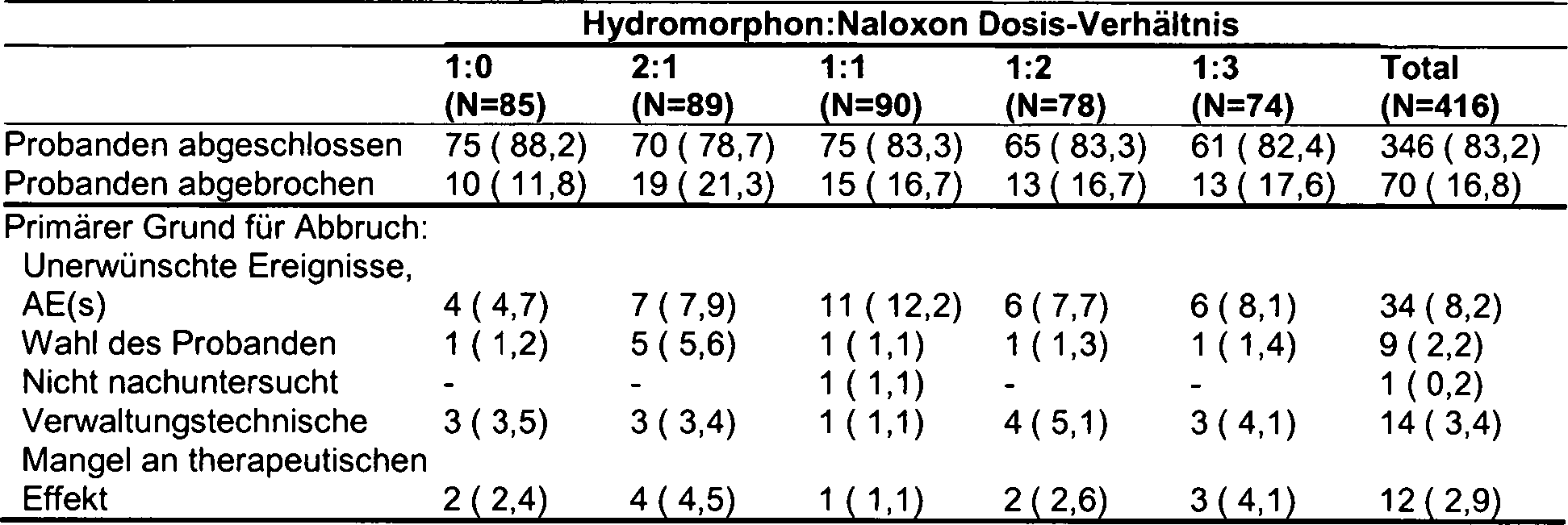
3. Wirksamkeitsparameter3. Efficacy parameters
3.1 Analgetische Wirksamkeitsparameter3.1 Analgesic efficacy parameters
3.1.1 24-Stunden-Durchschnittsschmerz3.1.1 24-hour average pain
Zu Beginn der Studie (Randomisierung) waren die mittleren Schmerzwerte (24-Stunden-Durchschnittsschmerz) in allen Behandlungsgruppen vergleichbar. In der primären Analyse-Population (Per-Protokoll) wurden in den 5 Wochen der Doppelblind-Phase keine offensichtlichen Unterschiede in der Intensität der mittleren Schmerz zwischen den Behandlungsgruppen (siehe Tabelle 9) beobachtet. Die mittleren Schmerzwerte blieben während der gesamten Doppelblind-Phase niedrig und stabil, was darauf hinweist, dass die Kombination von Hydromorphon und Naloxon im Vergleich zur Einzelkomponente Hydromorphon eine ähnliche analgetische Wirksamkeit haben und dass die Naloxon-Komponente keinen Einfluss auf die analgetische Wirksamkeit hat.At the beginning of the study (randomization) the mean pain values (24-hour average pain) were comparable in all treatment groups. In the primary analysis population (Per-protocol), no apparent differences in intensity of mean pain between treatment groups (see Table 9) were observed in the 5 weeks of double-blind phase. The mean pain values remained low and stable throughout the double-blind phase, indicating that the combination of hydromorphone and naloxone has similar analgesic efficacy compared to the single component hydromorphone and that the naloxone component has no effect on analgesic efficacy.
Die Nicht-Unterlegenheit aller Hydromorphon/Naloxon-Behandlungsgruppen zur Hydromorphon/Placebo-Behandlung wurde durch die primäre statistische Analyse der Veränderung vom Ausgangszustand zu Woche 5 gezeigt, wie es durch statistisch signifikante p-Werte (Test für Nicht-Unterlegenheit) für alle Naloxon Gruppen bestätigt wurde (2:1-Verhältnis: p = 0,005, 1:1-Verhältnis: p < 0,001, 1:2-Verhältnis: p = 0,002 und 1:3-Verhältnis: p < 0,001). Die Ergebnisse der statistischen Analyse sind in Tabelle 10 gezeigt.The non-inferiority of all hydromorphone / naloxone treatment groups for hydromorphone / placebo treatment was demonstrated by the primary statistical analysis of change from baseline to
Vom Ende der Doppelblind-Phase bis zum Ende der Rückumstellungs(Swich-back)-Phase gab es keine große Veränderung der mittleren Schmerzintensität in den Behandlungsgruppen, wenn die Patienten Hydromorphon allein erhielten.From the end of the double-blind phase to the end of the reverse-swap-back phase, there was no major change in mean pain intensity in the treatment groups when patients received hydromorphone alone.
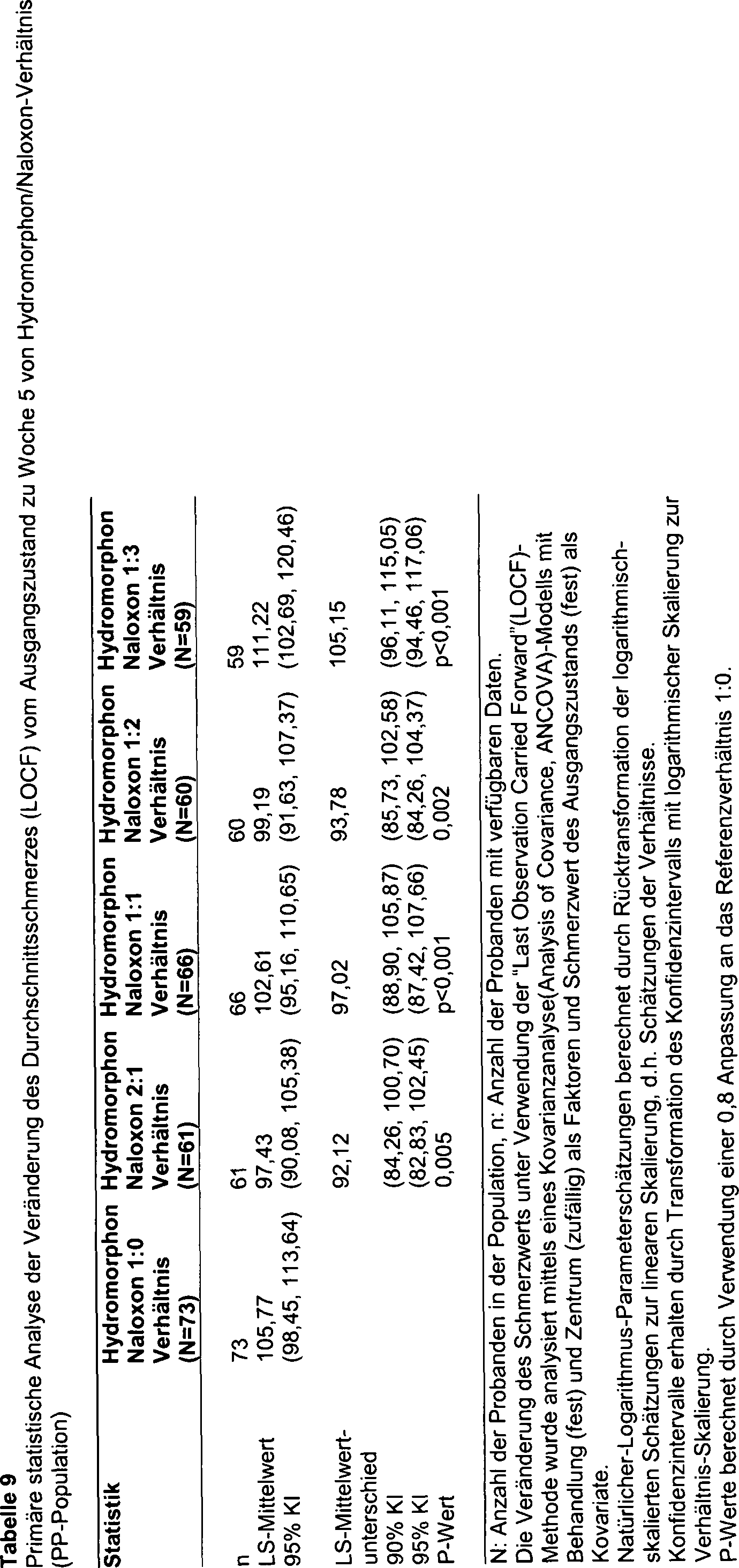
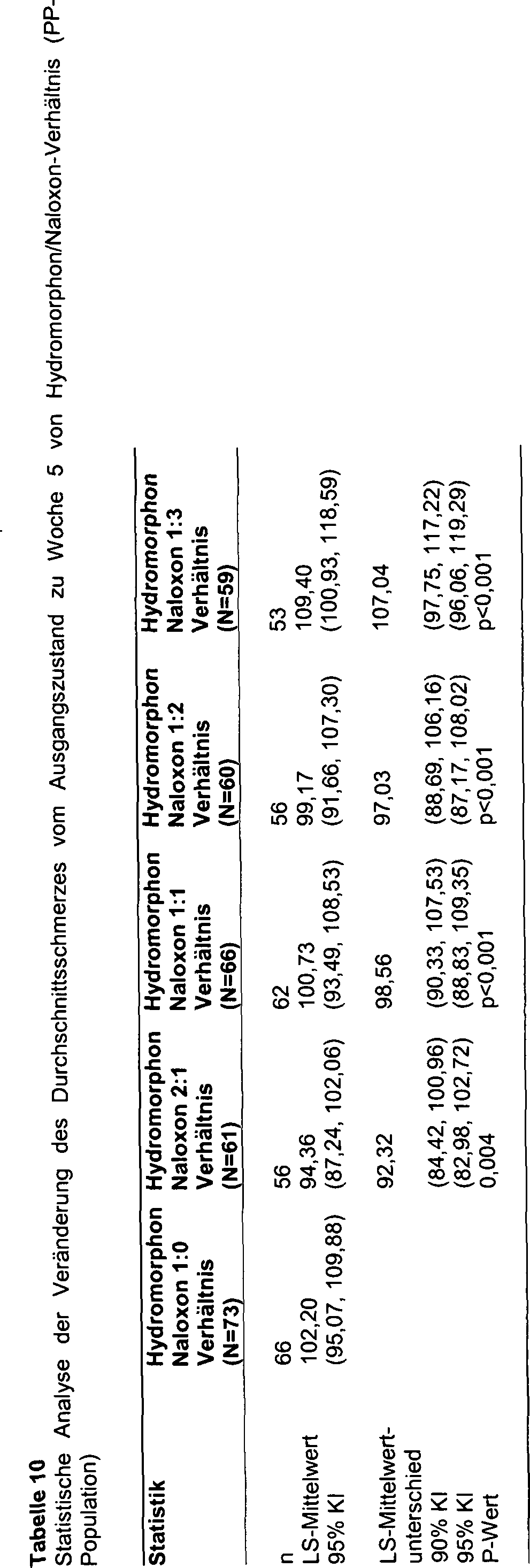
3.1.2 Analgetische Notfallmedikation 3.1.2 Analgesic rescue medication
Insgesamt war die Einnahme von analgetischen Notfallmedikamenten gering und in allen Behandlungsgruppen vergleichbar, was zeigt, dass die Naloxon Komponente keine Auswirkungen auf die analgetische Wirksamkeit von Hydromorphon hatte (siehe Tabelle 11).Overall, the use of analgesic rescue medication was low and comparable in all treatment groups, indicating that the naloxone component had no effect on the analgesic efficacy of hydromorphone (see Table 11).
Tabelle 11 Zusammenfassung der Verwendung von Notfallmedikation – FA-Population 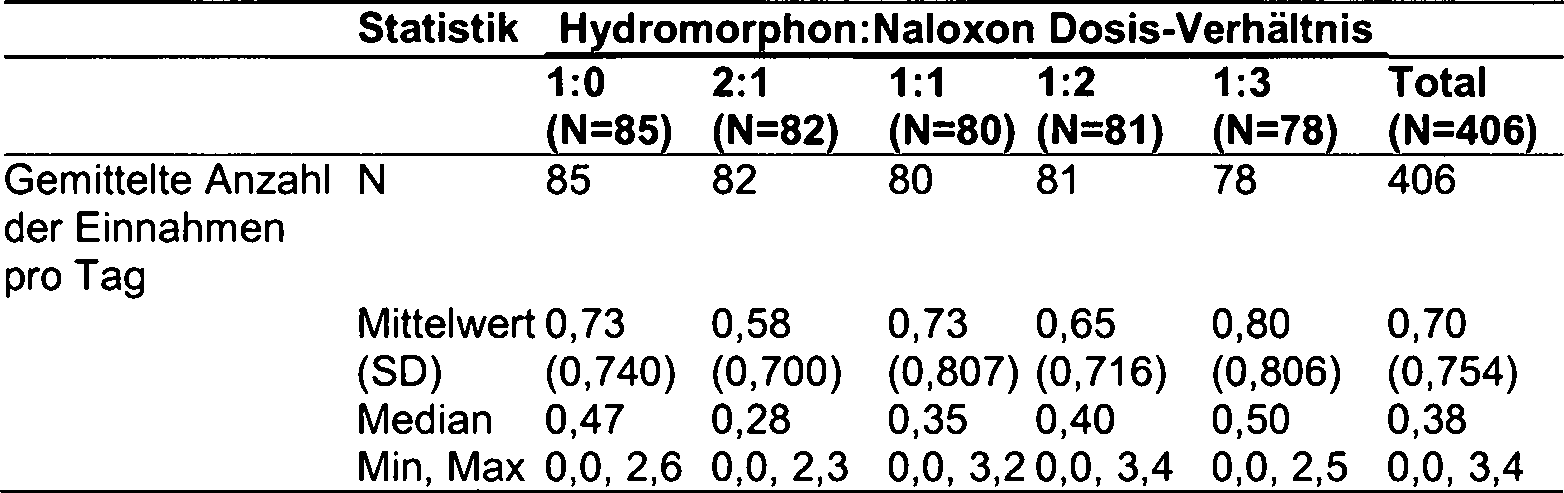
3.2. Darmfunktionsparameter3.2. Bowel function parameters
3.2.1 Darmfunktionsindex (Bowel Function Index, BFI)3.2.1 Bowel Function Index (BFI)
Die Ergebnisse des BFI sind als deskriptive Statistiken (descriptive statistics) sowie als konfirmatorische Statistiken (confirmatory statistics) dargestellt. Der BFI-Wert wird aus den Antworten auf drei Fragen über Leichtigkeit des Stuhlgangs, Gefühl der unvollständigen Darmentleerung und persönlicher Beurteilung der Verstopfung des Probanden zusammengesetzt.The results of the BFI are presented as descriptive statistics as well as confirmatory statistics. The BFI score is composed of the answers to three questions about ease of bowel movement, feeling of incomplete evacuation and personal assessment of the subject's constipation.
Zu Beginn der Studie (Randomisierung) waren die BFI-Durchschnittswerte hoch und vergleichbar in allen Behandlungsgruppen. Bis zum Ende der Doppelblind-Phase zeigten alle Behandlungsgruppen, die Naloxon erhielten, eine klinisch relevante Verbesserung der BFI-Durchschnittswerte, während in der Hydromorphon/Naloxon-Placebo-Behandlungsgruppe keine klinisch relevante Verbesserung der BFI-Durchschnittswerte beobachtet wurde. Die beobachteten BFI-Werte für die FA(Full-Analysis)-Population sind in
Die Entfernung von Naloxon aus dem Behandlungsprogramm während der Rückumstellungs(Switch-back)-Phase führte zu einem Anstieg der BFI-Durchschnittswerte, was eine verschlechterte Darmfunktion anzeigt. Am Ende der Rückumstellungs(Switch-back)-Phase, waren die BFI-Durchschnittswerte fast auf die Ausgangswerte zurückgekehrt (siehe
Eine klinisch relevante Verbesserung der BFI-Werte zeigte sich in allen Hydromorphon/Naloxon-Behandlungsgruppen (2:1-Verhältnis: –20,33; 1:1-Verhältnis: –26,71; 1:2-Verhältnis: –28,94 und 1:3-Verhältnis: –23,61, verglichen zu –14,15 mit dem 1:0-Verhältnis der Placebo-Behandlungsgruppe) (Tabelle 12). Wenn das Placebo-Ergebnis berücksichtigt wird, zeigt sich, dass die klinische Relevanz der BFI-Verbesserung mit den 1:1- und 1:2-Verhältnissen bleibt, aber für das 1:3-Verhältnis grenzwertig ist (–15,02, 17,25 bzw. –11,92).Clinically relevant improvements in BFI levels were found in all hydromorphone / naloxone treatment groups (2: 1 ratio: -20.33; 1: 1 ratio: -26.71; 1: 2 ratio: -28.94 and 1: 3 ratio: -23.61, compared to -14.15 with the 1: 0 ratio of the placebo treatment group) (Table 12). When the placebo result is taken into account, the clinical relevance of the BFI improvement remains with the 1: 1 and 1: 2 ratios, but is borderline for the 1: 3 ratio (-15.02, 17 , 25 or -11.92).
Die Ergebnisse, wie sie in Tabelle 13 gezeigt sind, bestätigen, dass die Veränderung des BFI-Werts vom Ausgangszustand zu Woche 5 für alle Hydromorphon/Naloxon-Verhältnisse statistisch relevant und für die 1:1- und 1:2-Verhältnisse klinisch relevant war.The results, as shown in Table 13, confirm that the change in BFI from baseline to
Die der LS-Mittelwertunterschiede (SE) in der Tabelle 12 und Tabelle 13 basieren auf dem ANCOVA-Modell, angepasst durch die Veränderung des BFI-Durchschnittswerts in der Naloxon-Placebo-Behandlungsgruppe (1:0-Verhältnis-Gruppe) Tabelle 12 Primäre statistische Analyse der Veränderung des BFI – LOCF vom Ausgangszustand zu Woche 5 von Hdromorhon/Naloxon-Verhältnis: FA-Population 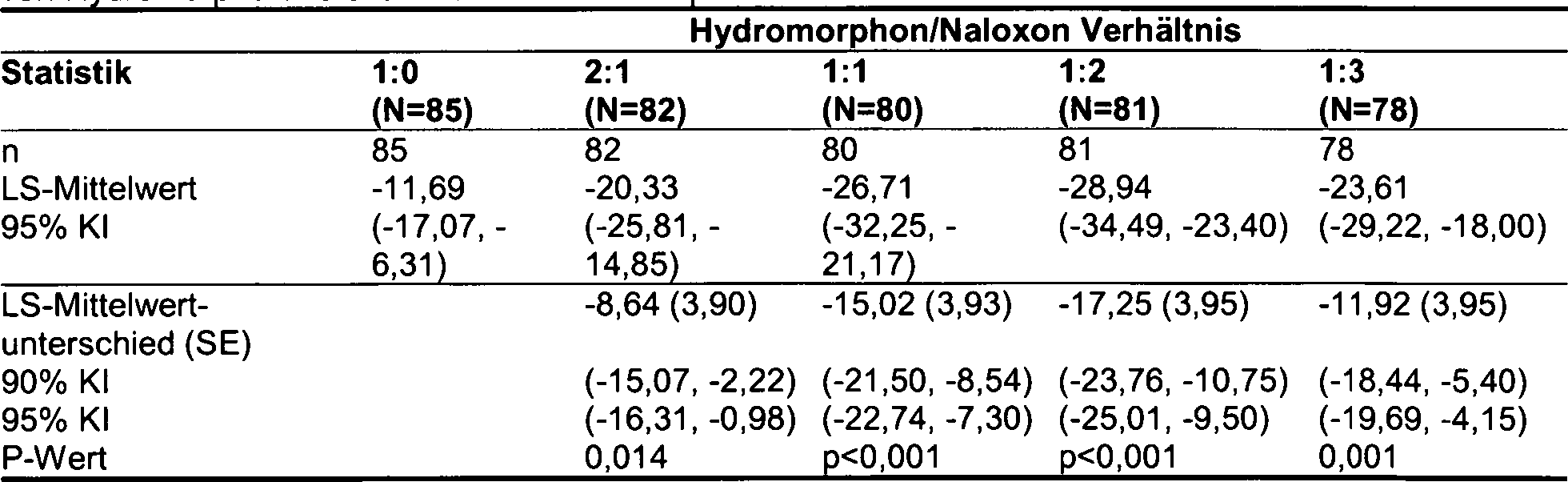
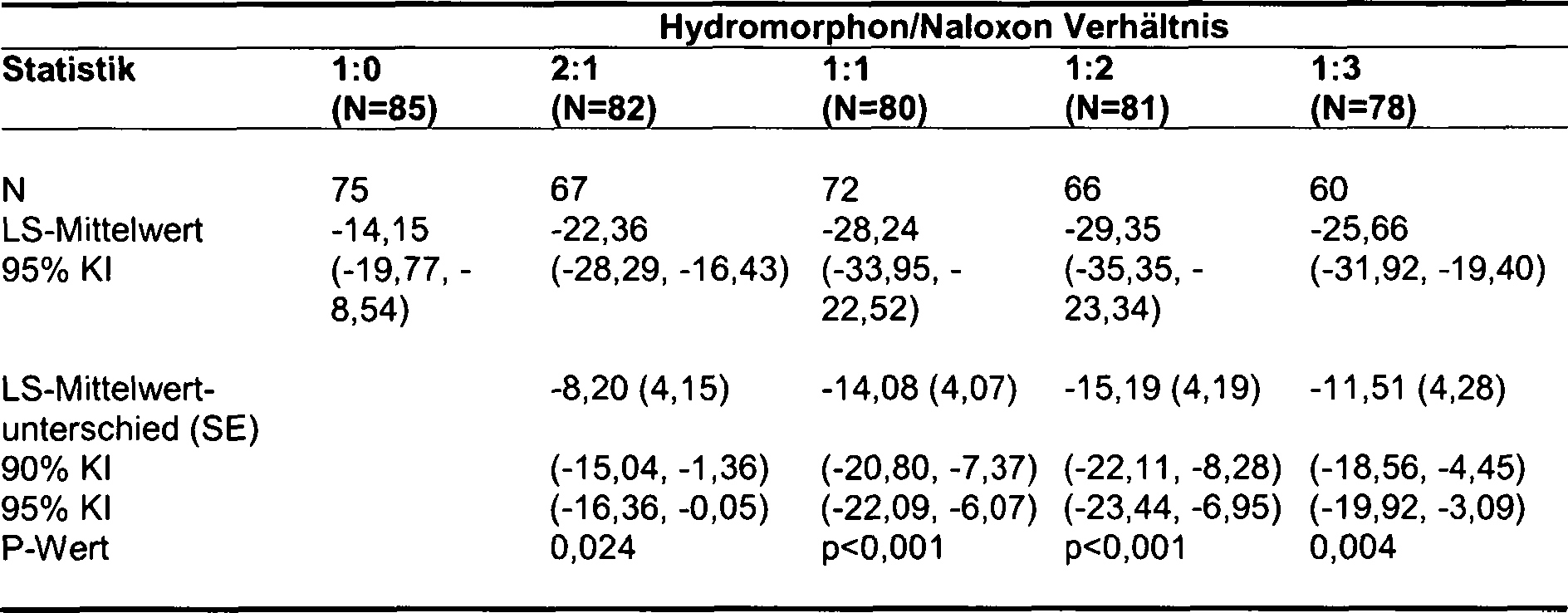
3.2.2 Notfallabführmittel3.2.2 Emergency laxative
Aufgrund der möglichen Verkomplizierung der primären Analyse durch Abführmittel, wurde ein restriktiver Abführmittelplan, wie er im Studienprotokoll definiert war, angewendet.Because of the possible complication of primary laxative analysis, a restrictive laxative schedule as defined in the study protocol was used.
Insgesamt war die durchschnittliche Anzahl der Notfallabführmitteleinnahmen gering mit einer etwas höheren Einnahme pro Tag in der 1:0-Verhältnis-Behandlungsgruppe (Naloxon-Placebo-Gruppe) im Vergleich zu allen anderen Behandlungsgruppen, die Naloxon erhielten. Dieses Ergebnis stimmt mit den Ergebnissen des BFI überein und zeigt, dass eine Verbesserung der Darmfunktion nicht durch die Abführmitteleinnahme beeinflusst wurde und der Nutzen ausschließlich auf die Kombination von Hydromorphon und Naloxon (siehe Tabelle 14) zurückzuführen ist. Tabelle 14 Zusammenfassung der Abführmittelverwendung – Gemittelte Anzahl der Einnahmen pro Tag von Hydromorphon/Naloxon-Verhältnis – FA(Full Analysis)-Population 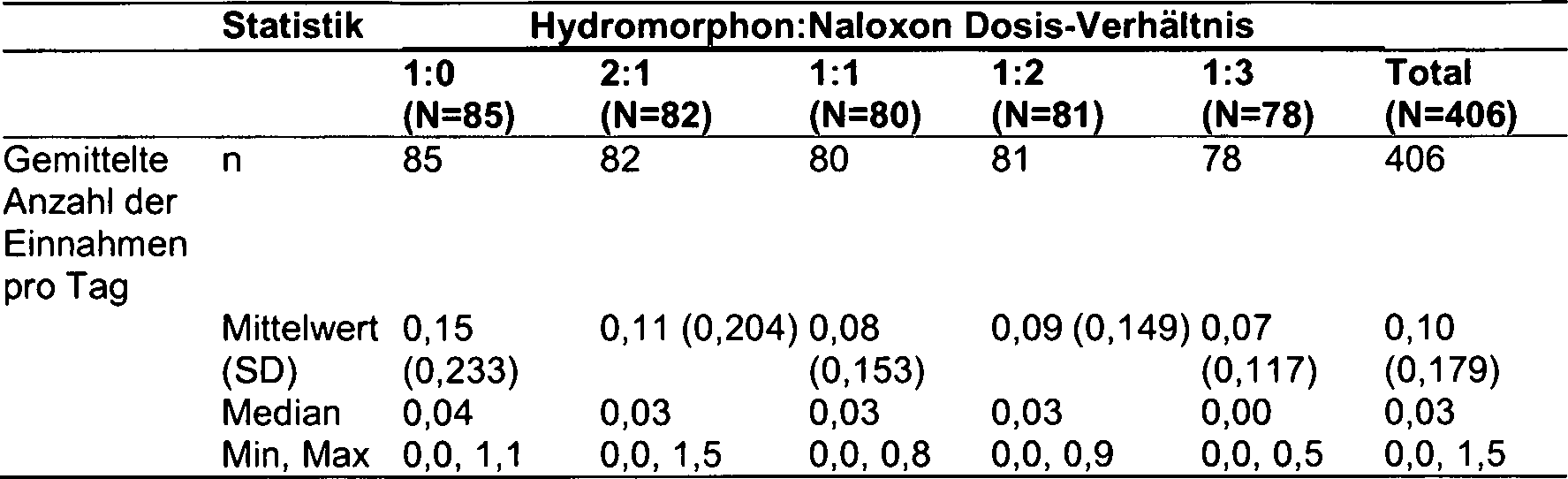
3.3 Untergruppen-Evaluation des mittleren BFI und der mittleren Schmerzen während der Doppelblind- und der Rückumstellungs(Switch back)-Zeiträume3.3 Subgroup evaluation of mean BFI and mean pain during double-blind and switch-back periods
Um eindeutige Nachweise für ein optimales Verhältnis zu bekommen, wurde eine detailliertere Analyse des 1:1- und 1:2-Verhältnisses durchgeführt von absoluter Tages-Hydromorphon-Dosis in Bezug auf Verbesserung der Darmfunktion, unterstützt durch eine entsprechende Analyse auf analgetische Wirksamkeit.In order to obtain clear evidence for an optimal ratio, a more detailed analysis of the 1: 1 and 1: 2 ratio was made of absolute daily hydromorphone dose with respect to bowel function enhancement, supported by appropriate analysis for analgesic efficacy.
Es wurde eine Untergruppen-Evaluation durchgeführt, in der die mittleren BFI-Werte (siehe Tabelle 15) und die mittleren Schmerzwerte (siehe Tabelle 16) während der Doppelblind- und der Rückumstellungs(Switch back)-Phase analysiert wurden unter Anwendung der deskriptiven Statistiken, welche für die Primäranalyse verwendet wurden. Tabelle 15 Darmfunktionsindex (BFI) – LOCF von Hydromorphon/Naloxon-Verhältnis und Hydromorphon-Dosis – FA-Population
Zu Beginn der Studie (Randomisierung) waren die mittleren BFI-Werte hoch und in allen Hydromorphon-Dosis-Gruppen und in allen Verhältnissen (1:0, 1:1, 1:2) vergleichbar. In der 8 mg Hydromorphon-Dosis-Gruppe sowie in der 24 mg und 48 mg Dosis-Gruppe, zeigten beide, die 1:1- und die 1:2-Verhältnisse, eine klinisch relevante Verbesserung der mittleren BFI-Werte bis zum Ende der Doppelblind-Phase (siehe Tabelle 15). Die Evaluation des BFI, angepasst durch die Veränderung des mittleren BFI-Werts in der Naloxon-Placebo-Behandlungsgruppe, zeigte eine klinisch relevante Verbesserung der Darmfunktion in den 8 mg und 24 mg Hydromorphon-Dosis-Gruppen bei beiden 1:1 und 1:2-Verhältnissen.At the beginning of the study (randomization), the mean BFI values were high and comparable in all hydromorphone dose groups and in all ratios (1: 0, 1: 1, 1: 2). In the 8 mg hydromorphone dose group as well as in the 24 mg and 48 mg dose groups, both the 1: 1 and the 1: 2 ratios showed a clinically relevant improvement in mean BFI values by the end of the period Double-blind phase (see Table 15). Evaluation of BFI, adjusted by the change in mean BFI in the naloxone placebo treatment group, showed clinically relevant improvements in bowel function in the 8 mg and 24 mg hydromorphone dose groups in both 1: 1 and 1: 2 ratios.
In der 48 mg Hydromorphon-Dosis-Gruppe jedoch zeigte das 1:2-Verhältnis eine deutliche klinisch relevante Verbesserung der Darmfunktion. Die Ergebnisse des 1:1-Verhältnisses wiesen auf eine grenzwertige klinisch relevante Verbesserung hin. Alle Hydromorphon-Dosen der beiden Verhältnisse zeigten eine hohe und kontinuierliche analgetische Wirksamkeit, die der Einzelkomponente Hydromorphon entsprach.In the 48 mg hydromorphone dose group, however, the 1: 2 ratio showed a significant clinically relevant improvement in bowel function. The results of the 1: 1 ratio indicated a marginally clinically relevant improvement. All hydromorphone doses of both ratios showed a high and continuous analgesic efficacy, corresponding to the single component hydromorphone.
3.4 Darmfunktion und Schmerzparameter in der Rückumstellungs(Switch back)-Phase3.4 Bowel Function and Pain Parameters in the Switchback Phase
Während der Rückumstellungs(Switch back)-Phase begann sich die Darmfunktion auf das frühere Niveau zu verschlechtern und das Niveau der analgetischen Kontrolle blieb gleich. Diese Ergebnisse zeigen, dass der Zusatz von Naloxon die nachteilige Wirkung von Hydromorphon auf die Darmfunktion vermindert und auch, dass der Zusatz von Naloxon keine Wirkung auf die zentrale analgetische Wirkung von Hydromorphon hatDuring the switch back phase, bowel function began to deteriorate to its former level and the level of analgesic control remained the same. These results show that the addition of naloxone reduces the adverse effect of hydromorphone on bowel function and also that the addition of naloxone has no effect on the central analgesic effect of hydromorphone
3.5 Wirksamkeitsdiskussion und Schlussfolgerungen3.5 Effectiveness Discussion and Conclusions
Unabhängig von dem Verhältnis zwischen Hydromorphon und Naloxon, haben sich die Schmerzwerte während der Behandlungszeit nicht signifikant verschlechtert, sondern blieben in allen Behandlungsgruppen unverändert. Die Nicht-Unterlegenheit aller Hydromorphon/Naloxon-Verhältnisse im Vergleich zur Hydromorphon/Placebo-Behandlung wurden durch die statistische Analyse gezeigt, und die Schmerzwerte blieben bis zum Ende der Rückumstellungs(Switch back)-Phase stabil. Dies wurde in allen Behandlungsgruppen mit einer sehr geringen Menge von Notfallmedikamenteneinnahme erreicht. Basierend auf diesen Ergebnissen, zeigten alle Hydromorphon/Naloxon-Verhältnisse eine hohe und kontinuierliche analgetische Wirksamkeit, die der Einzelkomponente Hydromorphon gleichwertig ist.Regardless of the ratio between hydromorphone and naloxone, pain levels did not significantly worsen during the treatment period but remained unchanged in all treatment groups. Non-inferiority of all hydromorphone / naloxone ratios compared to hydromorphone / placebo treatment was demonstrated by statistical analysis and pain values remained stable until the end of the switchback phase. This was achieved in all treatment groups with a very small amount of emergency drug use. Based on these results, all hydromorphone / naloxone ratios showed high and continuous analgesic efficacy equivalent to the single component hydromorphone.
Deskriptive Statistiken zeigten, dass alle Hydromorphon/Naloxon-Verhältnisse mit Ausnahme der Hydromorphon/Placebo-Gruppe im Vergleich zum Ausgangszustand eine klinisch relevante Verbesserung der Darmfunktion hatten, wie sie durch die BFI-Werte bestimmt wurde. Dies wurde ferner durch die statistische Analyse des LS-Mittelwerts unter Verwendung des ANCOVA-Modells bestätigt. Unter Berücksichtigung der Analyse der LS-Mittelwertunterschiede, angepasst durch die Hydromorphon/Placebo-Ergebnisse, zeigten alle Hydromorphon/Naloxon-Verhältnis-Gruppen eine statistisch signifikante Verbesserung der Darmfunktion, während eine deutliche und klinisch relevante Verbesserung in den 1:1- und 1:2-Verhältnis-Gruppen gezeigt wurde, mit der höchsten Verbesserung in der 1:2-Verhältnis-Gruppe. Eine weniger dramatische Verbesserung wurde in der 1:3-Verhältnis-Gruppe beobachtet, wobei die Verbesserung statistisch signifikant im Vergleich zu der Placebo-Gruppe war, aber der Mittelwertunterschied war 11,92 und damit knapp unter dem vorgegebenen klinischen Ziel von 12 Punkten, das durch die 1:1- und 1:2-Verhältnis-Gruppen erreicht wurde. Descriptive statistics showed that all hydromorphone / naloxone ratios, with the exception of the hydromorphone / placebo group, had clinically relevant improvements in bowel function relative to baseline as determined by BFI values. This was further confirmed by the statistical analysis of the LS mean using the ANCOVA model. Taking into account the analysis of LS mean differences, adjusted by the hydromorphone / placebo results, all hydromorphone / naloxone ratio groups showed a statistically significant improvement in bowel function, while a clear and clinically relevant improvement in the 1: 1 and 1: 2-ratio groups were shown, with the highest improvement in the 1: 2 ratio group. A less dramatic improvement was observed in the 1: 3 ratio group, with the improvement being statistically significant compared to the placebo group, but the mean difference was 11.92, just below the pre-determined clinical target of 12 points was achieved by the 1: 1 and 1: 2 ratio groups.
Eine Untergruppen-Evaluation wurde durchgeführt, in der die mittleren BFI-Werte und die mittleren Schmerzwerte während der Doppelblind- und der Rückumstellungs(Switch back)-Phase analysiert wurden unter Anwendung der deskriptiven Statistiken, welche für die Primäranalyse verwendet wurden. Dies ergab, dass das 1:2-Verhältnis aufgrund seines BFI und der analgetischen Wirksamkeit über den gesamten Hydromorphon-Dosisbereich gut geeignet wäre (Tabelle 15; Tabelle 16).A subgroup evaluation was performed in which the mean BFI values and mean pain values during the double-blind and switch-back phases were analyzed using the descriptive statistics used for the primary analysis. This indicated that the 1: 2 ratio would be well suited due to its BFI and analgesic efficacy over the entire hydromorphone dose range (Table 15, Table 16).
Insgesamt und aufgrund des restriktiven Abführmittelplans, wie er im Studienprotokoll definiert war, war die durchschnittliche Anzahl der Notfallabführmitteleinnahmen gering, was zeigt, dass eine Verbesserung der Darmfunktion nicht durch die Abführmitteleinnahme beeinflusst wurde und der Naloxon-Komponente zugeschrieben werden konnte. Dies wird auch durch die Zunahme der mittleren BFI-Werte während der Rückumstellungs(Switch back)-Phase belegt, in welcher die Probanden kein Naloxon erhielten.Overall and due to the restrictive laxative schedule as defined in the study protocol, the average number of emergency laxative injections was low, indicating that improvement in bowel function was not affected by laxative intake and could be attributed to the naloxone component. This is also evidenced by the increase in mean BFI values during the switchback phase in which the subjects did not receive naloxone.
6. Sicherheitsanalyse6. Safety analysis
6.1 Unerwünschte Ereignisse (AEs)6.1 Unwanted events (AEs)
Im Allgemeinen war das Auftreten von AEs und zugehörigen (related) AEs in allen Behandlungsgruppen vergleichbar. In der Doppelblind-Sicherheits-Population erlebten 170 (40,9%) Probanden zugehörige AEs, wie dies für diese Klasse von Medikamenten zu erwarten ist und damit vergleichbar ist, was in anderen Opioid-Studien beobachtet wurde. Der Anteil der Probanden mit mindestens einer zugehörigen AE war zwischen den Gruppen auch recht vergleichbar. Die Zahl der Probanden mit schwerwiegenden zugehörigen AEs (severe related AEs) war gering (5,5% insgesamt), wie auch die Anzahl der Probanden mit zugehörigen SAEs (0,5%) und SAEs insgesamt (1,0%).In general, the incidence of AEs and related AEs was similar in all treatment groups. In the double-blind safety population, 170 (40.9%) subjects experienced associated AEs, as would be expected for this class of drugs, comparable to what has been observed in other opioid studies. The proportion of subjects with at least one AE was also quite comparable between the groups. The number of subjects with severe associated AEs was low (5.5% overall), as was the number of subjects with associated SAEs (0.5%) and total SAEs (1.0%).
Übelkeit (32 Probanden insgesamt (7,7%)), Durchfall (22 Probanden insgesamt (5,3%)) und Bauchschmerzen (20 Probanden insgesamt (4,8%)) waren die am häufigsten berichteten unerwünschten Ereignisse und stehen im Einklang mit dem erwarteten AE-Profil der Klasse von Medikamenten, die in dieser Studie verwendet wurden (siehe Tabelle 17). Tabelle 17 Häufigsten unerwünschten Ereignisse (AEs) ≥ 5% der Probanden in allen Behandlungsgruppen: Doppelblind-Sicherheits-Population 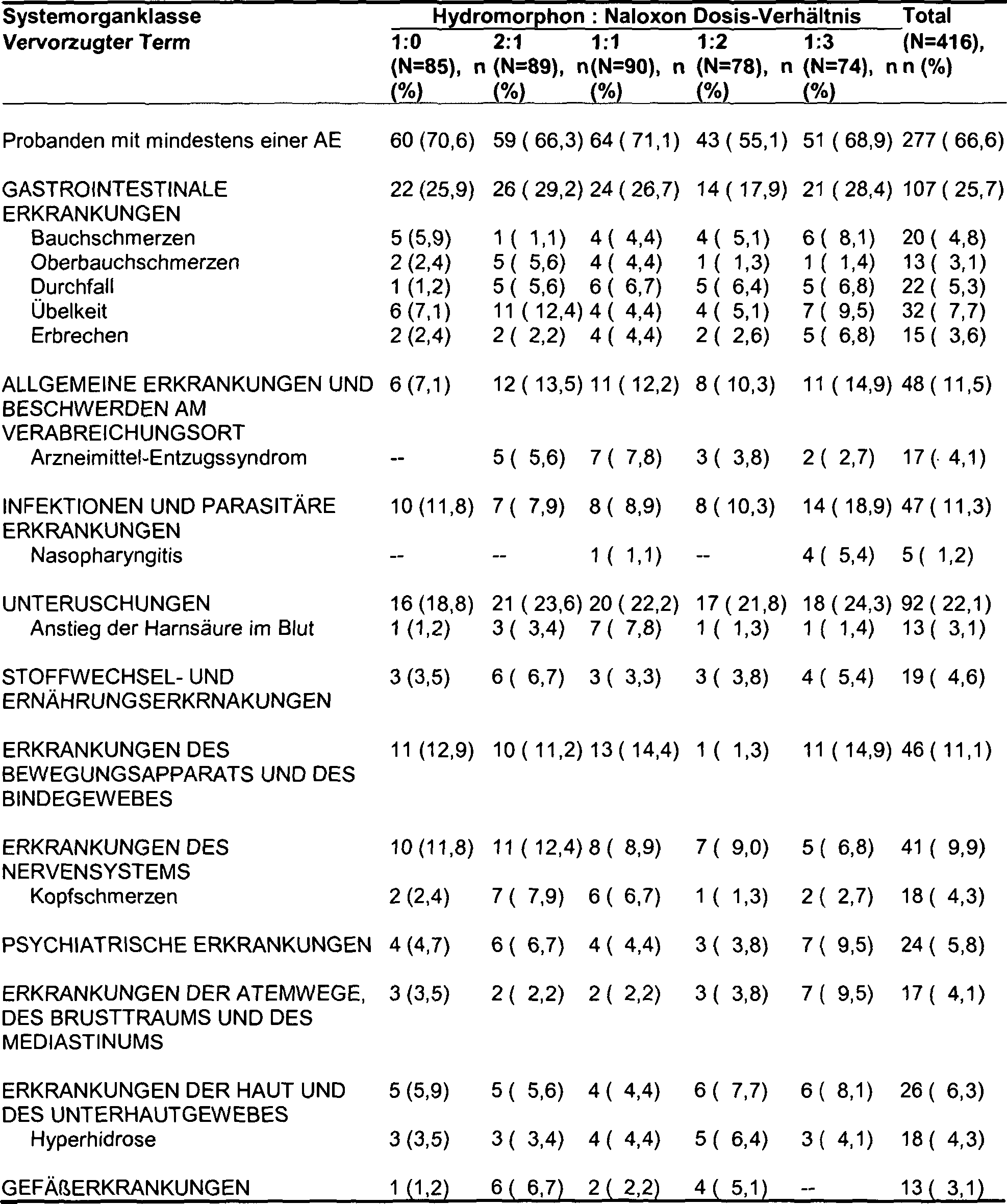
6.2 Sonstige Beobachtungen im Zusammenhang mit der Sicherheit-Subjetive-Opiat-Entzugs-Skala (Subjective Opiate Withdrawal Scale, SOWS)6.2 Other Observations Related to the Safety Subjetive Opiate Withdrawal Scale (SOWS)
Im Ausgangszustand betrug der mittlere SOWS-Wert 7,7 (SD 7,19) in der Doppelblind-Sicherheits-Population und war in allen Behandlungsgruppen vergleichsweise niedrig. Diese Werte waren in der ersten Woche der Doppelblind-Phase, in der die Probanden auf die komplette Naloxon-Dosis umgestellt wurden, stabil und blieben bis zum Ende der Doppelblind-Phase unverändert. Dies bestätigte, dass der Zusatz von Naloxon keine unerwünschten Opioid-Entzugserscheinungen verursachte. Tabelle 18 Gesamt-SOWS-Wert von Hydromorphon/Naloxon Verhältnis: Doppelblind-Sicherheits-Population 
6.3 Sicherheitsdiskussion und Schlussfolgerungen6.3 Security discussion and conclusions
- • Insgesamt erlebten 277 Probanden (66,6%) mindestens eine AE während der Doppelblind-Phase. Es gab 623 individuelle AEs. 170 Probanden (40,9%) erlebten 324 AEs, die durch den Untersuchenden als mit der Studienmedikation in Zusammenhang stehend betrachtet wurden.• In total, 277 subjects (66.6%) experienced at least one AE during the double-blind phase. There were 623 individual AEs. 170 subjects (40.9%) underwent 324 AEs who were considered by the investigator to be associated with the study medication.
- • Die häufigsten unerwünschten Ereignisse waren: Übelkeit (32 Probanden insgesamt (7,7%), Durchfall (22 Probanden insgesamt (5,3%), Bauchschmerzen (20 Probanden insgesamt (4,8%) und Erbrechen (15 Probanden (3,6%). Diese stehen im Einklang mit dem erwarteten AE-Profil der Klasse von Medikamenten, die in dieser Studie verwendet wurden. Das Auftreten von zugehörigen GI(Gastrointestinal)-AEs war zwischen den Gruppen gleichmäßig verteilt.• The most frequent adverse events were: nausea (32 subjects in total (7.7%), diarrhea (22 subjects in total (5.3%), abdominal pain (20 subjects in total (4.8%) and vomiting (15 subjects (3, 6%), which are consistent with the expected AE profile of the class of drugs used in this study, and the incidence of associated GI (Gastrointestinal) AEs was evenly distributed between the groups.
- • Das Auftreten von Durchfall wurde nicht durch das Verhältnis von Naloxon in der Kombination beeinflusst.• The incidence of diarrhea was not affected by the ratio of naloxone in the combination.
- • 17 Probanden (4,1%) berichteten über eine AE des „Arzneimittel-Entzugssyndroms” mit einem kausalen Zusammenhang zur Studienmedikation. Die Inzidenzraten variiert innerhalb der Verhältnis- und Dosis-Gruppen zwischen 0 und 11,8%, mit einer Gesamtrate von 4,1%. Es gab keinen Trend für höhere Raten an Arzneimittel-Entzugssyndrom in den Untergruppen mit höherer Naloxon-Dosis oder höherem Naloxon-Verhältnis.• 17 subjects (4.1%) reported an AE of "drug withdrawal syndrome" with a causal relationship to study medication. The incidence rates varied within the ratio and dose groups between 0 and 11.8%, with an overall rate of 4.1%. There was no trend for higher rates of drug withdrawal syndrome in the higher naloxone dose or higher naloxone ratio subgroups.
- • Die Mehrheit der AEs waren leicht oder moderat.• The majority of AEs were mild or moderate.
- • Das Auftreten von AEs, die durch den Untersuchenden als mit der Studienmedikation in Zusammenhang stehend betrachtet wurden, war zwischen den Dosis-Verhältnissen ähnlich.• The incidence of AEs that the investigator considered to be associated with the study drug was similar between dose ratios.
- • Hämatologie, Blutchemie, Urinanalyse und Laborwerte zeigten keine nennenswerten Unterschiede zwischen den Behandlungsgruppen.• Hematology, blood chemistry, urinalysis and laboratory values did not show any significant differences between treatment groups.
7. Schlussfolgerungen7. Conclusions
Dies war eine konfirmatorische Studie, die durchgeführt wurde um ein optimales Hydromorphon/Naloxon-Verhältnis zu bestimmen mit einer vergleichbaren analgetischen Wirksamkeit und einer verbesserten Darmfunktion im Vergleich zu Hydromorphon basierend auf Schmerz- und Darmfunktions-Bewertungen sowie Sicherheitsparameter. Gemäß der Schmerzbewertung des Patienten und der Analgetikum-Notfallmedikamenteneinnahme, zeigten alle Behandlungsgruppen die gleiche analgetische Wirksamkeit. Daher können in Bezug auf die analgetische Wirksamkeit von Hydromorphon/Naloxon, alle Verhältnisse als geeignet angesehen werden für ein Produkt mit fixer Kombination. Die am häufigsten berichteten unerwünschten Ereignisse waren konsistent mit dem erwarteten AE-Profil für die Opioid-Analgetikum-Medikamentenklasse.This was a confirmatory study performed to determine an optimal hydromorphone / naloxone ratio with comparable analgesic efficacy and improved bowel function compared to hydromorphone based on pain and bowel function scores and safety parameters. According to the pain evaluation of the patient and the analgesic emergency drug use, all treatment groups showed the same analgesic efficacy. Therefore, with regard to the analgesic efficacy of hydromorphone / naloxone, all ratios are considered suitable be for a product with a fixed combination. The most commonly reported adverse events were consistent with the expected AE profile for the opioid analgesic drug class.
Es wurden keine neuen oder unerwarteten AEs beobachtet, die auf die Verabreichung von Hydromorphon/Placebo oder Hydromorphon/Naloxon Behandlungsgruppen zurückzuführen waren. Daher war das Sicherheitsprofil mit jenen anderer starker Opioide übereinstimmend. SOWS Summenwerte waren niedrig und stabil, was darauf hinweist, dass, während gelegentlich einzelne anfällige Patienten nach der Zugabe von Naloxon vom Entzugssyndrom betroffen sein können, es kein allgemeines Auftreten zu sein scheint. Aufgrund der geringen Anzahl von Probanden, die SAEs mit einem kausalen Zusammenhang erlebten und der Art, Häufigkeit und Intensität der beobachteten AEs, zeigten die Hydromorphon/Naloxon-Gruppen kein zusätzliches oder unerwartetes Risiko im Vergleich zur Hydromorphon/Placebo-Behandlung. Daher gab keine der Hydromorphon/Naloxon-Verhältnis-Gruppen Anlass zu besonderen Sicherheitsbedenken.No new or unexpected AEs were observed due to administration of hydromorphone / placebo or hydromorphone / naloxone treatment groups. Therefore, the safety profile was consistent with those of other strong opioids. SOME totals were low and stable, indicating that while occasionally individual susceptible patients may be affected by withdrawal syndrome after adding naloxone, it does not appear to be a common occurrence. Due to the low number of subjects experiencing SAEs with a causal relationship and the type, frequency, and intensity of AEs observed, the hydromorphone / naloxone groups showed no additional or unexpected risk compared to the hydromorphone / placebo treatment. Therefore, none of the hydromorphone / naloxone ratio groups gave rise to any special safety concerns.
Alle Verhältnisse (2:1-, 1:1-, 1:2- und 1:3-Verhältnisse) zeigten eine statistisch signifikante Verbesserung der Darmfunktion (BFI-Wert). Hinsichtlich der vorgegebenen klinisch relevanten Verbesserung der Darmfunktion wurde in den 1:2- und 1:1-Verhältnis-Gruppen eine wesentliche Verbesserung beobachtet und durch die 1:3-Verhältnis-Gruppe wurde eine geringere Verbesserung gezeigt. Daher, im Hinblick auf die Darmfunktionsparameter, können die 1:1- und 1:2-Verhältnisse als besonders geeignet für ein Produkt mit fixer Kombination angesehen werden.All ratios (2: 1, 1: 1, 1: 2 and 1: 3 ratios) showed a statistically significant improvement in bowel function (BFI value). Regarding the given clinically relevant improvement in bowel function, a significant improvement was observed in the 1: 2 and 1: 1 ratio groups, and a lesser improvement was shown by the 1: 3 ratio group. Therefore, in terms of gut function parameters, the 1: 1 and 1: 2 ratios may be considered particularly suitable for a fixed combination product.
Um weitere Nachweise für optimierte Verhältnisse hinsichtlich des BFI zu erhalten, wurde eine detailliertere Analyse des 1:1- und 1:2-Verhältnisses durchgeführt durch absolute tägliche Hydromorphon-Dosis gegenüber der Verbesserung der Darmfunktion, unterstützt durch eine entsprechende Analyse auf analgetische Wirksamkeit. Zu diesem Zweck wurde eine Untergruppen-Evaluation durchgeführt, in der die mittleren BFI- und mittleren Schmerz-Werte während der Doppelblind- und Rückumstellungs(Switch back)-Phase analysiert wurden und auch die deskriptiven Statistiken, die für die primäre Analyse verwendet wurden, angewandt wurden.To obtain further evidence of optimized BFI ratios, a more detailed analysis of the 1: 1 and 1: 2 ratio was made by absolute daily hydromorphone dose versus bowel function enhancement, supported by a corresponding analysis for analgesic efficacy. For this purpose, a subgroup evaluation was performed that analyzed the mean BFI and mean pain levels during the double-blind and switch-back phases, as well as the descriptive statistics used for the primary analysis were.
Die Ergebnisse, die während der primären Analyse der Darmfunktion, analgetischen Wirksamkeit und Sicherheitsparameter gesammelt wurden, bestätigten eindeutig, dass die Zugabe von Naloxon zum Opioid-Agonisten Hydromorphon zu einer klinisch relevanten Verbesserung der opioidinduzierten Verstopfung führt ohne die analgetische Wirksamkeit von Hydromorphon zu beeinträchtigen oder ein verringertes Sicherheitsrisiko, und daher einen klinischen Vorteil für die Schmerzpatienten zeigt. Wenn für den Naloxon-Placebo-Effekt angepasst wurde, wurde die am stärksten ausgeprägte klinisch relevante Verbesserung für das 1:2-Verhältnis beobachtet. Eine klinisch relevante Verbesserung der Darmfunktion wurde ebenfalls in dem 1:1-Verhältnis gezeigt. Das 1:3-Verhältnis führte zu einer niedrigeren klinisch relevanten Verbesserung der Darmfunktion. Dies weist auf einen Plateau-Effekt hin, wo die Zugabe einer höheren Menge von Naloxon nicht zu einer deutlicheren Verbesserung der opioidinduzierten Verstopfung führt.The results obtained during the primary analysis of bowel function, analgesic efficacy and safety parameters clearly confirmed that the addition of naloxone to the opioid agonist hydromorphone results in clinically relevant improvement in opioid-induced constipation without compromising or compromising the analgesic efficacy of hydromorphone reduced safety risk, and therefore shows a clinical benefit for the pain patients. When adjusted for the naloxone placebo effect, the most pronounced clinically relevant improvement was observed for the 1: 2 ratio. Clinically relevant improvement in bowel function was also shown in the 1: 1 ratio. The 1: 3 ratio resulted in a lower clinically relevant improvement in bowel function. This indicates a plateau effect where the addition of a higher amount of naloxone does not result in a marked improvement in opioid-induced plugging.
Eine weitere Analyse hinsichtlich der BFI-Werte umfasste eine zusätzliche Evaluation, die auf den Vergleich der 1:1- und 1:2-Verhältnisse fokussiert war und die Hydromorphon-Dosis berücksichtigte. In den 8 mg sowie 24 mg und 48 mg Hydromorphon-Gruppen zeigte das 1:2 eine deutliche klinisch relevante Verbesserung im BFI ohne die analgetische Wirksamkeit zu opfern.Further analysis for BFI values included an additional evaluation focused on comparing the 1: 1 and 1: 2 ratios and taking into account the hydromorphone dose. In the 8 mg, 24 mg and 48 mg hydromorphone groups, the 1: 2 showed a significant clinically relevant improvement in BFI without sacrificing analgesic efficacy.
Die Erfindung bezieht sich unter anderem auf:
- 1. Eine feste orale pharmazeutische Zusammensetzung mit verlängerter Freisetzung umfassend Hydromorphon oder ein pharmazeutisch verträgliches Salz davon und Naloxon oder ein pharmazeutisch verträgliches Salz davon in einem Gewichtsverhältnisbereich entsprechend von etwa 1:1 bis etwa 1:2 von Hydromorphon HCl:Naloxon HCl zur Verwendung bei der Behandlung von Schmerz eines Patienten.
- 2. Eine feste orale pharmazeutische Zusammensetzung mit verlängerter Freisetzung umfassend Hydromorphon oder ein pharmazeutisch verträgliches Salz davon und Naloxon oder ein pharmazeutisch verträgliches Salz davon in einem Gewichtsverhältnisbereich entsprechend von etwa 1:1 bis etwa 1:2 von Hydromorphon HCl:Naloxon HCl zur Verwendung bei der Behandlung von Schmerz und der Prävention und/oder Reduktion opioidinduzierter Verstopfung eines Patienten.
- 3. Eine feste orale pharmazeutische Zusammensetzung mit verlängerter Freisetzung umfassend Hydromorphon oder ein pharmazeutisch verträgliches Salz davon und Naloxon oder ein pharmazeutisch verträgliches Salz davon in einem Gewichtsverhältnisbereich entsprechend von etwa 1:1 bis etwa 1:2 von Hydromorphon HCl:Naloxon HCl zur Verwendung bei der Behandlung von Schmerz eines Patienten, wobei der Patient opioidinduzierte Verstopfung erlebt als Folge der Behandlung mit einem Opioid in Abwesenheit eines Opioidantagonisten.
- 4. Eine feste orale pharmazeutische Zusammensetzung mit verlängerter Freisetzung zur Verwendung nach einer der 1, 2
oder 3, wobei die verabreichte pharmazeutische Zusammensetzung Hydromorphon oder ein pharmazeutisch verträgliches Salz davon in einer Menge entsprechend von und einschließlich etwa 2 mg bis zu und einschließlich etwa 32 mg Hydromorphonhydrochlorid, und Naloxon oder ein pharmazeutisch verträgliches Salz davon in einer Menge entsprechend von und einschließlich etwa 2 mg bis zu und einschließlich etwa 64 mg Naloxonhydrochlorid umfasst, wobei die pharmazeutische Zusammensetzung mit verlängerter Freisetzung zur Verabreichung alle 12 Stunden geeignet ist - 5. Eine feste orale pharmazeutische Zusammensetzung mit verlängerter Freisetzung zur Verwendung nach einer der 1, 2, 3
oder 4, wobei die verabreichte pharmazeutische Zusammensetzung Hydromorphon oder ein pharmazeutisch verträgliches Salz davon in einer Menge entsprechend von und einschließlich etwa 4 mg bis zu und einschließlich etwa 12 mg Hydromorphonhydrochlorid, und Naloxon oder ein pharmazeutisch verträgliches Salz davon in einer Menge entsprechend von und einschließlich etwa 4 mg bis zu und einschließlich etwa 12 mg Naloxonhydrochlorid umfasst, wobei die pharmazeutische Zusammensetzung Hydromorphon oder ein pharmazeutisch verträgliches Salz davon und Naloxon oder ein pharmazeutisch verträgliches Salz davon in einem Gewichtsverhältnis entsprechend etwa 1:1 von Hydromorphon HCl:Naloxon HCl umfasst, und wobei die pharmazeutische Zusammensetzung mit verlängerter Freisetzung zur Verabreichung alle 12 Stunden geeignet ist. - 6. Eine feste orale pharmazeutische Zusammensetzung mit verlängerter Freisetzung zur Verwendung nach einer der 1, 2, 3
oder 4, wobei die verabreichte pharmazeutische Zusammensetzung Hydromorphon oder ein pharmazeutisch verträgliches Salz davon in einer Menge entsprechend von und einschließlich etwa 4 mg bis zu und einschließlich etwa 24 mg Hydromorphonhydrochlorid, und Naloxon oder ein pharmazeutisch verträgliches Salz davon in einer Menge entsprechend von und einschließlich etwa 8 mg bis zu und einschließlich etwa 48 mg Naloxonhydrochlorid umfasst, wobei die pharmazeutische Zusammensetzung Hydromorphon oder ein pharmazeutisch verträgliches Salz davon und Naloxon oder ein pharmazeutisch verträgliches Salz davon in einem Gewichtsverhältnis entsprechend etwa 1:2 von Hydromorphon HCl:Naloxon HCl umfasst, und wobei die pharmazeutische Zusammensetzung mit verlängerter Freisetzung zur Verabreichung alle 12 Stunden geeignet ist. - 7. Eine feste orale pharmazeutische Zusammensetzung mit verlängerter Freisetzung zur Verwendung nach einer der 1, 2, 3, 4, 5 oder 6, wobei die pharmazeutische Zusammensetzung in Form von Multipartikel bereitgestellt wird.
- 8. Eine feste orale pharmazeutische Zusammensetzung mit verlängerter Freisetzung zur Verwendung nach einer der 1, 2, 3, 4, 5, 6 oder 7, wobei die pharmazeutische Zusammensetzung in Form von Multipartikel bereitgestellt wird, die Minitabletten sind.
- 9. Eine feste orale pharmazeutische Zusammensetzung mit verlängerter Freisetzung zur Verwendung nach einer der 1, 2, 3, 4, 5, 6, 7
oder 8, wobei die pharmazeutische Zusammensetzung in Form von Multipartikel bereitgestellt wird, die Minitabletten sind, und wobei Hydromorphon oder ein pharmazeutisch verträgliches Salz davon und Naloxon oder ein pharmazeutisch verträgliches Salz davon, beide in denselben Matrixpartikeln, auf denen eine Beschichtung mit verlängerter Freisetzung angeordnet ist, eingebettet sind. - 10. Eine feste orale pharmazeutische Zusammensetzung mit verlängerter Freisetzung zur Verwendung nach 9, wobei die genannten Matrixpartikel umfassend Hydromorphon oder ein pharmazeutisch verträgliches Salz davon und Naloxon oder ein pharmazeutisch verträgliches Salz davon in Mischung mit pharmazeutisch verträglichen Hilfsstoffen für eine sofortige Freisetzung von Hydromorphon oder einem pharmazeutisch verträglichen Salz davon und Naloxon oder einem pharmazeutisch verträglichen Salz davon sorgen in Abwesenheit der genannten Beschichtung mit verlängerter Freisetzung.
- 11. Eine Kombination von Hydromorphon oder einem pharmazeutisch verträglichen Salz davon und Naloxon oder einem pharmazeutisch verträglichen Salz davon in einem Gewichtsverhältnis entsprechend etwa 1:1 von Hydromorphon HCl:Naloxon HCl zur Verwendung bei der Behandlung von Schmerz eines Patienten durch orale Verabreichung von Hydromorphon oder einem pharmazeutisch verträglichen Salz davon in einer täglichen Menge entsprechend von und einschließlich etwa 2 mg bis zu und einschließlich etwa 64 mg Hydromorphonhydrochlorid, und Naloxon oder einem pharmazeutisch verträglichen Salz davon in einer täglichen Menge entsprechend von und einschließlich etwa 2 mg bis zu und einschließlich etwa 64 mg Naloxonhydrochlorid.
- 12. Eine Kombination von Hydromorphon oder einem pharmazeutisch verträglichen Salz davon und Naloxon oder einem pharmazeutisch verträglichen Salz davon in einem Gewichtsverhältnis entsprechend etwa 1:1 von Hydromorphon HCl:Naloxon HCl zur Verwendung bei der Behandlung von Schmerz und der Prävention und/oder Reduktion opioidinduzierter Verstopfung eines Patienten durch orale Verabreichung von Hydromorphon oder einem pharmazeutisch verträglichen Salz davon in einer täglichen Menge entsprechend von und einschließlich etwa 2 mg bis zu und einschließlich etwa 64 mg Hydromorphonhydrochlorid, und Naloxon oder einem pharmazeutisch verträglichen Salz davon in einer täglichen Menge entsprechend von und einschließlich etwa 2 mg bis zu und einschließlich etwa 64 mg Naloxonhydrochlorid.
- 13. Eine Kombination von Hydromorphon oder einem pharmazeutisch verträglichen Salz davon und Naloxon oder einem pharmazeutisch verträglichen Salz davon in einem Gewichtsverhältnis entsprechend etwa 1:1 von Hydromorphon HCl:Naloxon HCl zur Verwendung bei der Behandlung von Schmerz eines Patienten durch orale Verabreichung von Hydromorphon oder einem pharmazeutisch verträglichen Salz davon in einer täglichen Menge entsprechend von und einschließlich etwa 2 mg bis zu und einschließlich etwa 64 mg Hydromorphonhydrochlorid, und Naloxon oder einem pharmazeutisch verträglichen Salz davon in einer täglichen Menge entsprechend von und einschließlich etwa 2 mg bis zu und einschließlich etwa 64 mg Naloxonhydrochlorid, und wobei der Patient opioidinduzierte Verstopfung erlebt als Folge der Behandlung mit einem Opioid in Abwesenheit eines Opioidantagonisten.
- 14. Eine Kombination von Hydromorphon oder einem pharmazeutisch verträglichen Salz davon und Naloxon oder einem pharmazeutisch verträglichen Salz davon in einem Gewichtsverhältnis entsprechend etwa 1:1 von Hydromorphon HCl:Naloxon HCl zur Verwendung nach einer der 11, 12 oder 13, wobei Hydromorphon oder ein pharmazeutisch verträgliches Salz davon in einer täglichen Menge entsprechend von und einschließlich etwa 8 mg bis zu und einschließlich etwa 24 mg Hydromorphonhydrochlorid verabreicht wird, und Naloxon oder ein pharmazeutisch verträgliches Salz davon in einer täglichen Menge entsprechend von und einschließlich etwa 8 mg bis zu und einschließlich etwa 24 mg Naloxonhydrochlorid verabreicht wird.
- 15. Eine Kombination von Hydromorphon oder einem pharmazeutisch verträglichen Salz davon und Naloxon oder einem pharmazeutisch verträglichen Salz davon in einem Gewichtsverhältnis entsprechend etwa 1:1 von Hydromorphon HCl:Naloxon HCl zur Verwendung nach einer der 11, 12, 13
oder 14, wobei die Kombination in Form einer festen oralen pharmazeutischen Zusammensetzung mit verlängerter Freisetzung bereitgestellt wird, die für eine Verabreichung alle 12 oder 24 Stunden geeignet ist. - 16. Eine Kombination von Hydromorphon oder einem pharmazeutisch verträglichen Salz davon und Naloxon oder einem pharmazeutisch verträglichen Salz davon in einem Gewichtsverhältnis entsprechend etwa 1:1 von Hydromorphon HCl:Naloxon HCl zur Verwendung nach einer der 11, 12, 13
oder 14, wobei Hydromorphon oder ein pharmazeutisch verträgliches Salz davon alle 12 Stunden verabreicht wird in einer Menge entsprechend von und einschließlich etwa 4 mg bis zu und einschließlich etwa 12 mg Hydromorphonhydrochlorid, und Naloxon oder ein pharmazeutisch verträgliches Salz davon gleichzeitig alle 12 Stunden verabreicht wird in einer Menge entsprechend von und einschließlich etwa 4 mg bis zu und einschließlich etwa 12 mg Naloxonhydrochlorid. - 17. Eine Kombination von Hydromorphon oder einem pharmazeutisch verträglichen Salz davon und Naloxon oder einem pharmazeutisch verträglichen Salz davon in einem Gewichtsverhältnis entsprechend etwa 1:2 von Hydromorphon HCl:Naloxon HCl zur Verwendung bei der Behandlung von Schmerz eines Patienten durch orale Verabreichung von Hydromorphon oder einem pharmazeutisch verträglichen Salz davon in einer täglichen Menge entsprechend von und einschließlich etwa 2 mg bis zu und einschließlich etwa 64 mg Hydromorphonhydrochlorid, und Naloxon oder einem pharmazeutisch verträglichen Salz davon in einer täglichen Menge entsprechend von und einschließlich etwa 4 mg bis zu und einschließlich etwa 128 mg Naloxonhydrochlorid.
- 18. Eine Kombination von Hydromorphon oder einem pharmazeutisch verträglichen Salz davon und Naloxon oder einem pharmazeutisch verträglichen Salz davon in einem Gewichtsverhältnis entsprechend etwa 1:2 von Hydromorphon HCl:Naloxon HCl zur Verwendung bei der Behandlung von Schmerz und der Prävention und/oder Reduktion opioidinduzierter Verstopfung eines Patienten durch orale Verabreichung von Hydromorphon oder einem pharmazeutisch verträglichen Salz davon in einer täglichen Menge entsprechend von und einschließlich etwa 2 mg bis zu und einschließlich etwa 64 mg Hydromorphonhydrochlorid, und Naloxon oder einem pharmazeutisch verträglichen Salz davon in einer täglichen Menge entsprechend von und einschließlich etwa 4 mg bis zu und einschließlich etwa 128 mg Naloxonhydrochlorid.
- 19. Eine Kombination von Hydromorphon oder einem pharmazeutisch verträglichen Salz davon und Naloxon oder einem pharmazeutisch verträglichen Salz davon in einem Gewichtsverhältnis entsprechend etwa 1:2 von Hydromorphon HCl:Naloxon HCl zur Verwendung bei der Behandlung von Schmerz eines Patienten durch orale Verabreichung von Hydromorphon oder einem pharmazeutisch verträglichen Salz davon in einer täglichen Menge entsprechend von und einschließlich etwa 2 mg bis zu und einschließlich etwa 64 mg Hydromorphonhydrochlorid, und Naloxon oder einem pharmazeutisch verträglichen Salz davon in einer täglichen Menge entsprechend von und einschließlich etwa 4 mg bis zu und einschließlich etwa 128 mg Naloxonhydrochlorid und wobei der Patient opioidinduzierte Verstopfung erlebt als Folge der Behandlung mit einem Opioid in Abwesenheit eines Opioidantagonisten.
- 20. Eine Kombination von Hydromorphon oder einem pharmazeutisch verträglichen Salz davon und Naloxon oder einem pharmazeutisch verträglichen Salz davon in einem Gewichtsverhältnis entsprechend etwa 1:2 von Hydromorphon HCl:Naloxon HCl zur Verwendung nach einer der 17, 18 oder 19, wobei Hydromorphon oder ein pharmazeutisch verträgliches Salz davon in einer täglichen Menge entsprechend von und einschließlich etwa 8 mg bis zu und einschließlich etwa 48 mg Hydromorphonhydrochlorid verabreicht wird, und Naloxon oder ein pharmazeutisch verträgliches Salz davon in einer täglichen Menge entsprechend von und einschließlich etwa 16 mg bis zu und einschließlich etwa 96 mg Naloxonhydrochlorid verabreicht wird.
- 21. Eine Kombination von Hydromorphon oder einem pharmazeutisch verträglichen Salz davon und Naloxon oder einem pharmazeutisch verträglichen Salz davon in einem Gewichtsverhältnis entsprechend etwa 1:2 von Hydromorphon HCl:Naloxon HCl zur Verwendung nach einer der 17, 18, 19
oder 20, wobei die Kombination in Form einer festen oralen pharmazeutischen Zusammensetzung mit verlängerter Freisetzung bereitgestellt wird, die für eine Verabreichung alle 12 oder 24 Stunden geeignet ist. - 22. Eine Kombination von Hydromorphon oder einem pharmazeutisch verträglichen Salz davon und Naloxon oder einem pharmazeutisch verträglichen Salz davon in einem Gewichtsverhältnis entsprechend etwa 1:2 von Hydromorphon HCl:Naloxon HCl zur Verwendung nach einer der 17, 18, 19
oder 20, wobei Hydromorphon oder ein pharmazeutisch verträgliches Salz davon alle 12 Stunden verabreicht wird in einer Menge entsprechend von und einschließlich etwa 4 mg bis zu und einschließlich etwa 24 mg Hydromorphonhydrochlorid, und Naloxon oder ein pharmazeutisch verträgliches Salz davon gleichzeitig alle 12 Stunden verabreicht wird in einer Menge entsprechend von und einschließlich etwa 8 mg bis zu und einschließlich etwa 48 mg Naloxonhydrochlorid. - 23. Eine Kombination von Hydromorphon oder einem pharmazeutisch verträglichen Salz davon und Naloxon oder einem pharmazeutisch verträglichen Salz davon in einem Gewichtsverhältnis entsprechend etwa 1:2 von Hydromorphon HCl:Naloxon HCl zur Verwendung bei der Behandlung von Schmerz eines Patienten durch orale Verabreichung von Hydromorphon oder einem pharmazeutisch verträglichen Salz davon in einer täglichen Menge entsprechend etwa 48 mg Hydromorphonhydrochlorid, und Naloxon oder einem pharmazeutisch verträglichen Salz davon in einer täglichen Menge entsprechend etwa 96 mg Naloxonhydrochlorid.
- 24. Eine Kombination von Hydromorphon oder einem pharmazeutisch verträglichen Salz davon und Naloxon oder einem pharmazeutisch verträglichen Salz davon in einem Gewichtsverhältnis entsprechend etwa 1:2 von Hydromorphon HCl:Naloxon HCl zur Verwendung bei der Behandlung von Schmerz und der Prävention und/oder Reduktion opioidinduzierter Verstopfung eines Patienten durch orale Verabreichung von Hydromorphon oder einem pharmazeutisch verträglichen Salz davon in einer täglichen Menge entsprechend etwa 48 mg Hydromorphonhydrochlorid, und Naloxon oder einem pharmazeutisch verträglichen Salz davon in einer täglichen Menge entsprechend etwa 96 mg Naloxonhydrochlorid.
- 25. Eine Kombination von Hydromorphon oder einem pharmazeutisch verträglichen Salz davon und Naloxon oder einem pharmazeutisch verträglichen Salz davon in einem Gewichtsverhältnis entsprechend etwa 1:2 von Hydromorphon HCl:Naloxon HCl zur Verwendung bei der Behandlung von Schmerz eines Patienten durch orale Verabreichung von Hydromorphon einem pharmazeutisch verträglichen Salz davon in einer täglichen Menge entsprechend etwa 48 mg Hydromorphonhydrochlorid, und Naloxon oder einem pharmazeutisch verträglichen Salz davon in einer täglichen Menge entsprechend etwa 96 mg Naloxonhydrochlorid, wobei der Patient opioidinduzierte Verstopfung erlebt als Folge der Behandlung mit einem Opioid in Abwesenheit eines Opioidantagonisten.
- 26. Eine Kombination von Hydromorphon oder einem pharmazeutisch verträglichen Salz davon und Naloxon oder einem pharmazeutisch verträglichen Salz davon in einem Gewichtsverhältnis entsprechend etwa 1:2 von Hydromorphon HCl:Naloxon HCl zur Verwendung nach einer der 23, 24 oder 25, wobei die Kombination in Form einer festen oralen pharmazeutischen Zusammensetzung mit verlängerter Freisetzung bereitgestellt wird, die für eine Verabreichung alle 24 Stunden geeignet ist.
- 27. Eine Kombination von Hydromorphon oder einem pharmazeutisch verträglichen Salz davon und Naloxon oder einem pharmazeutisch verträglichen Salz davon in einem Gewichtsverhältnis entsprechend etwa 1:2 von Hydromorphon HCl:Naloxon HCl zur Verwendung nach einer der 23, 24 oder 25, wobei die Kombination in Form einer festen oralen pharmazeutischen Zusammensetzung mit verlängerter Freisetzung bereitgestellt wird, die für eine Verabreichung alle 12 Stunden geeignet ist, und die 24 mg
Hydromorphon HCl und 48 mg Naloxon HCl umfasst. - 28. Eine Kombination von Hydromorphon oder einem pharmazeutisch verträglichen Salz davon und Naloxon oder einem pharmazeutisch verträglichen Salz davon in einem Gewichtsverhältnisbereich entsprechend von etwa 1:1 bis etwa 1:2 von Hydromorphon HCl:Naloxon HCl zur Verwendung bei der Behandlung von Schmerz eines Patienten durch orale Verabreichung von Hydromorphon einem pharmazeutisch verträglichen verträgliches Salz davon in einer täglichen Menge entsprechend von und einschließlich etwa 2 mg bis zu und einschließlich etwa 64 mg Hydromorphonhydrochlorid, und Naloxon oder einem pharmazeutisch verträglichen Salz davon in einer täglichen Menge entsprechend von und einschließlich etwa 2 mg bis zu und einschließlich etwa 128 mg Naloxonhydrochlorid.
- 29. Eine Kombination von Hydromorphon oder einem pharmazeutisch verträglichen Salz davon und Naloxon oder einem pharmazeutisch verträglichen Salz davon in einem Gewichtsverhältnisbereich entsprechend von etwa 1:1 bis etwa 1:2 von Hydromorphon HCl:Naloxon HCl zur Verwendung bei der Behandlung von Schmerz und der Prävention und/oder Reduktion opioidinduzierter Verstopfung eines Patienten durch orale Verabreichung von Hydromorphon oder einem pharmazeutisch verträglichen Salz davon in einer täglichen Menge entsprechend von und einschließlich etwa 2 mg bis zu und einschließlich etwa 64 mg Hydromorphonhydrochlorid, und Naloxon oder einem pharmazeutisch verträglichen Salz davon in einer täglichen Menge entsprechend von und einschließlich etwa 2 mg bis zu und einschließlich etwa 128 mg Naloxonhydrochlorid.
- 30. Eine Kombination von Hydromorphon oder einem pharmazeutisch verträglichen Salz davon und Naloxon oder einem pharmazeutisch verträglichen Salz davon in einem Gewichtsverhältnisbereich entsprechend von etwa 1:1 bis etwa 1:2 von Hydromorphon HCl:Naloxon HCl zur Verwendung bei der Behandlung von Schmerz eines Patienten durch orale Verabreichung von Hydromorphon oder einem pharmazeutisch verträglichen Salz davon in einer täglichen Menge entsprechend von und einschließlich etwa 2 mg bis zu und einschließlich etwa 64 mg Hydromorphonhydrochlorid, und Naloxon oder einem pharmazeutisch verträglichen Salz davon in einer täglichen Menge entsprechend von und einschließlich etwa 2 mg bis zu und einschließlich etwa 128 mg Naloxonhydrochlorid, und wobei der Patient opioidinduzierte Verstopfung erlebt als Folge der Behandlung mit einem Opioid in Abwesenheit eines Opioidantagonisten.
- 31. Eine Kombination von Hydromorphon oder einem pharmazeutisch verträglichen Salz davon und Naloxon oder einem pharmazeutisch verträglichen Salz davon in einem Gewichtsverhältnisbereich entsprechend von etwa 1:1 bis etwa 1:2 von Hydromorphon HCl:Naloxon HCl zur Verwendung nach einer der 28, 29 oder 30, wobei Hydromorphon oder ein pharmazeutisch verträgliches Salz davon in einer täglichen Menge entsprechend von und einschließlich etwa 8 mg bis zu und einschließlich etwa 48 mg Hydromorphonhydrochlorid verabreicht wird, und Naloxon oder ein pharmazeutisch verträgliches Salz davon in einer täglichen Menge entsprechend von und einschließlich etwa 8 mg bis zu und einschließlich etwa 96 mg Naloxonhydrochlorid verabreicht wird.
- 32. Eine Kombination von Hydromorphon oder einem pharmazeutisch verträglichen Salz davon und Naloxon oder einem pharmazeutisch verträglichen Salz davon in einem Gewichtsverhältnisbereich entsprechend von etwa 1:1 bis etwa 1:2 von Hydromorphon HCl:Naloxon HCl zur Verwendung nach einer der 28, 29, 30 oder 31, wobei die Kombination in Form einer festen oralen pharmazeutischen Zusammensetzung mit verlängerter Freisetzung bereitgestellt wird, die für eine Verabreichung alle 12 oder 24 Stunden geeignet ist.
- 33. Eine Kombination von Hydromorphon oder einem pharmazeutisch verträglichen Salz davon und Naloxon oder einem pharmazeutisch verträglichen Salz davon in einem Gewichtsverhältnisbereich entsprechend von etwa 1:1 bis etwa 1:2 von Hydromorphon HCl:Naloxon HCl zur Verwendung nach einer der 28, 29, 30 oder 31, wobei Hydromorphon oder ein pharmazeutisch verträgliches Salz davon alle 12 Stunden verabreicht wird in einer Menge entsprechend von und einschließlich etwa 4 mg bis zu und einschließlich etwa 24 mg Hydromorphonhydrochlorid, und Naloxon oder ein pharmazeutisch verträgliches Salz davon gleichzeitig alle 12 Stunden verabreicht wird in einer Menge entsprechend von und einschließlich etwa 4 mg bis zu und einschließlich etwa 48 mg Naloxonhydrochlorid.
- 34. Eine Kombination von Hydromorphon oder einem pharmazeutisch verträglichen Salz davon und Naloxon oder einem pharmazeutisch verträglichen Salz davon zur Verwendung nach einer der 11, 12, 13, 14, 15, 16, 27, 18, 19, 20, 21, 22, 23, 24, 25, 26, 27, 28, 29, 30, 31, 32 oder 33, wobei die pharmazeutische Zusammensetzung in Form von Multipartikel bereitgestellt wird.
- 35. Eine Kombination von Hydromorphon oder einem pharmazeutisch verträglichen Salz davon und Naloxon oder einem pharmazeutisch verträglichen Salz davon zur Verwendung nach einer der 11, 12, 13, 14, 15, 16, 27, 18, 19, 20, 21, 22, 23, 24, 25, 26, 27, 28, 29, 30, 31, 32, 33 oder 34, wobei die pharmazeutische Zusammensetzung in Form von Multipartikel bereitgestellt wird, die Minitabletten sind.
- 36. Eine Kombination von Hydromorphon oder einem pharmazeutisch verträglichen Salz davon und Naloxon oder einem pharmazeutisch verträglichen Salz davon zur Verwendung nach einer der 11, 12, 13, 14, 15, 16, 27, 18, 19, 20, 21, 22, 23, 24, 25, 26, 27, 28, 29, 30, 31, 32 oder 34, wobei die pharmazeutische Zusammensetzung in Form von Multipartikel bereitgestellt wird, die Minitabletten sind, und wobei Hydromorphon oder ein pharmazeutisch verträgliches Salz davon und Naloxon oder ein pharmazeutisch verträgliches Salz davon, beide in denselben Matrixpartikeln, auf denen eine Beschichtung mit verlängerter Freisetzung angeordnet ist, eingebettet sind.
- 37. Eine Kombination von Hydromorphon oder einem pharmazeutisch verträglichen Salz davon und Naloxon oder einem pharmazeutisch verträglichen Salz davon zur Verwendung nach 36, wobei die genannten Matrixpartikel umfassend Hydromorphon oder ein pharmazeutisch verträgliches Salz davon und Naloxon oder ein pharmazeutisch verträgliches Salz davon in Mischung mit pharmazeutisch verträglichen Hilfsstoffen für eine sofortige Freisetzung von Hydromorphon oder einem pharmazeutisch verträglichen Salz davon und Naloxon oder einem pharmazeutisch verträglichen Salz davon sorgen in Abwesenheit der genannten Beschichtung mit verlängerter Freisetzung.
- 38. Eine feste orale pharmazeutische Zusammensetzung mit verlängerter Freisetzung umfassend Hydromorphon oder ein pharmazeutisch verträgliches Salz davon und Naloxon oder ein pharmazeutisch verträgliches Salz davon in einem Gewichtsverhältnis entsprechend etwa 1:1 von Hydromorphon HCl:Naloxon HCl, Hydromorphon oder ein pharmazeutisch verträgliches Salz davon in einer Menge entsprechend etwa 12 mg Hydromorphonhydrochlorid, und Naloxon oder ein pharmazeutisch verträgliches Salz davon in einer Menge entsprechend etwa 12 mg Naloxonhydrochlorid.
- 39. Eine feste orale pharmazeutische Zusammensetzung mit verlängerter Freisetzung umfassend Hydromorphon oder ein pharmazeutisch verträgliches Salz davon und Naloxon oder ein pharmazeutisch verträgliches Salz davon in einem Gewichtsverhältnis entsprechend etwa 1:2 von Hydromorphon HCl:Naloxon HCl, Hydromorphon oder ein pharmazeutisch verträgliches Salz davon in einer Menge entsprechend etwa 24 mg Hydromorphonhydrochlorid, und Naloxon oder ein pharmazeutisch verträgliches Salz davon in einer Menge entsprechend etwa 48 mg Naloxonhydrochlorid.
- 40. Eine feste orale pharmazeutische Zusammensetzung mit verlängerter Freisetzung nach einer der 38 oder 39, wobei die pharmazeutische Zusammensetzung in Form von Multipartikel bereitgestellt wird.
- 41. Eine feste orale pharmazeutische Zusammensetzung mit verlängerter Freisetzung nach einer der 38, 39
oder 40, wobei die pharmazeutische Zusammensetzung in Form von Multipartikel bereitgestellt wird, die Minitabletten sind. - 42. Eine feste orale pharmazeutische Zusammensetzung mit verlängerter Freisetzung nach einer der 38, 39, 40 oder 41, wobei die pharmazeutische Zusammensetzung in Form von Multipartikel bereitgestellt wird, die Minitabletten sind, und wobei Hydromorphon oder ein pharmazeutisch verträgliches Salz davon und Naloxon oder ein pharmazeutisch verträgliches Salz davon, beide in denselben Matrixpartikeln, auf denen eine Beschichtung mit verlängerter Freisetzung angeordnet ist, eingebettet sind.
- 43. Eine feste orale pharmazeutische Zusammensetzung mit verlängerter Freisetzung nach 42, wobei die genannten Matrixpartikel umfassend Hydromorphon oder ein pharmazeutisch verträgliches Salz davon und Naloxon oder ein pharmazeutisch verträgliches Salz davon in Mischung mit pharmazeutisch verträglichen Hilfsstoffen für eine sofortige Freisetzung von Hydromorphon oder einem pharmazeutisch verträglichen Salz davon und Naloxon oder einem pharmazeutisch verträglichen Salz davon sorgen in Abwesenheit der genannten Beschichtung mit verlängerter Freisetzung.
- 44. Eine feste orale pharmazeutische Zusammensetzung mit verlängerter Freisetzung nach einer der 38, 39, 40, 41, 42 oder 43, wobei die pharmazeutische Zusammensetzung zur Verabreichung alle 12 Stunden geeignet ist.
- 45. Eine feste orale pharmazeutische Zusammensetzung mit verlängerter Freisetzung nach einer der 38, 39, 40, 41, 42, 43 oder 44 zur Verwendung bei der Behandlung von Schmerzen.
- 46. Eine feste orale pharmazeutische Zusammensetzung mit verlängerter Freisetzung nach einer der 38, 39, 40, 41, 42, 43 oder 44 zur Verwendung bei der Behandlung von Schmerzen und der Prävention und/oder Reduktion opioidinduzierter Verstopfung.
- 47. Eine feste orale pharmazeutische Zusammensetzung mit verlängerter Freisetzung nach einer der 38, 39, 40, 41, 42, 43 oder 44 zur Verwendung bei der Behandlung von Schmerzen von Patienten, die opioidinduzierte Verstopfung erleben als Folge der Behandlung mit einem Opioid in Abwesenheit eines Opioidantagonisten.
- A sustained release solid oral pharmaceutical composition comprising hydromorphone or a pharmaceutically acceptable salt thereof and naloxone or a pharmaceutically acceptable salt thereof in a weight ratio range corresponding to from about 1: 1 to about 1: 2 of hydromorphone HCl: naloxone HCl for use in the Treatment of pain of a patient.
- 2. A sustained release solid oral pharmaceutical composition comprising hydromorphone or a pharmaceutically acceptable salt thereof and naloxone or a pharmaceutically acceptable salt thereof in a weight ratio range corresponding to from about 1: 1 to about 1: 2 of hydromorphone HCl: naloxone HCl for use in the Treatment of pain and the prevention and / or reduction of opioid-induced constipation in a patient.
- 3. A sustained release solid oral pharmaceutical composition comprising hydromorphone or a pharmaceutically acceptable salt thereof and naloxone or a pharmaceutically acceptable salt thereof in a weight ratio range corresponding to from about 1: 1 to about 1: 2 of hydromorphone HCl: naloxone HCl for use in the Treating a patient's pain, wherein the patient experiences opioid-induced constipation as a result of treatment with an opioid in the absence of an opioid antagonist.
- A sustained release solid oral pharmaceutical composition for use in any of
claims - 5. A sustained release solid oral pharmaceutical composition for use in any of the one, 2, 3 or 4 wherein the administered pharmaceutical composition comprises hydromorphone or a pharmaceutically acceptable salt thereof in an amount of from and including about 4 mg up to and including about 12 mg hydromorphone hydrochloride, and naloxone or a pharmaceutically acceptable salt thereof in an amount of from and including about 4 mg up to and including about 12 mg naloxone hydrochloride, wherein the pharmaceutical composition is hydromorphone or a pharmaceutically acceptable salt thereof and naloxone or a pharmaceutically acceptable salt thereof in a weight ratio corresponding to about 1: 1 of hydromorphone HCl: naloxone HCl, and wherein the extended release pharmaceutical composition is suitable for administration every 12 hours.
- 6. A sustained release solid oral pharmaceutical composition for use in any of 1, 2, 3 or 4, wherein the administered pharmaceutical composition comprises hydromorphone or a pharmaceutically acceptable salt thereof in an amount equal to and including about 4 mg up to and including about 24 mg hydromorphone hydrochloride, and naloxone or a pharmaceutically acceptable salt thereof in an amount of from and including about 8 mg up to and including about 48 mg naloxone hydrochloride, wherein the pharmaceutical composition is hydromorphone or a pharmaceutically acceptable salt thereof and naloxone or a pharmaceutically acceptable salt thereof in a weight ratio corresponding to about 1: 2 of hydromorphone HCl: naloxone HCl, and wherein the extended release pharmaceutical composition is suitable for administration every 12 hours.
- A solid oral sustained release pharmaceutical composition for use in any of the one of 1, 2, 3, 4, 5 or 6, wherein the pharmaceutical composition is provided in the form of multiparticulates.
- A solid oral sustained-release oral pharmaceutical composition for use in any one of 1, 2, 3, 4, 5, 6 or 7 wherein the pharmaceutical composition is provided in the form of multiparticulates which are mini-tablets.
- A solid oral sustained release pharmaceutical composition for use in any one of 1, 2, 3, 4, 5, 6, 7 or 8, wherein the pharmaceutical composition is provided in the form of multiparticulates that are mini-tablets, and wherein hydromorphone or a pharmaceutically acceptable salt thereof and naloxone or a pharmaceutically acceptable salt thereof both embedded in the same matrix particles on which a prolonged release coating is disposed.
- A sustained release solid oral pharmaceutical composition for use in accordance with claim 9, wherein said matrix particles comprising hydromorphone or a pharmaceutically acceptable salt thereof and naloxone or a pharmaceutically acceptable salt thereof in admixture with pharmaceutically acceptable hydromorphone immediate release excipients or a pharmaceutically acceptable excipient acceptable salt thereof and naloxone or a pharmaceutically acceptable salt thereof provide in the absence of said extended release coating.
- 11. A combination of hydromorphone or a pharmaceutically acceptable salt thereof and naloxone or a pharmaceutically acceptable salt thereof in a weight ratio of about 1: 1 of hydromorphone HCl: naloxone HCl for use in the treatment of pain of a patient by oral administration of hydromorphone or a pharmaceutically acceptable salt thereof in a daily amount corresponding to and including about 2 mg up to and including about 64 mg hydromorphone hydrochloride, and naloxone or a pharmaceutically acceptable salt thereof in a daily amount corresponding to and including about 2 mg up to and including about 64 mg naloxone hydrochloride.
- 12. A combination of hydromorphone or a pharmaceutically acceptable salt thereof and naloxone or a pharmaceutically acceptable salt thereof in a weight ratio of about 1: 1 of hydromorphone HCl: naloxone HCl for use in the treatment of pain and the prevention and / or reduction of opioid-induced constipation a patient by orally administering hydromorphone or a pharmaceutically acceptable salt thereof in a daily amount corresponding to and including about 2 mg up to and including about 64 mg hydromorphone hydrochloride, and naloxone or a pharmaceutically acceptable salt thereof in a daily amount equal to and including about 2 mg up to and including about 64 mg naloxone hydrochloride.
- 13. A combination of hydromorphone or a pharmaceutically acceptable salt thereof and naloxone or a pharmaceutically acceptable salt thereof in a weight ratio of about 1: 1 of hydromorphone HCl: naloxone HCl for use in the treatment of pain of a patient by oral administration of hydromorphone or a pharmaceutically acceptable salt thereof in a daily amount corresponding to and including about 2 mg up to and including about 64 mg hydromorphone hydrochloride, and naloxone or a pharmaceutically acceptable salt thereof in a daily amount corresponding to and including about 2 mg up to and including about 64 mg Naloxone hydrochloride, and wherein the patient experiences opioid-induced constipation as a result of treatment with an opioid in the absence of an opioid antagonist.
- 14. A combination of hydromorphone or a pharmaceutically acceptable salt thereof and naloxone or a pharmaceutically acceptable salt thereof in a weight ratio of about 1: 1 of hydromorphone HCl: naloxone HCl for use in any of 11, 12 or 13, wherein hydromorphone or a pharmaceutical acceptable salt thereof is administered in a daily amount corresponding to and including about 8 mg up to and including about 24 mg hydromorphone hydrochloride, and naloxone or a pharmaceutically acceptable salt thereof is administered in a daily amount corresponding to and including from about 8 mg up to and including about 24 mg naloxone hydrochloride.
- 15. A combination of hydromorphone or a pharmaceutically acceptable salt thereof and naloxone or a pharmaceutically acceptable salt thereof in a weight ratio of about 1: 1 of hydromorphone HCl: naloxone HCl for use in any of 11, 12, 13 or 14, wherein the combination in the form of a solid oral prolonged-release pharmaceutical composition suitable for administration every 12 or 24 hours.
- 16. A combination of hydromorphone or a pharmaceutically acceptable salt thereof and naloxone or a pharmaceutically acceptable salt thereof in a weight ratio of about 1: 1 of hydromorphone HCl: naloxone HCl for use in any of 11, 12, 13 or 14, wherein hydromorphone or a pharmaceutically acceptable salt thereof is administered every 12 hours in an amount corresponding to and including about 4 mg up to and including about 12 mg hydromorphone hydrochloride, and naloxone or a pharmaceutically acceptable salt thereof is administered simultaneously every 12 hours in an amount corresponding to and including about 4 mg up to and including about 12 mg naloxone hydrochloride.
- 17. A combination of hydromorphone or a pharmaceutically acceptable salt thereof and naloxone or a pharmaceutically acceptable salt thereof in an approximately 1: 2 weight ratio of hydromorphone HCl: naloxone HCl for use in the treatment of a patient's pain by orally administering hydromorphone or a pharmaceutically acceptable salt thereof in a daily amount corresponding to and including about 2 mg up to and including about 64 mg hydromorphone hydrochloride, and naloxone or a pharmaceutically acceptable salt thereof in a daily amount equal to and including about 4 mg up to and including about 128 mg naloxone hydrochloride.
- 18. A combination of hydromorphone or a pharmaceutically acceptable salt thereof and naloxone or a pharmaceutically acceptable salt thereof in an approximately 1: 2 weight ratio of hydromorphone HCl: naloxone HCl for use in the treatment of pain and the prevention and / or reduction of opioid-induced constipation a patient by orally administering hydromorphone or a pharmaceutically acceptable salt thereof in a daily amount corresponding to and including about 2 mg up to and including about 64 mg hydromorphone hydrochloride, and naloxone or a pharmaceutically acceptable salt thereof in a daily amount equal to and including about 4 mg up to and including about 128 mg naloxone hydrochloride.
- 19. A combination of hydromorphone or a pharmaceutically acceptable salt thereof and naloxone or a pharmaceutically acceptable salt thereof in a weight ratio of about 1: 2 of hydromorphone HCl: naloxone HCl for use in treating a patient's pain by oral administration of hydromorphone or a pharmaceutically acceptable salt thereof in a daily amount corresponding to and including about 2 mg up to and including about 64 mg hydromorphone hydrochloride, and naloxone or a pharmaceutically acceptable salt thereof in a daily amount corresponding to and including about 4 mg up to and including about 128 mg Naloxone hydrochloride and wherein the patient experiences opioid-induced constipation as a result of treatment with an opioid in the absence of an opioid antagonist.
- 20. A combination of hydromorphone or a pharmaceutically acceptable salt thereof and naloxone or a pharmaceutically acceptable salt thereof in a weight ratio of about 1: 2 of hydromorphone HCl: naloxone HCl for use in any one of 17, 18 or 19, wherein hydromorphone or a pharmaceutical acceptable salt thereof is administered in a daily amount corresponding to and including about 8 mg up to and including about 48 mg hydromorphone hydrochloride, and naloxone or a pharmaceutically acceptable salt thereof in a daily amount corresponding to and including about 16 mg up to and including about 96 mg naloxone hydrochloride is administered.
- 21. A combination of hydromorphone or a pharmaceutically acceptable salt thereof and naloxone or a pharmaceutically acceptable salt thereof in a weight ratio of about 1: 2 of hydromorphone HCl: naloxone HCl for use in any one of 17, 18, 19 or 20, wherein the combination in the form of a solid oral prolonged-release pharmaceutical composition suitable for administration every 12 or 24 hours.
- 22. A combination of hydromorphone or a pharmaceutically acceptable salt thereof and naloxone or a pharmaceutically acceptable salt thereof in a weight ratio of about 1: 2 of hydromorphone HCl: naloxone HCl for use in any one of 17, 18, 19 or 20, wherein hydromorphone or a pharmaceutically acceptable salt thereof is administered every 12 hours in an amount corresponding to and including about 4 mg up to and including about 24 mg of hydromorphone hydrochloride, and naloxone or a pharmaceutically acceptable salt thereof is administered simultaneously every 12 hours in an amount equal to or inclusive about 8 mg up to and including about 48 mg naloxone hydrochloride.
- 23. A combination of hydromorphone or a pharmaceutically acceptable salt thereof and naloxone or a pharmaceutically acceptable salt thereof in a weight ratio of about 1: 2 of hydromorphone HCl: naloxone HCl for use in the treatment of pain of a patient by oral administration of hydromorphone or a pharmaceutically acceptable salt thereof in a daily amount corresponding to about 48 mg of hydromorphone hydrochloride, and naloxone or a pharmaceutically acceptable salt thereof in a daily amount corresponding to about 96 mg of naloxone hydrochloride.
- 24. A combination of hydromorphone or a pharmaceutically acceptable salt thereof and naloxone or a pharmaceutically acceptable salt thereof in an approximately 1: 2 weight ratio of hydromorphone HCl: naloxone HCl for use in the treatment of pain and the prevention and / or reduction of opioid-induced constipation a patient by the oral administration of hydromorphone or a pharmaceutically acceptable salt thereof in a daily amount corresponding to about 48 mg of hydromorphone hydrochloride, and naloxone or a pharmaceutically acceptable salt thereof in a daily amount corresponding to about 96 mg of naloxone hydrochloride.
- 25. A combination of hydromorphone or a pharmaceutically acceptable salt thereof and naloxone or a pharmaceutically acceptable salt thereof in a weight ratio of about 1: 2 of hydromorphone HCl: naloxone HCl for use in treating a patient's pain by oral administration of hydromorphone to a pharmaceutical compatible salt thereof in a daily amount corresponding to about 48 mg hydromorphone hydrochloride, and naloxone or a pharmaceutically acceptable salt thereof in a daily amount corresponding to about 96 mg naloxone hydrochloride, wherein the patient experiences opioid-induced constipation as a result of treatment with an opioid in the absence of an opioid antagonist.
- 26. A combination of hydromorphone or a pharmaceutically acceptable salt thereof and naloxone or a pharmaceutically acceptable salt thereof in a weight ratio of about 1: 2 of hydromorphone HCl: naloxone HCl for use in any of 23, 24 or 25, wherein the combination is in the form a solid oral sustained-release pharmaceutical composition suitable for administration every 24 hours.
- 27. A combination of hydromorphone or a pharmaceutically acceptable salt thereof and naloxone or a pharmaceutically acceptable salt thereof in a weight ratio of about 1: 2 of hydromorphone HCl: naloxone HCl for use in any of 23, 24 or 25, wherein the combination is in the form a solid oral sustained-release pharmaceutical composition suitable for administration every 12 hours and comprising 24 mg hydromorphone HCl and 48 mg naloxone HCl.
- 28. A combination of hydromorphone or a pharmaceutically acceptable salt thereof and naloxone or a pharmaceutically acceptable salt thereof in a weight ratio range corresponding to from about 1: 1 to about 1: 2 of hydromorphone HCl: naloxone HCl for use in treating a patient's pain orally administering hydromorphone a pharmaceutically acceptable salt thereof in a daily amount corresponding to and including about 2 mg up to and including about 64 mg hydromorphone hydrochloride, and naloxone or a pharmaceutically acceptable salt thereof in a daily amount corresponding to and including about 2 mg to and including about 128 mg naloxone hydrochloride.
- 29. A combination of hydromorphone or a pharmaceutically acceptable salt thereof and naloxone or a pharmaceutically acceptable salt thereof in a weight ratio range corresponding to from about 1: 1 to about 1: 2 of hydromorphone HCl: naloxone HCl for use in the treatment of pain and prevention and / or reducing opioid-induced constipation of a patient by orally administering hydromorphone or a pharmaceutically acceptable salt thereof in a daily amount corresponding to and including about 2 mg up to and including about 64 mg hydromorphone hydrochloride, and naloxone or a pharmaceutically acceptable salt thereof in a daily Amount corresponding to and including about 2 mg up to and including about 128 mg naloxone hydrochloride.
- 30. A combination of hydromorphone or a pharmaceutically acceptable salt thereof and naloxone or a pharmaceutically acceptable salt thereof in a weight ratio range corresponding to from about 1: 1 to about 1: 2 of hydromorphone HCl: naloxone HCl for use in the treatment of a patient's pain orally administering hydromorphone or a pharmaceutically acceptable salt thereof in a daily amount corresponding to and including about 2 mg up to and including about 64 mg hydromorphone hydrochloride, and naloxone or a pharmaceutically acceptable salt thereof in a daily amount corresponding to and including about 2 mg including and about 128 mg naloxone hydrochloride, and wherein the patient experiences opioid-induced constipation as a result of treatment with an opioid in the absence of an opioid antagonist.
- 31. A combination of hydromorphone or a pharmaceutically acceptable salt thereof and naloxone or a pharmaceutically acceptable salt thereof in a weight ratio range corresponding to from about 1: 1 to about 1: 2 of hydromorphone HCl: naloxone HCl for use in any of 28, 29 or 30 wherein hydromorphone or a pharmaceutically acceptable salt thereof is administered in a daily amount corresponding to and including about 8 mg up to and including about 48 mg hydromorphone hydrochloride, and naloxone or a pharmaceutically acceptable salt thereof in a daily amount corresponding to and including about 8 mg up to and including about 96 mg naloxone hydrochloride is administered.
- 32. A combination of hydromorphone or a pharmaceutically acceptable salt thereof and naloxone or a pharmaceutically acceptable salt thereof in a weight ratio range corresponding to from about 1: 1 to about 1: 2 of hydromorphone HCl: naloxone HCl for use in any of 28, 29, 30 or 31, wherein the combination is provided in the form of a sustained release solid oral pharmaceutical composition suitable for administration every 12 or 24 hours.
- 33. A combination of hydromorphone or a pharmaceutically acceptable salt thereof and naloxone or a pharmaceutically acceptable salt thereof in a weight ratio range corresponding to from about 1: 1 to about 1: 2 of hydromorphone HCl: naloxone HCl for use in any of 28, 29, 30 or 31, wherein hydromorphone or a pharmaceutically acceptable salt thereof is administered every 12 hours in an amount corresponding to and including about 4 mg up to and including about 24 mg hydromorphone hydrochloride, and naloxone or a pharmaceutically acceptable salt thereof is administered simultaneously every 12 hours in an amount equal to and including about 4 mg up to and including about 48 mg naloxone hydrochloride.
- 34. A combination of hydromorphone or a pharmaceutically acceptable salt thereof and naloxone or a pharmaceutically acceptable salt thereof for use in any one of 11, 12, 13, 14, 15, 16, 27, 18, 19, 20, 21, 22, 23 , 24, 25, 26, 27, 28, 29, 30, 31, 32 or 33, wherein the pharmaceutical composition is provided in the form of multiparticulates.
- 35. A combination of hydromorphone or a pharmaceutically acceptable salt thereof and naloxone or a pharmaceutically acceptable salt thereof for use in any one of 11, 12, 13, 14, 15, 16, 27, 18, 19, 20, 21, 22, 23 , 24, 25, 26, 27, 28, 29, 30, 31, 32, 33 or 34, wherein the pharmaceutical composition is provided in the form of multiparticulates which are mini-tablets.
- 36. A combination of hydromorphone or a pharmaceutically acceptable salt thereof and naloxone or a pharmaceutically acceptable salt thereof for use in any one of 11, 12, 13, 14, 15, 16, 27, 18, 19, 20, 21, 22, 23 , 24, 25, 26, 27, 28, 29, 30, 31, 32 or 34, wherein the pharmaceutical composition is provided in the form of multiparticulates which are mini-tablets, and wherein hydromorphone or a pharmaceutically acceptable salt thereof and naloxone or a pharmaceutically acceptable compatible salt thereof, both embedded in the same matrix particles on which a prolonged release coating is disposed.
- 37. A combination of hydromorphone or a pharmaceutically acceptable salt thereof and naloxone or a pharmaceutically acceptable salt thereof for use in 36, said matrix particles comprising hydromorphone or a pharmaceutically acceptable salt thereof and naloxone or a pharmaceutically acceptable salt thereof in admixture with pharmaceutically acceptable Excipients for immediate release of hydromorphone or a pharmaceutically acceptable salt thereof and naloxone or a pharmaceutically acceptable salt thereof provide in the absence of said extended release coating.
- 38. A sustained release solid oral pharmaceutical composition comprising hydromorphone or a pharmaceutically acceptable salt thereof and naloxone or a pharmaceutically acceptable salt thereof in an approximately 1: 1 weight ratio of hydromorphone HCl: naloxone HCl, hydromorphone or a pharmaceutically acceptable salt thereof in one Amount corresponding to about 12 mg of hydromorphone hydrochloride, and naloxone or a pharmaceutically acceptable salt thereof in an amount corresponding to about 12 mg of naloxone hydrochloride.
- 39. A sustained release solid oral pharmaceutical composition comprising hydromorphone or a pharmaceutically acceptable salt thereof and naloxone or a pharmaceutically acceptable salt thereof in an approximately 1: 2 weight ratio of hydromorphone HCl: naloxone HCl, hydromorphone or a pharmaceutically acceptable salt thereof in one An amount corresponding to about 24 mg of hydromorphone hydrochloride, and naloxone or a pharmaceutically acceptable salt thereof in an amount corresponding to about 48 mg of naloxone hydrochloride.
- 40. A sustained release solid oral pharmaceutical composition according to any one of 38 or 39, wherein the pharmaceutical composition is provided in the form of multiparticulates.
- 41. A sustained release solid oral pharmaceutical composition according to any one of 38, 39 or 40, wherein the pharmaceutical composition is provided in the form of multiparticulates which are mini-tablets.
- 42. A sustained release solid oral pharmaceutical composition according to any one of 38, 39, 40 or 41, wherein the pharmaceutical composition is provided in the form of multiparticulates which are minitablets and wherein hydromorphone or a pharmaceutically acceptable salt thereof and naloxone or a pharmaceutically acceptable salt thereof compatible salt thereof, both embedded in the same matrix particles on which a prolonged release coating is disposed.
- 43. A sustained release solid oral pharmaceutical composition according to 42, wherein said matrix particles comprising hydromorphone or a pharmaceutically acceptable salt thereof and naloxone or a pharmaceutically acceptable salt thereof in admixture with pharmaceutically acceptable excipients for immediate release of hydromorphone or a pharmaceutically acceptable salt and naloxone or a pharmaceutically acceptable salt thereof, in the absence of said prolonged release coating.
- 44. A sustained release solid oral pharmaceutical composition according to any one of 38, 39, 40, 41, 42 or 43, wherein the pharmaceutical composition is suitable for administration every 12 hours.
- 45. A sustained release solid oral pharmaceutical composition according to any one of 38, 39, 40, 41, 42, 43 or 44 for use in the treatment of pain.
- 46. A sustained release solid oral pharmaceutical composition according to any one of 38, 39, 40, 41, 42, 43 or 44 for use in the treatment of pain and the prevention and / or reduction of opioid-induced constipation.
- 47. A sustained release solid oral pharmaceutical composition according to any one of 38, 39, 40, 41, 42, 43 or 44 for use in the treatment of pain in patients experiencing opioid-induced constipation as a result of treatment with an opioid in the absence of opioid antagonist.
Claims (11)
Applications Claiming Priority (3)
| Application Number | Priority Date | Filing Date | Title |
|---|---|---|---|
| EP13192793 | 2013-11-13 | ||
| EP13192793.1 | 2013-11-13 | ||
| PCT/EP2014/074537 WO2015071380A1 (en) | 2013-11-13 | 2014-11-13 | Hydromorphone and naloxone for treatment of pain and opioid bowel dysfunction syndrome |
Publications (1)
| Publication Number | Publication Date |
|---|---|
| DE112014005175T5 true DE112014005175T5 (en) | 2016-07-21 |
Family
ID=49578189
Family Applications (1)
| Application Number | Title | Priority Date | Filing Date |
|---|---|---|---|
| DE112014005175.6T Ceased DE112014005175T5 (en) | 2013-11-13 | 2014-11-13 | Hydromorphone and naloxone for the treatment of pain and opioid bowel dysfunction syndrome |
Country Status (17)
| Country | Link |
|---|---|
| US (2) | US9814710B2 (en) |
| EP (1) | EP3068397A1 (en) |
| JP (1) | JP6232135B2 (en) |
| KR (2) | KR20160060768A (en) |
| CN (2) | CN112716955A (en) |
| AU (1) | AU2014350135B2 (en) |
| BR (1) | BR112016009749A8 (en) |
| CA (1) | CA2929909C (en) |
| DE (1) | DE112014005175T5 (en) |
| EA (1) | EA030310B1 (en) |
| IL (1) | IL245027A0 (en) |
| MX (1) | MX2016006279A (en) |
| NZ (1) | NZ719087A (en) |
| PH (1) | PH12016500666A1 (en) |
| SG (1) | SG11201602884WA (en) |
| UA (1) | UA116405C2 (en) |
| WO (1) | WO2015071380A1 (en) |
Families Citing this family (7)
| Publication number | Priority date | Publication date | Assignee | Title |
|---|---|---|---|---|
| NZ603173A (en) | 2010-05-10 | 2014-10-31 | Euro Celtique Sa | Manufacturing of active-free granules and tablets comprising the same |
| JP5840201B2 (en) | 2010-05-10 | 2016-01-06 | ユーロ−セルティーク エス.エイ. | Combination of granules loaded with active agent and additional active agent |
| DE112014005175T5 (en) | 2013-11-13 | 2016-07-21 | Euro-Celtique S.A. | Hydromorphone and naloxone for the treatment of pain and opioid bowel dysfunction syndrome |
| CA2847781C (en) * | 2014-03-28 | 2019-03-12 | Purdue Pharma | Reducing drug liking in a subject |
| US20160256451A1 (en) * | 2015-03-06 | 2016-09-08 | Develco Pharma Schweiz Ag | Dosage of naloxone |
| WO2016193456A2 (en) * | 2015-06-03 | 2016-12-08 | Develco Pharma Schweiz Ag | Opioid receptor antagonist for use in treating patients with severe constipation |
| WO2021158957A1 (en) | 2020-02-05 | 2021-08-12 | Summit Biosciences Inc. | Drug products for intranasal administration and uses thereof |
Family Cites Families (128)
| Publication number | Priority date | Publication date | Assignee | Title |
|---|---|---|---|---|
| US3965256A (en) | 1972-05-16 | 1976-06-22 | Synergistics | Slow release pharmaceutical compositions |
| IE49324B1 (en) | 1979-12-19 | 1985-09-18 | Euro Celtique Sa | Controlled release compositions |
| US4457933A (en) | 1980-01-24 | 1984-07-03 | Bristol-Myers Company | Prevention of analgesic abuse |
| US4987136A (en) | 1982-03-16 | 1991-01-22 | The Rockefeller University | Method for controlling gastrointestinal dysmotility |
| HU190619B (en) | 1983-11-11 | 1986-09-29 | Bezzegh,Denes,Hu | Process for producing tablets with controlled dissolution of active ingredients |
| DE3581428D1 (en) | 1984-06-13 | 1991-02-28 | Roehm Gmbh | METHOD FOR COVERING MEDICINAL FORMS. |
| US4785000A (en) | 1986-06-18 | 1988-11-15 | The Rockefeller University | Method of treating patients suffering from chronic pain or chronic cough |
| US4769372A (en) | 1986-06-18 | 1988-09-06 | The Rockefeller University | Method of treating patients suffering from chronic pain or chronic cough |
| US5004613A (en) | 1987-07-27 | 1991-04-02 | Mcneil-Ppc, Inc. | Oral sustained release pharmaceutical formulation and process |
| FR2653337B1 (en) | 1989-10-23 | 1992-02-07 | Dow Corning Sa | SUSTAINED RELEASE ELEMENT AND METHOD FOR MANUFACTURING THE SAME. |
| JPH03232814A (en) | 1990-02-08 | 1991-10-16 | Shin Etsu Chem Co Ltd | Method for manufacturing sustained release tablets |
| DE4325465B4 (en) | 1993-07-29 | 2004-03-04 | Zenz, Michael, Prof. Dr.med. | Oral pharmaceutical preparation for pain therapy |
| US5662933A (en) | 1993-09-09 | 1997-09-02 | Edward Mendell Co., Inc. | Controlled release formulation (albuterol) |
| US5965161A (en) | 1994-11-04 | 1999-10-12 | Euro-Celtique, S.A. | Extruded multi-particulates |
| DE4443105C2 (en) | 1994-12-03 | 1997-03-13 | Hoechst Ag | Process for the production of tablets containing molsidomine |
| US6488961B1 (en) | 1996-09-20 | 2002-12-03 | Ethypharm, Inc. | Effervescent granules and methods for their preparation |
| DE19651551C2 (en) | 1996-12-11 | 2000-02-03 | Klinge Co Chem Pharm Fab | Opioid antagonist-containing galenic formulation |
| ATE186643T1 (en) | 1997-02-14 | 1999-12-15 | Goedecke Ag | STABILIZATION OF NALOXONE HYDROCHLORIDE |
| DK1009387T3 (en) | 1997-07-02 | 2006-08-14 | Euro Celtique Sa | Long-release stabilized tramadol formulations |
| EP0913152B1 (en) | 1997-11-03 | 2001-12-19 | Stada Arzneimittel Ag | Stabilised combination of drugs comprising naloxone and an opioid analgesic |
| US6277384B1 (en) | 1997-12-22 | 2001-08-21 | Euro-Celtique S.A. | Opioid agonist/antagonist combinations |
| US6375957B1 (en) | 1997-12-22 | 2002-04-23 | Euro-Celtique, S.A. | Opioid agonist/opioid antagonist/acetaminophen combinations |
| TWI223598B (en) | 1998-06-22 | 2004-11-11 | Pfizer Ireland Pharmaceuticals | An intranasal pharmaceutical composition for the treatment of male erectile dysfunction or female sexual disorders, an intranasal delivery system or device and sildenafil mesylate |
| US6071952A (en) | 1998-12-02 | 2000-06-06 | Mylan Pharmaceuticals, Inc. | Stabilized injectable pharmaceutical compositions containing taxoid anti-neoplastic agents |
| DK1225897T3 (en) | 1999-11-01 | 2005-01-10 | John Rhodes | Composition for the treatment of constipation and irritable colon |
| DE10003757A1 (en) | 2000-01-28 | 2001-08-02 | Knoll Ag | Ibuprofen drug preparation |
| ES2540103T3 (en) | 2000-02-08 | 2015-07-08 | Euro-Celtique S.A. | Oral formulations of opioid agonists resistant to improper manipulations |
| US6716449B2 (en) | 2000-02-08 | 2004-04-06 | Euro-Celtique S.A. | Controlled-release compositions containing opioid agonist and antagonist |
| US20040115133A1 (en) | 2000-05-10 | 2004-06-17 | Wermeling Daniel P. | Intranasal opioid compositions |
| GB0102342D0 (en) | 2001-01-30 | 2001-03-14 | Smithkline Beecham Plc | Pharmaceutical formulation |
| WO2002092059A1 (en) | 2001-05-11 | 2002-11-21 | Endo Pharmaceuticals, Inc. | Abuse-resistant opioid dosage form |
| CA2446550C (en) | 2001-05-11 | 2012-03-06 | Endo Pharmaceuticals, Inc. | Abuse-resistant controlled-release opioid dosage form |
| EP1392250A2 (en) | 2001-06-08 | 2004-03-03 | Endo Pharmaceuticals Inc. | Controlled release dosage forms using acrylic polymer, and process for making the same |
| PL367427A1 (en) | 2001-08-06 | 2005-02-21 | Euro-Celtique S.A. | Opioid agonist formulations with releasable and sequestered antagonist |
| US7332182B2 (en) | 2001-08-06 | 2008-02-19 | Purdue Pharma L.P. | Pharmaceutical formulation containing opioid agonist, opioid antagonist and irritant |
| BR0212019A (en) | 2001-08-06 | 2005-08-09 | Euro Celtique Sa | Dosage forms, methods for treating pain, methods of preparing a dosage form and methods for preventing abuse of a dosage form. |
| IL160193A0 (en) | 2001-08-23 | 2004-07-25 | Akzo Nobel Nv | Process for the preparation of a 14-hydroxynormorphinone derivative |
| DE10144726B4 (en) | 2001-09-11 | 2006-10-05 | T-Mobile Deutschland Gmbh | Method for the provision and allocation of telephone numbers in a telecommunications network |
| DE10146275A1 (en) | 2001-09-18 | 2003-04-24 | Gruenenthal Gmbh | Combination of selected opioids with muscarinic antagonists for the treatment of urinary incontinence |
| WO2003077867A2 (en) | 2002-03-14 | 2003-09-25 | Euro-Celtique, S.A. | Naltrexone hydrochloride compositions |
| DE10215131A1 (en) | 2002-04-05 | 2003-10-16 | Euro Celtique Sa | Stable pharmaceutical preparation useful for the treatment of pain, especially severe pain, without causing side-effects comprises oxycodone and naxolone in retarded release formulation |
| KR100784341B1 (en) | 2002-04-05 | 2007-12-13 | 유로-셀띠끄 소시에떼 아노님 | Matrix for sustained, invariant and independent release of active compounds |
| EP1521571A1 (en) | 2002-07-04 | 2005-04-13 | Janssen Pharmaceutica N.V. | Solid dispersion comprising two different polymer matrixes |
| RU2373936C2 (en) | 2003-04-08 | 2009-11-27 | Проджиникс Фармасьютикалз, Инк. | Application of methyl naltrexone for treating irritable colon syndrome |
| HRP20150037T4 (en) | 2003-04-08 | 2022-09-02 | Progenics Pharmaceuticals, Inc. | PHARMACEUTICAL FORMULATIONS CONTAINING METHYLNALTREXONE |
| CA2521420A1 (en) | 2003-04-08 | 2004-10-28 | Progenics Pharmaceuticals, Inc. | Combination therapy for constipation comprising a laxative and a peripheral opioid antagonist |
| EP1641441B1 (en) | 2003-04-30 | 2014-03-12 | Purdue Pharma L.P. | Tamper-resistant transdermal dosage form comprising an active agent component and an adverse agent component at the distal site of the active agent layer |
| US9114199B2 (en) | 2003-07-31 | 2015-08-25 | Boston Scientific Scimed, Inc. | Implantable or insertable medical devices containing acrylic copolymer for controlled delivery of therapeutic agent |
| DE10336400A1 (en) | 2003-08-06 | 2005-03-24 | Grünenthal GmbH | Anti-abuse dosage form |
| EP1677768A4 (en) | 2003-10-03 | 2011-06-29 | Elite Lab Inc | Extended release formulations of opioids and method of use thereof |
| US20050079221A1 (en) | 2003-10-10 | 2005-04-14 | Groenewoud Pieter Jurjen | Ibuprofen narcotic composition and method for making same |
| US20050232987A1 (en) | 2004-03-12 | 2005-10-20 | Viswanathan Srinivasan | Dosage form containing a morphine derivative and another drug |
| US20050165038A1 (en) | 2004-01-22 | 2005-07-28 | Maxwell Gordon | Analgetic dosage forms that are resistant to parenteral and inhalation dosing and have reduced side effects |
| UA88646C2 (en) | 2004-02-06 | 2009-11-10 | Евро-Селтик С.А. | Methods for making 3-o protected morphinones and 3-o-protected morphinone dienol carboxylates |
| TWI350762B (en) | 2004-02-12 | 2011-10-21 | Euro Celtique Sa | Particulates |
| US9016221B2 (en) | 2004-02-17 | 2015-04-28 | University Of Florida Research Foundation, Inc. | Surface topographies for non-toxic bioadhesion control |
| TW201509943A (en) | 2004-03-30 | 2015-03-16 | Euro Celtique Sa | Oxycodone hydrochloride composition, pharmaceutical dosage form, sustained release oral dosage form and pharmaceutically acceptable package having less than 25 PPM 14-hydroxycodeinone |
| US7700626B2 (en) | 2004-06-04 | 2010-04-20 | Adolor Corporation | Compositions containing opioid antagonists |
| EP1604667A1 (en) | 2004-06-08 | 2005-12-14 | Euro-Celtique S.A. | Opioids for the treatment of the restless leg syndrome |
| EP1604666A1 (en) | 2004-06-08 | 2005-12-14 | Euro-Celtique S.A. | Opioids for the treatment of the Chronic Obstructive Pulmonary Disease (COPD) |
| GB2418854B (en) | 2004-08-31 | 2009-12-23 | Euro Celtique Sa | Multiparticulates |
| JP2006076971A (en) | 2004-09-13 | 2006-03-23 | Basf Ag | Orally disintegrating tablet |
| WO2006038226A2 (en) | 2004-10-08 | 2006-04-13 | Rubicon Research Pvt. Ltd. | Process for making a highly compressible controlled delivery compositions of metformin |
| GB0423103D0 (en) | 2004-10-19 | 2004-11-17 | Boots Healthcare Int Ltd | Therapeutic agents |
| CA2595329A1 (en) | 2005-01-20 | 2006-07-27 | Progenics Pharmaceuticals, Inc. | Use of methylnaltrexone and related compounds to treat post-operative gastrointestinal dysfunction |
| GEP20105052B (en) | 2005-01-28 | 2010-07-26 | Euro Celtique Sa | Alcohol resistant dosage forms |
| EP1695700A1 (en) | 2005-02-28 | 2006-08-30 | Euro-Celtique S.A. | Dosage form containing oxycodone and naloxone |
| EP1855647A4 (en) | 2005-03-04 | 2010-11-17 | Intelgenx Corp | Delayed release pharmaceutical oral dosage form and method of making same |
| JP4741865B2 (en) | 2005-03-24 | 2011-08-10 | 共和薬品工業株式会社 | Method for producing pergolide tablets |
| US20070026025A1 (en) | 2005-04-12 | 2007-02-01 | Aquegel Cosmetics, Llc | Topical ointment and method for making and using same |
| US20060270611A1 (en) | 2005-05-25 | 2006-11-30 | Dries Willy M A | Pediatric formulation of topiramate |
| TWI366460B (en) | 2005-06-16 | 2012-06-21 | Euro Celtique Sa | Cannabinoid active pharmaceutical ingredient for improved dosage forms |
| WO2007013047A2 (en) | 2005-07-29 | 2007-02-01 | Ranbaxy Laboratories Limited | Water-dispersible anti-retroviral pharmaceutical compositions |
| US20070048364A1 (en) | 2005-08-04 | 2007-03-01 | Yingxu Peng | Free flowing granules containing carbomer |
| DE102005047561A1 (en) | 2005-10-04 | 2007-04-05 | Bayer Healthcare Ag | Drug delivery system, useful to treat and/or prevent e.g. thromboembolic disease, comprises 5-chloro-N-(((5S)-2-oxo-3-(4-(3-oxo-4-morpholinyl)-phenyl)-1,3-oxazolidine-5-yl)-methyl)-2-thiophene carboxamide with fast release active substance |
| AU2006326130B2 (en) | 2005-12-14 | 2011-09-22 | F. Hoffmann-La Roche Ag | HCV prodrug formulation |
| US20070141147A1 (en) | 2005-12-21 | 2007-06-21 | Auriga Laboratories, Inc. | Sequential release pharmaceutical formulations |
| EP1813276A1 (en) | 2006-01-27 | 2007-08-01 | Euro-Celtique S.A. | Tamper resistant dosage forms |
| US7799790B2 (en) | 2006-07-20 | 2010-09-21 | Helm Ag | Amorphous aripiprazole and process for the preparation thereof |
| SA07280459B1 (en) | 2006-08-25 | 2011-07-20 | بيورديو فارما إل. بي. | Tamper Resistant Oral Pharmaceutical Dosage Forms Comprising an Opioid Analgesic |
| DE102006051020A1 (en) | 2006-10-26 | 2008-04-30 | Evonik Röhm Gmbh | Use of (meth) acrylate copolymers in sustained release dosage forms to reduce the effect of ethanol on drug release |
| GB2447898B (en) | 2007-03-24 | 2011-08-17 | Reckitt Benckiser Healthcare | A tablet having improved stability with at least two actives |
| KR20110026013A (en) | 2008-07-07 | 2011-03-14 | 유로-셀티큐 에스.에이. | Use of opioid antagonists for the treatment of urinary tract |
| SI2379066T1 (en) | 2008-09-16 | 2014-08-29 | Imuneks Farma Ilac Sanayi Ve Ticaret A.S. | Use of opioid antagonists for the preparation of a medicament in the treatment of retinal degenerative diseases |
| CA2734333A1 (en) | 2008-09-16 | 2010-03-25 | Nektar Therapeutics | Pegylated opioids with low potential for abuse |
| AU2009294308B2 (en) | 2008-09-18 | 2013-05-30 | Purdue Pharma L.P. | Pharmaceutical dosage forms comprising poly(e-caprolactone) |
| BRPI0823128B8 (en) | 2008-09-24 | 2022-07-05 | Evonik Roehm Gmbh | ph-dependent controlled release pharmaceutical composition for non-opioids with resistance against the influence of ethanol, and process for its preparation |
| CN102164588B (en) | 2008-09-24 | 2015-07-08 | 赢创罗姆有限公司 | PH-dependent controlled release pharmaceutical composition with resistance against the influence of ethanol |
| SI2352494T1 (en) | 2008-10-30 | 2019-12-31 | Gruenenthal Gmbh | Novel and potent tapentadol dosage forms |
| US20100143486A1 (en) | 2008-12-10 | 2010-06-10 | Nipun Davar | Polyethylene glycol-coated sodium carbonate as a pharmaceutical excipient and compositions produced from the same |
| AU2009332963B2 (en) | 2008-12-31 | 2015-02-05 | Upsher-Smith Laboratories, Llc | Opioid-containing oral pharmaceutical compositions and methods |
| JP2012514654A (en) | 2009-01-09 | 2012-06-28 | プレジデント アンド フェローズ オブ ハーバード カレッジ | Fluorine-containing compounds and methods of use |
| AU2010206724A1 (en) | 2009-01-22 | 2011-07-28 | Nanotherapeutics, Inc. | Process for preparing particles of opioids and compositions produced thereby |
| WO2010088911A1 (en) | 2009-02-06 | 2010-08-12 | Egalet A/S | Pharmaceutical compositions resistant to abuse |
| ES2440595T3 (en) | 2009-02-17 | 2014-01-29 | Mallinckrodt Llc | Process for the reductive alkylation of normorphinans |
| CN102325776A (en) | 2009-02-23 | 2012-01-18 | 马林克罗特公司 | (+)-morphinan * quaternary salt and preparation method thereof |
| EP2398806A1 (en) | 2009-02-23 | 2011-12-28 | Mallinckrodt LLC | (+)-morphinanium n-oxides and processes for their production |
| US20100227876A1 (en) | 2009-03-06 | 2010-09-09 | Rechfensen Llp | Methods of Reducing Side Effects of Analgesics |
| SMT201900023T1 (en) | 2009-03-10 | 2019-02-28 | Euro Celtique Sa | Immediate release pharmaceutical compositions comprising oxycodone and naloxone |
| PL2408436T3 (en) | 2009-03-18 | 2017-08-31 | Evonik Röhm Gmbh | Controlled release pharmaceutical composition with resistance against the influence of ethanol employing a coating comprising neutral vinyl polymers and excipients |
| US20110311631A1 (en) | 2009-03-18 | 2011-12-22 | Evonik Röhm Gmbh | Controlled release pharmaceutical composition with resistance against the influence of ethanol employing a coating comprising a polymer mixture and excipients |
| BRPI1015108A2 (en) | 2009-04-02 | 2016-04-26 | Shire Llc | opioid dicarboxylic acid-linked amino acid and peptide prodrugs and their uses |
| US20120065179A1 (en) | 2009-04-14 | 2012-03-15 | YKI, Ytemiska Institutet AB | Prodrug comprising beta-keto carboxylic acid, beta-keto carboxylic acid salt or beta-keto carboxylic acid ester for drug delivery |
| WO2010123999A2 (en) | 2009-04-21 | 2010-10-28 | Auspex Pharmaceuticals, Inc. | 1-methylpyrazole modulators of substance p, calcitonin gene-related peptide, adrenergic receptor, and/or 5-ht receptor |
| WO2010121620A1 (en) | 2009-04-24 | 2010-10-28 | Fertin Pharma A/S | Particulate material for controlled release of active ingredients |
| WO2010141505A1 (en) | 2009-06-01 | 2010-12-09 | Protect Pharmaceutical Corporation | Abuse-resistant delivery systems |
| GB0909680D0 (en) | 2009-06-05 | 2009-07-22 | Euro Celtique Sa | Dosage form |
| US8519133B2 (en) | 2009-06-11 | 2013-08-27 | Mallinckrodt Llc | Preparation of 6-alpha-amino N-substituted morphinans by catalytic hydrogen transfer |
| FR2946533A1 (en) | 2009-06-12 | 2010-12-17 | Ethypharm Sa | REDUCTION OF PLASMATIC FLUCTUATIONS OF OPIOIDS. |
| US8829020B2 (en) | 2009-07-16 | 2014-09-09 | Mallinckrodt Llc | Compounds and compositions for use in phototherapy and in treatment of ocular neovascular disease and cancers |
| PE20120631A1 (en) | 2009-07-22 | 2012-06-06 | Gruenenthal Chemie | HANDLING RESISTANT DOSAGE FORM FOR OPIOIDS SENSITIVE TO OXIDATION |
| CA2765971C (en) | 2009-07-22 | 2017-08-22 | Gruenenthal Gmbh | Hot-melt extruded controlled release dosage form |
| GB0914338D0 (en) | 2009-08-17 | 2009-09-30 | Johnson Matthey Plc | Improved process |
| JP2013503862A (en) | 2009-09-08 | 2013-02-04 | シグネーチャー セラピューティクス,インク. | Composition comprising an enzyme-cleavable ketone-modified opioid prodrug and an optional inhibitor thereof |
| WO2011041470A2 (en) | 2009-09-30 | 2011-04-07 | Mallinckrodt Inc. | Sustained-release opiate and opiate derivative compositions |
| EP3064064A1 (en) | 2009-09-30 | 2016-09-07 | Acura Pharmaceuticals, Inc. | Methods and compositions for deterring abuse |
| US20110150989A1 (en) | 2009-12-22 | 2011-06-23 | Mallinkckrodt Inc. | Methods of Producing Stabilized Solid Dosage Pharmaceutical Compositions Containing Morphinans |
| US8597681B2 (en) | 2009-12-22 | 2013-12-03 | Mallinckrodt Llc | Methods of producing stabilized solid dosage pharmaceutical compositions containing morphinans |
| CN102111808B (en) | 2009-12-25 | 2012-04-25 | 华为技术有限公司 | A method and device for reporting cached data volume |
| JP5840201B2 (en) | 2010-05-10 | 2016-01-06 | ユーロ−セルティーク エス.エイ. | Combination of granules loaded with active agent and additional active agent |
| NZ603173A (en) | 2010-05-10 | 2014-10-31 | Euro Celtique Sa | Manufacturing of active-free granules and tablets comprising the same |
| KR20130030260A (en) | 2010-05-10 | 2013-03-26 | 유로-셀티큐 에스.에이. | Pharmaceutical compositions comprising hydromorphone and naloxone |
| BR112013003150B1 (en) | 2010-08-13 | 2022-01-18 | Euro-Celtique S.A. | USE OF HYDROXYPROPYL CELLULOSE FOR THE MANUFACTURE OF STORAGE STABLE FORMULATIONS |
| GB201020895D0 (en) | 2010-12-09 | 2011-01-26 | Euro Celtique Sa | Dosage form |
| NZ612837A (en) * | 2010-12-28 | 2014-11-28 | Euro Celtique Sa | A combination of an opioid agonist and an opioid antagonist in the treatment of parkinson’s disease |
| BR112014008120A2 (en) | 2011-10-06 | 2017-04-11 | Gruenenthal Gmbh | inviolable oral pharmaceutical dosage form comprising opioid agonist and opioid antagonist |
| CA2881144A1 (en) | 2012-11-09 | 2014-05-09 | Purdue Pharma | Pharmaceutical compositions comprising hydromorphone and naloxone |
| DE112014005175T5 (en) | 2013-11-13 | 2016-07-21 | Euro-Celtique S.A. | Hydromorphone and naloxone for the treatment of pain and opioid bowel dysfunction syndrome |
-
2014
- 2014-11-13 DE DE112014005175.6T patent/DE112014005175T5/en not_active Ceased
- 2014-11-13 MX MX2016006279A patent/MX2016006279A/en unknown
- 2014-11-13 CN CN202011135556.3A patent/CN112716955A/en active Pending
- 2014-11-13 AU AU2014350135A patent/AU2014350135B2/en not_active Ceased
- 2014-11-13 US US15/036,735 patent/US9814710B2/en not_active Expired - Fee Related
- 2014-11-13 BR BR112016009749A patent/BR112016009749A8/en not_active Application Discontinuation
- 2014-11-13 EA EA201690974A patent/EA030310B1/en not_active IP Right Cessation
- 2014-11-13 CN CN201480061719.4A patent/CN105916505A/en active Pending
- 2014-11-13 WO PCT/EP2014/074537 patent/WO2015071380A1/en not_active Ceased
- 2014-11-13 SG SG11201602884WA patent/SG11201602884WA/en unknown
- 2014-11-13 NZ NZ719087A patent/NZ719087A/en not_active IP Right Cessation
- 2014-11-13 CA CA2929909A patent/CA2929909C/en active Active
- 2014-11-13 EP EP14798848.9A patent/EP3068397A1/en not_active Withdrawn
- 2014-11-13 KR KR1020167012209A patent/KR20160060768A/en not_active Ceased
- 2014-11-13 UA UAA201605221A patent/UA116405C2/en unknown
- 2014-11-13 JP JP2016530179A patent/JP6232135B2/en not_active Expired - Fee Related
- 2014-11-13 KR KR1020187003815A patent/KR102194174B1/en not_active Expired - Fee Related
-
2016
- 2016-04-10 IL IL245027A patent/IL245027A0/en unknown
- 2016-04-11 PH PH12016500666A patent/PH12016500666A1/en unknown
-
2017
- 2017-11-10 US US15/809,829 patent/US10258616B2/en active Active
Also Published As
| Publication number | Publication date |
|---|---|
| SG11201602884WA (en) | 2016-05-30 |
| US10258616B2 (en) | 2019-04-16 |
| EA030310B1 (en) | 2018-07-31 |
| JP6232135B2 (en) | 2017-11-15 |
| BR112016009749A8 (en) | 2018-01-30 |
| KR102194174B1 (en) | 2020-12-23 |
| US20160296516A1 (en) | 2016-10-13 |
| CA2929909A1 (en) | 2015-05-21 |
| AU2014350135A1 (en) | 2016-05-12 |
| US20180064705A1 (en) | 2018-03-08 |
| KR20160060768A (en) | 2016-05-30 |
| KR20180016651A (en) | 2018-02-14 |
| PH12016500666A1 (en) | 2016-06-13 |
| NZ719087A (en) | 2017-12-22 |
| WO2015071380A1 (en) | 2015-05-21 |
| CN112716955A (en) | 2021-04-30 |
| CN105916505A (en) | 2016-08-31 |
| IL245027A0 (en) | 2016-05-31 |
| EP3068397A1 (en) | 2016-09-21 |
| UA116405C2 (en) | 2018-03-12 |
| AU2014350135B2 (en) | 2017-08-31 |
| EA201690974A1 (en) | 2016-09-30 |
| JP2016539937A (en) | 2016-12-22 |
| US9814710B2 (en) | 2017-11-14 |
| MX2016006279A (en) | 2016-09-07 |
| CA2929909C (en) | 2018-08-21 |
Similar Documents
| Publication | Publication Date | Title |
|---|---|---|
| EP1183015B1 (en) | Multilayered tablet for administration of a fixed combination of tramadol and diclofenac | |
| DE69230112T2 (en) | ADVANCED DRUG DELIVERY SYSTEM AND METHOD FOR TREATING PSYCHIATRIC, NEUROLOGICAL AND OTHER DISEASES WITH CARBAMAZEPINE | |
| DE69620606T2 (en) | FIXED ORAL APPLICATION FORM | |
| DE69214802T2 (en) | CONTROLLED RELEASE OXYCODON COMPOSITIONS | |
| DE69922964T2 (en) | RANOLAZINE-CONTAINING MEDICINAL PRODUCTS WITH DELAYED ACTIVE INGREDIENTS | |
| DE112014005175T5 (en) | Hydromorphone and naloxone for the treatment of pain and opioid bowel dysfunction syndrome | |
| CH705678B1 (en) | Use of binders for the production of storage-stable formulations. | |
| EP2148669B1 (en) | Tapentadol for treating pain from arthritis | |
| DE112011101605T5 (en) | A pharmaceutical composition comprising hydromorphone and naloxone | |
| AT9895U1 (en) | METHOD FOR TREATING VISCERAL PAIN | |
| EP3368017B1 (en) | Optimized high-dose tablet of mesalazine | |
| AT4589U2 (en) | OXYCODON COMPOSITION WITH CONTROLLED RELEASE | |
| DE10209979A1 (en) | Medicines with cholesterol-lowering active substances with delayed active substance release | |
| DE602004005734T2 (en) | PHARMACEUTICAL COMPOSITION WITH CONTROLLED RELEASE AND METHOD FOR THE PRODUCTION THEREOF | |
| DE102012102414A1 (en) | Composition, used to treat diabetes mellitus, includes antidiabetic drug as active substance, preferably metformin or its salt, where the composition is divided into two compartments, which include drug and three groups of adjuvants | |
| DE102010033527A1 (en) | Quetiapine tablets | |
| EP2732812A1 (en) | Pramipexole retard tablet formulation | |
| DE102004030880A1 (en) | Method for the treatment of diabetes |
Legal Events
| Date | Code | Title | Description |
|---|---|---|---|
| R012 | Request for examination validly filed | ||
| R002 | Refusal decision in examination/registration proceedings | ||
| R003 | Refusal decision now final |