DE112012003201B4 - Alkoxide compound and raw material for forming a thin film - Google Patents
Alkoxide compound and raw material for forming a thin film Download PDFInfo
- Publication number
- DE112012003201B4 DE112012003201B4 DE112012003201.2T DE112012003201T DE112012003201B4 DE 112012003201 B4 DE112012003201 B4 DE 112012003201B4 DE 112012003201 T DE112012003201 T DE 112012003201T DE 112012003201 B4 DE112012003201 B4 DE 112012003201B4
- Authority
- DE
- Germany
- Prior art keywords
- thin film
- raw material
- alkoxide compound
- compound
- precursor
- Prior art date
- Legal status (The legal status is an assumption and is not a legal conclusion. Google has not performed a legal analysis and makes no representation as to the accuracy of the status listed.)
- Active
Links
Images


Classifications
-
- C—CHEMISTRY; METALLURGY
- C07—ORGANIC CHEMISTRY
- C07F—ACYCLIC, CARBOCYCLIC OR HETEROCYCLIC COMPOUNDS CONTAINING ELEMENTS OTHER THAN CARBON, HYDROGEN, HALOGEN, OXYGEN, NITROGEN, SULFUR, SELENIUM OR TELLURIUM
- C07F15/00—Compounds containing elements of Groups 8, 9, 10 or 18 of the Periodic Table
- C07F15/04—Nickel compounds
- C07F15/045—Nickel compounds without a metal-carbon linkage
-
- C—CHEMISTRY; METALLURGY
- C07—ORGANIC CHEMISTRY
- C07C—ACYCLIC OR CARBOCYCLIC COMPOUNDS
- C07C215/00—Compounds containing amino and hydroxy groups bound to the same carbon skeleton
- C07C215/02—Compounds containing amino and hydroxy groups bound to the same carbon skeleton having hydroxy groups and amino groups bound to acyclic carbon atoms of the same carbon skeleton
- C07C215/04—Compounds containing amino and hydroxy groups bound to the same carbon skeleton having hydroxy groups and amino groups bound to acyclic carbon atoms of the same carbon skeleton the carbon skeleton being saturated
- C07C215/06—Compounds containing amino and hydroxy groups bound to the same carbon skeleton having hydroxy groups and amino groups bound to acyclic carbon atoms of the same carbon skeleton the carbon skeleton being saturated and acyclic
- C07C215/08—Compounds containing amino and hydroxy groups bound to the same carbon skeleton having hydroxy groups and amino groups bound to acyclic carbon atoms of the same carbon skeleton the carbon skeleton being saturated and acyclic with only one hydroxy group and one amino group bound to the carbon skeleton
-
- C—CHEMISTRY; METALLURGY
- C07—ORGANIC CHEMISTRY
- C07F—ACYCLIC, CARBOCYCLIC OR HETEROCYCLIC COMPOUNDS CONTAINING ELEMENTS OTHER THAN CARBON, HYDROGEN, HALOGEN, OXYGEN, NITROGEN, SULFUR, SELENIUM OR TELLURIUM
- C07F15/00—Compounds containing elements of Groups 8, 9, 10 or 18 of the Periodic Table
- C07F15/04—Nickel compounds
-
- C—CHEMISTRY; METALLURGY
- C23—COATING METALLIC MATERIAL; COATING MATERIAL WITH METALLIC MATERIAL; CHEMICAL SURFACE TREATMENT; DIFFUSION TREATMENT OF METALLIC MATERIAL; COATING BY VACUUM EVAPORATION, BY SPUTTERING, BY ION IMPLANTATION OR BY CHEMICAL VAPOUR DEPOSITION, IN GENERAL; INHIBITING CORROSION OF METALLIC MATERIAL OR INCRUSTATION IN GENERAL
- C23C—COATING METALLIC MATERIAL; COATING MATERIAL WITH METALLIC MATERIAL; SURFACE TREATMENT OF METALLIC MATERIAL BY DIFFUSION INTO THE SURFACE, BY CHEMICAL CONVERSION OR SUBSTITUTION; COATING BY VACUUM EVAPORATION, BY SPUTTERING, BY ION IMPLANTATION OR BY CHEMICAL VAPOUR DEPOSITION, IN GENERAL
- C23C16/00—Chemical coating by decomposition of gaseous compounds, without leaving reaction products of surface material in the coating, i.e. chemical vapour deposition [CVD] processes
- C23C16/06—Chemical coating by decomposition of gaseous compounds, without leaving reaction products of surface material in the coating, i.e. chemical vapour deposition [CVD] processes characterised by the deposition of metallic material
-
- C—CHEMISTRY; METALLURGY
- C23—COATING METALLIC MATERIAL; COATING MATERIAL WITH METALLIC MATERIAL; CHEMICAL SURFACE TREATMENT; DIFFUSION TREATMENT OF METALLIC MATERIAL; COATING BY VACUUM EVAPORATION, BY SPUTTERING, BY ION IMPLANTATION OR BY CHEMICAL VAPOUR DEPOSITION, IN GENERAL; INHIBITING CORROSION OF METALLIC MATERIAL OR INCRUSTATION IN GENERAL
- C23C—COATING METALLIC MATERIAL; COATING MATERIAL WITH METALLIC MATERIAL; SURFACE TREATMENT OF METALLIC MATERIAL BY DIFFUSION INTO THE SURFACE, BY CHEMICAL CONVERSION OR SUBSTITUTION; COATING BY VACUUM EVAPORATION, BY SPUTTERING, BY ION IMPLANTATION OR BY CHEMICAL VAPOUR DEPOSITION, IN GENERAL
- C23C16/00—Chemical coating by decomposition of gaseous compounds, without leaving reaction products of surface material in the coating, i.e. chemical vapour deposition [CVD] processes
- C23C16/06—Chemical coating by decomposition of gaseous compounds, without leaving reaction products of surface material in the coating, i.e. chemical vapour deposition [CVD] processes characterised by the deposition of metallic material
- C23C16/18—Chemical coating by decomposition of gaseous compounds, without leaving reaction products of surface material in the coating, i.e. chemical vapour deposition [CVD] processes characterised by the deposition of metallic material from metallo-organic compounds
-
- C—CHEMISTRY; METALLURGY
- C23—COATING METALLIC MATERIAL; COATING MATERIAL WITH METALLIC MATERIAL; CHEMICAL SURFACE TREATMENT; DIFFUSION TREATMENT OF METALLIC MATERIAL; COATING BY VACUUM EVAPORATION, BY SPUTTERING, BY ION IMPLANTATION OR BY CHEMICAL VAPOUR DEPOSITION, IN GENERAL; INHIBITING CORROSION OF METALLIC MATERIAL OR INCRUSTATION IN GENERAL
- C23C—COATING METALLIC MATERIAL; COATING MATERIAL WITH METALLIC MATERIAL; SURFACE TREATMENT OF METALLIC MATERIAL BY DIFFUSION INTO THE SURFACE, BY CHEMICAL CONVERSION OR SUBSTITUTION; COATING BY VACUUM EVAPORATION, BY SPUTTERING, BY ION IMPLANTATION OR BY CHEMICAL VAPOUR DEPOSITION, IN GENERAL
- C23C16/00—Chemical coating by decomposition of gaseous compounds, without leaving reaction products of surface material in the coating, i.e. chemical vapour deposition [CVD] processes
- C23C16/22—Chemical coating by decomposition of gaseous compounds, without leaving reaction products of surface material in the coating, i.e. chemical vapour deposition [CVD] processes characterised by the deposition of inorganic material, other than metallic material
- C23C16/30—Deposition of compounds, mixtures or solid solutions, e.g. borides, carbides, nitrides
- C23C16/40—Oxides
- C23C16/406—Oxides of iron group metals
-
- C—CHEMISTRY; METALLURGY
- C23—COATING METALLIC MATERIAL; COATING MATERIAL WITH METALLIC MATERIAL; CHEMICAL SURFACE TREATMENT; DIFFUSION TREATMENT OF METALLIC MATERIAL; COATING BY VACUUM EVAPORATION, BY SPUTTERING, BY ION IMPLANTATION OR BY CHEMICAL VAPOUR DEPOSITION, IN GENERAL; INHIBITING CORROSION OF METALLIC MATERIAL OR INCRUSTATION IN GENERAL
- C23C—COATING METALLIC MATERIAL; COATING MATERIAL WITH METALLIC MATERIAL; SURFACE TREATMENT OF METALLIC MATERIAL BY DIFFUSION INTO THE SURFACE, BY CHEMICAL CONVERSION OR SUBSTITUTION; COATING BY VACUUM EVAPORATION, BY SPUTTERING, BY ION IMPLANTATION OR BY CHEMICAL VAPOUR DEPOSITION, IN GENERAL
- C23C16/00—Chemical coating by decomposition of gaseous compounds, without leaving reaction products of surface material in the coating, i.e. chemical vapour deposition [CVD] processes
- C23C16/44—Chemical coating by decomposition of gaseous compounds, without leaving reaction products of surface material in the coating, i.e. chemical vapour deposition [CVD] processes characterised by the method of coating
- C23C16/455—Chemical coating by decomposition of gaseous compounds, without leaving reaction products of surface material in the coating, i.e. chemical vapour deposition [CVD] processes characterised by the method of coating characterised by the method used for introducing gases into reaction chamber or for modifying gas flows in reaction chamber
- C23C16/45523—Pulsed gas flow or change of composition over time
- C23C16/45525—Atomic layer deposition [ALD]
- C23C16/45553—Atomic layer deposition [ALD] characterized by the use of precursors specially adapted for ALD
-
- H10P14/42—
Landscapes
- Chemical & Material Sciences (AREA)
- Organic Chemistry (AREA)
- General Chemical & Material Sciences (AREA)
- Chemical Kinetics & Catalysis (AREA)
- Engineering & Computer Science (AREA)
- Materials Engineering (AREA)
- Mechanical Engineering (AREA)
- Metallurgy (AREA)
- Inorganic Chemistry (AREA)
- Chemical Vapour Deposition (AREA)
- Electrodes Of Semiconductors (AREA)
- Organic Low-Molecular-Weight Compounds And Preparation Thereof (AREA)
Abstract
Alkoxidverbindung, die durch die folgende Formel (I) dargestellt ist:; in der Formel stellt R1eine lineare oder verzweigte Alkylgruppe mit 2 bis 4 Kohlenstoffatomen dar, und R2und R3stellen jeweils eine lineare oder verzweigte Alkylgruppe mit 1 bis 4 Kohlenstoffatomen dar.Alkoxide compound represented by the following formula (I):; in the formula, R 1 represents a linear or branched alkyl group having 2 to 4 carbon atoms, and R 2 and R 3 each represents a linear or branched alkyl group having 1 to 4 carbon atoms.
Description
Technisches Gebiettechnical field
Die vorliegende Erfindung betrifft eine neue Nickel- Alkoxidverbindung mit einem spezifischen Liganden, und ein Rohmaterial für die Bildung eines dünnen Films, umfassend die Verbindung.The present invention relates to a novel nickel alkoxide compound having a specific ligand, and a raw material for thin film formation comprising the compound.
Stand der TechnikState of the art
Ein dünner Film, der Nickel enthält, wird hauptsächlich als ein Element für eine elektronische Komponente, wie beispielsweise einen Widerstandsfilm und einen Sperrfilm, als ein Element für Aufzeichnungsmedien, wie beispielsweise einen Magnetfilm, als ein Element für eine Dünnschicht-Solarzelle, wie beispielsweise eine Elektrode, usw. verwendet.A thin film containing nickel is mainly used as an element for an electronic component such as a resistor film and a barrier film, as an element for recording media such as a magnetic film, as an element for a thin film solar cell such as an electrode , etc. used.
Verfahren zur Bildung des oben beschriebenen dünnen Films umfassen Flammenhydrolyse- Abscheidung; Sputtern; Ionenplattieren; MOD Techniken, einschließlich Tauch- Pyrolyseverfahren und Sol- Gel- Verfahren; und chemisches Aufdampfen. Verfahren zum chemischen Aufdampfen (chemische Dampfabscheidung; im Folgenden manchmal als CVD abgekürzt), einschließlich ALD (Atomic Layer Deposition), sind am besten geeignet und haben viele Vorteile, wie z. B. Zusammensetzungs- Steuerbarkeit, ausgezeichnete Kantenbedeckung (step coverage), Eignung für die Großserienproduktion, und die Fähigkeit der Hybridintegration (hybrid integration).Methods for forming the thin film described above include flame hydrolysis deposition; sputtering; ion plating; MOD techniques including immersion pyrolysis processes and sol-gel processes; and chemical vapor deposition. Chemical Vapor Deposition (Chemical Vapor Deposition; hereinafter sometimes abbreviated as CVD) methods, including ALD (Atomic Layer Deposition), are the most suitable and have many advantages, such as: B. Composition controllability, excellent step coverage, suitability for high volume production, and hybrid integration capability.
MOD- und CVD- Verfahren verwenden eine Verbindung mit einem organischen Liganden als ein Vorprodukt, um einen dünnen Film mit Nickelatomen zu versehen. Patentliteratur 1 berichtet über eine tertiäre Alkoxidverbindung von Nickel, und Patentliteratur 2 berichtet über ein Verfahren zur Herstellung eines Mischoxid- Dünnfilms, der Nickelatome enthält und durch ein CVD- Verfahren unter Verwendung eines Alkoxids von Nickel hergestellt wird. Darüber hinaus berichtet Nicht-Patentliteratur 1 über die Herstellung eines Nickeloxidfilms durch ein ALD- Verfahren unter Verwendung einer tertiären Alkoxidverbindung von Nickel.MOD and CVD methods use an organic ligand compound as a precursor to provide a thin film with nickel atoms. Patent Literature 1 reports on a tertiary alkoxide compound of nickel, and Patent Literature 2 reports on a method for producing a compound oxide thin film containing nickel atoms and produced by a CVD method using an alkoxide of nickel. Furthermore, Non-patent Literature 1 reports the formation of a nickel oxide film by an ALD method using a tertiary alkoxide compound of nickel.
Betreffend Nickelverbindungen, gibt es keine Berichte über die sekundäre Alkoxidverbindung der vorliegenden Erfindung und es gibt auch keine Berichte über ein Verfahren zur Herstellung eines dünnen Films unter Verwendung derselben.Concerning nickel compounds, there are no reports on the secondary alkoxide compound of the present invention, and there are also no reports on a method for producing a thin film using the same.
LISTE DER LITERATURSTELLENLIST OF REFERENCES
PATENTLITERATURPATENT LITERATURE
-
Patentliteratur 1:
WO 2006/107121 A1 WO 2006/107121 A1 -
Patentliteratur 2:
WO 2006/021850 A2 WO 2006/021850 A2
NICHT- PATENTLITERATURNON-PATENT LITERATURE
Nicht- Patentliteratur 1: J. Vac. Sci. Technol. A, Bd. 23, Nr. 4, Juli / August 2005, 1238 -1243Non-patent literature 1: J. Vac. science technol. A, Vol. 23, No. 4, July/August 2005, 1238-1243
ZUSAMMENFASSUNG DER ERFINDUNGSUMMARY OF THE INVENTION
TECHNISCHES PROBLEMTECHNICAL PROBLEM
Bei dem Verfahren zur Bildung eines dünnen Films durch Verdampfen einer Verbindung (Vorprodukt), wie z. B. einem CVD- Verfahren, umfassen die Eigenschaften, die für die Verbindung erforderlich sind, einen niedrigen Schmelzpunkt und die Fähigkeit, in einen flüssigen Zustand überführt werden zu können, und einen hohen Dampfdruck, und eine einfache Verdampfbarkeit. Herkömmliche Nickelverbindungen sind solche, die in dieser Hinsicht nicht vollständig zufriedenstellend sind.In the method of forming a thin film by evaporating a compound (precursor) such as B. a CVD process, the properties required for the compound include a low melting point and the ability to be converted into a liquid state and a high vapor pressure, and easy vaporization. Conventional nickel compounds are those which are not entirely satisfactory in this respect.
LÖSUNG DES PROBLEMSTHE SOLUTION OF THE PROBLEM
Als ein Ergebnis umfangreicher Untersuchungen haben die gegenwärtigen Erfinder herausgefunden, dass eine Alkoxidverbindung mit einem spezifischen sekundären Aminoalkohol als einem Liganden das obige Problem lösen kann, und somit die vorliegende Erfindung erreicht.As a result of extensive investigations, the present inventors found that an alkoxide compound having a specific secondary amino alcohol as a ligand can solve the above problem, and thus accomplished the present invention.
Die vorliegende Erfindung stellt eine Alkoxidverbindung bereit, die durch die folgende Formel (1) dargestellt ist: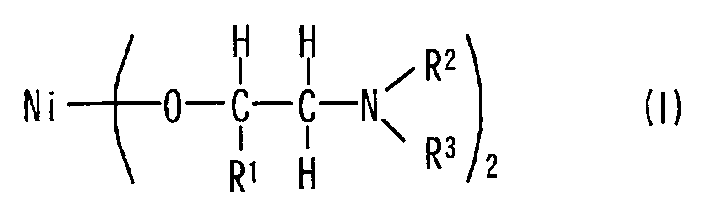
Darüber hinaus stellt die vorliegende Erfindung ein Rohmaterial für die Bildung eines dünnen Films, umfassend eine Alkoxidverbindung, die durch die obige Formel (I) dargestellt ist, bereit sowie die Verwendung der Alkoxidverbindung als ein Rohmaterial für die Bildung eines dünnen Films.Furthermore, the present invention provides a raw material for thin film formation comprising an alkoxide compound represented by the above formula (I) and the use of the alkoxide compound as a raw material for thin film formation.
WIRKUNG DER ERFINDUNGEFFECT OF THE INVENTION
Die vorliegende Erfindung kann eine niedrig schmelzende Nickel- Alkoxidverbindung bereitstellen, die einen hohen Dampfdruck hat und sich bei Normaltemperatur oder bei leichter Erwärmung in eine Flüssigkeit verwandelt. Die Verwendung der Verbindung als ein Ausgangsmaterial für die Bildung eines dünnen Films durch ein CVD- Verfahren kann eine gute Möglichkeit darstellen, ein Vorprodukt im Verlauf der Herstellung eines dünnen Films, der Nickel enthält, durch ein CVD- Verfahren zu übertragen, kann eine einfache Steuerung der zu dem Basismaterial zugeführten Menge ermöglichen, und kann ein Ausgangsmaterial für die Bildung eines dünnen Films stabil zu dem Basismaterial liefern.The present invention can provide a low-melting point nickel alkoxide compound which has a high vapor pressure and turns into a liquid at normal temperature or when slightly heated. The use of the compound as a raw material for the formation of a thin film by a CVD method can be a good way to transfer a precursor in the course of forming a thin film containing nickel by a CVD method can be an easy control of the amount supplied to the base material, and can stably supply a starting material for the formation of a thin film to the base material.
Figurenlistecharacter list
-
1 ist ein NMR-Spektrum der Verbindung Nr. 4, erhalten in Beispiel 3.1 is an NMR spectrum of Compound No. 4 obtained in Example 3. -
2 ist ein NMR-Spektrum der Verbindung Nr. 7, erhalten in Beispiel 4.2 is an NMR spectrum of Compound No. 7 obtained in Example 4.
BESCHREIBUNG DER AUSFÜHRUNGSFORMENDESCRIPTION OF THE EMBODIMENTS
Nachstehend wird die Alkoxidverbindung der vorliegenden Erfindung und ein Rohmaterial für die Bildung eines dünnen Films, das die Verbindung umfasst, auf Basis von bevorzugten beispielhaften Ausführungsformen im Detail erläutert.Hereinafter, the alkoxide compound of the present invention and a raw material for thin film formation comprising the compound will be explained in detail based on preferred exemplary embodiments.
Beispiele für die lineare oder verzweigte Alkylgruppe mit 2 bis 4 Kohlenstoffatomen, die in der obigen Formel (I) durch R1 dargestellt wird, beinhalten Ethyl, Propyl, Isopropyl, Butyl, sec- Butyl, tert- Butyl und Isobutyl, und Beispiele für die lineare oder verzweigte Alkylgruppe mit 1 bis 4 Kohlenstoffatomen, die durch R2 und R3 dargestellt wird, beinhalten Methyl, Ethyl, Propyl, Isopropyl, Butyl, sec- Butyl, tert- Butyl und Isobutyl. Einige Alkoxidverbindungen der vorliegenden Erfindung weisen optische Isomere auf, die sich jedoch nicht durch ihre isomere Konfiguration auszeichnen.Examples of the linear or branched alkyl group having 2 to 4 carbon atoms represented by R 1 in the above formula (I) include ethyl, propyl, isopropyl, butyl, sec-butyl, tert-butyl and isobutyl, and examples of the linear or branched alkyl group having 1 to 4 carbon atoms represented by R 2 and R 3 include methyl, ethyl, propyl, isopropyl, butyl, sec-butyl, tert-butyl and isobutyl. Some alkoxide compounds of the present invention have optical isomers, but they are not distinguished by their isomeric configuration.
Betreffend R1 bis R3 in der obigen Formel (I), ist die Verbindung vorzugsweise eine, die sich bei Normaltemperatur und bei Normaldruck in einem flüssigen Zustand befindet und einen hohen Dampfdruck aufweist, wenn die Verbindung bei einem Verfahren zur Bildung eines dünnen Films, umfassend einen Schritt des Verdampfens einer Verbindung, verwendet wird. Insbesondere ist R1 vorzugsweise eine Ethylgruppe, und einer der Reste R2 und R3, oder beide, ist (sind) vorzugsweise eine Ethylgruppe. Wenn sie andererseits bei einem Verfahren zur Bildung eines dünnen Films durch MOD, das keinen Verdampfungsschritt einschließt, verwendet wird, kann R1 bis R3 entsprechend der Löslichkeit in dem zu verwendenden Lösungsmittel, der Dünnfilm- Bildungsreaktion, usw. in geeigneter Weise ausgewählt werden.Regarding R 1 to R 3 in the above formula (I), the compound is preferably one which is in a liquid state at normal temperature and normal pressure and has a high vapor pressure when the compound is used in a process for forming a thin film, comprising a step of evaporating a compound. In particular, R 1 is preferably an ethyl group and one or both of R 2 and R 3 is (are) preferably an ethyl group. On the other hand, when used in a method of forming a thin film by MOD which does not include an evaporation step, R 1 to R 3 can be appropriately selected according to solubility in the solvent to be used, thin film forming reaction, etc.
Der Fall, in welchem die endständige Donorgruppe des Liganden an ein Metallatom koordiniert ist, um eine cyclische Struktur zu bilden, ist in der folgenden Formel (II) gezeigt. Die Alkoxidverbindung der vorliegenden Erfindung, die hierin beispielhaft durch die obige Formel (I) gezeigt ist, sich aber nicht von der folgenden Formel (II) unterscheidet, umfasst eine Verbindung, die durch irgendeine der Formeln (I) und (II) dargestellt ist.The case where the terminal donor group of the ligand is coordinated to a metal atom to form a cyclic structure is shown in the following formula (II). The alkoxide compound of the present invention, which is exemplified herein by the above formula (I) but not different from the following formula (II), includes a compound represented by any one of the formulas (I) and (II).

Spezifische Beispiele für die Alkoxidverbindung der vorliegenden Erfindung beinhalten die folgenden Verbindungen Nr. 1 bis Nr. 18. Es wird angemerkt, dass die vorliegende Erfindung in keiner Weise auf die folgenden beispielhaften Verbindungen beschränkt ist.Specific examples of the alkoxide compound of the present invention include the following compounds No. 1 to No. 18. It is noted that the present invention is in no way limited to the following exemplary compounds.


Die Alkoxidverbindung der vorliegenden Erfindung ist nicht beschränkt durch das Verfahren zu ihrer Herstellung und kann unter Verwendung allgemein bekannter Reaktionen hergestellt werden. Allgemein bekannte übliche Syntheseverfahren für Alkoxidverbindungen unter Verwendung der entsprechenden Aminoalkohole können eingesetzt werden. Solche Syntheseverfahren umfassen, zum Beispiel, ein Verfahren, bei dem ein anorganisches Salz, wie z. B. Halogenide und Nitrat von Nickel oder Hydrate derselben, mit dem entsprechenden Alkohol in der Gegenwart einer Base, wie z. B. Natrium, Natriumhydrid, Natriumamid, Natriumhydroxid, Natriummethylat, Ammoniak und Aminen, umgesetzt wird; ein Verfahren, bei dem ein anorganisches Salz, wie z. B. Halogenide und Nitrat von Nickel oder Hydrate derselben, mit einem Alkalimetallalkoxid, wie z. B. Natriumalkoxid, Lithiumalkoxid, und Kaliumalkoxid, die aus der entsprechenden Alkoholverbindung abgeleitet sind, umgesetzt wird; ein Verfahren, bei dem eine Alkoxidverbindung, die aus einem Alkohol mit niedrigem Molekulargewicht abgeleitet ist, wie z. B. Nickelmethoxid, -ethoxid, -isopropoxid und butoxid, einer Austauschreaktion mit der entsprechenden Alkoholverbindung unterzogen wird; und ein Verfahren, bei dem ein anorganisches Salz, wie z. B. Halogenide und Nitrat von Nickel, mit einem Derivat umgesetzt wird, das ein reaktives Zwischenprodukt ergibt, um ein reaktives Zwischenprodukt zu erhalten, gefolgt von einer Umsetzung von diesem mit der entsprechenden Alkoholverbindung.The alkoxide compound of the present invention is not limited by the method for its production and can be produced using well-known reactions. Well-known conventional synthetic methods for alkoxide compounds using the corresponding amino alcohols can be employed. Such synthesis methods include, for example, a method in which an inorganic salt such as e.g. B. halides and nitrates of nickel or hydrates thereof, with the corresponding alcohol in the presence of a base, such as. sodium, sodium hydride, sodium amide, sodium hydroxide, sodium methoxide, ammonia and amines; a method in which an inorganic salt, such as. B. halides and nitrates of nickel or hydrates thereof, with an alkali metal alkoxide, such as. B. sodium alkoxide, lithium alkoxide, and potassium alkoxide derived from the corresponding alcohol compound is reacted; a method in which an alkoxide compound derived from a low molecular weight alcohol, such as. e.g. nickel methoxide, ethoxide, isopropoxide and butoxide, is subjected to an exchange reaction with the corresponding alcohol compound; and a method in which an inorganic salt such as e.g., halides and nitrate of nickel, is reacted with a derivative giving a reactive intermediate to obtain a reactive intermediate, followed by reacting this with the corresponding alcohol compound.
Beispiele für das reaktive Zwischenprodukt umfassen Nickelamidverbindungen, wie z. B. Bis(dialkylamino) nickel und Bis(bis(trimethylsilyl) amino) nickel.Examples of the reactive intermediate include nickel amide compounds such as e.g. B. bis(dialkylamino)nickel and bis(bis(trimethylsilyl)amino)nickel.
Die Alkoxidverbindung der vorliegenden Erfindung ist dadurch gekennzeichnet, dass sie eine sekundäre Alkoxidverbindung ist, und die Alkoxidverbindung der vorliegenden Erfindung besitzt spezifische Eigenschaften, wohingegen tertiäre Alkoxidverbindungen überlegene Eigenschaften in Cu-, Ti-, Zr-, Hf- Komplexen, die ein Aminoalkoxid als einen Liganden aufweisen, haben.The alkoxide compound of the present invention is characterized by being a secondary alkoxide compound, and the alkoxide compound of the present invention has specific properties, whereas tertiary alkoxide compounds have superior properties in Cu, Ti, Zr, Hf complexes containing an amino alkoxide as one have ligands.
Die Alkoxidverbindung der vorliegenden Erfindung kann als ein Vorprodukt zur Herstellung eines dünnen Films, der Nickel enthält, verwendet werden, und kann bei solchen Anwendungen auch als Katalysator für organische Synthesen, Ausgangsmaterial für die organische Synthese, etc. eingesetzt werden.The alkoxide compound of the present invention can be used as a precursor for preparing a thin film containing nickel, and can also be used as a catalyst for organic synthesis, a starting material for organic synthesis, etc. in such applications.
Das Rohmaterial für die Bildung eines dünnen Films der vorliegenden Erfindung enthält die Alkoxidverbindung der vorliegenden Erfindung, die vorstehend beschrieben ist, als ein Vorprodukt für einen dünnen Film. Die Form des Rohmaterials kann in Abhängigkeit vom Herstellungsverfahren, bei dem das Rohmaterial für die Bildung eines dünnen Films eingesetzt werden soll, variieren. Die Alkoxidverbindung der vorliegenden Erfindung ist wegen ihrer physikalischen Eigenschaften besonders nützlich als Rohmaterial für das chemische Aufdampfen. Das heißt, das Rohmaterial für die Bildung eines dünnen Films der vorliegenden Erfindung ist vorzugsweise ein Rohmaterial für das chemische Aufdampfen.The raw material for the formation of a thin film of the present invention contains the alkoxide compound of the present invention described above as a precursor for a thin film. The shape of the raw material may vary depending on the manufacturing method in which the raw material is to be used for the formation of a thin film. The alkoxide compound of the present invention is particularly useful as a raw material for chemical vapor deposition because of its physical properties. That is, the raw material for forming a thin film of the present invention is preferably a raw material for chemical vapor deposition.
Wenn das Rohmaterial für die Bildung eines dünnen Films der vorliegenden Erfindung ein Rohmaterial für das chemische Aufdampfen ist, wird die Form desselben in geeigneter Weise, abhängig von den Techniken für die Materiallieferung und dem Zuführverfahren und anderen, die bei dem chemischen Aufdampfverfahren verwendet werden sollen, ausgewählt. Repräsentative Beispiele für das Rohmaterial für die Bildung eines dünnen Films der vorliegenden Erfindung beinhalten die folgenden (1) und (2), wenn es als Rohmaterial zum chemischen Aufdampfen verwendet wird.
- (1) Verwendung des Rohmaterials für die Bildung eines dünnen Films, wobei das Rohmaterial ein Vorprodukt umfasst, das selbst die Alkoxidverbindung der vorliegenden Erfindung umfasst, wobei das Vorprodukt ohne die Alkoxidverbindung in einem Anteil von 0 bis 10 Mol pro Mol der Alkoxidverbindung vorhanden ist, und wobei das Rohmaterial durch ein Dampflieferverfahren oder ein Flüssigkeitslieferverfahren bei der Herstellung des dünnen Films angeliefert und zugeführt wird.
- (2) Verwendung des Rohmaterials für die Bildung eines dünnen Films, wobei das Rohmaterial umfasst: ein organisches Lösungsmittel und ein Vorprodukt, das die Alkoxidverbindung der vorliegenden Erfindung umfasst, wobei der Gehalt des Vorprodukts, das die Alkoxidverbindung umfasst, 0,01 bis 2,0 Mol/1 beträgt, das Vorprodukt ohne die Alkoxidverbindung in einem Anteil von 0 bis 10 Mol pro Mol der Alkoxidverbindung vorhanden ist, und wobei das Rohmaterial durch ein Flüssigkeitslieferverfahren bei der Herstellung des dünnen Films angeliefert und zugeführt wird.
- (1) Use of the raw material for the formation of a thin film, the raw material comprising a precursor itself comprising the alkoxide compound of the present invention, the precursor without the alkoxide compound being present in a proportion of 0 to 10 moles per mole of the alkoxide compound, and wherein the raw material is delivered and delivered by a vapor delivery method or a liquid delivery method in the manufacture of the thin film.
- (2) Use of the raw material for the formation of a thin film, the raw material comprising: an organic solvent and a precursor comprising the alkoxide compound of the present invention, the content of the precursor comprising the alkoxide compound being 0.01 to 2, 0 mol / 1 is the precursor without the alkoxide compound in a proportion of 0 to 10 moles per mole of alkoxide compound is present, and the raw material is supplied and supplied by a liquid supply method in the manufacture of the thin film.
Eine detailliertere Beschreibung des Rohmaterials für die Bildung eines dünnen Films der vorliegenden Erfindung erfolgt für den Fall, bei dem das Rohmaterial als Rohmaterial zum chemischen Aufdampfen eingesetzt werden soll.A more detailed description of the raw material for forming a thin film of the present invention is given for the case where the raw material is to be used as a raw material for chemical vapor deposition.
Das Liefer- und Zuführverfahren beinhaltet ein Dampflieferverfahren, bei dem ein Rohmaterial zum chemischen Aufdampfen durch Erhitzen und / oder Verringerung des Drucks in einem Ausgangsbehälter verdampft wird und der resultierende Dampf in die Abscheidungsreaktionskammer, gegebenenfalls zusammen mit einem Trägergas, wie z. B. Argon, Stickstoff und Helium, eingeleitet wird; und ein Flüssigkeitsabgabeverfahren, bei dem ein Rohmaterial für das chemische Aufdampfen in einem flüssigen oder gelösten Zustand in eine Verdampfungskammer zugeführt wird, durch Erhitzen und / oder Verringerung des Drucks in der Verdampfungskammer verdampft wird, und in die Abscheidungsreaktionskammer eingeleitet wird. Bei dem Dampflieferverfahren ist die Alkoxidverbindung, die durch die allgemeine Formel (I) dargestellt ist, selbst das Rohmaterial für das chemische Aufdampfen, während bei dem Flüssigkeitslieferverfahren die Alkoxidverbindung, die durch die allgemeine Formel (I) dargestellt ist, selbst oder eine Lösung, die die Alkoxidverbindung in einem organischen Lösungsmittel gelöst enthält, das Rohmaterial für das chemische Aufdampfen ist.The delivery and delivery method includes a vapor delivery method in which a raw material for chemical vapor deposition is vaporized by heating and/or depressurizing in a starting vessel and the resulting vapor is introduced into the deposition reaction chamber, optionally together with a carrier gas such as e.g. B. argon, nitrogen and helium, is introduced; and a liquid discharge method in which a raw material for chemical vapor deposition is supplied in a liquid or dissolved state into a vaporization chamber, vaporized by heating and/or depressurizing the vaporization chamber, and introduced into the deposition reaction chamber. In the vapor delivery method, the alkoxide compound represented by the general formula (I) itself is the raw material for chemical vapor deposition, while in the liquid delivery method, the alkoxide compound represented by the general formula (I) itself or a solution that contains the alkoxide compound dissolved in an organic solvent which is a raw material for chemical vapor deposition.
Chemische Aufdampfverfahren für Mehrkomponenten- Systeme umfassen eine Technik, bei der jede Komponente, die ein Rohmaterial für das chemische Aufdampfen darstellt, getrennt verdampft und zugeführt wird (nachstehend auch als „Single- Source-Verfahren“ bezeichnet), und eine Technik, bei der ein gemischtes Ausgangsmaterial, erhalten durch Vormischen einer Vielzahl von Ausgangskomponenten in einem gewünschten Verhältnis, verdampft und zugeführt wird (im Folgenden auch als „Cocktail- Source-Verfahren“ bezeichnet). Beim Cocktail- Source- Verfahren ist das Rohmaterial für das chemische Aufdampfen eine Mischung oder eine gemischte Lösung, die zwei oder mehr Alkoxidverbindungen der vorliegenden Erfindung enthält, oder eine Mischung oder eine gemischte Lösung, die eine oder mehrere Alkoxidverbindung (en) der vorliegenden Erfindung und ein oder mehrere andere Vorprodukt(e) enthält. In dem Fall, dass eine Mischung oder eine gemischte Lösung einer Alkoxidverbindung der vorliegenden Erfindung mit (einem) anderen Vorprodukt (en) als Rohmaterial für die chemische Gasphasenabscheidung verwendet wird, kann ihr Mischungsverhältnis in geeigneter Weise je nach der gewünschten Zusammensetzung für den dünnen Film ausgewählt werden; es ist jedoch allgemein bevorzugt, die Menge des Vorprodukts / der anderen Vorprodukte aus dem Bereich von 0,01 bis 10 Mol, und stärker bevorzugt aus dem Bereich von 0,1 bis 5 Mol, pro 1 Mol der Alkoxidverbindung der vorliegenden Erfindung zu wählen.Chemical vapor deposition methods for multi-component systems include a technique in which each component, which is a raw material for chemical vapor deposition, is vaporized and supplied separately (hereinafter also referred to as “single-source method”), and a technique in which a mixed starting material obtained by pre-mixing a plurality of starting components at a desired ratio, is vaporized and supplied (hereinafter also referred to as “cocktail source method”). In the cocktail source method, the raw material for chemical vapor deposition is a mixture or a mixed solution containing two or more alkoxide compounds of the present invention, or a mixture or a mixed solution containing one or more alkoxide compound(s) of the present invention and contains one or more other precursor(s). In the case that a mixture or a mixed solution of an alkoxide compound of the present invention with (a) other precursor (s) is used as a raw material for chemical vapor deposition, its mixing ratio can be suitably selected depending on the desired composition for the thin film will; however, it is generally preferred to select the amount of the precursor(s) from the range of 0.01 to 10 moles, and more preferably from the range of 0.1 to 5 moles, per 1 mole of the alkoxide compound of the present invention.
Es gibt keine besondere Beschränkung hinsichtlich des organischen Lösungsmittels, das in dem oben erwähnten Material für CVD verwendet wird, und ein beliebiges organisches Lösungsmittel, das allgemein bekannt ist, kann verwendet werden. Solche organischen Lösungsmittel umfassen Acetate, wie z. B. Ethylacetat, Butylacetat und Methoxyethylacetat; Etheralkohole, wie z. B. Ethylenglycolmonomethylether, Ethylenglycolmonoethylether, Ethylenglycolmonobutylether, und Diethylenglycolmonomethylether; Ether, wie z. B. Tetrahydrofuran, Tetrahydropyran, Ethylenglycoldimethylether, Diethylenglycoldimethylether, Triethylenglycoldimethylether, Dibutylether und Dioxan; Ketone, wie z. B. Methylbutylketon, Methylisobutylketon, Ethylbutylketon, Dipropylketon, Diisobutylketon, Methylamylketon, Cyclohexanon und Methylcyclohexanon; Kohlenwasserstoffe, wie z. B. Hexan, Cyclohexan, Methylcyclohexan, Dimethylcyclohexan, Ethylcyclohexan, Heptan, Octan, Toluol und Xylol; Kohlenwasserstoffe mit einer Cyanogrupppe, wie z. B. 1- Cyanopropan, 1- Cyanobutan, 1-Cyanohexan, Cyanocyclohexan, Cycanobenzol, 1,3- Dicyanopropan, 1,4- Dicyanobutan, 1,6-Dicyanohexan, 1,4- Dicyanocyclohexan und 1,4- Dicyanbenzol; Pyridin und Lutidin. Diese werden allein oder als ein gemischtes Lösungsmittel aus zwei oder mehreren von diesen verwendet, abhängig von der Löslichkeit des zu lösenden Stoffs, und den Beziehungen zwischen der Temperatur bei der Anwendung und dem Siedepunkt und dem Flammpunkt des Lösungsmittels. Wenn ein solches organisches Lösungsmittel verwendet wird, wird die Gesamtmenge der Alkoxidverbindung der vorliegenden Erfindung und des anderen Vorprodukts / der anderen Vorprodukte in dem organischen Lösungsmittel vorzugsweise auf 0,01 bis 2,0 Mol / Liter, insbesondere 0,05 bis 1,0 Mol / Liter eingestellt.There is no particular limitation on the organic solvent used in the above-mentioned material for CVD, and any organic solvent that is publicly known can be used. Such organic solvents include acetates such as. B. ethyl acetate, butyl acetate and methoxyethyl acetate; ether alcohols such as B. ethylene glycol monomethyl ether, ethylene glycol monoethyl ether, ethylene glycol monobutyl ether, and diethylene glycol monomethyl ether; ethers, such as B. tetrahydrofuran, tetrahydropyran, ethylene glycol dimethyl ether, diethylene glycol dimethyl ether, triethylene glycol dimethyl ether, dibutyl ether and dioxane; ketones, such as B. methyl butyl ketone, methyl isobutyl ketone, ethyl butyl ketone, dipropyl ketone, diisobutyl ketone, methyl amyl ketone, cyclohexanone and methylcyclohexanone; hydrocarbons such as B. hexane, cyclohexane, methylcyclohexane, dimethylcyclohexane, ethylcyclohexane, heptane, octane, toluene and xylene; Hydrocarbons with a cyano group, such as. B. 1-cyanopropane, 1-cyanobutane, 1-cyanohexane, cyanocyclohexane, cyanobenzene, 1,3-dicyanopropane, 1,4-dicyanobutane, 1,6-dicyanohexane, 1,4-dicyanocyclohexane and 1,4-dicyanobenzene; pyridine and lutidine. These are used alone or as a mixed solvent of two or more of them depending on the solubility of the solute and the relationships between the temperature of use and the boiling point and flash point of the solvent. When such an organic solvent is used, the total amount of the alkoxide compound of the present invention and the other precursor(s) in the organic solvent is preferably adjusted to 0.01 to 2.0 mol/liter, more preferably 0.05 to 1.0 mol / liter set.
Bei CVD-Verfahren für die Mehrkomponenten- Systeme kann jedes allgemein bekannte übliche Vorprodukt, das als CVD- Ausgangsmaterial verwendet wird, als das andere Vorprodukt / die anderen Vorprodukte, das / die zusammen mit der Alkoxidverbindung der vorliegenden Erfindung verwendet werden soll(en), ohne besondere Einschränkungen eingesetzt werden.In CVD processes for the multi-component systems, any well-known common precursor used as a CVD starting material can be used as the other precursor(s) to be used together with the alkoxide compound of the present invention. be used without any particular restrictions.
Beispiele für das andere Vorprodukt / die anderen Vorprodukte beinhalten Verbindungen aus Silizium oder einem Metall mit einer oder zwei oder mehr organischen Koordinationsverbindung(en), ausgewählt aus Alkoholverbindungen, Glycolverbindungen, β-Diketonverbindungen, Cyclopentadienverbindungen und organischen Aminverbindungen. Beispiele für das Metall in einem Vorprodukt beinhalten Magnesium, Calcium, Strontium, Barium, Titan, Zirkonium, Hafnium, Vanadium, Niob, Tantal, Chrom, Molybdän, Wolfram, Mangan, Eisen, Ruthenium, Kobalt, Rhodium, Iridium, Nickel, Palladium, Platin, Kupfer, Silber, Gold, Zink, Aluminium, Gallium, Indium, Germanium, Zinn, Blei, Antimon, Wismut, Yttrium, Lanthan, Cer, Praseodym, Neodym, Promethium, Samarium, Europium, Gadolinium, Terbium, Dysprosium, Holmium, Erbium, Thulium und Ytterbium.Examples of the other precursor(s) include compounds of silicon or a metal having one or two or more organic coordination compounds selected from alcohol compounds, glycol compounds, β-diketone compounds, cyclopentadiene compounds and organic amine compounds. Examples of the metal in a precursor include magnesium, calcium, strontium, barium, titanium, zirconium, hafnium, vanadium, niobium, tantalum, chromium, molybdenum, tungsten, manganese, iron, ruthenium, cobalt, rhodium, iridium, nickel, palladium, Platinum, Copper, Silver, Gold, Zinc, Aluminum, Gallium, Indium, Germanium, Tin, Lead, Antimony, Bismuth, Yttrium, Lanthanum, Cerium, Praseodymium, Neodymium, Promethium, Samarium, Europium, Gadolinium, Terbium, Dysprosium, Holmium, erbium, thulium and ytterbium.
Die Alkoholverbindungen, die als die organische Koordinationsverbindung verwendet werden, beinhalten Alkylalkohole, wie z. B. Methanol, Ethanol, Propanol, Isopropanol, Butanol, 2-Butanol, Isobutanol, tert.-Butanol, Amylalkohol, Isoamylalkohol und tert-Amylalkohol; Etheralkohole, wie z. B. 2-Methoxyethanol, 2-Ethoxyethanol, 2 -Butoxyethanol, 2-(2-Methoxyethoxy) ethanol, 2-Methoxy-1- methylethanol, 2-Methoxy-1,1- dimethylethanol, 2-Ethoxy-1,1- dimethylethanol, 2-Isopropoxy-1,1- dimethylethanol, 2-Butoxy-1,1-dimethylethanol, 2-(2-Methoxyethoxy)-1,1- dimethylethanol, 2-Propoxy-1,1- diethylethanol, 2 -sec-Butoxy-1,1- diethylethanol und 3-Methoxy-1,1- dimethylpropanol; und Dialkylaminoalkoholen, die die Alkoxidverbindung der vorliegenden Erfindung bereitstellen.The alcohol compounds used as the organic coordination compound include alkyl alcohols such as e.g. B. methanol, ethanol, propanol, isopropanol, butanol, 2-butanol, isobutanol, tert-butanol, amyl alcohol, isoamyl alcohol and tert-amyl alcohol; ether alcohols such as B. 2-Methoxyethanol, 2-Ethoxyethanol, 2-Butoxyethanol, 2-(2-Methoxyethoxy)ethanol, 2-Methoxy-1-methylethanol, 2-Methoxy-1,1-dimethylethanol, 2-Ethoxy-1,1-dimethylethanol , 2-isopropoxy-1,1-dimethylethanol, 2-butoxy-1,1-dimethylethanol, 2-(2-methoxyethoxy)-1,1-dimethylethanol, 2-propoxy-1,1-diethylethanol, 2-sec-butoxy -1,1-diethylethanol and 3-methoxy-1,1-dimethylpropanol; and dialkylamino alcohols providing the alkoxide compound of the present invention.
Die Glycolverbindungen, die als die organische Koordinationsverbindung verwendet werden, beinhalten 1,2-Ethandiol, 1,2-Propandiol, 1,3-Propandiol, 2,4-Hexandiol, 2,2-Dimethyl-1,3- propandiol, 2,2-Diethyl-1,3- propandiol, 1,3-Butandiol, 2,4-Butandiol, 2,2-Diethyl-1,3- butandiol, 2-Ethyl-2- butyl-1,3- propandiol, 2,4-Pentandiol, 2-Methyl-1,3-propandiol, 2-Methyl-2,4- pentandiol, 2,4-Hexandiol und 2,4-Dimethyl-2,4- pentandiol.The glycol compounds used as the organic coordination compound include 1,2-ethanediol, 1,2-propanediol, 1,3-propanediol, 2,4-hexanediol, 2,2-dimethyl-1,3-propanediol, 2, 2-diethyl-1,3-propanediol, 1,3-butanediol, 2,4-butanediol, 2,2-diethyl-1,3-butanediol, 2-ethyl-2-butyl-1,3-propanediol, 2, 4-pentanediol, 2-methyl-1,3-propanediol, 2-methyl-2,4-pentanediol, 2,4-hexanediol and 2,4-dimethyl-2,4-pentanediol.
Beispiele für die (3-Diketonverbindungen, die als organischen Koordinationsverbindung verwendet werden, beinhalten Alkyl-substituierte β-Diketone, wie z. B. Acetylaceton, Hexan-2,4- dion, 5-Methylhexan-2,4- dion, Heptan-2,4- dion, 2-Methylheptan-3,5- dion, 5-Methylheptan-2,4- dion, 6-Methylheptan-2,4- dion, 2,2-Dimethylheptan-3,5- dion, 2,6-Dimethylheptan-3,5- dion, 2,2,6-Trimethylheptan-3,5- dion, 2,2,6,6-Tetramethylheptan-3,5-dion, Octan-2,4- dion, 2,2,6-Trimethyloctan-3,5- dion, 2,6-Dimethyloctan-3,5- dion, 2,9-Dimethylnonan-4,6- dion, 2-Methyl-6- ethyldecan-3,5- dion und 2,2-Dimethyl-6- ethyldecan-3,5- dion; fluorierte Alkyl- β-diketone, wie z. B. 1,1,1-Trifluorpentan-2,4- dion, 1,1,1-Trifluor-5,5- dimethylhexan-2,4- dion, 1,1,1,5,5,5-Hexafluorpentan-2,4- dion und 1,3-Diperfluorhexylpropan-1,3- dion; Ether-substituierte β-Diketone, wie z. B. 1,1,5,5-Tetramethyl-1- methoxyhexan-2,4- dion, 2,2,6,6-Tetramethyl-1- methoxyheptan-3,5- dion und 2,2,6,6-Tetramethyl-1- (2-methoxyethoxy) heptan-3,5- dion.Examples of the (3-diketone compounds used as the organic coordination compound include alkyl-substituted β-diketones such as acetylacetone, hexane-2,4-dione, 5-methylhexane-2,4-dione, heptane- 2,4-dione, 2-methylheptane-3,5-dione, 5-methylheptane-2,4-dione, 6-methylheptane-2,4-dione, 2,2-dimethylheptane-3,5-dione, 2, 6-dimethylheptane-3,5-dione, 2,2,6-trimethylheptane-3,5-dione, 2,2,6,6-tetramethylheptane-3,5-dione, octane-2,4-dione, 2, 2,6-trimethyloctane-3,5-dione, 2,6-dimethyloctane-3,5-dione, 2,9-dimethylnonan-4,6-dione, 2-methyl-6-ethyldecane-3,5-dione and 2,2-dimethyl-6-ethyldecan-3,5-dione, fluorinated alkyl β-diketones such as 1,1,1-trifluoropentan-2,4-dione, 1,1,1-trifluoro- 5,5-dimethylhexane-2,4-dione, 1,1,1,5,5,5-hexafluoropentane-2,4-dione and 1,3-diperfluorohexylpropane-1,3-dione, ether substituted β-diketones , such as 1,1,5,5-Tetramethyl-1-methoxyhexane-2,4-dione, 2,2,6,6-Tetramethyl-1-methoxyheptane-3,5-dione and 2,2, 6,6-Tetramethyl-1-(2-methoxyethoxy) hep tan-3,5-dione.
Beispiele für die Cyclopentadienverbindungen, die als organische Koordinationsverbindung verwendet werden, beinhalten Cyclopentadien, Methylcyclopentadien, Ethylcyclopentadien, Propylcyclopentadien, Isopropylcyclopentadien, Butylcyclopentadien, sec-Butylcyclopentadien, Isobutylcyclopentadien, tert-Butylcyclopentadien, Dimethylcyclopentadien und Tetramethylcyclopentadien. Beispiele für die organischen Aminverbindungen, die als organische Koordinationsverbindung verwendet werden, beinhalten Methylamin, Ethylamin, Propylamin, Isopropylamin, Butylamin, sec-Butylamin, tert- Butylamin, Isobutylamin, Dimethylamin, Diethylamin, Dipropylamin, Diisopropylamin, Ethylmethylamin, Propylmethylamin und Isopropylmethylamin.Examples of the cyclopentadiene compound used as the organic coordination compound include cyclopentadiene, methylcyclopentadiene, ethylcyclopentadiene, propylcyclopentadiene, isopropylcyclopentadiene, butylcyclopentadiene, sec-butylcyclopentadiene, isobutylcyclopentadiene, tert-butylcyclopentadiene, dimethylcyclopentadiene and tetramethylcyclopentadiene. Examples of the organic amine compounds used as the organic coordination compound include methylamine, ethylamine, propylamine, isopropylamine, butylamine, sec-butylamine, tert-butylamine, isobutylamine, dimethylamine, diethylamine, dipropylamine, diisopropylamine, ethylmethylamine, propylmethylamine and isopropylmethylamine.
Im Falle des Single- Source- Verfahrens ist das vorgenannte andere Vorprodukt / sind die vorgenannten anderen Vorprodukte vorzugsweise (eine) Verbindung(en), die bei der Zersetzung durch Hitze und / oder Oxidation ein ähnliches Verhalten wie die Alkoxidverbindung der vorliegenden Erfindung zeigt / zeigen; und in dem Fall des Cocktail-Source- Verfahrens ist eine Verbindung bevorzugt, die nicht nur ein ähnliches thermisches und / oder oxidatives Abbauverhalten zeigt sondern auch keiner Verschlechterung aufgrund einer chemischen Reaktion während des Mischens unterliegt.In the case of the single-source process, the aforementioned other precursor(s) is/are preferably (a) compound(s) which exhibit(s) similar behavior to the alkoxide compound of the present invention on decomposition by heat and/or oxidation ; and in the case of the cocktail source method, preference is given to a compound which not only exhibits similar thermal and/or oxidative degradation behavior but also does not undergo deterioration due to chemical reaction during mixing.
Es ist erlaubt, dass das Rohmaterial für die Bildung eines dünnen Films der vorliegenden Erfindung gegebenenfalls ein nukleophiles Reagenz enthalten kann, um der Alkoxidverbindung der vorliegenden Erfindung und dem anderen Vorprodukt / den anderen Vorprodukten Stabilität zu verleihen. Das nukleophile Reagenz umfasst Ethylenglycolether, wie z. B. Dimethylether (glyme), Diethylenglycoldimethylether (diglyme), Triethylenglycoldimethylether (triglyme) und Tetraethylenglycoldimethylether (tetraglyme); Kronenether, wie z. B. 18-Krone-6, Dicyclohexyl-18-Krone-6, 24-Krone-8, Dicyclohexyl-24-Krone-8, und Dibenzo-24-Krone-8; Polyamine, wie z. B. Ethylendiamin, N,N'-Tetramethylethylendiamin, Diethylentriamin, Triethylentetramin, Tetraethylenpentamin, Pentaethylenhexamin, 1,1,4,7,7-Pentamethyldiethylentriamin, 1,1,4,7,10,10-Hexamethyltriethylentetramin und Triethoxytriethylenamin; cyclische Polyamine, wie z. B. Cyclam und Cyclen; heterocyclische Verbindungen, wie z. B. Pyridin, Pyrrolidin, Piperidin, Morpholin, N-Methylpyrrolidin, N-Methylpiperidin, N-Methylmorpholin, Tetrahydrofuran, Tetrahydropyran, 1,4-Dioxan, Oxazol, Thiazol und Oxathiolan; β-Ketoester, wie z. B. Acetessigsäuremethylester, Acetessigsäureethylester, Acetessigsäure-2-methoxyethylester; und β-Diketone, wie z. B. Acetylaceton, 2,4-Hexandion, 2,4-Heptandion, 3,5-Heptandion und Dipivaloylmethan. Die verwendete Menge dieser nukleophilen Reagenzien als Stabilisatoren ist vorzugsweise im Bereich von 0,1 Mol bis 10 Mol, und besonders bevorzugt von 1 bis 4 Mol, pro Mol des Vorprodukts.It is allowed that the raw material for the formation of a thin film of the present invention may optionally contain a nucleophilic reagent in order to impart stability to the alkoxide compound of the present invention and the other precursor(s). The nucleophilic reagent includes ethylene glycol ethers such as e.g. B. dimethyl ether (glyme), diethylene glycol dimethyl ether (diglyme), triethylene glycol dimethyl ether (triglyme) and tetraethylene glycol dimethyl ether (tetraglyme); crown ethers, e.g. B. 18-crown-6, dicyclohexyl-18-crown-6, 24-crown-8, dicyclohexyl-24-crown-8, and dibenzo-24-crown-8; polyamines, such as B. ethylenediamine, N,N'-tetramethylethylenediamine, diethylenetriamine, triethylenetetramine, tetraethylenepentamine, pentaethylenehexamine, 1,1,4,7,7-pentamethyldiethylenetriamine, 1,1,4,7,10,10-hexamethyltriethylenetetramine and triethoxytriethyleneamine; cyclic polyamines, such as e.g. B. cyclam and cycles; hetero cyclic compounds such as B. pyridine, pyrrolidine, piperidine, morpholine, N-methylpyrrolidine, N-methylpiperidine, N-methylmorpholine, tetrahydrofuran, tetrahydropyran, 1,4-dioxane, oxazole, thiazole and oxathiolane; β-keto esters, such as e.g. B. methyl acetoacetate, ethyl acetoacetate, 2-methoxyethyl acetoacetate; and β-diketones, such as e.g. B. acetylacetone, 2,4-hexanedione, 2,4-heptanedione, 3,5-heptanedione and dipivaloylmethane. The amount of these nucleophilic reagents used as stabilizers is preferably in the range of from 0.1 mol to 10 mol, and more preferably from 1 to 4 mol, per mol of the precursor.
Bei dem Rohmaterial für die Bildung eines dünnen Films der vorliegenden Erfindung sollte eine Kontamination mit anderen Substanzen, die keine Komponenten davon sind, einschließlich Metallelement- Verunreinigungen; Halogen- Verunreinigungen, wie z. B. Chlorenthaltende Verunreinigungen; und organische Verunreinigungen gering gehalten werden. Der Gehalt der Metallelement- Verunreinigungen beträgt vorzugsweise 100 ppb oder weniger, und stärker bevorzugt 10 ppb oder weniger, für jedes Element und ist vorzugsweise 1 ppm oder weniger, und besonders bevorzugt beträgt der Gesamtgehalt 100 ppb oder weniger. Insbesondere bei der Verwendung des Rohmaterials, um eine dielektrische Gate-Schicht, eine Gate-Schicht oder eine Sperrschicht für LSI (barrier layer of LSI) herzustellen, ist es notwendig, den Gehalt an Elementen von Alkalimetallen, Elementen von Erdalkalimetallen, sowie Elementen von einigen Gruppen, die die elektrischen Eigenschaften eines dünnen Films, der erhalten werden soll, beeinflussen, zu verringern. Die Menge der Halogen-Verunreinigungen ist vorzugsweise 100 ppm oder weniger, stärker bevorzugt 10 ppm oder weniger, und noch mehr bevorzugt 1 ppm oder weniger. Der Gesamtgehalt an organischen Verunreinigungen ist vorzugsweise nicht mehr als 500 ppm, stärker bevorzugt nicht mehr als 50 ppm, und noch stärker bevorzugt nicht mehr als 10 ppm. Da Wasser die Bildung von Partikeln in einem Rohmaterial für die chemische Dampfabscheidung oder eine Partikelbildung während der Bildung des dünnen Films bewirkt, ist es empfehlenswert, bei jeder Metallverbindung, dem organischen Lösungsmittel und dem nukleophilen Reagenz vor der Verwendung Wasser so weit wie möglich zu entfernen, um den Wassergehalt derselben zu verringern. Bei jeder der Metallverbindung, dem organischen Lösungsmittel und dem nukleophilen Reagenz ist der Wassergehalt vorzugsweise nicht mehr als 10 ppm, und stärker bevorzugt nicht mehr als 1 ppm.The raw material for forming a thin film of the present invention should be free from contamination with substances other than components thereof including metal element impurities; Halogen impurities such as B. Chlorine-containing impurities; and organic contaminants are kept to a minimum. The content of the metal element impurities is preferably 100 ppb or less, and more preferably 10 ppb or less for each element, and is preferably 1 ppm or less, and particularly preferably the total content is 100 ppb or less. In particular, when using the raw material to produce a gate dielectric layer, a gate layer or a barrier layer for LSI (barrier layer of LSI), it is necessary to control the content of elements of alkali metals, elements of alkaline earth metals, as well as elements of some Groups affecting electrical properties of a thin film to be obtained. The amount of the halogen impurities is preferably 100 ppm or less, more preferably 10 ppm or less, and even more preferably 1 ppm or less. The total organic impurity content is preferably no more than 500 ppm, more preferably no more than 50 ppm, and even more preferably no more than 10 ppm. Since water causes formation of particles in a raw material for chemical vapor deposition or formation of particles during the formation of the thin film, it is recommended to remove water as much as possible from each metal compound, the organic solvent and the nucleophilic reagent before use, to reduce the water content thereof. In each of the metal compound, the organic solvent and the nucleophilic reagent, the water content is preferably not more than 10 ppm, and more preferably not more than 1 ppm.
Bei dem Rohmaterial für die Bildung eines dünnen Films der vorliegenden Erfindung ist es bevorzugt, eine Kontamination mit Partikeln so gering wie möglich zu halten, um eine Partikelverunreinigung des dünnen Films, der gebildet werden soll, zu verringern oder zu verhindern. Insbesondere ist die Anzahl der Partikel größer als 0,3 µm bei einer Teilchenmessung mit einem Lichtstreuungs- Teilchendetektor, der in eine flüssige Phase eingetaucht ist, vorzugsweise 100 oder weniger in 1 ml der flüssigen Phase, stärker bevorzugt ist die Anzahl der Partikel, die größer als 0,2 µm sind, 1000 oder weniger in 1 ml der flüssigen Phase, und noch stärker bevorzugt ist die Anzahl der Partikel, die größer als 0,2 µm sind, 100 oder weniger in 1 ml der flüssigen Phase.In the raw material for the formation of a thin film of the present invention, it is preferable to minimize particle contamination in order to reduce or prevent particle contamination of the thin film to be formed. In particular, the number of particles is larger than 0.3 µm in a particle measurement with a light scattering particle detector immersed in a liquid phase, preferably 100 or less in 1 ml of the liquid phase, more preferably the number of particles is larger than 0.2 µm is 1000 or less in 1 ml of the liquid phase, and more preferably the number of particles larger than 0.2 µm is 100 or less in 1 ml of the liquid phase.
Das Verfahren zur Verwendung des Rohmaterials zur Bildung eines dünnen Films der vorliegenden Erfindung in dem Fall, in welchem das Material als ein Rohmaterial für die chemische Dampfabscheidung (z. B. einem Herstellungsverfahren für einen dünnen Film) verwendet wird, wird nachstehend konkret beschrieben. Dieses Herstellungsverfahren für einen dünnen Film ist ein Verfahren, das ein chemisches Dampfabscheidungsverfahren verwendet, bei dem ein Dampf, der durch Verdampfen der Alkoxidverbindung der vorliegenden Erfindung und, gegebenenfalls, eines anderen Vorprodukts / anderer Vorprodukte erzeugt wurde, einem Substrat, gegebenenfalls mit einem reaktiven Gas, das optional verwendet werden kann, zugeführt wird, und diese Vorprodukte werden dann zersetzt und / oder auf dem Substrat umgesetzt, so dass ein dünner Film wächst und auf dem Substrat abgeschieden wird. Ein Katalysator kann während dem chemischen Dampfabscheidungsverfahren verwendet werden, und das Verfahren zum Anliefern und Zuführen von Rohmaterialien, das Abscheidungsverfahren, die Herstellungsbedingungen, die Herstellungsvorrichtungen, usw. sind nicht besonders eingeschränkt, und es können übliche Bedingungen und Verfahren verwendet werden.The method of using the raw material for forming a thin film of the present invention in the case where the material is used as a raw material for chemical vapor deposition (eg, a thin film manufacturing method) will be concretely described below. This thin film manufacturing method is a method using a chemical vapor deposition method in which a vapor generated by evaporating the alkoxide compound of the present invention and, optionally, other precursor(s) onto a substrate, optionally with a reactive gas , which can be optionally used, and these precursors are then decomposed and/or reacted on the substrate so that a thin film grows and is deposited on the substrate. A catalyst can be used during the chemical vapor deposition process, and the method of supplying and supplying raw materials, the deposition method, the manufacturing conditions, the manufacturing devices, etc. are not particularly limited, and ordinary conditions and methods can be used.
Beispiele für das reaktive Gas, das gegebenenfalls verwendet werden kann, beinhalten oxidative Gase, wie z. B. Sauerstoff, Ozon, Stickstoffdioxid, Stickstoffmonoxid, Wasserdampf, Wasserstoffperoxid, Ameisensäure, Essigsäure und Essigsäureanhydrid; reduktive Gase, wie z. B. Wasserstoff, Ammoniak und organometallische Verbindungen; und Nitriermittel, einschließlich organische Aminverbindungen, wie z. B. Monoalkylamine, Dialkylamine, Trialkylamine und Alkylendiamine, Hydrazin und Ammoniak.Examples of the reactive gas that can be used optionally include oxidative gases such as e.g. B. oxygen, ozone, nitrogen dioxide, nitric oxide, water vapor, hydrogen peroxide, formic acid, acetic acid and acetic anhydride; reductive gases such as B. hydrogen, ammonia and organometallic compounds; and nitrating agents including organic amine compounds such as e.g. B. monoalkylamines, dialkylamines, trialkylamines and alkylenediamines, hydrazine and ammonia.
Beispiele für den oben erwähnten Katalysator beinhalten hochschmelzende Metalle, wie z. B. Wolfram.Examples of the catalyst mentioned above include refractory metals such as e.g. B. Tungsten.
Beispiele für die oben genannten Anliefer- und Zuführverfahren beinhalten die oben genannten Dampflieferverfahren, Flüssigkeitslieferverfahren, Cocktail- Source- Verfahren, Single- Source- Verfahren, und andere.Examples of the above delivery and delivery methods include the above vapor delivery methods, liquid delivery methods, cocktail source methods, single source methods, and others.
Die oben genannten Abscheidungsverfahren umfassen das thermische CVD-Verfahren, in welchem das Gas aus verdampftem Material oder eine Mischung aus dem Gas des verdampften Materials und eines reaktiven Gases nur durch Hitze zur Reaktion gebracht werden, um einen dünnen Film abzuscheiden; das Plasma- CVD-Verfahren, bei dem Hitze und Plasma verwendet werden; das photoangeregte CVD-Verfahren, bei dem Hitze und Licht verwendet werden; das photo- und Plasma- angeregte CVD-Verfahren, bei dem Hitze, Licht und Plasma verwendet werden; und das ALD-Verfahren, bei dem die CVD-Abscheidungsreaktion in elementare Schritte aufgeteilt ist und die Abscheidung Schritt für Schritt auf molekularer Ebene ausgeführt wird.The deposition methods mentioned above include the thermal CVD method in which the vaporized material gas or a mixture of the vaporized material gas and a reactive gas is reacted only by heat to deposit a thin film; the plasma CVD method using heat and plasma; the photoexcited CVD method using heat and light; the photo- and plasma-excited CVD process using heat, light and plasma; and the ALD method, in which the CVD deposition reaction is divided into elementary steps and the deposition is carried out step by step at the molecular level.
Die Bildungsbedingungen beinhalten die Reaktionstemperatur (Substrattemperatur), den Reaktionsdruck, die Abscheidungsgeschwindigkeit und dergleichen. Die Reaktionstemperatur beträgt vorzugsweise 100 °C oder mehr, bei der die Alkoxidverbindung der vorliegenden Erfindung ausreichend reaktiv ist, und stärker bevorzugt 150 °C bis 300 °C. Der Reaktionsdruck beträgt vorzugsweise von Atmosphärendruck bis 10 Pa für die thermische CVD und die photoangeregten CVD-Verfahren, und wenn Plasma verwendet wird, ist er vorzugsweise 2000 Pa bis 10 Pa.The formation conditions include reaction temperature (substrate temperature), reaction pressure, deposition rate and the like. The reaction temperature is preferably 100°C or more at which the alkoxide compound of the present invention is sufficiently reactive, and more preferably 150°C to 300°C. The reaction pressure is preferably from atmospheric pressure to 10 Pa for thermal CVD and photoexcited CVD processes, and when plasma is used it is preferably 2000 Pa to 10 Pa.
Die Abscheidungsgeschwindigkeit kann durch die Versorgungsbedingungen (Verdampfungstemperatur und Verdampfungsdruck) des Materials und die Reaktionstemperatur und den Druck gesteuert werden. Da überhöhte Abscheidungsraten zu einer Verschlechterung der Eigenschaften des resultierenden dünnen Films führen können und zu niedrige Abscheidungsraten ein Problem bei der Produktivität verursachen können, ist die Abscheidungsrate vorzugsweise 0,01 bis 5000 nm / min und stärker bevorzugt 0,1 bis 1000 nm / min. Bei ALD wird die Anzahl der Zyklen gesteuert, um eine gewünschte Filmdicke zu erhalten.The deposition speed can be controlled by the supply conditions (vaporization temperature and vaporization pressure) of the material and the reaction temperature and pressure. Since excessive deposition rates may lead to deterioration of the properties of the resulting thin film and too low deposition rates may cause a problem in productivity, the deposition rate is preferably 0.01 to 5000 nm/min, and more preferably 0.1 to 1000 nm/min. With ALD, the number of cycles is controlled to obtain a desired film thickness.
Zum Beispiel werden in dem Fall der Bildung eines Nickelfilms durch ein CVD-Verfahren, ein Dampf, gebildet durch das Verdampfen der Alkoxidverbindung der vorliegenden Erfindung und, gegebenenfalls, eines anderen Vorprodukts / anderer Vorprodukte, das eingesetzt werden kann / die eingesetzt werden können, und einem reaktiven Gas, das optional verwendet werden kann, zuerst einem Substrat in einer Abscheidungsreaktionskammer, wie oben (Rohmaterial- Zuführungsschritt) beschrieben, zugeführt. Vorzugsweise wird die Alkoxidverbindung der vorliegenden Erfindung bei Raumtemperatur bis 200 ° C verdampft. Der Druck, bei dem die Alkoxidverbindung der vorliegenden Erfindung verdampft wird, beträgt vorzugsweise 0,01 bis 300 Pa. Nach dem oben beschriebenen Rohmaterial- Zuführungsschritt wird ein Vorläufer- Dünnfilm auf dem Substrat aus der in die Abscheidungsreaktionskammer eingeführten Nickel- Alkoxidverbindung gebildet (Vorläufer- Dünnfilm- Bildungsschritt). Zu diesem Zeitpunkt kann Wärme durch Erwärmen des Substrats oder das Erhitzen der Abscheidungsreaktionskammer hinzugefügt werden. Der in diesem Schritt gebildete Vorläufer- Dünnfilm ist ein dünner Nickelfilm oder ein dünner Film, gebildet durch Zersetzung und / oder Reaktion eines Teils der Nickel-Alkoxidverbindung, und weist eine Zusammensetzung auf, die sich von dem Zielprodukt eines dünnen Nickelfilms unterscheidet. Die Temperatur, bei der dieser Schritt durchgeführt wird, ist vorzugsweise Raumtemperatur bis 400 °C, und stärker bevorzugt 150 bis 300 °C.For example, in the case of forming a nickel film by a CVD method, a vapor formed by evaporating the alkoxide compound of the present invention and, optionally, other precursor(s) that can be used(s) and a reactive gas that can be optionally used is first supplied to a substrate in a deposition reaction chamber as described above (raw material supplying step). Preferably, the alkoxide compound of the present invention is vaporized at room temperature to 200°C. The pressure at which the alkoxide compound of the present invention is vaporized is preferably 0.01 to 300 Pa. After the raw material supply step described above, a precursor thin film is formed on the substrate from the nickel alkoxide compound introduced into the deposition reaction chamber (precursor thin film formation step). At this time, heat can be added by heating the substrate or heating the deposition reaction chamber. The precursor thin film formed in this step is a nickel thin film or a thin film formed by decomposition and/or reaction of a part of the nickel alkoxide compound, and has a composition different from the target product of a nickel thin film. The temperature at which this step is carried out is preferably room temperature to 400°C, and more preferably 150 to 300°C.
Anschließend werden nicht umgesetztes Gas der Nickel- Alkoxidverbindung und Nebenprodukt-Gas aus der Abscheidungsreaktionskammer entfernt (Entfernungsschritt). Obwohl das nicht umgesetzte Gas der Nickel- Alkoxidverbindung und das Nebenprodukt- Gas im Idealfall vollständig aus der Abscheidungsreaktionskammer entfernt werden, ist eine vollständige Entfernung nicht immer erforderlich. Beispiele für das Verfahren zur Entfernung umfassen ein Verfahren, bei dem das System mit einem Inertgas, wie z. B. Helium und Argon, gespült wird; ein Verfahren, bei dem die Entfernung erreicht wird, indem der Druck im System verringert wird; und ein Verfahren, bei dem diese Verfahren kombiniert werden. Die Größe des verringerten Drucks beim Reduzieren des Drucks beträgt vorzugsweise 0,01 bis 300 Pa, und stärker bevorzugt 0,01 bis 100 Pa.Subsequently, unreacted nickel alkoxide compound gas and by-product gas are removed from the deposition reaction chamber (removing step). Although the unreacted nickel alkoxide compound gas and the by-product gas are ideally completely removed from the deposition reaction chamber, complete removal is not always required. Examples of the removal method include a method in which the system is purged with an inert gas such as. B. helium and argon, is purged; a method in which removal is achieved by reducing the pressure in the system; and a method in which these methods are combined. The magnitude of the reduced pressure when reducing the pressure is preferably 0.01 to 300 Pa, and more preferably 0.01 to 100 Pa.
Anschließend wird ein Reduktionsgas in die Abscheidungsreaktionskammer eingespeist, und dann wird durch die Wirkung des reduzierenden Gases oder des reduzierenden Gases und Hitze ein dünner Nickelfilm aus dem Vorläufer-Dünnfilm, der in dem vorangegangenen Vorläufer- Dünnfilm- Bildungsschritt gebildet wurde, gebildet (Nickel-Dünnfilm- Bildungsschritt). Die Temperatur, bei welcher die Hitze in diesem Schritt angewendet wird, ist vorzugsweise Raumtemperatur bis 400 °C, und stärker bevorzugt 150 bis 300 °C. Die Alkoxidverbindung der vorliegenden Erfindung weist eine gute Reaktivität mit dem Reduktionsgas auf und kann einen dünnen Nickelfilm hervorbringen.Subsequently, a reducing gas is fed into the deposition reaction chamber, and then, by the action of the reducing gas or the reducing gas and heat, a nickel thin film is formed from the precursor thin film formed in the preceding precursor thin film forming step (nickel thin film - educational step). The temperature at which heat is applied in this step is preferably room temperature to 400°C, and more preferably 150 to 300°C. The alkoxide compound of the present invention has good reactivity with the reducing gas and can form a thin nickel film.
Ein Zyklus der Dünnfilmabscheidung setzt sich aus einer Reihe von Arbeitsschritten zusammen, bestehend aus dem oben beschriebenen Rohmaterial- Zuführungsschritt, dem Vorläufer- Dünnfilm- Bildungsschritt, dem Entfernungsschritt und dem Nickel- Dünnfilm Bildungsschritt. Der Zyklus kann mehrere Male wiederholt werden, bis ein dünner Film, der eine erforderliche Dicke aufweist, erhalten wird (ALD- Verfahren). In diesem Fall werden nach der Ausführung von einem Zyklus vorzugsweise das nicht umgesetzte Gas der Nickel-Alkoxidverbindung, das reduzierende Gas und das Nebenprodukt-Gas aus der Gasabscheidungsreaktionskammer in der gleichen Weise wie bei dem oben beschriebenen Entfernungsschritt entfernt, und dann wird der nächste Zyklus durchgeführt.One cycle of thin film deposition is composed of a series of operations consisting of the above-described raw material supplying step, precursor thin film forming step, removing step, and nickel thin film forming step. The cycle can be repeated several times until a thin film having a required thickness is obtained (ALD method). In this case, after the execution of one cycle, preferably the unreacted nickel alkoxide compound gas, the reducing gas and the by-product gas are removed from the gas deposition reaction chamber in the same manner as in the removal step described above, and then the next cycle is carried out .
Bei der Bildung eines Nickel- Dünnfilms durch das ALD- Verfahren kann Energie, wie beispielsweise Plasma, Licht und Spannung, angewandt werden. Der Zeitpunkt, zu dem eine solche Energie angewandt wird, ist nicht besonders begrenzt; der Zeitpunkt kann während der Zuführung des Gases der Nickel- Alkoxidverbindung in dem Rohmaterial- Zuführungsschritt sein; zum Zeitpunkt der Erwärmung beim Vorläufer- Dünnfilm- Bildungsschritt oder dem Nickel- Dünnfilm Bildungsschritt, während der Entfernung aus dem System in dem Entfernungsschritt; oder während des Einbringens des Reduktionsgases bei dem Nickel-Dünnfilm- Bildungsschritt, und es kann auch zwischen den oben beschriebenen Schritten erfolgen.In the formation of a nickel thin film by the ALD method, energy such as plasma, light and voltage can be applied. The timing when such energy is applied is not particularly limited; the timing may be during the supply of the gas of the nickel alkoxide compound in the raw material supply step; at the time of heating in the precursor thin film forming step or the nickel thin film forming step, during removal from the system in the removing step; or during the introduction of the reducing gas in the nickel thin film forming step, and it may also be between the steps described above.
Darüber hinaus kann die Herstellung eines dünnen Films unter Verwendung des Ausgangsmaterials für die Bildung eines dünnen Films der vorliegenden Erfindung eine Glühbehandlung beinhalten, die unter einer inerten Atmosphäre, einer oxidierenden Atmosphäre oder einer reduzierenden Atmosphäre durchgeführt wird, um bessere elektrische Eigenschaften nach dem Abscheiden eines dünnen Films zu erreichen. Wenn eine Kantenbedeckung erforderlich ist, kann ein Reflow- Schritt vorgesehen werden. In diesem Fall beträgt die Temperatur 250 bis 1000 °C, und stärker bevorzugt 300 bis 500 °C.In addition, the production of a thin film using the starting material for the formation of a thin film of the present invention may include an annealing treatment performed under an inert atmosphere, an oxidizing atmosphere or a reducing atmosphere to obtain improved electrical properties after depositing a thin to reach the movie. If edge coverage is required, a reflow step can be included. In this case, the temperature is 250 to 1000°C, and more preferably 300 to 500°C.
Der dünne Film, hergestellt unter Verwendung des Rohmaterials zur Bildung eines dünnen Films der vorliegenden Erfindung, kann als ein dünner Film einer gewünschten Art gefertigt werden, wie z. B. Metall, Oxidkeramik, Nitridkeramik und Glas, indem das Vorprodukt der anderen Komponente, das reaktive Gas und die Herstellungsbedingungen in geeigneter Weise ausgewählt werden. Beispiele für die Zusammensetzung des dünnen Films, der hergestellt werden kann, umfassen metallisches Nickel, Oxide auf Nickelbasis, Nitride auf Nickelbasis und Legierungen auf Nickelbasis, wie z. B. Ni -Ti, Ni-Cr, Ni-V, Ni-Cu, Ni-Cr-Si, Ni-Cr-Al, Ni-W, AuGeNi und NiP2. Die Beispiele für die Anwendungen dieser Filme umfassen einen Elektrodenfilm, einen Sperrfilm, einem Widerstandsfilm, einen magnetischen Film, einen metallischen Sperrfilm für Flüssigkristalle, ein Element für Dünnfilm- Solarzellen, ein Element für Halbleitervorrichtungen, eine Nanostruktur, ein Wasserstoffspeichermaterial, und eine mikro- elektromechanisches Bedienteil.The thin film produced using the raw material for forming a thin film of the present invention can be made into a thin film of a desired type, such as. B. metal, oxide ceramics, nitride ceramics and glass by the precursor of the other component, the reactive gas and the manufacturing conditions are appropriately selected. Examples of the composition of the thin film that can be produced include metallic nickel, nickel-based oxides, nickel-based nitrides, and nickel-based alloys such as nickel. B. Ni-Ti, Ni-Cr, Ni-V, Ni-Cu, Ni-Cr-Si, Ni-Cr-Al, Ni-W, AuGeNi and NiP 2 . The examples of the applications of these films include an electrode film, a barrier film, a resistor film, a magnetic film, a metallic barrier film for liquid crystals, an element for thin film solar cells, an element for semiconductor devices, a nanostructure, a hydrogen storage material, and a micro-electromechanical control panel.
BEISPIELEEXAMPLES
Die vorliegende Erfindung wird nachfolgend in näheren Einzelheiten mit Bezugnahme auf die Beispiele beschrieben. Die vorliegende Erfindun ist jedoch nicht auf die folgenden Beispiele beschränkt.The present invention is described below in more detail with reference to examples. However, the present invention is not limited to the following examples.
[Beispiel 1] Herstellung von Verbindung Nr. 1[Example 1] Preparation of Compound No. 1
Unter einer Argongasatmosphäre wurde ein Reaktionskolben mit 12,77 g Hexaaminnickel (II)- chlorid und 40,37 g trockenem Toluol beladen und es wurde bei Raumtemperatur gerührt. Eine Lösung, hergestellt durch Lösen von 15,17 g Natrium-1-(N,N-dimethylamino)-2- butoxid in 68,70 g trockenem Toluol, wurden dazu bei Raumtemperatur langsam zugegeben. Anschließend, nach dem Refluxieren für etwa 8 Stunden, wurde eine Filtration durchgeführt. Das Toluol wurde aus dem erhaltenen Filtrat entfernt, wodurch ein fester Rückstand erhalten wurde. Der feste Rückstand wurde bei 120 °C unter vermindertem Druck von 150 Pa sublimiert, wodurch ein grüner Feststoff erhalten wurde. Die Reinigung führte zu einer Ausbeute von 60%. Der erhaltene grüne Feststoff hatte einen Schmelzpunkt von 84 °C und eine Elementaranalyse und eine 1H-NMR-Analyse von diesem bestätigten, dass es die Zielverbindung, Verbindung Nr. 1, ist. Die Ergebnisse dieser Analysen sind unten gezeigt. Das Ergebnis der TG-DTA ist unten ebenfalls präsentiert.Under an argon gas atmosphere, a reaction flask was charged with 12.77 g of hexaamine nickel (II) chloride and 40.37 g of dry toluene and stirred at room temperature. A solution prepared by dissolving 15.17 g of sodium 1-(N,N-dimethylamino)-2-butoxide in 68.70 g of dry toluene was slowly added thereto at room temperature. Then, after refluxing for about 8 hours, filtration was carried out. Toluene was removed from the obtained filtrate to obtain a solid residue. The solid residue was sublimed at 120°C under reduced pressure of 150 Pa to obtain a green solid. The purification resulted in a 60% yield. The green solid obtained had a melting point of 84°C, and elemental analysis and 1 H-NMR analysis of this confirmed that it was the target compound, Compound No.1. The results of these analyzes are shown below. The result of the TG-DTA is also presented below.
(Analysedaten)(analysis data)
(1) Elementaranalyse (Metall-Analyse: ICP-AES, Chlor-Analyse: TOX)(1) Elemental Analysis (Metal Analysis: ICP-AES, Chlorine Analysis: TOX)
Nickel: 17,1 Masse-% (theoretischer Wert: 20,2%), Na: weniger als 1 ppm, Cl: weniger als 1 ppm
C: 45,2 Masse-%, H: 9,1 Masse-%, N: 9,0 Masse-% (theoretischer Wert: C: 49.5 %, H: 9,7%, N: 9,6%)Nickel: 17.1% by mass (theoretical value: 20.2%), Na: less than 1 ppm, Cl: less than 1 ppm
C: 45.2% by mass, H: 9.1% by mass, N: 9.0% by mass (theoretical value: C: 49.5%, H: 9.7%, N: 9.6%)
(2) 1H-NMR (Lösungsmittel: deuteriertes Benzol) (chemische Verschiebung : Multiplizität: Anzahl der H)(2) 1 H-NMR (solvent: deuterated benzene) (chemical shift: multiplicity: number of H)
(0,99 : t: 3) (1,28 : m : 2) (1,42 : m : 1) (2,0 : m : 4) (2,53 : d : 3) (3,32 : m : 1)(0.99:t:3) (1.28:m:2) (1.42:m:1) (2.0:m:4) (2.53:d:3) (3.32: m : 1)
(3) TG-DTA (Ar 100 ml / min, Temperaturerhöhungsrate 10 °C / min, Menge der Probe: 9,172 mg)(3) TG-DTA (Ar 100mL/min, temperature elevation rate 10°C/min, amount of sample: 9.172mg)
50%-Massenverlust-Temperatur: 183 °C50% mass loss temperature: 183°C
[Beispiel 2] Herstellung von Verbindung Nr. 3[Example 2] Preparation of Compound No. 3
Unter einer Argongasatmosphäre wurde ein Reaktionskolben mit 12,54 g Hexaaminnickel (II)- chlorid und 36,27 g trockenem Toluol beladen und es wurde bei Raumtemperatur gerührt. Eine Lösung, hergestellt durch Lösen von 18,06 g Natrium-1-(N,N-dimethylamino)-2- hexoxid in 52,46 g trockenem Toluol, wurden dazu bei Raumtemperatur langsam zugegeben. Anschließend, nach dem Refluxieren für etwa 8 Stunden, wurde eine Filtration durchgeführt. Das Toluol wurde aus dem erhaltenen Filtrat entfernt, wodurch ein fester Rückstand erhalten wurde. Der feste Rückstand wurde bei 140 °C unter vermindertem Druck von 150 Pa sublimiert, wodurch ein grüner Feststoff erhalten wurde. Die Reinigung führte zu einer Ausbeute von 68%. Der erhaltene grüne Feststoff hatte einen Schmelzpunkt von 96 °C und eine Elementaranalyse und eine 1H-NMR-Analyse von diesem bestätigten, dass es die Zielverbindung, Verbindung Nr. 3, ist. Die Ergebnisse dieser Analysen sind unten gezeigt. Das Ergebnis der TG-DTA ist unten ebenfalls präsentiert.Under an argon gas atmosphere, a reaction flask was charged with 12.54 g of hexaamine nickel (II) chloride and 36.27 g of dry toluene and stirred at room temperature. A solution prepared by dissolving 18.06 g of sodium 1-(N,N-dimethylamino)-2-hexoxide in 52.46 g of dry toluene was slowly added thereto at room temperature. Then, after refluxing for about 8 hours, filtration was carried out. Toluene was removed from the obtained filtrate to obtain a solid residue. The solid residue was sublimed at 140°C under reduced pressure of 150 Pa to obtain a green solid. The purification resulted in a yield of 68%. The green solid obtained had a melting point of 96°C, and elemental analysis and 1 H-NMR analysis of this confirmed that it was the target compound, Compound No. 3. The results of these analyzes are shown below. The result of the TG-DTA is also presented below.
(Analysedaten)(analysis data)
(1) Elementaranalyse (Metall-Analyse: ICP-AES, Chlor-Analyse: TOX)(1) Elemental Analysis (Metal Analysis: ICP-AES, Chlorine Analysis: TOX)
Nickel: 15,5 Masse-% (theoretischer Wert: 16,9%), Na: weniger als 1 ppm, Cl: weniger als 1 ppm
C: 50,2 Masse-%, H: 9,9 Masse-%, N: 9,5 Masse-% (theoretischer Wert: C: 55,4 %, H: 10,5%, N: 8,1%)Nickel: 15.5% by mass (theoretical value: 16.9%), Na: less than 1 ppm, Cl: less than 1 ppm
C: 50.2% by mass, H: 9.9% by mass, N: 9.5% by mass (theoretical value: C: 55.4%, H: 10.5%, N: 8.1% )
(2) 1H-NMR (Lösungsmittel: deuteriertes Benzol) (chemische Verschiebung : Multiplizität: Anzahl der H)(2) 1 H-NMR (solvent: deuterated benzene) (chemical shift: multiplicity: number of H)
(0,95 : t: 3) (1,39 : m : 6) (1,55 : m : 3) (1,99 : m : 1) (2,24 : m : 4) (2,54 : d : 3) (3,40 : m : 1)(0.95:t:3) (1.39:m:6) (1.55:m:3) (1.99:m:1) (2.24:m:4) (2.54:m:4) d:3) (3.40:m:1)
(3) TG-DTA (Ar 100 ml / min, Temperaturerhöhungsrate 10 °C / min, Menge der Probe: 9,439 mg)(3) TG-DTA (Ar 100mL/min, temperature elevation rate 10°C/min, amount of sample: 9.439mg)
50%-Massenverlust-Temperatur: 223 °C50% mass loss temperature: 223°C
[Beispiel 3] Herstellung von Verbindung Nr. 4[Example 3] Preparation of Compound No. 4
Unter einer Argongasatmosphäre wurde ein Reaktionskolben mit 125,13 g Hexaaminnickel (II)- chlorid und 638 g trockenem Toluol beladen und es wurde bei Raumtemperatur gerührt. Eine Lösung, hergestellt durch Lösen von 165,30 g Natrium-1-(N,N-ethylmethylamino)-2- butoxid in 241,5 g trockenem Toluol, wurden dazu bei Raumtemperatur langsam zugegeben. Anschließend, nach dem Refluxieren für etwa 8 Stunden, wurde eine Filtration durchgeführt. Das Toluol wurde aus dem erhaltenen Filtrat entfernt, wodurch ein flüssiger Rückstand erhalten wurde. Der flüssige Rückstand wurde unter vermindertem Druck destilliert, und bei 100 Pa und einer Temperatur am oberen Ende der Destillationskolonne (tower top temperature) von 105 bis 106 °C wurde eine Fraktion entnommen, wobei eine dunkelgrüne Flüssigkeit erhalten wurde. Die Reinigung führte zu einer Ausbeute von 80%. Die Elementaranalyse und eine 1H-NMR-Analyse bestätigten, dass die erhaltene dunkelgrüne Flüssigkeit die Zielverbindung, Verbindung Nr. 4, war. Die Ergebnisse dieser Analysen sind unten gezeigt. Das Ergebnis der TG-DTA ist unten ebenfalls präsentiert.Under an argon gas atmosphere, a reaction flask was charged with 125.13 g of hexaamine nickel (II) chloride and 638 g of dry toluene and stirred at room temperature. A solution prepared by dissolving 165.30 g of sodium 1-(N,N-ethylmethylamino)-2-butoxide in 241.5 g of dry toluene was slowly added thereto at room temperature. Then, after refluxing for about 8 hours, filtration was carried out. Toluene was removed from the obtained filtrate to obtain a liquid residue. The liquid residue was distilled under reduced pressure and a fraction was collected at 100 Pa and a tower top temperature of 105 to 106°C to obtain a dark green liquid. The purification resulted in a yield of 80%. Elemental analysis and 1 H-NMR analysis confirmed that the dark green liquid obtained was the target compound, Compound No.4. The results of these analyzes are shown below. The result of the TG-DTA is also presented below.
(Analysedaten)(analysis data)
(1) Elementaranalyse (Metall-Analyse: ICP-AES, Chlor-Analyse: TOX)(1) Elemental Analysis (Metal Analysis: ICP-AES, Chlorine Analysis: TOX)
C: 46,5 Masse-%, H: 9,6 Masse-%, N: 8,5 Masse-% (theoretischer Wert: C: 52,7 %, H: 10,1 %, N: 8,8 %)
Ni: 17,8 Masse-% (theoretischer Wert: 18,4%)C: 46.5% by mass, H: 9.6% by mass, N: 8.5% by mass (theoretical value: C: 52.7%, H: 10.1%, N: 8.8% )
Ni: 17.8% by mass (theoretical value: 18.4%)
(2) 1H-NMR (Lösungsmittel: deuteriertes Benzol) (chemische Verschiebung : Multiplizität: Anzahl der H)(2) 1 H-NMR (solvent: deuterated benzene) (chemical shift: multiplicity: number of H)
Das erhaltene NMR-Spektrum ist in
(3) TG-DTA (Ar 100 ml / min, Temperaturerhöhungsrate 10 °C / min, Menge der Probe: 10,796 mg)(3) TG-DTA (Ar 100mL/min, temperature elevation rate 10°C/min, amount of sample: 10.796mg)
50%-Massenverlust-Temperatur: 195 °C50% mass loss temperature: 195°C
[Beispiel 4] Herstellung von Verbindung Nr. 7[Example 4] Preparation of Compound No. 7
Unter einer Argongasatmosphäre wurde ein Reaktionskolben mit 12,55 g Hexaaminnickel (II)- chlorid und 42,64 g trockenem Toluol beladen und es wurde bei Raumtemperatur gerührt. Eine Lösung, hergestellt durch Lösen von 18,06 g Natrium-1-(N,N-diethylamino)-2- butoxid in 61,2 g trockenem Toluol, wurden dazu bei Raumtemperatur langsam zugegeben. Anschließend, nach dem Refluxieren für etwa 8 Stunden, wurde eine Filtration durchgeführt. Das Toluol wurde aus dem erhaltenen Filtrat entfernt, wobei ein flüssiger Rückstand erhalten wurde. Der flüssige Rückstand wurde unter vermindertem Druck destilliert, und bei 120 Pa und einer Temperatur am oberen Ende der Destillationskolonne (tower top temperature) von 102 bis 103 °C wurde eine Fraktion entnommen, wobei eine dunkelgrüne Flüssigkeit erhalten wurde. Die Reinigung führte zu einer Ausbeute von 66%. Die Elementaranalyse und eine 1H-NMR-Analyse bestätigten, dass die erhaltene dunkelgrüne Flüssigkeit die Zielverbindung, Verbindung Nr. 7, war. Die Ergebnisse dieser Analysen sind unten gezeigt. Das Ergebnis der TG-DTA ist unten ebenfalls präsentiert.Under an argon gas atmosphere, a reaction flask was charged with 12.55 g of hexaamine nickel (II) chloride and 42.64 g of dry toluene and stirred at room temperature. A solution prepared by dissolving 18.06 g of sodium 1-(N,N-diethylamino)-2-butoxide in 61.2 g of dry toluene was slowly added thereto at room temperature. Then, after refluxing for about 8 hours, filtration was carried out. Toluene was removed from the obtained filtrate to obtain a liquid residue. The liquid residue was distilled under reduced pressure and a fraction was collected at 120 Pa and a tower top temperature of 102 to 103°C to obtain a dark green liquid. The purification resulted in a 66% yield. Elemental analysis and 1 H-NMR analysis confirmed that the dark green liquid obtained was the target compound, Compound No.7. The results of these analyzes are shown below. The result of the TG-DTA is also presented below.
(Analysedaten)(analysis data)
(1) Elementaranalyse (Metall-Analyse: ICP-AES, Chlor-Analyse: TOX)(1) Elemental Analysis (Metal Analysis: ICP-AES, Chlorine Analysis: TOX)
C: 45,5 Masse-%, H: 9,1 Masse-%, N: 6,5 Masse-% (theoretischer Wert: C: 55,4 %, H: 10,5 %, N: 8,1 %)
Ni: 16,4 Masse-% (theoretischer Wert: 16,9%)C: 45.5% by mass, H: 9.1% by mass, N: 6.5% by mass (theoretical value: C: 55.4%, H: 10.5%, N: 8.1% )
Ni: 16.4% by mass (theoretical value: 16.9%)
(2) 1H-NMR (Lösungsmittel: deuteriertes Benzol) (chemische Verschiebung : Multiplizität: Anzahl der H)(2) 1 H-NMR (solvent: deuterated benzene) (chemical shift: multiplicity: number of H)
Das erhaltene NMR-Spektrum ist in
(3) TG-DTA (Ar 100 ml / min, Temperaturerhöhungsrate 10 °C / min, Menge der Probe: 10,568 mg)(3) TG-DTA (Ar 100mL/min, temperature elevation rate 10°C/min, amount of sample: 10.568mg)
50%-Massenverlust-Temperatur: 206 °C50% mass loss temperature: 206 °C
Bewertung der physikalischen Eigenschaften der NickelverbindungEvaluation of the physical properties of the nickel compound
Für jede der Verbindungen Nr. 1 (Beispiel 1), 3 (Beispiel 2), 4 (Beispiel 3), 7 (Beispiel 4), die in den oben beschriebenen Beispielen 1 bis 4 erhalten wurden, und für die Vergleichsverbindungen 1 (Vergleichsbeispiel 1) und 2 (Vergleichsbeispiel 2), unten angegeben, wurde der Zustand der Verbindung bei normaler Temperatur und normalem Druck visuell beobachtet, für feste Verbindungen wurde unter Verwendung eines Geräts zur Bestimmung des Mikroschmelzpunkts ein Schmelzpunkt gemessen, und für jede Verbindung wurde der Siedepunkt gemessen. Ergebnisse sind in Tabelle 1 gezeigt.
*1 Ein Versuch des Experiments, den flüssigen Zustand zu durchlaufen, scheiterte und führte zu Sublimation.For each of Compound Nos. 1 (Example 1), 3 (Example 2), 4 (Example 3), 7 (Example 4) obtained in Examples 1 to 4 described above and for Comparative Compounds 1 (Comparative Example 1 ) and 2 (Comparative Example 2) given below, the state of the compound at normal temperature and normal pressure was visually observed, a melting point was measured for solid compounds using a micromelting point apparatus, and the boiling point for each compound was measured. Results are shown in Table 1.
*1 An attempt of the experiment to go through the liquid state failed and resulted in sublimation.
Tabelle 1 bestätigt, dass die Vergleichsbeispiele 1 und 2 Feststoffe mit Schmelzpunkten über 100 °C sind, wohingegen die Beispiele 1, 2, 3 und 4 jeweils eine Flüssigkeit sind oder eine niedrig schmelzende Verbindung, die sich bei leichter Erwärmung in eine Flüssigkeit umwandelt.Table 1 confirms that Comparative Examples 1 and 2 are solids with melting points above 100°C, whereas Examples 1, 2, 3 and 4 are each a liquid or a low-melting compound that converts to a liquid on slight heating.
Es wurde auch bestätigt, dass die festen Verbindungen der Vergleichsbeispiele 1 und 2 stark sublimierbar sind und, wenn sie als Rohmaterial für die chemische Dampfabscheidung verwendet werden, es schwierig ist, das Rohmaterial in einem stabilen flüssigen Zustand zu liefern und zuzuführen. Wenn eine derartig stark sublimierbare Verbindung als Rohmaterial verwendet wird, ist es schwierig, bei dem Schritt des Zuführens des Rohmaterials zu einem Substrat in einem chemischen Gasphasenabscheidungsverfahren, die dem Substrat zugeführte Menge des Rohmaterials zu steuern. Da die Alkoxidverbindung der vorliegenden Erfindung bei normaler Temperatur eine Flüssigkeit ist oder sich bei leichtem Erwärmen in eine Flüssigkeit umwandelt, ist die Verbindung dadurch von Vorteil, dass es möglich ist, das Ausgangsmaterial, das die Verbindung umfasst, dem Substrat stabil zu liefern und zuzuführen, und dadurch, dass die bei dem Schritt des Zuführens des Rohmaterials zu einem Substrat in einem chemischen Gasphasenabscheidungsverfahren zugeführte Menge leicht zu steuern ist.It was also confirmed that the solid compounds of Comparative Examples 1 and 2 are highly sublimable and, when used as a raw material for chemical vapor deposition, it is difficult to supply and supply the raw material in a stable liquid state. When such a highly sublimable compound is used as a raw material, in the step of supplying the raw material to a substrate in a chemical vapor deposition method, it is difficult to control the amount of the raw material supplied to the substrate. Since the alkoxide compound of the present invention is a liquid at normal temperature or turns into a liquid upon slight heating, the compound is advantageous in that it is possible to stably supply and supply the starting material comprising the compound to the substrate, and in that the amount supplied in the step of supplying the raw material to a substrate in a chemical vapor deposition process is easy to control.
Dadurch wurde bestätigt, dass die Alkoxidverbindung der vorliegenden Erfindung als ein Rohmaterial zur Bildung eines dünnen Films geeignet ist.Thereby, it was confirmed that the alkoxide compound of the present invention is suitable as a raw material for forming a thin film.
Claims (8)

Applications Claiming Priority (3)
| Application Number | Priority Date | Filing Date | Title |
|---|---|---|---|
| JP2011-169103 | 2011-08-02 | ||
| JP2011169103A JP5690684B2 (en) | 2011-08-02 | 2011-08-02 | Alkoxide compounds |
| PCT/JP2012/062390 WO2013018413A1 (en) | 2011-08-02 | 2012-05-15 | Alkoxide compound and raw material for forming thin film |
Publications (2)
| Publication Number | Publication Date |
|---|---|
| DE112012003201T5 DE112012003201T5 (en) | 2014-06-26 |
| DE112012003201B4 true DE112012003201B4 (en) | 2022-06-15 |
Family
ID=47628954
Family Applications (1)
| Application Number | Title | Priority Date | Filing Date |
|---|---|---|---|
| DE112012003201.2T Active DE112012003201B4 (en) | 2011-08-02 | 2012-05-15 | Alkoxide compound and raw material for forming a thin film |
Country Status (7)
| Country | Link |
|---|---|
| US (1) | US10118940B2 (en) |
| JP (1) | JP5690684B2 (en) |
| KR (1) | KR101953721B1 (en) |
| CN (1) | CN103502202B (en) |
| DE (1) | DE112012003201B4 (en) |
| TW (1) | TWI527822B (en) |
| WO (1) | WO2013018413A1 (en) |
Families Citing this family (8)
| Publication number | Priority date | Publication date | Assignee | Title |
|---|---|---|---|---|
| JP6200429B2 (en) | 2012-11-13 | 2017-09-20 | 株式会社Adeka | Metal alkoxide compound, raw material for thin film formation, method for producing thin film, and alcohol compound |
| KR102198856B1 (en) | 2014-02-10 | 2021-01-05 | 삼성전자 주식회사 | Method of manufacturing semiconductor device including nickel-containing film |
| KR102168174B1 (en) | 2014-03-19 | 2020-10-20 | 삼성전자주식회사 | Ni compound and method of forming thin film |
| JP6343481B2 (en) | 2014-04-21 | 2018-06-13 | 株式会社Adeka | Thin film forming raw material, thin film manufacturing method and alcohol compound |
| JP6249875B2 (en) * | 2014-05-14 | 2017-12-20 | 株式会社Adeka | Cobalt compound, raw material for thin film formation, and method for producing thin film |
| CN106660946B (en) * | 2014-08-05 | 2019-07-23 | 株式会社Adeka | Alkoxide compound, raw material for thin film formation, method for forming thin film, and alcohol compound |
| TWI773839B (en) | 2017-10-14 | 2022-08-11 | 美商應用材料股份有限公司 | Integration of ald copper with high temperature pvd copper deposition for beol interconnect |
| IL299716A (en) * | 2020-07-09 | 2023-03-01 | Adeka Corp | Alkoxide compound, thin-film forming raw material, and method of producing thin-film |
Citations (3)
| Publication number | Priority date | Publication date | Assignee | Title |
|---|---|---|---|---|
| WO2006021850A2 (en) | 2004-08-24 | 2006-03-02 | Toshima Mfg. Co. Ltd. | Cvd precursor solution used for production of a thin film comprising a lanthanide series metal and a thin film producing method using the same |
| WO2006107121A1 (en) | 2005-04-07 | 2006-10-12 | Korea Research Institue Of Chemical Technology | Volatile nickel aminoalkoxide complex and deposition of nickel thin film using same |
| US20080085365A1 (en) | 2004-10-21 | 2008-04-10 | Adeka Corporation | Alkoxide Compound, Thin Film-Forming Material And Method For Forming Thin Film |
Family Cites Families (2)
| Publication number | Priority date | Publication date | Assignee | Title |
|---|---|---|---|---|
| EP1698614B1 (en) * | 2003-12-25 | 2011-07-13 | Adeka Corporation | Metal compound, material for forming thin film and method for preparing thin film |
| DE112005000134T5 (en) * | 2004-02-18 | 2007-02-15 | Adeka Corp. | Alkoxide compound, thin film forming material and thin film forming method |
-
2011
- 2011-08-02 JP JP2011169103A patent/JP5690684B2/en active Active
-
2012
- 2012-05-15 US US14/115,495 patent/US10118940B2/en active Active
- 2012-05-15 KR KR1020137029280A patent/KR101953721B1/en active Active
- 2012-05-15 DE DE112012003201.2T patent/DE112012003201B4/en active Active
- 2012-05-15 WO PCT/JP2012/062390 patent/WO2013018413A1/en not_active Ceased
- 2012-05-15 CN CN201280022056.6A patent/CN103502202B/en active Active
- 2012-05-23 TW TW101118399A patent/TWI527822B/en active
Patent Citations (4)
| Publication number | Priority date | Publication date | Assignee | Title |
|---|---|---|---|---|
| WO2006021850A2 (en) | 2004-08-24 | 2006-03-02 | Toshima Mfg. Co. Ltd. | Cvd precursor solution used for production of a thin film comprising a lanthanide series metal and a thin film producing method using the same |
| US20080085365A1 (en) | 2004-10-21 | 2008-04-10 | Adeka Corporation | Alkoxide Compound, Thin Film-Forming Material And Method For Forming Thin Film |
| WO2006107121A1 (en) | 2005-04-07 | 2006-10-12 | Korea Research Institue Of Chemical Technology | Volatile nickel aminoalkoxide complex and deposition of nickel thin film using same |
| US20080171890A1 (en) | 2005-04-07 | 2008-07-17 | Korea Research Institute Of Chemical Technology | Volatile Nickel Aminoalkoxide Complex And Deposition Of Nickel Thin Film Using Same |
Also Published As
| Publication number | Publication date |
|---|---|
| CN103502202B (en) | 2015-04-22 |
| KR101953721B1 (en) | 2019-03-04 |
| CN103502202A (en) | 2014-01-08 |
| TWI527822B (en) | 2016-04-01 |
| WO2013018413A1 (en) | 2013-02-07 |
| DE112012003201T5 (en) | 2014-06-26 |
| US10118940B2 (en) | 2018-11-06 |
| JP5690684B2 (en) | 2015-03-25 |
| US20140174323A1 (en) | 2014-06-26 |
| KR20140041477A (en) | 2014-04-04 |
| JP2013032309A (en) | 2013-02-14 |
| TW201307370A (en) | 2013-02-16 |
Similar Documents
| Publication | Publication Date | Title |
|---|---|---|
| DE112012003201B4 (en) | Alkoxide compound and raw material for forming a thin film | |
| JP5730670B2 (en) | Method for producing thin film containing molybdenum oxide, and raw material for forming thin film containing molybdenum oxide | |
| US9988411B2 (en) | Thin-film-forming material including a molybdenum imide compound | |
| KR102046334B1 (en) | Metal alkoxide compound, thin film-forming starting material, method for producing thin film, and alcohol compound | |
| DE112005000134T5 (en) | Alkoxide compound, thin film forming material and thin film forming method | |
| KR102280110B1 (en) | Vanadium compound, raw material for thin film formation and thin film manufacturing method | |
| KR20210002525A (en) | Raw materials for thin film formation for atomic layer deposition and manufacturing method of thin film | |
| JP6509128B2 (en) | Ruthenium compound, raw material for thin film formation and method for producing thin film | |
| JP2006143693A (en) | Alkoxide compound, raw material for thin film formation, and method for producing thin film | |
| KR20200083581A (en) | Ruthenium compound, raw material for thin film formation and method for manufacturing thin film | |
| CN109923119B (en) | Compound, raw material for forming thin film, method for producing thin film, and amidine compound | |
| JP4781012B2 (en) | Metal compound having alcohol compound as ligand, raw material for forming thin film, and method for producing thin film | |
| TW201609762A (en) | Alkoxy compound, raw material for film formation, method for producing film, and alcohol compound | |
| KR101128542B1 (en) | Metal compound, thin film-forming material, and method for producing thin film | |
| JP5913663B2 (en) | Molybdenum amide compounds | |
| JP2007254298A (en) | Raw material for forming thin film and method for producing thin film | |
| DE10358956A1 (en) | New metal chelates of beta-ketiminate ligands, useful for depositing thin metal-containing layers, e.g. for electronic components |
Legal Events
| Date | Code | Title | Description |
|---|---|---|---|
| R409 | Internal rectification of the legal status completed | ||
| R409 | Internal rectification of the legal status completed | ||
| R409 | Internal rectification of the legal status completed | ||
| R012 | Request for examination validly filed | ||
| R016 | Response to examination communication | ||
| R016 | Response to examination communication | ||
| R018 | Grant decision by examination section/examining division | ||
| R079 | Amendment of ipc main class |
Free format text: PREVIOUS MAIN CLASS: C07C0215080000 Ipc: C07F0015040000 |
|
| R020 | Patent grant now final |