[go: up one dir, main page]

DE112004002027T5 - Acoustically coupled film transformer - Google Patents

Acoustically coupled film transformer Download PDF

Info

Publication number
DE112004002027T5
DE112004002027T5 DE112004002027T DE112004002027T DE112004002027T5 DE 112004002027 T5 DE112004002027 T5 DE 112004002027T5 DE 112004002027 T DE112004002027 T DE 112004002027T DE 112004002027 T DE112004002027 T DE 112004002027T DE 112004002027 T5 DE112004002027 T5 DE 112004002027T5
Authority
DE
Germany
Prior art keywords
acoustic
fbar
fbars
fact
electrodes
Prior art date
Legal status (The legal status is an assumption and is not a legal conclusion. Google has not performed a legal analysis and makes no representation as to the accuracy of the status listed.)
Granted
Application number
DE112004002027T
Other languages
German (de)
Other versions
DE112004002027B4 (en
Inventor
John D. Palo Alto Larson III
Stephen L. Pleasanton Ellis
Richard C. Menlo Park Ruby
Current Assignee (The listed assignees may be inaccurate. Google has not performed a legal analysis and makes no representation or warranty as to the accuracy of the list.)
Avago Technologies International Sales Pte Ltd
Original Assignee
Avago Technologies General IP Singapore Pte Ltd
Priority date (The priority date is an assumption and is not a legal conclusion. Google has not performed a legal analysis and makes no representation as to the accuracy of the date listed.)
Filing date
Publication date
Priority claimed from US10/699,289 external-priority patent/US7019605B2/en
Priority claimed from US10/699,481 external-priority patent/US6946928B2/en
Application filed by Avago Technologies General IP Singapore Pte Ltd filed Critical Avago Technologies General IP Singapore Pte Ltd
Publication of DE112004002027T5 publication Critical patent/DE112004002027T5/en
Application granted granted Critical
Publication of DE112004002027B4 publication Critical patent/DE112004002027B4/en
Anticipated expiration legal-status Critical
Expired - Fee Related legal-status Critical Current

Links

Classifications

    • HELECTRICITY
    • H03ELECTRONIC CIRCUITRY
    • H03HIMPEDANCE NETWORKS, e.g. RESONANT CIRCUITS; RESONATORS
    • H03H9/00Networks comprising electromechanical or electro-acoustic elements; Electromechanical resonators
    • H03H9/46Filters
    • H03H9/54Filters comprising resonators of piezoelectric or electrostrictive material
    • H03H9/58Multiple crystal filters
    • H03H9/60Electric coupling means therefor
    • H03H9/605Electric coupling means therefor consisting of a ladder configuration
    • HELECTRICITY
    • H03ELECTRONIC CIRCUITRY
    • H03HIMPEDANCE NETWORKS, e.g. RESONANT CIRCUITS; RESONATORS
    • H03H9/00Networks comprising electromechanical or electro-acoustic elements; Electromechanical resonators
    • H03H9/02Details
    • H03H9/02007Details of bulk acoustic wave devices
    • H03H9/02086Means for compensation or elimination of undesirable effects
    • H03H9/02102Means for compensation or elimination of undesirable effects of temperature influence
    • HELECTRICITY
    • H03ELECTRONIC CIRCUITRY
    • H03HIMPEDANCE NETWORKS, e.g. RESONANT CIRCUITS; RESONATORS
    • H03H9/00Networks comprising electromechanical or electro-acoustic elements; Electromechanical resonators
    • H03H9/02Details
    • H03H9/125Driving means, e.g. electrodes, coils
    • H03H9/13Driving means, e.g. electrodes, coils for networks consisting of piezoelectric or electrostrictive materials
    • HELECTRICITY
    • H03ELECTRONIC CIRCUITRY
    • H03HIMPEDANCE NETWORKS, e.g. RESONANT CIRCUITS; RESONATORS
    • H03H9/00Networks comprising electromechanical or electro-acoustic elements; Electromechanical resonators
    • H03H9/02Details
    • H03H9/125Driving means, e.g. electrodes, coils
    • H03H9/13Driving means, e.g. electrodes, coils for networks consisting of piezoelectric or electrostrictive materials
    • H03H9/132Driving means, e.g. electrodes, coils for networks consisting of piezoelectric or electrostrictive materials characterized by a particular shape
    • HELECTRICITY
    • H03ELECTRONIC CIRCUITRY
    • H03HIMPEDANCE NETWORKS, e.g. RESONANT CIRCUITS; RESONATORS
    • H03H9/00Networks comprising electromechanical or electro-acoustic elements; Electromechanical resonators
    • H03H9/15Constructional features of resonators consisting of piezoelectric or electrostrictive material
    • H03H9/17Constructional features of resonators consisting of piezoelectric or electrostrictive material having a single resonator
    • H03H9/171Constructional features of resonators consisting of piezoelectric or electrostrictive material having a single resonator implemented with thin-film techniques, i.e. of the film bulk acoustic resonator [FBAR] type
    • HELECTRICITY
    • H03ELECTRONIC CIRCUITRY
    • H03HIMPEDANCE NETWORKS, e.g. RESONANT CIRCUITS; RESONATORS
    • H03H9/00Networks comprising electromechanical or electro-acoustic elements; Electromechanical resonators
    • H03H9/15Constructional features of resonators consisting of piezoelectric or electrostrictive material
    • H03H9/17Constructional features of resonators consisting of piezoelectric or electrostrictive material having a single resonator
    • H03H9/171Constructional features of resonators consisting of piezoelectric or electrostrictive material having a single resonator implemented with thin-film techniques, i.e. of the film bulk acoustic resonator [FBAR] type
    • H03H9/172Means for mounting on a substrate, i.e. means constituting the material interface confining the waves to a volume
    • H03H9/175Acoustic mirrors
    • HELECTRICITY
    • H03ELECTRONIC CIRCUITRY
    • H03HIMPEDANCE NETWORKS, e.g. RESONANT CIRCUITS; RESONATORS
    • H03H9/00Networks comprising electromechanical or electro-acoustic elements; Electromechanical resonators
    • H03H9/46Filters
    • H03H9/54Filters comprising resonators of piezoelectric or electrostrictive material
    • H03H9/58Multiple crystal filters
    • HELECTRICITY
    • H03ELECTRONIC CIRCUITRY
    • H03HIMPEDANCE NETWORKS, e.g. RESONANT CIRCUITS; RESONATORS
    • H03H9/00Networks comprising electromechanical or electro-acoustic elements; Electromechanical resonators
    • H03H9/46Filters
    • H03H9/54Filters comprising resonators of piezoelectric or electrostrictive material
    • H03H9/58Multiple crystal filters
    • H03H9/582Multiple crystal filters implemented with thin-film techniques
    • H03H9/583Multiple crystal filters implemented with thin-film techniques comprising a plurality of piezoelectric layers acoustically coupled
    • H03H9/584Coupled Resonator Filters [CFR]
    • HELECTRICITY
    • H03ELECTRONIC CIRCUITRY
    • H03HIMPEDANCE NETWORKS, e.g. RESONANT CIRCUITS; RESONATORS
    • H03H9/00Networks comprising electromechanical or electro-acoustic elements; Electromechanical resonators
    • H03H9/46Filters
    • H03H9/54Filters comprising resonators of piezoelectric or electrostrictive material
    • H03H9/58Multiple crystal filters
    • H03H9/582Multiple crystal filters implemented with thin-film techniques
    • H03H9/586Means for mounting to a substrate, i.e. means constituting the material interface confining the waves to a volume
    • H03H9/587Air-gaps
    • HELECTRICITY
    • H03ELECTRONIC CIRCUITRY
    • H03HIMPEDANCE NETWORKS, e.g. RESONANT CIRCUITS; RESONATORS
    • H03H9/00Networks comprising electromechanical or electro-acoustic elements; Electromechanical resonators
    • H03H9/46Filters
    • H03H9/54Filters comprising resonators of piezoelectric or electrostrictive material
    • H03H9/58Multiple crystal filters
    • H03H9/582Multiple crystal filters implemented with thin-film techniques
    • H03H9/586Means for mounting to a substrate, i.e. means constituting the material interface confining the waves to a volume
    • H03H9/589Acoustic mirrors
    • HELECTRICITY
    • H03ELECTRONIC CIRCUITRY
    • H03HIMPEDANCE NETWORKS, e.g. RESONANT CIRCUITS; RESONATORS
    • H03H9/00Networks comprising electromechanical or electro-acoustic elements; Electromechanical resonators
    • H03H9/46Filters
    • H03H9/54Filters comprising resonators of piezoelectric or electrostrictive material
    • H03H9/58Multiple crystal filters
    • H03H9/60Electric coupling means therefor
    • HELECTRICITY
    • H03ELECTRONIC CIRCUITRY
    • H03HIMPEDANCE NETWORKS, e.g. RESONANT CIRCUITS; RESONATORS
    • H03H9/00Networks comprising electromechanical or electro-acoustic elements; Electromechanical resonators
    • H03H9/0023Networks for transforming balanced signals into unbalanced signals and vice versa, e.g. baluns, or networks having balanced input and output
    • H03H9/0095Networks for transforming balanced signals into unbalanced signals and vice versa, e.g. baluns, or networks having balanced input and output using bulk acoustic wave devices

Landscapes

  • Physics & Mathematics (AREA)
  • Acoustics & Sound (AREA)
  • Chemical & Material Sciences (AREA)
  • Crystallography & Structural Chemistry (AREA)
  • Piezo-Electric Or Mechanical Vibrators, Or Delay Or Filter Circuits (AREA)

Abstract

Ein akustisch gekoppelter Filmtransformator (FACT = Film Acoustically-Coupled Transformer), der folgende Merkmale aufweist:
einen entkoppelten, gestapelten, akustischen Volumenresonator (DSBAR = Decaupled Stacked Bulk Acoustic Resonator), der folgende Merkmale aufweist:
einen unteren akustischen Filmvolumenresonator (FBAR = Film Bulk Resonator), einen oberen FBAR, der auf dem unteren FBAR gestapelt ist, wobei jeder der FBARs gegenüberliegende planare Elektroden und ein piezoelektrisches Element zwischen den Elektroden aufweist, und
einen akustischen Entkoppler, der eine Schicht eines akustischen Entkopplungsmaterials aufweist, zwischen den FBARs;
erste Anschlüsse, die elektrisch mit den Elektroden des unteren FBAR verbunden sind; und
zweite Anschlüsse, die elektrisch mit den Elektroden des oberen FBAR verbunden sind.
An acoustically coupled film transformer (FACT = Film Acoustically-Coupled Transformer), comprising:
a decoupled, stacked, volume deconvolved acoustic resonator (DSBAR) comprising:
a lower film bulk resonator (FBAR), an upper FBAR stacked on the lower FBAR, each of the FBARs having opposed planar electrodes and a piezoelectric element between the electrodes, and
an acoustic decoupler comprising a layer of acoustic decoupling material between the FBARs;
first terminals electrically connected to the electrodes of the lower FBAR; and
second terminals electrically connected to the upper FBAR electrodes.
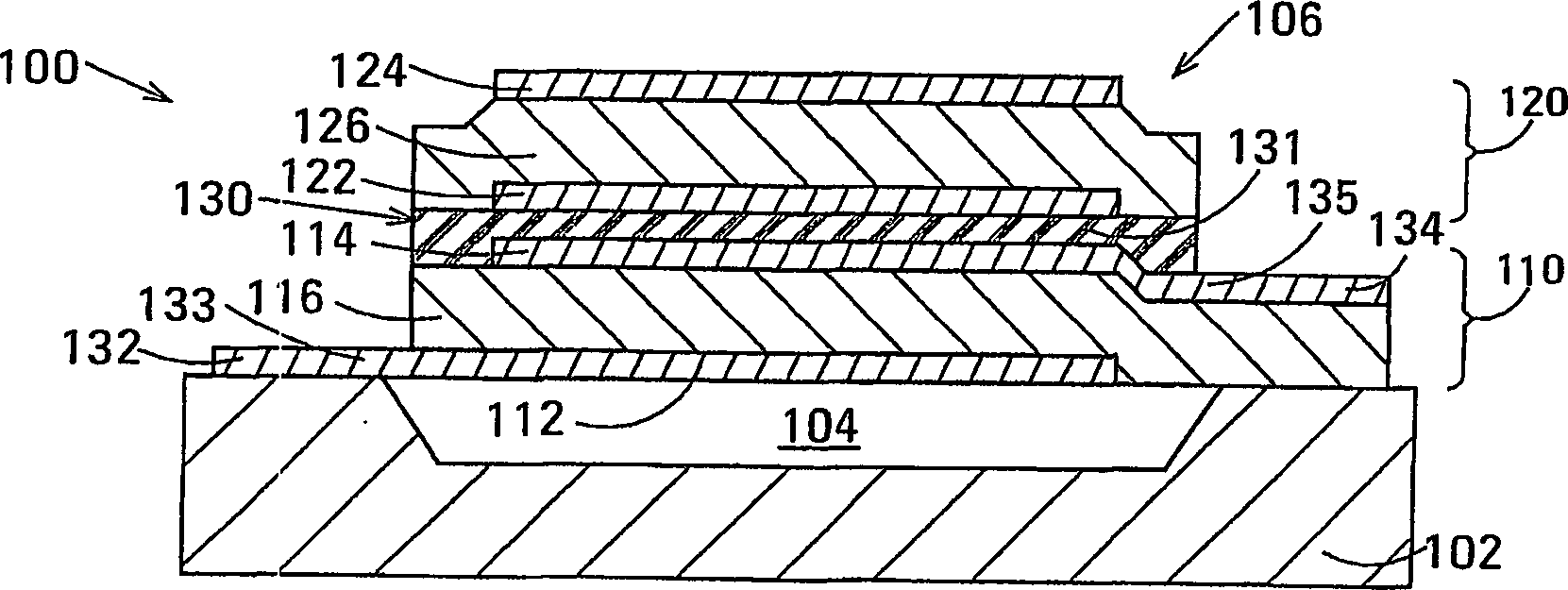
Figure 00000001
Figure 00000001

Description

Hintergrund der Erfindungbackground the invention

Transformatoren werden bei vielen Typen einer elektronischen Vorrichtung verwendet, um derartige Funktionen durchzuführen, wie ein Transformieren von Impedanzen, ein Verbinden einer einendigen Schaltungsanordnung mit einer symmetrischen Schaltungsanordnung oder umgekehrt und ein Liefern einer elektrischen Isolation. Jedoch weisen nicht alle Transformatoren alle diese Eigenschaften auf. Beispielsweise liefert ein Autotransformator keine elektrische Isolation.transformers are used in many types of electronic device, to perform such functions, like transforming impedances, connecting a single-ended one Circuit arrangement with a symmetrical circuit arrangement or vice versa and providing electrical isolation. however Not all transformers have all these characteristics. For example, an autotransformer does not provide electrical isolation.

Transformatoren, die bei Audio- und Funkfrequenzen bis zu VHF wirksam sind, sind häufig als gekoppelte primäre und sekundäre Wicklungen um einen Kern mit hoher Permeabilität gebaut. Der Kern enthält den magnetischen Fluss und erhöht die Kopplung zwischen den Wicklungen. Ein Transformator, der in diesem Frequenzbereich wirksam ist, kann ferner unter Verwendung eines optischen Kopplers realisiert werden. Ein Optokoppler, der bei diesem Modus verwendet wird, wird auf dem Gebiet als ein Optoisolator bezeichnet.transformers, which are effective at audio and radio frequencies up to VHF often as a coupled primary and secondary Windings built around a core with high permeability. The core contains the magnetic River and raised the coupling between the windings. A transformer in this frequency range is effective, may also be using an optical coupler can be realized. An optocoupler, the used in this mode is considered in the field as an optoisolator designated.

Bei Transformatoren, die auf gekoppelten Windungen oder Optokopplern basieren, wird das elektrische Eingangssignal in eine unterschiedliche Form (d. h. einen magnetischen Fluss oder Photonen) umgewandelt, die mit einer geeigneten Transformationsstruktur (d. h. einer anderen Wicklung oder einem Lichtdetektor) in Wechselwirkung tritt, und wird an dem Ausgang als ein elektrisches Signal wiederhergestellt. Beispielsweise wandelt ein Optokoppler ein elektrisches Eingangssignal unter Verwendung einer Licht emittierenden Diode in Photonen um. Die Photonen durchlaufen eine optische Faser oder einen freien Raum, der eine Isolation liefert. Eine Photodiode, die durch die Photonen beleuchtet wird, erzeugt ein elektrisches Ausgangssignal aus dem Photonenstrom. Das elektrische Ausgangssignal ist eine Nachbildung des elektrischen Eingangssignals.at Transformers operating on coupled windings or optocouplers are based, the electrical input signal in a different Shape (i.e., a magnetic flux or photons), those with a suitable transformation structure (i.e. Winding or a light detector), and is restored at the output as an electrical signal. For example, an optocoupler converts an electrical input signal using a light emitting diode in photons. The photons pass through an optical fiber or a free space, which provides an isolation. A photodiode, through the photons is illuminated, generates an electrical output signal from the photon current. The electrical output signal is a replica of the electrical Input signal.

Bei UHF und Mikrowellenfrequenzen werden spulenbasierte Transformatoren unpraktisch auf Grund derartiger Faktoren wie Verlusten in dem Kern, Verlusten in den Wicklungen, einer Kapazität zwischen den Wicklungen und einer Schwierigkeit, dieselben klein genug zu machen, um wellenlängenbezogene Probleme zu verhindern. Transformatoren für derartige Frequenzen basieren auf Viertelwellenlängen-Übertragungsleitungen, z. B. Marchand-Typ-, verbundene Reiheneingangs-/Parallelausgangsleitungen, etc. Es existieren auch Transformatoren, die auf mikrobearbeiteten gekoppelten Spulensätzen basieren und klein genug sind, dass Wellenlängenwirkungen unwichtig sind. Derartige Transformatoren weisen jedoch Probleme mit einem hohen Einfügungsverlust auf.at UHF and microwave frequencies become coil-based transformers impractical due to such factors as losses in the core, Losses in the windings, a capacity between the windings and a difficulty in making them small enough to be wavelength-related Prevent problems. Transformers based on such frequencies on quarter-wavelength transmission lines, z. B. Marchand type, connected row input / parallel output lines, etc. There are also transformers based on micromachined coupled coil sets and are small enough that wavelength effects are unimportant. However, such transformers have problems with a high insertion loss on.

Alle eben beschriebenen Transformatoren für eine Verwendung bei UHF und Mikrowellenfrequenzen weisen Abmessungen auf, die dieselben für eine Verwendung bei modernen Miniaturanwendungen mit hoher Dichte wie Mobiltelefonen weniger erwünscht machen. Derartige Transformatoren neigen ferner dazu, kostspielig zu sein, weil dieselben nicht in der Lage sind, durch einen Stapelprozess hergestellt zu werden, und weil dieselben im Wesentlichen eine chipexterne Lösung sind. Obwohl derartige Transformatoren typischerweise eine Bandbreite aufweisen, die für eine Verwendung bei Mobiltelefonen annehmbar ist, weisen dieselben zudem typischerweise einen Einfügungsverlust von mehr als 1 dB auf, was zu hoch ist.All just described transformers for use in UHF and Microwave frequencies have dimensions that are the same for use in modern high-density miniature applications such as mobile phones less desirable do. Such transformers also tend to be expensive because they are not able to be through a batch process and because they are essentially off-chip solution are. Although such transformers typically have a bandwidth have, for a use with mobile phones is acceptable, have the same also typically an insertion loss of more than 1 dB, which is too high.

Optokoppler werden auf Grund der Übergangskapazität der Eingangs-LED, Nichtlinearitäten, die dem Photodetektor inhärent sind, und einer ungenügenden Isolation, um eine gute Gleichtaktunterdrückung zu ergeben, nicht bei UHF und Mikrowellenfrequenzen verwendet.optocoupler are due to the transient capacitance of the input LED, Nonlinearities inherent in the photodetector are, and an insufficient Isolation, to give a good common-mode rejection, not at UHF and microwave frequencies used.

Was deshalb benötigt wird, ist ein Transformator, der bei elektrischen Frequenzen in dem Bereich von UHF bis Mikrowelle zum Liefern eines oder mehrerer der folgenden Attribute in der Lage ist: Impedanztransformation, Kopplung zwischen symmetrischen und unsymmetrischen Schaltungen und elektrische Isolation. Was ferner benötigt wird, ist ein derartiger Transformator, der einen geringen Einfügungsverlust, eine Bandbreite, die ausreichend ist, um beispielsweise den Frequenzbereich von Mobiltelefon-HF-Signalen aufzunehmen, eine kleinere Größe als Transformatoren, die gegenwärtig in Mobiltelefonen verwendet werden, und geringe Herstellungskosten aufweist.What therefore needed is a transformer that is at electrical frequencies in the range from UHF to microwave to deliver one or more the following attributes: impedance transformation, Coupling between balanced and unbalanced circuits and electrical insulation. What is further needed is one such Transformer that has a low insertion loss, a bandwidth, which is sufficient, for example, the frequency range of mobile phone RF signals a smaller size than transformers, the present used in mobile phones, and low manufacturing costs having.

Zusammenfassung der ErfindungSummary the invention

Bei einem ersten Aspekt sieht die Erfindung einen akustisch gekoppelten Filmtransformator (FACT = Film Acoustically-Coupled Transformer) vor, der einen entkoppelten, gestapelten, akustischen Volumenresonator (DSBAR = Decoupled Stacked Bulk Acoustic Resonator) aufweist, der einen unteren akustischen Filmvolumenresonator (FBAR = Film Bulk Resonator), einen oberen FBAR, der auf dem unteren FBAR gestapelt ist, und zwischen den FBARs einen akustischen Entkoppler aufweist, der eine Schicht eines akustischen Entkopplungsmaterials aufweist. Jeder der FBARs weist gegenüberliegende planare Elektroden und ein piezoelektrisches Element zwischen den Elektroden auf. Der FACT weist zusätzlich erste Anschlüsse, die elektrisch mit den Elektroden von einem der FBARs verbunden sind, und zweite Anschlüsse auf, die elektrisch mit den Elektroden des anderen der FBARs verbunden sind. Ein FACT gemäß diesem Aspekt der Erfindung weist ein Impedanztransformationsverhältnis von 1:1 auf, ist zum Verbinden einer einendigen Schaltungsanordnung mit einer symmetrischen Schaltungsanordnung oder umgekehrt in der Lage und liefert eine elektrische Isolation zwischen Primärseite und Sekundärseite.In a first aspect, the invention provides a film acoustically-coupled transformer (FACT) comprising a decoupled stacked bulk acoustic acoustic resonator (DSBAR) including a lower acoustic film volume resonator (FBAR = Film Bulk Resonator), an upper FBAR, which is stacked on the lower FBAR and having an acoustic decoupler between the FBARs comprising a layer of acoustic decoupling material. Each of the FBARs has opposing planar electrodes and a piezoelectric element between the electrodes. The FACT additionally has first terminals electrically connected to the electrodes of one of the FBARs and second terminals electrically connected to the electrodes of the other of the FBARs. A FACT according to this aspect of the invention has an impedance transformation ratio of 1: 1, is capable of connecting a single-ended circuit arrangement to a balanced circuit arrangement, or vice versa, and provides electrical isolation between the primary side and the secondary side.

Bei einem anderen Aspekt sieht die Erfindung einen akustisch gekoppelten Filmtransformator (FACT) vor, der entkoppelte, gestapelte, akustische Volumenresonatoren (DSBARs) aufweist. Jeder der DSBARs weist einen unteren akustischen Filmvolumenresonator (FBAR), einen oberen FBAR, der auf dem unteren FBAR gestapelt ist, und zwischen den FBARs einen akustischen Entkoppler auf, der eine Schicht eines akustischen Entkopplungsmaterials aufweist. Jeder FBAR weist gegenüberliegende planare Elektroden und ein piezoelektrisches Element zwischen den Elektroden auf. Der FACT weist zusätzlich eine erste elektrische Schaltung, die die unteren FBARs verbindet, und eine zweite elektrische Schaltung auf, die die oberen FBARs verbindet. Alle Ausführungsbeispiele eines FACT gemäß diesem Aspekt der Erfindung sind zum Verbinden einer einendigen Schaltungsanordnung mit einer symmetrischen Schaltungsanordnung oder umgekehrt in der Lage und Liefern eine elektrische Isolation zwischen Primärseite und Sekundärseite.at In another aspect, the invention provides an acoustically coupled one Film transformer (FACT), which decoupled, stacked, acoustic Volume resonators (DSBARs) has. Each of the DSBARs has one lower acoustic film volume resonator (FBAR), an upper FBAR, which is stacked on the lower FBAR, and one between the FBARs acoustic decoupler comprising a layer of acoustic decoupling material having. Each FBAR has opposite planar electrodes and a piezoelectric element between the Electrodes on. The FACT additionally has a first electrical Circuit that connects the lower FBARs, and a second electrical Circuit that connects the upper FBARs. All embodiments a FACT according to this Aspect of the invention are for connecting a single-ended circuit arrangement with a symmetrical circuit arrangement or vice versa in the Location and supply an electrical isolation between the primary side and Secondary side.

Einige Ausführungsbeispiele des FACT gemäß diesem Aspekt der Erfindung sind inhärent elektrisch symmetrisch und weisen ein höheres Gleichtaktunterdrückungsverhältnis als das oben beschriebene Ausführungsbeispiel auf, das den einzigen DSBAR aufweist. Bei derartigen Ausführungsbeispielen schaltet die erste elektrische Schaltung einen der FBARs des ersten DSBAR entweder antiparallel oder in Reihe mit einem der FBARs des zweiten DSBAR und die zweite elektrische Schaltung schaltet den anderen der FBARs des ersten DSBAR entweder antiparallel oder in Reihe mit dem anderen der FBARs des zweiten DSBAR. Ein Ausführungsbeispiel des FACT, bei dem die erste elektrische Schaltung die jeweiligen FBARs antiparallel schaltet und die zweite elektrische Schaltung die jeweiligen FBARs antiparallel schaltet, weist ein Impedanztransformationsverhältnis von 1:1 zwischen der ersten elektrischen Schaltung und der zweiten elektrischen Schaltung und umgekehrt auf. Ein Ausführungsbeispiel, bei dem die erste elektrische Schaltung die jeweiligen FBARs in Reihe schaltet und die zweite elektrische Schaltung die jeweiligen FBARs in Reihe schaltet, weist ebenfalls ein Impedanztransformationsverhältnis von 1:1 zwischen der ersten elektrischen Schaltung und der zweiten elektrischen Schaltung und umgekehrt auf. Jedoch sind die Impedanzen höher als bei dem Ausführungsbeispiel, bei dem die FBARs antiparallel geschaltet sind. Ein Ausführungsbeispiel des FACT, bei dem die erste elektrische Schaltung die jeweiligen FBARs antiparallel schaltet und die zweite elektrische Schaltung die jeweiligen FBARs in Reihe schaltet, weist ein Impedanztransformationsverhältnis von 1:4 zwischen der ersten elektrischen Schaltung und der zweiten elektrischen Schaltung und ein Impedanztransformationsverhältnis von 4:1 zwischen der zweiten elektrischen Schaltung und der ersten elektrischen Schaltung auf. Ein Ausführungsbeispiel des FACT, bei dem die erste elektrische Schaltung die jeweiligen FBARs in Reihe schaltet und die zweite elektrische Schaltung die jeweiligen FBARs antiparallel schaltet, weist ein Impedanztransformationsverhältnis von 4:1 zwischen der ersten elektrischen Schaltung und der zweiten elektrischen Schaltung und ein Impedanztransformationsverhältnis von 1:4 zwischen der zweiten elektrischen Schaltung und der ersten elektrischen Schaltung auf.Some embodiments of the FACT according to this Aspect of the invention are inherent electrically symmetrical and have a higher common mode rejection ratio than the embodiment described above which has the only DSBAR. In such embodiments The first electrical circuit switches one of the FBARs of the first DSBAR either antiparallel or in series with one of the FBARs of the second DSBAR and the second electrical circuit switches the other of the FBARs of the first DSBAR either antiparallel or in Series with the other of the FBARs of the second DSBAR. An embodiment of the FACT, in which the first electrical circuit, the respective FBARs turn antiparallel and the second electrical circuit the respective FBARs switches in antiparallel, has an impedance transformation ratio of 1: 1 between the first electrical circuit and the second electrical circuit and vice versa. An embodiment, in which the first electrical circuit the respective FBARs in Row switches and the second electrical circuit the respective FBARs in series also has an impedance transformation ratio of 1: 1 between the first electrical circuit and the second electrical Circuit and vice versa. However, the impedances are higher than in the embodiment, at the FBARs are connected in anti-parallel. An embodiment of the FACT, in which the first electrical circuit, the respective FBARs turn antiparallel and the second electrical circuit the respective FBARs in series, has an impedance transformation ratio of 1: 4 between the first electrical circuit and the second electrical Circuit and an impedance transformation ratio of 4: 1 between the second electrical circuit and the first electrical circuit on. An embodiment of the FACT, in which the first electrical circuit, the respective FBARs in series switches and the second electrical circuit the has an impedance transformation ratio of 4: 1 between the first electrical circuit and the second electrical Circuit and an impedance transformation ratio of 1: 4 between the second electrical circuit and the first electrical circuit on.

Andere Ausführungsbeispiele des FACT gemäß der Erfindung sind elektrisch unsymmetrisch und können bei Anwendungen verwendet werden, bei denen ein hohes Gleichtaktunterdrückungsverhältnis weniger wichtig ist. Bei derartigen Ausführungsbeispielen schaltet die erste elektrische Schaltung einen der FBARs des ersten DSBAR elektrisch entweder parallel oder in Antireihe mit einem der FBARs des zweiten DSBAR und schaltet die zweite elektrische Schaltung den anderen der FBARs des ersten DSBAR elektrisch entweder parallel oder in Antireihe mit dem anderen der FBARs des zweiten DSBAR.Other embodiments of the FACT according to the invention are electrically unbalanced and can be used in applications where a high common mode rejection ratio is less important. In such embodiments The first electrical circuit switches one of the FBARs of the first DSBAR electrically either parallel or in anti-row with one of the FBARs of the second DSBAR and turns on the second electrical circuit the other of the FBARs of the first DSBAR electrically either in parallel or in anti-row with the other of the FBARs of the second DSBAR.

Bei einem anderen Aspekt sieht die Erfindung einen akustisch gekoppelten Filmtransformator (FACT) vor, der einen entkoppelten, gestapelten, akustischen Volumenresonator (DSBAR) aufweist. Der DSBAR weist einen unteren akustischen Filmvolumenresonator (FBAR), einen oberen FBAR, der auf dem unteren FBAR gestapelt ist, und einen akustischen Entkoppler auf, der eine Schicht eines akustischen Entkopplungsmaterials aufweist, das eine akustische Impedanz von etwa 2 Mrayl aufweist. Jeder der FBARs weist gegenüberliegende planare Elektroden und ein piezoelektrisches Element zwischen den Elektroden auf. Der FACT weist zusätzlich erste Anschlüsse, die elektrisch mit den Elektroden des unteren FBAR verbunden sind, und zweite Anschlüsse auf, die elektrisch mit den Elektroden des oberen FBAR verbunden sind.at In another aspect, the invention provides an acoustically coupled one Film transformer (FACT) having a decoupled, stacked, acoustic volume resonator (DSBAR). The DSBAR has a lower acoustic film volume resonator (FBAR), an upper FBAR, which is stacked on the lower FBAR, and an acoustic decoupler having a layer of acoustic decoupling material, which has an acoustic impedance of about 2 Mrayl. Everyone who FBARs have opposite planar ones Electrodes and a piezoelectric element between the electrodes on. The FACT has additional first connections, which are electrically connected to the electrodes of the lower FBAR, and second connections on, which are electrically connected to the electrodes of the upper FBAR are.

Kurze Beschreibung der ZeichnungenShort description the drawings

1A ist eine Draufsicht eines Beispiels eines ersten Ausführungsbeispiels eines akustisch gekoppelten Filmtransformators (FACT) gemäß der Erfindung. 1A Fig. 10 is a plan view of an example of a first embodiment of an acoustically-coupled film transformer (FACT) according to the invention.

1B und 1C sind Querschnittsansichten des FACT entlang Schnittlinien 1B-1B bzw. 1C-1C in 1A. 1B and 1C 15 are cross-sectional views of the FACT taken along section lines 1B-1B and 1C-1C in FIG 1A ,

1D ist eine vergrößerte Querschnittsansicht eines Teils des FACT, der in 1A gezeigt ist, entlang der Schnittlinie 1B-1B und zeigt ein Ausführungsbeispiel des akustischen Entkopplers gemäß der Erfindung. 1D FIG. 10 is an enlarged cross-sectional view of a portion of the FACT incorporated in FIG 1A is shown along the section line 1B-1B and shows an embodiment of the acoustic decoupler according to the invention.

1E ist eine vergrößerte Querschnittsansicht eines Teils des FACT, der in 1A gezeigt ist, entlang der Schnittlinie 1B-1B und zeigt ein alternatives Ausführungsbeispiel des akustischen Entkopplers gemäß der Erfindung. 1E FIG. 10 is an enlarged cross-sectional view of a portion of the FACT incorporated in FIG 1A is shown along the section line 1B-1B and shows an alternative embodiment of the acoustic decoupler according to the invention.

2 ist ein Graph, der zeigt, wie das berechnete Frequenzansprechen von Ausführungsbeispielen des FACT, die in 1A1C gezeigt sind, von der akustischen Impedanz des akustischen Entkopplungsmaterials abhängt. 2 FIG. 15 is a graph showing how the calculated frequency response of embodiments of the FACT disclosed in FIG 1A - 1C are dependent on the acoustic impedance of the acoustic decoupling material.

3A ist eine Draufsicht eines Beispiels eines zweiten Ausführungsbeispiels eines FACT gemäß der Erfindung. 3A Fig. 10 is a plan view of an example of a second embodiment of a FACT according to the invention.

3B und 3C sind Querschnittsansichten des FACT entlang Schnittlinien 3B-3B bzw. 3C-3C in 1A. 3B and 3C are cross-sectional views of the FACT along section lines 3B-3B and 3C-3C in FIG 1A ,

4A bis 4D sind schematische Zeichnungen, die die elektrischen Schaltungen von elektrisch symmetrischen Ausführungsbeispielen des FACT zeigen, der in 3A3C gezeigt ist. 4A to 4D FIG. 12 are schematic diagrams showing the electric circuits of electrically symmetrical embodiments of the FACT disclosed in FIG 3A - 3C is shown.

4E bis 4H sind schematische Zeichnungen, die die elektrischen Schaltungen von elektrisch unsymmetrischen Ausführungsbeispielen des FACT zeigen, der in 3A3C gezeigt ist. 4E to 4H FIG. 13 are schematic diagrams showing the electric circuits of electrically unbalanced embodiments of the FACT disclosed in FIG 3A - 3C is shown.

5A5J sind Draufsichten, die einen Prozess zum Herstellen eines FACT gemäß der Erfindung darstellen. 5A - 5J FIG. 10 is plan views illustrating a process for manufacturing a FACT according to the invention. FIG.

5K5S sind Querschnittsansichten entlang der Schnittlinien 5K-5K, 5L-5L, 5M-5M, 5N-5N, 5O-5O, 5P-5P, 5Q-5Q, 5R-5R, 5S-5S bzw. 5T-5T in 5A5J. 5K - 5S 5 are cross-sectional views taken along lines 5K-5K, 5L-5L, 5M-5M, 5N-5N, 5O-5O, 5P-5P, 5Q-5Q, 5R-5R, 5S-5S and 5T-5T in FIG 5A - 5J ,

Detaillierte Beschreibungdetailed description

1A, 1B und 1C zeigen eine Draufsicht bzw. zwei Querschnittsansichten eines ersten Ausführungsbeispiels 100 eines akustisch gekoppelten Filmtransformators (FACT) gemäß der Erfindung. Der FACT 100 weist ein Impedanztransformati onsverhältnis von 1:1 auf, ist zum Verbinden einer einendigen Schaltungsanordnung mit einer symmetrischen Schaltungsanordnung oder umgekehrt in der Lage und liefert eine elektrische Isolation zwischen Primärseite und Sekundärseite. 1A . 1B and 1C show a plan view and two cross-sectional views of a first embodiment 100 an acoustically coupled film transformer (FACT) according to the invention. The FACT 100 has an impedance transformation ratio of 1: 1, is capable of connecting a single-ended circuit arrangement to a balanced circuit arrangement, or vice versa, and provides electrical isolation between the primary side and the secondary side.

Der FACT 100 ist aus einem entkoppelten, gestapelten, akustischen Volumenresonator (DSBAR) 106, ersten Anschlüssen 123 und 134 und zweiten Anschlüssen 136 und 138 gebildet. Der DSBAR 106 ist aus einem gestapelten Paar von akustischen Filmvolumenresonatoren (FBARs) 110 und 120 und einem akustischen Entkoppler 130 zwischen denselben gebildet. Bei dem gezeigten Beispiel ist der FBAR 120 auf dem FBAR 110 gestapelt. Der FBAR 110 ist aus gegenüberliegenden planaren Elektroden 112 und 114 und einer Schicht eines piezoelektrischen Materials 116 zwischen den Elektroden gebildet. Der FBAR 120 ist aus gegenüberliegenden planaren Elektroden 122 und 124 und einer Schicht eines piezoelektrischen Materials 126 zwischen den Elektroden gebildet. Der akustische Entkoppler 130 ist zwischen der Elektrode 114 des FBAR 110 und der Elektrode 122 des FBAR 120 positioniert. Der akustische Entkoppler steuert die Kopplung einer akustischen Energie zwischen den FBARs 110 und 120.The FACT 100 is a decoupled, stacked, acoustic volume resonator (DSBAR) 106 , first connections 123 and 134 and second terminals 136 and 138 educated. The DSBAR 106 is a stacked pair of film bulk acoustic resonators (FBARs) 110 and 120 and an acoustic decoupler 130 formed between them. In the example shown, the FBAR 120 on the FBAR 110 stacked. The FBAR 110 is from opposite planar electrodes 112 and 114 and a layer of a piezoelectric material 116 formed between the electrodes. The FBAR 120 is from opposite planar electrodes 122 and 124 and a layer of a piezoelectric material 126 formed between the electrodes. The acoustic decoupler 130 is between the electrode 114 of the FBAR 110 and the electrode 122 of the FBAR 120 positioned. The acoustic decoupler controls the coupling of acoustic energy between the FBARs 110 and 120 ,

Bei dem gezeigten Beispiel sind die ersten Anschlüsse 132 und 134 als Bondanschlussflächen strukturiert, die elektrisch durch elektrische Leiterbahnen 133 bzw. 135 mit den Elektroden 112 bzw. 114 des FBAR 110 verbunden sind. Bei dem gezeigten Beispiel sind ferner die zweiten Anschlüsse 136 und 138 als Bondanschlussflächen strukturiert, die durch elektrische Leiterbahnen 137 bzw. 139 elektrisch mit den Elektroden 122 bzw. 124 des FBAR 120 verbunden sind. Bei einem Ausführungsbeispiel bilden die ersten Anschlüsse 132 und 134 die primären Anschlüsse und bilden die zweiten Anschlüsse 136 und 138 die sekundären Anschlüsse des FACT 100. Bei einem alternativen Ausführungsbeispiel bilden die ersten Anschlüsse 132 und 134 die sekundären Anschlüsse und bilden die zweiten Anschlüsse 136 und 138 die primären Anschlüsse des FACT 100.In the example shown, the first connections are 132 and 134 structured as bond pads, electrically by electrical traces 133 respectively. 135 with the electrodes 112 respectively. 114 of the FBAR 110 are connected. In the example shown, furthermore, the second connections are 136 and 138 as Bondan structured by electrical interconnects 137 respectively. 139 electrically with the electrodes 122 respectively. 124 of the FBAR 120 are connected. In one embodiment, the first terminals form 132 and 134 the primary connections and form the second connections 136 and 138 the secondary ports of the FACT 100 , In an alternative embodiment, the first terminals form 132 and 134 the secondary terminals and form the second terminals 136 and 138 the primary ports of the FACT 100 ,

Bei dem gezeigten Beispiel ist der DSBAR 106 über einem Hohlraum aufgehängt, der in einem Substrat 102 definiert ist. Ein Aufhängen des DSBAR über einem Hohlraum ermöglicht, dass die FBARs des DSBAR sich mechanisch in Resonanz befinden. Andere Aufhängungsschemata, die ermöglichen, dass sich die FBARs mechanisch in Resonanz befinden, sind möglich. Zum Beispiel kann der DSBAR über einem fehlangepassten akustischen Bragg-Reflektor (nicht gezeigt) positioniert sein, der in oder an dem Substrat 102 gebildet ist, wie es durch Lakin in dem US-Patent Nr. 6,107,721 offenbart ist.In the example shown, the DSBAR 106 suspended over a cavity in a substrate 102 is defined. Suspending the DSBAR above a cavity allows the FBARs of the DSBAR to be mechanically resonant. Other suspension schemes that allow the FBARs to be mechanically resonant are possible. For example, the DSBAR may be positioned over a mismatched acoustic Bragg reflector (not shown) disposed in or on the substrate 102 as disclosed by Lakin in U.S. Patent No. 6,107,721.

FBARs sind durch Ruby et al. in dem US-Patent Nr. 5,587,620 mit dem Titel Tunable Thin Film Acoustic Resonators and Method of Making Same offenbart, das nun an die Anmelderin dieser Offenbarung übertragen ist. Die Offenbarung von Ruby offenbart ferner einen gestapelten, akustischen Filmvolumenresonator (SBAR = Stacked Film Bulk Acoustic Resonator), der aus zwei Schichten eines piezoelektrischen Materials gebildet ist, die mit drei planaren Elektroden verschachtelt sind. Rubys SBAR kann als aus einem gestapelten Paar von FBARs, bei dem eine Elektrode beiden FBARs gemeinsam ist, gebildet betrachtet werden und wird hierin als ein SBAR mit gemeinsamer Elektrode bezeichnet. Die gemeinsame Elektrode macht den SBAR mit gemeinsamer Elektrode unfähig zu einem Verbinden von symmetrischen mit unsymmetrischen Schaltungen und umgekehrt und zu einem Liefern einer elektrischen Isolation zwischen Primärseite und Sekundärseite. Zudem zeigt der SBAR mit gemeinsamer Elektrode eine extrem schmale Durchlassbandbreite, die denselben für eine Verwendung bei den meisten Anwendungen ungeeignet macht. Die schmale Durchlassbandbreite ist das Ergebnis der gemeinsamen Elektrode, die eine akustische Energie zwischen den FBARs überkoppelt.FBARs are by Ruby et al. in U.S. Patent No. 5,587,620, entitled Tunable Thin Film Acoustic Resonators and Method of Making Same which is now assigned to the assignee of this disclosure is. The Ruby disclosure further discloses a stacked, acoustic film volume resonator (SBAR = Stacked Film Bulk Acoustic Resonator), which consists of two layers of piezoelectric material which are nested with three planar electrodes. Ruby SBAR can be considered as a stacked pair of FBARs, where one Electrode is common to both FBARs, formed and is referred to herein as a common electrode SBAR. The common electrode makes the SBAR with common electrode unable to connect balanced and unbalanced circuits and vice versa and to provide electrical isolation between primary and secondary side. In addition, the SBAR with common electrode shows an extremely narrow Passband bandwidth, the same for use in most Makes applications unsuitable. The narrow passband width is the result of the common electrode giving an acoustic energy Coupled between the FBARs.

Wie es oben angemerkt ist, weist der FACT 100 gemäß der Erfindung ein gestapeltes Paar von akustischen Filmvolumenresonatoren (FBARs) 110 und 120 und einen akustischen Entkoppler 130 zwischen den FBARs 110 und 120 auf. Eine Struktur, die aus einem gestapelten Paar von FBARs und einem akustischen Entkoppler zwischen den FBARs gebildet ist, wird hierin als ein entkoppelter, gestapelter, akustischer Volumenresonator (DSBAR) bezeichnet, um denselben von dem oben beschriebenen, herkömmlichen SBAR mit gemeinsamer Elektrode zu unterscheiden, bei dem die FBARs einander direkt berühren. Bei dem FACT 100 steuert der akustische Entkoppler 130 das Koppeln einer akustischen Energie zwischen den gestapelten FBARs 110 und 120 und isoliert zusätzlich den FBAR 110 elektrisch von dem FBAR 120. Die elektrische Isolation, die durch den akustischen Entkoppler 130 geliefert wird, ermöglicht, dass der FACT 100 symmetrische mit unsymmetrischen Schaltungen verbindet und umgekehrt und eine elektrische Isolation zwischen Primärseite und Sekundärseite liefert. Die akustische Kopplung, die durch den akustischen Entkoppler 130 geliefert wird, ist wesentlich geringer als die akustische Kopplung zwischen den FBARs bei dem SBAR mit gemeinsamer Elektrode, auf den oben Bezug genommen wurde. Folglich sind die FBARs 110 und 120 nicht übergekoppelt und der FACT 100 weist ein relativ flaches Ansprechen in dem Durchlassband auf, wie es unten mit Bezug auf 2 beschrieben wird.As noted above, the FACT 100 according to the invention, a stacked pair of film bulk acoustic resonators (FBARs) 110 and 120 and an acoustic decoupler 130 between the FBARs 110 and 120 on. A structure formed of a stacked pair of FBARs and an acoustic decoupler between the FBARs is referred to herein as a decoupled stacked bulk acoustic resonator (DSBAR) to distinguish it from the conventional common electrode SBAR described above. where the FBARs touch each other directly. At the FACT 100 controls the acoustic decoupler 130 coupling acoustic energy between the stacked FBARs 110 and 120 and additionally isolates the FBAR 110 electrically from the FBAR 120 , The electrical insulation provided by the acoustic decoupler 130 is delivered, that allows the FACT 100 connects balanced to unbalanced circuits and vice versa and provides electrical isolation between the primary side and the secondary side. The acoustic coupling caused by the acoustic decoupler 130 is substantially lower than the acoustic coupling between the FBARs in the common electrode SBAR referred to above. Consequently, the FBARs 110 and 120 not overcoupled and the FACT 100 has a relatively flat response in the pass band, as discussed below with respect to FIG 2 is described.

Das Ausführungsbeispiel des akustischen Entkopplers 130, der in 1A1C gezeigt ist, ist ein erstes Ausführungsbeispiel, das aus einer Schicht 131 eines akustischen Entkopplungsmaterials gebildet ist, das zwischen den Elektroden 114 und 122 der FBARs 110 bzw. 120 positioniert ist. 1D ist eine vergrößerte Ansicht, die dieses erste Ausführungsbeispiel des akustischen Entkopplers detaillierter zeigt. Wichtige Eigenschaften des akustischen Entkopplungsmaterials der Schicht 131, die den akustischen Entkoppler 130 bildet, sind eine akustische Impedanz, die geringer als diese der Materialien der FBARs 110, 120 ist, ein hoher spezifischer elektrischer Widerstand, eine niedrige dielektrische Permittivität und eine nominale Dicke, die ein ungerades, integrales Vielfaches von einem Viertel der Wellenlänge in dem akustischen Entkopplungsmaterial eines akustischen Signals ist, das frequenzmäßig gleich der Mittenfrequenz des Durchlassbands des FACT 100 ist.The embodiment of the acoustic decoupler 130 who in 1A - 1C is shown is a first embodiment, which consists of a layer 131 an acoustic decoupling material is formed between the electrodes 114 and 122 the FBARs 110 respectively. 120 is positioned. 1D Fig. 10 is an enlarged view showing this first embodiment of the acoustic decoupler in more detail. Important properties of the layer acoustic decoupling material 131 that the acoustic decoupler 130 are an acoustic impedance that is lower than those of the materials of FBARs 110 . 120 , a high resistivity, a low dielectric permittivity, and a nominal thickness that is an odd, integral multiple of one fourth of the wavelength in the acoustic decoupling material of an acoustic signal that is equal in frequency to the center frequency of the passband of the FACT 100 is.

Das akustische Entkopplungsmaterial des akustischen Entkopplers 130 weist eine akustische Impedanz auf, die geringer als diese der Materialien der FBARs 110 und 120 ist und im Wesentlichen größer als diese von Luft ist. Die akustische Impedanz eines Materials ist das Verhältnis einer Belastung zu einer Partikelgeschwindigkeit in dem Material und wird in Rayleighs gemessen, abgekürzt als rayl. Die Materialien der FBARs sind typischerweise Aluminiumnitrid (AlN) als das Material der piezoelektrischen Schichten 116, 126 und Molybdän (Mo) als das Material der Elektroden 112, 114, 122 und 124. Die akustischen Impedanzen der Materialien der FBARs sind typischerweise größer als 30 Mrayl (35 Mrayl für AlN und 63 Mrayl für Mo) und die akustische Impedanz von Luft beträgt etwa 1 krayl. Bei Ausführungsbeispielen des FACT 100, bei denen die Materialien der FBARs 110, 120 wie oben angegeben sind, funktionieren Materialien mit einer akustischen Impedanz in dem Bereich von etwa 2 Mrayl bis etwa 8 Mrayl gut als das akustische Kopplungsmaterial des akustischen Entkopplers 130.The acoustic decoupling material of the acoustic decoupler 130 has an acoustic impedance lower than that of FBAR materials 110 and 120 is and is substantially larger than this of air. The acoustic impedance of a material is the ratio of a stress to a particle velocity in the material and is measured in Rayleighs, abbreviated as rayl. The materials of the FBARs are typically aluminum nitride (AlN) as the material of the piezoelectric layers 116 . 126 and molybdenum (Mo) as the material of the electrodes 112 . 114 . 122 and 124 , The acoustic impedances of the materials of the FBARs are typically greater than 30 Mrayl ( 35 Mrayl for AlN and 63 Mrayl for Mo) and the acoustic impedance of air is about 1 krayl. In embodiments of the FACT 100 in which the materials of the FBARs 110 . 120 As noted above, materials having an acoustic impedance in the range of about 2 Mrayl to about 8 Mrayl function well as the acoustic coupling material of the acoustic decoupler 130 ,

2 ist ein Graph, der zeigt, wie das berechnete Frequenzansprechen des FACT 100 von der akustischen Impedanz des akustischen Entkopplungsmaterials der Schicht 131 abhängt, die das erste Ausführungsbeispiel des akustischen Entkopplers 130 bildet. Das dargestellte Ausführungsbeispiel weist eine Mittenfrequenz von etwa 1900 MHz auf. Berechnete Frequenzantworten für Ausführungsbeispiele, bei denen das akustische Entkopplungsmaterial des akustischen Entkopplers akustische Impedanzen von etwa 4 Mrayl (Polyimidkurve 140), 8 Mrayl (Kurve 142) und 16 Mrayl (Kurve 144) aufweist, sind gezeigt. Es ist zu sehen, dass die Bandbreite des FACT 100 sich mit einer steigenden akustischen Impedanz des akustischen Entkopplungsmaterials erhöht. Bei dem Ausführungsbeispiel, bei dem die akustische Impedanz 16 Mrayl beträgt, sind die Resonanzen der FBARs übergekoppelt, was die charakteristische Doppelspitze bei dem Durchlassbandansprechen bewirkt. 2 is a graph showing how the calculated frequency response of the FACT 100 from the acoustic impedance of the acoustic decoupling material of the layer 131 depends on the first embodiment of the acoustic decoupler 130 forms. The illustrated embodiment has a center frequency of about 1900 MHz. Calculated frequency responses for embodiments in which the acoustic decoupler acoustic decoupling material has acoustic impedances of about 4 Mrayl (polyimide curve 140 ), 8 Mrayl (curve 142 ) and 16 Mrayl (curve 144 ) are shown. It can be seen that the bandwidth of the FACT 100 increases with increasing acoustic impedance of the acoustic decoupling material. In the embodiment in which the acoustic impedance 16 Mrayl, the resonances of the FBARs are over-coupled, causing the characteristic dual peak in the passband response.

Das Ausführungsbeispiel des akustischen Entkopplers 130, das in 1B, 1C und 1D gezeigt ist, ist aus der Schicht 131 eines akustischen Entkopplungsmaterials mit einer nominellen Dicke gleich einem Viertel der Wellenlänge in dem akustischen Entkopplungsmaterial eines akustischen Signals gebildet, das frequenzmäßig gleich der Mittenfrequenz des Durchlassbands des FACT 100 ist, d.h. t ≈ λn/4, wobei t die Dicke der Schicht 131 eines akustischen Entkopplungsmaterials ist, das den akustischen Entkoppler 130 bildet, und λn die Wellenlänge in dem akustischen Entkopplungsmaterial eines akustischen Signals ist, das frequenzmäßig gleich der Mittenfrequenz ist. Alternativ kann eine Dicke der Schicht 131 innerhalb näherungsweise ± 10% der nominellen Dicke verwendet werden. Eine Dicke außerhalb dieses Bereichs kann alternativ bei einer gewissen Leistungsfähigkeitsverschlechterung verwendet werden. Jedoch sollte sich die Dicke der Schicht 131 erheblich von 0λn bei einem Extrem und λn/2 bei dem anderen Extrem unterscheiden.The embodiment of the acoustic decoupler 130 , this in 1B . 1C and 1D is shown is from the layer 131 of acoustic decoupling material having a nominal thickness equal to one quarter of the wavelength in the acoustic decoupling material of an acoustic signal frequency equal to the center frequency of the pass band of the FACT 100 is, ie t ≈ λ n / 4, where t is the thickness of the layer 131 an acoustic decoupling material that is the acoustic decoupler 130 and λ n is the wavelength in the acoustic decoupling material of an acoustic signal that is equal in frequency to the center frequency. Alternatively, a thickness of the layer 131 within approximately ± 10% of the nominal thickness. A thickness outside this range may alternatively be used with some performance degradation. However, the thickness of the layer should be 131 differ significantly from 0λ n at one extreme and λ n / 2 at the other extreme.

Allgemeiner gesagt ist das erste Ausführungsbeispiel des akustischen Entkopplers 130, das in 1D gezeigt ist, auf der Schicht 131 eines akustischen Entkopplungsmaterials mit einer nominellen Dicke gleich einem ungraden, integralen Vielfachen von einem Viertel der Wellenlänge in dem akustischen Entkopplungsmaterial eines akustischen Signals gebildet, das frequenzmäßig gleich der Mittenfrequenz des Durchlassbands des FACT 100 ist, d. h. t ≈ (2m + 1)λn/4, wobei t und λn sind, wie es oben definiert ist, und m eine Ganzzahl gleich oder größer als Null ist. In diesem Fall kann alternativ eine Dicke der Schicht 131 verwendet werden, die sich von der nominellen Dicke um näherungsweise ± 10% von λn/4 unterscheidet. Eine Dickentoleranz außerhalb dieses Bereichs kann bei einer gewissen Leistungsfähigkeitsverschlechterung verwendet werden, aber die Dicke der Schicht 131 sollte sich erheblich von einem integralen Vielfachen von λn/2 unterscheiden. Jedoch weisen Ausführungsbeispiele des akustischen Entkopplers 130, bei denen die Schicht 131 eines akustischen Entkopplungsmaterials ein ungerades, integrales Vielfaches größer als Eins von einem Viertel der Wellenlänge in dem akustischen Entkopplungsmaterial eines akustischen Signals ist, das frequenzmäßig gleich der Mittenfrequenz ist, typischerweise Frequenzantworten auf, die auf Grund der Fähigkeit einer derartigen dickeren Schicht, mehrere akustische Moden zu unterstützen, störende Ansprechartefakte zeigen.More generally, the first embodiment of the acoustic decoupler 130 , this in 1D shown on the layer 131 an acoustic decoupling material having a nominal thickness equal to a non-integral integral one-quarter of the wavelength in the acoustic decoupling material of an acoustic signal frequency equal to the center frequency of the pass band of the FACT 100 , ie t ≈ (2m + 1) λ n / 4, where t and λ are n , as defined above, and m is an integer equal to or greater than zero. In this case, alternatively, a thickness of the layer 131 which differs from the nominal thickness by approximately ± 10% of λ n / 4. A thickness tolerance outside this range can be used with some performance degradation, but the thickness of the layer 131 should be significantly different from an integral multiple of λ n / 2. However, embodiments of the acoustic decoupler 130 in which the layer 131 of an acoustic decoupling material is an odd, integral multiple greater than one quarter of the wavelength in the acoustic decoupling material of an acoustic signal that is equal in frequency to the center frequency, typically frequency responses due to the ability of such a thicker layer to transmit multiple acoustic modes support disturbing response artifacts.

Viele Kunststoffmaterialien weisen akustische Impedanzen in dem oben angegebenen Bereich auf und können in Schichten einheitlicher Dicke in den oben angegebenen Dickenbereichen aufgebracht sein. Derartige Kunststoffmaterialien sind deshalb potentiell für eine Verwendung als das akustische Entkopplungsmaterial der Schicht 131 des akustischen Entkopplers 130 geeignet. Das akustische Entkopplungsmaterial muss jedoch ferner zum Standhalten der Temperaturen der Fertigungsoperationen in der Lage sein, die durchgeführt werden, nachdem die Schicht 131 eines akustischen Entkopplungsmaterials an der Elektrode 114 aufgebracht wurde, um den akustischen Entkoppler 130 zu bilden. Wie es unten detaillierter beschrieben wird, werden bei praktischen Ausführungsbeispielen des FACT 100 die Elektroden 122 und 124 und die piezoelektrische Schicht 126 durch ein Sputtern aufgebracht, nachdem die Schicht 131 aufgebracht wurde. Während dieser Aufbringungsprozesse werden Temperaturen von bis zu 400°C erreicht. Somit wird ein Kunststoff, der bei derartigen Temperaturen stabil bleibt, als das akustische Entkopplungsmaterial verwendet.Many plastic materials have acoustic impedances in the above range and may be applied in layers of uniform thickness in the thickness ranges noted above. Such plastic materials are therefore potentially for use as the acoustic decoupling material of the layer 131 of the acoustic decoupler 130 suitable. However, the acoustic decoupling material must also be capable of withstanding the temperatures of the fabrication operations that are performed after the layer has finished 131 an acoustic decoupling material on the electrode 114 was applied to the acoustic decoupler 130 to build. As will be described in more detail below, in practical embodiments of the FACT 100 the electrodes 122 and 124 and the piezoelectric layer 126 applied by sputtering after the layer 131 was applied. During these application processes temperatures of up to 400 ° C are reached. Thus, a plastic that remains stable at such temperatures is used as the acoustic decoupling material.

Kunststoffmaterialien weisen typischerweise eine sehr hohe akustische Dämpfung pro Einheitslänge verglichen mit den anderen Materialien der FBARs 110 und 120 auf. Da jedoch das oben beschriebene Ausführungsbeispiel des akustischen Entkopplers 130 aus der Schicht 131 eines akustischen Kunststoffentkopplungsmaterials gebildet ist, das typischerweise in der Größenordnung von 1 μm Dicke liegt, ist die akustische Dämpfung, die durch die Schicht 131 eingebracht wird, typischerweise vernachlässigbar.Plastic materials typically have very high acoustic damping per unit length compared to the other materials of the FBARs 110 and 120 on. However, since the above-described embodiment of the acoustic decoupler 130 out of the shift 131 is formed of a plastic acoustic decoupling material, which is typically of the order of 1 .mu.m thick, is the acoustic attenuation through the layer 131 is introduced, typically negligible.

Bei einem Ausführungsbeispiel wird ein Polyimid als das akustische Entkopplungsmaterial der Schicht 131 verwendet. Ein Polyimid wird unter der Marke Kapton® durch E. I. du Pont de Nemours and Company verkauft. Bei einem derartigen Ausführungsbeispiel ist der akustische Entkoppler 130 aus der Schicht 131 aus einem Polyimid gebildet, die durch eine Schleuderbeschichtung auf die Elektrode 114 aufgebracht ist. Polyimid weist eine akustische Impedanz von etwa 4 Mrayl auf.In one embodiment, a polyimide is used as the acoustic decoupling material of the layer 131 used. A polyimide sold under the trademark Kapton ® by EI du Pont de Nemours and Company. In such an embodiment, the acoustic decoupler is 130 out of the shift 131 formed from a polyimide, which by a spin coating on the electrode 114 is applied. Polyimide has an acoustic impedance of about 4 Mrayl.

Bei einem anderen Ausführungsbeispiel wird ein Poly(Para-Xylylen) als das akustische Entkopplungsmaterial der Schicht 131 verwendet. Bei einem derartigen Ausführungsbeispiel ist der akustische Entkoppler 130 aus der Schicht 131 aus einem Poly(Para-Xylylen) gebildet, die durch eine Vakuumaufbringung auf die Elektrode 114 aufgebracht ist. Poly(Para-Xylylen) ist auf dem Gebiet auch als Parylen bekannt. Der Dimer-Vorläufer Di-Para-Xylylen, aus dem Parylen hergestellt wird, und eine Ausrüstung zum Durchführen einer Vakuumaufbringung von Parylenschichten sind von vielen Lieferanten erhältlich. Parylen weist eine akustische Impedanz von etwa 2,8 Mrayl auf.In another embodiment, a poly (para-xylylene) is used as the acoustic decoupling material of the layer 131 used. In such an embodiment, the acoustic decoupler is 130 out of the shift 131 formed from a poly (para-xylylene) by a vacuum application to the electrode 114 is applied. Poly (para-xylylene) is also known in the field as parylene. The dimer precursor di-para-xylylene, from which parylene is made, and equipment for performing vacuum deposition of parylene layers are available from many suppliers. Parylene has an acoustic impedance of about 2.8 Mrayl.

Bei einem anderen Ausführungsbeispiel wird ein vernetztes Polyphenylen-Polymer als das akustische Entkopplungsmaterial der Schicht 131 verwendet. Bei einem derartigen Ausführungsbeispiel ist der akustische Entkoppler 130 aus der Schicht 131 aus einem vernetzten Polyphenylen-Polymer gebildet, die durch eine Schleuderbeschichtung aufgebracht ist. Vernetzte Polyphenylen-Polymere wurden als dielektri sche Materialien mit niedriger Dielektrizitätskonstante für eine Verwendung bei integrierten Schaltungen entwickelt und bleiben folglich bei den hohen Temperaturen stabil, denen der akustische Entkoppler 130 während der nachfolgenden Fertigung des FBAR 120 unterliegt. Die Erfinder haben entdeckt, dass vernetzte Polyphenylen-Polymere zusätzlich eine berechnete akustische Impedanz von etwa 2 Mrayl aufweisen. Diese akustische Impedanz liegt in dem Bereich von akustischen Impedanzen, der den FACT 100 mit einer nützlichen Durchlassbandbreite versieht.In another embodiment, a crosslinked polyphenylene polymer is used as the acoustic decoupling material of the layer 131 used. In such an embodiment, the acoustic decoupler is 130 out of the shift 131 formed from a crosslinked polyphenylene polymer, which is applied by a spin coating. Crosslinked polyphenylene polymers have been developed as dielectric low-dielectric constant materials for use in integrated circuits, and thus remain stable at the high temperatures that the acoustic decoupler 130 during the subsequent production of the FBAR 120 subject. The inventors have discovered that cross-linked polyphenylene polymers additionally have a calculated acoustic impedance of about 2 Mrayl. This acoustic impedance is in the range of acoustic impedances that the FACT 100 provides a useful pass bandwidth.

Vorläuferlösungen, die verschiedene Oligomere enthalten, die polymerisieren, um jeweilige vernetzte Polyphenylenpolymere zu bilden, werden durch The Dow Chemical Company, Midland, MI unter der Marke SiLK verkauft. Die Vorläuferlösungen werden durch eine Schleuderbeschichtung aufgebracht. Das vernetzte Polyphenylenpolymer, das aus einer dieser Vorläuferlösungen erhalten wird, die als SiLKTM J bezeichnet ist, und das zusätzlich einen Haftverstärker enthält, weist eine berechnete akustische Impedanz von 2,1 Mrayl auf, d. h. etwa 2 Mrayl.Precursor solutions containing various oligomers that polymerize to form respective crosslinked polyphenylene polymers are sold by The Dow Chemical Company, Midland, MI under the trademark SiLK. The precursor solutions are applied by spin coating. The crosslinked polyphenylene polymer obtained from one of these precursor solutions, designated SiLK J, and additionally containing an adhesion promoter, has a calculated acoustic impedance of 2.1 Mrayl, ie, about 2 Mrayl.

Die Oligomere, die polymerisieren, um vernetzte Polyphenylenpolymere zu bilden, werden aus Biscyclopentadienon- und aromatischen Acetylen enthaltenden Monomeren vorbereitet. Ein Verwenden derartiger Monomere bildet lösliche Oligomere ohne den Bedarf nach einer unangebrachten Substitution. Die Vorläuferlösung enthält ein spezifisches Oligomer, das in Gamma-Butyrolacton- und Cyclohexanon-Lösungsmitteln gelöst ist. Der Prozentsatz des Oligomers in der Vorläuferlösung bestimmt die Schichtdicke, wenn die Vorläuferlösung aufgeschleudert ist. Nach einer Aufbringung verdampft ein Anlegen von Wärme die Lösungsmittel und härtet dann das Oligomer aus, um ein vernetztes Polymer zu bilden. Die Biscyclopentadienone reagieren mit den Acetylenen in einer 4 + 2-Cycloadditionsreaktion, die einen neuen aromatischen Ring bildet. Ein weiteres Aushärten resultiert in dem vernetzten Polyphenylenpolymer. Die oben beschriebenen vernetzten Po lyphenylenpolymere sind durch Godschalx et al. in dem US-Patent Nr. 5,965,679 offenbart. Zusätzliche praktische Details sind durch Martin et al., Development of Low-Dielectric Constant Polymer for the Fabrication of Integrated Circuit Interconnect, 12 ADVANCED MATERIALS, 1769 (2000) beschrieben. Verglichen mit Polyimid, weisen vernetzte Polyphenylenpolymere eine niedrigere akustische Impedanz, eine niedrigere akustische Dämpfung und eine niedrige Dielektrizitätskonstante auf. Zudem ist eine aufgeschleuderte Schicht der Vorläuferlösung zum Erzeugen eines qualitativ hochwertigen Films des vernetzten Polyphenylenpolymers mit einer Dicke in der Größenordnung von 200 nm in der Lage, was eine typische Dicke des akustischen Entkopplers 130 ist.The oligomers that polymerize to form crosslinked polyphenylene polymers are prepared from biscyclopentadienone and aromatic acetylene-containing monomers. Use of such monomers forms soluble oligomers without the need for inappropriate substitution. The precursor solution contains a specific oligomer dissolved in gamma-butyrolactone and cyclohexanone solvents. The percentage of oligomer in the precursor solution determines the layer thickness when the precursor solution is spun on. After application, application of heat vaporizes the solvents and then hardens the oligomer to form a crosslinked polymer. The biscyclopentadienones react with the acetylenes in a 4 + 2 cycloaddition reaction that forms a new aromatic ring. Further curing results in the crosslinked polyphenylene polymer. The crosslinked polyphenylene polymers described above are described by Godschalx et al. in U.S. Patent No. 5,965,679. Additional practical details are described by Martin et al., Development of Low-Dielectric Constant Polymer for the Fabrication of Integrated Circuit Interconnect, 12 ADVANCED MATERIALS, 1769 (2000). Compared with polyimide, crosslinked polyphenylene polymers have lower acoustic impedance, lower acoustic attenuation, and low dielectric constant. In addition, a spin-on layer of the precursor solution is capable of producing a high quality film of the crosslinked polyphenylene polymer having a thickness on the order of 200 nm, which is a typical thickness of the acoustic decoupler 130 is.

Bei einem alternativen Ausführungsbeispiel weist das akustische Entkopplungsmaterial der Schicht 131, die den akustischen Entkoppler 130 bildet, eine akustische Impedanz auf, die im Wesentlichen größer als die der Materialien der FBARs 110 und 120 ist. Derzeit sind keine Materialien bekannt, die diese Eigenschaft aufweisen, aber derartige Materialien können in der Zukunft verfügbar werden oder es können FBAR-Materialien mit niedrigerer akustischer Impedanz in der Zukunft verfügbar werden. Die Dicke der Schicht 131 eines derartigen akustischen Entkopplungsmaterials mit hoher akustischer Impedanz ist wie oben beschrieben.In an alternative embodiment, the acoustic decoupling material of the layer 131 that the acoustic decoupler 130 forms an acoustic impedance that is substantially greater than that of the materials of the FBARs 110 and 120 is. No materials are currently known which have this property, but such materials may become available in the future or FBAR materials with lower acoustic impedance may become available in the future. The thickness of the layer 131 of such acoustic decoupling material with high acoustic impedance is as described above.

1E ist eine vergrößerte Ansicht eines Teils des FACT 100, die ein zweites Ausführungsbeispiel des akustischen Entkopplers 130 zeigt, der eine Bragg-Struktur 161 umfasst. Die Bragg-Struktur 161 ist aus einem Bragg-Element 163 mit niedriger akustischer Impedanz gebildet, das zwischen Bragg-Elementen 165 und 167 mit hoher akustischer Impedanz angeordnet ist. Das Bragg-Element 163 mit niedriger akustischer Impedanz ist eine Schicht eines Materials mit niedriger akustischer Impedanz, während die Bragg-Elemente 165 und 167 mit hoher akustischer Impedanz jeweils eine Schicht eines Materials mit hoher akustischer Impedanz sind. Die akustischen Impedanzen der Bragg-Elemente sind mit Bezug auf einander und zusätzlich mit Bezug auf die akustische Impedanz des piezoelektrischen Materials der Schichten 116 und 126 als „niedrig" und „hoch" gekennzeichnet. Zumindest eines der Bragg-Elemente weist zusätzlich einen hohen spezifischen elektrischen Widerstand und eine niedrige dielektrische Permittivität auf, um eine elektrische Isolation zwischen einem Eingang und einem Ausgang des FACT 100 zu liefern. 1E is an enlarged view of part of the FACT 100 showing a second embodiment of the acoustic decoupler 130 showing a Bragg structure 161 includes. The Bragg structure 161 is from a Bragg element 163 formed with low acoustic impedance between Bragg elements 165 and 167 is arranged with high acoustic impedance. The Bragg element 163 with low acoustic Im pedanz is a layer of a material with low acoustic impedance, while the Bragg elements 165 and 167 each having a high acoustic impedance is a layer of high acoustic impedance material. The acoustic impedances of the Bragg elements are with respect to each other and additionally with respect to the acoustic impedance of the piezoelectric material of the layers 116 and 126 marked as "low" and "high". Additionally, at least one of the Bragg elements has a high resistivity and a low dielectric permittivity to provide electrical isolation between an input and an output of the FACT 100 to deliver.

Jede der Schichten, die die Bragg-Elemente 161, 163 und 165 bilden, weist eine nominelle Dicke gleich einem ungeraden, integralen Vielfachen von einem Viertel der Wellenlänge in dem Material der Schicht von einem akustischen Signal auf, das frequenzmäßig gleich der Mittenfrequenz des Durchlassbands des FACT 100 ist. Schichten, die sich um näherungsweise ± 10% von einem Viertel der Wellenlänge von der nominellen Dicke unterscheiden, können alternativ verwendet werden. Eine Dickentoleranz außerhalb dieses Bereichs kann bei einer gewissen Leistungsfähigkeitsverschlechterung verwendet werden, aber die Dicke der Schichten sollte sich erheblich von einem integralen Vielfachen von ein Halb der Wellenlänge unterscheiden.Each of the layers that make up the bragg elements 161 . 163 and 165 , has a nominal thickness equal to an odd, integral multiple of one quarter of the wavelength in the material of the layer of an acoustic signal that is equal in frequency to the center frequency of the passband of the FACT 100 is. Layers that differ by approximately ± 10% of a quarter of the wavelength from the nominal thickness may alternatively be used. A thickness tolerance outside this range may be used with some performance degradation, but the thickness of the layers should differ significantly from an integral multiple of one-half of the wavelength.

Bei einem Ausführungsbeispiel ist das Bragg-Element 163 mit niedriger akustischer Impedanz eine Schicht aus Siliziumdioxid (SiO2), das eine akustische Impedanz von etwa 13 Mrayl aufweist, und jedes der Bragg-Elemente 165 und 167 mit hoher akustischer Impedanz ist eine Schicht des gleichen Materials wie die Elektroden 114 bzw. 122, d. h. Molybdän, das eine akustische Impedanz von etwa 63 Mrayl aufweist. Ein Verwenden des gleichen Materials für die Bragg-Elemente 165 und 167 mit hoher akustischer Impedanz und die Elektroden 114 bzw. 122 der FBARs 110 bzw. 120 ermöglicht, dass die Bragg-Elemente 165 und 167 mit hoher akustischer Impedanz zusätzlich als die Elektroden 114 bzw. 122 dienen.In one embodiment, the Bragg element is 163 with low acoustic impedance, a layer of silicon dioxide (SiO 2 ) having an acoustic impedance of about 13 Mrayl, and each of the Bragg elements 165 and 167 with high acoustic impedance is a layer of the same material as the electrodes 114 respectively. 122 ie molybdenum, which has an acoustic impedance of about 63 Mrayl. Using the same material for the Bragg elements 165 and 167 with high acoustic impedance and the electrodes 114 respectively. 122 the FBARs 110 respectively. 120 allows the bragg elements 165 and 167 with high acoustic impedance in addition to the electrodes 114 respectively. 122 serve.

Bei einem Beispiel weisen die Bragg-Elemente 165 und 167 mit hoher akustischer Impedanz eine nominelle Dicke gleich einem Viertel der Wellenlänge in Molybdän eines akustischen Signals auf, das frequenzmäßig gleich der Mittenfrequenz des Durchlassbands des FACT 100 ist, und das Bragg-Element 163 mit niedriger akustischer Impedanz weist eine nominelle Dicker gleich drei Vierteln der Wellenlänge in SiO2 eines akustischen Signals auf, das frequenzmäßig gleich der Mittenfrequenz ist. Ein Verwenden einer Schicht von SiO2 mit einer Dicke einer dreiviertel Wellenlänge anstelle einer Schicht von SiO2 mit einer Dicke von einer viertel Wellenlänge als das Bragg-Element 163 mit niedriger akustischer Impedanz reduziert die Kapazität zwischen den FBARs 110 und 120.In one example, the Bragg elements 165 and 167 With high acoustic impedance, a nominal thickness equal to a quarter of the wavelength in molybdenum of an acoustic signal, the frequency equal to the center frequency of the pass band of the FACT 100 is, and the Bragg element 163 With low acoustic impedance, a nominal thickness is equal to three quarters of the wavelength in SiO 2 of an acoustic signal that is equal in frequency to the center frequency. Using a layer of SiO 2 having a thickness of three quarters of a wavelength instead of a layer of SiO 2 having a thickness of a quarter wavelength as the Bragg element 163 with low acoustic impedance reduces the capacity between the FBARs 110 and 120 ,

Bei Ausführungsbeispielen, bei denen die akustische Impedanzdifferenz zwischen den Bragg-Elementen 165 und 167 mit hoher akustischer Impedanz und dem Bragg-Element 163 mit niedriger akustischer Impedanz relativ gering ist, kann die Bragg-Struktur 161 aus mehr als einem (z. B. n) Bragg-Element mit niedriger akustischer Impedanz gebildet sein, das mit einer entsprechenden Anzahl (d. h. n + 1) von Bragg-Elementen mit hoher akustischer Impedanz verschachtelt ist. Lediglich eines der Bragg-Elemente muss isolierend sein. Beispielsweise kann die Bragg-Struktur aus zwei Bragg-Elementen mit niedriger akustischer Impedanz gebildet sein, die mit drei Bragg-Elementen mit hoher akustischer Impedanz verschachtelt sind.In embodiments in which the acoustic impedance difference between the Bragg elements 165 and 167 with high acoustic impedance and the Bragg element 163 With low acoustic impedance is relatively low, the Bragg structure 161 is formed of more than one (eg, n) low acoustic impedance Bragg element interleaved with a corresponding number (ie, n + 1) of high acoustic impedance Bragg elements. Only one of the Bragg elements has to be insulating. For example, the Bragg structure may be formed of two low acoustic impedance Bragg elements interleaved with three high acoustic impedance Bragg elements.

Eine Wafer-Scale-Fertigung wird verwendet, um FACTs ähnlich dem FACT 100 zu Tausenden gleichzeitig zu fertigen. Eine Wafer-Scale-Fertigung macht jeden FACT günstig zu fertigen. Der FACT 100 kann unter Verwendung eines Fertigungsverfahrens hergestellt sein, das ähnlich diesem ist, das unten mit Bezug auf 5A5T beschrieben wird. Folglich wird ein Verfahren zum Fertigen des FACT 100 nicht getrennt beschrieben.A wafer scale fabrication is used to make FACTs similar to the FACT 100 to manufacture by the thousands at the same time. Wafer scale manufacturing makes every FACT affordable. The FACT 100 can be made using a manufacturing process similar to that described below with reference to FIG 5A - 5T is described. Consequently, a method of manufacturing the FACT 100 not described separately.

Unter erneuter Bezugnahme auf 1A1C werden, um den FACT 100 zu verwenden, elektrische Verbindungen mit den ersten Anschlüssen 132 und 134, die elektrisch mit den Elektroden 112 bzw. 114 verbunden sind, hergestellt, wie es in 1A und 1B gezeigt ist, und werden elektrische Verbindungen zusätzlich mit den zweiten Anschlüssen 136 und 138 hergestellt, die elektrisch mit den Elektroden 122 bzw. 124 verbunden sind, wie es in 1A und 1C gezeigt ist. Die elektrischen Verbindungen mit den ersten Anschlüssen 132 und 134 liefern elektrische Verbindungen mit der Primärseite des FACT 100 und die elektrischen Verbindungen mit den zweiten Anschlüssen 136 und 138 liefern elektrische Verbindung mit der Sekundärseite des FACT 100. Bei einem alternativen Ausführungsbeispiel liefern die elektrischen Verbindung mit den zweiten Anschlüssen 136 und 138 elektrische Verbindungen mit der Primärseite des FACT 100 und liefern die elektrischen Verbindungen mit den ersten Anschlüssen 132 und 134 elektrische Verbindung mit der Sekundärseite des FACT 100.Referring again to 1A - 1C be to the FACT 100 to use electrical connections with the first connections 132 and 134 that are electrically connected to the electrodes 112 respectively. 114 are connected, made as it is in 1A and 1B is shown, and electrical connections in addition to the second terminals 136 and 138 made electrically with the electrodes 122 respectively. 124 connected as it is in 1A and 1C is shown. The electrical connections with the first connections 132 and 134 provide electrical connections to the primary side of the FACT 100 and the electrical connections to the second terminals 136 and 138 provide electrical connection to the secondary side of the FACT 100 , In an alternative embodiment, the electrical connection to the second terminals 136 and 138 electrical connections to the primary side of the FACT 100 and provide the electrical connections to the first terminals 132 and 134 electrical connection to the secondary side of the FACT 100 ,

In Betrieb des FACT 100 richtet ein elektrisches Eingangssignal, das an die ersten Anschlüsse 132 und 134 angelegt ist, die die primären Anschlüsse des FACT 100 bilden, eine Spannungsdifferenz zwischen den Elektroden 112 und 114 des FBAR 110 ein. Die Spannungsdifferenz zwischen den Elektroden 112 und 114 verformt den FBAR 110 mechanisch mit der Frequenz des elektrischen Eingangssignals. Abhängig von der Frequenz des elektrischen Eingangssignals koppelt der akustische Entkoppler 130 alles oder einen Teil der akustischen Energie, die aus der mechanischen Verformung des FBAR 110 resultiert, zu dem FBAR 120. Die akustische Energie, die von dem FBAR 110 empfangen wird, verformt den FBAR 120 mechanisch mit der Frequenz des elektrischen Eingangssignals. Die mechanische Verformung des FBAR 120 erzeugt eine Spannungsdifferenz zwischen den Elektroden 122 und 124 mit der Frequenz des elektrischen Eingangssignals. Die Spannungsdifferenz wird an den zweiten Anschlüssen 136 und 138, die die sekundären Anschlüsse des FACT 100 bilden, als ein e lektrisches Ausgangssignal ausgegeben. Eine Piezoelektrizität ist eine lineare Wirkung, so dass die Amplitude und die Phase des elektrischen Eingangssignals, das an die ersten Anschlüsse angelegt ist, bei dem elektrischen Ausgangssignal bewahrt sind, das an den zweiten Anschlüssen ausgegeben wird.In operation of the FACT 100 directs an electrical input signal to the first connectors 132 and 134 is created, which are the primary ports of the FACT 100 form a voltage difference between the electrodes 112 and 114 of the FBAR 110 one. The voltage difference between the electrodes 112 and 114 deforms the FBAR 110 mechanically with the frequency of the electrical input signal. Depending on the frequency of the electrical input signal, the acoustic decoupler couples 130 all or part of the acoustic energy resulting from the mechanical deformation of the FBAR 110 results, to the FBAR 120 , The acoustic energy coming from the FBAR 110 is received, deforms the FBAR 120 mechanically with the frequency of the electrical input signal. The mechanical deformation of the FBAR 120 generates a voltage difference between the electrodes 122 and 124 with the frequency of the electrical input signal. The voltage difference is at the second terminals 136 and 138 which are the secondary connectors of the FACT 100 form, as an e lectric output signal output. Piezoelectricity is a linear effect such that the amplitude and phase of the input electrical signal applied to the first terminals are preserved at the electrical output signal output at the second terminals.

Ein Ausführungsbeispiel des FACT 100, bei dem die zweiten Anschlüsse 136 und 138 die primären Anschlüsse bilden und die ersten Anschlüsse 132 und 134 die sekundären Anschlüsse bilden, ist auf ähnliche Weise wirksam, außer dass sich eine akustische Energie durch den akustischen Entkoppler 130 von dem FBAR 120 zu dem FBAR 110 ausbreitet.An embodiment of the FACT 100 in which the second connections 136 and 138 the primary connections form and the first connections 132 and 134 forming the secondary terminals is similarly effective except that there is acoustic energy through the acoustic decoupler 130 from the FBAR 120 to the FBAR 110 spreads.

Wie es oben angemerkt ist, liefert der FACT 100 ein Impedanztransformationsverhältnis von 1:1, ist zum Verbinden einer einendigen Schaltungsanordnung mit einer symmetrischen Schaltungsanordnung oder umgekehrt in der Lage und liefert eine elektrische Isolation zwischen Primärseite und Sekundärseite. Die Kapazität zwischen der Elektrode 112 und dem Substrat 102 unterscheidet sich jedoch von dieser zwischen der Elektrode 114 und dem Substrat. Folglich ist der FACT 100 nicht vollkommen elektrisch symmetrisch und kann ein ungenügendes Gleichtaktunterdrückungsverhältnis (CMRR = Common-Mode Rejection Ratio) für bestimmte Anwendungen aufweisen.As noted above, the FACT provides 100 An impedance transformation ratio of 1: 1 is capable of connecting a single-ended circuit to a balanced circuit or vice versa, and provides electrical isolation between the primary side and the secondary side. The capacitance between the electrode 112 and the substrate 102 However, it differs from this between the electrode 114 and the substrate. Consequently, the FACT 100 not completely electrically symmetric and may have an insufficient Common Mode Rejection Ratio (CMRR) for certain applications.

3A3C zeigen eine Draufsicht bzw. zwei Querschnittsansichten eines zweiten Ausführungsbeispiels 200 eines akustisch gekoppelten Filmtransformators (FACT) gemäß der Erfindung. Der FACT 200 ist zum Verbinden einer einendigen Schaltungsanordnung mit einer symmetrischen Schaltungsanordnung oder umgekehrt in der Lage und liefert eine elektrische Isolation zwischen Primärseite und Sekundärseite. Einige Ausführungsbeispiele des FACT 200 sind elektrisch symmetrisch und weisen deshalb eines hohes Gleichtaktunterdrückungsverhältnis auf: Andere Ausführungsbeispiele sind elektrisch unsymmetrisch und weisen ein geringeres Gleich taktunterdrückungsverhältnis auf. Der FACT 200 weist ein Impedanztransformationsverhältnis von 1:1, 1:4 oder 4:1 abhängig von den Konfigurationen der elektrischen Schaltungen auf, die einen Teil des FACT bilden. 3A - 3C show a plan view and two cross-sectional views of a second embodiment 200 an acoustically coupled film transformer (FACT) according to the invention. The FACT 200 is capable of connecting a single-ended circuit arrangement to a balanced circuit arrangement or vice versa and provides electrical isolation between the primary side and the secondary side. Some embodiments of the FACT 200 are electrically symmetrical and therefore have a high common mode rejection ratio: Other embodiments are electrically unbalanced and have a lower equal-clock rejection ratio. The FACT 200 has an impedance transformation ratio of 1: 1, 1: 4 or 4: 1 depending on the configurations of the electrical circuits forming part of the FACT.

Der FACT 200 ist aus zwei entkoppelten, gestapelten, akustischen Volumenresonatoren (DSBARs) 206 und 206 gebildet. Jeder DSBAR ist aus einem gestapelten Paar von akustischen Filmvolumenresonatoren (FBARs) und einem akustischen Entkoppler zwischen den FBARs gebildet. Der FACT 200 ist zusätzlich aus einer elektrischen Schaltung, die einen der FBARs des DSBAR 206 mit einem der FBARs des DSBAR 208 verbindet, und einer elektrischen Schaltung gebildet, die den anderen der FBARs des DSBAR 206 mit dem anderen der FBARs des DSBAR 208 verbindet.The FACT 200 consists of two decoupled, stacked, bulk acoustic resonators (DSBARs) 206 and 206 educated. Each DSBAR is made up of a stacked pair of film bulk acoustic resonators (FBARs) and an acoustic decoupler between the FBARs. The FACT 200 is in addition from an electrical circuit, which is one of the FBARs of the DSBAR 206 with one of the FBARs of the DSBAR 208 connects, and an electrical circuit formed that the other of the FBARs of the DSBAR 206 with the other of the FBARs of the DSBAR 208 combines.

Der DSBAR 206 ist aus einem gestapelten Paar von FBARs 210 und 220 und einem akustischen Entkoppler 230 zwischen denselben gebildet. Der DSBAR 208 ist aus einem gestapelten Paar von FBARs 250 und 260 und einem akustischen Entkoppler 270 zwischen denselben gebildet. Bei dem gezeigten Beispiel ist der FBAR 220 auf dem FBAR 210 gestapelt und ist der FBAR 260 auf dem FBAR 250 gestapelt. Der FBAR 210 ist aus gegenüberliegenden planaren Elektroden 212 und 214 und einer Schicht eines piezoelektrischen Materials 216 zwischen den Elektroden gebildet. Der FBAR 220 ist aus gegenüberliegenden planaren Elektroden 222 und 224 und einer Schicht eines piezoelektrischen Materials 226 zwischen den Elektroden gebildet. Der FBAR 250 ist aus gegenüberliegenden planaren Elektroden 252 und 254 und einer Schicht eines piezoelektrischen Materials 256 zwischen den Elektroden gebildet. Der FBAR 260 ist aus gegenüberliegenden planaren Elektroden 262 und 264 und einer Schicht eines piezoelektrischen Materials 266 zwischen den Elektroden gebildet.The DSBAR 206 is from a stacked pair of FBARs 210 and 220 and an acoustic decoupler 230 formed between them. The DSBAR 208 is from a stacked pair of FBARs 250 and 260 and an acoustic decoupler 270 formed between them. In the example shown, the FBAR 220 on the FBAR 210 stacked and is the FBAR 260 on the FBAR 250 stacked. The FBAR 210 is from opposite planar electrodes 212 and 214 and a layer of a piezoelectric material 216 formed between the electrodes. The FBAR 220 is from opposite planar electrodes 222 and 224 and a layer of a piezoelectric material 226 formed between the electrodes. The FBAR 250 is from opposite planar electrodes 252 and 254 and a layer of a piezoelectric material 256 formed between the electrodes. The FBAR 260 is from opposite planar electrodes 262 and 264 and a layer of a piezoelectric material 266 formed between the electrodes.

Wie es oben angemerkt ist, verbindet eine elektrische Schaltung einen der FBARs des DSBAR 206 mit einem der FBARs des DSBAR 208 und verbindet eine elektrische Schaltung den anderen der FBARs des DSBAR 206 mit dem anderen der FBARs des DSBAR 206. Jede elektrische Schaltung verbindet die jeweiligen FBARs elektrisch in irgendeiner von einer parallelen, einer Reihen-, einer antiparallelen und einer Antireihenkonfiguration. Von den sechzehn möglichen Kombinationen der elektrischen parallelen, Reihen-, antiparallelen und Antireihen-Schaltungskonfigurationen erzeugen lediglich Acht einen funktionierenden FACT. Die Kombination von elektrischen Schaltungskonfigurationen, die die FBARs verbinden, bestimmt, ob der FACT elektrisch symmetrisch (hohes Gleichtaktunterdrückungsverhältnis) oder elektrisch unsymmetrisch ist, und bestimmt das Impedanztransformationsverhältnis des FACT, d.h. 1:1, 1:4 oder 4:1. Die möglichen Kombinationen von elektrischen Schaltungskonfigurationen sind in Tabelle 1 unten zusammengefasst:As noted above, an electrical circuit connects one of the FBARs of the DSBAR 206 with one of the FBARs of the DSBAR 208 and connects one electrical circuit to the other of the FBARs of the DSBAR 206 with the other of the FBARs of the DSBAR 206 , Each electrical circuit electrically connects the respective FBARs in any one of a parallel, a serial, an anti-parallel, and an anti-series configuration. Of the sixteen possible combinations of electric parallel, series, antiparallel and anti-row circuit configurations only generate a functioning FACT. The combination of electrical circuit configurations connecting the FBARs determines whether the FACT is electrically balanced (high common mode rejection ratio) or electrically unbalanced, and determines the impedance transformation ratio of the FACT, ie, 1: 1, 1: 4, or 4: 1. The possible combinations of electrical circuit configurations are summarized in Table 1 below:
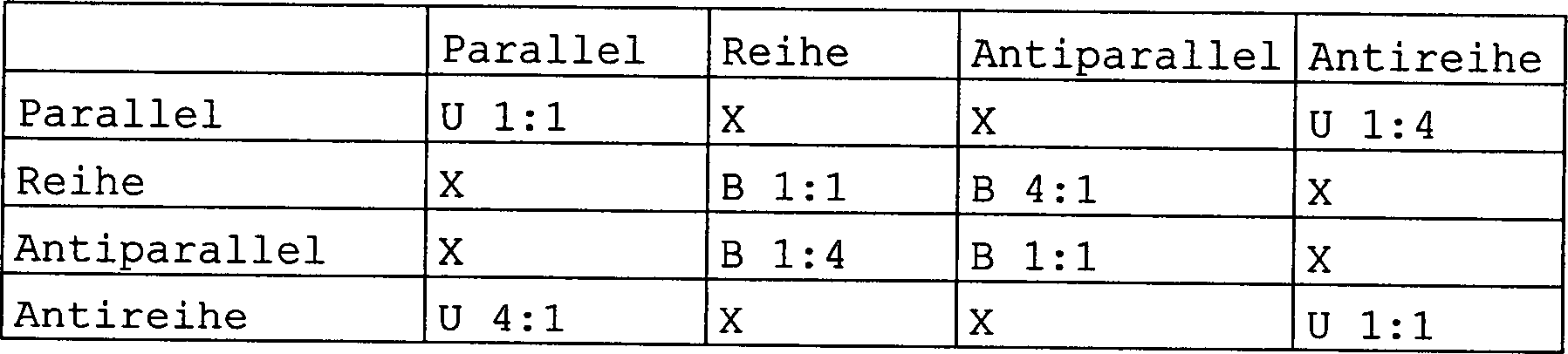
Figure 00220001
Tabelle 1
Figure 00220001
Table 1

In Tabelle 1 geben die Zeilenüberschriften die Konfigurationen von einer der elektrischen Schaltungen an, z. B. der elektrischen Schaltung 245, die unten mit Bezug auf 4C beschrieben ist, geben die Spaltenüberschriften die Konfigurationen der anderen der elektrischen Schaltungen an, z. B. einer elektrischen Schaltung 246, die mit Bezug auf 4C beschrieben ist, bezeichnet B die Tatsache, dass der FACT elektrisch symmetrisch ist, bezeichnet U die Tatsache, dass der FACT unsymmetrisch ist, und bezeichnet X einen nicht funktionierenden FACT. Das gezeigte Impedanztransformationsverhältnis ist die Impedanztransformation von elektrischen Anschlüssen, die mit der elektrischen Schaltung verbunden sind, die durch die Zeilenüberschrift angegeben ist, zu elektrischen Anschlüssen, die mit der e lektrischen Schaltung verbunden sind, die durch die Spaltenüberschrift angegeben ist.In Table 1, the row headings indicate the configurations of one of the electrical circuits, e.g. B. the electrical circuit 245 referring to below 4C described, the column headings indicate the configurations of the other of the electrical circuits, z. B. an electrical circuit 246 related to 4C B, B denotes the fact that the FACT is electrically symmetric, U denotes the fact that the FACT is unbalanced, and X denotes a non-functioning FACT. The impedance transformation ratio shown is the impedance transformation of electrical terminals connected to the electrical circuit indicated by the row heading to electrical terminals connected to the electrical circuit indicated by the column heading.

Die in Tabelle 1 gezeigten elektrischen Schaltungen unterliegen der Einschränkung, dass eine elektrische Schaltung lediglich die Elektroden von FBARs auf der gleichen Ebene wie ein anderer in den DSBARs 206 und 208 verbinden kann, d. h. eine der elektrischen Schaltungen kann lediglich die Elektroden der FBARs 210 und 250 verbinden und die Andere der elektrischen Schaltungen kann lediglich die Elektroden der FBARs 220 und 260 verbinden. Tabelle 1 nimmt zusätzlich an, dass die c-Achsen der piezoelektrischen Schichten 216, 226, 256 und 266 alle in die gleiche Richtung ausgerichtet sind. Es sind mehr elektrische Schaltungen bei Ausführungsbeispielen möglich, die der Einschränkung nicht unterliegen, d. h. bei Ausführungsbeispielen, bei denen eine elektrische Schaltung die Elektroden der FBARs 210 und 260 und die Elektroden der FBARs 220 und 250 verbinden darf, und/oder der Annahme.The electrical circuits shown in Table 1 are subject to the restriction that one electrical circuit only affect the electrodes of FBARs at the same level as another in the DSBARs 206 and 208 can connect, ie one of the electrical circuits can only the electrodes of the FBARs 210 and 250 The other of the electrical circuits can only connect the electrodes of the FBARs 220 and 260 connect. Table 1 additionally assumes that the c-axes of the piezoelectric layers 216 . 226 . 256 and 266 all are aligned in the same direction. More electrical circuits are possible in embodiments which are not subject to the restriction, ie in embodiments in which an electrical circuit is the electrodes of the FBARs 210 and 260 and the electrodes of the FBARs 220 and 250 allowed to connect, and / or acceptance.

Bevor die elektrischen Schaltungen, die die FBARs verbinden, detailliert beschrieben werden, werden die Ausdrücke antiparallel, parallel, Antireihe und Reihe definiert, die auf die elektrischen Schaltungen angewendet werden, die die Elektroden von FBARs unterschiedlicher DSBARs verbinden. Ein FBAR ist eine polaritätsabhängige Vorrichtung. Eine Spannung einer gegebenen Polarität, die zwischen die Elektroden des FBAR angelegt ist, bewirkt, dass sich der FBAR mechanisch zusammenzieht, während die gleiche Spannung der entgegengesetzten Polarität bewirkt, dass sich der FBAR mechanisch um die gleiche Größe ausdehnt. Gleichermaßen erzeugt eine mechanische Belastung, die an den FBAR angelegt ist und die bewirkt, dass sich der FBAR mechanisch zusammenzieht, eine Spannung der gegebenen Polarität zwischen den Elektroden des FBAR, während eine mechanische Belastung, die bewirkt, dass sich der FBAR mechanisch ausdehnt, eine Spannung der entgegengesetzten Polarität zwischen den Elektroden des FBAR erzeugt.Before the electrical circuits connecting the FBARs are detailed be described, the terms antiparallel, parallel, Antireihe and series defined on the electrical circuits be applied, the electrodes of FBARs different DSBARs connect. An FBAR is a polarity dependent device. A tension a given polarity, which is applied between the electrodes of the FBAR, causes the FBAR contracts mechanically, while the same voltage of the opposite polarity causes the FBAR to expand mechanically by the same amount. Equally created a mechanical load applied to the FBAR and the causes the FBAR to contract mechanically, a voltage the given polarity between the electrodes of the FBAR, while a mechanical load, which causes the FBAR to expand mechanically, a voltage of opposite polarity generated between the electrodes of the FBAR.

Mit Bezug auf 4A4D befinden sich bei dem FACT 200 die Elektroden der FBARs, die eine elektrische Schaltung parallel schaltet, auf der gleichen Ebene in den jeweiligen DSBARs. Ein Signal, das an die FBARs, die parallel geschaltet sind, angelegt ist, erzeugt Signale der gleichen Phase über die FBARs. Die FBARs dehnen sich deshalb in Phase aus und ziehen sich in Phase zusammen und erzeugen eine akustische Energie in Phase. Elektroden der FBARs, die eine elektrische Schaltung antiparallel schaltet, befinden sich jedoch auf unterschiedlichen Ebenen in den jeweiligen DSBARs. Ein Signal, das an FBARs angelegt ist, die antiparallel geschaltet sind, erzeugt Signale der entgegengesetzten Phasen über die FBARs. Die FBARs dehnen sich deshalb in Antiphase aus und ziehen sich in Antiphase zusammen, und erzeugen eine akustische Energie in Antiphase.Regarding 4A - 4D are located at the FACT 200 the electrodes of the FBARs, which shunts an electrical circuit in parallel, at the same level in the respective DSBARs. A signal applied to the FBARs connected in parallel generates signals of the same phase across the FBARs. The FBARs therefore expand in phase and contract in phase, generating an acoustic energy in phase. However, electrodes of the FBARs that switch an electrical circuit in anti-parallel are located at different levels in the respective DSBARs. A signal applied to FBARs connected in anti-parallel generates signals of opposite phases across the FBARs. The FBARs therefore expand in antiphase and contract in antiphase, producing an acoustic energy in antiphase.

Die Elektroden der FBARs, die eine elektrische Schaltung in Reihe schaltet, befinden sich auf der gleichen Ebene in den jeweiligen DSBARs. Ein Signal, das an die FBARs angelegt ist, die in Reihe geschaltet sind, erzeugt Signale entgegengesetzter Phasen über die FBARs. Die FBARs dehnen sich in Antiphase aus und ziehen sich in Antiphase zusammen, und erzeugen eine akustische Energie in Antiphase. Die Elektroden der FBARs, die eine elektrische Schaltung in Antireihe schaltet, befinden sich jedoch auf unterschiedlichen Ebenen in den jeweiligen DSBARs. Ein Signal, das an die FBARs angelegt ist, die in Antireihe geschaltet sind, erzeugt Signale der gleichen Phase über die FBARs. Die FBARs dehnen sich in Phase aus und ziehen sich in Phase zusammen, und erzeugen eine akustische Energie in Phase.The electrodes of the FBARs, which connect an electrical circuit in series, are at the same level in the respective DSBARs. A signal applied to the FBARs connected in series generates signals of opposite phases over the FBARs. The FBARs expand in antiphase and contract in antiphase, producing an acoustic energy in antiphase. However, the electrodes of the FBARs that switch an anti-series electrical circuit are at different levels in the respective DSBARs. A signal applied to the FBARs connected in anti-series generates signals of the same phase through the FBARs. The FBARs expand in phase and contract in phase, producing an acoustic energy in phase.

FBARs, die eine akustische Energie empfangen, die bewirkt, dass sich dieselben in Phase ausdehnen und in Phase zusammenziehen, erzeugen Signale in Phase. Ein Parallelschalten von FBARs, die Signale in Phase erzeugen, erzeugt einen Signalpegel gleich diesem über die einzelnen FBARs und eine Impedanz von der Hälfte der charakteristischen Impedanz der einzelnen FBARs. Ein Schalten derartiger FBARs in Antireihe erzeugt einen Signalpegel von zwei Mal diesem über die einzelnen FBARs und eine Impedanz von zwei Mal der charakteristischen Impedanz der einzelnen FBARs. Ein Antiparallel- oder in Reihe Schalten von FBARs, die Signale in Phase erzeugen, bewirkt jedoch, dass sich die Signale aufheben. FBARs, die eine akustische Energie empfangen, die bewirkt, dass sich dieselben in Antiphase ausdehnen und in Antiphase zusammenziehen, erzeugen Signale in Antiphase. Ein Antiparallelschalten von FBARs, die Signale in Antiphase erzeugen, erzeugt ein Signal mit einem gleichem Pegel wie diesem über die einzelnen FBARs und eine Impedanz von der Hälfte der charakteristischen Impedanz der einzelnen FBARs. Ein in Reihe Schalten derartiger FBARs erzeugt ein Signal von zwei Mal dem Pegel von diesem über die einzelnen FBARs und eine Impedanz von zwei Mal der charakteristischen Impedanz der einzelnen FBARs. Ein Parallel- oder in Antireihe Schalten von FBARs, die Signale in Antiphase erzeugen, bewirkt jedoch, dass sich die Signale aufheben. Die FACTs, die in Tabelle 1 als nicht funktionsfähig angegeben sind, sind FACTs, bei denen die FBARs, die eine akustische Energie empfangen, Signale erzeugen, die sich aufheben.FBARs who receive an acoustic energy that causes them to be the same expand in phase and contract in phase, generate signals in phase. Parallel connection of FBARs that generate signals in phase, generates a signal level equal to this across the individual FBARs and an impedance of half the characteristic impedance of the individual FBARs. Turn on such anti-series FBARs produce a signal level of two Give this over the individual FBARs and an impedance of twice the characteristic one Impedance of the individual FBARs. An antiparallel or in series switching of FBARs, the Generate signals in phase, however, causes the signals cancel. FBARs that receive an acoustic energy that causes that they expand in antiphase and contract in antiphase, generate signals in antiphase. Anti-parallel switching of FBARs, generate the signals in antiphase, generates a signal with a same level as this over the individual FBARs and an impedance of half the characteristic Impedance of the individual FBARs. A series switching of such FBARs generated a signal of twice the level of this over the individual FBARs and an impedance of twice the characteristic impedance of the individual FBARs. A parallel or antireihe switching of FBARs, the signals in antiphase, but causes the signals to cancel. The FACTs listed as non-functional in Table 1 are FACTs, where the FBARs that receive acoustic energy receive signals generate that cancel each other out.

4A und 4B stellen schematisch zwei Konfigurationen von elektrischen Schaltungen dar, die die FBARs 210 und 220 des DSBAR 206 und die FBARs 250 und 260 des DSBAR 208 parallel bzw. in Reihe schalten, um die jeweiligen elektrisch symmetrischen Ausführungsbeispiele eines FACT zu bilden, der ein Impedanztransformationsverhältnis von 1:1 aufweist. 4A and 4B schematically illustrate two configurations of electrical circuits that the FBARs 210 and 220 of the DSBAR 206 and the FBARs 250 and 260 of the DSBAR 208 in series to form the respective electrically symmetrical embodiments of a FACT having an impedance transformation ratio of 1: 1.

4A zeigt eine elektrische Schaltung 241, die einen der FBARs des DSBAR 206 mit einem der FABRs des DSBAR 208 und mit ersten Anschlüssen F antiparallel schaltet, und eine elektrische Schaltung 242, die den anderen der FBARs des DSBAR 206 mit dem anderen der FBARs des DSBAR 208 und mit zweiten Anschlüssen S antiparallel schaltet. Bei dem gezeigten Beispiel schaltet die elektrische Schaltung 241 den FBAR 220 des DSBAR 206 mit dem FBAR 260 des DSBAR 208 und mit ersten Anschlüssen F elektrisch antiparallel und schal tet die elektrische Schaltung 242 den FBAR 210 des DSBAR 206 mit dem FBAR 250 des DSBAR 208 und mit zweiten Anschlüssen S elektrisch antiparallel. 4A shows an electrical circuit 241 , which is one of the FBARs of the DSBAR 206 with one of the FABRs of the DSBAR 208 and with first terminals F antiparallel switches, and an electrical circuit 242 that the other of the FBARs of the DSBAR 206 with the other of the FBARs of the DSBAR 208 and with second terminals S antiparallel switches. In the example shown, the electrical circuit switches 241 the FBAR 220 of the DSBAR 206 with the FBAR 260 of the DSBAR 208 and with first terminals F electrically antiparallel and switched off the electrical circuit 242 the FBAR 210 of the DSBAR 206 with the FBAR 250 of the DSBAR 208 and with second terminals S electrically antiparallel.

Genau gesagt verbindet die elektrische Schaltung 241 die Elektrode 222 des FBAR 220 elektrisch mit der Elektrode 264 des FBAR 260 und mit einem der ersten Anschlüsse F und verbindet zusätzlich die Elektrode 224 des FBAR 220 elektrisch mit der Elektrode 262 des FBAR 260 und mit dem anderen der ersten Anschlüsse F. Die elektrische Schaltung 242 verbindet die Elektrode 214 des FBAR 210 elektrisch mit der Elektrode 252 des FBAR 250 und mit einem der zweiten Anschlüsse S und verbindet zusätzlich die Elektrode 212 des FBAR 210 elektrisch mit der Elektrode 254 des FBAR 250 und mit dem anderen der zweiten Anschlüsse S.Strictly speaking, the electrical circuit connects 241 the electrode 222 of the FBAR 220 electrically with the electrode 264 of the FBAR 260 and with one of the first terminals F and additionally connects the electrode 224 of the FBAR 220 electrically with the electrode 262 of the FBAR 260 and with the other of the first terminals F. The electrical circuit 242 connects the electrode 214 of the FBAR 210 electrically with the electrode 252 of the FBAR 250 and with one of the second terminals S and additionally connects the electrode 212 of the FBAR 210 electrically with the electrode 254 of the FBAR 250 and with the other of the second ports S.

Die elektrische Schaltung 241 schaltet die FBARs 220 und 260 elektrisch antiparallel, so dass ein elektrisches Eingangssignal, das an die ersten Anschlüsse F angelegt ist, gleich, aber in Antiphase an die FBARs 220 und 260 angelegt ist. Die elektrische Schaltung 241 schaltet die FBARs 220 und 260 elektrisch antiparallel in dem Sinn, dass ein elektrisches Signal, das an die ersten Anschlüsse F angelegt ist, bewirkt, dass sich der FBAR 220 mechanisch zusammenzieht, und zusätzlich bewirkt, dass sich der FBAR 260 mechanisch um die gleiche Größe ausdehnt, und umgekehrt. Die akustische Energie, die durch den FBAR 260 erzeugt wird, ist deshalb in Antiphase mit der akustischen Energie, die durch den FBAR 220 erzeugt wird. Folglich ist die akustische Energie, die durch den FBAR 250 von dem FBAR 260 empfangen wird, in Antiphase mit der akustischen Energie, die durch den FBAR 210 von dem FBAR 220 empfangen wird, und das Signal zwischen den Elektroden 214 und 212 ist in Antiphase mit dem Signal zwischen den Elektroden 254 und 252. Die elektrische Schaltung 242 schaltet die FBARs 210 und 250 antiparallel, so dass das Signal, das zu den zweiten Anschlüssen S ausgegeben wird, in Phase mit dem Signal zwischen den Elektroden 214 und 212 und ferner mit dem Signal zwischen den Elektroden 254 und 252 ist. Folglich ist das Signal zwischen den zweiten Anschlüssen S das gleiche wie das Signal über einen der FBARs 210 und 250.The electrical circuit 241 turns on the FBARs 220 and 260 electrically antiparallel, such that an electrical input signal applied to the first terminals F is equal but in antiphase to the FBARs 220 and 260 is created. The electrical circuit 241 turns on the FBARs 220 and 260 electrically antiparallel in the sense that an electrical signal applied to the first terminals F causes the FBAR 220 mechanically contracts, and additionally causes the FBAR 260 mechanically expanded by the same size, and vice versa. The acoustic energy generated by the FBAR 260 is therefore in antiphase with the acoustic energy generated by the FBAR 220 is produced. Consequently, the acoustic energy generated by the FBAR 250 from the FBAR 260 is received in antiphase with the acoustic energy passing through the FBAR 210 from the FBAR 220 is received, and the signal between the electrodes 214 and 212 is in antiphase with the signal between the electrodes 254 and 252 , The electrical circuit 242 turns on the FBARs 210 and 250 anti-parallel so that the signal output to the second terminals S is in phase with the signal between the electrodes 214 and 212 and further with the signal between the electrodes 254 and 252 is. Consequently, the signal between the second terminals S is the same as the signal via one of the FBARs 210 and 250 ,

Es existiert im Wesentlichen die gleiche Kapazität zwischen jedem der ersten Anschlüsse F und dem Substrat 202. Mit jedem ersten Anschluss ist eine Elektrode näher an dem Substrat und eine Elektrode weiter weg von dem Substrat verbunden. Bei dem gezeigten Beispiel ist mit dem ersten Anschluss die Elektrode 222 näher an dem Substrat und die Elektrode 264 weiter weg von dem Substrat verbunden und ist mit dem anderen ersten Anschluss die Elektrode 262 näher an dem Substrat und die Elektrode 224 weiter weg von dem Substrat verbunden. Zudem existiert im Wesentlichen die gleiche Kapazität zwischen jedem der zweiten Anschlüsse S und dem Substrat 202. Mit jedem zweiten Anschluss ist eine Elektrode näher an dem Substrat und eine Elektrode weiter weg von dem Substrat verbunden. Bei dem gezeigten Beispiel ist mit einem zweiten Anschluss die Elektrode 212 näher an dem Substrat und die Elektrode 254 weiter weg von dem Substrat verbunden und ist mit dem anderen zweiten Anschluss die Elektrode 252 näher an dem Substrat und die Elektrode 214 weiter weg von dem Substrat verbunden. Somit ist das Ausführungsbeispiel des FACT 200, das in 4A gezeigt ist, elektrisch symmetrisch und weist folglich ein Gleichtaktunterdrückungsverhältnis auf, das ausreichend hoch für viel mehr Anwendungen ist, als das des FACT 100, der oben mit Bezug auf 1A1C beschrieben ist.There is substantially the same capacity between each of the first ports F and the first substratum 202 , With each first terminal, one electrode is connected closer to the substrate and one electrode further away from the substrate. In the example shown, the first terminal is the electrode 222 closer to the substrate and the electrode 264 further away from the substrate and is the electrode with the other first terminal 262 closer to the substrate and the electrode 224 further away from the substrate. In addition, substantially the same capacitance exists between each of the second terminals S and the substrate 202 , With every other terminal, one electrode is connected closer to the substrate and one electrode further away from the substrate. In the example shown, the electrode is with a second connection 212 closer to the substrate and the electrode 254 further away from the substrate and is the electrode with the other second terminal 252 closer to the substrate and the electrode 214 further away from the substrate. Thus, the embodiment of the FACT 200 , this in 4A is shown to be electrically balanced and thus has a common mode rejection ratio sufficiently high for many more applications than that of the FACT 100 referring to the above 1A - 1C is described.

Das in 4A gezeigte Ausführungsbeispiel des FACT 200 weist ein Impedanztransformationsverhältnis von 1:1 auf. Die ersten Anschlüsse F können als die primären Anschlüsse oder die sekundären Anschlüsse des FACT dienen und die zweiten Anschlüsse P können als die sekundären bzw. die primären Anschlüsse des FACT dienen. Ein elektrisches Eingangssignal, das an die primären Anschlüsse angelegt ist, wird mit im Wesentlichen dem gleichen Pegel bei den sekundären Anschlüssen ausgegeben. Bei einem typischen Ausfüh rungsbeispiel, bei dem alle der FBARs 210, 220, 250 und 260 eine ähnliche charakteristische Impedanz aufweisen, ist die Impedanz, die an den primären Anschlüssen und den sekundären Anschlüssen zu sehen ist, diese von zwei FBARs parallel, d. h. ein Halb der typischen charakteristischen Impedanz eines einzigen FBAR. Somit ist das in 4A gezeigte Ausführungsbeispiel des FACT 200 für eine Verwendung bei Anwendungen mit relativ niedriger charakteristischer Impedanz geeignet.This in 4A shown embodiment of the FACT 200 has an impedance transformation ratio of 1: 1. The first ports F may serve as the primary ports or the secondary ports of the FACT and the second ports P may serve as the secondary and primary ports of the FACT, respectively. An electrical input signal applied to the primary terminals is output at substantially the same level at the secondary terminals. In a typical embodiment, all of the FBARs 210 . 220 . 250 and 260 have a similar characteristic impedance, the impedance seen at the primary terminals and the secondary terminals is that of two FBARs in parallel, ie one half of the typical characteristic impedance of a single FBAR. Thus, that is in 4A shown embodiment of the FACT 200 suitable for use in relatively low characteristic impedance applications.

4B zeigt schematisch eine elektrische Schaltung 243, die einen der FBARs des DSBAR 206 und einen der FBARs des DSBAR 208 zwischen die ersten Anschlüsse F elektrisch in Reihe schaltet, und eine elektrische Schaltung 244, die den anderen der FBARs des DSBAR 206 und den anderen der FBARs des DSBAR 208 zwischen die zweiten Anschlüsse S elektrisch in Reihe schaltet. Bei dem in 4B gezeigten Beispiel schaltet die elektrische Schaltung 243 den FBAR 220 des DSBAR 206 und den FBAR 260 des DSBAR 208 zwischen die ersten Anschlüsse F elektrisch in Reihe und schaltet die elektrische Schaltung 244 den FBAR 210 des DSBAR 206 und den FBAR 250 des DSBAR 208 zwischen die zweiten Anschlüsse S elektrisch in Reihe. 4B shows schematically an electrical circuit 243 , which is one of the FBARs of the DSBAR 206 and one of the FBARs of the DSBAR 208 between the first terminals F electrically connected in series, and an electrical circuit 244 that the other of the FBARs of the DSBAR 206 and the other FBARs of the DSBAR 208 between the second terminals S electrically connected in series. At the in 4B example shown switches the electrical circuit 243 the FBAR 220 of the DSBAR 206 and the FBAR 260 of the DSBAR 208 between the first terminals F electrically in series and switches the electrical circuit 244 the FBAR 210 of the DSBAR 206 and the FBAR 250 of the DSBAR 208 between the second terminals S electrically in series.

Genau gesagt verbindet die elektrische Schaltung 243 die Elektrode 222 des FBAR 220 elektrisch mit der Elektrode 262 des FBAR 260 und verbindet zusätzlich die Elektrode 224 des FBAR 220 elektrisch mit einem der ersten Anschlüsse F und verbindet die Elektrode 264 des FBAR 260 elektrisch mit dem anderen der ersten Anschlüsse F. Bei einer Variation verbindet die elektrische Schaltung 243 die Elektrode 224 des FBAR 220 elektrisch mit der Elektrode 264 des FBAR 260 und verbindet zusätzlich die Elektrode 222 des FBAR 220 und die Elektrode 262 des FBAR 260 elektrisch mit den ersten Anschlüssen F. Die elektrische Schaltung 244 verbindet die Elektrode 212 des FBAR 210 elektrisch mit der Elektrode 252 des FBAR 250 und verbindet zusätzlich die Elektrode 214 des FBAR 210 elektrisch mit einem der zweiten Anschlüsse S und verbindet zusätzlich die Elektrode 254 des FBAR 250 elektrisch mit dem anderen der zweiten Anschlüsse S. Bei einer Variation verbindet die elektrische Schaltung 244 die Elektrode 214 des FBAR 210 elektrisch mit der Elektrode 254 des FBAR 250 und verbindet zusätzlich die Elektrode 212 des FBAR 210 und die Elektrode 252 des FBAR 250 elektrisch mit den zweiten Anschlüssen S.Strictly speaking, the electrical circuit connects 243 the electrode 222 of the FBAR 220 electrically with the electrode 262 of the FBAR 260 and additionally connects the electrode 224 of the FBAR 220 electrically connected to one of the first terminals F and connects the electrode 264 of the FBAR 260 electrically with the other of the first terminals F. In a variation, the electrical circuit connects 243 the electrode 224 of the FBAR 220 electrically with the electrode 264 of the FBAR 260 and additionally connects the electrode 222 of the FBAR 220 and the electrode 262 of the FBAR 260 electrically with the first terminals F. The electrical circuit 244 connects the electrode 212 of the FBAR 210 electrically with the electrode 252 of the FBAR 250 and additionally connects the electrode 214 of the FBAR 210 electrically connected to one of the second terminals S and additionally connects the electrode 254 of the FBAR 250 electrically with the other of the second terminals S. In one variation, the electrical circuit connects 244 the electrode 214 of the FBAR 210 electrically with the electrode 254 of the FBAR 250 and additionally connects the electrode 212 of the FBAR 210 and the electrode 252 of the FBAR 250 electrically with the second terminals S.

Die elektrische Schaltung 243, die die FBARs 220 und 260 elektrisch in Reihe schaltet, teilt ein elektrisches Eingangssignal, das an die ersten Anschlüsse F angelegt ist, näherungsweise gleichmäßig zwischen den FBARs 220 und 260. Die FBARs 220 und 260 sind in dem Sinn in Reihe geschaltet, dass ein elektrisches Signal, das an die ersten Anschlüsse F angelegt ist, bewirkt, dass sich der FBAR 220 mechanisch zusammenzieht, und bewirkt, dass sich der FBAR 260 mechanisch um die gleiche Größe ausdehnt, und umgekehrt. Die akustische Energie, die durch den FBAR 260 erzeugt wird, ist deshalb in Antiphase mit der akustischen Energie, die durch den FBAR 220 erzeugt wird. Die akustische Energie, die durch den FBAR 250 von dem FBAR 260 empfangen wird, ist in Antiphase mit der akustischen Energie, die durch den FBAR 210 von dem FBAR 220 empfangen wird, und das Signal an der Elektrode 254 ist in Antiphase mit dem Signal an der Elektrode 214. Die elektrische Schaltung 244 schaltet die FBARs 210 und 250 elektrisch in Reihe, so dass das Signal an den zweiten Anschlüssen S zweimal das Signal über einen der FBARs 210 und 250 beträgt.The electrical circuit 243 that the FBARs 220 and 260 electrically in series, shares an electrical input signal applied to the first terminals F approximately equally between the FBARs 220 and 260 , The FBARs 220 and 260 are connected in series in the sense that an electrical signal applied to the first terminals F causes the FBAR 220 mechanically contracts, and causes the FBAR 260 mechanically expanded by the same size, and vice versa. The acoustic energy generated by the FBAR 260 is therefore in antiphase with the acoustic energy generated by the FBAR 220 is produced. The acoustic energy generated by the FBAR 250 from the FBAR 260 is received in antiphase with the acoustic energy passing through the FBAR 210 from the FBAR 220 is received, and the signal at the electrode 254 is in antiphase with the signal on the electrode 214 , The electrical circuit 244 turns on the FBARs 210 and 250 electrically in series, so that the signal at the second terminals S twice the signal through one of the FBARs 210 and 250 is.

Es existiert im Wesentlichen die gleiche Kapazität zwischen jedem der ersten Anschlüsse F und dem Substrat 202. Die Elektroden 224 und 264, die mit den ersten Anschlüssen verbunden sind, befinden sich bei dem gleichen Abstand von dem Substrat. Zudem existiert im Wesentlichen die gleiche Kapazität zwischen jedem der zweiten Anschlüsse S und dem Substrat 202. Die Elektroden 214 und 254, die mit den zweiten Anschlüssen verbunden sind, befinden sich bei dem gleichen Abstand von dem Substrat. Somit ist das in 4B gezeigte Ausführungsbeispiel des FACT 200 elektrisch symmetrisch und weist folglich ein Gleichtaktunterdrückungsverhältnis auf, das ausreichend hoch für viel mehr Anwendungen ist, als das des FACT 100, der oben mit Bezug auf 1A1C beschrieben ist.There is substantially the same capacity between each of the first ports F and the first substratum 202 , The electrodes 224 and 264 which are connected to the first terminals are at the same distance from the substrate. In addition, substantially the same capacitance exists between each of the second terminals S and the substrate 202 , The electrodes 214 and 254 which are connected to the second terminals are at the same distance from the substrate. Thus, that is in 4B shown embodiment of the FACT 200 electrically symmetric and thus has a common mode rejection ratio sufficiently high for many more applications than that of the FACT 100 referring to the above 1A - 1C is described.

Das in 4B gezeigte Ausführungsbeispiel des FACT 200 weist ein Impedanztransformationsverhältnis von 1:1 auf. Die ersten Anschlüsse F können als die primären Anschlüsse oder die sekundären Anschlüsse des FACT dienen und die zweiten Anschlüsse P können als die sekundären Anschlüsse bzw. die primären Anschlüsse des FACT dienen. Ein elektrisches Eingangssignal, das an die primären Anschlüsse angelegt ist, wird mit im Wesentlichen dem gleichen Pegel bei den sekundären Anschlüssen ausgegeben. Bei einem typischen Ausführungsbeispiel, bei dem alle der FBARs 210, 220, 250 und 260 eine ähnliche charakteristische Impedanz aufweisen, ist die Impedanz, die an den primären Anschlüssen und den sekundären Anschlüssen zu sehen ist, diese von zwei FBARs in Reihe, d. h. zweimal die typische charakteristische Impedanz eines einzigen FBAR. Somit ist das in 4B gezeigte Ausführungsbeispiel des FACT 200 für eine Verwendung bei Anwendungen mit einer höheren charakteristischen Impedanz als dieser, die in 4A gezeigt ist, geeignet.This in 4B shown embodiment of the FACT 200 has an impedance transformation ratio of 1: 1. The first terminals F may serve as the primary terminals or the secondary terminals of the FACT and the second terminals P may serve as the secondary terminals and the primary terminals of the FACT, respectively. An electrical input signal applied to the primary terminals is output at substantially the same level at the secondary terminals. In a typical embodiment, all of the FBARs 210 . 220 . 250 and 260 Having similar characteristic impedance, the impedance seen at the primary and secondary terminals is that of two FBARs in series, ie twice the typical characteristic impedance of a single FBAR. Thus, that is in 4B shown embodiment of the FACT 200 for use in applications with a higher characteristic impedance than that used in 4A shown is suitable.

4C und 4D stellen schematisch zwei Konfigurationen von elektrischen Schaltungen dar, die die FBARs 210 und 220 des DSBAR 206 und die FABRs 250 und 260 des DSBAR 208 antiparallel und in Reihe schalten, um jeweilige Ausführungsbeispiele eines FACT zu bilden, der ein Impedanztransformationsverhältnis von 1:4 oder 4:1 aufweist. 4C zeigt eine elektrische Schaltung 245, die einen der FBARs des DSBAR 206 mit einem der FBARs des DSBAR 208 und mit den ersten Anschlüssen F elektrisch antiparallel schaltet, und eine elektrische Schaltung 246, die den anderen der FBARs des DSBAR 206 und den anderen der FBARs des DSBAR 208 zwischen die zweiten Anschlüsse S elektrisch in Reihe schaltet. Bei dem gezeigten Ausführungsbeispiel schaltet die elektrische Schaltung 245 den FBAR 220 des DSBAR 206 mit dem FBAR 260 des DSBAR 208 und mit den ersten Anschlüssen P elektrisch antiparallel und schaltet die elektrische Schaltung 246 den FBAR 210 des DSBAR 206 und den FBAR 250 des DSBAR 208 zwischen die zweiten Anschlüsse S elektrisch in Reihe. 4C and 4D schematically illustrate two configurations of electrical circuits that the FBARs 210 and 220 of the DSBAR 206 and the FABRs 250 and 260 of the DSBAR 208 antiparallel and in series to form respective embodiments of a FACT having an impedance transformation ratio of 1: 4 or 4: 1. 4C shows an electrical circuit 245 , which is one of the FBARs of the DSBAR 206 with one of the FBARs of the DSBAR 208 and electrically antiparallel with the first terminals F, and an electric circuit 246 that the other of the FBARs of the DSBAR 206 and the other FBARs of the DSBAR 208 between the second terminals S electrically connected in series. In the embodiment shown, the electrical circuit switches 245 the FBAR 220 of the DSBAR 206 with the FBAR 260 of the DSBAR 208 and with the first terminals P electrically antiparallel and switches the electrical circuit 246 the FBAR 210 of the DSBAR 206 and the FBAR 250 of the DSBAR 208 between the second terminals S electrically in series.

Genau gesagt verbindet die elektrische Schaltung 245 die Elektrode 222 des FBAR 220 elektrisch mit der Elektrode 264 des FBAR 260 und mit einem der ersten Anschlüsse F und verbindet zusätzlich die Elektrode 224 des FBAR 220 elektrisch mit der Elektrode 262 des FBAR 260 und mit dem anderen der ersten Anschlüsse F. Die elektrische Schaltung 246 verbindet die Elektrode 214 des FBAR 210 elektrisch mit der Elektrode 254 des FBAR 250 und verbindet zusätzlich die Elektrode 212 des FBAR 210 elektrisch mit einem der zweiten Anschlüsse S und die Elektrode 252 des FBAR 250 mit dem anderen der zweiten Anschlüsse S. Bei einer Variation verbindet die elektrische Schaltung 246 die Elektrode 212 des FBAR 210 elektrisch mit der Elektrode 252 des FBAR 250 und verbindet zusätzlich die Elektrode 214 des FBAR 210 und die Elektrode 254 des FBAR 250 elektrisch mit den zweiten Anschlüssen S.Strictly speaking, the electrical circuit connects 245 the electrode 222 of the FBAR 220 electrically with the electrode 264 of the FBAR 260 and with one of the first terminals F and additionally connects the electrode 224 of the FBAR 220 electrically with the electrode 262 of the FBAR 260 and with the other of the first terminals F. The electrical circuit 246 connects the electrode 214 of the FBAR 210 electrically with the electrode 254 of the FBAR 250 and additionally connects the electrode 212 of the FBAR 210 electrically with one of the second terminals S and the electrode 252 of the FBAR 250 with the other of the second terminals S. In a variation, the electrical circuit connects 246 the electrode 212 of the FBAR 210 electrically with the electrode 252 of the FBAR 250 and additionally connects the electrode 214 of the FBAR 210 and the electrode 254 of the FBAR 250 electrically with the second terminals S.

Die elektrische Schaltung 245 schaltet die FBARs 220 und 260 elektrisch antiparallel, so dass ein elektrisches Eingangssignal, das an die ersten Anschlüsse F angelegt ist, gleichmäßig, aber in Antiphase an die FBARs 220 und 260 angelegt ist. Die elektrische Schaltung 245 schaltet die FBARs 220 und 260 elektrisch antiparallel in dem Sinn, dass ein elektrisches Signal, das an die ersten Anschlüsse F angelegt ist, bewirkt, dass sich der FBAR 220 mechanisch zusammenzieht, und zusätzlich bewirkt, dass sich der FBAR 260 mechanisch um die gleiche Größe ausdehnt, und umgekehrt. Die akustische Energie, die durch den FBAR 260 erzeugt wird, ist deshalb in Antiphase mit der akustischen Energie, die durch den FBAR 220 erzeugt wird. Folglich ist die akustische Energie, die durch den FBAR 250 von dem FBAR 260 empfangen wird, in Antiphase mit der akustischen Energie, die durch den FBAR 210 von dem FBAR 220 empfangen wird, und das Signal an der Elektrode 252 ist in Antiphase mit dem Signal an der Elektrode 212. Die elektrische Schaltung 246 schaltet die FBARs 210 und 250 in Reihe, so dass die Spannungsdifferenz zwischen den zweiten Anschlüssen S zweimal die Spannung über einen der FBARs 210 und 250 beträgt.The electrical circuit 245 turns on the FBARs 220 and 260 electrically antiparallel so that an electrical input signal applied to the first terminals F is uniform but in antiphase to the FBARs 220 and 260 is created. The electrical circuit 245 turns on the FBARs 220 and 260 electrically antiparallel in the sense that an electrical signal applied to the first terminals F causes the FBAR 220 mechanically contracts, and additionally causes the FBAR 260 mechanically expanded by the same size, and vice versa. The acoustic energy generated by the FBAR 260 is therefore in antiphase with the acoustic energy generated by the FBAR 220 is produced. Consequently, the acoustic energy generated by the FBAR 250 from the FBAR 260 is received in antiphase with the acoustic energy passing through the FBAR 210 from the FBAR 220 is received, and the signal at the electrode 252 is in antiphase with the signal on the electrode 212 , The electrical circuit 246 turns on the FBARs 210 and 250 in series, so that the voltage difference between the second terminals S twice the voltage across one of the FBARs 210 and 250 is.

Es existiert im Wesentlichen die gleiche Kapazität zwischen jedem der ersten Anschlüssen F und dem Substrat 202. Mit jedem ersten Anschluss ist eine Elektrode näher an dem Substrat und eine Elektrode weiter weg von dem Substrat verbunden. Bei dem gezeigten Beispiel ist mit dem ersten Anschluss die Elektrode 222 näher an dem Substrat und die Elektrode 264 weiter weg von dem Substrat verbunden und ist mit dem anderen ersten Anschluss die Elektrode 262 näher an dem Substrat und die Elektrode 224 weiter weg von dem Substrat verbunden. Zudem existiert im Wesentlichen die gleiche Kapazität zwischen jedem der zweiten Anschlüsse S und dem Substrat 202. Die Elektroden 212 und 254, die mit den zweiten Anschlüssen verbunden sind, befinden sich bei dem gleichen Abstand von dem Substrat. Somit ist das Ausführungsbeispiel des FACT 200, das in 4C gezeigt ist, elektrisch symmetrisch und weist folglich ein Gleichtaktunterdrückungsverhältnis auf, das ausreichend hoch für viel mehr Anwendungen ist, als das des FACT 100, der oben mit Bezug auf 1A1C beschrieben ist.There is substantially the same capacitance between each of the first terminals F and the substrate 202 , With each first terminal, one electrode is connected closer to the substrate and one electrode further away from the substrate. In the example shown, the first terminal is the electrode 222 closer to the substrate and the electrode 264 further away from the substrate and is the electrode with the other first terminal 262 closer to the substrate and the electrode 224 further away from the substrate connected. In addition, substantially the same capacitance exists between each of the second terminals S and the substrate 202 , The electrodes 212 and 254 which are connected to the second terminals are at the same distance from the substrate. Thus, the embodiment of the FACT 200 , this in 4C is shown to be electrically balanced and thus has a common mode rejection ratio sufficiently high for many more applications than that of the FACT 100 referring to the above 1A - 1C is described.

Das in 4C gezeigte Ausführungsbeispiel des FACT 200 ist ein Schritt-Aufwärts-FACT, wenn die ersten Anschlüsse F als primäre Anschlüsse dienen und die zweiten Anschlüsse S als sekundäre Anschlüsse dienen. Ein Signal, das an die primären Anschlüsse angelegt ist, wird bei zweimal dem Pegel an den sekundären Anschlüssen ausgegeben. Bei einem typischen Ausführungsbeispiel, bei dem alle der FBARs 210, 220, 250 und 260 eine ähnliche charakteristische Impedanz aufweisen, ist ferner die Impedanz, die bei den primären Anschlüssen zu sehen ist, diese von zwei FBARs parallel, d. h. ein Halb der typischen charakteristischen Impedanz eines einzigen FBAR, während die Impedanz, die bei den zweiten Anschlüssen zu sehen ist, diese von zwei FBARs in Reihe ist, d. h. zweimal die typische charakteristische Impedanz eines einzigen FBAR. Somit weist das in 4C gezeigte Ausführungsbeispiel des FACT 200 ein Primärseite-zu-Sekundärseite-Impedanzverhältnis von 1:4 auf.This in 4C shown embodiment of the FACT 200 is a step-up FACT when the first terminals F serve as primary terminals and the second terminals S serve as secondary terminals. A signal applied to the primary terminals is output at twice the level at the secondary terminals. In a typical embodiment, all of the FBARs 210 . 220 . 250 and 260 Furthermore, the impedance seen at the primary terminals is parallel to that of two FBARs, ie one half of the typical characteristic impedance of a single FBAR, while the impedance seen at the second terminals is this is of two FBARs in series, ie twice the typical characteristic impedance of a single FBAR. Thus, the in 4C shown embodiment of the FACT 200 a primary to secondary side impedance ratio of 1: 4.

Das in 4C gezeigte Ausführungsbeispiel des FACT 200 ist ein Schritt-Abwärts-FACT, wenn die ersten Anschlüsse F als sekundäre Anschlüsse dienen und die zweiten Anschlüsse S als primäre Anschlüsse dienen. In diesem Fall beträgt das Signal, das bei den sekundären Anschlüsse ausgegeben wird, ein Halb des Pegels des elektrischen Eingangssignals, das an die primären Anschlüsse angelegt ist, und das Primärseite-zu-Sekundärseite-Impedanzverhältnis beträgt 4:1.This in 4C shown embodiment of the FACT 200 is a step-down FACT when the first terminals F serve as secondary terminals and the second terminals S serve as primary terminals. In this case, the signal output at the secondary terminals is one half of the level of the electrical input signal applied to the primary terminals, and the primary side-to-secondary side impedance ratio is 4: 1.

4D zeigt schematisch eine elektrische Schaltung 247, die den FBAR 220 des DSBAR 206 und den FBAR 260 des DSBAR 208 zwischen die ersten Anschlüsse F elektrisch in Reihe schaltet, und eine elektrische Schaltung 248, die den FBAR 210 des DSBAR 206 und den FBAR 250 des DSBAR 208 elektrisch antiparallel schaltet und mit den zweiten Anschlüssen S verbindet. 4D shows schematically an electrical circuit 247 that the FBAR 220 of the DSBAR 206 and the FBAR 260 of the DSBAR 208 between the first terminals F electrically connected in series, and an electrical circuit 248 that the FBAR 210 of the DSBAR 206 and the FBAR 250 of the DSBAR 208 electrically antiparallel switches and connects to the second terminals S.

Genau gesagt verbindet die elektrische Schaltung 247 die Elektrode 222 des FBAR 220 elektrisch mit der Elektrode 262 des FBAR 260 und verbindet zusätzlich die Elektrode 224 des FBAR 220 und die Elektrode 264 des FBAR 260 elektrisch mit den ersten Anschlüssen F. Die elektrische Schaltung 248 verbindet die Elektrode 212 des FBAR 210 elektrisch mit der Elektrode 254 des FBAR 250 und mit einem der zweiten Anschlüsse S und verbindet zusätzlich die Elektrode 214 des FBAR 210 elektrisch mit der Elektrode 252 des FBAR 250 und mit dem anderen der zweiten Anschlüsse S. Bei einer Variation verbindet die elektrische Schaltung 247 die Elektrode 224 des FBAR 220 elektrisch mit der Elektrode 264 des FBAR 260 und verbindet zusätzlich die Elektrode 222 des FBAR 220 und die Elektrode 262 des FBAR 260 elektrisch mit den ersten Anschlüssen F.Strictly speaking, the electrical circuit connects 247 the electrode 222 of the FBAR 220 electrically with the electrode 262 of the FBAR 260 and additionally connects the electrode 224 of the FBAR 220 and the electrode 264 of the FBAR 260 electrically with the first terminals F. The electrical circuit 248 connects the electrode 212 of the FBAR 210 electrically with the electrode 254 of the FBAR 250 and with one of the second terminals S and additionally connects the electrode 214 of the FBAR 210 electrically with the electrode 252 of the FBAR 250 and with the other of the second terminals S. In one variation, the electrical circuit connects 247 the electrode 224 of the FBAR 220 electrically with the electrode 264 of the FBAR 260 and additionally connects the electrode 222 of the FBAR 220 and the electrode 262 of the FBAR 260 electrically with the first terminals F.

Die elektrische Schaltung 247, die die FBARs 220 und 260 elektrisch in Reihe schaltet, teilt ein elektrisches Eingangssignal, das an die ersten Anschlüsse F angelegt ist, näherungsweise gleichmäßig zwischen den FBARs 220 und 260. Die FBARs 220 und 260 sind in dem Sinn in Reihe geschaltet, dass ein elektrisches Signal, das an die ersten Anschlüsse F angelegt ist, bewirkt, dass sich der FBAR 220 mechanisch zusammenzieht, und bewirkt, dass sich der FBAR 260 mechanisch um die gleiche Größe ausdehnt, und umgekehrt. Die akustische Energie, die durch den FBAR 260 erzeugt wird, ist deshalb in Antiphase mit der akustischen Energie, die durch den FBAR 220 erzeugt wird. Die akustische Energie, die durch den FBAR 250 von dem FBAR 260 empfangen wird, ist in Antiphase mit der akustischen Energie, die durch den FBAR 210 von dem FBAR 220 empfangen wird, und die Spannung zwischen den Elektroden 252 und 254 ist in Antiphase mit der Spannung zwischen den Elektroden 212 und 214. Die elektrische Schaltung 248 schaltet die FBARs 210 und 250 elektrisch antiparallel, so dass das Ausgangssignal an den zweiten Anschlüssen S in Phase mit dem Signal über die Elektroden 214 und 212 und ebenfalls mit dem Signal über die Elektroden 254 und 252 ist. Folglich ist das Signal an den zweiten Anschlüssen S pegelmäßig gleich dem Signal über einen der FBARs 210 und 250 und ist gleich der Hälfte des Pegels des elektrischen Eingangssignals, das an die ersten Anschlüsse F angelegt ist.The electrical circuit 247 that the FBARs 220 and 260 electrically in series, shares an electrical input signal applied to the first terminals F approximately equally between the FBARs 220 and 260 , The FBARs 220 and 260 are connected in series in the sense that an electrical signal applied to the first terminals F causes the FBAR 220 mechanically contracts, and causes the FBAR 260 mechanically expanded by the same size, and vice versa. The acoustic energy generated by the FBAR 260 is therefore in antiphase with the acoustic energy generated by the FBAR 220 is produced. The acoustic energy generated by the FBAR 250 from the FBAR 260 is received in antiphase with the acoustic energy passing through the FBAR 210 from the FBAR 220 is received, and the voltage between the electrodes 252 and 254 is in antiphase with the voltage between the electrodes 212 and 214 , The electrical circuit 248 turns on the FBARs 210 and 250 electrically antiparallel, such that the output signal at the second terminals S is in phase with the signal across the electrodes 214 and 212 and also with the signal across the electrodes 254 and 252 is. Consequently, the signal at the second terminals S is level with the signal via one of the FBARs 210 and 250 and is equal to half the level of the electrical input signal applied to the first terminals F.

Es existiert im Wesentlichen die gleiche Kapazität zwischen jedem der ersten Anschlüsse F und dem Substrat 202. Die Elektroden 224 und 264, die mit den ersten Anschlüssen verbunden sind, befinden sich bei dem gleichen Abstand von dem Substrat. Zudem existiert im Wesentlichen die gleiche Kapazität zwischen jedem der zweiten Anschlüsse S und dem Substrat 202. Mit jedem zweiten Anschluss ist eine Elektrode näher an dem Substrat und eine Elektrode weiter weg von dem Substrat verbunden. Bei dem gezeigten Beispiel ist mit einem zweiten Anschluss die Elektrode 212 näher an dem Substrat und die Elektrode 254 weiter weg von dem Substrat verbunden und ist mit dem anderen zweiten Anschluss die Elektrode 252 näher an dem Substrat und die Elektrode 214 weiter weg von dem Substrat verbunden. Somit ist das Ausführungsbeispiel des FACT 200, das in 4D gezeigt ist, elektrisch symmetrisch und weist folglich ein Gleichtaktunterdrückungsverhältnis auf, das ausreichend hoch für viel mehr Anwendungen ist, als das des FACT 100, der oben mit Bezug auf 1A1C beschrieben ist.There is substantially the same capacitance between each of the first terminals F and the substrate 202 , The electrodes 224 and 264 which are connected to the first terminals are at the same distance from the substrate. In addition, substantially the same capacitance exists between each of the second terminals S and the substrate 202 , With every other terminal, one electrode is connected closer to the substrate and one electrode further away from the substrate. In the example shown, the electrode is with a second connection 212 closer to the substrate and the electrode 254 further away from connected to the substrate and is the electrode with the other second terminal 252 closer to the substrate and the electrode 214 further away from the substrate. Thus, the embodiment of the FACT 200 , this in 4D is shown to be electrically balanced and thus has a common mode rejection ratio sufficiently high for many more applications than that of the FACT 100 referring to the above 1A - 1C is described.

Das in 4D gezeigte Ausführungsbeispiel des FACT 200 ist ein Schritt-Abwärts-FACT, wenn die ersten Anschlüsse F als primäre Anschlüsse dienen und die zweiten Anschlüsse S als sekundäre Anschlüsse dienen. Der Signalpegel, der bei den sekundären Anschlüssen ausgegeben wird, beträgt ein Halb von diesem des elektrischen Eingangssignals, das an die primären Anschlüsse angelegt ist. Bei einem typischen Ausführungsbeispiel, bei dem alle der FBARs 210, 220, 250 und 260 eine ähnliche charakteristische Impedanz aufweisen, ist die Impedanz, die bei den primären Anschlüssen zu sehen ist, ferner diese von zwei FBARs in Reihe, d. h. zweimal die typische charakteristische Impedanz eines einzigen FBAR, während die Impedanz, die bei den sekundären Anschlüssen zu sehen ist, diese von zwei FBARs parallel ist, d. h. ein Halb der typischen charakteristischen Impedanz eines einzigen FBAR. Somit weist das in 4D gezeigte Ausführungsbeispiel des FACT 200 ein Primärseite-zu-Sekundärseite-Impedanzverhältnis von 4:1 auf.This in 4D shown embodiment of the FACT 200 is a step-down FACT when the first terminals F serve as primary terminals and the second terminals S serve as secondary terminals. The signal level output at the secondary terminals is one half of that of the electrical input signal applied to the primary terminals. In a typical embodiment, all of the FBARs 210 . 220 . 250 and 260 have a similar characteristic impedance, the impedance seen at the primary terminals, further that of two FBARs in series, ie twice the typical characteristic impedance of a single FBAR, while the impedance seen at the secondary terminals, this is parallel of two FBARs, ie one half of the typical characteristic impedance of a single FBAR. Thus, the in 4D shown embodiment of the FACT 200 4: 1 primary side to secondary side impedance ratio.

Das in 4D gezeigte Ausführungsbeispiel des FACT 200 ist ein Schritt-Aufwärts-FACT, wenn die ersten Anschlüsse F als sekundäre Anschlüsse dienen und die zweiten Anschlüsse S als primäre Anschlüsse dienen. In diesem Fall beträgt der Signalpegel, der bei den sekundären Anschlüsse ausgegeben wird, zweimal diesen des elektrischen Eingangssignals, das an die primären Anschlüsse angelegt ist, und das Primärseite-zu-Sekundärseite-Impedanzverhältnis beträgt 1:4.This in 4D shown embodiment of the FACT 200 is a step-up FACT when the first terminals F serve as secondary terminals and the second terminals S serve as primary terminals. In this case, the signal level output at the secondary terminals is twice that of the input electrical signal applied to the primary terminals, and the primary-side to secondary-side impedance ratio is 1: 4.

Bei Anwendungen, bei denen ein niedriges Gleichtaktunterdrückungsverhältnis unwichtig ist, können elektrische Schaltungen, die die FBARs verbinden, zu den eben beschriebenen unterschiedlich sein. 4E zeigt ein Ausführungsbeispiel eines FACT mit einem Impedanztransformationsverhältnis von 1:1, bei dem eine elektrische Schaltung 341 den FBAR 220 des DSBAR 206 und den FBAR 260 des DSBAR 208 parallel schaltet und mit den ersten Anschlüssen F verbindet und eine elektrische Schaltung 342 den FBAR 210 des DSBAR 206 und den FBAR 250 des DSBAR 208 parallel schaltet und mit den zweiten Anschlüssen S verbindet.For applications where a low common mode rejection ratio is unimportant, electrical circuits connecting the FBARs may be different than those just described. 4E shows an embodiment of a FACT with an impedance transformation ratio of 1: 1, in which an electrical circuit 341 the FBAR 220 of the DSBAR 206 and the FBAR 260 of the DSBAR 208 connects in parallel and connects to the first terminals F and an electrical circuit 342 the FBAR 210 of the DSBAR 206 and the FBAR 250 of the DSBAR 208 connected in parallel and connects to the second terminals S.

4F zeigt ein Ausführungsbeispiel eines FACT mit einem Impedanztransformationsverhältnis von 1:1, bei dem eine elektrische Schaltung 343 den FBAR 220 des DSBAR 206 und den FBAR 260 des DSBAR 208 zwischen die ersten Anschlüsse F in Antireihe schaltet und eine elektrische Schaltung 344 den FBAR 210 des DSBAR 206 und den FBAR 250 des DSBAR 208 zwischen die zweiten Anschlüsse S in Antireihe schaltet. 4F shows an embodiment of a FACT with an impedance transformation ratio of 1: 1, in which an electrical circuit 343 the FBAR 220 of the DSBAR 206 and the FBAR 260 of the DSBAR 208 between the first terminals F in antireihe and an electrical circuit 344 the FBAR 210 of the DSBAR 206 and the FBAR 250 of the DSBAR 208 between the second ports S in Antireihe switches.

4G zeigt ein Ausführungsbeispiel eines FACT, bei dem eine elektrische Schaltung 345 den FBAR 220 des DSBAR 206 und den FBAR 260 des DSBAR 208 elektrisch parallel schaltet und mit den ersten Anschlüssen F verbindet und eine elektrische Schaltung 346 den FBAR 210 des DSBAR 206 und den FBAR 250 des DSBAR 208 zwischen die zweiten Anschlüsse S elektrisch in Antireihe schaltet. Dieses Ausführungsbeispiel weist ein Impedanztransformationsverhältnis von 1:4 auf, wenn die ersten Anschlüsse F als primäre Anschlüsse dienen und die zweiten Anschlüsse S als sekundäre Anschlüsse dienen, oder ein Impedanztransformationsverhältnis von 4:1, wenn die zweiten Anschlüsse S als die primären Anschlüsse dienen und die ersten Anschlüsse F als die sekundären Anschlüsse dienen. 4G shows an embodiment of a FACT, in which an electrical circuit 345 the FBAR 220 of the DSBAR 206 and the FBAR 260 of the DSBAR 208 electrically connected in parallel and connects to the first terminals F and an electrical circuit 346 the FBAR 210 of the DSBAR 206 and the FBAR 250 of the DSBAR 208 between the second terminals S electrically in anti-series switches. This embodiment has an impedance transformation ratio of 1: 4 when the first terminals F serve as primary terminals and the second terminals S serve as secondary terminals, or an impedance transformation ratio of 4: 1 when the second terminals S serve as the primary terminals and first terminals F serve as the secondary terminals.

4H zeigt ein Ausführungsbeispiel eines FACT, bei dem eine elektrische Schaltung 347 den FBAR 220 des DSBAR 206 und den FBAR 260 des DSBAR 208 zwischen die ersten Anschlüsse F elektrisch in Antireihe schaltet und eine elektrische Schaltung 348 den FBAR 210 des DSBAR 206 und den FBAR 250 des DSBAR 208 elektrisch parallel schaltet und mit den zweiten Anschlüssen S verbindet. Dieses Ausführungsbeispiel weist ein Impedanztransformationsverhältnis von 4:1 auf, wenn die ersten Anschlüsse F als primäre Anschlüsse dienen und die zweiten Anschlüsse S als sekundäre Anschlüsse dienen, oder ein Impedanztransformationsverhältnis von 1:4, wenn die zweiten Anschlüsse S als die primären Anschlüsse dienen und die ersten Anschlüsse F als die sekundären Anschlüsse dienen. 4H shows an embodiment of a FACT, in which an electrical circuit 347 the FBAR 220 of the DSBAR 206 and the FBAR 260 of the DSBAR 208 between the first terminals F electrically in anti-series and an electrical circuit 348 the FBAR 210 of the DSBAR 206 and the FBAR 250 of the DSBAR 208 electrically connected in parallel and connects to the second terminals S. This embodiment has an impedance transformation ratio of 4: 1 when the first terminals F serve as primary terminals and the second terminals S serve as secondary terminals, or an impedance transformation ratio of 1: 4 when the second terminals S serve as the primary terminals and first terminals F serve as the secondary terminals.

Die elektrische Konfiguration des Ausführungsbeispiels des FACT 200, das in 3A3C gezeigt ist, ist ähnlich zu dieser, die in 4C gezeigt ist. Eine Bondanschlussfläche 282 und eine Bondanschlussfläche 284 bilden die ersten Anschlüsse des FACT 200. Eine Verbindungsanschlussfläche 236, eine elektrische Leiterbahn 237, die sich von der Elektrode 222 zu der Verbindungsanschlussfläche 236 erstreckt (5G), eine Verbindungsanschlussfläche 278 in einem elektrischen Kontakt mit der Verbindungsanschlussfläche 236 und eine elektrische Leiterbahn 279, die sich von der Elektrode 264 zu der Verbindungsanschlussfläche 278 erstreckt, bilden den Teil der elektrischen Schaltung 245 (4C), der die Elektrode 222 des FBAR 220 elektrisch mit der Elektrode 264 des FBAR 260 verbindet. Eine Verbindungsanschlussfläche 238, eine elektrische Leiterbahn 239, die sich von der Elektrode 224 zu der Verbindungsanschlussfläche 238 erstreckt, eine Verbindungsanschlussfläche 276 in einem elektrischen Kontakt mit der Verbindungsanschlussfläche 238 und eine elektrische Leiterbahn 277, die sich von der Elektrode 262 zu der Verbindungsanschlussfläche 276 erstreckt (5G), bilden den Teil der elektrischen Schaltung 245 (4C), der die Elektrode 224 des FBAR 220 elektrisch mit der Elektrode 262 des FBAR 260 verbindet.The electrical configuration of the embodiment of the FACT 200 , this in 3A - 3C is shown is similar to this one in 4C is shown. A bonding pad 282 and a bonding pad 284 form the first connections of the FACT 200 , A connection pad 236 , an electrical conductor 237 extending from the electrode 222 to the connection pad 236 extends ( 5G ), a connection pad 278 in electrical contact with the connection pad 236 and an electrical conductor 279 extending from the electrode 264 to the connection pad 278 extends, forming the part of the electrical circuit 245 ( 4C ), which is the electrode 222 of the FBAR 220 elec trical with the electrode 264 of the FBAR 260 combines. A connection pad 238 , an electrical conductor 239 extending from the electrode 224 to the connection pad 238 extends, a connection pad 276 in electrical contact with the connection pad 238 and an electrical conductor 277 extending from the electrode 262 to the connection pad 276 extends ( 5G ), form the part of the electrical circuit 245 ( 4C ), which is the electrode 224 of the FBAR 220 electrically with the electrode 262 of the FBAR 260 combines.

Eine elektrische Leiterbahn 283, die sich zwischen der Elektrode 222 und der Bondanschlussfläche 282 erstreckt, und eine elektrische Leiterbahn 285, die sich zwischen der Elektrode 264 und der Bondanschlussfläche 284 erstreckt (5G), bilden den Teil der elektrischen Schaltung 245, der die FBARs 220 und 260, die antiparallel geschaltet sind, mit den ersten Anschlüssen verbindet, die durch die Bondanschlussflächen 282 und 284 vorgesehen sind.An electrical conductor 283 that is between the electrode 222 and the bonding pad 282 extends, and an electrical trace 285 that is between the electrode 264 and the bonding pad 284 extends ( 5G ), form the part of the electrical circuit 245 , the FBARs 220 and 260 connected in anti-parallel with the first terminals connecting through the bond pads 282 and 284 are provided.

Bei einem alternativen Ausführungsbeispiel sind die Bondanschlussflächen 282 und 284 und die Leiterbahnen 283 und 285 weggelassen und sind die Verbindungsanschlussflächen 238 und 278 als Bondanschlussflächen konfiguriert und liefern die ersten Anschlüsse des FACT 200.In an alternative embodiment, the bond pads are 282 and 284 and the tracks 283 and 285 omitted and are the connection pads 238 and 278 configured as bond pads and provide the first ports of the FACT 200 ,

Eine Bondanschlussfläche 232 und eine Bondanschlussfläche 272 bilden die zweiten Anschlüsse des FACT 200. Eine elektrische Leiterbahn 235, die sich zwischen der Elektrode 214 und der Elektrode 254 erstreckt (5E), bildet den Teil der elektrischen Schaltung 246 (4C), der den FBAR 210 und den FBAR 250 in Reihe schaltet. Eine elektrische Leiterbahn 233, die sich zwischen der Elektrode 212 und der Bondanschlussfläche 232 erstreckt, und eine elektrische Leiterbahn 273, die sich zwischen der Elektrode 252 und der Bondanschlussfläche 272 erstreckt (5C), bilden den Teil der elektrischen Schaltung 246, der den FBAR 210 und den FBAR 250 mit den zweiten Anschlüssen verbindet, die durch die Bondanschlussflächen 232 und 272 vorgesehen sind.A bonding pad 232 and a bonding pad 272 form the second ports of the FACT 200 , An electrical conductor 235 that is between the electrode 214 and the electrode 254 extends ( 5E ), forms the part of the electrical circuit 246 ( 4C ), the FBAR 210 and the FBAR 250 switched in series. An electrical conductor 233 that is between the electrode 212 and the bonding pad 232 extends, and an electrical trace 273 that is between the electrode 252 and the bonding pad 272 extends ( 5C ), form the part of the electrical circuit 246 who is the FBAR 210 and the FBAR 250 connects to the second terminals through the bond pads 232 and 272 are provided.

Bei dem FACT 200 ist der akustische Entkoppler 230 zwischen den FBARs 210 und 220 positioniert, genauer gesagt zwischen den Elektroden 214 und 222. Der akustische Entkoppler 230 steuert die Kopplung einer akustischen Energie zwischen den FBARs 210 und 220. Zusätzlich ist der akustische Entkoppler 270 zwischen den FBARs 250 und 260 positioniert, genauer gesagt zwischen den Elektroden 254 und 262. Der akustische Entkoppler 270 steuert die Kopplung von akustischer Energie zwischen den FBARs 250 und 260. Der akustische Entkoppler 230 koppelt weniger akustische Energie zwischen den FBARs 210 und 220 als gekoppelt würde, falls die FBARs sich in einem direkten Kontakt miteinander befänden. Der akustische Entkoppler 270 koppelt weniger akustische Energie zwischen den FBARs 250 und 260 als gekoppelt würde, falls die FBARs sich in einem direkten Kontakt miteinander befänden. Die Kopplung von akustischer Energie, die durch die akustischen Entkoppler 230 und 270 bestimmt ist, bestimmt die Durchlassbandbreite des FACT 200.At the FACT 200 is the acoustic decoupler 230 between the FBARs 210 and 220 positioned, more precisely between the electrodes 214 and 222 , The acoustic decoupler 230 controls the coupling of acoustic energy between the FBARs 210 and 220 , In addition, the acoustic decoupler 270 between the FBARs 250 and 260 positioned, more precisely between the electrodes 254 and 262 , The acoustic decoupler 270 controls the coupling of acoustic energy between the FBARs 250 and 260 , The acoustic decoupler 230 couples less acoustic energy between the FBARs 210 and 220 would be coupled if the FBARs were in direct contact with each other. The acoustic decoupler 270 couples less acoustic energy between the FBARs 250 and 260 would be coupled if the FBARs were in direct contact with each other. The coupling of acoustic energy through the acoustic decoupler 230 and 270 is determined determines the pass bandwidth of the FACT 200 ,

Bei dem in 3A3C gezeigten Ausführungsbeispiel sind die akustischen Entkoppler 230 und 270 jeweilige Teile einer Schicht 231 eines akustischen Entkopplungsmaterials. Wichtige Eigenschaften des akustischen Entkopplungsmaterials der Schicht 231 sind eine akustische Impedanz, die geringer als diese der FBARs 210, 220, 250 und 260 ist, eine nominelle Dicke, die ein ungerades, integrales Vielfaches von einem Viertel der Wellenlänge des akustischen Entkopplungsmaterials eines akustischen Signals ist, das frequenzmäßig gleich der Mittenfrequenz des Durchlassbands des FACT 200 ist, und ein hoher spezifischer elektrischer Widerstand und eine niedrige dielektrische Permitivität, um eine elektrische Isolation zwischen der Primärseite und der Sekundärseite des FACT zu liefern. Die Materialien und andere Eigenschaften der Schicht 231 sind ähnlich diesen, die oben mit Bezug auf 1A1D und 2 beschrieben sind. Deshalb wird die Schicht 231, die die akustischen Entkoppler 230 und 270 liefert, hier nicht weiter beschrieben. Bei einem anderen Ausführungsbeispiel (nicht gezeigt) umfassen die akustischen Entkoppler 230 und 270 jeweils eine Bragg-Struktur ähnlich der oben mit Bezug auf 1E beschriebenen Bragg-Struktur 161. Die akustischen Entkoppler 230 und 270 können alternativ eine gemeinsame Bragg-Struktur auf eine Weise gemeinschaftlich verwenden, die ähnlich der Weise ist, in der die Ausführungsbeispiele der akustischen Entkoppler 230 und 270, die in 3A3C gezeigt sind, eine gemeinsame Schicht 231 gemeinschaftlich verwenden.At the in 3A - 3C embodiment shown are the acoustic decouplers 230 and 270 respective parts of a layer 231 an acoustic decoupling material. Important properties of the layer acoustic decoupling material 231 are an acoustic impedance that is lower than those of the FBARs 210 . 220 . 250 and 260 , is a nominal thickness that is an odd, integral multiple of one quarter of the wavelength of the acoustic decoupling material of an acoustic signal that is equal in frequency to the center frequency of the passband of the FACT 200 , and a high resistivity and a low dielectric permittivity to provide electrical isolation between the primary side and the secondary side of the FACT. The materials and other properties of the layer 231 are similar to those above with respect to 1A - 1D and 2 are described. That is why the layer becomes 231 that the acoustic decouplers 230 and 270 supplies, not described here. In another embodiment (not shown), the acoustic decouplers include 230 and 270 each with a Bragg structure similar to the above with respect to 1E described Bragg structure 161 , The acoustic decouplers 230 and 270 may alternatively share a common Bragg structure in a manner similar to the manner in which the embodiments of the acoustic decouplers 230 and 270 , in the 3A - 3C shown are a common layer 231 use together.

Der DSBAR 206 und der DSBAR 208 sind benachbart zueinander über einem Hohlraum 204 aufgehängt positioniert, der in einem Substrat 202 definiert ist. Ein Aufhängen der DSBARs über einem Hohlraum ermöglicht, dass sich die gestapelten FBARs in jedem DSBAR mechanisch in Resonanz befinden. Es sind andere Aufhängungsschemata möglich, die ermöglichen, dass sich die gestapelten FBARs mechanisch in Resonanz befinden. Beispielsweise können die DSBARs über einem fehlangepassten, akustischen Bragg-Reflektor (nicht gezeigt) positioniert sein, der in oder an dem Substrat 202 gebildet ist, wie es durch das oben erwähnte US-Patent Nr. 6,107,721 von Lakin offenbart ist.The DSBAR 206 and the DSBAR 208 are adjacent to each other over a cavity 204 positioned in a substrate 202 is defined. Suspending the DSBARs above a cavity allows the stacked FBARs in each DSBAR to mechanically resonate. Other suspension schemes are possible which allow the stacked FBARs to be mechanically resonant. For example, the DSBARs may be positioned over a mismatched acoustic Bragg reflector (not shown) in or on the substrate 202 as disclosed by the above-mentioned U.S. Patent No. 6,107,721 to Lakin.

Tausende FACTs ähnlich dem FACT 200 werden gleichzeitig durch eine Wafer-Scale-Fertigung gefertigt. Eine derartige Wafer-Scale-Fertigung macht die FACTs kostengünstig zu fertigen. Ein exemplarisches Fertigungsverfahren wird als nächstes mit Bezug auf die Draufsichten der 5A5J und die Querschnittsansichten der 5K5T beschrieben. Wie es oben angemerkt ist, kann das Fertigungsverfahren ebenfalls verwendet werden, um den oben mit Bezug auf 1A1C beschriebenen FACT 100 herzustellen. Das Durchlassband des Ausführungsbeispiels des FACT 200, dessen Fertigung beschrieben wird, weist eine nominelle Mittenfrequenz von etwa 1,9 GHz auf. Ausführungsbeispiele für einen Betrieb bei anderen Frequenzen sind in Struktur und Fertigung ähnlich, aber weisen Dicken und laterale Abmessungen auf, die zu diesen unterschiedlich sind, die unten veranschaulicht sind.Thousands of FACTs similar to the FACT 200 are manufactured simultaneously by a wafer-scale production. Such a wafer-scale production makes the FACTs cost-effective to manufacture. An exemplary manufacturing method will next be described with reference to the plan views of FIGS 5A - 5J and the cross-sectional views of 5K - 5T described. As noted above, the manufacturing process may also be used to provide the above with reference to FIG 1A - 1C described FACT 100 manufacture. The pass band of the embodiment of the FACT 200 whose fabrication is described has a nominal center frequency of about 1.9 GHz. Embodiments for operation at other frequencies are similar in structure and manufacture, but have thicknesses and lateral dimensions different from those illustrated below.

Es wird ein Wafer aus Einkristallsilizium bereitgestellt. Ein Abschnitt des Wafers bildet für jeden FACT, der gefertigt wird, ein Substrat, das dem Substrat 202 des FACT 200 entspricht. 5A5J und 5K5T stellen die Fertigung des FACT 200 in und an einem Abschnitt des Wafers dar und die folgende Beschreibung beschreibt dieselbe. Wenn der FACT 200 gefertigt wird, werden die verbleibenden FACTs an dem Wafer auf ähnliche Weise gefertigt.A wafer of single crystal silicon is provided. A portion of the wafer forms for each FACT that is being made a substrate that is the substrate 202 of the FACT 200 equivalent. 5A - 5J and 5K - 5T represent the manufacturing of the FACT 200 in and on a portion of the wafer, and the following description describes the same. If the FACT 200 is made, the remaining FACTs are fabricated on the wafer in a similar manner.

Der Abschnitt des Wafers, der das Substrat 202 des FACT 200 bildet, wird selektiv nassgeätzt, um den Hohlraum 204 zu bilden, wie es in 5A und 5K gezeigt ist.The section of the wafer, which is the substrate 202 of the FACT 200 is selectively wet etched to the cavity 204 to form as it is in 5A and 5K is shown.

Eine Schicht eines Füllmaterials (nicht gezeigt) wird an der Oberfläche des Wafers mit einer Dicke aufgebracht, die ausreichend ist, um die Hohlräume zu füllen. Die Oberfläche des Wafers wird dann planarisiert, um den Hohlraum mit dem Füllmaterial gefüllt zu lassen. 5B und 5L zeigen den Hohlraum 204 in dem Substrat 202 mit dem Füllmaterial 205 gefüllt.A layer of filler (not shown) is applied to the surface of the wafer at a thickness sufficient to fill the cavities. The surface of the wafer is then planarized to leave the cavity filled with the filler material. 5B and 5L show the cavity 204 in the substrate 202 with the filler 205 filled.

Bei einem Ausführungsbeispiel war das Füllmaterial Phosphosilikatglas (PSG = Phosphosilicate Glass) und wurde unter Verwendung einer herkömmlichen chemischen Niederdruckdampfabscheidung (LPCVD = Low-Pressure Chemical Vapor Deposition) aufgebracht. Das Füllmaterial kann alternativ durch ein Sputtern oder durch eine Schleuderbeschichtung aufgebracht werden.at an embodiment was the filler Phosphosilicate glass (PSG = Phosphosilicate Glass) and was under Using a conventional low-pressure chemical vapor deposition (LPCVD = low-pressure chemical Vapor deposition) applied. The filling material may alternatively applied by sputtering or spin coating become.

Eine Metallschicht wird an der Oberfläche des Wafers und dem Füllmaterial aufgebracht. Das Metall wird strukturiert, um die Elektrode 212, die Bondanschlussfläche 232, eine elektrische Leiterbahn 233, die sich zwischen der Elektrode 212 und der Bondanschlussfläche 232 erstreckt, die Elektrode 252, die Bondanschlussfläche 272 und eine elektrische Leiterbahn 273 zu definieren, die sich zwischen der Elektrode 212 und der Bondanschlussfläche 272 erstreckt, wie es in 5C und 5M gezeigt ist. Die Elektrode 212 und die Elektrode 252 weisen typischerweise eine asymmetrische Form in einer Ebene auf, die parallel zu der Hauptoberfläche des Wafers ist. Eine asymmetrische Form minimiert laterale Moden in dem FBAR 210 und dem FBAR 250 (3A), von denen die Elektroden einen Teil bilden, wie es in dem US-Patent Nr. 6,215,375 von Larson III et al. beschrieben ist. Die Elektrode 212 und die Elektrode 252 sind positioniert, um einen Teil der Oberfläche des Füllmaterials 205 freizule gen, so dass das Füllmaterial später durch ein Ätzen entfernt werden kann, wie es unten beschrieben wird.A metal layer is deposited on the surface of the wafer and the filler. The metal is structured around the electrode 212 , the bonding pad 232 , an electrical conductor 233 that is between the electrode 212 and the bonding pad 232 extends the electrode 252 , the bonding pad 272 and an electrical conductor 273 to define itself between the electrode 212 and the bonding pad 272 extends as it is in 5C and 5 M is shown. The electrode 212 and the electrode 252 typically have an asymmetrical shape in a plane that is parallel to the major surface of the wafer. An asymmetric shape minimizes lateral modes in the FBAR 210 and the FBAR 250 ( 3A ), of which the electrodes form part, as described in U.S. Patent No. 6,215,375 to Larson III et al. is described. The electrode 212 and the electrode 252 are positioned to be part of the surface of the filler material 205 freeze, so that the filler can be removed later by etching, as described below.

Die Metallschichten, in denen die Elektroden 212, 214, 222, 224, 252, 254, 262 und 264 definiert sind, werden strukturiert, derart, dass in jeweiligen Ebenen parallel zu der Hauptoberfläche des Wafers die Elektroden 212 und 214 des FBAR 210 die gleiche Form, Größe, Ausrichtung und Position aufweisen, die Elektroden 222 und 224 des FBAR 220 die gleiche Form, Größe, Ausrichtung und Position aufweisen, die Elektroden 252 und 254 des FBAR 250 die gleiche Form, Größe, Ausrichtung und Position aufweisen und die Elektroden 262 und 264 des FBAR 260 die gleiche Form, Größe, Ausrichtung und Position aufweisen. Typischerweise weisen zusätzlich die Elektroden 214 und 222 die gleiche Form, Größe, Ausrichtung und Position auf und weisen zusätzlich die Elektroden 254 und 262 die gleiche Form, Größe, Ausrichtung und Position auf.The metal layers in which the electrodes 212 . 214 . 222 . 224 . 252 . 254 . 262 and 264 are defined, such that in respective planes parallel to the main surface of the wafer, the electrodes 212 and 214 of the FBAR 210 have the same shape, size, orientation and position, the electrodes 222 and 224 of the FBAR 220 have the same shape, size, orientation and position, the electrodes 252 and 254 of the FBAR 250 have the same shape, size, orientation and position and the electrodes 262 and 264 of the FBAR 260 have the same shape, size, orientation and position. In addition, the electrodes typically also have 214 and 222 the same shape, size, orientation and position and additionally have the electrodes 254 and 262 the same shape, size, orientation and position.

Bei einem Ausführungsbeispiel war Molybdän das Metall, das aufgebracht wurde, um die Elektrode 212, die Bondanschlussfläche 232, die Leiterbahn 233, die Elektrode 252, die Bondanschlussfläche 272 und die Leiterbahn 273 zu bilden. Das Molybdän wurde mit einer Dicke von etwa 300 nm durch ein Sputtern aufgebracht und wurde durch ein Trockenätzen strukturiert, um fünfeckige Elektroden zu definieren, jede mit einer Fläche von etwa 12000 Quadrat-μm. Andere feuerfeste Metalle, wie beispielsweise Wolfram, Niobium und Titan können alternativ als das Material der Elektroden 212 und 252, der Bondanschlussflächen 232 und 272 und der Leiterbahnen 233 und 273 verwendet werden. Die Elektroden, Bondanschlussflächen und Leiterbahnen können alternativ Schichten aus mehr als einem Material aufweisen.In one embodiment, molybdenum was the metal that was deposited around the electrode 212 , the bonding pad 232 , the conductor track 233 , the electrode 252 , the bonding pad 272 and the track 273 to build. The molybdenum was sputtered to a thickness of about 300 nm and patterned by dry etching to define pentagonal electrodes, each with an area of about 12,000 square microns. Other refractory metals such as tungsten, niobium and titanium may alternatively be used as the material of the electrodes 212 and 252 , the bonding pads 232 and 272 and the tracks 233 and 273 be used. The electrodes, bond pads and traces may alternatively comprise layers of more than one material.

Eine Schicht eines piezoelektrischen Materials wird aufgebracht und wird strukturiert, um eine piezoelektrische Schicht 217 zu definieren, die die piezoelektrische Schicht 216 des FBAR 210 und die piezoelektrische Schicht 256 des FBAR 250 liefert, wie es in 5D und 5N gezeigt ist. Die piezoelektrische Schicht 217 wird strukturiert, um einen Teil der Oberfläche des Füllmaterials 205 und der Bondanschlussflächen 232 und 272 freizulegen. Die piezoelektrische Schicht 217 wird zusätzlich strukturiert, um Fenster 219 zu definieren, die einen Zugriff auf zusätzliche Teile der Oberfläche des Füllmaterials liefern.A layer of piezoelectric material is deposited and patterned to form a piezoelectric material electrical layer 217 to define the piezoelectric layer 216 of the FBAR 210 and the piezoelectric layer 256 of the FBAR 250 delivers as it is in 5D and 5N is shown. The piezoelectric layer 217 is structured to be a part of the surface of the filling material 205 and the bonding pads 232 and 272 expose. The piezoelectric layer 217 is additionally structured to windows 219 define that provide access to additional portions of the surface of the fill material.

Bei einem Ausführungsbeispiel war Aluminiumnitrid das piezoelektrische Material, das aufgebracht wurde, um die piezoelektrische Schicht 217 zu bilden, und wurde mit einer Dicke von etwa 1,4 μm durch ein Sputtern aufgebracht. Das piezoelektrische Material wurde durch ein Nassätzen in Kaliumhydroxid oder durch ein chlorbasiertes Trockenätzen strukturiert. Alternative Materialien für die piezoelektrische Schicht 217 umfassen Zinkoxid und Bleizirkoniumtitanat.In one embodiment, aluminum nitride was the piezoelectric material that was deposited around the piezoelectric layer 217 and was deposited at a thickness of about 1.4 μm by sputtering. The piezoelectric material was patterned by wet etching in potassium hydroxide or by chlorine-based dry etching. Alternative materials for the piezoelectric layer 217 include zinc oxide and lead zirconium titanate.

Eine Metallschicht wird aufgebracht und wird strukturiert, um die Elektrode 214, die Elektrode 254 und die elektrische Leiterbahn 235, die sich zwischen der Elektrode 214 und der Elektrode 254 erstreckt, zu definieren, wie es in 5E und 5O gezeigt ist.A metal layer is applied and is patterned around the electrode 214 , the electrode 254 and the electrical trace 235 that is between the electrode 214 and the electrode 254 extends to define how it is in 5E and 5O is shown.

Bei einem Ausführungsbeispiel war Molybdän das Metall, das aufgebracht wurde, um die Elektrode 214, die Elektrode 254 und die Leiterbahn 235 zu bilden. Das Molybdän wurde mit einer Dicke von etwa 300 nm durch ein Sputtern aufgebracht und wurde durch ein Trockenätzen strukturiert. Andere feuerfeste Metalle können alternativ als das Material der Elektroden 214 und 254 und der Leiterbahn 235 verwendet werden. Die Elektroden und die Leiterbahn können alternativ Schichten aus mehr als einem Material aufweisen.In one embodiment, molybdenum was the metal that was deposited around the electrode 214 , the electrode 254 and the track 235 to build. The molybdenum was sputtered to a thickness of about 300 nm and was patterned by dry etching. Other refractory metals may alternatively be used as the material of the electrodes 214 and 254 and the track 235 be used. The electrodes and the trace may alternatively comprise layers of more than one material.

Eine Schicht eines akustischen Entkopplungsmaterials wird dann aufgebracht und strukturiert, um eine akustische Entkopplungsschicht 231 zu definieren, die den akustischen Entkoppler und den akustischen Entkoppler 270 liefert, wie es in 5F und 5P gezeigt ist. Die akustische Entkopplungsschicht 231 ist geformt, um zumindest die Elektrode 214 und die Elektrode 254 zu bedecken, und ist zusätzlich geformt, um einen Teil der Oberfläche des Füllmaterials 205 und der Bondanschlussflächen 232 und 272 freizulegen. Die akustische Entkopplungsschicht 231 ist zusätzlich strukturiert, um Fenster 219 zu definieren, die einen Zugriff auf zusätzliche Teile der Oberfläche des Füllmaterials liefern.A layer of acoustic decoupling material is then deposited and patterned to form an acoustic decoupling layer 231 to define the acoustic decoupler and the acoustic decoupler 270 delivers as it is in 5F and 5P is shown. The acoustic decoupling layer 231 is shaped to at least the electrode 214 and the electrode 254 to cover, and is additionally shaped to form part of the surface of the filler material 205 and the bonding pads 232 and 272 expose. The acoustic decoupling layer 231 is additionally structured to windows 219 define that provide access to additional portions of the surface of the fill material.

Bei einem Ausführungsbeispiel war das akustische Entkopplungsmaterial Polyimid mit einer Dicke von etwa 200 nm, d. h. einem Viertel der Mittenfrequenzwellenlänge in dem Polyimid. Das Polyimid wurde aufgebracht, um die akustische Entkopplungsschicht 231 durch ein Schleuderbeschichten zu bilden, und wurde durch eine Photolithographie strukturiert. Polyimid ist photoempfindlich, so dass kein Photoresist benötigt wird. Wie es oben angemerkt ist, können andere Kunststoffmaterialien als das akustische Entkopplungsmaterial verwendet werden. Das akustische Entkopplungsmaterial kann durch andere Verfahren als ein Schleuderbeschichten aufgebracht werden.In one embodiment, the acoustic decoupling material was polyimide having a thickness of about 200 nm, ie one quarter of the center frequency wavelength in the polyimide. The polyimide was applied to the acoustic decoupling layer 231 by spin-coating, and was patterned by photolithography. Polyimide is photosensitive, so no photoresist is needed. As noted above, plastic materials other than the acoustic decoupling material may be used. The acoustic decoupling material may be applied by methods other than spin coating.

Bei einem Ausführungsbeispiel, bei dem das Material der akustischen Entkopplungsschicht 231 Polyimid war, wurde nach einer Aufbringung und Strukturierung des Polyimids der Wafer zuerst bei einer Temperatur von etwa 250°C in Luft gebacken und wurde dann bei einer Temperatur von etwa 415°C in einer inerten Atmosphäre, wie beispielsweise einer Stickstoffatmosphäre gebacken, bevor eine weitere Verarbeitung durchgeführt wurde. Das Backen verdampft flüchtige Bestandteile des Polyimids und verhindert, dass die Verdampfung derartiger flüchtiger Bestandteile während einer nachfolgenden Verarbeitung eine Trennung von nachfolgend aufgebrachten Schichten bewirkt.In an embodiment in which the material of the acoustic decoupling layer 231 Polyimide, after application and patterning of the polyimide, the wafer was first baked in air at a temperature of about 250 ° C and then baked at a temperature of about 415 ° C in an inert atmosphere, such as a nitrogen atmosphere, before another Processing was carried out. The baking vaporizes volatiles of the polyimide and prevents the evaporation of such volatiles during subsequent processing to cause separation of subsequently applied layers.

Es wird eine Metallschicht aufgebracht und strukturiert, um die Elektrode 222, die Verbindungsanschlussfläche 236, die elektrische Leiterbahn 237, die sich von der Elektrode 222 zu der Verbindungsanschlussfläche 236 erstreckt, die Bondanschlussfläche 282 und die elektrische Leiterbahn 283, die sich von der Elektrode 222 zu der Bondanschlussfläche 282 erstreckt, zu bilden, wie es in 5G und 5Q gezeigt ist. Das Strukturieren definiert ferner in der Metallschicht die Elektrode 262, die Verbindungsanschlussfläche 276 und die elektrische Leiterbahn 277, die sich von der Elektrode 262 zu der Verbindungsanschlussfläche 276 erstreckt, wie es ebenfalls in 5G und 5Q gezeigt ist.A metal layer is applied and patterned around the electrode 222 , the connection pad 236 , the electrical conductor 237 extending from the electrode 222 to the connection pad 236 extends, the bonding pad 282 and the electrical trace 283 extending from the electrode 222 to the bonding pad 282 extends to form as it is in 5G and 5Q is shown. The patterning further defines the electrode in the metal layer 262 , the connection pad 276 and the electrical trace 277 extending from the electrode 262 to the connection pad 276 extends, as is likewise in 5G and 5Q is shown.

Bei einem Ausführungsbeispiel war Molybdän das Metall, das aufgebracht wurde, um die Elektroden 222 und 262, die Bondanschlussfläche 282, die Verbindungsanschlussflächen 236 und 276 und die elektrischen Leiterbahnen 237, 277 und 283 zu bilden. Das Molybdän wurde mit einer Dicke von etwa 300 nm durch ein Sputtern aufgebracht und wurde durch ein Trockenätzen strukturiert. Andere feuerfeste Metalle können alternativ als das Material der Elektroden 222 und 262, der Anschlussflächen 236, 276 und 282 und der elektrischen Leiterbahnen 237, 277 und 283 verwendet werden. Die Elektroden, Bondanschlussflächen und Leiterbahnen können alternativ Schichten aus mehr als einem Material aufweisen.In one embodiment, molybdenum was the metal that was deposited around the electrodes 222 and 262 , the bonding pad 282 , the connection pads 236 and 276 and the electrical conductors 237 . 277 and 283 to build. The molybdenum was sputtered to a thickness of about 300 nm and was patterned by dry etching. Other refractory metals may alternatively be used as the material of the electrodes 222 and 262 , the connection surfaces 236 . 276 and 282 and the electrical conductors 237 . 277 and 283 be used. The electrodes, bonding pads and conductors webs may alternatively comprise layers of more than one material.

Eine Schicht eines piezoelektrischen Materials wird aufgebracht und wird strukturiert, um die piezoelektrische Schicht 227 zu definieren, die die piezoelektrische Schicht 226 des FBAR 220 und die piezoelektrische Schicht 266 des FBAR 260 liefert. Die piezoelektrische Schicht 227 ist geformt, um die Anschlussflächen 232, 236, 272, 276 und 282 freizulegen und um einen Teil der Oberfläche des Füllmaterials 202 freizulegen, wie es in 5H und 5R gezeigt ist. Die piezoelektrische Schicht 227 wird zusätzlich strukturiert, um die Fenster 219 zu definieren, die einen Zugriff auf zusätzliche Teile der Oberfläche des Füllmaterials liefern.A layer of piezoelectric material is deposited and patterned around the piezoelectric layer 227 to define the piezoelectric layer 226 of the FBAR 220 and the piezoelectric layer 266 of the FBAR 260 supplies. The piezoelectric layer 227 is shaped to the pads 232 . 236 . 272 . 276 and 282 uncover and around a part of the surface of the filling material 202 expose it as in 5H and 5R is shown. The piezoelectric layer 227 is additionally structured to the windows 219 define that provide access to additional portions of the surface of the fill material.

Bei einem Ausführungsbeispiel war Aluminiumnitrid das piezoelektrische Material, das aufgebracht wurde, um die pie zoelektrische Schicht 227 zu bilden, und wurde mit einer Dicke von etwa 1,4 μm durch ein Sputtern aufgebracht. Das piezoelektrische Material wurde durch ein Nassätzen in Kaliumhydroxid oder durch ein chlorbasiertes Trockenätzen strukturiert. Alternative Materialien für die piezoelektrische Schicht 217 umfassen Zinkoxid und Bleizirkoniumtitanat.In one embodiment, aluminum nitride was the piezoelectric material that was deposited around the piezoelectric layer 227 and was deposited at a thickness of about 1.4 μm by sputtering. The piezoelectric material was patterned by wet etching in potassium hydroxide or by chlorine-based dry etching. Alternative materials for the piezoelectric layer 217 include zinc oxide and lead zirconium titanate.

Eine Metallschicht wird aufgebracht und wird strukturiert, um die Elektrode 224, die Verbindungsanschlussfläche 238 und die elektrische Leiterbahn 239 zu definieren, die sich von der Elektrode 224 zu der Verbindungsanschlussfläche 238 erstreckt, wie es in 5I und 5S gezeigt ist. Die Verbindungsanschlussfläche 238 ist in einem elektrischen Kontakt mit der Verbindungsanschlussfläche 276 positioniert, um den Teil der elektrischen Schaltung 245 (4C) zu liefern, der die Elektroden 224 und 262 verbindet. Das Strukturieren definiert ferner in der Metallschicht die Elektrode 264, die Verbindungsanschlussfläche 278, die elektrische Leiterbahn 279, die sich von der Elektrode 264 zu der Verbindungsanschlussfläche 278 erstreckt, die Bondanschlussfläche 284 und die elektrische Leiterbahn 285, die sich von der Elektrode 264 zu der Bondanschlussfläche 284 erstreckt, wie es ebenfalls in 5I und 5S gezeigt ist. Die Verbindungsanschlussfläche 278 ist in einem elektrischen Kontakt mit der Verbindungsanschlussfläche 236 positioniert, um den Teil der elektrischen Schaltung 245 (4C) zu liefern, der die Elektroden 222 und 264 verbindet. Wie es oben angemerkt ist, können die Bondanschlussflächen 282 und 284 und die elektrischen Leiterbahnen 283 und 285 weggelassen werden, falls zuverlässige elektrische Verbindung mit den gestapelten Verbindungsanschlussflächen 236 und 278 und mit den gestapelten Verbindungsanschlussflächen 276 und 238 hergestellt werden können.A metal layer is applied and is patterned around the electrode 224 , the connection pad 238 and the electrical trace 239 to define that different from the electrode 224 to the connection pad 238 extends as it is in 5I and 5S is shown. The connection pad 238 is in electrical contact with the connection pad 276 positioned to the part of the electrical circuit 245 ( 4C ) to deliver the electrodes 224 and 262 combines. The patterning further defines the electrode in the metal layer 264 , the connection pad 278 , the electrical conductor 279 extending from the electrode 264 to the connection pad 278 extends, the bonding pad 284 and the electrical trace 285 extending from the electrode 264 to the bonding pad 284 extends, as is likewise in 5I and 5S is shown. The connection pad 278 is in electrical contact with the connection pad 236 positioned to the part of the electrical circuit 245 ( 4C ) to deliver the electrodes 222 and 264 combines. As noted above, the bond pads may 282 and 284 and the electrical conductors 283 and 285 be omitted if reliable electrical connection with the stacked connection pads 236 and 278 and with the stacked connection pads 276 and 238 can be produced.

Bei einem Ausführungsbeispiel war Molybdän das Metall, das aufgebracht wurde, um die Elektroden 224 und 264, die Anschlussflächen 238, 278 und 284 und die elektrischen Lei terbahnen 237, 279 und 285 zu bilden. Das Molybdän wurde mit einer Dicke von etwa 300 nm durch ein Sputtern aufgebracht und wurde durch ein Trockenätzen strukturiert. Andere feuerfeste Metalle können alternativ als das Material der Elektroden 224 und 264, der Anschlussflächen 238, 278 und 284 und der elektrischen Leiterbahnen 237, 279 und 285 verwendet werden. Die Elektroden, Anschlussflächen und Leiterbahnen können alternativ Schichten aus mehr als einem Material aufweisen.In one embodiment, molybdenum was the metal that was deposited around the electrodes 224 and 264 , the connection surfaces 238 . 278 and 284 and the electrical conductor tracks 237 . 279 and 285 to build. The molybdenum was sputtered to a thickness of about 300 nm and was patterned by dry etching. Other refractory metals may alternatively be used as the material of the electrodes 224 and 264 , the connection surfaces 238 . 278 and 284 and the electrical conductors 237 . 279 and 285 be used. The electrodes, pads and traces may alternatively comprise layers of more than one material.

Der Wafer wird dann isotropisch nassgeätzt, um das Füllmaterial 205 aus dem Hohlraum 204 zu entfernen. Wie es oben angemerkt ist, bleiben Abschnitte der Oberfläche des Füllmaterials 205 durch beispielsweise die Fenster 219 freigelegt. Der Ätzprozess hinterlässt den FACT 200 über dem Hohlraum 204 aufgehängt, wie es in 5J und 5T gezeigt ist.The wafer is then isotropically wet etched to the filler material 205 from the cavity 204 to remove. As noted above, portions of the surface of the filler remain 205 through, for example, the windows 219 exposed. The etching process leaves the FACT 200 over the cavity 204 hung like it is in 5J and 5T is shown.

Bei einem Ausführungsbeispiel war das Ätzmittel, das verwendet wurde, um das Füllmaterial 205 zu entfernen, verdünnte Flusssäure.In one embodiment, the etchant that was used was the filler 205 to remove dilute hydrofluoric acid.

Eine Goldschutzschicht wird an den freiliegenden Oberflächen der Anschlussflächen 232, 238, 272, 278, 282 und 284 aufgebracht.A gold protective layer is applied to the exposed surfaces of the pads 232 . 238 . 272 . 278 . 282 and 284 applied.

Der Wafer wird dann in einzelne FACTs geteilt, einschließlich des FACT 200. Jeder FACT wird dann in einem Gehäuse befestigt und elektrische Verbindungen werden zwischen den Bondanschlussflächen 232, 272, 282 und 284 des FACT und Anschlussflächen hergestellt, die ein Teil des Gehäuses sind.The wafer is then divided into individual FACTs, including the FACT 200 , Each FACT is then mounted in a housing and electrical connections are made between the bond pads 232 . 272 . 282 and 284 of the FACT and pads that are part of the housing.

Ein zu dem Beschriebenen ähnlicher Prozess kann verwendet werden, um Ausführungsbeispiele des FACT 200 zu fertigen, bei denen die FBARs elektrisch verbunden sind, wie es in 4B4H gezeigt ist.A similar process to that described may be used to illustrate embodiments of the FACT 200 in which the FBARs are electrically connected, as in 4B - 4H is shown.

In Gebrauch liefern die Bondanschlussfläche 282, die elektrisch mit den Elektroden 222 und 264 verbunden ist, und die Bondanschlussfläche 284, die elektrisch mit den Elektroden 224 und 262 verbunden ist, die ersten Anschlüsse des FACT 200 und liefern die Bondanschlussfläche 232, die elektrisch mit der Elektrode 212 verbunden ist, und die Bondanschlussfläche 272, die elektrisch mit der Elektrode 252 verbunden ist, die zweiten Anschlüsse des FACT 200. Bei einem Ausführungsbeispiel liefern die ersten Anschlüsse die primären Anschlüsse und liefern die zweiten Anschlüsse die sekundären Anschlüsse des FACT 200. Bei einem anderen Ausführungsbeispiel liefern die ersten Anschlüsse die sekundären Anschlüsse und liefern die zweiten Anschlüsse die primären Anschlüsse des FACT 200.In use, provide the bonding pad 282 that are electrically connected to the electrodes 222 and 264 connected, and the bonding pad 284 that are electrically connected to the electrodes 224 and 262 connected, the first connections of the FACT 200 and provide the bonding pad 232 that is electrically connected to the electrode 212 connected, and the bonding pad 272 that is electrically connected to the electrode 252 connected, the second connections of the FACT 200 , In one embodiment, the first terminals provide the primary terminals and the second terminals provide the secondary terminals of the FACT 200 , In another embodiment, the first terminals provide the secondary terminals and the second terminals provide the primary terminals of the FACT 200 ,

Ein Ausführungsbeispiel des FACT 200, bei dem der akustische Entkoppler 130 eine Bragg-Struktur ähnlich dieser umfasst, die oben mit Bezug auf 1E beschrieben ist, ist durch einen Prozess hergestellt, der ähnlich diesem ist, der oben beschrieben ist. Der Prozess unterscheidet sich wie folgt:
Nachdem eine Schicht 217 eines piezoelektrischen Materials aufgebracht und strukturiert ist (5D und 5N), wird eine Metallschicht aufgebracht und wird strukturiert, um ein Bragg-Element mit hoher akustischer Impedanz zu definieren, das die Elektroden 214 und 254 umfasst, und um zusätzlich die elektrische Leiterbahn 235, die sich zwischen den Elektroden erstreckt, auf eine Weise zu definieren, die ähnlich dieser ist, die in 5E und 5O gezeigt ist. Das Bragg-Element mit hoher akustischer Impedanz ist dem Bragg-Element 165 mit hoher akustischer Impedanz, das in 1E gezeigt ist, ähnlich. Die Metallschicht wird mit einer nominellen Dicke gleich einem ungeraden, integralen Vielfachen von einem Viertel der Wellenlänge in dem Metall eines akustischen Signals aufgebracht, das frequenzmäßig gleich der Mittenfrequenz des Durchlassbands des FACT 200 ist.
An embodiment of the FACT 200 in which the acoustic decoupler 130 a Bragg structure similar to this, with reference to the above 1E is made by a process similar to that described above. The process is different as follows:
After a shift 217 a piezoelectric material is applied and structured ( 5D and 5N ), a metal layer is deposited and patterned to define a Bragg element with high acoustic impedance, which is the electrodes 214 and 254 includes, and in addition to the electrical trace 235 , which extends between the electrodes, in a manner similar to that in FIG 5E and 5O is shown. The high acoustic impedance Bragg element is the Bragg element 165 with high acoustic impedance in 1E shown is similar. The metal layer is deposited at a nominal thickness equal to an odd, integral multiple of one fourth of the wavelength in the metal of an acoustic signal that is equal in frequency to the center frequency of the passband of the FACT 200 is.

Bei einem Ausführungsbeispiel ist Molybdän das Metall, das aufgebracht wird, um das Bragg-Element mit hoher akustischer Impedanz zu bilden, das die Elektroden 214 und 254 umfasst. Das Molybdän wird mit einer Dicke von etwa 820 nm (ein Viertel Wellenlänge in Mo) durch ein Sputtern aufgebracht und wird durch ein Trockenätzen strukturiert. Andere feuerfeste Metalle können alternativ als das Material des Bragg-Elements mit hoher akustischer Impedanz, das die Elektroden 214 und 254 umfasst, verwendet werden. Das Bragg-Element mit hoher akustischer Impedanz kann alternativ Schichten aus mehr als einem Metall aufweisen.In one embodiment, molybdenum is the metal that is deposited to form the high acoustic impedance Bragg element, which is the electrodes 214 and 254 includes. The molybdenum is sputtered to a thickness of about 820 nm (one-quarter wavelength in Mo) and patterned by dry etching. Other refractory metals may alternatively be referred to as the material of the high acoustic impedance Bragg element comprising the electrodes 214 and 254 includes, used. The high acoustic impedance Bragg element may alternatively comprise layers of more than one metal.

Eine Schicht eines Materials mit niedriger akustischer Impedanz wird dann aufgebracht und wird strukturiert, um ein Bragg-Element mit niedriger akustischer Impedanz auf eine Weise zu definieren, die dieser ähnlich ist, die in 5F und 5P gezeigt ist. Die Schicht eines Materials mit niedriger akustischer Impedanz wird mit einer nominellen Dicke gleich einem ungeraden, integralen Vielfachen von einem Viertel der Wellenlänge in dem Material mit niedriger akustischer Impedanz eines akustischen Signals aufgebracht, das frequenzmäßig gleich der Mittenfrequenz des Durchlassbands des FACT 200 ist. Das Bragg-Element mit niedriger akustischer Impedanz ist geformt, um zumindest das Bragg-Element mit hoher akustischer Impedanz zu bedecken, und ist zusätzlich geformt, um einen Teil der Oberfläche des Füllmaterials 205 und der Bondanschlussflächen 232 und 272 freizulegen. Die Schicht aus einem Material mit niedriger akustischer Impedanz wird zusätzlich strukturiert, um Fenster zu definieren, die einen Zugriff auf zusätzliche Teile der Oberfläche des Füllmaterials liefern.A layer of low acoustic impedance material is then deposited and patterned to define a low acoustic impedance Bragg element in a manner similar to that found in FIG 5F and 5P is shown. The layer of low acoustic impedance material is applied at a nominal thickness equal to an odd integral multiple of one fourth of the wavelength in the low acoustic impedance material of an acoustic signal that is equal in frequency to the center frequency of the passband of the FACT 200 is. The low acoustic impedance Bragg element is shaped to cover at least the high acoustic impedance Bragg element and is additionally shaped to be part of the surface of the filler material 205 and the bonding pads 232 and 272 expose. The layer of low acoustic impedance material is additionally patterned to define windows that provide access to additional portions of the surface of the fill material.

Bei einem Ausführungsbeispiel ist das Material mit niedriger akustischer Impedanz SiO2 mit einer Dicke von etwa 790 nm. Das SiO2 wird durch ein Sputtern aufgebracht und wird durch ein Ätzen strukturiert. Ein anderes Material mit niedriger akustischer Impedanz, das als das Material des Bragg-Elements mit niedriger akustischer Impedanz verwendet werden kann, umfasst Phosphosilikatglas (PSG), Titandioxid und Magnesiumfluorid. Das Material mit niedriger akustischer Impedanz kann alternativ durch andere Verfahren als ein Sputtern aufgebracht werden.at an embodiment is the material with low acoustic impedance SiO2 with a Thickness of about 790 nm. The SiO 2 is deposited by sputtering and is by an etching structured. Another material with low acoustic impedance, as the material of the Bragg element with lower acoustic Impedance can be used includes phosphosilicate glass (PSG), Titanium dioxide and magnesium fluoride. The material with low acoustic Impedance may alternatively be by other than sputtering be applied.

Es wird eine Metallschicht aufgebracht und strukturiert, um ein Bragg-Element mit hoher akustischer Impedanz zu definieren, das die Elektroden 222 und 226 umfasst. Die Metallschicht wird zusätzlich strukturiert, um eine Verbindungsanschlussfläche 236, eine elektrische Leiterbahn 237, die sich von der Elektrode 222 zu der Verbindungsanschlussfläche 236 erstreckt, eine Bondanschlussfläche 282, eine elektrische Leiterbahn 283, die sich von der Elektrode 222 zu der Bondanschlussfläche 282 erstreckt, eine Verbindungsanschlussfläche 276 und eine elektrische Leiterbahn 277, die sich von der Elektrode 262 zu der Verbindungsanschlussfläche 276 erstreckt, auf eine Weise zu definieren, die ähnlich dieser ist, die in 7G und 7Q gezeigt ist. Die Metallschicht wird mit einer nominellen Dicke gleich einem ungeraden, integralen Vielfachen von einem Viertel der Wellenlänge in dem Metall eines akustischen Signals aufgebracht, das frequenzmäßig gleich der Mittenfrequenz des Durchlassbands des FACT 200 ist.A metal layer is deposited and patterned to define a Bragg element with high acoustic impedance, which is the electrodes 222 and 226 includes. The metal layer is additionally patterned to form a connection pad 236 , an electrical conductor 237 extending from the electrode 222 to the connection pad 236 extends, a bonding pad 282 , an electrical conductor 283 extending from the electrode 222 to the bonding pad 282 extends, a connection pad 276 and an electrical conductor 277 extending from the electrode 262 to the connection pad 276 extends to define in a way that is similar to that in 7G and 7Q is shown. The metal layer is deposited at a nominal thickness equal to an odd, integral multiple of one fourth of the wavelength in the metal of an acoustic signal that is equal in frequency to the center frequency of the passband of the FACT 200 is.

Bei einem Ausführungsbeispiel ist Molybdän das Metall, das aufgebracht wird, um ein Bragg-Element mit hoher akustischer Impedanz zu bilden, das die Elektroden 222 und 262 umfasst. Das Molybdän wird mit einer Dicke von etwa 820 nm (ein Viertel Wellenlänge in Mo) durch ein Sputtern aufgebracht und wird durch ein Trockenätzen strukturiert. Andere feuerfeste Metalle können alternativ als das Material des Bragg-Elements mit hoher akustischer Impedanz, das die Elektroden 222 und 262 umfasst, und der zugeordneten Anschlussflächen und elektrischen Leiterbahnen desselben verwendet werden. Das Bragg-Element mit hoher akustischer Impedanz, die Anschlussflächen und die Leiterbahnen können alternativ Schichten aus mehr als einem Material aufweisen.In one embodiment, molybdenum is the metal that is deposited to form a high acoustic impedance Bragg element, which is the electrodes 222 and 262 includes. The molybdenum is sputtered to a thickness of about 820 nm (one-quarter wavelength in Mo) and patterned by dry etching. Other refractory metals may alternatively be used as the material of Bragg-Ele high acoustic impedance, the electrodes 222 and 262 includes, and the associated pads and electrical traces thereof are used. The high acoustic impedance Bragg element, the pads, and the traces may alternatively comprise layers of more than one material.

Eine Schicht eines piezoelektrischen Materials wird dann aufgebracht und wird strukturiert, um die piezoelektrische Schicht 227 zu definieren, wie es oben beschrieben ist, und der Prozess geht weiter, wie es oben beschrieben ist, um eine Fertigung des FACT 200 abzuschließen.A layer of piezoelectric material is then deposited and patterned around the piezoelectric layer 227 as described above, and the process continues as described above to manufacture the FACT 200 complete.

Bei einem anderen Ausführungsbeispiel ist das akustische Entkopplungsmaterial der Schicht 231 ein vernetztes Polyphenylenpolymer. Nachdem die Metallschicht strukturiert wurde, um die Elektroden 214 und 254 und die elektrische Leiterbahn 235 zu definieren, wie es oben mit Bezug auf 5E und 5O beschrieben ist, wird die Vorläuferlösung für das vernetzte Polyphenylenpolymer in einer Weise aufgeschleudert, die ähnlich dieser ist, die oben mit Bezug auf 5F und 5P beschrieben ist, aber wird nicht strukturiert. Die Formulierung der Vorläuferlösung und die Schleudergeschwindigkeit sind ausgewählt, so dass das vernetzte Polyphenylenpolymer eine Schicht mit einer Dicke von etwa 187 nm bildet. Dies entspricht einem Viertel der Wellenlänge λn in dem vernetzen Polyphenylenpolymer eines akustischen Signals, das eine Frequenz gleich der Mittenfrequenz des Durchlassbands des FACT 200 aufweist. Der Wafer wird dann bei einer Temperatur in dem Bereich von etwa 385°C bis etwa 450°C in einer inerten Umgebung, wie beispielsweise unter einem Vakuum oder in einer Stickstoffatmosphäre gebacken, bevor eine weitere Verarbeitung durchgeführt wird. Das Backen treibt zuerst die organischen Lösungsmittel aus der Vorläuferlösung aus und bewirkt dann, dass sich das Oligomer vernetzt, wie es oben beschrieben ist, um das vernetzte Polyphenylenpolymer zu bilden.In another embodiment, the acoustic decoupling material of the layer 231 a crosslinked polyphenylene polymer. After the metal layer has been textured, around the electrodes 214 and 254 and the electrical trace 235 to define how it relates to above 5E and 5O is described, the precursor solution for the crosslinked polyphenylene polymer is spin-coated in a manner similar to that described above with reference to 5F and 5P is described, but is not structured. The formulation of the precursor solution and the spin speed are selected so that the crosslinked polyphenylene polymer forms a layer having a thickness of about 187 nm. This corresponds to a quarter of the wavelength λ n in the crosslinked polyphenylene polymer of an acoustic signal having a frequency equal to the center frequency of the passband of the FACT 200 having. The wafer is then baked at a temperature in the range of about 385 ° C to about 450 ° C in an inert environment, such as under a vacuum or in a nitrogen atmosphere, before further processing is performed. The baking first drives out the organic solvents from the precursor solution and then causes the oligomer to crosslink as described above to form the crosslinked polyphenylene polymer.

Eine Metallschicht wird dann auf der Schicht eines vernetzen Polyphenylenpolymers auf eine Weise aufgebracht, die ähnlich dieser ist, die oben mit Bezug auf 5G und 5Q beschrieben ist, aber wird anfänglich ähnlich dem Strukturieren der akustischen Entkopplungsschicht 231, das in 5F gezeigt ist, strukturiert, um eine Hartmaske zu definieren, die später verwendet wird, um die Schicht eines ver netzten Polyphenylenpolymers zu strukturieren, um die akustische Entkopplungsschicht 231 zu definieren. Die anfänglich strukturierte Metallschicht weist die gleiche Erstreckung wie die akustische Entkopplungsschicht 231 auf, legt die Bondanschlussflächen 232 und 272 und Teile der Oberfläche des Füllmaterials 205 frei und weist Fenster bei den beabsichtigten Positionen der Fenster 219 in der akustischen Entkopplungsschicht 231 auf.A metal layer is then applied to the layer of a crosslinked polyphenylene polymer in a manner similar to that described above with reference to FIG 5G and 5Q but initially becomes similar to structuring the acoustic decoupling layer 231 , this in 5F is patterned to define a hard mask, which is later used to pattern the layer of crosslinked polyphenylene polymer, to the acoustic decoupling layer 231 define. The initially structured metal layer has the same extent as the acoustic decoupling layer 231 on, sets the bond pads 232 and 272 and parts of the surface of the filling material 205 free and has windows at the intended positions of the windows 219 in the acoustic decoupling layer 231 on.

Die Schicht eines vernetzten Polyphenylenpolymers wird dann strukturiert, wie es in 5F gezeigt ist, mit der anfänglich strukturierten Metallschicht als eine Hartätzmaske. Das Strukturieren der Schicht eines vernetzten Polyphenylenpolymers definiert die Erstreckung der akustischen Entkopplungsschicht 231, was die Bondanschlussflächen 232 und 272 und Teile der Oberfläche des Füllmaterials 205 freilegt und Fenster 219 bildet, die einen Zugriff auf zusätzliche Teile der Oberfläche des Füllmaterials liefern. Das Strukturieren wird mit einer Sauerstoffplasmaätzung durchgeführt.The layer of a crosslinked polyphenylene polymer is then patterned as shown in FIG 5F is shown with the initially structured metal layer as a hard etching mask. Patterning the layer of a crosslinked polyphenylene polymer defines the extent of the acoustic decoupling layer 231 what the bond pads 232 and 272 and parts of the surface of the filling material 205 uncovered and windows 219 forms, which provide access to additional parts of the surface of the filling material. The structuring is performed with an oxygen plasma etch.

Die Metallschicht wird dann wieder strukturiert, wie es in 5G und 5Q gezeigt ist, um die Elektrode 222, die Elektrode 262, die Bondanschlussfläche 282, die Verbindungsanschlussflächen 236 und 276 zu definieren. Das erneute Strukturieren definiert zusätzlich die elektrische Leiterbahn 237, die sich zwischen der Elektrode 222 und der Verbindungsanschlussfläche 236 erstreckt, die elektrische Leiterbahn 277, die sich zwischen der Elektrode 262 und der Verbindungsanschlussfläche 276 erstreckt, und die elektrische Leiterbahn 283, die sich zwischen der Elektrode 222 und der Bondanschlussfläche 282 erstreckt.The metal layer is then restructured as it is in 5G and 5Q is shown to the electrode 222 , the electrode 262 , the bonding pad 282 , the connection pads 236 and 276 define. The re-structuring additionally defines the electrical trace 237 that is between the electrode 222 and the connection pad 236 extends, the electrical trace 277 that is between the electrode 262 and the connection pad 276 extends, and the electrical trace 283 that is between the electrode 222 and the bonding pad 282 extends.

Eine Fertigung des Ausführungsbeispiels des Bandpassfilters 200 mit einer akustischen Entkopplungsschicht aus einem vernetzten Polyphenylenpolymer als dem akustischen Entkoppler desselben wird durch ein Durchführen der Verarbeitung abgeschlossen, die oben mit Bezug auf 5H, 5I, 5J, 5R, 5S und 5T beschrieben ist.A production of the embodiment of the bandpass filter 200 with an acoustic decoupling layer of a crosslinked polyphenylene polymer as the acoustic decoupler thereof is completed by performing the processing described above with reference to 5H . 5I . 5J . 5R . 5S and 5T is described.

Bei einem Ausführungsbeispiel war die Vorläuferlösung für das vernetzte Polyphenylenpolymer eine, die durch The Dow Chemical Company verkauft wird und als SiLKTM J bezeichnet wird. Alternativ kann die Vorläuferlösung irgendeine Geeignete der Vorläuferlösungen sein, die durch The Dow Chemical Company unter der Marke SiLK verkauft werden. Bei bestimmten Ausführungsbeispielen wurde eine Schicht eines Haftverstärkers aufgebracht, bevor die Vorläuferlösung aufgeschleudert wurde. Vorläuferlösungen, die Oligomere enthalten, die, wenn dieselben ausgehärtet werden, ein vernetztes Polyphenylenpolymer bilden, das eine akustische Impedanz von etwa 2 Mrayl aufweist, können von anderen Lieferanten nun oder zukünftig erhältlich sein und können ebenfalls verwendet werden.In one embodiment, the crosslinked polyphenylene polymer precursor solution was one sold by The Dow Chemical Company and designated SiLK J. Alternatively, the precursor solution may be any suitable one of the precursor solutions sold by The Dow Chemical Company under the trademark SiLK. In certain embodiments, a layer of adhesion promoter was applied before the precursor solution was spin-coated. Precursor solutions containing oligomers which, when cured, form a crosslinked polyphenylene polymer having an acoustic impedance of about 2 Mrayl may be available from other suppliers now or in the future and may also be used.

Diese Offenbarung beschreibt die Erfindung unter Verwendung darstellender Ausführungsbeispiele detailliert. Jedoch ist die Erfindung, die durch die beigefügten Ansprüche definiert ist, nicht auf die beschriebenen, präzisen Ausführungsbeispiele begrenzt.These Disclosure describes the invention using illustrative Detailed embodiments. However, the invention defined by the appended claims is not the described, precise embodiments limited.

ZusammenfassungSummary

Ein Ausführungsbeispiel (100) des akustisch gekoppelten Filmtransformators (FACT) weist einen entkoppelten, gestapelten, akustischen Volumenresonator (DSBAR) auf, der einen unteren akustischen Filmvolumenresonator (FBAR) (110), einen oberen FBAR (120), der auf dem unteren FBAR gestapelt ist, und zwischen den FBARs einen akustischen Entkoppler (130) aufweist, der eine Schicht (131) eines akustischen Entkopplungsmaterials aufweist. Jeder FBAR weist gegenüberliegende planare Elektroden (z. B. 112, 114) mit einem piezoelektrischen Element (116) zwischen denselben auf. Der FACT weist zusätzlich erste Anschlüsse (z. B. 132, 134), die elektrisch mit den Elektroden eines FBAR verbunden sind, und zweite Anschlüsse auf, die elektrisch mit den Elektroden des anderen FBAR verbunden sind. Ein anderes Ausführungsbeispiel weist entkoppelte, gestapelte, akustische Volumenresonatoren (DSBARs) (106), jeweils wie oben beschrieben, eine erste elektrische Schaltung, die die unteren FBARs verbindet, und eine zweite elektrische Schaltung auf, die die oberen FBARs verbindet. Der FACT liefert eine Impedanztransformation, kann eine einendige Schaltungsanordnung mit einer symmetrischen Schaltungsanordnung verbinden oder umgekehrt und isoliert Primärseite und Sekundärseite elektrisch. Einige Ausführungsbeispiele sind zusätzlich elektrisch symmetrisch.An embodiment ( 100 ) of the acoustically-coupled film transformer (FACT) has a decoupled stacked bulk acoustic resonator (DSBAR) incorporating a lower acoustic film bulk resonator (FBAR) ( 110 ), an upper FBAR ( 120 ) stacked on the lower FBAR and between the FBARs an acoustic decoupler ( 130 ) having a layer ( 131 ) of an acoustic decoupling material. Each FBAR has opposing planar electrodes (e.g. 112 . 114 ) with a piezoelectric element ( 116 ) between them. The FACT also has first connections (eg 132 . 134 ) electrically connected to the electrodes of an FBAR and second terminals electrically connected to the electrodes of the other FBAR. Another embodiment has decoupled, stacked, bulk acoustic resonators (DSBARs) ( 106 ), respectively, as described above, a first electrical circuit connecting the lower FBARs and a second electrical circuit connecting the upper FBARs. The FACT provides an impedance transformation, can connect a single ended circuit to a balanced circuit, or vice versa, and electrically isolates the primary and secondary sides. Some embodiments are additionally electrically symmetrical.

Claims (17)

Ein akustisch gekoppelter Filmtransformator (FACT = Film Acoustically-Coupled Transformer), der folgende Merkmale aufweist: einen entkoppelten, gestapelten, akustischen Volumenresonator (DSBAR = Decaupled Stacked Bulk Acoustic Resonator), der folgende Merkmale aufweist: einen unteren akustischen Filmvolumenresonator (FBAR = Film Bulk Resonator), einen oberen FBAR, der auf dem unteren FBAR gestapelt ist, wobei jeder der FBARs gegenüberliegende planare Elektroden und ein piezoelektrisches Element zwischen den Elektroden aufweist, und einen akustischen Entkoppler, der eine Schicht eines akustischen Entkopplungsmaterials aufweist, zwischen den FBARs; erste Anschlüsse, die elektrisch mit den Elektroden des unteren FBAR verbunden sind; und zweite Anschlüsse, die elektrisch mit den Elektroden des oberen FBAR verbunden sind.An acoustically coupled film transformer (FACT = film Acoustically-Coupled Transformer), which has the following features: one decoupled, stacked, acoustic volume resonator (DSBAR = Decaupled Stacked Bulk Acoustic Resonator), the following features having: a lower acoustic film volume resonator (FBAR = Film bulk resonator), an upper FBAR, on the lower FBAR stacked, with each of the FBARs facing planar electrodes and having a piezoelectric element between the electrodes, and an acoustic decoupler, which is a layer of an acoustic Decoupling material, between the FBARs; first connections, the electrically connected to the electrodes of the lower FBAR; and second Connections, which are electrically connected to the electrodes of the upper FBAR. Der FACT gemäß Anspruch 1, wobei: der FACT ein Durchlassband aufweist, das durch eine Mittenfrequenz gegenzeichnet ist; und die Schicht eines akustischen Entkopplungsmaterials eine nominelle Dicke gleich einem ungeraden, integralen Vielfachen von einem Viertel der Wellenlänge in dem akustischen Entkopplungsmaterial eines akustischen Signals aufweist, das frequenzmäßig gleich der Mittenfrequenz ist.The FACT according to claim 1, wherein: the FACT has a pass band passing through a Center frequency is countersigned; and the layer of an acoustic Decoupling material has a nominal thickness equal to an odd, integral multiples of one fourth of the wavelength in the having acoustic decoupling material of an acoustic signal, the same in terms of frequency the center frequency is. Der FACT gemäß Anspruch 2, bei dem das ungerade, integrale Vielfache Eins beträgt.The FACT according to claim 2, where the odd, integral multiple is one. Ein akustisch gekoppelter Filmtransformator (FACT), der folgende Merkmale aufweist: entkoppelte, gestapelte, akustische Volumenresonatoren (DSBARs), wobei jeder der DSBARs folgende Merkmale aufweist: einen unteren akustischen Filmvolumenresonator (FBAR), einen oberen FBAR, der auf dem unteren FBAR gestapelt ist, wobei jeder der FBARs gegenüberliegende planare Elektroden und ein piezoelektrisches Element zwischen den Elektroden aufweist, und einen akustischen Entkoppler, der eine Schicht eines akustischen Entkopplungsmaterials aufweist, zwischen den FBARs; eine erste elektrische Schaltung, die die unteren FBARs verbindet; und eine zweite elektrische Schaltung, die die oberen FBARs verbindet.An acoustically coupled film transformer (FACT), having the following features: decoupled, stacked, acoustic Volume Resonators (DSBARs), each of the DSBARs having the following characteristics having: a lower acoustic film volume resonator (FBAR), an upper FBAR stacked on the lower FBAR, where each of the FBARs opposite planar electrodes and a piezoelectric element between the Having electrodes, and an acoustic decoupler, the a layer of acoustic decoupling material, between the FBARs; a first electrical circuit containing the lower FBARs links; and a second electrical circuit, which is the upper one FBARs connects. Der FACT gemäß Anspruch 4, bei dem die erste elektrische Schaltung die unteren FBARs entweder (a) in Reihe oder (b) antiparallel schaltet; die zweite elektrische Schaltung die oberen FBARs entweder (c) in Reihe oder (d) antiparallel schaltet.The FACT according to claim 4, in which the first electrical circuit the lower FBARs either (a) in series or (b) in antiparallel; the second electrical circuit the upper FBARs either (c) in series or (d) switches antiparallel. Der FACT gemäß einem der vorhergehenden Ansprüche, bei dem das akustische Entkopplungsmaterial eine niedrigere akustischer Impedanz als das piezoelektrische Element aufweist.The FACT according to a of the preceding claims, in which the acoustic decoupling material has a lower acoustic Has impedance as the piezoelectric element. Der FACT gemäß einem der Ansprüche 1–5, bei dem das akustische Entkopplungsmaterial eine akustische Impedanz zwischen dem piezoelektrischen Element und Luft aufweist.The FACT according to a the claims 1-5, at the acoustic decoupling material has an acoustic impedance between the piezoelectric element and air. Der FACT gemäß einem der Ansprüche 1–5, bei dem das akustische Entkopplungsmaterial eine akustische Impedanz in dem Bereich von etwa 2 Mrayl bis etwa 8 Mrayl aufweist.The FACT according to a the claims 1-5, at the acoustic decoupling material has an acoustic impedance in the range from about 2 Mrayl to about 8 Mrayl. Der FACT gemäß einem der Ansprüche 1–5, bei dem das akustische Entkopplungsmaterial einen Kunststoff aufweist.The FACT according to a the claims 1-5, at the acoustic decoupling material comprises a plastic. Der FACT gemäß einem der Ansprüche 1–5, bei dem das akustische Entkopplungsmaterial ein Polyimid aufweist.The FACT according to a the claims 1-5, at the acoustic decoupling material comprises a polyimide. Der FACT gemäß einem der Ansprüche 1–5, bei dem das akustische Entkopplungsmaterial Poly(Para-Xylylen) aufweist.The FACT according to a the claims 1-5, at having the acoustic decoupling material poly (para-xylylene). Der FACT gemäß einem der Ansprüche 1–5, bei dem das akustische Entkopplungsmaterial ein vernetztes Polyphenylenpolymer aufweist.The FACT according to a the claims 1-5, at the acoustic decoupling material is a crosslinked polyphenylene polymer having. Der FACT gemäß Anspruch 12, bei dem das vernetzte Polyphenylenpolymer aus einer Vorläuferlösung gebildet ist, die durch The Dow Chemical Company unter der Marke SiLK verkauft wird.The FACT according to claim 12 in which the crosslinked polyphenylene polymer is formed from a precursor solution sold by The Dow Chemical Company under the trademark SiLK becomes. Ein akustisch gekoppelter Filmtransformator (FACT), der folgende Merkmale aufweist: einen entkoppelten, gestapelten, akustischen Volumenresonator (DSBAR), der folgende Merkmale aufweist: einen unteren akustischen Filmvolumenresonator (FBAR), einen oberen FBAR, der auf dem unteren FBAR gestapelt ist, wobei jeder der FBARs gegenüberliegende planare Elektroden und ein piezoelektrisches Element zwischen den Elektroden aufweist, und einen akustischen Entkoppler, der eine Schicht eines akustischen Entkopplungsmaterials aufweist, das eine akustische Impedanz von etwa 2 Mrayl aufweist, zwischen den FBARs; erste Anschlüsse, die elektrisch mit den Elektroden des unteren FBAR verbunden sind; und zweite Anschlüsse, die elektrisch mit den Elektroden des oberen FBAR verbunden sind.An acoustically coupled film transformer (FACT), having the following features: a decoupled, stacked, Acoustic Volume Resonator (DSBAR), which has the following features: one lower acoustic film volume resonator (FBAR), an upper FBAR, which is stacked on the lower FBAR, with each of the FBARs facing each other planar electrodes and a piezoelectric element between the Having electrodes, and an acoustic decoupler, the a layer of acoustic decoupling material, the has an acoustic impedance of about 2 Mrayl, between the FBARs; first connections, which are electrically connected to the electrodes of the lower FBAR; and second connections, which are electrically connected to the electrodes of the upper FBAR. Der FACT gemäß Anspruch 14, wobei: der DSBAR ein erster DSBAR ist; und der FACT zusätzlich folgende Merkmale aufweist: einen zweiten DSBAR, der folgende Merkmale aufweist: einen unteren akustischen Filmvolumenresonator (FBAR), einen oberen FBAR, der auf dem unteren FBAR gestapelt ist, wobei jeder der FBARs gegenüberliegende planare Elektroden und ein piezoelektrisches Element zwischen den Elektroden aufweist, und einen akustischen Entkoppler, der eine Schicht eines akustischen Entkopplungsmaterials aufweist, das eine akustische Impedanz von etwa 2 Mrayl aufweist, zwischen den FBARs; eine erste elektrische Schaltung, die die unteren FBARs verbindet; und eine zweite elektrische Schaltung, die die oberen FBARs verbindet.The FACT according to claim 14, wherein: the DSBAR is a first DSBAR; and the FACT additionally having the following features: a second DSBAR, the following Features include: a lower acoustic film volume resonator (FBAR), an upper FBAR stacked on the lower FBAR, each of the FBARs being opposite planar electrodes and a piezoelectric element between the Having electrodes, and an acoustic decoupler, the a layer of acoustic decoupling material, the has an acoustic impedance of about 2 Mrayl, between the FBARs; a first electrical circuit containing the lower FBARs links; and a second electrical circuit, which is the upper one FBARs connects. Der FACT gemäß Anspruch 14 oder 15, wobei: der FACT ein Durchlassband aufweist, das durch eine Mittenfrequenz gegenzeichnet ist; und die Schicht eines akustischen Entkopplungsmaterials eine nominelle Dicke gleich einem ungeraden, integralen Vielfachen von einem Viertel der Wellenlänge in dem akustischen Entkopplungsmaterial eines akustischen Signals aufweist, das frequenzmäßig gleich der Mittenfrequenz ist.The FACT according to claim 14 or 15, wherein: the FACT has a pass band which is countersigned by a center frequency; and the layer of an acoustic decoupling material equals a nominal thickness an odd, integral multiple of one quarter of the wavelength in the having acoustic decoupling material of an acoustic signal, the same in terms of frequency the center frequency is. Der FACT gemäß Anspruch 16, bei dem das ungerade, integrale Vielfache Eins beträgt.The FACT according to claim 16, where the odd, integral multiple is one.
DE112004002027T 2003-10-30 2004-10-29 Acoustically coupled film transformer Expired - Fee Related DE112004002027B4 (en)

Applications Claiming Priority (5)

Application Number Priority Date Filing Date Title
US10/699,481 2003-10-30
US10/699,289 US7019605B2 (en) 2003-10-30 2003-10-30 Stacked bulk acoustic resonator band-pass filter with controllable pass bandwidth
US10/699,289 2003-10-30
US10/699,481 US6946928B2 (en) 2003-10-30 2003-10-30 Thin-film acoustically-coupled transformer
PCT/US2004/035907 WO2005046053A1 (en) 2003-10-30 2004-10-29 Film acoustically-coupled transformer

Publications (2)

Publication Number Publication Date
DE112004002027T5 true DE112004002027T5 (en) 2006-08-24
DE112004002027B4 DE112004002027B4 (en) 2011-09-15

Family

ID=34556637

Family Applications (4)

Application Number Title Priority Date Filing Date
DE112004001968T Expired - Fee Related DE112004001968B4 (en) 2003-10-30 2004-10-29 Decoupled stacked bulk acoustic resonant band pass filter with controllable passband bandwidth
DE112004002027T Expired - Fee Related DE112004002027B4 (en) 2003-10-30 2004-10-29 Acoustically coupled film transformer
DE112004002041.7T Expired - Fee Related DE112004002041B4 (en) 2003-10-30 2004-10-29 Cavity acoustic volume resonator (FBAR) devices
DE112004001996T Expired - Fee Related DE112004001996B4 (en) 2003-10-30 2004-10-29 Passband bandwidth control in decoupled stacked bulk acoustic resonator devices

Family Applications Before (1)

Application Number Title Priority Date Filing Date
DE112004001968T Expired - Fee Related DE112004001968B4 (en) 2003-10-30 2004-10-29 Decoupled stacked bulk acoustic resonant band pass filter with controllable passband bandwidth

Family Applications After (2)

Application Number Title Priority Date Filing Date
DE112004002041.7T Expired - Fee Related DE112004002041B4 (en) 2003-10-30 2004-10-29 Cavity acoustic volume resonator (FBAR) devices
DE112004001996T Expired - Fee Related DE112004001996B4 (en) 2003-10-30 2004-10-29 Passband bandwidth control in decoupled stacked bulk acoustic resonator devices

Country Status (5)

Country Link
US (4) US7391285B2 (en)
JP (4) JP5101883B2 (en)
DE (4) DE112004001968B4 (en)
GB (3) GB2421647A (en)
WO (3) WO2005043753A1 (en)

Cited By (1)

* Cited by examiner, † Cited by third party
Publication number Priority date Publication date Assignee Title
DE102007002200B4 (en) * 2006-01-23 2017-05-11 Avago Technologies General Ip (Singapore) Pte. Ltd. Acoustic Data Coupling System and Method

Families Citing this family (172)

* Cited by examiner, † Cited by third party
Publication number Priority date Publication date Assignee Title
US7275292B2 (en) 2003-03-07 2007-10-02 Avago Technologies Wireless Ip (Singapore) Pte. Ltd. Method for fabricating an acoustical resonator on a substrate
EP1528677B1 (en) * 2003-10-30 2006-05-10 Agilent Technologies, Inc. Film acoustically-coupled transformer with two reverse c-axis piezoelectric elements
US7242270B2 (en) * 2003-10-30 2007-07-10 Avago Technologies Wireless Ip (Singapore) Pte. Ltd. Decoupled stacked bulk acoustic resonator-based band-pass filter
US6946928B2 (en) * 2003-10-30 2005-09-20 Agilent Technologies, Inc. Thin-film acoustically-coupled transformer
US7332985B2 (en) * 2003-10-30 2008-02-19 Avago Technologies Wireless Ip (Singapore) Pte Ltd. Cavity-less film bulk acoustic resonator (FBAR) devices
US7391285B2 (en) 2003-10-30 2008-06-24 Avago Technologies Wireless Ip Pte Ltd Film acoustically-coupled transformer
US7019605B2 (en) * 2003-10-30 2006-03-28 Larson Iii John D Stacked bulk acoustic resonator band-pass filter with controllable pass bandwidth
US7038559B2 (en) * 2004-02-23 2006-05-02 Ruby Richard C Vertically separated acoustic filters and resonators
KR100622955B1 (en) * 2004-04-06 2006-09-18 삼성전자주식회사 Thin film bulk acoustic resonator and its manufacturing method
US7615833B2 (en) 2004-07-13 2009-11-10 Avago Technologies Wireless Ip (Singapore) Pte. Ltd. Film bulk acoustic resonator package and method of fabricating same
US7388454B2 (en) 2004-10-01 2008-06-17 Avago Technologies Wireless Ip Pte Ltd Acoustic resonator performance enhancement using alternating frame structure
US8981876B2 (en) 2004-11-15 2015-03-17 Avago Technologies General Ip (Singapore) Pte. Ltd. Piezoelectric resonator structures and electrical filters having frame elements
US7202560B2 (en) 2004-12-15 2007-04-10 Avago Technologies Wireless Ip (Singapore) Pte. Ltd. Wafer bonding of micro-electro mechanical systems to active circuitry
US7791434B2 (en) 2004-12-22 2010-09-07 Avago Technologies Wireless Ip (Singapore) Pte. Ltd. Acoustic resonator performance enhancement using selective metal etch and having a trench in the piezoelectric
DE102004062312B3 (en) * 2004-12-23 2006-06-01 Infineon Technologies Ag Piezoelectric resonator, e.g. in mobile telephones, has a piezoelectric layer with a first resonance frequency temperature coefficient with a first polarity sign and electrodes
JP2006203304A (en) * 2005-01-18 2006-08-03 Hitachi Media Electoronics Co Ltd Piezoelectric thin film resonator, oscillator using the same, and semiconductor integrated circuit incorporating the same
US7427819B2 (en) * 2005-03-04 2008-09-23 Avago Wireless Ip Pte Ltd Film-bulk acoustic wave resonator with motion plate and method
US7369013B2 (en) * 2005-04-06 2008-05-06 Avago Technologies Wireless Ip Pte Ltd Acoustic resonator performance enhancement using filled recessed region
US7436269B2 (en) * 2005-04-18 2008-10-14 Avago Technologies Wireless Ip (Singapore) Pte. Ltd. Acoustically coupled resonators and method of making the same
US7934884B2 (en) * 2005-04-27 2011-05-03 Lockhart Industries, Inc. Ring binder cover
US7562429B2 (en) * 2005-06-20 2009-07-21 Avago Technologies General Ip (Singapore) Pte. Ltd. Suspended device and method of making
US7443269B2 (en) 2005-07-27 2008-10-28 Avago Technologies General Ip (Singapore) Pte. Ltd. Method and apparatus for selectively blocking radio frequency (RF) signals in a radio frequency (RF) switching circuit
US7378781B2 (en) 2005-09-07 2008-05-27 Nokia Corporation Acoustic wave resonator with integrated temperature control for oscillator purposes
US7868522B2 (en) * 2005-09-09 2011-01-11 Avago Technologies Wireless Ip (Singapore) Pte. Ltd. Adjusted frequency temperature coefficient resonator
US7391286B2 (en) * 2005-10-06 2008-06-24 Avago Wireless Ip Pte Ltd Impedance matching and parasitic capacitor resonance of FBAR resonators and coupled filters
US7425787B2 (en) * 2005-10-18 2008-09-16 Avago Technologies Wireless Ip (Singapore) Pte. Ltd. Acoustic galvanic isolator incorporating single insulated decoupled stacked bulk acoustic resonator with acoustically-resonant electrical insulator
US7423503B2 (en) * 2005-10-18 2008-09-09 Avago Technologies Wireless Ip (Singapore) Pte. Ltd. Acoustic galvanic isolator incorporating film acoustically-coupled transformer
US7675390B2 (en) 2005-10-18 2010-03-09 Avago Technologies Wireless Ip (Singapore) Pte. Ltd. Acoustic galvanic isolator incorporating single decoupled stacked bulk acoustic resonator
US7525398B2 (en) * 2005-10-18 2009-04-28 Avago Technologies General Ip (Singapore) Pte. Ltd. Acoustically communicating data signals across an electrical isolation barrier
US7737807B2 (en) * 2005-10-18 2010-06-15 Avago Technologies Wireless Ip (Singapore) Pte. Ltd. Acoustic galvanic isolator incorporating series-connected decoupled stacked bulk acoustic resonators
US20070085632A1 (en) * 2005-10-18 2007-04-19 Larson John D Iii Acoustic galvanic isolator
US7463499B2 (en) * 2005-10-31 2008-12-09 Avago Technologies General Ip (Singapore) Pte Ltd. AC-DC power converter
US7561009B2 (en) * 2005-11-30 2009-07-14 Avago Technologies General Ip (Singapore) Pte. Ltd. Film bulk acoustic resonator (FBAR) devices with temperature compensation
US7586392B2 (en) * 2006-01-23 2009-09-08 Avago Technologies General Ip (Singapore) Pte. Ltd. Dual path acoustic data coupling system and method
US7612636B2 (en) 2006-01-30 2009-11-03 Avago Technologies Wireless Ip (Singapore) Pte. Ltd. Impedance transforming bulk acoustic wave baluns
US7746677B2 (en) 2006-03-09 2010-06-29 Avago Technologies Wireless Ip (Singapore) Pte. Ltd. AC-DC converter circuit and power supply
US20070210748A1 (en) * 2006-03-09 2007-09-13 Mark Unkrich Power supply and electronic device having integrated power supply
US7479685B2 (en) 2006-03-10 2009-01-20 Avago Technologies General Ip (Singapore) Pte. Ltd. Electronic device on substrate with cavity and mitigated parasitic leakage path
US20070228876A1 (en) * 2006-03-31 2007-10-04 Chien-Min Sung Diamond Frequency Control Devices and Associated Methods
US7629865B2 (en) 2006-05-31 2009-12-08 Avago Technologies Wireless Ip (Singapore) Pte. Ltd. Piezoelectric resonator structures and electrical filters
US7598827B2 (en) * 2006-06-19 2009-10-06 Maxim Integrated Products Harmonic termination of power amplifiers using BAW filter output matching circuits
US7586389B2 (en) * 2006-06-19 2009-09-08 Maxim Integrated Products, Inc. Impedance transformation and filter using bulk acoustic wave technology
FR2905207B1 (en) * 2006-08-28 2009-01-30 St Microelectronics Sa SWITCHABLE FILTER WITH RESONATORS.
US7508286B2 (en) * 2006-09-28 2009-03-24 Avago Technologies Wireless Ip (Singapore) Pte. Ltd. HBAR oscillator and method of manufacture
JP5216210B2 (en) * 2006-12-28 2013-06-19 日本電波工業株式会社 Quartz vibrating piece and quartz vibrating device
US7999363B2 (en) * 2007-01-25 2011-08-16 Alpha & Omega Semiconductor, Ltd Structure and method for self protection of power device
JP2008245243A (en) * 2007-02-26 2008-10-09 Epson Toyocom Corp Contour vibrator, adjustment method of contour vibrator
US20080202239A1 (en) * 2007-02-28 2008-08-28 Fazzio R Shane Piezoelectric acceleration sensor
US7786825B2 (en) * 2007-05-31 2010-08-31 Avago Technologies Wireless Ip (Singapore) Pte. Ltd. Bulk acoustic wave device with coupled resonators
JP5067034B2 (en) * 2007-06-20 2012-11-07 セイコーエプソン株式会社 Tuning fork type oscillator, oscillator
JP5067035B2 (en) * 2007-06-20 2012-11-07 セイコーエプソン株式会社 Tuning fork type oscillator, oscillator
US20090079514A1 (en) 2007-09-24 2009-03-26 Tiberiu Jamneala Hybrid acoustic resonator-based filters
US7791435B2 (en) 2007-09-28 2010-09-07 Avago Technologies Wireless Ip (Singapore) Pte. Ltd. Single stack coupled resonators having differential output
JP5054491B2 (en) * 2007-11-21 2012-10-24 パナソニック株式会社 Piezoelectric vibrator and manufacturing method thereof
US8089195B2 (en) * 2007-12-17 2012-01-03 Resonance Semiconductor Corporation Integrated acoustic bandgap devices for energy confinement and methods of fabricating same
US7732977B2 (en) 2008-04-30 2010-06-08 Avago Technologies Wireless Ip (Singapore) Transceiver circuit for film bulk acoustic resonator (FBAR) transducers
US7855618B2 (en) 2008-04-30 2010-12-21 Avago Technologies Wireless Ip (Singapore) Pte. Ltd. Bulk acoustic resonator electrical impedance transformers
JP5226409B2 (en) 2008-07-17 2013-07-03 太陽誘電株式会社 RESONANT DEVICE, COMMUNICATION MODULE, COMMUNICATION DEVICE, AND RESONANT DEVICE MANUFACTURING METHOD
US8689426B2 (en) 2008-12-17 2014-04-08 Sand 9, Inc. Method of manufacturing a resonating structure
KR101289982B1 (en) 2009-01-09 2013-07-26 다이요 유덴 가부시키가이샤 Filter element, branching filter, and electronic apparatus
US9735338B2 (en) 2009-01-26 2017-08-15 Cymatics Laboratories Corp. Protected resonator
US8030823B2 (en) * 2009-01-26 2011-10-04 Resonance Semiconductor Corporation Protected resonator
US8291559B2 (en) * 2009-02-24 2012-10-23 Epcos Ag Process for adapting resonance frequency of a BAW resonator
US8902023B2 (en) 2009-06-24 2014-12-02 Avago Technologies General Ip (Singapore) Pte. Ltd. Acoustic resonator structure having an electrode with a cantilevered portion
US8248185B2 (en) 2009-06-24 2012-08-21 Avago Technologies Wireless Ip (Singapore) Pte. Ltd. Acoustic resonator structure comprising a bridge
ES2365772B2 (en) * 2009-07-08 2013-05-23 Universitat Politècnica De Catalunya DEVICE AND FILTER OF ACOUSTIC WAVE.
WO2011036979A1 (en) * 2009-09-28 2011-03-31 太陽誘電株式会社 Acoustic wave device
JP5478180B2 (en) * 2009-09-30 2014-04-23 太陽誘電株式会社 filter
FR2951024B1 (en) * 2009-10-01 2012-03-23 St Microelectronics Sa METHOD FOR MANUFACTURING BAW RESONATOR WITH HIGH QUALITY FACTOR
FR2951023B1 (en) * 2009-10-01 2012-03-09 St Microelectronics Sa METHOD FOR MANUFACTURING MONOLITHIC OSCILLATORS WITH BAW RESONATORS
FR2951026B1 (en) * 2009-10-01 2011-12-02 St Microelectronics Sa METHOD FOR MANUFACTURING BAW RESONATORS ON A SEMICONDUCTOR WAFER
US8193877B2 (en) 2009-11-30 2012-06-05 Avago Technologies Wireless Ip (Singapore) Pte. Ltd. Duplexer with negative phase shifting circuit
US9243316B2 (en) 2010-01-22 2016-01-26 Avago Technologies General Ip (Singapore) Pte. Ltd. Method of fabricating piezoelectric material with selected c-axis orientation
US8796904B2 (en) 2011-10-31 2014-08-05 Avago Technologies General Ip (Singapore) Pte. Ltd. Bulk acoustic resonator comprising piezoelectric layer and inverse piezoelectric layer
WO2011099381A1 (en) * 2010-02-09 2011-08-18 株式会社村田製作所 Piezoelectric device, and piezoelectric device manufacturing method
US8587391B2 (en) * 2010-02-23 2013-11-19 Avago Technologies General Ip (Singapore) Pte. Ltd. Acoustic coupling layer for coupled resonator filters and method of fabricating acoustic coupling layer
US8283999B2 (en) * 2010-02-23 2012-10-09 Avago Technologies Wireless Ip (Singapore) Pte. Ltd. Bulk acoustic resonator structures comprising a single material acoustic coupling layer comprising inhomogeneous acoustic property
US8661899B2 (en) 2010-03-01 2014-03-04 Sand9, Inc. Microelectromechanical gyroscopes and related apparatus and methods
WO2011133682A1 (en) 2010-04-20 2011-10-27 Guiti Zolfagharkhani Microelectromechanical gyroscopes and related apparatus and methods
US9479139B2 (en) 2010-04-29 2016-10-25 Avago Technologies General Ip (Singapore) Pte. Ltd. Resonator device including electrode with buried temperature compensating layer
US9197185B2 (en) * 2010-04-29 2015-11-24 Avago Technologies General Ip (Singapore) Pte. Ltd. Resonator device including electrodes with buried temperature compensating layers
US9075077B2 (en) 2010-09-20 2015-07-07 Analog Devices, Inc. Resonant sensing using extensional modes of a plate
US8610333B2 (en) * 2010-09-24 2013-12-17 Wei Pang Acoustic wave devices
JP5643056B2 (en) 2010-11-01 2014-12-17 太陽誘電株式会社 Elastic wave device
US8962443B2 (en) 2011-01-31 2015-02-24 Avago Technologies General Ip (Singapore) Pte. Ltd. Semiconductor device having an airbridge and method of fabricating the same
US9148117B2 (en) 2011-02-28 2015-09-29 Avago Technologies General Ip (Singapore) Pte. Ltd. Coupled resonator filter comprising a bridge and frame elements
US9136818B2 (en) 2011-02-28 2015-09-15 Avago Technologies General Ip (Singapore) Pte. Ltd. Stacked acoustic resonator comprising a bridge
US9048812B2 (en) 2011-02-28 2015-06-02 Avago Technologies General Ip (Singapore) Pte. Ltd. Bulk acoustic wave resonator comprising bridge formed within piezoelectric layer
US9203374B2 (en) 2011-02-28 2015-12-01 Avago Technologies General Ip (Singapore) Pte. Ltd. Film bulk acoustic resonator comprising a bridge
US9154112B2 (en) 2011-02-28 2015-10-06 Avago Technologies General Ip (Singapore) Pte. Ltd. Coupled resonator filter comprising a bridge
US9083302B2 (en) 2011-02-28 2015-07-14 Avago Technologies General Ip (Singapore) Pte. Ltd. Stacked bulk acoustic resonator comprising a bridge and an acoustic reflector along a perimeter of the resonator
US9425764B2 (en) 2012-10-25 2016-08-23 Avago Technologies General Ip (Singapore) Pte. Ltd. Accoustic resonator having composite electrodes with integrated lateral features
US9484882B2 (en) 2013-02-14 2016-11-01 Avago Technologies General Ip (Singapore) Pte. Ltd. Acoustic resonator having temperature compensation
US8575820B2 (en) 2011-03-29 2013-11-05 Avago Technologies General Ip (Singapore) Pte. Ltd. Stacked bulk acoustic resonator
US9444426B2 (en) 2012-10-25 2016-09-13 Avago Technologies General Ip (Singapore) Pte. Ltd. Accoustic resonator having integrated lateral feature and temperature compensation feature
US9590165B2 (en) 2011-03-29 2017-03-07 Avago Technologies General Ip (Singapore) Pte. Ltd. Acoustic resonator comprising aluminum scandium nitride and temperature compensation feature
US9748918B2 (en) 2013-02-14 2017-08-29 Avago Technologies General Ip (Singapore) Pte. Ltd. Acoustic resonator comprising integrated structures for improved performance
US9401692B2 (en) 2012-10-29 2016-07-26 Avago Technologies General Ip (Singapore) Pte. Ltd. Acoustic resonator having collar structure
US9490771B2 (en) 2012-10-29 2016-11-08 Avago Technologies General Ip (Singapore) Pte. Ltd. Acoustic resonator comprising collar and frame
US9490418B2 (en) 2011-03-29 2016-11-08 Avago Technologies General Ip (Singapore) Pte. Ltd. Acoustic resonator comprising collar and acoustic reflector with temperature compensating layer
US8330325B1 (en) * 2011-06-16 2012-12-11 Avago Technologies Wireless Ip (Singapore) Pte. Ltd. Bulk acoustic resonator comprising non-piezoelectric layer
US8350445B1 (en) 2011-06-16 2013-01-08 Avago Technologies Wireless Ip (Singapore) Pte. Ltd. Bulk acoustic resonator comprising non-piezoelectric layer and bridge
KR101853740B1 (en) * 2011-07-27 2018-06-14 삼성전자주식회사 Bulk acoustic wave resonator and duplexer using bulk acoustic wave resonator
US8922302B2 (en) 2011-08-24 2014-12-30 Avago Technologies General Ip (Singapore) Pte. Ltd. Acoustic resonator formed on a pedestal
US9383208B2 (en) 2011-10-13 2016-07-05 Analog Devices, Inc. Electromechanical magnetometer and applications thereof
US8923794B2 (en) * 2011-11-02 2014-12-30 Triquint Semiconductor, Inc. Temperature compensation of acoustic resonators in the electrical domain
GB201121660D0 (en) * 2011-12-15 2012-01-25 Cambridge Entpr Ltd Measurement method using a sensor, sensor system and sensor
US8941286B2 (en) * 2012-02-14 2015-01-27 Taiyo Yuden Co., Ltd. Acoustic wave device
US9240767B2 (en) * 2012-05-31 2016-01-19 Texas Instruments Incorporated Temperature-controlled integrated piezoelectric resonator apparatus
DE112012001935T5 (en) 2012-06-26 2014-07-10 Honda Electronics Co. Ltd. Electromechanical forming apparatus and method of making the same
WO2014010197A1 (en) * 2012-07-11 2014-01-16 パナソニック株式会社 Electronic component
US9385684B2 (en) 2012-10-23 2016-07-05 Avago Technologies General Ip (Singapore) Pte. Ltd. Acoustic resonator having guard ring
KR101959204B1 (en) 2013-01-09 2019-07-04 삼성전자주식회사 Radio frequency filter and manufacturing mathod thereof
DE102014101805B4 (en) * 2013-02-14 2020-07-02 Avago Technologies International Sales Pte. Limited Acoustic resonator with integrated side feature and temperature compensation feature
US9608192B2 (en) 2013-03-28 2017-03-28 Avago Technologies General Ip (Singapore) Pte. Ltd. Temperature compensated acoustic resonator device
US9450167B2 (en) * 2013-03-28 2016-09-20 Avago Technologies General Ip (Singapore) Pte. Ltd. Temperature compensated acoustic resonator device having an interlayer
WO2014165441A1 (en) * 2013-04-01 2014-10-09 Cymatics Laboratories Corp. Temperature drift compensation of mems resonators
US20140292152A1 (en) * 2013-04-01 2014-10-02 Cymatics Laboratories Corp. Temperature compensating electrodes
JP6185292B2 (en) 2013-06-10 2017-08-23 太陽誘電株式会社 Elastic wave device
US9219517B2 (en) 2013-10-02 2015-12-22 Triquint Semiconductor, Inc. Temperature compensated bulk acoustic wave devices using over-moded acoustic reflector layers
US9793877B2 (en) 2013-12-17 2017-10-17 Avago Technologies General Ip (Singapore) Pte. Ltd. Encapsulated bulk acoustic wave (BAW) resonator device
WO2015190322A1 (en) * 2014-06-12 2015-12-17 株式会社村田製作所 Piezoelectric device
DE102014111993B4 (en) 2014-08-21 2017-12-21 Snaptrack, Inc. Microacoustic device with improved temperature compensation
US9698756B2 (en) 2014-12-24 2017-07-04 Qorvo Us, Inc. Acoustic RF resonator parallel capacitance compensation
US10581156B2 (en) 2016-05-04 2020-03-03 Qorvo Us, Inc. Compensation circuit to mitigate antenna-to-antenna coupling
US10581403B2 (en) 2016-07-11 2020-03-03 Qorvo Us, Inc. Device having a titanium-alloyed surface
KR20180017941A (en) 2016-08-11 2018-02-21 삼성전기주식회사 Bulk acoustic filter device and method of manufactring the same
US11050412B2 (en) * 2016-09-09 2021-06-29 Qorvo Us, Inc. Acoustic filter using acoustic coupling
US10367470B2 (en) 2016-10-19 2019-07-30 Qorvo Us, Inc. Wafer-level-packaged BAW devices with surface mount connection structures
KR102666083B1 (en) * 2016-10-31 2024-05-13 엘지디스플레이 주식회사 Touch sensitive device and display device comprising the same
US11736088B2 (en) 2016-11-15 2023-08-22 Global Communication Semiconductors, Llc Film bulk acoustic resonator with spurious resonance suppression
US11476826B2 (en) * 2017-01-17 2022-10-18 Samsung Electro-Mechanics Co., Ltd. Bulk acoustic wave resonator
US11165412B2 (en) 2017-01-30 2021-11-02 Qorvo Us, Inc. Zero-output coupled resonator filter and related radio frequency filter circuit
US11165413B2 (en) 2017-01-30 2021-11-02 Qorvo Us, Inc. Coupled resonator structure
GB201707440D0 (en) * 2017-05-09 2017-06-21 Cambridge Entpr Ltd Method for operation of resonator
US10873318B2 (en) 2017-06-08 2020-12-22 Qorvo Us, Inc. Filter circuits having acoustic wave resonators in a transversal configuration
US11171625B1 (en) 2017-07-14 2021-11-09 Verily Life Sciences Llc Increasing yield and operating temperature range of transmitters
US10498001B2 (en) 2017-08-21 2019-12-03 Texas Instruments Incorporated Launch structures for a hermetically sealed cavity
US10775422B2 (en) 2017-09-05 2020-09-15 Texas Instruments Incorporated Molecular spectroscopy cell with resonant cavity
US10589986B2 (en) 2017-09-06 2020-03-17 Texas Instruments Incorporated Packaging a sealed cavity in an electronic device
US10551265B2 (en) 2017-09-07 2020-02-04 Texas Instruments Incorporated Pressure sensing using quantum molecular rotational state transitions
US10444102B2 (en) 2017-09-07 2019-10-15 Texas Instruments Incorporated Pressure measurement based on electromagnetic signal output of a cavity
US10549986B2 (en) 2017-09-07 2020-02-04 Texas Instruments Incorporated Hermetically sealed molecular spectroscopy cell
US10131115B1 (en) * 2017-09-07 2018-11-20 Texas Instruments Incorporated Hermetically sealed molecular spectroscopy cell with dual wafer bonding
US10424523B2 (en) 2017-09-07 2019-09-24 Texas Instruments Incorporated Hermetically sealed molecular spectroscopy cell with buried ground plane
US10544039B2 (en) 2017-09-08 2020-01-28 Texas Instruments Incorporated Methods for depositing a measured amount of a species in a sealed cavity
US10361676B2 (en) 2017-09-29 2019-07-23 Qorvo Us, Inc. Baw filter structure with internal electrostatic shielding
CN107941391B (en) * 2017-11-17 2020-04-28 杭州电子科技大学 A Wireless Passive Temperature Compensation Method for Thin Film Bulk Acoustic Wave Pressure Sensors
JP2019161145A (en) * 2018-03-16 2019-09-19 三菱マテリアル株式会社 Piezoelectric film
CN111869113B (en) 2018-03-20 2021-12-14 华为技术有限公司 Tunable filter
US11152913B2 (en) 2018-03-28 2021-10-19 Qorvo Us, Inc. Bulk acoustic wave (BAW) resonator
JP2019195166A (en) 2018-05-04 2019-11-07 スカイワークス ソリューションズ, インコーポレイテッドSkyworks Solutions, Inc. Improvement of frequency temperature coefficient in filter transition band while maintaining pass bandwidth
US11764750B2 (en) 2018-07-20 2023-09-19 Global Communication Semiconductors, Llc Support structure for bulk acoustic wave resonator
US12155368B2 (en) 2018-07-20 2024-11-26 Global Communication Semiconductors, Llc Support structure for bulk acoustic wave resonator
US11405013B2 (en) 2019-02-27 2022-08-02 Skyworks Global Pte. Ltd. Bulk acoustic wave resonator structure for second harmonic suppression
US11817839B2 (en) 2019-03-28 2023-11-14 Global Communication Semiconductors, Llc Single-crystal bulk acoustic wave resonator and method of making thereof
WO2020258334A1 (en) * 2019-06-28 2020-12-30 瑞声声学科技(深圳)有限公司 Resonator and preparation method therefor
US11146247B2 (en) 2019-07-25 2021-10-12 Qorvo Us, Inc. Stacked crystal filter structures
US10958235B2 (en) * 2019-08-21 2021-03-23 Murata Manufacturing Co., Ltd. Thickness mode resonator
US11909373B2 (en) 2019-10-15 2024-02-20 Global Communication Semiconductors, Llc Bulk acoustic resonator structures with improved edge frames
US11757430B2 (en) 2020-01-07 2023-09-12 Qorvo Us, Inc. Acoustic filter circuit for noise suppression outside resonance frequency
US11146246B2 (en) 2020-01-13 2021-10-12 Qorvo Us, Inc. Phase shift structures for acoustic resonators
US11146245B2 (en) 2020-01-13 2021-10-12 Qorvo Us, Inc. Mode suppression in acoustic resonators
CN114070224A (en) * 2020-08-06 2022-02-18 诺思(天津)微系统有限责任公司 Bulk acoustic wave resonator assembly with acoustic decoupling layer, manufacturing method of bulk acoustic wave resonator assembly, filter and electronic device
KR20220059778A (en) * 2020-11-03 2022-05-10 삼성전기주식회사 Bulk-acoustic wave resonator
US11632097B2 (en) 2020-11-04 2023-04-18 Qorvo Us, Inc. Coupled resonator filter device
US11575363B2 (en) 2021-01-19 2023-02-07 Qorvo Us, Inc. Hybrid bulk acoustic wave filter
US12329035B2 (en) 2021-06-29 2025-06-10 Global Communication Semiconductors, Llc Bulk acoustic wave resonator with improved structures
US12170515B2 (en) 2022-01-31 2024-12-17 Qorvo Us, Inc. Reversed semilattice filter
US11616489B2 (en) * 2022-06-21 2023-03-28 Shenzhen Newsonic Technologies Co., Ltd. Bulk acoustic wave filter having release hole and fabricating method of the same
CN115412054B (en) * 2022-08-04 2025-10-10 中国电信股份有限公司 Bulk acoustic wave filter and communication device
KR102693801B1 (en) * 2023-12-06 2024-08-09 한국세라믹기술원 Vertical type bulk acoustic wave micofluidic filtering module and method of manufacturing the same

Family Cites Families (229)

* Cited by examiner, † Cited by third party
Publication number Priority date Publication date Assignee Title
US1097116A (en) 1913-02-08 1914-05-19 Nat Metal Molding Company Circuit-extension box.
FR1307476A (en) 1960-12-12 1962-10-26 U S Sonics Corp Frequency selector amplifier
US3189851A (en) 1962-06-04 1965-06-15 Sonus Corp Piezoelectric filter
US3321648A (en) 1964-06-04 1967-05-23 Sonus Corp Piezoelectric filter element
GB1207974A (en) 1966-11-17 1970-10-07 Clevite Corp Frequency selective apparatus including a piezoelectric device
US3422371A (en) 1967-07-24 1969-01-14 Sanders Associates Inc Thin film piezoelectric oscillator
US3826931A (en) 1967-10-26 1974-07-30 Hewlett Packard Co Dual crystal resonator apparatus
US3582839A (en) 1968-06-06 1971-06-01 Clevite Corp Composite coupled-mode filter
US3607761A (en) 1968-12-09 1971-09-21 Continental Oil Co Soap bars containing salts of fatty acids derived from the guerbet reaction
US3610969A (en) 1970-02-06 1971-10-05 Mallory & Co Inc P R Monolithic piezoelectric resonator for use as filter or transformer
US3845402A (en) 1973-02-15 1974-10-29 Edmac Ass Inc Sonobuoy receiver system, floating coupler
FR2380666A1 (en) 1977-02-14 1978-09-08 Cii Honeywell Bull CUTOUT CONTROL SYSTEM FOR CONVERTER IN A CONTINUOUS POWER SUPPLY
US4084217A (en) 1977-04-19 1978-04-11 Bbc Brown, Boveri & Company, Limited Alternating-current fed power supply
GB2033185B (en) 1978-09-22 1983-05-18 Secr Defence Acoustic wave device with temperature stabilisation
US4281299A (en) 1979-11-23 1981-07-28 Honeywell Inc. Signal isolator
ZA81781B (en) 1980-02-13 1982-03-31 Int Computers Ltd Digital systems
US4320365A (en) 1980-11-03 1982-03-16 United Technologies Corporation Fundamental, longitudinal, thickness mode bulk wave resonator
JPS58137317A (en) 1982-02-09 1983-08-15 Nec Corp Thin-film piezoelectric compound oscillator
JPS59160308A (en) * 1983-03-02 1984-09-11 Fujitsu Ltd Mechanical filter
GB2137056B (en) 1983-03-16 1986-09-03 Standard Telephones Cables Ltd Communications apparatus
JPS6016010A (en) * 1983-07-07 1985-01-26 Nec Corp Piezoelectric thin film composite oscillator
JPS6157108A (en) * 1984-08-29 1986-03-24 Fujitsu Ltd Piezoelectric ceramic vibrator
US4625138A (en) 1984-10-24 1986-11-25 The United States Of America As Represented By The Secretary Of The Army Piezoelectric microwave resonator using lateral excitation
US4719383A (en) 1985-05-20 1988-01-12 The United States Of America As Represented By The United States Department Of Energy Piezoelectric shear wave resonator and method of making same
SE465946B (en) 1986-09-11 1991-11-18 Bengt Henoch DEVICE FOR TRANSFER OF ELECTRICAL ENERGY TO ELECTRICAL EQUIPMENT THROUGH OMAGNETIC AND ELECTRICALLY INSULATING MATERIALS
US4906840A (en) 1988-01-27 1990-03-06 The Board Of Trustees Of Leland Stanford Jr., University Integrated scanning tunneling microscope
US4841429A (en) 1988-03-24 1989-06-20 Hughes Aircraft Company Capacitive coupled power supplies
US4836882A (en) 1988-09-12 1989-06-06 The United States Of America As Represented By The Secretary Of The Army Method of making an acceleration hardened resonator
US5118982A (en) 1989-05-31 1992-06-02 Nec Corporation Thickness mode vibration piezoelectric transformer
US5048036A (en) 1989-09-18 1991-09-10 Spectra Diode Laboratories, Inc. Heterostructure laser with lattice mismatch
US5048038A (en) 1990-01-25 1991-09-10 The United States Of America As Represented By The United States Department Of Energy Ion-implanted planar-buried-heterostructure diode laser
CA2043048C (en) 1990-05-22 2000-10-03 Hidejiro Kadowaki Information recording apparatus
US5241456A (en) 1990-07-02 1993-08-31 General Electric Company Compact high density interconnect structure
JP2995076B2 (en) 1990-07-24 1999-12-27 富士通株式会社 Semiconductor device
US5162691A (en) 1991-01-22 1992-11-10 The United States Of America As Represented By The Secretary Of The Army Cantilevered air-gap type thin film piezoelectric resonator
US5294898A (en) 1992-01-29 1994-03-15 Motorola, Inc. Wide bandwidth bandpass filter comprising parallel connected piezoelectric resonators
JPH065944A (en) * 1992-06-24 1994-01-14 Nec Corp Piezoelectric porcelain transformer filter and driving method therefor
US5382930A (en) 1992-12-21 1995-01-17 Trw Inc. Monolithic multipole filters made of thin film stacked crystal filters
US5384808A (en) 1992-12-31 1995-01-24 Apple Computer, Inc. Method and apparatus for transmitting NRZ data signals across an isolation barrier disposed in an interface between adjacent devices on a bus
US5448014A (en) 1993-01-27 1995-09-05 Trw Inc. Mass simultaneous sealing and electrical connection of electronic devices
US5465725A (en) 1993-06-15 1995-11-14 Hewlett Packard Company Ultrasonic probe
US5587620A (en) 1993-12-21 1996-12-24 Hewlett-Packard Company Tunable thin film acoustic resonators and method for making the same
US5594705A (en) 1994-02-04 1997-01-14 Dynamotive Canada Corporation Acoustic transformer with non-piezoelectric core
US5864261A (en) 1994-05-23 1999-01-26 Iowa State University Research Foundation Multiple layer acoustical structures for thin-film resonator based circuits and systems
JPH0878786A (en) 1994-09-02 1996-03-22 Mitsubishi Electric Corp Strained quantum well structure
US5692279A (en) 1995-08-17 1997-12-02 Motorola Method of making a monolithic thin film resonator lattice filter
CN1183587C (en) 1996-04-08 2005-01-05 德克萨斯仪器股份有限公司 Method and apparatus for galvanically isolating two integrated circuits from each others
US5965679A (en) * 1996-09-10 1999-10-12 The Dow Chemical Company Polyphenylene oligomers and polymers
US5714917A (en) 1996-10-02 1998-02-03 Nokia Mobile Phones Limited Device incorporating a tunable thin film bulk acoustic resonator for performing amplitude and phase modulation
US5873154A (en) 1996-10-17 1999-02-23 Nokia Mobile Phones Limited Method for fabricating a resonator having an acoustic mirror
US6087198A (en) 1998-02-12 2000-07-11 Texas Instruments Incorporated Low cost packaging for thin-film resonators and thin-film resonator-based filters
US5872493A (en) 1997-03-13 1999-02-16 Nokia Mobile Phones, Ltd. Bulk acoustic wave (BAW) filter having a top portion that includes a protective acoustic mirror
US5853601A (en) 1997-04-03 1998-12-29 Northrop Grumman Corporation Top-via etch technique for forming dielectric membranes
US6339048B1 (en) 1999-12-23 2002-01-15 Elementis Specialties, Inc. Oil and oil invert emulsion drilling fluids with improved anti-settling properties
US6040962A (en) 1997-05-14 2000-03-21 Tdk Corporation Magnetoresistive element with conductive films and magnetic domain films overlapping a central active area
US5910756A (en) 1997-05-21 1999-06-08 Nokia Mobile Phones Limited Filters and duplexers utilizing thin film stacked crystal filter structures and thin film bulk acoustic wave resonators
JP3378775B2 (en) 1997-07-07 2003-02-17 株式会社村田製作所 Piezoelectric resonator and frequency adjustment method thereof
US5982297A (en) 1997-10-08 1999-11-09 The Aerospace Corporation Ultrasonic data communication system
DE19745615A1 (en) * 1997-10-10 1999-04-15 Leybold Vakuum Gmbh Screw vacuum pump with rotors
US6873065B2 (en) 1997-10-23 2005-03-29 Analog Devices, Inc. Non-optical signal isolator
DE19755893C2 (en) 1997-12-08 2001-01-25 Claus Rein Method and arrangement for the transmission of energy and information by means of ultrasound
US6396200B2 (en) 1998-01-16 2002-05-28 Mitsubishi Denki Kabushiki Kaisha Thin film piezoelectric element
JP3230052B2 (en) 1998-03-23 2001-11-19 有限会社フィデリックス Power supply
US5936150A (en) 1998-04-13 1999-08-10 Rockwell Science Center, Llc Thin film resonant chemical sensor with resonant acoustic isolator
US5953479A (en) 1998-05-07 1999-09-14 The United States Of America As Represented By The Secretary Of The Army Tilted valance-band quantum well double heterostructures for single step active and passive optical waveguide device monolithic integration
WO1999059244A2 (en) 1998-05-08 1999-11-18 Infineon Technologies Ag Thin-layered piezo-resonator
US6286207B1 (en) 1998-05-08 2001-09-11 Nec Corporation Resin structure in which manufacturing cost is cheap and sufficient adhesive strength can be obtained and method of manufacturing it
JPH11345406A (en) 1998-05-29 1999-12-14 Sony Corp Method of forming mask pattern and method of manufacturing thin-film magnetic head
US6060818A (en) 1998-06-02 2000-05-09 Hewlett-Packard Company SBAR structures and method of fabrication of SBAR.FBAR film processing techniques for the manufacturing of SBAR/BAR filters
DE19826152A1 (en) 1998-06-12 1999-12-16 Thomson Brandt Gmbh Arrangement with a switching power supply and a microprocessor
US6150703A (en) 1998-06-29 2000-11-21 Trw Inc. Lateral mode suppression in semiconductor bulk acoustic resonator (SBAR) devices using tapered electrodes, and electrodes edge damping materials
US6252229B1 (en) 1998-07-10 2001-06-26 Boeing North American, Inc. Sealed-cavity microstructure and microbolometer and associated fabrication methods
US5858601A (en) * 1998-08-03 1999-01-12 Xerox Corporation Toner processes
AU4209199A (en) 1998-11-09 2000-05-29 Richard Patten Bishop Multi-layer piezoelectric electrical energy transfer device
EP1079497A4 (en) 1998-12-22 2004-03-17 Seiko Epson Corp ENERGY SUPPLY SYSTEM, ENERGY RECEPTION SYSTEM, POWER TRANSMISSION SYSTEM, POWER TRANSMISSION METHOD, PORTABLE DEVICE AND TIMER
FI113211B (en) * 1998-12-30 2004-03-15 Nokia Corp Balanced filter construction and telecommunication apparatus
SE513442C2 (en) * 1999-01-28 2000-09-11 Asea Brown Boveri Contactor
US6215375B1 (en) 1999-03-30 2001-04-10 Agilent Technologies, Inc. Bulk acoustic wave resonator with improved lateral mode suppression
JP3531522B2 (en) 1999-04-19 2004-05-31 株式会社村田製作所 Piezoelectric resonator
US6262637B1 (en) 1999-06-02 2001-07-17 Agilent Technologies, Inc. Duplexer incorporating thin-film bulk acoustic resonators (FBARs)
DE19931297A1 (en) * 1999-07-07 2001-01-11 Philips Corp Intellectual Pty Bulk wave filter
FI107660B (en) 1999-07-19 2001-09-14 Nokia Mobile Phones Ltd resonator
US6228675B1 (en) 1999-07-23 2001-05-08 Agilent Technologies, Inc. Microcap wafer-level package with vias
US6265246B1 (en) 1999-07-23 2001-07-24 Agilent Technologies, Inc. Microcap wafer-level package
JP4420538B2 (en) 1999-07-23 2010-02-24 アバゴ・テクノロジーズ・ワイヤレス・アイピー(シンガポール)プライベート・リミテッド Wafer package manufacturing method
US6107721A (en) 1999-07-27 2000-08-22 Tfr Technologies, Inc. Piezoelectric resonators on a differentially offset reflector
US6617750B2 (en) 1999-09-21 2003-09-09 Rockwell Automation Technologies, Inc. Microelectricalmechanical system (MEMS) electrical isolator with reduced sensitivity to inertial noise
US6292336B1 (en) 1999-09-30 2001-09-18 Headway Technologies, Inc. Giant magnetoresistive (GMR) sensor element with enhanced magnetoresistive (MR) coefficient
JP2001196883A (en) 1999-11-01 2001-07-19 Murata Mfg Co Ltd Frequency adjustment method of piezoelectric resonance element
US6307447B1 (en) 1999-11-01 2001-10-23 Agere Systems Guardian Corp. Tuning mechanical resonators for electrical filter
KR100413789B1 (en) 1999-11-01 2003-12-31 삼성전자주식회사 High vacuum packaging microgyroscope and manufacturing method thereof
JP3514224B2 (en) * 1999-11-11 2004-03-31 株式会社村田製作所 Piezoelectric resonator, filter and electronic device
US6441539B1 (en) 1999-11-11 2002-08-27 Murata Manufacturing Co., Ltd. Piezoelectric resonator
FI107661B (en) * 1999-11-29 2001-09-14 Nokia Mobile Phones Ltd Method for adjusting central frequency on a balanced filter and a number of balanced filters
JP2001244778A (en) 1999-12-22 2001-09-07 Toyo Commun Equip Co Ltd High-frequency piezoelectric vibrator
DE60042916D1 (en) 2000-01-10 2009-10-22 Eta Sa Mft Horlogere Suisse Device for generating a signal whose frequency is substantially independent of temperature
US6521477B1 (en) 2000-02-02 2003-02-18 Raytheon Company Vacuum package fabrication of integrated circuit components
US6479320B1 (en) 2000-02-02 2002-11-12 Raytheon Company Vacuum package fabrication of microelectromechanical system devices with integrated circuit components
US6466418B1 (en) 2000-02-11 2002-10-15 Headway Technologies, Inc. Bottom spin valves with continuous spacer exchange (or hard) bias
US6262600B1 (en) 2000-02-14 2001-07-17 Analog Devices, Inc. Isolator for transmitting logic signals across an isolation barrier
DE10007577C1 (en) 2000-02-18 2001-09-13 Infineon Technologies Ag Piezo resonator
DE10014300A1 (en) 2000-03-23 2001-10-04 Infineon Technologies Ag Semiconductor component and method for its production
JP2003530750A (en) 2000-04-06 2003-10-14 コーニンクレッカ フィリップス エレクトロニクス エヌ ヴィ Tunable filter configuration with resonator
US6441481B1 (en) 2000-04-10 2002-08-27 Analog Devices, Inc. Hermetically sealed microstructure package
US6384697B1 (en) 2000-05-08 2002-05-07 Agilent Technologies, Inc. Cavity spanning bottom electrode of a substrate-mounted bulk wave acoustic resonator
GB0012439D0 (en) 2000-05-24 2000-07-12 Univ Cranfield Improvements to filters
GB0014963D0 (en) 2000-06-20 2000-08-09 Koninkl Philips Electronics Nv A bulk acoustic wave device
US6355498B1 (en) 2000-08-11 2002-03-12 Agere Systems Guartian Corp. Thin film resonators fabricated on membranes created by front side releasing
US6420820B1 (en) * 2000-08-31 2002-07-16 Agilent Technologies, Inc. Acoustic wave resonator and method of operating the same to maintain resonance when subjected to temperature variations
US6377137B1 (en) 2000-09-11 2002-04-23 Agilent Technologies, Inc. Acoustic resonator filter with reduced electromagnetic influence due to die substrate thickness
US6486751B1 (en) 2000-09-26 2002-11-26 Agere Systems Inc. Increased bandwidth thin film resonator having a columnar structure
US6530515B1 (en) 2000-09-26 2003-03-11 Amkor Technology, Inc. Micromachine stacked flip chip package fabrication method
US6542055B1 (en) 2000-10-31 2003-04-01 Agilent Technologies, Inc. Integrated filter balun
EP1338096B1 (en) 2000-11-03 2005-05-11 Paratek Microwave, Inc. Method of channel frequency allocation for rf and microwave duplexers
US6515558B1 (en) 2000-11-06 2003-02-04 Nokia Mobile Phones Ltd Thin-film bulk acoustic resonator with enhanced power handling capacity
GB0029090D0 (en) 2000-11-29 2001-01-10 Univ Cranfield Improvements in or relating to filters
US6550664B2 (en) 2000-12-09 2003-04-22 Agilent Technologies, Inc. Mounting film bulk acoustic resonators in microwave packages using flip chip bonding technology
US6424237B1 (en) 2000-12-21 2002-07-23 Agilent Technologies, Inc. Bulk acoustic resonator perimeter reflection system
US6407649B1 (en) 2001-01-05 2002-06-18 Nokia Corporation Monolithic FBAR duplexer and method of making the same
US6518860B2 (en) 2001-01-05 2003-02-11 Nokia Mobile Phones Ltd BAW filters having different center frequencies on a single substrate and a method for providing same
US6512300B2 (en) 2001-01-10 2003-01-28 Raytheon Company Water level interconnection
JP2002217676A (en) 2001-01-17 2002-08-02 Murata Mfg Co Ltd Piezoelectric filter
US6462631B2 (en) 2001-02-14 2002-10-08 Agilent Technologies, Inc. Passband filter having an asymmetrical filter response
US6583374B2 (en) 2001-02-20 2003-06-24 Rockwell Automation Technologies, Inc. Microelectromechanical system (MEMS) digital electrical isolator
US6714102B2 (en) 2001-03-01 2004-03-30 Agilent Technologies, Inc. Method of fabricating thin film bulk acoustic resonator (FBAR) and FBAR structure embodying the method
US6566979B2 (en) 2001-03-05 2003-05-20 Agilent Technologies, Inc. Method of providing differential frequency adjusts in a thin film bulk acoustic resonator (FBAR) filter and apparatus embodying the method
US6617249B2 (en) 2001-03-05 2003-09-09 Agilent Technologies, Inc. Method for making thin film bulk acoustic resonators (FBARS) with different frequencies on a single substrate and apparatus embodying the method
US6787048B2 (en) 2001-03-05 2004-09-07 Agilent Technologies, Inc. Method for producing thin bulk acoustic resonators (FBARs) with different frequencies on the same substrate by subtracting method and apparatus embodying the method
US6874211B2 (en) 2001-03-05 2005-04-05 Agilent Technologies, Inc. Method for producing thin film bulk acoustic resonators (FBARs) with different frequencies on the same substrate by subtracting method and apparatus embodying the method
US6469597B2 (en) 2001-03-05 2002-10-22 Agilent Technologies, Inc. Method of mass loading of thin film bulk acoustic resonators (FBAR) for creating resonators of different frequencies and apparatus embodying the method
US6483229B2 (en) 2001-03-05 2002-11-19 Agilent Technologies, Inc. Method of providing differential frequency adjusts in a thin film bulk acoustic resonator (FBAR) filter and apparatus embodying the method
JP4058970B2 (en) 2001-03-21 2008-03-12 セイコーエプソン株式会社 Surface acoustic wave device having a potassium niobate piezoelectric thin film, frequency filter, oscillator, electronic circuit, and electronic device
DE60115504T2 (en) 2001-03-23 2006-08-31 Infineon Technologies Ag FILTER DEVICE
US6548943B2 (en) 2001-04-12 2003-04-15 Nokia Mobile Phones Ltd. Method of producing thin-film bulk acoustic wave devices
US6546942B2 (en) * 2001-04-17 2003-04-15 Whirlpool Corporation Dishwasher with auxiliary basket
US6472954B1 (en) 2001-04-23 2002-10-29 Agilent Technologies, Inc. Controlled effective coupling coefficients for film bulk acoustic resonators
US6668618B2 (en) 2001-04-23 2003-12-30 Agilent Technologies, Inc. Systems and methods of monitoring thin film deposition
US6476536B1 (en) 2001-04-27 2002-11-05 Nokia Corporation Method of tuning BAW resonators
US6441702B1 (en) 2001-04-27 2002-08-27 Nokia Mobile Phones Ltd. Method and system for wafer-level tuning of bulk acoustic wave resonators and filters
US6489688B1 (en) 2001-05-02 2002-12-03 Zeevo, Inc. Area efficient bond pad placement
JP2005236337A (en) 2001-05-11 2005-09-02 Ube Ind Ltd Thin film acoustic resonator and manufacturing method thereof
US6601276B2 (en) 2001-05-11 2003-08-05 Agere Systems Inc. Method for self alignment of patterned layers in thin film acoustic devices
JP2002374144A (en) 2001-06-15 2002-12-26 Ube Electronics Ltd Thin film piezoelectric resonator
KR100398365B1 (en) 2001-06-25 2003-09-19 삼성전기주식회사 Film Bulk Acoustic Resonator with Improved Lateral Mode Suppression
JP3903842B2 (en) 2001-07-03 2007-04-11 株式会社村田製作所 Piezoelectric resonator, filter and electronic communication device
JP2006500001A (en) 2001-07-09 2006-01-05 ボゴーク,サミュエル Replikin peptides and their use
US6710681B2 (en) 2001-07-13 2004-03-23 Agilent Technologies, Inc. Thin film bulk acoustic resonator (FBAR) and inductor on a monolithic substrate and method of fabricating the same
EP1410503B1 (en) * 2001-07-30 2005-02-09 Infineon Technologies AG Piezoelectric resonator device comprising an acoustic reflector
US6936954B2 (en) 2001-08-29 2005-08-30 Honeywell International Inc. Bulk resonator
US6803835B2 (en) 2001-08-30 2004-10-12 Agilent Technologies, Inc. Integrated filter balun
DE10147075A1 (en) 2001-09-25 2003-04-30 Infineon Technologies Ag Piezoelectric component and method for its production
DE10149542A1 (en) 2001-10-08 2003-04-17 Infineon Technologies Ag BAW resonator
US6593870B2 (en) 2001-10-18 2003-07-15 Rockwell Automation Technologies, Inc. MEMS-based electrically isolated analog-to-digital converter
US6630753B2 (en) 2001-10-29 2003-10-07 International Business Machines Corporation Low cost redundant AC to DC power supply
US6808955B2 (en) 2001-11-02 2004-10-26 Intel Corporation Method of fabricating an integrated circuit that seals a MEMS device within a cavity
US6900451B2 (en) * 2001-11-08 2005-05-31 Multimextrixs, Llc Mapping sensor system for detecting positions of flat objects
DE10155927A1 (en) 2001-11-14 2003-06-05 Infineon Technologies Ag Passivated BAW resonator and BAW filter
US6720844B1 (en) * 2001-11-16 2004-04-13 Tfr Technologies, Inc. Coupled resonator bulk acoustic wave filter
US20030126081A1 (en) 2001-11-16 2003-07-03 Hiroshi Ono Check processing method and apparatus, and a computer-readable recording medium storing a check processing control program
US7392085B2 (en) * 2001-11-21 2008-06-24 Cameron Health, Inc. Multiple electrode vectors for implantable cardiac treatment devices
US6710508B2 (en) 2001-11-27 2004-03-23 Agilent Technologies, Inc. Method for adjusting and stabilizing the frequency of an acoustic resonator
TWI281277B (en) 2001-11-29 2007-05-11 Matsushita Electric Industrial Co Ltd Driving circuit of piezoelectric transformer, cold cathode tube light-emitting device, liquid crystal panel and electronic machine mounted with liquid crystal panel
JP2003168687A (en) 2001-11-30 2003-06-13 Nec Electronics Corp Registration pattern and manufacturing method thereof
DE10160617A1 (en) * 2001-12-11 2003-06-12 Epcos Ag Acoustic mirror with improved reflection
US6600390B2 (en) 2001-12-13 2003-07-29 Agilent Technologies, Inc. Differential filters with common mode rejection and broadband rejection
US20030111439A1 (en) 2001-12-14 2003-06-19 Fetter Linus Albert Method of forming tapered electrodes for electronic devices
US6906451B2 (en) 2002-01-08 2005-06-14 Murata Manufacturing Co., Ltd. Piezoelectric resonator, piezoelectric filter, duplexer, communication apparatus, and method for manufacturing piezoelectric resonator
US6670866B2 (en) 2002-01-09 2003-12-30 Nokia Corporation Bulk acoustic wave resonator with two piezoelectric layers as balun in filters and duplexers
US20030141946A1 (en) 2002-01-31 2003-07-31 Ruby Richard C. Film bulk acoustic resonator (FBAR) and the method of making the same
US6873529B2 (en) 2002-02-26 2005-03-29 Kyocera Corporation High frequency module
EP1345323B1 (en) 2002-03-15 2005-02-09 Matsushita Electric Industrial Co., Ltd. Balanced high-frequency device and balance-characteristics improving method and balanced high-frequency circuit using the same
US6673697B2 (en) 2002-04-03 2004-01-06 Intel Corporation Packaging microelectromechanical structures
US6635509B1 (en) 2002-04-12 2003-10-21 Dalsa Semiconductor Inc. Wafer-level MEMS packaging
TW540173B (en) 2002-05-03 2003-07-01 Asia Pacific Microsystems Inc Bulk acoustic device having integrated fine-tuning and trimming devices
JP3940932B2 (en) 2002-06-20 2007-07-04 宇部興産株式会社 Thin film piezoelectric resonator, thin film piezoelectric device and manufacturing method thereof
JP4039322B2 (en) 2002-07-23 2008-01-30 株式会社村田製作所 Piezoelectric filter, duplexer, composite piezoelectric resonator and communication device, and frequency adjustment method of piezoelectric filter
US20040016995A1 (en) 2002-07-25 2004-01-29 Kuo Shun Meen MEMS control chip integration
US6828713B2 (en) 2002-07-30 2004-12-07 Agilent Technologies, Inc Resonator with seed layer
JP4128836B2 (en) 2002-09-27 2008-07-30 Tdk株式会社 Thin film piezoelectric resonator, filter and duplexer using the same
DE10246791B4 (en) 2002-10-08 2017-10-19 Snaptrack, Inc. Resonant bulk acoustic wave resonator and resonator circuit
JP2004147246A (en) 2002-10-28 2004-05-20 Matsushita Electric Ind Co Ltd Piezoelectric vibrator, filter using the same, and method of adjusting piezoelectric vibrator
US6944432B2 (en) 2002-11-12 2005-09-13 Nokia Corporation Crystal-less oscillator transceiver
FR2848036B1 (en) 2002-11-28 2005-08-26 St Microelectronics Sa SUPPORT FOR ACOUSTIC RESONATOR, ACOUSTIC RESONATOR AND CORRESPONDING INTEGRATED CIRCUIT
DE10256937B4 (en) * 2002-12-05 2018-02-01 Snaptrack, Inc. With bulk acoustic waves working device with unbalanced / balanced wiring
JP3889351B2 (en) 2002-12-11 2007-03-07 Tdk株式会社 Duplexer
DE10258422A1 (en) 2002-12-13 2004-06-24 Epcos Ag Bulk acoustic wave device for filter in mobile telecommunications terminal, has resonators arranged on acoustic reflector and electrically connected so that coupling capacitance does not shunt them
JP4342174B2 (en) 2002-12-27 2009-10-14 新光電気工業株式会社 Electronic device and manufacturing method thereof
DE10301261B4 (en) 2003-01-15 2018-03-22 Snaptrack, Inc. Bulk acoustic wave device and method of manufacture
KR100455127B1 (en) 2003-01-24 2004-11-06 엘지전자 주식회사 Field emission device and manufacturing method thereof
KR100486627B1 (en) 2003-02-21 2005-05-03 엘지전자 주식회사 Semiconductor package
JP2004304704A (en) 2003-04-01 2004-10-28 Matsushita Electric Ind Co Ltd Thin film acoustic resonator and thin film acoustic resonator circuit
DE10317969B4 (en) 2003-04-17 2005-06-16 Epcos Ag Duplexer with extended functionality
DE10319554B4 (en) 2003-04-30 2018-05-09 Snaptrack, Inc. Bulk acoustic wave device with coupled resonators
US6927651B2 (en) 2003-05-12 2005-08-09 Agilent Technologies, Inc. Acoustic resonator devices having multiple resonant frequencies and methods of making the same
US6954121B2 (en) 2003-06-09 2005-10-11 Agilent Technologies, Inc. Method for controlling piezoelectric coupling coefficient in film bulk acoustic resonators and apparatus embodying the method
EP1489740A3 (en) 2003-06-18 2006-06-28 Matsushita Electric Industrial Co., Ltd. Electronic component and method for manufacturing the same
US6924717B2 (en) 2003-06-30 2005-08-02 Intel Corporation Tapered electrode in an acoustic resonator
JP2005057332A (en) 2003-08-04 2005-03-03 Tdk Corp Filter apparatus and branching apparatus employing the same
US6777263B1 (en) 2003-08-21 2004-08-17 Agilent Technologies, Inc. Film deposition to enhance sealing yield of microcap wafer-level package with vias
US7230511B2 (en) 2003-09-12 2007-06-12 Matsushita Electric Industrial Co., Ltd. Thin film bulk acoustic resonator, method for producing the same, filter, composite electronic component device, and communication device
JP2005117641A (en) 2003-09-17 2005-04-28 Matsushita Electric Ind Co Ltd Piezoelectric resonator, filter and duplexer using the same
US7332985B2 (en) 2003-10-30 2008-02-19 Avago Technologies Wireless Ip (Singapore) Pte Ltd. Cavity-less film bulk acoustic resonator (FBAR) devices
EP1528677B1 (en) 2003-10-30 2006-05-10 Agilent Technologies, Inc. Film acoustically-coupled transformer with two reverse c-axis piezoelectric elements
US6946928B2 (en) 2003-10-30 2005-09-20 Agilent Technologies, Inc. Thin-film acoustically-coupled transformer
US7242270B2 (en) 2003-10-30 2007-07-10 Avago Technologies Wireless Ip (Singapore) Pte. Ltd. Decoupled stacked bulk acoustic resonator-based band-pass filter
US7391285B2 (en) 2003-10-30 2008-06-24 Avago Technologies Wireless Ip Pte Ltd Film acoustically-coupled transformer
US7019605B2 (en) 2003-10-30 2006-03-28 Larson Iii John D Stacked bulk acoustic resonator band-pass filter with controllable pass bandwidth
US7218752B2 (en) * 2003-11-04 2007-05-15 Tsai Ming-J Feature based data structure for computer manikin
TWI228869B (en) 2003-12-30 2005-03-01 Ind Tech Res Inst Noise reduction method of filter
GB0403481D0 (en) 2004-02-17 2004-03-24 Transense Technologies Plc Interrogation method for passive sensor monitoring system
US7084553B2 (en) 2004-03-04 2006-08-01 Ludwiczak Damian R Vibrating debris remover
DE602004013534D1 (en) 2004-03-09 2008-06-19 Infineon Technologies Ag Acoustic volume wave filter and method for avoiding unwanted side passages
JP4078555B2 (en) 2004-03-17 2008-04-23 セイコーエプソン株式会社 Method for producing potassium niobate deposits
US6963257B2 (en) 2004-03-19 2005-11-08 Nokia Corporation Coupled BAW resonator based duplexers
JP3875240B2 (en) 2004-03-31 2007-01-31 株式会社東芝 Manufacturing method of electronic parts
TWI365603B (en) 2004-10-01 2012-06-01 Avago Technologies Wireless Ip A thin film bulk acoustic resonator with a mass loaded perimeter
US7280007B2 (en) 2004-11-15 2007-10-09 Avago Technologies General Ip (Singapore) Pte. Ltd. Thin film bulk acoustic resonator with a mass loaded perimeter
US20060087199A1 (en) 2004-10-22 2006-04-27 Larson John D Iii Piezoelectric isolating transformer
US7098758B2 (en) 2004-11-03 2006-08-29 Avago Technologies Wireless Ip (Singapore) Pte. Ltd. Acoustically coupled thin-film resonators having an electrode with a tapered edge
US7791434B2 (en) 2004-12-22 2010-09-07 Avago Technologies Wireless Ip (Singapore) Pte. Ltd. Acoustic resonator performance enhancement using selective metal etch and having a trench in the piezoelectric
US7425787B2 (en) 2005-10-18 2008-09-16 Avago Technologies Wireless Ip (Singapore) Pte. Ltd. Acoustic galvanic isolator incorporating single insulated decoupled stacked bulk acoustic resonator with acoustically-resonant electrical insulator
US7600371B2 (en) * 2005-10-18 2009-10-13 The Boeing Company Thrust reversers including support members for inhibiting deflection
US7737807B2 (en) 2005-10-18 2010-06-15 Avago Technologies Wireless Ip (Singapore) Pte. Ltd. Acoustic galvanic isolator incorporating series-connected decoupled stacked bulk acoustic resonators
US7423503B2 (en) 2005-10-18 2008-09-09 Avago Technologies Wireless Ip (Singapore) Pte. Ltd. Acoustic galvanic isolator incorporating film acoustically-coupled transformer
US7675390B2 (en) 2005-10-18 2010-03-09 Avago Technologies Wireless Ip (Singapore) Pte. Ltd. Acoustic galvanic isolator incorporating single decoupled stacked bulk acoustic resonator
US7525398B2 (en) 2005-10-18 2009-04-28 Avago Technologies General Ip (Singapore) Pte. Ltd. Acoustically communicating data signals across an electrical isolation barrier
US20070085632A1 (en) 2005-10-18 2007-04-19 Larson John D Iii Acoustic galvanic isolator
US7586392B2 (en) 2006-01-23 2009-09-08 Avago Technologies General Ip (Singapore) Pte. Ltd. Dual path acoustic data coupling system and method
US7514844B2 (en) 2006-01-23 2009-04-07 Avago Technologies Wireless Ip (Singapore) Pte. Ltd. Acoustic data coupling system and method

Cited By (1)

* Cited by examiner, † Cited by third party
Publication number Priority date Publication date Assignee Title
DE102007002200B4 (en) * 2006-01-23 2017-05-11 Avago Technologies General Ip (Singapore) Pte. Ltd. Acoustic Data Coupling System and Method

Also Published As

Publication number Publication date
GB2421381A (en) 2006-06-21
JP2007510383A (en) 2007-04-19
JP4805836B2 (en) 2011-11-02
DE112004001996T5 (en) 2006-11-23
DE112004002041B4 (en) 2017-01-05
US7391285B2 (en) 2008-06-24
JP4782016B2 (en) 2011-09-28
GB2421380A (en) 2006-06-21
US20050093658A1 (en) 2005-05-05
US7408428B2 (en) 2008-08-05
GB0605775D0 (en) 2006-05-03
JP5101883B2 (en) 2012-12-19
DE112004001968B4 (en) 2010-11-04
US20050093655A1 (en) 2005-05-05
DE112004001996B4 (en) 2010-07-01
US7362198B2 (en) 2008-04-22
WO2005043753A1 (en) 2005-05-12
WO2005046053A1 (en) 2005-05-19
US20050093654A1 (en) 2005-05-05
US20050110598A1 (en) 2005-05-26
DE112004002027B4 (en) 2011-09-15
WO2005043755A1 (en) 2005-05-12
GB0605971D0 (en) 2006-05-03
GB0605782D0 (en) 2006-05-03
US7400217B2 (en) 2008-07-15
JP2007510386A (en) 2007-04-19
JP4800957B2 (en) 2011-10-26
DE112004002041T5 (en) 2006-09-21
GB2421647A (en) 2006-06-28
JP2007510375A (en) 2007-04-19
DE112004001968T5 (en) 2006-10-19
JP2007511134A (en) 2007-04-26
GB2421381B (en) 2008-04-16

Similar Documents

Publication Publication Date Title
DE112004002027B4 (en) Acoustically coupled film transformer
DE112004002035B4 (en) Impedance conversion ratio control in acoustically-coupled film transformers
DE602004000851T2 (en) Acoustically coupled thin film transformer with two piezoelectric elements having opposite C-axes orientation
DE602004012511T2 (en) Bandpass filter with bulk acoustic wave resonator stack with adjustable bandwidth
JP4754802B2 (en) Acoustic coupling transformer with reverse c-axis piezoelectric material
DE112004002004B4 (en) Acoustic Film Volume Resonator (FBAR) Devices with Simplified Chassis Mount
US20060284707A1 (en) Suspended device and method of making
DE102006048193A1 (en) Acoustic galvanic isolator incorporating series-connected, decoupled, stacked, bulk acoustic resonators
DE102006048633A1 (en) Acoustic galvanic isolator comprising an acoustically coupled film transformer

Legal Events

Date Code Title Description
OP8 Request for examination as to paragraph 44 patent law

Ref document number: 112004002027

Country of ref document: DE

Date of ref document: 20060824

Kind code of ref document: P

8128 New person/name/address of the agent

Representative=s name: DILG HAEUSLER SCHINDELMANN PATENTANWALTSGESELLSCHA

R018 Grant decision by examination section/examining division
R082 Change of representative

Representative=s name: DILG HAEUSLER SCHINDELMANN PATENTANWALTSGESELLSCHA

Representative=s name: DILG HAEUSLER SCHINDELMANN PATENTANWALTSGESELL, DE

R081 Change of applicant/patentee

Owner name: AVAGO TECHNOLOGIES GENERAL IP (SINGAPORE) PTE., SG

Free format text: FORMER OWNER: AVAGO TECHNOLOGIES GENERAL IP (SINGAPORE) PTE. LTD., SINGAPORE, SG

Effective date: 20120124

R082 Change of representative

Representative=s name: DILG HAEUSLER SCHINDELMANN PATENTANWALTSGESELL, DE

Effective date: 20120124

R020 Patent grant now final

Effective date: 20111216

R082 Change of representative

Representative=s name: DILG HAEUSLER SCHINDELMANN PATENTANWALTSGESELL, DE

R081 Change of applicant/patentee

Owner name: AVAGO TECHNOLOGIES GENERAL IP (SINGAPORE) PTE., SG

Free format text: FORMER OWNER: AVAGO TECHNOLOGIES WIRELESS IP (SINGAPORE) PTE. LTD., SINGAPORE, SG

Effective date: 20130715

R082 Change of representative

Representative=s name: DILG HAEUSLER SCHINDELMANN PATENTANWALTSGESELL, DE

Effective date: 20130715

R081 Change of applicant/patentee

Owner name: AVAGO TECHNOLOGIES INTERNATIONAL SALES PTE. LT, SG

Free format text: FORMER OWNER: AVAGO TECHNOLOGIES GENERAL IP (SINGAPORE) PTE. LTD., SINGAPORE, SG

R082 Change of representative

Representative=s name: DILG, HAEUSLER, SCHINDELMANN PATENTANWALTSGESE, DE

Representative=s name: DILG HAEUSLER SCHINDELMANN PATENTANWALTSGESELL, DE

R119 Application deemed withdrawn, or ip right lapsed, due to non-payment of renewal fee