[go: up one dir, main page]

DE10359233B4 - Island-like mobile communication arrangement - Google Patents

Island-like mobile communication arrangement Download PDF

Info

Publication number
DE10359233B4
DE10359233B4 DE10359233A DE10359233A DE10359233B4 DE 10359233 B4 DE10359233 B4 DE 10359233B4 DE 10359233 A DE10359233 A DE 10359233A DE 10359233 A DE10359233 A DE 10359233A DE 10359233 B4 DE10359233 B4 DE 10359233B4
Authority
DE
Germany
Prior art keywords
island
mobile communication
cell
mobile
communication device
Prior art date
Legal status (The legal status is an assumption and is not a legal conclusion. Google has not performed a legal analysis and makes no representation as to the accuracy of the status listed.)
Expired - Fee Related
Application number
DE10359233A
Other languages
German (de)
Other versions
DE10359233A1 (en
Inventor
Ching-Hsiang Hsu
Charlie C. Chen
Hsiao-Wei Hsu
Kan-Lin Lee
Current Assignee (The listed assignees may be inaccurate. Google has not performed a legal analysis and makes no representation or warranty as to the accuracy of the list.)
Far Eastone Telecommunications Co Ltd
Original Assignee
Far Eastone Telecommunications Co Ltd
Priority date (The priority date is an assumption and is not a legal conclusion. Google has not performed a legal analysis and makes no representation as to the accuracy of the date listed.)
Filing date
Publication date
Application filed by Far Eastone Telecommunications Co Ltd filed Critical Far Eastone Telecommunications Co Ltd
Publication of DE10359233A1 publication Critical patent/DE10359233A1/en
Application granted granted Critical
Publication of DE10359233B4 publication Critical patent/DE10359233B4/en
Anticipated expiration legal-status Critical
Expired - Fee Related legal-status Critical Current

Links

Classifications

    • HELECTRICITY
    • H04ELECTRIC COMMUNICATION TECHNIQUE
    • H04WWIRELESS COMMUNICATION NETWORKS
    • H04W16/00Network planning, e.g. coverage or traffic planning tools; Network deployment, e.g. resource partitioning or cells structures
    • HELECTRICITY
    • H04ELECTRIC COMMUNICATION TECHNIQUE
    • H04WWIRELESS COMMUNICATION NETWORKS
    • H04W64/00Locating users or terminals or network equipment for network management purposes, e.g. mobility management
    • HELECTRICITY
    • H04ELECTRIC COMMUNICATION TECHNIQUE
    • H04WWIRELESS COMMUNICATION NETWORKS
    • H04W4/00Services specially adapted for wireless communication networks; Facilities therefor
    • H04W4/20Services signaling; Auxiliary data signalling, i.e. transmitting data via a non-traffic channel
    • HELECTRICITY
    • H04ELECTRIC COMMUNICATION TECHNIQUE
    • H04WWIRELESS COMMUNICATION NETWORKS
    • H04W8/00Network data management
    • H04W8/02Processing of mobility data, e.g. registration information at HLR [Home Location Register] or VLR [Visitor Location Register]; Transfer of mobility data, e.g. between HLR, VLR or external networks
    • H04W8/06Registration at serving network Location Register, VLR or user mobility server
    • HELECTRICITY
    • H04ELECTRIC COMMUNICATION TECHNIQUE
    • H04WWIRELESS COMMUNICATION NETWORKS
    • H04W84/00Network topologies
    • H04W84/02Hierarchically pre-organised networks, e.g. paging networks, cellular networks, WLAN [Wireless Local Area Network] or WLL [Wireless Local Loop]
    • HELECTRICITY
    • H04ELECTRIC COMMUNICATION TECHNIQUE
    • H04WWIRELESS COMMUNICATION NETWORKS
    • H04W84/00Network topologies
    • H04W84/02Hierarchically pre-organised networks, e.g. paging networks, cellular networks, WLAN [Wireless Local Area Network] or WLL [Wireless Local Loop]
    • H04W84/10Small scale networks; Flat hierarchical networks

Landscapes

  • Engineering & Computer Science (AREA)
  • Computer Networks & Wireless Communication (AREA)
  • Signal Processing (AREA)
  • Mobile Radio Communication Systems (AREA)

Abstract

Inselartige Mobil-Kommunikations-Anordnung, aufweisend:
eine Mehrzahl von Basisstationen (30, 31, 32, 33, 34, 35; 40, 41, 42, 43, 44, 45; 50, 51, 52, 53), jeweils entsprechend einer Zelle und in ihr gesetzt und verwendet, zumindest einer Mobil-Kommunikations-Einrichtung (20, 201, 202) in der Zelle einen Mobil-Kommunikations-Dienst bereitzustellen, wobei eine Mehrzahl der Zellen zumindest einen Aufenthaltsbereich (LA1, LA2, LA3) bildet, aufweisend zumindest eine Insel-Zelle, wobei die zumindest eine Insel-Zelle eine Insel-Basisstation (39, 49, 59) aufweist und einem Insel-Aufenthaltsbereich entspricht, welcher sich von dem Aufenthaltsbereich unterscheidet;
eine Insel-Funkbasissteuerung (66), gekoppelt nur mit den Insel-Basisstationen und verwendet, deren Betrieb zu steuern;
eine Insel-Mobilfunknetz-Vermittlungsstelle (85), gekoppelt nur mit der Insel-Funkbasissteuerung und verwendet, deren Betrieb zu steuern, wobei zumindest eine Mobil-Kommunikations-Einrichtung, während sie die Insel-Zelle betritt, die Insel-Mobilfunknetz-Vermittlungsstelle zur Standort-Aktualisierung anfragt, wenn sich die Mobil-Kommunikations-Einrichtung von einer Zelle, die dem Aufenthaltsbereich entspricht, in die Inselzelle hinein bewegt, die dem Insel-Aufenthaltsbereich entspricht, welcher sich von...
Island-like mobile communication arrangement, comprising:
a plurality of base stations (30, 31, 32, 33, 34, 35; 40, 41, 42, 43, 44, 45; 50, 51, 52, 53) each corresponding to a cell and set and used therein, at least a mobile communication device (20, 201, 202) in the cell to provide a mobile communication service, wherein a plurality of the cells forms at least one location area (LA1, LA2, LA3), comprising at least one island cell, wherein the at least one island cell has an island base station (39, 49, 59) and corresponds to an island location area different from the location area;
an island radio base controller (66) coupled only to the island base stations and used to control their operation;
an island mobile network switch (85) coupled only to the island radio base controller and used to control its operation, wherein at least one mobile communication device, as it enters the island cell, locates the island mobile network switch Update request when the mobile communication device moves from a cell corresponding to the location area into the island cell corresponding to the island location area which is different from the island area.
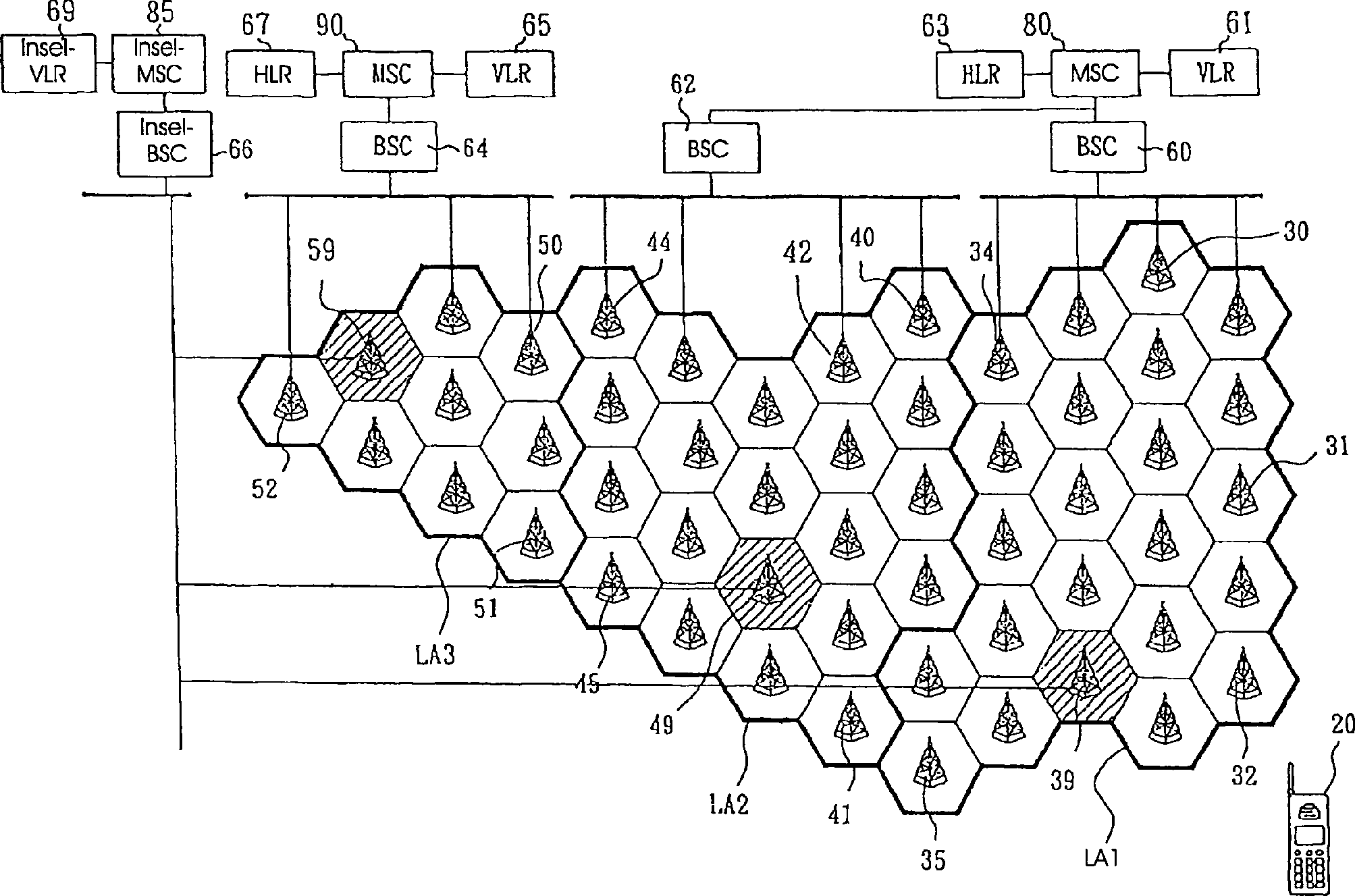
Figure 00000001
Figure 00000001

Description

Die Erfindung betrifft eine Mobil-Kommunikations-Anordnung und insbesondere eine inselartige zellenbasierte Mobil-Kommunikations-Anordnung.The The invention relates to a mobile communication device, and more particularly an island-like cell-based mobile communication device.

Die Technologie der Mobil-Kommunikation hat eine schnelle, spektakuläre Entwicklung erfahren, die zu einer verstärkten Benutzung von Telekommunikations-Produkten, wie beispielsweise von Mobilfunktelefonen, geführt hat. Herkömmlich können bei einer mobilfunktelefonbasierten Kommunikation verschiedene Arten von Techniken implementiert sein. Beispielsweise werden in einem globalen System für Mobil-Kommunikation (global system for mobile communication – GSM) eine Zugriffstechnik des Zeit-Multiplex-Verfahrens (time division multiplex access – TDMA) und eine Duplex-Technik des Frequenz-Duplex-Verfahrens (frequency division multiplex – FDD) angewendet. Beim GSM wird, wenn es nicht erforderlich ist, einen Anruf während eines zyklischen Funkrufs (Paging) zu tätigen (beispielsweise ein Funkruf alle 30 Minuten), ein Mobilfunktelefon nicht mit dem GSM zur Bestätigung des Standorts nach einer Standort-Aktualisierungs-Prozedur in Bezug auf das GSM kommunizieren, um elektrische Energie des Mobilfunktelefons einzusparen. Das GSM-System zeichnet nur den dem Mobilfunktelefon zugeordneten lokalen Bereich (local area – LA) auf. Jedoch kann ein einziger Standort-Bereich mehr als 100 Basisstationen (base transceiver stations – BTSs) abdecken, wobei jede Basisstation dazu bestimmt ist, einen bestimmten Bereich, bekannt als eine Zelle, abzudecken. Im Fall des Bereitstellens von Kurznachrichtendiensten (short message services – SMSs) allen Mobilfunktelefonen in einigen speziellen Zellen wird das GSM-System bestätigen, welche Mobilfunktelefone im lokalen Bereich sich in den bestimmten Zellen befinden, indem alle Basisstationen angefordert werden, nacheinander alle Mobilfunktelefone anzupagen, und dann werden alle Teilnehmerrufnummern (mobile subscriber integrated services digital networks – MSISDNs) aller Mobilfunktelefone in den speziellen Zellen erlangt. Als Nächstes wird das GSM-System allen Mobilfunktelefonen in einigen spe ziellen Zellen basierend auf den Teilnehmerrufnummern Kurznachrichtendienste bereitstellen. Diese zwangsläufigen Funkrufe werden signifikant die Systemlast des Systems erhöhen und Systemressourcen verschwenden. Daher gibt es ein Bedürfnis zur Verbesserung, um die vorgenannten Probleme zu verringern und/oder zu beseitigen.The Technology of mobile communication has a fast, spectacular development experienced, which strengthened Use of telecommunication products, such as Mobile phones, guided Has. conventional can at a mobile phone-based communication different types be implemented by techniques. For example, in one global system for Mobile communication (GSM) Access technique of time-division multiplexing (time division multiplex access - TDMA) and a duplex technique of frequency duplexing (frequency division multiplex - FDD) applied. When GSM is, if it is not required, one Call during paging (e.g. a paging call) every 30 minutes), a mobile phone does not use the GSM to confirm the Location after a location update procedure to communicate to the GSM to electrical energy of the mobile phone save. The GSM system records only the one assigned to the mobile phone local area (LA) on. However, a single location area can have more than 100 base stations (base transceiver stations - BTSs) each base station is destined to a specific Area, known as a cell, to cover. In the case of providing Short message services (SMS) to all mobile phones in some special cells, the GSM system will confirm which ones Mobile phones in the local area are located in specific cells by requesting all base stations, one after the other all mobile telephones to pick up, and then all subscriber numbers (mobile subscriber integrated services digital networks - MSISDNs) of all mobile phones in the special cells. Next is the GSM system for all mobile phones in some special cells provide short message services based on the subscriber numbers. These inevitable Paging will significantly increase the system load of the system and system resources waste. Therefore, there is a need for improvement in order to reduce and / or eliminate the aforementioned problems.

In US 6,052,591 wird eine Funk-Kommunikationsanordnung beschrieben, mit der spezielle Nachrichten an Mobilfunkeinrichtungen in bestimmten Zellen oder auch in bestimmten geographischen Bereichen gesandt werden können.In US 6,052,591 a radio communication arrangement is described with which special messages can be sent to mobile devices in certain cells or in certain geographical areas.

In WO 98/02008 wird ein Mobil-Kommunikationsnetzwerk beschrieben, welches auch einen privaten Netzwerk-Bereich aufweist. Es wird verhindert, dass sich dem öffentlichen Netzwerk zugeordnete Mobilfunkeinrichtungen unbefugt in das private Netzwerk einklinken.In WO 98/02008 a mobile communication network is described which also has a private network area. It is prevented that the mobile network associated with the public network unauthorized connect to the private network.

Der Erfindung liegt die Aufgabe zugrunde, eine inselartige Mobil-Kommunikations-Anordnung zu schaffen, die in der Lage ist, Teilnehmerrufnummern aller Mobilfunktelefone in Inselzellen zum Bereitstellen eines speziellen Nachrichtendienstes zu erlangen.Of the Invention is based on the object, an island-like mobile communication arrangement which is able to call subscriber numbers of all mobile phones in island cells for providing a special news service to get.

Der Erfindung liegt die andere Aufgabe zugrunde, eine inselartige Mobil-Kommunikations-Anordnung bereitzustellen, die in der Lage ist, Teilnehmerrufnummern aller Mobilfunktelefone in Insel-Zellen zu erlangen, ohne die Last auf die Mobil-Kommunikations-Anordnung zu erhöhen.Of the Invention is based on the other object, an island-like mobile communication arrangement that is able to provide subscriber numbers of all To obtain cellular phones in island cells without the burden on the mobile communication arrangement to increase.

Um die obigen und andere Aufgaben zu lösen, wird durch die Erfindung eine inselartige Mobil-Kommunikations-Anordnung bereitgestellt, die aufweist: eine Mehrzahl von Basisstationen, jeweils entsprechend einer Zelle und in ihr gesetzt und verwendet, zumindest einer Mobil-Kommunikations-Einrichtung in der Zelle einen Mobil-Kommunikations-Dienst bereitzustellen, wobei eine Mehrzahl der Zellen zumindest einen Aufenthaltsbereich bildet, der zumindest eine Insel-Zelle aufweist, wobei die zumindest eine Insel-Zelle eine Insel-Basisstation aufweist und einem Insel-Aufenthaltsbereich entspricht, welcher sich von dem Aufenthaltsbereich unterscheidet; eine Insel-Funkbasissteuerung (base station controller – BSC), gekoppelt nur mit den Insel-Basisstationen und verwendet, deren Betrieb zu steuern; eine Insel-Mobilfunknetz-Vermittlungsstelle (mobile switching center – MSC), gekoppelt nur mit der Insel-Funkbasissteuerung und verwendet, deren Betrieb zu steuern, wobei zumindest eine Mobil-Kommunikations-Einrichtung, während sie die Insel-Zelle betritt, die Insel-Mobilfunknetz-Vermittlungsstelle zum Zwecke des Standort-Aktualisierens anfragt, wenn sich die Mobil-Kommunikations-Einrichtung von einer Zelle, die mit dem Aufenthaltsbereich korrespondiert, in die Inselzelle hinein bewegt, die mit dem Insel-Aufenthaltsbereich korrespondiert, welcher sich von dem Aufenthaltsbereich unterscheidet; und ein Insel-Besucherverzeichnis (visitor location register – VLR), das der Mobilfunk-Vermittlungsstelle entspricht und mit ihr gekoppelt ist, wobei das Insel-Besucherverzeichnis, wenn die zumindest eine Mobil-Kommunikations-Einrichtung die Standort-Aktualisierung beendet, eine Teilnehmerrufnummer der jeweiligen Mobil-Kommunikations-Einrichtung aufzeichnet; wobei die Insel-Mobilfunknetz-Vermittlungsstelle der zumindest einen Mobil-Kommunikations-Einrichtung in der zumindest einen Insel-Zelle mittels Lesens der in dem Besucherverzeichnis aufgezeichneten Teilnehmerrufnummern einen speziellen Dienst bietet.In order to achieve the above and other objects, the present invention provides an island-type mobile communication device comprising: a plurality of base stations, each corresponding to a cell and set and used therein, at least one mobile communication device in the Cell to provide a mobile communication service, wherein a plurality of the cells forms at least one residence area having at least one island cell, wherein the at least one island cell has an island base station and corresponds to an island residence area, which is different from the Lounge area is different; an island base station controller (BSC) coupled only to the island base stations and used to control their operation; an island mobile switching center (MSC) coupled only to the island radio base controller and used to control its operation, wherein at least one mobile communication device enters the island cell network as it enters the island cell -Calling station for location updating request when the mobile communication device moves from a cell corresponding to the location area into the island cell corresponding to the island location area which is different from the location area; and an visitor location register (VLR) corresponding to and coupled to the mobile switching center, wherein the island visitor directory, when the at least one mobile communication device completes the location update, has a directory number of the respective one Mobile communication device records; wherein the island mobile network switch of the at least one mobile communication device in the at least one island cell, by reading the directory numbers recorded in the visitor directory, is a special one len service offers.

Ein bevorzugtes Ausführungsbeispiel der Erfindung wird nachstehend mit Bezug auf die Zeichnung ausführlich beschrieben.One preferred embodiment The invention will be described below in detail with reference to the drawings.

Es zeigenIt demonstrate

1 eine schematische Ansicht eines GSM gemäß dem Stand der Technik; 1 a schematic view of a GSM according to the prior art;

2 ein Blockdiagramm des GSM des Standes der Technik; 2 a block diagram of the GSM of the prior art;

3 eine schematische Ansicht einer erfindungsgemäßen Insel-Funkbasissteuerung und eines Mobilfunktelefons; 3 a schematic view of an island radio base control according to the invention and a mobile phone;

4 ein Blockdiagramm der erfindungsgemäßen inselartigen Mobil-Kommunikations-Anordnung; und 4 a block diagram of the island-like mobile communication arrangement according to the invention; and

5 eine schematische Ansicht spezieller Dienste, die von der erfindungsgemäßen inselartigen Mobil-Kommunikations-Anordnung bereitgestellt werden. 5 a schematic view of specific services that are provided by the island-like mobile communication arrangement according to the invention.

Unter Bezugnahme auf 1 und 2 ist ein wohlbekanntes GSM-Netzwerk gezeigt, bei dem ein Mobilfunktelefon 20 in der Lage ist, mit einem anderen Mobilfunktelefon zu kommunizieren. Das Mobilfunktelefon 20 ist auch bekannt als eine Mobilstation (mobile station – MS). In dem Mobilfunktelefon 20 ist eine bestimmte Teilnehmerrufnummer (MSISDN), auch bekannt als die Nummer des Mobilfunktelefons, gespeichert. Im Fall des Em pfangens eines eingehenden Anrufs oder des Initiierens eines Anrufs weiß das GSM, wo sich das Mobilfunktelefon 20 befindet (beispielsweise LA1 entsprechend der Funkbasissteuerung 60), indem ein Standortverzeichnis (home location register – HLR) 72 angefragt wird. Dann ordnet die Funkbasissteuerung 60 zum Kommunizieren mit dem Mobilfunktelefon 20 eine der Basisstationen (beispielsweise BTS 30) zu. Jede Komponente des GSM wird nachstehend ausführlich beschrieben.With reference to 1 and 2 a well-known GSM network is shown in which a mobile phone 20 is able to communicate with another mobile phone. The mobile phone 20 is also known as a mobile station (MS). In the mobile phone 20 is a specific subscriber number (MSISDN), also known as the number of the mobile phone stored. In the case of receiving an incoming call or initiating a call, the GSM knows where the mobile phone is 20 located (for example, LA1 according to the radio base control 60 ) by using a home location register (HLR) 72 is requested. Then assign the radio base controller 60 to communicate with the mobile phone 20 one of the base stations (for example BTS 30 ) too. Each component of the GSM will be described in detail below.

Eine Basisstation ist eingerichtet, Sprache zum Mobilfunktelefon 20 zu senden oder Sprache vom Mobilfunktelefon 20 zu empfangen. Wie in 1 gezeigt, sind die Basisstationen 30, 31, 32, 33, 34 und 35 in LA1 angeordnet, die Basisstationen 40, 41, 42, 43, 44, und 45 sind in LA2 angeordnet, bzw. sind die Basisstationen 50, 51, 52 und 53 in LA3 angeordnet.A base station is set up, voice to the mobile phone 20 to send or voice from the mobile phone 20 to recieve. As in 1 shown are the base stations 30 . 31 . 32 . 33 . 34 and 35 located in LA1, the base stations 40 . 41 . 42 . 43 . 44 , and 45 are located in LA2, respectively are the base stations 50 . 51 . 52 and 53 arranged in LA3.

Um mit einem Mobilfunktelefon zu kommunizieren, ist eine Funkbasissteuerung eingerichtet, jede Basisstation in einem lokalen Bereich zu steuern. Die Funkbasissteuerung ist ferner mit einer Mobilfunknetz-Vermittlungsstelle zum Kommunizieren mit ihr gekoppelt. Jeder lokale Bereich weist eine eindeutige Lokalbereichs-Identifizierung (location area identity – LAI) zur Verwendung als dessen Identifikation auf. Beispielsweise ist die Funkbasissteuerung 60 eingerichtet, alle Basisstationen in LA1 zu steuern. Während des Betretens des Bereiches LA1 speichert das Mobilfunktelefon 20 die Lokalbereichs-Identifizierung, die LA1 entspricht. In der gleichen Weise ist die Funkbasissteuerung 62 eingerichtet, alle Basisstationen in LA2 zu steuern. Während des Betretens von LA2 speichert das Mobilfunktelefon 20 die Lokalbereichs-Identifizierung, die LA2 entspricht. Die Funkbasissteuerung 64 ist eingerichtet, alle Basisstationen in LA3 zu steuern. Während des Betretens von LA3 speichert das Mobilfunktelefon 20 die Lokalbereichs-Identifizierung, die LA3 entspricht.To communicate with a mobile telephone, a radio base controller is arranged to control each base station in a local area. The radio base controller is further coupled to a mobile network switch for communicating with it. Each local area has a unique location area identity (LAI) for use as its identification. For example, the radio base controller 60 set up to control all base stations in LA1. While entering the area LA1 stores the mobile phone 20 the local area identifier corresponding to LA1. In the same way is the radio base control 62 set up to control all base stations in LA2. While entering LA2 stores the mobile phone 20 the local area identifier corresponding to LA2. The radio base control 64 is set up to control all base stations in LA3. While entering LA3 stores the mobile phone 20 the local area identifier corresponding to LA3.

Ein Besucherverzeichnis ist eingerichtet, die Teilnehmerrufnummer jedes Mobilfunktelefons in einem lokalen Bereich aufzuzeichnen, und bietet einer entsprechenden Mobilfunknetz-Vermittlungsstelle einen Teilnehmerrufnummern-Anfragedienst.One Visitor directory is set up, the subscriber number of each Record mobile phones in a local area and offers a corresponding mobile network switching center a subscriber number request service.

Beispielsweise zeichnet ein Besucherverzeichnis 65 die Teilnehmerrufnummer des Mobilfunktelefons 20 auf, wenn dieses LA3 betritt. Demgegenüber löscht das Besucherverzeichnis 65 die Teilnehmerrufnummer, wenn das Mobilfunktelefon 20 LA3 verlässt. Auf diese Weise kann die Mobilfunknetz-Vermittlungsstelle 90 mittels Anfragens des Besucherverzeichnisses 65 ermitteln, ob sich das Mobilfunktelefon 20 in LA3 befindet. In der gleichen Weise ist ein Besucherverzeichnis 61 eingerichtet, die Teilnehmerrufnummer jedes Mobilfunktelefons in LA1 und LA2 aufzuzeichnen und einer entsprechenden Mobilfunknetz-Vermittlungsstelle 80 einen Teilnehmerrufnummern-Anfragedienst bereitzustellen. Es ist verständlich, dass ein Besucherverzeichnis die Teilnehmerrufnummern in zumindest einem lokalen Bereich aufzeichnen kann.For example, draws a visitor directory 65 the subscriber number of the mobile telephone 20 on when this LA3 enters. In contrast, the visitor directory deletes 65 the directory number if the mobile phone 20 LA3 leaves. In this way, the mobile network switching center 90 by requesting the visitor directory 65 determine if the mobile phone 20 located in LA3. In the same way is a visitor directory 61 configured to record the directory number of each mobile station in LA1 and LA2 and a corresponding mobile network switching center 80 to provide a subscriber number request service. It will be understood that a visitor directory may record the directory numbers in at least one local area.

Das GSM kann den Standort eines Mobilfunktelefons mittels Anfragens von in einem Besucherverzeichnis gespeicherten Teilnehmerrufnummern mittels der Mobilfunknetz-Vermittlungsstelle 80 oder 90 bestätigen. Beispielsweise fragt die Mobilfunknetz-Vermittlungsstelle 90 das Besucherverzeichnis 65 nach der Teilnehmerrufnummer des Mobilfunktelefons 20 an. Antwortet das Besucherverzeichnis 65 auf die Anfrage, bestätigt das GSM, dass sich das Mobilfunktelefon 20 in LA3 befindet, anderenfalls befindet sich das Mobilfunktelefon außerhalb von LA3.The GSM may determine the location of a mobile telephone by requesting subscriber directory numbers stored in a visitor directory using the mobile network switching center 80 or 90 to confirm. For example, the mobile network switching center asks 90 the visitor directory 65 after the subscriber number of the mobile phone 20 at. Answer the visitor directory 65 Upon request, the GSM confirms that the mobile phone 20 in LA3, otherwise the mobile phone is outside of LA3.

Eine Gerätedatenbank (equipment identity register – EIR) 70 ist eingerichtet, eine eindeutige internationale Mobilfunkkennung (international mobile equipment identity – IMEI) eines Mobilfunktelefons aufzuzeichnen. Die internationale Mobilfunkkennung ist eine vom Hersteller eingestellte Nummer. Beispielsweise zeichnet das GSM die internationale Mobilfunkkennung in der Gerätedatenbank 70 auf, wenn auf das GSM zum Ermitteln des aktuellen Status' des Mobilfunktelefons zum ersten Mal zugegriffen wird. Die Gerätedatenbank 70 klassifiziert das Mobilfunktelefon als einer von drei Listen zugehörig basierend auf dem aktuellen Status des Mobilfunktelefons. Und zwar bedeutet eine Weiß-Liste, dass sich das Mobilfunktelefon in einem Normal-Status befindet, eine Grau-Liste bedeutet, dass das Mobilfunktelefon überwacht wird, und eine Schwarz-Liste bedeutet, dass das Mobilfunktelefon gestohlen wurde oder außer Betrieb ist.A device identity register (EIR) 70 is set up to record a unique international mobile equipment identity (IMEI) of a mobile phone. The international mobile phone identifier is a number set by the manufacturer. at For example, the GSM records the international mobile radio identifier in the device database 70 when the GSM is first accessed for determining the current status of the cellular phone. The device database 70 classifies the mobile radiotelephone as belonging to one of three lists based on the current status of the mobile radiotelephone. Namely, a white list means that the cellular phone is in a normal state, a gray list means that the cellular phone is being monitored, and a black list means that the cellular phone has been stolen or is out of order.

Ein Standortverzeichnis ist eingerichtet, nicht nur Basisdaten, wie beispielsweise spezielle, von Nutzern angeforderte TeleKommunikations-Dienste, Weiterleit-Nachrichten und gewünschte Übertragungs-Nummern zu speichern, sondern ebenso die Identifikations-Daten zu speichern. Jedes Mobilfunktelefon registriert sich in einem Standortverzeichnis. Beispielsweise ist das Mobilfunktelefon 20 im Standortverzeichnis 63 registriert und im Besucherverzeichnis 61 aufgezeichnet. Bewegt sich das Mobilfunktelefon 20 von einer Zelle, die von der Basisstation 30 abgedeckt wird, zu einer anderen Zelle, die von der Basisstation 50 abgedeckt wird, bedeutet dies, dass sich das Mobilfunktelefon 20 von LA1 (der von der Mobilfunknetz-Vermittlungsstelle 90 nicht bedient wird) zu LA3 (der von der Mobilfunknetz-Vermittlungsstelle 90 bedient wird) bewegt. Das Mobilfunktelefon 20 fragt die Mobilfunknetz-Vermittlungsstelle 90 um die Bereitstellung eines Kommunikations-Dienstes an, wobei die Mobilfunknetz-Vermittlungsstelle 90 die Basisdaten und die Identifikations-Daten, die im Standortverzeichnis 63 registriert sind, vergleicht. Stimmen die Daten überein, bedient die Mobilfunknetz-Vermittlungsstelle 90 das Mobilfunktelefon 20 und zeichnet die Teilnehmerrufnummer im Besucherverzeichnis 65 auf. Es ist verständlich, dass die Teilnehmerrufnummer im Besucherverzeichnis 61 von der Mobilfunknetz-Vermittlungsstelle 80 gelöscht wird.A location directory is arranged not only to store basic data such as special user-requested tele-communication services, forwarding messages and desired transmission numbers, but also to store the identification data. Each mobile phone registers in a location directory. For example, the mobile phone 20 in the location directory 63 registered and in the visitor directory 61 recorded. Moves the mobile phone 20 from a cell, from the base station 30 is covered to another cell by the base station 50 is covered, this means that the mobile phone 20 from LA1 (the one from the mobile network switch 90 is not serviced) to LA3 (the one from the mobile network switch 90 is operated) moves. The mobile phone 20 asks the mobile network switching center 90 to provide a communication service, wherein the mobile network switching center 90 the basic data and the identification data in the location directory 63 registered, compares. If the data matches, the mobile network switching center serves 90 the mobile phone 20 and records the subscriber number in the visitor directory 65 on. It is understandable that the subscriber number in the visitor directory 61 from the mobile network switch 80 is deleted.

Die Authentisierungszentrale (authentification center – AUC) 74 ist eingerichtet, Parameter bereitzustellen, die zum Durchführen einer Authentifizierung durch das Mobilfunktelefon 20 erforderlich sind. Das Mobilfunktelefon 20 fordert das GSM an, sich zu authentifizieren, indem es ihm die Mobilfunk-Teilnehmerkennung (international mobile subscriber identity – IMSI), die Teilnehmerrufnummer oder dergleichen bereitstellt. Als Nächstes nutzt das GSM die Parameter des Mobilfunktelefons 20, die in der Authentisierungszentrale 74 gespeichert sind, um das Mobilfunktelefon 20 zu authentifizieren. Nach dem Beenden der Authentifizierung des Mobilfunktelefons 20 werden dem Mobilfunktelefon 20 eine temporäre Teilnehmernummer (temporary mobile subscriber identity – TMSI) und eine Lokalbereichs-Identifizierung basierend auf einem bestimmten Protokoll zugeordnet, wobei die Lokalbereichs-Identifizierung dem lokalen Bereich des Mobilfunktelefons 20 entspricht. Die obige Prozedur ist als Aufenthalts-Registrierung bekannt. Das Mobilfunktelefon 20 speichert die temporäre Teilnehmernummer und die Lokalbereichs-Identifizierung. Das Mobilfunktelefon 20 fordert das GSM an, sich zu authentifizieren, indem es ihm vor dem Kommunizieren mit dem GSM die temporäre Teilnehmernummer und die Lokalbereichs-Identifizierung bereitstellt. Mit anderen Worten ist die Kommunikation zwischen dem Mobilfunktelefon 20 und dem GSM nur möglich, nachdem die Authentifizierung abgeschlossen wurde.The Authentication Center (AUC) 74 is arranged to provide parameters necessary for performing authentication by the mobile phone 20 required are. The mobile phone 20 requests the GSM to authenticate by providing it with the International Mobile Subscriber Identity (IMSI), Subscriber Number or the like. Next, the GSM uses the parameters of the cellular phone 20 that are in the authentication center 74 are stored to the mobile phone 20 to authenticate. After completing the authentication of the mobile phone 20 be the mobile phone 20 a temporary mobile subscriber identity (TMSI) and a local area identifier based on a particular protocol associated with the local area identifier to the local area of the mobile telephone 20 equivalent. The above procedure is known as Residence Registration. The mobile phone 20 stores the temporary subscriber number and the local area identifier. The mobile phone 20 requests the GSM to authenticate by providing it with the temporary subscriber number and local area identifier prior to communicating with the GSM. In other words, the communication between the mobile phone 20 and the GSM only after the authentication has been completed.

Es ist nicht erforderlich, Daten des Mobilfunktelefons 20 zu aktualisieren, wenn sich das Mobilfunktelefon von einer von der Basisstation 30 abgedeckten Zelle zu einer von der Basisstation 35 abgedeckten Zelle bewegt, da beide Zellen von der Mobilfunknetz-Vermittlungsstelle 80 gesteuert werden. Bewegt sich jedoch das Mobilfunktelefon 20 von der Zelle zu einer anderen Zelle, die von der Basisstation 50 abgedeckt wird, fordert das Mobilfunktelefon 20 mittels Bereitstellens der temporären Teilnehmernummer und der Lokalbereichs-Identifizierung dem GSM, dieses an, den Standort zu aktualisieren, da sich das Mobilfunktelefon 20 außerhalb des Bereichs befindet, der von der Mobilfunknetz-Vermittlungsstelle 80 bedient wird, und in dem Bereich befindet, der von der Mobilfunknetz-Vermittlungsstelle 90 bedient wird. Das GSM löscht die im Besucherverzeichnis 61 aufgezeichnete Teilnehmerrufnummer des Mobilfunktelefons 20 und zeichnet die Teilnehmerrufnummer im Besucherverzeichnis 65 auf und ordnet dem Mobilfunktelefon 20 eine neue Lokalbereichs-Identifizierung zu, die LA3 entspricht. Der obige Prozess ist bekannt als Standort-Aktualisierung.It is not necessary data of the mobile phone 20 to update when the mobile phone from one of the base station 30 covered cell to one of the base station 35 covered cell moves as both cells from the mobile network switching center 80 to be controlled. However, the mobile phone is moving 20 from the cell to another cell, from the base station 50 is covered calls the mobile phone 20 by providing the temporary subscriber number and the local area identifier to the GSM, this will update the location as the mobile phone 20 is outside the scope of the mobile network switching center 80 is operated and located in the area covered by the mobile network switching center 90 is served. The GSM deletes the in the visitor directory 61 recorded subscriber number of the mobile telephone 20 and records the subscriber number in the visitor directory 65 on and assigns the mobile phone 20 a new local area identifier corresponding to LA3. The above process is known as site upgrade.

Eine Gateway-Mobilfunknetz-Vermittlungsstelle (Gateway MSC – GMSC) 76 ist mit einem Backbone 78 gekoppelt. Die Mobilfunknetz-Vermittlungsstelle 80 ist eingerichtet, Sprachdaten vom Mobilfunktelefon 20 zum Backbone 78 zu senden oder Sprachdaten vom Backbone 78 zu empfangen, damit diese zum Mobilfunktelefon 20 gesendet werden. Der Backbone 78 ist als ein bestehendes Netzwerk, wie beispielsweise ISDN, öffentliches Telefonnetz (public system telephone network – PSTN) oder öffentliches landgestütztes Mobilfunknetz (public land mobile network – PLMN) implementiert. Das GSM kann über ein öffentliches Telefonnetz mit einer Telefonleitung, über ISDN mit einer entfernten Mobilfunknetz-Vermittlungsstelle oder über ein öffentliches landgestütztes Mobilfunknetz mit einem GSM eines beliebig anderen Internet-Diensteanbieters (Internet service provider – ISP) gekoppelt sein.A Gateway Mobile Network Switching Center (Gateway MSC - GMSC) 76 is with a backbone 78 coupled. The mobile network switching center 80 is set up, voice data from the mobile phone 20 to the backbone 78 to send or voice data from the backbone 78 to receive, so this to the mobile phone 20 be sent. The backbone 78 is implemented as an existing network, such as ISDN, public system telephone network (PSTN) or public land mobile network (PLMN). The GSM may be coupled via a public telephone network to a telephone line, via ISDN to a remote mobile network switch, or via a public land mobile network to a GSM of any other Internet service provider (ISP).

Eine Mobilfunknetz-Vermittlungsstelle ist eine der Schaltzentren eines GSM. Von der Mobilfunknetz-Vermittlungsstelle werden viele Steuer- und Authentifizierungs-Prozeduren durchgeführt. Im Fall des Wählens einer Telefonnummer mittels des Mobilfunktelefons 20 (in LA1) fragt die Funkbasissteuerung 60 die Mobilfunknetz-Vermittlungsstelle 80 an, den Standort der Nummer zu suchen. Zunächst vergleicht die Mobilfunknetz-Vermittlungsstelle 80 jeden Datensatz im Besucherverzeichnis 61 mit der Nummer. Gibt es keinen übereinstimmenden Datensatz, liest die Mobilfunknetz-Vermittlungsstelle 80 Datensätze in Standortverzeichnissen, um den Standort der Nummer zu ermitteln. Daher kann sich die Funkbasissteuerung 60 mit der Funkbasissteuerung 64 zum Kommunizieren mit einem anderen Mobilfunktelefon verbinden. Alternativ kann sich die Funkbasissteuerung 60 mit dem Backbone 78 zum Kommunizieren mit einem Festnetztelefon verbinden.A mobile network switching center is one of the switching centers of a GSM. From the mobile In the case of the wireless network switching center, many control and authentication procedures are carried out. In the case of dialing a telephone number using the cellular phone 20 (in LA1) the radio base controller asks 60 the mobile network switching center 80 to search the location of the number. First, the mobile network switch compares 80 every record in the visitor directory 61 with the number. If there is no matching record, the mobile network switch reads 80 Records in site directories to find the location of the number. Therefore, the radio base controller may become 60 with the radio base control 64 to communicate with another mobile phone. Alternatively, the radio base control may be 60 with the backbone 78 connect to a landline telephone to communicate.

Die Operationen der Funkbasissteuerungen 60 und 62 werden beide von der Mobilfunknetz-Vermittlungsstelle 80 gesteuert. Mit anderen Worten ist eine einzige Mobilfunknetz-Vermittlungsstelle in der Lage, zumindest eine Funkbasissteuerung zu steuern, um den Kommunikations-Dienst bereitzustellen. Die Mobilfunknetz-Vermittlungsstellen 80 und 90 sind beide mit der Gateway-Mobilfunknetz-Vermittlungsstelle 76 zum Kommunizieren mit dem Backbone 78 gekoppelt. Dies ermöglicht einem Telefon, einen Anruf zum Mobilfunktelefon 20 durchzuführen. Ferner kann ein Mobilfunktelefon, das vom GSM eines beliebigen Internet-Dienstanbieters bedient wird, einen Anruf zum Mobilfunktelefon 20 tätigen und umgekehrt.The operations of radio base controllers 60 and 62 Both are from the mobile network switch 80 controlled. In other words, a single mobile network switch is able to control at least one radio base controller to provide the communication service. The mobile network switching centers 80 and 90 are both with the gateway mobile network switch 76 to communicate with the backbone 78 coupled. This allows a phone to make a call to the mobile phone 20 perform. Further, a mobile phone served by the GSM of any Internet service provider may make a call to the mobile phone 20 do and vice versa.

Das typische GSM wurde beschrieben. Im Falle des Kommunizierens zwischen dem GSM und dem Mobilfunktelefon 20 ermittelt das GSM zunächst den Standort (d. h. den lokalen Bereich) des Mobilfunktelefons 20 und ordnet eine geeignete Basisstation zu, um eine drahtlose Verbindung zum Mobilfunktelefon 20 aufzubauen. Es gibt drei Verfahren, die vom GSM durchgeführt werden, um die Zelle des Mobilfunktelefons 20 zu ermitteln und eine geeignete Basisstation zuzuordnen. Und zwar ist ein erstes Verfahren, dass jede Basisstation ein Funkruf-Signal sendet und dann auf eine Antwort vom Mobilfunktelefon 20 zum Ermitteln der Zelle des Telefons 20 wartet und eine Basisstation zuordnet, um eine drahtlose Verbindung zum Telefon 20 aufzubauen. Dies wird GSM-Ressourcen verschwenden und die Effizienz verringern. Ein zweites Verfahren ist, dass die Zelle des Mobilfunktelefons 20, wenn das Telefon 20 eine neue Zelle betritt, vom GSM aktualisiert wird. Dies hat den Nachteil, dass vom GSM eine große Anzahl von Aktualisierungen durchgeführt werden muss, was zu einer starken Erhöhung der Belastung des GSM führt. Ein drittes Verfahren ist, dass ein lokaler Bereich aus vielen Basisstationen zusammengesetzt ist, und eine Standort-Aktualisierung wird nur dann durchgeführt, wenn sich das Telefon 20 von seinem aktuellen lokalen Bereich zu einem anderen lokalen Bereich bewegt, wobei eine Funkruf-Prozedur als das Pagen von Signalen definiert ist, die von allen Basisstationen im selben lokalen Bereich gesendet werden. Das dritte Verfahren wird vom aktuellen GSM angewendet.The typical GSM has been described. In the case of communicating between the GSM and the mobile phone 20 The GSM first determines the location (ie the local area) of the mobile telephone 20 and assigns a suitable base station to a wireless connection to the mobile telephone 20 build. There are three methods that are performed by the GSM to the cell of the mobile phone 20 to determine and assign a suitable base station. Namely, a first method is that each base station sends a paging signal and then a response from the cellular phone 20 to determine the cell of the phone 20 waits and assigns a base station to a wireless connection to the phone 20 build. This will waste GSM resources and reduce efficiency. A second method is that the cell of the mobile phone 20 when the phone 20 a new cell enters, is updated by the GSM. This has the disadvantage that a large number of updates must be made by the GSM, which leads to a strong increase in the load of the GSM. A third method is that a local area is composed of many base stations, and a location update is performed only when the phone is down 20 moves from its current local area to another local area, where a paging procedure is defined as paging signals sent by all base stations in the same local area. The third method is used by the current GSM.

Das Mobilfunktelefon 20 geht in einen Ruhezustand über, wenn es eine Aufenthalts-Registrierungs- oder eine Standort-Aktualisierungs-Prozedur ausführt. Zu diesem Zeitpunkt kennt das GSM lediglich den aktuellen Standort (d. h. den lokalen Bereich) des Mobilfunktelefons 20 anstelle der aktuellen Zelle des Mobilfunktelefons 20. Es gibt drei Verfahren, die vom GSM durchgeführt werden, um die Zelle des Mobilfunktelefons 20 zu ermitteln. Das erste Verfahren ist ein zyklischer Funkruf. Um zu gewährleisten, dass das Mobilfunktelefon 20 ständig eingeschaltet ist und sich in seiner Zelle befindet, wird das GSM periodisch das Mobilfunktelefon 20 anpagen. Die Zeitdauer des Zyklus' hängt von den Anwendungen ab. Beispielsweise beträgt die Zeitdauer 30 Minuten. Das zweite Verfahren ist ein aktiver Funkruf, der angewendet wird, wenn das GSM vom Telefon 20 einen eingehenden Anruf empfängt. Im Fall, dass sich Telefon 20 in einer Zelle befindet, die von der Basisstation 33 abgedeckt wird, weiß das GSM über die Standort-Aktualisierungs-Prozedur, ob sich das Telefon 20 in LA1 befindet. Gibt es vom Telefon 20 einen eingehenden Anruf, fordert das GSM alle Basisstationen (beispielsweise die Basisstationen 30, 31, 32, 33, 34 und 35), die von der Funkbasissteuerung 60 gesteuert werden, an, zur gleichen Zeit einen Funkruf in Bezug auf das Telefon 20 durchzuführen, und wartet auf eine Antwort vom Telefon 20. Zeigt die Antwort an, dass sich das Mobilfunktelefon 20 in einer Zelle befindet, die der Basisstation 33 entspricht, fordert das GSM die Basisstation 33 an, eine drahtlose Verbindung zum Mobilfunktelefon 20 aufzubauen und mit ihm zu kommunizieren. Ein drittes Verfahren ist ein aktiver Funkruf des Mobilfunktelefons, der angewendet wird, wenn das Mobilfunktelefon (beispielsweise das Mobilfunktelefon 20) einen Anruf initiiert. Im Fall des Wählens des Mobilfunktelefons 20 fordert das Mobilfunktelefon 20 eine Verbindung zum GSM über die Basisstation 33 an. Als Antwort kommuniziert das GSM über die Basisstation 33 mit dem Mobilfunktelefon 20.The mobile phone 20 enters a sleep state when executing a resume registration or location update procedure. At this time, the GSM knows only the current location (ie the local area) of the cellular phone 20 instead of the current cell of the mobile phone 20 , There are three methods that are performed by the GSM to the cell of the mobile phone 20 to investigate. The first method is a cyclic paging. To ensure that the mobile phone 20 is constantly turned on and is in its cell, the GSM periodically becomes the mobile phone 20 anpagen. The duration of the cycle depends on the applications. For example, the duration is 30 Minutes. The second method is an active page call that is used when the GSM is off the phone 20 receives an incoming call. In case that is phone 20 in a cell located by the base station 33 The GSM knows about the location update procedure if the phone is down 20 located in LA1. Is it from the phone 20 an incoming call, the GSM requests all base stations (for example the base stations 30 . 31 . 32 . 33 . 34 and 35 ), by the radio base controller 60 be controlled at the same time a paging with respect to the phone 20 and wait for a response from the phone 20 , Indicates the answer that the mobile phone 20 located in a cell, that of the base station 33 corresponds, the GSM requests the base station 33 on, a wireless connection to the mobile phone 20 build and communicate with him. A third method is an active paging of the cellular phone that is applied when the cellular phone (for example, the cellular phone 20 ) initiated a call. In the case of dialing the mobile phone 20 calls the mobile phone 20 a connection to the GSM via the base station 33 at. In response, the GSM communicates via the base station 33 with the mobile phone 20 ,

Es wird angenommen, dass es drei Warenhäuser A, B und C in Zellen gibt, die von den Basisstationen 33, 43 bzw. 53 abgedeckt werden. Die Warenhäuser A, B und C sind Verkaufsstellen. Es wird ferner angenommen, dass das GSM beabsichtigt, einen Kurznachrichtendienst von „Alle Waren sind um 50% ermäßigt” an die Kunden in der Nähe der Warenhäuser A, B und C zum Zwecke der Werbung auszuführen. Bei einigen militärischen Kontrollbereichen gibt es bei Teilnehmerrufnummern-Listen eine Forderung, dass die Identität der jeweiligen Person zu prüfen ist. Jedoch ist das GSM des Standes der Technik nicht in der Lage, dieses Ziel zu erreichen, ohne die Last auf die Anordnung zu erhöhen.It is assumed that there are three department stores A, B and C in cells that are used by the base stations 33 . 43 respectively. 53 be covered. Department stores A, B and C are outlets. It is further assumed that the GSM intends to execute a short message service of "All goods are 50% off" to the customers near the department stores A, B and C for the purpose of advertisement. In some military control areas, there is a requirement for subscriber telephone number lists to verify the identity of the individual fen is. However, the prior art GSM is unable to achieve this goal without increasing the load on the device.

Unter Bezugnahme auf 3 und 4 ist eine erfindungsgemäße inselartige Mobil-Kommunikations-Anordnung dargestellt. Die Basisstationen 33, 43 und 53 sind als Insel-Basisstationen 39, 49 bzw. 59 neu festgelegt. Ferner sind die Insel-Basisstationen 39, 49 und 59 mit einer Insel-Funkbasissteuerung 66 gekoppelt, allerdings nicht gekoppelt mit den Funkbasissteuerungen 60, 62 bzw. 64. Ferner ist den Insel-Basisstationen 39, 49 und 59 eine ihnen entsprechende Lokalbereichs-Identifizierung zugeordnet. Wie in 3 gezeigt, sind die Insel-Basisstationen 39, 49 und 59 voneinander getrennt. Die Insel-Funkbasissteuerung 66 ist mit einer Insel-Mobilfunknetz-Vermittlungsstelle 85 gekoppelt, und die Insel-Mobilfunknetz-Vermittlungsstelle 85 ist mit einem Insel-Besucherverzeichnis 69 gekoppelt. Alle von den Basisstationen 30, 31, 32, 34 und 35 abgedeckten Zellen entsprechen LA1 und sind einer bestimmten Lokalbereichs-Identifizierung zum Kommunizieren mit Mobilfunktelefonen zugeordnet. In der gleichen Weise entsprechen alle Zellen, die von den Basisstationen 40, 41, 42, 44 und 45 abgedeckt werden, LA2 und sind einer speziellen Lokalbereichs-Identifizierung zum Kommunizieren mit Mobilfunktelefonen zugeordnet. Ebenso entsprechen alle von den Basisstationen 50, 51 und 52 abgedeckten Zellen LA3 und sind einer speziellen Lokalbereichs-Identifizierung zum Kommunizieren mit Mobilfunktelefonen zugeordnet. Ferner entsprechen alle Inselzellen, die von den Insel-Basisstationen 39, 49 und 59 abgedeckt werden, dem Insel-Lokalbereich und sind einer speziellen Aufenthaltsbereichs-Identifizierung zugeordnet, unter der die Insel-Basisstationen 39, 49 und 59 mit Mobilfunktelefonen kommunizieren. Die Funktionalität der Insel-Funkbasissteuerung 66 ist die gleiche wie die jeder der Funkbasissteuerungen 60, 62 und 64. Ebenso ist die Funktionalität des Insel-Besucherverzeichnisses 69 die gleiche wie die der Besucherverzeichnisse 61 und 65.With reference to 3 and 4 an island-like mobile communication arrangement according to the invention is shown. The base stations 33 . 43 and 53 are as island base stations 39 . 49 respectively. 59 redefined. Further, the island base stations 39 . 49 and 59 with an island radio base control 66 coupled, but not coupled with the radio base controls 60 . 62 respectively. 64 , Further, the island base stations 39 . 49 and 59 associated with a local area identifier corresponding to them. As in 3 shown are the island base stations 39 . 49 and 59 separated from each other. The island radio base control 66 is with an island mobile network switch 85 coupled, and the island mobile network switching center 85 is with an island visitor directory 69 coupled. All from the base stations 30 . 31 . 32 . 34 and 35 covered cells correspond to LA1 and are associated with a particular local area identifier for communicating with mobile telephones. In the same way, all cells correspond to those of the base stations 40 . 41 . 42 . 44 and 45 LA2 and are associated with a specific local area identifier for communicating with mobile phones. Likewise, all correspond to the base stations 50 . 51 and 52 covered cells LA3 and are associated with a specific local area identifier for communicating with mobile telephones. Further, all the islet cells correspond to those from the island base stations 39 . 49 and 59 be covered, the island local area and are assigned to a special location area identification, under which the island base stations 39 . 49 and 59 communicate with mobile phones. The functionality of the island radio base control 66 is the same as that of each of the radio base controllers 60 . 62 and 64 , Likewise, the functionality of the island visitor directory 69 the same as the visitor directories 61 and 65 ,

Das Mobilfunktelefon 20 fragt das GSM an, den Standort zu aktualisieren und die Teilnehmerrufnummer des Mobilfunktelefons im Insel-Besucherverzeichnis 69 aufzuzeichnen, während es den Insel-Lokalbereich von LA1 aus betritt, da sich die entsprechenden Mobilfunknetz-Vermittlungsstellen unterscheiden. Es ist verständlich, dass das Besucherverzeichnis 61 Daten und Teilnehmerrufnummer des Mobilfunktelefons 20 aktualisiert. Daher zeichnet das Insel-Besucherverzeichnis 69 die Teilnehmerrufnummern aller Mobilfunktelefone in den Insel-Zellen auf, die von den Insel-Basisstationen 39, 49 und 59 abgedeckt werden. Im Fall des Bereitstellens eines Kurznachrichtendienstes zu Werbezwecken von den Warenhäusern A, B und C den Kunden stellt das GSM den Kurznachrichtendienst nacheinander allen im Insel-Besucherverzeichnis 69 aufgezeichneten Teilnehmerrufnummern bereit. Das GSM kann mittels Lesens des Insel-Besucherverzeichnisses 69 eine Liste von Teilnehmerrufnummern bereitstellen.The mobile phone 20 The GSM asks to update the location and the subscriber number of the mobile phone in the island visitor directory 69 record as it enters the island local area of LA1 because the respective mobile network switches differ. It is understandable that the visitor directory 61 Data and subscriber number of the mobile telephone 20 updated. Therefore, draws the island visitor directory 69 the subscriber numbers of all mobile telephones in the island cells, those of the island base stations 39 . 49 and 59 be covered. In the case of providing a short message service for promotional purposes from the department stores A, B and C to the customer, the GSM sequentially sets the short message service to all in the island visitor directory 69 recorded subscriber numbers ready. The GSM can by reading the island visitor directory 69 provide a list of subscriber numbers.

Unter Bezugnahme auf 5 kann die inselartige Mobil-Kommunikations-Anordnung der Erfindung einen speziellen Dienst, der einen Kurznachrichtendienst, einen Multimedia-Nachrichtendienst (multimedia message service – MMS) oder dergleichen aufweist, jedem der Mobilfunktelefone 201 und 202 bereitstellen. Der Multimedia-Nachrichtendienst ist ein Typ eines Dokumentenformats, das Bilder, Animationen, Sprache oder Bewegt-Bilder aufweist.With reference to 5 For example, the island-type mobile communication device of the invention may include a special service including a short message service, a multimedia message service (MMS), or the like, any of the cellular phones 201 and 202 provide. The multimedia message service is a type of document format that has pictures, animations, speech or motion pictures.

Kurz gesagt werden durch die Erfindung in jedem lokalen Bereich eine Basisstation als eine Insel-Basisstation festgelegt, der Insel-Basisstation eine bestimmte Lokalbereichs-Identifizierung zugeordnet und die Teilnehmerrufnummer des Mobilfunktelefons 20 im Insel-Besucherverzeichnis 69 aufgezeichnet. Dadurch kann die inselartige Mobil-Kommunikations-Anordnung alle Teilnehmerrufnummern in den Insel-Basisstationen erkennen, indem vor dem Initiieren eines Kurznachrichtendienstes Datensätze des Insel-Besucherverzeichnisses 69 gelesen werden. Die inselartige Mobil-Kommunikations-Anordnung weist im Wesentlichen die gleiche Struktur auf wie die des GSM des Standes der Technik. Auch ist das Kommunikations protokoll oder der Kommunikationsbetrieb des GSM durch die Erfindung nicht verändert. Das Verfahren der Erfassung des Mobil-Standortes wird kein zusätzlicher Funkruf in Bezug auf die Mobilfunktelefone beinhalten, wobei lediglich einige wenige Male eine Standort-Aktualisierung durchgeführt wird. Als ein Ergebnis bleiben GSM-Ressourcen gut gewahrt. Ferner ist die Erfindung ebenso auf beliebig andere Mobil-Kommunikations-Systeme anwendbar, wie beispielsweise das Universal Mobile Telecommunications System (UMTS) oder ein Mobil-Kommunikations-System der dritten Generation, da jedes der obigen beschriebenen Mobil-Kommunikations-Systeme im Wesentlichen das Gleiche ist wie das GSM, abgesehen davon, dass beim Kommunizieren mit einem Mobilfunktelefon andere Protokolle verwendet werden, wobei jedes der obigen beschriebenen Mobil-Kommunikations-Systeme ein zellenbasiertes System ist. Das Mobilfunktelefon kann durch einen persönlichen digitalen Assistenten (personal digital assistant – PDA), ein Smartphone oder einen Laptop ersetzt sein, die mit den Mobil-Kommunikations-Anordnungen über ein Kommunikations-Modul kommunizieren können.Briefly, by the invention, in each local area, a base station is designated as an island base station, the island base station is assigned a particular local area identification, and the subscriber number of the mobile radio telephone 20 in the island visitor directory 69 recorded. Thereby, the island-like mobile communication arrangement can recognize all the subscriber numbers in the island base stations by prior to initiating a short message service records of the island visitor's directory 69 to be read. The island-type mobile communication device has substantially the same structure as that of the prior art GSM. Also, the communication protocol or the communication mode of the GSM is not changed by the invention. The method of detecting the mobile location will not involve additional paging with respect to the cellular phones, with only a few times a location update being performed. As a result, GSM resources are well preserved. Further, the invention is equally applicable to any other mobile communication systems, such as the Universal Mobile Telecommunications System (UMTS) or a third generation mobile communication system, since each of the above described mobile communication systems performs substantially the same Like the GSM, other than using different protocols when communicating with a mobile phone, each of the above described mobile communication systems is a cell-based system. The mobile phone may be replaced by a personal digital assistant (PDA), a smartphone, or a laptop that can communicate with the mobile communications devices via a communications module.

Claims (14)

Inselartige Mobil-Kommunikations-Anordnung, aufweisend: eine Mehrzahl von Basisstationen (30, 31, 32, 33, 34, 35; 40, 41, 42, 43, 44, 45; 50, 51, 52, 53), jeweils entsprechend einer Zelle und in ihr gesetzt und verwendet, zumindest einer Mobil-Kommunikations-Einrichtung (20, 201, 202) in der Zelle einen Mobil-Kommunikations-Dienst bereitzustellen, wobei eine Mehrzahl der Zellen zumindest einen Aufenthaltsbereich (LA1, LA2, LA3) bildet, aufweisend zumindest eine Insel-Zelle, wobei die zumindest eine Insel-Zelle eine Insel-Basisstation (39, 49, 59) aufweist und einem Insel-Aufenthaltsbereich entspricht, welcher sich von dem Aufenthaltsbereich unterscheidet; eine Insel-Funkbasissteuerung (66), gekoppelt nur mit den Insel-Basisstationen und verwendet, deren Betrieb zu steuern; eine Insel-Mobilfunknetz-Vermittlungsstelle (85), gekoppelt nur mit der Insel-Funkbasissteuerung und verwendet, deren Betrieb zu steuern, wobei zumindest eine Mobil-Kommunikations-Einrichtung, während sie die Insel-Zelle betritt, die Insel-Mobilfunknetz-Vermittlungsstelle zur Standort-Aktualisierung anfragt, wenn sich die Mobil-Kommunikations-Einrichtung von einer Zelle, die dem Aufenthaltsbereich entspricht, in die Inselzelle hinein bewegt, die dem Insel-Aufenthaltsbereich entspricht, welcher sich von dem Aufenthaltsbereich unterscheidet; und ein Insel-Besucherverzeichnis (69) entsprechend einer Insel-Mobilfunknetz-Vermittlungsstelle und mit ihr gekoppelt, wobei das Insel-Besucherverzeichnis, wenn die zumindest eine Mobil-Kommunikations-Einrichtung die Standort-Aktualisierung abschließt, eine Teilnehmerrufnummer der jeweiligen Mobil-Kommunikations-Einrichtung aufzeichnet; wobei die Insel-Mobilfunknetz-Vermittlungsstelle der zumindest einen Mobil-Kommunikations-Einrichtung in der zumindest einen Insel-Zelle einen speziellen Dienst mittels Lesens der im Insel-Besucherverzeichnis aufgezeichneten Teilnehmerrufnummern bereitstellt.An island-type mobile communication arrangement, comprising: a plurality of base stations ( 30 . 31 . 32 . 33 . 34 . 35 ; 40 . 41 . 42 . 43 . 44 . 45 ; 50 . 51 . 52 . 53 ), each ent set and used in a cell and at least one mobile communication device ( 20 . 201 . 202 ) in the cell to provide a mobile communication service, wherein a plurality of the cells form at least one location area (LA1, LA2, LA3) comprising at least one island cell, the at least one island cell comprising an island base station ( 39 . 49 . 59 ) and corresponds to an island residence area different from the occupied area; an island radio base controller ( 66 ), coupled only with the island base stations and used to control their operation; an island mobile network switching center ( 85 ), coupled to only the island radio base controller and used to control its operation, wherein at least one mobile communication device, as it enters the island cell, requests the island mobile switching center to update the location when the mobile -Communicating means of a cell corresponding to the location area, moved into the island cell, which corresponds to the island location area, which is different from the location area; and an island visitor directory ( 69 ) according to an island mobile network switching center and coupled thereto, the island visitor directory, when the at least one mobile communication device completes the location update, recording a directory number of the respective mobile communication device; wherein the island mobile network switch provides the at least one mobile communication device in the at least one island cell with a specific service by reading the directory numbers recorded in the island visitor directory. Inselartige Mobil-Kommunikations-Anordnung gemäß Anspruch 1, wobei der spezielle Dienst ein Kurznachrichtendienst ist.Island-type mobile communication arrangement according to claim 1, wherein the special service is a short message service. Inselartige Mobil-Kommunikations-Anordnung gemäß Anspruch 1, wobei der spezielle Dienst ein Multimedia-Nachrichtendienst ist.Island-type mobile communication arrangement according to claim 1, wherein the special service is a multimedia messaging service. Inselartige Mobil-Kommunikations-Anordnung gemäß Anspruch 1, ferner aufweisend: zumindest eine Funkbasissteuerung (60, 62, 64), die dem zumindest einen Aufenthaltsbereich entspricht, wobei sich jede Funkbasissteuerung mit den Basisstationen im entsprechenden Aufenthaltsbereich verbindet und deren Betrieb steuert; zumindest eine Mobilfunknetz-Vermittlungsstelle (80, 90), die der zumindest einen Funkbasissteuerung entspricht und mit ihr gekoppelt ist und deren Betrieb steuert; zumindest ein Besucherverzeichnis (61, 65), das mit der zumindest einen Funkbasissteuerung gekoppelt ist und ihr entspricht und verwendet wird, die Teilnehmerrufnummer jeder Mobil-Kommunikations-Einrichtung in der Zelle aufzuzeichnen, die einer der Basisstationen entspricht; und zumindest ein Standortverzeichnis (63, 67), das mit der zumindest einen Mobilfunknetz-Vermittlungsstelle gekoppelt ist und ihr entspricht und verwendet wird, Basisdaten und Identifikations-Daten der zumindest einen Mobil-Kommunikations-Einrichtung aufzuzeichnen.An island-type mobile communication device according to claim 1, further comprising: at least one radio base controller ( 60 . 62 . 64 ) corresponding to the at least one location area, wherein each radio base controller connects to the base stations in the corresponding location area and controls their operation; at least one mobile network switching center ( 80 . 90 ) corresponding to and coupled to the at least one radio base controller and controlling the operation thereof; at least one visitor directory ( 61 . 65 ) coupled to and corresponding to the at least one radio base controller and used to record the directory number of each mobile communication device in the cell corresponding to one of the base stations; and at least one location directory ( 63 . 67 ) which is coupled to and corresponds to the at least one mobile network switching center and is used to record basic data and identification data of the at least one mobile communication device. Inselartige Mobil-Kommunikations-Anordnung gemäß Anspruch 4, wobei, wenn eine der Mobil-Kommunikations-Einrichtungen die Zelle, die einer der Basisstationen entspricht, betritt, das der Basisstation entsprechende Besucherverzeichnis die Teilnehmerrufnummer der Mobil-Kommunikations-Einrichtung aufzeichnet; und wobei das Insel-Besucherverzeichnis, wenn die Mobil-Kommunikations-Einrichtung die Zelle, die der Insel-Basisstation entspricht, betritt, die Teilnehmerrufnummer der Mobil-Kommunikations-Einrichtung aufzeichnet, und wobei das Besucherverzeichnis die Teilnehmerrufnummer darin löscht.Island-type mobile communication arrangement according to claim 4, wherein if one of the mobile communication devices is the cell, which corresponds to one of the base stations, that of the base station corresponding visitor directory the subscriber number of the mobile communication device records; and wherein the island visitor directory when the mobile communication device the cell entering the island base station enters the directory number the mobile communication device records and the visitor directory the subscriber number deletes it. Inselartige Mobil-Kommunikations-Anordnung gemäß Anspruch 4, wobei die zumindest eine Mobilfunknetz-Vermittlungsstelle mit zumindest einer Gerätedatenbank (70), einem Standortverzeichnis (63, 67), einer Authentisierungszentrale (74) und einer Gateway-Mobilfunknetz-Vermittlungsstelle (76) gekoppelt ist.The island-type mobile communication arrangement according to claim 4, wherein the at least one mobile radio network switching center is equipped with at least one device database ( 70 ), a location directory ( 63 . 67 ), an authentication center ( 74 ) and a gateway mobile network switching center ( 76 ) is coupled. Inselartige Mobil-Kommunikations-Anordnung gemäß Anspruch 6, wobei die Insel-Mobilfunknetz-Vermittlungsstelle mit der zumindest einen Gerätedatenbank, dem zumindest einen Standortverzeichnis, der zumindest einen Authentisierungszentrale und der zumindest einen Gateway-Mobilfunknetz-Vermittlungsstelle gekoppelt ist.Island-type mobile communication arrangement according to claim 6, wherein the island mobile network switching center with the at least a device database, the at least one location directory, the at least one authentication center and the at least one gateway mobile network switch is coupled. Inselartige Mobil-Kommunikations-Anordnung gemäß Anspruch 1, wobei die inselartige Mobil-Kommunikations-Anordnung vom Typ einer zellenbasierten Kommunikations-Anordnung ist.Island-type mobile communication arrangement according to claim 1, wherein the island-like mobile communication device of the type a cell-based communication arrangement. Inselartige Mobil-Kommunikations-Anordnung gemäß Anspruch 8, wobei die zellenbasierte Kommunikations-Anordnung ein GSM ist.Island-type mobile communication arrangement according to claim 8, wherein the cell-based communication arrangement is a GSM. Inselartige Mobil-Kommunikations-Anordnung gemäß Anspruch 8, wobei die zellenbasierte Kommunikations-Anordnung ein UMTS ist.Island-type mobile communication arrangement according to claim 8, wherein the cell-based communication arrangement is a UMTS. Inselartige Mobil-Kommunikations-Anordnung gemäß Anspruch 8, wobei die zellenbasierte Kommunikations-Anordnung eine Mobil-Kommunikations-Anordnung der dritten Generation ist.Island-type mobile communication arrangement according to claim 8, wherein the cell-based communication device is a mobile communication device the third generation. Inselartige Mobil-Kommunikations-Anordnung gemäß Anspruch 1, wobei die Mobil-Kommunikations-Einrichtung ein Mobilfunktelefon ist.An island-type mobile communication device according to claim 1, wherein the mobile communi cation device is a mobile phone. Inselartige Mobil-Kommunikations-Anordnung gemäß Anspruch 1, wobei die Mobil-Kommunikations-Einrichtung ein PDA ist.Island-type mobile communication arrangement according to claim 1, wherein the mobile communication device is a PDA. Inselartige Mobil-Kommunikations-Anordnung gemäß Anspruch 1, wobei die Mobil-Kommunikations-Einrichtung ein Smartphone ist.Island-type mobile communication arrangement according to claim 1, wherein the mobile communication device is a smartphone.
DE10359233A 2003-08-12 2003-12-17 Island-like mobile communication arrangement Expired - Fee Related DE10359233B4 (en)

Applications Claiming Priority (2)

Application Number Priority Date Filing Date Title
TW092122174 2003-08-12
TW092122174A TWI230527B (en) 2003-08-12 2003-08-12 Network structure of island wireless communication system

Publications (2)

Publication Number Publication Date
DE10359233A1 DE10359233A1 (en) 2005-03-17
DE10359233B4 true DE10359233B4 (en) 2010-09-23

Family

ID=34076489

Family Applications (1)

Application Number Title Priority Date Filing Date
DE10359233A Expired - Fee Related DE10359233B4 (en) 2003-08-12 2003-12-17 Island-like mobile communication arrangement

Country Status (5)

Country Link
US (1) US7272387B2 (en)
DE (1) DE10359233B4 (en)
FR (1) FR2858904B1 (en)
GB (1) GB2405058B (en)
TW (1) TWI230527B (en)

Families Citing this family (8)

* Cited by examiner, † Cited by third party
Publication number Priority date Publication date Assignee Title
US20050170844A1 (en) * 2004-01-30 2005-08-04 Barclay Deborah L. Determination to request mobile station position through employment of call characteristics
US7817606B2 (en) 2004-04-05 2010-10-19 Daniel J. LIN Method for establishing network connections between stationary terminals and remote devices through mobile devices
CN100428851C (en) * 2005-08-19 2008-10-22 华为技术有限公司 A method and node for transferring users in a core network node pool
FR2890272A1 (en) * 2005-08-29 2007-03-02 Alcatel Sa Message e.g. short message service message, broadcasting method for e.g. restaurateur, involves selecting target mobile subscribers, to which message is broadcasted, by mobile switching center and visited location register linked to center
EP2048829A1 (en) * 2007-10-01 2009-04-15 Alcatel Lucent Beacon and mobile terminal synchronization and method thereof
GB0719208D0 (en) * 2007-10-02 2009-01-28 Vodafone Plc Telecommunications network
JP5223952B2 (en) 2011-08-12 2013-06-26 日本電気株式会社 Mobile communication system, mobile station, switching station, and mobile station location registration method
US9992021B1 (en) 2013-03-14 2018-06-05 GoTenna, Inc. System and method for private and point-to-point communication between computing devices

Citations (2)

* Cited by examiner, † Cited by third party
Publication number Priority date Publication date Assignee Title
WO1998002008A2 (en) * 1996-07-10 1998-01-15 Orange Personal Communications Services Ltd. Mobile communications network
US6052591A (en) * 1996-08-19 2000-04-18 Ericsson Inc. Broadcasting messages to mobile stations within a geographic area

Family Cites Families (10)

* Cited by examiner, † Cited by third party
Publication number Priority date Publication date Assignee Title
US5638422A (en) * 1992-01-15 1997-06-10 General Instrument Corp. Distributed antenna personal communication networks system
FI91580C (en) * 1992-09-10 1994-07-11 Nokia Telecommunications Oy The cellular radio network
FI104685B (en) * 1997-09-05 2000-04-14 Nokia Networks Oy Method for selecting a cell in a cellular radio network, mobile telephone system and a mobile station
US6397058B1 (en) * 1998-09-09 2002-05-28 Telefonaktiebolaget L M Ericsson (Publ) System and method for providing roaming incoming screening (RIS) in a wireless intelligent network
FI982363L (en) * 1998-10-30 2000-05-01 Nokia Mobile Phones Ltd Method and system for restricting the operation of a radio device in a specific area
US6725047B1 (en) * 1999-06-09 2004-04-20 Tantivy Communications, Inc. Floating IP address for roaming internet connected subscriber units
JP2001189950A (en) * 1999-12-28 2001-07-10 Fujitsu Ltd Wireless switching system for providing a service for restricting movement of a mobile subscriber, and mobile switching center applied thereto
US20020032771A1 (en) * 2000-07-20 2002-03-14 Trond Gledje Event-based advertisements
US6763004B1 (en) * 2000-09-27 2004-07-13 Telefonaktiebolaget L M Ericsson (Publ) System and method for paging mobile stations in a radio telecommunications network
EP1229749B1 (en) * 2001-02-06 2005-05-11 Lucent Technologies Inc. Paging in cellular telecommunications systems

Patent Citations (2)

* Cited by examiner, † Cited by third party
Publication number Priority date Publication date Assignee Title
WO1998002008A2 (en) * 1996-07-10 1998-01-15 Orange Personal Communications Services Ltd. Mobile communications network
US6052591A (en) * 1996-08-19 2000-04-18 Ericsson Inc. Broadcasting messages to mobile stations within a geographic area

Also Published As

Publication number Publication date
US7272387B2 (en) 2007-09-18
DE10359233A1 (en) 2005-03-17
US20050037812A1 (en) 2005-02-17
TW200507520A (en) 2005-02-16
GB2405058B (en) 2007-03-28
FR2858904B1 (en) 2005-12-02
GB2405058A (en) 2005-02-16
GB0327673D0 (en) 2003-12-31
TWI230527B (en) 2005-04-01
FR2858904A1 (en) 2005-02-18

Similar Documents

Publication Publication Date Title
DE19782142B3 (en) A method for ringing a mobile station, method for communicating location data, telecommunications nodes for ringing a mobile station and mobile station
DE69734107T2 (en) PERSONAL COMMUNICATION SYSTEM WITH IMPROVED NEWSLETTER SERVICE
DE102007033744B4 (en) Service facility for a mobile communication terminal
DE4417779C1 (en) Mobile radio system
DE60118122T2 (en) Location registration procedure with support for multiple SIM cards with different functions
DE19823074C2 (en) Mobile station, mobile radio communication network and communication method using multiple subscriber profiles
EP1407629B1 (en) Method for telecommunication, identification module and computerised service unit
DE69217545T2 (en) METHOD FOR PERFORMING A LOCATION UPDATE FROM A CELLULAR MOBILE RADIO SYSTEM TO ANOTHER CELLULAR RADIO TELEPHONE SYSTEM
DE602004010425T2 (en) Network selection method and home network device Prioritization after network signal recovery or after power-up
DE69714415T2 (en) LOCATION-BASED REQUEST IN A MOBILE TELECOMMUNICATION SYSTEM
DE69834131T2 (en) SERVICES FOR MOBILE STATIONS
DE69434004T2 (en) DUAL-MODE SUBSCRIBER AND RELATED HANDLING PROCESS IN A MOBILE RADIO NETWORK
DE69534153T2 (en) METHOD AND ARRANGEMENT FOR RETRIEVING A TALK TO A MOBILE STATION
EP0700628B1 (en) Process for operating a mobile radiotelephone system
DE69214772T2 (en) METHOD FOR CALLING AN INCOMING CALL FOR A MOBILE TELEPHONE IN A CELLULAR MOBILE TELEPHONE NETWORK
EP2453633A1 (en) Participant identification system and method for participant authentication
DE102009007284A1 (en) Method for handling proactive command in mobile telecommunication system, involves determining existence of mobile system under specific condition, after reception of response code response code
DE69937150T2 (en) SYSTEM AND METHOD FOR DISPATCHING CALLS FOCUSED ON MOBILE STATIONS
DE10359233B4 (en) Island-like mobile communication arrangement
DE112007000778B4 (en) Method for forwarding calls in a mobile communication network
EP0929982B1 (en) Method for connecting an incoming call in a wireless telecommunications installation to a dual mode terminal
EP0929984B1 (en) Method to restore subscriber related information in a communication network data base system
EP1741310A1 (en) Method for setting up a link with prepaging while optimizing use of resources
DE60200030T2 (en) Process and system for roaming in a network with different access technologies
WO2001037523A1 (en) Method and a terminal for converting a call number

Legal Events

Date Code Title Description
OP8 Request for examination as to paragraph 44 patent law
8364 No opposition during term of opposition
R119 Application deemed withdrawn, or ip right lapsed, due to non-payment of renewal fee

Effective date: 20120703