DE10323178A1 - Mixture comprising a surfactant and a cosurfactant - Google Patents
Mixture comprising a surfactant and a cosurfactant Download PDFInfo
- Publication number
- DE10323178A1 DE10323178A1 DE10323178A DE10323178A DE10323178A1 DE 10323178 A1 DE10323178 A1 DE 10323178A1 DE 10323178 A DE10323178 A DE 10323178A DE 10323178 A DE10323178 A DE 10323178A DE 10323178 A1 DE10323178 A1 DE 10323178A1
- Authority
- DE
- Germany
- Prior art keywords
- oxide
- methyl
- mixture
- substituents
- ethylene oxide
- Prior art date
- Legal status (The legal status is an assumption and is not a legal conclusion. Google has not performed a legal analysis and makes no representation as to the accuracy of the status listed.)
- Withdrawn
Links
Classifications
-
- C—CHEMISTRY; METALLURGY
- C11—ANIMAL OR VEGETABLE OILS, FATS, FATTY SUBSTANCES OR WAXES; FATTY ACIDS THEREFROM; DETERGENTS; CANDLES
- C11D—DETERGENT COMPOSITIONS; USE OF SINGLE SUBSTANCES AS DETERGENTS; SOAP OR SOAP-MAKING; RESIN SOAPS; RECOVERY OF GLYCEROL
- C11D17/00—Detergent materials or soaps characterised by their shape or physical properties
- C11D17/0008—Detergent materials or soaps characterised by their shape or physical properties aqueous liquid non soap compositions
- C11D17/0017—Multi-phase liquid compositions
- C11D17/0021—Aqueous microemulsions
-
- A—HUMAN NECESSITIES
- A61—MEDICAL OR VETERINARY SCIENCE; HYGIENE
- A61K—PREPARATIONS FOR MEDICAL, DENTAL OR TOILETRY PURPOSES
- A61K8/00—Cosmetics or similar toiletry preparations
- A61K8/02—Cosmetics or similar toiletry preparations characterised by special physical form
- A61K8/04—Dispersions; Emulsions
- A61K8/06—Emulsions
- A61K8/068—Microemulsions
-
- A—HUMAN NECESSITIES
- A61—MEDICAL OR VETERINARY SCIENCE; HYGIENE
- A61Q—SPECIFIC USE OF COSMETICS OR SIMILAR TOILETRY PREPARATIONS
- A61Q13/00—Formulations or additives for perfume preparations
-
- A—HUMAN NECESSITIES
- A61—MEDICAL OR VETERINARY SCIENCE; HYGIENE
- A61Q—SPECIFIC USE OF COSMETICS OR SIMILAR TOILETRY PREPARATIONS
- A61Q17/00—Barrier preparations; Preparations brought into direct contact with the skin for affording protection against external influences, e.g. sunlight, X-rays or other harmful rays, corrosive materials, bacteria or insect stings
- A61Q17/04—Topical preparations for affording protection against sunlight or other radiation; Topical sun tanning preparations
-
- A—HUMAN NECESSITIES
- A61—MEDICAL OR VETERINARY SCIENCE; HYGIENE
- A61Q—SPECIFIC USE OF COSMETICS OR SIMILAR TOILETRY PREPARATIONS
- A61Q19/00—Preparations for care of the skin
-
- A—HUMAN NECESSITIES
- A61—MEDICAL OR VETERINARY SCIENCE; HYGIENE
- A61Q—SPECIFIC USE OF COSMETICS OR SIMILAR TOILETRY PREPARATIONS
- A61Q19/00—Preparations for care of the skin
- A61Q19/10—Washing or bathing preparations
-
- A—HUMAN NECESSITIES
- A61—MEDICAL OR VETERINARY SCIENCE; HYGIENE
- A61Q—SPECIFIC USE OF COSMETICS OR SIMILAR TOILETRY PREPARATIONS
- A61Q5/00—Preparations for care of the hair
- A61Q5/02—Preparations for cleaning the hair
-
- C—CHEMISTRY; METALLURGY
- C09—DYES; PAINTS; POLISHES; NATURAL RESINS; ADHESIVES; COMPOSITIONS NOT OTHERWISE PROVIDED FOR; APPLICATIONS OF MATERIALS NOT OTHERWISE PROVIDED FOR
- C09K—MATERIALS FOR MISCELLANEOUS APPLICATIONS, NOT PROVIDED FOR ELSEWHERE
- C09K23/00—Use of substances as emulsifying, wetting, dispersing, or foam-producing agents
- C09K23/017—Mixtures of compounds
-
- C—CHEMISTRY; METALLURGY
- C11—ANIMAL OR VEGETABLE OILS, FATS, FATTY SUBSTANCES OR WAXES; FATTY ACIDS THEREFROM; DETERGENTS; CANDLES
- C11D—DETERGENT COMPOSITIONS; USE OF SINGLE SUBSTANCES AS DETERGENTS; SOAP OR SOAP-MAKING; RESIN SOAPS; RECOVERY OF GLYCEROL
- C11D3/00—Other compounding ingredients of detergent compositions covered in group C11D1/00
- C11D3/16—Organic compounds
- C11D3/37—Polymers
- C11D3/3788—Graft polymers
Landscapes
- Health & Medical Sciences (AREA)
- Life Sciences & Earth Sciences (AREA)
- Chemical & Material Sciences (AREA)
- Animal Behavior & Ethology (AREA)
- General Health & Medical Sciences (AREA)
- Public Health (AREA)
- Veterinary Medicine (AREA)
- Organic Chemistry (AREA)
- Engineering & Computer Science (AREA)
- Dermatology (AREA)
- Wood Science & Technology (AREA)
- Chemical Kinetics & Catalysis (AREA)
- Oil, Petroleum & Natural Gas (AREA)
- Dispersion Chemistry (AREA)
- Materials Engineering (AREA)
- Birds (AREA)
- Epidemiology (AREA)
- Emulsifying, Dispersing, Foam-Producing Or Wetting Agents (AREA)
- Cosmetics (AREA)
- Materials For Medical Uses (AREA)
- Colloid Chemistry (AREA)
- Detergent Compositions (AREA)
- Polyethers (AREA)
Abstract
Description
Die Erfindung betrifft eine Mischung, umfassend ein Tensid und ein Cotensid, eine Verwendung einer Mischung zum Stabilisieren von Emulsionen, ein Verfahren zur Herstellung eines amphiphilen Polymers, eine Mikroemulsion, enthaltend ein Tensid und ein Cotensid, eine Verwendung einer Mischung oder einer Mikroemulsion sowie Wasch-, Reinigungs-, Desinfektions-, Netz-, Beschichtungs-, Klebe-, Lederentfettungs-, Feuchthalte- oder Textilbehandlungsmittel oder pharmazeutische, Pflanzenschutz- oder kosmetische Formulierung, insbesondere Sonnenschutz-, Hautpflege- oder Haarstylingmittel, Duschgele, Shampoos, Badezusätze oder Duftöle.The The invention relates to a mixture comprising a surfactant and a cosurfactant, using a mixture to stabilize emulsions, a process for producing an amphiphilic polymer, a microemulsion, containing a surfactant and a cosurfactant, use of a mixture or a microemulsion as well as washing, cleaning, disinfecting, Wetting, coating, adhesive, leather degreasing, moisturizing or textile treatment agents or pharmaceutical, crop protection or cosmetic formulation, in particular Sun protection, skin care or hair styling agents, shower gels, shampoos, bath or fragrance oils.
Tenside sind Substanzen, die die Grenzflächenspannung zwischen miteinander nicht mischbaren flüssigen Phasen, einer polaren Phase, häufig Wasser und einer unpolaren, organischen Phase herabsetzen und somit ihre gegenseitige Löslichkeit erhöhen. Tenside verfügen über einen charakteristischen Aufbau und weisen mindestens eine hydrophile und eine hydrophobe Struktureinheit auf. Dieser Aufbau wird auch als amphiphil bezeichnet.surfactants are substances that interfacial tension between immiscible liquid phases, a polar Phase, often Water and a non-polar, organic phase and thus their mutual solubility increase. Surfactants have one characteristic structure and have at least one hydrophilic and a hydrophobic structural unit. This build will also referred to as amphiphilic.
Tenside sind ökologisch besonders relevante Stoffe, deren Umweltverträglichkeit sichergestellt werden muss. Neben einer guten Abbaubarkeit von Tensidrückständen in Abwässern ist es daher besonders wichtig, die eingesetzten Tensidmengen möglichst ohne Beeinträchtigung ihrer Wirksamkeit herabzusetzen, das heißt die Effizienz der Tenside zu steigern. Als Tensideffizienz wird dabei üblicherweise die Menge an Tensid bezeichnet, die benötigt wird, um einen bestimmten Effekt zu erzielen, zum Beispiel um den Anteil unpolarer Phase in der polaren Phase bzw. umgekehrt zu solubilisieren oder um die Obeflächenspannung bei möglichst niedriger Konzentration möglichst stark zu verringern.surfactants are ecological particularly relevant substances whose environmental compatibility is ensured got to. In addition to the good degradability of surfactant residues in waste water, it is therefore special important, the amount of surfactant used without impairment if possible reduce their effectiveness, that is, the efficiency of the surfactants to increase. The amount of surfactant is usually referred to as surfactant efficiency, who needs to achieve a certain effect, for example around the Proportion of non-polar phase to be solubilized in the polar phase or vice versa or the surface tension at as low as possible Concentration if possible greatly decrease.
Übliche konventionelle Emulsionen können Öl- und Wasserphase in sehr unterschiedlichen Volumenanteilen enthalten. Sie haben eine kontinuierliche und eine disperse Phase, die als sehr kleine, durch Belegung mit Tensiden stabilisierte Kügelchen in der kontinuier lichen Phase vorliegt. Je nach der Natur der kontinuierlichen Phase spricht man von Öl-in-Wasser- oder Wasser-in-Öl-Emulsionen. Diese Emulsionen sind im Idealfall kinetisch stabil, d. h. sie bleiben auch längere Zeit, aber nicht unbegrenzt, erhalten. Insbesondere bei Temperaturschwankungen können sie zur Phasentrennung durch Absitzen, Aufrahmen, Verdicken oder Flocken neigen.Usual conventional Emulsions can oil and water phase contained in very different volumes. you have one continuous and a disperse phase, which as a very small, by Coating with surfactants stabilized beads in the continuous Phase is present. Depending on the nature of the continuous phase speaks one of oil-in-water or water-in-oil emulsions. These emulsions are ideally kinetically stable, i. H. They stay even longer ones Time, but not unlimited. Especially with temperature fluctuations can they for phase separation by sitting, creaming, thickening or Flakes tend.
Sogenannte Mikroemulsionen sind thermodynamisch stabile, fluide, optisch klare Formulierungen zweier nicht mischbarer Flüssigkeiten, wie Öl und Wasser. Mikroemulsionen entstehen, wenn ein Tensid, oder häufiger eine Mischung aus einem Tensid und einem Cotensid die Grenzflächenspannung Öl/Wasser auf extrem niedrige Werte häufig im Bereich –10–3 bis 10–9, bevorzugt 10–4 bis 10–6 N/m absenkt, so dass durch die thermische Bewegung homogen die beiden unlöslichen Phasen allein dispergiert bleiben. Mikroemulsionen weisen häufig bikontinuierliche Strukturen auf mit Gleichgewichtsbereichen, sogenannten Sub-Phasen in der Größenordnung von 100 bis 1000 Angström (vgl. Advanced Materials, 2000, 12, Nr. 23, Seiten 1751 ff.).So-called microemulsions are thermodynamically stable, fluid, optically clear formulations of two immiscible liquids, such as oil and water. Microemulsions are formed when a surfactant, or more often a mixture of a surfactant and a cosurfactant, lowers the oil / water interfacial tension to extremely low values, often in the range of -10 -3 to 10 -9 , preferably 10 -4 to 10 -6 N / m , so that the two insoluble phases remain homogeneously dispersed by the thermal movement. Microemulsions often have bicontinuous structures with equilibrium ranges, so-called sub-phases in the order of 100 to 1000 angstroms (cf. Advanced Materials, 2000, 12, No. 23, pages 1751 ff.).
Bikontinuierliche Mikroemulsionen enthalten zwei Phasen, eine Wasser- und eine Ölphase, in Form von ausgedehnten nebeneinanderliegenden und ineinander verschlungenen Domänen, an deren Grenzfläche stabilisierende grenzflächenaktive Tenside in einer monomolekularen Schicht angereichert sind. Bikontinuierliche Mikroemulsionen bilden sich sehr leicht, in der Regel wegen der sehr niedrigen Grenzflächenspannung spontan, wenn die Einzelkomponenten, Wasser, Öl und ein geeignetes grenzflächenaktives System, vermischt werden. Da die Domänen in mindestens einer Dimension nur sehr geringe Ausdehnungen in der Größenordnung von Nanometern haben, erscheinen die Mikroemulsionen visuell transparent und sind je nach dem eingesetzten grenzflächenaktiven System in einem bestimmten Temperaturbereich thermodynamisch, das heißt zeitlich unbegrenzt, stabil.bicontinuous Microemulsions contain two phases, a water and an oil phase, in the form of extensive side-by-side and intertwined domains stabilizing at their interface surfactants Surfactants are enriched in a monomolecular layer. bicontinuous Microemulsions form very easily, usually because of the very low interfacial tension spontaneously, if the individual components, water, oil and a suitable surfactant System to be mixed. Because the domains are in at least one dimension have very small dimensions on the order of nanometers, the microemulsions appear visually transparent and are dependent on the surfactant used System in a certain temperature range thermodynamically, that means time unlimited, stable.
Bikontinuierliche Mikroemulsionen sind zum Beispiel in dem Artikel „Mikroemulsionen – eine wissenschaftliche und anwendungstechnische Fundgrube?" von H.-F. Eicke in SÖFW-Journal 118 (1992), Seiten 311 bis 314, beschrieben.bicontinuous Microemulsions are, for example, in the article "Microemulsions - a scientific and application engineering treasure trove? "by H.-F. Eicke in SÖFW-Journal 118 (1992), pages 311 to 314.
Zum Erreichen der erforderlichen niedrigen Grenzflächenspannung an den Phasengrenzen enthalten die Mikroemulsionen spezielle Amphiphile, das heißt grenzflächenaktive Mittel, und in ihrer wässrigen Phase häufig gelöste Elektrolyte und gegebenenfalls weitere Hilfsstoffe. Elektrolyte werden vor allem dann zugesetzt, wenn die Amphiphile zum Teil oder ausschließlich ionische Tenside sind.To the Reaching the required low interfacial tension at the phase boundaries the microemulsions contain special amphiphiles, that is, surface-active ones Means, and in their watery Phase often dissolved Electrolytes and possibly other auxiliary substances. electrolytes are added especially when the amphiphiles partially or exclusively are ionic surfactants.
Aus DE-A 198 39 054 ist es bekannt, die Effizienz von Tensiden durch Zugabe von Additiven zu steigern, wobei als Additive AB-Blockcopolymere mit einem wasserlöslichen Block A und einem wasserunlöslichen Block B eingesetzt werden. Die Blöcke A und B können dabei Molekulargewichte zwischen 500 und 60.000 g/mol annehmen. Als Block A wird bevorzugt ein Polyethylenoxid-Block eingesetzt, allgemein jedoch alle wasserlöslichen Blöcke, die in Verbindung mit Block B ein Amphiphil bilden. Für den Block B werden Polymerisate eines einzigen Monomers oder eines Monomerengemisches beschrieben.From DE-A 198 39 054 it is known to increase the efficiency of surfactants by adding additives like, AB block copolymers with a water-soluble block A and a water-insoluble block B being used as additives. Blocks A and B can assume molecular weights between 500 and 60,000 g / mol. A polyethylene oxide block is preferably used as block A, but generally all water-soluble blocks which form an amphiphile in connection with block B. For block B, polymers of a single monomer or a monomer mixture are described.
Die beschriebenen Blockcopolymere haben jedoch insbesondere den Nachteil, dass sie nach Herstellungsverfahren erhältlich sind, die für den Labormaßstab, nicht jedoch für den großtechnischen Einsatz geeignet sind. Die genannte Druckschrift verweist zum Herstellungsverfahren auf die DE-A 196 34 477, worin die Polymerisation unter Verwendung von Alkalimetallorganylen beschrieben wird, das heißt eine für den großtechnischen Einsatz ungeeignete Herstellungsmethode.The block copolymers described have the particular disadvantage, that they are available by manufacturing processes that are not for laboratory scale however for the large-scale Are suitable for use. The cited document refers to the manufacturing process to DE-A 196 34 477, wherein the polymerization using of alkali metal organyls is described, that is for the large-scale Use of unsuitable manufacturing method.
Es war demgegenüber Aufgabe der Erfindung, Substanzen zur Verfügung zu stellen, die als Cotenside zur Steigerung der Effizienz von Tensiden in Emulsionen, insbesondere in Mikroemulsionen, einsetzbar sind, und die in wirtschaftlich vorteilhafter Weise, auf der Basis von großtechnischen Ausgangssubstanzen sowie auf großtechnisch realisierbaren Umsetzungswegen erhalten werden können. Insbesondere soll eine Steigerung der Effizienz von Tensiden in bikontinuierlichen Mikroemulsionen erreicht werden.It was against it Object of the invention to provide substances available as cosurfactants Increasing the efficiency of surfactants in emulsions, in particular in microemulsions, can be used, and the economically advantageous Way, on the basis of large-scale Starting substances as well as on large-scale implementation paths can be obtained. In particular, an increase in the efficiency of surfactants in bicontinuous microemulsions can be achieved.
Die
Lösung
besteht in einer Mischung, enthaltend ein Tensid und ein Cotensid,
die dadurch gekennzeichnet ist, dass man als Cotensid ein amphiphiles
Polymer mit der allgemeinen Strukturformel 
A' ein
unverzweigter oder verzweigter Alkyl-, Cycloalkyl-, Aryl- oder Aralkylrest
mit 1 bis 60 C-Atomen,
Y O oder S,
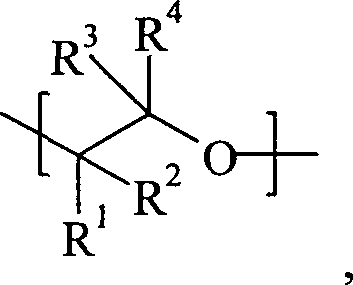
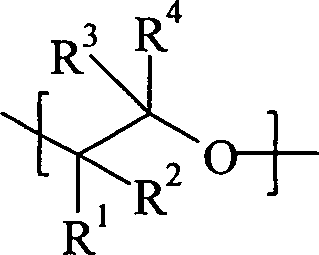
A eine Struktureinheit
mit der Formel 
R1,
R2, R3 und R4 unabhängig
voneinander die Substituenten Wasserstoff, Methyl, Ethyl, n-Propyl,
iso-Propyl, Oktyl- oder Phenyl sind, mit der Einschränkung, dass
höchstens
drei der Substituenten R1, R2,
R3 und R4 Wasserstoff
sind,
m eine Laufzahl im Bereich von 10 bis 300,
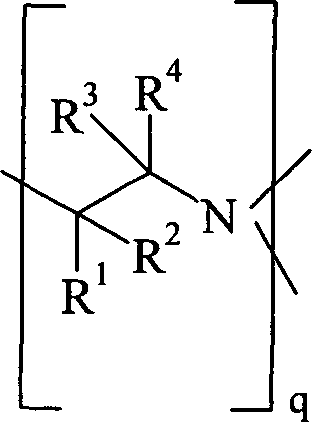
X eine
Struktureinheit mit der Formel 
R1, R2, R3 und
R4 unabhängig
voneinander jeweils Wasserstoff, Methyl, Ethyl, n-Propyl, iso-Propyl,
Oktyl oder Phenyl sind,
q = 0 oder q = 1,
B eine monomere
Untereinheit basierend auf Ethylenoxid oder einer Mischung aus Ethylenoxid
und Propylenoxid,
n eine Laufzahl im Bereich von 20 bis 500
und
p = q + 1 ist.The solution consists of a mixture comprising a surfactant and a cosurfactant, which is characterized in that an amphiphilic polymer with the general structural formula is used as the cosurfactant
A 'is an unbranched or branched alkyl, cycloalkyl, aryl or aralkyl radical having 1 to 60 C atoms,
YO or S,
A is a structural unit with the formula
R 1 , R 2 , R 3 and R 4 are independently the substituents hydrogen, methyl, ethyl, n-propyl, isopropyl, octyl or phenyl, with the restriction that at most three of the substituents R 1 , R 2 , R 3 and R 4 are hydrogen,
m is a run number in the range from 10 to 300,
X is a structural unit with the formula
R 1 , R 2 , R 3 and R 4 are each independently hydrogen, methyl, ethyl, n-propyl, iso-propyl, octyl or phenyl,
q = 0 or q = 1,
B is a monomeric subunit based on ethylene oxide or a mixture of ethylene oxide and propylene oxide,
n a run number in the range from 20 to 500 and
p = q + 1.
Es wurde überraschend gefunden, dass sich amphiphile Polymere mit der oben definierten Struktur besonders gut als Cotenside eignen, indem sie die Effizienz von Tensiden steigern und dabei aus großtechnischen und somit preiswert zugänglichen Stoffen auf großtechnischen Umsetzungswegen erhältlich sind. Die erfindungsgemäßen amphiphilen Polymere sind in der Regel technische Gemische aus Substanzen mit einer mehr oder weniger breiten Molekulargewichtsverteilung.It became surprising found that amphiphilic polymers with the above defined Structure particularly well as cosurfactants by increasing efficiency increase of tensides and thereby from large-scale and therefore inexpensive accessible Fabrics on an industrial scale Implementation routes available are. The amphiphiles according to the invention Polymers are usually technical mixtures of substances with a more or less broad molecular weight distribution.
Die allgemeine Strukturformel umfasst somit sowohl lineare Strukturen, wenn q = 0 ist, als auch in y-Form verzweigte Strukturen, wenn q = 1 ist.The general structural formula thus includes both linear structures, if q = 0, as well as structures branched in y-form if q = 1.
Die Struktureinheit A'-Y ist ein hydrophober Bauteil des Cotensids, und zwar ein monofunktioneller unverzweigter oder verzweigter Alkohol- oder Thiolrest, abgeleitet aus der Gruppe der C1- bis C60-Alkyl-, Cycloalkyl-, Aryl- oder Aralkylalkohole oder -thiole. Bevorzugt sind verzweigte oder unverzweigte Alkohole oder -thiole, mit 8 bis 30 C-Atomen pro Alkohol- oder Thiolrest.The structural unit A'-Y is a hydrophobic component of the cosurfactant, specifically a monofunctional unbranched or branched alcohol or thiol radical, derived from the group of the C 1 -C 60 -alkyl, cycloalkyl, aryl or aralkyl alcohols or thiols , Branched or unbranched alcohols or thiols with 8 to 30 carbon atoms per alcohol or thiol radical are preferred.
Obwohl als Starter-Alkohole A'-OH grundsätzlich auch alle kürzerkettigen aliphatischen Monohydroxyalkohole mit 1 bis 5 Kohlenstoffatomen pro Molekül eingesetzt werden können, sind monofunktionelle aliphatische Alkohole mit 6 bis 18 Kohlenstoffatomen pro Molekül bevorzugt, besonders bevorzugt monofunktionelle aliphatische Alkohole mit 8 bis 15 Kohlenstoffatomen pro Molekühl.Even though as starter alcohols A'-OH in principle also all shorter-chain ones aliphatic monohydroxy alcohols with 1 to 5 carbon atoms per molecule can be used are monofunctional aliphatic alcohols with 6 to 18 carbon atoms per molecule preferably, particularly preferably monofunctional aliphatic alcohols with 8 to 15 carbon atoms per molecule.
Erfindungsgemäß geeignete Alkohole sind insbesondere Octanol, 2-Ethylhexanol, Nonanol, Decanol, Undecanol, Dodecanol, 2-Butyloctanol, Tridecanol, Tetradecanol, Pentadecanol, iso-Octanol, iso-Nonanol, iso-Decanol, iso-Undecanol, iso-Dodecanol, iso-Tridecanol, iso-Tetradecanol, iso-Pentadecanol bevorzugt iso-Decanol, 2-Propylheptanol, Tridecanol, isoTredecanol oder Gemische aus C13- bis C15-Alkoholen oder Gemische von 2-Propylheptanol mit strukturisomeren C10-Alkoholen. Oxoalkohole, wie sie üblicherweise durch Hydroformulierung von linearen oder verzweigten Olefinen mit 4 bis 29 Kohlenstoff, die zum Beispiel durch Oligomerisierung von Ethen, Propen, 1-Buten, isomeren Buten-Gemischen oder aus Gemischen der zuvor genannten Alkene hergestellt werden können, erhalten werden, oder von Alkoholen, wie sie ausgehend von Olefinen mit 5 bis 30 Kohlenstoffatomen entweder durch Ozonolyse und nachfolgende Reduktion oder durch Epoxidierung und nachfolgende Hydrolyse oder durch Halogenierung mit Chlor oder Brom und nachfolgende alkalische Hydrolyse erhalten werden, ableiten.Alcohols suitable according to the invention are in particular octanol, 2-ethylhexanol, nonanol, decanol, undecanol, dodecanol, 2-butyloctanol, tridecanol, tetradecanol, pentadecanol, iso-octanol, iso-nonanol, iso-decanol, iso-undecanol, iso-dodecanol, iso -Tridecanol, iso-tetradecanol, iso-pentadecanol, preferably iso-decanol, 2-propylheptanol, tridecanol, isoTredecanol or mixtures of C 13 to C 15 alcohols or mixtures of 2-propylheptanol with structurally isomeric C 10 alcohols. Oxo alcohols, as are usually obtained by hydroformulating linear or branched olefins having 4 to 29 carbon, which can be prepared, for example, by oligomerizing ethene, propene, 1-butene, isomeric butene mixtures or from mixtures of the aforementioned alkenes, or from alcohols such as those obtained from olefins having 5 to 30 carbon atoms either by ozonolysis and subsequent reduction or by epoxidation and subsequent hydrolysis or by halogenation with chlorine or bromine and subsequent alkaline hydrolysis.
Beispielsweise kann es sich bei den erfindungsgemäß als Starterverbindung eingesetzten Alkoholen um Guerbet-Alkohole handeln, insbesondere Ethylhexanol, Propylheptanol, Butyloctanol. Daher betrifft die vorliegende Erfindung auch in einer besondere bevorzugten Ausführungsform ein Verfahren, wobei die Starterverbindung ein Guerbet-Alkohol ist.For example it can be used in the starter compound according to the invention Alcohols are Guerbet alcohols, especially ethylhexanol, Propylheptanol, butyloctanol. Therefore, the present invention relates to also in a particularly preferred embodiment a method, wherein the starter compound is a Guerbet alcohol.
Bei den als Starterverbindung eingesetzten Alkoholen kann es sich auch um Gemische verschiedener Isomere handeln.at the alcohols used as starter compound can also be are mixtures of different isomers.
Diese Gemische können sich aus den vorgenannten Alkoholen ableiten oder bei deren Herstellung anfallen, beispielsweise Rohprodukte und einzelne Fraktionen, wie sie bei der destillativen Aufarbeitung der Rohprodukte anfallen. Beispiele für geeignete Gemische sind sogenannte Oxoöle oder Oxoölfraktionen, wie sie bei der Herstellung von Oxoalkoholen regelmäßig anfallen.This Mixtures can are derived from the abovementioned alcohols or during their production accrued, for example raw products and individual fractions, such as they arise during the processing of the raw products by distillation. examples for Suitable mixtures are so-called oxo oils or oxo oil fractions, such as those used in the Production of oxo alcohols occur regularly.
Vorteilhaft kann als Starteralkohol A'-OH ein Alkoholgemisch eingesetzt werden, das durch Trimerisierung von Buten und anschließende Hydroformylierung und Hydrierung erhalten und als Tridecanol N bezeichnet wird.Advantageous can be used as starter alcohol A'-OH an alcohol mixture can be used, which by trimerization of Butene and subsequent Obtained hydroformylation and hydrogenation and referred to as tridecanol N. becomes.
Propylheptanol
beispielsweise kann ausgehend von Valeraldehyd durch Aldolkondensation
und nachfolgende Hydrierung erhalten werden. Die Herstellung von
Valeraldehyd und den entsprechenden Isomeren erfolgt durch Hydroformylierung
von Buten, wie beispielsweise in
Des weiteren kann 2-Propylheptanol durch Kondensation von 1- Pentanol (als Mischung der entsprechenden Methylbutanole-1) in Gegenwart von KOH bei erhöhten Temperaturen hergestellt werden, siehe zum Beispiel Marcel Guerbet, C.R. Acad Sci Paris 128, 511, 1002 (1899). Des weiteren ist auf Römpp, Chemie Lexikon, 9. Auflage, Georg Thieme Verlag Stuttgart, und die dort genannten Zitate sowie Tetrahedron, Vol. 23, Seiten 1723 bis 1733, hinzuweisen.Furthermore, 2-propylheptanol can be condensed by 1-pentanol (as a mixture of the corresponding suitable methylbutanols-1) can be prepared in the presence of KOH at elevated temperatures, see for example Marcel Guerbet, CR Acad Sci Paris 128, 511, 1002 (1899). Furthermore, reference is made to Römpp, Chemie Lexikon, 9th edition, Georg Thieme Verlag Stuttgart, and the quotations mentioned there, as well as Tetrahedron, Vol. 23, pages 1723 to 1733.
Weiterhin sind auch Alkohole geeignet, die aus einer Addition von Aceton an Aldehyde mit nachfolgender Hydrierung entstehen, wie in DE-A 100 35 617 beschrieben. Geeignet sind auch Paraffin-Oxdidationsprodukte, die im wesentlichen sekundäre Alkohole darstellen (zum Beispiel von C12/14-Paraffin-Gemischen oder C10- bis C16-Paraffin-Gemischen). Geeignete Alkohole sind auch zum Beispiel sekundäre Alkohole, die man durch saure Addition von Wasser an Olefine oder durch radikalische oder sonstige Oxidation von Olefinen erhält.Also suitable are alcohols which result from an addition of acetone to aldehydes with subsequent hydrogenation, as described in DE-A 100 35 617. Paraffin oxidation products which are essentially secondary alcohols (for example C 12/14 paraffin mixtures or C 10 to C 16 paraffin mixtures) are also suitable. Suitable alcohols are also, for example, secondary alcohols which are obtained by acidic addition of water to olefins or by radical or other oxidation of olefins.
Nach den oben beschriebenen Verfahren sind auch eine Vielzahl von Handelsprodukten erhältlich, die häufig als Isomerenmischungen vorliegen und preiswert zur Verfügung stehen. Beispielsweise genannt seien das Produkt der Umsetzung von 2-Ethylhexanal mit Aceton oder Methylethylketon und abschließender Hydrierung, das Produkt der Umsetzung von C13/15-Aldehyd mit Aceton oder Methylethylketon, das Produkt der Umsetzung eines Isomerengemisches unterschiedlicher C13-Aldehyde, von sogenanntem iso-Tridecanal mit Aceton oder Methylethylketon. Beispiele für Starter-Alkohole, die durch Addition von Wasser am α-Olefinen erhältlich sind, sind 2-Decanol, 2-Dodecanol, 2-Tetradecanol oder 2-Hexadecanol.A large number of commercial products are also obtainable by the processes described above, which are often available as isomer mixtures and are available at low cost. Examples include the product of the reaction of 2-ethylhexanal with acetone or methyl ethyl ketone and subsequent hydrogenation, the product of the reaction of C 13/15 aldehyde with acetone or methyl ethyl ketone, the product of the reaction of an isomer mixture of different C 13 aldehydes, from so-called iso -Tridecanal with acetone or methyl ethyl ketone. Examples of starter alcohols which can be obtained by adding water to the α-olefins are 2-decanol, 2-dodecanol, 2-tetradecanol or 2-hexadecanol.
Als
Starter-Alkohole A'-OH
eignen sich weiterhin alicyclische und aromatische Hydroxyverbindungen, vorzugsweise
Verbindungen der Formeln 
R5,
R6 und R7 unabhängig voneinander
für Wasserstoff
oder C1-C30-Alkyl
stehen.Suitable starter alcohols A'-OH are furthermore alicyclic and aromatic hydroxy compounds, preferably compounds of the formulas
R 5 , R 6 and R 7 independently of one another are hydrogen or C 1 -C 30 alkyl.
Bevorzugte alicyclische und aromatische Hydroxyverbindungen sind Cyclohexanol, Phenol, die Kresol-Isomere, Isobutylphenol, Isobutylkresol, Diisobutylphenol, Diisobutylkresol, tert.-Butylphenol, tert.-Butylkresol, Di-tert.-butylphenol, Di-tert.-butylkresol, Isooctylphenol, Diisooctylphenol, Isononylphenol, Diisononylphenol, Isododecylphenol, Diisododecylphenol und Mischungen davon.preferred alicyclic and aromatic hydroxy compounds are cyclohexanol, Phenol, the cresol isomers, isobutylphenol, isobutylcresol, diisobutylphenol, Diisobutyl cresol, tert-butylphenol, tert-butyl cresol, di-tert-butylphenol, Di-tert-butylcresol, isooctylphenol, diisooctylphenol, isononylphenol, Diisononylphenol, isododecylphenol, diisododecylphenol and mixtures from that.
Die hydrophobe Struktureinheit A ist bevorzugt aus einem oder mehreren der nachfolgenden Monomere: Propenoxid, 1-Butenoxid, 2,3-Butenoxid, 2-Methyl-1,2-propenoxid (Isobutenoxid), 1-Pentenoxid, 2,3-Pentenoxid, 2-Methyl-1,2-butenoxid, 3-Methyl-1,2-butenoxid, 2,3-Hexenoxid, 3,4-Hexenoxid, 2-Methyl-1,2-pentenoxid, 2-Ethyl-1,2-butenoxid, 3-Methyl-1,2-pentenoxid, 4-Methyl-1,2-pentenoxid, Decenoxid, 4-Methyl-1,2-pentenoxid, Styroloxid oder aus Gemischen hiervon gebildet. Dazu zählen vorzugsweise auch durch Oxidation großtechnisch zugänglicher Olefinströme erhältliche Gemische, die weitere von den zuvor genannten verschiedene Alkylenoxide und/oder von der Oxidation nicht erfasste Olefine und/oder Inerte (Alkane) enthalten können.The Hydrophobic structural unit A is preferably one or more of the following monomers: propene oxide, 1-butene oxide, 2,3-butene oxide, 2-methyl-1,2-propene oxide (isobutene oxide), 1-pentene oxide, 2,3-pentene oxide, 2-methyl-1,2-butene oxide, 3-methyl-1,2-butene oxide, 2,3-hexene oxide, 3,4-hexene oxide, 2-methyl-1,2-pentene oxide, 2-ethyl-1,2-butene oxide, 3-methyl-1,2-pentene oxide, 4-methyl-1,2-pentene oxide, decene oxide, 4-methyl-1,2-pentene oxide, styrene oxide or from mixtures formed from this. These include preferably also accessible on an industrial scale by oxidation olefin streams available Mixtures, the other of the aforementioned different alkylene oxides and / or olefins and / or inerts not covered by the oxidation May contain (alkanes).
Die Laufzahl m, die die Anzahl der sich wiederholenden Struktureinheiten A bezeichnet, nimmt bevorzugt einen Wert im Bereich von 50 bis 250, insbesondere von 60 bis 160, an.The Sequence number m, which is the number of repeating structural units Denoted A, preferably takes a value in the range from 50 to 250, especially from 60 to 160.
Die Struktureinheit X, enthaltend eine Aminogruppe, kann als Verzweigungsstelle in das amphiphile Polymer eingebaut werden.The Structural unit X, containing an amino group, can act as a branching point be incorporated into the amphiphilic polymer.
Die Struktureinheit [B]n ist ein hydrophiler Bauteil des Cotensids, gebildet aus sich sich wiederholenden Ethylenoxid- oder Ethylenoxid-/Propylenoxid-Einheiten. Dabei ist B eine monomere Untereinheit, basierend auf Ethylenoxid oder auf einer Mischung aus Ethylenoxid (EO) und Propylenoxid (PO). Die Struktureinheit [B]n kann ein statistisches Copolymer, ein Gradientcopolymer, ein alternierendes oder ein Blockcopolymer aus EO und PO sein.The structural unit [B] n is a hydrophilic component of the cosurfactant, formed from repeating ethylene oxide or ethylene oxide / propylene oxide units. B is a monomeric subunit based on ethylene oxide or on a mixture of ethylene oxide (EO) and propylene oxide (PO). The structural unit [B] n can be a random copolymer, a gradient copolymer, an alternating or a block copolymer of EO and PO.
Die Polymerstruktur kann ein einziges hydrophiles Bauteil [B]n oder aber, über die Verzweigungsstelle am Stickstoffatom, zwei hydrophile Bauteile [B]n umfassen.The polymer structure can comprise a single hydrophilic component [B] n or, via the branching point on the nitrogen atom, two hydrophilic components [B] n .
Die Laufzahl n, die die Anzahl der sich wiederholenden Struktureinheiten B bezeichnet, nimmt bevorzugt einen Wert im Bereich zwischen 50 und 300 an.The Sequence number n, which is the number of repeating structural units Denoted B preferably takes a value in the range between 50 and 300 at.
Vorteilhaft kann B eine Ethylenoxid-/Propylenoxid-Mischung mit 0 bis 50 % Propylenoxid, vorzugsweise mit 5 bis 20 % Propylenoxid sein.Advantageous B can be an ethylene oxide / propylene oxide mixture with 0 to 50% propylene oxide, preferably with 5 to 20% propylene oxide.
Die erfindungsgemäße Mischung umfasst neben den vorstehend beschriebenen Co-Tensiden ein Tensid. Dabei kann es sich auch um eine Mischung von Tensiden handeln. Grundsätzlich kann jedes Tensid, aus jeder der bekannten Tensid-Gruppen, insbesondere ionische oder nichtionische Tenside, oder auch Mischungen von ionischen oder nichtionischen Tensiden eingesetzt werden.The mixture according to the invention includes a surfactant in addition to the co-surfactants described above. It can be also act as a mixture of surfactants. Basically can any surfactant, from any of the known surfactant groups, in particular ionic or nonionic surfactants, or mixtures of ionic or nonionic surfactants can be used.
Geeignet sind, je nach Einsatzgebiet der erfindungsgemäßen Mischungen, beispielsweise alle klassischen Reiniger-Tenside, oder lebensmittel-zugelassene Tenside, wie Tweens® oder Spans®. Von den Tensidklassen her sind geeignet nicht-ionische, anionische, kationische, amphotere Tenside; insbesondere auch Polymertenside, Peptidtenside, Silikontenside, aminosäurebasierte Tenside, Zuckertenside, fettbasierte Tenside, Geminitenside, Aminoxide, Amidoaminoxide, Alkylbetaine, Ethercarboxylate, Ampho-Acetate, Alkylsulfate oder Sulfosuccinate.Are suitable, depending on the application of the mixtures according to the invention, for example, all classical detergent surfactants, or food-approved surfactants such as Tweens ® or Spans ®. Suitable surfactant classes are non-ionic, anionic, cationic, amphoteric surfactants; in particular also polymer surfactants, peptide surfactants, silicone surfactants, amino acid-based surfactants, sugar surfactants, fat-based surfactants, gemini surfactants, amine oxides, amidoamine oxides, alkyl betaines, ether carboxylates, amphoacetates, alkyl sulfates or sulfosuccinates.
Der Anteil des Cotensids, bezogen auf das Tensid, liegt bevorzugt im Bereich von 0,01 bis 99,99 %, insbesondere zwischen 1 und 50 %, besonders bevorzugt zwischen 5 und 25 %.The The proportion of the cosurfactant, based on the surfactant, is preferably in Range from 0.01 to 99.99%, in particular between 1 and 50%, particularly preferably between 5 and 25%.
Geeignete anionische Tenside sind beispielsweise Fettalkoholsulfate von Fettalkoholen mit 8 bis 22, vorzugsweise 10 bis 18 Kohlenstoffatomen, zum Beispiel C9- bis C11-Alkoholsulfate, C12- bis C13-Alkoholsulfate, Cetylsulfat, Myristylsulfat, Palmitylsulfat, Stearylsulfat und Talgfettalkoholsulfat.Suitable anionic surfactants are, for example, fatty alcohol sulfates of fatty alcohols having 8 to 22, preferably 10 to 18 carbon atoms, for example C 9 to C 11 alcohol sulfates, C 12 to C 13 alcohol sulfates, cetyl sulfate, myristyl sulfate, palmityl sulfate, stearyl sulfate and tallow fatty alcohol sulfate.
Weitere geeignete anionische Tenside sind sulfatierte ethoxylierte C8- bis C22-Alkohole (Alkylethersulfate) bzw. deren lösliche Salze. Verbindungen dieser Art werden beispielsweise dadurch hergestellt, das man zunächst einen C8- bis C22-, vorzugsweise einen C10- bis C18-Alkohol, zum Beispiel einen Fettalkohol, alkoxyliert und das Alkoxylierungsprodukt anschließend sulfatiert. Für die Alkoxylierung verwendet man vorzugsweise Ethylenoxid, wobei man pro Mol Fettalkohol 2 bis 50, vorzugsweise 3 bis 20 mol Ethylenoxid einsetzt. Die Alkoxylierung der Alkohole kann jedoch auch mit Propylenoxid allein und gegebenenfalls Butylenoxid durchgeführt werden. Geeignet sind außerdem solche alkoxylierte C8- bis C22-Alkohole, die Ethylenoxid und Propylenoxid oder Ethylenoxid und Butylenoxid enthalten. Die alkoxylierten C8- oder bis C22-Alkohole können die Ethylenoxid-, Propylenoxid- und butylenoxideinheiten in Form von Blöcken oder in statistischer Verteilung enthalten.Other suitable anionic surfactants are sulfated ethoxylated C 8 to C 22 alcohols (alkyl ether sulfates) or their soluble salts. Compounds of this type are prepared, for example, by first alkoxylating a C 8 to C 22 , preferably a C 10 to C 18 alcohol, for example a fatty alcohol, and then sulfating the alkoxylation product. Ethylene oxide is preferably used for the alkoxylation, 2 to 50, preferably 3 to 20, mol of ethylene oxide being used per mol of fatty alcohol. However, the alkoxylation of the alcohols can also be carried out using propylene oxide alone and, if appropriate, butylene oxide. Alkoxylated C 8 to C 22 alcohols which contain ethylene oxide and propylene oxide or ethylene oxide and butylene oxide are also suitable. The alkoxylated C 8 or to C 22 alcohols can contain the ethylene oxide, propylene oxide and butylene oxide units in the form of blocks or in statistical distribution.
Geeignet sind auch Alkansulfonate, wie C8- bis C24-, vorzugsweise C10- bis C18-Alkansulfonate sowie Seifen, wie Na oder K-Salze von C8- bis C24-Carbonsäuren.Also suitable are alkanesulfonates, such as C 8 to C 24 , preferably C 10 to C 18 alkanesulfonates, and soaps, such as Na or K salts of C 8 to C 24 carboxylic acids.
Weitere geeignete anionische Tenside sind N-Acylsarkosinate mit aliphatischen gesättigten oder ungesättigten C8- bis C25-Acylresten, vorzugsweise C10- bis C20-Acylresten, zum Beispiel N-Oleoylsarkosinat.Further suitable anionic surfactants are N-acyl sarcosinates with aliphatic saturated or unsaturated C 8 to C 25 acyl residues, preferably C 10 to C 20 acyl residues, for example N-oleoylsarcosinate.
Weiterhin können die erfindungsgemäßen Mischungen C10- bis C13-lineare und/oder -leicht verzweigte Alkylbenzolsulfonate (LAS) enthalten.Furthermore, the mixtures according to the invention can contain C 10 to C 13 linear and / or slightly branched alkylbenzenesulfonates (LAS).
Die anionischen Tenside werden der Mischung, vorzugsweise in Form von Salzen zugegeben. Geeignete Kationen in diesen Salzen sind Alkalimetallsalze wie Natrium, Kalium und Lithium und Ammoniumsalze wie zum Beispiel Hydroxyethylammonium-, Di(hydroxyethyl)ammonium- und Tri(hydroxyethyl)ammoniumsalze.The Anionic surfactants are added to the mixture, preferably in the form of Added salts. Suitable cations in these salts are alkali metal salts such as sodium, potassium and lithium and ammonium salts such as Hydroxyethylammonium, di (hydroxyethyl) ammonium and tri (hydroxyethyl) ammonium salts.
Geeignete nichtionische Tenside sind insbesondere:
- – alkoxylierte C8- bis C22-Alkohole wie Fettalkoholalkoxylate oder Oxoalkoholalkoxylate. Diese können mit Ethylenoxid, Propylenoxid und/oder Butylenoxid alkoxyliert sein. Als Tenside einsetzbar sind hierbei sämtliche alkoxylierten Alkohole, die mindestens zwei Moleküle eines der vorstehend genannten Alkylenoxide addiert enthalten. Hierbei kommen Blockpolymerisate von Ethylenoxid, Propylenoxid und/oder Butylenoxid in Betracht oder Anlagerungsprodukte, die die genannten Alkylenoxide in statistischer Verteilung enthalten. Die nichtionischen Tenside enthalten pro Mol Alkohol im allgemeinen 2 bis 50, vorzugsweise 3 bis 20 Mol mindestens eines Alkylenoxids. Vorzugsweise enthalten diese als Alkylenoxid Ethylenoxid. Die Alkohole haben vorzugsweise 10 bis 18 Kohlenstoffatome. Je nach Art des bei der Herstellung verwendeten Alkoxylierungskatalysators weisen die Alkoxylate eine breite oder enge Alkylenoxid-Homologenverteilung auf;
- – Alkylphenolalkoxylate wie Alkylphenolethoxylate mit C6- bis C14-Alkylketten und 5 bis 30 Alkylenoxideinheiten;
- – Alkylpolyglucoside mit 8 bis 22, vorzugsweise 10 bis 18 Kohlenstoffatomen in der Alkylkette und im allgemeinen 1 bis 20, vorzugsweise 1,1 bis 5 Glucosideinheiten Sorbitanalkanoate, auch alkoxyliert;
- – N-Alkylglucamide, Fettsäurealkoxylate, Fettsäureaminalkoxylate, Fettsäureamidalkoxylate, Fettsäurealkanolamidalkoxylate, alkoxyliert, Blockcopolymere aus Ethylenoxid, Propylenoxid und/oder Butylenoxid, Polyisobuten-Ethoxylate, Polyisobuten-Maleinsäureanhydrid-Derivate, Monoglyceride, auch alkoxyliert sowie Bisglyceride.
- - Alkoxylated C 8 - to C 22 alcohols such as fatty alcohol alkoxylates or oxo alcohol alkoxylates. These can be alkoxylated with ethylene oxide, propylene oxide and / or butylene oxide. All alkoxylated alcohols which contain at least two molecules of one of the above-mentioned alkylene oxides added can be used as surfactants. Here, block polymers of ethylene oxide, propylene oxide and / or butylene oxide come into consideration or addition products which contain the alkylene oxides mentioned in a statistical distribution. The nonionic surfactants generally contain 2 to 50, preferably 3 to 20, moles of at least one alkylene oxide per mole of alcohol. These preferably contain ethylene oxide as alkylene oxide. The alcohols preferably have 10 to 18 carbon atoms. Depending on the type of alkoxylation catalyst used in the preparation, the alkoxylates have a broad or narrow alkylene oxide homolog distribution;
- Alkylphenol alkoxylates such as alkylphenol ethoxylates with C 6 -C 14 -alkyl chains and 5 to 30 alkylene oxide units;
- Alkyl polyglucosides with 8 to 22, preferably 10 to 18 carbon atoms in the alkyl chain and generally 1 to 20, preferably 1.1 to 5, glucoside units of sorbitan alkanoates, also alkoxylated;
- - N-alkyl glucamides, fatty acid alkoxylates, fatty acid amine alkoxylates, fatty acid amide alkoxylates, fatty acid alkanolamide alkoxylates, alkoxylated, block copolymers of ethylene oxide, propylene oxide and / or butylene oxide, polyisobutene ethoxylates, polyisobutene-maleic anhydride derivatives, monoglycerides and also alkoxylated, also alkoxylated.
Besonders geeignete nichtionsiche Tenside sind Alkylalkoxylate oder Gemische von Alkylalkoxylaten, wie sie beispielsweise in DE-A 102 43 363, DE-A 102 43 361, DE-A 102 43 360, DE-A 102 43 365, DE-A 102 43 366, DE-A 102 43 362 oder in DE-A 43 25 237 beschrieben sind. Hierbei handelt es sich um Alkoxylierungsprodukte, die durch Umsetzung von Alkanolen mit Alkylenoxiden in Gegenwart von Alkoxylierungskatalysatoren erhalten wurden oder um Gemische von Alkoxylierungsprodukten. Besonders geeignete Starteralkohole sind die sogenannten Guerbet-Alkohole, insbesondere Ehtylhexanol, Propylheptanol und Butyloktanol. Besonders bevorzugt ist Propylheptanol. Bevorzugte Alkylenoxide sind Propylenoxid und Ethylenoxid, wobei Alkylalkoxylate mit direkter Anbindung eines bevorzugt kurzen Poylypropylenoxidblocks an den Starteralkohol, wie sie beispielsweise in DE-A 102 43 365 beschrieben sind, insbesondere aufgrund ihres geringen Restalkoholgehalts und ihrer guten biologischen Abbaubarkeit bevorzugt sind.Especially Suitable nonionic surfactants are alkyl alkoxylates or mixtures of alkyl alkoxylates, as described, for example, in DE-A 102 43 363, DE-A 102 43 361, DE-A 102 43 360, DE-A 102 43 365, DE-A 102 43 366, DE-A 102 43 362 or in DE-A 43 25 237 are described. in this connection are alkoxylation products which are produced by the reaction of Alkanols with alkylene oxides in the presence of alkoxylation catalysts were obtained or mixtures of alkoxylation products. Especially suitable starter alcohols are the so-called Guerbet alcohols, especially ethyl hexanol, propyl heptanol and butyl octanol. Especially propylheptanol is preferred. Preferred alkylene oxides are propylene oxide and ethylene oxide, where alkyl alkoxylates with direct attachment of a preferably short blocks of polypropylene oxide to the starter alcohol, as described for example in DE-A 102 43 365, in particular due to their low residual alcohol content and their good biological Degradability are preferred.
Als Alkoxylierungskatalysatoren können Basen eingesetzt werden, beispielsweise Alkalihydroxide oder Alkalialkoholate jedoch auch Lewis-Säuren, beispielsweise BF3, SbCl5, SnCl4 × 2H2O, BF3 × H3BO4, oder BF3-Dietherat. Besonders geeignete Alkoxylierungskatalysatoren sind Doppelhydroxid-Tone wie Hydrotalkit, die insbesondere mit Additiven modifiziert sein können, wie in DE-A 43 25 237 beschrieben.Bases can be used as alkoxylation catalysts, for example alkali metal hydroxides or alkali metal alcoholates, but also Lewis acids, for example BF 3 , SbCl 5 , SnCl 4 × 2H 2 O, BF 3 × H 3 BO 4 , or BF 3 -dietherate. Particularly suitable alkoxylation catalysts are double hydroxide clays such as hydrotalcite, which can in particular be modified with additives, as described in DE-A 43 25 237.
Je nach Wahl des Alkoxylierungskatalysators resultieren jeweils spezifische Eigenschaften der Alkoxylate, insbesondere bezüglich der Verteilung des Alkoxylierungsgrades. So werden bei Verwendung der letztgenannten Doppelhydroxid-Tone Alkoxylierungsprodukte mit einer engen Molekulargewichtsverteilung bzw. Homologenverteilung erhalten, die für den Einsatz in den erfindungsgemäßen Mischungen mit Cotensiden besonders geeignet sind.ever the choice of the alkoxylation catalyst results in specific ones Properties of the alkoxylates, especially with regard to the distribution of the degree of alkoxylation. So when using the latter double hydroxide clays Alkoxylation products with a narrow molecular weight distribution or homolog distribution obtained for use in the mixtures according to the invention with cosurfactants are particularly suitable.
Die vorstehend beschriebenen vorteilhaften Eigenschaften, insbesondere bezüglich des Alkoxylierungsgrades, werden auch durch Einsatz von Doppelmetallcyanid (DMC)-Verbindungen erreicht, wie sie beispielsweise in DE-A 102 43 361 als Alkoxylierungskatalysatoren beschrieben sind.The advantageous properties described above, in particular in terms of the degree of alkoxylation, are also by using double metal cyanide (DMC) connections achieved, as described, for example, in DE-A 102 43 361 are described as alkoxylation catalysts.
Gegenstand
der Erfindung ist auch ein Verfahren zur Herstellung eines amphiphilen
Polymers mit der allgemeinen Strukturformel (I) 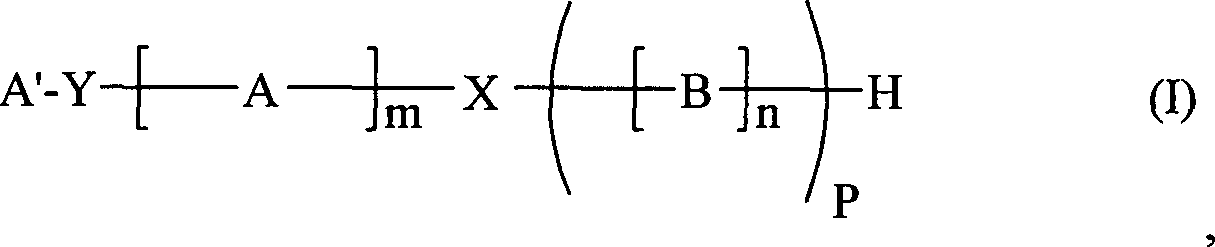

- – die terminale OH-Gruppe unmittelbar mit Ethylenoxid oder einer Mischung aus Ethylenoxid und Propylenoxid oder
- – die terminale OH-Gruppe zunächst zu einem primären oder sekundären Amin und anschließend mit Ethylenoxid oder einer Mischung aus Ethylenoxid und Propylenoxid umsetzt.
- - The terminal OH group directly with ethylene oxide or a mixture of ethylene oxide and propylene oxide or
- - The terminal OH group is first converted to a primary or secondary amine and then with ethylene oxide or a mixture of ethylene oxide and propylene oxide.
Das erfindungsgemäße Verfahren basiert auf großtechnisch zugänglichen Ausgangsstoffen, die durch großtechnisch einfach realisierbare Umsetzungen zu den gewünschten Cotensid-Strukturen führen.The inventive method is based on industrial scale accessible Starting materials through large-scale simple implementations lead to the desired cosurfactant structures.
Als Alkoxylierungskatalysatoren können Basen eingesetzt werden, beispielsweise Alkalihydroxide oder Alkalialkoholate jedoch auch Lewis-Säuren, beispielsweise BF3, SbCl5, SnCl4 × 2H2O, BF3 × H3BO4, oder BF3-Dietherat. Besonders geeignete Alkoxylierungskatalysatoren sind Doppelhydroxid-Tone wie Hydrotalkit, die insbesondere mit Additiven modifiziert sein können, wie in DE-A 43 25 237 beschrieben.Bases can be used as alkoxylation catalysts, for example alkali metal hydroxides or alkali metal alcoholates, but also Lewis acids, for example BF 3 , SbCl 5 , SnCl 4 × 2H 2 O, BF 3 × H 3 BO 4 , or BF 3 -dietherate. Particularly suitable alkoxylation catalysts are double hydroxide clays such as hydrotalcite, which can in particular be modified with additives, as described in DE-A 43 25 237.
Je nach Wahl des Alkoxylierungskatalysators resultieren jeweils spezifische Eigenschaften der Alkoxylate, insbesondere bezüglich der Verteilung des Alkoxylierungsgrades. So werden bei Verwendung der letztgenannten Doppelhydroxid-Tone Alkoxylierungsprodukte mit einer engen Molekulargewichtsverteilung bzw. Homologenverteilung erhalten, die für den Einsatz in den erfindungsgemäßen Mischungen als Cotensiden besonders geeignet sind.ever the choice of the alkoxylation catalyst results in specific ones Properties of the alkoxylates, especially with regard to the distribution of the degree of alkoxylation. So when using the latter double hydroxide clays Alkoxylation products with a narrow molecular weight distribution or homolog distribution obtained for use in the mixtures according to the invention are particularly suitable as cosurfactants.
Die vorstehend beschriebenen vorteilhaften Eigenschaften, insbesondere bezüglich des Alkoxylierungsgrades, werden auch durch Einsatz von Doppelmetallcyanid (DMC)-Ver bindungen erreicht, wie sie beispielsweise in DE-A 102 43 361 als Alkoxylierungskatalysatoren beschrieben sind.The advantageous properties described above, in particular in terms of the degree of alkoxylation, are also by using double metal cyanide (DMC) compounds achieved, as for example in DE-A 102 43 361 are described as alkoxylation catalysts.
Gegenstand der Erfindung ist auch die Verwendung einer Mischung, umfassend ein Tensid und ein vorstehend beschriebenes Cotensid zum Stabilisieren von Emulsionen, insbesondere von Mikroemulsionen. Stabilisieren bedeutet im vorliegenden Zusammenhang, dass durch Zusatz von Cotensiden die Effizienz von Tensiden gesteigert wird, das heißt die Solubilisierung eines definierten Öl/Wasser-Gemisches unter definierten Bedingungen mit einer geringeren Menge an Tensid ermöglicht wird.object the invention is also the use of a mixture comprising a surfactant and a cosurfactant described above for stabilization of emulsions, especially microemulsions. Stabilize in the present context means that by adding cosurfactants the efficiency of surfactants is increased, i.e. solubilization of a defined oil / water mixture under defined conditions with a lower amount of surfactant allows becomes.
Besonders bevorzugt eignen sich die vorstehend beschriebenen Cotenside mit der Struktur amphiphiler Kammpolymere zur Stabilisierung von Mikroemulsionen, das heißt zur Verschiebung des sogenannten X-Punktes, der die niedrigste Konzentration an Tensid bei gegebener Temperatur darstellt, ab der der thermodynamische Zustand der Mikroemulsion, das heißt der in makroskopischer Betrachtung einphasige Zustand, eintritt.Especially the cosurfactants described above are preferred the structure of amphiphilic comb polymers for stabilizing microemulsions, this means to shift the so-called X point, which is the lowest concentration of surfactant at a given temperature, from which the thermodynamic State of the microemulsion, that is, the macroscopic view single phase state, occurs.
Die erfindungsgemäßen Mischungen sind grundsätzlich in allen Bereichen einsetzbar, in denen Emulsionen eine Rolle spielen, beispielsweise in den in DE-A 101 18 480 aufgeführten Anwendungsbereichen für Mischungen umfassend ein Tensid und ein AB-Blockcopolymerisat als Additiv (Cotensid), die daneben Zusatzstoffe enthalten, deren Effizienz durch das Tensid/Additivsystem gesteigert werden kann: Beispielsweise als Pflanzenstärkungs-, -wuchs- oder Pflanzenschutzmittel, Produkte mit mikrobioziden Wirkstoffen, Produkte mit positiv oder negativ wirkenden Mikroorganismen, insbesondere mit einem Gehalt an Enzymen, Reinigungs- und/oder Pflegemittel für den Haushalt und für gewerbliche Zwecke, Desinfektionsmittel, Haar-, Körperpflege- oder Reinigungsmittel, Fahrzeugreinigungs-, -pflege- und/oder -konservierungsmittel, Textilbehandlungsmittel, Leder- und/oder Pelzpflegemittel, als Farben, Lacke, Arzneimittel, Bauhilfsstoffe, Zahnpasten oder Mundspülmittel.The mixtures according to the invention are fundamental Can be used in all areas in which emulsions play a role for example in the application areas for mixtures listed in DE-A 101 18 480 comprising a surfactant and an AB block copolymer as an additive (cosurfactant), which also contain additives whose Efficiency can be increased by the surfactant / additive system: For example as plant strengthening, growth or crop protection agents, products with microbiocidal active ingredients, Products with positive or negative microorganisms, in particular Containing enzymes, cleaning and / or care products for the household and for commercial purposes, disinfectants, hair, body care or Detergents, vehicle cleaning, care and / or preservatives, Textile treatment agents, leather and / or fur care agents, as colors, Paints, drugs, building aids, toothpastes or mouthwash.
Synergistische Effekte, wie sie in DE-A 101 18 480 für das System Tensid/AB-Blockcopolymerisat in Verbindung mit zusätzlichen Bioziden, Mikroorganismen und/oder beliebigen anderen Wirkstoffen beschrieben sind, werden entsprechend für Systeme enthaltend die erfindungsgemäßen Mischungen umfassend ein Tensid und ein Cotensid sowie entsprechende Zusatzstoffe, insbesondere Biozide, Mikroorganismen und/oder beliebige andere Wirkstoffe, erreicht.synergistic Effects such as those in DE-A 101 18 480 for the surfactant / AB block copolymer system in conjunction with additional Biocides, microorganisms and / or any other active ingredient are described accordingly for systems containing the mixtures according to the invention comprising a surfactant and a cosurfactant as well as corresponding additives, in particular biocides, microorganisms and / or any other Active ingredients achieved.
Gegenstand
der Erfindung ist auch eine Mikroemulsion, enthaltend ein Tensid
und ein Cotensid, die dadurch gekennzeichnet ist, dass man als Cotensid
ein amphiphiles Polymer mit der allgemeinen Strukturformel 
A' ein
unverzweigter oder verzweigter Alkyl-, Cycloalkyl- Aryl- oder Aralkylrest
mit 1 bis 60 C-Atomen,
Y O oder S,
A eine Struktureinheit
mit der Formel 
R1,
R2, R3 und R4 unabhängig
voneinander die Substituenten Wasserstoff, Methyl, Ethyl, n-Propyl,
iso-Propyl, Oktyl oder Phenyl sind, mit der Einschränkung, dass
mindestens zwei und höchstens
drei der Substituenten R1, R2,
R3 und R4 Wasserstoff
sind,
m eine Laufzahl im Bereich von 10 bis 300,
X eine
Struktureinheit mit der Formel 
R1, R2, R3 und
R4 unabhängig
voneinander die Substituenten Wasserstoff, Methyl, Ethyl, n-Propyl,
iso-Propyl, Oktyl oder Phenyl sind,
q = 0 oder q = 1,
B
ein monomere Untereinheit basierend auf Ethylenoxid oder einer Mischung
aus Ethylenoxid und Propylenoxid,
n eine Laufzahl im Bereich
von 20 bis 500 und
p = q + 1 ist.The invention also relates to a microemulsion comprising a surfactant and a cosurfactant, which is characterized in that an amphiphilic polymer having the general structural formula is used as the cosurfactant
A 'is an unbranched or branched alkyl, cycloalkyl, aryl or aralkyl radical having 1 to 60 C atoms,
YO or S,
A is a structural unit with the formula
R 1 , R 2 , R 3 and R 4 are independently the substituents hydrogen, methyl, ethyl, n-propyl, isopropyl, octyl or phenyl, with the restriction that at least two and at most three of the substituents R 1 , R 2 , R 3 and R 4 are hydrogen,
m is a run number in the range from 10 to 300,
X is a structural unit with the formula
R 1 , R 2 , R 3 and R 4 are independently of one another the substituents hydrogen, methyl, ethyl, n-propyl, isopropyl, octyl or phenyl,
q = 0 or q = 1,
B is a monomeric subunit based on ethylene oxide or a mixture of ethylene oxide and propylene oxide,
n a run number in the range from 20 to 500 and
p = q + 1.
Die Mikroemulsion ist grundsätzlich nicht eingeschränkt bezüglich des einsetzbaren Tensids oder Tensidgemisches. Bevorzugte Tenside sind vorstehend beschrieben.The Microemulsion is fundamental not limited in terms of of the applicable surfactant or surfactant mixture. Preferred surfactants are described above.
Neben einem Tensid und einem wie oben definierten Cotensid enthält die Mikroemulsion ein polare Phase, in der Regel Wasser, sowie eine unpolare Phase, in der Regel einen oder mehrere Kohlenwasserstoffe.Next the microemulsion contains a surfactant and a cosurfactant as defined above a polar phase, usually water, as well as a non-polar phase, usually one or more hydrocarbons.
Bevorzugt ist eine Mikroemulsion, umfassend ein Cotensid, worin A'-Y ein aliphatischer, alicyclischer, aromatischer oder aliphatisch-aromatischer, Monohydroxyalkohol- oder Thiolrest mit 8 bis 30 Kohlenstoffatomen pro Molekül ist.Prefers is a microemulsion comprising a cosurfactant, wherein A'-Y is an aliphatic, alicyclic, aromatic or aliphatic-aromatic, monohydroxy alcohol or thiol radical having 8 to 30 carbon atoms per molecule.
Vorzugsweise umfasst die Mikroemulsion ein Cotensid, dessen Struktureinheit A aus einem oder mehreren der nachfolgenden Monomere: Propylenoxid, n-Butylenoxid, i- Butylenoxid, n-Pentenoxid, Decenoxid, Styroloxid oder aus einer Mischung aus Oxiden technisch verfügbarer Raffinatströme gebildet ist.Preferably the microemulsion comprises a cosurfactant whose structural unit A from one or more of the following monomers: propylene oxide, n-butylene oxide, i-butylene oxide, n-pentene oxide, decene oxide, styrene oxide or from a mixture of Oxides more technically available raffinate is formed.
Vorzugsweise nimmt in den die Mikroemulsion bildenden Cotensiden die Laufzahl m einen Wert im Bereich von 50 bis 250, insbesondere von 60 bis 160, an.Preferably takes the running number in the cosurfactants forming the microemulsion m has a value in the range from 50 to 250, in particular from 60 to 160, at.
Weiter bevorzugt nimmt in den die Mikroemulsion bildenden Cotensiden die Laufzahl n einen Wert im Bereich von 50 bis 300 an.Further preferably takes in the cosurfactants forming the microemulsion Sequence number n has a value in the range from 50 to 300.
In den die Mikroemulsion bildenden Cotensiden ist B bevorzugt eine Ethylenoxid-/Propylenoxid-Mischung mit 0 bis 50 %, besonders bevorzugt mit 5 bis 20 % Propylenoxid.In B is preferably one of the cosurfactants forming the microemulsion Ethylene oxide / propylene oxide mixture with 0 to 50%, particularly preferably with 5 to 20% propylene oxide.
Die erfindungsgemäßen Mischungen sind optimal geeignet für die Aufnahme und Abgabe von Hydrophoben, insbesondere die Verwendung als Waschmittel, Emulgator, Schaumregulierer, Netzmittel für harte Oberflächen oder als Reaktionsmedium für organische, anorganische, bioorganische oder photochemische Reaktionen.The mixtures according to the invention are ideal for the uptake and release of hydrophobes, especially the use as a detergent, emulsifier, foam regulator, wetting agent for hard surfaces or as a reaction medium for organic, inorganic, bioorganic or photochemical reactions.
Bevorzugt ist die Verwendung in Waschmitteln, Tensidformulierungen zur Reinigung harter Oberflächen, Feuchthaltemitteln, kosmetischen, pharmazeutischen und Pflanzenschutzformulierungen, Lacken, Beschichtungsmitteln, Klebstoffen, Lederentfettungsmitteln, Formulierungen für die Textilindustrie, Faserverarbeitung, Metallverarbeitung, Lebensmittelindustrie, Wasserbehandlung, Papierindustrie, Fermentation, Mineralverarbeitung, Brandschutz oder in Emulsionspolymerisationen.Prefers is the use in detergents, surfactant formulations for cleaning hard surfaces, Humectants, cosmetic, pharmaceutical and crop protection formulations, Paints, coatings, adhesives, leather degreasing agents, Wording for the textile industry, fiber processing, metal processing, food industry, Water treatment, paper industry, fermentation, mineral processing, Fire protection or in emulsion polymerizations.
Gegenstand der Erfindung sind auch Wasch-, Reinigungs-, Desinfektions-, Netz-, Beschichtungs-, Klebe-, Lederentfettungs-, Feuchthalte- oder Textilbehandlungsmittel oder pharmazeutische, Lebensmittel-, Pflanzenschutz- oder kosmetische Formulierung, insbesondere Sonnenschutz-, Hautpflege- oder Haarstylingmittel, Duschgele, Shampoos, Badezusätze oder Duftöle, enthaltend neben üblichen Inhaltsstoffen eine Mischung umfassend ein Tensid und ein wie vorstehend beschriebenes Cotensid oder eine Mikroemulsion umfassend ein Tensid und ein Cotensid.object The invention also includes washing, cleaning, disinfecting, wetting, Coating, adhesive, leather degreasing, moisturizing or textile treatment agents or pharmaceutical, food, crop protection or cosmetic Formulation, in particular sunscreen, skin care or hair styling agents, Shower gels, shampoos, bath products or fragrance oils, containing besides usual Ingredients a mixture comprising a surfactant and one as above described cosurfactant or a microemulsion comprising a surfactant and a cosurfactant.
HerstellungsbeispielPreparation example
Es wurde ein amphiphiles Polymer durch Umsetzung von C13-Oxoalkohol mit 100 Mol Butylenoxid/Mol C13-Oxoalkohol, in zwei Stufen und anschließende Umsetzung mit 144 Mol Ethylenoxid/Mol C13-Oxoalkohol wie nachstehend beschrieben hergestellt:An amphiphilic polymer was prepared by reacting C 13 oxo alcohol with 100 moles of butylene oxide / mole of C 13 oxo alcohol, in two stages and subsequent reaction with 144 moles of ethylene oxide / mole of C 13 oxo alcohol as described below:
Stufe I Umsetzung von C13-Oxoalkohol mit 22 Mol Butylenoxid/Mol C13-OxoalkoholStage I reaction of C 13 oxo alcohol with 22 moles of butylene oxide / mole of C 13 oxo alcohol
50 g C13-Oxoalkohol und 0,9 g Kalium-tert.-butylat wurden in einem 2 l Metallreaktor vorgelegt und anschließend dreimal mit jeweils 5 bar Stickstoff inertisiert. Der Reaktorinhalt wurde auf 140°C erhitzt und anschließend 396 g Butylenoxid zudosiert. Es wurde bis zur Druckkonstanz nachgerührt. Nach dem Abkühlen und Entspannen des Reaktors und Entgasen am Rotationsverdampfer bei 80°C und 3 bis mbar wurden 445,5 g eines C13-Oxoalkohols erhalten, der mit 22 Äquivalenten Butylenoxid/Mol alkoxyliert war.50 g of C 13 oxo alcohol and 0.9 g of potassium tert-butoxide were placed in a 2 l metal reactor and then rendered inert three times with 5 bar nitrogen each. The reactor contents were heated to 140 ° C. and 396 g of butylene oxide were then metered in. The mixture was stirred until the pressure was constant. After cooling and venting the reactor and degassing on a rotary evaporator at 80 ° C. and 3 to mbar, 445.5 g of a C 13 oxo alcohol were obtained, which was alkoxylated with 22 equivalents of butylene oxide / mol.
Stufe II Umsetzung von C13-Oxoalkohol mit 78 Mol Butylenoxid/Mol C13-OxoalkoholStage II reaction of C 13 oxo alcohol with 78 moles of butylene oxide / mole of C 13 oxo alcohol
446 g C13-Oxoalkoholbutoxylat aus Stufe I und 3,7 g Kalium-tert.-butylat wurden in einem 3,5 1 Metallreaktor vorgelegt und anschließend dreimal mit jeweils 5 bar Stickstoff inertisiert. Der Reaktorinhalt wurde auf 140°C erhitzt und anschließend 1404 g Butylenoxid zudosiert. Es wurde bis zur Druckkonstanz nachgerührt. Nach dem Abkühlen und Entspannen des Reaktors und Entgasen am Rotationsverdampfer bei 80°C und 3 bis 4 mbar wurden 1847,3 g eines C13-Oxoalkohols erhalten, der mit 100 Äquivalenten Butylenoxid/Mol alkoxyliert war.446 g of C 13 oxo alcohol butoxylate from stage I and 3.7 g of potassium tert-butoxide were placed in a 3.5 1 metal reactor and then rendered inert three times with 5 bar of nitrogen each time. The reactor contents were heated to 140 ° C. and 1404 g of butylene oxide were then metered in. The mixture was stirred until the pressure was constant. After cooling and depressurizing the reactor and degassing on a rotary evaporator at 80 ° C. and 3 to 4 mbar, 1847.3 g of a C 13 oxo alcohol were obtained, which was alkoxylated with 100 equivalents of butylene oxide / mol.
Stufe III Umsetzung von C13-Oxoalkoholbutoxylat mit 164 Mol Ethylenoxid/Mol C13-OxoalkoholStage III reaction of C 13 oxo alcohol butoxylate with 164 moles of ethylene oxide / mole of C 13 oxo alcohol
196
g des C13-Oxoalkohol-Polybutoxylates aus
Stufe II und 0,9 g Kalium-tert.-butylat wurden in einem 2 1 Metallreaktor
vorgelegt und anschließend
dreimal mit jeweils 5 bar Stickstoff inertisiert. Der Reaktorinhalt wurde
auf 120°C
erhitzt und anschließend
190 g Etylenoxid zudosiert. Es wurde bis zur Druckkonstanz nachgerührt. Nach
dem Abkühlen
und Entspannen des Reaktors und Entgasen am Rotationsverdampfer
bei 80°C und
3 bis 4 mbar wurde ein Produkt mit folgender Zusammensetzung erhalten: 
A'-O ein C13-Oxoalkohol,
A
eine Struktureinheit der Formel 
X eine Struktureinheit
der Formel 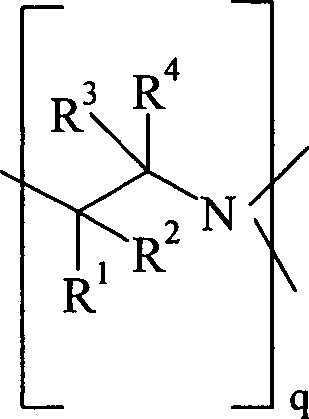
B
eine monomere Untereinheit basierend auf Ethylenoxid ist.
OH-Zahl:
13 mg KOH/g (Theorie: 10 mg KOH/g)
Basenzahl: 0,4 mg KOH/g 196 g of the C 13 oxoalcohol polybutoxylate from stage II and 0.9 g of potassium tert-butoxide were placed in a 2 1 metal reactor and then rendered inert three times with 5 bar nitrogen each. The reactor contents were heated to 120 ° C. and then 190 g of ethylene oxide were metered in. The mixture was stirred until the pressure was constant. After cooling and venting the reactor and degassing on a rotary evaporator at 80 ° C. and 3 to 4 mbar, a product with the following composition was obtained:
A'-O is a C 13 oxo alcohol,
A is a structural unit of the formula
X is a structural unit of the formula
B is a monomeric subunit based on ethylene oxide.
OH number: 13 mg KOH / g (theory: 10 mg KOH / g)
Base number: 0.4 mg KOH / g
Anwendungsbeispielexample
In der nachfolgenden Figur ist die Verschiebung des X-Punktes, das heißt der Mindestkonzentration an Tensid bei gegebener Temperatur dargestellt, ab der für das Referenzsystem Wasser/n-Dekan und ein gegebenes Tensid (Lutensol® ON50 der BASF AG) die Wasser und die n-Dekan-Phase vollständig mischbar sind und eine thermodynamisch stabile Mikroemulsion entsteht.The following figure shows the shift in the X point, i.e. the minimum concentration of surfactant at a given temperature, from which the water and n-dean for the reference system and a given surfactant (Lutensol ® ON50 from BASF AG) show the water and the n -Decan phase are completely miscible and a thermodynamically stable microemulsion is formed.
In der anliegenden Figur ist auf der Abszisse die Konzentration des Tensids Lutensol® ON50, in der Figur mit cTensid, in Gew.-% und auf der Ordinate die Temperatur in °C dargestellt. Ausschnitte aus den jeweiligen Phasendiagrammen („Fisch"-Phasen-Diagramme) sind für das genannte Referenzsystem Wasser/n-Dekan 1 : 1 und das genannte Tensid Lutensol® ON50 unter I zum Vergleich, das heißt ohne Zusatz eines Cotensids und unter II für das erfindungsgemäße Anwendungsbeispiel mit Zusatz des vorstehend unter Herstellungsbeispiel beschriebenen Cotensids, in einer Konzentration von 10 %, bezogen auf das Tensid, dargestellt. Die Darstellung zeigt, dass sich der X-Punkt von 22,5 % Tensid im Vergleichsbeispiel zu 15 % Tensid im erfindungsgemäßen Beispiel mit Cotensid-Zusatz verschob.In the accompanying figure, the abscissa represents the concentration of the surfactant Lutensol ® ON50, the temperature in ° C shown in the figure with c surfactant, in wt .-%, and on the ordinate. Excerpts from the respective phase diagrams ("fish" phase diagrams) are 1: 1 for the reference system water / n-dean and the mentioned surfactant Lutensol ® ON50 under I for comparison, that is without the addition of a cosurfactant and under II for that Example of application according to the invention with the addition of the cosurfactant described above under preparation example, in a concentration of 10%, based on the surfactant The illustration shows that the X point of 22.5% surfactant in the comparative example is 15% surfactant in the example according to the invention postponed with cosurfactant additive.
Claims (17)





Priority Applications (7)
| Application Number | Priority Date | Filing Date | Title |
|---|---|---|---|
| DE10323178A DE10323178A1 (en) | 2003-05-22 | 2003-05-22 | Mixture comprising a surfactant and a cosurfactant |
| PCT/EP2004/005518 WO2004103542A1 (en) | 2003-05-22 | 2004-05-21 | Mixture, comprising a surfactant and a cosurfactant |
| JP2006529898A JP2007534779A (en) | 2003-05-22 | 2004-05-21 | Mixture containing surfactant and cosurfactant |
| EP04739297A EP1631372B1 (en) | 2003-05-22 | 2004-05-21 | Mixture comprising a surfactant and a cosurfactant |
| US10/557,600 US7727948B2 (en) | 2003-05-22 | 2004-05-21 | Mixture, comprising a surfactant and a cosurfactant that is an amphiphilic polymer |
| AT04739297T ATE466654T1 (en) | 2003-05-22 | 2004-05-21 | A MIXTURE COMPRISING SURFACTANT AND COSURFACTANT |
| DE502004011131T DE502004011131D1 (en) | 2003-05-22 | 2004-05-21 | A TENSID AND A COTENSIDE COMPREHENSIVE MIXTURE |
Applications Claiming Priority (1)
| Application Number | Priority Date | Filing Date | Title |
|---|---|---|---|
| DE10323178A DE10323178A1 (en) | 2003-05-22 | 2003-05-22 | Mixture comprising a surfactant and a cosurfactant |
Publications (1)
| Publication Number | Publication Date |
|---|---|
| DE10323178A1 true DE10323178A1 (en) | 2004-12-09 |
Family
ID=33441155
Family Applications (2)
| Application Number | Title | Priority Date | Filing Date |
|---|---|---|---|
| DE10323178A Withdrawn DE10323178A1 (en) | 2003-05-22 | 2003-05-22 | Mixture comprising a surfactant and a cosurfactant |
| DE502004011131T Expired - Lifetime DE502004011131D1 (en) | 2003-05-22 | 2004-05-21 | A TENSID AND A COTENSIDE COMPREHENSIVE MIXTURE |
Family Applications After (1)
| Application Number | Title | Priority Date | Filing Date |
|---|---|---|---|
| DE502004011131T Expired - Lifetime DE502004011131D1 (en) | 2003-05-22 | 2004-05-21 | A TENSID AND A COTENSIDE COMPREHENSIVE MIXTURE |
Country Status (6)
| Country | Link |
|---|---|
| US (1) | US7727948B2 (en) |
| EP (1) | EP1631372B1 (en) |
| JP (1) | JP2007534779A (en) |
| AT (1) | ATE466654T1 (en) |
| DE (2) | DE10323178A1 (en) |
| WO (1) | WO2004103542A1 (en) |
Families Citing this family (16)
| Publication number | Priority date | Publication date | Assignee | Title |
|---|---|---|---|---|
| US7402554B2 (en) | 2003-02-28 | 2008-07-22 | The Procter & Gamble Company | Foam-generating kit containing a foam-generating dispenser and a composition containing a high level of surfactant |
| DE102005049765A1 (en) * | 2005-10-18 | 2007-04-19 | Forschungszentrum Jülich GmbH | Method for increasing the efficiency of surfactants, for widening the temperature window, for suppressing lamellar mesophases in microemulsions by means of additives, and microemulsions |
| GB0614353D0 (en) * | 2006-07-20 | 2006-08-30 | Oraldent Ltd | Oral compositions, their preparation and use |
| JP5311842B2 (en) * | 2008-02-20 | 2013-10-09 | 株式会社マンダム | Cleansing cosmetic and method for producing the same |
| US9410111B2 (en) | 2008-02-21 | 2016-08-09 | S.C. Johnson & Son, Inc. | Cleaning composition that provides residual benefits |
| US8993502B2 (en) * | 2008-02-21 | 2015-03-31 | S. C. Johnson & Son, Inc. | Cleaning composition having high self-adhesion to a vertical hard surface and providing residual benefits |
| US9481854B2 (en) | 2008-02-21 | 2016-11-01 | S. C. Johnson & Son, Inc. | Cleaning composition that provides residual benefits |
| US8980813B2 (en) * | 2008-02-21 | 2015-03-17 | S. C. Johnson & Son, Inc. | Cleaning composition having high self-adhesion on a vertical hard surface and providing residual benefits |
| JP4834775B2 (en) * | 2010-03-04 | 2011-12-14 | 株式会社 資生堂 | Sunscreen composition |
| DE102011015191A1 (en) * | 2011-03-25 | 2012-09-27 | Henkel Ag & Co. Kgaa | Process for the preparation of a conditioned cleaning agent |
| FR3018683B1 (en) * | 2014-03-21 | 2016-03-04 | Gattefosse Holding | ANHYDROUS CONSUMABLE DEVICE FOR THE EXTEMPORATIVE PREPARATION OF A COSMETIC MONODOSE COMPOSITION |
| AU2014403039B2 (en) * | 2014-08-08 | 2020-04-09 | Shagnhai Hightide Biopharmaceutical, Ltd. | Liquid formulation compositions, medicament delivery devices, and methods of preparation and use thereof |
| US10196591B2 (en) | 2015-07-10 | 2019-02-05 | S. C. Johnson & Sons, Inc. | Gel cleaning composition |
| US10358625B2 (en) | 2015-07-17 | 2019-07-23 | S. C. Johnson & Son, Inc. | Non-corrosive cleaning composition |
| US10000728B2 (en) | 2015-07-17 | 2018-06-19 | S. C. Johnson & Son, Inc. | Cleaning composition with propellant |
| US10723978B2 (en) * | 2015-08-27 | 2020-07-28 | S. C. Johnson & Son, Inc. | Cleaning gel with glycine betaine ester and nonionic surfactant mixture |
Family Cites Families (9)
| Publication number | Priority date | Publication date | Assignee | Title |
|---|---|---|---|---|
| HU199234B (en) * | 1987-05-18 | 1990-02-28 | Chinoin Gyogyszer Es Vegyeszet | Microemulsion composition comprising phosphoric acid ester or thiophosphoric acid ester as active ingredient |
| US4954338A (en) * | 1987-08-05 | 1990-09-04 | Rohm And Haas Company | Microbicidal microemulsion |
| US5932630A (en) | 1996-05-02 | 1999-08-03 | Xerox Corporation | Ink compositions |
| DE19634477C2 (en) | 1996-06-05 | 2002-10-17 | Forschungszentrum Juelich Gmbh | Process for the production of hydrophobic-hydrophilic AB block copolymers and AB block copolymers |
| US6133218A (en) * | 1997-07-29 | 2000-10-17 | Basf Corporation | Aqueous based solvent free cleaner compositions containing two nonionic surfactants |
| DE19839054A1 (en) | 1998-08-28 | 2000-03-02 | Forschungszentrum Juelich Gmbh | Process for increasing the efficiency of surfactants with simultaneous suppression of lamellar mesophases and surfactants to which an additive is added |
| US6506485B1 (en) | 2000-04-13 | 2003-01-14 | Board Of Trustees Of Michigan State University | Silica foam compositions |
| DE10117500A1 (en) * | 2001-04-07 | 2002-10-17 | Cognis Deutschland Gmbh | Hair care wipes |
| FR2830773B1 (en) * | 2001-10-11 | 2004-07-23 | Oreal | USE OF AMPHIPHILIC COPOLYMERS FOR STABILIZING DISPERSIONS OF INSOLUBLE ORGANIC COMPOUNDS FILTERING UV RADIATION, DISPERSIONS STABILIZED BY SUCH COPOLYMERS AND COSMETIC COMPOSITIONS CONTAINING THE SAME |
-
2003
- 2003-05-22 DE DE10323178A patent/DE10323178A1/en not_active Withdrawn
-
2004
- 2004-05-21 WO PCT/EP2004/005518 patent/WO2004103542A1/en not_active Ceased
- 2004-05-21 AT AT04739297T patent/ATE466654T1/en not_active IP Right Cessation
- 2004-05-21 DE DE502004011131T patent/DE502004011131D1/en not_active Expired - Lifetime
- 2004-05-21 EP EP04739297A patent/EP1631372B1/en not_active Expired - Lifetime
- 2004-05-21 US US10/557,600 patent/US7727948B2/en not_active Expired - Fee Related
- 2004-05-21 JP JP2006529898A patent/JP2007534779A/en active Pending
Also Published As
| Publication number | Publication date |
|---|---|
| EP1631372A1 (en) | 2006-03-08 |
| WO2004103542A1 (en) | 2004-12-02 |
| US20070060495A1 (en) | 2007-03-15 |
| EP1631372B1 (en) | 2010-05-05 |
| JP2007534779A (en) | 2007-11-29 |
| US7727948B2 (en) | 2010-06-01 |
| ATE466654T1 (en) | 2010-05-15 |
| DE502004011131D1 (en) | 2010-06-17 |
Similar Documents
| Publication | Publication Date | Title |
|---|---|---|
| DE10323178A1 (en) | Mixture comprising a surfactant and a cosurfactant | |
| EP2274398B1 (en) | Novel surfactants based on branched alcohols for tertiary crude oil recovery | |
| EP2561036A1 (en) | Method for producing mineral oil using surfactants based on a mixture of c32-guerbet-, c34-guerbet-, c36-guerbet-containing alkyl alkoxylates | |
| WO2003091191A1 (en) | C10-alkanolalkoxylates and the use thereof | |
| WO2004033405A1 (en) | Alkoxylates exhibiting low residual alcohol content | |
| EP0446621B1 (en) | Polymers of acrylic esters containing long chain alkoxylated hydrocarbonoxy-groups and use thereof in cosmetics and personal care | |
| EP1675811B1 (en) | C10 alkanolalkoxylate mixtures and use thereof as novel low-foaming wetting agents | |
| WO2004033403A1 (en) | Method for producing alkanol alkoxylates at optimal reaction temperatures | |
| EP3038590A1 (en) | Cosmetic products | |
| EP2123350B1 (en) | Aqueous tenside compounds with low pour point | |
| DE4431158C2 (en) | Methyl end-capped alkyl and / or alkenyl polyglycol ethers | |
| DE10323180A1 (en) | Mixture comprising a surfactant and a cosurfactant | |
| US4983323A (en) | Surfactant compositions | |
| WO1998019783A2 (en) | Twin surfactants | |
| DE19845456A1 (en) | Syndet bar soaps | |
| DE4435404A1 (en) | Process for the preparation of stabilized aqueous polyolefin wax dispersions | |
| EP2118251A1 (en) | Clear aqueous detergents and cleaning agents | |
| DE19715835C1 (en) | Light coloured ester quaternary compounds useful in surfactant, e.g. detergent or conditioner, especially hair or skin care formulation | |
| Bognolo | Nonionic surfactants | |
| DE19821402A1 (en) | Production of stable, high viscosity emulsions, especially of sunscreens | |
| DE19727030A1 (en) | Alkyl and / or alkenyl oligoglycoside silicone ethers | |
| DE10218754A1 (en) | New and known 2-propyl-heptan-1-ol alkoxylates, used e.g. in cleaning, coating, adhesive, textile treatment, cosmetic, pharmaceutical or plant protection formulations, contain ethylene oxide and other alkylene oxide groups | |
| DE10218753A1 (en) | Alkoxylate mixture used as emulsifier, foam regulator and wetting agent, e.g. in detergent, humectant, cosmetic, pharmaceutical, plant protection, coating or emulsion polymerization, contains alkoxylates of 2-propyl-heptan-1-ol isomers | |
| DE10243360A1 (en) | New and known 2-propyl-heptan-1-ol alkoxylates, used e.g. in cleaning, coating, adhesive, textile treatment, cosmetic, pharmaceutical or plant protection formulations, contain ethylene oxide and other alkylene oxide groups | |
| EP3645496A1 (en) | Alkoxylation of hydroxy acids |
Legal Events
| Date | Code | Title | Description |
|---|---|---|---|
| 8130 | Withdrawal |