DE10304537A1 - Plastic molded body, process for its production and its use - Google Patents
Plastic molded body, process for its production and its use Download PDFInfo
- Publication number
- DE10304537A1 DE10304537A1 DE10304537A DE10304537A DE10304537A1 DE 10304537 A1 DE10304537 A1 DE 10304537A1 DE 10304537 A DE10304537 A DE 10304537A DE 10304537 A DE10304537 A DE 10304537A DE 10304537 A1 DE10304537 A1 DE 10304537A1
- Authority
- DE
- Germany
- Prior art keywords
- meth
- acrylate
- weight
- formula
- plastic
- Prior art date
- Legal status (The legal status is an assumption and is not a legal conclusion. Google has not performed a legal analysis and makes no representation as to the accuracy of the status listed.)
- Ceased
Links
- NIXOWILDQLNWCW-UHFFFAOYSA-M Acrylate Chemical compound [O-]C(=O)C=C NIXOWILDQLNWCW-UHFFFAOYSA-M 0.000 description 126
- -1 Polyethylene terephthalate Polymers 0.000 description 66
- 239000010410 layer Substances 0.000 description 66
- 230000004888 barrier function Effects 0.000 description 45
- NIXOWILDQLNWCW-UHFFFAOYSA-N acrylic acid group Chemical group C(C=C)(=O)O NIXOWILDQLNWCW-UHFFFAOYSA-N 0.000 description 36
- 239000000203 mixture Substances 0.000 description 36
- 239000000178 monomer Substances 0.000 description 29
- 229920002451 polyvinyl alcohol Polymers 0.000 description 28
- 229910052739 hydrogen Inorganic materials 0.000 description 26
- 235000019422 polyvinyl alcohol Nutrition 0.000 description 26
- 229920003023 plastic Polymers 0.000 description 24
- 239000004033 plastic Substances 0.000 description 24
- 229910052760 oxygen Inorganic materials 0.000 description 23
- 229920000139 polyethylene terephthalate Polymers 0.000 description 23
- 239000005020 polyethylene terephthalate Substances 0.000 description 23
- 239000004372 Polyvinyl alcohol Substances 0.000 description 22
- CURLTUGMZLYLDI-UHFFFAOYSA-N Carbon dioxide Chemical compound O=C=O CURLTUGMZLYLDI-UHFFFAOYSA-N 0.000 description 18
- 150000001252 acrylic acid derivatives Chemical class 0.000 description 17
- 229920000642 polymer Polymers 0.000 description 17
- 150000003254 radicals Chemical class 0.000 description 16
- XLYOFNOQVPJJNP-UHFFFAOYSA-N water Substances O XLYOFNOQVPJJNP-UHFFFAOYSA-N 0.000 description 16
- 239000007789 gas Substances 0.000 description 15
- 239000001301 oxygen Substances 0.000 description 15
- UFHFLCQGNIYNRP-UHFFFAOYSA-N Hydrogen Chemical compound [H][H] UFHFLCQGNIYNRP-UHFFFAOYSA-N 0.000 description 14
- 239000001257 hydrogen Substances 0.000 description 14
- QVGXLLKOCUKJST-UHFFFAOYSA-N atomic oxygen Chemical compound [O] QVGXLLKOCUKJST-UHFFFAOYSA-N 0.000 description 13
- 125000004429 atom Chemical group 0.000 description 12
- 229910052799 carbon Inorganic materials 0.000 description 12
- 239000000975 dye Substances 0.000 description 11
- 239000000463 material Substances 0.000 description 11
- 238000006116 polymerization reaction Methods 0.000 description 11
- 229920002554 vinyl polymer Polymers 0.000 description 11
- 238000000576 coating method Methods 0.000 description 10
- 125000002496 methyl group Chemical group [H]C([H])([H])* 0.000 description 10
- 239000002991 molded plastic Substances 0.000 description 10
- 229910002092 carbon dioxide Inorganic materials 0.000 description 9
- 239000001569 carbon dioxide Substances 0.000 description 9
- 150000001875 compounds Chemical class 0.000 description 9
- 238000000034 method Methods 0.000 description 9
- 239000000654 additive Substances 0.000 description 8
- 239000011248 coating agent Substances 0.000 description 8
- 125000004432 carbon atom Chemical group C* 0.000 description 7
- 239000000049 pigment Substances 0.000 description 7
- VZCYOOQTPOCHFL-OWOJBTEDSA-N Fumaric acid Chemical compound OC(=O)\C=C\C(O)=O VZCYOOQTPOCHFL-OWOJBTEDSA-N 0.000 description 6
- OKKJLVBELUTLKV-UHFFFAOYSA-N Methanol Chemical compound OC OKKJLVBELUTLKV-UHFFFAOYSA-N 0.000 description 6
- 150000001241 acetals Chemical class 0.000 description 6
- 230000005855 radiation Effects 0.000 description 6
- 239000002994 raw material Substances 0.000 description 6
- 239000000243 solution Substances 0.000 description 6
- VZCYOOQTPOCHFL-UHFFFAOYSA-N trans-butenedioic acid Natural products OC(=O)C=CC(O)=O VZCYOOQTPOCHFL-UHFFFAOYSA-N 0.000 description 6
- 239000007864 aqueous solution Substances 0.000 description 5
- 230000008901 benefit Effects 0.000 description 5
- 229920001577 copolymer Polymers 0.000 description 5
- 238000001723 curing Methods 0.000 description 5
- 238000001035 drying Methods 0.000 description 5
- 238000005429 filling process Methods 0.000 description 5
- 239000003999 initiator Substances 0.000 description 5
- 229910052757 nitrogen Inorganic materials 0.000 description 5
- 230000003647 oxidation Effects 0.000 description 5
- 238000007254 oxidation reaction Methods 0.000 description 5
- 238000004806 packaging method and process Methods 0.000 description 5
- 230000035699 permeability Effects 0.000 description 5
- 230000008569 process Effects 0.000 description 5
- 239000002904 solvent Substances 0.000 description 5
- CERQOIWHTDAKMF-UHFFFAOYSA-N Methacrylic acid Chemical compound CC(=C)C(O)=O CERQOIWHTDAKMF-UHFFFAOYSA-N 0.000 description 4
- XUIMIQQOPSSXEZ-UHFFFAOYSA-N Silicon Chemical compound [Si] XUIMIQQOPSSXEZ-UHFFFAOYSA-N 0.000 description 4
- PPBRXRYQALVLMV-UHFFFAOYSA-N Styrene Chemical compound C=CC1=CC=CC=C1 PPBRXRYQALVLMV-UHFFFAOYSA-N 0.000 description 4
- 150000001299 aldehydes Chemical class 0.000 description 4
- 235000013405 beer Nutrition 0.000 description 4
- 230000000694 effects Effects 0.000 description 4
- 125000001495 ethyl group Chemical group [H]C([H])([H])C([H])([H])* 0.000 description 4
- 235000013305 food Nutrition 0.000 description 4
- 239000007788 liquid Substances 0.000 description 4
- 238000004519 manufacturing process Methods 0.000 description 4
- 238000010137 moulding (plastic) Methods 0.000 description 4
- 238000012858 packaging process Methods 0.000 description 4
- 229920002037 poly(vinyl butyral) polymer Polymers 0.000 description 4
- 239000003505 polymerization initiator Substances 0.000 description 4
- 239000011241 protective layer Substances 0.000 description 4
- 238000003847 radiation curing Methods 0.000 description 4
- 229910052710 silicon Inorganic materials 0.000 description 4
- 239000010703 silicon Substances 0.000 description 4
- 229920001567 vinyl ester resin Polymers 0.000 description 4
- LFQSCWFLJHTTHZ-UHFFFAOYSA-N Ethanol Chemical compound CCO LFQSCWFLJHTTHZ-UHFFFAOYSA-N 0.000 description 3
- WSFSSNUMVMOOMR-UHFFFAOYSA-N Formaldehyde Chemical compound O=C WSFSSNUMVMOOMR-UHFFFAOYSA-N 0.000 description 3
- PEDCQBHIVMGVHV-UHFFFAOYSA-N Glycerine Chemical compound OCC(O)CO PEDCQBHIVMGVHV-UHFFFAOYSA-N 0.000 description 3
- WHNWPMSKXPGLAX-UHFFFAOYSA-N N-Vinyl-2-pyrrolidone Chemical compound C=CN1CCCC1=O WHNWPMSKXPGLAX-UHFFFAOYSA-N 0.000 description 3
- OFOBLEOULBTSOW-UHFFFAOYSA-N Propanedioic acid Natural products OC(=O)CC(O)=O OFOBLEOULBTSOW-UHFFFAOYSA-N 0.000 description 3
- 150000001298 alcohols Chemical class 0.000 description 3
- 125000001931 aliphatic group Chemical group 0.000 description 3
- 125000003178 carboxy group Chemical group [H]OC(*)=O 0.000 description 3
- 238000006243 chemical reaction Methods 0.000 description 3
- 238000005516 engineering process Methods 0.000 description 3
- 239000001530 fumaric acid Substances 0.000 description 3
- 230000006872 improvement Effects 0.000 description 3
- VZCYOOQTPOCHFL-UPHRSURJSA-N maleic acid Chemical compound OC(=O)\C=C/C(O)=O VZCYOOQTPOCHFL-UPHRSURJSA-N 0.000 description 3
- 239000011976 maleic acid Substances 0.000 description 3
- 125000004108 n-butyl group Chemical group [H]C([H])([H])C([H])([H])C([H])([H])C([H])([H])* 0.000 description 3
- 229920000728 polyester Polymers 0.000 description 3
- 238000002360 preparation method Methods 0.000 description 3
- 239000002210 silicon-based material Substances 0.000 description 3
- 238000003860 storage Methods 0.000 description 3
- 150000003440 styrenes Chemical class 0.000 description 3
- 239000000126 substance Substances 0.000 description 3
- 239000000758 substrate Substances 0.000 description 3
- YODZTKMDCQEPHD-UHFFFAOYSA-N thiodiglycol Chemical compound OCCSCCO YODZTKMDCQEPHD-UHFFFAOYSA-N 0.000 description 3
- 125000000391 vinyl group Chemical group [H]C([*])=C([H])[H] 0.000 description 3
- DTGKSKDOIYIVQL-WEDXCCLWSA-N (+)-borneol Chemical group C1C[C@@]2(C)[C@@H](O)C[C@@H]1C2(C)C DTGKSKDOIYIVQL-WEDXCCLWSA-N 0.000 description 2
- XSCRXCDDATUDLB-UHFFFAOYSA-N 2-(2-methylpropoxymethyl)prop-2-enamide Chemical compound CC(C)COCC(=C)C(N)=O XSCRXCDDATUDLB-UHFFFAOYSA-N 0.000 description 2
- PGMMQIGGQSIEGH-UHFFFAOYSA-N 2-ethenyl-1,3-oxazole Chemical class C=CC1=NC=CO1 PGMMQIGGQSIEGH-UHFFFAOYSA-N 0.000 description 2
- ORNUPNRNNSVZTC-UHFFFAOYSA-N 2-vinylthiophene Chemical compound C=CC1=CC=CS1 ORNUPNRNNSVZTC-UHFFFAOYSA-N 0.000 description 2
- WHNPOQXWAMXPTA-UHFFFAOYSA-N 3-methylbut-2-enamide Chemical compound CC(C)=CC(N)=O WHNPOQXWAMXPTA-UHFFFAOYSA-N 0.000 description 2
- IKHGUXGNUITLKF-UHFFFAOYSA-N Acetaldehyde Chemical compound CC=O IKHGUXGNUITLKF-UHFFFAOYSA-N 0.000 description 2
- IJGRMHOSHXDMSA-UHFFFAOYSA-N Atomic nitrogen Chemical compound N#N IJGRMHOSHXDMSA-UHFFFAOYSA-N 0.000 description 2
- ZTQSAGDEMFDKMZ-UHFFFAOYSA-N Butyraldehyde Chemical compound CCCC=O ZTQSAGDEMFDKMZ-UHFFFAOYSA-N 0.000 description 2
- MYMOFIZGZYHOMD-UHFFFAOYSA-N Dioxygen Chemical compound O=O MYMOFIZGZYHOMD-UHFFFAOYSA-N 0.000 description 2
- 241000196324 Embryophyta Species 0.000 description 2
- VGGSQFUCUMXWEO-UHFFFAOYSA-N Ethene Chemical compound C=C VGGSQFUCUMXWEO-UHFFFAOYSA-N 0.000 description 2
- 239000005977 Ethylene Substances 0.000 description 2
- LRHPLDYGYMQRHN-UHFFFAOYSA-N N-Butanol Chemical compound CCCCO LRHPLDYGYMQRHN-UHFFFAOYSA-N 0.000 description 2
- ZJCCRDAZUWHFQH-UHFFFAOYSA-N Trimethylolpropane Chemical compound CCC(CO)(CO)CO ZJCCRDAZUWHFQH-UHFFFAOYSA-N 0.000 description 2
- XTXRWKRVRITETP-UHFFFAOYSA-N Vinyl acetate Chemical compound CC(=O)OC=C XTXRWKRVRITETP-UHFFFAOYSA-N 0.000 description 2
- 238000006359 acetalization reaction Methods 0.000 description 2
- 238000007605 air drying Methods 0.000 description 2
- 125000003158 alcohol group Chemical group 0.000 description 2
- 150000001336 alkenes Chemical class 0.000 description 2
- 238000013459 approach Methods 0.000 description 2
- 230000009286 beneficial effect Effects 0.000 description 2
- ISAOCJYIOMOJEB-UHFFFAOYSA-N benzoin Chemical compound C=1C=CC=CC=1C(O)C(=O)C1=CC=CC=C1 ISAOCJYIOMOJEB-UHFFFAOYSA-N 0.000 description 2
- 235000013361 beverage Nutrition 0.000 description 2
- IISBACLAFKSPIT-UHFFFAOYSA-N bisphenol A Chemical compound C=1C=C(O)C=CC=1C(C)(C)C1=CC=C(O)C=C1 IISBACLAFKSPIT-UHFFFAOYSA-N 0.000 description 2
- 230000000903 blocking effect Effects 0.000 description 2
- 238000000071 blow moulding Methods 0.000 description 2
- WERYXYBDKMZEQL-UHFFFAOYSA-N butane-1,4-diol Chemical compound OCCCCO WERYXYBDKMZEQL-UHFFFAOYSA-N 0.000 description 2
- 235000012174 carbonated soft drink Nutrition 0.000 description 2
- 125000002915 carbonyl group Chemical group [*:2]C([*:1])=O 0.000 description 2
- 150000001732 carboxylic acid derivatives Chemical class 0.000 description 2
- 239000008199 coating composition Substances 0.000 description 2
- 239000003086 colorant Substances 0.000 description 2
- 238000004040 coloring Methods 0.000 description 2
- 230000000052 comparative effect Effects 0.000 description 2
- 238000007796 conventional method Methods 0.000 description 2
- 150000005690 diesters Chemical class 0.000 description 2
- 238000011049 filling Methods 0.000 description 2
- 239000011521 glass Substances 0.000 description 2
- 229920001519 homopolymer Polymers 0.000 description 2
- 150000002431 hydrogen Chemical class 0.000 description 2
- 125000001449 isopropyl group Chemical group [H]C([H])([H])C([H])(*)C([H])([H])[H] 0.000 description 2
- 238000012423 maintenance Methods 0.000 description 2
- FPYJFEHAWHCUMM-UHFFFAOYSA-N maleic anhydride Chemical compound O=C1OC(=O)C=C1 FPYJFEHAWHCUMM-UHFFFAOYSA-N 0.000 description 2
- 238000000465 moulding Methods 0.000 description 2
- 125000004123 n-propyl group Chemical group [H]C([H])([H])C([H])([H])C([H])([H])* 0.000 description 2
- 239000002105 nanoparticle Substances 0.000 description 2
- 230000000379 polymerizing effect Effects 0.000 description 2
- 230000002035 prolonged effect Effects 0.000 description 2
- 125000001436 propyl group Chemical group [H]C([*])([H])C([H])([H])C([H])([H])[H] 0.000 description 2
- 239000007870 radical polymerization initiator Substances 0.000 description 2
- 125000002914 sec-butyl group Chemical group [H]C([H])([H])C([H])([H])C([H])(*)C([H])([H])[H] 0.000 description 2
- 238000005507 spraying Methods 0.000 description 2
- 125000000999 tert-butyl group Chemical group [H]C([H])([H])C(*)(C([H])([H])[H])C([H])([H])[H] 0.000 description 2
- CIHOLLKRGTVIJN-UHFFFAOYSA-N tert‐butyl hydroperoxide Chemical compound CC(C)(C)OO CIHOLLKRGTVIJN-UHFFFAOYSA-N 0.000 description 2
- HGXJDMCMYLEZMJ-UHFFFAOYSA-N (2-methylpropan-2-yl)oxy 2,2-dimethylpropaneperoxoate Chemical compound CC(C)(C)OOOC(=O)C(C)(C)C HGXJDMCMYLEZMJ-UHFFFAOYSA-N 0.000 description 1
- DNIAPMSPPWPWGF-GSVOUGTGSA-N (R)-(-)-Propylene glycol Chemical compound C[C@@H](O)CO DNIAPMSPPWPWGF-GSVOUGTGSA-N 0.000 description 1
- BQCIDUSAKPWEOX-UHFFFAOYSA-N 1,1-Difluoroethene Chemical compound FC(F)=C BQCIDUSAKPWEOX-UHFFFAOYSA-N 0.000 description 1
- JVPKLOPETWVKQD-UHFFFAOYSA-N 1,2,2-tribromoethenylbenzene Chemical class BrC(Br)=C(Br)C1=CC=CC=C1 JVPKLOPETWVKQD-UHFFFAOYSA-N 0.000 description 1
- MYRTYDVEIRVNKP-UHFFFAOYSA-N 1,2-Divinylbenzene Chemical compound C=CC1=CC=CC=C1C=C MYRTYDVEIRVNKP-UHFFFAOYSA-N 0.000 description 1
- HIACAHMKXQESOV-UHFFFAOYSA-N 1,2-bis(prop-1-en-2-yl)benzene Chemical compound CC(=C)C1=CC=CC=C1C(C)=C HIACAHMKXQESOV-UHFFFAOYSA-N 0.000 description 1
- MSAHTMIQULFMRG-UHFFFAOYSA-N 1,2-diphenyl-2-propan-2-yloxyethanone Chemical compound C=1C=CC=CC=1C(OC(C)C)C(=O)C1=CC=CC=C1 MSAHTMIQULFMRG-UHFFFAOYSA-N 0.000 description 1
- PRJNEUBECVAVAG-UHFFFAOYSA-N 1,3-bis(ethenyl)benzene Chemical compound C=CC1=CC=CC(C=C)=C1 PRJNEUBECVAVAG-UHFFFAOYSA-N 0.000 description 1
- IBVPVTPPYGGAEL-UHFFFAOYSA-N 1,3-bis(prop-1-en-2-yl)benzene Chemical compound CC(=C)C1=CC=CC(C(C)=C)=C1 IBVPVTPPYGGAEL-UHFFFAOYSA-N 0.000 description 1
- WEERVPDNCOGWJF-UHFFFAOYSA-N 1,4-bis(ethenyl)benzene Chemical compound C=CC1=CC=C(C=C)C=C1 WEERVPDNCOGWJF-UHFFFAOYSA-N 0.000 description 1
- ZENYUPUKNXGVDY-UHFFFAOYSA-N 1,4-bis(prop-1-en-2-yl)benzene Chemical compound CC(=C)C1=CC=C(C(C)=C)C=C1 ZENYUPUKNXGVDY-UHFFFAOYSA-N 0.000 description 1
- DKEGCUDAFWNSSO-UHFFFAOYSA-N 1,8-dibromooctane Chemical compound BrCCCCCCCCBr DKEGCUDAFWNSSO-UHFFFAOYSA-N 0.000 description 1
- JQACBLYOTAYMHP-UHFFFAOYSA-N 1-(2-methylprop-2-enoyl)pyrrolidin-2-one Chemical compound CC(=C)C(=O)N1CCCC1=O JQACBLYOTAYMHP-UHFFFAOYSA-N 0.000 description 1
- LGJCFVYMIJLQJO-UHFFFAOYSA-N 1-dodecylperoxydodecane Chemical compound CCCCCCCCCCCCOOCCCCCCCCCCCC LGJCFVYMIJLQJO-UHFFFAOYSA-N 0.000 description 1
- BDHGFCVQWMDIQX-UHFFFAOYSA-N 1-ethenyl-2-methylimidazole Chemical compound CC1=NC=CN1C=C BDHGFCVQWMDIQX-UHFFFAOYSA-N 0.000 description 1
- JWYVGKFDLWWQJX-UHFFFAOYSA-N 1-ethenylazepan-2-one Chemical compound C=CN1CCCCCC1=O JWYVGKFDLWWQJX-UHFFFAOYSA-N 0.000 description 1
- OSSNTDFYBPYIEC-UHFFFAOYSA-N 1-ethenylimidazole Chemical compound C=CN1C=CN=C1 OSSNTDFYBPYIEC-UHFFFAOYSA-N 0.000 description 1
- LEWNYOKWUAYXPI-UHFFFAOYSA-N 1-ethenylpiperidine Chemical compound C=CN1CCCCC1 LEWNYOKWUAYXPI-UHFFFAOYSA-N 0.000 description 1
- UDJZTGMLYITLIQ-UHFFFAOYSA-N 1-ethenylpyrrolidine Chemical compound C=CN1CCCC1 UDJZTGMLYITLIQ-UHFFFAOYSA-N 0.000 description 1
- 239000012956 1-hydroxycyclohexylphenyl-ketone Substances 0.000 description 1
- CISIJYCKDJSTMX-UHFFFAOYSA-N 2,2-dichloroethenylbenzene Chemical class ClC(Cl)=CC1=CC=CC=C1 CISIJYCKDJSTMX-UHFFFAOYSA-N 0.000 description 1
- PIZHFBODNLEQBL-UHFFFAOYSA-N 2,2-diethoxy-1-phenylethanone Chemical compound CCOC(OCC)C(=O)C1=CC=CC=C1 PIZHFBODNLEQBL-UHFFFAOYSA-N 0.000 description 1
- RROZRFLLVCBVQB-UHFFFAOYSA-N 2,4-dihydroxy-2,4-dimethyl-1,5-bis(4-propan-2-ylphenyl)pentan-3-one Chemical compound C1=CC(C(C)C)=CC=C1CC(C)(O)C(=O)C(C)(O)CC1=CC=C(C(C)C)C=C1 RROZRFLLVCBVQB-UHFFFAOYSA-N 0.000 description 1
- OQYKKQQLTKPGSG-UHFFFAOYSA-N 2,5-dimethylhexane-1,6-diol Chemical compound OCC(C)CCC(C)CO OQYKKQQLTKPGSG-UHFFFAOYSA-N 0.000 description 1
- ASUQXIDYMVXFKU-UHFFFAOYSA-N 2,6-dibromo-9,9-dimethylfluorene Chemical compound C1=C(Br)C=C2C(C)(C)C3=CC=C(Br)C=C3C2=C1 ASUQXIDYMVXFKU-UHFFFAOYSA-N 0.000 description 1
- SMZOUWXMTYCWNB-UHFFFAOYSA-N 2-(2-methoxy-5-methylphenyl)ethanamine Chemical compound COC1=CC=C(C)C=C1CCN SMZOUWXMTYCWNB-UHFFFAOYSA-N 0.000 description 1
- XVTPGZQPUZSUKS-UHFFFAOYSA-N 2-(2-oxopyrrolidin-1-yl)ethyl 2-methylprop-2-enoate Chemical compound CC(=C)C(=O)OCCN1CCCC1=O XVTPGZQPUZSUKS-UHFFFAOYSA-N 0.000 description 1
- JAHNSTQSQJOJLO-UHFFFAOYSA-N 2-(3-fluorophenyl)-1h-imidazole Chemical compound FC1=CC=CC(C=2NC=CN=2)=C1 JAHNSTQSQJOJLO-UHFFFAOYSA-N 0.000 description 1
- OEPOKWHJYJXUGD-UHFFFAOYSA-N 2-(3-phenylmethoxyphenyl)-1,3-thiazole-4-carbaldehyde Chemical compound O=CC1=CSC(C=2C=C(OCC=3C=CC=CC=3)C=CC=2)=N1 OEPOKWHJYJXUGD-UHFFFAOYSA-N 0.000 description 1
- LCZVSXRMYJUNFX-UHFFFAOYSA-N 2-[2-(2-hydroxypropoxy)propoxy]propan-1-ol Chemical compound CC(O)COC(C)COC(C)CO LCZVSXRMYJUNFX-UHFFFAOYSA-N 0.000 description 1
- 125000005999 2-bromoethyl group Chemical group 0.000 description 1
- 125000000143 2-carboxyethyl group Chemical group [H]OC(=O)C([H])([H])C([H])([H])* 0.000 description 1
- SBYMUDUGTIKLCR-UHFFFAOYSA-N 2-chloroethenylbenzene Chemical class ClC=CC1=CC=CC=C1 SBYMUDUGTIKLCR-UHFFFAOYSA-N 0.000 description 1
- JDCUKFVNOWJNBU-UHFFFAOYSA-N 2-ethenyl-1,3-thiazole Chemical class C=CC1=NC=CS1 JDCUKFVNOWJNBU-UHFFFAOYSA-N 0.000 description 1
- QQBUHYQVKJQAOB-UHFFFAOYSA-N 2-ethenylfuran Chemical compound C=CC1=CC=CO1 QQBUHYQVKJQAOB-UHFFFAOYSA-N 0.000 description 1
- XIXWTBLGKIRXOP-UHFFFAOYSA-N 2-ethenyloxolane Chemical compound C=CC1CCCO1 XIXWTBLGKIRXOP-UHFFFAOYSA-N 0.000 description 1
- ZDHWTWWXCXEGIC-UHFFFAOYSA-N 2-ethenylpyrimidine Chemical compound C=CC1=NC=CC=N1 ZDHWTWWXCXEGIC-UHFFFAOYSA-N 0.000 description 1
- KMNCBSZOIQAUFX-UHFFFAOYSA-N 2-ethoxy-1,2-diphenylethanone Chemical compound C=1C=CC=CC=1C(OCC)C(=O)C1=CC=CC=C1 KMNCBSZOIQAUFX-UHFFFAOYSA-N 0.000 description 1
- RSROEZYGRKHVMN-UHFFFAOYSA-N 2-ethyl-2-(hydroxymethyl)propane-1,3-diol;oxirane Chemical compound C1CO1.CCC(CO)(CO)CO RSROEZYGRKHVMN-UHFFFAOYSA-N 0.000 description 1
- XMLYCEVDHLAQEL-UHFFFAOYSA-N 2-hydroxy-2-methyl-1-phenylpropan-1-one Chemical compound CC(C)(O)C(=O)C1=CC=CC=C1 XMLYCEVDHLAQEL-UHFFFAOYSA-N 0.000 description 1
- 125000000954 2-hydroxyethyl group Chemical group [H]C([*])([H])C([H])([H])O[H] 0.000 description 1
- KXVAYZZWCKNUMN-UHFFFAOYSA-N 2-imidazol-1-ylethyl 2-methylprop-2-enoate Chemical compound CC(=C)C(=O)OCCN1C=CN=C1 KXVAYZZWCKNUMN-UHFFFAOYSA-N 0.000 description 1
- AKVUWTYSNLGBJY-UHFFFAOYSA-N 2-methyl-1-morpholin-4-ylprop-2-en-1-one Chemical compound CC(=C)C(=O)N1CCOCC1 AKVUWTYSNLGBJY-UHFFFAOYSA-N 0.000 description 1
- RAWISQFSQWIXCW-UHFFFAOYSA-N 2-methylbutan-2-yl 2,2-dimethyloctaneperoxoate Chemical compound CCCCCCC(C)(C)C(=O)OOC(C)(C)CC RAWISQFSQWIXCW-UHFFFAOYSA-N 0.000 description 1
- AQKYLAIZOGOPAW-UHFFFAOYSA-N 2-methylbutan-2-yl 2,2-dimethylpropaneperoxoate Chemical compound CCC(C)(C)OOC(=O)C(C)(C)C AQKYLAIZOGOPAW-UHFFFAOYSA-N 0.000 description 1
- IFXDUNDBQDXPQZ-UHFFFAOYSA-N 2-methylbutan-2-yl 2-ethylhexaneperoxoate Chemical compound CCCCC(CC)C(=O)OOC(C)(C)CC IFXDUNDBQDXPQZ-UHFFFAOYSA-N 0.000 description 1
- KTALPKYXQZGAEG-UHFFFAOYSA-N 2-propan-2-ylthioxanthen-9-one Chemical compound C1=CC=C2C(=O)C3=CC(C(C)C)=CC=C3SC2=C1 KTALPKYXQZGAEG-UHFFFAOYSA-N 0.000 description 1
- 125000003903 2-propenyl group Chemical group [H]C([*])([H])C([H])=C([H])[H] 0.000 description 1
- 125000001494 2-propynyl group Chemical group [H]C#CC([H])([H])* 0.000 description 1
- KGIGUEBEKRSTEW-UHFFFAOYSA-N 2-vinylpyridine Chemical compound C=CC1=CC=CC=N1 KGIGUEBEKRSTEW-UHFFFAOYSA-N 0.000 description 1
- YEBSYMIZFYCPRG-UHFFFAOYSA-N 3-(oxomethylidene)penta-1,4-diene-1,5-dione Chemical compound O=C=CC(=C=O)C=C=O YEBSYMIZFYCPRG-UHFFFAOYSA-N 0.000 description 1
- NXSUJGYQZCMYDQ-UHFFFAOYSA-N 3-(prop-2-enoylamino)prop-1-ene-1-sulfonic acid Chemical compound OS(=O)(=O)C=CCNC(=O)C=C NXSUJGYQZCMYDQ-UHFFFAOYSA-N 0.000 description 1
- VIRDQWZTIAVLSE-UHFFFAOYSA-N 3-ethenyl-9h-carbazole Chemical compound C1=CC=C2C3=CC(C=C)=CC=C3NC2=C1 VIRDQWZTIAVLSE-UHFFFAOYSA-N 0.000 description 1
- DPZYLEIWHTWHCU-UHFFFAOYSA-N 3-ethenylpyridine Chemical compound C=CC1=CC=CN=C1 DPZYLEIWHTWHCU-UHFFFAOYSA-N 0.000 description 1
- UIRSDPGHIARUJZ-UHFFFAOYSA-N 3-ethenylpyrrolidine Chemical compound C=CC1CCNC1 UIRSDPGHIARUJZ-UHFFFAOYSA-N 0.000 description 1
- QOXOZONBQWIKDA-UHFFFAOYSA-N 3-hydroxypropyl Chemical group [CH2]CCO QOXOZONBQWIKDA-UHFFFAOYSA-N 0.000 description 1
- DHNFGUDLVOSIKJ-UHFFFAOYSA-N 3-methyl-1-(3-methylbuta-1,3-dienoxy)buta-1,3-diene Chemical compound CC(=C)C=COC=CC(C)=C DHNFGUDLVOSIKJ-UHFFFAOYSA-N 0.000 description 1
- AYKYXWQEBUNJCN-UHFFFAOYSA-N 3-methylfuran-2,5-dione Chemical compound CC1=CC(=O)OC1=O AYKYXWQEBUNJCN-UHFFFAOYSA-N 0.000 description 1
- ZLPORNPZJNRGCO-UHFFFAOYSA-N 3-methylpyrrole-2,5-dione Chemical compound CC1=CC(=O)NC1=O ZLPORNPZJNRGCO-UHFFFAOYSA-N 0.000 description 1
- JLBJTVDPSNHSKJ-UHFFFAOYSA-N 4-Methylstyrene Chemical compound CC1=CC=C(C=C)C=C1 JLBJTVDPSNHSKJ-UHFFFAOYSA-N 0.000 description 1
- 125000004800 4-bromophenyl group Chemical group [H]C1=C([H])C(*)=C([H])C([H])=C1Br 0.000 description 1
- AXSCUMTZULTSIN-UHFFFAOYSA-N 4-ethenyl-3-ethylpyridine Chemical compound CCC1=CN=CC=C1C=C AXSCUMTZULTSIN-UHFFFAOYSA-N 0.000 description 1
- JBENUYBOHNHXIU-UHFFFAOYSA-N 4-ethenyl-9h-carbazole Chemical compound N1C2=CC=CC=C2C2=C1C=CC=C2C=C JBENUYBOHNHXIU-UHFFFAOYSA-N 0.000 description 1
- WNWVKZTYMQWFHE-UHFFFAOYSA-N 4-ethylmorpholine Chemical group [CH2]CN1CCOCC1 WNWVKZTYMQWFHE-UHFFFAOYSA-N 0.000 description 1
- BMVWCPGVLSILMU-UHFFFAOYSA-N 5,6-dihydrodibenzo[2,1-b:2',1'-f][7]annulen-11-one Chemical compound C1CC2=CC=CC=C2C(=O)C2=CC=CC=C21 BMVWCPGVLSILMU-UHFFFAOYSA-N 0.000 description 1
- LKLNVHRUXQQEII-UHFFFAOYSA-N 5-ethenyl-2,3-dimethylpyridine Chemical compound CC1=CC(C=C)=CN=C1C LKLNVHRUXQQEII-UHFFFAOYSA-N 0.000 description 1
- VJOWMORERYNYON-UHFFFAOYSA-N 5-ethenyl-2-methylpyridine Chemical compound CC1=CC=C(C=C)C=N1 VJOWMORERYNYON-UHFFFAOYSA-N 0.000 description 1
- QTBSBXVTEAMEQO-UHFFFAOYSA-M Acetate Chemical compound CC([O-])=O QTBSBXVTEAMEQO-UHFFFAOYSA-M 0.000 description 1
- 239000004342 Benzoyl peroxide Substances 0.000 description 1
- OMPJBNCRMGITSC-UHFFFAOYSA-N Benzoylperoxide Chemical compound C=1C=CC=CC=1C(=O)OOC(=O)C1=CC=CC=C1 OMPJBNCRMGITSC-UHFFFAOYSA-N 0.000 description 1
- 208000031872 Body Remains Diseases 0.000 description 1
- ZOXJGFHDIHLPTG-UHFFFAOYSA-N Boron Chemical compound [B] ZOXJGFHDIHLPTG-UHFFFAOYSA-N 0.000 description 1
- MKEWYGIHZQYQAH-UHFFFAOYSA-N C1=CC(NCC)(NCC)CC=C1C(=O)C1=CC=CC=C1 Chemical compound C1=CC(NCC)(NCC)CC=C1C(=O)C1=CC=CC=C1 MKEWYGIHZQYQAH-UHFFFAOYSA-N 0.000 description 1
- OKTJSMMVPCPJKN-UHFFFAOYSA-N Carbon Chemical compound [C] OKTJSMMVPCPJKN-UHFFFAOYSA-N 0.000 description 1
- 235000016795 Cola Nutrition 0.000 description 1
- 244000228088 Cola acuminata Species 0.000 description 1
- 235000011824 Cola pachycarpa Nutrition 0.000 description 1
- SNRUBQQJIBEYMU-UHFFFAOYSA-N Dodecane Natural products CCCCCCCCCCCC SNRUBQQJIBEYMU-UHFFFAOYSA-N 0.000 description 1
- 206010013786 Dry skin Diseases 0.000 description 1
- 102000004190 Enzymes Human genes 0.000 description 1
- 108090000790 Enzymes Proteins 0.000 description 1
- LYCAIKOWRPUZTN-UHFFFAOYSA-N Ethylene glycol Chemical compound OCCO LYCAIKOWRPUZTN-UHFFFAOYSA-N 0.000 description 1
- 229920000219 Ethylene vinyl alcohol Polymers 0.000 description 1
- 238000004566 IR spectroscopy Methods 0.000 description 1
- PEEHTFAAVSWFBL-UHFFFAOYSA-N Maleimide Chemical compound O=C1NC(=O)C=C1 PEEHTFAAVSWFBL-UHFFFAOYSA-N 0.000 description 1
- NQSMEZJWJJVYOI-UHFFFAOYSA-N Methyl 2-benzoylbenzoate Chemical compound COC(=O)C1=CC=CC=C1C(=O)C1=CC=CC=C1 NQSMEZJWJJVYOI-UHFFFAOYSA-N 0.000 description 1
- OFSAUHSCHWRZKM-UHFFFAOYSA-N Padimate A Chemical compound CC(C)CCOC(=O)C1=CC=C(N(C)C)C=C1 OFSAUHSCHWRZKM-UHFFFAOYSA-N 0.000 description 1
- OAICVXFJPJFONN-UHFFFAOYSA-N Phosphorus Chemical compound [P] OAICVXFJPJFONN-UHFFFAOYSA-N 0.000 description 1
- 239000004952 Polyamide Substances 0.000 description 1
- 239000004698 Polyethylene Substances 0.000 description 1
- 239000004721 Polyphenylene oxide Substances 0.000 description 1
- 239000004743 Polypropylene Substances 0.000 description 1
- 239000004793 Polystyrene Substances 0.000 description 1
- 244000028419 Styrax benzoin Species 0.000 description 1
- 235000000126 Styrax benzoin Nutrition 0.000 description 1
- NINIDFKCEFEMDL-UHFFFAOYSA-N Sulfur Chemical compound [S] NINIDFKCEFEMDL-UHFFFAOYSA-N 0.000 description 1
- UCKMPCXJQFINFW-UHFFFAOYSA-N Sulphide Chemical compound [S-2] UCKMPCXJQFINFW-UHFFFAOYSA-N 0.000 description 1
- 235000008411 Sumatra benzointree Nutrition 0.000 description 1
- 244000269722 Thea sinensis Species 0.000 description 1
- 239000007983 Tris buffer Substances 0.000 description 1
- 238000003848 UV Light-Curing Methods 0.000 description 1
- BZHJMEDXRYGGRV-UHFFFAOYSA-N Vinyl chloride Chemical compound ClC=C BZHJMEDXRYGGRV-UHFFFAOYSA-N 0.000 description 1
- 208000027418 Wounds and injury Diseases 0.000 description 1
- DHKHKXVYLBGOIT-UHFFFAOYSA-N acetaldehyde Diethyl Acetal Natural products CCOC(C)OCC DHKHKXVYLBGOIT-UHFFFAOYSA-N 0.000 description 1
- 125000001539 acetonyl group Chemical group [H]C([H])([H])C(=O)C([H])([H])* 0.000 description 1
- 150000003926 acrylamides Chemical class 0.000 description 1
- 239000002318 adhesion promoter Substances 0.000 description 1
- 230000002411 adverse Effects 0.000 description 1
- XYLMUPLGERFSHI-UHFFFAOYSA-N alpha-Methylstyrene Chemical compound CC(=C)C1=CC=CC=C1 XYLMUPLGERFSHI-UHFFFAOYSA-N 0.000 description 1
- XAGFODPZIPBFFR-UHFFFAOYSA-N aluminium Chemical compound [Al] XAGFODPZIPBFFR-UHFFFAOYSA-N 0.000 description 1
- 229910052782 aluminium Inorganic materials 0.000 description 1
- 150000001408 amides Chemical class 0.000 description 1
- 150000001412 amines Chemical class 0.000 description 1
- 125000004103 aminoalkyl group Chemical group 0.000 description 1
- 125000001204 arachidyl group Chemical group [H]C([*])([H])C([H])([H])C([H])([H])C([H])([H])C([H])([H])C([H])([H])C([H])([H])C([H])([H])C([H])([H])C([H])([H])C([H])([H])C([H])([H])C([H])([H])C([H])([H])C([H])([H])C([H])([H])C([H])([H])C([H])([H])C([H])([H])C([H])([H])[H] 0.000 description 1
- 125000003118 aryl group Chemical group 0.000 description 1
- 150000005840 aryl radicals Chemical class 0.000 description 1
- 239000012298 atmosphere Substances 0.000 description 1
- 125000002511 behenyl group Chemical group [H]C([*])([H])C([H])([H])C([H])([H])C([H])([H])C([H])([H])C([H])([H])C([H])([H])C([H])([H])C([H])([H])C([H])([H])C([H])([H])C([H])([H])C([H])([H])C([H])([H])C([H])([H])C([H])([H])C([H])([H])C([H])([H])C([H])([H])C([H])([H])C([H])([H])C([H])([H])[H] 0.000 description 1
- 229960002130 benzoin Drugs 0.000 description 1
- RWCCWEUUXYIKHB-UHFFFAOYSA-N benzophenone Chemical compound C=1C=CC=CC=1C(=O)C1=CC=CC=C1 RWCCWEUUXYIKHB-UHFFFAOYSA-N 0.000 description 1
- 239000012965 benzophenone Substances 0.000 description 1
- 235000019400 benzoyl peroxide Nutrition 0.000 description 1
- 125000001797 benzyl group Chemical group [H]C1=C([H])C([H])=C(C([H])=C1[H])C([H])([H])* 0.000 description 1
- 230000015572 biosynthetic process Effects 0.000 description 1
- MQDJYUACMFCOFT-UHFFFAOYSA-N bis[2-(1-hydroxycyclohexyl)phenyl]methanone Chemical compound C=1C=CC=C(C(=O)C=2C(=CC=CC=2)C2(O)CCCCC2)C=1C1(O)CCCCC1 MQDJYUACMFCOFT-UHFFFAOYSA-N 0.000 description 1
- 229920001400 block copolymer Polymers 0.000 description 1
- 229910052796 boron Inorganic materials 0.000 description 1
- SQHOHKQMTHROSF-UHFFFAOYSA-N but-1-en-2-ylbenzene Chemical compound CCC(=C)C1=CC=CC=C1 SQHOHKQMTHROSF-UHFFFAOYSA-N 0.000 description 1
- CDQSJQSWAWPGKG-UHFFFAOYSA-N butane-1,1-diol Chemical compound CCCC(O)O CDQSJQSWAWPGKG-UHFFFAOYSA-N 0.000 description 1
- 235000014171 carbonated beverage Nutrition 0.000 description 1
- 150000001244 carboxylic acid anhydrides Chemical class 0.000 description 1
- 150000001733 carboxylic acid esters Chemical class 0.000 description 1
- 125000002057 carboxymethyl group Chemical group [H]OC(=O)C([H])([H])[*] 0.000 description 1
- 239000003054 catalyst Substances 0.000 description 1
- 125000004218 chloromethyl group Chemical group [H]C([H])(Cl)* 0.000 description 1
- 238000004140 cleaning Methods 0.000 description 1
- 239000011247 coating layer Substances 0.000 description 1
- 238000004132 cross linking Methods 0.000 description 1
- LDHQCZJRKDOVOX-NSCUHMNNSA-N crotonic acid Chemical compound C\C=C\C(O)=O LDHQCZJRKDOVOX-NSCUHMNNSA-N 0.000 description 1
- 125000000753 cycloalkyl group Chemical group 0.000 description 1
- 125000000113 cyclohexyl group Chemical group [H]C1([H])C([H])([H])C([H])([H])C([H])(*)C([H])([H])C1([H])[H] 0.000 description 1
- 125000001511 cyclopentyl group Chemical group [H]C1([H])C([H])([H])C([H])([H])C([H])(*)C1([H])[H] 0.000 description 1
- MAWOHFOSAIXURX-UHFFFAOYSA-N cyclopentylcyclopentane Chemical group C1CCCC1C1CCCC1 MAWOHFOSAIXURX-UHFFFAOYSA-N 0.000 description 1
- 230000006378 damage Effects 0.000 description 1
- FOTKYAAJKYLFFN-UHFFFAOYSA-N decane-1,10-diol Chemical compound OCCCCCCCCCCO FOTKYAAJKYLFFN-UHFFFAOYSA-N 0.000 description 1
- XJOBOFWTZOKMOH-UHFFFAOYSA-N decanoyl decaneperoxoate Chemical compound CCCCCCCCCC(=O)OOC(=O)CCCCCCCCC XJOBOFWTZOKMOH-UHFFFAOYSA-N 0.000 description 1
- 125000002704 decyl group Chemical group [H]C([H])([H])C([H])([H])C([H])([H])C([H])([H])C([H])([H])C([H])([H])C([H])([H])C([H])([H])C([H])([H])C([H])([H])* 0.000 description 1
- 230000001419 dependent effect Effects 0.000 description 1
- 238000001514 detection method Methods 0.000 description 1
- 150000001993 dienes Chemical class 0.000 description 1
- 125000004177 diethyl group Chemical group [H]C([H])([H])C([H])([H])* 0.000 description 1
- VFHVQBAGLAREND-UHFFFAOYSA-N diphenylphosphoryl-(2,4,6-trimethylphenyl)methanone Chemical compound CC1=CC(C)=CC(C)=C1C(=O)P(=O)(C=1C=CC=CC=1)C1=CC=CC=C1 VFHVQBAGLAREND-UHFFFAOYSA-N 0.000 description 1
- 238000007598 dipping method Methods 0.000 description 1
- SZXQTJUDPRGNJN-UHFFFAOYSA-N dipropylene glycol Chemical compound OCCCOCCCO SZXQTJUDPRGNJN-UHFFFAOYSA-N 0.000 description 1
- 239000002270 dispersing agent Substances 0.000 description 1
- 125000003438 dodecyl group Chemical group [H]C([H])([H])C([H])([H])C([H])([H])C([H])([H])C([H])([H])C([H])([H])C([H])([H])C([H])([H])C([H])([H])C([H])([H])C([H])([H])C([H])([H])* 0.000 description 1
- 238000007590 electrostatic spraying Methods 0.000 description 1
- RTZKZFJDLAIYFH-UHFFFAOYSA-N ether Substances CCOCC RTZKZFJDLAIYFH-UHFFFAOYSA-N 0.000 description 1
- 125000005745 ethoxymethyl group Chemical group [H]C([H])([H])C([H])([H])OC([H])([H])* 0.000 description 1
- 230000003203 everyday effect Effects 0.000 description 1
- 230000002349 favourable effect Effects 0.000 description 1
- 239000000796 flavoring agent Substances 0.000 description 1
- 235000019634 flavors Nutrition 0.000 description 1
- XUCNUKMRBVNAPB-UHFFFAOYSA-N fluoroethene Chemical compound FC=C XUCNUKMRBVNAPB-UHFFFAOYSA-N 0.000 description 1
- NEEVIMDYMPGZPZ-UHFFFAOYSA-N formamido 2-methylprop-2-enoate Chemical compound CC(=C)C(=O)ONC=O NEEVIMDYMPGZPZ-UHFFFAOYSA-N 0.000 description 1
- 235000015203 fruit juice Nutrition 0.000 description 1
- 150000002237 fumaric acid derivatives Chemical class 0.000 description 1
- 125000003055 glycidyl group Chemical group C(C1CO1)* 0.000 description 1
- 235000019382 gum benzoic Nutrition 0.000 description 1
- JEGUKCSWCFPDGT-UHFFFAOYSA-N h2o hydrate Chemical compound O.O JEGUKCSWCFPDGT-UHFFFAOYSA-N 0.000 description 1
- 125000003187 heptyl group Chemical group [H]C([*])([H])C([H])([H])C([H])([H])C([H])([H])C([H])([H])C([H])([H])C([H])([H])[H] 0.000 description 1
- 125000000623 heterocyclic group Chemical group 0.000 description 1
- XXMIOPMDWAUFGU-UHFFFAOYSA-N hexane-1,6-diol Chemical compound OCCCCCCO XXMIOPMDWAUFGU-UHFFFAOYSA-N 0.000 description 1
- FUZZWVXGSFPDMH-UHFFFAOYSA-N hexanoic acid Chemical compound CCCCCC(O)=O FUZZWVXGSFPDMH-UHFFFAOYSA-N 0.000 description 1
- 125000004051 hexyl group Chemical group [H]C([H])([H])C([H])([H])C([H])([H])C([H])([H])C([H])([H])C([H])([H])* 0.000 description 1
- XLYOFNOQVPJJNP-UHFFFAOYSA-M hydroxide Chemical compound [OH-] XLYOFNOQVPJJNP-UHFFFAOYSA-M 0.000 description 1
- 125000002768 hydroxyalkyl group Chemical group 0.000 description 1
- 238000007654 immersion Methods 0.000 description 1
- 208000014674 injury Diseases 0.000 description 1
- 235000015122 lemonade Nutrition 0.000 description 1
- 229920002521 macromolecule Polymers 0.000 description 1
- 150000002688 maleic acid derivatives Chemical class 0.000 description 1
- 125000002960 margaryl group Chemical group [H]C([*])([H])C([H])([H])C([H])([H])C([H])([H])C([H])([H])C([H])([H])C([H])([H])C([H])([H])C([H])([H])C([H])([H])C([H])([H])C([H])([H])C([H])([H])C([H])([H])C([H])([H])C([H])([H])C([H])([H])[H] 0.000 description 1
- 238000005259 measurement Methods 0.000 description 1
- 150000002734 metacrylic acid derivatives Chemical class 0.000 description 1
- 125000004184 methoxymethyl group Chemical group [H]C([H])([H])OC([H])([H])* 0.000 description 1
- LVHBHZANLOWSRM-UHFFFAOYSA-N methylenebutanedioic acid Natural products OC(=O)CC(=C)C(O)=O LVHBHZANLOWSRM-UHFFFAOYSA-N 0.000 description 1
- 238000012986 modification Methods 0.000 description 1
- 230000004048 modification Effects 0.000 description 1
- DNIAPMSPPWPWGF-UHFFFAOYSA-N monopropylene glycol Natural products CC(O)CO DNIAPMSPPWPWGF-UHFFFAOYSA-N 0.000 description 1
- 125000001421 myristyl group Chemical group [H]C([*])([H])C([H])([H])C([H])([H])C([H])([H])C([H])([H])C([H])([H])C([H])([H])C([H])([H])C([H])([H])C([H])([H])C([H])([H])C([H])([H])C([H])([H])C([H])([H])[H] 0.000 description 1
- VLKZOEOYAKHREP-UHFFFAOYSA-N n-Hexane Chemical group CCCCCC VLKZOEOYAKHREP-UHFFFAOYSA-N 0.000 description 1
- CTRXDTYTAAKVSM-UHFFFAOYSA-O n-ethyl-4-[(4-{ethyl[(3-sulfophenyl)methyl]amino}phenyl)(2-sulfophenyl)methylidene]-n-[(3-sulfophenyl)methyl]cyclohexa-2,5-dien-1-iminium Chemical compound C=1C=C(C(=C2C=CC(C=C2)=[N+](CC)CC=2C=C(C=CC=2)S(O)(=O)=O)C=2C(=CC=CC=2)S(O)(=O)=O)C=CC=1N(CC)CC1=CC=CC(S(O)(=O)=O)=C1 CTRXDTYTAAKVSM-UHFFFAOYSA-O 0.000 description 1
- 125000001280 n-hexyl group Chemical group C(CCCCC)* 0.000 description 1
- 125000000740 n-pentyl group Chemical group [H]C([H])([H])C([H])([H])C([H])([H])C([H])([H])C([H])([H])* 0.000 description 1
- KKFHAJHLJHVUDM-UHFFFAOYSA-N n-vinylcarbazole Chemical compound C1=CC=C2N(C=C)C3=CC=CC=C3C2=C1 KKFHAJHLJHVUDM-UHFFFAOYSA-N 0.000 description 1
- 230000006855 networking Effects 0.000 description 1
- 125000001196 nonadecyl group Chemical group [H]C([*])([H])C([H])([H])C([H])([H])C([H])([H])C([H])([H])C([H])([H])C([H])([H])C([H])([H])C([H])([H])C([H])([H])C([H])([H])C([H])([H])C([H])([H])C([H])([H])C([H])([H])C([H])([H])C([H])([H])C([H])([H])C([H])([H])[H] 0.000 description 1
- 125000001400 nonyl group Chemical group [H]C([*])([H])C([H])([H])C([H])([H])C([H])([H])C([H])([H])C([H])([H])C([H])([H])C([H])([H])C([H])([H])[H] 0.000 description 1
- 125000002347 octyl group Chemical group [H]C([*])([H])C([H])([H])C([H])([H])C([H])([H])C([H])([H])C([H])([H])C([H])([H])C([H])([H])[H] 0.000 description 1
- 125000001117 oleyl group Chemical group [H]C([*])([H])C([H])([H])C([H])([H])C([H])([H])C([H])([H])C([H])([H])C([H])([H])C([H])([H])/C([H])=C([H])\C([H])([H])C([H])([H])C([H])([H])C([H])([H])C([H])([H])C([H])([H])C([H])([H])C([H])([H])[H] 0.000 description 1
- 239000006259 organic additive Substances 0.000 description 1
- 125000001181 organosilyl group Chemical group [SiH3]* 0.000 description 1
- 125000000466 oxiranyl group Chemical group 0.000 description 1
- 125000000913 palmityl group Chemical group [H]C([*])([H])C([H])([H])C([H])([H])C([H])([H])C([H])([H])C([H])([H])C([H])([H])C([H])([H])C([H])([H])C([H])([H])C([H])([H])C([H])([H])C([H])([H])C([H])([H])C([H])([H])C([H])([H])[H] 0.000 description 1
- 230000035515 penetration Effects 0.000 description 1
- 125000002958 pentadecyl group Chemical group [H]C([*])([H])C([H])([H])C([H])([H])C([H])([H])C([H])([H])C([H])([H])C([H])([H])C([H])([H])C([H])([H])C([H])([H])C([H])([H])C([H])([H])C([H])([H])C([H])([H])C([H])([H])[H] 0.000 description 1
- WXZMFSXDPGVJKK-UHFFFAOYSA-N pentaerythritol Chemical compound OCC(CO)(CO)CO WXZMFSXDPGVJKK-UHFFFAOYSA-N 0.000 description 1
- 125000001147 pentyl group Chemical group C(CCCC)* 0.000 description 1
- 125000001997 phenyl group Chemical group [H]C1=C([H])C([H])=C(*)C([H])=C1[H] 0.000 description 1
- PWGIEBRSWMQVCO-UHFFFAOYSA-N phosphono prop-2-enoate Chemical compound OP(O)(=O)OC(=O)C=C PWGIEBRSWMQVCO-UHFFFAOYSA-N 0.000 description 1
- 229910052698 phosphorus Inorganic materials 0.000 description 1
- 239000011574 phosphorus Substances 0.000 description 1
- 239000004014 plasticizer Substances 0.000 description 1
- 229920003207 poly(ethylene-2,6-naphthalate) Polymers 0.000 description 1
- 229920002647 polyamide Polymers 0.000 description 1
- 229920000515 polycarbonate Polymers 0.000 description 1
- 239000004417 polycarbonate Substances 0.000 description 1
- 229920000570 polyether Polymers 0.000 description 1
- 229920000573 polyethylene Polymers 0.000 description 1
- 229920001223 polyethylene glycol Polymers 0.000 description 1
- 239000011112 polyethylene naphthalate Substances 0.000 description 1
- 229920001470 polyketone Polymers 0.000 description 1
- 229920000193 polymethacrylate Polymers 0.000 description 1
- 229920000098 polyolefin Polymers 0.000 description 1
- 229920001155 polypropylene Polymers 0.000 description 1
- 229920002223 polystyrene Polymers 0.000 description 1
- 229920002635 polyurethane Polymers 0.000 description 1
- 239000004814 polyurethane Substances 0.000 description 1
- 229920000915 polyvinyl chloride Polymers 0.000 description 1
- 239000004800 polyvinyl chloride Substances 0.000 description 1
- 238000007639 printing Methods 0.000 description 1
- 238000012545 processing Methods 0.000 description 1
- 230000002250 progressing effect Effects 0.000 description 1
- LWRYOGHTXGMQQM-UHFFFAOYSA-N prop-2-enoylphosphonic acid Chemical compound OP(O)(=O)C(=O)C=C LWRYOGHTXGMQQM-UHFFFAOYSA-N 0.000 description 1
- HJWLCRVIBGQPNF-UHFFFAOYSA-N prop-2-enylbenzene Chemical compound C=CCC1=CC=CC=C1 HJWLCRVIBGQPNF-UHFFFAOYSA-N 0.000 description 1
- BDERNNFJNOPAEC-UHFFFAOYSA-N propan-1-ol Chemical compound CCCO BDERNNFJNOPAEC-UHFFFAOYSA-N 0.000 description 1
- 235000013772 propylene glycol Nutrition 0.000 description 1
- 238000010526 radical polymerization reaction Methods 0.000 description 1
- 239000000376 reactant Substances 0.000 description 1
- 230000035484 reaction time Effects 0.000 description 1
- 239000012966 redox initiator Substances 0.000 description 1
- 230000009467 reduction Effects 0.000 description 1
- 238000007127 saponification reaction Methods 0.000 description 1
- 229920006395 saturated elastomer Polymers 0.000 description 1
- 230000035945 sensitivity Effects 0.000 description 1
- 150000004756 silanes Chemical class 0.000 description 1
- 150000004819 silanols Chemical class 0.000 description 1
- 235000014214 soft drink Nutrition 0.000 description 1
- 239000007858 starting material Substances 0.000 description 1
- 230000003068 static effect Effects 0.000 description 1
- 125000004079 stearyl group Chemical group [H]C([*])([H])C([H])([H])C([H])([H])C([H])([H])C([H])([H])C([H])([H])C([H])([H])C([H])([H])C([H])([H])C([H])([H])C([H])([H])C([H])([H])C([H])([H])C([H])([H])C([H])([H])C([H])([H])C([H])([H])C([H])([H])[H] 0.000 description 1
- 238000006467 substitution reaction Methods 0.000 description 1
- 125000000542 sulfonic acid group Chemical group 0.000 description 1
- 229910052717 sulfur Inorganic materials 0.000 description 1
- 239000011593 sulfur Substances 0.000 description 1
- UJMBCXLDXJUMFB-GLCFPVLVSA-K tartrazine Chemical compound [Na+].[Na+].[Na+].[O-]C(=O)C1=NN(C=2C=CC(=CC=2)S([O-])(=O)=O)C(=O)C1\N=N\C1=CC=C(S([O-])(=O)=O)C=C1 UJMBCXLDXJUMFB-GLCFPVLVSA-K 0.000 description 1
- 229960000943 tartrazine Drugs 0.000 description 1
- 235000012756 tartrazine Nutrition 0.000 description 1
- 239000004149 tartrazine Substances 0.000 description 1
- WYKYCHHWIJXDAO-UHFFFAOYSA-N tert-butyl 2-ethylhexaneperoxoate Chemical compound CCCCC(CC)C(=O)OOC(C)(C)C WYKYCHHWIJXDAO-UHFFFAOYSA-N 0.000 description 1
- GJBRNHKUVLOCEB-UHFFFAOYSA-N tert-butyl benzenecarboperoxoate Chemical compound CC(C)(C)OOC(=O)C1=CC=CC=C1 GJBRNHKUVLOCEB-UHFFFAOYSA-N 0.000 description 1
- UWHCKJMYHZGTIT-UHFFFAOYSA-N tetraethylene glycol Chemical compound OCCOCCOCCOCCO UWHCKJMYHZGTIT-UHFFFAOYSA-N 0.000 description 1
- 229950006389 thiodiglycol Drugs 0.000 description 1
- LDHQCZJRKDOVOX-UHFFFAOYSA-N trans-crotonic acid Natural products CC=CC(O)=O LDHQCZJRKDOVOX-UHFFFAOYSA-N 0.000 description 1
- 238000005809 transesterification reaction Methods 0.000 description 1
- 125000002889 tridecyl group Chemical group [H]C([*])([H])C([H])([H])C([H])([H])C([H])([H])C([H])([H])C([H])([H])C([H])([H])C([H])([H])C([H])([H])C([H])([H])C([H])([H])C([H])([H])C([H])([H])[H] 0.000 description 1
- ZIBGPFATKBEMQZ-UHFFFAOYSA-N triethylene glycol Chemical compound OCCOCCOCCO ZIBGPFATKBEMQZ-UHFFFAOYSA-N 0.000 description 1
- 125000002948 undecyl group Chemical group [H]C([*])([H])C([H])([H])C([H])([H])C([H])([H])C([H])([H])C([H])([H])C([H])([H])C([H])([H])C([H])([H])C([H])([H])C([H])([H])[H] 0.000 description 1
- HGBOYTHUEUWSSQ-UHFFFAOYSA-N valeric aldehyde Natural products CCCCC=O HGBOYTHUEUWSSQ-UHFFFAOYSA-N 0.000 description 1
- 238000005019 vapor deposition process Methods 0.000 description 1
- NLVXSWCKKBEXTG-UHFFFAOYSA-N vinylsulfonic acid Chemical compound OS(=O)(=O)C=C NLVXSWCKKBEXTG-UHFFFAOYSA-N 0.000 description 1
- 230000000007 visual effect Effects 0.000 description 1
- 239000011782 vitamin Substances 0.000 description 1
- 229940088594 vitamin Drugs 0.000 description 1
- 229930003231 vitamin Natural products 0.000 description 1
- 235000013343 vitamin Nutrition 0.000 description 1
- 239000001993 wax Substances 0.000 description 1
- 230000004584 weight gain Effects 0.000 description 1
- 235000019786 weight gain Nutrition 0.000 description 1
- 239000013585 weight reducing agent Substances 0.000 description 1
Classifications
-
- B—PERFORMING OPERATIONS; TRANSPORTING
- B32—LAYERED PRODUCTS
- B32B—LAYERED PRODUCTS, i.e. PRODUCTS BUILT-UP OF STRATA OF FLAT OR NON-FLAT, e.g. CELLULAR OR HONEYCOMB, FORM
- B32B27/00—Layered products comprising a layer of synthetic resin
- B32B27/06—Layered products comprising a layer of synthetic resin as the main or only constituent of a layer, which is next to another layer of the same or of a different material
- B32B27/08—Layered products comprising a layer of synthetic resin as the main or only constituent of a layer, which is next to another layer of the same or of a different material of synthetic resin
-
- C—CHEMISTRY; METALLURGY
- C08—ORGANIC MACROMOLECULAR COMPOUNDS; THEIR PREPARATION OR CHEMICAL WORKING-UP; COMPOSITIONS BASED THEREON
- C08J—WORKING-UP; GENERAL PROCESSES OF COMPOUNDING; AFTER-TREATMENT NOT COVERED BY SUBCLASSES C08B, C08C, C08F, C08G or C08H
- C08J7/00—Chemical treatment or coating of shaped articles made of macromolecular substances
- C08J7/04—Coating
- C08J7/043—Improving the adhesiveness of the coatings per se, e.g. forming primers
-
- C—CHEMISTRY; METALLURGY
- C08—ORGANIC MACROMOLECULAR COMPOUNDS; THEIR PREPARATION OR CHEMICAL WORKING-UP; COMPOSITIONS BASED THEREON
- C08J—WORKING-UP; GENERAL PROCESSES OF COMPOUNDING; AFTER-TREATMENT NOT COVERED BY SUBCLASSES C08B, C08C, C08F, C08G or C08H
- C08J7/00—Chemical treatment or coating of shaped articles made of macromolecular substances
- C08J7/04—Coating
- C08J7/046—Forming abrasion-resistant coatings; Forming surface-hardening coatings
-
- C—CHEMISTRY; METALLURGY
- C08—ORGANIC MACROMOLECULAR COMPOUNDS; THEIR PREPARATION OR CHEMICAL WORKING-UP; COMPOSITIONS BASED THEREON
- C08J—WORKING-UP; GENERAL PROCESSES OF COMPOUNDING; AFTER-TREATMENT NOT COVERED BY SUBCLASSES C08B, C08C, C08F, C08G or C08H
- C08J7/00—Chemical treatment or coating of shaped articles made of macromolecular substances
- C08J7/04—Coating
- C08J7/048—Forming gas barrier coatings
-
- C—CHEMISTRY; METALLURGY
- C08—ORGANIC MACROMOLECULAR COMPOUNDS; THEIR PREPARATION OR CHEMICAL WORKING-UP; COMPOSITIONS BASED THEREON
- C08J—WORKING-UP; GENERAL PROCESSES OF COMPOUNDING; AFTER-TREATMENT NOT COVERED BY SUBCLASSES C08B, C08C, C08F, C08G or C08H
- C08J7/00—Chemical treatment or coating of shaped articles made of macromolecular substances
- C08J7/04—Coating
- C08J7/056—Forming hydrophilic coatings
-
- C—CHEMISTRY; METALLURGY
- C08—ORGANIC MACROMOLECULAR COMPOUNDS; THEIR PREPARATION OR CHEMICAL WORKING-UP; COMPOSITIONS BASED THEREON
- C08J—WORKING-UP; GENERAL PROCESSES OF COMPOUNDING; AFTER-TREATMENT NOT COVERED BY SUBCLASSES C08B, C08C, C08F, C08G or C08H
- C08J2323/00—Characterised by the use of homopolymers or copolymers of unsaturated aliphatic hydrocarbons having only one carbon-to-carbon double bond; Derivatives of such polymers
- C08J2323/02—Characterised by the use of homopolymers or copolymers of unsaturated aliphatic hydrocarbons having only one carbon-to-carbon double bond; Derivatives of such polymers not modified by chemical after treatment
- C08J2323/04—Homopolymers or copolymers of ethene
- C08J2323/06—Polyethene
-
- C—CHEMISTRY; METALLURGY
- C08—ORGANIC MACROMOLECULAR COMPOUNDS; THEIR PREPARATION OR CHEMICAL WORKING-UP; COMPOSITIONS BASED THEREON
- C08J—WORKING-UP; GENERAL PROCESSES OF COMPOUNDING; AFTER-TREATMENT NOT COVERED BY SUBCLASSES C08B, C08C, C08F, C08G or C08H
- C08J2429/00—Characterised by the use of homopolymers or copolymers of compounds having one or more unsaturated aliphatic radicals, each having only one carbon-to-carbon double bond, and at least one being terminated by an alcohol, ether, aldehydo, ketonic, acetal, or ketal radical; Hydrolysed polymers of esters of unsaturated alcohols with saturated carboxylic acids; Derivatives of such polymer
- C08J2429/02—Homopolymers or copolymers of unsaturated alcohols
- C08J2429/04—Polyvinyl alcohol; Partially hydrolysed homopolymers or copolymers of esters of unsaturated alcohols with saturated carboxylic acids
-
- C—CHEMISTRY; METALLURGY
- C08—ORGANIC MACROMOLECULAR COMPOUNDS; THEIR PREPARATION OR CHEMICAL WORKING-UP; COMPOSITIONS BASED THEREON
- C08J—WORKING-UP; GENERAL PROCESSES OF COMPOUNDING; AFTER-TREATMENT NOT COVERED BY SUBCLASSES C08B, C08C, C08F, C08G or C08H
- C08J7/00—Chemical treatment or coating of shaped articles made of macromolecular substances
- C08J7/04—Coating
- C08J7/0427—Coating with only one layer of a composition containing a polymer binder
-
- Y—GENERAL TAGGING OF NEW TECHNOLOGICAL DEVELOPMENTS; GENERAL TAGGING OF CROSS-SECTIONAL TECHNOLOGIES SPANNING OVER SEVERAL SECTIONS OF THE IPC; TECHNICAL SUBJECTS COVERED BY FORMER USPC CROSS-REFERENCE ART COLLECTIONS [XRACs] AND DIGESTS
- Y10—TECHNICAL SUBJECTS COVERED BY FORMER USPC
- Y10T—TECHNICAL SUBJECTS COVERED BY FORMER US CLASSIFICATION
- Y10T428/00—Stock material or miscellaneous articles
- Y10T428/13—Hollow or container type article [e.g., tube, vase, etc.]
- Y10T428/1352—Polymer or resin containing [i.e., natural or synthetic]
Landscapes
- Chemical & Material Sciences (AREA)
- Health & Medical Sciences (AREA)
- Chemical Kinetics & Catalysis (AREA)
- Medicinal Chemistry (AREA)
- Polymers & Plastics (AREA)
- Organic Chemistry (AREA)
- Laminated Bodies (AREA)
- Coating Of Shaped Articles Made Of Macromolecular Substances (AREA)
- Macromonomer-Based Addition Polymer (AREA)
Abstract
Die vorliegende Erfindung betrifft Kunststoff-Formkörper, aufweisend eine Barriereschicht und eine Deckschicht, wobei die Barriereschicht Polyvinylalkohol enthält und wobei die Deckschicht durch Polymerisation einer Acryl-Zusammensetzung erhältlich ist, welche die folgenden Komponenten enthält: DOLLAR A A) 10,0 bis 90,0 Gew.-% mindestens eines (Meth)acryl-funktionalisierten Oligomers oder Polymers, aufweisend mindestens eine Gruppe der Formel (1), DOLLAR F1 wobei R·1· Wasserstoff oder eine Methylgruppe und R·2· Wasserstoff oder eine Carboxylgruppe ist, DOLLAR A B) 10,0 bis 70,0 Gew.-% mindestens eines (Meth)acryl-Monomers, aufweisend mindestens eine Gruppe der Formel (1), und DOLLAR A C) 0,0 bis 30,0 Gew.-% mindestens eines von B) verschiedenen ethylenisch ungestättigten Monomers, DOLLAR A wobei sich die Angaben jeweils auf das Gesamtgewicht der Acryl-Zusammensetzung beziehen und die Summe der Anteile A), B) und C) 100,0 Gew.-% ergibt. DOLLAR A Weiterhin betrifft die vorliegende Erfindung Verfahren zur Herstellung des erfindungsgemäßen Kunststoff-Formkörpers sowie seine Verwendung.The present invention relates to plastic moldings, comprising a barrier layer and a cover layer, the barrier layer containing polyvinyl alcohol and the cover layer being obtainable by polymerizing an acrylic composition which contains the following components: DOLLAR AA) 10.0 to 90.0% by weight % of at least one (meth) acrylic-functionalized oligomer or polymer, comprising at least one group of the formula (1), DOLLAR F1 where R · 1 · is hydrogen or a methyl group and R · 2 · is hydrogen or a carboxyl group, DOLLAR AB) 10.0 to 70.0% by weight of at least one (meth) acrylic monomer, having at least one group of the formula (1), and DOLLAR AC) 0.0 to 30.0% by weight of at least one of B) various ethylenically unsaturated monomers, DOLLAR A, where the information relates in each case to the total weight of the acrylic composition and the sum of the proportions A), B) and C) is 100.0% by weight. DOLLAR A Furthermore, the present invention relates to methods for producing the plastic molded body according to the invention and its use.
Description
Die vorliegende Erfindung betrifft Kunststoff-Formkörper, Verfahren zu ihrer Herstellung sowie ihre Verwendung. Insbesondere bezieht sich die vorliegende Erfindung auf Kunststoff-Formkörper aufweisend eine Barriereschicht aus Polyvinylalkohol und eine Deckschicht, welche sich zur Lagerung von kohlensäurehaltigen und/oder oxidationsempfindlichen Flüssigkeiten hervorragend eignen.The present invention relates to Plastic moldings, Process for their preparation and their use. In particular The present invention relates to plastic molded articles a barrier layer made of polyvinyl alcohol and a top layer, which are suitable for the storage of carbonated and / or oxidation sensitive liquids excellent.
Der Einsatz von gewichtsreduzierten Verpackungen, speziell im Bereich der Getränkeverpackungen, nimmt ständig zu und die Substitution von Glas durch Kunststoffe, insbesondere durch Polyethylenterephthalat (PET)-Gebinde, schreitet stetig voran. Um jedoch die Eigenschaften von Glas insbesondere im Hinblick auf die Gasbarriere-Eigenschaften, insbesondere bezüglich Kohlendioxid und Sauerstoff, zu erzielen, reicht Polyethylenterephthalat nur dann aus, wenn die Flaschen entsprechend dickwandig sind. Damit ist jedoch ein höherer Materialeinsatz notwendig als aus statischen Gründen erforderlich wäre. Dieser wirkt sich aber neben höheren Materialeinsatzkosten insbesondere nachteilig zu Lasten der gewünschten Gewichtsreduktion aus.The use of reduced weight Packaging, especially in the area of beverage packaging, is constantly increasing and the substitution of glass by plastics, in particular by Polyethylene terephthalate (PET) packaging, is progressing steadily. Around but the properties of glass, especially with regard to the gas barrier properties, especially regarding To achieve carbon dioxide and oxygen, polyethylene terephthalate is enough only if the bottles are thick-walled. In order to is a higher use of materials necessary than for static reasons would be required. However, this affects not only higher material costs especially disadvantageous at the expense of the desired weight reduction.
Aus diesem Grunde wird in der Literatur der Einsatz von mit Barriereschichten versehenen Polyethylenterephthalat-Gebinden vorgeschlagen, welche beispielsweise mittels Coextrusion, bei welcher im einfachsten Falle eine Mehrschichtabfolge, wie z.B. Polyethylenterephthalat (PET)/Barriereschicht/Polyethylenterephthalat (PET), erzeugt wird, oder mittels plasmagestützten Bedampfungsverfahren, vorzugsweise mit Aluminium bzw. dessen Oxiden, Silizium bzw. dessen Oxiden oder Kohlenstoff als primärem Schichtmaterial, hergestellt werden sollen. Obwohl man auf diese Weise prinzipiell die Gasbarriere-Eigenschaften der Gebinde verbessern kann, sind beide Vorgehensweisen für die Praxis wenig geeignet, weil sie zum einen aufgrund der hohen Einstandskosten der erforderlichen Maschinen, der geringen Maschinenlaufzeit und der hohen Empfindlichkeit der Maschinen äußerst kostenintensiv und zeitaufwendig sind. Darüber hinaus sind die auf diese Weise erzielbaren mechanischen Eigenschaften der Gebinde für den Alltag nicht ausreichend. Die großen mechanischen Belastungen, denen die beschichteten Gebinde schon während dem normalen Füll- und Verpackungsprozess und erst recht später im Vertrieb und beim Gebrauch ausgesetzt sind, führen häufig zu einer Verletzung der Oberfläche der Barriereschicht, welches wiederum die Gasbarrierewirkung der Barriereschicht dramatisch reduziert.For this reason, in the literature the use of polyethylene terephthalate containers with barrier layers proposed, for example by means of coextrusion, in which in the simplest case a multi-layer sequence, e.g. polyethylene terephthalate (PET) / barrier layer / polyethylene terephthalate (PET), is produced, or by means of plasma-assisted Vapor deposition process, preferably with aluminum or its oxides, Silicon or its oxides or carbon as the primary layer material, should be manufactured. Although in principle this way can improve the gas barrier properties of the containers both approaches for the practice is unsuitable because on the one hand it is due to the high Cost of the necessary machines, the short machine running time and the high sensitivity of the machines is extremely cost-intensive and time-consuming are. About that In addition, the mechanical properties that can be achieved in this way the container for everyday life not sufficient. The great mechanical loads which the coated containers already during normal filling and Packaging process and only later in sales and use are exposed frequently to an injury to the surface the barrier layer, which in turn affects the gas barrier effect of the Barrier layer reduced dramatically.
Einen ersten Ansatz zur Lösung dieser Probleme wird in der Druckschrift GB 2 337 470 A beschrieben, welche vorschlägt, die Gasdurchlässigkeit eines Substrates, wie beispielsweise einer PET-Flasche, dadurch zu verringern, indem man eine Barriereschicht eines ersten Polymers, wie beispielsweise Polyvinylalkohol, auf das Substrat aufbringt, und die Barriereschicht dann durch Aufbringen einer Schutzschicht eines zweiten Polymers mit einem Molekulargewicht im Bereich von 5.000 bis 50.000 g/mol vor der Umgebung schützt. Als mögliche Materialien für die Schutzschicht werden Polyethylenterephthalat, Polyester, Polyester-Copolymere, Polycarbonate, Polyolefine, PEN, Polyvinylchlorid, Polyamide, Polypropylen, Polystyrol, aliphatische Polyketone und/oder Polyethylen genannt.A first approach to solving this Problems are described in GB 2 337 470 A, which suggests the gas permeability a substrate, such as a PET bottle decrease by putting a barrier layer of a first polymer, such as polyvinyl alcohol, applied to the substrate, and then the barrier layer by applying a protective layer a second polymer with a molecular weight in the range of Protects 5,000 to 50,000 g / mol from the environment. As possible materials for the protective layer polyethylene terephthalate, polyester, polyester copolymers, polycarbonates, Polyolefins, PEN, polyvinyl chloride, polyamides, polypropylene, polystyrene, called aliphatic polyketones and / or polyethylene.
Ein Vorteil dieser Lösung ist
in der Verwendung von Polyvinylalkohol als Barrierepolymer zu sehen,
da dieses zum einen hervorragende Gasbarriere-Eigenschaften, insbesondere gegenüber Kohlendioxid
und Sauerstoff, zeigt. Gleichzeitig wird Polyvinylalkohol als gesundheitlich
unbedenklicher und umweltfreundlicher Rohstoff eingestuft, welcher
ohne Bedenken für
Lebensmittelverpackungen eingesetzt werden kann. Nachteilig ist
jedoch, dass die gemäß
In Anbetracht dieses Standes der Technik war es daher Aufgabe der vorliegenden Erfindung, Kunststoff-Formkörper mit möglichst geringer Gaspermeabilität, insbesondere für Sauerstoff und Kohlendioxid, bereitzustellen, welche gleichzeitig möglichst hohe mechanische Stabilität und Beständigkeit aufweisen, so dass sie den großen mechanischen Belastungen während dem normalen Füll- und Verpackungsprozess sowie später im Vertrieb und Gebrauch standhalten. Insbesondere sollten die Kunststoff-Formkörper auch nach längerem Gebrauch nahezu unveränderte Gasbarriere-Eigenschaften aufweisen.In view of this state of the art Technology was therefore an object of the present invention to use plastic moldings preferably low gas permeability, especially for Oxygen and carbon dioxide, which are provided simultaneously preferably high mechanical stability and durability have so that they are the big one mechanical loads during the normal filling and packaging process and later withstand sales and use. In particular, the plastic molded body should also after a long time Use almost unchanged Have gas barrier properties.
Eine weitere Aufgabe der vorliegenden Erfindung bestand darin, Kunststoff-Formkörper anzugeben, welche als Lebensmittelverpackungen ohne Bedenken eingesetzt werden können. Sie sollten daher möglichst aus gesundheitlich unbedenklichen und umweltfreundlichen Materialien bestehen und vorzugsweise auf möglichst einfache Art und Weise recycelbar sein.Another task of the present Invention was to provide molded plastic articles which as Food packaging can be used without hesitation. she should therefore look as possible harmless and environmentally friendly materials exist and preferably on if possible be easy to recycle.
Eine dritte Aufgabe der vorliegenden Erfindung war darin zu erblicken, ein Verfahren zur Herstellung der erfindungsgemäßen Kunststoff-Formkörper anzugeben, welche auf möglichst einfache Art und Weise, großtechnisch und kostengünstig durchführbar ist. Dabei sollte insbesondere der Einsatz technisch aufwendiger Apparaturen möglichst vermieden werden, um die Maschinenlaufzeiten zu maximieren und gleichzeitig die nötigen Investitions- und Unterhaltungskosten der Maschinen zu minimieren.A third object of the present invention was to provide a method for producing the molded plastic articles according to the invention which can be carried out in the simplest possible manner, on an industrial scale and inexpensively. In particular, the use of technically complex equipment should be avoided as far as possible in order to maximize machine running times and at the same time to minimize the necessary investment and maintenance costs of the machines.
Weiterhin sollten mögliche Anwendungsgebiete der erfindungsgemäßen Kunststoff-Formkörper aufgezeigt werden.Furthermore, possible fields of application the plastic molded body according to the invention shown become.
Gelöst werden diese sowie weitere nicht explizit genannte Aufgaben, die jedoch aus den hierin diskutierten Zusammenhängen ohne weiteres ableitbar oder erschließbar sind, durch einen Kunststoff-Formkörper mit allen Merkmalen des Patentanspruches 1. Zweckmäßige Abwandlungen des erfindungsgemäßen Kunststoff-Formkörpers werden in den auf Anspruch 1 rückbezogenen Unteransprüchen unter Schutz gestellt. Die Ansprüche der Verfahrenskategorie schützen besonders günstige Verfahren zur Herstellung des erfindungsgemäßen Kunststoff-Formkörpers und die Ansprüche der Verwendungskategorie betreffen besonders vorteilhafte Anwendungsgebiete der erfindungsgemäßen Kunststoff-Formkörper.These are solved as well as others tasks not explicitly mentioned, but from the ones discussed here cohere can be easily derived or developed by using a plastic molded body all features of claim 1. Appropriate modifications of the molded plastic body according to the invention in the referenced to claim 1 dependent claims under protection. The requirements protect the process category particularly cheap Process for producing the molded plastic body according to the invention and the requirements the use category relate to particularly advantageous areas of application the molded plastic body according to the invention.
Dadurch, dass man einen Kunststoff-Formkörper aufweisend eine Barriereschicht und eine Deckschicht bereitstellt, wobei die Barriereschicht Polyvinylalkohol enthält, und wobei sich, der Kunststoff-Formkörper dadurch auszeichnet, dass die Deckschicht durch Polymerisation einer Acryl-Zusammensetzung erhältlich ist, welche die folgenden Komponenten enthält:
- A)
10,0 bis 90,0 Gew.-% mindestens eines (Meth)acryl-funktionalisierten
Oligomers oder Polymers aufweisend mindestens eine Gruppe der Formel
(1) wobei R1 Wasserstoff oder eine Methylgruppe und R2 Wasserstoff oder eine Carboxylgruppe ist,

- B) 10,0 bis 70,0 Gew.-% mindestens eines (Meth)acryl-Monomers aufweisend mindestens eine Gruppe der Formel (1) und
- C) 0,0 bis 30,0 Gew.-% mindestens eines von B) verschiedenen ethylenischungesättigten Monomers, wobei sich die Angaben jeweils auf das Gesamtgewicht der Acryl-Zusammensetzung beziehen und die Summe der Anteile A), B) und C) 100,0 Gew.-% ergibt, gelingt es auf nicht ohne weiteres vorhersehbare Weise, einen Kunststoff-Formkörper mit einer äußerst geringen Gaspermeabilität, insbesondere für Sauerstoff und Kohlendioxid, zugänglich zu machen, welcher gleichzeitig eine äußerst hohe mechanische Stabilität und Beständigkeit aufweist und daher den großen mechanischen Belastungen während dem normalen Füll- und Verpackungsprozess sowie später im Vertrieb und beim Gebrauch ohne weiteres standhält. Die Bildung von Rissen in der Deckschicht oder gar ein Abblättern der Deckschicht ist auch nach längerem Gebrauch nicht zu beobachten.
- A) 10.0 to 90.0% by weight of at least one (meth) acrylic-functionalized oligomer or polymer comprising at least one group of the formula (1) where R 1 is hydrogen or a methyl group and R 2 is hydrogen or a carboxyl group,
- B) 10.0 to 70.0% by weight of at least one (meth) acrylic monomer having at least one group of the formula (1) and
- C) 0.0 to 30.0% by weight of at least one ethylenically unsaturated monomer different from B), the details relating in each case to the total weight of the acrylic composition and the sum of the proportions A), B) and C) 100, 0 wt .-% results, it is not easily predictable to make a plastic molded body with an extremely low gas permeability, especially for oxygen and carbon dioxide, accessible, which at the same time has an extremely high mechanical stability and durability and therefore the large withstands mechanical loads during the normal filling and packaging process as well as later in sales and use. The formation of cracks in the top layer or even peeling off of the top layer is not observed even after prolonged use.
Zugleich weist der erfindungsgemäße Kunststoff-Formkörper eine Reihe weiterer Vorteile auf. Hierzu zählen u. a.:
- – Der erfindungsgemäße Kunststoff-Formkörper weist auch nach längerem Gebrauch nahezu unveränderte Gasbarriere-Eigenschaften auf.
- – Der erfindungsgemäße Kunststoff-Formkörper ist – bei Bedarf – auf einfache Art und Weise, großtechnisch und kostengünstig recycelbar.
- – Die Herstellung des erfindungsgemäßen Kunststoff-Formkörpers ist auf einfachste Art und Weise, großtechnisch und kostengünstig möglich. Ein Einsatz von technisch aufwendigen Apparaturen ist dabei nicht erforderlich, so dass die Maschinenlaufzeiten maximiert und gleichzeitig die nötigen Investitions- und Unterhaltungskosten der Maschinen zu minimiert werden können.
- – Gemäß einer besonders bevorzugten Ausführungsform der vorliegenden Erfindung erfolgt die Aushärtung der Deckschicht durch UV- und/oder Elektronenstrahlung. Dies ist im Vergleich mit den ansonsten üblichen Verfahren, wie beispielsweise die Auftragung der Deckschicht aus einer Lösung, besonders vorteilhaft, da auf diese Weise u.U. lösungsmittelfrei gearbeitet und die damit verbundenen lebensmittelrechtlichen Probleme vermieden werden können. Weitere Vorteile die sich auf diese Weise ergeben sind u. a.: – Die Aushärtung erfolgt auf diese Weise extrem schnell und erlaubt eine rasche Weiterverarbeitung der resultierenden Kunststoff-Formkörper. – Es besteht ein wesentlich geringerer Energiebedarf im Vergleich mit thermischen Trocknungsverfahren. – Auch hitzeempfindliche Materialien können ohne Probleme beschichtet werden. – Gegebenenfalls verwendete Farbstoffe trocknen nicht auf den zur Beschichtung verwendeten Hilfsmitteln, wie beispielsweise Druckwalzen, Rakeln usw., an. Dies reduziert den Reinigungsaufwand erheblich. – Die Strahlungsaushärtung führt zu sehr regelmäßigen und glatten Oberflächen.
- – Aufgrund ihrer äußerst geringen, dauerhaften Gaspermeabilität, insbesondere für Sauerstoff und Kohlendioxid, eignet sich der erfindungsgemäße Kunststoff-Formkörper insbesondere für die Lagerung von kohlensäurehaltigen und/oder oxidationsempfindlichen Flüssigkeiten, vor allem von Bier, Tee, kohlensäurehaltigen Fruchtsäften und anderen gashaltigen und/oder oxidationsempfindlichen Getränken (carbonated softdrinks).
- - The molded plastic body according to the invention has almost unchanged gas barrier properties even after prolonged use.
- - The plastic molded body according to the invention is - if required - recyclable in a simple manner, on an industrial scale and inexpensively.
- - The production of the molded plastic body according to the invention is possible in the simplest manner, on an industrial scale and at low cost. The use of technically complex equipment is not necessary, so that the machine running times are maximized and at the same time the necessary investment and maintenance costs of the machines can be minimized.
- - According to a particularly preferred embodiment of the present invention, the cover layer is cured by UV and / or electron radiation. This is particularly advantageous in comparison with the otherwise customary methods, such as, for example, applying the cover layer from a solution, since in this way it may be possible to work without solvents and the associated food law problems can be avoided. Other advantages that result in this way include: The curing takes place extremely quickly in this way and permits rapid further processing of the resulting plastic moldings. - There is a much lower energy requirement compared to thermal drying processes. - Even heat-sensitive materials can be coated without problems. - Dyes that may be used do not dry on the auxiliaries used for coating, such as printing rollers, doctor blades, etc. This considerably reduces the cleaning effort. - Radiation curing leads to very regular and smooth surfaces.
- - Because of their extremely low, permanent gas permeability, in particular for oxygen and carbon dioxide, the plastic molded body according to the invention is particularly suitable for the storage of carbonated and / or oxidation-sensitive liquids, especially beer, tea, carbonated fruit juices and other gaseous and / or oxidation-sensitive beverages (carbonated soft drinks).
Die vorliegende Erfindung betrifft Kunststoff-Formkörper, welche, bezogen auf ihr Gesamtgewicht, vorzugsweise zu mindestens 80,0 Gew.-% , zweckmäßigerweise zu mindestens 90,0 Gew.-% ,insbesondere zu mindestens 95,0 Gew.-% , aus Kunststoff bestehen. Dabei können – je nach Anwendung – prinzipiell alle bekannten Kunststoffe eingesetzt werden, wobei sich jedoch der Einsatz von thermoplastisch verarbeitbaren Kunststoffen, insbesondere von Polyethylenterephthalat (PET), ganz besonders bewährt hat.The present invention relates to Plastic moldings, which, based on their total weight, preferably at least 80.0% by weight, expediently at least 90.0% by weight, in particular at least 95.0% by weight , are made of plastic. In principle, depending on the application all known plastics are used, however the use of thermoplastically processable plastics, in particular of polyethylene terephthalate (PET).
Weiterhin kann es sich bei dem Kunststoff-Formkörper sowohl um einen so genannten Vorformling (Preform) als auch um einen bereits (blas-)extrudierten fertigen Formkörper handeln. Besonders die Verwendung eines Preforms, insbesondere für Kunststoff-Flaschen, hat den Vorteil, dass die erfindungsgemäße Beschichtung bereits bei der Herstellung desselben aufgebracht werden kann und die nachfolgende Verwendung, beispielsweise bei den Abfüllern, nur geringe Änderungen in den vorhandenen Anlagen bedarf.Furthermore, it can both with the plastic molded body a so-called preform as well as one already (Blown) extruded finished molded article. Especially that Use of a preform, especially for plastic bottles the advantage that the coating according to the invention already at the manufacture of the same can be applied and the following Use, for example with bottlers, only minor changes in the existing facilities.
Erfindungsgemäß weist der Kunststoff-Formkörper, vorzugsweise auf seiner Außenseite eine Barriereschicht auf, die Polyvinylalkohol enthält. Dabei unterliegt der Polyvinylalkohol prinzipiell keinen weiteren Beschränkungen, es können vielmehr alle bekannten Polyvinylalkohol-Typen eingesetzt werden. Für die Zwecke der vorliegenden Erfindung hat es sich jedoch als ganz besonders günstig erwiesen, einen Polyvinylalkohol zu verwenden, welcher, jeweils bezogen auf sein Gesamtgewicht,
- a.) 15,0 bis
99,9 Gew.-%, vorzugsweise 25,0 bis 99,9 Gew.-%, zweckmäßigerweise
40,0 bis 99,9 Gew.-% ,insbesondere 50,0 bis 99,9 Gew.-% Struktureinheiten
der Formel (2)

- b.) 0,0 bis 50,0 Gew.-%, vorzugsweise 0,1 bis 50,0 Gew.-%, Struktureinheiten
der Formel (3)

- c.) 0,0 bis 50,0 Gew.-% Struktureinheiten der Formel (4)

- a.) 15.0 to 99.9% by weight, preferably 25.0 to 99.9% by weight, advantageously 40.0 to 99.9% by weight, in particular 50.0 to 99.9% by weight % Structural units of the formula (2)
- b.) 0.0 to 50.0% by weight, preferably 0.1 to 50.0% by weight, structural units of the formula (3)
- c.) 0.0 to 50.0% by weight of structural units of the formula (4)
Dabei sind die jeweiligen Struktureinheiten natürlich voneinander verschieden, insbesondere umfasst die Struktureinheit der allgemeinen Formel (4) nicht die Struktureinheiten der allgemeinen Formel (2) und/oder (3).The respective structural units Naturally different from one another, in particular comprises the structural unit of the general formula (4) is not the structural units of the general Formula (2) and / or (3).
Der Rest R3 stellt jeweils unabhängig voneinander Wasserstoff oder Methyl, vorzugsweise Wasserstoff, dar.The radical R 3 each independently represents hydrogen or methyl, preferably hydrogen.
Der Rest R4 kennzeichnet einen Alkylrest mit 1 bis 6 Kohlenstoffatomen, zweckmäßigerweise eine Methyl-, Ethyl-, n-Propyl-, iso-Propyl-, n-Butyl-, sec-Butyl-, tert-Butyl-, n-Pentyl- oder eine n-Hexylgruppe, vorteilhafterweise eine Methyl- oder eine Ethylgruppe, insbesondere eine Methylgruppe.The radical R 4 denotes an alkyl radical with 1 to 6 carbon atoms, expediently a methyl, ethyl, n-propyl, isopropyl, n-butyl, sec-butyl, tert-butyl, n-pentyl or an n-hexyl group, advantageously a methyl or an ethyl group, in particular a methyl group.
Die Reste R5, R6, R7 und R8 sind jeweils unabhängig voneinander Reste mit einem Molekulargewicht im Bereich von 1 bis 500 g/mol, zweckmäßigerweise Wasserstoff, ein gegebenenfalls verzweigter, aliphatischer oder cycloaliphatischer Rest mit 1 bis 16 Kohlenstoffatomen, der gegebenenfalls eine oder mehrere Carbonsäure-, Carbonsäureanhydrid-, Carbonsäureester-, Carbonsäureamid-. Silyl- und/oder Sulfonsäuregruppen enthalten kann.The radicals R 5 , R 6 , R 7 and R 8 are each independently radicals with a molecular weight in the range from 1 to 500 g / mol, advantageously hydrogen, an optionally branched, aliphatic or cycloaliphatic radical with 1 to 16 carbon atoms, which, if appropriate one or more carboxylic acid, carboxylic anhydride, carboxylic acid ester, carboxylic acid amide. May contain silyl and / or sulfonic acid groups.
Besonders bevorzugte Struktureinheiten der Formel (4) leiten sich von geradkettigen oder verzweigten Olefinen mit 2 bis 18 Kohlenstoffatomen, (Meth)acrylsäure, Maleinsäure, Maleinsäureanhydrid, Fumarsäure, Itaconsäure, Crotonsäure, (Meth)acrylamiden, Trialkoxyvinylsilan und/oder Ethylensulfonsäure ab. Dabei haben sich Olefine, insbesondere solche mit einer endständigen C-C-Doppelbindung, die vorzugsweise 2 bis 6 Kohlenstoffatome aufweisen, insbesondere Ethylen, als ganz besonders günstig erwiesen. Weiterhin führen auch Struktureinheiten (4), die sich von Acrylamidopropenylsulfonsäure (AMPS) ableiten, erfindungsgemäß zu ganz besonders vorteilhaften Ergebnissen.Particularly preferred structural units of the formula (4) are derived from straight-chain or branched olefins having 2 to 18 carbon atoms, (meth) acrylic acid, maleic acid, maleic anhydride, fumaric acid, itaconic acid, crotonic acid, (meth) acrylamides, trialkoxyvinylsilane and / or ethylene sulfonic acid. Here ha olefins, in particular those with a terminal CC double bond, which preferably have 2 to 6 carbon atoms, in particular ethylene, have proven to be very particularly favorable. Furthermore, structural units (4) which are derived from acrylamidopropenylsulfonic acid (AMPS) also lead to very particularly advantageous results according to the invention.
Die Gesamtanzahl an Struktureinheiten der Formel (3) ist vorzugsweise im Bereich von 0,1 bis 50 mol-%, vorteilhafterweise im Bereich von 0,1 bis 30 mol-%, zweckmäßigerweise im Bereich von 0,1 bis 20 mol-%, insbesondere im Bereich von 0,1 bis 16 mol-%, jeweils bezogen auf die Gesamtanzahl an Struktureinheiten der Formel (2) und (3). Besonders vorteilhafte Ergebnisse sind im Rahmen der vorliegenden Erfindung für eine Gesamtanzahl an Struktureinheiten der Formel (3) im Bereich von 0,3 bis 13 mol-%, insbesondere im Bereich von 0,5 bis 10 mol-%, jeweils bezogen auf die Gesamtanzahl an Struktureinheiten der Formel (2) und (3), zu beobachten.The total number of structural units of the formula (3) is preferably in the range from 0.1 to 50 mol%, advantageously in the range from 0.1 to 30 mol%, advantageously in the range from 0.1 up to 20 mol%, in particular in the range from 0.1 to 16 mol%, in each case based on the total number of structural units of the formula (2) and (3). Particularly advantageous results are within the scope of the present Invention for a total number of structural units of the formula (3) in the range from 0.3 to 13 mol%, in particular in the range from 0.5 to 10 mol%, each based on the total number of structural units of the formula (2) and (3).
Die Gesamtanzahl an Struktureinheiten der Formel (4) ist vorzugsweise im Bereich von 0,1 bis 20 mol-%, zweckmäßigerweise im Bereich von 2 bis 19 mol-%, insbesondere im Bereich von 2,5 bis 17 mol-%, jeweils bezogen auf die Gesamtanzahl an Struktureinheiten der Formel (2), (3) und (4). Besonders vorteilhafte Ergebnisse sind im Rahmen der vorliegenden Erfindung für eine Gesamtanzahl an Struktureinheiten der Formel (4) im Bereich von 3,0 bis 15 mol-%, insbesondere im Bereich von 3,5 bis 13 mol-%, jeweils bezogen auf die Gesamtanzahl an Struktureinheiten der Formel (2), (3) und (4), zu erzielen.The total number of structural units of the formula (4) is preferably in the range from 0.1 to 20 mol%, expediently in the range from 2 to 19 mol%, in particular in the range from 2.5 to 17 mol%, based in each case on the total number of structural units of the formula (2), (3) and (4). Results are particularly beneficial in the context of the present invention for a total number of structural units of the formula (4) in the range from 3.0 to 15 mol%, in particular in the Range from 3.5 to 13 mol%, each based on the total number on structural units of the formulas (2), (3) and (4).
Im Rahmen einer besonders bevorzugten Ausführungsform der vorliegenden Erfindung wird als Polyvinylalkohol ein Ethylen-Vinylalkohol-Copolymer mit 1 bis 19 mol-%, vorzugsweise 2 bis 10 mol-% , Einheiten (4), die sich von Ethylen ableiten, und 75 bis 99 mol %, vorzugsweise 90 bis 98 mol-%, Einheiten (2), wobei R' Wasserstoff ist, jeweils bezogen auf die Gehalt an Einheiten (2), (3) und (4) eingesetzt. Derartige Copolymere sind beispielsweise unter dem Handelsnamen Exceval® kommerziell erhältlich.In the context of a particularly preferred embodiment of the present invention, an ethylene-vinyl alcohol copolymer with 1 to 19 mol%, preferably 2 to 10 mol%, units (4) derived from ethylene and 75 to 99 mol is used as the polyvinyl alcohol %, preferably 90 to 98 mol%, of units (2), where R 'is hydrogen, in each case based on the content of units (2), (3) and (4). Such copolymers are commercially available for example under the trade name Exceval ®.
Erfindungsgemäß enthält der Polyvinylalkohol, jeweils bezogen auf sein Gesamtgewicht, vorzugsweise > 60 Gew.-%, vorteilhafterweise > 70 Gew.-%, insbesondere > 80 Gew.-% an Struktureinheiten der Formel (2) und/oder (3). Besonders vorteilhafte Ergebnisse können dabei mit Polyvinylalkoholen erzielt werden, die, jeweils bezogen auf ihr Gesamtgewicht, > 85 Gew.-%, zweckmäßigerweise > 90 Gew.-%, vorteilhafterweise > 95 Gew.-%, insbesondere > 99 Gew.-% an Struktureinheiten der Formel (2) und/oder (3) enthalten.According to the invention, the polyvinyl alcohol contains, in each case based on its total weight, preferably> 60% by weight, advantageously> 70% by weight, in particular> 80% by weight of structural units of the formula (2) and / or (3). Particularly advantageous results can be achieved be achieved with polyvinyl alcohols, each based on their total weight,> 85 % By weight, expediently> 90% by weight, advantageously> 95% by weight, in particular> 99% by weight of structural units of the formula (2) and / or (3).
Im Rahmen der vorliegenden Erfindung kann der Polyvinylalkohol einen syndiotaktischen, isotaktischen und/oder ataktischen Kettenaufbau besitzen. Weiterhin kann es gegebenenfalls sowohl als random- als auch als Blockcopolymer vorliegen.Within the scope of the present invention the polyvinyl alcohol can be a syndiotactic, isotactic and / or have atactic chain structure. Furthermore, it can if necessary both as a random and as a block copolymer.
Die Herstellung dieser Polyvinylalkohole kann auf an sich bekannte Weise in einem zweistufigem Verfahren erfolgen. In einem ersten Schritt wird der entsprechende Vinylester in einem geeigneten Lösungsmittel, in der Regel Wasser oder ein Alkohol, wie Methanol, Ethanol; Propanol und/oder Butanol, unter Verwendung eines geeigneten Radikalstarters, radikalisch polymerisiert. Wird die Polymerisation in der Gegenwart radikalisch copolymerisierbarer Monomere durchgeführt, so erhält man die entsprechenden Vinylester-Copolymere.The production of these polyvinyl alcohols can in a known manner in a two-stage process respectively. In a first step, the corresponding vinyl ester in a suitable solvent, in usually water or an alcohol, such as methanol, ethanol; propanol and / or butanol, using a suitable radical initiator, radically polymerized. If the polymerization is in the present radically copolymerizable monomers carried out, so receives the corresponding vinyl ester copolymers.
Das Vinylester(co)polymer wird dann in einem zweiten Schritt, üblicherweise durch Umesterung mit Methanol, verseift, wobei man den Verseifungsgrad auf an sich bekannte Weise, beispielsweise durch Variation der Katalysatorkonzentration, der Reaktionstemperatur und/oder der Reaktionszeit, gezielt einstellen kann. Für weitere Details wird auf die gängige Fachliteratur, insbesondere auf Ullmann's Encyclopedia of Industrial Chemistry, Fifth Edition on CD-Rom Wiley-VCH, 1997, Keyword: Poly(Vinyl Acetals) und die dort angegebenen Literaturstellen verwiesen.The vinyl ester (co) polymer is then in a second step, usually by transesterification with methanol, saponified, the degree of saponification being determined in a manner known per se, for example by varying the catalyst concentration, the reaction temperature and / or the reaction time can. For further details will be on the common Specialist literature, especially on Ullmann's Encyclopedia of Industrial Chemistry, Fifth Edition on CD-Rom Wiley-VCH, 1997, Keyword: Poly (Vinyl Acetals) and referenced references there.
Die Herstellung erfindungsgemäß besonders
geeigneter Copolymere wird in der europäischen Patentanmeldung
Die Viskosität der Polyvinylalkohole ist erfindungsgemäß von untergeordneter Bedeutung, prinzipiell können sowohl niedermolekulare als auch hochmolekulare Polyvinylalkohole benutzt werden. Dennoch hat es sich im Rahmen der vorliegenden Erfindung als ganz besonders günstig erwiesen, dass der Polyvinylalkohol eine Viskosität im Bereich von 2 bis 100 mPas, vorzugsweise im Bereich von 2 bis 40 mPas, zweckmäßigerweise im Bereich von 3 bis 30 mPas, insbesondere im Bereich von 3 bis 15 mPas, aufweist (gemessen als 4 Gew.-%ige wässrige Lösung nach Höppler bei 20°C, DIN 53015).The viscosity of the polyvinyl alcohols is according to the invention of subordinate Meaning, in principle, can both low molecular weight and high molecular weight polyvinyl alcohols to be used. Nevertheless, it has been within the scope of the present invention as very cheap proved that the polyvinyl alcohol has a viscosity in the range from 2 to 100 mPas, preferably in the range from 2 to 40 mPas, expediently in the range from 3 to 30 mPas, in particular in the range from 3 to 15 mPas, (measured as a 4% by weight aqueous solution according to Höppler at 20 ° C, DIN 53015).
Im Rahmen der vorliegenden Erfindung weist der Kunststoff-Formkörper weiterhin eine Deckschicht auf, welche die Barriereschicht, insbesondere vor Luftfeuchtigkeit, Wasserdampf und Wasser sowie mechanischer Beanspruchung, beispielsweise beim Füllprozess, schützt. Sie wird zweckmäßigerweise direkt auf Barriereschicht aufgebracht.Within the scope of the present invention has the plastic molded body furthermore a cover layer, which in particular the barrier layer against humidity, water vapor and water as well as mechanical Stress, for example during the filling process, protects. she will be convenient applied directly to the barrier layer.
Erfindungsgemäß ist die Deckschicht durch Polymerisation einer Acryl-Zusammensetzung erhältlich, welche die folgenden Komponenten enthält:
- A) 10,0 bis 90,0 Gew.-% , vorzugsweise 20,0
bis 80,0 Gew.-%, insbesondere 30,0 bis 70,0 Gew.-%, mindestens eines
(Meth)acryl-funktionalisierten Oligomers oder Polymers aufweisend
mindestens eine Gruppe der Formel (1)

- B) 10,0 bis 70,0 Gew.-% , vorzugsweise 20,0 bis 60,0 Gew.-% ,insbesondere 30,0 bis 50,0 Gew.-%, mindestens eines (Meth)acryl-Monomers aufweisend mindestens eine Gruppe der Formel (1) und
- C) 0,0 bis 30,0 Gew.-%, vorzugsweise 0,1 bis 20,0 Gew.-%, insbesondere 1,0 bis 10,0 Gew.-%, mindestens eines von B) verschiedenen ethylenischungesättigten Monomers.
- A) 10.0 to 90.0% by weight, preferably 20.0 to 80.0% by weight, in particular 30.0 to 70.0% by weight, of at least one (meth) acrylic-functionalized oligomer or Polymers comprising at least one group of the formula (1)
- B) 10.0 to 70.0% by weight, preferably 20.0 to 60.0% by weight, in particular 30.0 to 50.0% by weight, comprising at least one (meth) acrylic monomer a group of formula (1) and
- C) 0.0 to 30.0% by weight, preferably 0.1 to 20.0% by weight, in particular 1.0 to 10.0% by weight, of at least one ethylenically unsaturated monomer different from B).
Dabei beziehen sich die Angaben jeweils auf das Gesamtgewicht der Acryl-Zusammensetzung und die Summe der Anteile A), B) und C) ergibt 100,0 Gew.-% der polymerisierbaren Bestandteile der Acryl-Zusammensetzung.The information relates in each case on the total weight of the acrylic composition and the sum of the proportions A), B) and C) gives 100.0% by weight of the polymerizable components of the acrylic composition.
Der Rest R1 bezeichnet Wasserstoff oder eine Methylgruppe, vorzugsweise Wasserstoff.The radical R 1 denotes hydrogen or a methyl group, preferably hydrogen.
Der Rest R2 ist Wasserstoff oder eine Carboxylgruppe, vorzugsweise Wasserstoff.The radical R 2 is hydrogen or a carboxyl group, preferably hydrogen.
Im Rahmen der vorliegenden Erfindung bezeichnen Oligomere bzw. Polymere Verbindungen, welche aus einer (=Homopolymer) oder mehreren wiederkehrenden Struktureinheiten ( = Copolymer), den sogenannten Wiederholungseinheiten, sowie zwei Endgruppen aufgebaut ist. Je nach Polymerisationsgrad, d. h. je nach der Anzahl, wie häufig sich die wiederkehrende Struktureinheit im Molekül wiederholt, spricht man dabei von Oligomeren, wenn der Polymerisationsgrad im Bereich von 2 bis 8 liegt, bzw. von Polymeren, wenn der Polymerisationsgrad größer 8 ist. Für weitere Details zu diesem Thema wird auf die gängige Fachliteratur, beispielweise auf Hans Georg Elias; Makromoleküle; Basel, Heidelberg, New York; Hüthig und Wepf; 5. Auflage; 1990 verwiesen.Within the scope of the present invention denote oligomers or polymeric compounds which consist of a (= Homopolymer) or several recurring structural units ( = Copolymer), the so-called repeating units, and two End groups is established. Depending on the degree of polymerization, i.e. H. ever according to the number of times the recurring structural unit is repeated in the molecule, one speaks here of oligomers if the degree of polymerization ranges from 2 to 8, or of polymers if the degree of polymerization is greater than 8. For further Details on this topic will refer to the popular technical literature, for example on Hans Georg Elias; Macromolecules; Basel, Heidelberg, New York; Hüthig and Wepf; 5th edition; Referred in 1990.
Das (Meth)acryl-funktionalisierte Oligomer oder Polymer A) kann sich prinzipiell von jedem beliebigen Oligomer bzw. Polymer ableiten. Auch die Art der Anbindung der (Meth)acryl-Gruppe der Formel (1) ist prinzipiell beliebig, sie kann sowohl an einem oder an beiden Kettenenden als auch an einer oder mehreren wiederkehrenden Struktureinheiten erfolgen. Erfindungsgemäß besonders geeignete Oligomere oder Polymer A) werden in der Druckschrift Peter Garrat; Strahlenhärtung; Hannover: Vincentz 1996; S. 71 bis 82 beschrieben, auf deren Offenbarung hiermit explizit bezug genommen wird.The (meth) acrylic functionalized In principle, oligomer or polymer A) can be any oligomer or derive polymer. The type of attachment of the (meth) acrylic group The formula (1) is in principle arbitrary, it can be applied to either or on both chain ends as well as on one or more recurring ends Structural units take place. Oligomers particularly suitable according to the invention or polymer A) are described in the publication Peter Garrat; radiation curing; Hannover: Vincentz 1996; Pp. 71 to 82, on the disclosure of which hereby explicit reference is made.
Vorzugsweise genügt das (Meth)acryl-funktionalisierte
Oligomer oder Polymer A) der Formel (5) oder (6) 
Z bezeichnet einen Rest mit einem Molekulargewicht im Bereich von 1 bis 1.000 g/mol, welcher vorzugsweise aus den optionalen Atomen C, H, O und N, zweckmäßigerweise aus den optionalen Atomen C, H und O, insbesondere aus den optionalen Atomen C und H besteht.Z denotes a remainder with a Molecular weight in the range of 1 to 1,000 g / mol, which is preferred from the optional atoms C, H, O and N, expediently from the optional Atoms C, H and O, in particular from the optional atoms C and H exists.
R9 steht für einen oligomeren oder polymeren Rest, welcher aus mindestens einer wiederkehrenden Struktureinheit aufgebaut ist (=Homopolymer). Für den Fall, dass R9 mehrere verschiedene wiederkehrende Struktureinheiten aufweist, ist die Abfolge der jeweiligen Struktureinheiten (block, statistisch, alternierend) prinzipiell beliebig.R 9 stands for an oligomeric or polymeric radical which is composed of at least one recurring structural unit (= homopolymer). In the event that R 9 has several different recurring structural units, the sequence of the respective structural units (block, statistical, alternating) is in principle arbitrary.
Erfindungsgemäß besonders geeignete Reste R9 leiten sich von einem Polyurethan, einem Polyether, einem Polyester oder einem Poly(meth)acrylat ab.R 9 radicals which are particularly suitable according to the invention are derived from a polyurethane, a polyether, a polyester or a poly (meth) acrylate.
Dabei haben sich für die Zwecke
der vorliegenden Erfindung die folgenden Verbindungen ganz besonders
bewährt: 
Das (Meth)acryl-Monomer B) ist von
dem (Meth)acryl-funktionalisierten Oligomer/Polymer A) verschieden.
Es genügt
vorzugsweise der Formel (7) 
Für die Zwecke der vorliegenden Erfindung besonders geeignete Monomere B) werden in der Druckschrift Peter Garrat; Strahlenhärtung; Hannover: Vincentz 1996; S. 82 bis 94 beschrieben, auf deren Offenbarung hiermit explizit bezug genommen wird.Monomers B) which are particularly suitable for the purposes of the present invention are described in Peter Garrat; radiation curing; Hanover: Vincentz 1996; Pp. 82 to 94 described on the Offenba explicit reference is hereby made.
Erfindungsgemäß ganz besonders geeignete
(Meth)acryl-Monomere B) umfassen u. a.:
(Meth)acrylate, die
sich von gesättigten
Alkoholen ableiten, wie Methyl(meth)acrylat, Ethyl(meth)acrylat,
n-Propyl(meth)acrylat, iso-Propyl(meth)acrylat, n-Butyl(meth)acrylat,
sec-Butyl(meth)acrylat, tert-Butyl(meth)acrylat, Pentyl(meth)acrylat,
Hexyl(meth)acrylat, Heptyl(meth)acrylat, 2-Ethylhexyl(meth)acrylat,
Octyl(meth)acrylat, Nonyl(meth)acrylat, iso-Octyl(meth)acrylat,
iso-Nonyl(meth)acrylat, 2-tert.-Butylheptyl(meth)acrylat, 3-iso-Propylheptyl(meth)acrylat,
Decyl(meth)acrylat, Undecyl(meth)acrylat, 5-Methylundecyl(meth)acrylat,
Dodecyl(meth)acrylat,
2-Methyldodecyl(meth)acrylat, Tridecyl(meth)acrylat, 5-Methyltridecyl(meth)acrylat,
Tetradecyl(meth)acrylat, Pentadecyl(meth)acrylat, Hexadecyl(meth)acrylat,
2-Methylhexadecyl(meth)acrylat, Heptadecyl(meth)acrylat, 5-iso-Propylheptadecyl(meth)acrylat,
4-tert.-Butyloctadecyl(meth)acrylat, 5-Ethyloctadecyl(meth)acrylat,
3-iso-Propyloctadecyl(meth)acrylat, Octadecyl(meth)acrylat, Nonadecyl(meth)acrylat,
Eicosyl(meth)acrylat, Cetyleicosyl(meth)acrylat, Stearyleicosyl(meth)acrylat,
Docosyl(meth)acrylat und/oder Eicosyltetratriacontyl(meth)acrylat;
Cycloalkyl(meth)acrylate,
wie Cyclopentyl(meth)acrylat, Cyclohexyl(meth)acrylat, 3-Vinyl-2-butyl-cyclohexyl(meth)acrylat
und Bornyl(meth)acrylat;
(Meth)acrylate, die sich von ungesättigten
Alkoholen ableiten, wie 2-Propinyl(meth)acrylat,
Allyl(meth)acrylat und Oleyl(meth)acrylat, Vinyl(meth)acrylat;
Aryl(meth)acrylate,
wie Benzyl(meth)acrylat oder Phenyl(meth)acrylat, wobei die Arylreste
jeweils unsubstituiert oder bis zu vierfach substituiert sein können;
Hydroxylalkyl(meth)acrylate,
wie 3-Hydroxypropyl(meth)acrylat, 3,4-Dihydroxybutyl(meth)acrylat,
2-Hydroxyethyl(meth)acrylat, 2-Hydroxypropyl(meth)acrylat, 2,5-Dimethyl-l,6-hexandiol(meth)acrylat,
1,10-Decandiol(meth)acrylat, 1,2-Propandiol(meth)acrylat;
Di(meth)acrylate,
wie 1,2-Ethandioldi(meth)acrylat, 1,4-Butandioldi(meth)acrylat,
2,2'-Thiodiethanoldi(meth)acrylat
(Thiodiglykoldi(meth)acrylat),
Aminoalkyl(meth)acrylate, wie
tris(2-Methacryloxyethyl)amin, N-Methylformamidoethyl(meth)acrylat,
2-Ureidoethyl(meth)acrylat;
carbonylhaltige (Meth)acrylate,
wie 2-Carboxyethyl(meth)acrylat, Carboxymethyl(meth)acrylat, Oxazolidinylethyl(meth)acrylat,
N-(Methacryloyloxy)formamid, Acetonyl(meth)acrylat, N-Methacryloylmorpholin,
N-Methacryloyl-2-pyrrolidinon;
(Meth)acrylate von Etheralkoholen,
wie Tetrahydrofurfuryl(meth)acrylat, Vinyloxyethoxyethyl(meth)acrylat,
Methoxyethoxyethyl(meth)acrylat, 1-Butoxypropyl(meth)acrylat, 1-Methyl-(2-vinyloxy)ethyl(meth)acrylat,
Cyclohexyloxymethyl(meth)acrylat, Methoxymethoxyethyl(meth)acrylat,
Benzyloxymethyl(meth)acrylat, Furfuryl(meth)acrylat, 2-Butoxyethyl(meth)acrylat,
2-Ethoxyethoxymethyl(meth)acrylat, 2-Ethoxyethyl(meth)acrylat, Allyloxymethyl(meth)acrylat,
1-Ethoxybutyl(meth)acrylat, Methoxymethyl(meth)acrylat, 1-Ethoxyethyl(meth)acrylat,
Ethoxymethyl(meth)acrylat;
(Meth)acrylate von halogenierten
Alkoholen, wie 2,3-Dibromopropyl(meth)acrylat, 4-Bromophenyl(meth)acrylat,
1,3-Dichloro-2-propyl(meth)acrylat, 2-Bromoethyl(meth)acrylat, 2-Iodoethyl(meth)acrylat, Chloromethyl(meth)acrylat;
Oxiranyl(meth)acrylate,
wie 2,3-Epoxybutyl(meth)acrylat, 3,4-Epoxybutyl(meth)acrylat, Glycidyl(meth)acrylat;
heterocyclische
(Meth)acrylate, wie 2-(1-Imidazolyl)ethyl(meth)acrylat, 2-(4-Morpholinyl)ethyl(meth)acrylat und
1-(2-Methacryloyloxyethyl)-2-pyrrolidon;
Phosphor-,
Bor- und/oder Silicium-haltige (Meth)acrylate, wie 2-(Dimethylphosphato)propyl(meth)acrylat, 2-(Ethylenphosphito)propyl(meth)acrylat,
Dimethylphosphinomethyl(meth)acrylat, Dimethylphosphonoethyl(meth)acrylat,
Diethyl(meth)acryloylphosphonat, Dipropyl(meth)acryloylphosphat;
schwefelhaltige
(Meth)acrylate, wie Ethylsulfinylethyl(meth)acrylat, 4-Thiocyanatobutyl(meth)acrylat,
Ethylsulfonylethyl(meth)acrylat, Thiocyanatomethyl(meth)acrylat,
Methylsulfinylmethyl(meth)acrylat, Bis((meth)acryloyloxyethyl)sulfid;
Tri(meth)acrylate,
wie Trimethyloylpropantri(meth)acrylat und Glycerintri(meth)acrylat;
Erfindungsgemäß umfasst
der Ausdruck (Meth)acrylate Methacrylate und Acrylate sowie Mischungen
aus beiden. Dementsprechend umfasst der Ausdruck (Meth)acrylsäure Methacrylsäure und
Acrylsäure
sowie Mischungen aus beiden.According to the invention, very particularly suitable (meth) acrylic monomers B) include:
(Meth) acrylates derived from saturated alcohols, such as methyl (meth) acrylate, ethyl (meth) acrylate, n-propyl (meth) acrylate, iso-propyl (meth) acrylate, n-butyl (meth) acrylate, sec -Butyl (meth) acrylate, tert-butyl (meth) acrylate, pentyl (meth) acrylate, hexyl (meth) acrylate, heptyl (meth) acrylate, 2-ethylhexyl (meth) acrylate, octyl (meth) acrylate, nonyl (meth ) acrylate, iso-octyl (meth) acrylate, iso-nonyl (meth) acrylate, 2-tert-butylheptyl (meth) acrylate, 3-iso-propylheptyl (meth) acrylate, decyl (meth) acrylate, undecyl (meth) acrylate, 5-methylundecyl (meth) acrylate,
Dodecyl (meth) acrylate, 2-methyldodecyl (meth) acrylate, tridecyl (meth) acrylate, 5-methyltridecyl (meth) acrylate, tetradecyl (meth) acrylate, pentadecyl (meth) acrylate, hexadecyl (meth) acrylate, 2-methylhexadecyl ( meth) acrylate, heptadecyl (meth) acrylate, 5-iso-propylheptadecyl (meth) acrylate, 4-tert-butyloctadecyl (meth) acrylate, 5-ethyloctadecyl (meth) acrylate, 3-iso-propyloctadecyl (meth) acrylate, octadecyl (meth) acrylate, nonadecyl (meth) acrylate, eicosyl (meth) acrylate, cetyleicosyl (meth) acrylate, stearyleicosyl (meth) acrylate, docosyl (meth) acrylate and / or eicosyltetratriacontyl (meth) acrylate;
Cycloalkyl (meth) acrylates such as cyclopentyl (meth) acrylate, cyclohexyl (meth) acrylate, 3-vinyl-2-butylcyclohexyl (meth) acrylate and bornyl (meth) acrylate;
(Meth) acrylates derived from unsaturated alcohols, such as 2-propynyl (meth) acrylate, allyl (meth) acrylate and oleyl (meth) acrylate, vinyl (meth) acrylate;
Aryl (meth) acrylates, such as benzyl (meth) acrylate or phenyl (meth) acrylate, it being possible for the aryl radicals to be unsubstituted or substituted up to four times;
Hydroxylalkyl (meth) acrylates, such as 3-hydroxypropyl (meth) acrylate, 3,4-dihydroxybutyl (meth) acrylate, 2-hydroxyethyl (meth) acrylate, 2-hydroxypropyl (meth) acrylate, 2,5-dimethyl-1,6 -hexanediol (meth) acrylate, 1,10-decanediol (meth) acrylate, 1,2-propanediol (meth) acrylate;
Di (meth) acrylates, such as 1,2-ethanediol di (meth) acrylate, 1,4-butanediol di (meth) acrylate, 2,2'-thiodiethanol di (meth) acrylate (thiodiglycol di (meth) acrylate),
Aminoalkyl (meth) acrylates such as tris (2-methacryloxyethyl) amine, N-methylformamidoethyl (meth) acrylate, 2-ureidoethyl (meth) acrylate;
carbonyl-containing (meth) acrylates, such as 2-carboxyethyl (meth) acrylate, carboxymethyl (meth) acrylate, oxazolidinylethyl (meth) acrylate, N- (methacryloyloxy) formamide, acetonyl (meth) acrylate, N-methacryloylmorpholine, N-methacryloyl-2- pyrrolidinone;
(Meth) acrylates of ether alcohols, such as tetrahydrofurfuryl (meth) acrylate, vinyloxyethoxyethyl (meth) acrylate, methoxyethoxyethyl (meth) acrylate, 1-butoxypropyl (meth) acrylate, 1-methyl- (2-vinyloxy) ethyl (meth) acrylate, cyclohexyloxymethyl (meth) acrylate, methoxymethoxyethyl (meth) acrylate, benzyloxymethyl (meth) acrylate, furfuryl (meth) acrylate, 2-butoxyethyl (meth) acrylate, 2-ethoxyethoxymethyl (meth) acrylate, 2-ethoxyethyl (meth) acrylate, allyloxymethyl (meth ) acrylate, 1-ethoxybutyl (meth) acrylate, methoxymethyl (meth) acrylate, 1-ethoxyethyl (meth) acrylate, ethoxymethyl (meth) acrylate;
(Meth) acrylates of halogenated alcohols, such as 2,3-dibromopropyl (meth) acrylate, 4-bromophenyl (meth) acrylate, 1,3-dichloro-2-propyl (meth) acrylate, 2-bromoethyl (meth) acrylate, 2 -Iodoethyl (meth) acrylate, chloromethyl (meth) acrylate;
Oxiranyl (meth) acrylates such as 2,3-epoxybutyl (meth) acrylate, 3,4-epoxybutyl (meth) acrylate, glycidyl (meth) acrylate;
heterocyclic (meth) acrylates such as 2- (1-imidazolyl) ethyl (meth) acrylate, 2- (4-morpholinyl) ethyl (meth) acrylate and 1- (2-methacryloyloxyethyl) -2-pyrrolidone;
Phosphorus, boron and / or silicon-containing (meth) acrylates, such as 2- (dimethylphosphato) propyl (meth) acrylate, 2- (ethylenephosphito) propyl (meth) acrylate, dimethylphosphinomethyl (meth) acrylate, dimethylphosphonoethyl (meth) acrylate , Diethyl (meth) acryloylphosphonate, dipropyl (meth) acryloylphosphate;
sulfur-containing (meth) acrylates, such as ethylsulfinylethyl (meth) acrylate, 4-thiocyanatobutyl (meth) acrylate, ethylsulfonylethyl (meth) acrylate, thiocyanatomethyl (meth) acrylate, methylsulfinylmethyl (meth) acrylate, bis ((meth) acryloyloxyethyl) sulfide;
Tri (meth) acrylates such as trimethyloylpropane tri (meth) acrylate and glycerol tri (meth) acrylate;
According to the invention, the expression (meth) acrylates includes methacrylates and acrylates and mixtures of the two. Accordingly, the expression (meth) acrylic acid encompasses methacrylic acid and acrylic acid and mixtures of the two.
Zweckmäßigerweise wird als (Meth)acryl-Monomer B) eine Mischung eingesetzt, welche aus den folgenden Komponenten besteht,
- B-1) 80,0 bis 99,9 Gew.-% mindestens eines monofunktionellen (Meth)acryl-Monomers mit genau einer Gruppe der Formel (1) pro Molekül und
- B-2) 0,1 bis 20,0 Gew.-% mindestens eines di- bzw. polyfunktionellen (Meth)acryl-Monomers mit mindestens zwei Gruppen der Formel (1) pro Molekül
enthält, wobei sich die Angaben jeweils auf das Gesamtgewicht des (Meth)acryl-Monomers B) beziehen und die Summe der Anteile B-1) und B-2) 100,0 Gew.-% ergibt.A mixture consisting of the following components is expediently used as the (meth) acrylic monomer B),
- B-1) 80.0 to 99.9% by weight of at least one monofunctional (meth) acrylic monomer with exactly one group of the formula (1) per molecule and
- B-2) 0.1 to 20.0% by weight of at least one di- or polyfunctional (meth) acrylic monomer with at least two groups of the formula (1) per molecule
contains, where the information relates in each case to the total weight of the (meth) acrylic monomer B) and the sum of the proportions B-1) and B-2) results in 100.0% by weight.
In diesem Zusammenhang besonders geeignete (Meth)acryl-Monomere B-1) mit genau einer Gruppe der Formel (1) pro Molekül umfassen 2- Ethylhexyl(meth)acrylat, 2-Phenoxyethyl(meth)acrylat, n-Butyl(meth)acrylat, Isodecyl(meth)acrylat, Dimethylaminoethyl(meth)acrylat, Isobornyl(meth)acrylat, Dicyclopentyl(meth)acrylat, Dicyclopentenyloxyethyl(meth)acrylat oder Mischungen dieser Verbindungen.Especially in this context Suitable (meth) acrylic monomers B-1) with exactly one group of the formula (1) per molecule include 2-ethylhexyl (meth) acrylate, 2-phenoxyethyl (meth) acrylate, n-butyl (meth) acrylate, isodecyl (meth) acrylate, Dimethylaminoethyl (meth) acrylate, isobornyl (meth) acrylate, dicyclopentyl (meth) acrylate, Dicyclopentenyloxyethyl (meth) acrylate or mixtures of these compounds.
Besonders geeignete di- bzw. polyfunktionelle
(Meth)acryl-Monomere B-2) mit mindestens zwei Gruppen der Formel
(1) pro Molekül
umfassen Pentaerythritoltri(meth)acrylat, Trimethylolpropan-tri(meth)acrylat, 1,6-Hexandiol-di(meth)acrylat,
Trimethylolpropanethoxylat-tri(meth)acrylat, Bisphenol-A-ethoxylat-di(meth)acrylat,
Thiodiethylenglykol-di(meth)acrylat, Tetraethylenglykol-di(meth)acrylat,
Tripropylenglykoldi(meth)acrylat, Dipropylenglykol-di(meth)acrylat,
Triethylenglykol-di(meth)acrylat, Trimethylolpropan-tri(meth)acrylat,
Hexadioldi(meth)acrylat, Butandioldi(meth)acrylat, 
Das von A) und B) verschiedenen ethylenisch-ungesättigte Monomer
C) kann im Rahmen der vorliegenden Erfindung prinzipiell beliebig
gewählt
werden. Es genügt
vorzugsweise der Formel (8) 
Erfindungsgemäß besonders geeignete ethylenisch-ungesättigte Monomere
C) umfassen u. a.:
Amide der (Meth)acrylsäure, wie Isobutoxymethylacrylamid
und Dimethylacrylamid;
Vinylhalogenide, wie beispielsweise
Vinylchlorid, Vinylfluorid, Vinylidenchlorid und Vinylidenfluorid;
Vinylester,
wie Vinylacetat;
Styrol, substituierte Styrole mit einem Alkylsubstituenten
in der Seitenkette, wie z. B. α-Methylstyrol
und α-Ethylstyrol,
substituierte Styrole mit einem Alkylsubstituenten am Ring, wie
Vinyltoluol und p-Methylstyrol, halogenierte Styrole, wie beispielsweise
Monochlorstyrole, Dichlorstyrole, Tribromstyrole und Tetrabromstyrole;
Heterocyclische
Vinylverbindungen, wie 2-Vinylpyridin, 3-Vinylpyridin, 2-Methyl-5-vinylpyridin,
3-Ethyl-4-vinylpyridin, 2,3-Dimethyl-5-vinylpyridin, Vinylpyrimidin,
Vinylpiperidin, 9-Vinylcarbazol, 3-Vinylcarbazol, 4-Vinylcarbazol,
1-Vinylimidazol, 2-Methyl-l-vinylimidazol, N-Vinylpyrrolidon, 2-Vinylpyrrolidon,
N-Vinylpyrrolidin, 3-Vinylpyrrolidin, N-Vinylcaprolactam, N-Vinylbutyrolactam,
Vinyloxolan, Vinylfuran, Vinylthiophen, Vinylthiolan, Vinylthiazole
und hydrierte Vinylthiazole, Vinyloxazole und hydrierte Vinyloxazole;
Vinyl-
und Isoprenylether;
Maleinsäure
und Maleinsäurederivate,
wie beispielsweise Mono- und Diester der Maleinsäure, wobei die Alkoholreste
1 bis 9 Kohlenstoffatome aufweisen,
Maleinsäureanhydrid, Methylmaleinsäureanhydrid,
Maleinimid, Methylmaleinimid;
Fumarsäure und Fumarsäurederivate,
wie beispielsweise Mono- und Diester der Fumarsäure, wobei die Alkoholreste
1 bis 9 Kohlenstoffatome aufweisen; Diene, wie beispielsweise 1,2-Divinylbenzol,
1,3-Divinylbenzol, 1,4-Divinylbenzol,
1,2-Diisopropenylbenzol, 1,3- Diisopropenylbenzol und 1,4-Diisopropenylbenzol
sowie
Mischungen der genannten Verbindungen.According to the invention, particularly suitable ethylenically unsaturated monomers C) include:
Amides of (meth) acrylic acid, such as isobutoxymethylacrylamide and dimethylacrylamide;
Vinyl halides such as vinyl chloride, vinyl fluoride, vinylidene chloride and vinylidene fluoride;
Vinyl esters such as vinyl acetate;
Styrene, substituted styrenes with an alkyl substituent in the side chain, such as. B. α-methyl styrene and α-ethyl styrene, substituted styrenes with an alkyl substituent on the ring, such as vinyl toluene and p-methyl styrene, halogenated styrenes such as monochlorostyrenes, dichlorostyrenes, tribromostyrenes and tetrabromostyrenes;
Heterocyclic vinyl compounds, such as 2-vinylpyridine, 3-vinylpyridine, 2-methyl-5-vinylpyridine, 3-ethyl-4-vinylpyridine, 2,3-dimethyl-5-vinylpyridine, vinylpyrimidine, vinylpiperidine, 9-vinylcarbazole, 3-vinylcarbazole, 4-vinylcarbazole, 1-vinylimidazole, 2-methyl-l-vinylimidazole, N-vinylpyrrolidone, 2-vinylpyrrolidone, N-vinylpyrrolidine, 3-vinylpyrrolidine, N-vinylcaprolactam, N-vinylbutyrolactam, vinyloxolane, vinylfuran, vinylthiophene, vinylthiophene, vinylthiolthene hydrogenated vinyl thiazoles, vinyl oxazoles and hydrogenated vinyl oxazoles;
Vinyl and isoprenyl ether;
Maleic acid and maleic acid derivatives, such as, for example, mono- and diesters of maleic acid, the alcohol residues having 1 to 9 carbon atoms,
Maleic anhydride, methyl maleic anhydride, maleimide, methyl maleimide;
Fumaric acid and fumaric acid derivatives, such as, for example, mono- and diesters of fumaric acid, the alcohol residues having 1 to 9 carbon atoms; Dienes such as 1,2-divinylbenzene, 1,3-divinylbenzene, 1,4-divinylbenzene, 1,2-diisopropenylbenzene, 1,3-diisopropenylbenzene and 1,4-diisopropenylbenzene
and mixtures of the compounds mentioned.
Für die Zwecke der vorliegenden Erfindung ganz besonders geeignete ethylenisch-ungesättigte Monomere C) umfassen Vinylacetat, N-Vinylpyrrolidon, Styrol, Isobutoxymethylacrylamid, Dimethylacrylamid oder Mischungen dieser Verbindungen.For the purposes of the present invention particularly suitable ethylenically unsaturated monomers C) include vinyl acetate, N-vinyl pyrrolidone, styrene, isobutoxymethylacrylamide, Dimethylacrylamide or mixtures of these compounds.
Das ethylenisch-ungesättigte Monomere C) umfasst insbesondere ethylenischungesättigte Monomere, die sich mit den (Meth)acryl-Monomeren B) copolymerisieren lassen.The ethylenically unsaturated monomer C) includes, in particular, ethylenically unsaturated monomers which are associated with let the (meth) acrylic monomer B) copolymerize.
Für die Initiierung der Polymerisation wird der Acryl-Zusammensetzung zweckmäßigerweise mindestens ein Polymerisationsinitiator zugesetzt. In diesem Zusammenhang besonders geeignete Polymerisationsinitiatoren umfassen insbesondere die für die radikalische Polymerisation verwendeten Initiatoren und Initiatorsysteme. Gemäß einer bevorzugten Ausführungsform der vorliegenden Erfindung werden zur Initiierung der Polymerisation lipophile radikalische Polymerisationsinitiatoren verwendet. Die radikalischen Polymerisationsinitiatoren sind insbesondere deswegen lipophil, damit sie sich in der Acryl-Zusammensetzung lösen. Zu einsetzbaren Verbindungen gehören neben den klassischen Azoinitiatoren, wie Azoisobuttersäurenitril (AIBN) bzw. 1,1-Azobiscyclohexancarbonitril, u. a. aliphatische Peroxyverbindungen, wie z. B. tert.-Amylperoxyneodecanoat, tert.-Amylperoxypivalat, tert.-Butylperoxypivalat, tert.-Amylperoxy-2-ethylhexanoat, tert.-Butylperoxy-2-ethylhexanoat, tert.-Amylperoxy-3,5,5,-trimethylhexanoat, Ethyl-3,3-di-(tert.-amylperoxy)-butyrate, tert.-Butylperbenzoat, tert.-Butylhydroperoxid, Decanoylperoxid, Laurylperoxid, Benzoylperoxid und beliebige Mischungen der genannten Verbindungen. Von den vorgenannten Verbindungen ist AIBN ganz besonders bevorzugt.To initiate the polymerization, at least one polymerization initiator is expediently added to the acrylic composition. Particularly suitable polymerization in this context Initiators include in particular the initiators and initiator systems used for radical polymerization. According to a preferred embodiment of the present invention, lipophilic radical polymerization initiators are used to initiate the polymerization. The radical polymerization initiators are lipophilic in particular because they dissolve in the acrylic composition. Compounds which can be used include, in addition to the classic azo initiators, such as azoisobutyronitrile (AIBN) or 1,1-azobiscyclohexane carbonitrile, inter alia aliphatic peroxy compounds, such as, for. B. tert-amyl peroxy neodecanoate, tert-amyl peroxy pivalate, tert-butyl peroxy pivalate, tert-amyl peroxy-2-ethyl hexanoate, tert-butyl peroxy-2-ethyl hexanoate, tert-amyl peroxy-3,5,5, -trimethyl hexanoate, ethyl -3,3-di- (tert-amylperoxy) butyrate, tert-butyl perbenzoate, tert-butyl hydroperoxide, decanoyl peroxide, lauryl peroxide, benzoyl peroxide and any mixtures of the compounds mentioned. Of the aforementioned compounds, AIBN is very particularly preferred.
Gemäß einer weiteren bevorzugten Ausführungsform der vorliegenden Erfindung erfolgt die Einleitung der Polymerisation unter Verwendung bekannter Photoinitiatoren durch Bestrahlen mit UV-Strahlen oder dergleichen.According to another preferred embodiment The present invention initiates the polymerization using known photoinitiators by irradiation with UV rays or the like.
Hier können die gängigen, kommerziell erhältlichen Verbindungen wie z. B. Benzophenon, α,α-Diethoxyacetophenon, 4,4-Diethylaminobenzophenon, 2,2-Dimethoxy-2-phenylacetophenon, 4-Isopropylphenyl-2-hydroxy-2-propylketon, 1-Hydroxycyclohexylphenylketon, Isoamyl-p-dimethylaminobenzoat, Methyl-4-dimethylaminobenzoat, Methyl-o-benzoylbenzoat, Benzoin, Benzoinethylether, Benzoinisopropylether, Benzoinisobutylether, 2-Hydroxy-2-methyl-1-phenylpropan-1-on, 2-Isopropylthioxanthon, Dibenzosuberon, 2,4,6-Trimethylbenzoyldiphenylphosphinoxid, Bisacylphosphinoxid und andere zum Einsatz kommen, wobei die genannten Photoinitiatoren allein oder in Kombination von zwei oder mehreren oder in Kombination mit einem der obigen Polymerisationsinitiatoren benutzt werden können.Here you can find the usual, commercially available Connections such as B. benzophenone, α, α-diethoxyacetophenone, 4,4-diethylaminobenzophenone, 2,2-dimethoxy-2-phenyl, 4-isopropylphenyl-2-hydroxy-2-propyl ketone, 1-hydroxycyclohexylphenyl ketone, Isoamyl p-dimethylaminobenzoate, methyl 4-dimethylaminobenzoate, methyl o-benzoyl benzoate, Benzoin, benzoin ethyl ether, benzoin isopropyl ether, benzoin isobutyl ether, 2-hydroxy-2-methyl-1-phenylpropane-1-one, 2-isopropylthioxanthone, dibenzosuberone, 2,4,6-trimethylbenzoyldiphenylphosphine oxide, Bisacylphosphinoxid and others are used, the said Photoinitiators alone or in combination of two or more or in combination with one of the above polymerization initiators can be used.
Die Menge der Radikalbildner kann in weiten Bereichen variieren. Bevorzugt kommen beispielsweise Mengen im Bereich von 0,1 bis 10,0 Gew.-% , bezogen auf das Gewicht der Gesamtzusammensetzung aus Acryl-Zusammensetzung und Polymerisationsinitiator zum Einsatz. Besonders bevorzugt werden Mengen im Bereich von 0,1 bis 7,0 Gew.-% ,insbesondere Mengen im Bereich von 0,2 bis 5,0 Gew.-%, jeweils bezogen auf das Gewicht der Gesamtzusammensetzung aus Acryl-Zusammensetzung und Polymerisationsinitiator.The amount of radical generator can vary widely. Quantities are preferred, for example in the range of 0.1 to 10.0 wt .-%, based on the weight of the Total composition of acrylic composition and polymerization initiator for use. Quantities in the range of 0.1 are particularly preferred up to 7.0% by weight, in particular amounts in the range from 0.2 to 5.0% by weight, each based on the weight of the total composition of acrylic composition and polymerization initiator.
Der Acryl-Zusammensetzung können eine Reihe weiterer Additive zugesetzt sein. Hierbei kann es sich um Additive handeln, die gezielt die Eigenschaften der aus der Acryl-Zusammensetzung nach der Härtung resultierenden Schicht beeinflussen und somit einstellen können.The acrylic composition can be a A number of other additives may be added. This can be Act additives that target the properties of the acrylic composition resulting after curing Influence the layer and can thus adjust.
So kann man der Acryl-Zusammensetzung Haftvermittler oder Haftverbesserer zugeben, welche die Haftung auf dem Untergrund oder zu weiteren Überzugsschichten verbessern.So you can see the acrylic composition Adhesion promoters or adhesion improvers admit liability improve on the substrate or to further coating layers.
Es ist auch möglich, der Acryl-Zusammensetzung Stoffe zur Verbesserung der Härte des Überzugs oder zur Verbesserung der Kratzfestigkeit oder zur gezielten Einstellung anderer Oberflächeneigenschaften zuzufügen.It is also possible to use the acrylic composition Substances to improve hardness of the coating or to improve scratch resistance or for targeted adjustment to add other surface properties.
Die Menge solcher Additive kann über weite Bereiche variieren. Sie ist jedoch im Allgemeinen geringer als 50 Gew.-% bezogen auf das gesamte Gewicht der Acryl-Zusammensetzung. Vorzugsweise liegt sie im Bereich von 0,1 – < 50 Gew.-%. Besondere Bereiche umfassen 0,5 – 15 Gew.-% sowie 16 – 40 Gew.-% .The amount of such additives can be wide Ranges vary. However, it is generally less than 50 % By weight based on the total weight of the acrylic composition. It is preferably in the range from 0.1- <50% by weight. Include special areas 0.5 - 15 % By weight and 16-40 % By weight.
Gemäß einer besonders bevorzugten Ausführungsform enthält eine UV/EB-strahlungshärtende Deckschicht Additive, welche die Haftung auf dem Untergrund verbessern und/oder die Kratzhärte oder die Elastizität verbessern. Als Additive eignen sich Polyvinylacetale und hier insbesondere Polyvinylbutyrale und Polyvinylacetal-Copolymere. Als Polyvinylbutyrale können dabei alle dem Fachmann bekannten Polyvinylbutyrale eingesetzt werden. Ferner können auch Polyvinylacetale, hergestellt aus zwei oder mehreren unterschiedlichen Aldehyden, eingesetzt werden, wie zum Beispiel Gemische aus Butyraldehyd mit Acetaldehyd und/oder Formaldehyd. Auch ist der Einsatz von Mischungen von Polyvinylacetalen (z.B. mit unterschiedlichen Molekulargewichten, unterschiedlichen Restacetatgehalten, unterschiedlichen Acetalisierungsgraden und/oder unterschiedlichen Acetalisierungskomponenten (Aldehyden)) möglich. Beispielsweise können Polyvinylacetale, welche aus jeweils anderen Aldehyden als Ausgangsmaterial hergestellt wurde, gemischt und eingesetzt werden. Den Kombinationsmöglichkeiten sind hier keine Grenzen gesetzt. Weiterhin eignen sich anorganische und organische Additive, die Nanopartikel enthalten. Die Additive können auch aus anorganischen und/oder organischen Hybridpolymeren bestehen, die sich inert verhalten oder während der Aushärtung der Beschichtung chemische Reaktionen untereinander oder mit anderen Komponenten der Beschichtungszusammensetzung eingehen. In einer besonders bevorzugten Ausführungsform können die beschriebenen Additive auch die Hauptkomponenten in einer Beschichtungszusammensetzung sein.According to a particularly preferred embodiment contains a UV / EB radiation-curing top layer Additives that improve adhesion to the surface and / or the scratch hardness or the elasticity improve. Suitable additives are polyvinyl acetals, and here in particular Polyvinyl butyrals and polyvinyl acetal copolymers. As polyvinyl butyrals can all polyvinyl butyrals known to the person skilled in the art are used. Can also also polyvinyl acetals made from two or more different ones Aldehydes can be used, such as mixtures of butyraldehyde with acetaldehyde and / or formaldehyde. Also the use of mixtures of polyvinyl acetals (e.g. with different molecular weights, different residual acetate contents, different degrees of acetalization and / or different acetalization components (aldehydes)) possible. For example Polyvinyl acetals, which are made of different aldehydes as the starting material was produced, mixed and used. The possible combinations there are no limits here. Inorganic and organic additives containing nanoparticles. The additives can too consist of inorganic and / or organic hybrid polymers, who are inert or during the curing the coating chemical reactions with each other or with others Include components of the coating composition. In a particularly preferred embodiment can the additives described also the main components in a coating composition his.
In einer weiteren bevorzugten Ausführungsform enthält die Acryl-Zusammensetzung vernetzbare Rohstoffe, die sich von Silanen, Silanolen und deren Abkömmlingen ableiten. Bei den Silizium-haltigen Rohstoffen kann es sich um Monomere, Oligomere und Polymere handeln. Die Silizium-haltigen Verbindungen können bei Anwesenheit von Wasser (etwa durch die Luftfeuchtigkeit nach dem Aufbringen der Beschichtung) kondensieren, oder sie vernetzen mit sich selbst oder mit Reaktionspartnern aus der Acryl-Zusammensetzung durch thermische, UV/EB bzw. redoxinitiierte Härtung. Die Verbindungen können Größen im Nanometerbereich aufweisen und damit als Nanopartikel in der Schicht vorliegen. Die mit Silizium-haltigen Verbindungen modifizierte Acryl-Zusammensetzung kann zur Verbesserung der Haftung und Flexibilisierung auch Polyvinylacetale enthalten.In a further preferred embodiment, the acrylic composition contains crosslinkable raw materials which are derived from silanes, silanols and their derivatives. The silicon-containing raw materials can be monomers, oligomers and polymers. The silicon-containing compounds can condense in the presence of water (for example due to the air humidity after the coating has been applied), or they crosslink with themselves or with reactants from the acrylic composition by thermal, UV / EB or redox-initiated curing. The compounds can have sizes in the nanometer range have rich and thus exist as nanoparticles in the layer. The acrylic composition modified with silicon-containing compounds can also contain polyvinyl acetals to improve the adhesion and flexibility.
In einer weiteren besonders bevorzugten Ausführungsform wird die Deckschicht durch eine Zusammensetzung erzeugt, die zum überwiegenden Teil aus den beschriebenen Silizium-haltigen Verbindungen besteht. Diese Zusammensetzung kann zur Verbesserung der Haftung und Flexibilisierung auch Polyvinylacetale enthalten.In another particularly preferred embodiment the top layer is produced by a composition that is predominant Part of the described silicon-containing compounds. This composition can improve adhesion and flexibility also contain polyvinyl acetals.
In einer weiteren bevorzugten Ausführungsform enthält die Deckschicht Komponenten, die durch chemische oder thermische Vernetzung geeigneter Rohstoffe entstanden sind. Als Rohstoffe eignen sich Monomere, Oligomere und Polymere, die über reaktive Atomgruppen in der Lage sind, Vernetzungsreaktionen einzugehen. Insbesondere eignen sich Rohstoffe, die in ihrer Molekülstruktur über Hydroxid-, Carbonyl-, Aldehyd-, Carboxyl- sowie Stickstoff- und Silizium-haltige Gruppen verfügen.In a further preferred embodiment contains the top layer components caused by chemical or thermal Networking of suitable raw materials have arisen. Suitable as raw materials are monomers, oligomers and polymers that have reactive atomic groups in them are able to initiate cross-linking reactions. Particularly suitable raw materials whose molecular structure consists of hydroxide, carbonyl, aldehyde, Groups containing carboxyl, nitrogen and silicon.
Gemäß einer besonders bevorzugten Ausführungsform der vorliegenden Erfindung enthält die Barriere- und/oder die Deckschicht mindestens einen Farbstoff und/oder ein Pigment. Dabei sind die Begriffe „Pigmente" und „Farbstoffe" dem Fachmann aus der Literatur bestens bekannt. „Pigmente" bezeichnen im Anwendungsmedium praktisch unlösliches, anorganisches oder organisches, buntes oder unbuntes Farbmittel und „Farbstoffe" stehen für im Anwendungsmedium lösliche, anorganisches oder organisches, buntes oder unbuntes Farbmittel. Für weitere Details wird auf die gängige Fachliteratur, beispielsweise Römpp-Lexikon Chemie; Hrsg.: Jürgen Falbe, Manfred Regitz; Stuttgart, New York; Thieme; 10. Auflage; 1997; Stichwörter „Pigmente" und „Farbstoffe" und die dort angegebenen Literaturstellen verwiesen.According to a particularly preferred embodiment of the present invention the barrier and / or the top layer at least one dye and / or a pigment. The terms "pigments" and "dyes" are known to those skilled in the art well known in literature. "Pigments" mean practically in the application medium insoluble, inorganic or organic, colored or achromatic colorant and "dyes" stand for in the application medium soluble inorganic or organic, colored or achromatic colorant. For further Details will be on the common Technical literature, for example Römpp-Lexikon Chemistry; Ed .: Jürgen Falbe, Manfred Regitz; Stuttgart, New York; Thieme; 10th edition; 1997; Keywords "pigments" and "dyes" and those specified there References.
Erfindungsgemäß besonders geeignete Farbstoffe für die Barriereschicht umfassen wasserlösliche Farbstoffe, insbesondere die ®Vitasyn-Farbstoffe, wie beispielsweise ®Vitasyn-Blau AE 90 und ®Vitasyn-Tartrazine X 90, der Firma Clariant GmbH. Demgegenüber haben sich wasserunlösliche Farbstoffe, Pigmente oder Mischungen aus diesen, insbesondere die Pigment-Präparation ®Renol HW 30 (Firma Clariant GmbH) und/oder ®Savinal-Farbstoffe (Firma Clariant GmbH), für die Anfärbung der Deckschicht ganz besonders bewährt. Die Menge an Farbstoff und/oder Pigment liegt vorzugsweise im Bereich von 0,0001 bis 20,0 Gew.-%, insbesondere im Bereich von 0,01 bis 10,0 Gew.-% , jeweils bezogen auf das Gesamtgewicht der gefärbten Barriere- und/oder Deckschicht.Dyes which are particularly suitable according to the invention for the barrier layer include water-soluble dyes, in particular the ® Vitasyn dyes, such as ® Vitasyn Blue AE 90 and ® Vitasyn Tartrazine X 90, from Clariant GmbH. In contrast, water-insoluble dyes, pigments or mixtures of these, in particular the pigment preparation ® Renol HW 30 (Clariant GmbH) and / or ® Savinal dyes (Clariant GmbH), have proven particularly useful for coloring the top layer. The amount of dye and / or pigment is preferably in the range from 0.0001 to 20.0% by weight, in particular in the range from 0.01 to 10.0% by weight, in each case based on the total weight of the colored barrier. and / or top layer.
Die Anfärbung der Barriere- und/oder Deckschicht des Kunststoff-Formkörpers ist u. a. deshalb besonders vorteilhaft, weil derartig an gefärbte Kunststoff-Formkörper nach Ablösen der gefärbten Barriere- und/oder Deckschicht auf einfache Art und Weise recycelt werden können. Demgegenüber müssen Formkörper, bei denen der Kunststoff-Kern gefärbt ist, in einem aufwendigen Verfahren aussortiert und getrennt recycelt werden.The coloring of the barrier and / or Cover layer of the molded plastic body is u. a. therefore particularly advantageous because of such colored plastic molded articles supersede the colored Barrier and / or top layer recycled in a simple manner can be. In contrast, have to Moldings, in which the plastic core is colored in a complex Processes sorted out and recycled separately.
Die Deckschicht kann gegebenenfalls weitere Zusatzstoffe, wie beispielsweise Dispergierhilfsmittel, Wachse, Entschäumer und Weichmacher enthalten. Diese liegen vorzugsweise in einer Menge von bis 10,0 Gew.-%, zweckmäßigerweise von bis zu 5,0 Gew.-%, insbesondere im Bereich von 0,1 bis 2,0 Gew.-%, jeweils bezogen auf das Gesamtgewicht der Deckschicht, vor.The top layer can optionally other additives, such as dispersing agents, waxes, defoamers and contain plasticizers. These are preferably in an amount of up to 10.0% by weight, expediently up to 5.0% by weight, in particular in the range from 0.1 to 2.0% by weight, each based on the total weight of the top layer.
Der erfindungsgemäße Kunststoff-Formkörper zeichnet sich insbesondere durch eine dauerhafte niedrige Gaspermeabilität, insbesondere für Kohlendioxid und Sauerstoff aus. Dabei kann die durch die Beschichtung erzielte Gasbarriere-Wirkung mittels an sich bekannter Verfahren bestimmt werden. Diese Messungen beruhen in der Regel entweder auf der Messung einer Druckzunahme in einem Messzylinder oder auf den Nachweis des betreffenden Gases außerhalb des zu untersuchenden Objekts (ebenfalls in einem abgeschlossenen Zylinder) mittels Infrarotspektroskopie. Verglichen mit einem Standard ergibt sich dabei ein Faktor für die Verbesserung der Barriereeigenschaft, der im englischen Sprachgebrauch mit Barriereverbesserungsfaktor („barrier improvement factor"; BIF) bezeichnet wird. Der BIF einer unbeschichteten PET-Flasche beträgt demnach ungefähr 1.The molded plastic article according to the invention draws in particular through a permanent low gas permeability, in particular for carbon dioxide and oxygen off. It can be achieved by the coating Gas barrier effect can be determined by methods known per se. These measurements are usually based either on measuring a pressure increase in a measuring cylinder or on the detection of the gas in question outside of the object to be examined (also in a closed Cylinder) using infrared spectroscopy. Compared to a standard this results in a factor for the Improvement of the barrier property that in English usage referred to as a barrier improvement factor (BIF) becomes. The BIF of an uncoated PET bottle is therefore approximately 1.
Ein BIF von 3 bedeutet dann, dass die shelf life time des abgefüllten Produkts (COz Verlust und Sauerstoffeindringung) dreimal so lang ist wie bei einer unbeschichteten PET-Flasche; also statt einem (1) Monat drei (3) Monate beträgt.A BIF of 3 then means that the shelf life time of the bottled Product (COz loss and oxygen penetration) three times as long is like an uncoated PET bottle; so instead of one (1) month is three (3) months.
Neben der Sperrwirkung beispielsweise gegenüber Kohlendioxid und Sauerstoff nach außen, besteht andersherum auch eine Sperrwirkung von außen. Das bedeutet, dass insbesondere das Eindringen von Sauerstoff von außen durch die Gefäßwand unterbunden wird. Dies ist besonders bei Gütern wichtig, die (leicht) oxidierbar sind bzw. die durch Reaktion mit Sauerstoff geschädigt werden können, was den Verderb des Füllguts bedeutet. Hierzu zählen insbesondere Vitamine, Aromen und Enzyme. Insofern ist die Barriere nicht nur auf eine Richtung beschränkt, vielmehr erfüllt sie gleichzeitig zwei Funktionen (beispielsweise: Kohlensäureverbleib in der Flasche (Barriere nach außen) und Schutz gegen Oxidation (Sauerstoff) von außen (Barriere von außen)). Konsequenterweise bedeutet die Barriereverbesserung der vorliegenden Erfindung eine längere Haltbarkeit des Füllguts, welches auch mit dem Begriff shelf life bezeichnet wird. Bei einem BIF von 1 beträgt die Haltbarkeit (shelf life) beispielsweise einen Monat, bei einem BIF vor. 2 verdoppelt sich diese Zeit auf 2 Monate. Bei höheren BIF-Werten entsprechend länger. Diese Beispiele gelten für kohlensäurehaltige, alkoholfreie Getränke (Colas und Limonaden).In addition to the blocking effect, for example across from The other way around, there is carbon dioxide and oxygen to the outside a blocking effect from the outside. This means that in particular the ingress of oxygen from Outside prevented by the vessel wall becomes. This is particularly the case with goods important, which are (easily) oxidizable or which can be reacted with Oxygen damaged can be what the spoilage of the product means. Which includes especially vitamins, flavors and enzymes. So that's the barrier not limited to one direction, but rather fulfills it two functions at the same time (for example: remaining carbon dioxide in the bottle (barrier to the outside) and protection against oxidation (Oxygen) from the outside (Barrier from the outside)). Consequently, the barrier improvement means the present one Invention a longer shelf life the filling material, which is also called shelf life. At a BIF of 1 is the Shelf life (shelf life), for example, one month for a BIF in front. 2 this time doubles to 2 months. At higher BIF values accordingly longer. These examples apply to carbonated, soft drinks (Colas and lemonades).
Bei Bier kommt der Sauerstoffbarriere, neben der Kohlendioxidbarriere, eine noch größere Bedeutung Rolle zu. Es werden in der Regel noch höhere Mindestanforderungen an die BIF-Werte gestellt, der BIF sollte üblicherweise mindestens 5 betragen. Dies entspricht einer Shelf life Zeit von 5 Monaten.With beer comes the oxygen barrier, in addition to the carbon dioxide barrier, even more important role. It usually become even higher Minimum requirements placed on the BIF values, the BIF should usually be at least 5. This corresponds to a shelf life of 5 months.
Die Herstellung des erfindungsgemäßen Kunststoff-Formkörpers kann auf an sich bekannte Weise einfach und kostengünstig erfolgen. Der Einsatz spezieller, aufwendiger Techniken, wie beispielsweise die Coextrusion oder die Plasmabeschichtung, sind erforderlich. Vorzugsweise wird der Kunststoff- Formkörper zunächst dem gewünschten Polyvinylalkohol und dann mit der vorstehend spezifizierten Acryl-Zusammensetzung beschichtet. Dabei können prinzipiell alle bekannten Beschichtungsverfahren verwendet werden, obwohl sich Tauch-, Spritz-, Gieß-, Sprüh- und/oder elektrostatische Sprühverfahren ganz besonders bewährt haben.The plastic molded body according to the invention can be produced easily and inexpensively in a manner known per se. The stake special, complex techniques, such as coextrusion or plasma coating are required. Preferably the plastic molded body first the desired Polyvinyl alcohol and then with the acrylic composition specified above coated. You can in principle all known coating processes are used, although immersion, spraying, pouring, spraying and / or electrostatic spraying especially proven to have.
Die Polyvinylalkohol-haltige Barriereschicht wird vorzugsweise aus wässriger Lösung aufgebracht und dann im nächsten Schritt vorzugsweise getrocknet. Dies ist vorteilhaft, um die Aufbringung der folgenden Schicht zu optimieren, die gegebenenfalls aus einem anderen Lösungsmittel als Wasser aufgetragen wird. Bei nass auf nass Aufträgen besteht nämlich die Gefahr der Durchmischung der Schichten, was zum einen die Barrierewirkung nachteilig beeinflusst und zum anderen die optische Erscheinung verschlechtert, indem es zu Trübungen führt. Die Trocknung kann auf vielfältige Art und Weise erfolgen. Wichtig ist dabei, dass das Basismaterial durch die Trocknung nicht verändert oder gar beschädigt wird (beispielsweise durch thermische Verformung). Zur Trocknung können neben (Heiß)-Lufttrocknern auch Infrarot- oder Mikrowellen-Strahlung eingesetzt werden. Das beste und günstigste System richtet sich nach den Anforderungen an Verweilzeiten, Durchsätzen, thermische Belastungen und dergleichen. Die Konzentration der eingesetzten Lösung richtet sich nach den makroskopischen Eigenschaften derselben, wobei es je nach System optimale andere Bereiche gibt, die bei der eingesetzten Temperatur ein Optimum darstellen. Vorzugsweise liegen die Polyvinylalkohol-Konzentrationen im Bereich von 1,0 bis 30,0 Gew.-%, besonders bevorzugt im Bereich von 3 bis 20 Gew.-% und insbesondere im Bereich von 5 bis 15 Gew.-%, jeweils bezogen auf das Gesamtgewicht der wässrigen Lösung.The barrier layer containing polyvinyl alcohol is preferably made from aqueous solution upset and then in the next Step preferably dried. This is beneficial to the application optimize the following layer, which may consist of a other solvent is applied as water. When wet on wet orders exist namely the danger of the layers being mixed, which on the one hand is the barrier effect adversely affects and on the other hand the visual appearance worsened by causing turbidity leads. Drying can be varied Way. It is important that the base material not changed by drying or even damaged is (for example, by thermal deformation). For drying can next to (hot) air dryers infrared or microwave radiation can also be used. The best and cheapest System depends on the requirements for residence times, throughputs, thermal Loads and the like. The concentration of the used solution depends on the macroscopic properties of the same, whereby Depending on the system, there are optimal other areas that are used in the Temperature represent an optimum. The polyvinyl alcohol concentrations are preferably in the range from 1.0 to 30.0% by weight, particularly preferably in the range from 3 to 20% by weight and in particular in the range from 5 to 15% by weight, each based on the total weight of the aqueous solution.
Die fertig ausgebildete und getrocknete Polyvinylalkohol-enthaltende Barriereschicht ist nun besonders gut in der Lage, die nächste Deckschicht aufzunehmen. Dennoch kann es unter Umständen ganz besonders vorteilhaft sein, die Haftung der Deckschicht an der Barriereschicht durch einen Primer zu erhöhen.The fully trained and dried one Barrier layer containing polyvinyl alcohol is now particularly good able the next Record top layer. However, under certain circumstances it can be quite be particularly advantageous, the adhesion of the cover layer to the barrier layer by increasing a primer.
Die Deckschicht wird vorzugsweise ebenfalls mittels der vorstehend beschriebenen Beschichtungstechnologien aufgetragen, wobei die gewählte Technologie für jede Schicht durchaus eine andere sein kann und nicht für beide Schichten dieselbe sein muss. Dies richtet sich ebenfalls nach den gewünschten Anforderungen, die oben bereits näher beschrieben wurden. Gemäß einer besonders bevorzugten Ausführungsform der vorliegenden Erfindung wird die Acryl-Zusammensetzung ohne Verwendung eines Lösungsmittels aufgetragen.The top layer is preferred also by means of the coating technologies described above applied, the selected Technology for each layer can be different and not for both Layers must be the same. This also depends on the desired Requirements that have already been described in more detail above. According to one particularly preferred embodiment of the The present invention uses the acrylic composition without using it of a solvent applied.
Die Aushärtung der Deckschicht kann auch Initiierung der Polymerisation der Acryl-Zusammensetzung auf an sich bekannte Weise, beispielsweise thermisch und oder durch Redoxinitiierung, erfolgen. Gemäß einer besonders bevorzugten Ausführungsform der vorliegenden Erfindung wird die Polymerisation durch UV-Strahlung initiiert. Obwohl Bekannterweise bei wässrigen Polyvinylalkohol-Lösungen eine Bestrahlung mit UV-Licht zu einem Molekulargewicht-Abbau führen kann, wird die erfindungsgemäße Polyvinylalkohol-haltige Barriereschicht durch die zur Aushärtung der Deckschicht angewandten UV-Bestrahlung nicht angegriffen. Im Gegenteil der hohe BIF des beschichteten Kunststoff-Formkörpers bleibt unverändert erhalten bzw. wird sogar noch leicht erhöht.The top layer can harden also initiate the polymerization of the acrylic composition way known per se, for example thermally and or by Redox initiation. According to one particularly preferred embodiment The present invention uses polymerization by UV radiation initiated. Although it is known to irradiate with UV light in the case of aqueous polyvinyl alcohol solutions can lead to a reduction in molecular weight, the polyvinyl alcohol-containing barrier layer according to the invention through to curing UV radiation applied to the top layer not attacked. On the contrary, the high BIF of the coated plastic molded body remains unchanged preserved or even slightly increased.
Gemäß einer zweiten bevorzugten Ausführungsform der vorliegenden Erfindung wird die Polymerisation durch Elektronenstrahlung (EB-Strahlung) initiiert.According to a second preferred embodiment The present invention uses polymerization by electron radiation (EB radiation) initiated.
Die Dicken der applizierten Schichten richten sich nach den gewünschten Eigenschaften. Bereits eine Schichtdicke von 2 μm jeder der einzelnen Schichten ist hinreichend um Barrierewerte > 3 bei gleichzeitiger Wasserresistenz zu erzielen. Dies bedeutet bei einer 0,5 1 PET-Flasche im allgemeinen eine Gewichtszunahme von lediglich ca. 0,2 g.The thickness of the applied layers depend on the desired Characteristics. Already a layer thickness of 2 μm of each of the individual layers is sufficient for barrier values> 3 to achieve at the same time water resistance. This means at a 0.5 1 PET bottle generally has a weight gain of only approx. 0.2 g.
Werden Vorformlinge beschichtet, ist es vorteilhaft, die Schichtdicke zunächst entsprechend höher zu wählen, da beim Streckblasen die Komponenten gedehnt werden. Je nach gewünschter Endschichtdicke, d. h. gewünschter Schichtdicke der Barriere- und der Deckschicht des streckgeblasenen Formkörpers, sind die Barriereschicht und die Deckschicht entsprechend dicker aufzutragen. Es kann daher in diesen Fällen ein mehrfaches (wiederholtes) Aufbringen der einzelnen Komponenten oder der Einsatz von höheren Konzentrationen von Vorteil sein. Da die Vorformlinge für gewöhnlich nicht sofort in einer Streckblasmaschine verarbeitet werden, ist die Geschwindigkeit der Aufbringung der Beschichtungen unabhängig von der Geschwindigkeit der Befüllanlage. Daher können die Vorformlinge auch mittels anderer Techniken, wie zum Beispiel durch Tauchen, beschichtet werden.If preforms are coated, it is advantageous to choose a correspondingly higher layer thickness first, because the components are stretched during stretch blow molding. Depending on the desired Final layer thickness, d. H. desired Layer thickness of the barrier and the top layer of the stretch-blown Molding, the barrier layer and the top layer are correspondingly thicker apply. In these cases, a multiple (repeated) Application of the individual components or the use of higher concentrations be an advantage. Since the preforms are usually not immediately in one Stretch blow molding machine is processed, the speed of the Application of the coatings regardless of the speed the filling system. Therefore can the preforms also using other techniques, such as by dipping.
Mögliche Einsatzgebiete des erfindungsgemäßen Kunststoff-Formkörpers sind dem Fachmann unmittelbar offensichtlich. Er eignet sich insbesondere zur Lagerung von Gas-empfindlichen Substanzen, insbesondere von kohlensäurehaltigen und/oder oxidationsempfindlichen Flüssigkeiten. Gemäß einer ganz besonders bevorzugten Ausführungsform der vorliegenden Erfindung wird der Kunststoff-Formkörper zur Lagerung von Gas-empfindlichen Lebensmitteln, zweckmäßigerweise von vorzugsweise kohlensäurehaltigen Getränken, insbesondere Bier und Bier-haltigen Getränken verwendet.Possible areas of application of the molded plastic body according to the invention are immediately obvious to the person skilled in the art. It is particularly suitable for storing gas-sensitive substances, especially carbonated and / or oxidation-sensitive liquids. According to a very particularly preferred embodiment of the present invention, the plastic molded body for storing gas-sensitive foods, expediently preferably carbonated beverages, used in particular beer and beer-containing drinks.
Das nachfolgende Beispiel und Vergleichsbeispiel dient zur Veranschaulichung der vorliegenden Erfindung, ohne dass hierdurch der Erfindungsgedanke in irgendeiner Weise beschränkt werden soll.The following example and comparative example serves to illustrate the present invention without this limits the idea of the invention in any way should.
Beispielexample
Es werden unbehandelte 0,5 Liter PET-Flaschen, geblasen aus 28 g-PET-Vorformlingen mittels herkömmlicher Verfahren, zunächst in eine 5 Gew.-% ige wässrige Lösung aus einem Polyvinylalkohol (®Mowiol 28–99, Firma Kuraray Specialities Europe GmbH) getaucht. Nach dem Abscheiden des überschüssigen Materials werden die Flaschen für 4 Stunden bei 50 °C im Umlufttrockenschrank getrocknet. Anschließend werden die Flaschen mit einer handelsüblichen UV-härtenden Acryl-Zusammensetzung, die der vorstehenden Spezifizierung genügt und keine Lösemittel enthält und auf der Polyvinylalkohol-haltigen Barriereschicht haftet, beschichtet (Auftrag 0,1 bis 0,15 g pro Flasche). Danach werden die Flaschen unter sauerstoffhaltiger Atmosphäre für 30 sec mit UV-Licht (10 cm Röhre, Leistung 120 W/cm, Firma Dr. Hönle AG) belichtet und dadurch ausgehärtet.There are untreated 0.5 liter PET bottles, blown from 28 g PET preforms by conventional methods, first in a 5 wt .-% aqueous solution of a polyvinyl alcohol (Mowiol ® 28-99, Kuraray Specialties Europe GmbH) dipped. After the excess material has been separated, the bottles are dried for 4 hours at 50 ° C in a forced-air drying cabinet. The bottles are then coated with a commercially available UV-curing acrylic composition which meets the above specification and contains no solvents and adheres to the polyvinyl alcohol-containing barrier layer (order 0.1 to 0.15 g per bottle). The bottles are then exposed to UV light (10 cm tube, power 120 W / cm, Dr. Hönle AG) under an oxygen-containing atmosphere for 30 seconds and are thereby cured.
Die beschichteten PET-Flaschen werden nun in einer Abfüllanlage mit Wasser befüllt. Nach Durchlaufen der Anlage werden die Flaschen auf Verkratzungen der Deckschicht beurteilt und anschließend für 7 Tage in Wasser gelagert. Nach der Wasserlagerung wird die Güte der Deckschicht beurteilt. Die Ergebnisse sind in der nachfolgenden Tabelle 1 dargestellt.The coated PET bottles will now in a bottling plant filled with water. After running through the system, the bottles are scratched the top layer was assessed and then stored in water for 7 days. After the water has been stored, the quality of the top layer is assessed. The results are shown in Table 1 below.
VergleichsbeispielComparative example
Es werden unbehandelte 0,5 Liter PET-Flaschen, geblasen aus 28 g-PET-Vorformlingen mittels herkömmlicher Verfahren, zunächst in eine 5 Gew.-% ige wässrige Lösung aus einem Polyvinylalkohol (®Mowiol 28–99, Firma Kuraray Specialities Europe GmbH) getaucht. Nach dem Abscheiden des überschüssigen Material werden die Flaschen für 4 Stunden bei 50 °C im Umlufttrockenschrank getrocknet. Anschließend werden die Flaschen in eine 10 Gew.-% ige Polyvinylbutyral-Lösung (®Mowital B 30 H, Firma Kuraray Specialities Europe GmbH) getaucht. Danach wird erneut im Trockenschrank bei 50 °C getrocknet.There are untreated 0.5 liter PET bottles, blown from 28 g PET preforms by conventional methods, first in a 5 wt .-% aqueous solution of a polyvinyl alcohol (Mowiol ® 28-99, Kuraray Specialties Europe GmbH) dipped. After the excess material has been separated, the bottles are dried for 4 hours at 50 ° C in a forced-air drying cabinet. Subsequently, the bottles are immersed in a 10 wt .-% strength polyvinyl butyral solution (® Mowital B 30 H, Kuraray Specialties Europe GmbH) immersed. Then it is dried again in a drying cabinet at 50 ° C.
Die beschichteten PET-Flaschen werden nun in einer Abfüllanlage mit Wasser befüllt. Nach Durchlaufen der Anlage werden die Flaschen auf Verkratzungen der Deckschicht beurteilt und anschließend für 7 Tage in Wasser gelagert. Nach der Wasserlagerung wird die Güte der Deckschicht beurteilt. Die Ergebnisse sind in der nachfolgenden Tabelle 1 dargestellt.The coated PET bottles will now in a bottling plant filled with water. After running through the system, the bottles are scratched the top layer was assessed and then stored in water for 7 days. After the water has been stored, the quality of the top layer is assessed. The results are shown in Table 1 below.
Tabelle
1: Oberflächengüte der Deckschicht
von beschichteten 0,5 Liter PET-Flaschen
vor und nach Lagerung in Wasser 
Claims (22)


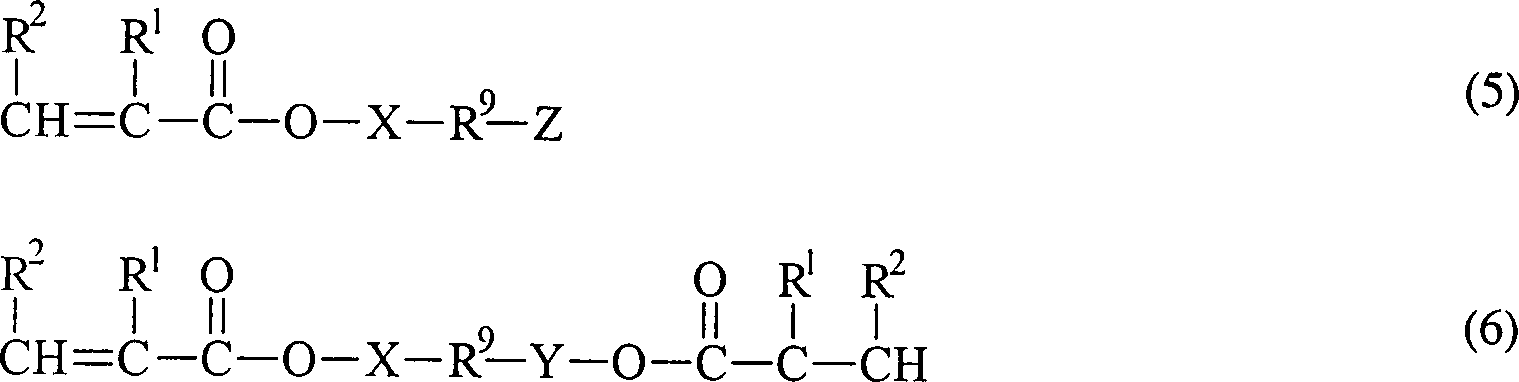


Priority Applications (6)
| Application Number | Priority Date | Filing Date | Title |
|---|---|---|---|
| DE10304537A DE10304537A1 (en) | 2003-02-04 | 2003-02-04 | Plastic molded body, process for its production and its use |
| EP04707899A EP1608697A1 (en) | 2003-02-04 | 2004-02-04 | Plastic moulded bodies, method for the production and use thereof |
| PCT/EP2004/000984 WO2004069906A1 (en) | 2003-02-04 | 2004-02-04 | Plastic moulded bodies, method for the production and use thereof |
| CNA2004800091772A CN1809608A (en) | 2003-02-04 | 2004-02-04 | Plastic moulded bodies, method for the production and use thereof |
| US10/544,504 US20060251836A1 (en) | 2003-02-04 | 2004-02-04 | Plastic moulded bodies, method for the production and use thereof |
| JP2006501722A JP2006517479A (en) | 2003-02-04 | 2004-02-04 | Plastic molded body, its production method and its use |
Applications Claiming Priority (1)
| Application Number | Priority Date | Filing Date | Title |
|---|---|---|---|
| DE10304537A DE10304537A1 (en) | 2003-02-04 | 2003-02-04 | Plastic molded body, process for its production and its use |
Publications (1)
| Publication Number | Publication Date |
|---|---|
| DE10304537A1 true DE10304537A1 (en) | 2004-08-12 |
Family
ID=32695201
Family Applications (1)
| Application Number | Title | Priority Date | Filing Date |
|---|---|---|---|
| DE10304537A Ceased DE10304537A1 (en) | 2003-02-04 | 2003-02-04 | Plastic molded body, process for its production and its use |
Country Status (6)
| Country | Link |
|---|---|
| US (1) | US20060251836A1 (en) |
| EP (1) | EP1608697A1 (en) |
| JP (1) | JP2006517479A (en) |
| CN (1) | CN1809608A (en) |
| DE (1) | DE10304537A1 (en) |
| WO (1) | WO2004069906A1 (en) |
Cited By (1)
| Publication number | Priority date | Publication date | Assignee | Title |
|---|---|---|---|---|
| DE102007045763B4 (en) * | 2006-09-27 | 2010-06-17 | DENSO CORPORATION, Kariya-shi | Refrigerant transport hose and manufacturing method therefor |
Families Citing this family (5)
| Publication number | Priority date | Publication date | Assignee | Title |
|---|---|---|---|---|
| WO2005021621A1 (en) * | 2003-07-31 | 2005-03-10 | Krones Ag | Coated hollow body |
| CA2603813A1 (en) * | 2005-04-18 | 2006-10-26 | Advanced Plastics Technologies Luxembourg S.A. | Water-resistant coated articles and methods of making same |
| US20070178266A1 (en) * | 2006-01-27 | 2007-08-02 | Sonoco Development, Inc. | Multilayer blow-molded, crosslinked container and method of making same |
| JP2008248996A (en) * | 2007-03-29 | 2008-10-16 | Tokai Rubber Ind Ltd | Hose with joint fitting for conveying carbon dioxide refrigerant |
| US11427663B1 (en) | 2022-01-07 | 2022-08-30 | Chang Chun Petrochemical Co., Ltd. | Ethylene-vinyl alcohol copolymer resin composition and multi-layer structure comprising thereof |
Citations (1)
| Publication number | Priority date | Publication date | Assignee | Title |
|---|---|---|---|---|
| WO1996016799A1 (en) * | 1994-12-02 | 1996-06-06 | Mobil Oil Corporation | Heat sealable multilayer film containing polyvinyl alcohol layer |
Family Cites Families (6)
| Publication number | Priority date | Publication date | Assignee | Title |
|---|---|---|---|---|
| EP0519151B1 (en) * | 1991-06-20 | 1996-02-07 | Monsanto Europe S.A./N.V. | Crosslinkable resin composition comprising a thermoplastic resin |
| US5330831A (en) * | 1991-12-20 | 1994-07-19 | Mobil Oil Corp. | Printable high barrier multilayer film |
| DE4215070A1 (en) * | 1992-05-07 | 1993-11-11 | Herberts Gmbh | Process for the production of multi-layer coatings |
| CA2168529A1 (en) * | 1995-02-02 | 1996-08-03 | Tatsuichiro Kon | Transparent conductive sheet |
| CN1073014C (en) * | 1996-09-06 | 2001-10-17 | 吴羽化学工业株式会社 | Preparation of resin composition for high temperature sterilization packaging container |
| WO2003037969A1 (en) * | 2001-10-31 | 2003-05-08 | Kuraray Specialities Europe Gmbh | Plastic moulded bodies provided with waterproof coats forming a gas barrier |
-
2003
- 2003-02-04 DE DE10304537A patent/DE10304537A1/en not_active Ceased
-
2004
- 2004-02-04 JP JP2006501722A patent/JP2006517479A/en active Pending
- 2004-02-04 CN CNA2004800091772A patent/CN1809608A/en active Pending
- 2004-02-04 WO PCT/EP2004/000984 patent/WO2004069906A1/en not_active Ceased
- 2004-02-04 EP EP04707899A patent/EP1608697A1/en not_active Withdrawn
- 2004-02-04 US US10/544,504 patent/US20060251836A1/en not_active Abandoned
Patent Citations (1)
| Publication number | Priority date | Publication date | Assignee | Title |
|---|---|---|---|---|
| WO1996016799A1 (en) * | 1994-12-02 | 1996-06-06 | Mobil Oil Corporation | Heat sealable multilayer film containing polyvinyl alcohol layer |
Cited By (1)
| Publication number | Priority date | Publication date | Assignee | Title |
|---|---|---|---|---|
| DE102007045763B4 (en) * | 2006-09-27 | 2010-06-17 | DENSO CORPORATION, Kariya-shi | Refrigerant transport hose and manufacturing method therefor |
Also Published As
| Publication number | Publication date |
|---|---|
| US20060251836A1 (en) | 2006-11-09 |
| JP2006517479A (en) | 2006-07-27 |
| CN1809608A (en) | 2006-07-26 |
| EP1608697A1 (en) | 2005-12-28 |
| WO2004069906A1 (en) | 2004-08-19 |
Similar Documents
| Publication | Publication Date | Title |
|---|---|---|
| EP2396373B1 (en) | Anti-reflex/anti-fog coatings | |
| EP1891174B1 (en) | Heat-sealing compound for sealing aluminium foil and polyethylene terephthalate film to polypropylene, polyvinyl chloride and polystyrene containers | |
| DE1645145B2 (en) | COATING AGENT BASED ON POLYSILIC ACID AND A FLUOROUS POLYMERIZATE | |
| EP3246370B1 (en) | Heat-sealable binder | |
| EP0368094A1 (en) | Impact-resistant protection methacrylate layer containing a UV absorber for polycarbonate | |
| DE102007048192A1 (en) | Emulsion polymers, aqueous dispersions and process for their preparation | |
| EP1601727A1 (en) | Coating agents for producing rigid coatings resistant to scratching and soiling and rigid moulded bodies resistant to scratching and soiling and method for the production thereof | |
| DE102007048189A1 (en) | Aqueous dispersions comprising at least one alkyd resin and at least one polymer having at least one (meth) acrylate segment | |
| EP2014730A1 (en) | Coating liquid, gas barrier film, gas barrier laminate and gas barrier multilayer film each using the coating liquid, and their production methods | |
| EP1485416B1 (en) | Hail-resistant acrylic laminated glass and method for producing the same | |
| DE3151116A1 (en) | HOT SEALABLE POLYOLEFIN FILM AND METHOD FOR THEIR PRODUCTION | |
| DE10304537A1 (en) | Plastic molded body, process for its production and its use | |
| DE1546982C3 (en) | Process for coating molded polyolefin articles | |
| CN1810864A (en) | Adhesive protecting film | |
| DE60025477T2 (en) | NETWORK COATING COMPOSITION | |
| WO2003037969A1 (en) | Plastic moulded bodies provided with waterproof coats forming a gas barrier | |
| DE3737194A1 (en) | PAINT RESIN AND ITS USE IN POWDER COATING | |
| DE10207592A1 (en) | Moulded plastic products, e.g. polyester soft drink bottles, coated with a barrier layer of polyvinyl alcohol and optionally an outer layer of polyvinyl acetal | |
| WO2008098799A1 (en) | Anti-graffiti coating | |
| EP0700423B1 (en) | Primer for glueing plastics | |
| CN112341734A (en) | Environment-friendly nitrogen-containing organic zinc PVC heat stabilizer for transparent products and preparation method thereof | |
| CN101760070A (en) | All-environmentally-friendly film forming auxiliary agent and using method thereof | |
| DE10259240A1 (en) | Formable water-spreading plastic body and process for its production | |
| DE2317652A1 (en) | IMPACT-RESISTANT PVC BLEND | |
| DE1286671B (en) | Coating agent for polyolefin structures |
Legal Events
| Date | Code | Title | Description |
|---|---|---|---|
| OP8 | Request for examination as to paragraph 44 patent law | ||
| 8131 | Rejection |