DE10259616A1 - Self-adhesive tape, its use and process for making it - Google Patents
Self-adhesive tape, its use and process for making it Download PDFInfo
- Publication number
- DE10259616A1 DE10259616A1 DE10259616A DE10259616A DE10259616A1 DE 10259616 A1 DE10259616 A1 DE 10259616A1 DE 10259616 A DE10259616 A DE 10259616A DE 10259616 A DE10259616 A DE 10259616A DE 10259616 A1 DE10259616 A1 DE 10259616A1
- Authority
- DE
- Germany
- Prior art keywords
- adhesive
- adhesive tape
- tape
- carrier
- coating
- Prior art date
- Legal status (The legal status is an assumption and is not a legal conclusion. Google has not performed a legal analysis and makes no representation as to the accuracy of the status listed.)
- Ceased
Links
- 239000002390 adhesive tape Substances 0.000 title claims abstract description 40
- 238000000034 method Methods 0.000 title claims abstract description 31
- 230000008569 process Effects 0.000 title claims description 9
- 239000000853 adhesive Substances 0.000 claims abstract description 58
- 230000001070 adhesive effect Effects 0.000 claims abstract description 58
- 238000000576 coating method Methods 0.000 claims abstract description 51
- 239000011248 coating agent Substances 0.000 claims abstract description 45
- NIXOWILDQLNWCW-UHFFFAOYSA-M Acrylate Chemical compound [O-]C(=O)C=C NIXOWILDQLNWCW-UHFFFAOYSA-M 0.000 claims abstract description 12
- 239000000835 fiber Substances 0.000 claims abstract description 12
- 230000005855 radiation Effects 0.000 claims abstract description 4
- 238000004804 winding Methods 0.000 claims description 14
- 239000012876 carrier material Substances 0.000 claims description 9
- 229920000728 polyester Polymers 0.000 claims description 9
- 238000004049 embossing Methods 0.000 claims description 8
- 239000004743 Polypropylene Substances 0.000 claims description 6
- 238000003490 calendering Methods 0.000 claims description 6
- -1 polypropylene Polymers 0.000 claims description 6
- 238000002844 melting Methods 0.000 claims description 5
- 230000008018 melting Effects 0.000 claims description 5
- 229920000642 polymer Polymers 0.000 claims description 5
- 229920001155 polypropylene Polymers 0.000 claims description 5
- 239000012790 adhesive layer Substances 0.000 claims description 3
- 239000007788 liquid Substances 0.000 claims description 3
- 238000007596 consolidation process Methods 0.000 claims description 2
- 238000004132 cross linking Methods 0.000 claims description 2
- 238000007766 curtain coating Methods 0.000 claims description 2
- 229920006254 polymer film Polymers 0.000 claims description 2
- 235000020004 porter Nutrition 0.000 claims description 2
- 102000012498 secondary active transmembrane transporter activity proteins Human genes 0.000 claims description 2
- 108040003878 secondary active transmembrane transporter activity proteins Proteins 0.000 claims description 2
- 238000009987 spinning Methods 0.000 claims description 2
- 239000002313 adhesive film Substances 0.000 claims 1
- 238000000151 deposition Methods 0.000 claims 1
- 230000000994 depressogenic effect Effects 0.000 claims 1
- 239000004745 nonwoven fabric Substances 0.000 abstract description 13
- 238000004519 manufacturing process Methods 0.000 abstract description 11
- 230000000903 blocking effect Effects 0.000 abstract description 5
- 239000000126 substance Substances 0.000 abstract description 3
- 239000000463 material Substances 0.000 description 10
- 239000004744 fabric Substances 0.000 description 8
- 239000001913 cellulose Substances 0.000 description 5
- 229920002678 cellulose Polymers 0.000 description 5
- 239000000969 carrier Substances 0.000 description 4
- 239000003795 chemical substances by application Substances 0.000 description 3
- 239000004820 Pressure-sensitive adhesive Substances 0.000 description 2
- 239000011230 binding agent Substances 0.000 description 2
- 238000011109 contamination Methods 0.000 description 2
- 230000006378 damage Effects 0.000 description 2
- 239000000203 mixture Substances 0.000 description 2
- 238000004806 packaging method and process Methods 0.000 description 2
- 238000012546 transfer Methods 0.000 description 2
- 244000043261 Hevea brasiliensis Species 0.000 description 1
- 239000004698 Polyethylene Substances 0.000 description 1
- 239000004614 Process Aid Substances 0.000 description 1
- NIXOWILDQLNWCW-UHFFFAOYSA-N acrylic acid group Chemical group C(C=C)(=O)O NIXOWILDQLNWCW-UHFFFAOYSA-N 0.000 description 1
- 239000003522 acrylic cement Substances 0.000 description 1
- 230000000181 anti-adherent effect Effects 0.000 description 1
- 230000008901 benefit Effects 0.000 description 1
- 238000010924 continuous production Methods 0.000 description 1
- 238000005520 cutting process Methods 0.000 description 1
- 238000013016 damping Methods 0.000 description 1
- 230000009849 deactivation Effects 0.000 description 1
- 230000007547 defect Effects 0.000 description 1
- 230000001419 dependent effect Effects 0.000 description 1
- 239000006185 dispersion Substances 0.000 description 1
- 238000001035 drying Methods 0.000 description 1
- 230000000694 effects Effects 0.000 description 1
- 239000012772 electrical insulation material Substances 0.000 description 1
- 238000005516 engineering process Methods 0.000 description 1
- 238000009472 formulation Methods 0.000 description 1
- 239000003292 glue Substances 0.000 description 1
- 239000012943 hotmelt Substances 0.000 description 1
- 238000009413 insulation Methods 0.000 description 1
- 238000002074 melt spinning Methods 0.000 description 1
- 230000005012 migration Effects 0.000 description 1
- 238000013508 migration Methods 0.000 description 1
- 229920003052 natural elastomer Polymers 0.000 description 1
- 229920001194 natural rubber Polymers 0.000 description 1
- 230000000149 penetrating effect Effects 0.000 description 1
- 230000035515 penetration Effects 0.000 description 1
- 230000035699 permeability Effects 0.000 description 1
- 229920002239 polyacrylonitrile Polymers 0.000 description 1
- 229920006267 polyester film Polymers 0.000 description 1
- 229920000573 polyethylene Polymers 0.000 description 1
- 229920000098 polyolefin Polymers 0.000 description 1
- 238000009958 sewing Methods 0.000 description 1
- 239000002904 solvent Substances 0.000 description 1
- 238000003860 storage Methods 0.000 description 1
- 239000000758 substrate Substances 0.000 description 1
- 239000004753 textile Substances 0.000 description 1
- 238000002166 wet spinning Methods 0.000 description 1
Classifications
-
- C—CHEMISTRY; METALLURGY
- C09—DYES; PAINTS; POLISHES; NATURAL RESINS; ADHESIVES; COMPOSITIONS NOT OTHERWISE PROVIDED FOR; APPLICATIONS OF MATERIALS NOT OTHERWISE PROVIDED FOR
- C09J—ADHESIVES; NON-MECHANICAL ASPECTS OF ADHESIVE PROCESSES IN GENERAL; ADHESIVE PROCESSES NOT PROVIDED FOR ELSEWHERE; USE OF MATERIALS AS ADHESIVES
- C09J7/00—Adhesives in the form of films or foils
- C09J7/20—Adhesives in the form of films or foils characterised by their carriers
- C09J7/21—Paper; Textile fabrics
-
- C—CHEMISTRY; METALLURGY
- C09—DYES; PAINTS; POLISHES; NATURAL RESINS; ADHESIVES; COMPOSITIONS NOT OTHERWISE PROVIDED FOR; APPLICATIONS OF MATERIALS NOT OTHERWISE PROVIDED FOR
- C09J—ADHESIVES; NON-MECHANICAL ASPECTS OF ADHESIVE PROCESSES IN GENERAL; ADHESIVE PROCESSES NOT PROVIDED FOR ELSEWHERE; USE OF MATERIALS AS ADHESIVES
- C09J7/00—Adhesives in the form of films or foils
- C09J7/30—Adhesives in the form of films or foils characterised by the adhesive composition
- C09J7/38—Pressure-sensitive adhesives [PSA]
-
- C—CHEMISTRY; METALLURGY
- C09—DYES; PAINTS; POLISHES; NATURAL RESINS; ADHESIVES; COMPOSITIONS NOT OTHERWISE PROVIDED FOR; APPLICATIONS OF MATERIALS NOT OTHERWISE PROVIDED FOR
- C09J—ADHESIVES; NON-MECHANICAL ASPECTS OF ADHESIVE PROCESSES IN GENERAL; ADHESIVE PROCESSES NOT PROVIDED FOR ELSEWHERE; USE OF MATERIALS AS ADHESIVES
- C09J2203/00—Applications of adhesives in processes or use of adhesives in the form of films or foils
- C09J2203/302—Applications of adhesives in processes or use of adhesives in the form of films or foils for bundling cables
-
- C—CHEMISTRY; METALLURGY
- C09—DYES; PAINTS; POLISHES; NATURAL RESINS; ADHESIVES; COMPOSITIONS NOT OTHERWISE PROVIDED FOR; APPLICATIONS OF MATERIALS NOT OTHERWISE PROVIDED FOR
- C09J—ADHESIVES; NON-MECHANICAL ASPECTS OF ADHESIVE PROCESSES IN GENERAL; ADHESIVE PROCESSES NOT PROVIDED FOR ELSEWHERE; USE OF MATERIALS AS ADHESIVES
- C09J2400/00—Presence of inorganic and organic materials
- C09J2400/20—Presence of organic materials
- C09J2400/26—Presence of textile or fabric
- C09J2400/263—Presence of textile or fabric in the substrate
-
- C—CHEMISTRY; METALLURGY
- C09—DYES; PAINTS; POLISHES; NATURAL RESINS; ADHESIVES; COMPOSITIONS NOT OTHERWISE PROVIDED FOR; APPLICATIONS OF MATERIALS NOT OTHERWISE PROVIDED FOR
- C09J—ADHESIVES; NON-MECHANICAL ASPECTS OF ADHESIVE PROCESSES IN GENERAL; ADHESIVE PROCESSES NOT PROVIDED FOR ELSEWHERE; USE OF MATERIALS AS ADHESIVES
- C09J2427/00—Presence of halogenated polymer
- C09J2427/006—Presence of halogenated polymer in the substrate
-
- C—CHEMISTRY; METALLURGY
- C09—DYES; PAINTS; POLISHES; NATURAL RESINS; ADHESIVES; COMPOSITIONS NOT OTHERWISE PROVIDED FOR; APPLICATIONS OF MATERIALS NOT OTHERWISE PROVIDED FOR
- C09J—ADHESIVES; NON-MECHANICAL ASPECTS OF ADHESIVE PROCESSES IN GENERAL; ADHESIVE PROCESSES NOT PROVIDED FOR ELSEWHERE; USE OF MATERIALS AS ADHESIVES
- C09J2433/00—Presence of (meth)acrylic polymer
-
- C—CHEMISTRY; METALLURGY
- C09—DYES; PAINTS; POLISHES; NATURAL RESINS; ADHESIVES; COMPOSITIONS NOT OTHERWISE PROVIDED FOR; APPLICATIONS OF MATERIALS NOT OTHERWISE PROVIDED FOR
- C09J—ADHESIVES; NON-MECHANICAL ASPECTS OF ADHESIVE PROCESSES IN GENERAL; ADHESIVE PROCESSES NOT PROVIDED FOR ELSEWHERE; USE OF MATERIALS AS ADHESIVES
- C09J2467/00—Presence of polyester
- C09J2467/006—Presence of polyester in the substrate
Landscapes
- Chemical & Material Sciences (AREA)
- Organic Chemistry (AREA)
- Adhesive Tapes (AREA)
Abstract
Die Erfindung betrifft ein auf sich selbst wickelbares Klebeband mit einem aus einem thermisch verfestigten Vlies bestehenden bandförmigen Träger, der auf einer Seite mit einer druckempfindlichen acrylatbasierenden Klebebeschichtung versehen ist, eine Verwendung des Klebebandes und ein Verfahren zu seiner Herstellung. Um ein solches Klebeband zu schaffen, bei dem Vliese mit geringer Reißfestigkeit und geringem Flächengewicht einsetzbar sind, ohne dass eine zusätzliche Trennbeschichtung erfolgen müßte, wobei aber ein Verblocken, ein Flagging oder Faserausrisse beim Abwickeln des Bandes vermieden werden, wird vorgeschlagen, dass das Vlies ein Flächengewicht von 10-50 g/m·2·, eine Banddicke von 0,15-0,40 mm, eine Reißfestigkeit von 10-35 N/cm und eine Reißdehnung von 40-75% aufweist und daß die Klebebeschichtung aus einem chemisch oder durch ultraviolette Strahlung vernetzbaren Acrylatklebstoff besteht.The invention relates to an adhesive tape which can be wound on itself and which has a tape-shaped carrier consisting of a thermally bonded nonwoven and which is provided on one side with a pressure-sensitive acrylate-based adhesive coating, a use of the adhesive tape and a method for its production. In order to create such an adhesive tape, in which nonwovens with low tear strength and low basis weight can be used, without an additional release coating having to be carried out, but blocking, flagging or fiber tearing when the tape is unwound, it is proposed that the nonwoven be a Basis weight of 10-50 g / m · 2 ·, a tape thickness of 0.15-0.40 mm, a tensile strength of 10-35 N / cm and an elongation at break of 40-75% and that the adhesive coating from a chemical or consists of acrylate adhesive that can be crosslinked by ultraviolet radiation.
Description
Die vorliegende Erfindung betrifft ein auf sich selbst wickelbares Klebeband mit einem aus einem thermisch verfestigten Vlies bestehenden bandförmigen Träger, der auf einer Seite mit einer druckempfindlichen acrylatbasierenden Klebebeschichtung versehen ist, eine Verwendung des Klebebandes und ein Verfahren zu seiner Herstellung.The present invention relates to a self-adhesive tape with one made of a thermal solidified nonwoven existing band-shaped carrier, which on one side with a pressure-sensitive, acrylate-based adhesive coating is a use of the adhesive tape and a method for its Production.
Für textile Klebebänder werden zur Zeit folgende Träger eingesetzt: Zellwoll-Gewebe, Zellwoll-Gewebe mit Acrylatbeschichtung, Polyester-Gewebe, Polyester-Nähvliese, wasserstrahlverfestigte Polyester-Vliese, Spinnvlies mit einseitiger Kalandrierung, Vliese mit Trennmittelbeschichtung und Nadelvliese mit einer durch Anschmelzen verfestigten Rückseitenoberfläche.For textile adhesive tapes are currently the following carriers used: cellulose fabric, cellulose fabric with acrylate coating, Polyester fabric, polyester sewing fleece, water-jet bonded polyester fleece, spun fleece with one-sided Calendering, nonwovens with release agent coating and needle-punched nonwovens with a back surface hardened by melting.
Insbesondere Zellwoll-Gewebeklebebänder haben den Nachteil, dass sie aufgrund des Zellwoll-Gewebes teuer und verrottbar sind. Dies trifft auch auf Zellwoll-Gewebe mit Acrylatbeschichtung zu, wobei die Acrylatbeschichtung des Trägers den Fertigungsaufwand noch erhöht. Die Polyester-Gewebeklebebänder weisen ebenfalls den Nachteil auf, dass sie aufgrund des eingesetzten Gewebes teuer sind, wobei der Preis den Herstellungsaufwand des Bandes einschließlich dessen des Trägermaterials widerspiegelt. Polyester-Nähvliese haben den Nachteil, dass sie eine offene Struktur besitzen, so dass leicht Flüssigkeiten hindurchdiffundieren können, was auch bei entsprechenden wasserstrahlverfestigten Vliesen der Fall ist.In particular, have cellulose tissue tapes the disadvantage that they are expensive and rotten due to the cellulose fabric are. This also applies to cellulose fabrics with an acrylic coating to, the acrylate coating of the carrier the manufacturing effort still increased. The polyester fabric tapes have also have the disadvantage that they are due to the fabric used are expensive, the price including the manufacturing cost of the tape of the carrier material reflects. Polyester stitchbonded webs have the disadvantage that they have an open structure, so that easily liquids can diffuse through which is also the case with corresponding hydroentangled nonwovens Case is.
Spinnvliese sind Faservliese aus Filamentfasern, die direkt aus der Spinnmasse in einem kontinuierlichen Prozeß hergestellt werden. Der Herstellungsprozeß setzt sich aus mehreren aneinander gereihten Teilprozessen zusammen: Spunbonded nonwovens are made of Filament fibers that come straight from the dope in a continuous Process established become. The manufacturing process continues are made up of several sub-processes:
- (a) Extrudieren und Schmelzen der Polymere,(a) extruding and melting the polymers,
- (b) Spinnen der Fasern,(b) spinning the fibers,
- (c) Verstrecken der Fasern,(c) stretching the fibers,
- (d) Ablegen der Fasern auf einem Förderband und(d) placing the fibers on a conveyor belt and
- (e) Verfestigung des Vlieses.(e) consolidating the fleece.
Die Verfestigung des Vlieses kann auf mechanischem (Vernadeln), thermischen (Kalander), sowie chemischen Wege (Bindemittel) erfolgen. Zur Herstellung von Spinnvliesen können grundsätzlich alle Polymere eingesetzt werden, welche sich im Trocken- oder Schmelzspinnverfahren verarbeiten lassen, z. B. Polypropylen, Polyethylen, Polyester. Auch Polymere, die im Naßspinnverfahren (z. B. Polyacrylnitril) verarbeitet werden, können zum Einsatz kommen.The fleece can be consolidated on mechanical (needling), thermal (calendering) and chemical Paths (binders) are made. In principle, everyone can produce spunbonded nonwovens Polymers are used, which are in the dry or melt spinning process let process, e.g. B. polypropylene, polyethylene, polyester. Also polymers that use the wet spinning process (e.g. polyacrylonitrile) can be used.
Ein bekanntes Verfahren zur Herstellung eines auf sich selbst gewickelten Klebebandes der eingangs beschriebenen Art, umfaßt somit die VerfahrensschritteA known manufacturing process a self-adhesive tape of the type described above Kind, includes hence the procedural steps
- – Herstellung eines aus einem Spinnvlies bestehenden Trägers unter Praktizierung der vorgenannten Verfahrensschritte (a) bis (e),- manufacture a carrier made of a spunbonded web with practice of aforementioned process steps (a) to (e),
- – Auftragung einer Klebebeschichtung auf den Träger,- application an adhesive coating on the carrier,
- – Aufwickeln des Bandes und- winding up of the volume and
- – Konfektionierung des Bandes.- assembly of the tape.
Aus der
Der Nachteil der Vliese mit Trennmittelbeschichtung
besteht darin, dass sie einerseits nur mit Flächengewichten von mindestens
60 g/m2 zum Einsatz kommen können, wie
dies aus der
Nadelvliese als Trägermaterialien
mit einer durch Anschmelzen verfestigten Rückseitenoberfläche, wie
sie beispielsweise in der
Zusammenfassend ist festzustellen,
dass entsprechend dem bekannten Stand der Technik sich Nadelvliese
oder Spinnvliese ohne zusätzliche
Antiadhäsiv-Beschichtung
nicht zu auf sich selbst gewickelten Klebebändern verarbeiten lassen. Diese
Materialien neigen zum Verblocken, weil keine genügend hohe
Verfestigung im Trägervlies
erreicht werden kann. Insbesondere der Einsatz von Vliesen mit einem
Flächengewicht von
unter 60 g/m2 ist unter diesem Gesichtspunkt
sehr problematisch. Vliese mit einem geringen Flächengewicht werden daher mit
einem Interliner abgedeckt, um die Verblockung/Verklebung des Bandes
zu verhindern (vgl. hierzu beispielsweise auch
Der Einsatz geprägter Vliesträger mit höheren Flächengewichten ist problematisch, insbesondere bei einem Einsatz als Kabelwickelband, da diese Träger aufgrund ihrer Steifigkeit zu einem sogenannten "Flagging" neigen, d. h. aufgrund der vorhandenen Steifigkeit des Trägers stellt sich das Bandende des Trägers nach einer längeren Lagerzeit hoch, was als Materialfehler gewertet wird. Wirkt man dem durch Verwendung stark haftender Klebstoffe entgegen, so führt dies beim Abrollen von auf sich selbst gewickelten Bändern ohne zusätzliche Trennbeschichtung zu Faserausrissen auf der Rückseite. Dies hat einen starken Klebkraftverlust und sogar die Zerstörung des Trägers zur Folge. Weiterhin nachteilig bei durch Kalandrierung / Prägung verfestigten Vliesen mit Flächengewichten über 60 g/m2 ist ihre ungenügende Handeinreißbarkeit, was sie für viele Anwendungsfälle unbrauchbar macht.The use of embossed fleece carriers with higher basis weights is problematic, especially when used as a cable winding tape, since these carriers tend to "flagging" due to their rigidity, ie, due to the existing rigidity of the carrier, the tape end of the carrier is raised after a longer storage period. what is considered a material defect. If you counteract this by using highly adhesive adhesives, this will result in fiber tears on the back when unwinding tapes wound on themselves without an additional release coating. This leads to a strong loss of adhesive strength and even the destruction of the carrier. Another disadvantage of nonwovens consolidated by calendering / embossing with grammages above 60 g / m 2 is their insufficient hand tearability, which makes them unusable for many applications.
Der vorliegenden Erfindung liegt die Aufgabe zugrunde, ein auf sich selbst wickelbares Klebeband der eingangs genannten Art und ein Verfahren der gattungsgemäßen Art zu seiner Herstellung zu schaffen, bei dem Vliese mit geringer Reißfestigkeit und geringem Flächengewicht einsetzbar sind, ohne dass eine zusätzliche Trennbeschichtung erfolgen müßte, und wobei die vorstehend beschriebenen Nachteile, wie insbesondere Verblocken, Flagging und Faserausrisse beim Abwickeln des Bandes, vermieden werden.The present invention lies based on the task of a self-adhesive tape of the type mentioned and a method of the generic type to create its manufacture, with the nonwoven with low tear strength and low basis weight can be used without an additional release coating ought to, and the disadvantages described above, such as blocking in particular, Flagging and fiber tears when unwinding the tape are avoided become.
Diese Aufgabe wird mit einem Klebeband der eingangs genannten Art gelöst, bei dem das Vlies ein Flächengewicht von 10 – 50 g/m2, eine Banddicke von 0,15 – 0,40 mm, eine Reißfestigkeit 10 – 35 N/cm und eine Reißdehnung von 40 – 75 % aufweist und die Klebebeschichtung aus einem chemisch oder durch ultraviolette Strahlung vernetzbaren Acrylatklebstoff besteht.This object is achieved with an adhesive tape of the type mentioned at the beginning, in which the nonwoven has a basis weight of 10-50 g / m 2 , a tape thickness of 0.15-0.40 mm, a tensile strength of 10-35 N / cm and an elongation at break 40 - 75% and the adhesive coating consists of an acrylic adhesive that can be cross-linked chemically or by ultraviolet radiation.
Der erfindungsgemäß eingesetzte Schmelzhaftklebstoff hat gegenüber lösemittelhaltigen Klebstoffen oder Dispersionsklebstoffen den Vorteil, dass sein Vernetzungsgrad derart eingestellt werden kann, dass eine Deaktivierung der Oberfläche der Klebstoffschicht eintritt. Dies verhindert auch ein zu starkes Eindringen / Durchdringen des Vliesträgers, was die Gefahr eines Verblockens beim Aufrollen des Bandes erhöhen würde.The hotmelt pressure-sensitive adhesive used according to the invention has opposite solvent-based Adhesives or dispersion adhesives have the advantage of being cross-linked can be set such that a deactivation of the surface of the Adhesive layer occurs. This also prevents excessive penetration / Penetrating the fleece backing, which would increase the risk of blocking when the tape is rolled up.
Als besonders vorteilhaft wird es dabei angesehen, wenn die Klebebeschichtung mit einem Flächengewicht von 40 – 150 g/m2, vorzugsweise von 70 – 130 g/m2, auf den Träger aufgetragen ist, wobei insbesondere die Oberfläche des Trägers auf der Seite, auf der die Klebebeschichtung aufgetragen ist, durch die thermische Verfestigung im wesentlichen glatt ist. Infolge der thermischen Verfestigung der Oberfläche des Träges kann diese dabei eine Struktur aufweisen, wie sie durch eine Kalandrierung mit einer Prägewalze entsteht, die eine Prägefläche von 10% bis 30% aufweist.It is considered to be particularly advantageous if the adhesive coating is applied to the backing with a basis weight of 40-150 g / m 2 , preferably 70-130 g / m 2 , in particular the surface of the backing on the side to which the adhesive coating is applied, is essentially smooth due to the thermal setting. As a result of the thermal consolidation of the surface of the support, it can have a structure such as is created by calendering with an embossing roller, which has an embossing area of 10% to 30%.
Bei der Herstellung des erfindungsgemäßen Klebebandes können dabei mit Vorteil zum Abrollen des Klebebandes notwendige Kräfte über Zugspannungen zum Aufwickeln des Bandes eingestellt werden.In the production of the adhesive tape according to the invention can forces with tension necessary to unroll the adhesive tape can be adjusted for winding the tape.
Durch den Einsatz der erfindungsgemäßen Klebebeschichtung, die mit noch nachstehend näher erläuterten Auftragsverfahren aufgebracht werden kann, sowie gegebenenfalls durch die besonderen Parameter beim Aufwickeln des Bandes ist es in überraschender Weise gelungen, ein auf sich selbst gewickeltes Klebeband mit geringem Flächengewicht und einem stark haftenden Klebstoff zu entwickeln, das sich ohne Faserausrisse abwickeln läßt, kein "Flagging" zeigt und dabei keine zusätzliche Trennbeschichtung benötigt. Der Klebstoff kann dabei vorteilhafterweise hinsichtlich Brandverhalten, Emissionsverhalten und Kompatibilität mit elektrischen Isolationswerkstoffen so ausgelegt werden, das er üblichen Anforderungen der Automobilindustrie genügt. Als Sekundärfunktion verbessert der Klebstoff die Quereinreißbarkeit des erfindungsgemäßen Klebebandes.By using the adhesive coating according to the invention, the one with more detailed below explained Application process can be applied, as well as if necessary due to the special parameters when winding the tape it is in surprising Wisely managed a self-wrapping tape with little grammage and to develop a strong adhesive that can be used without Unwinding fiber tears, shows no "flagging" and thereby no additional Release coating required. The adhesive can advantageously with regard to fire behavior, Emission behavior and compatibility with electrical insulation materials be interpreted in the usual way The requirements of the automotive industry are sufficient. As a secondary function the adhesive improves the transverse tearability of the adhesive tape according to the invention.
Als Trägermaterial werden erfindungsgemäß Spinnvliese ausgewählt, die insbesondere aus Polypropylen oder Polyesterfasern mit einer Fadenstärke von insbesondere 3Den oder Mischungen derselben gebildet sind. Vorzugsweise können diese Vliese ein Flächengewicht von 20 – 40 g/m2, eine Banddicke von 0,20 – 0,30 mm, eine Reißfestigkeit 15 – 30 N/cm und eine Reißdehnung von 46 – 55% aufweisen. Beschichtet wird vorzugsweise die glattere Seite, so dass das Band die bei einem Einsatz als Kabelwickelband in der Automobilindustrie gewünschte Geräuschdämpfungseigenschaft besitzt.According to the invention, spunbonded nonwovens are selected as the carrier material, which are formed in particular from polypropylene or polyester fibers with a thread thickness of in particular 3 deniers or mixtures thereof. These nonwovens can preferably have a basis weight of 20-40 g / m 2 , a tape thickness of 0.20-0.30 mm, a tear strength of 15-30 N / cm and an elongation at break of 46-55%. The smoother side is preferably coated so that the tape has the noise-damping property desired when used as a cable winding tape in the automotive industry.
Das für den Klebstoff verwendete Auftragsverfahren richtet sich nach der Durchlässigkeit des Trägermaterials. Als Auftragsverfahren für die erfindungsgemäß eingesetzten Klebstoffe kann zunächst eine Direktbeschichtung des Trägers mittels eines Düsenauftrags eingesetzt werden. Dabei wird der flüssige Klebstoff mittels einer Pumpe, beispielsweise einer Zahnradpumpe, durch eine Breitschlitzdüse, insbesondere eine GID-Düse gedrückt. Eine GID-Düse arbeitet nach dem Prinzip der „Cuette"-Strömung. Hierdurch wird durch die bewegte Warenbahn durch Schleppströmung bei niedrigem Druckniveau soviel Masse abgeführt, wie durch eine Pumpe zugeführt wird. Hierdurch wird der hydraulische Druckaufbau im Beschichtungsspalt bei jeder Beschichtungsbreite und Maschinengeschwindigkeit konstant gehalten.The application method used for the adhesive depends on the permeability of the backing material. A direct coating of the backing by means of a nozzle application can first be used as the application method for the adhesives used according to the invention. The liquid adhesive is pressed by means of a pump, for example a gear pump, through a slot die, in particular a GID nozzle. A GID nozzle works on the principle of the "Cuette" flow. As a result, as much mass is discharged through the moving material web by drag flow at a low pressure level as is supplied by a pump. As a result, the hydraulic pressure build-up in the coating gap is reduced each time the coating width and machine speed kept constant.
Alternativ kann in einem drucklosen Beschichtungsverfahren, z. B. in einem sogenannten "Curtain-Coating-Prozeß" der Klebstoff drucklos als geschlossener Film auf den Träger aufgebracht werden. Dadurch wird eine gleichmäßige Dicke und damit Grammatur der Klebstoffschicht erreicht. Es wird nur soviel Klebstoff aufgetragen, wie unbedingt benötigt wird. Nach erfolgter Beschichtung ist das Trägermaterial abzukühlen und auf sich selbst zu wickeln. Von großer Bedeutung ist hier die korrekte Wahl der Wickelparameter. Zu hohe Wickelspannungen führen in der Regel zu einem Verblocken der Rolle. Vorzugsweise sollte daher ein Zentrumswickler eingesetzt werden, bei dem das Drehmoment durch die Welle übertragen werden kann. Die Steuerungstechnik des Wicklers muß möglichst empfindlich ausgelegt sein, um geringen Zugspannungen zu ermöglichen.Alternatively, in an unpressurized Coating processes, e.g. B. in a so-called "curtain coating process" the adhesive without pressure be applied as a closed film on the carrier. Thereby becomes a uniform thickness and thus reached the grammage of the adhesive layer. It's just so much glue applied as absolutely necessary becomes. After coating, the carrier material is to be cooled and to wrap on yourself. The is of great importance here correct choice of winding parameters. Too high winding tensions lead to usually blocking the roll. Preferably, therefore a center winder can be used in which the torque through transmit the wave can be. The control technology of the winder must be as possible be designed to be sensitive to allow low tensile stresses.
Als weiteres Auftragsverfahren kann für die erfindungsgemäß eingesetzten Acrylatklebstoffe eine indirekte Beschichtung über einen Transferprozeß mit Hilfe eines Zwischenträgers, insbesondere bei temperaturempfindlichen und/oder für den Klebstoff durchlässigen Trägern, zum Einsatz kommen. Dazu wird zuerst ein silikonisierter Interliner (silikonisiertes Papier oder silikonisierte Polymerfolie, wie Polyolefinfolie oder Polyesterfolie), beschichtet. Anschließend wird der Klebstoff abgekühlt und das Trägermaterial zukaschiert. Soll ein auf sich selbst gewickeltes Klebeband hergestellt nach diesem Verfahren hergestellt werden, so muß bei der Konfektionierung der Rollen allerdings der Interliner, welcher als Prozeßhilfe dient, wieder von dem Trägermaterial abgezogen und separat aufgewickelt werden. Da dies mit zusätzlichem Aufwand verbunden ist, wird die Direktbeschichtung bevorzugt gewählt.As another application process can for the used according to the invention Acrylate adhesives use an indirect coating via a transfer process an intermediate beam, especially for temperature sensitive and / or for the adhesive permeable carriers, are used. First, a siliconized interliner is used (siliconized paper or siliconized polymer film, such as polyolefin film or polyester film), coated. The adhesive is then cooled and the carrier material laminated on. Shall be made a self-adhesive tape must be manufactured according to this method, so must be in the packaging the roles of the interliner, which serves as process aid, again from the carrier material deducted and wound up separately. Since this with additional Direct coating is preferred.
Im allgemeinen kann festgestellt werden, dass Direktbeschichtungen sich immer dann vorteilhaft durchführen lassen, wenn der Träger ausreichend dicht ist, d.h. ein Wandern der Klebstoffe durch den Träger während der Beschichtung ausgeschlossen werden kann. Außerdem muß der Träger über eine ausreichende thermische Stabilität verfügen. Transferbeschichtungen und drucklose Beschichtungen werden bevorzugt bei temperaturempfindlichen und/oder für den Klebstoff durchlässigen Trägem eingesetzt. Eine Beschädigung des Trägers und die Verschmutzung der Beschichtungswalzen während des Beschichtungsprozesses wird so vermieden.Generally it can be found that direct coatings can always be carried out advantageously, if the carrier is sufficiently dense, i.e. a migration of the adhesives through the Porters during the Coating can be excluded. In addition, the carrier must have sufficient thermal stability feature. Transfer coatings and pressureless coatings are preferred used for temperature-sensitive and / or permeable to the adhesive. Damage of the carrier and the contamination of the coating rollers during the coating process is avoided.
Zur abschließenden Konfektionierung bei der Herstellung erfindungsgemäßer Klebebandrollen können ebenfalls verschiedene Verfahren angewendet werden, wobei jeweils eine beschichtete sogenannte Mutterrolle die Ausgangsbasis bildet. Bei dem ersten Verfahren, dem Abstechen von Rollen aus vorgefertigten Kurzrollen, werden aus einer Mutterrolle zunächst Kurzrollen mit vorgegebener Länge gefertigt, die dann anschließend auf die gewünschte Breite abgestochen werden. Bei dem zweiten Verfahren, dem direkten Rollenschneiden, wird das beschichtete Trägermaterial in einem Arbeitsgang abgerollt, in schmale Streifen geschnitten und schließlich zu kurzen Schmalrollen aufgewickelt. Sowohl bei dem ersten als auch bei dem zweiten Verfahren können die späteren Abrollkräfte des erfindungsgemäßen Klebebandes von der Rolle über die Zugspannung eines Wickelautomaten eingestellt werden.For the final assembly at the production of adhesive tape rolls according to the invention can also different methods are used, each a coated so-called parent role forms the basis. In the first process, parting rolls from pre-made short rolls, become a parent role first Short rolls with a given length manufactured, which then to the desired one Can be tapped wide. In the second method, the direct one Roll cutting, the coated substrate is made in one operation unrolled, cut into narrow strips and finally closed short narrow rolls wound up. Both in the first and in the second method the later unwind forces of the adhesive tape according to the invention from the roll over the tension of an automatic winder can be adjusted.
Weitere vorteilhafte Ausführungen der Erfindung gehen aus den Unteransprüchen und den nachfolgenden beiden Ausführungsbeispielen hervor.Further advantageous designs the invention go from the dependent claims and the following two embodiments out.
Beispiel 1example 1
Auf ein PP-Spinnvlies mit einem Flächengewicht von 40 g/m2 wurden 80 g/m2 eines UV-vernetzbaren Acrylatklebstoffes aufgebracht. Der fertig beschichtete Träger wurde mit geringer Zugspannung auf sich selbst gewickelt. Das auf diese Weise erhaltene Klebeband hatte die in der nachstehenden Tabelle 1 aufgeführten Eigenschaften.80 g / m 2 of a UV-crosslinkable acrylate adhesive were applied to a PP spunbonded nonwoven with a basis weight of 40 g / m 2 . The finished coated carrier was wound onto itself with a low tension. The adhesive tape thus obtained had the properties shown in Table 1 below.
Tabelle
1 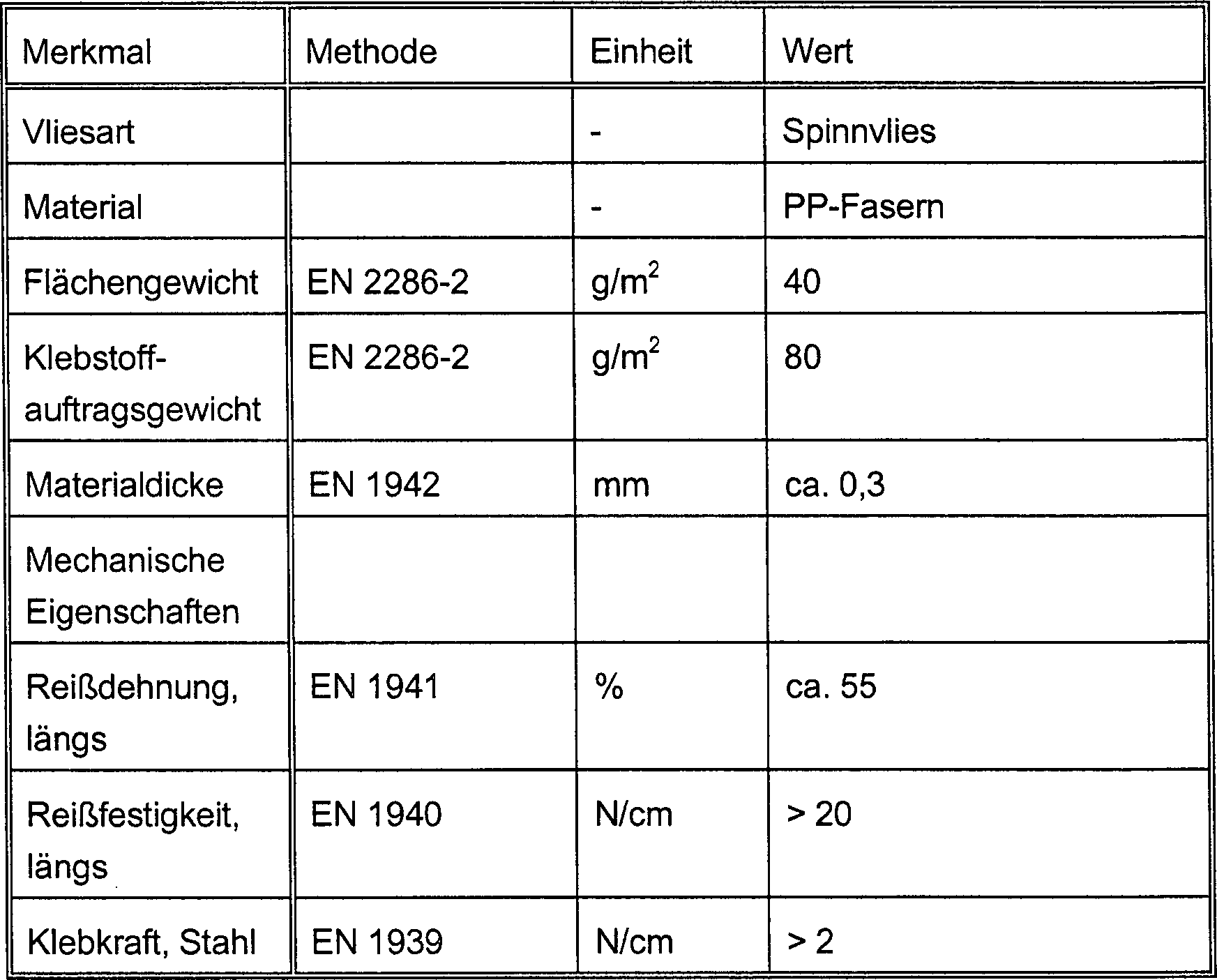
Aufgrund dieser Eigenschaften und durch die insbesondere durch eine Prägung verursachte gute Geräuschdämmung eignete sich das beschriebene Klebeband besonders gut zum Umwickeln von Kabelsätzen. Es zeigte aufgrund seiner hohen Klebkraft insbesondere kein "Flagging" und durch den Klebstoff war das Trägermaterial derart verfestigt, dass es quer zur Längsrichtung des Trägers gut handeinreißbar war. Der Vernetzungsgrad des Klebstoffs und die Wickelparameter bei Beschichtung und Konfektionierung waren somit derart gewählt worden, dass ein Verblocken des Bandes nicht auftrat.Because of these properties and due to the good noise insulation caused in particular by embossing the adhesive tape described is particularly good for wrapping Cable sets. It showed no "flagging" due to its high adhesive strength and due to the adhesive was the backing material solidified in such a way that it is good transversely to the longitudinal direction of the carrier hand-tearable was. The degree of crosslinking of the adhesive and the winding parameters the coating and packaging were chosen that the tape was not blocked.
Beispiel 2Example 2
Auf ein Polypropylen-Spinnvlies mit einem Flächengewicht von 50 g/m2 wurden 90 g/m2 eines UV-vernetzbaren Acrylatklebstoffes aufgebracht. Der fertig beschichtete Träger wurde mit geringer Zugspannung auf sich selbst gewickelt. Das auf diese Weise erhaltene Klebeband hatte die in der nachstehenden Tabelle 2 aufgeführten Eigenschaften.90 g / m 2 of a UV-crosslinkable acrylate adhesive were applied to a polypropylene spunbonded fabric with a weight per unit area of 50 g / m 2 . The finished coated carrier was wound onto itself with a low tension. The adhesive tape thus obtained had the properties shown in Table 2 below.
Tabelle
2 
Aufgrund dieser Eigenschaften eignete sich das beschriebene Klebeband für verschiedenartige Einsatzzwecke (sogenanntes „General Purpose Tape"). Es zeigte aufgrund seiner hohen Klebkraft insbesondere kein "Flagging". Ein Verblocken des Bandes trat ebenfalls nicht auf.Because of these properties the adhesive tape described for various types of use (so-called "General Purpose Tape "). Because of its high adhesive strength, it showed no "flagging". A block the tape also did not occur.
Die Erfindung beschränkt sich nicht auf die beschriebenen Ausführungsbeispiele, sondern umfaßt auch alle im Sinne der Erfindung gleichwirkenden Ausführungen. So kann es sich – wie bereits erwähnt – bei dem Trägermaterial beispielsweise auch um ein Polyesterspinnvlies handeln.The invention is limited not to the exemplary embodiments described, but also includes all designs having the same effect in the sense of the invention. So it can - like already mentioned - in the support material for example, a spunbonded polyester.
Ferner ist die Erfindung nicht auf die in den unabhängigen Ansprüchen definierten Merkmalskombinationen beschränkt, sondern kann auch durch jede beliebige andere Kombination von bestimmten Merkmalen aller insgesamt offenbarten Einzelmerkmale definiert sein. Dies bedeutet, dass jedes Einzelmerkmal des Anspruchs 1 weggelassen bzw. durch mindestens ein an anderer Stelle offenbartes Merkmal ersetzt werden kann. Insofern ist der Anspruch 1 lediglich als ein erster Formulierungsversuch für eine Erfindung zu verstehen.Furthermore, the invention is not based on those in the independent claims defined combinations of features limited, but can also by any other combination of certain characteristics of all overall disclosed individual features can be defined. This means, that each individual feature of claim 1 is omitted or by at least one feature disclosed elsewhere can be replaced. In this respect, claim 1 is only a first attempt at formulation for one To understand invention.
Claims (23)
Priority Applications (3)
| Application Number | Priority Date | Filing Date | Title |
|---|---|---|---|
| DE20221029U DE20221029U1 (en) | 2002-12-18 | 2002-12-18 | Adhesive tape which can be wound on itself without blocking, for use in wrapping cable looms, comprises heat-bonded, non-woven fabric coated on one side with chemically- or UV-crosslinkable acrylate adhesive |
| DE10259616A DE10259616A1 (en) | 2002-12-18 | 2002-12-18 | Self-adhesive tape, its use and process for making it |
| EP03027175A EP1431360A3 (en) | 2002-12-18 | 2003-11-27 | Self-winding adhesive tape, method for the production thereof and use thereof |
Applications Claiming Priority (1)
| Application Number | Priority Date | Filing Date | Title |
|---|---|---|---|
| DE10259616A DE10259616A1 (en) | 2002-12-18 | 2002-12-18 | Self-adhesive tape, its use and process for making it |
Publications (1)
| Publication Number | Publication Date |
|---|---|
| DE10259616A1 true DE10259616A1 (en) | 2004-07-08 |
Family
ID=32336479
Family Applications (1)
| Application Number | Title | Priority Date | Filing Date |
|---|---|---|---|
| DE10259616A Ceased DE10259616A1 (en) | 2002-12-18 | 2002-12-18 | Self-adhesive tape, its use and process for making it |
Country Status (2)
| Country | Link |
|---|---|
| EP (1) | EP1431360A3 (en) |
| DE (1) | DE10259616A1 (en) |
Cited By (4)
| Publication number | Priority date | Publication date | Assignee | Title |
|---|---|---|---|---|
| DE102005044942B4 (en) * | 2005-09-20 | 2011-12-15 | Jürgen Thiele | Process for the preparation of transversely tearable textile adhesive tapes with polyester or polyamide support materials |
| DE102012100055A1 (en) | 2012-01-04 | 2013-07-04 | Certoplast Vorwerk & Sohn Gmbh | Method and device for producing a hand-tearable textile adhesive tape |
| DE102013214316A1 (en) * | 2013-07-22 | 2015-01-22 | Tesa Se | Use of a single-sided self-adhesive tape as a ventilation tape |
| DE102020208549A1 (en) | 2020-07-08 | 2022-03-17 | Tesa Se | Process for manufacturing rolls of adhesive tape |
Families Citing this family (7)
| Publication number | Priority date | Publication date | Assignee | Title |
|---|---|---|---|---|
| DE202010014239U1 (en) * | 2010-10-14 | 2010-12-30 | Certoplast Vorwerk & Sohn Gmbh | Adhesive tape as well as hose cover made of the adhesive tape |
| DE102011052821A1 (en) * | 2011-08-18 | 2013-02-21 | Certoplast Vorwerk & Sohn Gmbh | Method and device for producing an adhesive tape |
| EP2695926A1 (en) | 2012-08-07 | 2014-02-12 | tesa SE | EBC-crosslinked adhesive tape for, in particular bundling cables and its use for bundling |
| DE102014223451A1 (en) | 2014-11-18 | 2016-05-19 | Tesa Se | Modified phyllosilicates for controlling the unwinding force of PSAs and improving the barrier properties of adhesive tapes |
| CN112960274B (en) * | 2015-06-29 | 2023-04-25 | Dic株式会社 | Sheets and articles for bundling wire harnesses |
| DE102020212233B4 (en) | 2020-09-29 | 2025-07-31 | Tesa Se | Adhesive tape for wrapping elongated goods such as cable harnesses and use of the adhesive tape for wrapping |
| DE102021205196A1 (en) | 2021-05-20 | 2022-11-24 | Tesa Se | Adhesive tape for wrapping elongate goods, in particular cable harnesses and methods for wrapping |
Family Cites Families (2)
| Publication number | Priority date | Publication date | Assignee | Title |
|---|---|---|---|---|
| DE29922950U1 (en) * | 1999-12-29 | 2001-05-10 | Coroplast Fritz Müller GmbH & Co. KG, 42279 Wuppertal | Textile tape |
| DE10039982A1 (en) * | 2000-08-16 | 2002-03-07 | Tesa Ag | Adhesive tapes with a textile backing for wrapping elongated goods, such as, in particular, cable sets |
-
2002
- 2002-12-18 DE DE10259616A patent/DE10259616A1/en not_active Ceased
-
2003
- 2003-11-27 EP EP03027175A patent/EP1431360A3/en not_active Withdrawn
Cited By (7)
| Publication number | Priority date | Publication date | Assignee | Title |
|---|---|---|---|---|
| DE102005044942B4 (en) * | 2005-09-20 | 2011-12-15 | Jürgen Thiele | Process for the preparation of transversely tearable textile adhesive tapes with polyester or polyamide support materials |
| DE102012100055A1 (en) | 2012-01-04 | 2013-07-04 | Certoplast Vorwerk & Sohn Gmbh | Method and device for producing a hand-tearable textile adhesive tape |
| WO2013102649A1 (en) | 2012-01-04 | 2013-07-11 | Certoplast Vorwerk & Sohn Gmbh | Method and device for producing a hand-tearable textile adhesive tape |
| EP2800791B1 (en) | 2012-01-04 | 2017-08-16 | certoplast Vorwerk & Sohn GmbH | Process and device for producing a hand-tearable textile adhesive tape |
| DE102013214316A1 (en) * | 2013-07-22 | 2015-01-22 | Tesa Se | Use of a single-sided self-adhesive tape as a ventilation tape |
| DE102020208549A1 (en) | 2020-07-08 | 2022-03-17 | Tesa Se | Process for manufacturing rolls of adhesive tape |
| DE102020208549B4 (en) | 2020-07-08 | 2022-06-15 | Tesa Se | Process for the production of adhesive tape disk rolls, adhesive tape disk rolls and their use |
Also Published As
| Publication number | Publication date |
|---|---|
| EP1431360A2 (en) | 2004-06-23 |
| EP1431360A3 (en) | 2004-07-21 |
Similar Documents
| Publication | Publication Date | Title |
|---|---|---|
| EP0995783B1 (en) | Use of an adhesive tape based on a non-woven substrate consolidated by a bonding agent | |
| EP2128212B1 (en) | Adhesive tape with textile holder for cable bandaging | |
| EP0995782B1 (en) | Use of an adhesive tape based on a non-woven substrate thermally fixed by melt-blown fibers | |
| EP1315781B1 (en) | Method for covering an elongated element, especially a loom of cables, with an adhesive strip | |
| EP2500389B1 (en) | Adhesive tape comprising a laminated support material formed from a textile layer and a film for sheathing elongated goods, in particular cable sets and sheathing method | |
| EP1312097B1 (en) | Method for providing longitudinally extended articles, such as cable assemblies, with a sheathing | |
| EP1300452B1 (en) | Method for sheathing longitudinally extended products | |
| EP1311640A1 (en) | Adhesive tapes comprising a textile support for enveloping elongated material, particularly looms of cables | |
| DE10329994A1 (en) | Process for encapsulating cables with an adhesive strip comprises applying strips of adhesive material to a support material so that the support material does not adhere to the longitudinal edges | |
| EP2067614A1 (en) | Sound-dampening and extremely friction-resistant belt in particular for the bandaging of cable trees in automobiles | |
| EP2497806B1 (en) | Adhesive tape with stitch-bonded non-woven fabric carrier for cable bandaging | |
| EP1241240B1 (en) | Non-woven carrier material for an adhesive tape with improved hand tearing property | |
| DE10259616A1 (en) | Self-adhesive tape, its use and process for making it | |
| DE19937446A1 (en) | Adhesive tape based on a nonwoven bonded with a binder | |
| EP3613819B1 (en) | Adhesive tape for sheathing elongated goods, in particular cable sets and sheathing method | |
| DE10116600A1 (en) | Machine for cutting textile adhesive tapes to length includes table on which tape is held stationary while being cut with a knife | |
| EP2497807B1 (en) | Use of an adhesive tape for bundling cables | |
| EP1433885B1 (en) | Self-winding adhesive tape | |
| DE10259682B4 (en) | Self-taped adhesive tape and its use | |
| DE10116770A1 (en) | Machine for cutting textile adhesive tapes to length includes table on which tape is held stationary while being cut with a knife | |
| DE60008824T2 (en) | Adhesive tape with hand-tearable fleece backing | |
| DE20022272U1 (en) | Elongated goods covered with a textile covering, such as in particular a cable set | |
| DE20221029U1 (en) | Adhesive tape which can be wound on itself without blocking, for use in wrapping cable looms, comprises heat-bonded, non-woven fabric coated on one side with chemically- or UV-crosslinkable acrylate adhesive | |
| EP4424496A1 (en) | Method for producing textile adhesive strips | |
| EP1857516A1 (en) | Adhesive tape and method for its manufacture |
Legal Events
| Date | Code | Title | Description |
|---|---|---|---|
| 8110 | Request for examination paragraph 44 | ||
| R016 | Response to examination communication | ||
| R016 | Response to examination communication | ||
| R016 | Response to examination communication | ||
| R016 | Response to examination communication | ||
| R016 | Response to examination communication | ||
| R016 | Response to examination communication | ||
| R016 | Response to examination communication | ||
| R016 | Response to examination communication | ||
| R079 | Amendment of ipc main class |
Free format text: PREVIOUS MAIN CLASS: C09J0007040000 Ipc: C09J0007210000 |
|
| R002 | Refusal decision in examination/registration proceedings | ||
| R003 | Refusal decision now final |