DE102022125859B4 - Vehicle seat with backrest made of frame element and knitted fabric, interior fittings of a means of transport - Google Patents
Vehicle seat with backrest made of frame element and knitted fabric, interior fittings of a means of transport Download PDFInfo
- Publication number
- DE102022125859B4 DE102022125859B4 DE102022125859.9A DE102022125859A DE102022125859B4 DE 102022125859 B4 DE102022125859 B4 DE 102022125859B4 DE 102022125859 A DE102022125859 A DE 102022125859A DE 102022125859 B4 DE102022125859 B4 DE 102022125859B4
- Authority
- DE
- Germany
- Prior art keywords
- knitted fabric
- fastening
- cushion support
- frame element
- support element
- Prior art date
- Legal status (The legal status is an assumption and is not a legal conclusion. Google has not performed a legal analysis and makes no representation as to the accuracy of the status listed.)
- Active
Links
Images


Classifications
-
- B—PERFORMING OPERATIONS; TRANSPORTING
- B60—VEHICLES IN GENERAL
- B60N—SEATS SPECIALLY ADAPTED FOR VEHICLES; VEHICLE PASSENGER ACCOMMODATION NOT OTHERWISE PROVIDED FOR
- B60N2/00—Seats specially adapted for vehicles; Arrangement or mounting of seats in vehicles
- B60N2/70—Upholstery springs ; Upholstery
- B60N2/7011—Upholstery springs ; Upholstery of substantially two-dimensional shape, e.g. hammock-like, plastic shells, fabrics
-
- B—PERFORMING OPERATIONS; TRANSPORTING
- B60—VEHICLES IN GENERAL
- B60N—SEATS SPECIALLY ADAPTED FOR VEHICLES; VEHICLE PASSENGER ACCOMMODATION NOT OTHERWISE PROVIDED FOR
- B60N2/00—Seats specially adapted for vehicles; Arrangement or mounting of seats in vehicles
- B60N2/58—Seat coverings
- B60N2/60—Removable protective coverings
-
- B—PERFORMING OPERATIONS; TRANSPORTING
- B60—VEHICLES IN GENERAL
- B60N—SEATS SPECIALLY ADAPTED FOR VEHICLES; VEHICLE PASSENGER ACCOMMODATION NOT OTHERWISE PROVIDED FOR
- B60N2/00—Seats specially adapted for vehicles; Arrangement or mounting of seats in vehicles
- B60N2/58—Seat coverings
- B60N2/60—Removable protective coverings
- B60N2/6018—Removable protective coverings attachments thereof
-
- B—PERFORMING OPERATIONS; TRANSPORTING
- B60—VEHICLES IN GENERAL
- B60N—SEATS SPECIALLY ADAPTED FOR VEHICLES; VEHICLE PASSENGER ACCOMMODATION NOT OTHERWISE PROVIDED FOR
- B60N2/00—Seats specially adapted for vehicles; Arrangement or mounting of seats in vehicles
- B60N2/58—Seat coverings
- B60N2/60—Removable protective coverings
- B60N2/6018—Removable protective coverings attachments thereof
- B60N2/6027—Removable protective coverings attachments thereof by hooks, staples, clips, snap fasteners or the like
-
- B—PERFORMING OPERATIONS; TRANSPORTING
- B60—VEHICLES IN GENERAL
- B60N—SEATS SPECIALLY ADAPTED FOR VEHICLES; VEHICLE PASSENGER ACCOMMODATION NOT OTHERWISE PROVIDED FOR
- B60N2/00—Seats specially adapted for vehicles; Arrangement or mounting of seats in vehicles
- B60N2/58—Seat coverings
- B60N2/60—Removable protective coverings
- B60N2/6018—Removable protective coverings attachments thereof
- B60N2/6036—Removable protective coverings attachments thereof by hook and loop-type fasteners
-
- B—PERFORMING OPERATIONS; TRANSPORTING
- B60—VEHICLES IN GENERAL
- B60N—SEATS SPECIALLY ADAPTED FOR VEHICLES; VEHICLE PASSENGER ACCOMMODATION NOT OTHERWISE PROVIDED FOR
- B60N2/00—Seats specially adapted for vehicles; Arrangement or mounting of seats in vehicles
- B60N2/58—Seat coverings
- B60N2/60—Removable protective coverings
- B60N2/6018—Removable protective coverings attachments thereof
- B60N2/609—Removable protective coverings attachments thereof by sewing, stitching or threading
-
- B—PERFORMING OPERATIONS; TRANSPORTING
- B60—VEHICLES IN GENERAL
- B60N—SEATS SPECIALLY ADAPTED FOR VEHICLES; VEHICLE PASSENGER ACCOMMODATION NOT OTHERWISE PROVIDED FOR
- B60N2/00—Seats specially adapted for vehicles; Arrangement or mounting of seats in vehicles
- B60N2/64—Back-rests or cushions
- B60N2/643—Back-rests or cushions shape of the back-rests
-
- B—PERFORMING OPERATIONS; TRANSPORTING
- B60—VEHICLES IN GENERAL
- B60N—SEATS SPECIALLY ADAPTED FOR VEHICLES; VEHICLE PASSENGER ACCOMMODATION NOT OTHERWISE PROVIDED FOR
- B60N2/00—Seats specially adapted for vehicles; Arrangement or mounting of seats in vehicles
- B60N2/64—Back-rests or cushions
- B60N2/66—Lumbar supports
-
- B—PERFORMING OPERATIONS; TRANSPORTING
- B60—VEHICLES IN GENERAL
- B60N—SEATS SPECIALLY ADAPTED FOR VEHICLES; VEHICLE PASSENGER ACCOMMODATION NOT OTHERWISE PROVIDED FOR
- B60N2/00—Seats specially adapted for vehicles; Arrangement or mounting of seats in vehicles
- B60N2/68—Seat frames
-
- B—PERFORMING OPERATIONS; TRANSPORTING
- B60—VEHICLES IN GENERAL
- B60N—SEATS SPECIALLY ADAPTED FOR VEHICLES; VEHICLE PASSENGER ACCOMMODATION NOT OTHERWISE PROVIDED FOR
- B60N2/00—Seats specially adapted for vehicles; Arrangement or mounting of seats in vehicles
- B60N2/70—Upholstery springs ; Upholstery
- B60N2/72—Attachment or adjustment thereof
-
- B—PERFORMING OPERATIONS; TRANSPORTING
- B61—RAILWAYS
- B61D—BODY DETAILS OR KINDS OF RAILWAY VEHICLES
- B61D33/00—Seats
- B61D33/0007—Details; Accessories
- B61D33/0014—Seat frames
-
- B—PERFORMING OPERATIONS; TRANSPORTING
- B61—RAILWAYS
- B61D—BODY DETAILS OR KINDS OF RAILWAY VEHICLES
- B61D33/00—Seats
- B61D33/0007—Details; Accessories
- B61D33/0035—Cushions or the like; Covers
-
- B—PERFORMING OPERATIONS; TRANSPORTING
- B64—AIRCRAFT; AVIATION; COSMONAUTICS
- B64D—EQUIPMENT FOR FITTING IN OR TO AIRCRAFT; FLIGHT SUITS; PARACHUTES; ARRANGEMENT OR MOUNTING OF POWER PLANTS OR PROPULSION TRANSMISSIONS IN AIRCRAFT
- B64D11/00—Passenger or crew accommodation; Flight-deck installations not otherwise provided for
- B64D11/06—Arrangements of seats, or adaptations or details specially adapted for aircraft seats
-
- A—HUMAN NECESSITIES
- A47—FURNITURE; DOMESTIC ARTICLES OR APPLIANCES; COFFEE MILLS; SPICE MILLS; SUCTION CLEANERS IN GENERAL
- A47C—CHAIRS; SOFAS; BEDS
- A47C31/00—Details or accessories for chairs, beds, or the like, not provided for in other groups of this subclass, e.g. upholstery fasteners, mattress protectors, stretching devices for mattress nets
- A47C31/02—Upholstery attaching means
-
- A—HUMAN NECESSITIES
- A47—FURNITURE; DOMESTIC ARTICLES OR APPLIANCES; COFFEE MILLS; SPICE MILLS; SUCTION CLEANERS IN GENERAL
- A47C—CHAIRS; SOFAS; BEDS
- A47C7/00—Parts, details, or accessories of chairs or stools
- A47C7/02—Seat parts
- A47C7/28—Seat parts with tensioned springs, e.g. of flat type
-
- A—HUMAN NECESSITIES
- A47—FURNITURE; DOMESTIC ARTICLES OR APPLIANCES; COFFEE MILLS; SPICE MILLS; SUCTION CLEANERS IN GENERAL
- A47C—CHAIRS; SOFAS; BEDS
- A47C7/00—Parts, details, or accessories of chairs or stools
- A47C7/36—Supports for the head or the back
- A47C7/40—Supports for the head or the back for the back
- A47C7/46—Supports for the head or the back for the back with special, e.g. adjustable, lumbar region support profile; "Ackerblom" profile chairs
Landscapes
- Engineering & Computer Science (AREA)
- Mechanical Engineering (AREA)
- Aviation & Aerospace Engineering (AREA)
- Transportation (AREA)
- Textile Engineering (AREA)
- Seats For Vehicles (AREA)
Abstract
Fahrzeugsitz (1) mit einem Sitzteil (2) und einem Rückenlehnenteil (3), bei welchem das Rückenlehnenteil (3) ein Rahmenelement (4), das eine Innenfläche (13) einschließt, und ein an dem Rahmenelement (4) angeordnetes Gestrick (5) aufweist,
das Gestrick (5) zumindest im Bereich der Innenfläche (13) freischwingend auf der Vorderseite des Rahmenelements (4) angeordnet ist und zumindest im Bereich der Innenfläche (13) ein Polsterstützelement (32) in oder an dem Gestrick (5) angeordnet und ausschließlich von diesem gehalten ist, wobei das Gestrick (5) zumindest in dem Bereich der Innenfläche (13) die einzige Stützung und/oder Polsterung für einen Sitzbenutzer bereitstellt,
dadurch gekennzeichnet, dass
das Polsterstützelement (32) flächig ausgebildet ist und sich parallel zu der Innenfläche (13) erstreckt und eine einheitliche Dicke oder eine variierende Dicke aufweist, wobei das Polsterstützelement (32) ein konvexes unteres Segment (46), das sich nach vorne in Richtung des Sitzteils (2) wölbt und/oder ein konvexes mittleres Segment (47), das sich nach hinten wölbt, aufweist, wobei das untere Segment (46) über die gesamte Breite des Polsterstützelements (32) eine gleichmäßige Dicke aufweist, die sich nach oben hin verjüngt, wobei das mittlere Segment eine Dicke aufweist, die sich bezogen auf die Breite (B) und die Höhe (H) nach außen hin verjüngt, wobei das Polsterstützelement (32) ein oberes Segment (48) mit einer einheitlichen Dicke (D) aufweist, wobei das untere Segment (46) des Polsterstützelements (32) eine Unterstützung der untersten Lordose und das mittlere Segment (47) des Polsterstützelements(32) eine Unterstützung der oberen Lordose gewährleisten.
the knitted fabric (5) is arranged freely swinging on the front side of the frame element (4) at least in the region of the inner surface (13) and at least in the region of the inner surface (13) a cushion support element (32) is arranged in or on the knitted fabric (5) and is held exclusively by it, wherein the knitted fabric (5) provides the only support and/or cushioning for a seat user at least in the region of the inner surface (13),
characterized in that
the cushion support element (32) is flat and extends parallel to the inner surface (13) and has a uniform thickness or a varying thickness, wherein the cushion support element (32) has a convex lower segment (46) which curves forwards in the direction of the seat part (2) and/or a convex middle segment (47) which curves backwards, wherein the lower segment (46) has a uniform thickness over the entire width of the cushion support element (32) which tapers upwards, wherein the middle segment has a thickness which tapers outwards in relation to the width (B) and the height (H), wherein the cushion support element (32) has an upper segment (48) with a uniform thickness (D), wherein the lower segment (46) of the cushion support element (32) ensures support of the lowest lordosis and the middle segment (47) of the cushion support element (32) ensures support of the upper lordosis.
Description
Die Erfindung betrifft einen Fahrzeugsitz mit einem Sitzteil und einem Rückenlehnenteil, bei welchem das Rückenlehnenteil ein Rahmenelement, das eine Innenfläche einschließt, und ein an dem Rahmenelement angeordnetes Gestrick aufweist. Ferner betrifft die Erfindung eine Inneneinrichtung eines Transportmittels, insbesondere ein Personentransportmittel, mit einem Fahrzeugsitz.The invention relates to a vehicle seat with a seat part and a backrest part, in which the backrest part has a frame element that encloses an inner surface and a knitted fabric arranged on the frame element. The invention further relates to an interior fitting of a means of transport, in particular a means of transporting people, with a vehicle seat.
Derartige Fahrzeugsitze werden beispielsweise in Personentransportmitteln, wie Zügen verwendet. Solche Transportmittel sind dafür vorgesehen und dafür geeignet, eine Mehrzahl an Personen transportieren zu können und sind beispielsweise Schienenfahrzeuge oder Flugzeuge. Entsprechende Schienenfahrzeuge sind beispielsweise Nah- und/oder Fernverkehrszüge, S-Bahnen, U-Bahnen und Ähnliches. Der zur Verfügung stehende Raum für und um den Sitz ist gerade in solchen Transportmitteln oftmals begrenzt. Es besteht daher das Bedürfnis, den zur Verfügung stehenden Raum möglichst optimal auszunutzen. Dabei sollten möglichst viele reisende Personen in einem Transportmittel aufgenommen werden können. Des Weiteren spielen das Gewicht und die Kosten der Fahrzeugsitze, allein aufgrund der großen Anzahl in solchen Transportmitteln, eine entscheidende Rolle, wobei insbesondere diese Punkte bei bisherigen Fahrzeugsitzen von Nachteil sind. Auch eine einfache und schnelle Austauschbarkeit von Verschleißteilen, wie Bezügen, ist besonders relevant, da durch die intensive Nutzung durch eine Vielzahl von Passagieren, aber auch durch Vandalismus mit einem Austausch der Bezüge in regelmäßigen Abständen gerechnet werden muss, wobei sich dies bei bekannten Fahrzeugsitzen meist als zeit- und kostenintensiv darstellt.Such vehicle seats are used, for example, in passenger transport vehicles such as trains. Such means of transport are designed and suitable for transporting a large number of people and are, for example, rail vehicles or aircraft. Corresponding rail vehicles are, for example, local and/or long-distance trains, commuter trains, subways and the like. The space available for and around the seat is often limited, especially in such means of transport. There is therefore a need to use the available space as optimally as possible. As many people as possible should be able to travel in one means of transport. Furthermore, the weight and cost of the vehicle seats play a decisive role, simply because of the large number in such means of transport, and these points in particular are a disadvantage with existing vehicle seats. The simple and quick exchangeability of wearing parts such as covers is also particularly relevant, since the intensive use by a large number of passengers, but also due to vandalism, means that the covers must be replaced at regular intervals, which is usually time-consuming and costly with known vehicle seats.
Aufgabe der vorliegenden Erfindung ist es einen Fahrzeugsitz bereitzustellen, welcher die eingangs genannter Nachteile überwindet. Ferner ist es die Aufgabe der Erfindung eine Inneneinrichtung eines Transportmittels bereitzustellen, welche die eingangs genannter Nachteile überwindet.The object of the present invention is to provide a vehicle seat which overcomes the disadvantages mentioned above. Furthermore, the object of the invention is to provide an interior fitting for a means of transport which overcomes the disadvantages mentioned above.
Die Aufgabe wird durch die Gegenstände der Ansprüche 1 und 9 gelöst. Vorteilhafte Ausgestaltungen sind den Unteransprüchen zu entnehmen.The object is solved by the subject matter of
Kerngedanke der Erfindung ist ein Fahrzeugsitz mit einem Sitzteil und einem Rückenlehnenteil, bei welchem das Rückenlehnenteil ein Rahmenelement, das eine Innenfläche einschließt, und ein an dem Rahmenelement angeordnetes Gestrick aufweist, wobei das Gestrick zumindest im Bereich der Innenfläche freischwingend auf der Vorderseite des Rahmenelements angeordnet ist und zumindest im Bereich der Innenfläche ein Polsterstützelement in oder an dem Gestrick angeordnet und ausschließlich von diesem gehalten ist, wobei das Gestrick zumindest in dem Bereich der Innenfläche die einzige Stützung und/oder Polsterung für einen Sitzbenutzer bereitstellt.The core idea of the invention is a vehicle seat with a seat part and a backrest part, in which the backrest part has a frame element that encloses an inner surface and a knitted fabric arranged on the frame element, wherein the knitted fabric is arranged freely swinging on the front side of the frame element at least in the region of the inner surface and at least in the region of the inner surface a cushion support element is arranged in or on the knitted fabric and is held exclusively by it, wherein the knitted fabric provides the only support and/or padding for a seat user at least in the region of the inner surface.
Der hierin verwendete Ausdruck „im Wesentlichen“ soll dahingehend auszulegen sein, dass auch geringfügige Toleranzabweichungen hinsichtlich eines Merkmals mit beansprucht werden.The term “substantially” as used herein should be interpreted to include minor tolerance variations with respect to a feature.
Das Rahmenelement schließt eine Innenfläche ein. Unter einer Innenfläche wird erfindungsgemäß eine materialfreie bzw. leere Fläche verstanden, die von dem umschließenden Rahmenelement umfänglich begrenzt wird.The frame element encloses an inner surface. According to the invention, an inner surface is understood to be a material-free or empty surface that is circumferentially delimited by the enclosing frame element.
Erfindungsgemäß stellt das Gestrick einen Sitzbezug der Rückenlehne dar, insbesondere einen gestrickten Sitzbezug. Ein solches Gestrick ist vorteilhafterweise mit einer Strickmaschine hergestellt. Diese vorteilhafte Verwendung eines Gestricks erlaubt eine hohe Variabilität bei der Ausgestaltung der Bereiche mit unterschiedlichen Elastizitäten. Derartige Gestricke können vorteilhafterweise sowohl flexible als auch starre, beziehungsweise feste Abschnitte aufweisen. Im Vergleich zu herkömmlichen Webstoffen können Gestricke sehr einfach, kostengünstig und anwendungsspezifisch hergestellt werden.According to the invention, the knitted fabric represents a seat cover for the backrest, in particular a knitted seat cover. Such a knitted fabric is advantageously produced using a knitting machine. This advantageous use of a knitted fabric allows a high degree of variability in the design of the areas with different elasticities. Such knitted fabrics can advantageously have both flexible and rigid or solid sections. Compared to conventional woven fabrics, knitted fabrics can be produced very easily, inexpensively and in a way that is specific to the application.
Ein Gestrick kann durch bestimmte Garne hergestellt werden, wobei bevorzugt das Garn zumindest eine der folgenden Eigenschaften Höchstzugkraft höchstens 60 N, Dehnung höchstens 20% und Material Polyester oder zumindest teilweise aus Polyester gefertigt aufweist.A knitted fabric can be made from certain yarns, whereby the yarn preferably has at least one of the following properties: maximum tensile strength of not more than 60 N, elongation of not more than 20% and material polyester or at least partly made of polyester.
Ebenso ist es denkbar, dass verschiedenem verwendetem Gestricke vorliegen, welche unterschiedliche Muster aufweisen können.It is also conceivable that different knitted fabrics are used, which can have different patterns.
Durch die erfindungsgemäße Ausbildung der Rückenlehne des Fahrzeugsitzes mit Rahmenelement und Gestrick mit Polsterstützelement ist gewährleistet, dass keine weiteren Elemente zur Stützung und/oder Polsterung, zumindest im Bereich der Innenfläche, nötig sind. So können Kosten, Platz und Gewicht im Vergleich zu üblichen Fahrzeugsitzen eingespart werden. Durch die freischwingende Anordnung im Bereich der Innenfläche ist das Gestrick bei einer Belastung durch einen Sitzbenutzer nach hinten in die Innenfläche hinein oder darüber hinaus dehnbar, sodass die Polsterung bzw. Stützung gewährleistet werden kann. Vorteilhafterweise ist der Sitzbezug dazu vorgesehen und bestimmt der durch den Sitzbenutzer eingebrachten Kraft standzuhalten. Das Gestrick weist demnach vorteilhafterweise eine entsprechende Stabilität auf. Demnach sind vorteilhafterweise keine weiteren abstützenden oder polsternden Elemente in der Innenfläche angeordnet. Bevorzugt ist das Gestrick im Bereich der Innenfläche abschnittsweise auf oder über und innerhalb der Innenfläche angeordnet, wobei dies bevorzugt auch durch die Ausbildung des Polsterstützelements bedingt ist und optische und ergonomische Vorteile bietet.The inventive design of the backrest of the vehicle seat with a frame element and a knitted fabric with a cushion support element ensures that no further elements for support and/or padding are required, at least in the area of the inner surface. This saves costs, space and weight compared to conventional vehicle seats. The freely swinging arrangement in the area of the inner surface means that the knitted fabric can be stretched backwards into the inner surface or beyond when a seat user places a load on it, so that the padding or support can be guaranteed. The seat cover is advantageously designed and intended to withstand the force applied by the seat user. The knitted fabric therefore advantageously has a corresponding stability. Accordingly, advantageously no further supporting or cushioning elements are arranged in the inner surface. The knitted fabric in the area of the inner surface is preferably arranged in sections on or above and within the inner surface, whereby this is preferably also due to the design of the cushion support element and offers optical and ergonomic advantages.
Bevorzugt handelt es sich bei dem hier beschriebenen Fahrzeugsitz um einen Bahnsitz, d.h. einen Sitz für Schienenfahrzeuge, wie Nah- und/oder Fernverkehrszüge, S-Bahnen, U-Bahnen und Ähnliches.Preferably, the vehicle seat described here is a railway seat, i.e. a seat for rail vehicles, such as local and/or long-distance trains, suburban trains, subways and the like.
Das Polsterstützelement ist flächig ausgebildet. Es erstreckt sich parallel zu der Innenfläche. Das Polsterstützelement weist eine einheitliche Dicke oder eine variierende Dicke auf. Weist das Polsterstützelement eine einheitliche Dicke auf, ist die Herstellung und Positionierung an oder in dem Gestrick besonders einfach. Im Falle einer variierenden Dicke kann dem Polsterstützelement eine zusätzliche Funktion eingeprägt werden, beispielsweise eine besonders an den Rücken eines Sitzbenutzers angepasste Struktur. Die Dicke des Polsterstützelements bezieht sich auf eine Erstreckung des Polsterstützelements von vorne nach hinten, d.h. im eingebauten Zustand ausgehend vom Sitzteil in Richtung des Rückenlehnenteils bzw. umgekehrt. Das Polsterstützelement weist ein konvexes unteres Segment, das sich nach vorne in Richtung des Sitzteils wölbt und/oder ein konvexes mittleres Segment, das sich nach hinten wölbt, auf. Das untere Segment weist über die gesamte Breite des Polsterstützelements eine gleichmäßige Dicke auf, die sich nach oben hin verjüngt. Das mittlere Segment weist eine Dicke auf, die sich bezogen auf die Breite und die Höhe nach außen hin verjüngt. Das Polsterstützelement weist ein oberes Segment mit einer einheitlichen Dicke auf. Das untere Segment des Polsterstützelements gewährleistet eine Unterstützung der untersten Lordose und das mittlere Segment des Polsterstützelements eine Unterstützung der oberen Lordose. Durch die oben beschriebene Ausgestaltung des Polsterstützelements ermöglicht es, besonders auf längeren Fahrten, eine rückenschonende und angenehme Sitzhaltung für einen Sitzbenutzer.The cushion support element is flat. It extends parallel to the inner surface. The cushion support element has a uniform thickness or a varying thickness. If the cushion support element has a uniform thickness, the manufacture and positioning on or in the knitted fabric is particularly simple. In the case of a varying thickness, an additional function can be imprinted on the cushion support element, for example a structure specially adapted to the back of a seat user. The thickness of the cushion support element refers to an extension of the cushion support element from front to back, i.e. in the installed state starting from the seat part in the direction of the backrest part or vice versa. The cushion support element has a convex lower segment that curves forwards towards the seat part and/or a convex middle segment that curves backwards. The lower segment has a uniform thickness across the entire width of the cushion support element, which tapers towards the top. The middle segment has a thickness that tapers outwards in terms of width and height. The cushion support element has an upper segment with a uniform thickness. The lower segment of the cushion support element ensures support for the lowest lordosis and the middle segment of the cushion support element supports the upper lordosis. The design of the cushion support element described above enables a back-friendly and comfortable sitting position for the seat user, especially on longer journeys.
Gemäß einer bevorzugten Ausführungsform ist das Polsterstützelement an dem Gestrick rückseitig, d.h. auf der dem Sitzteil abgewandten Seite des Gestricks, befestigt, insbesondere angenäht, oder das Gestrick ist zumindest im Bereich der Innenfläche als doppellagiges Gestrick ausgebildet und weist eine rückseitige, verschließbare Öffnung auf, sodass im Gestrick ein Taschenelement bereitgestellt ist, in welches das Polsterstützelement über die Öffnung in das Gestrick einbringbar ist. Bevorzugt ist das Taschenelement komplementär zu dem Polsterstützelement ausgebildet. Besonders bevorzugt sind die Dimensionen des Taschenelements geringer gewählt als die Dimensionen des Polsterstützelements, sodass das Gestrick im Bereich des Taschenelements bei eingebrachtem Polsterstützelements um das Polsterstützelement herum gespannt ist. Auf diese Weise ist ein sicherer Halt und eine verbesserte Optik gewährleistet. Weiter bevorzugt ist die Öffnung mittels eines Verschlusselements, insbesondere eines Fadens, eines Klettverschlusses, eines Reisverschlusses oder Druckknöpfen, reversibel verschließbar. Ist das Polsterstützelement rückseitig an dem Gestrick befestigt, kann es besonders einfach und materialsparend im Nachhinein angebracht werden. Bei der Ausführung mit Taschenelement ist eine besonders positionsstabile und sichere Anordnung des Polsterstützelements innerhalb des Gestricks möglich und das Polsterstützelement ist so vor Beschädigung, beispielsweise beim Anbringen bzw. Entfernen des Gestricks vom Rahmenelement, geschützt. Die hier genannten Varianten des Verschlusselements sollen nicht als abschließend angesehen werden, wobei noch weitere Varianten denkbar sind. Entscheidend ist die reversible zerstörungsfreie Verschließbarkeit bzw. Öffnungsmöglichkeit der Öffnung, um das Polsterstützelement einzubringen oder herauszuholen.According to a preferred embodiment, the cushion support element is attached, in particular sewn, to the knitted fabric on the back, i.e. on the side of the knitted fabric facing away from the seat part, or the knitted fabric is designed as a double-layered knitted fabric at least in the area of the inner surface and has a closable opening on the back, so that a pocket element is provided in the knitted fabric, into which the cushion support element can be introduced via the opening in the knitted fabric. The pocket element is preferably designed to complement the cushion support element. The dimensions of the pocket element are particularly preferably selected to be smaller than the dimensions of the cushion support element, so that the knitted fabric in the area of the pocket element is stretched around the cushion support element when the cushion support element is inserted. In this way, a secure hold and an improved appearance are ensured. The opening is also preferably reversibly closable by means of a closure element, in particular a thread, a Velcro fastener, a zipper or snap fasteners. If the cushion support element is attached to the back of the knitted fabric, it can be attached later particularly easily and with little use of material. The version with a pocket element allows the cushion support element to be positioned in a particularly stable and secure manner within the knitted fabric, and the cushion support element is thus protected from damage, for example when attaching or removing the knitted fabric from the frame element. The variants of the closure element mentioned here should not be viewed as exhaustive, although other variants are also conceivable. The decisive factor is the reversible, non-destructive closing or opening option of the opening in order to insert or remove the cushion support element.
Durch die obige bevorzugte Ausführung des Polsterstützelements und des Gestricks ist es besonders einfach das Polsterstützelement an die gegebenen Dimensionen des Sitzes und die geforderte Funktionalität anzupassen, wobei durch die Elastizität des Gestricks eine solche Anpassung des Polsterstützelements keine Änderungen des Gestricks erforderlich macht.Due to the above preferred design of the cushion support element and the knitted fabric, it is particularly easy to adapt the cushion support element to the given dimensions of the seat and the required functionality, whereby due to the elasticity of the knitted fabric, such an adaptation of the cushion support element does not require any changes to the knitted fabric.
Gemäß einer bevorzugten Ausführungsform weist das Rahmenelement zumindest an zwei gegenüberliegenden Innenseiten jeweils mindestens ein Befestigungselement auf und das Gestrick jeweils ein komplementär dazu ausgebildetes und rückseitig angeordnetes Befestigungselement. Bevorzugt ist das Gestrick durch die Befestigungselemente derart an dem Rahmenelement befestigt, dass das Gestrick das Rahmenelement ausgehend von einer dem Sitzteil zugewandten Vorderseite des Rahmenelements zumindest teilweise von außen nach innen umgreift und im Wesentlichen vollständig gespannt ist.According to a preferred embodiment, the frame element has at least one fastening element on at least two opposite inner sides and the knitted fabric has a fastening element that is complementary thereto and arranged on the rear. Preferably, the knitted fabric is fastened to the frame element by the fastening elements in such a way that the knitted fabric at least partially surrounds the frame element from the outside to the inside, starting from a front side of the frame element facing the seat part, and is essentially completely tensioned.
Unter einer komplementären Ausbildung der Befestigungselemente des Rahmenelements und des Gestricks wird eine solche Ausbildung verstanden, dass durch die Befestigungselemente eine dauerhafte, insbesondere lösbare formschlüssige, Verbindung zwischen dem Rahmenelement und dem Gestrick möglich ist. Des Weiteren wird durch die komplementäre Ausbildung neben der Verbindbarkeit ebenfalls die räumliche Anordnung der Befestigungselemente am Rahmenelement und am Gestrick verstanden, wonach diese eine entsprechende Verbindung der Befestigungselemente bei dem vorgesehenen Sitz des Gestricks auf dem Rahmenelement ermöglicht. Die Anzahl der Befestigungselemente am Rahmenelement und am Gestrick ist demnach bevorzugt identisch, wobei zu jedem Befestigungselement am Rahmenelement ein nach Form und räumlicher Anordnung komplementäres Befestigungselement oder umgekehrt vorhanden ist.A complementary design of the fastening elements of the frame element and the knitted fabric is understood to mean a design such that the fastening elements enable a permanent, in particular detachable, positive connection between the frame element and the knitted fabric. Furthermore, in addition to the ability to connect, the complementary design also means the spatial arrangement of the fastening elements on the frame element and on the knitted fabric, which enables a corresponding connection of the fastening elements when the knitted fabric is seated on the frame element as intended. The number of fastening elements on the frame element and on the knitted fabric is therefore preferably identical, with a fastening element that is complementary in terms of shape and spatial arrangement being present for each fastening element on the frame element, or vice versa.
Gemäß einer bevorzugten Ausführungsform umfasst das Rahmenelement einen durchgehenden oberen Bereich zur Abstützung des Kopfes und einen die Innenfläche aufweisenden unteren Bereich zur Abstützung des Rückens. Im Gegensatz zur Innenfläche ist also der obere Bereich durchgehend, d.h. nicht-materialfrei ausgebildet, wobei in diesem oberen Bereich auch ein Schaumstoffelement zur zusätzlichen Polsterung des Kopfes vorgesehen sein kann. Bevorzugt begrenzen eine Innenseite des oberen Bereichs die Innenfläche von oben und drei Innenseiten des unteren Bereichs die Innenfläche seitlich und von unten. Weiter bevorzugt weist das Rahmenelement an allen die Innenfläche begrenzenden Innenseiten jeweils mindestens ein Befestigungselement auf. Durch diese Anordnung der Befestigungselemente ist das Gestrick vorteilhaft auf Spannung an dem Rahmenelement angeordnet. Bevorzugt sind die Befestigungselemente am Rahmenelement und dem Gestrick derart ausgebildet, dass die Befestigung des Gestricks am Rahmenelement zerstörungsfrei lösbar ist. Besonders bevorzugt handelt es sich bei der Befestigung zwischen dem Rahmenelement und dem Gestrick um eine lösbare formschlüssige Verbindung.According to a preferred embodiment, the frame element comprises a continuous upper region for supporting the head and a lower region having the inner surface for supporting the back. In contrast to the inner surface, the upper region is continuous, i.e. not free of material, whereby a foam element can also be provided in this upper region for additional padding of the head. Preferably, one inner side of the upper region delimits the inner surface from above and three inner sides of the lower region delimit the inner surface from the sides and from below. The frame element also preferably has at least one fastening element on each of the inner sides delimiting the inner surface. This arrangement of the fastening elements advantageously means that the knitted fabric is arranged under tension on the frame element. Preferably, the fastening elements on the frame element and the knitted fabric are designed in such a way that the fastening of the knitted fabric to the frame element can be released without causing any damage. Particularly preferably, the fastening between the frame element and the knitted fabric is a detachable, positive-locking connection.
Bevorzugt sind die Befestigungselemente am Rahmenelement als Haken, Leisten, Klettverschlüsse, Reisverschlüsse oder Druckknöpfe ausgebildet. Bevorzugt sind mehrere verschiedene Arten von Befestigungselementen oder nur eine Art von Befestigungselement vorgesehen. Die Befestigungselemente sollen nicht auf die hier genannten Arten begrenzt sein. Bevorzugt wird die Art bzw. Arten der Befestigungselemente auf den entsprechenden Anwendungsfall abgestimmt ausgewählt. Allen Arten von Befestigungselementen ist vorteilhaft gemein, dass eine lösbare formschlüssige Verbindung gewährleistet ist. Weiter bevorzugt sind an den Innenseiten des Rahmenelements jeweils mehrere Befestigungselemente oder ein durchgängiges Befestigungselement über die Länge der Innenseite verteilt angeordnet. Auf diese Weise wird eine besonders stabile Befestigung und auch Spannbarkeit des Gestricks gewährleistet.The fastening elements on the frame element are preferably designed as hooks, strips, Velcro fasteners, zippers or snap fasteners. Preferably, several different types of fastening elements or just one type of fastening element are provided. The fastening elements should not be limited to the types mentioned here. Preferably, the type or types of fastening elements are selected to suit the respective application. All types of fastening elements have in common that a detachable, positive connection is ensured. Further preferably, several fastening elements or a continuous fastening element are arranged on the inner sides of the frame element, distributed over the length of the inner side. In this way, a particularly stable fastening and also tensionability of the knitted fabric is ensured.
Gemäß einer bevorzugten Ausführungsform weist das Gestrick einen oberen schlauchartigen Abschnitt mit zwei Öffnungsseiten auf. Solche schlauchartigen Gestricke können als jeweils gegenüberliegende flächige Strukturen betrachtet werden, die an zwei Außenkanten miteinander verbunden sind. Vorteilhafterweise ist ein solches Gestrick mit einem 3D-Strickverfahren hergestellt. Bevorzugt ist eine erste Öffnungsseite geschlossen. Vereinfacht gesagt ergibt sich für den oberen Abschnitt demnach die Form einer Socke, die sehr einfach übergestülpt werden kann. Weiter bevorzugt ist der obere schlauchartige Abschnitt des Gestricks den oberen Bereich des Rahmenelements umschließend angeordnet. Diese Ausgestaltung und Anordnung des oberen Abschnitts gewährleistet eine einfache Positionierung des Gestricks am Rahmenelement, bevor die Umspannung durch die Befestigung mit den Befestigungselementen erfolgt. Bevorzugt weist das Gestrick einen im Wesentlichen flächigen und direkt vorne an den oberen Abschnitt anschließenden unteren Abschnitt auf. Besonders bevorzugt kontaktiert der untere Abschnitt den unteren Bereich des Rahmenelements von vorne und umgreift den unteren Bereich ausgehend von der Vorderseite des Rahmenelements zumindest teilweise von außen nach innen. Bevorzugt ist der untere Abschnitt als ein Flachgestrick ausgebildet. Ein Flachgestrick ist eine im Wesentlichen flächige Struktur, welche von Außenkanten umrandet ist. Diese flächige Struktur kann eine beliebige Form aufweisen, beispielsweise polygonförmig. Wird in dem Flachgestrick die Dicke vernachlässigt so kann von einer im Wesentlichen zweidimensionalen flächigen Struktur ausgegangen werden. Auf diese Weise kann der untere Abschnitt leicht an die Form des unteren Bereichs des Rahmenelements angepasst werden, sodass eine zumindest teilweise umspannende bzw. umgreifende Befestigung des Gestricks am Rahmenelement möglich ist.According to a preferred embodiment, the knitted fabric has an upper tubular section with two opening sides. Such tubular knitted fabrics can be considered as flat structures that are opposite one another and are connected to one another at two outer edges. Such a knitted fabric is advantageously produced using a 3D knitting process. Preferably, a first opening side is closed. Put simply, the upper section therefore has the shape of a sock that can be pulled over very easily. The upper tubular section of the knitted fabric is also preferably arranged to enclose the upper region of the frame element. This design and arrangement of the upper section ensures that the knitted fabric can be easily positioned on the frame element before it is clamped in place by fastening it with the fastening elements. The knitted fabric preferably has a substantially flat lower section that adjoins the upper section directly at the front. The lower section particularly preferably contacts the lower region of the frame element from the front and, starting from the front of the frame element, at least partially encloses the lower region from the outside to the inside. The lower section is preferably designed as a flat knit. A flat knit is an essentially flat structure which is surrounded by outer edges. This flat structure can have any shape, for example polygonal. If the thickness is neglected in the flat knit, an essentially two-dimensional flat structure can be assumed. In this way, the lower section can be easily adapted to the shape of the lower region of the frame element, so that an at least partially enclosing or encompassing attachment of the knit to the frame element is possible.
Gemäß einer bevorzugten Ausführungsform sind die komplementären Befestigungselemente des Gestricks am oberen Abschnitt hinten randseitig an der offenen zweiten Öffnungsseite und am unteren Abschnitt randseitig seitlich und unten angeordnet. Durch die Anordnung der Befestigungselemente am Gestrick kann das Gestrick an den Befestigungselementen aller, die Innenfläche begrenzenden, Innenseiten des Rahmenelementes befestigt werden. Bevorzugt ist das Befestigungselement am oberen Abschnitt als durchgängig über die Länge der offenen zweiten Öffnungsseite verlaufend ausgebildet. Weiter bevorzugt sind die Befestigungselemente am unteren Abschnitt als mehrere Befestigungselemente über die Länge der linken und rechten sowie unteren Seite am Rand angeordnet ausgebildet.According to a preferred embodiment, the complementary fastening elements of the knitted fabric are arranged at the upper section at the rear edge on the open second opening side and at the lower Section arranged on the edge side and at the bottom. Due to the arrangement of the fastening elements on the knitted fabric, the knitted fabric can be fastened to the fastening elements on all inner sides of the frame element that delimit the inner surface. The fastening element on the upper section is preferably designed to run continuously over the length of the open second opening side. The fastening elements on the lower section are also preferably designed as several fastening elements arranged along the length of the left and right as well as the lower side on the edge.
Gemäß einer bevorzugten Ausführungsform ist der untere Abschnitt des Gestricks, an oder in dem das Polsterstützelement angeordnet ist, zumindest im Bereich der Innenfläche nach vorne in Richtung des Sitzteils konvex ausgebildet, sodass sich ein vorderseitig konvexer Bereich ausbildet, der von vorne die Optik eines aufgesetzten Kissens ergibt. Durch diese Anordnung kommt ein Rücken eines Sitzbenutzers zuerst mit dem im oder am Gestrick angeordneten Polsterstützelement in Berührung, sodass eine optimale Polsterung und Stützung gewährleistet ist.According to a preferred embodiment, the lower section of the knitted fabric, on or in which the cushion support element is arranged, is convex at least in the area of the inner surface towards the front in the direction of the seat part, so that a convex area is formed on the front, which gives the appearance of a cushion placed on top from the front. Due to this arrangement, the back of a seat user first comes into contact with the cushion support element arranged in or on the knitted fabric, so that optimal padding and support is guaranteed.
Gemäß einer bevorzugten Ausführungsform sind an dem Gestrick mindestens zwei, insbesondere mindestens vier und besonders bevorzugt sechs, Befestigungseinheiten fest angeordnet. Bevorzugt weisen die Befestigungseinheiten die am Gestrick angeordneten Befestigungselemente auf und jede Befestigungseinheit umfasst mindestens ein Befestigungselement. Bevorzugt sind die Befestigungseinheiten an dem Gestrick randseitig, insbesondere gegenüberliegend, befestigt, insbesondere angenäht, und leistenartig ausgebildet. Weiter bevorzugt ragen die an den Befestigungseinheiten angeordneten Befestigungselemente über eine Grundfläche des Gestricks hinaus. Bevorzugt sind die Befestigungseinheiten aus einem anderen Material als das Gestrick ausgebildet, insbesondere aus einem starren und reißfesten Material. Auf diese Weise sind die Befestigungseinheiten am Gestrick nicht elastisch und bieten den am Rahmenelement komplementär ausgebildeten Befestigungselementen einen festen Halt. Weiter vorteilhaft kann durch die nachträgliche Anbringung der Befestigungseinheiten und damit den Befestigungselementen die Position und die Art der jeweiligen Befestigungselemente an die vorliegenden Bedingungen bzw. Ausgestaltungen des Rahmenelements angepasst werden.According to a preferred embodiment, at least two, in particular at least four and particularly preferably six, fastening units are fixedly arranged on the knitted fabric. The fastening units preferably have the fastening elements arranged on the knitted fabric and each fastening unit comprises at least one fastening element. The fastening units are preferably fastened to the knitted fabric on the edge, in particular opposite one another, in particular sewn on, and are designed in the form of a strip. The fastening elements arranged on the fastening units also preferably protrude beyond a base area of the knitted fabric. The fastening units are preferably made of a different material than the knitted fabric, in particular of a rigid and tear-resistant material. In this way, the fastening units on the knitted fabric are not elastic and offer a firm hold to the fastening elements formed complementarily on the frame element. Another advantageous feature is that the position and type of the respective fastening elements can be adapted to the existing conditions or configurations of the frame element by subsequently attaching the fastening units and thus the fastening elements.
Die Aufgabe wird ebenso von einer Inneneinrichtung eines Transportmittels, insbesondere ein Personentransportmittel, umfassend zumindest einen Fahrzeugsitz gelöst. Der Fahrzeugsitz kann dabei alle bereits oben beschriebenen Merkmale einzeln oder in Kombination miteinander aufweisen und umgekehrt.The object is also achieved by an interior fitting of a means of transport, in particular a means of passenger transport, comprising at least one vehicle seat. The vehicle seat can have all of the features already described above individually or in combination with one another and vice versa.
Weitere Vorteile, Ziele und Eigenschaften der vorliegenden Erfindung werden anhand nachfolgender Beschreibung der anliegenden Figuren erläutert. Gleichartige Komponenten können in den verschiedenen Ausführungsformen gleiche Bezugszeichen aufweisen.Further advantages, objects and characteristics of the present invention will be explained with reference to the following description of the accompanying figures. Similar components may have the same reference numerals in the various embodiments.
In den Figuren zeigen:
-
1 eine perspektivische Ansicht einer Inneneinrichtung nach einer Ausführungsform; -
2 eine Explosionsdarstellung eines Rückenlehnenteils nach einer Ausführungsform; -
3a eine Vorderansicht eines Rückenlehnenteils nach einer Ausführungsform; -
3b eine Rückansicht eines Rückenlehnenteils nach einer Ausführungsform; -
3c eine Seitenansicht eines Rückenlehnenteils nach einer Ausführungsform; -
4a eine Schnittdarstellung entlang Schnitt S1 aus3b eines Rückenlehnenteils nach einer Ausführungsform; -
4b eine Schnittdarstellung entlang Schnitt S2 aus3b eines Rückenlehnenteils nach einer Ausführungsform; -
4c eine Schnittdarstellung entlang Schnitt S3 aus3b eines Rückenlehnenteils nach einer Ausführungsform; -
5a eine perspektivische Ansicht eines Rahmenelements nach einer Ausführungsform; -
5b eine Vorderansicht eines Rahmenelements nach einer Ausführungsform; -
5c eine Rückansicht eines Rahmenelements nach einer Ausführungsform; -
5d eine Seitenansicht eines Rahmenelements nach einer Ausführungsform; -
6a eine Rückansicht eines Gestricks nach einer Ausführungsform; -
6b eine Seitenansicht eines Gestricks nach einer Ausführungsform; -
7a -c verschiedene Ansichten eines Polsterstützelements nach einer Ausführungsform; -
8 eine mögliche Verwendung verschiedener Gestricke, schematisch dargestellt -
9a -c verschiedene Strickmuster.
-
1 a perspective view of an interior fitting according to an embodiment; -
2 an exploded view of a backrest part according to one embodiment; -
3a a front view of a backrest part according to one embodiment; -
3b a rear view of a backrest part according to one embodiment; -
3c a side view of a backrest part according to one embodiment; -
4a a sectional view along section S1 from3b a backrest part according to one embodiment; -
4b a sectional view along section S2 from3b a backrest part according to one embodiment; -
4c a sectional view along section S3 from3b a backrest part according to one embodiment; -
5a a perspective view of a frame element according to an embodiment; -
5b a front view of a frame element according to one embodiment; -
5c a rear view of a frame element according to one embodiment; -
5d a side view of a frame element according to one embodiment; -
6a a rear view of a knitted fabric according to one embodiment; -
6b a side view of a knitted fabric according to one embodiment; -
7a -c various views of a cushion support element according to an embodiment; -
8 a possible use of different knitted fabrics, shown schematically -
9a -c different knitting patterns.
In den Figuren sind gleiche Bauteile jeweils mit den entsprechenden Bezugszeichen zu verstehen. Zur besseren Übersichtlichkeit können in manchen Figuren Bauteile nicht mit einem Bezugszeichen versehen sein, die jedoch an anderer Stelle bezeichnet worden sind.In the figures, identical components are to be understood with the corresponding reference symbols. For better clarity, in some figures, components may not be identified with a reference symbol. chen, which have, however, been identified elsewhere.
In
In
Das Rückenlehnenteil 3 umfasst ein Rahmenelement 4 und ein damit lösbar, insbesondere formschlüssig, verbundenes bzw. daran befestigtes Gestrick 5.The
Das Rahmenelement 4 weist einen oberen Bereich 11 und einen damit verbundenen unteren Bereich 12 auf. Der obere Bereich 11 schließt zusammen mit dem unteren Bereich 12 eine Innenfläche 13 ein, wobei die Innenfläche 13 freiliegt, d.h. dort keine weiteren Elemente des Rahmenelements 4 angeordnet sind. Die Innenfläche 13 ist im Wesentlichen rechteckig ausgebildet.The
Der obere Bereich 11 weist eine Oberseite 14a mit zwei abgerundeten Ecken auf und eine Querstrebe 14b mit einer Innenseite 14c, wobei die Querstrebe 14b bzw. die Innenseite 14c den oberen Bereich 11 nach unten zur Innenfläche 13 hin abschließt. Der obere Bereich 11 umfasst weiterhin eine Kopfstützenbefestigung 44, an welcher die Kopfstütze 9 befestigbar ist. Bevorzugt wird die Kopfstütze 9 mittels Schrauben am Rahmenelement 4 befestigt, sodass die Kopfstützenbefestigung 44 entsprechende Schraubgewinde aufweist. Zwischen der Kopfstützenbefestigung 44 und der Querstrebe 14b ist eine im Wesentlichen rechteckige Schaumstoffeinlage 19 angeordnet, die als Polsterung bzw. Stütze für die Schultern dient.The
Der untere Bereich 12 umfasst eine erste Seitenstrebe 15 mit einer der Innenfläche 13 zugewandten Innenseite 15a, einer der Innenseite 15a gegenüberliegenden Außenseite 15b, einer dem Sitzteil 2 zugwandten Vorderseite 15c und einer gegenüberliegenden Rückseite 15d. Der untere Bereich 12 umfasst eine zweite Seitenstrebe 16 mit einer der Innenfläche 13 zugewandten Innenseite 16a, einer der Innenseite 16a gegenüberliegenden Außenseite 16b, einer dem Sitzteil 2 zugwandten Vorderseite 16c und einer gegenüberliegenden Rückseite 16d. Der untere Bereich 12 umfasst eine Querstrebe 17 mit einer der Innenfläche 13 zugewandten Innenseite 17a bzw. Oberseite 17a, einer der Innenseite 17a gegenüberliegenden Außenseite 17b bzw. Unterseite 17b, einer dem Sitzteil 2 zugwandten Vorderseite 17c und einer gegenüberliegenden Rückseite 17d.The
An der Innenseite 15a sind über deren Länge mehrere Befestigungselemente 41 in Form von Haken ausgebildet, die in die Innenfläche 13 hineinragen. An der Innenseite 16a sind über deren Länge mehrere Befestigungselemente 42 in Form von Haken ausgebildet, die in die Innenfläche 13 hineinragen. An der Innenseite 17a sind über deren Länge mehrere Befestigungselemente 43 in Form von Haken ausgebildet, die in die Innenfläche 13 hineinragen.On the
An der Außenseite 17b bzw. Unterseite 17b sind seitlich (links und rechts) jeweils ein Sitzfußverbindungselement 30a, 30b zur Verbindung mit dem Sitzfuß 10 und ein Sitzteilverbindungselement 31a, 31b zur Verbindung mit dem Sitzteil 2 angeordnet. Die Seitenstreben 15, 16 weisen jeweils eine Verbindungsachse 40a, 40b auf, sodass die Seitenstreben 15, 16 sozusagen zweigeteilt ausgebildet sind. Dies hat den Vorteil, dass das verbundene Sitzteil 2 vor und zurück geschoben werden kann und sich so nur der untere Teil der Seitenstreben 15, 16 des unteren Bereichs 12 jeweils bis zu den Verbindungsachsen 40a, 40b mitbewegt. Des Weiteren ist eine Stützstrebe 18 vorgesehen, die jeweils endseitig mit den Rückseiten 15d, 16d der Seitenstreben 15, 16 verbunden ist und hinter der Innenfläche 13 verläuft. Die Stützstrebe 18 hat eine stabilisierende Wirkung.On the outside 17b or
Das Gestrick 5 weist einen oberen Abschnitt 20 und einen unteren Abschnitt 21 auf. Der obere Abschnitt 20 ist schlauchartig ausgebildet mit einer geschlossenen oberen Öffnungsseite 20a und einer offenen unteren Öffnungsseite 20b. Der obere Abschnitt 20 ist in angebrachten Zustand über den oberen Bereich 11 des Rahmenelements 4 gestülpt. Der obere Abschnitt 20 weist weiterhin eine Kopfstützenausnehmung 29 mit kreisrunden Aussparungen 33 auf. Im Bereich der Kopfstützenausnehmung 29 wird die Kopfstütze 9 angeordnet, wobei die Aussparungen 33 zum Hindurchführen von Schrauben gedacht sind, die in der Kopfstützenbefestigung 44 des oberen Bereichs 11 befestigt werden.The
Der untere Abschnitt 21 ist im Wesentlichen flächig ausgebildet und schließt direkt vorne an die zweite Öffnungsseite 20b des oberen Abschnitts 20 an. Im angebrachten Zustand kontaktiert der untere Abschnitt 21 den unteren Bereich 12 des Rahmenelements 4 von vorne. Der untere Abschnitt 21 umgreift bzw. umspannt ausgehend von der Vorderseite des Rahmenelements 4 den unteren Bereich 12 zumindest teilweise von außen nach innen.The
Des Weiteren ist im unteren Abschnitt 21 das Gestrick 5 zumindest im Bereich der Innenfläche 13 als doppellagiges Gestrick 5 ausgebildet und weist eine rückseitige verschließbare Öffnung 34 auf, sodass im Gestrick 5 ein Taschenelement 45 bereitgestellt ist, in welches ein Polsterstützelement 32 über die Öffnung 34 in das Gestrick 5 einbringbar ist, wobei das Taschenelement 45 komplementär zu dem Polsterstützelement 32 ausgebildet ist. Das Polsterstützelement 32 ist im Bereich der Innenfläche 13 angeordnet und im Wesentlichen flächig ausgebildet und erstreckt sich im Wesentlichen parallel zu der Innenfläche 13. Das Gestrick 5 und das Polsterstützelement 32 sorgen im Bereich der Innenfläche 13 für die einzige Polsterung und/oder Stützung eines Rückens eines Sitzbenutzers, ohne das andere Elemente dort angeordnet sein müssen bzw. nötig sind.Furthermore, in the
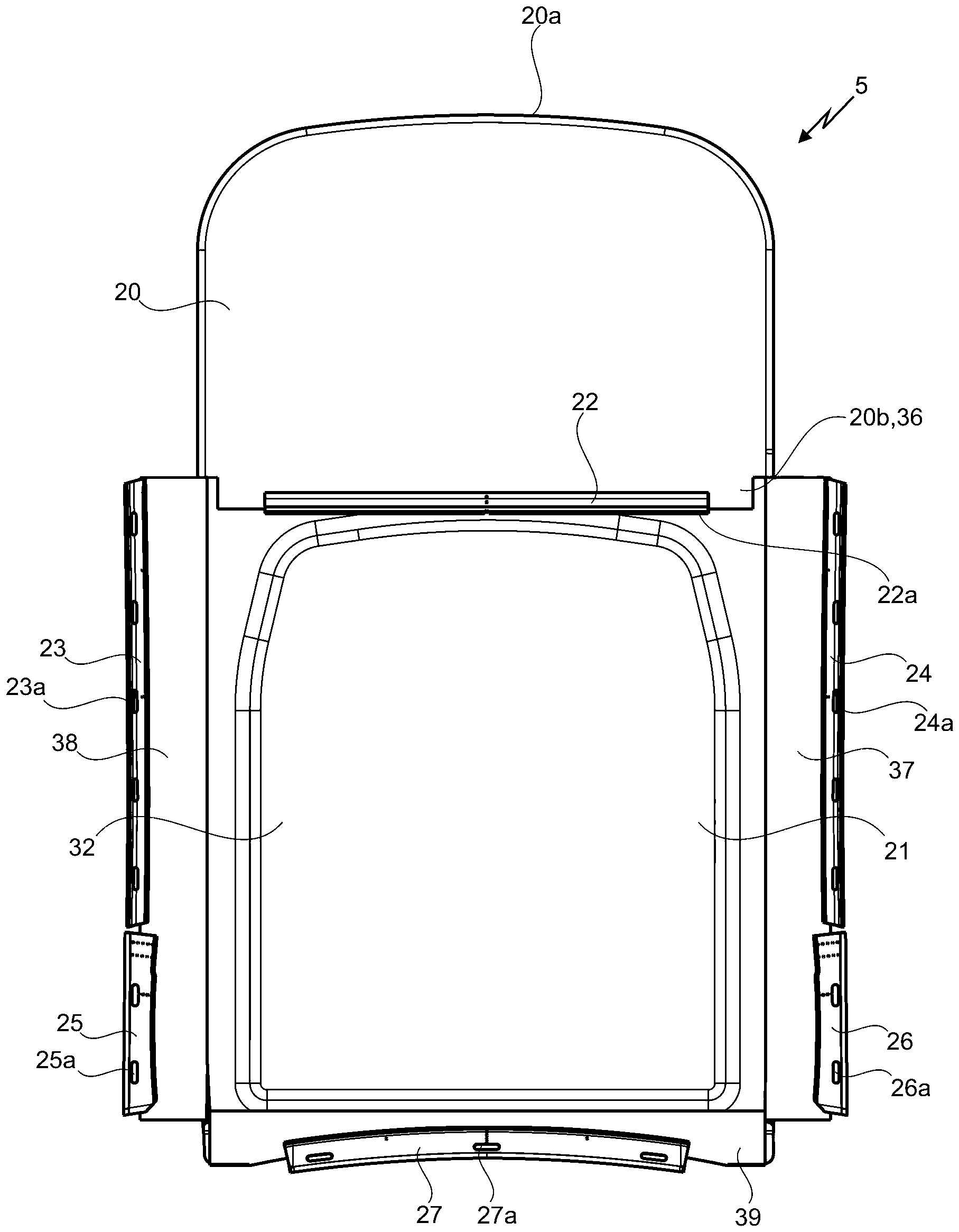
Rückseitig am Gestrick 5 sind eine obere Befestigungseinheit 22 mit einem über die ganze Länge durchgängigen Befestigungselement 22a, eine erste seitliche Befestigungseinheit 23 mit mehreren über die Länge verteilten Befestigungselementen 23a, eine zweite seitliche Befestigungseinheit 24 mit mehreren über die Länge verteilten Befestigungselementen 24a, eine dritte seitliche Befestigungseinheit 25 mit mehreren über die Länge verteilten Befestigungselementen 25a, eine vierte seitliche Befestigungseinheit 26 mit mehreren über die Länge verteilten Befestigungselementen 26a und eine untere Befestigungseinheit 27 mit mehreren über die Länge verteilten Befestigungselementen 27a. Details zu den Positionen der Befestigungseinheiten 22, 23, 24, 25, 26, 27 rückseitig am Gestrick werden in Zusammenhang mit
Des Weiteren ist ein Verschlusselement 28 dargestellt, welches vorgesehen ist eine Öffnung 34 im Gestrick 5 (hier nicht gezeigt; siehe
In
In
An den Seitenstreben 15, 16 ist über dem Gestrick 5 bzw. den seitlichen Randbereichen 37, 38 jeweils eine Montageleiste 35a, 35b angeordnet, die bevorzugt mit der Rückseite 15d, 16d verschraubt sind. Die Montageleisten 35a, 35b dienen zur Befestigung des Rückenlehnenteils 3. Ebenfalls ist an den Seitenstreben 15, 16 über dem Gestrick 5 bzw. den seitlichen Randbereichen 37, 38 die Stützstrebe 18 jeweils endseitig verbunden, bevorzugt mit den Rückseiten 15d, 16d verschraubt.A mounting
Im unteren Abschnitt 21 des Gestricks 5 ist im Bereich der Innenfläche 13 ein rückseitig konvexer Bereich 50 ausgebildet, der sich nach hinten weg von Sitzteil 2 wölbt. Der rückseitig konvexe Bereich 50 ist im Bereich der Stützstrebe 18, sodass bei einer Belastung des Gestricks 5 durch einen Sitzbenutzer und der dadurch auftretenden Dehnung des Gestricks 5 mit einer Ausdehnung nach hinten, der rückseitig konvexe Bereich 50 die Stützstrebe 18 kontaktiert und dadurch eine weitere Stützung der oberen Lordose gewährleistet ist.In the
Ferner ist die als horizontaler Schlitz ausgebildete Öffnung 34 rückseitig im Gestrick 5 dargestellt, über welche das Polsterstützelement 32 in das Taschenelement 45 im unteren Abschnitt 21 des dort zumindest teilweise doppellagig ausgebildeten Gestricks 5 einbringbar ist. Die Öffnung 34 ist durch das schnurartige Verschlusselement 28 lösbar kraftschlüssig verschlossen, sodass das Polsterstützelement 32 nicht ungewollt aus dem Taschenelement 45 herausfallen kann.Furthermore, the opening 34, designed as a horizontal slot, is shown on the back of the
In der
Die
In den
In der
Die Seitenstreben 15, 16 sind mit Aussparungen ausgebildet. Dies ermöglicht einen geringen Materialaufwand und damit eine Gewichtsreduktion. Die Vorderseite 15c der ersten Seitenstrebe 15 ist, ausgehend von der Innenseite 15a zur Außenseite 15b hin, abfallend verlaufend ausgebildet, d.h. die Innenseite 15a ist länger als die Außenseite 15b. Die Vorderseite 16c der zweiten Seitenstrebe 16 ist, ausgehend von der Außenseite 16b zur Innenseite 16a hin, abfallend verlaufend ausgebildet, d.h. die Außenseite 16b ist länger als die Innenseite 16a.The side struts 15, 16 are designed with recesses. This allows for a low material expenditure and thus a reduction in weight. The
In der
Im Bereich der Innenfläche 13 ist das Polsterstützelement 32 innerhalb des doppellagigen Gestricks 5 zu erkennen, welches den vorderseitig konvexen Bereich 49 ausbildet, der sich nach vorne in Richtung des Sitzteils 2 wölbt und über das Rahmenelement 4 hinausragt. In diesem gezeigten Abschnitt erstreckt sich das Gestrick 5 auf bzw. über der Innenfläche 13.In the area of the
Die weiteren in der
In der
In der Schnittansicht der
Des Weiteren ist das Polsterstützelement 32 innerhalb des doppellagigen Gestricks 5 zu erkennen, welches im Bereich der Innenfläche 13 angeordnet ist. Dabei ist der vorderseitig konvexe Bereich 49 zu erkennen, der durch das gesamte Polsterstützelement 32 (alle Segmente 46, 47, 48; siehe
In den
Der obere Bereich 11 des Rahmenelements 4 in den
Die Innenseiten 15a, 16a, 17a der ersten Seitenstrebe 15, der zweiten Seitenstrebe 16 und der Querstrebe 17 sind mit den als Haken ausgebildeten Befestigungselementen 41, 42, 43 dargestellt. Die hakenförmigen Befestigungselemente 41, 42, 43 ragen ausgehend von den Innenseiten 15a, 16a, 17a in die Innenfläche 13 hinein und weisen nach vorne in Richtung des Sitzteils 2, sodass die komplementären Befestigungselemente 23a, 24a, 25a, 26a des Gestricks 5 entsprechend eingehakt werden können. Die Befestigungselemente 41, 42, 43 sind über die ganze Länge der ersten 15, der zweiten Seitenstrebe 16 und der Querstrebe 17 an den Innenseiten 15a, 16a, 17a angeordnet, wobei mehrere einzelne Befestigungselemente 41, 42, 43 vorgesehen sind.The
Die Seitenstreben 15, 16 weisen jeweils die Verbindungsachse 40a, 40b auf, sodass die Seitenstreben 15, 16 sozusagen zweigeteilt ausgebildet sind. Dies hat den Vorteil, dass das verbundene Sitzteil 2 vor und zurück geschoben werden kann und sich so nur der untere Teil der Seitenstreben 15, 16 des unteren Bereichs 12 jeweils bis zu den Verbindungsachsen 40a, 40b mitbewegt. Des Weiteren ist die Stützstrebe 18 angeordnet, die jeweils endseitig mit den Rückseiten 15d, 16d der Seitenstreben 15, 16 verbunden ist und hinter der Innenfläche 13 verläuft. Die Stützstrebe 18 hat eine stabilisierende Wirkung und zusätzlich eine Stützfunktion in Zusammenwirkung mit dem rückseitig konvexen Bereich 50 bzw. dem mittleren Segment 47.The side struts 15, 16 each have the connecting
Die
In
Die Befestigungseinheiten 22, 23, 24, 25, 26, 27 sind jeweils randseitig am Gestrick 5 befestigt, insbesondere angenäht. Die obere Befestigungseinheit 22 ist an dem oberen Randbereich 36 angeordnet, der an der zweiten Öffnungsseite 20b ausgebildet ist. Die erste 23 und die dritte seitliche Befestigungseinheit 25 sind an dem ersten seitlichen Randbereich 38 des Gestricks 5 angeordnet. Die zweite 24 und die vierte seitliche Befestigungseinheit 26 sind an einem zweiten seitlichen Randbereich 37 des Gestricks 5 angeordnet. Die untere Befestigungseinheit 27 ist an dem unteren Randbereich 39 des Gestricks 5 angeordnet.The
Die Befestigungseinheiten 22, 23, 24, 25, 26, 27 weisen die am Gestrick 5 angeordneten Befestigungselemente 22a, 23a, 24a, 25a, 26a, 27a auf. Die Befestigungseinheiten 22, 23, 24, 25, 26, 27 sind leistenartig ausgebildet, wobei die an den Befestigungseinheiten 22, 23, 24, 25, 26, 27 angeordneten Befestigungselemente 22a, 23a, 24a, 25a, 26a, 27a über eine Grundfläche des Gestricks 5 hinausragen. Das Befestigungselement 22a an der oberen Befestigungseinheit 22 ist leistenartig ausgebildet. Die Befestigungselemente 23a, 24a, 25a, 26a, 27a sind lochförmig ausgebildet, sodass sie mit den komplementären hakenförmigen Befestigungselementen 41, 42, 43 des Rahmenelements 4 formschlüssig verbunden werden können. Die Befestigungseinheiten 23 und 24 und die Befestigungseinheiten 25 und 26 sind jeweils gegenüberliegend am Gestrick 5 angeordnet. Die Randbereiche 37, 38, 39 sind flügelartig ausgebildet, sodass sie sich zum Umspannen des Rahmenelements 4 einfach um die Streben 15, 16, 17 herumklappen lassen.The
In der
In den
In
In
In
Das Polsterstützelement 32 weist ein unteres Segment 46, ein mittleres Segment 47 und ein oberes Segment 48 auf, wobei die Segmente 46, 47, 48 in der genannten Reihe bezogen auf die Höhe H des Polsterstützelements 32 von unten nach oben angeordnet sind.The
Die Segmente 46, 47, 48 bilden den vorderseitig konvexen Bereich 49 des Gestricks 5 aus. Das mittlere Segment 47 bildet den rückseitig konvexen Bereich 50 des Gestricks 5 aus.The
Wie insbesondere in
Das Polsterstützelement 32 ist im Wesentlichen rechteckig ausgebildet, wobei die bezogen auf die Höhe H oberen Ecken abgerundet ausgebildet sind.The
In der
Die Verwendung verschiedener Strickmuster 60, 61, 62 kann vorteilhaft sein, da sie dem jeweiligen Einsatzbereich angepasst sind. Das Taschenelement 45 steht dabei immer in Kontakt zu der Person und sollte daher möglichst abriebfest sein. Im rückwärtigen Bereich dazu ist eine erhöhte Dehnbarkeit vorteilhaft, um der Krafteinwirkung der Person auf das Gestrick 5 Rechnung zu tragen.The use of different knitting patterns 60, 61, 62 can be advantageous, as they are adapted to the respective area of application. The
BezugszeichenlisteList of reference symbols
- 11
- FahrzeugsitzVehicle seat
- 100100
- InneinrichtungInterior
- 22
- SitzteilSeat part
- 33
- RückenlehnenteilBackrest part
- 44
- RahmenelementFrame element
- 55
- GestrickKnitted fabric
- 88
- Armlehnearmrest
- 99
- Kopfstützeheadrest
- 1010
- FahrzeugsitzfußVehicle seat base
- 1111
- oberer Bereich des Rahmenelementsupper part of the frame element
- 1212
- unterer Bereich des Rahmenelementslower part of the frame element
- 1313
- InnenflächeInner surface
- 14a14a
- Oberseite des oberen BereichsTop of the upper area
- 14b14b
- Querstrebe des oberen Bereichs bzw. BefestigungselementCross brace of the upper area or fastening element
- 14c14c
- Innenseite der Querstrebe des oberen Bereichs bzw. BefestigungselementInside of the cross brace of the upper area or fastening element
- 1515
- erste Seitenstrebe des unteren Bereichsfirst side strut of the lower section
- 15a15a
- Innenseite der ersten SeitenstrebeInside of the first side strut
- 15b15b
- Außenseite der ersten SeitenstrebeOutside of the first side strut
- 15c15c
- Vorderseite der ersten SeitenstrebeFront of the first side strut
- 15d15d
- Rückseite der ersten SeitenstrebeBack of the first side strut
- 1616
- zweite Seitenstrebe des unteren Bereichssecond side strut of the lower section
- 16a16a
- Innenseite der zweiten SeitenstrebeInside of the second side strut
- 16b16b
- Außenseite der zweiten SeitenstrebeOutside of the second side strut
- 16c16c
- Vorderseite der zweiten SeitenstrebeFront of the second side strut
- 16d16d
- Rückseite der zweiten SeitenstrebeBack of the second side strut
- 1717
- Querstrebe des unteren BereichsCross brace of the lower area
- 17a17a
- Innenseite bzw. Oberseite der QuerstrebeInside or top of the cross brace
- 17b17b
- Außenseite bzw. Unterseite der QuerstrebeOutside or underside of the cross brace
- 17c17c
- Vorderseite der QuerstrebeFront of the cross brace
- 17d17d
- Rückseite der QuerstrebeBack of the cross brace
- 1818
- StützstrebeSupport strut
- 1919
- SchaumstoffeinlageFoam insert
- 2020
- oberer Abschnitt des Gestricksupper section of the knit
- 20a20a
- erste Öffnungsseitefirst opening page
- 20b20b
- zweite Öffnungsseitesecond opening side
- 2121
- unterer Abschnitt des Gestrickslower section of the knit
- 2222
- obere Befestigungseinheitupper mounting unit
- 22a22a
- BefestigungselementFastener
- 2323
- erste seitliche Befestigungseinheitfirst side mounting unit
- 23a23a
- BefestigungselementFastener
- 2424
- zweite seitliche Befestigungseinheitsecond side mounting unit
- 24a24a
- BefestigungselementFastener
- 2525
- dritte seitliche Befestigungseinheitthird side mounting unit
- 25a25a
- BefestigungselementFastener
- 2626
- vierte seitliche Befestigungseinheitfourth side mounting unit
- 26a26a
- BefestigungselementFastener
- 2727
- untere Befestigungseinheitlower mounting unit
- 27a27a
- BefestigungselementFastener
- 2828
- VerschlusselementLocking element
- 2929
- KopfstützenausnehmungHeadrest recess
- 30a, b30a, b
- SitzfußverbindungselementSeat foot connecting element
- 31a, b31a, b
- SitzteilverbindungselementSeat part connecting element
- 3232
- PolsterstützelementCushion support element
- 3333
- AussparungRecess
- 3434
- Öffnungopening
- 35a, b35a, b
- MontageleistenMounting strips
- 3636
- oberer Randbereich des Gestricksupper edge area of the knitted fabric
- 3737
- erster seitlicher Randbereich des Gestricksfirst lateral edge area of the knitted fabric
- 3838
- zweiter seitlicher Randbereich des Gestrickssecond lateral edge area of the knitted fabric
- 3939
- unterer Randbereich des Gestrickslower edge area of the knitted fabric
- 40a, b40a, b
- VerbindungsachseConnecting axis
- 4141
- Befestigungselement an der Innenseite der ersten SeitenstrebeFastening element on the inside of the first side strut
- 4242
- Befestigungselement an der Innenseite der zweiten SeitenstrebeFastening element on the inside of the second side strut
- 4343
- Befestigungselement an der Innenseite der QuerstrebeFastening element on the inside of the cross brace
- 4444
- KopfstützenbefestigungHeadrest attachment
- 4545
- TaschenelementPocket element
- 4646
- unteres Segment des Polsterstützelementslower segment of the cushion support element
- 4747
- mittleres Segment des Polsterstützelementsmiddle segment of the cushion support element
- 4848
- oberes Segment des Polsterstützelementsupper segment of the cushion support element
- 4949
- vorderseitig konvexer Bereichfront convex area
- 5050
- rückseitig konvexer Bereichrear convex area
- 6060
- erstes Strickmusterfirst knitting pattern
- 6161
- zweites Strickmustersecond knitting pattern
- 6262
- drittes Strickmusterthird knitting pattern
- DD
- Dicke des PolsterstützelementsThickness of the cushion support element
- HH
- Höhe des PolsterstützelementsHeight of the cushion support element
- BB
- Breite des PolsterstützelementsWidth of the cushion support element
- VV
- Vorderseite des PolsterstützelementsFront of the cushion support element
- RR
- Rückseite des PolsterstützelementsBack of the cushion support element
- S1, S2, S3S1, S2, S3
- SchnittachseCutting axis
Claims (9)
Priority Applications (4)
| Application Number | Priority Date | Filing Date | Title |
|---|---|---|---|
| DE102022125859.9A DE102022125859B4 (en) | 2022-10-06 | 2022-10-06 | Vehicle seat with backrest made of frame element and knitted fabric, interior fittings of a means of transport |
| EP23193236.9A EP4349647B1 (en) | 2022-10-06 | 2023-08-24 | Vehicle seat with backrest made of frame element and knitted fabric |
| CN202311229776.6A CN117841805A (en) | 2022-10-06 | 2023-09-21 | Vehicle seat with a backrest made of a frame element and a knitted fabric |
| US18/473,441 US20240116418A1 (en) | 2022-10-06 | 2023-09-25 | Vehicle seat with backrest made of frame element and knitted fabric |
Applications Claiming Priority (1)
| Application Number | Priority Date | Filing Date | Title |
|---|---|---|---|
| DE102022125859.9A DE102022125859B4 (en) | 2022-10-06 | 2022-10-06 | Vehicle seat with backrest made of frame element and knitted fabric, interior fittings of a means of transport |
Publications (2)
| Publication Number | Publication Date |
|---|---|
| DE102022125859A1 DE102022125859A1 (en) | 2024-04-11 |
| DE102022125859B4 true DE102022125859B4 (en) | 2024-09-26 |
Family
ID=90124904
Family Applications (1)
| Application Number | Title | Priority Date | Filing Date |
|---|---|---|---|
| DE102022125859.9A Active DE102022125859B4 (en) | 2022-10-06 | 2022-10-06 | Vehicle seat with backrest made of frame element and knitted fabric, interior fittings of a means of transport |
Country Status (4)
| Country | Link |
|---|---|
| US (1) | US20240116418A1 (en) |
| EP (1) | EP4349647B1 (en) |
| CN (1) | CN117841805A (en) |
| DE (1) | DE102022125859B4 (en) |
Citations (5)
| Publication number | Priority date | Publication date | Assignee | Title |
|---|---|---|---|---|
| JPH0216551A (en) * | 1988-07-05 | 1990-01-19 | Brother Ind Ltd | image forming device |
| DE19627546C1 (en) | 1996-07-09 | 1997-10-23 | Faure Bertrand Sitztech Gmbh | Back rest for road vehicle seat |
| JP2015074338A (en) | 2013-10-09 | 2015-04-20 | トヨタ紡織株式会社 | Vehicle seat back |
| JP2016000551A (en) | 2014-06-11 | 2016-01-07 | トヨタ紡織株式会社 | Vehicle net seat |
| DE102019210221A1 (en) | 2019-07-10 | 2021-01-28 | Volkswagen Aktiengesellschaft | Lightweight seat, in particular a vehicle seat with a base frame and covering elements and associated 3D printing manufacturing processes in which the base frame and the covering elements or parts thereof are manufactured without tools |
Family Cites Families (6)
| Publication number | Priority date | Publication date | Assignee | Title |
|---|---|---|---|---|
| US4432521A (en) * | 1981-06-22 | 1984-02-21 | Jack Douglas | Cradle case |
| US5013089A (en) * | 1989-09-15 | 1991-05-07 | General Motors Corporation | Thin profile integrated suspension and seat trim cover |
| WO1998019879A1 (en) * | 1996-11-04 | 1998-05-14 | Chrysler Corporation | Lightweight bucket seat for motor vehicles |
| US5729846A (en) * | 1997-01-13 | 1998-03-24 | Sullivan; William | Beach towel with pocket for pillow |
| WO2015154097A2 (en) * | 2014-04-03 | 2015-10-08 | Franklin Products, Inc | Lightweight headrest assembly |
| US10182658B2 (en) * | 2016-09-09 | 2019-01-22 | Deborah Harkey | Lumbar support system |
-
2022
- 2022-10-06 DE DE102022125859.9A patent/DE102022125859B4/en active Active
-
2023
- 2023-08-24 EP EP23193236.9A patent/EP4349647B1/en active Active
- 2023-09-21 CN CN202311229776.6A patent/CN117841805A/en active Pending
- 2023-09-25 US US18/473,441 patent/US20240116418A1/en active Pending
Patent Citations (5)
| Publication number | Priority date | Publication date | Assignee | Title |
|---|---|---|---|---|
| JPH0216551A (en) * | 1988-07-05 | 1990-01-19 | Brother Ind Ltd | image forming device |
| DE19627546C1 (en) | 1996-07-09 | 1997-10-23 | Faure Bertrand Sitztech Gmbh | Back rest for road vehicle seat |
| JP2015074338A (en) | 2013-10-09 | 2015-04-20 | トヨタ紡織株式会社 | Vehicle seat back |
| JP2016000551A (en) | 2014-06-11 | 2016-01-07 | トヨタ紡織株式会社 | Vehicle net seat |
| DE102019210221A1 (en) | 2019-07-10 | 2021-01-28 | Volkswagen Aktiengesellschaft | Lightweight seat, in particular a vehicle seat with a base frame and covering elements and associated 3D printing manufacturing processes in which the base frame and the covering elements or parts thereof are manufactured without tools |
Also Published As
| Publication number | Publication date |
|---|---|
| EP4349647B1 (en) | 2025-11-12 |
| US20240116418A1 (en) | 2024-04-11 |
| CN117841805A (en) | 2024-04-09 |
| DE102022125859A1 (en) | 2024-04-11 |
| EP4349647A1 (en) | 2024-04-10 |
Similar Documents
| Publication | Publication Date | Title |
|---|---|---|
| DE60305110T2 (en) | Installation structure for child seats | |
| DE102016103886B4 (en) | Movable inserts for concealing child safety seat anchors in a vehicle | |
| DE2727785A1 (en) | ADJUSTABLE CHILDREN'S BUCKET SEAT | |
| DE102004059864A1 (en) | Headrest for a seat, in particular passenger seat | |
| DE102018127626A1 (en) | Upholstery bearing for a vehicle seat | |
| DE202018105680U1 (en) | Vehicle seat assembly | |
| DE10359606B4 (en) | Spring element seat | |
| DE2026296A1 (en) | Support or substructure for upholstery | |
| DE102022125858B4 (en) | Vehicle seat with backrest made of frame element and knitted fabric, manufacturing process therefor and interior fittings of a means of transport | |
| DE69104028T2 (en) | LOAD LOCKING DEVICE. | |
| DE102022125859B4 (en) | Vehicle seat with backrest made of frame element and knitted fabric, interior fittings of a means of transport | |
| DE112008004026B4 (en) | Vehicle seat assembly with self-adjusting seat cushion | |
| DE19931020A1 (en) | Device for fixing accessories in vehicles has holder fitting over seat back and having two or more parts of identical cross-section fixing side by side or overlapping and designed to hold hooks etc | |
| EP2411244A1 (en) | Passenger seat device with a support assembly of stretched fabric | |
| DE102016108920A1 (en) | Integrated luggage cover | |
| EP1680322B1 (en) | Seat, particularly an air passenger seat | |
| EP3309073B1 (en) | Head restraint device | |
| DE10119807A1 (en) | Seat, in particular, for vehicles comprises a cushion with at least one lower layer of expanded polypropylene, and a cover provided with holding tabs terminating in wedge shaped ends with catches | |
| DE102004050730B4 (en) | Flexible support for in-line driving and passenger seats | |
| DE10014316B4 (en) | Lying device for insertion in a passenger car | |
| DE2330463C3 (en) | Headrest for vehicle seats | |
| EP3508376B1 (en) | Child seat underlay for a child restraint system in a motor vehicle | |
| DE102019208225B4 (en) | Vehicle seat with a continuous seat cover | |
| DE102019124179B4 (en) | Fastening device for child vehicle seats in motor vehicles, arrangement with a fastening device and a child vehicle seat, motor vehicle with such an arrangement and use of the fastening device | |
| DE102014114480A1 (en) | Baby basket rack and baby basket |
Legal Events
| Date | Code | Title | Description |
|---|---|---|---|
| R012 | Request for examination validly filed | ||
| R079 | Amendment of ipc main class |
Free format text: PREVIOUS MAIN CLASS: B60N0002580000 Ipc: B60N0002640000 |
|
| R016 | Response to examination communication | ||
| R016 | Response to examination communication | ||
| R018 | Grant decision by examination section/examining division | ||
| R020 | Patent grant now final |