DE102019005196A1 - Process for the production of a coumarin-caged forskolin derivative, forskolin derivative and use of the forskolin derivative - Google Patents
Process for the production of a coumarin-caged forskolin derivative, forskolin derivative and use of the forskolin derivative Download PDFInfo
- Publication number
- DE102019005196A1 DE102019005196A1 DE102019005196.3A DE102019005196A DE102019005196A1 DE 102019005196 A1 DE102019005196 A1 DE 102019005196A1 DE 102019005196 A DE102019005196 A DE 102019005196A DE 102019005196 A1 DE102019005196 A1 DE 102019005196A1
- Authority
- DE
- Germany
- Prior art keywords
- oxo
- methyl
- chromen
- methoxymethoxy
- bromo
- Prior art date
- Legal status (The legal status is an assumption and is not a legal conclusion. Google has not performed a legal analysis and makes no representation as to the accuracy of the status listed.)
- Withdrawn
Links
- 0 C*(C***(O)=O)C(O)OCC1c(cc(*)c(*)c2)c2OSOCC1 Chemical compound C*(C***(O)=O)C(O)OCC1c(cc(*)c(*)c2)c2OSOCC1 0.000 description 2
Images


Classifications
-
- C—CHEMISTRY; METALLURGY
- C07—ORGANIC CHEMISTRY
- C07D—HETEROCYCLIC COMPOUNDS
- C07D311/00—Heterocyclic compounds containing six-membered rings having one oxygen atom as the only hetero atom, condensed with other rings
- C07D311/02—Heterocyclic compounds containing six-membered rings having one oxygen atom as the only hetero atom, condensed with other rings ortho- or peri-condensed with carbocyclic rings or ring systems
- C07D311/04—Benzo[b]pyrans, not hydrogenated in the carbocyclic ring
- C07D311/06—Benzo[b]pyrans, not hydrogenated in the carbocyclic ring with oxygen or sulfur atoms directly attached in position 2
- C07D311/08—Benzo[b]pyrans, not hydrogenated in the carbocyclic ring with oxygen or sulfur atoms directly attached in position 2 not hydrogenated in the hetero ring
- C07D311/18—Benzo[b]pyrans, not hydrogenated in the carbocyclic ring with oxygen or sulfur atoms directly attached in position 2 not hydrogenated in the hetero ring substituted otherwise than in position 3 or 7
-
- C—CHEMISTRY; METALLURGY
- C07—ORGANIC CHEMISTRY
- C07D—HETEROCYCLIC COMPOUNDS
- C07D311/00—Heterocyclic compounds containing six-membered rings having one oxygen atom as the only hetero atom, condensed with other rings
- C07D311/02—Heterocyclic compounds containing six-membered rings having one oxygen atom as the only hetero atom, condensed with other rings ortho- or peri-condensed with carbocyclic rings or ring systems
- C07D311/04—Benzo[b]pyrans, not hydrogenated in the carbocyclic ring
- C07D311/06—Benzo[b]pyrans, not hydrogenated in the carbocyclic ring with oxygen or sulfur atoms directly attached in position 2
- C07D311/08—Benzo[b]pyrans, not hydrogenated in the carbocyclic ring with oxygen or sulfur atoms directly attached in position 2 not hydrogenated in the hetero ring
- C07D311/16—Benzo[b]pyrans, not hydrogenated in the carbocyclic ring with oxygen or sulfur atoms directly attached in position 2 not hydrogenated in the hetero ring substituted in position 7
-
- C—CHEMISTRY; METALLURGY
- C07—ORGANIC CHEMISTRY
- C07D—HETEROCYCLIC COMPOUNDS
- C07D311/00—Heterocyclic compounds containing six-membered rings having one oxygen atom as the only hetero atom, condensed with other rings
- C07D311/02—Heterocyclic compounds containing six-membered rings having one oxygen atom as the only hetero atom, condensed with other rings ortho- or peri-condensed with carbocyclic rings or ring systems
- C07D311/78—Ring systems having three or more relevant rings
-
- C—CHEMISTRY; METALLURGY
- C07—ORGANIC CHEMISTRY
- C07D—HETEROCYCLIC COMPOUNDS
- C07D311/00—Heterocyclic compounds containing six-membered rings having one oxygen atom as the only hetero atom, condensed with other rings
- C07D311/02—Heterocyclic compounds containing six-membered rings having one oxygen atom as the only hetero atom, condensed with other rings ortho- or peri-condensed with carbocyclic rings or ring systems
- C07D311/78—Ring systems having three or more relevant rings
- C07D311/92—Naphthopyrans; Hydrogenated naphthopyrans
-
- C—CHEMISTRY; METALLURGY
- C07—ORGANIC CHEMISTRY
- C07D—HETEROCYCLIC COMPOUNDS
- C07D407/00—Heterocyclic compounds containing two or more hetero rings, at least one ring having oxygen atoms as the only ring hetero atoms, not provided for by group C07D405/00
- C07D407/02—Heterocyclic compounds containing two or more hetero rings, at least one ring having oxygen atoms as the only ring hetero atoms, not provided for by group C07D405/00 containing two hetero rings
- C07D407/12—Heterocyclic compounds containing two or more hetero rings, at least one ring having oxygen atoms as the only ring hetero atoms, not provided for by group C07D405/00 containing two hetero rings linked by a chain containing hetero atoms as chain links
-
- C—CHEMISTRY; METALLURGY
- C07—ORGANIC CHEMISTRY
- C07D—HETEROCYCLIC COMPOUNDS
- C07D493/00—Heterocyclic compounds containing oxygen atoms as the only ring hetero atoms in the condensed system
- C07D493/02—Heterocyclic compounds containing oxygen atoms as the only ring hetero atoms in the condensed system in which the condensed system contains two hetero rings
- C07D493/08—Bridged systems
-
- C—CHEMISTRY; METALLURGY
- C07—ORGANIC CHEMISTRY
- C07D—HETEROCYCLIC COMPOUNDS
- C07D493/00—Heterocyclic compounds containing oxygen atoms as the only ring hetero atoms in the condensed system
- C07D493/02—Heterocyclic compounds containing oxygen atoms as the only ring hetero atoms in the condensed system in which the condensed system contains two hetero rings
- C07D493/10—Spiro-condensed systems
-
- C—CHEMISTRY; METALLURGY
- C09—DYES; PAINTS; POLISHES; NATURAL RESINS; ADHESIVES; COMPOSITIONS NOT OTHERWISE PROVIDED FOR; APPLICATIONS OF MATERIALS NOT OTHERWISE PROVIDED FOR
- C09B—ORGANIC DYES OR CLOSELY-RELATED COMPOUNDS FOR PRODUCING DYES, e.g. PIGMENTS; MORDANTS; LAKES
- C09B57/00—Other synthetic dyes of known constitution
- C09B57/02—Coumarine dyes
-
- C—CHEMISTRY; METALLURGY
- C09—DYES; PAINTS; POLISHES; NATURAL RESINS; ADHESIVES; COMPOSITIONS NOT OTHERWISE PROVIDED FOR; APPLICATIONS OF MATERIALS NOT OTHERWISE PROVIDED FOR
- C09B—ORGANIC DYES OR CLOSELY-RELATED COMPOUNDS FOR PRODUCING DYES, e.g. PIGMENTS; MORDANTS; LAKES
- C09B67/00—Influencing the physical, e.g. the dyeing or printing properties of dyestuffs without chemical reactions, e.g. by treating with solvents grinding or grinding assistants, coating of pigments or dyes; Process features in the making of dyestuff preparations; Dyestuff preparations of a special physical nature, e.g. tablets, films
- C09B67/0071—Process features in the making of dyestuff preparations; Dehydrating agents; Dispersing agents; Dustfree compositions
- C09B67/0092—Dyes in solid form
-
- C—CHEMISTRY; METALLURGY
- C09—DYES; PAINTS; POLISHES; NATURAL RESINS; ADHESIVES; COMPOSITIONS NOT OTHERWISE PROVIDED FOR; APPLICATIONS OF MATERIALS NOT OTHERWISE PROVIDED FOR
- C09K—MATERIALS FOR MISCELLANEOUS APPLICATIONS, NOT PROVIDED FOR ELSEWHERE
- C09K11/00—Luminescent, e.g. electroluminescent, chemiluminescent materials
- C09K11/06—Luminescent, e.g. electroluminescent, chemiluminescent materials containing organic luminescent materials
-
- G—PHYSICS
- G01—MEASURING; TESTING
- G01N—INVESTIGATING OR ANALYSING MATERIALS BY DETERMINING THEIR CHEMICAL OR PHYSICAL PROPERTIES
- G01N21/00—Investigating or analysing materials by the use of optical means, i.e. using sub-millimetre waves, infrared, visible or ultraviolet light
- G01N21/62—Systems in which the material investigated is excited whereby it emits light or causes a change in wavelength of the incident light
- G01N21/63—Systems in which the material investigated is excited whereby it emits light or causes a change in wavelength of the incident light optically excited
- G01N21/64—Fluorescence; Phosphorescence
- G01N21/6428—Measuring fluorescence of fluorescent products of reactions or of fluorochrome labelled reactive substances, e.g. measuring quenching effects, using measuring "optrodes"
-
- G—PHYSICS
- G01—MEASURING; TESTING
- G01N—INVESTIGATING OR ANALYSING MATERIALS BY DETERMINING THEIR CHEMICAL OR PHYSICAL PROPERTIES
- G01N21/00—Investigating or analysing materials by the use of optical means, i.e. using sub-millimetre waves, infrared, visible or ultraviolet light
- G01N21/62—Systems in which the material investigated is excited whereby it emits light or causes a change in wavelength of the incident light
- G01N21/63—Systems in which the material investigated is excited whereby it emits light or causes a change in wavelength of the incident light optically excited
- G01N21/64—Fluorescence; Phosphorescence
- G01N21/645—Specially adapted constructive features of fluorimeters
- G01N21/6456—Spatial resolved fluorescence measurements; Imaging
- G01N21/6458—Fluorescence microscopy
-
- C—CHEMISTRY; METALLURGY
- C09—DYES; PAINTS; POLISHES; NATURAL RESINS; ADHESIVES; COMPOSITIONS NOT OTHERWISE PROVIDED FOR; APPLICATIONS OF MATERIALS NOT OTHERWISE PROVIDED FOR
- C09K—MATERIALS FOR MISCELLANEOUS APPLICATIONS, NOT PROVIDED FOR ELSEWHERE
- C09K2211/00—Chemical nature of organic luminescent or tenebrescent compounds
- C09K2211/10—Non-macromolecular compounds
- C09K2211/1018—Heterocyclic compounds
- C09K2211/1025—Heterocyclic compounds characterised by ligands
- C09K2211/1088—Heterocyclic compounds characterised by ligands containing oxygen as the only heteroatom
Landscapes
- Chemical & Material Sciences (AREA)
- Organic Chemistry (AREA)
- Health & Medical Sciences (AREA)
- Physics & Mathematics (AREA)
- Immunology (AREA)
- General Health & Medical Sciences (AREA)
- Pathology (AREA)
- Life Sciences & Earth Sciences (AREA)
- Analytical Chemistry (AREA)
- Biochemistry (AREA)
- Chemical Kinetics & Catalysis (AREA)
- General Physics & Mathematics (AREA)
- Nuclear Medicine, Radiotherapy & Molecular Imaging (AREA)
- Engineering & Computer Science (AREA)
- Materials Engineering (AREA)
- Optics & Photonics (AREA)
- Pharmaceuticals Containing Other Organic And Inorganic Compounds (AREA)
- Plural Heterocyclic Compounds (AREA)
- Investigating Or Analysing Biological Materials (AREA)
- Heterocyclic Carbon Compounds Containing A Hetero Ring Having Oxygen Or Sulfur (AREA)
Abstract
Die Erfindung betrifft ein Verfahren zur Herstellung eines Cumarin-caged Forskolinderivats, das Forskolinderivat an sich und die Verwendung des Forskolinderivats.The invention relates to a method for producing a coumarin-caged forskolin derivative, the forskolin derivative per se and the use of the forskolin derivative.
Description
Die Erfindung bezieht sich auf ein Verfahren zur Herstellung eines Cumarin-caged Forskolinderivats, ein entsprechendes Forskolinderivat und die Verwendung des Forskolinderivats.The invention relates to a method for producing a coumarin-caged forskolin derivative, a corresponding forskolin derivative and the use of the forskolin derivative.
Stand der TechnikState of the art
Forskolin ist ein Diterpen vom Labdan-Typ aus Coleus forskohlii (syn. Plectranthus barbatus), aus der Familie der Lamiaceae.Forskolin is a diterpene of the Labdan type from Coleus forskohlii (syn. Plectranthus barbatus), from the Lamiaceae family.
Es ist bekannt, dass Forskolin direkt, aber unspezifisch, Adenylat-Cyclasen aktiviert. Es führt darüber zu einer Erhöhung der intrazellulären cAMP-Konzentration. Über diesen Angriffspunkt können verschiedene cAMP-abhängige Signaltransduktionswege beeinflusst werden. Forskolin wird daher als Werkzeug in der experimentellen Pharmakologie eingesetzt (
https://roempp.thieme.de/roempp4.0/do/data/RD-06-01692).It is known that forskolin directly, but unspecifically, activates adenylate cyclases. It also leads to an increase in the intracellular cAMP concentration. Various cAMP-dependent signal transduction pathways can be influenced via this point of attack. Forskolin is therefore used as a tool in experimental pharmacology (
https://roempp.thieme.de/roempp4.0/do/data/RD-06-01692).
Zu diesem Zweck werden unter anderem die sogenannten Caged-Verbindungen genutzt. Caged-Verbindungen („caged compounds“) sind chemisch modifizierte Verbindungen, die bei Bestrahlung mit Licht bestimmter Wellenlängen eine definierte Substanz freisetzen. Ihr Hauptanwendungsgebiet ist die biochemische und zellbiologische Forschung. 1,2 Biologisch aktive Verbindungen werden mit einer photolabilen Schutzgruppe („cage“) ausgestattet und sind somit temporär biologisch inaktiv. Mittels einer Lichteinstrahlung wird die photolabile Schutzgruppe irreversibel abgespalten, und die zuvor inaktive Verbindung weist wieder ihre spezifische biologische Aktivität auf. Caged-Verbindungen werden dazu verwendet, Effektoren zu einer bestimmten Zeit an einem bestimmten Ort freizusetzen, wenn deren direkte Applikation schwierig oder zu langsam ist, um die gewünschte Konzentration am Wirkort direkt zu erreichen, wie z. B. im Innern einer Zelle. Die inaktive Caged-Verbindung kann sich dagegen auch durch langsame Diffusion am Ziel anreichern und bei anschließender Belichtung eine genügende Menge Effektor in kurzer Zeit freisetzen.So-called caged connections are used for this purpose. Caged compounds are chemically modified compounds that release a defined substance when exposed to light of certain wavelengths. Its main area of application is biochemical and cell biological research. 1.2 Biologically active compounds are equipped with a photolabile protective group (“cage”) and are thus temporarily biologically inactive. The photolabile protective group is irreversibly split off by means of irradiation with light, and the previously inactive compound exhibits its specific biological activity again. Caged compounds are used to release effectors at a specific time at a specific location if their direct application is difficult or too slow to directly achieve the desired concentration at the target location, e.g. B. inside a cell. The inactive caged compound, on the other hand, can also accumulate at the target through slow diffusion and, with subsequent exposure, release a sufficient amount of effector in a short time.
Durch die Verwendung von geeigneten Blitzlampen oder Lasern ist es möglich, einen biochemischen Prozess, z.B. eine enzymatisch katalysierte Reaktion oder eine Signalübertragung, sehr schnell zu starten (Piko- bis Millisekunden).By using suitable flash lamps or lasers, it is possible to start a biochemical process, e.g. an enzymatically catalyzed reaction or signal transmission, very quickly (picoseconds to milliseconds).
Um die Zeitabhängigkeit von G-Protein gekoppelten Rezeptor (GPCR)-vermittelten Signalkaskaden zu untersuchen, im vorliegenden Fall um eine detaillierte Untersuchung eines Adenylylzyklase-vermittelten Signalwegs durchzuführen, könnten Caged-Verbindungen eingesetzt werden.In order to investigate the time dependence of G-protein-coupled receptor (GPCR) -mediated signal cascades, in the present case to carry out a detailed investigation of an adenylyl cyclase-mediated signal path, caged compounds could be used.
Cumarin ist eine etablierte Cage-Gruppe, bisher z. B. von caged mRNA und DNA.3 G-Protein-gekoppelte Rezeptoren (GPCRs) bilden die größte Familie membrangebundener Rezeptoren und regulieren eine Vielzahl zellulärer Prozesse. Die Aktivierung von GPCRs induziert intrazelluläre Konzentrationsänderungen von sekundären Botenstoffen, wie z. B. von zyklischem Adenosin-3',5'-monophosphat (cAMP) und Calcium (Ca2+). Diese sekundären Effekte werden durch spezifische Signalkaskaden induziert. Die Aktivierung membrangebundener Adenylatzyklasen (ACs) führt zur Produktion von cAMP.Coumarin is an established cage group. B. of caged mRNA and DNA. 3 G protein-coupled receptors (GPCRs) form the largest family of membrane-bound receptors and regulate a large number of cellular processes. The activation of GPCRs induces intracellular changes in the concentration of secondary messenger substances, such as B. of cyclic adenosine 3 ', 5'-monophosphate (cAMP) and calcium (Ca 2+ ). These secondary effects are induced by specific signal cascades. The activation of membrane-bound adenylate cyclases (ACs) leads to the production of cAMP.
Das natürlich vorkommende Diterpen Forskolin wird als direkter Stimulator der Adenylat-Cyclase experimentell in der Biochemie und Pharmakologie genutzt.4,5 Als Folge der Enzymaktivierung wird in der Zelle die Umwandlung von Adenosintriphosphat (ATP) zum Signalstoff cAMP katalysiert. Auf diese Weise greift Forskolin zentral in die Signaltransduktionswege vieler G-Protein-gekoppelter Rezeptoren ein.The naturally occurring diterpene forskolin is used experimentally in biochemistry and pharmacology as a direct stimulator of adenylate cyclase. 4,5 As a result of the enzyme activation, the conversion of adenosine triphosphate (ATP) to the signal substance cAMP is catalyzed in the cell. In this way, forskolin intervenes centrally in the signal transduction pathways of many G-protein-coupled receptors.
Forskolin wird somit experimentell als direkter Stimulator von Adenylylzyklasen (ACs) genutzt. Wasserlösliche Forskolinderivate, wie z. B. das käufliche Colforsin (NKH 477, s.
Nachteilig gibt es jedoch keine wasserlöslichen Forskolinderivate, die lichtgesteuert freisetzbar sind. Es gibt somit keine „inaktive“ caged-Verbindung des Forskolins, die sich durch Diffusion am Ziel anreichert und durch anschließende Photolyse gezielt direkt am Wirkort in sehr kurzer Zeit freigesetzt werden kann. Die Hauptschwierigkeit ist die Komplexität eines Syntheseweges.However, the disadvantage is that there are no water-soluble forskolin derivatives that can be released under light control. There is therefore no "inactive" caged compound of forskolin that accumulates at the target through diffusion and can be released directly at the site of action in a very short time through subsequent photolysis. The main difficulty is the complexity of a synthetic route.
Aufgabe der ErfindungObject of the invention
Aufgabe der Erfindung ist es ein Verfahren zur Herstellung von „Cumarin-caged Forskolinderivaten“ bereitzustellen. Ferner ist es eine Aufgabe der Erfindung die entsprechenden Cumarin-caged Forskolinderivate bereitzustellen, um damit zell- oder gewebebasierte Untersuchungen durchführen zu können.The object of the invention is to provide a process for the production of “coumarin-caged forskolin derivatives”. Furthermore, it is an object of the invention to provide the corresponding coumarin-caged forskolin derivatives in order to be able to carry out cell- or tissue-based examinations with them.
Lösung der AufgabeSolution of the task
Die Aufgabe wird gelöst mit dem Verfahren nach Patentanspruch 1, sowie den Cumarin-caged Forskolinderivaten und dessen Verwendungen gemäß den Nebenansprüchen. Vorteilhafte Ausgestaltungen hierzu ergeben sich jeweils aus den hierauf rückbezogenen Patentansprüchen.The object is achieved with the method according to
Beschreibung der ErfindungDescription of the invention
Ein Verfahren zur Herstellung eines speziellen Cumarin-caged Forskolinderivats JCF 1 mit der Formel

- a. Synthese von (6-Brom-7-(methoxymethoxy)-2-oxo-2H-chromen-4-yl)methyl methyl(2-(2,2,2-trifluoroacetamido)ethyl)carbamat 4 mit der Formel

- b. Synthese von (6-Brom-7-(methoxymethoxy)-2-oxo-2H-chromen-4-yl)methyl (2-aminoethyl)(methyl)carbamat 3 mit der Formel

- c. Synthese von (6-Brom-7-(methoxymethoxy)-2-oxo-2H-chromen-4-yl)methyl (2-(((((2R,4aR,4a1R,6S,10aS,11S,12S,12aR)-6-(dimethylamino)-12-hydroxy-2,4a1,10,10,12a-pentamethyl-4-oxo-2-vinyldecahydro-2H,8H-pyrano[3',2':1,2]naphtho[1,8-de][1,3]dioxin-11-yl)oxy)carbonyl)amino)ethyl)(methyl)
carbamat 7 gemäß der Formel
- d. Synthese von (2R,4aR,4a1R,6S,10aS,1 1S,12S,12aR)-1 1-(((2-((((6-Brom-7-(methoxymethoxy)-2-oxo- 2H -chromen-4-yl)methoxy)carbonyl)(methyl)amino)ethyl)carbamoyl)oxy)-6-(dimethylamino)-2,4a1,10,10,12a-pentamethyl-4-oxo-2-vinyldecahydro-2H,8H-pyrano[3',2':1,2]naphtho[1,8-de][1,3]dioxin-12-
yl acetat 8 gemäß der Formel
carbamat 7, - e. Synthese von (3R,4aR,5S,6S,6aS,10S,10aR,10bS)-6-(((2-((((6-Brom-7-(methoxymethoxy)-2-oxo-2H-chromen-4-yl)methoxy)carbonyl)(methyl)amino)ethyl)carbamoyl)oxy)-10,10b-dihydroxy-3,4a,7,7,10a-pentamethyl-l-oxo-3-vinyldodecahydro-1H-benzo[f]chromen-5-yl-
acetat 9 gemäß der Formel
yl acetat 8, - f. Synthese von (3R,4aR,5S,6S,6aS,10S,10aR,10bS)-6-(((2-((((6-Brom-7-hydroxy-2-oxo-2H-chromen-4-yl)methoxy)carbonyl)(methyl)amino)ethyl)carbamoyl)oxy)-10,10b-dihydroxy-3,4a,7,7,10a-pentamethyl-1-oxo-3-vinyldodecahydro-1 H-benzo[f]chromen-5-yl acetat (JCF 1) gemäß der Formel

yl acetat 9.
- a. Synthesis of (6-bromo-7- (methoxymethoxy) -2-oxo-2H-chromen-4-yl) methyl methyl (2- (2,2,2-trifluoroacetamido) ethyl) carbamate 4 having the formula
- b. Synthesis of (6-bromo-7- (methoxymethoxy) -2-oxo-2H-chromen-4-yl) methyl (2-aminoethyl) (methyl) carbamate 3 with the formula
- c. Synthesis of (6-bromo-7- (methoxymethoxy) -2-oxo-2H-chromen-4-yl) methyl (2 - (((((2R, 4aR, 4a1R, 6S, 10aS, 11S, 12S, 12aR) -6- (dimethylamino) -12-hydroxy-2,4a1,10,10,12a-pentamethyl-4-oxo-2-vinyldecahydro-2H, 8H-pyrano [3 ', 2': 1,2] naphtho [1 , 8-de] [1,3] dioxin-11-yl) oxy) carbonyl) amino) ethyl) (methyl) carbamate 7 according to the formula
- d. Synthesis of (2R, 4aR, 4a1R, 6S, 10aS, 11S, 12S, 12aR) -1 1 - (((2 - ((((6-bromo-7- (methoxymethoxy) -2-oxo-2H -chromene -4-yl) methoxy) carbonyl) (methyl) amino) ethyl) carbamoyl) oxy) -6- (dimethylamino) -2,4a1,10,10,12a-pentamethyl-4-oxo-2-vinyldecahydro-2H, 8H -pyrano [3 ', 2': 1,2] naphtho [1,8-de] [1,3] dioxin-12-yl acetate 8 according to the formula
- e. Synthesis of (3R, 4aR, 5S, 6S, 6aS, 10S, 10aR, 10bS) -6 - (((2 - ((((6-bromo-7- (methoxymethoxy) -2-oxo-2H-chromen-4 -yl) methoxy) carbonyl) (methyl) amino) ethyl) carbamoyl) oxy) -10,10b-dihydroxy-3,4a, 7,7,10a-pentamethyl-1-oxo-3-vinyldodecahydro-1H-benzo [f ] chromen-5-yl acetate 9 according to the formula
- f. Synthesis of (3R, 4aR, 5S, 6S, 6aS, 10S, 10aR, 10bS) -6 - (((2 - ((((6-bromo-7-hydroxy-2-oxo-2H-chromene-4 -yl) methoxy) carbonyl) (methyl) amino) ethyl) carbamoyl) oxy) -10,10b-dihydroxy-3,4a, 7,7,10a-pentamethyl-1-oxo-3-vinyldodecahydro-1H-benzo [ f] chromen-5-yl acetate (JCF 1) according to the formula
Die übrigen Hilfsstoffe der Schritte a. bis f. können vorteilhaft denen des Ausführungsbeispiels entsprechen.The other excipients of steps a. to f. can advantageously correspond to those of the exemplary embodiment.
In einer Ausgestaltung der Erfindung wird die erste Carbamoylierung gemäß Schritt a. mit einem polar-aprotischen Lösemittel, z.B. Dimethylformamid (DMF), N-Methylformamid (NMF), Tetrahydrofuran (THF), Dimethylsulfoxid (DMSO), Acetonitril (ACN), Dimethylpropylenharnstoff (DMPU), Pyrinin, Aceton zwischen etwa 10 °C bis 30 °C durchgeführt. In one embodiment of the invention, the first carbamoylation according to step a. with a polar aprotic solvent, e.g. dimethylformamide (DMF), N-methylformamide (NMF), tetrahydrofuran (THF), dimethyl sulfoxide (DMSO), acetonitrile (ACN), dimethyl propylene urea (DMPU), pyrinine, acetone between about 10 ° C to 30 ° C ° C carried out.
In einer weiteren Ausgestaltung der Erfindung wird die erste Entschützung gemäß Schritt b. mit einer mineralischen Base und einem wässrig-alkanolischen Lösemittel zwischen etwa 10 °C bis 30 °C durchgeführt.In a further embodiment of the invention, the first deprotection according to step b. carried out with a mineral base and an aqueous-alkanolic solvent between about 10 ° C to 30 ° C.
Die zweite Carbamoylierung gemäß Schritt c. kann vorteilhaft mit einem polar-aprotischen Lösemittel, z.B. Dimethylformamid (DMF), N-Methylformamid (NMF), Tetrahydrofuran (THF), Dimethylsulfoxid (DMSO), Acetonitril (ACN), Dimethylpropylenharnstoff (DMPU), Pyrinin, Aceton und einer Hilfsbase, z.B. Diazabicycloundecen (DBU), Triethylamin (Et3N) Diisopropylethylamin (DIEA), N-Methylmorpholin (NMM), Tributylamin und zwischen etwa 0 °C bis 10 °C durchgeführt werden.The second carbamoylation according to step c. can be advantageous with a polar aprotic solvent, e.g. dimethylformamide (DMF), N-methylformamide (NMF), tetrahydrofuran (THF), dimethyl sulfoxide (DMSO), acetonitrile (ACN), dimethylpropyleneurea (DMPU), pyrinine, acetone and an auxiliary base, e.g. Diazabicycloundecene (DBU), triethylamine (Et 3 N), diisopropylethylamine (DIEA), N-methylmorpholine (NMM), tributylamine and between about 0 ° C to 10 ° C.
Die Acetylierung gemäß Schritt d. kann mit einem polar-aprotischen Lösemittel, z.B. Dimethylformamid (DMF), N-Methylformamid (NMF), Tetrahydrofuran (THF), Dimethylsulfoxid (DMSO), Acetonitril (ACN), Dimethylpropylenharnstoff (DMPU), Pyrinin, Aceton und einem Acetylierungsreagenz, z.B. Acetylchlorid, Acetanhydrid, und zwischen etwa 0 °C bis 10 °C durchgeführt werden.The acetylation according to step d. can with a polar aprotic solvent, e.g. dimethylformamide (DMF), N-methylformamide (NMF), tetrahydrofuran (THF), dimethyl sulfoxide (DMSO), acetonitrile (ACN), dimethylpropyleneurea (DMPU), pyrinine, acetone and an acetylating reagent, e.g. acetyl chloride , Acetic anhydride, and between about 0 ° C to 10 ° C.
Es wird eine zweite Entschützung gemäß Schritt e. mit einer organischen Säure, z.B. Ameisensäure, Essigsäure, Propionsäure und einem Alkanol, z. B. Methanol, Ethanol und so weiter zwischen etwa 10 °C bis 30 °C durchgeführt.A second deprotection is carried out according to step e. with an organic acid such as formic acid, acetic acid, propionic acid and an alkanol, e.g. B. methanol, ethanol and so on between about 10 ° C to 30 ° C.
Abschließend wird die dritte Entschützung gemäß Schritt f. mit vorzugsweise einem milden Katalysator, wie z. B. NaHSO4*SiO2 in einem unpolar-aprotischen Lösemittel, z.B. CH2Cl2, Benzol, Ether und zwischen etwa 10 °C bis 30 °C durchgeführt.Finally, the third deprotection according to step f. Is carried out with, preferably, a mild catalyst, such as e.g. B. NaHSO 4 * SiO 2 in a non-polar aprotic solvent, eg CH 2 Cl 2 , benzene, ether and carried out between about 10 ° C to 30 ° C.
Erfindungsgemäß wird das Cumarin-caged Forskolinderivat (3R,4aR,5S,6S,6aS,10S,1 0aR, 1 0bS)-6-(((2-((((6-Brom-7-hydroxy-2-oxo-2H-chromen-4-yl)methoxy)carbonyl)(methyl)amino)ethyl)carbamoyl)oxy)-10,10b-dihydroxy-3,4a,7,7,10a-pentamethyl-1-oxo-3-vinyldodecahydro-1H-benzo[f]chromen-5-yl acetat (JCF 1) gemäß der Formel:
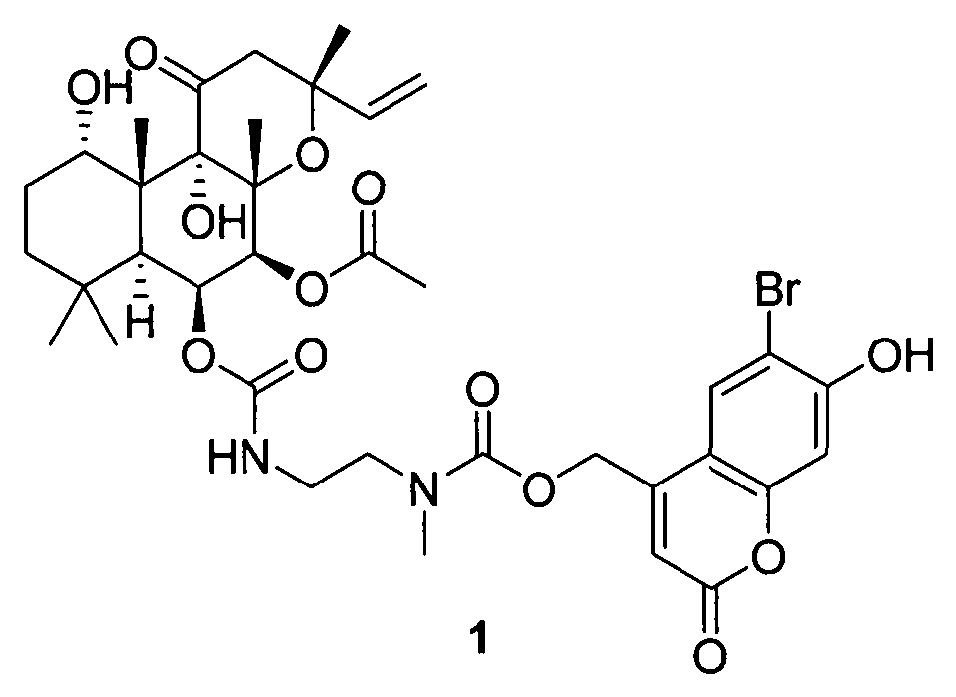
Die nachfolgenden Zwischenprodukte werden vorteilhaft während des erfindungsgemäßen Verfahrens erstmalig bereitgestellt und beansprucht und sind entsprechend in der Literatur bisher unserer Kenntnis nach noch nicht beschrieben worden:
- (6-Brom-7-(methoxymethoxy)-2-oxo-2H-chromen-4-yl)methyl (2-aminoethyl)(methyl)carbamat 3 gemäß der Formel
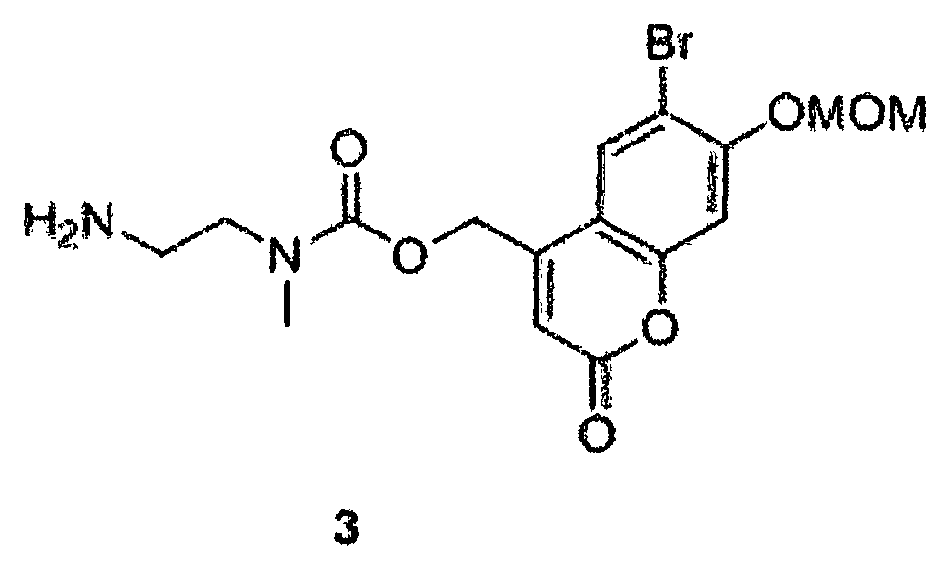
sowie (6-Brom-7-(methoxymethoxy)-2-oxo-2H-chromen-4-yl)methyl methyl(2-(2,2,2-trifluoroacetamido)ethyl)carbamat 4 gemäß der Formel


- (6-Bromo-7- (methoxymethoxy) -2-oxo-2H-chromen-4-yl) methyl (2-aminoethyl) (methyl) carbamate 3 according to the formula
and (6-bromo-7- (methoxymethoxy) -2-oxo-2H-chromen-4-yl) methyl methyl (2- (2,2,2-trifluoroacetamido) ethyl) carbamate 4 according to the formula
Allgemeine SynthesebeschreibungGeneral synthesis description
Caged-Forskolinderivate zur Photolyse in Zellen und Geweben mit resultierender Erhöhung der cAMP-Konzentration werden erfindungsgemäß in sechs Schritten a. bis f. aus literaturbekannten Verbindungen synthetisiert.Caged forskolin derivatives for photolysis in cells and tissues with a resulting increase in the cAMP concentration are according to the invention in six steps a. to f. synthesized from compounds known from the literature.
Vor der Kopplung des geschützten Forskolins mit dem Cumarin-Cage wird eine erste Carbamoylierung eines (Pseudo-)Halogensubstituierten, geschützten Cumarins durchgeführt, um dort eine N-Methylalkylendiaminfunktion einzufügen. Dazu wird ein Nitrophenylcarbonat des geschützten, (Pseudo-)Halogensubstituierten 4-Hydroxymethylcumarins mit Trifluor-N-(2-(methylamino)alkyl)acetamid umgesetzt. Anschließend wird die Trifluoracetylgruppe abgespalten (erste Entschützung).Before coupling the protected forskolin to the coumarin cage, a first carbamoylation of a (pseudo) halogen-substituted, protected coumarin is carried out in order to insert an N-methylalkylenediamine function there. For this purpose, a nitrophenyl carbonate of the protected, (pseudo) halogen-substituted 4-hydroxymethylcoumarin is reacted with trifluoro-N- (2- (methylamino) alkyl) acetamide. The trifluoroacetyl group is then split off (first deprotection).
Das hierbei entstandene Amin wird im nächsten Schritt durch eine zweite Carbamoylierung an das vollständig geschützte Forskolincarbonat gekoppelt. Das gekoppelte Produkt wird am Forskolin acetyliert (Acetylierung) und in zwei weiteren Schritten vollständig zum Caged-Forskolin entschützt (zweite und dritte Entschützung).In the next step, the amine formed is coupled to the fully protected forskolin carbonate by a second carbamoylation. The coupled product is acetylated on the forskolin (acetylation) and completely deprotected to caged forskolin in two further steps (second and third deprotection).
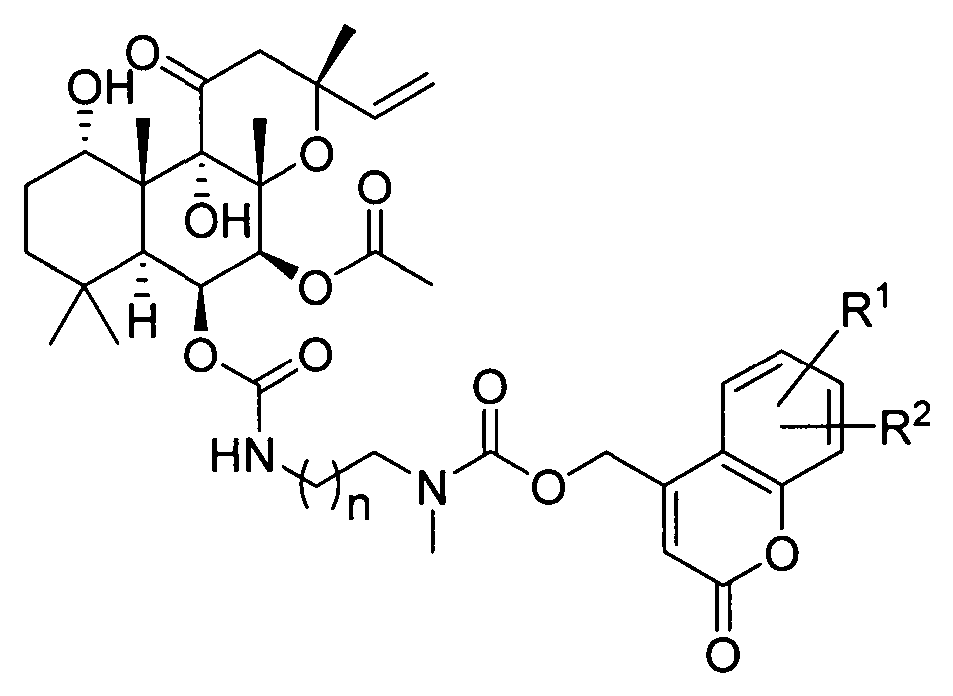
Besonders vorteilhaft werden durch die genannten erfindungsgemäßen Verfahrensschritte die erfindungsgemäßen Cumarin-caged Forskolinderivate gemäß der allgemeinen Formel

Es versteht sich, dass hierfür die Edukte zur Herstellung von JCF 1, wie beschrieben, bis auf das vollständig geschützte Forskolin 2 entsprechend angepasst werden müssen.It goes without saying that for this the starting materials for the production of
An Stelle des spezifischen Edukts 4 mit der Formel


in Schritt a. von Anspruch 1 aus 2,2,2-Trifluor-N-(2-methylamino-alkyl)-acetamid und (Pseudohalogen)-methoxymethoxy cumarin-4-ylmethyl 4'-nitrophenyl carbonat synthetisiert, um die Cumarin-caged Forskolinderivate gemäß der allgemeinen Formel bereit zu stellen.Instead of the specific starting material 4 with the formula
in step a. of
Schritt a. von Anspruch 1 lautet dann für das allgemeine Syntheseverfahren:
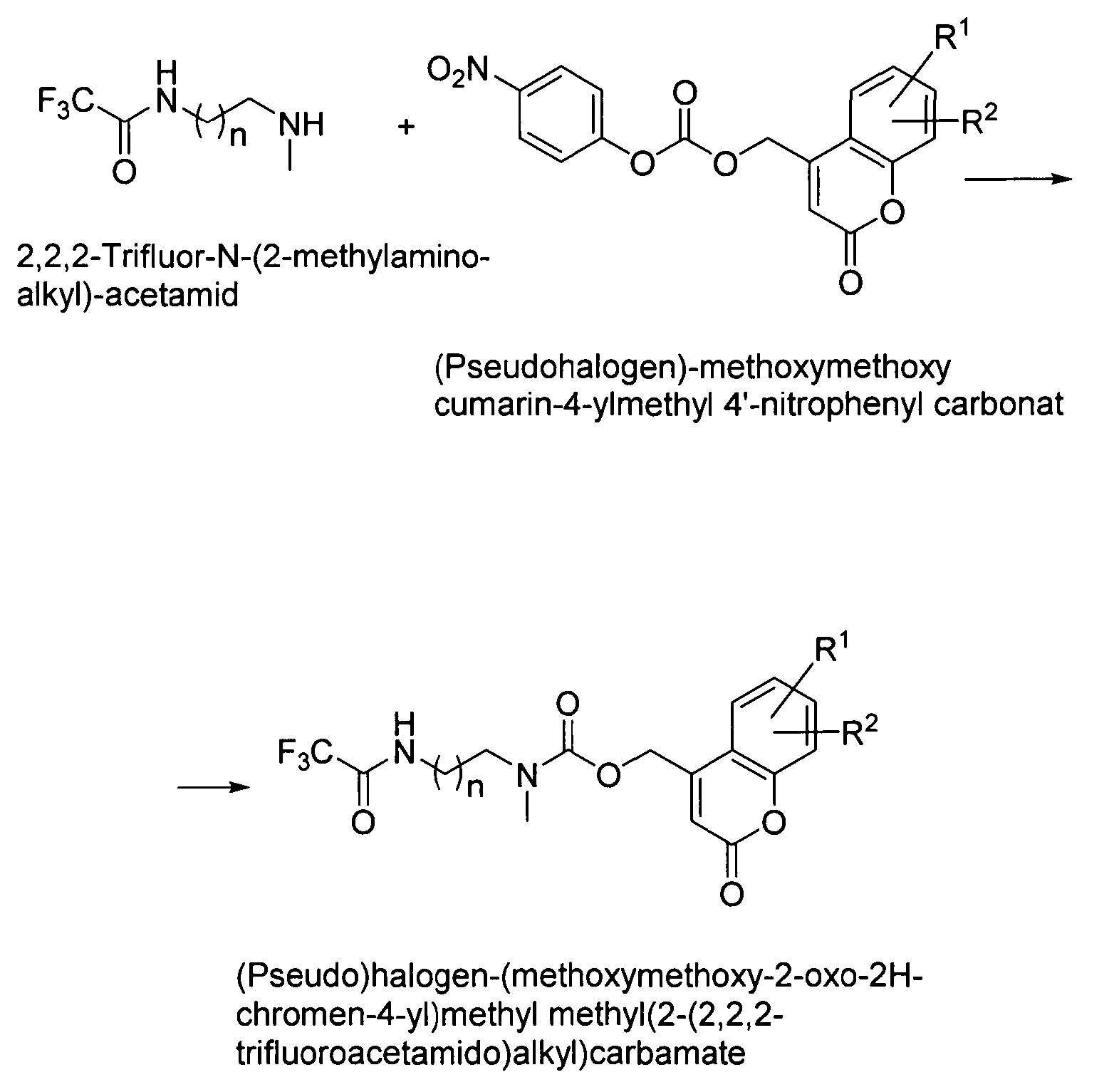
Der weitere Syntheseweg dieser Derivate entspricht hierzu in Hinblick auf die Verfahrensparameter dem des Verfahrens zur Herstellung von JCF 1.The further synthetic route for these derivatives corresponds to that of the process for the preparation of
JCF 1 wird nach einer Bestrahlung mit Licht in einer Photolyse zu N-Methylforskolin (NMF) 10, CO2 und dem entsprechenden Methylcumarinderivat gespalten. Die übrigen erfindungsgemäßen Cumarin-caged Forskolinderivate werden analog zu den homologen N-Methylforskolinderivaten, CO2 und dem entsprechenden Methylcumarinderivat gespalten.After irradiation with light,
Dies erschließt vorteilhaft eine Verwendung eines Cumarin-caged Forskolinderivats zur Erhöhung der cAMP Konzentration in allen zell- und gewebebasierten Proben.This advantageously opens up the use of a coumarin-caged forskolin derivative to increase the cAMP concentration in all cell- and tissue-based samples.
Hierzu kann vorteilhaft das Cumarin-caged Forskolinderivat in eine Zelle eingebracht werden, und nach der Bestrahlung die Erhöhung der intrazellulären cAMP Konzentration, die durch Bindung des biologisch aktiven NMF 10 an endogen in den Zellen vorhandenen, membranständigen Adenylylzyklasen erfolgt, mit einem fluoreszenzbasierten sensitiven Nachweisverfahren gemessen wird.For this purpose, the coumarin-caged forskolin derivative can advantageously be introduced into a cell and, after the irradiation, the increase in the intracellular cAMP concentration, which occurs due to the binding of the biologically
AusfiihrungsbeispielWorking example
Im Weiteren wird die Erfindung an Hand eines Syntheseweges für das Cumarin-caged Forskolinderivat 1 und der beigefügten Figuren näher erläutert, ohne dass es hierdurch zu einer Beschränkung der Erfindung kommen soll.The invention is further explained in more detail using a synthesis route for the coumarin-caged
Es zeigen:
-
1 : Forskolin und NKH 477 (Stand der Technik). -
2 :Syntheseübersicht von JCF 1aus geschütztem Forskolin 2 und einem mit N-Methylethylendiamin funktionalisierten Cumarinderivat 3. -
3 : Synthese von (6-Brom-7-(methoxymethoxy)-2-oxo-2H-chromen-4-yl)methyl methyl(2-(2,2,2-trifluoroacetamido)ethyl)carbamat 4 (Schritt a.). -
4 : Synthese von (6-Brom-7-(methoxymethoxy)-2-oxo-2H-chromen-4-yl)methyl (2-aminoethyl)(methyl)carbamat 3 (Schritt b.). -
5 : Synthese von (6-Brom-7-(methoxymethoxy)-2-oxo-2H-chromen-4-yl)methyl (2-(((((2R,4aR,4a1 R,6S, 10aS,11S,12S, 12aR)-6-(dimethylamino)-12-hydroxy-2,4a1,10,10,12a-pentamethyl-4-oxo-2-vinyldecahydro-2H,8H-pyrano[3',2':1,2]naphtho[1,8-de][1,3]dioxin-11-yl)oxy)carbonyl)amino)ethyl)(methyl)carbamat 7 (Schritt c.). -
6 : Synthese von (2R,4aR,4a1R,6S,10aS,1 1S,12S,12aR)-11-(((2-((((6-Brom-7-(methoxymethoxy)-2-oxo-2H-chromen-4-yl)methoxy)carbonyl)(methyl)amino)ethyl)carbamoyl)oxy)-6-(dimethylamino)-2,4a1,10,10,12a-pentamethyl-4-oxo-2-vinyldecahydro-2H,8H-pyrano[3',2':1,2]naphtho[1,8-de][1,3]dioxin-12-yl acetat 8 (Schritt d.). -
7 : Synthese von (3R,4aR,5S,6S,6aS,10S,10aR,10bS)-6-(((2-((((6-Brom-7-(methoxymethoxy)-2-oxo-2H-chromen-4-yl)methoxy)carbonyl)(methyl)amino)ethyl)carbamoyl)oxy)-10,1Ob-dihydroxy-3,4a,7,7,10a-pentamethyl-1-oxo-3-vinyldodecahydro-1 H-benzo[f]chromen-5-yl acetat 9 (Schritt e.). -
8 : Synthese von (3R,4aR,5S,6S,6aS,10S,10aR,10bS)-6-(((2-((((6-Brom-7-hydroxy-2-oxo- 2H -chromen-4-yl)methoxy)carbonyl)(methyl)amino)ethyl)carbamoyl)oxy)-10,1Ob-dihydroxy-3,4a,7,7,1 0a-pentamethyl-1-oxo-3 -vinyldodecahydro- 1H-benzo[f]chromen-5-yl acetat, (JCF 1) (Schritt f.). -
9 :Photolyse von JCF 1 -
10 :Bestrahlung von JCF 1 und Spaltung zuNMF 10 -
11 : Relative Fluoreszenzbei Beladung mit 10µM JCF 1; die Zeitpunkte wurdenim Abstand von 1 min gemessen. -
12 : Relative Fluoreszenz bei Beladung mit 30µM JCF 1; die Zeitpunkte wurdenim Abstand von 1 min gemessen. -
13 : Relative Fluoreszenzbei Beladung mit 10µM NHK 477; die Zeitpunkte wurdenim Abstand von 1 min gemessen. -
14 : Relative Fluoreszenz bei Beladung mit 30µM NHK 477; die Zeitpunkte wurdenim Abstand von 1 min gemessen. -
15 : Relative Fluoreszenz ohne Beladung (Negativkontrolle); die Zeitpunkte wurdenim Abstand von 1 min gemessen.
-
1 : Forskolin and NKH 477 (prior art). -
2 : Synthesis overview ofJCF 1 from protectedforskolin 2 and acoumarin derivative 3 functionalized with N-methylethylenediamine. -
3 : Synthesis of (6-bromo-7- (methoxymethoxy) -2-oxo-2H-chromen-4-yl) methyl methyl (2- (2,2,2-trifluoroacetamido) ethyl) carbamate 4 (step a.). -
4th : Synthesis of (6-bromo-7- (methoxymethoxy) -2-oxo-2H-chromen-4-yl) methyl (2-aminoethyl) (methyl) carbamate 3 (step b.). -
5 : Synthesis of (6-bromo-7- (methoxymethoxy) -2-oxo-2H-chromen-4-yl) methyl (2 - (((((2R, 4aR, 4a1 R, 6S, 10aS, 11S, 12S, 12aR) -6- (dimethylamino) -12-hydroxy-2,4a1,10,10,12a-pentamethyl-4-oxo-2-vinyldecahydro-2H, 8H-pyrano [3 ', 2': 1,2] naphtho [1,8-de] [1,3] dioxin-11-yl) oxy) carbonyl) amino) ethyl) (methyl) carbamate 7 (step c.). -
6 : Synthesis of (2R, 4aR, 4a1R, 6S, 10aS, 11S, 12S, 12aR) -11 - (((2 - ((((6-bromo-7- (methoxymethoxy) -2-oxo-2H-chromene -4-yl) methoxy) carbonyl) (methyl) amino) ethyl) carbamoyl) oxy) -6- (dimethylamino) -2,4a1,10,10,12a-pentamethyl-4-oxo-2-vinyldecahydro-2H, 8H -pyrano [3 ', 2': 1,2] naphtho [1,8-de] [1,3] dioxin-12-yl acetate 8 (step d.). -
7th : Synthesis of (3R, 4aR, 5S, 6S, 6aS, 10S, 10aR, 10bS) -6 - (((2 - ((((6-bromo-7- (methoxymethoxy) -2-oxo-2H-chromene- 4-yl) methoxy) carbonyl) (methyl) amino) ethyl) carbamoyl) oxy) -10,1Ob-dihydroxy-3,4a, 7,7,10a-pentamethyl-1-oxo-3-vinyldodecahydro-1H-benzo [f] chromen-5-yl acetate 9 (step e.). -
8th : Synthesis of (3R, 4aR, 5S, 6S, 6aS, 10S, 10aR, 10bS) -6 - (((2 - ((((6-bromo-7-hydroxy-2-oxo-2H -chromen-4- yl) methoxy) carbonyl) (methyl) amino) ethyl) carbamoyl) oxy) -10,1Ob-dihydroxy-3,4a, 7,7,1 0a-pentamethyl-1-oxo-3-vinyldodecahydro-1H-benzo [f ] chromen-5-yl acetate, (JCF 1) (step f.). -
9 : Photolysis ofJCF 1 -
10 : Irradiation ofJCF 1 and cleavage toNMF 10 -
11 : Relative fluorescence when loaded with 10μM JCF 1; the times were measured at intervals of 1 min. -
12th : Relative fluorescence when loaded with 30μM JCF 1; the times were measured at intervals of 1 min. -
13 : Relative fluorescence when loaded with 10μM NHK 477; the times were measured at intervals of 1 min. -
14th : Relative fluorescence when loaded with 30μM NHK 477; the times were measured at intervals of 1 min. -
15th : Relative fluorescence without loading (negative control); the times were measured at intervals of 1 min.
Synthesesynthesis
(6-Brom-7-(methoxymethoxv)-2-oxo-2H-chromen-4-yl)methyl methyl(2-(2,2,2-trifluoroacetamido)ethyl)carbamat 4 (Figur 3).(6-Bromo-7- (methoxymethoxy) -2-oxo-2H-chromen-4-yl) methyl methyl (2- (2,2,2-trifluoroacetamido) ethyl) carbamate 4 (Figure 3).
2,2,2-Trifluor-N-(2-methylamino-ethyl)-acetamid10,11 5 (536 mg, 3,15 mmol) und 6-Brom-7-methoxymethoxy cumarin-4-ylmethyl 4'-nitrophenyl carbonat12 6 (1000 mg, 2,09 mmol) werden bei RT über Nacht in 15 mL DMF gerührt. Das Lösungsmittel wird unter reduziertem Druck entfernt. Das Rohprodukt wird säulenchromatographisch (Laufmittel EE:nHex = 7:3) aufgereinigt.2,2,2-trifluoro-N- (2-methylamino-ethyl) -acetamide 10.11 5 (536 mg, 3.15 mmol) and 6-bromo-7-methoxymethoxy coumarin-4-ylmethyl 4'-nitrophenyl carbonate 12 6 (1000 mg, 2.09 mmol) are stirred in 15 mL DMF at RT overnight. The solvent is removed under reduced pressure. The crude product is purified by column chromatography (mobile phase EE: nHex = 7: 3).
Man erhält (6-Brom-7-(methoxymethoxy)-2-oxo-2H-chromen-4-yl)methyl methyl(2-(2,2,2-trifluoroacetamido)ethyl)carbamat 4 (850 mg, 1,67 mmol, 80%) als farblose Kristalle.(6-Bromo-7- (methoxymethoxy) -2-oxo-2H-chromen-4-yl) methyl methyl (2- (2,2,2-trifluoroacetamido) ethyl) carbamate 4 (850 mg, 1.67 mmol, 80%) as colorless crystals.
MS (ESI+) m/z: [M + H]+ theor. 511,0; exp. 510,9.MS (ESI +) m / z: [M + H] + theor. 511.0; exp. 510.9.
(6-Brom-7-(methoxymethoxy)-2-oxo-2H-chromen-4-yl)methyl (2-aminoethyl)(methyl)carbamat 3 (Figur 4).(6-Bromo-7- (methoxymethoxy) -2-oxo-2H-chromen-4-yl) methyl (2-aminoethyl) (methyl) carbamate 3 (Figure 4).
Trifluorcarbamat 4 (200 mg, 0,39 mmol) wird für 2 h mit 25 mL MeOH und 25 mL NaOHaq (0,1 mol/L) im Ultraschallbad behandelt. Die Lösung wird mit HClaq (0,1 mol/L) neutralisiert und anschließend mit CH2Cl2 extrahiert (3 x 50 mL). Die vereinigten organischen Phasen werden unter vermindertem Druck konzentriert. Das Rohprodukt wird säulenchromatographisch (Laufmittel CH2Cl2:MeOH = 9:1) aufgereinigt.Trifluorocarbamate 4 (200 mg, 0.39 mmol) is treated for 2 h with 25 mL MeOH and 25 mL NaOH aq (0.1 mol / L) in an ultrasonic bath. The solution is neutralized with HCl aq (0.1 mol / L) and then extracted with CH 2 Cl 2 (3 x 50 mL). The combined organic phases are concentrated under reduced pressure. The crude product is purified by column chromatography (mobile phase CH 2 Cl 2 : MeOH = 9: 1).
Man erhält (6-Brom-7-(methoxymethoxy)-2-oxo-2H-chromen-4-yl)methyl (2-aminoethyl)(methyl)carbamat 3 (91 mg, 0,22 mmol, 58%) als farblose Kristalle. (6-Bromo-7- (methoxymethoxy) -2-oxo-2H-chromen-4-yl) methyl (2-aminoethyl) (methyl) carbamate 3 (91 mg, 0.22 mmol, 58%) is obtained as colorless Crystals.
MS (ESI+) m/z: [M + H]+ theor. 417,0; exp. 417,0.MS (ESI +) m / z: [M + H] + theor. 417.0; exp. 417.0.
(6-Brom-7-(methoxymethoxy)-2-oxo-2H-chromen-4-yl)methyl (2-(((((2R.4aR,4a1R,6S,10aS, 11S,12S,12aR)-6-(dimethylamino)-12-hydroxy-2,4a1,10,10,12a-pentamethyl-4-oxo-2-vinyldecahydro-2H,8H-pyrano[3',2':1,2]naphtho[1,8-de][1,3]dioxin-11-yl)oxy)carbonyl)aminolethyl)(methyl)carbamat 7 (Figur 5)(6-Bromo-7- (methoxymethoxy) -2-oxo-2H-chromen-4-yl) methyl (2 - ((((((2R.4aR, 4a1R, 6S, 10aS, 11S, 12S, 12aR) -6 - (dimethylamino) -12-hydroxy-2,4a1,10,10,12a-pentamethyl-4-oxo-2-vinyldecahydro-2H, 8H-pyrano [3 ', 2': 1,2] naphtho [1.8 -de] [1,3] dioxin-11-yl) oxy) carbonyl) aminolethyl) (methyl) carbamate 7 (Figure 5)
Zu einer Lösung von 7-Desacetylforskolin-6,7-carbonat 1,9-dimethylformamid dimethyl acetal 2 (148 mg, 0,33 mmol) und Carbamat 3 (296 mg, 0,72 mmol) in 8 mL Pyridin wird bei 0 °C Pyridinhydrochlorid gegeben (8,4 mg, 0.073 mmol) und anschließend Diazabicycloundecen (DBU, 1,386 mL, 8.9 µmol) zugetropft. Die Reaktion wird 5 d bei 4 °C unter Ausschluss von Tageslicht im Kühlschrank gerührt. Es werden 50 mL CH2Cl2 und 10 mL HClaq (0,1 mol/L) zugefügt. Die organische Phase wird abgetrennt und unter vermindertem Druck konzentriert. Das Rohprodukt wird säulenchromatographisch (Laufmittel CH2Cl2:MeOH = 9:1) aufgereinigt.To a solution of 7-deacetylforskolin-6,7-
Man erhält (6-Brom-7-(methoxymethoxy)-2-oxo-2H-chromen-4-yl)methyl (2-(((((2R,4aR,4a1R,6S,10aS,11S,12S,12aR)-6-(dimethylamino)-12-hydroxy-2,4a1,10,10,12a-pentamethyl-4-oxo-2-vinyldecahydro-2H,8H-pyrano[3',2':1,2]naphtho[1,8-de][1,3]dioxin-11-yl)oxy)carbonyl)amino)ethyl)(methyl)carbamat 7 (250 mg, 0,29 mmol, 88%) als farblose Kristalle.(6-Bromo-7- (methoxymethoxy) -2-oxo-2H-chromen-4-yl) methyl (2 - (((((2R, 4aR, 4a1R, 6S, 10aS, 11S, 12S, 12aR) -6- (dimethylamino) -12-hydroxy-2,4a1,10,10,12a-pentamethyl-4-oxo-2-vinyldecahydro-2H, 8H-pyrano [3 ', 2': 1,2] naphtho [1 , 8-de] [1,3] dioxin-11-yl) oxy) carbonyl) amino) ethyl) (methyl) carbamate 7 (250 mg, 0.29 mmol, 88%) as colorless crystals.
MS (ESI+) m/z: [M + H]+ theor. 866,3; exp. 866,3.MS (ESI +) m / z: [M + H] + theor. 866.3; exp. 866.3.
(2R,4aR,4a1R,6S,10aS,11 S,12S,12aR)-11-(((2-((((6-Brom-7-(methoxymethoxy)-2-oxo-2H-chromen-4-yl)methoxy)carbonyl)(methyl)amino)ethyl)earbamoyl)oxy)-6-(dimethylamino)-2,4a1,10,10,12a-pentamethyl-4-oxo-2-vinyldecahydro-2H,8H-pyrano[3',2':1,2]naphtho[1,8-de][1,3]dioxin-12-ylacetat 8 (Figur 6)(2R, 4aR, 4a1R, 6S, 10aS, 11 S, 12S, 12aR) -11 - (((2 - ((((6-bromo-7- (methoxymethoxy) -2-oxo-2H-chromen-4- yl) methoxy) carbonyl) (methyl) amino) ethyl) earbamoyl) oxy) -6- (dimethylamino) -2,4a1,10,10,12a-pentamethyl-4-oxo-2-vinyldecahydro-2H, 8H-pyrano [ 3 ', 2': 1,2] naphtho [1,8-de] [1,3] dioxin-12-ylacetate 8 (Figure 6)
Eine Lösung des Alkohols 7 (150 mg, 170 µmol) in 1,5 mL Pyridin und 1,5 mL Essigsäureanhydrid wird 2 d bei 4 °C unter Ausschluss von Tageslicht im Kühlschrank gerührt. Nach der Zugabe von 20 mL H2O wird mit CH2Cl2 extrahiert (3 x 20 mL). Die vereinigten organischen Phasen werden mit gesättigter NaCl-Lösung gewaschen und mit Na2SO4 getrocknet. A solution of alcohol 7 (150 mg, 170 μmol) in 1.5 ml of pyridine and 1.5 ml of acetic anhydride is stirred for 2 days at 4 ° C. with the exclusion of daylight in the refrigerator. After adding 20 mL of H 2 O, the mixture is extracted with CH 2 Cl 2 (3 × 20 mL). The combined organic phases are washed with saturated NaCl solution and dried with Na 2 SO 4 .
Die organische Phase wird abgetrennt und unter vermindertem Druck konzentriert. Das Rohprodukt wird säulenchromatographisch (Laufmittel CH2Cl2:MeOH = 9:1) aufgereinigt.The organic phase is separated off and concentrated under reduced pressure. The crude product is purified by column chromatography (mobile phase CH 2 Cl 2 : MeOH = 9: 1).
Man erhält (2R,4aR,4a1R,6S,10aS,1 1S,125,12aR)-1 1-(((2-((((6-Brom-7-(methoxymethoxy)-2-oxo-2H-chromen-4-yl)methoxy)carbonyl)(methyl)amino)ethyl)carbamoyl)oxy)-6-(dimethylamino)-2,4a1,10,10,12a-pentamethyl-4-oxo-2-vinyldecahydro-2H,8H-pyrano[3',2':1,2]naphtho[1,8-de][1,3]dioxin-12-yl acetat 8 (61 mg, 67,4 µmol, 40%) als farblosen Schaum.(2R, 4aR, 4a1R, 6S, 10aS, 11S, 125,12aR) -1 1 - (((2 - ((((6-Bromo-7- (methoxymethoxy) -2-oxo-2H-chromene -4-yl) methoxy) carbonyl) (methyl) amino) ethyl) carbamoyl) oxy) -6- (dimethylamino) -2,4a1,10,10,12a-pentamethyl-4-oxo-2-vinyldecahydro-2H, 8H -pyrano [3 ', 2': 1,2] naphtho [1,8-de] [1,3] dioxin-12-yl acetate 8 (61 mg, 67.4 µmol, 40%) as a colorless foam.
MS (ESI+) m/z: [M + H]+ theor. 908,3; exp. 908,3.MS (ESI +) m / z: [M + H] + theor. 908.3; exp. 908.3.
(3R,4aR,5S,6S,6aS,10S,10aR,10bS)-6-(((2-((((6-Brom-7 -(methoxymethoxy)-2-oxo-2H-chromen-4-yl)methoxy)carbonyl)(methyl)amino)ethyl)carbamoyl)oxy)- 10.1 0b-dihydroxy-3,4a,7,7,10a-pentamethyl-1-oxo-3-vinvldodecahydro-1H-benzo[f]chromen-5-yl acetat 9 (Figur 7).(3R, 4aR, 5S, 6S, 6aS, 10S, 10aR, 10bS) -6 - (((2 - ((((6-bromo-7 - (methoxymethoxy) -2-oxo-2H-chromen-4-yl ) methoxy) carbonyl) (methyl) amino) ethyl) carbamoyl) oxy) - 10.1 0b-dihydroxy-3,4a, 7,7,10a-pentamethyl-1-oxo-3-vinvldodecahydro-1H-benzo [f] chromene- 5-yl acetate 9 (Figure 7).
Eine Lösung des Acetals 8 (208 mg, 0,23 mmol) in 3.6 mL MeOH und 2.4 mL Eisessig wird über Nacht bei RT gerührt. 5 mL gesättigte Na2CO3-Lösung werden zugegeben und die wässrige Phase mit CH2Cl2 (3 x 10 mL) extrahiert. Die vereinigten organischen Phasen werden unter vermindertem Druck konzentriert. Das Rohprodukt wird säulenchromatographisch (Laufmittel CHCl3:EE = 1:1) aufgereinigt.A solution of acetal 8 (208 mg, 0.23 mmol) in 3.6 ml of MeOH and 2.4 ml of glacial acetic acid is stirred at RT overnight. 5 mL saturated Na 2 CO 3 solution are added and the aqueous phase is extracted with CH 2 Cl 2 (3 × 10 mL). The combined organic phases are concentrated under reduced pressure. The crude product is purified by column chromatography (mobile phase CHCl 3 : EA = 1: 1).
Man erhält (3R,4aR,5S,6S,6aS,10S,10aR,10bS)-6-(((2-((((6-Brom-7-(methoxymethoxy)-2-oxo-2H-chromen-4-yl)methoxy)carbonyl)(methyl)amino)ethyl)carbamoyl)oxy)- 10,10b-dihydroxy-3,4a,7,7,10a-pentamethyl-1-oxo-3-vinyldodecahydro-1 H-benzo[f]chromen-5-yl acetat 9 (95 mg, 0,11 mmol, 48%) als farblose Kristalle.One obtains (3R, 4aR, 5S, 6S, 6aS, 10S, 10aR, 10bS) -6 - (((2 - ((((6-bromo-7- (methoxymethoxy) -2-oxo-2H-chromen-4 -yl) methoxy) carbonyl) (methyl) amino) ethyl) carbamoyl) oxy) - 10,10b-dihydroxy-3,4a, 7,7,10a- pentamethyl-1-oxo-3-vinyldodecahydro-1 H -benzo [f] chromen-5-yl acetate 9 (95 mg, 0.11 mmol, 48%) as colorless crystals.
MS (ESI+) m/z: [M + H]+ theor. 853,3; exp. 853,2.MS (ESI +) m / z: [M + H] + theor. 853.3; exp. 853.2.
(3R,4aR,5S,6S,6aS,10S,10aR,10bS)-6-(((2-((((6-Brom-7-hydroxy-2-oxo-2H-chromen-4-yl)methoxy)carbonyl)(methyl)atnino)ethyl)carbamoyl)oxy)-10,10b-dihydroxy-3,4a,7,7,10a-pentamethyl-1-oxo-3-vinyldodecahydro-1H-benzo[f]chromen-5-yl acetat (JCF 1, Figur 8)(3R, 4aR, 5S, 6S, 6aS, 10S, 10aR, 10bS) -6 - (((2 - ((((6-bromo-7-hydroxy-2-oxo-2H-chromen-4-yl) methoxy ) carbonyl) (methyl) atnino) ethyl) carbamoyl) oxy) -10,10b-dihydroxy-3,4a, 7,7,10a-pentamethyl-1-oxo-3-vinyldodecahydro-1H-benzo [f] chromene-5 -yl acetate (
Zu einer Lösung des MOM-ethers 9 (45 mg, 55 µmol) in 5 mL CH2Cl2 wird aktiviertes, heißes NaHSO4*SiO2 13 (100 mg, 0,56 mmol) gegeben. Der Katalysator wird vor der Benutzung 48 h bei 120 °C aktiviert. Die Mischung wird über Nacht gerührt und anschließend filtriert. Das Filtrat wird mit CH2Cl2 (2 x 5 mL) gewaschen. Die vereinigten organischen Phasen werden unter vermindertem Druck konzentriert. Das Rohprodukt wird säulenchromatographisch (Laufmittel CHCl3:EE = 1:1) aufgereinigt.Activated, hot NaHSO 4 * SiO 2 13 (100 mg, 0.56 mmol) is added to a solution of the MOM ether 9 (45 mg, 55 μmol) in 5 ml of CH 2 Cl 2 . The catalyst is activated at 120 ° C. for 48 hours before use. The mixture is stirred overnight and then filtered. The filtrate is washed with CH 2 Cl 2 (2 × 5 mL). The combined organic phases are concentrated under reduced pressure. The crude product is purified by column chromatography (mobile phase CHCl 3 : EA = 1: 1).
Man erhält (3R,4aR,5S,6S,6aS,10S,10aR,10bS)-6-(((2-((((6-Brom-7-hydroxy-2-oxo-2H-chromen-4-yl)methoxy)carbonyl)(methyl)amino)ethyl)carbamoyl)oxy)- 10,1Ob-dihydroxy-3,4a,7,7,10a-pentamethyl-1-oxo-3-vinyldodecahydro-1H-benzo[f]chromen-5-yl acetat (JCF 1) (29 mg, 36 µmol, 66%) als farblose Kristalle.One obtains (3R, 4aR, 5S, 6S, 6aS, 10S, 10aR, 10bS) -6 - (((2 - ((((6-Bromo-7-hydroxy-2-oxo-2H-chromen-4-yl ) methoxy) carbonyl) (methyl) amino) ethyl) carbamoyl) oxy) - 10,1Ob-dihydroxy-3,4a, 7,7,10a-pentamethyl-1-oxo-3-vinyldodecahydro-1H-benzo [f] chromene -5-yl acetate (JCF 1) (29 mg, 36 μmol, 66%) as colorless crystals.
MS (ESI+) m/z: [M + H]+ theor. 809,2; exp. 809,2.MS (ESI +) m / z: [M + H] + theor. 809.2; exp. 809.2.
PhotolysePhotolysis
JCF 1 lässt sich unter Bestrahlung mit Licht zum gewünschten Produkt NMF 10 spalten (
Die Photolyse von JCF 1 wird unter kontrollierten Bedingungen durchgeführt, um die Freisetzung von NMF 10 als Funktion der absorbierten Lichtmenge quantitativ nachzuweisen: 0,16 ml einer 100 µM Lösung von JCF 1 in MeOH werden in eine Quartzglasküvette (Breite: 4 mm; Tiefe (optischer Weg): 10 mm -> Füllhöhe 4 mm) gegeben. Als Anregungsquelle wird die „Intensilight“-Lichtquelle (Anregungslampe eines Nikon T1 Eclipse Fluoreszenzmikroskops) genutzt, deren Licht durch einen Gellichtleiter (aktiver Durchmesser: 4 mm) und einen schmalbandigen Bandpassfilter (368,8 nm ± 5 nm) auf die Flüssigkeitssäule in der Küvette geleitet wird. Als Anregungsleistung wurde 1,58 mW gewählt (Stellung 32 (32-fache Abschwächung)) am Steuergerät der Anregungslampe). Damit ergibt sich eine Bestrahlungsstärke von ca. 12,5 mW/cm2. Die Bestrahlung erfolgte in Zeitintervallen von 1 bis 500 Sekunden durch manuelles Öffnen und Schließen des Verschlusses.The photolysis of
Die bestrahlten Proben werden anschließend massenspektrometrisch (Massenspektrometer: MSQ Plus von ThermoScientific; Ionisation: ESI-Interface mit einer Cone-Spannung von 50 V, Eluent: Methanol, Wasser, Eisessig, / 50, 50, 0,02 / vol, vol, vol; Fließgeschwindigkeit 0,2 ml/min; Direktinjektionen von 20 µl der jeweiligen bestrahlten Proben über ein Rheodyne-Injektionsventil (7725i)) untersucht. Es werden die Massenspur m/z 511 und der Massenbereich m/z 807-811 aufgezeichnet. Ausgewertet werden die Integrale der Peaks des Chromatogramms der Massenspur m/z 511. Bei einer Belichtungszeit von 320 Sekunden sind im Massenbereich m/z 807-811 (Ausgangsverbindung) keine Signale mehr detektierbar, so dass unter den oben beschriebenen Bedingungen nach dieser Zeit von einer vollständigen Umsetzung auszugehen ist.The irradiated samples are then mass spectrometrically (mass spectrometer: MSQ Plus from ThermoScientific; ionization: ESI interface with a cone voltage of 50 V, eluent: methanol, water, glacial acetic acid, / 50, 50, 0.02 / vol, vol, vol ; Flow rate 0.2 ml / min; direct injections of 20 µl of the respective irradiated samples via a Rheodyne injection valve (7725i)). The mass trace m /
ValidierungValidation
Wir haben die erfindungsgemäß beschriebene Substanz JCF 1 an eukaryotischen Zellkulturen validiert, in denen die Erhöhung der intrazellulären cAMP Konzentration, die durch Bindung des biologisch aktiven NMF 10 (
Zellen der beschriebenen Zelllinie wurden in 96er Multiwellplatten (MWP) ausgesät und bis zu einer Dichte von ca. 25.000 vermehrt. Das Medium wurde abgenommen und gegen Extrazellulärlösung, die 100 µM IBMX (Isobutylmethylxanthin) zur Inhibierung zelleigener Phosphodiesterasen enthielt, ausgetauscht. Anschließend wurde die Basalfluoreszenz in den Vertiefungen der 96er MWP mit einem Fluoreszenzlesegerät gemessen. Zellen in je vier Vertiefungen wurden mit JCF 1 (10 µM und 30 µM) für 30 Min. bei Raumtemperatur im Dunkeln beladen. Anschließend wurde nochmals die Basalfluoreszenz in den Vertiefungen gemessen, bevor mit einer UV-Lampeneinrichtung die 96er MWP Schale insgesamt belichtet wurde (
Die Verwendung des JCF 1 ist universell für alle zell- sowie gewebebasierten Proben geeignet, bei denen die intrazelluläre cAMP Konzentration erhöht werden soll. Die Möglichkeit, die biologisch aktive Verbindung zu definierten Zeitpunkten und innerhalb der Zelle durch z.B. lokale Freisetzung mittels punktförmiger Belichtung zu aktivieren, hat große Vorteile gegenüber konventionellen Strategien, bei denen eine Erhöhung der intrazellulären cAMP Konzentration z.B. über GPCR Signalwege, über die Stimulierung der Adenylylzyklasen mit z.B. NKH 477, oder die Inhibition zelleigener Phosphodiesterasen, die das cAMP zu AMP hydrolysieren, z.B. durch IBMX erfolgt. Bei den letztgenannten Verfahren kommt es immer zu Änderungen der cAMP Konzentration in der gesamten Zelle bzw. innerhalb des Zell- oder Gewebeverbandes. Der Einsatz der biologisch inaktiven Verbindung 1 ermöglicht darüberhinaus die Kinetik zellulärer Prozesse, die durch die Erhöhung der intrazellulären cAMP Konzentration gesteuert werden, mit hoher Zeitauflösung im Sub-Sekundenbereich zu erfassen.The use of the
Literaturliterature
-
1
Ellis-Davies GCR.; Nat. Methods 2007, 4, 619-628 Ellis-Davies GCR .; Nat. Methods 2007, 4, 619-628 -
2
Adams SR., Tsien RY.; Annu. Rev. Physiol. 1993, 55, 755-784 Adams SR., Tsien RY .; Annu. Rev. Physiol. 1993, 55, 755-784 -
3
Chaulk SG., MacMillan AM.; Nucleic Acids Res. 1998, 26, 3173-3178 Chaulk SG., MacMillan AM .; Nucleic Acids Res. 1998,26,3173-3178 -
4
Takeuchi K., Takehara K., Kato S., Yagi K.; Am. J. Physiol. 1997, 272, 646-653 Takeuchi K., Takehara K., Kato S., Yagi K .; At the. J. Physiol. 1997, 272, 646-653 -
5
Kamenetsky M., Middelhaufe S., Bank EM., Levin LR., Buck J., Steegborn C.; J. Mol. Biol. 2006, 362, 623-639 Kamenetsky M., Middelhaufe S., Bank EM., Levin LR., Buck J., Steegborn C .; J. Mol. Biol. 2006, 362, 623-639 -
6
Mori M., Takeuchi M., Takaoka H., Hata K., Hayashi Y., Yokoyama M.; J. Cardiovasc. Pharmacol. 1994, 24, 310-316 Mori M, Takeuchi M, Takaoka H, Hata K, Hayashi Y., Yokoyama M .; J. Cardiovasc. Pharmacol. 1994, 24, 310-316 - 7 Laurenza A., Khandelwal Y., De Souza NJ., Rupp RH., Metzger H., Seamon KB.; Mol. Pharmacol. 1987, 52, 133-139.7 Laurenza A., Khandelwal Y., De Souza NJ., Rupp RH., Metzger H., Seamon KB .; Mol. Pharmacol. 1987, 52, 133-139.
-
8
Lai B., Gangopadhyay AK., Gidwani RM., Rajagopalan R., Ghate AV.; Indian J. Chem. 2006, 45B, 232-246 Lai B., Gangopadhyay AK., Gidwani RM., Rajagopalan R., Ghate AV .; Indian J. Chem. 2006, 45B, 232-246 -
9
Hartzell HC., Budnitz D., Mol. Pharmacol. 1992, 41, 880-888 Hartzell HC., Budnitz D., Mol. Pharmacol. 1992, 41, 880-888 -
10 PHARMACOFORE, INC; Jenkins TE., Seroogy JD., Wray JW.; Tong CC.;
WO 2011/133178 WO 2011/133178 -
11
Shawe TT., Hepler LP., Chong AM., Fulmer JN., Hansen DB., Watkims JL; Synth. Commun. 1996, 26, 3633-3636 Shawe TT., Hepler LP., Chong AM., Fulmer JN., Hansen DB., Watkims JL; Synth. Commun. 1996, 26, 3633-3636 -
12
Fomina N., McFearin CL., Sermsakdi M., Morachis JM., Almutairi A.; Macromolecules 2011, 44, 8590-8597 Fomina N., McFearin CL., Sermsakdi M., Morachis JM., Almutairi A .; Macromolecules 2011, 44, 8590-8597 -
13
Ramesh C., Ravindranath N., Das B.; J. Org. Chem. 2003, 68, 7101-7103 Ramesh C., Ravindranath N., Das B .; J. Org. Chem. 2003, 68, 7101-7103 -
14
Balfanz S., Ehling P., Wachten S., Jordan N., Erber J., Mujagic S. and Baumann, A.; Insect Biochem. Mol. Biol. 2012, 42, 435-445 Balfanz S., Ehling P., Wachten S., Jordan N., Erber J., Mujagic S. and Baumann, A .; Insect Biochem. Mol. Biol. 2012, 42, 435-445 -
15
Tian L., Hires S. A., Mao T., Huber D., Chiappe M. E., Chalasani S. H., Petreanu L., Akerboom J., McKinney S. A., Schreiter E. R., Bargmann C. I., Jayaraman V., Svoboda K., and Looger L. L.; Nat. Meth. 2009, 6, 875-881 Tian L., Hires SA, Mao T., Huber D., Chiappe ME, Chalasani SH, Petreanu L., Akerboom J., McKinney SA, Schreiter ER, Bargmann CI, Jayaraman V., Svoboda K., and Looger LL; Nat. Meth. 2009, 6, 875-881
ZITATE ENTHALTEN IN DER BESCHREIBUNGQUOTES INCLUDED IN THE DESCRIPTION
Diese Liste der vom Anmelder aufgeführten Dokumente wurde automatisiert erzeugt und ist ausschließlich zur besseren Information des Lesers aufgenommen. Die Liste ist nicht Bestandteil der deutschen Patent- bzw. Gebrauchsmusteranmeldung. Das DPMA übernimmt keinerlei Haftung für etwaige Fehler oder Auslassungen.This list of the documents listed by the applicant was generated automatically and is included solely for the better information of the reader. The list is not part of the German patent or utility model application. The DPMA assumes no liability for any errors or omissions.
Zitierte PatentliteraturPatent literature cited
- WO 2011/133178 [0061]WO 2011/133178 [0061]
Zitierte Nicht-PatentliteraturNon-patent literature cited
- König, Gabriele M.. Forskolin. letzte Aktualisierung: Mai 2012. In: Römpp [online]:Georg Thieme Verlag KG [Zugriff am: 17.06.2019] [0003]König, Gabriele M .. Forskolin. last update: May 2012. In: Römpp [online]: Georg Thieme Verlag KG [accessed on: 17.06.2019] [0003]
- Ellis-Davies GCR.; Nat. Methods 2007, 4, 619-628 [0061]Ellis-Davies GCR .; Nat. Methods 2007, 4, 619-628 [0061]
- Adams SR., Tsien RY.; Annu. Rev. Physiol. 1993, 55, 755-784 [0061]Adams SR., Tsien RY .; Annu. Rev. Physiol. 1993, 55, 755-784 [0061]
- Chaulk SG., MacMillan AM.; Nucleic Acids Res. 1998, 26, 3173-3178 [0061]Chaulk SG., MacMillan AM .; Nucleic Acids Res. 1998, 26, 3173-3178 [0061]
- Takeuchi K., Takehara K., Kato S., Yagi K.; Am. J. Physiol. 1997, 272, 646-653 [0061]Takeuchi K., Takehara K., Kato S., Yagi K .; At the. J. Physiol. 1997, 272, 646-653 [0061]
- Kamenetsky M., Middelhaufe S., Bank EM., Levin LR., Buck J., Steegborn C.; J. Mol. Biol. 2006, 362, 623-639 [0061]Kamenetsky M., Middelhaufe S., Bank EM., Levin LR., Buck J., Steegborn C .; J. Mol. Biol. 2006, 362, 623-639 [0061]
- Mori M., Takeuchi M., Takaoka H., Hata K., Hayashi Y., Yokoyama M.; J. Cardiovasc. Pharmacol. 1994, 24, 310-316 [0061]Mori M, Takeuchi M, Takaoka H, Hata K, Hayashi Y., Yokoyama M .; J. Cardiovasc. Pharmacol. 1994, 24, 310-316 [0061]
- Lai B., Gangopadhyay AK., Gidwani RM., Rajagopalan R., Ghate AV.; Indian J. Chem. 2006, 45B, 232-246 [0061]Lai B., Gangopadhyay AK., Gidwani RM., Rajagopalan R., Ghate AV .; Indian J. Chem. 2006, 45B, 232-246 [0061]
- Hartzell HC., Budnitz D., Mol. Pharmacol. 1992, 41, 880-888 [0061]Hartzell HC., Budnitz D., Mol. Pharmacol. 1992, 41, 880-888 [0061]
- Shawe TT., Hepler LP., Chong AM., Fulmer JN., Hansen DB., Watkims JL; Synth. Commun. 1996, 26, 3633-3636 [0061]Shawe TT., Hepler LP., Chong AM., Fulmer JN., Hansen DB., Watkims JL; Synth. Commun. 1996, 26, 3633-3636 [0061]
- Fomina N., McFearin CL., Sermsakdi M., Morachis JM., Almutairi A.; Macromolecules 2011, 44, 8590-8597 [0061]Fomina N., McFearin CL., Sermsakdi M., Morachis JM., Almutairi A .; Macromolecules 2011, 44, 8590-8597 [0061]
- Ramesh C., Ravindranath N., Das B.; J. Org. Chem. 2003, 68, 7101-7103 [0061]Ramesh C., Ravindranath N., Das B .; J. Org. Chem. 2003, 68, 7101-7103 [0061]
- Balfanz S., Ehling P., Wachten S., Jordan N., Erber J., Mujagic S. and Baumann, A.; Insect Biochem. Mol. Biol. 2012, 42, 435-445 [0061]Balfanz S., Ehling P., Wachten S., Jordan N., Erber J., Mujagic S. and Baumann, A .; Insect Biochem. Mol. Biol. 2012, 42, 435-445 [0061]
- Tian L., Hires S. A., Mao T., Huber D., Chiappe M. E., Chalasani S. H., Petreanu L., Akerboom J., McKinney S. A., Schreiter E. R., Bargmann C. I., Jayaraman V., Svoboda K., and Looger L. L.; Nat. Meth. 2009, 6, 875-881 [0061]Tian L., Hires S. A., Mao T., Huber D., Chiappe M. E., Chalasani S. H., Petreanu L., Akerboom J., McKinney S. A., Schreiter E. R., Bargmann C. I., Jayaraman V., Svoboda K., and Looger L. L .; Nat. Meth. 2009, 6, 875-881 [0061]
Claims (18)




Priority Applications (6)
| Application Number | Priority Date | Filing Date | Title |
|---|---|---|---|
| DE102019005196.3A DE102019005196A1 (en) | 2019-07-25 | 2019-07-25 | Process for the production of a coumarin-caged forskolin derivative, forskolin derivative and use of the forskolin derivative |
| EP20743062.0A EP4003968A1 (en) | 2019-07-25 | 2020-07-02 | Process for preparing a coumarin-caged forskolin derivative, forskolin derivative and use of said forskolin derivative |
| CN202080053044.4A CN114096527A (en) | 2019-07-25 | 2020-07-02 | Method for preparing coumarin caged forskolin derivative, forskolin derivative and application of forskolin derivative |
| US17/622,267 US20220242843A1 (en) | 2019-07-25 | 2020-07-02 | Process for preparing a coumarin-caged forskolin derivative, forskolin derivative and use of said forskolin derivative |
| JP2021576302A JP2022541729A (en) | 2019-07-25 | 2020-07-02 | Method for producing coumarin-caged forskolin derivative, forskolin derivative, and use of forskolin derivative |
| PCT/DE2020/000146 WO2021013278A1 (en) | 2019-07-25 | 2020-07-02 | Process for preparing a coumarin-caged forskolin derivative, forskolin derivative and use of said forskolin derivative |
Applications Claiming Priority (1)
| Application Number | Priority Date | Filing Date | Title |
|---|---|---|---|
| DE102019005196.3A DE102019005196A1 (en) | 2019-07-25 | 2019-07-25 | Process for the production of a coumarin-caged forskolin derivative, forskolin derivative and use of the forskolin derivative |
Publications (1)
| Publication Number | Publication Date |
|---|---|
| DE102019005196A1 true DE102019005196A1 (en) | 2021-01-28 |
Family
ID=71728534
Family Applications (1)
| Application Number | Title | Priority Date | Filing Date |
|---|---|---|---|
| DE102019005196.3A Withdrawn DE102019005196A1 (en) | 2019-07-25 | 2019-07-25 | Process for the production of a coumarin-caged forskolin derivative, forskolin derivative and use of the forskolin derivative |
Country Status (6)
| Country | Link |
|---|---|
| US (1) | US20220242843A1 (en) |
| EP (1) | EP4003968A1 (en) |
| JP (1) | JP2022541729A (en) |
| CN (1) | CN114096527A (en) |
| DE (1) | DE102019005196A1 (en) |
| WO (1) | WO2021013278A1 (en) |
Citations (1)
| Publication number | Priority date | Publication date | Assignee | Title |
|---|---|---|---|---|
| US20080286360A1 (en) * | 2007-04-05 | 2008-11-20 | Molly Shoichet | Chemically patterned hydrogels, manufacture and use thereof |
Family Cites Families (5)
| Publication number | Priority date | Publication date | Assignee | Title |
|---|---|---|---|---|
| US5350864A (en) * | 1990-05-03 | 1994-09-27 | The United States Of America As Represented By The Department Of Health And Human Services | Aminoalkylcarbamyl derivatives of forskolin as intermediates for the synthesis of useful forskolin derivatives |
| US9238020B2 (en) | 2010-04-21 | 2016-01-19 | Signature Therapeutics, Inc. | Compositions comprising enzyme-cleavable phenol-modified tapentadol prodrug |
| CN102827124B (en) * | 2011-06-17 | 2015-10-21 | 北京韩美药品有限公司 | Coumarin derivatives and pharmaceutical composition thereof and purposes |
| US10782611B2 (en) * | 2017-02-20 | 2020-09-22 | Samsung Electronics Co., Ltd. | Quantum dots, a composition or composite including the same, and en electronic device including the same |
| JP7442824B2 (en) * | 2018-04-25 | 2024-03-05 | ザ・リージエンツ・オブ・ザ・ユニバーシテイー・オブ・カリフオルニア | SLC26A3 inhibitors and their uses |
-
2019
- 2019-07-25 DE DE102019005196.3A patent/DE102019005196A1/en not_active Withdrawn
-
2020
- 2020-07-02 US US17/622,267 patent/US20220242843A1/en not_active Abandoned
- 2020-07-02 WO PCT/DE2020/000146 patent/WO2021013278A1/en not_active Ceased
- 2020-07-02 EP EP20743062.0A patent/EP4003968A1/en not_active Withdrawn
- 2020-07-02 JP JP2021576302A patent/JP2022541729A/en not_active Withdrawn
- 2020-07-02 CN CN202080053044.4A patent/CN114096527A/en active Pending
Patent Citations (1)
| Publication number | Priority date | Publication date | Assignee | Title |
|---|---|---|---|---|
| US20080286360A1 (en) * | 2007-04-05 | 2008-11-20 | Molly Shoichet | Chemically patterned hydrogels, manufacture and use thereof |
Non-Patent Citations (3)
| Title |
|---|
| ELLIS-DAVIES, G.C.R.: Caged compounds: photorelease technology for control of cellular chemistry and physiology. In: Nature methods, Vol. 4, 2007, No. 8, S. 619-628. - ISSN 1548-7105 * |
| FOMINA, Nadezda [et al.]: Increasing materials' response to two-photon NIR light via self-immolative dendritic scaffolds. In: Chemical communication, Vol. 48, 2012, No. 73, S. 9138-9140. - ISSN 1359-7345 * |
| LIN, Qiuning [et al.]: Highly discriminating photorelease of anticancer drugs based on hypoxia activatable phototrigger conjugated chitosan nanoparticles. In: Advanced materials, Vol. 25, 2013, No. 14, S. 1981-1986. - ISSN 0935-9648 * |
Also Published As
| Publication number | Publication date |
|---|---|
| JP2022541729A (en) | 2022-09-27 |
| CN114096527A (en) | 2022-02-25 |
| EP4003968A1 (en) | 2022-06-01 |
| WO2021013278A1 (en) | 2021-01-28 |
| US20220242843A1 (en) | 2022-08-04 |
Similar Documents
| Publication | Publication Date | Title |
|---|---|---|
| DE69512036T2 (en) | ANALOGS OF BENZAMIDE, FOR USE AS PARP (ADP-RIBOSYL TRANSFERASE, ADPRT) DNA REPAIR CYCLE INHIBITORS | |
| DE69817186T2 (en) | DIAMINORHODAMIN DERIVATIVES | |
| DE3609052C2 (en) | Anthracycline glycosides, processes for their preparation and preparations containing them | |
| DE60115205T2 (en) | NITROREDUCTASE REPORTER GENE ASSAY WITH FLUORESCENT INCREASE | |
| Atta et al. | Nano-pesticide formulation based on fluorescent organic photoresponsive nanoparticles: for controlled release of 2, 4-D and real time monitoring of morphological changes induced by 2, 4-D in plant systems | |
| DE2746244C2 (en) | Derivatives of spiro [chroman-4,4'-imidazolidine] -2 ', 5'-dione | |
| CH636625A5 (en) | GUAJACONIC ACID A, METHOD FOR THE PRODUCTION THEREOF AND DIAGNOSTIC AGENTS CONTAINING THIS SUBSTANCE. | |
| EP1040168A1 (en) | Novel dye-polysaccharide-conjugates and the utilization thereof as a diagnostic | |
| Atta et al. | Fluorescent caged compounds of 2, 4-dichlorophenoxyacetic acid (2, 4-D): photorelease technology for controlled release of 2, 4-D | |
| DE68909362T2 (en) | (2R, 3S, 4S) alpha (carboxycyclopropyl) glycine. | |
| EP0423632A1 (en) | Substrates for hydrolases | |
| DE2305775A1 (en) | NEW ANALYTICAL CONNECTIONS AND THEIR USE | |
| CH625252A5 (en) | ||
| EP0990643A1 (en) | Luminescence indicator for determining calcium ions | |
| DE102019005196A1 (en) | Process for the production of a coumarin-caged forskolin derivative, forskolin derivative and use of the forskolin derivative | |
| Herbivo et al. | Synthesis and Characterization of Cell‐Permeable Caged Phosphates that Can Be Photolyzed by Visible Light or 800 nm Two‐Photon Photolysis | |
| DE69911444T2 (en) | CHEMICAL CONSTRUCTIONS | |
| EP1308728A2 (en) | Method and compounds for the fluorescent labelling of biomolecules and polymer particles | |
| WO1994005681A1 (en) | New acetals of ketophosphamides and alkylglycosides | |
| DD219772A5 (en) | PROCESS FOR PREPARING SPIRO-HYDANTOIN DERIVATIVES | |
| DE10227814A1 (en) | Process for the separation of labile functional groups from chemical compounds | |
| AT504100B1 (en) | MATRIX-FREE MALDI MASS SPECTROMETRY | |
| EP1276749B1 (en) | Photo-labile coumarinylmethyl esters of cyclic nucleotides, method for the production and use thereof | |
| DE68909596T2 (en) | TETRAHYDRO-2,3,6,7,1H, 5H, 11H- (1) BENZOPYRANO (6,7,8, IJ) QUINOLIZINONE-11 DERIVATIVES, USED AS A MARKER OF ORGANIC COMPOUNDS FOR CHEMOLUMINESCENT OR FLUORESCENT DETECTION THEREOF LINKS. | |
| DE1943901B2 (en) | Cardenolide-3- [2 ", 3" - dideoxyglycosides] and processes for their preparation, and the use of these compounds for combating heart disease |
Legal Events
| Date | Code | Title | Description |
|---|---|---|---|
| R012 | Request for examination validly filed | ||
| R120 | Application withdrawn or ip right abandoned |